DRIED LEAVES, SEEDS, AND OTHER SUBSTANCES USED IN THE PREPARATION OF
POPULAR DIETETIC BEVERAGES.
No substances are so essentially necessary to mankind, or form such
important articles of commerce, as those which we come first to
consider, the dietetic products—cacao, coffee, tea, and sugar. The
consumption of these in all civilized countries is immense,
notwithstanding that in many they have been fettered with heavy fiscal
duties. The investigation of the culture of the plants from which they
are obtained, and the manufacture of the products, is a very curious
object of research.
CACAO OR COCOA.
The chocolate nuts or seeds, termed cacao, are the fruit of species of
Theobroma, an evergreen tree, native of the Western Continent. That
commonly grown is T. cacao; but Lindley enumerates two other
species, T. bicolor, a native of New Granada; and T. Guianensis,
with yellow flowers, a native of Guiana. The seeds being nourishing
and agreeable to most people, are kept in the majority of houses in
America, as a part of the provisions of the family. By pressure they
yield fatty oil, called butter of cacao. They also contain a
crystalline principle analogous to caffeine, called theobromine. The
common cacao of the shops consists generally of the roasted beans, and
sometimes of the roasted integuments of the beans, ground to powder.
The consumption of cacao in the United Kingdom is about three millions
of pounds annually, yielding a revenue of £15,500. Few tropical
products are more valuable or more useful as food to man than cacao.
It is without any exception the cheapest food that we can conceive,
and were it more generally employed, so that the berries should not be
more than two, three, or, at most, six months old, from the time of
gathering (for, if kept longer, they lose their nutritive properties),
even a smaller quantity than that usually taken in a cup would
suffice: in fact, cacao cannot be too new. The cacao beans lie in a
fruit somewhat like a cucumber, about five inches long and
three-and-a-half inches thick, which contains from twenty to thirty
beans, arranged in five regular rows with partitions between, and
which are surrounded with a rose-colored spongy substance, like that
of water melons. There are fruits, however, so large as to contain
from forty to fifty beans. Those grown in the West India islands, as
well as Berbice and Demerara, are much smaller, and have only from six
to fifteen; their development being less perfect than other parts of
South America. After the maturation of the fruit, when their green
colour has changed to a dark yellow, they are plucked, opened, their
beans cleared of the marrowy substance, and spread out to dry in the
air. In the West Indies they are immediately packed up for the market
when they are dried; but in Caraccas they are subjected to a species
of slight fermentation, by putting them into tubs or chests, covering
them with boards or stones, and turning them over every morning to
equalize the operation. They emit a good deal of moisture, and lose
the natural bitterness and acrimony of their taste by this process, as
well as some of their weight. Instead of wooden tubs, pits or trenches
dug in the ground are sometimes had recourse to for curing the beans;
an operation called earthing. They are, lastly, exposed to the sun and
dried. According to Lampadius, the kernels of the West India cacao
beans contain in 100 parts, besides water, 53.1 of fat or oil, 16.7 of
an albuminous brown matter, which contains all the aroma of the bean;
10.91 of starch, 7¾ of gum or mucilage, 0.9 of lignine, and 2.01 of a
reddish dye-stuff, somewhat akin to the pigment of cochineal. The
husks form 12 per cent, of the weight of the beans. The fatty matter
is of the consistence of tallow, white, of a mild agreeable taste, and
not apt to turn rancid by keeping. It melts only at 112 degrees Fahr.,
and should, therefore, make tolerable candles. It is obtained by
exposing the beans to strong pressure in canvas bags, after they have
been steamed or soaked in boiling water for some time. From five to
six ounces of butter may be thus obtained from a pound of cacao. It
has a reddish tinge when first expressed, but it becomes white by
boiling with water.
The beans, being freed from all spoiled and mouldy portions, are to be
gently roasted over a fire in an iron cylinder, with holes in its ends
for allowing the vapors to escape, the apparatus being similar to a
coffee-roaster. When the aroma begins to be well developed, the
roasting is known to be finished, and the beans must be turned out,
cooled, and freed by fanning and sifting from their husks. The kernels
are then to be converted into a paste, either by trituration in a
mortar heated to 130 degrees Fahr., or by a powerful mill.[1] The
cacao tree resembles our dwarf apple tree both in body and branches,
but the leaf, which is of a dark green, is considerably broader and
larger. The nuts are of the color and about the size of an almond, and
hang eighteen to thirty together by a slender stringy film, enclosed
in a pod. A ripe pod is of a beautiful yellow, intermixed with crimson
streaks; when dried, it shrivels up and changes to a deep brown; the
juice squeezed from the mucilaginous pulp contained in the husks of
these nuts appears like cream, and has a very grateful taste of a
cordial quality. The nuts have a light pleasant smell, and an
unctuous, bitterish, roughish (not ungrateful) taste. Those of
Nicaragua and Caracas are the most agreeable and are the largest;
those of the French Antilles, and our own West India islands, are the
most unctuous.
The Mexicans, in preparing the chocolate paste, add some long pepper,
a little annatto, and lastly vanilla; some add cinnamon, cloves and
anise, and those who love perfumes, musk and ambergris.
The finest American cacao is said to be that of Soconusco, but the
principal imports are from Caracas and Guayaquil, which is of a very
good quality. The province of Barcelona, adjoining Caracas exports
annually from 200,000 to 300,000 cwt.
The very large shipments from Guayaquil are shown by the following
return. Of this quantity Spain takes the largest portion, Mexico the
next, and England receives but a very small quantity.
| Cacao exported from Guayaquil:— |
| lbs. |
| 1833 | 6,605,786 |
| 1834 | 10,999,853 |
| 1835 | 13,800,851 |
| 1836 | 10,918,565 |
| 1837 | 8,520,121 |
| 1838 | 7,199,057 |
| 1839 | 12,169,787 |
| 1840 | 14,266,942 |
The exports of cacao from the port of La Guayra, has been as follows
in the years ending December 31.
| Fanegas. |
| 1850 | 40,181 |
| 1851 | 47,951 |
| 1852 | 54,083 |
Five fanegas are equal to one English quarter. The price of cacao was,
at the close of 1852, sixteen dollars the fanega.
The province of Caracas, according to Humboldt, at the end of the last
century, produced annually 150,000 fanegas of cacao, of which
two-thirds were exported to Spain, and the remainder locally consumed.
The shipments from the port of La Guayra alone averaged 80,000 to
100,000, or nearly double the present shipments. In the early part of
the present century the captain-generalship of Caracas produced nearly
200,000 fanegas, of which about 145,000 were sent direct to Europe.
The province of Caracas then produced 150,000 fanegas; Maracaibo,
20,000; Cumana, 18,000, and New Barcelona, 5,000.
The vallies of Aragua, in the province of Caracas, those of Cariaco,
Campano, of Rio Caribe and the banks of the river Caroni, in Spanish
Guiana, produce excellent cacao in abundance.
The tree there bears fruit in four years after it has been planted,
the following year still more, and increases in fecundity until the
ninth or tenth year, when it is in full bearing.
The banks of the Magdalena, in the vicinity of Santa Martha and
Carthagena, are famed for the excellent cacao they produce. "This
tree," says Bonnycastle (Spanish America, vol. 1, p. 257), "is
indigenous, seldom exceeds the diameter of seven inches, and is
extremely beautiful when laden with its fruit, which are disposed on
short stalks over the stem and round the great branches, resembling
citrons, from their yellow color, and warty appearance. The leaves are
attenuate, stalked, drooping, about a foot long and three inches
broad, elliptic, oblong, pointed, slightly wavy, entire, and very
smooth on both sides; with one mid-rib and many transverse ones,
connected by innumerable veins. The petals of the flower are yellow,
the calyx of a light rose-color, and the flowers themselves are small
and placed on tufts on the sides of the branches, with single
foot-stalks, about an inch long. Its fruit is red, or a mixture of red
and yellow, and about three inches in diameter, with a fleshy rind
half-an-inch thick; the pulp is whitish and of the consistence of
butter, containing the seed; these seeds are generally twenty-five in
number in each fruit, and when first gathered are of a flesh color,
and form a nice preserve if taken just before they are ripe. Each tree
yields about two or three pounds of fruit annually, and comes to
maturity the third year after planting from the seed; it also bears
leaves, flowers, or fruit all the year round, the usual seasons for
gathering being June and December. The excellence of the Magdalena
chocolate may be attributed to the moist nature of the soil, as the
plant never thrives where the ground is hard and dry, or cannot be
irrigated."
Mode of cultivation in the Colombian Republics—Plantations of cacao
were speedily multiplied in Colombia, and the soil so admirably
seconded the labors of the planter, that in the produce abundance was
united to excellence. The cacao of this quarter ranks next to that of
Soconusco. It is well known that the best commercial recommendation of
cacao is that of coming from Caracas. But even in these provinces the
quality varies. The cacao of Orituco is superior to that of other
places, and a quantity of equal bulk weighs twenty per cent. more. The
cacao of the coast comes next, and obtains a preference over that of
the interior.
The plantations of cacao are all to the north of the chain of
mountains which coast the sea, and in the interior country. The former
extend from Cumana to the mouth of the Tocaygo; the latter are situate
in the vallies of Tuy, Orituco, Ocumare, Cura, Marrin, Tare, Santa
Theresa, Santa Lucia, Zuapira, Santa Philippo, Barquisimeto, Valencia,
Gruige and Cariaco.
All kinds of soil are not equally adapted to the culture of cacao,
still less are all exposures; but an analysis of the soil destined to
this culture never furnishes indications on which reliance can be
placed. No regard should be had to color or composition; it is only
requisite that it should be friable to a certain depth, which is
ascertained by the size of the trees with which it is covered; this
sign determines the land proper for cacao.
A suitable situation is not so easily found. It should be exposed as
little as possible to the north, and be on the borders of a river,
which may communicate moisture to the soil in dry seasons, and
receive its drainings in times of rain. A preference is particularly
to be given to land which can receive from the river the benefits of
irrigation without being exposed to injury from its overflow.
After having chosen the land, it should be cleared of all trees,
shrubs, and other plants. This operation is performed in various ways.
It is customary in Colombia to commence felling the trees immediately
after the rains, that is, about the month of November; the wood, after
being cut, is left to dry, then collected in heaps and burnt.
As soon as the new plantation is cleared, it is crossed with small
ditches, in directions according to the declivity of the soil. These
serve to drain the stagnant waters, to carry off the rains, and to
irrigate or water the soil whenever necessary. The alignement is
then laid out, in which the cacao trees are to be arranged. They are
planted in triangles or squares. In either case, there is always in
the centre an alley, bordered by cacao trees, and running from east to
west. When they are planted in squares, this alley is crossed by
another running from north to south. The cacao plants should be placed
at fifteen or sixteen feet (French measure) from each other, in good
soil; and about thirteen or fourteen feet in soil of inferior quality.
This is almost the only tree in nature to which the enlivening beams
of the sun are obnoxious. It requires to be sheltered from their
ardour; and the mode of combining this protection with the principles
of fertility, forms a very essential part of the skill which its
cultivation demands. The cacao tree is mingled with other trees, which
guard it from the rays of the sun, without depriving it of the benefit
of their heat. The Erythrina and the banana are employed for this
purpose. The latter, by the rapidity of its growth, and the magnitude
of its leaves, protect it for the first year. The erythrina endures at
least as long as the cacao; it is not every soil, however, that agrees
with it. It perishes after a while in sandy and clayey ground, but it
flourishes in such as combine those two ingredients.
In the Antilles this protection cannot be given to cacao, as it would
expose the plantation to destruction by every hurricane. Besides, the
cacao succeeds but indifferently there, and is much less oily than in
other parts.
The quality of the soil, and the species of the erythrina, should
determine the distance at which they ought to be placed. That kind
which the Spaniards call bucare anaveo, is planted in a fertile
soil, at the distance of two alleys, that is to say, at each second
range of cacao trees. That which they call bucare peonio, is placed
at three alleys in good soils (about forty-eight French feet).
The former species of erythrina is that which elevates itself the
highest. The second species has many thorns, the upper surface of the
leaf is darker and the lower whiter. Both kinds should be cut in the
wane of the moon, and remain in the shade until its increase, at
which time they should be planted. It is much preferable, however, to
take them from a nursery.
In one range of cacao trees a banana is placed between two cacaos, and
an erythrina between the two following. In the other range a banana is
placed between each cacao tree, and no erythrinas, so that the latter
are at the distance of two alleys. The banana and the erythrina are
first planted, and when a shelter from the sun is thus provided, the
hole for the cacao is made, around which are planted four stalks of
the yucca plant, at the distance of two feet from each other. At the
end of two months the cacao is planted. The smaller the plant is, the
better. There are, nevertheless, soils subject to worms where the
small plants do not thrive; but, excepting in this particular, the
small plants are preferable, because the large require more labor for
their transportation and planting; many of them die, and those which
survive bud and shoot forth, but are never of any value.
The cacao plant should not exceed thirty-six inches in size when
transplanted; if larger, it succeeds with difficulty, as will be
shown.
The nurseries of cacao demand an excellent soil, well prepared, where
the water does not remain. They should be well sheltered from the sun.
Small knolls of earth are formed, in each of which are put two seeds
of cacao, in such a manner that they are parallel with the level of
the ground. During the first twenty days the seeds are covered with
two layers of banana or other leaves. If necessary, the ground is
watered; but the water is not suffered to remain. The most suitable
time for sowing is in November.
Where there is not a facility for watering, the planting of the cacao
should take place in the rainy season; but when the former is
practicable, it is best to plant in dry weather and assist nature by
irrigation, since it is then in the power of the cultivator to give
the exact quantity of moisture necessary. But, in all cases, care
should be taken that the plants are not wet in the interval between
their being taken out of the ground and replanted.
When the bananas grow old, they should be carefully felled, lest the
cacaos should be injured by their accidental fall. They are totally
removed as soon as the erythrina yields sufficient shade; this
operation gives more air to the trees of the plantation, and
encourages their growth.
Until the cacao attains four feet in height, it is trimmed to the
stem. If it shoots forth several branches, they are reduced to three,
at equal distances; and, in proportion as the plant increases, the
leaves which appear on the three branches are stripped off. If they
bend much, and incline towards the earth, they are tied in bunches, so
that the tree may not remain crooked. The branches, which are trimmed,
are cut at the distance of two fingers from the tree. The suckers
which spring from the tree are also removed, as they only live at its
expense.
Enemies of the tree.—The cacao trees should, as already stated,
have sufficient shade to prevent their being burned by the sun. If
they are much exposed to its rays, their branches are scattered,
crack, and the tree dies. They are also infested with worms, which
gnaw the bark all around, then attack the interior and destroy them.
The only remedy which has hitherto been found, is to employ people to
kill these worms, which are deposited by a small, scaly winged insect,
which gnaws the tree; as soon as it hears the approach of its
destroyers, it lets itself fall, and trusts to its wings for safety.
The color of this insect is a mixture of ash color and white. If
pressed, it emits a sound something similar to the noise of water
thrown on a very hot substance. It has two small horns on its head,
the points of which are directed upwards. It is so lively that, even
when the head is separated from the body, it is a long time in dying.
To deposit its progeny it makes small holes in the tree.
At the commencement of the winter, or rainy season, another worm makes
its appearance, which devours the leaves of the young cacao plant.
This species of worm is called goaseme, and they are in some years
so abundant, that all the people of the plantation are solely employed
in destroying them. This worm is four inches in length, and of the
thickness of a finger. It is sometimes called angaripola, or Indian,
on account of the vivacity of its colors. It is believed that these
worms are mediately produced by other large worms in the earth, from
which are engendered butterflies, who lay their eggs on the leaves of
the cacao. These eggs are full of small worms, which feed on the
leaves of the cacao, and appear in clusters of the size of a shilling.
They are sought and destroyed with great attention, as they occasion
considerable damage. Those which escape lodge themselves in the earth,
and in the succeeding year are changed into butterflies. At the time
when the worm makes its appearance, it is necessary to make fires,
which should not be so large as to injure the cacao, yet sufficient to
attract and burn the butterfly.
The plantations of cacao in the valley of Tuy, the quarters of Marrin,
Cuba, Sabana, Ocumare, San Francis, &c., are subject to another
species of worm called rasquilla. It multiplies in the dry seasons.
There are small insects, called by the Spaniards accerredores, of
the same figure with those which eat the bark of the cacao, but larger
and of a blackish colour. They feed on the branches of the tree; are
always found upon those branches which they have cut; and the evil can
only be obviated by killing them.
The worms called vachacos occasion also much damage. They eat the
leaf and the flower. To destroy them it is necessary to seek them in
their nests in the earth. Water is thrown on the spot, and stirred, as
in making mortar. By this means their young are crushed, and the evil
is diminished, if it be not entirely removed.
A parasitical plant often attaches itself to a branch of the cacao
tree which it covers over and causes to wither, by nourishing itself
with the substance of the plant. The only remedy is to remove it.
When the cacao trees are in a bearing state, they are subject to a
disease called tache. This is a black taint, or stain, which attacks
the trees, encircling them below, and kills them. The mode of
preservation is to make, in the beginning, a slight notch that shall
pierce the bark. But if the taint is extensive, it is necessary to cut
all the affected part. It then exudes a liquid and is healed. The bark
remains of a violet color in the part that has been tainted.
The other enemies of the cacao are the agouti, stag, squirrel, monkey,
&c. The agouti produces most havoc. It often destroys in one night all
the hopes of the proprietor.
Birds are not less injurious to the cacao. The whole class of parrots,
in particular the great Ara, which destroys for the pleasure of
destroying, and, the parroquets, which come in numerous flocks,
conspire also to ruin the plantations of cacao.
Means of preserving a plantation.—It is necessary that a cacao
plantation should have always shade and irrigation; the branches of
the plant should be cleared of the lichens that form on them; the
worms destroyed; and no large herbs or shrubs and mosses permitted to
grow near, since the least disadvantage resulting therefrom would be
the loss of all the fruit that should fall into these thickets. But it
is most essential to deepen the trenches which carry off the water, in
proportion as the plant increases in size, and as the roots of course
pierce deeper; for if the trenches are left at a depth of three feet,
while the roots are six feet in the earth, it follows that the lower
part of the cacao plant is in a situation of too great humidity, and
rots at the level of the water. This precaution contributes not only
to make the plantation more durable, but also to render the crop more
productive. It is necessary, also, to abstain from cutting any branch
from cacao plants that are already bearing. Such an operation might
occasion the subsequent crop to be stronger; but the plants become
enervated, and often perish, according to the quality of the soil and
the number of branches cut off.
If the earth of the plantations be pressed and trampled down by
animals, the duration of the plant is diminished. Irrigation, made
with judgment, maintains them long in a state of produce.
Withering of the fruit.—The fruit of the cacao withers on the tree
from three causes:—
First.—When the plantation is, during a long time, inundated with
water. I have seen plantations of cacao, which had only been covered
with water thirty hours, and of which the fruit was totally withered.
Second.—From abundant rains, particularly in very damp valleys. This
is only to be remedied by keeping the plantation well drained, that
the water may not remain on it.
Third.—A want of necessary irrigation, and the watering of the
plantation under an ardent sun. The vapor from the earth kills the
fruit. If the rains are deficient for a time, and an excessive rain
succeeds, the fruit of the cacao also withers.
This dessication or withering takes place everywhere; but in some
places the surplus of fruit, which the tree is unable to nourish, is
alone subject to it. In others, as Araquita and Caucagua, it withers
in proportion to the northerly rains. An unsuitable soil occasions
another kind of decay. The pods become stinted, containing some good
and some bad seeds. The Spaniards call this cocosearse, which means
defective.
Harvest of the cacao.—The tree yields two principal crops in a
year, one about St. John's day, the other towards the end of December.
The cacao however ripens and is gathered during the whole year. But in
all seasons the planters of the Central American republics make it a
point, so far as possible, to collect their crops only at the decline
of the moon; because experience proves that this precaution renders
the cacao more solid, and less liable to spoil.
To collect the fruit, those negroes and Indians are employed who have
the sharpest sight, that only the ripe fruit may be gathered. The most
robust and active are chosen to carry it to the places where the beans
are to be shaken out. The aged and maimed are employed to do this. The
operation is performed on a floor well swept, and covered with green
leaves, on which they place the cacao. Some open the pod, and others
strike out the beans with a small piece of wood, which must not be
sharp, lest it should injure them.
The good and bad beans must not be mingled together. There are four
sorts of cacao in every crop; the ripe and in good condition, the
green but sound, the worm-eaten, and the rotten. The first quality is
best, the second is not bad; but the two others should be rejected.
As soon as that which is not fully ripe begins to show specks, it must
be separated. As to the pods which are not perfectly ripe, they should
remain in heaps during three days under green banana leaves, that they
may ripen before they are hulled. When the cacao is stored, great care
is necessary not to leave amongst it pieces of the pod or leaves, or
any other excrementitious particles. This care must be repeated every
time that it is removed from the store, or replaced in it.
The cacao must always be exposed to the sun on the fourth day after it
has been gathered, and this exposure should be daily repeated until it
is perfectly dry. When that is the case, the beans burst on being
squeezed, their shell resounds when struck, and they no longer become
heated when placed in heaps; the latter is the best proof that the
moisture injurious to their preservation is dissipated. If the cacao
is not sufficiently exposed to the sun, it becomes mouldy; if too
much, it withers, and easily pulverises—in either case it soon rots.
When the quantity of cacao gathered is considerable, it is placed in
the sunshine by a hundred quintals at a time, unless the cultivator
has a sufficient number of persons employed to expose a greater
quantity. This operation is indispensable, to prevent it from becoming
mouldy. If the rains prevent this exposure to the sun, it is
necessary, as soon as it is sufficiently cleaned or purified, to
spread it in apartments, galleries, or halls, with which the
plantation must be provided; this operation cannot be delayed without
danger of losing the crop.
It is to be wished that stoves were employed to dry the cacao when the
sun fails, but this expedient, so simple and important, is generally
unknown.
It is almost universally believed that the most essential precautions
for preserving the cacao consists in gathering it at the decline of
the moon. I believe that they may more seriously calculate on the care
of depositing it in apartments so hermetically closed that the air
cannot penetrate; it would be advisable to make these apartments of
wood, for the more perfect exclusion of moisture. The floor should be
elevated two feet; under the floor a pan of coals is placed, covered
with a funnel, the point of which enters into the heap of cacao and
then diffuses the vapor. In the apartment which contains the cacao,
some persons place bottles of vinegar, slightly stopped with paper, to
prevent the formation of worms.
The beans which begin to show specks, may be preserved from entire
corruption by a slight application of brine. This occasions a small
degree of fermentation, which is sufficient to destroy the worms, and
to preserve the cacao during a considerable time from new attacks. Why
is not this preservative also employed after the cacao is dried, and
when placed in the store, where it awaits the purchaser?
At St. Philip they make use of smoke to preserve the cacao; it is also
ascertained that fine salt, thrown in small quantities on the cacao,
protects it from worms.
Much has been done for the cacao when it has been cleared of all green
or dead beans, and extraneous substances; when it has received no
bruise or injury in the operation of drying, and when it has been
subsequently kept in a place that is dry and not exposed to the air;
yet, even with all these precautions, cacao of the best quality is
seldom found marketable at the end of a year.
These circumstances sufficiently prove that the culture of cacao
requires attention more than science, vigilance rather than genius,
and assiduity in preference to theory. Choice of ground, distribution
and draining of the waters, position of the trees destined to shade
the cacao, are almost the only points which require more than common
intelligence. Less expense is also required for an establishment of
this kind than for any other of equal revenue. One able hand, as I
have already said, is sufficient for the preservation and harvest of a
thousand plants, each of which should yield at least one pound of
cacao, in ground of moderate quality, and a pound and a half in the
best soil. By an averaged calculation of twenty ounces to each plant,
the thousand plants must produce twelve hundred and fifty pounds,
which, at the ordinary price of 31s. 6d. per cwt., would produce about
£17 10s. per annum for each laborer. The expenses of the plantation,
including those of utensils, machines, and buildings, are also less
considerable for cacao than for any other produce. The delay of the
first crop, and the accidents peculiar to cacao, can alone diminish
the number of planters attached to its culture, and induce a
preference to other commodities.
The cacao plant is not in a state of prolific produce till the eighth
year in the interior, and the ninth in plantations on the coast. Yet,
by a singularity which situation alone can explain, the crops of cacao
commence in the ninth year in the valley of Goapa, and at the east of
the mouth of the Tuy. In the vicinity of the line, and on the banks of
Rio-Negro, the plantations are in full produce on the fourth, or at
most the fifth year.
The cacao tree continues productive to the age of fifty years on the
coast, and thirty years in the interior of the country.
In general the culture and preparation of cacao receives more
attention in the eastern parts of Venezuela than in other places, and
even than in the French colonies. It is true that the suitability of
the soil contributes much to the quality of the article; but without
the assistance derived from art, it would be far from possessing that
superiority awarded to it by commerce over the cacao of every other
country.
Stevenson ("Travels in South America") speaks of another kind of cacao
tree, called moracumba, which is larger than the ordinary species, and
grows wild in the woods. The beans under the brown husk are composed
of a white, solid matter, almost like a lump of hard tallow. The
natives take a quantity of these, and pass a piece of slender cane
through them, and roast them, when they have the delicate flavour of
the cacao.
There are several cacao plantations in Surinam. The trees are left to
grow their natural height, which is about that of a cherry-tree; their
leaves resemble those of the broad-leaved laurel, and are of a dark
green colour. The fruit in shape resembles a lemon, but is rather more
oval; it is at first green, and, when ripe, yellow. It is said that
there are some trees which produce above two hundred, each containing
about twenty beans or nuts. The fruit not only proceeds from the
branches, but even from the stem; and though there is always ripe and
unripe fruit, it is only gathered twice a year. The chocolate is in
that colony in general of an inferior quality, known by its dark brown
color and rough taste, but the superiority of the cacao depends
principally on the soil where the trees are planted.—(Baron Von
Sack's "Surinam.")
My friend, Sir R. Schomburgk, in his "Description of British Guiana,"
says—"While we crossed from the river Berbice to the Essequibo, we
met a number of chocolate nut trees, near the abandoned Caribi
settlement of Primoss. It is not to be doubted that the trees were
originally planted by the Indians, but from their number and the
distance from the river, I judged they were propagated by nature.
Though they were overshadowed by larger trees, and had for many years
been neglected, they had reached nevertheless a height of from thirty
to forty feet, and the luxuriant growth and the abundance of fruit,
proved that the plant was satisfied with the soil. The forests at the
banks of the Rio Branco, in the vicinity of Santa Maria and Carno,
abound in wild cacao trees, the fruits of which are collected by the
scanty population of that district for their own use."
The cultivation of cacao will be most suitable to the less wealthy
individual, as it demands so little labor and outlay. Baron Humboldt
observes, in alluding to Spanish America, that cacao plantations are
occupied by persons of humble condition, who prepare for themselves
and their children a slow but certain fortune; a single laborer is
sufficient to aid them in their plantations, and 30,000 trees, once
established, assure competence for a generation and a half.
The following have been the total imports of Cacao into the United
Kingdom from Mexico and Central America, &c.:—
| lbs. |
| 1832 | 85,642 |
| 1834 | 16,171 |
| 1835 | 211 |
| 1836 | 861,531 |
| 1837 | 564,992 |
| 1838 | 1,681,965 |
| 1839 | 508,307 |
| 1840 | 1,058,015 |
| 1841 | 1,802,547 |
| 1842 | 441,084 |
| 1843 | 1,229,515 |
| (Parl. Paper, No. 426, Sess. 1844.) |
Only a few hundred pounds of this is entered annually for home
consumption, the great bulk being re-exported.
In 1850 we imported 1,204,572 lbs. from Mexico; 1,231,773 lbs. from
Chile; 4,438 lbs. from Venezuela, and 23,538 lbs. from Hayti.
BRAZIL.—A great deal of cacao is raised in different parts of this
empire. From the province of Para alone 35,000 bags, valued at
£35,000, were exported in the year 1845. Mr. Edwards, in his "Voyage
up the River Amazon," gives an interesting account:—
"We were now (he says) in the great cacao region, which, for an
extent of several hundred square miles, borders the river. The cacao
trees are low, not rising above fifteen or twenty feet, and are
distinguishable from a distance by the yellowish green of their
leaves, so different from aught else around them. They are planted
at intervals of about twelve feet, and, at first, are protected from
the sun's fierceness by banana trees, which, with their broad
leaves, form a complete shelter. Three years after planting the
trees yield, and therefore require little attention, or, rather,
receive not any. From an idea that the sun is injurious to the
berry, the tree-tops are suffered to mat together until the whole
becomes dense as thatch-work. The sun never penetrates this, and the
ground below is constantly wet. The trunk of the tree grows
irregularly, without beauty, although perhaps by careful training it
might be made as graceful as an apple tree. The leaf is thin, much
resembling our beech, excepting that it is smooth-edged. The flower
is very small, and the berry grows direct from the trunk or
branches. It is eight inches in length, five in diameter, and shaped
much like a rounded double cone. When ripe, it turns from light
green to a deep yellow, and at that time ornaments the tree finely.
Within the berry is a white acid pulp, and embedded in this are from
thirty to forty seeds, an inch in length, narrow and flat. These
seeds are the cacao of commerce. When the berries are ripe, they are
collected into great piles near the house, are cut open with a
tresado, and the seeds, squeezed carelessly from the pulp, are
spread upon mats to dry in the sun. Before being half dried they are
loaded into canoes in bulk, and transmitted to Para. Some of these
vessels will carry four thousand arrobas, of thirty-two pounds
weight each, and, as if such a bulk of damp produce would not
sufficiently spoil itself by its own steaming during a twenty days'
voyage, the captains are in the habit of throwing upon it great
quantities of water, to prevent its loss of weight. As might be
expected, when they arrive at Para it is little more than a heap of
mould, and it is then little wonder that Para cacao is considered
the most inferior in foreign markets. Cacao is very little drunk
throughout the province, and in the city we never saw it except at
the cafés. It is a delicious drink when properly prepared, and one
soon loses relish for that nasty compound known in the States as
chocolate, whose main ingredients are damaged rice and soap fat. The
cacao trees yield two crops annually, and, excepting in harvest
time, the proprietors have nothing to do but lounge in their
hammocks. Most of these people are in debt to traders in Santarem,
who trust them to an unlimited extent, taking a lien upon their
crops. Sometimes the plantations are of vast extent, and one can
walk for miles along the river, from one to another, as freely as
through an orchard. No doubt a scientific cultivator might make the
raising of cacao very profitable, and elevate its quality to that of
Guyaquil."
Cacao shipped from Brazil to the United Kingdom, for nine years,
ending 1835:—
| lbs. |
| 1827 | 3,992,449 |
| 1828 | 1,174,168 |
| 1829 | 2,442,456 |
| 1830 | 1,308,694 |
| 1831 | 1,716,614 |
| 1832 | 2,198,709 |
| 1833 | 2,402,803 |
| 1834 | 1,591,600 |
| 1835 | 1,678,769 |
Cultivation in the West India Islands.—The only English colonies
where this nutritious and wholesome substance is now cultivated to any
extent, are Trinidad, St. Lucia, Grenada, and St. Vincent.
In Jamaica and British Guiana it has given place to the production of
sugar, and though it forms such an important article in the imports
and consumption of the United Kingdom, the quantity introduced from
British plantations is barely equal to the demand. The imports from
Jamaica in 1831 were 6,684 lbs., and in 1838, 16,564 lbs.; while the
imports since have been merely nominal. Of 5,014,681 lbs. imported in
1841, 2,920,298 lbs. were furnished by the British West Indian
colonies, 1,802,547 lbs. came from the Colombian republics, and
269,794 lbs. were brought from Brazil. Trinidad furnishes by far the
largest proportion of the West Indian supplies, the imports from
thence in 1841 having been 2,500,000 lbs., while the imports from all
the other islands were but 427,000 lbs. In 1850, 4,750,000 lbs. were
shipped from Trinidad, whilst in 1851 the quantity was nearly as much.
Trinidad.—Although this tree is indigenous to many, if not most of
the tropical parts of America, it was first extensively cultivated in
Mexico; and it is remarkable that the words cacao and chocolate are
both of Mexican origin. From Mexico the variety called Creole cacao it
is supposed was transplanted to the West India colonies; that variety
called Forastero (stranger) came from the Brazils. The latter tree is
the most productive, but the former gives the best fruit, insomuch
that few persons now plant the Forastero cacao. There are two or
three indigenous species found growing wild in the forests of
Trinidad, viz., T. Sylvestris cacao, T. Guianensis, and another
sort.
There are few, perhaps no agricultural or horticultural pursuits, so
delightful (observes Mr. Joseph, in his "History of Trinidad,") as
that of the cultivation of the cacao. It is planted in rows,
intersecting each other at right angles, at the distance of from
twelve to fifteen feet, according to the nature of the soil. The tree
is not suffered to grow higher than about fifteen feet, and its broad
rich foliage, the hues of which vary from a light green to a dark red,
loaded with yellow and dark red pods, which contain the chocolate
bean, are beautiful objects; these alleys are shaded by rows of
magnificent trees, called Bois Immortel by the French and English,
by the Spaniards the Madre de Cacao. It is the Erythrina umbrosa or
arborea of Linnæus. Like the Bignonia or Pouie, this tree, at
particular seasons, throws off its foliage and is covered with
blossoms; those of the Erythrina are of a brilliant red color,
justifying its Greek appellation. In this state they are literally
dazzling to behold—no object in the vegetable world looks more
striking than the alleys of a cacao walk shaded by a forest above them
of the Bois Immortel.
I have been obligingly furnished by Mr. W. Purdie, the able Government
botanist of Trinidad, with a short essay upon the cultivation of the
cacao tree, with which many of the valleys of that island are so
beautifully adorned, and which, at one time, poured into that now
unfortunate colony so large a stream of wealth. Fortunately the cacao
planter of the island has managed to survive the many years of
depression under which—like sugar now—the cacao cultivations
lingered and sunk, and which brought the once wealthy planter down to
poverty and misery. His prospects, however, are gradually improving.
The opinions put forth by Mr. Purdie, on the subject of which he
treats, will be found to run counter to the long-established practice
hitherto pursued in the treatment of cacao plantations; but it must
not be forgotten that these are the opinions of a person with whom the
study of trees, their physiology and functions, has been not merely an
amusing science, but an adopted employment, and whose acquirements in
this respect, previous to his arrival in the colony, recommended him
for selection as the agent to extend through South America (the great
cacao region) the investigations of one of the most noted botanical
gardens in Europe.
Mr. Purdie says:—
"In the present depressed times, it behoves us to look well into the
resources of our fertile island, particularly as far as any
improvement can be suggested capable of averting, at least, a part
of the misery and ruin that is hovering over us, and which is too
eagerly borne on the lips of all classes of the community, instead
of using our efforts to do what we can to meet the difficulty; but
few seem to inquire whether we make the most of our present means or
not, whilst every one rather joins in the cry that sugar fetches
little or nothing, and it is no uncommon thing to hear the complaint
transferred from sugar to cacao.
It is but too true that the markets are at present lamentably
against the most important branch of our industry, under the present
manner of sugar cultivation and manufacture in this island. But it
can hardly be admitted that the same is the case in that of
cacao—also a very important branch of our agriculture.
My attention has been lately directed to the average produce per
tree, which will, I hope, throw some light on its cultivation. From
fifteen cacao trees, which are all there are at St. Ann's, I have
this year gathered 115 lbs. of cacoa (dried), and at present there
is at least 50 lbs. more ripe on the same trees. This gives 165 lbs.
of cacao from fifteen trees, or 11 lbs. per tree. These cannot be
considered fine trees; on the contrary, they are what would be
considered ordinary ones; therefore the average in this case is
fair, and differs materially from selecting the produce of fifteen
trees from a large plantation, and giving the average return of what
might be obtained from cacao cultivation. Last year these trees did
not average more than 2 lbs. per tree, and I attribute the increase
of crop to the thinning out of both the cacao and shade trees.
In a former letter to the cacao-planters of Trinidad, I recommended
twenty-four to thirty feet from tree to tree as the proper distance;
but so as to meet the feelings of those who, unfortunately for
themselves, consider every cacao tree cut down a sacrifice, I
propose that the trees be thinned out to twenty-four feet, and that,
at intervals of twenty rows at most, avenues of fifty feet in both
directions should be left. After this, it will be better seen what
may be necessary to be done to each individual tree; neither should
the shade trees be forgotten; as a general rule, they are
prejudicially thick.
By attending to this, I am quite satisfied that a very material
increase in the produce will be seen; indeed, I may say that on this
depends the chief difference of 1¼ lb. and 11 lbs. per tree; for I
consider it a very fair inference, that the average obtained here
can be realised in any other place in this island, and to any
extent, under the same circumstances of light and air, unless on
very poor soil, of which we fortunately have but little.
At twenty-four feet apart there would be seventy-five trees per
acre, or 250 per quarrée. This, at 11 lbs. per tree, gives 2,750
lbs. of dried cacao per quarrée, at 5 dollars per 100 lbs., gives
137 dollars 50 cents gross; deducting 80 dollars per quarrée
expenses, leaves 57 dollars 60 cents net profit. Thus an estate of
120 acres, or 36 quarrées, would contain 9,000 trees, at 11 lbs. per
tree will give 33,000 lbs. of cacao, at 5 dollars gives 4,350
dollars gross per annum; deducting 80 dollars per quarrée (a much
more liberal sum than is at present laid out), leaves a net balance
of 1,950 dollars, or 16 dollars 25 cents per acre.
Now this, it must be remembered, would be the produce from 9,000
trees, and from an estate containing only 36 quarrées of land (which
cannot be considered a large one); what, then, might be expected
from estates containing 40,000 trees?
I have been recently favoured with the following average return of
cacao in this island, which I have no doubt will be considered a
fair one. I insert it in full, and, from the very low return, it
shows a lamentable deficiency in the cultivation of this most
grateful tree:—
'The average number of cacoa trees in a quarrée of land is 868.
'1st. The estates throughout the island are generally planted at a
distance of 12 feet by 12, and 13½ feet by 13½. Those planted at 12
by 12 contain 969 trees in the quarrée, and those at 13½ by 13½
contain 767 trees, the area of the quarrée being taken at 139,697
superficial feet. There may be in the island about 60 quarrées in
all, planted at 15 by 15 feet.
'2nd. The actual annual value of a quarrée of land planted in cacoa
is ten fanegas, or 1¼ lb. to a tree.
'It is to be observed that this is the general return from each tree
as estates are now cultivated, but if planters had the means of
keeping their estates in high cultivation, each cacoa tree would
produce 2 lbs. on an average.
'3rd. The annual average cost of cultivating a quarrée in cacao, and
manufacturing the produce therefrom, is 35 dollars, in the imperfect
manner it is carried on at present, thereby giving only 10 fanegas
per quarrée.'
I believe there are many estates in the island where the average
distance is less than 12 by 12; however, to give the present mode
the full benefit of the return, I will adopt, for comparison's sake,
the maximum number of trees; so that 960 trees per quarrée, at l¼
lb. per tree, gives 1,211 lbs. of cacao, at 5 dollars per 100 lbs.
is worth 60 dollars,[2] gross return per quarrée; deducting 36
dollars, not 80 dollars, for expenses, which leaves 24 dollars per
quarrée net, or about 7 dollars 75 cents per acre.
This is a startling account from lands among the most fertile in the
world, and from a plant, under fair treatment, next to the sugar
cane, perhaps the most grateful for the care bestowed, more
especially when we consider that more than ten times that quantity
might be obtained with a comparatively insignificant outlay of
money.
If such, then, be the case, as stated in the above report (and it is
to be regretted that it is too near the truth), apathy on the part
of those whose interests are so much concerned is unwarrantable. It
is not enough to say that our fathers must have known the proper way
to plant cacao; this is but a lame excuse, and not sufficient to
dispense with any exertions of the present generation, beyond merely
collecting whatever fruit may come, as it were, fortuitously.
Moreover, at the time the present cacao plantations were established
in this island, its cultivation was comparatively little known; it
is therefore likely that they might have erred, as they undoubtedly
did, in cramming them so close together; but notwithstanding this,
by a proper system of thinning, the evils might have been easily
obviated, and large crops ensured.
A few mornings ago, a cacao planter from Santa Cruz called on me,
and in conversation stated that the only place where he had anything
like a crop of cacao at present, was where the hurricane of the 11th
of October had devastated his estate most severely, and which he at
that time considered a ruinous visitation. I hope the lesson will
not be lost on him.
In Jamaica it is found necessary to prune the coffee trees yearly,
which is done with as much care as gooseberry or currant bushes in
England; but, notwithstanding this, I remember a friend of mine in
Jamaica telling me of the extraordinary difference on his coffee
plantation under the management of a person who understood and
attended more particularly to the pruning of his trees.
Lunan, in his 'Hortus Jamaicensis,' published in 1814, gives a very
elaborate article on the cacao, although its cultivation was almost
extinct in his day in that island. He, however, appears to have
derived his information chiefly from Blume, who wrote a short
account of Jamaica, in 1672, at which time cacao was the chief
export of the island. Lunan attributes its downfall to heavy
ministerial exaction, which was then, he says, upwards of 480 per
cent. on its marketable value. Speaking of the average weight of
cacao per tree, he has the following:—'The produce of one tree is
generally estimated at about 20 lbs. of nuts. The produce per acre
in Jamaica has been rated at 1,000 lbs. weight per annum, allowing
for bad years. In poor soils, and under bad management, the produce
of the tree rarely exceeds 8 lbs. weight.' He also says—'When the
cacao plants are six months old, the planter from this period must
not be too fond of cleaning the plantation from grass and herbage,
because they keep the ground cool; but all creeping, climbing
plants, and such weeds as grow high enough to overtop the cacao,
should be destroyed.' He gives the distance from tree to tree at 18
feet. I have long since been of opinion that it is of less
consequence to clean the ground beneath the trees than to attend to
the top-pruning of the shade trees, as well as to the cacao
(although the former is very desirable, it is nevertheless a
subordinate consideration). Under the present mode of cultivation
the ground-cleaning is the only one at all attended to, and that
badly.
A very important economy might also be made in the curing of the
cacao, by which much time would be saved, and consequently expense,
by adopting the same method as is used in Jamaica for drying coffee,
namely, floorings of cement, or, as they are called, barbecues. At
convenient distances in the centre of these floorings (which are
inclined planes) a slightly-raised circular ridge is formed with
cement, leaving an aperture at the lower side to allow the escape of
any water that may have lodged in them. The cacao is easily brought
together in these places in the event of rain, and at night covered
with portable wooden frames, which are readily removed by two men.
In this way the cacao would be dried in a fifth of the time much
more effectually, and of a brighter colour.
Any experiments tending to bring about a proper system of
cultivation and manufacture of cacao, must be beneficial to the
island, as well as to individuals; for it cannot be denied that the
cultivation of cacoa will still prove advantageous in proportion to
the care bestowed on it. Indeed its cultivation is at present
languishing, not so much from inadequate prices, as from a want of
proper attention to its cultivation."
In 1796, there were sixty plantations in Trinidad, which produced
96,000 lbs. In 1802 the plantations were reduced to fifty-seven, the
yield being about the same. In 1807, 355,000 lbs. of cacao were grown.
In 1831, there were 2,972 quarrees (each three acres and one-fifth
English) under cultivation in Trinidad with cacao, on which were
2,464,426 trees, which produced a crop of 1,479,568 lbs. In 1841 there
were 6,910 acres planted with cacao.
The following have been the exports from this island from 1821 to
1844:—
| lbs. |
| 1821 | 1,214,093 |
| 1822 | 1,780,379 |
| 1823 | 2,424,703 |
| 1824 | 2,661,628 |
| 1825 | 2,760,603 |
| 1826 | 2,951,171 |
| 1827 | 3,696,144 |
| 1828 | 2,582,323 |
| 1829 | 2,756,603 |
| 1830 | 1,646,531 |
| 1831 | 1,888,852 |
| 1832 | 1,530,990 |
| 1833 | 3,090,526 |
| 1834 | 3,363,630 |
| 1835 | 2,744,643 |
| 1836 | 3,188,870 |
| 1837 | 2,507,483 |
| 1838 | 2,571,915 |
| 1839 | 2,914,068 |
| 1840 | 2,007,494 |
| 1841 | 2,493,302 |
| 1842 | 2,163,798 |
| 1843 | 1,099,975 |
| (Mill's Trinidad Almanac). |
In a lecture delivered by Dr. Lindley before the Society of Arts,
alluding to the colonial products shown, at the Great Exhibition, he
said:—
"There was one sample which ought to be mentioned most especially;
namely, the cocoa of admirable quality which comes, or which may
come, from Trinidad. Cocoa—cacao, as we should call it—is an
article of very large consumption. Enormous quantities of it are now
used in the navy; and every one knows how much it is employed daily
in private life. It is, moreover, the basis of chocolate. But we
have the evidence of one of the most skilful brokers in London, who
has had forty years experience to enable him to speak to the
fact—that we never get good cocoa in this country. The consequence
is, that all the best chocolate is made in Spain, in France, and the
countries where the fine description of cocoa goes. We get here
cocoa which is unripe, flinty, and bitter, having undergone changes
that cause it to bear a very low price in the market. But it comes
from British possessions, and is, therefore, sold here subject to a
duty of only 18s. 8d. per cwt., whereas if it came from a foreign
country it would pay 56s.[3] The differential duty drives the best
cocoa out of the English market. Still it appears that we might
supply, from our own colonies, this very cocoa; because, as I have
said, there was exhibited, from Trinidad, a very beautiful sample,
quite equal to anything produced in the best markets of the
Magdalena, of Soconusco, or of other places on the Spanish main. It
had no bitterness, no flintiness, no damaged grain in it; but all
were plump and ripe, as if they had been picked. The cocoa from the
Spanish main goes into other countries, for the preparation of that
delicious chocolate which we buy of them. It is thrown out of our
market by the differential duty. But it is their own fault if our
own colonies do not produce fine cocoa, as Trinidad has conclusively
proved."
The exports of cacao from St. Lucia, where there are now 300 acres
under cultivation, have been as follows:[4]—I have also added the
produce of St. Vincent and Grenada imported here:—
| Grenada. | St. Lucia. | St. Vincent. |
| lbs. | lbs. | lbs. |
| 1828 | .. | 75,275 | 17,384 |
| 1829 | 300,051 | 93,793 | 12,216 |
| 1830 | 337,901 | 153,340 | 9,989 |
| 1831 | 368,882 | 98,090 | 7,861 |
| 1832 | 196,195 | 51,925 | 538 |
| 1833 | 312,446 | 91,048 | 1,005 |
| 1834 | 349,367 | 60,620 | 2,197 |
| 1835 | 276,359 | 49,218 | 5,876 |
| 1836 | 307,236 | 47,950 | 7,721 |
| 1837 | 351,613 | 48,591 | 2,525 |
| 1838 | 426,626 | 38,590 | 6,588 |
| 1839 | 327,497 | 54,639 | 760 |
| 1840 | 269,680 | 82,293 | 3,956 |
| 1841 | 372,008 | 78,225 | 3,874 |
| 1842 | 280,679 | 55,175 | 7,268 |
| 1843 | 296,269 | 48,279 | 55,867 |
| 1844 | 544,253 | 65,667 | 8,304 |
| 1845 | 342,092 | 31,000 | 6,450 |
| 1850 | 609,911 | 1,372 | 8,642 |
| 1852 | 604,299 | 9,428 | 5,287 |
A little cacao is now grown in Antigua, about 19,000 lbs. having been
exported from that island in 1843, and 2,000 in 1846.
Dominica and British Guiana produce small quantities; our imports from
these quarters having been as follows:—
| Dominica. | Demerara. |
| lbs. | lbs. |
| 1833 | 8,808 | 2,051 |
| 1834 | 4,767 | 86 |
| 1835 | 685 | 126 |
| 1836 | 279 | 1,121 |
| 1837 | 1,896 | 522 |
| 1838 | 1,054 | |
| 1839 | 1,127 | 58 |
| 1840 | 2,366 | 2,376 |
| 1841 | 4,014 | 129 |
| 1842 | 667 | 98 |
| 1843 | 4,614 | 4,178 |
| 1844 | 1,746 | 10,209 |
| 1845 | 5,444 | |
The cultivation of cacao in Cuba is of comparatively recent
introduction, but it is expected to increase, and, in some degree, to
supply the place of coffee, which is evidently on the decline there.
In 1827, the gross produce of Cuba amounted to 23,806 arrobas, and the
exports to 19,053. In the same year, 15,301¾ arrobas were imported, so
that at that period the production was not adequate to the
consumption. The expectation of a great increase of production seems
not to have been realized, as the exports of cacao in 1837 were only
587¼ arrobas, while the imports amounted to 40,837½ arrobas.
There are now about sixty-nine cacao plantations in that island,
almost exclusively situate in the central and oriental departments,
which produced, in 1849, 3,836 arrobas, valued at 19,180 dollars.
Hayti exported, in 1801, 648,518 lbs. of cacao; in 1826, 457,592 lbs.,
and in 1836, 550,484 lbs.
The French island of Martinique produces a considerable quantity of
cacao. In 1763, there were stated to be 103,870 trees in bearing. The
produce exported in 1769 was 11,731 quintals. In 1770 there were
871,043 trees. In 1820 there were 412 square acres under cultivation
with cacao, producing 449,492 lbs.; and in 1835, 492 hectares, which
yielded 155,300 kilogrammes. I have no later returns at hand.
The beverage generally called cocoa is merely the berries of
Theobroma Cacao, pounded and drank either with water or milk, or
with both. Chocolate (of which I shall speak by and bye) is a
compound drink, and is manufactured chiefly from the kernels of this
plant, whose natural habitat would seem to be Guayaquil, in South
America, though it flourishes in great perfection in the West Indies.
It grows also spontaneously and luxuriantly on the banks of the
Magdalena, in South America; but the fruit of those trees that are
found in the district of Carthagena is preferred to all others,
probably from a superior mode of cultivation. Sir R. Schomburgk, in
his expedition into the interior of British Guiana, found the country
abounding in cacao, "which the Indians were most anxious to secure, as
the pulpy arillus surrounding the seed has an agreeable vinous taste."
Singular to say, however, they appeared perfectly ignorant of the
qualities of the seed, which possesses the most delightful aroma. Sir
Robert adds, they evinced the greatest astonishment when they beheld
him and Mr. Goodall collecting these seeds and using them as
chocolate, which was the most delicious they had ever tasted. These
indigenous cacao trees were met with in innumerable quantities on the
5th of June, 1843, and the following day; and thus inexhaustible
stores of a highly-prized luxury are here reaped solely by the wild
hog, the agouti, monkeys, and the rats of the interior.—(Simmonds's
Col. Mag. vol. i., p. 41.)
The height of the cacao shrub is generally from eighteen to twenty
feet; the leaf is between four and six inches long, and its breadth
three or four, very smooth, and terminating in a point like that of
the orange tree, but differing from it in color; of a dull green,
without gloss, and not so thickly set upon the branches. The blossom
is first white, then reddish, and contains the rudiments of the
kernels or berries. When fully developed, the pericarp or seed-vessel
is a pod, which grows not only from the branches, but the stem of the
tree, and is from six to seven inches in length, and shaped like a
cucumber. Its color is green when growing, like that of the leaf; but
when ripe, is yellow, smooth, clear, and thin. When arrived at its
full growth, and before it is ripe, it is gathered and eaten like any
other fruit, the taste being subacid. If allowed to ripen, the kernels
become hard; and, when taken out of the seed-vessel, are preserved in
skins, or, more frequently, laid on the vijahua leaves, and placed in
the air to dry. When fully dry, they are put in leathern bags, and
sent to market: this is the Spanish mode of taking in the crop. A
somewhat different method is followed in Trinidad and Jamaica (in the
latter island it can scarcely be said to be cultivated now); but it
differs in no essential degree from the principle of gradual
exsiccation, and protection from moisture.
Chocolate, properly so called, and so prized both in the Spanish
continent and in the West Indies, never reaches Great Britain except
as a contraband article, being, like nearly all colonial manufactured
articles, prohibited by the Custom-house laws. What is generally drank
under that name is simply the cacao boiled in milk, gruel, or even
water, and is as much like the Spanish or West India chocolate as
vinegar is to Burgundy. It is, without any exception, of all domestic
drinks the most alimentary; and the Spaniards esteem it so necessary
to the health and support of the body, that it is considered the
severest punishment to withhold it, even from criminals; nay, to be
unable to procure chocolate, is deemed the greatest misfortune in
life! Yet, notwithstanding this estimation in which it is held, the
quantity made in the neighbourhood of Carthagena is insufficient for
the demands of the population, and is so highly priced that none is
exported but as presents! The manner in which the Spaniards first
manufactured this veritable Theobroma—this food for gods (from
Theos, God, and broma, food)—was very simple. They employed the
cacao, maize, Indian corn (Zea Mays), and raw cane-juice, and
coloured it with arnatto, which they called achiotti or rocou, but
which was known in Europe at that time by the name of Terra
Orellana. These four substances were levigated between two stones,
and afterwards, in certain proportions, mixed together in one mass,
which mass was subsequently divided into little cakes, and used as
required, both in the solid and fluid form.
The Indians used one pound of the wasted nuts, half a pound of sugar,
and half a pound of ground corn (maize) each, and then added
rose-water to make it palatable. This the Mexicans called chocolate,
from two words in their language, signifying the noise made by the
instruments used to mill and prepare it in the water. Many other
ingredients were subsequently added; but with the exception of
Vanilla, in the opinions of most persons, they spoil, rather than
improve it. Chocolate, as used in Mexico, is thus prepared: —The
kernels are roasted in an iron pot pierced with holes; they are then
pounded in a mortar, and afterwards ground between two stones,
generally of marble, till it is brought to a paste, to which sugar is
added, according to the taste of the manufacturer. From time to time,
as the paste assumes consistency, they add long pepper, arnatto, and
lastly, vanilla. Some manufacturers vary these ingredients, and
substitute cinnamon, cloves, or aniseed, and sometimes musk and
ambergris—the two latter on account of their aphrodisiac qualities.
The following is the formula given by a late writer:—To six pounds of
the nut add three-and-a-half pounds of sugar, seven pods of vanilla,
one-and-a-half pounds of corn meal (maize ground), half-a-pound of
cinnamon, six cloves, one drachm of capsicums (bird pepper), and as
much of the rocou or arnatto as is sufficient to color it, together
with ambergris or musk, to enforce (as he says) the flavor, but in
reality to stimulate the system. There is another chocolate made of
filberts and almonds, but this is not considered genuine. In old Spain
it is somewhat differently made; two or three kinds of flowers, also
the pods of Campeche, almonds, and hazel-nuts, being mixed up with it,
while the paste is worked with orange-water.
With regard to the manner in which chocolate is prepared in England
nothing need be said, as it is too well known to require description.
That which has appeared to me the best is "Fry's Chocolate," which
requires only to be rubbed up with a little boiling water, and scalded
milk added to it with sugar, according to the taste of the drinker;
there is a flavour, however, in this chocolate sometimes of suet,
which is probably added to give it a richness which the cacao employed
may not possess of itself. In the West Indies they rarely add anything
to cacoa but arnatto (sometimes a little fresh butter), though it is
often scented and sweetened, and sold in little rolls at five-pence
and ten-pence each, currency. It is always boiled with milk, which,
though very indigestible when boiled and taken alone, seems to lose
this quality when taken with chocolate. Chocolate thus made is much
drank, when cold, in the middle of the day, and is considered, both by
the negroes and the old settlers, as a most nutritive and salutary
beverage.
The signs by which good chocolate or cacao is known are these:—It
should dissolve entirely in water, and be without sediment; it should
be oily, and yet melt in the mouth; and if genuine, and carefully
prepared, should deposit no grits or grounds. That made in the West
Indies, and in some parts of Cuba, is dark; but that manufactured in
Jamaica is of a bright brick colour, owing to the greater quantity of
arnatto which is used in the preparation, and which, I think, gives it
a richer and more agreeable flavor.
In an economical point of view, chocolate is a very important article
of diet, as it may be literally termed meat and drink; and were our
half-starved artisans, over-wrought factory children, and ricketty
millinery girls, induced to drink it instead of the innutritious
beverage called "tea," its nutritive qualities would soon develop
themselves in their improved looks and more robust constitution. The
price, too, is in its favour, cacao being eight-pence per pound; while
the cheapest black tea, such as even the Chinese beggar would despise,
drank by milliners, washerwomen, and the poorer class in the
metropolis, is three shillings a pound, or three hundred and fifty per
cent, dearer, while it is decidedly injurious to health.
The heads of the naval and military medical departments in England
have been so impressed with the wholesomeness and superior nutriment
of cocao, that they have judiciously directed that it shall be served
out twice or thrice a week to regiments of the line, and daily to the
seamen on board Her Majesty's ships, and this wise regulation has
evinced its salutary effects in the improved health and condition of
the men. Indeed, this has been most satisfactorily established in
Jamaica among the troops; and the same may be asserted of the seamen
in men of war on the coast.
But the excellent qualities of chocolate were known not only to the
Mexicans and Peruvians, from whom, as a matter of course, the
Spaniards acquired a knowledge of its properties; but European nations
also acknowledged its virtues. The Portuguese, French, Germans, and
Dutch, considered it an exceedingly valuable article of diet, and
Hoffman looked upon it both as a food and a medicine. In his
monograph, entitled Potus Chocolati, he recommends it in all
diseases of general weakness, macies, low spirits, and in
hypochondrial complaints, and what since his time have been termed
nervous diseases. As one example of the good effects of cacao, he
adduces the case of Cardinal Richelieu, who was cured of eramacausis,
or a general wasting away of the body, by drinking chocolate.[5] And
Edwards informs us that Colonel Montague James—the first white
person born in Jamaica after the occupation of the island by the
English—lived to the great age of 104; and for the last thirty years
of his life took scarcely any other food but chocolate. It is also
certain that those who indulge in excesses find their vigor more
speedily restored by the alternate use of chocolate and coffee than by
any other ingesta; and pigs, goats, and horses, which are fed even on
the spoiled berries, are observed to become very speedily fat, and in
good condition.
But cacao has not only the property of rapidly restoring the invalid
to health, strength, and condition, but a very inconsiderable quantity
of it will sustain life for a long period. The South American Indians
perform extraordinary journeys, subsisting, daring these prolonged
travels, on an incredibly small quantity of chocolate—so small,
indeed, as to render the accounts of travellers upon the subject
almost marvellous. In this respect it resembles coffee, which also
possesses the estimable property of sustaining the powers of life,
while it modifies and restrains the passion of hunger.
It is a curious fact, and how far this condition may be connected with
its powers of sustenance is worthy of inquiry, that chocolate recently
boiled, if the operation be performed in a tin pan, is highly
electrical; and this property may be frequently manifested by
repeating the process.
Cacao, according to Bridges, "was the favourite staple of the Spanish
commerce, trifling as that commerce was; and when the English took
possession of the island of Jamaica, it was that which first engaged
their attention. The extensive plantations left by their predecessors,
who had made it their principal food and only support, soon, however,
began to fail. They were renewed; but whether it might be from the
want of attention, or of information in the new colonists, the plants
never succeeded under their management; so that, disgusted with the
troublesome and unprofitable cultivation, they soon substituted
indigo." Yet forests of cacao trees grow wild in Guiana, the Isthmus
of Darien, Yucatan, Honduras, Guatemala, Chiapa, and Nicaragua; while
in Cuba, St. Domingo, and Jamaica, it was once an indigenous plant.
The following were the expenses of a cacao plantation in Jamaica
during the early period of British possession:—
| £ stg. |
| Letters patent of five hundred acres of land | 10 |
| Six negroes | 120 |
| Four white persons, their passage and maintenance | 80 |
| Maintenance of six slaves for six months | 18 |
| Working implements | 5 |
| —— |
| £233 |
In four to five years the produce of one hundred acres would usually
sell for £4,240 sterling. This was a monstrous and most unlooked-for
return; but then, what was it to the profits of sugar, which, owing to
the prodigious increase of the slave trade, was fast coming into
active operation, and eating up and destroying all other sources and
springs of industry? How dearly have the West Indians paid for the
short-lived affluence which the sugar cane conferred!
Blome, in his brief account of Jamaica, published in 1672, speaks of
cacao as being one of the chief articles of export. He states that
there were sixty cacao-walks or plantations, and many more planting;
but, for many years, no cacao plantation has existed in Jamaica, all
the chocolate used being made from imported berries, or the chance
growth of a munificent climate and redundant soil! A few scattered
trees, Edwards says (and as I my self know), here and there, are all
that remain of those flourishing and beautiful groves, which were once
the pride and boast of the country. They have withered with the indigo
manufactory, under the heavy hand of ministerial exaction. The excise
on cacao, when made into cakes, rose to no less than £12 12s. per
cwt., exclusive of 11s. 11½d. paid at the Custom-house, amounting
together to upwards of £840 per cent. on its marketable value!
The mode of cultivating the cacao is given at some length by Edwards;
it is that of the Spaniards, a process strictly followed in Trinidad,
where, of all the West India islands, it constitutes a considerable
item of exports. It is thus described:—"A spot of level land being
chosen—preference is always given to a deep black mould, sheltered by
a hedge or thicket, so as to be screened by the wind, especially the
north, and cleared of all weeds and stumps of trees—a number of holes
are dug, at ten or twelve feet distance from each other, each hole
being about a foot in length, and six or eight inches deep. A very
important matter is the selection of the seeds for planting, and this
is done in the following manner: the finest and largest pods of the
cacao are selected when full ripe, and the grains taken out and placed
in a vessel of water. Those which swim are rejected; those chosen are
washed clean from the pulp, skinned, and then replaced in the water
till they begin to sprout; Banana (Musa paradisiaca), or some other
large leaves, those of the sea-side grape (Coccoloba uvifera), for
instance, are then taken, and each hole is lined with one of them,
leaving, however, the sides of the leaves some inches above ground;
after which the mould is rubbed in gently till the hole is filled;
three nuts are then selected for each hole, and they are set
triangularly in the earth, by making a small opening with the finger
about two inches deep, into which the nuts are put, with that end
downwards from which the sprout issues." They are then covered
lightly with mould, the leaf folded over, and a small stone placed on
the top, to prevent its opening; in eight or ten days the young shoots
appear above the ground; the leaves are then opened to give them light
and air, and a shelter from the sun, either in the shape of plantain
or banana leaves, is not forgotten; but the coco-nut and other species
of palm, on account of their fibrous structure and great durability,
are always preferred. This artificial shelter is continued for five or
six months. But, as a further security to the young plants, for they
are very delicate, other trees or shrubs are planted to the south-west
of the plants, that they may grow up with and shelter them, for young
cacao will grow and flourish only in the shade. For this purpose the
coral bean-tree (Erythrina Corallodendrum) is chosen. I should
presume there are other trees and plants equally eligible for this
purpose, and more useful; but my experience does not enable me to
speak positively upon the subject. Should the three seeds placed in
each hole spring up, it is thought necessary, when the plants are
fifteen or twenty inches high, to cut one of them down. The two
others, if they devaricate, are sometimes suffered to remain, but it
does not always happen that even one of the three springs above the
earth; consequently this additional labor is not invariably requisite.
On the fourth or fifth year the tree begins to bear, and attains
perfection by the eighth, continuing to produce two crops of fruit per
annum, yielding at each crop from 10 lbs. to 20 lbs., according to the
nature of the soil. It will continue bearing for twenty years; but, as
it is a delicate plant, it suffers from drought, and is liable to
blight. In these respects, however, it does not differ from many other
plants, which are even more subject to disease, though not half so
valuable. Besides, a proper system of irrigation, such as could be had
recourse to in many parts of Jamaica, would obviate and prevent these
evils.
The whole quantity imported into the United Kingdom from the West
Indies and British Guiana during the last thirteen years, has been as
follows:—
| lbs. |
| 1831 | 1,491,947 |
| 1832 | 618,090 |
| 1833 | 2,125,641 |
| 1834 | 1,360,325 |
| 1835 | 439,440 |
| 1836 | 1,611,104 |
| 1837 | 1,847,125 |
| 1838 | 2,147,816 |
| 1839 | 969,428 |
| 1840 | 2,374,233 |
| 1841 | 2,919,105 |
| 1842 | 2,490,693 |
| 1843 | 1,496,554 |
| 1844 | 3,119,555 |
| 1845 | 3,351,602 |
| 1846 | 1,738,848 |
| 1847 | 3,026,381 |
| 1848 | 2,602,309 |
| 1849 | 3,159,086 |
| 1850 | 1,987,717 |
| 1851 | 4,347,195 |
| 1852 | 3,933,863 |
Cacao is cultivated in the highlands as well as on the coasts of the
north-eastern peninsula of the large and rich island of Celebes, which
has within the last year or two been thrown open to foreign trade. The
plantations of it are even now considerable, and this branch of
industry only requires not to be impeded by any obstacles in order to
be still further extended. It forms a large ingredient in the local
trade, and furnishes many petty traders with their daily bread, not to
speak of the landowners, for whom the cultivation of the cacao affords
the only subsistence. The preparation of the product differs from that
adopted in the West Indies, but we have not been able to ascertain the
practice. We may reckon that 1,200 to 2,000 piculs of 133 lbs. are
yearly produced; the prices vary much, being from 50 to 75 florins per
picul.—("Journal of the Indian Archipelago," vol. ii., p. 829.)
Bourbon now produces 15,000 to 20,000 kilogrammes of cacao annually.
Cacao is grown to a small extent in some of the settlements of Western
Africa, but as yet only a few puncheons have been exported, all the
produce being required for local consumption.
The following figures give the imports and consumption of cacao into
the United Kingdom in the last five years:—
| Imports. | Consumption. |
| lbs. | lbs. |
| 1848 | 6,442,986 |
| 1849 | 7,769,234 | 3,233,135 |
| 1850 | 4,478,252 | 3,103,926 |
| 1851 | 6,773,960 | 3,024,338 |
| 1852 | 6,268,525 | 3,382,944 |
The home consumption is very steady at about 3,000,000 lbs., yielding
to the revenue £15,000 to £16,000 for duty. The produce of British
colonies pays 1d. per lb. duty, that from foreign countries 2d; cocoa
husks and shells half these amounts; when manufactured into chocolate
or cocoa paste the duty is 2d. per lb. from British possessions, and
6d. from other parts. The quantity imported in this form is to the
extent of about 14,000 lbs. weight.
COFFEE.
The next staple I proceed to speak of is coffee—second only in
importance as a popular beverage to that universal commodity, tea. I
shall proceed, in the first instance, to take a retrospect of the
progress of the coffee trade, and glance at the present condition and
future prospects of produce and consumption. It will be seen, by
reference to the following figures, that the consumption of coffee in
the United Kingdom shows a successive decrease, from 1847 to 1850, of
6,414,533 lbs., and a loss to the revenue of £179,614.
| HOME CONSUMPTION AND REVENUE OF COFFEE FOR THE |
| Years | lbs. | £ |
| 1824 | 8,262,943 | 420,988 |
| 1825 | 11,082,970 | 315,809 |
| 1828 | 17,127,633 | 440,245 |
| 1835 | 23,295,046 | 652,124 |
| 1839 | 26,789,945 | 779,115 |
| 1840 | 28,723,735 | 921,551 |
| 1844 | 31,394,225 | 681,610 |
| 1845 | 34,318,095 | 717,871 |
| 1846 | 36,793,061 | 756,838 |
| 1847 | 37,441,373 | 746,436 |
| 1848 | 37,106,292 | 710,270 |
| 1849 | 34,431,074 | 643,210 |
| 1850 | 31,226,840 | 566,822 |
| 1851 | 32,564,164 | 445,739 |
| 1852 | 35,044,376 | 438,084 |
I estimated, in a little treatise on coffee and its adulterations,
which I published in 1850, that not less than 18,000,000 lbs. of
vegetable matter of various kinds were sold annually under the
deceptive name of coffee. Three-fourths of these 18,000,000 lbs. of
pretended coffee were composed of chicory, and the remaining fourth of
other ingredients prejudicial to health, as well as a fraud upon the
revenue. The various substances used in adulterating both chicory and
coffee, when sold in the powdered state, have been specifically
pointed out and set forth from time to time in memorials from the
trade and the coffee-growers. Mr. M'Culloch and other competent judges
set down the actual consumption of chicory in the United Kingdom at
12,500 tons per annum. When we consider the vast difference of price
between chicory and coffee, as purchased by the wholesale dealer, the
temptation to its fraudulent use was obviously great, and there was no
penal restriction against it.
It will be interesting and useful to trace the history of the trade in
chicory from its first introduction.
The substitution of chicory for coffee occasioned a loss to the
revenue of three hundred thousand pounds sterling a-year, besides its
mischievous effect in adulterating and debasing a popular beverage
when used in such large and undue proportions for admixture, and sold
at the price of coffee.
Since the prohibition of the admixture of chicory with coffee, when
sold to the public, and the compulsory sale by Treasury minute of the
two articles in separate packages, a large and rapid increase in the
consumption of coffee has taken place, and the trade is now placed in
a healthy position. Whilst the increase in the consumption of coffee
from the 1st of January, to 5th September, 1852, was but 142,267 lbs.
as compared with the same period of 1851; the increase in the
remaining four months of the year was to the amazing extent of
2,350,368 lbs. This increased consumption is likely to continue, and
our colonial possessions are furnishing us with larger proportionate
supplies, as may be seen by the following figures:—
| TOTAL IMPORTS OF COFFEE IN |
| 1848 | 1849 | 1850 | 1851 | 1852 |
| lbs. | lbs. | lbs. | lbs. | lbs. |
| Produce of British Possessions | 35,970,507 | 40,339,245 | 36,814,036 | 35,972,163 | 42,519,297 |
| Ditto foreign countries | 21,082,943 | 22,976,542 | 13,989,116 | 17,138,497 | 11,857,957 |
| Total | 57,053,450 | 63,315,787 | 50,803,152 | 53,110,660 | 54,377,254 |
In the year 1832 chicory was first imported into England, subject to
a duty equivalent to that levied upon colonial coffee, and permitted
to be sold by grocers separately as chicory; but notices were at the
same time issued, that the legal penalties would be rigidly enforced,
if discovered mixed with coffee.
In 1840, in consequence of memorials from the grocers and dealers in
chicory, and also from the circumstance of exceedingly high rates then
ruling for coffee, together with the disruption of our commercial
relations with China, simultaneously advancing the price of tea (thus
rendering both these popular beverages excessively dear to the
consumer), an order was issued from the Treasury to the Excise Board,
authorizing the admixture of chicory with coffee; a duty, however,
being still maintained on the former of £20 per ton on the kiln-dried,
and 6d. per lb. on the powdered root, when imported from abroad.
In the year 1845, the cultivation of chicory was introduced upon
British soil, and, being a home-grown commodity, was exempt from duty,
but nevertheless, by virtue of the said Treasury Order, was permitted
to enter into competition with a staple production of our own
colonies, contributing on its import a tax of 60 to 80 per cent. to
the revenue of the State.
The result, as might have been foreseen, necessarily created and
stimulated a demoralizing system of fraud, unjust and destructive to
the interests of the coffee planter, and prejudicial to the national
revenue.
The effects of so baneful a system being equally manifest upon both
consumption and revenue, they are here separately illustrated.
In 1824, according to the following high scale of duties, viz., 1s. on
West India, 1s. 6d. on East India, and 2s. 6d. on foreign, the Customs
derived from coffee was £420,988; in the following year the rates were
reduced one-half, and in the short space of three years the amount
yielded had advanced to £440,245, an increase which steadily
progressed (partly aided by the admission of the produce of British
India at the low duty) until it reached £921,551 in 1840. These
satisfactory results justified a further reduction of the duties in
1842 to 4d. on colonial and 8d. (and in the subsequent year to 6d.) on
foreign, under which the revenue declined in 1844 to £681,616. In 1846
it had again reached to £756,838, and was gradually recovering itself,
when this system of adulteration first began to extend itself
generally, and since that time the revenue has rapidly declined under
the same scale of duties to £566,822 in 1850.
In 1824 the quantity retained for home consumption was 8,262,943 lbs.,
which was augmented to 11,082,970 lbs. in the first year of the
reduction of duty, and continued to exhibit an increase at a rate
rather exceeding two million pounds per annum until 1830, when coffee
would appear to have reached its limit of consumption without further
stimulus, and remained stationary until the modification of duties
allowing the admission of foreign coffee, via the Cape, at the
colonial rate, when it advanced from 23,295,046 lbs. in 1835, to
28,723,735 lbs. in 1840; and consequent upon a further reduction of
duties in 1842, the elasticity of the trade experienced a still wider
development, and an increase of nine million pounds is exhibited in
the next five years. From that period, however, the general use of
chicory has not only checked the progressive increase of this healthy
demand, but an annual decline is observable to the extent of above six
million pounds in 1850, as compared with 1847.
On the 15th of April, 1851, with the view of partly remedying the
grievance of the colonists on this head, the duties were equalized and
reduced to 3d. The results are, however, far from satisfactory, either
in a fiscal or commercial point of view. It is true that an increase
in consumption, of one-and-a-quarter million pounds has taken place,
but at the sacrifice of £121,000 of revenue. But this increase, it
will be seen, has not exceeded 4¼ per cent., whilst there has been a
diminution of 21½ per cent. in the revenue receipts. Upon
investigation, moreover, it will be found that, notwithstanding the
total increase exhibited, there has been an actual falling off of
894,778 lbs. of colonial coffee in 1851; the items for last year are,
however, much more favorable and encouraging for the planters.
No reasonable cause can be assigned for this rapid and serious
diminution in the consumption of coffee, except the notorious
substitution of chicory and other substances.
The arguments advanced to account for the falling off in the
consumption of coffee, by adducing the increase of tea and cacao for a
similar period are fallacious, and contrary to the commercial
experience of many years, which convincingly proves these kindred
articles to have always simultaneously increased, or diminished, in
ratio with the general prosperity of the kingdom, and the prevalence
of temperate habits among the community.
I shall now proceed to trace the fluctuations in the consumption of
coffee.
At the close of the last century the consumption of coffee was under
one million pounds yearly; the only descriptions then known in the
London market were Grenada, Jamaica, and Mocha—the two former
averaging about £5 per cwt., and the latter £20 per cwt. Grenada
coffee is now unknown, and Ceylon and Brazil are the largest
producers. In 1760, the total quantity of coffee consumed in the
United Kingdom was 262,000 lbs., or three quarters of an ounce to each
person in the population. In 1833 the quantity was 20,691,000 lbs., or
1½ lb. to each person. When first introduced into England, about the
middle of the 17th century, coffee was sold in a liquid state, and
paid a duty of 4d. per gallon; afterwards, until the year 1733, the
duty was 2s. per lb.; it was then reduced to 1s. 6d., since which it
has paid various rates of duty; in the year 1824 it was settled at 6d.
per lb. All descriptions of coffee now pay but 3d. per lb.
The consumption of coffee in the United Kingdom, for several years
previous to 1825, varied from seven millions and a half to eight
millions and a half pounds in round numbers, the duty being 1s. per
lb. on British plantation, 1s. 6d. per lb. on East India, and 2s. 6d.
per lb. on foreign. From the 5th of April of that year those rates
were each reduced to one half, and the immediate consequence was a
steady increase of the consumption until 1831, when it amounted to
23,000,000 lbs. The consumption continued, without any material
variation, at this rate, or to advance by very slow degrees, until
1836, when the duty on East India coffee was reduced to 6d. per lb.;
and this change had precisely the same effect as the previous one, for
the consumption again advanced to upwards of 26,000,000 lbs., which
was then considered, in a memorial of the London trade, to be as much
as our colonies were capable of producing! We now find, however, one
small island, Ceylon, producing a fourth more than this amount
annually.
The Belgians, a population of 4,500,000, consume more than 33,000,000
lbs. of coffee annually; quite as much as is used by the whole
35,000,000 French. The duty on 100 lbs. of coffee in France is more
than the common original cost—the Belgian duty not a tenth part; so
that the French do not use 1 lb. of coffee per head, while the
Belgians consume 7 lbs. each per annum. The proportion in England is
not more than 1½ lb. per head to the population. The United States are
the largest consumers of coffee, as it is admitted into their ports
free of duty, and can therefore be sold for nearly the price per pound
which the British Government levies on it for revenue. The entire
consumption of the United States and British North America, calling
their population 23,000,000 and ours 30,000,000, exceeds ours, on an
estimate of population, by sixfold. Thus the average consumption of
coffee by each American, annually, is about 8½ lbs., while the
quantity used by each person in the European States is less than 1½
lb.
The changes in the sources of supply, within the last fifteen or
sixteen years, have been very remarkable. The British possessions in
the East have taken the place which our islands of the West formerly
occupied. The British West Indies have fallen off in their produce of
coffee from 30,000,000 to 4,000,000 lbs. Ceylon which, fifteen years
ago, had scarcely turned attention to coffee, now exports nearly
35,000,000 lbs. San Domingo, Cuba, and the French West India colonies
are gradually giving up coffee-cultivation in favor of other staples;
and it is only Brazil, Java, and some of the Central American
Republics that are able to render coffee a profitable crop. The export
crop of Brazil (the greatest coffee-producing country), grown in 1850,
for the supply of the year ending July, 1851, amounted to no less than
302,000,000 lbs., of this a large quantity remained in the interior to
supply the deficiency of the current year.
It is scarcely thirty years ago that the coffee-plant was first
introduced into Bengal by two refugees from Manilla; and the British
possessions in the East Indies now yield 42,000,000 lbs. Sufficient
extent has not yet been given to enable it to be decided in what
district of Continental India it may be most advantageously
cultivated. It is in the fine island of Ceylon, however, that
coffee-culture has made the most rapid progress.
It is an important fact that the supply of coffee from Ceylon, even at
the present moment, and irrespective of land already planted but not
yet come into full bearing, is in excess of the whole consumption of
Great Britain, and the planter is thus compelled to carry the surplus
to continental markets. The exports of coffee from Ceylon have been
rather stationary the past three years, averaging about 300,000 cwt.
In the sixteen years ending with 1851, Ceylon had exported 130,083
tons of coffee!
The present produce of the various coffee-growing countries in the
world, may be set down at the following figures:
| SOUTH AND CENTRAL AMERICA. |
| Millions of lbs. |
| Costa Rica | 9 |
| La Guayra and Porto Cabello | 35 |
| Brazil | 302 |
| British West Indies | 8 |
| French and Dutch West Indies | 7 |
| Cuba and Porto Rico | 30 |
| St. Domingo | 33½ |
| ASIA AND THE EAST. |
| Java | 140 |
| The Philippine Isles | 3 |
| Celebes | 1½ |
| Sumatra | 5 |
| Ceylon | 34 |
| Malabar and Mysore | 5 |
| Arabia (Mocha) | 3 |
| 616 | = 275,000 tons. |
This I have computed as accurately as possible from the most recent
returns, but it falls much below the actual capabilities of
production, even with the trees at bearing, and land already under
cultivation; and also, in a great measure, excludes the local
consumption in the producing countries. In many quarters there has
been a considerable falling off in the production. The British West
Indies, as we have seen, formerly exported 30,000,000 lbs., the French
and Dutch West Indies 17,000,000, Cuba and Porto Rico 56,000,000, and
St. Domingo, in the last century, 76,000,000. The growth of coffee has
been transferred from the West to the East Indies, and to the South
American Continent, where labor is more abundant, certain, and cheap.
In the East the increase in production has been enormous and
progressive, with, perhaps, the exception of Sumatra, which has fallen
off from 15,000,000 lbs. to somewhere about one-third of that
quantity.
The following statement may be taken as an approximate estimate of the
actual consumption of coffee at the present time:—
| Millions
of lbs. |
| Great Britain | 32 |
| Holland and Belgium | 125 |
| France | 33 |
| German Customs Union | 95 |
Other German Countries not included
in the Union, and Austria | 46 |
| Switzerland | 13 |
| Mediterranean Countries | 20 |
| Russia | 12 |
| Sweden and Denmark | 20 |
| Spain and Portugal | 15 |
| Cape of Good Hope and Australia | 6 |
| United States and British America | 170 |
| 587 |
A calculation made in the Economist, a year or two ago, gave the
following as the probable consumption:—
| Millions
of lbs. |
| Holland and Netherlands | 108 |
| Germany and North Europe | 175 |
| France and South of Europe | 105 |
| Great Britain | 37 |
| United States and British America | 175 |
| Total | 600 |
But this estimate is too high in some of the figures. Great Britain we
know, from the official tables only, consumes 34,000,000 lbs.
annually; the United States and British America not so much as set
down by several millions; for the official returns of the imports of
coffee into the United States show an average for the three years
ending June, 1850, of less than 154,000,000 lbs.; although a writer in
a recent number of "Hunt's Merchant's Magazine," New York, (usually a
well-informed periodical,) assumes a consumption of 200,000,000 lbs.,
for the North American States and Provinces.
The quantity of coffee produced being greater than the consumption
thereof, the growth of it becomes less remunerative, and consequently
we may look for a decrease in the supply. Ceylon, as well as the West
Indies generally, British and foreign, are likely to direct their
attention to some more profitable staple. A diminished production may
further be expected in Brazil, consequent on the extermination of the
slave-trade and the more sparing exertion of the labour of the slaves.
In Cuba the want of labour is so much felt that large engagements have
been entered into for the importation of Chinese; and there are many
reasons for expecting a diminished production in Java, the next
largest coffee-producing country. The necessary consequence of this
expected decrease in the quantity of coffee produced will be, to bring
the produce as much below the wants of the consumers as it is now
above, and this must again result in an enhancement of prices in
process of time.
If it were thought desirable to extend the production of coffee, there
are many new quarters, besides the existing countries in which it is
largely cultivated, where it could be extensively grown. We may
instance Liberia and the western coast of Africa generally, the
interior ranges of Natal, the mountain-ranges on the northern coast of
Australia, from Moreton Bay to Torres Straits, &c., &c. But the
present production is more than equal to the demand; and unless a very
largely increased consumption takes place in the European countries,
the present plantations (colonial and foreign) are amply sufficient to
supply, for many years to come, all the demands that can be made upon
their trees, a large proportion of which have yet to come into full
bearing.
The coffee tree would grow to the height of fifteen or twenty feet if
permitted, but it is bad policy to let it grow higher than four or
five feet. It comes to maturity in five years, but does not thrive
beyond the twenty-fifth, and is useless generally after thirty years.
Although the tree affords no profit to the planter for nearly five
years; yet after that time, with very little labor bestowed upon it,
it yields a large return.
Mr. Churchill, Jamaica, found that 1,000 grains of the wood, leaves,
and twigs of the coffee tree, yielded 33 grains of ashes, or 3.300 per
cent. The ashes consist of potass, lime, alumina, and iron in the
state of carbonates, sulphates, muriates, and phosphates, and a small
portion of silica. According to Liebig's classification of plants, the
coffee tree falls under the description of those noted for their
preponderance of lime. Thus the proportions in the coffee tree are—
| Lime salts | 77 |
| Potass salts | 20 |
| Silica | 3 |
| 100 |
I shall now proceed to describe the cultivation of the tree and
preparation of the berry, as carried on in different countries.
Cultivation of Mocha—In Arabia Felix, the culture is principally
carried on in the kingdom of Yemen, towards the cantons of Aden and
Mocha. Although these countries are very hot in the plains, they
possess mountains where the air is mild. The coffee is generally grown
half way up on their slopes. When cultivated on the lower grounds it
is always surrounded by large trees, which shelter it from the torrid
sun, and prevent its fruit from withering before their maturity. The
harvest is gathered at three periods; the most considerable occurs in
May, when the reapers begin by spreading cloths under the trees, then
shaking the branches strongly, so as to make the fruit drop, which
they collect and expose upon mats to dry. They then pass over the
dried berries a heavy roller, to break the envelopes, which are
afterwards winnowed away with a fan. The interior bean is again dried
before being laid up in store.
The principal coffee districts are Henjersia, Tarzia, Oudein, Aneizah,
Bazil, and Weesaf. The nearest coffee plantations are three-and-a-half
days journey (about 80 miles) from Aden.
The following information is derived from Capt. S.B. Haines of the
Indian Navy, and our political agent at Aden. A camel load is about
400 lbs = 25 frazlas or bales.
| G.C. | Commassees. |
The price of ditto inland
At Mocha, duty to Dewla uncertain | 31 | 41 |
| Bake fee one butsha on each frazla | 25 |
| Weighing and clerk's fee | 20 |
| Packing | 40 |
| Camel hire to the coast | 12 | 50 |
| Cost from Sana to Mocha | 44 | 15 |
Coffee is brought into the Sana market in December and January from
the surrounding districts.
The varieties are—
- Sherzee, best—price 1 G.C. frazla 25 butsha.
- Ouceaime.
- Muttanee.
- Sharrazee.
- Hubbal from Aniss.
- Sherissee from ditto—price per frazla 1 G.C. 15 B.
The nearest place to Sana where the coffee tree grows, is at Arfish,
half a day distant. Attempts have been made to introduce the shrub in
the garden of the Imaum at Sana, but without success, ascribed to
cold. Kesher is more prized at Sana; the best is Anissea, and is sold
at a higher price than other coffee, namely, g.c. 12 per 100 lbs.;
inferior, at from 4, 5, and 6.
Rain falls in Sana three times in the year. 1st. In January, in small
quantities. 2nd. Beginning of June, when it falls for eight or ten
days. By this time the seed is sown, and the cultivators look forward
to the season with anxiety. 3rd. In July, when it falls in abundance.
A few farmers defer sowing till this period, but it is unusual when
they expect rain in June.
The coffee plant is mostly found growing near the sides of mountains,
valleys, and other sheltered situations, the soil of which has been
gradually washed down from the surrounding heights, being that which
forms its source of support. This is afforded by the decomposition of
a species of claystone (slightly phosphoritic) which is found
irregularly disposed in company with a few pieces of trap-rocks,
amongst which, on approaching Sana from the southward, basalt is found
to preponderate. The clay stone is only found in the more elevated
districts, but the debris finds a ready way into the lower country by
the numerous and steep gorges which are conspicuous in every
direction. As it is thrown upon one side of the valley, it is
carefully protected by means of stone walls, so as to present to the
traveller the appearance of terraces. The plant requires a moist soil,
though much rain does not appear necessary. It is always found in
greater luxuriance at places where there is no spring. The tree at
times looks languid, and half withered; an abundant supply of water to
the root of the plant seems necessary for the full growth and
perfection of its bean.
Progress of Cultivation in India.—There are said to be ten
varieties of the coffee, but only one is found indigenous to India,
and it is questionable if this is not the Mocha species introduced
from Arabia. The cultivation of this important crop is spreading fast
throughout the east, and has been adopted in many parts of Hindostan.
In the Tenasserim provinces, on the table land of Mysore, in Penang,
and especially in the islands of Bourbon and Ceylon, it is becoming
more and more an object of attention. It is known to have given good
produce in Sangar and the Nerbudda; also in Mirzapore, as well as
Dacca, and other parts of Bengal; Chota Najpore, Malabar, and
Travancore. From three to four million pounds of coffee are now
exported from the Indian presidencies annually. The highest quantity
was four and a quarter million pounds in 1845, but the progress of
culture, judging from the export, has been small.
On the hilly districts on the east coast of the Gulf of Siam, the
cultivation is carried on on a limited scale. The annual produce is
not much more than about 400 cwt., although it is understood to be
increasing. The quality of the berry is reckoned to be nearly equal to
Mocha, and it commands a high price in the English market.
The soil recommended in India is a good rich garden land, the
situation high and not liable to inundation, and well sheltered to the
north-west, or in such other direction as the prevailing storms are
found to come from.
A plantation, or a hill affording the shrubs shade, has been found
beneficial in all tropical climates, because, if grown fully exposed
to the sun, the berries have been found to be ripened prematurely.
The spot should be well dug to a depth of two feet before the trees
are planted out, and the earth pulverised and cleared from the roots
of rank weeds, but particularly from the coarse woody grasses with
which all parts of India abound.
The best manure is found in the decayed leaves that fall from the
trees themselves, to which may be added the weeds produced in the
plantation, dried and burnt. These, then, dug in, are the only manure
that will be required. Cow-dung is the best manure for the seed-beds.
The seed reserved for sowing must be put into the ground quite fresh,
as it soon loses its power of germination. Clean, well-formed berries,
free from injury by insects, or the decay of the pulp, should be
selected.
These berries must be sown in a nursery, either in small, well-manured
beds, or in pots in a sheltered spot, not too close, as it is well to
leave them where sown until they acquire a good growth; indeed, it is
better if they are removed at once from the bed where they are sown,
to the plantation. Here they should be planted as soon as they have
attained two years of age, for, be it remembered, that if they are
left too long in the nursery, they become unproductive and never
recover. The distance at which they should be put out in the
plantation need not exceed eight feet apart in the rows, between
which, also, there should be eight feet distance. The seedlings appear
in about a month after the seed is sown.
The culture requisite is, in the first instance, to afford shade to
the young plants; many consider that this shelter should be continued
during the whole period of their culture; but this is somewhat
doubtful, as it has been found that plants so protected are not such
good bearers as those which are exposed. The best plants for this
purpose are tall, wide-branching trees or shrubs, without much
underwood. The other culture requisite is only to keep the ground
tolerably clean from weeds, for which one cooly on from five to ten
biggahs is sufficient. He should also prune off decayed or dead
branches. This treatment must be continued until the fourth year, when
the trees will first begin bearing, and, after the gathering of each
crop, the trees will require to be thinned out from the superabundant
branches, their extremities stopped, and the tops reduced to prevent
their growing above seven or eight feet in height; the stems, also,
should be kept free from shoots or suckers for the height of at least
one foot, as well as clear from weeds.
Irrigation must be frequent during the first year that the plants are
removed to the plantation, and may be afterwards advantageously
continued at intervals during the dry and hot weather, as a very hot
season is found unfavorable to the plant, drying up and destroying the
top branches and the extremities of the side shoots; whilst, on the
other hand, a very long rain destroys the fruit by swelling it out and
rotting it before it can be ripened: hence it is necessary to attend
to a good drainage of the plantation, that no water be anywhere
allowed to lodge, as certain loss will ensue, not only of the crop of
the current year, but most frequently of the trees also, as their
roots require to be rather dry than otherwise.
The crop will be ready to gather from October to January, when the
ripe berries should be carefully picked from the trees by hand every
morning, and dried in the shade, the sun being apt to make them too
brittle; they must be carefully turned to prevent fermentation, and
when sufficiently dry the husks must be removed, and the clean coffee
separated from the broken berries. After being picked out and put
aside, and then again dried, it is fit to pack. The first year's crop
will be less than the succeeding ones, in which the produce will range
from ½ a lb. to 1 lb. in each year.—(Simmonds's "Colonial Magazine,"
vol. xv.)
Ceylon.—Coffee is stated to have been introduced into this island
from Java, somewhere about the year 1730. It was extensively diffused
over the country by the agency of birds and jackalls. In 1821 its
cultivation may be said to have partially commenced, and in 1836, it
had become widely extended through the Kandyan provinces.
In 1839 not a tree had been felled on the wide range of the Himasgaria
mountains. In 1840 a small plantation was, for the first time, formed.
In 1846 there were fifty estates, then averaging, each, 200 acres of
planted land, and yielding an average crop of 80,000 cwt. of coffee.
Every acre is now purchased in that locality, and in large tracts, or
there would have been twice the number of estates in cultivation. In
1848, the Galgawatte estate, situate in this range, at an elevation of
4,000 feet, containing 246 acres, of which 72 were planted, was
purchased by Mr. R.D. Gerard, for £1,600.
The quantity of land which had been brought under cultivation with
coffee in this island in the ten years previous to the last reduction
of duty in 1844, was, in round numbers, 25,000 acres; but so rapid was
the subsequent increase, that in the succeeding three years, that
extent of land was doubled; so that, in 1847, there were upwards of
60,000 acres of land under cultivation with coffee, giving employment
to 40,000 immigrant coolies from the continent of India, and upwards
of two millions of capital were invested in the cultivation of this
staple.
The quantity of land under culture with coffee by Europeans, was about
55,000 acres in 1851. Allowing 20,000 acres to produce the quantity of
native coffee exported, and 5,000 for that consumed in the island, the
total extent of coffee cultivation in Ceylon, European and native,
will be 80,000 acres.
The produce exported in 1849 was 373,593 cwt., while in the year 1836,
when attention was first directed to this island as a coffee-producing
country, the crop was not more than 60,330 cwt. Large profits were
made by the first planters, more capital was introduced, until,
between the years 1840 and 1842, the influx of capitalists, to
undertake this species of cultivation, completely changed the face of
the colony, and enlarged its trade, and the produce of coffee in
sixteen years has increased sixfold.
The general culture resembles the practice in Java. Of the Ceylon
coffee, that grown about Ramboddi fetches the highest price, from the
superiority of the make, shape, and boldness of the berry. The weight
per bushel, clean, averages 56 lbs.; 57½ lbs. is about the greatest
weight of Ceylon coffee. The lowest in the scale of Ceylon plantation
coffee is the Doombera, which averages 54½ lbs., clear, per bushel.
The following have been the prices of good ordinary Ceylon coffee in
the port of London for the last eight years in the month of January,
1853, 46s. to 48s.; 1852, 40s. to 42s.; 1851, 38s. 6d. to 40s. 6d.;
1850, 56s. 6d. to 57s. 6d.; 1849, 31s. to 32s. 6d.; 1848, 31s. 6d. to
33s.; 1847, 39s. 6d. to 41s. 6d.; 1846, 49s. to 50s.
Forest lands are those usually planted in Ceylon, and the expense
attendant on clearing and reclaiming them from a state of nature, and
converting them into plantations, is estimated to average £8 per acre.
The lowest upset price of crown lands in the colony is £1 per acre.
Coffee planting has failed over a considerable portion of the southern
province of the island, where the experiment was tried. The
temperature was found to be too equable, not descending sufficiently
low at any time to invigorate the plant; which, though growing
luxuriantly at first, soon became weak and delicate. Nurseries are
established for young plants. The districts in which the coffee is
principally cultivated, extend over nearly the whole of the hilly
region, which is the medium and connecting link between the
mountainous zone and the level districts of the coast.
The mania for coffee planting has recently subsided, in consequence of
the barely remunerative returns at which that article has been sold,
ascribable partly to over-production, and in some measure, perhaps, to
the temporary glut of foreign coffee thrown on the British market by
the reduction of the duty. As regards the yield, some estates in
Ceylon have produced upwards of 15 cwt. per acre, but it is a good
estate that will average seven, and many do not give more than 4 cwt.
the acre.
The shipments from Colombo for five years, are stated below, with the
class of coffee:—
| Plantation. | Native. | Total. |
| cwt. | cwt. | cwt. |
| 1845 | 75,002 | 112,889 | 187,891 |
| 1846 | 91,240 | 70,991 | 162,231 |
| 1847 | 106,198 | 143,457 | 249,655 |
| 1848 | 191,464 | 88,422 | 279,886 |
| 1849 | 243,926 | 118,756 | 362,682 |
| 1850 | 198,997 | 56,692 | 255,689 |
| 1851 | 220,471 | 97,091 | 317,562 |
While, in 1839, the total value of the exports from Ceylon was only
£330,000, in 1850 the value of the single staple of coffee was no less
than £609,262, and in 1851 had still further increased.
I append a memorandum of the quantities of coffee exported from Ceylon
since 1836:—
| Quantity. | Value. £ |
| cwt. | |
| 1836 | 60,329 |
| 1837 | 34,164 |
| 1838 | 49,541 |
| 1839 | 41,863 |
| 1840 | 68,206 |
| 1841 | 80,584 | 196,048 |
| 1842 | 119,805 | 269,763 |
| 1843 | 94,847 | 192,891 |
| 1844 | 133,957 | 267,663 |
| 1845 | 178,603 | 363,259 |
| 1846 | 173,892 | 328,781 |
| 1847 | 293,221 | 456,624 |
| 1848 | 280,010 | 387,150 |
| 1849 | 373,593 | 545,322 |
| 1850 | 278,473 | 609,262 |
| 1851 | 339,744 |
| Total in 16 years | 2,600,832 |
| Average | 162,552 | (Ceylon Almanac
for 1853.) |
The local export duty of two-and-a-half per cent., was abolished from
1st September, 1848.
From these figures it appears that, in a period of sixteen years,
Ceylon exported two and a half millions of cwts. of coffee. The
consumption of coffee, although for a long time stationary in Britain,
now that adulteration is no longer legalised, is likely to increase as
rapidly as in other parts of the world; and it appears pretty evident
that, so long as anything like remunerative prices can be obtained,
Ceylon will do her part in supplying the world with an article which
occupies the position of a necessary to the poor as well as a luxury
to the rich. The exports of coffee from this colony have, within a few
thousands of hundredweights, been nearly quadrupled since 1843, when
only 94,000 cwts. were sent away.
Dr. Rudolph Gygax, in a paper submitted to the Ceylon Branch of the
Royal Asiatic Society, offered remarks on some analyses, of the coffee
of Ceylon, with suggestions for the applications of manures.
"Having had," he observes, "my attention drawn to an account of an
analysis of the Jamaica coffee berry, made by Mr. Herapath, the
Liverpool chemist, I have paid some little attention to the subject
of the coffee plant of this island, forming, as it does, so very
important a feature in the resources of this colony. The desire that
I thus felt for obtaining some information regarding the constituent
parts of the Ceylon tree and its fruit, was heightened by a
knowledge of the fact, that not a few of those coffee estates, which
once gave good promise of success, are now in a very precarious
state of production.
I much regret that the means at my disposal have not allowed me to
carry out any quantative analysis, but the result of my labours
are sufficiently accurate for my present purpose. I have analysed
the wood and fruit of trees from two different localities, as well
as the ashes of some plants sent me from the Rajawella estate near
Kandy, and they all tend to bear out the result of Mr. Herapath's
inquiries. Placing the substances traced in the coffee plant in the
order in which they occur in the greatest quantity, they will stand
thus:—
Lime, potash, magnesia, phosphoric acid, other acids.
Of these lime is by far the most prominent, forming about 60 per
cent. of the whole.
I cannot help, therefore, arriving at the conclusion that, to
cultivate coffee with any degree of success, the first-named
substance must be present in the soil; or, if not present, must be
supplied to it by some process.
Now it is a singular fact that the rocks and soils of Ceylon are
greatly deficient in alkaline matter; and, taking this view of the
case, one no longer wonders that many estates cease to produce
coffee. That all, or nearly all the plantations did, in their first
year or two of bearing, produce liberally in fruit, may readily be
accounted for by the fact that the alkaline poverty of the soil was
enriched by the burning of the vast quantities of timber which lay
felled on all sides. Whilst this temporary supply lasted, all was
well with the planter. Heavy rains, and frequent scrapings of the
land with the mamotie, or hoe, soon dissipated this scanty supply,
and short crops are now the consequence.
But nature, ever bountiful, ever ready to compensate for all
deficiencies, has provided to our hands a ready means of remedying
this evil of the soil, by scattering throughout most parts of the
interior supplies of dolomitic limestone. The dolomite of Ceylon is
not pure, far from it, being mixed freely with apatite or phosphate
of lime. Even in this very accidental circumstance the coffee
planter is aided; for the phosphoric acid thus combined with the
limestone is the very substance required in addition. Some of the
finest properties in the island are situated on a limestone bottom,
and these no doubt will continue to yield abundant crops for a very
long period.
It has been urged against this opinion that in some districts where
coffee planting has proved a complete failure, dolomite is found
most abundantly; but I have very little doubt that the dolomite
here alluded to is only magnesian limestone, and which is most
inimical to the coffee bush.
I am aware that already several manures have been tried on coffee
with varying degrees of success. Guano has, I believe, quite failed,
and is besides very costly. Cattle manure is said to be effective,
and no doubt it is, but it is a costly and troublesome affair.
Bones, ground fine, are now being tried, though they cannot but
prove most expensive, especially when imported.
A ton of bone dust contains of animal matter, 746 lbs,; phosphates
of lime, &c., 1,245 lbs.; carbonates of lime, &c., 249 lbs.
The virtue of bones lies in the phosphates far more than in the
animal matter, and thus their action on soils is felt for many years
after their application. The Singalese cultivators of paddy about
Colombo and Galle, appear to have been long aware of the fertilizing
effects of this kind of manure, and import the article in dhonies
from many parts of the coast: they bruise them coarsely before
applying them.
The partially decomposed husks of the coffee berry have been tried
for some years, and successfully, but they are difficult of
collection, and bulky to remove from one part of the estate to
another.
In Europe it would appear that little is yet known as to the causes
of the fertilising effects of oil cake: some suppose them to arise
mainly from the oil left by the crushing process, but this is not at
all clear. I do not, however, see that we must look for much
assistance from Poonac as a manure for coffee: for the cocoanut tree
it is doubtless most valuable, but we have yet to learn that, beyond
supplying so much more vegetable matter, it helps the action of the
soil on the roots of the coffee bush, which, after all, is what is
really required.
For the proper application of the dolomite to land as manure, it
should be freely burnt in a kiln, with a good quantity of wood, the
ashes of which should be afterwards mixed with the burnt lime, and
the whole exposed for several days to the action of the air,
sheltered of course from the weather. The mixture should be applied
just before the setting in of the monsoon rains: if the land be
tolerably level, the lime may be scattered broadcast on the surface,
though not quite near the plants. When the estate to be manured is
steep, then the substance to be applied should be placed in ridges
cut crossways to the descent of the slopes.
About one cwt. to the acre would be ample for most lands; some may,
however, require more. The contents of the husk pits might
advantageously be mixed up with the burnt lime, when a sufficiency
of it has been saved.
A planter in Ambagamoe states that he has tried the following remedy
for that destructive scourge, the coffee-bug, with great success.
He applies saltpetre in a finely-powdered state, dusted over the tree
when wet with rain or dew. The operation is inexpensive, as a very
small quantity suffices, one cwt. being sufficient for nine or ten
acres. It can be applied through a bamboo-joint covered with a
perforated top, or any equally simple contrivance.
Messrs. Worms' are reported to have found coco-nut oil an effectual
remedy.
To sum up the question of manures:—
Poonac, the marc or cake, after the coco-nut oil is expressed, is
represented to be a stimulating manure; but is not durable. Lime is an
useful application, especially to stiff soils, as the coffee tree
contains 60 parts of lime. Bone-dust is an excellent fertiliser, but
in Ceylon it is found that it cannot be applied at a less expense than
£5 per acre. Cattle manure is the cheapest and most available. Guano
does not seem suitable.
Peeling, pulping, and winnowing.—The coffee-peeler, used for
separating the bean from the pellicle, was formerly a large wheel
revolving in a trough, the disadvantage of which was the flattening
more or less of the bean when not thoroughly dry. A new machine has
been recently introduced, the invention of Mr. Nelson, C.E., of the
Ceylon iron works, by which this evil is obviated; its principle being
not weight, but simple friction, of sufficient force to break the
parchment at first, and, when continued, to polish the bean free from
the husk. A very simple winnowing machine for cleaning the coffee as
it comes out of the peeler, is attached. From the winnowing machine it
runs into the separating machine, which sorts it into sizes, and
equalizes the samples, by which a vast amount of time and manual
labour are saved. The same principle is intended to be applied by Mr.
Nelson to pulping, which will obviate the injury now inflicted by the
grater upon the fresh berry. In spite of the greatest care numbers of
the beans in a sample, on close examination, will be found scratched
or pecked; and when the closest attention is not paid, or the person
superintending the process is devoid of mechanical skill, the injury
is proportionate.
The ordinary pulping-mill in use, consists of a cylinder of wood or
iron, covered with sheet brass or copper, and punctured similarly to a
nutmeg grater. This cylinder, technically called the barrel, runs upon
a spindle, which turns a brass pick on each side of a frame.
Immediately in a line with the centre upon which it turns, and placed
vertical to each other, are two pieces of wood, frequently shod with
iron of copper, called "the chops," placed about half an inch apart,
or sufficient to allow the passage of "parchment" coffee between them.
The lower chop is placed so close to the barrel, yet without contact,
that all coffee must be stopped by it and thrown outwards. The upper
chop is adjusted to that distance only which will permit the cherry
coffee to come into contact with the barrel; but will not allow the
berries to pass on till they have been denuded of their red epidermis
by a gentle squeeze against its rough surface. The far greater portion
of the pulps are separated by being carried past the lower chops upon
the sharp points of the copper, and thrown out behind, and a few are
left with the parchment coffee. As from the different sizes of the
berries, and their crowding for precedence as they descend from the
hopper above to the gentle embrace of the barrel and upper chop, some
pass unpulped, the coffee as it comes from the lower chop is made to
fall upon a riddle, which separates the unpulped cherries. These are
put back again, and passed through a pulper with the upper chop set
closer. The secret of working-appears to be the proper setting of the
chops, and many have been the schemes proposed for reducing this to a
certainty. Perhaps, after all, few plans are better than the old
wedges, by tightening or loosening of which the chop is kept in the
required position. Within the last few years, the machine has been
considerably improved by being formed entirely of iron, cog-wheels
being substituted in the place of straps and drums to move the riddle,
and the riddle itself is now formed of two sieves, by which the chance
of unpulped berries reaching the parchment is lessened. On some
estates, water-wheels have been put up to drive several pulpers at one
time, which otherwise would require from two to four men each to work
them, but from the costly buildings and appurtenances which such
machinery renders necessary, they are rare.
Although the operation of pulping is so simple, it is one which
requires the machine to be set in such a way that the greatest
quantity of work may be done, or, in other words, the smallest
quantity of unpulped berries be allowed to pass through. On the other
hand, the berries must not be subjected to injury from the barrel; for
if the parchment skin is pricked through, the berry will appear, when
cured, with an unsightly brown mark upon it. Several new coverings for
barrels, instead of punctured copper, have been tried; among others,
coir-cloth and wire net, but the old material is not as yet
superseded. After pulping, the coffee in parchment is received into
cisterns, in which it is, by washing, deprived of the mucilaginous
matter that still adheres to it. Without this most necessary
operation, the mucilage would ferment and expose the berry to injury,
from its highly corrosive qualities.
As some portion of pulp finds its way with the coffee to the cistern,
which, if suffered to remain would, by its long retention of moisture,
lengthen the subsequent drying process, various methods have been
adopted to remove it. One mode is to pass the coffee a second time
through a sieve worked by two men; another to pick it off the surfaces
of the cistern, to which it naturally rises.
In August, 1846, premiums were awarded by the Ceylon Agricultural
Society to Messrs. Clerihew and Josias Lambert for the improvements
they had introduced into coffee-pulpers, which, by their exertions,
had been brought to great perfection. The first improved complete
cast-iron pulper received in the island, was made for Mr. Jolly, from
drawings sent home by Mr. Lambert to Messrs. B. Hick and Son,
engineers. This pulper is one of the most perfect in every respect
that has yet been brought into use, the disadvantages belonging to the
old machine having been entirely remedied. The sieve crank has a
double eccentric action. The chops are regulated by set screws, and
the sieve suspended in a novel and secure manner, the whole combining
strength and efficacy, together with an elegance of form, which will
likewise be appreciated.
Mr. W. Clerihew, of Ceylon, submitted to the Great Exhibition a model
of his approved apparatus for drying coffee (which has been patented
in the name of Robert R. Banks, Great George Street, Westminster), and
received the Isis gold medal for the same. The intention is to dry the
vegetable and aqueous moisture of the berry. Before this is required,
the coffee has previously undergone the process of pulping, or
removal from the soft fleshy husk. Here let Mr. Clerihew describe the
advantages for himself—
"When the coffee berry is picked from the tree it bears a closer
resemblance to a ripe cherry, both in size and appearance; and
several processes have to be gone through before the article known
in commerce as coffee is produced. In the first place, the pulpy
exterior of the cherry has to be removed by the process of pulping,
which separates the seed and its thin covering called the parchment,
from the husk. When the pulping process is completed, we have the
parchment coffee by itself in a cistern, and the next process
consists in getting rid of the mucilage with which it is covered."
Having become assured, both by experiment and by Liebig's reasoning,
that the successive stages of decomposition were wholly ascribable to
the action of the stagnant air which occupies the interstices between
the beans, and taking into account that a mass of coffee presented a
medium pervious to air, it occurred to Mr. Clerihew that it was
possible, by means of fanners, working on the exhausting principle, so
to withdraw air from an enclosed space as to establish a current of
air through masses of coffee spread on perforated floors forming the
top and bottom of that space. The plan he carried into execution at
Rathgoongodde plantation in 1849. No sooner was the plan put in
operation than, instead of stagnant air occupying the interstices of
the beans and gradually acting on them, a stream of air was
established and flowing through the mass of coffee, each bean of it
became surrounded by a constantly renewed atmosphere of fresh air.
Java.—When Arabia enjoyed the exclusive monopoly of coffee, it
could not be foreseen that one day the island of Java would furnish
for the consumption of the world from 125 to 130 millions of pounds
per annum. The cultivation was introduced by M. Zwaendenkroom, the
Governor-General of Batavia, who obtained seeds from Mocha, in 1723.
According to official statements the following are the exports.
In 1839 there were exported 46,781,729 kilogrammes, valued at 48
million florins. Eight years labor, 1833 to 1841, brought its produce
of coffee from 12 million kilogrammes annually, up to 55 millions.
In 1846, the exports were 916,876 piculs, but, in 1850 they were only
14,801 piculs. The total coffee crop of Java was in 1850, 1,280,702
lbs.; in 1851, 1,436,171 lbs.; in 1852, 1,229,349 lbs.
| 1840 | 1841 |
| Residences in which this produce has been cultivated in 1840 and 1841 | 20 | 20 |
| Number of families destined for the labor | 470,673 | 453,289 |
| Trees which have yielded a crop | 916,193,894 | 216,085,600 |
| Trees which have produced the average quantity of a picul of 125 lbs. Dutch | 280 | 248 |
| Quantity of coffee furnished to the godowns in piculs | 706,258 | 877,444 |
| Trees according to the reckoning made in the month of March, 1841 and 1842 | 336,922,460 | 329,898,936 |
The comparative result of this table shows—1st. That, in the year
1841, coffee had been gathered from 20,000,000 more trees than the
number in 1840, and that the crop had increased by 171,000 piculs.
2nd. That, in the month of March, 1842, there were above 7 millions
less of coffee trees than in 1840. This diminution is merely nominal,
seeing that these trees have served to replace those which by their
small produce have to be suppressed in the lowlands of the residency
of Baylen. On the contrary, the increase of trees, planted from 1839
to 1840, amount to very nearly the same number, of 7 millions.
3rd. That, in the season of 1842, there was planted nearly 20 millions
of plants; of which 12 millions are to serve to replace the old trees,
and 8 millions are destined to extend this culture. It is calculated
that this island will very soon be in a condition to produce a million
of piculs or 125 millions more of Dutch pounds of coffee. Previous to
1830, Java scarcely exported as much as 40 millions of pounds.
Cultivation and Preparation of Coffee in Java.—For the following
valuable details I am indebted to M. de Munnick, the inspector of the
agricultural department, Batavia, as contributed to my "Colonial
Magazine" (vol. xi. p. 46).
Soil and Situation.—Elevated lands are found to be those best
suited for the growth of coffee in Java. Land situated between 1,000
and 4,000 feet above the level of the sea may be generally said to be
adapted to the cultivation of coffee. It must not be taken for granted
that all ground of less elevation is unsuited. Suitable ground is to
be found lower down, but the cultivation on it is more difficult; the
tree gives less fruit, and the plant is less durable. Valleys lying
between high mountains are more especially fit for coffee plantations,
because the soil which is washed down from the heights affords fresh
food continually to the lowlands; the valleys themselves are moist,
since the hills surrounding them attract the rain; and they are shut
out from severe winds by the same protecting enclosure. The soils best
suited to the successful growth of coffee may be classed as follows:—
Firstly. Cleared forest lands, especially those in which the black
leafy, or vegetable mould is found to considerable depth. These are
the richest grounds, and will support the coffee plant for many years,
and they are also cultivated with the least trouble.
Secondly. Dark brown soils, approaching to black, which, without
having much clay in them, appear to the eye to have a mixture of
coral. The greater the depth of this coral-like stratum, and of the
reddish or deep yellowish soil, the better is the ground for coffee.
This kind of land also has sufficient strength and substance to afford
nourishment for many years to the plant; but it entails more trouble
than the before mentioned soils, because the young plant does not so
speedily strike root into it, and sometimes dies, so that provision
has to be made against failures.
Thirdly. Reddish and loose ground, such as is generally found in
the neighbourhood of volcanic lands. This kind is frequently found
well adapted for coffee; it flourishes on such land luxuriantly, but
does not last long, as the ground possesses less strength and
nourishing substance.[6] By digging in different places we become
better acquainted with the nature of the ground, but we may take it as
a rule, that rich old forest land on which many larger trees are
found, and plains covered with heavy underwood, most frequently offer
eligible sites for coffee plantations.
Grounds in which loam is found, and stony soils, are unfit for coffee.
But I do not mean by "stony soils" land on which many stones are
lying, for on that very account it may be most suitable; but I mean
land which shows a pebbly stratum just below the surface, or such as
is of a porous, stony nature. In the choice of situation care must be
taken to select that which is as much as possible protected against
the south-east wind, because its dry influence is very injurious to
the coffee plant, and also prevents the growth of the Erythrina
(known here locally as the Dadap tree) which is so necessary for its
shade. Flat grounds, or gentle declivities, are better than steep
slopes; yet the latter can be well employed if proper care is taken.
Cultivation.—After the ground has been cleared in the dry
season—that is, after the bushes have been rooted out, the
undergrowth burnt off, and the thickets removed—ploughing is
commenced in September. When the ground has twice been deeply
ploughed, the weeds and roots must be brought together with the rake
and carefully burnt. The depth of the ploughing must be regulated by
the nature of the ground. In all kinds of cultivation, deep ploughing
is recommended, but in Java we ought not to plough deeper than the
stratum of fertile soil, as a kind of subsoil may be wrought uppermost
injurious to plants, and which, before it can become fertile, must for
a year at least have been exposed to the atmosphere.
The ground having been turned up, should be left exposed for some days
to throw off the vapor arising from it; and must then be again
ploughed and cleared with the rake. After waiting for some days, it
should be ploughed for the fourth and last time, and made as clean and
friable as possible. In small plantations this is to be done with the
spade, but on large estates the roller must be used. This roller
consists of a heavy piece of round wood, eight or ten feet long, to
which a pole is fastened in the middle to have oxen harnessed to it.
It is drawn slowly over the ploughed land, and presses the clods to
earth. To give it greater force, the driver sits or stands upon it.
Before the field has been properly ploughed and rolled in the above
way, the middle of October will have arrived, and we then begin to
open a path through the plantation from the highest to the lowest
point, about two roods broad, and the whole of the land is then
divided into separate parcels. Portioning off the estates into
divisions of equal size is a system to be much recommended. By this
means labor may be equally divided, superintended and inspected. Order
and regularity, which are necessary in all things, are most especially
required in cultivation on a large scale.
The size of these parcels is regulated by the nature of the estate. On
flat or gently declining land they may be greater than on steep
grounds, because, in order to prevent the washing away of the soil on
precipitous land, the water must be led off by trenches, which of
themselves make the divisions of land smaller. On flat ground the
divisions may be each 625 square roods, each of which may contain, if
planted—
| Trees. |
| 12 feet by 12 | 625 |
| 10 feet by 10 | 900 |
| 8 feet by 8 | 1406 |
| 6 feet by 6 | 2500 |
The distance between the coffee bushes cannot be definitely laid down,
as it depends on the nature of the soil. On the most fertile forest
lands twelve feet by twelve is a good distance. Only on low and meagre
grounds, where the tree grows less luxuriantly and strong, can six
feet by six be reckoned a proper distance.
Between the divisions a path should be left, one rood in breadth.
Along the middle paths and by the side of the divisions drains must be
cut, the former two feet in breath and depth, the latter one foot. The
drains along the divisions must be cut in such a way as to conduct the
rain-water to the larger drains which flank the middle paths. On
precipitous ground, when the coffee is planted, small ridges should be
raised between the rows, to prevent the rich earth from washing down
in the heavy rains. The steeper the land is, the closer these ridges
should be; and care should be taken to incline them, so as to break
the descent, the direction of which they should in some degree follow.
The first ridges may be made with the branches of the trees which have
been felled, or with the rubbish cleared from the ground on the first
raking of it.
Placing the pickets.—When the ground has been worked and divided in
the above manner, the pickets are placed. These are slips of bamboo
one-and-a-half to two feet long. First—two long canes (which do not
stretch like string), each one hundred feet long, are marked off in
feet according to the distance at which the planting is to take place;
heavy stakes are made fast to each end of them, by which they can be
well secured on the ground. At the places where they are marked off in
feet, strings are fastened so tightly that they cannot be displaced;
and then the canes are laid down and well fixed in the ground, one in
the length and the other in the breadth.
Picketing does not give much trouble; it ensures regular planting, and
makes the daily inspection simple. The planting thus takes place in
straight lines, which give an ornamental appearance, and afterwards
renders the view over the whole plantation easy. At every place where
a string has been tied, a picket is stuck in the ground; then the cane
is removed to another place, and so on till all the estate is marked
out by pickets. After the picketing, a hole is made with the spade at
every mark; it should be a good foot broad and deep, and the earth
inside should be made very fine and clear. The earth is now ready to
receive the coffee plant, and the time has only to be waited for when
the first rains fully begin.
Nurseries.—In the month of October, or earlier, if coffee trees are
near at hand, nurseries must be prepared in the neighbourhood of the
land about to be planted. This can be done in the ravines, or, if they
are too far from the spot where the plants are wanted, pieces of
ground most convenient can be selected. If the ravines are preferred,
places must be chosen which are shaded by trees not prejudicial to the
coffee plants. On ground where there is no trees, the nurseries may be
covered, at the height of four feet, with leaves of jack (Artocarpus
integrifolia), areca, or other palm trees, in a manner to admit the
air.
The ground made loose and fine, coffee plants newly opening, or seeds
only, are planted or sown at a distance of four inches square; 500
square roods will in this way furnish 648,000 plants, which are
sufficient for an estate of 300,000 trees. Transplanting from
nurseries is absolutely necessary in coffee cultivation, and the
trouble it costs is always doubly repaid. Having a choice of plants, a
person can be convinced he has taken none but healthy trees, and he
proceeds therefore with a confidence of success. After the first year,
all failures having been nearly replaced, the estate is fully planted,
the trees are of regular growth, and no useless clearing is
required—a thing which is always necessary in irregular plantations.
It is easy also to pick the berries from the trees which are planted
with regularity; the work goes on smoothly; and, when the estate has
lived its time, it may be abandoned altogether, without leaving
patches of living trees here and there, which renders superintendence
so very difficult.
There should always be a plentiful supply of plants, to give an ample
choice and to make up for failures. When plants are placed in the
nurseries, they should not have more than two offshoots, or leaves,
above each other; and when the ball plants are transplanted, they
should not be higher than a foot, as large plants always give meagre
trees.
At the end of November or beginning of December, if the nurseries are
kept free from weeds, and, if necessary, occasionally watered, the
plants will be about a foot high, and will have put forth 4 or 5
leaves; they are then just fit to be transplanted. Then, the ground is
cloven with the spade, at a distance of an inch and a half round the
stem of the plant, to about three inches deep; the plant, with the
ball of earth adhering to it, is carefully lifted out of the ground,
and the ball is wrapped in a jack, plantain, or other leaf, and tied
to prevent the earth falling off; but, before the plants are thus
taken from the ground, it must be moistened to make the earth
adhesive.
Planting the coffee trees.—The plants, which, after the above
operation are called "ball plants," are then placed in a bamboo wicker
frame, and are carefully carried by two men to the place where they
are to be put into the ground. They are then taken out of the frame
and placed in the holes next to the pickets. The pickets are removed,
and the plant is fixed upright; the leaf surrounding the ball is made
loose, but not taken away; the planter presses the plant down with his
hand and fills up the hole with fine loose earth, and the business of
planting the coffee tree is finished.
Planting the Dadap tree.—This is a species of Erythrina, probably
E. indica, or E. arborescens; that used for the purpose in the
West Indies is E. Corallodendrum. In Java, as soon as the coffee is
planted, the operation of planting the dadap tree is commenced. The
best sort of dadap comes from Serp or Mienyak; it is smooth and
broad-leaved, and shoots up quickly. Thick young stems are chosen,
about three feet long, and the lower part is pointed off. If the dadap
is moist or juicy, it should be cut twenty-four hours before it is
planted. The dadap is planted uniformly by measuring the cane in the
same way as the coffee itself. Between every two rows of coffee one of
dadap is planted, not on a line with the coffee plants, but
alternately with them; thus, if the coffee is eight feet by eight, the
dadap is sixteen by sixteen. The dadap is planted to the depth of a
foot, with somewhat of a westerly inclination, in order that the
morning sun may fall on a larger surface of the stick. The ground must
be stiffly trodden round the bottom of the stem, and the upper part of
it should have some kind of leaf tightly bound around it to prevent
the sap from escaping. When the coffee and dadap plants have thus been
put out, every fifth day the young plantation should be carefully
inspected, and a picket placed wherever there is a failure, as a mark
to the planter that a new plant is there required. This operation of
replacing failures is carried on all through the wet season, and the
dadaps which have not succeeded are at the same time changed.
Keeping up the estate.—In the first six months after planting, the
estate should be cleaned each fortnight with the hoe; the ground being
well moved and the weeds taken out. Those weeds which are too close to
the plants to be removed in this manner, must be pulled out with the
hand. When the plantation is thus wholly or partially cleaned, the
earth must be taken off the weeds, and they must be collected and
thrown on the pathways.
The weeding in this manner gives at first a great deal of trouble, but
it is most advantageous in the long run, as the weeds are thus easily
kept down.
Great care must be taken to do away with an old custom of burying the
weeds in large holes on the estates. It conduces to bad and slovenly
habits, such as cutting off the tops of the weeds by wholesale, and
thus giving the plantation an appearance of cleanliness, whilst it, in
fact, is as dirty as ever. This is soon discovered by the weeds
showing themselves again above ground in a very few days, and even if
they rot under ground, they breed insects which are very hurtful to
the bushes, and the seeds vegetate.
After the first six months, this weeding will be sufficient if it
takes places once a month, but this must be persevered in till the
third year, when there may be a much greater interval between the
weeding. When the trees are coming to full growth, the hoe should be
less frequently used in cleaning; the hand must be used to the full
extent to which the branches reach, as the roots of the tree spread to
a like distance, and if they are injured the growth of the tree is
prejudiced.
The well-being of an estate chiefly depends on frequent cleaning of
the plantation in the beginning. The idea of some persons that
cleaning in the dry season is of little consequence, must be given up,
as it is principally at that very time that it is extremely profitable
to remove and clear the ground round the trees in their growth. In the
first place, this destroys the weeds which take the nourishment away
from the trees; secondly, the ground is rendered more open to receive
the slight showers and dews which moisten it, and to benefit by the
influence of the air; the roots are thus considerably refreshed. The
dew falling on ground which has been recently moved, penetrates at
once into it, and does good to the plant; but if it falls on the
weeds, the first rays of the sun absorb it, and deprive the tree of
this source of refreshment.
The dadap is to be taken care of whilst clearing goes on; it must be
cropped so as to cause it to grow upright, and to throw as much shade
as possible on the coffee without pressing upon it.
In warm fertile ground, where the coffee plant grows rapidly, the
trees should be topped in the third year; but this should be done
sparingly, and as a general measure it is not to be recommended; it
should be resorted to only as a means to prevent the too rapid growth
of the tree, or its running up to a point. Topping and taking off
suckers are both necessary on meagre soils, where the trees run much
to wood; and it prevents the trees being injured in the picking
season, which often occurs without this precaution. The top or middle
stem is broken off at a height of six or seven feet, but care must be
taken not to tear the tree; when the top shoots out again it must be
cropped a second time, and it is seldom necessary to do this more than
twice. The cropping causes the tree to shoot out in breadth, and to
push forth a greater number of sprigs, and good strong ones.
Picking coffee.—When the estate becomes productive, it must in the
picking season, just before the work begins, be kept exceedingly clear
of weeds, and be even swept clean with brooms, in order that the
berries which fall off may be gathered up.
The picking should take place under proper superintendence, the trees
be picked row by row, and care taken that each berry is plucked off
separately, and not a heap together, by which the trees are torn and
the first offshoots prevented. In picking high trees, light ladders
should be used, made out of two or three bamboos tied together.
Customary preparation of the berry in the pulp.—When the coffee is
picked and brought into the village, it is piled up in a heap in the
open air, and left in that manner for twenty-four hours. Thus heaped
up it gets warm, and this creates a certain fermentation of the juice
which is in the berry. That fermentation promotes the drying and
loosens the silvery pellicle which is attached to the bean inside the
parchment, and which cannot be entirely got rid of in any other way.
Coffee which still retains that pellicle is called in trade "grey
coffee," and is lower priced than good clean sorts. After the
fermentation, the coffee is spread out in rather thick layers, and
turned over twice a day. If it rains during this first spreading out,
the coffee does not require to be sheltered, as the washing causes the
juicy substance to evaporate, and this accelerates the drying
afterwards.
In proportion as the coffee becomes dryer, the thickness of the layer
must be reduced, and the turning over must be more frequent till the
coffee is quite dry outside and the pulp has become hard.
Then the coffee is laid out on drying floors, which can be easily and
speedily covered in rainy or damp weather, and is dried by the
powerful heat of the sun.
This system of drying in the pulp requires six weeks or two months, as
it is advisable not to be over hasty with drying.
When the coffee is entirely dry, it is either at once pounded or
placed in the stores to await that operation. In order to know if the
coffee be sufficiently dry, take a handful of it and shut your hand
close; shake it to your ear, and listen if the beans rattle freely in
the pulp. Or try them by biting the berry, and see if the bean and
pulp are both brittle and crisp, which shows that the fruit is dry
enough.
Preparation of the coffee in the parchment, or the West India
system.—Only sound and fully ripe beans can be prepared in the West
India manner. In picking, therefore, all unripe, green, or unsound
beans must be taken away to dry in the pulp. As soon as the coffee is
brought in, it must be pulped. This operation is performed by means of
small peeling mills. These mills consist of two horizontal wooden
cylinders rubbing on a plank; they are covered with hoop-iron, and set
in motion by a water-wheel. The coffee is driven under the cylinder,
and kept constantly moist; by being turned through the mill, the pulp
is so bruised that the bean in the parchment falls from it into the
bamboo open frame, which is placed in front of the mill. The coffee is
then pressed with the hand, and falls through the frame into a basket.
The pulp, and beans not rid of the pulp, remain on the frame; the
first is cleared away, the rest passes a second time into the mill,
and this operation is continued till all the coffee is stripped of
the pulp, and the parchment beans are in the basket. When the
parchment coffee is thus separated from the outer skin, it is thrown
into the washing troughs, and remains there for twenty-four hours;
this drains from it the slimy substance adhering to it. After being
thus steeped, it is washed with pure water two or three times in the
basket, so that it becomes quite free from slimy matter. The parchment
coffee is then spread out on drying frames, and exposed for six or
eight days to the heat of the sun, till the outside is perfectly dry.
To do this equally it must be stirred about every hour. These frames,
which serve also to dry the coffee in the pulp, are made as
follows:—A bamboo roof is set up, resting on four wooden pillars, and
sloping considerably; it is covered closely with reeds; its length is
ten feet, its breadth six feet; the pillars are from nine to ten feet
high; a wooden framework is attached to this, about thirty feet long,
or three times the length of the space covered by the roof. On this
frame are brought out three platforms, one above the other, which are
pushed out by means of little rollers under them; they are ten feet
long by six broad, and six inches deep. The borders are of wood, and
the bottom of platted bamboo. In rainy weather, or when the drying
cannot go on, the three platforms are pushed under the covered space.
These drying places are set up near the overseer's dwelling, where
they stand free, and are not shaded by trees or buildings. After this
first drying on platforms, the parchment coffee is again dried inside
the house, and bamboo huts are for this purpose erected on each side
of the outhouse of the planters. These huts have trays, divided into
two or three compartments, one above the other, to keep the coffee
separate, according to the time of its having been picked. The
parchment coffee is spread out as thin as possible, and turned over
with a small wooden rake every hour. In proportion to the dryness of
the weather, from one to two months are required to dry the coffee
fully. In drying inside the houses, the greatest care must be taken to
prevent heating the coffee; this is the great object of the West
Indian system, as such heating is very prejudicial. On this account
the huts in which the platforms are placed must be very airy, so that
the wind may have good play among the trays, on which the coffee must
be thinly spread and frequently turned.
Pounding.—Coffee in the pulp, as well as that in the parchment,
must, before being pounded, be exposed for some hours to the sun to
make it crisp and hard; but it must be allowed to cool again before
the pounding begins, or the beans will be liable to be broken.
The pounding is done in small baskets of a conical form, two feet
high, at the top eighteen inches in diameter, and at the bottom one
foot. These baskets are, up to one-third of their height, thickly
woven round with coir, and fastened on the ground between four thick
bamboo poles, and with the bottom half an inch in the ground itself.
The coffee is pounded by small quantities at a time with light, wooden
pestles; the baskets must not be more than half full. When the coffee
is sufficiently pounded, the basket is lifted from between the poles
and the beans are thrown into sieves, on which it is cleaned from
skin, and white, black, or broken beans. According to the West Indian
system, the coffee must now be instantly put in bags, to preserve its
greenish colour, which is very peculiar. If the green coffee is not
instantly sent to the packing stores to be bagged, it must be put up
in a very dry place, and be turned over once every day, to prevent
heating, which damps and discolors the berry.
Coffee is grown to some extent in Celebes—the average crop being from
10,000 to 12,000 piculs of 133 English pounds. The production has
rather fallen off than increased during the last few years. The whole
of the coffee grown must be delivered by the inhabitants to the
government exclusively, at twelve copper florins per picul. It is much
prized in the Netherlands, and maintains a higher price in the market
than the best Java coffee. As the treatment of the product in Java
differs wholly from that which is in vogue in Celebes, and this, in
our eyes, is much inferior, I know not whether the higher price is
ascribable to the name, or to an intrinsic superiority in quality. It
is certain that this cultivation is susceptible of much improvement,
and might be advanced to a much higher condition.
From tables given by M. Spreeuwenberg ("Journal of the Indian
Archipelago," vol. ii. p. 829) of the quantity of coffee delivered
from each district of this island, for the years 1838 to 1842, it
appears that the average annual delivery of coffee was 1,288,118 lbs.
Of the production of Sumatra I have no details, but a very fair
proportion is grown there—about five million pounds.
Production of America and the West Indies.—The cultivation of the
coffee plant is largely carried on in South and Central America and
the West India Islands.
Its culture has greatly increased within the last few years in
Venezuela, particularly in the valleys and on the sides of the hills.
The exports from La Guayra, in 1833, were about twelve millions of
pounds, being nearly double the quantity exported in 1830. The price
there is about ten dollars the 100 lbs., which is still too high to
enable it to enter into competition with the produce of Brazil or
Cuba.
The total produce of coffee in Venezuela in 1839 was 254,567 quintals.
The quintal is about 10 lbs. less than the English cwt.
La Guayra.—The exports of coffee from this port in 1796, were 283
quintals.
| Quintals. |
| 1843 | 164,066 |
| 1844 | 141,934 |
| 1845 | 134,585 |
| 1846 | 175,346 |
| 1847 | 130,671 |
| 1850 | 179,537 |
The exports of coffee from La Guayra have been declining within the
past few years; the shipments were but 153,901 quintals in 1851, and
only 124,623 in 1852.
Caracas coffee ranks in our market with good ordinary St. Domingo.
The decline in the produce of coffee in the British West India
possessions has been very great. In 1838, we imported from the West
India Islands and British Guiana 17½ million pounds of coffee, in 1850
we only received 4¼ million pounds from thence. The shipments from
Jamaica have decreased from about 15 million pounds in 1836, to 4
million pounds in 1850; Berbice and Demerara, from 5 million pounds in
1837, to about 8,000 pounds in 1850.
Production of coffee in the Brazils.—Forty-two years ago the annual
crop of coffee in Brazil did not exceed 30,000 bags, and even in 1820
it only reached 100,000 bags. About that time the high price of coffee
in England, superadded to the diminished production in Cuba,
stimulated the Brazilian planters to extend its cultivation, and in
1830 they sent to market 400,000 bags, or 64,090,000 lbs., and in
1847, the enormous quantity of 300,000,000 lbs.
It would seem from the annexed figures that the production of coffee
in Brazil doubled every five years, up to 1840, since when it has
increased eighty per cent. The increase since 1835 has been upwards of
two hundred millions of pounds, and of that increase the United States
have taken one half.
| lbs. |
| 1820 | 15,312,000 |
| 1825 | 29,201,600 |
| 1830 | 62,685,600 |
| 1835 | 100,346,400 |
| 1840 | 170,208,800 |
| 1850 | 303,556,960 |
The sources from whence the United States derives its supplies of
coffee are shown in the following table:—
| Years. | Brazil. | Cuba. | St. Domingo. | Java. | Total |
| 1835 | 35,774,876 | 29,373,675 | 19,276,290 | 4,728,890 | 103,199,577 |
| 1840 | 47,412,756 | 25,331,888 | 9,153,524 | 4,343,254 | 94,996,095 |
| 1845 | 78,553,616 | 1,157,794 | 13,090,359 | 3,925,716 | 108,133,369 |
| 1850 | 90,319,511 | 3,740,803 | 19,440,985 | 5,146,961 | 144,986,895 |
| 1851 | 107,578,257 | 3,009,084 | 13,205,766 | 2,423,968 | 152,453,617 |
Coffee, up to 1830, paid a duty in the United States of five cents a
pound. Since 1832 it has been free.
The population of the United States in 1840 was, in round numbers,
seventeen millions; the average consumption of coffee for the three
years ending 1841, 98½ millions of pounds, which gave a consumption of
5¾ lbs. per head. The average for the three years ending 1850, was 143
millions of pounds, and the population was twenty-three millions,
which gave a consumption of 6¼ lbs. per head. In 1830 the consumption
was only 3 lbs. per head; but the price ruled nearly double what it
was in the three years preceding 1850.
In 1821 the consumption per head, to the inhabitants of the United
States, was 1 lb. 4 oz. In 1830, the proportion had increased to 3
lbs. per head, the foreign price having fallen fifty per cent. The
importation in the year 1831 doubled, in consequence of the reduced
duty; and the consumption per head for the four years ending with
1842, averaged 6 lb. per head, having quadrupled to each inhabitant
since 1821. From 1820 to 1840, the Brazilian product increased 1,100
per cent, or 155 million pounds. In the same time the consumption in
the United States increased 137 million pounds; leaving an increase of
eighteen million pounds of Rio coffee, besides the enhanced products
of all countries, to supply the increased consumption of England and
Europe.
The consequence of the duty in England is, that while the United
States, with a population of seventeen millions, consumed, in 1844,
149,711,820 lbs. of coffee, Great Britain, with a population of
twenty-seven millions, consumed 31,934,000 lbs. only, or less than
one-fourth the consumption of the United States. In 1851 the figures
remained nearly the same, viz., 148,920,000 lbs. in the United States,
and 32,564,000 lbs. for Great Britain.
The cultivation of coffee forms the present riches of Costa Rica, and
has raised it to a state of prosperity unknown in any other part of
Central America. It was begun about fifteen years ago; a few plants
having been brought from New Granada, and the first trial being
successful, it has rapidly extended. All the coffee is grown in the
plain of San Jose, where the three principal towns are situated—about
two-thirds being produced in the environs of the capital, a fourth in
those of Hindia, and the remainder at Alhajuela, and its vicinity. The
land which has been found by experience to be best suited to coffee is
a black loam, and the next best, a dark-red earth—soils of a brown
and dull yellow color being quite unsuitable. The plain of San Jose is
mostly of the first class, being, like all the soils of Central
America, formed with a large admixture of volcanic materials. Contrary
to the experience of Java and Arabia Felix, coffee is here found to
thrive much better, and produce a more healthy and equal berry on
plain land, than upon hills, or undulating slopes, which doubtless
arises from the former retaining its moisture better, and generally
containing a larger deposit of loam.
I am inclined, in a great measure, to attribute the practice of sowing
coffee in sloping land in Java to this fact, that the plains are
usually occupied by the more profitable cultivation of sugar-canes. In
Arabia, the plains are generally of a sandy nature (being lands which
have, apparently, at no very distant geological period, formed the bed
of the sea), which may account for the plantations existing only upon
the low hills and slopes.
A coffee plantation in Costa Rica produces a crop the third year after
it is planted, and is in perfection the fifth year. The coffee trees
are planted in rows, with a space of about three yards between each
and one between each plant, resembling in appearance hedges of the
laurel bay. The weeds are cut down, and the earth slightly turned with
a hoe, three or four times in the year; and the plant is not allowed
to increase above the height of six feet, for the facility of
gathering the fruit. The coffee tree here begins to flower in the
months of March and April, and the berry ripens in the plains of San
Jose in the months of November and December, strongly resembling a
wild cherry in form and appearance, being covered with a similar sweet
pulp.
As soon as the crimson color assumed by the ripe fruit indicates the
time for cropping, numbers of men, women, and children are sent to
gather the berry, which is piled in large heaps, to soften the pulp,
for forty-eight hours, and then placed in tanks, through which a
stream of water passes, when it is continually stirred, to free it
from the outer pulp; after which it is spread out on a platform, with
which every coffee estate is furnished, to dry in the sun; but there
still exists an inner husk, which, when perfectly dry, is, in the
smaller estates, removed by treading the berry under the feet of oxen;
and in the larger, by water-mills, which bruise the berry slightly to
break the husk, and afterwards separate it by fanners. The entire cost
of producing a quintal (101 1-5 lbs. British) of coffee, including the
keeping of the estate in order, cleaning and fanning the plants, and
gathering and preparing the berries, is, at the present rate of wages
(two rials, or about a shilling per day), calculated at two and a half
dollars (equal to ten shillings); but the laborers are now hardly
sufficient for working all the estates which are planted, so that the
price may probably rise a little, though the present rate of payment
enables the natives to live much better than has been their wont.
The coffee tree bears flowers only the second year, and its blossoms
last only 24 hours. The returns of the third year are very abundant;
at an average, each plant yielding a pound and a-half or two pounds of
coffee.
The price of coffee in San Jose during the months of February, March
and April, after which none can generally be met with, was, in 1846,
about 5 dollars cash per quintal, the duty (which is collected for the
repairs of the road) one rial more, so that the speculator makes at
least ten rials, or about 20 per cent., by purchasing and sending the
coffee to the port, on his outlay and charges; but it is often
bartered for manufactured goods, and is also purchased before-hand,
half being paid in imports and half in cash to the grower.
The largest coffee estates of Costa Rica are possessed by the family
of Montealegre and Don Juan Moira. The principal of these I have
examined. They appear to be very carefully and judiciously managed,
possessing good mills for cleaning and husking the coffee, worked by
water power; and annually producing 500 tons. The entire produce of
the year 1836, amounted to about 3,000 tons, and the crop of 1847
exceeded 4,000 tons, near which quantity it will probably continue,
till the population gradually increases, the laborers, as already
mentioned, being barely sufficient for the present cultivation. As the
value at the present average price in the English market of 50s. a
cwt., will give £200,000, the produce of the district will appear
pretty considerable for a petty American State, possessing only 80,000
inhabitants, and just emerging from a half-savage
condition.—(Dunlop's "Central America.")
The cultivation of coffee on the plains of San Jose, in Costa Rica,
according to Stephens, has increased rapidly within a few years. Seven
years before, the whole crop was not more than 500 quintals, and in
1844 it amounted to 90,000.
Don Mariano Montealegre is one of the largest proprietors there, and
had three plantations in that neighbourhood. One, which Mr. Stephens
visited, contained 27,000 trees, and he was preparing to make great
additions the next year. He had expended a large sum of money in
buildings and machinery; and though his countrymen said he would ruin
himself, every year he planted more trees. His wife, La Senora, was
busily engaged in husking and drying the berries. In San Jose, by the
way (he adds), all the ladies were what might be called good
business-men, kept stores, bought and sold goods, looked out for
bargains, and were particularly knowing in the article of coffee.
The coffee at Surinam is suffered to grow in three stems from the
root, and when one of them does not produce plenty of berries, it is
cast away, and the best shoot in appearance next the root is allowed
to grow in its room. The trees are not permitted to rise higher than
about five feet, so that the negroes can very easily pluck the
berries, for gathering which there are two seasons, the one in May, or
the beginning of June, and the other in October or the beginning of
November. The berries are often plucked of unequal ripeness, which
must greatly injure the quality of the coffee. It is true when the
coffee is washed, the berries which float on the water are separated
from the others; but they are only those of the worst quality, or
broken pieces, while the half-ripe beans remain at the bottom with the
rest. Now, in the description I have given of the method of gathering
coffee in Arabia, it is seen that the tree is suffered to grow to its
natural height, and the berries are gathered by shaking the tree, and
making them fall on mats placed for them. By this way the Arabians
harvest only the beans perfectly ripe at the time, and which must give
the coffee a more delicate flavor. A tree will yield each time on an
average from 1 lb. to 1½ lb. of coffee, when pulped and perfectly
dried. An acre of land planted with coffee, when favored by the
weather, becomes more profitable than when it is planted with sugar
canes; but its crops are always very precarious, as the blossoms, and
even the berries, are sometimes damaged by the heavy rains, which are
much less injurious to sugar canes; wherefore a planter feels himself
best secured in his revenue, as soon as he can cultivate them both.
Nothing can exceed the beauty of the walks planted with coffee trees,
from their pyramidical shape and from their glossy dark green leaves,
shining with great brightness, amongst which are hanging the
scarlet-coloured berries. Mr. Baird, in his "Impressions of the West
Indies," thus speaks of a coffee plantation:—
"Anything in the way of cultivation more beautiful, or more
fragrant, than a coffee plantation, I had not conceived; and oft did
I say to myself, that if ever I became, from health and otherwise, a
cultivator of the soil within the tropics, I would cultivate the
coffee plant, even though I did so irrespective altogether of the
profit that might be derived from so doing. Much has been written,
and not without justice, of the rich fragrance of an orange grove;
and at home we ofttimes hear of the sweet odors of a bean-field. I
have, too, often enjoyed in the Carse of Stirling, and elsewhere in
Scotland, the balmy breezes as they swept over the latter,
particularly when the sun had burst out, with unusual strength,
after a shower of rain. I have likewise, in Martinique, Santa Cruz,
Jamaica, and Cuba, inhaled the gales wafted from the orangeries; but
not for a moment would I compare either with the exquisite aromatic
odors from a coffee plantation in full blow, when the
hill-side—covered over with regular rows of the tree-like shrub,
with their millions of jessamine-like flowers—showers down upon
you, as you ride up between the plants, a perfume of the most
delicately delicious description. 'Tis worth going to the West
Indies to see the sight and inhale the perfume."
The decline in the quantities of coffee drawn from the "West Indies to
supply the great demand, is manifest in the following summary of
imports from those islands:—
| In | lbs. |
| 1828 they exported about | 30,000,000 |
| 1831 the imports from British West Indies were | 20,017,623 |
| 1841 Ditto Ditto | 9,904,230 |
| 1850, the last year in which distinct accounts were kept | 4,262,225 |
| Decrease from 1831 | 15,755,398 |
Jamaica.—The coffee plant was first introduced into Jamaica by Sir
Nicholas Lawes, in 1728, when it was cultivated on an estate called
Temple Hall, in Liguanea, not far from Kingston. In 1752 there were
exported 60,000 lbs.; and in 1775, 44,000 lbs. Until 1788 little
attention was paid to this product. In the four years ending 30th
September, 1794, the average exportation of coffee was 1,603,000 lbs.;
in 1804 it amounted to 22,000,000 lbs.; and during the three years
ending 30th September, 1807, the average annual exportation was more
than 28,500,000 lbs.; which, at £6 per cwt., its cost in Jamaica,
produced more than £1,700,000. It is calculated that £20,000,000 was
invested in coffee estates. The coffee plant thrives in almost every
soil about the mountains of Jamaica, and in the very driest spots has
frequently produced abundant crops. In 1844 there were 671 coffee
plantations in the island. Coffee is grown in the vicinity of the Blue
Mountain Peak at a height of 4,700 feet above the level of the sea,
and some of the finest and most productive plantations are in this
locality. The branches of a coffee tree, on Radnor estate, covered, in
1851, a space of thirteen feet in diameter, and the tree was about
thirteen years old.
In 1789 Hayti exported 77,000,000 lbs. of coffee, but in 1826 it had
declined to 32,000,000 lbs., in 1837 it was 31,000,000 lbs., and the
shipments of this staple are now very inconsiderable.
In the West Indies, I speak principally of Jamaica, where my
experience extended, the soil best adapted for the cultivation of
coffee is found to be loose gravelly or stony. A rich black mould will
produce a luxuriant bush, which will yield little fruit. Decomposing
sandstone, and slate, known in Jamaica as rotten rock, mixed with
vegetable mould, is one of the most favorable soils. The subsoil
should be also carefully examined by a boring augur, for a stiff moist
clay, or marly bottom retentive of moisture, is particularly injurious
to the plant. A dark, rusty-colored sand, or a ferruginous marl on a
substratum of limestone, kills the tree in a few years. In virgin
lands, after the wood has been felled and cleared, the land is lined
off into rows of from six to seven feet square, and at each square a
hole is made about eighteen inches deep, into which the young plant is
placed and the earth plied gently about it, leaving from six to eight
inches of the plant above ground.
Nurseries for raising plants from seeds were formerly made, but for
many years this has been neglected, and plantations are set out now
from suckers which are drawn and trimmed of their roots, and cut about
two feet long.
The young plants require to be kept well clear from weeds, and four
cleanings in the year may be deemed necessary, the plants which have
failed must be supplied in order to ensure uniformity of appearance.
All manure, whether fluid or solid, in warm climates should be applied
in wet seasons, where it is not practicable to dig or turn it in to
prevent the escape of its volatile and nutritive principles.
As respects situation, coffee thrives best on elevated situations,
where the morning sun has most influence; and on lower mountains,
where the temperature is higher, in situations facing the south-east,
or where the sun does not act with such intensity. Low mountains, in
which the thermometer ranges from 75 to 90 degrees Fahr., as well as
those exposed to sea breezes, are less suitable for the cultivation of
coffee than those districts where the temperature averages 65 to 80
degrees Fahr., and situated at higher elevations in the interior.
As a general rule, it may be asserted that the elevation best adapted
for coffee is at an altitude ranging from 2,000 to 4,000 feet, at a
temperature from 70 to 75 degrees Fahr. A west or south-west aspect is
the best, and the field should be well sheltered from the north
breezes. As a general rule in planting in light soils and high
temperatures, trees may be placed at the distance of four or five
feet, while in stronger soils and lower temperatures the average
distance would be from five to seven feet.
Topping.—The young tree shoots out its lateral branches at each
joint, which follow in regular succession, till the tree attains the
height of about four feet six inches, when it is usual to top it down
to four feet. But care should be taken that the wood has ripened,
which is known by its assuming a brown and hard appearance, This
strengthens the vegetation of the branches, which begin to throw out
buds, and these shortly form collateral branches; in the course of
eighteen months after the tree will have arrived at its bearing point.
Trees, after being topped, throw off suckers, which are called
gormandizers, from each joint, but more especially at the head. They
should be plucked off with care, but not cut, as the sap would flow
more readily if cut.
In pruning, one of the main objects is the admission of a free
circulation of air and light through the branches to the root of the
tree. No general rules can be laid down for pruning; much must depend
on judgment, experience, and a nice eye to appearance and preservation
of primary branches for bearing and ripening wood for the ensuing
year, as well as to regulate and proportion the size of the tree to
the functions of the roots in supplying sustenance, and the
convenience of picking the berries when ripe. Every old bough which
has seen its day, every wilful shoot growing in a wrong direction,
every fork, every cross branch or dead limb, must be cut away.
The blossoming, and ripening of the fruit varies according to the
situation and temperature of the plantation. In low and hot
situations, where the thermometer ranges from 78 to 90 degrees, the
tree shows its first blossoms when about two-and-a-half years old. In
higher and colder situations the tree will not blossom in profusion
until the fourth or fifth year. If there be light showers, the
blossoms will continue on the tree for a week or more, and by the
setting of the blossoms the planter can determine what germs will
become fruit. The trees will blossom in low situations as early as
March, but the April bloom is considered the most abundant. In higher
elevations, the trees will bloom even so late as August or September.
In warm climates the fruit advances as rapidly, and in a month will
have attained the size of a pea; in more elevated and colder
localities, it will take two months to arrive at this stage. The fruit
will be ripe in from six to eight months after the blossom has set; it
ripens in warm districts about the month of August, while in others
the crop will not be mature till February. An acre will usually
contain 1,200 trees in Jamaica, and the produce would be about 400
lbs. of coffee an acre, or six ounces as the produce of each tree
annually. In some instances, but very seldom, one pound a tree may be
obtained. A bushel of cherry coffee will produce about ten or twelve
pounds of merchantable coffee.
The coffee berry, after being pulped and soaked for a day and night to
free it from the mucilage, is spread out on barbacues to dry; in ten
or twelve days, if the weather has been good, it will be sufficiently
cured for the peeling mill.
Mr. W.H. Marah, of Jamaica, in a Prize Essay on the Cultivation and
Manufacture of Coffee in that Island, published in my "Colonial
Magazine," makes some useful remarks:—
The manufacture of this staple commodity, with a view to its
improvement in quality, is a subject which demands our serious
attention; and when we observe the vast importance and pecuniary
advantage which accrue upon the slightest shade of improvement
either in colour or appearance, it becomes the more imperative on us
to use all those means which are available, in order to place
ourselves on a footing with the foreign grower. It is true that we
are unable to enter the contest with the East Indian or slave
cultivator, from the abundance and cheapness of labour which is
placed at their command; but by means of our skill and assiduity, we
can successfully compete with them by the manufacture of superior
produce.
To this portion of plantation management I have given an attentive
inquiry, and shall shortly proceed to state my views on the system
best adapted to the curing and preparing for market of good quality
produce.
The fruit should be gathered in when in a blood-ripe state, to all
appearance like cherries. The labourers are principally accustomed
to reap the crop in baskets, of which they carry two to the field;
and when the coffee is bearing heavily, and is at its full stage of
ripeness, the good pickers will gather in four bushels per diem,
and carry the same on their heads to the works.
The fruit is then measured and thrown into a loft above the pulper
in a heap. It should be submitted to the first process of machinery,
the pulper, within twenty-four hours after, if not immediately; but
it not unfrequently happens that the manager is unable to pulp his
coffee for two and sometimes three days, by which time fermentation
ensues, and it becomes impossible after pulping to wash off the
mucilage, which rather adheres to the outer envelope of the berry,
and gives the produce what is termed a "red" or "blanketty"
appearance when spread out on the barbacues. The produce is let down
by means of a small hole cut into the floor of the loft, or a
floating box, into the hopper of the pulper, and by means of a
grater forcing the fruit against the chops, the berries are
dislodged from the pulp and fall upon a sieve, which being shaken by
the machinery, lets the berries fall into the cistern, whilst the
grater catches the pulp and carries it backwards at each evolution
of the roller, around which it is encircled.
The fruit which might have passed through without being more than
half squeezed, and having only ejected one berry, is then returned
(after being shaken off by the sieve) into the hopper, to undergo
the process a second time. The pulped coffee is then permitted to
remain in the cistern for a day and a night, during which period it
undergoes a process of fermentation; it is then washed out in two or
three waters, and the whole of the mucilaginous stuff which had
risen from the berry by the fermentation is entirely washed off, and
the coffee presents a beautiful white appearance. From this the
produce is turned out to drain on a barbacue, sloped so as to throw
all the water to the centre, where a drain is placed to carry it all
off.
In an hour or so after, the coffee may be removed to the barbacues
for curing; it is there spread out thinly and exposed to the sun,
which, if shining strong, will in eight or nine hours absorb all the
water, and the coffee be fit for housing that day. I say fit for
housing, because I have repeatedly seen coffee washed out early in
the morning and put up the same evening. I cannot say I approve of
the system, though in fine weather it has been attended with
success. From the time the coffee is first exposed to the sun till
the silver skin starts, is the stage, in my opinion, during which
the produce suffers most injury. In the first instance, it should be
kept constantly turned, in order to get the water absorbed as early
as possible; and after it has been housed, the greatest precaution
should be taken to prevent its heating: and it is for this reason
that I disapprove of early housing, for if wet weather should
intervene, and the coffee cannot be turned out, it is sure to get
heated. From this neglect I have seen a perfect steam issuing from
the house in the morning when the doors have been opened; and I have
known, as a natural consequence, the adhesion of the silver skin to
the berry so firm, that it could not be removed by a sharp penknife
without slicing the berry.
In a succession of wet weather the produce has remained on the
barbacues for several weeks, without the slightest advance in
curing; and, unless it be frequently turned while in this wet
state, it is sure to germinate; the berries first swell, then a thin
white spire issues from the seam, and on opening the berry the young
leaves will be actually seen formed inside, so rapid is the course
of vegetation.
I am of opinion that coffee should not be housed till the silver
skin begins to start, when no danger can ensue; for if a few wet
days should intervene, by turning the coffee over in the house, and
allowing a current of air to pass through it, it will keep for
weeks. It is at this stage that the parchment skin begins to show
itself, for at first it adheres to the inner kernel, but the heat of
the sun starts it from its hold and it separates; thus, on shaking a
handful of the produce it will be heard to rattle, a sure indication
that the silver skin has risen from the bean, without even threshing
it to ascertain the fact. The bean is perfectly white till the
silver skin starts; it then begins gradually to assume the dark, or
what is called the half-cured appearance. A good day's strong sun
will then half cure it, and by subsequent exposure the produce takes
another stage, and gradually loses the half-cured, and assumes a
blue colour; and when the produce is properly cured and fit for the
mill, not the slightest dark spot will be perceptible in the bean,
but it will exhibit a horny blue colour.
It is within my observation that coffee has been gathered from the
field on the Monday, and prepared for market on the Saturday, in a
spell of dry weather; but I have known it also to lie on the
barbacues for as many weeks in contrary weather, before it had gone
through the same ordeal. With good weather and smooth terraces
whereon to cure, nothing but gross ignorance and unpardonable
carelessness can produce a bad quality of coffee. The difficulty
arises in wet weather, when one's skill and assiduity is called into
action to save the produce from being spoiled. After coffee has been
half-cured, the putting it up hot at an early period of the day has
the effect of curing it all night. I have noticed produce housed in
this manner, and requiring another day's exposure to fit it for the
mill, found perfectly cured next morning.
The barbacues should be kept in good order—all ruts and holes
neatly patched every crop, for to them and other roughnesses is to
be attributed the peeling of the berries, their being scratched, and
various injuries which the produce sustains. And while on the
subject of "Works," I cannot help noticing the extreme carelessness
and inattention which, on visiting properties, the works and
buildings present to our view. It is utterly impossible to
manufacture good produce unless the machinery and buildings are kept
in good order; and the parsimony which is thus displayed in this
necessary outlay is fallacious, when one thinks of the result of one
or two shillings per 100 lbs. lost on a crop through this neglect.
When the coffee is perfectly cured—which is generally ascertained
by threshing out a few berries in one's hands, and seeing if it has
attained its horny blue colour—it is then fit for milling, which is
the second process of machinery which it has to undergo. Here the
parchment and silver skins are dislodged from the berry, by means of
the friction of a large roller passing over the produce in a wooden
trough. It is then taken out of the trough, and submitted to the
fanner or winnowing machine, when the trash is all blown away, and
the coffee, passing through two or three sieves, comes away
perfectly clean and partially sized. From this it is again sieved in
order to size it properly, hand-picked, put into bags, and sent on
mules' backs to the wharf. It is then put into tierces and sold in
the Kingston market, or shipped to Britain.
A variety of circumstances tend to injure the quality of the coffee,
which it is beyond human agency to control. Dry weather intervening
at the particular period when the berry is getting full, subjects it
to be stinted and shrivelled; and strong dry breezes happening at
the same period, will cause an adhesion of the silver skin which the
ordinary process of curing and manufacture will not remove. Late
discoveries in the latter have, however, shown the possibility of
divesting the produce of that silvery appearance, when brought about
under the foregoing circumstances. It is almost, unnecessary to
state that this improvement in manufacture refers to the inventions
of Messrs. Myers and Meacock, whose respective merits have already
undergone public revision. In reference to Mr. Myers' plan of
immersing coffee in warm water, I may be allowed to state that it
has come under my own observation, that produce which had previously
been heated through some carelessness in the curing, subsequently
was exposed to a slight sprinkling of rain, and when ground out and
fanned, was found to have lost its silvery appearance.
To the invention of Mr. Meacock, a preference has, however, been
given, in consequence of the impression that the produce thus
immersed in water will absorb a portion of the liquid, which will
deteriorate its quality in its passage across the Atlantic. Several
gentlemen have shipped coffee submitted to this process to England,
but I have not learnt the result.
It appears very manifest that a great deal might be done in the way
of machinery, to relieve produce of that silvery or foxy appearance
which is so prejudicial to its value in the British market, and
which appearances might accrue from a variety of incidents to which
all plantations are more or less subject.
A manifest preference is given in the leading European markets to
coffee which has gone through the pulping and washing process; but,
strange to say, the consumers of this beverage are totally ignorant
of the fact, that the produce which is cured in the pulp furnishes a
stronger decoction than an equal quantity of the same which has
undergone the other process. Many persons are of opinion that the
mucilaginous substance which is washed off in pulping is absorbed by
the bean when cured in the pulp, and which gives strength to the
produce and enhances its aromatic flavour. On most properties it has
been customary to cure the remnants of the crop in this way, for the
use of the plantation; and it has been well noticed by great
epicures in the flavour of the decoction, that the coffee thus cured
produced the strongest and best beverage."
Trinidad.—The coffee plant does not succeed well in Trinidad, the
tree giving but little fruit, and perishing at the end of ten or
twelve years; though the article is always of a superior quality, and
has the advantage over that of Martinique and the other Antilles of
not requiring age to produce an agreeable beverage. It is from the
fault and obstinate attachment to old habits of the planters, that
this cultivation has not been more successful in Trinidad. Because
coffee trees thrive in St. Domingo, Guadalupe, Dominica, St. Lucia and
Martinique, on the hills, they had concluded that it would be the same
in Trinidad; without noticing that the hills of that island are
composed only of schistus covered with gravel, on which lies a light
layer of vegetative earth, that the rain washes away after some years
of cultivation; whilst the hills of the Antilles, much more high and
cool, are covered with a deep bed of earth, which is retained by
enormous blocks of stone, that at the same time maintain humidity and
freshness.
Messrs. Branbrun, of Tacarigua, and Don Juan de Arestimuno, of
Cariaco, worthy and intelligent planters, some years ago adopted the
plan of planting coffee trees on the plains, in the manner cacao trees
are planted, that is, in the shade of the Erythrina, and this mode
of cultivation has perfectly succeeded. It is to be hoped that their
success will encourage the cultivation of this valuable tree in the
united provinces of Venezuela, and in those parts of Trinidad which
were deemed unfavorable to it from the too great dryness of the
climate.
In 1796, the year preceding its capture, there were 130 coffee
plantations in Trinidad, which produced 330,000 lbs. of coffee. In
1802, the produce had slightly increased to 358,660 lbs., but there
were two plantations less.
In the island of Grenada, according to the returns made to the local
Treasury of the staple products raised, while there were 64,654 lbs.
made-in 1829, the quantity had decreased to 13,651 lbs. in 1837.
The colony of British Guiana was formerly noted for its produce of
coffee. The following figures mark the decline of the culture of this
staple, showing the exports in Dutch pounds:—
| Demerara and
Essequibo. | Berbice. |
| 1834 | 1,102,200 | 1,429,800 |
| 1835 | 1,299,080 | 1,979,850 |
| 1836 | 2,117,250 | 2,684,100 |
| 1837 | 1,849,650 | 2,217,300 |
| 1838 | 2,486,240 | 1,700,550 |
| 1839 | 747,450 | 1,255,800 |
| 1840 | 1,531,350 | 1,825,950 |
| 1841 | 568,920 | 519,750 |
| 1842 | 1,372,650 | 804,470 |
| 1843 | 428,800 | 999,300 |
| 1844 | 716,137 | 774,600 |
Thus the exports of the colony which in 1836 were 4,801,350 lbs. had
declined in 1844 to 1,490,737; whilst in 1831 we received from British
Guiana 3,576,754 lbs. of coffee, in 1850 we only received 8,472 lbs.
There are about 500 acres under cultivation with coffee in St. Lucia.
The exports, which in 1840 were 323,820 lbs., had declined, in 1844,
to 58,834 lbs.
The British West Indies exported to Great Britain, in 1829 and 1850,
the following quantities of coffee:—
| 1829. | 1850. |
| lbs. | lbs. |
| Jamaica | 18,690,654 | 4,156,210 |
| Demerara | 4,680,118 | 17,774 |
| Berbice | 2,482,898 | 698 |
| Trinidad | 73,667 | 96,376 |
| Dominica | 942,114 | 792 |
| St. Lucia | 303,499 | 35 |
Cuba.—For the following valuable remarks and details of coffee
culture in Cuba, I am indebted to Dr. Turnbulls "Travels in the
West:"—
At the period of the breaking out of the French revolution, the
cultivation of coffee could scarcely be said to have reached the
South American continent; so that till that its cultivation was in a
great measure confined to Arabia and the Caribbean Archipelago. Its
extreme scarcity during the war enhanced its price so enormously,
that on the first announcement of peace in 1814, the plants were
multiplied to infinity, and coffee plantations were formed in every
possible situation—on the Coste Firme of South America, along the
Brazilian shores of that continent, and even at some points on the
coast of Southern Africa. To show the extreme rapidity with which
the cultivation has been extended, take the statistical returns of
La Guayra, the chief port of the State of Venezuela, from whence the
whole export of coffee in the year 1789 was not more than ten tons;
and of late years from that port alone, and in spite of the internal
disunions of the country, it has reached the enormous quantity of
2,500 tons. In the Isle of Bourbon (now Reunion), and the Mauritius
and Ceylon, the planters have also applied themselves to this branch
of industry; it has been prosecuted successfully in our Eastern
Possessions, and the French government, not content with the
natural influence of the universal demand for it, have been
endeavouring to stimulate the production by means of premiums and
other artificial advantages.
In forming a coffee plantation, the choice of situation and soil
becomes a consideration of the first importance. A very high
temperature is by no means a favourable condition. If a spot could
be found where the range of the Fahrenheit thermometer did not sink
below 75 degrees, nor rise above 80 degrees, and where the soil was
otherwise suitable, no planter could desire a more favourable
situation. In the mountainous islands of Jamaica and St. Domingo,
the nearest approach to this temperature is found where the
elevation is not less than 2,000, and not more than 3,000 feet above
the level of the sea; and it is most successfully cultivated in the
two islands I have named. The Island of Cuba being much less
mountainous, but at the same time being nearer the tropical limit,
the planter in seeking the degree of heat he requires is forced to
confine himself in a great measure to the northern side of the
island, where, accordingly, we find that the cultivation of coffee
is most successfully carried on.
The vicinity of the cafetal to a convenient place of embarcation,
enters largely, of course, into the consideration of the planter
when choosing a suitable locality. A compact form is also thought
desirable, in order to save the time and labour of the negroes; and
the ordinary extent is about six caballerias, or something less than
200 English acres.
The locality being finally chosen, such open places are formed or
selected, from distance to distance, as may be found most suitable,
in respect to shade and moisture, for the establishment of
convenient nurseries. The fruit which has been gathered in the
beginning of the month of October, and which has been dried in the
shade, is preferred for seed. The seed is sown in drills half a yard
asunder, and introduced, two beans together, by means of a dibble,
into holes two inches deep and ten or twelve inches apart. The
extent of one of these nurseries is generally about 100 yards
square, which, with such intervals as I have mentioned, ought to
contain about 60,000 plants.
A quarter of a caballeria, or about eight English acres, is
visually set apart, in a central and convenient position, for the
site of the buildings, and for growing provisions for the use of the
labourers on the future plantation. In favourable seasons it is
found that heavier crops are obtained from coffee trees left wholly
unshaded; but, in the average of two years, it seems to be settled,
in the island of Cuba at least, that a moderate degree of protection
from the scorching rays of the sun produces a steadier, and, upon
the whole, a more advantageous return.
The distribution of the land into right-angled sections, and the
planting of the trees in straight lines, is so contrived as to
favour the future supervision of the labourers much more than from
any strict attention to mere symmetry. The distance of the trees
from each other ought to be regulated by the quality of the soil,
and the degrees of heat and shade they are to enjoy. The ranges from
north to south are usually four yards apart, and those from east to
west not more than three; but the lower the temperature the wider
should be the interval, because in that case the vegetation is more
active and more rapid, and the tree requires a wider space over
which to extend itself.
The best season for planting the trees is the middle of the month of
May, if there be then a sufficient degree of moisture; but the
operation is often performed successfully during the rainy month of
October; subject always to the risk, however, of serious injury to
the young plantation from the north winds which prevail at that
advanced season of the year. The holes prepared to receive the
plants are eighteen inches in diameter, and about two feet deep.
In the island of Cuba there are two rival modes of planting the
coffee tree. The one is called "la siembra à la mota;" the other "la
siembra à la estaca."
By the method "a la mota," a circle is formed around the plant in
the nursery, and care is taken to remove it without disturbing the
earth around the roots. The plants are then placed carefully in
willow baskets, prepared for the purpose, and carried to the holes
already opened for their reception; gathering up the earth around
the stem, and pressing it carefully down with the foot, in such a
manner as to form a basin or filter for the reception of the
rain-water, and for suffering it to percolate among the roots, and
also to provide a convenient place of deposit for the subsequent
application of manure.
The "siembra à la estaca" is differently executed. Such plants are
selected from the nursery as are of the thickness of the little
finger, or from that to an inch in diameter. In withdrawing them
from the ground, great care is taken not to injure or compress the
bulbs or buttons within, eight or ten inches of the level of the
soil, because these are to serve for the production of fresh roots
when the "estaca" is afterwards planted more deeply in its permanent
position. The greater part of the capillary roots are cut away with
a knife; but a few, together with the principal root, are suffered
to remain from four to six inches long. In planting them, from three
to four inches of the trunk are left above ground. The little basin
of earth for the reception and filtration of the rain-water, is not
so large in the stake system of planting as in that with the clod of
earth "à la mota;" but if the soil be poor, it must be
proportionably enlarged to admit the application of the necessary
quantity of manure.
The stake system, requiring much less labour than the other, is
generally preferred; but when there is abundance of shade to protect
the young plant from drought, and always, of course, in replacing
the decayed trees of an old plantation, it is considered more
desirable to remove the whole plant, its roots and branches entire,
with as much as possible of the adhering soil from the nursery,
according to the system "à la mota."
In the third or fourth year of the plantation, the trees, according
to the best system of husbandry, are pruned down to the height of
three feet from the ground on the richest soil, and still lower in
proportion to its sterility. All the branches which are not as
nearly as possible at right angles with the trunk, are likewise
removed by the pruning-knife, so that in the following spring the
whole stem is covered with fresh shoots. By this operation the power
of nature seems to be exhausted, as for that year the trees in
general bear no fruit; but in subsequent seasons the loss is amply
repaid by a crop often greater than the branches can support, or
than the flow of nourishment is always able to bring to full size
and maturity.
The machinery for removing the external pulp of the coffee-bean is
seldom of a very perfect description in this island, and the loss
sustained in consequence is often very considerable. It is almost
uniformly moved by the power of horses or oxen, working in a gin,
and the name it bears is that of the Descerecador. The Barbecues,
when the coffee is laid out to dry, are called indiscriminately
Tendales or Secadores. They are more numerous and of smaller
dimensions than is customary in the British colonies, where a single
barbecue, laid down with tiles or plaster, is considered sufficient
for a whole estate.
The warehouse for receiving the crop and preserving the coffee after
it is put into bags and ready for the market, is generally of such
limited dimensions as to be barely sufficient for the purposes for
which it is designed; so that, when the harvest has been abundant,
or when anything has occurred to interfere with the despatch of what
is ready for removal, the constant accumulation is attended with
serious inconvenience. In fact, the occupation of the coffee planter
has been for some time on the decline in the island, owing to the
superior rate of profit derived from the making of sugar; and
everything reminds you of it, the moleno de pilar, the
aventador, and the separador, down to the humblest implement of
husbandry on the estate.
The gathering of the fruit commences in Cuba in August; but November
and December are the most active and important months of the
harvests. The labourers are sent out with two baskets each, one
large, the other small. Every labourer has a file of coffee trees
assigned to him; the large basket he leaves near the place where his
work is to begin; the other he carries with him to receive the
berries from the trees; and as often as it is full he empties it
into the large one. The baskets are made of rushes, willows, or
bamboo; and the large one is of such a size that three of them ought
to fill the barrel, without top or bottom, which serves the purposes
of a measure at the Tendal or Secador.
Three baskets, or one barrel-measure, of the newly-gathered coffee
berry, ought to produce thirty pounds after the process of drying,
the removal of the pulp, and the final preparation for the market.
When there is a sufficient number, or a sufficient space of
Barbecues or Secadors, sixty or seventy barrels only are put
together; but from want of room it often happens that the quantity
amounts to a hundred barrels. In either case, the whole is gathered
into two great heaps, and in this state it is allowed to remain for
four-and-twenty hours, in order to subject it to a certain degree of
fermentation. After this, it is spread out to dry over the whole
surface of the Barbecue, and until it is sufficiently so, it remains
there uncovered day and night. When the dessication is found to be
far enough advanced, it is no longer exposed during the night; nor
even during the day, if the weather be damp or unfavorable. The
subsequent operations are certainly not better, probably not so
well, conducted as in our own West India possessions.
In the fourth year, it is presumed that the agricultural produce of
the land, and the first returns of coffee, should be sufficient to
meet all the current expenses. At the end of the fifth year there
ought to be forty thousand coffee trees four years old on the
estate, 60,000 of three years, and 100,000 of two and one year, the
produce of which ought to be at least 400 quintals, which, at a
moderate estimate, should be worth 2,400 dollars. Thus the
calculation goes on until we arrive at the end of the seventh year,
when the estate ought to be in full bearing. The returns are
estimated at 3,000 arrobas, or 750 quintals, which, at eight dollars
per quintal delivered free on board, make 6,000 dollars. The minor
products of the estate, such as Indian corn, pigs, and oil, are
given at 1,130 dollars, making the gross returns 7,130 dollars; and,
after deducting the annual expenses, leaving 5,300 dollars as the
regular return on the capital invested, which, having been about
40,000 dollars, gives about thirteen per cent.; not certainly to be
considered extravagant in a country where twelve per cent, is the
regular rate of interest. The produce of coffee from each section is
given at 400 arrobas, or 3,500 arrobas for the whole of the nine
sections. The average price of coffee, free of the expense of
carriage, is assumed to be two dollars the arroba, or eight dollars
per quintal, which would give a return of 7,200 dollars, besides the
repayment of the rent by the colonists.
The cultivation of coffee has been falling off in Cuba for several
years past, the crops it is asserted being too precarious there, and
the prices too low to encourage the continuance of planting. On the
northern side of the island is where this decrease is most
perceptible, several of the largest estates having been converted to
the growth of sugar and tobacco, others abandoned to serve as pasture
fields, and the very few remaining yielding less and less every year.
Henceforward the culture of this berry here is likely to be very
insignificant, and not many years will elapse before the amount
produced will merely suffice for the local consumption. About St. Jago
de Cuba the cultivation is more attended to, the article forming still
their principal export. Taking five quinquennial periods, the
following figures show the average annual exports of coffee:—
| arrobas. |
| 1826 to 1830 | 1,718,865 |
| 1830 to 1835 | 1,995,832 |
| 1835 to 1840 | 1,877,646 |
| 1841 to 1846 | 1,887,444 |
| 1846 to 1851 | 768,244 |
The better to exhibit the decrease of production throughout the
island, I may state that the export from 1839 to 1841 inclusive, was
in the aggregate 1,332,221 quintals; 1842 to 1844, inclusive, was in
the aggregate 1,217,666 quintals; 1845 to 1847, inclusive, was in the
aggregate but 583,208 quintals. The exports of coffee for the whole
island, were, in 1840, 2,197,771 arrobas; in 1841, 1,260,920½ arrobas.
In 1847 there were 2,064 plantations under cultivation with coffee in
Cuba, in 1846 there were only 1,670. The production of 1849 was
1,470,754 arrobas, valued at 2,206,131 dollars. From the year 1841 to
1846, the average yearly production was 45,236,100 lbs.; but from 1846
to 1851, it was only 19,206,100 lbs.; showing a falling off of 72 per
cent.; the production still further decreased in 1851, it being only
13,004,350 lbs., or 1.52 per cent. less than the preceding year. This
enormous decline in the production of coffee has been caused by the
low price of the article in the markets of Europe and the United
States, coupled with the more remunerative price of sugar, during the
same period; causing capitalists rather to invest money in the
formation of new sugar estates. As a consequence, many coffee
plantations have been turned into cane cultivation; or, being
abandoned, the slaves attached thereto were sold or leased to sugar
planters.
The following is private information from a correspondent:—
"We generally plant about 200,000 trees within a space of 500 feet,
choosing the strongest soil. I have adopted a different system from
the one generally in use here, for they usually plant the trees too
near each other. I find by giving them space and air, that the plant
develops itself and yields more beans. It is very important to
protect the trees from the rays of the sun, for which purpose I
plant bananas at intermediate rows; their broad leaves, like
parasols, shed a delightful shade round the coffee plant, and tend
to accumulate the moisture which strengthens the roots of the young
tree.
When the tree is about two years old the top branches are lopped off
for the purpose of throwing the sap into the bean. Some planters cut
the trees so short, that they do not allow them to stand more than
five or six feet above the ground; but I allow mine to attain
greater height prior to lopping them, whereby they produce larger
crops. Nor do I allow my negroes to beat the trees, or force them to
pluck a certain quantity a day, for I discovered that they picked
the ripe and unripe beans indiscriminately—frequently injuring the
trees. I only allow them to shake the tree, and pick up the beans
that have fallen during the night."
Coffee exports from the ports of Havana and Matanzas, in Cuba, for the
years ending December in
| Quintals. |
| 1839 | 344,725 |
| 1840 | 402,135 |
| 1841 | 212,767 |
| 1842 | 314,191 |
| 1843 | 223,265 |
| 1844 | 186,349 |
| 1845 | 42,409 |
| 1846 | 65,045 |
| 1847 | 106,904 |
| 1848 | 31,674 |
| 1849 | 92,974 |
| 1852 | 42,510 |
Porto Rico exported 85,384 cwt. of coffee in 1839.
Africa.—Coffee will require some four years to grow before it will
give to the cultivator any income, but it should be known that after
that time the tree, with little or no labor bestowed on it, will yield
two crops a year. The quality of coffee grown in the republic of
Liberia, on the western coast of Africa, is pronounced by competent
judges to be equal to any in the world. In numerous instances, trees
full of coffee, are seen at only three years old. 214 casks and bags
of coffee were imported from the western coast of Africa in 1846.
Coffee, it has been proved, can be cultivated with great ease to any
extent in the republic of Liberia, being indigenous to the soil, and
found in great abundance. It bears fruit from thirty to forty years,
and yields 10 lbs. to the shrub yearly! A single tree in the garden of
Colonel Hicks, a colonist at Monrovia, is said to have yielded the
enormous quantity of 16 lbs. at one gathering. Judge Benson, in 1850,
had brought 25 acres under cultivation, and many others had also
devoted themselves to raising coffee. It was estimated there were
about 30,000 coffee trees planted in one of the counties, that of
Grand Bassa, and the quality of the produce was stated to be equal to
the best Java.
About the villages and settlements of the Sherbro river, and Sierra
Leone, wild coffee-trees are very abundant. In several parts of the
interior, the natives make use of the shrub to fence their
plantations.
Coffee has been successfully grown at St. Helena, of an excellent
quality, and might be made an article of export.
Portugal sent to the Great Exhibition, in 1851, a very valuable series
of coffees from many of her colonies; of ordinary description from St.
Thomas; tolerably good from the Cape de Verd islands; bad from Timor;
worse (but curious from the very small size of the berry) from
Mozambique; good from Angola; and excellent from Madeira.
Aden, alias Mocha coffee, is, along with the other coffees of the Red
Sea, sent first to Bombay by Arab ships, where it is "garbelled," or
picked, previously to its being exported to England.
An excellent sample of coffee, apparently of the Barbera (Abyssinia)
variety, was contributed to the Great Exhibition from Norfolk Island.
It was of good color, well adapted for roasting, and a most desirable
novelty from that quarter.
Dr. Gardner, of Ceylon, has taken out a patent for preparing the
coffee leaf in a manner to afford a beverage like tea, that is by
infusion, "forming an agreeable refreshing and nutritive article of
diet." An infusion of the coffee-leaf has long been an article of
universal consumption amongst the natives of parts of Sumatra;
wherever the coffee is grown, the leaf has become one of the
necessaries of life, which the natives regard as indispensable.
The coffee-plant, in a congenial soil and climate, exhibits great
luxuriance in its foliage, throwing out abundance of suckers and
lateral stems, especially when from any cause the main stem is thrown
out of the perpendicular, to which it is very liable from its great
superincumbent weight compared with the hold of its root in the
ground. The native planters, availing themselves of this propensity,
often give this plant a considerable inclination, not only to increase
the foliage, but to obtain new fruit-bearing stems, when the old ones
become unproductive. It is also found desirable to limit the height of
the plant by lopping off the top to increase the produce, and
facilitate the collecting it, and fresh sprouts in abundance are the
certain consequence. These are so many causes of the development of a
vegetation, which becomes injurious to the quantity of the fruit or
berry unless removed; and when this superabundant foliage can be
converted into an article of consumption, as hitherto the case in
Sumatra, the culture must become the more profitable; and it is
clearly the interest of the planters of Ceylon to respond to the call
of Dr. Gardner, and by supplying the leaf on reasonable terms, to
assist in creating a demand for an article they have in abundance, and
which for the want of that demand is of no value to them. It ought to
be mentioned also, that the leaves which become ripe and yellow on the
tree and fall off in the course of nature, contain the largest portion
of extract, and make the richest infusion; and I have no doubt, should
the coffee leaf ever come into general use, the ripe leaf will be
collected with as much care as the ripe fruit.
The mode of the preparation by the natives is this. The ends of the
branches and suckers, with the leaves on; are taken from the tree and
broken into lengths of from twelve to eighteen inches. These are
arranged in the split of a stick or small bamboo, side by side,
forming a truss in such a manner, that the leaves all appear on one
side, and the stalk on the other, the object of which is to secure
equal roasting, the stalks being thus exposed to the fire together,
and the leaves together. The slit being tied up in two or three
places, and a part of the stick or bamboo left as a handle, the truss
is held over a fire without smoke, and kept moving about, so as to
roast the whole equally, without burning, on the success of which
operation the quality and flavor of the article must depend. When
successfully roasted, the raw vegetable taste is entirely dissipated,
which is not the ease if insufficiently done. When singed or overdone,
the extract is destroyed and the aroma lost. When the fire is smoky,
the flavor varies with the nature of the smoke. The stalks are roasted
equally with the leaves, and are said to add fully as much to the
strength of the infusion. By roasting the whole becomes brittle, and
is reduced to a coarse powder by rubbing between the hands. In this
state it is ready for use, and the general mode of preparing the
beverage is by infusion, as in the case of common tea.
That it would soon become a most valuable article of diet amongst the
laboring classes, and on ship board particularly, if, once brought
into use, there can be no doubt. The coffee-tree can be grown to
advantage for the leaf in the lowlands of every tropical country,
where the soil is sufficiently fertile, whilst it requires a different
soil and climate to produce the fruit[7]. Dr. Hooker, in the Jury
Reports, observes upon the prepared coffee leaves, submitted by Dr.
Gardner, of Ceylon, to be used as tea leaves, that they are worthy of
notice as affording a really palatable drink when infused as tea is;
more so, perhaps, than coffee is to the uninitiated. That this
preparation contains a considerable amount of the nutritious
principles of coffee, is evident from the analysis; but as the leaves
can only be collected in a good state at the expense of the coffee
bush, it is doubtful whether the coffee produced by the berries be
not, after all, the cheapest, as it certainly is the best.
TEA.
The immense traffic in the produce of this simple shrub, the growth of
a remarkable country, hitherto almost entirely isolated from the
western nations, is one of the most remarkable illustrations of the
enterprise and energy of modern commerce. The trade in tea now gives
employment to upwards of 60,000 tons of British shipping, and about
ten millions sterling of English capital, producing a revenue to this
country of nearly six millions sterling.
Every reflecting man will admit that articles of such vast consumption
as tea and coffee (amounting together to more than 343,500 tons
annually), forming the chief liquid food of whole nations, must
exercise a great influence upon the health of the people.
There is scarcely any country in the world in which a dietetic drink
or beverage resembling tea, is not prepared, and in general use, from
some exotic or indigenous shrub. The two chief plants laid under
contribution are, however, the Chinese tea-plant, and a species of
holly peculiar to South America, producing the Paraguay tea. Astoria
theiformis is used at Santa Fe as tea. The leaves of Canothus
Americanus, an astringent herb, have been used as a substitute, under
the name of New Jersey tea.
It has been a matter of surprise why tea should be so much sought
after by the poorer classes, since by many it is looked on more as a
luxury than of use to the human system. The manner in which it acts,
and the cause why it is so much in demand by all classes, is
satisfactorily explained by Liebig; and the benefit, therefore, which
will be conferred by selling it at a low rate, and thus placing it
within the means of all, has at last come to be duly appreciated.
Liebig says, without entering minutely into the medical action of
caffeine, theine, &c., it will surely appear a most striking fact,
even if we were to deny its influence on the process of secretion,
that the substance, with the addition of oxygen and the elements of
water, can yield taurine, the nitrogenised compound peculiar to
bile:—
| | Carbon. | Nitrogen. | Hydrogen. | Oxygen. |
| 1 atom caffeine or theine | = | 8 | 2 | 5 | 2 |
| 9 atoms water | = | .. | .. | 9 | 9 |
| 9 atoms oxygen | = | .. | .. | .. | 9 |
| = 2 atoms taurine | | 8 | 2 | 14 | 20 |
| = | 2 | 4 | 9 | 10 |
To see how the action of caffeine, theobromine, theine, &c., may be
explained, we must call to mind that the chief constituent of the
bile contains only 3.8 per cent. of nitrogen, of which only the half,
or 1.9 per cent., belongs to the taurine; bile contains, in its
natural state, water and solid matter, in the proportion of ninety
parts by weight of the former, to ten of the latter. If we suppose
these ten parts, by weight of solid matter, to be chloric acid, with
3.87 per cent. of nitrogen, then 100 parts of theine would contain
0.171 of nitrogen in the shape of taurine. Now this quantity is
contained in 0.6 parts of theine, or 2 grains 8/10ths of theine can
give to an ounce of bile the nitrogen it contains in the form of
taurine.
Although an infusion of tea contains no more than the one-tenth of a
grain of theine, still, if it contribute in point of fact to the
formation of bile, the action even of such a quantity cannot be looked
upon as a nullity. Neither can it be denied, that in the case of an
excess of non-azotised food, and a deficiency of motion, which is
required to cause the change of matter of the tissues, and thus to
yield the nitrogenised product which enters into the composition of
the bile, that in such a condition the health may be benefited by the
use of compounds which are capable of supplying the place of the
nitrogenised substances produced in the healthy state of the body, and
essential to the production of an important element of inspiration. In
a chronical sense, and it is this alone which the preceding remarks
are intended to show, caffeine, or theine, &c., are, in virtue of
their composition, better adapted to this purpose than all
nitrogenised vegetable principles. The action of these substances in
ordinary circumstances is not obvious, but it unquestionably exists.
Tea and coffee were originally met with among nations whose diet was
chiefly vegetable.
Considerable discussion has taken place regarding the tea plants; some
say that there is only one species; others that there are two or
three. Mr. Fortune, who visited the tea districts of Canton, Fokien,
and Chekiang, asserts that the black and green teas of the northern
districts of China are obtained from the same species or variety,
known under the name of Thea Bohea. Some make the Assam tea a
different species, and thus recognise three: T. Cantoniensis or
Bohea, T. Viridis, and T. Assamica. The quality of the tea
depends much on the season when the leaves are picked, the mode in
which it is prepared, as well as the district in which it grows. The
green teas include Twankay, Young Hyson, Hyson, Gunpowder, and
Imperial; while the black comprise Bohea, Congou, Souchong, Oolong,
and Pekoe. The teas of certain districts, such as Anhoi, have peculiar
characters.
The first tea imported into England was a package of two pounds, by
the East India Company, in 1664, as a present to the king; in 1667,
another small importation took place, from the company's factory at
Bantam. The directors ordered their servants to "send home by their
ships 100 pounds weight of the best tey they could get." In 1678
were imported 4,713 lbs.; but in the six following years the entire
imports amounted to no more than 410 lbs. According to Milburn's
"Oriental Commerce," the consumption in 1711 was 141,995 lbs.; 120,595
lbs. in 1715, and 237,904 lbs. in 1720. In 1745 the amount was 730,729
lbs. For above a century and a half, the sole object of the East India
Company's trade with China was to provide tea for the consumption of
the United Kingdom. The company had the exclusive trade, and were
bound to send orders for tea, and to provide ships to import the same,
and always to have a year's consumption in their warehouses. The teas
were disposed of in London, where only they could be imported, at
quarterly sales. The act of 1834, however, threw open the trade to
China.
From a Parliamentary return, showing the quantity of tea retained for
home consumption in the United Kingdom, in each year, from 1740 to the
termination of the East India Company's sales, and thence to the
present time, it appears that in 1740, 1,493,695 lbs. of tea were
retained for home consumption. Two years afterwards, the quantity fell
to 473,868 lbs., and in 1767 only 215,019 lbs. were retained. Next
year the amount increased to 3,155,417 lbs.; in 1769 it was 9,114,854
lbs.; in 1795, 21,342,845 lbs.; in 1836, 49,842,236 lbs.
The return in question also specifies the quantity of the various
kinds of tea, with the average sale prices.
According to the annual tea reports of Messrs. W.J. Thompson and Son,
and Messrs. W.E. Franks and Son, the total imports of tea during the
last fifteen years were as follows, reckoned in millions of lbs.:—
| Years. | Black. | Green. | Total. | Home
Consumption. |
| 1838 | 26,786 | 8,215 | 35,001 | 36,415 |
| 1839 | 30,644 | 7,680 | 38,324 | 36,351 |
| 1840 | 21,063 | 7,161 | 28,224 | 31,716 |
| 1841 | 24,915 | 6,303 | 31,218 | 36,811 |
| 1842 | 31,915 | 9,729 | 41,644 | 37,554 |
| 1843 | 39,513 | 7,340 | 46,853 | 39,902 |
| 1844 | 39,644 | 8,749 | 48,393 | 41,176 |
| 1845 | 39,518 | 11,790 | 51,338 | 44,127 |
| 1846 | 44,017 | 12,486 | 55,503 | 47,534 |
| 1847 | 46,887 | 8,368 | 55,255 | 46,247 |
| 1848 | 37,512 | 7,611 | 45,123 | 48,431 |
| 1849 | 43,234 | 9,156 | 52,400 | 50,100 |
| 1850 | 39,873 | 8,427 | 48,300 | 51,000 |
| 1851 | 62,369 | 9,131 | 71,500 | 54,000 |
| 1852 | 55,525 | 9,175 | 64,700 | 54,724 |
The duty on tea was gradually raised from 9d. per lb. in 1787 to 3s. a
lb. in 1806. It was 2s. 2d. per lb. until May, 1852, when 4d. per lb.
was taken off, and further annual reductions are to be made. Down to
the year 1834 the duty was an ad valorem one of 96 per cent. on all
teas sold under 2s. a lb., and of 100 per cent. on all that were sold
at or above 2s., charged on the prices which they brought at the East
India Company's sales. The ad valorem duties ceased on the 22nd of
April, 1834, and under the act 3 and 4 William IV. c. 100, all tea
imported into the United Kingdom for home consumption was charged
with a customs as follows:—
| Bohea | 1s. | 6d. | per lb. |
Congou, twankay, hyson skin,
orange pekoe, and campoi | 2 | 2 | per lb. |
Souchong, flowery pekoe, hyson,
young hyson, gunpowder, imperial,
and other teas not enumerated | 3 | 0 | per lb. |
In 1836, the uniform duty of 2s. 1d. per lb. on all descriptions of
tea was imposed, which, with the additional 5 per cent, imposed in
1840, made the total duty levied per lb. 2s. 2d. and a fraction.
During the years from 1831 to 1841, in spite of an increase of nearly
three millions in the population of the country, and notwithstanding
the impetus given to the tea-trade by the abolition of the East India
Company's monopoly in 1833, the increased consumption was only
6,675,566 lbs. Great as the increase has been of late years, however,
it is very far short of what we might expect to see were the duty
reduced to a moderate per centage on the value of the article as it
comes from the Chinese merchant. In Jersey and Guernsey, where there
is no duty on tea, the average consumption is 4½ lbs. per head per
annum. The same rate for the United Kingdom would require an annual
importation of nearly 150 million lbs. I asserted, many months ago, if
the duty could be gradually reduced from its present exorbitant amount
to 1s. per lb., the revenue would not suffer much, whilst the comfort
of the people would be much increased, and our trade with China
greatly improved.
| Years. | Teas
Imported, lbs. | Entered for
Home Consumption, lbs. |
| 1843 | 42,779,265 | 35,685,262 |
| 1844 | 50,613,328 | 41,176,00 |
| 1845 | 53,570,267 | 44,127,000 |
| 1846 | 57,584,561 | 46,554,787 |
| 1847 | 55,255,000 | 50,921,486 |
| 1848 | 47,774,755 | 48,735,696 |
| 1849 | 53,460,751 | 50,024,688 |
| 1850 | 50,512,384 | 51,178,215 |
| 1851 | 71,466,421 | 53,965,112 |
| 1852 | 66,361,020 | 54,724,615 |
Amount of duty received on tea:—
| £ | Prices of Sound
Common Congou per lb. |
| 1841 | 3,973,668 | 1s. | 7d. | to | 2s. | 0d. |
| 1842 | 4,088,957 | 1 | 7 | to | 1 | 10 |
| 1843 | 4,407,642 | 1 | 0 | to | 1 | 2 |
| 1844 | 4,524,093 | 0 | 10 | to | 1 | 0 |
| 1845 | 4,833,351 | 1 | 0 | to | 1 | 9½ |
| 1846 | 5,112,005 | 0 | 9 | to | 0 | 9½ |
| 1847 | 5,066,860 | 0 | 8½ | to | 0 | 9½ |
| 1848 | 5,330,515 | 0 | 8 | to | 0 | 8½ |
| 1849 | 5,471,641 | 0 | 8½ | to | 0 | 9½ |
| 1850 | 5,597,708 | 0 | 10½ | to | 1 | 1 |
| 1851 | 5,902,433 | 0 | 8 | to | 0 | 8½ |
| 1852 | 5,986,482 | 0 | 7½ | to | 2 | 2 | |
Mr. Montgomery Martin, in his work on China, published in 1847, gave
the average annual consumption of tea, the produce of China, as
follows:—
| lbs. |
| Great Britain and Ireland | 45,000,000 |
| British North America and West Indies | 2,500,000 |
| Australasia, Cape of Good Hope, &c. | 2,500,000 |
| British India and Eastern Islands | 2,000,000 |
| Total used throughout the British Empire | 52,000,000 |
| United States of North America * | 7,000,000 |
| Russia | 10,000,000 |
| France and Colonies | 500,000 |
| Hanse Towns, &c. | 150,000 |
| Holland and its Colonies | 1,000,000 |
| Belgium | 200,000 |
| Denmark, Sweden, and Norway | 250,000 |
| The German States | 500,000 |
| Spain and Portugal | 100,000 |
| Italian States | 50,000 |
| South American States | 500,000 |
| Total consumption in foreign countries | 20,250,000 |
| [* This is only one-third the actual consumption.] |
According to this statement, it would seem that the English consume
twice the quantity of tea that is used by all the other countries
excepting China and Japan.
The consumption of tea in Europe and America I estimated a year or two
ago as follows:—
| lbs. |
| Russia | 15,000,000 |
| United States of America | 18,000,000 |
| France | 2,000,000 |
| Holland | 2,800,000 |
| Other countries | 2,000,000 |
| Great Britain | 50,000,000 |
| Total | 89,800,000 |
The estimated consumption, at the rate of consumption found where
taxation is favorable (as for instance 1½ pounds—the average of this
country) would give the following:—
| cwts. |
| England | 400,000 |
| France | 510,000 |
| Germany | 400,000 |
| Austria | 500,000 |
| Prussia | ... |
| Belgium | 63,000 |
| Russia | 900,000 |
| Rest of Europe | 750,000 |
The total exportation of tea by sea from China, was estimated by Mr.
Martin in 1847 at 76 millions of pounds, viz.:—
| England | 50,000,000 |
| United States | 20,000,000 |
| All other countries | 5,000,000 |
| 75,000,000 |
which, at 20 taels per picul (133 lbs.) amounts to 11,280,000 taels of
silver at 80d. per tael, £3,760,000. The present Chinese duty of two
taels five mace, does not include shipping and other charges; the old
duty was five taels, and included all charges paid the Hong merchants.
The export by sea is now about 97 millions of lbs.
The following was the returned value of the tea exported from the five
Chinese ports in 1844 and 1845:—
| 1844. | 1845. |
| Canton | £2,910,474 | £3,429,790 |
| Shanghae | 67,115 | 462,746 |
| Ningpo | 2,000 | 2,000 |
| Amoy | 544 |
| Foo-chow-foo | 638 | |
| £2,979,589 | £3,895,718 |
The average cost of tea in China at the ship's side is 10d. per pound,
while it is confidently asserted that it could be produced in many
parts of America at 5d. the pound. The great cost in China is owing to
the expensive transportation, the cultivation of the fuel used, the
absence of all economy of machinery, &c. It is only by adulteration
that tea is sold in China as cheap as 10d. In America the beating and
rolling of the leaves (one half of the labor) could be done by the
simplest machinery, fuel could be economised by flues, &c.
The Russian teas, brought by caravans, are the most expensive and best
teas used in Europe. The Chinese themselves pay 7½ dollars per pound
for the "Yen Pouchong" teas.
Full chests were exhibited in 1851, by Mr. Ripley, of various Pekoe
teas, some of which fetch 50s. per lb. in the China market; whilst 7s.
is the very highest price any of the sort will fetch in England, and
this only as a fancy article. The plain and orange-scented Pekoes now
fetch little with us; but as caravan teas, are purchased by the
wealthier Russian families. The finest, however, never leave China,
being bought up by the Mandarins; for though the transit expenses add
3s. to 4s. per lb. to the value when sold in Russia, the highest
market price in St. Petersburg is always under 50s. Among these
scented teas are various caper teas, flavoured with chloranthus
flowers and the buds of some species of plants belonging to the orange
tribe, magnolia fuscata, olea flowers, &c. The Cong Souchong, or
Ning-young teas, are chiefly purchased for the American market. Oolong
tea is the favourite drink in Calcutta, though less prized in England,
its delicate flavor being injured by the length of the voyage. For
delicacy, no teas, approach those usually called "Mandarin teas,"
which being slightly fired and rather damp when in the fittest state
for use, will bear neither transport nor keeping. They are in great
demand among the wealthy Chinese, and average 20s. per lb in the
native market.—(Jury Reports.)
The consumption of tea in the United Kingdom may now be fairly taken
at fifty-four million pounds yearly, and sold at an average price to
the consumer of 4s. 6d., per pound. The money expended for tea is
upwards of twelve millions sterling.
The expenditure of this sum is distributed as follows, in round
numbers:—
| Net cost of 54,000,000 pounds, average 1s. per pound | £2,700,000 |
| Export duty in China of 1½d. a lb. | 337,500 |
| Shipping charges, &c., in China | 25,000 |
| Freight, &c., China to England, about 2d. per lb. | 450,000 |
| Insurance, ½d. per lb. | 112,500 |
| Commission, about ¼d. per lb. | 56,250 |
| Tasting charges, &c., about ⅛ of a penny per lb. | 28,125 |
| Interest for 6 months on £3,709,375 at 5 per cent. | 92,734 |
| Total outlay in China | £3,802,109 |
| Profit to exporters in China, (about 12 per cent.) | 445,116 |
| Landing charges, &c., in England | 39,000 |
| Cost price in bond in England | £4,286,225 |
| Duty received by government at 2s. 2½. per lb., about | 5,985,482 |
| £10,271,707 |
| Profit divided among tea-brokers, wholesale and retail dealers, &c. | 1,878,293 |
| Total outlay by British public for tea, at 4s. 6d. per lb. | £12,150,000 |
The tea imported into England in 1667 was only 100 lbs., while for the
year ending June 30, 1851, the export from China to Great Britain was
64,020,000 lbs., employing 115 vessels in its transportation; and to
the United States, during the same time, 28,760,800 lbs., in
sixty-four vessels. Within the last five years, the export has
increased 10,000,000 lbs. to the United States, and 17,000,000 to
Great Britain. These statistics will show the immense importance of
this article to commerce, and the vast amount of shipping it supports.
But let us follow out the statistics a little more in detail.
The population of the Chinese provinces, as quoted by Dr. Morison,
from an official census taken in 1825, was 352,866,012, and we may
fairly conclude that during the last twenty-eight years this
population has extensively increased. If we assume the annual
consumption of tea at four lb. per head on the above population; and
this is no unreasonable assumption in a country, where, to quote from
Murray's valuable work on China, tea "is the national drink, which is
presented on every occasion, served up at every feast, and even sold
on the public roads;" we shall have a tolerably accurate result as to
the total consumption in the empire. Indeed this computation falls
short of the actual relative consumption in the island of Jersey,
where, as we have seen, nearly five lbs. is the annual allowance of
each individual.
If we multiply the population of China by four, we have—
| lbs. |
| Total consumption of tea in China | 1,411,464,048 |
| Export of Great Britain and Ireland, for the year ending June 30, 1851. | 64,020,000 |
| Export to the United States, same period | 28,760,800 |
| Export to Holland, returned at 2,000,000 in Davis's "China" | 3,000,000 |
| Inland trade to Russia | 15,000,000 |
| Export to Hamburg, Bremen, Denmark, Sweden, &c., seven cargoes, about | 3,000,000 |
| Export to Sydney, and Australasian Colonies, at least | 6,000,000 |
| Export to Spain and France, four cargoes | 2,000,000 |
| Total lbs. | 1,533,244,848 |
The above is exclusive of the heavy exportation in Chinese vessels to
all parts of the east where Chinese emigrants are settled, such as
Tonquin, Cochin China, Cambodia, Siam, the Philippines, Borneo, and
the various settlements within the Straits of Malacca. In comparison
with such an enormous quantity, the 54 million lbs. consumed in the
United Kingdom sink into insignificance.
| £ |
The cost of tea to America, at the ship's side in China,
say 29,000,000 lbs., at an average of 1s. per lb.,
would be | 1,450,000 |
| The cost to England, 64,000,000, at the same price | 3,200,000 |
| The cost to other places, say 25,000,000 | 1,250,000 |
| Russia, 15,000,000 | 750,000 |
| Total | £6,650,000 |
It is therefore clear, that were the demand to be doubled from Great
Britain, it would make very little difference in the Chinese market;
since it would be only a question of letting us have six per cent, of
their growth of the article, instead of three.
When we remember that the tea plant attains to maturity in three
years, and its leaves are then fit for picking; and that there is a
vast extent of country to which it is indigenous, growing in every
climate between the equator and the latitude of 45 degrees, it is
evident that, were there a necessity for it, the actual production of
tea in China could be increased to an almost unlimited extent in the
space of three or four years, an extent far more than compensating for
the extra three per cent., which might be, in the first instance,
required by the British.
The certainty of an increased consumption following upon a reduction
in the price of tea to the actual consumers of it, is so obvious as to
require demonstration to those only who have not considered the
subject. The population of Great Britain and Ireland is, say in round
numbers 30,000,000, the actual consumption of tea is only 54,000,000
lbs., or little more than one pound and three quarters for each
individual. In the neighbouring island of Jersey, there are nearly
five lbs. of tea consumed by every inhabitant yearly; and as we may
fairly infer from analogy that similar results would arise from a
similar cause, the consumption in the United Kingdom in the same ratio
would amount to no less than 150 millions of pounds annually.
Tea, observes a most competent authority (Mr. J. Ingram Travers), is
the favourite drink of the people: all desire to have it strong and
good, and none who can afford it are without it. But in the
agricultural districts the laborers use but little; numbers of them
"make tea with burnt crusts, because the China tea is too dear." In
Ireland the consumption is greatly below that of England; there are
comparatively few people who do not, on company occasions, make their
tea stronger than for ordinary use, and the general economy in the use
of tea forms an exception to almost every other article of
consumption. As to the working classes in the manufacturing districts,
Mr. Bayley, President of the Manchester Chamber of Commerce, himself a
very extensive manufacturer, and therefore well qualified to speak to
the fact, says:—"The common calculation of two ounces per head per
week I should think is very much in excess of what the working classes
consume. Domestic servants, I believe, have that quantity allowed
them, but I should say that the working classes do not consume one
quarter of that." And yet it is these classes who are the great
consumers of everything cheap enough to be within their reach. It is
this consumption that, under better earnings, has sustained the steady
increase of nearly two million pounds of tea per annum for the last
eight years, and still there is such ample room for increase that
domestic servants are allowed at least four times as much per head as
those working people who value, more than any other class, the
cheerful refreshingness of tea, but who, stinted in its use by the
exorbitant duty, are tempted and almost driven to the use, instead, of
degrading drinks.
And if the general consumption of the population should rise to even
half servants' allowance, or one ounce per head per week, the
consumption of tea would reach 97,500,000 lbs. per annum. And as to
what might be used if the taste for it had free scope, some idea may
be formed from the fact that the consumption of such people as have
found their way from these countries, where the consumption is 1 lb. 9
ozs. per head, to Australia, has there risen to 7 lbs. per head, at
which rate the consumption of the United Kingdom would be about
210,000,000 lbs. per annum, and which, even at a 6d. duty, would
produce five millions and a half. There is nothing in the air of
Australia to give any especial impulse to tea drinking: on the
contrary; in this comparatively cold, damp climate, people would
naturally use a hot beverage more largely than in the dry warm climate
of Australia; and, after all, great as the Australian consumption
seems, it is scarcely more than a quarter of an ounce per head per
week above the allowance to English domestic servants.
The consumption of tea, notwithstanding the dicta of Mr. Montgomery
Martin, is destined to a prodigious increase. Nor is it solely to an
increase in the consumption of tea, that we must look to prevent any
deficiency in the revenue, as there is no doubt that a reduction in
the price of the article would lead to a prodigious increase in the
quantity of sugar consumed, especially by the lower classes, who
seldom take the one without the other.
It is not, however, merely that they would buy sugar in proportion to
the quantity of tea that they consume; the circumstance of a smaller
sum being requisite for their weekly stock of tea, would enable them
to spend a larger amount in other articles, among which sugar would,
undoubtedly, be one of the most important. The merchant, shipowner,
manufacturer, and all connected with the trade between Great Britain
and China, are in a position to see the prodigious advantages that
such a measure as an extensive reduction of the impost on tea would
occasion to the general trade of the country; and the public at large,
who are not practically familiar with the subject, only require it to
be brought before them in a distinct point of view, when the important
results of such a reduction cannot fail to be apparent to them.
Tea is not now within the reach of the poor man. A person taking tea
once a day, will consume about 7½ lbs. a year.
| lbs. |
| Say 500,000 persons take tea twice a day, or 15 lbs. a year, is | 7,500,000 |
| Say 4,000,000 persons take tea once a day, or 7½ lbs. a year, is | 30,000,000 |
| Say 12,000,000 persons take tea once a week, or 1 lb. a year, is | 12,000,000 |
| 49,500,000 |
Which shows that, at present, only one person out of every sixty can
have tea twice a day; one of every seven only once a day; and that out
of the remaining 13,500,000 persons, only five millions and a half can
procure it once in the week. The exact state of the case shows that
only eight millions of the people of the United Kingdom enjoy the use
of tea, leaving the other twenty-two millions excluded. A Chinese will
consume thirty pounds of tea in the year.
But it is said we must not, if our accumulated stocks be drank off
this year, expect the Chinese to meet at once so huge an increase in
the demand as to supply us with as much next year.
Now on no point of the case is the evidence so clear as upon the
capacity of the Chinese to furnish, within any year, any quantity we
may require. The Committee of 1847, on Commercial Relations with
China, state—"That the demand for tea from China has been
progressively and rapidly rising for many years, with no other results
than that of diminished prices:"—a fact to be accounted for only upon
the supposition that our ordinary demand is exceedingly small in
proportion to the Chinese supply. Nor is it an unreasonable inference,
that if so much more than usual was to be had at a less price than
before, any rise of price, however trivial it might be, would bring
forward a much larger quantity:[8] a supposition which is completely
confirmed by a review of prices here, and exports from China within
the last four years; and in considering which it is important to bear
in mind—1st, that our tea trade year, on which our account of import,
export, home consumption, and stock on hand is taken, is from January
to January, and the Chinese tea year from July to July; 2nd, that a
rise at the close of the last months of the year in England,
influences the next year's exports from China; and 3rdly, that of late
years, since something of decrepitude has fallen upon the Chinese
Government, smuggling there, to escape the export duty, has been
carried on largely and at an increasing rate, so that the return is
considerably below the real export.
In the Chinese tea year, July to July, 1848-9, the price of good
ordinary congou, the tea of by far the largest consumption here, and
which, in fact, rules the market, was 8½d. to 9⅓d., and the export
from China 47,251,000 lbs. The year closed with the higher price, and
the Chinese export from July 1849, to July 1850, was 54,000,000 lbs.,
showing an increase of export on the year of 6,750,000 lbs. Throughout
1850, here, prices fluctuated a good deal. They were low in the
earlier part of the year, but in January went up from 9½d. to 11½d.,
and from July 1850, to July 1851, the export from China rose to
64,000,000 lbs., being an increase of ten million pounds on a previous
increase of nearly seven million lbs. Prices here, during 1851, varied
very much: it was difficult to say whether any rise would be
established, but the export still went up and reached, from July 1851,
to July 1852, 67,000,000 lbs., giving a total increase in three years
of 19,750,000 lbs. Nor was it pretended that in any of those years the
Chinese market showed even the least symptoms of exhaustion. "We
know," say the Committee, "that the Chinese market has never been
drained of tea in any one year, but that there has been always a
surplus left to meet any extraordinary demand." But the effect of the
rise in price in 1850 is still more forcibly shown by a comparison of
our total imports in that and the following year. In 1850 we imported
48,300,000 lbs.; in 1851, 71,500,000 lbs., being an increase of
23,200,000 lbs. Doubtless the Chinese export, if made up totally with
our year, would not account for the whole quantity, part of which is
to be set down to Chinese export-smuggling, and part to arrivals from
America and the Continent. The probability is that the increase of
price referred to above never reached the Chinese tea farmers; the
supply came from the merchants' stock on hand. The rise was, besides,
uncertain, and from any established advance a much larger increase of
export might be looked for.
But the mistake made in England in estimating what tea we may look for
from China goes upon the supposition that they grow expressly for us:
the fact being, as stated by Mr. Robt. Fortune, in his recently
published "Tea Districts of China," "that the quantity exported bears
but a small proportion to that consumed by the Chinese themselves." On
this point the report of the Parliamentary Committee is
explicit:—"There is a population in China, commonly assumed at above
three hundred millions, at all hours in the day consuming tea, which
only requires some change of preparation to be fit for exportation;
thus implying an amount of supply on which any demand that may be made
for foreign export can be, after a very short time, but slightly
felt." Mr. Fortune, in his evidence, says "that the Chinese drink
about four times as much as we do: they are always drinking it." Four
times as much is probably very much an under-estimate. With rich and
poor of all that swarming population, tea, not such as our working
classes drink, but fresh and strong, and with no second watering,
accompanies every meal. But even taking their consumption at four
times as much per head as ours, and their population at the lowest
estimate, at three hundred millions, their consumption, setting ours
at 55,000,000 lbs., will be no less than two thousand two hundred
millions of pounds per annum, or forty times the quantity used in the
United Kingdom. As reasonably might the few foreigners who visit the
metropolis in the summer expect to cause a famine of fruit and
vegetables in London, as we that a doubling of our demand for tea
would be felt in China. The further fifty-five million pounds would be
but another fortieth of what they use themselves, and would have no
more effect upon their entire market than the arrival of some thousand
strangers within the year in London would have upon the supply of
bread or butchers' meat. There is no need, therefore, to wait for the
extension of tea plantations, and so far from taking for granted the
statement of the late Chancellor of the Exchequer, "that time must be
given to increase production, and that the point of its taking three
or four years to make a tea-tree is to be considered in dealing with
the duties," we have the fact unmistakeably before us, that the
production is already so vast, that any demand from us could have no
appreciable effect. And as to future supplies, if we should come to
drink as much as the Chinese themselves, a matter not at all needful
to be considered at present, the Committee report that "the
cultivation of the plant may be indefinitely extended;" whilst Mr.
Fortune, who has been upon the spot, states "that there is not the
slightest doubt that there is a great part of the land which is nearly
uncultivated now, which, were there a demand for tea, could be brought
into cultivation. The cost would be very little indeed; they would cut
down a quantity of brushwood, and probably dig over the ground and
plant the bushes. They could clear and plant it in the same year, and
in about two years they could get something from it." As, however,
without this extension they have hitherto found enough for the
increase of their own vast population, for every extension of demand
from us and every other foreign customer, whether by land or water,
without the least tendency to an advance in price, there is no need
to do more than thus touch upon the undeveloped resources of tea
production.—Travers on the Tea Duties.
The consumption of tea in Russia is very great, as the middling
classes make a more frequent use of that beverage than the rest. Every
year 60,000 chests of tea arrive at Maimiatchin and Kiakhta, of the
declared official value of £1,185,000 sterling; and to this may be
added £38,650 for inferior tea used by the people of the south, which
makes the total declared value of the tea introduced about one and a
quarter million sterling. The consumption of Russia may be assumed at
over fifteen millions of pounds, although we have no correct data, as
in the case of shipping returns, to calculate from. In 1848, however,
the Russians took 136,217½ boxes of fine tea of the Chinese, for which
they paid 5,349,918 silver roubles—one million sterling. The quantity
forwarded from Kiakhta into the interior consisted of—
| Foods. |
| Flowery or Pekoe tea | 69,677 |
| Ordinary tea | 183,752 |
| Brick tea | 116,249 |
| Equal to about fifteen million lbs. English. |
Brick tea of Thibet.—A sample of this curious product was shown by
the East India Company in 1851. It is formed of the refuse tea-leaves
and sweepings of the granaries, damped and pressed into a mould,
generally with a little bullock's blood. The finer sorts are friable
masses, and are packed in papers; the coarser sewn up in sheep's skin.
In this form it is an article of commerce throughout Central and
Northern Asia and the Himalayan provinces; and is consumed by Mongols,
Tartars, and Tibetans, churned with milk, salt, butter, and boiling
water, more as a soup than as tea proper. Certain quantities are
forced upon the acceptance of the Western tributaries of the Chinese
Empire, in payment for the support of troops, &c.; and is hence, from
its convenient size and form, brought into circulation as a coin, over
an area greater than that of Europe.—Dr. Hooker, in Jury Reports.
The quantity and value of the tea imported into the United States,
from 1821, is thus stated:—
| Years. | Pounds. | Value, dolls. |
| 1821 | 4,975,646 | 1,322,636 |
| 1822 | 6,639,434 | 1,860,777 |
| 1823 | 8,210,010 | 2,361,245 |
| 1824 | 8,920,487 | 2,786,812 |
| 1825 | 10,209,548 | 3,728,935 |
| 1826 | 10,108,900 | 3,752,281 |
| 1827 | 5,875,638 | 1,714,882 |
| 1828 | 7,707,427 | 2,451,197 |
| 1829 | 6,636,790 | 2,060,457 |
| 1830 | 8,609,415 | 2,425,018 |
| 1831 | 5,182,867 | 1,418,037 |
| 1832 | 9,906,606 | 2,788,353 |
| 1833 | 14,639,822 | 5,484,603 |
| 1834 | 16,282,977 | 6,217,949 |
| 1835 | 14,415,572 | 4,522,806 |
| 1836 | 16,382,114 | 5,342,811 |
| 1837 | 16,982,384 | 5,903,054 |
| 1838 | 14,418,112 | 3,497,156 |
| 1839 | 9,439,817 | 2,428,419 |
| 1840 | 20,006,595 | 5,427,010 |
| 1841 | 10,772,087 | 3,075,332 |
| 1842 | 13,482,645 | 3,567,745 |
| 1843 | 12,785,748 | 3,405,627 |
| 1844 | 13,054,327 | 3,152,225 |
| 1845 | 17,162,550 | 4,802,621 |
| 1846 | 16,891,020 | 3,983,337 |
| 1847 | 14,221,410 | 3,200,056 |
| 1848 | 18,889,217 |
The annual reports of the Secretary to the Treasury, for the last
twenty years, show a considerable increase in the consumption of tea
in the United States, but not so great as in the article of coffee.
The establishment of tea shops, in all the large cities of America, is
a new feature in the retail trade, dating only some six years back.
The average rate of duty, which previously ranged between thirty and
thirty-four cents. per pound, was reduced in 1832 to fourteen cents
(7d.) a pound.
The proportion of green to black used is shown by the following return
of the imports:—
| | lbs. |
| 1844 | Green | 10,131,837 |
| Black | 4,125,527 |
| Total | 14,257,364 |
| |
| 1845 | Green | 13,802,099 |
| Black | 6,950,459 |
| Total | 20,752,558 |
The large import of 1840, of 250,000 chests, of which 200,000 were
green, was in anticipation of the disturbances arising from the war
with Great Britain, and the blockade of the ports.
In 1850, there were 173,317 chests of green tea, and 91,017 of black
tea exported from China to America; these quantities, with a further
portion purchased from England, made a total of about twenty-three
million lbs. of tea which crossed the Atlantic in 1850.
The imports and exports of tea into the United States, in the years
ending Dec. 31st, 1848 and 1849, were as follows:—
| IMPORTS. |
| 1849. | 1848. |
| lbs. | lbs. |
| Green | 14,237,700 | 13,686,336 |
| Black | 5,999,315 | 3,815,652 |
| Total | 20,236,916 | 17,503,988 |
| |
| EXPORTS. |
| Green | 230,470 | 262,708 |
| Black | 186,650 | 194,212 |
| Total | 417,120 | 456,920 |
The value of tea imported into the United States during the year
ending June 30th, 1851, amounted to 4,798,006 dollars (nearly
£1,000,000 sterling); of this was re-exported a little over 1,000,000
dollars worth, leaving for home consumption 3,668,141 dollars.
The quality of tea depends much upon the season when the leaves are
picked, the mode in which it is prepared, as well as the district in
which it grows.
The tea districts in China extend from the 27th degree to the 31st
degree of north latitude, and, according to missionaries, it thrives
in the more northern provinces. Kœmpfer says it is cultivated in
Japan, as far north as 45 degrees. It seems to succeed best on the
sides of mountains, among sandstone, schistus, and granite.
In 1834, the East India Company introduced the cultivation of tea in
Upper Assam, where it is said to be indigenous; and they now ship
large quantities of very excellent tea from thence.
Mr. Boyer, director of the museum at Port Louis, Mauritius, has
succeeded in rearing 40,000 tea-trees, and expresses an opinion, that
if the island of Bourbon would give itself up to the cultivation, it
might easily supply France with all the tea she requires.
The culture has also been commenced on a small scale, in St. Helena,
and the Cape Colony.
The cultivation of the tea-tree might be tried with probability of
success in Natal, and the Mauritius. The plant grows in every soil,
even the most ungrateful; resists the hurricanes, and requires little
care. The picking of the leaves, like the pods of cotton, is performed
by women, children, and the infirm, without much expense. The
preparation is known to the greater part of the Chinese, of whom there
are so many in Mauritius; besides, it is not difficult. A Mr. Duprat
has, I am informed, planted a certain extent of land in the
neighbourhood of Cernpipe, in that island, but I have not yet learnt
with what success.
The tea-plant has been successfully cultivated, on a large scale, in
the island of Madeira, at an elevation of 3,000 feet above the level
of the sea, by Mr. Hy. Veitch, British ex-Consul. The quality of the
leaf is excellent. The whole theory of preparing it is merely to
destroy the herbaceous taste, the leaves being perfect, when, like
hay, they emit an agreeable odor. But to roll up each leaf, as in
China, is found too expensive, although boys and girls are employed at
about two-pence or three-pence per day. Mr. Veitch has, therefore,
tried the plan of compressing the leaves into small cakes, which can
be done at a trifling expense. It is performed when the leaf is dry;
whereas, the rolling requires moisture, and subsequent roasting on
copper plates is necessary to prevent mustiness. In this process the
acid of the tea acts upon the copper, and causes that astringency
which we remark in all the China teas.
The tea of Cochin China is considered inferior to that of China, being
less strong and pleasant in flavour.
An inferior sort of tea, with a leaf twice or thrice as large as that
of Bohea, grows wild in the hilly parts of Quang-ai, and is sold at
from 12s. 6d. to 40s. the picul of 133lbs.
The Dutch have devoted much attention to tea cultivation in Java, and
the plantations are in fine order. Nearly a million lbs. of tea were
shipped thence in 1848; but the tea is said to be of inferior quality,
and grown and manufactured at considerable expense.
Japan produces both black and green tea. The Japanese prefer the
latter to the Chinese green tea. The black tea is very bad. The
Japanese tea-tree, is an evergreen, growing in the most sterile places
to the height of about six feet. It is described as above, by
Kœmpfer, as having leaves like the cherry, with a flower like the wild
rose; when fresh, the leaves have no smell, but a very astringent
taste. Tea grows in all the southern provinces of Japan, but the best
green is produced in the principality of Kioto, where it is cultivated
with great care.
A few years ago, Messrs. Worms attempted the cultivation of tea in
Ceylon. The island, however, lies too far within the tropics to offer
a climate like Assam, which is situate without them. The plants may
thrive to appearance, but that is not a demonstration of their
quality. The tea-plant has reached upwards of six feet in height at
Pinang, and in as healthy a state as could be desired, but the leaf
had no flavor, and although thousands of Chinese husbandmen cultivate
spices, and other tropical productions on that island, no one thinks
it worth while to extend the cultivation of the tea-plant in Pinang.
The Chinese there laugh at the idea of converting the leaf into a
beverage.
The cultivation of the tea-plant has been introduced into the United
States, and those planters who have tried the experiment have
succeeded beyond their highest expectations. Dr. Junius Smith had
successfully cultivated the plant on his property called Golden grove,
near Grenville, in South Carolina. His plants were in full blossom,
and as healthy and flourishing as those of China at the same stage of
growth. Everything connected with them looked favorable, and Dr. Smith
felt abundantly encouraged to extend the culture of the several
descriptions of tea upon his property. It is stated that his
expectations were so great, that he contemplated to place fresh tea on
the tea-tables of England and Paris in twenty days, from the
plantation. He had a large supply of plants, and tea seed enough for a
million more. The black descriptions blossomed earlier than the green
plant, but the latter also blossomed luxuriantly.
He introduced at first about 500 plants of from five to seven years'
growth, overland from the north-west provinces of India, and some from
China direct.
In the close of 1849, he writes me:—
"During the past year the tea-plant under my care has passed through
severe trials, from the injury received in transplanting, from the
heat generated in the packing-cases, from the want of shelter during
the severe frosts of February, from the excessive heat in June, and
from the drought of 58 days' continuance in July and August. The
plants were divested of their leaves and generally of their branches
and twigs in February, during my absence in New York. Knowing that
the plants were tender, and not fortified by age and mature growth
against severe weather, I had directed them to be covered in case a
material change of temperature should occur. But these orders were
neglected, and they consequently suffered from that cause.
The plant is sufficiently hardy to resist any weather occurring in
this part of the country, when seasoned for one year.
The plant has grown thrifty since April, and the quantity of
foliage, buds, and blossoms, show that the root has taken strong
hold, and is now fully equal to produce its fruit next autumn, which
always follows the year after the blossoms. I have a variety of both
black and green tea-plants. The buds and blossoms of the latter did
not appear until a fortnight after the black tea-plant. But the
blossoms were larger when they did appear in September, October,
November, and December. From present appearances, I think the
blossoms of some of the late plants will continue to unfold until
spring. It is not an unusual thing for the blossoms and the fruit to
appear at the same time upon the same plant. In this particular it
differs from any plant I have seen. As my chief object, at present,
is to cultivate and increase the tea-nut, it will be a year or two
perhaps before I attempt to convert the leaf into tea. The root
supports the leaf and fruit, and the leaf the root, so that neither
can be spared without detriment.
This climate appears congenial to the growth of the plant, and the
soil is so diversified in this mountainous district, that there is
no difficulty in selecting that best adapted to seed-growing plants,
or that designed for the leaf only. Upon the plantation purchased
this summer, I have light-yellow, dark-brown, and red clay subsoil,
of a friable character, with a surface soil sufficiently sandy to
answer the demands of the plant. I do not see any reason to doubt,
from a year's experience, that the tea-plant in its varieties will
flourish in what I heretofore denominated the tea-growing district
of the United States, as well as in any part of China.
The slowness of its growth requires patience. But when once
established, the tea-nuts will supply the means of extending
cultivation, and the duration of the plant for twenty years
diminishes the expense of labor. To illustrate the hardihood of the
plant, I may observe, that notwithstanding the zero severity of
February frost destroyed the leaves and branches of most of the
plants, and those now blooming in great beauty and strength are from
roots the growth of this summer, I have one green tea-plant the stem
and branches of which withstood the frost of February without the
slightest protection, and is now a splendid plant, covered with
branches and evergreen leaves, affording undeniable evidence not
only of its capability of resisting frost, but of its adaptation to
just such a degree of temperature.
I have often remarked that the tea-plant requires for its perfection
the influence of two separate and distinct climates, the heat of
summer and the cold of winter. The thermometer in this vicinity
during the heat of summer generally ranges from 74 at 6 o'clock a.m.
to 82 at 3 o'clock p.m., only one day during the summer so high as
86.
This is a most agreeable temperature, nights always cool, which the
tea-plant enjoys, and the days hot and fanned with the mountain
breeze.
The drought I found the most difficult point to contend with, owing
to the want of adequate means for irrigation. I lost 20 or 30 plants
through this, and learned that no tea plantation should he
established without irrigation. After two or three years there will
be little necessity for it, because the depth of the roots will
generally then protect the plant.
My plantation at Golden Grove is well supplied with water, or I
should not have purchased it at any price.
It is the first and most important point to secure a southern or
western aspect, a gentle declivity the second, salubrious air and
suitable soil the third.
Our country is filled with natural tea plantations, which are only
waiting the hand of the husbandman to be covered with this luxuriant
and productive plant.
I know the public is naturally impatient of delay. Like corn, it is
expected that the tea-nuts will be planted in the spring, and the
crop gathered in the autumn. But they forget that the tea-plant does
not interfere with any other crop, and when once planted it does not
soon require a renewal.
I have sometimes felt this impatience myself, and longed for a cup
of tea of my own growing, but I have never had one. As a husbandman,
I must wait some time longer, and let patience have her perfect
work."
Again, under date May 1, 1850, he states that he has succeeded
admirably in the culture. The plants bear the winter well, and their
physiology and general characteristics remain unchanged by the change
of climate and soil. The leaf puts out at the same period of the year
that it does in China.
On the 27th of May, 1850, Dr. Smith received a further batch of
trees, fresh, green and healthful, as if still growing in the
plantations of China; after a passage of little more than five months.
These plants, together with the seedlings and nuts, were of the green
tea species, and obtained from a quarter situated about 700 miles from
Canton.
In a letter, dated Grenville, S.C., June 17th, 1850, with which I have
been favored, he adds:—
"I never heard of the failure of the tea-crop. All vegetation may be
retarded, or lessened, or augmented, in its production, in a slight
degree, by excessive rains, or drought, or cold, or heat, or
atmospheric action; but the tea-plant is sure to produce its leaf.
From all I have observed, a decided drought is the most detrimental
to the health of the tea plant. The almost continued rains which
marked the advance of the past spring, seemed perfectly agreeable to
the tea-plant, and facilitated the germination of the tea-nuts.
Where any vitality remained in the nut, it was sure to germinate.
Curiosity, on this point should be restrained, and no picking and
pawing up of the nuts permitted. I have seedlings with tap roots
four inches in length, where no appearance of germination is visible
upon the surface of the ground. The chances are ten to one that the
seedling would be destroyed by the tamperings of idle curiosity. Let
nature have her own most perfect work, and see that the enemy, the
drought, is vanquished by an abundant supply of water.
From experience, I notice that nothing is more congenial to the
germination of the tea-nut than a good stiff blue, clayed soil. The
marly colour of the soil is undoubtedly the result of a rich loam,
combined with the clay of a lighter hue. The adhesive nature of the
clay retains moisture in an eminent degree, and the fertilising
qualities of the loam are well known to every bottom land farmer.
Plants put out three weeks ago, after a long voyage from China, are
now taking root, and look fresh and vigorous, notwithstanding the
recent heat and dryness of the atmosphere. But I have taken
unwearied pains in the cultivation. Every plant is sheltered from
the scorching influence of the sun, now from 70 deg. to 86 deg. of
temperature. Although the soil is naturally moist and clayey, and
half bottom land, from the work of gentle acclivities, rising on
either hand, yet I have given the plants a liberal watering in the
evening. By last summer's drought of fifty-seven days, I was taught
the absolute necessity of deep digging and deep planting. None of my
plants, of this season's planting, are more than two or three inches
above the surface of the ground.
If any of the plants have leaves, as most of them have, below that
height, they are planted with the leaves retained; none are removed.
Some of the older plants have no leaves remaining, and looked like
dry sticks. Many of these are now beginning to break, and put forth
fresh leaves."
In 1851, Mr. Frank Bonynge set on foot a subscription list of fifty
dollars each, to procure tea and various Indian plants for culture in
America. That tea can be grown successfully in Carolina, Georgia, and
Florida, is almost certain, because the experiment has been pretty
fairly tried, as above shown, by Dr. Smith. The thermometer at
Shanghai indicates the cold as more severe by thirteen degrees than at
Charleston, South Carolina. The cold winter of 1834-5, which destroyed
the oranges in Mr. Middleton's plantation, in Charleston, left his tea
plants uninjured.
The question of cultivating tea in California has been seriously
discussed, and will no doubt be gone into when the gold digging mania
has a little subsided. There is the necessary labor and experience on
the spot, in some 12,000 or 14,000 Chinese, most of whom doubtless
understand the culture and manufacture. The climate, soil and surface
of California exactly answer the requirements for the growth of this
plant. The time may yet come when the vast ranges of hills that
traverse this State shall present terraces of tea gardens, cultivated
by the laborious Chinese, and adding millions to the value of its
products.
A company for the cultivation of tea, under the title of the Assam
Company, was established in March, 1839; and which, with a called-up
capital of £193,337, has made up to the present time very profitable
progress; having now got its plantations into excellent cultivation,
and all its arrangements in admirable working order, it has sold teas
to the amount of £90,000, and has a steam-boat, a considerable plant
and machinery.
In the report of the Company, at their annual meeting, held at
Calcutta, in Jan., 1850, it was stated, as the result of their
operations, that during the year 1849, the manufacturing season was
unusually cold and ungenial, in consequence of which the development
of leaf for manufacture was much checked. Although some loss was
sustained, there was considerable increase in the crop
notwithstanding, attributable to the continued improvements in the
culture which had been obtained, and improvements over the previous
season in some departments of the manufacturing process. The gross
quantity of unsorted tea manufactured in the southern division was
207,982 lbs., being 2,673 lbs. less than that of the previous season,
but the actual net out-turn was expected to reach 200,000 lbs. As much
as 157,908 lbs. of the crop had been already received and shipped to
England. These teas consisted chiefly of the finer qualities. Whilst
the crops have been thus sensibly advancing in quantity and quality,
and the value of the company's plantations permanently raised by
extended and improved culture, and some increase to the sowings, the
total outlay had been somewhat less than the previous year, the
expenditure being limited to £500 for a crop of 12,000 acres of tea.
With more extended gardens, the produce will be raised at a yet lower
rateable cost than at present.
The number of acres in cultivation in 1849, was about 12,000; these
were not all in bearing, but would shortly be so, and the produce from
this extent might be estimated at 300,000 lbs., and the cost of
producing this would be about £11,000. 1,010 chests of the produce
were sold in London on the 13th of March, 1850, at a gross average of
1s. 11½d. per lb. The produce of 1847, sold in England, was 141,277
lbs., at a gross average of 1s. 8d. per lb.: that of 1848 was 176,149
lbs. which sold at the average of 1s. 8½d. per lb. The produce of 1849
was 216,000 lbs., and there was every expectation of the average
prices realised being higher than those of the previous years. The
season was cold and unfavorable, or the crop would have been 10,000
lbs. more.
The exact amounts obtained for the Company's teas in the five years,
ending with 1851, will be seen from the following figures:—
| Net produce, lbs. | | Average price. | £ |
| 1847 | 144,164 | at per lb. | ls. 7-1/16d. | 11,513 |
| 1848 | 182,953 | " | ls. 8¼d. | 15,436 |
| 1849 | 216,000 | " | ls. 9½d. | 19,350 |
| 1850 | 253,427 | " | ls. 6⅛d. | 18,153 |
| 1851 | 271,427 | " | ls. 8½d. | 22,152 |
| 1852 esmtd. | 280,000 |
This exhibits a progressive increase in the aggregate value of the
Company's produce, and this has been effected, it is stated, without
any sensible increase of the current expenditure. It exhibits also a
rise in the value of the tea (157,942 lbs. having been sold at the
high average price of 1s. 11¼d.), a fact strongly indicative of its
increasing excellence. The details of the crop of the season of 1849
showed a net produce of 237,000 lbs. of tea; so that the Company are
increasing their cultivation to the extent of nearly ten per cent, per
annum, and the increase will doubtless proceed with greater rapidity,
whenever the increase of capital enables the directors to extend their
operations.
In a report submitted to the Directors, by Mr. Burkinyoung, the
managing director in Calcutta last year, he thus speaks of the
Company's field of operations and future prospects:—
"The box-making is especially worthy of notice for its effective
organisation and economical arrangement; the work is performed
chiefly by Assamese boys instructed at the factory: the number of
boxes required for the year's consumption will not be short of four
thousand, the whole of which will be made at the factory,—an
achievement that cannot be too highly estimated in a country so
destitute of mechanical labor.
Notwithstanding the high standard of quality and strength to which
our teas have already attained, I am of opinion that, as experience
advances, and our knowledge and system of plucking and manufacturing
the crops become improved, and better organised, a higher standard
of quality and value may yet be realised; in this opinion the
superintendent concurs with me, and the attainment of this object is
one to which his attention's prominently directed.
In the course of my enquiries and trials of different samples of tea
in Assam, my attention was directed to one description of black tea,
of rough strong flavor, made by a quicker process than that
ordinarily used in the manufacture of black tea: under this mode of
manipulation, a quality of tea is produced sufficiently distinctive
in its flavor and appearance to render it worthy of attention and
trial, and I think, when perfected in the process of manufacture,
calculated to come into popular estimation. Samples of this tea the
superintendent will forward to the board for trial.
In conducting the operations in Assam, the chief difficulty of
importance which has not yet been effectually met is the paucity of
labor; this does not, however, exist to the extent of materially
checking any of the important operations connected with the
production of the tea, but it is felt in the arrear of various
descriptions of work, in providing bricks for building, and in the
preparation of a stock of seasoned timber and boards for building
and box-making; while the out factories would be benefited by a
larger proportion of agricultural labor. Great advance, however, has
been made by the superintendent in the employment of Assamese labor
in contract work: under the arrangement he has established, these
contracts are now, for the most part, fulfilled with much
punctuality, and there is reason to expect that this system of labor
will be further extended. The Kachorie Coolies are a valuable class
of laborers, but they do not appear to be sufficiently numerous, or
to emigrate in sufficient numbers to afford with the native Assamese
a supply of labor altogether equal to our wants, so as to render the
concern independent of Bengal labor.
The tea lands are for the most part advantageously situated, within
convenient reach of water-carriage, either by the 'Dickhoo,'
'Dêsang,' and 'Dehing' rivers, or by means of small streams leading
to them. The Plantations of the Satsohea and Rookang forests, and on
the banks of the Tingri in the Northern Division, are all valuable
centres of extension in each district. The lands suitable for tea
cultivation are ample in extent, and of the highest fertility; while
the Hill Factories of the Southern and Eastern Divisions, although
secondary in importance, are, as regards extent and quality of soil,
equally eligible as bases of extension.
The prospects of the future, I entertain no doubt, will keep pace
with the satisfactory results that have hitherto been realised,
looking to the sound organisation that now exists in our
establishment at Assam, an organisation that has already taken
healthy root, and must in its growth gain strength and permanence. I
think we may safely calculate, after the current year, upon an
annual increase in our production of 40,000 lbs. of tea, until a
larger system of operations can be matured, of which the basis is
already laid down, in the new lands cleared and sown during the past
cold season, averaging 225 to 250 poorahs; and this extended basis
will be doubtless followed up by annual extensions of similar, if
not larger, area. The concern is now taking a position which will
place it on a scale of working commensurate with the objects
entertained upon the first incorporation of the company, the profits
now likely to be realised being adequate to all the outlay
necessary."
The prices in the last two years in London have been fully maintained
at 1s. 3d. to 4s. 4d., according to sorts. Of Assam tea, the sales in
the London market in 1851 amounted to 2,200 packages, against 1,900
packages in 1850, and all were freely taken (on account of their great
strength) at very full prices. Seventy-six packages of Kumaon tea,
both black and green, grown by the East India Company, in the
Himalayas, as an experiment, were also brought to sale. They were teas
of high quality; but being of the light flavored class, and not duly
esteemed in this market, they realised only about their relative value
as compared with China teas of similar grade. The Souchong and
Pouchong sold at 1s. 1¼d. to 1s. 3½d.; the Hyson, Imperial, and
Gunpowder realised 1s. 7¾d. to 2s. 6½d.
Mr. Robert Fortune, who, in the service of the Horticultural Society
of London, gave such satisfaction by his botanical researches in
China, was, on his return to England, in 1848, engaged by the
Directors of the East India Company to proceed again to the Celestial
Empire, and procure and transmit to India such a quantity and variety
of the tea plant, that its cultivation in the north-western provinces
would be a matter of mere manual labor. Having penetrated about 300
miles into the interior, he left Hong Kong in the middle of 1851 for
Calcutta, with a large quantity of choice plants, selected in the
green tea districts, and these have flourished as well as could
possibly be expected; so that, in the course of a few years, there is
every probability that tea will form a considerable article of export
from our Indian Presidencies. Mr. Fortune secured the services of, and
took with him, eight Chinese, from the district of Wei-chow, under an
agreement for three years, at the rate of fifteen dollars a month
each. Six of these are regular tea-manufacturers; the other two are
pewterers, whose sole business is that of preparing lead casings for
tea-chests.
In the British portion of the Punjaub, it has been resolved to expend
£10,000 a year on the cultivation of the tea plant on the banks of the
Beas, as well as at Anarkullee, and Kotghur in the Simla jurisdiction.
Beyond the Beas there is a series of valleys on to Noonpoor, viz., the
Palklun, Kangra, Rillo, &c., from 3,000 to 4,000 feet above the level
of the sea, separated from each other by small ranges of hills. The
valleys are from three to four miles in breadth, and from sixty to
seventy in length: they are sheltered on the north by high mountains.
They are described as admirably suited for the cultivation of the
plant, now about to be attempted under the able management of Dr.
Jamieson. Should it prove successful, the benefits it will confer on
the country will be enormous. Tea is a favorite beverage everywhere
with the natives: at present their supplies come in scanty measure and
bad condition, at extravagant charges, across the frontier.
The cultivation of the tea plant in the highlands of the Punjaub, is
likely to be successful, even beyond the hopes of its promoters.
Thousands of plants sown in 1849 have attained a height of four or
five feet, and there seems no reason why tea should not ultimately
become an important article of trade in the Punjaub, as well as in
Kumaon. The Indian teas are already becoming popular in the English
market, and the cultivators have the advantage of a demand which is
almost unlimited, and of prices which seldom fluctuate to any great
extent.
The experiment of growing tea in the Madras Presidency has been often
successfully tried, on a small scale. A number of plants supplied by
government, through Dr. Wallich, were planted in the Shevaroy hills,
about twelve or fourteen years since, and have thriven well; but
though no doubt is entertained of the ease with which they could be
propagated over a wide extent of country, no attempt has been made to
give the cultivation a practical turn, or to make a cup of tea from
the southern Indian tree. In Coorg, too, the experiment has been
tested with like results, so that sufficient warranty exists to
justify trials on the largest scale.
Tea plants grow in luxuriance in the open air, at the Botanical
Gardens, at Kew. Mr. Bonynge has seen this plant growing wild in N.
lat. 27 deg. 30 min. on hills from three to 500 feet in height, where
too, there was an abundance of frost, snow and hail.
Those persons in England who possess tea plants, and who cultivate
them for pleasure, should always bear in mind that, even in the tea
districts of China, this shrub will not succeed if it be planted in
low, wet land; and this is, doubtless, one of the reasons why so few
persons succeed in growing it in this country. It ought always to be
planted on a warm sloping bank, in order to give it a fair chance of
success. If some of the warm spots of this kind in the south of
England or Ireland were selected, who knows but that our cottagers
might be able to grow their own tea? at all events, they might have
the fragrant herb to look upon.
The Dutch made the first movement to break the charm of Chinese
monopoly, by introducing and cultivating the tea plant in their rich
and fruitful colony of Java. That island lies between the sixth and
eighth degrees of south latitude.
In 1828, the first experiment in the cultivation of tea was made in
the garden of the Chateau of Burtenzorg, at Java, where 800 plants of
an astonishing vigor, served as an encouragement to undertake this
culture, and considerable plantations were made in many parts of the
island. The first trials did not answer to the expectations, as far as
regards the quality of the article, the astringent taste and feeble
aroma of which caused the conjecture that the preparation of the leaf,
and its final manipulation, are not exactly according to the process
used in China. At present tea is cultivated in thirteen Residencies:
but the principal establishment, where the final manipulation is made,
is in the neighbourhood of Batavia. The tea which Java now furnishes
yearly to the markets of the mother country, may be stated at from
200,000 to 300,000 pounds. It is intimated that the government intends
to abandon this culture to the industry of private individuals, under
the guarantee of equitable contracts.
The mountain range, which runs through the centre of the island, is
the most productive, because the tea gardens, extending from near the
base, high up the mountains, reach an atmosphere tempered by
elevation. The plant escapes the scorching heats of the torrid zone,
and finds a climate, by height rather than by latitude, adapted to its
nature. But the plant is not confined to lofty ridges. In the plains,
the hedges and fences, if one may so call them, are all planted with
the tea shrub, which flourish in greater or less perfection throughout
the island. But, as has already been intimated, the equatorial
latitudes are not the most auspicious for the vigorous growth of a
plant that requires a temperature equally removed from the extremes of
heat and cold, and the quality of the tea is as much affected by the
climate as the growth of the plant. A considerable quantity of tea is
annually shipped from Java to Europe; but the extension of the
cultivation is no doubt checked by the exceeding fertility of the
soil, and its adaptation to the growth of the rich products of
tropical regions.
Mr. Jacobson, inspector of tea culture in Java, has published at
Batavia a work in three volumes, upon the mode of cultivating this
plant, upon the choice of grounds, and the best processes for the
preparation and manipulation of the leaves. This book, the fruit of
many years of experience and care given to the subject, has been well
received by the cultivators who devote themselves to this branch of
industry. If, by means of careful experiments and experience, the
government succeed in conferring on the island of Java this important
branch of commerce, she may hope to obtain brilliant results; at all
events, it will open to the country a new source of prosperity and
riches.
An interesting account of the tea plants, and the manufacture of tea,
will be found in Fortune's "Wanderings in China," in Ball's "Account
of the Cultivation and Manufacture of Tea," Boyle's "Illustrations of
Himalayan Botany," and his "Productive Resources of India."
From Fortune's "Travels" I take the following extract:—
"There are few subjects connected with the vegetable kingdom which
have attracted such a large share of public notice as the tea-plant
of China. Its cultivation on the Chinese hills, the particular
species of variety which produces the black and green teas of
commerce, and the method of preparing the leaves, have always been
objects of peculiar interest. The jealousy of the Chinese government
in former times, prevented foreigners from visiting any of the
districts where tea is cultivated; and the information derived from
the Chinese merchants, even scanty as it was, was not to be depended
upon. And hence we find our English authors contradicting each
other; some asserting that the black and green teas are produced by
the same variety, and that the difference in colour is the result of
a different mode of preparation; while others say that the black
teas are produced from the plant called by botanists Thea Bohea,
and the green from Thea viridis, both of which we have had for
many years in our gardens in England. During my travels in China
since the last war, I have had frequent opportunities of inspecting
some extensive tea districts in the black and green tea countries of
Canton, Fokien, and Chekiang: the result of these observations is
now laid before the reader. It will prove that even those who have
had the best means of judging have been deceived, and that the
greater part of the black and green teas which are brought yearly
from China to Europe and America are obtained from the same species
or variety, namely, from the Thea viridis. Dried specimens of this
plant were prepared in the districts I have named, by myself, and
are now in the herbarium of the Horticultural Society of London, so
that there can be no longer any doubt upon the subject. In various
parts of the Canton provinces where I have had an opportunity of
seeing tea cultivated, the species proved to be the Thea Bohea, or
what is commonly called the black tea plant. In the green tea
districts of the north—I allude more particularly to the province
of Chekiang—I never met with a single plant of this species, which
is so common in the fields and gardens near Canton. All the plants
in the green tea country near Ningpo, on the islands of the Chusan
Archipelago, and in every part of the province which I have had an
opportunity of visiting, proved, without an exception, to be Thea
viridis. Two hundred miles further to the north-west, in the
province of Kiangnan, and only a short distance from the tea hills
in that quarter, I also found in gardens the same species of tea.
Thus far my actual observations exactly verified the opinions I had
formed on the subject before I left England, viz: that the black
teas were prepared from the Thea Bohea, and the green from Thea
viridis. When I left the north, on my way to the city of
Foo-chow-foo, on the river Min, in the province Fokien, I had no
doubt that I should find the tea hills there covered with the other
species, Thea Bohea, from which we generally suppose the black
teas are made; and this was the more likely to be the case as this
species actually derives its specific name from the Bohea hills in
this province. Great was my surprise to find all the plants on the
tea hills near Foo-chow exactly the same as those in the green tea
districts of the north. Here were, then, green tea plantations on
the black tea hills, and not a single plant of the Thea Bohea to
be seen. Moreover, at the time of my visit, the natives were busily
employed in the manufacture of black teas. Although the specific
differences of the tea plant were well known to me, I was so much
surprised, and I may add amused, at this discovery, that I procured
a set of specimens for the herbarium, and also dug up a living
plant, which I took northward to Chekiang. On comparing it with
those which grow on the green tea hills, no difference whatever was
observed. It appears, therefore, that the black and green teas of
the northern districts of China (those districts in which the
greater part of the teas for the foreign market are made) are both
produced from the same variety, and that that variety is the Thea
viridis, or what is commonly called green tea plant. On the other
hand those black and green teas which are manufactured in
considerable quantities in the vicinity of Canton, are obtained
from the Thea Bohea, or black tea.
In the green tea districts of Chekiang, near Ningpo, the first crop
of leaves is generally gathered about the middle of April. This
consists of the young leaf buds just as they begin to unfold, and
forms a fine and delicate kind of young hyson, which is held in high
estimation by the natives, and is generally sent about in small
quantities as presents to their friends. It is a scarce and
expensive article, and the picking off the leaves in such a young
state does considerable injury to the tea plantation. The summer
rains, however, which fall copiously about this season, moisten the
earth and air; and if the plants are young and vigorous, they soon
push out fresh leaves. In a fortnight or three weeks from the time
of the first picking, the shrubs are again covered with fresh
leaves, and are ready for the second gathering, which is the most
important of the season. The third and last gathering, which takes
place as soon as new leaves are formed, produces a very inferior
kind of tea, which is rarely sent out of the district. The mode of
gathering and preparing the leaves of the tea plant is very simple.
We have been so long accustomed to magnify and mystify everything
relating to the Chinese, that in all their arts and manufactures we
expect to find some peculiar practice, when the fact is, that many
operations in China are more simple in their character than in most
parts of the world. To rightly understand the process of rolling and
drying the leaves, which I am about to describe, it must be borne in
mind that the grand object is to expel the moisture, and at the same
time to retain as much as possible of the aromatic and other
desirable secretions of the species. The system adopted to attain
this end is as simple as it is efficacious. In the harvest seasons,
the natives are seen in little family groups on the side of every
hill, when the weather is dry, engaged in gathering tea leaves. They
do not seem so particular as I imagined they would have been in this
operation, but strip the leaves off rapidly and promiscuously, and
throw them all into round baskets, made for the purpose out of split
bamboo or ratan. In the beginning of May, when the principal
gathering takes place, the young seed-vessels are about as large as
peas. These are also stripped off and mixed with the leaves; it is
these seed-vessels which we often see in our tea, and which has some
slight resemblance to capers. When a sufficient quantity of leaves
are gathered, they are carried home to the cottage or barn, where
the operation of drying is performed."
This is minutely described, and the author continues:—
"I have stated that the plants grown in the districts of Chekiang
produce green teas, but it must not be supposed that they are the
green teas which are exported to England. The leaf has a much more
natural color, and has little or none of what we call the 'beautiful
bloom' upon it, which is so much admired in Europe and America.
There is now no doubt that all these 'blooming' green teas, which
are manufactured at Canton, are dyed with Prussian blue and gypsum,
to suit the taste of the foreign 'barbarians;' indeed the process
may be seen any day, during the season, by those who give themselves
the trouble to seek after it. It is very likely that the same
ingredients are also used in dyeing the northern green teas for the
foreign market; of this, however, I am not quite certain. There is a
vegetable dye obtained from Isatis indigotica much used in the
northern districts, and called Teinsing; and it is not unlikely
that it may be the substance which is employed. The Chinese never
use these dyed teas themselves, and I certainly think their taste in
this respect is more correct than ours. It is not to be supposed
that the dye used can produce any very bad effects on the consumer,
for, had this been the case, it would have been discovered before
now; but if entirely harmless or inert, its being so must be
ascribed to the very small quantity which is employed in the
manufacture."
In short, the black and green teas which are generally exported to
England and the United States from the northern provinces of China,
are made from the same species; and the difference of color, flavor,
&c., is solely the result of the different modes of preparation.
I shall make an extract, also, from Williams's "Middle Kingdom:"—
"The native names given to the various sorts of tea are derived for
the most part from their appearance or place of growth; the names of
many of the best kinds are not commonly known abroad. Bohea is the
name of the Wu-i hills, (or Bu-i, as the people on the spot call
them,) where the tea is grown, and not a term for a particular sort
among the Chinese, though it is applied to a very poor kind of black
tea at Canton. Sunglo is likewise a general term for the green
teas produced on the hills in Kiangsu. The names of the principal
varieties of black tea are as follows: Pecco, 'white hairs,' so
called from the whitish down on the leaves, is one of the choicest
kinds, and has a peculiar taste; Orange Pecco, called shang
hiang, or 'most fragrant,' differs from it slightly; Hungmuey,
'red plum blossoms,' has a slightly reddish tinge; the terms
prince's eyebrows, carnation hair, lotus kernel, sparrow's
tongue, fir-leaf pattern, dragon's pellet, and dragon's
whiskers, are all translations of the native names of different
kinds of Souchong or Pecco. Souchong, or siau chung, means
little plant or sort, as Pouchong, or folded sort, refers to
the mode of packing it; Campoi is corrupted from kan pei i.e.
carefully fired; Chulan is the tea scented with the chulan flower,
and applied to some kinds of scented green tea. The names of green
teas are less numerous: Gunpowder, or ma chu, i.e. hemp pearl,
derives its name from the form into which the leaves are rolled; ta
chu or 'great pearl,' and chu lan, or 'pearl flower,' denote two
kinds of Imperial; Hyson, or yu tsien, i.e. before the rains,
originally denoted the tenderest leaves of the plant, and is now
applied to Young Hyson; as is also another name, mei pein, or
'plum petals;' while hi chun, 'flourishing spring,' describes
Hyson; Twankay is the name of a stream in Chehkiang, where this
sort is produced; and Hyson skin, or pi cha, i.e. skin tea, is
the poorest kind, the siftings of the other varieties; Oolung,
'black dragon,' is a kind of black tea with green flavor. Ankoi teas
are produced in the district of Ngankí, not far from Tsiuenchau fu,
possessing a peculiar taste, supposed to be owing to the ferruginous
nature of the soil. De Guignes speaks of the Pu-'rh tea, from the
place in Kiangsu where it grows, and says it is cured from wild
plants found there; the infusion is unpleasant, and is used for
medical purposes. The Mongols and others in the west of China
prepare tea by pressing it, when fresh, into cakes like bricks, and
thoroughly drying it in that shape to carry in their wanderings.
"Considering the enormous labor of preparing tea, it is surprising
that even the poorest kind can be afforded to the foreign purchaser
at Canton, more than a thousand miles from the place of its growth,
for 9d. and less a pound; and in their ability to furnish it at this
rate, the Chinese have a security of retaining the trade in their
hands, notwithstanding the efforts to grow the plant elsewhere.
Comparatively little adulteration is practised, if the amount used
at home and abroad be considered, though the temptation is great, as
the infusion of other plants is drunk instead of the true tea. The
poorer natives substitute the leaves of a species of Rhamnus or
Fallopia, which they dry; Camellia leaves are perhaps mixed up with
it, but probably to no great extent. The refuse of packing-houses is
sold to the poor at a low rate, under the name of tea endings and
tea bones; and if a few of the rarest sorts do not go abroad,
neither do the poorest. It is a necessary of life to all classes of
Chinese, and that its use is not injurious is abundantly evident
from its general acceptance and extending adoption; and the
prejudice against it among some out of China may be attributed
chiefly to the use of strong green tea, which is no doubt
prejudicial. If those who have given it up on this account will
adopt a weaker infusion of black tea, general experience is proof
that it will do them no great harm, and they may be sure that they
will not be deceived by a colored article; Neither the Chinese nor
Japanese use milk or sugar in their tea, and the peculiar taste and
aroma of the infusion is much better perceived without those
additions; nor can it be drunk so strong without tasting an
unpleasant bitterness, which the milk partly hides. The Japanese
sometimes reduce the leaves to a powder, and pour boiling water
through them in a cullender, in the same way that coffee is often
made."
The following valuable details as to the cultivation and manufacture
of tea in British India, are from interesting reports by Dr. Jameson,
Superintendent of the Company's Botanical Gardens in the North West
Provinces, published in 1847 in the Journal of the Agricultural and
Horticultural Society of Calcutta;—and from Mr. Robert Fortune's
report to the Hon. East India Company:—
The quantity manufactured.—The quantity of tea manufactured from
five plantations, of 89 acres in all, amounted in 1845 to 610 lb. 2
oz., and in 1846, on 115 acres, to l,023 lb. ll oz. The small
nursery of Lutchmisser, consisting of three acres of land, gave a
return in 1845 of 216 lb., or 2 maunds and 56 pounds; in 1846 the
return was 272 lbs., or 3 maunds and 32 pounds.
The small plantation of Kuppeena, established in 1841-2, and then
consisting of three acres (but increased in 1844 to four), yielded
in 1845, 1 maund and 56 pounds, and in 1846, 2 maunds and 56 pounds.
Thus we have received from a plantation of only five years'
formation, and of four acres (one of these recently added), upwards
of 2½ maunds of tea, and from another, Lutchmisser, of three acres,
which was established in 1835-6, 3 maunds and 30 pounds, equal to
272 pounds. I have, in a former report, asserted that the minimum
return of tea for an acre of land may be estimated at 1 pucka maund,
or 80 lb. The only plantations that I can as yet bring forward in
favour of my assertion, are the two above-mentioned: Kuppeena has
not yielded the proportion mentioned, but it was only established in
1841-42, and the tea-plants do not come into full bearing until the
eighth year; on the other hand, Lutchmisser has given more than the
average return. I think, therefore, that the returns already yielded
are highly favorable, and that though the data are small, they are
very satisfactory.
Soil best adapted for the tea-plant.—The soil in which the
tea-plant is now thriving in the Himalayas and in the valley of
Deyrah Dhoon, varies exceedingly. At Bhurtpoor and Russiah it is of
a light silico-aluminous nature, and abounding with small pieces of
clay slate, which is the subjacent rock, and trap (green-stone),
which occurs in large dykes, cutting through and altering the strata
of clay slate; mixed with the stony soil, there is a small quantity
of vegetable matter. The clay slate is metamorphic, being almost
entirely composed of mica. In some places it is mixed with quartz,
forming mica slate. From the decomposition of these rocks, mixed
with a small quantity of vegetable matter, the soil is formed. At
Kuppeena and Lutchmisser, the soil is also very stony, formed from
the decomposition of clay slate, which, in many places, as at
Russiah and Bhurtpoor, passes into mica slate, or alternates with
it, and a little vegetable matter. The same remark applies to the
plantations of Guddowli, Kouth, and Rumaserai. At Huwalbaugh part of
the soil consists of a stiff clay, of a reddish-yellow colour, owing
to peroxide of iron. Here, too, the tea-plants, provided that the
ground around them is occasionally opened up, thrive well. In Mr.
Lushington's garden at Lobha, in Kumaon, and in Assistant
Commissioner Captain H. Ramsay's garden at Pooree, in Gurwahl,
plants are thriving well in a rich, black, vegetable mould. The soil
in the Deyrah Dhoon varies exceedingly from clayey and stiff soil to
sand and gravelly soil, or light and free. The soil at Kaolagir is a
compound of the two, neither clayey, nor free, nor light soil, but
composed partly of clay and sand, mixed with vegetable mould, and in
some places mixed with much gravel, consisting of limestone, marl,
sandstone, clay slate, and quartz rock, or of such rocks as enter
into the composition of the surrounding ranges of mountains, viz.,
the Sewalick range to the south, and the Himalayas, properly so
called, to the north, From the above statement, we find that the
tea-plant thrives well both in stiff and free soils, and in many
modifications of these. But the soil which seems best adapted to its
growth may be styled free soil, as at Russiah, or a mixture of both,
as at Kaolagir, in the Deyrah Dhoon.
In limestone districts, where the tea has been tried, if the
super-imposed soil has been thin and untransported, and this proved
from the decomposition of the subjacent rock, the plant has
generally failed; and this has been particularly the case where the
limestone, by plutonic action, has become metamorphic. These
districts, therefore, in forming plantations, are to be avoided.
From the writings of various authors, it appears that the districts
where the tea-plant thrives best in China, have a geological
structure very similar to that met with in many parts of the
Himalayas, being composed of primitive and transition rocks.
Altitude above the sea best suited to the tea plant.—To state
what altitude is best adapted to the growth of the tea-plant, and
for the production of the best kinds of tea, will require much more
observation. At present the tea-plant thrives equally well at
Kaolagir, in the Deyrah Dhoon; at Russiah, in the Chikata district;
at Huwalbaugh; at Kuppeena and Lutchmisser; and at Rumaserai, or at
heights ranging from 2,200 feet above the level of the sea to 6,000
feet.
Moreover, the tea manufactured from leaves procured from Kaolagir,
has been considered by the London brokers equal to that made from
leaves procured from Lutchmisser and Kuppeena.
On the method of preparing ground prior to forming a
plantation.—In forming a plantation, the first object of
attention, both in the hills and in the Deyrah Dhoon, is a fence.
In the former, to prevent the depredations of wild animals, such as
wild hog, deer, &c., which abound in the hills, and though they do
not eat tea leaves, yet hogs, in search of tubers, in the space of a
single night will do much damage by uprooting young shrubs—in the
latter, to prevent the straying of cattle. The first thing to be
done, therefore, is to dig a trench three feet broad and two deep,
and to plant a hedge, if in the hills, of black thorn (Cratœgus);
if in the plains, the different species of aloe are best adapted for
the purpose. The fence being formed, all trees and shrubs are then
to be uprooted; this is very heavy work, both in the hills and
plains, from the vast number of shrubs, allowed by natives (from
indolence to remove them) to grow everywhere throughout their
fields. Roads are then to be marked off.
After this has been accomplished, the land is to be drained, if
necessary, by open drains—under drainage, for want of means and the
expense, being impracticable—and then ploughed three or four times
over. The beds for young tea-plants are then to be formed; these
ought to be three feet in breadth, alternating with a pathway of two
feet in breadth. By arranging beds in this manner much time and
labour is saved in transplanting; in irrigation the water is
economised, and in plucking tea leaves a road is given to the
gatherer. In transplanting, each plant is allowed 4½ feet; this is
at once gained, the beds and pathways being formed by placing in one
direction the plant in the centre of the bed.
Trenching.—On the tea beds being marked off, they are to be
trenched to a depth of from two to three feet, in order to destroy
all the roots of weeds, which are to be carefully removed. The
trenching is to be performed by the fowrah, or Indian spade.
In the hills, in many places the fowrah cannot be used, owing to
the number of stones. The work is then to be done by the koatlah,
a flat-pointed piece of iron, of about eight inches in length, which
is inserted into a wooden handle. It is in form like the pick, and
is much used in hill cultivation for weeding and opening up the
ground. It is, however, not much to be commended for trenching
purposes, as natives, in using it, never penetrate the ground beyond
a few inches. For weeding, however, it is particularly useful, and
to such soil is much better adapted than most other implements.
Formation of roads and paths.—In addition to the pathways of two
feet in breadth, recommended to be formed between each bed, there
ought, for general use, to be a four feet road carried round the
plantation, and one of 10 feet through the centre. This applies to a
limited plantation, that is, of from 200 to 400 acres. If, on the
other hand, it was on a more extensive scale, several hackery roads
of 10 feet in breadth would be necessary, in order to cart away
weeds, &c., or carry manure to seedling beds.
On seeds when ripe, and method to be adopted to ascertain it.—In
all September and October the tea seeds ripen, but in the more
elevated plantations, as at Rumaserai, many do not ripen until
November. The seeds are contained in a capsule, and vary in number
from one to seven; to ascertain that they are ripe, open the
capsule, although green, and if their color is a nut-brown, they are
sure to be so. If they are not ripe, they are of a reddish-brown
above, mixed with white. If the seeds are allowed to remain a short
time on the bushes, after they are ripe, the capsules burst, and
they fall out; it is necessary, therefore, to remove them before
this takes place.
On the method of sowing seeds, and season, and on the treatment of
the young tea plants after they have germinated.—The ground having
been first well trenched and manured, that is, from sixty to seventy
maunds of manure given to the acre, the seeds are, when ripe, to be
removed from the capsules, and immediately sown to the depth of one
inch, and very close, in drills 8 to 10 inches apart from each
other. The sooner that they are sown after being removed from the
capsules the better, as their germinating properties are apt to be
destroyed if they are kept for any length of time. Some germinate in
the space of a few weeks, others lie dormant until February and
March, and others do not germinate until the rains.
The method of sowing seeds in China is thus described, being similar
to the native plan of sowing mangoes in India. "Several seeds are
dropped into holes four or five inches deep and three or four feet
apart, shortly after they ripen, or in November and December; the
plants rise up in a cluster when the rains come on. They are seldom
transplanted, but sometimes four to six are put quite close to form
a fine bush."[9] By this method nothing is gained, and the
expenditure of seeds great.
If the plants germinate in November, which, as already stated, many
do, they ought to be covered with a chupper made of bamboo and
grass.
In the hills, everywhere at an elevation of 6,000 and 7,000 feet,
the ringal, a small kind of bamboo, of which there are several
species, is found in great abundance, and well adapted for the
purpose, and in the Deyrah Dhoon the bamboo occurs in vast quantity;
the market of the Upper Provinces being chiefly supplied from that
valley and other forests at the base of the Himalayas. Bamboos are
also met with to the height of six and seven thousand feet on the
Himalayas in the neighbourhood of Almorah. During the day, in the
cold weather, the chuppers ought to be removed, and again replaced
at night; as the weather becomes hot, it is necessary to protect the
young plants from the heat of the sun, that is, in April and May,
and until the rains commence; the chuppers at this time ought to
be put on about eight a.m., and removed again about four p.m.
Method of rearing plantations by layers, and by cuttings.—The
best season for laying down is when the sap is dormant, or in cold
weather; or when in full action, as in the rains. "Laying," as
expressed by Dr. Lindley, "is nothing but striking from cuttings,
which are still allowed to maintain their connection with the mother
plant by means of a portion of their stem." There are various
methods of making layers, but the most simple and efficient is to
bend down a branch, and sink it into the earth after having made a
slit or notch in the centre of the embedded portion. By so doing,
the descent of the sap is retarded, and thus the formation of
radicles or young roots is promoted; about five or six inches or
more, of the branch, is to be allowed to remain above ground, and in
a position as perpendicular to the point where the plant is notched
as possible. In three or four mouths these layers are ready to be
removed and transplanted; the removal of the layers is to be
gradual, that is, they ought first to be cut half through, then a
little more, and finally altogether separated.
The best season for propagating by cuttings is the cold weather,
that is, from November to February; they may also be propagated,
though not with the same success, during the rains; it is necessary
to protect them against frost in the cold weather, and from the rays
of the sun in the hot. Cuttings put in during the cold weather are
ready to transplant in the rains, and if put in during the rains,
they are generally fit for removal in February.
On the method of transplanting and season.—In transplanting young
tea-plants care should be taken to lift them with a good large ball
of earth attached to their roots, as they throw out a long central
or tap root, which, if cut through, invariably destroys the plant.
On being placed in the ground, the earth around them is to be well
pressed down and watered; the watering is to be continued every
third or fourth day, until the plants have taken hold of the ground.
During the rains, grass springs up with great rapidity, so as to
render it impossible for one man to keep three acres (the quantity
assigned by us) clean. This, however, is not necessary, if care be
taken to make a golah round each plant, and keep it clear of weeds;
these golahs ought always, in hill plantations where the ground is
irregular, to be connected by small khauls or channels, in order
to make irrigation easy; by so doing too, water, if the supply be
scanty, which often happens in the hills in the hot weather, will be
economised.
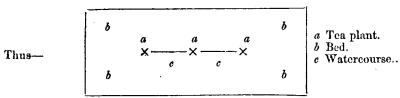
We have already stated that 4½ square feet ought to be assigned to
each plant. In China, according to Professor Royle, three to four
feet are given; this, however, is too small a space to allow the
plant to grow freely. After the tea plants are transplanted, it is
not necessary to protect them.
The best seasons for transplanting are towards the end of February,
or as soon as the frost has ceased, and throughout March, and during
the rains, and until the end or middle of November, depending on the
season.
In transplanting, four parties ought to be employed; viz., one
person to dig holes, a second to remove plants, a third to carry
them to the ground where they are required, and a fourth to plant.
By this means, not only time is saved, but the plants have a much
better chance, when thus treated, of doing well. When the seedling
beds are extensive, so many of the plants ought not to be removed,
that is, a plant left every 4½ feet, and these beds added to the
plantation.
On pruning, best season and mode.—The plants do not require to be
pruned until the fifth year, as the plucking of leaves generally
tends to make the plants assume the basket shape, the form most to
be desired to procure the greatest quantity of leaves; if, however,
the plants show a tendency to run into weed, from central branches
being thrown out, this ought to be checked by removing the central
stem. In the fourth year a quantity of the old and hard wood ought
to be removed, to induce the plants to throw out more branches. The
best season for pruning is from November to March.
On irrigation.—To keep the tea-plants healthy, irrigation for two
or three years is absolutely necessary, and no land ought to be
selected for a tea plantation which cannot be irrigated.
On the other hand, land liable to be flooded during the rains, and
upon which water lies for any length of time, is equally detrimental
to the growth of the plant. This applies to a small portion of the
Kooasur plantation, which receives the drainage of the adjoining
hills, and the soil being retentive, keeps the water. Deep trenches
have been dug in order to drain it off—these, however, owing to the
lowness of the surrounding country, act badly. Three successive
seasons plants have been put into the ground, and as often have been
destroyed on the setting in of the rains, showing the necessity of
avoiding such kind of land for tea plantation.
To facilitate irrigation, &c., as already stated, in the Deyrah
Dhoon, I have limited the tea beds to three feet in breadth. This is
particularly requisite in land so constituted as that of the Deyrah
Dhoon, it being so porous, as mentioned by Major Cautley in his
"Notes and Memoranda of Watercourses." This is caused by the
superincumbent soil not being more than from one to three feet
thick, in some places more, but varying exceedingly. Beneath this
there is a bed of shingle of vast thickness, through which the water
percolates; it is this that renders the sinking of wells so
difficult in the Deyrah Dhoon, and which has tended so much to
retard individuals from becoming permanent residents; at present
there are many tracts of several thousand acres in that valley
unoccupied from want of drinking water, as for instance, at
Innesphaeel.
Where the ground is very uneven, as is the case generally in the
hills, the khaul system, already recommended, ought to be adopted.
On the tea-plant; season of flowering, its characters and species,
and on the advantages to be derived from importing seeds from
China.—From the importance of tea, as an article of commerce, the
plant has attracted much attention; and from few qualified Europeans
having travelled in the tea districts of China, there is much
difference of opinion as to the number of species belonging to the
genus Thea.
In the government plantations in Kumaon and Gurwahl, the plants
begin to flower about the end of August and beginning of September,
or, as the seeds of the former year begin to ripen. They do not all
come into flower at once, but some are in full blossom in September,
others in October, November, December and January. Some throw out a
second set of blossoms in March, April, and May, and during the
rains; so that from the same plant unripe or ripe seeds and flowers
may be collected at one and the same time.
To the genus Thea, which belongs to the order Ternstræmiaceæ, the
following characters have been ascribed: calyx persistent, without
bracts, five-leaved, leaflets imbricated and generally of the same
size. Petals of the corolla vary in number from five to nine,
imbricated, the inner ones much the largest. Stamens numerous, in
several rows adhering to the bottom of the petals. Filaments
filiform. Anthers incumbent, two-celled, oblong, with a thickish
connectivum. Cells opening longitudinally. Ovary free, three-celled;
ovules four in each cell, inserted internally into the central
angle, the upper ones ascending, the lower pendulous. Style trifid,
stigmas three, acute. Capsule spheroidal, 1-7-lobed with loculicidal
dehiscence, or with dessepiments formed from the turned-in edges of
the valves. Seeds solitary, or two in cells, shell-like testa,
marked with the ventral umbilicus. Cotyledons thick, fleshy, oily,
no albumen. Radicle very short, very near the umbilicus centripetal.
In the plantations there are two species, and two well marked
varieties.
The first is characterised by the leaves being of a pale-green
colour, thin, almost membraneous, broad lanceolate, sinatures or
edge irregular and reversed, length from three to six inches. The
color of the stem of newly-formed shoots is of a pale-reddish
colour, and green towards the end. This species is also marked by
its strong growth, its erect stem, and the shoots being generally
upright and stiff. The flowers are small, and its seeds but sparing.
In its characters this plant, received from Assam, agrees in part
with those assigned by Dr. Lettsom and Sir W. Hooker to the Thea
viridis, but differs in its branches being stiff and erect. The
flowers small, or rather much about the same size as the species
about to be described, and not confined to the upper axils of the
plant, and solitary, as stated by them.[10] By the Chinese
manufacturers it is considered an inferior plant for making tea, it
is not therefore grown to any extent.
The second species is characterised by its leaves being much
smaller, and not so broadly lanceolate; slightly waved, of a
dark-green color, thick and coriaceous, sinature or edge irregular,
length from one to three inches and a half. In its growth it is much
smaller than the former, and throws out numerous spreading branches,
and seldom presents its marked leading stem. This species,
therefore, in the above characters, agrees much with those that have
been assigned to Thea Bohea by authors. The characters have been
mixed up in an extraordinary manner. Thus it has been stated, that
the Thea viridis has large, strong growing, and spreading
branches, and that Thea Bohea is a smaller plant, with branches
stiff and straight, and stem erect. No doubt the Thea viridis is a
much larger and stronger growing plant than the Thea Bohea, or
rather the plant now existing in the different plantations is so;
but in the former the branches are stiff and erect, and in the
latter inclined and branches. The marked distinguishing characters
between the two species are the coriaceous dark-green leaves in the
Thea Bohea, and the large pale-green monhanæous leaves of the
Thea viridis. The manner, too, of growth is very striking, and on
entering the plantation the distinction is at once marked to the
most unobservant eye. This species of Thea Bohea forms nearly the
whole of the plantations, and was brought from China by Dr. Gordon.
In the plantations there is a third plant, which, however, can only
be considered a marked variety of Thea Bohea. Its leaves are
thick, coriaceous, and of dark-green color, but invariably very
small, and not exceeding two inches in length, and thinly
lanceolate; the serratures, too, on the edge, which are straight,
are not so deep. In other characters it is identical. This marked
variety was received from Calcutta at the plantation in a separate
despatch from the others.
But in addition to these there are, no doubt, many more varieties,
and though it may be a fact that, in certain districts, green tea is
manufactured from a species differing from that from which black tea
is manufactured, yet, in other districts, green and black teas are
manufactured from one and the same plant. The Chinese manufacturers
now in Kumaon state that the plant is one and the same, and that it
can be proved by converting black tea into green. In manufacturing
teas now in the manufactory, if a large quantity of leaves are
brought in from the plantations, one half are converted into green,
and one half into black tea. This only shows that much of the green
and black teas of commerce are manufactured from one and the same
plant. The Assam plant is, from the characters given, quite a
distinct plant, and agrees, as already stated, most nearly with the
species described as Thea viridis. It would, therefore, be most
desirable to procure seeds of this so-called species, and also of
other varieties, of which, no doubt, there is a great variety. From
the northern districts of China in particular, seeds ought to be
imported, not, however, in large quantities, but in quantities of
two or three seers, so that they might, on arrival at Calcutta, be
sent up the country as quickly as possible, for, if the seeds are
kept long out of the ground, not one will germinate; such was the
fate of all the seeds contained in ten boxes imported by government
in 1845, not one having germinated, which was much to be regretted.
Had they been sent in small parcels, well packed in wax cloth, to
prevent them from being injured by moisture, and placed in an airy
part of the vessel in transmission from China to Calcutta, and, on
arrival there, sent by dâwk banghay direct to the plantation, they
would, I am confident, have reached in good condition. It is well
worthy of a trial and seeds ought, if possible, to be obtained from
every district celebrated for its teas. It is in this manner, by
obtaining seeds of the finest varieties of plants, that the finest
teas will be procured. I do not mean to infer that the tea plants
now under cultivation are not the produce of fine varieties, for
that has been proved by the undoubted testimony of the London
brokers, but only that there are, no doubt, many others well worthy
of introduction. In confirmation of what I have stated, I may quote
the words of my late friend Dr. Griffith, who, in his report on the
tea plant of Assam, says—"I now come to the consideration of the
steps which, in my opinion, must be followed if any degree of
success in the cultivation of tea is to be expected; of these the
most important is the importation of Chinese seeds of
unexceptionable quality, and of small numbers of their sorts."[11]
Dr. Royle, too, who was the first person to point out that the
Himalayas were well adapted to tea cultivation, and to whom the
credit of recommending to government the introduction of the plant
into Northern India is due, strongly urges the necessity of
importing seeds from different localities in China celebrated for
their teas.
Method and season for plucking and gathering leaves.—The season
for picking leaves commences in April and continues until October.
The number of gatherings varies, depending on the moisture[12] or
dryness of the season. If the season be good, as many as seven
gatherings may be obtained. If, however, the rains are partial, only
four or five. These, however, may be reduced to their general
periods for gathering—that is, from April to June, from July to
15th August, and from September to the end of October. But few
leaves are collected after the 15th of the latter month. As soon as
the new and young leaves have appeared in April, the plucking takes
place, this being done by the Chinese, assisted by the Mallees. The
following is the method adopted:—A certain division of the
plantation is marked off, and to each man a small basket is given,
with instructions to proceed to a certain point, so that no plant
may be passed over. On the small basket being filled, the leaves are
emptied into another large one, which is put in some shady place,
and in which, when filled, they are conveyed to the manufactory. The
leaves are generally plucked with the thumb and forefinger.
Sometimes the terminal part of a branch, having four or five young
leaves attached, is plucked off. All old leaves are rejected, as
they will not curl, and therefore are of no use.
As the season advances, and manufactory and plantation works become
necessary, the Mallees are assisted in gathering leaves by Coolies.
The process is simple, and thus every man, woman, and child of
villages could be profitably employed, on the plantations being
greatly extended. Certain kinds of leaves are not selected in the
plantation, in order to make certain kinds of tea, but all new and
fresh leaves are indiscriminately collected together, and the
different kinds separated on the leaves being fired.
Method of manufacturing black tea.—The young and fresh leaves on
being picked (they only being used, the old ones being too hard, and
therefore unfit to curl), are carried to the manufactory, and spread
out in a large airy room to cool, and are there kept during the
night, being occasionally turned with the hand if brought in in the
afternoon; or, if brought in during the morning, they are allowed to
lie until noon. Early in the morning the manufacturers visit the
airing room, and pack up the leaves in baskets and remove them to
the manufacturing room. Each manufacturer takes a basketful, and
commences to beat them between the palms of his hands with a lateral
motion, in order to soften and make them more pliable for working,
and thus prevent them, when rolled, from breaking. This beating
process continues for about an hour, and it may either consist of
one or two processes; the Chinese sometimes finish the beating
process at once; at others, they allow the leaves, after being beat
for half an hour, to remain a time and then resume it. They now go
to breakfast, and in one hour and a half the leaves are ready for
the pan. The pans being heated by wood placed in the oven, so as to
feel hot to the hands, are filled to about two-thirds, or about
three seers of leaves are thrown in at a time—the quantity which a
manufacturer is capable of lifting with both hands. With the hands
the leaves are kept moving with a rotatory motion in the pan, and
when they become very hot, the motion is kept up with a pair of
forked sticks. This process is continued for three or four minutes,
depending on the heat of the pan, or until the leaves feel hot and
soft. They are then, with one sweep of a bamboo brush, swept into a
basket, and thrown on to the rolling-table, which is covered with a
coarse mat made of bamboo. Each manufacturer then takes as much as
he can hold in both hands, and forms a ball and commences to roll it
with all his might with a semicircular motion, which causes a
greenish yellow juice to exude. This process is continued for three
or four minutes, the balls being occasionally undone and made up
again. The balls are then handed to another party at the extremity
of the table, to undo them and spread the leaves out thinly on flat
baskets and expose them to the sun, if there is any; if not they are
kept in the manufactory. After all the leaves have gone through this
process, the first baskets are brought back, and the leaves again
transferred to the pan, worked up in a similar manner for the same
length of time, re-transferred to the table, and again rolled. This
being done, the leaves are again spread out on large flat baskets to
cool. On being cooled the leaves are collected together and thinly
spread out on flat wicker-worked sieve-baskets, which are placed in
others of a deep and of a double-coned shape. The choolahs being
lighted for some time, and the charcoal burning clear, they are now
ready to receive the coned baskets. The basket is placed over the
choolah and kept there for about five minutes. The leaves are then
removed, re-transferred to the flat baskets, and re-rolled for a few
minutes. This being done, the leaves are again brought together,
placed in the conical basket and kept over the charcoal fire for
about two minutes. The contents of the conical baskets are then all
collected together in a heap, and as much is placed in a conical
basket as it will hold, and it is again placed over the charcoal
choolah until the tea is perfectly dry. During this time the baskets
are frequently removed and the tea turned, in order to allow the
leaves to be completely and uniformly dried, and the basket too is
generally struck, on removal, a violent side blow with the hand, to
remove from the sieve any small particles that might otherwise fall
into the fire. Before removing the basket from the choolah, a flat
basket is always placed on the floor to receive it, and all the
particles which pass through, on the coned basket being struck, are
again replaced. On the conical basket being filled, before placing
it over the choolah, a funnel is made in the centre of the tea with
the hand, to allow the heated air to pass through. Sometimes a
funnel made of bamboo is made for this purpose. After the tea feels
perfectly dry, it is packed in boxes, and sent to the godown.
Next day the different kinds of tea are picked, and on being
separated they are again placed in the conical baskets and heated.
During this process the baskets are frequently removed from the
choolah in order to turn the tea, so that the heating may be general
and uniform. In doing this a flat basket is always placed on the
floor, as on the former day (and a flat basket, too, is placed on
the top to confine the heat), to receive the conical one, which
receive one or two blows to open the pores of the sieve. What passes
through is replaced amongst the tea. When it is perfectly dry it is
ready for finally packing.
The kinds of black tea at present manufactured are—Souchong,
Pouchong, Flowery Pekoe, and Bohea. The Flowery Pekoe is
manufactured in September.
Method of manufacturing Green Tea.—On the young and fresh leaves
being plucked they are spread out on the ground of the airing room
and allowed to cool. After remaining for about two hours, or (if
brought in late in the afternoon) during the night, they are removed
to the green tea room. The pans being properly heated, the leaves,
as in the case with the black tea, are thrown into the pans and kept
either with the hand or two forked sticks in constant motion for
three or four minutes, and are then removed to the rolling table,
and then rolled in the same manner in balls as the black tea. They
are then scattered most sparingly on large flat baskets and exposed
to the heat of the sun. If there is no sun the baskets are arranged
in frames, which are placed over the choolah, heated with charcoal.
During the drying the leaves are frequently made into balls and
rolled in the flat baskets, in order to extract the juice. The
drying process continues for about two hours, and on the leaves
becoming dry, those contained in two baskets are thrown together,
and then four basketsful into one, and so on until they are all
collected together. In this state the leaves still feel soft, damp,
and pliant to the hand, and are now brought back to the tea
manufacturing-room. Opposite to each of the inclined pans, which
have been properly heated so as to feel warm to the hand by wood
supplied to the ovens underneath, one of the Chinese stations
himself, and puts as many leaves into it as it will hold. He then
moves them in a heap gently, from before backward, making these
perform a circle, and presses them strongly to the sides of the pan.
As the leaves become hot he uses a flat piece of wood, in order that
he may more effectually compress them. This process continues for
about two hours, the leaves being compressed into at least half of
their bulk, and become so dry that when pressed against the back
part of the pan in mass, they again fall back in pieces. The tea, as
by this time it has assumed this appearance, is now placed in a bag
made of American drill or jean (the size depending on the quantity
of tea), which is damped, and one end twisted with much force over a
stick, and thus it is much reduced in size. After being thus
powerfully compressed and beaten so as to reduce the mass as much as
possible, the bag is exposed to the sun until it feels perfectly
dry. If there is no sun it is placed in the heated pan, and there
retained until it is so. This finishes the first day's process.
On the second day it is placed in small quantities in the heated
inclined pans, and moved up and down against the sides and bottom
with the palm of the hand, which is made to perform a semi circle.
This is continued for about six hours, and by so doing the colour of
the tea is gradually brought out.
The third day it is passed through sieve baskets of different
dimensions, then exposed to the winnowing machine, which separates
the different kinds of green teas. The winnowing machine is divided
into a series of divisions, which receive the different kinds
according to their size and weight. 1st. Coarsest Souchoo. This tea,
owing to its coarseness, is not marketable. 2nd. Chounchoo. This is
a large, round-grained tea. 3rd. Machoo. This is also a
round-grained tea, but finer than the former. 4th. Hyson. 5th.
Gunpowder Hyson. 6th. Chumat. This kind of tea consists of broken
particles of other kinds of tea.
On being separated, the different kinds are placed in baskets and
picked by the hand, all the old or badly curled and also
light-coloured leaves being removed, and others of different
varieties, which by chance may have become mixed. To make the bad or
light-colored leaves marketable, they undergo an artificial process
of coloring, but this I have prohibited in compliance with the
orders of the Court of Directors, and therefore do not consider this
tea at present fit for the market[13]. On the different teas being
properly picked, they are again placed in the heated inclined pans,
and undergo separately the process of being moved violently up and
down and along the bottom of the pan for three hours in the manner
already described. The color is now fully developed. If the tea
feels damp, it is kept longer than three hours in the pan. The tea
is now ready to be packed.
Packing.—As soon as the tea is prepared, boxes lined with sheet
lead ought to be ready to receive it. On being packed it is to be
firmly pressed down, and the lead is then to be soldered. Before the
sheet lead box is placed in the wooden one it is covered with paper,
which is pasted on to prevent any air acting on the tea through any
holes which might exist in the lead. The box is then nailed, removed
to the godown, papered, stamped, and numbered. It is then ready for
sale.
From what I have just stated, it will be perceived that box makers
and sheet lead makers are essential to form a complete tea
establishment. With reference to the box making it is unnecessary
for me to make any remark, further than that care is to be taken in
selecting wood for making boxes, as it ought to be free of all
smell. All coniferous (pine) woods are therefore unfit for the
purpose. In the hills the best woods are toon and walnut, and at
Deyrah the saul (Shorea Robusta).
Manufacture of sheet lead.—Sheet lead making is a much more
complicated process, and therefore requires more consideration. To
make sheet lead, the manufacturer mixes 1½ to 3 seers of block tin
with a pucka maund of lead, and melts them together in a cast metal
pan. On being melted, the flat stone slabs, under which it is his
intention to run the lead, are first covered with ten or twelve
sheets of smooth paper (the hill paper being well adapted to the
purpose), which are pasted to the sides, and chalked over. He then
places the under stone in a skeleton frame of wood, to keep it firm,
and above it the other stone. On the upper stone the manufacturer
sits, and gently raises it with his left hand, assisted by throwing
the weight of his body backwards. With his right hand he fills an
iron ladle with the molten matter, throws it under the raised slab,
which he immediately compresses and brings forward (it having been
placed back, and thus overlapping the under slab by about half an
inch) with his own weight. On doing so, the superabundant lead
issues in front and at both sides; what remains attached to the
slabs is removed by the iron ladle. The upper slab is now lifted,
and the sheet of lead examined. If it is devoid of holes it is
retained; if, on the other hand, there are several, which is
generally the case with the first two or three sheets run, or until
the slabs get warm, it is again thrown back to the melting pan.
After having run off a series of sheets the slabs are to be
examined, and, if the paper is in the least burnt, the first sheet
is to be removed, and the one underneath taking its place, and thus
securing an uniform smooth surface, is then to be chalked. According
to the size of the stone slabs used, so is the size of the sheet
lead. Those now in use are 16 inches square by 2 inches in
thickness, and are a composition, being principally formed of lime.
To make sheet lead boxes, a model one of wood (a little smaller than
the box for which the lead is intended) is formed, which has a hole
in the bottom, and a transverse bar of wood to assist in lifting it
up, instead of a lid. The lead is then shaped on this model and
soldered. This being done, the model is removed by the transverse
bar, and by pressing, if necessary, through the hole. The lead box
is then papered over, in case there should be any small holes in it,
to prevent the action of air on the tea, and, when dry, transferred
to the wooden box for which it was intended.
The manufactory.—The rooms of the manufactory ought to be large
and airy, and to consist of—1st, a black tea manufactory; 2nd, a
green tea manufactory; 3rd, winnowing room; and 4th, airing room. At
Almorah the black tea manufacturing room is 53 feet long by 20
broad, and the other three, 20 by 24. The walls are 18 feet in
height.
Implements required in manufacturing.—In the body of this report
I have noticed all the different kinds of implements required, I may
however, again briefly notice them, and give a short account of
each. Cast-iron Pans—In the manufactory there are two kinds in use,
one received from China, the other from England. Both are considered
equally good by the tea manufacturers, though in firing green tea
they prefer the Chinese ones, as they are thinner, and are thus by
them better able to regulate the heat. The Chinese pans are two feet
two inches in diameter, and 10 inches in depth, by about one-eighth
of an inch in thickness.
The English pans are two feet two inches in diameter, and eight
inches in depth, and rather thicker than the Chinese.
The oven for making black tea is made of kucha brick. In height it
is two feet nine inches, in length, three feet, and in breadth three
feet one inch. Door one foot five inches in height, and 11 inches in
breadth. The base of the oven is 10 inches elevated above the floor
of the manufacturing room.
The oven with double pans for manufacturing green tea, is also built
of kucha bricks. It is three feet in height and three feet in
breadth; base of oven one foot in height. Door one foot six inches
in height, and 10 inches in breadth. The pans are placed
horizontally.
A brush made of split bamboo, used in sweeping the tea leaves out of
the pans.
A basket for receiving tea from the pan when ready to be rolled. It
is 2 feet long, and 1½ feet broad, and gradually increases in depth
from before backwards to 6 inches. It is made of bamboo.
The mat made of bamboo for placing on the table when the tea leaves
are about to be rolled. It is 8 feet long and 4 feet broad.
A flat basket made of bamboo for spreading out the tea leaves when
they have been rolled on the mat. These flat baskets are of various
sizes, varying from 3 to 5 feet in diameter.
A flat sieve basket of 2 feet in diameter, made of bamboo, upon
which the rolled tea leaves are placed, and which is deposited in
the centre of the double-coned basket.
Double-coned baskets. The height of these baskets varies from 2 feet
2 inches to 2 feet 6 inches, external diameter 2 feet 8 inches. In
the centre there are some pegs of bamboo to support the flat sieve
basket on which the tea rests.
Forked sticks for turning leaves.
Choolahs. These are formed of kucha bricks, and are 10 inches high,
10½ inches deep, and generally about 2 feet in diameter.
Funnel made of bamboo to allow the heated air from the choolahs to
pass through the tea; it is seldom used; the Chinese tea
manufacturers preferring one made in the tea basket by the hand.
Oven for firing green tea made of kucha bricks. The pans are
inclined at an angle of 50. In front the oven is 3 feet 2 inches in
height, behind 4 feet 8 inches, length 5½ feet, breadth 3 feet. Door
10 inches from the base, 1 foot 2 inches high, and 7 inches wide.
Frames for placing baskets. The first being inclined.
Baskets for collecting leaves.
Shovel, &c., used in regulating the fire.
Winnowing machine. This is a common winnowing machine, with a box 2
feet 10 inches in length, 1 foot 2 inches in breadth, and 1 foot 3
inches in depth, attached to the bottom of the hopper, and closely
fitted into the middle of the circular apartment which contains the
fanners. This box is entirely closed above (unless at the small
opening receiving the hopper) and at the sides. At the base there
are two inclined boards which project from the side of the machine 6
inches, and are partly separated from each other by angular pieces
of wood. The end towards the fanners is open, the other is partly
closed by a semicircular box which is moveable.
I shall now give the dimensions of the different parts of this
machine, which may be useful to parties wishing to make up similar
ones to those employed in the manufactories.
External frame 7 feet 2 inches in length, 18 inches in breadth, and
5 feet 8 inches in height. Hopper 2 feet 10 inches above, and 1 foot
8 inches in depth. Frame of box for fanners 3 feet 9 inches in
diameter. Hopper frame 2 feet 7 inches. Semicircular box, in length
2 feet 5 inches and 7 inches in depth. Inclined plane at base, first
15 inches, second 13 inches.
I may briefly state how this machine acts. With the right hand the
fanners are propelled by the crank, and with the left hand the
bottom of the hopper is opened by removing the wood. The flat piece
of wood (the regulator) is held in the hand to regulate the quantity
of tea that passes down. An assistant then throws a quantity of tea
into the hopper which escapes through the apartment, and there meets
the air. The first kind of tea falls down the inclined plane into
one box which has been placed to receive them, the second are
propelled further on, and fall into another box, and the lighter
particles are propelled on to the semicircular end, and fall into a
third box.
Note on the culture of the tea plant at Darjeeling, in 1847, by Dr.
A. Campbell, Superintendant.—About six years ago I received a few
tea seeds from Dr. Wallich; they were of China stock, grown in
Kumaon. I planted them in my garden in November, 1841, and had about
a dozen seedlings in the month of May following, which were allowed
to grow where they had come up, and rather close together. The
plants were healthy from the commencement, and up to May, 1844, had
grown very well; at this period the ground passed into other hands
(Mr. Samuel Smith's), and I lost sight of them until last August,
when Mr. Macfarlane, from Assam, who was acquainted with the tea
plant in that province, arrived here. Being desirous of ascertaining
how far the climate and soil of Darjeeling were suitable to the tea,
I took him to examine the plants, and begged of him to record his
opinion on their growth and qualities, with reference to their age,
and his experience of the plant in Assam. The result was quite
satisfactory. Encouraged by this result, I determined to give an
extended trial to the plant, and through the kindness of Major
Jenkins and Captain Brodie, of Assam, I procured a supply of fresh
seed in October and November last, which was planted in November and
the early part of December.
The seed was of excellent quality. It commenced germinating in
March, a few plants appeared above ground in the early part of May,
and now I have upwards of 7,000 fine healthy seedlings in the
plantation.
For the information of those who may desire to try the tea culture
in this soil and climate, I have to state the mode of planting
pursued by me, and other particulars. The ground is a gentle sloping
bank, facing the north and west; the soil is a reddish clay mixed
with vegetable mould. After taking up a crop of potatoes, and
carefully preparing the ground, I put in the seeds in rows six feet
apart and six feet distance in the rows. The seeds were placed about
three inches under the surface, five in number, at each place about
four inches apart—thus : . : On an average, two out of five have
come up. The seedlings commenced appearing above ground early in
May, and continued to show until the end of July. The earliest were,
therefore, six months in the ground; the latest about eight months.
The seed was of China stock, grown in Assam, and of the Assam plant
mixed. I am anxious to have the China stock only, and purpose
separating the plants of the Assam stock as soon as I can
distinguish them, which Captain Brodie informs me can be readily
done as they grow up; the China plants begin of a darker color, and
smaller than the Assam ones.
I hope to have a supply of the seed of China stock from Kumaon next
November, and with it to cause the extension of the experiment at
this place.
I think that it is reasonable to expect quite as good tea to be
produced here as in Kumaon.[14] I have not tasted the Kumaon tea,
but, from the opinion expressed on it in England, I am satisfied
that it is a very drinkable beverage, and that with similar success
here, the tea will be a valuable addition to our products. I have
recently tried two kinds of the Assam tea presented by Mr. Stokes to
a friend. They are excellent teas, and I shall be well content to
have an equally good article manufactured here.
Mr. A. Macfarlane's report on the tea plants in Mr. Smith's ground is
annexed:—
"According to your request I have the pleasure of transmitting you
my opinion of the tea plants in your garden in this place. The two
larger plants have made very good progress, considering their
closeness to each other, which prevents them from throwing their
branches freely in every direction, but as they have attained so
great a size I would not recommend their being transplanted, because
let it be done ever so carefully, the roots must receive more or
less injury, and should the injury be great the death of the tree is
certain.
The smaller ones on the contrary are much stunted; this is caused by
their confined situation, being completely choked up by the rose
trees, which prevents their receiving a proper supply of light and
air, so necessary to vegetation. They are also planted too closely,
and, as the plants are still small, by availing yourself of the most
favourable season, and using great care in the operation, they might
he transplanted with safety, and should then be placed at a distance
of not less than six feet apart. The difficulty of transplanting is
occasioned by the depth to which the root penetrates, as it
generally grows downwards, and in a large tree is principally in the
subsoil. The larger plants should be pruned of their lower branches
to allow a free current of air. This operation is generally
performed in November, but any time during the cold season or before
the rains, while the plant is at rest, would answer: as I have no
knowledge of this climate, I would leave it to more experienced
persons to judge of the proper season. To conclude, the plants are
in a very healthy condition, and had they been in the hands of a
cultivator, would now have been giving a very fair supply of
produce.
The small sample I tried was of a very good flavor, but on account
of the defective manner of manufacture, for want of proper
materials, no proper judgment can be formed." (Simmonds's Col. Mag.,
vol. xvi. p. 44.)
Report upon the Tea Plantations of Deyra, Kumaon and Gurhwal, by
Robert Fortune, Esq., addressed to John Thornton, Esq., Secretary to
the Government, North Western Provinces, dated Calcutta, September
6th, 1851:—
KAOLAGIR TEA PLANTATION.
1. Situation and extent.—The Deyra Doon, or Valley of Deyra, is
situated in latitude 3 deg. 18 min. north, and in longitude 78 deg.
east. It is about 60 miles in length from east to west, and 16 miles
broad at its widest part. It is bounded on the south by the Sewalick
range of hills, and on the north by the Himalayas proper, which are
here nearly 8,000 feet above the level of the sea. On the west it is
open to the river Jumna, and on the east to the Ganges, the distance
between these rivers being about 60 miles.
In the centre of this flat valley, the Kaolagir tea plantation has
been formed. Eight acres were under cultivation in 1847. There are
now 300 acres planted, and about 90 more taken in and ready for many
thousands of young plants raised lately from seeds in the
plantation.
2. Soil and culture.—The soil of this plantation is composed of
clay, sand, and vegetable matter, rather stiff, and apt to get
"baked" in dry weather, but free enough when it is moist or during
the rains. It rests upon a gravelly subsoil, consisting of
limestone, sandstone, clay-slate, and quartz rock, or of such rocks
as enter into the composition of the surrounding mountain ranges.
The surface is comparatively flat, although it falls in certain
directions towards the ravines and rivers.
The plants are arranged neatly in rows 6 feet apart, and each plant
is about 4½ feet from its neighbour in the row. A long, rank-growing
species of grass, indigenous to the Doon, is most difficult to keep
from over-topping the tea-plants, and is the cause of much extra
labor. Besides the labor common to all tea countries in China, such
as weeding, and occasionally loosening the soil, there is here an
extensive system of irrigation carried on. To facilitate this, the
plants are planted in trenches, from four to six inches below the
level of the ground, and the soil thus dug out is thrown between the
rows to form the paths. Hence the whole of the plantation consists
of numerous trenches of this depth, and five feet from centre to
centre. At right angles with these trenches a small stream is fed
from the canal, and, by opening or shutting their ends, irrigation
can be carried on at the pleasure of the overseer.
3. Appearance and health of plants.—The plants generally did not
appear to me to be in that fresh and vigorous condition which I had
been accustomed to see in good Chinese plantations. This, in my
opinion, is caused, 1st, by the plantation being formed on flat
land; 2nd, by the system of irrigation; 3rd, by too early
plucking; and 4th, by hot drying winds, which are not unfrequent in
this valley from April to the beginning of June.
GUDDOWLI PLANTATION (NEAR PAORIE).
1. Situation and extent.—This plantation is situated in the
Province of Eastern Gurhwal, in latitude 30 deg. 8 min. north, and
in longitude 78 deg. 45 min. east. It consists of a large tract of
terraced land, extending from the bottom of a valley or ravine to
more than 1,000 feet up the sides of the mountain. Its lowest
portion is about 4,300 feet, and its highest 5,300 feet above the
level of the sea; the surrounding mountains appear to be from 7,000
to 8,000. The plantation has not been measured, but there are,
apparently, fully one hundred acres under cultivation.
There are about 500,000 plants already planted, besides a large
number of seedlings in beds ready for transplanting. About 3,400 of
the former were planted in 1844, and are now in full bearing; the
greater portion of the others are much younger, having been planted
out only one, two, and three years.
2. Soil and culture.—The soil consists of a mixture of loam,
sand, and vegetable matter, is of a yellow colour, and is most
suitable for the cultivation of the tea-plant. It resembles greatly
the soil of the test tea districts in China. A considerable quantity
of stones are mixed with it, chiefly small pieces of clay-slate, of
which the mountains here are composed. Large tracts of equally good
land, at present covered with jungle, are available in this district
without interfering in any way with the rights of the settlers.
I have stated that this plantation is formed on the hill side. It
consists of a succession of terraces, from the bottom to the top, on
which the tea bushes are planted. In its general features it is very
like a Chinese tea plantation, although one rarely sees tea lands
terraced in China. This, however, may be necessary in the Himalayas,
where the rains fall so heavily. Here, too, the system of irrigation
is carried on, although to a small extent only, owing to the
scarcity of water during the dry season.
3. Appearance and health of plants.—This plantation is a most
promising one, and I have no doubt will be very valuable in a few
years. The plants are growing admirably, and evidently like their
situation. Some of them are suffering slightly from the effects of
hard-plucking, like those at Kaolagir; but this can easily be
avoided in their future management. Altogether, it is in a most
satisfactory condition, and shows how safe it is in matters of this
kind to follow the example of the Chinese cultivator, who never
makes his tea plantations on low rice land, and never irrigates.
HAWULBAUGH PLANTATION (NEAR ALMORAH).
1st. Situation and extent.—This tea farm is situated on the banks
of the river Kosilla, about six miles north-west from Almorah, the
capital of Kumaon. It is about 4,500 feet above the level of the
sea. The land is of an undulating character, consisting of gentle
slopes and terraces, and reminded me of some of the best tea
districts in China. Indeed, the hills themselves, in this part of
the Himalayas, are very much like those of China, being barren near
their summit and fertile on their lower sides.
Thirty-four acres of land are under tea cultivation here, including
the adjoining farm of Chullar. Some of the plants appear to have
been planted in 1844; but, as at Paorie, the greater number are only
from one to three years old.
2nd. Soil and culture.—The soil is what is usually called a sandy
loam; it is moderately rich, being well mixed with vegetable matter.
It is well suited for tea cultivation. The greater part of the farm
is terraced as at Guddowli, but some few patches are left in natural
slopes in accordance with the Chinese method. Irrigation is
practised to a limited extent.
3rd. Appearance and health of the plants.—All the young plants
here are in robust health and are growing well, particularly where
they are growing on land where water cannot flood or injure them. As
examples of this, I may point out a long belt between Dr. Jameson's
house and the flower garden, and also a piece of ground a little
below the house in which the Chinese manufacturers live. Some few of
the older bushes appear rather stunted; but this is evidently the
result of water remaining stagnant about the roots, and partly also
of over plucking; both defects, however, admit of being easily
cured.
LUTCHMISSER AND KUPPEENA PLANTATIONS.
1st. Situation and extent.—These plantations are on the hill side
near Almorah, and about 5,000 feet above the level of the sea. The
situation is somewhat steep, but well adapted to the growth of tea.
The former contains three acres, and the latter four acres under
cultivation.
2nd. Soil and culture.—-The soil is light and sandy, and much
mixed with particles of clay-slate, which have crumbled down from
the adjoining rocks. I believe these plantations are rarely
irrigated, and the land is steep enough to prevent any stagnant
water from remaining about the roots of the plants.
3rd. Appearance and health of plants.—Most of the bushes here are
fully grown, and in full bearing, and generally in good health. On
the whole, I consider these plantations in excellent order.
BHEEMTAL PLANTATIONS.
The lake of Bheemtal is situate in latitude 29 deg. 20 min. north,
and in longitude 79 deg. 30 min. east. It is 4,000 feet above the
level of the sea, and some of the surrounding mountains are said to
be 8,000 feet. These form the southern chain of the Himalayas, and
bound the vast plain of India, of which a glimpse can be had through
the mountain passes. Amongst these hills there are several tals or
lakes, some flat meadow-looking land, and gentle undulating slopes,
while higher up we have steep and rugged mountains. It is amongst
these hills, that the Bheemtal tea plantations have been formed.
They may be classed under three heads, viz.—
1st. Anoo and Kooasur plantations.—These adjoin each other, are
both formed on low flat land, and together cover about forty
acres. The plants do not seem healthy or vigorous; many of them have
died out, and few are in that state which tea plants ought to be in.
Such situations never ought to be chosen for tea cultivation. The
same objection applies to these as to those at Deyra, but in a
greater degree. No doubt, with sufficient drainage, and great care
in cultivation, and the tea plant might be made to exist in such a
situation; but I am convinced it would never grow with that
luxuriance which is necessary in order to render it a profitable
crop. Besides, such lands are valuable for other purposes. They
are excellent rice lands, and as such of considerable value to the
natives.
2nd. Bhurtpoor plantation.—This plantation covers about four and
a half acres of terraced land on the hill side, a little to the
eastward of those last noticed. The soil is composed of a light
loam, much mixed with small pieces of clay-slate and trap or
green-stone, of which the adjacent rocks are composed. It contains a
small portion of vegetable matter or humus. Both the situation and
soil of this plantation are well adapted to the requirements of the
tea shrub, and consequently we find it succeeding here as well as at
Guddowli, Hawulbaugh, Almorah, and other places where it is planted
on the slopes of the hills.
3rd. Russia plantation.—This plantation extends over seventy-five
acres, and is formed on sloping land. The elevation is somewhat less
than Bhurtpoor, and although terraced in the same way, the angle is
much lower. In some parts of the farm the plants are doing well, but
generally they seemed to be suffering from too much water and hard
plucking. I have no doubt, however, of the success of this farm,
when the system of cultivation is improved. I observed some most
vigorous and healthy bushes in the overseer's garden, a spot
adjoining the plantation, which could not be irrigated, and was
informed they "never received any water, except that which fell from
the skies."
In the Bheemtal district, there are large tracts of excellent tea
land. In crossing over the hills towards Nainee Tal, with J.H.
Batten, Esq., Commissioner of Kumaon, I pointed out many tracts
admirably adapted for tea cultivation, and of no great value to the
natives; generally, those lands on which the mundoca is cultivated
are the most suitable.
I have thus described all the Government plantations in Gurhwal and
Kumaon. Dr. Jameson, the superintendent, deserves the highest praise
for the energy and perseverance with which he has conducted his
operations. I shall now notice the plantations of the zemindars,
under the superintendence of the commissioner and
assistant-commissioner of Kumaon and Gurhwal.
ZEMINDAREE TEA PLANTATIONS.
1st, at Lohba.—This place is situated in eastern Gurhwal, about
50 miles to the westward of Almorah, and is at an elevation of 5,000
feet above the level of the sea. It is one of the most beautiful
spots in this part of the Himalayas. The surrounding mountains are
high, and in some parts precipitous, while in others they are found
consisting of gentle slopes and undulations. On these undulating
slopes, there is a great deal of excellent land suitable for tea
cultivation. A few tea bushes have been growing vigorously for some
years in the commissioner's garden, and they are now fully ten feet
in height. These plants having succeeded so well, naturally induced
the authorities of the province to try this cultivation upon a more
extensive scale. It appears that in 1844, about 4,000 young plants
were obtained from the Government plantations, and planted on a
tract of excellent land, which the natives wished to abandon.
Instead of allowing the people to throw up their land, they were
promised it rent-free upon the condition that they attended to the
cultivation of the tea, which had been planted on a small portion of
the ground attached to the village.
This arrangement seems to have failed either from want of knowledge,
or from design, or perhaps partly from both of these causes. More
lately, a larger number of plants have been planted, but I regret to
say with nearly the same results.
But results of this discouraging kind are what any one, acquainted
with the nature of the tea plant, could have easily foretold, had
the treatment, intended to be given it, been explained to him. Upon
enquiry, I found the villagers had been managing the tea lands just
as they had been doing their rice fields, that is, a regular system
of irrigation was practised. As water was plentiful, a great number,
indeed nearly all, the plants seem to have perished from this cause.
The last planting alluded to had been done late in the spring, and
just at the commencement of the dry weather, and to these plants
little or no water seems to have been given; so that, in fact, it
was going from one extreme to another equally bad, and the result
was of course nearly the same.
I have no hesitation in saying that the district in question is well
adapted for the cultivation of tea. With judicious management, a
most productive farm might be established here in four or five
years. Land is plentiful, and of little value either to the natives
or to the Government.
2nd, at Kutoor.—This is the name of a large district 30 or 40
miles northward from Almorah, in the centre of which the old town or
village of Byznath stands. It is a fine undulating country,
consisting of wide valleys, gentle slopes, and little hills, while
the whole is intersected by numerous streams, and surrounded by high
mountains. The soil of this extensive district is most fertile, and
is capable of producing large crops of rice, on the low irrigable
lands, and the dry grains and tea on the sides of the hills. From
some cause, however, either the thinness of population or the want
of a remunerative crop,[15] large tracts of this fertile district
have been allowed to go out of cultivation. Everywhere I observed
ruinous and jungle-covered terraces, which told of the more extended
cultivation of former years.
Amongst some hills near the upper portion of this district, two
small tea plantations have been formed under the patronage and
superintendence of Captain Ramsey, Senior Assistant Commissioner of
Kumaon. Each of them cover three or four acres of land, and had been
planted about a year before the time of my visit. In this short
space of time the plants had grown into nice strong bushes, and were
in the highest state of health. I never saw, even in the most
favoured districts in China, any plantations looking better than
these. This result, Captain Ramsay informed me, had been attained in
the following simple manner:—All the land attached to the two
villages with which the tea farms are connected, is exempted from
the revenue tax, a sum amounting only to 525 Rs. per annum. In lieu
of this, the assamees (cultivators) of both villages assist with
manure, and at the transplanting season, as well as ploughing and
preparing fresh land. In addition to this, one chowdree and four
prisoners are constantly employed upon the plantations. The chief
reason of the success of these plantations, next to that of the land
being well suited for tea cultivation, may, no doubt, be traced to a
good system of management; that is, the young plants have been
carefully transplanted at the proper season of the year, when the
air was charged with moisture, and they have not been destroyed by
excessive irrigation afterwards. The other zemindaree plantation at
Lohba might have been now in full bearing had the same system been
followed.
From the description thus given, it will be observed that I consider
the Kutoor plantations in a most flourishing condition. And I have
no doubt they will continue to flourish, and soon convince the
zemindars of the value of tea cultivation, providing three things,
intimately connected with the success of the crop are strongly
impressed upon their minds; viz., the unsuitableness of low wet
lands for tea cultivation; the folly of irrigating tea as they would
do rice, and the impropriety of commencing the plucking before the
plants are strong, and of considerable size. I am happy to add, that
amongst these hills there are no foolish prejudices in the minds of
the natives against the cultivation of tea. About the time of my
visit, a zemindar came and begged two thousand plants, to enable him
to commence tea growing on his own account.
It is of great importance, that the authorities of a district, and
persons of influence, should show an interest in a subject of this
kind. At present the natives do not know its value; but they are as
docile as children, and will enter willingly upon tea cultivation,
providing the "Sahib" shows that he is interested in it. In a few
years the profits received will be a sufficient inducement.
In concluding this part of my Report, I beg to suggest the propriety
of obtaining some of the best varieties of the tea plant which
have been introduced lately into the government plantations from
China. Dr. Jameson could, no doubt, spare a few, but they ought to
be given to those zemindars only who have succeeded with the
original variety.
Having described in detail the various government plantations, and
also those of the zemindars which came under my notice in the
Himalayas, I shall now make some general remarks upon the
cultivation of tea in India, and offer some suggestions for its
improvement.
GENERAL REMARKS.
1. On land and cultivation.—From the observations already made
upon the various tea farms which I have visited in the Himalayas, it
will be seen that I do not approve of low flat lands being
selected for the cultivation of the tea shrub. In China, which at
present must be regarded as the model tea country, the plantations
are never made in such situations, or they are so rare as not to
have come under my notice. In that country they are usually formed
on the lower slopes of the hills, that is, in such situations as
those at Guddowli, Hawulbaugh, Almorah, Kutoor, &c., in the
Himalayas. It is true that in the fine green tea country of
Hwuy-chow, in China, near the town of Tunche, many hundred acres of
flattish land are under tea cultivation. But this land is close to
the hills, which jut out into it in all directions, and it is
intersected by a river whose banks are usually from 15 to 20 feet
above the level of the stream itself, not unlike those of the Ganges
below Benares. In fact, it has all the advantages of hilly land such
as the tea plant delights in. In extending the Himalaya plantation
this important fact ought to be kept in view.
There is no scarcity of such land in these mountains, more
particularly in Eastern Gurhwal and Kumaon. It abounds in the
districts of Paorie, Kunour, Lohba, Almorah, Kutoor, and Bheemtal,
and I was informed by Mr. Batten, that there are large tracts about
Gungoli and various other places equally suitable. Much of this land
is out of cultivation, as I have already stated, while the
cultivated portions yield on an average only two or three annas per
acre of revenue.
Such lands are of less value to the zemindars than low rice land,
where they can command a good supply of water for irrigation. But I
must not be understood to recommend poor worn out hill lands for tea
cultivation,—land on which nothing else will grow. Nothing is
further from my meaning. Tea in order to be profitable requires a
good sound soil,—a light loam, well mixed with sand and vegetable
matter, moderately moist, and yet not stagnant or sour. Such a soil,
for example, as on these hill sides produces good crops of mundooa,
wheat or millet, is well adapted for tea. It is such lands which I
have alluded to as abounding in the Himalayas, and which are, at
present, of so little value either to the Government, or to the
natives themselves.
The system of Irrigation applied to tea in India is never
practised in China. I did not observe it practised in any of the
great tea countries which I visited. On asking the Chinese
manufacturers whom I brought round, and who had been born and
brought up in these districts, whether they had seen such a
practice, they all replied, "no, that is the way we grow rice: we
never irrigate tea." Indeed, I have no hesitation in saying that,
in nine cases out of ten, the effects of irrigation are most
injurious. When tea will not grow without irrigation, it is a sure
sign that the land employed is not suitable for such a crop. It is
no doubt an excellent thing to have a command of water in case of a
long drought, when its agency might be useful in saving a crop which
would otherwise fail, but irrigation ought to be used only in such
emergent cases.
I have already observed that good tea land is naturally moist,
although not stagnant; and we must bear in mind that the tea shrub
is not a water plant, but is found in a wild state on the sides of
hills. In confirmation of these views, it is only necessary to
observe further, that all the best Himalayan plantations are those
to which irrigation has been most sparingly applied.
In cultivating the tea shrub, much injury is often done to a
plantation by plucking leaves from very young plants. In China
young plants are never touched until the third or fourth year after
they have been planted. If growing under favorable circumstances,
they will yield a good crop after that time. All that ought to be
done, in the way of plucking or pruning before that time, should be
done with a view to form the plants, and make them bushy if they
do not grow so naturally. If plucking is commenced too early and
continued, the energies of the plants are weakened, and they are
long in attaining any size, and consequently there is a great loss
of produce in a given number of years. To make this more plain, I
will suppose a bush that has been properly treated to be eight years
of age. It may then be yielding from two to three pounds of tea per
annum, while another of the same age, but not a quarter of the size,
from over-plucking, is not giving more than as many ounces.
The same remarks apply also to plants which become unhealthy from
any cause; leaves ought never to be taken from such plants; the
gatherers should have strict orders to pass them over until they get
again into a good state of health.
2nd. On climate.—I have already stated that eastern Gurhwal and
Kumaon appear to me to be the most suitable for the cultivation of
the tea plant in this part of the Himalayas. My remarks upon climate
will therefore refer to this part of the country.
From a table of temperature kept at Hawulbaugh from November 28th,
1850, to July 13th, 1851, obligingly furnished me by Dr. Jameson, I
observed that the climate here is extremely mild. During the winter
months, the thermometer [Fahr.] at sunrise was never lower than 44
deg., and only on two occasions so low, namely on the 15th and 16th
of February, 1851. Once it stood so high as 66 deg. on the morning
of February 4th, but this is full ten degrees higher than usual. The
minimum in February must, however, be several degrees lower than is
shown by this table, for ice and snow were not unfrequent; indeed,
opposite the 16th of February in the column of remarks, I find
written down a very frosty morning. This discrepancy no doubt
arises either from a bad thermometer being used, or from its being
placed in a sheltered verandah. We may, therefore, safely mark the
minimum as 32 deg. instead of 44 degrees.
The month of June appears to be the hottest in the year. I observe
the thermometer on the 5th, 6th and 7th of that month stood at 92
deg. at 3 P.M., and this was the highest degree marked during the
year. The lowest, at this hour, during the month was 76 deg., but
the general range in the 3 P.M. column of the table is from 80 deg.
to 90 degrees.
The wet and dry seasons are not so decided in the hills as they
are in the plains. In January, 1861, it rained on five days and ten
nights, and the total quantity of rain which fell, as indicated by
the rain gauge, during this month, was 5.25 inches; in February,
3.84 fell; in March, 2.11; in April, 2.24; in May, none; and in June
6.13. In June there are generally some days of heavy rain, called by
the natives Chota Bursaut, or small rains, after this there is an
interval of some days of dry weather before the regular "rainy
season" commences. This season comes on in July and continues until
September. October and November are said to be beautiful months with
a clear atmosphere and cloudless sky. After this fogs are frequent
in all the valleys until spring.
In comparing the climate of these provinces with that of China,
although we find some important difference, yet upon the whole there
is a great similarity. My comparisons apply, of course, to the best
tea districts only, for although the tea shrub is found cultivated
from Canton in the south to Tan-chowpoo in Shan-tung, yet the
provinces of Fokein, Kainsee and the southern parts of Kiangnan,
yield nearly all the finest teas of commerce.
The town of Tsong-gan, one of the great black tea towns near the far
famed Woo-e-shan, is situated in latitude 27 deg. 47 min, north.
Here the thermometer in the hottest months, namely in July and
August, rarely rises above 100 deg. and ranges from 92 deg. to 100
deg., as maximum; while in the coldest months, December and January,
it sinks to the freezing point and sometimes a few degrees lower. We
have thus a close resemblance in temperature between Woo-e-shan and
Almorah, The great green tea district being situated two degrees
further north, the extremes of temperature are somewhat greater. It
will be observed, however, that while the hottest month in the
Himalayas is June, in China the highest temperature occurs in July
and August: this is owing to the rainy season taking place earlier
in China than it does in India.
In China rain falls in heavy and copious showers in the end of
April, and these rains continue at intervals in May and June. The
first gathering of tea-leaves, those from which the Pekoe is made,
is scarcely over before the air becomes charged with moisture, rain
falls, and the bushes being thus placed in such favourable
circumstances for vegetating are soon covered again with young
leaves, from which the main crop of the season is obtained.
No one, acquainted with vegetable physiology, can doubt the
advantages of such weather in the cultivation of tea for mercantile
purposes. And these advantages, to a certain extent at least, seem
to be extended to the Himalayas, although the regular rainy season
is later than in China. I have already shown, from Dr Jameson's
table, that spring showers are frequent in Kumaon, although rare in
the plains of India; still, however, I think it would be prudent to
adopt the gathering of leaves to the climate, that is to take a
moderate portion from the bushes before the rains, and the main crop
after they have commenced.
3rd. On the vegetation of China and the Himalayas. One of the
surest guides from which to draw conclusions, on a subject of this
nature, is found in the indigenous vegetable productions of the
countries. Dr. Royle, who was the first to recommend the cultivation
of tea in the Himalayas, drew his conclusions, in the absence of
that positive information from China which we possess now, not only
from the great similarity in temperature between China and these
hills, but also from the resemblance in vegetable productions. This
resemblance is certainly very striking. In both countries, except in
the low valleys of the Himalayas (and these we are not considering),
tropical forms are rarely met with. If we take trees and shrubs, for
example, we find such genera as pinus, cypress, berberis, quercus,
viburnam, indigofera, and romeda, lonicera, deutzia, rubus, myrica,
spiræ, ilex, and many others common to both countries.
Amongst herbaceous plants we have gentiana, aquilegia, anemone,
rumex, primula, lilium, loutodon, ranunculus, &c. equally
distributed in the Himalayas and in China, and even in aquatics the
same resemblance may be traced, as in nelumbium, caladium &c. And
further than this, we do not find plants belong to the same genera
only, but in many instances the identical species are found in both
countries. The indigofera, common in the Himalayas, abounds also on
the tea hills of China, and so does Berberis nepaulencis,
Lonicera diversifolia, Myrica sapida, and many others.
Were it necessary, I might now show that there is a most striking
resemblance between the geology of the two countries as well as in
their vegetable productions. In both the black and green tea
countries which I have alluded to, clay-slate is most abundant. But
enough has been advanced to prove how well many parts of the
Himalayas are adapted for the cultivation of tea; besides, the
flourishing condition of many of the plantations is, after all, the
best proof, and puts the matter beyond all doubt.
4th. Concluding Suggestions.—Having shown that tea can be grown
in the Himalayas, and that it would produce a valuable and
remunerative crop, the next great object appears to be the
production of superior tea, by means of fine varieties and improved
cultivation. It is well known that a variety of the tea plant
existed in the southern parts of China from which inferior teas only
were made. That, being more easily procured than the fine northern
varieties, from which the great mass of the best teas are made, was
the variety originally sent to India. From it all those in the
Government plantations have sprung.
It was to remedy this, and to obtain the best varieties from those
districts which furnish the trees of commerce, that induced the
Honourable Court of Directors to send me to China in 1848. Another
object was to obtain some good manufacturers and implements from the
same districts. As the result of this mission, nearly twenty
thousand plants from the best black and green tea countries of
Central China, have been introduced to the Himalayas. Six first-rate
manufacturers, two lead men, and a large supply of implements from
the celebrated Hwuy-chow districts were also brought round and
safely located on the Government plantations in the hills.
A great step has thus been gained towards the objects in view. Much,
however, remains still to be done. The new China plants ought to be
carefully propagated and distributed over all the plantations; some
of them ought also to be given to the zemindars, and more of these
fine varieties might be yearly imported from China.
The Chinese manufacturers, who were obtained some years since from
Calcutta or Assam, are, in my opinion, far from being first-rate
workmen; indeed, I doubt much if any of them learned their trade in
China. They ought to be gradually got rid of and their places
supplied by better men, for it is a great pity to teach the natives
an inferior method of manipulation. The men brought round by me are
first-rate green tea makers, they can also make black tea, but they
have not been in the habit of making so much black as green. They
have none of the Canton illiberality or prejudices about them, and
are most willing to teach their art to the natives. I have no doubt
some of the latter will soon be made excellent tea manufacturers.
And the instruction of the natives is, no doubt, one of the chief
objects which ought to be kept in view, for the importation of
Chinese manipulators at high wages can only he regarded as a
temporary measure; ultimately the Himalayan tea must be made by the
natives themselves; each native farmer must learn how to make tea
as well as how to grow it; he will then make it upon his own
premises, as the Chinese do, and the expenses of carriage will be
much less than if the green leaves had to be taken to the market.
But as the zemindars will be able to grow tea long before they are
able to make it, it would be prudent, in the first instance, to
offer them a certain sum for green leaves brought to the government
manufactory.
I have pointed out the land most suitable for the cultivation of
tea, and shown that such land exists in the Himalayas to an almost
unlimited extent. But if the object the government have in view be
the establishment of a company to develop the resources of these
hills, as in Assam, I would strongly urge the propriety of
concentrating, as much as possible, the various plantations. Sites
ought to be chosen which are not too far apart, easy of access, and,
if possible, near rivers; for, no doubt, a considerable portion of
the produce would have to be conveyed to the plains or to a
sea-port.
In my tour amongst the hills, I have seen no place so well adapted
for a central situation as Almorah, or Hawulbaugh. Here the
government has already a large establishment, and tea lands are
abundant in all directions. The climate is healthy, and better
suited to a European constitution than most other parts of India.
Here plants from nearly all the temperate parts of the world are
growing as if they were at home. As examples, I may mention myrtles,
pomegranates, and tuberoses from the south of Europe; dahlias,
potatoes, aloes, and yuccas from America; Melianthus major and bulbs
from the Cape; the cypress and deodar of the Himalayas, and the
lagerstrœmias, loquats, roses and tea of China.
In these days, when tea has become almost a necessary of life to
England and her wide-spreading colonies, its production upon a large
and cheap scale is an object of no ordinary importance. But to the
natives of India themselves, the production of this article would be
of the greatest value. The poor paharie, or hill farmer, at
present has scarcely the common necessaries of life, and certainly
none of its luxuries. The common sorts of grain which his lands
produce will scarcely pay the carriage to the nearest market town,
far less yield a profit of such a kind as will enable him to
purchase some few of the necessary and simple luxuries of life. A
common blanket has to serve him for his covering by day and for his
bed at night, while his dwelling-house is a mere mud-hut, capable of
affording but little shelter from the inclemency of the weather.
Were part of these lands producing tea, he would then have a healthy
beverage to drink, besides a commodity which would be of great value
in the market. Being of small bulk compared with its value, the
expense of carriage would be trifling, and he would return home with
the means in his pocket of making himself and his family more
comfortable and more happy.
Were such results doubtful, we have only to look across the
frontiers of India into China. Here we find tea one of the
necessaries of life, in the strictest sense of the word. A Chinese
never drinks cold water, which he abhors, and considers unhealthy.
Tea is his favorite beverage from morning until night; not what we
call tea, mixed with milk and sugar, but the essence of the herb
itself, drawn out in pure water. One acquainted with the habits of
this people can scarcely conceive the idea of the Chinese empire
existing were it deprived of the tea plant; and I am sure that the
extensive use of this beverage adds much to the health and comfort
of the great body of the people.
The people of India are not unlike the Chinese in many of their
habits. The poor of both countries eat sparingly of animal food, and
rice, with other grains and vegetables, form the staple articles on
which they live; this being the case, it is not at all unlikely the
Indian will soon acquire a habit which is so universal in the sister
country. But in order to enable him to drink tea, it must be
produced at a cheap rate; he cannot afford to pay at the rate of
four or six shillings a pound. It must be furnished to him at four
pence or six pence instead; and this can be done easily, but
only on his own hills. If this is accomplished, and I see no reason
why it should not be, a boon will have been conferred upon the
people of India, of no common kind, and one which an enlightened and
liberal government may well be proud of conferring on its subjects."
I shall now add a description of the Chinese method of making black
tea in Upper Assam, by Mr. C.A. Bruce, superintendent of tea
culture:—
"In the first place, the youngest and most tender leaves are
gathered; but when there are many hands and a great quantity of
loaves to be collected, the people employed nip off with the
forefinger and thumb the fine end of the branch, with about four
leaves on, and sometimes even more if they look tender. These are
all brought to the place where they are to be converted into tea:
they are then put into a large, circular, open worked bamboo basket,
having a rim all round, two fingers broad. The leaves are thinly
scattered in these baskets, and then placed in a framework of
bamboo, in all appearance like the sides of an Indian hut, without
grass, resting on posts, 2 feet from the ground, with an angle of
about 25 deg. The baskets with leaves are put in this frame to dry
in the sun, and are pushed up and brought down by a long bamboo with
a circular piece of wood at the end. The leaves are permitted to dry
about two hours, being occasionally turned; but the time required
for this process depends on the heat of the sun. When they begin to
have a slightly withered appearance, they are taken down and brought
into the house, when they are placed on a frame to cool for half an
hour; they are then put into smaller baskets of the same kind as the
former, and placed on a stand. People are now employed to soften the
leaves still more, by gently clapping them between their hands, with
their fingers and thumbs extended, and tossing them up and letting
them fall, for about five or ten minutes. They are then again put on
the frame during half an hour, and brought down and clapped with the
hands as before. This is done three successive times, until the
leaves become to the touch like soft leather; the beating and
putting away being said to give the tea the black color and bitter
flavor. After this the tea is put into hot cast-iron pans, which are
fixed in a circular mud fireplace, so that the flame cannot ascend
round the pan to incommode the operator. This pan is well heated by
a straw or bamboo fire to a certain degree. About two pounds of the
leaves are then put into each hot pan, and spread in such a manner
that all the leaves may get the same degree of heat. They are every
now and then briskly turned with the naked hand, to prevent a leaf
from being burnt. When the leaves become inconveniently hot to the
hand, they are quickly taken out and delivered to another man with a
close-worked bamboo basket, ready to receive them. A few leaves that
may have been left behind are smartly brushed out with a bamboo
broom: all this time a brisk fire is kept up under the pan. After
the pan has been used in this manner three or four times, a bucket
of cold water is thrown in, and a soft brick-bat and bamboo broom
used, to give it a good scouring out; the water is thrown out of the
pan by the brush on one side, the pan itself being never taken off.
The leaves, all hot in the bamboo basket, are laid on a table that
has a narrow rim on its back, to prevent these baskets from slipping
off when pushed against it. The two pounds of hot leaves are now
divided into two or three parcels, and distributed to as many men,
who stand up to the table with the leaves right before them, and
each placing his legs close together, the leaves are next collected
into a ball, which he gently grasps in his left hand, with the thumb
extended, the fingers close together, and the hand resting on the
little finger. The right hand must be extended in the same manner as
the left, but with the palm turned downwards resting on the top of
the ball of tea leaves. Both hands are now employed to roll and
propel the ball along; the left hand pushing it on, and allowing it
to revolve as it moves; the right hand also pushes it forward,
resting on it with some force, and keeping it down to express the
juice which the leaves contain. The art lies here in giving the ball
a circular motion, and permitting it to turn under and in the hand
two or three whole revolutions, before the arms are extended to
their full length, and drawing the ball of leaves quickly back
without leaving a leaf behind, being rolled for about five minutes
in this way. The ball of tea leaves is from time to time delicately
and gently opened with the fingers lifted as high as the face, and
then allowed to fall again. This is done two or three times to
separate the leaves; and afterwards the basket with the leaves is
lifted up as often, and receives a circular shake to bring these
towards the centre. The leaves are now taken back to the hot pans
and spread out in them as before, being again turned with the naked
hand, and when hot taken out and rolled; after which, they are put
into a drying basket and spread on a sieve, which is in the centre
of the basket, and the whole placed over a charcoal fire. The fire
is very nicely regulated; there must not be the least smoke, and the
charcoal should be well picked.
When the fire is lighted it is fanned until it gets a fine red
glare, and the smoke is all gone off; being every now and then
stirred, and the coals brought into the centre, so as to leave the
outer edge low. When the leaves are put into the drying basket, they
are gently separated by lifting them up with the fingers of both
hands extended far apart, and allowing them to fall down again; they
are placed three or four inches deep on the sieve, leaving a passage
in the centre for the hot air to pass. Before it is put over the
fire, the drying basket receives a smart slap with both hands in the
act of lifting it up, which is done to shake down any leaves that
might otherwise drop through the sieve, or to prevent them from
falling into the fire and occasioning a smoke, which would affect
and spoil the tea. This slap on the basket is invariably applied
throughout the stages of tea manufacture. There is always a large
basket underneath to receive the small leaves that fall, which are
afterwards collected, dried, and added to the other tea; in no case
are the baskets or sieves allowed to touch or remain on the ground,
but always laid on a receiver, with three legs. After the leaves
have bean half-dried in the drying-basket, and while they are still
soft, they are taken off the fire and put into large open-worked
baskets, and then put on the shelf, in order that the tea may
improve in color.
Next day the leaves are all sorted into large, middling, and small;
sometimes there are four sorts. All these, the Chinese informed me,
become so many different kinds of teas; the smallest leaves they
call Pha-ho, the second Pow-chong, the third Souchong, and the
fourth, or the largest leaves, Zoy-chong. After this assortment they
are again put on the sieve in the drying-basket (taking care not to
mix the sorts), and on the fire, as on the preceding day; but now
very little more than will cover the bottom of the sieve is put in
at one time; the same care of the fire is taken as before, and the
same precaution of tapping the drying basket every now and then. The
tea is taken off the fire with the nicest care, for fear of any
particles of the tea falling into it. Whenever the drying-basket is
taken off, it is put on the receiver, the sieve in the drying-basket
taken out, the tea turned over, the sieve replaced, the tap given,
and the basket placed again over the fire. As the tea becomes crisp,
it is taken out and thrown into a large receiving-basket, until all
the quantity on hand has become alike dried and crisp, from which
basket it is again removed into the drying-basket, but now in much
larger quantities. It is then piled up eight and ten inches high on
the sieve in the drying-basket; in the centre a small passage is
left for the hot air to ascend; the fire that was before bright and
clear has now ashes thrown on it to deaden its effect, and the
shakings that have been collected are put on the top of all; the tap
is given, and the basket, with the greatest care, is put over the
fire. Another basket is placed over the whole, to throw back any
heat that may ascend. Now and then it is taken off, and put on the
receiver; the hands, with the fingers wide apart, are run down the
sides of the basket to the sieve, and the tea gently turned over,
the passage in the centre again made, &c., and the basket again
placed on the fire. It is from time to time examined, and when the
leaves have become so crisp that they break by the slightest
pressure of the fingers, it is taken off, when the tea is ready. All
the different kinds of leaves underwent the same operation. The tea
is now, little by little, put into boxes, and first pressed down
with the hands and then with the feet (clean stockings having been
previously put on).
There is a small room inside of the tea-house, seven cubits square,
and five high, having bamboos laid across on the top to support a
network of bamboo, and the sides of the room smeared with mud to
exclude the air. When there is wet weather, and the leaves cannot be
dried in the sun, they are laid out on the top of this room, on the
network, on an iron pan, the same as is used to heat the leaves;
some fire is put into it, either of grass or bamboo, so that the
flame may ascend high; the pan is put on a square wooden frame, that
has wooden rollers on its legs, and pushed round and round this
little room by one man, while another feeds the fire, the leaves on
the top being occasionally turned; when they are a little withered,
the fire is taken away, and the leaves brought down and manufactured
into tea, in the same manner as if it had been dried in the sun. But
this is not a good plan, and never had recourse to if it can
possibly be avoided."
In 1810, a number of tea plants were introduced into Brazil, with a
colony of Chinese to superintend their culture. The plantation was
formed near Rio Janeiro and occupied several acres. It did not,
however, answer the expectations formed of it, the shrubs became
stunted, cankered and moss grown, and the Chinese finally abandoned
them. The culture was again tried in 1817. The plantations lie between
the equator and 10 deg. south latitude, nearly parallel with Java, and
of course are exposed to the same intemperate climate, and suffer in a
similar manner. In addition to these physical disabilities, the
enterprise has had to contend with the natural indolence of the
natives, the universal repugnance to labor, the crushing effect of
committing so important a work to the superintendence of slaves and
overseers, the amazing fertility of the soil, the extent of
unappropriated land, the ease with which subsistence can be obtained
and the low degree of personal enterprise. These are frowning
features, and would rather seem to indicate a failure, before the
attempt at cultivation was made. But, nevertheless, the plant does
nourish to some extent, even in Brazil, under all the disparaging
circumstances which surround it. From the Brazilian Consul General, I
learn that although the plant for some years after its introduction
received but little attention and was almost abandoned, yet within the
last few years the cultivation has revived and is now prosecuted with
energy and with a corresponding success. Some of the large and wealthy
land proprietors of Brazil have directed their attention to tea
culture, and one gentleman has given up his coffee plantation and
directed his attention exclusively to the cultivation of the tea
plant. The market of Rio Janeiro is said to be largely and almost
entirely supplied with tea of domestic growth, and the public mind is
awakened to the prominent fact, that no plant cultivated in Brazil is
more profitable and none is deserving more decided attention.
Experimental cultivation of the tea plant in Brazil.—I now proceed
to notice the report of M. Guillemin, presented in 1839 to the French
Minister of agriculture and commerce, on the culture and preparation
of the tea plant in Brazil—in a climate of the southern hemisphere
just equivalent to that of Cuba in the northern. The report enters
very minutely into the incidents of temperature and cultivation, and
cannot fail to strike the attention when disclosing the important
fact, that the tea plant grows luxuriantly with the coffee and other
valuable plants of the equatorial regions, and even on low-lying
lands, on a level with the sea, and exposed to the full rays of a
burning sun.
"As the tea shrub," says M. Guillemin, "is grown in several
plantations about two days' journey distant from Rio, in different
directions, I hired a lodging at St. Theresa, sufficiently
contiguous to all the establishments I meant to visit, and further
recommended by having a small garden attached to the house, where I
could deposit the growing plants of tea, and sow seeds. During the
month of November, except when hindered by slight indispositions
incidental to the Brazilian climate, I pursued my researches, and
principally in the charming valleys of the Tijuka and Gavia
mountains. There, together with coffee, their principal product, the
most valuable plants of the equatorial region are cultivated.
In the middle of November I had an opportunity of observing the
method pursued when culling the tea, which is performed by black
slaves, chiefly women and children. They carefully selected the
tenderest and pale-green leaves, nipping off with their nails the
young leaf bud, just below where the first or second leaf was
unfolded. One whole field had already undergone this operation;
nothing but tea shrubs stripped of their foliage remained. The
inspector assured me that the plant received no injury from this
process, and that the harvest of leaves was to become permanent by
carefully regulating it, so that the foliage should have grown again
on the first stripped shrubs at the period when the leaves of the
last plant were pulled off. About 12,000 tea shrubs are grown in
this garden: they are regularly planted in quincunxes, and stand
about one metre distant from each other; the greater number are
stunted and shabby looking, probably owing to the aspect of the
ground, which lies low, on the level of the sea, and exposed to the
full rays of a burning sun; perhaps the quality of the soil may
have something to do with it, though this is apparently similar to
what prevails in the province of Rio Janeiro. This soil, which is
highly argillaceous, and strongly tinged with tritoxyde of iron, is
formed by the decomposition of gneiss or granite rocks. The flat
situation of this tea ground is unfavorable to the improvement of
the soil, for the heavy rains which wash away the superfluous sand
from slanting situations, of course only consolidate more strongly
the remaining component parts, where the land lies perfectly level,
and thus the tea plants suffer from this state of soil.
The kindness of M. de Brandao, director of the Botanic Garden,
induced him to invite me, shortly after I had seen the above
described tea ground, that I might inspect all the operations for
the preparation of tea. I found that the picking of the leaves had
been commenced very early in the morning, and two kilogrammes were
pulled that were still wet with dew. These were deposited in a
well-polished iron vase, the shape being that of a very broad flat
pan, and set on a brick furnace, where a brisk wooden fire kept the
temperature nearly up to that of boiling water. A negro, after
carefully washing his hands, kept continually stirring the leaves in
all directions, till their external dampness was quite evaporated,
and the leaves acquired the softness of linen rag, and a small pinch
of them, when rolled in the hollow of the hand, became a little ball
that would not unroll. In this state the mass of tea was divided
into two portions, and a negro took each and set them on a hurdle,
formed of strips of bamboo, laid at right angles, where they shook
and kneaded the leaves in all directions for a quarter of an hour,
an operation which requires habit to be properly performed, and on
which much of the beauty of the product depends. It is impossible to
describe this process; the motion of the hands is rapid and very
irregular, and the degree of pressure requisite varies according to
circumstances; generally speaking, the young negro women are
considered more clever at this part of the work than older persons.
As this process of rolling and twisting the leaves goes on, their
green juice is drained off through the hurdle, and it is essential
that the tea be perfectly divested of the moisture, which is acrid,
and even corrosive, the bruising and kneading being especially
designed to break the parenchyma of the leaf, and permit the escape
of the sap.
When the leaves have been thus twisted and rolled, they are replaced
in the great iron pan, and the temperature raised till the hand can
no longer bear the heat at the bottom. For upwards of an hour the
negroes are then constantly employed in separating, shaking, and
throwing the foliage up and down, in order to facilitate the
dessication, and much neatness and quickness of hand were requisite,
that the manipulators might neither burn themselves nor allow the
masses of leaves to adhere to the hot bottom of the pan. It is easy
to see that, if the pan was placed within another pan filled with
boiling water, and the leaves were stirred with an iron spatula,
much trouble might be obviated. Still, the rolling and drying of the
leaves were successfully performed; they became more and more crisp,
and preserved their twisted shape, except some few which seemed too
old and coriaceous to submit to be rolled up. The tea was then
placed on a sieve, with wide apertures of regular sizes, and formed
of flat strips of bamboo. The best rolled leaves, produced from the
tips of the buds and the tenderest leaves, passed through this
sieve, and were subsequently fanned, in order to separate any
unrolled fragments which might have passed through them; this
produce was called Imperial, or Uchim Tea. It was again laid in
the pan till it acquired the leaden grey tint, which proved its
perfect dryness, and any defective leaf which had escaped the
winnowing and sifting was picked out by hand. The residue, which was
left from the first fanning, was submitted to all the operations of
winnowing, sifting, and scorching, and it then afforded the Fine
Hyson Tea of commerce; while the same operations performed on the
residuum of it yielded the Common Hyson; and the refuse of the
third quality again afforded the Coarse Hyson.—Finally, the
broken and unrolled foliage, which were rejected in the last
sittings, furnish what is called Family Tea, and the better kind
of which is called Chato, and the inferior Chuto. The latter
sort is never sold, but kept for consumption in the families of the
growers.
Such is the mode of preparation pursued at Rio Janeiro, though I
must add that the process employed at the Botanic Garden being most
carefully performed in order to serve as a model for private
cultivators of tea, the produce is superior to the generality, so
that we dare not judge of all Brazilian tea by what is raised at the
garden of Rio. I was also assured, that at Saint Paul each grower
had his own peculiar method, influencing materially the quality of
the tea, which decided me to visit that province, where I hoped to
gain valuable information respecting the culture and fabrication of
tea, especially considered as an article of commerce.
In the interim, the month of December proving excessively hot and
rainy, so as to forbid any distant excursions, I turned my attention
to the important object of procuring tea plants in number and
state fit for exportation; and, observing that almost all the shrubs
I saw were too large for this purpose, I applied to M. de Brandao
for his help and advice. This gentleman, in the most courteous
manner, offered me either seeds or slips from his own tea shrubs.
The striking of the latter was, he owned, a hazardous and uncertain
affair, though it had the probable advantage of securing a finer
kind of plant than could with certainty be raised from seed. I,
however, began by asking him for newly gathered seeds, in order to
set them in my little nursery garden at Santa Theresa, and he
obligingly gave me a thousand of the seeds, perfectly ripe and
sound, which is easily known by the purplish-brown color of their
integument. M. Houlet immediately set about preparing the soil in
which to plant these seeds, and the earth being excessively
argillaceous and hard, much digging, manuring, and dressing were
needful; in a word, we neglected no precautions which could
contribute to the growth of our seeds. In the interim I allowed not
a single dry day to elapse without visiting the country house near
Rio, in all of which I saw something more or less interesting,
either in the culture of tea, or other vegetable productions of
commercial value.
I detected, growing not unfrequently in the environs of Rio, the
Ilex Paraguayensis of M. Auguste de St. Hilaire, perfectly
identical with the tree which the Jesuits planted in the missions of
Paraguay, and whose foliage is an article of great importance
throughout Spanish America, and vended under the name of Paraguay
Tea. A living plant of this shrub was brought home by me, and
placed in the Royal Garden at Paris, as well as a species of
Vanilla, and many other rare and interesting plants. I also made a
valuable collection of woods employed for dyeing, building, and
cabinet work, with samples of their flowers, fruits, and leaves, to
facilitate botanical determination.
Early in January, 1839, M. Houlet began anew sowing tea, not only in
the open ground in our little garden, but also in pans, in order to
facilitate the lifting of the young plants, and putting them into
the cases that I had brought for the purpose. The heat being
excessive, we purchased mats, that we might shelter them from the
sun, and we gave them water far more frequently. Many of the seeds
that we had sown a month previously, were already appearing above
the ground, but the soil being of too compact a nature, some did not
come up, which warned us to make choice in future of a lighter kind
of soil.
The period now arrived when I was to visit the tea plantations in
the province of St. Paul; and hoping that the cultivators would give
me some of the young shrubs, I took M. Houlet with me, leaving the
charge of our collections and seedlings to M. Pissis, a French
geologist and engineer, with whom I had formed an intimate
acquaintance, and who most obligingly offered to attend to them
during my absence. Many were the influential persons at Rio Janeiro,
who gave me introductory letters to the proprietors and tea growers
of St. Paul.
We started on the 15th January, by steam-boat, and in two days
reached Santos, the principal port in the province of St. Paul;
thence crossing the great chain of mountains, named the Serra do
Mar, in caravans drawn by mules, we reached the city of St. Paul on
the 20th January, where I experienced the warmest reception from the
governor, two ex-governors, and some other gentlemen.
Accompanied by M.J. Gomez and a M. Barandier, an historical painter,
whom the desire to visit a new country, and to see its inhabitants,
had induced to become my compagnon de voyage, we visited almost
immediately a M. Feigo, ex-Regent of the Empire, and now President
of the Provincial Senate. We found this venerable ecclesiastic at
his country-house, two leagues distant from the city, and here we
saw all the process pursued on the tea leaf, commencing by the
bruising, drying, and scorching of a large quantity of foliage
picked the preceding evening. The chief difference that struck me in
the mode here adopted, was, that the tender, flexible, and not
brittle leaves, were gathered with the petiole and tip extremity of
every bud, and that some water was put with them into the iron pan,
in which the negresses twisted, squeezed, broke and shook the masses
of foliage. The operation was, on the whole, more neatly performed
than at Rio. When the tea was perfectly dry and removed from the
pan, it was placed aside in a box, shaded from the air and light,
and was considered ready for present use, on the spot; but M. Feigo
informed me, that when sent to a distance, the cases were
hermetically closed, and the tea underwent an extra dessication over
the fire.
The plantations belonging to M. Feigo, and surrounding his chagara,
are extensive, containing about 20,000 tea shrubs, of fine growth
and high vigor, most of them six or eight years old, set in regular
lines, a metre asunder from each other, and the lines with a metre
and a half between them. The soil is excellent,
argillaceo-ferruginous, as is generally the case near St. Paul.
In the Botanic Garden at St. Paul, some squares are devoted to the
growth of tea; but I am not aware that the leaves are ever subject
to preparation.
M. da Luz had invited us to inspect his tea-grounds near Nossa
Senhora da Penha, and I went thither, accompanied by Messrs.
Barandier and Houlet. The cultivation is admirable, the soil
excellent, and the tea-plants peculiarly vigorous. Each shrub was so
placed that a man can easily go all round it, and young plants,
self-sown, were springing up below every old one; of these offsets,
I was made welcome to as many as I could take away, and should have
had a great stock, but that the ground had been very recently
cleared. M. da Luz showed me his magazines of prepared tea, which
were extensive and well stocked.
Hence I went to the property of a lady, Donna Gertrude Gedioze
Larceda, situated at the foot of Jarigur, a mountain famed for its
gold mines, and passed two days in exploring this celebrated
locality, and then visited the Colonel Anastosio on my way back to
St. Paul. These plantations are in the most prosperous condition,
situated on a sloping and well-manured tract behind the habitations.
The shrubs are generally kept low, and frequently cut, so as to,
make them branching, by which the process of picking the leaves is
rendered easier. There may be 60,000 or 70,000 plants, but a third
of them were only set a year before. Every arrangement is
excellently conducted here; the pans kept very clean, though perhaps
rather thin from long use and the fierceness of the fires. But the
general good order that prevails, speaks much in favor of the tea
produced in this neighbourhood. The colonel showed me his warehouse,
where the tea is stored in iron jars, narrow-necked and closed by a
tight fitting stopper. I ventured to put some questions to Colonel
Anastosio respecting the sale of the produce. He gave me to
understand that he was by no means eager to sell; but, confident of
the good quality, he waited till application was made to him for it,
as the tea is thought to improve by time, and the price is kept up
by there being a small supply. With respect to the cost of its
production in Brazil, he said, this was so great that, to make it
answer to the grower, a price of not less than 2,000 reis, about six
francs (5s.), must be got for each pound. The whole labor in Brazil
is done by slaves, who certainly do not cost much to keep, but who,
on the other hand, work as little as they can help, having no
interest in the occupation. The slaves, too, bear a high price, and
the chances of mortality, with the exorbitant value of money in
Brazil, augment their selling value.
The Major da Luz kindly presented me with 300 young tea-plants,
which he had caused his negroes to pull up for me; and in an
adjoining farm, where an immense tract planted with tea is now
allowed to run to waste, being no object of value to the proprietor,
I was permitted to take all I could carry away; and in a single
day's time, M. Houlet and I, aided by some slaves, succeeded in
possessing ourselves of 3,000 young plants, which we carefully
arranged in bamboo baskets (here called cestos). To diminish the
weight, M. Houlet removed as little soil as possible; but carefully
wetted the roots before closing the baskets, and covered them with
banana leaves. In one garden, the largest I have seen devoted to the
growth of tea, but which is not particularly well kept, I saw that
the spaces between the shrubs were planted with maize, and the
bordering of the squares which intersect this vast plantation, and
the whole of which is inclosed with valleys of Araucaria
Brasiliensis, is formed of little dwarf tea-plants, which are kept
low by cutting their main shoots down to the level of the soil.
On the 8th of February I again embarked in the steam-boat to return
to Rio Janeiro, and when we came in sight of St. Sebastian, I left
M. Houlet to proceed to the city alone, charging him to take the
very greatest care of our package of tea-plants, as well as of the
nursery-ground at St. Theresa, while I should visit the flourishing
colony of Ubatuba, inhabited by French families, who cultivate most
successfully coffee, and other useful vegetables. After a
delightful sail through an archipelago of enchanting islands, I
landed at Pontagrossa, where I was most kindly received, and spent a
week, obtaining much and varied information, both respecting
cultivated plants and the kinds of trees which grow spontaneously in
the virgin forests of this lovely land, and afford valuable woods
for building, cabinet work, and dyeing. Finally, I visited the tea
plantations of M. Vigneron, which are remarkably fine, though their
owner finds a much more profitable employment in the growth of
coffee, which is very lucrative. He kindly gave me a quantity of
young tea-plants and chocolate trees. Reluctantly quitting these
worthy colonists, I re-embarked in a Brazilian galliot, which took
me back to Rio Janeiro in the close of February. There I found the
tea-plants from St. Paul, set by M. Houlet, in our garden at St.
Theresa, and I added to them the stock I had brought from Ubatuba.
All the very young ones had perished on the way, from the excessive
heat, and M. Houlet had much difficulty in saving the others.
M. Guillemin concludes his interesting narration with this partially
discouraging fact;—that though the culture of the tea-shrub
succeeds perfectly well in Brazil; though the gathering of the
foliage proceeds with hardly any interruption during the entire
year; though the quality (setting aside the aroma, which is believed
to be artificially added) is not inferior to that of the finest tea
from China—still the growers have not realised any large profits.
They have manufactured an immense quantity of tea, to judge by what
he saw in the warehouses at St. Paul, but they cannot afford to sell
it under six francs for the half kilogramme (a pound weight), which
is higher than Chinese tea of equally good quality. This is,
however, precisely one of those commodities in which free labour,
that is, the labor of a free peasant's family, the wife and
children, the young and the old, can successfully compete with slave
labor, and considerably undersell it. It is manifest, from the
remarks of M. Guillemin, that the cost for plantation slaves, under
a system apparently so profitable as labor without wages, is a dead
weight on the Brazilian planter."
Paraguay Tea.—A species of holly (Ilex Paraguensis), which grows
spontaneously in the forest regions of Paraguay, and the interior of
South America, furnishes the celebrated beverage called Yerba Mate,
in South America. The evergreen leaf of this plant is from four to
five inches long; when prepared for use as tea it is reduced to
powder, and hence the decoction has to be quaffed by means of a tube
with a bulb perforated with small holes.
The leaves yield the same bitter principle called theine, which is
found in the leaf of the Chinese tea-plant, the coffee berry, &c.
Various other species of Ilex are sometimes employed in other parts of
South America for a similar purpose. Although the leaves may not
contain as much of the agreeable narcotic oil as those of the China
shrub, in consequence of the rude way in which it is collected and
prepared for use, yet it is much relished by European travellers in
South America, and would doubtless enter largely into consumption if
imported into this country at a moderate rate of duty.
The consumption in the various South American Republics is estimated
at thirty or forty millions of pounds annually. It is generally drank
without sugar or milk.
There are no correct data for calculating the exports, but some
authorities state the amount sent to Santa Fe and Buenos Ayres at
eight millions of pounds.
A great trade is carried on with it at Sta. Fe, where it is brought
from the Rio de la Plata. There are two sorts, one called "Yerba de
Palos," the other, which is finer, "Yerba de Carnini." Frezier tells
us that, in the earlier part of the 17th century, above 50,000
arrobas, or more than 12,000 cwt. of this herb were brought into Peru
from Paraguay, exclusive of about 25,000 arrobas taken to Chile; and
Father Charleroix, in his "History of Paraguay," states the quantity
shipped to Peru annually at 100,000 arrobas, or nearly 2,500,000 lbs.
My friend, Mr. W.P. Robertson, has favored me with some details as to
the production of Paraguay tea. His brother has graphically described
a visit he paid to the wastes or woods of the Yerba tree, with a
colony of manufacturers from Assumption. These woods were situated
chiefly in the country adjacent to a small miserable town called Villa
Real, about 150 miles higher up the river Paraguay than Assumption.
The master manufacturer, with about forty or fifty hired peons or
servants, mounted on mules, and a hundred bulls and sumpter mules, set
out on their expedition, and having discovered in the dense wood a
suitable locality, forthwith a settlement is established, and the
necessary wigwams for dwellings, &c., run up. The next step is the
construction of the "tatacua." This was a small space of ground,
about six feet square, of which the soil was beaten down with heavy
mallets, till it became a hard and consistent foundation. At the four
corners of this space, and at right angles, were driven in four very
strong stakes, while upon the surface of it were laid large logs of
wood. This was the place at which the leaves and small sprigs of the
yerba tree, when brought from the woods, were first scorched—fire
being set to the logs of wood within it. By the side of the tatacua
was spread an ample square net of hidework, of which, after the
scorched leaves were laid upon it, a peon gathered up the four corners
and proceeded with his burthen on his shoulders to the second place
constructed, the barbacue. This was an arch of considerable span, and
of which the support consisted of three strong trestles. The centre
trestle formed the highest part of the arch. Over this superstructure
were laid cross-bars strongly railed to stakes on either side of the
central supports, and so formed the roof of the arch. The leaves being
separated after the tatacua process, from the grosser boughs of the
yerba tree, were laid on this roof, under which a large fire was
kindled. Of this fire the flames ascended, and still further scorched
the leaves of the yerba. The two peons beneath the arch, with long
poles, took care, as far as they could, that no ignition should take
place; and in order to extinguish this, when it did occur, another
peon was stationed at the top of the arch. Along both sides of this
there were two deal planks, and, with a long stick in his hand, the
peon ran along these planks, and instantly extinguished any incipient
sparks of fire that appeared.
When the yerba was thoroughly scorched, the fire was swept from the
barbacue or arch; the ground was then swept, and pounded with heavy
mallets, into the hardest and smoothest substance. The scorched leaves
and very small twigs were then thrown down from the roof of the arch,
and, by means of a rude wooden mill, ground to powder.
The yerba or tea was now ready for use; and being conveyed to a larger
shed, previously erected for the purpose, was then received, weighed,
and stored by the overseer. The next and last process, and the most
laborious of all, was that of packing the tea. This was done by first
sewing together, in a square form, the half of a bull's hide, which
being still damp, was fastened by two of its corners to two strong
trestles, driven far into the ground. The packer then, with an
enormous stick, made of the heaviest wood, and having a huge block at
one end, and a pyramidal piece to give it a greater impulse at the
other, pressed, by repeated efforts, the yerba into the hide sack,
till he got it full to the brim. It then contained from 200 to 250
pounds, and being sewed up, and left to tighten over the contents as
the hide dried, it formed at the end of a couple of days, by exposure
to the sun, a substance as hard as stone, and almost as weighty and
impervious too.
Having described the process of making ready the yerba for use, we
will now accompany Mr. Robertson to the woods, to see how it is
collected.
"After all the preparations which I have detailed were completed
(and it required only three days to finish them), the peons sallied
forth from the yerba colony by couples. I accompanied two of the
stoutest and best of them. They had with them no other weapon than a
small axe; no other clothing than a girdle round their waist and a
red cap on their head; no other provision than a cigar, and a cow's
horn filled with water; and they were animated by no other hope or
desire, that I could perceive, than those of soon discovering a part
of the wood thickly studded with the yerba tree. They also desired
to find it as near as possible to the colonial encampment, in order
that the labor of carrying the rough branches to the scene of
operations might be as much as possible diminished.
We had scarcely skirted for a quarter of a mile the woods which shut
in the valley where we were bivouacked, when we came upon numerous
clumps of the yerba tree. It was of all sizes, from that of the
shrub to that of the full-grown orange tree; the leaves of it were
very like those of that beautiful production. The smaller the plant,
the better is the tea which is taken from it considered to be.
To work with their hatchets went the peons, and in less than a
couple of hours they had gathered a mountain of branches, and piled
them up in the form of a haystack. Both of them then filled their
large ponchos with the coveted article of commerce in its raw state,
and they marched off with their respective loads. Having deposited
this first load within the precincts of the colony, the peons
returned for a second, and so on till they had cleared away the
whole mass of branches and of leaves cut and collected during that
day. When I returned to the colony I found the peons coming by two
and two, from every part of the valley, all laden in the same way.
There were twenty tatacuas, twenty barbacues, and twenty pies of the
yerba cut and ready for manufacture. Two days after that the whole
colony was in a blaze, tatacuas and barbacues were enveloped in
smoke; on the third day all was stowed away in the shed; and on the
fourth the peons again went out to procure more of the boughs and
leaves."—(Letters on Paraguay, vol. ii. p. 142-147).
Each peon or laborer, going into the woods for six months, can procure
eight arrobas, or 200 lbs. of yerba a day. This, at the rate of two
rials, or 1s. for each arroba, would make his wages per day 8s.; and
this for six months' work, at six days in the week, would produce to
the laborer a sum of £57 12s.
Wilcockes, in his "History of Buenos Ayres," published in 1807,
states:—"Though the herb is principally bought by the merchants of
Buenos Ayres, it is not to that place that it is carried, no more
being sent thither than is wanted for the consumption of its
inhabitants and those of the vicinity; but the greatest part is
dispatched to Santa Fe and Cordova, thence to be forwarded to Potosi
and Mendoza. The quantity exported to Peru is estimated at 100,000
arrobas, and to Chile 40,000. The remainder is consumed in Paraguay,
Tucuman, and the other provinces. It is conveyed in parcels of six or
seven arrobas, by waggons, from Santa Fe to Jugui, and thence by mules
to Potosi, La Paz, and into Peru proper. About four piastres per
arroba is the price in Paraguay, and at Potosi it fetches from eight
to nine, and more in proportion as it is carried further."
SUGAR.
Sugar is obtained from many grasses; and, indeed, is common in a large
number of plants. It is procured in Italy from Sorghum saccharatum;
in China, from Saccharum sinense; in Brazil, from Gynerium
saccharoides; in the West Indies, from saccharum violaceum; and in
many other parts of the world from S officinarrum. The last two are
commonly known as sugar canes, and they are generally considered as
varieties of a single species, S. officinarum, which is now widely
spread over different parts of the world.
Some curious specimens of palm sugars were exhibited at the Great
Exhibition of 1851, among others,—gomuti palm sugar (Arenga
saccharifera) from Java; date palm sugar, from the Deccan; nipa
sugar, from the stems of Nipa fruticans, and sugar from the fleshy
flowers of Bassia latifolia,—an East Indian tree.
Among the other sugars shown were beet root sugar, maple sugar, date
sugar, from Dacca, sugar from the butter tree (Bassia butyracea),
produced in the division of Rohekkund, in India; and sugar candy,
crystallized by the natives of Calcutta and other parts of India.
Sugar and molasses from the grape, were also shown from Spain, Tunis
and the Zollverein.
Sugar, or sugar candy, has been made in China from very remote
antiquity, and large quantities have been exported from India, in all
ages, whence it is most probable that it found its way to Rome.
The principal impurities to be sought for in cane sugar are inorganic
matter, water, molasses, farina, and grape, or starch sugar. The
latter substance is occasionally, for adulterating purposes, added in
Europe to cane sugar; it may be detected by the action of concentrated
sulphuric acid and of a solution of caustic potassa; the former
blackens cane sugar, but does not affect the starch sugar, while
potassa darkens the color of starch sugar, but does not alter that of
cane sugar. But the copper test is far more delicate. Add to the
solution to be tested, a few drops of blue vitriol, and then a
quantity of potassa solution, and apply heat; if the cane sugar is
pure, the liquor will remain blue, while, if it be adulterated with
starch sugar, it will assume a reddish yellow color.
Inorganic matter is determined by incineration, farina by the iodine
test, water by drying at 210 deg., and molasses by getting rid of it
by re-crystalization from alcohol, as also by the color and moisture
of the article.
The natural impurities of sugar are gum and tannin; gum is detected by
giving a white precipitate with diacetate of lead, and tannin by
giving a black coloration or precipitate with persulphate of iron.
An experienced sugar dealer easily judges of the value of sugar by the
taste, smell, specific gravity, moisture and general appearance.
The value of molasses may be determined by drying at 220 degs., and by
the taste.
The commercial demand for sugar is mainly supplied from the juice of
the cane, which contains it in greater quantity and purity than any
other plant, and offers the greatest facilities for its extraction.
Although sugar, identical in its character, exists in the maple, the
coco-nut, maize, the beet root, and mango, and is economically
obtained from these to a considerable extent, yet it is not
sufficiently pure to admit of ready separation from the foreign matter
combined with it, at least by the simple mechanical means, the
ordinary producers usually have at command; unless carried onto a
large extent, and with suitable machinery and chemical knowledge and
appliances.
The different species of commercial sugar usually met with in this
country, are four, viz:—brown, or muscovado sugar (commonly called
moist sugar); clayed sugar, refined or loaf sugar, and sugar candy;
these varieties are altogether dependent on the difference in the
methods employed in their manufacture.
The cultivation of the sugar cane, and the manufacture of sugar, were
introduced into Europe from the East, by the Saracens, soon after
their conquests, in the ninth century. It is stated by the Venetian
historians, that their countrymen imported sugar from Sicily, in the
twelfth century, at a cheaper rate than they could obtain it from
Egypt, where it was then extensively made. The first plantations in
Spain were at Valencia; but they were extended to Granada, Mercia,
Portugal, Madeira, and the Canary Islands, as early as the beginning
of the fifteenth century. From Gomera, one of these islands, the sugar
cane was introduced into the West Indies, by Columbus, in his second
voyage to America in 1493. It was cultivated to some extent in St.
Domingo in 1506, where it succeeded better than in any of the other
islands. In 1518, there were twenty-eight plantations in that colony,
established by the Spaniards, where an abundance of sugar was made,
which, for a long period, formed the principal part of the European
supplies. Barbados, the oldest English settlement in the West Indies,
began to export sugar in 1646, and as far back as the year 1676 the
trade required four hundred vessels, averaging one hundred and fifty
tons burden.
The common sugar cane is a perennial plant, very sensitive to cold,
and is, therefore, restricted in its cultivation to regions bordering
on the tropics, where there is little or no frost. In the Eastern
hemisphere its production is principally confined to situations
favorable to its growth, lying between the fortieth parallel of north
latitude and a corresponding degree south. On the Atlantic side of
the Western continent, it will not thrive beyond the thirty-third
degree of north latitude and the thirty-fifth parallel south. On the
Pacific side it will perfect its growth some five degrees further
north or south. From the flexibility of this plant, it is highly
probable that it is gradually becoming more hardy, and will eventually
endure an exposure and yield a profitable return much further north,
along the borders of the Mississippi and some of its tributaries, than
it has hitherto been produced. In most parts of Louisiana the canes
yield three crops from one planting. The first season is denominated
"plant cane," and each of the subsequent growths, "ratoons." But,
sometimes, as on the prairies of Attakapas and Opelousas, and the
higher northern range of its cultivation, it requires to be replanted
every year. Within the tropics, as in the West Indies and elsewhere,
the ratoons frequently continue to yield abundantly for twelve or
fifteen years from the same roots.
The cultivation of this plant is principally confined to the West
Indies, Venezuela, Brazil, Mauritius, British India, China, Japan, the
Sunda, Phillippine, and Sandwich Islands, and to the southern
districts of the United States. The varieties most cultivated in the
latter are the striped blue and yellow ribbon, or Java, the red
ribbon, violet, from Java, the Creole, crystalline or Malabar, the
Otaheite, the purple, the yellow, the purple-banded, and the grey
canes. The quantity of sugar produced on an acre varies from five
hundred to three thousand pounds, averaging, perhaps, from eight
hundred to one thousand pounds.
Six to eight pounds of the saccharine juice of the plant, yield one
pound of raw sugar; from 16 to 20 cart-loads of canes, ought to make a
hogshead of sugar, if thoroughly ripe. The weight necessary to
manufacture 10,000 hhds of sugar, is usually estimated at 250,000
tons, or 25 tons per hhd. of 15 or 16 cwt.
The quantity of sugar now produced in our colonies is in excess of the
demands of the consumers, that is, of their demands cramped as they
are by the duties still levied on sugar consumed in Great Britain,
imposed for the purposes of revenue; the high duty on all other but
indigenous sugar, consumed all over the continent, imposed to promote
the manufacture of beet-root sugar, and the legal duty levied on all
other than indigenous sugar used in the United States, for the purpose
of protecting the sugar production of that country; and so long as
that excess exists—-until a further reduction of duties shall
increase consumption and cause sugar to be used for many purposes
which the present high rates prohibit its being applied to—any
improvement which may be effected in the quality—any increase which
may take place in the quantity of colonial sugar—will only result
infinitely more to the benefits of the consumers than the producers.
In 1700 the quantity consumed in Great Britain and Ireland was only
about 200,000 cwt. In 1852, including molasses, &c., it was not less
than 8,000,000 cwt., a forty-fold increase in the century and a-half.
Taking the whole population last year, it was nearly 28 lbs. per
head. In 1832 the consumption in Great Britain alone was put down by
Mr. M'Culloch at 23 lbs.; and as my estimate includes Ireland, where
the consumption is notoriously small, we may infer that it has
increased in Great Britain since 1832 at least 5 lb. per head. As the
allowance to servants is from ¾ lb. to 1 lb. per week, it may be
assumed that 50 lb. a year, at least, is not too much for grown
persons. In sugar-producing countries the quantity consumed is
enormous; the labourers live on it in the manufacturing season; and a
Duke of Beaufort, who died about 1720, consumed one pound daily for
forty years, and enjoyed excellent health till he was seventy years of
age. The consumption of sugar has increased considerably since it has
become cheap; and we may expect, therefore, that the consumption will
extend more rapidly than ever. The whole quantity consumed in Europe
last year, including beet-root sugar, was not less than 16,000,000
cwt. If peace be preserved and prosperity continue, the market for
sugar will extend amazingly, and force the cultivation by free men in
all tropical countries.
| Years. | British
Plantation
tons. | East India and
Mauritius tons | Total of B.P., E.I.
and Mauritius | Consumption
tons. |
| 1838-39 | 176,033 | 54,017 | 230,050 | 195,483 |
| 1839-40 | 141,219 | 60,358 | 201,577 | 191,279 |
| 1840-41 | 110,739 | 52,232 | 162,971 | 179,741 |
| 1841-42 | 107,560 | 97,792 | 205,352 | 202,971 |
| 1842-43 | 123,685 | 80,429 | 204,114 | 199,491 |
| 1843-44 | 125,178 | 78,943 | 204,121 | 202,259 |
| 1844-45 | 122,639 | 81,959 | 204,598 | 206,999 |
| 1845-46 | 142,384 | 102,690 | 245,074 | 244,030 |
| 1847-48 | 164,646 | 125,829 | 290,475 | 289,537 |
| 1848-49 | 139,868 | 107,844 | 247,712 | 308,131 |
| 1849-50 | 142,203 | 121,850 | 264,053 | 296,119 |
| 1850-51 | 129,471 | 119,317 | 248,788 | 305,616 |
| 1851-52 | 148,000 | 110,000 | 258,000 | 312,778 |
—The above figures refer to raw sugar only.
At these periods, calculating from 1838-39, the duty on British sugar
ranged from 24s. down to 10s. per cwt., and foreign slave-grown sugar
from 63s. down to 14s. The greatest impetus was given to foreign sugar
when the duties were reduced, in 1846.
The extension of sugar cultivation in various countries where the
climate is suitable, has recently attracted considerable attention
among planters and merchants. The Australian Society of Sydney offered
its Isis Gold Medal recently to the person who should have planted,
before May, 1851, the greatest number of sugar canes in the colony. I
have not heard whether any claim was put in for the premium, but I
fear that the gold fever has diverted attention from any new
agricultural pursuit, and that honorary gold medals are therefore
unappreciated. Moreton Bay and the northern parts of the colony of New
South Wales, are admirably suited to the growth of all descriptions of
tropical products.
The Natal Agricultural Society is also making great exertions to
promote sugar culture in that settlement. Mr. E. Morewood, one of the
oldest colonists, has about 100 acres under cultivation with the cane,
and I have seen some very excellent specimens of the produce,
notwithstanding the want of suitable machinery to grind the cane and
boil the juice. Many planters from the East Indies and Mauritius are
settling there. His Royal Highness Prince Albert awarded, through the
Society of Arts, a year or two ago, a gold medal, worth 100 guineas,
to Mr. J.A. Leon, for his beautiful work descriptive of new and
improved machinery and processes employed in the cultivation and
preparation of sugar in the British colonies, designed to economise
labor and increase production.
The centrifugal machines, recently brought into use, for separating
the molasses from the sugar, more quickly than the old-fashioned
method of coolers, have tended to cheapen the production and simplify
the processes of sugar making. The planters object, however, to the
high prices which they are charged for these machines, so simple in
their construction; and that they are not allowed, by the patent laws,
to obtain them in the cheaper markets of France and Belgium.
Great loss has hitherto taken place annually, in the sugar colonies,
through the drainage of the molasses, resulting from the imperfect
processes in use; but this can now be obviated, by the use of the
centrifugal machine. It is a modification of the "hydro-extractor,"
and is the invention of Mr. Finzel, of Bristol.
The machine being filled with sugar, appropriately placed, is rapidly
revolved, and a powerful ceutrifugal force generated; the moisture is
speedily removed to the circumference of the revolving vessel, and
passes off through apertures adapted for the purpose.
Various other improvements in the making of sugar have been carried
into effect within the last few years, by Dr. Scoffern, Messrs. Oxland
and M. Melsens, but the description of these would occupy too much of
my space, and those who are desirous of growing sugar on an extensive
scale, I must refer to Dr. Evans' "Sugar Planter's Manual," Mr. Wray's
"Practical Sugar Planter," Agricola's "Letters on Sugar Farming," and
other works which treat largely and exclusively of the subject.
An announcement has recently been made, that a Mr. Ramos, of Porto
Rico, has discovered some new dessicating agent, to be used in sugar
making, which is to cost next to nothing, but improves most materially
the quality of the sugar made, and also increases considerably the
quantity obtained by the ordinary process.
The average annual quantity of cane sugar produced and sent into the
markets of the civilised world, at the present time, may be taken at
1,500,000 tons, exclusive of the amount grown and manufactured for
local consumption in India, China, Cochin-China, and the Malay
Archipelago, of which no certain statistics exist, but which has been
estimated at about another million tons.
So far back as 1844, the Calcutta "Star," in an article on sugar,
estimated the domestic consumption in India, at 500,000 tons. This is
considerably below the mark, even if India is taken in its limited
signification, as including only British subjects. On this estimate
the 94,000,000 of British subjects, men, women and children, would not
individually consume more than one pound avoirdupois by the month. A
fat, hungry Brahmin, at any of the festivals given by the great, will
digest for his own share four pounds, without at all embarrassing his
stomach.
Assuming the million and a half of tons that find their way into
civilized markets, to represent an average value at the place of
production of £15 per ton, we have here the representation of
£22,500,000 sterling. But this value may fairly be increased by
one-fourth.
The whole exportable production of the sugar-growing countries was
found to be, in 1844, about 780,000 tons, of which Cuba furnished
200,000 tons. In 1845, notwithstanding Cuba only produced 80,000 tons,
the increase from other sources was so considerable (namely:—the
British Colonial supply 40,000, United States 40,000, Porto Rico
15,000, Brazil 10,000 tons) that the total produce fell very little
short of the previous year—having reached 764,000 tons.
The present SUPPLY of sugar to the markets of Europe, is nearly as
follows:—
| Cwts. |
| England | 8,000,000 |
| France | 2,550,000 |
| German League | 1,350,000 |
| Prussia | 220,000 |
| Austria, (ten Provinces) | 560,000 |
| Belgium | 294,000 |
| Other States not defined. |
The present DEMAND, according to the estimated consumption per head
(28 lbs.), found to exist in England, where taxation is favorable, and
the price moderate, would be about 3¼; million tons, viz.:—
| Cwts. |
| England | 8,000,000 |
| France | 8,875,000 |
| Germany | 5,750,000 |
| Prussia | 4,100,000 |
| Austria | 8,642,857 |
| Belgium | 1,250,000 |
| Russia | 15,250,000 |
| Rest of Europe | 12,500,000 |
The whole annual PRODUCTION of the world is estimated by another party
at 1,471,000,000 lbs., of which the United States produce 150,000,000
lbs., including 40,000,000 lbs. of maple sugar. Of the whole amount of
sugar produced, Europe consumes about 648,700 tons, divided nearly as
follows:—
| lbs. |
| Great Britain | 803,360,096 |
| France | 160,080,000 |
| Belgium | 19,840,000 |
| Netherlands | 42,000,000 |
| Russia | 70,000,000 |
| Denmark and Sweden | 22,000,000 |
| German Zollverein | 101,300,000 |
| Other parts of Germany | 160,000,000 |
| Austria | 50,000,000 |
| 1,428,580,096 |
The following figures show the quantities of raw sugar in general, in
tons, imported into the British markets for the last five years,
compared with consumption:—
| Years. | Entire
Importations. | British
Consumption. | Surplus. |
| 1847 | 415,289 | 290,281 | 125,008 |
| 1848 | 354,834 | 309,424 | 45,410 |
| 1849 | 362,087 | 299,041 | 63,046 |
| 1850 | 332,470 | 310,391 | 22,089 |
| 1851 | 419,083 | 329,561 | 89,472 |
| 1852 | 360,033 | 358,642 | 1,391 |
| Deduced from Parliamentary Paper, No. 461, Session 1853. |
The consumption of sugar then in the whole world may be roughly
estimated at two and a half million tons, of which the United Kingdom
may now be put down for 350,000; the rest of Europe 420,000, and the
United States 300,000.
The United States produce about 140,000 tons of cane and maple sugar,
which are exclusively used for home consumption, the remainder of
their requirements being made up by foreign importation. The American
consumption, which in 1851 amounted to 133,000 tons of sugar cane
reached last year a total of 321,000 tons, almost as much as England
consumed—358,000—and more than the consumption of 100,000,000 of
persons on the continent.
The whole production of tropical sugar, is about one million and
a-half tons, while the consumption is probably two million tons; but
the manufacture of sugar from beet root, maple and other sources,
supplies the deficiency.
The total quantities of sugar, and molasses as sugar, consumed in the
United Kingdom in the last six years, were, according to a
Parliamentary paper, No. 292, of the last session, as follows:—
| Cwt. sugar. | Cwt. molasses. |
| 1847 | 4,723,232 | 1,256,421 |
| 1848 | 5,003,318 | 865,752 |
| 1849 | 5,283,729 | 1,021,065 |
| 1850 | 5,570,461 | 752,027 |
| 1851 | 5,043,872 | 1,522,405 |
| 1852 | 7,203,631 | 799,942 |
The returns further specify that the annual average consumption of
British colonial sugar, in the five years ending 1851, was 5,124,922
cwt.; and in the five years ending 1846, was 4,579,054 cwt.; the
average consumption of British colonial sugar, has, therefore,
exceeded in the five years since the duties were reduced, in 1846, the
average consumption for the five previous years by 545,868 cwt. per
annum; or in the aggregate in the five years, the excess has been
3,239,338 cwt. The quantity consumed in the year ending December,
1852, was 4,033,879 cwt.[16] There can be no doubt whatever, that the
consumption of sugar in Great Britain is capable of very large
increase; moderate cost, and the removal of restrictions to its
general use, being the main elements required to bring it about. The
question of revenue must of course be a material consideration with
Government; but recent experience certainly leads to the conclusion
that it would not suffer under a further reduction of duty.
The revenue derived from sugar before the reduction of the duty, was
five millions per annum; in the past two years it reached nearly four
millions.
The reduction in duties which took place in 1845, may be said to have
answered the expectations formed of it, as regards the increase of
consumption, which there is no doubt would have even gone beyond the
estimate, if the failure in the crop of sugar in Cuba—that most
important island, which usually yields one-fifth of the cane crop of
the whole world—had not driven up prices in the general market of the
continent, and, in consequence, diverted the supply of free labor
sugar from this country. As it was, however, the consumption of the
United Kingdom, which in 1844 was 206,472 tons, in 1845 was not less
than 243,000—Sir Robert Peel's estimate was 250,000 tons—the average
reduction in price to the consumer during the latter year having been
20 per cent. The large increase in subsequent years I have already
shown.
The consumption of sugar we find, then, has been steadily and rapidly
increasing in this country, and if we add together to the refined and
raw sugar and molasses used, it will be seen that the consumption of
1852 amounted to 400,178 tons; which is at the rate of 29 lbs. per
head of the population per annum. Whilst the quantity retained for
home consumption in the United Kingdom, in 1844; was but 4,130,000
cwt., the amount had risen in 1852 to upwards of 8,000,000 cwt.
Sugar unrefined, entered for home consumption.
| Colonial
Raw. Cwt. | Foreign
Raw. Cwt. | Total. Cwt. |
| 1848 | 5,936,355 | 1,225,866 | 6,162,221 |
| 1849 | 5,424,248 | 498,038 | 5,922,386 |
| 1850 | 5,201,206 | 911,115 | 6,112,321 |
| 1851 | 5,872,288 | 1,383,286 | 6,255,574 |
| 1852 | 6,241,581 | 687,269 | 6,928,850 |
To the foregoing should be added the following quantities of refined
sugar and molasses, entered for home consumption.
| Refined Sugar and | Molasses. | Total |
| Candy. Cwt. | Cwt. | Cwt. |
| 1848 | 46,292 | 637,050 | 683,342 |
| 1849 | 75,392 | 812,330 | 887,722 |
| 1850 | 116,744 | 917,588 | 1,034,362 |
| 1851 | 338,734 | 773,035 | 1,111,769 |
| 1852 | 274,781 | 799,942 | 1,074,723 |
The quantity of sugar refined by our bonded refiners, and exported,
is shown by the following figures. The increase in 1851, was
one-fourth in excess of the previous year.
| Cwt. |
| 1848 | 248,702 |
| 1849 | 222,900 |
| 1850 | 209,148 |
| 1851 | 258,563 |
| 1852 | 214,299 |
The following were the imports of sugar into Great Britain, in 1848
and 1851, respectively—and the quarters from whence supplies were
derived:—
| 1848—Tons. | 1851—Tons. |
| West Indies | 121,600 | 153,300 |
| Mauritius | 43,600 | 50,000 |
| East Indies | 65,200 | 78,286 |
| Java and Manila | 11,000 | 20,850 |
| Havana, Porto Rico, and Brazil | 76,900 | 76,526 |
| 318,300 | 378,962 |
The production of sugar in the last four years, may be stated
comparatively as follows:—
| CANE SUGAR. | 1849.
Tons. | 1850.
Tons. | 1851.
Tons. | 1852.
Tons. |
| Cuba | 220,000 | 250,000 | 252,000 | 320,000 |
| Porto Rico | 43,600 | 48,200 | 49,500 | 50,000 |
| Brazil | 106,000 | 103,000 | 113,000 | 100,000 |
| United States | 98,200 | 120,400 | 103,200 | 110,000 |
| The West Indies | | | | |
| 1. French Colonies | 56,300 | 47,200 | 50,000 | 50,000 |
| 2. Danish Do. | 7,900 | 5,000 | 6,000 | 5,000 |
| 3. Dutch Do. | 13,800 | 14,200 | 15,000 | 20,000 |
| 4. British Do. | 142,200 | 129,200 | 148,000 | 140,000 |
| The East Indies | 70,403 | 67,300 | 66,000 | 60,000 |
| Mauritius | 50,782 | 57,800 | 55,500 | 65,000 |
| Java | 90,000 | 89,900 | 99,347 | 104,542 |
| Manila | 20,000 | 20,000 | 20,000 | 20,000 |
| | 919,182 | 952,200 | 977,547 | 1,044,542 |
|
| BEET ROOT SUGAR. | 1849.
Tons. | 1850.
Tons. | 1851.
Tons. | 1852.
Estmd. Tons. |
| France | 38,000 | 61,000 | 75,000 | 60,000 |
| Belgium | 5,000 | 6,000 | 8,000 | 9,000 |
| Zollverein | 33,000 | 38,000 | 49,000 | 50,000 |
| Russia | 13,000 | 14,000 | 15,000 | 16,000 |
| Austria | 6,500 | 10,000 | 15,000 | 18,000 |
| Beet Root Sugar | 95,500 | 129,000 | 162,000 | 153,000 |
| Cane Sugar | 919,182 | 952,200 | 977,547 | 1,044,542 |
| Total | 1,014,682 | 1,081,200 | 1,139,547 | 1,197,542 |
The price of sugar has, however, fallen considerably, and like many
other things—corn, and cotton, and tea—has been lower for a long
period than ever was known before.
| Average price per London Gazette. |
| Year ending July 5, | British West India. | Mauritius. |
| 1842 | 37s. 0d. | —— |
| 1843 | 34s. 7d. | 33s. 10d. |
| 1844 | 34s. 9d. | 34s. 7d. |
| 1845 | 31s. 3d. | 30s. 3d. |
| 1846 | 35s. 3d. | 34s. 2d. |
| 1847 | 32s. 11d. | 32s. 1d. |
| 1848 | 24s. 3d. | 23s. 3d. |
| 1849 | 24s. 4d. | 24s. 0d. |
| 1850 | 25s. 3d. | 28s. 8d. |
| 1851 | 27s. 3d. | 26s. 9d. |
1852
Half-year ending Jan. 5, | 27s. 3d. | 26s. 9d. |
Thus, it is equally clear that the fall in the price has been very
considerable since 1845, and that in 1849 and 1850 the price of sugar
was about 10s. per cwt., or nearly one-third less than in 1838. The
planters complain of the fall of price; and the only question in
dispute is whether the fall has been occasioned by the reduction of
the duties. Now the reduction of duties subsequent to 1846 and to
1851, was, on brown Muscovado sugar, from 13s. to 10s., or 3s.; and on
foreign, from 21s. 7d. to 16s. 4d., or 5s. 3d. At the same time there
was a very large increase of consumption, and the price, as of almost
all articles, would not have been reduced to the full extent of the
reduction of the duties, and certainly not reduced in a much greater
degree, had there not been other causes at work to reduce the price.
Between 1846 and 1851 freight from the Mauritius fell from £4 1s. 8d.
to £2 13s. 9d., or 35 per cent.; and that reduction of price was not
made from the planter. In the interval, too, great improvements were
made in the manufacture of sugar; and in proportion as the article was
produced cheaper, it could be sold cheaper, without any loss to him.
I shall now take a separate review of the capabilities and progress of
the leading sugar producing countries.
Production in the United States.—Sugar cultivation, in the United
States, is a subject of increasing interest. The demand is rapidly
advancing. Its production in the State of Louisiana, to which it is
there principally confined, is a source of much wealth. In 1840, the
number of slaves employed in sugar culture was 148,890, and the
product, 119,947 hhds. of 1,000 lbs. each; besides 600,000 gallons of
molasses. Last year, the crop exceeded 240,000 hhds., worth 12,000,000
of dollars. The capital now employed, is 75,000,000 of dollars. The
protection afforded by the American tariff, has greatly increased the
production of sugar in the United States. From 1816 to 1850, this
increase was from 15,000 hhds. to 250,000 hhds.
In 1843, the State of Louisiana had 700 plantations, 525 in
operation, producing about 90,000 hhds. In 1844, the number of
hogsheads was 191,324, and of pounds, 204,913,000; but this was
exclusive of the molasses, rated at 9,000,000 gallons. In 1845 there
were in Louisiana 2,077 sugar plantations, in 25 parishes; 1,240 sugar
houses, 630 steam power, 610 working horse power; and the yield of
sugar was 186,650 hhds., or 207,337,000 lbs.
The introduction of the sugar cane into Florida, Texas, California,
and Louisiana, probably dates back to their earliest settlement by the
Spaniards or French. It was not cultivated in the latter, however, as
a staple product before the year 1751, when it was introduced, with
several negroes, by the Jesuits, from St. Domingo. They commenced a
small plantation on the banks of the Mississippi, just above the old
city of New Orleans. The year following, others, cultivated the plant
and made some rude attempts at the manufacture of sugar. In 1758, M.
Dubreuil established a sugar estate on a large scale, and erected the
first sugar mill in Louisiana, in what is now the lower part of New
Orleans. His success was followed by other plantations, and in the
year 1765 there was sugar enough manufactured for home consumption;
and in 1770, sugar had become one of the staple products of the
colony. Soon after the revolution a large number of enterprising
adventurers emigrated from the United States to Lower Louisiana,
where, among other objects of industry, they engaged in the
cultivation of cane, and by the year 1803 there were no less than
eighty-one sugar estates on the Delta alone. Since that period, while
the production of cane sugar has been annually increasing at the
south, the manufacture of maple sugar has been extending in the north
and west.
Hitherto, the amount of sugar and molasses consumed in the United
States has exceeded the quantities produced—consequently there has
been no direct occasion for their exportation. In the year 1815 it was
estimated that the sugar made on the banks of the Mississippi amounted
to 10,000,000 lbs.
According to the census of 1840, the amount of cane and maple sugar
produced in the United States was 155,100,089 lbs., of which
119,947,720 lbs. were raised in Louisiana. By the census of 1850, the
cane sugar made in the United States was 247,581,000 lbs., besides
12,700,606 gallons of molasses; maple sugar, 34,249,886 lbs., showing
an increase, in ten years, of 126,730,077 lbs.
The culture and manufacture of sugar from the cane, with the exception
of a small quantity produced in Texas, centres in the State of
Louisiana—where the cane is now cultivated and worked into sugar in
twenty-four parishes. The extent of sugar lands available in those
parishes is sufficient to supply the whole consumption of the United
States. Sugar cultivation was carried on in Louisiana to a small
extent before its cession to the United States. In 1818 the crop had
reached 25,000 hogsheads. In 1834-35 it was 110,000 hogsheads, and in
1844-45 204,913 hogsheads. Each hogshead averaging 1,000 lbs. net,
and yielding from 45 to 50 gallons of molasses.
The number of sugar estates in operation in 1830, was 600. The manual
power employed on these plantations, was 36,091 slaves, 282
steam-engines, and 406 horse power. The capital invested being
estimated at 50 million dollars. In 1844 the estates had increased to
762, employing 50,670 slaves, 468 steam-engines, 354 horse power.
The sugar-cane is now cultivated on both branches of the Mississippi
from 57 miles below New Orleans to nearly 190 miles above. The whole
number of sugar houses in the State is 1,536, of which 865 employ
steam, and the rest horse power.
The crop of 1849-50 was 247,923 hhds. of 1,000 lbs., which, at an
average of 3½ cents., amounted to nearly 9½ million dollars. The
quantity of molasses produced was more than 12 million gallons, worth,
at 20 cents the gallon, about 2,400,000 dollars, giving a total value
of close upon 12 million dollars, or an average to each of the 1,455
working sugar houses of 8,148 dollars.
The overflow of the Mississippi and Red Rivers in 1850, shortened the
crop near 20,000 hhds., and was felt in subsequent years. Since 1846,
not less than 355 sugar mills and engines have been erected in this
State. The sugar crop of 1851-52 was 236,547 hhds., produced by 1,474
sugar houses, 914 of which were worked by steam, and the rest by
horse-power. Texas raises about 8,000 to 10,000 hhds. of sugar, and
Florida and Georgia smaller quantities.
In the year ending December, 1851, there were taken for consumption in
the United States about 132,832 tons of cane sugar, of which 120,599
were foreign imported. The quantity consumed in 1850 was 104,071 tons,
of which 65,089 was foreign.
Production in Cuba.—The average yearly production of sugar in Cuba
has been, in the five years from 1846 to 1850, 18,690,560 arrobas,
equal to 467,261,500 lbs., or 292,031 hhds. of 1,600 lbs. weight. The
crop of 1851 was estimated at twenty-one and a-half million arrobas,
equal to about 335,937 West India hhds. Thus, the increase from 1836
to 1841, has been as 29 per cent.; from 1841 to 1846, as 25 per cent.;
and from 1846 to 1851, as 45 per cent. A portion of sugar is also
smuggled out, to evade the export duty, and by some this is set down
as high as a fourth of the foregoing amounts.
In the three years ending 1841, the exports of the whole island were
2,227,624 boxes; in the three years ending 1844, 2,716,319 boxes; in
the three years ending with 1847, 2,805,530 boxes.
Between 1839 and 1847, the exports had risen from 500,000 to 1,000,000
boxes. The following table exhibits the quantity shipped from the
leading port of Havana, to different countries:—
| Countries. | Sugar boxes of about 400 lbs. each. |
| 1850. | 1851. |
| Spain | 81,267 | 101,762 |
| United States | 146,672 | 199,204 |
| England | 25,697 | 46,615 |
| Cowes and a market | 221,385 | 270,010 |
| The Baltic | 45,085 | 81,866 |
| Hamburgh and Bremen | 29,271 | 33,165 |
| Holland | 23,242 | 26,828 |
| Belgium | 62,849 | 29,814 |
| France | 44,947 | 46,517 |
| Trieste and Venice | 38,627 | 14,832 |
| Italy | 2,856 | 5,243 |
| Other places | 13,888 | 16,601 |
| Boxes | 743,249 | 872,457 |
Our West India possessions have, owing to the want of a good supply of
labor and available capital to introduce various scientific
improvements, somewhat retrograded in the production of sugar; which,
from the low price ruling the past year or two, has not been found a
remunerative staple.
The two large islands of Jamaica and Cuba, may be fairly compared as
to their production of sugar. From 1804 to 1808, Jamaica exported, on
the average, annually 135,331 hhds., and from 1844 to 1848, it had
decreased to 41,872 hhds. The exports from the single port of Havana,
which in the first named period were 165,690 boxes, rose during the
latter period to 635,185 boxes; so that the shipments of sugar from
Jamaica, which were in 1804 to 1808 double those of Havana—in the
period from 1844 to 1848, were five times less!
Cuba will be able to withstand the crisis of the low price of sugars,
better than the emancipated British Colonies, for the following
reasons:—
1. It will find, in its present prosperity, a power of resistance that
no longer exists in the British sugar-growing colonies.
2. Because it enjoys in the Spanish markets a protection for at least
16,955 tons of its sugar, or about eight-tenths of its total
exportation.
3. Because it has secured a very strong position in the markets of the
United States; and both from its proximity to, and its commercial
relations with that country, as also from the better quality of its
sugar, will command the sale of at least 33,500 tons, or about 16 per
cent. of its total production.
4. Because in 1854, after the duties shall have been equalized, it
will be enabled to undersell the British article in its own market.
5. Because, not being an exclusively sugar-growing colony, as are
almost all British West India Islands, it may suffer from the present
depressed condition of the sugar market, but cannot be entirely
ruined, owing to its having commanding resources, and many other
valuable staples,—coffee, copper, cotton, &c.
6. Because, by improving its agriculture and introducing useful
machinery, railroads, &c., for which it has large available capital,
it can produce sugar at a diminished cost.
7. And lastly, because the proprietors have continuous labour at
command, until slavery be abolished—of which there seems no present
prospect. The slave population numbers about 350,000, and the free
coloured population, about 90,000.
The consumption of sugar, during 1847, very singularly tallied with
the production of the British Colonies that year—being exactly
289,000 tons; but as 50,000 tons of foreign sugar were consumed, an
accumulation of British plantation sugar necessarily remained on hand.
The production of the French colonies was 100,000 tons, of which
France received nine-tenths.
In 1836, Jamaica made 1,136,554 cwt. of sugar. In 1840, its produce
had fallen off to 545,600 cwt.; but in the same years, Porto Rico had
increased its sugar crop, from 498,000 cwt., to 1,000,000 cwt. In
1837, Cuba made 9,060,058 arrobas of sugar, equal to 132,765 hhds.; in
1841, it had increased to 139,000 hhds. The largest crop grown in the
West Indies, since 1838, was that of 1847, which amounted to 159,600
tons.
The annexed returns of the sugar crops of Barbados and Jamaica, for a
series of years may, be interesting:—
SUGAR CROPS OF THE ISLAND OF BARBADOS, FROM 1827 TO 1846 AND 1851.
| 1827 | 18,109 | hhds. |
| 1828 | 28,533 | " |
| 1829 | 23,486 | " |
| 1830 | 26,360 | " |
| 1831 | 28,174 | " |
| 1832 | 19,761 | " |
| 1833 | 28,099 | " |
| 1834 | 28,710 | " |
| 1835 | 25,371 | " |
| 1836 | 26,358 | " |
| 1837 | 31,670 | " |
| 1838 | 33,058 | " |
| 1839 | 28,213 | " |
| 1840 | 13,589 | " |
| 1841 | 17,801 | " |
| 1842 | 21,607 | " |
| 1843 | 24,587 | " |
| 1844 | 23,147 | " |
| 1845 | 24,767 | " |
| 1846 | 21,936 | " |
| 1851 | 48,000 | " |
SUGAR CROPS OF THE ISLAND OF JAMAICA, FROM 1790 TO 1851.
| 1790 | 91,131 | hhds. |
| 1791 | 91,020 | " |
| 1792 | ... |
| 1793 | 82,136 | " |
| 1794 | 97,124 | " |
| 1795 | 95,372 | " |
| 1796 | 96,460 | " |
| 1797 | 85,109 | " |
| 1798 | 95,858 | " |
| 1799 | 110,646 | " |
| 1800 | 105,584 | " |
| 1801 | 139,036 | " |
| 1802 | 140,113 | " |
| 1803 | 115,496 | " |
| 1804 | 112,163 | " |
| 1805 | 150,352 | " |
| 1806 | 146,601 | " |
| 1807 | 135,203 | " |
| 1808 | 132,333 | " |
| 1809 | 114,630 | " |
| 1810 | 112,208 | " |
| 1811 | 138,292 | " |
| 1812 | 113,173 | " |
| 1813 | 109,158 | " |
| 1814 | 104,558 | " |
| 1815 | 127,209 | " |
| 1816 | 100,382 | " |
| 1817 | 123,766 | " |
| 1818 | 121,758 | " |
| 1819 | 116,382 | " |
| 1820 | 122,922 | " |
| 1821 | 119,560 | " |
| 1822 | 94,515 | " |
| 1823 | 101,271 | " |
| 1824 | 106,009 | " |
| 1825 | 72,090 | " |
| 1826 | 106,712 | " |
| 1827 | 87,399 " |
| 1828 | 101,575 | " |
| 1829 | 97,893 | " |
| 1830 | 100,205 | " |
| 1831 | 94,381 | " |
| 1832 | 98,686 | " |
| 1833 | 85,161 | " |
| 1834 | 84,756 | " |
| 1835 | 77,970 | " |
| 1836 | 67,094 | " |
| 1837 | 61,505 | " |
| 1838 | 69,613 | " |
| 1839 | 49,243 | " |
| 1840 | 33,066 | " |
| 1841 | 34,491 | " |
| 1842 | 50,295 | " |
| 1843 | 44,169 | " |
| 1844 | 34,444 | " |
| 1845 | 47,926 | " |
| 1851 | 41,678 | " |
The average of the five years ending 1851, being the first five of
Free trade, shows an annual export from Jamaica of 41,678 hhds.
The quantity of unrefined sugar imported from the British West Indies
and Guiana in a series of years since the emancipation, is shown by
the following abstract:—
| Cwts.
Sugar. | Cwts.
Molasses. |
| 1831 | 4,103,800 | 323,306 |
| 1832 | 3,773,456 | 553,663 |
| 1833 | 3,646,205 | 686,794 |
| 1834 | 3,843,976 | 650,366 |
| 1835 | 3,524,209 | 507,495 |
| 1836 | 3,601,791 | 526,535 |
| 1837 | 3,306,775 | 575,657 |
| 1838 | 3,520,676 | 638,007 |
| 1839 | 2,824,372 | 474,307 |
| 1840 | 2,214,764 | 424,141 |
| 1841 | 2,148,218 | 430,221 |
| 1842 | 2,508,725 | 471,759 |
| 1843 | 2,509,701 | 605,632 |
| 1844 | 2,451,063 | 579,458 |
| 1845 | 2,853,995 | 491,083 |
| 1846 | 2,147,347 | 477,623 |
| 1847 | 3,199,814 | 531,171 |
| 1848 | 2,794,987 | 385,484 |
| 1849 | 2,839,888 | 605,487 |
| 1850 | 2,586,429 | 470,187 |
Mauritius.—In the year 1813 the exports of sugar from this island
were but 549,465 lbs., and increasing gradually to 128,476,547 lbs. in
1849, or two-hundred fold in thirty-six years.
The equalisation of the duties in 1825, and the admission of Mauritius
sugars into England on the same footing as those from the West Indies,
had the effect of stimulating the sugar trade of Mauritius, and
advancing it to its present remarkable success. Notwithstanding its
immense crops, scarcely more than three-fifths of the island is yet
under cultivation; but it has the advantage of a cheap and abundant
supply of labor, and much improved machinery has been introduced. The
planters first commenced introducing Coolies in 1835, and were for
some time restricted to the single port of Calcutta for their supply.
The recent advices from Mauritius furnish some interesting information
regarding the progress making in the sugar production of that colony.
In reference to the cultivation of the cane, it is stated that by the
introduction of guano upon several estates in the interior, the
production has been very largely increased; but as the value and
economy of manure has not been hitherto sufficiently estimated, its
introduction has not been so general as could be desired. The
importance of free labor to the cultivation of the estates, has now
become fully appreciated by the planters; it being found that an equal
amount of work can be obtained by this means from a less number of
hands, and that at lower rates of wages than were current in previous
years, the average of which is shown in the following table:—
| Years employed. | Number of
Aggregate Coolies
paid per week. | Average amount of
wages per week. | wages per head |
| | £ | s. | d. |
| 1846 | 47,733 | 33,484 | 14 | 0 |
| 1847 | 48,314 | 35,338 | 14 | 9 |
| 1848 | 41,777 | 26,627 | 12 | 9 |
| 1849 | 45,384 | 27,625 | 12 | 2 |
| 1850 | 47,912 | 31,664 | 12 | 3 |
| 1851 | 42,275 | 27,832 | 12 | 2 |
In 1826, to make from 25 to 30,000,000 lbs. of sugar, it required
30,000 laborers (slaves); at the present time, with less than 45,000
(from which number fully 5,000 must be deducted as absent from work
from various causes), 135,000,000 lbs. are produced, or about five
times the quantity under slavery. The coolies are found to be an
intelligent race, who have become inured to the work required, and by
whose labor this small island can produce the fifth part of the
consumption of the United Kingdom, and that with only about 70,000
acres under cane cultivation. About 10,000 male immigrants, introduced
since 1843, are not now working under engagement, but are following
other occupations, and thus become permanent consumers. Some cultivate
land on a small scale, on their own account, but very few plant canes,
as it requires from eighteen to twenty months before they obtain any
return for their labor; but the most important fact established by
this and other official statements is, that only a small number of
immigrants leave the colony at the expiration of their industrial
residence. In the manufacture of sugar from the cane, considerable
improvement has been effected by the introduction of new methods of
boiling and grinding. The vacuum pan and the system of Wetsell are all
tending to economise the cost of production, and to save that loss
which for years amounted, in grinding alone, to nearly one-third of
the juice of the cane. The planters begin to find that they can
increase the value of their sugar 30 to 40 per cent. by these
improvements, and that their future prosperity depends upon carrying
them out. Unfortunately, however, here, as in many other of our
colonies, a very large number of planters do not yet appreciate the
advantages to be obtained by the adoption of improved machinery and
manufacture, or by improved cultivation, and still struggle on under
the old system of waste and negligence, which can only result in the
ruin and destruction of their property.
In 1827, the number of sugar estates in operation in Mauritius, were
49 worked by water power, 50 by cattle or horses, and 22 by
steam—total 111; in 1836, this number had increased to 186, viz.—64
moved by water power, 10 by horse, and 112 by steam. In 1839, the
number was 211, of which 138 were worked by steam power—70,292 acres
were then under cultivation with sugar. There are now about 490 sugar
estates, whereof only 231 have mills—42 are worked by water power,
the rest by steam.
The annual Mauritius crops, as exported, for the last ten years, have
been as follows. The shipments frequently extend beyond a year, hence
a discrepancy sometimes between the year's crop and the year's
export:—
| Tons, |
| 1842-43 | 24,400 |
| 1843-44 | 28,600 |
| 1844-45 | 37,600 |
| 1845-46 | 49,100 |
| 1846-47 | 64,100 |
| 1847-48 | 59,021 |
| 1848-49 | 50,782 |
| 1849-50 | 51,811 |
| 1850-51 | 55,000 |
| 1851-52 | 65,080 |
Besides its exports to Great Britain, Mauritius ships large
quantities of sugar to the Cape of Good Hope and Australia.
Its local consumption is moreover set down at about 2,500 tons.
The progressive increase in its exports is marked by the following
return of imports into Great Britain from the island:—
| Cwt. |
| 1826 | 93,723 |
| 1827 | 186,782 |
| 1828 | 204,344 |
| 1829 | 361,325 |
| 1830 | 297,958 |
| 1831 | 485,710 |
| 1832 | 517,553 |
| 1833 | 521,904 |
| 1834 | 516,077 |
| 1835 | 553,891 |
| 1836 | 558,237 |
| 1837 | 497,302 |
| 1838 | 537,455 |
| 1839 | 604,671 |
| 1840 | 690,294 |
| 1841 | 545,356 |
| 1842 | 716,009 |
| 1843 | 696,652 |
| 1844 | 545,415 |
| 1845 | 716,173 |
| 1846 | 845,197 |
| 1847 | 1,193,571 |
| 1848 | 886,184 |
| 1849 | 893,524 |
| 1850 | 1,003,296 |
| 1851 | 999,337 |
East Indies.—Sugar is a very old and extensive cultivation in
India. It would probably be within the mark, to estimate the annual
produce of the country at a million of tons. An official return shows
that the quantity of sugar carried on one road of the interior, for
provincial consumption, is about equal to the whole quantity shipped
from Calcutta—some 50,000 or 60,000 tons.
India is fast becoming a great sugar producing country, although its
produce and processes of manufacture are rude and imperfect. The
Coolies who return from time to time to the Indian ports, bring with
them much acquired knowledge and experience from the Mauritius.
In 1825, the import of sugar from the East Indies was but 146,000
cwt., and it fluctuated greatly in succeeding years, being
occasionally as low as 76,600 cwt. In 1837 the quantity imported was
just double what it was in 1827. In 1841, it had reached as high as
1,239,738 cwt., and subsequently kept steady for a few years at
1,100,000 cwt.—and for the last four years has averaged 1,400,000
cwt.
Java.—Attention has been withdrawn, in a great measure, from sugar
cultivation in Java, owing to coffee being found a more remunerative
staple. The following figures serve to show the extent of its exports
of sugar:—
| Cwt. |
| 1826 | 23,565 |
| 1827 | 38,357 |
| 1828 | 31,301 |
| 1829 | 91,227 |
| 1830 | 129,300 |
| 1831 | 144,077 |
| 1832 | 292,705 |
| 1833 | 151,128 |
| 1834 | 443,911 |
| 1835 | 523,162 |
| 1836 | 607,336 |
| 1837 | 820,063 |
| 1838 | 873,056 |
| 1839 | 999,895 |
| 1840 | 1,231,135 |
| 1841 | 1,252,041 |
| 1842 | 1,105,856 |
| 1843 | 1,162,211 |
| 1844 | 1,260,790 |
| 1845 | 1,812,500 |
| 1848 | 1,798,612 |
| 1850 | 1,797,874 |
| 1851 | 1,987,957 |
| 1852 | 2,090,845 |
In 1840, we imported from Java 75,533 cwt.; in 1841, 87,342 cwt.; in
1842, 24,922 cwt.; in 1843, 35,161 cwt.; and in 1844, about 72,000
cwt.; but most of this was only sent to Cowes, for orders, to be
transhipped to the Continent.
Philippines.—The exports from Manila into this country in 1841,
were 133,482 cwt.; in 1842, 63,464 cwt.; and in 1843, 48,977 cwt. In
the fifteen years between 1835 and 1850, the export of sugar from the
Philippine Islands more than doubled:—
| Tons. |
| 1835 | 11,542 |
| 1836 | 14,875 |
| 1837 | 12,293 |
| 1838 | 12,375 |
| 1839 | 15,631 |
| 1840 | 16,563 |
| 1841 | 15,321 |
| 1842 | 18,540 |
| 1843 | 22,239 |
| 1844 | 21,528 |
| 1845 | 24,500 |
| 1850 | 28,745 |
About a third of this is raw sugar, the rest is clayed or refined. It
is singular, that though these islands belong to Spain, the export of
this staple product to that country should be limited to about 600
tons; America taking about one-sixth, and England and her colonies the
remainder. There is now an increased demand for the Australian
colonies, consequent upon the large influx of population to that
quarter.
| Export of sugar from Manila in 1850. |
| Piculs. |
| To Great Britain | 146,926 |
| To Continent of Europe | 50,830 |
| To Australian Colonies | 142,359 |
| To Singapore, Batavia, and Bombay | 12,749 |
| To California and the Pacific | 29,144 |
| To The United States | 77,919 |
| 459,927 |
The sugar cane occurs in a wild state on many of the islands of the
Pacific, but in no part of the American continent, notwithstanding a
contrary opinion has been expressed.
The following are the chief varieties cultivated in the West Indies,
Louisiana, the East Indies, and Mauritius:—
1. Common or creole cane, so called from being introduced from the New
World.
2. Yellow Bourbon.
3. Yellow Otaheite.
4. Otaheite with purple bands.
5. Purple Otaheite.
6. Ribbon cane.
My friend, Mr. L. Wray, in his "Practical Sugar Planter," considers
the Bourbon, and yellow, or straw-coloured Otaheite cane, as
identical, but merely altered by change of soil and climate. The yield
from these cane-plants seems to be about the same in either Indies,
viz., in good land about two-and-a-half tons of dry sugar per
acre—sometimes three tons.
A very large species of red cane, grown at Gowhatty, in Assam, is
made favorable mention of for its strength of growth, early maturity,
and juiciness; and Mr. Wray strongly recommends the introduction into
the West Indies of another fine variety, generally grown in the
Straits' settlements, where it is known by the name of the Salangore
cane. He considers they would ratoon better than any other cane, and
the return from it is on the average 3,600 lbs. of dry sugar to the
acre.
"For my own part, I have always reckoned as an average, 3,600 lbs.
of dry sugar to the acre as the return this cane will give, on
anything like good land, in the Straits, according to the present
imperfect mode of expressing and manufacture; but, considering the
surpassing richness of land in the West India Islands, Demerara, and
Mauritius, I should not be in any way surprised to find that it
would there give even three tons an acre.
The Salangore cane grows firm and strong; stands upright much better
than the Otaheite; gives juice most abundantly, which is sweet and
easy of clarification, boils well, and produces a very fine, fair
sugar, of a bold and sparkling grain."
Much discussion has arisen on the subject of raising the sugar cane
from seed, and the possibility has been universally denied among the
planters and agricultural societies of the West India colonies. Mr.
Pritchard, a sugar planter of Louisiana, in the "United States Patent
Report for 1850," however, states:—
"It is an error to suppose that the cane cannot be propagated from
the seed. This may be the case when the seed is obtained from plants
that have been produced for a number of years from buds, or eyes.
All plants that have been produced in this way for a series of
years, lose the faculty of forming prolific seeds; and the sugar
cane is governed by the same laws which govern the whole vegetable
kingdom. It cannot, therefore, be expected to produce seeds after it
has been cultivated for a great length of time."
The sugar cane is composed of water, woody fibre, and soluble matter,
or sugar. In round numbers it may be stated that the proportions are
72 per cent. of water, 10 per cent. of woody fibre, and 18 per cent.
of sugar.
The fluid contents of a cane, according to Dr. Evans, contain 90 per
cent. of the entire structure of the stem.
1,000 grains of sugar cane, being burnt, gave 7½ grains of ash, which,
on analysis, furnished the following components:—
| Silica | 1.78 |
| Phosphate of lime | 3.41 |
| Red oxide of iron and clay | .17 |
| Carbonate of potash | 1.46 |
| Sulphate of potash | .15 |
| Carbonate of magnesia | .43 |
| Sulphate of lime | 6 |
| 7.46 |
The following is the quantative analysis of a portion of soil taken
from the surface of a cane field, on the Diamond estate, in St.
Vincent, West Indies:—
| Alumina soluble in acids | 12.87 |
| Organic matter | 11.26 |
| Gypsum | .23 |
| Carbonate of lime | 12.52 |
| Carbonate of magnesia | .71 |
| Oxide of iron | 8.51 |
| Oxide of manganese | .33 |
| Insoluble silicious and aluminous matter | 53.57 |
| 100.00 |
The sugar of the cane and grape sugar are distinguished by the
following difference in their elements, as proved by analysis:—
| Cane
sugar. | Grape
sugar. |
| Carbon | 12 | 12 |
| Hydrogen | 10 | 12 |
| Oxygen | 10 | 12 |
| Water | 1 | 2 |
There is a remarkable difference, however, between their fermentable
properties. When a solution is made of the same quantities of these
two sugars, in equal proportions of distilled water, it will be
necessary to add eight times as much of the same ferment to induce
alcoholic fermentation in the solution of cane sugar, as in that of
grape sugar. Under the action of a larger quantity of ferment, cane
sugar is transformed into grape sugar.
If you cut a sugar cane in two, and examine the interior part of it
with a magnifying glass, you perceive the crystals of sugar as
distinct and as white as those of double-refined sugar. The object of
the operator should be then either to extract those crystals without
altering their color, or, if that be found impracticable, to separate
them from the impurities mixed with them, while the juice is in its
natural state, and yet contains but little coloring matter. Instead of
this, the juice is limed while all the impurities are in it. In
separating the feculencies from the juice and uniting them in large
flakes, lime dissolves a portion of them and forms with them coloring
matter, which we all know at once discolors the juice, when lime is
used in excess. Afterwards heat is applied, either in clarifiers or in
the grand copper, but most of the impurities found in the juice will
decompose, and burn at a degree of heat far below the boiling point,
say at 120 deg. of Fahrenheit. This is shown by the thick scales
continually forming in the grande. From that degree of heat the
decomposition goes on in the clarifier till the juice is drawn, and
continues in the grande so long as there are feculencies left. This
decomposition greatly increases the quantity of coloring matter, so
that, as the juice is being clarified, it loses in color what it gains
in purity. And here let me show the relative value of the "grande" and
of clarifiers as agents of clarification. In the grande, if it is well
attended to, the scummings are taken up as soon as they rise. A
portion of them is removed before they begin to decompose, and the
process goes on, so that before the juice reaches the boiling point
nearly all the feculencies are removed, and the source of coloring
matter is removed with them. Clarifiers reach the boiling point much
quicker, and cannot easily be scummed. The general practice is to
bring them to that point without scumming, to let the feculencies
separate from the juice by cooling and by rest, and to wash out the
clarifiers every second or third time they are filled. Heat and
alkalies acting in them upon the accumulated feculencies of one, two,
or three charges, dissolve a much larger portion of those feculencies
than they can possibly do in the grande. The formation of coloring
matter continues during the time of rest, and accordingly planters,
after repeated trials, generally agree that juice well clarified in
the grande, has a lighter and brighter color, and makes better sugar
than that obtained from clarifiers.
The first object of research should be to find means of clarifying the
juice without creating coloring matter. It is said that presses
something like those used to press cotton, have lately been
successfully employed in the West Indies, instead of rollers; that the
juice obtained is much purer, and that a much larger quantity of it is
extracted from the cane. If so, this will be a great improvement, and
the first step of the process I should recommend. From juice thus
obtained, I have no doubt that all impurities less soluble than itself
may be separated by mechanical means before heat and alkalies are
applied, or at least with a very small quantity of alkalies. All other
liquids, all fatty substances and oils, except cotton seed oil, are
clarified by a very rapid process. Cane juice can no doubt be
clarified by similar means, and if this were accomplished the process
of sugar making would be very much simplified.
The clarified juice might then be placed in an evaporator, heated by
the waste steam of the engine; then be limed and scummed if necessary,
and concentrated to fifteen or sixteen of the prese sirop; then
purified by filtration through animal charcoal, if white sugar was
wanted, or by rest for other qualities; and finally concentrated in
vacuum pans of great power, such pans as Mr. Thomas A. Morgan, of
Louisiana, now uses, and which, I am informed, are only made in
America.
The superiority of the vacuum pan is not universally admitted, and we
are told that in France it is superseded by open pans, similar to
those called in America "Mape's Evaporators." However this may be, I
cannot help believing that the vacuum pan has many decided advantages
over all others. One is manifest; the sugar may be grained in the pan,
and the granulation is completely under the control of the operator.
He may accelerate or retard it at pleasure; he may carry it so far
that sugar will not run from the pan, and will have to be taken out of
it; he may so conduct the operation as to increase, almost at will,
the size and hardness of the crystals. This last is an indispensable
requisite if the practice of draining sugar in pneumatic pans should
be adopted.
The atmospheric pressure is made too powerful for sugars boiled in any
other manner; it breaks and destroys the crystals, and in a very few
days sets the sugar to fermenting.
The pneumatic draining of sugar has many things to recommend it—the
usual loss by drainage is avoided, sugar is got ready for market day
by day, as it is made, and it may be bleached by pouring white syrup
over it and forcing it through the mass. It is said that the process
is attended with considerable loss in weight, but as all that drains
from the pan may be boiled over once or twice, it is not easy to
conceive how the loss can occur.
Cane juice contains many ingredients besides sugar, the principal of
which are albumen, gluten, gum, starch, resin, wax, coloring matter,
and certain salts, all of which, either collectively or individually,
have the power of preventing granulation, as may be proved by their
addition to a syrup of pure sugar, which will then defy all attempts
to make it crystallise. If, therefore, we want to make good sugar, we
must endeavour to free our cane juice as much as possible from those
substances.
Now, cane juice is no more the sap of the cane, than apple juice is
that of the apple tree; it is the natural product of the cane, and, in
all probability, would contain but a small proportion of these foreign
matters if it could be expressed without being accompanied by the sap,
they being the natural constituents of the last-named fluid. A patent
has, I believe, been lately taken out for separating the cane juice
without the sap. However, in the absence of such an improvement, much
may be done by care and attention at the mill; the green bands and
trash which usually accompany the canes from the field, should,
therefore, be carefully removed before they are passed through, as
they contain no saccharine matter, abound in the deleterious
substances already mentioned, and communicate a bad color to the
juice; therefore, the ripe cane only should pass through the mill.
There are but few planters who have not had to contend with sour
juice, and they attribute the difficulty they experience in making
sugar therefrom, to the presence of acetic acid, or vinegar; but this
is quite an erroneous idea, as the acetic acid is very volatile, and
evaporates quickly on the application of heat, which may be proved by
throwing a gallon of strong vinegar into a pan of liquor; it will do
no harm, provided it be boiled before tempering; on the contrary, the
effect, if it be properly done, will be beneficial, as it will promote
the coagulation of the albumen; it is the gum which is always formed
during the acetous fermentation of sugar that prevents granulation;
hence, then, acidity is strictly to be guarded against, as
fermentation once commenced, it will be impossible to make good sugar,
it will continue throughout the process, and even in the hogshead; so
that canes should be ground as soon as possible after they are cut,
and all rat-eaten and broken ones carefully excluded. Canes may,
however, be kept some days without fermenting, provided they be not
broken or damaged, it being, as we said before, the mixture of the sap
and the cane juice that makes the liquid so prone to fermentation; and
the mill, gutters, and everything with which the juice is likely to
come in contact, should be kept carefully clean, and whitewashed
immediately after, and the whitewash removed before use, as acetate of
lime being an exceedingly soluble and deliquescent salt, will not
improve the quality of the sugar; whilst the gutter should be short,
and sheltered from the sun's rays, they having the effect of greatly
expediting chemical action.
I shall say no more on this subject, but will proceed to consider the
mode of tempering and clarifying cane juice, and the action of lime on
the various substances contained therein. The expression "tempering"
has, I presume, been, adopted in consequence of the use of tempered
lime for the purpose of precipitating the feculencies, held in
solution in the cane juice, into a state of suspension; and
clarification is the process by which we afterwards clear the liquor
of these and other foreign matter. Now, as I before observed,
"fermentation should be most strictly guarded against;" our first
efforts should be directed to free the cane juice from those
substances most conducive to that process; and on inquiry we find
these to be albumen and gluten; so far, however, from getting rid of
them in cold tempering, we adopt a course which retains them
permanently in solution, as lime has the power of rendering them
permanently soluble, and of forming soapy compounds with resin, wax,
and chlorophyle, or the green coloring matter of leaves, forming an
insoluble compound with and precipitating only the starch, and
converting at the same time the green color of the chlorophyle (which
is, in all probability, attached to the resin), into a dark brown, of
a greater or less intensity, according to the composition of the cane
juice, and, consequently, the quantity of lime required; it follows,
therefore, as a matter of course, that if juice be tempered before
these substances have been removed, they must be permanently retained,
and they have all the power of preventing granulation.
Albumen, and gluten are both coagulable by heat; if, therefore, we
raise the liquor to the boiling point prior to applying the lime,
taking care to remove the scum as soon as it shows signs of breaking,
and continuing the boiling until the scum thrown to the surface
becomes inconsiderable, we shall find that the albumen and gluten, in
coagulating and rising, have carried with them the small particles of
woody fibre, the wax, and a large proportion of the coloring matter,
and that the lime will now throw down the starch, and any other little
impurities remaining in suspension in the liquor, leaving it perfectly
clear and bright. Tempering is an exceedingly delicate chemical
operation, and I have no hesitation in saying, that on its proper
performance depends the quality of the produce. The following simple
experiments, which all have it in their power to try, will, if they
give themselves the trouble, fully satisfy them of two important
points—the superiority of the hot over the cold mode, and the
necessity for great attention to the operation of tempering. Let them
take a tumbler of cane-juice and a bottle containing lime water, add
the latter to the former by drops, pausing and stirring between each,
and they will find that, after the addition of a certain quantity, the
opaque gummy appearance of the liquor undergoes a change, and the
impurities contained in it separate into flakes, which increase in
size with each drop of lime added, until they become extinct, and the
supernatant liquor perfectly transparent; this is the precise point at
which the liquor is tempered, and each drop of lime added after this,
causes the flakes to diminish rapidly in size, at last entirely to
disappear (being re-dissolved), and the liquor to resume its former
gummy appearance; it is, therefore, evident that there should be no
such expressions as tempering high or low.
The reason why some liquor is so difficult to clean is, that it is
either tempered high or low; if it be exactly tempered, the impurities
contained in it being entirely separated and thrown out of solution,
rise to the surface immediately on the application of heat, and are
easily removed; but if there be too little lime, a great portion
remains in solution, and if too much, a proportional quantity is
re-dissolved; and in either case cannot be removed by any mechanical
means. It is, therefore, necessary to have some precise test for the
application of lime.
As regards the superiority of the hot over the cold tempering, let any
one take, in separate vessels, two gallons of cane-juice, and temper
one, adding the lime in small quantities—say, of three grains at a
time—and keeping an account of the quantity used; he will find that
the first portions produce no effect whatever, and that it is only
after the addition of a considerable quantity that the desired
precipitation of the impurities manifest itself. Why is this? Because
albumen, gluten, resin, and chlorophyle, being soluble in lime, lime
is equally so in them, and they must first be saturated before it will
produce any other effect. Let the liquor thus tempered, be then placed
on one side. Put the other gallon over a fire, and boil it, removing
the scum just before, and during, ebullition; let it then be taken off
the fire, and tempered in the same way as the other. The very first
quantity of lime added causes the appearance of the floccy
precipitate; and if the addition of the lime be continued until it be
precisely tempered, it will be found that the hot possesses the
following advantages over the cold-tempered liquor:—In a quarter of
an hour its impurities will have subsided to a sixteenth of its bulk,
leaving the supernatant liquor as bright and clear as pale brandy;
while those in the other have only sunk to one-quarter of its bulk.
The color of the former clear liquor will not be less than one-half
the intensity of that of the latter. The lime used in the hot has been
less by one-third than the quantity used in the cold tempering.
Of course, on level estates there is little difficulty in tempering
liquor, but on hilly properties scarcely two pans will require the
same quantity.
It is generally believed that the object of adding lime to cane-juice
is for the purpose of neutralising an acid, and it is to the reception
of this fallacious idea that it is indebted for its long and continued
use, and the present backward state of sugar manufacture is
attributable: I unhesitatingly assert that, if there be an acid
present in the cane-juice, the addition of lime to it will be
injurious instead of beneficial. There are only four acids that we
could expect to find in cane juice—mucous, saccholactic or saclactic,
oxalic, and acetic acids. The three first named of these, however,
have never been traced, even in the most minute quantities; and if the
latter be present, which, unfortunately, is but too often the case,
the addition of lime would only result in the formation of acetate of
lime, which is, as I have already observed, an exceedingly difficult
crystallisable, very soluble, and deliquescent salt. It has a bitter,
saline taste; 100 parts consist of 64.5 acid, 35.5 lime, and it is
easily recognisable by its taste in the molasses made from sour
cane-juice: so that, supposing the cane-juice sour, every pint of acid
present would require nearly half a pound of lime for its
neutralisation, independent of the quantity required for the tempering
or precipitation of the feculencies contained in it, and would result
in the formation of one-and-a-half pound of the above mentioned highly
deleterious salt.
Suppose we boil the cane-juice prior to tempering it, we then drive
off a great portion of acetic acid, much less lime will be required,
and if we could, by filtration or subsidence, get rid of the
precipitated feculencies, we should make a tolerably good sugar; but
as, under the present plan, we have no means of so doing, the acetic
acid, which is forming during the whole process of evaporation (as
fermentation still goes on), unites with the lime before it can be
dissipated by the heat, and thus not only forms acetate of lime, but
causes the re-solution of the precipitated feculencies, thus rendering
it necessary to add a fresh portion of lime in the tache, a proceeding
always to be avoided, if possible, but generally necessary in boiling
down sour liquor. Take a small portion of cane-juice (hot or cold) in
a tumbler, and temper it with lime until the feculencies are
precipitated and the flakes perfectly visible, then add vinegar by
drops, and it will be found that the flakes will speedily disappear
and be re-dissolved, showing that lime has a greater affinity for
acetic acid than starch, and that, although when added to sour
cane-juice, it neutralises the acidity, still that result is a
consequence, not the cause, of the application, and is highly
injurious. Lime is one of the greatest known solvents of vegetable
matter; it dissolves albumen, gluten, gum and lignin, or woody fibre,
forming soapy compounds with wax, resin, and, chlorophyle. Ordinary
cane-juice contains about three parts of resin to every 100 of sugar,
and the projection of a small piece of soap into a tache full of
granulating syrup will soon convince any one of the effect likely to
result from the presence of that material. Although, by tempering hot,
we get rid of a very great quantity of the substances on which lime
acts injuriously, a considerable portion of them remain in suspension,
the quantity of albumen contained in the cane-juice not being
sufficient to carry them all off by coagulation; on the addition of
the lime, however, they are entirely dissolved and as the impurities
left behind consist chiefly of gluten, the liability of the liquor to
ferment is greatly increased by its retention, that being the
fermenting principle contained in wheat and other vegetable
productions prone to that process.
One hundred parts of Albumen consist of Carbon, 52.88; Oxygen, 23.88;
Hydrogen, 7-54; Nitrogen, 15.70. Gluten, nearly same as Albumen.
100 parts
consist of | Carbon. | Oxygen. | Hydrogen. | Carbon. | Water. | Excess
of
Oxygen | Excess
of
Hydrogen |
Lignin,
or Woody Fibre | 51.45 | 42.73 | 5.82 | or51.45 | 48.55 | .. | .. |
| Starch | 43.55 | 49.63 | 6.77 | 43.55 | 56.45 | .. | .. |
| Sugar | 42.47 | 50.63 | 6.90 | 42.47 | 57.53 | .. | .. |
| Gum | 42.23 | 50.84 | 6.93 | 42.23 | 57.77 | .. | .. |
| Alcohol | 51.98 | 34.32 | 13.70 | 51.98 | 38.99 | .. | 9.03 |
| Acetic Acid | 50.22 | 44.15 | 5.63 | 50.22 | 46.91 | 2.87 | .. |
| Resin | 75.94 | 13.34 | 10.72 | 75.94 | 15.16 | .. | 8.90 |
| Wax | 81.79 | 5.54 | 12.76 | 81.79 | 6.30 | .. | 11.01 |
By a reference to the foregoing table it will be easily understood how
slight a change in the proportion of the ingredients of any one of the
substances contained therein will convert it into an entirely
different one. In chemistry we are able, to a certain extent, to
imitate the operations of nature; but we must follow in the same
course laid down by her; thus, we can convert woody fibre, or sawdust
and starch, into sugar, gum, alcohol, and acetic acid; but we cannot
convert alcohol, acetic acid, or gum into sugar, starch or woody
fibre; and of such importance is a slight alteration of the
proportions of these elements—carbon, oxygen, and hydrogen—that the
abstraction of carbon from sugar, and the addition of a portion of the
prime support of life, vegetation and combustion, oxygen, changes the
harmless sugar into the most violent of poisons, oxalic acid, which
consists of 26.57 carbon, 70.69 oxygen, and 2.74 hydrogen.
Let us now examine the action of lime on sugar, and we shall find it
equally, if not more, injurious than on the other substances. Sugar is
capable of dissolving half its weight of lime, by which its sweet
taste is destroyed, and it becomes converted into gum; the lime
abstracting carbonic acid from it to form a carbonate of lime or
chalk. It will be seen by the above table that—
| 100 parts of sugar contain | 42.47 | carbon. |
| 100 parts of gum contain | 42.23 | ditto. |
| Difference | .24 |
So that, if we extract 24-100ths of a grain of carbon from 100 grains
of sugar, we convert them into gum. Let us suppose that about two
ounces of lime, or say 1,000 grains, remain in solution in a pan, (say
200 gallons of liquor,) those 1,000 grains of lime will require 761 of
carbonic acid to convert them into carbonate of lime or chalk, 100
grains of which consist of 56.2 lime and 43.8 carbonic acid. So that
1,761 grains of chalk consist of 1,000 lime and 761 carbonic acid. Now
100 grains of carbonic add consist of 27.53 carbon and 72.47 oxygen;
therefore 761 grains will consist of 209.50 carbon and 551.53 oxygen.
Consequently, 1,000 grains of lime will require 209.50 grains of
carbon to convert them into carbonate of lime; and as we have seen
that the abstraction of 24 from 100 grains of sugar convert them into
gum, it follows, that the abstraction of 209.50 grains would have a
similar effect on 87,000 grains, or about 15 lbs. of sugar, which,
being converted into gum, would prevent the crystallisation of several
times its weight of sugar; and this is the cause of the formation of
molasses. The loss of sugar is not the only bad consequence of the use
of lime, as the greater the quantity of gum in the liquor, the more it
must be boiled—the more it is boiled the darker it gets—and the
higher the temperature at which the skip is struck, the smaller the
grain. The following is a good proof that lime dissolves albumen, and
becomes converted into chalk:—Take a spoonful of syrup out of the
tache of any estate on which the liquor is tempered cold; it will be
found filled with small flakes; these are albumen set free from its
solution in the lime by the conversion of the latter into carbonate of
lime, and coagulated by heat. It is perfectly possible to temper
liquor, so that scarcely any uncrystallisable sugar will remain; but
planters do not like this; they must have molasses for the
still-house; they could, however, boil low, by which the grain and
color would be improved, and plenty of uncrystallised, although not
uncrystallisable, syrup would be left to take the place of molasses.
I think I have now fully proved the following facts, viz.:—That the
use of lime in sugar-making is not to neutralise an acid; that if
acidity be present, the application of lime is injurious; that its
action on gluten, albumen, wax, resin, and chlorophyle is equally so;
that by decomposing the sugar and forming gum, the quantity of
molasses or uncrystallisable sugar is much increased, whereby high
boiling is rendered necessary, with its consequent heightening of
color and injury to the grain of the produce, and that therefore it is
perfectly unfit for the purpose of tempering cane-juice.
Messrs. Thomas Begg and Co., of London, have procured from E.F.
Telchemacher and J. Denham Smith, an analysis of one gallon of
ordinary plantain juice, and one gallon of Ramos' prepared plantain
juice "for the purpose of ascertaining whether any substance can be
used which, in conjunction with water, will answer as a substitute for
the plantain juice in the receipt which accompanied the samples." The
chemists say they find that one gallon of ordinary plantain juice
holds in solution;—
| Extract similar to tannin | 25.60 | grains |
| Vegetable extract and fatty matter | 57.70 | " |
| Carbonate of potash | 150.40 | " |
| Muriate of potash | 33.60 | " |
| Muriate of soda | 2.00 | " |
| Silica | 1.20 | " |
| Contents of one imperial gallon | 270.50 | grains |
—whilst one gallon of "Ramos' prepared plantain juice" contains,
besides vegetable extract, 226 grains of solid matter, consisting of
sulphuret and potash, in the following proportions:—
| Sulphur | 40 | grains |
| Lime | 156 | " |
| Potash | 30 | " |
| 226 | grains |
They do not think it likely that the potash exists in fresh plantain
juice as carbonate, but rather that this salt is the product of
decomposition, arising from a compound of potash and a vegetable acid,
such as tartaric or oxalic acid present in the fresh juice; be this as
it may, any utility derivable from the plantain juice is evidently
owing to the potash it contains.
They then give as a substitute for Ramos' liquid, and to be used in a
similar way, the following—
Take of subcarbonate of potash 2 ounces, avoirdupois; sulphur, 2¼
ounces; best British lime slaked, 1½ lb.; mix them into a paste in an
earthen pan or wooden tub, with one quart of water (warm) and when
thoroughly mixed, pour in ten gallons of boiling water—rain water is
the best to use—and stir from time to time until it has cooled, when
it may be drawn off from the sediment and kept for use. If rain water
cannot be obtained, the purest water obtainable may be used.
One of the causes most fatal to West Indian prosperity, is that
exuberance of advantages which they enjoy from serenity of climate and
fertility of soil—causes which, in the absence of proper stimulus to
industry and improvement, have led to an improvident system of
cultivation, and to a blind and ignorant adherence to wasteful methods
of manufacture.
The cane is believed to contain from 90 to 95 per cent. of its own
weight of saccharine juice; and yet (as Mr. Fownes, a Professor of
Practical Chemistry in University College, London, informs us, in an
excellent paper "On the Manufacture of Sugar in Barbados,"[17] from
which much of what follows has been borrowed) owing to the defective
construction of the mills, hardly so much as 50 per cent. is obtained,
although he believes it practicable, by an improvement in the mills,
to obtain from 70 to 75 per cent.; and of the remaining 10 or 15 per
cent. which he regards it as impossible to extract, much, if not the
whole, might, I conceive, be obtained, by macerating the pressed canes
or megass, as it issues from the mill, and repassing it through the
rollers; and, be it remembered, that from 40 to 45 per cent. of
saccharine juice is nearly, if not altogether, equivalent to a similar
per centage of sugar; so that by these initiatory improvements alone,
and with little additional trouble, the produce of sugar might be
nearly doubled from any given quantity of canes.
From the action of lime-water when added in a slight excess to the
cane juice or raw liquor, as it is vernacularly termed, immediately on
issuing from the mill, as well as from the effect produced by ammonia
or potash, this liquid appears to contain a considerable quantity of
cane sugar, mixed with much glucose, or that saccharine matter which
is found in fruits; gum or dextrine, phosphates, and probably malates
of lime and magnesia, with sulphates and chlorides, potash and soda,
and a peculiar azotised matter, allied to albumen, which forms an
insoluble compound with lime, is not coagulable by heat or acids, and
runs readily into putrefactive fermentation.
To free it from these constituents, and enable it to yield pure and
crystallisable sugar, the liquor, on entering the boiling-house, is
received into the first of three clarifiers, of the capacity of from
three hundred to a thousand gallons each. Here it is subjected to the
action of lime-water, which checks the tendency to fermentation, and
neutralises any free acid which it may contain. "The common defection
process," says Mr. Fownes, "in careful hands, seems susceptible of
little improvement. Many other substances than lime have been proposed
and tried with more or less success, some of which, in particular
states of the cane juice, may prove very useful; but, for general
purposes, nothing seems to answer so well as neutralisation by lime,
either in the form of lime-water or milk of lime, added until the
slightest possible tendency to alkalinity, as ascertained by delicate
reddened litmus paper, is perceived. The juice should be somewhat
heated before the lime is added, and afterwards raised quite to the
boiling point. The fire is then to be withdrawn, and the whole allowed
to rest a short time." Such is Mr. Fownes' description of the process
of clarification; to which I will venture to add, upon the authority
of those who have experienced its good effects, the joint use of the
mucilage of the Guazuma ulmifolia, or gun-stock tree, as it is
popularly termed in Nevis from the use to which its timber has been
applied. This is the bastard cedar of Jamaica, or Orme d'Amerique, and
Bois d'Orme of the French, which may be found described by Lunan, in
the first volume of his "Hortus Jamaicensis," page 59, under the name
of Bubroma Guazuma.
This tree presents in the interval between its outer bark of sap-wood,
a mass of fibrous matter about half an inch in thickness, richly
impregnated with mucilage, which is obtained by macerating the fibrous
mass, conveniently divided into small shreds, for about twelve hours,
in warm water, in the proportion of about two handsful to eight
gallons of water. Of this solution, which is of a light, straw color,
and somewhat thickened, one gallon is to be added for every hundred
gallons of cane juice, after the clarifier has been charged with the
proper quantity of lime-water, and has become lukewarm. The mixture
should then be stirred, and afterwards allowed to settle till the scum
has risen to the surface. The fire must next be cautiously and
gradually raised to the point of boiling, when it must again be
slackened, and the whole left to stand for about forty minutes, by
which time the mass of feculencies will have risen to the surface,
when the clear liquor underneath may either be drawn off by a siphon
or cock; the whole may be filtered as Mr. Fownes recommends, by which
means the liquor would be more effectually clarified, and much, if not
all, the subsequent labour of skimming dispensed with. The matter
remaining on the filter may be employed, either as a ferment in the
still-house, or added to the manure heap. Much of the beneficial
effect of the mucilage of the guazuma arises probably from an
admixture of tannin, or some other astringent; for I have often been
struck with the peculiar whiteness of the potted sugar in the
curing-house, in the immediate vicinity of the Banana stalks,
resulting, no doubt, from their powerful astringency; and tannin has
already been found useful in the manufacture of sugar from beet-root
in France, and is no doubt equally applicable to cane-sugar.
The liquor, when clarified in the manner described, must be
concentrated, by regulated evaporation, to the degree requisite for
crystallisation. This Mr. Fownes advises to be done by steam of a
moderate pressure circulating in a spiral of copper-pipe laid at the
bottom of the evaporating vessels, which should be large and shallow,
and wholly unlike those in present use. Here it may be rapidly boiled
down till the heat rises to about 225 deg., without risk of burning.
When cold, it should have a density of about 1.38, and mark the 38th
degree of Baume's hydrometer; beyond which point of inspissation it
would be dangerous to go. The remaining concentration will be most
safely conducted in the vacuum pan, where a scarcity of water does
not, as in Barbados, militate against its use.
Mr. Fownes exposes the absurdity of using shallow coolers, exposing a
large surface, and producing a rapid evaporation, for the process of
crystallisation. By the use of the shallow coolers formerly, and, I
believe, yet to be found on most estates, from the rapidity of the
evaporation, the sugar is obtained in a mass of confused and
imperfectly-formed crystals, entangling in their interstices a
considerable quantity of molasses, which impairs the color of the
product, and escaping slowly, and with difficulty, is, to a
considerable extent, lost on the homeward voyage by drainage into the
hold, occasioning much positive loss to the owner, and giving the
bilge-water a most offensive odor. He therefore recommends the use of
deep vessels, and avoidance of all agitation in this part of the
process, so as to enable the crystallisable portion of the syrup to
effect a more complete separation from the uncrystallisable portion or
the molasses. By this simple method, not only sugar of a finer and
whiter quality would be obtained, but a large per centage of loss both
of crystallisable and uncrystallisable sugar at present caused by the
leakage of the hogshead into the hold, would be prevented, not only to
the great advantage of the planter, but to the great comfort of the
captain, passengers, and crew of the vessel freighted with it.
It is not improbable that, by re-boiling the molasses in the
vacuum-pan, and employing tannin in the manner adopted in the process
for making sugar from beet-root, from one to five per cent. of
crystallisable sugar could be recovered from it, and this per centage
might possibly even be found to admit of increase by the further
treatment with lime-water and the gun-stock tree s already suggested,
for the first clarification of the liquor received from the mill. With
this view, Mr. Fownes recommends the substitution of puncheons, or
casks, for the molasses cisterns ordinarily employed in the
curing-house, to receive the molasses as it drains from the new sugar,
and thus retaining it until after the busy period of crop time has
closed.
Should sugar of a whiter quality than the ordinary muscovado of
commerce be desired, this advantage may be readily obtained, as Mr.
Fownes judiciously observes, by filtering the thin syrup, ready for
the vacuum-pan, through a bed of fine charcoal, as is done by the
sugar refiners, and afterwards washing the crystals of sugar with
white syrup, when the molasses has thoroughly drained from them. By
this process, which, however, is attended with some increase of
expense, and may not, in consequence, be always advisable, muscovado
sugar may be obtained, of a quality hardly inferior to that of refined
sugar. Mr. Fownes thus sums up the principal points to which he is
desirous of calling the attention of the intelligent and enterprising
planter.
1. "To obtain, by the use of a properly-constructed mill, the greatest
possible amount of juice from the cane."
By this, according to Mr. Fownes, a gain of from 20 to 30 per cent.,
equivalent to as much marketable sugar, may be obtained without any
additional expense; but as, from Mr. Fownes' own showing, there is a
residuum of 10 to 15 per cent of liquor obstinately retained by the
megass, or cane trash, after the most powerful pressure to which it
can be subjected; much, if not all, even of this loss might be
prevented by subjecting the megass, on issuing from between the
rollers, to the action of water for a brief time, passing it once more
through the mill, and adding the saccharine solution so obtained, or
that obtained directly from the cane on its first crushing. The water
thus employed would serve for many successive portions of megass,
until at length it became so richly loaded with saccharine matter as
to be worth attention in the boiling-house; or, at all events, it
would be serviceable for the cattle, who would fatten rapidly upon it.
By this additional process a further gain of at least five per cent.
might be expected, raising the total gain from improvements in this
first stage of the process, to from 25 to 35 per cent.
2. "To clarify and filter this juice with expedition, and to evaporate
it rapidly, either over the open fire or by steam heat, as far as it
can be done with safety."
By the use of steam, not only is a vast economy of fuel effected, but
the temperature is maintained at a uniform and sufficient standard,
and the liquor effectually guarded against the risks of carelessness
or ignorance. Coal may be obtained on far cheaper terms, in exchange
for produce, from the United States or from Cape Breton, than from
England; and as colliers from those quarters would find it their
interest to bring cargoes at their own risk, and take return cargoes
of sugar, rum, or molasses, at the market price, the planter will be
doubly a gainer by the system, obtaining his fuel at a reduced rate,
and having his trash and megass left free as manure for the use of his
cane fields.
3. "To complete the concentration in a vacuum pan, or by other means,
at a moderate temperature, not hurtful to the sugar, and facilitate
the natural process of crystallisation, so as to obtain sugar of a
large and distinct grain."
4. "To drain and dry the sugar perfectly, and to save all the
molasses."
The advantages to be anticipated from these improvements, superadded
to an improvement in cultivation, cannot be estimated at less, upon a
moderate calculation, than from 150 to 200 per cent. of increase in
the production of sugar, with hardly an appreciable increase of labor
or expense; for we have, in the first place, a gain by improved
culture of, at least, two hogsheads an acre in sugar, equivalent to
100 per cent.; in the next, by employing improved mills and extracting
the residuum, 30 per cent.; by conducting the process of manufacture
more judiciously, 10 per cent.; and by the prevention of waste during
the transit to market, 10 per cent., making a total of at least 150
per cent.
The common sugar-mill consists of three cylinders, tightened either by
wedges, if in a wooden frame, or by screws in a cast-iron frame. If in
an iron frame, the above-mentioned noise is obviated, but the friction
and loss of power is the same, which is ascertainable by subsequent
investigation. The cylinders or rollers, which are moving either
horizontally or vertically, are from eighteen to twenty-four inches in
diameter, with bearings or shafts of one fourth of their diameter. If
the bearings or shafts of the cylinders were of less substance, they
could not resist the great strain to which they are subjected when in
operation. The whole of the prime mover (steam-engine, water-wheel, or
animals), minus the friction of intermediate machinery, is transmitted
to the plains of these rollers and resisted by their bearings; hence
the action is equal to a weight moving on low wheels of eighteen or
twenty-four inches in diameter, on axles of from four to six inches
thickness, which weight is equal to the force applied; consequently,
if the strain is greater than the resistance of the rollers or the
bearings, they must be wrenched off, or if greater than the force
applied, the mill will be stopped. The power necessary to move weights
upon wheels, on a smooth and level surface, is in proportion to the
respective diameters of wheels and axles. The same pull which moves
one ton at a given velocity upon a wheel of two feet, with an axle of
six inches, will move four tons, if on a wheel of four feet diameter,
with an axle of six inches. Consequently, cylinders of small diameter,
with strong and substantial bearings, are only admissible as working
machines, if no other mechanical means are applicable, as, for
instance, in rolling out metals, compressing the surface of various
bodies for a glossy appearance, or, generally speaking, to produce a
certain and equal form of the substance which is pressed and passed
between them. They compress the atoms of bodies, and for this reason
alone are ill suited to separate the fibres of the sugar canes, and to
express effectively the saccharine matter between them. A practical
proof of this demonstration is furnished by every sugar cane which has
gone through the mill. Fresh megass is at present better suited for
fattening animals than for fuel under the sugar pans.
The loss of material thus sustained, which is, on an average, equal in
every mill, whether driven by steam, water, or animal power, is
entirely chargeable to the construction of the mill, and amounts to
about ten per cent. of the saccharine matter contained in the sugar
canes.
M. Duprez, an agent of the French Government, having experimented on
the canes in Guadaloupe, found the quantity of juice in every 100 lbs.
crushed—
| lbs. |
1 By mills having horizontal rollers; the
motive power not stated | 61.2 |
| 2 By mills, motive power, steam | 60.9 |
| 3 By mills, motive power, wind and steam | 59.3 |
| 4 By mills, having vertical rollers | 59.2 |
| 5 By mills, motive power, cattle | 58.5 |
| 6 By mills, motive power, wind * | 56.4 |
| [* Dr. Evans' "Treatise on Sugar," p. 75.] |
The average of all these experiments being 56 per cent. only. The
result of M. Avequin, on Louisiana cane, was 50 per cent. Mr.
Thompson, of Jamaica, states 50 per cent. as the average throughout
the island of Martinique. Dr. Evans ventures 47 per cent. as the
lowest, and 61 per cent. as the highest in the West Indies. A mill in
Madeira gave 47.5 and 70.2 of juice—the larger yield being obtained
by bracing the horizontal rollers more than usually tight, and
introducing only a few canes at a time, the motive power being cattle.
The three roller mill has the disadvantage of re-absorbing a part of
the cane juice in the spongy megass, (or trash as it is termed in the
West Indies), and a loss of power.
Those with five rollers have been used in Cuba, Bourbon and the
Mauritius, which gave 70 per cent., but a great increase of motive
power is necessary. Four roller mills, two below and two above,
requiring little more motive power than three rollers, have given 70
to 75 per cent of juice.
Some years since, the East India Company instituted inquiries relative
to the cultivation of the sugar cane in Hindostan, and the information
obtained was published in a large folio volume. The Reports furnished
by their officers, from almost every district, concur in stating that
there were three kinds cultivated:—1. The purple. 2. The white. 3. A
variety of the white, requiring a large supply of water. The epitome
of the Reports affords this information:—
1. The purple colored cane yields a sweeter, richer juice, than the
yellow or light colored, but in less quantity, and is harder to press.
Grows on dry lands. Scarce any other sort in Beerbhoom, much in
Radnagore, some about Santipore, mixed with light colored cane. Grows
also near Calcutta; in some fields separate, in others mixed with
pooree or light colored cane. When eaten raw, is more dry and pithy in
the mouth, but esteemed better sugar than the pooree, and appears to
be the superior sort of cane. Persons who have been West Indian
planters do not know it as a West Indian cane.
2. The light colored cane, yellow, inclining to white; deeper yellow
when ripe, and on rich ground, it is the same sort as that which grows
in the West India Islands; softer, more juicy than the Cadjoolee, but
juice less rich, and produces sugar less strong; requires seven maunds
of pooree juice to make as much goor or inspissated juice as is
produced from six of the Cadjoolee. Much of this kind is brought to
the Calcutta markets, and eaten raw.
3. The white variety, which grows in swampy, lands, is light colored,
and grows to a great height. Its juice is more watery, and yields a
weaker sugar than the Cadjoolee. However, as much of Bengal consists
of low grounds, and as the upland canes are liable to suffer from
drought, it may be advisable to encourage the cultivation of it,
should the sugar it produces be approved, though in a less degree than
other sugars, in order to guard against the effects of dry seasons.
Experience alone can determine how far the idea of encouraging this
sort may answer.
Besides the foregoing, several kinds are now known to the Indian
planter. One of them, the China sugar cane, was considered by Dr.
Roxburgh to be a distinct species, and distinguished by him as
Saccharum sinensis. It was introduced into India in 1796, by Earl
Cornwallis, as being superior to the native kinds. It is characterised
by a hardness which effectually resists most of the country rude
mills; but this hardness is importantly beneficial, inasmuch as that
it withstands the attack of the white ants, hogs, and jackals, which
destroy annually a large portion of the common cane.[18] Dr. Buchanan
found that four kinds are known in Mysore. Two of these are evidently
the purple and white generally known; but as this is not distinctly
stated, I have retained the form in which he notices them. Restali,
the native sugar of the Mysore, can only be planted in the last two
weeks of March and two first of April. It completes its growth in
twelve months, and does not survive for a second crop. Its cultivation
has been superseded by the other.
Putta-putti.—This was introduced from Arcot, during the reign of
Hyder Ali. It is the only one from which the natives can extract
sugar; it also produces the best Bella or Jaggery. It can be
planted at the same season as the other, as well as at the end of July
and beginning of August. It is fourteen months in completing its
growth; but the stools produce a second crop, like the
ratoons of the West Indies, which ripen in twelve months.
Maracabo, Cuttaycabo.—These two are very small, seldom exceeding
half an inch in diameter; yet in some districts of Mysore, as about
Colar, the last-named is the variety usually cultivated; but this
arises from its requiring less water than the larger varieties.
The best varieties are those introduced from the Islands of Otaheite
and Bourbon. Hindostan is indebted for their introduction to Captain
Sleeman, who brought them hither from the Mauritius in 1827. He
committed them to Dr. Wallich, under whose care, at the Botanic
Garden, they have flourished, and been the source from whence the
benefit has been generally diffused. Their superiority over those
which have been usually cultivated by the natives has been completely
established. The largest of the Hindostan canes, ripe and trimmed
ready for the mill, has never been found to exceed five pounds; but it
is not uncommon for an Otaheite cane,[19] under similar circumstances,
to weigh seven pounds. The extra weight arises proportionately from an
increased secretion of superior sap. The sugar is more abundant,
granulates more readily, and has less scum. Other superior qualities
are, that the canes ripen earlier, and are less injured by the
occurrence of protracted dry weather.
Of the history of the sugar cane a popular tradition obtains amongst
the natives, that, in very ancient times, a vessel belonging to their
country chanced by accident to leave one of her crew, under a
desperate fit of sickness, at a desert island, at a considerable
distance in the Eastern Seas, and that, returning by the same route,
curiosity prompted them to inquire after the fate of their companion,
when, to their utter astonishment, the man presented himself to their
view, completely recovered from his sickness, and even in a state of
more than common health. With anxiety they inquired for the physic he
had so successfully applied, and were conducted by him to the sugar
cane, on which he acquainted them he had solely subsisted from the
time of their departure. Attracted by such powerful recommendation,
every care and attention was bestowed, we may suppose, to convey such
an invaluable acquisition to their own lands, where the soil and
climate have mutually since contributed to its present prosperity.
Soil.—The soil best suiting the sugar cane is aluminous rather than
the contrary, tenacious without being heavy, readily allowing
excessive moisture to drain away, yet not light. One gentleman, Mr.
Ballard, has endeavoured to make this point clear by describing the
most favorable soils about Gazepore as "light clays," called there
Mootearee, or doansa, according as there is more or less sand in
their composition.—Trans. Agri-Hort. Soc. i. 121.
Mr. Peddington seems to think that calcareous matter, and iron in the
state of peroxide, are essential to be present in a soil for the
production of the superior sugar cane. There can be no doubt that the
calcareous matter is necessary, but experience is opposed to his
opinion relative to the peroxide.
The soil preferred at Radnagore is there distinguished as the soil of
"two qualities," being a mixture of rich clay and sand, and which Mr.
Touchet believed to be known in England as a light brick mould.
About Rungpore, Dinajpoor, and other places where the ground is low,
they raise the beds where the cane is to be planted four or five feet
above the level of the land adjacent.
The experience of Dr. Roxburgh agrees with the preceding statements.
He says, "The soil that suits the cane best in this climate is, a rich
vegetable earth, which on exposure to the air readily crumbles down
into very fine mould. It is also necessary for it to be of such a
level as allows of its being watered from the river by simply damming
it up (which almost the whole of the land adjoining to this river, the
Godavery, admits of), and yet so high as to be easily drained during
heavy rains. Such a soil, and in such a situation, having been well
meliorated by various crops of leguminous plants, or fallowing, for
two or three years, is slightly manured, or has had for some time
cattle pent upon it. A favourite manure for the cane with the Hindoo
farmer is the rotten straw of green and black pessaloo (Phaseolus
Mungo max)."[20] Many accordant opinions might be added to the
preceding, but it seems only necessary to observe further, that "the
sugar cane requires a soil sufficiently elevated to be entirely free
from inundation, but not so high as to be deprived of moisture, or as
to encourage the production of white ants (termes)."
The sugar cane is an exhausting crop, and it is seldom cultivated by
the ryot more frequently than once in three or four years on the same
land. During the intermediate period, such plants are grown as are
found to improve the soil, of which, says Dr. Tennant, the Indian
farmer is a perfect judge. They find the leguminous tribe the best for
the purpose. Such long intervals of repose from the cane would not be
requisite if a better system of manuring were adopted.
Mr. J. Prinsep has recorded the following analysis of three soils
distinguished for producing sugar. They were all a soft, fine-grained
alluvium, without pebbles. No. 1 was from a village called Mothe, on
the Sarjee, about ten miles north of the Ganges, at Buxar, and the
others from the south bank of the Ganges, near the same place. There
is a substratum of kunkar throughout the whole of that part of the
country, and to some mixture of this earth with the surface soil the
fertility of the latter is ascribed:—
| 1 | 2 | 3 |
| Hygrometric moisture, on drying at 212 deg. | 2.5 | 2.1 | 3.6 |
| Carbonaceous and vegetable matter, on calcination | 1.8 | 2.1 | 4.0 |
| Carbonate of lime (No. 3 effervesced) | 1.6 | 0.6 | 3.9 |
| Alkaline salt, soluble | 1.0 | 1.1 | 0.3 |
| Silex and alumina | 94.1 | 94.1 | 88.2 |
| 100.0 | 100.0 | 100.0 |
The earths unfortunately were not separated. Mr. Prinsep says the two
first were chiefly of sand, and the third somewhat argillaceous. The
former required irrigation, but the other was sufficiently retentive
of moisture to render it unnecessary.—(Journ. Asiatic Soc., ii. 435.)
Manures.—The sugar cane being one of the most valued crops of the
ryot, he always devotes to it a portion of the fertilising matters he
has at command, though in every instance this is too small.
In the Rajahmundry district, previously to planting, the soil is
slightly manured, either by having cattle folded upon it, or by a
light covering of the rotten straw of the green and black pessalloo,
which is here a favourite fertiliser. In some parts of Mysore the mud
from the bottom of tanks is employed, and this practice is more
generally adopted in other places. Thus the fields being divided by
deep ditches in Dinajpoor, the mud from which is enriched by the
remains of decayed aquatic plants and animals, forms an excellent
manure for the sugar cane, and of this the ryots make use, spreading
it over the surface before the ploughing is commenced; and when that
operation is completed, the soil is further fertilised by a dressing
of oil-cake and ashes.
Crushed bones would unquestionably be of the greatest benefit if
applied to the sugar cane crop. Not only would their animal matter
serve as food for the plants, but the phosphate of lime of the bones
is one of the chief saline constituents of the sugar cane.
Salt is another valuable manure for this crop. Dr. Nugent, in a Report
made to the Agricultural Society of Antigua, observes that salt has
been found a valuable auxiliary in cultivating the sugar cane. Many
trials of it, he says, have been made during successive seasons,
applied generally to the extent of about nine or ten bushels per acre.
It destroys grubs and other insects, and gives the canes an increased
vigor and ability to resist drought. It is a singular remark of the
intelligent traveller, M. de Humboldt, while speaking of the practice
adopted in the Missions of the Orinoco, when a coco-nut plantation is
made, of throwing a certain quantity of salt into the hole which
receives the nut; that of all the plants cultivated by man there are
only the sugar cane, the plantain, the mammee, and the Avocado pear,
which endure equally irrigation with fresh and salt water.
In the West Indies, when the cane is affected by what is called there
the blast, which is a withering or drying up of the plants, an
unfailing remedy is found to be watering them with an infusion of dung
in salt water.[21] Preparation of soil.—In the Rajahmundry
district, during the months of April and May, the ground is frequently
ploughed, until brought into a very fine tilth. About the end of May,
or beginning of June, the rains usually commence, and the canes are
then to be planted. If the rains do not set in so early, the land is
flooded artificially, and when converted into a soft mud, whether by
the rain or by flooding, the canes are planted.
In Mysore the ground is watered for three days, and then, after drying
for the same period, ploughing commences, this operation being
repeated five times during the following eight days. The clods during
this time are broken small by an instrument called colkudali. The
field is then manured and ploughed a sixth time. After fifteen days it
is ploughed again, twice in the course of one or two days. After a
lapse of eight days it is ploughed a ninth time. Altogether these
operations occupy about forty-four days.
For planting, which is done six days, an implement called yella
kudali is employed.
In Dinajpoor, "the field, from about the middle of October until about
the 10th of January, receives ten or twelve double ploughings, and
after each is smoothed with the moyi. During the last three months
of this time it is manured with cow-dung and mud from ponds and
ditches. On this account, the land fit for sugar cane is generally
divided into fields by wide ditches, into which much mud is washed by
the rain, and is again thrown on the fields when the country dries,
and leaves it enriched by innumerable aquatic vegetables and animals
that have died as the water left them. When the ploughing has been
completed, the field is manured with ashes and oil-cake."
About Malda, "the land is first ploughed in the month of Cartick,
length and breadth ways, and harrowed in like manner; four or five
days after it is again ploughed and harrowed, as before, twice. In the
month of Aghun, the whole land is covered with fresh earth, again
twice ploughed, and harrowed in different directions, and then manured
with dung. Fifteen or twenty days afterwards it is to be twice
ploughed, as before; eight or ten days after which, it is to be
slightly manured with dung, and the refuse of oil, mixed together;
then twice ploughed and harrowed in different directions, so that the
clods of earth brought be well mixed together with the land. This
preparation continues until the 20th or 25th of the month Pows."
In the vicinity of Dacca, during "Cautic or Augun (October, November)
the Ryots begin to prepare their ground. They first dig a trench round
their fields, and raise a mound of about three feet in height. If the
ground to be cultivated is waste, about nine inches of the surface
are taken off, and thrown without the enclosure. The ground is
ploughed to the depth of nine inches more. The clods are broken, and
the earth made fine. In Maug or Faugun (January, February) the sugar
cane is planted; a month afterwards earth is raised about the plants;
after another month this is repeated. The crop is cut in Poous and
Maug (December, January). If the ground be not waste, but cultivated,
the surface is not taken off. After cutting the crop, it is not usual
again to grow sugar cane on the same ground for eighteen months, on
account of the indifferent produce afforded by a more early planting.
In the Zillah, North Mooradabad, the land is broken up at the end of
June. After the rains have ceased it is manured, and has eight or ten
ploughings. This clears it of weeds. In February it is again manured
and ploughed four or five times, and just before the sets are planted,
some dung, four cart-loads to each cutcha beegah of low land, and five
cart-loads to high land, are added. The land is well rolled after the
four last ploughings, and again after the cuttings are set.
About Benares and the neighbouring districts, Mr. Haines says, that
owing to the hot winds which prevail "from March until the setting in
of the annual rains in June or July, the lands remain fallow till that
period. In the mean time, those fields that are selected for sugar
cane are partially manured by throwing upon them all manner of rubbish
they can collect, and by herding their buffaloes and cattle upon them
at night, though most of the manure from the latter source is again
collected and dried for fuel.
When the annual rains have fairly set in, and the Assarree crops sown
(in some instances I have seen an Assarree crop taken from the lands
intended for sugar cane), they commence ploughing the cane lands, and
continue to do so four or five times monthly (as they consider the
greater number of times the fields are turned up at this period of the
season, the better the crop of cane will be), till the end of October,
continuing to throw on the little manure they can collect.
Towards the end of October, and in November, their ploughs are much
engaged in sowing their winter (or rubbee) crops of wheat, barley,
grain, &c.; and at this period they make arrangements with the
shepherds who have large flocks of sheep, to fold them upon the fields
at night, for which they pay so much per beegah in grain.
During the latter part of November, and early in December, the fields
are again ploughed well, and all grass, weeds, &c., removed with the
hoe; then the surface of the field is made as smooth as possible by
putting the hengah (a piece of wood eight to ten feet in length, and
five to six inches in breadth, and three or four inches in thickness,
drawn by two pairs of bullocks, and the man standing upon the wood to
give it weight), over several times for three or four days in
succession. This makes the surface of the field very even and somewhat
hard, which prevents the sun and dry west wind from abstracting the
moisture, which is of great importance at this period of the season,
for, should there be no rain, there would not be sufficient moisture
at the time of planting the cane to cause vegetation.
In this state the land remains till the time of planting the cane
cuttings, which is generally the 1st to the 15th of February; but
should there have been a fall of rain in the mean time, or excess of
moisture appear, the field is again ploughed, and the hengah put over
as before.
A day or two previous to planting the cane, the field is ploughed and
the hengah lightly put over."—(Trans. Agri-Hort. Soc. vi. 4, 5.)
Sets.—When the canes are cut at harvest time, twelve or eighteen
inches of their tops are usually taken off, and stored, to be employed
for sets. Each top has several joints, from each of which a shoot
rises, but seldom more than one or two arrive at a proper growth.
When first cut from the stem, the tops intended for plants are tied in
bundles of forty or fifty each, and are carefully kept moist. In a few
days they put forth new leaves: they are then cleared of the old
leaves, and separately dipped into a mixture of cow-dung, pressed
mustard seed, and water. A dry spot is prepared, and rich loose mould
and a small quantity of pressed mustard-seed; the plants are
separately placed therein, a small quantity of earth strewed amongst
them, and then covered with leaves and grass to preserve them from
heat. Ten or twelve days afterwards they are planted in the fields.
In Burdwan, the tops, before they are planted, are cut into pieces
from four to six inches long, so that there are not more than four
knots in each. Two or three of these plant tops are put together in
the ground, and a beegah requires from 7,500 to 10,240 plants.
In Rungpore and Dinajpoor, about 9,000 plants are required for a
beegah, each being about a foot in length.
In Beerbhoom, 3,000 plants are said to be requisite for a beegah, each
cane top being about fifteen inches long.
Near Calcutta, from 3,000 to 8,000 plants are required for a beegah,
according to the goodness of the soil, the worst soil needing most
plants. In Mysore an acre contains 2,420 stools, and yields about
11,000 ripe canes.
Near Rajahmundry, about 400 cuttings are planted on a cutcha beegah
(one-eighth of an acre). In Zilla, North Mooradabad, 4,200 sets, each
eight inches long, are inserted upon each cutcha beegah of low land,
and 5,250 upon high land.
In the district of Gollagore the Ryots cut a ripe cane into several
pieces, preserving two or three joints to each, and put them into a
small bed of rich mould, dung, and mustard-seed from which the oil has
been expressed. At Radnagore, when the time of cutting the canes
arrives, their tops are taken off, and these are placed upright in a
bed of mud for thirty or forty days, and covered with leaves or straw.
The leaves are then stripped from them, and they are cut into pieces,
not having less than two nor more than four joints each. These sets
are kept for ten or fifteen days in a bed prepared for them, from
whence they are taken and planted in rows two or three together,
eighteen inches or two feet intervening between each stool.
Planting.—The time and mode of planting vary. In the Rajahmundry
Circar, Dr. Roxburgh says, that "during the months of April and May
the land is repeatedly ploughed with the common Hindoo plough, which
soon brings the loose rich soil (speaking of the Delta of the
Godavery) into very excellent order. About the end of May and
beginning of June, the rains generally set in, in frequent heavy
showers. Now is the time to plant the cane; but should the rains hold
back, the prepared field is watered or flooded from the river, and,
while perfectly wet, like soft mud, the cane is planted.
"The method is most simple. Laborers with baskets of the cuttings, of
one or two joints each, arrange themselves along one side of the
field. They walk side by side, in as straight a line as their eye and
judgment enable them, dropping the sets at the distance of about
eighteen inches asunder in rows, and about four feet from row to row.
Other laborers follow, and with the foot press the set about two
inches into the soft, mud-like soil, which, with a sweep or two with
the sole of the foot, they most easily and readily cover."—(Roxburgh
on the Culture of Sugar.)
About Malda, in the month of Maug (January, February), the land is to
be twice ploughed, and harrowed repeatedly, length and breadth ways;
after which it is furrowed, the furrows half a cubit apart, in which
the plants are to be set at about four fingers' distance from each
other, when the furrows are filled up with the land that lay upon its
ridges. The plants being thus set, the land is harrowed twice in
different directions; fifteen or twenty days afterwards the cane
begins to grow, when the weeds which appear with it must be taken up;
ten or twelve days after this the weeds will again appear. They must
again be taken up, and the earth at the roots of the canes be removed,
when all the plants which have grown will appear.
At Ghazepore the rains set in at the beginning of March, and planting
then commences. Near Calcutta the planting takes place in May and
June. In Dinajpoor and Rungpore the planting time is February.
About Commercolly it is performed in January. The field is divided
into beds six cubits broad, separated from each other by small
trenches fourteen inches wide and eight inches deep. In every second
trench are small wells, about two feet deep. The irrigating water
flowing along the trenches fills the wells, and is taken thence and
applied to the canes by hand.
Each bed has five rows of canes. The sets are planted in holes about
six inches in diameter, and three deep; two sets, each having three
joints, are laid horizontally in every hole, covered slightly with
earth, and over this is a little dung.
When, the canes are planted in the spring, the trenches must be
filled with water, and some poured into every hole. At the other
season of planting the trenches are full, it being rainy weather; but
even then the sets must be watered for the first month.
Mr. Haines says that in Mirzapore and the neighbouring districts, "in
planting the cane they commence a furrow round the field, in which
they drop the cuttings. The second furrow is left empty; cuttings
again in the third; so they continue dropping cuttings in every second
furrow till the whole field is completed, finishing in the centre of
the field. The field remains in this state till the second or third
day, when for two or three days in succession it is made even and hard
upon the surface with the hengah, as before stated."—(Trans.
Agri-Hort. Soc. vi. 5.)
Mr. Vaupell, in describing the most successful mode of cultivating the
Mauritius sugar cane in Bombay, says, that "after the ground is
levelled with the small plough, called 'paur,' in the manner of the
cultivators, pits of two feet in diameter, and two feet in depth,
should be dug throughout the field at the distance of five feet apart,
and filled with manure and soil to about three inches of the surface.
Set in these pits your canes, cut in pieces about a foot and a half
long, laying them down in a triangular from, thus /\. Keep as much of
the eyes or shoots of the cane uppermost as you can; then cover them
with manure and soil; beds should next be formed to retain water,
having four pits in each bed, leaving passages for watering them. The
cutting should be watered every third day during hot weather, and the
field should always be kept in a moist state."—(Ibid. iii. 43.)
About Benares, the sets require, after planting, from four to six
waterings, until the rains commence, and as many hoeings to loosen the
surface, which becomes caked after every watering. The moister nature
of the soil renders these operations generally unnecessary in Bengal.
After-culture.—In Mysore, the surface of the earth in the hollows
in which the sets are planted is stirred with a stick as soon as the
shoots appear, and a little dung is added. Next month the daily
watering is continued, and then the whole field dug over with the hoe,
a cavity being made round each stool, and a little dung added. In the
third month water is given every second day: at its close, if the
canes are luxuriant, the ground is again dug; but if weakly, the
watering is continued during the fourth month, before the digging is
given. At this time the earth is drawn up about the canes, so as to
leave the hollows between the rows at right angles with the trenches.
No more water is given to the plants, but the trenches between the
beds are kept full for three days. It is then left off for a week, and
if rain occurs, no further water is requisite; but if the weather is
dry, water is admitted once a week during the next month. The digging
is then repeated, and the earth levelled with the hand about the
stools.
The stems of each stool are ten or twelve in number, which are
reduced to five or six by the most weakly of them being now removed.
The healthy canes are to be tied with one of their own leaves, two or
three together, to check their spreading; and this binding is repeated
as required by their increased growth.
In the absence of rain, the trenches are filled with water once a
fortnight.
When the Putta-putti is to be kept for a second crop, the dry leaves
cut off in the crop season are burnt upon the field, and this is dug
over, and trenches filled with water, and during six weeks the plants
watered once in every six or eight days (unless rain falls), and the
digging repeated three times, dung being added at each digging. The
after-culture is the same as for the first crop.
In the Upper Provinces, Dr. Tennant says, if moderate showers occur
after planting, nothing more is done until the shoots from the sets
have attained a height of two or three inches. The soil immediately
around them is then loosened with a small weeding iron, something like
a chisel; but if the season should prove dry, the field is
occasionally watered; the weeding is also continued, and the soil
occasionally loosened about the plants.
In August, small trenches are cut through the field, with small
intervals between them, for the purpose of draining off the water, if
the season is too wet. This is very requisite, for if the canes are
now supplied with too much moisture, the juice is rendered watery and
unprofitable. If the season happens to be dry, the same dikes serve to
conduct the irrigating water through the field, and to carry off what
does not soak into the earth in a few hours. Stagnant water they
consider very injurious to the cane, and on the drains being well
contrived depends in a great measure the future hope of profit.
Immediately after the field is trenched, the canes are propped. They
are now about three feet high, and each set has produced from three to
six canes. The lower leaves of each are first carefully wrapt up
around it, so as to cover it completely in every part; a small strong
bamboo, eight or ten feet long, is then inserted firmly in the middle
of each stool, and the canes tied to it. This secures them in an erect
position, and facilitates the circulation of the air.
Hoeing cannot be repeated too frequently. This is demonstrated by the
practice of the most successful cultivators. In Zilla, N. Mooradabad,
in April, about six weeks after planting, the earth on each side of
the cane-rows is loosened by a sharp-pointed hoe, shaped somewhat like
a bricklayer's trowel. This is repeated six times before the field is
laid out in beds and channels for irrigation. There, likewise, if the
season is unusually dry, the fields in the low ground are watered in
May and June. This supposes there are either nullahs, or ancient pucka
wells, otherwise the canes are allowed to take their chance, for the
cost of making a well on the uplands is from ten to twenty rupees—an
expense too heavy for an individual cultivator, and not many would dig
in partnership, for they would fight for the water.
In the vicinity of Benares, as the canes advance in growth, they
continue to wrap the leaves as they begin to wither up round the
advancing stem, and to tie this to the bamboo higher up. If the
weather continue wet, the trenches are carefully kept open; and, on
the other hand, if dry weather occurs, water is occasionally supplied.
Hoeing is also performed every five or six weeks. Wrapping the leaves
around the cane is found to prevent them cracking by the heat of the
sun, and hinders their throwing out lateral branches.
In January and February the canes are ready for cutting. The average
height of the cane is about nine feet, foliage included, and the naked
cane from one inch to one inch and a quarter in diameter.
Near Maduna, the hand-watering is facilitated by cutting a small
trench down the centre of each bed. The beds are there a cubit wide,
but only four rows of canes are planted in each.
It is deserving of notice, that the eastern and north-eastern parts of
Bengal are more subject to rain at every season of the year, but
especially in the hot months, than the western; which accounts for the
land being prepared and the plants set so much earlier in Rungpore
than in Beerbhoom. This latter country has also a dryer soil
generally; for this reason, so much is said in the report from thence
of the necessity of watering.
The Benares country is also dryer than Bengal, therefore more
waterings are requisite.
At Malda, ten or fifteen days after the earth has been removed from
the roots of the canes and the plants have appeared, the land is to be
slightly manured, well cleared of weeds, and the earth that was
removed again laid about the canes; after which, ten or fifteen days,
it must be well weeded, and again twenty or twenty-five days
afterwards. This mode of cultivation it is necessary to follow until
the month of Joystee. The land must be ploughed and manured between
the rows of canes in the month of Assaar; after which, fifteen or
twenty days, the canes are to be tied two or three together with the
leaves, the earth about them well cleaned, and the earth that was
ploughed up laid about the roots of the canes something raised. In the
month of Saubun, twenty or twenty-five days from the preceding
operation, the canes are tied as before, and again ten or fifteen days
afterwards; which done, nine or ten clumps are then to be tied
together.
In the Rojahmundry Circar, on the Delta of the Godavery, Dr. Roxburgh
states, "that nothing more is done after the cane is planted, if the
weather be moderately showery, till the young shoots are some two or
three inches high; the earth is then loosened for a few inches round
them with the weeding iron. Should the season prove dry, the field is
occasionally watered from the river, continuing to weed and to keep
the ground loose round the stools. In August, two or three months from
the time of planting, small trenches are cut through the field at
short distances, and so contrived as to serve to drain off the water,
should the season prove too wet for the canes, which is often the
case, and would render their juices weak and unprofitable. The farmer,
therefore, never fails to have his field plentifully and judiciously
intersected with drains while the cane is small, and before the usual
time for the violent rains. Immediately after the field is trenched,
the canes are all propped; this is an operation which seems peculiar
to these parts.
In Dinajpoor, in about a month after planting, "the young plants are
two or three inches high; the earth is then raised from the cuttings
by means of a spade, and the dry leaves by which they are surrounded
are removed. For a day or two they remain exposed to the air, and are
then manured with ashes and oil-cake, and covered with earth. Weeds
must be removed as they spring; and when the plants are about a cubit
high, the field must be ploughed. When they have grown a cubit higher,
which is between the 13th of June and 14th of July, they are tied
together in bundles of three or four, by wrapping them round with
their own leaves. This is done partly to prevent them from being laid
down by the wind, and partly to prevent them from being eaten by
jackals. During the next month three or four of these bunches are tied
together; and about the end of September, when the canes grow rank,
they are supported by bamboo stakes driven in the ground. They are cut
between the middle of December and the end of March."
If the canes grow too vigorously, developing a superabundance of
leaves, it is a good practice to remove those leaves which are
decayed, that the stems may be exposed fully to the sun. In the West
Indies, this is called trashing the canes. It requires discretion;
for in dry soils or seasons, or if the leaves are removed before
sufficiently dead, more injury than benefit will be occasioned.
Harvesting.—The season in which the canes become ripe in various
districts has already been noticed when considering their cultivation.
In addition I may state, that in the Rajahmundry Circar, about the
mouth of the Godavery, Dr. Roxburgh adds, "that in January and
February the canes begin to be ready to cut, which is about nine
months from the time of planting. This operation is the same as in
other sugar countries—of course I need not describe it. Their height,
when standing on the field, will be from eight to ten feet (foliage
included), and the naked cane from an inch to an inch and a quarter in
diameter."
In Malda, the canes are cut in January and February. In N. Mooradabad,
upon the low land, the canes are ripe in October, and upon the high
lands a month later. The fitness of the cane for cutting may be
ascertained by making an incision across the cane, and observing the
internal grain. If it is soft and moist, like a turnip, it is not yet
ripe; but if the face of the cut is dry, and white particles appear,
it is fit for harvesting.—(Fitzmaurice on the Culture of the Sugar
Cane.)
Injuries.—1. A wet season, either during the very early or in the
concluding period of the cane's vegetation, is one of the worst causes
of injury. In such a season, the absence of the usual intensity of
light and heat causes the sap to be very materially deficient in
saccharine matter. But, on the other hand,
2. A very dry season, immediately after the sets are planted, though
the want of rain may in some degree be supplied by artificial means,
causes the produce to be but indifferent. These inconveniences are of
a general nature, and irremediable.
3. Animals.—In India not only the incursions of domesticated
animals, but in some districts of the wild elephant, buffalo, and hog,
are frequent sources of injury. Almost every plantation is liable,
also, to the attack of the jackal, and rats are destructive enemies.
4. White Ants.—The sets of the sugar cane have to be carefully
watched, to preserve them from the white ant (Termes fatalis), to
attacks from which they are liable until they have begun to shoot. To
prevent this injury, the following mixture has been recommended:—
- Asafœtida (hing), 8 chittacks.
- Mustard-seed cake (sarsum ki khalli), 8 seers.
- Putrid fish, 4 seers.
- Bruised butch root, 2 seers; or muddur, 2 seers.
Mix the above together in a large vessel, with water sufficient to
make them into the thickness of curds; then steep each slip of cane in
it for half an hour after planting; and, lastly, water the lines three
times previous to setting the cane, by irrigating the water-course
with water mixed up with bruised butch root, or muddur if the former
be not procurable.[22] A very effectual mode of destroying the white
ant, is by mixing a small quantity of arsenic with a few ounces of
burned bread, pulverised flour, or oatmeal, moistened with molasses,
and placing pieces of the dough thus made, each about the size of a
turkey's egg, on a flat board, and covered over with a wooden bowl, in
several parts of the plantation. The ants soon take possession of
these, and the poison has a continuous effect, for the ants which die
are eaten by those which succeed them.[23] They are said to be driven
from a soil by frequently hoeing it. They are found to prevail most
upon newly broken-up lands.
In Central India, the penetration of the white ants into the interior
of the sets, and the consequent destruction of the latter, is
prevented by dipping each end into buttermilk, asafœtida, and powdered
mustard-seed, mixed into a thick compound.
5. Storms.—Unless they are very violent, Dr. Roxburgh observes,
"they do no great harm, because the canes are propped. However, if
they are once laid down, which sometimes happens, they become branchy
and thin, yielding a poor, watery juice."
6. The Worm "is another evil, which generally visits them every few
years. A beetle deposits its eggs in the young canes; the caterpillars
of these remain in the cane, living on its medullary parts, till they
are ready to be metamorphosed into the chrysalis state. Sometimes this
evil is so great as to injure a sixth or an eighth part of the field;
but, what is worse, the disease is commonly general when it
happens—few fields escaping."
7. The Flowering "is the last accident they reckon upon, although it
scarce deserves the name, for it rarely happens, and never but to a
very small proportion of some few fields. Those canes that flower have
very little juice left, and it is by no means so sweet as that of the
rest."
In the Brazils, the fact of the slave trade being at an end must
influence the future produce of sugar, and attention has been lately
chiefly directed to coffee, cotton, and other staples. The exports of
that empire in 1842, were 59,000 tons; in 1843, 54,500; in 1844,
76,400; in 1845, 91,000; average of these four years 69,720. The
exports in the next four years averaged 96,150 tons, viz:—76,100, in
1846; 96,300, in 1847; 112,500, in 1848; and 99,700, in 1849.
Mode of Cultivation in Brazil.—The lands in Brazil are never
grubbed up, either for planting the sugar cane, or for any other
agricultural purposes. The inconveniences of this custom are
perceivable more particularly in high lands; because all of these that
are of any value are naturally covered with thick woods. The cane is
planted amongst the numerous stumps of trees, by which means much
ground is lost, and as the sprouts from these stumps almost
immediately spring forth (such is the rapidity of vegetation) the
cleanings are rendered very laborious. These shoots require to be cut
down sometimes, even before the cane has found its way to the surface
of the ground. The labor likewise is great every time a piece of land
is to be put under cultivation, for the wood must be cut down afresh;
and although it cannot have reached the same size which the original
timber had attained, still as several years are allowed to pass
between each period at which the ground is planted, the trees are
generally of considerable thickness. The wood is suffered to remain
upon the land until the leaves become dry; then it is set on fire, and
these are destroyed with the brush wood and the smaller branches of
the trees. Heaps are now made of the remaining timber, which is
likewise burnt. This process is universally practised in preparing
land for the cultivation of any plant. I have often heard the method
much censured as being injurious in the main to the soil, though the
crop immediately succeeding the operation may be rendered more
luxuriant by it. I have observed that the canes which grew upon the
spots where the heaps of timber and large branches of trees had been
burnt, were of a darker and richer green than those around them, and
that they likewise over-topped them. After the plant-canes, or those
of the first year's growth, are taken from the lands, the field-trash,
that is the dried leaves and stems of the canes which remain upon the
ground, are set fire to, with the idea that the ratoons,—that is, the
sprouts from the old roots of the canes,—spring forth with more
luxuriance, and attain a greater size by means of this practice. The
ratoons of the first year are called in Brazil, socas; those of the
second year, resocas; those of the third year, terceiras socas,
and so forth. After the roots are left unencumbered by burning the
field-trash, the mould is raised round about them; indeed, if this was
neglected, many of those roots would remain too much exposed to the
heat of the sun, and would not continue to vegetate.
Some lands will continue to give ratoons for five, or even seven
years; but an average may be made at one crop of good ratoons fit for
grinding, another of inferior ratoons fit for planting, or for making
molasses to be used in the still-house, and a third which affords but
a trifling profit, in return for the trouble which the cleanings give.
I have above spoken more particularly of high lands. The low and
marshy grounds, called in Brazil, varzeas, are, however, those which
are the best adapted to the cane; and, indeed, upon the plantations
that do not possess some portions of this description of soil the
crops are very unequal, and sometimes almost entirely fail, according
to the greater or less quantity of rain, which may chance to fall in
the course of the year. The varzeas are usually covered with short
and close brushwood, and as these admit, from their rank nature, of
frequent cultivation, they soon become easy to work. The soil of
these, when it is new, receives the name of paul; it trembles under
the pressure of the feet, and easily admits of a pointed stick being
thrust into it; and though dry to appearance requires draining. The
macape marl is often to be met with in all situations; it is of a
greenish white color, and if at all wet, it sticks very much to the
hoe; it becomes soon dry at the surface, but the canes which have been
planted upon it seldom fail to revive after rain, even though a want
of it should have been much felt. The white marl, barro branco, is
less frequently found; it is accounted extremely productive. This clay
is used in making bricks and coarse earthenware, and also for claying
the sugar. Red earth is occasionally met with upon sides of hills near
to the coast; but this description of soil belongs properly to the
cotton districts. Black mould is common, and likewise a loose brownish
soil, in which a less or greater proportion of sand is intermixed. It
is, I believe, generally acknowledged that no land can be too rich for
the growth of the sugar cane. One disadvantage, however, attends soil
that is low and quite new, which is, that the canes run up to a great
height without sufficient thickness, and are thus often lodged (or
blown down) before the season for cutting them arrives. I have seen
rice planted upon lands of this kind on the first year to decrease
their rankness, and render them better adapted to the cane on the
succeeding season. Some attempts have been made to plant cane upon the
lands which reach down to the edge of the mangroves, and in a few
instances pieces of land heretofore covered by the salt water at the
flow of the tide, have been laid dry by means of draining for the same
purpose; but the desired success has not attended the plan, for the
canes have been found to be unfit for making sugar; the syrup does not
coagulate, or at least does not attain that consistence which is
requisite, and therefore it can only be used for the distilleries.
The general mode of preparing the land for the cane is by holing it
with hoes. The negroes stand in a row, and each man strikes his hoe
into the ground immediately before him, and forms a trench of five or
six inches in depth; he then falls back, the whole row doing the same,
and they continue this operation from one side of the cleared land to
the other, or from the top of a hill to the bottom. The earth which is
thrown out of the trench remains on the lower side of it. In the
British West India colonies this work is done in a manner nearly
similar, but more systematically. The lands in Brazil are not
measured, and everything is done by the eye. The quantity of cane
which a piece will require for planting is estimated by so many
cart-loads; and nothing can be more vague than this mode of
computation, for the load which a cart can carry depends upon the
condition of the oxen, upon the nature of the road, and upon the
length of the cane. Such is the awkward make of these vehicles, that
much nicety is necessary in packing them, and if two canes will about
fit into a cart lengthways, much more will be conveyed than if the
canes are longer and they double over each other.
The plough is sometimes used in low lands, upon which draining has not
been found necessary; but such is the clumsy construction of the
machine of which they make use, that six oxen are yoked to it. A
plough drawn by two oxen, constructed after a model which was brought
from Cayenne, has been introduced in one or two instances. Upon high
lands the stumps of the trees almost preclude the possibility of thus
relieving the laborers. The trenches being prepared, the cuttings are
laid longitudinally in the bottom of them, and are covered with the
greatest part of the mould which had been taken out of the trench. The
shoots begin to rise above the surface of the ground in the course of
twelve or fourteen days. The canes undergo three cleanings from the
weeds and the sprouts proceeding from the stumps of the trees; and
when the land is poor, and produces a greater quantity of the former,
and contains fewer of the latter, the canes require to be cleaned a
fourth time. The cuttings are usually 12 to 18 inches in length, but
it is judged that the shorter they are the better. If they are short,
and one piece of cane rots, the space which remains vacant is not so
large as when the cuttings are long, and they by any accident fail.
The canes which are used for planting are generally ratoons, if any
exist upon the plantation; but if there are none of these, the
inferior plant canes supply their places. It is accounted more
economical to make use of the ratoons for this purpose; and many
persons say that they are less liable to rot than the plant canes. In
the British sugar islands the cuttings for planting are commonly the
tops of the canes which have been ground for sugar. But in Brazil the
tops of the canes are all thrown to the cattle, for there is usually a
want of grass during the season that the mills are at work. In the
British colonies, the canes are at first covered with only a small
portion of mould, and yet they are as long in forcing their way to the
surface as in Brazil, though in the latter a more considerable
quantity of earth is laid upon them. I suppose that the superior
richness of the Brazilian soil accounts for this. Upon rich soils the
cuttings are laid at a greater distance, and the trenches are dug
farther from each other, than upon those which have undergone more
frequent cultivation, or which are known to possess less power from
their natural composition. The canes which are planted upon the former
throw out great numbers of sprouts, which spread each way; and,
although when they are young, the land may appear to promise but a
scanty crop, they soon close, and no opening is to be seen. It is
often judged proper to thin the canes, by removing some of the suckers
at the time that the last cleaning is given; and some persons
recommend that a portion of the dry leaves should also be stripped off
at the same period, but on other plantations this is not practised.
The proper season for planting is from the middle of July to the
middle of September, upon high lands, and from September to the middle
of November in low lands. Occasionally, the great moisture of the soil
induces the planter to continue his work until the beginning of
December, if his people are sufficiently numerous to answer all the
necessary purposes. The first of the canes are ready to be cut for the
mill in September of the following year, and the crop is finished
usually in January or February. In the British sugar islands the canes
are planted from August to November, and are ripe for the mill in the
beginning of the second year. Thus this plant in Brazil requires from
thirteen to fifteen months to attain its proper state for the mill;
and in the West India islands it remains standing sixteen or seventeen
months.
The Otaheitan, or the Bourbon cane, has been brought from Cayenne to
Pernambuco since the Portuguese obtained possession of that
settlement. I believe the two species of cane are much alike, and I
have not been able to discover which of them it is. Its advantages are
so apparent, that after one trial on each estate, it has superseded
the small cane which was in general use. The Cayenne cane, as it is
called in Pernambuco, is of a much larger size than the common cane;
it branches so very greatly, that the labor in planting a piece of
cane is much decreased, and the returns from it are at the same time
much more considerable. It is not planted in trenches, but holes are
dug at equal distances from each other, in which these cuttings are
laid. This cane bears the dry weather better than the small cane; and
when the leaves of the latter begin to turn brown, those of the former
still preserve their natural color. A planter in the Varzea told me
that he had obtained four crops from one piece of land in three years,
and that the soil in question had been considered by him as nearly
worn out, before he planted the Cayenne cane upon it.—("Koster's
Travels in Brazil," vol. 2.)
Mr. E. Morewood, of Compensation, Natal, who has paid much attention
to sugar culture in that colony, has favored me with the following
details, which will be useful for the guidance of others, as being the
results of his own experience:—
| lbs. |
| Produce of one acre of sugar cane | 72,240 |
| Juice expressed, (or 64 per cent.) | 46,308 |
| Dry sugar | 7,356 |
| Green syrup or molasses | 2,829 |
This syrup carrying with it a good deal
of sugar out of the coolers, contains fully
75 per cent. of crystalizable sugar, or | 2,121 |
| Thus the total amount of sugar per acre is | 9,477 |
The average density of the cane juice was 12 degrees Beaume, or 21
per cent. All the improved cane mills are now constructed to give at
least 75 per cent. of juice. With such a mill, an acre would yield
11,075 lbs. of sugar. With proper cultivation I have no doubt the
produce could be largely increased; for, as the numerous visitors
who have seen this place can testify, my cane fields were not
attended to.
To enable me to show the cost of producing a crop of canes, you must
allow me to go into the expense of cultivating the land first.
To keep one ploughman going, a person requires—
| 20 Oxen at £3 | £60 | 0 | 0 |
| 1 Plough | 7 | 10 | 0 |
| 1 set Harrows | 7 | 10 | 0 |
| Yokes, Trektows, Reins, &c. | 5 | 0 | 0 |
| £80 | 0 | 0 |
Then the expenses per month will be:—
| Ploughman's wages | £2 | 10 | 0 |
| Board | 1 | 10 | 0 |
| 1 Driver, 10s., Leaders, 5s. | 0 | 15 | 0 |
| Food for two natives | 0 | 10 | 0 |
Wear and tear of oxen and gear,
at 25 per cent. per annum | 1 | 10 | 4 |
| £6 | 18 | 4 |
These two spans of oxen will comfortably plough and harrow twenty
acres per month, and the cost will thus be about 7s. per acre.
Now, let us suppose that a person wishes to put in twenty acres of
canes, the expense would be about as follows:—
| 4 Ploughings and harrowings, 80 acres at 7s. | £28 | 0 | 0 |
| Drawing canefurrows, 4 acres per day, 5 days at 6s. | 1 | 10 | 0 |
| 2,000 Cane tops per acre, at 50s. | 100 | 0 | 0 |
| 4 Horsehoeings, at 2s. 6d. | 10 | 0 | 0 |
| 4 Handweedings in the rows, at 2s. 6d. | 10 | 0 | 0 |
| Cutting and carrying out canes, at 30s. | 30 | 0 | 0 |
| Carriage to Mill, thirty tons per acre, at 2s. | 60 | 0 | 0 |
| £239 | 10 | 0 |
or £12 per acre. To this must be added the rent of land, say 10s.
per acre, with right of grazing cattle, for two years, when the
first crop will come in, would bring the expense to £13 per acre.
The cane yielding say only three tons of sugar per acre, of which
the planter would, most likely, have to give the manufacturer
one-third, he will receive forty tons of sugar, costing him £6 10s.
per ton, and worth on the spot, according to advices received from
England and the Cape, £15 per ton, at the lowest estimate, or £600.
The greatest expense, you will perceive, is the article of tops for
planting; but this ought not to discourage persons. The plants which
I imported from the Mauritius some years ago, cost me, on account of
many of them not vegetating, at the rate of £30 per acre. Parties
who begin planting now have the great advantage that they can get
plants, every one of which, if properly treated, will grow, at
one-sixth of that price.
How many crops cane will give on good soil in Natal, I am of course
unable to state, as the oldest cane I have got has been cut only
three times—the last yield (second ratoons) was much finer than the
preceding ones, and by adopting the improved manner of cane
cultivation, viz., returning all but the cane juice to the soil, I
am confident that replanting will be found quite unnecessary; the
expenses for the second and following years will therefore be very
trifling.
Comparative Statement of the ruling Prices at Natal and the Mauritius
of Land, Live Stock, Implements, Labor, and other requirements
connected with the cultivation of the Sugar Cane.
| MAURITIUS | NATAL |
| £ | s. | d. | | £ | s. | d. |
| LAND, per acre, £3 10s. to | 20 | 0 | 0 | LAND, per acre, 10s. to | 1 | 0 | 0 |
| RENT OF LAND. It is not customary to let land at the Mauritius, except on the system of an equal division of the produce. | | | | RENT OF LAND, 6d. to | 0 | 5 | 0 |
| MANURE. Guano, commonly used in its dry state, also other manures or composts, per ton, £6 to | 7 | 0 | 0 | CATTLE MANURE in abundance, according to distance, per load, 1s. to
(None required on virgin soil for the first three years of cultivation.) | 0 | 2 | 6 |
| LIVE STOCK. Mules, 5 of which are required to each load of 3,000 to 4,000 lbs., £30 each. | 150 | 0 | 0 | Oxen, of which 12 are required to each load, £3 each | 36 | 0 | 0 |
| Keep of Mules each, per annum | 7 | 0 | 0 | Keep of oxen, on pasturage. | free. |
| LABOR. Drivers, each, per month | 1 | 0 | 0 | Colored driver, each per month, | 0 | 15 | 0 |
| Coolies, including keep, each | 1 | 0 | 0 | Kafir leader, ditto | 0 | 10 | 0 |
| White labor, each | 4 | 0 | 0 | White labor, each per month, £3 10s. to | 4 | 0 | 0 |
| FUEL. Cane trash or wood | | | | Cane trash or wood | | | |
| MILL POWER. Steam or water | | | | The same | | | |
| IMPLEMENTS. All agricultural labor is performed by the hand-hoe, very expensive in its nature. | | | | All agricultural labor is performed with the plough, harrows, and scarifier, with oxen so much less expensive than the hand labor at the Mauritius. | | | |
| PRODUCE of the Cane. Average from 1 to 4 tons. | | | | From 2 to 3 tons | | | |
| CANE. Periodical renewal of the cane, according to the quality of the soil, every 3 to 10 years | | | | Not yet ascertained, and depending on the soil | | | |
| PROVISIONS, &c. Beef, per lb. 6d. to | 0 | 0 | 8 | PROVISIONS, &c. Beef, per lb., 1½d. to | 0 | 0 | 2½ |
| Bread, per loaf | 0 | 0 | 6 | Bread, per loaf | 0 | 0 | 6 |
| Butter, per lb., 1s. 3d. to | 0 | 1 | 6 | Butter, per lb., 6d. to | 0 | 0 | 9 |
| Rice, the food of the Coolies, per bag of 150 lbs., 12s. 6d. to | 0 | 15 | 0 | Indian corn, (maize per 180 lbs. 5s.) per 150 lbs. | 0 | 4 | 2 |
| Oats, per bag, of 100 lbs. 12s. 6d. to | 0 | 15 | 0 | Oats, per 104 lbs., 10s. to | 1 | 0 | 0 |
| Bran, ditto, 100 lbs. 12s. to | 0 | 13 | 9 | Bran, not used. | | | |
| Beans, ditto, 100 lbs. 22s. 6d. to | 1 | 5 | 0 | Beans, per 180 lbs., 13s. to 20s.. or per 100 lbs. 7s. 2d. to | 0 | 11 | 0 |
| Coal, per ton, 40s. to | 2 | 10 | 0 | The same | | | |
| CHARGE OF MANUFACTURE. The manufacturer reaps and carries to the mill the canes of the grower, but the latter provides his own bagging, and carts away his half of the sugar, the other half being the remuneration of the manufacturer | | | | The Mauritius principle may be adopted in this colony, with such modifications as may be called for by local exigencies. | | | |
Analysis of the foregoing Statement, showing the total comparative
outlay for sundries connected with the cultivation of Sugar at Natal
and Mauritius, computed at the lowest ruling prices.
| MAURITIUS | NATAL | Difference in favor
of Natal |
| Land, 100 acres | 70s.-350 | 0 | 0 | 10s.-50 | 0 | 0 | 300 | 0 | 0 |
| Manure, Guano 10 loads | £6-60 | 0 | 0 | | | | | | |
| Cattle Manure, 10 loads | | | | 1s.-0 | 10 | 0 | | | |
| Live Stock, 10 mules. | £30-300 | 0 | 0 | £15.-150 | 0 | 0 | 150 | 0 | 0 |
| Live Stock, 10 oxen | £12-120 | 0 | 0 | £3.-30 | 0 | 0 | 90 | 0 | 0 |
| Two drivers per mouth | £1-2 | 0 | 0 | 1 | 5 | 0 | 0 | 15 | 0 |
| Coolies, 10 with keep | 10 | 0 | 0 | | | | 2 | 10 | 0 |
| Kafirs, 10 ditto | | | | 15s.-7 | 10 | 0 |
| White men, 10 | £4-40 | 0 | 0 | £4-40 | 0 | 0 | | | |
| Beef, 100 lbs. | at 6d.-2 | 10 | 0 | 1½d.-0 | 12 | 6 | 1 | 17 | 6 |
| Bread, 100 loaves | 6d.-2 | 10 | 0 | 6d.-2 | 10 | 0 | | | |
| Butter,100 lbs. | 1s.3d.-6 | 5 | 0 | 6d.-2 | 10 | 0 | 3 | 15 | 0 |
| Rice, 100 lbs., food for Coolies, | 0 | 8 | 4 | | | | 0 | 6 | 7 |
| Indian Corn, 100 lbs., food for Kafirs | | | | 0 | 2 | 9 |
| Oats | 0 | 12 | 6 | 0 | 10 | 0 | 0 | 2 | 6 |
| Beans, 100 lbs. | 1 | 2 | 6 | 0 | 10 | 0 | 0 | 12 | 6 |
| Coals | 2 | 0 | 0 | 2 | 0 | 0 | | | |
| £897 | 8 | 4 | £288 | 0 | 3 | £554 | 18 | 1 |
The immense saving obtained by ploughing, &c., over the Mauritius hand
labor with the hoe, is not shown in the above figures.
Table showing the cost of producing Muscovado sugar, and the quantity
produced or available in the several countries mentioned, as made up
from the evidence given before the Committee on Sugar and Coffee
Plantations; by T. Wilson.
| COUNTRY. |
Average cost of production under slavery or compulsory labor. |
Average available produce under slavery or compulsory labor, for the supply of Europe and the United States, |
Average available produce during the last three years of freedom, for the supply of Europe and the United States. |
Cost of producing one cwt. of sugar at present date, exclusive of interest on capital, etc. |
Excess of cost of free labour over slave or compulsory labor, per cwt., taking the average cost of the latter at 11s. per cwt. |
Excess of cost of free over SLAVE TRADE labor, taking the cost in Brazil at 7s. 6d. per cwt. making the average of slave trade labor 8s. per cwt. |
Increase of cost in the British plantations since emancipation. |
| British Plantations. | s. d. | Tons. | Tons. | s d. | s. d. | s. d. | s. d. |
| Antigua | 7 6 | 7,767 | 8,963 | 16 6 | 5 6 | 8 6 | 9 0 |
| Barbados | 6 0 | 17,174 | 16,378 | 15 6 | 4 6 | 7 6 | 9 6 |
| Grenada | 11 0 | 9,634 | 3,779 | 17 6 | 6 6 | 6 | 6 6 |
| St. Kitts | 5 0 | 4,382 | 5,558 | 19 0 | 8 0 | 11 0 | 14 0 |
| St. Vincent | 5 6 | 10,056 | 6,636 | 19 6 | 8 6 | 11 6 | 14 0 |
| Tobago | 5 6 | 5,321 | 2,514 | 19 6 | 8 6 | 11 6 | 14 0 |
| St. Lucia, etc. | 5 6 | 9,600 | 8,650 | 19 6 | 8 6 | 11 6 | 14 0 |
| Jamaica | 10 0 | 68,626 | 30,807 | 22 6 | 11 6 | 14 6 | 12 6 |
| Guiana | 6 8 | 44,178 | 24,817 | 25 10 | 14 10 | 17 10 | 19 2 |
| Trinidad [A] | 3 0 | 15,428 | 16,539 | 20 10 | 9 10 | 12 10 | 17 10 |
| Mauritius | .. | 35,000 | 50,000 | 20 0 | 9 0 | 12 0 | .. |
| Bengal | .. | .. | 62,000 | 23 0 | 12 0 | 15 0 | .. |
| Madras | .. | .. | 7,000 | 20 0 | 9 0 | 12 0 | .. |
| Foreign Free Labor Country. |
| Europe (Beet-root) [B] | .. | .. | 100,000 | 24 4 | 13 4 | 16 4 | .. |
| Foreign Slave, or Compulsory Labor Countries. |
| Java [C] | 15 0 | 88,000 | .. | 15 0 | Slave or compulsory labor | .. | .. |
| French Colonies | 15 0 | 90,000 | .. | 15 0 | .. | .. |
| Cuba (Muscovado) | 8 0 | 220,000 | .. | 8 0 | .. | .. |
| Porto Rico | 8 6 | 40,000 | .. | 8 6 | .. | .. |
| Louisiana | 12 6 | 100,000 | .. | 12 6 | .. | .. |
| Brazils [D] | 11 11 | 90,000 | .. | 11 11 | .. | .. |
BEET ROOT SUGAR.
The rapid progress of the production of beet root sugar on the
continent, especially in France, Belgium, Germany, Austria, and
Russia, and its recent introduction and cultivation as an article of
commerce in Ireland, renders the detail of its culture and manufacture
on the continent interesting. I have, therefore, been induced to
bestow some pains on an investigation of the rise and progress of its
production and consumption in those countries.
During the past three years, the smallest estimate which can be formed
of the quantity of cane sugar that has been replaced by beet root
sugar in the chief European countries, is about 80,000 tons annually,
with the certainty that, year after year, the consumption will become
exclusively confined to the former, to the greater exclusion of the
latter; unless some great change shall take place in the relative
perfection and manufacture of the two different descriptions of
produce.
Although, observes the Economist, the beet root sugar produced in
France, Belgium, Germany, and other parts of the continent is not
brought into competition in our own markets with the produce of the
British colonies, yet it must be plain that the exclusion of so much
foreign cane sugar from the continent, which was formerly consumed
there, must throw a much larger quantity of Cuba and Brazilian sugar
upon this market; and by this means the increased production of beet
root sugar, even in those countries where it is highly protected, does
indirectly increase the competition among the producers of cane sugar
in our market.
So early as 1747, a chemist of Berlin, named Margraf, discovered that
beet root contained a certain quantity of sugar, but it was not until
1796 that the discovery was properly brought under the attention of
the scientific in Europe by Achard, who was also a chemist and
resident of Berlin, and who published a circumstantial account of the
progress by which he extracted from 3 to 4 per cent. of sugar from
beet root.
Several attempts have been made, from time to time, to manufacture
beet root sugar in England, but never, hitherto, on a large and
systematic scale. Some years ago a company was established for the
purpose, but they did not proceed in their operations.
A refinery of sugar from the beet root was erected at Thames Bank,
Chelsea, in the early part of 1837. During the summer of 1839 a great
many acres of land were put into cultivation with the root, at
Wandsworth and other places in the vicinity of the metropolis. The
machinery used in the manufacture was principally on the plan of the
vacuum pans, and a fine refined sugar was produced from the juice by
the first process of evaporation, after it had undergone
discolorization. Another part of the premises was appropriated to the
manufacture of coarse brown paper from the refuse, for which it is
extensively used in France.
A refinery was also established about this period at Belfast, in the
vicinity of which town upwards of 200 acres of land were put into
cultivation with beet root for the manufacture of sugar.
The experience of France ought to be a sufficient guarantee that the
manufacture of beet root sugar is not a speculative but a great staple
trade, in which the supply can be regulated by the demand, with a
precision scarcely attainable in any other ease, and when, in
addition, this demand tends rather to increase than to diminish. That
the trade is profitable there can also be no doubt from the large
capital embarked in it on the Continent—a capital which is steadily
increasing even in France, where protection has been gradually
withdrawn, and where, since 1848, it has competed upon equal terms
with colonial sugars.
The produce of France in 1851 was nearly 60,000 tons. The beet root
sugar made in the Zollverein in 1851 was about 45,000 tons. Probably
half as much more as is made in France and the Zollverein, is made in
all the other parts of the Continent. In Belgium, the quantity made is
said to be 7,000 tons; in Russia, 35,000; making a total of beet root
sugar now manufactured in Europe of at least 150,000 and probably
more, or nearly one-sixth part of the present consumption of Europe,
America, and our various colonies. In 1847 this was estimated at
upwards of 1,000,000 tons; and, as the production has increased
considerably since that period, it is now not less than 1,100,000
tons. The soil of the Continent, it is said, will give 16 tons to the
acre, and that of Ireland, 26 tons to the acre. The former yields from
6 to 7 per cent.—the latter from 7 to 8 per cent. as the extreme
maximum strength of saccharine matter. The cost of the root in
Ireland—for it is with that, and not with the cost of the Continental
root, with which the West Indies will have to contend—is said to be
at the rate of 16s. per ton this; but will probably be 13s. next
season. The cost of manufacture is set down at £7 5s. per ton.
Calculating the yield of the root to be 7½ lbs. to every 100 lbs., for
26 tons the yield would be nearly 2 tons of sugar, which would give
about £9 10s. per ton, putting down the raw material to cost 14s, 6d.
per ton, the medium between 16s. and 13s. Thus a ton of Irish-grown
and manufactured beet root sugar, would cost £16 15s. per ton. Mr.
Sullivan, the scientific guide to those who are undertaking to make
beet root sugar at Mountmellick, Queen's County, Ireland, estimates
the cost of obtaining pure sugar at from £16 17s. to £19 18s. per ton,
according to the quantity of sugar in the root.
Beet root is a vegetable of large circumference, at the upper end nine
to eleven inches in diameter. There are several kinds. That which is
considered to yield the most sugar is the white or Silesian beet
(Beta alba). It is smaller than the mangel wurzel, and more compact,
and appears in its texture to be more like the Swedish turnip. For the
manufacture of sugar, the smaller beets, of which the roots weigh only
one or two pounds, were preferred by Chaptal, who, besides being a
celebrated chemist, was also a practical agriculturist and a
manufacturer of sugar from beet root. After the white beet follows the
yellow (beta major), then the red (beta romana), and lastly the
common or field beet root (Beta sylvestris). Margraf, as we have
seen, was the first chemist who discovered the saccharine principle in
beet root; and Achard, the first manufacturer who fitted up an
establishment (in Silesia) for the extraction of sugar from the root.
It was not before 1809 that this manufacture was introduced into
France.
The manufacture sprung up there in consequence of Bonaparte's scheme
for destroying the colonial prosperity of Great Britain by excluding
British colonial produce. It having been found that from the juice of
the beet root a crystallizable sugar could be obtained, he encouraged
the establishment of the manufacture by every advantage which monopoly
and premiums could give it. Colonial sugar was at the enormous price
of four and five francs a pound, and the use of it was become so
habitual, that no Frenchman could do without it. Several large
manufactories of beet root were established, some of which only served
as pretexts for selling smuggled colonial sugar as the produce of
their own works. Count Chaptal, however, established one on his own
farm, raising the beet root, as well as extracting the sugar. The
roots are first cleaned by washing or scraping, and then placed in a
machine to be rasped and reduced to a pulp. This pulp is put into a
strong canvas bag and placed under a powerful press to squeeze out the
juice. It is then put into coppers and boiled, undergoing certain
other processes. Most of the operations are nearly the same as those
by which the juice of the sugar cane is prepared for use; but much
greater skill and nicety are required in rendering the juice of the
beet root crystallizable, on account of its greater rawness and the
smaller quantity of sugar it contains. But when this sugar is refined,
it is impossible for the most experienced judge to distinguish it from
the other, either by the taste or appearance; and from this arose the
facility with which smuggled colonial sugar was sold in France, under
the name of sugar from beet root. Five tons of clean roots produce
about 4½ cwt. of coarse sugar, which give about 160 lbs. of double
refined sugar, and 60 lbs. of inferior lump sugar. The rest is
molasses, from which a good spirit is distilled. The dry residue of
the roots, after expressing the juice, consists chiefly of fibre and
mucilage, and amounts to about one-fourth of the weight of the clean
roots used. It contains all the nutritive part of the root, with the
exception of 4½ per cent. of sugar, which has been extracted from the
juice, the rest being water.
As the expense of this manufacture greatly exceeded the value of the
sugar produced, according to the price of colonial sugar, it was only
by the artificial encouragement of a monopoly and premiums that it
could be carried on to advantage. The process is one of mere curiosity
as long as sugar from the sugar cane can be obtained cheaper, and the
import duties laid upon it are not so excessive as to amount to a
prohibition; and in this case it is almost impossible to prevent its
clandestine introduction.
Another mode of making sugar from beet root, practised in some parts
of Germany, is as follows, and is said to make better sugar than the
other process:—The roots having been washed, are sliced lengthways,
strung on packthread, and hung up to dry. The object of this is to let
the watery juice evaporate, and the sweet juice, being concentrated,
is taken up by macerating the dry slices in water. It is managed so
that all the juice shall be extracted by a very small quantity of
water, which saves much of the trouble of evaporation. Professor
Lampadius obtained from 110 lbs. of roots 4 lbs. of well-grained white
powder-sugar, and the residuum afforded 7 pints of spirit. Achard says
that about a ton of roots produced 100 lbs. of raw sugar, which gave
55 lbs. of refined sugar, and 15 lbs. of treacle. This result is not
very different from that of Chaptal. 6,000 tons of beet root it is
said will produce 400 tons of sugar and 100 tons of molasses.
Beet root sugar in the raw state contains an essential oil, the taste
and smell of which are disagreeable. Thus the treacle of beet root
cannot be used in a direct way, whereas the treacle of cane sugar is
of an agreeable flavor, for the essential oil which it contains is
aromatic, and has some resemblance in taste to vanilla. But beet root
sugar, when it is completely refined, differs in no sensible degree
from refined cane sugar. In appearance it is quite equal to cane
sugar, and the process of refining it is more easy than for the
latter. Samples made in Belgium were exhibited at a late meeting of
the Dublin Society. It was of the finest appearance, of strong
sweetening quality, and in color resembling the species of sugar known
as crushed lump. The most singular part of the matter is, that it was
manufactured in the space of forty-five minutes—the entire time
occupied from the taking of the root out of the ground and putting it
into the machine, to the production of the perfect article. It was
said that it could be produced for 3d. per lb. An acre of ground is
calculated to yield 50 tons of Silesian beet, which, in France and
Belgium, give three tons of sugar, worth about £50; the refuse being
applied in those countries to feeding cattle. But from the superior
fitness of the Irish soil, as shown by experience to be the case, it
is confidently affirmed by persons competent to form an opinion, that
8 per cent. of sugar could be obtained there on the raw bulk.
The following figures are given as illustrative of the expense of the
cultivation of one acre of beet-root in Ireland:—
| Two ploughings and harrowing | £1 | 1 | 0 |
| Expense of manure and carting | 5 | 0 | 0 |
| Hoeing and seed | 0 | 6 | 0 |
| Drilling and sowing | 0 | 5 | 0 |
| Rent | 2 | 0 | 0 |
| £8 | 12 | 0 |
An average produce of 20 tons, at £15 per ton, would leave a profit of
£6 8s. per acre, leaving the land in a state fit for the reception, at
little expense, of a crop of wheat, barley, or oats for the next year,
and of hay for the year ensuing; a consideration of no small
importance to the farmer. The following estimates, recently given, are
not by any means exaggerated:—
| 61,607 tons of beet, at 10s. | £30,803 | 10 | 0 |
| Cost of manufacture, at 11s. per ton. | 33,883 | 17 | 0 |
| 64,687 | 7 | 0 |
| Produce 7 per cent of sugar, at 28s. per cwt. | 136,767 | 10 | 0 |
| Estimated profit | £72,080 | 3 | 0 |
The quantity of sugar made from beet-root in France in 1828, was about
2,650 tons; in 1830, its weight was estimated at 6 million
kilogrammes[24] (5,820 tons); in 1834, at 26 million kilogrammes
(24,000 tons); in 1835, 36,000 tons; in 1836, 49,000 tons. At the
commencement of the year 1837, the number of refineries at work or
being built was 543; on an average 20 kilogrammes of beet-root are
required for the production of one kilogramme of sugar. The sugar
manufactured from the beet-root in France a few years ago was stated
to amount to 55,000 tons, or one half of the entire consumption of the
kingdom. The Courrier Francais calculated that the beet-root sugar
made in France in 1838 amounted to 110 million lbs., and the journal
added, there is no doubt that, in a few years, the produce will be
equal to the entire demand. The cultivation then extended over 150,000
acres, and in the environs of Lille and Valenciennes it has sometimes
been as high as 28,000 lbs. per acre.
From returns of the produce and consumption of beet-root sugar
published in the Moniteur, it appears that on the 1st Dec. 1851,
there were 335 manufactories in operation, or 81 more than in the
corresponding period of 1850. The quantity of sugar made, including
the portion lying over from the previous year, amounted to 19,625,386
kilogrammes, and that stored in the public bonding warehouse to
10,556,847. At the end of June, 1852, 329 manufactories were at work,
or two more than at the same period in 1851. The quantity sold was
62,211,663 kilogrammes, or 9,167,018 less, as compared with the
corresponding period of the previous year. There remained in stock in
the manufactories 91,434,070 kilogrammes, and in the entrepot
4,597,829 kilogrammes, being an increase of 2,568,662 kilogrammes in
the manufactories, and a decrease of 1,292,962 in the entrepots. The
manufacture of beet-root sugar is every year assuming in France
increased importance, and attracts more and more the attention of
political economists as a source of national wealth, and of
government, as affording matter of taxation. Thirty new factories, got
up upon a very extensive scale, are enumerated as going into operation
this year. They are located, with but two exceptions, in the north of
France; fifteen of them are in the single department of Nord. Indeed,
the manufacture of beet-root sugar is confined, almost exclusively, to
the five northern adjacent departments of Nord, Pas de Calais, Somme,
Aisne, and Oise. The best quality retails at 16 cents the pound.
I take from a table in the Moniteur the following statement of the
number of factories and their location, with the amount of production
up to the 31st May, 1851. At that date the season is supposed to end.
A separate column gives the total production in the season of 1842,
showing an increase in ten years of more than double, viz., of
41,582,113 kilogrammes, or, in our weight, of 93,559,754 pounds.
| Departments. | Number of
Factories. | Kilogrammes
Prod. 1850-1. | Kilogrammes
Prod. 1843. |
| Aisne | 30 | 5,307,754 | 3,103,178 |
| Nord | 155 | 44,142,224 | 15,334,063 |
| Oise | 8 | 1,589,939 | 751,746 |
| Pas-de-Calais | 70 | 16,665,084 | 5,856,944 |
| Somme | 23 | 3,404,776 | 2,683,421 |
| Scattered about | 18 | 2,707,190 | 3,505,602 |
| 304 | 73,817,607 | 30,234,954 |
This information was given by M. Fould, Minister of Finance, upon the
introduction of a bill making an appropriation for the purchase of 455
saccharometers, which had become necessary by reason of the late law
ordering that from and after the 1st of January, 1852, the beet sugars
were to be taxed according to their saccharine richness. The Minister
declared that at that date there would be in active operation in
France 334 sugar factories and 84 refining establishments.
The Moniteur Parisien has the following:—
"Notwithstanding the advantages accorded to colonial sugar, and the
duties which weigh on beet-root sugar, the latter article has
acquired such a regular extension that it has reached the quantity
of 60,000 tons—that is to say, the half of our consumption. France
(deducting the refined sugar exported under favour of the drawback)
consumes 120,000 tons, of which 60,000 are home made, 50,000
colonial, and 10,000 foreign. The two sugars have been placed on the
same conditions as to duties, but it is only from the 1st inst.
(Jan. 1852), that the beet-root sugar will pay a heavier duty than
our colonial sugar. In spite of this difference we are convinced
that the manufacture of beet-root sugar, which is every day,
improved by new processes, will be always very advantageous, and
will attain in some years the total quantity of the consumption. In
Belgium the produce of the beet-root follows the same progress. The
consumption of sugar there was, in 1850, 14,000 tons, of which 7,000
was beet-root, made in 22 manufactories. This year there are 18 new
ones, and although their organisation does not allow of their
manufacturing in the same proportion as the 22 old ones, they will
furnish at least 3,000 tons. The quantity of foreign sugar in that
market does not reckon more than 4,000 tons. This conclusion is the
more certain, as in 1848-1849, the beet-root only stood at 4,500
tons in the general account. It may therefore be seen from these
figures what progress has been made. The same progressive movement
is going on in Germany. In 1848 it produced 26,000 tons, and in
1861, 43,000. The following table shows the importance of this
improvement. It comprises the Zollverein, Hanover, and the Hanse Towns:—
| Cane Sugar.
Tons. | Beet-root.
Tons. | Totals.
Tons. |
| 1848 | 60,500 | 26,000 | 86,500 |
| 1849 | 54,000 | 34,000 | 88,000 |
| 1851 | 45,000 | 43,000 | 88,000 |
Thus we find that in the period of four years cane sugar has lost
15,000 tons and it will lose still more when new manufactories shall
have been established. The consumption of Russia is estimated at
85,000 tons, of which 35,000 is beet-root, and what proves that the
latter every day gains ground is, that the orders to the Havana are
constantly decreasing, and prices are getting lower. In 1848 Austria
consumed 40,000 tons, of which 8,000 were beet-root. Last year
(1851,) she produced 15,000 tons. The production of the continent
rising to 200,000 tons, and the consumption remaining nearly
stationary, it is evident that Brazilian and Cuban sugars will
encumber the English market, independently of the refined sugar of
Java, which Holland sends to Great Britain. When the continental
system was established by the decrees of Milan and Berlin, the
Emperor Napoleon asked the savans to point out the means of
replacing the productions which he proscribed: it is to the active
and useful impulse which his genius impressed on all minds, that
France and Europe owe this fresh manufacture—a creation the more
valuable as its fortunate development required the co-operation of
chemical science and agricultural improvement."
The quantity of sugar extracted from beet-root in the commencement of
the process, amounted to only 2 per cent.; but it was afterwards made
to yield 5 per cent., and it was then supposed possible to extract 6
per cent. On this calculation the fiscal regulations for the
protection of colonial sugars in France were founded; but recent
experiments have been made, by means of which as much as ten and a
half per cent. of sugar has been obtained. The following notice of the
improved process is given in a number of the Constitutionnel:—
"It appears that a great improvement is likely to be made in the
manufacture of beet-root sugar. Those who are acquainted with the
process of this manufacture, are aware that M. de Dombasle has the
last six years exclusively devoted himself to bring to perfection
the process of maceration, of which he is the inventor. Adopting
recent improvements, this process is materially altered, and has now
arrived at such a point of perfection that it could scarcely be
exceeded. The Society for the Encouragement of National Industry
recently appointed committees to examine the effect produced in the
manufactory of Roville. They witnessed the entire progress of the
work, every part of which was subjected to minute investigation.
Similar experiments have been made in the presence of many
distinguished manufacturers. We have not the least intention to
prejudge the decision which may be made on this subject by the
society we have alluded to; but we believe we are able to mention
the principal results that have regularly attended the works of the
manufactory this year. The produce in coarse sugar has been more
than eight per cent. of the first quality, and more than two per
cent. of the second quality, in all nearly ten and a half per cent.
of the weight of beet-root used; and the quality of these sugars has
been considered by all the manufacturers superior to anything of the
kind that has hitherto been made, and admits of its being converted
into loaf-sugar of the first quality. The progress of these
operations is as simple as possible, and the expenses attending the
manufacture are considerably less than that of the process hitherto
adopted."
The cultivation of the beet in France appears likely to prove still
more advantageous, in consequence of the discovery that the molasses
drawn from the root may be, after serving for the manufacture of
sugar, turned to farther advantage. It appears that potash may be made
from it, of a quality equal to foreign potash. A Monsieur Dubranfaut
has discovered a method of extracting this substance from the residue
of the molasses after distillation, and which residue, having served
for the production of alcohol, was formerly thrown away. To give some
idea of the importance of the creation of this new source of national
wealth (remarks the Journal des Debats), it will be sufficient to
say that the quantity of potash furnished by M. Dubranfaut's process
is equal to l/6th of the quantity of sugar extracted from the beet.
Thus, taking the amount of indigenous sugar manufactured each year at
seventy million kilogrammes (each kil. equal to 2 lbs. 2 oz. avoird.),
there may besides be extracted from this root, which has served for
that production, twelve million kilogrammes of saline matter,
comparable to the best potash of commerce; and this, too, without, the
loss of the alcohol and the other produce, the fabrication of which
may be continued simultaneously. According to the present prices, the
twelve millions of kilogrammes represent a value of from fourteen to
fifteen million francs.
The States composing the German Union possessed towards the close of
1838, 87 manufactories of beet-root sugar in full operation, viz.,
Prussia, 63; Bavaria, 5; Wurtemburg, 3; Darmstadt, 1; other states,
15; besides 66 which were then constructing.
The only returns given for Prussia and Central Germany are 1836 to
1838, and the annual production of sugar was then estimated at eleven
million pounds. The quantity now made is, of course, much greater.
At the close of 1888, Austria produced nine million pounds; she now
makes fifteen thousand tons.
The growth of beet-root in Hungary, during the years 1837 and 1838,
was extremely favorable, and the manufacture of sugar from it has
become very extensive. It has been greatly encouraged by the Austrian
government. It was estimated that fifty millions of pounds were
manufactured in Prussia and Germany in 1839. In Bohemia there were, in
1840, fifty-two factories of beet-root sugar, and nine for the making
of syrup out of potato meal. In 1838, the number was as high as
eighty-seven.
The Dutch papers state that in a single establishment in Voster Vick,
in Guilderland, about five million pounds' weight of the beet-root are
consumed in the manufacture of sugar.
The following is a Comparative Statement of the number of Sugar
Manufactories, and the Quantity of Beet-root upon which duty was paid
for the Manufacture of Sugar in the Zollverein during the years ending
the 31st of August, 1846 and 1847:—
Name of the State of
the Zollverein | Number of
Manufactories | Quantity of Beet-root upon which duty
was paid for the Manufacture of Sugar. |
| 1845-6 | 1846-7 | Comparison in
1845-6 1846-7 with the
preceding year. |
| 1845-6 | 1846-7 | More in
1846-7 | Less in
1846-7 |
| Prussia | | | Cwts. ** | Cwts. | Cwts. | Cwts. |
| Eastern Prussia | 2 | 2 | 12,393 | 29,941 | 17,548 | — |
| Western Prussia | — | — | — | — | — | — |
| Posen | 7 | 8 | 101,422 | 121,914 | 20,492 | — |
| Pomerania | 5 | 4 | 89,865 | 121,061 | 31,196 | — |
| Silesia | 16 | 22 | 590,545 | 711,632 | 121,087 | — |
| Brandenburg | 3 | 3 | 140,421 | 148,066 | 7,645 | — |
| Prussian Saxony | 38 | 42 | 2,676,084 | 3,547,891 | 871,817 | — |
| Duchies of Anhalt | 4 | 5 | 266,345 | 288,082 | 21,737 | — |
| Westphalia | — | — | — | — | — | — |
| Rhenish Provinces | 2 | — | 2,479 | — | — | 2,479 |
| Total in Prussia | 77 | 86 | 3,879,554 | 4,968,587 | 1,079,043 | |
| Luxemburg | — | — | — | — | — | — |
| Bavaria, Kingdom of | 8 | 7 | 50,952 | 46,142 | — | 4,810 |
| Saxony, Kingdom of | 1 | 2 | 20,887 | 34,230 | 13,343 | — |
| Wurtemburg, Kingdom of | 2 | 2 | 59,521 | 141,366 | 81,845 | — |
| Baden, Grand Duchy | 2 | 2 | 316,968 | 328,608 | 11,640 | — |
| Hesse, Electorate | 2 | 3 | 25,376 | 23,529 | — | 1,847 |
| Hesse, Grand Duchy | — | — | — | — | — | — |
| Thuringia | 2 | 3 | 36,127 | 38,218 | 2,091 | — |
| Brunswick, Dukedom | 2 | 2 | 65,707 | 52,796 | — | 12,911 |
| Nassau, Dukedom | — | — | — | — | — | — |
| Frankfort, FreeCity | — | — | — | — | — | — |
| Total, exclusively of Prussia | 19 | 21 | 575,538 | 664,889 | 89,351 | |
| Total in the Zollverein | 96 | 107 | 4,455,092 | 5,633,476 | 1,168,394 | |
| [** Prussian cwts. are equal to 80 English cwts.] |
This statement proves that the cultivation of the beet-root, and the
subsequent manufacture into sugar, has greatly increased in the
Zollverein. Eleven manufactories had been added to the number in the
previous year, and an increase of 26 per cent. took place in the
quantity of beet-root which was manufactured into sugar. Each
manufactory used, upon an average, the following quantity during the
undermentioned years:—
| 1841-2
Cwts. | 1844-5
Cwts. | 1846-7
Cwts. |
| In Prussia generally | 38,161 | 50,384 | 57,774 |
| In the province of Saxony | 55,412 | 70,423 | 84,473 |
| In the province of Silesia | 33,595 | 36,909 | 32,347 |
In the Zollverein,
on an average in each manufactory | 27,237 | 46,407 | 52,634 |
The increase is chiefly evident in the province of Saxony, where, in
1846-7, an augmentation of 1,087,851 cwt. of beet-root; in comparison
to the preceding year, took place. If we compare the quantity of
beet-root employed in Saxony with that of the whole Zollverein, we
find that the former province requires 63 per cent, of the whole
quantity used for the manufacture of sugar. The great activity in that
province (chiefly in the district of Magdeburg) is rendered more
apparent by the following table:—
Comparative Statement of the Number of Manufactories, and their
Machinery and Utensils, employed for the Manufacture of Beet-root
Sugar in the Prussian Province of Saxony during the years 1841-2 and
1846-7 respectively.
| Province of Saxony | In the neighbourhood
of Magdeburg |
| 1841-2 | 1846-7 | 1841-2 | 1846-7 |
| No. | No. | No. | No. |
| Manufactories | 40 | 39 | 15 | 15 |
| Apparatus for grating | 58 | 65 | 27 | 32 |
| Hydraulic presses | 136 | 209 | 72 | 93 |
| Clarifying pans, with openfiring | 81 | 68 | 24 | 24 |
| Ditto, by steam | 50 | 76 | 33 | 42 |
| Evaporating pans, with open firing | 130 | 123 | 55 | 54 |
| Ditto, by steam | 46 | 71 | 28 | 32 |
| Clarifiers, with open firing | 23 | 21 | 14 | 10 |
| Ditto, by steam | 23 | 28 | 19 | 21 |
| Boiling pans, with open firing | 76 | 61 | 33 | 24 |
| Ditto, by steam | 20 | 35 | 12 | 17 |
| Of which there are vacuum pans | 8 | 21 | 3 | 9 |
| Steam-engines | 19 | 40 | 12 | 20 |
| Horse-power | 210 | 457 | 153 | 267 |
| Cattle mills | 19 | 9 | 4 | 2 |
| Cattle employed | 79 | 38 | 19 | 12 |
| Cwt. | Cwt. | Cwt. | Cwt. |
Quantity of beet-root used
for manufacture | 2,349,774 | 3,387,280 | 1,433,293 | 1,889,463 |
Or on an average in
each manufactory | 58,744 | 86,853 | 95,553 | 125,964 |
The increase of power by machinery is surprising, chiefly by steam and
hydraulic presses, which has not only effected a greater produce, but
likewise a much larger increase of the quantity of beet-root required
for manufacture. The works where draught cattle are employed have
decreased, and are only in use where the manufacture of beet root
sugar is combined with a farm.
In Russia, in 1832, there existed only 20 manufacturers of beet root
sugar, but this number subsequently increased to 100, and they
annually produced the twelfth of the total quantity of sugar which
Russia receives from foreign parts. The number of those manufactories
in 1840, was 140, and the importation of sugar, which reached to
1,555,357 lbs. in 1837, amounted to only 1,269,209 lbs. in 1839. The
production of indigenous sugar is now set down at 35,000 tons.
In France, for many years past, the production of beet-root sugar has
been rapidly increasing, in spite of a gradual reduction of the
protection which it enjoyed against colonial and foreign sugar, until
it has reached a quantity of 60,000 tons, or fully one half of the
entire consumption. Independent of the refined sugar exported under
drawback, the consumption of France may be now estimated at 120,000
tons, of which 60,000 tons are of beet-root, 60,000 tons of French
colonial, and 10,000 tons at the outside of foreign sugar. The
beet-root and the French colonial sugars are now placed on the same
footing as regards duty, and a law was recently passed, subjecting
beet-root sugar, from the 1st of January, 1852, to even a higher duty
than French colonial sugar. Nevertheless, it is admitted that the
manufacture of beet-root sugar is highly profitable and rapidly
increasing, so that it is likely in a very short time to exclude
foreign sugar from French consumption altogether.
In Belgium, the production of beet-root sugar is also rapidly
increasing; in 1851 the entire consumption of sugar was estimated at
14,000 tons, of which 7,000 tons were of beet-root, and 7,000 tons of
foreign cane sugar. The number of beet-root factories to supply that
quantity was twenty-two, but this number has, already increased in
the present year to forty. Many of these will be but imperfectly at
work during this season, but it is estimated that of the entire
consumption of 14,000 tons, at least 10,000 tons will consist of
beet-root, and only 4,000 tons of foreign cane sugar. And from present
appearances the manufacture of beet-root is likely to increase so much
as to constitute nearly the entire consumption. So lately as 1848 and
1849 the production of beet-root sugar was only 4,500 tons.
In Austria, the consumption of sugar in 1841 was 40,000 tons, of which
8,000 tons were of beet-root, and 32,000 tons of foreign cane sugar.
But the production of beet-root has increased so fast that it is
estimated to produce in the present year 15,000 tons; and as no
increase has taken place in the entire consumption, the portion of
foreign cane sugar required in the present year will be reduced from
32,000 tons to 25,000 tons.
The following information, with regard to the state of the manufacture
of beet-root sugar on the Continent last year, has been furnished by
Mr. C.J. Ramsay, of Trinidad.
"My first start was for Paris, where I remained a week, procuring
the necessary letters of introduction, to enable me to see some of
the sugar works in the provinces. Whilst there I called upon Messrs.
Cail and Co., the principal machine makers in France, mentioned the
subject of my visit, and requested their assistance. Nothing could
have been more liberal than the way in which they treated me. I was
at once asked to look over their establishment and requested to call
the next day, when letters of introduction to their branch
establishments at Valenciennes and Brussels would be ready for me.
This I of course did, and received not only these letters but some
others, to sugar manufacturers in the neighbourhood of Valenciennes.
Thus provided, and with letters from Mr. D'Eickthal, a banker in
Paris, to Mr. Dubranfaut, the chemist, to Mr. Grar, a refiner of
Valenciennes, to Mr. Melsens of Brussels, and to another sugar maker
near Valenciennes, whose name I forget, and who was the only man
from whom I did not receive the greatest politeness, I started for
Valenciennes. My first essay was upon the latter personage, who
evidently with a considerable grudge showed me a simple room in his
works where four centrifugal machines were at work—raised the cry
of ruin, if the French improvements were introduced in the West
Indies, and informed me he had nothing else worth seeing. I returned
to Valenciennes, thinking if this is the way I was to be treated, I
might as well have stayed at home. That this was a solitary instance
of illiberality, you will presently see. I next called upon Mr.
Grar, by whom I was received in a very different manner; he at once
offered to show me over his works, and especially that part of them
where a new process, discovered by Mr. Dubranfaut, was carried on,
every part of which was fully explained, Mr. Dubranfaut's laboratory
is connected with these works, and having inspected the working part
of the establishment Mr. G. then took me there, and introduced me to
that gentleman, with whom I passed the remainder of the afternoon,
receiving a full explanation of his new process, which is this:—a
solution of hydrate of barytes is made in boiling water—the
saccharine solution to be treated is heated to the same degree, and
the two mixed together in the proportions of 46 parts of hydrate of
barytes to every 100 parts of sugar contained in the solution, which
has previously been ascertained by polariscopic examination. A
saccharate of barytes is immediately formed in the shape of a
copious precipitate; this, after being thoroughly washed and thus
freed from all soluble impurities, is transferred into large, deep
vats, and a stream of carbonic acid gas forced into it, which
decomposes the saccharate of barytes, forming carbonate of barytes,
and liberating the sugar in the shape of a perfectly pure solution
of sugar in water, of the density of 20 to 23 degrees Baumé; the
carbonate of barytes being thoroughly washed is again converted into
caustic barytes by burning, so that there is little loss in the
operation. The whole process is certainly very beautiful, and its
economic working has been tried for a year, on a sufficiently large
scale to leave no doubt as to the economy of the process in refining
molasses, which is the only purpose it has yet been applied to.
The Messrs. Grar were so thoroughly satisfied with it, that when I
was there they had taken down their original apparatus, and were
re-erecting it on such a scale as to work up all the molasses by it,
equal to almost five tons of sugar daily. Owing to this
circumstance, I had not an opportunity of seeing the process on a
working scale, but was shown the whole proceedings in the
laboratory.
The only difficulties I see in applying this process at once to the
cane juice, are the large quantity of barytes required, the expense
of re-burning it and the entire change in works that would be
necessary before it could be introduced. The advantage would be, the
obtaining the whole sugar contained in the juice, free from all
impurities, consequently white, and in the shape of a syrup marking
20 to 23 degrees instead of 8 or 10 degrees, thus saving fully half
the evaporation now required. The sugar made in this way, I was
told, contains no trace of barytes.
To show you the degree of economy practised in such establishments
in France, I may mention that the washings of the saccharate of
barytes are sold to the makers of potash and soda, who make a profit
by boiling them down to obtain what salts they contain.
The carbonic acid is obtained by the combustion of charcoal in a
closed iron furnace into which air is forced by an air pump,
requiring, I believe, about one horse power. From the top of the
furnace a pipe leads into a washing vessel, from which the gas is
led into the bottom of the vats by pipes.
At Valenciennes I met with Mr. Cail, who, beside being an engineer
and machine-maker, is interested in sugar-making, both in France and
in the West Indies, and most thoroughly understands the subject. He
invited me to accompany him to Douai, to see a new set of works
which had been set agoing this month. I was of course too glad to
accept his invitation, and started with him at six next morning,
reached Douai at eight, and then proceeded to the works, which are a
few miles out of town. In this work a new process is also employed;
it is that of Mr. Rouseau, and is said to answer well. The beet root
juice, as soon as possible after expression, is thrown up by a
montjus into copper clarifiers with double bottoms, heated by steam
at a pressure of five atmospheres. To every hundred litres of juice
(=22 gals.) two kilogrammes of lime are added (about four and a half
pounds English weight). The lime is most carefully prepared and
mixed with large quantities of hot water till it forms a milk
perfectly free from lumps. The steam is turned off, and the juice
heated to 90 deg. A complete defecation has taken place, the steam
is shut off, and the juice left a short time, to allow the heavier
impurities to subside. It is then run off in the usual manner,
undergoes a slight filtration through a cotton cloth placed over a
layer of about four inches thick of animal charcoal, and runs into a
second set of copper vessels placed on a lower level than the
clarifiers; these vessels are heated by means of a coil of steam
piping sufficient to make them boil. A second pipe passes into them,
making a single turn at the bottom of the vessel; this is pierced on
the lower side with small holes, through which a stream of carbonic
acid gas is forced.
This decomposes the saccharate of lime, which has been formed in
consequence of the large excess of lime added to the clarifiers.
The lime is precipitated as carbonate. When precipitation has
ceased, steam is turned on, and the whole made to boil; this expels
any excess of carbonic acid; the liquor is then run off, undergoes a
similar partial filtration to that mentioned above, and is then
passed through the charcoal filters to be decomposed. The sugar made
by this process, directly from the beet-root juice, is nearly white.
The molasses is re-boiled as often as six times; each time
undergoing a clarification and filtration through animal charcoal.
And the proceeds of the last re-boiling is certainly in appearance
not worse than a great deal of muscovado I have seen shipped from
Trinidad.
In this work there are about 150 people employed. The work goes on
night and day, one gang replacing the other. The whole evaporation
is done by two vacuum pans, each 6½ feet in diameter, 80,000
kilogrammes of beet-root are used daily, from which about 6,000
kilogrammes of sugar are obtained, equal to about 6 tons English
weight.
In these and every other works I visited—eight in all—the
centrifugal machines were in use, and had in most cases been so for
two years; those lately made have been much simplified in
construction, and work admirably. Cail & Co., of Paris, are the
makers; their charge is 3,000 francs for each machine (£120 stg.).
They require about one and a half horse power each. As they are
wrought in France, one machine is about equal to work off a ton and
a half of sugar daily, working all the 24 hours. Mr. Cail recommends
a separate engine for those machines; so that they can be used at
any time, independent of the other machinery. The charge put into a
machine is about 80 kilogrammes, from which about 30 to 35
kilogrammes of dry sugar is obtained; the calculation is, I believe,
40 per cent. I weighed some of the baskets of sugar taken out after
drying, and found them 35 kilogrammes. Sugar intended for the
machine is never concentrated beyond 41 degrees Baumè; that made
from the juice direct is allowed 18 to 34 hours to crystallize, and
is put into the machine in a semi-liquid state; the motion at first
is comparatively slow; in about three minutes the sugar appears
nearly dry; about three-fourths of a gallon of brown syrup is then
poured into the machine whilst in motion, and the speed brought up
to its highest, about 1200 revolutions a minute; in 3 or 4 minutes
more the machine is stopped, the sugar scooped out and thrown into
baskets, the inside of the revolving part, and especially the wire
cloth, carefully washed with a brush and water, and a fresh charge
put in. The whole time betwixt each charge is about 15 minutes. From
the large proportion of molasses you will see very plainly that
those who do not intend to re-boil, need not think of centrifugal
machines. The sugar dried in this way is not altogether white, but
has a slight greyish yellow tinge.
Of the other sugar works which I visited, the only one of peculiar
interest was that of Mr. Dequesne, near Valenciennes. Here the roots
are first cut into small pieces by an instrument similar to a turnip
slicer, then dried in a species of kiln, and stored up till
required. In this way I was told beet-root could be preserved with
very little deterioration for a full year, and this enables Mr.
Dequesne to go on making sugar all the year round. When the sugar is
to be extracted, the dried cuttings are put into a series of closed
vessels connected by pipes, and by a system of continuous filtration
of warm water through these vessels the solution of sugar is
obtained, of a density equal, I believe, to 25 degrees Baumè; it is
a good deal colored, and requires filtration through animal
charcoal. Mr. Dequesne informed me that for five years he had been
unable to make this mode of sugar-making cover its expenses, owing
to the loss occasioned by fermentation taking place in the
beet-root; but that he has now entirely overcome that difficulty; by
what means I was not told.
The number of macerating vessels is fourteen, ten of which are
working at a time, the other four filling and emptying.
A greater number of vessels, Mr. Dequesne thinks, would be
advantageous, as cold instead of hot water could then be employed.
He thinks a similar plan might be introduced in the West Indies with
great advantage, and that by employing the proper means to prevent
fermentation the sun's heat would be quite sufficient to dry the
cane slices.
Mr. Dubranfaut and Mr. Rouseau's processes are patented in England.
The terms for the use of the former would, I was told, be made so
moderate, as to offer no obstruction to its being used in the
colonies. What Mr. Rouseau's terms are I could not learn.
There are now 288 works making beet root sugar in France, and over
30 in Belgium. The same manufacture is rapidly spreading in Germany
and Russia, and is now being introduced in Italy. Whilst at
Valenciennes, I learned that two English gentlemen had just preceded
me in visiting the works in that neighbourhood, mentioning that they
had in view introducing the beet root sugar manufacture in Ireland.
The sugar crop of France was last year over 60,000,000 of
kilogrammes (60,000 tons). For two years Belgium has been
exporting to the Mediterranean. One maker told me that he had last
year exported a considerable part of his crop. It would therefore
appear, that even beet root sugar can compete in other than the
producing country with the sugar of the tropics—a most significant
hint that, unless the cane can be made to yield more and better
sugar than is now generally got from it, there is some risk of its
being ultimately beaten by the beet root, the cultivation of which
is now carried on with so much profit that new works are springing
up every year, in almost every country of the continent.
In going through the French works, I made inquiries as to how far
the procedé Melsens had been adopted, and was everywhere told it was
a total failure. I, however, determined to see Mr. Melsens and judge
for myself how far it might be applicable to the cane, even if a
failure with regard to the beet root. I, therefore, went on to
Brussels, enclosed my letters of introduction and card, and received
in return a note, appointing to meet me next morning. I found him
one of the best and most obliging of men. He immediately offered to
go over some experiments on beet root juice with me at his
laboratory, where I accordingly spent the greater part of two days
with him, and went over a variety of experiments; and from what I
saw and assisted in doing, I feel strongly inclined to think that,
notwithstanding the French commission at Martinique report
otherwise, some modification of Mr. Melsens' process may be most
advantageously employed in making cane sugar if not as a defecator,
at least to prevent fermentation, and, probably, also as a
decolorising agent.
Mr. Melsens showed me letters he had received from Java from a
person with whom he had no acquaintance, stating that he had used
the bisulphate of lime with complete success; and whilst I was with
him he again received letters from the same person, stating that by
its use he had not only improved the quality of sugar, but had
raised the return to 9 per cent. of the weight of cane. From the
letters which I saw, the process appears to have been tried on a
very large scale, with the advantage of filters and a vacuum pan.
Where the old mode of leaving half the dirt with the sugar, and
boiling up to a temperature of 340 degrees or thereby, is continued,
I fear there is not much chance of either bisulphate or anything
else making any very great improvement.
The use of bisulphate of lime is patented in England and the
colonies, but I believe I may state the charge for the right of
using it will be made extremely moderate.
The points which appeared to me worthy of remark in visiting the
beet-root sugar works are, the extreme care that nothing shall be
lost—the great attention paid to cleanliness in every part of the
process, besides the particular care given to defecation. No vessel
is ever used twice without being thoroughly washed. Such a thing as
the employment of an open fire in any part of the manufacture is
quite unknown. Everything is done by steam, of a pressure of from 4
to 5 atmospheres. In the more recently started works, the
evaporation is entirely carried on in vacuum. In some of the older
works copper evaporators, heated by coils of steam piping, and
having covers, with chimneys to carry off the vapor, are still used;
but of the eight works I visited I only saw them in use in one of
them, and they are nowhere used excepting to evaporate to the point
when the second filtration takes place.
The coolers I saw were invariably made of iron, and varied in depth
from 2 to over 6 feet. These very deep vessels are used for the
crystallization of sugar, made of the fourth, fifth and sixth
re-boilings of molasses, which requires from three to six months.
One thing struck me forcibly in going over the French and Belgian
works; it was the extreme liberality with which I was allowed to go
over every part of them; to remain in them as long as I pleased; had
all my inquiries answered, and every explanation given; in most
striking contrast to the grudging manner in which I have been
trotted over some of the refineries in England, as if those who
showed them were afraid I should gain any information on the subject
of their trade.
Mr. H. Colman, speaking of the agriculture of the Continent, gives
some information he obtained on the comparative cost of producing beet
and cane sugar. A hectare (two and a half acres) produces, in the Isle
of Bourbon, about 76,000 kilogrammes (a kilogramme is nearly two and
one-fifth pounds) of cane, which will give 2,200 kilogrammes of sugar,
and the cost for labor is 2,500 francs. A hectare of beet root
produces 40,000 kilogrammes of roots, which yield 2,400 kilogrammes of
sugar, and the expense of the culture is 354 francs. The cost of the
cane sugar in this case is 27 centimes, and of the beet sugar 14
centimes only, per kilogramme.
These are extraordinary statements, and will be looked at by the
political economist and the philanthropist with great interest. There
are few of the northern states of Europe, or of the United States,
which might not produce their own sugar; and when we take into account
the value of this product, even in its remains after the sugar is
extracted, for the fattening of cattle and sheep, and of course for
the enrichment of the land for the succeeding crops, its important
bearing upon agricultural improvement cannot be exaggerated.
According to M. Peligot, the average amount of sugar in beets is 12
per cent.; but, by extraction, they obtain only 6 per cent. The cane
contains about 18 per cent. of saccharine matter, but they get only
about 7½. The expense of cultivating a hectare of beets, according to
Dombasle, is 354 francs. An hectare of cane, which produces 2,200
kilogrammes of sugar, in the Island of Bourbon, and only 2,000 in
French Guiana, demands the labor of twelve negroes, the annual expense
of each of whom is 250 francs, according to M. Labran.—(Commission of
Inquiry in 1840.)
Sugar has become not only an article of luxury, but of utility, to
such a degree, that a supply of it constitutes an important article
of importation, and is of national consequence. For sugar the world
has hitherto relied on the cane, with the exception of some parts of
India, where the sugar palm yields it much more cheaply. The sugar
cane is, however, a tropical plant, and, of course, its cultivation
must of necessity be limited to such hot countries. France, during the
wars of Napoleon, shut out from her Indian possessions or deprived of
them, commenced making sugar from beets, and it proving unexpectedly
successful and profitable, it has as we have just seen, extended not
only over that empire, but nearly the whole of continental Europe,
where it forms an important item in their system of cultivation and
profit. The manufacture has been attempted in the United States; but
though the facts of the ease and certainty with which the beets may be
grown and their great value for stock has been fully ascertained,
still little progress in the production of sugar from them has been
made there.
MAPLE SUGAR.
There are few trees in the American forest of more value than the
maple (Acer saccharinum). As an ornamental tree, it is exceeded by
few; its ashes abound in alkali, and from it a large proportion of the
potash of commerce is produced; and its sap furnishes a sugar of the
best quality, and in abundance. It likewise affords molasses and an
excellent vinegar. In the maple the sugar amounts to five per cent. of
the whole sap. There is no tree whose shape and whose foliage is more
beautiful, and whose presence indicates a more generous, fertile, and
permanent soil than the rock maple: in various cabinet-work its timber
vies with black walnut and mahogany for durability and beauty; and as
an article of fuel its wood equals the solid hickory. Its height is
sometimes 100 feet, but it usually grows to a height varying from
forty to eighty feet. It is bushy, therefore an elegant shade tree.
The maple is indigenous to the forests of America, and wherever there
has been opportunity for a second growth, this tree attains to a
considerable size much sooner than might be imagined. In the course of
ten or fifteen years the maple becomes of a size to produce sugar. The
trees which have come up since the first clearing, produce sap that
yields much more saccharine than the original forest maples.
The whole interior of the northern part of the United States have
relied, and still rely, more on their maple woodlands for sugar than
on any other source; and as a branch of domestic manufacture and home
production, the business is of no little consequence. The time
occupied too in the manufacture is very limited, and occurs at a
season when very little other labor can be performed.
Hitherto but comparatively little attention has been bestowed upon
this important branch of industry in Canada. The inhabitants of that
province might doubtless manufacture a sufficient quantity of maple
sugar to supply the demand or consumption in this article for the
whole population of the country. This variety of sugar may be refined,
and made as valuable for table use as the finest qualities of West
India sugar. On the south shore of Lake Huron, and the islands of
that inland sea, there are forests of sugar
maple unsurveyed capable of producing a supply for the whole
population. The Indians upon those islands have lately turned their
attention pretty largely to the manufacture of sugar from the maple;
and many tons have been exported from this source. If the Indians
could obtain a fair value for their sugar, say seven or eight dollars
per 100 lbs., they would extend their operations upon a large scale.
Upon these islands alone, there are upwards of a million of full-grown
maple trees, capable of yielding each from two and a half to three
pounds of excellent sugar per annum; and if proper attention were
given to this branch of production in that quarter, I see no reason
why a most profitable business could not be carried on. Every farmer
who has a grove of sugar maple, should endeavour to manufacture at
least sufficient for the consumption of his own family. In most cases
150 trees of medium growth would yield an amount of sap that would
make 300 lbs. of sugar, twenty-five gallons of molasses, and a barrel
of vinegar. The labor required to manufacture this amount of sugar,
molasses, and vinegar, would scarcely be felt by the well-organised
cultivator, as the season for the business is at the close of the
winter, and opening spring, when no labor can be done upon the land.
In proportion to the amount of labor and money expended in the
production of maple sugar, it is as capable of yielding as large a
return of profits as any other branch of farm business. It is
certainly an object of great national interest to the inhabitants of
our North American Colonies, that they should supply their own market
with such products as their highly-favored country is capable of
producing. Sugar is an article which will ever find a ready sale at
highly-remunerating prices, provided that it be properly manufactured
and brought into market in good condition. It requires a little outlay
at first to purchase buckets, cisterns, and boilers, to stock a sugar
bush; but by carefully using the above necessary apparatus, they will
last for a very long period. A farmer can supply himself with the
suitable materials for performing the sugar business without any cost
further than his own labor. The spring is the season of the year that
everything should be put in readiness,—even the wood should be
chopped and drawn to the spot, so that when the sap commences to run,
there may be no impediments in the way to hinder the complete success
of the business.
Large tracts of land in the Ottawa district are covered with the true
sugar maple. It is found in great numbers in the eastern townships of
Lower Canada, where considerable forests of miles in extent contain
nothing else, and in other places it is mixed with various trees.
There is scarcely a spot in Lower Canada where it is not to be met
with. Capt. Marryatt has stated that there were trees enough on the
shores of Lakes Huron and Superior, to supply the whole world with
sugar. In the United States, the manufacture of the sugar was first
attempted about the year 1752, by some farmers of New England, as a
branch of rural economy. This gradually spread wherever the tree was
known. Now it forms an article of food throughout a large portion of
the country. Almost every farmer prepares sugar enough from the trees
in his neighbourhood for the consumption of his family during the
year, and has often a surplus for sale. It is much cheaper than
muscovado, being sold at from 2d. to 3½d. per pound, whilst common
muscovado cannot be bought for less than 4½d. to 5d. per pound.
The province of Canada produced nearly ten million pounds in 1852,
6,190,694 being made in Lower Canada, and 3,581,505 in Upper Canada.
The quantity made in Lower Canada in 1849 was only about 1,537,093
lbs. The maple sugar product of the Canadas in 1848 was officially
stated as follows:—
| lbs. |
| Upper Canada | 4,160,667 |
| Lower Canada | 2,303,158 |
| 6,463,835 |
This product is therefore of immense importance to the British North
American provinces, all of which, under a judicious system, might be
made to produce vastly increased quantities of this wholesome and
valuable commodity.
The importation of sugar in Canada may very safely be computed at
£40,000 per annum, and the whole of this amount of money could be
retained in the country if the people would only look well to the
matter.
In tapping the tree, the gouge is the best implement that can be used,
provided it is an object to save the timber. It is usual, when using
the gouge, to take out a chip about an inch and a half in diameter;
but this system is objectionable where the maple is not abundant, as
it subjects the timber to decay; it is a better course to make an
incision by holding the gouge obliquely upwards an inch or more in the
wood. A spout, or spile, as it is termed, about a foot long, to
conduct off the sap, is inserted about two inches below this incision
with the same gouge. By this mode of tapping, the wound in the tree is
so small that it will be perfectly healed or grown over in two years.
A boiler, of thick sheet-iron, made to rest on the top of an arch, by
which the sides would be free from heat, and only the bottom is
exposed, is doubtless a secure and rapid process of evaporation. The
sides and ends of the boiler may be made of well-seasoned boards,
which will answer the same purpose as if made solely of sheet-iron.
When the sap is boiled down into syrup or thin molasses, it must be
taken out of the boiler and strained through a flannel cloth into a
tub, where it should settle about twenty-four hours. The clear syrup
should be separated from the sediment, which will be found in the
bottom of the tub. The pure syrup must be boiled down into sugar over
a slow fire. A short time, however, before the syrup is brought to a
boiling heat, to complete the clarifying process, the whites of five
eggs well beaten, about one quart of new milk, and a spoonful of
saleratus, should be all well mixed with a sufficient amount of syrup,
to make 100 lbs. of sugar. The scum which would rise on the top must
be skimmed off. Caution is to be observed in not allowing the syrup to
boil until the skimming process is completed. To secure a good
article, the greatest attention must be bestowed in granulating the
syrup. The boxes or tubs for draining should be large at the top and
small at the bottom. The bottom of the tubs should be bored full of
small holes, to let the molasses drain through. After it has nearly
done draining, the sugar may be dissolved, and the process of
clarifying, granulating, and draining repeated, which will give as
pure a quality of sugar as the best refined West India article.
The greatest objections that are advanced against maple sugar are,
that the processes made use of in preparing the sugar for market are
so rude and imperfect that it is too generally acid, and besides
charged with salts of the oxide of iron, insomuch that it ordinarily
strikes a black color with tea. These objections may be removed
without any comparative difficulty, as it has been proved to
demonstration, by the application of one ounce of clear lime-water to
a gallon of maple sap, that the acidity will be completely
neutralised, and the danger of the syrup adhering to the sides of the
boiler totally removed. The acid so peculiar to the maple sugar, when
combined with lime in the above proportion, is found to be excessively
soluble in alcohol; so much so, that yellow sugar can be rendered
white in a few minutes by placing it in an inverted cone, open at the
top, with small holes at the bottom, and by pouring on the base of the
cone a quantity of alcohol. This should filtrate through until the
sugar is white; it should then be dried and re-dissolved in boiling
water, and again evaporated until it becomes dense enough to
crystallise. Then pour it into the cones again, and let it harden. By
this process a very white sample of sugar may be made, and both the
alcohol and acids will be thoroughly dispelled with the vapor.
The process of making maple sugar it will be seen is very simple and
easily performed. The trees must be of suitable size, and within a
convenient distance of the place where the operations of boiling, &c.,
are to be performed. When gathered, the sap should be boiled as early
as possible, as the quality of the sugar is in a great degree
dependent on the newness or freshness of the sap. There is a tendency
to acidity in this fluid which produces a quick effect in preventing
the making of sugar; and which, when the sap is obliged to be kept for
many hours in the reservoirs, must be counteracted by throwing into
them a few quarts of slaked lime. During the time of sugar making,
warm weather, in which the trees will not discharge their sap,
sometimes occurs, and the buckets become white and slimy, from the
souring of the little sap they contain. In this case they should be
brought to the boiler and washed out carefully with hot water, and a
handful of lime to each.
In reducing the sap, the great danger to be apprehended is from
burning the liquid after it is made to the consistence of molasses,
since, when this is done, it is impossible to convert it into sugar; a
tough, black, sticky mass, of little value, being the result. Indeed,
constant care and attention is required to produce a first-rate
article: for though sugar may be made in almost any way where the sap
can be procured, yet unless the strictest care is observed in the
processes, in gathering and boiling the sap, clarifying the syrup, and
in converting the syrup to sugar, a dirty inferior article will be
made, instead of the beautiful and delicious sweet which the maple,
properly treated, is sure to yield.
The quantity of sugar produced in a year varies considerably from the
same trees. The cause of this difference is to be found in the depth
of snow, continued cold, or a sudden transition from cold to warm,
thus abridging the period of sugar-making. A sharp frost at night,
with clear warm days, is the most favorable to the sugar-maker.
Perhaps four pounds of sugar from a tree may be a pretty fair average
of seasons generally, although we have known the growth to exceed six
pounds, and sink as low as three. A man will take care of one hundred
trees easily, during the season of sugar, which usually lasts from
about the middle of March into April, perhaps employing him twenty
days in the whole. Dr. Jackson, in his Report of the Maine Geological
Survey, gives the following instances of the production of sugar in
that State:—
| Lbs. of
Sugar. |
| At the Forks of the Kennebec, twelve persons made | 3,605 |
| On No. 1, 2d range, one man and a boy made | 1,000 |
| In Farmington, Mr. Titcomb made | 1,500 |
| In Moscow, thirty families made | 10,500 |
| In Bingham, twenty-five families made | 9,000 |
| In Concord, thirty families made | 11,000 |
A cold and dry winter is followed with a greater yield of sugar from
the maple than a season very moist and variable. Trees growing in wet
places will yield more sap, but much less sugar from the same
quantity, than trees on more elevated and drier ground. The red and
white maple will yield sap, but it has much less of the saccharine
quality than the rock or sugar maple.
The work begins usually about the first of March. The tree will yield
its sap long before vegetation appears from the bud: frequently the
most copious flow is before the snow disappears from the ground.
Some persons have a camp in their maple orchards, where large
cauldrons are set in which to boil down the sap to the consistency of
a thick syrup: others take the liquid to their houses, and there boil
down and make the sugar.
The process begins by the preparation of spouts and troughs or tubs
for the trees: the spouts or tubes are made of elder, sumach, or pine,
sharpened to fit an auger hole of about three-fourths of an inch in
diameter. The hole is bored a little upward, at the distance
horizontally of five or six inches apart, and about twenty inches from
the ground on the south or sunny side of the tree. The trough, cut
from white maple, pine, ash, or bass wood, is set directly under the
spouts, the points of which are so constructed as completely to fill
the hole in the tree, and prevent the loss of the sap at the edges,
having a small gimlet or pitch hole in the centre, through which the
entire juice discharged from the tree runs, and is all saved in the
vessels below. The distance bored into the tree is only about one-half
an inch to give the best run of sap. The method of boring is far
better for the preservation of the tree than boxing, or cutting a hole
with an axe, from the lower edge of which the juice is directed by a
spout to the trough or tub prepared to receive it. The tub should be
of ash or other wood that will communicate no vicious taste to the
liquid or sugar.
The sap is gathered daily from the trees and put in larger tubs for
the purpose of boiling down. This is done by the process of a steady
hot fire. The surface of the boiling kettle is from time to time
cleansed by a skimmer. The liquid is prevented from boiling over by
the suspension of a small piece of fat pork at the proper point. Fresh
additions of sap are made as the volume boils away. When boiled down
to a syrup, the liquor is set away in some earthen or metal vessel
till it becomes cool and settled. Again the purest part is drawn off
or poured into a kettle until the vessel is two-thirds full. By a
brisk and continual fire, the syrup is further reduced in volume to a
degree of consistence best taught by a little experience, when it is
either put into moulds to become hard as it is cooled, or stirred
until it shall be grained into sugar. The right point of time to take
it away from the fire may be ascertained by cooling and graining a
small quantity. The sediment is strained off and boiled down to make
molasses.
The following is from a Massachusetts paper:—
The maple produces the best sugar that we have from any plant.
Almost every one admires its taste. It usually sells in this market
(Boston) nearly twice as high as other brown sugar. Had care been
taken from the first settlement of the country to preserve the sugar
maple, and proper attention been given to the cultivation of this
tree, so valuable for fuel, timber, and ornament, besides the
abundant yield of saccharine juice, we could now produce in New
England sugar enough for our own consumption, and not be dependent
on the labour of those who toil and suffer in a tropical sun for
this luxury or necessary of life. But, for want of this friendly
admonition,
"Axeman, spare that tree,"
the sturdy blows were dealt around without mercy or discretion; and
the very generation that committed devastation in the first
settlements in different sections of our country, generally lived to
witness a scarcity of fuel; and means were resorted to for the
purchase of sugar, that were far more expensive than would have been
its manufacture, under a proper mode of economy in the preservation
of the maple, and the production of sugar from its sap.
Those who have trees of the sugar maple, should prepare in season
for making sugar. In many localities, wood is no object, and a rude
method of boiling is followed; but where fuel is very scarce, a
cheap apparatus should be prepared that will require but little
fuel. In some sections, broad pans or kettles have been made of
sheet-iron bottoms, and sides of plank or boards, care being taken
(continued) to allow the fire to come into contact with the iron
only. These pans cost but a trifle, and, owing to their large
surface, the evaporation is rapid.
Another cheap construction for boiling with economy is, to make a
tight box of plank, some four or five feet square—the width of a
wide plank will answer, and then put into it, almost at the bottom,
a piece of large copper funnel, say ten or twelve inches at the
outer part, and then smaller. This funnel, beginning near one end,
should run back nearly to the opposite side, then turn and come put
at the opposite end, or at the side near the end, as most
convenient, being in only two straight parts, that the soot may be
cleared out. Each end should be made tight, with a flange nailed to
the box. At the mouth of the large part there should be a door, to
reduce the draught; here make the fire, and at the other end have a
funnel to carry off the smoke. In this case, there is only sheet
copper between the fire and the sap which surrounds the funnel, so
that the heat is readily taken up by the liquid, and very little
escapes. This is an economical plan for cooking food for stock,
steaming timber, &c.
For catching the sap, various kinds of vessels are used. The
cheapest are made of white birch, which last one season, or less.
Troughs of pine, or linden or bass wood, may be made for a few cents
each, and they will last for a number of years, if inverted in the
shade of trees. But these are inconvenient; and, after the first
year, they become dirty, and clog the sap. Pails with iron hoops are
the best, and, eventually, the cheapest. By painting and carefully
preserving them, they will cost, for a course of years, about one
cent each for a year.
Mr. Alfred Fitch, in the "Genesee Farmer," says:—
In clarifying, I use for 50 lbs. of sugar one pint of skimmed milk,
put into the syrup when cold, and place it over a moderate fire
until it rises, which should occupy thirty or forty minutes; then
skim and boil until it will grain; after which I put it into a tub,
and turn on a little cold water, and in a few days the molasses will
drain out, and leave the sugar dry, light, and white.
Mr. E.W. Clark, of Oswego, furnishes the following:—
On Fining Maple Sugar.—The sweet obtained from the maple tree is
undoubtedly the purest known; but from mismanagement in the
manufacture it frequently becomes very impure. Its value is
lessened, while the expense of making it increases. I am sensible
that the method which I shall recommend is not altogether a new one,
and that it is more by attending to some apparently minute and
trivial circumstances, than to any new plan, that my sugar is so
good. Much has been written upon, and many useful improvements been
made in, that part of the process which relates to tapping the
trees, and gathering and evaporating the sap, &c.; but still, if the
final operation is not understood, there will be a deficiency in the
quality of the sugar. I shall confine myself to that part of the
operation which relates to reducing the syrup to sugar, as it is of
the first importance. My process is this:—When the syrup is reduced
to the consistence of West India molasses, I set it away till it is
perfectly cold, and then mix with it the clarifying matter, which is
milk or eggs. I prefer eggs to milk, because when heated the whole
of it curdles; whereas milk produces only a small portion of curd.
The eggs should be thoroughly beaten and effectually mixed with the
syrup while cold. The syrup should then be heated till just before
it would boil, when the curd rises, bringing with it every impurity,
even the coloring matter, or a great portion of that which it had
received from the smoke, kettles, buckets, or reservoirs. The
boiling should be checked, and the scum carefully removed, when the
syrup should be slowly turned into a thick woollen strainer, and
left to run through at leisure. I would remark, that a great
proportion of the sugar that is made in our country is not strained
after cleansing. This is an error. If examined in a wine-glass,
innumerable minute and almost imperceptible particles of curd will
be seen floating in it, which, if not removed, render it liable to
burn, and otherwise injure the taste and color of it.
A flannel strainer does this much better than a linen one. It is,
indeed, indispensable. As to the quantity of eggs necessary, one
pint to a pailful of syrup is amply sufficient, and half as much
will do very well. I now put my syrup into another kettle, which has
been made perfectly clean and bright, when it is placed over a
quick but solid fire, and soon rises, but is kept from overflowing
by being ladled with a long dipper. When it is sufficiently reduced,
(I ascertain this by dropping it from the point of a knife, while
hot, into one inch of cold water—if done, it will not immediately
mix with the water, but lies at the bottom in a round flat drop,) it
is taken from the fire, and the foaming allowed to subside. A thick
white scum, which is useable, is removed, and the sugar turned into
a cask, placed on an inclined platform, and left undisturbed for six
weeks or longer, when it should be tapped in the bottom and the
molasses drawn off. It will drain perfectly dry in a few days.
The sugar made in this manner is very nearly as white as lump sugar,
and beautifully grained. We have always sold ours at the highest
price of Muscovadoes; and even when these sugars have sold at
eighteen cents, ours found a ready market at twenty. Two hands will
sugar off 250 lbs. in a day. From the scum taken off in cleansing, I
usually make, by diluting and recleansing, one-sixth as much as I
had at first, and of an equal quality.
It is not of much consequence as regards the quality of the sugar,
whether care be taken to keep the sap clean or not. The points in
which the greatest error is committed, are, neglecting to use a
flannel strainer, or to strain after cleansing—to have the sugar
kettle properly cleaned—and to remove the white scum from the
sugar.
An important process of manufacturing maple sugar, which produces a
most beautiful article, is also thus described in a communication by
the gentleman who gained the first premium at the State Fair at
Rochester in 1843, to the Committee on Maple Sugar of the New York
State Agricultural Society.
In the first place, I make my buckets, tubs, and kettles all
perfectly clean. I boil the sap in a potash kettle, set in an arch
in such a manner that the edge of the kettle is defended all around
from the fire. I boil through the day, taking care not to have
anything in the kettle that will give color to the sap, and to keep
it well skimmed. At night I leave fire enough under the kettle to
boil the sap nearly or quite to syrup by the next morning. I then
take it out of the kettle, and strain it through a flannel cloth
into a tub, if it is sweet enough; if not, I put it in a cauldron
kettle, which I have hung on a pole in such a manner that I can
swing it on or off the fire at pleasure, and boil it till it is
sweet enough, and then strain it into the tub, and let it stand till
the next morning. I then take it and the syrup in the kettle, and
put it altogether into the cauldron, and sugar it off. I use, to
clarify say 100 lbs. of sugar, the whites of five or six eggs well
beaten, about one quart of new milk, and a spoonful of saleratus,
all we'll mixed with the syrup before it is scalding hot. I then
make a moderate fire directly under the cauldron, until the scum is
all raised; then skim it off clean, taking care not to let it boil
so as to rise in the kettle before I have done skimming it. I then
sugar it off, leaving it so damp that it will drain a little. I let
it remain in the kettle until it is well granulated. I then put it
into boxes made smallest at the bottom, that will hold from fifty to
seventy lbs., having a thin piece of board fitted in, two or three
inches above the bottom, which is bored full of small holes, to let
the molasses drain through, which I keep drawn off by a tap through
the bottom. I put on the top of the sugar, in the box, a clean damp
cloth; and over that, a board, well fitted in, so as to exclude the
air from the sugar. After it has done draining, or nearly so, I
dissolve it, and sugar it off again; going through with the same
process in clarifying and draining as before.
The following remarks from Dr. Jackson, of Boston, may be of interest
to the sections of the country where maple sugar is made:—
The northern parts of Maine, New Hampshire, Vermont, and New York,
have dense forests of the sugar maple, and at present only very rude
processes are made use of in preparing the sugar for market, so that
it is too generally acid and deliquescent, besides being charged
with salts of the oxide of iron, insomuch that it ordinarily strikes
a black color with tea. To remedy these difficulties was the object
of my researches; while, at the same time, I was engaged in
ascertaining the true composition of the sap, with a view to the
theory of vegetable nutrition.
I received several gallons of freshly-drawn maple sap from
Northampton, Warner, and Canterbury, and made analyses of each lot,
separating the acids, salts, and the sugar. I also analysed the sap
of the yellow and white birch, which do not give any crystallisable
sugar, but an astringent molasses.
I shall now communicate to you the process by which I manufactured
sugar maple sap, received from the Shakers of Canterbury, who
collected it with care in a clear glass demijohn, and sent it
forthwith, so that it came to me without any change of composition,
the weather being cold at the time. The evaporation was carried on
in glass vessels until the sap was reduced to about one-eighth its
original bulk, and then it was treated with a sufficient quantity of
clear lime-water to render it neutral, and the evaporation was
completed in a shallow porcelain basin. The result was, that a
beautiful yellow granular sugar was obtained, from which not a
single drop of molasses drained, and it did not deliquesce by
exposure to the air. Another lot of the sap, reduced to sugar
without lime-water, granulated, but not so well, was sour to the
taste, deliquesced by exposure, and gave a considerable quantity of
molasses.
Having studied the nature of the peculiar acid of the maple, I found
that its combinations with lime were excessively soluble in alcohol,
so that the yellow sugar first described could be rendered white in
a few minutes, by placing it in an inverted cone open at the bottom,
and pouring a fresh quantity of alcohol upon it, and allowing it to
filtrate through the sugar. The whitened sugar was then taken and
re-dissolved in boiling water and crystallised, by which all the
alcoholic flavour was entirely removed, and a perfectly fine
crystallised and pure sugar resulted. Now, in the large way, I
advise the following method of manufacturing maple sugar. Obtain
several large copper or brass kettles, and set them up in a row,
either by tripods with iron rings, or by hanging them on a
cross-bar; clean them well, then collect the sap in buckets, if
possible, so that but little rain-water will be mixed with the sap,
and take care not to have any dead leaves in it. For every gallon of
the maple sap add one measured ounce of clear lime-water, pass the
sap into the first kettle and evaporate; then, when it is reduced to
about one-half, dip it out into the second kettle, and skim it each
time; then into the next, and so on, until it has reached the last,
where it is reduced to syrup, and then may be thrown into a trough,
and granulated by beating it up with an oar.
As soon as the first kettle is nearly empty, pour in a new lot of
the sap, and so continue working it forward exactly after the manner
of the West India sugar-boilers. The crude sugar may be refined
subsequently, or at the time of casting it into the cones made of
sheet iron, well painted with white lead and boiled linseed oil, and
thoroughly dried, so that no paint can come off. These cones are to
be stopped at first, until the sugar is cold; then remove the
stopper and pour on the base of the cone a quantity of strong
whiskey, or fourth proof rum. Allow this to nitrate through, until
the sugar is white; dry the loaf, and redissolve it in boiling hot
water, and evaporate it until it becomes dense enough to
crystallise. Now pour it into the cones again, and let it harden. If
any color remains, pour a saturated solution of refined white sugar
on the base of the cone, and this syrup will remove all traces of
color from the loaf.
One gallon of pasture maple sap yielded 3,451 grains of pure sugar.
One gallon of the juice of the sugar cane yields, on an average, in
Jamaica, 7,000 grains of sugar. Hence, it will appear that maple sap
is very nearly half as sweet as cane juice; and since the maple
requires no outlay for its cultivation, and the process may be
carried on when there is little else to be done, the manufacture of
maple sugar is destined to become an important department of rural
economy. It is well known, by the Report of the Statistics of the
United States, that Vermont ranks next to Louisiana as a sugar
state, producing (if I recollect correctly) 6,000,000 of pounds in
some seasons, though the business is now carried on in a very rude
way, without any apparatus, and with no great chemical skill; so
that only a very impure kind of sugar is made, which, on account of
its peculiar flavor, has not found its way into common use, for
sweetening tea and coffee. It would appear worth while, then, to
improve this manufacture, and to make the maple sugar equal to any
now in use. This can be readily accomplished, if the farmers in the
back country will study the process of sugar-making, for cane and
maple sugar are, when pure, absolutely identical. It should be
remarked, that forest maples do not produce so much sugar as those
grown in open fields or in groves, where they have more light, the
under-brush being cleared away.
In Farmington, on the Sandy River, in Maine, I have seen a very fine
grove of maples, but thirty years old, which produced a large yield
of very good sugar. A man and two boys made 1,500 lbs. of sugar from
the sap of these trees in a single season. The sap was boiled down
in potash kettles, which were scoured bright with vinegar and sand.
The sugar was of a fine yellow color, and well crystallised. It was
drained of its molasses in casks, with a false bottom perforated
with small holes—the cask having a hole bored at the bottom, with a
tow plug placed loosely in it, to conduct off the molasses. This
method is a good one, but the sap ought to be limed in boiling, as I
have described; then it will not attach to the iron or copper
boilers. The latter metal must not be used with acid syrup, for
copper salts are poisonous.
There are several towns in the northern sections of Maine, New
Hampshire, and Vermont, that produce more than sufficient sugar for
the consumption of their inhabitants. A lot of good sugar trees will
average four pounds to the tree, in a favorable season. Many farmers
have orchards that will yield five hundred to a thousand pounds of
sugar in a year. As this is made at a season interfering very little
with the general business of the farm, the sugar that the farmer makes
is so much clear gain.
There is, on almost every hill-farm, some place favorable for the
growth of a maple orchard—some rocky spots yielding little grass, and
impervious for the plough. Such spots may be favorably chosen for the
growth of a maple orchard; and whether the increase be used for
manufacturing sugar or molasses, or for timber or fuel, the proprietor
of the land will find a profit better than money at interest in the
growth of this beautiful tree, which will spontaneously propagate
itself in many positions.
Its great excellence consists in yielding sap for the manufacture of
vast quantities of maple sugar in the country during the months of
spring. An open winter, constantly freezing and thawing, is a
forerunner of a bountiful crop of sugar. The orchard of maple trees is
almost equal to a field of sugar cane of the same area, in the
production of sugar. This tree reaches an age of 200 years.
Vermont is the second sugar-producing State in the Union. The amount
of maple sugar produced there in 1840 was over 2,550 tons, being more
than 17¾ pounds to each inhabitant, allowing a population of 291,948.
At five cents a pound, this is worth. 255,963 dols. 20 cents.
The Statistics of the United States census for 1850, show that about
thirty-five millions of pounds (15,250 tons) of maple sugar were
manufactured in that year:—
| Maine | 97,541 |
| New Hampshire | 1,392,489 |
| Massachusetts | 768,596 |
| Vermont | 5,159,641 |
| Connecticut | 37,781 |
| New York | 10,310,764 |
| New Jersey | 5,886 |
| Pennsylvania | 2,218,641 |
| Maryland | 47,740 |
| Virginia | 1,223,908 |
| North Carolina | 27,448 |
| South Carolina | 200 |
| Georgia | 50 |
| Alabama | 473 |
| Mississippi | 110 |
| Louisiana | 260 |
| Arkansas | 8,825 |
| Tennessee | 159,647 |
| Kentucky | 388,525 |
| Ohio | 4,528,548 |
| Michigan | 2,423,897 |
| Indiana | 2,921,638 |
| Illinois | 246,078 |
| Missouri | 171,942 |
| Iowa | 70,684 |
| Missouri | 661,969 |
| Minnesota | 2,950 |
| Total | 32,776,671 |
There is a balance of about two million pounds produced by Rhode
Island, Texas, Oregon, California, Utah, New Mexico, Delaware, and
Florida. The above statement does not include the sugar made by the
Indians, east of the Mississippi river, which may be set down at
10,000,000 lbs., and west of that river 2,000,000 lbs.
Besides the above sugar crop, there was a yield by the sugar maple in
the United States in 1850, of 40,000,000 gallons of maple molasses.
Maize Sugar.—The stem and branches of Indian corn, during the time
that its grain is filling, abounds with sugar, even when grown in this
country; so much so, that it might be turned to account by those of
the peasantry who have small plots of ground attached to their
cottages; and I applied a simple method by which a rich syrup may be
obtained from it, equal in sweetness to treacle, and superior to it in
flavor. The proper time for cutting down the plant (which should be
done within an inch of the ground), is when the corn in the ear is
small and full of a milky juice. All the large and old leaves should
be stripped off, leaving only the young and tender ones; they should
then be cut into short lengths, thoroughly bruised, and the juice
entirely pressed out from them. Where the means cannot be obtained for
expressing the juice by this method, the following may be
employed:—After the plants have been cut into small pieces, put them
into a large pot or copper, with only just sufficient water to extract
the juice; boil for one hour, and then strain off the liquor; to each
gallon of this liquor add a wine-glass full of lime-water whilst warm;
but if it be the expressed juice, obtained as above mentioned, add
double the quantity of lime-water. When the liquor is cold, for every
three gallons beat up an egg with some of the liquor; put altogether
into a boiler, and boil gently till the syrup acquires the consistence
of treacle. Whilst this is going on, the liquor should every now and
then be well stirred, and the scum which rises to the surface taken
off. This syrup, which will be found a better substitute for sugar
than treacle, and more wholesome, should be kept in lightly-covered
vessels, in a dry place.
My own observations, twelve years ago, acquainted me with the fact,
that when the grain in the ear has acquired one half of the full size,
the quantity of sugar in the sap has passed its maximum, or begun to
decrease, and continues to do so until it disappears entirely. Lopping
off the young ears makes shorter work of it. It is like taking the
young from an animal giving suck, in which case the milk soon ceases
to flow into the breast, and that which produced it is elaborated into
other fluids necessary to the nourishment of the different parts of
the body of the parent. In the corn-stalk, when deprived of its ears,
the elements of sugar are dissipated by increasing the size of the
plant.
Sugar may also be obtained from the carrot and the parsnip, as well as
from all sweet fruits. It is abundant throughout the vegetable
kingdom; it forms the first food of plants when they germinate in the
seed; when the first little sprout is projected from a grain of corn,
a portion of the farina, or starch, is changed into sugar, which may
be called the blood of the plant, and from it is drawn the nourishment
necessary to its expansion and appearance above the surface of the
earth. In the latter growth of many plants an inverse process is
carried on, as in the Indian corn, which I have just spoken of. In
this instance, as also numberless others, sugar is formed in large
quantities in the body of the plant, and elaborated into farina, or
starch, in the ear. The elements of which sugar and starch are
composed are the same; the only difference is in their proportions.
Chemists, being aware of this, have converted starch into sugar; and
could do it with certainty to any extent, were any advantage to be
gained by it; but hitherto starch has been higher in price than sugar.