"Here we are, Uncle Sam. We came early
so there would be time for a good long
story."
The old man sat reading his newspaper in the soft
light of the setting sun. He looked up with a pleasant
smile to greet the twins as they came arm in arm
down the path.
"So you did not get too tired last night, Joe?"
he replied. "I didn't know but that you would beg
me to go back to fairy stories and leave true ones
till you get older."
"Fairy stories indeed!" exclaimed the boy with a
look of scorn. "Lucy and I both want to hear about
real people. Don't we Lucy?"
"Of course; we said so last night, and we think
so more than ever now. Have you made up your
mind what to tell us next, Uncle Sam? But perhaps
you want to finish your newspaper."
"Newspapers can wait till little folk are asleep in
their beds, my darlings. Besides, I have a story all
ready and waiting. It is knocking at the door of
my mind this very moment and saying, 'Please let
me out, please let me out.' So out it must come.
There, Joe, stretch yourself comfortably in that
hammock; and Lucy, take the steamer chair and
draw it up close by my side. Now I hope you are
both ready for a visit to another part of the world.
"We won't take any trunks, and there will be no
sea-sickness, nor trouble of any kind. So let us
start at once on a voyage across the Atlantic Ocean.
"Whew! Here we are safe and sound on the
shores of Italy. The waves are rolling gently and
the air is sweet and pleasant.
"A dark-skinned boy is sitting on the edge of the
wharf and looking out to sea. He is watching the
ships coming into port. He can see a tiny speck
in the distance but he knows it is the top of some
mast. As he watches it a sail comes into view under
it. It comes nearer and nearer until the whole of a
ship can be seen.
"The name of the boy who sat looking out to sea
was Christopher Columbus.
"He loved the sea better than anything else. He
longed to live on it and make long voyages. He
did not know what it was to be afraid.
"As he grew up, he read all he could about the
earth. He found that some wise men believed it
was not flat, as many supposed, but was round.
They also thought it much smaller than it really is.
"The young Columbus said to himself: 'If the
world is really round, we can reach India by sailing
west, instead of making such a long and tiresome
journey to the east."
"Why did he care so much about getting to India?"
asked Lucy.
"The people of Europe thought India was the
richest land in the world. It had great stores of
gold and silver. Beautiful silks and satins, wonderful
pearls and emeralds, fragrant spices,—all these
things were brought from that glorious land. It
is no wonder that Columbus, as well as everyone
else, was interested in such a rich country.
"There was another reason, however, why Columbus
thought so much about India and wished to
find a shorter way of reaching it. He loved the
Lord with all his heart. He had been told that the
people of the East were heathens and that they worshiped
idols.
"He thought: 'I would like to tell these people of
the One God and of Jesus, the Friend of all men.'
"I believe he cared more about that than for the
silks and spices.
"As soon as Columbus was old enough, he went
to sea with some of his relations. He learned how
to steer a ship and how to manage it in storms.
He proved himself brave and daring in sea-fights.
He studied the winds and tides.
"The time came at last when he spoke to the people
of his own town in Italy. He told them he believed
he could find India by sailing to the west.
They did not listen to him. He himself could not fit
up ships to make a long voyage, for he had no
money. So he could not try his experiment.
"Years passed by and Columbus went to Portugal.
He still had one great desire in his heart. You
know what that was.
"He lost no time in speaking to the King of Portugal.
The king listened to the plan. He thought
it was a wise one. But he did not offer to send
Columbus on a voyage of discovery. O, no! He
preferred to send some of his own sailors. If the
plan succeeded, he thought he would gain more by
so doing.
"He sent the Italian away. Then he took the
maps and charts Columbus had made and showed
them to the wisest men of the country. He thought:
'I will make use of what Columbus knows, but he
shall get no reward.'
"He was not honest. That is what I think.
Don't you agree with me?"
"Of course we do," both children exclaimed.
"Some ships were fitted out and sailed into the
west. They had not gone far, however, before the
sailors became afraid and turned back. The king
of Portugal did not try again."
"I am glad he didn't," said Lucy.
"It served him right," cried Joe.
"We must not leave Columbus," Uncle Sam went
on. "The brave sailor left Portugal, but he was
not discouraged. He kept thinking, thinking where
he should try next. After a while, he thought of
Spain. He knew that country was eager for wealth
and new lands. He would go there. He started for
the Spanish court. His little son went with him.
"The journey through the country was very tiresome.
They went slowly, for the roads were rough.
The little boy sat in front of his father on the horse's
back.
"At last, one evening, they stopped to rest at a
convent. Columbus told the good monks of the
plan that was so dear to him. He showed them his
charts of the world.
"They were much interested. They said: 'Our
king and queen must see your charts. We believe
they will give you the money to fit out the ships
that you need. It will be a great thing for our
country if you find a short way to India.'
"Columbus felt happy when he heard the monks'
words. He left his little son in their care and went
on his way to the court of Ferdinand and Isabella.
"The king and queen listened kindly, but they
could see no way of giving money to Columbus. A
war was going on at this very time and they needed
all their money to carry it on.
"Columbus stayed in Spain for seven long years.
He tried to get some of the rich men of the country
to listen to his plans and furnish money. It was
all in vain.
"At last, just as he was leaving the country, some
messengers came to him. They said: 'Queen
Isabella wishes to talk with you once more. She
would like to help you.'
"How gladly Columbus turned back! He found
the queen had such faith in him that she was even
willing to sell her beautiful jewels, if necessary, for
the sake of giving him money.
"He set to work at once to get a fleet ready.
Three ships were chosen. Their bows and sterns
were built high up out of the water. They were
very different from the ships of to-day. Provisions
to last a whole year were stowed away in them.
"It was not as easy to find sailors as it was to get
the ships."
"I don't see why," interrupted Joe. "I should
think there would have been plenty of men eager
to go."
"Not so, my lad," replied Uncle Sam. "Only
the boldest men would dare to sail far into the west
at that time. The people of those days were full of
queer fancies. They thought they would come to
enchanted islands and great dragons and all sorts of
fearful things if they went far away from home.
"At last, however, enough sailors promised to
go and the great day came for the ships to set sail.
How excited everyone was! Would these men ever
come back to the shores of Spain? Would they
really find India, or was it only the dream of a very
bold man?
"The wharves were covered with people who had
gathered to see the ships start on their daring
voyage.
"They sailed farther and farther into the west;
now the lower parts could be but dimly seen; then
only the tops of the masts; then they faded altogether
from sight.
"Now let us leave the onlookers of the shores
and join the brave Columbus on the deck of the
Santa Maria, his flag-ship.
"Day after day he guided the ships onward and
ever westward. After they had passed the Canary
Islands, the men were always on the watch for signs
of some new land. After days, and then weeks, on
the great ocean the sailors became afraid. They
begged their leader to turn back, but they begged
in vain. He would not listen.
"At first he tried to keep up their courage by
telling them of the riches they would gain, or the
honors their church would give them if they carried
the teachings of Christ to the heathens. When such
words lost their power Columbus became stern. He
told the men how angry the king would be if they
did not obey their captain.
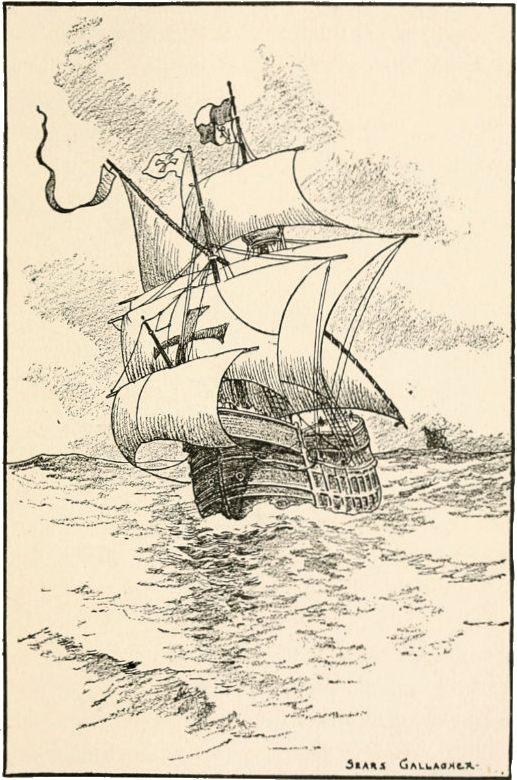
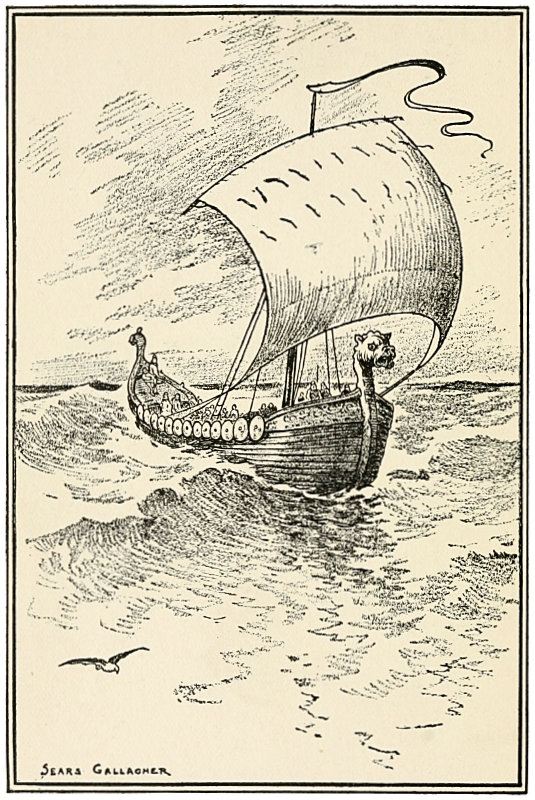
COLUMBUS AND HIS FLAG-SHIP
"The time came when they began to plot against
Columbus. They said: 'We will destroy him.
Then, when we get home, we will say that he fell
overboard.'
"Could they ever reach home, now they were so
far away? The men became afraid of what might
happen to them if Columbus were dead and no one
left to pilot them home again. So they did not
kill him.
"He knew they did not feel kindly to him and
he thought it would be best to make some bargain
with them. So he said: 'If we do not see land in a
certain number of days I will promise to turn back
toward Spain.'
"How eagerly he now watched from the deck
of his vessel! It seemed as though his hopes and
beliefs would not prove true. The last day came,—the
day on which he had promised to turn back if
they found no signs of land.
"Lo! a stick carved by some person's hand came
floating along by the ship's side. This was not all,
for a branch with berries on it was picked up out of
the water. Land must be near!
"'I will give a large reward to the man who first
sees it,' cried Columbus. As he watched that very
night he saw a light in the distance. It moved. He
called two of his men to look at it.
"Their hearts leaped for joy at the sight.
"Before morning came, a sailor saw the shore
in the distance by the light of the moon.
"Children," said Uncle Sam solemnly, "never forget
that it was the 12th of October of the year 1492
that Columbus first stepped upon the shores of the
New World. He was dressed in a full suit of steel
armor and he held the royal banner of Spain as he
landed on the island which he named San Salvador.
"He planted the cross of the Christians and, with
his officers and men around him, knelt down to thank
God for His great goodness in bringing them so far
in safety.
"'How beautiful, how beautiful!' Columbus exclaimed
as he looked about him. Tall palm trees
were moving gently in the warm breeze; strange and
lovely flowers were growing all around; birds of
bright colors flew overhead.
"But these were not the only things to fill the
brave sailor with wonder. He and his men were
soon surrounded by strange-looking people. They
had straight black hair and dark red skins. They
wore little or no clothing.
"'This is India, without a doubt,' said Columbus,
'and these people are Indians.'
"He noticed the gold ornaments in their ears and
he thought with delight of the treasures he would
carry back to Spain to good Queen Isabella.
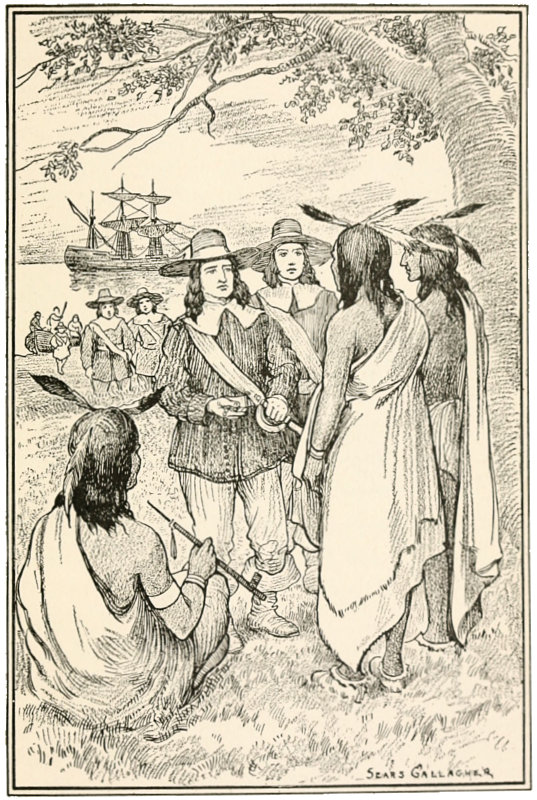
"The Red Men were as much surprised as the
Spaniards. They whispered to each other, 'These
white beings must be gods come from the heavens
to visit us.'
"Then they pointed to the ships and said, 'The
great birds that have brought them to us are now
floating on the water.'
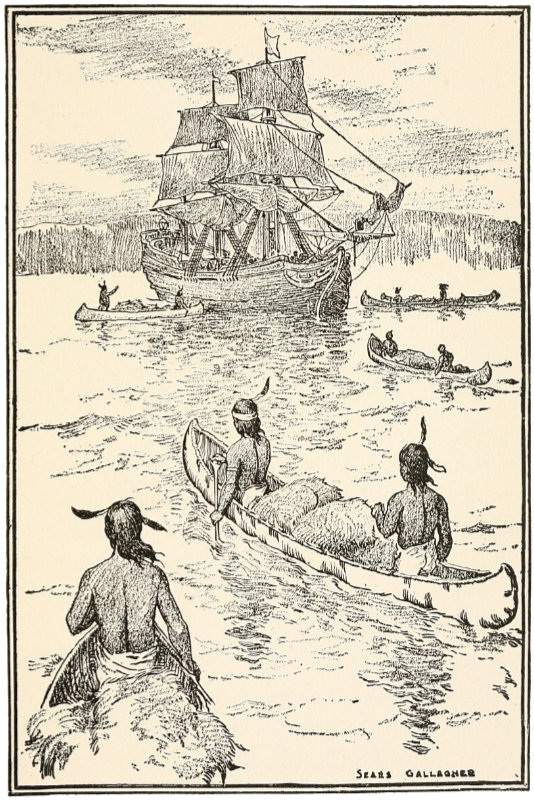
"The Indians wished to show honor to their visitors.
They hurried to their simple homes and gathered
grains and fruits. They brought them as
presents to the Spaniards.
"The white men were glad to receive the corn,
cotton, and fruits. They feasted on the delicious
cocoanuts and bananas, yet they were not satisfied.
Gold was what they most wanted. When they asked
the Indians where to find it, the savages pointed
towards the south."
"I am glad Columbus wasn't a Spaniard," said
Joe, who had kept still a long time for a lively boy.
"I just hate the Spaniards. I believe all they care
for is riches. It's a good thing we beat them in
the last war."
"My dear child," replied Uncle Sam, "You should
hate no one. We may thank the Spaniards for one
thing at least. If it had not been for them, Columbus
might never have been able to cross the ocean
and discover America. You must remember they
gave him the ships and money he needed."
"It was the good Queen Isabella," said Joe, "and
she didn't seem at all like the rest of her people.
But please excuse me for interrupting you, Uncle
Sam."
"That is all right, Joe. It shows you are a good
listener. Now we will go back to Columbus resting
among the palm trees.
"I am sure you children would have loved him.
He had bright, keen eyes, yet they were kind and
loving; and he moved about with the air of a king."
"He had the right to do so," said Lucy, thoughtfully.
"He couldn't help feeling how great he
was."
"You are quite right," answered Uncle Sam, as
he patted the little girl's head. "Even the steps of
a brave man must be different from those of a
coward. The bravery gets into them without the
man's thinking about it.
"But dear me! It is getting late, and I am only
half through my story. We have turned our backs
on Columbus and left him alone with the Red Men
quite as long as is polite. He enjoyed himself very
much with them, however, and stayed several days
on the island.
"Then he took to his ships once more and sailed
about among the different islands which he called
the Indies. He thought that the right name for
them, as he still believed he was near the mainland
of India.
"Each time they landed, his men kept asking the
natives where gold could be found. Each time they
were disappointed. But Columbus thought it must
be near at hand. He never dreamed that he was
still far from the land of spices and precious stones.
"At the end of twelve weeks he said, 'We ought
to go back to Spain and tell what we have discovered.'
"He gathered stores of the strange fruits and
grains and rich woods and packed them safely away
in the ships. He also took some of the brightly-feathered
birds.
"He left a part of the sailors on one of the islands.
They were to make a settlement. Then they would
have a home ready for Columbus when he should
come again with more of their people.
"When he had chosen some of the Indians to go
back with him, all was ready and he began to cross
the great ocean once more."
"He must have been almost bursting with pride
and joy," cried Joe. "And the voyage home must
have seemed long, because he had so much to tell."
"It came to an end at last, although there were
terrible storms and the ships came very near being
wrecked," Uncle Sam went on. "At length, however,
they reached Spain.
"The news of their return spread quickly. As
soon as Columbus landed crowds gathered to hear
about his voyage and the whole country was filled
with joy.
"When Columbus went to court to tell his story
to the king and queen they would not let him stand
before them. 'He is too great a man,' they thought.
'He has gained the right to sit in our presence.'"
"O, my!" said Joe, "I thought everybody had to
stand before kings and queens."
"Columbus wasn't a king, but he was certainly
as great, only in another way. Ferdinand was quite
right in thinking so. He and his good wife listened
with delight to the story of the greatest voyage any
man ever made.
"They believed as Columbus did that a short way
to India had been found. They eagerly examined
the curious things brought to them from the west.
They ate of the delicious fruits and admired the
bright birds and beautiful woods.
"They said: 'We will have a grand procession
through the streets of our city. Columbus shall
wear beautiful garments and shall ride in the midst.'
"The Indians, bright with paint and feathers,
went first of all in the procession. Crowds of people
lined the streets to see the Red Men, the curious
fruits and flowers, the parrots, and the stuffed bodies
of animals they had never heard of before.
"They wished, most of all, to look upon the great
man who had dared to sail so far into the west and
who had brought India with all its riches to Spain.
For everyone believed this was what Columbus had
done.
"Many entertainments were prepared for the
great sailor. Nearly everyone wished to give him
honor. A few, however, were jealous.
"One day while Columbus was at a dinner party
given in his honor one of the king's courtiers said:
"'It was not a hard thing to do what this Italian
has done. Anyone else might have done the same
thing.'
"Of course the man said this because he was
jealous and did not like to see so much attention
given to a poor sailor from Italy.
"Columbus did not seem troubled at this man's
words. He took an egg from the table and handed
it to the speaker. Then he said:
"'Can you make that egg stand on end?'
"The man tried, but could not do it. It was
passed from one person to another. Everyone
failed. At last it came back to Columbus. He took
it in his hand and struck it gently on the table so
that the shell was slightly cracked. Then, taking
away his hand, he left it standing on end.
"'It is easy enough for anyone to do that,' cried
the courtier.
"'It is also easy for anyone to find the Indies
after I have shown the way,' was the reply of
Columbus.
"Not long after this the great man made ready for
another voyage across the ocean.
"How different everything was now! There was
no trouble now to find sailors willing to go with
him. Indeed, it was almost too easy. Everyone
was anxious to visit the Indies. They believed it
was the quickest way to gain riches and comfort.
"When the second fleet was ready to sail there
were seventeen ships and fifteen hundred men. Only
think of it! It was almost like a traveling city.
"They had no trouble in crossing the ocean, but
when they came to the island where Columbus had
before left a part of his men, there was no sign of
them nor of the homes they had made.
"'This time I will choose a different place to
settle,' said Columbus.
"He sailed into a fine harbor about forty miles
away. The men landed and began to build the first
city of the New World for white people to live in.
They called it Isabella after the good queen of Spain.
"Columbus spent some time as governor of the
settlement. Then he went back to Spain with news
of the white men's city in the west. He did not
stay long, however. He was soon restless for a
third voyage across the great ocean.
"He sailed farther to the southward than he had
before. For the first time he saw the shores of
South America. Then he went back to the settlement
in the West Indies, but the people were not
glad to see him."
Uncle Sam stopped for a moment and looked
quite sad.
"Children," he said, "I must tell the truth and say
that Columbus was not as good a governor as he
was a sailor. It would have been hard work for
anyone to rule his people, for they had to work
hard and they were not satisfied because gold was
not plentiful.
"'It is not what we expected,' they cried angrily.
'We thought you would bring us to a land filled
with gold and diamonds.'
"Some of them even whispered among themselves,
'Columbus is not what he pretends to be. He
has cheated us badly.'
"At last they declared they would not let him stay
there any longer. They put chains upon him and
sent him back to Spain."
Uncle Sam took a picture from the table drawer.
"Look at Columbus now," said the old man.
"There he sits on the deck of the ship with heavy
chains bound on his arms like one who has done a
great wrong. Yet he gave a whole continent to the
people who put them on him.
"'I will take off your chains,' said the kind-hearted
captain of the ship. It is a shame for you
to wear them.'
"'No, no. Let them remain,' answered Columbus.
I will wear them as a token of the kindness
of princes.'
"How different was his third landing in Spain!
This time there were no crowds waiting to show him
honor. He was carried before the queen, who wept
in pity at the sight of her old friend in chains. The
brave man now broke down. As he tried to tell his
story his words were choked with sobs.
"Isabella did not desert him, however. She
helped him to fit out another fleet and he started on
his last voyage. He sailed among other islands of
the West Indies and returned to Spain after a great
deal of suffering. He was sick and poor. There
were many who once could not do too much for him
but who now mocked him.
"He died with the belief that he had found a short
way to India. He had no thought of what he had
really discovered. It is a shame he did not get the
honor he deserved."
Uncle Sam rose suddenly from his arm chair and
began to walk up and down the room. "Yes, it is
a shame. A burning shame. Children, let us sing
'Columbia, the Gem of the Ocean.'"
The old man turned to the little organ at one side
of the room. In a moment the house was filled with
the voices of Uncle Sam and his two young friends.
When the song was over, the children kissed him
good-night and started for home.