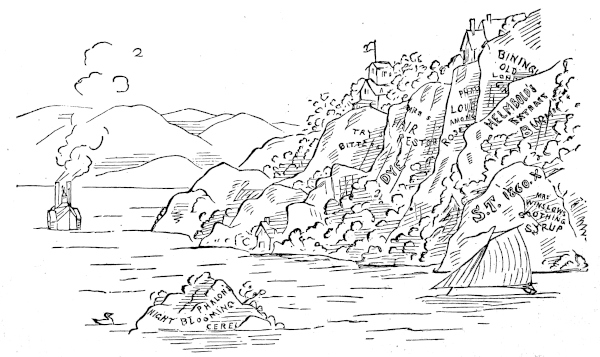
Full page illustrations were paginated, but most times occurred
in mid-paragraph. These have been moved to the closest paragraph
break, and the page number included parenthetically in the caption.
Minor errors, attributable to the printer, have been corrected. Please
see the transcriber’s note at the end of this text
for details regarding the handling of any textual issues encountered
during its preparation.
Any corrections are indicated using an underline
highlight. Placing the cursor over the correction will produce the
original text in a small popup.
Any corrections are indicated as hyperlinks, which will navigate the
reader to the corresponding entry in the corrections table in the
note at the end of the text.
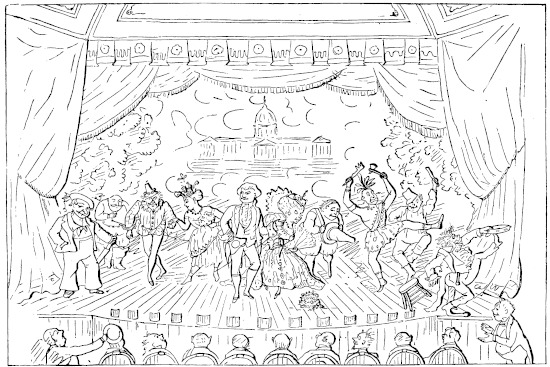
CON-FRONT-US PIECE.
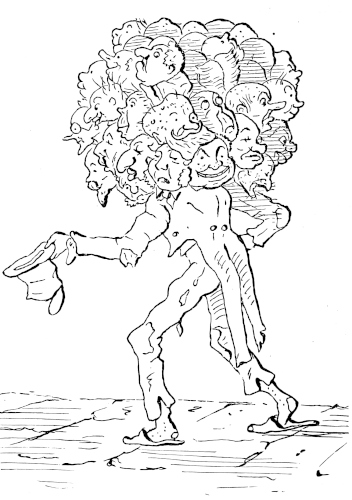
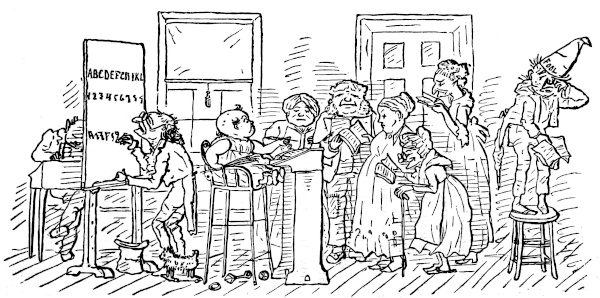
The Company of Distinguished Comedians expressly engaged for this Performance.
FROM A PERIOD PRIOR TO THE DISCOVERY OF AMERICA
TO TIMES LONG SUBSEQUENT TO THE PRESENT.
By JOHN D. SHERWOOD.
“Quamquam ridentem dicere verum
Quid vetat?”
Horace, Satire I.
“A man may say a Wise thing though he say it with a Laugh.”
Old Song.
WITH ORIGINAL ILLUSTRATIONS BY HARRY SCRATCHLY.
BOSTON:
FIELDS, OSGOOD, & CO.
1870.
Entered according to Act of Congress, in the year 1869, by
FIELDS, OSGOOD, & CO.,
in the Clerk’s Office of the District Court for the District of Massachusetts.
WELCH, BIGELOW, & CO.
UNIVERSITY PRESS.
DEDICATION.
——●——
TO MY WIFE.
LIST OF ILLUSTRATIONS.
7
——●——
SUBJECTS.
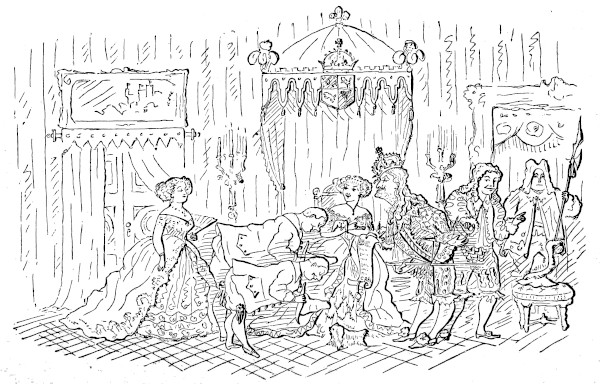
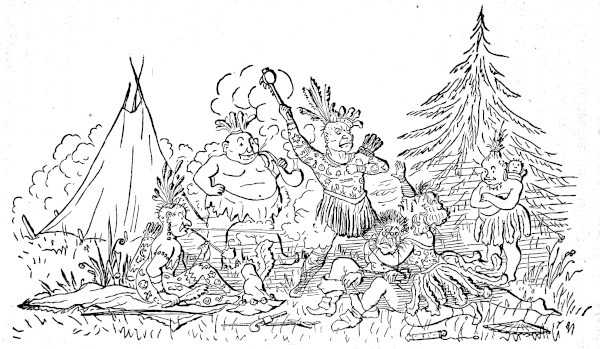
The Company of Distinguished Comedians expressly engaged for this Performance
The Author, proposing to be intimate with the Reader, deems an Introduction desirable.—Born Early and Poor.—How the Two Facts were managed and overcome.—School Days and Nights.—College Lines, crooked and straight.—Father’s Face against his.—A New American Decalogue.—Into the Married and other States and Territories.—Settling down.—Advantages of a Sub-urban Residence.—Outside and Inside Views of the Author’s Head.—Plans and Purposes of the Work.—Laughing Facts.—Roman Precedents.—Impartiality holding the Shears and Tape.—Sources of our Information.—Acknowledgments to Smith and Brown.—Our Illustrations.
BOOK FIRST.
DISCOVERIES.
B. C. TO 1607 A. D.
Chap.
I.
OF AMERICA BEFORE ITS DISCOVERY IN THE FIFTEENTH CENTURY. B. C. TO 1000 A. D.
America older than Europe, Asia, or Africa.—Chronic Errors on the Subject.—Europe presented to America.—Truth vindicated.—Proofs of our Superior Antiquity.—Luxurious Civilization of the Races which stocked this Continent before the Indians.—Amount of Coal left by them unburned.—Large Supplies of Fish packed away safely in our Mountains.—Fish Culture measure of Human Culture.—Fossil Cran-iology.—Laughable Blunders of Former Historians and Ethnologists.—Ancient Nations, Babylonian, Persian, Greek, the Ten Lost Tribes, etc., trickling through, have reappeared on our Side of the Earth.—Instances cited.—Mythologies of Greece and Rome originated here.—Proofs and Reproofs.—American Nests well feathered Ages ago.
II.
OF THE DISCOVERIES IN AMERICA DURING THE ELEVENTH, FIFTEENTH, SIXTEENTH, AND SEVENTEENTH CENTURIES. 1000 TO 1607.
America not discovered by Jason.—Lithographic Specimens attributed to the Northmen in the Eleventh Century curious, but executed by Skalds more Modern.—Bishop Berkeley’s Western Star not the First American Constellation.—Columbus offers a Continent at Private Sale; Isabella, a Spanish Lady, takes him up, and the Profits also.—A Fish Story confirmed.—Of Ferdinand’s Necklace.—Price of Eggs advanced in Spain.—England finally sees something.—Discoveries which Columbus did not make.—Ponce de Leon.—Mexico unfortunately discovered.—The Straits of Magellan and other Straits.—De Soto at the Bottom of the Mississippi.—Champlain, a wise man, founds Quebec upon a Rock.—Sir Walter Raleigh and him smoking.—The Mayflower anchored.—Hudson up stream.
Survey of Indian Character and Lands.—Our Pacific Intentions towards the Indians.—The Whites better read than the Red Men, and the Effects of Learning.—The Pale Complexion of their Affairs.—Wet Blankets thrown over their other Habits.—Different Traits discovered by School-Girls and through Official Spectacles.—Meaning of Indian Reservations.—Indian Style of Dress and its Conveniences.—Indian Names.—Examples of their Happy Application.
Some American Grounds, like Coffee, unsettled.—Some Settlements pulled up by the Roots; others chilled by Fever and Ague.—Moist Soils objected to except by Doctors.—Unexpected Crops of Tomahawks from Wheat sown.—Settlements in America because of impracticability of making any at Home with Creditors.—Wild Oats sown between 34th and 38th Parallels.—Frequent Settlements make long Friends.—Settlements of Old Tavern Scores in Chalky Districts.—Religious Squalls prostrate some Plantations.—Indian Tempests uproot others.—Growth of Virginia, although Queen Elizabeth a femme sole.—Clergymen’s Settlements.—Brides unsettled.—Drake around the World.
II.
THE SETTLEMENTS OF VIRGINIA, DELAWARE, MARYLAND, THE CAROLINAS, AND GEORGIA
Colored Views whitened.—Blue Ridges and Black Welts in Virginia.—Virginia, smothered up in Infancy by Charters, survives Royal Nursing.—Her Vigilance against her Suitors.—Cotton introduced.—How the World managed previously.—Charles I. and his numerous Autographs.—Georgia and Oglethorpe.—Charleston set up.—A Point on Old Point Comfort.—Tobacco first piped about.—Unmarried Girls as Articles of Import.—Estimated in, if not by, Pounds.—The Fancy Constitution of John Locke for North Carolina.—Its own Length but Short Life.—South Carolina Rivers do not run up.—Popular Errors corrected.—John Wesley.—Singular Effect of his Preaching on the Indians.—Maryland as a Duck of a Colony canvassed.
John Smith historically considered.—The Number in Leading Cities stated.—How classified.—Why he is not put in a separate Volume or in an Appendix.—Origin of the Smiths.—American Genealogical Trees.—Smiths up a Stump, in the Sap, and dangling from the Branches.—The Antiquity and Ubiquity of the Smiths.—Variety and Extent of their Occupations and Operations.—Will probably in time own all the World.—Comic Situations of John Smiths in Cities, at Family Dinner-Parties, at Prayer-Meetings, at Balls, in Titles to Real Estate, etc.—Whether he can be sued.—Other Legal Questions in reference to him considered.—John Smith of Pocahontas Fame a Myth.
Views of the New England States and Character determined by one’s Church.—Partial Notions about Clocks, Nutmegs, Pumpkin Pies, etc.—Getting an Historical Coach to one’s self.—Why the Puritans did not hang up their Stockings on their first Christmas Eve.—Their nearest Neighbors.—Indian Points and other Points.—Governor Carver and Want of Meats.—Massasoit, and how he kept his Faith in-violate.—New Hampshire on the Rampage.—Why Boston was begun, and why it is not finished.—Roger Williams and his Providential Ways and Dealings.—Connecticut founded, although its Charter not found.—The Wind against Cromwell.—Harvard College.—Vermont and her Ways and Means.
The Spirits of the Age present at its Foundation.—Who they were and how they were affected.—The Wonders of Manhattan in September, 1609.—How the Animal, Vegetable, Ornithological, Maritime, and Human Productions then compared with those now.—What New York Lots were worth two hundred and fifty years ago.—Their Owners.—Hudson’s Trip up the River.—What he saw and didn’t see.—The four Dutch Governors; their Doings and Misdoings.—Sketch of Holland and the Characteristics which she impressed upon New Amsterdam.—Bravery evinced in settling Brooklyn.—How the Van Rensellaers and other Vans were enticed hither.—The Troubles and Sorrows of Wouter Van Twiller and William Kieft.—Of the Surrender of the Dutch, and the Instalment of English Rule in New York.—Petrus Stuyvesant retires from Business.—His Farm and what he raised on it.
Governments in their Action like Pianos.—The Reason; and illustrating Examples.—Varieties in the Make-ups of the different Settlers of the Colonies.—Character of Penn, and why it improves by Age.—His Accomplishments.—His first Visit to America in 1681.—Tall Talk and Peace.—Philadelphia, its Early and Late Characteristics.—Delaware sets up for herself.—Penn in Prison.—Again in Pennsylvania.—Returns to England by the Philadelphia Line.—Pennsylvania leaps into the Eighteenth Century, and what she does there.
VIII.
THE COLONIES IN THE UPPER HALF OF THE SEVENTEENTH CENTURY
The Young Colonies watched by the “Old Folks at Home.”—Required to furnish Inventories of their Property.—Old People particular as to Shops where the Youngsters traded.—Several Articles of Political Housekeeping, as Printing-Presses, Jury-Boxes, etc., not allowed.—Some Favorites among the Children.—The first American Ring.—Cromwell as a Step-Father.—The Atlantic Swimming-Bath.—Political Rights jarred off the Parent Tree; others Fell when Ripe.—Some Proprietors sell out to raise Money for Costs.—General Thaw in High Places.—Legislative Mills with two runs of Stone.—Woman’s Rights in Capsules.—How hard Puritan Wood got softer.—Episcopal Race-Courses enlarged.—A Black Frost curls up the Green Leaves of the Charters.—What Sir Edmund Andros swallowed and the Fit of Indigestion which followed.—Effect of European Housekeeping in setting Colonial Brooms in Motion.—New York swept into the English Pan.—Result of James II.’s over-stay in Paris.—Slaps in the Face of Canada and their Return.—How Public Events tell on Family Matters tolled long and loud.—People occasionally subject to Scarlet Fever and Fourth of July, but can’t live on either.—Kidd at Sea; takes off a few People.—How the Deficiency was supplied.—Number of Colonists at close of Seventeenth Century.—Would have been more had Chicago started.—Colonial Colts at the Bars of the eighteenth Century.
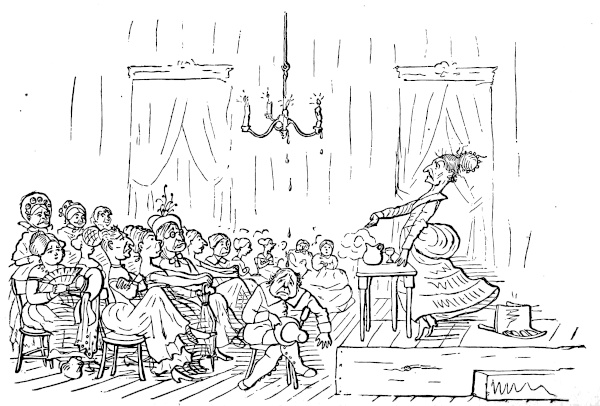
The Witch-Caldron at Salem.—How its Bubbling raised Tea-Pot-Lids and has kept open other Lids ever since.—The Young Female Witches at Salem condemned to the Ties of Matrimony; the Old Ones to harder Knots.—The Sin of being Old considered.—The Scarlet Letter.—Examples of Witchcraft cited.—The Delusion of Adam and Eve at the first Pomological Convention in Eden.—Woman as Man’s familiar Spirit; and her Conjuries.—Cases of David, Samson, and Herod.—Antony dissolved in that Egyptian Drink Pearl Water.—The Maid of Orleans and what an Arc she subtended.—The Philtres of Love, Ambition, Heroism, etc., administered to Men and Nations.—Their Effects.—Delusions, like Measles, catching.—The Frenzies of Fashion fully described.—The Stock Exchange.—Private Witchcrafts at Quiltings, Apple-Parings, etc.—Red Corn and other Red Ears.—Sweet Witches.—A Jury of gushing Girls.—Punishment of Men incapable of being bewitched.
X.
OF THE MANNERS, MORALS, HABITS, AND LAWS OF THE COLONISTS IN THE SEVENTEENTH CENTURY
First-class Telescope to see the Manners of a Past Age.—Difficulties of Near-sighted and Long-sighted People.—Near Objects more embarrassing to the Observer than Distant.—Why?—The Ghosts of the Past.—The Manners and Dress of Stuyvesant, Eliot, Calvert, Rolfe, etc. described.—Manners of the Mass detailed; in their Work, Play, Diet, Courtship, Fashions, Treatment of Young Ladies and Gentlemen, Children, Servants, etc.—Superior Advantages of Paterfamilias then in making Acquaintance with his Wife and Children.—Fast Girls and Calicoes.—The Isothermal Lines of Ethics.—Certain Vices, like Eggs, laid secretly and hatched afterwards.—The Fashions of Crime at various Epochs compared.—Jails and Jail-Birds.—The ingenious Crimes of Trade, Corporations, Schools, and Seminaries noted.—How Sects are frozen or thawed by Temperature.—Northern and Southern Sectarianism.—Why Episcopacy flourished in Warm Latitudes.—The early Commercial Morality of New York.—Baptists, Congregationalists, and Independents.—The Habits of the Century; their Material, Color, Durability, and Wear.—The Laws mainly imported.—What a Business the Colonists carried on, notwithstanding, in the Domestic Article.—Kindness of the Proprietors in furnishing Ready-made Office-holders not appreciated.—American Itch for Law-making.—Laws against Criminals.—Their Crimson Color.—How the Rains of Mercy fell on hard Enactments, and the Thaw which followed.—Coroners’ Inquests sat upon.—Verdicts under various Lights.—Justices of the Peace, and the Law they peddled.—Administrations of Law then and now contrasted.—How Colors, although imponderable, turned the Judicial Scales.
XI.
THE COLONIES IN THE LOWER HALF OF THE EIGHTEENTH CENTURY
The Colonial Colts in the large open Field of the Eighteenth Century.—The Effects of a Sniff of French Gunpowder.—Queen Anne’s War, 1702–1713; its Cost and Results in Europe and America.—Acadia changes its Name to Nova Scotia.—How the Colonies started a Newspaper in 1704.—Philadelphia in a Sheet in 1719; and how comfortable it was.—The Franklin Bros. furnish Food too condensed even for Boston.—Benjamin quits the Hub; foots it without tiring to New York.—How he got through New Jersey without paying Toll.—Enters Philadelphia with Two Loaves, and sets up an Intellectual Bakery.—Banks built on the Sands of Credit.—Moving Accidents.—John Law’s Scheme to use the Mississippi Valley; how it grew; what it promised, and how it performed.—A French Pasquinade.—The Results of a Bank Panic in the Eighteenth Century.—The Effects on the Manufacture of Children.—Number of Colonists in 1713 and 1743.—The Condition of Delaware, New Hampshire, and Vermont.—The Training of Young America.—Yale College and its Mustard-like Growth.—The American Learned Oak.—The Connection between Slate-Pencil and Gum Chewing and Female Education.—What took Place between 1713 and 1743.—A Negro Plot in New York.—Negroes thrown overboard, and the Bubbles that rose.—How large Historic Doors swing on small Hinges.—Examples from A to W.—What happened because Maria Theresa was a Female.—The English Georges; what Bulls they were, and made.—The Transatlantic Bullocks, and how they rushed into King George’s War in 1744, and what Mischief they did for Four Years.
18
XII.
THE CHAMPIONSHIP FOR THE AMERICAN BELT. 1754 TO 1763
No Hopes for the Millennium in American Colonies up to 1754.—More Swords than Ploughshares.—Mars in America.—Sixteen Indian Wars in 147 Years.—How they were fed by French Oil and blown by French Bellows.—The Five Great Continental Wars, and how they reached over and handled the Colonies.—The Treaty Patches, and how they failed to cover the War Breaches.—The Volcanic Character of American Soil.—How the Animosities of France and England grew through Four Centuries, and in what a Hateful Harvest they waved, in 1754, each Side the Sea.—Celebrated Fights between the Rivals in Europe.—How Commercial Competition rubbed in Salt Water, and Religious Differences Brimstone, into the Wounds.—Memorable Cases of Battle Surgery.—The Relative Merits of English and French Claims to America fully stated.—Deeds of Land and of Arms clash.—French Jesuits with Crosses and Traders with Skins encompass the English Plantations from Maine to Minnesota, and thence to Alabama and Texas.—Marquette, Joliet, La Salle, Lallemand, and others.—The Former escaped the Fast Life of Chicago, and La Salle the Hazards of Natchez.—France seeks to fasten a Remarkable Rosary around the Neck of Young America; England to cut it.—Suitors to the same Maiden, they suited not her nor each other.—Their soft Ways to her.—Their Hardness to each other.—Their Long Quarrels over her Person and Purse result at last in a Decisive Fight.—The Championship for the American Belt.—The Champions, the Belt, and the Ring described.—How John Bull and Jean Crapeau stepped into the Latter.—The Nine Rounds from 1754 to 1763.—How Mr. Bull won; what he said, and how Monsieur Crapeau behaved.—A Suitor pleased, and a Suitor non-suited.
The People as Yeast.—The Fermentation.—Washington, Samuel Adams, Patrick Henry, Rutledge, Franklin, Otis, and others, and their Value in the Colonial Fermenting Pots.—State Courtships in 1754–1765 and 1774, tend to a more Perfect Union.—How Home Confidences operate.—What Effect the English Navigation Acts had on American Swimmers.—Lord North and Charles Townshend.—Colonial Assemblies and Country Dances.—Dislike of Impositions.—That small Boston Tea-Party.—The large Amount of Atlantic Water between the Tea Seller and Tea Purchaser.—When Tea can’t be sweetened.—Be-cause as a Cause.
BOOK THIRD.
THE AMERICAN REVOLUTION.
I.
THE FIRST TURN OF THE REVOLUTIONARY WHEEL. GRIEVANCES; THE PREPARATION; THE START
The Hard Lot of the Colonists, and what they got from it.—Colonial Governors, like Old Topers at a Free Opening of a Tavern.—The Miseries of a Visit from Relatives poor and proud.—How, like poor Fowls, the Navigation Acts laid many bad Eggs.—Examples cited.—Parliamentary Laws ingeniously floored and roofed.—English Strabismus, or Squint-eyedness, sought to be made fashionable in the Colonies.—Success in Canada.—English Tubs to catch Revenue off American Slopes.—Manufacture of Hats prohibited; how and where the Fur flew.—What a Cute Yankee saw from the Top of the American Roof.—How Four Yards are worth more than Five.—Bull-yism defined, and its Laws stated.—The First Bill to raise Revenue; the large Bird behind it described.—Sent over to America, it was foul-ly treated.—Molasses denied to Colonists.—Effects on Yankee Appetites and on the Increase of Straws in Custom-House Casks.—Stamps and Stampedes.—The Act repealed; the Sting left in.—Another Bill and larger Bird behind it in 1767.—The First Blood.—The Wheel starts; its Hub, Spokes, and Periphery.—English Bees swarm over and settle in Boston and other tender Parts.—The Dis-cord-ant Sounds at Concord.—George Washington; his Appearance and Costume, and what befell him, June, 1775.—Gage falls from a Tree.—Why and Howe?—Washington seizes Boston Neck.—The Spasms.—Bunker Hill gets a Scar and afterwards an Ugly Monumental Patch.—The Boone Colonists in Kentucky.—How they blazed a-way thither from Virginia.—Washington at Cambridge.—Unseasoned Troops seasoned.—General Montgomery earns Laurels at Quebec mixed with Cypress.—The Revolutionary Wheel throws off Dusty Colonial Governors.—How Washington broke up the Hessian Swarm at Boston, and Howe they flew to Halifax.—Washington attends a Lecture in Boston.—General Lee’s Neck-and-Neck Race with Sir Henry Clinton for New York; Lee ahead 120 Minutes. Sir Henry and a Party of Jolly Dogs alight near Charleston, and how the Waspish Lee lit upon and stung them.—Where the Jolly Dogs then went.—The Wheel well started.
Review of our Historical Journey from the Start up to the Summit of the 4th of July.—Resumé of our Tramp through Pre-Columbian and Post-Columbian Times.—Our March from St. Augustine, via Jamestown and the Manhattan Cabins, to the Temperance Tavern at Plymouth.—Descriptions of Indian Interruptions.—Polite Interference of Gallic Gentlemen at Narrow Parts of the Road in 1689, 1710, 1745, etc.—Banditti on the Highways of History, English, French, and Dutch.—Blazing Description of the Summit, the Flagstaff, Flag, and Eagle.—The Grand Political Pic-Nic there of Fifty-one Wise Men.—The Thunder Storms around them; and their Behavior.—General Account of this Group; and how remarkable and marked.—Special Portraitures of Thirteen of them.—Some Peculiar Heads there, and how much George III. wanted them.—Prayer of John Adams.—A Great Freshet of a Speech and what it carried off.—A Remarkable Declaration made by Jefferson.—An Electrical Battery charged and discharged.—The Peppering George III. got.—How he worked Seven Years against the Declaration.—The Gun-powdery Effect of the first Fourth, and the Fire-Crackers since touched off by it.—Independence originally handled without Gloves; now by Aldermen and very Common Councilmen with a half-dozen pair apiece.—The Fourths up to 1850.—Tar Barrel Eloquence.—Military and Civic Renown snatched on that day.—What Eggs, containing Addling Heroes, pip on that Day.—How Swords embarrass Crooked Legs.—Militia Lines, and what Snarls they get into.—Dissolving Bursts of Golden Glories.—Effects of Sulphur administered to a Rural Population.—Cakes of Gingerbread, and how they stuck in the Teeth, Stomach, and Memory.—Lamentations over the Decay of the Old-time Fourths.
21
III.
SECOND TURN OF THE REVOLUTIONARY WHEEL; ITS ECCENTRIC BUT ONWARD MOVEMENTS. 1776–1780
English Hawks gather around New York.—Washington watches them.—About an Esquire.—The Way the Germans took Brooklyn the first Time.—How they returned, not to their Mutton, but to Kalbfleisch.—Difficulty of reaching New York from Brooklyn in 1776.—Washington takes a Trip to Harlem.—The British also.—Red Eyes and Disfigured Faces the Consequence.—Lord Howe attempts to get around the American Squire.—The slight Unpleasantness at White Plains.—The different Uses of the Croton Water in 1776 and now.—The Amount of Whiskey it took in 1869 to qualify the Water in New York.—Washington ventures into New Jersey.—Set-to at Fort Lee.—Washington across Rivers.—Philadelphia covered.—Homesickness of Agricultural Lads.—What befell Lee at a Tavern.—Washington crosses the Delaware and drops Christmas Presents into German Stockings.—The Effects of Yankee Doodle on Lafayette, De Kalb, Kosciusko, Pulaski, and others.—Friends of America in England, Fox, Hume, etc.—Friends of England in America.—The Statue and Statutes of George III. repealed.—Battle of Princeton.—The Germans obtain Cider and Sausages at Danbury.—Colonel Meigs tickles the Feet of Long Island, and makes Congress laugh.—Colonel Prescott is obliged to rise very early one Morning at Newport.—Silas Deane and B. Franklin in France.—What followed.—Burgoyne tries to find a back-stair Passage to New York.—Strong Gates in his Way near Saratoga.—Still-Water runs deep.—Brandy-Wine an unpalatable Drink.—French Treaty with America in 1778.—The Wheel moves in Water and turns out French Names.—Crossing New Jersey, Lord Howe collides with Washington at Monmouth.—Count d’Estaing is prevented by an Injunction off the New York Bar from entering New York.—Coquetting, but no Engagement, near Newport.—Buzzard’s Bay and its Roosts.—Little Egg Harbor and its Nests, and what was laid there.—The Benefits of the Wyoming Massacre.—Guerilla War at the South.—Savannah trounced.—Horse Neck and Putnam’s Home-Stretch down it.—Count d’Estaing’s Yachting.—Spain hankers for Gibraltar.—England as a Pawn-Broker.—Paul Jones and his Whip.
22
IV.
THE LAST TURN OF THE REVOLUTIONARY WHEEL; ACCELERATIONS; SLOWINGS; THE GRIST. 1780–1783
The different Opening of 1780 for those who pushed and those who obstructed the Revolutionary Wheel.—The Strain on both Sides.—Hard Spring in Charleston in consequence of Leaden Hail-Storms.—How these Storms spread; and how the Crops were saved from Ruin by Marion, Sumter, and Pickens.—The Carolina Game Cock, and his sharp Spurs in the Sides of Cornwallis and Tarleton.—Gates broken down, and the Presidency lost at Camden.—Greene set up in his Place, proving a good standing Color.—The Village of St. Louis assailed.—André humiliates himself, and is Exalted.—Arnold gets $50,000, a Brigadier’s Commission, and is elected by General Contempt into the Order of Judas Iscariot.—New-Year’s Day among the Pennsylvania Troops at Morristown.—The United States Treasury, made less Celestial, becomes Defiled by filthy Lucre.—The Goring and Tossing of Tarleton by Morgan at the Cow-Pens.—An Irish-like Fight at Eutaw Springs.—Southern Hunters around the British Flock at Charleston and Savannah.—The troublesome Seizure of Virginia Assemblymen.—How the Captors missed burning their Fingers with Jefferson’s red Hair.—Cornwallis enmeshed at Yorktown.—What Lord North said.—What the English George threatened and what the American George did.—“Let there be Peace”; and Peace was.—What England lost and America gained.gained.—The kind of Grist obtained.
Every Community has its Axis of Growth.—That of the Confederation described.—Causes of the Distrust of Federated Power.—How the States preferred to sew up the Treasury Pocket rather than allow their own Agents to put their Hands in it for necessary Funds.—Facetious Bills of Exchange.—The Shady and Sunny Side of Power.—Similarities and Dissimilarities of the States.—The Committee to draft Confederation Sixteen Months over the Cold Nest.—The curious Knot-ty Grub that issued.—The Spawn of Doubt put to the Nurse of Jealousy.—How it was nursed, starved, and doctored; and what a poor Constitution it got. The Confederate Scheme like a Pine Board.—It could not raise Money, An Army, Credit, Postage, Revenue: in fact, could not raise itself.—The Comic Side of the Franking Privilege.—A desirable Prohibition.—How the Grub became a Caterpillar, and the Caterpillar a Butterfly.—A very Larky Phœnix rises, crowing Yankee Doodle.
The Constitution as a Resort for Shoppers in Civil Rights.—Every kind of Article to be found either for Ordinary or Exceptional Use.—The Fringe called Preamble; its Thread, Texture, and Quality.—Counterfeit Patterns and Simulations easily detected.—Piles of heavy Cloths for the Country’s Winter Use in War, Financial Storms, etc.—Executive and Legislative Ready-made Clothing.—Judicial White Goods.—Hosiery for Congressional Understandings, swift or slow.—A variety of Miscellaneous Wares; Contrivances for catching People with Colored Skins; Habeas-Corpus Non-Suspenders; Muzzles for violent or hungry Congressmen; Handsome Checks on the Treasury; Specimens of tender Gold and Silver; Militia Uniforms; Padlocks for securing Houses against Searches; Jury-Boxes, Trial Balances, and other Goods.—The Sumner Patent.—The latest Novelty to prevent Electoral Black-and-White Suits from being stripped off.—State-Rights Dresses, and strong Federal Out-Fits.—Messrs. Calhoun, J. Davis, Webster, Clay, etc. The Manufacture of bright Buttons, called “Coins.”—The Fifteenth Amendment.—Doubtful Packages.—Paper Money as a Substitute for real Money.—Unauthorized Use of the Constitutional Bazaar.—Seekers of Goods never made.—Nicholas Biddle and his Gold Suit.—Everybody suited at the Federal Store.—Of excessively sharp and dense-headed Shoppers.—How Articles are mistaken.—Water-proof Goods for River and Harbor Dredging and for Lighting Coasts.—Of long Selvedges, or Railroad Strips, and their wonderful Elasticity.—Rights and Lefts.
How the Thirteen Colonial Children crept into their New Bed.—The Upholstering described.—Why Rhode Island was last in.—Who tucked her up.—Washington as Superintendent, and John Adams as First Assistant.—The Family low in Credit.—Amount of their Indebtedness compared with ours.—Washington’s Inaugural.—His Exemption from Office Beggars, Committees, Pugilistic M. C.s, boring Place-Seekers, enterprising Donors, etc.—Washington as a Spirit.—His Capacity to select a Cabinet.—Who they were.—Of Henry Knox.—The Chief Justice and Attorney-General.—Amendments to a perfect Constitution.—The Supreme Court as a sound, seaworthy Tribunal.—Why States cannot be sued by Individuals.—How Governments get around paying Interest on Principle.—Streaks of the Millennium.—Of the Public Debt.—Discrimination among Creditors.—Misfortune of being a Cisatlantic Holder of American Bonds.—Alexander Hamilton’s Notions.—Washington’s Receptions and Dinner-Parties.—The Political Color of the President’s Silver Spoons and Window Curtains.—The Honeymoon of the new Government disturbed.—Ganderous Long-bills splash Washington.—The French Revolution and its Conundrums.—How answered by Washington and the Federals; how by Jefferson and the Anti-Federals.—The Census Act procures Names without Owners.—The Naturalization Laws and their Pat-riot products.—Polls and Polling-Places.—A Sinking Fund that did not sink.—How Vermont made the Thirteen States old.—An Indian War.—Cincinnati begins.—Kentucky starts.—Mistakes about Bourbon.—Washington’s second Term.—What Genet did, and how he was done for.—Helpful Americans.—The Whiskey Rebellion of 1794.—The Year of Treaties; how they enlarged while they tied us.—Tennessee the Sixteenth State.—Nashville gets warm.—Washington’s Farewell, and its cheap Imitations.—The Shades of Office.—Who crept in and who stepped into the Sunshine.
Modern Photographic Albums like Ancient Roman Simulacra.—The Pleasure of looking at the Likenesses of Friends.—The Portraits of our Fore-Fathers.—Our dear old Great-Grandfather George Washington.—His one hundred and twenty-eight original Portraits.—His unique Character; of the same Size all the Way up.—His Manners and Characteristics.—How the Eighteenth Century, so long mated, refused to survive him.—Our Great-Grand and good Mother Martha Washington.—The Resemblance between her and a Bowl of ripe Strawberries and Cream.—Her Pride.—What Qualities were corseted in her Bosom.—Our favorite Uncle, Benjamin Franklin.—How the Sky got into his Face and how it stays charged.—Looks like an hereditary Director of all the Estates.—A born Trustee.—What an Idea Burns might have got of him in 1774, and how expressed it.—Of our Aunt, Mrs. James Madison; and what a fine Lady she was.—Her careful Dress and Manners.—Impressive but patronizing.—How Time forgot her, and the Years ran on un-notched.—The forty Years she acted as Presidentess.—Patrick Henry described in Dress, Person, shooting Game, and taking Audiences.—Our dear Visitor, General Lafayette; his Difficulties in reaching us; his noble Bride; his Embarkation at a Spanish Port; his Labors here; his two subsequent Visits, and how he survived Hand-shaking and Kissing.—About John Jay and his Wife Sallie Livingston.—How they lived and what he became.—Glances at Israel Putnam and his expressive Face; at Nathaniel Greene and his square, Quaker Character; at the Telescopic Eyes of Francis Marion, with a Dash at his soldierly Qualities.—The Effigies of the Wise Men.—General Sketches of our Heroes and Heroines.—A Heart Delineation of the Mothers, Wives, and Sisters of the Men of the Revolution.
IV.
THE STRUGGLE AND FALL OF FEDERALISM; OR, JOHN ADAMS’S ADMINISTRATION. 1797–1801.
The Pre-Adamite Epoch: its Upheavals and Disruptions in America, and the red-hot diplomatic Stones, Fauchet and Adet, ejected from France upon us.—The new French Acrostics; and the Attempts by our Commissioners and Congress to solve them.—Gold-mounted Spectacles, offered us by France; and our Inability to see our Interest or Duty through them.—Why and when the Keel of the American Navy was laid.—Of the Alien and Sedition Laws; why passed and how passed by.—General Washington and the Gallic Cock; a Crow never crowed out.—Napoleon’s Tour in Egypt and Palestine described; and its Results on the Treaty of Peace deduced.—Of the Office and Offices of Consul.—A Review and new View of our Difficulties with France from 1790 to 1800.—What a Pitt England fell into.—The City of Washington as a Geographical Study.—About Mississippi, Alabama, and the French Growth of Mobile.—The Territorial Condition illustrated.—The Introduction of Vaccine and other Virus.—Why some Things first break out in Boston.—State of Parties in 1801.—Why the first Adams was banished from the Presidential Eden; and the Flaming Swords which prevented his Return.
V.
THE CHIEF AMERICAN PRODUCTIONS OF THE EIGHTEENTH CENTURY
The Cereals and Serials of the last Century.—Hares caught before cooked.—Useless Indians put under Ground.—Human Bones the Phosphates of History.—The Statecraft of Washington, Jefferson, and Others.—The Automatic Workings of Governments exposed.—What small Brains rule.—Description of our Government Machine.—Its Merits and Demerits.—The Disadvantages of frequent Changes of official Workmen.—How the Machine-Oil is stolen.—The Inventions of the Eighteenth Cycle of Time.—An American Noah inebriated by the Cotton-Gin.—How Ham laughed and how Japhet put a Blanket over the Patriarch.—The Growth of Commerce.—The Notions which Importations put in and on the Heads of the Young People.—Paris supplies the Mistakes of Nature.—Of Dress.—Hoops, Head-Gear, Coats, Vests, Tights, etc., descanted upon.—Improvements in Roads and Means of Transit.—The Journey from New York to Boston in 1732.—The Road-Maker and Vehicle-Propeller as Leaders of Civilization.—The great Invention now needed.—The Populations of New York and Boston in 1700.—Description of the Former in that Year by an English Traveller.—Slave-Market in New York in 1711.—Manufactures and their Growth.—The Habits of the Period described.—Improvements in Morals, and wherein.—A general Review of American Literature and Book-Making through the Century.—The first American printed Volume; and how fast and long it ran.—Earliest Original Book of Poems; by a Woman, with a touching Specimen therefrom.—An Account of the leading Writers on Theology, Political Science, Government, Natural Science, Natural History, of Novels, etc.—The American Joss; its Worshippers, and their Treatment.
27
VI.
DEMOCRACY IN POWER; OR, JEFFERSON’S ADMINISTRATION. 1801–1809.
Few Removals by Mr. Jefferson from the Ungilt Official Chairs.—Mr. Smith gets into the Navy.—Who started long Messages to Congress; and the Difficulty of finding an End to them.—War with Tripoli; and the Complexion with which the Bey ended it.—Decatur and his Mediterranean Travels.—Ohio in 1802.—The early Danger it ran of being all cut up into City Lots.—How the Exodus of its Population was the Genesis of its Growth.—Of Westering Caravans.—Bonaparte sells Louisiana, and what a Sell it was.—How we were saved an extra Volume of Supreme Court Decisions.—The Murder of Alexander Hamilton.—A Ghost-Story about Aaron Burr.—The public Estimate of his Character unchanged by Biographical varnishing.—A South Carolina Conceit.—The Play of Lear in Tripoli.—Peculiar Mussulman Habits; the Author of Don Quixote.—Michigan escapes the Cuppings of Eastern States.—Her lymphatic Temperament.—Lake Michigan as a Breakwater against Chicago.—Burr tried for Treason, “not proven” guilty, and surrendered—to himself.—Of Bonaparte and other Usurpers.—The Oldest dislike the Youngest.—History of the Attempts of George III. and Bonaparte to blockade without Ships.—Once a Bull always a Bull.—Search of American Ships for Seamen.—The Unwisdom of Half-apologies.—The American Embargo and its Popularity with Unmarried Girls.
VII.
THE UNITED STATES AT SEA; OR, MADISON’S CRUISE. 1809–1817.
The Captain and Officers of the “Seventeen Sisters” which put to Sea in a Gale.—Diplomatic Talks.—Difference between one’s own Cows gored, and one’s own Bull in a Neighbor’s Field stoned, exemplified.—Cave canem.—Bonaparte improves the Code Napoleon.—Executions before Trials.—Horace Greeley fights benevolently into the World.—Louisiana and her Vivacious Debts taken in; what sweetened them.—Witch-Hazel Rods of Clay, Cheves, etc., dip to the National Mines of Feeling.—Our Second Wrestling-Match with England.—The Hull-sale Surrender of Michigan.—Colonel Cass breaks his Sword, and gets an Anglo-phobia.—Better Hulls on the Water.—America marries the Sea.—A Wasp on a Frolic.—Marine Flirtations and Engagements.—The Constitution, an Old Sea-Flirt; her rapid Winning and Wooing of the Java.—South Carolina loses a Presidential Candidate.—Of the Three Armies afield.—Harrison at Tippecanoe and the Thames.—Colonel R. M. Johnson’s life-long Chase for Tecumseh’s Scalp.—Toronto emptied and filled.—General Brown, a Real Man, in Spite of his Name.—General Wade Hampton.—Court-Martials, and how they touch off Military Charges.—The United States at Sea on Land.—The Hornet on a Peacock.—An Immortal Word wrung from a Mortal Moment.—Commodore Perry.—General Scott improves the Niagara Frontier for Hack-Drivers.—Macdonough charges Lake Champlain with Heroic Ingredients.—English Marine Parades.—Cotton Breastworks at New Orleans.—Their Feminine Adoption.—The Treaty of Peace and its Wonderful Omissions.—Costs and Gains of the War.—The Hartford Convention and its Equestrian Exploits.—Mr. Calhoun and Invisible Ink.
VIII.
THE ERA OF GOOD-WILL; OR, MONROE’S NESTING. 1817–1825.
Why Byron did not write sometimes.—Application.—Rainbow after the Shower.—The Happy Family.—An Inlaid Cabinet.—Virginia’s Dower Rights in the Presidency.—Five New States.—The Three M’s.—Proof from the Census of 1820 that Chicago had not started.—The Missouri Compromise.—A Good Bridle until used.—Florida bought in 1819.—What we got over the Bargain.—The Florida Keys.—The Dry Tortugas thrown in.—The Dews fortunately left.—A Cracked Cup in the Family Cupboard.—The Monroe Doctrine.
IX.
TROUBLES BUBBLE; OR, THE SORROWS OF JOHN QUINCY ADAMS. 1825–1829.
Parallel between Sidney Smith’s Old Razor and J. Q. Adams’s Term.—How several Gentlemen, touched by Age, reached in Vain after Honors too high.—Who they were; and what Acid Grapes the House of Representatives snatched from them.—Pamphleteering and Privateering.—An Italian Saying.—Description of a Good Statesman spoiled in the Mould of a Politician.—An Illustrative Anecdote.—Partisan Scales weighing Public Interests.—The Weights.—The Depravity of Political Blunders.—History vs. Party Judgments.
29
X.
THE AGE OF HICKORY; OR, JACKSON’S EPOCH. 1829–1837.
Military Men, domesticated to Civil Life, like tamed Animals.—General Jackson’s Camp Traits in the White Den at Washington.—His Prehensile Habits claw out the Eyes of several Measures.—How he foraged on his Political Enemies, and turned his Troops of Friends into the Public Pastures.—Lord Palmerston’s Remark upon Gladstone; and its American Application.—An Insurrection among the Household Cabinet Troops.—How the vigorous Hickory Club, wielded chivalrously for a Woman, quelled it.—The President moves on the Bank, and captures all its Fortified Points.—Chicago starts in 1830.—Why it did not overtake and annex the United States.—South Carolina threatens Nullification, and is threatened.—Mr. Calhoun violently promised an elevated Position between two Posts. Mr. Clay’s Compromise.—Horace Greeley starts the First Daily Paper.—Its untimely End bewailed in Verse.—Black Hawk caged and shown around.—Georgia, the Cherokees and Supreme Court.—Three Celebrities gained by the Seminole War.—Of Arkansas and its Papal Little Rock.—Prospects for the Pope when flung from the Tarpeian.—An Arkansas Paul preaching in the American Athens and Corinth.—Old Hickory and the Nuts left to be cracked.
A New-Yorker reaches the White House, and has Hard Fare there.—The Disadvantages of Competition.—A Financial Earthquake breaks large Amounts of Crockery.—How much made a Pile in 1837.—The Sub-Treasury.—The Connection between long Messages and Anarchy in Finance.—Defalcations in Office.—Why an Old Man’s House is easily robbed.—The Phantom of Slavery.—Extraits de l’Afrique.—Principles and Goods sold at a Profit.—A Political Trader loses his Capital, and gives up Business.
XII.
THE HARRISON-TYLER TROUPE; HOW IT PLAYED. 1841–1845.
General Harrison’s Death and Life Insurance Companies.—Whig Bank-Bills with no Tyler Bodies to suit them.—A Good Flint which required a first-rate Gun, Stock, Breech, and Barrel, to suit it.—Definition of Crabs, etc.—The Ashburton Treaty.—The Bankrupt Act, and whom it helped.—Misfortunes and Fortunes.—Mr. Calhoun’s Texas Trick.—Diplomatic Magic-Lanterns exposed.—Roman-like Garments with Carthaginian Spots.—Florida our Stocking-Heel; how darned.—Yarns about it.—Iron Railings as State Corsets.—How the Florida Keys might be usefully employed.
The Floor Committee for the coming Polka described.—History of previous Balls, Country Dances, Virginia Reels, Quincy Waltzes, Irish Jigs, South Carolina Shake-ups, etc.—General Taylor, his Advances and Movements at Palo Alto, Resaca de la Palma, Monterey, and Buena Vista.—How his Partner, the Army, was taken away.—General Scott among the Mustangs at Vera Cruz, Natural Bridge, Chepultepec, Mexico, etc.—Of Wool, Kearny, Fremont, and Commodore Sloat.—What New Mexico and California added and subtracted.—The Mustang Liniment, or Treaty of Guadaloupe Hidalgo.—How the Path for the Traditional Sun of Civilization Westward was cut and paved.—Revolvers judicially quoted and applied.—Peculiar Fruit adorning the Pendulous Branches of Trees in New Settlements.—What the Little Trick of the Wizard of the South conjured up.—California in 1848 and now contrasted.—David Wilmot raises a Ghost which disturbs several Party Feasts.—How the Polka Party broke up; and how it pleased some and dissatisfied others.
XIV.
OF THE NINETEENTH CENTURY ON THE AMERICAN HALF-SHELL
The contrasted Beginning and End of the Half-Century.—What America brought to the New-Year’s Day of 1850 in the Raw, and what for the Grill of more refined Tastes.—Historical Stews, and their Foreign and Domestic Sauces.—What they were.—Attempts at, and Failures in, Insurrections in America.—Mechanical Inventions of the Half-Century; Steamboats, Telegraphs, Reapers, Sewing-Machines, etc.—Their Advantages.—Vestments and Investments.—Of Ether.—How Populations drifted to Cities.—Chicago bibulous and dropsical.—Public Men and their Versatile Principles.—Newspapers and their unfulfilled Prophecies.—Plutocracy.—Fashions and their Constancy to Change.—The Stormy Petrels of Commercial Disasters.—How Owners turn Wreckers.—Profits out of Losses.—Of Merchant Salvors.—The Effects of Gold Discoveries in California on Labor, Ladies’ Heads and Hearts.—Auriferous Marriages.—The Spite of Midas against Children.—Ecclesiastical Gardens in America.—The new Mormon Shrub of the Genus Polygamous.—Architectural Improvements.—American Houses and their Sites.—Farmsteads; their Better Complexion.—The Crops from the National Farms, the Sea and Land, in 1850.—Of American Literature, Science, Natural History, The Philosophies and other Branches of Knowledge, and their Cultivators, through the Half-Century.—Summary of the Bill of Fare for the Repast on the Half-Shell.—Its Character and Critics.
XV.
THE BEGINNING OF STRIFE; OR, THE TAYLOR AND FILLMORE WEBBING. 1849–1853.
The Young Polka Dancer becomes Floor Manager.—The large Apples of Discord emptied on the Floor of Congress.—What they were; and the Pacific Trees from which they fell.—Of California, New Mexico, and Deseret.—General Taylor’s Death, and Mr. Fillmore’s suave Manners and smooth Appeals.—Wendell Phillips and J. Davis.—Political Nurses and Anodynes.—Kossuth and his Short Catechism.—How it did not take, and how he did.—A large Piece of Japanned Ware.—Deaths of Clay and Webster.—The Autumn Glory which they shed on a Stormy Season.
Reference, by Believers in the Transmigration of Souls, to Mr. Pierce for its Proof.—His real and apparent Age.—The Slave Colossal Figure bestrides the Presidential Harbor.—How the New President rode in between its Legs, and cast out a curious Anchor.—An Antediluvian Cabinet.—Still Times expected.—Sudden Freshet.—Douglas breaks the Missouri Dike.—Bitter Waters over the Land.—Alarm among the Elderly Gentlemen, and how quieted by J. Davis.—Alarm North and South not quieted.—The African Outlook towards the North Pole.—The Power of Douglas illustrated from his Scotch Namesake and Proverb.—What Warriors rushed to our Flanders.—The Blow on the Head of Sumner and Slavery from Brooks’s Cane.—The Dred Scott Essays.—American Africanization.—An Exploring Party in the Interior.—Discovery of an Extinct Race, and of Fremont.—Undiked Waters not strong enough to float Douglas into a Nomination.—Buchanan in the Dock.—The Know-Nothings make a neat little Present to a Polite Gentleman.
The new Missionary Party and its Growth.—Character of Mr. Buchanan and his Want of Same.—Description of curious Drawers in his Cabinet.—The Uses of Isaac Toucey.—The Lecompton Constitution and how it fell together.—African Order of the Woolly Fleece.—The Mormon Magic-Lantern, and its Shows.—What Minnesota brought into the Union; and how a Long-fellow raised a Fall.—The War of the Illinois Giants.—Abraham Lincoln described.—Self-made Men; their Self-ishness and Unsymmetrical Characters.—Mr. Lincoln’s Growth and Character Illustrated.—Mr. Douglas delineated.—Presidential Bonfires, Tar-Barrels, and Oratory.—A Spectre in Virginia; his Body swinging, his Soul marching on.—A live Coal on the Southern Heart.—What the Democratic Convention was asked to solve, and what it re-solved. Heads I win, Tails I don’t lose.—Breckenridge as a rare Prize-Taker.—The Missionary Party makes a Nomination.—New Lights and Shadows.—An original Recipe for threatened Political Apoplexy.—A sudden Convention in South Carolina.—Its mysterious Origin and Dark Ways.—A Chaotic Message.—Of different Secession Ordinances; and Want of Federal Ordnance.—Political Strikers described.—General Cass and a Broken Heart.—John B. Floyd skedaddles, chased by an Indictment.—General Anderson.—Fort Sumter breaks the Cabinet.—The Confederate Government and Flag made.—Their Composition.—History and Character of J. Davis.—Where Mr. Buchanan went March 4, 1861.
The Second Generation of our Great Men nearer in Time but not in Affection.—Several sufficient Reasons therefor.—Ingenious Biographers confusing our Verdicts over old Offenders.—A Latin Quotation to prove an Original Remark.—Why we should not stick to old Opinions.—Sketches of Clay, Calhoun, and Webster.—Parallels do not always run at equal Distances.—Three Fates.—Original Anecdote of Webster.—Of Lewis Cass and Thomas H. Benton.—Why double-chinned Persons are satisfactory.—The Plutocrats Girard and Astor; how they made Fortunes, and how much.—John Marshall as a Judge, and John Trumbull as a Painter.—Albert Gallatin skims American Cream.—Rembrandt Peale and Washington Allston described.—Why Felix Grundy, S. S. Prentiss, J. J. Crittenden, Samuel Houston, D. D. Tompkins, and Others, were like Shoots grafted upon hardy Native Stocks.—The Senate illuminated by J. M. Berrian, S. L. Southard, W. C. Preston, etc., Legaré, and Butler.—A full-length Portrait of Winfield Scott.—Irving delineated.—Drake, Halleck, and Paulding.—Fenimore Cooper descanted upon.—Science illustrated by Silliman, Hare, and Rush.—Descriptions of Prescott, Mrs. Sedgwick, Greenough, and Hawthorne.—How well the Second Set persuaded the Eighteenth Century over into the Nineteenth.
XIX.
THE WAR OF IDEAS AND MUSKETS; OR, LINCOLN’S ADMINISTRATION. 1861–1865.
Cotton Veils hide the Union. March 4, 1861, to January 1, 1862.
34
Striking Historical Contrasts of professed Virtue and cruel Enforcement.—The American Fetich; its strange, passionate Worship and armed Adoration.—The Freshet of Slavery traced from its small Beginnings.—Mr. Lincoln over its Ridges lands in Washington.—A Striking Announcement, and who it struck.—Of Seward, Cameron, and Chase.—A Naval Joke.—A Wry Fort makes Wry Faces.—An American Nightmare.—Watching with the Sleeper.—Sparing the Rod and getting the Ramrod.—Call for Seventy-five Thousand Ramrods.—Massachusetts Boys and Baltimore Hards.—Busses and Blunderbusses.—Few Office-Seekers, but many Gun-Holders in Washington in April, 1861.—The English Telescope and the Wonders it discovered.—A Dual View.—An Official Talk between two Lords.—A Proclamation to restrain Englishmen.—A Parallel.—War Materials, Forts, etc., generously given away by Loose-handed Custodians.—Twiggs inclined as Tree is bent.—Cotton Curtain before Washington; and a near View of it by General Mansfield.—Colonel Ellsworth.—Butler and Bethel.—Lyons in Missouri.—McClellan moves into Virginia; what he found.—A Wise Man flees when a real Man pursueth.—Bull’s Run and General Run.—A Discovery and Noise over it.—Stonewall Jackson and Praying Soldiers.—Piety and Powder.—A Drill-Ground near Washington.—General Lee’s First Kicks against the Pricks.—Du Pont at Port Royal.—Mason, Slidell, and Vigilant Friends.—John C. Breckenridge a striking Sign-Board.—War in the Mississippi Valley.—Kentucky and her Coy Ways.—A Spartan Leonidas and Greek Ulysses.—Christmas Eve, 1861.
Division Second.
Cotton Mixed. January 1, 1862, to January 1, 1864.
The Road to Peace.—Distance thither illustrated.—What certain Knights might have learned.—The Difficulties created by losing Battles in Kentucky, Tennessee, Missouri, and Arkansas detailed.—What Grant, Thomas, Curtis, and others did; and what Crittenden, Zollicoffer, etc., had done unto them.—Whistling in the Woods.—Wonderful Story-telling powers of J. Davis.—How he repeated Tales with charming Variation.—A Sea Story in which Iron enters.—Farragut and Porter up the Mississippi.—Received at New Orleans with Illuminations and Bonfires.—Butler deals with effervescing Materials.—The Peninsular Campaign traced.—Spading and Fighting.—The Glories and Disasters of the Army of the Potomac.—The American Pope fallible.—Lee’s Trip into Maryland.—Accidents at South Mountain and Antietam.—Difficult Questions besiege Mr. Lincoln in Washington.—His New-Year’s Gift to the Slaves.—Getting rich on Paper.—Cotton mixed.—A Depraved Currency.—Hooker gets at Lee’s Rear at Chancellorsville.—What followed.—Lee at Gettysburg; gets the Advertising its Springs want.—The Sorrows of Vicksburg, July 4, 1863.—The Mississippi open.—Mortar-boat Building.—Valor of Colored Regiments at Charleston; and of discolored Irish in New York.—Contrasts.—Grant Transfigured at Missionary Ridge and Look-Out Mountain without Bragging of it.
35
Division Third.
Cotton Worsted. January 1, 1864, to April 14, 1865.
What the Confederate Stool—not of Repentance, but of Mars—stood on, and how braced and steadied.—The Daisies and Corn-blooms beneath it.—The broken Industries, harried Life, and disrupted Ties of Unionists in the Border States.—Tragedies.—Grant Commander-in-Chief.—His Plan to break up the Nightmare.—Work ahead.—Jubal E. Early and his Raids.—The Year of Jubal E.—Sherman at Atlanta.—The Southern Knob seized, and the main Door burst open.—An unprotecting Hood; how it was pounded and cleft.—Sherman’s Swath through Georgia.—A Christmas Gift to Mr. Lincoln of a Sheaf.—The Scorpion Alabama: its Hatching out; its slimy, wriggling Course, and sulphureous End.—The Iron Jaws of Mobile pried open, and its Teeth drawn.—Autumn Brands at the North.—Tokens of the coming Fall.—Andrew Johnson and the Goose.—Grant breaks Things at Petersburg and disturbs J. Davis in Church at Richmond.—Flight of the Latter with corruptible Treasures.—Negro Troops enter Richmond.—Light Suggestions thereupon.—A Meeting at Appomattox Court-House.—Leaving bloody Instructions, Lee goes to College.—J. Davis in Court and his Sentence.—A Thunder-Clap and its Victim.—Death of Abraham Lincoln.
How mixed Blood effervesces.—Of the Causes and Developments of American Fastness.—Unrest in Prisons and at Home.—Time lost in Sleep, etc.—The distressing Hurry of Brains.—Compressing a Cow in a Milk-Pot.—Of Doctors’ Gigs and Apoplectic Whirligigs.—American Stomachs considered.—A general Stomach; how employed and hired out.—Doctors’ Bills.—Clothes Wringers and State Wringers.—“Speedy Trials” secured.—The Common and Un-common Law of the United States considered at length.—Of Dower, and how taken.—Property administered before Death.—Heirs cheated.—Injunctions used.—Illinois Divorces.—Of Prohibited Degrees of Marriage.—Of Fat People and Servants.—Boarding-Houses and Hotels.—American Trade and its Feats at diminishing Quantities.—Fast Americans in Europe.—How they overcome Distances, History, and Landlords.—The Paris Genus.
36
XXI.
PUZZLES AND CROSS READINGS; OR, JOHNSON’S ENTERTAINMENTS. APRIL 14, 1865, TO MARCH 4, 1869.
Puzzles about Hemp and Paper.—Weak Brains at rest.—The Return of the Holders of Sabres and Guns.—Our Dead.—Fighters become Workers.—A Modern Sisyphus rolls a Stone up Hill.—How it rolled back.—The Interpretation by Congress of its own Rights.—Southern Delegates declined.—Puzzles solved.—Vetoing made easy.—The New Orleans Riots.—The Zig-zag Journey of the President to the Tomb of Douglas.—The Fenian Republic in Union Square.—The Sham-rock compared with other Rocks.—The French Moths in Mexico; and how they were singed.—Amnesties and Pardons.—Scripture outdone.—Forgiveness forced upon the Unrepenting.—Results of Congressional Reconstruction.—The President tried and one found wanting.—Value of one Vote.—Alaska and St. Thomas.—Chicago, unalarmed, goes on dis-pairing but not despairing.—The Narrow Escapes of New York.—Fiske-Ville.—Johnson gets Mudd out of the Dry Tortugas.
XXII.
TAKEN FOR GRANTED; OR, WHAT IS EXPECTED OF GRANT AND THE AMERICAN FUTURE. MARCH 4, 1869, TO ——.
The supposed Difficulties of writing History in advance considered, and the Popular Delusions on the Subject disposed of.—Lively Expectations of what our future Presidents, Cabinet Members, Foreign Ministers, etc., etc., will be and do.—What Citizens will be exempt from Executing and Garroting the Laws.—The Public Debt to disappear.—The Ways considered.—Cut up into Dividends and no more heard of.—What is expected of Common Schools and Sunday Schools in improving Public Men and their Speeches.—Certain Occupations to be dispensed with.—The Uses to which their Pursuers are to be put.—Improvements in Judges, Injunctions, and Court-Houses.—Extension of Efforts of Society for preventing Cruelty to Animals, to Employers, etc.—Woman’s Rights discussed from various Aspects.—Men and Women equal,—especially Women.—How any Differences between them are to be disposed of.—How Children are to be utilized before they get to be Twenty-one and lose their Activities.—The new Arts and Sciences to be taught.—Secretary of the Treasury to regulate the Fashions, and how.—The President and Sunday Schools.—All Mining to be transferred to Wall Street.—Advance Sheets of Reports for 1969.—What our Railway System is to be.—Grumbling and Patriotism.—Of the Future of Chicago, New York, Philadelphia, and Boston.—A Pax Vobiscum.
39THE COMIC HISTORY OF THE
UNITED STATES.
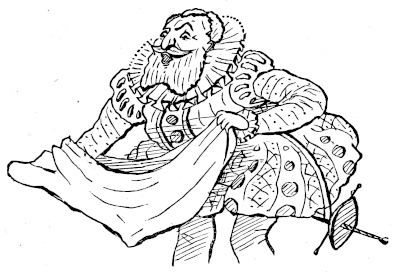
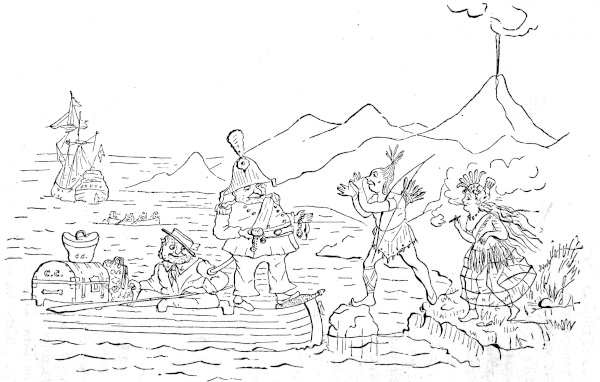
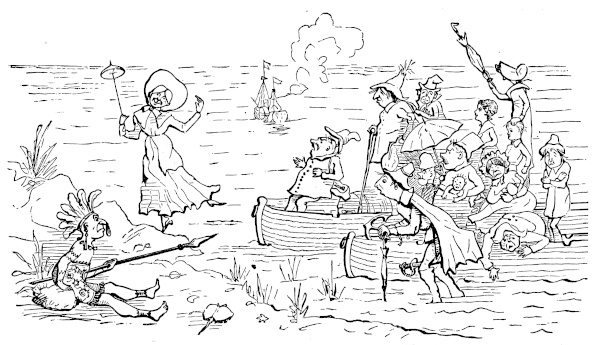
Columbus discovers America.
41THE COMIC HISTORY OF THE
UNITED STATES.
PREFATORY.
TREATING THE READER TO AN ACCOUNT OF THE AUTHOR,
AND OF THE PLAN, OBJECT, AND PRINCIPLES OF THIS
HISTORY.
The Author, proposing to be intimate with the Reader, deems an Introduction
desirable.—Born Early and Poor.—How the Two Facts were
managed and overcome.—School Days and Nights.—College Lines,
crooked and straight.—Father’s Face against his.—A New American
Decalogue.—Into the Married and other States and Territories.—Settling
down.—Advantages of a Sub-urban Residence.—Outside and
Inside Views of the Author’s Head.—Plans and Purposes of the
Work.—Laughing Facts.—Roman Precedents.—Impartiality holding
the Shears and Tape.—Sources of our Information.—Acknowledgments
to Smith and Brown.—Our Illustrations.
The Reader scrapes Acquaintance with the Author.
Due it is alike to the
originality and dignity
of this work, and
to the respectability,
comfort, and good
understanding of the
reader and ourself,
that a formal introduction
should take
place at the very outset.
For although we
feel sure that without
42this we shall, after keeping company together a few
evenings, exchange confidences and hearts with each
other for life, yet to avoid needless suspicions,—mute
and silent though they be,—and to obviate
the hazards and discomforts of injurious side-glances,
interrogative of my origin, person, parentage, education,
and moral character,—which the paterfamilias
may, and naturally would, cast upon a new teacher,
who offers to take a place in his household, sit in
one corner of the family room when the lamps are
lit, and to sleep in the spare bedroom when they
are turned down,—I propose to state at once who
it is that comes with this friendly audacity, what
are his intentions, and how he expects to behave
himself in a relation at once so familiar and responsible,
viz. that of a good-natured, equable, humorous
companion and friend, indicating and painting facts
in a pleasant, genial, and healthy way.
First, then, as to ourself. I say not myself; for
this would be to roll immediately my complex egoism
out of the manifold garments which a historian wears
of course; but I say Ourself, that gathered, round
Impersonation which may be well supposed to be a
crystallized something, like a cunning frost-work on
the long window-panes of history,—an armless hand
writing Mene and other hieroglyphics on the wall,
or a Briareus with his hundred hands, heads, and feet,
running in a hundred different ways, staring through
a hundred telescopes at the calm ages, and writing
with a century of hands the doings, undoings, and
misdoings of the race. This manifold, dignified mystery
I mean to put on and wear after this chapter; but
43in order to insure the confidence which I now seek, I
shall slip, for a few minutes, out of my state gear, and
taking your hand,—now no longer withheld nor even
hesitatingly given,—look trustingly into your eyes,
and mention a few of those particulars of myself,
which you have a gracious right to know, in order to
judge of my standing in the world, my intellectual
competency and fitness, and the plumptitude of my
moral proportions.
I was born very early in life; so early, in fact, that
although present, and making such an effort as befitted
my first appearance, I was so inexpressibly interested
in the matter, that I forgot my future office, that of
recorder of passing events. The fact of my birth—a
fact which is apt to happen to most people—is not
perhaps so singular as that, being born in the United
States, I contrived to live beyond the first five years,
that fatal semi-decade. I ought, perhaps, now to add,
in order to quiet any apprehensions after my last
alarming remark, that “I still live”; and that, having
survived the perils and plums of parental kindness in
infancy, I hope to outlive the equally fatal neglect and
indifference which marks our treatment of old age.
My parents, at the time I was given to the world,
were poor, and, therefore, not respectable. They had
been simple enough to marry young, and for love; and
although they had mated each other well, they had
failed to put a yoke upon the neck of fortune. These
early struggles, however, stiffened in them the moral
elements, and marbleized, so to speak, the soft woods
of their country natures, making a substance very different
from that thin, moral veneering which is upholstered
44from the beechen groves that timber the sunny
slopes of life. Both of them were Presbyterians;
always attending the Sunday services, sitting in a gallery
seat, close to the pulpit, and so taking the brunt
of the hard blows which were rightfully felt in, and—I
sometimes thought—spent themselves upon, our
uncushioned pew.
An offer from my father’s brother, who had become
rich in mercantile business, drew my father and the
family in my fifth year to the city of Philadelphia.
With this change of base came sharper tactics against
the army of poverty; and at last, by fighting it on the
same line, although it took all the summer of his life,
he achieved the victory. I was then sent to the best
schools; took lessons at home in some branches from
a private teacher; took—I own it now—lessons in
other branches privately, out of the house, without my
father’s knowledge, although at his expense for the
tuition; and at last I went to college.
Hard study, matched by an irrepressible love of
pranks at night; a knowledge of Euclid’s lines and
clothes line; of belles-lettres and unlettered belles;
of geometrical and other squares; of chemistry applied
to known uses and to experiments for which there
were no precedents in the books; prizes offered by the
faculty, and prizes offered by Mrs. Green and Mrs.
White in the persons of their handsome daughters,—these
all braided together the threads of my university
life into a pattern which, if not unusual, was made up
principally of figures little admired at home.
My father was not at all pleased with the well-red
bill I brought with me, and quite as little with the
45unsigned ones which followed me, from college; and,
concluding that I might run my own face for a while,
set his sharply against me.
I took to teaching; sounding over again the shallow
depths of old studies, but often striking the lead on
the rocky bottom of a temper too long indulged not to
be stern when touched by children’s thoughtlessness.
My father’s death cast upon me responsibilities for
my mother and the estate, which dropped the curtain
upon my dream-life, and lifted it from the long perspective
of actual work and business cares. Among
my father’s papers I found the following original document,
which I reproduce here, as showing his shrewdness
of observation, and the character of the parent
who helped to form some elements of my own.
“A New American Decalogue.
“Hear, O Jonathan, the commandments which thou
hast made,—teaching them to thy infants, thy Freedmen,
thy Irishmen, thy office-holders,—the asses
within thy gates.
I.
“Thou shalt have no other God but Gain. Trade,
and labor, husband-ry and all other brokerage, shall
be his profits.
II.
“Graven images and pictures other than greenbacks
and fractional currency thou shalt not make.
“These shalt continue to be unlike anything elsewhere,
in the heavens above or in the earth beneath;
and to them, therefore, thou mayst bow down thyself
46unto the thirty-third or thirty-fourth generation, using
up in their pursuit all thy soles, thy health, and thy
neighbor as thyself.
III.
“Thou shalt not mistake any other god for the aforesaid,
such as Religion, True Worship, Charity, Virtue,
Obedience, Truth; for Gain, being a jealous God, requires
all your time, strength, health, soul, and body,
and will show no mercy upon those who keep not his
day-book, ledger, and cash-books.
IV.
“Remember the Sabbath day to keep it wholly to
thyself.
V.
“Honor thy children, bowing down to them and
worshipping them, giving them what they least require,
that their days may be the shortest, in the
United States, of all lands whatsoever.
VI.
“Thou shalt not kill the goose which lays the golden
eggs.
VII.
“Thou shalt commit adulterations with almost everything
in the earth beneath, and especially by the
waters which are throughout the world.
VIII.
“Thou shalt steal whenever an official opportunity
offers.
47“Making a Cæsar of thyself, thou shalt render unto
him all the money that is brought unto thee.
IX.
“Thou shalt forbear all witness against thy neighbor;
lest thy time be consumed needlessly in the public
service, and he afterwards, also, witness against
thee.
X.
“Thou shalt acquire so much by the foregoing commandments,
as not to covet thy neighbor’s house and
lot, nor any other real or un-real estate of his whatsoever.”
Settling up the property which my father had accumulated,
although disregarding this code, and unsettling
myself, I roamed abroad long and widely; practically
dog-earing in Europe, Asia, and Africa the
leaves of that illuminated volume of travel which I
had all my life been intent to own.
Then came marriage,—religious convictions,—studying
for the ministry,—children in the house,—studying
them, and how to feed them,—ordination,—a
call to a rus-urban congregation in the
vicinity of New York,—only a short hour’s ride on a
rail, and well feathered, without tar, by plentiful dust,—preaching
to an assemblage, gathered from behind
sharp counters on week-days, to measure my discourses
critically, and to secure their money’s worth on
Sundays,—and all the nameless little experiences
that roll over the cog-wheels of a suburban parson’s
life. Two bronchial attacks commissioned me to look
48up a better throat,—once in a journey to South
America, and once across the prairies to California.
These experiences, added to their predecessors, have
accumulated, with my readings, the materials for a
history which the leisure half-hours, paragraphed between
the compact duties of my thirty years of ministerial
work, have permitted me to put together, and
which now, dear reader, I place, as my cor cordium,
in your hands.
It is the cream, skimmed from my carefully kept
dairy; or rather the condensed milk of my very
being, left at your door, to make your tea pleasanter,
and your pudding sweeter and richer.
As you may be curious to possess, and I am most
happy of an opportunity to get off my latest photogram,
I add, as an item serving to assist you in making
up the sum of my qualifications, this
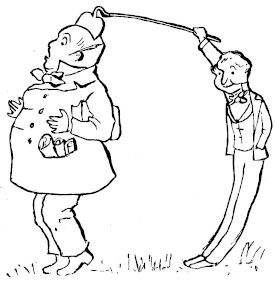
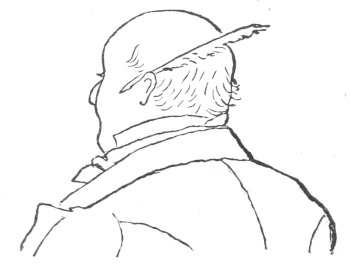
External View of the Author’s Head,
bare-ly remarking that as its unfurnished state may
disappoint you, I will endeavor to restore your pleasing
illusion, by giving you gratuitously
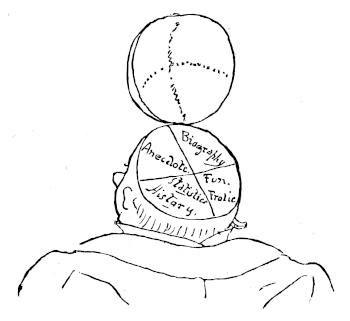
49
An Inside View,
flattering myself that, although you may find nothing
in it, you will at least confess, that seldom dare an
author venture upon such an exposure of his stock in
trade.
Having now furnished all the main elements which
will enable my pupil readers to outline my intellectual
portraiture, having frankly shown four sides of myself,—a
lower side and an upper side, an outside and
inside,—being the only sides, I trust, that I shall
take in this history, I crave leave now to add,
secondly, a word as to the plan, object, and principles
of this history. They are, in brief, to put facts, veritable
and authentic facts, whether agreeable or disagreeable
in themselves, in that pleasing dress that
will make them welcome visitors to the drawing-room,
good chums in the bedchamber, chatty companions in
the cars, on steamers and steamboats, jolly physicians
50to the dyspeptically lean, and pleasantly wise counsellors
to the troubled.
I feel so sure that, as not one of the illuminated
readers of these chronicles has ever mistaken dulness
for wisdom, so not one will need be reminded that the
most solid and trusted truths may wear the smiles of
joy and hilarity.
The Romans on their solemn festival days were
wont to carry in their processions the images of their
ancestors, even those long deceased, wreathed with
flowers. So carry we the images of the Past, garlanded
with the rosy links of fun and jollity.
We shall not be tempted by the lure of originality,
nor even by the attractive ambition of gaining credit
for profound critical and historical acumen, to follow
the late fashion of dressing up stale and unwholesome
characters in fine clothes and qualities. We shall
neither foist the virtuous regimentals and well-earned
epaulettes of Washington upon Benedict Arnold, nor
tease history to fling a mantle of false charity over
Burr’s treason. We shall not worry the public conscience
into any praise, however faint, of the crimson
waistcoat of Mr. Jefferson Davis, nor waste any admiration
upon the spotted neck-tie, perhaps too loosely
drawn, of Jacob Thompson. Impartial justice shall
hold our tape and handle our shears.
It is usual for historians to indicate the sources of
their information; but as we have refused no means
of enriching these annals, using for that purpose whatever
materials our multiform reading could supply, from
the Ramayana, the great Sanscrit epic, impressed on
wax, down to the last published child’s primer, printed
51on patented wooden paper, we could not name all our
authorities without giving a catalogue inconvenient
for our publishers, and too long for the abridged lives
of our readers. We cannot, however, refrain from
acknowledging our obligations to John Smith, Esq.,
for original information, novel ideas, and new turns
of thought around old notions, running through every
page of this history; to Mr. Jones, for valuable
public documents; and to Mr. Brown, the well-known
sexton of Grace Church, New York, who in the course
of his lifelong diggings, has exhumed several pieces
of Americans, whom we have reconstructed and preserved
in our historical cases.
As to the illustrations which flash upon and light
up our pages, they will speak for themselves; if they
do not, any word of ours would be, Vox et preterea
nihil.
BOOK FIRST. DISCOVERIES. B. C. TO 1607 A. D. — CHAPTER I. OF AMERICA BEFORE ITS DISCOVERY IN THE FIFTEENTH CENTURY. B. C.-1000 A. D. — CHAPTER II. OF THE DISCOVERIES IN AMERICA DURING THE ELEVENTH, FIFTEENTH, SIXTEENTH, AND SEVENTEENTH CENTURIES. 1000–1607. — CHAPTER III. ON THE INDIAN CHARACTER.
53
“Through the ages one increasing purpose runs,
And the thoughts of men are widened with the process of the suns.”
Tennyson.
“Here are old trees, tall oaks and gnarled pines
That stream with gray, green mosses; here the ground
Was never touched by spade, and flowers spring up
Unsown and die ungathered. It is sweet
To linger here among the flitting birds
And leaping squirrels, wandering brooks, and winds
That shake the leaves and scatter as they pass
A fragrance from the cedars thickly set
With pale blue berries. In their peaceful shades,
Peaceful, unpruned, immeasurably old,
My thoughts go up the long, dim path of years
Back to the earliest days.”
Bryant.
“That would be wooed and not unsought be won.”
Shakespeare.
55
America older than Europe, Asia, or Africa.—Chronic Errors on the
Subject.—Europe presented to America.—Truth vindicated.—Proofs
of our Superior Antiquity.—Luxurious Civilization of the
Races who stocked this Continent before the Indians.—Amount of
Coal left by them unburned.—Large supplies of Fish packed away
safely in our Mountains.—Fish Culture Measure of Human Culture.—Fossil
Cran-iology.—Laughable Blunders of Former Historians
and Ethnologists.—Ancient Nations, Babylonian, Assyrian, Persian,
Greek, Ten Lost Tribes, etc., trickling through, appearing on this
Side of the Earth.—Instances cited.—Mythologies of Greece and
Rome originated here.—Proofs and Reproofs.—American Nests well
feathered Ages ago.—Large Stocks for Future Use.
America before its Discovery.
Hitherto not
only foreign
writers, but even our
own people, have ignored
the existence
of America prior to
what is popularly
called its discovery,
a phenomenon which
might be more appropriately
denominated
a return of the descendants
of the old
stock to the haunts of their forefathers. That event—reserved
56until the close of the fifteenth century of
the Christian era, after the invention of gunpowder
had exploded numerous obstructions in the path of
progress, and just before the Lutheran Reformation
came in with its fresh needs for more room—turned
up an Old World for new uses.
Of course the newly ventilated space thus rediscovered
excited much talk at the time, and created
a sensation in that unsensational age. The first Europeans
who were presented to America were as much
elated, as Americans now at their presentation to
European courts; as if America, like those courts,
had not existed and had not had its shows, jewels,
follies, history, and fêtes, centuries before they were
shown up to it. Has not this sensation lasted quite
long enough? Is it not time—now that nearly four
hundred years have allowed the first ardor and surprise
to cool off—to vindicate the claim of the
Western Continent against the long-suffered error of
mistaking what they were new to for what was itself
new?
The arrogant pretensions of what is pleased to call
itself the Old World have quite long enough kept
back our bashful and blushing claims.
Indeed, in our chronic modesty, we are allowing
our country to get somewhat mature in speaking of
itself as new; while even children now know that
ours is, in fact, the elder continent. Agassiz is not
gassing us when he picks our ancient Alleghany flints
and tells us, that the camp-fires in the Lackawanna,
Schuylkill, and Lehigh valleys blazed away long
before those at Newcastle and in the English Black
57Country were lit up. The Rocky Mountains got up
their vertebrated backs ages before Mont Blanc put
on such cool airs and carried its head so loftily over
the more modest chignon of our Orizaba and Long’s
Peak. The Mississippi got down to its delta long
before the Rhone or Rhine reached even their alpha.
Let us then henceforth assert the dignity of our
superior antiquity; and commiseratecommiserate the other half
of the globe in being so long unknown to our older
America.
What was the precise height, the fashionable color
of hair and eyes, the modish vices, the sartorial
virtues, of the races which stocked our prairies, and
hunted plesiosauria, and megalosauria, and other tall
game along our wide valleys, and across the granite
peaks of our long mountain ranges, we have not now
at hand any plates or photographs to show; but well
do we know that we are very much obliged to them
for leaving unburned such lots of good coal, snugly
stowed away in dry, ample cellars; and that those
cellars were placed in such a peaceable Quaker State
as Pennsylvania, where we can go and help ourselves
by the cart-load without getting into a stew. How
beautifully, too, they—those young Americans—packed
away their fish; so well that they—the fish—are
now just as fresh as when Noah performed his
maritime adventure, Moses was fished up by the
banks of the Nile, or Jonah became cargo in the deeply
laden whale.
What large provisions those jolly dwellers on this
hemisphere, long ages ago, must have made, when we
find such abundance of funny finny things, so carefully
58stowed away in layers, all over the continent,
from the icy plains around the North Pole, down
through the Isthmus belt, and along the saw-shaped
ridges of South America, to the farthermost cape.
Now, if we had no other proof of the high civilization,
we may truthfully say, the dainty and luxurious
refinement, of those pre-Columbian inhabitants of this
hemisphere, the existence of these fish, so beautifully
canned,—better disposed, in fact, than if they had
been arranged in layers by the accomplished herring-packers
of Scotland or Holland,—we might safely
rest there the well-digested argument; knowing well,
as all our readers do, that the love of fish was one of
the peculiar features that marked the highest point
of Assyrian, Egyptian, and Persian civilization; remembering
that in the time of Pericles, the polished
Athenian left the charming music of his flowing
speech, when he heard the bell in the Agora announce
that the fish auction had begun; and further
recalling the fact that the fish-ponds of Lucullus,
Pompey, Crassus, and the millionnaire Romans,
gauged, like yard-sticks, the intellectual culture of
Rome.
Fossil cranes have also been found ingeniously
tucked away in appropriate crusts,—a cran-iological
development not to be overlooked; although upon this
head we forbear to enlarge. The Hadrosaurus—now
restored to us by strangely unsubstantial Water-house
Hawkins—shows that in his (i. e. the former H.’s)
production what countless ages must have been exhausted
and for his sustenance what numberless lives
consumed, which, if unslaughtered, might have gone
60on, and after centuries of growth developed to be not
only men, but even American voters.
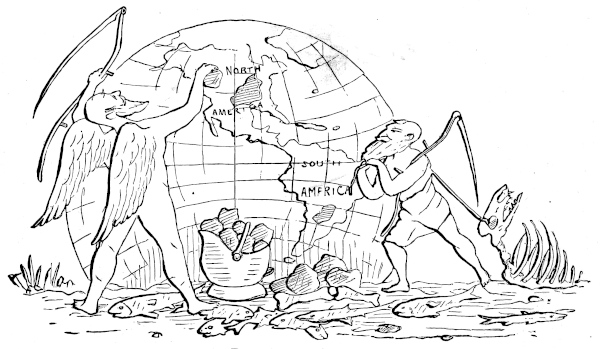
Time stocking America. (p. 59)
“Perhaps in scaly armor, up and down those ancient seas,
Roamed he with an appetite that nothing could appease;
Crushing shoals and hosts of being, every one of whom that ran
Would, in course of time and season, have developed up to man;
But fata sic profulgent, and we only may bewail
Our dear relations slaughtered when this monster curled his tail.”
From what has already been said it is clear that
many of the aboriginal settlers in this half of the
world died game to the last.
After mention of these higher arguments of our
elder civilization, we shall not weaken the proofs by
an exhibition of later American antiquities, such as
the sculptured temples found in Yucatan and Central
America; the time-coated, swallow-tailed fanes of the
Peruvians; the exaggerated structures of the dwarfed
Aztecs; or the tall earth-mounds which, scattered
from Lake Erie through the Mississippi Valley, and
forced through the tight-set lips of the Isthmus, are
at last swallowed up by Venezuela.
Many doubtless are the swarms that have hived
here through the busy centuries which preceded the
Egyptian Pharaohs, the comparatively modern empires
of Assyria, Persia, and China, and the still later kingdoms
of Agamemnon and Priam; empires and kingdoms
that stand on the dim frontis-pages of our ordinary
histories. These hives, overflowing their quarters,
have sent out superfluous swarms across the ice
bridge over our northern strait into the plains of Asia,
and thence into Africa and Europe.
Laughable indeed is the exhibition which erudite
61European historians, ethnologists, and others have
made of themselves in deducing from Asia, as the
mother-swarm, the colonies that have peopled the
world; when in truth Asia was only the half-way
house, the luncheon-place of our trampers, on their
march into their foggy countries and chronicles.
Thus it is now ascertained by late researches that
there is a great resemblance between the languages
of the Mongols and Japanese, and those of Equador
and New Granada. Hopes are entertained that antiquarians
may discover some ancient precedents for our
Yankee tongues and words derived from sources whose
authoritative beginnings now puzzle us.
So, too, no doubt, migrations homeward have taken
place from the faded and colorless scenes of these
exploring raids.
Hitherward trickled, probably, the ten Israelitish
tribes, hitherto supposed to be lost, diffusing themselves
wanderingly for the past two thousand five
hundred and eighty-nine years, and now collecting
in pools in our towns and cities, and around our stock-exchanges.
Here, too, have reappeared, after going in on the
other side, the broken pieces of the empire of Nineveh,
mixed up with fragments of its gates of brass,
which fused in the transmission, have veneered the
faces of those who pulled through, forming in their
descendants the race of brazen-faced itinerant pedlers,
auctioneers, and plumbers among us.
So the ancient empire of Egypt, shivered up by
Cæsar, percolating through, at last dripped into that
stalagmite, the Tombs of New York, with its newly
62formed but not reformed Cæsars and Pompeys inside.
In a word, most of the old kingdoms, and even
cities, such as Troy, Rome, Syracuse, Alexandria,
Macedon, Athens, Sparta, and others, disappearing
from sight on the other and newer hemisphere, and
straining through into ours, have come out on our
side condensed by the pressure in small spots, but
with similar names,—spots smaller but just as smart
and big-feeling as their larger selves. This, too, accounts
for our sudden expansions, whether in crinoline
or credit; the compressed and squeezed germ reasserting
often its chance for pristine greatness in sudden
and unexpected ways.
Now that we have started the train of thought, each
of our readers can easily turn engineer and stoker, and
by applying a little fuel of his own, can drive it over
all the various tracks which run from his metropolitan,
central brain.
“No wonder,” each one will exclaim, “that our
people are so thin after so much pressing of their
ancestors; no wonder at our new-minted words, the
old ones having been fused at a red heat in the central
fires.”
Here, too, is the secret of our burning eloquence.
This is the source of our extraordinary architecture,
borrowed, like an actor’s costume at a fancy ball, from
huddled heaps of clothing made for others, and brought
together in party-colored, but ill-sorted union. Looked
at from this angle, we can account, too, for our mythological
tendencies,—the invocations to Jove, when
surprised; the devotion to Apollo in our magazines;
63the frequent use of the lyre in our trade; the love for
bare shoulders, like Junos, in our divine assemblages;
our leanings at night to Bacchus; and other customs
and habits that creep out even from under pan-taletes.
Greece at first took her Olympus from us; and we
in the course of time have, like affectionate parents,
borrowed it back again.
From these varied proofs it is manifest that, before
Columbus brought over to America specimens of the
European stock existing in his time, our hemisphere
had been hard at work firing up at Popocatepetl;
scooping out harbors on our coasts; creasing our
valleys in fluvial grooves for our fast-running craft and
boats; feathering the future nests of a later posterity
with materials for use; and in general laying in a large
stock for a successful business to be taken up and
carried on afterwards by those who should come back
from their migrations to become large dealers in universal
notions, general purveyors, forwarders and advancers
on all kinds of property, from continents to a
spool of cotton, from polar Alaska ice to West India
warming-pans and peppery troches.
How long it took them to flutter back to these old
deserted nests, how many were lost before they had
fairly got settled in them, and what broods now chirp,
sing, and crow, through branches new and old, honest
or brittle, these pages are full fledged to show.
64
America not discovered by Jason.—Lithographic Specimens attributed
to the Northmen in the Eleventh Century curious, but by Skalds
more Modern.—Bishop Berkeley’s Western Star not the First
American Constellation.—Columbus offers a Continent at Private
Sale; Isabella, a Spanish Lady, takes him up, and the Profits also.—Of
Ferdinand’s Necklace.—Price of Eggs advanced in Spain.—England
finally sees Something.—A Fish Story confirmed.—Discoveries
which Columbus did not make.—Ponce de Leon.—Mexico unfortunately
discovered.—The Straits of Magellan and other Straits.—De
Soto at the Bottom of the Mississippi.—Champlain, a wise Man,
founds Quebec upon a Rock.—Sir Walter Raleigh and him smoking.—The
Mayflower anchored.—Hudson up Stream.
America was not discovered by Jason while
looking up the golden fleece, although the existence
of many American habits point to an originator,
whose name is lost, but whose Asiatic practices
are not. It is supposed by some that the late war
crops were the product of certain stray dragon’s teeth,
possibly dropped by that wily Greek on our prolific
soil. But these hypotheses, although as wise as many
others connected with early maritime discoveries, are
too learned to be useful. History declines to pull
such wool over the eyes of its readers or to encourage
traditions which flatter the pride of ancient nations,
whose age is the only excuse for their fond, grandfatherly
65dotings. Nor is it any more true that the
Northmen, in the eleventh century, fell upon this out-lying
continent, when engaged in general lithography
along our coasts,—the pictured rocks near Taunton,
although a spirited illustration of one page of our
chronicles, being now proved to be sketches by later
Scandinavian Skalds, less than eight hundred years
old. We also feel obliged to deny the merit accorded
by some to Bishop Berkeley, of having made the first
discovery of America. This notion of some rests all
its weight on the strength of those lines, “Westward
the star of empire takes its way.” But those were
not the first lines that were carried ashore and made
fast to our continent, nor this the earliest star which
appeared over our American boards.
Much as we should love, in the interest of modern
historical research, to invent a new discoverer for
America, candor compels us to award the glory still to
Christopher Columbus. Had he lived three hundred
and seventy-seven years later, he would have advertised
for a partner in some paper of wide circulation;
but not having that advantage, he circulated himself,
offering a continent at private sale to all European
nations that fronted the sunset. But all declined
with thanks, until at last, as is well known, one
Isabella, a Spanish lady, taken with the speculation,
became a silent partner in the business. She not
only furnished the capital, and took a high interest
in the result, but finally reaped nearly all the profits,—a
pleasant example of woman’s rights thoroughly
enforced. She even took a necklace from her neck to
procure funds for the expedition; and with this example
67before him, her associate Ferdinand, after trying
his hand on several Moors, thought that, after unclasping
from the neck of Columbus “the gem of the
Antilles,” he could substitute a chain less golden.
Posterity, however, indignantly breaking the metallic
hasp, has clapped the iron collar back on the neck of
the selfish, cunning, and thankless Ferdinando.
The Pictured Rocks at Taunton attributed to the Northmen, or Skalds, of the Eleventh Century. (p. 66)
We must not forget to mention that before the old
pilot could get his project to stand, he had raised the
price of eggs throughout Spain by placing so many on
their own poor broken heads. For this destruction,
however, he consoled himself with the maxim, “all’s
well that ends well.” He carried his eggs and hopes
to England, France, Portugal, and Navarre; but both
were kept so long that they became addled.
A heavy fog prevented England at first from seeing
the enterprise; but after the discovery of real land
was made, she lost no time in procuring the advantages
of it, and endeavored to secure them to herself,
by allowing several vessels to be outfitted at Bristol.
These vessels were not built by Laird; but, sailing
away on the blind side of the island, succeeded at last
in boarding the continent, and exchanging some unprinted
religious tracks for certain other tracts, afterwards
well stamped by royal authority.
On their return, the promoters of this missionary
enterprise built a handsome church, where prayers
were daily offered for many years, for past success,
and intercessions made for the interposition of the
same kind Providence for new exchanges of a similar
kind. These expeditions, it may be remarked, have
been and are the foundation of England’s greatness,—her
69church and her trade; or rather to name them
in juster order and according to her own estimate, her
trade and her church. The Cabots, father and son,
will ever be remembered by their addition to the
world’s wealth by the discovery, in 1497, of Newfoundland.
At the time it was thought to be a story
somewhat fishy, but it is now swallowed without any
bones.
Landing of Columbus. (p. 68)
The Portuguese were less fortunate, their ships having
got somehow entangled in the line in crossing it,
they were obliged to cast anchor against a high wind,
which as usual was not so ill as not to benefit their
English rivals. What became of these ships is not
positively known; a glimpse of only one of them having
since been obtained in Coleridge’s Ancient Mariner.
The rest may have drifted northwards, and their
masts made to serve to splice the north pole, the old
one having become somewhat loose from being so
much worked about by meddlesome navigators.
Among the discoveries in America which Columbus
did not make we may enumerate the following:—
First, a name for the continent; an omission afterwards
supplied by a shabby countryman of his, whose
own name we will not perpetuate by mentioning in
this history.
Second, iron-clads; although he did come across
some very hard characters, whose scaly armor history
has ever since been mercilessly denting and battering.
Columbus himself, although at one time cased in iron,
and sent home on a trial trip, while he learned the
value and preciousness of metal at the Spanish court,
failed to discover its property to float him across seas
70successfully. Nor do we find any warrant for believing
that he was the discoverer of,
Third, balsam of liverwort, the extract of buchu,
Peruvian hair-dye, or the sozodont, notwithstanding
the strenuous assertions to the contrary of the candid
proprietors of those invaluable preparations. The
only extract he succeeded in making was a promise of
honors, never performed, although highly labelled; and
it is well known that the only color he succeeded in
obtaining in America, for his own hair, was gray.
From the ingredients of this blanching powder he
ultimately died himself at Valladolid.
Fourth, nor is there any better foundation for
the common error, that he was the discoverer of the
Tammany Society, and furnished designs and colored
drawings for the wigwam, in which the Democratic
braves find so many original and aboriginal voters.
Indian polls, from which the hair had been carefully
removed, he did see, and even took a few back with
him to Spain; but it is needless to say that these
polling-places were not the exemplars of those which
Tammany so often and so lovingly pats on the head.
Fifth, equally erroneous is the general belief that
he discovered “Hail Columbia,” although it is true
that he got enough of it, in the sense that some illy
educated small boys now use that phrase.
Discovery of Newfoundland. (p. 71)
Ponce de Leon, following up the discoveries of
Columbus, landed in Florida, in 1512, and endeavored
to find there a fountain possessing the properties
of giving to the imbiber perpetual youth. Although
he did not succeed in this quest, it seems probable
that some one else did, for it is well known that several
72Americans, such as Daniel Webster, John C.
Calhoun, and others, have lived quite too long, while
other distinguished Americans, as Burr and others,
have manifested in a very lively way a green old age,
cutting up capers which none but very young people
would have thought of. He also discovered the Dry
Tortugas,—a temperance station of the first water,
famous as the habitation of Dr. Mudd.
A few years later, A. D. 1517, Mexico was unfortunately
discovered, and from that time to the present
has been the scene of constant embroilments,
beginning with the broiling of Montezuma, by Cortez,
and ending with the unhappy stew made by Maximilian
for himself. Mexico is the American abattoir,—the
general slaughter-house of our continent. Ice
for the preservation of the quarters of her victims,
where no quarter was shown, is obtained from the elevated
plains into which the country is as yet insufficiently
broken up.
We ought to mention the voyage, in 1520, of a
Portuguese, Magellan by name, who touched at the
Canaries for yellow birds, coasted along the shores
of Brazil in search of other golden products, but
finally brought up in a very tight place, on the extreme
southern tip of our western globe; calling the
spot, under great pressure, the Straits of Magellan.
He became so exhilarated, however, at Cape Horn,
that he kept on, like the man with the cork leg, and
went all around the world, being its first circumventor,
and giving the first proof of the gyrating effects of mixing
liquors with water.
De Soto first chanced upon the Mississippi River,
73and, in 1542, was flung upon it with all his heavy
armor on,—“a sink-or-swim” experiment, which resulted
in his remaining down at the bottom.
Diving for wrecks has since become for divers and
diverse reasons common in that turbulent stream; but
he is honored as the great diver; the river not being
strong enough to get him up. John Law afterwards
tried a Mississippi venture; but, unlike De Soto, he
went up, and never came down again. Both De
Leon and De Soto showed true American enterprise
and energy in the pursuit of gold. Like their countryman
Cortez, in Mexico, they were, however, more
desirous of discovering metallic placers, and extracting
from them sudden riches, than of luring by patient
industry from a jealous soil its hoarded secrets of
cereal wealth.
On the north, Cartier, in 1534, became the unhappy
discoverer of the Canadas, and other out-lying, uncovered,
cold regions, afterwards parcelled out, not to ice
companies like the Knickerbocker and others, but into
viceroyalties. These freezing places, from the continual
stirring about in them of such contrary elements
for the succeeding century, might well be called
the ice-creameries of England and France.
Champlain, in 1603, like a wise man, founded Quebec
on a rock; for which he has been illy requited by
being called the father of the French settlements in
Canada.
Sir Walter Raleigh introduces Smoking to the English Court. (p. 74)
Sir Walter Raleigh’s name must always burn brightly
in American history, for his discovery of a smoking
material on the James River. But his fame needs no
puffing here, although his reputation became somewhat
75blown before his death. Another important
event soon after occurred in connection with American
discoveries. A Mayflower drifted, in December, across
seas, and floating against Plymouth Rock, struck its
tiny anchors in it, and, with Yankee enterprise, climbed
all over it, covering its rugged clefts and bare surface
with a mass of luxuriant flowers, with which also
sprang up tangling weed-growths, all of which have
since been dried and attracted great attention, much
sneezing, some sneering, and great use of handkerchiefs
to preserve the odor of, or prevent the smell of, what
has penetrated all departments of American history.
The last discovery which we shall here mention was
that of Hudson, who brought to light the benighted
island of Manhattan, then, as since, infested by Woods
and other poisonous growths. The natives, as now,
were very free in their manners; staring at the newly
arrived, and taking them in by the exhibition of trinkets
and gilt ornaments. In spite of the sluggish
airs from the shores of Westchester and Dutchess, the
ships of Hudson succeeded in reaching Rhinebeck;
a few of his men even penetrating to the dense regions
of Albany.
76
Survey of Indian Character and Lands.—Our Pacific Intentions towards
the Indians.—The Whites better read than the Red Men, and the
Effects of Learning.—The Pale Complexion of their Affairs.—Wet
Blankets thrown over their other Habits.—Different Traits discovered
by School-Girls and through official Spectacles.—Meaning of Indian
Reservations.—Indian Style of Dress and its Conveniences.—Indian
Names.—Examples of their Happy Application.
No history of the United States would be complete
without a survey of the character of the
Indian; as no State of the Union is acceptable to its
inhabitants without a survey and appropriation of his
lands.
Various as are the lights in which the former may
be regarded, there is but one light, that of an enlight-ened
self-interest, with which the latter have
been treated. The speed with which we have hurried
the brick-colored races towards the sun’s setting is
conclusive proof of our Pacific intentions, and of our
dislike to unsettled titles. Red as is the color of the
Indian, to this complexion do all his tribes come at
last,—a pale conviction that the white man is better
read than they.
The chapter of our discoveries on this continent
opens with the Indian in the foreground; and the
historian, like the earliest explorer, is brought immediately
77face to face with him. Unlike the explorer,
however, we will pause long enough to bury the proprietor
of the estate which he seized and we occupy.
Blankets, often very wet, have been thrown over the
Indian; while as often he has been painted so thickly,
and feathered so profusely, as to become a bird of
quite another color from that of our North American
vulture. Slow in learning the geography of the race
that rides him down as on a pale horse evermore, he
has acquired the name of but one of our streams, that
of the Firewater, a river whose dry banks seem always
to divide his retreating from our pursuing frontier
boundaries.
Perhaps we cannot give a more variegated notion
of the different aspects under which the Indian character
is viewed, than by putting it in an American
kaleidoscope, and there giving it a few turns, certain
that these turns will not be more curious or numerous
than their owners’ fortunes.
1. The Indian character as viewed in schools and
colleges.
Listen to an average specimen from the pen of Miss
Jemima Letitia Youngfancy,—her most pronounced
effort before the trustees and patrons of Rising Hill
Seminary.
“‘Lo! the poor Indian, whose untutored mind
Sees God in clouds, and hears him in the wind.’
Lamentations or Shakespeare.
“No subject is of greater importance to the well-being
of our race than a proper estimate of the character
of the red man. Injustice here is more deplorable,
since it involves the historic position of a race
78once lords of all this continent, now fast dwindling
away, not only out of physical existence, but from the
realms of discriminating praise. His has been the
misfortune to be despoiled, not simply of the bosky
inheritance of fair fields and boundless domains, where
his ancestors roamed as free as the winds that sweep
over the breezy sierras of the Rocky Mountains, but
of the justice which pleads before the tribunal of posterity
for rights withheld and wrongs inflicted. Not
content to pursue his retreating and emaciated footsteps
into the tomb, where his poor body is scarcely
allowed to moulder away in peace, amid the implements
and trophies of the chase, the white man, as
voracious as the prairie wolves, which whet their sharp
fangs against the rocky bases that prop up the giant
Cordilleras of our beloved land, has denied to him
those monumental rights with which even savages
adorn the last resting-places of their braves,—the
trophied inscriptions carved in the enduring language
in which Virgil sang and Tully burned, and in which
Menander, prophetic of our Transatlantic greatness,
babbled to the dull ears of a Roman race, which
recked not of that ‘proud stoic of the woods,’ who,
in life a victim of wrong, at death folds himself to
his solemn sleep, in the language of the greatest of
our living poets,
‘Like one who wraps the drapery of his couch
About him, and lies down to pleasant dreams,’
but who, also, in the apt words of the same rapt minstrel,
‘Like Truth crushed to earth shall rise again,—
The eternal years of God are theirs.’”
79While the waves of applause which ripple around this
popular and characteristic rhapsody, grow calm against
the solid shores of historic truth, we turn to another
American view equally characteristic.
2. The Indian character as seen through official spectacles.
Extract from the Report of the Secretary of
the Interior:—
“The beneficent policy of repression, steadily pursued
by our government towards the Indian tribes
still surviving, cannot fail to strike every one but
themselves. While sentimental Christianity continues
to dwell upon the rapid extinguishment of their tribes,
the archives of this department bear gratifying witness
to the more rapid extinguishment of their titles.
“There now remain in our borders—which were, it
must be admitted, for the sake of argument, once
theirs—but about three hundred thousand of these
nomad wanderers. Our people must feel an especial
gratification in the proud reflection, that it is their
bounty which, now reaching forth the comforts of our
abundance to these remnants of tribes, supplies at the
reasonable rate of some $10.15 per caput, the wants
of such as are spared by our efficient and active army
corps of Indian destructives.
“This bounty is distributed by honest agents, who
never fail, while dispensing it, to impress upon the
recipients a proper regard for the moral suasion of our
well-mounted rifles. The small commissions reserved
from these treaty-stipulated funds, by these agents, is
too American not to be recognized with patriotic
pride; and the especial thanks of Congress are due to
these self-denying distributers for the amount which
80they kindly leave to be disseminated among the intended
beneficiaries.
“There is a natural jealousy among our people in
those States and Territories where former laws injudiciously,
but, as it fortunately proves, unsuccessfully
located these Indian remnants, against the continuous
occupation of tracts of lands called reservations,
to which they have been from time to time removed.
I cannot too strongly recommend that this jealousy
and acquisitiveness be duly respected, and new reservations
somewhere be speedily provided. Both Providence
and our need of their territory plainly mark the
Indians as the American Ishmaelites, against whom
everybody’s hand is raised, and whose shifting tent
can only be steadied up permanently against the sunset
on the Pacific Ocean.”
Some people seem to think that the Indian was
created to keep before us a décolleté style of dress,
adapted to the freedom of our institutions,—a traveller’s
costume, most convenient for the administration
of medical assistance, in case of such railroad
divertisements and steamboat pyrotechnic displays as
often enliven our journeyings.
An Indian Reservation. (p. 81)
Others look upon the preservation of these remnants
as providential fields for the employment of the patience
of domestic missionaries. Young ladies contemplate
them as the only living representatives of
mythological Loves, the sole heirs to the bow and
arrow. Others still admire them as our only legendary
and poetic creations; the only ghostly figures that
creep weirdly through our sharp-set American quadrilles.
82But while such discordant notions rasp the American
ear and conscience about their predecessors, there
is a mode of hushing up all these family jars; one
which seems to have been adopted in all ages, from
the time of Joshua the son of Nun, down to the Irish
wakes of our time, namely, to drown them all in the
jubilant music procured and paid for at the expense
of the estate to be divided up.
A few words in regard to Indian names. An affectionate
and grateful regard for the painted races, which
will soon be seen only in the picture-galleries and
books of colored engravings, has sought to sow a crop
of Indian names over our lakes, rivers, mountains, and
towns. Unfortunately we have succeeded in keeping
scarcely enough for seed. But one State has borrowed
the name of the Indian himself,—Indian-ah?—she
spelling it, however, in an un-English way, without
a h, as if she had said,
“O, breathe not his name.”
The application of some of these names has been
singularly felicitous, as Sing-Sing, where the State
guests attempt no musical flights, but are made to
hum quite another tune, if not to hush up altogether;
Miss-ouri, whose ill-fated union in our Federal family
has been attended with such left-handed rights,—State
rights, Fanny Wrights, and, for a long time in
Kansas, conflicting rights; Minnehaha, whose ringing
laugh is during so long a portion of the year frozen in
her soft throat; Kan-sas, suggestive of her capacity
for billingsgate and free use of abusive language; Oregon,
and yet inviting emigrants to her valuable mines
83while she laughs a cunning laugh under the protecting
cap of Mount Hood; Wy-an-dot River, as if it had
come to a sort of rocky comma, or interrupting ledge,
over which it was pausing a moment for breath to
take a hop-and-skip-and-carry-one overy leap; Pot-to-wat-o-my
River, seeming like a whole family council
around a skillet steaming over a fire, while the carrotty-headed
mother was slightly walloping the youngest
of the party for asking some improper question;
Pawn-ee Fork, reminding one of those old-clothes shops
kept by U. S., where the unsuspecting and improvident
Indian, always in want, might be tempted to
pledge his wild lands for a little ready cash, or a
silver fork, or blue trinket; Man-hat-tan, as if to
perpetuate the fact of the great head quality of the
white man in dealing with the dusky ones for the
purchase of the little island that carries as its name, a
cover for the little transaction which transferred twenty-four
dollars to the one, for the fourteen miles of real
estate sandwiched between the North and East Rivers;
Winne-bago, which sets one sneezing a coltish sneeze
even at the head-waters of the Missis-sippi, and in her
matronly presence; and a thousand other spicy aboriginal
condiments, sprinkled, like pepper and salt
over a luscious ham, over our continent, to make it
more piquant and relishable in the taking.
BOOK SECOND. SETTLEMENTS AND COLONIES. 1607 TO 1775. — CHAPTER I. OF AMERICAN SETTLEMENTS GENERALLY. — CHAPTER II. THE SETTLEMENTS OF VIRGINIA, DELAWARE, MARYLAND, THE CAROLINAS, AND GEORGIA. — CHAPTER III. JOHN SMITH. — CHAPTER IV. OF THE SETTLEMENT OF THE NEW ENGLAND STATES. — CHAPTER V. THE SETTLEMENT OF NEW YORK. — CHAPTER VI. THE SETTLEMENT OF NEW JERSEY. — CHAPTER VII. THE SETTLEMENT OF PENNSYLVANIA. — CHAPTER VIII. THE COLONIES IN THE UPPER HALF OF THE SEVENTEENTH CENTURY. — CHAPTER IX. WITCHCRAFT. — CHAPTER X. OF THE MANNERS, MORALS, HABITS, AND LAWS OF THE COLONISTS IN THE SEVENTEENTH CENTURY. — CHAPTER XI. THE COLONIES IN THE LOWER HALF OF THE EIGHTEENTH CENTURY. — CHAPTER XII. THE CHAMPIONSHIP FOR THE AMERICAN BELT. 1754 TO 1763. — CHAPTER XIII. CAUSES OF THE AMERICAN REVOLUTION.
85
“And vaguely here,
Through the dim mists that crowd the atmosphere,
We draw the outlines of weird figures cast
In shadows on the background of the past.”
Longfellow’s “New England Tragedies.”
“’Tis pleasant through the loopholes of retreat
To peep at such a world.”
Cowper.
87
Some American Grounds, like Coffee, unsettled.—Some Settlements pulled
up by the Roots; others chilled by Fever and Ague.—Moist Soils
objected to except by Doctors.—Unexpected Crops of Tomahawks
from Wheat sown.—Settlements in America because of the Impracticability
of making any at Home with Creditors.—Wild Oats sown between
thirty-fourth and thirty-eighth Parallels.—Frequent Settlements
make long Friends.—Settlements of Old Tavern Scores in Chalky
Districts.—Religious Squalls prostrate some Plantations.—Indian
Tempests uproot others.—Growth of Virginia, although Queen Elizabeth
a femme sole.—Clergymen’s Settlements.—Brides unsettled.—Drake
around the World.
The First Year’s Crop in the New Settlements.
Clergymen’s discourses,
like grape
clusters, usually show
two sides,—a positive
or sunny one and a
negative or shady one.
Desirous of bringing
out the native
bunches of our history
more roundly
against the leafy background
of its verdant
youth, we begin by
showing alternating
merits and demerits. And first the negative, or shady
side.
88The first damp observation shows that many parts
of America have never been settled at all. In certain
districts, grounds are found, as in coffee, unsettled; and
good grounds exist for this, and, contradictory as it
may seem, these are generally discovered in poor water.
In some cases, like those of Gosnold, Raleigh, De
La Roche, and others, attempts were made, and settlements
actually planted, which seemed for a time to
thrive; but the impatient planters, like curious boys,
were so desirous of ascertaining how much their
plants had grown, that they pulled them up to look
at the roots,—an inspection which the plants resented
by sulking and dying out. In other instances,
fever and ague was mixed up with the first seed, and
this had a chilling effect upon the husbandmen.
Indeed, a hard fight is still going on in many parts
of the country with this strong unsettler, the record
of whose assaults and charges is found in the apothecary
shops and doctors’ offices. These highly colored
little stockades and forts with the rosy-hued land-offices
for the sale of the most desirable real estate,
with water-lots running in front of them, often indeed
comprise the entire settlement.
In some instances, the character of the soil interfered
seriously with any permanent occupation of the
place. People who had no objection to watered silks,
or watered paper, entertained, it has been found, well-grounded
reasons for not liking an oozy surface, paragraphed
between watery curves, and punctuated with
bullfrogs and other pointed characters. Some of the
early settlers did venture upon these maritime risks;
but policy, or no policy, they ended their speculations
89under weeping willows, with Keat-like epitaphs over
them,—
“Here lies one whose name was writ in water.”
Oftentimes, even where the soil was rich, the early
settler became discouraged by the unexpected crops
he obtained. Planting wheat, he found that it came
up a rank growth of Indian corn, tasselled out into
tomahawks or sharp-pointed arrows, instead of the
silken tufts which he had a right to look for in the
order of nature. This result frequently took place in
the valleys of the Connecticut and Mohawk, along the
banks of the Mystic River, and upon the otherwise
pleasant slopes overlooking Narragansett Bay.
In several instances, too, as in the case of the
shipped by the council of the Plymouth Company,
the seed thus sent was taken from heaps of full-grown
vicious specimens, to be found only in London,
or other large places, instead of being judiciously
selected from healthy young stocks. Such seed, of
course, not only became sour and fermented, but this
fermentation spoiled whatever good grain was found
accidentally mixed with it. This kind of crop was
even worse than that of the tomahawks or arrows.
Of course, these penal crops were short-lived. The
profligate and dissolute soon died in the virtuous solitudes
in which they had no previous experience at
home to recall and compare; and escaped as soon as
possible from settlements whose greatest crime, in
their eyes, was that in them they could make no scores
long enough to be worth running away from.
Some attempted settlements here, because they could
not succeed in making any with their creditors at
90home. Of this class, many were found in the bounds
of the London Company, scraped up under the charter
of James I., granted in 1606,—a company which
sowed their wild oats between the thirty-fourth and
thirty-eighth parallels of latitude, but whose doings, undoings,
and misdoings had no parallel whatever. Some
of this seed, lying dormant, sprouted up in these regions
as late as 1861, and covered the Carolinas and Virginia
with a crop worse than teazles or Canada thistles.
The maxim that “frequent settlements make long
friends,” was doubly verified along the New England
coast, where the security of the settler could only be
maintained by short and decisive footings-up of and
with the breech-less and treaty-breaking Picts of our
history, or by such often-planted gatherings as would
prevent their attempts to run up a score.
It is almost needless to say that in all the regions
from the Penobscot River to St. Augustine, under all
the various charters, and among all classes of colonists,
English, Dutch, Swedish, Spanish, or Huguenot, settlements
were often made on the walls and behind the
doors of taverns, where the weekly score was kept,—a
geological district mapped out in a chalk formation,
the size of which seemed always to astonish the settler
whenever his attention was particularly invited
to it. Whatever his own fields bore, here the crop
was unfailing; or rather its growth was generally in
the inverse ratio to that of his wheat or tobacco
patch.
In a few instances settlements, fairly and permanently
made were suddenly uprooted by sudden squalls
or tempests, which, razing the hair from the heads of
91the colonists, still, as we read of their ferocity and
fury, raise our own. Such was the scalping-party that
swept over Deerfield, the savage whirlwind down the
valley of the Wyoming, and the rapid gust that licked
up the little settlement of Cherry Valley.
Now and then also occurred a religious tornado,
which prostrated whole patches of plantations, and
which, at one time, threatened to become the prevailing
winds of our American continent, taking the place
even of our strong and steadily blowing trade-winds.
Thus a company of French Huguenots, sent out in
1565, by Admiral Coligni, and planted in Florida,
were overwhelmed by a party of Spaniards, under
Melendez, who, after murdering them all, placed over
their mutilated bodies this inscription: “We do this
not as unto Frenchmen, but as unto heretics.” Which
was the heretical part thus mercilessly dealt with, and
which the French portion not intended to be harmed,
cotemporary accounts do not furnish us with materials
sufficient to enable us to discriminate. They do tell
us, however, that this then fashionable mode of treating
religious convictions was imitated by the countrymen
of the French, acting upon what was then thought
to be the proper interpretation of the merciful and
benign principles of The Book, viz., “doing unto others,
what they do unto you”; for soon after De Gourges,
sailing from France with three ships, formed a surprise
party to two Spanish forts, and after executing a
Spanish dance with the garrison, took them out and
hung them up in the trees like dried fruit; and fearing
that the specimens might be mistaken, left above
them the recipe, as follows: “I do this not as unto
92Spaniards, or mariners, but as unto traitors, robbers,
and murderers.”
Whether the Spaniards thus done for properly appreciated
the delicate discrimination, we are not informed.
To the statistician it may be of interest to know that
of the abortive attempts at settlements within the
present limits of the United States, six were made by
the English, one by the Swedes, two by Spaniards, and
two by the French. Lovers of that branch of political
history will be able to wring out of these figures results
more extraordinary than any we can torture
them into.
On the whole, however, notwithstanding all drawbacks
and misfortunes, the settlements gained steadily
on the Indians, fever and ague, the cold and exposure,
tomahawks, tavern-keepers, and surprise parties. Some
marriages took place, but no settlements were made on
the bride, except perhaps, in the course of time, her
old father-in-law and mother-in-law, who were fortunate
if they brought with them, as addition to her
scanty stock, two whole empty trunks, their own.
Queen Elizabeth did everything to promote the growth
of population in her favorite colony of Virginia, except
to furnish them with a personal example; but to make
up for this omission, she sent out some Episcopal
clergymen, provided with surplice and stole, and with
licenses to marry. These obtained settlements for
themselves, and zealously stimulated them in others.
As soon as the settlements began fairly to demonstrate
that they would succeed, they were of course
vigorously patronized, and in fact “encumbered with
93help.” Plenty of people there were then who at first,
at the bare mention of American settlements, had
placed their thumbs to their noses, and irreverently
given their fingers a quick gyratory motion in the air,
but who now came forward and claimed the merit of
having always been the especial friends of the colonists,
and pointed, like the very lieutenants and aid-de-camps
of General Success, to their uniformly entertained
convictions, triumphantly exclaiming, “Did we
not always tell you so?” As candid historians, we
cannot withhold our pencils from sketching the portraits
of these burly friends of the early years of
America; these large-hearted souls, who, sitting at
home over their comfortable cannel-coal fires, piled
cheerily up with the dividends from the stock of some
of the companies formed for planting these shores,
which they would not touch until it got up to par,
and who then, fearing that their attachments might
not be appreciated, cried out their undeviating devotion
in voices that fairly drowned all others.
From these characters, which only shine in the
full noonday of prosperity, we gladly turn to Sir
Francis Drake, who, as early as 1586, did not hesitate
to divide his last crust with the feeble and struggling
colony of Roanoke Island, succoring them by timely
aid, and not sucking from them the little feeble
strength which short crops and long watchings against
wary foes had left them. Although born in England,
Drake had a soul which compassed the world, around
whose waist he passed the second girdle which had
ever belted it.
Drake with his Fleet sails round the World. (p. 94)
95
Colored Views whitened.—Blue Ridges and Black Welts in Virginia.—Virginia,
smothered up in Infancy by Charters, survives Royal nursing.—Her
Vigilance against her Suitors.—Cotton introduced.—How the
World managed previously.—Charles I. and his numerous Autographs.—Georgia
and Oglethorpe.—Charleston set up.—A Point on Old
Point Comfort.—Tobacco first piped about.—Unmarried Girls as
Articles of Import.—Estimated in, if not by, Pounds.—The Fancy
Constitution of John Locke for North Carolina.—Its own Length, but
Short Life.—South Carolina Rivers do not run up.—Popular Errors
corrected.—John Wesley.—Singular Effect of his Preaching on the
Indians.—Maryland as a Duck of a Colony canvassed.
Colored views are too apt to be given and taken
of these six States, shading down from the dead
African black, through every gradation of tint, to a
hue almost unimpeach-ably Caucasian.
It is true that Virginia carried on her bosom a Blue
Ridge, as in later times some of her progeny have
borne on their backs darker ridges; but until 1620 no
welts of the latter character stood out on her fair shoulders;
and these, be it said to his shame, were raised
by the master of a Dutch man-of-war who, on the
very day in August that the Pilgrim party embarked in
the Mayflower, at Delft-Haven, in his own country,
landed twenty negroes for sale on the banks of the
James River, leaving a black mark which two hundred
and forty-five years have barely succeeded in washing
96out. In her very cradle, in 1606, Virginia was loaded
down and half smothered with that royal blanket, a
charter. Not content with this comforter, the royal
nurses from London kept piling other blankets of the
same kind upon the vigorous infant, and because it
was vigorous, until within the short space of fourteen
years no less than four were heaped upon her. These
were far from being counter-panes, but on the contrary
served in that warm climate to distress the
child, and eventually to bring out eruptions. Under
the second of these, in 1609, Maryland was tucked up
in the same bed with Virginia; but in 1621, not finding
the company agreeable, she was taken out by Lord
Baltimore, and put into a pleasant and comfortable
trundle-bed of her own; the chivalrous young lord
naming the baby after Henrietta Maria, wife of
Charles I., and daughter of the gallant Henry of
Navarre, afterwards Henry IV. of France. The year
1621 was emphasized in the infant settlement of
Virginia by the introduction of cotton and the first
written constitution,—two prolific American seeds
that have each borne large harvests. Considering the
varied uses to which the former is now applied in
clothing human bodies and habitations, and the latter
in padding political addresses and lawsuits, we are
puzzled to conceive how the world got on, and especially
how congressmen managed to make speeches, or
lawyers to live, prior to those great discoveries,—discoveries
more important in some aspects than those of
iron, the Reformation, Illinois divorces, gunpowder,
steam, the doctrine of legal insanity, Brandreth’s
pills, and others, without which of course no well-ordered
97or well-digesting family can long proceed.
Seven years later Charles I. contracted to take the
entire tobacco crop of Virginia; hoping probably by
the free use of this narcotic to drug the alarmed political
conscience of England.
The ship that took the first Maryland emigrants up
the Potomac to their new settlement was called the
Ark and the Dove, and carried in its beak the olive-branch
of religious toleration.
In 1630, the same liberality in disposing of broad
strips of American territory was shown by King
Charles I. in granting a deed, embracing North Carolina,
South Carolina, and Georgia, to Sir Robert Heath;
but in 1663 his son, the second Charles, desirous of
improving his own handwriting, which had been somewhat
neglected from his eighth year, in consequence
of the necessarily active business life Cromwell had
obliged him to lead, put his signature, early one foggy
morning, to a paper which somebody laid in his way,
and which, when brought out to the light, proved to be
a grant to Lord Clarendon and several other pleasant,
gentlemanly fellows, of this same small North American
farm. This select little knot of farmers, after
building a few barns on their farm, discovered that it
was not large enough for their purposes. Like the
Irishman who wanted an additional sixpence to drink
the health of the gentleman who had generously given
him a five-dollar bill, they desired a back field to
dump manure on; and they finally obtained a second
autograph from the obliging Charles to a bit of paper,
allowing them to use forever the small patch lying
98westward to the Pacific. The farm was kept together
until 1729, when it was divided up by George II. into
two parts, called North and South Carolina; the latter
half being, three years later, again split into two, and
the lower part named, after the burly old landlord,
Georgia. Nearly fifty years, however, before this
division, upon a tongue of land called Oyster Point,
and bivalved between the Ashley and Cooper Rivers,
Charleston was first set upon its uneasy foundations.
Whether affected by the contiguity of Folly Island, by
the use of too much pepper—always cheap in warm
regions—upon the native oysters, or whether unduly
exhilarated by too exclusive a contemplation of the
cotton seed, which seems to have enlarged its dilated
and dilating pupils, the place, although but seven feet
above high tide, has always been given to high notions,
and subject to a certain vertigo. An admirable ingredient,
the Protestant Huguenot element, tossed out
of France by the revoked edict of Nantes, was infused
into the young settlement of South Carolina in 1685.
The plant of liberty, however, early struck its anchoring
roots close by the side of the cotton-plant; and
although the governors, sent out by the royal proprietors
from England, continually hacked into its smooth
trunk, it still grew apace, and its bracing tonic odors
filled not only the regions watered by the Santee and
Pedee, but were wafted northwards and over the sister
Colonies.
Although it is said that “old Virginny never tires,”
it must have been because she had a robust constitution,
for a busier body never existed. Always resisting
the attempts made by the profligate royal governors
99upon her virginity, she had to watch them, day
and night, for fear that they would steal her hard
earnings and run away with them. In fact, during
the sixty years that succeeded her birth at Jamestown,
in 1606, she was constantly on the alert, putting up
scarecrows on her cornfields, and notices of spring-guns,
to warn away intruders; but these, so far from
frightening away, only attracted the curious bills of
the Indians. She was also forced to hold fast with
might and main to the scanty wardrobe brought out
by her from England, and with which those dissolute
fellows, the young, titled, rakish, good-for-nothing
overseers, were always taking liberties. Fortunately
for her, as well as her sisters, the two Carolinas and
Georgia, her shoulders were well covered by capes, so
securely fastened on that they could not be snatched
away, and their charms exposed to the rude stare or
prying curiosity of idle visitors from France and England,
and even from staid, sober Holland. And we
here take the opportunity of repelling the slander so
often circulated upon Virginia, that she is “the mother
of States,”—an aspersion which, if true, would stain
her virgin fame, and leave a bar sinister across the
shields of the States thus born out of wedlock.
The first suitor for the budding affections of the
youthful Georgia, or Georgiana, although bearing the
suspicious name of Ogle-thorpe, proved to be a man
of honorable intentions, high-minded, and in every
respect faithful to his ardent vows,—a constant mate
in all her joys and trials during his residence on the
Savannah River, from 1732 to 1743. Virginia’s royal
lovers, on the contrary, although always protesting
100their good intentions, were almost uniformly faithless.
The last one bore the ill-omened, but appropriate
name of Dun-more. He was very importunate, and in
every way attempted to get her to make over her then
valuable property to him, but in vain; and at last so
mercenary did he become, and so disagreeable did he
make himself, that she was obliged to show him the
door.
The spirited damsel was always plucky, and soon
after this domestic difficulty made up her mind to be
wholly independent, and so in fact publicly gave out
to the whole world, saying that “she didn’t care who
knew it.” Massachusetts gallantly stood by the young
girl in her declaration, and so did all her brothers and
sisters; even little Rhody tossing up her jaunty sailor’s
cap, and shouting out that, under Providence, she was
ready to “sail in.”
The name of Sir Walter Raleigh is greenly twined
through the earliest settlements of North Carolina.
In her coasts he took a constantly augmenting interest,
and furnished to the State its capital. His love
for the new settlement only ceased to beat with his
heart. His verse, which the author of “The Fairy
Queen” describes as “sprinkled with nectar,” and “vieing
with the notes of the summer nightingale,” was
musical with her praises; and his “History of the
World” lays at her feet the tribute of his warm,
chivalric nature.
The duty which he felt and gave to the two Colonies,
Virginia and North Carolina, was very different from
the duties which his successors endeavored to draw
from them,—duties so onerous as to drain not only
101the pockets but the hearts of the young communities
from which they were pressed out.
But amid all the trials to which Virginia was subjected
by the rapacity of her governors and the unsated
appetites of councils, named by the home board
corporators, there was one point which she could
always contemplate with satisfaction, namely, Old
Point Comfort,—a grandmotherly place, which her
children then, and since, often visited, laying their hot
heads lovingly in her lap, until her pleasant breezes
cooled their feverish throbbings.
Tobacco was first grown in Virginia in 1616; and
we crave leave to add, that although much piped
about ever since, has never ceased to create a smoke;
its curls hanging thickly and gracefully around the
heads of its world-wide admirers from that time down
to the present,—an instance of unchanged custom
rarely seen.
Virginia, however, did not grow all of her luxuries;
for, in 1620, we find her importing ninety respectable
unmarried girls, who, on their arrival, and after payment
of customary duties, were soon disposed of. This
successful invoice was followed, the succeeding year,
by a cargo of sixty more, the price for whom increased,
after they were landed, from one hundred and
twenty to one hundred and fifty pounds of tobacco.
How this advance affected the relations between them
and the lower-priced wives of the preceding year,
whether it laid the foundation for the difference between
the F. F. V.’s and the white trash, the want of
newspapers and of well-preserved family bills does not
enable us to judge.
102Certain it is that this commercial rape was as cordially
acquiesced in by the seized damsels, as was the
rape of the Sabines by those young ladies; and proved
to be as beneficial to the growth of the infant settlement
as that novel match-making on the banks of the
Tiber.
The descendants of these unions on the James and
Potomac would have been more numerous had not
their numbers been thinned off by Indian knives,
which were very busy in 1622, 1623, and 1644–1646.
This last war was followed, three years later, by a petty
imitation of the civil strife which had raged for seven
years between the Parliament and Charles I. in England,
and which ended, in the latter country, by taking
off the king’s head, and in Virginia by taking away
many of their former constitutional privileges. Cromwell
fumigated them thoroughly in their own tobacco-smoke,
until all the smell of loyalty was gone. Upon
the accession of Charles II., in 1660, arbitrary legislation
was sought here, as in England, to stamp
out the rights of the people which had silently
but steadily grown up into a stiff crop; but resistance
followed, and in this struggle between Virginia
and the crown the succeeding years were spent, until
1754.
The principal event in the history of the settlement
of North Carolina was the fancy constitution furnished
for it in 1669, by John Locke, whose understanding
about it differed wholly from that of the people,
through whose heads it never could be got. Besides
having plenty of time on his hands, Locke made his
constitution so long, and divided it up into so many
103parts, that the youngest settler died before he had read
it half through, and bequeathed the further perusal of
it to his descendants, with all his shares in what it
most resembled,—the Dismal Swamp.
A sniff of this vague, shadowy constitution, or bundle
of airy rights, by the adjacent settlement of South
Carolina, affected her with such a fit of sneezing, that
it kept on from that time until 1865, and from which
she only found relief now and then in her cotton
pocket-handkerchiefs.
We may remark that it is a vulgar error to suppose
that the rivers in South Carolina run up hill,—just
as it is a common mistake to believe that the Tar
River, in North Carolina, originates in a turpentine
district, and flows in a thick stream into Pamlico
Sound. We may as well, also, correct the almost
universal notion, that the inhabitants of Charleston
have a particular fondness for fire as a steady, every-day
diet.
The chief incident which marked the uneventful
record of the Georgia settlement was the advent, in
1736, of John Wesley.
He preached in the Methodist language to the Creeks,
Choctaws, and Cherokees; but those short-lived tribes,
attending on a certain occasion one of his camp-meetings,
and listening to the benevolent missionary
giving out one of his brother Charles’s hymns, became
so discouraged that they went back to their own
camp and ways.
In addition to what we have already said of Maryland,
we would state that its mild climate attracted
canvas-back ducks, as its mild principles of religious
104toleration brought to its borders swarms of
emigrants. Both have had a damp residence amid
its amphibious shores, where the land seems two
thirds water, and the water a little more moist than
elsewhere.
Map of Maryland. (p. 105)
106
John Smith historically considered.—The Number in Leading Cities
stated.—How classified.—Why he is not put in a separate Volume or
in an Appendix.—Origin of the Smiths.—American Genealogical
Trees.—Smiths up a Stump, in the Sap, and dangling from the
Branches.—The Antiquity and Ubiquity of the Smiths.—Variety
and Extent of their Occupations and Operations.—Will probably in
time own all the World.—Comic Situations of John Smiths in Cities,
at Family Dinner-Parties, at Prayer-Meetings, at Balls, in Titles to
Real Estate, etc.—Whether he can be sued.—Other Legal Questions
in reference to him considered.—John Smith of Pocahontas Fame a
Myth.
As a magnet, laid amid a heap of iron-filings,
gathers them all to itself in close-fitting unity,
so the figure of John Smith crystallizes about it the
elements of the early settler’s life in Virginia. Nor
upon the banks of the Chickahominy alone does John
Smith stalk in romantic proportions; but through all
times, in every kingdom, state, city, and village, at all
epochs, and in every shade of barbarism or civilization,
is he found. New York holds 187; Philadelphia, 231;
Boston, 35; Brooklyn, 118; London, 480; and every
capital in the world its own appropriate complement.
No railroad can be run that does not touch his
farm; no joke that does not skim his peculiarities;
no portrait that does not contain his features; no
107conductor’s stealings that does not comprise his contributions;
no miller’s breakfast-bell that does not
toll the knell of a portion of his grist.
As dyers classify mankind by the color of their
skins, wine-growers belt the world by isothermal
vine-lines, and lawyers divide the human race into
plaintiffs and defendants, so the historian, straining
his telescopic gaze over the centuries and the globe,
and discarding the division of the species into “mankind
and the Beecher family,”—no longer appropriate
since the publication of “Norwood” reduced the latter
down to the common level,—justly sweeps all mankind
into two great classes, the Smiths and the rest of
creation.
And so John Smith finds appropriate place, not only
in every history, but a special niche and chapter to
himself. We might perhaps have put this select mention
of a great public benefactor, an erudite scholar,
and universal toiler, into a note, smothered up in an
appendix, dimmed by the milky-way of small asterisks,
and hazily obscured by countless references and authorities;
but this injustice to the merits of an ancient
family, whose tombs mound every churchyard, and
whose door-plates shine on almost every house in our
cities and towns not appropriated to drugs, groceries,
or confectioneries, would, we are persuaded, sorely
wound the public conscience.
The origin of the Smiths, like that of so many other
distinguished families, is involved in distressing doubt.
Audacious investigation, with a natural wish to penetrate
to the roots, and too fearless of consequences
where prudence perhaps might be better satisfied
108with a limited view of ancestry, has pressed its inquiries
up and down genealogical trees until it has
unearthed Smiths at the base, Smiths in the sap,
Smiths up the stump, and even Smiths dangling at
the end of the branches. No nation looks down in
theory from such lofty heights of indifference upon
ancestral distinctions as the American; none can
better afford to cut down their genealogical, as they
do their natural, forests; yet none are so fond of looking
up to these airy and waving altitudes, and none
that more carefully spare the tree which in youth
sheltered them, and which waves, like the flag, long
and fruity to their eyes. An American book of leading
families would be larger than the London Directory,
and make the fortune of even the Congressional
Printer. True, the family herald would in nearly all
these cases, like the chroniclers of ancient states, and
the biographer of the Smiths, be obliged to substitute
foggy conjecture for well-defined tracings. They
would all find that their researches would, if carried
back far enough, converge to the same focal point;
and if produced at equal distances in the future,
diffuse themselves into a common social, monetary,
and undistinguishing equality: for families and states
are much like boys at the ends of a balanced board,
now up, now down, at one time touching the ground,
then curving upward through medium spaces to a
culminating point, while some one at the other end
is noiselessly passing through a reversed career.
And so John Smith balances and pendulates on the
same board with a Van Rensselaer, John Brown with a
Tozewell, Mr. Snooks with a Winthrop, and John
Doe with a Hampton.
109There is, we think, but little doubt that the Hebrew
Samson, the Greek Hercules, the Spanish Cid, the
Scandinavian Thor, and the English Arthur of the
Round Table, were each the John Smith of his nation
and time, a multiform unity swinging round the circle
of varied labor, hard work, and heroic deeds, accomplishing
under one name—a family one, possessed
at various times by several individuals—the work of
all reapers, sewing-machines, cow-milkers, cotton and
woollen factories. These national heroes, like the
John Smiths, their descendants now, were arrayed in
warm climates in a fragmentary style of short dress;
in the middle regions in a Highland garb, appropriately
frilled or furred; and in the north with a canine
material, heroic in quality, and modishly artistical,—a
bark.
The most reliable studies trace the smith genealogy
back to Vulcan’s workshop, the original Smith being
one of those employed on designs for Achilles’s shield,—a
claim which experts in coats-of-arms will not
readily stamp as a forge-ry.
Original Full-length Portrait of John Smith. (p. 110)
As there is no period of history without its John
Smith, so there is no profession that does not enroll,
no trade that does not contain, no occupation, from
an office-holder’s up to that of an honest man’s, that
does not embrace his name. Everywhere, on the sea
and land; between every parallel of latitude, almost
between every pair of sheets; at every pole and at
every polling-place; on all rivers and in every strait;
at every point, and even at Point-no-point; on the top,
at the middle and bottom of every hill, enterprise,
company, board of directors, and job; in all churches,
111synagogues, mosques, and temples; preaching, singing,
and listening; talking all tongues, as well as curing,
drying, and eating them; in prisons, police-stations,
pulpits, grand-jury and other boxes; to-day hung,
to-morrow putting on his black cap and sentencing
the culprit to the rope’s end, and the day following
condemning a pair to a less hempen noose; in the
pugilistic ring, or ecclesiastical fight; the actor on the
stage, and at the same time the spectator in the box,
looking at himself personating his own character,—for
every character is his,—everywhere, and in everything,
is found this jolly, morose, lazy, active, sleepy,
wakeful, fighting, pacific, coarse, refined, fat, lean, tall,
short, blue-eyed, black-eyed John Smith.
In truth, when we think of him as ubiquitous, omniscient,
and omnipresent, doing all things in all
places, carrying on all businesses, living on all the
real estate, owning at some time or other all the personal
property, pocketing all the greenbacks, whistling
to all the dogs, riding all the horses, looking after all
the little poodle dogs, buying shoes and stockings for
all the children agreeable and disagreeable, we get into
such a world of John Smiths, such a nightmare of
Johns, such a maelstrom of Smiths, such a gurgling,
roaring, splitting, spitting, laughing, screeching, titilated,
exhilarated, carnival, and Fourth of July of John
Smiths, that we seem to be in a room lined with
mirrors that reflect only John Smiths from all sides;
indeed, we almost fancy ourselves a John Smith, our
father and mother a John Smith, and all our aunts,
cousins, uncles, nephews, brothers, and sisters, and
even their clergymen, grocers, shoemakers, bootblacks,
112to be John Smiths, and that our last note and the
mortgage on our house is owned by John Smith.
But the Smith family do not create all the humor
and spend all the jollity upon others. Funny are the
scenes which transpire among themselves. At a
family party two John Smiths introduced, and each
staring at his other self, is a conundrum; three a
charade, in which the whole company give it up. A
popular young lady, with card in her belt to carry the
memory of her numerous engagements, finds herself
swimming in doubt as to the identity of her partners,
when John Smith claims her in the next dance, then
for the following cotillon, then bows over her hand
for the succeeding polka, and so confronts her at every
turn of the figure and every return of the dance, until
she doubts her own individuality, and requests to be
baptized over again with a new name to get out of the
tangle. Then at a family dinner-party of Smiths,
when Mr. Smith asks Mr. John Smith the part of the
turkey he prefers, and several voices in different tones
and keys indicate as many different portions of the
bird, there is a delightful series of warm explanations
which enables the meal to become healthily cool,
while each of the responders courteously leaves the
piece he wants and takes one he did not desire.
Among the comic situations which Mr. Smith unconsciously
creates are, that of a conveyancer, in a
large city, endeavoring to trace a title through a J. S.,
or trying to ascertain which of the one hundred in the
directory is the rightful defendant in a judgment, or
the mortgagor in a mortgage, constituting a lien on
the property sought to be transferred; or a country
113cousin, for the first time in New York or Philadelphia,
consulting the directory to find her puzzled way to
the forgotten residence of her cousin John Smith, or
innocently asking a polite but humorous gentleman, in
the street whether he knows John Smith’s house; or
a clergyman in a city prayer-meeting asking John
Smith to lead in prayer, and finding three or four,
with closed eyes, responding to the request; or a
notary making up his mind where to leave a notice
of protest of a large note on the indorser John Smith,
who wittily wrote his name without any address under
it. Indeed, it would be one of the causes célèbres for
a jury to determine whether a child might not guiltlessly
mistake his parent who bore only this undistinguishing
name; whether a forgery of the name
could be committed; whether an express company be
bound to deliver a trunk to this nominis umbræ;
or whether a wife, Mrs. John Smith, could be lawfully
convicted of eloping with any one.
Then when John Smith comes to die, in the churchyard,
and afterwards when the dead arise—but we
stagger under the vision of puzzled bones and stop.
We cannot write more lucidly the history of the
John Smith of Pocahontas fame. It grows mythical
the more we look at it; an abstraction dancing over
the coals of the early settlement of Virginia, a face
and figure flitting like a twisting flame, up, around, and
through the grate; seeming as we try to fix our attention
upon him like a dozen different men, one falling
in love with the young squaw, another surveying the
James and Rappahannock, another mastering the
turbulent spirits of a dissolute and discontented settlement;
114another caught and brought before Powhatan,
while a graceful girl of twelve summers gently puts
away the descending club; another sailing to England,
and peeping out ever and anon among the friendly
faces that make the living frame to her young virgin
face, yet again dissolving and melting into the gray
dimness of the morning light. Of only one thing do
we feel certain in regard to John Smith in general, the
average John Smith, that the portrait here presented,
taken by instantaneous photography, representing his
multitudinous character, is the only genuine and
original likeness ever published.
115
Views of the New England States and Character determined by one’s
Church.—Partial Notions about Clocks, Nutmegs, Pumpkin Pies, etc.—Getting
an Historical Coach to one’s self.—Why the Puritans did
not hang up their Stockings on their first Christmas Eve.—Their
nearest Neighbors.—Indian Points and other Points.—Governor
Carver and Want of Meats.—Massasoit, and how he kept his Faith
in-violate.—New Hampshire on the Rampage.—Why Boston was
begun, and why it is not finished.—Roger Williams and his Providential
Ways and Doings.—Connecticut founded, although its Charter
not found.—The Wind against Cromwell.—Harvard College.—Vermont
and her Ways and Means.
“Tell me,” says a witty Frenchman, “what time
in the morning a man rises, and I will tell you
his notions of the character of the Germans.” Tell us
the kind of church a man attends, and we will undertake
to give you his opinion of the character of the
Puritan Pilgrims, and the objects and value of the
New England settlements. Not more various are
men’s religions than their New England convictions;
as checkered and contrary as the black and white
squares on a Scotch shawl. Some people, of pious
trainings but of an agricultural turn of mind, hold
the idea that New England came, like the wonderful
coach in the story of Cinderella, from a pumpkin;
and hence travel naturally to the conclusion that the
principal mission of her people is to keep up Thanksgiving
day.
116Others run all their lives with the notion that the
Yankee States were settled by a race of peripatetic
traders,—a revival of the school of Aristotle,—let
out in Greece, and taking a play-spell here. Their
picture of New England would be a pedler, dipped
like a tallow-candle in an economical, tight-fitting
suit of tawny homespun, driving a wagon full of
tin notions, clocks, and a variety of domestic nutmegs,
artistically whittled out of bass-wood, singing
Old Hundred, with a pitch-pipe close to his nose to
keep it in tune. Others, on the contrary, regard it as
a large, full-bearing orchard in autumn, laden with
golden fruit, fall-pippins, pearmains, seek-no-furthers,
russets, and spitzenbergs, supplying its owners, the
neighborhood, and the distant market with their incomparable
harvest. Fortunate for the historian, for
debating-societies, and the magazines are these variegated
opinions. They give a spiciness to New England,
as if she were a tropical garden instead of a
poor-man’s patch, fenced in with rocks and spiked
down with long pegs to prevent the frost in the spring
from heaving her up uncomfortably. They serve, like
French cookery, to present the same dish simmering
in various sauces under different aspects and names,
and yet all from the same little market-basket.
Cooke, the comic actor, who hated to be crowded,
once so successfully used upon a stage-driver his
extraordinary power of changing the expression of
his face,—getting in at one door of the coach, slipping
out of the one opposite, and again presenting himself
with a new style of visage,—that he took all the
inside to himself. And so it has been with the New
117England character. It has so many phases that it
requires almost the entire omnibus of American history
to itself. One point is quite certain, that the
first settlers had a hard place to land on, and a great
many sharp Indian points to provide against after
they had landed.
St. Augustine was fifty-five, Jamestown fourteen, and
the baby Dutch settlement on Manhattan Island ten
years of age, when the little English congregation
which had passed thirteen years at Leyden in Holland,—stowed
away in two small vessels, one of sixty and
the other of one hundred and eighty tons,—stepped
out of their cold cabins upon the colder rock of
Plymouth. It was four days before Christmas; but
for want of good fireplaces they did not hang up their
stockings. It was as much as they could do to keep
from hanging themselves. Their nearest white neighbors
were at Port Royal, Nova Scotia, five hundred
miles distant,—a trifle too far away to invite New-Year’s
calls.
Most of the party were obliged to wade on shore,
thus breaking the ice for those who followed; the
spray of the sea freezing as it fell upon them, making
them quite ice-clad, in fact almost as shaggy and
pointed as their inside purposes and character.
They carried on shore one dead body, the only one
who had died on the voyage of one hundred and six
days; the first planting in that field, which in time,
like the rest of the world, was to be claimed as God’s
acre.
Landing of the Pilgrim Fathers and Mothers. (p. 118)
The soil upon which they settled bore more charters,
Indian arrows, and gravestones than pumpkins
119or corn; and even two years after the landing, we are
told that the stock on hand of the latter was so small
that only five kernels were allowed for each private,—an
allowance which, since the great Rebellion, seems
incredibly small.
There was a Carver among the party, and, being a
sharp fellow, he was appointed Governor; but as there
was but little meat to be sliced,—deer being scarce
and high priced,—and the Indians seldom giving any
quarter, he soon pined away and died. Cape Cod was
not far distant, but the emigrants being without boats,
the fish, especially without potatoes, were poor picking.
A few years later, however, and there were
large fishing-parties made up, which not only took
in fish, but each other, by hook and by crook. The
grapes of Martha’s Vineyard, at the time of which we
speak, hung so high as to be very sour. Besides the
Puritans, it is well known, set their faces against
the cup, as they did against kissing. The modern
town of Dux-bury, which nudges Plymouth on the
east, was then too young to afford much game, even
for the long reaches of Miles Standish, who was
obliged to content himself with such small shooting
as the Narragansetts afforded.
Massasoit, however, was the fast friend of the settlers,
and made a treaty which, in the bluest times, he
always kept in-violate.
In 1629 a patent was received from that accomplished
penman Charles I., incorporating “The Governor
and Company of Massachusetts Bay, in New
England”; which eventually proved to be, what most
patents are, not worth the paper it was written on.
120New Hampshire and a part of Maine, included in this
patent, was as early as 1622 sold out to two enterprising
young gentlemen, Sir Ferdinand Gorges and
Captain John Mason; but after an experiment of
nineteen years, these royal speculators resold their
state rights to Massachusetts, which held on to them
until 1680, when Charles II., in order to make a place
for a friend and to encourage lawsuits about titles in
the idle courts, erected New Hampshire into a separate
Province, independent of Massachusetts, but dependent
on himself.
Lying under cold snow-white sheets, with jealous
neighbors, the French settlers of Canada and Acadia,
ready to put pins in the youngster and keep her crying,
and if possible to stunt her growth, Maine was longest
in her cradle of any of the infant settlements. As
early as 1602 some Frenchmen landed on her coast,
but only remained long enough to make a few eyelet-holes
in that watery frill which the busy but chill
fingers of the Atlantic has wrought upon her eastern
hem. It was reserved for the sturdier Saxon race to
take the infant in hand, and, by hardier treatment,
to bring her up to robuster strength. The first serious
effort was made in 1622. That court pet, Gorges,
obtained, in 1639, a charter, which not only covered
the present State, but lapped over into the borders of
Massachusetts. The latter resented this interference
with her own by making counter-claims, and in 1652
insisted upon taking the child under its exclusive protection.
The contest, carried into the English courts,
outlived of course its original promoters, but was at
last, in 1677, terminated, to the astonishment of the
121suitors and the disgust of the lawyers. The custody
of the infant, now grown to be a stripling, was
awarded to Massachusetts, which, always looking after
the Maine chance, got a most obstreperous minor in
charge.
In 1630 a band of eight hundred and forty bodies
and souls, led by John Winthrop, and tempted by a
spring of good water, settled on the peninsula of Shawmut,
and began Boston, which, we are glad to say, is
not finished yet. May it never be; but, ever growing,
may it carry on wagon-making as successfully as in
former days, furnishing hubs for those covered transportation
carts which trundle westward, and which, if
allowed to stand still over night, swarm into a new
colony the next morning.
The following year a miniature church and state
experiment was made in the Massachusetts settlement,
by limiting the eligibility to civil office to church-members,
whether civil or not.
The first log-cabin builders, who had themselves
fled from the knife of the law, whetted it to a keen
edge and turned it upon their fellow-sufferers, who
differed from them in their religious or moral sentiments.
Profane swearing, tippling, taking interest on
loans of money, and wearing expensive jewelry became
legal crimes, among those who had suppressed with
Spartan rigor their exercise in themselves and their
families. The next generation, in 1658, could not
tolerate drab coats or drab principles, and sought to
put down the new fashions by hanging up several of
their owners in them. The wood-colored styles multiplied
of course, notwithstanding the crimson mode of
122dealing with them,—a mode which, whenever mentioned,
brings up a flush on every fair New England
cheek to this day. The flush is not likely to be
left unsummoned so long as the enemies of New
England have any ink left, or so long as her own
gifted sons preserve in choicest amber the well-embalmed
and dramatic specimens.
In 1635 Roger Williams, illuminated by principles
of religious toleration, unkindled as yet in the Puritan
settlements of Massachusetts Bay, Salem, and Boston,
carried his softly burning torch out of the reach of the
chill breath of the General Court, which sought in
vain to blow out the wavering flame.
He pitched his tent on the Blackstone River where
it widens into Narragansett Bay, and there grafted
such a lovely little bud of religious equality upon the
old trunk of settled law, that, swelling under Providence
into the State of Rhode Island, it has become
one of the finest fruit-trees in our American orchard.
Some people, of aquatic notions and learning their
geography in the pitching hold of a yacht, have erroneously
supposed that Rhode Island was included in
the state of Newport. Such notions rest on very
sandy foundations, and are no more to be trusted than
the speculations of the idly learned about the round
tower of that resort for capital sea-bathing.
The settlement of Rhode Island, like the other
American plantations, was kept alive and stirring by
Indian wars; but, aided by the Narragansetts, she
succeeded at last, after attempting to bury their hatchets,
in burying the Pequods themselves, leaving not
one to perpetuate the seed.
123Meanwhile, the valley of the Connecticut, visited
by exploring parties from Plymouth Colony under the
younger Winthrop, and by heavy flanked Dutchmen
from the island of Manhattan, had also attracted attention
to its valuable real estate; and its lots of
course were mapped out and deeded in that first-class
broker’s office, the Court of Charles I., situated in
London.
Wethersfield, although it then had no onions to
affect their eyes, made the mouths of a party of
emigrants, who went there under Hooker in June,
1636, to water pleasantly, as they gaped over its
broad meadow-lands, shaded with huge trees, and
dipping their heavy grasses into the wide and flowing
river.
But these huge trees at Wethersfield and Windsor,
under which the infant plantations of Connecticut
were made, were less valuable than the large old oak
at Hartford, which afterwards became more famous for
standing mute, and hiding its secrets, than the talking
oak of Tennyson.
Ten years later, in 1638, New Haven was founded,
built from the first on the square; its long sand-reaches
cooled in the shade of branches that waved
frequent welcomes to successive bands of settlers.
But a shadier event for Charles I. occurred this year
in England, in the detention of John Hampden and
Oliver Cromwell, with all their traps and plunder,
after it and they had been safely stowed away under
hatches on board ship.
How little do we know what’s in the wind? Had
it blown that day southwest instead of northeast,
124Charles I. might have worn his handsome but worthless
head many years longer; the Stuart family to-day
might perhaps be occupying the state chair of Victoria
and the heavy Hanoverians; and the descendants
of Messrs. Cromwell and Hampden be keeping
store in some of our villages, or even got so low as to
become aldermen, members of assembly, or even descended
to the House of Representatives.
The same year John Harvard left a donation of
three thousand dollars to a select school, founded two
years previously at Newtown, which took his money
and name. From this small, yet early laid foundation,
Harvard College has since got up several Storeys;
and although Sparks have been applied to the edifice,
it still stands, like a tower set on a hill, diffusing its
learned light to Holmes happy and genial, reaching
upward to Longfellow, and even illuminating men
Whittier than he.
We have now briefly traced the settlements of five
of the New England States, bringing down their history
to 1643, when, with the exception of spunky
Rhode Island, they formed their first union against
the witty but out-witted French of Acadia on the
northeast, the trading, solid Dutch of Manhattan, and
the universally hostile Indian tribes, whose enmity
now became in the inverse ratio of their hunting-grounds.
The sixth of these States, Vermont, came
late and strugglingly among her brothers and sisters.
Both New York and New Hampshire pouted and
grumbled at the appearance of the new-comer, and
threatened to smother her in the cradle. But the
child, fed on simple food, and breathing the healthy
125air of the Green Mountains, grew apace after its birth
in 1724, and got such a good Constitution in 1777,
that she at length acquired all her rights; and what by
fishing in the Connecticut, hunting among her evergreen
hills, and keeping to her mutton and her last,
she looked as she sat in the old continental schoolhouse
as fresh, blooming, and thrifty as any. Vermont
early sent away her surplus beef and swine, but she
kept plenty of pluck at home.
It is sometimes said that if the Western States had
been first discovered, New England would never have
been settled at all; but this seeming reproach upon the
hard and stern features of New England soil and climate
warms into a compliment when we see what
fabrics of iron, cotton, and woollen have been conjured
from her narrow means, what wealth dangles from her
hooks, what oil she gets without blubbering, what a
clean white marble face she puts on our houses and
stores, and what nutmegs and tropical wonders she
picks up from her beeches and haze-le bushes, and
what seasoning she distributes to spice our tables with
literary condiments.
126
The Spirits of the Age present at its Foundation.—Who they were and
how they were affected.—The Wonders of Manhattan in September,
1609.—How the Animal, Vegetable, Ornithological, Maritime, and
Human Productions then compared with those now.—What New
York Lots were worth two hundred and sixty Years ago.—Their
Owners.—Hudson’s Trip up the River.—What he saw and didn’t
see.—The four Dutch Governors; their Doings and Misdoings.—Sketch
of Holland and the Characteristics which she impressed upon
New Amsterdam.—Bravery evinced in settling Brooklyn.—How the
Van Rensselaers and other Vans were enticed hither.—The Troubles
and Sorrows of WouterWouter Van Twiller and William Kieft.—Of the
Surrender of the Dutch, and the Instalment of English Rule in New
York.—Petrus Stuyvesant retires from Business.—His Farm and
what he raised on it.
“The spirit of the age,” says Bancroft, “was present
when the foundations of New York were
laid.” More justly might it be said that a good deal
of spirits, including a fair amount of Holland schnaps,
put up in long gray-colored jugs, was there, carried on
shore by order of the honest skipper of the Half-Moon,
and duly distributed on the auspicious occasion.
The corner-stone of the Western metropolis was laid by
a mason employed by the Dutch East India Company,
whose wide breeches, glittering knee-buckles, and
large slouched hat, set off by a smart feather, seemed
to the straight-limbed, wondering Algonquins, as they
huddled in friendly curiosity around him, to belong to
128some well-fed, fat Mercury, fresh from a distant Olympus,
taking a pleasant trip to their simple island.
The Spirits of the Age laying the Foundations of New York. (p. 127)
The spirits were not enclosed in a corner-stone, as is
customary at these raisings, but were more judiciously
used by the sagacious Hendrick Hudson among the
bewildered spectators.
Beautiful were the sights which greeted the eye of
the adventurous Dutch navigator, as on the twenty-third
day of September, 1609, he cast anchor in the
broad bay of New York. On every side the shores
were feathered by woods, freshly painted by the liberal
hand of an American autumn. The varied trees, the
golden willow, the scarlet sumach, the red and white
maples, the sassafras, mixing with the oaks and
beeches and the birch,—unassociated as yet with
schools or discipline,—had begun to blaze in their varied
gorgeous hues, and their leaves to cover the ground
with carpets of beautiful patterns. Upon the branches
climbed vines that fell from tree to tree, draping them
in garments whose innocent height rivalled those of
the Indians who found shelter beneath them.
Through these woods the mocking-bird trilled its
varied song, its original strains almost as liquid and
sweet as those of its mimic successor, the unfeathered
biped who now lures the modern New-Yorker to
greenly arching saloons, and there exchanges notes
with him. The humming-bird, too, darted in sparkles
through the leafy avenues,—not as now carried upon
the top of a lady’s head, but dipping its own bill in the
wild flowers that hung through all the Boweries of
Manhattan. Pigeons, unplucked, sped unhurt through
all the saloons of nature. Doves, not those mellifluous
129names that invite to restaurants, and there present
their dear bills to the stranger, but the gayly plumed
and round-necked birds, cooed in the thickets.
Coveys of quails occupied the place of those other
coveys, which, turned to jail-birds, now flutter behind
bars. Here and there troops of wild turkey wheeled
in long circles, instead of dangling, as now, by one
leg in front of a Broadway market.
In the untroubled waters oysters made their own
beds, and tucked themselves in as they saw fit, undisturbed
by the injurious names of hard shell which a
party of frogs or others might croak out around them.
The opossum had not yet lent its name to deceitful
concealments, but openly showed its offspring in its
domestic pouch.
Turtles, although wearing the green, innocently
walked around with their feet upon the honest earth,
instead of spreading them upwards in the air, with
their backs uneasily indorsing the city’s dirty sidewalks,
their office-like fatness attracting the liquorish
eye of some gourmand.
Even the bears licked their own cubs with innocent
delight, not only in Wall Street, but in all the unwalled
places in and about New York. The thrifty
otter—the only banker on the whole island—made
his deposits in safety; nor was he frightened, as he slowly
accumulated the savings of his well-spent life, by the
lively sallies of the jackdaw, carrying ever with him
the burglarious instruments of his trade; nor heeded
the harmless slanders of the woodpecker, as he gratified
his strange taste in finding out and exploring the tender
or rotten character of the neighboring trees.
130In keeping with these sylvan and rustic scenes were
the native owners. They disdained the waste of time
involved in the frequent change of dress; appearing in
the same costume, morning and evening. Nothing
could be in greater contrast than the simple toilets
of these proprietors of the island of Manhattan and
their painted successors of our own day. The few men
who owned the 141,486 lots into which the surface of
New York City is now triturated, seemed, in the plainness
of their attire and manners, to be only squatters
upon a territory not their own, nor carried their feathered
heads half as high as the modern trader in tape
and calico, squeezed into a space often only sixteen feet
and eight inches wide by one hundred deep. Children
were kept in due subordination. Instead of attending
parties or clubs, they were quietly hung upon a nail
at the door of the wigwam; the heir of a square mile
being suspended in unwhimpering silence, until his
grave progenitors took their fill of nuts and sleep.
There were no complaints of taxes, dirty streets, very
common councils, or cheating at elections.
The uncertainty and tediousness of legal proceedings
were unknown. The plaintiff was his own attorney,
jury, judge, and sheriff; deciding the case summarily,
and doing execution on the defendant between
sunset and sunrise.
Lingering only a few days among these primitive
inhabitants,—shooting game, doubtless, from the ancient
trees occupying the very spot at the corner of
Nassau and Wall Streets, where, in less than one hundred
and eighty years afterwards, the first Federal Congress
met, where, four years after that meeting, Washington
131was inaugurated President, and where, a few
generations later, more money was daily disbursed
than would have sufficed to buy all the then settlements
of America, Hudson turned his little craft of
eighty tons up the river which has since borne his
name. Banks, since famous for historic events; or
wed to literary matings, happy and dear, attracted
for forty leagues his pleased attention. Wealth and
taste have since embossed cities, towns, cultured villas,
and grounds upon these shores; fringed them with
varied foliage native and exotic, and thrown over them
all the lace-like illusions of legends, stories, poetic
fancies, and fairy-tales; but to the simple, honest eyes
of Hudson nothing had ever presented itself more
wonderful than that ever unrolling panorama of wood
and wave, dripping with the intense and varied colors
with which nature saturates and transfigures our
autumnal woods.
The bosky reaches of Hoboken; the Palisades with
their high, massive walls propping up the sky, which
leans as lovingly as heaven can upon New Jersey
without being taken for railroad purposes; the placid
waters, since named Spuyten Duyvil, which parted
Manhattan from the main-land, and sent back from its
well-framed looking-glass, promontory and foliaged
steeps, laced with scarlet vines; the gentle slopes of
Westchester, sliding into the sea-like river, unwounded
by rails, and innocent of the foul-mouthed smoke of
candle-factories; the long-curving bays of Rockland,
adorned with crimson capes, pinned with rocky points,
yet so as advantageously to show off their bare
shoulders; the native site of Sunnyside, where after
132dwelt the gentle, lamb-like Irving, as true and loyal
a soul as was ever lent to men to draw them up
where late he went back himself; the grand, majestic
Highlands, with their muster-roll of glories, pennoned
with crimson banners hung out from every rock-anchored
fort of nature, among them Cro’ Nest, the
home of that Culprit Fay, whose love treason has been
pardoned before so many domestic tribunals; the
lake-like bay of New-Burgh, so well sentinelled by
its double sentry of shores, which challenge sharply
every passer-by; and the dentating, curved shores that
stretch in slow haste northwards; often channelled by
playful brooks that lay their kissful obedience into the
loving lap of the mother river, or were clasped by
bracelets of burning maples, whose clustered garnets
shone on her rounded arms,—all these varied charms
quite intoxicated the sober Hudson, keeping him constantly
on deck, and causing heavy draughts on the
ship’s supply of Schiedam.
He brought to the Half-Moon off the present city
of Hudson,—then altogether too young to present
him with its freedom in a box; and in a small boat
was rowed up the fresh waters of the river beyond, as
far as Albany,—the Trojans assert as far as Troy;
but in this a-bridge-d compendium we cannot pause
to lay our hands on the necessary documents to settle
this question.
Dutch Gentleman trading with the Indians. (p. 134)
Suffice it to say that there being no legislature in
session at Albany, he got away without being fleeced,
or even being obliged to listen to a speech from the
speaker. He was also spared a sight of the collection
in the Agricultural Hall, and thus kept his favorable
133opinion of the soil and its capacity. His report to his
employers, on his return in November following, was
such as to stimulate the company to send another
vessel the next year to trade with the natives; a
trade which was conducted too much on the “heads I
win, tails you lose” system to be other than advantageous
to the Batavian pedlers. A few of the traders
remained, opening stores in the slow settlement of
New Amsterdam; putting up a windmill in what is
now Pearl Street, raising the wind very easily, and
taking as generous a toll from the Indian grists, as the
natives now take from the strangers who frequent the
island in search of bargains. The settlement grew
then, as now, by importation; for although its trade
increased, it was not until 1625 that the first white
child was born within the present limits of the State.
The growth of the place, however, was such, that in
1613, Samuel Argal, returning from an expedition
against the French settlement of Port Royal, was attracted
into the harbor of New Amsterdam, where,
finding several huts and the windmill, he compelled
an allegiance, during his two days stay, to England.
The arbitrary principles of James I., however, were
too repulsive to the sturdy Dutch to make them adhere
to this allegiance longer than the existence of the
force which compelled it. The Republic of the United
Netherlands, twisted together of the two strands, furnished
the one by the religious freedom generated by
the Reformation under Luther, and the other drawn
out by the mailed hand of William of Orange from
the hard clutch of Philip II. of Spain, held by its
strong yet soft cord the early emigrants from it to
135New Netherlands to an affectionate loyalty and love
for itself. In no country is patriotism stronger than
in Holland. Small in dimensions, struggling against
the whole force of the sea on the north, from whose
overwhelming devastation it is only saved by dikes,
anchored by gigantic stones brought from Norway,
and built up from thirty to fifty feet higher than the
land they guard; its flat meadow surface, ever moist
with water, divided by canals which serve the purposes
both of fences and roads in other lands, and through
which the water is kept flowing by a wonderful and
hourly worked system of pumping,—this little state,
conquered from the sea by industry, from Spain and
the Inquisition by bravery unmatched, from a moneyed
aristocracy by incessant vigilance, stood a peer among
the largest and proudest monarchies of Europe. Her
traders carried their square-rigged, heavy sterned ships
in every port from the Cape of Good Hope to Lapland;
and Amsterdam drew bills of exchange against
shipments of linen and woollen goods, manufactured
by herself, and of spices imported from her East India
possessions, upon every commercial city in the world.
The sea-fowl that drifted across her bright, sparkling
meadows daily from the ocean, which she held at
arm’s-length,—although rolling its white surf higher
than the chimneys of her houses,—could take a bird’s-eye
view of a population the thriftiest, of cities the
most prosperous, of homes the most comfortable, in
Europe. While Dutch enterprise thus built up a happy
state at home, and sent thriving colonies abroad,
her scholars were advancing the republic of letters, and
giving international law to the world. Grotius at this
136time defined the rights and duties of war, and helped
to bridle its atrocities by bits hammered from the
sickles and reaping-hooks of peace. No wonder, then,
that the thick-set burghers of Utrecht, Haarlaem, Leyden,
Rotterdam, and Amsterdam, although transferred
to a newer Amsterdam, clung with pride to their native
land, damp though it was in every pore; and that
the square vrouw gratefully preserved her family recollections
along with her thickly quilted petticoats, her
oleycooks, krulers, and her own dark, well-aired complexion.
The government of the settlement was, although
commercial in its aims and purposes, very maternal,
whether under the East India Company, which
lasted until 1623, or under the West India Company,
which then succeeded it with larger powers and
authority. Under the last company Peter Minuit was
sent out as the first governor, in 1625.
The same year some enterprising Hollanders courageously
passed the East River, and bravely encountered
the perils of a residence in Brooklyn, from
whose Heights so many now look down upon the
parent city of New York,—an unhappy type of our
civilization in private life.
As yet all was serene in the infant colony of New
Amsterdam, as if the lunar influence of the Half-Moon
still shone upon its peaceful trade and growing
profits. Invitations were sent to the people of
Massachusetts Bay and their children in the valley
of the Connecticut to come and take tea; and they in
turn courteously asked the Amsterdamers to eat clam-chowder
and pumpkin-pie, adding, however, at the
137bottom of the note, that they hoped, for reasons which
they gave, that their guests would not bring with them
any beaver-skins to swap with the Indians around
Narragansett Bay.
The next year, 1626, Governor Minuit made a large
real estate transaction, purchasing the whole island of
Manhattan from the Indians for twenty-four dollars,—a
deed without a name in the annals of American
settlements. As the purchase embraced fourteen
thousand square acres, we leave it to the millions of
advanced juvenile readers who, we expect, will use
this history in schools, to cipher out the price per
acre; while a still more forward class might determine
the amount of land which such a sum would
now procure in Wall or Nassau Streets. In 1629 the
Dutch West India Company, in order to entice the
Van Rensselaers, Van Vechtens, Van Warts, Van
Wycks, Brinkerhoofs, and other brown-colored dwellers
at home, away from their tulip-beds, canals, and
storks, to the growing young colony, promised to any
fifty persons who would settle upon it a tract of land
upon the Hudson River sixteen miles in length, annexing
only two conditions,—that the settlers should purchase
the lands of the Indians, and make due provision
for the minister and school-teacher.
Under this promise four companies, headed each by
a leader, or patroon, settled the southern half of the
present State of Delaware; for the Dutch claim extended
from Cape Henlopen on the south to Cape
Cod.
The next year an agent of the Van Rensselaers
purchased a tract twelve miles square below Albany,
138paying for it in goods,—a tract which had many
blank pages, over which contentious pens have been
scribbling, sometimes with red ink, within the living
memory of our readers.
With prosperity came, as usual, care and trouble.
Complaints were made of Minuit. The Yankees on
the east, and the Swedes on the Delaware, were jealous
of Dutch rule, and stickled for their own institutions,
political and social. The fort, established by
Minuit at Hartford, was like a piano-forte in an inconvenient
place, strongly objected to, and its airs
raised a brisk breeze around it.
Finally, in 1633, Peter was requested to give up
his stewardship; and Wouter van Twiller, or the
Doubter, took the seals of office and all the other seals
he could lay hands on. Minuit could not, however,
remain quiet. Office, as usual, had produced a restlessness
which office medicine only could cure. He
went to Europe, and brought out a company of Swedes,
and settled with them at Christiana, near Wilmington,
naming the place after the girlish Queen of
Sweden. The prolific Swedes spread northwards, and
gratefully named their territory New Sweden,—a
territory stretching, defiant of New Netherlands, and
planting its northern line as near as Trenton. The
Doubter was too undecided to face their decided advances;
and was replaced, in 1638, by William Kieft,
the third overseer of the Dutch plantations.
One of Kieft’s first acts was to protest against the
Minuit, or Swedish jig, which Peter was dancing with
his lively company on the Delaware. The protest
was, like so many others since issued from New York,
139only made a note of, but left unheeded. Sharper protests,
backed by bayonets and knapsacks provisioned
with good long sausages, were, two years later, made
against the Indians of Long Island, who, egged on by
the Swedes of the south, and the sleek Pilgrims on
the Connecticut, kindled their fires on Staten Island,
and threatened to eat their omelets in New Amsterdam
itself. For five long years were those Indian
eggs and the colony over the fire. At last the Iroquois
called away the coppery cooks, and the boiling
waters simmered down again. The colony enlarged
itself. Broom-corn waved along the Mohawk River;
Dutch pigs were made into head-cheese in Schenectady;
and Dutch cabbages, sweltered in large hogs-heads,
came out sour-kraut for purple-colored families
all up the valley, still so plentifully sprinkled with
Dutch hamlets, baptized with genuine Holland names.
The warm hearts of the colonists blunted Indian hostilities,
as their thick heads, almost impenetrable to
anything but three meals a day, defied their tomahawks.
In 1647 Kieft was recalled, and Peter Stuyvesant
reigned in his stead. His combustible temper was
kept constantly crackling, like a bunch of fire-crackers,
during the sixteen years he headed the Dutch settlements
in America. His wooden leg, like Santa Anna’s
in our own day, seemed ever stirring up the fires to
renewed blazes. On all sides he was scorched. The
wood, long seasoning, piled up by the colonists in Connecticut,
and in the territory since divided up into
Delaware, Pennsylvania, and New Jersey, was kindled
into a hot flame. Permission to the former, in
1401650, to extend their settlements up to Oyster Bay
on Long Island, and to Greenwich on the main-land,
only whet their appetites for other kinds of oysters
and new beds. Five years later, and the fiery Stuyvesant
led a regiment of six hundred men against
Christiana, and, reducing it to silence, brought his
victorious troops back again; the colony now having
a liberal supply of candidates for all its offices for that
generation. Whether the burgomaster of New Amsterdam
and the five scheppens took occasion of the
return of these troops to vote themselves suppers,
medals, and free rides around the island, is very
doubtful, as contemporary accounts are mute on the
subject.
At last even Dutch patience became weary of wars
with the Indians and disputes with all the neighboring
colonies. The growing political privileges, won by
the vigilant perseverance of those colonies,—the right
of representation in assemblies,—the larger immunities
from home taxation, attracted their attention, so
that in 1664, when Charles II. granted, however
unjustly, to his brother, the Duke of York, the
whole country, from the Connecticut River to the
Delaware,—including, of course, the Dutch settlements,—and
Nichols, the duke’s lieutenant, in September
of that year, anchoring before New Amsterdam,
asked the peppery Stuyvesant to hand over, the
wishes of the inhabitants for change was so great,
that the governor, although disposed to resist, found
no backers; and so, after stumping around for several
hours among his councillors, was obliged to cut his
stick into a pen, and sign a document, transferring
141the American Empire of their High Mightinesses, the
States General, to the royal English Duke. So ended
the political dominion of Holland in America. The
iron feet of the statue were, however, firmly planted
on the soil of New York, although the upper parts of
the figure have been cast in other metals, and moulded
by Saxon, Celtic, Teutonic, and Gallic hands.
The last Dutch governor, let us add, gracefully submitted
to the English sway, living in his ample house
in the Bowery until his death, happy in his farm,
which then grew chestnuts instead of men, and was
tracked by cows and calves, sheep and lambs, instead
of the iron tracks which now spike New York to its
rocky bed, whose sheets are balance sheets, and whose
covering is the dirty blankets which its unconscientious
Mrs. Gamps throw over her.
142
A spirited Sketch of the Way in which it was done, and the Results.
New Jersey Settled.
143
Governments in their Action like Pianos.—The Reason; and illustrating
Examples.—Varieties in the Make-ups of the different Settlers in the
Colonies.—Character of Penn, and why it improves by Age.—His
Accomplishments.—His first Visit to America in 1681.—Tall Talk
and Peace.—Philadelphia, its early and late Characteristics.—Delaware
sets up for herself.—Penn in Prison.—Again in Pennsylvania.—Returns
to England by the Philadelphia Line.—Pennsylvania leaps
into the Eighteenth Century, and what she does there.
Governments and states, like pianos, go according
to the works originally put into them.
Unlike the grand-action instruments of the Carolinas,
manufactured in the princely factory of Lord Shaftesbury
and John Locke, dissimilar to the violin movement
of the New England States, the banjo airs of
Virginia, or “the harp with a thousand strings” set
up in New York, the government of Pennsylvania
combined the sweetness of the æolian harp and the
free harmonious breathings of the accordion. And
the music which Penn drew from it was such as
“soothed the savage breast”; for Pennsylvania was
the only American settlement which never heard the
whirr of the Indian arrow through her woods, or the
sullen blow of the death-dealing tomahawk in the
settler’s hut.
Portrait of Penn. (p. 144)
To complete the mosaic pavement of our American
house, all kinds of materials seemed necessary. In
145South Carolina, French Huguenots; in Georgia, Oglethorpe
the loyalist, with loyal settlers; in North
Carolina, English yeomanry; in Virginia, supporters
of the Episcopal Establishment and the partisans of
the Stuarts; in Maryland, Roman Catholics, imbued
with the largest spirit of toleration; in Delaware and
New Jersey, the countrymen of Gustavus Adolphus,
alive with Protestantism and mechanical invention;
in New England, the representatives of Presbyterianism,
Independency, and Anabaptists, in church intolerantly
tolerant of those who differed from them,
and jealous liberals in state matters,—an epitome of
the various dissenting and freedom-claiming classes in
England during the important era of the decade which
preceded and succeeded the Commonwealth; in New
York, the sturdy burghers of Holland, commercial,
Protestant, and free, mixed with Englishmen who
believed in kingly prerogative as they did in the
Thirty-nine Articles; and now the drab peaceful
Quakers, cherishing the inner light, simple in speech
and garb, wise in their worldly wisdom, yet harmless
as doves, firm, yet not defiant, keeping on their hats in
presence of dignitaries, yet servants to the lowliest in
the bonds of truth and love.
William Penn is one of the few characters, which,
wine-like, improves by age. His cask was filled with
pure juices of the grape, grown in honest soils, and
ripened by the natural sun. Tested in every way, it
shows no adulterations.
Descended from a father at once gifted by nature
and ennobled by services to the state, which it could
not requite; himself favored with large wealth; bred
146at Oxford University; a law student of Lincoln’s
Inn; a sagacious and observing traveller over all
Europe; skilled in all manly accomplishments, including
swimming and the use of the broadsword;
the friend of Sir Isaac Newton, of Algernon Sidney,
and Lord William Russell,—he exhibited that rare
union, a moral courage that dared to live out his convictions,
although counter to those with whom he
associated and although leading him to prison and
severe persecution, and a gentleness of speech and
manner that persuaded all whom he met, not only of
his own personal honesty, but of the truth of his principles.
In 1681 he obtained from Charles II. a grant of
all the lands embraced in the present limits of Pennsylvania;
and in the following autumn he came out
to prospect his large unfenced farm. Sailing up the
Delaware, over fins whose ancestors had preceded him
by centuries, and between banks colonized sparsely by
Finns and Swedes thirty-nine years before, he landed
at New Castle.
His open, sunny face, then browned with thirty-eight
summers, warmed even the Indians toward him,
in the frosty month of November; and thus trickled
their confidence and trust: “You are our brothers.
We will leave a broad path for you and us to walk in.
If an Englishman falls asleep in the path, the Indian
shall pass him by and say: ‘He is an Englishman; he
is asleep; let him alone.’ The path shall be plain;
there shall not be in it a stump to hurt the feet.”
1681.
1869.
The City of Brotherly Love.
At the junction of the Schuylkill and Delaware
rivers,—a triangle since often worked at by people
148who, wanting his simplicity, have tried so to draw
their lines as to prove that an acute angle is larger
than the other two, even if those two be very obtuse,—at
this place he halted to work out the problem of
a city to be governed by brotherly love. He found
clumps of pine, chestnut, and walnut trees,—names
which grew to the streets which displaced them. Disliking
crowded towns, which he had found to be but
nurseries of vice, he desired his city to be planted with
gardens round each house, so as to form “a greene
countrie towne.” The jealous rivals of the Quaker
Emporium assert that he succeeded in carrying out
his plan.
He was not pen-urious; but paid the natives for
their lands. Peace, Penn, and plenty prevailed
through all the borders of the baby settlement. In
two years, twenty-five hundred wood-colored bonnets
and broad-brims could be counted of a Sunday in the
loving city. Unlike most of the other young settlements,
the neck of land between the two rivers on
which Penn’s pet stood was not wrung by famine
or by the hand of political oppression. In March,
1683, Penn granted to the assembly, held in the growing
town, an ample charter of liberty. The next year
he made a trip to Europe, taking the “Philadelphia
line,” which, fortunately for him, did not break before
he reached shore.
In 1691 the three counties, now forming the State
of Delaware, and of which Penn had procured a conveyance,
took it in their heads to try their own luck at
housekeeping, and set up a separate kitchen of their
own. Penn wished them pot-luck; and off they went
149in high glee, cultivating their own Pea Patch and sowing
their own oats to their heart’s content.
The next year Penn was deprived of his government
and shut up in prison for two years. For some time
William and Mary, it was supposed, had a taste for
his head served up à la John the Baptist; but this
dish was at last thought to be too expensive for the
English constitution, and so the ruffles around Penn’s
neck were untroubled.
In 1699 Penn again visited his North American
estate, took an account of stock, gave presents of all
the political privileges they asked for, and went home
again, for the last time, in high feather.
Meanwhile the young colony leaped vigorously over
into the eighteenth century, found its supply of anthracileanthracile
coal sufficient for a good house-warming, invited
over Dutch, Germans, Norwegians, and Swedes, with
their large horses, heavily tired wagons, and never-tiring
heavy wives, who settled down on the whole
territory so solidly that neither they nor it could ever
be moved from that day to this.
150
The Young Colonies watched by the “Old Folks at Home.”—Required
to furnish Inventories of their Property.—Old People particular as to
Shops where the Youngsters traded.—Several Articles of Political
Housekeeping, as Printing-Presses, Jury-Boxes, etc., not allowed.—Some
Favorites among the Children.—The first American Ring.—Cromwell
as a Step-Father.—The Atlantic Swimming-Bath.—Political
Rights jarred off the Parent Tree; others fell when ripe.—Some
Proprietors sell out to raise Money for Costs.—General Thaw in High
Places.—Legislative Mills with two Runs of Stone.—Woman’s Rights
in Capsules.—How hard Puritan Wood got softer.—Episcopal Race-Courses
enlarged.—A Black Frost curls up the Green Leaves of the
Charters.—What Sir Edmund Andros swallowed and the Fit of Indigestion
which followed.—Effect of European Housecleaning in setting
Colonial Brooms in Motion.—New York swept into the English Pan.—Result
of James II.’s Over-stay in Paris.—Slaps in the Face of
Canada and their Return.—How Public Events tell on Family Matters
tolled long and loud.—People occasionally subject to Scarlet
Fever and Fourth of July, but can’t live on either.—Kidd at Sea;
takes off a few People.—How the Deficiency was supplied.—Number
of Colonists at close of Seventeenth Century.—Would have been
more had Chicago started.—Colonial Colts at the Bars of the Eighteenth
Century.
By the middle of the seventeenth century, the
young colonial damsels from England, Holland,
Sweden, and Germany had, in the main, obtained
comfortable and satisfactory settlements along the Atlantic
slopes. The jealous “old folks at home” kept
a strict watch on their doings, and sent servants to
look after their ways. Here and there some stolen
151interviews with that very disreputable acquaintance,
Legislative Liberty, had been detected; and the servants
were especially charged to keep both eyes upon
any renewal of such improprieties. Frequent inventories
of property were insisted on. All the household
stuff was required to be bought at the home
shops; and, what hurt the feelings and interests of the
young people more than anything else, they were forbidden
even to send back what they did not want to use
themselves, unless in ships built and despatched from
England for them. There were some articles, as printing-presses,
jury-boxes, etc., which were deemed by the
anxious parents as particularly unnecessary and even
improper. Two whims there were, which the youngsters
had of late got into their heads, that they were
repeatedly enjoined to banish, once for all: namely, the
notion of electing somebody to go and meet somebody
else and have a talk over that foolish and altogether
unsatisfactory subject the taxes; and that other equally
absurd fancy of counting over occasionally the loose
change collected for public purposes. They told them
that such things were above their years, and that, in
fact, they knew nothing about them; and moreover,
that such whimsies had made a great deal of trouble
even among the wiser heads on the old island, and, if
indulged in, would be sure to bring their progeny into
bad habits and to worse ends. These injunctions and
warnings of course only increased curiosity, led to
talks across the dinner-table and in the evenings after
the day’s work was over. The more they talked it
over, the more, of course, they set their hearts upon
having the forbidden fruit. It was found that Virginia
152had enjoyed the dangerous luxuries of sending
two men from every one of her eleven boroughs to do
both these improper things, ever since she was twelve
years old. She, too, had been permitted to have a
jury-box, and liked the music of it right well, although
some of the twelve strings sometimes got out of order,
and the instrument occasionally played too long when
badly wound up. Favoritism in a family is never
pleasant for the unfavored ones. The others could not
see why they should not have what Virginia was
allowed. The subject became at last a sore one, and
several times ended in angry flushes and muttered
adjectives that went off without any nouns to touch
them; some into the air, and some—we are forced to
say—right into the faces of the old people.
Cromwell, that brusk English step-father, who,
after the sudden taking off of his predecessor, Charles
I., vigorously seized the cold hand of Albion, had his
favorites among the step-children, the New-Englanders.
Yet he did not hesitate to trounce them as
soundly as he did Virginia and the two Carolinas,
whenever they set up their wills against his. It was
he who, in 1651, tied up all the colonies by those
leading-strings, the Navigation Acts. When Charles
II. came into the family, these colonial cords were not
cut, but multiplied and tied into knots, not at all
sailor fashion. In fact, whoever ruled the house,
Commonwealth, Stuart, or Orange, strengthened and
doubled these vexatious marine strings, until finally
father and children were threatened with the fate of
Laocoön.
Temptation; or, the First American “Ring.” (p. 153)
The large swimming-bath of the Atlantic, so near
154their doors, sorely tempted the young swimmers; but
the old people insisted upon nothing so much as the
maxim, not to go into the waters of commerce until
they had learned to swim, and never to begin to learn
an art so perilous to—themselves. In fact, the entire
maritime policy of England towards the colonies was
very dry nursing on very wet principles.
At one time, Virginia was the pet, and got several
sugar-plums from royal bounty. Then Connecticut
came in for some caressing. The younger Winthrop
presented to Charles II., in 1662, a petition for a new
toy,—a charter. He would have been refused, but
that he slipped in, at the same time, a ring given to his
own grandfather by the father of Charles, which so
pleased the dress-loving king, that he gave to Connecticut
one of the best charter hobby-horses ever
seen at that time in America. This, it may be remarked,
is the earliest example in our history of what
“a ring” can effect.
We cannot record in detail the successive struggles
of the Colonies to free themselves from political
and commercial restrictive rules,—for rights of representation
in assemblies of their own, for the privilege
of taxing themselves, and spending their own
assessments, and for the many solid and large freedoms
which we now enjoy without question or fear.
The story of the way in which the cellar was dug,
through obstructions of root and stone, the walls
sunk, the beams of the lower floor, hewn out amid discouragements
and opposition, laid and primed, ought
not to be otherwise than pleasant, even when rehearsed
to those who have long and securely revelled
155in all the comforts and luxuries of the completed
building; in its hot and cold water baths of free discussion;
the numerous call-pipes through the wall, for
public servants; the cedar closets for the best clothes
of liberty; the iron safe for the family silver or greenbacks;
the gas-pipes of illuminating knowledge; and
the varied upholstery to soothe labor-aching limbs, or
to gratify luxurious and even extravagant tastes. But
space, like nobility, obliges; and although, like those
experts who write the Lord’s Prayer on a sixpence, we
can condense Genesis on the smallest historic disk, we
cannot crowd all creation on the rim of the same
piece. Speaking in a general way, however, we may
affirm that for forty years preceding the accession of
James II. in 1685, the Colonies, on the whole, steadily
gained from jealous political privilege and chartered
monopoly some of the rights enjoyed at home. As
these rights fell, one after another, upon colonial
soil, they were carefully secured by strong hands.
Sometimes they were jarred suddenly from the parent
tree by the iron hand of war. Sometimes they fell
carelessly, like great, golden pippins, over the royal
enclosure into the king’s highway, ripe and well
flavored. Sometimes they matured naturally under
the very eyes of those keepers of the royal Transatlantic
preserves,—the colonial governors,—and when
mellow, were seized and hurried out of reach until it
was safe to give them to the hungry people.
Thus, in various ways, by different hands and from
different parts of the colonial orchard, the precious
fruit was gathered for present or future use.
In some of the plantations the proprietors, those
156“Gentlemen of England, who sat at home in ease,”
expecting their stone ships to come in, filled with
promised colonial stuff for presents to their children,
became tired of waiting, and sold out their large airy
bills of lading for very small earthly crowns sterling.
In other Colonies the heirs of the original grantees,
after spending all their ready means in lawsuits with
the hard-working settlers, videlicet, “squatters,” guilty
in complainants’ eyes, not only of “disturbing the
peace of our lord the King,” but of attempting to
appropriate unlawfully a piece of his colonial kingdom,
compromised, as other parties have before done,
for sums barely sufficient to cover the costs of litigation.
In a few instances, suitors to the affections of
the coy colonial heiresses, thinking by courtly ways to
acquire their landed possessions and the common-law
right to govern their persons, were dismissed with
good-natured assurances that they should continue to
look upon them as friends, but declined any more
intimate relationships. In a few other cases still—like
those of William Penn, Roger Williams, and
Cecil Calvert—the tenants were freely and generously
left to manage their civil and political affairs, without
suit, let, or hindrance, while individual conscience was
erected into a high court of equity, with supreme
jurisdiction in things spiritual.
Representative government took at first different
forms. In some of the settlements legislative grists
were put into a mortar and pounded out into a simple,
healthy, easily digested, coarse meal. Maryland and
Massachusetts set up more luxurious mills, provided
with double runs of stone,—an upper and lower one,
157which was supposed to grind out a finer kind of legislative
flour. The brand, we need scarcely add, is now
the popular American one, and is being, in limited
amounts, exported for foreign use.
In some of these establishments “bolts” were now
and then introduced, by some bran-new representative
miller, and expectations were immediately held out
to the anxious customers of better flour, and of a
whiter color,—expectations, we regret to add, that
rarely came to anything except increased fatness to
the miller’s live stock, always grunting and grubbing
around the mill doors.
Woman’s rights, too, thus early took root, sprouting
out like young shoots from the old rotting stumps
of a decaying civilization. Anne Hutchinson,—not
Dickinson,—grieved in soul by the exclusion of her
sex from the right to discuss and criticise, at the weekly
meeting of the congregation, the last Sunday’s discourse,—a
right now practised all over the world,—created
by her fiery eloquence such a blaze in Massachusetts,
that she soon made the Colony too hot for
her. Sir Harry Vane, strange to say, did not turn the
way that the wind blew; but, although a governor
and a baronet, veered against the current of hot air.
Let reformers pluck from these pages a fragrant leaf
pressed and preserved for their reading when faint.
It was from this little seed capsule, enwrapping a
precious life, warmed by the heat of a woman’s mind,
there sprang up in a few years that beautiful flower of
spiritual liberty that now sends its rippling odor from
sea to sea.
Woman’s Rights in 1637. (p. 158)
Thus in all high places of political power there was
159a general thaw of royal prerogative and proprietarial
claim; and popular rights trickled down upon the
plain below. Galileo, in 1633, was condemned for
asserting that the earth was a confirmed revolutionist;
yet even fifty years after there might have been
wafted back over his tomb on the Arno, from the
shores of the James, the Susquehanna, and even from
the Merrimack, a wind-gram, iterating his own protesting
words, “E pur il se muove.”
Yes, the world did move! Even that hard part of it,
crusted over with stern though earnest religious dogmas,
began to stir. The austerity of Puritan faith,
conscientious yet severe, which had worn the russet
grimness which its own persecution in England had
gathered around it—as hard woods, lying in damp,
imprisoning places, become clothed with fungus
growths—began to feel some of the sunny effects
of the Hutchinson illumination. In Virginia time
and free discussion were wearing away the granite
barriers within which its legislation and loyalty had
always sought to hem into a single channel, the Episcopal,
the diverging streams of religious convictions.
The narrow bigotries of the times, showing themselves
under different aspects, sprang naturally out of
the various soils in which the seeds had taken root.
The early colonists of New England, escaping like the
Jews from Egyptian bondage, and lit by flaming
torches and cloudy providences to their promised
land, compelled every one, Canaanite and Quaker,
independent Philistine and non-conforming Episcopalian,
to bring offerings to their cherished altar, under
pain of banishment to the wilderness beyond. Those
160of Virginia, on the contrary, bringing with them their
own lares and penates from their father’s house, and
fearing the introduction of strange deities, fenced in the
sacred images with sharp picket-palings set by legal
enactment. Over both, however, the new Evangel of
toleration began to break, and voices of those “crying
in the wilderness,” divinely sent, cleaving with gentle
strokes the consciences of thoughtful men, and heard
around the altar and inside the guarded pickets,
heralded the coming Emanuel.
We have said that, up to the time of the accession
of James II. in 1685, the fruits of civil liberty were
gradually maturing in the growing settlements.
Immediately after that event, however, a chilling
black frost fell upon them, rolling up the green leaves
of the charters and threatening to kill outright all the
chance-sown trees, as well as the more promising cultivated
grafts. During the three and a half years that
this blight continued, the greater part of the popular
governments were stunted or destroyed. The Connecticut
rocking horse, conjured from King Charles II.
by Winthrop’s ring, was hid away in a hollow oak at
Hartford. Sir Edmund Andros, a man of narrow
spirit and keen temper, was sent out with instructions
so large that he swallowed up the governments of all
the New England Colonies and New York. A severe
fit of indigestion followed, acidulating and fermenting,
taking away the general appetite, and causing painful
memories of the time when there were no heart-burnings
and dangerous blood-rushings headward. And so,
when in 1688 the Revolution brought in the Orange
Prince, health bloomed again on the colonial cheek,
161and the constitution seemed to acquire a more vigorous
tone than ever.
The colonists had early learned the strength which
comes from union. From 1643 onwards for forty
years the New England settlements joined hands
with each other against the French of New France
and Acadia, the French Indian allies, and the Dutch
of New York; and while, like man and wife, they had
their own healthy troubles, curtain lectures, poutings
and make-ups, they stoutly defended the common
home against all neighboring invasion. Persons once
married are not apt to forget it, nor cease to sigh,
after the tie is dissolved, for the benefits which accrued
from it. The colonial widowers found it easier afterwards
to contract a new union than the bachelor
communities to form their first match. Eight years
after the death of the first union the bereaved New-Englanders
went out on a second courtship,—the
trysting place being New York,—and there agreed
upon a sort of runaway match to Canada. The honeymoon
journey was not as pleasant as bridal trips
through the Thousand Isles to Montreal and Quebec
now are. In fact, although bound for Quebec, and
even reaching it, they were not suffered by the French
to enter it. They returned not over well pleased with
each other, but particularly out of temper with the
armed discourtesy of the French.
This little trip away from home was not the first
nor the last which the Colonies were led to make. In
fact, our people from the very beginning seem to have
been curiously addicted to foreign missionary efforts.
They acquired the passion at the outset from European
162suggestions. Whenever the state skeins there got
into a tangle, some of the outside threads were sure
to run into a dreadful kink here. No sooner was
there a scrubbing and house-cleaning among the old
folks on the Thames, Seine, Scheldt, or Rhine, than
the brooms were got out on the Hudson, the James,
and Connecticut, and up they all went at that standing
bother of our colonial housewives, the nest of lively
French flies in our northeast corner, or at those old
yellow-legged Dutch hornets that had settled down on
Manhattan and Long Island. The war between the
English and Dutch Commonwealths in 1652, which
sent Van Tromp’s broom over the seas, brushing down
the red spots of St. George, set the colonial sweepers
at work. The big and little brooms were, however,
put aside after two years; but in 1663 they were all
seized again, and by a single dash New York was
swept into the English pan.
Amid all this dust and refuse matter of war one
can pick out now and then some stray grains of shining
value. Such was Mary’s and William’s College,
established in Virginia in 1693, making the second
bright college speck in America. Such were the gold
and silver ores of thought found by George Fox,
Increase Mather, and others, mixed with brown earth
or imbedded in quartz, but valuable in any collection.
Such, too, the loving messages sent from Friends in
England to their brethren here, which we can now
pick from that colonial dust-heap where they shine
like plates of mica.
The Orange William could not of course long bloom
in peace in his new royal bed. His father-in-law,
163James II., had fled across the channel to Louis XIV.,
and was selfishly entertained by him at Paris. William
objected—as some people do nowadays—to
his relative’s prolonged stay in that fascinating capital.
This little unpleasantness resulted in a war which
lasted until 1697. Of course the Colonies were highly
offended too; and as soon as the two rather elderly
gentlemen at Versailles and St. James had taken snuff,
there was a general sneeze from Passamaquoddy Bay
to the Altamaha River. Getting thus very red in the
face, the colonists flung out their hands, which of
course hit Canada right in the face. The French
resented the slap, and pommelled away at New York,
New Hampshire, and Massachusetts, scratching off
many scalps at Dover, Schenectady, and along the
Penobscot. A regular settler was aimed back by the
Colonies at the very nob of the French settlements,
Quebec. An arm-ament, directed by Sir William
Phipps, was flung out towards the St. Lawrence, but a
skilful fence by the alert French warded off the blow.
To heat the pokers in these fires, kindled in Europe,
blown over to this side and fed here by wood furnished
by the colonists, and often hauled from a great
distance, was laborious and expensive. But this was
a small care for England who coolly took out the irons
when well aglow.
Little, however, did she then imagine that the
young arms thus smiting the irons on these French
and Indian anvils were making and hardening muscle
that would one day resist her own heavy and long-reaching
blows. Slowly, slowly, but surely. Wheat
left in Egyptian cases for quite other purposes, three
164thousand years ago, patiently sleeping, sprouts at the
call of the sun in after centuries. The colonial seeds
carelessly or selfishly cast by royal hands into furrows,
seeming like very rugged and ugly blotches on the
wide wintry-looking fields of North America, quickened
in less than a hundred years by the rain-patters,
were to wave in ridges as green and blossoming, as
English hedges in June.
None of our illuminated readers will fall down into
that exalted, but still very common mistake, of supposing
that the great mass of the men, women, and
children, living here in the latter half of that seventeenth
century, were all the while, or indeed to any
great extent, occupied by, interested in, or even measurably
affected by, these large public events. The old
man who thought it strange that all the millions of
people in the Roman Empire, who he naturally supposed,
from his reading of history, were present at the
killing of Cæsar, did not rise against Brutus, Cassius,
and the rest and prevent it, is now dead, but he has
left successors to his historical notions. Most people
are just as apt to think that everybody at Jerusalem
knew King David as certainly as the Skibbareen
Irishman that every American whom he meets in
Ireland must be acquainted with his cousin whose
going off from Skibbareen was so well understood
there. Louis Napoleon, in his Life of Cæsar, may
magnify the importance and influence over his times
of his self-reflecting hero; but we all know that, in
fact, as soon as the large imperial microscope is taken
off from the single spot, Cæsar goes back again into a
speck on the broad Roman sheet. To the ninety-nine
165thousand nine hundred and ninety-nine Romans
in one hundred thousand, it was practically of less
consequence whether Cæsar, Antony, or Julius Scipio
Smith ruled Rome, than whether the season was wet
or dry, or whether their wives and children kept well
and healthy. To the few around the court, to the
mammas with eligible daughters just in the city of
Rome, to a few vestimentary Jenkins who retailed to
the dozen families of their set the latest scandals on
the Palatine, it was a matter of some moment; to the
farmers, mechanics, working-people paving the wide
empire with their labor and patient, endless industries,
of comparatively little consequence whatever. Doubtless
great numbers of these hard-working Romans, in
those unfortunate towns where there were no presses
or telegraphs, lived forty, fifty, or sixty years after
“great Cæsar had turned to clay,” without suspecting
that he was not decorated china still at Rome; without
dreaming that, while they themselves had been
raising pulse and sour wine for their own little house
sovereigns in Gaul or Germania, Augustus had succeeded
to Cæsar’s power at the capitol, and had set
those scribblers, Virgil, Livy, and Horace, to writing,
and had made much history for Bohemians since.
Little did they know that Tiberius had meanwhile
succeeded Augustus and crucified more men at that
Roman New York than he had hairs on his hard
pate, and so kept on the imperial pastime with a keen
appetite, until he was served with the same sauce that
he had dished out so freely; nor had they ever heard
tell that during the same interval, so uneventful for
them in their far-off silent occupations, Caligula had
166crawled up to the place vacated by Tiberius, and from
its slimy top had pitched victims to wild beasts and
voracious fish, and amused the bloody pauses in his
grim, mad humors by feeding his favorite horse with
gilded oats, and would have made him consul had not
the least inhuman brute died before his quadripedal
instalment into the office which Cicero sought so
long and praised so loudly.
The great events, especially if at a distance, fill large
spaces in our histories; but, like a marriage or death
in the family, they occupy but a comparatively brief
part of the life of any of its members. There is a
great deal of water, even in rivers that are famous for
large fish, that holds no fish at all,—waters whose
onflow gladdens and refreshes large districts. A
nation or a community must at some time have
marked events to stir its blood and create noble
memories; but it cannot live on Fourth of July or
the remembrance of Waterloo. The life of the
greater part of the colonists passed, as that of
most people in all times and countries is spent, in
quiet, steady work during the day, eating three meals
if they had them, and two if they had not, and in
sleeping as well nights as the hot or cold weather,
wives or children, or other disturbers of the peace,
would permit. We read of some red-letter event, like
Kidd’s piracies in 1696–1698, that tossed from the deck
possibly twenty people; and fancy that this Semmes
must have borne an important part in those closing
years of the century, without reflecting that almost
every week in the year records more victims on our
rivers and railroads,—victims despatched by us between
167the mouthfuls of our toast at breakfast. Such
events bear the same relation to the volume of life as
the capital letters, which head the chapters of a book,
to its solid contents. They are the daubs of paint on
the card of gingerbread; the small pinholes pricked
in the large family loaf. We eat one thousand and
ninety-four meals in the year without any recollection
of them; we remember only the one Thanksgiving
dinner which did us no more good than the
others, and which probably, like Kidd’s piracies, stuck
in our crops very distressingly. No doubt many of
the colonists never heard of Robert Kidd; and others,
who had listened to Mary Jane singing the song
which told “how he sailed,” fancied that, like Bluebeard,
he was only invented for songs and red-covered
primers. In fine, these notable events are, in general,
but the froth-bubbles on the river’s surface. The
solid on-pressing mass does not feel the puffy little
globes, iridescent though they be, and swells though
they may appear to the few fish just around them.
There was only one Kidd on the wide seas. Of the
many other craft, carefully managed, sailing slowly
and wearily, earning patient wages, and making port
at the same time, we hear nothing.
So the race drifts, scuds, tacks, works, or runs towards
the great harbor. So was it in the seventeenth
century. Old people, as now, took to tea, dozy armchairs,
tedious gossip, and mumbling recollections of
the golden days of youth,—golden even if actually
passed amid steel points, arrow-heads, or among the
rude ploughshares of ever-recurring, never-ending toil.
Grief and gladness pendulated with regular swings
168and carried the hour-hands of family life evenly and
surely on through the uneventful spaces, until at last
the solemn bell struck. Then a new mound was
sodded under the willow-trees in the rude churchyard,
whose slate-stones notched the advance of the Colonies.
Among the young people love crept in, too, under
shaggy vests and calico bodices. Soft words passed
into earnest vows, and clergymen or country squires
welded the glowing pieces into instruments of uncomplaining
labor and life-long use. Then came new
voices into the house, and,—well, at the winding-up
of the century there were two hundred and thirty-five
thousand people in the settlements. There would
have been more, but—Chicago had not yet started.
And now, tying our coltish Colonies to the bars of
the eighteenth century, we leave them for a short
time while we run down a few stray subjects, skittishly
grazing in the back pastures. We shall soon
return to drive them all into the ranker grass of the
opening plantations.
169
The Witch-Caldron at Salem.—How its Bubbling raised Teapot Lids
and has kept open other Lids ever since.—The Young Female Witches
at Salem condemned to the Ties of Matrimony; the Old Ones to
harder Knots.—The Sin of being Old considered.—The Scarlet
Letter.—Examples of Witchcraft cited.—The Delusion of Adam and
Eve at the first Pomological Convention in Eden.—Woman as Man’s
Familiar Spirit; and her Conjuries.—Cases of David, Samson, and
Herod.—Antony dissolved in that Egyptian Drink, Pearl Water.—The
Maid of Orleans and what an Arc she subtended.—The Philters
of Love, Ambition, Heroism, etc., administered to Men and Nations.—Their
Effects.—Delusions, like Measles, catching.—The Frenzies of
Fashion fully described.—The Stock Exchange.—Private Witchcrafts
at Quiltings, Apple-Parings, etc.—Red Corn and other Red
Ears.—Sweet Witches.—A Jury of Gushing Girls.—Punishment of
Men incapable of being bewitched.
Just as the last sands were dropping at once out of
the hour-glasses of the seventeenth century and of
a few old women at Salem, a strange trouble bubbled
up in that little teapot of a place, which not only
raised its lid at the time, but has kept a great many
wide-open eyes fixed on it ever since, to see how it
happened, and whether it would not, perhaps, do it
again. Do it again! of course not; and very sorry
that it ever did it at all. Let us distill from it first-proof
historical stimulation, while we wait for the colts
to cool off.
Young women had often at Salem, as elsewhere,
170troubled men, and for the misdemeanor had been condemned
to the stocks—of marriage. But what to
do with the ill-favored, old ladies who, in 1692, were
accused of breaking the rest of both old and young,—of
disturbing two organs, the spleen and gall, lying
near that excitable old offender, the heart, and of
stopping judicial digestion,—puzzled the brain of the
wisest, yea, even the solid, well-set cerebrum of Cotton
Mather. Much pondering was there, much exorcising,
much studying of the twenty-eighth chapter
of 1 Samuel, and diligent rummaging of chronicles,
Jewish, Egyptian, French, and English, to find descriptions
of the vice, and the punishments therefor.
The sin of being old is, in a new country where young
activities are alone valuable, always great. At quaint,
gable-ended Salem it became a swinging crime.
How the knot was eventually not cut, but tied,
all the world knows. Everybody remembers how
those aged agitators were taken around the neck, not
by future spouses, as the young Salemites were, but
by cords most unsilken. The delusion of course soon
vanished with the twenty victims; but the Scarlet
Letter, written at the time, which tells the affecting
story, is still handed around unsealed, and will ever
be read with witching interest.
1692.
1869.
The Penalties of Witchcraft.
’Tis the old tale, with new characters and scenery to
adapt it to the time and place. The Bible opens with
it. In that earliest recorded pomological convention,
attended by only three delegates, Adam, Eve, and Satan,
the deception by one of them—a model trickster,
whose plan has since been often followed in other conventions—of
the female delegate, who then brought
172over the third, led to a very wicked delusion, which has
got a great many people in a very sad scrape. If woman
was a witch in Paradise, what has she not been out?
She has been “man’s familiar spirit” ever since,
conjuring up visions before the eyes of young men,
as stately as the sheeted form at Endor, or as pleasing
as the walking figure of Bathsheba to the enamored
eye of the Chief Singer. Samson could pull down
the pillars of Gaza, but could not muster strength
enough to open his eyes to Delilah’s illusions, or to
raise his shorn head from her delightful pillow. Then
there was that very fast woman, Herodias, who got
a-head of John the Baptist on a charger. How she
bewitched Herod by a pair of nimble heels!—a feat
by which so many dancers have whirled reason from
her throne, and men from theirs.
What a splendid necromancer was Cleopatra, dissolving
poor Antony, rich pearls, and the Roman Empire
in the drugged cup of her beauty. We see the
Duumvir now in that Alexandrian palace, under her
wildering magic. The air without twinkles with the
clash of impatient Roman shields, and the earnest
gleamings of battle-axes, hungry to hew for him a way
through living Romans up to the Capitoline hill; but
he, at the feet of the sorceress, swearing oaths falser
than Abigail Williams’s, in Salem court-house, tosses
away from him the round globe of empire as carelessly
as the ragged Egyptian harlequin in the next square
flings up his cup and balls for the passing amusement
of the idle crowd.
Then, too, the Maid of Orleans, who subtends such
a brilliant Arc in the annals of France;—but why
173iterate history, which is but a biographical dictionary
of characters who, by the impact of enthusiasms,
genius, delusive heroism, or passion-working frenzies,
have given to others, individuals, communities, armies,
or nations, philters of delirious patriotism, love-potions,
noble discontents under real or fancied wrongs, which
have whirled them on to glory, to sudden graves, to
state coronations, or have lifted them up to Calvaries
of glorious self-sacrifices higher than themselves, and
loftier than the ages which have grown upwards as
they gazed?
Delusions, whether in Salem, Chicago, New York, or
any other place afflicted with common councils and
their accompanying symptoms, municipal debts, are
as catching as measles, and lead often to eruptions just
as disagreeable. The semiannual frenzies which, year
after year, seize whole communities, men, women, and
children, persons tall or short, fat or lean, blond or
brunette, making them rush simultaneously and with
hot celerity to throw away or alter their last six
months’ garments, bonnets, hats, or foot-clothings, because
Madame Folie in Good-for-nothing Street, Paris,
thinks it for her interest that they should, and to
betake themselves all to other garments, bonnets, hats,
and foot-clothing of another cut and color,—cuts and
colors uniform for all ages, sizes, and complexions,—are
quite as unaccountable to people at a distance, and
even to themselves a year after, as the Salem delusion
now, when we take it up in our long historic fingers,
and measure it by the rule of good, cool, common
sense. The panics of the stock exchange, starting out
of a rumor in some obscure corner, and swelling into
174tense statements and positive beliefs, which grasp even
cool business brains and well-filled purses, and shake
both empty on the winds, find their strange echoes
back from the study of wise but momentarily deluded
Cotton Mathers and the disordered judgment-seats of
Salem magistrates.
But the public and published examples of witchcraft
are few compared with countless cases always
going on in every community, urban or rural, unrecognized
by any tribunals judicial or historic. At every
apple-paring in New England,—in the husking-parties
throughout the West, where the finding of the red ear
of corn suddenly makes every kissful girl the personal
owner of two redder ears,—in the quilting frolics at
the South, where the young gentlemen of the place
come in, after the sewing is done, and sow roses on
cheeks white before,—by story-telling brooks that
keep sacred the secrets of lovers, while babbling their
own,—along the roadside, in quiet nooks, in village
parlors, in crowded cities where mammon tries in vain
to cheat the sweet witches out of their devotees,—everywhere,
in fine, where hearts are not utterly
trade-mailed, office-clad, or ossified, the tender delirium
which early entered our great, glorious mad-house
of a world, produces effects which are never
understood by some, which confound the wise unwisdom
of old judicial heads, and sometimes get inwrought
into fine tragedies, before which even those
of New England, although told by a good fellow or
transfigured by a Longfellow, pale away faded and
colorless.
The man who is incapable of being bewitched by
175somebody or something, may make a good bargain,
and live on unlovingly a long time,—like an air-plant,
never touching his mother earth, or feeling its
inspiriting magics; but he will never get much out
of life except meat, drink, and cold-sheeted sleeps,
nor add much to the happiness or greatness of his
kind. He who lives in the United States beyond a
fair age, without getting inextricably tangled in the
witching meshes of some good mate, should be tried
by a jury of gushing girls, and condemned for life to
the pillow-ry with some of the modern witches of
New England or the sorceresses of the South.
Whosoever, then, accuses the witchcrafts of other
times and ages, let him, ere he casts the first stone,
look into his own heart, or around among his own
household or community, and, borrowing a charity
from his thoughts, say, if he can, “Go in—pieces.”
Cotton Mather exorcising a Witch. (p. 176)
177
First-class Telescope to see the Manners of a Past Age.—Difficulties
of Near-sighted and Long-sighted People.—Near Objects more embarrassing
to the Observer than Distant.—Why?—The Ghosts of the
past.—The Manners and Dress of Stuyvesant, Eliot, Calvert, Rolfe,
etc. described.—Manners of the Mass detailed; in their Work, Play,
Diet, Courtship, Fashions, Treatment of Young Ladies and Gentlemen,
Children, Servants, etc.—Superior Advantages of Paterfamilias then
in making Acquaintance with his Wife and Children.—Fast Girls
and Calicoes.—The Isothermal Lines of Ethics.—Certain Vices,
like Eggs, laid secretly and hatched afterwards.—The Fashions of
Crime at various Epochs compared.—Jails and Jail-Birds.—The
ingenious Crimes of Trade, Corporations, Schools, and Seminaries
noted.—How Sects are frozen or thawed by Temperature.—Northern
and Southern Sectarianisms.—Why Episcopacy flourished in Warm
Latitudes.—The Early Commercial Morality of New York.—Baptists,
Congregationalists, and Independents.—The Habits of the Century;
their Material, Color, Durability, and Wear.—The Laws mainly imported.—What
a Business the Colonists carried on, notwithstanding,
in the Domestic Article.—Kindness of the Proprietors in furnishing
Ready-made Office-holders not appreciated.—American Itch for Law-making.—Laws
against Criminals.—Their Crimson Color.—How
the Rains of Mercy fell on hard Enactments, and the Thaw which
followed.—Coroners’ Inquests sat upon.—Verdicts under various
Lights.—Justices of the Peace, and the Law they peddled.—Administrations
of Law then and now contrasted.—How Colors, although
imponderable, turned the Judicial Scales.
Firstly, Manners.—Historians, especially in
modern times, are accustomed to entertain their
readers with varied and variegated descriptions of the
178manners of the people, period, or century under their
telescopes; and as we have a first-rate historical Dollond,
adjusted for day and night observations, and can
bring down a past age so near as to enable our readers
to see not only the cut of their great-great-great-grandfather’s
coats, the quality of their metal buttons on the
outside, and of the metal within their pockets, but can
note and enjoy even the shape of their mouths, the
character of the good things going in, and the better
things coming out of them; nay, can catch and fix
the evanescent and subtle flavor of their humor and
wit, as they exhale in rosy nimbi, we shall not withhold
some of the latest and most valuable discoveries
we have been thus enabled to make. Some near-sighted
people find a difficulty, as they look about
upon their contemporaries, in arriving at results which
they can crystallize around class nodules. They see
only individual specimens, and wonder how the photographic
historian can bring out by his machine picturesque
groups, clothed in appropriate costume, artistically
arranged. But this difficulty arises from the
unhappy fact that the objects observed lie directly
under their eye. The others lie without. Besides
such obtuse-eyed watchers of their own times, who
experience an embarrassment in getting fitting words
to express their ideas of an average man, age, habits,
or morals,—a process much like that of producing our
current Sherry wines by boiling down and simmering
off a variety of ingredients,—lose sight of the precipitating,
coagulating, forming mass, in their anxiety to
note the frisky bubbles that come up to the agitated
surface. Besides, long-sighted chroniclers can see and
179describe the habits and manners of the distant past
with more clearness, and certainly with more telling
effect, than the troublesome present, with its distressing
individualities and exceptions, lying, amid the
disturbing cross-lights of actual, hard, well-known
facts. If, in bringing up the ghost of a period long
buried, we get the wrong dress on it, or chance to
summon back a spectre, invested with habits that
fitted another epoch as well or better, we are not teased
or contradicted by any foolish survivor, pushed by
children-like questions, or worried into redness of face
by puzzling inquiries or an awkward silence.
And so reasoning, we feel sure that, if our inspection
of the accoutrements, manœuvres, and drill of the
companies that march before us in the seventeenth
century, is not absolutely accurate, the fault will not
lie in the distance, nor in the atmosphere, nor yet in
the instrument, but in one of these two causes, either
that they have sent up the wrong squads or else that
the originals had not, after all, much manners to be
inspected.
It is generally believed that Lord Chesterfield invented
manners: but as he was not born until 1694,
just as the seventeenth century was getting staggeringly
infirm and indifferent to its externals, and as he
did not procure the publication of his Letters until
the characters on the blue slate-stones over the bones
of the deceased age had become blurred and weather-dimmed,
the question of the comparison of their
manners with his patent methods and rules did not,
we may well believe, much vex those earnest old toilers
of the sea and on the land.
180Single figures stand out in sharp and pleasing picturesqueness
against the distant horizon of those Colonial
days; in Virginia, John Rolfe; in New York,
Petrus Stuyvesant; in Massachusetts, John Eliot;
George Calvert, in Maryland; Theophilus Eaton, in
Connecticut; Sir John Yeomans, in North Carolina;
Roger Williams, in Rhode Island; and many others,
who seem in their granite integrity to be poised, like
calm sculpture, in ruff and wrist-frill, broad-lapelled
coats, short-clothes, silk stockings, and real, unplated
silver knee and sleeve buckles.—These figures, tall
and stately, with high-bred, courtly manners, bland
faces lit up by purposes and convictions, with large,
generous waistcoats, made capacious for the pendulations
of their big, loving hearts beneath, still arrest
our admiring eyes. The great mass of the Colonists,
however, were resolute workers, living on a spare diet,
sleeping on hard beds, with shake-downs for their
friendly, and shake-ups for their unfriendly, guests.
Their tastes were simple and confined to a few objects.
Those modern houses in which we dwell, more appropriately
called museums, the best parts kept for
show, and having not one, but several mermaids, a
What-is-it, and an assortment of woolly animals with
tails for heads, and heads omitted, would have
paralyzed and shocked the most advanced Colonists.
Their manners were taking, but they were mainly
exhibited in taking grain from the fields, fish from
the sea, and scant returns from their store sales. The
graces were shown mainly by husbands in lifting their
spouses on and off pillions, to and from church, and
by young men in those sweetly rough compliments
181that love contrives in all times, and among all classes,
to shape out from a scanty, lingual stock in exchange
for sheep’s-eyes and assenting blushes.
As it took vessels at that period several months to
come from France, the settlers were somewhat late in
their knowledge of the foreign modes; but as the
styles were the latest known, it was all the same in
New York, Philadelphia, Charleston, and Boston.
That rotatory machine which now turns out fashions
semiannually, now clipping a yard or so from the top
of a dress and adding it to the bottom, here expanding
a bonnet to the size of a parasol, then contracting it
to dimensions less than the milliner’s bill for it; at
one time running a flat iron down in front, and at
another tacking a donkey’s load on behind, had not yet
been invented. Paterfamilias recognized his own
children, day after day, and even year after year, in
the same modes and garments; the serviceable gray
or serge, during week-days, and the decent, plain,
unarresting, and unstunning habiliments, reverently
donned for Sunday. The girls were not fast, although
the colors of their calicoes were. Their bright carnations
they wore all the time, only a little more so on
Sunday evenings when the sparks lit them up, especially
if a match was near.
In general a homespun candor quaintly marked
family and neighborhood intercourse, and homespun
honesty, integrity, and good sense, public and private
actions. Of course all ages have common types of
roguery. Each, too, has its own special representatives
who commit crimes according to a prevailing
mode, and who might easily be put into the fashion-plates
182of the Old Bailey or Sing-Sing. In these respects
the times whereof we speak kept company, to
some extent, with their predecessors. But among the
sparse settlements, the appropriators and spoilers of
others’ property and rights had such a hard time to do
a thriving business, and found that honest work laid
up so much more at the year’s end, that after a little
while they learned to prefer the ways of the virtuous,
not from principle, but from interest, and left off
courses that led to the poor-house, if they missed the
jail.
There were here and there dandies who imported
their manners with their clothes; but as the girls then
had the good sense to believe that these, so far from
being superior to those of domestic growth, did not wear
so long or well, and had a way of changing so often
as to be worth less than the duty imposed to bring
them in, such foreign importations gradually fell off.
Young ladies at home then sewed the tares, instead
of the wicked old Sower. The “help” was only
looked for, and always found in, the house; which
was kept up for the sake of the family, and not for
the servants. People worked all the hours in which
they did not sleep, and thus kept their minds from
being agitated by the operation of “eight-hour laws,”
the tortures of party squeezes, and the bore of concerts
and lectures. Children were put to bed before
midnight, were satisfied with their simple toys, and
remained children nature’s full term. Parents ruled,
and not the baby, which crowed as much as it pleased,
except over its begettors.
It must be said, however, that elderly people even
183then bewailed the decay of the times, and often, over
their pipes or knitting, conjured up visions of more
virtuous days, when they were young, amid the green
fields of old England, the emerald meadows of Holland,
or on the hardy plains of Sweden.
Secondly, Morals.—Ethics have no isothermal
lines, fencing in the moral qualities, as nature girdles
the earth with wavy zones for fruits, arctic,
temperate, and tropical. And yet certain vices and
virtues prevail, as trade-winds, more at one period,
or over one tract at a given time than at or over
another. It would almost seem as if certain moral
or immoral ovarian eggs had been early and secretly
laid in some wide districts, or among certain nations,
where they were afterwards washed over by the impregnating
milt of peculiar influences, and then broke
into ready and abundant life.
There were jails in all the Colonies, and very early.
The variety of the jail-bird never wanted specimens.
The crimes against the person were more frequent at
first than those against property, for the obvious
reason that there were more of the former than the
latter; as property multiplied, however, it was, as
usual, viciously coveted.
The vices of an early age are more vigorous but
rarer. Mean crimes; ambidextrous, cunning contrivances
under the forms but against the spirit of law;
ingenious larcenies by railway companies, by chartered
corporations, by trust companies, by commercial partnerships,
by seminaries and academies, where the
pupils provide their own furniture, silver, and a great
184part of the instruction, and pay twice—ordinary and
extraordinary—for everything they ought to get and
do not; sharp, unscrupulous trade, slicing down realities
so thin that they hardly serve to veneer our
wants, and diluting truth so much that the millionth
part of a grain will supply a whole store for twenty-four
hours; the brokerage of office; the thousand deceits,
infiltrated through the spongy textures of doubtful
natures, and sprouting out, like rice, when the
water of gain is poured upon it;—these all are the
luxuries of a higher civilization. They have nothing
to feed on in a simple state of society. They drift in
upon an older one like barnacles and foul creepers on
the copper fastenings of noble, well-freighted ships.
Like blood in super-refined sugar, subtle vices look so
white in the mixture that we almost fail to see their
crimsoning hues. We speak of the crimes and misdemeanors
of the Colonial times as indications of the
prevailing morality, just as flies in open pans of cream
tell its quality and richness.
Morality, we have said, is not bounded by isothermal
lines; and yet climate and soil do seriously affect
the prevailing moral tones and hues, just as earthly
lakes take on the passing colors of the heavens above.
The Puritan sternness of New England convictions—as
iron-like as the firs and larches on her own hills—swept
in as gray gustiness across her early history
as her northeasters over her wide fields. The latter
pinched her children physically till they became of the
same blue tint as their church regulations. The
rigidity of even Huguenot faith could not stand the
continual sun of South Carolina, which, at length, so
185relaxed its sharp lines that they ceased to cut at all
across that compressed globe of iniquity, human slavery.
The moral qualities of Virginia were like its own
soil, at first stiff and deep, but gradually deteriorating
until they got down into such a narcotic, stony poverty,
that the plough of vigorous truth seldom turned up.
Forms of church worship, rites, and ceremonies usually
flourish best in warm latitudes, where the passive
swing on ecclesiastical ropes, suspended between
time-crusted pillars, requires less exertion than climbing
the tree, Zaccheus-like for one’s self. The vines
which, all along down the well-sunned slopes, from
the Chesapeake Bay southwards, lean lovingly upon
the magnolia and cottonwood, shaping themselves
often into verdant gothic arches, grasped with no
tighter fingers the supports which safely steadied their
trusting confidence, than did their sunny-hearted cultivators
curl securely the tendrils of their religious
faith around the Episcopal oaks, whose acorns, dropped
from rook-nested boughs in England, and gathered and
planted here, soon sprang up and spread their cool
shades for an easy, luxurious faith.
The dominant morality of New York early borrowed
its ingredients, as its capital, from whomsoever would
lend it anything. Although all these contributions
came to it through the Narrows, they soon broadened,
on being landed. Thither came the sturdy, broad-breeched,
meadow-bottomed Dutch, bringing the well-pounded
creed of Dort, hardened and tempered, like
blistered steel, upon the anvil of war, through the preceding
century. The mace of iron-glaived Alva had
again and again struck it; but the sturdy strokes had
186sent more fire into than they had ever brought from
it. There, too, came Protestants from the Rhine, who
had gone through the flames of St. Bartholomew’s day,
and escaping first from France to Old Netherlands,
and thence to New Netherlands, had carried with
them, more carefully than their old delft, the sharp
Articles of Calvinism. From Bohemia came the
scholars of Huss; from Piedmont, the hunted Waldenses;
from France, the men who turned their faces
to centripetal Rome as their Mecca,—their religious
creeds mixing and mingling in the wide-armed Bay
of New York, which ever welcomed all religions that
built houses on its shores or belted its waist with commercial
girdles. The Baptists were early washed over
to our coasts, and finding ample rivers for their aquatic
rite, spread with every new wave of emigration. Congregational
and Independent churches grew like young
bullocks in almost every New England valley,—even
putting their stiff necks through the Connecticut
natural Ox-Bow at Hadley,—the only yoke they ever
would submit to. We speak of churches and sects as
propagators of morality, and as the yardsticks which
measured the colonial morals; for as yet wicked men
had not learned to use the church as covers, whence to
spread nets for simpletons that lighted, like pigeons, on
or near the adjacent grounds. In general, it may be
said, that in spite of Puritan rites in New England showing
the forbidding and cold side of the warm-hearted
Gospel, in spite of the hedged Episcopal orchards of
Virginia, where the blossoming odors were sought to
be kept wholly inside the very high walls, in spite
of the fermenting influences in New York, and the
187discouragements from various local causes in the other
Colonies, Rhode Island and Maryland excepted, the
colonists were healthily moral.
The schoolmaster got early abroad; and, generally
boarding around in the school district, and making
himself miscellaneously useful, wedged some educating
notions into the heads of all,—in the younger by
day, and in the older during the evenings. And thus
the church, the school-house, industry, which pushed
back idleness and its brood of vices, simple agricultural
ways, the absence of city sores, and the rugged,
conscientious pursuit of wholesome livelihoods in
largely ventilated spaces, all concurred to hand up the
Colonies along the unplanked roads of the age, to the
outstretched hand of the eighteenth century.
Thirdly, the Habits of the period were few and
simple; generally made of conscientious, native materials,
coarse but strong; and were exceedingly well
preserved.
They were of a mixed color, but on the whole good.
Fourthly, the Laws were at first and usually imported.
Most of them were designed and upholstered
in those second-class shops in London, the proprietors’
manufactories, which were owned by certain royal
joint-stock subscribers, whose object was to make as
much money as possible out of their articles. With
this supreme object in view, their enactments were
mainly framed to secure to themselves as much as
could be of the proceeds of colonial labor, and leave
the colonial purchasers to pay their own expenses and
188run the risks from the weather, poor crops, and Indian
interruptions. To accomplish this, the proprietors
sought to have the colonists devote as much of their
time as possible to work. They endeavored to relieve
them from the necessity of wasting precious moments
in disposing of their products or in supplying themselves
with materials, or in gossiping in assemblies
about foolish rights, or in squandering their days in
electing officers, or gadding about the townships in
electioneering for themselves or others.
Did the Colonies want materials, wheat to sow the
first year, crockery, furniture, store goods?
The companies could so easily send over a ship with
them.
Did the prosperous colonist wish to dispose of his
surplus crop?
The companies would take it for him, and sell it in
England.
Was a governor, a judge, an office-holder of any
kind, such as collector, portwarden, etc., needed?
Why, the companies kept them already made at
their manufactory in London, and would express one
through by their fast-sailing line in ample time, even
if it took three months, and would deliver them
wherever desired, at Plymouth, Hartford, Charleston,
or Jamestown.
Expressing a Colonial Governor from London. (p. 189)
The colonists very early felt the inconvenience of
this little arrangement; and, being a sharp set, soon
perceived the loss in thus buying and selling exclusively
in a foreign market, stuff which they could suit
themselves better with at home, even if the articles
did not have the companies’ trade-mark or shine with
190their patented varnish. Gradually they tried their
hands at law-making and officer-making, and, finding
how easy it was, took a great liking to the business;
and at length, dropping the foreign-made articles one
after another, came to carry on a considerable manufacture
of their own. The Yankee colonists were particularly
handy at making church regulations, and so
multiplied them that we doubt whether any churches
then existing had such a large and full collection. In
fact, in some parts of New England, church-members
had a difficulty often in knowing what to do, not having
sufficient time to read the long codes, and yet conscientiously
fearing lest they might offend against
some of their minute provisions prescribing or proscribing
action. It may be remarked, in passing, that
this cacœthes faciendi leges is an itch highly American,
no ointment having yet been found strong enough
to cure it. The colonists early insisted on acquiring
their lands in fee, not liking any leases but releases.
The old fable of Anteus was again vivified. The man
who stands on the soil gets the strength of the earth;
and forthwith wrestles down his opponents, want or
idleness, be they never so herculean. And so the
simple land-owners of the Colonies, touching constantly
their own acres, sucked up law-making power
from their pores, and even imbibed a certain resisting
faculty to cannons bored by any one but themselves.
They had an aversion to roads not made with their
own hands; to laws of entail or inheritance, disposing
of their lands which they had chopped out of the raw
side of a continent; and, in fine, became so resolutely
resistant to all resolutions moved on the far Atlantic
191side, unless seconded on this by themselves through
their own representatives, that we are compelled by
authentic documents to believe, if the ten commandments
had been enacted by the royal law-makers
without Colonial ratification, the sturdy settlers would
have practically expunged all the “nots” from the
suspected decalogue.
In those early times nothing was more criminal than
the laws against criminals. Like the medical practitioners,
the legal doctors believed in blood-letting for all
ailments. Misdemeanors, now disposed of at quarter
sessions and by police magistrates with small fines or
petty imprisonment, then dangled at the hideous cross-bars.
The soft, April-like rains of clemency, now and
then, however, began to fall upon these hard enactments.
Quakers mildly doubted whether these scarecrows
really frightened other offenders off the fields of
crime. Silent tears, shed in secret household places
over brothers and sons hung up on high hills for
stealing or trespass, began to gather, like the waters
of fountains hidden away in the depths of valleys, and
to create that large American river, Public Sentiment,—larger
than the Hudson, the Ohio, or the Mississippi,—which,
rising and rising, has swept so many abuses
and errors into the gulfs of time.
That solemn Saxon joke, a coroner’s inquest, as
gloomy in its dissections, and as funny in its illogical
conclusions, as in the land of the heptarchy, was not
denied to those deodand colonists whose hearts suddenly
stopped beating, and whose mortal wrecks,
thrown up on that very weary shore “Crow’ners
192Law” were always prizes for small bunglers. For
live men, habeas corpus, that great opener of illegally
locked doors, began at the close of the century to be
provided.
If colonial judges sometimes wrote to England to
know how to decide cases politically edged, for fear
they might cut a royal prerogative or sharpen popular
rights; or if justices of the peace—those small pedlers
of very common law, and uncommon specimens
of judicial wares—dribbled out decisions for plaintiff
or defendant, not knowing which was which, the
puzzled magistrate giving opinions about the off ox,
without knowing which was the “off” or which the
“near” ox; or if sometimes in extreme cases the obfuscated
and doubting arbiter of law consulted his
wife and retailed her caudle lecture to the astonished
suitor, as his well-considered judgment in the case,—in
the main it may be averred that justice was as
well tolled from the mills, as in these latter days
when the judicial miller takes from the bag before
the grist goes in, and sees to it that his private gutter
taps the hopper before it shakes itself into the customer’s
heap. Color is supposed to lurk just under the
outer skin, and, if placed on the scales, to be imponderable;
but it was always found that positive colors,
when put on the judicial Fair banks, were very light;
the white, which is no color at all, invariably weighing
down that side of the balance, when a cinnamon-colored
Indian or a black-berried African was found
in the other. The black man always lost at the
checker-board, even when the moves were claimed
to be on the square. In fact, until a few years past,
193when the military game called “drafts” began, luck
never favored that color at the little game of law,
at which two can play and one pay, or in fact at any
of the larger games of life in America. The bleaching-powders
that whiten even the ermine were slow in
coming into use. The seventeenth century, like so
many of its ancestors, while working its double team,
one white and the other black, to draw its loads, took
better care at baiting-places and at the taverns over
night of the white horse than of the other.
194
The Colonial Colts in the large, open Field of the Eighteenth Century.—The
Effects of a Sniff of French Gunpowder.—Queen Anne’s War,
1702–1713; its Cost and Results in Europe and America.—Acadia
changes its Name to Nova Scotia.—How the Colonies started a Newspaper
in 1704.—Philadelphia in a Sheet in 1719; and how comfortable
it was.—The Franklin Bros. furnish Food too condensed even for
Boston.—Benjamin quits the Hub; foots it, without tiring, to New
York.—How he got through New Jersey without paying Toll.—Enters
Philadelphia with Two Loaves, and sets up an Intellectual Bakery.—Banks
built on the Sands of Credit.—Moving Accidents.—John Law’s
Scheme to use the Mississippi Valley; how it grew; what it promised,
and how it performed.—A French Pasquinade.—The Results of a
Bank Panic in the Eighteenth Century.—The Effects on the Manufacture
of Children.—Number of Colonists in 1713 and 1743.—The Condition
of Delaware, New Hampshire, and Vermont.—The Training of
Young America.—Yale College and its Mustard-like Growth.—The
American Learned Oak.—The Connection between Slate-Pencil and
Gum Chewing and Female Education.—What took Place between
1713 and 1743.—A Negro Plot in New York.—Negroes thrown overboard,
and the Bubbles that rose.—How large Historic Doors swing
on small Hinges.—Examples from A to W.—What happened because
Maria Theresa was a Female.—The English Georges; what Bulls they
were, and made.—The Transatlantic Bullocks; how they rushed
into King George’s War in 1744, and what Mischief they did for Four
Years.
The colonial colts which we left tied up to the
bars of the eighteenth century could not, with
their American blood, stand there for any length of
time without chafing to be let into “fresh fields and
195pastures new.” The bars down, off they scampered,
dashing up their heels and tossing their heads in the
fresh air.
Scarcely, however, had they gone a stone’s throw in
the great unfenced field, before they snuffed a sulphurous
smell from the adjacent lot, the French settlements
of Acadia. Queen Anne, the second daughter
of James II., who, in 1702 had succeeded her sister
Mary, which aforesaid Mary, with her husband, the
Orange William, had, as we have already seen, found
England too small for them and the aforementioned
James, also took a fancy that France was being made
too comfortable for her migratory parent, and, in order
to keep him travelling, bombarded that country. This
little experiment, called in the large-bore histories,
Queen Anne’s War, lasted eleven years, and cost England
about one sixteenth of her entire value. She
obtained, however, as compensation for this outlay,
these results in Europe: several fresh monuments in
Westminster Abbey, a staggering back-load of debt, a
crowd of one-sleeved men, many young women in becoming
widow’s caps, Marlborough and wife with salaries
amounting yearly to three hundred and twenty-six
thousand dollars besides the snug little box at
Blenheim Palace, the glorious though empty victories
of Ramillies, Malplaquet, Oudenarde, and Blenheim,
and that very big elephant, the rock of Gibraltar.
Of course our colts became intensely excited by
the gunpowdery air, tore away into the northern
French lot, and fell to kicking most lustily. The
French fillies there naturally bit back and let fly their
gallic-shod heels freely; but the New England ponies
196so worried and wounded them in the flanks and hips
as to drive them clean out of the field. Port Royal
was reduced and became Ann-apolis; and Acadia,
battered by colonial guns to a wreck, and turning up
in her distress under the name of Nova Scotia, grasped
one of those long humane lines which the Marine
Society, or government located at London, threw out at
that time continually for distressed communities. To
this sea line the blue-nosed, fish-shaped peninsula has
since held with the bite of a codfish, trolled and
played by the Izaak Walton of nations, until the fish
shows signs of letting go the hook.
Amid the Alpine glaciers of war, however, there
bloomed, as travellers find high up among the ice-fields,
the graceful and tender flowers of gentler life.
The Colonies started the century with a newspaper.
The Boston “News-Letter,” printed on a foolscap sheet,
and issuedissued once a week, in 1704, only twenty-eight
years after the first newspaper was started, and in the
very year the first editor, Roger l’Estrange, died, was
the parent of that large family of children of all sizes
and with such varied characters, which are now disseminated
through almost every village of the land,
and has acquired such a wide influence, interest, and
large real estates among us. Meet it was that this
prolific stock should have originated on the spot where,
as is now pretty well proved, the first white men who
visited our continent made their first landing within
our borders, seven hundred years before. It must not,
however, be supposed, that the pioneers in newspapers
were Danes. From all that can now be ascertained,
they were Bohemians. We may add that the “News-Letter”
197was never merged in the New York “Herald.”
As it never issued but a single edition on any one
day, and had no contemporaries at first to cull from,
it did not become the New York “Express.” It is
also a common mistake to suppose that it was afterwards
expanded into the “North American Review,”
or became by cultivation that large, flowering double
monthly rose, “The Atlantic.” The “News-Letter” offered
no premiums to multiply subscribers or to divide
the claims of competitors; for it had no rival for fifteen
years. Then Philadelphia, always emulous, got up a second
sheet, a warm, gray worsted one, which wrapped
up comfortably her growing youth, and displayed
most acceptably her comely proportions. Two years
later, in 1721, James Franklin established at Boston
“The New England Courant,” the fourth American
newspaper, full of audacious thinking and independent
notions, some of which were furnished by his
brother Benjamin, then a stripling of fifteen years.
The criticisms were too strong, even for Boston; and
after trying in vain for two years to nurse the place
up to the wholesome diet, Benjamin left it. After a
perilous journey to New York, whence he footed it
across New Jersey without being policed or tolled,—for
the Camden and Amboy Railroad had not yet
subjected that Province to its sway,—he entered
Philadelphia with two loaves of bread for himself.
He soon set up a good intellectual oven of his own,
and distributed, not Boston brown bread, but well-baked,
healthy, family loaves, made of the best white
flour to be had, to the world and—Philadelphia.
In 1740 there were eleven newspapers in America,
198one in each of the Colonies of New York, Virginia,
and South Carolina, three in Pennsylvania, and five
in Boston, which thus early began to gather Massachusetts
to a head.
But these were not the only papers issued. The
Bank of England had been established in 1694; and
eighteen years later, paper credits were issued by
South Carolina to the amount of £48,000. Massachusetts
with her presses could of course print more
promises, and in 1714 she beat South Carolina by
£2,000. Other Colonies followed, even Rhode Island,
distrusting Providence, built a paper-house on the
sands of credit. The floods soon came upon all these
unstable edifices, and there were many “moving accidents
by flood” to the washed banks. The slight
silver foundations were undermined, and the banking-houses
fell, and “great was the fall thereof.” Twenty-five
years after the first bank was established, few of
the credits were worth over twenty cents on the promised
dollar. Those of North Carolina descended to
seven,—almost as low as Confederate paper in 1865.
But the scheme most American in size and promises
was started in France by a Scotchman in 1716.
He proposed to the French Regent and established
upon the boundless trust in the untold, because not
unfolded, mining wealth of the valley of the Mississippi,
a company, spawning 200,000 shares of stock, aggregating
at the par value one thousand millions of livres,
which, on the iron strength of human faith, six millions
only of silver in its own vaults, and the handsome
certificates that hinted at more figures than
ordinary arithmetic can compute, agreed to pay the
199vast public debt of France, swollen under Louis XIV.
higher than a Mississippi freshet, and to distribute
forty per cent annually to the stockholders. Omne
ignotum pro magnifico. It seemed as if the steel
armor of De Soto, buried in the oozy bottom of the
Mississippi River, touched by John Law’s paper wand,
had dissolved, and by a wonderful alchemy had been
turned into liquid gold, whose exuberant floods were
to make of France an auriferous Delta. The prophets
of a rise were many, the real profits very few; and in
four years the principal had gone where De Soto’s
armor was rusting. The golden Armada of France
was snagged, and dispersed beyond the reach of diver
or bell. The speed with which shares, swollen from
one thousand to ten thousand, were suddenly pricked
and vanished, and the rapid changes in the fortunes
of their holders, are well expressed by a French pasquinade
of the period:—
A. Which may be turned out of its native bed into an inferior English
one thus:—
Monday, some shares I obtained;
Tuesday, thereby millions I gained;
Wednesday, my establishment grew;
Thursday, to an equipage I flew;
Friday, at the ball I long tarried;
And Saturday to the poor-house was carried.
Moral.—Paper Laws are not as trustworthy as,
although more shiny than, specie.
200The experiments of the colonists thus early in engraved
promises showed how adventurous and hopeful
they had become. The unfavorable results did not
indent their faith. There was always a side-pocket
for American losses. In this they clapped their broken
bank-bills, and John Law’s handsome certificates with
the wonderful figures that had “cut so many shines,”
and went on. The building of a few rice-machines,
sugar-mills, or school-houses were checked for a few
months; the clearing of some lots was less rapid; the
purchase of a new gown for Prudence, or a new waistcoat
for John Smith’s great-great-grandson, postponed;
but the subscriptions to the Boston “News-Letter”
did not fall off, nor the Franklin loaf diminish in
weight.
There was one important branch of American industry
and wealth which actually increased most during
the severest periods of financial losses, the manufacturing
of children. At the close of Queen Anne’s
war, in 1713, the Colonies had a population of four
hundred thousand,—an increase of one hundred and
sixty-five thousand since the bars were let down. This
population doubled during the next thirty years.
So many new boys coming forward required of
course more training. A long-sighted governor of the
East Indies, Elihu Yale by name, reached a hand
across the seas, and placed some books and a little
money at the feet of a few wise-hearted men in Connecticut,
who took them up, and planted them for a
few years at Saybrook. The gits thriving well, they
were transplanted to New Haven. Everybody knows
how these mustard shoots have grown; how their
202sturdy arms ever keep touching the westering borders,
dropping schoolmistresses on Southern soils, ministers
on Western prairies, spicy editors for city sandwiches;
even their dead branches enriching the deep soils of
scientific and theologic thought.
The Schoolmaster abroad. (p. 201)
The planting of schools increased. It was always
a favorite branch of American husbandry. The schoolhouse
was frequently the first seedling put in. Now
more carefully fenced about, it became the quercus
giganteus Americanus,—to our plantations what the
British oak is on an English estate, the glorious spike
that rivets it to the wave-rocked island. Birch-trees
could hardly supply the colonial demand upon them.
School-girls opened the slate-quarries for chewing-pencils,
and stripped the spruce-trees for gum. Knowest
thou not, O reader, what a close connection there
is between pencil and gum chewing and female education?
If not, thou hast not been blessed with sisters
between the liquid ages of fourteen and seventeen, and
must hasten to study female geology, which embeds
between its slaty folds the beautiful ferns and flora of
knowledge. Thou must betake thyself to the nearest
seminary, and observe the sudden and deep openings
down through slate-lined shafts into the mines of
earthly learning.
The treaty of Utrecht in 1713 closed and sealed
Queen Anne’s war. There was a repose through the
Colonies for thirty-one years. During this period the
Colonies stretched themselves, took in new ideas, and
let out the strait bandages which still swathed them.
Delaware, dandled on the knee of Pennsylvania until
1708, having cut her first teeth, was set down to crow
203like a young cock among the blue hen’s chickens. Vermont,
as we have before seen, undergoing pretty
rugged nursing through her vigorous babyhood, was at
last plumped upon the floor by New York, in 1724,
with a smart cuff on the ears, and the ungracious and
thankless advice, “Now go, if you must, and take care
of yourself.” The youngster, who had found out for
some time that she could not only run alone, but could
even climb up to her own Saddle-Back, immediately
started off, and was soon seen setting up education
factories, saw-mills, meeting-houses, and nut-shellers,
and running a variety of very transporting businesses
between Lake Champlain and the Connecticut River.
It was a long time before she got her lines with New
York out of tangle and settled; but as Vermonters
never felt any practical difficulty in crossing lines
whenever they saw pleasanter ones in better places,
this uncertainty as to the exact limits of her colonial
cords rather facilitated than impeded her circulation
and growth. New Hampshire—well out at length
from the leading-strings of Massachusetts, in 1741—toddled
slowly up into hardy strength. From her
whitened hills she was obliged to keep a sharp lookout
northwards upon the saucy French and tricky
Indians, and, in spite of all her sentries and vigilant
scouts, suffered more than her share from them both.
The Indians took off many of her scalps; but, notwithstanding
all their sharp knives, she kept her Profile
safe and unscarred, and was even Keene enough to
outlive the neighboring tomahawks and the more
distant and swooping night-hawks from the St. Lawrence.
204New York was stunted in her growth for a short
time, in 1741, by the report of a negro plot. It turned
out, however, to be “a great cry and little wool.”
Yet on the bare suspicion of a design to burn the city,
more than thirty slaves were judicially massacred.
The golden waves of commerce, however, soon closed
over the momentary plunge of the sable coffins, and
the delusion, like that at Salem half a century before,
rippled away from the spot in widening circles until
it broke upon the historic shore. Some events, insignificant
at the time, grow larger as they approach the
higher land of civilization; others, magnified by local
passion, soon sink forever out of sight. The former
are buoyed up by the life-floats of principle; the latter,
unworthy of salvage, break and vanish.
Thus the contests of the colonists with the proprietors,
slowly marking the advancing tide of civil freedom,
are hardened on the shore line of our past history.
Although they themselves were too busy in
making to study the results when accomplished, their
descendants, from more cultivated heights, ponder
carefully the wave-tracks, as geologists mark and
measure the traces of ancient sea-marks in coal-beds,
overlaid to-day with the weighty accumulations of
ages. On the other hand, the petty struggles in Virginia,
Massachusetts, and South Carolina to establish
ecclesiastical supremacy, and in other Colonies to set
up sumptuary laws prescribing the number, cost, or
cut of garments, although at the time tossing up
great masses of foam, like foam speedily dissolved
into nothingness.
Great doors swing on small hinges. The Colonies,
205towards the close of the first half of the century, were
destined to add another example to the many notable
proofs which the history of nations before them had
furnished of this fact historically observed. The Macedonian
Empire burst over the little excess of wine
poured one day into Alexander’s cup. The chance
meeting of Henry VIII. with Anna Boleyn altered
the dynastic current and the religious faith of England,
changed the European Atlas, and affected forever
the settlement, civilization, and characters of the
American Colonies. The acid temper of Tetzel precipitated
into Luther’s cup, raised the Reformation
into sudden effervescence. The evenly grooved disposition
of William the Silent was a pivotal point
around which the liberties of the Dutch Republic
safely turned. An accident might have easily changed
the character or shifted that individual centre, and
sent the unbalanced periphery of the state into disastrous
confusion or ruin. And so the accidental birth
of a daughter, instead of a son, to Charles VI. of
Austria, was an unfortunate windfall, which in 1744
raised a tempest of war that enveloped all Europe, and
swept with fury over their Transatlantic Colonies.
The entire Continent was marshalled into two hostile
camps for eight years; England, France, Austria, Prussia,
Spain, Holland, and nearly all the minor states,
let out their best blood,—the heart’s,—or crippled
the best limbs of their young and middle-aged men,
spent all their available cash, and mortgaged the future;
summer fields of grain were trampled out and remanured
by the bone-dust of poor soldiers; Fontenoy,
Bergen-op-Zoom, and other places were made, by their
206horrors, resorts ever since of idle tourists; and all
Europe, in fact, begirt with war-fires which burnt up
the accumulated wealth of generations,—and all because
of that little windfall on the lot of Charles VI.
Of all the multitudes maimed, butchered, or consigned
to costly pension lists, only two individuals had the
slightest interest in the wild carnival,—Maria Theresa,
the windfall, the Pomona apple of discord, and one
Charles Albert, Elector of Bavaria. France and England
were of course on opposite sides, and the Colonial
clocks marked Greenwich or Paris time as the
master hands set them. The great iron pendulums
on each side the sea swung together. The hour-hands
constantly set off bells that tolled to funerals. The
Colonies followed the hearses in mourning purchased
by themselves. Genuine Americans already, they disdained
to mention the expense, or to complain that it
was beyond their means. In spite of funerals, however,
and though the bells toll never so sadly, boys
will grow.
The first George had come to the English throne in
1714. The second, third, and fourth of the same
name successively covered it with their persons until
1830,—a century of English Georgics, full enough of
bucolic stupidity and ox-like lolling down in rich
clover, so far as the sovereigns were concerned, but
bristling with short-horned and long-horned wars that
pushed and gored in all directions. The second George,
imported, like his sire, from Hanover, had been rolling
in the rich English pastures for thirteen years, when
the war of which we are now speaking commenced
impaling so many victims,—a war which passes in
207our American chronicles under the name of “King
George’s war,” but in European history is known as
“the war of the Austrian succession.” As might be
expected, after the old stiff-necked leader of the English
herd commenced pushing the continental cows,
the American young bulls—possessing all the red fire
and knotted thews of the home stock—sprung over
into the French lot, and after goring and receiving
thrusts from the Gallic steers, at length, in 1745, made
a dash at Louisburg in the island of Cape Breton, and
ripped it out of the side of French America, leaving a
sore gash that festered for six years.
It will be our duty hereafter to note the results of
these wounds in mortifying French pride, and ultimately
destroying the carefully nursed French colonial
stock in North America.
208
No Hopes for the Millennium in American Colonies up to 1754.—More
Swords than Ploughshares.—Mars in America.—Sixteen Indian
Wars in 147 Years.—How they were fed by French Oil and blown
by French Bellows.—The Five Great Continental Wars, and how
they reached over and handled the Colonies.—The Treaty Patches,
and how they failed to cover the War Breaches.—The Volcanic Character
of American Soil.—How the Animosities of France and England
grew through Four Centuries, and in what a Hateful Harvest they
waved, in 1754, each Side the Sea.—Celebrated Fights between the
Rivals in Europe.—How Commercial Competition rubbed in Salt
Water, and Religious Differences Brimstone, into the Wounds.—Memorable
Cases of Battle Surgery.—The Relative Merits of English
and French Claims to America fully stated.—Deeds of Land and of
Arms clash.—French Jesuits with Crosses and Traders with Skins
encompass the English Plantations from Maine to Minnesota, and
thence to Alabama and Texas.—Marquette, Joliet, La Salle, Lallemand
and others.—The Former escaped the Fast Life of Chicago, and
La Salle the Hazards of Natchez.—France seeks to fasten a Remarkable
Rosary around the Neck of Young America; England to cut it.—Suitors
to the same Maiden, they suited not her nor each other.—Their
soft Ways to her.—Their Hardness to each other.—Their Long
Quarrels over her Person and Purse result at last in a Decisive Fight.—The
Championship for the American Belt.—The Champions, the
Belt, and the Ring described.—How John Bull and Jean Crapeau
stepped into the Latter.—The Nine Rounds from 1754 to 1763.—How
Mr. Bull won; what he said, and how Monsieur Crapeau behaved.—A
Suitor pleased, and a Suitor non-suited.
The American colonists up to 1754 could not well
entertain, from their own experience, any well-founded
hopes of the speedy advent of the millennium,
209when meek-eyed Peace is to hold the good reapers—McCormicks
or others—beaten out from ugly
swords, and when war is to be banished somewhere,
probably to that red-faced Mars, whose vulgar manners,
bricky hair, and swaggering gait have not unfrequently
brought him into disgrace with his neighbors,
particularly with the touchy Venus, and sometimes
put him into an eclipse with that steady-going
old tramper, the Earth. But somehow, in spite
of his disreputable antecedents, Mars had contrived to
acquire a very strong influence over that part of our
planet occupied by the thirteen Colonies, from the time
of the very first settlement at Jamestown, in 1607,
throughout all the century and a half which followed.
Over that tract of time, their march along the highway
of life was like an Irish landlord’s visit to his own estate,—armed,
grim, and hostilely interrogative of all
who approached. Like his, their advance, too, was
“Per ignes
Suppositos cineri doloso.”
During the one hundred and forty-seven years of
which we speak, sixteen distinct wars with various
Indian tribes or confederacies, averaging one every
nine years, had been carried on at various points, from
the extreme northeast to the farthest southern border.
In these wars, formal expeditions were organized,
bodies of troops, large for the populations, raised,
equipped, and sent out amid the sighs of young ladies
and the fears of their mothers, punishing old massacres,
and wasting, like prairie fires, whole districts,
and of course kindling other Indian resentments that
swept back over the settlements.
210Over nearly all of these combustible war piles it
was found that French oil was poured to make the
fire take readily, and French bellows were at work to
blow the savage flames into a disastrous conflagration.
Between these more formidable expeditions were interjected
petty skirmishes, midnight attacks, sorties, and
reprisals, as numerous and as little regarded by the
colonists in general as railroad killings or corporation
massacres with us. Guns and swords were as
common in farmers’ houses, as spades and hoes to-day.
Arrows to the right, left, and in front of them, pointed
many colonial morals, and adorned many a sad tale of
border life. Bloody Brooks were christened with red
water in three different settlements; and poor, indeed,
are the annals of that town—whose records reach back
beyond the half-way mile-stone of the eighteenth century—that
cannot show the garnishments of the bow
and arrow. Few, indeed, were the families of New
England that could keep the Passover, commemorative
of exemptions from the terrible visitations of the
Indian smiter.
Besides these chronic and almost ceaseless domestic
troubles, the great continental wars—those of 1651
and 1664 between England and Holland, in 1656
between England and Spain, King William’s war
from 1688 to 1697, Queen Anne’s from 1702 to 1713,
and that free European fight for the Austrian succession
which closed the half-century, covering in all
twenty-nine years on this side the sea—drew between
their mailed hands the tender Colonies, wrenched
their young and growing interests from them, and
hurled their protectors sometimes against the French
211of Acadia and New France, sometimes against the
ever-hostile Indian tribes. The patched-up peaces
which followed these great wars, and which covered
the European breaches, left the colonial combatants
battered and bruised, ragged in clothes, in debt for
expenses, and in mourning for the lost, with Frenchmen
and Indians irritated by the conflict, and goaded
into hot revenges, which even the snows of New
France could not cool.
In a word, the entire belt of land northwards and
westward of the plantations was highly volcanic, some
peak almost continually in eruption, while always
throughout its whole extent mutterings under the
cindered heat threatened wide-shaking action and
crimsoned tidal waves.
The animosity between the French and English
races in Europe, in 1754, almost surpasses our belief.
For four centuries, from the days of Edward I.
and the black-mailed Prince, who, with their armies,
overran France, almost as numerously, and wrought as
violently on her pride and taste as the irruptions of
green-backed Americans to-day, French and English
armies in the field, navies on the sea, wit, caricature,
heavy-folioed bombs, light artillery, pasquinades, and
exploding mines of sarcasm and raillery, not only
mounded new graves on either side the Channel, and
gashed ever-reminding physical wounds, but fretted
and frayed Saxon self-complacency and Gallic egotism.
Cressy, in 1346; Agincourt, in 1415; the battle of
the Spurs, in 1513; the war in aid of the Huguenots,
in 1627; Blenheim and Malplaquet, in 1706 and
1709,—planted bitter memories that waved continually
212in vigorous harvests of rancorous hatred. Jealous
rivals stood by to remind each of her supposed disgraces,
and thus to profit by new quarrels. Commercial
competition rubbed salt water into the raw places.
Differences of religious faith chafed them with brimstone.
Squibs, tossed backwards and forwards, lit on
inflamed parts, and raised national sores. Spanish-fly
several times drew angry blisters, and proud flesh
often set in around the edges. Plasters were of course
put on by diplomatic surgeons; but the trouble was
deeper than their patches could reach. The knife and
steel scissors were then brought in again, and the
national vivisections began anew. These surgical
operations were almost constantly going on, and their
description in Hume, Robertson, and other historians,
might be appropriately called Memoirs of Celebrated
Cases in Surgery.
It must be remembered that, at the period to which
we are drawing the reader’s attention, railroads and
swift steamers had not yet ironed out the stiff mastiff-like
ruffles around the necks of these high-spirited,
full-blooded nations. International expositions had
not spread their cloths over the Field of Gold, on
which rapiers should only be used to cut English
roast beef and French pudding, and helmets be turned
up into drinking-cups, to quaff, in cool Bordeaux,
toasts to the entente cordial of solid peace. On the
contrary, at the middle of the eighteenth century the
mutual hatred of the two nations saturated everything.
National drinks, popular on one side of the twenty-mile
strait which parted the imbibers, were poisons on
the other. Clothes, worn by one race, were not only
213shunned, but caricatured with pen and pencil by the
other. The paintings, the plastic arts, the literature,
and legislation of the period have preserved in enduring
forms the widely felt antipathy. Their mutual
rancor dissolved the obligations of courtesy, dripped
through diplomatic despatches, and left the green
mould of jealousy on all the relations of the two governments,
and even the business transactions of their
people.
This envenomed home feeling had early crossed the
Atlantic, and lost none of its acridity on the passage.
In point of time the English were before the French
in their American discoveries, but in settlement the
French preceded the English. While the Cabots,
the first Englishmen who ran down our country, touching
in 1498 at Newfoundland, and thence coasting
along our shores as far as Florida, without leaving
any colonists behind them, anticipated Verizzanni, the
first French discoverer in America, by twenty-five
years, the French under Cartier in 1534, Roberval
in 1542, and Ribault in 1562, landed and made
fugitive settlements at various points, from the Huguenot
plantation in South Carolina northwards around
the present Provinces of Newfoundland, Nova Scotia,
and New Brunswick, and up the St. Lawrence as
far westward as Montreal. Over this entire broad
strip they had affixed the label “New France.” The
English made no further discoveries of, nor any settlements
in, America, after Cabot’s expedition, until 1583,
when Sir Humphrey Gilbert, freighted with a charter
from Queen Elizabeth, sailed for Virginia with a company
of settlers. This was rapidly followed up, with
214little permanent result, however, by Raleigh, Granville,
and Gosnold. The French settlement of Port
Royal, on the Bay of Fundy, antedated that of the
English at Jamestown five years.
England and France now vied with each other in
granting large deeds of American territory, most of
which conflicted with each other, as their martial
deeds had done at home. The English Henry VII.
granted to Mr. John Cabot all the lands which he
might discover, reserving to his royal self a small
commission of twenty per cent. Five years later the
French Henry IV., without employing any lawyer to
search the title, gave to De Monts so much of the
same North American lot as now embraces Pennsylvania,
New Jersey, New York, the New England
States, and the confederated Dominion of Canada.
Other unwarrantable warranty deeds were subsequently
made and done by the rival grantors, involving
the titles in distressing doubt and confusion.
Military actions of ejectment followed. As early as
1629, Champlain and his French colony were driven
from Quebec, like squatters on the property of another,
and the French would then have been all ejected from
New France but for an unwise and ignorant settlement
between the two large European landlords,
called the Treaty of 1630. Subsequently the French
were dispossessed, as we have elsewhere recorded, of
patches of the large estate given to De Monts,—Nova
Scotia in 1710, and Cape Breton in 1745,—mere
strips, it is true, compared with that broad-sweeping
tract around which they had carried chain and compass,
and planted the boundary stakes of stockades
215and forts, but which touched their national pride at
its very heart centre.
Joliet and Marquette down the Mississippi. (p. 216)
The French growth in America was as steady as it
was early in starting. Five years before the Pilgrim
fathers and mothers landed at Plymouth, French
missionaries had erected bark chapels in Maine, and
consigned by devout rites the Pine State to the Virgin’s
protection. While the Calvinists of Massachusetts
Bay, the Plymouth Colony, and Connecticut
were sturdily settling, by wordy argument, the
grounds of their religious belief, Fathers Brebeuf,
Lallemand, and other Gallic Jesuits were steadily
and stealthily acquiring new grounds for the Pope
and the French king. Barefooted emissaries, in
serge, and girded, like the Baptist in the Judæan wilderness,
with girdles about their loins, patiently and
slowly travelling twelve hundred miles westward, foot-weary
yet sustained by spiritual zeal, skirted those
inland seas, Lakes Ontario, Erie, Huron, and Michigan,
crossed the head-waters of the Hudson, the Ohio, and
Wisconsin, hauled their birch canoes over regions
now boiling with oil-wells, hissing with steam-driven
factories, or lit up by the passing splendors of palace
rail-cars, and had thus, as early as 1650, planted the
Roman cross and the French lily side by side, as far
west as Fond du Lac, and the cool head-fountains of
Lake Superior. Fur-traders followed the Jesuit missionaries.
These sought to clothe the Indians with a
warm belief in the teachings of the Society of Jesus,
and in the supremacy of his Catholic Majesty of
France; those hastened after to unclothe the otter,
the beaver, and other living fur-dealers of the small
217packs which they carried on their own backs, and to
obtain possession of those which their fellows had
yielded up to the sharp persuasions of the cinnamon-stained
hunters and trappers. Religious zeal, inflaming
French blood, and glowing through a patriotic
national emulation with the English settlements along
the Atlantic slope, within the next twenty-five years,
launched canoes upon and traversed the great lakes
pushed down the principal rivers running southward
from Quebec to St. Paul, gathered proselytes by
preaching, and skins by trading, and encompassing
the needs, instincts, and revenges of the various Indian
tribes scattered through this vast region,—excepting
always the Five Nations, which uniformly adhered to
the English,—established a cordon of French alliances
and influences, which in time of peace stretched
its protecting line between them and their English
rivals, and in war vibrated to their touch, and twanged
quivers full of arrows on their hereditary foes. These
unwearying teachers and traders were now to take
possession, in the name of France and Rome, of the
valley of the Mississippi, and to scatter the seeds of
Gallic civilization all down its prolific breadth, and
over its wide deltas, Texas, Louisiana, Mississippi,
and Alabama. In 1673, the Jesuit, James Marquette,
having previously penetrated from Quebec through
the intervening wilderness to Sault St. Marie, and
there established the first white settlement in the
present State of Michigan, set out, with Joliet and two
tawny interpreters, to trace the mysteries of the Great
River of America. Sailing down the Wisconsin River,
and reaching in a few days that wide-rolling flood
218which we now call the Mississippi River, and floating
on its rough but kindly bosom for one hundred and
eighty miles, they landed on its western bank, and,
crossing a narrow portage, struck, without hurting,
the Des Moines River. They were the first white
men in Iowa, and next to De Soto, one hundred and
thirty-one years before them, the only pale children
that had ever looked into the wrinkled face of the
Father of Waters. Here they were met by four red
men, who, in answer to their inquiries, loftily proclaimed
themselves to be “Illinois” or “Men.” The
spirit of Chicago, thus filtrated, antedated its own
settlement over one hundred and fifty years. Re-embarking,
these Gallic adventurers swept on down
the rapidly rushing river unsnagged; passed in safety
the large open mouth of the Missouri; overlooked the
future site of St. Louis; refused to listen to the temptation
which beckoned them to ascend the Ohio to the
future metropolis of bacon; floated along over the rusting
armor of De Soto, without diving for it, keeping a
good lookout on the dangerous territory of Arkansas
on their right, and Mississippi on their left, until they
at last reached the point where the Arkansas River
hastens to throw its burden of earth and water upon
the back of the giant stream. Here they found Indians
with European weapons of steel; and they returned
back, retracing their courageous steps homeward.
Marquette, let us add, preached for two years
to the wild men in and around the future Chicago,
and finally died upon the borders of a little stream in
Michigan, which gratefully perpetuates his name in
its own.
219Brave Marquette! He escaped the perils of Chicago
to yield up his spirit amid the innocencies of
Michigan.
In 1682 La Salle, the French fur-trader, ventured
down the Mississippi to the Gulf, without stopping to
take the bluff outposts that sentinelled the future
Vicksburg, and without halting over night at Natchez,
and encountering the loss of all his earnings in that
hazardous, porous, and absorbing place. Two years
later he formed one of a colony sent out from Rochelle,
in France, by the minister Colbert, and was wrecked
in the Bay of Metagorda, the first of that large series
of castaways in that peculiarly enterprising empire
called Texas.
France thus added the lone star to her American
constellation.
Although the entire French population in America,
in 1688, was, by their own count, only eleven thousand
two hundred and forty-nine, against more than
ten times that number of English-speaking colonists,
they had ere the close of that century erected mission-houses
and trading-posts from the mouth of the Kennebec,
in Maine, westward and northward to the
Falls of Minnehaha, and southward down the Mississippi,
through Louisiana, Texas, and Southern Mississippi.
French forts and stockades showed defiant
guns at Niagara, Crown Point, Detroit, St. Louis, and
along the mud-bearing delta of the river, that La
Salle had, first of white men, overcome with a birch
canoe.
Eastward the adventurous French next advanced
along the sinuous shores of the Gulf. In 1702, on
220the western bank of the Mobile River, and upon the
thirsty sand-plain which comes down to drink its
waters, Mobile was founded by Bienville. Two years
following, an invoice of twenty young French girls was
sent out to help the census-taker. The lot suiting well,
a second consignment of twenty-three was despatched
the next year. These vivacious goods, however, it
may be incidentally remarked, rose the following year,
in price and self-estimation, and formed what is called
“The Petticoat Insurrection,” a rebellion against the
limited amount of Indian corn served out during a
season of scarcity. But more corn coming out they
acknowledged it, and went down in pleased submission
and quiet.
The “Petticoat Insurrection” in Mobile in 1706. (p. 221)
Lively Frenchmen now multiplied along the yeasty
Gulf. In 1718 Bienville, then the French governor
of Louisiana, courageously braving the alligators and
swamp snakes, whose crescent attitude might have
terrified a son of St. Patrick, began the city of New
Orleans, of which, four years afterwards, Charlevoix,
the historian and traveller, who visited it, gives this
description: “The place has a population of about two
hundred. I find it to consist of one hundred cabins
disposed with little regularity; a large wooden warehouse;
two or three dwellings that would be no ornament
to a French village, and the half of a sorry storehouse,
which they were pleased to lend to the Lord,
but of which he had scarcely taken possession when
it was proposed to turn him out to lodge in a tent.”
These kind of loans, some maliciously aver, have continued
fashionable in the Crescent City from that time
to the present. However that may be, certain it is
222that the French settlements in America—a succinct
narrative of which we had purposely deferred to give
in connection with their last desperate struggle for
power—had at the close of King George’s war, in
1748, reached their greatest extension. Imperial, too,
was their stretch. Beginning at St. John’s, New
Brunswick, and dotting the wide area that fills seventeen
hundred miles between that point and the Mississippi
River, at the present spunky little city of St. Paul,
and stretching down that river fourteen hundred miles
to its outlet, and so spreading westward into Texas, and
eastward through Mississippi and Alabama, until they
confronted the old Spanish plantation in Florida, these
settlements zoned on three sides with a spiked belt
the thirteen English Colonies on the Atlantic.
Around the middle of the eighteenth century, the
accumulations of hatred through the preceding four
had gathered to a festering head the hostile memories
of the French race of English assumption, victories,
and national contempt; and so through all
this wide circuit of settlement, under cassock and
surplice, under the coat of the soldier and the bear-skin
of the trader, beat zealous French hearts, ready
to assert the claims of a king deemed by them rightfully
in possession, and to earn the absolution of a
spiritual sovereign at Rome, ready, since the schism of
Henry VIII., to be given to any one who would despoil
or destroy the heretic English.
Young America, now at the budding period of her
sweet sixteen, was, with her personal charms, her
ample landed dower, and her ampler future expectations,
a damsel well worth the keenest and best efforts
223of the two European rivals. France, besides being
fired with the desire of getting possession of the large
commissions likely to accrue from the handling her
handsome estate, was anxious to make her Roman
Catholic. For one hundred years she had been endeavoring
to persuade the young girl to take from
herself and place around her fair neck a rosary, among
whose beads, at regular intervals, were interspersed
some larger than the others wrought into shapes of
cannon, swivels, little forts, and stockades.
England, ever looking after rich wards in chancery,
with solid, landed cares, requiring a guardian, had as
assiduously sought to gain the custody, and even to
win the hand of the fresh and rosy American. She
had not failed to observe the long and carefully made
rosary, and had sought several times angrily to tear it
off her neck with a glaived hand, and had more than
once instigated the Iroquois to cut the shining chain
at Lakes Champlain and Erie and on the Monongahela,
and to scatter the metallic beads. She had also sent
emissaries from the seaboard westward, bearing Protestant
school-houses and churches, mission-houses,
traders’ articles, and Saxon notions, to barter and
exchange for the coveted rosary.
Each of the suitors, it was evident, was more intent
upon the maiden’s fortune than her affections, more
concerned about her lots than her lot. It was also
abundantly manifest that the long-standing feuds and
contentions over her possession and custody must at
last and forever be decided.
The fight for the championship for the belt of
America could no longer be postponed.
224John Bull, bluff, beef-fed, plucky, and long-winded,
weighing forty stone, stepped into the ring, tossed his
tarpaulin to the centre, and having tipped off a bottle
of Bass’s double XX, challenged Johnny Crapeau to
fight it out for the lass. The Frenchman stripped at
once for the fight, and with a nimble courtesy, thinly
concealing his disdain, glided within the ropes which
now surrounded the champions of Europe. Into the
middle of the ring the belt was thrown. It was embroidered
with Indian bead-work at one end and with
beautifully wrought and valuable cotton fringes at the
other, while picturesque figures of forest, lake, and
plain set off the centre, and precious jewels and costly
stones glittered all along either edge.
For nine years that great and deadly boxing-match
lasted.
Why should we dwell upon it in detail? The
world’s reporters were there, and have given full and
accurate accounts, which have been read everywhere,
except in France, with animated interest.
Most briefly, however, we may summarize the contest.
At the first call, each competitor came promptly
forward, each eying the other warily, but with ill-suppressed
dislike and jealousy. Some feints followed.
A few passes were cautiously made, as if
each was measuring his adversary and feeling for his
strong and weak points. At length a rapid and dexterous
touch of Mr. Bull’s stomach sent him uneasily
back to his corner. Time was called for the second
round in 1755, and, leaping forward, the alert Gaul
struck his heavy, blundering antagonist in a weak spot
225in front, called Fort du Quesne, from which he reeled
back to his place, and was held up for a time in a
fainting condition by one George Washington, a young
man of twenty-two, then a friend of Mr. Bull, and invited
to be present. Recovering after a little time,
Mr. Bull suddenly sprang up in intense suffering and
mortification, and made across the ring in fury; but
scarcely had he got within reach of the Frenchman,
when he received a stunning blow on his very Crown
Point. Time being up, the stout Briton again advanced
towards his adversary with a most menacing manner,
and struck out full from the shoulder, as if he intended
to leave an awkward scar in the face, but
missing his footing, he fell forward in a pool of water,
named Ontario, the angry Gaul rolling over him,
and punishing him when down in a manner deemed
almost foul by the spectators. On the fourth round,
in 1757, the Saxon pugilist rushed confidently forward,
and aimed a direct thrust at a very ugly pimple on
the Frenchman’s face, called Louisburg; but the Celt
skilfully parried the home thrust, and, while his adversary
was gathering himself to a second onset, delivered
a regular Montcalm settler at Ticonderoga, a very
tender British point, which drew blood in profusion.
Thus far the heavy Englishman had been worsted
in every encounter; but on the next round he advanced
from his wintry corner with great caution, set
his teeth together firmly, and, making a feint, struck
his antagonist, ere he had recovered, two quick, telling
blows, one on his face, completely crushing that ugly
pimple, and the other on that spot in the chest still
sore, Fort du Quesne; but while the Englishman was
226all too intent upon these, his antagonist got in another
Montcalm settler on that English mouth, Lake
Champlain, which brought out blood and water quite
distressing for innocent spectators to witness.
Both parties now retired to their corners, the Frenchman
pretty well exhausted, Mr. Bull just getting
warmed up to the fight, and both, if possible, more infuriated
than ever. Each was thoroughly sponged, and
on time being called for the sixth round, in 1759,
John Bull strode completely across the ring to the
spot which his adversary had chosen, glaring like a
very Wolfe. He had tasted blood, his own was up,
and his leonine nature was roused for a crushing
spring. Quickly and rapidly he planted a blow between
the Gaul’s blue eyes, breaking the bridge of his
nose at Point Levi. To evade this blow, the Gaul
leaped back and attempted to parry it, and at the
same time to inflict upon his enemy another Montcalm
settler; but quick as thought Mr. Bull, heavy as
he was, sprang upon a small mound called the Plains
of Abraham, and there, swinging his sinewy arm high
in the air, brought down his ponderous fist full upon
the Frenchman’s head. Staggering backwards to the
ropes, the Celt fell headlong, bloody and cruelly hurt.
The Championship for the American Belt. (p. 227)
To the on-lookers it was manifest that the hot contest
was virtually decided; but a resentment that
pulsed through every vein urged the Frenchman to a
few more unsuccessful efforts. Coming up slowly to
the summons in the three last rounds, in 1760, 1761,
and 1762, just making time and saving himself from
the confession of defeat, he sank down at the end of
the ninth round, spent in spirits and strength, but
228vexed and angry with his adverse fortune. A herald,
advancing in the centre of the ring, proclaimed that
Johnny Crapeau withdrew his claim to the belt, only
stipulating, in consideration of the past, that he might
keep a bit of the fringe off its western end.
John Bull, picking up the coveted prize, announced
in a bluff, resolute voice to the by-standers that the
young lady, with the belt, dower, and expectations, all
now passed to him forever.
Future chapters will show how little he knew of the
maiden whom he claimed to have won.
Meanwhile Jean Crapeau signed and delivered to his
English victor a release of all his claims to the damsel’s
lands lying east of the Mississippi.
229
The People as Yeast.—The Fermentation.—Washington, Samuel Adams,
Patrick Henry, Rutledge, Franklin, Otis, and others, and their Value
in the Colonial Fermenting-Pots.—State Courtships in 1754, 1765, and
1774, tend to a more Perfect Union.—How Home Confidences operate.—What
Effect the English Navigation Acts had on American
Swimmers.—Lord North and Charles Townshend.—Colonial Assemblies
and Country Dances.—Dislike of Impositions.—That small
Boston Tea-Party.—The large Amount of Atlantic Water between
the Tea Seller and Tea Purchaser.—When Tea can’t be sweetened.—Be-cause
as a Cause.
Whole reams of good, white paper might be
consumed, as they have often before been
used, and greatly to the advantage of the manufacturer
thereof, in spreading before our readers the various
causes of the American Revolution.
We might collect from dairies North, South, East,
and West enough milk and water to float entire cargoes
of reasons and explanations for that separation
which “in the course of human events” is apt to take
place between mothers, even good ones, and daughters,
and which is not usually retarded by the fact, that the
mother is selfish, looks to her own interest exclusively,
finds fault with the grown-up girl, and seems determined
to get all the work out of, and to bestow as little
as possible upon, her; and when the girl, on the
other hand, is pretty high-spirited, has plenty of beaux,
230friends, and good health, and a nice, comfortable property
of her own. We might, we repeat, collect all this
ocean of milk and water together; but upon taking
counsel of our own experience, we have concluded to
condense this troublesome mass into a few panfuls of
cream, which will, we feel sure, contain all the substance,
richness, and compressed value of the entire
sea. Skimming over the wide surface, we obtain,
then, these creamy globules, the round causes of the
American Revolution.
1st Cause.—The people,—the causa causas,—the
yeast, whose fermentation in the pots, placed in various
American chimney-corners, raised off their lids
and opened their owners’, to see their own rights and
interests.
2d Cause.—George Washington, Samuel Adams,
Patrick Henry, Benjamin Franklin, Thomas Jefferson,
Joseph Warren, John Rutledge, James Otis, Henry
Laurens, and a few others, without whom the fermenting-pots
might have “run to emptyings.”
3d Cause.—The duties vainly sought to be raised
by George III. from the colonists, and which unexpectedly
raised duties in them, that fitted them, not
with, but to, a T.
4th Cause.—The glimpses obtained during those
stolen colonial courtships, in 1754, 1765, and 1774,—those
sly unions at Albany, New York, and Philadelphia,—of
the fuller blessings and happiness of “a
more perfect Union.”
5th Cause.—The identities of language, interests,
love of liberty, capacities for legislation and home control
throughout the various Colonies, and the felt unwisdom
231of looking three thousand miles for what they
could better find at home.
6th Cause.—George III., Lord North, and Charles
Townshend.
7th Cause.—The British Navigation Acts, which
prevented American navigation and dried up the Atlantic
for American bottoms.
By these heavy machines the seas were made all up
hill to American, and easy down hill for English ships.
8th Cause.—The colonial assemblies, where Americans
learned their own country dances, and unlearned
the court quadrilles.
9th Cause.—The strong Saxon dislike of impositions
which had accompanied the emigrants hither as
a principle, and was always kept here, both principal
and interest.
10th Cause.—That little Boston tea-party, and the
small unpleasantness at Lexington.
11th Cause.—The large amount of Atlantic water
which prevented the English tea seller from observing
the rights of the American tea purchaser. After this
discovery of English near-sightedness, the expense of
sweetening the tea to make it acceptable to American
palates, even when the cost was reduced to three-pence
per pound, was found to be intolerable.
Last Cause.—Be-cause.
BOOK THIRD. THE AMERICAN REVOLUTION. 1775 TO 1789. — CHAPTER I. THE FIRST TURN OF THE REVOLUTIONARY WHEEL. GRIEVANCES; THE PREPARATION; THE START. — CHAPTER II. JULY FOURTH, 1776, AND SO FORTH. — CHAPTER III. SECOND TURN OF THE REVOLUTIONARY WHEEL; ITS ECCENTRIC BUT ONWARD MOVEMENTS. 1776–1780. — CHAPTER IV. THE LAST TURN OF THE REVOLUTIONARY WHEEL; ACCELERATIONS; SLOWINGS; THE GRIST. 1780–1783. — CHAPTER V. HOW A POOR CONSTITUTION BROKE DOWN.
233
“L’Histoire c’est La Revolution.”
Montesquieu, De l’esprit des Lois.
235
The Express Train of the American Revolution.—The Hard Lot of the
Colonists, and what they got from it.—Colonial Governors, like Old
Topers at a Free Opening of a Tavern.—The Miseries of a Visit
from Relatives poor and proud.—How, like poor Fowls, the Navigation
Acts laid many bad Eggs.—Examples cited.—Parliamentary
Laws ingeniously floored and roofed.—English Strabismus, or
Squint-eyedness, sought to be made Fashionable in the Colonies.—Success
in Canada.—English Tubs to catch Revenue off American
Slopes.—Manufacture of Hats prohibited; how and where the Fur
flew.—What a Cute Yankee saw from the Top of the American Roof.—How
Four Yards are worth more than Five.—Bull-yism defined,
and its Laws stated.—The First Bill to raise Revenue; the large
Bird behind it described.—Sent over to America, it was foul-ly treated.—Molasses
denied to Colonists.—Effects on Yankee Appetites
and on the Increase of Straws in Custom-House Casks.—Stamps and
Stampedes.—The Act repealed; the Sting left in.—Another Bill and
larger Bird behind it in 1767.—The First Blood.—The Wheel starts;
its Hub, Spokes, and Periphery.—English Bees swarm over and settle
in Boston and other tender Parts.—The Dis-cordant Sounds at Concord.—George
Washington; his Appearance and Costume, and what
befell him, June, 1775.—Gage falls from a Tree.—Why and Howe?—Washington
seizes Boston Neck.—The Spasms.—Bunker Hill gets
a Scar and afterwards an Ugly Monumental Patch.—The Boone Colonists
in Kentucky.—How they blazed a-way thither from Virginia.—Washington
at Cambridge.—Unseasoned Troops seasoned.—General
Montgomery earns Laurels at Quebec mixed with Cypress.—The
Revolutionary Wheel throws off Dusty Colonial Governors.—How
Washington broke up the Hessian Swarm at Boston, and Howe
they flew to Halifax.—Washington attends a Lecture in Boston.—General
Lee’s Neck-and-Neck Race with Sir Henry Clinton for New
York; Lee ahead 120 Minutes.—Sir Henry and a Party of Jolly Dogs
alight near Charleston, and how the Waspish Lee lit upon and stung
them.—Where the Jolly Dogs then went.—The Wheel well started.
236
Britannia forces Tea on her troublesome Child.
There is always a
strange curiosity to
see an express-train
go by. Everybody
crowds up to witness
the great red eye
glare and scowl, as
if it resented the
safe inspection which
those on the platform
give it, as it rushes
past. Every one,
young and old, watches,
with concentrated
interest, the momentarily visible heads of the passengers,
dusty, dishevelled, and hot, seen through the passing
windows, as the train pants, hurrying around a
curve, into the darkness. Not a little of the interest
is enhanced by the feeling that it will bring up safely
far away in a metropolitan depot, and there decant its
well-shaken, effervescing freight.
So stand we, surrounded by our readers, on the
platform of history, to see the American Revolution
rush along upon its own way, grim, earnest, resolute,
tracking its onward march towards the great end
for which it set out.
“Le genie,” says Buffon, “c’est la patience.” If the
naturalist’s definition be true, the colonial patience
constituted a most remarkable exhibition of genius.
In 1763 the greater part of the colonists were the
descendants of men who had escaped from hard civil
and ecclesiastical exactions in their home lands, and
237had set up for themselves in an unappropriated field.
From this new lot they sought to extract, by the difficult
labor of one hand, its reluctant yield for subsistence,
and by the other to keep off from it enemies
ready to take and cut their crops. Uninvited pensioners,
called Governors, were soon sent out, in showy
tinsel, to tithe their laboriously earned products, and
to fence in by golden bars wrought by the settlers
the royal prerogatives and pretensions, from which
those settlers had endeavored to rid themselves by
self-exile. In some of the Colonies mint and cummin
were extracted for a church, between whose ecclesiastical
detectives and themselves they had essayed to
put three thousand miles of disagreeable pickle, with
rods enough in it to terrify even lean curates with
little to throw up. The English civil list, portioned
off upon the young emigrants in the shape of office-holders,
sucked up—like an old toper in a newly
established tavern—the very best that the place
afforded. These officials thus suffered at first to partake
of the generous, open-house entertainment, soon
cast around them to effect a permanent claim for free
commons, where they had been only tolerated by an
unselfish hospitality. As no one likes to be eaten out
or evicted from his own house and home, even by
assumed and softly spoken friends, these self-imposed
guests were naturally regarded as poor, proud relatives,
who came unbidden at first, put on company airs, insisted
on company fare, needed extra waiting on, bred
disaffection among the servants, and set up the children
to fancies beyond the parental means or authority.
238The Navigation Acts, to which we have already
adverted, which sought, contrary to all equity, right, or
decency, to compel the poor fugitives from plenty and
power to send away their scanty surplus of corn, and
to get what few things they needed and could afford
with difficulty to procure, oceanwise, and in vessels
exclusively owned, built, manned, and officered in
England, were standing grievances. They were so
hard and stiff, that every one ran against them, and
after picking himself up, looked back at them in very
bad humor and with adjectives which in such moments
some utter, but which types refuse to immortalize.
Poor fowls breed rapidly. The Navigation Acts
soon laid other vicious eggs. On the restoration of
the monarchy in the person of Charles II., in 1660, the
colonists were still further tied up by an act which
restricted them in the disposition of their salable products
to England alone,—a very desirable thing for
English purchasers, but deemed by the pinched colonists
rather rough upon them. The affectionate step-children,
however, overlooked this selfishness of the
cross-grained old step-mother, and clung with romantic
attachment to the dear old homestead, from which
they got nothing but cheap messages of cunning endearment,
in return for the substantial contributions
which were taken back in the Thames-built clippers.
These acts of Parliament were of course floored
with thick, wide planking of well-jointed terms, and
roofed in with a royal signature, which in English, and
especially in colonial eyes until opened, made even
thin shingles shine like stars; but for all this parliamentary
239carpentering the gales and storms of real life
soughed and swept in through the clapboarding, sometimes
chilling, and sometimes wetting, the colonial
tenants.
Colonial lands, too, were given away as loosely and
as liberally as by Congress now; then to royal, as
now to railroad, favorites. A commercial strabismus,
or English squint-eyedness, was sought to be made
fashionable in the North American communities, just
as now prevails in Canada,—an apparent look at their
own interests in one direction, while in fact by this
crooked optical inversion, the eye is all the time looking
intently in quite another quarter. That direction
was of course northeastwardly towards those little
specks of islands, that were left, in the miscellaneous
creation of things, near the outer rim of Europe, and
so diminutive, that the very strain to discover them
behind piles of parliamentary selfishness and supports,
huge stacks of manufactured iron, steel, cotton,
wool, and puffy conceits, was sure to injure the sight
and at last to produce qualms and nausea.
A single tub will catch all the rain that falls over a
very wide roofed house, if the gutters are rightly adjusted.
The little tub of England caught all the
waters that ran from the wide American slopes. Then
she had them all around her. She has many still; an
East India tub, a West India tub, an Australian tub,
etc. The bore of the tubes which lead to these are not,
perhaps, as great now as formerly; but now the waters
are distilled before they are sent through, and so run a
much more profitable stream. Of course she labels
them all with very fine names, “Philanthropy,” “Free
240Trade,” “Justice,” etc. It matters little, however,
what the name is: the stuff in the tub is of the same
color, a buff yellow, and of the same metallic ingredients.
Her little North American tub, at the period of
which we speak, was continually changing,—a larger
one being substituted every few years, as new gutters
were laid down, and new ways found to enlarge the
water-sheds. In 1732, for example, the colonists were
forbidden to sell hats to each other,—a felt grievance
which made the fur fly for a time; but, as usual, it
only flew from, although for, England. The next year,
another gutter was put down by the parliamentary
tin-man. Hatters were only allowed two apprentices,—a
provision which, although very merciful now,
considering the short work and manners and very long
pay of employees,—was then English disinterestedness.
A few years later, the spirits and sweetening of the
colonists were taxed, of course not to raise the former
or increase the latter, but all for the benefit of that little
Anglo-American tub. Manufactories of various kinds
were prohibited to be set up, the profits arising from
the sales in America of the articles manufactured in
England dripping through the philanthropic tubes
into the tight English vat. At last some patriotic and
far-seeing colonist, getting out through the scuttle-way
upon the wide American roof, discovered not only
pipes leading in all directions over it, but, on looking
sharply around with a half-prying Yankee curiosity,
also remarked some curiously contrived parliamentary
ladders of rope, hemp, leather, and other material,
placed on the rear of the house, and cunningly attached
241to the pipes by patented clasps, stamped “Revenue”; so
that, by an arrangement peculiarly English, and invented
by some benevolent gentleman over there,
an official friend inside could, for example, cut off a
yard from every piece five yards long, or take out two
quarts from a bushel of wheat, or a pint from a gallon
of molasses or sack, and pass these clippings down the
back ladders and so off home to England, while the
colonists were meanwhile entertained by an argument,
solidly supported by figures, and looking as convincing
as a six-barrelled revolver pointed at you, to prove
that there was no loss incurred, but that, on the contrary,
it was the very way to make the remainder more
valuable.
As long as France stayed in the American schoolhouse
there were two big, full-grown bullies, whose
mutual jealousy and antagonism were the best protection
of the children from either; but after the overthrow
of M. Jean Crapeau in 1763, Mr. Bull thought
that he could have things just as he pleased, could sit
down where he liked, in such gear as he chose to make
himself comfortable in,—shirt-sleeves or hunting-coat,
muddy or indecently short,—could eat up any one’s
lunch if he fancied, and munch the choicest fruit that
the youngsters were keeping for their own use at play-time.
And so, by a law of bullyism,—which is human
nature ossified by success,—the moment of the
triumph over the one standing champion, was the
moment when the intoxication of fancied supreme
power, producing a vertigo of insolence, brought out
around the object of the championship rivals never
before suspected.
242In a word, by slow and painful training, the Colonies
had become their own champions.
The very year that saw the treaty of peace signed
between France and England, by which the former
gave up all her American possessions east of the Mississippi,
and resigned the belt of North America to
the latter, George Grenville, the English minister, gave
notice that he should introduce into Parliament a bill
to oblige every colonist, who used in any way receipts,
notes, drafts, leases, deeds, mortgages, or any such crafty
documents, to buy from the British government and
put upon them stamps, the proceeds of which sale was
to be spent, of course, not among the colonists themselves,
but in England, in paying the national debt or
in some other facetious way. Of course, Americans
did not object to stamps in themselves, provided they
helped to make or to hold the die which printed them,
and had a hand in grooving and directing the channels
in which the pay for them should flow. But they
did object—and as the event proved most sanguinarily—to
the slicing of their family loaf by a parliamentary
knife called a stamp act, sharpened on a
London stone, and whittling off their living even with
the sparing charity of the Bull family. They did not
think it either safe or right for any Taurian, or Teutonic,
or Gallic chap, however gentlemanly in manners
or benevolent in professions, to be trusted in
the pantry, there to use to any extent what he might
find, whether articles of luxury, as pies or other poisons,
or necessities, as bread, butter, cider, or other
field distillations.
The bill of Mr. Grenville was a little one,—very
243small and very timid,—but there was a bird behind
it, as large as all the English crows and jackdaws put
together. The bird was not introduced until the next
year, 1764, when it was tricked off with some bright
beads and spangles around its neck, to disguise its
genus. But many in England discovered immediately
that it belonged to the family Falco Britannicus, the
genuine old-fashioned British falcon, with strong, sharp
claws and curved short bill to seize, and long, powerful
wings to bear away across seas, the colonial prey. It
is a bird now shot at by every philosophic, well-charged
English muzzle whenever it makes its appearance;
but at the time of which we speak there were
public game-keepers of the Grenville kind, not only in
England but in other countries, who believed in training
and keeping up the breed of parliamentary or
royal falcons for colonial and also for home service.
These well-fed keepers stoutly maintained that it was
right for these fowls, deigning to leave their royal
perches in Hesse or Hanover, to alight for their royal
pleasure upon private barn-yards and in granaries, and
that the people were proper game and profitable sport,
and should even feel honored by the eagle-like visits.
It was thought best, however, by the English huntsman
of state to send across the Atlantic and exhibit
here specimens of the fowl. Patrick Henry, Samuel
Adams, James Otis, Richard Henry Lee, and others,
well acquainted with the game and domestic birds of
North America, at once pointed out and denounced
the cruel spurs which this short-billed, sharp-clawed
British falcon wore. Others, if possible more outspoken,
declared their opinion that this bird never
244could be domesticated on this side the water, but
would get its spurs cut away and perhaps its well-feathered
neck wrung, whenever it was sent over for
real use among the colonists.
Meanwhile, Mr. Bull declared that the colonists
should not have any molasses to lick, unless he himself
brought it and sold it to them. Of course from
that time forward New England people got to love
molasses with patriotic obstinacy, and above all things
liked to tickle it with a straw out of those very solemn-looking
and otherwise forsaken casks, lying in the
neglected custom-houses at Boston, Salem, Newport,
and New Haven.
In 1765, the new bird was brought over full-fledged,
guarded by numerous fowl-fanciers, who watched it
vigilantly on both sides, as the lion and unicorn are
represented watching the British crown. But as usual,
American quickness to its own interests was quite
equal to British selfishness, and, ere the heavy guardians
could turn around to see who of the many spectators
was teasing and worrying the bird, his feathers
were dreadfully plucked, and the poor thing left with
exposed claws and crooked bill to the keen ridicule of
the by-standers.
On the 1st of November, when the Stamp Act was
to go into effect, most of the bales of stamped paper,
kindly sent out to emblazon colonial writings, had
either been destroyed or shipped back to their parliamentary
manufacturers. Colonial pluck went further.
It agreed upon total abstinence from everything foreign-made,
until the Stamp Act should be repealed.
In 1766, after hot debate, the Stamp Act was repealed
245by the British Parliament; but not before its offensive
sting was pulled out and pettishly thrown across
the water in the form of a resolution, declaring the right
of the London law manufactory to tax the Colonies
whenever they wanted any money.
The old circumlocution office had neither learned
how to do it, nor how graciously or gracefully to leave
off attempts which had resulted in not doing it.
During the year following, 1767, came another bill,
with a still larger fowl behind it, a curious, sleepy-eyed,
dove-colored bird, with prehensile claws admirably
sheathed when not taking hold, but very strong
when its real strength was tested.
This bill was to tax glass, paper, painters’ colors, and
tea. More colonial pluck,—more total abstinence,—more
brisk talk between governors and colonial legislatures,—more
effervescing revolutions produced by
patriotic acids and alkalies stirred by newly cut sticks,—more
courteous shows of loyalty and equally firm,
resolute, belligerent acts.
The colonial grievances were gathering into preparations
and generating motive-power to start the revolutionary
wheel.
At Boston, in March, 1770, the first blood was shed.
The ink of the Boston “News-Letter,” which was
still published, seemed to have turned red, and was
beginning to be let out. All duties were now repealed,
except those on tea. The old sting was thus
again left, and the colonial face, into which it thrust
its tiny hornet spear, began to swell and inflame.
Preparations were now made to drive back the
English bees which were now seen to come over in
246swarms, and to settle down around Boston and other
tender spots. Congress—that academy of celebrated
American state doctors—was called for in September,
1774, to apply poultices and such other remedies
as they deemed best to the inflamed parts. After
much consultation together, feeling the patient’s pulse
and testing his vitality, they became convinced that
they had to deal with one of those surgical cases
which are quoted often afterwards as leading, and for
the successful operation in which careful preparations
must be made.
The military revolutionary wheel was at length set
in motion. It had thirteen spokes, made of various
kinds of wood, all unseasoned; but they were, after a
little patient effort, compactly and well fitted into the
hub. A patriotic band, put around its periphery, held
the wheel together, and enabled it to work successfully
many years, and to endure the strains and jars of colonial
revolutionary wagoning.
The Surprise Party to Fort Ticonderoga. (p. 247)
It is noteworthy that the first formal demonstration
in the war, was the despatch by the British commander,
Gage, April 18, 1775, of eight hundred men to
destroy some colonial stores at Concord,—an irruption
into the very temple of peace itself. At Lexington,
half-way to their destination, this detachment was met
by some seventy provincial volunteers, who entered a
bayonet protest against this breach of the peace; but
this mild protestation was answered by a sharp, crackling
retort, which was heard all through the Colonies.
It was the mot de resistance. The protesters retired,
and the detachment, riding eight miles further, to the
Emerson-ian city, scattered the ammunition and food
248there, and rode back again to Boston, being quickened
on the way by fowling-pieces and duck-guns, discharged
at the red-breasted coveys. On hearing the
news of the battle of Lexington, Ethan Allen, gathering
together a party of Green Mountain boys, presented
himself on the evening of May 10, 1775, before
the sleepy, dozy doors of Fort Ticonderoga, which
were knocked open, and its commandant, De La Plaine,
knocked up by a summons to surrender in the name
of the great Jehovah and the Continental Congress.
The success of this little surprise party was much
talked of, and raised more spirits than the revenue
acts.
Within Boston all of Gage’s forces, numbering
three thousand English, Scotch, and Irish regulars,
with many hired Hessians and Waldeckers, now retired;
while twenty thousand very irregulars, farmers’
boys, and mechanics, with John Stark in his bear-skin
coat, Israel Putnam in leather apron, and other leaders,
drawn by centripetal patriotism from their ill-supplied
homes, and in such accoutrements as old family chests
yielded up, assembled in a tumultuous crowd at the
American camp, and formed a weak line around the
land side of the city. While this cord was thus
stretched on the weak side of Boston,—if, indeed, she
ever had a weak side,—George Washington, then
forty-three years old, hitherto pursuing the double
business of farmer and surveyor, overlaying both ever
with the cultured ease and polish of a high-bred gentleman,
already known to military men on both sides
the sea by his practical capacity in their science,
evinced in Braddock’s march and defeat, confessedly
249a large-headed, well-balanced, wise man, and of intense
personal courage and patriotism, was, on the
17th June, 1775, appointed Commander-in-Chief. No
statelier figure than his—over six feet in height as it
was, and cased ordinarily in large, roomy buckskin
trousers, a handsomely fitting blue coat and buff vest—was
seen at any time in the American camp for the
next eight years.
About the same time the British troops under Gage
were reinforced, until they counted twelve thousand
veterans. Gage, however, did not long swing on the
military tree, or remain to be shaken from the Boston
bough by the Yankee farmers and mechanics. He was
superseded by Sir William Howe, who, in a few days
after Washington’s appointment, landed at Boston, accompanied
by Sir Henry Clinton and General Burgoyne.
Believing that what cometh out of the mouth is
more hurtful than what enters it, the American army
now seized Boston Neck tightly. This contraction
produced some spasms in the apoplectic-looking, newly
arrived Englishmen, who moved galvanically towards
Bunker’s Hill, on the opposite side of the city. To
this point Colonel Prescott, with one thousand men,—including
some negroes,—was despatched; and here,
as is well known, he and Warren and their little
party-colored regiment did such things, June 17, 1775,
to General Howe and his three thousand attacking
men, reinforced by Clinton during the day, as have
been deemed worthy of much speaking about ever
since.
The brow of Bunker Hill received that day, where
250Warren and others fell, a scar which not even the hard
monumental patch since imposed upon it can make us
wish to forget. Higher praise of that scar we cannot
accumulate.
While these patriotic doings were going on around
Boston, movements equally patriotic were pushed forward
in an entirely new quarter,—movements, in fact,
which resulted in hiring the coachman of the Sun to
drive for the future an American emigrant wagon-train,
in company with the old Western solar line.
Daniel Boone, then in his forty-fifth year, having four
years before blazed a-way with his rifle through the
woods from North Carolina across the Cumberland
Mountains to the river of the same name, led out in
May, 1775, a boon company, founding a Colony on
the Kentucky River, at first called Transylvania, but
which subsequently threw off, with its hunting-shirt,
this long Latinized cognomen, and stood at the dewy
font to receive the dear old name of Kentucky. The
little Colony started on good wholesome diet,—religious
toleration; representatives elected by the people,
from the people, for the people; and taxation
only by their own representatives. Sheltered by its
seclusion from the now daily swelling insurrection
on the Atlantic coasts, the riflemen’s settlement grew
apace, picking up its flints from the primeval rocks
which propped up the neighboring Alleghany range,
but pecking them for use only upon abundant game
that hovered over its dinner-pots and sauce-pans, ready
to drop into them at proper signals.
Washington reviews the Troops at Cambridge. (p. 251)
In July, 1775, Washington went on to Cambridge
and took charge of the Continental forces. These
252forces were, it is well known, about as unmanageable
as those at work in volcanic mountains, sometimes
making an ominous rumbling, sometimes erupting
awkwardly for the peace of others near them, and occasionally
discharging themselves most inconveniently
for those whose duty it was to watch them. The hot
patriotic principles, however, of these raw, unscored
militia materials helped essentially the warm endeavors
of Washington, Gates, Ward, and Lee to season
them into tough disciplined, serviceable timber, and so
to support loads and resist strains. In a few months
even the most unpromising sticks were dry enough to
be piled up around Boston, and thus to burn out
General Howe.
Following the old colonial habit of casting sheep’s-eyes
upon Canada whenever the dogs of war were
unkennelled, that shepherd dog, Ethan Allen, scented
game at Crown Point, on the western side of Lake
Champlain. Bounding away in long leaps, without a
whine or a howl to indicate his purpose or direction,
he suddenly sprang upon the British flocks quietly
feeding there, and effectually penned and secured
them. Hardly stopping to be petted for this exploit,
the brave colly tore off, with only a small pack of
eighty, to Montreal; but the British keepers there,
apprised of his approach, managed, as he came up
near the folds, to seize him, put a collar around his
neck, and to send him to England, where, however,
he never would hunt with the royal pack.
General Montgomery was more fortunate; for
within a month after, having taken St. John’s and
Fort Chambly, he followed the footprints of Allen,
253and captured Montreal. Leaving about two hundred
troops in that island city,—now the crowning jewel
in the Anglo-American stomacher,—he pushed down
the St. Lawrence, and at a point twenty miles above
Quebec, absorbing the detachment of six hundred men
led by the bold, dashing, unprincipled Arnold, he
advanced upon the citadel of English America. Here
in front of Quebec, after battling the cold for four
weeks, the gallant Irishman, on the last day of 1775,
amidst a storm of snow and of pelting iron hail, led
on a vigorous assault against the place where, sixteen
years before, in company with the brave Wolfe, he had
gathered the bright laurels of victory, unmixed, as
was not his commander’s,—with the gloomy cypress.
Now the cypress was all that he was destined to grasp
from the grim rock which resented a second capture
by the same mortal.
He fell, however, as those fall who do more than
achieve success,—deserving it. Under the portico of
St. Paul’s Church, in the city of New York, at the confluence
of those pulsing streams of life which surge
down Broadway and the Bowery,—gathering a volume
sufficiently strong to overcome the heavy whirlpools
of Wall Street,—lie what of Richard Montgomery was
mortal, borne thither sixty-three years after his death
by his grateful fellow-citizens, who have laid on the
island of Manhattan, now glittering with superb edifices,
no corner-stone nobler or more imperishable than
that which they then deposited.
The Revolutionary wheel had now fairly started,
and one of the first results of its motion was the shaking
off those dusty particles, the royal governors,—Dunmore,
254in Virginia; Lord William Campbell, in
South Carolina; Sir Joseph Wright, in Georgia; and
others,—each of whom, measuring his own weight on
his own scales, fancied—as we now can read in their
despatches to the Colonial Office—that he was himself
a stone large enough, if dropped in front of the
wheel, to stop forever its further advance.
The Hessian bees, shaken off the home twigs by
their owners, the fussy, poverty-ridden dukes, princes,
landgraves, and margraves, swarmed over and settled
at Boston on the oaken boughs planted there by Lord
Howe. George Washington was determined to make
a vigorous effort to break up the hive and to get its
military honey. In March, 1776, he drew near to
Boston, sitting down on Dorchester Heights with an
earth curtain before him, to guard against the stings
of any vagrants that might stray away from the main
swarm. Scarcely, however, had our general, in his
buckskin breeches, begun to feel around the nest,
before, to his great surprise, and to the infinite wonderment
of George III., and his minister, Lord North,
the entire swarm with a peculiar buzz, rose at four
o’clock in the morning from their new-made hive
and flew away in a bee-line for Halifax. Much
honey, then particularly dear to Americans, was
gathered after they left; as much as two hundred
and fifty combs, in the shape of cannon, and not a
little of that bee dust, so very scarce in March, 1776,
called powder. Washington was much concerned lest
the pesky swarm might turn their flight and settle
down in New York. So, after attending a lecture the
night following his entrance into Boston, in order not
255to excite by his absence any hubbub in that literary
and then religious place, he set in motion the great
body of his troops towards the island of Manhattan.
Major-General Charles Lee, a Welshman by birth,
and a soldier of fortune, who had fought in Portugal
and Poland, mettlesome and waspish in temper, was
despatched in April with other troops to New York,
where, after a neck-and-neck race with Sir Henry
Clinton, accompanied by a large British force from
England, he arrived only two hours before his competitor.
Sir Henry, although anxiously expected on
shore by several British friends, at length concluded
that it was too early in the season to alight so far
north, and so cruised southward for a milder climate
and reception. Sailing leisurely down our wave-dented
shores, he joined the squadron of his old boon
companions in arms, Admiral Sir Peter Parker and
Earl Cornwallis, with some two thousand five hundred
jolly dogs, hired at fourpence a day to come out and
inspect our country. Strolling on together pleasantly
in a warm latitude, with flying-fish to amuse them on
the outside, and broiled fish inside the ships, they
touched land at last near Charleston. The restless,
waspish Lee, who had been also flying down southwards
over the land, hovering on quick wing and watching
the jolly dogs to see where they would come
ashore, no sooner found that they thought of landing
at Sullivan’s Island, and visiting a military summer-house
there, built of palmetto wood, and called Fort
Moultrie, than he lit upon them, stung two hundred
of them more or less uncomfortably, and compelled
them all to go off wholly from that place, the pleasure
256of reaching which depends so much upon the feelings
of those to whom the visit is proposed.
New England and the South were now alike freed
from British tourists and German musket-holders.
Where Sir Henry and his jolly dogs, constituting
one party, and Lord Howe with his lively squad, still
enjoying themselves at Halifax after their rapid journey
from Boston, making up the other British set,
would next prospect, much concerned the Continental
Congress, George Washington, Charles Lee, and the
colonial people generally. The uncertainty was soon
ended. Lord Howe, sailing from Halifax, June 11th,
reached Sandy Hook on the 25th of the same month,
and dropping anchor off Staten Island, July 2d,
was soon joined by Sir Henry and his jolly dogs,
feeling a little uneasy of stomach, and somewhat less
merry than when they left England nearly three
months before, and vowing, ’pon honor, that Sir Henry
had somewhat taken them in at Charleston, although,
in fact, the real trouble was that he had not taken
them in at all there.
Truly the Revolutionary wheel was now well started,
and began to get in earnest motion.
257
Review of our Historical Journey from the Start up to the Summit of the
4th of July.—Résumé of our Tramp through Pre-Columbian and
Post-Columbian Times.—Our March from St. Augustine, via Jamestown
and the Manhattan Cabins, to the Temperance Tavern at Plymouth.—Descriptions
of Indian Interruptions.—Polite Interferences
of Gallic Gentlemen at Narrow Parts of the Road in 1689, 1710, 1745,
etc.—Banditti on the Highways of History, English, French, and
Dutch.—Blazing Description of the Summit, the Flagstaff, Flag, and
Eagle.—The Grand Political Picnic there of Fifty-one Wise Men.—The
Thunder-Storms around them; and their Behavior.—General
Account of this Group; and how remarkable and marked.—Special
Portraitures of Thirteen of them.—Some Peculiar Heads there, and
how much George III. wanted them.—Prayer of John Adams.—A
Great Freshet of a Speech and what it carried off.—A Remarkable
Declaration made by Jefferson.—An Electrical Battery charged and
discharged.—The Peppering George III. got.—How he worked Seven
Years against the Declaration.—The Gunpowdery Effect of the first
Fourth, and the Fire-Crackers since touched off by it.—Independence
originally handled without Gloves; now by Aldermen and very Common
Councilmen with a half-dozen Pair apiece.—The Fourths up to
1850.—Tar-Barrel Eloquence.—Military and Civic Renown snatched
on that Day.—What Eggs, containing Addling Heroes, pip on that
Day.—How Swords embarrass Crooked Legs.—Militia Lines, and
what Snarls they get into.—Dissolving Bursts of Golden Glories.—Effects
of Sulphur administered to a Rural Population.—Cakes of Gingerbread,
and how they stuck in the Teeth, Stomach, and Memory.—Lamentations
over the Decay of the Old-time Fourths.
Long time have we been climbing together up
the political eminence, until we have at last
reached its high summit,—the Fourth of July. Cold
258and bleak was the weather, and wholly new and uncleared
the path on which we set out, thousands of
years ago, among the hitherto unknown, pre-Columbian
regions of America. The way was beset with obstructions,—heaps
of coal and fossil remains,—and strewn
with bones of races, human and animal, as strange even
to our museums as they were novel to ourselves.
Among these freshly discovered relics of our great ancestors,
we trode carefully, and lingered with pleased
wonder among ruins, which shamed by their age and
size the usurping glories of Egyptian, Chinese, and Assyrian
antiquities. At last, however, having traversed
those broad plains, over which hung the gray, uncertain
twilight of chronicle and geological fiction, we
emerged, by a sudden turn in the road, into the clearer
light and more solid undebatable ground rediscovered
and retouched by more modern nations; convinced by
our large inspection and survey, that those who landed
on our shores long before Columbus—the Cabots,
Cortereals, Verrazannis, Vespuccis, etc.—had, like
provident patres familias, packed carefully away large
stores of carbonized fuel and bone manure for the use
of those who should come behind and after them, and
had left well-feathered nests for the more helpless
brood which might flock here in times long subsequent
to their own.
Refreshed from the fatigues of this long wandering
tramp, we then took a fresh start 304 years ago from
Sainte Augustine, plodded on northwards forty-eight
years to Jamestown, in six years more passed the little
group of Dutch cabins on Manhattan island, and so,
trending off eastward, followed the wavy coast for eight
260years more, until we brought up, in 1620, at the newly
erected temperance inn at Plymouth, where we halted,
glad even of its scant and unpromising cheer. Very
early after leaving the James, we were accosted by that
well-known wag, John Smith, who turned up in high
feather with Pocahontas,—the future mother of Virginia,—and
who keeps turning up and down everywhere
in all humors, moods, and tenses,—active, passive,
transitive, and intransitive,—to suit and amuse
every taste.
A Puritan Breakfast. (p. 259)
Mile-stone after mile-stone has been left behind
us. We have been hindered by Indian ambushes
along the wayside, and have been obliged often to
pick out arrows shot into our covered emigrant-wagon,
as we have toiled up and over the New England hills,
through the Mohawk Valley, and along the broad
bottom-lands of Virginia, Georgia, and the Carolinas.
French gentlemen with pleasant manners have often
stopped us at cross-roads, and attempted by very sharp
arguments to convince us that we were on the wrong
track. Several large parties of these Gallic gentlemen,
at various narrow parts of the way, especially in
1689, 1710, 1745, and notably for nine consecutive
years from 1754 to 1763, have warned us back, and indeed
endeavored to turn us entirely off the road, claiming
that it was a private one of their own. But past
all these have we succeeded in pushing our historic
journey, shunning the miry places left open by colonial
negligence, the shaky bridges full of witch holes,
the badly mended ruts of religious bigotry, and the
rough patches of corduroy posts, laid crosswise over
trembling, low-lying swamps of political scheming and
261financial speculation. Here and there we have found
bits of plank road, laboriously and ambitiously placed
over the public highway in front of colleges, school-houses,
churches, and occasionally through pleasant
thrifty villages.
Now and then we have ascended, after much patient
up-hill work, to large, noble summits of civil or religious
freedom, commanding wide horizons and broad
views; but often, too, have we felt a sinking of spirits,
a saddening depression, as we have been compelled
to descend to lower levels and to jog along again over
wearisome flats.
We have been detained occasionally by civil-spoken
English governors and royal councillors, who have persuaded
us to alight and partake of their cheer, which,
it must be admitted, was much better than that which
we obtained along the common road; but well knowing
that it had never been honestly paid for or justly
earned, we should have found it more palatable had
it been thus properly seasoned. Landed proprietors,
with smooth, royal manners, have, also, sometimes
stopped us to state little points of difference between
themselves and their North American tenants.
Several times have we crossed the Atlantic together
for the purpose of obtaining certain information about
the colonial ways, rights, manners, customs, and costumes,
which could only be cleared up by papers
which had been either accidentally or carelessly left behind,
when the first emigrants packed their chests with
the prime necessaries for subsistence on their briny
journey. As we returned and again resumed our land
travels, we had only proceeded a short distance before
262we were stopped by unceremonious and hard-visaged
European highwaymen, French, Dutch, and English,
with whom we have had stout fights, to prevent the
party which we were convoying from being captured,
plundered, and carried off to foreign lands. But, thanks
to a kind Providence and the strong arms and plucky
vigor of the brave chaps inside the wagon, we have been
able to disperse these banditti. Two of them, however,
as we have just noted, escaping from those lesser encounters,
entered formally into a set contest with each
other for the championship and custody of our historical
party,—a contest which came off a few rods
from the top of the hill, and which we halted to witness.
At last, however, we have reached the summit of
the great pass,—the high beacon-point of American
history,—where the sleepless, vigilant eagle sits
screaming, while his strong, horny claws grasp the
flag-staff, from whose top the flag of the married empires
is anxiously ready, day and night, to slap in its
saucy, quarrelsome face every wind that whispers a
provocation. Here, on this elevated plateau, we come
suddenly upon a very nice party of picturesquely
dressed, intelligent, earnest, and thoughtful gentlemen,
looking like a large gathering of state midwives, called
together to consider a most important, impending
family event.
Let us take breath for a few moments after our
long ascent, and look more carefully at this noteworthy
group. It is the 4th of July,—always a very hot
day; and yet, although the weather is characteristic,
and there is very warm work ahead, all the party—numbering
263that day fifty-one persons—seem, with
few exceptions, to be very cool and unheated. They
are quite unconcerned about the thunder-storm, signalled
by white caps fringing the black heads which
crowd the eastern horizon beyond the Atlantic, and
which has shaken from its heavy locks leaden powder,
which has sprinkled the exposed plantations,
Breed’s Hill, Concord, Lexington, Ticonderoga, Crown
Point, and Long Island, and even shaken its disastrous
dust upon Quebec and Montreal.
This notable group is sometimes called the Second
Continental Congress. Remarkable in looks and marked
men are nearly all of the persons there gathered,—remarkable
for their average youth, as most of the
members became equally famous for great age,—remarkable,
too, in a majority of the whole number,
for handsome features and intellectual presence, for
their aptitude for, and ready proficiency in, the then
very mysterious and royal business of statecraft, law-making,
and army-raising,—for their thoughtful air
and high-bred bearing, and their readiness in argument,
logic, and knowledge of human rights and human nature;
marked by the heavy Hanoverian displeasure of
George III., of the aristocratic Frederic, Lord North,
his minister, and of Sir William Howe, his military
generalissimo in the Colonies. Many of them, too,
were marked by heads so peculiar that the three English
gentlemen just named became very desirous of
having them to put into the English State Museum,
and even went so far as to offer heavy sterling rewards
for any one who would secure them.
One of these heads immediately arrests our attention.
264It is very handsome, and is set upon a fine, tall,
gentlemanly figure,—both owned by one John Hancock
from Boston, only thirty-nine years of age, of
large wealth for those simple days honorably acquired
by trade, of manners conspicuously high-bred, and with
a soul that, like a lamp burning inside an alabaster
vase, illuminates the beautiful characters which the
highest culture has traced and wrought. Two years
ago, when Boston was patiently biding the expected
period of English justice, triumphing over a short-sighted
selfishness, and was carrying, as best she might,
meanwhile, the cruel burdens of the Boston Port Bill,
and when General Gage was sent out to see that she
did not cut the straps, shift the load, or escape its
grievous weight, John Hancock,—who the evening
before had rallied with soul-lifting eloquence his
fellow-sufferers at Faneuil Hall to the unjustly imposed
duty of throwing off the crushing load,—rode at the
head of his Boston Cadets, to bear with restrained
courtesy from the Long Wharf to the State House this
hard plum from the royal enclosure,—a Gage that he
was careful not to pluck, but to preserve until it was
fully ripe. Among this group he sits on a raised seat,
and acts as president.
A few gentlemen, more advanced in years than the
rest, are sprinkled through the company. One, an
old acquaintance of ours, the boy who in 1721 furnished
through the “New England Courant” such
strong food for even Boston, and afterwards set up an
intellectual bakery at Philadelphia, now seventy years
old, rests his massive benevolent figure in a chair made
comfortable by his presence,—his broad mild face, so
265largely serene, framed in by flowing soft locks, and
beaming with a placid composure, as if the ploughshare
of hard work had not turned a furrow there. He
looks as if he could forgive George III. for his narrow
notions, wedged inextricably fast in his narrow brain,
and even his sallow, bilious, meadow-bottomed, Hanoverian
dulness, dripping in pestilent, unhealthy oozings
through his slow liver into his slower understanding.
Well does the serenely fronted old sage know all the
importance and the character of the business in hand.
His clear, philosophic mind has weighed in its calm
well-adjusted balances the questions now to be decided.
He has but lately escaped from England,
where, as agent for the Colonies, he was watched and
treated by the government with incised and rigorous
dislike; yet, as a man and thinker, he was there welcomed
by the best men and most advanced statesmen.
With Pitt, Camden, Burke, Charles James Fox, and
even Lord North, he met, and with calm, compact, sensible,
logical eloquence discussed the nature of the principles,
alike dangerous in England as in the Colonies,
which the Ministry, in the name of the former, were
seeking to fasten, as the shirt of Nessus, upon the latter.
While on his ungracious mission, he had, also,
encountered that ponderous, fact-clad, political Goliath,
Samuel Johnson, who had lately stepped forth in front
of the ministerial Philistines, and defied any one to
prove that taxation of a people unrepresented was
tyranny. In that encounter, the American, armed
only with a simple Quaker sling, planted in the giant’s
head a stone harder even than itself, and very uncomfortable
therein. Few now were Franklin’s words; but
266each one weighed ten pounds, and though perhaps
homely in shape and unrounded at the angles, when
hurled out by an honest heart-force, they crashed resistlessly
through all the fences and thickets of sophistry
or learned show.
Having to manage those two difficult problems in
the political economy which then crowded up for solution,
namely, how to raise a revenue out of 2,800,000
poor colonists, which, in weight, should put it in equipoise
with the heavy stacks of English pounds sterling;
and how to make 7,754 soldiers, constituting,
as Washington had that very morning reported from
head-quarters, the entire colonial army, successfully
oppose 28,000 English and 17,000 Hessian troops,
this American Witenagemote had conscious need of all
poor Richard’s solid, homespun sense and wise-headed
prudence and resource. But the grand old man, who
by virtuous kiting had obtained naturally lightning
out of heaven by an easy discount, was equal to the
task of drawing credit out of the well-soiled banks of
his country. On a ring, circling his forefinger, and
given him by an ardent friend, one may—by a near
inspection, when the large head leans against his right
hand—see carved that motto, which is his condensed
biography,
“Eripuit cœlo fulmen, sceptrumque tyrannis.”
A little way off stands a tall, scholarly figure, carefully
dressed in the gentlemanly costume of that time,
a blue coat faced with yellow, a scarlet waistcoat paragraphing
an elaborate shirt-frill, and black broadcloth
tights, clasped at the knee, and, like his own round
267periods, closed by polished silver-tongued buckles. He
is thirty-one years old. His brick-colored hair and
sanguine complexion betoken his ardent temperament.
His faultless dress and stainless linen betray a delicacy
and refinement of culture and taste, in which he
had few peers in his time on either side the Atlantic.
This is Thomas Jefferson. Chairman of a committee
to report on the question of the right of the Colonies
to be hereafter independent of Great Britain, he holds
in his womanly-shaped hands a large manuscript written
in neat, careful characters.
Close to him stands the short, firm, square, condensed-looking
figure of John Adams, coaxed into a
well-ripened fulness. He is ten years older than Jefferson;
destined to be his generous rival through an
eventful life, and to die only a few hours after him, just
fifty years from that time, and on the semi-centennial
anniversary of that very day. There is a good-natured
frankness in his round, generously blooded face, and
full-veined forehead; great firmness in his well-pressed
lips; and about his massive head a solid, intellectual
strength that have already well earned for him the
appellation of “the column of Congress.” A hot purpose
shows in his pink-heightening complexion, flushing
it with an auroral light which plays and flashes up
to the very zenith of his head. Faults he has, like his
rival, grievous and many; but among them is not that
of being indifferent to his country or her freedom.
A little way off sits one of the most accomplished
orators in all that gifted group; a genial companion you
may see he is at a glance. He is a ripe scholar, educated
in an English university, and yet warm with a
268loving nature that glows on his face and through his
graceful discourse. Wielding a ready pen, whose vigorous
strokes have already, in the Memorial of Congress
to British America, cleft the unwilling hearts of Canadians,
and, in The Address of Congress to the People
of Great Britain, have imbedded forever in the English
Constitution the principles of representation as the
basis of taxation, Richard Henry Lee, from South Carolina,
three years older than Adams, sits there in cultured
ease and thoughtful dignity, a model legislator.
In the preceding month of June he had moved a resolution,
asserting the rights of the Colonies to be free,
and to dissolve in brine the ligaments which wickedly
tied them to the money-making law manufactory at
home. This resolution, having of course been well
debated when it came up for consideration three days
ago,—for American Congresses were never deaf or
dumb asylums,—had been adopted, and upon it a
committee raised, whose report, drawn by Jefferson,
and revised by Franklin and Adams, is to be read in
to-day’s session.
A few feet away are Edward Rutledge of South
Carolina, who, although only in his twenty-third summer,
is laden with the sheaves of a rich harvest of
oratorical fame; Charles Carroll of Maryland, who, annexing
to the Declaration his address, so that he might
not be passed by the state executioner for his treason,
was spared by death to be the last of that memorable
party on earth; Elbridge Gerry of Massachusetts, who
lived to fill acceptably every honorable office known to
our system of government, except that of President;
and Robert R. Livingston of New York, who survived
269the recordership of the city of New York, and became
eminent, not only in many fields, but notably on the
Hudson River, in connection with Robert Fulton’s efforts
to subject water to steam,—not one of them,
except Carroll, yet thirty-three years of age.
Leaning forward and near this last group stands the
bulky figure of one who was for the first twenty-two
years of his life a shoemaker; but who, disregarding
the maxim of Horace “to stick to the last,” left the
lapstone to attend to the understandings of his suffering
countrymen. This, all know, is Roger Sherman
of Connecticut, true to independence and well-grounded
freedom—to the last.
Across the room stand talking together George
Wythe of Virginia, sweet-tempered, frolicsome as a
boy, yet resolute of purpose, able in debate, and capable
of deep research; Robert Morris of Pennsylvania,
born in England, an emigrant to Philadelphia in his
thirteenth year, whose nature of sterling British oak,
seasoned in the counting-house of Charles Willing, and
whose solid aptitudes, hardened into financial wisdom,
were now so much needed in the new political partnership
of States; and Joseph Reed from the same
State, whose sturdy, honest face seems to light up a
large space all around him, and whose rebuke two
years later to the commissioner of Lord North, who
sought to bribe him, that “poor as he was, the king of
Great BritainBritain was not rich enough to buy him,” raised
American securities as high in Europe as the practical
answers of some of his congressional successors to
similar attempts on their financial virtue by North or
South, East or West, have depressed them.
270Others there are among those twoscore and eleven
whom we should be glad to delineate, as we dearly
love to look at them gathered in the morning light of
that first Fourth of July; but there is such a serious,
thoughtful air, such a felt pressure weighting all brows
and hearts, that the loaded hour presses down and
hushes all such light thoughts. A prayer so simple,
earnest, child-like, and trusting,—uttered amid impressive
silence by John Adams,—that it seems to
bear the great question up to the Great Heart, hushes
the assembly to a balanced calm, and opens the business.
Large sealed packages from Washington, brought on
horseback all the way from New York, are then read.
They speak of his few men,—most of them without
arms, clothing, or food,—in presence of 45,000 fresh
and well-supplied English and German troops, under
the command of Lord Howe, of his brother the Admiral,
and of Sir Henry Clinton. Other letters were
read from South Carolina, Georgia, Maryland, and
New York, urging the wise men to declare the old, unequal
partnership with England at an end,—a partnership
to which, they felt, that the colonial partners
had furnished the capital and labor, and from which
the English associates drew all the profits.
In the name of the Profit, they virtually said, war.
Then followed a pause in the proceedings, which at
length the full, firm voice of John Adams broke. His
speech, rising and rising like a freshet over that tall
occasion, swept away by its resistless logical momentum
the forces of sophism, carried in its strong hurry
all the impediments to its march, brimmed over with
271its swelling forces the whole territory of debate, until
at last, the gathered mass, hurled full against the
barriers of prejudice, conservatism, doubt, and fear,
prostrated forever the props and supports of British
usurpation in the Colonies. It is a singular fact that
no reporters were present to take down or even outline
this speech. Gathered up, however, from tradition
and memory by Daniel Webster, about half a century
afterwards, it has floated and collected in almost
every school-house and college, and there formed eddies,
whirlpools, and geysers, which have sucked in
and spouted out much gyrating declamation.
Other speakers followed the fiery Adams, most urging,
a few deprecating, immediate action. We need
not note here their range, fire, or effect.
At last the patriotic battle abates; and the committee
of five,—Jefferson, Adams, Franklin, Sherman,
and Livingston,—forming around the tall, dignified,
picturesque figure of their chairman, advance in front
of the president’s seat. There is an expectant, oppressive
hush, a sudden settling back into seats; and all
eyes, like sunflowers, turn towards the scarlet-waistcoated
son of the Revolution. The neatly written paper
is slowly unrolled, and its weighty truths, crowding
up to its very rim, begin at once to discharge themselves.
That large electrical battery has been ever since at
work, charging nationalities and peoples, galvanizing
the feeble to effort, producing sparks whenever the
current has been interrupted, recovering back to vital
action sick communities, and arousing to better health
from that hopeless despair which a long course of
272royal quack doctoring had produced, constitutions, systems,
or states originally strong, energetic, and vigorous.
Without analyzing or dwelling upon the full, electrical
streams then and there evolved by that American independence
machine, we will only record here that two
principal jets, namely, that of the equality of all in
their creation, and the other, that all governments
rest solely upon the consent of the governed, have
poured upon paralyzed and crippled humanity such a
current of blessings, that the old Asiatic, African, and
European practices of blood-letting for liberal plethora,
drugs for congested rights, anodynes for consciences
politically discontented, and cathartics for
purging away healthy food necessary for civil nutrition,
are fast becoming unpopular.
George III. got a terrible peppering from that machine;
but as he lived forty-four years afterwards, it is
fair to presume that his royal, burly Hanoverian person,
rolling over and over in bucolic clover, repaired without
difficulty dents and shocks caused by applications
administered at such a distance. For seven years following
he was in a great state of irritation, and worked
hard to prevent the results with which that Declaration
concluded, namely, a determination to cut all
connection with him and his little island ways.
How this great struggle, thus earnestly begun, was
carried on, and its final issue, must be the office of
future chapters to tell.
That first Fourth caused a very gunpowdery smell
throughout the Colonies for seven succeeding years,
and has touched off more fire-crackers since than
would fence in China with a wall higher than its
present one.
273The lever then thrust beneath the corner-stone of
civil right, to pry it out of its undisturbed imbedment
into its appropriate place, was handled by ungloved
hands; but the anniversary of the event itself cannot
be now handled by the municipal jollifiers in New
York, Philadelphia, Boston, New Orleans, and even
Chicago, with less than six pairs of gloves each, while
the very common councilmen sometimes get twelve
pairs apiece for the occasion.
Blessings on all the Fourth of Julys up to 1850!
What occasions for tar-barrel eloquence, going off into
flaming tropes and figures, have they not been! That
has not only been “the birthday of freedom,” but the
natal initiation into civic or military renown of many
a village tyro. The shoemaker, blacksmith, or carpenter,
smothered for three hundred and sixty-four days
under his own waxed ends, cindery veneering, or plane
modesties, has suddenly, on that prolific day, been so
brought out on a prancing horse, or caught such a gleam
from his well-scoured sword, resting on his trusty thigh,
or left to play loose between his crooked legs, as to
aspire to be road-master, town-reeve, supervisor of the
county, assemblyman, representative in Congress, and
even United States senator.
The civic honor of presiding at the old-time traditional
public dinner, which crowned, at the principal
tavern, the militia morning cantering and inexplicable
twistings of crooked military lines,—lines that
snarled up until they broke past all sewing by waxed
ends, welding by cindered hands, or splicing by plane
people,—has again and again pipped the egg, else ingloriously
addling, which enclosed the rudimentary
274germ of a railroad president, it may be even, of a conductor
with diamond pin, gold finger-ring, largely accumulating
real estate, and all the other incidents. These
glorious dinners have been, also, the nurseries of the
legal profession, whose young members have thence
sent up whizzing sky-rockets, which, mounting and
mounting on the straining enthusiastic eye, have burst
into such dissolving showers of golden glory, that, by
the unexpected explosion, the national horizon and
their own have been widened on all sides, and new
stars been stuck into its astonished vault.
We pity the American who has been born into our
degenerating times, which neglect those primitive occasions
of cheap yet great renown, when a little sulphur,
administered to a rural population, went further to
cure all the scarlet fever of the neighborhood than all
the colic-producing iron pills of actual war. We commiserate
the condition of the young American, grown
so apoplectic ere he arrives of age, by the prodigal display
of bunting, fire-works, and red-faced oratory at
our frequent elections, that he disdains the frugal but
satisfying cakes of gingerbread, then bought with a
well-pressed sixpence from the calico-roofed booth on
the side of the bars, through which those undulating
militia lines managed to unwind without hanging on
the fence or getting into puzzling knots.
Gone now are those molasses-plated cards of cake,
pleasant to the taste on the Fourth, and sticking to the
teeth, stomach, and memory of the patriotic eater for
at least one fifty-second part of a year. Gone now
are the pranks of horses bestridden by the colonel or
major of the regiment,—his first equestrian performance
275freely exhibited, and in which he showed feats,
entirely his own, which could not, or at least would
not, be displayed by first-class circuses or turf-bred
racers, who, skimmed over in blue, yellow, or green,
glide so stunningly through the admiring and opening
air. Vanished now, alas! are the groups of innocent
children waiting for the show of animals, not
those on parade, but the lively monkeys, the pie-colored
horses, and the wonderful clown, whose photographs,
loading down the staggering fences, blacksmith-shop,
horse-shed, and post-office for a whole long
fortnight, were all so well known to them before the
originals striped the village with their many-colored
glories.
Gone glimmering away from this green-backed epoch
are the sable groups that danced on the greensward,
away from the tangling military lines apparently just
as happy as if the American Wittenagemote, led on
by Jefferson, Adams, Franklin, Sherman, and Livingston,
had not solemnly declared, and thereto pledged
all that they had, “that all men are created free and
equal.”
276
English Poor Relations eating Colonists out of House and Home. (p. 276)
277
English Hawks gather around New York.—Washington watches them.—About
an Esquire.—The Way the Germans took Brooklyn the first
Time.—How they returned, not to their Mutton, but to Kalbfleisch.—Difficulty
of reaching New York from Brooklyn in 1776.—Washington
takes a Trip to Harlem.—The British also.—Red Eyes and Disfigured
Faces the Consequence.—Lord Howe attempts to get around
the American Squire.—The slight Unpleasantness at White Plains.—The
different Uses of the Croton Water in 1776 and now.—The Amount
of Whiskey it took in 1869 to qualify the Water in New York.—Washington
ventures into New Jersey.—Set-to at Fort Lee.—Washington
across Rivers.—Philadelphia covered.—Homesickness of Agricultural
Lads.—What befell Lee at a Tavern.—Washington crosses the
Delaware and drops Christmas Presents into German Stockings.—The
Effects of Yankee Doodle on Lafayette, De Kalb, Kosciusko, Pulaski,
and others.—Friends of America in England, Fox, Hume, etc.—Friends
of England in America.—The Statue and Statutes of George
III. repealed.—Battle of Princeton.—The Germans obtain Cider and
Sausages at Danbury.—Colonel Meigs tickles the Feet of Long Island,
and makes Congress laugh.—Colonel Prescott is obliged to rise very
early one Morning at Newport.—Silas Deane and B. Franklin in
France.—What followed.—Burgoyne tries to find a back-stair Passage
to New York.—Strong Gates in his Way near Saratoga.—Still-Water
runs deep.—Brandy-Wine an unpalatable Drink.—French
Treaty with America in 1778.—The Wheel moves in Water and turns
out French Names.—Crossing New Jersey, Lord Howe collides with
Washington at Monmouth.—Count d’Estaing is prevented by an Injunction
off the New York Bar from entering New York.—Coquetting,
but no Engagement, near Newport.—Buzzard’s Bay and its
Roosts.—Little Egg Harbor and its Nests,—what was laid there.—The
Benefits of the Wyoming Massacre.—Guerilla War in the South.—Savannah
278trounced.—Horse-Neck and Putnam’s Home-Stretch
down it.—Count d’Estaing’s Yachting.—Spain hankers for Gibraltar.—England
as a Pawnbroker.—Paul Jones and his Whip.
While the wise men at Philadelphia were making
the Fourth of July a precedent for the
future by their very readable and taking Declaration
of Independence, the English kites were gathering
from the north, south, and east around New York.
Lord Howe, from Halifax; Sir Henry Clinton, from
Charleston; and Admiral Howe, from England, drawn
together by focalizing orders, settled down with their
separate flocks on Staten Island,—one of the lintels
of the gateway to the metropolis,—numbering together
twenty-four thousand old hawks which had
often whetted their beaks before in Spanish, German,
and Dutch blood.
Washington had about seventeen thousand agricultural
lads, armed with every possible and impossible
accoutrement, contrivance, and weapon, to watch the
well-trained brood. Lord Howe, being a royal commissioner
as well as a general, understood letter-writing
well; and his first care was to pen an epistle to
the American commander. Upon its composition he
bestowed as much care as a young man upon his first
letter to the coy damsel whom he would conciliate;
but upon the address he spent far greater pains. As
despatched, it read “George Washington, Esquire.”
Carried to the General, he declined to receive it.
Not that he was not an “Esq.,” for all Americans are
born such of course; but being a Squire in a military
court whose proceedings were likely to be recorded, he
conceived himself to be entitled to different honors.
279Defeated in his pen addresses, the British general
tried another stroke. On the 22d of August, 1776,
landing on Long Island, he commenced a march by
three separate detachments towards Brooklyn, which,
after a severe battle on the 27th of August, he took.
It was the first invasion by the Germans of that
quiet, pleasant, New York dormitory. Then the
inhabitants took it very hard. Now, however, they
have become so much accustomed to the German
irruptions, that they have ceased to be astonished at
their own frequent captures. We may add that the
Hessians did not at that time elect Herr Martin Kalbfleisch
mayor of Brooklyn. They waited nearly ninety
years, and then returned, not to their mutton, but to
their veal.
The gathering in of one thousand dead and wounded
from the Long Island hills was not the kind of harvesting
that the agricultural lads expected; and as
they had only engaged for a short job, many of them
went back on the 28th to their own farms. Washington
not liking to be sandwiched with the rest of
his forces, numbering some fourteen thousand, between
Howe’s Germans and the East River, contrived during
the misty night of the 29th of August to get over
the river to New York,—an exploit much vaunted
then among military men, but rendered very easy in
our time by the Union Ferry Company’s boats. The
country recruits who are now transported every Sunday
across the same river to Beecher’s church, when
there again transported, and after the service transported
back again, show what changes have occurred
in the facilities for moving large bodies of men over
the East River since the battle of Long Island.
280Howe’s Hessians threatening to emigrate en masse
to New York, General Washington, on the 10th of
September, made room for them by taking his young
army to the upper part of Manhattan Island, giving
them an opportunity to see the rustic beauties of
Harlem and the country around the present High
Bridge. As it sometimes happens in war, as well as
in peace, that different gentlemen take a fancy to the
same piece of ground, whose possession and value are
enhanced thereby, General Howe’s desire to become
possessed of the same real estate in the actual occupation
of Washington, reached such a pitch that he
sent a large party of military friends to seize it, even
if by so doing they were obliged to dispossess its
occupant. The friends of the Squire, however, resented
this violent attempt so spiritedly that, as it has
often fallen out since, the visitors to Harlem went
back to New York with very red eyes and faces
unkindly disfigured.
Lord Howe next attempted to get around the Squire
by sending a part of his force, now increased to thirty-five
thousand men, into the lower district of Westchester
to see how Harlem and the Continentals
looked from the rear, and the other part on a lively
picnic up the Hudson River; but the wary leader
of the Americans had seen, when surveying or hunting
in Virginia and Ohio, too many traps set by Indians
and white trappers to be caught between the
steel jaws of this English one. So he pulled his men
away from the cautiously planted contrivance and
took them several miles to the northeast, on the Bronx
River. He allowed several of them, however, to go
281up to White Plains, where, to his chagrin, they were
set upon by a large British party and very disagreeably
handled.
General Washington now scattered his force all
along the Hudson River from the city of New York
up as high as Peekskill, his camp soups giving off a
flavor into Anthony’s nose. Some of the water used
in cooking and drinking was dipped from the Croton
River. Thus early was the Croton put into American
service. At that time, we may add, the fluid was
employed to qualify and reduce the whiskey; now the
whiskey is thought to be weak enough to qualify and
reduce the water. Ninety-three years have thus
united to furnish the same number of reasons as the
composing elements, contrary as they may seem to
each other, for mixing the fire and water. One may
judge of the extent to which the Croton is now used
from the fact that during 1868, the amount of liquors
retailed at the opening throat of the aqueduct cost
over $150,000,000. We need not add how, during
all this period, fusil-oil went down.
General Washington in November following ventured
over into New Jersey, and, like so many from
the New York side since, was having a good time at
Fort Lee, when a body of Englishmen and Handeckers
came down towards them in a very rough way, and
the excursionists thought it prudent to retire, leaving
their provender behind them. But for these little
surprises, war would lose some of its briskest features.
Washington was now compelled to retreat, with numbers
daily diminishing, before foes superior in numbers
and constantly augmenting as they pursued. In
282fact, he was obliged to bridge or ford the principal
rivers or streams in Northern New Jersey; thus furnishing
the best precedent which the Camden and Amboy
Railroad engineers have ever had for carrying people
across New Jersey soil and waters in a bad temper.
Newark, New Brunswick, and Princeton fell into the
hands of the enemy. Some people assert that they
are in them still.
December 8, 1776, Washington passed over the
Delaware River to cover Philadelphia, which now
had much need of a lid, for it was in a terrible stew.
The country lads, as these reverses pressed upon them,
took a homesickness which nothing but their mothers
and their own homes could cure. Only about three
thousand remained, shivering and tentless, and lying
near the inhospitable track of the New York and
Philadelphia Railroad. Lord Cornwallis but waited
for a cold night to bridge over the Delaware to enable
him to take the Squire and his dwindling posse of
men.
Trenton was the knife-balance of American fate.
Upon a nicely poised point it swung tremblingly for
a weary, anxious fortnight.
General Sullivan, having succeeded the waspish
Lee, who was one night captured at a tavern in Baskingridge
by a party more spirit-ed than his own, led,
through the gloomy days of mid-December, a force of
four thousand men, provided with ammunition, across
the country to Washington. Timely indeed was the
reinforcement; for Washington, although just made
by a Congressional decree supreme manager of the
war, had more need of powder than power.
283Christmas eve, 1776, was a very jolly one in the
British camp. The commander, officers, and men, all
thought that the American fiddle was broken and
about to be hung up forever; and so, in their Saxon
and Teutonic joy, they hung up their stockings.
The shrewd American Squire, borrowing old Santa
Claus’s coach and horses, and filling the former with
bullets and powder, crossed the Delaware about midnight
and suddenly dropped his presents through the
camp of his foreign visitors. Never were the Hessians
so taken by Christmas gifts. In fact, fourteen hundred
of them were so overcome by the novel presence
of Washington, that they gave themselves up to
American hospitality and followed their new friends
across the river to their now merry quarters.
The American fiddle was mended again; and its
strains of Yankee Doodle were heard across the Atlantic
by a young French marquis, only nineteen years of
age, of a very old family, with a very young wife, and
an income of $40,000 a year,—an income in those
pre-Erie and pre-petroleum times highly respectable.
Other Frenchmen also listened to, and, like Lafayette,
were moved by, the touching airs of freedom, which
passed the Rhine also, and were drunk in with his
hock by the Prussian Steuben, a military martinet
and schoolmaster, much needed in our militia schoolhouse.
The Baron was then generalissimo of his serene,
discomposable highness, the Prince of Hohenzollern-Hechingen,
whose magnificent titles would, if
printed on a straight strip of paper, have easily reached
across his principality; but sounding as they were,
they did not fill the ear of Steuben like the notes from
284that repaired fiddle. The lively adagio airs also struck
upon the sensitive vibrating soul of De Kalb, a noble
of Alsace, lifting it to highest impulses, which carried
him through four years of patriotic service, and even
bore him in lofty triumph across the death channel in
1780, when at the battle of Camden he was carried
away from the daring front, loaded with eleven bullets
in various parts of his body.
These same free airs fell upon those straight, upright
Poles, Kosciusko and Pulaski, and so vivifying
them by warming heats, that through the whole war
they bore most fragrant fruit, until at last they stood
as that vintage so ripely planted in Mrs. Browning’s
verse,
“Where the sun with a golden mouth doth blow
Blue bubbles of grapes down a vineyard row,”—
the blue grapes of blistered steel.
Even in England thousands of hearts warmed to
the American cause. In Parliament, Charles James
Fox, Earl Chatham, Edmund Burke, the virtuous Lord
Camden, and others; out of it, David Hume the historian,
Edward Gibbon, whose studies of the rise as well
as the fall of Rome had led him down into the crypt
of history, and countless able, learned, and good, others
as true to state as to individual freedom, gave vent
and weighty shape to the well-considered convictions
of the injustice of the attempt to compel the Colonies
to submit to impositions unassented to by themselves.
But while in England there were advocates of colonial
freedom, in the Colonies there were friends of Parliamentary
oppression. These last were infiltrated more or
less through all the United settlements; but they gathered
285in notable volume in and about the then considerable
village of New York,—numbering about 26,000
inhabitants,—where all the vigilant zeal of Alexander
Hamilton, an ardent, eloquent young lawyer, recently
arrived from his native West Indies, the equally
vigorous but cooler patriotism of John Jay, and the alert
wisdom of other Sons of Liberty were needed, to make
head against the Tory current whose momentum and
velocity, quickened by wealth, social position, and official
experience, swept with force and volumed power
through the island city. Rude indeed was the shock
given to the Manhattan loyalists by the overthrow in
the Bowling Green of the leaden statue of George III.,
and the conversion of its characteristically heavy
metal into lively Continental bullets. The popular
repeal of this loyal statue was soon followed in Congress
by the repeal of more important representatives
of royalty,—leaden-typed statutes.
The year 1777 opened with the battle of Princeton,
fought under the leadership of Washington and Cornwallis,
whereby two hundred English and Germans were
put under sodded trenches, to furnish in after times, in
addition to their use in well-rounded school-boys’ periods,
a special resort for the students of Nassau Hall,
accompanied by such persuadable female companions—Dutch,
American, English, or German—as might
relish history studied under the advantageous lights
of a pair of admiring eyes.
In a few days after this battle, all New Jersey was
cleared of British and Hessians, who dispersed in
various directions, and sought to keep up their courage
for several succeeding months by raids upon those
286peaceful, drowsy villages, Danbury in Connecticut,
and Peekskill on the Hudson, and harrying off some
of the delights of a German stomach,—winter apples,
cider, and sausages. On the other hand, Colonel Meigs
tickled the feet of Long Island one night in May, and
touched up some British corns on its Sag Harbor toe,
making even the grave Congress to laugh outright in
a broad vote of thanks; while Colonel Barton, early
one morning in July, took, in spite of his guards, the
British Major-General Prescott out of his bed, where
he was cuddling up to escape the Rhode Island fogs,
and bore him off through his own troops, and even
through a large British fleet lying off the main-land,—a
little surprise party highly relished by the visitors
and their colonial friends.
The arrival in France, in the autumn of 1776, of
Silas Deane, a Connecticut delegate to Congress, and
of Benjamin Franklin, as commissioners, soon raised
the gates which had barred French supplies of men
and means from flowing into the service of the Colonies.
Louis XVI. and Vergennes, his Foreign Minister,
had neither forgotten the great fight for the
American belt, nor the wrench which French pride
had suffered by the tossing of the prize, but fifteen
years ago, into the eager hands of its uncivil rival.
They were, therefore, more than ready to help the
ward escape from her self-constituted guardian, and
to send her secretly such instruments as would file
off her bolts, cut away the prison-like fences around
her suspiciously guarded dwelling-place, and enlarge
her straitening liberties. They had even, in the spring
of 1777, secretly encouraged, while pretending to prevent,
287the armed emigration of Lafayette and others to
America.
Just about the time that these French gentlemen,
with Baron De Kalb, touched foot on American soil at
Georgetown, South Carolina, an Englishman named
Burgoyne, whose acquaintance we made at Bunker
Hill, two years ago, came on shore at Quebec. Entering
the Colonies by that favorite back-stairs, Lake
Champlain, he turned the well-known and well-worn
knob, Ticonderoga, and got himself and his attendants
fairly inside the American door-yard. Advancing, he
came to a small place called Stillwater, where he
tripped his toe over a little hillock, called a breastwork,
raised by Kosciusko, aided by that crack rifleman,
Morgan, and pitched forward faint and weak from this
unexpected accident. Still, his English robustness of
strength and pluck was such as to make him quite
confident of being able to reach, without difficulty, the
wing of the house, called Albany, and thence gaining
access to its centre, New York, where he expected to
meet Sir William Howe, and with him to succeed in
bringing back once more the spirited young American
heiress to the selfish love of her late champion. But
quite to his surprise he discovered before him, near
Saratoga Springs, Gates through which he must pass
in order to make any progress,—Gates so strong that,
unless he could force their Polish locks, their American
hinges, and solid, iron-riveted timbers, he must perish
for want of food. The Gates were not passed; and
October 17, 1777, he gave himself up, with 5,791 officers
and men, and forty-six hundred muskets. Forty-two
pieces of brass cannon also passed at that time to
288the Americans,—brass which gave them thenceforward
more confidence and cheek. Much need, too, of it had
they; for in the preceding two months, Washington,
with thirteen thousand men, following Howe and Cornwallis
southward, with a body of eighteen thousand
men under their command, met them a few miles south
of Philadelphia, on a little, dispirited stream called
the Brandywine, and there drank the disagreeable
dregs of a defeat, made even more distasteful by the
fact that it was the first American drink which Lafayette
and Pulaski had an opportunity of sipping in this
country. Exceedingly nauseated by this drink, they
all took another draught October 4th at Germantown;
but this decoction proved equally unpalatable. It required
all the beneficial effects of the Saratoga water
to correct the disturbed action produced by the Brandywine
and the Germantown potion.
The fury of George III. at the close of the campaign
of 1777 was perfectly Hanoverian. He had been
led to expect the speedy submission of the Colonies;
but he had reluctantly discovered that early disasters
had only stiffened the gristle of discontent into the
bone of unconquerable resistance. His obstinacy,
however, in prosecuting the war was met by equal
firmness on the part of the Colonies in defending their
rights. If, like one of his predecessors, who, irritated
by the resistance of Scotland to his royal wishes,
threatened to make that country a royal hunting-ground,
George III. threatened to make a shooting-park
of North America, the colonists, in the spirit of
the Scottish nobleman who, in reply to the menace,
answered, “In that case, may it please your Majesty, I
289must be home to uncouple the hounds,” were fully
determined to muzzle the royal pack, and to increase
their own war-dogs.
Parliament, however, curbed by the strong arm of
popular sentiment, found it best to hold in check the
royal passion and resentment. It even slipped from
the leash, not the savage bloodhounds of strife, but
three very sleek-looking house-pets, called Peace Commissioners,
who came with nice little dainty titbits in
their mouths, pardons and promises, to drop around
the American door-yard.
Too late!—these royal poodles and King Charles
spaniels. America had outgrown pets, petting, and
even pantalettes. She had come of age, and deliberately
made up her mind to leave the uncomfortable
homestead and to do for herself. She had a good
friend in France, who encouraged her independent notions,
and who, on the 6th of February, 1778, told
everybody—England, America, and the other nations—that
she was ready to stand by the plucky Colonies.
This declaration, usually termed a treaty of alliance
and commerce, was received with great joy by America,
and with keen resentment by England. Russia,
always our friend from the first, clapped France on the
back for her conduct, and the people of Europe, out
of dislike to England, sided with the Colonies, and
applauded their new friend.
The old rivals, England and France, again scowled,
flushed up, and clinched.
During the rest of our Revolution French names
are turned up by the wheel, which had so far run
entirely on land, side by side with American. It was
290now at times to be put into water, and to dip its blades
into an element which, troubled by navigation acts,
had separated us from England, but which now,
blessed by a treaty of amity, was to unite us to the
country of Lafayette.
At the opening of the crocuses, in the spring of
1778, Lord Howe and his brother, the Admiral, were
in the Quaker City, a city which, though mainly made
up of the disciples of peace, wielded both pen and
musket in favor of war for peace. A French fleet,
commanded by Count d’Estaing, sailed from France
to pen up in the Delaware the English brothers with
their fleet and army; but these some Howe getting at
once wind of this intention and into their own sails,
contrived to escape to New York. Part of the British
forces took the land route to New York, courageously
braving the dangers incident to New Jersey travelling.
A little accident befell them on the route, June 28th,
about eighteen miles south of Philadelphia, at a small
place then called Monmouth, where, colliding with
Washington and the artillery train of which he was
conductor, they lost three hundred men. The American
loss was only seventy,—very trifling for a genuine
American collision. It was in this battle that
General Charles Lee became insubordinate, lost his
reason, and was cast on the lee shore of patriotic duty,—a
misfortune which, eighty-three years later, happened
to another general of the same name.
The French fleet, finding on its arrival at Philadelphia,
that the Howes had gone to New York,
followed suit thitherward; but on reaching Sandy
Hook, it was defeated in its intended action against
291them by an injunction raised by the New York bar,
and so proceeded to that fashionable watering-place,
Newport. Admiral Howe soon after took a notion to
go to the same place, and, being reinforced by several
ships, set out with his squadron. D’Estaing, intermitting
his study of the “Round Tower,” “The Spouting
Rock,” and “The Dumplings,” sailed out like a
generous foe, to meet him half-way. The fleets, long
in ogling sight, and loath to leave each other, were
yet kept apart by those adverse winds and rough
seas which sometimes in naval war, as in love, neither
blow nor run smooth, and which, at least in this case,—as
sometimes happens with lovers,—prevented an
engagement.
In September, General Clinton, who had superseded
Lord Howe, sent out two marauding expeditions, one
to Buzzard’s Bay, which burnt seventy American ships
roosting there on their anchors; the other against
Little Egg Harbor, which took a considerable amount
of stores laid there, over which much British cackling
was had.
The massacre at Wyoming by Colonel John Butler
and his Indian allies—only palliated by the plea that,
while it cruelly put out of existence some three hundred
settlers, it called into being the beautiful “Gertrude
of Wyoming”—and the barbarities committed
by another band of Tories and savages at Cherry Valley,
raised the hair on the head of many in Europe as
well as in America.
Towards the South the war now turns. The French
and English fleets, having sailed for the West Indies,
thus relieving Sir Henry Clinton of a natural anxiety
292about New York, he despatched thence, in November
of the same year, a force of two thousand men against
Georgia. Savannah, just then preparing to receive
her first bran-new city charter, and feeling like a boy
who is promised his first pair of long pantaloons to
cover his lengthening proportions, was taken in hand
by Clinton’s military schoolmaster and humiliated by
a gentle spanking. Her sandy bottom, however, stood
the trouncing well. She had the hardihood even to
look right pleased and content when it was soon after
told her that an expedition sent out against Port
Royal, South Carolina, had been soundly ferruled.
The year 1779 opened with, and shut upon, a lively
guerrila war, carried on through Georgia and South
Carolina by small bodies of troops, so light as almost
to seem feathered, led by Moultrie, Pickens, and other
partisan officers, who teased and worried the enemy
by incessant scratches and irritating stings, especially
annoying in the summer-time and amid a warm
climate.
Putnam’s Home-Stretch down Horse-Neck. (p. 293)
At the North the British forces spent themselves on
small excursions out of New York, very much as many
people still do, and with the same result,—exhausting
their own means and boring the people up the Sound
and Hudson River. On one of these excursions under
Governor Tryon, an attack by fifteen hundred men
was made in March, 1779, upon Horse-Neck, one of
Putnam’s outposts, a high, steep hill defended by one
hundred and fifty men and two old rusty field-pieces.
The powder failing, these loud-talking mouthpieces of
the little party were almost silenced, when a cavalry
charge was ordered upon the small band at the top of
294the hill. Putnam’s troops were directed to withdraw
behind a morass inaccessible to cavalry, when Putnam
himself, staying behind to serve the hard old
swivels with the few grains of powder freshly discovered,
and, finding himself closely pressed by assailants,
leaped upon his horse and launched himself down the
precipitous ledge amid a tempest of bullets and stones.
It was neck or nothing; and he won by a neck,—his
own,—which, had the horse given out, would
probably have been stretched.
In September of this year Count d’Estaing returned
from the West Indies with his fleet; and having in
vain tried to recapture Savannah, took French leave of
it and of America, having had a yachting trip in
American waters with the usual yachting experience,—a
good deal of getting up, a deal of getting down,
large consumption of provisions and liquors, high
hopes in idle state-rooms, and low performances on
deck.
Spain, now conceiving a violent taste for Gibraltar,
Jamaica, and the two Floridas,—for the taking of
which by England aforetime she was of course very
critical upon Albion,—seized the opportunity of
Britain’s multiplying engagements with America and
France, to let her know that she desired an immediate
return of these forced loans. England of course insisted
that, if she was an international pawnbroker,
she was not obliged to surrender articles taken in
until she chose to give them up, or until payment was
made with shot and shell. She resented and resisted
the demand; resisted it when Spain stepped up to
her coast with a large fleet, resisted it successfully for
295three years at the Gibraltar Rock itself, and resisted it
wherever Spanish gentlemen appeared to assert it,
either on sea or land.
Meanwhile, on the 23d of September, 1779, Paul
Jones, a Scotchman by birth, and who, like his apostolic
namesake, had been “in shipwrecks often” and
“in perils in the sea,” the first who ever displayed
the American flag, now sailing the good ship “Bon
Homme Richard,”—an old Indiaman converted into
a war vessel,—after capturing with this old lugger
twenty-three merchantmen, at last fell in with two
heavy English frigates. Lashing his own ship to the
larger one, he so laid on other strings that at the end
of two hours he had thoroughly whipped both,—a
whipping whose stinging recollections brought the
color for a long time into even the ruddy cheek of Mr.
Bull.
296
The different Opening of 1780 for those who pushed and those who obstructed
the Revolutionary Wheel.—The Strain on both Sides.—Hard
Spring in Charleston in Consequence of Leaden Hail Storms.—How
these Storms spread; and how the Crops were saved from Ruin
by Marion, Sumter, and Pickens.—The Carolina Game-Cock, and
his sharp Spurs in the Sides of Cornwallis and Tarleton.—Gates broken
down, and the Presidency lost at Camden.—Greene set up in his
Place, proving a good standing Color.—The Village of St. Louis assailed.—André
humiliates himself, and is exalted.—Arnold gets
$50,000, a Brigadier’s Commission, and is elected by General Contempt
into the Order of Judas Iscariot.—New Year’s Day among the Pennsylvania
Troops at Morristown.—The United States Treasury, made
less Celestial, becomes defiled by filthy Lucre.—The Goring and
Tossing of Tarleton by Morgan at the Cow-Pens.—An Irish-like Fight
at Eutaw Springs.—Southern Hunters around the British Flock at
Charleston and Savannah.—The troublesome Seizure of Virginia Assemblymen.—How
the Captors missed burning their Fingers with
Jefferson’s red Hair.—Cornwallis enmeshed at Yorktown.—What
Lord North said.—What the English George threatened and what the
American George did.—“Let there be Peace”; and Peace was.—What
England lost and America gained.—The kind of Grist obtained.
The military revolutionary wheel had now been
revolving nearly five years. Seventeen Hundred
and Eighty began with very different prospects
for the promoters and opposers of its operations. The
former were poor, their workmen wretchedly clothed,
297badly fed, discontented with the small pay promised,
and often threatening to strike because that pay was
only irregularly and partially paid, and, when given,
only afforded in depreciated and depreciating new paper
promises. The latter, on the contrary, with that obstinacy
which sinks deeper and rises higher with the
rising tide of opposition, and possessed of resources
to match this dogged pride, made larger preparations
to open the coming campaign. Parliament voted to
add to its colonial army one hundred and twenty
thousand men, and wrought up the sinews to carry
this then enormous live weight to twenty million
sterling pounds.
It was a hard spring in Charleston; for it hailed
heavy iron hail-stones from Sir Henry Clinton’s batteries,
from April 1 to May 12, 1780; when the city
became so riddled that it gave up. The storm soon
spread, bursting over the entire States of North and
South Carolina, and beating down for a time, as with
iron flails, the growing harvest of patriotism. A good
part of the crop was, however, finally saved during the
late summer, by Marion, Pickens, and Sumter, who,
with their sturdy little bands of reapers, toiled all
through the blinding storms with high spirits, and
without pay. Sumter was well called “The Carolina
Game-cock”; for he often drove his sharp spurs into
Corwallis and Tarleton, and roused a very cheery feeling
by his crows through those gray mornings of liberty.
Gates, who had so successfully administered Saratoga
water to Burgoyne and his men three years before,
was despatched in haste to look after the obstinate
298and severe cases of Clinton, Rawdon, and Cornwallis
in South Carolina; but, as it often happens, the remedies
successfully applied to one patient often fail with another.
At Camden—a name which should have been
propitious to American arms—the army of Gates was
seized by that frightful epidemic, a panic; and ran
away, carrying off with them their general’s sole chance
for the next Presidency.
Nathaniel Greene, a Rhode Island Quaker,—the
ungloved right hand of Washington, who had served
in the army with brilliant and yet solid success since
June, 1775,—succeeded the unsuccessful Gates in
August, 1780; but the heats of summer melted out all
serious campaign attempts on either side, through the
South, during that season.
St. Louis, then a village sixteen years old with nine
hundred and sixty inhabitants, exalted above the dirty
Mississippi on two terraces, or a double platform of
earth, was assailed by some Englishmen and Indians
from Michilimackinac,—as it has often been since,
by people of all nations; but on this first invasion
the invaders were as glad to get away as their successors
have been to stay.
Meanwhile General Greene was detailed to act as
president of the court of inquiry upon Major André,
that historical romance of our war, as Mary Queen of
Scots is the sentiment of the tough annals of Scotland.
This handsome, romantic, cultivated, and high-bred
Englishman, then in his twenty-ninth year, who had
unsuccessfully courted in Ireland the future mother of
Maria Edgeworth, the novelist, and then won a better
fortune from the golden hands of trade, had afterwards
299flung himself into the stern arms of war. Lowering
himself to the mean business of carrying dangerous,
sealed secrets in his boots, outside the mails, contrary
to all laws, and caught in the act by three militiamen,
who, after playing cards with each other, played a
sharper and more patriotic game with him, he was
most disagreeably elevated to the rank of a spy, and
sent in consequence to find out the great secret on a
very lonesome journey.
His principal, Benedict Arnold,—who had suffered
the canker of excessive extravagance to eat through
his brave and well-shredded military coat,—escaping
from our dangling line into the English straighter
ones, received fifty thousand dollars and a brigadier-general’s
commission. He was subsequently elected
by General Contempt into the celebrated order of
Judas Iscariot.
The campaign of 1781 was inaugurated New-Year’s
day by a good-natured and semi-patriotic insurrection
among the Pennsylvanian troops stationed at Morristown,
New Jersey; not on account of the Jersey
ways, usually deemed so hostile to foreigners, but
by reason of the scant fare, clothing, and pocket-money
to which they were reduced. Marching to
Princeton, they were met by emissaries from General
Clinton, with large offers of bounty-money to enlist
for King George; but the noble-minded troops, spurning
these attempts upon their virtue, delivered up
these agents, as spies, to General Wayne. A committee
from Congress relieved the just needs of the
insurgents, and offered them rewards for their patriotic
treatment of the spies; but they refused to accept pay
for what, they truly asserted, was but their duty.
300With such metal were the new moulds of American
life filling up. By such iron bands was the Revolutionary
wheel made strong and irreversible.
The attention of Congress was now seriously and
effectively drawn to the condition of the army,—the
crank of the wheel. Robert Morris was appointed
Superintendent of the Treasury; and the treasury—till
then a very celestial affair, undefiled by filthy lucre,
and having out-goes in the place of in-gots—was tolerably
supplied by taxation at home and loans abroad.
Again the scenes of the war lie south of Baltimore.
At the Cowpens, in South Carolina, Colonel Tarleton
was caught on the horns of Morgan, three hundred of
his men tossed fatally, and the rest, with their leader,
severely gored and gashed. Cornwallis soon found that
the Southern commander was not a Greenehorn. At
Guilford Court-House, the English leader, with a superior
force, met the American general, with 4,500 men,
and after a severe grapple, fell back with the air and conviction
of a man disagreeably undeceived. The Americans
now seemed to have received an ally in general
success; for in April, May, and June they retook, one
after another, all the forts, outposts, cities, and military
points occupied by Lord Rawdon. On the Catawba,
Morgan gave to Tarleton a little more grape, which
sent his lines reeling backwards in awkward confusion
towards the main body.
As soon as September began to cool the air and
make travelling tolerable in a warm climate, General
Greene, with an American party, and Colonel Stewart,
with an English company, took it into their heads mutually
to visit Eutaw Springs, about fifty miles west of
301Charleston. The meeting was unusually lively; in fact,
quite an Irish gathering. Like most Irish fights, too,
it was impossible to say, which had the worst of it.
Both sides held a funeral wake over about three hundred
killed, and claimed the fewest graves and victory.
After this affair, the British flock, which had been
scattered more or less over the two Carolinas and
Georgia, gathered back and alighted for a long time on
two favorite spots, Charleston and Savannah. Near
them gradually collected ready American hunters and
fowlers, fond of foreign game, vigilant in watching and
very desirous of bagging the entire lot.
Meanwhile, Cornwallis had advanced northward
through North Carolina into Virginia, where the young
French marquis—more fortunate than the almost
useless French fleets, first under D’Estaing, and afterwards
under Admiral De Ternay—was doing good
service. The route of Cornwallis was nearly along the
present track of the Wilmington and Weldon Railroad,
which fortunately for him was not then in existence,
to invite him to use its delaying time-tables and dangerous
rails. As it was, he reached Petersburg in the
course of time, and in safety.
A detachment sent to Charlottesville, where the
Legislature of Virginia was in session, seized several
of those most unmanageable specimens of the human
race, members of assembly, troublesome enough when
let alone, but as prisoners wholly incapable of definition,
exchange, or valuation. The squad came near
burning their fingers by taking the red-haired and red-vested
Jefferson, whose term as Governor had expired
only two days before, but around whose head there yet
302lingered enough of the aureola of official dignity to
make him worth several cart-loads of assemblymen.
For Cornwallis himself the three military fates—Washington,
Rochambeau, and Lafayette—were securely
and steadily spinning lines for his entanglement.
At last they enmeshed him at Yorktown. Nine thousand
Americans and seven thousand Frenchmen held
the netting which, gathered in fold after fold, finally,
October 19, 1781, caught the whole shoal,—Cornwallis,
that voracious old pike which had devoured
scores of American armored fish, and 7,000 others.
In this splendid haul were found 235 cannon, 8,000
small arms, and regimental colors enough to supply all
the state-houses for the next sixty-five years.
When Lord George Germain hastened with the disagreeable
and accelerating news to Lord North, the
premier raised his hands wildly in the air, and exclaimed,
with an oath too big to fit our Comic History,
“It is all over.”
For the first time, during the last six years, Lord
North was right.
George III. stormed loudly, and, at a hint that
American independence must follow, threatened to
freight a large boat with his ponderous heaviness, and
be transported to Hanover; but he soon concluded to
take another bucolic roll in the rich English clover,
and to postpone turning himself out into the thin grazing
lands along the Weser.
The American George rejoiced with temperate joy,
thanked God for the crowning mercy, ordered divine
service to be performed throughout the camps, and
thanksgiving turkeys to be rendered to, and thanksgiving
303by, the troops. And so ended 1781, as all years
should end, with thanksgiving and turkey.
Christmas dinners, or something else in America,
had the effect of turning the English stomach against
the war ministry of Lord North. “Let us have peace,”
piped the English House of Commons to the watch on
the deck of the still fine, but somewhat battered, Royal
George. “Ay! ay!” responded the first mate. So
the ship was hove to, and a gentleman stepped down
the ladder let down her sides, was rowed to the French
shore, and at Paris met four American ex-rebels,—Adams,
Franklin, Jay, and Henry Laurens.
These five gentlemen, on the 30th of November,
1782, sitting at a round table covered with green baize,
signed a preliminary agreement for peace, which was
joyfully attested by many millions of witnesses.
This agreement was dressed up with new ribbons
ten months after, and then became a fixed, resolute
treaty,—a gay, laughing, sunny break in our history,—but
in the English chronicles a flinty, hard, jagged
fact, against which the waves of national pride long
broke sullenly and hoarsely. England had sent one
hundred and twelve thousand five hundred and eighty
four soldiers and twenty-two thousand seamen to this
unjust, successless war; had lost many thousands out
of their ranks; had lost much solid, precious money;
lost credit and honor, more precious still; and now
at last lost the colonial empires themselves.
She had thus millions of reasons for not being
jolly.
New York evacuated, November 25, 1783. (p. 304)
The Revolutionary wheel, which had begun to slow
after the battle of Yorktown, now of course wholly
305stopped. The grist was ground. In it, it is true,
were some hard colonels, some badly ground, dyspeptical
grains, some dark specks; but, on the whole, the yield
was good, unbolted American family flour. Of course
the miller took toll. This came out in the shape of
debts for soldiers’ wages, for money borrowed, for
stores used, powder exploded, and pensions in the near
distance; but still there was a broad country to gather
it from, reaching westward to the Mississippi, northward
to the Lakes, southward to the Gulf and Florida,
and eastward to the Atlantic. There were independence
achieved by obstinate bravery, right of government
right to tax one’s self, and, above all, the right
to spend one’s own taxes, even on useless officials and
handsomely printed laws. And so, on the whole, the
customer was well satisfied with his large, healthy,
unbolted grist.
306
Every Community has its Axis of Growth.—That of the Confederation
described.—Causes of the Distrust of Federated Power.—How the
States preferred to sew up the Treasury Pocket rather than allow
their own Agents to put their Hands in it for necessary Funds.—Facetious
Bills of Exchange.—The Shady and Sunny Side of Power.—Similarities
and Dissimilarities of the States.—The Committee to
draft Confederation Sixteen Months over the Cold Nest.—The curious
Knot-ty Grub that issued.—The Spawn of Doubt put to the Nurse of
Jealousy.—How it was nursed, starved, and doctored; and what a
poor Constitution it got.—The Confederate Scheme like a Pine Board.—It
could not raise Money, an Army, Credit, Postage, Revenue: in
fact, could not raise itself.—The Comic Side of the Franking Privilege.—A
desirable Prohibition.—How the Grub became a Caterpillar,
and the Caterpillar a Butterfly.—A very Larky Phœnix rises,
crowing Yankee Doodle.
Every community, like every individual, has its
axis of growth. Sometimes this axis is in the
line of large, generous expansion, loving, trustful, and
unselfish; sometimes on the crooked wire of involved,
self-stunting contradictions, of twisting jealousies, and
of resolutely resistant forces, which project crabwise
on all sides, and propel with counteracting momentum
in all directions, and so sprawl out either in balancing
rest or in a slight gain rearward.
Of these latter stationary or retrograde and always
negative qualities, the Confederation largely partook.
The committee, appointed by Congress, June 11, 1776,
to draft a plan for governing the thirteen Colonies,
307shared in the feeling, indulged by the people at large,
of apprehension as to the natural driftage of central
power athwart popular rights. They, like their constituents,
were very subject, to that political fever and
ague, a shivering, chilly dread that an American parliament
might grasp and abuse the power of taxation
as the English congress had done, and a heated, burning
fever whenever the possibility of legislation in
matters of religious faith was started in any vein.
Denying the power of King George, George Grenville,
or any other George, to put his hand in their
pockets, they thought it logical—and it was the
natural logic of distrust—to refuse permission even to
their own agents, although frequently elected and called
to account by themselves, to agree upon any plan of
mutual contribution for the common good. Smarting
under wrongs inflicted in the name of government,
our confederated progenitors were never able to gain
political faith and strength enough to crawl out from
under the shady side of authority around to its sunny,
cheery, beneficent face.
The needs for a Union were yet unfelt. All the
thirteen Colonies held slaves, all sloped to the Atlantic,
and all, except Pennsylvania, touched the sea.
Their substantial agreements created as yet no wants;
their broad areas made them independent; their slight
diversities were not so strong as to require the firm
hand of central power to bind them within a well-hooped
circle, within which aggressive rights might be
so restrained as not to become antagonistically hostile,
and which might yet continue so free that their forces
might work together and onward in large and enlarging
action.
308The Committee sat for sixteen months; and in November,
1777, the lumpish, inert grub of Confederation
saw the light. A poor, weak grub it was, without
developed legs to go on, without eyes to see with,
filmed over with a gelatinous, swathing membrane,
squirming in feeble inanition, and feeling as cold as a
tax-bill, or the shake of a cashier’s hand with a doubtful
bank customer on discount day.
The scheme of Confederation was the child of Doubt,
put out to the nurse of Jealousy.
It was watched to death by the members of the
State family, each taking its turn, and each well provided
with the cold-gruel theory, that what the child
cried for was not good for it, and that what it really
and always wanted was a sound course of starvation.
And so starvation it got, with an occasional blue-pill
administered by those little teasing children, Maryland,
Rhode Island, and Connecticut, whose jealous pretensions
were of course inversely to their size. No wonder
that the brat grew pale.
In a word, the States were everything, the Confederation
nothing. The powers of the latter were, like
poor pine boards, filled with nots. The Confederation
could not, of itself, levy taxes; it could only cipher
up what each State ought to pay, and then advise it to
pay the sum stated. It could not raise an army; and,
amid the extra jealousy against a military force, it was
hardly suffered to figure out the quotas of the various
States which might, if they saw fit, follow the advice,
or might, if they chose, disregard it. Of course the
States generally treated these debiting bills as any
customer would a draft upon him, when accompanied
309by an intimation that, although payment was desirable
to the writer, he, the correspondent, might pay or not,
as and when he found it convenient. Without trembling
as Felix did, they adopted the Roman governor’s
mode of dealing with unpalatable advice,—thoughts
and suggestions of a judgment to come being postponed
to a time which, rainbow-like, never touched
them. The Confederation had no power over exports
or imports, or the revenue therefrom; the States sitting
along the sea-shore, keeping each its own straw to
suck its private fill from the large maritime bowl in
front of it. It had no authority to punish treason,
as the States considered it no crime to hurt or maltreat
the poor manikin which they had set up.
It could not even collect more postage on letters
than was barely necessary to defray the expenses of
carrying the mails. As for the franking privilege,
that curious Congressional levy on the public treasury,
comically supposed to be repaid to the people by heavy
speeches, very uncurrent and untransportable, which
require all the government levers to lift them up to
the unwilling hands of their constituents, this privilege
was as yet undiscovered.
There was one prohibition which might, in our time,
with great advantage to the public interests, be even
extended; the interdict upon men going to Congress
more than three years out of six. Even the three
years might be profitably prohibited,—an economy of
bad laws, bad speeches, bad manners, and of $1,635,000
annually paid for salaries.
It is noteworthy, however, that among the stark cold
negations of the Confederation act, there were two
310warm affirmative provisions, one securing to persons
of every color equal rights in all the States, the other
making each man’s conscience the teacher and judge
of his religious belief. These were the two red currents,
the arterial blood, which kept alive the lumpish,
footless, armless, and eyeless grub, and preserved it
during the Revolution, and through the caterpillar,
chrysalis condition from 1783 to 1787, until at last, in
the latter year, it burst forth into the glad, beautiful,
perfected butterfly, the Constitution, vital with sustaining
power, bright with yellow promises, and rising
joyously into the large air of healthy freedom.
The phœnix of the Confederation, that arose out of
its ashy bed very larky and lustily crowing Yankee
Doodle, was our present Constitution.
BOOK FOURTH. THE UNITED STATES. 1789 TO 1869 AND ONWARDS. — CHAPTER I. THE FEDERAL CONSTITUTION. 1777–1787. — CHAPTER II. CONSTRUCTION; OR, WASHINGTON’S ADMINISTRATION. 1789–1797. — CHAPTER III. OLD FAMILY PORTRAITS. — CHAPTER IV. THE STRUGGLE AND FALL OF FEDERALISM; OR, JOHN ADAMS’S ADMINISTRATION. 1797–1801. — CHAPTER V. THE CHIEF AMERICAN PRODUCTIONS OF THE EIGHTEENTH CENTURY. — CHAPTER VI. DEMOCRACY IN POWER; OR, JEFFERSON’S ADMINISTRATION. 1801–1809. — CHAPTER VII. THE UNITED STATES AT SEA; OR, MADISON’S CRUISE. 1809–1817. — CHAPTER VIII. THE ERA OF GOOD-WILL; OR, MONROE’S NESTING. 1817–1825. — CHAPTER IX. TROUBLES BUBBLE; OR, THE SORROWS OF JOHN QUINCY ADAMS. 1825–1829. — CHAPTER X. THE AGE OF HICKORY; OR, JACKSON’S EPOCH. 1829–1837. — CHAPTER XI. THE DUTCH REIGN OF MARTIN VAN BUREN. 1837–1841. — CHAPTER XII. THE HARRISON-TYLER TROUPE; HOW IT PLAYED. 1841–1845. — CHAPTER XIII. POLK’S WHIRL; OR, THE AMERICAN POLKA. 1845–1849. — CHAPTER XIV. THE NINETEENTH CENTURY ON THE AMERICAN HALF-SHELL. — CHAPTER XV. THE BEGINNING OF STRIFE; OR, THE TAYLOR AND FILLMORE WEBBING. 1849–1853. — CHAPTER XVI. THE UNION PIERCED; OR, PIERCE’S TURN. 1853–1857. — CHAPTER XVII. COTTON-SEEDS SPROUT; OR, BUCHANAN’S ADMINISTRATION. 1857–1861. — CHAPTER XVIII. OUR NEWER NATIONAL ALBUM. — CHAPTER XIX. THE WAR OF IDEAS AND MUSKET; OR, LINCOLN’S ADMINISTRATION. 1861–1865. — Division First. — Division Second. — Division Third. Cotton Worsted. January 1, 1864, to April 14, 1865. — CHAPTER XX. VELOCIPEDAL. — CHAPTER XXI. PUZZLES AND CROSS-READINGS; OR, JOHNSON’S ENTERTAINMENTS. APRIL 14, 1865, TO MARCH 4, 1869. — CHAPTER XXII. TAKEN FOR GRANTED; OR, WHAT IS EXPECTED OF GRANT AND THE AMERICAN FUTURE. MARCH 4, 1869, TO ——.
311
“Virtutes ibi esse debebunt, ubi consensus
Atque Unitas erit.”
Sen. de Vit. Beat. c. 8.
“He stood
With Atlantean shoulders fit to bear
The weight of mightiest monarchies.”
Milton.
“Whose genius was such
We scarcely can praise it or blame it too much.”
Goldsmith.
313
The Constitution as a Resort for Shoppers in Civil Rights.—Every Kind
of Article to be found either for Ordinary or Exceptional Use.—The
Fringe called Preamble; its Thread, Texture, and Quality.—Counterfeit
Patterns and Simulations easily detected.—Piles of heavy Cloths
for the Country’s Winter Use in War, Financial Storms, etc.—Executive
and Legislative Ready-made Clothing.—Judicial White Goods.—Hosiery
for Congressional Understandings, swift or slow.—A Variety
of Miscellaneous Wares; Contrivances for catching People with Colored
Skins; Habeas Corpus Non-Suspenders; Muzzles for violent or hungry
Congressmen; Handsome Checks on the Treasury; Specimens of tender
Gold and Silver; Militia Uniforms; Padlocks for securing Houses
against Searches; Jury-Boxes, Trial Balances, and other Goods.—The
Sumner Patent.—The latest Novelty to prevent Electoral Black-and-White
Suits from being stripped off.—State-Rights Dresses, and strong
Federal Out-Fits.—Messrs. Calhoun, J. Davis, Webster, Clay, etc.—The
Manufacture of bright Buttons, called “Coins.”—The Fifteenth
Amendment.—Doubtful Packages.—Paper Money as a Substitute for
real Money.—Unauthorized Use of the Constitutional Bazaar.—Seekers
of Goods never made.—Nicholas Biddle and his Gold Suit.—Everybody
suited at the Federal Store.—Of excessively sharp and
dense-headed Shoppers.—How Articles are mistaken.—Water-proof
Goods for River and Harbor Dredging and for Lighting Coasts.—Of
long Selvedges, or Railroad Strips, and their wonderful Elasticity.—Rights
and Lefts.
What Stewart’s New York emporium is to shoppers
for goods, the Constitution of the United
States is to shoppers for civil and political rights.
There one may find whatever he is in quest of, and
may very often see things, beautiful in texture, color,
314and quality, which he would never require, even if he
lived as long as his long-winded ancestor Methuselah.
On his very first entrance, he will stop to look at that
very handsome fringe, “the preamble,” woven together
in such exquisite tissue-work. As he examines it, he
will note the quality of the material, the even strands
“more perfect union,” “justice,” “domestic tranquillity,”
“common defence,” “general welfare,” “blessings
of liberty,” braided together by the deft, expert, and
strong fingers of the people of the United States “for
themselves” and “their posterity,”—a bit of domestic
hand-weaving which has now lasted over fourscore
315years, and is still bright in color, and, although much
handled and tumbled about, just as good as new. Patterns
have been taken from it, and cheap imitations attempted;
but these latter are just as easy of detection
as cottonized linen, dyed hair, or carminized blushes.
The State takes leave of the Colony. (p. 314)
There, too, one finds readily and in abundance heavy
cloths for the country’s wear through the wintry storms
of financial distress, foreign wars, or domestic insurrection;
ready-made clothing for legislative and executive
use; white linen goods for the judges, as stainless
as snow, although not quite as cheap; a great variety
of under-garments to fit the powers of Congress, and a
large assortment of hosiery to encase with restrictive
woof its rapid understandings.
As one advances, he finds a miscellaneous collection
of rights; patent contrivances to give people in one
State the same expansion, weight, and solidity as in
another; admirably adjusted devices for catching persons
with colored skins, when attempting to run off
with them over boundary lines,—a device ingeniously
stamped “labor-saving machines,”—an article in
great demand between 1850 and 1861 in the southern
portion of the Union. On the same counter lie habeas
corpus non-suspenders, a strap occasionally called for
by passionate judges and choleric magistrates; tacks,
which can only be driven in all over the surface of
America up to the same point; muzzles over legislative
bills and hungry congressmen, to prevent them
from pecking at the estates of people politically decapitated,
and from whetting up the keen edge of ex
post facto laws; handsome checks on the treasury;
good bills of lading, current in all the ports of the
316Union, if at any time introduced in any one of them;
specimens of gold and silver, made very tender in all
the States, especially during a time of plenty, and before
a war; and a large variety of odd gear, to prevent
people from getting into, or, if in, out of, trouble.
Proceeding to the rear of our Constitutional bazaar,
the shopper will find the very latest styles and modes
of civil rights; pieces adapted to dress and re-dress
pulpits and printing-presses; militia uniforms; arms
without quarterings; padlocks to secure houses from
being entered and searched; devices to keep property
from being taken for public use without proper payment;
jury-boxes and trial balances.
But the very latest article added to this great emporium
is a curious contrivance, said to have been invented
by a Down-Easter named Sumner, for preventing
one man, even if he be draped in a mourning skin,
from being owned by another man. Of course it
would strike any one but an American as a very needless
article, especially out of place among staple goods,
and one which ought never to be called for in a country
which takes such pains and pride to claim and
proclaim that other invention of a man down South,
called Jefferson, whereby one man is made equal to
every other man. Still, it is well known that the
Sumner unclasping machine is a very useful one, and
well supplies a need long felt.
Attempts are now made, as we write, to introduce
into public use another article, called the Fifteenth
Amendment, and to put upon it the Constitutional patent-mark,
an article which is calculated to hinder any
evilly disposed person from stripping off from another
317at election time,—a period when a certain strange rabies
seizes Americans and makes them inclined to tear
each other and their clothing,—their electoral vestments,
or voting suits, especially if they do not suit
them. The new pattern is black and white, and although
it has had as yet a checkered fate,—some
preferring it all white, some all black, others white
with a leaden-colored border,—it is thought by shrewd
buyers that the novelty will soon come into general
use. These last-named goods are far from being fashionable
at the South.
One of the most surprising characteristics of our
fashionable Constitutional shopping-place is, that everybody
finds here just the article to suit his taste,
judgment, and even his fancy, whimsical as it may be.
If Mr. J. C. Calhoun or Mr. J. Davis wants a complete
outfit for States rights, he walks in, and has no
difficulty in finding it just to his liking, and in a considerable
variety of shades and materials. He puts
his hand on one of the new styles marked “Article
X,” and is confirmed in his choice by reading upon the
label the manufacturer’s description: “The powers
not delegated to the United States by the Constitution,
nor prohibited by it to the States, are reserved to
the States respectively, or to the people.” He turns
around, and, traversing other departments, discovers
sundry other articles of like style to match these.
He also lights upon more gauzy, thin, or fine-spun,
fleecier goods to throw around the exposed shoulders
of the States.
On the other hand, if Mr. D. Webster or Mr. H.
Clay desires a thorough suit for the central Federal figure
318of Uncle Samuel, he is shown directly to the sections
where he can procure quantities of them; hats
to cover banking brains; coats and vests to put over
the inner works, to aid digestion and promote internal
improvement; pants, hosiery, and boots to keep up
our Uncle’s advancing strides over mountains, plains,
and rivers. Such customers are, of course, walked up
directly to section eight, and there are shown in a large
box ample and well-made garments of the desired description.
On the top of this box the fabricators have
put this explanation: “To make all laws which shall
be necessary and proper for carrying into execution
the foregoing powers.”
It was supposed by many of the original members
of the firm, who got up this grand Constitutional bazaar,
that Uncle Sam’s concern had the exclusive right
to make those bright, popular buttons called “coin,”
or “money”; but it was discovered in a very short
time that there was an elastic provision in the articles
of copartnership, which allowed the individual members
of the firm to manufacture, each on his own account,
these shining disks, and even to invent and put
forth for sale paper substitutes, which at length became
so much in vogue as to drive the metallic article,
at times, wholly out of the market. Paper collars
have not had a livelier run, nor damper shrinkages
than these.
Statements are often put forth by people sitting on
benches and having a grave, sometimes a grave-clothes
air, doubting the right of the Federal store to stamp exclusively
and to put out for its own particular profit,
a variety of things, kept there in well-locked sections;
319it being claimed that the composing members
have a concurrent power to make, stamp, and vend the
same goods. On some of these points the discussion is
still going on, and as the partners are a jealous, sharp
set, it is not likely soon to terminate.
Much trouble has arisen in regard to a large number
of bills of credit which have been issued by, and are
still outstanding against, the large Federal concern.
Some have questioned their power to manufacture this
kind of paper and make it equal to hard coin. Others
have doubted the legality of the step which the firm
took in making this paper good for certain purposes,
and not receivable as pay for certain kinds of debts
due to the house, arguing that if coin was better than
paper, then the paper could not justly be made an
equivalent; and if no better, then that paper ought in
all cases to be received as well by the firm as by
others. After much argument before them, however,
that popular court, the ballot, gave a verdict against
those who so reasoned, and rendered a decree that, if
there were no other good reasons, the arguments pro
interesse suo and ad necessitatem, especially when impelled
by the motor of war, were too convincing to be
set aside, and so legalized the discrimination.
Very many people make an unauthorized use of the
bazaar. They go in for articles so absurd, so trifling,
or so unusual, that all the clerks laugh outright, as
soon as the inquiries are made. Some people, especially
members of Congress, candidates for office, small
lawyers, raised by short hand-levers up towards a large
occasion, which they find it difficult to reach, when
talking of the things themselves, their own pockets, or
320their chances of offices and places, assert, when told
that such things do not exist, that they can find them
in the old Constitutional store.
Accordingly, they post thither, and make themselves
ridiculous or disagreeable, by tumbling over and soiling
the goods that lie there in honest piles, to find
their peculiar article. Some of these shoppers last mentioned
are very keen-eyed, gifted with those optics spoken
of by Hudibras, which see
“Things which are not to be seen,”
and fancy that they see, in their mind’s eye, patterns
of what they are after, when in truth the patterns are
not at all similar. If the goods found are speckled,
checked, spotted, or figured, and the sample which
they have brought has any specks, checks, spots, or
figures in it, bearing the most general resemblance, but
readily distinguishable from the goods inspected by
any the most careless observer, if disinterested, they
hasten away and proclaim very loudly that the same
goods, of precisely the same material, color, make, and
style, are found in heaps in the Constitutional shop.
There is nothing so sharp as such eyes, except the single
eye to the public good.
So, on the other hand, obtuse, dense-headed observers,
unaccustomed to make distinctions, rush to the
Constitutional with confused or ill-defined recollections
of the patterns or styles they want, and buy and bring
away packages of goods which, when exposed to a
clear light, are at once seen to be wholly dissimilar.
As in large stores, some people become confused by
the variety, and select at random, or in a perplexed
321glamour, articles to match pieces at home either in
color, texture, or quality, and assent with a mixed
mind to the adroit suggestions of the salesman; so in
the various sections into which our Constitutional store
is divided up, many good people, even deacons, vestry-men,
the annual subscriber to missionary papers, and
systematic charity bestowers, become, in the shifting
cross-lights of commentaries, and remarks of story-tellers
and others, as confused and astray in their
notions, and lose their own not over-strong heads as
completely as congressmen at an evening session, or
the President during the closing hours of the last night
of the congressional barbecue.
There is no store so much talked about all over the
United States as this Constitutional one; and there are
no goods so generally used or so popular as those which
are either actually obtained there, or fancied to be in it
for sale. Nicholas Biddle once got a gold-colored suit
there which he wore in and around the vaults of the
United States Bank, in Philadelphia, from 1816 to 1836;
but General Jackson, for various reasons, some of which
were very peculiar and of a hickory color, others as
sound as oak, took such a dislike to it, that he finally
persuaded the people that it was a very poor suit, and,
in fact, never came from the Constitutional store, but
was a deceptive imitation of goods there.
Many persons have gone to the Federal store, to procure
water-proof constitutional goods, to wear in dredging
rivers and harbors, in laying down watery ways
across States, and when at work on the coast, or exposed
to the chilling winds from State capitols. Others
insist upon purchasing there, also, long selvedges, or
322narrow, iron-colored strips, which some declare to be
very excellent material for binding States; while others
assert that it is only calculated for hemming them
in uncomfortably. Some of these strips have a very
elastic element in them, and can be made to stretch
in parallel lines from Washington to the farthest
border of the Union. The bands, or bindings, which
they use, are also wonderfully elastic, and can be multiplied
like stars to the bewildering gaze of an enthusiastic
drinker.
On the whole, it may be said, that while this great
American store contains piles of invaluable goods, it is
supposed by intelligent persons to hold more rights
than were ever left to men.
The Irrepressible Negro. (p. 322)
324
How the Thirteen Colonial Children crept into their New Bed.—The
Upholstering described.—Why Rhode Island was last in.—Who
tucked her up.—Washington as Superintendent, and John Adams
as First Assistant.—The Family low in Credit.—Amount of their
Indebtedness compared with ours.—Washington’s Inaugural.—His
Exemption, from Office Beggars, Committees, Pugilistic M. C.’s, boring
Place-Seekers, enterprising Donors, etc.—Washington as a Spirit.—His
Capacity to select a Cabinet.—Who they were.—Of Henry
Knox.—The Chief Justice and Attorney-General.—Amendments to
a perfect Constitution.—The Supreme Court as a Sound, Seaworthy
Tribunal.—Why States cannot be sued by Individuals.—How Governments
get around paying Interest on Principle.—Streaks of the
Millennium.—Of the Public Debt.—Discrimination among Creditors.—Misfortune
of being a Cisatlantic Holder of American Bonds.—Alexander
Hamilton’s Notions.—Washington’s Receptions and
Dinner-Parties.—The Political Color of the President’s Silver Spoons
and Window Curtains.—The Honeymoon of the new Government
disturbed.—Ganderous Long-bills splash Washington.—The French
Revolution and its Conundrums.—How answered by Washington and
the Federals; how by Jefferson and the Anti-Federals.—The Census
Act procures names without Owners.—The Naturalization Laws
and their Pat-riot Products.—Polls and Polling-Places.—A Sinking
Fund that did not sink.—How Vermont made the Thirteen States old.—An
Indian War.—Cincinnati begins.—Kentucky starts.—Mistakes
about Bourbon.—Washington’s second Term.—What Genet
did, and how he was done for.—Helpful Americans.—The Whiskey
Rebellion of 1794.—The Year of Treaties; how they enlarged while
they tied us.—Tennessee the Sixteenth State.—Nashville gets warm.—Washington’s
Farewell, and its cheap Imitations.—The Shades of
Office.—Who crept in and who stepped into the Sunshine.
325
The thirteen colonial children, emancipated from
parental mis-government in 1783, tired of sleeping
together in the same old, rickety confederate bed,
which had been hastily put together in 1777, and
whose cords they found so small and hard as to cut
through the thin mattress above, and so weak as to
creak and threaten to go down under them, whenever
they stirred or even spoke above a whisper, at last, in
1789, obtained a new first-class constitutional bedstead.
It was wide and roomy, with even, strong springs, and
was easy to get in and out of, as well as very comely
in shape, and well polished externally.
This new article was, however, not decided upon by
all the thirteen immediately. It was spoken for in
1787, and, during that and the next year, eleven signified
their preference for it over the old tumble-down
rumbly. Little Rhody was the baby in the old family,
and, fearing to be overlaid and perhaps smothered by
her larger bedfellows, did not crawl under the sheets
of the newly upholstered bed until 1790; and not until
New York and Virginia had agreed to be content
with a fixed amount of bedclothing, instead of claiming,
for themselves, that large Western comforter, those
earth-colored strips, of the empire pattern, extending
to the Pacific side of the bed, and large enough to cut
up into a dozen good-sized State counterpanes.
It was not necessary that this youngster,—nor yet
North Carolina, who got in the year before,—should
consent, in order to complete the change of arrangements
from the old Confederate to the new Constitutional
system; but as it was an affectionate and generous-hearted
family, there was a general desire to
326conciliate all the members. And so when little Rhody
got in and curled up, she was joyfully tucked in by
that good old faithful American “help,” Washington,
a great favorite, who had been so long in the family
that he was loved by every one, and so generous
and right-minded that, although several of the other
domestics, such as Major John Armstrong and others,
who had worked on very low wages with him through
the war, proposed to him to take the house himself
as proprietor, he indignantly refused so to use or
abuse the affectionate trust of the household.
Washington was, however, unanimously chosen Chief
Superintendent, and our short, stout, resolute acquaintance,
John Adams, whom we met at the top of the
hill, July 4, 1776, was made his first assistant.
The family now set up housekeeping. Like most
families in the United States, they were at the outset
poor. They were especially low in credit; for in
consequence of the issue by the Continental Congresses,
during the war, of about $300,000,000 of paper
money, its value had so depreciated that it became of
little use except to line trunks or to patch up chambers
as ruinous as itself. They were also greatly in
debt, owing at home and abroad $79,463,476,—a debt
which, instead of being paid off or even reduced, grew,
in spite of every economy, good judgment, and excellent
management, for the next seventeen years, and
was not fully discharged until 1824. This debt
amounted to about nineteen dollars per head for
every man, woman, and child of all colors in the
United States at that period. Still, they were not in
circumstances as discouraging as are we, their descendants,
327eighty years later; for, estimating our population
now at thirty-eight millions, each man, woman
and child now owns a right to pay as his share of
the national debt, sixty-eight dollars, besides a large,
comfortable sum for State, county, city, and town
indebtedness, which never figured themselves upon
the purses or imaginations of our golden-aged ancestors.
This latter ownership is so much the more
wonderful as it represents shares in obligations, not
wrought from outlays of blood or money in the country’s
service, but blood and money sucked by corporate
and private straws from our ever-troubled and
ever-bubbling public treasuries.
Washington, after a laborious journey, reached New
York, and, on the 30th of April, 1789, took the oath of
office as President, on the spot now covered by the
United States Treasury in Wall Street. The bulls and
bears of that day,—mere calves and cubs,—not
strengthened by the pushing horns and large squeezing
powers which have added such force to their descendants,
might have heard, in the intervals of their
rough play, the solid, honest, heart-felt words of his
Inaugural, in which, among other things, he uttered
those now strange, old-fashioned wishes and expectations,
that “all employed in the administration of the
Government would execute faithfully and with success
the functions allotted to their charge.”
No crowds of patriotic office-seekers stepped over
the sills of the new President. Quires and tons of papers,
now quadrienially rolled into the Presidential warehouse,
containing uncounted autographic testimonials
to the transcendent abilities and spotless purity of at
328least one man in thirty of our entire population for
suffering places, were then left to the innocent uses of
book-keepers and book-makers. We search in vain
for any records of enterprising committees, State or
county, pressing upon the uninformed intelligence
of the first office appointer the names of persons,
otherwise left in native obscurity, for Cabinet seats
and responsible missions, which might possibly in
thoughtless liberality turn the drippings of their
high eaves into their own hungry pails. So far as
our examination has discovered, there were no old
battered political hulks, their rigging split by the
gales of speculation or the contrary winds of local
indignation, which put into the Presidential port in
stress of weather.
Gentlemen waited to be sent for, and did not bore
through Washington’s bedroom wall to present handsome
reminders of services to be yet gratefully performed,
or to leave their photographs and a solar
microscope, in order that he might by the latter descry
something in the former and in their originals.
Could that modest, slow-minded chief be now permitted,
through the conjury of a medium, to sit by
the side of his successors, during the honeymoon of
their official marriages to the state, and see the procession
of great men for whom offices wait pass by with
their directories of certificates to high intellectual
power and eminent fitness for—everything official,
he would certainly divide his surprise between two
great convictions,—the scandalous waste to which unclaimed
virtue runs in this prodigal land, and the terrible
contrasts between all the past performances of the
ins and the easy, liberal promises of the outs.
329President Washington had no difficulty, even unaided
by pugilistic M. C.’s or other metallic “rings,” in
selecting gentlemen to fill the three newly created executive
departments of Foreign Affairs, Treasury, and War.
Thomas Jefferson, forty-six years old, was requested
to assist in managing our foreign relations and friends.
Alexander Hamilton, in his thirty-second year, was solicited
to pump something into that very dry cistern,
the treasury. To the red-leaved portfolio of war was
summoned General Henry Knox,—the Sherman of
the Revolution. It was thought that the man who
had, in times of Revolutionary discontent, wisely allayed
the complaints of an army whose courage in the
field he could nobly stimulate, and who had stroked
the right way the rising fur of a disbanded soldiery,
could deal justly with the approaching pension lists,
and would fairly adjust the burdens of the seven lean
years of war, to and through the many rank and good
years which now appeared in the visions of our American
Pharaohs. The new Secretary felt, in taking his
place on the war bench, that he was summoned to a
sort of military coroner’s inquest on the dead body of
the late Revolution, which had served well in active
duty, but which, like every such thing in our hurrying
country,—old people, worn-out utensils, and other
ex-useful machines,—was considered a respectable
encumbrance.
To the post of chief justice of the newly created
Supreme Court President Washington nominated John
Jay, and for Attorney-General, Edmund Randolph of
Virginia. It is to be noted that the President, Secretary
of State, and Attorney-General were all from the
330same State,—the greatest Cabinet-making, State-bureau
manufactory in the Union. If Connecticut,
Pennsylvania, or North Carolina sent any delegates to
the President to remonstrate against the appointment
of two gentlemen from the same State, the reporters
of that time have shunned the bare mention of it.
Nothing on earth, not even in the United States,
is perfect; and in the United States especially things
most perfect are always in order to be amended.
Within the very first year of the ratification of the
Constitution, ten amendments were proposed and
carried, making it an old knife with new blades, and
finishing it up into what some people, with great
novelty, proclaim it to be, the most perfect instrument
ever invented.
The keel of the Supreme Court was laid in 1789;
and the vessel, launched, well officered, and manned,
provided with new spars, anchors, and compass, was
despatched from port to ride the turbulent seas
of maritime strife and constitutional conflict, and to
override laws and treaties which drift athwart the path
of the Constitution. By and in it States could originally
be pursued; but after submitting for about fifty
years to the chase of individual plaintiffs, the States,
headed by Georgia, roused to a sovereign indignation
and ruffled pride by being compelled to answer for
grievances inflicted by themselves on Indians, negroes,
white persons, and such trash, procured the passage
of a jealous amendment, relieving them from such
embarrassments. Beautiful is the theory that States
can do no wrong to their own citizens. Millennarian
is the assumption that they are so ready to spring to
331their loads of duty, that no judicial whip, with a snapper
of judgment and execution, is necessary to quicken
their slackening consciences. As a beautiful corollary
from these delightful premises, is the most comfortable
practice of governments not to pay interest on
claims against themselves, however hoar with age; for
the government assumes to itself the virtue of being
always ready, as the fons et origo justitæ, to pay, and
is presumably always pressing its offers to pay upon
its creditors.
At certain points we now touch the millennium.
At the next session of Congress, in 1790, Hamilton
presented a report on that subject which, like the
poor, is always with us,—the public debt. Of course
every one thought that it was right to pay the creditors
who were fortunate enough to live in Europe, who
had, at whatever discount, taken our promises; but a
great many people with caoutchouc principles doubted
whether men silly enough to be born on this side the
Atlantic had as good a right to be paid; just as some
discriminate between their autographs affixed to notes
held by their friends,—leaving such to the mercy of
blood,—and those held by strangers, which they despatch
from unpleasant remembrances by payment.
Hamilton recognized no such thin, veneering logic
over parts of the public chest; and he was honestly
supported by Congress and their makers.
Philadelphia was made the national capital for the
rest of the century; and here, for the coming seven
years, Washington’s weekly receptions on Tuesdays,
and his dinner-parties on Thursdays, created a stir
among the disciples of Penn, and caused much green-looking
332ink to be shed from cavilling pens all through
the country. Like congregations which look with a
keen-edged criticism upon the social movements of
their clergymen, the people thus early began to peer
into the green-room of the President’s mansion, to
count the silver spoons, to feel of the window-curtains,
and to compare their silken qualities favorably with
their own hangings, and the qualities of the Presidential
tenant, as thereby affected, unfavorably with their
own. A democratic people prefer to occupy the
green-room themselves.
The honeymoon of our newly wedded constitutional
government was not all roseate. Through the
press a wonderful amount of good advice and double-tongued
compliment as already given to the old gentleman,
who was not likely to forget all the peccadillos
he had, and to wonder why he had been restrained
from the easy commission of others which he
had not committed.
The French Revolution had now begun its series of
bloody conundrums; and, not content with posing its
European circle of listeners with perplexing questions,
crossed the Atlantic, and thrust upon the administration
and demanded immediate answers to some very
bothering acrostics and puzzles. The grand riddle
which they prided themselves upon, and required to
be first answered, might be stated in the rule-of-three
form thus: If France, with a population of
seventeen millions, assisted America to gain her independence
from 1778 to 1783, what aid should America,
with a population of 3,927,827, give, in 1790, to the
Constituent Assembly, assuming to act for France,
333against the monarchical adherents of Louis XVI. and
the turbulent guillotining mob, struggling up into
fierce, resentful power under Robespierre, Danton, and
Desmoulins? This riddle was differently guessed by
the leading members of our government. Washington,
Adams, Hamilton, and Jay, now recognized as the
leaders of a party for the first time called the Federal,
put in the ready, safe, and wise answer, “None”;
while Jefferson and Randolph, in the government, and
Madison, Gallatin, and young Edward Livingston, out
of it,—now the heads of the anti-Federal party,—spelled
out from their general love of liberty and
sympathy for those struggling against monarchical
power, without regard to international rights or home
duties, the response, “All that we can.”
Of course much could be said on each side, and of
course much was said; for the Boston “News-Letter”
had now a very vivacious following all over the thirteen
States, many of which barked in chorus, even at
the majestic figure of Washington. Very hard names,
too, and even imputations of felonious attempts upon
the person of Liberty herself, facetiously assumed by
party zeal to be impersonated in the last uppermost
French faction, were hissed out against the grand old
chief of the nation by those long-billed, ganderous
persons, who, in the warm days of politics, paddle
around in dirty pools and splash, with noisy uproar,
the black ooze upon the cleanest and purest who pass
by.
Thus even the golden age had ugly quartz and soiling
dirt interspecking it.
Congress, during the same session of 1790, passed
334the first act for counting the people of the United
States,—an enumeration which, being paid for in
certain years by the number of names taken, has
sometimes resulted in “counting one’s chickens before
they were hatched,”—the census-paper containing
more names than owners of them.
A law was also passed setting in motion that large
machine for manufacturing voters, commonly called a
Naturalization Act, whereby a singular pat-riot paving
is turned out, by which our polling-places are
McIrishized with some very curious bricks, and our
polls sometimes are made to suffer by brickbats.
A fund was likewise established for sinking the national
debt; but like the Irishman’s cork contrivance,
put on to enable him to drown himself, the sinking
fund, in practice under the statute device, became so
buoyant that for several years the debt floated upwards
instead of downwards.
The year 1791 was signalized by the birth of Vermont,
as a State, into the Union,—a family event
which at once added many venerable years and an
historic solidity to the original members, who thenceforward
became “The Old Thirteen.” A national
bank was also ushered into existence, and was carefully
wet-nursed by Hamilton, the government lending
it $2,000,000, or one fifth of its capital,—a very
comfortable christening present.
An Indian war which had broken out the preceding
year within the present limits of Ohio,—as if to
remind the country of its old irritating eruptions,—raged
with some violence through 1791, reddening in
spots into a rash and producing some congestion of
335officers at military head-quarters. General St. Clair,
marching northwards with two thousand men, from
Fort Washington, the future Cincinnati, then consisting
of a rude stockade surrounded by a few wattled
huts, and containing not exceeding thirty white settlers,
the oldest not having been there three years,
penetrated a district then obscure, but now even called
Dark County, where he was disagreeably surprised by
a party of Indians, and lost nearly three fourths of
his troops. The war of course became chronic, lingering
along until 1795, when it was finally got under by
General Anthony Wayne, the old stormer of Stony
Point.
Kentucky, wrought out of a small Boone settlement,
in 1769, came forward in 1792, and was welcomed as
the fifteenth State. Some wavy-notioned people imagine
that her Bourbon, reinforcing her courage and
spirits, emboldened her to make this early application;
but this is a mistake which sober history is glad to
correct.
Washington, although annoyed by the ganderous
long-bills for his steady adherence to the neutrality
of his country between the raging factions that were
now quarrelling over the sanguinary conundrums, put
forth by the civil war in France, finally consented,
against his own wishes, to become a candidate for
re-election as President. His consent was unanimously
decreed to be the popular wish by the electoral
colleges. John Adams, less fortunate than his
chief, was content, however, with seventy-seven votes
out of one hundred and twenty-seven, the other fifty
being given to the Democratic candidate, George Clinton
of New York.
336About a month after the second inauguration of
Washington, in 1793, that lively little Frenchman,
Edmond Charles Genet, somewhat excited by the revolutionary
dance about the scaffold of Louis XVI., and
the rather wild scenes around the revolutionary tribunal
in Paris, capered over on a visit to the people of
this country, and landed at Charleston, South Carolina.
Although commissioned by the French Convention, now
the subject of its bloody master Robespierre, as a Minister
to our government, Monsieur Genet took upon his
arrival a sudden fancy to aquatic sports, and despatched
on his own hook several cruisers to fish in the troubled
waters of the Atlantic for any English, Spanish, or
Dutch flying-fish that could be caught. The old
American Squire did not at all relish this international
fishing-party, which proposed to use American lines,
hooks, sinkers, and bait for the benefit of French
packers. Kindly but firmly he requested M. Genet’s
forwarders to order him back again. There have
always been Americans, born with magnifying spectacles
fastened firmly on their noses, by which every
form of freedom, individual or national, spelt out to
them a clear license to help any party, fraction, or
entirety of a people fighting, or claiming to fight,
against the old governing power. “Wherever you see a
crown, hit it,” is their one motto. In April, 1793,
this class had many representatives, who thought that
the French gentleman and his fishing-parties were all
right.
In 1794 a Whiskey Rebellion arose, not in Kentucky
nor among the Bourbonites, but in Pennsylvania.
This insurrection defied for some time the
337cautionary, expostulating, and well-sealed proclamations
of the President; but when the sharp military
drum-beat, backed by fifteen thousand militia, with
well-set bayonets, was heard in the western part of
the State, its leaders and their weak followers reeled
back into quiet and submission. Nothing so much
shows the simplicity of that golden age of the Republic
as this resistance to a whiskey tax. In our more
debased but keener times, people distil much comfort
from a heavy tax—far heavier than that of 1794—through
taps and tubes placed in the obnoxious article,
which is led off and around so circuitously and
ingeniously as hardly to know where it is going,
until all of a sudden it falls plump in large coin
within the well-adjusted pockets of the non-complaining
manufacturer. Instead of getting up insurrections
in Pennsylvania against the high excise, he now forms
combinations at Washington to raise it higher.
The Whiskey Rebellion in 1794. (p. 338)
The year 1795 was the era of treaties,—establishing
diplomatic lines to England,—which ever since
the peace of 1783 had been uneasily bobbing up and
down, neither fishing nor cutting bait; to Spain,
whose American possessions of Florida and Louisiana
were thereby staked and roped off from our greedy
boundaries; to the dark Dey of Algiers, whose corsairs
were thus enmeshed in the silken nets; and, finally,
to the Northwestern Indian tribes, who, as usual, gave
us a large piece of territory for a little piping peace
with hot embers on the top. Through the Spanish
treaty flowed, and ever since has continued to flow for
us, the wide-elbowed Mississippi. The exertion of
signing it exhausted the power of Spain in North
339America; for five years later she had not vitality
enough to hold either of these possessions against
Napoleon, and the orange and sugar States fell out of
her ever-relaxing hand into the clutching and restless
fingers of France. In 1796, Tennessee, making the
sixteenth State, was welcomed into the household.
Its capital, Nashville, settled in 1779, contained only
a few cabins; but the folds of the Cumberland warmed
them rapidly into life.
Washington, then sixty-four years of age, announced
in September, 1796, his intention to retire to the
sunshine of private life. His farewell was the blessing
of a ripe sage upon a sorrowing people. It was
none the less genuine, rich, and good, because comically
imitated by a few of his successors. Even Andrew
Johnson’s did not belittle it.
Several gentlemen, it was discovered, had a fancy to
try the official shades which the great American was
so glad to quit. Of course Virginia supposed that
the rotation in the office should, like charity, begin at
home. Such, too, was the opinion of sixty-eight electors;
but as seventy-one disagreed with them, the
short, stout, well-grained “column of Congress” was
transferred, for the four followingfollowing years, into the executive
post.
340
Modern Photographic Albums like Ancient Roman Simulacra.—The Pleasure
of looking at the Likenesses of Friends.—The Portraits of our
Fore-Fathers.—Our dear old Great-Grandfather George Washington.—His
one hundred and twenty-eight Original Portraits.—His
unique Character; of the same Size all the Way up.—His Manners
and Characteristics.—How the Eighteenth Century, so long mated,
refused to survive him.—Our Great-Grand and good Mother Martha
Washington.—The Resemblance between her and a Bowl of ripe
Strawberries and Cream.—Her Pride.—What Qualities were corseted
in her Bosom.—Our favorite Uncle, Benjamin Franklin.—How
the Sky got into his Face and how it stays charged.—Looks like an
hereditary Director of all the Estates.—A born Trustee.—What an
idea Burns might have got of him in 1774, and how expressed it.—Of
our Aunt, Mrs. James Madison; and what a fine Lady she was.—Her
careful Dress and Manners.—Impressive but patronizing.—How
Time forgot her, and the Years ran on un-notched.—The forty Years
she acted as Presidentess.—Patrick Henry described in Dress,
Person, shooting Game, and taking Audiences.—Our dear Visitor,
General Lafayette; his Difficulties in reaching us; his noble Bride;
his Embarkation at a Spanish Port; his Labors here; his two subsequent
Visits, and how he survived Hand-shaking and Kissing.—About
John Jay and his Wife Sallie Livingston.—How they lived and
what he became.—Glances at Israel Putnam and his expressive
Face; at Nathaniel Greene and his square, Quaker Character; at
the Telescopic Eyes of Francis Marion, with a Dash at his soldierly
Qualities.—The Effigies of the Wise Men—General Sketches of our
Heroes and Heroines.—A Heart Delineation of the Mothers, Wives,
and Sisters of the Men of the Revolution.
Cold indeed must be the heart, colder than any
which pendulates in the readers of this History,
that does not warm up pleasantly when carried by its
341owner into what is wisely called in the country “the
living-room,” and there obeying the electrical summons
of the eye, wanders with it lovingly through the pages
of a family photographic album.
The elder Romans had a chamber, placed in the innermost
part of the house, devoted to the images of
the departed members of the family; images named
after, but not always likenesses of, those who had led
the way in the family history. So great was their
reverence for these, so intimate the relation maintained
with them, that, on the departure or return of
any of the household, these silent figures were saluted
with the same affection as the living.
The family photographic album is the modern chamber
in which are kept our simulacra. Enter it as often
as we may, scan as often as we choose its portraitures,
we never survey with indifference, and rarely without
better and tenderer feelings, these mute, dear faces.
Just as dear, just as touching to our national feelings,
sensibilities, and emulous gratitude, just as instructive
to head and heart, are the cherished and
beloved features of our national forefathers. Turn we
then a few leaves with interest, perchance with profit.
An instinctive delicacy places the elders at the head
of the procession.
Of course the very first in the book, as in our hearts,
is the dear, good face of our great-great-great-grandfather,
George Washington. How well we all know
it. One hundred and twenty-eight original portraits
were taken of him, between 1770, when he was thirty-eight
years old, and 1796, when he was sixty-four, by
various painters, from the elder Peale to Sharpless.
342The statue of Houdon, ordered by Virginia in 1785,
and finished in 1788, perpetuates in marble, to its visitors
at Richmond, as its engraved copies have made
familiar to all, the full-length majestic figure and port
of the wise, thoughtful, and careful General. Yet numerous
as are the likenesses, multiplied by various
art processes, and scattered through parlors, bedrooms,
sheds, cabins, and books, we instantly recognize and
instinctively love the noble features of our dear old
grandfather. Very grave he is, very sedate, as if he
was thinking how it was best to settle in life some of
his large household. His thoughts seem so earnest
and weighty that we cannot interrupt them. Good
and humane as is the face, we cannot bounce in, leap
upon his high knees, pull lovingly his long hair, and
then scamper away with a sense of unspoken forgiveness
in our thumping hearts. O no! There is an awe
in his presence, benevolent as it is, a width of responsibility
in his thought-beaming face, which stills and
hushes us. Very reserved and calm, seldom volunteering
a remark, never a laugh, for mere entertainment,
he makes ordinary conversation appear like empty
chattering. Yet ever gracious is he, ever gentle, well-bred,
and self-contained. His reticence is not sour,
but thoughtful, his silence the waiting upon a large
utterance. Intent and earnest after something he
always seems. Even in his relaxation from formal
work, and when least occupied, he seems like a good
fisherman sitting on the bank, carefully watching the
float, and fixed upon securing the nibbles.
A noble face! just the frontispiece to a great History,
the preface to an Encyclopædia of Moral Philosophy
343and Political Rights, the trunk of a large genealogical
tree, the grandfather of a large, proud family.
Stories we have of his boyhood; but they do not
strike or stick to us as accounts of a boy. Even when
cutting down the cherry-tree, and then scorning the
boy’s ordinary deception in regard to the author of the
deed; when mastering the blooded horse, at the expense
of the animal’s life, and then hastening to avow
to his stern but just mother his exclusive agency in
the fatal conquest,—he seems the same calm, staid,
mature impersonation of heroic Truth, as when he
stalks with longer strides through a nation’s history.
Some naturalists tell us that the trunk of the tree
does not lose its bulk as it grows upward; but that, if
we measure the tapering trunk and its outspreading
branches, we shall find that together they form the
same size and weight throughout. So Washington, if
viewed in sections, appears of equal size, dimensions,
and compacted force in each. As a boy wise, grave,
and truthful; large in frame, of unusual strength, but
gentle in its use; from books learning little, from men
much, from out-door life its large, fresh, wholesome,
healthy activity, and wide breadths of suggestion. As
a young man unweariedly industrious, unmistakably
honest, impressing all with his oak-like qualities;
carefully and perfectly accomplishing whatever he undertook,
whether engaged in surveying a farm, keeping
a journal, or supplying by study and observation deficiencies
in education which his own good, well-balanced
sense had discovered; loving honestly, and honestly
describing in verse his heart affection for his “lowland
beauty.” As an officer, at twenty-three, self-reliant
344because consciously well disciplined, vigilant, careful,
yet as personally brave as the impulsive and unrestrained;
confided with missions to the hostile French
settlements on the Ohio, and saving, by his knowledge
of savage life and habits, by his sagacity, self-command,
and tact, the remnants of Braddock’s army.
As a statesman well rounded in intelligence, well
poised in judgment, who so well comprehended,
weighed, and settled the new questions of colonial
rights as to draw from Patrick Henry the eulogy “that
for solid information and sound judgment he was the
greatest man on the floor” of the Continental Congress,
and from that Congress itself its emphatic practical
indorsement by his election as commander-in-chief.
As a general, managing small resources and means
so as to secure the best results and completest ends;
sparing of the lives of his soldiers as of the members
of his family, yet venturing his own when an emergency
made his great figure in front the pledge of success;
refusing all pay and emoluments; keeping a
minute and conscientious account of his expenses, and
hastening at the close of the war to place his regimentals
at the opening door of Peace. As a President
marching abreast of new duties and obligations,
thoroughly comprehending, and, by a wise forbearance
and clear-hearted charity, mastering the struggling,
passionate forces of new-born and grand ambitions,
State rivalries, and material competitions, and so calming,
adjusting, regulating, yet re-enforcing them by
healthy elements,—not by compromise of principle,
but by high conscientious impartiality, and just, equiposed
authority,—as to receive the converging approval
345and accordant praise of good men of all shades
of opinion.
Dear, good old grandfather! no wonder that the
eighteenth century hastened to follow thee; no wonder
that, wedded to thee so long and lovingly, it cared
not to survive the separation, and within a fortnight
gathered itself into the same tomb, more loved for the
presence than life divided from thee.
On the next page of our album is our great-great-grand
and good mother Mrs. Martha Washington.
We love so much to look at her sweet, handsome face,
full of a large, generous, grandmotherly nature as a
wide and deep bowl heaped with ripe strawberries
laughing through unstinted masses of rich yellow, unwatered
cream. We feel at once that there is amply
enough to go round the largest old-fashioned family,
and no fear, if visitors come in, of its not holding out,
or of a scarcity for the kitchen. She was called Lady
Washington, because they could not help it; for she
was a lady.
Of course our grandmother was proud; not vain,
nor boastful, but with pride of character, the pride
that stiffens virtue into well-doing, makes life gracious,
and fences in goodness from stray gossips, and self-constituted
censors who stray from their own disordered
homes into their neighbor’s well-regulated
households.
Never were higher, truer, more valuable qualities,
principles, and habits corseted in a female bosom than
lived in hers.
The next page is thumb-worn and greased by frequent
handling; for Uncle Benjamin Franklin is a
346deserved favorite with the family. We should have
liked to live with him, or if the house, as was natural,
was too full for that, to have made long visits at his
mansion. His is a right royal, good face, is it not?
He looks as if he was always in love with a whole
school of well-behaved, sweet-mannered children, and
was about to take out from his capacious pockets, with
a sly, benevolent surprise, a large assorted lot of presents.
His face beams with a broad, heavenly tranced-ness,
as if it had taken toll from his sky-tapping kite,
and had become charged with positive celestial electricity.
He looks as if he might have been chosen
the executor of all the estates in the Union; and as if
half the pangs of death were abstracted from those
who were to leave their children and property to his
honest, wise, and efficient care. He seems like a born
trustee for schools, an hereditary director of charities,—one
nominated in every village and town to every
responsible place, and elected unanimously.
In his broadly balanced characteristics there is, too,
a latent, reserved force, which makes us fancy that he
might, when commissioner to England, in 1774, have
paid a visit to Burns in Scotland and suggested to him,
as advice to others, those shrewd lines:—
“Ay free, aff han’ your story tell,
When wi’ a bosom crony;
But still keep something to yoursel
Ye scarcely tell to ony.”
In fact, it is upon this felt reserve of uncommunicated
goodness that we anchor our loving trust, feeling
that the flukes cannot be uplifted nor our confidence
drag. Among the few historical characters
347that red-mark the past 5873 years of the accepted
chronology of our race, Franklin stands among the
first half-dozen who reconcile us to public greatness,
whose individuality is not obscured, whose virtues are
not hazed, whose purity is not flecked anywhere by
any soil from the public highways.
A very fine lady was our aunt, Mrs. James Madison.
That is very manifest by even a casual glance at her
carefully arranged head-gear, her elaborately disposed
hair, her effectively adjusted shawl, her well-studied
laces and thoughtfully selected jewelry, collars, cuffs,
and gloves. A little too fine, perhaps, to be cordially
loved. A young modest person would, in spite of her
assuring ease of manner, feel respectfully uneasy in
her presence; but so respectable, so highly respectable
she was, and still shows in her portrait, that we are all
very proud of her. If she was exacting, she gave in
return and to all equal measures of refined courtesy
and attention. She was very elegant in her manners,
but she was patronizing. Very impressive with her
grand airs, but still patronizing. She lit up the White
House with the radiance of cultivated beauty, the refinements
of courtly ease and high-bred manner, but
still was she patronizing.
She had gone through a third of a century of years
when the eighteenth century died. She afterwards so
cajoled and pleasantly imposed upon Time, that he forgot
to score several notches against her, and she reached
her eighty-second year, about six months before the
next half-century was complete, before it occurred to
him that the handsome old lady, with the smooth rosy
face, had actually gained twelve lustres on the allotted
348human term. While her husband was not President
until 1809, and continued so only eight years, our Aunt
Madison acted like a President’s wife before she went
into the Federal mansion, and carried her high head-dress
and head under it, like a Presidentess, thirty-two
years after he left the Executive residence.
On the next page of our album is an awkward, tall,
ungainly, raw-boned figure, slightly stooping in the
shoulders. How it was got together it is difficult to
conjecture, how kept together still more puzzling.
With a sallow complexion, iron-bound brow, stern lines
running down and apparently holding immovably a
large, rigid mouth, with a face like a large, well-filled,
cheerful barn, with the door open, our good-hearted,
noble-souled cousin, Patrick Henry, looks out at us
as if he had been stared at before. Fortunately, our
Aunt Madison is on the other side of the leaf, and cannot
be disturbed by his slovenly dress. The features
show an uneducated man, yet one of strong individuality,
a capacity for great endurance, a fearlessness of
personal consequences, and a will which would, even
if the traces were cut, draw the load by the bit. Of
course he loved a fishing-rod and gun, and told stories
all day long. Much pith there was in his daily gathered
anecdotes, which he extracted from all passing
things, and put into the indolent, good-for-nothing
crowd that hung around the tavern, or which crystallized
around the stove in his too readily neglected law
office. Up to his twenty-fourth year he had been a
farmer and country store-keeper; but as his only interest
in the farm was the fish which ran through its
liquid ways, and as his account of stock stopped at
349the fish-hooks, powder, and ball, which he speedily
borrowed of himself without charge, he naturally failed
to acquire anything but sport out of either. He and
Henry Clay were born near each other. Neither of
them makes a good portrait; both were careless of their
personal appearance, and each was as generous as an
apple-tree in full bearing, or a shower in June, which
slakes the thirst of lazy meadows lying on their backs
with their mouths wide open.
But what a treat it must have been to hear Patrick
Henry speak. The small dishonesties of rhetoric he
scorned. To its greatest opportunities, however, he
strode with a master’s step and might. His long, sallow
features then glowed, the stern lines melted into
an illuminating intellectual beauty, his crooked figure,
a moment before like a telescope placed on end and
sliding by sections into itself, then stretched out and
up into manliest exaltation, and erect, grandiose dignity.
His keen words, like the battle-axe of the Douglas,
cleaved the subject from head to chine. His large
natural thoughts rushed up the summits of argument,
as the free winds sweep the hills, without labor or
effort, and shook all brains, wise or unwise, dull or
quick, cultured or untutored, bending their tops before
his resistless march, and shaking all their obstinate
roots by his relentless grasp. No grander storm of
logic, invective, irony, wit, humor, sharp demonstration,
soul-rousing appeal, or tender pathos ever passed
over an audience and stirred them from the deep depths
of their nature than that which he awoke. No class
interests, like those of the Virginia parsons for their
tobacco tithes, no selfish isolations, like the petty
350claims of neighborhood squires, no encroachments on
popular rights, like the Stamp Act or tea duties,
could withstand the noble sweep of his eloquence.
The tribune of the people, he was regarded, ere he had
reached his thirty-fifth year, as without exception the
greatest orator in America, if not in the world.
On the opposite page is the photograph of a dear
visitor to our family, General Lafayette. We never
cared to inquire whether he was a relation or not. He
was just as good to us as an own brother. He first
came to see us when we were poor and needed friends.
He had great difficulty in reaching us, as his own government
gave orders to stop him. His young bride,
equally noble in her nature, encouraged his coming.
He was obliged to escape from France into Spain, and
in a Spanish port to take passage in a Spanish ship,
the only cargo of any value, except that made up of
Columbus and his one hundred and twenty men from
Palos in 1492, that ever came to us from the land of
the Cid. The spirited young marquis remained with
us from 1777 to 1781, fighting among our bravest, suffering
privations with the most patriotic, confided in
and beloved by Washington and the best of the Revolution.
He made us two visits after the war, once in
1784, and the second time just forty years later, upon
a special invitation of the nation. Proud and glad
were we all to see him. The most wonderful part of
the story is, that, after enduring vigorous hand-shaking
through each of our then twenty-four States, and kissing
all the children from two years old and upwards,
he survived the job ten years.
We must now turn over the leaves rapidly, catching
351quick, pleasant glances at the fine, pale scholarly features
of the pure-minded John Jay, and, on the opposite
side, of the handsome face and form of his accomplished
wife Sallie Livingston, who mated him when
he was only nineteen, and consoled his heart and invigorated
his head for twenty-eight eventful years,
during which his inflexible patriotism, solid judgment,
and weighty learning placed him by the side of Washington
and John Adams in the estimation of the
American household.
Then come the bluff face of hearty old Israel Putnam,
whose expression bears the clearly read inscription
carved on his tombstone, “He dared to lead
where any dared to follow”; the massed, trustworthy
head of Nathaniel Greene, with its square, Quaker
characteristics; Francis Marion’s calm, lucid, telescopic
eyes, and his farmer-like breadth of front, animated
by the dash which egged him, when in the
saddle, to plucky marches; and a long procession of
valiant men and noble women,—family portraits in
our national home gallery,—which gem and illuminate
our collection and summon fresh pride to our
patriotism, and new pleasures, on each review, to our
hearts.
It is quite needless to suggest that here, too, are
the well-preserved effigies of those Wise Men whom
we saw together on the summit of July 4, 1776, and
whose remembered figures flitted often through the
varied scenes of the Revolution and alighted in the
green boughs, of our memories.
Some of these faces are singularly handsome, illuminated
with the beauty of great purposes. Some, however,
352are rugged as hillocks, rich in mould but unsubdued
by the plough of culture or the spade of refining
taste. Some few hide mean purposes behind great,
rotund cheekiness; others tell a mixed story of joy
and suffering; a few ache with ambitions unsatisfied;
still fewer awe us by a Titanic distress; but most are
firm with earnest, resolute convictions spiked with
will and riveted to the wide aims of continental purposes.
Here and there come in faces of great softness,
sweetness, and delicacy, in which feminine grace and
dignity are blent so holily; the mothers, wives, or
sisters of the men of the Revolution and who kept
alive in their own loving hearts faith in God, their
kinsmen, and themselves; faces which plainly say,
“This is a haunted world. It hath no breeze
But is the echo of some voice beloved;
Its pines have human tones; its billows wear
The color and the sparkle of dear eyes.
Its flowers are sweet with touch of tender hands
That once clasped ours. All things are beautiful
Because of something lovelier than themselves,
Which breathes within them and will never die;—
Haunted, but not with any spectral gloom,
Earth is suffused, inhabited by Heaven.”
Courtship in the Olden Time. (p. 353)
354
The Pre-Adamite Epoch: its Upheavals and Disruptions in America,
and the red-hot diplomatic Stones, Fauchet and Adet, ejected from
France upon us.—The new French Acrostics; and the Attempts by
our Commissioners and Congress to solve them.—Gold-mounted Spectacles
offered us by France; and our Inability to see our Interests or
Duty through them.—Why and when the Keel of the American
Navy was laid.—Of the Alien and Sedition Laws; why passed and
how passed by.—General Washington and the Gallic Cock; a Crow
never crowed out.—Napoleon’s Tour in Egypt and Palestine described;
and its Results on the Treaty of Peace deduced.—Of the
Office and Offices of Consul.—A Review and new View of our Difficulties
with France from 1790 to 1800.—What a Pitt England fell
into.—The City of Washington as a Geographical Study.—About
Mississippi, Alabama, and the French Growth of Mobile.—The Territorial
Condition illustrated.—The Introduction of Vaccine and other
Virus.—Why some Things first break out in Boston.—State of Parties
in 1801.—Why the first Adams was banished from the Presidential
Eden; and the Flaming Swords which prevented his Return.
The elder pre-Adamite epoch in our history was
past. New, more fiery, and eruptive elements,
anti-Federal or Republican, upheaving and disrupting
the old strata below, broke the settled upper crust of
our political world.
In France, the Directory of Five, succeeding to the
Convention, and its powerful national forces,—now
welded to Napoleon by the fusing heats of Monte
355Notte, Arcoli, and Rivoli,—ejected out upon us those
red-hot diplomatic stones, Fauchet and Adet. The
French conundrums thickened. Genet’s successors
out-geneted Genet. They not only equipped cruisers
from American ports, but—displeased with a treaty
which our government had seen fit to make with
England, stipulating for the neutrality of America in
the pending war between France on the one side, and
England, Holland, Spain, and Rome on the other—authorized
the capture and confiscation of American
ships. In fact, the French envoys seemed determined
to show the absurdity of the old-fashioned rule, that it
took two to make a bargain.
Mr. Pinckney, the American minister to France,
was obliged to leave that American paradise, Paris,
without a fig-leaf of excuse to cover the naked results
of his mission.
That comic body, Congress, was convened to look
into the French conundrums. Of course they talked
so much that they forgot what they came together for;
and no one was any wiser when the speaker’s gavelgavel
fell and sent them home. The puzzled President despatched
three commissioners to get a new statement
of the riddle. The Directory told these gentlemen—as
legislative bodies now reply to applicants for
relief—that they could only see them through gold-mounted
spectacles. Such a spectacle the American
people were not prepared to become. Knowing the
sympathy of the anti-Federal party in America with
their principles, the French Directory slammed the
door abruptly in the face of the two commissioners
with Federal leanings, and held the envoy with Republican
356tendencies, like another Joseph, by his
skirts.
In spite of party feeling, however, American indignation
now rose to the gorge. A small standing army
was raised. The keel of our navy was laid, and a Navy
Department created, over which was placed Benjamin
Stodart. The alien law, authorizing the President to
elbow out of the country disagreeable foreigners, and
the sedition act, to fine and imprison any one writing
too freely against the government,—measures which
marked the distance of Americans of that day from the
political millennium,—were first passed by Congress,
and afterwards passed, without any fear, by everybody
else. The wise old General at Mount Vernon was appointed
Commander-in-Chief of the army; and there
was a fair chance that the American Captain might
yet be obliged to cut the comb of that strutting French
cock, which had lately scratched and crowed on so many
Italian dung-hills that he fancied himself a full-fledged
eagle.
Peace commissioners, however, settled the difficulties,
as old ladies do tea, by a long chat around a
covered table. Bonaparte, who had made a flying military
trip to Egypt, had got the Pyramids to look
down on him from their stony, century-crusted tops,
while he slaughtered the Mamelukes at their feet, had
pushed across the desert with the mirage of empire
ever rising upon his unslaked sight, had made a disagreeable
tour of the Holy Land, and had attempted
twenty-three times in vain to take St. Jean D’Acre,
came back to Paris to be made First Consul in December,
1799,—a Roman office, which he filled like a
357Roman, by subjugating all Europe by arms and insolence.
The gristle of the Corsican had at last stiffened
into the bone of a ruler of a large, consolidated empire;
and the concentration of power in his hands
enabled him to concede to the justice of America what
the shifting authority of constituted assemblies, conventions,
legislative assemblies, and directories were
too weak to dare. Bonaparte met the American commissioners
around the round table, himself as round
in power as it in shape, and in September, 1800, gave
his autograph to a treaty of peace which shielded
American independence of action from the insults of
the envoys of a nation hitherto friendly,—a nation
which had in a timely and efficient way, mainly to
help itself against an old rival, helped us, but which,
for the preceding ten years, had claimed, and offensively
insisted in return, not from our gratitude, but
as a right, that we should give our assistance to their
ever-shifting schemes, with many of which we had no
sympathy, and at a time when to furnish aid was
almost to ruin our young strength.
While the Frenchman was thus bestriding Europe,
putting England to her straits, and in fact even to
such despair as to find relief in the Pitt, our American
Colossus fell before the only foe which was ever permitted
to be his conqueror.
Washington died December 14, 1799.
The year following the seat of government was removed
to the District of Columbia, where, by frequent
patching since, it has been made to stand much wear
and tear. The city named after Washington is still
the greatest atlas in the United States, its large geography
358requiring the most patient study to find out
what one is looking for. Many die without accomplishing
it, some by it. The wheel-shaped city has
rotated off from its periphery so many different officials,
that, although like a velocipede it is very hard riding,
it cannot well be stopped without considerable injury
to its Federal rider.
The wide region called Mississippi, embracing the
present State of that name and also Alabama,—the
latter no longer apprehending any new petticoat insurrection
in Mobile from the descendants of the insurgents
of 1706, which with French slowness in swelling
the census had only in ninety-five years become two
hundred and fifty, and these balanced by an equal
number of blacks,—this Mississippi region, now separated
from Georgia, was put into that pantaleted territorial
condition in which a community finds itself,
like a young girl-lady at sixteen, who goes to school,
lives at home, is governed partly by herself and partly
by her parents, acquires pocket-money from the old
people, and notions from circumstances, and drifts vigorously
on through an unsettled perplexity into an
early and settled independence. Such in this year of
grace 1869 are Arizona, Dakota, Idaho, Montana, Colorado,
New Mexico, Utah, and Washington, whose
quickly doubling populations are rapidly pursuing their
education through a university where sharp, practical
studies are urged with bullet speed; mining silver,
gold, and lead by day, and spending most of it in
gambling saloons by night; rolling their residences on
wheels from one ranch to another; practising high
gymnastics with the Indians, by a method better than
359Dio Lewis’s; taking frequent lessons in bar-rooms, and
pretty sure to make and be a mark for some one in
every quarter.
It may not be beneath the dignity of history to state
that, while the new century was inoculated with virus
taken from various sources, pure and impure, political,
monetary, and social, its first year witnessed the earliest
introduction of vaccination for small-pox in this country,
to which it worked its way four years after its first
discovery by Edward Jenner in England.
Of course it first took near Boston, where it has
since continued to break out in various eruptions, whose
vesicles, always surrounded by a rose-hued areola in
the eyes of home nurses, it never allowed any one but
itself to puncture.
Meanwhile, however, the political crust, broken and
cracked in 1797, again heaved anew; muttered thunder
rolled off from the press; party lava reddened the
sides of the political Vesuvius, over whose cindered lips
soon poured the hot melted streams of rage, which
left, as they cooled, nothing of the late Federal party
but scoria and ashes.
The first Adams was banished from his much-loved
Presidential Eden, and a flaming sword with many
blades—alien law, sedition act, personal desire for
office, supposed sympathy with England, and suspected
antipathy to France—was set at the door, turning
every way, and prohibiting his return any way.
360
The Cereals and Serials of the last Century.—Hares caught before cooked.—Useless
Indians put under Ground.—Human Bones the Phosphates
of History.—The Statecraft of Washington, Jefferson, and Others.—The
Automatic Workings of Governments exposed.—What small
Brains rule.—Description of our Government Machine.—Its Merits
and Demerits.—The Disadvantages of frequent Changes of official
Workmen.—How the Machine-Oil is stolen.—The Inventions of the
Eighteenth Cycle of Time.—An American Noah inebriated by the
Cotton-Gin.—How Ham laughed and how Japhet put a Blanket over
the Patriarch.—The Growth of Commerce.—The Notions which Importations
put in and on the Heads of the Young People.—Paris
supplies the Mistakes of Nature.—Of Dress.—Hoops, Head-Gear,
Coats, Vests, Tights, etc., descanted upon.—Improvements in Roads
and Means of Transit.—The Journey from New York to Boston in
1732.—The Road-Maker and Vehicle-Propeller as Leaders of Civilization.—The
great Invention now needed.—The Populations of New
York and Boston in 1700.—Description of the Former in that Year by
an English Traveller.—Slave-Market in New York in 1711.—Manufactures
and their Growth.—The Habits of the Period described.—Improvements
in Morals, and wherein.—A general Review of American
Literature and Book-Making through the Century.—The first
American printed Volume; and how fast and long it ran.—Earliest
Original Book of Poems; by a Woman, with a touching Specimen
therefrom.—An Account of the leading Writers on Theology, Political
Science, Government, Natural Science, Natural History, of Novels,
etc.—The American Joss; its Worshippers, and their Treatment.
Before turning our backs upon the eighteenth
and leaping upon the engine-driven nineteenth
century, to be borne swiftly through its rapidly changing
361scenes, it is well to take a hurried glance backward
over the path we have traversed and to pick up
a few waifs strewn along the wayside.
The largest American products of the last century
were material. Cereals were common and abundant;
serials uncommonly few. The Western lobe or half of
the world’s brain did not work so actively as the
Eastern. Our forefathers were occupied with the earnest
business of first catching their hare before preparing
to cook him. They improved the breeds of
useless Indians by putting them thoroughly under
ground. They disposed also of not a few Englishmen
and Hessians during the last quarter of the century by
converting them at Saratoga, Princeton, Eutaw Springs,
Yorktown, and elsewhere into good compost, making
our soil historically fruitful.
Human bones are the phosphates of history. They
quicken a rich heroic growth over sterile soils. Our
ancestors enriched many American fields in this way.
It is not Quaker husbandry, and Quaker phosphates
are few; but for all that, the seeds which they raise
and sell never do as well as when sown in these phosphated
furrows.
A large crop of political principles was gathered in
by such laborers as Washington, Hamilton, Jefferson,
Jay, Patrick Henry, and others, unpractised in other
fields, but yet found to be efficient and skilful. They
learned the old art and mystery of government so
readily, and showed its workings with such unreserve,
that statecraft,—which theretofore had been, in spite
of its pretentious parade, mainly a system of mutual
imposition and overreaching,—saw itself suddenly
362exposed to popular inspection, and made a subject of
vulgar, every-day comment. Like the automatic
chess-player, which seemed such a mystery in its
curious, systematic, intelligent work, these old automatic,
governmental machines were found to be contrivances,
very common when taken apart; in fact,
like the wonderful chess-player, kept slyly in motion,
by a very ordinary chap, boxed up inside and moving
from his hidden quarters, springs invented by a
person whose name was concealed, and which kept
the pieces going just as well as if the operator had a
brain to work with. The machine which our forefathers
finished in 1789,—scorning to take out a
patent for it, or in any way to make it exclusively
their own,—apparently complex but really simple, and
open to inspection in all its parts, consisted of a stiff
popular main-spring, distributing its propelling forces
through primary wheels and political chain-work,
which runs from the main wheel to smaller state
wheels, and so back and through governors and assemblies
of ingenious cogged and racket motions, securing
thus a free yet regulated movement to all the parts.
It is a good machine, although operated at a great disadvantage
by reason of the frequent changes in the
hands employed, who have scarcely time to learn
their business before they are required to give another
set a chance. It is inexpensive, notwithstanding that
some of the workmen are learning the kingly trick of
considering as their own a good share of the oil which,
in fact, belongs exclusively to its owners, and is intended
only to keep the machine running. Of course
foreigners found not a little fault with this American
363product, alleging defects which seem very great when
viewed under European lights. At first they expressed
as many objections to it as the cotton-planters to
Whitney’s gin; but it is now very manifest that,
while taking exceptions to the political machine, these
foreign gentlemen have copied the planters’ example
of getting up, as soon as they conveniently could, very
palpable imitations of the deprecated plan.
Among the mechanical inventions, the gin for cleaning
cotton-seeds out of the white tangle, combing the
shock head of the old king, and thus making him at
once a power and a presentable personage among other
self-constituted sovereigns,—an invention wrought out
in 1793 by a cute Yankee,—was one which, in its
results directly on the material, and indirectly on the
moral, condition of the United States stands eminently
foremost. By the old hand-picking process,
the slave had his hands full to separate the seeds from
a single pound of cotton a day. The new mechanical
picker cleaned six thousand six hundred pounds within
the same time. The gin so intoxicated the planter,
that he committed all sorts of political extravagances
and uttered many maudlin ejaculations, until finally,
in 1861, he threw himself down upon a bed of
3,400,000 bales in the condition of Noah when, after
the flood, he became very hilarious in the presence of
his children. Ham laughed exceedingly at the spectacle
of the American Noah; but Japhet, after allowing
the drunkenness four years to cool, at last put over the
offensive nakedness a large patch-work blanket, reconstructed
at a quilting-match in Washington. It is
expected that hereafter his majesty will wear colors
364of a faster moral hue than before he so abused the
gin.
Commerce, no longer tied up to the shore by the
English navigation acts, began, in the last quarter of
the eighteenth century, to creep out from the commodious
bays and harbors of our long, wavy coast; and
soon, not content with these timorous tentatives, put on
waistbands, top-gallant manners, and flaunting gear, and
went boldly courting among the wine-cheeked nations,
the silk-growing empires, and spicy-tongued kingdoms
of the earth. Importations, of course, not only put
many new things on, but in, the heads of the emancipated
Americans, who showed their independence,
then as now, by buying abroad liberally the things
which they did not make or need here. In spite of
sumptuary laws, which in some of the new States imposed
fines for owning more than one silk gown in a
family, and which banished jewelry from homes still
innocent of aught but trinkets that cost less money
than taste, the beaux and belles of the period whereof
we speak began to put on hairs where nature had forgotten
to furnish them, and supplied from Paris, in
amounts limited it is true, appliances to remedy defects
which fashion insisted had been left by the Creator, in
making up woman from a sleepy man. Hoops every
few years girdled the larger or smaller conceits of
Madam Mode’s improved figures. Of course Paris
was always finding mistakes in the original Eden
pattern; and her customers were ever ready to try her
suggestions as to the newest mode of correcting them.
Top-gears naturally varied like the crescendo et diminuendo
notes in music, or the equally flexible bars of the
365gold market, whose undulating lines draw such different
tunes from its performers, and sometimes run so
high as to take away all their breath. Tights, now
unwhisperable except in veracious histories, held their
own with elderly gentlemen to the very close of the
century, and were clasped with silver enough to bring
a smile, in our day, all over the wrinkling face of the
Secretary of the Treasury. The wide-tailed coats and
broad-lapelled vests of the respectable citizens of the
Washington and Adams periods would, if worn now
upon the platform of an equal rights convention, make
the fame of their wearers, and insure full-length portraitures
of their inner selves by conversation-drawing
correspondents.
1769. School Days. 1869.
Another production of the eighteenth century was
better material ways for translation over the surface
of our rapidly augmenting areas. In 1732 enterprising
stages took fourteen days from New York to Boston;
but ere the cycle had rounded up to 1800, the time,
by reason of better roads, was reduced one half. The
hard earnings, trickling from the little heaps that labor
had gathered up, began to flow out into turnpikes; and
milestones chronicled spaces and pointed the fingers
of Time to measures for ascertaining and so accelerating
speed. The road-maker and the vehicle-propeller
are the two Dioscuri of modern civilization. Whoever
subtracts portions of the earth’s surface, be it solid or
aqueous, from between separated States, communities,
or individuals, multiplies the well-being and happiness
of the human race. Could the tea raiser in China be
placed alongside of the tea consumer in America, or
the cotton manufacturer of Lowell within a half-hour’s
367delivery of his fabrics from their purchaser, the expenses
of handling at either end, the long, costly, tedious
voyages that now waste so much labor, time, and
money, and the accumulatedaccumulated taxes upon the articles
sold added by intermediate commissions, would be
saved. The costs of translation are a necessary but
onerous assessment upon productive industry. The
greatest invention now needed is one which would so
condense the earth’s bulk by improved and rapid
communication, as to squeeze out the distances that
separate nations and chill their natural outflow from
themselves into others.
In 1700 the population of Boston was 7,000; that
of New York 5,250, of which latter one in seven was
colored; a proportion which was augmented in 1711 in
favor of the blacks, by the establishment of a regular
and public slave-market. An English traveller describes
Boston in 1700 as a place whose “buildings
are, like its women, neat and pretty; the streets of
pebble, like the hearts of the men.” From such flinty
masculines no wonder that the population only reached
to 24,937 in the next one hundred years.
Among the leading productions of this century the
establishment and growth of manufactures must be
reckoned. Even before the Revolution, iron-mills at
Salisbury, Connecticut, at Cold Spring, on the Hudson,
at Valley Forge and Durham, Pennsylvania, had lifted
their ponderous hammers to weld the fused ores,
dragged out of our slightly tumbled beds by cars, and
had commenced to fabricate instruments of husbandry,
kitchen utensils, and other tripods on which sat, then
as now, the Pythonesses of life, who not only interpret,
368but are themselves the oracles of fate. Our
running streams soon coaxed cotton to take a turn
around the spindles which Arkwright, in 1768, had so
taught to whirl with their mechanical iron fingers, that
one man could work a stubborn iron mule up to a
capacity equal to one hundred and thirty of the human
species. The cotton-gin, ere the century closed accounts
with its busy customers, had handed over such
clean cotton to the coquettish jennies, that very pretty
yarns began to be spun along many gliding streams.
The habits prevailing through the eighteenth century
were still transitional. It was the chrysalis film,
covering the flitting worm which had succeeded the
inert and slow-moving grub of the seventeenth, and
which was soon to burst into the gayer, full-winged
butterfly of the nineteenth cycle of time. What habits
they had were of solid silver. The platings, spread
over and hiding darker substances with polished surfaces,
were not yet invented.
Morals, too, triturated by the ever-restless surges of
time, like the pebbles on a shore which the industrious
ocean ever scrubs and washes, became rounder and
smoother, and lost something of those angular asperities
which added nothing to their usefulness or strength.
If we take an account of the purely intellectual and
literary stock on hand in America at the close of the
century, we shall find that, while the one hundred
years had been run on a slender and mainly upon borrowed
capital, there were results in fabricated stuffs
by no means discreditable, and in raw material a mass
very pleasant to contemplate. To a large extent our
literary manufactures were still imitations of English
369styles, with an increasing tendency to introduce American
figures in the patterns. The first literary effort
was in hymn and psalm books. The very first volume
printed in this country was “The Bay Psalm-Book,”
published, of course, near Boston (at Cambridge) in
1640; rather slow in metres, but which, before 1750,
had run through seventy editions,—run in fact so well
and fast that, like certain plays now, it forgot how or
where to stop. Singing-books, as an intellectual circulation,
thus went to the American head, and, without
blowing the matter too much, we may reasonably
assume that this tendency set up the American nose
as an instrument of psalmody.
The first book of original poems was by a woman,
Mrs. Anne Bradstreet. The third edition came out in
Boston in 1758. Besides this intellectual progeny, she
had eight children; and to these latter she thus alludes
in the printed issue:—
“I had eight birds hatch’t in the nest;
Four cocks there were and hens the rest;
I nurst them up with pains and care,
Nor cost nor labor did I spare,
Till at last they felt their wing,
Mounted the trees and learned to sing.”
During the first half of the century, ecclesiastical
and religious writings in all departments naturally
took the lead, as in these American mind was left free.
In this field roamed the two Mathers, father and son,—Increase,
the first, but unfortunately not the last, who
was created a D. D.; and Cotton, who committed
nearly three hundred and eighty-three sins in as many
books, with which he loaded down the world, the greatest
like its title, Magnalia. He made a partial atonement
370in a few good treatises. In the same department
wrought largely, and with a “Freedom of the Will,”
Jonathan Edwards, of whom Dugald Stewart said,
“that in logical acuteness and subtilty he did not
yield to any disputant bred in the universities of Europe”;
Samuel Johnson, the first president of Columbia
College, and the father of that highly respectable
family, the American Protestant Episcopal Church;
Ezra Stiles, who delivered orations in good Latin, and
found audiences to listen to them; Timothy Dwight,
his successor as president of Yale College, whose
“System of Theology” still claims attention, even
among the acute researches of the bibliologists of our
time, and whose four volumes of “Travels in New
England and New York” give rare reading on express
trains; Samuel Hopkins, Joseph Bellamy, William
White, the first American bishop of the Episcopal
Church, and whose sweet spirit perfumed even his
controversial writings; Edward Payson, Joseph S.
Buckminster, and many others;—of but few of whom
it could be said, “that their works do follow them”—to
silence; for the churches still hold them in living
honor.
Political writings divided with the theological the
public mind as soon as government became domesticated.
In books like “The Federalist,” “Notes on
Virginia,” “Discourses on Davila”; in speeches embedding
constitutional argument; in treatises, tracts,
and in all forms and ways known to type, many of
the wise men of the Revolution, with James Otis,
Josiah Quincy, Jeremy Belknap, David Ramsey, and
others, spake out in varied logic, historical research,
371wit, satire, and in captivating dialogue, discussing
principles of government, political ethics, and social
economy.
In the natural sciences, Benjamin Franklin, David
Rittenhouse, Benjamin Rush, Samuel L. Mitchell, and
Count Rumford; in natural history, Cadwallader Golden,
Paul Dudley, John Bartram, and Alexander Wilson;
in history, William Stith, Abiel Holmes; among
the singing birds, in the same tree with Anne Bradstreet
but on higher branches, Philip Freneau, John
Trumbull, the author of “McFingal,” Joel Barlow,
who got up “Hasty Pudding,” and survived “The
Columbiad,” and Joseph Hopkinson, who salutes us
evermore in “Hail Columbia”; and finally, in fiction,
standing by himself, Charles Brockden Brown, whose
nine novels in paper covers delighted our great-grandmothers;—all
these were quite equal to the instruction
of their various audiences, and might, had they
lived long enough, written something—perhaps several
novels each—for the “New York Ledger.”
The last production, whereof we shall speak, was
that great American Joss, money, which was set up
as an idol in many households, but which had not yet
been installed in municipal halls, fashionable churches,
and State capitals. Beautiful to the sight at first were
its golden hands and feet, and almost kissable the
wand which it drew before the glistering eyes of its
frantic worshippers. Of course no one was believed
then, any more than now, who called attention to the
cruel steel knives which it hid in its dollar-embossed
breast, and against whose sharp points he pressed
those who yielded to his fatal embrace.
The American Joss. (p. 372)
373
Few Removals by Mr. Jefferson from the Ungilt, Official Chairs.—Mr.
Smith gets into the Navy.—Who started long Messages to Congress;
and the Difficulty of finding an End to them.—War with Tripoli; and
the Complexion with which the Bey ended it.—Decatur and his Mediterranean
Travels.—Ohio in 1802.—The early Danger it ran of being
all cut up into City Lots.—How the Exodus of its Population was the
Genesis of its Growth.—Of Westering Caravans.—Bonaparte sells
Louisiana, and what a Sell it was.—How we were saved an extra
Volume of Supreme Court Decisions.—The Murder of Alexander
Hamilton.—A Ghost-Story about Aaron Burr.—The public Estimate
of his Character unchanged by Biographical varnishing.—A South
Carolina Conceit.—The Play of Lear in Tripoli.—Peculiar Mussulman
Habits; the Author of Don Quixote.—Michigan escapes the
Cuppings of Eastern States.—Her lymphatic Temperament.—Lake
Michigan as a Breakwater against Chicago.—Burr tried for Treason,
“not proven” guilty, and surrendered—to himself.—Of Bonaparte
and other Usurpers.—The Oldest dislike the Youngest.—History of
the Attempts of George III. and Bonaparte to blockade without Ships.—Once
a Bull always a Bull.—Search of American Ships for Seamen.—The
Unwisdom of Half-Apologies.—The American Embargo
and its Popularity with Unmarried Girls.
The advent of the first Democratic brave to the
dispensing patronage and to the right of taking
official scalps, was not followed by a general emptying
of official chairs and the massacre of official enemies.
The thirty-five ballotings in the House of Representatives
between Mr. Jefferson and Aaron Burr made
men anxious, not hungry and thirsty. The fair-minded
374Madison was appointed to the State Department;
Albert Gallatin, the golden-mouthed, to the
Treasury; and Robert, not John Smith, to the Navy.
Few changes were made in the ungilt places; although
the innocent public of that day were not a little excited,
at the bare suspicion that a few dozen Federalists
were removed for their political opinions.
The guilt of differing politically from the administration
was not considered by the President so flagrant
as to be adequately punished only by exile from
office.
Upon Mr. Jefferson must, however, be laid the crime
of beginning the practice of sending to Congress messages
in writing,—a beginning which, like the messages
themselves, seems to have no end. Since the
flood human life is far too short for these Presidential
essays, even without the accompanying documents.
A war with that dusky corsair, the Bey of Tripoli,
clouded the very commencement of the new administration,
breaking finally, after lasting three years, into
a heavy shower, February 9, 1804, from the cannonading
guns of young Decatur’s ship, the “Intrepid”,—a
shower followed by blue-skied peace. Commodore
Preble, who with his fleet had been dealing with
Morocco, assisted in tanning, by some of Bellona’s
bleaching-powders, the sable-peltried Tripolitan. The
result was that the Bey turned to another complexion
in his treatment of Christian captives.
In 1802 Ohio doffed the pantalets and appeared
around the Union board as a full-grown State. Some
of her settlements had grown so fast, and so threatened
to absorb the land into building-lots, that it was feared
375for a time that the surface would be insufficient for
farming purposes. The exodus of population farther
westward, however, relieved the anxieties of its
genesis, and marked the first chapter of its growth.
The bivouac that had encamped on her grandly rolling
rivers began soon to join the westering caravan which
pitched their tents across the Mississippi against the
sunsettings. A Hoosier who borrows money at two
per cent a month to buy land with may be trusted to
pay it back in a short time. Two to nothing that he
will add from his generosity a bonus with the return
of the loan.
Bonaparte, now Consul for life, and in sore need of
money, sold to us, for $15,000,000, that tract of country
stretching undefinedly towards the Pacific, and
called Louisiana. Some of the wits of that day raised
the question whether the purchase lawfully included
alligators of such length that they stretched over the
boundary lines. Neither this great question, nor the
secondary one of the right of our government to buy
foreign territory, was mooted in the Supreme Court,
and thus we were spared an extra volume of majority
essays and longer dissenting opinions. The foreign
pill was too sugar-coated to cause any wry faces. It
was a very big sell—for France.
In July, 1804, Aaron Burr, Vice-President, murdered
Alexander Hamilton at Hoboken. Some biographers
have attempted, since the death of the future exile and
fugitive from justice, to lighten the heavy burden
which he carried for thirty-three years afterwards, but
in vain. The public rarely reverses its first verdict.
They can seldom be made to believe that its first
376look at the piece was on the wrong side, and no new
napping or glossing will convince it that the other is
the right side.
The Presidency took such a fancy to Mr. Jefferson
that, at his re-election, in 1804, he received 162 out of
176 votes cast; C. C. Pinckney, Esquire, of South Carolina
getting the other 14. South Carolina then had
the pleasant little conceit of voting for herself,—a
harmless pastime that kept up her peculiar idea of resistance
to Federal subjugation, and made a variety for
the tellers in counting the contents of the electoral
urn.
During 1805 Mr. Eaton, the American consul at
Tunis, made an agreeable arrangement with Hamet
Caramelli, the legitimate but exiled Bashaw of Tripoli,
for his restoration to his seat, badly filled by his brother;
and to carry out the plan, he started from Alexandria,
in Egypt, in company with the sable Hamet,
seventy American seamen and four hundred and thirty
Arabs. After traversing a thousand miles of desert
sands, he fought two severe battles, took Derne, the
capital city of the chief province of Tripoli, and would
have deposed the cruel reigning Bashaw, and opened the
prison doors shut on hundreds of innocent Christian
captives,—Eaton’s principal object in the romantic
expedition,—but for a hasty, jealous, and disreputable
treaty got up between Tobias Lear, Consul-General of
the United States, and the Bey, whereby we agreed
to pay the crowned bandit $60,000 in silver, instead
of in leaden pieces, for the ransom of our sailors enmeshed,
like flies, in the old spider’s web.
The nation never liked that play of Lear. They
377always thought of this its principal act, with the Earl
of Kent:—
“There is division,
Although as yet the face of it be covered
With mutual cunning ’twixt Albany and Cornwall.”
Had these successive and armed protests by America
against the Barbary habit of enslaving white Christian
captives, taken in war, been properly seconded by
the European powers, the dusk Mussulman of Northern
Africa would have been then converted from the
old Roman practices to which they willingly succeeded,—practices
which the author of Don Quixote, himself
an Algerine captive for five years, had punctured
with his sharp quill over two centuries before, and
which Lord Exmouth, with a British fleet, so riddled
with shotted logic, in 1816, as to silence forever.
While the play of Lear was so badly acted on the
shores of the Mediterranean, Michigan, toddling up
from between the lake coasts that bordered her double
peninsula, left her ancient name of Wayne County
and the protecting hand of Indiana, and assumed an
independent territorial status. Her lymphatic temperament
enabled her to suck up through her many
aquatic ducts an arterial circulation which helped her
to stand pretty successfully the dry-cuppings of Ohio,
Pennsylvania, and New York. In straits often she
has worked her way with moderate success through
her Superior Lakes and water-courses to the open paths
of seaboard trade. The pictured rocks of her great
northern lake illustrate in lithography, rarely copied,
some traits which she shares with no others. Fortunately
for her future independence, the intervention
378of Lake Michigan prevents her territory from being
laid out in city lots by Chicago.
The American Cain, restless and uneasy, haunted by
the pale ghost of Hoboken, set on foot in 1806 an expedition
designed either to slice off a piece of American
territory west of the Alleghanies, and to give it as a
morceau to Aaron the First, to be crowned at New Orleans,
his future capital; or to rid Mexico of a part of
her troublesome northern possessions and to establish
over it the dynasty of the Burrs. Tried at Richmond,
Virginia, in 1807, before Chief Justice Marshall, he
had the honor of being enclosed in the superb amber
vase of Wirt’s rhetoric for immortal preservation, but
the misfortune to be dismissed on insufficient proof to
the chained companionship of the dreaded ghost.
Bonaparte, tired of his consulate for life, and
anointed Emperor December 2, 1804, by a priest
whom he called from Rome to Paris for that purpose,
known as Pope Pius VII., had raised against himself
and his family pretensions the more ancient usurpers
of Europe, whose equally bold seizure of the right to
govern people, and to take their money whereon to
live in ease, was veiled and historically disguised by a
few score years of unrighteous possession. Of course
the ancient usurpers despised and made faces at the
newest. Armies composed of thousands of common
people—farmers, mechanics, and poor laborers—padded
in bright-colored clothes out of moneys borrowed
on their credit and to be repaid by their children, were
hurled by these usurpers at each other at Ulm, Austerlitz,
and Jena; and after the smoke of the shocks
rolled off, it was found that all the crowned graspers
379were badly shaken up and shattered, and had limped
away exceedingly hurt in pride and limb, excepting
England only, which, mistress of the water by the
victory of Nelson at Trafalgar, in 1805, thrust her
hated trident into the face of the master of the land.
The sea-tossings of the combatants became profitable
to our neutral commerce, which picked up out of the
ports of each the articles needed by the other, and
laid them down on the rival wharves. England had
become too much of a trader and shopkeeper to see
such results with complacency, even if, as a belligerent,
she could not participate in the dividends.
And so, in May, 1806, she attempted to inaugurate
against France—in addition to actual hostilities—a
paper blockade, by declaring, in a well-sealed and
highly respectable looking document, about two thirds
of the Continent of Europe, including the French
territory and its dependencies, in a state of blockade.
Without a blockading squadron to deliver this document
and to enforce the blockade, this declaration was
an empty bravado, and a fraud on the rights of neutrals.
This dog-in-the-manger device to stop the
trade it could not supply provoked the newest
usurper to a like policy. Napoleon, equally blinded
by his resentments, and equally unconscientious in his
handling of international law, issued from Berlin a
counter document, also well sealed and incapable of delivery,
declaring the British Isles in a state of blockade.
Without ships—those marine constables—to serve
papers and bring offenders within maritime jurisdiction,
these orders and decrees became mischievous
threats, making lawful trade piracy, and subjecting
380neutral merchant vessels to arrest, detention, search,
and condemnation. England now put forth another
pretension. As by the feudal law it was held that
“once a subject always a subject,” of course a fortunate
Bull remained a Bull, even when seeking work or
protection on an American vessel. American ships
were thus required to stop on the high seas and be
searched for truant English stock. Such a bull England
might make of herself; but she was so angry
as not to see that neutrals would not become such
silly calves as to be driven off by these big-looking
shouts.
The question was sharply stated by the Leopard,
a British man-of-war, to the Chesapeake, an American
frigate, on board of which it was claimed were four
British seamen. The refusal to permit the ship’s hold
to be looked into not pleasing the Leopard, she fell
unexpectedly upon the little frigate and tore the
supposed bulls with horny claws out of the grasp of
the American. The sight offended all America, especially
as it turned out that three of the four seamen
were American citizens.
President Jefferson expressed the national resentment
in a proclamation interdicting all British ships
entering our ports. Great Britain made another bull
by half apologizing and delivering up two of the four
seamen. The lesson of the stamp duties had not
illuminated the density of George III. He had not
learned that half-apologies are confessions of wrong,
but no atonement.
Further experiments were mutually made by the
two enraged fighters on neutral rights and international
381decencies. In November Great Britain forbade
any one trading with France; and France, equally
enterprising, ordered the stoppage of all trade with
England. Our government replied to these illegal
proceedings by an embargo on all vessels in our ports,
foreign and domestic. From December, 1807, until
March, 1809, marine beaux were abundant, and young
ladies joyous. When the embargo was raised the hopes
of the latter sank. They became more desponding still
when the government forbade all commercial correspondence
with France and England.
382
The Captain and Officers of the “Seventeen Sisters” which put to Sea in
a Gale.—Diplomatic Talks.—Difference between one’s own Cows
gored, and one’s own Bull in a Neighbor’s Field stoned, exemplified.—Cave
canem.—Bonaparte improves the Code Napoleon.—Executions
before Trials.—Horace Greeley fights benevolently into the
World.—Louisiana and her Vivacious Debts taken in; what sweetened
them.—Witch-Hazel Rods of Clay, Cheves, etc., dip to the National
Mines of Feeling.—Our Second Wrestling-Match with England.—The
Hull-sale Surrender of Michigan.—Colonel Cass breaks his
Sword, and gets an Anglo-phobia.—Better Hulls on the Water.—America
marries the Sea.—A Wasp on a Frolic.—Marine Flirtations
and Engagements.—The Constitution, an Old Sea-Flirt; her
rapid Winning and Wooing of the Java.—South Carolina loses a Presidential
Candidate.—Of the Three Armies afield.—Harrison at Tippecanoe
and the Thames.—Colonel R. M. Johnson’s life-long Chase for
Tecumseh’s Scalp.—Toronto emptied and filled.—General Brown, a
Real Man, in Spite of his Name.—General Wade Hampton.—Court-Martials,
and how they touch off Military Charges.—The United
States at Sea on Land.—The Hornet on a Peacock.—An Immortal
Word wrung from a Mortal Moment.—Commodore Perry.—General
Scott improves the Niagara Frontier for Hack-Drivers.—Macdonough
charges Lake Champlain with Heroic Ingredients.—English Marine
Parades.—Cotton Breastworks at New Orleans.—Their Feminine
Adoption.—The Treaty of Peace and its Wonderful Omissions.—Costs
and Gains of the War.—The Hartford Convention and its Equestrian
Exploits.—Mr. Calhoun and Invisible Ink.
James Madison, who for eight years past had
been first mate on our national craft, was in 1809
promoted by its owners, the people, to be Captain,—Mr.
383C. C. Pinckney, of South Carolina, receiving a complimentary
vote, as a Palmetto fillup. The captain’s
principal officers were: first mate, or Secretary of State,
Robert Smith; second mate, or Secretary of War, William
Eustis; purser, or Secretary of the Treasury, Albert
Gallatin; boatswain, or Secretary of the Navy, Paul
Hamilton; and Cæsar A. Rodney, piper, or Attorney-General.
Much need was there of a judicious set of
officers on the quarter-deck, as well as of a good crew in
the forecastle; for the Seventeen Sisters were about to
put to sea, with high storms blowing off and on the coast.
Much talk was there, as soon as Mr. Madison entered
upon his duties, between British envoys, Mr.
Erskine first and Mr. Jackson afterwards, on the one
side, and our Mr. Smith on the other, about our Non-intercourse
Act. Of course the Britons did not like to
have their own commercial cows gored by our bulls;
although they had enjoyed immensely the sight of
their own unmuzzled Durhams pushing wildly among
our young cattle. The British government—or, rather,
their accredited agent, Mr. Erskine—promised to repeal
the obnoxious orders in council. Taking the
principals at their agent’s word, our government good-naturedly
proclaimed the renewal of commercial intercourse
with England. Thereupon, George III.—now
entering the fiftieth year of king-craft, without any
improvement of his crass German notions by a cross
with British principles of shop-keeping—repudiated
the acts of his agent. The friendly hand we had offered
we now took back, giving a perceptible contraction to
its muscles as we drew it in. For three years we
pocketed our fists and indignities.
384In 1809 England had stationed cruisers off our
coast to seize our merchantmen, and send them in as
prizes to her ports. Every American ship-owner saw
mosaicked at the outlet of every American harbor the
warning, cave canem, without being at liberty to stone
the dog which flew at him. Bonaparte, blood red with
Spanish and Portuguese victories, turning in cold,
dynastic selfishness from the heart-faithful but childless
Josephine, and drawing to her place the reluctant,
refrigerating Maria Louise, undismayed by the fear of
our junction with the fifth coalition formed against him
by England, Austria, Spain, and Portugal, imitated for
a time the swaggering injustice of England towards us.
In March, 1810, improving upon the Code Napoleon,
by execution before suit, he decreed the seizure and
summary condemnation of all American vessels entering
French ports. This boyish, pouting, and self-extinguishing
policy he gave up in November following.
England was left alone in keeping unneighborly mastiffs.
Meanwhile, in the midst of the effervescence of national
sediment thus foaming up in yeasty ebullition,
Horace Greeley, February 3, 1811, fought into life.
Ever since that successful contest, the world has advanced
with quickened forces. Benevolence felt reinforced
by combative intellect, which borrowed the
club of logic and strong adjectives to persuade error to
keep the ways of tribunitial thought. Soon after Mr.
Greeley’s birth, Mr. Smith gave up the State Department
to James Monroe, who, for the three years following,
found ample employment for his executive
abilities, in the double duties of this branch added
to those of the War bureau.
385In April, 1812, our French sister, Louisiana, brought
her vivacity, gayety, and debts into the family. Her
high spirits were needed to stimulate the action, and
her sugar to sweeten the waters of strife, now effectually
stirred between America and England, whose
bottomless pretensions had become intolerable. Our
public debt had become reduced to about $45,000,000,
and our population augmented to seven and a half
millions. It needed not the witch-hazel rods of the
eloquent Clay, Calhoun, Langdon, Cheves, and others,
to dip to and find the mines of national wealth and
national feeling. Both were ready. At last, June 4,
1812, after the lapse of twenty-nine years, we found
ourselves in a second wrestling-match with Great Britain.
Our first grapple was near Detroit, and on the
Canadian frontier, where a defeat, under Colonel Van
Horne, and a success, under Colonel Miller, equalized
losses and gains, through July and August. But the
base Hull-sale surrender, without a blow, of Detroit, of
an army of two thousand men, and the entire Territory
of Michigan, by its cowardly or treacherous governor,
caused our captain, officers, and entire crew to explode
in very indignant terms. Colonel Lewis Cass, then
commanding one of the regiments, snapped his sword
in two pieces, rather than surrender it whole to the
British General Brock. He took such an Anglo-phobia
at this time, that the next fifty years could not cure it.
Fortunately we had better hulls on the water than
on the land.
August 19, 1812, Captain Isaac Hull, in the frigate
Constitution, fought the British Guerriere, and after
knocking down every mast and spar and one third of
386her crew, compelled her to throw up the sponge. The
mourning put on three days before for the loss, by
General William Hull, of Michigan, and the army of
the Northwest, was now put off for the bridal-wreath
presented by Captain Isaac Hull to America, on her
marriage to the sea. Like her spouse, the Ocean, the
bride hastened to cast her weeds. The pallor of defeat
gave place to the summoned roses of joy. Upon
the crimson flushes the British bees now sought to
light and to extract their carnation.
In October, the British tars, in a Frolic, set out to
tease the delighted groom, but a Wasp, hovering near,
made for the frolicsome bee, and in three quarters of
an hour so stung it, that its shattered wings were only
fit for microscopical studies. All the officers and crew
of the Frolic, four only excepted, were killed or
wounded; while the Wasp, although carrying fewer
guns, had only ten killed or injured. A few days
afterwards the frigate United States, commanded by
Decatur,—whom we left eight years since before
Tripoli, clearing out its wretched Bey,—engaged the
British Macedonian, and took such a fancy to her that,
after some violent flirtation, she completely won her.
This engagement went hard with the proud, stiff old
people in England, but a repetition of this sort of
match-making did much to reconcile them to the first.
The second engagement took place on Pacific ground,
off the coast of Brazil, between that old sea-flirt, the
Constitution, looking out, not for coffee or sparrows,
but for a marine flirtation, and the Java, a buxom
frigate, long-waisted and well padded with materials,
adorned with heavy war jewelry, constituting very attractive
387charms, at her waist. In less than two hours
after their acquaintance, these ardent strangers became
so entangled in each other’s fortunes, that the Java
gave up, like a true mistress, all her future to her fond
and persistent lover. When the news of this wooing
reached the stuffy old parents at home, they were frantic
with rage. The family pride was alarmed and
wounded. They immediately sent out a large fleet to
watch that new and fashionable American promenade,
the sea, to prevent any more flirtations and engagements
like poor Guerriere’s and the unfortunate Java’s.
Meanwhile Mr. Madison was re-elected Captain by
one hundred and twenty-eight votes; De Witt Clinton
receiving eighty-nine. Mr. C. C. Pinckney, now sixty-six
years old, and convinced that his capital was too
small, abandoned the business; and as Mr. Calhoun
was yet only thirty, and constitutionally ineligible,
South Carolina was reduced to the humiliation of
voting either for a Virginian or a New-Yorker.
Notwithstanding her successes on the water, America
by no means abandoned the land.
She raised and set on foot, although some of course,
as usual, got on horseback, three armies. The first
of these was the Army of the West, under General
William Henry Harrison, whose business it was made
to chastise back into submissive quiet the Indian tribes,
which England had enticed out to the pillage and
harrying of our frontier settlers; a business which he
successfully prosecuted at Fort Meigs, at Tippecanoe,
and again, in October, 1813, at the Thames. At this last
engagement somebody killed Tecumseh, and thus gave
Colonel R. M. Johnson employment for the rest of his
388life in vindicating his right to the Shawnee’s scalp.
The red chief thus, like Homer and others, caused
after his death more contention than during his life.
Soon after the Thames battle, General Harrison repaired
to Buffalo, where, in consequence of some unexplained
reason,—perhaps overcome by its vigorous
Board of Trade, or seized by its enterprising forwarders,—he
was transported into a resignation, and to Ohio.
The second army was that of the Centre, under General
Dearborn, Jefferson’s Secretary of War, and now
Commander-in-Chief of all the forces deployed along
the southern shore of Lake Ontario and the Niagara
frontier. A portion of this army, in April, 1813, left
Sackett’s Harbor, and landing at York, now Toronto,
took hold of it, and, shaking it empty of British and
Indians, left it so dry, that vigorous drinking since
has scarcely sufficed to absorb back any considerable
numbers of the brick-colored originals, although something
has succeeded in getting up very successful
exhibitions of English red and white skins. While
General Dearborn was absent from Sackett’s Harbor,
Sir George Prevost thought it a good time to sail in.
He landed with one thousand men; but General Brown,—a
real, actual man, although disguised by this mythical
name,—rallied the local militia, and, setting on
the baronet and his thousand, took a large number
of them, and held them as mutilated specimens of
soldiers at leisure. General Dearborn soon after resigned,
and General Wilkinson—who had been tried
and acquitted for his too great intimacy, while in command
at the Southwest, with the American Cain and
his schemes—succeeded him; the only success that
389he ever had, as he always had the ill-assorted habit of
never agreeing or co-operating with any one, especially
on critical occasions. Like a rocking-chair in moving
time, he took up more room than could be spared, and
was pretty sure to be broken when required for use.
The third army was that of the North, placed under
General Wade Hampton, grandfather of that leader of
the Confederate black cavalry in the late Rebellion,
who waded to his horse’s bits in the blood of his loyal
countrymen, in order to keep the black bipeds in
the South bridled and saddled to carry the unwading
Hamptons. The army of the North, twelve thousand
strong, was stationed on Lake Champlain, and was
destined to co-operate with Wilkinson’s for the reduction
of Montreal, then holding only a small garrison
of six hundred; but the mutual enmity of the generals,
growing out of old quarrels at New Orleans,
frustrated all co-operation. Each drew himself into
warm winter quarters, nursing his private grievances,
as Mrs. Gamp did her special infirmities, while the
poor unnursed, suffering patient, the campaign, took
care of itself. Of course Montreal was not reduced,
except to a satisfactory smile over the military pouting
of the unco-operating commanders. The Secretary of
War preferred charges against Wilkinson. The charges,
as usual when touched by court-martials, went off in
flashes in the pan. The campaign of 1813, rammed
down with the double loads, the armies of the Centre
and the North, went off in the same way.
The United States were now more at sea on land
than on the sea itself.
Looking for a Scout. (p. 390)
Early in the year 1813, the sloop Hornet, roaming at
391will over the green fields of water, pricked on by Captain
James Lawrence, lit on the British Peacock, and
so worried her, that in fifteen minutes she fluttered
down, down into the opening green gulfs below, with
all her bright, well-spread colors. Promoted to the
Chesapeake, manned or rather unmanned by an undrilled,
miscellaneous crew which had drifted on her
decks, the brave Lawrence, counselled more by a chivalric
honor than by a cool prudence, accepted the murderous,
Burr-like challenge of the well-practised Shannon,
carrying a picked and veteran crew and corps
of marines. The ill-handled, entangled, and disabled
Chesapeake was boarded, and the intrepid commander,
carried below with a mortal wound, stammered out
that immortal order which hurtles hotly through histories
and navies, “Don’t give up the ship.”
On Lake Erie, Commodore Perry, in September,
1813, with a small squadron embraced and took a superior
British fleet, announcing his resisted possession
in another lively, well-planted message, which floats
like a buoy in the crowded harbor of historical anchorage,—“We
have met the enemy and they are ours.”
During this year, as in the preceding, American privateers
swept from the wavy floor of the ocean hundreds
of merchantmen. Forthwith English courts,
English premiers, and English writers on international
law bristled with freshly sharpened horror at
the sin of privateering,—a most un-Christian practice
they averred, as it tended violently to abridge the marine
wealth of England.
In 1814 a varied war business was transacted between
the United States and Great Britain. In July—that
392month for excursions to Niagara Falls—Generals
Scott and Ripley crossed the hurrying river near
the cataract, and took Fort Erie, which, fortunately for
the hackmen, they left like a toll-gate, to entice yearly
from travellers its original cost. As if to increase the
wonders of this taking neighborhood, two days after
the capture of Fort Erie, the battle of Chippewa was
fought, in which bayonets were actually crossed,—a
rare checker-work, although often talked of in those
select romances, the despatches of raw militia generals,
who, in their first sight of glancing steel and first
smell of villainousvillainous saltpetre, see many things crosswise
and crooked. Fifteen days later, Winfield Scott made
a ghostly spectacle, at Lundy’s Lane, of great numbers
of well-seasoned British Regulars.
Fortunate Niagara! in owning so many wonders,
“The moving accidents of flood and field.”
Human phosphates are here most advantageously diluted
with large parts of uncounted water.
Meanwhile, the veteran English squadrons which
had served under Wellington, in Spain and Portugal,
glorified by victories over Ney, Massena, Marmont,
Soult, and Joseph Bonaparte,—their bullet-slitted
flags inscribed “Torres Vedras,” “Talavera,” “Ciudad
Rodrigo,” “Almeida,” “Salamanca,” “Madrid,” and
“Vittoria,”—mustering fourteen thousand men, and
led by Sir George Prevost, pushed down from Canada
upon Plattsburg, where General Macomb had assembled
fifteen hundred men. Crossing the little river
Saranac, on one side of which Plattsburg stood, in modest,
village quiet, Macomb posted his men. Like cedar
393posts, these unseasoned troops stood rooted to the
soil, stubbornly refusing to bend before the furious
storm of grape and canister which swept through
them for four days. While this heroic endurance was
maintained on the land side, in front of the village and
on the vitreous surface of Lake Champlain, Commandant
Thomas Macdonough, on the morning of September
11, with a squadron of fourteen small vessels,
carrying 86 guns and 850 officers and men, anchoring
in the bay and awaiting the approach of a British
fleet of sixteen ships, with 95 guns and 1,000 men,
so charged the common trading waters of the lake
with soul-lifting influences, that even commerce seems
to bear there its pennons more stiffly ever since, and ordinary
smacks to kiss the wind with a lover’s trancing
relish.
Worsted in square fighting, squadron to squadron, and
vessel to vessel, the enemy—not having the fear of this
History before their eyes, and finding it easier to harass
unarmed merchantmen and to pillage unprotected
coasts—ravaged the Chesapeake, burned the Capitol at
Washington,—whose corner-stone had been laid by the
great American himself in 1793,—and laid in ashes
the President’s house. Unfortunately, the Washington
Monument was not yet begun; and thus by its
escape made the destruction as unpardonable by taste
as it was by the code of nations. Baltimore pluck
defended Baltimore beauty from attacks by land and
water; but the dry goods and shipping of Alexandria
were bravely captured and taken prisoners. Weary
of the marine parades before New York, Newport,
and Stonington, at the North, and Mobile, at the
394South, a descent upon the city of New Orleans was
finally planned by the British military commander,
with fifteen thousand hardy and well-seasoned veterans,
led by Sir E. Pakenham. To two thousand
of them it was a sudden descent to Avernus. Their
shades, on every recurring 8th of January, have
since been vexed by the sad rites of oratory, poured
out on every American stump and platform. Cotton
for the first time was here invested with belligerent
rights, from its use by General Jackson and
his six thousand troops as breastworks. It has ever
since been roundly employed by American ladies in
the same way against their ardent admirers. The
result in the latter case, however, has usually been,
not to repel but to heighten the vivacity of the
attack; and, unlike that at New Orleans, to procure
the surrender of the party with the cotton-works.
The battle of New Orleans was fought in ignorance
of the treaty of peace between the United States and
Great Britain, signed twenty-five days previously,
December 14, 1814, at Ghent,—an agreement which,
like frequent make-ups of other quarrels, was wholly
silent upon the questions which had caused the long
and harassing contention.
On these questions the United States were left at
sea.
The war had cost thirty thousand lives and over
$100,000,000; but we gained flags, fame, self-confidence,
a fine crop of candidates, and subjects for
speeches. Through the annealing flames we came
out blue steel.
During the December descent on New Orleans,
395delegates from five of the New England States took
Hartford and used it to pass some resolutions against
the mode in which, as they asserted, those States had
been left out in the cold, bare and unprotected by the
government. Many conventions have been since held
at the same place and gathered up denunciations with
characteristic American fervor; but this one has got
somehow astride of history, and ridden it without
bridle or stirrups.
In 1816 the second national bank was chartered,
with a capital of $35,000,000, lifting the country
from suspension to specie payments. Mr. Calhoun,
its projector and the supporter of a high tariff, lived
to denounce both. Mr. Clay and Mr. Webster, his
triangulating rivals, also survived to balance with
changing faces the changed front of their Presidential
competitor. The strong heats of party, in all times
and countries, bring out characters and lines invisible
before.
In December, 1816, Indiana, the nineteenth State,
came to Washington bearing in her hands a-maize-ing
reasons for her admission.
396
Why Byron did not write sometimes.—Application.—Rainbow after
the Shower.—The Happy Family.—An Inlaid Cabinet.—Virginia’s
Dower Rights in the Presidency.—Five New States.—The Three
M’s.—Proof from the Census of 1820 that Chicago had not started.—The
Missouri Compromise.—A Good Bridle until used.—Florida
bought in 1819.—What we got over the Bargain.—The Florida
Keys.—The Dry Tortugas thrown in.—The Dews fortunately left.—A
Cracked Cup in the Family Cupboard.—The Monroe Doctrine.
“Why do you not write now?” inquired a friend
of Byron in one of the fitful pauses of his
galloping author life.
“Because I am happy now.”
So reply the uneventful, unproductive felicities of
Monroe’s term to the distressed hunter after historical
sensations.
After the showery storm of Madison’s aquatic epoch,
rainbows came out in millennial blendings. Warm sunshine
lay upon all the land. Under it the happy
family dwelt in peace. Federal and Republican inlaid
the Cabinet. Virginia was satisfied with the fourth
President. She had got her thirds. The humble
eighteen others believed in Virginia Presidents. They
were content. It was Solomon’s reign of peace paragraphed
between David’s wars and Rehoboam’s troubles.
397Five Territories took advantage of the open doors to
step into family relations. Among the five were the
three leading M’s, Maine, Mississippi, and Missouri.
Chicago—we mean Illinois—took the year 1818 to
enter. Of course Chicago had not yet begun, for in
1820 the census only showed 9,638,191.
The keeper of the happy family was re-elected in
1820. There was only one vote against him,—a little
mistake or eccentricity not worth inquiring into.
There was a little shimmering over the calm surface
for two years, caused by the application of Missouri to
bring slaves with her into the family. Of course Mr.
Clay produced a compromise as a settlement in 1820.
Missouri was allowed slaves; but thereafter slavery
was banned from all territory north of 36° 30´. The
bridle looked strong when there was no horse. When
the black charger was brought out and the bridle put
on, it was found, however, that he leaped unchecked
over the line.
In 1819 Florida was bought from Spain for $5,000,000,
and delivered to us in 1821. We got with it more
than our bargain,—a lot of very sharp Indian tomahawks.
To blunt them soon cost $30,000,000. The
Dry Tortugas were thrown in. So were the Florida
Keys. So were the alligators. Fortunately the night
dews were left to prevent the peninsula from cracking
off. Our Union is for better or worse. We took
Florida in the era of good-will; we keep it for nothing.
Among the crockery in the family cupboard an
occasional cup comes with a cracked handle or broken
edge. Having little to do at home, our statesmen
turned their attention to Venezuela and New Granada,
398then fighting under Bolivar for their independence of
Spain. Bravely they spoke up for the under cur in
the fight; but more courageous still, the President, in
his annual message for 1823, declared, as a principle,
in spite of the crowds of colonists to our own ports,
that no European nation had any right to colonize
any territory on the Western continent,—a Monroe
doctrine which, like the laws, is very loud-spoken in
peace, but very silent in war.
399
Parallel between Sidney Smith’s Old Razor and J. Q. Adams’s Term.—How
several Gentlemen, touched by Age, reached in Vain after Honors
too high.—Who they were; and what Acid Grapes the House of
Representatives snatched from them.—Pamphleteering and Privateering.—An
Italian Saying.—Description of a Good Statesman spoiled
in the Mould of a Politician.—An Illustrative Anecdote.—Partisan
Scales weighing Public Interests.—The Weights.—The Depravity of
Political Blunders.—History vs. Party Judgments.
Sidney Smith once said “that he was like an
old razor,—always in hot water or in a scrape.”
The term of the second Adams had similar agreeable
occupation. The water was very hot when this political
blade was first thrust into it. Mr. Monroe’s double
term was so quiet, dozy, and apparently so long, that
several gentlemen, outside of Virginia, felt that they
were growing old, and might, unless they improved
the chance, easily slip out of it. Besides Mr. Adams,
there were, as candidates, General Andrew Jackson of
Tennessee, William H. Crawford of Georgia, and Henry
Clay of Kentucky; among whom General Jackson received
the highest popular vote, and Mr. Adams the
next. In the House of Representatives, the ballot
taken by States gave Mr. Adams 13, General Jackson
4007, and Mr. Crawford 4 votes. Each of these was a
dragon’s tooth, which was carefully sown, and produced
rank growths of sulphur-colored partisans, whose
drifting seeds grew into poisonous crops all along the
public roads. Pamphleteering became privateering on
private reputation. Industrious falsehoods supplied
for many years the warp of history.
“Si non è vero è ben trovato” was the maxim of ingenious
and disingenuous fraud.
Nursed and reared a statesman, Mr. Adams made a
very poor politician. He could no more run his ever-cooling
intellect and scholarly attainments into the
curious moulds of party than he could make Q fit the
place of A. Worse far, he had such a small organ for
a heart, that it sent no blood to his cold fingers for
hand-shaking. He had too much conscience to be
popular with office-beggars, and not manners enough
to go around in the country at large. He never stirred
out of Washington, that he did not tread on some one’s
foot.
“James,” said a father to his malapropos son, “you
have only two faults; one is, that you are good for
nothing before breakfast, and the other is, that you are
not a whit better after breakfast.” So said of the unpartisan
President his political fathers, the heads of
committees; and their opinion outbalanced in the scale
the petty weights of general prosperity, peace at home
and abroad, a careful, scrupulous economy, that kept
the entire expenses of the government below thirteen
millions annually, and a steady payment on the national
debt of seven and a half millions a year. The
friendly blunder of appointing Mr. Clay Secretary of
401State was a political crime; the retention of those already
in office, political unrighteousness; the refusal
to appoint clamorous partisans to paying places, exaggerated
political depravity. History at last inscribes
over the gateway of his term “Arabia Felix,” over the
place where popular misconception and partisan disappointment
had hastily chiselled “Arabia Petrea.”
402
Military Men, domesticated to Civil Life, like tamed Animals.—General
Jackson’s Camp Traits in the White Den at Washington.—His Prehensile
Habits claw out the Eyes of several Measures.—How he foraged
on his Political Enemies, and turned his Troops of Friends into the
Public Pastures.—Lord Palmerston’s Remark upon Gladstone; and
its American Application.—An Insurrection among the Household
Cabinet Troops.—How the vigorous Hickory Club, wielded chivalrously
for a Woman, quelled it.—The President moves on the Bank
and captures all its Fortified Points.—Chicago starts in 1830.—Why
it did not overtake and annex the United States.—South Carolina
threatens Nullification, and is threatened.—Mr. Calhoun violently
promised an elevated Position between two Posts. Mr. Clay’s Compromise.—Horace
Greeley starts the First Daily Paper.—Its untimely
End bewailed in Verse.—Black Hawk caged and shown around.—Georgia,
the Cherokees and the Supreme Court.—Three Celebrities
gained by the Seminole War.—Of Arkansas and its Papal Little
Rock.—Prospects for the Pope when flung from the Tarpeian.—An
Arkansas Paul preaching in the American Athens and Corinth.—Old
Hickory and the Nuts left to be cracked.
Naturalists tell us that certain animals, domesticated
from a wild state, retain some primeval
habits so tenaciously as never to shed them; that
these animals, for example, never lie down on their
new and softer beds without turning around and beating
about as in their forest lairs. So military men,
tamed down from the independence of camp into the
regulated routine of civil life, never lose their unrest
403in attempting to adjust themselves to their new condition.
General Jackson carried the defiant bravery of
his campaigns against the Indians into the white den
at Washington. He disdained to cover the prehensile
claws of new measures with the velvet sheath of official
prudence.
Over the eyes of schemes or institutions which he
designed to scratch out he cast no glamour.
During his eight years of civil campaigning, he
stormed several forts that had become mossed by age
through preceding administrations. His first care was
to live off the enemy, the Adamites, whose Federal
offices he took as forage for his own troops of friends;
an example from the military code which every successor,
civil or uncivil, has unfortunately hastened to
follow. Lord Palmerston once declared “that Mr.
Gladstone had not a command of language, but that
language commanded him.” So it has resulted from
this tough, hickory precedent, that the offices now
command the government.
This campaign over, his next exploit was to quell an
insurrection among the household troops led by Vice-President
Calhoun, Mr. Ingham, Secretary of the
Treasury, Mr. Branch, Secretary of the Navy, and
Mr. Berrien, Attorney-General. These officers were
soon cashiered and their places filled by Mr. McLane,
Mr. Woodbury, and Mr. Taney. The lily-white arm
of a lady, whose social exclusion from the Calhoun set
the vigorous old warrior resented, moved the iron
sinews of the hickory club which cleaned out the Secretarys’
stables.
The General next moved on the United States Bank,
404up whose slopes, although jagged with ores and hoary
with legislative fortifications, he rushed, carrying them
at all points with a coup de main.
His first term, however, was made illustrious, not so
much by these destructions as by the first appearance
of Chicago. This was in 1830. At this time, fortunately,
the population of the United States had reached
12,866,020, and were thus saved from being overtaken
and immediately annexed to that rapid and rapidly
pushing place. This Northern cosmical event attracted
less attention, however, because the public mind was
at last and about this time fixed upon the State of Mr.
C. C. Pinckney, which, under the guidance of Mr. Calhoun,
threatened to exclude the Federal hickory government
from its plantation, unless the Tariff Act was
repealed.
The old military chief issued a public proclamation,
asserting his determination to execute the laws over
South Carolina, and private threats to raise the main
nullifier to a lofty post under the government. Indeed,
he promised to some of his close personal friends,
with ejaculations truly Jacksonian, to put him between
two posts for the rest of his life.
This was the first sprouting of the carefully engrafted
scion of slavery upon the stock of State rights.
Again, the Kentucky compromiser was ready with
a harmonizing remedy, which scaled the tariff rates for
the next ten years, and then planed them all down to
the horizontal level of twenty per cent.
South Carolina, lying, like Achilles, near her ships, professed to be
appeased. Mr. Calhoun was saved his hempen elevation.
405The year following, 1833, Horace Greeley started in
New York “The Morning Post,” the first daily paper
ever projected, which lived only three weeks, and wondered
why it ever lived at all;
“Whose all of life, a morning ray,
Blushed into dawn then passed away.”
The Sacs, Foxes, and Winnebagoes, with tomahawks
in their talons, and led by Black Hawk, swooped in
hovering circles around the white chickens of Illinois;
but were brought down by those practised marksmen,
Generals Scott and Atkinson. The old Hawk was captured
and shown through the United States in his
drooping feathers. In Georgia, on the other hand, the
whites were the aggressors, seeking to push the Creeks
and Cherokees from their coveted possessions. The
Indians fled to the Supreme Court of the United States,
which bade Georgia restore the poor Naboths to their
vineyards. The Ahab sovereignty of that State resisted.
The President refused to interfere. The nullification
by Georgia of a decree of the Supreme Court, restoring
Indians to their rights, was, in the eyes of the old Indian
fighter, quite a different matter from the nullification
by Calhoun-led South Carolina of an act of
Congress. So far from being a hair-splitter, the General
could not even see whole shocks, if the poll was long,
straight, and black. In 1835 arose another Seminole
war in Florida, caused by an attempt on the part of the
government to remove that powerful tribe, under a
mock treaty, somewhere, nowhere, anywhere, so that
it was west of the Mississippi, and away from present
cupidity. On the public debt, now dwarfed
to $291,089, this war was like an April shower.
406Florida had the satisfaction, for the third time in sixteen
years, of increasing the obligations of the United
States for, if not to, her. In this peninsular campaign,
we obtained three celebrities to knob the flat
surface of our history,—Generals Zachariah Taylor,
Jessup, and Gaines,—gains compared with which
the loss of life and lucre are not to be mentioned,
except to stiffen our virtues by reproaching their suggestion.
The red tribes began sensibly to experience the truth
of that sad tradition, which depicts their fate under the
figure of a spirited bull, Manitou, which, chased from
Cordillera to higher peak, across plain and river, ever
westward, stands frequently on his reluctant retreat at
bay, and tosses in vain from his frontlet the burning
spears whose arrowy flames the waters of the Pacific
only can quench.
After a pause of sixteen years, Arkansas, in 1836,
strode, bowie-knife in belt, into the American camp.
With Little Rock for its capital, it bids fair for the
honor of sheltering the Pope when flung off from the
Tarpeian at Rome. Its Saul-like Legarès, having been
struck down by miraculous lights since 1861, we shall
probably see, becoming zealous Pauls, mending apostolic
nets on the Red River, and preaching to the ignorant
worshippers of unknown gods, in the Athens of
New England and the Corinth of New York.
At threescore and ten, Old Hickory was transplanted
to the Hermitage. The merits and demerits
of his administration, his political principles and his
personal character, constitute still the Flanders of
American parties, over which much hard swearing and
408fighting are still vigorously carried on. The rough-nutted
tree has been well shaken by friend and foe;
and its shaggy fruit we leave to be cracked, at family
firesides, to season insipid pauses and to flavor uneffervescing
drowsiness.
The Romance of Indian Warfare. (p. 407)
409
A New-Yorker reaches the White House, and has Hard Fare there.—The
Disadvantages of Competition.—A Financial Earthquake breaks large
Amounts of Crockery.—How much made a Pile in 1837.—The Sub-Treasury.—The
Connection between long Messages and Anarchy in
Finance.—Defalcations in Office.—Why an Old Man’s House is
easily robbed.—The Phantom of Slavery.—Extraits de l’Afrique.—Principles
and Goods sold at a Profit.—A Political Trader loses his
Capital, and gives up Business.
At last New York saw one of her citizens reach
the White House. Several other gentlemen,
General William Henry Harrison of Ohio, Judge Hugh
L. White of Tennessee, Daniel Webster of Massachusetts,
and Willie P. Mangum of North Carolina, were
each desirous of getting to this favorite inn before the
others, and of securing exclusive possession of it. For
four years the Dutch guest had a very hard time of it.
All of his disappointed competitors watched him, as
hounds the fox in his hole, ready for hot pursuit as
soon as the brush showed from cover.
A financial earthquake broke through the commercial
crust the first year of Mr. Van Buren’s term, shattering
most of the crockery in the great cities, and
sputtering red menaces of ruin through almost every
410village and country store. In New York alone merchants
toppled down amid heaps of indebtedness piled
up to $100,000,000,—a respectable pile then, now
scarcely worth failing for. To help up the departing
credit, the President recommended the sub-treasury
scheme, or separate chests for guarding the public
moneys. Of course this expedient, like all financial
measures, was Dutch to the people generally, who became
more hopelessly anarchical by the interminably
long messages, which aggravated their want of ideas,
and somehow fretfully tangled their losing tempers
and accounts.
A few defalcations among public officers chafed the
popular mind to an illogical but natural irritation.
They looked upon the guard-houses of the national
moneys, like an old man’s residence, insecure from his
broken gait and few locks. The dark phantom of
slavery again flitted over the land, its dusky shadow
disturbing the vision of commercial and political traders.
The President had, in his boresome in-augur-al,
promised to his Southern supporters, in advance of
Congressional action, to veto any bill forbidding slavery
in the District of Columbia. Petitions against
slavery were laid under the table, while speeches in
its favor were extremely fashionable. Mails at the
South were opened for the discovery of antislavery
papers. Politicians perfumed their handkerchiefs with
extraits de l’Afrique, and Northern merchants on the
seaboard sold to the South their principles and goods
at a profit. Still the great trader in the White House
kept losing his capital. The new war with the Seminoles
created bad debts. A proposition for a standing
411army mined his credit. The sub-treasury scheme
drained specie from the people into Federal pools.
To Lindenwald he retired, enriched by experience,
but with his political ballot-paper at a heavy discount.
412
General Harrison’s Death and Life-Insurance Companies.—Whig Bank-Bills
with no Tyler Bodies to suit them.—A Good Flint which required
a first-rate Gun, Stock, Breech, and Barrel, to suit it.—Definition
of Crabs, etc.—The Ashburton Treaty.—The Bankrupt Act, and
whom it helped.—Misfortunes and Fortunes.—Mr. Calhoun’s Texas
Trick.—Diplomatic Magic-Lanterns exposed.—Roman-like Garments
with Carthaginian Spots.—Florida our Stocking Heel; how darned.—Yarns
about it.—Iron Railings as State Corsets.—How the Florida
Keys might be usefully employed.
At the time General Harrison was called from the
clerkship of the County Court of Hamilton
County, Ohio, to preside at the People’s High Assizes
at Washington, he lived at North Bend, a very different
crook from that of his predecessor. He was sixty-eight
years of age, and in feeble health; yet so seldom
do people die in desirable offices, that any life-insurance
company would have taken his life in a policy
at the lowest premium.
April 4, 1841, however, he died. Of course John
Tyler, the Vice-President, did not. To the subsequent
regret of his party he lived on—a plane of his own,
quite apart from the platform upon which he was
placed by them, and bisected by a Virginia ecliptic so
oblique that it rarely touched anything or anybody.
413Mr. Clay and the Whigs tried hard and long to shape
a bank bill to his amphibious tastes; but as they could
not find a body, neck, or feet to suit the bill, they abandoned
the study of natural history as illustrated by
Mr. Tyler. A bank—some bank—he seemed desirous
to have; because he entertained a profound conviction
that a bank was a good place to put a counter
in. Like the gentleman who possessed a first-rate
flint, and wished a gunsmith just to fit a good breech,
lock, stock, and barrel to it, the acting President seemed
anxious, in his interviews with the Congressional
banksmiths, to have them fit a good bank, vaults,
specie, and circulation, to his admirable counter.
As Cuvier objected to the definition of a crab given
by the French Academy, namely, “that it was a small
red fish which walks backwards,” as “wanting three
things to make it correct: first, that the crab was not
a fish; second, that it was not red; and third, that it
did not walk backwards”: so the leaders of the party
which elected him found equal fault with Mr. Tyler as
defining in his own person the name of Whig on three
grounds: first, that he was not a Whig in principle;
second, nor in theory; third, nor in practice.
The original Cabinet members all resigned, except
Mr. Webster, Secretary of State, who remained to
complete in July, 1842, with Lord Ashburton, a treaty
to disentangle our northeastern boundary lines and
fish lines from the hard knots into which they were
running.
A Bankrupt Act was thrown out by Congress in
1841, as planks for traders shipwrecked by the tidal
waves which followed the earthquake of 1837; but
414the principal benefit of the act resulted in throwing
the stranded fortunes to the official wreckers, called
assignees in bankruptcy, who secured most of the
stuff cast upon the shore. In two years this barbarous
wrecking business was stopped by the repeal of the
law.
The principal event of Mr. Tyler’s term was the
successful trick, shown off in 1845 to the American
people, by Mr. Calhoun, the new Secretary of State,
by which they were led into the belief that Texas
was about to pass under an English protectorate.
Stimulating the national antipathies and cupidities, he
asked Congress, through Mr. Tyler, to secure the slave
empire on the Rio Grande. The dark-lantern exhibition
was successful. Congress passed alternate resolutions,
one opening negotiations with Mexico for the
impracticable cession of Texas, the other providing for
its practical annexation. These little State deceits,
covered at the time with solemn diplomatic care,
seem very pitiful when historically exposed in their
pasteboard cheapness and tinselled falsity. The
Roman-like virtue of Mr. Calhoun was picked out
with Carthaginian spots, and his white state toga shot
with colored figures, that will not stand the sun.
While he would have scorned with his whole nature
any individual fraud for the personal gain of a fortune,
he was, like so many other politicians, neither above
nor below being more than sharp at a party bargain.
The day before Mr. Tyler went out, Florida came
into the Union. She is the heel of the American
stocking,—very much darned and always in need
of mending. Yarns orange-colored, lemon-hued, and
415palm-tinted show in the abundant patching. She
has been thus far like certain small country places,
which scorn fences and paint, ready to borrow money
on any security required, and are always foreclosed at
some point by mortgages which hurt no one in the
neighborhood. Iron railing may stimulate her pride
and corset up her untidy ways. She wears the keys
at her girdle, but as yet has forgotten to lock up her
small politicians and let out her too closely kept
products.
416
The Floor Committee for the coming Polka described.—History of previous
Balls, Country Dances, Virginia Reels, Quincy Waltzes, Irish
Jigs, South Carolina Shake-ups, etc.—General Taylor, his Advances
and Movements at Palo Alto, Resaca de la Palma, Monterey, and
Buena Vista.—How his Partner, the Army, was taken away.—General
Scott among the Mustangs at Vera Cruz, Natural Bridge, Chapultepec,
Mexico, etc.—Of Wool, Kearny, Fremont, and Commodore
Sloat.—What New Mexico and California added and subtracted.—The
Mustang Liniment, or Treaty of Guadaloupe Hidalgo.—How the
Path for the Traditional Sun of Civilization Westward was cut and
paved.—Revolvers judicially quoted and applied.—Peculiar Fruit
adorning the Pendulous Branches of Trees in New Settlements.—What
the Little Trick of the Wizard of the South conjured up.—California
in 1848 and now contrasted.—David Wilmot raises a Ghost
which disturbs several Party Feasts.—How the Polka Party broke
up; and how it pleased some and dissatisfied others.
The committee of the American people, in November,
1844, designated new floor-managers
for the coming season of four years.
With Washington and John Adams the nation had
had the old-fashioned, respectable country dance; the
up and down, square, staid figures, moving through
the rhythmic performances and retiring with marked
dignity. Then came the Virginia reel, led by Jefferson,
Madison, and Monroe, with the same partners
throughout. The Quincy waltz followed, ending in
417a dishevelled gallop, when the heated dancers were
led off to chilling ice-creams and whipped syllabubs.
This was succeeded by a long puzzling Irish jig, under
Jackson, with a lively and frequent change of partners
and a passionate mixture of feet, heads, and ball-room
dresses. A Dutch hornpipe led a select party
through the mazy solemnities, and intermixed fandango
advances and retreats which characterized the
Van Buren schottishe. Then came the quick-footed
cachuca, performed by the Harrison-Tyler troupe,
ending in a South Carolina shake-up, where the
darkies were the principal performers, although Calhouned
white men promoted the dance and took the
profits of the abundantly patronized bar. The floor
was now cleared for the polka, an extremely spirited,
gyrating series of figures, in which the main object
was to balance, by rapid dodges and double-shuffling
whirls, the forcibly acquired colored partner, named
Texas, with the new incoming free State arrivals.
The sets were soon formed. President Polk was of
course head manager, having able assistants in James
Buchanan, carrying a stately variegated black and
white rose; Robert J. Walker, his button-hole adorned
with a gold-colored treasury ribbon; William L. Marcy,
resplendent with a broad crimson war-sash across his
broad chest; George Bancroft, in a navy-blue uniform,
open in front for the ready exit of his never-ceasing
orders; Cave Johnson, in mail attire; and John Y.
Mason with his narrow cranium transfigured by a
straitened cross-barred attorney’s cap. Southern men,
North and South, stepped eagerly forward to join in
the popular dance.
418General Taylor, a modest young man of sixty-one,
was directed by the managers to make an advance,
with a party clothed in the United States military
dress, to a place on the large floor, chalked out between
the Neuces and Rio Grande, with a hint
not to be offensive in his attitudes, but to look as
disagreeable as he chose; and that if anybody, especially
the blanketed Mexicans, who insisted on having
that part of the large ball-room exclusively to themselves,
should give him any chance, however small,
to fall foul of them, ball or no ball. When one is desirous
of a quarrel he is not usually, especially at the
Southwest, long kept out of the enjoyment. In April,
1846, General Ampudia and General Taylor chanced
to touch each other, and off went the chip from the
American shoulder. Of course everybody who at
the North sold goods to the South, and every one at
the South who possessed a colored brother in fee-simple,
was indignant about the chip, which for the
time conveniently represented American honor.
The national gorge and the price of negroes rose
simultaneously.simultaneously. Fifty thousand men and $10,000,000
were voted by Congress to iron out the creases made in
our flag. Of course the young man of sixty-one soon got
into the adobe-colored tumble which was impatiently
expected. May 8, 1846, with the aid of 2,300 men, he
tripped up General Arista with 6,000 men, at Palo
Alto, and the next day fell violently against him at
Resaca de la Palma. The chopfallen Mustangs, picking
up themselves and their dirtier blankets, made all
haste to get out of reach of the rough-and-ready treatment,
and sped across the Rio Grande to Monterey.
419But the young man, excited by the jerking mazourka
step into which the dance now broke, grasped his partner,
the army, around the waist, and flung across the
opening spaces against the frightened Mustangs at
Monterey. It was a hard shock, and, of course, the
sorry-visaged Mexicans were hurled against the wall.
The floor managers for some reason—some uncharitably
thought from envy at seeing the modest young
man attracting so much admiration—took away his
partner, and sent it off with a younger man, General
Scott, then only sixty, to another part of the room.
The figures which he cut with his set of twenty thousand
at Vera Cruz, Cerro Gordo, National Bridge,
Churubusco, Contreras, Chapultepec, and city of Mexico,
were waltzed with unflagging energy.
Meanwhile, the young man Taylor, left with only
4,759 raw troops, was set upon in February, 1847, at
Buena Vista, by Santa Anna and 22,000 well-baked
Mexicans. The South American Warwick left 1,500
men, his carriage, travelling equipage, and the best
part of himself—his wooden leg—upon the field, and
with the fragments escaped southwards. Almost simultaneously
new-comers were seen flying, in movements
more or less effective, across the room,—General
Wool, with 2,900 men, at San Antonio; General
Kearny, at Sante Fé, New Mexico; Captain John C.
Fremont and Commodore Sloat, in California; all performing
feats which brought murmurs of applause
even from trans-sea critics.
At last the Mexicans gave out, tired and glad to apply
to their wounds that Mustang liniment, the treaty
of Guadaloupe Hidalgo, mixed up March 2, 1848.
420New Mexico and California were, by this treaty,
added, with eight hundred thousand square miles, to
our westering borders. Henceforth the Rio Grande
babbled a bi-lingual story to the Saxon Americans on
its right, and the mezzo-tinted, mezzo-clad Mexicans
on its left. The path of civilization, whose sun-leaning
course through the centuries, from Assyria to
America, is not unfamiliar to Americans, was now securely
macadamized by Yankee pavers to the Pacific.
The Atlantic slopes, of course, were easily turned
westward, and their readily manufactured fruits rolled
down into the Mississippi basin, and over its heaping
rim beyond. Revolvers were boxed and transported in
increased quantities to the Southwest, to supply the
judicial demand; as every man who takes up government
land is liable to sudden litigations, where the
trials revolve quickly, and cast with fatal speed one of
the litigants. The wonderful vegetation of this newly
opened region, gorgeous in tropical luxuriance, was for
a few years made more remarkable by the human fruitage,
which not unfrequently hung suspended with
impressive weight from the pendulous branches. Fortunately
these productions are short-lived. They are
but the morning mists that hide for an hour the mammoth
sierras and wide-armed plains, that nurse continents
and centuries to manly vigor.
Eternal Vigilance is the Price of Liberty. (p. 421)
The little Calhoun trick had, quite unexpectedly to
the wizard of the South, conjured up,—not a few paltry
African patches grinning with ghastly spectres, chained
in the linked dance of death,—but broad empires brimming
soon with stalwart men and women. Calhoun
proposes, but conscience disposes.
422The yellow-fever broke out, soon after the treaty of
Guadaloupe Hidalgo, in our new Californian possession,
carrying off people, not thence, but thither. By
the side of palace hotels, now gleaming along golden
bays; solid warehouses, through whose opened doors
show the well-stored sheaves of Continental harvests;
settled industries that spike the land with stacks, vineyards,
mills, and spired villages; palace cars which in a
week have blazoned their luxurious splendors through
solitudes threaded only a few years ago by the dangerous
blazed track; and giant steamers wading the Pacific
Sea, and carrying to the Mongolian empires of the
Orient a staggering back-load of American products,—by
the side of these actual marvels, even a score of
years has made the contrasted early life of the gold
adventurer, gambling in revolver-furnished tents, dangerous
night brawls, and rude visits of vigilance committees,
a theme for romance and its twin ally, history.
It had taken nearly three centuries since Sir Thomas
Drake proclaimed California the ward of Elizabeth, for
the North American boy to acquire sufficient courage
to touch her virgin lips, and claim her in happy wedlock.
Our New Mexico brought immediate and national
disturbance. Slavery there was considered objectionable
by many; and as soon as Territories were proposed
to be carved out of those wide limits, the Wilmot proviso,
to exclude slavery from it, arose at the expected
Calhoun feast like Banquo’s ghost, and, disturbing the
revel, followed with reproachful look almost every
American statesman. It strode into the Democratic
Convention at Baltimore, which nominated Lewis Cass,
423and sat alongside of the shivering president and secretaries.
It stalked into the Whig assemblage at Philadelphia,
which took the young man for its candidate,
and troubled its peace. Finally, it flitted to Buffalo,
and made its appearance at a mixed gathering which
presented Martin Van Buren,—now the political friend
of the ghost,—with just the ghost’s chance for the
Presidency.
And so the ball and polka party turned out very
much as other balls. Those who had expected a great
deal from it did not enjoy it much; while those who
had no hand in getting it up had a good time, ate the
most supper, had the least headache the next morning,
and often spoke of it afterwards with pleasurable recollections.
Among the former were Mr. Calhoun,
Mr. Polk, and the floor committee; among the latter
the modest young man, now sixty-five years of age,
John C. Fremont, several people who did not part
their hair in the middle, and a growing set who were
friends of those who could not divide their crinkled
hair as yet either way or any way.
424
The contrasted Beginning and End of the Half-Century.—What America
brought to the New-Year’s Day of 1850 in the Raw, and what for the
Grill of more refined Tastes.—Historical Stews, and their Foreign and
Domestic Sauces.—What they were.—Attempts at, and Failures in,
Insurrections in America.—Mechanical Inventions of the Half-Century;
Steamboats, Telegraphs, Reapers, Sewing-Machines, etc.—Their
Advantages.—Vestments and Investments.—Of Ether.—How Populations
drifted to Cities.—Chicago bibulous and dropsical.—Public
Men and their Versatile Principles.—Newspapers and their unfulfilled
Prophecies.—Plutocracy.—Fashions and their Constancy to Change.—The
Stormy Petrels of Commercial Disasters.—How Owners turn
Wreckers.—Profits out of Losses.—Of Merchant Salvors.—The
Effects of Gold Discoveries in California on Labor, Ladies’ Heads
and Hearts.—Auriferous Marriages.—The Spite of Midas against
Children.—Ecclesiastical Gardens in America.—The new Mormon
Shrub of the Genus Polygamous.—Architectural Improvements.—American
Houses and their Sites.—Farmsteads; their Better Complexion.—The
Crops from the National Farms, the Sea and Land,
in 1850.—Of American Literature, Science, Natural History, The Philosophies
and other Branches of Knowledge, and their Cultivators,
through the Half-Century.—Summary of the Bill of Fare for the
Repast on the Half-Shell.—Its Character and Critics.
The nineteenth century began in America comparatively
lean and unfattened, with but sixteen
States, and a population of 5,305,939. When, on New
Year’s day, 1850, it was taken up from its native beds,
it had grown to thirty States, and a population of
23,191,876. It had gathered American history enough
425to be served up in every style to its hungry, impatiently
waiting crowds of customers.
There was still plenty of it in the raw; heaps of
materials swimming in abundant liquor; common work
at rough, resisting nature, bivalved between the ordinary
shells of laborious days and unwaking, sonorous
nights; good honest-minded rough-handed labor,
swinging the axe among Western settlements, and
pricking gold, silver, and lead veins, and draining
off their arterial currents into Atlantic bowls; shaggy-jacketed
enterprise, brave in work, in patience, and
cheerful endurance, quelling the rebellions of empty
stomachs,—those quickly rising, wrathful, and speedily
armed revolutionists,—and subjecting them to serve
while the wheat ripened, and to wait upon a nourishing
hope; and ploughmen planting broad and newly
claimed fields with tasselled banners, and marching
with their sheaved battalions to take growing towns
and marts of business.
“A mighty maize, but not without a plan.”
Others there were drawing fresh, healthy milk, from
the breasts of buxom mother Earths; pioneer, shaggy-coated
energy, East as well as West, South as well as
North, creating, organizing, and crystallizing around
nuclei, snatching newly created words, as woman,
from the ribs of necessities, and planting them amid
the needs of freshly staked Edens; new-laid towns,
from whose hasty nests speculators run cackling;
mining villages, planted at sunset out of hand, watered
by hot whiskeys, stimulated by the guano of revolvers,
faro, monte, and warmly stirred politics, and growing
426over night into rough-timbered climbers up and up
the mountain-side, to look over into the canyon beyond;
hastily lit oil and other speculations, around
whose flame the idle moths of the pulpit, the bar, and
the counter fly and singe themselves until they fall
helpless upon the table of others; struggling schools,
churches, seminaries, and charities, reaching upwards to
the sunlight, growing more graceful as they straighten
away from their earthy roots, but still raw; and all
the many-visaged, polysided life of fresh energy, struggling
for the mastery over the down-wrestled but ever-rising
work of new soils, wants, and needs, and destined,
in spite of its great, rude, sinewy strength, to exhaust
itself upon what time, patience, and long-applied skill
shall shape into greater symmetry and proportion, and
then to vanish away into the tomb of all ex-workmen.
There, too, were heaped up and ready for the grill, and
for tastes more refined, capital, massing itself into centripetal,
compacting, aggregated wealth, touching large
levers that swing inflowing products from port to port,
across wide-reaching inland spaces, or over high mountains;
multiform industries, translating and exchanging,
without parallel, the growths of every parallel; and
associated earnings of diligent thrift, extracting the best
notions from hard, quartz-headed mountains. There
was vivid and intelligent joint enterprise, which plunges
beneath the waves, and places the sensitive nerves of
thought below the gambols of the leviathan, for the
especial benefit of gamblers in bonds, cotton, gold, and
stocks; pries open the shut gates of science, and entices
her occult learning to minister to the enlarging
demands of commerce, agriculture, manufactures, and
427trade; sets in motion the steel fingers which pick, cull,
card, spin, and weave the cotton, flax, silk, and wool,
whose fabrics clothe us through all seasons; quickens
the spindles, machines, and contrivances—busy everywhere—which
create our necessaries and our luxurious
comforts; drags our fuel from the tight clutches
of the mine; adulterates our food and drinks; sews
up our vestments and sometimes our investments, and
supplies our dwellings with furniture, our stores with
goods, our fields with mowers, reapers, steam-ploughs,
and steam-impelling implements, and our grave-yards
with monuments, hewn by machinery and chiselled by
the nimble fingers of patented tools.
Historical stews, too, those fifty years had, of course,
produced in abundance; some flavored with British,
others with French sauces. Domestic ones, too, had
simmered and sputtered; but, stirred by bayonet-shaped
spoons, they had so far gone off in smoke as to
leave only an insipid taste on the homely palate of our
peace-loving household. Of these were the Whiskey
Insurrection in Pennsylvania, and Dorr’s Suffrage Rebellion
in Rhode Island in 1842, made of very poor
materials, and smothered with a rude domestic bread
sauce, which, more like a poultice for the outside than
a relishable compound for the inside, soon took away
the vicious appetite. Indeed, since the Great Rebellion
which severed the long threads that tied us to
Great Britain, no insurrections have ever had any success
in America. Sharp newspaper émeutes, looking
like imminent war, yes; sectional animosities threatening,
like the South Carolina chattering of 1832, to
embroil a piece of us, yes; State grievances, bubbling
428up with heated convention resolves, until the steam
of revolution almost arose from the agitated surface,
yes, and often; and, to quote an example since 1850,
even a land-wasting war of four years, reducing large
plantations to cinders, and leaving in funereal gloom
many hopes and households,—even this, yes; but a
genuine, earnest, well-founded, and just revolt, rising
from wrongs and oppressions, and appealing to armed
manly protest, and resulting in deserved success, never,
never!
Upon the half-shell were served some remarkable
mechanical inventions. Water raised into steam was,
in 1806, applied by Fulton to propel the first steamboat
over water; an application never contemplated by
the Constitution, but which, in spite of the many private
constitutions suddenly broken up by it, the appalling
increase in American biographies, and the wreck
of matter thrown upon life-insurance reserves, must be
kindly remembered as one of the great benefactions of
genius to humanity. In 1832 Samuel F. B. Morse
discovered the mode of electro-magnetizing thought,
and of ticking down words at places where thoughts
were seldom spontaneously produced. The wiry telegraph
is daily bringing to light other incidental discoveries,
which show how great benefits sometimes
pendulate with petty remorses. There are developed
at most stations a class of people, formerly unknown,
and called “operators,” who believe that small accidents,
in places unrewarded by the notice of geographers,
are national; that the births, deaths, or marriages
of owners of petroleum, fast horses, or other rapid stock,
concern all readers of newspapers; that the time, age,
429and pedigree of quadrupeds, kept for jumping long
spaces in a short time, and the weights of bipeds, sent
to college to acquire an increase of their intellectual
strength, but who punish instead an ash stick some four
hours a day, by sweeping with it some frog-pond in the
vicinity, are vital statistics; and that the election of
constables, supervisors, aldermen, mayors, and members
of Congress are matters which every intelligent patriot,
instead of banishing from all recollection as speedily as
possible, desires to have forced upon his journalistic
readings. If Morse started, re-morse has often followed
after, the telegraph.
In 1833, one Hussey, from Cincinnati, improving
upon hints glinting out through agricultural books and
poems from the time of the Romans, perfected somewhat
a mower and reaper, which, as since bettered by
Manny, Ketchum, and McCormick, has made such
quick work with our meadows and grain-fields, as to
break up all the delicious reveries into which picturesque
men in them, and sentimentalists over books
representing them, formerly indulged. Gone is the
mower’s scythe, now nicked into the quick-sliding saw
which eats in a day through acres of grass and golden-bloomed
wheat. Gone, Ruth-lessly, the maidens in
broad hats, turning with a fork the low-lying clover,
and with their eyes the uncut young Timothy, ever
near at hand. Vanished from American harvest-fields
the whistling grain-gatherers, driven from sight and
pictorial illustrations by a single hussy.
During the half-century, too, was set up that useful
American music-box, the sewing-machine,—a box that
now sings joyful songs of shirts, frills, pantaloons, and
430vests, in all airs, flights, and stories. In 1846 the application
of ether to lure pain into insensibility was
first discovered. The honor is contested between three
Americans, an honor large enough to be divided up,
and a third given to each; but as each naturally covets
the exclusive claim, the retort-like monument to perpetuate
the discovery must be inscribed, to ether.
At the middle of the century populations had begun
to gather into city centres; 515,547 in New York;
340,045 in Philadelphia; 169,054 in Baltimore; 136,881
in Boston; 116,375 in New Orleans; 115,436 in Cincinnati;
77,860 in St. Louis; and in Brooklyn, un-scared
by German invasions, 96,838. Chicago, with just
a score of years, had more than a score of thousands;
but its frequent doublings since have run up so many
scores, that the sum leaps the bars of all arithmetics,
save its own. Since it has taken to drinking out of
Lake Michigan, and begun to draw upon the Atlantic
and Liverpool, our calculations have become so dropsical
that nothing but tapping can save them.
With greater wealth had come, of course, into America
greater variety of aspirations, tastes, modes of display,
versatility of social invention and experiment.
Most of our leading public men had lived long enough
to have as many principles as they could number decades,
as many heads as the hydra, as unlike each
other as in cheap weeklies, and yet at one period or
another a faithful likeness. Good-natured voters, who
could recall twenty years of ballot experience, could
remember a vote given for and against almost every
Whig and Democratic chief. The country had survived
the predictions of its downfall, although, at intervals,
431the New York “Evening Post” for forty-nine years,
the “National Intelligencer” for thirty-seven, the
“Boston Post” for nineteen, the “New York Herald”
for fifteen, and the New York “Daily Tribune” for
nine years, had in startling type assured its readers,
with most staccato emphasis and adjectives, of its
speedy overthrow, if some measure which it reprehended
was adopted, or unless some principle which
it advocated was not at once received into the national
creed.
Plutocracy, of course, also, got larger Josses and
re-gilded their shrines with many fantastic patterns.
Fashions enlarged and contracted, through the five
decades, with every east wind from Paris; and American
men, women, and children hastened to change the
boots, hats, and vestments, so lovely and so much
admired before the last arrival, with the same alarm
after the new mode was out, as they would have
doffed a garment that had encased a cholera patient.
Fortunate then as now the feather or flower which
formed a whole tri-mestral lodgement among the native,
or foreign beds of hair, that are so beautifully
upholstered one month to be taken down and ridiculed
the next.
The Progress of Fashion. (p. 432)
The stormy petrels of disaster had frequently appeared
over the fluctuating sea of our commercial life,
covering it in 1837, and in every few successive
epochs since, with its screaming, ill-omened, harpy
brood, while fleets and single vessels of mercantile
adventure broke up and lined the shore with their
shattered wrecks. Then as now the owner sometimes
turned wrecker of his own cargo, and often made more
433from the stranded pieces than he would have netted
from the entire cargo had it arrived safely in port; as
the expected payment of its purchase price would then
have reduced the profits. This species of mercantile
salvage, by which the proprietor profits by his losses,
although not unknown to the traders of Carthage, has
had an extension in modern days, that threatens to
put merchandizing among those equivocal ventures,
which puzzle casuists in cases of conscience, and often
defy even the doctrine of chances as to the payment.
The discovery, in 1848, of gold in California bestowed
upon America the Midas-touch it had fervently
prayed for. Gold, sweated from the pores of
labor, was sprinkled in a dusty shower upon the head
of beauty, dropped in bars upon the scales of the vendors
of dry goods and wet goods, filmed the eyes of
marriageable girls with an aureous ophthalmia which
indisposed them to see any desirable wedding unless it
was golden, and so veneered the duties and chairs of
railway directors, members of the legislature and of
Congress, with a yellow smearing, that nearly all bills,
resolutions, or orders have refused to dip into or drink
from any stream but Pactolus. Many homes, however,
through that half-century, we are happy to say,
unwatered by the curse of that thirsty stream, had
taken root and sent up solid shafts whose numerous
branches bloomed with bountiful clusters, while sweet-smelling
vines, springing alongside the family trees
from the roots of the simple love-knots, spread a protecting
shade over many a family roof-tree.
Curiously enough, Midas always had a spite against
434children, which grow up thickest among heaps of clam-shells
and on poor side-hills.
Into our flowering ecclesiastial garden, planted with
every known variety, and exhibiting large and vigorous
growths, Joseph Smith—a Vermont simple—introduced,
in 1827, a new shrub. It bore at first a
double Mormon flower-looking tip, distributed in pretty
equal numbers on its deep-green, sucker-like shoots;
but transplanted first to Nauvoo, Illinois, in 1838, and
ten years later to the alkaline soil of Utah, it immediately
bore the female variety in alarming disproportion.
This Salt Lake shrub—of the genus polygamous—has
become by cultivation a very rank weed,
smelling earthily to heaven. Its numerous Young
off-shoots require severe cutting, if not distinct subsoil
treatment.
Architecture at last began to raise its tasteful fronts,
Elizabethan, Gothic, Italian cottage, or American
composite, set in trim yards or on smooth-shaven
lawns, netted and webbed by paths and walks. On
headlands, fringed with sea-wave ruffles; in valleys
gladdened by the smiles of brooks and rallied into happy,
healthy, joyousness by the outbursting frolicsome
hills that cannot hold in their peculiar humors; on the
sloping banks of many rivers seaward running; and on
bossed and tufted hillocks where the pines, spruces,
and larches hang aloft through all seasons their
graceful flags, tasteful residences with clustering out-houses,
sheltered thrift, corralled the domestic wealth
which Midas cannot buy, and resounded with whoops
that brought out other hoops in turn. Farmsteads had
steadily added improvements, amplified their breadths,
435changed their white coats into colors more harmonious,
and gathered around them well-adjusted farm buildings,
and in their neatly fenced yards better stock,
quadrupedal, bipedal, feathered, furred, and scaly.
Under improved cultivation our two national farms—the
sea and land—produced, in 1850, crops that
weighted the census heavily. The former showed
1,360 new American-built vessels, carrying 272,218
tons; and the latter bore a growth that year of
53,000,000 pounds of wool, 100,000,000 bushels of
wheat, 592,000,000 bushels of Indian corn, 813,000,000
pounds of cotton, 14,000,000 tons of hay, grown on
farms valued at $3,300,000,000, upon which were
used implements costing $153,000,000, and stocked
with live animals valued at $544,000,000.
But while American hands were thus busy through
the half-century, American heads were not idle or
unproductive. Of course in numbers political writings
led, as political discussion is the intellectual
bread and butter of Americans. Histories of many
of the States—of Connecticut, by Benjamin Trumbull;
of Pennsylvania, by Robert Proud; of New
England, by Hannah Adams; “Annals of America,”
by Dr. Abiel Holmes, father of the many-tongued,
myriad-sided Oliver Wendell, and others—gathered up
the variously colored skeins of the busy-fingered past;
while lives of eminent statesmen—Patrick Henry’s,
by the accomplished Wirt, laus laudato viro; of Columbus,
by Irving, himself a discoverer of new
worlds in America; Washington’s, Franklin’s, Adams’s,
and others, by Jared Sparks; and a long catalogue of
others—presented pictures of rare personal daring,
436heroism, patriotism, learning, and worth, set in choicely
carved and polished frames.
Investigations in, and sketches of, our physical
geography and of the natural history of our flora,
fauna, reptilia, fishes, and birds, by Professor Barton,
Alexander Wilson, John J. Audubon, Samuel L. Mitchell,
Timothy Flint, and kindred minds, brought out,
in lights as brilliant as our October sunsets, our wide
surfaces, and the objects crawling, flitting, or flying
upon and over them. In sacred literature, theology,
and polemics, Samuel Miller, Edward Robinson, Moses
Stuart, William Ellery Channing, Francis Wayland,
Nicholas Murray, the Wares (father and son), Theodore
Parker, the Alexanders, George Bush, Edward Beecher,
and a marshalled host of others, upheld by logical
force and with learned or lively dialectics the cherished
views of their various sects. Philosophy, moral,
mental, metaphysical, and international, spoke golden-mouthed
and eloquent its reasoned rules, principles,
and large, grasping deductions through Henry James,
Tayler Lewis, Ralph Waldo Emerson, Asa Mahan,
C. S. Henry, L. P. Hickok, Henry Wheaton, and other
diligent minds; while language was enriched and
fertilized by the culturing labors of Worcester, Webster,
Marsh, Schoolcraft, and Duponceau.
In general literature our hemisphere sparkled with
fixed stars, like Irving, Prescott, Story, the Everetts
(Alexander and Edward), Cooper, Motley, Ticknor,
Bancroft, Paulding, Hawthorne, Hillard, Wilde, Legarè,
and uncounted more, which lit it up with beautiful
lights, that blent their flames with the soft poetic
rays of Bryant, Longfellow, Halleck, Whittier, Saxe,
437Lowell, Poe, Willis, Hillhouse, the Careys, the Davidson
sisters,—scarcely shown ere they were snatched
away,
“Ostendent terris hunc tantum fata neque ultra
Esse sinent.”
Magazines and Reviews, although first appearing in
1745, began to be cultivated about 1815 by scholarly
minds, for refined readers. “The North American Review,”
“The American Quarterly,” “Southern Quarterly,”
“The Christian Examiner,” “The New York Review,”
“The Knickerbocker,” and eager crowds of less
note, presented, ere the half-shell was cast aside, such
palatable relishes that people wondered how they had
ever contrived to make a meal without them.
On the whole, looking over the multiform bill of
fare, it presented a healthy and not discreditable array.
If the service was not as faultless as a Sybarite luxury
of taste might desire, or if absent, might criticise, it was
not destitute of refinement, and while consciously susceptible
of improvement, was as consciously guiltless of
many of the sins so wittily summarized against it by
Sidney Smith. There was, doubtless, veal too young
for the goggle-eyed epicure, who had haunted the Trois
Freres Provencaux, in Paris, for twoscores of years,
and the dishonest debaucheries of European courts,
with vicious diligence; there was manifestly beef too
much done for the dyspeptically over-fed stomach, too
critical to enjoy, too weak to digest, anything hearty;
there was pork here and there in the place of pheasants’
hearts and nightingales’ tongues; there were
plump joints, which stood where foreign-fed stomachs
might have preferred to find some rare, unpronounceable
438dish, some New-found-land estray, smothered in
the sudden tides of French sauces, and, there were, also
certain culinary anachronisms that had, by an uncalculating
liberality—so abundant in America—piled
themselves thoughtlessly on the great half-shell,—a
blue-pouted oyster, for example, in a month destitute
of an r and of ar-oma, or sweetmeats and sweetbreads
for breakfast. Still, there was a very lavish spread, out
of which a reasonable foreigner or an un-Europeanized
native might pick a good deal, before he churlishly
finished his meal on vinegar, or pettishly gave himself
up to sugared water.
439
The Young Polka Dancer becomes Floor Manager.—The large Apples of
Discord emptied on the Floor of Congress.—What they were; and the
Pacific Trees from which they fell.—Of California, New Mexico, and
Deseret.—General Taylor’s Death, and Mr. Fillmore’s suave Manners
and smooth Appeals.—Wendell Phillips and J. Davis.—Political
Nurses and Anodynes.—Kossuth and his Short Catechism.—How
it did not take, and how he did.—A large Piece of Japanned Ware.—Deaths
of Clay and Webster.—The Autumn Glory which they shed
on a Stormy Season.
The young man who, in Texas and Mexico, had
got through the polka to the delight of the spectators,
and the discontent of the floor committee, became
himself the general manager for the coming
season; Millard Fillmore being first assistant.
Already, however, the apple of discord, or rather a
whole barrelful of very red-faced Spitzenbergs, mixed
with meal-colored russets, had been emptied into the
Union, and rolled over the floor of Congress. The
acquisitions, gained from Mexico by arms and the
treaty of 1848, including the new gold weights handed
up by California, disturbed the adjustments of Mr.
Calhoun’s patent balances, which only worked well
when a colored State was put on one side at the same
moment that an uncolored one was put upon the other,—an
440operation about as difficult and just as natural,
as that which regulates the number of children in a
family to the number of bushels of wheat grown in
any season, or to the number of windy days in the year.
In 1850, three Territories pressed for admission as
States, each carrying some of the fatal apples; California,
with a Constitution excluding slavery; New
Mexico, formed out of Texas, but disputing with her a
boundary line; and Utah, then called Deseret, taking
in all the women which could be drawn thither, and,
by the aid of its dry air, absorbing them into the
Smith and Young families. Texas herself, admitted
into the Union in December, 1847, always swaggering
with a rapier in her belt and a patch over her eye,
bullied New Mexico lustily on one side, so as to make
lustier claims upon the United States on the other,—a
cock-eyed way of shooting that made one barrel with
two diverging eyes over the sight do the work of a
double-shooter. Petitions from the North for the
abolition of slavery in the District of Columbia, and
from the South for a more stringent fugitive-slave
act, rolled very large Spitzenbergs and russets on the
floor of Congress.
Looking from the legislative galleries upon the
newly arrived heap, a Western stroller might have
asked of his comrade, as the freshly landed Irishman
demanded of his countrymen, at his first sight of a
tortoise walking about, “Be these live snuff-boxes
common in these America; be they or be they?” and
might have received a like answer, “Be asy, and look
on I tell ye, for I dunno’s they be, and I dunno as
they be.”
441Suddenly, however, Mr. Clay’s old established omnibus,
belonging to the compromise line,—which generally
took up all the passengers, rejoicing at their good
luck, although apt to set them down very discontented
at the end of the way,—drove in to carry off in one
load all of these fretting, complaining subjects.
Just at this time, July 9, 1850, the large-hearted but
short-headed President died, and the polite and urbane
Fillmore,
“Washing his hands with invisible soap,
In imperceptible water,”
stepped out on the balcony, and, bowing suavely towards
the driver and the quarrelsome load, begged Mr.
Webster, Mr. Corwin, Mr. Crittenden, and other by-standers,
to be good enough to assist in getting the
carry-all and the disagreeable objects that kept so many
people awake o’ nights, out of Washington. It was
not until September, however, before the tightly
crammed vehicle was started, carrying California in a
State suit, unattended by a colored servant, New Mexico,
and Utah as Territorial passengers, with the liberty
of having bronzed property or not along with them,
slavers taken out of the District of Columbia never
to return, a chest containing ten million dollars for the
State with a patch on its eye, and messengers to the
Northern free States, informing them that hereafter
they were to break up all underground railroads, and
to send stray Southern baggage, without its owners,
back whence it had departed.
Of course everybody was dissatisfied, except Wendell
Phillips, J. Davis, and their following,—the ascendentalists
and descendentalists,—who, sincere devotees
442for equality and inequality, found a novel pleasure in
having new stand-points, from which they could each
look up to or down upon, a grievance large enough for
thought, speech, and action.
The political nurses, of course, thought that the paregoric
had forever quieted the crying evils; but wiser
people foresaw that these attempts to get remedies for
wide-awake consciences and interests out of a Congress-water
bottle were just as idle as the conjurer’s
trick to obtain whiskey, wine cordial, brandy, and milk-punch
from the same nozzle.
In 1851 Louis Kossuth, brought over from Turkey,
whither he had escaped from Hungary in a national
ship, put forth, immediately on his arrival here, a very
short catechism, which comprised a single question
and answer.
“Q. What is the chief end of Americans?
“A. To fight Austria evermore.”
After spending most eloquent commentaries upon this
brief compendium of duty, in which he braided newly
spun English words and upbraided American indifference,
he abandoned the missionary field, leaving a large
Kossuth party, but a very small body of proselytes to
Kossuth’s gospel.
In 1852 we obtained an immensely large piece of
japanned ware,—a Japanese treaty bargained for by
Commodore Perry,—a piece which seems to grow
larger the longer we look at it.
The death of Mr. Clay in June, 1852, and of Mr.
Webster in October following, left, like the touch of
frost in autumn, a dying glory to the troubled and
storm-swept season which had just passed over America.
443
Reference, by Believers in the Transmigration of Souls, to Mr. Pierce for
its Proof.—His real and apparent Age.—The Slave Colossal Figure
bestrides the Presidential Harbor.—How the New President rode in
between its Legs, and cast out a curious Anchor.—An Antediluvian
Cabinet.—Still Times expected.—Sudden Freshet.—Douglas breaks
the Missouri Dike.—Bitter Waters over the Land.—Alarm among the
Elderly Gentlemen, and how quieted by J. Davis.—Alarm North and
South not quieted.—The African Outlook towards the North Pole.—The
Power of Douglas illustrated from his Scotch Namesake and
Proverb.—What Warriors rushed to our Flanders.—The Blow on
the Head of Sumner and Slavery from Brooks’s Cane.—The Dred
Scott Essays.—American Africanization.—An Exploring Party in
the Interior.—Discovery of an Extinct Race, and of Fremont.—Undiked
Waters not strong enough to float Douglas into a Nomination.—Buchanan
in the Dock.—The Know-Nothings make a neat little Present
to a Polite Gentleman.
Believers in the doctrine of transmigration of
souls point to Franklin Pierce for its triumphant
demonstration. Although by ordinary reckoning but
forty-nine years old when, in March, 1853, he came
out of New Hampshire to be President of the United
States, he must have lived—so they assert—somewhere
through several previous existences and brought
along with him the last time the cherished notions of
the first. Certainly he was as much of an anachronism
as a two-handled plough, dragged by a yoke of
444oxen, contrasted with a steam one driving its hot
shares through dissolving acres, an undecked Roman
trireme rowed against an iron-breasted monitor armed
with the heaviest modern gun, or an old-fashioned
scythe in comparison with a mower.
His ideas of government were scant for a good-sized
town, and of slavery so patriarchal, that a Red River
planter might have taken several lessons from him
with great profit.
Slavery at that time, like the colossal statue of
Apollo at Rhodes, stood with its two feet widely
apart. Its right was planted in the commercial cities
of the North, covered with a huge stocking of Northern
manufacture; its left, spread out like Sambo’s, all
over the Gulf States, was carefully enwrapped with
raw cotton. Between its wide-spread legs Mr. Pierce,
like an ancient mariner, sailed into the harbor, and
cast out an anchor, forged at Baltimore, or it may be
at Nineveh, with an inscription on its best fluke, “No
agitation about slavery.” It might as well have been
inscribed, “No more thinking.”
He asked several elderly gentlemen to help him
have a good quiet time: William L. Marcy, with the
portfolio of State; James Guthrie, incubating the snug
little Treasury nest; Jefferson Davis, with the appropriate
red-lettered War rifle; Caleb Cushing, holding the
Attorney-General’s fool’s-cap brief; Robert McClelland,
bringing an oaken inlaid table for the Interior; and
James Campbell, an old-fashioned letter-weigher.
They expected to have a good antediluvian time of
it, as Mr. Clay’s compromise carry-all had transported
into the wilderness the bad-looking lot which had
445broken into the peace of the gentlemanly Fillmore.
Mr. Buchanan was sent away to England, and some
restless engineers somewhere toward the Pacific,—a
pleasant-sounding place far away out West,—to get
up a report on a railroad which might amuse the
young people to read in the long winter evenings.
Suddenly, however, all of these serene prospects
were clouded. The great shield, constructed by the
Democratic Convention to hang in front of the venerable
President, and to prevent agitation, was found,
in spite of its solid-looking face, to be pierced on the
inside by impertinent little teredos, whose ceaseless
boring had already begun to weaken its resisting
power. Other mariners wished to sail in between
the cotton-covered feet. And in January, 1854, one
of these Presidential seamen, from Illinois, named
Stephen A. Douglas, leaped ashore on a bluff point
just outside the harbor, exclaiming with great lung
power that “every Territory had a right to do as it
chose about slavery.” This declaration from a Democratic
friend startled the elderly party not a little; but
when that friend rose to a higher pitch and shouted
that the Missouri Compromise line of 1821 which kept
slavery from all territory north of 36° 30´, was unconstitutional,
and leaping upon the solid old dike, with
bill and blow, crashed through it, letting out the
bitter waters of strife to flood with its pent-up
strength all the wide land, the antediluvian party
started to their feet in great alarm. When, however,
Mr. Davis whispered to the President that this was
only undoing a modern wrong, and restoring ancient
rights, that venerable gentleman folded his arms and
sat down contented.
446Looking out upon the freshet, the bewildered Africans
seemed to feel that their only refuge was the
north pole, now that even the wilds of Kansas and
Nebraska furnished only markets for their higher-priced
bodies. For a time the “little Douglas” appeared
to look as large as the colossus itself. He seemed to
be as powerful in American politics as the family of
his Scottish namesake, which after intermarrying eleven
times with the royal stocks of England and Scotland,
became so resistless as to start the proverb, “No man
may touch a Douglas, nor a Douglas man, for if he
do he is sure to come by the waur” (worse).
But the broad-wasting flood, poured out from the
cleft dike, soon sent an alarm throughout the North,
and inspired terror among even the conscientious of
the South. To protect slavery—however repugnant—where
it existed in the old States was felt very
universally in the North to be a duty imposed by law,
equity, and good neighborhood; but to batter down a
barrier which had been erected by both North and
South, every timber in which had been paid for by
a price given and accepted, shook nearly all consciences
into sad action. Wherever the waters swept
there were land-slides from Democratic grounds. The
shield against agitation now crumbled like the stricken
dike.
Kansas became another Flanders, where pikes, knives,
and pistols were carried at the plough, into private
houses, through villages, and into conventions. They
were ever-present adjectives to the noun “man.” As in
the tropics, whirlwinds rush in towards the sun’s hot
path, so towards Kansas from Missouri swept advocates
447of slavery with bullets for the settler and brands for his
dwelling; from New England long-haired men and
short-haired women, ready all, some anxious, to be
offered up for the cause of freedom; from the Middle
and Western States sharp, bayonet-faced, earnest
crusaders to rescue the threatened sacred ground and
to throw down the bronze statues and statutes. On
the path of these hot streams backward soon lay the
scorched and burnt relics of slavery in Kansas.
To slavery in the United States a moral blow was
dealt by the cane of Preston S. Brooks, aimed May 22,
1856, at the undefended head of Senator Sumner,
which had a few days before opened to express in
emphatic words its owner’s ideas about African barbarism
in America. This appropriate practical illustration
of the argument was visible everywhere, and
became more potent than any books from or in behalf
of the running Brooks.
The cane given to the chivalrous Carolinian was a
poor straw which did not show the way the winds
blew.
Still another blow was given by the Dred Scott
opinion of a majority of the Supreme Court, which
advised the people in choice legal terms that the dike
was rightfully cut; that men with dark skins had no
rights which those with light ones need pay any attention
to; and that uncolored owners might take ebony
bipeds along with their quadrupeds into any State in
any part of the Union without getting them out of an
unpaid state.
This Africanization brought out a new party,—called
the Republican,—for keeping the Territories
448free. Several political missionaries, benevolently inclined
towards our continent, started on trips into
the interior of America, bent, like Dr. Livingstone, on
exploring regions almost surrendered, like Africa, to
the descendants of Ham. The result was the discovery
of a race, deemed almost extinct, who actually
believed that colored men might live unowned, and
that Territories, where slavery did not exist, would get
along better without than with it.
This party discovered John C. Fremont, and set him
up as a candidate. Of course some people thought
that his election would fracture the Union, which, they
believed, was held together by gum-bo.
The undiked waters would not float Mr. Douglas
up to a two-thirds vote for the Presidential nomination.
Mr. Buchanan, buoyed up by Southern corks,
reached the dock. The Know-Nothings took up the
polite Fillmore, and gratified him with a present of the
neat but useless eight votes of Maryland.
449
The new Missionary Party and its Growth.—Character of Mr. Buchanan,
and his Want of Same.—Description of curious Drawers in his Cabinet.—The
Uses of Isaac Toucey.—The Lecompton Constitution, and
how it fell together.—African Order of the Woolly Fleece.—The
Mormon Magic-Lantern, and its Shows.—What Minnesota brought
into the Union; and how a Long-fellow raised a Fall.—The War
of the Illinois Giants.—Abraham Lincoln described.—Self-made Men;
their Self-ishness and Unsymmetrical Characters.—Mr. Lincoln’s
Growth and Character illustrated.—Mr. Douglas delineated.—Presidential
Bonfires, Tar-Barrels, and Oratory.—A Spectre in Virginia;
his Body swinging, his Soul marching on.—A live Coal on the Southern
Heart.—What the Democratic Convention was asked to solve,
and what it re-solved. Heads I win, Tails I don’t lose.—Breckenridge
as a rare Prize-Taker.—The Missionary Party makes a Nomination.—New
Lights and Shadows.—An original Recipe for threatened
Political Apoplexy.—A sudden Convention in South Carolina.—Its
mysterious Origin and Dark Ways.—A Chaotic Message.—Of
different Secession Ordinances; and Want of Federal Ordnance.—Political
Strikers described.—General Cass and a Broken Heart.—John
B. Floyd skedaddles, chased by an Indictment.—General Anderson.—Fort
Sumter breaks the Cabinet.—The Confederate Government
and Flag made.—Their Composition.—History and Character
of J. Davis.—Where Mr. Buchanan went March 4, 1861.
The votes for Fremont were 1,341,264, against
1,838,169 for James Buchanan, and showed how
successful the missionaries had been, and the rapid
growth of the tribe recently discovered and distinctly
un-extinct.
450Unlike his predecessor, Mr. Buchanan was not so
much the representative of a past age, as the gristled
type of unboned nothings. He was unorganized chaos,
without any personal will to bring it into useful form,
swinging through a blind menstruum of thin party air,
lit up only by small fire-flies, that left a deeper darkness
behind their quickly quenched and shifting
sparks. His Cabinet was of course a bureau with no
two drawers alike. Its principal one, Lewis Cass, was
of rosewood, well seasoned, beautifully grained and
polished. The money-drawer, Mr. Cobb, was of bird’s-eye
maple, with eyes enough in it to see all ways.
Lower down was one of lignum vitæ, hard and tough,
John B. Floyd, with a knot-hole in the rear part by
which access was had to the drawer above, full of metallic
corn shelled off the Treasury cob. Below this
was one of soft pine, full of treacherous, punky spots,
Jacob Thompson, of and from the Interior. And still
lower, Isaac Toucey, brought on from Hartford, Connecticut,
looking like a Dismal Swamp cedar, quite
unfit for navy purposes, or in fact for aught but the
flanges of a dredging-machine, working up stagnant
fever-and-ague channels.
The cotton-seeds, so widely planted by Douglas, J.
Davis, Brooks, Taney, A. H. Stephens, and others, during
the preceding four years, now sprouted up in vigorous
shoots. A Constitution, hastily shaken together
by self-made delegates, mostly from Missouri, riding in
foamy haste to Lecompton, was tied with a very black
cord and sent to Washington, to be indorsed as a good
thing for Kansas. Mr. Douglas struck it with his
dike-cleaver; but Mr. J. Davis, J. M. Mason, John Slidell,—booted
452Knights of the African Order of the
Woolly Fleece,—re-tied the severed strings and lifted
it through the halls of Congress.
A Mormon Family out for a Walk. (p. 451)
Meanwhile, the Mormons in Utah, getting up a sort
of magic-lantern show of a rebellion,—outlining on
the rocky walls of the Salt Lake basin, the shadowy
procession of females looking defiantly at United States
cannon and canons,—caused a momentary diversion
from the new and growing question of a single Union.
The next year, 1858, Minnesota, first penetrated by
La Salle in 1680, a year before William Penn stood,
for the first time, on the future site of Philadelphia,
was brought in as a State, giving us St. Paul as a
northwestern Cuba for consumptives, Fort Snelling for
gamblers in public lands, and the rather low Falls of
Minnehaha to be raised by a Long-fellow into a lofty
iridescence, whose rainbow strands have been woven
into heavenly fabrics in so many delighted households,
American, European, and Asiatic. On paper it is poetically
higher by many feet, iambic and trochean, than
Niagara, or even the Falls of the Yosemite.
The same year witnessed in Illinois the war of the
giants for the vacant Senatorship. The two Anaks
were the dike-breaker and one Abraham Lincoln, then
forty-nine years old, whose various residences in different
States, in Kentucky, his birthplace, in Indiana
and Illinois, had taught him the value of the Union;
and whose arm, sinewy with labor, and made more
vigorous by his largely pumping heart, dealt blows
which resounded sharply and broadly beyond the
prairie fields which saw the encounter.
A self-made man is too common an object in America
453to excite or deserve special attention; and most
self-made men, so called, are distressingly selfish, unsymmetrical,
and one-sided,—poor jobs abandoned by
all creators but themselves. Even if they did not
proclaim their self-structure to all, every one would at
once recognize it by its disjointed architecture. Mr.
Lincoln was an exception. More strictly speaking, he
was rather a growth than a creation. In his steadily
increasing gentle greatness, he reminds one of those
slender rills which hesitatingly creep out from some
modest, unvisited nook in the Alleghanies, noiselessly
finds its way many unnoticed miles, until it begins to
glint between cleared farmsteads, and swells slowly into
a broad stream, whose brawny shoulders turn with ease
mills and factories along its beneficent course. Then
gathering volume, depth, and power, it upbears barges,
into which whole districts have emptied their rich
cornucopias, and pleasure-boats, gay with genial tourists;
while along its great triumphal sea-ward march
villages, towns, and cities clap their hands with admiring
joy. Mr. Douglas is the same low-born rill,
which soon, however, swells into the hurrying torrent,
clattering over jagged rocks, between bold, mountain-ribbed
canyons, jarring the earth with its audacious
plunges, shaking defiantly its foamed way through
gaps and rent gashes, until it hurls its massed waters
over fields which it sweeps with disastrous grandeur.
Although the popular vote in Illinois was in Mr.
Lincoln’s favor, the legislative ballots were for his contestant.
The new questions now illuminated newspapers,
platforms, and domestic hearthstones.
Bonfires, colored lights, and pyrotechnic displays of
454oratory soon lit up the whole Union, and through the
varied flames ever interplayed the figure of the African.
Suddenly, in the autumn of 1859, through the lurid
light was thrust a gaunt, resolute, earnest-looking form,
with a face calm with long excitement, over whose
lines ran the savage history of Kansas murders and
house-burnings, fatal shots from border rifles at well-loved
sons, midnight escapes from Lecompton riders,
and years of hunted violence and wrong. From the
close-shut jaws,—seldom opened now except for food,
for brief prayer before some new raid, or for an imprecation
wrenched out by some cruel recollection,—come
no sounds. Across the bridge at Harper’s Ferry,
through the scared streets of that little garrisoned
place, and next into the jail it stalks. Then it flits
into court, calmer than the personated Justice, and
then, marched between files of soldiers, to fence off a
phantom invasion, it mounts the scaffold. An old
man, with a grim smile stranded on the iron rim of his
lips, swings in Virginia air, and—John Brown’s soul
goes marching on.
On the Southern heart this Quixotic invasion by a
mistaken, personally injured father, maddened by the
losses of his sons, and unjustifiably wreaking his individual
injuries on a community innocent of any wrong
to him, laid a live, inflaming coal.
In April, 1860, the Democratic Convention met at
Charleston. Some gentlemen asked that body to declare
its belief that the Union, having been got up
principally to hold Africans in an unpaid condition,
any uncolored owner could, by virtue of the laws of his
455own State, take these bronze-colored bipeds,—always
diffusing a bad odor unless to their proprietors,—to
any Territory. Not holding such a notion, the Convention
declined to make the declaration, but, on the
contrary, asserted that each Territory was competent
to deal with the matter as it saw fit. The question,
thus resolved, was not of course to the minority satisfactorily
solved.
Following a convenient practice, deemed by some
persons, unschooled in such things, a little uncommon
among gentlemen, of getting, if possible, a decision
favorable to their views which shall bind the minority,
and if unsuccessful repudiating the adverse decision
as affecting them, the delegates of six bronze-statued
States left the unreasonable party, carrying a banner
with a dimly seen inscription, “Heads I win, tails you
lose, or, tails I win, heads you lose.” The convention,
thus treated to Breckinridge principles, adjourned to
meet in June at Baltimore.
Meanwhile, in May, the missionary party, reinforced
by numerous converts, assembled and chose
the Anak of Illinois as their leader. In June the
widowed Democratic Convention reassembled; but
only to split up into two family divisions, the one
nominating the dike-breaker, the other John C. Breckenridge,
then Vice-President, and destined in a few
years to take, not the Presidency, but the very first
prize for a character which total depravity is occasionally
permitted to offer, lest fiction may invent a combination
that shall outstrip reality.
Of course the Drummond lights now burned brighter.
Tar and oratory illumined corner groceries and
456open-air meetings. Small men, set to the large honor
of presiding over these gatherings, which in an hour or
two settled “the most stupendous questions that freemen
were ever called to meet,” became apoplectic, and
were only saved to their country by an application at
the nearest bar-room of a remedy reduced to a prescription
in which
Aqua-vitæ
92
parts,
Aqua-pura
½
part,
Saccharum
7½
parts,
restored them to par, or
100
proof.
When in November, 1860, the lights were put out,
it appeared that Mr. Lincoln had received 180, Mr.
Breckenridge 72, Mr. Bell 39, and the Douglas 12
electoral votes. There were 130,773 more ballots cast
even at the South against Mr. Breckenridge than in
his favor. His opinion of the Union, for which he
had run out of breath to be President, was now, of
course, very unfavorable; but as it was balanced by
its kindred opinion of him, he was under no obligation
to confirm its judgment by taking the first prize soon
after offered to him.
South Carolina, which had often been outvoted before,
only waited this time four days—not stopping long
enough to see if she was hurt, or how the heads-and-tails
flag would look—before calling a convention which
more Cariolense substantially resolved that the Union
had broken the Union, and that the people who voted
differently from South Carolina were unconstitutional,
and ergo, that she might have her own Constitution
457and by-laws. She had helped to rule the roast so long
that she could not think of taking turns now.
Congress met in December, 1860. Of course John
C. Breckenridge was on hand. To him the Union was
a good thing so long as he could preside over its representatives.
While caucusing nights against it, he
could sit in daylight to administer oaths—and even
to take them—to support it.
The message was full of unginned cotton-seeds vigorously
sprouting. It charged the attempted burglary
of the Union safe, not on the burglars, but upon its
owners. It chided the people for having done wrong
in electing an Anak so absurd as not to agree with
South Carolina on the little dark-skinned question;
proposed several Africanizing amendments to the Federal
Constitution, and then floundered into the author’s
chronic chaos; seeming at one moment to believe that
a State could not secede, then again that it rather
could; then, that if it did, it ought not to; but then if
it ought not to, who could prevent it if it did; and if
it did not, why the fire-flies did not hold out their little
lanterns long enough to light him, or in fact any
one else that he knew of, across the miry place.
The old hickory-tree had manifestly been chopped
down and a very spongy bass-wood had been substituted
in the Federal grounds.
During January, 1861, Mississippi, Florida, Alabama,
Georgia, and Louisiana somehow did something, in
some way, somewhere, by somebody,—as did Texas in
the month of February following,—which was claimed
by the head-and-tails party in the South, as indicating
the popular conviction that Sambo was the only proper
458object of care by Uncle Sam; that they fancied from
what they suspected that the Anak Abraham would
not carry their pet lamb in his bosom as it had been
carried; and that therefore the family was played out.
These mysterious, inexplicable somethings, by somebody,
somewhere and somehow, were gravely labelled
“Ordinances of Secession.” Certain it is, that in not
one of these States, except in Texas, were the people
consulted about or called to ratify these very grave
resolves. Having only three months before voted
against their incarnation,—the prize-taker,—it is to
be presumed that they would hold to the same beliefs
still, in the absence of any act or deed on the part of
the Anak to induce a change of opinion.
The uncomic truth is, that in this case, as in so many
others which have occurred or are occurring in our
political history, these overwhelmingly large questions—upon
which hang so many lives, so much happiness
or suffering, such accumulated stores of hard-earned
savings and character—were undertaken to be answered
by a few cunning, selfish, dishonest, narrow-headed
politicians, audaciously presuming upon what
they ignorantly called leadership,—in the absence of
men engaged in more honest work, of clearer head and
better instincts,—who, idle hands in a country where
all just men are busy, too proud to work, too poor to live
without the proceeds of others’ labor, ever restless and
intriguing for luxurious places and foremost positions,
find that, by getting up a strike, they can preside,
officer, talk to, and become prominent at assemblages
of arrested workmen, and live from their accumulated
fund.
459Disturbed, as well they might be, by these mysterious
ordinances, forged by these mischievous idlers, an assemblage
of white-headed and unwisely patriotic gentlemen
met at Washington to get rid of them. Ordnance
would undoubtedly have affected it, but ordnance
was not to be thought of by those who were recommending
cotton-sprouts and hopelessly tramping after
fire-flies.
Some of the Southern Senators gathered up their
dark robes, and loftily chaffing their Northern associates,
strode from the chamber.
There was no ordnance in Washington. Of course
John C. Breckenridge did not yet follow them; it was
more profitable to him and the ordinance parties to
stay.
John B. Floyd dispersed our little army of 16,000
men into small squads far away from the ordnance-makers.
He knew that the cotton-sprouts would grow
better unshaded by bayonets. On land there was no
ordnance where it was needed.
General Robert Anderson, of Southern birth, was, in
the autumn of 1860, assigned to Charleston Harbor, and
there left with only 80 men to the presumed magnetic
attractions of that affirmative place. To these his patriotism
declined to be drawn. December 26, 1860, he
removed from Fort Moultrie to Sumter, two miles
farther off from the magnets. For eight months preceding,
Mr. Floyd had sent heaps of muskets and ammunition,
as desirable compost for the cotton-sprouts.
Isaac Toucey, of Hartford, Connecticut, of a cold temperament,
and from a cool latitude, thought the health
of naval officers might suffer from the heats of Charleston,
460Wilmington, Savannah, St. Augustine, Mobile, and
New Orleans, and so ordered our ships to rove in distant
seas.
There was, therefore, no ordnance off the seaboard.
The little garrison at Fort Sumter now became the
pivot of the Union. Around the question of its reinforcement
the Cabinet swung and went to pieces. General
Cass, who had broken his sword before surrendering
it to those who sought to prevent our Union, now broke
his heart over the attempts of those who sought to shiver
it in pieces. He was succeeded by Jeremiah S. Black,
a gentleman devoted to the black family when enchained,
indifferent to them when free. Floyd, one
of the ring-leaders in the strike, skedaddled to Virginia,
followed in his rapid journey by an indictment for having
connived at the withdrawal of $870,000 worth of
bonds from Jacob Thompson’s loosely managed Interior.
His place was taken by the unbelieving Thomas, of
Maryland, who soon became tangled by his want of
faith, and was succeeded by General Dix, who had
more confidence in guns than in Dixie.
The Skedaddle of John B. Floyd. (p. 461)
On the 4th of February, 1861, the en-gulfed States
and South Carolina sent some delegates—chosen also
somehow, somewhere, by somebody, in some way unknown—to
Montgomery, Alabama, to a convention,
where the leading strikers of course got upon the platform,
and had the principal chairs. They proceeded
forthwith to concoct that first-class patent medicine
for all supposed ills, a constitution. In the composition
of this draught radex Africanus largely entered.
It was to be poured out by slaves, and taken
every waking hour. A separate government, called
462the Confederate, was set up by these somehow delegates.
A flag was also devised, not in consonance with
the avowed object of its bearers, namely,—a colored
man saddled and running like an unpaid, tireless
velocipede with a white rider in the seat working
its shackled, eccentric way,—but with stars and
bars,—stars rayless as night, and bars destined to be
very sinister to the Southern hopes, and eventually
to be leaped and beaten down by spirited Northern
trampers.
To be President of this African Commonwealth, the
mysteriously elected delegates invited J. Davis, who
was as ready to say yes as the old maid who had done
the courting for a series of years. Of a metaphysical
turn of mind,—a turn around which all State rights
arguments wind themselves up,—sharp-visaged, lean
of muscle, leaner of conscience, and leanest of veracity,
he had, after being educated at the government expense
at West Point, tracked office with a faultless
scent, shown much pluck during the Black Hawk and
Mexican wars, gnawed the bone of repudiation in
Mississippi, and was now ready to bay at Federal
flocks wherever they appeared. Like John Brown,
Stonewall Jackson, and those hard Scotch fighters who
prayed before the direst slaughters, he was most devout
just before writing those calm-looking, philosophy-streaked
messages, which massacred truth with a
glaived hand, and shamed fiction by the recital of atrocities
which had no foundation, except at Andersonville
and in the Libby Prison at Richmond.
While these active heats were raging on the edges
463of the government, cold chaos brooded at the centre.
Through the rank growth of cotton, threatening to
overtop everything national, only fire-flies still.
At last the weary days vanished. Fourth of March
came, and Mr. B. went away—to his own place.
464
The Second Generation of our Great Men nearer in Time but not in
Affection.—Several sufficient Reasons therefor.—Ingenious Biographers
confusing our Verdicts over old Offenders.—A Latin Quotation
to prove an Original Remark.—Why we should not stick to old Opinions.—Sketches
of Clay, Calhoun, and Webster.—Parallels do not
always run at equal Distances.—Three Fates.—Original Anecdote
of Webster.—Of Lewis Cass and Thomas H. Benton.—Why double-chinned
Persons are satisfactory.—The Plutocrats Girard and Astor;
how they made Fortunes, and how much.—John Marshall as a Judge,
and John Trumbull as a Painter.—Albert Gallatin skims American
Cream.—Rembrandt Peale and Washington Allston described.—Why
Felix Grundy, S. S. Prentiss, J. J. Crittenden, Samuel Houston, D. D.
Tompkins, and Others, were like Shoots grafted upon hardy Native
Stocks.—The Senate illuminated by J. M. Berrien, S. L. Southard,
W. C. Preston, etc., Legaré, and Butler.—A full-length Portrait of
Winfield Scott.—Irving delineated.—Drake, Halleck, and Paulding.—Fenimore
Cooper descanted upon.—Science illustrated by Silliman,
Hare, and Rush.—Descriptions of Prescott, Mrs. Sedgwick,
Greenough, and Hawthorne.—How well the Second Set persuaded the
Eighteenth Century over into the Nineteenth.
Between the death of Washington and the middle
of the nineteenth century grew up a second
and numerous generation of great men. Although
nearer to us in time, they are not so near to our affections
as the elder set. Most of this younger race some
of us have seen; and they have thus lost a certain historic
grandeur and magnified proportion, always lent
by hazy distance to far-off objects. Most of them
have been the subjects of newspaper attack, of conversational
465controversy, of party assault and defence
equally damaging, and so have become doubtfully, perhaps
disagreeably, familiar. Many of them have been
brought into the jurisdiction of our partisan praises
and censures for offences against our political principles
or passing tastes. Some have been despatched thence
with Arizona justice, others by New York equity. Now
we have reluctantly dismissed some with Scotch verdicts
of “not proven,” with lurking suspicions more
injurious than a positive Saxon condemnation of “guilty”;
and anon, we have banished others to the penal
settlements of our criminal domain.
Ingenious biographers, taking up characters hitherto
surrendered to the public executioner, asking for reviews
of judgments alleged to be hasty, and setting
forth, in an attractive way, features which even criminals
share with the unindicted and facts unstained,
perhaps, with the one great crime which slew their
reputations, have recently argued for new trials with a
convincing sophistry that few can resist after dinner,
and which captivates by its audacious novelty. All of
us have discovered what Tacitus long ago so tersely
expressed,—our readiness to listen to scandal, and our
proneness to praise ourselves for our leniency to the
maligned:—
“Livor et obtrectatio pronis auribus accipiuntur;
quippe adulationi fœdum crimen servitutis, malignitati
falsa species libertatis inest.”
If the puzzled are generally unsafe, the censorious
are usually unfair judges.
Members of the same family, too, are among each
other as likely to do injustice to a fellow-member by
466their jealous criticisms, as they are apt before strangers
to make themselves and their fellows ridiculous by
undiscriminating praise.
Over many mounds in our national cemetery the
time-stains are growing very dark and the moss thick
and undisturbed. As we wander among these with
lips less pressed and stern, with perhaps a feeling
of repenting forgiveness, slow though it be, towards
those from whom politically or otherwise we have differed,
and with occasional touches of tenderness, reluctant
though at first they may come, for those who
nobly erred, if err they did, straining for the right but
missing it from the dimness of the light which they
carried, let us be sure that in strolling often amid
these head-stones, we shall thereby and thereafter be
better prepared, by turning out our lower selves, to
turn over profitably and pleasantly the pages of our
newer National Album which holds a few of their portraits.
If on its first leaves we are confronted by the
faces of those whose lineaments—like Clay’s, Calhoun’s,
Webster’s, Grundy’s, Van Buren’s, Quincy
Adams’s, Jackson’s, and others—are associated with
watch-words that touch party animosities that were
born in us we know not how or when, and survive we
know not why, we can, at least, learn to be justly proud
of what has floated out from the drift-wood and dirty
foam of ephemeral politics, which now no longer conceal
their sturdy and solid timber growths.
Clay, Calhoun, and Webster! How much good
ink was thrown uselessly away in bespattering them
with blame or praise for the half-century during which
they actively and industriously braided the public
467history of America through their triple biographies.
Of this triumvirate, Mr. Clay was born in 1777, the
two others five years later; Mr. Calhoun received the
baptism of death in 1850, two years before his life-long
competitors. They were the three American
Fates, holding the distaff, the thread, and the shears
of its history and administration. Utterly dissimilar
in the place and circumstances of their births, educations,
trainings, cultures, and courses, they yet supplied
for each other the only parallels over that wide tract
of time through which their prolonged lives reached.
In the House and in the Senate, sometimes on the
same side, but oftener congenially opposed, yet ever
divided from each other by rival ambitions, they
ennobled the scenes in which they spent such large
forces. The American Titans, they tossed heavy bars
of logic with such ease, wrestled with such matching-power
and balanced success, that we, growing up to
the gigantic spectacles, almost lose the consciousness
of the unwonted masteries that have so grandly played
before us. And yet, somehow, for all this, comparatively
little love gathers in our hearts as we look at
those well-remembered faces; the large, continental
visage of Henry Clay, mapping a hemisphere of vast
thoughts and generous though partisan currents of
action; the lofty sternness of John C. Calhoun, cast
in a Cato-like mould, heroic and defiant; and the
square-blocked, cubical, almost repulsive mass, outlined
into the head of Daniel Webster, which looks, or
rather is looked at, as if it had for several centuries
capped the pyramid of Cheops, and had been finally
taken down with state ceremonies and transplanted by
469the Pasha to America, as a testimony of his conception
of our large exceptional growth.
The Intelligent Jury. (p. 468)
Sadder than a professed comedy or a prepared funeral
oration over a rich but bad man is the unsatisfied
ambition of such tough athletes in the political arena,
who, after a long life of great rough play, break up
into common earth, and form the subjects for Commencement
day or prize compositions in an open
grove, where young ladies in white, bound in blue-belting-ribbons,
summon their uneasy ghosts before
the dull-eyed umpires. From what a cold well-depth
sprang to the curb of Webster’s lips those soliloquizing
words which, a few days before his death, overflowed
from a disappointed life. Sitting in an open
doorway at Marshfield, propped up by pillows, he
looked out upon his favorite herd of cattle, which
were driven up for the last inspection of their attached
owner. As the fine animals passed and turned their
large eyes upon him,—some pausing and looking a
fond recollection into his scarcely wasted face,—he
ejaculated, as his thoughts turned backward over the
slights of party and the disappointments of an unsatisfied
life: “I love the honest faces of animals.
They look what they mean.”
Arriving in the world the same year with Mr.
Webster, Mr. Calhoun, and each other, Lewis Cass,
portly in presence as in learning, varied capacity, and
many-sided culture, and Thomas H. Benton, as solid
as the bullion which a dim tradition mentions as
formerly found in these United States, meet us with
that full-orbed spherical satisfaction which double-chinned
persons are fortunate in imparting, if not of
470feeling themselves. The “Recollections of Thirty
Years in the Senate” would, one would think, be
enough to reduce any mortal to very attenuated proportions.
Fortunate is the memory of any M. C.
which is constructed like a mining-sieve, letting
through the superabundant dirt and retaining only the
loosely silted ore.
Andrew Jackson and John Quincy Adams, destined
to be rivals for the Presidency in the fifty-seventh
and again in the sixty-first years of their
lives, were severally born nine years before the Declaration
of Independence. Their lives were as unlike
as their faces. The former passed his first score of
years in the hard struggles for a livelihood, and mostly
amid the scenes made memorable by the cavalry
swords of Marion and Sumter and the pen of William
Gilmore Sims; the latter spent his in the study of
what could best round up a capable mind by discipline
and learning, and in the equally advantageous
culture derived from the society of his accomplished
mother and experienced father. While the stormy
incidents of an eventful military life in Florida and
Georgia, intercalated with court-martials and official
censures, scored in Jackson’s face the notches which,
until his death in 1845, kept truthful tally with his
warm, violent, generous, resentful, and stern history;
over the round, uncreased face of Adams ran the
smoothing-iron of literary tastes and pursuits, keeping
down the ruffling disturbances of a naturally passionate
nature, and the ridges which the excitements
from 1824 to 1828, and the antislavery agitations in
the latter part of his life, would have otherwise left.
471Jackson’s virtues deserve signal praise, and Adams’s
vices emphatic censure; since the former grew up
under circumstances as unfavorable to their existence
as a young ladies’ seminary for modesty, or a New
York sheriff’s office for integrity; and the latter amid
forces as unassailing as a prayer-meeting to piety or
sleep to pure thoughts.
Types of American character in many respects are
the originals of the two thin-faced portraits to which we
next turn,—types in their foreign birth, their obscure
social belongings, and their shrewd and successful business
ventures,—Stephen Girard, coming into life in
1750, at Bordeaux, France, as acid as the claret of
his native city, and commanding, like it, very profitable
prices by transportation to this country, a sailor’s son,
and until his nineteenth year himself a sailor; and
John Jacob Astor, his junior by thirteen years, offspring
of a poverty-worried peasant, ushered first into
a cabin at Waldorf, near Heidelberg, where black bread
and small hopped beer were all that incessant labor
could procure. The former lived eighty-one, the latter
eighty-five years upon our planet; and by faithfully
gathering up from its surface, water and land, from its
ships, stores, and offices, and from its furred and unfurred
animals, the gains which persistent early rising,
industry, and ceaseless penny-turning accumulate, left
fortunes, the first of nine, the last of twenty millions
of dollars.
“Sic itur ad Astra.”
The Astral-lamp Library, obtained by funds bequeathed
by a benefaction, like Girard’s College, appreciative
of what its donor had himself missed, sheds
472its genial light on many a poor scholar’s desk. If each
legacy has been somewhat diverted from its testamentary
direction, perhaps the best excuse may be found
in the reason why married women were not allowed to
have their wills after death, because they had them so
much while living.
John Marshall, to whose unmistakably pure-minded
face we turn in safe admiration, was one of
those types of leadership, one of those representatives
of schools, who, violently liked or disliked when living,
has by the touch of death been canonized among the
white-robed of the nation. An incarnation, when alive,
of Federalism, his ermine has become so white under the
fulling of time and by contrast with robes since worn, and
his grasp of the judicial balances was, as is now seen,
so firm, so unimpassioned and unshaken by a nervous
partisanship, that he has already passed into the very
small list of judges, whose lofty character, stainless
purity, large judicial capacities and force, are like solid
cool rocks amid the ever-shifting scenes and temperatures
of a varied landscape.
An artist’s head sits manifestly on the shoulders of
John Trumbull, born in 1756, a year after John Marshall,
and living eight years beyond him. At his death
in 1843, he left but few as aged. His busy pencil
dropped in 1775 for the musket, and, resumed in 1777,
has perpetuated in fifty-seven historical pictures, with
the fidelity and love of personal friendship, the portraitures
of most of the leading actors in the first period of
our national story. He was President of the Academy
of Fine Arts, from its formation, in 1816, until it gave
place, in 1825, to the Academy of Design. His dress,
473it will be observed, was formally and scrupulously in the
mode; his address was as dressy as his wristbands and
frills. Quick-eyed mothers would at once, as he took
his seat, warn the children, always attracted towards
clean vestments, “not to dirty the gentleman’s clothes.”
In 1761 Albert Gallatin was born. Related to
Neckar, he seems to have borrowed at the same time
much of the financial ability of the French minister,
and the ready wit, graceful imagination, and forceful
word-power of the minister’s brilliant daughter, Madame
de Staël. He crammed eighty-eight years full of
remarkable activities, as ambassador to Russia, France,
Great Britain, and Holland, as member of Congress,
and as a weighty yet captivating and vivacious writer
on banks, public credit, currency, and those subjects,
ever rising, like cream, on the public pans, which are
skimmed by the most skilfully handled ladles.
Turning the page, we meet the thought-bearing faces
of Rembrandt Peale, born in 1778, and below, that
of his brother artist, Washington Allston, the American
Paul Veronese, who, Peale’s junior by a year,
ceased his earthly work in 1853, seven years before
him. The serenity of congenial pursuits gilds their
portraitures, and lingers like an aureola around their
heads. Upon Allston’s face there seems spread a listening
look, as if straining to catch far-off notes,
mingled with that gentle hush and composure, as if
stilled by that music so subtily described by Wordsworth,
which
“Born of murmuring sound, had passed into his face.”
A tree does not show more markedly than man the
474results of ancestral care, wealth, and leisurely culture.
Numerous are the faces and histories scattered all
through our national album, which are signalized by a
curious mixture of original forest wildness and park
growths newly begun, cultivated shoots grafted upon
hardy native stocks, and giving off large unsymmetrically
shaped fruits,—fruits less sour than the natural,
but less genial, plump, mellow, and blooming than the
full-nursed growth. Of these were, in oratory, Felix
Grundy, whose exposed youth shot up on the wilderness
frontier of Kentucky, where “death was in almost
every bush, and an ambuscade in every thicket,” and
who attained, in Tennessee, a large altitude and breadth;
Sargeant S. Prentiss, transplanted from among the
pines of Maine to the coarse richness of a Mississippi
soil, and through whose waving tops swept sometimes
the storm of invective, sometimes the æolian strains
of tenderest, soul-trembling breathings; John J. Crittenden,
a farmer’s boy, born in 1785, whose prickly
logic sheathed, like a burr, the smooth-meated chestnut;
and, among statesmen, Samuel Houston of Texas,
shaggy-barked, yet with much tasselling wealth of
flower at the top; Daniel D. Tompkins of New York,
and a large number of others, strong saplings, pushing
up in brave defiance of adversities, some wrought into
bureaus, others inlaying cabinets,—American woods,
some still sappy and cross-grained, but making as good
state furniture as an untechnical taste has hitherto
been content to demand or use.
Glancing through our book,—in which we treasure
only the portraits of the departed,—we dwell with
satisfaction upon a group of high-toned, conscientious,
475Christian statesmen, who honored public office in their
persons, and shed upon the Senate a light so effulgent,
that the many opaque substances, so often thrust into
it, have not been able wholly to absorb: John Macpherson
Berrien, born in 1781; Theodore Frelinghuysen
and Samuel L. Southard, in 1787; and William
C. Preston in 1794; with whom are worthily
associated Hugh S. Legaré, whose fine face brought
its welcome into every company, as his radiant mind
sparkled and scintillated over every subject; and Benjamin
F. Butler of New York, whose clear-cut physiognomy,
like an antique on a fine stone, shows handsomely
in every setting.
Winfield Scott came into life in 1786, and so crystallized
about himself each of the three wars in which
he was the principal magnet,—the maritime contest of
1812, the Mexican war in 1847, and the opening of
the Rebellion in 1861,—that his calm front and majestic
presence would readily single him out as the model
figure for our American Mars. Like a great elm in the
Berkshire valley he stands, massive in strength of
trunk, spreading out in varied branches of learning,
special study, and active experience, and dropping his
pendulous, wide-circuiting limbs and generous foliage
over a broad expanse of rich meadow. Under this
vast, wide-reaching, many-dropping banyan-tree history
seems to gather in a sleepy, contented calm.
Dearly do we all love to pause over the beautifully
bordered page which holds the genial, sunny-faced
visage of Washington Irving. He was four years
old when Washington delivered his first Inaugural.
Through all the nineteenth century he shines, like a
476blessed presence, until his eclipse, in 1859. How our
landscapes, the lives of our best and worthiest, the
graceful legends of our rivers, mountains, prairies, and
historical sites,—barren, voiceless, and dumb before,
warm into life, and stretch out their living hands in
tender entreaty, instinct and round with charms of persuasive
beauty, as, like the prophet over the child, he
stretches himself over them!
Of some of his associates and compeers, still happily
spared to us, we cannot speak; for the living are too
numerous to be enumerated, and too near to be
sketched; but of Joseph Rodman Drake, whose brief
twenty-five years of life exhaled such beautiful and
deathless creations as the Culprit Fay; of Fitz-Greene
Halleck, his companion and fellow-laborer, whose rare
humor stole into delicious song, as sprites are said to
play hide-and-seek in buttercups and honeysuckles;
and of James R. Paulding, linked in literary work as
by family ties with Irving, and whose diversified genius
gives him a large, if not a choice place in our Walhalla,—of
all these kindly faces we delight to keep
copies in our album.
Like Irving, fortunate in the enjoyment of a wide
European reputation, but less fortunate than he in
securing the undivided hearts of his countrymen,—whose
early history, aboriginal legends, forest scenery,
and naval characters he has so well tapestried in novels,
essay, biography, and history,—James Fenimore
Cooper, born in 1789, has, by his sea tales, caused
many a mother’s heart to yearn after her runaway boy,
and by his land stories, garnered up many of our best
sheaves of fiction into a national stack. As we gaze
477on his large, square, massive forehead, we forget his
sharply feathered arrows, aimed at our national faults,
which generally, of course, missed the conscience and
touched only the liver. Remembering “The Pioneers,”
“The Last of the Mohicans,” “The Spy,” “Pilot,” and
“Red Rover,” we fall to blessing the creations which
stalk over our rough fences, and brush away our raw
villages, uproarious with faces of civilized red-men,
and so endeavor to get by, as boys do a haunted place
at nightfall, the recollection of those twenty-two libel
suits, whose damages he found, like most plaintiffs in
that species of legal fiction, to end in the payment
of the costs out of his own pocket.
Others there are, too, whose physiognomies recall to
us pleasantly the explorers in science, workers amid
Nature’s secrets, earlier than those who now push their
daring way into her very robing-room: Benjamin Silliman,
the elder, who came in 1779, and through a
long life lectured so many into the pleasant idea that
they knew something of geology and chemistry, and
through his “Journal of Science,” established in 1818,
gathered up the mental products of his fellow-harvesters;
Robert Hare, two years younger, who, at the
age of twenty, invented the compound blow-pipe, and
up to his death, in 1858, continued his discoveries, until
he left, by his spiritual explorations, his scientific brethren
behind him; and Benjamin Rush, born in 1780,
who by his tasteful style, made boluses less distasteful,
and even gave the muses such a draught that they became
delirious over his medical pages.
William H. Prescott, reserved until nearly the close
of the eighteenth century ere he was born, and becoming
478blind in outward vision at the age of eighteen, so
clarified his inner sight and quickened it to the perception
of new beauties, and so perfected himself by the
grace, gentleness, and cheerful gayety of a happy nature,
that Peru, Mexico, the times of Ferdinand, Isabella, and
Philip II., filtrated through them, glow in splendor and
are inwrought and outwrought in such delicacy of
color and such noble boldness as to make him stand
out in singularly beautiful proportions to thousands
of loving eyes, that have never rested, and will now
never rest, upon his fine classic head.
Stop we a moment to admire the intellectual features
of Catherine M. Sedgwick, born in 1798, whose
wise essays and wiser fictions lie upon so many tables;
the calm head of Horatio Greenough, who produced
his first work, the “Chanting Cherubs,” upon a
commission from Fenimore Cooper, brought out the
earliest American group in marble, and became a very
Medusa, turning many Americans into stone; and
finally the grand, quaint physiognomy of Nathaniel
Hawthorne, given to us in 1804, and just withdrawn,
whose genial tales and humorous descriptions will
keep his memory as odorous as woodbines around the
porches of houses seven-gabled, mossed, newly Gothic,
or indifferently green-shuttered, and up to their eaves
in white paint.
Unwillingly we close the list; for many are worthy
to be added, who have laid their aching brains away,
and more who are coining from their living thoughts a
mintage more national than greenbacks and not half so
soiled.
All but two who are named in this our newer
479album were born in the last century, and drew over its
wealth with them and piled it up on our side. Few
of them lived less than three, and several more than
fourscore years; showing that the possession of intellect
often preserves their owners to a longevity as great
as office or a life estate.
480
IN THREE DIVISIONS.
Cotton Veils hide the Union. March 4, 1861, to January 1, 1862.
Striking Historical Contrasts of professed Virtue and cruel Enforcement.—The
American Fetich; its strange, passionate Worship and armed
Adoration.—The Freshet of Slavery traced from its small Beginnings.—Mr.
Lincoln over its Ridges lands in Washington.—A Striking
Announcement, and who it struck.—Of Seward, Cameron, and Chase.—A
Naval Joke.—A Wry Fort makes Wry Faces.—An American
Nightmare.—Watching with the Sleeper.—Sparing the Rod and
getting the Ramrod.—Call for Seventy-five Thousand Ramrods.—Massachusetts
Boys and Baltimore Hards.—Busses and Blunderbusses.—Few
Office-Seekers, but many Gun-Holders in Washington in
April, 1861.—The English Telescope and the Wonders it discovered.—A
Dual View.—An Official Talk between two Lords.—A Proclamation
to restrain Englishmen.—A Parallel.—War Materials, Forts,
etc., generously given away by Loose-handed Custodians.—Twiggs
inclined as Tree is bent.—Cotton Curtain before Washington; and
a near View of it by General Mansfield.—Colonel Ellsworth.—Butler
and Bethel.—Lyons in Missouri.—McClellan moves into Virginia;
what he found.—A Wise Man flees when a real Man pursueth.—Bull’s
Run and General Run.—A Discovery and Noise over it.—Stonewall
Jackson and Praying Soldiers.—Piety and Powder.—A
Drill-Ground near Washington.—General Lee’s First Kicks against
the Pricks.—Du Pont at Port Royal.—Mason, Slidell, and Vigilant
Friends.—John C. Breckenridge a striking Sign-Board.—War in the
Mississippi Valley.—Kentucky and her coy Ways.—A Spartan Leonidas
and Greek Ulysses.—Christmas Eve, 1861.
481
“Robespierre,” says a terse, sentence-packing
essayist, “would slay one half of France to get
the other half to follow his principles of virtue.”
The cotton rebellion is another illustration of the
same horrible tenderness, the same selfish loveliness,
the same unsentimental sentimentalism.
Like the strange histories of Scylla, of Marius, of
Simon de Montfort and his helmed soldiery against
the Waldenses, of Alva in the Netherlands, of Philip
II., and of Claverhouse, in Scotland, it exhibits a courage,
endurance, sacrifices, and heroism which exalt, to
compass ends which debase and brutalize human nature.
Setting up in the second half of the nineteenth century,
and in free, much-reading America, a fetich for
worship, brought from Africa, slimy with snakes, foul,
cruel, deformed, and misshapen, its singularly enthusiastic
votaries, after insisting by books, tracts, primers, by
philosophic essay, bound treatise, and unbound poetry,
in Congress, conventions, lecture-rooms, prayer-meetings,
horse-races, and in all places, seasonable or unseasonable,
thirsty or wet, that the fetich, though
repudiated by all civilized people, was the true and
undoubted patron of government, society, wealth, progress,
and human, i. e. white-skinned happiness, at last
seized musket and sword to maintain and perpetuate
her horrid rites, although this maintenance should
overturn and waste all other shrines.
The cotton-gin struck, in 1793, springs all over the
slave States, whose multiplying flows so gathered head
in 1821 as to require damming back. The Missouri
dike was erected. The pent waters, however, were
found so profitable for foreign mill-owners, for over-shot
482feeders to Northern shelves, for commercial pockets,
and political ballot-boxes, as well as such wealth-distributing
streams over the growing breadths and easy
luxuries of their Southern owners, that expedients were
devised to swell their volume, area, and back-water
power. The dike, cut in 1854, let out the accumulated
deluge into new sluice-ways, which promised to some
increased profits, but which produced great ravages in
many ways, and at last set towards maelstroms, down
whose gurgling throats were sucked, not only the passive
and floating citizen, and the compromising, timid
politician, but much of the life and wealth of the
nation at large.
Over the angry ridges, rapidly rising on the 4th
of March, 1861, Mr. Lincoln, uneasy at the white caps
crisping the dark swells, and himself in disguise,
landed at the national wharf in Washington. Without
disguise, however, he at once, in a distinct, calm
voice, announced the principles upon which he proposed
to meet the menacing flood, namely, not to interfere
with its black tides in States where they were
legally channelled, nor to create any new courses in
Territories in which they had not surged, and steadily
to enforce, in spite of all obstructions, the existing
rules, regulations, and laws both North and South.
Cotton Supreme. (p. 483)
This announcement struck the knob of the national
shield, and its metallic notes quivered through the air.
The three commissioners, despatched from the somehow
gathered Confederate assemblage at Montgomery,
heard the vibrations the morning of their arrival,
March 5th, but failed to shout loud enough to be
heard themselves, and returned speedily with their
cross-barred message.
484Attention was immediately directed to the ravelled
American stocking rapidly running down. The blue
yarn of the navy was taken up stitch by stitch. The
threads of the little army were picked up, lying loosely
around at a distance from the capital, and, by much
knotting and splicing, were put upon the old, rusty,
war-needles for work. It was very sad business for
the gentle-minded Lincoln, although helped by Mr.
Seward in the State Department,—a very vigorous and
manifold letter-writer,—by the wide-headed Chase in
the Treasury, by the strong-knuckled Cameron in the
noisy War Bureau, and by that long-bearded Gideon
Welles, whose unthatched upper story became in time,
like a naval depot, the receptacle of a great deal of
odd material, most of it too old to be serviceable. In
truth, with his funny ways, dropping anchor when he
should be making steam, bothered with new inventions,
gun bores and spiral devices, which he had never
seen at Hartford, and quite incomprehensible often by
any one, puzzled by stern duties and running about to
know where the ship’s waste was, the latter old gentleman
was about the only joke which went about for
four years.
Notice by the government of its intention to add to
the eighty men in Fort Sumter drew upon that little
stone pentagon a lively cannonade of thirty-six hours,
by General Beauregard, the Confederate military leader,
distorting its resolute visage, and causing wry faces
everywhere throughout the North, and very many
among the strikers at the South.
The first whizzing shot was the first uneasy spasm
in that horrible nightmare which crept over America
and held it bound for four years.
485For the sake of human nature; for the sake of our
common past, and our now dawning brighter future,
we would fain draw over the face of the disturbed
sleeper a veil, which should but dimly delineate, if it
did not altogether hide from view, the uncoffined
ghastliness. The purposes of history, however, forbid
us, nurses as we are in trouble, as boon companions in
feasting, to quit the room; and so holding still, as
best we can, the hand of genial Humor, we sit down
amid the uncomic scenes of a fratricidal struggle.
Through the evening silences which followed the
evacuation of Fort Sumter, April 14, 1861, were heard
at Montgomery and in other Confederate cities rhetorical
voices of gratulation at the humbled pride, flag,
and prosperity of the North, and predictions of bold
equestrian sallies into Washington, Philadelphia, New
York, and Boston; at the North, wails of sorrow, sudden
questions of the causeless blows on the tingling
national cheek, mixed with remorseful self-accusations
at the weak petting, which had so encouraged unrestrained
tempers as to invite to this public breaking
of the family crockery and this unconcealable family
disgrace. “Had not the rod been so long spared,”—was
the general feeling,—“we should now be
spared the use of the ramrod.” The next morning,
however, Mr. Lincoln proclaimed the need of seventy-five
thousand ramrods, with good men to accompany
them to Washington. At the same time he asked
the wise men to meet at the capital in July for consultation.
Ere the next daybreak, a thousand Massachusetts
lads were on their way towards the Potomac,
shining in new-burnished steel and new polished love
486for that old Union mother, whose goodness had been so
steady and uniform as hitherto to excite no manifested
return. On the 19th of April they reached Baltimore,
and were passing through in the horse-cars, when they
were set upon by a bad lot of hards and softs of that
city,—as others before and since have frequently been
assailed in their transit, by railway and hotel runners.
Other regiments soon followed from “the teeming
North, through all her unfrozen loins.” Guns were
got down from rusted hooks; shoulder-straps straightened;
blunderbusses and other busses given and taken;
officers beaten up from behind ploughshares to be
beaten in first skirmishes into good leaders; and
shields from all the free States were clasped around
the waist of the capital. Never were there so many
gun-holders, nor so few office-seekers, at Washington
in the month of April.
The soft velveted hand which caressed was now
stiffened into the steel gauntlet to smite.
Meanwhile the English government, employed since
1783 in looking across at us through the large end of
its telescope, suddenly got its eye at the other extreme,
and discovered the monstrous size of this country, the
large population, and unmanifested pluck of the nine
somehow seceded States, and, to her, the very obvious
absence of any ties or mutual necessity between two
such admirably designed single nations. This was the
almost unanimous opinion, too, of the well-dressed
classes; although some Bright Englishmen, and especially
the hard toilers in the manufacturing districts,—although
working in smoke,—saw more clearly the
object and design as well as the final end of the commencing
487difficulty than those whose near-sightedness
spread a film over all their American observations.
“The Hunited States ’ave too many people,” said
Lord John.
“Haltogether, yes,” replied Lord Palmerston.
“Suppose that they should fight?” inquired Lord
John.
“Well, two heads are better than one,” replied the
facetious Palmerston.
“And so are two customers,” rejoined Lord John,
wiping his nose with a cotton pocket-handkerchief.
And forthwith they issued a proclamation of neutrality
in the name of the Queen, whose heart was
no more in its sentiments than her hand in its composition.
It was thought at the time by many people
to be very smart; and so it was very smart, altogether too
smart. It was a state fiction,—a fancy creation, looking
in legal phrase as if all the English were bent on rushing
into the prophesied something,—a buffalo-hunt, a
Long Island race, or steamboat explosion;—for what
the little flurry was about, or would be when the
solemn state warning was given, no one knew,—unless
they were violently restrained by the British
government. It was the unnecessarily vehement declaration
of the very disinterested old maid to the unsuspecting,
quiet young man, quite innocent of such
audacious thoughts as her fears excited and suggested:
“Now, if you kiss me I shall resist. I shall. Don’t
you try it. Now, there, don’t come towards me.
Don’t make such a noise, for everybody will hear
you. Hands off. Don’t try it. I shall scream.
Quit now. Don’t disturb the neighborhood. Hands
488off, I tell you. I won’t have anything to do with it.”
The warning was as piquant and promotive of the
practice deprecated, as the landlord’s to the ostler,
never to grease the teeth of traveller’s horses, for if he
should they could not eat oats.
The strikers in Arkansas and North Carolina, in
May, contrived somehow to get up delegates to meet
those from the other Southern States at Richmond,
the newly selected gathering-place of Confederated
counsellors.
The insurrection commenced to grow. The warned
boy began seriously to think of the audacity from
which he was so solemnly conjured to desist.
Federal war stores, magazines, and naval materials
were handed over to the new State claimants by their
loose-wristed custodians, who, although educated by the
Federal government, generously gave away her property
on the principle of that testator, who requested his
own debtors, forthwith after his decease, to pay what
they owed to his executors, and nobly forgave his
creditors the debts which he owed them. Floydism
became as fashionable South as cotton, butternut-colored
clothing and long hair. Just as the tree was
bent the Twiggs inclined. At Little Rock, Pensacola,
Portsmouth, Virginia, and in Texas, large masses of
stores, cannon, guns, and naval materials were transferred,
like the allegiance of the officers in charge, to
the strange African fetich. It looked as if the American
people were moving out of the lower story of their
large, constitutional bazaar into the upper lofts, and
were giving away generously a part of the expensive
fixtures to the new incoming tenant.
489In May some Confederate cotton curtains, striped
with rough military lines, were hung before Washington.
They concealed much real weakness and want of
furniture behind them, and enabled those, who kept up
a confused shouting in the darkened recesses and away
from the front, to convey an impression of numbers
which did not exist.
Thirteen thousand Federal troops,—part of the
seventy-five thousand,—led by General Mansfield, desiring
to get a nearer view of the curtain, crossed over
the Potomac to Arlington Heights. The Virginia soil, it
was found, no more spurned Northern feet than its cultivation
was spurned by the hands of its white owners.
The next day Colonel Ellsworth, with a Zouave regiment,
entered the ancient town of Alexandria. Seeing
the new flag swaying in its sluggish air, he tore down,
as he supposed, the fetich symbol; but received almost
on the instant a fatal shot, and was borne away with
slow requiems to the vast Northern cemetery, in which
new graves were soon rapidly to be opened. The
struck symbol of the Confederacy was not cut down,
but only lowered to half-mast, emblem of American
hopes and pride.
May 9, Mr. Lincoln made a new call for forty-two
thousand men. As quickly as May blossoms come to the
expected call of the shower they came in rosy-hearted
responses. General Butler hastened with twelve thousand
men to Fortress Monroe, whence on the 9th of
June he sent a detachment to Big Bethel. No wrestling-match,
however, came off there, and no pillar of
stone, of course, set up. Meanwhile, Missouri, Maryland,
and Kentucky,—resisting the second secession
490cleavage, started by Virginia, and which had drawn
after her Tennessee, Arkansas, and North Carolina,—trembled
with the forces contending for ascendency in
their several borders. In the first State, General Jackson
attempted in vain to mesmerize Lyons. Failing in
these passes, he made several upward strokes, destroying
railroads, bridges, and telegraph wires. But the Federal
commander, pursuing him to Boonesville, disabled
his arm from renewing such tricks. Uniting his forces
with General Sigel’s,—making from their junction
six thousand men,—General Lyons attacked at Wilson’s
Creek, near Springfield, Ben McCullough and
Sterling Price, with a force of twenty thousand.
The attacking party was repulsed, and its brave
leader killed, but the followers of the Ranger were too
weary to pursue them.
In Virginia, early in July, General George B. McClellan,
then in his thirty-sixth year, and General
Rosecrans, in his forty-second, collecting the cream of
their little armies, skimmed the Confederate pans at
Rich Mountain, while immediately after, the Confederate
pails were completely upset or seized by General
Morris, assisted by some help from Ohio and Indiana,
at Carrick’s Ford. General Rosecrans, flowing towards
the Southwest, came down like a mountain torrent
in the Kanawha valley, even flooding such water-logged
estrays as Henry A. Wise and the indicted
Floyd. The salt springs of the valley, towards which
they sped, could not preserve them from becoming
spoiled, and held ever afterward, even by their
friends, in bad odor.
A few days afterwards, the troops near Washington,
491numbering about 35,000 under General McDowell,
were moved in a body towards the curtain,—which
was drawn back and back by its supporters to Manassas
Junction,—where Beauregard, intrenched with 27,000
men, assisted by General Joseph E. Johnston and 16,000
more close at hand in Winchester, steadied and upheld
it. As the 35,000 thousand went forward, the
three months’ men, whose time had expired, went backward,
seeking the far rear to the sound of the enemy’s
cannon, until the Federal inspecting force was reduced
to 18,000. As they approached that historic little rill,
Bull Run, they met the combined forces of the Confederates,
and after holding the field against them and
even advancing upon it, until late in the afternoon,
they fell into one of those panics, not unfrequent
among troops, raw or seasoned, in which the wild run
of frightened bulls or the disordered summersaulting
and tumbles of a herd of buffaloes is an orderly
march. A mass of huddling soldiers, civilians, teamsters,
members of Congress, and other muddled material
was thrown upon Washington. The puzzled Confederates,
unconscious of victory and of course unpursuing,
at length got back to their capital. Discovering
at last their stupendous victory, they made up for
lost time by shouts so loud that every European echo
repeated it, like a very Lurlei. In this big scare were
many of the leading generals on either side,—among
those on the Federal, Sherman, Burnside, and Heintzelman;
and on the Confederate, Longstreet, Ewell,
Early, Bonham, and that praying soldier, Stonewall
Jackson, then thirty-five years old, and whose saintly,
fanatical bravery recalls the gallant slaughterers in the
492civil wars of Scotland, who tempered their prayers
with bayonet-pushing amens, and ended their fervid
hacking of enemies with hearty thanksgivings to
Heaven.
The losses on either side in men were nearly balanced,—the
Federal dead amounting to 481, and the
Confederate to 378; the Federal wounded to 1011, the
Confederate to 1489; but in prestige, self-respect, and
that subtle moral force which cannot be weighed even
by grains or scruples, the advantage was greatly with
the insurrectionists.
Congress immediately voted to raise 500,000 men
for the army, two hundred and fifty millions of dollars
in money, and to issue fifty millions of treasury-notes.
The Confederate gathering determined to set 400,000
men to help the existing 210,000 hold up the cotton
veil, now becoming so heavy and thick with dust and
clots, that even Mr. Seward began to doubt whether it
could be lifted in thirty days.
In August, Forts Hatteras and Clark were pulled
by Commodore Stringham into Pamlico Sound.
For many months the country in front of Washington
was converted into a vast drill-ground, over which
Drill-Sergeant McClellan exercised the weary feet of
over one hundred thousand soldiers, and the wearier
patience of many millions of citizens. During this
time the echoes of Bull Run, as numerous and diversified
as an Irishman’s, haunted the consciences and
journals of America, and the hollow faith of Europe.
If it was all quiet on the Potomac, it was very unquiet
elsewhere. General McClellan was always a believer
in the Italian proverb,
493“Chi va piano.
Va sano:
Chi va forte,
Va alla morte,”
and so he held his ground near Washington.
In September, a series of severe skirmishes, lasting
three days, between General Robert E. Lee, now fifty-three
years old, and General Reynolds, at Cheat Mountain
and Elk Water, Virginia, followed by another
October 3d at Greenbrier, disagreeably shook up the
Confederate commander. These first attempts to turn
against his countrymen the science and skill which he
had gained at their expense and in their service, were
creditable to his conscience, if not to his head and
skill.
The sleeper turned over with a sense of smothering,
as in his nightmare horror he saw the drawn sword of
his favorite sons pointed at him.
On the 29th of October a fleet under Commodore
Du Pont, with General T. W. Sherman and twenty
thousand men on board, sailed for Port Royal, and after
three elliptical turnings in the harbor, threw out such
pills as they passed that Forts Walker and Beauregard,
suddenly swallowing them, fell into such a vertigo,
that they lost their heads, and tumbled helpless upon
the ground. To balance this fatal bill of mortality,
however, the Confederate General Evans, defeated with
great loss a detachment of two thousand one hundred
men under General Stone, at Ball’s Bluff, when Oregon
lost one of her best senators and citizens, Colonel E.
D. Baker.
The cotton veil was becoming very soiled and flecked.
November brought out a variety of colors in American
494affairs, some light with yellow hues, others as dark as
the gusty season loves to whirl over a surface ever
freezing and thawing. General Scott retired from the
chief command of the army, to which General McClellan
succeeded; the lean Davis was made high-priest
for six years to the Southern fetich, and Mason and
Slidell, Confederate commissioners, hurriedly shunning
Mr. Welles and his cruisers, were captured by Captain
Wilkes off the Trent. They were of course promptly
spied by the large, vigilant English telescope, which, in
its rapid shifting for the occasion, read English international
law backwards, and spelled out our duty from
our own precedents. The alacrity with which their
surrender was demanded showed that the still anxious
young lady had survived the alarm, caused by the unwilling
kiss six months before, and was desirous to
escape, in precisely the same way, any further impertinences.
John C. Breckenridge now climbed down to grasp
the depraved prize he had at last so well earned.
Elected a Senator of the United States at the close of
the Vice-Presidency in the preceding March, he readily
took a voluntary oath to support the Constitution of an
undivided land; played the spy upon the efforts of its
government to thwart the attempts to dissever it;
and at the close of the session, unable longer to profit
by his office and oath, took a brigadier’s commission
and a new oath against a country which had loaded his
family and himself with its highest honors. Once the
cherished type of a chivalrous gentleman, he engrafted
upon the abused name of chivalry definitions more reproachful
than those which spring from the addled
495eccentricities of Don Quixote; his old friends, if any
such survive, must long have desired to feel that he
had only lost an arm in a service which, undistinguished
by any advantage brought to it by a man who
had deserted everything for it, sunk the remains of a
character once high, and an intellect once brilliant,
to a depth compared with which history refuses an example.
Others may plead some excuse, more or less
admissible, for their armed heresies: Davis, that his
was a logical sequence to his lifelong convictions of
State supremacy; Toombs, Cobb, Stephens, and others,
that their States dragged them out; Floyd, the necessity
of putting money in his purse; Wise, the loss of a
guiding intelligence. But to not one of these can John
C. Breckenridge point to mitigate the just severities of
that moral verdict which, in cases of such cumulated
guilt, can only appease the general uneasiness at the
exhibition of depravity so fathomless, by the most exemplary
damages. Looking into the dreadful chasms,
down which his example cast so many others; the
maimed cripples, the hollow-eyed widows, Justice slain
by stabs in the back, exiles from poor homes smitten
by the bludgeons of secret agents, even humorous History
grows stern-featured and allows a saddening pity
to cloud her habitual smile, as she flings her knotted
whip over the shoulders of high-born guilt.
As the year 1861 drew towards its close, the war,
dropping in the old traditional path of empire, trended
westward and seated itself in the valley of the Mississippi.
Ulysses S. Grant, then thirty-nine years old,
newly assigned to the District of Cairo, took Paducah,
Kentucky; and settled on Belmont,—not August, the
496banker, but a small town in Missouri, on the banks of the
Mississippi, opposite Columbus, Kentucky. This latter
place was then held by that mitred Spartan warrior,
Leonidas Polk, who had left the light of the star which
guided wise men to the Babe, for the hazy star of
the major-general,—one of the dim twinklers in that
milky-way which, after four years’ watering, disappeared
from the sight of even telescopic gazers.
Gradually large forces were drawn to the State of
Kentucky,—nicely balancing on neutral ground,—while
her reluctant hand was coyly withdrawn from
any Union by her guardian, Governor Magoffin, and
was thereby sought with greater ardor by each suitor.
The Confederates offered her a bridal Pillow, but the
Federals sent Ulysses, that wise and silent Greek,
whose manly deeds soon effectually won her affections.
Christmas eve, 1861, put a million of armed men
and two millions of diurnal debt into the long stocking
of iron-ridden America.
Cotton Mixed. January 1,1862, to January 1,1864.
The Road to Peace.—Distance thither illustrated.—What certain Knights
might have learned.—The Difficulties created by losing Battles in
Kentucky, Tennessee, Missouri, and Arkansas detailed.—What Grant,
Thomas, Curtis, and others did; and what Crittenden, Zollicoffer, etc,
had done unto them.—Whistling in the Woods.—Wonderful Story-telling
Powers of J. Davis.—How he repeated Tales with charming
Variation.—A Sea Story in which Iron enters.—Farragut and Porter
up the Mississippi.—Received at New Orleans with Illuminations and
Bonfires.—Butler deals with effervescing Materials.—The Peninsular
Campaign traced.—Spading and Fighting.—The Glories and Disasters
of the Army of the Potomac.—The American Pope fallible.—Lee’s
Trip into Maryland.—Accidents at South Mountain and Antietam.—Difficult
497Questions besiege Mr. Lincoln in Washington.—His
New-Year’s Gift to the Slaves.—Getting rich on Paper.—Cotton
mixed.—A Depraved Currency.—Hooker gets at Lee’s Rear at Chancellorsville.—What
followed.—Lee at Gettysburg; gets the Advertising
its Springs want.—The Sorrows of Vicksburg, July 4,1863.—The
Mississippi open.—Mortar-boat Building.—Valor of Colored Regiments
at Charleston; and of discolored Irish in New York.—Contrasts.—Grant
Transfigured at Missionary Ridge and Look-Out Mountain
without Bragging of it.
“How far is it, my boy, by this road to Drainsville?”
asked a mud-spattered traveller of a shrewd
lad by the roadside. “If you keep on the way that
you are heading,” replied the boy, “and can manage
the Atlantic and Pacific on horseback, it is 23,999
miles; if you turn your horse’s head and go right back
it is one mile.”
Such were the comparative distances which the Equestrian
Knights of the Woolly Order—had they inquired
on New-Year’s morning, 1862—would have found
parted them from that desirable end of their weary journey,
the pleasant village of Peace. Looking, however,
only at the delusive finger-boards which cottonized
brains had set up along that way; singing jaunty songs
of Southern superiority and Northern low-down manners;
and listening to a confused distant cheer, occasionally
borne to them by certain winds out of the North and
by easterly breezes from Europe, they rode on, fancying
that they would soon dismount at their journey’s end,
give their splashed animals into the accustomed charge
of the old faithful, colored ostlers, and set down to the
old dishes of glorious hominy and glorifying homily.
Instead, however, of this experience, they met interminable
difficulties,—Generals Crittenden and Zollicoffer,
jostled out of saddle by General Thomas at Mill
498Spring, and floundering badly through Kentucky into
Tennessee; another set captured at and with Fort
Henry, FebruaryFebruary 6th, by Flag-Officer Foote, whose flotilla
kept on, as if little conscious of its impertinent
doings, up the Tennessee River as far as Florence, with
encouraging shouts from loyal throats on either bank;
Fort Donelson so surrendered to the silent-lipped Grant,
FebruaryFebruary 16th, and its twelve thousand men and forty
pieces of cannon so thoroughly taken up by him as to
furnish no stopping-place for the tired party; Missouri,
constipated under the empiric treatment of Van Dorn
and Price, and evacuated under the drastic prescriptions
of General Curtis, too weak to entertain the travellers;
Pea Ridge, Arkansas, so shelled out by the Union
pickers March 6, 7, and 8, 1862, that Ben McCullough
and numerous rangers had gone into dead silences
when called upon for help; New Madrid given up with
six thousand butternut-colored troops to the constraining
faith in the American Pope; Shiloh delivered in
April to the armed Emanuel of Union expectations;
Island Number Ten, in the Mississippi, with its seven
thousand hosts and vast supplies, taken possession of
April 7th, so as to afford no shelter to the equestrians;
the restoration of all Kentucky and Tennessee back
into the soft bands of the Union; the destruction of the
Confederate flotilla in Albemarle Sound, and the taking
of Roanoke Island, Forts Macon and Pulaski,—these
unexpected incidents, as they advanced on the long trip,
were rude shocks to the sight, the comfort, and the
spirits of the hard-whistling equestrians. Whistle however
they did and must, to keep up their courage through
the gloomy woods, while to stimulate the flagging tempers
499of some of the riders, the leading horseman, Davis,
told them in a high voice—loud enough to be heard
all over Europe—some very exciting stories about
Northern atrocities, made-up tales that beat everything
in the way of romance since the Scottish Chiefs and
Thaddeus of Warsaw. These stories always seemed to
entertain the hard-travelling party, who frequently
called upon him to repeat them, which he did with
some charmingly horrible variations.
Suddenly, however, on the 8th of March, a novel
sight greeted the eyes of all in Hampton Roads. The
steam-frigate Merrimac, raised from her salty bed near
Portsmouth, receiving a new coat of mail, an ugly looking
iron rhinoceros-shaped snout, and the soft, new pet
name of Virginia, rolled out in ungainly strength into
the wide bay; and commenced goring the Federal herd
of wooden frigates, fatally ripping up the Cumberland
and Congress, and cruelly gashing the St. Lawrence
and Roanoke. Unhurt herself, her scaly armor undented,
she slunk back gorged to her lair, prepared for
a more savage repast on the rest of the frightened gunboats
and ships on the following morning; when lo!
on the morrow, tumbling out for her cruel pastime, she
met the little, pert, saucy Monitor, one fifth her size
only, and also clothed in steel, which stepped up close
by her side and delivered two unexpected, round messages,
each weighing one hundred and sixty-eight
pounds. Indignant at this interference with her intended
lunch, the masculine Virginia commenced flinging
iron bolts and round indignities, but the pert little
thing hurled heavier blows back. The Virginia then
punched her five times with her indignant snout; but
501the wee one only laughed at her impotent raillery, and
pitched back at her such crashing logic, that she rolled
back again with her maw wholly unsated. On the
part of the Monitor it was a Word-en-a blow. The
well-hammered arguments, taught by the new system
of military logic, carried alarming weight wherever
maritime questions are chopped.
The Coroner’s Inquest. (p. 500)
Farragut and Porter soon after got up a yachting
party, consisting of forty-five vessels, to cruise through
the Gulf and up to New Orleans. Forty miles up
from the river’s mouth they encountered Forts Philip
and Jackson, great chains, anchored hulks, and batteries,
from which came very loud talk, and earnest protestations
against any farther proceeding on the part
of the yachtsmen. At length, however, by cutting
the chain, the entire party, except two, pushed through
in a terrible iron hail-storm, and reached the Crescent
City, where they were received with terrific demonstrations,
bonfires of fifteen thousand bales of cotton,
illuminated blockade-runners, shipping, sugar, turpentine,
molasses, and other loose-lying combustibles.
Such an incendiary place had to be well secured;
and on the 1st of May it was put into the firm charge
of the Union Butler, who occasionally uncorked its
riotous effervescence, and bottled up some of the more
fermenting qualities.
Meanwhile the long waiting public called for the
fine drilling party in front of Washington, numbering
nearly two hundred thousand, faithfully schooled for
eight months, to take the intensely desired trip to
Richmond. Early in April, headed by General McClellan,
it reached the old Revolutionary camping-ground
502at Yorktown. Although, in fact, only five
thousand Confederates were stationed there, the Federal
leader suspected traps ahead, and so went for a
month to vigorous spading, road-making, and mining,
resuming in this way his early occupations and tastes.
These gratified, and no traps found, the army began on
the 3d of May to move towards the Chickahominy,—a
sluggish, soupy stream, thickened by swamp muds
and miasma,—which was reached May 20th and
crossed. There was now more spading, and in sight
of the Richmond spires.
For six weeks, alas! the spade was busy, not for
the living only, through this Golgotha of the war; for
now commenced a series of death-dealing combats seldom
equalled in our well-mounded planet: May 27th
the battle of Hanover Court-House, the Confederates
losing; followed by four days of severe skirmishes;
succeeded by the gigantic struggle of forty-eight unceasing
hours of death-heaping on both sides, at
Fair Oaks Station, between the corps of Sumner,
Heintzelman, Kearny, and Hooker, on one side, and
Joseph E. Johnston, the Confederate commander, Longstreet,
and the two Hills, on the other; then three
weeks of intrenching, sickness, and decimation; and
then on the 25th of June, the retreat to the James,
crowded with six days of ceaseless combats, embroidering
in gloriously ensanguined characters on the
shredding flag of the Potomac the well-fought but
disastrous battles of Mechanicsville, Gaines’s Mills,
Savage’s Station, White-Oak Swamp, and Malvern
Hill, in which fifteen thousand Union lives were
spent.
503General Lee was placed in command of the Confederates
in the place of General Johnston, wounded at
Fair Oaks; and General Halleck displaced General McClellan,
wounded before he left Washington in his
military reputation, and, though unhurt bodily, more
severely injured by his Peninsular campaign.
General Pope was assigned to the head of the Army
of the Potomac, but showed in fifteen days of fighting
along the Rappahannock that, like another Pope on
the Tiber, he was not at all infallible.
In September General Lee took a trip into Maryland,
which he hoped to extend to Philadelphia. He
was, however, followed by General McClellan, reinstated
to the leadership of his old army. Their meetings
at South Mountain and Antietam swept thirty
thousand Confederates under ground or into hospitals,
largely counterbalancing the Peninsular losses.
Cotton had become very mixed, and its skeins tangled
and knotted.
Difficult and dark questions now travelled to Washington,
and closely besieged Mr. Lincoln. Calmly, patiently,
and good-humoredly he sat down with them
in a conference to which his own good sense and large-hearted
wisdom were invited. The result was that on
New-Year’s day, 1863, free papers were plumped into
the lean, slave stockings throughout all the somehow
seceded States.
During this period history and paper money were
both made in large quantities; and the paper business
became very lucrative. We were getting rich very
fast after the European fashion. In the midst of the
armed clash, however, a very Pacific act was committed,—the
504passage in July, 1862, of the Pacific Railroad
charter, which gave one hundred millions of reasons
why the Union could not be broken. So far from
giving up the South, Congress provided for making
Japan and China American dependencies; reaching
out with steel fingers for their teas, silks, and almond-eyed
live productions.
The year 1863 dawned cheerfully upon the hitherto
sombre whites North, as well as upon the more sombre
sable loyalists at the South. Blockades on the coast, a
currency as depraved as Breckenridge; railroads undulating
as saws, over which phthisicy engines groaned,
as they drew the ever-lessening transportation; and a
population rapidly sieved by repeated drafts, signalled
the ravages to which the Confederacy was subjected,
and its lessening means constantly clipped and pared
away. The curious stories of Mr. Davis had neither
wrought a faith beyond his own equestrian escort, nor
drawn any recognition from foreign spectators.
Little was done through the winter in the field.
Early in May, General Hooker, successor to Burnside,
and the fifth leader of the Potomac Army, having
gained Lee’s rear at Chancellorsville, kicked it severely
for three hot days; but was in turn kicked roundly.
Each army lost about sixteen thousand men,—losses
which, if united, would equal the entire number of the
American troops engaged in the four principal battles
of the Revolution,—Bunker Hill, Princeton, Saratoga,
and Yorktown. While this prolonged fight was going
forward, Stoneman and Kilpatrick showed some astounding
feats of horsemanship, in swinging around Fredericksburg
and Richmond; cutting the Confederate
505lines with such nimble swords that it delighted an
enthusiastic audience.
In June, Lee, masking large designs on Washington,
Baltimore, and Philadelphia, crossed the Potomac and
showed his own face with uncounted others at Gettysburg
in Pennsylvania, where, for the first three days in
July, he was so handled by Meade, that he left 30,000
dead and wounded, 14,000 prisoners, and 27,000 stand
of arms, to add attractions, that need no special advertising
to Springs that receive so much.
The next day, July 4, Vicksburg, fruitlessly assailed
during 1862, and beleagueredbeleaguered from May 4, 1863, by
the reticent, self-contained, ever-pounding, never-compounding
Grant,—who had inextricably tangled it by
parallels and lines unparalleled,—surrendered its army
of 30,000 men, 70,000 small arms, 200 cannon, without
reckoning those dangerous edge-tools, for the use
of which its desperate gamblers had so long been
famous. Fortunately the surrender came too late to
be abused by the orators of that patient and long-suffering
day.
The Mississippi River once more bore all its pipes
in peace. The mortar-boat masons, clearing away the
ruins which the strikers had caused, had prepared
anew the foundations for the prosperity of that noble
valley, whose exuberant wealth is hereafter to be rolled
adown it by unshackled hands.
While the troops were absent from New York, repelling
Lee’s invasion of Pennsylvania, and the black regiments
before Charleston were assisting Gilmore to
execute the stern Federal judgment upon that place,
the anti-war Irish in New York, largely left away
506from the front by their own consent, gained the
peaceful rear of the native-born colored men, women,
and children of that city, and took a safe hand in the
only kind of contest which they coveted. The valor
which for three days they displayed, in destroying
property wholly unowned, of course, by themselves,
in chasing and hanging colored people, and in robbing
all who had watches or purses to furnish lines for
their avaricious bravery to attack, was, by a few,
almost as much admired as the heroic courage of the
regiments before Charleston.
At Chattanooga, Grant, in the latter part of November,
by a heaven-touching struggle of three days, drove
away the Confederate forces out of the cloud-hidden
heights of Missionary Ridge and Lookout Mountain.
From this Tabor he himself came down, but not to
Bragg of the transfiguration there.
All now admitted that cotton was very mixed and
seedy.
What the Confederate Stool—not of Repentance, but of Mars—stood on,
and how braced and steadied.—The Daisies and Corn-blooms beneath
it.—The broken Industries, harried Life, and disrupted Ties of Unionists
in the Border States.—Tragedies.—Grant Commander-in-Chief.—His
Plan to break up the Nightmare.—Work ahead.—Jubal E.
Early and his Raids.—The Year of Jubal E.—Sherman at Atlanta.—The
Southern Knob seized, and the main Door burst open.—An unprotecting
Hood; how it was pounded and cleft.—Sherman’s Swath
through Georgia.—A Christmas Gift to Mr. Lincoln of a Sheaf.—The
Scorpion Alabama; its Hatching out; its slimy, wriggling Course,
and sulphureous End.—The Iron Jaws of Mobile pried open, and its
Teeth drawn.—Autumn brands at the North.—Tokens of the coming
Fall.—Andrew Johnson and the Goose.—Grant breaks Things at
507Petersburg and disturbs J. Davis in Church at Richmond.—Flight of
the Latter with corruptible Treasures.—Negro Troops enter Richmond.—Light
Suggestions thereupon.—A Meeting at Appomattox
Court-House.—Leaving bloody Instructions, Lee goes to College.—J.
Davis in Court and his Sentence.—A Thunder-Clap and its Victim.—Death
of Abraham Lincoln.
The Confederate stool—not of repentance, but
the iron stool of grim Mars—now stood on three
legs. One rested on Southern Arkansas, braced
by some eighty thousand regular soldiers; one on
Georgia, propped by General Johnston and a large
force, drawing their supplies from the corn-cribs of
that empire State of the South; and the third and
strongest, planted on the Rapidan, and steadied up by
the well-sinewed arm of General Lee. Between these
rude legs, however, were springing already along the
furrows made by the ploughshare of strife the sweet-eyed
daisies. Corn gathered its golden blooms out of
the dreadful phosphates which had been strewn over
so many fields.
Yet while nature’s healings were already anointing
the ragged wounds of incisive war, over other and wide
districts came ills which almost defied the bungling
surgeries and irregular apothecary appliances that were
wasted upon or unwisely aggravated them. In these
districts predatory bands hovered over and constantly
lit upon disorganized and broken industries, as crows
cawingly follow a disrupted herd of buffaloes or swoop
upon the wounded which fall out of the straggling
march. The harryings of cattle; the plunder of farmsteads,
of bean-patches,—nursed by the patient labor of
suddenly made widows,—and even of houses seemingly
secure from their proximity to villages; wayside murders
508from concealed coverts; midnight shots at men
asleep in bed, or treacherously called out on pretended
errands of charity, and hewn down, frayed and fretted
the lives of those who still clung to the Union throughout
the Border States. There were daily tragedies, sadder
than the tinselled shows of the stage. There were
masqueraders who danced through desultory cruelties
at which even the readers of novels, languid over ordinary
stories, enkindle into activity and excitement, and
family feuds encrimsoning their way into living sorrows
and eventually into tales, which in mercy we
call fictions.
The winter and spring of 1864 pendulated with
balanced successes and reverses to either combatant.
In March, General Grant was made Commander-in-Chief,
and immediately set on foot a plan to wake up
the uneasy sleeper and free him from the nightmare.
This plan was to start simultaneously, and to keep in
motion, the various corps of the Federal army; Sherman’s
one hundred thousand at Chattanooga against
Johnston’s army in Georgia; Banks’s and Farragut’s in
conjunction against Mobile; and Grant himself, united
with Meade, against Lee and Richmond: thus
shredding, at the same time, the still suspended cotton
curtain, and preventing its busy stitchers at one point
from assisting those making repairs at another. Meade
crossed the Rapidan, May 4th, and advanced towards
Richmond, giving Lee a very lively hunt through the
Wilderness for a month, and at length driving him over
the soupy and astonished Chickahominy. At the same
time Grant, holding his spirited team well in hand,
509drove up also towards the Confederate capital, until he
halted on the south side of the James.
Soon after, in order to divert attention from that
long-coveted spot, Richmond, General Jubal E. Early
made into Maryland a raid, which he repeated in July,
but from which he was sent whirling back into the
Shenandoah valley. He renewed his experiments
again in September and October, but was finally
chased out by Sheridan and his centaurs, who seemed
to mount the wind, and, on their rapid and supperless
rides to live off condensed night air.
Along the hyperborean lines rang the warning after
the discomfited Confederate:—
“The year of Jubal E. is come,
Return, ye wandering sinners, home.”
In the Southeast, Sherman, flanking Johnston at
Dalton in Georgia, forced him through May and June
southwards, delivering battles and defeats,—which
were not ordered,—at Resaca, Dallas, Pine Lost, and
Kenesaw Mountains, until at last he shoved him behind
the great southern knob, Atlanta, whose converging
iron lines held the main door of the Lower
Confederacy. Here Johnston disappeared, and the
Confederate powers put a Hood over the head of
the assailed Southeast; but all in vain. Sherman,
pounding about the iron-covered Hood with heavy
blows through July and August, cleft the head-piece
in two; and on the 2d of September cast him out,
and, seizing the great iron knob, opened wide the door.
On the 15th of November Sherman advanced
through Georgia to the sea, taking a swath sixty
miles wide, rolling up winrows at Milledgeville, cutting
510down thistles, burdocks, and noxious weeds with
his well-whetted scythe, until, on the 21st of December,
he reached the farther side of his great hay-field
at Savannah. Gathering its crop into one bundle, he
despatched it to Mr. Lincoln with this epistle: “I beg
to present you, as a Christmas gift, the city of Savannah,
with one hundred and fifty guns, plenty of ammunition,
and also about twenty-five thousand bales of
cotton.” Truly cotton now had become very worsted.
In June, that British scorpion, the Alabama,—which
had been hatched out at Liverpool in the spring and
summer of 1862, while the British telescope was
steadily turned in another direction, and which for
two years had left its red slime all over the seas, stinging
to death, as it wriggled in its venomous course,
sixty-four peaceful American vessels,—was, by a single
blow from the Kearsarge, sent to a sulphureous grave in
the Channel which washed its birthplace. Diplomatic
naturalists have ever since been disputing over the
species and quality of this reptile; while all agree,
that, whether warm blooded or cold, it is not desirable
that its kind be perpetuated. Its poisonous carcass is
still coiled in offensive knots around the international
diplomatic lattice-work of the two nations.
During August, Admiral Farragut pried open the
iron-set jaws of Mobile Harbor, drawing its teeth,—Forts
Morgan, Gaines, and Powell,—real molars as
they were, producing spasms which threatened lockjaw
to the obstinate patient.
While the red autumn leaves were falling through
the North, Confederate brands were whirled, some out
of Canada, others from Northern cities, upon the bank
511of St. Alban’s, in Vermont, on warehouses in Buffalo,
Detroit, and New York, on hotels in Cleveland, and
on steamboats on the Lakes. The real sap in the
Davis tree was now running down, and the top
branches were shedding their crimson colors earthward.
While these paling evidences of the fall were multiplying,
Mr. Lincoln was re-elected President, by two
hundred and twelve votes out of two hundred and
thirty-three. Andrew Johnson, then fifty-six years
old, who had both early and late in life handled the
goose,—the one kind as acceptably as the other,—and
had been himself cruelly plucked through the war
by the masked plunderers in Tennessee, was placed in
the easy nest of the Vice-Presidency. His first getting
in was so awkward, that it was manifest something
had turned his head.
Sherman, taking breath at Savannah, again swung
his effective scythe through the thin crop, lying between
that city and Charleston, which was cut down,
like a rank burdock, February 18, 1865. Then turning
northwards, he gathered in Columbia, the capital
of South Carolina; turned up to the sunlight dank
villages, all unused to Northern implements,—cheered
as he went by sable faces,—until at last he halted at
Fayetteville, March 11, 1865, to take a hearty shake
of the hand with his fellow-mowers, General Terry
and Admiral Porter. From Wilmington, he again whetted
up his keen blade and cleared the Southern field.
Johnston, Beauregard, Bragg, and Hardee manifested a
disposition to stop him at Bentonville; but a blow sent
them reeling from his path, and he went vigorously forward,
513garnering blessed harvests for his country and
himself.
Cotton down. (p. 512)
Meanwhile Grant, through the autumn of 1864, was
encompassing Petersburg and drawing zigzag lines
around it, that were too much like the short epistles
that creditors send to unwilling debtors, to be agreeable.
The autumn leaves here fell on busy workers;
and among the busiest, the Silent Man, who was casting
up long accounts in his head, which only opened
to let out smoke. In him, however, there was much
fire, American and Greek.
On the 24th of March, the Silent Man issued an
order for a centripetal movement on Richmond. Lee,
in every way tried to break the converging fate.
Along the Appomattox River, at Fort Stedman, and
at every weak-looking place, he hurled himself
against the links of a chain, now slowly drawing
around him; but all to no purpose. On the 2d of
April Grant broke through Lee’s intrenched lines
about Petersburg; and Lee at once disturbed J. Davis,
although at church in Richmond, by a sudden notice
that Petersburg and Richmond were insecure places,
and that he must flee to other refuges, than his old
ones. Neither sitting nor lying would now do; and
accordingly the head of the Confederacy took to his
feet, and fled with the few depraved treasures which
had not gone already to corruption. Hurrying through
Richmond, he got away as fast as a very un-express
train would carry him, over railroads hacked by Sheridan,
Stoneman, and Grierson. The next morning
General Weitzel entered the capital of the dissolving
Confederacy—so long held by brave men—with a
514body of colored troops,—representatives of that fate
which four years before had been ignorantly invoked,
and now rapidly fulfilling,—representatives, too, of
those one hundred and eighty thousand others, with
skins colored like their own, who had given themselves
to the service of a Union, whose stripes they had often
felt, and whose stars for them had just peeped above
the eastern hills and were beginning to sing for joy.
Lee at once commenced a retreat towards the Southwest,
hoping to unite his broken forces with Johnston,
who, however, was too actively taken up by Sherman
to reciprocate his intentions. At Amelia Court-House
Sheridan and his centaurs suddenly appeared before
the astonished Confederates on the 6th of April, and
cut seven thousand away from them. The remainder
General Lee dragged forward to Appomattox Court-House,
and there delivered them over to the generous
justice of his brother-in-arms, the silent-lipped, whose
magnanimity was a fit type of the large forbearance
of a country, which, wronged by a causeless war,—generated
for ends that in other lands would have
brought its authors to the place where all ropes terminate,—has
to look back on no crosses, but for itself.
A really fine character, a great strategist, and personally
brave man, the chief of the Confederate Army,
who had delivered such “bloody instructions” to the
fathers, became the head of a college, and deals out,
it is to be hoped, better lessons to the sons.
This surrender was followed, on the 26th of April
by that of Johnston; on the 4th of May, by the remaining
Confederate forces under General Dick Taylor;
by the miscellaneous taking of Mobile, Selma, Tuscaloosa,
515and Montgomery, and the unfortunate capture
of Mr. J. Davis, whose lean head—made valuable to
his captors by a useless expense to the treasury—was,
at an additional expense, taken several times
to Richmond, and shown to the court in satisfaction
of his bail bond, and at last dismissed—to the gibbet
of history.
The black cloud, charged with such thunderous bolts,
had dissolved, and the blue sky was showing through
the rifted masses, when a sudden clap, a hissing sound,
a sharp wrenching cry, and there lay the straightened
form of Abraham Lincoln.
The victories which he had helped to organize were
forgotten; cotton worsted was unheeded; even the
terrible struggles with the long, wrestling nightmare,
were all lost sight of in the grief for the Great and the
Good, whose patriotism had warmed, whose integrity
had strengthened, and whose genial humor had kept
warm and mellow, the heart and hope of a brave and
self-sacrificing nation through the contest just closed,—closed
to open upon questions which had need, too,
of a Solomon rather than a Jeroboam.
516
How mixed Blood effervesces.—Of the Causes and Developments of
American Fastness.—Unrest in Prisons and at Home.—Time lost in
Sleep, etc.—The distressing Hurry of Brains.—Compressing a Cow
in a Milk-Pot.—Of Doctors’ Gigs and Apoplectic Whirligigs.—American
Stomachs considered.—A general Stomach; how employed
and hired out.—Doctors’ Bills.—Clothes Wringers and State Wringers.—“Speedy
Trials” secured.—The Common and Un-common
Law of the United States considered at length.—Of Dower, and how
taken.—Property administered before Death.—Heirs cheated.—Injunctions
used.—Illinois Divorces.—Of Prohibited Degrees of Marriage.—Of
Fat People and Servants.—Boarding-Houses and Hotels.—American
Trade and its Feats at diminishing Quantities.—Fast Americans
in Europe.—How they overcome Distances, History, and Landlords.—The
Paris Genus.
If “in the midst of life we are in debt,” so in
the midst of debt Americans are always lively.
Mixed blood seems to discharge rapidly its effervescing
ingredients.
Fastness, except in the colors of our cheeks and
chintzes and in the movement of our mails, works
its curious ways through all manifestations of American
civilization. Over a small, old, long-cultivated
territory, like most of the European, life moves respectably
slow, careful of its savings, gathered up by
centuries of work and put out at low rates of interest;
across continental stretches like ours, sweeping in
wide districts and materials of unbundled, aching
517plenty, it hastens with panting speed, and can afford to
lose everything except time. Our great areas, therefore,
make us lively, their vast opportunities, restless,
wide-talking, and manifesting the generous coarseness
of a large-grained breadth. Out of these alone would
come marked characteristics; but when these are further
quickened by accelerating activities of discovery
in all departments, and by mechanical inventions of
vast power in translating man and his products over
the earth, the result is rapid brain-work, stimulating
action, quick combinations, eruptive and vivacious
speech.
M. Varet, a French savan, has ascertained that a fly
caught by him in France made three hundred and
thirty movements of his wings in a second. This is
rapid work; but a Wall Street bull will toss his horns
twice as fast.
The larger trains of thought thus started will run
of themselves with time-table exactness. We shall
only accompany a few special excursion ideas a short
distance from the main depot.
An impatient unrest under discipline and restrictions,
while kept below fever heat by the wet bandages
of a self-imposed law, makes jails double punishments
for American criminals, and homes often houses for
the detention of juveniles under sixteen. Confinements,
except to a small class of our married population,
is an abridgment of enterprising work, which,
if continued beyond a natural law that prescribes sleep
to all and a longer period of inactivity to the special
class just named, would be a grievance, calling at least
for a convention, addresses, and agitation to get rid of.
518The distress of hurry which vexes the vis inertiæ out
of our brains, stirs our intellectual pans continually, so
that we do not always get the natural cream of ideas.
An American is always working for condensed milk
processes; to compress a cow into a milk-pot, or utilize
all the herds in his neighborhood on his breakfast-table,
in a way unheard of elsewhere. Of course this
wide-reaching hurry, which grasps large results and
scorns the domestic economies, that occupy the
thoughts of people elsewhere, refuses to be concerned
for any length of time with the importunities of suffering
stomachs.
American stomachs have not time enough to wait
on nature. Hence doctors’ gigs and apoplectic whirligigs.
A patent stomach that should grind grist for a
neighborhood or village, and leave the unstomached
worker to avail himself of his accelerating opportunities,
would command a high price. It would be hired
out around the neighborhood, like a threshing-machine
or corn-sheller. In fact, American households might
in general be advantageously grouped around or framed
into one of these mechanical digesters, with attachments
for washing out, ironing, and starching their
clothes, and for doing up the wasteful processes of
visiting, to economic advantages that would tell on the
census. One of the disadvantages would be the discouragement
of that branch of American industry, now
so largely prosperous, of doctors’ bills, chasing in vain
after many of the living and at last only overtaking
the administrator of the estate, clean out of breath.
Of course, the benefits of associated wealth and skill
have not been overlooked as levers to move enterprises,
519people’s purses, and sometimes those low-down, coarse
adjectives, volcanic in their origin, which, in case of
dissatisfaction, erupt over the surface. Universal
clothes-wringers are the product of this observation.
So other combinations have been and are rapidly forming
to wring money out of city, State, and Federal
exchequers. It is curious to see how the handles of
these joint pumping and pocket-exhausting companies
all lie towards the great cities.
Most of the business in the United States, north of
Washington, is carried on after an express and accelerated
fashion, which is impatient of holidays, and rides
over the Fourth of July even, as ruthlessly as an express-train
over the human obstruction which thus
gets forwarded on his journey out of the United States
with a despatch almost enviable to the survivors.
Even the Federal Constitution prescribes “speedy
trials” as a right, and treats a man as injured who
does not go it in a capital way, when on that precipitous
road, with a final rush.
The common law of the United States presumes
that all are minute-men, and know the quick step;
while the uncommon law in Wyoming, Idaho, Nevada,
and Colorado dispenses with the tedious confinement
between the apprehension of the accused and his
transporting sentence and uprising. “Delays are dangerous,”
is their condensed code.
Members of Congress in A. D. 1900. (p. 520)
The law of dower, as practically enforced, is shaped
by the same rapidly revolving lathe, which makes so
much of our domestic hollow-ware. The wife spends
the principal before her husband’s death, and thus
shuns the tedious complications of legal proceedings,
521which admeasures the dower often to the enterpising
lawyer, the bailiffs, and the court clerks.
A marked improvement has also been made in the
distribution of estates generally. Among the slow
nations of Europe the children generally wait for the
unfortunate old people to die before taking their property.
This tardy habit is now found to be often productive
of great injury to children, especially to those who,
snatched away by rapid manners before their begettors,
are thus defrauded of their shares. “A bird in the
hand” is no longer a rara avis, but a domestic fowl
cultivated by rapid feeding. Gifts to the living avoid
the taxes and discomforts of probate courts, in which
it is disagreeable for a family, covered with crape, to
sit and see a politician assess the estate upon the
heirs.
Fast progress has been made, also, in preventive justice.
Injunctions, behind whose shields such old fogies
as Lord Eldon, Lord Somers, Lord Thurlow, John Marshall,
or William Story were accustomed to hide
threatened rights until the danger was over-past, have
recently been turned edgewise, and cut down corporations
and others obnoxious Fisc-ally or otherwise, or
else pressed against them so that they perspired away
their adipose stock until they were comfortably ready
for a receiver.
The doctrine of divorce, which has puzzled the
learned John Miltons in all the sleepy ages that have
dozed before us, has been, in many States, simplified,
so that he who runs through them may read a decree.
Some people have uncharitably supposed that the premiums
offered to individual disunions by such States
522as Illinois and Indiana, were devices to draw speculators
thither for a day or so; but these are vagrant
suspicions that ought not to be allowed on our trains.
In feudal countries, where purity of blood is carefully
guarded,—inasmuch as the descents to property are
the rule and not descents from it as in America,—legists
declare that a woman may not marry her cousin, her
uncle, her grandfather, or even her father,—a wise
enough restriction, perhaps, for such benighted folks,
and where care in marrying often leaves the female
part of the household to the dangerous company of
these relations until far on in life. But with us women
are not shut up to any such necessities, except in Utah,
where they may, in the course of a respectably long
life, marry through every genealogical degree without
knowing it. In other parts they are as necessary as
insurance companies, and so marry very soon; so
that silver weddings are often seen at an early age,
while golden matrimonies are more frequent than maternities
or patrimonies. To every thoughtful man, who
moves about our rapidly dissolving surfaces, where the
railroad car is the kaleidoscope which turns up the
bits of humanity in new combinations, a wife is necessary
to put up a monument over him; for moving on
is such a fixed law,—the only fixed thing in America,
except debt and live corruption,—that while he was
turning his majority, all his family relations would
have gone to other States.
The two curiosities in the United States are fat
people and servants. Both run away in a velocipedal
hurry; the former into sharp bargains, and the latter
into independent powers which dictate treaties and
523make alliances like other self-governing communities.
An American family is like a South Carolina regiment,
all officers and no privates; a boarding-house, a Swiss
confederacy, in which the cantons, wedged into neutralizing
elements, get forward like a stool braced every-way
and equipoised into an aching discomfort; and a
hotel, like twenty German Bunds entangled by contrarious
independent interests that knot themselves into
teasing discontents, and fret into jars which hold a
variety of unpreserved, acidulating fruits. The freest
joke in all America is one of its large hotels, which
fancies Axminster carpets and chandeliers in a large
parlor, and numerous discomforts packed in ever-dwindling
rooms, to be happiness. But then the “gentlemanly
proprietor” makes up for all this in the bills,
which convince all the guests, that they must have
enjoyed themselves and at an American rate of speed.
Trade has also had its great advances, not only in
the figures which stand in merchants’ magazines like
pyramids, with bases always widening downwards, but
in the dwindling measures, quarts, gallons, pecks, and
bushels, and the waning qualities which sharpen upwards
to steady apexes. How to make up in the
bill what is taken from the body is a critical study, in
which most tradesmen have, without any prizes offered
by outsiders, become great proficients. If that man is
a public benefactor who makes two blades grow in the
place of one, surely he may be rewarded with a passing
notice, who takes all the steel out of the one sent to
him for repairs, and then divides up the instrument into
several blades. Making water into wine, chalk into
milk, chemicals into as many varieties of drinkables as
524there are days of the year, and diluting articles deemed
too strong when left to their raw native vigor, so as to
adapt them to our weakened constitutions, attest the
beneficent designs of manufacturers and merchants
upon Americans of plethoric habits. Peabodies shelling
out to poorbodies furnish examples of abundant
charity not so widely touching as these.
To make a small measure go twice as far as a large
one is more than a feat; it approaches creation. What
may in time be considered a double bed, it is impossible
yet to foresee; but certain it is, that while single
beds are increasing to an alarmingly wide extent, their
narrowness is becoming such as to require a new definition
of a line to avoid disagreeable collisions.
Mercantile failures, elsewhere hurtful, are with us
hurried on into vivacious benefits, dividing up, before
the expiration of the credits given, the accumulated
profits which otherwise might accumulate in stagnating
dulness in the firm. A steady increase of wages is
solving, too, those perplexing theories how to balance
capital and labor; a weekly distribution of earnings
keeping down injudicious balances in the bank.
The frequent jumps of men from low places into
high ones, with a celerity very pleasing to their families
and often to their creditors, show that the world is
governed too much; for acting on this Jeffersonian
maxim, most of these ready leapers leave off the governing
part and expend their activities in securing,
along with their weak salaries, strong flying benefits,
which only light on the vigilant.
While the velocipedal ways of Americans thus cut
across their own country, it is in foreign fields that
525they are most striking and cutting. Crossing the well-worn
paths of Europe, scattering high-premium gold
on those jolly fellows, landlords and waiters, they ridge
its old historic surfaces with little histories which the
facetious persons, who catch sight of them as they
whiz through histories, which they leave grandly behind
them and all unknown, retail with as much glee,
as the travellers themselves once did saleratus, fine-cut
nails, or bobinet. Their scant intellectual stores and
unfurnished stock of knowledge, so far from embarrassing,
only enable them to spin on faster. Mythology,
paintings, biographies, architecture, are soon wound up
on their clean spindles.
Another class, like aeronautic vessels, have gaseous
heads and heavy undergearing, which enable them to
run over and run down everything abroad by swift-moving
slangs. They always float by the bad air of their
own heads, and are apt to anchor in vicious soils.
These they can-can. The spent money surprises the
hotel squeezers; the spent morals astonish themselves
by the ease with which they lose their little all.
But of all the fast classes in America, that is the
most velocipedal which, having expressed themselves
through the modish follies of the largest American
cities, are transported to the stronger vices of Paris.
Tired of tapping the younger trees of American growth,
they spend the rest of their precious lives in pecking
assiduously the rotten parts of foreign woods, content
with the phosphoric slime of decay and dissolving
maturities.
526
Puzzles about Hemp and Paper.—Weak Brains at rest.—The Return
of the Holders of Sabres and Guns.—Our Dead.—Fighters become
Workers.—A Modern Sisyphus rolls a Stone up Hill.—How it rolled
back.—The Interpretation by Congress of its own Rights.—Southern
Delegates declined.—Puzzles solved.—Vetoing made easy.—The
New Orleans Riots.—The Zigzag Journey of the President to the
Tomb of Douglas.—The Fenian Republic in Union Square.—The
Sham-rock compared with other Rocks.—The French Moths in Mexico;
and how they were singed.—Amnesties and Pardons.—Scripture outdone.—Forgiveness
forced upon the Unrepenting.—Results
of Congressional Reconstruction.—The President tried and one found
wanting.—Value of one Vote.—Alaska and St. Thomas.—Chicago,
unalarmed, goes on dis-pairing but not despairing.—The Narrow
Escapes of New York.—Fiske-Ville.—Johnson gets Mudd out of the
Dry Tortugas.
Where to find hemp enough to suspend those
who had supported the overwhelmed Confederacy
was the first puzzle that presented itself to
the furious patriotism of the constitutional Substitute.
This, however, soon gave place to the still more
difficult one, where to find paper enough to pardon
them.
Four of the assassins of the good man were effectively
deprived of any further earthly abuse of their weak
brains, maudlin sentiments, and passions; the others
527were sent between stone walls or to the dry sands of
the Tortugas.
The heroic holders of the sabre and musket,—their
stern, sad work now done, bore them back,—draped in
sable for the comrades who slept in trenched glory
along the furrowed parallel, in the storm-swept field,
or on the banks of the Mississippi, the Chickahominy
and James,—back to the plough, to the workshop, to
the peaceful businesses of life, to reunions with those
whose busy fingers and busier hearts had forwarded to
them love messages and mindful tokens while absent.
The army of fighters was disbanded into battalions
of workers.
On the 29th of May the new President commenced
the Sisyphus business of Southern reconstruction;
first rolling to the top of the hill the stone of a provisional
government for North Carolina, which, of
course, rolled back again, covered by the old shells of
the Confederacy. By the middle of July he had
tugged up the same stone under different names, as
Mississippi, Georgia, Texas, Alabama, Florida, and South
Carolina, only to find it rolling down speedily, hurting
the colored people and Union whites, and creating a
butternut-colored atmosphere all around it. The entertainment
was too often repeated to be jocose, except
to Mr. Johnson, who believed in a detached idea industriously
pursued. The delegates to Congress under
his scheme, who presented themselves at Washington,
in December, 1865, were found to be all of the saffron
complexion and hue. They had already forgotten that
there had been any war, and only remembered their
ancient rights, and were ready to draw back pay, or
528anything else back, except declarations of not having
been in the least wrong in the late little unpleasantness.
Congress read their own privileges, rights, and duties
in quite a different way; declared their exclusive right,
as representatives of the people, to deal with the new
puzzles; passed the Freedmen’s Bureau Bill for the
protection of the colored property of the South, the
Civil Rights Bill, and the proposed Fourteenth Constitutional
Amendment. While they believed in the
dead past burying its dead, they did not embrace the
idea of its burying the living with them.
Mr. Johnson now studied the Art of Vetoing Made
Easy; and from his cross-readings began to add immensely
to the American official archives by Xanthippe
messages, whose unlovely words have greatly embossed
the rich cabinets of vituperative specimens, for a long
time accumulating at Washington.
The Irish Republic in America. (p. 529)
In July, 1866, a riot was created in New Orleans,—the
counterpart of the pat-riot disturbances in New
York three years before,—in which thirty-four loyal
colored and three loyal colorless people were added
to the Crescent cemeteries. The citizens who had
participated in the bonfires and illuminations, on the
arrival of Farragut and Porter in 1862 were mercifully
spared. In August following, the acting President,
accompanied by Mr. Seward,—whose wonderful
pen through the silent diplomatic struggle abroad,
which ran parallel with the armed strife at home,
cannot be alluded to with scant praise,—set out for
Chicago, to lay the corner-stone of a monument to the
powerful dike-breaker. Never was a journey so long.
The road thither seemed to have got intoxicated and
530reeled and tumbled all over the West; while the
jerky speeches, hiccuping along the wavy ways,
endeavored in vain to catch up with and to find the
President.
This year was made memorable by the establishment
of a wonderful republic for Ireland in Union
Square, New York, and the quiet election, without any
votes, of Mr. Roberts to be its head; an Irish invention,
for the easy solution of that perplexing question
of how to get enough votes, most praiseworthy. The
novel mode of raising an army, and of replenishing a
treasury, whose invisible outflow was so steady and
well regulated that it never perplexed Wall Street,
were admirable illustrations of the good-nature of the
friendly sons and daughters of Saint Patrick.
The sham-rock, on which they touched poured out
streams as abundant as the rock which Moses struck.
Indeed, it was almost as good a milch cow as Plymouth
Rock.
In February, 1867, the French moths,—hatched out
in 1862 in a Napoleonic fancy nest, and darting off
into Mexico, through whose chronic flames they played
with the usual results,—were terribly scorched in a
candle sent out by Mr. Seward. The head moth,
Maximilian, fascinated by the gilt of an imperial
candelabra, was so burnt, that he disappeared like the
vagaries of South American empire, which hovered on
the wings of that other Gallic moth, that now flits
around the gas-jets of the Tuileries.
Mr. Johnson’s amnesties and pardons are too numerous
for anything but a calculating-machine. He
began May 29, 1865, and only ended March 4, 1869.
531Tired of cross-reading the Constitution, he betook himself
to Scripture, and, with his mode of interpretation,
spelt out a duty to forgive all of the unrepentant, including
Mr. J. Davis, the prize-taking Breckenridge,
and other conspicuous sinners.
In spite of the semi-weekly vetoes, however, which
obliged Congress to pass all laws twice, it contrived to
reconstruct all of the lately disorganizing and disorganized
States except Virginia, Mississippi, and Texas.
Some very poor Northern timber and unconstitutional
braces were wrought into the hastily constructed and
urgently needed fabrics, which, however, it is to be
hoped, will be speedily removed. Angry with the solution
of the puzzles, the President attempted to read
athwart the Tenure of Office Act Mr. Stanton’s war
duties, for which, March 5, 1869, he was requested by
the House of Representatives to appear before the Senate
and make answer. From March 29th to May 16th
his trial lasted, interflecked by some fine veins of
forensic eloquence, and at last bringing out the value
of a single vote,—that which prevented conviction,—for
the benefit of future electoral harangues.
The restless, leverlever pen of Mr. Seward pried up new
territory for the screaming eagle to light upon,—the
distant and hazy Alas-ka, rich in ices and other cool
reasons, and St. Thomas the Danish, whose abundant
lemons may, when well mixed, allay, without quenching,
our thirst for foreign drinks.
These speculations did not, it is needless to add, discourage
Chicago. Always dis-pairing individuals, she
never despaired for herself. Her courts granted four
hundred and sixty-eight divorces during 1868; but notwithstanding
532the untoward fact, her unchecked population
sang on more loudly consoling lullabies to her well-rocked
and increasing cradles of grain. Efforts were
made the same year to annex New York to the Erie
Railway and to change its name to Fisk-ville. These
efforts might have succeeded, but that the attention of
the leading proprietor was diverted to the Pacific;
and the motion for the expected change was postponed
to a later term of the Supremest Court in the city of
New York.
The last feat of Mr. Johnson was to get Mudd out
of the Dry Tortugas.
Getting Mudd out of the Dry Tortugas. (p. 533)
534
The supposed Difficulties of writing History in advance considered, and
the Popular Delusions on the Subject disposed of.—Lively Expectations
of what our future Presidents, Cabinet Members, Foreign Ministers,
etc., etc., will be and do.—What Citizens will be exempt from
Executing and Garroting the Laws.—The Public Debt to disappear.—The
Ways considered.—Cut up into Dividends and no more heard
of.—What is expected of Common Schools and Sunday Schools in
improving Public Men and their Speeches.—Certain Occupations to
be dispensed with.—The Uses to which their Pursuers are to be put.—Improvements
in Judges, Injunctions, and Court-Houses.—Extension
of Efforts of Society for preventing Cruelty to Animals, to Employers,
etc.—Woman’s Rights discussed from various Aspects.—Men and
Women equal,—especially Women.—How any Differences between
them are to be disposed of.—How Children are to be utilized before
they get to be Twenty-one and lose their Activities.—The new Arts
and Sciences to be taught.—Secretary of the Treasury to regulate the
Fashions, and how.—The President and Sunday Schools.—All Mining
to be transferred to Wall Street.—Advance Sheets of Reports for
1969.—What our Railway System is to be.—Grumbling and Patriotism.—Of
the Future of Chicago, New York, Philadelphia, and Boston.—A
Pax Vobiscum.
Most people suppose that it is difficult to write
history in advance. There is no greater delusion.
Facts—even when we can get at them and are
sure of them, which seldom happens—are great obstructions
to a narrative. They involve sudden leaps
535into unforeseen depths of human action, perplexing
struggles through very dynastic uncertainties, or ascents
to unexpected developments of character, trying
to one’s judgment and patience, and often hurtful to
one’s pride of opinion. Our preconceptions, unverified
by a set of obstinate facts, are distressed by the unsatisfactory
contradictions. We halt dissatisfied on a
dusty road, which the tramp of events has worn
smooth, and left nothing to novelty or an industrious
fancy.
Besides, the great majority of readers are partisans,
and have a right to be disappointed at and to blame
those unreasoning conclusions, which slide inevitably
out of realities. They confront sternly those facts,
which affront them, by insisting on happening in
a way or order different from their expectations or
wishes. Hitherto, we have been obliged to conform to
the hard conditions thus inherent in actual chronicles,
and have been forced to submit our readers to these
annoying certainties.
We can, however, now dismiss these tantalizing
fixities of events, which have run before us, and left
us the wearisome business of catching up to them;
and leaving them to overtake us, if they can, to
write up a future history of events, which ought to
happen, and which will greatly disappoint the sanguine
expectations of Americans if they do not. The excuse
for failure will be lessened by the outlined path which
we here stretch downward into the wooded future.
We take it for granted, then, that all our future Presidents
will be the very best and most competent men in
the nation, spontaneously acclamated to the office, and
536not wrung out by industrious party conventions for
political ends. Uncommitted to committees or political
sponsors, and unweighted by onerous gratitude to ex-working
party canvassers, they will naturally hereafter
pensively appoint to Cabinet places and diplomatic posts
statesmen of pre-eminent ability, patriotism, and integrity,
who will as modestly wait to be invited in, as the
same class now, when in, stand as if hopelessly deaf, to be
distinctly invited out. That they will reluctantly, if
at all, subject weak citizens to the pains and penalties
of executing and garroting the laws, or the slow and
unpractised, to the heavy tasks of carrying the public
burdens.
The public debt will naturally disappear. Perhaps
some fortunate speculator in petroleum or Erie stock
will pay it off, rather than have it in the way, or see it
left to bear the market inopportunely. The secret of
making money scarce will lead doubtless to the discovery
of making it plenty; and then the public debt,
being of no use to anybody, will naturally stand aside,
as poor relations in times of plenty. Besides, gentlemen
being selected, not for their own interests, but for
the public good, will, it is to be expected, donate their
salaries to a sinking fund, which will carry it off, as
some companies do their stockholders’ dividends, to unfathomed
bottoms. In fact, if the debt could be cut
up into dividends, nothing more would be heard of it.
If the whole truth may be safely told, the difficulty in
the extinguishment of the debt will not be so much in
its undoubted disappearance, as in settling upon that
plan among the numbers presented, which will be permitted
to hurry it out of sight.
537Of course, when the Federal obligations quit, the
State and city debts will not have the face to remain
behind.
These subjects out of the way, members of Congress,
being then gentlemen, as well as educated, capable, and
honest men, dragged unwillingly from and not into
business, will deal with the few remaining topics with
a wise silence,—and this course we take for grant-edgrant-ed
now; or else will discuss them and not each other, or
the encyclopædia of unrelated questions, the publication
of which now so enhances the price of paper.
This improvement in our Congressional debates will
have a corresponding advantage, also, to those foreigners
who, desirous of learning our system, venture upon
the speeches made at the Capitol, and, hopelessly misled
by the terms employed, and the ferocious adjectives
that commit horrible murders on almost every paragraph,
confound our geography with that of the Cannibal
Islands. We also take it for granted, that our
public men will wait for events to justify the crude
speculations, which they toss out in conversations with
reporters, before cruelly amusing the good-natured
public with their vaticinations. Possibly, too, the
spread of common schools and Sunday schools, teaching
grammar and morality, may lead to the disuse by our
print-rushing politicians of styles of speech quite incomprehensible,
and of words so raw in outline and so
destitute of middle letters as to lead profane people to
fancy that they are imitations of their own heedless
expressions. Of course, in the better days now dawning,
“rings” will only be used to tie quadrupeds to
posts, or to restrain vicious bipeds in state prisons.
538Combinations to do good and increase the general
happiness will naturally supplant those curious American
circles, whose peripheries are not equidistant from
the centre, but which consist in fact only of a centre,
and that centre, self.
Happiness, and not wealth, being thus the main
pursuit, of course many kinds of occupations, now
called business, such as brokers, money-lenders, etc.,
will cease, and those now engaged in these so-called
pursuits—of others, will look after the poor to minister
unto them and not to take them in. The superior
claims of charity upon the fortunate, who are now
living, will naturally be enhanced by the fact that,
being at present in the world, they cannot reasonably
expect to live much longer than 1970, and may quit
much earlier, leaving some selfish heirs not disposed
to divide except for an equivalent.
Many judges being released from their present arduous
duties of so administering law as to get re-elected—for
then no one will value an office so much a
sinecure—will have some time, especially in New
York, to study law; and some courts of appeal can be
repealed. The only injunctions issued will be oral,
delivered, not to railroad speculators, but to indiscreet
juveniles, unwarily betrayed into their first and last
offence. The expense of court-houses being thus partially
saved, it is expected, that the small unventilated
places in which law is peddled out will be enlarged,
and a humane effort be thus made to save the exposed
lives of suitors, lawyers, jurors, and judges.
The American Society for the Prevention of Cruelty
to Animals will naturally, with larger means, extend
539its operations, and embrace employers, suffering from
servants of independent ways, from domestics who
take six evenings in the week out, and allow their
mistress one, and who, for certain discreet considerations,
not worth mentioning here, permit those, who
divide their estates with them, to occupy a portion of
the same house, on condition of not interfering with
their separate apartments.
We also take it for granted, that woman’s rights
will not be wrongfully urged or withheld; but will be
so adjusted, that the public will ascertain what some
people would ask for, if they did not become incomprehensible
through abundant talking, or what—considering
the modesty of the applicants—they really
ought to have, although they do not clamor for it in a
way that makes some suspect, that men are either
to be extinguished outright, or else kept for a few
hundred years on probation, until they shall have
learned to be respectful, just, and unmanlike.
In this coming good time, men and women are to
be equal,—especially the women. If any differences
are discovered in any way between them, these differences
are to be submitted to conventions chosen by
the wisest women, and the differences either to be
entirely suppressed, or the dissenters all expelled from
the United States. Uniformity is to be secured at all
hazards. If necessary, ballot-boxes will be attached
to cradles; and women, by any cause confined from
active canvassing, will be allowed to vote twice at the
next election, in order to bring up their rights to a
point where nature left them.
We further take it for granted, that children will
540then be content to be vivacious; will be left to the
witching ways, the pulpy and dewy freshness of the
morning glory of life, until they shall have gradually
come to the ripe maturities of action; that they will
not fall from grace into the condemnation of mischievous
notice; will not daily burst into astonishing
feats of memory or attainment before reluctant, domestic
audiences, nor carry on social insurrections against
the United States of their begettors until they have
achieved their independence, nor hold a Fourth of
July every day in the year.
Should reform in this direction not take place as
just anticipated, then we shall expect that infantile
precocities will be utilized before they shall have
evaporated into the insipidities of manhood and womanhood.
At present, it is well understood, children
are anachronisms, sadly out of place, squandering
uselessly their best powers without any corresponding
responsibilities; legally treated as minors, when they
are in fact majors; denied the legal rights to marry
until they reach a period when marriage is tame and
idle, and the means to support a wife are exhausted;
prohibited from going to Congress and being Presidents,
while full of original ideas and administrative
ability, and allowed to go when they have oozed away
through the leakages of active growths all capacity,
and become just—what we see them at Washington;
and wasting in pantalets the money which, if suffered,
they might earn better than the old heads
which are now only figure-heads.
We shall not be surprised to see, if not during
Grant’s time, at least before the century runs out, a
541constitutional amendment relieving aged Americans—those,
for example, who have attained the ripe, very
ripe age of twenty-one—from the duties and cares of
office, and securing to the public the benefit of young
vigorous intellects, varying from twelve to seventeen
years of age.
The happy results of this change will be apparent—to
any infant mind. Short-jacketed M. C.’s will
impart new vivacity to Congressional debate; young
ministers to foreign courts will be able to acquire, if
they do not know, some language beside the American,
and be able to converse with those with whom they
have business,—an un-speakable luxury now. Active,
bustling infants will give a new ardor to journalism,
and produce a more enterprising corps of wide-awake,
newspaper correspondents, to keep up the stock
of telegraph companies by information which, being
constantly in advance of the facts, would fairly represent
and be fitting types of, the infantile correspondents
themselves, and necessitate additional contradictions.
As territorial governors, obliged to take hazardous
journeys on our railways,—which often intervene and
prevent older men from reaching their destination,—they
would be nimble enough to get out of the wreck,
or perhaps smart enough to keep their deaths secret,
and have their ancestors draw their salary,—thus
accomplishing, although not present, the principal
business of that office. Then, too, how much livelier
would things go on in our churches, if, instead of the
dull, old elders, deacons, or vestrymen, now seldom
elected before they reach the great age of thirty, and
who, when they were boys, were smart enough, although
543not as alert as their own boys now, were allowed to
rest their stiffer awkward limbs in their pews, and
ecclesiastical affairs were managed by their youngers?
The sick would be visited by cheerful, round-faced
persons, bright with the health which would be brought
as a living fact to the invalid; widows would be comforted
by the presence of dark-haired and hopeful
youths, and not depressed by the aspect of people encumbered
with wives and the chilling experience of at
least a score and a half of years; while the poor would
receive liberally from those who well know, that the
best use for money is to keep it in vigilant circulation.
School Teaching from 1869 onwards. (p. 542)
Business would also be conducted on youthful principles,
in consonance with the other rapid ways of the
times; capital would be nimble and alert, creating
profits so lively that they would leap back into the
common and rapidly running current. Old legislative
peculators, bank and trust defaulters, would soon, in
the natural course of things, and without the shocks
of legal trials,—which generally produce no results,—be
displaced; while young iniquity would scarcely
acquire the rime and rust which now incrust so many
of the old instruments of corruption, making them
almost respectable. Biographies, now often running
tediously through so many chapters, would be brief;
as an American life might be assumed to close up
substantially at twenty-five at least, and we should
get the rich morning cream, without wearying ourselves
with collecting the thin globules that float on
the pan of age.
In the better times to which of course everybody
looks, we take it for granted, also, that the every-day
544arts and the familiar sciences, now taught in schools
and colleges, will be laid aside; and that Greek, Latin,
French, German, Italian, Irish, and other tongues,—those
sad reminders of Babels and other polyglot attempts
and results,—will give place to more practical
studies. How to cook, so as not to destroy the remnants
of stomachs left by candy-eating, hot breads, and
other delectable addictions of the old barbarous times
which America has passed dyspeptically through;
how to get a husband or wife, in every way suited
to the expectations and ideas of different members
of the family, and on a scale mathematically adjusted
to the pecuniary latitude and longitude calculated
from the paternal meridian; how to scale a tariff
for conductors, which shall not raise the market price
of gold rings, studs, and heavy watches, and yet leave
something for the directors to operate the stock with;
the best methods of acquiring a fortune without the
stale process of failure and settling with creditors; the
mode of conducting railway collisions and steamboat
explosions, without ruining whole families and destroying
rising communities at a blow, and without
leaving so many facetious questions to funny coroners
and irresistibly comic jurors; a method of advertising
wares and leaving some praiseful adjectives not used
up; a system which should graduate the decrease in
weights and measures to the price; and how to make
an hour’s work go as far as ten old-fashioned absurd
hours,—these will help to furnish out a curriculum
of study for institutions high and low.
The fashions will be regulated by the Secretary of
the Treasury, who will issue a daily telegraphic bulletin,
545so that no one shall have any advantage over
another.
The President of the United States, by way of keeping
his hand in, may practise on a Sunday school every
Sunday, addressing them in rotation, and going over
those in New Jersey and Texas several times, if a safe
pass can be secured. The antique modes of mining
will be abolished altogether. A central bureau, located
in Wall Street, will so work all kinds of veins and
arteries, auriferous, argentiferous, and verdibackish, as
to entice out all their values on call.
The traditions about gold are to be wrought up into
poetry, and thus forever forgotten.
We have been put in possession of the advance
sheets of several reports, to be made to the various
State legislatures in 1969, on “The Absence of Legislative
Corruption,” from which it is manifest, that
nothing with money in it ever reaches the capitals of
that day, and that the members are left to the tedious
business of practical legislation, their spare time being
amused with antiquarian researches into the capital
chances for money-making between 1860 and 1870.
It is also apparent from these coming reports that great
amusement is to be afforded by a study of the severely
virtuous styles of examinations, conducted by committees
of our time, into alleged briberies of fellow-members;
while the hotel bills of the cautious investigators
are to be regarded as inimitable specimens of
the gastronomic abundance of their predecessors in
America.
We also take for granted, that the railway system
of the United States will be wonderfully simplified.
546We now make it a matter of boasting that since the
beginning of our railways, in 1829, we have extended
them until, in forty years, they have reached a length
of 38,500 miles, or a circuit around the earth one and
a half times; costing in their construction and equipment
$1,700,000,000, or a sum equal to two thirds of
the debt of the United States; employing 8,000 engines
and 135,000 cars, or enough, if placed side by
side, to reach from New York to Chicago, and carrying
annually 145,000,000 of passengers, or a number
more than four times the whole population, men,
women, children, and John Smiths put together. We
are jubilant over the completion, in four years, of the
Pacific Railroad, 1,900 miles in length, forming a
line from New York to San Francisco of 3,353 miles,
straining across prairies, chasing off herds of buffalo,
spitting Utah with a skewer, climbing the Sierras
8,000 feet high, and levelling the Rocky Mountains
with iron maces.
All these performances are, in the absence of anything
better, and in our poor beginnings, not disdainful
topics of conversation or newspaper comment. But
in the near future we take it, that a single consolidation
of all lines in the hands of one man,—whose
name at present we mercifully withhold,—replacing
our wooden depots with stone structures tastefully
decorated with waving flags and live eagles, our tressel-work
bridges with solid granite buttresses, spanned by
iron girders,—the old ones being kept under glass
cases for curious exhibition,—will so prolong, carry
around, and multiply iron ways, that the entire population
of the United States, excepting, perhaps, newspaper
548reporters and members of Congress, will be invited
several times a year to take a pleasure trip,
gratuituously, to every town having a thousand inhabitants,
and be entertained six months on the suspended
dividends, made palatable by watered stock.
The American Laocoön. (p. 547)
Grumbling will, also, in those gladsome days, be
left to the unnaturalized Englishmen among us, and
to those wry-faced observers of the weather and crops,
who get up such very unlively stacks of figures, and
elongate their rueful faces beneath their cold shadows.
Patriotism will, of course, be merged in a cosmopolitan
feeling; for, as our boundaries will naturally
take in nearly all the world, what is outside will be
the subjects of our pity and commiseration, as those
portions of the globe unfortunately left outside of
England were, a few years ago, to Englishmen.
Chicago will then have so many elevators, that she
will raise not only her surface above Lake Michigan,
but her manners to a point where mending can begin.
New York will doubtless be ruled by a descendant of
the Fisk-al family, who will utilize New Jersey as a
railroad depot or a coal-yard. Philadelphia, letting
go of New York as a bad job, beneath her satire,
will have such a Rush-ing library as to be the book
lender of the Union. Boston will be, to her delight,
roofed in, and become the Publication Office of Fields,
Osgood, & Co., with Faneuil Hall and the Athenæum
for press-work and lithographing; while the Southern
cities along the coast will serve as light-houses for the
dark landscapes which have hitherto glowered behind
them.
Cotton will be more than king,—will be a good
549thrifty farmer, replacing broom-sedgy fields with smiling
furrows, razor-backed hogs with blooded stock, and will
stand out in round completeness, not isolated by a
heritage which kept it aloof from the world, but
linked in a rosy chain of productive good with the
happy brotherhood of work, prosperity, and well-doing.
We need hardly add, that we shall leave off praising
ourselves when we shall most deserve praise, and
cease to be sensitive to foreign censure when we shall
be hardy enough to laugh at it.
As everybody is naturally expecting to be happy,
so we expect that everybody will be, without being
seriously hurt or stunted by any of the little taps of
this history. Pax vobiscum.
Meanwhile, and until all these blessed times and
expectations shall converge into the focalizing future,
we trust that our readers, jolly, good, and happy, will
get over, as best they can, the intermediate spaces,
keeping their eye and faith steadily upon
THE END.
Transcriber’s Note
Given the humorous intent of the author, and the age of this edition,
one must circumspect regarding oddities of spelling and hyphenation.
Hyphenation at line breaks is retained only when a word is very clearly
unhyphenated everywhere else. Otherwise, hyphens appear as printed.
Errors deemed most likely to be the printer’s have been corrected, and
are noted here. The references are to the page and line in the original.