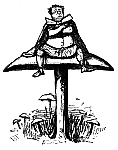
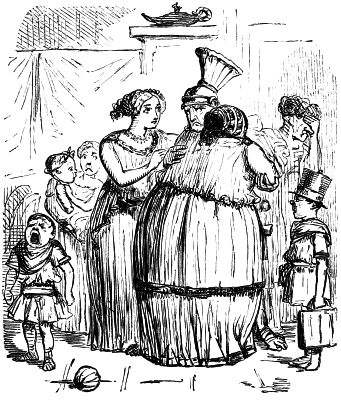
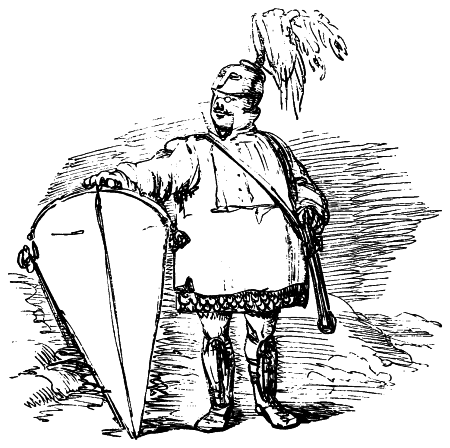
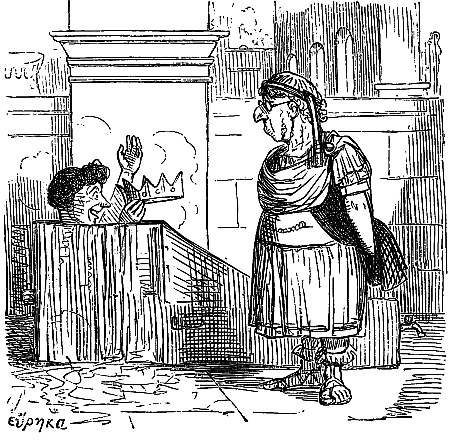
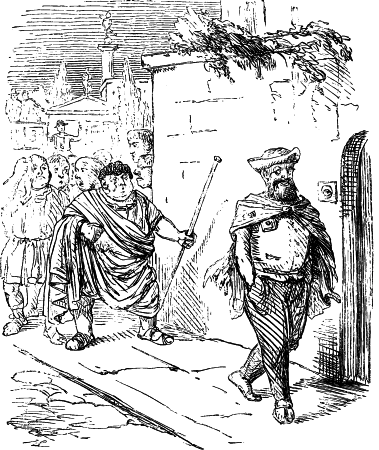
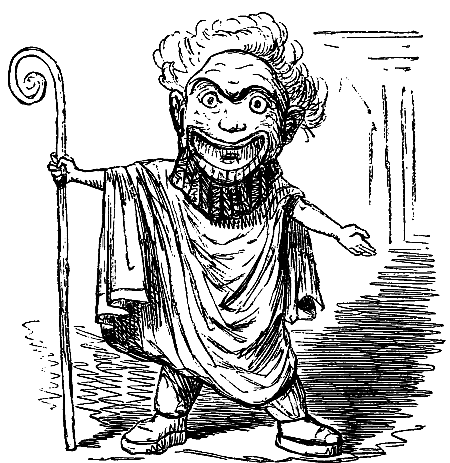
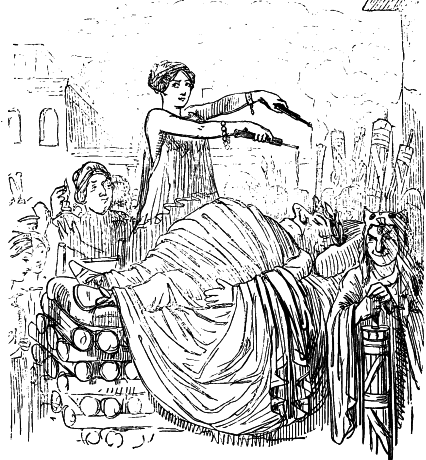
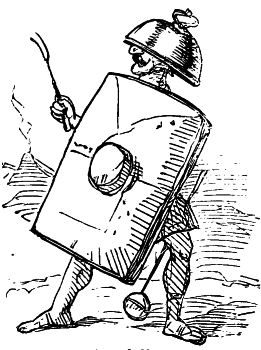
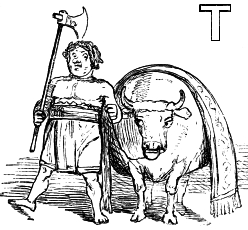
 Roman Bull and Priest of the period.
he Romans, being at peace
abroad, began to think of
improving the means of
quarrelling among themselves
at home, and a desire
for law reform became general.
Three senators had
been sent to Athens to collect
information, but what
they picked up in
Greece was so thoroughly
Greek to
them, that they were
obliged to get it
translated into Latin
by one Hermodorus,
an Ephesian refugee,
before they could
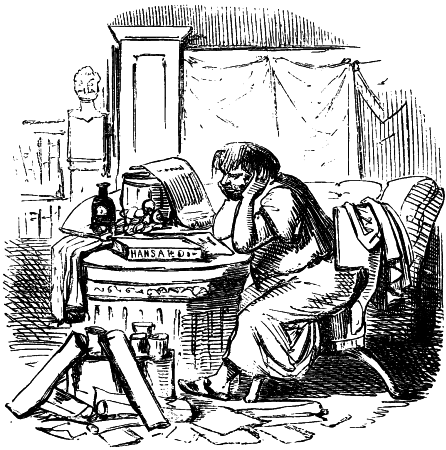
understand a word of it.[18] As one job naturally leads to another, it was
arranged that three commissioners having been employed in cramming,
the process of digesting should be entrusted to ten more, who were
called the Decemviri. These were appointed from the patricians, after a
struggle on the part of the plebeians to get five selected from their own
order; but, with a laudable regard to public order, they withdrew
their opposition. The especial object for which the Decemviri had been
appointed was to frame a new code of laws, but it seems to have been
always understood that the practical purpose of a commission is to delay
an object, quite as much as to further it. Lest the Decemviri should
proceed too rapidly with the work they had been specially chosen to do,
arrangements were made for distracting their attention from it by
throwing on them the whole business of Government. Had they been
modern commissioners of inquiry, they would have needed no excuse for
delay; but, with a stubborn resolution to get through their task, they
surmounted, or avoided, the obstacles they might have been excused for
stumbling at. Instead of making their administrative duties an interruption
to their legislative labours, and urging the necessity for
attending to both as a plea for the performance of neither, the commissioners
took the sovereignty in rotation for five days at a time, and
as ten rulers acting all at once would have kept nothing straight, this
arrangement for obtaining the strength of unity was altogether a
judicious one. At the expiration of their year of office the Decemviri
had completed a system of laws, which was engraved on ten tables;—a
proof of the industry of the Government of the day, for in these
times it would be hopeless to expect ten tables from those who might
be, at the same time, forming a cabinet.
Though the Decemviri had done enough to win the public favour,
they had left enough undone to afford a pretext for the prolongation of
their powers. It was suggested that though the ten tables were very
good as far as they went, there was room for two more; and to give an
opportunity for this small sum in addition being completed, the continuance
of the decemviral form of government was agreed upon. As
the time for the election approached, the most disgraceful election
intrigues were practised, and in order to disqualify Appius Claudius—one
of the former Decemviri—the patricians put him in the chair, or
elected him president, on the day of the nomination of the candidates.
Appius had for some time been acting the character of the
"people's friend," and he had shown himself a consummate actor, for,
being a tyrant by nature, he must have been wholly indebted to art for
appearing otherwise. Having been called upon to preside, he opened
the business of the day by proposing nine names of little note—including
five plebeians—and then, with an air of frankness, he suggested himself
as a fit and proper person to complete the number. The people—surprised
and amused at the coolness of the proposition—proceeded to
elect the very candid candidate, who, being joined with a number of
nonentities, formed the unit to the ten of which the rest composed the
cipher. Soon after their election, the new Decemviri proceeded to complete
the twelve tables—and as they formed the origin of the Civil Law,
embodying principles which the best jurists have been unable to improve—we
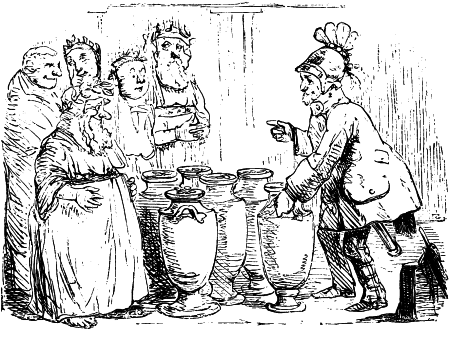
will spread these tables before the student, and ask him to sit
down with us for a few moments over them.
We cannot promise him any other than a dry repast, with little or
nothing to whet his curiosity; and unless his appetite for information
is extremely vigorous, there will be little to suit his taste on those
plates of bronze or ivory—the material is immaterial, and has been
variously described—on which the provisions we are about to serve up
were originally carved.
The first table coincided in some respects with our County Courts
Act, and furnished a cheap mode of bringing a defendant into court by
a simple summons, though if he refused to walk, a mule, an appropriate
type of obstinacy, was to be provided for him.
By the second table, it was justifiable to kill a thief in the night;
but a person robbed in the day was to have the thief as his slave;
a privilege equal to that of being allowed to take into your service, as
your page, the urchin who has just picked your pocket. Such an
exploit would no doubt indicate a smart lad, and, in order to make him
literally smart, the Roman law, in the spirit of our Juvenile Offenders
Act, ordered the knave a whipping.
The third table was in some respects an interest table; for it
prohibited the taking of more than 12 per cent. on a loan; but if a
debtor did not pay within thirty days, he might be bound with chains;
an arrangement by which his exertions to get out of difficulty must
have been grievously fettered. Having been made to enter into these
unprofitable bonds for sixty days, the debtor, if his creditors were
more than one, might have been divided between them; but human
nature must have found it difficult, under such circumstances, to declare
a dividend.
The fourth table seems hardly to have a sound leg to stand upon;
for it gave a father the right of life and death over all his children,
together with the privilege of selling them. To prevent a parent from
pursuing a disgraceful traffic in a series of alarming sacrifices of his
family stock, he was not permitted to sell the same child more than
three times over, when the infant was permitted to go into the market
on his own account, free of all filial duty.
The fifth table related to the estates of deceased persons; and if a
freedman died without a will or a direct heir, the law provided for the
distribution of his goods without providing for his family. Fallacious
hopes among poor relations were checked by handing over to the patron
all that remained; and thus the client may be said to have been subject
to costs, even after the debt of nature had been satisfied.
In the sixth table, there is nothing worthy of remark; but the
seventh guards against damage done by quadrupeds, and not only meets
the old familiar case of the donkey among the chickens, but declares
that any one wilfully treading on a neighbour's corn shall pay a suitable
penalty.
Agriculture was protected by making it a capital offence to blast by
incantation another's wheat; so that had the farmers of the day moaned
over each other's ruined prospects as they have done in more recent
times, performing a sort of incantation by singing the same old song of
despair, they might have been liable to lose their heads in the literal
as well as in the intellectual sense of which the phrase is susceptible.
By the same table, a man breaking another's limb was exposed to
retaliation; and a simple fracture was compensated by a simple fracture,
though the parties were allowed to compound if they preferred doing so.
The eighth table was equivalent to a Building Act; and by providing
a space of two feet and a half between house and house, it prevented
collisions among neighbours; while the fruit dropping from one person's
tree into another's garden, fell by law into the hands of the latter.
The purity of justice was provided for by the ninth table, which
ordered the execution of a judge who accepted a bribe in the execution
of his office. It inflicted the same penalty on a corrupt arbitrator, or—that
greater traitor still—the wretch who should deliver up a Roman
citizen to the enemy.
The tenth table might teach a lesson to our own enlightened age, in
which it is too generally the custom to waste in hollow and costly ceremonies
over the dead, much that might be made serviceable to the
living. More than twenty centuries have passed since the Roman law-makers
seeing how mourners might be caught by the undertakers in
the traps and trappings of woe, limited to a certain sum the costs of a
funeral. The outlay upon the "infernal deities," to whom sacrifices
were made in those days, and to whom, therefore, we may compare the
black job-masters of our own time, was also reduced to the very lowest
figure. In measures of health the Romans were equally in advance of
us; for we still accumulate our dead in the grave-yards of our towns,
though by the laws of the twelve tables, burials within the city were
prohibited.
The eleventh and twelfth tables have come down to us in such mere
fragments, that it is difficult to make up an entire leaf from both of
them put together. To the eleventh, is attributed the aristocratic
provision against marriages between the patricians and the plebeians;
but as the law could not always prevent a flame, it was at last found
expedient to allow a match which was permitted five years later by the
Lex Canuleia.[19]
Such is a brief account of the Laws of the Twelve Tables; which
although cut up by the shears of time into very little bits, say much,
in broken sentences, to the honour of their authors. Even as late as
the days of Cicero, it was a part of a boy's education to learn these
laws as a carmen necessarium—or necessary verse—though they were
not necessarily in verse at all; for the better opinion is, that they were
all in prose, and that they were, in fact, as free from rhyme as they
were full of reason.
The Decemvirs had now completed their allotted task; but, though
elected for a limited time, they seemed determined to remain in their
offices after their office hours were fairly over. During the first
Decemvirate the members had taken the Government alternately for
twenty-four hours at a time, on the principle of every lucky dog having his
day: but now the whole ten assumed, at once, the insignia of royalty.
Unable to resist the fascination of the fasces, the Decemvirs were each
of them preceded, when they walked abroad, by a bundle of those
imposing sticks; the sight of which, at last, aroused public attention to
the number of rods that might be in pickle for the backs of the people.
Murmurs at home were echoed by rumours of war abroad; the
Æquians and Sabines had renewed their hostility; and the Decemvirs,
who could not levy troops or money, summoned the country gentlemen
from their seats out of town to their seats in the senate. Many
honourable members protested strongly against the Government, but
agreed to the necessary supplies; from which it seems that the practice
of speaking one way and voting another is a very ancient one. The
Decemvirs stuck to their places with an adhesiveness that might suggest
a comparison with Roman cement, but for the fact that the adhesiveness
is not uncommon in modern times, though the secret of the Roman
cement has perished. Armies were despatched to meet the foe, the people
having met the expenses, and Appius remained at home with one of his
colleagues. The Roman forces abroad had to contend with internal as
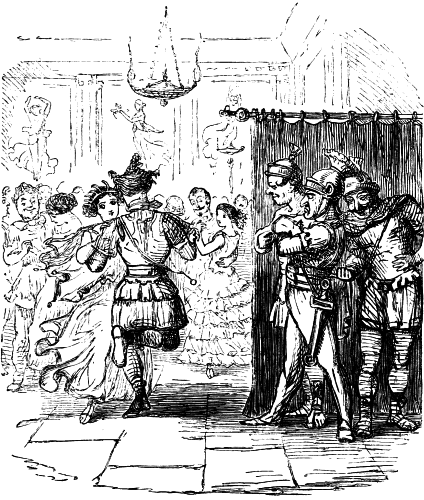
well as external enemies; for a venerable, but too garrulous soldier, one
Dentatus, called also Siccius, was constantly declaring himself heartily
sick of the tyranny of the Decemvirs. He had even talked of another
secession of the plebs; and, to prevent him from taking himself off, a
plan was formed to cut him off by a summary process. He received
orders from his superior officer to go up the country, with a few others, and
select a spot where a tent might be pitched, in the event of a pitched
battle. His companions were assassins in disguise, who, on arriving at
a lonely spot, threw off their masks, and appeared in their true features.
They immediately fell upon the astonished Dentatus; who must have
seen through his assailants before he died, for many were found
perforated with the sword of the veteran.
While the rest of the Decemvirs were disgusting the people by
their tyranny, Appius was proceeding to render himself one of those
objects of contempt at which not only the Roman nose, but the nose
of all humanity, was destined to turn up, and at which scorn was to
point her imperishable finger-post.
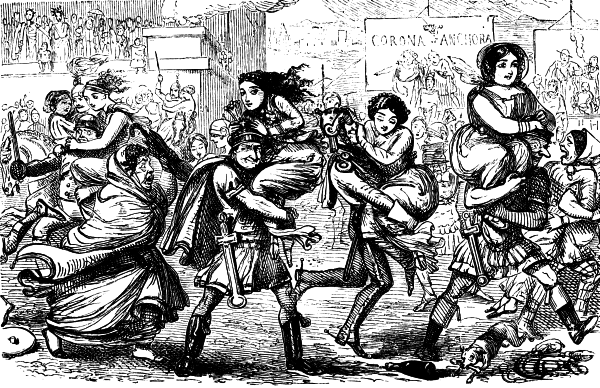
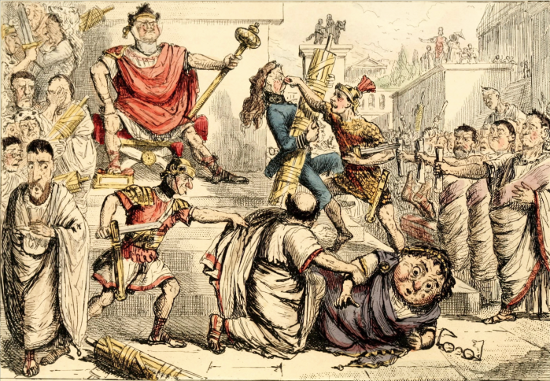
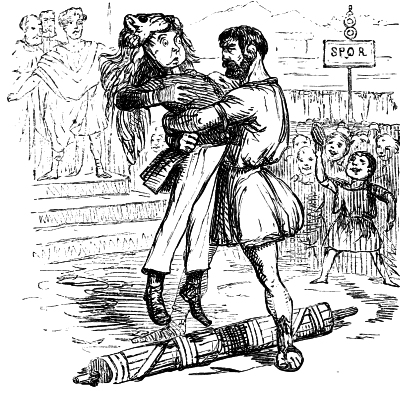
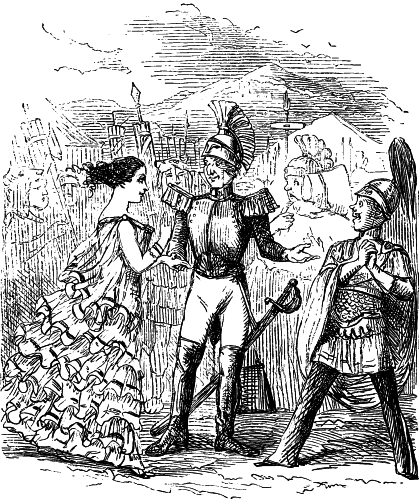
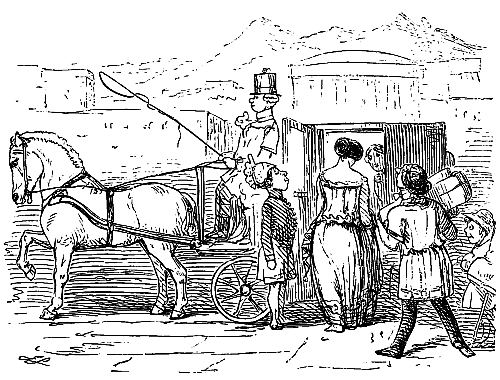
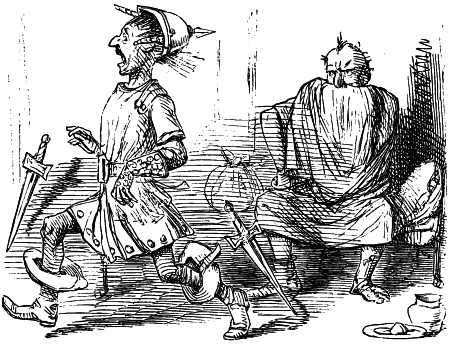
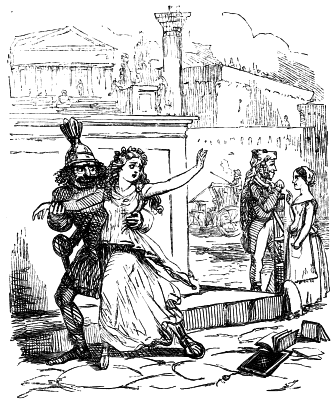 Virginia carried off by a Minion in the pay of Appius.
A centurion, named Virginius, had an only daughter, named Virginia,
whom her father, with a want of caution pardonable, perhaps, in a
widower, permitted to go backwards and forwards alone through the
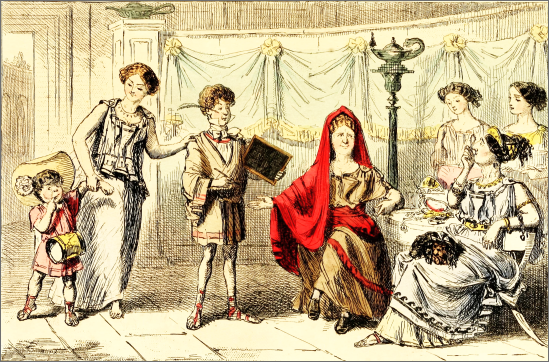
public streets to a private day-school.[20] The young lady, in all the playful
innocence of sixteen, was in the habit of dancing and singing along the
thoroughfare, when the smallness of her feet, and the beauty of her voice,
struck the eye and ear of Appius. According to some authorities,
Virginia was attended by a nurse-maid; but it is scarcely necessary to
remark, that the same fatal fascination, which in military neighbourhoods
attracts female attention from children that ought to be, to men that are,
in arms, was no less powerful in the Via Sacra than in Rotten Row,—by
the banks of the Tiber, than on the shores of the Serpentine. One
morning, as Virginia was passing through the market-place, on her way
to the seminary, with her tablets and school-bag—or more familiarly
speaking, her slate and satchel—on her arm, a minion, under the
dominion of Appius, seized an opportunity for seizing the maiden by the
wrist. The nurse was either absent, or more probably talking to one
of the officers on duty round the corner; for the fasces were as irresistible
to the female servants of the day, as the honied words and
oilskin capes of a similar class of officials at a much later period.
Virginia screamed for assistance, and they only who have heard the cry
of a female in distress, can imagine the shrillness of the shriek that
rang through the market. Marcus—for such was the minion's name—was
instantly surrounded by a circle of respectable tradesmen, who knew
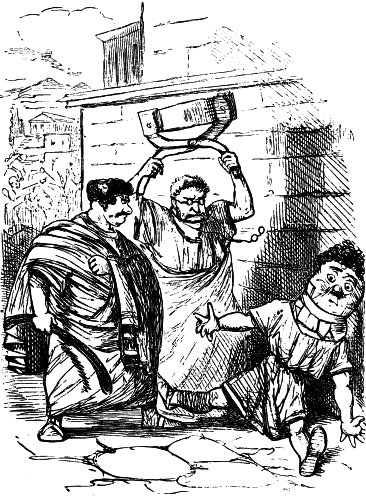
and desired to rescue Virginia. The smith, though he had other irons
in the fire, left his bellows to deal Marcus a blow; the butcher, with
uplifted cleaver, was preparing a most extensive chop; and the money-changer
was just on the point of paying off the ruffian in a new kind of
coin, when he declared Virginia to be his slave, and announced himself
as the client of the dreaded Appius. At this formidable name, the
smith's work seemed to be done, the butcher became a senseless block,
and there was a sudden change in the note of the money-changer.
The officer on duty, who had arrested the attention of the nurse,
being at length called away by some trifling charge, had left her
at leisure to look after the more precious charge with which she had
been entrusted. As those usually talk the loudest who do the least,
the remonstrances of the female attendant were, no doubt, vehement
in proportion to her neglect; and, indeed, the confusion created by the
shrieks of the nurse was rather calculated to draw off the attention of
the crowd from Virginia herself, who was carried away by Marcus, with
an intimation that he should at once take the case before a magistrate.
Among the other consequences of the neglect of the maid, was an
attachment that had sprung up between the day-school miss and a
young gentleman, named Icilius. This impetuous youth, having heard
of what had happened, proceeded to the court at which the case was
about to come on, and which was presided over by the tyrant Appius.
Icilius prayed for an adjournment, on the ground of the absence of the
young lady's father; and it was found impossible to resist the application
of such an earnest solicitor. This point having been conceded,
the friends of Virginia applied for her admission to bail; and there was
such a general tender of securities among the throng, that Appius felt
he could not calculate on his own security if he refused the request
that had been made to him. The next morning the matter again came
on, in the shape of a remanded case; and Virginius, who had been on
duty with his regiment the day before, was now present at the hearing.
Had there been in those days the same love of the horrible that has
prevailed in our own times, the startling incident of a girl killed by her
own father, would have probably come down to us, through the medium
of the fullest reports, amplified by "other accounts," and a long succession
of "latest particulars." We must, however, on the present occasion,
be satisfied with the merest summary; for the Romans, in the
time of Appius, were equally destitute of relish for the details of the
spilling of blood, and of "family Sunday newspapers," whose respectable
proprietors are always ready to avail themselves of a sanguinary affair,
with an eagerness that seems to show that they look upon blood as
essential to the vitality of a journal, and involving the true theory of
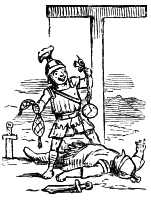
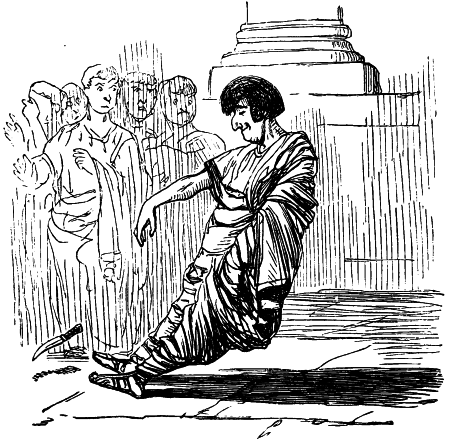
the circulation. It remains only to be told, that Virginius, after taking
leave of his daughter, and finding her escape from the power of Appius
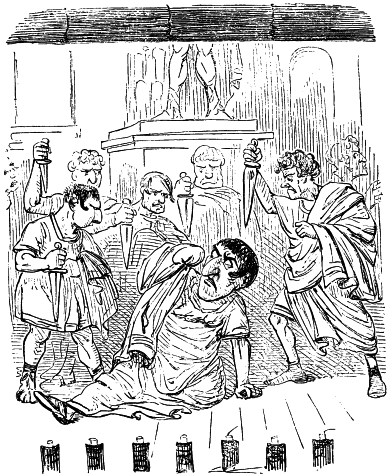
impossible, stabbed her with a knife, snatched up from a butcher's stall,
and, brandishing the weapon in the air, threatened perdition to the
tyrant. Appius, at the sight of the blood-stained steel, felt his heart
fluttering, as if affected by magnetic influence; and losing, for the time,
his own head, he offered ten thousand pounds of copper for that of
Virginius.[21]
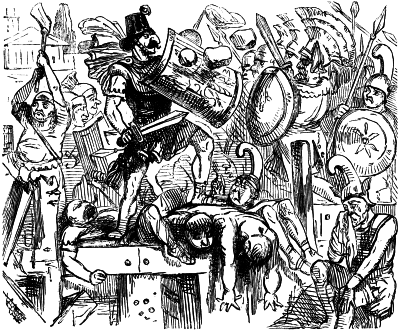
It is the common characteristic of a moving spectacle to strike every
one motionless; and the guards of Appius, when ordered to seize Virginius,
found themselves fixed to the spot by so many stirring incidents.
In vain did Appius call upon his clients and his lictors to do their duty.
Among all his numerous attendants there was not a sole but shook in
its shoe, while the tyrant trembled from head to foot with bootless
anger. Urged at length by the commands of Appius, the officers
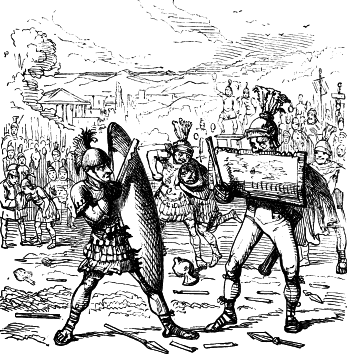
attempted to clear the spot, when a severe scuffle ensued, and
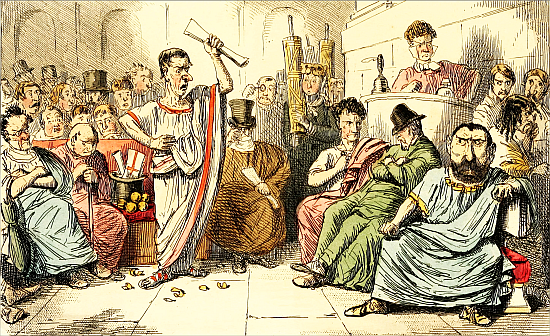
the authorities were assailed with all sorts of missiles. The market-place
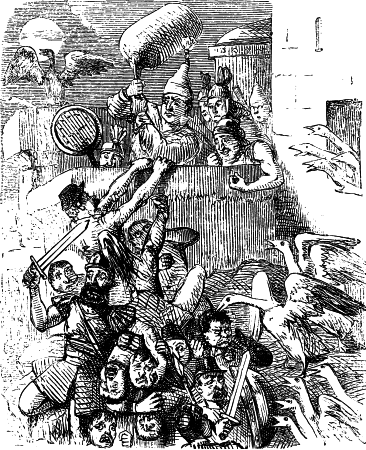
supplied abundance of ammunition. Ducks and geese flew in all
directions. Some of the lictors found calves' heads suddenly lighting
on their shoulders. Others, who were treated, or rather maltreated,
with oysters, suffered severely from an incessant discharge of shells, and
many received the entire contents of a Roman feast, ab ovo usque ad
malum,—from the assault and battery of the egg, to the malum in se
of a well-aimed apple. The stalls of the dealers in vegetables were
speedily cleared of their contents; and a trembling lictor, smothered—like
a rabbit—in onions, might be seen, trying to creep away unperceived,
while others, who were receiving their desert in the form of
fresh fruit, fled, under a smart shower of grape, from the fury of the
populace. At length, the stock of the market being exhausted, the
assailants had recourse to stones; and Appius, feeling that he was
within a stone's throw of his life, entreated the lictors to remove him
from the scene of danger. Four of the stoutest of his attendants,
hoisting his curule chair on to their shoulders, made the best of their
way home, where Appius at length arrived, with the apple of his eye
damaged by a blow from a pear, his mouth choked with indignation and
mud, his lips blue with rage and grape juice, his robe caked with confectionary,
and his head, which had been made spongy with the loaves
thrown at it, affected with a sort of drunken roll.[22] Such is the melancholy
portrait which historical truth compels us to draw of the unhappy
Appius, for whom, however, no pity can be felt, even though his case
and his countenance presented many very sad features. The assault in
the market-place must have rendered it difficult for an artist of the day
to have taken his likeness, after the carrots, whirling about his head,
had settled in his hair, the rich oils having given to his Roman nose a
touch of grease, and the eggs thrown by the populace, who continued to
egg each other on, having lengthened his round cheeks into an oval
countenance.
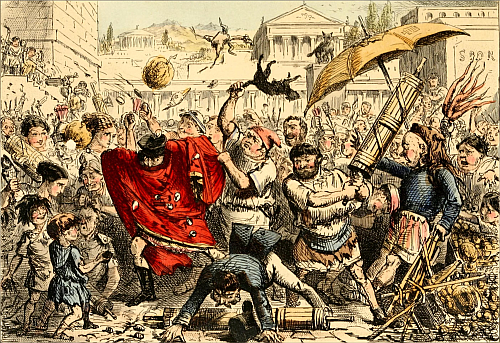 Appius Claudius punished by the People.
Having gained his palace, the wretched tyrant ran up stairs, in the
hope that he might save himself by such a flight; but he was overtaken,
and thrown into gaol, where he, who had hitherto been permitted to do
precisely as he pleased, was allowed just rope enough to hang himself;
a process, it is believed, he performed, though the subject is so knotty,
that we are not prepared to disentangle it.
Virginius had returned to the camp, where the soldiers, having heard
of the fall of the decemvir, proceeded to hit him, as usual, when down,
renouncing the authority of Appius and his colleagues. The valour of
the insurgents was, however, of a negative kind; for in times of danger
they seemed to think absence of body better than presence of mind, and
their policy was to secede from the city. They withdrew to the Sacred
Mount, where ambassadors from the Senate were sent after them, to see
if matters might not be arranged; when the popular chiefs, with a sort
of one-sided liberality, in which some friends of freedom are too apt to
indulge, asked an amnesty for themselves, and the immediate putting to
death of the whole of the late government. The ambassadors, not
liking a precedent, which might be applied to succeeding administrations,
of which themselves might form a part, suggested the propriety of
trying the decemvirs first, and executing them, if necessary, afterwards.
It was some time before the friends of freedom and justice could bring
themselves to consent to the trial preceding the punishment; but upon
being assured that the decemvirs would have little chance of escape, it
was at length agreed to allow them the preliminary forms of a trial.
The plebeians having got the upper hand, became almost as intolerant
as the tyrants they had displaced,—a common error, unfortunately,
among the professing lovers of liberty. They demanded that the
Tribunes should be restored, which was well enough; that the Tribunate
should be perpetual,—which was an insolent and overbearing interference
with the will of any succeeding generation; and, by way of
climax, they required that any one suggesting the abolition of their
favourite office should be burnt as a traitor. They were no doubt
fully justified in having a will of their own, but they had no authority to
entail that will upon a subsequent age; and least of all had they the
right to make bonfires of those who were of a different way of thinking.
It is true that, at such a moment, few are willing to put their lives
literally at stake, by uttering their opinions; but these arbitrary pranks,
so frequently committed in the name of freedom, account sufficiently for
the frequent use of the words "more free than welcome." The truth
is, that when Liberty becomes a notorious public character, she seems
to disappear from private life; and, indeed, how is she to be found at
home, if she is occupied out of doors, knocking off the hats of those who
will not give her a cheer, or breaking the windows of those who will not
illuminate in her honour?
The plebeians having gained the permission of the Senate to hang
and burn to their hearts' content all who might give way to difference of
opinion, under the weak-minded impression that it would never alter
friendship, proceeded to the election of Tribunes in place of the Decemvirs,
who were thrown into prison. This is said to have been the first
instance of the incarceration of any one belonging to the patrician order;
and the sensation in the upper circles was immense when they heard
that a few exclusives of their own set were in actual custody. Some
aristocratic families went into mourning on the melancholy occasion, and
offered any fine, as a matter of course, for the release of their kindred.
Appius Claudius and Spurius Appius—probably an illegitimate
member of the family—were thrown into the same cell, where, it is
said, they made away with themselves or each other; but whether there
is any truth in this story of the cell, or whether it is merely a cellular
tissue of falsehood, it is difficult to decide, after so long an interval.
The eight remaining Decemviri went into exile, or, in other words, were
transported for life; while Marcus Claudius, who had claimed Virginia,
repaired to Tibur, now Tivoli, and may be said to have taken his
conscience out to wash in the famous baths of the neighbourhood.
Other authorities say that he fled to avoid the ironing for life with
which he had been threatened, or that he feared the mangling to which
he might be exposed at home, at the hands of the infuriated populace.
Consuls had already been elected, in the persons of L. Valerius and
M. Horatius; but ten Tribunes were now chosen, among whom, of
course, were the leaders in the revolution; for it is a popular notion,
that those who have overthrown one government, must necessarily be
the fittest persons to construct another. It is, however, much easier to
knock down than to build up; and those who have shown themselves
extremely clever at bowling out, are often bowled out rapidly in turn,
when they get their innings.
It is a characteristic of nations, as well as of individuals, that those
who have no affairs of their own immediately on hand, are apt to concern
themselves with the affairs of their neighbours. The Romans having
arranged matters among themselves, began to look abroad, and having
rid themselves of domestic foes, they sent their Consuls, L. Valerius
and M. Horatius, to deal with foreign enemies. Valerius seized upon the
camp of the Æqui, just as they were canvassing their prospects under
their tents; and Horatius, after routing the Sabines, made them free of
the city; thus converting into respectable tradesmen those who had
been hitherto extremely troublesome customers.
When the Consuls returned to Rome, they expected the Senate
would pay them the usual compliment of a triumph; and instead of
entering the city at once, they put up at the temple of Bellona, outside
the walls, waiting for orders. The patricians, who were jealous of the
generals, thought to deprive them of the customary honours, by a low
trick; but the tribes dealing more fairly with the warriors, or, to use a
familiar expression, lending them a hand, decreed the triumph which
the Senate had denied to them. Thus did the patricians lose a privilege
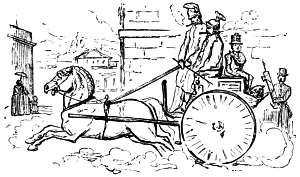
they had abused; and the two Consuls drove four-in-hand into the city
in spite of them.
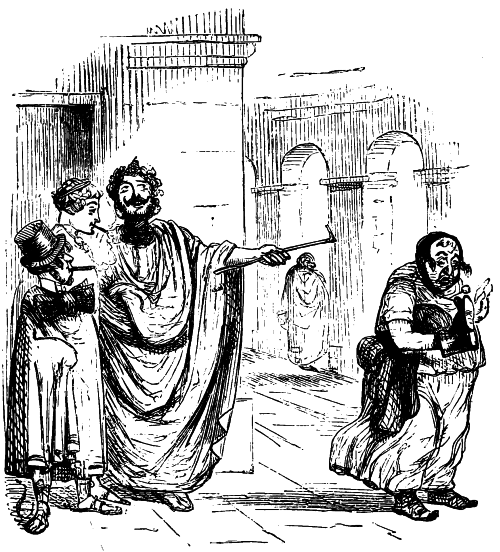
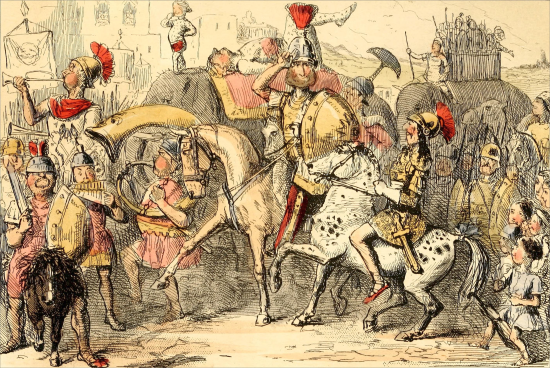
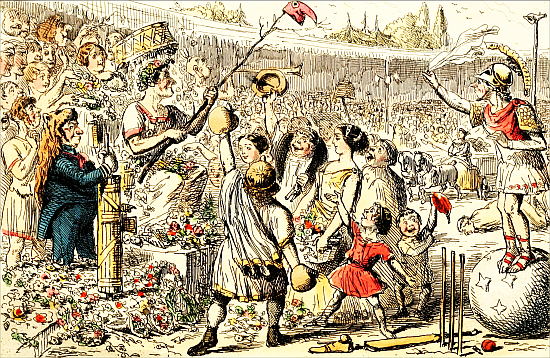
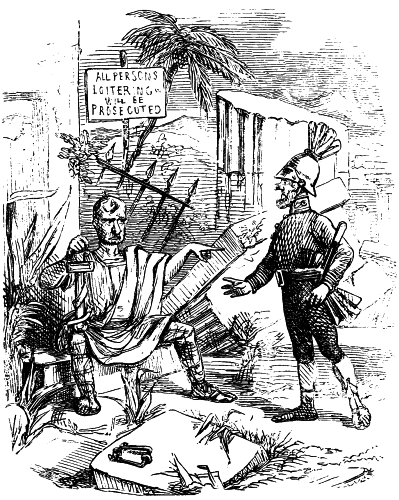
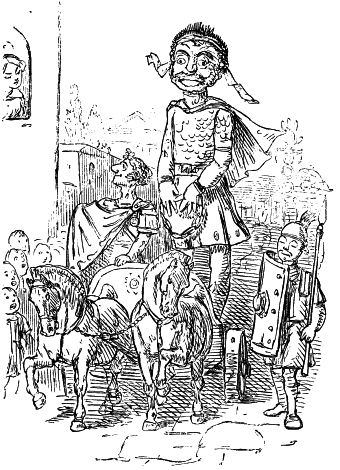
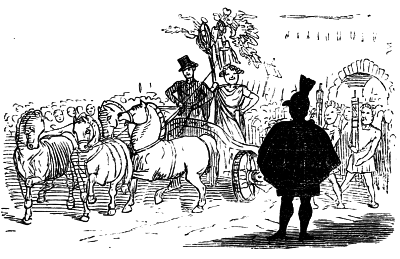 In the foreground of the Tableau may be observed a Patrician looking very black at the
Triumph of the General.
In the foreground of the Tableau may be observed a Patrician looking very black at the
Triumph of the General.
In modern times, the nearest approach we have to a triumph is the
entrance into a country town of a company of equestrians, or a travelling
menagerie. The arrangements were in many respects suitable to a
fair, and it would seem to have been the opinion of the Romans that
none but the brave deserved the fair, for it was only the most eminent
warriors who were awarded the honours of a triumph. There was,
however, something very undignified in the practice of hanging about
the outskirts of the town until regularly called in, which was the usual
course adopted by those who anticipated the glory of a summons from
the senate. It sometimes happened that the summons never arrived,
and the General, who had hoped to make his entry in a chariot and
four, was at last compelled to sneak, unattended, into the city. Such
might have been the lot of L. Valerius and M. Horatius, had it not
been for their popularity, aided, probably, by the senseless love of show,
which often causes the hero to be degraded into the mountebank. As
triumphs, like Lord Mayors' shows, were nearly all the same, the following
account will comprehend, or lead the reader to comprehend, the
general features of these military pageants.
The procession opened with a band of trumpeters, and as much
breath as possible was blown out of the whole body. Next came
some men with boards, inscribed with numerous achievements, and
forming, in fact, the posting bills, or puffing placards, of the principal
character. These were followed by a variety of objects, taken from the
enemy, and may be compared to the properties used in the show, the
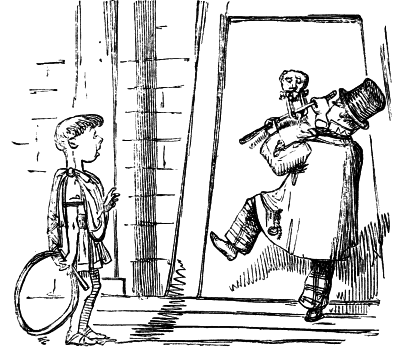
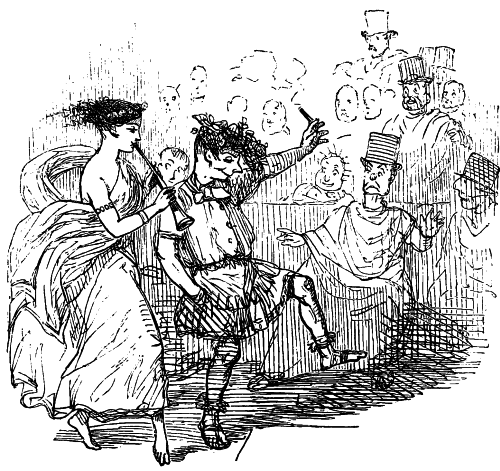
next feature of which was a file of flute-players, who walked in a sort of
fluted column. Next in order came the white bulls, or oxen devoted
for sacrifice, accompanied by the slaughtering priests, or holy butchers;
and immediately afterwards a remarkable beast, odd fish, or strange
bird, that had been snared, hooked, or caged, in the conquered country.
These were followed by the arms of the foe, with as many captives as
possible, in chains, and the larger the string of fettered victims, so
much the greater was the amount of "linked sweetness, long drawn out"
before the eye of the conqueror. After these were carried the gifts the
General had received from allied or friendly powers, consisting usually
of crowns made of grass, every blade of which was a tribute to the
sword of the victor. Next came a file of lictors, and then the General
himself, in a chariot and four, with a slave on the footboard behind,
whispering in his ear, to remind him of his being still "a man and a
brother."
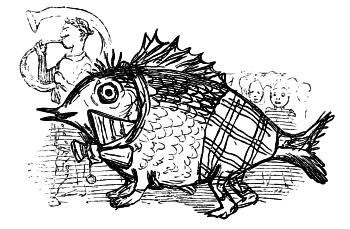 In all probability something of this sort.
The Consuls having gained a civil as well as a military triumph, by
their defeat of the patricians, would have been re-elected by acclamation
for another year; but they had the good sense to retire upon the popularity
they had gained, without waiting to become bankrupt of that very
fleeting commodity. The patricians, getting tired of an exclusiveness
which seemed likely to exclude them from real power, condescended to
vie with the plebeians as candidates for the office of Tribune. They
judiciously came to the conclusion that it was better to cast their pride
under foot, than to stand too much upon their dignity; and the result
was, that, by the election of two of their order, they obtained a voice in
the new government.
Popular measures were now the order of the day; and C. Canuleius,
one of the tribunes, brought in a bill to legalise the connubium
between the Patres and the Plebs, so that the fathers of the senate
might marry the daughters of the people. This proposition for an
enlargement of the connubial noose gave rise to several very knotty
points, and to much opposition on the part of the patricians. The
greater number of them believed themselves to be the essence of all
that was rare and refined, until the more sensible portion of them
perceived that the essence was growing rarer every day, and that unless
it formed a combination with something more solid, it would all very
soon evaporate. The law was accordingly allowed to pass; and by the
timely application of some common clay, the roots of aristocracy were
saved from the decay that had threatened them. Many of the
patricians, who had long been wedded to old prejudices, found it far
more agreeable to be married to young plebeians; and matrimony was
contracted, or, rather, greatly extended, among the different classes of
society.
The Reform party had now become strong enough to propose that
one of the consuls should always be a plebeian; and though the Senate
tried very hard to maintain the principle, that those only are fit for a
snug place who have been qualified by a good birth, the tide of opinion
had set in so strongly the other way, that it was hopeless, with the
thickest sculls, to pull against the current.
Tribuni militum, with the power of consuls, were instituted; but
the patricians managed, by a trick, to reduce these consuls into a sort
of stock for their own use, by selecting from their own body two officers
named Censors, who were to be employed in taking the census, an
extremely important part of the consular authority. The mere
enumeration of the people was not of itself a high privilege, and
required no acquaintance with the law, or of any of the twelve tables,
excepting, perhaps, the simple tables of arithmetic. Besides the
privilege of looking after the numbers of the people, the office gave
especial opportunities of looking after number one; for the administration
of the finances of the state was committed to the Censor;[23] and it has too
often happened that a collector of duties has considered that there was
a duty owing to himself, out of those received on behalf of the Government.
They were also Commissioners of the Property Tax, with full
inquisitorial powers; but, most odious part of all, they had authority
to ascertain the dates of the birth of females, as well as males, and
could mercilessly surcharge a lady for her age, as well as her husband
for his income. They were also controllers of virtue and morality, their
duty being to maintain the mos majorum, or manners of the old school;
for it seems to have been always the custom of mankind to lament the
past as "the good old times," no matter how bad the old times may
have been, and how infinitely inferior to the present.
The Censors, however, derived their chief influence from their power of
determining the rank of every citizen; for, from the very earliest times,
the multitude were in the habit of pursuing, through thick and thin,
that perilous Will o' the Wisp—a wisp that reduces many a man of
substance to a man of straw—a position in society. This the Censors
could award; and people were ready to pay any price for that most
costly of all stamps—though perhaps, after all, the most difficult to
purchase—the stamp of fashion. From the early days of Rome to the
present hour, we meet with frequent counterfeits of the stamp in
question, the forgery of which has spoiled, and continues to spoil, a
quantity of calves' skin, and asses' skin, that might otherwise be found
of service, at least to its owners.
Rome had begun to enjoy a short repose, like an infant in its cradle,
when it was unexpectedly made to rock to its very foundations, by a
shortness of provisions; for the absence of anything to eat is sure to
afford food to the disaffected. Grumbling is the peculiar attribute of an
empty stomach; and flatulence, caused by hunger, is an ill wind, that
blows good to nobody. During the scarcity, a wealthy citizen, one
Spurius Maelius, anxious to give his fellow-citizens a genuine meal,
purchased corn at his own expense, and sold it for a mere song—taking
the produce, perhaps, in promissory notes—to his poorer countrymen.
This liberality rendered Maelius extremely popular with all but the
patricians, who declared that they saw through his design in selling
cheap corn; that as old birds they were not to be caught with chaff:
and that his real aim was the kingly dignity. Under the pretext of
preventing him from accomplishing this object, the patricians appointed
a Dictator; and poor old Cincinnatus, bowed down with age and agriculture,
which had been his natural bent, was dragged from the tail of the
plough to the head of the state, though his own state was that of
extreme bodily decrepitude. His Master of the Horse, who really held
the reins, was Servilius Ahala, by whom Maelius was summoned before
the Dictator, to answer any charge that might be brought against him.
If the mode of making the accusation was strange, the method of
answering it was equally irregular; for Maelius, instead of meeting it
with dignity, ran away from it, with a butcher's knife, which he snatched
from a stall in the market-place. Flourishing the formidable weapon,
he cut in among the crowd, and was immediately followed by Servilius
Ahala, with a party of young patrician blades, who, in a manner that
would have pierced a heart of stone, plunged their swords into their
victim's bosom.
Ahala was charged with the murder, but he was enabled to avoid the
consequences, as men of consequence in those days could do, by a
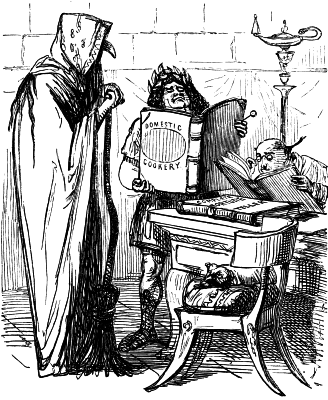
voluntary exile. Though domestic cookery had received a check from
the dearth at home, there was no scarcity of foreign broils, and the
Romans created Mam. Æmilius dictator, to encounter the Fidenates
and Veientines. Three ambassadors were sent to Fidenae, but the
diplomatic service could not have been so desirable in those days as in
our own, for the three ambassadors were slain, and perhaps the financial
reformers would say that it was very proper to cut down such a piece
of gross extravagance. The order emanated from Lar Tolumnius of
Veii; and while it said little for his heart, it cost him his head, which
was cut off by Cornelius Cossus—the master of the horse to Æmilius.
The Veientines continuing troublesome, Furius Camillus was appointed
dictator, when, with an engineering talent rare in those days,
he commenced a mine, and overcoming all minor, as well as major, or
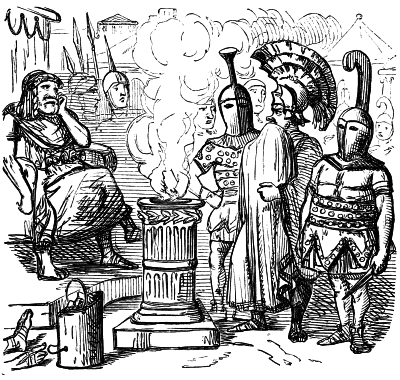
general difficulties, he forced a way into the city. The King of Veii
was offering a sacrifice in the Temple of Juno, just as the Romans had
completed their tunnel, and as the soldiers burst like a crop of early
champions through the earth, he saw his fate written in bold Roman
characters. Everything was given to the conquerors, and it is said that
the statue of Juno, followed of its own accord; but the probability is,
the statue remained in statu quo, for miraculous instances of going
over to Rome were not in those days numerous.
Rome was once more at peace, when the citizens, with peculiar ingratitude,
having no other foes, began to quarrel with Camillus himself,
to whom they owed their tranquillity. They accused him of having
unduly trafficked in shares, by appropriating more than his due portion
of the booty. His unpopularity had not, however, come down upon him
until it was found that he had, in a fit of piety, dedicated a tenth of the
spoils of Veii to the Delphic God—a circumstance he had forgotten to
mention, until he had disposed of the whole of his own share of the prize,
and it became necessary for the other participators in the plunder to
redeem his promise at their own cost, and, with their own ready money,
to save his credit. His name fell at once from the highest premium of
praise to the lowest discount of disparagement, and he incurred the
especial detestation of those whom he had served; for kindnesses are
often written in marble in the hearts of those who remember them
only to repay them with ingratitude. Not liking to lie under the imputation
of dishonesty, and being unable to get over it, he chose a middle
course, and passed a sort of sentence of transportation upon himself by
going into voluntary exile. He, however, with a littleness of mind that
was not uncommon among the early Romans, vented his spite as he
left the city gate, expressing a wish that Rome might rue his absence;
but Rome consoled herself for the loss she might sustain in him by
confiscating the whole of his property.
Among the incidents of the life of Camillus, a story is told of an
event that happened, when, after having subdued the Veientines, he
drove the Faliscans out their city of Falerii. There existed within
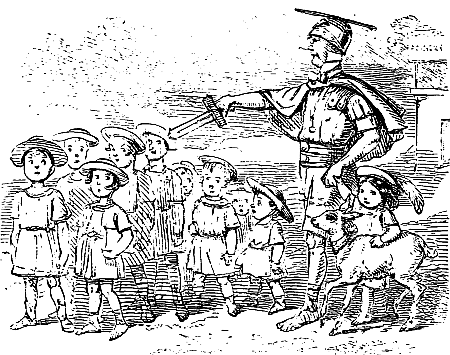
the walls a fashionable boys' school, to which the patricians sent their
sons, who were frequently taken out walking in the suburbs. One
morning the pupils, who were two and two, found themselves growing
very tired one by one, for their promenade had been prolonged
unusually by the pedagogue. The wretch and his ushers had, in
fact, ushered the unsuspecting infants into the camp of Camillus, with
an intimation that the parents of the boys were immensely opulent, that
the schooling was regularly paid, and there could be no doubt that a
rich ransom could be procured for such a choice assemblage of fathers'
prides and mothers' darlings. Camillus nobly answered, that he did
not make war on young ideas not yet taught to shoot, and he concluded
by giving the schoolmaster a lesson; for, causing him to be stripped, and
putting a scourge into the hands of the boys, the young whipper-snappers
snapped many a whip on the back of their master.
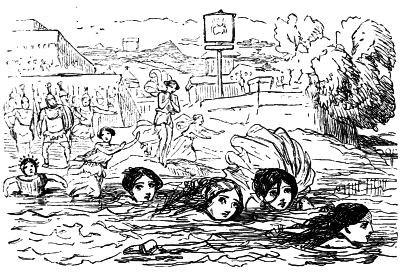
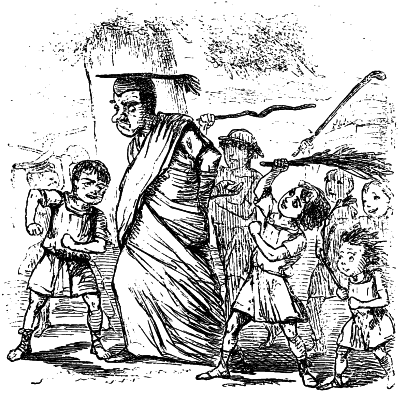 School-boys flogging the Schoolmaster.
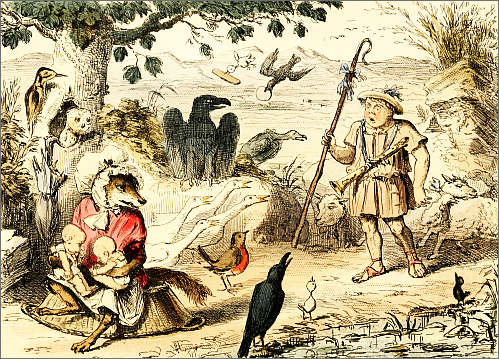 Romulus and Remus discovered by a gentle shepherd.
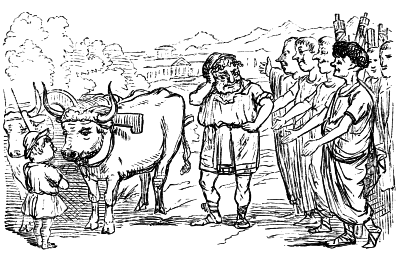
 Romulus accordingly commenced drawing
his plans in the Etruscan fashion, by causing a boundary line to be
marked out with a plough, to which were yoked a heifer and a bull, a
ceremony from which, perhaps, the English term bulwarks, and the
French word boulevards or bulvards, may or may not be derivable. The
line thus traced was called the Pomœrium, and where an entrance was
to be made, it was customary to carry the plough across the space—a
little engineering difficulty that gave the name of Porta to a
gate, from the verb portare, to
carry.
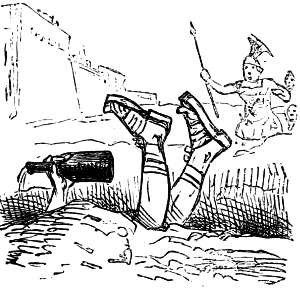
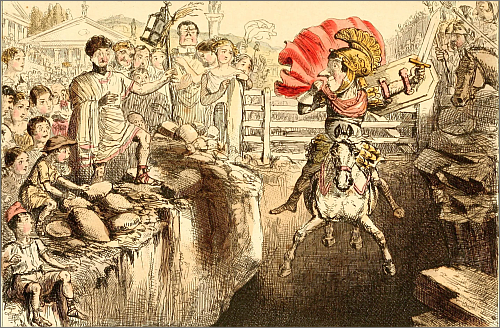
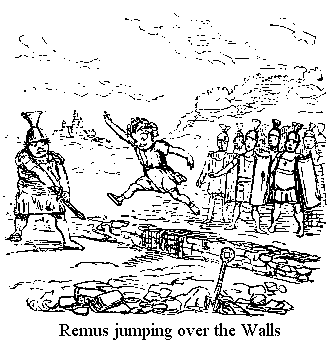
Remus looked on at the
proceedings in a half-quizzing,
half-quarrelsome spirit, until the
wall rose a little above the
ground, when he amused himself
by leaping derisively over
it. "Thus," said he, "will the
enemy leap over those barriers."
"And thus," rejoined the superintendent
or clerk of the works—one
Celer, who acted in this instance
with thoughtless celerity—"thus
shall die whoever may
leap over my barriers."
Romulus accordingly commenced drawing
his plans in the Etruscan fashion, by causing a boundary line to be
marked out with a plough, to which were yoked a heifer and a bull, a
ceremony from which, perhaps, the English term bulwarks, and the
French word boulevards or bulvards, may or may not be derivable. The
line thus traced was called the Pomœrium, and where an entrance was
to be made, it was customary to carry the plough across the space—a
little engineering difficulty that gave the name of Porta to a
gate, from the verb portare, to
carry.
Remus looked on at the
proceedings in a half-quizzing,
half-quarrelsome spirit, until the
wall rose a little above the
ground, when he amused himself
by leaping derisively over
it. "Thus," said he, "will the
enemy leap over those barriers."
"And thus," rejoined the superintendent
or clerk of the works—one
Celer, who acted in this instance
with thoughtless celerity—"thus
shall die whoever may
leap over my barriers."