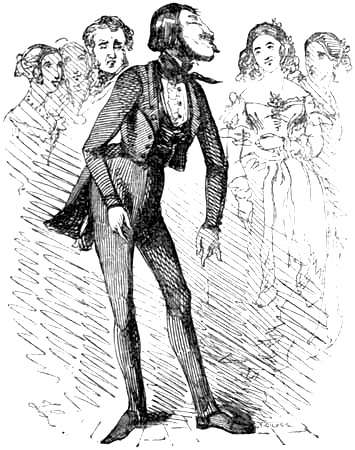
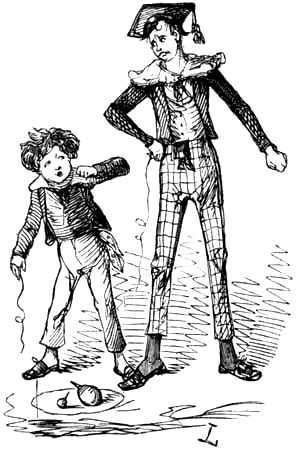
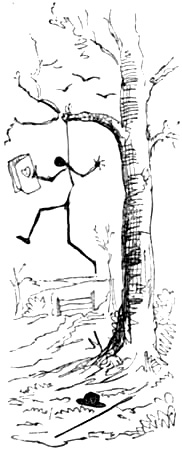
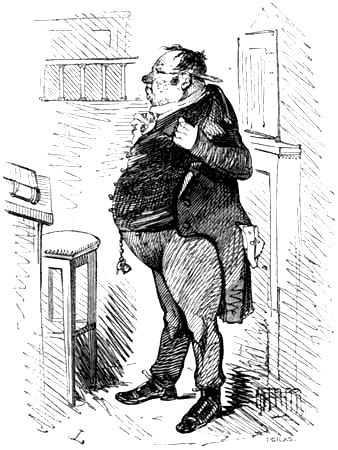
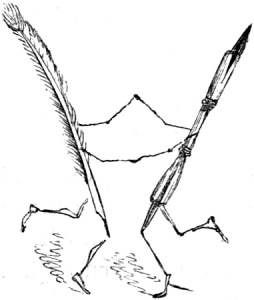
A COMICAL VIEW OF THE PARTS OF SPEECH.
Etymology teaches the varieties, modifications, and derivation of words.
The derivation of words means that which they come from as words; for
what they come from as sounds, is another matter. Some words come from
the heart, and then they are pathetic; others from the nose, in which case
they are ludicrous. The funniest place, however, from which words can
come, is the stomach. By the way, the Lord Mayor would do well to keep a
ventriloquist, from whom, at a moment’s notice, he might ascertain the
voice of the corporation.
Comic Etymology teaches us the varieties, modifications, and derivation,
of words invested with a comic character.
Grammatically speaking, we say that there are, in English, as many sorts
of words as a cat is said to have lives, nine; namely, the Article, the
Substantive or Noun, the Adjective, the Pronoun, the Verb, the Adverb, the
Preposition, the Conjunction, and the Interjection.
Comically speaking, there are a great many sorts of words which we have
not room enough to particularise individually. We can therefore only
afford to classify them. For instance; there are words which are spoken in
the Low Countries, and are High Dutch to persons of quality; as in
Billingsgate, Whitechapel, and St. Giles’s.
Words in use amongst all those who have to do with horses.
Words that pass between rival cab-men.
Words peculiar to the P. R. where the order of the day is generally a word
and a blow.
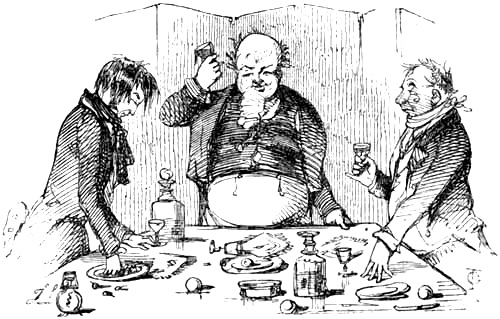
Words spoken in a state of intoxication.
Words uttered under excitement.
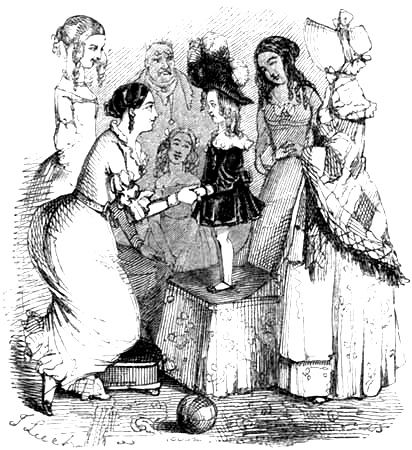
Words of endearment, addressed to children in arms.
Similar words, sometimes called burning, tender, soft, and broken words,
addressed to young ladies, and whispered, lisped, sighed, or drawled,
according to circumstances.
Words of honour; as, tailors’ words and shoemakers’ words; which, like the
above-mentioned, or lovers’ words, are very often broken.
With many other sorts of words, which will be readily suggested by the
reader’s fancy.
But now let us go on with the parts of speech.
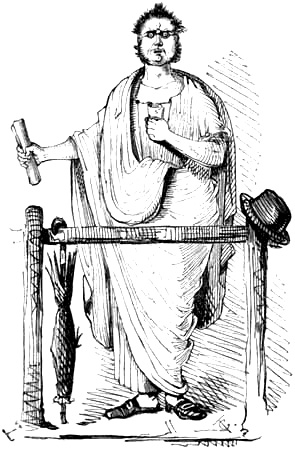
1. An Article is a word prefixed to substantives to point them out, and to
show the extent of their meaning; as, a dandy, an ape, the
simpleton.
One kind of comic article is otherwise denominated an oddity, or queer
article.
Another kind of comic article is often to be met with in Bentley’s
Miscellany.
2. A Substantive or Noun is the name of anything that exists, or of which
we have any notion; as, tinker, tailor, soldier, sailor,
apothecary, ploughboy, thief.
Now the above definition of a substantive is Lindley Murray’s, not ours.
We mention this, because we have an objection, though, not, perhaps, a
serious one, to urge against it; for, in the first place, we have “no
notion” of impudence, and yet impudence is a substantive; and, in the
second, we invite attention to the following piece of Logic,
A substantive is something,
But nothing is a substantive;
Therefore, nothing is something.
A substantive may generally be known by its taking an article before it,
and by its making sense of itself: as, a treat, the mulligrubs, an
ache.
3. An Adjective is a word joined to a substantive to denote its quality;
as a ragged regiment, an odd set.
You may distinguish an adjective by its making sense with the word thing:
as, a poor thing, a sweet thing, a cool thing; or with any
particular substantive, as a ticklish position, an awkward mistake, a
strange step.
4. A Pronoun is a word used in lieu of a noun, in order to avoid
tautology: as, “The man wants calves; he is a lath; he is a
walking-stick.”
5. A Verb is a word which signifies to be, to do, or to suffer: as, I am;
I calculate; I am fixed.
A verb may usually be distinguished by its making sense with a personal
pronoun, or with the word to before it: as I yell, he grins, they
caper; or to drink, to smoke, to chew.
Fashionable accomplishments!
Certain substantives are, with peculiar elegance, and by persons who call
themselves genteel, converted into verbs: as, “Do you wine?” “Will you
malt?” “Let me persuade you to cheese?”
6. An Adverb is a part of speech which, joined to a verb, an adjective, or
another adverb, serves to express some quality or circumstance concerning
it: as, “She swears dreadfully; she is incorrigibly lazy; and she is
almost continually in liquor.”
7. An adverb is generally characterised by answering to the question, How?
how much? when? or where? as in the verse, “Merrily danced the
Quaker’s wife,” the answer to the question, How did she dance? is,
merrily.
8. Prepositions serve to connect words together, and to show the relation
between them: as,
“Off with his head, so much for Buckingham!”
9. A Conjunction is used to connect not only words, but sentences also:
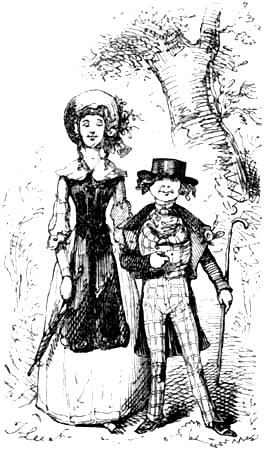
as, Smith and Jones are happy because they are single. A miss is as
good as a mile.
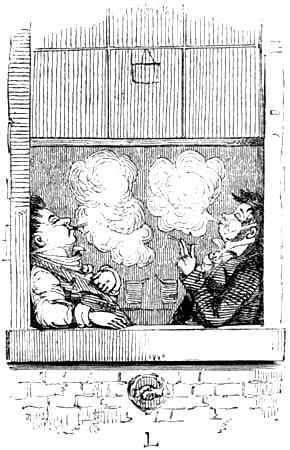
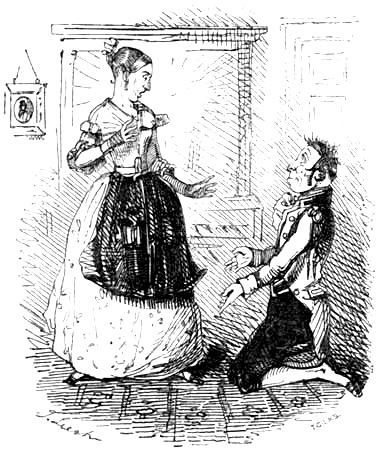
SINGLE BLESSEDNESS.
10. An Interjection is a short word denoting passion or emotion: as,
“Oh, Sophonisba! Sophonisba, oh!” Pshaw! Pish! Pooh! Bah! Ah! Au!
Eughph! Yah! Hum! Ha! Lauk! La! Lor! Heigho! Well! There! &c.
Among the foregoing interjections there may, perhaps, be some unhonoured
by the adoption of genius, and unknown in the domains of literature. For
the present notice of them some apology may be required, but little will
be given; their insertion may excite astonishment, but their omission
would have provoked complaint: though unprovided with a Johnsonian title
to a place in the English vocabulary, they have long been recognised by
the popular voice; and let it be remembered, that as custom supplies the
defects of legislation, so that which is not sanctioned by magisterial
authority may nevertheless be justified by vernacular usage.
OF THE ARTICLES.
The Articles in English are two, a and the; a becomes an before a
vowel, and before an h which is not sounded: as, an exquisite, an
hour-glass. But if the h be pronounced, the a only is used: as, a
homicide, a homœopathist, a hum.
This rule is reversed in what is termed the Cockney dialect: as, a
inspector, a officer, a object, a omnibus, a individual, a
alderman, a honour, an horse, or rather, a norse, an hound, an
hunter, &c.
It is usual in the same dialect, when the article an should, in strict
propriety, precede a word, to omit the letter n, and further, for the
sake of euphony and elegance, to place the aspirate h before the word;
as, a hegg, a haccident, a hadverb, a hox. But sometimes, when a
word begins with an h, and has the article a before it, the aspirate
is omitted, the letter a remaining unchanged: as, a ’ogg, a ’edge, a
’emisphere, a ’ouse.
The slight liberties which it is the privilege of the people to take with
the article and aspirate become always most evident in the expression of
excited feeling, when the stress which is laid upon certain words is
heightened by the peculiarity of the pronunciation: as, “You hignorant
hupstart! you hilliterate ’og! ’ow dare you to hoffer such a
hinsult to my hunderstanding?—You are a hobject of contempt, you
hare, and a hinsolent wagobond! your mother was nothing but a
happle-woman, and your father was an ’uckster!”
Note.—In the above example, the ordinary rules of language relative to
the article and aspirate (to say nothing of the maxims of politeness) are
completely set at nought; but it must be remembered, that in common
discourse the modification of the article, and the omission or use of the
aspirate, are determined by the Cockneys according to the ease with which
particular words are pronounced; as, “Though himpudent, he warn’t as
impudent as Bill wur.” Here the word impudent, following a
vowel-sound, is most easily pronounced as himpudent, while the same
word, coming after a consonant, even in the same sentence, is uttered with
greater facility in the usual way.
A or an is called the indefinite article, because it is used, in a
vague sense, to point out some one thing belonging to a certain kind, but
in other respects indeterminate; as,
“A horse, a horse, my kingdom for a horse!”
So say grammarians. Eating-house keepers tell a different story. A cheese,
in common discourse, means an object of a certain shape, size, weight, and
so on, entire and perfect; so that to call half a cheese a cheese, would
constitute a flaw in an indictment against a thief who had stolen one. But
a waiter will term a fraction, or a modicum of cheese, a cheese; a
plate-full of pudding, a pudding; and a stick of celery, a celery, or
rather, a salary. Nay, he will even apply the article a to a word
which does not stand for an individual object at all; as a bread, a
butter, a bacon. Here we are reminded of the famous exclamation of one
of these gentry:—“Master! master! there’s two teas and a brandy-and-water
just hopped over the palings!”
The is termed the definite article, inasmuch as it denotes what
particular thing or things are meant; as,
“The miller he stole corn,
The weaver he stole yarn,
And the little tailòr he stole broad-cloth
To keep the three rogues warm.”
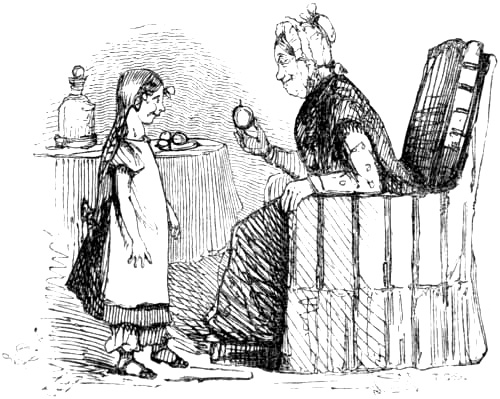
A substantive to which no article is prefixed is taken in a general sense;
as, “Apple sauce is proper for goose;” that is, for all geese.
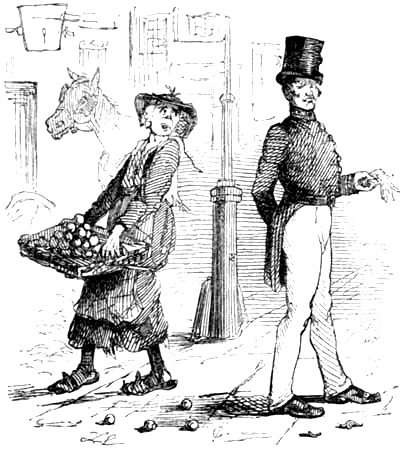
APPLE-SAUCE.
A few additional remarks may advantageously be made with respect to the
articles. The mere substitution of the definite for the indefinite article
is capable of changing entirely the meaning of a sentence. “That is a
ticket” is the assertion of a certain fact; but “That is the ticket!”
means something which is quite different.
The article is not prefixed to a proper name; as, Stubbs, Wiggins, Chubb,
or Hobson, except for the sake of distinguishing a particular family, or
description of persons; as, He is a Burke; that is, one of the Burkes,
or a person resembling Burke. The article is sometimes also prefixed to
a proper name, to point out some distinguished individual; as, The
Burke, or the great politician, or the resurrectionist, Burke.
Who is the Smith?
The indefinite article is joined to substantives in the singular number
only. We have heard people say, however, “He keeps a wine-vaults;” or,
to quote more correctly—waltz. The definite article may be joined to
plurals also.
The definite article is frequently used with adverbs in the comparative
and superlative degree: as, “The longer I live, the broader I grow;”
or, as we have all heard the showman say, “This here, gentlemen and
ladies, is the vonderful heagle of the sun; the ’otterer it grows, the
higherer he flies!”
SECTION I.
OF SUBSTANTIVES IN GENERAL.
Substantives are either proper or common.
Proper names, or substantives, are the names belonging to individuals: as
William, Birmingham.
These are sometimes converted into nicknames, or improper names: as
Bill, Brummagem.
Common names, or substantives, denote kinds containing many sorts, or
sorts containing many individuals under them: as brute, beast, bumpkin,
cherub, infant, goblin, &c.
Proper names, when an article is prefixed to them, are employed as common
names: as, “They thought him a perfect Chesterfield; he quite astonished
the Browns.”
Common names, on the other hand, are made to denote individuals, by the
addition of articles or pronouns: as,
“There was a little man, and he had a little gun.”
“That boy will be the death of me!”
Substantives are considered according to gender, number, and case; they
are all of the third person when spoken of, and of the second when
spoken to: as,
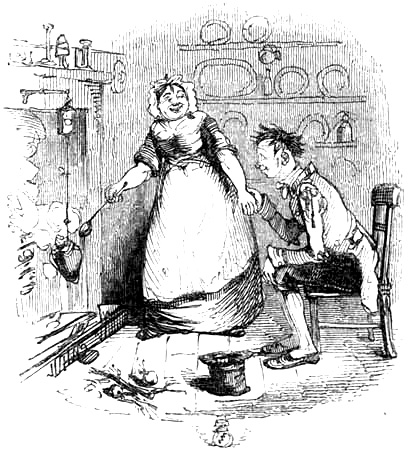
Matilda, fairest maid, who art
In countless bumpers toasted,
O let thy pity baste the heart
Thy fatal charms have roasted!
SECTION II.
OF GENDER.
The distinction between nouns with regard to sex is called Gender. There
are three genders; the Masculine, the Feminine, and the Neuter.
The masculine gender belongs to animals of the male kind: as, a fop, a
jackass, a boar, a poet, a lion.
The feminine gender is peculiar to animals of the female kind: as, a
poetess, a lioness, a goose.
The neuter gender is that of objects which are neither males nor females:
as, a toast, a tankard, a pot, a pipe, a pudding, a pie, a sausage, a
roll, a muffin, a crumpet, a puff, a cheesecake, a bun, an apricot, an
orange, a lollipop, a cream, an ice, a jelly, &c. &c. &c.
We might go on to enumerate an infinity of objects of the neuter gender,
of all sorts and kinds; but in the selection of the foregoing examples we
have been guided by two considerations:—
1. The desire of exciting agreeable emotions in the mind of the reader.
2. The wish to illustrate the following proposition, “That almost
everything nice is also neuter.”
Except, however, a nice young lady, a nice duck, and one or two other
nice things, which we do not at present remember.
Some neuter substantives are by a figure of speech converted into the
masculine or feminine gender: thus we say of the sun, that when he
shines upon a Socialist, he shines upon a thief; and of the moon, that she
affects the minds of lovers.
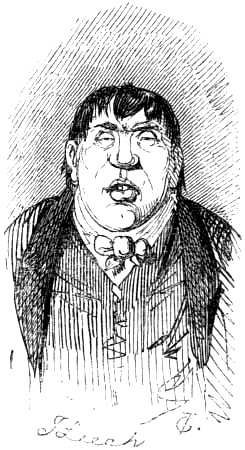
A SOCIALIST.
There are certain nouns with which notions of strength, vigour, and the
like qualities, are more particularly connected; and these are the neuter
substantives which are figuratively rendered masculine. On the other hand,
beauty, amiability, and so forth, are held to invest words with a
feminine character. Thus the sun is said to be masculine, and the moon
feminine. But for our own part, and our view is confirmed by the
discoveries of astronomy, we believe that the sun is called masculine from
his supporting and sustaining the moon, and finding her the wherewithal
to shine away as she does of a night, when all quiet people are in bed;
and from his being obliged to keep such a family of stars besides. The
moon, we think, is accounted feminine, because she is thus maintained and
kept up in her splendour, like a fine lady, by her husband the sun.
Furthermore, the moon is continually changing; on which account alone she
might be referred to the feminine gender. The earth is feminine, tricked
out, as she is, with gems and flowers. Cities and towns are likewise
feminine, because there are as many windings, turnings, and little odd
corners in them as there are in the female mind. A ship is feminine,
inasmuch as she is blown about by every wind. Virtue is feminine by
courtesy. Fortune and misfortune, like mother and daughter, are both
feminine. The Church is feminine, because she is married to the state; or
married to the state because she is feminine—we do not know which. Time
is masculine, because he is so trifled with by the ladies.
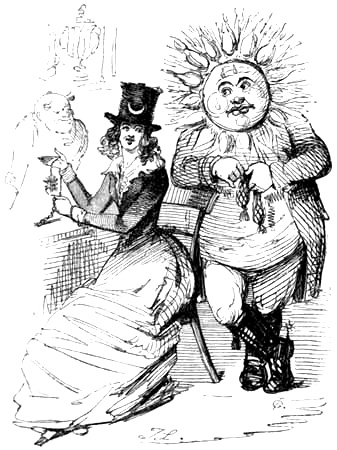
“Shan’t I shine to-night, dear?”
The English language distinguishes the sex in three manners; namely,
1. By different words; as,
| MALE. |
|
FEMALE. |
| Bachelor |
|
Maid. |
| Boar |
|
Sow. |
| Boy |
|
Girl. |
| Bull |
|
Cow. |
| Brother |
|
Sister. |
| Buck |
|
Doe. |
| Bullock |
|
Heifer. |
| Hart |
|
Roe. |
| Cock |
|
Hen. |
| Dog |
|
Bitch. |
| Drake |
|
Duck. |
| Wizard |
|
Witch. |
| Earl |
|
Countess. |
| Father |
|
Mother. |
| Friar |
|
Nun. |
And several other
Words we don’t mention,
(Pray pardon the crime,)
Worth your attention,
But wanting in rhyme.
2. By a difference of termination; as,
| MALE. |
|
FEMALE. |
| Poet |
|
Poetess. |
| Lion |
|
Lioness, &c. |
3. By a noun, pronoun, or adjective being prefixed to the substantive; as,
| MALE. |
|
FEMALE. |
| A cock-lobster |
|
A hen-lobster. |
| A jack-ass |
|
A jenny-ass (vernacular). |
| A man-servant, or flunkey. |
|
A maid-servant, or Abigail. |
| A he-bear (like King Harry). |
|
A she-bear (like Queen Bess). |
| A male flirt (a rare animal). |
|
A female flirt (a common animal). |
We have heard it said, that every Jack has his Jill. That may be; but it
is by no means true that every cock has his hen; for there is a
Cock-swain, but no Hen-swain.
Cock-eye, but no Hen-eye.
Cock-ade, but no Hen-ade.
Cock-atrice, but no Hen-atrice.
Cock-horse, but no Hen-horse.
Cock-ney, but no Hen-ney.
Then we have a weather-cock, but no weather-hen; a turn-cock, but no
turn-hen; and many a jolly cock, but not one jolly hen; unless we except
some of those by whom their mates are pecked.
Some words; as, parent, child, cousin, friend, neighbour, servant, and
several others, are either male or female, according to circumstances. The
word blue (used as a substantive) is one of this class.
It is a great pity that our language is so poor in the terminations that
denote gender. Were we to say of a woman, that she is a rogue, a knave, a
scamp, or a vagabond, we feel that we should use, not only strong but
improper expressions. Yet we have no corresponding terms to apply, in case
of necessity, to the female. Why is this? Doubtless because we never want
them. For the same reason, our forefathers transmitted to us the words,
philosopher, astronomer, philologer, and so forth, without any feminine
equivalent. Alas! for the wisdom of our ancestors! They never calculated
on the March of Intellect.
We understand that it is in contemplation to coin a new word, memberess;
it being confidently expected that by the time the new Houses of
Parliament are finished, the progress of civilisation will have furnished
us with female representatives.
In that case the House will be an assembly of Speakers.
But if all the old women are to be turned out of St. Stephen’s, and their
places to be filled with young ones, the nation will hardly be a loser by
the change.
SECTION III.
OF NUMBER.
Number is the consideration of an object as one or more; as, one poet,
two, three, four, five poets; and so on, ad infinitum.
Other countries may reckon up as many poets as they please; England has
one more.
The singular number expresses one object only; as, a towel, a viper.
The plural signifies more objects than one; as, towels, vipers.
Some nouns are used only in the singular number; dirt, pitch, tallow,
grease, filth, butter, asparagus, &c.; others only in the plural; as,
galligaskins, breeches, &c.
Some words are the same in both numbers; as, sheep, swine, and some
others.
“A doctor, both to sheep and swine,”
Said Mrs. Glass, “I am;
For legs of mutton I can dress,
And shine in curing ham.”
The plural number of nouns is usually formed by adding s to the singular;
as, dove, doves, love, loves, &c.
Julia, dove returns to dove,
Quid pro quo, and love for love;
Happy in our mutual loves,
Let us live like turtle doves!
When, however, the substantive singular ends in x, ch soft, sh, ss, or
s, we add es in the plural.
But remember, though box
In the plural makes boxes,
That the plural of ox
Should be oxen, not oxes.
A few Singular Plurals, or Plurals popularly varied, are as follow:—
| SINGULAR. |
|
PLURAL. |
| Beast |
|
Beastes, beastices. |
| Crust |
|
Crustes. |
| Gust |
|
Gustes. |
| Ghost |
|
Ghostes. |
| Host |
|
Hostes. |
| Joist |
|
Joistes. |
| Mist |
|
Mistes. |
| Nest |
|
Nestes. |
| Post, &c. |
|
Postes, postices, &c. |
Note.—The singular is often used, by a kind of licence conceded to
persons of refinement, for the plural; as, “May I trouble you for a
bean?” “Will you assist Miss Spriggins to a pea?” So also people say,
“A few green.” “Two or three radish,” &c.
SECTION IV.
OF CASE.
There is nearly as much difference between Latin and English substantives,
with respect to the number of cases pertaining to each, as there is
between a quack-doctor and a physician; for while in Latin substantives
have six cases, in English they have but three. But the analogy should
not be strained too far; for the fools in the world (who furnish the
quack with his cases) more than double the number of the wise.
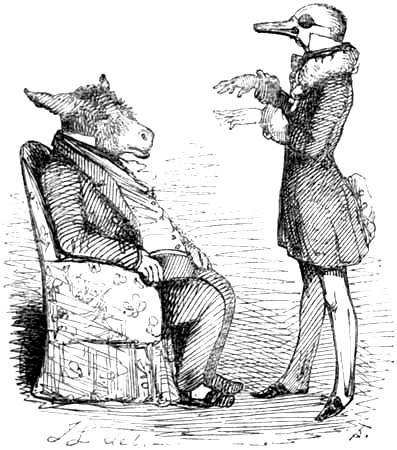
A VERY BAD CASE.
The cases of substantives are these: the Nominative, the Possessive or
Genitive, and the Objective or Accusative.
The Nominative Case merely expresses the name of a thing, or the subject
of the verb: as, “The doctors differ;”—“The patient dies!”
Possession, which is nine points of the law, is what is signified by the
Possessive Case. This case is distinguished by an apostrophe, with the
letter s subjoined to it: as, “My soul’s idol!”—“A pudding’s end.”
But when the plural ends in s, the apostrophe only is retained, and the
other s is omitted: as, “The Ministers’ Step;”—“The Rogues’
March;”—“Crocodiles’ tears;”—“Butchers’ mourning.”
When the singular terminates in ss, the letter s is sometimes, in like
manner, dispensed with: as, “For goodness’ sake!”—“For righteousness’
sake!” Nevertheless, we have no objection to “Guinness’s” Stout.
The Objective Case follows a verb active, and expresses the object of an
action, or of a relation: as, “Spring beat Bill;” that is, Bill or
“William Neate.” Hence, perhaps, the American phrase, “I’ll lick you
elegant.”
By the by, it seems to us, that when the Americans revolted from the
authority of England, they determined also to revolutionise their
language.
The Objective Case is also used with a preposition: as, “You are in a
mess.”
English substantives may be declined in the following manner:—
SINGULAR.
What is the nominative case
Of her who used to wash your face,
Your hair to comb, your boots to lace?
A mother!
What the possessive? Whose the slap
That taught you not to spill your pap,
Or to avoid a like mishap?
A mother’s!
And shall I the objective show?
What do I hear where’er I go?
How is your?—whom they mean I know,
My mother!
PLURAL.
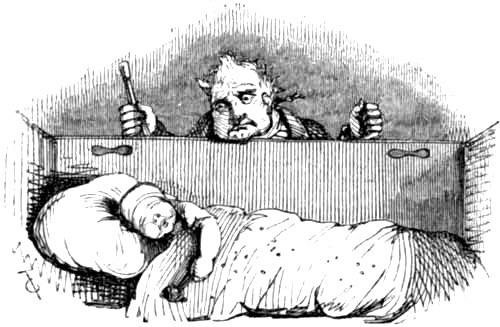
Who are the anxious watchers o’er
The slumbers of a little bore,
That screams whene’er it doesn’t snore?
Why, mothers!
Whose pity wipes its piping eyes,
And stills maturer childhood’s cries,
Stopping its mouth with cakes and pies?
Oh! mothers’!
And whom, when master, fierce and fell,
Dusts truant varlets’ jackets well,
Whom do they, roaring, run and tell?
Their mothers!
OF ADJECTIVES.
SECTION I.
OF THE NATURE OF ADJECTIVES AND THE DEGREES OF COMPARISON.
An English Adjective, whatever may be its gender, number, or case, like a
rusty weathercock, never varies. Thus we say, “A certain cabinet; certain
rogues.”
But as a rusty weathercock may vary in being more or less rusty, so an
adjective varies in the degrees of comparison.
The degrees of comparison, like the genders, the Graces, the Fates, the
Kings of Cologne, the Weird Sisters, the Jolly Postboys, and many other
things, are three; the Positive, the Comparative, and the Superlative.
The Positive state simply expresses the quality of an object; as, fat,
ugly, foolish.
The Comparative degree increases or lessens the signification of the
positive; as, fatter, uglier, more foolish, less foolish.
The Superlative degree increases or lessens the positive to the highest or
lowest degree; as, fattest, ugliest, most foolish, least foolish.
Amongst the ancients, Ulysses was the fattest, because nobody could
compass him.
Aristides the Just was the ugliest, because he was so very plain.
The most foolish, undoubtedly, was Homer; for who was more natural
than he?
The positive becomes the comparative by the addition of r or er; and
the superlative by the addition of st or est to the end of it; as,
brown, browner, brownest; stout, stouter, stoutest; heavy, heavier,
heaviest; wet, wetter, wettest. The adverbs more and most, prefixed to
the adjective, also form the superlative degree; as, heavy, more heavy,
most heavy.
Most heavy is the drink of draymen: hence, perhaps, the weight of those
important personages. More of this, however, in our forthcoming work on
Phrenology.
Monosyllables are usually compared by er and est, and dissyllables by
more and most; except dissyllables ending in y or in le before a
mute, or those which are accented on the last syllable; for these, like
monosyllables, easily admit of er and est. But these terminations are
scarcely ever used in comparing words of more than two syllables.
We have some words, which, from custom, are irregular in respect of
comparison; as, good, better, best; bad, worse, worst, &c. Much amusement
may be derived from the comparisons of adjectives, as made by natural
grammarians; a class of beings who generally inhabit the kitchen or
stable, but may sometimes be met with in more elevated regions. A few
examples will not be out of place. We are not speaking of servants, but
of degrees of comparison; as,
| POSITIVE. |
|
COMPARATIVE. |
|
SUPERLATIVE. |
| Good |
|
More better,
betterer or more
betterer. |
|
Most best,
bestest. |
| Tight |
|
More tighter,
tighterer or more
tighterer. |
|
Most tightest. |
| Bad |
|
Wuss or wusser. |
|
Wust or wussest. |
| Handsome |
|
More handsomer like. |
|
Most handsomest. |
| Extravagant |
|
Extravaganter,
more extravaganter. |
|
Extravagantest,
most extravagantest. |
| Stupid |
|
Stupider,
more stupider. |
|
Stupidest,
most stupidest. |
| Little |
|
Littler, more littler. |
|
Littlest, most littlest. |
With many others.
Here also may be adduced the Yankee’s “notion” of comparison; “My uncle’s
a tarnation rogue; but I’m a tarnationer.”
SECTION II.
A FEW REMARKS ON THE SUBJECT OF COMPARISON.
Comparisons appear to have been strongly disapproved of by Dr. Johnson.
“Sir,” said he, “the Whigs make comparisons.” It must be confessed that
the Doctor’s meaning is not quite so evident here as it is in general; but
that may be the fault of his biographer. Perhaps some of the Whigs had
been making comparisons at his expense, or impertinent comparisons, which
his temper, being positive, may have tempted them to indulge in. Or they
may have been out in making their comparisons, which, in that case, must
of course have been bad. But a truce to speculations of this kind, on the
saying of one, another of whose dogmas was, that “the man who could make a
pun would also pick a pocket.” We only hope, that such comparisons as we
may make, will no more vex his spirit now than they would once have
aroused his bile.
Lindley Murray judiciously observes, that “if we consider the subject of
comparison attentively, we shall perceive that the degrees of it are
infinite in number, or at least indefinite:” and he proceeds to say, “A
mountain is larger than a mite; by how many degrees? How much bigger is
the earth than a grain of sand? By how many degrees was Socrates wiser
than Alcibiades? or by how many is snow whiter than this paper? It is
plain,” quoth Lindley, “that to these and the like questions no definite
answers can be returned.”
No; but an impertinent one may. Ask the first charity-boy you meet any one
of them, and see if he does not immediately respond, “Ax my eye;” or, “As
much again as half.”
But when quantity can be exactly measured, the degrees of excess may be
exactly ascertained. A foot is just twelve times as long as an inch; a
tailor is nine times less than a man.
Moreover, to compensate for the indefiniteness of the degrees of
comparison, we use certain adverbs and words of like import, whereby we
render our meaning tolerably intelligible; as, “Byron was a much greater
poet than Muggins.” “Honey is a great deal sweeter than wax.” “Sugar is
considerably more pleasant than the cane.” “Maria says, that Dick the
butcher is by far the most killing young man she knows.”
The words very, exceedingly, and the like, placed before the positive,
give it the force of the superlative; and this is called by some the
superlative of eminence, as distinguished from the superlative of
comparison. Thus, Very Reverend is termed the superlative of eminence,
although it is the title of a dean, not of a cardinal; and Most Reverend,
the appellation of an Archbishop, is called the superlative of comparison.
A Bishop, in our opinion, is Most Excellent.
The comparative is sometimes so employed as to express the same
pre-eminence or inferiority as the superlative. For instance; the
sentence, “Of all the cultivators of science, the botanist is the most
crafty,” has the same meaning as the following “The botanist is more
crafty than any other cultivator of science.”
Why? some of our readers will ask—
Because he is acquainted with all sorts of plants.
OF PRONOUNS.
Pronouns or proxy-nouns are of three kinds; namely, the Personal, the
Relative, and the Adjective Pronouns.
Note.—That when we said, some few pages back, that a pronoun was a word
used instead of a noun, we did not mean to call such words as thingumibob,
whatsiname, what-d’ye-call-it, and the like, pronouns.
And that, although we shall proceed to treat of the pronouns in the
English language, we shall have nothing to do, at present, with what some
people please to call pronoun-ciation.
SECTION I.
OF THE PERSONAL PRONOUNS.
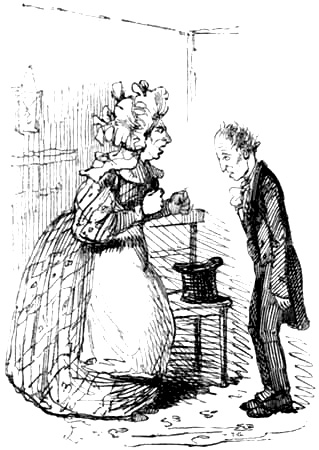
“Mr. Haddams, don’t be personal, Sir!”
“I’m not, Sir.”
“You har, Sir!”
“What did I say, Sir?—tell me that.”
“You reflected on my perfession, Sir; you said, as there was some people
as always stuck up for the cloth; and you insinnivated that certain
parties dined off goose by means of cabbaging from the parish. I ask
any gentleman in the westry, if that an’t personal?”
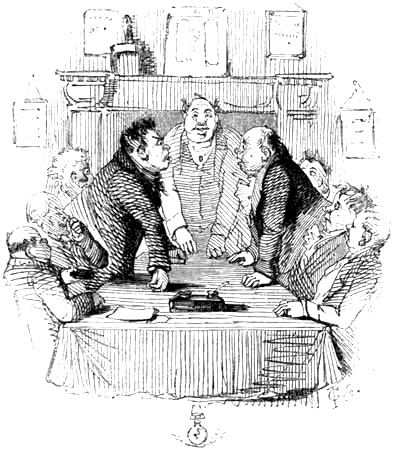
A SELECT VESTRY.
“Vell, Sir, vot I says I’ll stick to.”
“Yes, Sir, like vax, as the saying is.”
“Wot d’ye mean by that, Sir?”
“Wot I say, Sir!”
“You’re a individual, Sir!”
“You’re another, Sir!”
“You’re no gentleman, Sir!”
“You’re a humbug, Sir!”
“You’re a knave, Sir!”
“You’re a rogue, Sir!”
“You’re a wagabond, Sir!”
“You’re a willain, Sir!”
“You’re a tailor, Sir!”
“You’re a cobbler, Sir!” (Order! order! chair! chair! &c.)
The above is what is called personal language. How many different things
one word serves to express in English! A pronoun may be as personal as
possible, and yet nobody will take offence at it.
There are five Personal Pronouns; namely, I, thou, he, she, it; with their
plurals, we, ye or you, they.
Personal Pronouns admit of person, number, gender, and case.
Pronouns have three persons in each number.
In the Singular;
I, is the first person.
Thou, is the second person.
He, she, or it, is the third person.
In the plural;
We, is the first person.
Ye or you, is the second person.
They, is the third person.
This account of persons will be very intelligible when the following
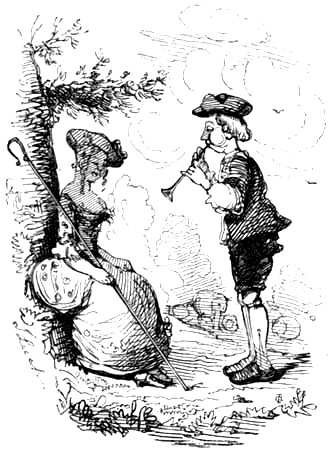
Pastoral Fragment is reflected on:—
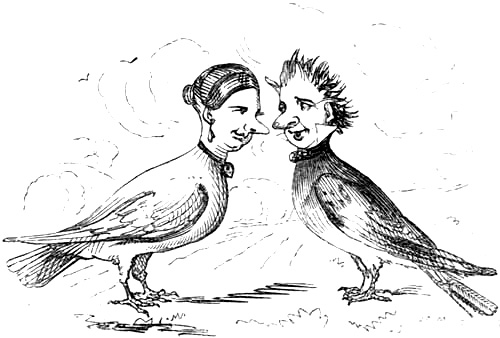
HE.
I love thee, Susan, on my life:
Thou art the maiden for a wife.
He who lives single is an ass;
She who ne’er weds a luckless lass.
It’s tiresome work to live alone;
So come with me, and be my own.
SHE.
We maids are oft by men deceived;
Ye don’t deserve to be believed;
You don’t—but there’s my hand—heigho!
They tell us, women can’t say no!
The speaker or speakers are of the first person; those spoken to, of the
second; and those spoken of, of the third.
Of the three persons, the first is the most universally admired.
The second is the object of much adulation and flattery, and now and then
of a little abuse.
The third person is generally made small account of; and, amongst other
grievances, suffers a great deal from being frequently bitten about the
back.
The Numbers of pronouns, like those of substantives, are, as we have
already seen, two; the singular and the plural.
In addressing yourself to anybody, it is customary to use the second
person plural instead of the singular. This practice most probably arose
from a notion, that to be thought twice the man that the speaker was,
gratified the vanity of the person addressed. Thus, the French put a
double Monsieur on the backs of their letters.
Editors say “We,” instead of “I,” out of modesty.
The Quakers continue to say “thee” and “thou,” in the use of which
pronouns, as well as in the wearing of broad-brimmed hats and of stand-up
collars, they perceive a peculiar sanctity.
Gender has to do only with the third person singular of the pronouns, he,
she, it. He is masculine; she is feminine; it is neuter.
Pronouns have the like cases with substantives; the nominative, the
possessive, and the objective.
Would that they were the hardest cases to be met with in this country!
The personal pronouns are thus declined:—
| CASE. |
|
FIRST PERSON
SINGULAR. |
|
FIRST PERSON
PLURAL. |
| Nom. |
|
I |
|
We. |
| Poss. |
|
Mine |
|
Ours. |
| Obj. |
|
Me |
|
Us. |
Pronouns, you see, are declined without fuss.
| CASE. |
|
SECOND PERSON. |
|
SECOND PERSON. |
| Nom. |
|
Thou |
|
Ye or you. |
| Poss. |
|
Thine |
|
Yours. |
| Obj. |
|
Thee |
|
You. |
How glad I shall be when my task I’ve got through!
Now the third person singular, as we before observed, has genders; and we
shall therefore decline it in a different way. Variety is charming.
THIRD PERSON SINGULAR.
| CASE. |
|
MASC. |
|
FEM. |
|
NEUT. |
| Nom. |
|
He |
|
She |
|
It. |
| |
|
Well |
|
done |
|
Kit! |
| Poss. |
|
His. |
|
Hers |
|
Its. |
| |
|
Now |
|
Tom’s |
|
quits. |
| Obj. |
|
Him |
|
Her |
|
It. |
| |
|
Deuce |
|
a |
|
bit! |
| CASE. |
|
PLURAL. |
| Nom. |
|
They |
| Poss. |
|
Theirs. |
| Obj. |
|
Them. |
Reader, Mem.
We beg to inform thee, that the third person plural has no distinction of
gender.
SECTION II.
OF THE RELATIVE PRONOUNS.
The Pronouns called Relative are such as relate, for the most part, to
some word or phrase, called the antecedent, on account of its going
before: they are, who, which, and that: as, “The man who does not
drink enough when he can get it, is a fool; but he that drinks too much
is a beast.”
What is usually equivalent to that which, and is, therefore, a kind of
compound relative, containing both the antecedent and the relative; as,
“You want what you’ll very soon have!” that is to say, the thing which
you will very soon have.
Who is applied to persons, which to animals and things without life;
as, “He is a gentleman who keeps a horse and lives respectably.” “To the
dog which pinned the old woman, they cried, ‘Cæsar!’” “This is the tree
which Larkins called a helm.”
Larkins.—I say, Nibbs, ven is a helm box like a asthmatical chest?
Nibbs.—Ven it’s a coffin.
That, as a relative, is used to prevent the too frequent repetition of
who and which, and is applied both to persons and things; as, “He
that stops the bottle is a Cork man.” “This is the house that Jack
built.”
Who is of both numbers; and so is an Editor; for, according to what we
observed just now, he is both singular and plural. Who, we repeat, is of
both numbers, and is thus declined:—
SINGULAR AND PLURAL.
| Nominative. |
|
Who |
| |
Is the maiden to woo? |
| Genitive. |
|
Whose |
| |
Hand shall I choose? |
| Accusative. |
|
Whom |
| |
To despair shall I doom? |
Which, that, and what are indeclinable; except that whose is
sometimes used as the possessive case of which; as,
“The roe, poor dear, laments amain,
Whose sweet hart was by hunter slain.”
Thus whose is substituted for of which, in the following example:—
“There is a blacking famed, of which
The sale made Day and Martin rich;
There is another blacking, whose
Compounder patronised the Muse.”[2]
Who, which, and what, when they are used in asking questions, are
called Interrogatives; as, “Who is Mr. Walker?” “Which is the left
side of a round plum-pudding?” “What is the damage?”
Those who have made popular phraseology their study, will have found that
which is sometimes used for whereas, and words of like signification;
as in Dean Swift’s “Mary the Cookmaid’s Letter to Dr. Sheridan”:—
“And now I know whereby you would fain make an excuse,
Because my master one day in anger call’d you a goose;
Which, and I am sure I have been his servant since October,
And he never called me worse than sweetheart, drunk or sober.”
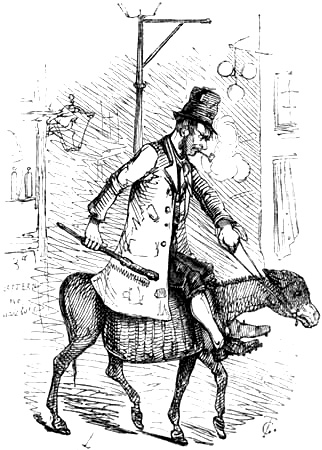
What, or, to speak more improperly, wot, is generally substituted by
cabmen and costermongers for who; as, “The donkey wot wouldn’t go.”
“The man wot sweeps the crossing.”
That, likewise, is very frequently rejected by the vulgar, who use as
in its place; as, “Them as asks shan’t have any; and them as don’t ask
don’t want any.”
SECTION III.
OF THE ADJECTIVE PRONOUNS.
Adjective pronouns partake of the nature of both pronouns and adjectives.
They may be subdivided into four sorts: the possessive, the distributive,
the demonstrative, and the indefinite.
The possessive pronouns are those which imply possession or property. Of
these there are seven; namely, my, thy, his, her, our, your,
their.
The word self is added to possessives; as, myself, yourself, “Says I to
myself, says I.” Self is also sometimes used with personal pronouns;
as, himself, itself, themselves. His self is a common, but not a proper
expression.
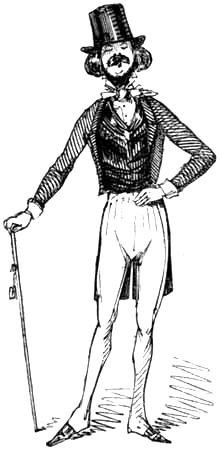
SELF-ESTEEM.
The distributive are three: each, every, either; they denote the
individual persons or things separately, which, when taken together, make
up a number.
Each is used when two or more persons or things are mentioned singly;
as, “each of the Catos;” “each of the Browns.”
Every relates to one out of several; as, “Every mare is a horse, but
every horse is not a mare.”
Either refers to one out of two; as,
“When I between two jockeys ride,
I have a knave on either side.”
Neither signifies “not either;” as “Neither of the Bacons was related
to Hogg.”
The demonstrative pronouns precisely point out the subjects to which they
relate; such are this and that, with their plurals these and
those; as, “This is a foreign Prince; that is an English Peer.”
This refers to the nearest person or thing, and to the latter or last
mentioned; that to the most distant, and to the former or first
mentioned; as, “This is a man; that is a nondescript.” “At the period
of the Reformation in Scotland, a curious contrast between the ancient and
modern ecclesiastical systems was observed; for while that had been
always maintained by a Bull, this was now supported by a Knox.”
The indefinite are those which express their subjects in an indefinite or
general manner; as, some, other, any, one, all, such,
&c.
When the definite article the comes before the word other, those who
do not know better, are accustomed to strike out the he in the, and to
say, t’other.
The same persons also use other in the comparative degree; for
sometimes, instead of saying quite the reverse, or perhaps rewerse, they
avail themselves of the expression, more t’other.
So much for the Pronouns.
OF VERBS.
SECTION I.
OF THE NATURE OF VERBS IN GENERAL.
The nature of Verbs in general, and that in all languages, is, that they
are the most difficult things in the Grammar.
Verbs are divided into Active, Passive, and Neuter; and also into Regular,
Irregular, and Defective. To these divisions we beg to add another; Verbs
Comic.
A Verb Active implies an agent, and an object acted upon; as, to love; “I
love Wilhelmina Stubbs.” Here, I am the agent; that is, the lover; and
Wilhelmina Stubbs is the object acted upon, or the beloved object.
A Verb Passive expresses the suffering, feeling, or undergoing of
something; and therefore implies an object acted upon, and an agent by
which it is acted upon; as, to be loved; “Wilhelmina Stubbs is loved by
me.”
A Verb Neuter expresses neither action nor passion, but a state of being;
as, I bounce, I lie.
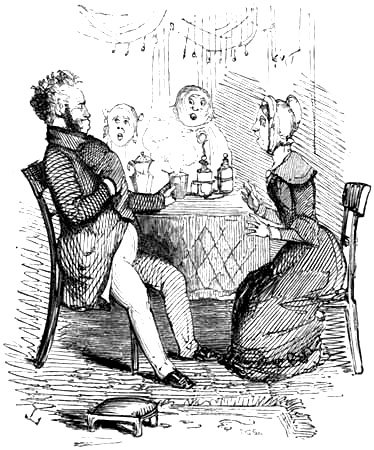
“Fact, Madam!”
“Gracious, Major!”
Of Verbs Regular, Irregular, and Defective, we shall have somewhat to say
hereafter.
Verbs Comic are, for the most part, verbs which cannot be found in the
dictionary, and are used to express ordinary actions in a jocular manner;
as, to “morris,” to “bolt,” to “mizzle,” which signify to go or to depart;
to “bone,” to “prig,” that is to say, to steal; to “collar,” which means
to seize, an expression probably derived from the mode of prehension, or
rather apprehension characteristic of the New Police, as it is one very
much in the mouths of those who most frequently come in contact with that
body: to “lush,” or drink; to “grub,” or eat; to “sell,” or deceive, &c.
Under the head of Verbs Comic, the Yankee-isms, I “calculate,” I “reckon,”
I “realise,” I “guess,” and the like, may also be properly enumerated.
Auxiliary, or helping Verbs (by the way, we marvel that the Americans do
not call their servants auxiliaries instead of helps,) are those, by the
help of which we are chiefly enabled to conjugate our verbs in English.
They are, do, be, have, shall, will, may, can, with their variations; and
let and must, which have no variation.
Let, however, when it is anything but a helping verb, as, for
instance, when it signifies to hinder, makes lettest and letteth. The
phrase, “This House to Let,” generally used instead of “to be let,” really
meaning the reverse of what it is intended to convey, is a piece of comic
English.
To verbs belong Number, Person, Mood, and Tense. These may be called the
properties of a verb; and like those of opium, they are soporiferous
properties. There are two very important objects which the writer of every
book has, or ought to have in view, to get a reader who is wide awake, and
to keep him so:—the latter of which, when Number, Person, Mood, and Tense
are to be treated of, is no such easy matter; seeing that the said writer
is then in some danger of going to sleep himself. Never mind. If we nod,
let the reader wink. What can’t be cured must be endured.
SECTION II.
OF NUMBER AND PERSON.
Verbs have two numbers, the Singular and the Plural; as, “I fiddle, we
fiddle,” &c.
In each number there are three persons; as
| |
|
SINGULAR. |
|
PLURAL. |
| First Person |
|
I love |
|
We love. |
| Second Person |
|
Thou lovest |
|
Ye or you love. |
| Third Person |
|
He loves |
|
They love. |
What a deal there is in every Grammar about love! Here the following
Lines, by a Young Lady (now no more), addressed to Lindley Murray, deserve
to be recorded:—
“Oh, Murray! fatal name to me,
Thy burning page with tears is wet;
Since first ‘to love’ I learned of thee,
Teach me, ah! teach me ‘to forget!’”
SECTION III.
OF MOODS AND PARTICIPLES.
Mood or Mode is a particular form of the verb, or a certain variation
which it undergoes, showing the manner in which the being, action, or
passion, is represented.
The moods of verbs are five, the Indicative, the Imperative, the
Potential, the Subjunctive, and the Infinitive.
The Indicative Mood simply points out or declares a thing: as, “He
teaches, he is taught;” or it asks a question: as, “Does he teach? Is he
taught?”
Q. Why is old age the best teacher?
A. Because he gives you the most wrinkles.
Q. Why does a rope support a rope-dancer?
A. Because it is taught.
The Imperative Mood commands, exhorts, entreats, or permits: as, “Vanish
thou; trot ye; let us hop; be off!”
The Potential Mood implies possibility or liberty, power, will, or
obligation: as, “A waiter may be honest. You may stand upon truth or
lie. I can filch. He would cozen. They should learn.”
The Subjunctive Mood is used to represent a thing as done conditionally;
and is preceded by a conjunction, expressed or understood, and accompanied
by another verb: as, “If the skies should fall, larks would be caught.”
“Were I to punch your head, I should serve you right;” that is, “if I
were to punch your head.”
The Infinitive Mood expresses a thing generally, without limitation, and
without any distinction of number or person: as, “to quarrel, to fight, to
be licked.”
The Participle is a peculiar form of the verb, and is so called, because
it participates in the properties both of a verb and of an adjective: as,
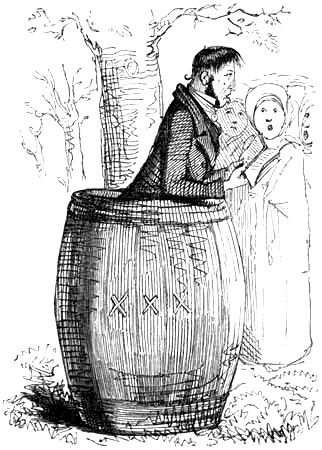
“May I have the pleasure of dancing with you?” “Mounted on a tub he
addressed the bystanders.” “Having uplifted a stave, they departed.”
The Participles are three; the Present or Active, the Perfect or Passive,
and the Compound Perfect: as, “I felt nervous at the thought of popping
the question, but that once popped, I was not sorry for having popped
it.”
The worst of popping the question is, that the report is always sure
to get abroad.
SECTION IV.
OF THE TENSES.
Tense is the distinction of time, and consists of six divisions, namely,
the Present, the Imperfect, the Perfect, the Pluperfect, and the First and
Second Future Tenses.
Time is also distinguished by a fore lock, scythe, and hour-glass; but the
youthful reader must bear in mind, that these things are not to be
confounded with tenses.
The Present Tense, as its name implies, represents an action or event
occurring at the present time: as, “I lament; rogues prosper; the mob
rules.”
The Imperfect Tense represents a past action or event, but which, like a
mutton chop, may be either thoroughly done, or not thoroughly done; were
it meet, we should say under-done: as,
“When I was a little boy some fifteen years ago,
My mammy doted on me—Lork! she made me quite a show.”
“When our reporter left, the Honourable Gentleman was still on his
legs.”
The legs of most “Honourable Gentlemen” must be tolerably stout ones; for
the “majority” do not stand on trifles. However, we are not going to
commit ourselves, like some folks, nor to get committed, like
other folks; so we will leave “Honourable Gentlemen” to manage matters
their own way.
The Perfect Tense declares a thing to have been done at some time, though
an indefinite one, antecedent to the present time. That, however, which
the Perfect Tense represents as done, is completely, or, as we say of John
Bull, when he is humbugged by the thimble-rig people, regularly done; as,
“I have been out on the river.” “I have caught a crab.”
Catching a crab is a thing regularly (in another sense than completely)
done, when civic swains pull young ladies up to Richmond. We beg to inform
persons unacquainted with aquatic phraseology, that “pulling up” young
ladies, or others, is a very different thing from “pulling up” an omnibus
conductor or a cabman. What an equivocal language is ours! How much less
agreeable to be “pulled up” at Bow Street than to be “pulled up” in a
wherry! how wide the discrepancy between “pulling up” radishes and
“pulling up” horses!
The Pluperfect Tense represents a thing as doubly past; that is, as past
previously to some other point of time also past; as, “I fell in love
before I had arrived at years of discretion.”
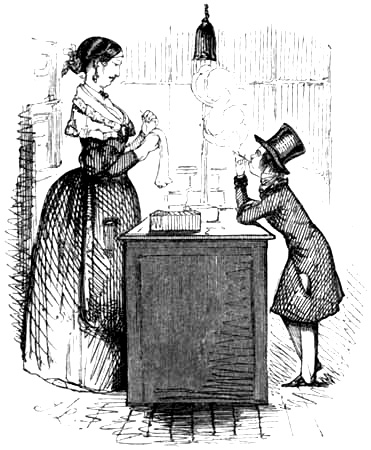
The First Future Tense represents the action as yet to come, either at a
certain or an uncertain time; as, “The tailor will send my coat home
to-morrow; and when I find it perfectly convenient, I shall pay him.”
The Second Future intimates that the action will be completed at or before
the time of another future action or event; as, “I wonder how many
conquests I shall have made by to-morrow morning.”
N.B. One ball is often the means of killing a great many people.
The consideration of the tenses suggests various moral reflections to the
thinking mind.
A few examples will perhaps suffice:—
1. Present, though moderate fruition, is preferable to splendid, but
contingent futurity; i. e. A bird in the hand is worth two in the bush.
2. Imperfect nutrition is less to be deprecated than privation of
aliment;—a new way of putting an old proverb, which we need not again
insert, respecting half a loaf.
3. Perfect callidity was the distinguishing attribute of the Curved
Pedestrian.
Callidity is another word for craftiness; but for the exercise of the
reader’s ingenuity, we forbear to mention the person alluded to as so
remarkable for his astutious qualities.
Q. What species of writing is most conducive to morality?
A. Text-hand.
SECTION V.
the conjugation of the auxiliary verbs To Have and To Be.
We have observed that boys, in conjugating verbs, give no indications of
delight, except that which an ingenuous disposition always feels in the
acquisition of knowledge. Now, having arrived at that part of the Grammar
in which it becomes necessary that these same verbs should be considered,
we feel ourselves in an awkward dilemma. The omission of the conjugations
is a serious omission—which, of course, is objectionable in a comic
work—and the insertion of them would be equally serious, and therefore
quite as improper. What shall we do? We will adopt a middle course;
referring the reader to Murray and other talented authors for full
information on these matters; and requesting him to be content with our
confining ourselves to what is more especially suitable to these pages—a
short summary of the Comicalities of verbs.
The Conjugation of a verb is the combination and arrangement of its
numbers, persons, moods, and tenses.
The Comicalities of verbs consist in certain liberties taken with their
numbers, persons, moods, and tenses.
The Conjugation of an active verb is called the Active Voice, and that of
a passive Verb the Passive Voice.
If verbs have voices, it is but reasonable that walls should have ears.
The auxiliary and active verb To Have is thus peculiarly conjugated by
some people in some of its moods and tenses.
TO HAVE.
INDICATIVE MOOD.
PRESENT TENSE.
| SINGULAR. |
|
PLURAL. |
| 1. |
Pers. |
I has. |
|
1. |
Pers. |
We has. |
| 2. |
|
Thee’st. |
|
2. |
|
Ye or you has. |
| 3. |
|
He’ve. |
|
3. |
|
They has. |
PERFECT TENSE.
| SINGULAR. |
|
PLURAL. |
| 1. I’ze had. |
|
1. We’ze had. |
| 2. Thee’st had. |
|
2. Ye or you’ze had. |
| 3. He’ve had. |
|
3. They’ze had. |
FIRST FUTURE TENSE.
| SINGULAR. |
|
PLURAL. |
| 1. I sholl or ool ha’. |
|
1. We shool or ool ha’. |
| 2. Thee shat or oot ha’. |
|
2. Ye or you sholl or ool ha’. |
| 3. He sholl or ool ha’. |
|
3. They sholl or ool ha’. |
IMPERATIVE MOOD.
| SINGULAR. |
|
PLURAL. |
| 1. Let me ha’. |
|
1. Let’s ha’. |
| 2. Ha’, or ha thou, or do thee ha’. |
|
2. Ha, or ha ye, or do ye, or you ha’. |
| 3. Let un ha’. |
|
3. Let um ha’. |
POTENTIAL MOOD.
PRESENT TENSE.
| SINGULAR. |
|
PLURAL. |
| 1. I med or can ha’. |
|
1. We med or can ha’. |
| 2. Thee medst or canst ha’. |
|
2. Ye or you med or can ha’. |
| 3. He med or can ha’. |
|
3. They med or can ha’. |
SUBJUNCTIVE MOOD.
PRESENT TENSE.
| SINGULAR. |
|
PLURAL. |
| 1. If I has. |
|
1. If we has. |
| 2. If thee hast |
|
2. If ye or you has. |
| 3. If he ha’. |
|
3. If they has. |
INFINITIVE MOOD.
| Present, To ha’. |
|
Perfect, To a had. |
PARTICIPLES.
| Present or Active, |
|
Havun or Avun. |
| Perfect, |
|
’Ad. |
| Compound Perfect, |
|
Havun ’ad. |
The auxiliary and neuter verb To Be, is maltreated as follows:
TO BE.
(Toby or not Toby?—that is the question!)
INDICATIVE MOOD.
PRESENT TENSE.
| SINGULAR. |
|
PLURAL. |
| 1. I be. |
|
1. We be. |
| 2. Thee bist. |
|
2. Ye or you be. |
| 3. He, she or it am. |
|
3. They be or am. |
IMPERFECT TENSE.
| SINGULAR. |
|
PLURAL. |
| 1. I wor, or wus. |
|
1. We wus. |
| 2. Thee wort. |
|
2. Ye or you wus. |
| 3. He wur. |
|
3. They wur. |
“When I say as you was, I mean, as you were.”
PERFECT TENSE.
| SINGULAR. |
|
PLURAL. |
| 1. I’ve a bin. |
|
1. We’ve a bin. |
| 2. Thee’st a bin. |
|
2. Ye or you’ve a bin. |
| 3. He’ve a bin. |
|
3. They’ve a bin. |
IMPERATIVE MOOD.
| SINGULAR. |
|
PLURAL. |
| 1. Let I be. |
|
1. Let we be. |
| 2. Be thee or ’st thee be. |
|
2. Do ’ee be. |
| 3. Let un be. |
|
3. Let um be. |
INFINITIVE MOOD.
| Present Tense, For to be. |
|
Perfect, For to ha’ bin. |
PARTICIPLES.
| Present, Beun. |
|
Perfect, |
Bin. |
| Compound Perfect, |
|
|
Havun bin. |
If being a younster, I had not been smitten,
Of having been jilted I should not complain,
Take warning from me all ye lads who are bitten,
When this part of Grammar occurs to your brain.
As there is a certain intensity of feeling abroad, which renders people
indisposed to trouble themselves with verbal matters, we shall take the
liberty of making very short work of the Regular Verbs. Even Murray can
only afford to conjugate one example,—To Love. The learner must amplify
this part of the Grammar for himself: and we recommend him to substitute
for “to love,” some word less harrowing to a sensitive mind: as, “to
fleece, to tax,” verbs which excite disagreeable emotions only in a sordid
one; and which also, by association of ideas, conduct us to useful
reflections on Political Economy. We advise all whom it may concern,
however, to pay the greatest attention to this part of the Grammar, and
before they come to the Verbs Regular, to make a particular study of the
Auxiliary Verbs: not only for the excellent reasons set forth in “Tristram
Shandy,” but also to avoid those awkward mistakes in which the
Comicalities of the Verbs, or Verbal Comicalities, chiefly consist.
“Did it rain to-morrow?” asked Monsieur Grenouille.
“Yes it was!” replied Monsieur Crapaud.
We propose the following as an auxiliary mode of conjugating verbs:—“I
love to roam on the crested foam, Thou lovest to roam on the crested foam,
He loves to roam on the crested foam, We love to roam on the crested foam,
Ye or you love to roam on the crested foam, They love to roam on the
crested foam,” &c. These words, if set to music, might serve for a
grammatical glee, and would, at all events, be productive of mirth.
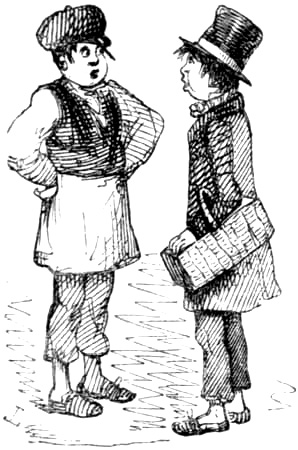
The Auxiliary Verbs, too, are very useful when a peculiar emphasis is
required: as, “I shall give you a drubbing!” “Will you?” “I know a trick
worth two of that.” “Do you, though?” “It might,” as the Quaker said
to the Yankee, who wanted to know what his name might be; “it might be
Beelzebub, but it is not.”
Now we may as well say what we have to say about the conjugation of
regular verbs active.
SECTION VI.
THE CONJUGATION OF REGULAR VERBS ACTIVE.
Regular Verbs Active are known by their forming their imperfect tense of
the indicative mood, and their perfect participle, by adding to the verb
ed, or d only when the verb ends in e: as,
| PRESENT. |
|
IMPERFECT. |
|
PERF. PARTICIP. |
| I reckon. |
|
I reckoned. |
|
Reckoned. |
| I realise. |
|
I realised. |
|
Realised. |
Here should follow the conjugation of the regular active verb, or, as a
Cockney Romeo would say, the regular torturing verb, To Love; but we
have already assigned a good reason for omitting it; besides which we have
to say, that we think it a verb highly unfit for conjugation by youth, as
it tends to put ideas into their heads which they would otherwise never
have thought of; and it is moreover our opinion, that several of our most
gifted poets may, with reason, have attributed those unfortunate
attachments which, though formed in early youth, served to embitter their
whole lives, to the poison which they thus sucked in with the milk, so to
speak, of their Mother Tongue, the Grammar.
PASSIVE.
Verbs Passive are said to be regular, when their perfect participle is
formed by the addition of d, or ed to the verb: as, from the verb “To
bless,” is formed the passive, “I am blessed, I was blessed, I shall be
blessed,” &c.
The conjugation of a passive verb is nothing more than the repetition of
that of the auxiliary To Be, the perfect participle being added.
And now, having cut the regular verbs (as Alexander did the Gordian knot)
instead of conjugating them, let us proceed to consider the
IRREGULAR VERBS.
SECTION VII.
Irregular Verbs are those of which the imperfect tense and the perfect
participle are not formed by adding d or ed to the verb: as,
| PRESENT. |
|
IMPERFECT. |
|
PERFECT PART. |
| I blow. |
|
I blew. |
|
blown. |
To say I am blown, is, under certain circumstances, such as windy and
tempestuous weather, proper enough; but I am blowed, it will at once be
perceived, is not only an ungrammatical, but also a vulgar expression.
Great liberties are taken with the Irregular Verbs, insomuch that in the
mouths of some persons, divers of them become doubly irregular in the
formation of their participles. Among such Irregular Verbs we may
enumerate the following:—
| PRESENT. |
|
IMPERFECT. |
|
PERF. OR PASS. PART. |
| Am |
|
wur |
|
bin. |
| Beat |
|
bet or bate |
|
bate. |
| Burst |
|
bust |
|
busted. |
| Catch |
|
cotch |
|
cotched |
| Come |
|
kim |
|
comed. |
| Creep |
|
crup |
|
crup. |
| Drive |
|
druv |
|
driv. |
| Freeze |
|
friz |
|
froze. |
| Give |
|
guv |
|
giv. |
| Go |
|
goed |
|
went. |
| Rise |
|
riz |
|
rose. |
| See |
|
sid |
|
sin, &c. |
Some verbs which in this country are held to be regular, are treated as
irregular verbs in America: as,
| PRESENT. |
|
IMPERFECT. |
|
PERF. OR PASS. PART. |
| Row |
|
rew |
|
rown. |
| Snow |
|
snew |
|
snown. |
SECTION VIII.
OF DEFECTIVE VERBS.
Most men have five senses,
Most verbs have six tenses;
But as there are some folks
Who are blind, deaf, or dumb folks,
Just so there are some verbs
Defective, or rum verbs,
which are used only in some of their moods and tenses.
The principal of them are these:—
| |
|
IMPERF. |
|
PERF. OR PASS. PART. |
| Can |
|
could |
|
nix. |
| May |
|
might |
|
— |
| Shall |
|
should |
|
— |
| Will |
|
would |
|
— |
| Must |
|
must |
|
— |
| Ought |
|
ought |
|
— |
| — |
|
quoth |
|
— |
There is not, perhaps, anything in the defective verbs peculiarly valuable
in a comic point of view. However, it should not be forgotten, that
Can is one of the signs of the POT-ential Mood;
Will, Would reminds us of the Drapier’s Letters.
“Must” is for the House of Commons (it used to be for the King).
Ought, ought, with 1 before it, stands, (in schoolboy phrase) for 100.
’Tis naught, so to speak, however, says Murray.
OF ADVERBS.
Having as great a dislike as the youngest of our readers can have to
repetitions, we shall not say what an adverb is over again. It is,
nevertheless, right to observe, that some adverbs are compared: as, far,
farther, farthest; near, nearer, nearest. In comparing those which end in
ly, we use more and most: as, slowly, more slowly, most slowly.
Q. Who, of all the civic functionaries, moves “most slowly?”
A. Mr. Hobler.
There are a great many adverbs in the English Language: their number is
probably even greater than that of abusive epithets. They are divisible
into certain classes; the chief of which are Number, Order, Place, Time,
Quantity, Manner or Quality, Doubt, Affirmation, Negation, Interrogation,
and Comparison.
A nice little list, truly! and perhaps some of our readers may suppose
that we are going to exemplify it at length: if so, all we can say with
regard to their expectation is, that we wish they may get it gratified.
In the meantime, we will not turn our Grammar into a dictionary, to please
anybody. However, we have no objection to a brief illustration of the uses
and properties of adverbs, as contained in the following passage:—
“Formerly, when first I began to preach and to teach, whithersoever
I went, the little boys followed me, and now and then pelted me with
brick-bats, as heretofore they pelted Ebenezer Grimes. And whensoever
I opened my mouth, straightways the ungodly began to crow. Oftentimes
was I hit in the mouth with an orange: yea, and once, moreover, with
a rotten egg; whereat there was much laughter, which, notwithstanding,
I took in good part, and wiped my face, and looked pleasantly. For
peradventure I said, they will listen to my sermon; yea, and after
that we may have a collection. So I was nowise discomfited; wherefore
I advise thee, Brother Habakkuk, to take no heed of thy persecutors,
seeing that I, whereas I was once little better off than thyself, have
now a chapel of mine own. And herein let thy mind be comforted, that,
preach as much as thou wilt against the Bishop, thou wilt not,
therefore, in these days, be in danger of the pillory. Howbeit,” &c.
Vide Life of the late pious and Rev. Samuel Simcox (letter to Habbakuk
Brown).
OF PREPOSITIONS.
Prepositions are, for the most part, put before nouns and pronouns: as,
“out of the frying-pan into the fire.”
Two prepositions, with and without, are sometimes (as we have been
informed) used in the place of substantives: as, “cold without, warm
with.”
The preposition of is sometimes used as a part of speech of peculiar
signification, and one to which no name has as yet been applied: as, “What
have you been doing of?”
At and up are not rarely used as verbs, but we should scarcely have
been justified in so classing them by the authority of any polite writer;
such use of them being confined to the vulgar: as, “Now then, Bill, at
him again.” “So she upped with her fists, and fetched him a whop.”
After is improperly pronounced arter, and against, agin: as,
“Hallo! Jim, vot are you arter? don’t you know that ere’s agin the
Law?”
OF CONJUNCTIONS.
A Conjunction means literally, a union or meeting together. An
ill-assorted marriage is
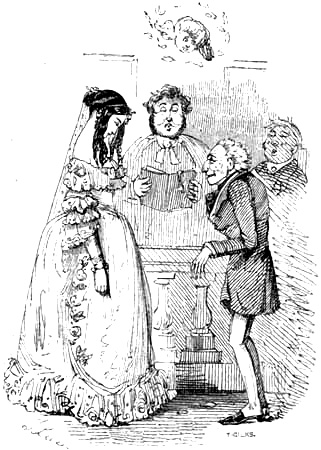
A COMICAL CONJUNCTION.
But our conjunctions are used to connect words and sentences, and have
nothing to do with the joining of hands. They are chiefly of two sorts,
the Copulative and Disjunctive.
The Copulative Conjunction is employed for the connection or continuation
of a sentence: as, “Jack and Gill went up the Hill,” “I will sing a song
if Gubbins will,” “A thirsty man is like a City Giant, because he is a
Gog for drink.”
The Conjunction Disjunctive is used not only for purposes of connection,
but also to express opposition of meaning in different degrees: as,
“Though Lord John is as cunning as a Fox, yet Sir Robert is as deep as
a Pitt.” “We pay less for our letters, but shall have to pay more for
our panes: they have lightened our postage, but they will darken our
rooms.”
Conjunctions are the hooks and eyes of Language, in which, as well as in
dress, it is very possible to make an awkward use of them: as, “For if
the year consist of 365 days 6 hours, and January have 31 days, then
the relation between the corpuscular theory of light and the new views
of Mr. Owen is at once subverted: for, ‘When Ignorance is bliss, ’tis
folly to be wise:’ because 1760 yards make a mile; and it is
universally acknowledged that ‘war is the madness of many for the gain of
a few:’ therefore Sir Isaac Newton was quite right in supposing the
diamond to be combustible.”
The word as, so often used in this and other Grammars, is a conjunction:
as, “Mrs. A. is as well as can be expected.”
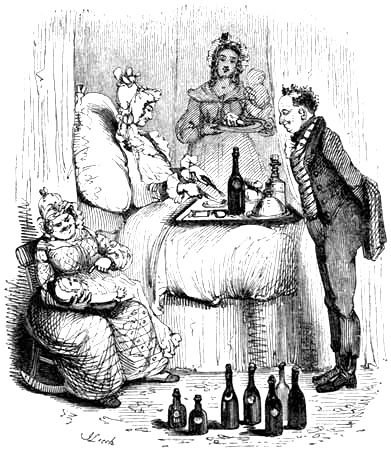
The Siamese twins formed a singular conjunction.
A tin pot fastened to a dog’s tail is a disagreeable conjunction to the
unfortunate animal.
A happy pair may be regarded as an uncommon conjunction.
INTERJECTIONS.
We have said almost enough about their Etymology already. Still, it may
not be superfluous to bestow a passing notice on the singularly expressive
character of certain of these parts of speech, heard, it is true,
repeatedly; but unaccountably omitted in all previous Grammars. For
instance, how many lives does the warning, “Hoy!” of the coachman or
cab-driver daily save? What an amount of infantile aberrations from
propriety is the admonitory “Paw-paw!” the means of checking. With what
felicity is acquiescence denoted by “Umph!” The utility of the
Interjections on various occasions, such as our meals, for example, in
enabling us to economise our speech, is very striking.
OF DERIVATION.
Those who know Latin, Greek, Saxon, and the other languages from which our
own is formed, do not require to be instructed in philological derivation;
and on those who do not understand the said tongues, such instruction
would be thrown away. In what manner English words are derived, one from
another, the generality of persons know very well: there are, however, a
few words and phrases, which it is expedient to trace to their respective
sources; not only because such an exercise is of itself delightful to the
inquiring mind; but because we shall thereby be furnished (as we hope to
show) with a test by means of which, on hearing an expression for the
first time, we shall be able, in most instances, to decide at once
respecting its nature and quality.
There are several words in the English Language which were originally
Terms of Art, but came in process of time to be applied metaphorically to
the common purposes of discourse. Thus lodgings are sometimes called
quarters; a word which, in its restricted sense, signifies the lodgings
of soldiers; ill habits, like diseases, are said to be remedied; men
hope, as if indicted for an offence, that ladies will acquit them of
inattention, and so forth. When, as in the instances cited, the word or
phrase can be traced back either to one of the Learned Professions, or to
any source savouring of gentility, it is esteemed a proper one, and there
is no objection to its use.
Now we have divers other words, of which many have but recently come into
vogue, which, though by no means improper or immoral, are absolutely
unutterable in any polite assembly. It is not, at first, very easy to see
what can be the objection to their use; but derivation explains it for us
in the most satisfactory manner. The truth is, that the expressions in
question take their origin from various trades and occupations, in which
they have, for the most part, a literal meaning; and we now perceive what
horrible suspicions respecting one’s birth, habits, and education, their
figurative employment would be likely to excite. To make the matter
indisputably clear, we will explain our position by a few examples.
| WORDS AND PHRASES. |
|
WHAT DERIVED FROM. |
| Bone (to steal), |
|
Butchers. |
| Chisel (to cheat), |
|
Carpenters. |
| Clout (to beat), |
|
Scullions. |
| To cut it fat, |
|
Cooks. |
| To come it strong, |
|
Publicans. |
| To draw it mild, |
|
Ditto. |
| To drop off the hooks, |
|
Butchers. |
| To miss your tip, |
|
Footmen. |
| To be done, |
|
Cooks. |
| To be done brown, |
|
Ditto. |
| To collar (to seize), |
|
Thieves or policemen. |
| To be walked off, |
|
Ditto. |
| A sell, |
|
Jews. |
| A shine, |
|
Shoe-boys. |
| A wipe (a handkerchief), |
|
Blackguards in general, from its use. |
| A mawley (a hand), |
|
Prizefighters. |
| To welt (to beat), |
|
Cobblers. |
| To leather (ditto), |
|
Ditto. |
| To strap (ditto), |
|
Ditto. |
| To hide (ditto), |
|
Curriers. |
| Spicy (showy), |
|
Grocers. |
| To hang out (to dwell), |
|
Publicans. |
| A drag (carriage), |
|
Stage-coachmen. |
| Swamped (ruined), |
|
Watermen. |
| To put one’s oar in (to interfere), |
|
Watermen. |
| Get on with your barrow, |
|
Dogs’-meat-men. |
| Kidderminster (for carpet), |
|
Upholsterers. |
| Mahogany (for table), |
|
Ditto. |
| Dodge (trick), |
|
Pickpockets. |
(N.B. All those are obliged to have recourse to the dodge, who are in
the habit of outrunning the constable.) But, to proceed with our
Etymology:
| To bung up an eye, |
|
Brewers. |
| To chalk down, |
|
Publicans. |
| A close shaver (a miser), |
|
Barbers. |
| To be off your feed, |
|
Ostlers. |
| Hold hard (stop), |
|
Omnibus-men. |
Numerous examples, similar to the foregoing, will, no doubt, present
themselves, in addition, to the mind of the enlightened student. We have
not, however, quite done yet with our remarks on this division of our
subject. The intrinsic vulgarity of all modes of speech which may be
traced to mean or disreputable persons, will, of course, not be
questioned. But—and as we have got hold of a nice bone, we may as well
get all the marrow we can out of it—the principle which is now under
consideration has a much wider range than is apparent at first sight.
Now we will suppose a red-hot lover addressing the goddess of his
idolatry—by the way, how strange it is, that these goddesses should be
always having their temples on fire, that a Queen of Hearts should ever be
seated on a burning throne!—but to return to the lover: he was to say
something. Well, then, let A. B. be the lover. He expresses himself
thus:—
“Mary, my earthly hopes are centred in you. You need not doubt me; my
heart is true as the dial to the sun. Words cannot express how much I love
you. Nor is my affection an ordinary feeling: it is a more exalted and a
more enduring sentiment than that which usually bears its name. I have
done. I am not eloquent: I can say no more, than that I deeply and
sincerely love you.”
This, perhaps, will be regarded by connoisseurs as tolerably pathetic, and
for the kind of thing not very ridiculous. Now, let A. S. S. be the lover;
and let us have his version of the same story:—
“Mary, my capital in life is invested in you. You need not stick at giving
me credit; my heart is as safe as the Bank of England. The sum total of my
love for you defies calculation. Nor is my attachment anything in the
common way. It is a superior and more durable article than that in
general wear. My stock of words is exhausted. I am no wholesale dealer in
that line. All I can say is, that I have a vast fund of unadulterated
affection for you.”
In this effusion the Stock Exchange, the Multiplication Table, and the
Linendraper’s and Grocer’s shops have been drawn upon for a clothing to
the suitor’s ideas; and by an unhappy choice of words, the most delightful
and amiable feelings of our nature, without which Life would be a Desert
and Man a bear, are invested with a ridiculous disguise.
We would willingly enlarge upon the topic which we have thus slightly
handled, but that we feel that we should by so doing, intrench too far on
the boundaries of Rhetoric, to which science, more particularly than to
Grammar, the consideration of Metaphor belongs; besides which, it is high
time to have done with Etymology. Here, then, gentlemen, if you please, we
shall pull up.
“Pull up! what an expression!”
“Well, Sir, did you never hear that next to the Bar the first school of
grammatical elegance is the Stage?”