From time immemorial men have differed upon
nearly every phase of human existence; and, for
that matter, every other kind of existence. So far as
we know, no organization has ever existed, formed
by man, or formed by Deity for man (it makes no
difference for what purpose it was formed), in which
there was not manifested individuality to the point
of wide divergence on most important questions.
Unconverted human nature is the same the world
over, and different propensities and dispositions,
coupled with jealousy, have manifested themselves
in nearly every family since that of the first pair
driven in shame from Eden.
As strange as it may sound, the Church of God
has been no exception to this rule in general, nor
the Methodist Episcopal Church in particular.
The Methodist Episcopal Church was born of necessity,
20and has perpetuated itself and prospered in proportion
as it has obeyed the mandates of Almighty
God. When, for any reason, the Church has turned
to the right hand or to the left hand out of “the
king’s highway,” God has gently reproved her. It
was but a short time after its organization when it
became a recognized, potent factor in God’s hands
of ameliorating the condition of those with whom
it had influence. No other Church, since its organization
in this country, has figured more conspicuously
than the Methodist Episcopal Church in all
the living, burning questions touching the salvation
of men’s bodies and souls. It may be true that in
many instances the Church has not come up to the
ideal of some of its devotees, or accomplished all
it was considered able to do. Probably instances
would have occurred, if it had succeeded in the
former, when it would have displeased God; if the
latter, it might have bound error with a rope of
sand, and thus frustrated all effective plans.
From the beginning the Church has gone after
“the lost sheep of the house of Israel.” A Church
needs no higher encomium than that the “common
people” hear her ministers gladly. This has been,
and we hope now is, the glory of the Methodist
Episcopal Church. Should a time ever come when
this can not be truthfully said of the Church, her
pristine glory will have departed. Worldly popularity
has not hitherto been the acme of her ambition.
May it never be! Where duty called, popular or
21unpopular, the Church has given the command,
“Go forward,” with the understanding that “it is
better to obey God than man.” The wholesome
doctrine of “the Fatherhood of God and the
brotherhood of man,” as taught by the apostle when
he exclaimed, “God hath made of one blood all nations
of men for to dwell on all the face of the earth,”
has been taught by the Methodist Episcopal Church
ever since John Wesley declared slavery “the sum
of all villainies.”
It may be, as you scrutinize the last sentence, a
fear may arise that it will not remain intact under
the electric light of investigation. The redeeming
feature is, that the Methodist Episcopal Church has
come as near preaching and practicing that doctrine
as any other American ecclesiastical organization.
This may not be much in its favor, when taken in
reference to the colored man, but it is something.
There has never been an hour since Bishop Asbury
preached Jesus and him crucified to a poor slave on
the bank of a river in South Carolina, in the
which the great heart of the Methodist Episcopal
Church did not throb with sympathy for the poor
colored man in this country. As evidence, it is
only necessary to look up or remember the Herculean
efforts it made on his behalf as early as 1796,
to save him from the cruelty and barbarism of his
subjection. Could the Church, at so early a period,
have received the moral and religious support of
the good people of other denominations, the civil
22war might have been averted, and the poor slave
rescued from the power of Satan unto God, from
the midnight of sin to the marvelous light and liberty
of the gospel of Jesus Christ.
The following explains itself on this question,
as enacted by the General Conference of 1796:
“Question. What regulations shall be made for
the extirpation of the crying evil of African slavery?
“Answer 1. We declare, that we are more than
ever convinced of the great evil of the African slavery
which still exists in these United States; and do most
earnestly recommend to the yearly conferences, quarterly
meetings, and to those who have the oversight
of districts and circuits, to be exceedingly cautious
what persons they admit to official stations in our
Church; and, in the case of future admission to
official stations, to require such security of those
who hold slaves, for the emancipation of them, immediately
or gradually, as the laws of the States
respectively, and the circumstances of the case will
admit. And we do fully authorize all the yearly
conferences to make whatever regulations they judge
proper, in the present case, respecting the admission
of persons to official stations in our Church.
“2. No slaveholder shall be received into society
till the preacher who has the oversight of the circuit
has spoken to him freely and faithfully on the
subject of slavery.
“3. Every member of the society who sells a
slave shall immediately, after full proof, be excluded
23the society. And if any member of our society
purchase a slave, the ensuing quarterly-meeting
shall determine on the number of years in which the
slave so purchased would work out the price of his
purchase. And the person so purchasing shall, immediately
after such determination, execute a legal
instrument for the manumission of such slave at the
expiration of the term determined by the quarterly
meeting. And in default of his executing such instrument
of manumission, or on his refusal to submit
his case to the judgment of the quarterly-meeting,
such member shall be excluded the society. Provided,
also, that in the case of a female slave, it shall
be inserted in the aforesaid instrument of manumission,
that all her children which shall be born during
the years of her servitude shall be free at the following
times, namely: Every female child at the age of
twenty-one, and every male child at the age of
twenty-five. Nevertheless, if the member of our society,
executing the said instrument of manumission,
judge it proper, he may fix the times of manumission
of the children of the female slaves before mentioned,
at an earlier age than that which is
prescribed above.
“4. The preachers and other members of our
society are requested to consider the subject of
Negro slavery with deep attention till the ensuing
General Conference; and that they impart to the
General Conference, through the medium of the
yearly conferences, or otherwise, any important
24thoughts upon the subject, that the conference may
have full light, in order to take further steps
toward eradicating this enormous evil from that part
of the Church of God to which they are united.”
During the ensuing quadrennium this all-important
question was argued and studied as never
before within the Church. Considerable feeling
was manifested in many instances, showing at once
the deep interest the question had produced. Men
within and without the Church continued to examine
the question, until the question of the continuation
of human slavery became the question of
the hour. More than one slaveholding member of
the Church declared, with all the earnestness of his
soul, that it was unwise for the Church to shoulder
such a stupendous burden. Others declared it would
be suicidal for the General Conference to interfere
with the deep-rooted institution of slavery. As
the quadrennium advanced, the question was more
vehemently agitated. Many tried to conjecture what
action the ensuing General Conference of 1800
would take on this subject, while others tried to
forestall any anticipated action. It was openly declared
by the more sanguine slaveholders within the
Church that the General Conference would pay no
attention to the question of slavery; that in the
event that memorials or resolutions should be presented
touching the question, they would at once
be referred to a committee, which would fail to
notice them. Others as hopefully and boldly declared
25that no Christian Church could be consistent
and indorse human slavery; that the future hope
of the Church in its effort to spread Scriptural
holiness was dependent, in a measure, upon the
attitude it sustained toward human slavery.
Those who have engaged in the heated discussions
that have arisen within the General Conferences
since that day, upon questions growing out of
the system of slavery in this country, can probably
imagine the situation at that time. The General
Conference of 1800 sat from the 6th to the 20th
of May, in Baltimore. Delegates from each of the
eight annual conferences were present. Each delegate
saw the ominous clouds, and knew the storm
was brewing. This question soon came up for consideration.
We give as near as possible a detailed
account of the proceedings touching the question of
slavery:
General Conference, 1800.—“Brother Ormond
moved, That whereas the laws now in
force in two or more of the United States pointedly
prohibit the emancipation of slaves, and the
third clause of the ninth section of the Discipline
forbids the selling of slaves, it is evident that the
members of the Methodist societies who own slaves,
and remove themselves and families to another
State, or to distant parts of the same State, and
leave a husband or a wife behind, held in bondage
by another person, part man and wife, which
is a violation of the righteous laws of God, and
26contrary to the peace and happiness of families;
and whereas, it is further observed that the rule
now existing among us prevents our members increasing
the number of their slaves by purchase,
and tolerates an increase of number by birth, which
children are often given to the enemy of the Methodists,—my
mind being seriously impressed with
these and several other considerations, I move,
That this General Conference take the momentous
subject of slavery into consideration, and make
such alterations in the old rule as may be thought
proper.
“Brother Timmons moved, That if any of our
traveling preachers marry persons holding slaves,
and thereby become slaveholders, they shall be excluded
from our societies, unless they execute a
legal emancipation of their slaves, agreeably to the
laws of the State wherein they live. Superseded.
Friday Morning, May 16th.—“Brother Snethen
moved, That this General Conference do resolve,
that from this time forth no slaveholder shall be
admitted into the Methodist Episcopal Church.
Negatived.
“Brother Bloodgood moved, That all Negro
children belonging to the members of the Methodist
society, who shall be born in slavery after
the fourth day of July, 1800, shall be emancipated—males
at — years, and females at — years.
Negatived.
“Brother Lathomus moved, That every member
27of the Methodist Episcopal Church holding
slaves shall, within the term of one year from the
date hereof, give an instrument of emancipation for
all his slaves, and the quarterly-meeting conference
shall determine on the time the slaves shall serve,
if the laws of the State do not expressly prohibit
their emancipation. Negatived.
“Moved, That when any of our traveling
preachers become owners of a slave or slaves by
any means, they shall forfeit their ministerial character
in the Methodist Episcopal Church, unless
they execute, if it be practicable, a legal emancipation
of such slave or slaves, agreeably to the laws
of the State wherein they live. Agreed to.”
This motion was originally offered by Brother
Timmons, and was conceived by the secretary to
have been superseded in the progress of the business
upon slavery. But the conference voted that
they would act upon it, with the amendments, the
same as a new motion.
It can be plainly seen by the foregoing report
into what a strait the General Conference was
brought by this question, as well as how earnestly
and faithfully that General Conference strove to
ascertain “the mind of the Holy Spirit” as to the
question. Just think of the fact that in one day of
that General Conference six different phases of this
question were presented. Amid these were: (1) To
prevent the separation of husband and wife; (2) To
change a former rule that allowed a Methodist
28to buy a husband or wife when they belonged to
separate parties, so as to prevent a separation.
Even in this form the buying and selling of human
beings was objected to strenuously. It was considered
“doing evil, that good might come therefrom.”
As we stop to contemplate it, we shudder to
render a decision. They voted down every proposition
that looked in any way like buying or selling
human beings. It is not superstition to say, they
attempted to “avoid even the appearance of evil.”
They consented to allow, (1) The expulsion of any
minister of the Church “who shall marry a woman
owning slaves;” (2) No slaveholder to be received
into the Church; (3) All traveling preachers who
owned slaves to forfeit their ministerial character.
It is no wonder that such action was taken, when it
is remembered that the Church was even then
recognizing and licensing colored local ministers, and
employing them to preach. It now concluded not
only nominally to recognize local preachers, but to
ordain them as well. As early as 1784, at “the
Christmas conference,” rules prohibiting slavery
had been enacted. And these rules were not simply
hanging about the necks of slaveholders as mere
ornaments; for it was positively declared by the
Church, “every person concerned, who will not comply
with these rules, shall have the privilege quietly
to withdraw.” We know of no instance in the history
of the Church in which there has ever been
a single human being directly driven from her
29ranks, pews, or pulpit because of race, color, or
previous condition of servitude. Then why wonder
when such a Church ordains one of her sons, and
sends him forth to tell with simplicity the story of
the cross?
Many objected to going so far with the slaves,
for fear of offending the slaveholder. But the
Church paid no attention to such cries; hence the
following action was taken by the General Conference,
under the heading
“A regulation respecting the ordination of colored people to the office of deacons:
“The bishops have obtained leave, by the suffrages
of this General Conference, to ordain local
deacons of our African brethren in places where
they have built a house or houses for the worship
of God: Provided, they have a person among them
qualified for that office, and he can obtain an election
of two-thirds of the male members of the
society to which he belongs, and a recommendation
from the minister who has the charge, and his
fellow-laborers in the city or circuit.”
This action at once recognized the efforts of the
race at elevation, and gave the colored people to
understand, that though in bondage to earthly task-masters,
they were fellow-heirs of the inheritance
of the saints, heirs of God, and joint heirs with
Jesus Christ, the righteous. The gainsaying, slaveholding
world stood aghast as it read and re-read
the action taken by that General Conference on the
30question of human slavery. God pulled back, as it
were, the curtains of the upper world, and blandly
smiled approval. A general baptism of the Holy
Ghost ratified the action in that such a revival of
religion followed that again the world cried, as
Methodist preachers began to preach Jesus and him
crucified: “They that have turned the world upside
down are come hither also.”
In the General Conference that met in the city
of Baltimore, Md., from May 7th to 28th, 1804,
much discussion was had on the question of slavery.
Notwithstanding other questions of Church polity
claimed the attention of this conference to such a
degree that Bishop Asbury refused to vote on one
of the questions put, the conference sympathized
with the colored man enough to legislate in his
behalf.
A variety of motions were proposed on the
subject of slavery, and, after a long conversation,
Freeborn Garrettson moved “that the subject of
slavery be left to the three bishops to form a section
to suit the Southern and Northern States, as
they in their wisdom may think best, to be submitted
to this conference.” This motion was submitted
to the conference, and was carried.
The report of the Committee on Slavery which,
with amendments, was adopted by the Conference,
and forms section nine, “Of Slavery,” reads:
“1. We declare, that we are as much as ever convinced
of the great evil of slavery, and do most earnestly
31recommend to the yearly conferences, quarterly-meeting
conferences, and to those who have the
oversight of districts, circuits, and stations, to be
exceedingly cautious what persons they admit to
official stations in our Church, and in the case of
future admission to official stations, to require such
security of those who hold slaves, for the emancipation
of them, immediately or gradually, as the
laws of the States respectively and the circumstances
of the case will admit; and we do fully
authorize all the yearly conferences to make whatever
regulations they judge proper in the present case
respecting the admission of persons to official stations
in our Church.
“2. When any traveling preacher becomes the
owner of a slave, or slaves, by any means, he shall
forfeit his ministerial character in our Church,
unless he execute, if it be practicable, a legal emancipation
of such slaves, conformably to the laws of
the State in which he lives.
“3. No slaveholder shall be received in full
membership in our society till the preacher who
has the oversight of the circuit or station has spoken
to him fully and faithfully on the subject of slavery.
“4. Every member of our society who sells a
slave, except at the request of the slave, in cases
of mercy or humanity, agreeably to the judgment
of a committee of three male members of the
society, appointed by the preacher who has the
charge of the circuit or station, shall, immediately
32after full proof, be excluded the society; and if any
members of our society purchase a slave, the ensuing
quarterly-meeting conference shall determine on the
number of years which the slave so purchased
should serve to work out the price of his purchase;
and the person so purchasing shall, immediately
after such determination, execute a legal instrument
for the manumission of such slave at the expiration
of the time determined by the quarterly-meeting
conference; and in default of his executing such
instrument of manumission, or on his refusal to
submit his case to the judgment of the quarterly-meeting
conference, such member shall be excluded
the society: Provided, that in the case of a female
slave, it shall be inserted in the aforesaid instrument
of manumission that all her children who
shall be born during the years of her servitude
shall be free at the following times, viz.; every
female child at the age of twenty-one, and every
male child at the age of twenty-five: Provided, also,
that if a member of our society shall buy a slave
with a certificate of future emancipation, the terms
of emancipation shall, notwithstanding, be subject
to the decision of the quarterly-meeting conference.
Nevertheless, the members of our societies in the
States of North Carolina, South Carolina, and
Georgia shall be exempted from the operations of
the above rules.
“5. Let our preachers from time to time, as
occasion serves, admonish and exhort all slaves to
33render due respect and obedience to the commands
and interests of their respective masters.”
The intention of the whole of the foregoing
resolutions in general, and the last part in particular,
was to preserve peace between master and slave, and
prohibit the former from having occasion to chastise
the latter, because the latter might use his religious
privileges to his own harm. Though the Church
had already a fixed purpose and established regulations
touching the question of slavery, the General
Conference of 1808, held in Baltimore, Md., from
May 6th to 26th, discussed it, and took action upon
it again. An effort was adroitly made to change
certain paragraphs in the Discipline against slavery.
The following settled the question at that General
Conference. It was moved, by Stephen G. Roszel,
and seconded by Thomas Ware, “That the first two
paragraphs of the section on slavery be retained in
our Discipline, and that the General Conference
authorize each annual conference to form their own
regulations relative to buying and selling slaves.”
The motion was carried.
During the ensuing quadrennium the question
of slavery was not agitated to any great degree.
While the one faction rested upon its laurels, the
defeated faction was recuperating its numerical
strength pursuant to another attack.
At the General Conference of 1812, nothing of
importance on this question was done or needed to
be done, more than had already been accomplished.
34The city of New York, where the General Conference
was held, had in it the oldest Methodist Episcopal
Church, the John St. Church. Among its
first members were colored people, who had worshiped
there in peace all along. Philadelphia,
where a number of colored people resided, had long
been celebrated as “the City of Churches.” Colored
and white Methodists for years had worshiped
together there in peace. But now a storm
was brewing that threatened not only to inundate the
Church, but the roaring thunder of which would
likely rend the Church in twain, so far as the two
races within it were concerned.
CHAPTER II THE COLOR-LINE SECESSIONS.
35
When it is remembered that the African slave-trade
in this country was intrenched behind
the venerated Constitution, it is not strange that
nearly every conflict the Methodist Episcopal Church
has had touching slavery aroused bitter opposition
within and without the Church. In most instances
it is conceded that defeated or desperate enemies,
when opposing a third inveterate foe, will, if an
opportunity is afforded, unite against a common
enemy; or, in other words, Pilate and Herod will
unite. Working out from within is often found the
more effectual way, whether it be a prison, a political
or ecclesiastical party, or the disruption of a Church.
It was thus done in the secession of colored members
from our Church in 1816 and 1820. Among the
number of colored members belonging to St. George’s
Methodist Episcopal Church of Philadelphia in
1815 was a local preacher, Richard Allen, who
afterward organized and became the first bishop of
the “Bethel Connection,” afterwards known as
“the African Methodist Episcopal Church.” The
colored members, under his leadership, formed a
nucleus of a society for themselves, aside from, and
36out of the jurisdiction of, the pastor of St. George’s
Church. The entire affair was local, and the result
of the dissatisfaction that arose was the same as it
would be to-day if a local preacher, white or colored,
were to organize a society in opposition to the
wishes of his pastor, purchase Church property for
the congregation, or part of it, and then deed it to
a few individuals instead of the Church. It has
been intimated by persons whose reputation rests
more or less upon that and similar transactions,
that it was the outgrowth of neglect on the part of
pastor and people of St. George’s Church. Let
Bishop Allen answer that question. He says:
“I was then working for George Giger. Before
this, Bishop Asbury asked me to travel with him.
The bishop proffered me what he was receiving,
my victuals and clothes.” Rev. R. Allen refused
this offer, as he says: “I told him that I thought
people ought to lay up something while they were
able, to support themselves in time of sickness and
old age. But I made up my mind that I would
not accept of his proposals. Shortly after, I left
Hartford Circuit and came to Pennsylvania, on
Lancaster Circuit. I traveled several months on
this circuit with the Revs. Peter Moriarty and Ira
Ellis. The elder in charge in Philadelphia frequently
sent for me to come to the city. February,
1786, I came to Philadelphia. Preaching was given
out for me for five o’clock A.M., in St. George’s
Church. I strove to preach as well as I could, but
37it was a great cross to me; but the Lord was with
me. We had a good time, and several souls were
awakened, and were earnestly seeking redemption
in the blood of Christ. I thought I would stop in
Philadelphia a week or two. I preached at different
places in the city. My labor was much
blessed; I soon saw a large field open in seeking
and instructing my African brethren. I preached
wherever I could find an opening. I established
prayer-meetings; I raised a society in 1786 of forty-two
members. I saw the necessity of erecting a
place of worship for the colored people of the city;
but here I met opposition. But three colored
brethren united with me in erecting a place of
worship.”
Now let us rest and contemplate for a moment
the situation. Here we find a local preacher of the
Methodist Episcopal Church was invited by the
pastor and presiding elder of St. George’s Methodist
Episcopal Church to come to the city, and
preach to his congregation at an usual hour for
service, five A.M. He came; success attended
his labors. He then, encouraged by success, began
going hither and thither to preach in the city. He,
of course, found a following. What effort of the
kind was ever made that did not find a following?
Does it appear a repetition of the story of Absalom?
But let us not stop now to consider that phase of
it. In St. George’s Church, though welcomed, he
“found it a cross to preach” there. Why was it
38a cross to preach the gospel there? Have we not
in the above sentence a key to the entire situation?
Was it not the effort to avoid having to preach to
those who had formed an idea of what a sermon
should be from the ministrations of the pulpit of
St. George’s Church that brought about the other
complaints? Do not such things grow? Rev.
Richard Allen had preached but a short time to his
“African brethren” until a necessity for a separate
Church arose. He says himself that the leading
colored members refused to go with him. It was
natural, therefore, that the above-mentioned necessity
would arise. Why was it that, as he determined
to form another society and erect a
church, when he presented the project “to the most
respectable colored people of Philadelphia, they
bitterly opposed it?” Now, if it was entirely
regular, Christ-like, and therefore right, why was it
that but three colored men—Absalom Jones, William
White, and Darius Ginnings—would unite in
that project? Rev. Richard Allen says: “These
united with me as soon as it became public and
known by the elder, who was stationed in the
city.” Why this secrecy? Who were instigating,
abetting, and encouraging Richard Allen in
this move? Let us suppose it was members of
another denomination in that city, or some of the
white members of St. George’s Church. They
could only have taken sides and pushed the matter,
because, (1) They opposed meeting and worshiping
39with colored people, and could use him—Mr.
Allen—to help them; or, (2) They opposed the
pastor of St. George’s Church, and wanted a complaint
against him; or, (3) They believed the colored
members of St. George’s Church were being
imposed upon by the white members; or, (4) They
wished to germinate schism within St. George’s
Church. If the colored members were being imposed
upon, could Mr. Allen not have remedied
the matter by remaining and combining the strength
of the imposed upon with that of the good white
members of St. George, and fighting the matter
to the end?
But Rev. Richard Allen capitulated. Is capitulation
on the part of a general attacked an exhibition
of leadership or prowess? General Sigel,
in the late war, became famous at it; but only
among a certain class of soldiers. When it is remembered
that our African brethren were in such
a fort as St. George’s, the capitulation seems to
take on the air of cowardice. Instead of that
Church being a monument and outgrowth of a
desire of our white members to drive the black ones
out, it is just the opposite—the outgrowth of an
effort to keep them within our communion. Mr.
Allen, after reciting his action in the premises,
relates what followed. One conversant with the
polity of our Church, after knowing what had gone
before, can shut his eyes and tell what followed,
especially if the presiding elder, Dr. Roberts, and
40our pastor, then stationed at St. George’s Church,
knew and dared do their duty. Notwithstanding
this, as strange as it may appear, we hear from the
lips of some ministers of the African Methodist
Episcopal Church that their dear African brethren,
members of St. George’s Church, “were pulled off
their knees while at prayer in the church, because
of their color;” nearly every young minister entering
some of their conferences, ignorant of Methodist
history, gives the above answer to the question,
why he prefers that connection to all others. Of
course, the tyro knows nothing to the contrary. It
is known by every one conversant with our history,
that even after the “Allenites,” as they were called,
had gone out and erected a building for Church
purposes, the presiding elder and pastor of St.
George’s Church were willing to let them go on
with their separate worship, not exercising, or desiring
to exercise, a tithe as much authority over
them as almost any one of their own presiding elders
does over their Churches in this country to-day.
The presiding elder, having an appointment to
preach for them one Sabbath, was surprised to hear
them exclaim as he walked up the aisle of their
church that day, “Pray, brethren, pray; here comes
the devil!” Such language as that in God’s house
shows the animus that actuated that side of this
question. With such a spirit actuating them, the
matter could hardly have been settled otherwise
than it was, or they had to remain under the supervision
41of our Church. The question has often
been asked if Richard Allen was in the Church on
the occasion when that outcry was made. The
answer has been, time and again, that “he first
began the cry.”
When it is remembered that the “Absalom
Jones” mentioned as having joined Richard Allen
in this movement, was a priest in the Protestant
Episcopal Church, and that Richard Allen had
acquired considerable wealth, more light falls on
the dark background. Notwithstanding the fact
that many thousands of colored members had joined
the Methodist Episcopal Church, and were considered
in general orderly and exemplary members,
some of the more intelligent males possessing gifts,
grace, and usefulness, as such, had been licensed, and
several ordained deacons and elders, and that the
colored members under Richard Allen had formed
an organization, having built a respectable church
and were under the oversight of one of our white
presiding elders, they were restless, and chafed in
the harness. In April, 1816, one month before the
session of the General Conference that met in Baltimore,
upwards of one thousand colored members,
under the leadership of Richard Allen, had withdrawn
from our Church. Why? A General Conference
was called immediately after the formation
of a Church by Rev. Richard Allen, and he was
elected their first bishop! The most wonderful
thing concerning this whole affair is the constant,
42regular succession of events! These, however, are
the straws in the winds. It is, therefore, but little
distance to the prime cause of that secession. Of
the 42,304 colored members remaining in the
Church during the quadrennium, many of them
were praying that the unpleasant episode at Philadelphia
would end there, and give the Church
peace. Notwithstanding the trouble with the Allenites,
as they were called, the Church still sympathized
with the race, and the Committee on Slavery
at the General Conference gave no sound for retreat
from the vantage ground assumed. The whole
report read thus:
“The committee to whom was referred the business
of slavery beg leave to report that they have
taken the subject into serious consideration, and,
after mature deliberation, they are of opinion that,
under the present existing circumstances in relation
to slavery, little can be done to abolish a practice
so contrary to the principles of moral justice.
They are sorry to say that the evil appears to be past
remedy, and they are led to deplore the destructive
consequences which have already accrued, and are
yet likely to result therefrom.
“Your committee find that in the South and
West the civil authorities render emancipation
impracticable, and notwithstanding they are led to
fear that some of our members are too easily contented
with laws so unfriendly to freedom, yet,
nevertheless, they are constrained to admit that to
43bring about such a change in the civil code as
would favor the cause of liberty is not in the power
of the General Conference. Your committee have
attentively read and seriously considered a memorial
on the above subject, presented from several persons
within the bounds of the Baltimore Annual Conference.
They have also made inquiry into the regulations
adopted and pursued by the different
annual conferences in relation to this subject, and
they find that some of them have made no efficient
rules on the subject of slavery, thereby leaving our
people to act as they please, while others have
adopted rules and pursued courses not a little different
from each other, all pleading the authority
given them by the General Conference, according
to our present existing rule, as stated in our form of
Discipline. Your committee conclude that, in order
to be consistent and uniform, the rule should be express
and definite, and, to bring about this uniformity,
they beg leave to submit the following resolution:
“Resolved, by the delegates of the annual conferences
in General Conference assembled, That
all the recommendatory part of the second division,
ninth section, and first answer of our form of
Discipline after the word ‘slavery,’ be stricken out,
and the following words inserted: ‘Therefore, no
slaveholder shall be eligible to any official station
in our Church hereafter, where the laws of the State
in which he lives will admit of emancipation, and
permit the liberated slave to enjoy freedom.’”
44The following was enacted by the General Conference
of 1820:
“Resolved, That the Committee on Slavery be
instructed to inquire into the expediency of expressing
our approbation of the American Society for
Colonizing the Free People of Color of the United
States, and of recommending the same.
“Resolved, That no person shall hereafter be
licensed as a local preacher or exhorter, nor shall the
annual conference receive any one as a traveling
preacher on trial or into the traveling connection,
who holds slaves.”
No one will certainly charge that the Methodist
Episcopal Church at so early a date was simply
caring for her colored members because of their
influence and wealth. They had neither. The
Church then, as now, desired to benefit the race in
every conceivable way. Nor was it obligatory on
her to follow up such persons as would rather rule
under great disadvantages than serve under the
most auspicious circumstances; nor yet offer any
extraordinary emoluments to retain those who, at
that time, could do no more than increase anxiety
and labor on the part of the Church. Rev. R.
Allen also mentions the fact that there were others
who wished him to unite with them in opposition
to the Methodist Episcopal Church. Did Richard
Allen consider the work he was then doing opposition
to the Methodist Episcopal Church? Whether the
question be answered or not, the spirit of secession
45among our colored members in Philadelphia was
rife, as the legitimate outgrowth of his efforts. This
fever soon spread, or rather was conveyed, by
being carried in the clothes of Rev. R. Allen to
New York City as well. Immediately after his
election to the episcopacy, the year he organized
his Church in Philadelphia, he went to New York
City, and disturbed the tranquillity of our colored
members, who hitherto had found joy and comfort
in worshiping God without reference to their color
or ancestors. He succeeded in establishing a small
Church there, as the harvest from the seeds of dissension
he had sown. His next step was the ordination
of a preacher by the name of Miller, to
whom he gave the charge of the Church he had
formed. This man Miller was taken out of our
Church for ordination. Our colored membership
in that city then numbered near fifteen hundred
souls, among whom were several other local preachers
besides Miller—men of piety and talent. This
membership was under the care of a white presiding
elder. They had regular preaching services
every Sabbath, and the sacraments were duly administered
to them. The other appointments were filled
by their own colored preachers. When the trustees
of the white Churches expressed an opinion
that some of the expenses should be paid by the
colored members as well, some of the colored members
began to object. It was but a short time until
this became a source of complaints, too. Pretty
46soon a feeling began to show itself, from some
cause, that it was “degrading for them in any way
to be dependent upon white folks for the administration
of the ordinances and the government
of the Church.” During this year, as before, every
effort was made by the Church to remove all these
complaints. Concession after concession was made,
but all to no purpose. The removal of the supposed
evil was not the desideratum with the provoking
cause. Notwithstanding they were harassed
until they left the Church, instead of uniting
with Richard Allen’s faction, they chose to establish
a Church of their own. Some say they did not
have full confidence in Rev. R. Allen. In 1819
they decided to withdraw from the Methodist
Episcopal Church. The fact that our Church had
not recognized colored men as traveling preachers
was the complaint under which they left. By this
secession we lost fourteen local preachers, and nearly
one thousand members, including class-leaders,
exhorters, and stewards. Notwithstanding many
strange stories originated with or grew out of these
secessions, the Rev. N. Bangs, the second Methodist
historian, expresses the feelings of our Church
when he said: “We can not do otherwise than
wish them all spiritual and temporal blessings in
Christ Jesus. Though formally separated from us
in name, we still love them as our spiritual children,
and stand ready to aid them, as far as we may,
in extending the Redeemer’s kingdom among men.”
47If these secessions had occurred among those
who were in bondage, it might have appeared less
strange. If those who led them had even professed
the belief that the secession would ameliorate the
condition of the suffering millions of the race then
in bondage in the South, it might have assumed the
role of race pride. But, alas! the condition of the
poor slave in the South, whose interests every General
Conference, and the one soon to meet in the city
of Baltimore, had carefully considered and did all
it could to emancipate him, was not written in their
bond. Those secessions did nothing toward bettering
the condition of the slaves at the South. If they did
anything touching human slavery then existing in
this country, it was to leave the suspicion of ungratefulness
on the face of every struggling slave
in the South. It is but a truism to say, it strengthened
the belief that the race did not thank the
Methodist Episcopal Church for what it was even
then trying to do for them, and yet, notwithstanding
this, the following was the action of the General
Conference of 1824:
“Resolved, 1. That all our preachers ought prudently
to enforce upon our members the necessity
of teaching their slaves to read the Word of God;
and also that they give them time to hear the Word
of God preached on our regular days of divine
service.
“Resolved, 2. That our colored preachers and
official members have all the privileges in the district
48and quarterly-meeting conferences which the
usages of the country, in different sections, will justify:
Provided, also, that the presiding elder may,
when there is a sufficient number, hold for them a
separate district conference.
“Resolved, 3. That any of the annual conferences
may employ colored preachers to travel where
they judge their services necessary: Provided,
they be recommended according to the form of Discipline.
“Resolved, 4. That the above resolutions be
made a part of the section in the Discipline on
slavery.”
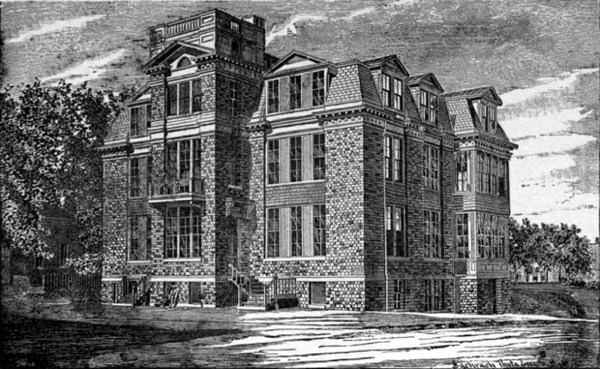
MORGAN COLLEGE, BALTIMORE, MD.
Since nothing aside from the action already
taken by the Church on this subject was done until
the year 1836, when the General Conference met
for its twelfth session in Cincinnati, Ohio, we pass
from the General Conference of 1824 to the General
Conference of 1836. The agitation of this question
went steadily on, however, and the Abolitionists
kept it warm. From Maine to Louisiana, from
Canada to Florida, it was being agitated. Since so
much was said concerning the question at that General
Conference, some of which, if not retrogression,
was akin to it, we give the following resolutions.
In reading the same, and judging them, we
must remember that the seeming opposition to
Abolitionism was attributable, in a measure, to the
aversion to politics; that the tide of agitation was
even then so high that the strongest of strong men
49trembled; that the Church had time and again put
itself on record as to the question at issue. Though
it, for the time being, condemned the action of the
two “lecturing delegates,” it never once relaxed its
grip upon the throat of slavery, nor assayed to
compromise a single principle of right. So far
removed from the scenes that greeted the General
Conference that year in Cincinnati, and remembering
how thoughtless some advocates of measures can
sometimes be or appear, and how easily a zeal without
knowledge can injure a good cause, we do not wonder
at the action taken in the case of those two brethren.
But when the enemies of human liberty construed the
condemnation of the action of those two brethren
by the General Conference as a weakening by the
Church on the question of slavery, the ensuing General
Conference disabused their minds of their error,
and sent the enemies of liberty to grass again.
The following are the resolutions above referred
to, enacted by the General Conference of 1836:
“Whereas, Great excitement has prevailed in
this country on the subject of modern Abolitionism,
which is reported to have been increased in this
city recently by the unjustifiable conduct of two
members of the General Conference in lecturing
upon and in favor of that agitating topic; and
WHEREAS, such a course on the part of any of its
members is calculated to bring upon this body the
suspicions and distrust of the community, and misrepresent
its sentiments in regard to the point at
50issue; and WHEREAS, in this aspect of the case, a
due regard for its own character, as well as a just
concern for the interests of the Church confided to
its care, demand a full, decided, and unequivocal
expression of the views of the General Conference
in the premises; therefore,
“Resolved, by the delegates of the annual conferences,
in General Conference assembled, That
they disapprove, in the most unqualified sense, the
conduct of two members of the General Conference,
who are reported to have lectured in this city,
recently, upon and in favor of modern Abolitionism.
“2. That they are decidedly opposed to modern
Abolitionism, and wholly disclaim any right, wish,
or intention to interfere in the civil and political
relation between master and slave, as it exists in the
slaveholding States of this Union.
“3. That the foregoing preamble and resolutions
be published in our periodicals.”
The report of the Judiciary Committee is here
given also, touching this question at another point:
“The Judiciary Committee, to whom was referred
the petition of the official members of the Methodist
Episcopal Church on Lancaster Circuit, Baltimore
Conference, report, that the petition referred
to them is an able document, drawn up in the most
respectful language, and signed by twenty-nine
individuals, who claimed to be official members
of the Methodist Episcopal Church on Lancaster
Circuit.
51“The petitioners first invite the attention of the
General Conference to the section of the Discipline
which states that ‘no slaveholder shall be eligible
to any official station in our Church hereafter,
when the laws of the State in which he lives will
admit of emancipation, and permit the liberated
slave to enjoy freedom,’ etc. They then produce an
extract of the laws from the commonwealth of Virginia,
showing their extreme rigor in this matter,
‘That any emancipated slave (with exceptions too
rare to be looked for in one case out of many) remaining
in the commonwealth more than twelve
months after his or her right to freedom shall have
arrived, contrary to the provisions of this act, shall
be sold by the overseers of the poor, in any county
in which he or she may be found, for the benefit
of the literary fund.’ In view of this act they
claim that they, as official members, are protected
by the Discipline of the Church, as they deem it to
be precisely one of the exceptions to the General
Rule provided for in the Discipline; and especially
as under the existing laws of the commonwealth to
emancipate their slaves would, in many cases, be
an act of cruelty to the slaves themselves. The
matter of complaint by the petitioners is, that the
construction put upon this rule by the Baltimore
Annual Conference, in certain acts respecting individuals
connected with this section of the work,
is subversive of their rights and oppressive in its
bearings; that they require the same submission to
52the rule of persons in that State as of those in
sections where the legal disability to comply with
it does not exist, regardless of the exceptions. And
they respectfully solicit the interference of the General
Conference, either to revise the rule, or give
it such construction as to afford them relief in the
premises; or, finally, if neither be done, to cause
them to be set off to the Virginia Conference.
“It is due to the Baltimore Conference to say
that the cases referred to as evidence of their improper
application of their rule, are stated in terms
too vague and indefinite to authorize the inference
drawn by the petitioners. It is represented that a
young man applying to be received into the itinerancy
is prevented by application of this rule; that
it is in vain for him to urge upon a majority of the
conference the impracticability of his complying
with the rule, in consequence of the laws under
which he lives, or any other consideration in favor
of his being received; because he will not comply
with the rule, he must be rejected. The same, it is
assumed by the petitioners, is done with respect to
those who apply for ordination. And it is inferred
by them, that if the conference act consistently,
stewards and leaders may be expected soon to be
called upon to comply with the rule, or forfeit their
official standing in the Church.
“Your committee view this subject in a very
different light. In admitting a preacher to travel,
or electing one to orders, a conference must have
53the right to act freely; and in cases which are not
successful, it is wholly an assumption, on the part
of the applicants or their friends, to say what particular
considerations dictated the vote, unless such
considerations be distinctly avowed by a majority
of the conference. And it is known to all conversant
with the transactions of an annual conference,
that no person applying to be received or ordained
ever enters as a party before the conference,
pleading his own cause, and hearing and answering
the objections which may be urged against his
application. Any act of conference, then, in these
cases, can not be justly urged as evidence that the
conference denies the party concerned the benefit
of the special provision in the rule. A conference
or other deliberative bodies possess, and in the
nature of the case must possess, the right to determine
its own course, and vote freely in all such
individual cases. Your committee, therefore, can
not see that the privileges claimed by the petitioners
have been contravened by an act of the
Baltimore Conference.
“Having said this much respecting the alleged
grounds of grievance, your committee agree in the
opinion that the exceptions to the General Rule in
the Discipline, referred to by the petitioners, clearly
apply to official members of the Church in Virginia,
according to the laws of the commonwealth, and do
therefore protect them against a forfeiture of their
official standing on account of said rule. In addition
54to the petition of the official members of Lancaster
Circuit, a resolution of a quarterly conference
of Westmoreland Circuit has been referred to your
committee, by which it appears that the members of
said conference concurred in said petition. Should
the General Conference agree in the opinions stated
by the committee in the report, it is respectfully
recommended that, after adopting it, they cause a
copy of it to be forwarded to the official members
in each of the above-named circuits. All of which
is respectfully submitted.
“The committee to whom were referred sundry
memorials from the North, praying that certain
rules on the subject of slavery, which formerly existed
in our book of Discipline, should be restored,
and that the General Conference take such measures
as they may deem proper to free the Church from
the evil of slavery, beg leave to report:
“That they have had the subject under serious
consideration, and are of opinion that the prayers of
the memorialists can not be granted, believing that it
would be highly improper for the General Conference
to take any action that would alter or change our rules
on the subject of slavery. Your committee, therefore,
respectfully submit the following resolution:
“Resolved, etc., That it is inexpedient to make any
change in our book of Discipline respecting slavery;
and that we deem it improper further to agitate the
subject in the General Conference at present.
“All of which is respectfully submitted.”
55The pastoral address presented to and accepted
by that General Conference, at once puts
forever at rest any shadow of a doubt as to any
disposition of the Church to compromise with
slavery. We quote the closing part touching this
question, viz:
“It can not be unknown to you that the question
of slavery in these United States, by the constitutional
compact which binds us together as a nation,
is left to be regulated by the several State Legislatures
themselves, and thereby is put beyond the
control of the General Government, as well as that
of all ecclesiastical bodies; it being manifest that
in the slaveholding States themselves the entire
responsibility of its existence or non-existence rests
with those State Legislatures. And such is the
aspect of affairs in reference to this question, that
whatever else might tend to ameliorate the condition
of the slave, it is evident to us, from what we have
witnessed of Abolition movements, that these are
the least likely to do him good. On the contrary,
we have it in evidence before us that the inflammatory
speeches and writings and movements have
tended, in many instances, injuriously to affect his
temporal and spiritual condition by hedging up the
way of the missionary who is sent to preach to him
Jesus and the resurrection, and by making a more
rigid supervision necessary on the part of his overseer,
thereby abridging his civil and religious
liberties.”
56General Conference of 1840.—Test cases
touching slavery were continually arising. That
of Silas Comfort was among the most noted. No
one will, for a moment, deny that this noted case
was as complicated as noted, and was, we believe,
on the whole as we now see it, settled for the best
interests of the Church and the colored race. The
decision was not what could have been expected;
but, then, “discretion is the better part of valor.”
There were, of course, two sides—two separate and
distinct parties concerned. While the interests
of a class within the Methodist Episcopal Church
were at stake, the unity and tranquillity of the
Church were on the altar. The action of Rev. Silas
Comfort was an entering wedge between the two
parties within the Church. Many earnest, honest
men thought it a strange procedure when that General
Conference declared it “inexpedient and unjustifiable
for any preacher among us to permit colored
persons to give testimony against white persons in
any State where they are denied that privilege in
trials at law.” This was passed by a vote of 74
to 46. Twenty-two members of that General Conference
did not vote at all. Whether the spirit
that gave birth to the Wesleyan Methodist Church
three years afterward kept them from voting, is
not recorded. Whether that decision hastened the
organization of the above-mentioned Church or not,
many believe it did. The decision, since in it the
word “denied” appears, was probably the best the
57General Conference thought it could do under
existing circumstances, coupled with the restriction
to those “States where they are denied that
privilege in trials at law.” The reason for rendering
such a decision probably rested upon the fact
that otherwise it might have led to internal wranglings
in the general Church, and imposed additional
hardships upon the colored man, in that
masters would probably have felt it incumbent upon
themselves to prohibit any slave from enjoying the
benefits derivable from membership in the Methodist
Episcopal Church, and thus added injury to
insult, and left them a prey to “the false accuser
of the brethren.” Notwithstanding the construction
others put upon that decision, or what we now think
of it, the colored members of the Methodist Episcopal
Church were not well pleased, as a protest
from Sharp Street Church declares. The author of
“The Anti-slavery Struggle and Triumph in the
Methodist Episcopal Church,” at page 148, says:
“At the General Conference of 1840 a memorial
was prepared by forty official members of Sharp
Street and Asbury Churches, in Baltimore, protesting
against the colored-testimony resolution. It was
put in the hands of Rev. Thomas B. Sargent, and
by him given to one of the bishops. Through the
efforts of Dr. Bond and others the memorialists
were pacified without the conference knowing anything
of the document.” The Rev. Dr. Elliott
declared that “the colored members of the Church
58were greatly afflicted. This matter had like to
have done great mischief.” The document was
afterward published. Among other things equally
pungent, the memorialists said:
“We have learned with profound regret and
unutterable emotion of the resolution adopted May
18th, which has inflicted, we fear, an irreparable
injury upon eighty thousand souls for whom Christ
died; souls which, by this act of your venerable
body, have been stripped of the dignity of Christians,
degraded in the scale of humanity, and treated
as criminals, for no other reason than the color of
their skin. The adoption of this soul-sickening
resolution has destroyed the peace and alienated the
affections of twenty-five hundred members of the
Church in this city, who now feel that they are but
spiritual orphans or scattered sheep. The deed you
have done could not have originated in that love
which works no ill to his neighbor, but in a disposition
to propitiate that spirit which is not to be
appeased, except through concessions derogatory to
the dignity of our holy religion! And, therefore,
they protest against it, and conjure you to wipe
from the journal the odious resolution.”
This was strong language, prompted by a stronger
feeling.
The members of Sharp Street Church did not
protest against the decision of the Church in this
case, because they doubted the expressed fidelity
made prior to this, that was self-evident. But they
59knew that times change and men change with them.
This to them looked like a compromise with the
spirit of slavery that stalked abroad in the land.
That decision, viewed from this distance to-day,
to some, assumes a different aspect altogether.
How could they keep from protesting? What
could they do more, how dare do less? How did
they curb their feelings enough to express their
thoughts in such mild language? Why should not
those burden-bound colored men and women protest
against, while compelled to submit to, a decision
that to them was humiliating in the extreme? Shall
the crawling, loathsome worm of the dust be
allowed to squirm when trod upon, the venomous
snake to hiss, the vicious beast to defend himself,
and then deny the right to protest? Could the
Church of God deny them the privilege of exculpating
themselves in the eyes of the public from
what to them appeared an undeserved reproach,
thrown upon them because of their color or helpless
condition, casting thereby away from them the
protection of all save that of God? As they probably
thought, why thus insult them? Aye; rather
why insult justice and God by demanding of them a
reason for protesting, since it appeared to them that
the Methodist Episcopal Church—the Church, and
only Church, that from the beginning had stood
manfully in their defense—by that decision “had
failed to manifest the spirit that worketh no ill to
its neighbor?” Whatever the protestants in this
60instance may have thought or said, viewed at that
time from the ignis fatuus of the then existing
African Churches in the North, “it was calculated
to drive out of the Methodist Episcopal Church
every intelligent and manly colored man,” into one
or the other of these Churches. Viewed, however,
under the light of the Address of our bishops at
that time, it assumes a more rational and philosophical
aspect. The bishops said: “We can not withhold
from you at this eventful period the solemn
conviction of our minds, that no ecclesiastical legislation
on the subject of slavery at this time will
have a tendency to accomplish these most desirable
objects, to wit: Preserve the peace and unity of the
whole body, promote the greatest happiness of the
slave population, and advance generally in the
slaveholding community of our country the humane
and hallowing influence of our holy religion.” By
this we judge that at that time the Church had
come to the conclusion that it was impossible by
“ecclesiastical legislation” to benefit in any way
the colored man; that extra legislation on the question
would be not only supererogatory, but in all
probability only beneficial in goading the slaveholder.
We infer (1) that civil legislation touching
slavery was not objected to; but that (2) the objection
to the admission of colored testimony had been
raised by the civil courts, and it was not considered
being “subject to the powers that be” to demur;
at least, that it was the duty of the Church “to
61live in peace with all men” as much as possible.
We are not ignorant of the fact that there have
been, and will yet be, times when forbearance
ceases to be a virtue, and when the Church of God
can not afford to be loyal “to the powers that be.”
But what could be accomplished by the opposition
of one Church to the slave oligarchy that
was then rife in this country? As to this we can
only say:
“Deep in unfathomable mines
Of never-failing skill,
God treasures up his bright designs,
And works his sovereign will.”
As we now see it, there was no use for Methodism
to push slavery harder at that time, since God
was behind the movement. Long before this time
the bishops and other far-seeing and right-minded
men saw that all the speeches made and actions
taken pro and con relating to slavery, by the
Church, would, without the interposition of God,
culminate in splitting the Church. This in itself
gave promise of what actually grew out of it—a long,
bitter, but bloodless ecclesiastical war between the
two factions. Seeing signs of an approaching crisis,
they were anxious to avert it as long as possible,
and at the same time prayed to God, “Thy will be
done, and not mine;” that when the on-sweeping tidal
wave, even then within the bounds of the Church,
in opposition to holding slaves, did come, that, so far
as those who were leading in opposition to the
62accursed traffic were concerned, their consciences
might be clear, and that if the separation came in
their life-time, their side should bear the marks of
God’s approbation.
Without multiplying evidence going to show the
interest the Methodist Episcopal Church took in
the colored man from its origin to the time at
which we have arrived, we wish now to note the
result of the unwillingness of the Church to compromise
with slavery. We have seen that in every
case where it was possible to make concessions to
the colored man, to train, protect, and elevate him,
the Church has done it where it was proper and
best for him. It has in every case, as far as practicable,
tried to remedy the wrongs perpetrated upon
him as well as lessen his burdens. Not, of course,
always as the colored man thought it ought to have
been done—for he was not in condition to even
judge what was best for him—nor yet as some
who appeared more radical would have had it done;
but the Church stood by and for the colored man as
no other denomination occupying the same territory
and similar circumstances would do. To know
what was contemplated by the Church in this case
we have but to trace out the legitimate results.
During the interregnum from 1836 to 1844 “God
moved in a mysterious way his wonders to
perform.” The question of the abolition of American
slavery was discussed at each General Conference
with animation and seriousness. Many
63declared the radical action taken by the Church on
the question would eventually rend the Church in
twain. Many earnest prayers ascended to the throne
of God in behalf of the tranquillity of the Church,
but were not answered because “his brother” was
in need; and those prayers, if answered, would not
only have riveted his shackles, but bathed his
face in tears, and consigned the poor colored man
and his posterity, not to perpetual banishment—that
would have been tolerable—but to a slavery
worse than that of the Russian serf. As many
more prayed that the prediction as to the split in
the Church might come to pass. As a result, each
succeeding General Conference was marked by the
friends of slavery as the beginning of the end of
a united Methodism in America.
CHAPTER III THE CRISIS—ITS CAUSE.
64
The General Conference of 1844 sat in the city
of New York, from May 1st until June 10th—forty-five
days. It has gone down into history as
the most noted of any General Conference of the
Church. There was at stake the peace, unity, and
strength of Methodism in this country. The question
most prominent, and that was calculated to
stir up most enthusiasm, was that of the abolition
of American slavery. An unprecedented, as well as
strange case, came up for consideration. Rev. James
Osgood Andrew, one of the bishops of the Methodist
Episcopal Church, who was elected at the General
Conference of 1832, a few months before the session
of the General Conference of 1844 had married
an estimable lady of the best families of Georgia,
who was the owner of slaves. This act on the part
of the bishop, from the very nature of things, caused
much excitement and more comment. This was a
trying attitude for the Church. There had arisen
within a party in the North that accused it of being
pro-slavery in sentiment—at least to a certain extent.
Notwithstanding it hitherto had occupied
such strong positions on the question of human
65slavery, the above sentiment arose to such a height
in 1842 as to cause a secession, and the formation
of the Wesleyan Methodist Church. It did, therefore,
seem strange that such a thing had happened.
But now it appeared as if the crisis had been
reached. Just what action that General Conference
could or would take now on the question of slavery in
general, and the bishop’s case in particular, was hard
to imagine. The natural supposition with the Abolitionists
was that the same vituperation and obloquy
would be manifested against slavery as of yore; that
the rules relating to slavery would be adhered to, even
where it involved a popular bishop of that Church.
It was a trying situation. Others declared it impracticable
and irrational for the great Methodist
Episcopal Church to interfere with the personal
rights of the bishop by declaring that he was in
the wrong, when he did not claim the slaves as his
property. Some declared the Church would now
back down, and thus verify the allegations of the
Wesleyan brethren. If it had not been for the confidence
the Church had in the bishop, and in many
others who professed to believe slavery right, they
could easily have concluded that a trap had been set
to catch the General Conference, because the bishop
was not the only one involved. A member of the
Baltimore Annual Conference had also, by marriage,
become a slaveholder and refused to manumit
his slaves. In the State of Maryland emancipation
was possible. After the Baltimore Conference
66had carefully considered his case, he was suspended
from the ministry of the Church. He appealed
from the decision of his conference to the ensuing
General Conference. When the case came up on the
appeal, the decision of the lower court was sustained
by a large majority. In the meantime the Committee
on Episcopacy waited upon Bishop Andrew.
He informed the committee that he had married a
wife who inherited slaves from her former husband;
that her husband had secured them to her by a
deed of trust; and that she could not emancipate
them if she desired to do so. The committee,
however, aware of the fact that it was possible for
the bishop to remove from the State of Georgia
where emancipation was not possible, to a State
where it was possible, took the case under consideration.
Here were two factions—one in favor of standing
up for the emancipation of slaves, supported by
thousands of influential Northern and Eastern men
and money; the other, supported by not less than
fifty thousand members, institutions of learning, and
the slaveholding States and slaveholding sympathizers
from the Atlantic to the great West, from
the Lakes to the Gulf, and every slaveholding country
in the entire world. Speeches, noting these facts,
and declaring a bitter unwillingness to crouch before
the spirit of freedom, manifested by that part
of the Church which opposed the holding of slaves,
began to make a breach in the Church that eternity
67alone, we fear, can only close. The Board of
Bishops were divided on the question. From North
to South, from East to West, the Church of God
was disturbed. Not only this, but the world knew
that if the Methodist Episcopal Church split then
and there on that question, and any respectable portion
opposed slavery, it would be the beginning of
the end of slavery on American soil. Therefore, even
the political and mercantile worlds were anxiously
waiting, as well as earnestly working, either to
reconcile the affair or compromise it. Any way in
the world not to divide on that question at that
time. God only knows how many colored people in
this country sent up prayers from the rice-swamps
of the Carolinas, the cotton-fields of Mississippi,
and the cane-brakes of Louisiana, that “the God
of Elijah, who answered prayer by fire,” would bow
the gentle heavens and visit New York City with
a baptism of the Holy Ghost, that that General
Conference—the men of God therein—might have
victory in favor of the Church, suffering humanity,
and God. If there was ever any time at which
more prayers besieged the throne of grace than
another, it surely must have been during the General
Conference of the Methodist Episcopal Church
in 1844. It is not an exaggeration to say the eyes
and ears of the world were turned toward that
General Conference. And why not? Were not
even then the interests of every Methodist in the
known world, of every colored man, woman, and
68child, and children of the race then in the womb
of the future—aye, the future destiny of him who
pens these lines, with that of our holy Christian
religion at stake? Most assuredly it was so.
Some declared that Bishop Andrew would have
willingly yielded to the opinions of the General
Conference had not his brethren in the slaveholding
States and others persuaded him that it was his
duty to stand by them on this question, involving
their personal rights. While we do not stop to
express a doubt as to whether, indeed, this was uppermost
in his mind, we are glad to note that, notwithstanding
the interests at stake, and that the
Church at that time could have saved itself much
trouble, filled its coffers with “golden ducats,”
increased its popularity, and the sound of its applause
would have resounded on earth from sea to
sea and from shore to shore, after a protracted
discussion, that General Conference, by a vote of
110 to 68,
“Resolved, That it is the sense of this General
Conference that he [Bishop Andrew] desist from
the exercise of his office so long as this impediment
remains.”
At this action the Southern conferences felt
deeply aggrieved. A clap of thunder from a clear
sky could not have spread greater consternation
and excited more feeling than did this action.
Like wildfire the news began to spread. So far as
the United States mails could carry it, the news
69was spread before a fortnight. What was to be the
outcome but few hesitated to say. What could it be
but that which had been repeatedly predicted, the
separation of the Southern conferences from the
Methodist Episcopal Church?
At once meetings were called by the Southern
delegates, and steps were taken looking to
the organization of a Church in the South. The
following year the organization was accomplished,
showing that the matter had been thoroughly canvassed,
and a conclusion reached by the slaveholding
element that was not to be surrendered. Is
he a philosopher who sees in this a counterpart to
the drama of Pharaoh and the Hebrews? Is it
not possible to trace the finger-marks of Providence
all along the pages of every resolution offered by
the Methodist Episcopal Church on this question
from 1796 to date? Does not it appear in all this
that our God,
“Deep in unfathomable mines
Of never-failing skill,
Treasures up his bright designs
And works his sovereign will?”
The chief part of the membership in the entire
slaveholding territory, with the exception of the
States of Maryland and Delaware, separated and
formed the Methodist Episcopal Church, South.
The grand old Methodist Church, by adhering to
her anti-slavery principles in this particular case,
lost nearly five hundred thousand members, the
70control of much Church property, and many institutions
of learning; incurring thereby the ill-will,
everywhere, of every man, woman, and child who
was pro-slavery in theory or practice. But what
effect had this action of the Church on the minds of
the colored people? Did they really believe it meant
what the pro-slavery element declared it meant,
that the Methodist Episcopal Church was an inveterate
enemy to what Wesley called “the sum of
all villainies?” Any one who doubts the fact that
the colored man everywhere, who was capable of
properly appreciating philanthropy, appreciated the
situation, has but to note the fact that, comparatively,
the States of Maryland, Delaware, Louisiana,
Mississippi, and South Carolina, so far as Methodism
among our people is concerned, belong to the
Methodist Episcopal Church; some of the most intelligent
colored men of the Church are there.
The saying, “It is an ill wind that blows nobody
good,” was verified in this instance. The colored
membership within the Church renewed its resolutions,
redoubled its diligence, and had its faith
strengthened in the integrity of Methodism. They
recognized in the Church a mother whose tender
solicitude and maternal care were not based upon
anticipated future benefits derivable from the colored
membership, but, commensurate with their
integrity and Christianity, she expected to help
them; that she was a mother who not only labored
to have them “flee from the wrath to come,” but to
71save them, as well, from the rigorous burdens of
the unrequited toil of slavery; that she was a
mother who loved them for Jesus’ sake, and stood
by them when it was neither profitable nor pleasant
to do so. A new inspiration seems to have come
to the entire Church. But was not that to have
been expected as a matter of course, under the
command with promise, “Bring ye all the tithes
into the storehouse, and prove me herewith, saith
the Lord of hosts, if I will not open you the windows
of heaven, and pour you out a blessing, that there
shall not be room enough to receive it. And
all nations shall call you blessed.” Had not the
Church planted itself upon the Ten Commandments—the
rock of ages; and was there not to be
seen everywhere the bright, shining light from the
Sermon on the Mount athwart the path of the
Church in its onward march in favor of the recognition
among all men, of whatever complexion, of
the wholesome doctrine and practice of the common
Fatherhood of God and the brotherhood of man?
As a result, that part of the Methodist Episcopal
Church that believed it better to obey God than
man, to be unpopular and sneered at, but right; that
“bore unmoved the world’s dread frown, nor heeded
its scornful smile,” received a new baptism of the
Holy Ghost, and continued receiving it until a new
door was opened unto the Church.
Notwithstanding the fact that nearly five hundred
thousand members left the Church on account
72of the decision on slavery, by no means all left who
wished the colored man would leave or be forced
out of the Church into one of the two colored
organizations. It may as well be said now, that
there has always been a faction within and without
the Church that has used, or attempted to use, the
colored man in opposition to the Methodist Episcopal
Church. In the first place, they use him as a
wedge. When they are foiled in an attempt to
carry any certain thing, they at once declare that
the Methodist Episcopal Church has been, and is
now, taking advantage of the poor colored man.
If this does not answer, they find it convenient to
let him (the colored man) understand that he is an
intruder in the Church, and respect for his manhood
demands that he go out and “paddle his own
canoe;” that white men will think more of him if
he exhibit “the self-reliance and ability displayed
by those members who are in separate Churches to
themselves.” When this proved abortive, they
found it convenient to demonstrate it. They at
once invited some minister of one of the two colored
organizations to occupy their (white) pulpits,
and leave the colored minister within our Church
without such invitation. The result was almost inevitable.
Pretty soon the more manly members of
our Church, in the community where such tricks
were played, would begin to say: “Well, that’s passing
strange, that white ministers of our Church
prefer African ministers to our own. It must be
73because of their independence. If that’s so, we
want some of it also.” That an undercurrent of this
kind has flowed along the stream of Methodism
ever since the colored membership question has
been discussed, is easily proven. Now the class of
which we have just spoken is to be distinguished
from the class who honestly believed that it would
be better for the white and the colored members to
be separate. Not that they (the whites spoken of)
were unwilling to aid the colored members, nor yet
because they did not want them saved, but because
the loud professions and announced success of the
separate colored organizations blinded their eyes.
These considered, and rightly so too, all such persons
their best allies. The African and African
Zion Churches whispered continually, and sometimes
preached, that the colored membership in the
Methodist Episcopal Church was a burden to the
white folks. These organizations, though supported
by some within our Church, saw there were but two
ways in which they could induce the colored element
in the Methodist Episcopal Church to join
them,—by loud professions of “race pride,” and appeals
to their ignorance and prejudice. This they
attempted by appeals to the dignity of our colored
local preachers; by telling the more ignorant that
they were being imposed upon by “white folks.”
They told the local preachers, class-leaders, etc.,
among our members, that it was a shame for them to
have white masters during the week and white masters
74on the Sabbath-day also; that they were as well
qualified literarily to have charge of congregations
with white members as some of the white pastors;
that they possessed intelligence enough to do business
for themselves. Then, again, they would say:
“There will never come a time when the Methodist
Episcopal Church will allow one of you colored
members to preside as their presiding elder or
pastor; that all the property you buy belongs to
‘white folks,’ and not to you.”
The language of their most accurate historian
will give a faint idea of the pressure we speak of,
which was and is now brought to bear upon our
people in some localities. He says: “It is true
our colored brethren within the communion of the
Methodist Episcopal Church worship in a large
number of churches in Maryland, Delaware, and
other of the Southern States, and many of them
are fine ones; but the question is: ‘To whom do
they belong—the congregations worshiping in them,
or the Methodist Episcopal Church?’ We all know
that it is our glory, that our churches belong to no
one congregation or body of trustees in particular,
but to the connection in general.” Again, ibid: “It
would have been a source of unspeakable joy had
he been able or permitted truthfully to record that
your Church had acknowledged your full and true
manhood, and not denied it both in practice and in
law; that it had opened its school-doors to you,
as did other Christian bodies, and like them, too,
75have received you into conference upon a perfect
ministerial equality; but, alas! the doors of its
schools, and of its conferences as well, were locked,
and bolted, and barred against you.” He was
quoting and commenting upon the words of another.
Such strong talk, mixed as it was with braggadocio,
pretty soon had the desired effect upon two
large classes amongst us—the ambitious illiterates
and the pompous, aspiring for recognition, minus
merit. These two classes were soon, after such
a process of pumping, inflated until their sides
puffed nearly to bursting. A number of the above-mentioned
classes soon concluded that they must
be in a Church where there was a favorable chance
for every member of an annual conference to be
put forth before the world as a noted preacher,
appointed presiding elder or a General Conference
officer, or elected to the bishopric. It is difficult
for any one, who understands in some sort the feelings
of white men when they are ambitious for notoriety
or office and fail, to say or appreciate the
feelings of a disappointed colored man who has
known nothing save ostracism. To expect him to
refuse preferment, emolument, or office, when tendered,
is to expect an ox in August to refuse the
shade. Notwithstanding the disadvantages the colored
man has labored under hitherto, he has found
out that in a nation of blind men the one-eyed man
ought to be, and is, king. To this day but few
white people have learned that it is not always the
76most profitable thing to exchange an old lamp for
a new one; that “it is better to bear the ills we
have, than fly to others we know not of.”
To say that at no time a single colored member
within the Methodist Episcopal Church imagined
the wool was being pulled over his eyes by men of
lighter hue, is going too far. To say there never
was a white man in the Methodist Episcopal Church
who refused to recognize or affiliate with the colored
members because of their color, who refused to
do for him there what he would have done if he had
been elsewhere, or had been “manly and independent
like some others, and paddled his own canoe,”
or that all such have left the Methodist Episcopal
Church, is going farther than truth warrants or the
case requires. To say that any organization among
men is absolutely perfect, is preposterous; for even
the Methodist Episcopal Church in this country is
not what it can and will be. I fear much of the
unrest, and seventy-five per cent of the withdrawals
of our colored membership since 1812, could directly
or indirectly be attributed to the actions of those
within and without the Church who think more of
caste than Christ, more of popularity than right,
and more of men’s opinions than of God’s Word.
Notwithstanding this, we hazard the statement that,
during that time, there has not been an hour when
the heart of Methodism in general, and the Methodist
Episcopal Church in particular, did not beat
in unison with that of the Christ of God, the
77blessed Master, who, in the midst of a gainsaying
world, said: “I call you not servants, for the
servant knoweth not what his Lord doeth; but I
called you brethren.” And yet, in nearly every
instance of attack made by the two colored organizations
upon the colored members in our Church
up to this time, and for that matter all time, the
exceptions among our white and colored membership
have by them been spoken of as the rule.
Their statements as to the intelligence or ignorance
of our colored membership was the natural if not
legitimate outgrowth of the disposition, action, and
words of some of our white members who remain
in, but were not in spirit of the Methodist Episcopal
Church. This is true of some of the ministers
as well as white members of our Church.
When the bishops, General Conference officers,
pastors, or members of the two colored organizations
visited communities where we had churches, they
were welcomed as no other colored Methodists were, if
for no other than for the reason that they were
high in authority within their own Church. This
distinction was not always clear in the minds of our
members. There is no doubt that this caused us
much trouble as well as loss of preachers and lay
members. In those States where our membership
was the largest and most influential, and where our
churches were better and finer, the effects of such
stuff were more telling because of the spirit of the
people. Our members saw at once that one of
78three things had to be done to hold our members:
a complete colored organization had to be formed
among us; or else join with the one or the other
of those organizations; or else have separate annual
conferences within our Church, so that the presiding
elderate, pastorate, trusteeship, and stewardship
would be in the hands and charge of our colored
members.
It was not in the mind of the two eagles that
stirred up this nest, that matters would turn out as
they did—that instead of an exode from the mother
of Methodism into the bosom of the daughter, a
separate perch could and would be prepared. The
anticipation was that all the colored members in the
Church would flock into the two African Churches.
This hope kept those two organizations from uniting,
while each thought its numbers would soon be
increased by the coming of the colored members
from our Church. The more intelligent colored
men in our Church saw and felt that something
had to be done, and done quickly. I could wish
they had opened their eyes sooner. Those two
organizations knew well enough that if the colored
members within the Methodist Episcopal Church
in the North, East, and the States bordering on the
above sections decided to leave, one or the other, or
both of these, would get them. There was no other
Church into which they could go. Hence they
worked and faithfully watched every movement of
our Church touching the colored people. They
79well knew that if all the colored members in the
Methodist Episcopal Church joined in a body either
one of their organizations, the result would be one
great, grand colored Methodist Church. I truly
believe the good men in the Methodist Episcopal
Church, among which we put our bishops, saw it
in that light. I believe other white members in
our Church were laboring every day for the sole
object of bringing about a union of all the colored
Methodists. They believed that the colored man
had been a source of annoyance; that the good
brethren who left the Church in 1844 would return
if the colored members all left the Methodist Episcopal
Church; that it would be a great set-back as
well as rebuke to the “hot-headed Abolitionists”
who kept it in an uproar about the colored man,
and would prove conclusively that the radical
element within it was all wrong and the conservative
element was all right.
When the General Conference of 1848 met in
the city of Pittsburg, several petitions from the
colored members of our Church in Pennsylvania,
Delaware, and Maryland were presented. The petitioners
asked that, since the Church had ordained
colored ministers, they be given the charge of
the congregations over which white pastors had
presided; that a separate conference be granted
them within the Methodist Episcopal Church.
These petitions were not only received, but respectfully
and carefully considered. The petitions were
80properly and promptly referred to the Committee
on the State of the Church. In due time the above-named
committee reported as follows:
“We find among the papers presented for our
consideration memorials from different places within
the slave States from our colored membership, praying
for recognition, in that colored ministers be sent
to them; for the organization and manning of districts;
and that they be granted a separate annual
conference,—which memorials are signed by 2,735
members.”
Thus it is clearly seen that much unrest was
caused by the delay on the part of our Church in
granting a separate conference. Our work to-day
would have been as strong, comparatively, in the
Eastern and Northern States as either of the African
Churches, had it not been for the delay in granting
us a separate conference. As a result nearly all the
colored members of our Church in the North and
East were persuaded to unite with one or the other
of the African Churches which were under the
fostering care in some way of our Church, while
they desperately fought the colored element within
it. Of course, this is strange. A fact remains,
that the great Methodist Episcopal Church felt that
while under obligations to help the colored man,
and more able to do so than others, she was unwilling
to have him driven away, whether by centrifugal
or centripetal force. The committee
above referred to continued its report as follows:
81“We recommend the following:
“Resolved, That we recognize all persons in these
United States, who were members of the Methodist
Episcopal Church in 1844, who have not separated
from said Church by withdrawals or expulsion
according to the Discipline of the Church, and who
express a desire to be recognized as under our care
and jurisdiction, as members of the Methodist
Episcopal Church; and that we regard it our duty,
as far as practicable, to supply all such with the
preaching and ordinances of the gospel.”
The special report in this case on the petition
from the Sharpe Street Church of Baltimore,
asking for a separate conference, reported as
follows:
“That having carefully considered the memorials,
and feeling an earnest desire to do all that
can be done to promote the spiritual interests of
our colored people, they recommend to the General
Conference for adoption the following resolutions:
“Resolved, That the organization of such (separate)
conferences at present is inexpedient.
“Resolved, That the Discipline be so amended
that the fifth answer in section 10, part 2, shall
read as follows: ‘The bishops may employ colored
preachers to travel and preach where their services
are judged necessary: Provided, that no one shall
be so employed without having been recommended
by a quarterly conference.’”
Thus the work of the colored members of the
82Methodist Episcopal Church began as the great
Church itself began, evolving out of necessity, and
guided by Providence.
The already existing Churches—the African and
African Zion—were not allowed to operate to any
great extent in the Southern States by the customs
and laws of these States; hence, without giving any
reason, it was wise to conclude that at that time,
and in that territory, the organization of a separate
colored conference among our people, within the
Church, was “inexpedient.” And yet the Church
was willing to do what it thought best under existing
circumstances. The colored ministers within
the Church were henceforth to travel and preach
at the discretion of the bishops. This was the beginning
of colored traveling preachers in the Methodist
Episcopal Church.
CHAPTER IV THE COLORED PASTORATE. — THE FIRST EDUCATIONAL EFFORT.
83
The employment of colored ministers in the
traveling connection in the Church, like
Methodism itself, was a child of necessity. It has
grown to be a man, however, and is the father of
several children. Notwithstanding the secession of
nearly all our white conferences and Churches—500,000
members in the slaveholding States before
mentioned—the record is not written where the
Methodist Episcopal Church extended overtures to
them to return that in any way involved the relinquishment
of its hold on the throat of slavery, or
that equaled that offered by our revered president,
Abraham Lincoln, to the Southern Confederacy, if
they would return to the Union. The whole question
of opposing slavery by the Church seems to have
been, all along, a work of conscience, not to be
repented of; that the work had to be done, because
the seal of God’s approval rested upon it. The
action and firm stand taken by the Church in 1844
put a quietus upon all who professed to believe the
rules relating to slavery would not be enforced
during the ensuing quadrennium.
The General Conference of 1852, that met in
the city of Boston, was called upon to consider the
expediency of separate conferences for colored
84members. The custom of the Church had usually
been to leave all colored congregations, in the
appointments, “to be supplied.” But as the work
progressed and the colored membership found the
braggadocio of those “who went out from us” was
invading the rank and file of their work; that each
year it increased with telling and disheartening
effect, and the more ambitious members among us
were becoming restless and wavering in their
opinions, threatening with dissolution the work of
the colored members within the Church, the members
within the bounds of the Philadelphia and
New Jersey Conferences—at any rate from members
of our Church in Pennsylvania and New Jersey—sent
up, not only memorials to this General Conference,
but representative men of the more intelligent
class, to represent them and see, at the same
time, the way the great Methodist Episcopal Church
would treat colored memorialists. When the memorials
were presented, asking again for separate
conferences, they were promptly referred to the
Committee on Missions. After careful examination
of the memorials, they called before them the representatives.
“An open and free discussion of the
interests at stake and the benefits anticipated therefrom,
was had.” The committee then submitted to
the General Conference the following:
“The Committee on Missions, to whom was
referred the petition of our colored brethren from
Philadelphia, asking that the pastors within the
85Philadelphia and New Jersey Annual Conferences
may be formed into an annual conference, under the
supervision of the bishops and of the presiding elders
of said conference within whose bounds their (the colored
pastors’) work may lie, beg leave to report that
the committee have given due consideration to the
petition, and have heard the bearers of it in person,
and have obtained all the information within their
reach, and have come to the following conclusions:
“1. That it is very desirable that the colored
pastors mentioned in the petition aforesaid should
have an opportunity to meet together once a year,
in the presence, or under the supervision, of the
bishop or bishops, in order to confer together
with respect to the best means of promoting their
work, and to receive the assignment of their work
from the bishops to the Churches usually left in
the Minutes ‘to be supplied.’
“2. That in this meeting it is desirable that the
presiding elders, in whose bounds the colored
Churches and congregations lie, should be present
to assist the bishop in the assignment of the work.
“3. Provided, upon due inquiry by the bishops,
they shall find a sufficient number of colored
preachers of sufficient qualifications to justify an
annual meeting. Having arrived at these conclusions,
the committee have agreed on the following
resolution, which is reported for adoption by this
General Conference:
“Resolved, That we advise that the colored local
86preachers now employed, or who may be employed,
within the bounds of the Philadelphia and New
Jersey Annual Conferences, be assembled together
once in each year by the bishop or bishops, who
may preside in said conference, for the purpose of
conferring with the said colored local preachers with
respect to the best means for promoting their work,
and also for the purpose of assigning their work,
respectively; and that the presiding elders within
whose bounds and under whose care the colored
Churches and congregations are, be present and aid
the bishop or bishops in said annual meeting of
local preachers: Provided, that upon due inquiry
the said bishop or bishops shall find such annual
meeting aforesaid to be practicable and expedient.”
So far as we have gone, we have seen a disposition
on the part of the Church to give the colored
man all the rights and benefits practicable and wise
that are accorded other members. It was not to
have been expected that he would demand what
was not best for him as he saw it, or that he should
be given what he asked for when it was as impracticable
as unwise. There is no parent that is willing
to allow a child to have its own way in everything—i.e.,
if a wise parent. When at the General
Conference of 1848 the committee reported a separate
conference for the colored members within
the Church “inexpedient,” what was thought of it?
Was it, under the then existing circumstances,
87impracticable and inexpedient? It was most assuredly
impracticable, in that but few localities would
allow slaves to have a meeting of their own in the
absence of some white person. The Lord Jesus
said: “I came not to destroy the law, but to fulfill
the law.” He verified this by paying taxes, and
observing (and having others do the same) the
Jewish law. Suppose the Church, at that time,
had given them a separate conference for Maryland
and Delaware, could they have enjoyed the
benefits of it? Most assuredly not. On the other
hand, it would have undoubtedly weakened the influence
of the Church with the masters, and subjected
the colored members to restrictions of
privileges, and brought upon them uncalled-for
hardships.
The tasks imposed upon the poor Hebrews in
Egypt were increased, as well as the inflictions of
punishment, as soon as they began to believe in
Moses’ plan of a “three days’ journey into the
wilderness to worship God.” When a desire for a
separate conference came from those who could
enjoy it without let, it was at once arranged for
them. I believe the more intelligent colored men
listened to the words of advice and wisdom of the
General Conference with confidence. And yet it
must be declared that many of the influential colored
members of our Church were urged up to the
belief that it was refused them from mere jealousy
on the part of ‘the white folks,’ because they did
88not want the colored man elevated; because they
wished to boss him in Church matters as his master
did in every-day affairs.
Very many advantages were offered the African
Churches by the failure of our Church to grant
the requests made by our members for separate annual
conferences. Whether they took advantage
of them or not, a great many people in these United
States believe they did. Every time the General
Conference was asked to grant separate conferences,
and it did not do so because of its impracticability,
it was not strange that they were vexed, hearing
everywhere, “I told you colored folks so.” As a
result of such failure we lost, from 1844 until we
were granted separate conferences, not less than one-fourth
of the membership of the African Churches
in this country at that time. As strange as it may
seem, it is really true. But probably the Church
was not to be blamed altogether for not doing for the
colored members that which would have inevitably
worked hardships for them in the slaveholding
States. But why did not the Church at once form
separate conferences for our people in those States
where the African and African Zion Churches were
then operating? As we turn these questions over
in our minds, several valid reasons occur to us.
Either because the Church loved the colored man,
and wanted him to have his own choice when
allowed to enjoy it—whether for separate congregations,
conferences, or Churches—even though they
89all declared a desire to unite with one of the two
colored organizations, or both of them, already in
existence, and thus become a religious power in
those States where it was practicable, in the which
they could still aid them; or because the Church
thought the world would declare—had they organized
another colored Church—that they were following
with opposition and spite those two bodies,
by setting up a “colored Church” within a white
one to break those two down; or the Church did
not want to move in the matter until somewhat of
the outcome of the Negro question could be seen or
known; or else, because they really thought it the
duty of the Methodist Episcopal Church to look
after those colored members in the slave States
where “the colored organizations” could not go,
and abandon all other colored members as material
for the upbuilding of their work. The latter, I
believe, is nearer the truth. And by this is not
meant that they refused to allow colored members
to join the Church, or to commune with it in the
“free States,” but that no special pains were put
forth to induce them to join the Methodist Episcopal
Church where either of those bodies had charge.
This is one of the advantages they have enjoyed
over the colored members remaining in the Methodist
Episcopal Church. Again, may it not be
surmised that since ours is “the Prince of peace,”
and rivalry in ecclesiastical, as other matters, usually
is followed by strife, that the refusal of the Church
90to grant separate conferences to the colored members
in those States was but an effort to avoid
strife? Again, for the Church to have granted separate
conferences, as a stay against the secession
spirit manifested in 1816 and 1823, would have
been considered by a great many good people—and
used to advantage by the seceders—as a declaration
of the charges made by the African Churches that
“the whites were anxious to get rid of the colored
element within the Church.” From whatever point
we take cognizance of that matter, it would appear
as if the Church tried to do what was for the best.
Every conceivable thing was done to pacify and
keep the colored members within the Church. The
secession of the Wesleyans had a great deal to do
with the complication of this matter, for they were,
in many instances, naturally the main stay for
African Methodism.
THE FIRST COLORED BISHOP IN THE METHODIST EPISCOPAL CHURCH.
The interest the Methodist Episcopal Church
had in the colored man was not confined to America.
“The old Church sought her sheep,
The parent sought her child;
She followed him o’er vale and hill,
O’er deserts waste and wild;
She found him nigh to death,
Famished, and faint, and lone;
She bound him with the bands of love.
She saved the wandering one.”
91The first foreign mission-field of the Methodist
Episcopal Church was Africa. When the “freed
people” of these United States began to move to
the west coast of that country, the Church began
to follow them by sending over missionaries to look
after her colored members and others who would
accept the service. From time to time the membership
multiplied, and in 1833 a mission was
organized and then an annual conference. This
missionary field may have been the outgrowth of
the seeds sown by Dr. Coke, who in 1814, on his
voyage to India, left a missionary at the Cape of
Good Hope. The work continued to increase until
it was declared by some the leaven that was to leaven
Africa. In 1834, in company with Rev. John
Seys, was sent Rev. Francis Burns from New York,
he having been ordained deacon and elder by that
man of God, Bishop Janes. In 1849 he was appointed
presiding elder of the Cape Palmas District
of the Liberia Annual Conference. When the General
Conference of 1856 convened in the city of
Indianapolis, Indiana, a new phase of the colored
membership question came up. Africa was knocking
at the door of the conference, asking for a
missionary bishop. The General Conference at
once took up the cry, examined the matter, and
requested the Liberia Annual Conference to select
the man. This was done by the selecting of Rev.
Francis Burns. He at once prepared to return to
America for ordination.
92Why did the Methodist Episcopal Church not
send a bishop by the West Coast of Africa and have
him ordained there? Why bring him back to
America, where the colored man was only recognized
as a chattel, a bondman, a serf? And yet,
to her praise be it said, she did for the colored man
in America what no other denomination found it
convenient to do—ordained a colored man to the
episcopacy. When Rev. Francis Burns arrived he
was given all the honor any man could have expected.
He was accordingly ordained at the session
of the Genesee Conference, October 14, 1858,
the services being conducted by Bishops Janes and
Baker. But after all this, what did the Church
really think and say concerning this colored man at
that time? The assembly that witnessed his ordination,
and those who grasped his ebony hand and
bid him God-speed, declare in the words of Dr.
Robie, who was present: “Though of ebony complexion,
he had gained wonderfully on the affection
and respect of all who had made his acquaintance,
and especially those privileged to an intimate association
with him. His manner is exceedingly
pleasant, and his spirit kind, sweet, and good as
ever beamed from human heart or disposition. He
seems to be lacking in none of the qualifications of
the gentleman and Christian minister. He possesses
also an intelligent and cultivated mind, speaks
readily and fluently, and even eloquently, and is in
all respects a model African. Such is the man
93whom the Liberia Conference has selected for a
bishop, and such the one the highest authorities of
our American Church have set apart for the sacred
and responsible position.” We add, Thus shall it be
done to the colored man whom the Methodist Episcopal
Church delights to honor on slave soil, where
prejudice against the race grew as rank as wild
weeds.
The election and ordination of Bishop Burns was
not a subterfuge, for the Church elected another
colored man to the episcopacy—Rev. John W.
Roberts, in 1866—one year after the war closed.
He was consecrated in St. Paul’s Methodist Episcopal
Church, in New York City, June 20th of that
year.
With the interests of the race at heart, what
more could she have done?
But the advance steps already taken by the
Church on that question were twisted by those who
opposed the Church in her efforts to do God’s will
toward the downtrodden race, into every shape but
the proper one. The cry still went up from at least
two sources that the Church was not willing to
recognize the colored ministry and members within
her borders. The colored members within the
Church where such attacks were made still felt
that a further step must be taken by the Church to
save the colored membership. So there came up to
that General Conference from the colored members
within the Baltimore, Philadelphia, and New Jersey
94Conferences one or more memorials, all of which
were referred to a special committee, which reported
as follows:
“The committee to whom were referred the
memorials of colored members within the bounds
of the Baltimore, Philadelphia, and New Jersey
Conferences, after due consideration, report the
following for the adoption of the conference, and
recommend that it be inserted in the Discipline as
a distinct chapter, entitled,
“CHAPTER VIII. OF THE RIGHTS AND PRIVILEGES OF OUR COLORED MEMBERS.
“1. Our colored preachers and official members
shall have all the privileges which are usual to
others in quarterly conferences, where the usages
of the country do not forbid it. And the presiding
elder may hold for them a separate quarterly conference
when in his judgment it shall be expedient.
“2. The bishop or presiding elder may employ
colored preachers to travel and preach, when their
services are judged necessary: Provided, that no
one shall be so employed without having been
recommended by a quarterly conference.
“3. The bishops may call a conference once
in each year of our colored local preachers, within
the bounds of any one or more of our districts, for
the purpose of conferring with them with respect to
the wants of the work among our colored people,
and the best means to be employed in promoting
its prosperity; at which conference the presiding
95elder within whose district, and under whose care
the colored charges and congregations are, shall be
present: Provided, that the holding of said conference
or conferences shall be recommended by an
annual conference, and the bishops, upon due inquiry,
shall deem it practicable and expedient.”
Again, by this action, the Church recognized
the colored members within her communion as being
eligible to all privileges usual to other members,
showing at once that her heart was all right.
By this is not meant that no interest in the education
of the race had been manifested prior to
this. The education of Bishop Burns, alone, would
refute such an idea. But the Church began to see
and feel that something on a larger scale ought to
be done for the higher education of the colored
youth within the Church. The very idea points
out the fact that the Church saw for her colored
members a better day coming. At the General Conference
above mentioned, Wilberforce University,
now in the hands of our brethren of the African
Church, at Xenia, Ohio, was purchased by a number
of individuals, and was under the patronage of
the Cincinnati Conference of our Church, and was
“devoted to the higher education of colored youth.”
Rev. J. F. Wright, D.D., its efficient agent, presented
its claims to the General Conference. He
traveled in its interest, and it continued to flourish.
96Rev. R. S. Rust, D.D., became president of this
institution in 1859. Our brethren of the African
Church began to feel the need of a better educated
ministry, and having no outlook for such an institution
turned their attention toward this institution.
Bishop D. A. Payne, having formed the acquaintance
of President Rust, began negotiations for the
transfer of that property to the African Methodist
Episcopal Church; and, in 1863, it accordingly
“passed into their hands for a nominal sum.” Thus
the beginning of the educational work in the
African Methodist Episcopal Church was but the
outgrowth of the generosity of the Methodist Episcopal
Church toward the colored race, whether
within or without the Church. It is true that but
little, if any, credit is ever given to the Church that
was represented in the matter by our own Dr. R.
S. Rust. They sometimes—and Bishop Payne all
the time—mention gratefully his name, but no public
acknowledgment by that Church has yet been made
to us for the advantages given them in this
transaction; and hence many a student, who has
attended there, has gone away ignorant of these
facts. That transaction is but another proof of the
fact that but little, if any, opposition or rivalry
has ever been allowed from our Church toward
their Church.
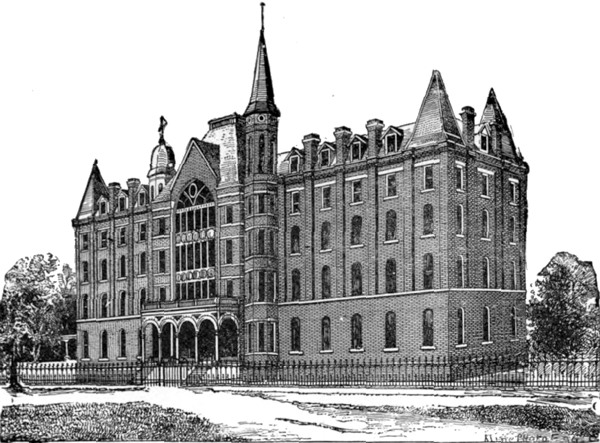
NEW ORLEANS UNIVERSITY—MAIN BUILDING.
It did seem that, ecclesiastically as well as politically,
“Providence had wisely mingled their cup.”
When one phase of the question touching slavery
97had been met, another phase developed. If ecclesiasticism
met this “sum of all villainies” in its way,
and struck it down, leaving it wounded, bleeding,
and dying, it would, phœnix-like, the next day
appear in the political field. Like “Banquo’s
ghost,” it would not down at the bidding. The
General Conference of 1856 had hardly adjourned
before the political world was startled by the case
of a colored man—Dred Scott—which was brought
before the courts for decision. The appeal was
brought up to the Supreme Court. Chief Justice
Taney, speaking for the court, declared in this case
that “Negroes, whether free or slaves, are not citizens
of the United States, and they can not become
such by any process known to the Constitution.”
This decision caused a ripple, not only on the sea
of politics, but over the placid stream of Methodism;
for it must not appear or be considered
egotism when it is said nothing relating to the
interests of the colored man has transpired in this
country in which Methodism did not take part.
And yet, as strange as it may appear, the Church
has always objected to mixing politics with religion;
but believing the converse admissible, our Church
papers began to wage war in favor of this colored
man, as if he had been a member of the Methodist
Episcopal Church.
This excitement had not subsided when Abraham
Lincoln, as the nominee of the Republican
party, was elected President of the United States.
98The relation our Church sustained to that conflict
will be better understood when it is remembered
that Torrey and Lovejoy, the two martyrs to the
Abolition cause, were New England ministers; that
the New England Methodists very early identified
themselves with this cause, and poured hot shot
into the foul slave oligarchy. As early as June 4,
1835, the New England Conference of the Methodist
Episcopal Church had organized an anti-slavery
society—not simply a non-partisan, namby-pamby
sort of a stay-at-home-and-pray society, but
active, vigilant, and progressive—on the basis
of the immediate and unconditional abolition of
slavery. North Bennett Street Methodist Episcopal
Church, in Boston, was opened in that year for
Rev. George Thompson to preach a sermon against
slavery. William Lloyd Garrison spoke of that
meeting as follows:
“In these days of slavish servility and malignant
prejudices, we are presented occasionally with
some beautiful specimens of Christian obedience
and courage. One of these is seen in the opening
of the North Bennett Street Methodist Episcopal
meeting-house in Boston to the advocates for the
honor of God, the salvation of our country, and
the freedom of enslaved millions in our midst.
As the pen of the historian, in after years, shall
trace the rise, progress, and glorious triumph of the
Abolition cause, he will delight to record, and posterity
will delight to read, that when all other
99pulpits were dumb, all other churches closed on the
subject of slavery in Boston, the boasted ‘cradle
of liberty,’ there was one pulpit that would speak
out, one Church that would throw open its doors
in behalf of the downtrodden victims of American
tyranny, and that was the pulpit and Church above
alluded to. The primitive spirit of Methodism is
beginning to revive with all its holy zeal and courage,
and it will not falter until all the Methodist
Churches are purged from the pollution of slavery,
and the last slave in the land stands forth a
redeemed and regenerated being.”
Notwithstanding the above, such Methodist ministers
as Rev. Gilbert Haven and others kept the
ball rolling. It is said of one of our bishops:
“Throughout the late contest Bishop Simpson did
much to strengthen the hands of President Lincoln,
and to nerve the spirit of the nation to endure
any sacrifice for the cause of the Union.”
Is it any wonder, then, that the Church, in one way
or the other, was connected with nearly every effort
for the emancipation of the slaves? Therefore the
eighteenth session of the General Conference that
convened in the city of Buffalo, May, 1860, was
anticipated with much anxiety.
The great debate on the question of slavery at
the last General Conference had, during this entire
quadrennium, proven sufficient to keep up the agitation
all along the line. Dr. Abel Stevens, then
editor of the Christian Advocate, addressed an
100“Appeal” to the general Church “concerning what
the next General Conference should do on the question
of slavery.” This appeal aimed simply to
have the next General Conference declare “the
sense of the Church on the whole subject,” with
“a note, put in the margin of the General Rule,”
that declared “the only cases of slaveholding admissible
to our communion are such as are consistent
with the Golden Rule.” Drs. Nathan Bangs
and J. H. Perry, at the head of a “Ministers’ and
Laymen’s Union,” formed within the New York
Conference in 1859, and the Anti-slavery Society,
with Dr. Curry leading, hurled their anathemas
against Dr. Stevens’s proposition. Resolutions favoring
a new rule on slavery, prior to the General
Conference of 1860, were voted upon as follows: Cincinnati,
319 votes for, 1,212 votes against it; Providence,
1,242 for, and 1,329 votes against it; Erie,
1,795 for, and 1,416 votes against it. It was conceded
that the cause of human liberty would receive a
fresh impetus from the ringing speeches that would
be delivered, and from the solid resolutions that
would be passed at that General Conference. Accordingly
two classes of petitions were presented:
“Those asking for the extirpation of slavery from
the Church,” and “those asking that no change be
made in the Discipline on the subject of slavery.”
A special committee was ordered to receive resolutions
of this kind. There was also appointed “a
Committee on our Colored Membership.” Several
101memorials and petitions from our colored membership
were presented. After due consideration, notwithstanding
the excitement on account of the
agitation of the question of slavery, that committee
reported as follows:
“The Committee on Colored Membership, to
which were referred certain memorials from colored
local preachers, respectfully represent: That having
examined said memorials, they find that they
request this body, (1) To extend the bounds of the
conference of colored local preachers, called in accordance
with the provisions introduced into the Discipline
at the last General Conference; (2) To grant
them the power to try and expel their own members;
(3) To confer upon the conference of colored local
preachers power to elect to deacons’ and elders’ orders;
(4) To invest said conference with all the powers
of a regular annual conference; (5) To admit colored
preachers to membership in our annual conferences.
Your committee find that the first two objects
prayed for are, in substance, covered by provisions
already existing in the Discipline, which appear to
have been overlooked by the petitioners. In regard
to items three and four, referred to above,
your committee find that the prayer of the memorialists
could not be granted without doing violence
to our usages and Disciplinary regulations. The
fifth item embraced in the memorials before us was
withdrawn by the representative of the petitioners,
who appeared in person before the committee. In
102view of the whole of the foregoing, your committee
recommend that the whole subject be dismissed.
All of which is respectfully submitted.
“S. Y. Monroe, Chairman.”
When the Committee on Slavery reported, there
were submitted a “majority” and a “minority”
report, a substitute for the majority report. The
first resolution of the committee was:
“Resolved, by the delegates of the several annual
conferences, in General Conference assembled,
That we recommend the amendment of the General
Rule on Slavery, so that it shall read: ‘The buying,
selling, or holding of men, women, or children,
with an intention to enslave them.’”
This motion was lost, since it required a two-thirds
vote; and 138 voted for it, and 74 against it.
The second resolution was:
“Resolved, That we recommend the suspension
of the fourth Restrictive Rule, for the purpose set
forth in the foregoing resolution.”
The first resolution having failed, this was laid
on the table. The third was:
“Resolved, by the delegates of the several annual
conferences, in General Conference assembled,
That the following be, and hereby is, substituted in
the place of the seventh chapter on Slavery: Question.
What shall be done for the extirpation of
slavery? Answer. We declare that we are as much
as ever convinced of the great evil of slavery.
We believe that the buying, selling, or holding of
103human beings as chattels, is contrary to the laws
of God and nature, inconsistent with the Golden
Rule, and with that rule in our Discipline which
requires all who desire to remain among us to ‘do
no harm, and to avoid evil of every kind.’ We
therefore affectionately admonish all our preachers
and people to keep themselves pure from this great
evil, and to seek its extirpation by all lawful and
Christian means.”
This was necessarily the last work of the General
Conference of the Methodist Episcopal Church
on behalf of the colored man before the terrible
Civil War in this country, that began during the
ensuing quadrennium.
CHAPTER V THE RETROSPECT.
104
Who has not, ere this, declared slavery a vice?
We have seen that the Methodist Episcopal
Church in 1796 not only warned its members
against the vice of holding their fellow-men, their
brethren, as slaves, but required a guarantee from
applicants for membership that, if owners of slaves,
they would manumit them at the earliest possible
moment; if not, that they would not engage in it
while in the communion of the Church; that if
“any among us do not wish to abide by this rule,
they shall have the privilege quietly to withdraw.”
Such a spirit was in keeping with the Ten Commandments
and the Sermon on the Mount. Not
only this, but any member of the Methodist Episcopal
Church who should sell a human being for any
reason, was to be expelled. In cases where members
of the Church bought colored people, even
though done for the purpose of keeping husband
and wife together, or from being separated, it was
stipulated that such should only be held in servitude
a sufficient time to pay back to the purchaser
the price paid for him or her. This plan, in itself,
was not only a wise business transaction for the
liberation of slaves, but humane and just; creditable
105to the Church and honorable in the purchaser
when done willingly, as well as elevating in its
very nature, and calculated to put the slave under
perpetual gratitude to his liberator. The plan was
unique, and if it had been observed in every such
case throughout the length and breadth of this fair
land, our American civilization would have become
the ideal of the world. If our government had but
consented to adopt some such measure looking to
the gradual liberation of the slaves, is it not rational
to believe the late Civil War could have been averted,
and many precious lives and much property been
saved? But the American people apparently did
not view it in that light. It came at last, as of
old, the arbitrary Pharaoh rushed on pursuing his
slaves, notwithstanding the terrible warnings given,
until ingulfed in the boisterous waves of the mighty
Red Sea. How true is it that “the wicked pass on,
and are punished!” No more fearful punishment
ever came upon any nation than came upon ours
because of slavery. Although the above plan was
adopted by the Church, it declared that if a Methodist
person purchased a slave woman, all her children—whether
her husband was a free man or not—were
to be free from birth. Thus the Church
sought at once to begin emancipation.
The General Conference of 1800 declared slavery
among ministers or lay members not only “reprehensible,”
but that “such slaveholders must consent
to manumit all such persons held in bondage
106or leave the Church,” even though purchased
to prevent the separation of husband and wife, or
parents and children. Thus the Church unmistakably
declared its unutterable opposition to the
heretical doctrine of “doing evil that good may
come of it.” That General Conference, if possible,
went further still when it declared: “Any minister
who marries a slaveholding wife must be expelled.”
If this was not strong language, then there is
none. The Church, at that period, sought not only
to protect, but to give “the colored members
within its communion all the rights and privileges
guaranteed by the Discipline to any other members.”
Was it strange, after this action, that the
Methodist Episcopal Church decided that even colored
men were eligible to ordination? From henceforth
the Church saw no valid reason, as there
was none, why it should not be done; and hence
the Church began to ordain colored men as “deacons
in the Church of God.”
We have seen that at each General Conference
of our Church from the beginning, the question
of human slavery was discussed, opposed, and
anathematized by the Church. And yet during
that time many strange things occurred. In the General
Conference of 1804, that met in the city of
Baltimore, Freeborn Garrettson moved that the
question of the buying and selling of slaves be left
to the three bishops for regulation. Just what this
meant does not appear on the surface. It could
107have meant that the Church knew the hearts of the
three bishops were right, and that they would therefore
oppose anything like a compromise with the
system of human slavery then in vogue. It could
have meant that they were conservative, and would
not, therefore, likely precipitate any trouble upon
the Church on account of this vexed question.
Viewed from any point at this distance, it assumes
a strange attitude. It may have been intended as
a measure to “bring peace out of confusion;” but
“peace,” “peace,” when there could be no peace,
had been the slaveholders’ cry all along. It was
considered a conciliatory measure. It proved to be
exactly the reverse. It resulted in confusion; for
the following General Conference, in 1808, declared
that the question of “buying and selling slaves must
hereafter be left to the discretion of the several
annual conferences for decision.” Though this action
was taken seventy-nine years ago, it appears as inexplicable
to the writer as it did to some men at
that day. Its consistency and spirit do not even
to-day present a single redeeming feature. Every
General Conference had moved a notch higher in
opposition to slavery, and now the whole subject
was ordered out of the General Conference, to be
decided by the annual conferences, in the which
were some probably, if not slaveholders, sympathizers
with slavery. This was done, too, in face
of the well-known fact that the United States
government had become so disturbed on account
108of the discussions arising out of the question of
human slavery and other causes, as to prohibit
the importation of any more African slaves into
America. It could have been one of those peculiar
proceedings that occur now and then, in the which
“certain inalienable rights, among which life, liberty,
and the pursuit of happiness” have no consideration;
but in the which “expediency,” and not
principle, obtain. It is thought by some that the
action taken by that General Conference on the
question of slavery was regretted by many afterward.
The motion by which that question was sent
down to the annual conferences was a repetition of
the political idea of the doctrine of States’ rights,
with the colored man’s interests not considered.
When the General Conference met in the city
of Baltimore in 1812, the persistency of the friends
of the colored man in pushing his claims showed
him not friendless. The colored man, like other
men, feels very keenly impositions, and yet we
think it is conceded that he is of a religious turn
of mind, docile and humble, but has his preferences
as clearly as other men. He does not like to be
considered a bone of contention, a cat’s-paw, or an
intruder. He does like to have his manhood respected.
But suppose the above action of the General
Conference of 1808 was a mistake, is it not
admissible that it was possible to turn the head of
the Church in the opposite direction now and
then, if even for a time only? It was a perplexing
109question, indeed; and as the law of the land supported
it—for slavery shielded itself behind the
venerated Constitution—what more could the Church
do, since some conferences were in Massachusetts
and some in South Carolina? However, that General
Conference declared that under existing circumstances
but little, if anything, could be done to
abolish human slavery in America outside of political
powers; that the Church of God in general,
and the Methodist Episcopal Church in particular,
could not reach the question as effectively as the
civil law. But the civil law had only then begun
to take notice of the foul system of slavery in this
country.
In the despondency of that day and hour—for
there was despondency behind the action of that
body on the question of slavery—the attention of
that General Conference was called to consider the
advisability of looking after the interests of “the
free people of color.” In some States the manumission
of slaves was prohibited, except they were
at once moved out of that State. In cases where
this was not done some complaint would usually be
lodged against them, and they were incarcerated in
prison, and, “as a penalty for violation of the law,
were sold again into slavery by sheriff’s sale.” Colonization
in Africa was seemingly the only hope.
Hence, when a report was presented to the General
Conference from the American Colonization Society,
it was commended to the generous public. Such
110cases as that of Dred Scott discouraged many
people who wished to manumit their slaves from
doing so, for fear they might be re-enslaved. The
General Conference declared the idea of colonizing
the “free people of color” in Africa as a wise
measure in the right direction. What less could
the Church have done for the race? What less
ought it to have done? When the General Conference
of 1816 met, the question of slavery, and
the proper recognition of the colored members of
the Church came up for consideration. The Church
must have seen by that time that a mistake had
been made by refusing to grant its colored members
a separate conference. Not that the Church
had given colored members of intelligence “cause
for complaint,” but that it did not sooner see that
an insidious foe was in its very vitals, stealing
away its life. If the Church, however, had been
an institution dependent upon the whims of the
human family, whose strength and perpetuation
were dependent wholly upon its agreement with the
slave oligarchy, the action taken by the Church in
defense of her colored members would have appeared
fool-hardy. But it was not, for it had the
support of Him who said, “Upon this rock I will
build my Church, and the gates of hell shall not
prevail against it.”
The secession of the “Allenites” alienated quite a
number of Christian men from the side of the defense
of the colored man. Why should it not, when a few
111of the faithful white men had not only jeoparded
their future prospects, blighted their present fame,
brought down upon them the vituperation and
obloquy of the slave oligarchy within and without
the Church, simply because they professed to believe
“a man’s a man for a’ that, and a’ that?” Is it
not strange that some were so unwise as to be
misled by a misguiding or ambitious spirit, when
they were not able to add one cubit to their stature
or make one hair white or black?
During the ensuing quadrennium “the color
question” was discussed pro and con. When the
General Conference of 1824 met in Baltimore, and
declared that colored preachers were entitled to
equal privileges “with others,” it was a commendable
step. Such action was calculated to restore to
the fold the seceders of 1816 and 1820, had their
ambition not reached beyond justice and right.
Although the Methodist Episcopal Church did all
in its power, apparently, by General Conference
action and episcopal supervision, to reclaim the seceders,
they persistently refused either to be comforted
or to return to the fold. Probably sufficient
cause can be found in Bishop Allen’s reasons for
not wishing to accept Bishop Asbury’s invitation to
travel and preach with him, when the reason as given
by him to the bishop was, that he thought “that men
should lay up something for a rainy day.” There
was never a promise made by the Master to give
any man a large salary to hunt up “the lost sheep
112of Israel.” Because of the failure to conciliate
those offended brethren some looked askant at
Methodism; because, forsooth, they knew not the
bottom facts. From the General Conference of 1824
to that of 1836, which met in Cincinnati, Ohio, the
agitation of the question continued. The condemnation
of the two premature lecturers by this
General Conference gave great offense to the Abolitionists
everywhere, and depressed woefully the
spirits of the colored members without the Church.
Poor, ignorant, and deluded men would naturally
and rightfully conclude that in the hearts
and bosoms of those men their dearest interests
were planted, and hence the disposition to put a
quietus upon them was equivalent to the non-recognition
of the rights of the colored man within and
without the Church to the bright anticipation of
ever being allowed the enjoyment of “life, liberty,
and the pursuit of happiness.” As a natural result
of the supposed compromise with slavery made by
the “Conference Rights” act, many conferences
complained by memorial that they had difficulty
after difficulty in properly adjusting the matter of
slavery. Hence came the next step—legitimate
child of previous action—a declaration that the
question of slavery was one of those peculiar cases
where only the civil law could properly adjust and
act upon it. From 1836 to 1844 the war on slavery
and in favor of slavery was unceasingly waged
within and without the Church. The thought of
113the regular succession of events is not to be questioned
when we remember the struggles of the General
Conference of 1840 at Baltimore over the appeal
of Silas Comfort, and that of the marriage of
a Baltimorean preacher and a Georgian bishop to
slaveholding women. The Silas Comfort decision
was, on the whole, the best thing possible for the
peace of the colored man within and without the
Methodist Episcopal Church. The decision was all
that could have been asked so far as the then present
peace of the colored man was concerned. But the
Lord Jesus at one time said: “I came not to
bring peace on the earth, but a sword.” If we
have the proper conception of his meaning, there
are times when peace is not the best thing possible.
When the General Conference received the protest
from Sharp Street Church against the decision, it
only exhibited the fact that men and Churches do
not always see themselves as others see them.
But if in the Silas Comfort appeal decision the
enemies of human rights scored a victory over the
friends of human freedom, the latter turned the tide
and scored a more glorious as well as righteous victory
at the General Conference of 1844, that met in the
city of New York, when the resolution that had been
carried and placed on record denouncing the action
of “the two Abolition lecturers” was ordered to be
expunged therefrom. At that General Conference
a petition was presented from the colored ministers
within the Church asking admission into the annual
114conferences. This was refused for some reason.
Then there followed a petition for a separate conference.
The wisdom of the refusal to grant said
separate conference is now apparent to all who are
either concerned or have the interests of the race,
as such, at heart. No argument is needed to substantiate
the above proposition in the minds of any
intelligent person. Notwithstanding this, the historian
of African Methodism said in his “Apology:”
“It would have been a source of unspeakable joy
had he been permitted truthfully to record that
your Church had acknowledged your full and true
manhood, and not denied it both in practice and in
law—had received you into conference upon a perfect
ministerial equality; but, alas! the doors of its
conferences were locked, and bolted and barred
against you.” Such thrusts as the above, if there
was no other sufficient reason for asking it, were
certainly calculated to urge the matter forward,
because the restlessness of the members, begotten
by such unsolicited and sophisticated sympathy,
showed it necessary. Just why separate conferences
were not given them in the free States does not
appear on the surface. Those who were in authority
at that time no doubt had good and sufficient
reasons for not granting the privilege of membership
with white ministers in the annual conferences
on the one hand, nor separate conferences on the
other hand. While it does not appear that it would
have been wisdom to have granted them the latter
115in the slave States, we submit, now, without questioning
the wisdom displayed by those godly fathers.
Those who wish to speculate may do so; we are
satisfied. All this but declares
“Vice is a monster of so frightful mien,
As to be hated, needs but to be seen;
Yet seen too oft, familiar with her face,
We first endure, then pity, then embrace.”
CHAPTER VI DURING THE WAR. — THE ATTITUDE OF THE CHURCH AS SEEN BY GENERAL CONFERENCE ACTION. — MEMORIALIZING CONGRESS.
116
The Abolition Church! If there was any one
denomination of Christians in this country,
north of Mason and Dixon’s Line, that was anathematized
beyond another, declared by many in the
South one of the most forward instigators and abettors
of the late Civil War, it was the “Northern” or
“Abolition Methodist Church,” as they called our
Church. Well do I remember the “yarns” told by
the soldiers of General Sterling Price’s army on a
preacher they captured from the Union soldiers in
Missouri. The preacher was a noble specimen, and
looked more like a Norman king than any of those
about him. This minister of the Lord Jesus was
terribly abused by his captors. Not so much, as
they said, because he was a Union soldier—that was
bad enough—but he belonged to the “Northern”
or “Abolition Methodist Church.” “The Methodist
Episcopal Church, South”—or as it is, and was,
better known as “The Southern Methodist Episcopal
Church”—is a relative term or name. It was
natural, therefore, for the Southern Confederacy to
adopt it, and grant it a kind of supremacy above
every other denomination. Did it not lead the
secession movement in favor of slavery? It is no
stretch of imagination to say some people united
117with it for that very reason. It was to have been
expected that the two Churches, wherever they met,
would sustain the same relations that the Jews and
Samaritans used to sustain to each other. It was
impossible to expect anything less than bitter opposition
to the “Northern Church.” There was a
time in the South when he who spoke favorably
of our Church was not only suspected as a “lover
of niggers,” but one to be “let alone,” for all
intents and purposes, as a traitor. That times have
changed but very little in the South along these
lines, but few doubt.
If there never comes another time and cause
when the Methodist Episcopal Church will interest
herself in the politics of this country, no sane
person will deny the fact that she was so interested
when the question of the abolition of human slavery
was being discussed, and while the Civil War was
being waged. If there has never been a time when
“the two branches of Methodism” hung on exactly
opposite sides of the parent tree with about equal
weight since the secession of 1844 until the Civil
War began, they occupied the above-named attitude
during the bloody scenes of those four years. The
Methodist Episcopal Church, South, as such, supported
the Confederacy, while the Methodist Episcopal
Church supported the Union. And now if
the Methodist Episcopal Church, South, closed her
doors that the pastor might lead his official lay
members into the war—praying, preaching, singing,
118and fighting every day of the week and Sunday,
too—the Methodist Episcopal Church did as much
to counteract this. The evidence of this is found
in the fact that for upwards of twenty years—ever
since the secession of 1844 to 1864—the Methodist
Episcopal Church had been practically excluded
from the South, and only ventured to plant outposts
along the border States, where she found admittance
by some compromises to the conservative element
that came to her there. Not only so, but President
Lincoln declared it “no fault of other denominations
that the Methodist Episcopal Church furnished
more money and men to suppress the Rebellion.”
As a rule our bishops and ministers and
membership, wherever they went, preached, lectured,
exhorted, and prayed for the overthrow of the terrible
slavery that bound hand and foot four and
a half million human beings in a bondage more
terrible than that of Pharaoh and more demoralizing
than that of the Russian empire. It was said of one
of our bishops: “Throughout the late war Bishop
Simpson did much to strengthen the hands of President
Lincoln, and to nerve the spirit of the nation
to endure any sacrifice for the cause of the Union.”
The class of men elected to General Conference
positions at the General Conference of 1860, showed
unmistakably the attitude of our Church toward
slavery and the war. Her standing rule that “non-slaveholding”
henceforth was to be one of the conditions
of membership in the Church, the periodicals
119of the Church being put in the hands of
anti-slavery editors were straws in the wind.
Everybody knows that Dr. Daniel Wise was considered
“an offensive partisan” on the question of
slavery. Dr. Whedon, who was barely elected at
the General Conference of 1856 because of his
radicalism, was at this General Conference (1860)
unanimously re-elected editor of our Quarterly Review.
When that General Conference adjourned it
was plainly to be seen that our Church had put on
ecclesiastical war-paint, and was therefore prepared
to push the battle of human freedom to the gate.
If any one doubts this, proof is forthcoming in the
fact that, the conservative element in our Church
seeing the status of affairs, a newspaper, known as
The Methodist, was established by them in New
York City. The following March, when the Baltimore
Annual Conference met, it resolved, by a unanimous
vote, that it was “determined not to hold connection
with any ecclesiastical body that makes
non-slaveholding a condition of membership in the
Church.” Indeed, so high did opposition to the
position the Church had taken on slavery rise, that
another secession, similar to that of 1844, came
near taking place. When Rev. Mr. Hedrick was
presented by the Baltimore Conference for ordination
to Bishop Scott, he publicly excepted the new
chapter on slavery. Bishop Scott then arose and said:
“I regard myself restrained from ordaining any one
who declines to take upon him the ordination vows
120without qualification or exception. Hence, I can
not ordain Mr. Hedrick.” This caused considerable
commotion, but the bishop stood like the rock of
Gibraltar. “There were giants in those days” all
about him, whose reputation for wisdom and influence
was enviable. The lay conference was in
session at the same time in the city. When they
were informed of the refusal of Bishop Scott to
ordain Mr. Hedrick, and the reasons given, they
took action declaring a disposition to ignore the
entire subject of slavery in the Discipline. When
it is remembered what class of people our Methodism
claims in the State of Maryland; their means,
influence, and their disposition to lead matters, since
it (Baltimore) may be considered one of the principal
cradles of Methodism, and has all along been
in the van of Methodist movements; that some of
the most influential, eloquent, and popular men in
the Methodist Episcopal Church “were born in
her,” it adds intensity and alarm to the situation.
But Bishop Scott, like most of our bishops, knew
the heart of the Church; knew that he was in full
accord with the Church on the question of slavery,
and therefore the Lord was on his side, and stood like
Martin Luther before the Diet at Worms, trusting
in God. When such an expression of opinion on
the question of slavery was given by “the sinews
of war”—the laymen—it was an inspiration to the
clerical brethren of the Baltimore Annual Conference.
The soul of Bishop Scott was severely taxed,
121the Methodist Episcopal Church was disturbed,
while the very air seemed laden with dust from
the recent conflict, and more especially when the
Baltimore Annual Conference responded to the expression
of opinion given by the lay conference, by
declaring in open conference: “If three-fourths of
all the annual conferences will, within the year
1861, agree with us, we agree with the action of the
laymen and the Baltimore Conference, and will not
reunite with them in Church fellowship.” When
this was presented to the conference, Bishop Scott
announced that he could not entertain a motion contemplating
a division of the Church. He permitted
the secretary, Rev. J. S. Martin, to put the
question. But when the bishop came to the chair
he ordered the following paper spread upon the
journal:
“The whole action just had on what is called
the ‘Norval Wilson propositions’ is, in my judgment,
in violation of the order and Discipline of
the Methodist Episcopal Church, and therefore is
null and void, regarded as conference action. I,
therefore, do not recognize such action as infracting
the integrity of this body, and so I shall proceed to
finish the business of the present session.
“Levi Scott.”
The East Baltimore Conference was also on the
eve of seceding, while the Philadelphia Conference
signified its willingness, by a vote of 174 to 35, to
have the Rule on Slavery changed. These facts
122were enough in themselves to cause the South to
look askant at the Methodist Episcopal Church,
and probably caused the Church to be nicknamed
“the Abolition Church.”
By this time the rumors of war had reached
a climax. We find a proper description in the language
of the historian Ridpath, who, in speaking of
the capture of Fort Sumter by the rebels, says:
“The news of this startling event went through
the country like a flame of fire. There had been
some expectation of violence, but the actual shock
came like a clap of thunder. The people of the
towns poured into the streets, and the country folk
flocked to the villages to gather the tidings and to
comment on the coming conflict. Gray-haired men
talked gravely of the deed that was done, and
prophesied of its consequences. Public opinion,
both in the North and the South, was rapidly consolidated.
Three days after the fall of Fort Sumter,
President Lincoln issued a call for seventy-five
thousand volunteers to serve three months in the
overthrow of the secession movement. On the
19th of April, when the first regiments of Massachusetts
volunteers were passing through Baltimore
on their way to Washington, they were fired upon
by the citizens and three men killed.”
The sounds of preparation for war were heard
in every direction. No less spirit was being manifested
throughout the Methodist Episcopal Church.
And yet, notwithstanding the fact that the Baltimore
123Annual Conference withdrew by resolution
from the Methodist Episcopal Church, because the
Church stood up for the poor slave, not a single
compromise at that time was made by the Church
with slavery. To get some idea of the condition
of affairs at the time, or directly thereafter, when
Bishop Levi Scott stood up in the face of the
whole world and let his light so shine that men might
see his good works and those of the Church he
represented, when he declined to ordain the Rev.
Mr. Hedrick in the presence of the Baltimore Conference,
we quote the language of a man whom
every colored man and most good white men love to
honor—Gilbert Haven, D.D.—who says in his
description of the “First War Sunday:”
“That Sabbath-day’s journey ought to be chronicled.
We marched through saintly Boston in the
gray twilight to the tune of ‘Yankee Doodle.’
All along the route cannons and bells, bands
and flags and waving handkerchiefs, soldiers and
crowds upon crowds, gave us a hearty hail and
farewell. At Hartford we were told the women
were all at home driving their sewing-machines, and
the men busy making cartridges for their troops.
All the town left their churches and gathered
around the depot, where they had had preaching
and singing while waiting for us. They had also
provided refreshments enough for five thousand
persons, and plied us with sweetmeats and benedictions.
The force of the fever could go no farther.”
124The colored man from one end of this country
to the other had always recognized the Methodist
Episcopal Church as a friend to him and his, a
friend whose sympathies were worth a great deal.
But whenever he was reminded that it was “The
Abolition Church” and one of the prime causes of
the war—which was usually taught him whenever the
poor, deluded colored men imagined, as they would
naturally at times, that the war imposed additional
hardships and burdens—he sometimes shuddered.
But when the Union forces went South, and any
of the colored people were seen, they usually spoke
kindly to them. If about religious matters, they
usually found the colored man either a Baptist or
a Methodist. If the latter, and the interlocutor,
or any one of the company, was a Methodist, the
poor colored man learned of the interest the
Church was taking in his welfare and liberation.
When colored men ran within the Federal lines,
they never failed to find the chaplain or some one
of the company a member of the Methodist Church,
who deeply sympathized with him, and did all possible
to make him comfortable. While all this was
true, another aspect presented itself.
It was not enough that the General Conference
had repeatedly stood forth the friend of the Union,
but individual conferences gave no uncertain sound
125at that time. It is almost literally true that the
hitherto unmistakable factional lines within the
Church faded so much that the anti-slavery, conservative,
and radical elements united in some sort,
for the purpose of rallying to the national standard
to find shelter beneath “the Star-spangled Banner.”
The New York East Conference in April, 1861,
led by Rev. J. S. Inskip, unanimously declared its
unqualified sympathy and support of the government
in its defense of the Constitution. In June
of the same year the New York Conference followed,
led on by the manly report submitted through
Rev. J. B. Wakeley, on the State of the Country.
In that report was delineated, in unmistakable
language, “the formation of the Southern Confederacy
... its seizure of the forts, mints, custom-houses,
vessels, and arms of the United States, ...
and unnatural war against the government.” And
the report went on and patriotically declared: “No
treasure is too costly, no sacrifice too great, no time
too long, to put down treason and traitors, and to
place our Union on a rock so solid that neither
enemies abroad nor traitors at home can move it.”
Indeed, so arrogant and flagrant had the unpunished
crimes of the slave oligarchy become, that the East
Baltimore Conference in March, 1862, by a vote of
132 yeas to 15 nays—led on by Revs. A. A. Reese
and G. D. Chenoweth—not only expressed its
“abhorrence of the rebellion,” but declared, “We
approve and indorse the present wise and patriotic
126Administration, and in the inculcation of loyal principles
and sentiments we recognize the pulpit and
press as legitimate instrumentalities.” Not only so,
but the Philadelphia Conference, in March of that
same year, received and unanimously adopted the
report of their Committee on the State of the Country
as presented by the chairman, Rev. Charles Cook,
which affirmed: “We do hereby express our utter
abhorrence and opposition to the present rebellion,
being the offspring of treason, ... and that
we pledge our influence to encourage and assist the
army and navy, to protect the honor of our flag,
the integrity of the Constitution, and the maintenance
of our glorious Union.” The New Jersey
Conference followed with equally patriotic resolutions.
As if afraid its influence would not be potent
enough by its General and annual conference action
on the question of slavery, several of the annual
conferences sent up memorials to Congress and to
President Lincoln. The New York East Conference—when
the bill freeing “slaves used for insurrectionary
purposes” was approved, August 6, 1861,
and another forbidding the return of fugitive slaves
by persons in the army, March 13, 1862, and the abolishment
of slavery in the District of Columbia by
Congress, April 16, 1862—adopted a report drawn
up by James Floy, which declared “the system of
127American slavery is evidently, in the good providence
of God, destined soon to come to an end; that the
recent action of our national authorities, by which
the nation has been unequivocally committed to the
cause of freedom, meets with our entire approbation.”
The same body, with the New York Conference,
in 1864, memorialized Congress, praying the
enactment of an amendment to the Constitution for
the abolishment of slavery a year and a half or
more before it was done. The New England Conference
sent up the following, which, for historic
accuracy, prophetic ken, and loyalty to the cause
of human freedom, has rarely been surpassed, and
will stand in the forefront of the reputation of
that conference for level-headedness and right doing.
We here reproduce it:
“After thirty years of exciting but healthful agitation
on the subject of slavery, the present aspects
of our cause furnish abundant motive for devout
thanksgiving to God. The two antagonistic tendencies
of public sentiment existing and increasing
in the nation for so many years, have at length
reached their legitimate crisis of mutual and final
conflict, of which the issue can not be doubtful.
By its own diabolical act [slavery] has been placed
in a position where it can claim no constitutional
protection, and where there is no prudential motive
for its retention; and the voice of the people,
which evidently coincides with the voice of God,
says: ‘Let it perish!’ In the Church the progress
128of the anti-slavery sentiment has been equally gratifying.
Instead of a continued and meager minority
which regarded slavery as a sin, a great majority of
the representative assemblies of the Church register
their solemn verdict of its criminal character, and
demand that it shall cease, not only in the ministry,
but in the whole membership.”
The Black River Conference also gave no uncertain
sound when it declared: “The signs of the
times give evidence that the hitherto dominant
and domineering slave power is rapidly approaching
its end, and even now we may witness its horrible
death-throe. The time is rapidly approaching when
the last fetter will be broken, and the last bondman
be released.”
Of all the above and many more conferences that
took action in support of the Union, none of them
is more worthy of honor because of the action
taken than the Central Ohio, which adopted resolutions
as early as 1861 contemplating a proclamation
of emancipation as the only conceivable
solution of our national difficulties. The Christian
Advocate of October following, reports the action
taken by said conference at its session in Greenville,
September 22, 1862:
“Resolved, That we believe that the time has
fully come that, from a military necessity for the
safety of the country, such a proclamation should
be made; and we earnestly beseech the President
of the United States to proclaim the emancipation
129of all slaves held in the United States, paying
loyal men a reasonable compensation for their
slaves.”
This was, by order of the conference, forwarded
to the President of the United States. But before
it reached him, as if verifying God’s promise, “Call,
and while you are calling, I will answer,” the
President issued September 22, 1862, the Proclamation,
to take effect January 1, 1863. This Proclamation
was not intended to free all the slaves, but
only affected “all persons held as slaves within any
State, or any designated part of a State, the people
whereof shall be in rebellion against the United
States on the first day of January, 1863.” Hence
it only reached the States of Arkansas, Louisiana—leaving
out some parishes—Texas, Mississippi,
Alabama, Florida, Georgia, North and South Carolina,
and Virginia, in all of which States and parts
of States all slaves were henceforth to be free.
Other exceptions, such as parts of Virginia, Missouri,
Kentucky, West Virginia, Tennessee, Delaware,
and Maryland were also included in the
above, leaving the slaves in the non-designated
parts in slavery.
CHAPTER VII THE GENERAL CONFERENCE OF 1864. — COLORED PASTORATE.
130
Almost one year after the Emancipation
Proclamation took effect by reason of the refusal
on the part of the South to return to the
Union, the nineteenth session of the General Conference
met in the city of Philadelphia. That body
was composed of two hundred and sixteen delegates.
Just how any body of men, whether met for
political or religious interests, could properly attend
to affairs, even to the minutiæ, under the then existing
circumstances of so exciting character as
those that occurred from May 1, 1864, until the
adjournment of that General Conference, is hard to
conceive. And yet the proceedings of that body
were characterized by patient, wise, and prudent
action. Some of the delegates to that General
Conference had their thoughts, however hard they
strove to prevent it, on Church interests upset, as
they took up the newspapers and found an account
of the atrocious butchery of colored troops at Fort
Pillow by that enemy of the human family, General
Forrest. Before leaving the cars upon which
they were traveling, they were startled by the cry
of the newsboys at every station, as they announced
131the startling news that the governors of the Western
States had offered the United States government
eighty-five thousand men for one hundred
days, and that the President had accepted the offer;
again, that the victory was still in the scales.
They had been in session but four days until the
wires flashed the news that the irrepressible Grant
had crossed the Rapidan in Virginia, and commenced
operations in the Wilderness! The next
day news came that the armies of the North and
South had met in the Wilderness—the former under
that invincible hero, and the latter under the intrepid
Lee. Since our own Grant was pushing Lee
before him nearly everywhere, and knowing how
the Church had begun to love General Grant, and
that her prayers and influence and sons were with
him for the preservation of the Union, it is pretty
hard to understand just how that General Conference
found time and disposition to work as it did.
Its session was during the crisis of the war. As
they understood it, “God expects every man to do
his best,” and they had then an opportunity to
view the whole scene, knowing that God himself
was interested, since
“Right forever on the scaffold,
Wrong forever on the throne;
But that scaffold sways the future,
And behind the dim unknown
Standeth God within the shadows,
Keeping watch above his own.”
132So it was on the gory field of battle as well as
in that General Conference.
“The conference adopted a new rule on slavery,
by a vote of 207 yeas to 9 nays. The small minority
of dissenters were delegates from within the
then slaveholding States of West Virginia, Maryland,
and Kentucky—so that the Methodist Episcopal
Church alone, of all the Churches in America,
within whose communion slaveholding had been
allowed, enacted a prohibitory law abolishing slavery,
even within the States where it was allowed to
continue by President Lincoln’s Proclamation of
1863. Moving forward on the same line, in advance
of all the Churches, the same body, already more
sweeping in its prohibition of slavery than the civil
authorities, yet further anticipated the action of the
government in a formal address to the President.”
At that General Conference the special Committee
appointed on the State of the Country
reported as follows:
“The committee have carefully considered the
following subject, submitted to them by the General
Conference, namely:
“Whereas, It is a well-known fact that the
Methodist Episcopal Church was the first to tender its
allegiance to the government under the Constitution
in the days of Washington; and whereas, the
fair record of the Church has never been tarnished
by disloyalty; and whereas, our ministers and
people are deeply in sympathy with the government
133in its efforts to put down rebellion and set the
captives free; therefore,
“Resolved, That a committee of five be appointed,
whose duty it shall be to proceed to Washington
to present to the President of these United
States the assurances of our Church, in a suitable
address, that we are with him in heart and soul in
the present struggle for human rights and free
institutions.
“The committee, after further consideration of
the subject of the delegation it is proposed to send
with an address to the President of the United
States, beg leave to report that they have instructed
their chairman to present, for the approval of the
General Conference, the address contemplated in the
resolution referred for consideration. The committee
still further report that they have nominated
as the delegation, Bishop E. R. Ames, Rev.
George Peck, Rev. Joseph Cummings, Rev. Charles
Elliott, Rev. Granville Moody.”
On motion of Thomas C. Golden, seconded by
K. P. Jervis, the report was adopted. The committee
at once began to prepare the address, and
in due time the following was presented:
“To His Excellency, Abraham Lincoln, President of the
United States:
“The General Conference of the Methodist Episcopal
Church, now in session in the city of Philadelphia,
representing nearly seven thousand ministers,
134and nearly a million of members, mindful
of their duty as Christian citizens, take the earliest
opportunity to express to you the assurance of the
loyalty of the Church, her earnest devotion to the
interests of the country, and her sympathy with
you in the great responsibilities of your high position
in this trying hour.
“With exultation we point to the record of our
Church as having never been tarnished by disloyalty.
She was the first of the Churches to express,
by a deputation of her most distinguished
ministers, the promise of support to the government
in the days of Washington. In her Articles
of Religion she has enjoined loyalty as a duty, and
has ever given to the government her most decided
support.
“In this present struggle for the nation’s life
many thousands of her members, and a large number
of her ministers, have rushed to arms to maintain
the cause of God and humanity. They have
sealed their devotion to their country with their
blood on every battle-field of this terrible war.
“We regard this dreadful scourge now desolating
our land and wasting the nation’s life, as the result
of a most unnatural, utterly unjustifiable rebellion,
involving the crime of treason against the best of
human governments, and sin against God. It required
our government to submit to its own dismemberment
and destruction, leaving it no alternative
but to preserve the national integrity by the
135use of the national resources. If the government
had failed to use its power to preserve the unity
of the nation and maintain its authority, it would
have been justly exposed to the wrath of heaven
and to the reproach and scorn of the civilized
world. Our earnest and constant prayer is that
this cruel and wicked rebellion may be speedily
suppressed; and we pledge you our hearty co-operation
in all appropriate means to secure this object.
“Loyal and hopeful in national adversity, in
prosperity thankful, we most heartily congratulate
you on the glorious victories recently gained, and
rejoice in the belief that our complete triumph
is near.
“We believe that our national sorrows and calamities
have resulted, in a great degree, from our
forgetfulness of God and oppression of our fellow-men.
Chastened by affliction, may the nation humbly
repent of her sins, lay aside her haughty pride,
honor God in all her future legislation, and render
justice to all who have been wronged!
“We honor you for your proclamations of liberty,
and rejoice in all the acts of the government
designed to secure freedom to the enslaved.
“We trust that when military usages and necessities
shall justify interference with established institutions,
and the removal of wrongs sanctioned by
law, the occasion will be improved, not merely to
injure our foes and increase the national resources,
but also as an opportunity to recognize our obligations
136to God and to honor his law. We pray that
the time may speedily come when this shall be
truly a republican and free country, in no part of
which, either State or Territory, shall slavery be
known.
“The prayers of millions of Christians, with
an earnestness never manifested for rulers before,
daily ascend to Heaven that you may be endued
with all needed wisdom and power. Actuated by
the sentiments of the loftiest and purest patriotism,
our prayers shall be continually for the preservation
of our country undivided, for the triumph
of our cause, and for a permanent peace, gained
by sacrifice of no moral principles, but founded
on the Word of God, and securing, in righteousness,
liberty and equal rights to all.
“Signed in behalf the General Conference of
the Methodist Episcopal Church.
“Joseph Cummings, Chairman.
“Philadelphia, May 14, 1864.”
To this address the President responded:
“Gentlemen,—In reply to your address, allow
me to attest the accuracy of its historical statements,
indorse the sentiments it expresses, and
thank you in the nation’s name for the sure promise
it gives.
“Nobly sustained as the government has been
by all the Churches, I would utter nothing which
might in the least appear invidious against any; yet,
without this, it may be fairly said that the Methodist
137Episcopal Church, not less devoted than the
best, is, by its greater numbers, the most important
of all. It is no fault in others that the Methodist
Church sends more soldiers to the field, more
nurses to the hospitals, and more prayers to Heaven,
than any. God bless the Methodist Church! Bless
all the Churches! And blessed be God, who, in
this our great trial, giveth us the Churches!
“A. Lincoln.”
Memorials were sent up to this General Conference,
also asking for a colored pastorate and conference
organization. Several petitions from the colored
members within the District of Columbia and the
States of Delaware and Maryland were presented,
praying for this. The wisdom of the petitioners is
best seen by noting the fact that most of the best
work among the colored people within the Church
is in the bounds of the territory from whence came
most petitions for a colored pastorate and separate
conferences. The Church began to see a new door
open at the sesame of belching cannons for her admission
into the South. She then declared: “As a
Church we have never sought, do not now seek, to
ignore our duty to the colored population.” And
besides this, the Church at that conference declared:
“Justice to those who have been enslaved requires
that in all the privileges of citizenship, as well as
in all the other rights of a common manhood, there
shall be no distinction founded on color.” These
were strong words at that early day, and meant
138what the Church has been teaching ever since.
That General Conference created a special committee
to look after the interests, hear the appeals,
consider what ought to be done by that conference
to further the work among the colored members
It was known as “the Committee on the State of
the Work among the Colored People,” to whom all
such petitions and memorials were referred. This
was not one of the regular standing committees,
but a special one appointed for the occasion. After
the General Conference had been in possession of
said petitions and memorials two weeks or more, they
submitted a report, in which they said that they based
their report on “direct information from delegates to
the General Conference familiar with the work; from
intelligent and trustworthy local preachers who
have been deputed by the colored charges in Delaware
and Maryland and the District of Columbia
to represent them before the committee, and from
various memorials setting forth the wishes of our
colored members.”
That the Church trusted and desired to honor
her sable sons, no one doubts. That she was proud
of feeling herself loved by them, and an instrument
in God’s hands of helping to uplift them, is told in
the following expression of that conference: “If it
be a principle potent to Christian enterprise that
the missionary field itself must produce the most
efficient missionaries, our colored local preachers are
peculiarly important to us at this time.” The
139memorialists were filled with ecstasy when the committee
reported the following:
“(1.) Our colored members, ministers, and laymen
feel that the times are auspicious to the development
of their mental and moral power, and
request from us the facilities necessary to this end.
“(2.) A colored pastorate they recognize as
among the most important of these facilities, securing
to them a ministry adapted to their wants,
encouraging their young men to enter the ministerial
field, and offering motive and opportunity for
general ministerial advancement.
“(3.) They do not, however, propose to secure
this by—indeed, they are utterly opposed to—separation
from our Church, either with a view to a
union with another, or to independent organization.
With such a feeling on their part, the General Conference
can not consistently with its own responsibility,
with their constitutional rights, or with any
decent recognition of their loyalty to our Church
in all the troubles through which, on their account,
she has passed, adopt any measure which shall, even
indirectly, look to such a result.
“(4.) Conference organization is asked for from
two quarters; other memorials urge that the
requests should be granted. The local ministers
who have been before us have shown deep solicitude
in this direction....
140“(7.) From this exhibit of facts two convictions
are natural, namely: We must retain the oversight
of this people; we must give them efficient colored
pastors.
“To retain these pastors as mere local preachers,
subject to appointment by white presiding elders,
will impair rather than increase their efficiency;
will promote congregationalism among them rather
than itinerant missionary enterprise.
“To propose their incorporation with the existing
annual conferences will be attended with difficulties
too formidable every way to be readily
disposed of, and the delay incident to such a proposition
is incompatible with the urgent requirements
of the times.
“In view of these considerations, we recommend
to the General Conference for adoption the
following preamble and resolutions:
“Whereas, In the present circumstances of
our country, the colored people occupy a position
of peculiar interest, appealing to our Christian sympathy,
and inviting our missionary enterprise; and
“Whereas, This enterprise can not now be
made efficient by the policy of our Church hitherto
pursued toward them, and especial measures have
therefore become necessary; and
“Whereas, The exigencies of the case require
to efficiency prompt action; therefore, be it
“1. Resolved, by the General Conference of the
Methodist Episcopal Church in Conference assembled,
141That it is the duty of our Church to encourage
colored pastorates for colored people wherever
practicable, and to contribute to their efficiency by
every means in our power.
“Resolved, That the efficiency of said pastorates
can be best promoted by distinct conference organizations,
and that therefore the bishops be, and they
are hereby, authorized to organize among our
colored ministers, for the benefit of our colored
members and population, mission conferences—one
or more—where, in their godly judgment, the exigencies
of the work may demand it, and, should
more than one be organized, to determine their
boundaries until the meeting of the next General
Conference, said conference or conferences to possess
all the powers usual to mission annual conferences:
Provided, that nothing in this resolution be so
construed as to impair the existing constitutional
rights of our colored members on the one hand, or
to forbid, on the other, the transfer of white ministers
to said conference or conferences where it
may be practicable and deemed necessary.
“3. Resolved, That our General Missionary
Committee be requested to take into careful consideration
the condition of our colored people, and
should conferences be organized among them, make
to them—consistently with other demands upon its
funds—such appropriations as may be essential to
success.”
Annual or mission conferences being composed
142of traveling preachers, it was necessary that some
colored local preachers be admitted into the traveling
connection before they could be formed into a
conference, which gave rise to a question upon
which the same committee made a report, which
was adopted, as follows (Jour. 1864, p. 253):
“We, the committee to whom this subject was
finally referred, beg leave to report that we are not
aware of any legal obstacle to the reception of
colored preachers into our annual conferences.”
This General Conference at a later day made
more specific and direct provision for the Delaware
and Washington Conferences in the following resolution
(Jour. 1864, p. 263):
“The Washington Conference shall embrace
Western Maryland, the District of Columbia, Virginia,
and the territory south.
“The Delaware Conference shall embrace the
territory north and east of the Washington Conference.
“Resolved, That in order to constitute the first
conferences of colored members, the rule of Discipline
requiring a probation of two years, be so
far suspended as to allow the bishops to organize
into one or more annual conferences such colored
local elders as have traveled two or more years under
a presiding elder, and shall be recommended by a
quarterly conference, and by at least ten elders who
are members of an annual conference.”
The Delaware Conference was organized July
14328, 1864, and the Washington Conference October
27, 1864. It will be noted that “the constitutional
rights of our colored members” were recognized,
as well as the difficulties of incorporating the work.
Let us now examine the above resolutions more
closely.
Blessings seldom come unattended. At a glance
any one can see that the requests of the colored
members had been granted. Henceforth they were
to have (1) colored pastorates, the very thing for
which they had prayed. No one doubts, we think,
that the granting of that very thing gave birth to
all the other race questions that do or may arise
touching the relations of the two races within the
Church. The wisdom of that General Conference
peered away out into the future. It probably saw a
time when advanced ideas would lead men within
the Church to advanced work. These pastorates
created by that General Conference were to be for
“colored people.” They were to be allowed (2)
separate conferences. There was no way to avoid
them where there were “colored pastorates for
colored people.” Just so. These separate conferences,
however, were (3) “not to impair existing
rights of our colored members, nor yet (4) to forbid
the transfer of white ministers to said conferences
where it may be practicable and deemed necessary.”
What “existing rights” had colored members? To
remain in any Church they chose within Methodism,
or join with and worship in any congregation
144within the Methodist Episcopal Church. It
did not stop there, but action was taken looking to
the education of the race. The General Conference
Committee on Education reported as follows:
“The committee have had before them the
memorial of Rev. J. F. Wright in reference to the
Wilberforce University, and, in view of its peculiar
character and relation to the Church, we offer for
adoption the following resolution:
“Resolved, That we heartily sympathize with
the noble purpose contemplated in the establishment
of Wilberforce University and we do hereby
earnestly commend the institution to the prayers and
liberal contributions of the friends of humanity.”
Just what “the peculiar character and relation”
were, is not stated. It may have been that the
enterprise was sprung upon the Church before it
had been duly authorized. It may have been that
its “peculiar character and relation” meant that
it was to be exclusively colored. It makes no difference
as to what was meant, some way or other
that institution soon passed into other hands.
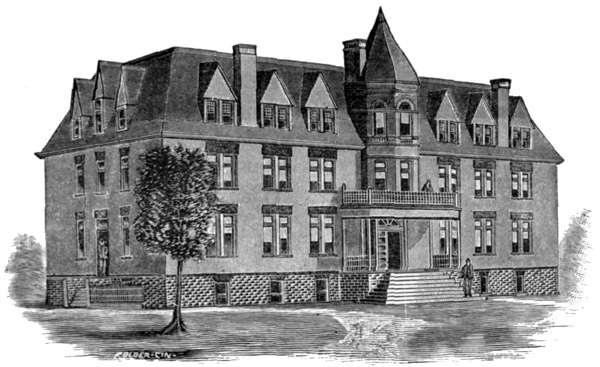
BENNETT SEMINARY, GREENSBORO, N.C.
Again, it would have been folly to grant separate
conferences for the colored membership and
leave standing the old rule, and allow it to
apply in this case, requiring a probation of two
years before being admitted to an annual conference.
This was brought forward at once, and the
animus of the General Conference on the subject
was at once manifested by the following resolution:
145“Resolved, That in order to constitute the first
conference of colored members, the rule of the Discipline
requiring a probation of two years be so far
suspended as to allow the bishops to organize into
one or more annual conferences such colored local
elders as have traveled two or more years under a
presiding elder and shall be recommended by a
quarterly conference and by at least ten elders who
are members of an annual conference.”
This was a wise and prudential action. Wise in
that it at once dissipated any thought that might
have arisen in the minds of the less stable members,
that the matter was simply put in a complicated
shape to keep the colored members at bay,
and thereby eventually drive out of the Methodist
Episcopal Church all the colored people. To have
kept them waiting under the probationary rule
would probably have done much harm. Prudential
in that even the local elders were to come up well
recommended: (1) By their own people, among
whom they lived and worked, and who therefore
could testify as to their moral, religious, and literary
fitness for the traveling connection. (2) To be recommended
“by at least ten elders (white) who are
members of an annual conference.” Who were better
qualified than such elders to know who were and
who were not qualified for traveling preachers—our
own people had no experience in matters of that
kind—in that they would naturally be able and
more willing to speak against those “wolves in
146sheep’s clothing” who sometimes “climb up some
other way” into our annual conferences for the purpose
of fleecing, instead of feeding, the flock of
God? Our own people might have been in some
way related to the applicants or ignorant of their
devices. Why should not some precautions be
observed when clothing with authority those who,
even then, must have been witnessing “the pains,
the groans, the dying strife” of an institution that
had grown gray in crime and debauchery—under
which for two hundred and forty-four years the
race had suffered in more ways than the Hebrews
in Egypt? They had never enjoyed even the privilege
of elementary training in any way fitting them
for happiness and usefulness in the world. They
were poor and ignorant. Poor in that even the
good name of the race was gone; and who does not
know that a
“Good name, in man and woman,...
Is the immediate jewel of their souls?
Who steals my purse steals trash; ’tis something, nothing;
’Twas mine, ’tis his, and has been slave to thousands;
But he that filches from me my good name
Robs me of that which not enriches him,
And makes me poor indeed.”
We do not know that additional weight attaches
to the above by knowing that Shakespeare put these
words into the mouth of Iago; but it is a fair
statement of the condition of the race when the
Emancipation Proclamation was issued. The morality
of the race under the old régime is the prodigy
147of the age! And yet they knew nothing theoretically
of morality, and had opportunities for but
few examples of it. They knew nothing of home
economics, and not five in one hundred of the rank
and file could count correctly ten dollars in small
change. Hence the Church was wise in throwing
around this people safeguards as well as charity.
They knew but little, if anything, of the comforts of
home life, the proper training of children; while
the fantastic mode of dressing immediately after
the war tells a tale at which a heathen should blush.
They knew comparatively nothing either of Church
polity or moral science. Those who have found
occasion to laugh at the huge mistakes of some of
our ministers, as well as some others who had
enjoyed better opportunities, must find a sufficient
explanation in the previous condition of the race.
Was the Methodist Church not right in doing as
it did?
CHAPTER VIII THE BEGINNING OF A GREAT WORK. — THE CHURCH IN THE SOUTH.
148
The beginning of a work among these images
of God cut in ebony is found in the following
resolutions looking to the protection of the interests
of the colored man by the civil government.
It is nothing against a system that it was badly
managed or fell into bad hands, or else our venerated
Constitution is involved. That General Conference
(1864) in its report on freedmen, said:
“(1) Resolved, That in the events which have
thrown the thousands of freed people upon the
benevolence of the humane and loyal people of the
North, we recognize a providential call to the
Christian public for contributions for their physical
relief and mental and moral elevation and especially
to the Church of Christ for the means of their
evangelization.
“(2) Resolved, That the best interests of the
freedmen of the country demand legislation that
shall foster and protect this people, and we do
hereby respectfully but earnestly urge upon Congress
the importance of establishing, as soon as
practicable, a Bureau of Freedmen’s Affairs, as contemplated
in the bills now pending.”
What did this mean? If it meant anything, the
149Church meant to practice, at its earliest convenience,
the doctrine it had been preaching for the
last eighty years and more,—that the poor enslaved
colored man should be properly trained to enjoy
this life and that which is to come. It meant that
just as soon as the alarms of war had sufficiently
subsided and God opened the way, or signified that
an entrance could be gained, to go at once up and
down through the Southland carrying the gospel
of free salvation to the downtrodden, poverty-stricken,
and demoralized colored man. While but
few, if any, believe the only mission of the Methodist
Episcopal Church in the South was to the poor
colored man, but few will doubt that, had it no
other call to go into the South, that were enough.
But few rational Christians believe the Church had
no call into the South.
That the Church was needed there, no one will
question when the condition of the colored man at
that time is considered, as well as the relation the
Methodist Episcopal Church, South, sustained to the
colored man before and during the war, and that
other significant fact that the colored man, as such,
was, and for that matter is, peculiarly either a Baptist
or a Methodist. From the beginning Methodism
took hold of him, and he learned that, wherever
found, a true Methodist was his friend. This in
itself is sufficient explanation of the peculiarity
referred to above. What was the condition of the
colored man at the close of the war? When the
150black smoke of battle arose from a hundred battlefields
the entire colored population—four and a
half millions—came forth ignorant, superstitious,
degraded, and poverty-stricken. The only beam of
hope rested entirely on the education of the race.
The emancipation was followed by the enfranchisement
of these ignorant and superstitious people.
The cry of opposition was heard vociferously in
the South, while in some places in the North leading
newspapers and men expressed doubts as to
the wisdom of the thing. Who, under the then
existing circumstances, doubted the earnestness of
those who cried out as they saw the colored men
clothed with freedom and franchise, yet slaves to
superstition and ignorance:
“A poor, blind Samson is in our land,
Bound hand and foot, and prone upon his back;
But who knows that, in some drunken revel,
He may rise and grasp the pillars
Of our temple’s liberties, shake the foundations
Till all beneath its broken columns lie in ruins?”
Amid the religious training received from that
part of the Methodist Episcopal Church, South, that
trained them at all, did not appear anything different
from the system of slavery in vogue, save the
promise of an eternal Sabbath. It is true a colored
membership was reported by the Methodist Episcopal
Church, South; but this did not mean that the
colored people within that Church were permitted
to worship God in their own congregations, or that
there were any colored pastors or class-leaders
151among that membership. If slavery had continued,
the condition of the colored man religiously could
never have become better. Just how—unless force
of circumstances played a part in the drama—a
brotherly feeling could have arisen or existed in the
bosom of the poor colored man under that régime,
we can not, for the life of us, surmise. But all
that was ended with the war, and still there was
but little, if any, change. The withdrawals at first
opportunity of colored people from the Methodist
Episcopal Church, South, meant something. The
Methodist Episcopal Church, South, was then, at
any rate, unwilling to educate the colored man.
In proof of the last assertion, we turn to page 148
of Dr. A. G. Haygood’s book, “Our Brother in
Black.” The following, published in 1881 by this
leading philosopher and clergyman in the Methodist
Episocopal Church, South, is as significant as
sound. He says:
“If the work of educating the Negroes of the
South is ever to be carried on satisfactorily, if ever
the best results are to be accomplished, then
Southern white people must take part in the work of
teaching Negro schools. There have been some
very sad and hurtful mistakes in the relations assumed
by most of us of the South to this whole
matter, and especially in the fact that, with very
rare exceptions, our people have steadfastly refused
to teach Negro children, especially since they were
made free, for love or money. They have recoiled
152from Negro schools as if there were personal degradation
in teaching them. Perhaps the state of
things that existed at the South for a full decade
after the war, and for which Southern people were
not alone responsible—a state of things that made
it impracticable for Southern white men and women
to teach Negro schools—was inevitable. But so it
was; they could not do it without ‘losing caste.’
As I am trying to state facts honestly, I should
add, the prevailing sentiment of the South would
not even now look favorably upon such teachers;
but I must say we are growing in sense as well as
grace on this subject.”
Without further comment, the above corroborates
the statement that the condition of the freedmen
in the South directly after the war, temporally,
spiritually, morally, and intellectually, was a loud
enough call, and the mission of enough importance
to warrant the action of the General Conference of
1864 in its action that virtually announced the
intention of the Methodist Episcopal Church to go
into the South. The fact that conferences had
been opened in the South for colored people was
sufficient proof.
When the General Conference of 1868 met in the
city of Chicago, Ill., for its twentieth session, among
other things it took up the subject of the relation of
the Church to the colored man. There were present
153at that General Conference two hundred and forty-three
delegates. When the General Conference of
1864 authorized the formation of mission conferences
in the South for colored people, as a Church, it
“had been practically excluded for twenty years”
from Alabama, North and South Carolina, Georgia,
Florida, Tennessee, Mississippi, Louisiana, Arkansas,
and Texas, while a generation had grown
up under the immediate care, as if were, of the
Methodist Episcopal Church, South. It is true that
the Methodist Episcopal Church had held on in
some sort in the city of Baltimore—this being her
strongest fort—while through some parts of Delaware,
Maryland, Virginia, Kentucky, and Missouri
it had a foothold. Our Church in 1863, in the
last-named States, claimed 332 effective preachers,
84,673 members, and 919 church-buildings. By
the next year, when the General Conference of
1864 met for its nineteenth session in Philadelphia,
it claimed in the above-named five slave States 309
effective preachers, 87,072 members—15,898 being
colored—and 982 churches, being an increase in
these five States of 2,399 members, not including
probationers, and a decrease of 23 effective preachers,
and an increase of 63 church-buildings. Thus it
may be seen that a wise Providence proclaimed
the mission of our Church; and there was then, as
we see now, no mistake made on the part of our
Church when it heard and obeyed the commission
in this case, “Go ye into all the world, and preach
154the gospel to every creature.” The crowning act
touching the subject we discuss was given by the
General Conference of 1864 in these words: “We
are not aware of any legal obstacle to the reception
of colored preachers into our annual conferences.”
Touching the work done by the last General Conference,
and showing somewhat of the results attained,
the Bishops’ Address to the Twentieth General
Conference contained the following:
“They [the Delaware and Washington colored
conferences] now contain one hundred and one ministers
and twenty-six thousand four hundred and
eighty-seven members and probationers. The creation
of these conferences was hailed by our colored
ministers and membership with great joy, and has,
we believe, been productive of much good. The ministers
are becoming familiar with the mode of conducting
business, and many of them are rapidly
improving. At their recent sessions they elected
representatives to this body according to the form
of the Discipline for electing delegates. Whether
these representatives should be admitted, you alone
have authority to decide. In our judgment, the
success of this work demands all the encouragement
which the General Conference can properly
give.”
The regular and natural succession of action
touching the relation of the Church toward the
colored man seems to declare, to our mind at any
rate, that it has the divine sanction. The submission
155of the above resolution brought at once before
the General Conference of 1868 the question of the
advisability of admitting—not colored testimony, or
testimony from people of color—but colored delegates
to equality in the General Conference of one
of the largest denominations in the world. The
Christ-like spirit of the bishops in presenting the
matter, supported by their modest indorsement of
it, was manly. They said: “In our judgment, the
success of this work demands all the encouragement
which the General Conference can properly
give.” It may have been that it was not thoroughly
settled in the minds of all the delegates
of that General Conference. The result, however,
was satisfactory, in that James Davis and Benjamin
Brown were seated as delegates, and thereby the
equal rights of our colored members were not only
recognized, but everything looking to their elevation,
done by the Church, was stamped with approval.
The adjournment of that General Conference
did not take place until provision for other
conferences for our people, at their own request, was
made. The year preceding that General Conference
a colored presiding elder had been appointed
over a district in Kentucky; nine mission conferences
had been organized in our Southern field;
colored preachers had been received into the Kentucky
and Missouri Annual Conferences. Notwithstanding
this, wherever a mission conference was
organized a new inspiration seemed to overshadow
156the entire work. The provision above referred to
was as follows:
“‘Resolved, 1. That the bishops who may preside
in the Kentucky Conference during the next
four years, are hereby authorized to organize the colored
ministers within the bounds of said conference
into a separate annual conference, if said ministers
request it; and if, in the judgment of the bishops,
the interest of the work requires it, to be called
the —— Conference: Provided, that nothing in
this resolution shall be construed to impair the existing
constitutional rights of our colored members
on the one hand, or, on the other, to forbid the
transfer of white ministers to said conference, whenever
it may be deemed desirable or expedient.’
“So soon as this resolution was taken up, a
motion was made to lay it upon the table, which
was lost.
“A motion to amend by inserting, ‘Provided,
that colored members may remain in the Kentucky
Conference,’ was laid on the table.
“A motion to strike out the words ‘the interest
of the work,’ and insert ‘the unity and success of
the Church,’ was laid on the table; and the resolution
was adopted as matured by the Committee on
Boundaries.”
The motions subsequently made show at once
the animus of the white brethren of that conference
at that time. While many were anxious to have
restrictions, others objected to it in toto. But, as
157in the General Conference, so it has been in nearly
every annual conference, that a wide difference of
opinion on the color-line question existed. It is well
that it was so.
Following hard upon the above action in the
interest of the colored man, this General Conference
paid special attention to its work so grandly
begun in the sunny South. While the discussion
of the status of the colored delegates elicited much
animation, the restrictions were removed from the
conferences of the Church in the South, irrespective
of color, by a vote of 197 to 15. All our benevolent
societies were instructed to redouble their diligence
to meet the exigencies of the case; our Book
Concerns were to publish one or more papers adapted
to the new order of things within the South;
transfers, if needed, were to be sent into this fruitful
field; training-schools and theological schools were
ordered for the special training of the colored
people of the South within our Church and without,
if accepted. The bishops were requested to give
the colored work special episcopal supervision. As
a finale of the action of that General Conference,
an “enabling act” for the establishment of the third
annual conference among our colored members was
passed, with the provision that in every case the
rights of every preacher were to be fully and carefully,
as well as impartially, considered. The white
preachers and teachers who were sent by the Church
into the South to carry out this plan of work were,
158in too many cases, not only subjected to insult, but
cruel scourgings and false imprisonment, as if ostracism
was not cruel and wicked punishment enough.
But many of those thus treated were men and
women of God, and therefore consistent but firm
and true heroes and heroines.
Dr. Walden (now bishop), in an address, Aug. 13,
1883, at the anniversary of the Freedmen’s Aid Society,
spoke of this work. The following needs no
comment, as he speaks of the period in our work in
the South at which we now are, and we insert it
here as a retrospect:
“Two courses were open—one to delay employing colored
preachers until they could be educated, the other
to put these untutored men to work at once. No people
ever needed the gospel more than did the freed people.
Standing in the midst of new relations, the possessors
of a new-found freedom for which they had never been
trained, they needed both the restraints and the inspiration
of the gospel. The Wesleyan prescience of our
Church recognized this need, and at the same time the
fact that these unlearned preachers, if divinely called,
could so tell the story of the Cross as to benefit their
people. The lives of many of these men had been
an unbroken period of slave-toil; but the sequel proves
that they knew enough of the saving power of Christ
and the fullness of his love to instruct their hearers in
the way of life, and we now see that their relation to
this work was not unlike to that of the first of Wesley’s
lay preachers to their work among their own classes in
England.
159“With this illustration before us of the general
principle that a people may and must be instrumental in
their own evangelization, let us study some of the results
of our itinerant system among the freedmen—of
our itinerancy and its auxiliary agencies. All understand
our itinerancy to be the general superintendency
and the pastorate; by auxiliary agencies I mean our
sub-pastorate, in which the class-leaders stand, our Church
literature, and our Sunday-schools. The mere suggestion
of the fact leads you at once to see that the real function
of each and all of these is to re-enforce both the
general and the particular work committed to the itinerancy
or three fold pastorate—the bishops, presiding elders,
and pastors of our Church. The very fact of taking
this comprehensive system to a people who had no system,
of beginning at once to build them up into it,
could not be without producing some marked and favorable
results. I mention the more obvious of these:
“(a) The freedmen who were recognized as having a
call to preach could do little more than exhort, but
they were put into the pastoral relation; a great
Church committed to them a new and solemn trust, and
laid upon them grave responsibilities; they were under
the leadership of the superintendents of the missions—good,
prudent, self-sacrificing men—men who in their
devotion to duty represented the highest life of their
Church. Such things could not be without affecting
these untutored preachers. Crude as all they did may
have been at first, their pastorate benefited the people
they served, and was to themselves a means of training,
of real and rapid progress; and there are still in the
effective ranks of the conferences which came from such
160beginnings many pious, able, and successful preachers,
who were thus transferred from the cotton and rice
fields and sugar plantations to, and trained in, our
itinerant ministry.
“(b) As the work progressed, these colored men
acquired by observation and experience, and such study
as was possible with them, a wider knowledge of their
work; and in due course the bishops began to appoint
some of them as presiding elders, investing them with
all the honors and responsibilities of this important
office. It should also be stated that the Church that
acted thus through her bishops was constantly displaying
to them an encouraging interest in them by furnishing
means to aid in the support of their Church work.
“(c) In the annual conferences they were and are
brought under the presidency of our bishops—the most
efficient presiding officers in this or any other country,
a fact that became most obvious at the Ecumenical
Methodist Conference. The very methods of business
in our annual conferences, and the promptness with
which it is dispatched under this presidency, have had
such influence on the older conferences that the advantages
of like administration to the colored conferences
are obvious. The influence of the conference session
ought also to be named, as these annual meetings of the
preachers have all along affected most favorably the
character of Methodism. These colored preachers have
been coming together, as do their brethren in older conferences,
to report and review the year’s work, to pass
upon the character of each one, to consider the various
connectional and benevolent causes, to attend to all the
business that is usually presented, and to enjoy the
161social privileges and religious services to which all our
preachers look forward with deep interest. Every such
session tends to make them wiser and more effective in
their work.
“(d) Under our system of study for probationers and
deacons, the colored preachers are steadily improving,
and their conferences are becoming more careful as to
the qualifications of those who are received into the
ministry. I well remember the class taken on trial in
the South Carolina Conference in 1867; near a dozen
of them were then uncouth and ill-clad men, who
seemed to have come direct from the plantations; little
or nothing was said as to even elementary education;
they were taken as they were, and sent out to do work
for the Master, who ordaineth strength even out of the
mouths of babes. But it is radically different in that
conference now; at its session, last January, I heard
the report of examinations, and learned thereby that
the standard of qualification is applied more rigidly
each succeeding year. I rejoiced in this as a fact common
to all these colored conferences; and yet I also
rejoiced to remember that when the exigencies required
it, our Church dared to send out the earlier members of
that and other conferences, illiterate as they were, to
the work of winning souls.
“(e) These early colored preachers, coming as they
did from a condition in which there was no home, in the
better sense of that word, soon came to know something
of the importance that our Church attaches to Sunday-schools.
They were organized, often in the crudest form;
but they have been improved, and now nearly two
thousand are reported in the twelve conferences. This
162work is important there, not only because it is in behalf
of the youth and children, but also because there has
been, and is, a relatively great demand for such work in
the South. It is a fact that the ratio between the
number of Sunday-school scholars and Church members
of any and all Protestant denominations in the South is
far below what it is in the North. The schools organized
in our “new Southern field” have been aided with
papers published by our Church, and especially adapted
to the condition of the scholars. All the teachers
employed by the Freedmen’s Aid Society have done good
and faithful service in these Sunday-schools. Through
them the Church has been, and is, furnishing moral and
mental instruction to about one hundred thousand of the
youth and children, that will be of incalculable value to
them, and through them to the Church and the nation.
“(f) The Methodist newspapers published in the
South—within this new field—by our Church, in order
to furnish a literature specially adapted to the condition
and needs of the people, have been potent for good.
We may not be able to estimate the force of the fact
that papers have been provided for them which they in
a special sense regarded as their own. It was no mean
fact with them that a part of the capital of the Book
Concern was being employed to publish papers which, by
their very location, must chiefly be for them. And the
presence of a depository of books at Atlanta tended to
impress the lesson, taught in so many ways, that our
Church was ready and anxious to help them in their
every effort to reach the plane of a higher and better life.
“Other facts might be named to show how every
thing that is forceful in our itinerancy and its auxiliary
163agencies has been constantly, wisely, and effectively
employed to reach, evangelize and elevate these
colored people. It has been more than a formal recognition
of Christian equality; it has been the continuous
presence and power of educational relations as well as
educational agencies among them. The Church, during
these years, has recognized the divine call into her ministry
of more than a thousand of these men, thereby
reposing a confidence and conferring an honor that has
been a special inspiration to them, and, in good degree,
to their people. Ministerial position and pastoral duties,
prerogatives and responsibilities, shared in common with
the largest corps of preachers in our country, have been
made realities to them. When that whole people shall
come to the plane and glory of a true manhood and
womanhood, it will be known that the impartial planting
of our system of itinerancy among them was one of
the early and potent means of their elevation.
“3. The aim of the Methodist Episcopal Church is
to enlist every local society in the support of her benevolent
enterprises. She would give to every person converted
at her altars the opportunity to do work for the
Master. For this reason, all her pastors are charged
with the duty of presenting to their congregations the
claims of the Missionary, Church Extension, Freedmen’s
Aid, Sunday-school, Tract, and Educational causes, and
of affording to all the opportunity to contribute thereto
according to their ability. Into each sphere of work
represented by these causes, the Church has been led by
a marked providence, and her efforts in them have been
attended with her Lord’s signal favor. The presentation
of these causes in the relation they hold to the world’s
164evangelization, the end for which Christ established his
Church, teaches with special emphasis the magnitude of
her mission, and indicates the certainty of ultimate
success. How the faith of God’s people has enlarged
under the inspiration of this widening work! These
causes have been presented more or less fully to our new
societies in the South.
“The colored preachers and people have taken a ready
interest in the Missionary Society because it carried the
gospel to them. The preachers were not learned, and
the people were poor; but what if the earlier missionary
sermons were crude presentations of a world-wide cause?
what if but a few pennies were collected in a charge?
the people were thus coming into contact with the genius
of the gospel, and beginning to have some part in the
movement that is conquering the world. Among the
many wise things done during the administration of the
revered Dr. Durbin as missionary secretary, the one of
all others that has affected and will continue to affect
our Church the most, was providing for the organization
of the Sunday-schools into missionary societies; wise and
potential, because thus, in a practical and methodical
way, the idea of the world’s evangelization is fixed in
the thought of the youth and children, by far the greatest
idea touching the human race that can be given to
the human mind.
“The colored preachers have been learning this fundamental
idea of the missionary cause and the purpose
of each of the other benevolences of our Church, and
in their own way it may be presenting them to their
people; but the result has been a measure of enlightenment
in these directions, an increasing knowledge
165of the far-reaching plans of the Church to which they
belong, a clearer consciousness that by being brought
within her pale they have part in one of the great aggressive
Christian movements of the age. Standing as
they do in the dawn of a new day, this conscious identification
with all the benevolent plans of the Church that
brought them the gospel can not do less than enlarge
their views of Christian duty, and inspire them with
zeal for and devotion to causes grand in themselves and
glorious in their results.
“4. The preaching that is distinctively Methodistic
has had its influence in this as in other fields. While
we hold the fundamental truths of Christianity in common
with other evangelical Churches—points of agreement,
each of which is infinitely more important than
all the questions in regard to which there is a difference—all
do not place the same emphasis we do on
some of these truths. Our preachers in the ‘new Southern
field,’ as elsewhere, have given special prominence
to the willingness and power of Jesus to save every one
who comes to him; the universal call and the gracious
ability of every one to come; the radical character of
the change wrought in conversion—a new life through
divine power; the adoption into the divine family, and
that adoption clearly, satisfactorily attested through the
witness of the Holy Spirit; the complete cleansing power
of the blood of Christ, and the keeping power of the
promised grace. Need I say in this presence that the
emphasis given to these Scriptural doctrines by our ministry
has molded the experience of Methodists in every
society, and made the meeting for testimony, whether
love-feast or class-meeting, a part of our Church life?
166The preaching of these doctrines in the earnest Methodist
way among the colored people, the building up of a
Church among them under the molding and inspiring
effect of such truths, the leading of the members up to a
clear, well-defined religious experience, is giving them a
Church life, the advantage of which is best known from
what Methodism has done for other peoples. Already
the advance of Christian morality, the growing habits
of industry and economy, the increasing spirit of benevolence
and liberality, the new home-life where home was
so recently unknown—the fruits of an evangelical gospel
faithfully preached—show what we have done, and are
the promise and pledge of a pure, strong, and active
Church in every part of our new Southern field in the
near future.”
CHAPTER IX THE COLORED BISHOP QUESTION.
167
The quadrennium from 1868 to 1872 exhibited
a marvelous growth among the colored
membership of the Methodist Episcopal Church.
This was but the pulsation started by Methodism
among her hitherto downtrodden children, by her
labor of love in carrying to them the gospel of
free salvation through the agency of her benevolent
societies, the class of bishops, General Conference
officers, and the consecrated and self-denying white
teachers from the North, who left their homes of
comfort and joy to go South and put themselves upon
God’s altar for the elevation, morally, financially,
intellectually, and spiritually, of their “brother
in black.” The work done, and its effects in
so short a time, seem now the marvel of the age!
The scattered sheep had been gathered from the
hills and valleys, the cane-brakes and swamps, from
the villages and the larger cities, into societies nearly
everywhere. Wherever possible they had been
organized into conferences as had been provided
by the action of the General Conference of 1864.
With the application for recognition came that also
for separate conferences. Two separate annual conferences
had been organized before 1865—the Delaware
168Conference, July 28, 1864, and the Washington
Conference, October 27, 1864. Besides this, the
Rule of the Discipline, requiring a probation of
two years, had been suspended so far as to permit
our bishops to organize annual conferences with
such colored local elders as had traveled two or
more years under a presiding elder, who were
recommended by a quarterly conference and by at
least ten white elders. Thus the constitutional
rights of the colored membership of the Church
had been recognized, and the marvelous growth
among them during this quadrennium was but a
manifestation of appreciation on the part of the
religious colored people of the South, evidence of
their preference for Methodism, pure and simple.
The fact that colored delegates were recognized
by the General Conference of 1868, and provision
made for the organization of the Lexington Annual
Conference, that had hitherto been mixed with the
Kentucky Conference, white; that separate annual
conferences had been formed; indeed, that every
practically conceivable thing was being done by
the Church for her colored members,—caused many
to flock toward her that had fled for safety in
another direction. The tide was soon checked by
the ministry and membership of the two colored
denominations—the African Zion and the African
Methodist Churches—that were toiling in the same
field, by crying out “the Methodist Episcopal
Church will never permit a colored man to be elected
169a bishop.” Consternation seized many of our members
when they were told that the Methodist Episcopal
Church would only tolerate a black membership
as “hewers of wood and drawers of water.”
It at last became to many, as they said, “self-evident,
that to retain the better class of colored
people there must be no discrimination anywhere
in Methodism on account of race, color, or previous
condition of servitude.” Many, many hard battles
were fought, not with the enemy of souls, but with
our brethren of the above-named two denominations.
From 1868 to the adjournment of the General
Conference of 1872 a bitter religious warfare
was waged. At last, as the quadrennium drew
to a close, it was evident that the agitation of the
question of a bishop of African descent had not
only done much injury, poisoning and unsettling
the minds of our colored membership, but that, in
one way or the other, the question must be put and
answered by the ensuing General Conference. This
was one of the most important questions considered
by the General Conference of 1872, sitting in
Brooklyn, New York. This, the twenty-first session
of our General Conference, will be remembered
as the largest ever held by our Church up to that
time, there being four hundred and twenty-one
delegates. Several of our colored conferences sent
up memorials in favor of the election of a bishop
of African descent. As they were presented they
were respectfully referred to the Committee on
170Episcopacy, composed of one delegate from each annual
conference, colored or white. The petition for
a bishop of African descent from the preachers’ meeting
of New Orleans received the following reply:
“The special committee to which was referred
the memorial of the New Orleans preachers’ meeting
of May 23d, asking for the election of an additional
bishop, who shall be of African descent,
respectfully report: That at a meeting of the committee,
held May 30th, the statements of the
memorialists and their requests were carefully considered.
The very reasonable demand, that at least
some action may be taken which shall assure our
people that the Methodist Episcopal Church invites
to her altars peoples of every nation, and extends
to them equal rights in her worship and government,
was responded to with great unanimity by
the following declaration of facts which, we are
persuaded, will be entirely satisfactory to the memorialists.”
Then follows the report of the Committee on
Episcopacy, viz.:
“The Committee on Episcopacy report to the
General Conference concerning the election of a
colored bishop: (1) That they are deeply impressed
with the Christian spirit manifested by those
memorializing the General Conference on this subject.
The rapid progress our brethren of color are
making in all that elevates mankind is most commendable,
and we have no doubt there is a future
171of great promise before them. Your committee
would further report that, in their judgment, there
is nothing in race, color, or former condition that is
a bar to an election to the episcopacy, the true
course being for us to elect only such persons as
are, by their pre-eminent piety, endowments, culture,
general fitness, and acceptability best qualified to
fill the office. (2) The claims of our numerous
and noble-hearted membership of African descent
to a perfect equality of relations with all others in
our communion are fully recognized by the Discipline,
and amply demonstrated in the administration
of the Methodist Episcopal Church. There is no
word ‘white’ to discriminate against race or color
known in our legislation; and being of African
descent does not prevent membership with white
men in annual conferences, nor ordination at the
same altars, nor appointment nor eligibility to the
highest office in the Church. (3) Election to the
office of bishop from among candidates who are
mutually equal can not be determined on the ground
of color or any other special consideration. It can
only be by fair and honorable competition between
the friends of the respective candidates. And yet
the presentation of a well-qualified man of African
descent would, doubtless, secure very general support
in view of the great interests of the Church,
which would thereby be more abundantly promoted.
No such opportunity, however, has been afforded
at this General Conference.”
172Quite a while before the assembling of that
General Conference the colored bishop question had
been widely discussed, receiving very general consideration
and favorable mention in some localities.
It, however, was not of a demonstrative character.
The fair, plain, Christian statements of that General
Conference put an end to the “color question”
within the Church, so far as special ecclesiastical
legislation goes. May we not hope that it put a
quietus upon those without the Church who prefer
to arrogate to themselves a kind of aristocratical
attitude, because they have solved the Negro problem
by divorce, but who willingly join in any outcry
that will have a tendency to condone any action
relating to “the vexed question” they have taken,
or seem to shadow any spirit of unkindness that
would naturally attach to such a wicked divorce?
The manliness, Christian spirit, and unwavering
fidelity of the Methodist Episcopal Church toward
the colored man from his arrival in this country, so
far as the heart of the Church is concerned, ought
to be “read and known of all men.” That General
Conference said all on the colored bishop question
that could be said; and, for that matter, all on the
race question that needs to be said for all time
to come.
While glancing backward and beholding what
the Methodist Episcopal Church has done, and is
now doing, for the amelioration of the condition
and giving the colored man in general, and the
173colored membership within the communion of the
Church in particular, prestige, we feel as if the
ignorance of any colored man in this country who
dares say the Church, as such, has not loved and
respected the race, is inexcusable, reprehensible, and
hate-provoking. In many instances the Church
did not do what we asked; in others it did not do
what others thought it should have done; but
time and experience have taught us it did generally
what was best. It was feared that much
harm would come to Methodism among our people
if a bishop of African descent were not chosen at
that General Conference. Ought we to say it was
the hope of some? In the rural districts, where
the general intelligence of the race was not above
par, it may have caused friction because of the omnipresence
of “colored bishops,” “General Conference
officers,” “college presidents,” etc. The years
that are to come, unless a strange influence not
related to that of the Church of the past comes
upon our Methodism, will show that up to this
time it was better as it happened. The election of
a man of African descent was urged and expected:
(1) To tighten our hold upon our people by offsetting
outside statements that the Church would never
elect a colored man to the bishopric; (2) To remove
any lingering doubts, if there remained any,
as to the intention of the Church touching the relation
of the colored man to it. We doubt not
many, without the Church, who persistently pushed
174this matter, urging it through their Church papers,
the secular press, and in nearly every public
place, and on nearly every occasion; who did
this for the specific purpose of demoralizing and
scattering our membership, though done with a
seeming gravity and earnestness worthy of a better
cause, did not honestly believe it possible that the
great Methodist Episcopal Church would even go
as far as it did; believing that it was an impossibility,
as much so as it would be to elect a white man
to the bishopric in one of the distinctively colored
organizations, were there the same number of
white people within the communion of those three
Churches, comparatively, that there are colored in
our Church, and that the Church would not only
passively refuse, but would plainly say so. This
would naturally have weakened their faith, and they
would have doubted the sincerity of the professions
of the Church made in favor of the colored man
by it in the past. On the contrary, the action of
that General Conference had no such effect where
the truth of the matter was properly told, or where
the intelligence of our people made them conversant
with the past history of the Church on the
color-line question.
The discussion of the question was kept up
until the assembling of the session of the General
Conference of 1876. Without stopping to speak of
the spirit manifested in the discussion of this question,
pro and con, outside of the General Conference,
175nor to speak our views then or now, wishing to
give as complete an account of the manner in which
that General Conference was brought to see this
question, we simply state that the discussion was
carried into nearly, if not every congregation in
the Church during the quadrennium. The whole
matter, phœnix-like, came to the surface at the call
for resolutions and memorials. The Mississippi
Conference led with the following, presented by
Moses Adams:
“Whereas, The Methodist Episcopal Church
has under her care one hundred and fifty thousand
members of African descent; and whereas, the said
Church meets with great opposition from other
Methodist bodies, I therefore respectfully ask this
General Conference to elect a man of African descent
to the office of bishop in the Methodist Episcopal
Church. This is asked for two reasons:
(1) That the Church needs one to help defend her
cause. Nothing, in my judgment, would build up
the Methodist Episcopal Church more than the
election of a bishop from the membership of African
descent. (2) The race is not fully represented in
the Methodist Episcopal Church without one such
being elected to that high office of trust.”
From the West Virginia Conference the following
was presented by G. W. Atkinson:
“Resolved, That the Committee on Episcopacy
consider the expediency of electing a German
bishop and one or more African bishops, to supervise
176the German and African conferences of the
Methodist Episcopal Church in America.”
The Delaware Conference sent up a memorial in
favor of the election of a bishop of African descent,
which was presented by H. Jolley. The petition in
favor of the same sent up from the Georgia Conference
was presented by Rev. C. O. Fisher, signed
by himself and sixteen others. The Mississippi
Conference sent up a similar petition by A. C.
McDonald. The foregoing gives a faint idea of the
scope of the question.
Just how that General Conference would handle
the question, striking the happy, golden mean
between the two extremes, without reflecting upon
the past history of the Methodist Episcopal Church
relating to the colored membership on the one hand,
or, if necessary to refuse, how it could avoid injuring
the work already established among the race,
was a perplexing question. Each memorial was
given a careful and respectful investigation and
promptly and properly referred to the Committee
on Episcopacy. At last, after many guesses and
prophecies by friends of the measure, and others,
the work of the Committee on Episcopacy was finished.
When the committee signified its readiness to
report, on motion of General Clinton B. Fisk, Report
No. 2 of the Committee on Episcopacy was taken
up. When the secretary arose to read it, it appeared
as if a peculiar spell had come over a great many
members of that General Conference who knew
177nothing of the decision of the Committee. The
report was as follows:
“We have had before us certain papers asking
the election of a man of African descent to our
episcopal office, and other papers asking that the
residence of such bishop be in Liberia. It is
claimed in these petitions that the circumstances of
the people of African descent are such that the
efficiency of the work of our Church among them
demands the election of a man of African descent to
our episcopacy; that such election, more than any
other fact, would establish beyond all gainsaying the
relation of our Church to its members of African
descent; that it would give them a bishop that
could mingle freely with them without embarrassment
to the work among them in any locality;
that these ends would be reached, and the needed
administration in Liberia be secured, by fixing the
residence of such bishop in that colony. Your
committee have considered these facts; but in view
of the statement received from the present Board
of Bishops as to their ability to discharge the
duties of the superintendency, we recommend the
adoption of the following:
“Resolved, (1) That this General Conference
elect no bishops.
“Resolved, (2) That the facts presented in the
several petitions above mentioned are entitled to
careful consideration whenever the election of additional
bishops shall become necessary.
178“Resolved, (3) That we reiterate the declaration
of the General Conference of 1872, touching the
relation of a man of African descent to our episcopal
office, and assert that race, nationality, color,
or previous condition is no bar to the election of
any man to the episcopal office in our Church, nor
any other elective office filled by the General Conference.”
(Journal 1876, p. 353.)
The fact that “papers asking that the residence of
such bishop be in Liberia” had also been presented,
though coming in all probability from opposition
to the election of a man of African descent to the
bishopric, like Thomas doubting his risen Lord,
demonstrates the fact that that General Conference,
by its Committee on Episcopacy, would have granted
the petitioners in favor of the election to the episcopacy
of a man of African descent their request,
if they had produced a suitable man of African
descent; or that the election of a missionary bishop
for Liberia would put a quietus upon the agitation.
If not this, then it declares that there were those
in that General Conference who had expressed
themselves as favoring every move touching the
colored membership in the Church that would
elevate and inspire them with hope for the future.
The entire proceeding is, to my mind, inexplicable,
were it not for the omnipresent fact that, so far as
the Church is concerned, “God is in the midst of
her.” The plea of the petitioners was not granted
by that General Conference; but that is not stranger
179than the fact that other plans failed to be carried
out at that General Conference, and for that matter
every General Conference in the history of the
Church from 1844 until to-day, that were, so far
as arrangements, etc., go, already well supported
before the meeting of the General Conference.
Going back to the day of the adjournment of that
General Conference, we say, we can wait.
The General Conference of 1880.—During
the following quadrennium up to this General
Conference the colored bishop question was more
generally discussed than before. The official papers
of the Church began to take notice of the question,
while our brethren of the African and Methodist
Episcopal Church, South, joined in to help on
the good work—the former, in all probability, because
of the supposed predicament it put the colored
members into; and the latter, because they
wished to push what they were pleased to call “the
thorn in the flesh” farther into the quick of the
white membership in the Church. The Baltimore
District of the Washington Annual Conference passed
a series of resolutions touching this question.
Those resolutions were, in all probability, too radical
when they declared the election of a man of
African descent to our episcopacy “the only way the
Church can hope to prove its good faith or respect
for the numerous colored membership within the
Church.” The fact is, the Church was not required
to bring forth fruits to exhibit any such thing.
180The Central Christian Advocate, our official
organ at St. Louis, thus spoke on this subject:
“A few weeks ago the members of the Baltimore
District Conference, Washington Annual Conference,
passed a preamble and resolutions, in which
they declare that members of African descent
in the Methodist Episcopal Church do not enjoy
practically the fullest recognition of Church fellowship
and communion; that the only way to prove to
them and the world that they are recognized as
equals in the Church is the election of a man of
African descent to the office of bishop; and they
recommend their brethren to ‘agitate’ the question
and, if necessary, to ‘demand’ the election of a
colored bishop at the General Conference to be held
in May, 1880. This is the action of a single district
conference; to what extent it represents the
opinions of the colored ministers of the Church we
have no means of knowing; for, so far as we have
observed, no other district conference has yet taken
action on the subject.
“The action of a single district conference,
however influential and worthy of consideration,
scarcely brings a question before the Church sufficiently
to make it at once a subject for general
discussion in the official papers. We proposed,
therefore, to wait and see whether the Baltimore
District Conference represented the convictions of
others than itself. But our editorial brethren of
the Methodist Episcopal Church, South, caught it
181up at once as a choice morsel, which afforded them
a nice opportunity to worry, as they believe, the
white membership of our Church, and to sow dissension
among the colored members. The Richmond
Advocate declared that intense mortification
and confusion would seize upon the whites when
this action of their colored brethren became known,
and that not an official paper of the Church would
dare mention what had taken place. It was a false
prophet. And it must have been doubly surprised
when the New York Methodist, which is presumed
to represent the more conservative element in the
Methodist Episcopal Church, promptly pronounced
in favor of the election of one or two colored bishops.
The Louisville Methodist thinks we have ‘a difficult
problem’ on our hands, and, with an air of compassionate
concern, informs our colored brethren
‘that all the important offices of the Methodist Episcopal
Church will be filled by white men, notwithstanding
the resolutions of the Baltimore District.’
“But the Louisville Methodist is too anxious to
make out a case. It says that the colored members
of our Church were greatly disappointed that
a colored bishop was not elected in 1872. Had
the editor consulted the published proceedings of
that General Conference instead of drawing upon
his imagination for his facts, he would have scarcely
made such a statement. There was but one memorial
before the conference on the subject, and it had
only four signatures attached. The Committee on
182Episcopacy, to which it was referred, reported ‘that,
in their judgment, there is nothing in race, color, or
former condition that is a bar to an election to the
episcopacy, the true course being for us to elect
only such persons as are, by their pre-eminent
piety, endowments, culture, general fitness, and acceptability,
best qualified to fill the office.’ And no
more eloquent speech was made during the conference
than that of Hon. James Lynch, of Mississippi,
a colored lay member, declaring that the
colored men asked no favors on account of race,
and that when they produced a man as fit for the
place as those about them, it would then be time
enough for action.”
The spirit manifested by our Southern brethren
in the discussion of this question within our Church
smacks of officiousness. They are in no way to be
affected whether it is or is not done. While they
have a perfect right to take part in any and all discussions
worthy of public attention, anything like
an attempt to sow the seeds of dissension among
the members of any other denomination is, in the
eyes of an ignorant black man, reprehensible, not
to say unchristian. It gives room for complaint
from the world that Southern “Methodists are no
better than other folks.” The colored man who
is simply a member of the Methodist Episcopal
Church for the sake of “important offices” had
better leave it—the sooner the better. No Christian
white man remains in any Church for that sole
183reason; and, as Bishop Simpson once said: “A
white man is as good as a colored man, if he
behaves himself.” One thing is certain, that every
such office-seeking colored man in the Church will
fail to receive the support of every intelligent colored
Christian within the Church. It is true that,
on general principles, it was but a short time until
the desire of the brethren of the Baltimore District
became that of many others; that is, that it
was thought necessary that a colored man should be
elected to the bishopric.
When the General Conference of 1880 met in
Cincinnati for its twenty-third session, this question
again came up for discussion. Memorials and resolutions
on this subject were presented from Washington
Conference, by Henry A. Carroll; from Delaware
Conference, by W. F. Butler, Zoar Church
and Cambridge charge; J. C. Hartzell, from New
Orleans preachers’ meeting; by John H. Dunn and
J. H. Shumpert, from Mississippi, et al.; and C. O.
Fisher presented an extract from the journal of
Savannah Conference and from Atlanta District.
On Wednesday, May 12th, on motion, the rules were
suspended to allow E. W. S. Hammond to present
the following paper:
“Whereas, It is clearly evident, from the
memorials and petitions on the subject, and which
were duly referred to the Committee on Episcopacy,
that the colored people of the Methodist Episcopal
Church desire a bishop of their own race; and
184whereas, the election of a colored bishop would be
a practical recognition of our full manhood by the
Church, and a grand influence in the extension of
our work in the United States and in other lands;
and whereas, the General Conference of 1872 did
declare, and the General Conference of 1876 did
reaffirm, with emphatic significance, that race, nationality,
color, or previous condition is no bar to
the election of any man to the episcopal office in
our Church; and whereas, the General Conference of
1876 did recommend that the memorials, petitions,
etc., on the above-named subject should be entitled
to a careful consideration whenever the election of
additional bishops shall become necessary; and
whereas, the necessity for the election of additional
bishops is apparent, and the way is now open for
the practical operation of the above resolution; be
it, therefore,
“Resolved, That this General Conference recommend
the election of a colored man to the episcopacy.”
He supported the above preamble and resolution
by a vigorous and timely speech, through courtesy of
the General Conference, lasting over fifteen minutes.
On motion of L. C. Queal, the foregoing paper
was laid on the table for the present. The memorials,
followed hard by that resolution and speech,
seemed to put the General Conference to thinking
on the subject as never before.
It is not exactly certain that there was no opposition
to the question at that General Conference.
185Why need any one demand a thing to which there is
no objection? It would come as a matter of course.
Some spirit of opposition anon manifested itself in
a way as unfair as uncalled for. For instance,
the following presented by A. W. Milby, of Wilmington
Conference:
“Whereas, The question of a colored bishop
is with great persistency urged upon the attention
of the General Conference; and whereas, it is a
question to be determined, not by appeals to sentiment,
but by arguments and facts addressed to the
reason and the understanding; and whereas, we believe
that the records of the benevolent societies
and the statistical reports of the several annual
conferences, composed of colored preachers, will
furnish the best data for a wise and godly judgment;
therefore,
“Resolved, That the Committee on Episcopacy
be, and are hereby, instructed to inquire into and
report to this conference at an early day, the following
items in respect to the conferences composed,
in whole or in part, of colored preachers,
to wit: (1) The amount of money contributed by
said conferences to the Episcopal Fund during the
last quadrennium. (2) The amount contributed to
the missionary cause. (3) The amount contributed
to the Church Extension Society. (4) The amount
contributed to the Freedmen’s Aid Society. (5) The
amount received by said conferences from the Missionary
Society during the quadrennium. (6) The
186amount received from the Church Extension Society.
(7) The amount received from the Freedmen’s
Aid Society.”
On motion, the above resolutions were referred
to the Committee on Episcopacy. The unfairness
of such a proposition, as well as the unchristian
spirit that produced it, become at once apparent,
when it is remembered that in the Church of God
the good to be done for our brother is not to depend
either upon his willingly accepting it, demonstration
of appreciation, the amount of wealth possessed
by the recipients, or the amount of money
they can or will produce. “How much will he
bring at auction?” was the language of slave-traders
in the past. The amount given for almost any cause
by almost every person is dependent upon the intelligence
possessed or communicated relating thereto,
and the interest taken therein, coupled, of course,
with financial ability. If the resolutions above
referred to were germane, why not have each of
the above conferences also report: (1) How many
souls have been converted during the quadrennium?
(2) How much religious fervor, comparative consistency
in religious life, has been manifest among
them? (3) How much time have they had, and
under what circumstances, to be prepared to accumulate
wealth, and then give it “as the Lord prospers
them?” (4) What have they given, per capita,
in comparison with their white brethren’s wealth,
time, and influence, for the spread of the kingdom
187of God among men? (5) What proportion do they
sustain to the rest of the membership of the Methodist
Episcopal Church, numerically? (6) What
per cent of their actual wealth do they give for the
cause of Christ? If any special attention was paid
to those resolutions, those in charge of our benevolent
societies have no knowledge of it. The Church
of God will never require such a test. Were the
Methodist Church to do it, Satan would certainly
be warranted in affirming that a dollar in her scales
weighs more than an immortal soul.
The crisis in the question of a colored bishop
came May 20th, when Report No. 3 of the Committee
on Episcopacy was presented, as follows:
“The Committee on Episcopacy, having considered
the memorials and petitions referred to it
on the election of a bishop of African descent,
adopted each of the following resolutions by a vote
of thirty-nine to eight:
“Resolved, 1. That the best interests of our
Church in general, and of our colored people in particular,
require that one or more of our general
superintendents should be of African descent.
“Resolved, 2. That we recommend that this General
Conference elect one bishop of African descent.”
J. S. Smart moved to adopt; thereupon Alfred
Wheeler presented the following minority report,
and moved that it be substituted for the report of
the majority:
“A portion of your Committee on Episcopacy,
188differing widely from the majority, both as to the necessity
and expediency of electing a colored bishop
at the present time, feel constrained to express our
dissent by a minority report. After listening attentively
to prolonged discussions upon the subject,
and giving due weight to the arguments urged in
its favor, and to full representation of the state of
our religious work among the colored people of the
South, representations made by themselves as well
as by their white co-laborers, we are convinced that
sound policy forbids the adoption of the recommendation
of the majority.
“Resolved, therefore, That we deem it inexpedient
to elect any more bishops at this General Conference.”
John Lanahan moved that the whole subject be
indefinitely postponed. On motion of Emperor
Williams, the yeas and nays were called, and the
motion to postpone indefinitely was carried by two
hundred and twenty-eight votes to one hundred and
thirty-seven.
To show the interest manifested, of the three
hundred and ninety-nine delegates, all were present
and voted on that resolution save thirty-four. At
page 282 of General Conference Journal of 1880
we have the list of names. There appear names of
persons who voted indefinitely to postpone that
question that surprises us a little; and not very
much, either. However, a quietus was thus put
upon that question for that session at least.
189Let us look back for a moment. Has it not
appeared in nearly every instance, when the colored
membership have memorialized the General Conference,
that not only has respectful attention been
given, but concessions made? Has it not appeared
as clearly, all the way through, that the Church, as
such, is ready whenever the race presents a proper
man? The voice of the Church not only declares
its willingness, but even hints that while “race,
color,” nor other special considerations are to be helps
or hindrances, it is possible to elect a colored bishop
by “fair and honorable competition between the
friends of the respective candidates.”
There is no man within the Methodist Episcopal
Church who would feel worse than the writer, were
any General Conference of our Church to elect a
white man to the episcopacy because he had been
an Abolitionist, a Federal soldier, was a Japanese,
or who had been a foreign missionary, but,
aside from these things, had no other qualification.
Just the same way would it be if any General Conference
should elect to the office of bishop in our
Church a colored man, simply because he had been a
slave, or because he could make a passable speech, or
deliver an acceptable sermon, or was pastor of a small
congregation, but, aside from this, had no literary
attainments, but little or no executive ability, and
but little practical experience in general Church
work. It would be no particular advantage under
such circumstances, while it might do incalculable
190injury, not only to the general Church, but to the
interests of the race in particular.
Hon. James Lynch, of Mississippi, declared in
the General Conference of 1872, that no favors were
asked on account of race. Rev. E. W. S. Hammond,
in the eloquent speech delivered before the
General Conference of 1880, in Cincinnati, said that
the plea being made was not for a colored bishop
simply for the colored people, but a bishop for the
Methodist Episcopal Church. And now the way is
not only open, but wisdom at the threshold of the
bishopric in our Church cries to all, “There is nothing
in race, color, or previous condition, a bar to
entrance here, but the true course given me is to
admit only those who, by their pre-eminent piety,
godly judgment, and literary qualifications, are best
fitted to fill the office.” There is not an intelligent
Christian of color within our Church that does not
bow assent to this sentiment. When as a race we
are to be represented on our bench of bishops, we
want a man who is, and will be, a credit to the
Church, an honor to the race and to himself, an
equal among equals in every respect—a representative
man, “blameless, the husband of one wife,
vigilant, sober, modest, given to hospitality, apt to
teach; not given to wine, no striker, not greedy of
filthy lucre; but patient, not a brawler, not covetous;
one that ruleth well his own household; not a
novice, lest being lifted up with pride he fall into
the condemnation of the devil. Moreover he must
191have a good report of them which are without, lest
he fall into reproach and the snare of the devil.”
Then, and not till then, ought a colored man be
elected as “one of the bishops of the Methodist
Episcopal Church.”
CHAPTER X WHY ASK FOR A BISHOP OF AFRICAN DESCENT? — THE SEGREGATION OF THE RACE INTO COLORED ORGANIZATIONS.
192
Do not the attitude sustained by the colored
man to the Church, from his admission into
the John Street Church in New York, and the actions
taken by the Church relating to his interests,
based as they have been upon the integrity and
fidelity of the race, up to the granting of separate
Conferences, warrant it? If not, why were not our
German brethren satisfied until they were represented
nationally or linguistically therein? The
Church has hitherto carried out the most natural,
as well as rational order of succession in this matter,
that, if it leads anywhere, leads up, necessarily leads
up, to this point. The colored ministers were recognized,
licensed, given appointments, quarterly conferences,
district and annual conferences, the presiding
eldership, admitted as delegates to the General
Conferences, elected to General Conference offices,
and the Church declared that “race, color, or previous
condition” was “no bar to election to the
episcopacy in our Church.” If we are required and
expected to go on to perfection, will any one deny
that election to the episcopacy will push the whole
race a step higher in the Divine life? Not simply
because of this alone, but because the colored
193man, like white men, believes the bishopric a step
higher, in office at least, than the eldership in our
Church. He believes, like other men, that progression
is the watchword of the hour. Who does not
now know that a bishop in the Methodist Episcopal
Church is considered the most influential minister
in the State, county, city, village, and in the general
Church? No other office is paramount. The fact
that there is to be allowed no discrimination on account
of race, color, or previous condition of servitude
within the Church, it is claimed, guarantees to
them not only the right to ask, but to expect help
in securing the same, since it will never be possible
for it to be done by the race alone within the Church.
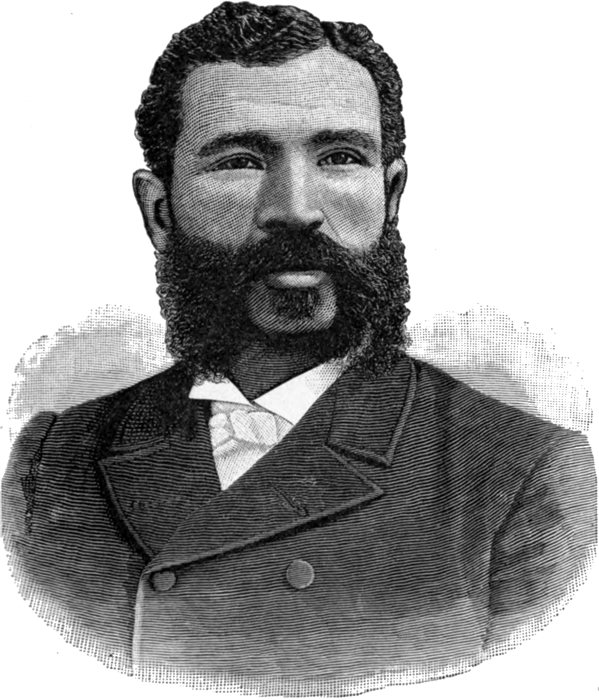
Rev. A. E. P. ALBERT, D.D.,
Editor of Southwestern Christian Advocate,
NEW ORLEANS, LA.
It is therefore declared by many of both races
within the Church, that justice to the race demands
it as it could not for any other class of members within
the Church. Nothing less than injustice can withhold
that which is justly due. Now the colored
members, whose influence has brought them forth
into prominence in the Church, have never asked
the General Conference to elect a bishop of African
descent because our bishops have been one thing to
white members and another to colored members,
nor because our bishops, when coming among the
colored members, have been “overseers” instead of
superintendents, nor because they are not acceptable
to the colored membership. Far from it. Our
bishops to-day hold a place in the hearts of the
colored membership of the Church that any man of
194African descent, elected to the episcopacy in our
Church, could only desire, since he could not dislodge
his white colleague. But it is asked for the
same reason the Church gave years ago for the
proper recognition of colored ministers when it
said, it is “a principle patent to Christian enterprise
that the missionary field itself must produce
the most efficient missionaries.” Is not this an
argument at once logically true in the case of a
bishop of African descent? The reasons given by
representatives from the South when asking for a
separate conference were: (1) “It will secure
greater efficiency in the prosecution of the work,
since many things of great interest to an annual
conference and to the Church never get farther
than the humblest hearthstone.” (2) “It will relieve
us from the taunts and sneers of designing men,”
and secure the communion and friendship of many
who would not otherwise unite with us. (3) “It
will relieve the Church of even a suspicion of a
spirit of caste, and make us feel as men, and the
peers of our white brethren. (4) It will be no innovation
upon any principle of Christianity or of
our beloved Church,” but will mightily help in
“rending the veil” and breaking down the middle
wall of partition Satan has built between brethren
out of the remains of slavery that existed in this
country. Another reason is offered on the score of
the numerical standing of the colored membership.
According to the statistics of 1884, there are
195now not far from 1,800,000 members within the
Church. Of this number, there are about 300,000
colored members. “The constitutional rights of the
colored members” being recognized, indeed all their
rights and privileges, it would follow that, on general
principles, one member in the Church has as many
and varied rights as another. The colored members
in the Church make up one-sixth of its membership.
They would on this scale, therefore, be entitled to
one representative on our bench of bishops for every
six, and so on.
Will the time ever come when a colored bishop
will be elected by the General Conference of the
Methodist Episcopal Church? This the future will
tell. However ignorant we may now be as to
whether it will ever be done or not, we can easily
imagine the result of such an election. It would
no doubt be as the bursting forth of some pent-up
fountain which sends forth streams in opposite
directions. Doubtless if there remain any within
the Church who fear man more than God, they
would likely flow outward toward more congenial
climes, where the nursing of wrath brings imaginary
peace. It is impossible to turn a mighty
stream all at once out of its channel without some
commotion. But then the onsweeping tide would
soon wear another channel, and no more would be
seen of the commotion than anon a ripple in the
mighty stream. The other stream, flowing in the
opposite direction, would be, to the Christian men
196and women of this land, “a stream that makes
glad the city of God.” It would send a thrill of
renewed vigor and confidence in God and Methodism
all over this world. Every community where
infidelity, skepticism, or Romanism now predominates
would be hopelessly stunned, while a gainsaying
world would not only stand aghast, but fall
back before the enthusiastic shout of seven million
hitherto rejected and ostracized images of God cut
in ebony. It would be an incentive to Christians
everywhere in general, and the three hundred thousand
colored members, old and young, within the
Church in particular, to live better lives and do
better work. The older men who now hold positions
of prominence in the Church would have more
time in which to do their work, and would probably
do it better, at any rate more hopefully. Instead
of having to fight caste prejudice, and repel the insults
heaped upon them hitherto by that hateful
spirit, they would quietly prosecute their work. The
younger men, who are already within the colored
conferences would feel a desire, even if they were
unable to make amends for lost time, better to prepare
themselves for future usefulness. The colored
annual conferences would at once begin to fasten
the breaches in their fences, through which candidates
for clerical orders have been creeping at
times. The young men who would come flocking
to the doors of the conferences for admission would
find written over the archway, “No young man
197admitted to this conference until he shall be found
possessed with the necessary qualifications,—‘gifts,
grace, and usefulness.’”
Our college alumni, who have gone elsewhere
seeking employment, would return. How much
more proficient does that man try to be who knows
there is a future before him, than the one who suspects
there is none! Thousands of our talented
young people have left us because they said they
saw but little hope in the future for the colored
ministry in our Church. Indeed, there was a time
in the history of our colored work when the professional
man, the mechanic, and the man of means
among us, were all about to leave us in some localities,
because it had been told them that within the
Church we were but “hewers of wood and drawers
of water.”
There was also a time when graduates of our
institutions, in many instances, were given work
by other denominations because we had none
for them before they took their diploma from the
campus of their alma mater. Why, it is impossible
properly to educate a man, and then keep him from
thinking, looking, and speaking for himself. It is
only recently that the younger people of the race
have become interested in our work. This is
directly attributable to our separate conferences;
while many who left us for “sufficient reasons”
would return, and we could more securely hold those
we now have.
198
It is impossible to build up a first-class membership
out of second-class material. This has been
one of our weak points. Such efforts as “Tanner’s
Apology” were aimed along this line. Now, why is
it that in New York, Pennsylvania, New Jersey, and,
for that matter, everywhere in this country except
in the Southern States, the colored man has sought a
colored organization? Why the segregation of the
race in the North, where slavery never came? Dr.
A. G. Haygood believes, with many others, that
race instinct segregates them. He says: “Instinct
never yet surrendered to arguments; it is their race
instinct, deep and strong and inexpugnable,” as
Carlyle would say. Who that heard their impassioned
speeches at Cincinnati, in May, 1880, could
not see that their appeal came, not from the cold
conclusions of the reason, but red-hot out of their
hearts, from the irresistible promptings of instinct?
Listening to their speeches, I felt strongly the
mighty under-current that their words but feebly
revealed, and I felt—“They are right; they do well
to ask this conference for a bishop of their own
race.” Listening to the words of the white leaders
of the conference, and looking at the subject in the
light of cold judgment, I said to myself: “This
conference is also right to decline the request.”
This instinctive disposition to form Church affiliations
on the color basis may be wise or unwise.
199But it is in them—deep in them. The tendency is
strengthening all the time. This instinct will never
rest satisfied till it realizes itself in complete separations.
The movements that grow out of race
instincts do not wait upon the conclusions of philosophy;
nor do they, for a long time, take counsel
of policy. We may, all of us, as well adjust our
plans to the determined and inevitable movements
of this instinct, that does not reason, but that
moves steadily and resistlessly to accomplish its
ends. It is a very grave question to be considered by
all who have responsibility in the matter, whether
over-repression of race instincts may not mar their
normal evolution; may not introduce elements unfriendly
to healthful growth; may not result in explosions.
I have seen a heavy stone wall overturned
by a root that was once a tiny white fiber. Instinct is
like the life-force that expresses itself in life or death.
Let us see. “Is it race instinct” that tends
to segregate the colored man? We answer, No.
His desire to segregate is only a self-defensive
measure. The colored man in this country is desperately
in earnest in his effort to remove every
vestige of the prejudice against him arising from
his previous condition of servitude. In the North
he found that the white people knew him only as a
slave or a freedman. If the former, then he was
considered a mendicant—ignorant, superstitious, and
immoral, as a natural result of slavery. They
could not think of taking him into their homes—cultured,
200refined, and religious homes—to be at
once associated with the members of their families.
As to their Churches, he was wholly unfitted for
their mode of worship; for to him it appeared
foolishness, fashion, and fastidiousness, void of “the
true, heart-felt religion” of the plantation where
“his sons and his daughters prophesied, his old men
dreamed dreams, and his young men saw visions.”
As a result, he pretty soon began to feel uneasy,
and sighed for “the seasons of the past.” The
white man of the North could not possibly meet
the social or religious demands of the slave. If he
put him in the parlor or school-room with white
children, or in the congregation of the Lord—though
given a front seat, and in every conceivable
way made welcome—he was uneasy. Rev.
Richard Allen says that it “was quite a task for me
to preach the gospel in St. George’s Church, in
Philadelphia.” The white man of the North could
not make the colored man from the South feel at
home. If he had had a separate building in which
to allow him and his family to live, it would have
appeared more like home to him. I do not here
speak of the many noble exceptions, for we all
know “what’s bred in the bone is not easily eradicated
from the flesh.” It is a hard matter, indeed,
in after years to change all at once the habits
of men’s past lives, whether they be religious,
moral, or temporal. Again, the white man of the
North had no work the colored man of the South
201was adapted to do. The house-work usually was done
either by “the hale housewife with busy care,” or by
a foreign domestic. The same was true of the out-door
work. All this in the South the colored man
enjoyed without a rival. The whole affair was
in an abnormal condition with the colored man
from the South. Those who doubt these statements
have but to note the line of demarkation that is
not even yet effaced between the “free colored man
of the North” and the former slave colored man
of the South, to-day, everywhere. Their mode of
Church polity, songs, prayers, sermons, dress, deportment,
and all, are different. This to-day makes—for
awhile at least—the colored man of the South
in the North shy, not to say uncomfortable. What
relation could be farther from the wishes of the
poor, ignorant, and superstitious colored man of
those days than the social equality granted him?
What could make him wish more to be carried
“back to his old Kentucky home?”
Every effort or advance made by the white man
toward the colored man found his superstition of
white men repulsive. First, the thought would
come to him, “I should suspect some danger nigh,
where I possess delight.” Again, the colored man
of the South knew nothing of business principles in
general, and of the Yankee idea of business principles
in particular. When the rigid rules of active
business life were exacted of him by his white
Northern neighbor or employer, it was but a sad
202contrast to the loose and illegitimate business principles
he had been under in the South, and it was
but a short time until he naturally began to suspect
that the Northern white man thought he was a
thief. Again, after the war the better class of colored
men—such as the land-owner, the stock-raiser,
the mechanic, and the farmer, and those who had
some learning—did not go North. In 1870 there
were residing in sixteen Southern States, beginning
with Missouri, west with Texas, and east with the
Carolinas, 4,609,541, being 15.8% of the whole population;
leaving but 726,521 colored people elsewhere
in these United States. As late as 1880
there were 6,200,646 colored people in the United
States, while there were but 180,393 residing in
Northern States. It took but very little inducement
to make the colored man believe, therefore,
that while the white man of the North had helped to
free him, he now cared but little for him. It is
true that “birds of a feather do flock together,”
especially young birds; at any rate, throughout the
animal, vegetable, and mineral kingdoms the example
is given by nature to man, in that all these only
flourish in congenial climates and soil, while for
all his life the colored man had been taught to suspect
the Yankee as only loving him for what he
could get out of him. Again, in the South the colored
man had seen and become conversant with the
irresponsible, careless plantation life, and with the
prodigality of his master, who thought nothing of
203tossing him a quarter now and then. Up North
the last farthing was exacted from him; he was expected
to pay his house-rent, grocery bill, keep
clean, and make but little noise around his home,
at Church, and on the public thoroughfares. This to
him—recently liberated—was all new and strange.
If he became disorderly, the white man of the
North, instead of laughing at him, and passing on
the other side, would at once have him arrested;
if dishonest, punished. He had been used to “better
things,” as he thought; and hence it took but
little persuasion for him to believe the white man
of the North not as friendly as the Southern
white man.
To say that the cultivation of such superstition
on the part of some of the so-called leading colored
men was an advantage; that such talk from the
“book-learned colored man,” who either thought he
spoke the truth or perjured himself, had the effect
of segregating the colored people into separate
Churches, is apparent to all. The statement of the
colored man who is reported to have established a
bank for colored folks is, to my mind, illustrative
at this point. When he had accumulated two or
three thousand dollars of the money of his people
he tacked a card on his front door with this inscription:
“This bank am busted.” When his depositors
came in great crowds about his door, and
loudly called for him, he came forth and said:
“Now, gentlemuns and ladies, we is free. We must
204act jus’ like white folks do. White folks put money
in der banks and de banks burst; and when dey
see it, den dat’s de end ob de matter. So it mus’
be wid us.” This is said to have satisfied the
creditors.
When some colored men saw the advantage of
segregating the colored people, they found a great
amount of gratuitous help. Every white man,
woman, and child, who objected to “Negro equality,”
at once lent his or her aid. The white orator and
editor and preacher of this class joined with the so-called
leader in segregating the colored people.
This no sane man will deny. And now, in these
latter days, philosophers arise and declare it “instinct.”
Everything was in favor of the segregation.
A great many white men, as well as a great
many good colored men, deprecated this, and fought
desperately against it. In “Chauncey Judd” we have
an illustration of this spirit, even as early as Colonial
days. A Presbyterian minister was invited to
marry a free colored couple. The bargain the
groom made with the clergyman was, that if he
would marry him like a white man he would pay
him like a white man. The bride was very pretty,
but as large and black as pretty. The guests were
of both races. It was customary at that day for
the clergyman to kiss the bride. This the clergyman
forgot to do, for some reason. When about
to take leave of the couple the clergyman incidentally
remarked that the ceremony was incomplete
205without “the fee.” “Why,” said the groom,
“I sticks to de contrac’.” “Well, that is right,”
said the clergyman, “for you said if I would marry
you like a white man you would pay me like a
white man.” “That’s jus’ so,” said the groom,
“but you didn’t kiss the bride.” “O well,” said
the clergyman, “that is no matter, any way.”
“O well, it’s no matter ’bout de fee, any way,” said
the groom.
Colored men who aspired to leadership among
the colored people, and were willing to stoop so low,
when they knew better, saw that the support of
colored men, politically, religiously, or morally,
would at once bring them prestige, influence, and
power with white men. To segregate the colored
people would, as Rev. Richard Allen intimated,
create “a necessity” for his services. If they remained
associated with white people, there would
soon come a time when it would be impossible for
him to be of service to his people so as to benefit
himself pecuniarily. We do not aim here to charge
all leaders of the race, political or ecclesiastical,
with perfidy, but to prove that it is not
“instinct” alone that is responsible for the segregation
of the race, or that this instinct will not
allow them to associate on perfect equality with
white people; that it is not ordained of God that
colored members must be under colored pastors
in colored Churches, controlled by colored men
exclusively. That the disposition of the more intelligent
206colored man of the North rather seeks
separation or independency, than segregation, is
being ocularly demonstrated annually, and becoming
more acceptable as he becomes more cultured.
If this be not so, why is it that the cultured young
colored man, who “tips” his education in some
Eastern or Northern college, comes back South, dissatisfied
to remain? Dr. Haygood must find some
better and more philosophical answer.
It is a fact that a great many colored men
who aspire to leadership politically and ecclesiastically,
will deny what we have here said. Indeed,
we would have hesitated to speak so plainly were it
not that we wish, as much as possible, to give the
bare facts of the case as they appear to us, aside
from any personal consideration. We believe,
with all the earnestness and candor of soul and
mind, that this whole “color-line” question, from
beginning to end, lies at the feet of those aspirants;
that most of the opprobrium, ostracism, and
caste prejudice that did and do now exist against
the race in this country, can be, and is, impartially
and legitimately traced to that source; and that the
separate African Churches in this country are the
parents of not less than ninety-five per cent of this
hue and cry against Negro social equality. They
are easily conceived, therefore, to be the causes of all
other ecclesiastical unrest and “color-line” separations
in this country. This is so evident that he
who runs may read it.
CHAPTER XI THE GENERAL CONFERENCE OF 1884.
207
To the General Conference of 1880 there was
presented a memorial from “the leading educators
(fifty in number) in our white schools in the
South,” asking that the work of the Freedmen’s
Aid Society be extended so as to aid the schools of
the Church in the South where only white pupils
attended. No special emphasis was put upon the
matter, save that of “aiding” the above-named
schools. The Committee on Freedmen’s Aid Work
in the South carefully considered the subject, and
reported to that conference as follows:
“Your Committee on Freedmen’s Aid and
Southern Work respectfully report:
“1. That, in its judgment, the present organization
of the Freedmen’s Aid Society should remain
unchanged.
“2. That under the phrase ‘and others’ of
Article II, in the Constitution of the Freedmen’s
Aid Society, we see the way clear to aid the schools
which have been established by our Church in the
Southern States among the white people, and hereby
ask the General Conference to recommend to the
Board of Managers of this society to give such aid
to these schools during the next quadrennium as
208can be done without embarrassment to the schools
among the freedmen.”
As soon as the report was read, considerable
feeling was apparent. The question had hitherto
seemed of small importance. While the report was
pending the feeling manifest found vent in “a motion
to appropriate twenty-five per cent of all
moneys raised by the Freedmen’s Aid Society to
schools among the whites.” It was laid on the
table. After this there seemed a determination to
separate, if possible, the educational work of the
Church in the South among the whites from that
of the blacks. Rev. A. J. Kynett, therefore, offered
the following as a substitute for the second item:
“Resolved, That the Board of Education be, and
is hereby, instructed to make such provisions as
may be necessary and practicable for the aid of our
educational institutions in the South not aided by
the Freedmen’s Aid Society.”
Had this substitute been accepted, we certainly
would have had two separate and distinct educational
societies within the Church; the Educational
Society would have been so burdened as to have
had to withdraw, to a certain extent, from the plan
of aiding indigent students as hitherto, or increase
its resources. That, at any rate, to have thus burdened
it would have crippled, if not killed it, is
suspected. That substitute was covered by the following
as a substitute for the whole:
“Resolved, That in the judgment of this General
209Conference the present organization and perpetuity
of the Freedmen’s Aid Society should remain
unchanged.”
But both these substitutes were laid on the
table. The other extreme view was manifested by
the following substitute, which went the way of the
preceding:
“Resolved, 1. That the collections of the Freedmen’s
Aid Society shall be wholly appropriated to
aid the schools for the colored people.
“Resolved, 2. That the Committee on Education
be requested to make provisions for giving aid to
schools among the white people of the South.”
That a disposition to separate the educational
work of the Church in the South between the
races prevailed, appears on the face of the foregoing.
The report, as given above, was then
adopted. It is plainly seen that the Church did not,
even in this, intend to be partial on account of race
or color. One would naturally infer from the
foregoing and that which follows, that considerable
feeling was manifested. In Report No. 2 of the
Committee on Freedmen appears the following:
“Resolved, That our pastors, in presenting the
claims of this society to the Church, should remind
our people that a portion of the appropriations of
the society will be made for the education of the
white population connected with our Church in the
Southern States, but not to the embarrassment of
the work among our people of color.”
210This, in itself, showed that the friends to the
educational work of the Church among the white
people of the South were on the alert; that the
next General Conference would have to speak out
as to aiding them.
During the quadrennium following the adjournment
of that General Conference the question of
changing the name of the Freedmen’s Aid Society
was discussed. During the discussion it was very
evident that “the color-line” was being crossed and
recrossed, denied and affirmed, objected to and supported,
execrated and declared a blessing. Some
declared that the reason for wanting the name of
the society changed was: (1) Not simply that the
society might help more largely in carrying on educational
work begun by our white membership in
the South, but (2) to make them eligible to such
aid without being considered second to the colored
man, or seeming to have to accept the crumbs that
fall from the colored man’s table, prepared for him
by the Methodist Episcopal Church in the presence
of his enemies; (3) that those who are willing to
aid in the educational work of the Church among the
whites, without any of it being used to help colored
students, may have a chance thus to display their
liberality; (4) that those within the Church who have
all along refused to contribute to the support of the
benevolences of the Church because of their objection
to the bringing in of this Gentile proselyte
on an equal footing, may have a chance to empty
211their liberal gifts into the coffers of the Church.
Indeed, so high ran this discussion during the
quadrennium, that some even went so far as to declare
it an effort to fan anew the slumbering but
not quenched embers of caste prejudice; to keep
verdant the rank weeds of race prejudice that continue
to grow rank and prolific in the swamps and
bayous, on the mountains and hill-sides, the plains
and valleys of some of our Church-work in the
South. This question, in many minds, swung around
to the previous conditions of the two races within
the Church in the South. To give some idea of
the previous conditions of the two races within the
Church in the South hitherto, we quote from the
address of the president of the society, Bishop
Walden, the following:
“Our Church had access to two classes on entering
this field,—the whites in North Carolina,
Tennessee, Georgia, Alabama, Arkansas, and Texas,
and the colored people in all of the States from which
she had been excluded. The condition of these
classes was different. The whites were impoverished
by the war, but they had some possessions
and some kinds of business; they had church-buildings,
however dilapidated; but in some places all
Church organizations had been disbanded, and in
other places the connectional bonds were broken;
they were ready, however, for reorganization, and
in Eastern Tennessee almost an entire conference
(the Holston) voluntarily sought and was given
212a place among our annual conferences. The colored
people had not lost property, for they had none to
lose; they had no Church organizations nor buildings,
and their Church membership, at best, was
only nominal; all they had was their recently proclaimed
freedom and their hands trained to toil.
“Picture to yourselves for the moment those to
whom our Church found an open door—the impoverished
and almost churchless white people, and the
colored people, who were not only without homes,
but without the relations of the home; not only
without earthly possessions, but impoverished in the
best elements of their nature. It may be no marvel
that societies were soon gathered and conferences
soon organized among the whites, for with them it
was chiefly a work of reorganization and edification.
But what of the work among the freed
people—those who had only toiled as house-servants
and slave-mechanics and field-hands? Here, among
them, the very foundations of Church-work had to
be laid, and our first movement in this direction—the
necessary and the right movement—was to give
them, at once, their normal relation in and to the
Church.”
Let us examine the status of these two classes.
The whites had been (1) “impoverished by the
war,” whether they took sides with the Union or
against it. If the latter was the case, it is evident
that they had been slaveholders themselves or
friendly to the slave oligarchy. And yet these
213same people had left them some “possessions and
some kinds of business.” They had “church-buildings,
however dilapidated. They were ready for
reorganization.” It was not so with the colored
people. “These were without homes, without the
relations of home; not only without earthly possessions,
but impoverished in the best elements of
their nature.” These poor colored people had
never had the advantages of any enlightening influences
save such as came to “house-servants, slave-mechanics,
and field-hands.” How true is it that
“here among them the very foundations of Church-work
had to be laid.” The Methodist Episcopal
Church went down South hunting “the lost sheep
of the house of Israel,” for whom no denomination
seemed to care much at that time. The whites had
for twenty years, more or less, worshiped with, or
were members of, the Southern Methodist Episcopal
Church; a few standing alone and waiting till a
better day appeared. Here was an opportunity also
to turn aside and give aid to this other class of our
membership in the South, by teaching them the doctrine
of the Fatherhood of God and the brotherhood
of man. Such men as Rev. John P. Newman and
Bishop Gilbert Haven went down to help. Their
eloquence, erudition, religious and moral force, told
only here and there. Such men made but little
headway toward the bringing in of “whole annual
conferences” among the whites into our Church.
They were unpopular save among the poor freedmen.
214Some of the white members of the Methodist
Episcopal Church in the South have no
interest in the work of the Methodist Episcopal
Church that does not come to them unencumbered
by any reminiscences of the past or present relations
of the two races. The growth of our white membership
in the South during the last ten years has
been considerable. Is it not strange that the
whites and the blacks within the Methodist Episcopal
Church in the South sustain to-day, in some
places, the same relation to each other that the
Jews used to sustain to the Samaritans? Do we
not find, just along here somewhere, the key to
the situation in the South within our Church, as
well as cause for the action of the General Conference
above referred to?
If required to state from our own knowledge
what is positively believed to be an ungarnished
truth, we would say that so far as a majority of our
white membership in the South is concerned we, as a
Church, have not succeeded in dislodging a single
one of the old prejudices against “race and color.”
It is known that there are beautiful exceptions, but
they are like angels’ visits to earth nowadays.
The only redeeming feature has been, that the
Church, as such, has never yielded a single point in
favor of caste in the South. We have known instances
where white preachers of white congregations
in our Church in the South stayed away from
colored annual conferences to keep from being introduced
215as members of our Church. The instances in
the South in which the white ministers demanded a
separate conference, because of the relations of the
two races, are not few. The Methodist Episcopal
Church understood all the while that this was
the condition of affairs in every nine cases in ten
in the South where “a color-line conference” was
desired. Hence, the heart of the Church being
right, she always put in “a proviso” when authorizing
the creation or division of conferences.
The action taken by the General Conference of
1876 on the question, corroborates the above statement.
It is as follows:
“The committee have, by a large sub-committee,
given much time to its consideration, and have investigated
carefully the matter referred to them.
They have considered the numerous memorials, petitions,
and resolutions presented to the General
Conference on the subject, whether from annual
conferences, conventions, or private individuals.
They have consulted with most, if not all, the delegates
to the General Conference, who represent
conferences particularly interested in the question
of division, and have studied the history of the
movements in several conferences seeking to effect
or prevent division within a few years past, and
report the following result of its investigation.”
Then follows a concise, yet full, statement of the
reasons, pro and con, with this conclusion:
“From these facts, and after impartially inquiring
216into the whole subject, your committee recommend
for adoption the following resolutions:
“Resolved, 1. That where it is the general desire
of the members of an annual conference that
there should be no division of such conference into
two or more conferences in the same territory; and
where it is not clearly to be seen that such division
would favor or improve the state of the work in any
conference; and where the interests and usefulness
of even a minority of the members of such conference,
and of the members of Churches in such conference,
might be damaged or imperiled by division,
it is the opinion of this General Conference that
such division should not be made.
“Resolved, 2. That whenever it shall be requested
by a majority of the white members, and
also a majority of the colored members, of any annual
conference, that it be divided, then it is the
opinion of this General Conference that such division
should be made; and, in that case, the bishop presiding
is hereby authorized to organize the new
conference or conferences.” (Journal, 1876, pp.
329–331.)
In the case of the division of the Tennessee
Conference, the colored members retained the original
name, and the whites had to find a descriptive,
or rather distinctive, adjective to retain the “Tennessee”
part of the name. In this case, if not in
many others, general dissatisfaction and injury ensued.
Aspiring colored men, in a number of our
217own colored conferences, allowed their aspirations for
honors to exceed their better judgment, and hence
voted “aye” when their hearts said “nay.” There
was, by the time the General Conference of 1884
met in Philadelphia, a party among the delegates
who were determined to do one of two things;
either to bring the white work within our Church
(that was brought under the fostering care of the
Freedmen’s Aid Society by the words “and others”
inserted in the constitution) up to an equal share
of the money appropriated by the Church for its
work in the South, or else have the Educational
Society take entire control of the educational work
among the whites. This would have shaded the
demarcation caste-line to the satisfaction of his
Satanic majesty, and at the same time turned into
other channels the aid hitherto rendered by that
society to indigent colored pupils, and would have,
by this, made it popular indeed to be a white Methodist
within the great Methodist Episcopal Church
“without any unnecessary contamination with any
disturbing element.” The friends of humanity,
equity, and righteousness also “trusted God, but
kept their powder dry.” The conference had but
fairly got to work when the oncoming storm began
to gather. J. M. Shumpert, under the call, presented
the following, which was referred to the Committee
on State of the Church:
“Inasmuch as there has been a great deal of
discussion, both in the religious and secular press,
218of caste in the Methodist Episcopal Church; and
inasmuch as caste is a curse to any nation, and
more especially to a religious denomination; and
inasmuch as we believe that caste prejudice is a
sin, and is born of ignorance and hate, that it narrows
the mind, embitters the heart, and harms the
American citizens, both as men and as Christians;
therefore, be it
“Resolved, That it is the sense of this General
Conference that no trustees of churches, schools, colleges,
or universities, nor any pastor, principal, president,
or any other person in authority of church or
school property, belonging to or under the control
of the Methodist Episcopal Church, should exclude
any person or persons from their churches, schools,
colleges, or universities, of good moral character,
on account of color, race, or previous condition of
servitude.”
This was the beginning of a conflict. At the
General Conferences we all understand that the
“fighting” is all done in the committee-room. That
the spirit of this resolution was opposed in the
committee-room no member of “the Committee on
the State of the Church” will deny. To one who
was at a great distance from the scene of action it
appeared that the forty-three colored delegates in
that General Conference could easily be seen to belong
to the two elements that usually make up our
General Conferences, the radical and conservative;
but not equally divided. Indeed, there were not
219more than five “conservative” of the forty-three.
Now I have used the words “radical” and “conservative,”
and mean by these terms just what they
have meant in every General Conference of our
Church since, if not before, 1840. The former
believe in “hewing to the line, let the chips fall
where they may.” The other believes it better, for
policy’s sake, to be lenient to the extreme of compromise
in some instances. In that General Conference
the radicals desired to march into the field
against caste prejudice, floating “the black flag.”
The conservatives wanted to be all things to some
men that they might not lose any, and, at the
same time, “save some.” It is easy to see how the
thirty-eight could go home and look their black
constituents squarely in the face and say: “No
timidity or other inducement persuaded me to depart
from the wholesome teachings of common sense
and race pride.” Before the intended import of that
last sentence is misconstrued we add, the others,
returning home, could easily have said to their constituents:
“We have adopted a policy for future
action that we hope will bring peace out of confusion.”
The ardent desire of the conservative faction
to change the name of the Freedmen’s Aid
Society was closely connected, as all can easily see,
with the question of caste prejudice—whether for or
against we do not stop now to say. The question of
mixed or separate schools among our members in the
South had been discussed during the quadrennium.
220The establishment of the Little Rock University—overshadowing
that section of the country, as
well as Philander Smith College, where colored
youth were being educated—with that of the Chattanooga
University, at Chattanooga, Tennessee, helped
to agitate the question. It is said that the items
touching this subject were presented in the General
Conference by a resolution adopted without reference
to a committee, through reports from the
Committee on Freedmen’s Aid and Work in the
South, and through a resolution from the Committee
on the State of the Church. Any criticism
in opposition to work done for the whites by the
Freedmen’s Aid Society was broken by the General
Conference adopting the following:
“Resolved, That we fully indorse the administration
of the Freedmen’s Aid Society during the past
quadrennium.”
This is the resolution above referred to. The
following was part of the work done and reported
to that General Conference as its administration
during the quadrennium:
“The following sums were appropriated to schools
among whites:
| In 1879 and 1880, |
0 00 |
| In 1880 and 1881, |
$2,600 00 |
| In 1881 and 1882, |
19,453 75 |
| In 1882 and 1883, |
26,847 25 |
| Total receipts during quadrennium, |
$437,986 89 |
| Appropriations for schools among whites, |
48,901 00 |
| Appropriations for schools among colored, |
$389,085 89 |
221“The whites received a little less than one-ninth
of the receipts, and a little less than one-eighth as
much as the colored people.”
It is to be remembered that “the schools among
the whites” were not constitutionally eligible to aid
from the Freedmen’s Aid Society until after the
General Conference of 1880; that the work had been
chiefly confined to its then legitimate channel, the
colored work, and, of course, appropriations to the
work among the colored people began with the work
of the society. Viewed from that point, another
phase of appropriations appears.
Resolutions came rather briskly and presenting
many different phases of the question. On May
12th, Rev. C. O. Fisher, of the Savannah Conference,
presented the following resolution, signed by
himself and twenty-two others, which, on motion,
was adopted:
“Resolved, That the General Conference hereby
confirms and reaffirms the opinion previously expressed
that ‘color is no bar to any right or privilege
of office or membership in the Methodist
Episcopal Church,’ but we recognize the propriety
of such administration as will hereafter, as heretofore,
secure the largest concession to individual
preferences on all questions involving merely the
social relations of its members.”
Now, the above resolution in some way or other,
was afterward the cause of no little dispute as to
who was the author of it, and who signed it.
222There followed some discussion, through the papers,
between Dr. Marshall W. Taylor and Dr. Fisher
as to it. Like Topsy in Uncle Tom’s Cabin, it
seems to have had no parents at all, “but jus’
growed up.” Its purport, some declare, was not
indorsed by all who signed it. It, however, was a
tally for the conservative element, whether so intended
or not.
Report No. 3 of Committee on Freedmen’s Aid
and Work in the South was adopted May 22d, as
follows:
“Your Committee on Freedmen’s Aid and Work in
the South have carefully considered the several memorials
referred to us, involving the question of separate or
mixed schools for the accommodation of our colored and
white membership in the South, and as the result of our
deliberations present the following:
“It is an historical fact, highly honorable to the
Methodist Episcopal Church, that she has been the constant
friend of the common people, and especially of the
colored man.
“The Freedmen’s Aid Society, organized for the
purpose of aiding in the education and elevation of the
freedmen, is the unanswerable proof of our friendship
to them in the hour of their need. Twenty-four institutions
of learning—academies, seminaries, colleges, and
theological schools—established and maintained among
them at a cost of more than $1,250,000 for the benefit
of the colored people, constitute a magnificent demonstration
of our devotion, which requires no elaboration
and admits of no denial.
223“The management of this portion of our educational
work, we believe, in the main, has been wise,
efficient, and successful. Our effort in this direction
should not be relaxed, but increased.
“The establishment of schools for the benefit of our
white membership in the South we believe to have been
a wise and necessary measure. Their success has been
gratifying. The beneficial results have not been confined
to those immediately interested, but their liberalizing
effects upon public sentiment have greatly redounded
to the advantage of our colored people. We
regret that, for so great and important a work, so little
has been done by the Church, and we desire most
emphatically to give expression to our conviction that
the time has come when this portion of our educational
work should be strengthened and placed upon a strong
and permanent basis, as its importance certainly demands.
To the question of mixed schools we have
given our most serious and prayerful attention. It is a
subject beset with peculiar difficulties. That the colored
man has a just and equal right, not only to life and
liberty, but also to the means of grace and facilities for
education, we not only admit, but most positively affirm.
“We are in duty bound to provide for and to secure
to every class of our membership, so far as possible, a
fair and equal opportunity in Church and school accommodations.
And insofar as this is done our duty is performed,
and the equal rights justly demanded of us thus
fairly and fully conceded.
“Mixed congregations and mixed schools, may in
some places, be most desirable, and best for all concerned.
In other places, one class or the other, or
224both, may prefer separate congregations and separate
schools.
“Equal rights to the best facilites for intellectual
and spiritual culture, equal rights in the eligibility to
every position of honor and trust, and equal rights in
the exercise of a free and unconstrained choice in all
social relations, is a principle at once American, Methodistic,
and Scriptural. Therefore:
“Resolved, 1. That we most sincerely rejoice in the
progress made in the work of education among our
colored people in the South, and pledge ourselves to
stand by and assist them in the further prosecution of
this work, to the extent of our ability, and, so far as
possible, to the extent of their need in this direction.
“2. That we heartily sympathize with our white
membership in the South in their efforts to provide
adequate educational facilities among themselves, and
assure them of such co-operation and assistance as we
may be able to render.
“3. That the question of separate or mixed schools
we consider one of expediency, which is to be left to
the choice and administration of those on the ground
and more immediately concerned: Provided, there shall
be no interference with the rights set forth in this preamble
and these resolutions.
“4. That the entire educational work in the Southern
States should be under the direction of one society.
“5. That in view of the great success of the Freedmen’s
Aid Society during the past four years in carrying
forward the educational work in the South, this society
ought to have the full charge of this work in that section.
“6. That the pastors, in presenting the claims of
225this society in making appeals for funds, should state
plainly that the work is among both races, and that all
contributors should be allowed, whenever they may desire
to do so, to designate where their gifts shall go.”
Report No. 2—Adopted May 23d.
“Resolved, That we fully appreciate the administration
of the Freedmen’s Aid Society during the past
quadrennium.”
Report No. 4—Adopted May 23d.
“Resolved, That an appeal be made to the whole
Church for half a million of dollars as a centennial offering
to the great work of the Freedmen’s Aid Society,
and while through all other portions of the Church the
usual agencies are employed in raising this amount, the
Freedmen’s Aid Society is hereby authorized and directed
to organize and prosecute such financial effort among the
conferences of the South.”
Report No. 5—Adopted May 23d.
“Resolved, That it would be unwise, by addition or
otherwise, to change the name of the Freedmen’s Aid
Society.”
Report No. 6—Adopted May 23d.
“Your committee recommend the following changes
in the Discipline, so that paragraph 1 shall read:
“‘For the mental and moral elevation of freedmen
and others in the South, who have special claims upon
the people of America for help in the work of Christian
education.’
“Paragraph 310: ‘It shall be the duty of each
preacher in charge to present this subject to his congregation,
or cause it to be presented, once each year in a
226sermon or address; to aid in the diffusion of intelligence
in regard to the work of the society, and to use due diligence
to collect the amount apportioned to his charge.
He shall report to the annual conference the sum collected,
and the collections shall be published in a column
in the General Minutes, and in the Minutes of the annual
conferences. In presenting the claims of this society,
the preacher in charge shall state plainly that the
educational work of the society is among both white and
colored people.’”
From Committee on State of the Church, Report
No. 4—Adopted May 28th.
“Your committee beg leave to submit the following
for your adoption, namely:
“Resolved, That this General Conference declares
the policy of the Methodist Episcopal Church to be, that
no member of any society within the Church shall be
excluded from public worship in any and every edifice
of the denomination, and no student shall be excluded
from instruction in any and every school under the supervision
of the Church because of race, color or previous
condition of servitude.”
From Committee on Freedmen’s Aid and Work in the South, Report No. 7—Adopted May 28th.
“The following statement of facts and conclusions respecting
the work of our Church in the South is respectfully
submitted by the Committee on Freedmen’s Aid
and Work in the South:
“The growth of the Methodist Episcopal Church in
the Southern States since the close of the late war is
one of the marvels of modern Church history. Nineteen
227years ago—1864—the Church had within the border
States of Maryland, West Virginia, Kentucky, and
Missouri, 332 effective preachers, 71,037 white communicants,
and 18,770 colored members. Now, in the
sixteen former slave States and the District of Columbia,
she has twelve conferences among the whites, with 693
effective preachers, and 170,710 communicants; thirteen
conferences among the colored people, with 678 effective
preachers, and 186,326 members. To these must be
added three mixed conferences—two in Missouri and
one in Florida—with 218 effective preachers, and 41,054
members, most of whom are white persons. These altogether
make 28 annual conferences, with 1,589 effective
preachers, and 398,090 communicants.
“This vast membership represents a following throughout
the South of not less than 2,000,000 of people.
Taking the South as a whole, this membership and following
are divided about equally between the white and
colored races—about 203,000 white members, and about
195,000 colored members. In the border States our
strength is more largely among the white people; in our
new Southern work, in the eleven States where the
Church had nothing at the close of the war, our development
has been larger among the colored people; but
in these eleven States a white membership of 51,961
has been gathered. Over 3,500 new church buildings
have been erected on what was slave territory in 1860.
The increase in Church parsonage property has been
$6,282,723, and of membership 308,183. This is an
average of over 20,000 members and $350,000 annually.
“Nearly one-fourth of the entire membership of the
Methodist Episcopal Church is now on what was slave
228territory, where, but a few years ago, the Church had
no existence except in a few localities.
“Not less remarkable has been the educational development
of our Church in the South. Since the late
war, 48 colleges and seminaries have been established,
and in these there are 194 instructors and over 6,000
young men and women. Of these schools 24 are among
the colored people, and 24 among the white people.
These latter have been established almost entirely by
our white members themselves. These 48 institutions
of learning are nearly one-third in number of all the institutions
of learning of the Methodist Episcopal Church,
and have in them 25 per cent of all persons being
taught by our Church.
“The day of prosperity for the South is at hand,
and the great questions affecting its civilization are being
rapidly settled, and the spirit of fraternity and mutual
helpfulness among all moral and educational forces
at the South is rapidly prevailing. The presence and
success of the Methodist Episcopal Church in the
South have tended largely to these beneficent results;
therefore,
“Resolved, 1. That as a General Conference we render
thanks to God for the success that has attended the
work of our Church in the Southern States, by which it
has come to be permanently planted in every State in
that section, so that we are now, in the matter of occupation
as well as administration, a national Church.
“Resolved, 2. That we extend cordial greetings and
benedictions to all our people, our teachers and pastors
in the Southern States, and rejoice with them in their
success, and sympathize with them in their labors; and
229we pledge to them, in behalf of the whole Church, the
largest possible co-operation and help in every good word
and work.”
It can be seen at a glance that there was much
conflict over the questions growing out of the relations
of the two races within the Church in the
South in that General Conference. Notwithstanding,
it elected a representative colored man—W. H.
Crogman, Professor of Ancient Languages in our
Clark University, at Atlanta, Ga.—one of its secretaries;
elected another—Rev. A. E. P. Albert,
D.D., of Louisiana Conference—secretary of Committee
on State of the Church; elected Rev.
Marshall W. Taylor, D.D., editor-in-chief of one
of the Church papers; yet it is difficult for some
persons to understand clearly what was meant by
the action taken touching the color question.
CHAPTER XII THE PROBLEM. — THE CHATTANOOGA EPISODE. — PROFESSOR CAULKINS. — STATEMENT FROM THE EXECUTIVE COMMITTEE OF THE FREEDMEN’S AID SOCIETY IN THE CASE OF PROFESSOR CAULKINS.
230
Just what was intended by that General Conference
touching this vexed question may be easily
found out, if allowed to take as a basis the trite
saying, “We have no way of judging the future but
by the past.” The declarations of the several General
Conferences of our Church warrant us in declaring
the following as her principles: “(1) God
made of one blood all men for to dwell on the face
of the earth; (2) God is no respecter of persons;
but in every nation he that feareth him, and worketh
righteousness, is accepted with him.” The Methodist
Episcopal Church is either founded upon and
guided by the Word of God, or is nothing. The
Church further declared: “(1) There is no word
‘white’ to discriminate against race or color known
in our legislation; (2) Being of African descent
does not prevent membership with white men in annual
conferences; (3) Nor ordination at the same
altars; (4) Nor appointment to presiding eldership;
(5) Nor election to the General Conference; (6)
Nor eligibility to the highest offices in the Church.”
(Journal, 1872, p. 373.) That the actions of that
General Conference on the color question were
enigmatical, the following will declare. The declaration
231of the General Conference of 1880 naturally
led to, if it did not bring about, the entire discussion.
The declaration was as follows:
“2. That under the phrase ‘and others’ of Article
II, in the Constitution of the Freedmen’s Aid
Society, we see the way clear to aid the schools
which have been established by our Church in the
Southern States among the white people, and hereby
ask the General Conference to recommend to the
board of managers of this society to give such aid
to these schools during the next quadrennium as can
be done without embarrassment to the schools
among the Freedmen.”
If the words “to aid the schools which have
been established by our Church in the Southern
States among the white people,” had been “the
schools established in the Southern States among
our white members, to be held sacredly for them to
the exclusion of colored pupils,” it would have died
on the spot, and been buried uncoffined, unknelled, and
unknown. It may be that a wrong construction is
put on the former by the insertion of the latter
words. If so, the sequel will so declare it. If
not, then the phraseology was, and is, misleading.
But it was adopted. What does it say? That the
already existing exclusive schools for the whites,
established within the Church in the Southern
States, are to be fostered by the Freedmen’s Aid
Society, with the provision that, as a result, no embarrassment
come to the schools for the freedmen.
232Does not that provision imply separate schools?
We are trying simply to state facts as they exist,
without committal on the subject at this time.
In the last General Conference the second report
on Freedmen’s Aid and Work in the South, offered
by Rev. J. C. Hartzell, D.D., indorsed the administration
of the society during the quadrennium.
If the discussion that preceded that General
Conference meant anything, it meant that it did not
indorse the Little Rock and Chattanooga enterprises
as projected. The resolution offered by Rev.
C. O. Fisher, D.D., of Savannah Conference, and
adopted by that General Conference, without reference
to any committee, declared it the sense of the
General Conference that color is no bar to any
right or privilege of office or membership in the
Church; that the propriety is recognized of so administering
its affairs as “hereafter, as heretofore,
to secure the largest concession to individual preferences
involving merely the social relations of
its members.” No valid objection can be offered to
the last proposition. If it simply means that any
and every member of the Church has the right to
attend Church or schools wherever he pleases, without
let or molestation so far as law goes, it is
simply another way of declaring the equality of
each and every member of the Church so far as
privileges are concerned. If the above supposition
is true, any objection on account of race, color, or
previous condition, raised by any one in authority
233over Churches or schools under the auspices of the
Church, is a flagrant violation of her law. We can
conceive of but three valid reasons for any man
offering such a resolution in a General Conference
of a Church that has always conceded such, viz.:
(1) To show liberal-mindedness. (2) That there is
no caste or race prejudice concealed among the
colored members within the Methodist Episcopal
Church that would cramp another member, or desires
to insinuate itself upon the rights and prerogatives
of others. (3) To prevent any unnecessary
bickerings between the two races within the
Church in the South. On top of the above came
the report of the Committee on Freedmen’s Aid
and Work in the South. It declared the Church a
friend to the colored man, and cited as evidence the
work done by the society—twenty-four institutions
of learning, connecting with it the expenditure of
$1,250,000. That this management was (a) wise,
(b) efficient, and (c) successful. Then came the
other side of the question; the establishment of
schools for the benefit of “the whites” within the
Church in the South was (1) wise, (2) necessary,
(3) gratifyingly successful, and had had a liberalizing
effect upon public sentiment there that redounds to
the advantage of the colored man; that it was a
pity no more had been done, and it should be put
upon a strong, permanent basis. Then came the
mixed school question. As to the colored man,
he was justly entitled to equal rights of not only
234“life and liberty,” but to the means of grace and
proper facilities for education; that the Church is
bound to provide and secure to every class of its
members, as far as possible, a fair and equal opportunity
in Church and school accommodations. As
to mixed congregations and schools, they “were in
some places most desirable and best for all” (North,
we presume), “in other places [South, we guess],
one or the other, or both, may prefer separate congregations
and schools.” The question of equal
rights is declared: (1) “To be the best facilities for
intellectual and spiritual culture; (2) in the eligibility
to every position of honor and trust; and
(3) in the exercise of a free and unconstrained choice
in all social relations.” This was declared “a principle
at once American, Methodistic, and Scriptural.”
Then come the resolutions. The first rejoices in
the work done among and for the colored people,
supports a pledge to stand by and support it to
the extent of its needs, measured by the ability of
the Church. The next two resolutions are the most
objectionable offered, viz.:
“2. That we heartily sympathize with our white
membership in the South in their efforts to provide
adequate educational facilities among themselves, and
assure them of such co-operation and assistance as
we may be able to render.
“3. That the question of separate or mixed
schools we consider one of expediency, which is to
be left to the choice and administration of those
235on the ground and more immediately concerned: Provided,
there shall be no interference with the rights
set forth in this preamble and these resolutions.”
Let us scrutinize these a moment. The General
Conference, by the adoption of these two resolutions,
sympathized with an effort “to provide adequate
educational facilities among themselves”—the white
members of our Church in the South. If disposed
to hunt objections, we would say they had already
“adequate educational facilities,” as a result of the
educational work done by the Freedmen’s Aid Society,
if they would have accepted them, and without
additional efforts on their part. Again, the
General Conference, by its action, desired to “assure
them of such co-operation and assistance as we may
be able to render.” It may be short-sightedness or
ignorance to say so, but the way these resolutions
read they certainly seem not only not to object to
discrimination, but to encourage it.
By the second resolution the question of mixed
or separate schools was declared: (1) “One of expediency,
to be left to the choice and administration
of those on the ground, and more immediately concerned.”
That which is expedient, Webster declares
“a means to an end.” Was it so intended in
that resolution? “Those on the ground and more
immediately concerned” were undoubtedly the trustees,
teachers, and patrons of the schools among
the whites in our Church. (2) “Provided, there shall
be no interference with the rights set forth in this—the
236foregoing—preamble and these resolutions.”
The preamble declared: “(1) Equal rights to the
best facilities for intellectual and spiritual culture,
equal rights in the eligibility to every position of
honor and trust, and equal rights in the exercise of
a free and unconstrained choice in all social relations
as a principle at once American, Methodistic,
and Scriptural.” Now let us put this and that
together; who is to decide what are “the best facilities
for intellectual and spiritual culture?” According
to the principle of expediency—“the means
to an end”—undoubtedly it must be decided by
“those on the ground and more immediately concerned.”
Now, the question as to whether the
contributors—the majority of the most liberal contributors—are
“more immediately concerned,” we
do not stop to say. Having completed the addition,
what do we find as a rational conclusion?
What are we to understand by “the exercise of a
free and unconstrained choice in all social relations?”
Webster says: “The word constrain comes
from the Latin constringere. This is composed of con
and stringere, to draw tight, to strain; a strong,
binding force; to hold back by force.” The word
used is unconstrained. I suppose we can conclude
it means without constraint. The question naturally
arises, Had there been any constraint in our work in
the South? If so, at what point? Touching what
phase of the work? Whatever constraint the work
in the South has been laboring under, the Church
237was responsible for it. Was it that “race, color, nor
previous condition” should be a bar to the full and
equal rights of its members in Church, school, or
office? There must have been some constraint, or
the word “unconstrained” is meaningless, as used.
But whatever constrained choice existed previously,
it was so intended, and that resolution did abrogate,
if it has any force at all. What did “those
on the ground and more immediately concerned”
understand it to mean? Rather, what naturally
grew out of it?
An educational convention was held in Athens,
Tennessee, in 1882, composed of delegates from
nearly all our conferences, composed exclusively of
white people, for the purpose of “looking after the
educational interests of the work among the whites.”
The question of the establishment of a university
for the benefit of the white members and patrons
of our Church in the central South was decided
upon, and a plan was adopted for the co-operation
of the conferences and Freedmen’s Aid Society in
founding and locating the same, subject to the approval
of the conferences. “This action was heartily
and unanimously concurred in by the pastors and
educators among the whites.” Considering their
modus operandi “the best for intellectual and spiritual
culture,” as well as the most direct and practical
“exercise of a free and unconstrained choice
238in all social relations, as a principle at once American,
Methodistic, and Scriptural,” it was accepted by
“those on the ground and more immediately concerned,”
and “left to their choice and administration.”
Chattanooga was chosen as the seat of the
great university in the central South for whites.
Now, if no other reason could have been given for
that choice, the fact that from Lookout Mountain
the rebel soldiers were driven by General Grant
during the late civil war was sufficient for historical
prestige. The relevancy of the following quotation
from Ridpath’s History, giving an account of
the movements of General Grant around that city
during the civil war, may not at once appear to
all. He says: “General Grant, being promoted to
the chief command, assumed the direction of affairs
at Chattanooga. General Sherman also arrived with
his divisions, and offensive operations were at once
renewed. A position seemingly more impregnable
could hardly be conceived of.” Chattanooga having
been selected as the place for “a central university
for the South,” fourteen acres of ground, costing
thirty-one thousand dollars, were purchased, and a
magnificent structure, costing forty thousand dollars,
was erected thereon. Of this amount the citizens
of the city contributed fifteen thousand dollars.
It has been suggested that some of the contributors
of that sum, at least, gave their money with the
distinct understanding that the university was to
be for the benefit of white pupils exclusively. This
239intelligence was not received from the managers of
the Freedmen’s Aid Society, as such; so that, if at
all, it may have been received from some of “those
on the ground and more immediately concerned.”
When the university opened, September 15, 1886,
everything looked hopeful, indeed, to “those on the
ground and more immediately concerned.” But
soon it was found that the brightness of those prospects
was but the silver lining of an approaching
cloud. Two incidents happened shortly afterward
that gave that institution more prominence than any
other two incidents in its history can possibly
ever do. Among the students who applied for admittance
into the institution were four colored
youths of that city or vicinity. The trustees of
the institution refused to admit them. The board
of trustees, by contract with the Freedmen’s Aid
Society, reserved the right, not only to appoint the
teachers, but to purchase the property whenever
they became able to pay back seventy-five thousand
dollars to the society, and give the university an
endowment of two hundred thousand dollars. But
one of the incidents happened before anything
was said about the rejection of colored students.
One of the professors in the university—Professor
Caulkins—met and was introduced to the pastor of
our colored Church in Chattanooga, Rev. B. H.
Johnson, by Rev. Dr. T. C. Carter, and he refused
to shake hands with or recognize him “on general
principles,” as he declared. The following, which
240appeared in the Western Christian Advocate, is
explicit and to the point:
“In another column will be found a statement from
the executive committee of the Freedmen’s Aid Society,
concerning the episode in which Professor Caulkins and
the Rev. B. H. Johnson were the principal participants.
It will be seen that the executive committee acted in
the case with great promptness and decision, the committee’s
first action having been taken within four days
after the first rumor of the case reached any member of
the committee.
“The following extract from the minutes of the meeting
of October 26th will show the precise action which
was taken at that early day:
“‘Dr. Bayliss moved that the corresponding secretary
be instructed to ascertain whether it be true that
Professor Caulkins, of Chattanooga University, refused
to shake hands with one of our pastors in Chattanooga
because he was a Negro; and also in a series of articles
made disparaging remarks, and used insulting language
in reference to the colored people, and that if
these rumors should prove true, the president shall lay
the matter before the local board, and ask for his resignation.
Carried.’
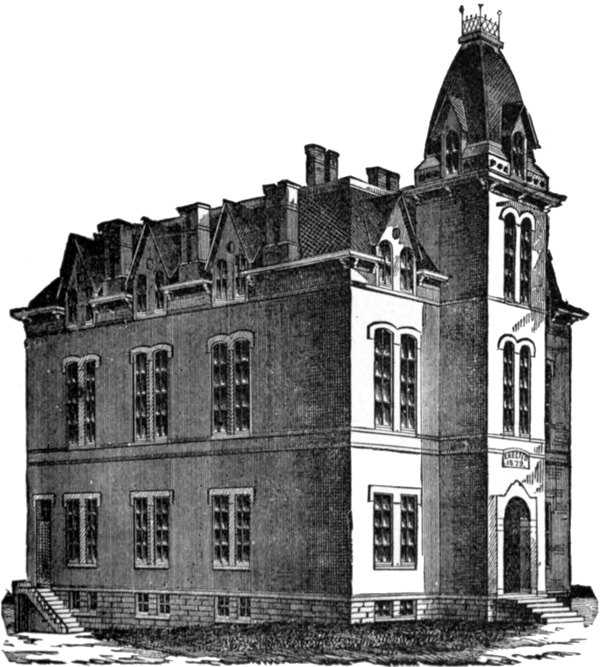
MEHARRY MEDICAL COLLEGE, NASHVILLE, TENN.
“If any one should be inclined to the opinion that
the inquiry was not prosecuted as rapidly as it should
have been, it must be considered that immediately after
the sub-committee was appointed, Bishop Walden was
necessarily in attendance at the meeting of the bishops;
that Bishop Walden, Dr. Cranston, and the editor of
this paper, all of whom are members of the executive
241committee, were necessarily at the meeting of the General
Missionary Committee in New York, which was
held just after the bishops’ meeting; that the president
of the society was immediately afterward called to Philadelphia
to the annual meeting of the Church Extension
Committee, and that the annual meeting of the
Freedmen’s Aid Society was held in Boston on the 23d
of November, at which it was necessary for both the
president and secretary of the society to be present.
Thus the month of November was crowded full of travel
and work, and it was next to impossible to have a meeting
of the executive committee until December 1st, when
a meeting was held. The general history of the inquiry
is given in the ‘Statement,’ and need not be
repeated here.
“We have reason to believe that the board of trustees
of the university will act in the case without delay,
and we are therefore not disposed at this time to enter upon
any discussion of it. Our views are clear, and if it shall
become necessary we shall have no hesitation in justifying
them. Professor Caulkins’s moral character is not
involved in the case. That he is a fine scholar and
teacher, and that he means to be a gentleman, we fully
believe. At the same time we also believe that his views
and feelings upon what is known as the ‘color question,’
or the ‘Negro question,’ are such as to make him
an improper person to hold a position as teacher in a
school officially connected with the Freedmen’s Aid Society.
We say this after having heard the case freely
stated by Mr. Johnson, Professor Caulkins, and Dr.
Carter, and after hearing the declarations of others who
have knowledge of Professor Caulkins’s views. At this
242time, however, we do not think it necessary to discuss
the statements which we have heard, and thus prove
the justness of our conclusions. The trustees of the university
have access to all the parties interested, and we prefer
to leave the case in their hands for final adjudication,
as they constitute the body which has the power to dismiss
teachers. We only add that the Freedmen’s Aid
Society of the Methodist Episcopal Church can not, and
in our judgment will not, continue in its employ any
person who is capable of showing disrespect, under any
circumstances, to a colored person because he is colored.
The Methodist Episcopal Church is the exponent of a
nobler sentiment, and will not stultify herself by allowing
one of her great benevolent societies to employ as a
teacher in one of our schools, any man who stands for
the views which the country has inherited from the institution
of slavery; and in this the Freedmen’s Aid Society
is in exact harmony with the views of the Church.
The black man is a man, and the fact must be recognized.”
“It has been widely published that Professor Caulkins,
of Chattanooga University, Tennessee, a school
officially connected with the Freedmen’s Aid Society of
the Methodist Episcopal Church, and built and supported
for the most part by funds from its treasury, refused
to shake hands with the Rev. B. H. Johnson, pastor
of one of the Methodist Episcopal Churches of Chattanooga,
and that he refused the proffered hand of Mr.
Johnson because Mr. Johnson is a colored man. It has
243also been reported that Professor Caulkins, in conversation
with the Rev. Dr. Carter, immediately after the
alleged insult to Mr. Johnson, used words which indicated
his personal prejudice against the Negro race.
“In view of the wide circulation of these accusations,
the executive committee of the Freedmen’s Aid
Society makes the following statement of facts:
“The first report of the case was made to some
members of the executive committee about the 22d of
October, and the president of the society, Bishop Walden,
did not hear of it until the 25th. On the 26th a
meeting of the executive committee was held, the president
of the society being in the chair, and at this meeting
Dr. Rust, the corresponding secretary, was directed
to ascertain the facts in the case, and, if the disparaging
rumors concerning Professor Caulkins should prove
to be true, Bishop Walden was directed to lay the matter
before the board of trustees of the university, and
ask for Professor Caulkins’s resignation. The vote of
the committee upon this resolution was unanimous.
Bishop Walden went immediately to New York to attend
the bishops’ meeting and other annual meetings.
“Dr. Rust secured written statements from Dr. Carter,
Mr. Johnson, and Professor Caulkins. At a meeting
of the executive committee, December 1st, held on
the bishop’s return from the East, the matter was called
up, but no formal report was made, it being the wish of
the committee that Bishop Walden should see the parties
on the ground, and ascertain, so far as possible, all
the facts bearing upon the case. He presented his report
to the executive committee, Monday, December
20th, the earliest date practicable after he had secured
244a meeting of the parties in Chattanooga. Pending the
consideration of the report, the committee adjourned to
Thursday, December 23d.
“The annual meeting of the board of managers of
the Freedmen’s Aid Society was held on the 21st of December,
and this case was called up, and by resolution
was left to the executive committee to take such action as
the facts might require.
“Dr. Carter and Professor Caulkins being present on
the 23d, each, by request of the committee, made a full
statement. In view of these statements it was deemed
best to have personal statements from other parties, and
the committee requested the presence of Mr. Johnson,
President Lewis, Dr. Manker, and Mr. J. H. Bowman
at an adjourned meeting held Tuesday, December 28th.
These were all present at this meeting except Mr. Bowman,
and each made a statement before the committee.
“The committee spared neither time nor patient
labor in investigating the case, and after mature deliberation,
the entire committee being present, adopted the
following:
“‘1. That we, the executive committee of the Freedmen’s
Aid Society, strongly condemn an insult or discourtesy
to a colored person on account of color or
previous condition; that we hold that no person who
entertains sentiments either inimical or prejudicial to
the colored people, as such, should have a position of trust
in any institution of our Church; that we do unqualifiedly
condemn the refusal or failure of Professor Caulkins
to shake hands with Rev. B. H. Johnson, and deplore
the results of what Professor Caulkins claims to
have been carelessness on his part.’
245“‘2. That a majority of this executive committee is
convinced that Professor Caulkins did intentionally refuse
to shake hands with Rev. B. H. Johnson; that he
does entertain sentiments that unfit him for a position
in a school with which our Freedmen’s Aid Society is
officially connected, and that he should be asked to
resign at once.’
“‘3. That inasmuch as the power to dismiss teachers
from the Chattanooga University is vested by the charter
in its board of trustees, we, the executive committee
of the Freedmen’s Aid Society, refer the foregoing
statements and conclusions to said board of
trustees, and respectfully request a speedy decision in
the matter, and that the decision be placed before the
Church at the earliest day practicable.’”
“‘Attest: J. M. Walden, President.’
“‘T. H. Pearne, Secretary.’”
When the foregoing action of the board of managers
was communicated to the trustees, they refused
to comply.
The following from the Western Christian Advocate
has the right ring:
PROFESSOR CAULKINS’S CASE.
“We learn that the trustees of the Chattanooga
University decline to comply with the request of the
executive committee of the Freedmen’s Aid Society as
to the removal of Professor Caulkins. We learn this
with much regret, because one result will be a disturbance
of the harmonious relations which should exist between
the trustees and the executive committee. We
do not see how the committee can possibly recede from
246its position. When the matter was sent back by the
trustees for further consideration, and some new facts
were submitted, it was the conviction of the committee
that the new facts made the case against the professor
stronger than before, and the request for his removal
was more prompt and emphatic in the second instance
than in the first. As we have already said, we are fully
satisfied that Professor Caulkins means to be a gentleman;
but a man who could, under any possible circumstances,
say such things about the Negro as Professor
Caulkins certainly has said, and act toward a
colored minister as he did act toward Mr. Johnson, is
not a proper person to occupy the position of teacher
in a Freedmen’s Aid Society school, and the effort of
the trustees to retain him can accomplish no desirable results.
The professor ought to resign, and thus end the
controversy over his case. That the five trustees who
voted to retain him in the university are sincere in
their motives we do not for one moment doubt, but they
certainly do not see the case as the great mass of the
members of the Methodist Episcopal Church see it, and
their position is clearly untenable. Professor Caulkins
should not be permitted to remain in that institution.
If nothing else can be done, notice should at once be
given to terminate the contract between the Freedmen’s
Aid Society and the trustees, and at the earliest practicable
moment a new administration should be inaugurated.
One mission of the Methodist Episcopal Church
in the South is to teach a better theory concerning the
Negro than the South has heretofore held, and it is
wholly incongruous for us to employ as teachers in the
South men who hold upon this particular subject opinions
247which we are there to destroy. However pure the
motives of the trustees may be, and we have no suspicion
of them, their course is not wise, and if persisted in will
lead to serious consequences. We hope they will reconsider
their action before the evils are precipitated upon
us which must otherwise inevitably result.
MIXED SCHOOLS—LET US BE WISE.
“It will be a very disastrous state of things if, while
the Chattanooga University is under discussion, the collections
for the Freedmen’s Aid Society shall be postponed.
The society is in debt now, and funds must be
supplied or its work will be crippled, and in the not
distant future will have to be suspended. More money
should be given this year than in any previous year.
“No change in the administration of the society has
been inaugurated. The colored work and the white
work are going on now just as they have done for years,
only more successfully than ever before. There have
never been any colored students in our white schools in
the South, and the last General Conference knew this
fact, and approved the administration of the Freedmen’s
Aid Society. One of our contemporaries says that
colored students can find a way into Grant Memorial
University, at Athens, Tennessee; but that is certainly
a mistake. We can not learn that one colored student
has ever been in that school, nor do we believe that one
would be admitted there. Our white schools in the
South are for whites exclusively, and have been so from
the beginning.
“We do not now discuss the main question at issue,
but we do say that, in our judgment, those in charge
248of the Freedmen’s Aid Society have been administering
the trust committed to them just as they administered it
before the last General Conference, and as they understood
the instructions given them by that General Conference.
The Freedmen’s Aid Society has never excluded
colored students from white schools. Certain colored
persons who applied for admittance to Chattanooga University
were refused by the local authorities, and only a
few days ago the matter was referred to the officers of the
Freedmen’s Aid Society, when a meeting of the board
of managers was at once called to consider the question.
So far as we know, this is the first action of the
kind in the history of the society. What conclusion the
board will reach we do not know, and do not now care
to conjecture, although our own views upon the whole
subject are entirely clear. We do not believe that under
the action of the General Conference of 1884 those
students can be rightfully refused admittance to the university,
and whatever the results may be, the General
Conference itself must bear the responsibility for them.
We confess our profound conviction, and our painful
fear, that if this view shall be adopted and acted upon,
our entire educational work among the whites of the
South will be imperiled. The prejudice against the introduction
of colored students to our white schools in
the South is more violent than it would be against the
appointment of a colored man as pastor of Trinity
Church, Chicago; or, if such a thing were possible, of
Plymouth Church, Brooklyn. We do not believe that
mixed schools in the South, generally, are yet possible,
and this fact has influenced the action of the General
Conference upon this whole subject. It is barely possible
249that if that body had fully appreciated the gravity
of the situation, the resolution of May 28, 1884, setting
forth the policy of the Church, would not have been
adopted. However this may be, to us the action of the
Conference admits of but one interpretation, and when
a student knocks at the door of any one of our schools,
the opening of the door must not depend upon the color
of the applicant. Whether the action of the conference
be wise or unwise is a very different question; but
this is our interpretation of what it did.
“For the present, however, we are anxious that the
regular collections for the society shall be taken, so that
its growing and glorious work may not be crippled. If
the collections cease, the colored work will be destroyed.
Our white people in the South can do something on
educational lines for themselves, but our colored people
can do little, if anything; and when the people of the
North fail to send in the money, the schools for the colored
people must inevitably close. Let no angry criticism
of the society result in robbery of Christ’s poor.
“We trust the Church will see the case just as it is,
and not rush to a conclusion which will endanger our
hitherto prosperous work in the South. The board of
managers of the society can be trusted to do what is
right and wise. Let the collections be taken as usual,
and send the money in promptly, and wait in patience
for a deliverance from the board of managers. We do
not need angry passion just now, but coolness, deliberation,
wisdom, and the fear and love of God. Let these
virtues prevail, and no disaster will befall us.”
The trustees of Chattanooga University having
refused to ask Professor Caulkins to resign his
250position in the institution, the Western Christian
Advocate reported, editorially and otherwise, the following,
which we insert in full, because the editor
was present during all the deliberations of the
body, and was chairman of the sub-committee
which prepared the statements and resolutions which
were considered, amended, and adopted:
“The action of the board of managers of the Freedmen’s
Aid Society will be found in another column, and
will be read very widely and with much care. The
editor of the Western was present during all the deliberations
of the body, and was chairman of the sub-committee
which prepared the statements and resolutions
which were considered, amended, and adopted. He is,
therefore, in a position to know how the board reached
its conclusions, and the spirit of all the discussions.
The work was done prayerfully and carefully, and with
profound appreciation of the principles involved and
of the possible results of the action taken. The board
understood that it was dealing, directly or indirectly,
with the entire work of our Church in the South; for,
as matter of fact, the fate of our Churches in that part
of the country is more closely related to the fate of our
schools than most persons think. It took a broad view
of the whole subject, and after many hours of deliberation
on three successive days, adopted the deliverance
which is now laid before the Church. What its statements
and resolutions are, the reader will learn by personal
examination of them. They are easily understood.
No adroit play is attempted upon the word ‘policy,’ nor
is the resolution of May 28, 1884, treated as a ‘barren
251ideality,’ The board adopted the view of the whole question
which was set forth editorially in these columns
some weeks ago. That the General Conference intended
to continue separate schools for the two races is entirely
clear to us, and that it also intended that those
schools should not be absolutely exclusive as to either
race, is equally clear. This is the view taken by the
board of managers, and seems to us wholly correct.
“We believe it will harmonize with the thought of
the Church. We do not believe there is a general disposition
to destroy, or even to cripple, our work among
the whites of the South; on the contrary, the remarkable
success of that work is a cause of joy to the great
majority of our people, and they are ready to aid and
extend it. But there is a conviction that the last General
Conference intended to utter a practical protest
against that caste spirit which has so long trampled upon
the Negro race; and there is also a conviction that the
age is outgrowing that prejudice, and that in this advance
toward ideal gospel fraternity the Church should
lead the age. The board shared this conviction, and
voiced its opinion in an interpretation of the action
of the General Conference which none can misunderstand.
What the effect will be upon our work in the
South no one can foretell. It is possible that our schools
in that section may all become schools of colored people;
for it is just possible that if colored students shall be
admitted to what are now called white schools, all the
white students will be foolish enough to leave them. This
is prophesied and desired by some who wish us evil, and is
feared by some who wish us well, and some of our enemies
are already standing ready to laugh at our confusion.
252“We hope for better things. We have no idea that
large numbers of colored students will apply for admittance
to these schools; for while they do not enjoy being
excluded from them by law, they prefer the schools
which are attended mostly by their own people, and
which, as matter of fact, are among the best in the
South. We do not believe that they will purposely
embarrass the work among the whites by insisting upon
their rights under the action of the General Conference
as interpreted by the board of managers. We are free
to say that we hope they will not do it. Whatever the
result is to be, however, the General Conference took
the action which the board has now interpreted, and
which, in our judgment, it could not consistently interpret
in any other way.
“We believe the Church will approve what the
board has done, not only by words but by increased
contributions to the cause. The society is heavily in
debt, and while it has a very large amount of property,
and is in no sense bankrupt, it ought to have an annual
income of two hundred and fifty thousand dollars.
“The action of the board shows how unjust much
of the criticism of the society has been. This is the
first and only time in its history when it has been
called upon to interpret General Conference action upon
this subject, and it speaks promptly and clearly. We
never had any doubt as to what it would say when an
opportunity for utterance should be given, and we
prophesied editorially what the result would be. That
time has come; the voice of the society has been heard;
and it is now in order for hostile critics to confess how
they have wronged a society which ran to the help of
253the freedman before the roar of the battle which made
him free had died away, and has done more since, with
the amount of money at its command, than any other
benevolent society in the world.
“We trust that those who are particularly interested
in our work among the whites of the South will not
lose heart. A better day is dawning. It would be a
poor tribute to our work during the last quarter of a
century if the introduction of a few colored students
into our schools for whites should break the institutions
down. Have we really made so little progress that six
colored students at Chattanooga would drive out two
hundred white students? We can hardly believe it.
When three chase a hundred, the three must be very
strong or the hundred very weak. We believe our white
work will go on, and that this action of the board will
strengthen the society and increase its success.”
ACTION OF THE BOARD OF MANAGERS
OF THE FREEDMEN’S AID SOCIETY OF THE METHODIST EPISCOPAL CHURCH.
“The board of managers of the Freedmen’s Aid
Society of the Methodist Episcopal Church, at the call
of its executive committee, convened at its office in Cincinnati,
Ohio, February 22, 1887, the following members
being present: J. M. Walden, Amos Shinkle, M. B.
Hagans, R. S. Rust, J. C. Hartzell, T. H. Pearne, Earl
Cranston, W. L. Hypes, D. J. Starr, H. Liebhart, W.
F. Boyd, J. H. Bayliss, W. P. Stowe, Joseph Courtney,
Isaac W. Joyce, Bidwell Lane, J. M. Shumpert, E. W.
S. Hammond, J. W. Dale, J. D. Shutt, F. S. Hoyt, J.
Krehbiel—two members being absent, namely: F. C.
254Holliday, through personal illness, and Edward Sargent,
on account of affliction in his family.
“The following was submitted for consideration:
EXTRACT FROM MINUTES OF EXECUTIVE COMMITTEE OF CHATTANOOGA UNIVERSITY.
“‘Whereas, At the opening of the Chattanooga
University, September 15, 1886, certain colored persons
applied to the faculty for admission as students in the
institution; and
“‘Whereas, Certain other colored persons residing
in Athens, Tennessee, have applied for admission at the
opening of the second term, now about to commence; and
“‘Whereas, It has been again and again definitely
and clearly stated by the proper authorities of the
Church, and from the beginning has been well understood
by all concerned, that the Chattanooga University
was designed for the education of white pupils, and was
not intended to be a mixed school; and
“‘Whereas, It is well known that first-class institutions,
well equipped and provided by the Church especially
for the education of people of color, are within
easy reach of all such persons who really desire to avail
themselves of their benefits, so that they are in no proper
sense dependent on this institution for education; and
“‘Whereas, We are confident that, in the present
state of society in the South, the admission of colored
students to the Chattanooga University would, on
the one hand, be fatal to the prosperity of the institution,
and defeat the very object proposed by the Church
in the establishment of the school; and, on the other hand,
would not only be unproductive of good results to the
255colored students so admitted, but would excite prejudice
and passion, alienate the races, and prove especially detrimental
to the interests of the colored people; and
“‘Whereas, This very question of mixed schools
has, by the General Conference itself, been declared to
be “one of expediency, which is to be left to the choice
and administration of those on the ground and more
immediately concerned;” therefore, be it
“‘Resolved, That we deem it inexpedient to admit
colored students to the university, and that the faculty
be instructed to administer accordingly.
“‘Adopted January 4, 1887.’”
“In view of this action, and after full consideration
of the whole subject, the board of managers adopts the
following statements and resolutions:
“1. The last General Conference authorized the
Freedmen’s Aid Society to aid in the maintenance and
establishment of separate schools among the white members
of our Church in the South. It did this by recognizing
the separate white schools then existing in the
South as entitled to aid; by directing the Freedmen’s Aid
Society to co-operate in maintaining and establishing such
schools; by approving the aid this society had already
extended to these schools; and by directing the pastors
when taking collections for the Freedmen’s Aid Society
to ‘state plainly that the educational work of the
society is among both white and colored people.’ There
can, therefore, be no doubt that it was the intention to
continue separate schools in connection with the Freedmen’s
Aid Society; yet, in the judgment of this board
of managers, it is in harmony with the prevailing sentiment
of the last General Conference to interpret its
256action as being designed to forbid the exclusion of any
student ‘from instruction in any and every school under
the supervision of the Church because of race, color, or
previous condition of servitude;’ and we hereby declare
that no pupil should be excluded on account of
race, color, or previous condition of servitude, from instruction
in the schools under the control of this Freedmen’s
Aid Society or aided by its funds, under the
authority of the last General Conference.
“In the above interpretation of the action of the
last General Conference touching this general principle
of equality, it is the judgment of this board that it was
not the expectation of the General Conference that any
advantage would be taken of its deliverance on this
subject by persons or parties interested in embarrassing
the work of our Church, or of this society; and, therefore,
we trust that the parties directly interested in its practical
application will so act as to promote good-will and insure
the usefulness of all the schools under the care of this
society. We also call attention to, and emphasize, the
following action of the last General Conference, viz.:
“‘The establishment of schools for the benefit of our
white membership in the South we believe to have been
a wise and necessary measure. Their success has been
gratifying. The beneficial results have not been confined
to those immediately interested, but their liberalizing
effects upon public sentiment have greatly redounded
to the advantage of our colored people. We
regret that for so great and important a work so little
has been done by the Church, and we desire most emphatically
to give expression to our conviction that the
time has come when this portion of our educational
257work should be strengthened and placed upon a strong and
permanent basis, as its importance certainly demands.’
“2. Whereas, It appears from the above action
of the Chattanooga University that certain students
were denied admission to that institution for the sole
reason that they were persons of African descent; and
“Whereas, In the judgment of this board there is
neither in the charter of the Chattanooga University,
nor in the contract between said university and the
Freedmen’s Aid Society, anything authorizing the exclusion
of students from instruction in said institution
on account of color or race; and as the General Conference,
on May 28, 1884, did, as its last utterance on
this question, declare ‘the policy of the Methodist Episcopal
Church to be, that ... no student shall be
excluded from instruction in any and every school under
the supervision of the Church because of race, color, or
previous condition of servitude;’ therefore,
“Resolved, That we disapprove the exclusion of those
students for the reason assigned; and hereby instruct
our executive committee to use all proper means at its
command to induce the trustees of the Chattanooga
University to rescind the order by which those students
were refused instruction in that institution.
“3. Whereas, The executive committee of the
Chattanooga University has declined to ask for the
resignation of Professor Wilford Caulkins as a member
of the faculty of that institution, although such action
has been twice requested by the executive committee of
this board; therefore,
“Resolved, By the board of managers of the Freedmen’s
Aid Society, that we approve the course of our
258executive committee in seeking to secure the resignation
of Professor Caulkins; and, while carefully and respectfully
considering the reasons urged by the executive
committee of the Chattanooga University for his retention,
it is our conviction that the best interests of the
society and the Church demand his removal.
“4. Whereas, Harmony between this board and
the Chattanooga University is essential to the effective
working of the said university; therefore,
“Resolved, That if the Chattanooga University fail
to secure the resignation of Professor Wilford Caulkins,
to take effect at a date not later than the close of the
present school term, and so to modify its action as not
to exclude from instruction in that institution students
on account of race or color; i.e., if the said university
fail in either of these particulars, we hereby instruct
our executive committee to secure by agreement, if possible,
with the trustees of said university, the immediate
termination of the contract between the Chattanooga
University and the Freedmen’s Aid Society; and, in
case a termination of said contract be not secured by
mutual agreement, in either of the contingencies named
above, to notify the trustees of the Chattanooga University,
within sixty days from this 24th day of February,
1887, of the termination of the contract as
provided in the same.
“Done by the Board of Managers of the Freedmen’s
Aid Society of the Methodist Episcopal Church, at
its office in Cincinnati, Ohio, this 24th day of
February, A. D. 1887.
“J. M. Walden, President.
“Attest: T. H. Pearne, Secretary.”
CHAPTER XIII THEORY AND PRACTICE—A GENERAL DISCUSSION. — THEORY AND PRACTICE.
259
While the board of managers was in session,
as well as before and afterward, a general
discussion, pro and con, was going on. We
give but a few of the many expressions of opinion
on the subject; enough, however, for one to form
an intelligent opinion touching the real intention
of the Church. If it should appear to any one that
the actions taken by the last General Conference
were ambiguous, not to say plainly contradictory, not
only with themselves but the past record of the
Church, it will occasion no surprise. The Central
Christian Advocate, at St. Louis, spoke editorially,
March 2d, as follows:
“The decision of those who are in charge of the
new university at Chattanooga, erected under the direction
of, and out of the funds collected for, the Freedmen’s
Aid Society, that colored students shall not be
admitted to its benefits, has brought the Methodist
Episcopal Church face to face with certain questions
which only the next General Conference can settle.
But in the meantime it is wise to examine the questions
involved from every point of view, and, if possible,
thoroughly comprehend the situation; for, in matters of
260this kind, we are apt to form opinions before we have
canvassed the whole field, and to make accusations that
will not stand investigation. That there are differences
of opinion in regard to the intention of the last General
Conference in its legislation on the subject under discussion,
no one can doubt. There were those in that
body who understood that certain action in which they
had a part established the rule that no distinctions
founded on race or color should be made under any circumstances
in any of our schools. But there are others
who as certainly understood that there would probably be
circumstances where the success of our educational work
in the South would depend upon setting apart some of
the schools there exclusively for the whites. It is not a
difference of opinion that admits any suspicion of a lack
of honesty or piety in either party, much less the accusation
of trickery or intentional wrong-doing. And it
will be found, we think, after proper consideration, that
these differences may be easily explained; that they are
simply the differences of opinion which always arise in
the transformation and development of society between
the party of theory and that of experience and practice.
“The Methodist Episcopal Church holds to the
theory that God ‘hath made of one blood all nations of
men;’ that they were all involved in the fall, and all
have been redeemed by Christ, and may become partakers
of the same faith and eternal inheritance. We
hold that the social and civil distinctions which prevail
in society are of men, not of God. ‘There is neither
Jew nor Greek, there is neither bond nor free, there is
neither male nor female, for ye are all one in Christ
Jesus.’ It is not possible—so at least it appears to us—to
261conceive of Christ as recognizing these distinctions
except to condemn them, and to show his sympathy for
the oppressed or degraded party. The conviction and
faith of the Methodist Episcopal Church is as strong,
and her practice as nearly in accord with her faith, as
that of any Protestant Church; but her faith and practice
are not, and never have been, in harmony in regard
to the colored people. The simple fact is, that wherever
the colored people have become Methodists, and are
found in any considerable number, they have been
formed into separate societies; when a number of societies
have been formed they have been organized into
a separate district, and in the end into separate conferences.
The line of procedure has been the same in the
North, where slavery has not prevailed for generations,
and the rights of the colored people are fully recognized,
as in the South where the prejudice against them is the
greatest. So that there is not to-day, so far as we know, a
single colored Church, able to support a pastor, in charge
of a white pastor. There is not a society of whites, in any
condition of poverty or ignorance, served by a colored
pastor. There are a few districts of colored societies
served by white presiding elders, but not one white district
by a colored presiding elder. And we do not believe
there is a society of whites anywhere in the Church
that have asked for or would receive a colored pastor,
whatever might be his grade of talent. They would not
object to hear one of this description preach, and they
would treat him with consideration, but they would
hardly ask him to become their pastor.
“We believe this to be a fair statement of the
situation. It does not mean that we intend to be unjust
262or unchristian, nor that we harbor secret prejudice
against our colored brethren, but simply that the condition
of things about us makes it impossible, as we say,
to put our theory in practice. We are not hypocrites,
nor are we consciously faint at heart in contending for
the equal rights of all men; but we have learned that
the leaven of Christianity has not yet leavened society.
We find our theory and the practical reason not in accord,
and we follow reason. For we are not propagating
a theory but engaged in obtaining actual benefits
for men. The object we have in view is itself a step
towards the overthrow of error and sin and prejudice.
It is not a surrender, but accepting what we can
not at once change that we may yet reach the object
in view.
“Some one, however, may say, But what about the
schools? The school is not a necessity in the same sense
that the Church is; and if people prefer to remain
ignorant rather than obtain education under certain
circumstances, let them take the responsibility. This
means, we take it, that we shall not undertake to do
anything towards the education of the whites in the
South. And yet it is by education alone that this prejudice
which we are asked to combat is to be removed.
Those in charge of the Chattanooga University have
not, we think, taken counsel of their fears in this matter,
but have an intelligent conviction of their duty
under the circumstances. And yet it might have been
worth the experiment to have made the test, and let the
Church know exactly the difficulty which confronts
a company of men who have at heart the welfare
alike of white and colored. But right here is where
263the difference of opinion comes in—where theory and
practice come in collision; the one party is no more
willing to yield than the other. Whether we can maintain
a condition in our Church schools which we have
failed to maintain in the Church—where prejudice should
have less influence than anywhere else—is, to say the
least, problematical. And the question which will come
before the next General Conference is: Shall we undertake
to establish a condition of affairs in the South
which we have utterly failed to establish in the North
under more favorable circumstances.”
March 2d the following appeared in the North-western
Christian Advocate, from the pen of A.
Wheeler, D.D.:
“The refusal of the Chattanooga University to admit
the colored students who made application for reception
into its halls has exposed them to severe criticism,
not to say malediction. A reconstruction of its administration
is loudly called for, more in harmony with the
policy and principles of the Church. The suggestion
that the great wrong done should at least be divided
with another authority seems not to have occurred to
any of the horrified accusers living a thousand miles
away from the scene of trouble. Is this as it ought to
be? Is it justice? Is it fair play?
“In this transaction two things claim attention,—the
principle underlying it, and its application. As to the
principle: The General Conference of 1876 indorsed the
principle of separate conferences and societies. Is the
principle of separation right in the house of God, and
wrong in the house of learning? The General Conference
264of 1884 recognized the principle as appropriate also
to our schools in the South. Was this done as an abstraction,
with no expectation of a concrete application?
If so, it ought to have been known. If the principle
is wrong, it is but just that condemnation fall upon
the General Conferences enacting it, and moral cowardice
to visit such indignation on the Chattanooga
agents of the Church carrying out a principle ordained
by the highest authority of the Church—a principle to
be carried into operation under certain contingencies.
“The application of the principle is the other matter
to be considered. Who was to apply it? Somebody
in Detroit or Boston, or the trustees and faculties
intrusted with the care of the institutions? To ask the
question is to answer it. A mistake in the application
of the principle in a given case might be made, but
are those making it to be adjudged worse sinners than
those upon whom the tower of Siloam fell therefor?
If those applying a principle mistakenly be worthy of
death, of how much sorer punishment shall they be
thought worthy who gave them the principle to apply?
But the General Conference of 1884 declared the policy
of the Methodist Episcopal Church to be ... that
‘no student shall be excluded from instruction in
any and every school under the supervision of the
Church because of race, color, or previous condition of
servitude.’ What of it? Had that deliverance the
force of an enactment? Was it true to history? Will
any claim it to be history? Who have declared it?
When and where was the declaration made? Had
such a policy been carried into execution? When?
By whom? Had it been at Athens or Little Rock,
265the only other schools established for whites at the
South?
“The statement never ought to have been made by
the committee, nor indorsed by the General Conference.
The policy of exclusion had never been adopted, it is
true, but the trend of the legislation of the Church
since 1876 had been in the direction of separation in
worship and education, under certain conditions. To
institute such legislation, and then visit unsparing indignation
on those whose duty it is to apply it, is
neither just nor manly, unless the application has been
made in a way faithless to a committed trust. I am
not defending the principle of separation in conferences
or schools. It may be wrong. If it is, let us say so
and abandon it; but till we do abandon it, let us not
blame those for whose benefit it was adopted for using
it when the conditions for its use are present. Nor let
us conclude that one of the qualifications for judging
conditions is distance from the scene of action, and that
competency is in proportion to remoteness. Let those
of us who voted the principle, if it be blameworthy,
bear our part of the blame, and not saddle it all off
upon the Chattanooga authorities. Let us hold them
responsible for a misuse of it only. To legislate a principle
that was never to be used would be simply a
mockery.”
March 9th the following contribution, which
appeared in the columns of the Western Christian
Advocate, was written by A. B. Leonard, D.D.:
“There appears to be no small amount of confusion
in the minds of not a few, who ought to be perfectly
266clear, as to the action of the late General Conference
on the question of caste in the Churches and schools of
the Methodist Episcopal Church. The action of that
body was of such a character as to put the whole question
beyond the realm of doubt.
“On May 22, 1884, Report No. 3 was presented by
the chairman of the Freedmen’s Committee to the General
Conference, and was adopted with but little discussion,
almost without opposition. The third resolution
of that report was as follows:
“‘Resolved, That the question of separate or mixed
schools we consider one of expediency, which is to be left to
the choice and administration of those on the ground and
more immediately concerned: Provided, there shall be no
interference with the rights set forth in this preamble and
these resolutions.’
“In regard to mixed schools and congregations the
preamble said:
“‘To the question of mixed schools we have given
our most serious and prayerful attention. It is a subject
beset with peculiar difficulties. That the colored
man has a just and equal right, not only to life and
liberty, but also to the means of grace and facilities
for education, we not only admit, but most positively
affirm. We are in duty bound to provide for and to
secure to every class of our membership, so far as possible,
a fair and equal opportunity in Church and school
accommodations. And in so far as this is done our duty
is performed, and the equal rights justly demanded of us
thus fairly and fully conceded. Mixed congregations and
mixed schools may, in many places, be most desirable and
best for all concerned. In other cases one class or the other,
267or both, may prefer separate congregations and separate
schools. Equal rights to the best facilities for intellectual
and spiritual culture; equal rights in the eligibility to
every position of honor and trust, and equal rights in
the exercise of a free and unconstrained choice in all
social relations, is a principle at once American, Methodistic,
and Scriptural.’
“Upon a more thorough examination of the italicised
parts of this report it was feared by many that it would
justify forcible separation on the color-line where ‘those
on the ground’ saw fit to adopt that policy. In the
light of recent events that fear was well founded. The
Chattanooga University trustees have done just what it
was feared might be done under the resolution and preamble
above quoted. If no further action had been
taken by the General Conference, that body would be
compelled to bear the responsibility of the rejection of
colored students by the Chattanooga authorities. In the
absence of further action the trustees could say that the
‘question of separate or mixed schools’ is ‘one of expediency,
which is to be left to the choice and administration
of those on the ground.’ ‘We are on the ground,
and we hold that expediency requires that colored students
shall be excluded from our university, and we so
decree.’
“But there was another General Conference committee
that could properly consider and report on the
question of caste—the Committee on the State of the
Church—which had, according to the statement of its
chairman, Governor Pattison, made upon the floor of
the General Conference, given special attention to this
question, even before the report from the Freedmen’s
268Committee was adopted. The unsatisfactory nature of
the report from the Freedmen’s Committee, already
adopted, was regarded as sufficient reason why the report
from the Committee on the State of the Church
should be pressed upon the attention of the conference.
That report was presented and adopted May 28th, the
last day of the session. The report was as follows:
“‘Resolved, That this General Conference declares
the policy of the Methodist Episcopal Church to be,
that no member of any society within the Church shall
be excluded from public worship in any and every
edifice of the denomination, and no student shall be excluded
from instruction in any and every school under
the supervision of the Church, because of race, color, or
previous condition of servitude.’
“It was well known at the time that this latest
action of the General Conference was intended to make
it impossible under any circumstances, forcibly or morally,
to ‘exclude colored people from any Church
or school under the control of the Methodist Episcopal
Church.’
“The resolution was earnestly opposed by a small
minority, and all parliamentary tactics were employed
to prevent its adoption.
“Dr. Lanahan opposed it because the conference
had already declared that ‘color is no bar to any right
or privilege of office or membership in the Methodist
Episcopal Church,’ and moved to postpone indefinitely.
“Rev. C. J. Howes moved to substitute a minority
report, as follows:
“‘Resolved, That there is no call for any farther
action upon the relation of the races in our Church.’
269“Brother Howes made a vigorous speech against
the report and in favor of the substitute, at the close of
which the previous question was ordered. Before the
vote was taken, Governor Pattison, as chairman of the
committee, made an earnest plea for the rejection of the
substitute and the adoption of the resolution. The
substitute was lost. A. Shinkle, a layman, called for a
vote by orders, but the call was not sustained. The
Rev. Dr. T. C. Carter called for a vote by orders, but
the call was not sustained. The vote was then taken on
indefinite postponement, and lost. A. Shinkle called for
the yeas and nays, and the call was not sustained.
The report of the committee was then adopted without
amendment, a small minority voting against it.
“The adoption of this report, as narrated above,
leaves no room for a doubt as to the position of the
General Conference on the question of caste. There is no
conflict between the two reports. The report from the
Freedmen’s Committee is to be interpreted in the light of
the report from the Committee on the State of the Church.
“The attempt made by certain persons to make the
impression that the latest deliverance of the General
Conference was hasty and not well considered, is hardly
less than a perversion of the facts in the case. Being
the latest, it is the mature judgment of that body, and
was intended to set at rest the question of caste.
“It is passing strange that any attempt should be
made, particularly by members of the late General
Conference, to justify the course pursued by the Chattanooga
trustees. They have simply violated both the
letter and the spirit of the deliverance of the Church
through its only legislative body. There was but one
270thing, therefore, that the Freedmen’s Aid Society could
do without joining hands with the Chattanooga trustees;
namely, to condemn their policy of rejecting colored
students; and that, thank God, it has done. Let
its resolution be engraved in letters of gold, and conspicuously
displayed over the doors of all the schools
under its care. Let it be announced boldly by bishops,
editors, college faculties, and ministers, that the Methodist
Episcopal Church knows no caste, either in its
houses of worship or schools of learning.
“Now that this vexed question is settled, so far as
it is possible to settle it by the action of the Freedmen’s
Aid Society, and settled in harmony with the action
of the General Conference and the teachings of the
New Testament, let the support of the society be more
generous than ever before. There is no cause that is
more worthy, and when its merits are fairly stated it can
not fail to meet a generous response.”
The following appeared in the Western Christian
Advocate of same date, written by Isaac Crook, D.D.:
“‘You can and you can’t,
You shall and you sha’n’t.’
“Allow a word now from one outside of the responsibilities
of General Conference membership in 1884, and
of ambitions for 1888, and with no votes to be defended.
The action had on the report (No. 3) from the Freedmen’s
Aid Committee seemed to outsiders to say, ‘That
action is inspired by the prudence come from experience,
and through those ‘on the ground.’’ It is in
harmony with the liberty needful in all similar work
North and South, and is sustained by the Pauline wisdom
which ‘took and circumcised Timothy because of
271the Jews in those quarters.’ Local prejudices did control
the ‘policy’ of St. Paul.
“The report of the Committee on the State of the
Church (No. 4 adopted afterward) looked like a halt,
and even a retreat, under some alarm at what had thus
been done six days before.
“The first action said: ‘The question of separate or
mixed schools we consider one of expediency, which is
to be left to the choice and administration of those on
the ground.’ That said, ‘You can.’
“Then came, six days later, the adoption of this:
‘No student shall be excluded in any and every school
under supervision of the Church.’ How could it say
more clearly, ‘You can’t’ ‘exclude?’ It is not now, as
it was six days ago, ‘left to the choice of those on the
ground,’ except as they choose to admit.
“When Lorenzo Dow would answer high Calvinism,
which declared for the freedom of the human will, but
that freedom possible only in one direction, he flung out
the rhyme heading this article:
‘You can and you can’t,
You shall and you sha’n’t,
You will and you won’t;
You’ll be damned if you do,
And be damned if you don’t.’
“Is not Chattanooga University caught between the
two horns of a parallel case of decreed liberty? ‘Left
to the choice and administration of those on the ground,’
says Freedmen’s Report, No. 3. Those on the ground
administer for a white school under that General Conference
‘can,’ when lo! they are caught by the younger
272member of the decrees governing the case, which says
‘you can’t’.
“There is not a school under our Church-care in all
the South but is liable to both horns of this dilemma of
double decrees. No school in the North is so hampered.
“Let the next General Conference take out the
Calvinism of the last action had, and adhere to that
broad doctrine of human rights which allows not even
the tyranny of any majority or minority, though it
be of one headstrong person. Let us have freedom
of election in both doctrine and polity, not to mention
of delegates. May, the name of the beautiful month
when General Conference meets, would make a good
substitute for ‘shall’ and ‘sha’n’t’ in all far-reaching
legislation for distant and future contingencies.
“Those who show no faith in posterity, or people differently
surrounded from themselves, provide for embarrassment
and often for revolution. The antecedents
and the present love of justice in the heart of Methodism
may be trusted to see that every member of every
color shall have right to the pursuit of ‘life, liberty, and
happiness,’ with no other exclusions than a righteous
Christian prudence may, as exceptions dictate, require.
Even then the ‘strong should bear the infirmities of the
weak.’”
In the same paper, March 23, 1887, the following,
contributed by Gershom Lease, appeared:
“That there should be a difference of opinion among
good men, in so important a matter as our work in the
South, is by no means strange. That even a General
273Conference of grave divines and honored laymen, while
navigating so dark a sea without compass or precedent,
should occasionally run against breakers, is not to be
wondered at. The only wonder is that, in twenty years
of unremitting effort, the Church has not seriously embarrassed
herself by her own action. The Church has
had the wisdom and the grace to enter this unexplored
field with her evangelizing agencies, and by her wisdom
and success commend herself to the continued confidence
of the people. For the first time in the history
of this great work we are brought face to face with a
problem, the solution of which is taxing the best thought
of the Church, and exciting somewhat grave apprehensions
in the minds of good men. The difficulty is in
the interpretation of the action of the last General Conference
upon our educational work in the South. It is
not strange that there should be a difference of opinion;
for there does really seem to be a want of harmony in
the action of that body.
“On the nineteenth day of the session of the conference
it adopted a carefully prepared report, presented by
the Committee on Freedmen’s Aid and Work in the
Church on our educational work in the South. The
third resolution of this report (No. 3) says that ‘the
question of separate or mixed schools we consider one
of expediency, which is to be left to the choice and administration
of those on the ground and more immediately
concerned.’ On the twenty-fourth day of the session
the conference adopted a report presented by the
Committee on the State of the Church, which declares
the policy of the Church to be, that ‘no student shall
be excluded from instruction in any and every school
274under the supervision of the Church, because of race,
color, or previous condition of servitude.’ These two
resolutions do not seem to be in harmony; each declares
a distinct and different policy. The one declares the
policy of the Church to be, that ‘no student shall be
excluded from instruction in any of our institutions of
learning,’ while the other just as distinctly declares that
the ‘question of mixed schools is one of expediency, to
be determined by those on the ground.’ How it is possible
to harmonize these two resolutions it is certainly
difficult to see. The theory that the one provides for
the admission of a sprinkling of colored students into a
white school is not satisfactory. This interpretation
still leaves the question open, what per cent of sprinkling
can be accommodated; which, in effect, breaks
down the theory. Neither is it satisfactory to say that
mixed schools is the policy of the Church, and separate
schools the exception. Though this exposition might be
preferable to the former, still it does not materially affect
the situation; for the exception is left to the judgment
of the parties ‘on the ground and more immediately
interested,’ which is equivalent to saying that any of
our schools may be exclusive, which is just what Report
No. 3 declares.
“The two resolutions, then, declaring a separate and
distinct policy, it becomes a simple question of weight
between them. It can not be fairly said that the practical
policy of the Church has been mixed schools
or Churches; so that the resolution of the Committee
on the State of the Church embodies a principle that
has only had a shadow of application in the practical
work of the Church; and the reason for it is founded
275in the fact that, after a fair trial, mixed schools and
Churches have been found inexpedient. The preamble
of Report No. 3 of the Committee on Freedmen’s Aid
declares that the ‘establishment of schools for our white
membership’ ‘has greatly redounded to the benefit of our
colored people.’ The resolution, then, so far as it declares
for a uniform policy is not in harmony with that
principle of practical expediency that we have found
necessary in our work in the South.
“Again, the report of the Committee on the State
of the Church seems to have been volunteered. It was
not necessarily binding on that committee to prepare
and present a report on that subject.
“And, further, the necessity for such a report seems
to have been questionable. The position and policy of
the Church, as to the equal rights of the colored man,
had been sufficiently declared by the general policy and
administration of the Church for the last twenty years.
The policy of the Church in its Discipline and administration
has been, and still is, to grant to the colored
man all the rights, privileges, honors, and immunities
of the white man. On the question of personal rights
the Church knows no difference. He is the peer in
Methodism of the white man in Church membership, in
all the councils of the Church, and as eligible to any
position of honor or trust in the gift of the Church as
the white man. No resolution of the General Conference
of 1884 could in any way dignify either the man or his
equality of rights in the Church above that which he already
enjoyed in the fundamental organism of the Church.
There seems to have been no necessity for this action.
It can be of no practical utility to the colored man.
276“After the passage of Report No. 3 of the Committee
on Freedmen’s Aid, it could do nothing but invite
conflict and embarrass the Church in its work.
With all due respect to any action of the General
Conference, the report of the Committee on Freedmen’s
Aid seems to carry with it a greater weight of obligation
than the other. This committee was specially
charged by the General Conference with the investigation
of this subject. In fact, this was the object of the
committee. The report itself shows that the committee
appreciated the gravity of the situation, and thoroughly
considered the extent and magnitude of the work, as
well as the embarrassments because of race and color
that have met the Church in the past. It embodies the
godly judgment of the most thorough and painstaking
investigation of any body of men authorized to speak
upon that subject. This report is the deliberate and
specially-provided-for judgment of the Methodist Episcopal
Church upon this subject, and consequently carries
with it all the weight that the deliberate action of
the highest council of the Church can give it. Add to
this the fact that it is in harmony with the practical
policy of the Church founded in experience, and it
seems to carry a weight with it, a force of authority,
that would at least relieve a faculty and board of trustees
that acted under it, of that severe censure that the
authorities at Chattanooga have been subjected to. This
would seem to be specially the case where an institution
had been erected with the distinct understanding that it
was for a particular race. We can but regard the action
at Chattanooga as within the provision of authority.
To waive all question of superiority, the action of the
277General Conference under which they acted is of equal
authority with the other. The other view of the case practically
annuls Report No. 3, and leaves it a dead letter.
“While we would certainly entertain all due respect
for the deliberate judgment of the ‘board of managers
of the Freedmen’s Aid Society,’ as set forth in their
late action, yet we would respectfully submit that the
intentions of the board as therein set forth, to dissolve
its connection with the university, provided the local
authorities do not rescind their action, may be hasty
and unwarranted. The action proposed is one of serious
import, which, if carried into effect, ought to have a
clear and unchallenged justification.”
The Central Christian Advocate of March 9,
1887, said:
“A few weeks ago we expressed the opinion that
the Chattanooga University case would not be settled
until the next General Conference. We thought there
was ground, untenable indeed, for the position of the
trustees, and that they would have a hearing before that
body, and then the question of ‘separate’ schools would
be discussed on its merits, and the Southern side would
have the opportunity of presenting its views. But the
action of the trustees and faculty in regard to Professor
Caulkins revealed a state of affairs that no one suspected,
and for which there was no defense from any
point of view whatever. So great a misapprehension
of the feeling and conviction of the Church in regard to
her colored members had never occurred before. The
path of duty was so plain that no one should have had
a moment’s doubt about it, nor should the university
278for one moment have hesitated to follow the suggestion
of the authorities of the Freedmen’s Aid Society. But
the university party could not so see it, and declined to
dismiss the offensive professor. This placed the whole
affair in a new light, and the board of managers of the
society were literally compelled to take the action set
forth in their report which we printed last week.
“That they will have the support of the Church
there can be no doubt. For while the Church may be
willing to yield something to prejudice and custom, and
agree that some of its schools may be properly classified
as white, and others as colored, it will not sacrifice the
principle of equality of rights among its members. No
General Conference could be convened that would rescind
the action of the last General Conference, when it
declared that no student shall be excluded from ‘instruction
in any and every school under the supervision of
the Church because of race, color, or previous condition
of servitude.’ We do not call in question the desire of
the authorities of the Chattanooga University to secure
the highest interest of the Church and of the two races.
They do not design to perpetuate caste, but to bridge
over the present till a better condition shall be established;
and the Church intended to assist them in so
worthy a work. But they did not take into account, as
they should have done, the feeling of the Church.
They misinterpreted the phrase ‘expediency,’ when they
attempted to establish a rule which excluded all colored
persons from the university.
“We regret that they did not put to the actual test
their conviction, that the admission of colored students
of the class that could claim entrance to a school of its
279grade ‘would be fatal to the prosperity of the institution.’
There are many persons who do not believe this.
They do not doubt the honesty of the university authorities,
but believe that they have taken counsel of their
fears. They believe it possible to maintain a university
in the South under the same conditions as in the North.
This would have gone far towards settling the question,
for some years at least. As it is, the question has to be
taken up again under less favorable conditions for its
determination. But we shall not fail in the end. So
long as our hearts are right, blunder as we may, we will
make certain progress in the right direction; for this
question of justice and equal rights to the colored race
has been thrust upon us by God himself, and he will
lead us on, if we will suffer ourselves to be led, to a
decision that will be approved in heaven.”
The Northwestern Advocate of March 2, 1887,
contained the following by J. B. Stair:
“Dr. Smart, in a short article on the caste question,
asks some very pertinent questions concerning our
Church in the South, but does not answer them so satisfactorily.
The implication, however, is that we are
there because the Methodist Church already there is so
permeated by that ‘devilish’ and ‘unfraternal spirit’
[of caste] ‘worthy to be accursed of God and good
men,’ that she can no longer do efficient evangelistic
work. It would seem that a Church so afflicted would
not only be incapacitated for any good, but would necessarily
be without the pale of fellowship with any other
Christian body; and yet somehow we continue to recognize
our Southern sister as one of us, send to and
280receive from her Christian and fraternal greetings on every
proper occasion, receive her pastors into our pulpits,
hang by the thousands upon their words, profit numerically
and spiritually by their labors, and devote half
pages of our great Church weeklies to an advertisement
of their sermons. Are we justified in thus figuratively
taking to our arms a Church possessed of a spirit
‘worthy to be accursed of God’—a Church whose course
is so radically incompetent and wrong that able missions
from our own Church are demanded to counteract it?
If somebody can, will he please point out the consistency
in all this? If we are in the South to convert
people to our view of the caste question, we are there
for a laudable purpose perhaps, but one doomed to
failure. That question was not involved in Adam’s
fall, nor is our view of it necessary to salvation. If the
politicians among us would stop a moment and consider
the fact that caste exists elsewhere than in the South,
and with reference to the colored race, it might at least
furnish us with the occasion to divide our missionary
forces with a view to a better distribution. Perhaps no
country under Christian influence is more painfully
afflicted with this ‘curse’ than England is, and yet Dr.
Smart evidently fails to find a reason for sending missionaries
there. True, the Negro is not there involved,
nor are ante and post bellum rivalries; but that ought
not to be an essential circumstance. The fact seems to
be that caste exists about everywhere, even in our own
dear Church. We have, and might again see, a form
of it manifested, should the powers that be so far forget
themselves as to send a doctor of divinity to a three
hundred-dollar appointment in the backwoods; and
281instances are not beyond our own ken in which good Methodist
families persistently forget to ask the servants to
eat with them in the dining-room, even when the table
is not crowded. It is remarkable how much color and
climate have to do with the question of caste. Social
relations, morally clean, are not a fit subject for the
missionary works of a great Church. The legitimacy
of our errand in the South will depend much upon
the question whether we find there territory unoccupied,
or whether we are there as rivals merely, of a
Church with whom we have long been at political
swords’ points. Politicians, Church or other, should not
be allowed to decide. If we are in the South, as are
other evangelical Churches, for the purpose of saving
the souls of men, we deserve Godspeed. But if the only
reason we can give for being there is to eradicate caste,
social prejudice between races, the foundation for our
errand will deservedly be alike unsubstantial with its
completed results.”
The intention in thus presenting the Chattanooga
affair, like that of the rest of this work, has been
to sustain the facts: (1) There has never been a
disposition on the part of the Methodist Episcopal
Church to ignore its obligations to the colored man,
but it has, in every conceivable way, aided him intellectually,
financially, and spiritually. (2) That the
Church, as such, has always not only respected his
manhood, but encouraged him, where circumstances
or previous condition persuaded him to believe he
possessed none, to respect his manhood and feel
282himself somebody. (3) That the Methodist Episcopal
Church, as such, has done this to a greater
degree, and with as much, if not more, consistency
than any other Church in this country, and at
greater cost. It is quite a different thing to say that
she has always declared that none but mixed schools
should be supported by the Freedmen’s Aid Society.
The simple and unambiguous statement,
“the question of separate or mixed schools is one of
expediency, which is to be left to those on the
ground and more immediately concerned,” forever
excludes any such idea. If the mind of the Church
can be known at all, it certainly is best known
by the enactments of the several General Conferences
on this question. From these we conclude
that it is not the policy of the Church to truckle to
caste prejudice in any form anywhere. It has declared
that as a Church it favors “equal rights to
the best facilities for intellectual and spiritual culture,
equal rights in the eligibility to every position
of honor and trust, and equal rights in the exercise
of a free and unconstrained choice in all social
relations.” But the whole is greater than any
part; therefore there is not, nor can there be, any
Church or school conducted under the auspices of
the Methodist Episcopal Church into which any
member or pupil may not enter, or from which any
proper person can be excluded “on account of race,
color, or previous condition of servitude.” This is
the declared policy of the Church; also, the letter
283of the law on this question. The apostle Paul,
a man of profound learning and great piety, as well
as keen foresight—a man that so spurned caste
prejudice as to withstand his brother Peter to his
face concerning caste—says: “All things are lawful
unto me, but all things are not expedient. The
letter killeth, but the spirit quickeneth.” It is true
of the colored man in the Methodist Episcopal
Church that “all things are lawful” unto him that
are lawful unto any other man within the Church.
It is equally true for the colored man that “all
things are not expedient” for him any more than
they are for white men within the Church.
We do not believe, nor do we wish to believe,
that our Church intended, by anything done in the
General Conference of 1884, or desired at that time
to annul any of its hitherto impartial acts; to give
any particular class of its members any indulgence
in wrong-doing; to yield to any kind of race or
class prejudice; that it attempted or desired to
elevate any class of its members above another;
or, on the other hand, that, while it slept, an enemy
sowed “tares” in the field. We think no one believes
that it was the intention of the Church to
dishearten or disband or leave to themselves the
schools among our white membership in the South,
organized and conducted, as well as supported in
part, by conferences of our Church, in the which
there are no colored members. The Church must
have seen and felt that it is an utter impossibility for
284any Church, indeed for the United States government,
to mix promiscuously, perforce, the schools
in the South; that if the two races there are to be
educated by our Church, in some sort they must
be allowed a “free and unconstrained choice in all
social matters.” Rome was not built in a day. Diseases
that have become chronic, and remain within a
system for two hundred and fifty-eight years, can not
be eradicated in a month, even though an entire
college of physicians attempt it. When the Church
requested the Freedmen’s Aid Society “to give such
aid to the above-named schools during the next
quadrennium as can be done without embarrassment
to the schools among the freedmen,” it recognized
not only the existence of exclusively white
schools, but provided for their perpetuation. The
situation of affairs is peculiar indeed. The above
action was not intended (though we candidly believe
that those who claimed the opposite had a
right to, and did think so) to recognize the right
to exclude any pupil on account of race, color, or
previous condition, on the plea of exercising their
“free and unconstrained choice.” That General
Conference, however, did intend to allow the two races
in the South to have the privilege of separate schools,
if they desired them, as it had not interposed objection
to separate annual conferences. As proof of
this, the General Conference put the entire educational
work of the Church in the South under the
direct management of the Freedmen’s Aid Society.
285The wisdom of this, to our mind, does not appear
on the surface; for, if the Church should at
any time in the future call a colored man to the
office of corresponding or assistant corresponding
secretary in that society, Banquo’s ghost will rise
again. Again, it was made, and is now, the duty
of each pastor, when asking for collections or presenting
the claims of the society, to state plainly
that “the funds collected are to be used for both
races, and where contributors express the desire,
they shall be allowed to say where their funds shall
go.” Here, again, we come face to face with a
knotty problem as to the wisest method evenly to
balance those funds. It is natural to suppose that the
prejudiced class in each race will turn all funds
into the channel into which his prejudices run.
Now, to keep even financially, the two races within
the Church in the South must do one of two things,
viz.: Either drop the question of races, and let the
funds collected be proportionately appropriated, or
keep up the race question, and thus keep their
funds separate. Which will be done? Does it
require the wisdom of a philosopher to guess?
Neither can, under the present régime, without financial
loss, afford to be less prejudiced than the other;
for the reason that the funds raised by the unprejudiced
class will be equally divided, and it will
get only its part of its collection, while the prejudiced
class will not only receive its own collections but an
equal proportion of the unprejudiced class’s funds.
286These complications are but the legitimate outgrowth
of the animated discussions in the General
Conference of 1884 touching the race question.
We do not believe the Church intends to lessen its
interest, lag in its zeal, or retard the progress and
prosperity, or circumscribe the usefulness of our
schools where only colored pupils have chosen to
matriculate, or to allow the children of our white
membership in the South to grow up in ignorance
and superstition while it is able materially to succor
both at the same time and in the same way.
Is this view not reasonable, equitable, and best?
Is it not a reflection upon Methodism to view it otherwise,
in the light of the past history of the Church
on the race question? While we say “in the same
way,” we do not intend to say in the same school-building
or recitation-room. To-day it certainly
appears utterly impossible to mix promiscuously our
Church schools in the South after having founded
one class of them upon an entirely different basis.
It might be done in the North. Might it not?
We can not, however, argue along the same lines
for Church schools of any denomination for any
particular class of students in the South that we can
for those in the North. The two cases are as dissimilar
ecclesiastically as the two sections of country
are politically.
The training has been different. In the first
place, the relations of the two races in the two sections
have always been, and are to-day, different;
287the training of the whites in both these sections
has been different—a different class of text-books,
as well as a different class of teachers, who were
educated differently; the changed relations of the
two races in late years from master and servant to
citizen and freeman, and the modus operandi of the
other Churches which are engaged in the same
work in the South. What Church, engaged in the
education of the colored man in the South, does not
maintain separate schools for the colored and white?
Not because they favor caste, nor because they
think it would not be better, if possible, to educate
them together, but they are doing the best they can
under the circumstances. There may be beautiful
exceptions, but they are exceptions few and far between.
I am sorry it is true; but ’tis true. The
promiscuous mixing of our Church schools in the
South, if practicable, would now be inconsistent in
the face of our separate conferences. There are
two influences in the South to-day that are coeval
with it—and we came near saying co-eternal—that
are as despicable as invincible; the one is the
miasma of the swamps, and the other is caste prejudice.
Neither the wisdom nor skill of physicians
has been able to overcome the one, nor the armies
of Cæsar nor of Christ have been able to eradicate
the other. Death—the common leveler—has thus
far been the only sure remedy. But why frown at
this when you remember that the latter of these
evils finds congenial soil, if not some cultivation, in
288some Northern latitudes? If up North it is “the
arrow that flieth by night,” we should not be surprised
to find it “the pestilence that walketh at
noonday” in the South. While all this, and more,
is true concerning caste, it does not, for a moment,
lessen the crime in the South because it crops out
now and then in the North.
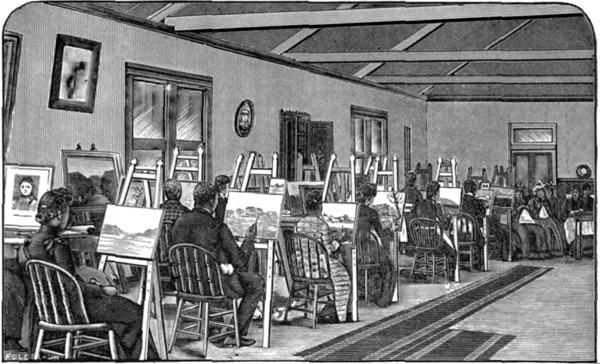
ART DEPARTMENT OF CLAFLIN UNIVERSITY.
When we contemplate caste in all its blackest
and most disgusting phases, we grow sick at heart,
and feel as if we would like to snatch it out,
top, root, and all; but then we remember it may
be that in doing so we might draw up a beard
of wheat. We believe, however, that as our membership
in the South, of both races, get more and
more under the light of the cross, and farther away
from “slavery days,” they come nearer together;
the more harmony that exists between the two in
their efforts to educate themselves and elevate those
about them, and with whom they have influence, the
more potent factors in the evangelization of the
world they become. No sane colored man within the
Methodist Episcopal Church believes that it would
benefit his race if the Church were to give up all
its work in the South among the whites. Nor is it
just fair to believe that the colored man is in and
remains with the Methodist Episcopal Church for
her “loaves and fishes.” It also appears that we as
colored men in the Church must be on the alert
lest we be pushed up to the point of antagonizing
all our Church work in the South, save that among
289and for ourselves. Following the action of the board
of managers of the Freedmen’s Aid Society the Lexington
Annual Conference unanimously indorsed the
following action, and requested its publication in
the Church papers, showing one phase of this
question, viz.:
“The results attained by the Freedmen’s Aid Society
since its organization are marvelous, viewed from
every point. The work of this society in the country,
Christianizing, elevating, and educating the people, can
not be expressed in figures or told in words. Wherever
its schools have been established the condition of the
people has been bettered and public sentiment liberalized.
Too much in the way of praise and thankfulness
can not be said of this benevolent organization of our
Church and its officers, and we earnestly commend its
objects and work to the thoughtful consideration of our
ministers and people, satisfied that the more thoroughly
the operations of the society are understood, the more
hearty the support it will receive.
“As to the Chattanooga troubles, and other matters
of the same nature, we beg to say:
“We do not believe it is right to yield the time-honored
opinions and views of the Church as to the
equality, brotherhood, and perfect freedom of man, nor
that a line of action should be pursued by the society or
Church to secure the favor or countenance of those
whose life-teachings are inimical to the position of our
Church, and who really have no objection whatever to
the Negro, so that his relation to them is a servile one.
“We desire and pray for the success of all our
290schools in the South that are under the fostering care
of the Freedmen’s Aid Society, but not at the loss of
the manhood and self-respect of our race. Having
been long satisfied that this question would come up
for solution and settlement, and now that it is before
the Church, we are heartily in favor of the Church going
steadily and faithfully forward in the path pointed
out for it by the Master, regardless of prejudice, local or
otherwise. Compromise will only delay the day of
settlement, and gain not a single point for God or
humanity.
“Objections are made to the mixing of white and
Negro pupils in the same Church schools, and it is said
that there are as good schools for Negroes as the society
provides for whites. Various other reasons are given
favoring this view of the question. For us to admit
that these objections to the children of Negroes attending
the Church schools with whites are of sufficient
force to lead us to be governed by them, is to admit
our own inferiority, and the necessity of such a separation
from our white brethren as to end in the putting
out of the Church of every Negro member in it. If we
admit discrimination as being proper here, we ask, where
will it end? Whatever may be the opinion of others
upon the subject, as to its expediency, etc., we can have
but one opinion, and that is, that we are members of
the Methodist Episcopal Church, yield to none in devotion
and loyalty to that Church, and can not admit that
it is injudicious or impolitic to send our sons and
daughters to any of the schools of the Church.
“Christianity is colorless, and Christianity demands
of the Church that it shall not recognize the exclusion
291of any of its members from any of its communities or
schools by reason of rank in society or of race characteristics,
especially when this exclusion carries with it a
mark of degradation. The General Conference has
given this principle expression.
“We do not believe it well for this conference to remain
silent upon this subject, when its silence may be
construed into an indorsement of the unholy sentiment
that it is proper to bow before this baseless prejudice,
which is a relic of slavery. We believe this question
will be settled, as all other questions have been settled
which tended to elevate the Negro, and we believe the
Church will firmly adhere to Christian principles, and
lay aside everything that has the appearance of mere
policy.”
CHAPTER XIV WHAT WILL THE HARVEST BE?
292
After the examination we have made, and
trying to scan the future, we see what has
been gained by the colored members who remained
in the Methodist Episcopal Church. They have
been admitted to full membership, to communion at
her altars, official relation as laymen, given work
in the pastorate, presiding elderate, and given to
understand that “color is no bar to an election to
the episcopacy.”
“But these attained, we tremble to survey
The growing labors of the lengthened way;
The increasing prospect tires our wandering eyes;
Hills peep o’er hills, and Alps on Alps arise.”
Will a time ever come in the history of the
Methodist Episcopal Church when she will tire of
the race question, and abandon forever her work
among and for the colored man? It is hardly conceivable
that this will ever occur. The discussion of
the race question becomes beautifully less at each
General Conference. It is true that new phases develop
now and then, and there follows a clash at
arms; but it never, nowadays, amounts to more than
a passage at arms, for the reason that the average
agitator receives but comparatively little encouragement
293from those Churches in this country which
have turned their backs upon the colored man.
They tremblingly hope the Methodist Episcopal
Church will make some awkward step that will
eventually drive the colored man out; but they
have seen her stand by him in the hottest contests
unflinchingly, and in the face of a gainsaying prejudice
that is as old as the venerated Constitution
and as deep rooted as sin, and they fear to say yea
or nay touching what it will or will not do. The
Methodist Episcopal Church can never forsake the
colored man, and be consistent. It declared in
1816, 1844, 1861, and 1872, by its actions, that the
duty of the Christian Church was to stand by the
colored man, by making him feel at home within it
as much as possible. Now to go back, would be to
say that the Church South in 1844 was right in defending
slavery, and right in ridding itself of the colored
man in 1870, and that that which the Methodist
Episcopal Church did at those periods was
wrong. This it can never do, and be consistent.
One other question at this juncture arises. It is
one fraught with much interest, as it is one that would
involve the entire eight millions of colored people in
this country, that would naturally widen the chasm
between the white and colored races in this country,
and would sustain the same relation to a war of races
in this country that the separation of the Methodist
Episcopal Church, South, sustained in 1844
to the war of the Rebellion. It is, Will the colored
294members within the Methodist Episcopal Church
eventually be separated from it? If the existing
relations between the Church and her colored members
remain as they are now, No. There could be no
reason for a separation, since “there is no word
white” known within the letter of the law of the
Church to indorse invidious distinctions “on account
of race, color, or previous condition of servitude;”
there are no privileges accorded to any man
of one race in the Church, that another of any other
race within the Church is not entitled to by law.
There is no church-building with the name of the
Methodist Episcopal Church inscribed upon it, into
which any person “having a desire to flee the wrath
to come” may not go as a worshiper, or become
a member. This is also true of any university,
college, or school under the auspices of the Church.
There is no annual conference of the Church to
which the colored man has not a perfect right to
belong; no position within the gift of the Methodist
Episcopal Church, from janitor to bishop, to
which any member, white or colored, may not
aspire, be elected or appointed to, and discharge
the functions pertaining thereto, without hindrance.
In a word, the white and colored membership
within the Church is, according to the enactments
of the General Conference, equal in all that pertains
to Church membership and privileges. Hence
there is now no cause for the colored membership
seeking separation from the Church. “We know
295not what a day may bring forth;” but, judging the
future by the past, there will never come a time
when it will be absolutely necessary for the Church
to put away its colored membership, nor an absolute
necessity for the colored membership to withdraw
from the Church. The question of the inferiority
of the colored man within the Church to the
average white member within the Church, is fast
disappearing, whether we speak of this in reference to
General or annual conferences. The Methodist Episcopal
Church is turning out enough young colored
men from her universities, colleges, and schools, from
Boston to Austin, Texas, each year, to form an
annual conference. The graduates from her schools
are everywhere joining the Church and conferences,
and, to a certain extent, coping with those
whose chances have been more favorable. No
absolute necessity for separation exists, and, for that
matter, may never exist. May it not be found more
profitable, after a short time, for all the colored
Methodists in this country to unite and form one
grand united body of colored Methodists? This
question has been urged by many different parties,
with as many different motives at the bottom. Let
us notice a few. In “Our Brother in Black” (by
Dr. A. G. Haygood, of the Methodist Episcopal
Church, South,) at page 226, we find the following
touching the point at issue:
“The most remarkable tendency that has so far
shown itself in the development of their ecclesiastical
296life is the strong and, as I think, resistless
disposition in those of like faith to come together
in their religious organizations. The centripetal
is stronger than the centrifugal force. We have
already a number of African Churches. Indeed,
the great majority of them belong to Churches not
only of their own ‘faith and order,’ but of their
own ‘race and color.’... This disposition has
become very pronounced, and has expressed itself
on a very large scale since they were set free.”
At page 236 the good Doctor reaches his point
when he says:
“If every colored Methodist in the United
States were to-day in one organization, this would
not change the grounds or nature of our obligations
to them in any respect, so far as fraternal
love, fraternal aid, and co-operation are concerned.
It would then, as now, be our duty to help them
in all possible ways; and considering their history
in this country, and the providential indications
of their relation to the salvation of Africa,
just as much our duty then as now. If there were
not one Negro in the Methodist Episcopal Church
the Freedmen’s Aid Society would be as much
needed as it is now. ‘The colored Methodist
Episcopal Church of America’ that was ‘set up’—I
hope not ‘set off’—needs the help of its mother,
the Methodist Episcopal Church, South, every whit
as much as if they were still with us. Nay, all the
more, because they are not with us. And we ought,
297before God, to help them.” We simply add, it is
about time.
In a book written by a layman of our Church,
John A. Wright, of Philadelphia, with the title,
“People and Preachers in the Methodist Episcopal
Church,” at pages 262–6, touching the question of
separation, he says:
“A conclusive argument in favor of separation
would be made if it could be satisfactorily proven
that the connection as it now exists is injurious and
demoralizing to both parties; if it could be shown
that their presence is a danger, and has a corrupting
influence on the main body of the Church; and
that such separation could be made without injury
to the colored man. There has been an unwillingness,
a hesitation on the part of the Church to discuss
this question, but the undoubted use that was
made of the colored votes in the last General Conference
(1884) to secure places was so patent to every
careful observer that it can not be kept down.
The ease with which the influence and votes of these
innocent and generally very ignorant representatives
were secured by those nearest to them, shows how
great a danger there would be in the abuse of the
confidence placed by them in their avowed friends.
“There are important movements among the
colored people that should be noted. All will remember
the enthusiastic patriotism, civil and religious,
which was to abolish all color-lines and all
laws that recognized black and white, or their intermediate
298shades. Yet a law of nature, of race, and
of common sense is asserting itself among the colored
people, in that they want to be separated from
such close connection with the white man. They
feel that there is an incongruity, an unfitness, a
something that causes them to desire to be free
from his presence and government. They have but
little respect for the whites who remain among them.
It is a growing belief among the more intelligent colored
people that their religious growth would be
increased by their independence of the white Church.
So strong is this feeling in certain places, that a secession
from the Methodist Episcopal Church, and
the formation of independent Methodist Churches,
is seriously discussed. In obedience to this growing
sentiment, the General Conference, in 1884,
recognized the policy of basing membership of annual
conferences on a color-line. An argument in
favor of caution in treating this question may be
drawn from the relation of the colored people to
the interests of the country. The colored vote in
the United States is accepted as a source of danger
in the future to this country. The present colored
vote, as it has or has not had the privilege of free
expression, has determined who should be President
of the United States.... It may or may not
be an idle fear, but wise men are looking at the question
in sober earnestness.... The Church,
then, should be carefully guarded against danger
arising from the presence of so large a colored membership
299through the use of its power in the General
Conference. The idea of separation for better work
is not new among us. We have the German and
colored conferences, and would have Scandinavian
if there were enough Scandinavians. There is a
law of association that is the best regulator of such
questions. That a separation into conferences on
the color-line will become general is inevitable.
The questions will come up before the General
Conference to decide, whether the colored ministers
can be so educated as to continue in the Methodist
Episcopal Church without any serious danger
to its interests; if not, the lesser must suffer, if suffering
it would be, for the sake of the greater; or
whether, when they are prepared, they will not do
more good by being transferred to some branch of
the African Methodist Episcopal Church.
“There are the African, the Zion, and the Colored
Methodist Episcopal Churches, which last was
wisely set apart by the Southern Methodist Episcopal
Church at the end of the war. They are all
strong, aggressive, and independent Churches. If
the members of these Churches could be united
with the colored members of the Methodist Episcopal
Church they would make a membership of
nearly one million of people. What an opportunity
for usefulness to their race would be thus
placed before them! It must be admitted that their
continued connection with the Methodist Episcopal
Church does not tend to promote their dependence
300upon themselves. Government aid makes a restless
pauper class; Church support has the same
tendency. That the two races do not work well together,
or rather that the colored Churches do
not prosper when intimately connected with white
Churches, is pretty well exemplified in the city of
Philadelphia, where the only two colored Churches,
living side by side with the large white Church
membership of that city, had so dwindled in numbers
and financial ability in 1884 that the Church
Extension Society had, practically, to purchase two
churches for their use, so that the colored brethren
from the South might have a Church home when
they came to the General Conference. During the
same time the African and the Zion Methodist
Episcopal Churches have been very successful in
that city, have done much good, have able bishops,
leaders, and a respectable membership. On the one
side there was dependency, and on the other independency.
It is risking but little to assert that
the number, character, and self reliance of the
members of the colored Methodist Episcopal Church,
South, are far greater and better than they would
have been if their connection had continued with
the old Church.
“A further thought deserves consideration at
this point. If the colored members are to be continued
in the Church, or as long as such connection
may last, would it not be to the interests of
all parties to dissolve the annual conferences in
301which they are in a large majority, and form them
into mission conferences, as they were prior to the
General Conference of 1868, without a voting representation
in the General Conference? By doing
this the Church would be saved from the low average
grade of intelligence of the General Conference
of 1884, caused by the presence of nearly forty of
such representatives, and from the corrupting influences
that were so palpable. The colored people
would then understand that their connection was
not permanent, but was in the line of educating
them to take care of themselves. In the meantime
the Church could continue its good work in giving
them the advantages of education, training in
trades, and to the most promising a fitting education
for the ministry and learned professions. The
suggestions made hereinbefore as to the proper basis
of representation in the General Conference, connected
with that of the last paragraph, would reduce
the number of delegates to the General Conference
from the colored conferences, and thereby
lessen the danger. It is important that this or
some other protective plan should be adopted before
the separation that is inevitable between the white
and colored work takes place. No mere pride of
numbers or prestige should have any influence to
prevent the Church from saying to the colored
brethren, ‘Go in peace, and may the God of heaven
protect and guide you;’ and with this benediction
handing over to them all the churches, colleges,
302and property that have been accumulated for
their use.”
The sequel will show that the writer of that
book knows but little concerning the colored people.
Let us for a moment stop and look more closely at
the above chapter from Brother Wright’s facile pen.
There is no mistake, Brother Wright has in some
way had his plans upset. That he intended to “get
even” with some one is also apparent. This general
attacks first one and then the other division of
the grand army of Methodism. First he attacks
the army at large for neglecting to bring more
laymen to the van. He then charges upon the
clerical regiment, declaring it is in the way of his
“consummation devoutly to be wished.” Being
somewhat repulsed, he falls back in disorder, only
to find the colored regiment supporting, in some
sort, the former. At once his guns are leveled,
and he makes a Fort Pillow charge upon “the
black brigade.” Of this brigade, within the Methodist
army, he declares: “A conclusive argument
for separation would be made if it were proven
that the connection existing [between the white and
colored people] within the Church is injurious to
both classes.” He attempts to prove the proposition,
by declaring that, by the presence of colored
representatives from Southern and mixed conferences,
“but few are fitted for their places and are
still grossly immoral,” in the General Conference
“grades down the intelligence and wisdom of the
303whole body, to a level too low for safety; that the ease
with which the influence and votes of these innocent,
and generally very ignorant, representatives
were secured by those nearest to them, shows how
great a danger there would be in the abuse of the
confidence placed by them in their avowed friends.”
The gentleman should not have stayed so far away
from those “innocent and generally very ignorant
representatives.” Knowing, as he must, that the
man whose intelligence gives him advantage, even
in a Methodist General Conference, over “the innocent
and generally very ignorant” is the greater
sinner, he strikes at “the avowed friends” of the
colored man. But in a great many instances some
of the “avowed friends” of the colored man in the
General Conference of 1884 were those whom
Methodism, within and without this country, “delights
to honor.” But aside from this, it were well
for the good brother had the revisers of the Old
Testament elided the “thou shalt not bear false
witness.”
We question very much whether a single proper
delegate to that General Conference was “innocent
and generally very ignorant” enough to miss the
truth as far as he seems to have missed it, and for
the same purpose. He also says: “The colored
men feel that there is an incongruity, an unfitness,
a something that causes them to desire to be freed
from his presence and government. They have but
little respect for the whites who remain among
304them.” If that is so, it is too bad. If it is not so,
then—? When a witness testifies to one thing, and
then contradicts himself, if he is adjudged sane, the
court will throw out his testimony, declaring him
either ignorant of the truth of the facts he would relate,
or else a perjurer. If the former, he should be
reprimanded for meddling with matters he knew
nothing about; if the latter, the law would punish
him. If the colored men within the Methodist Episcopal
Church feel “that there is an incongruity, a
something that causes them to desire to be freed from
his presence [the white man] and government,” it
could arise from no better source than that such
men persist in remaining within the Church who
abuse them.
“They have but little respect for the whites
that remain among them.” We think no man who
understands our work in the South will deny that
Drs. J. C. Hartzell, J. Braden, and A. Webster,
“remain among them.” But Dr. Hartzell was
for five years or more the secretary of the Louisiana
Conference, where the colored men are in
the majority. He has repeatedly been elected to
the General Conference by his brethren, and
usually on the first ballot. Rev. John Braden,
D.D., president of the Central Tennessee College,
at Nashville, Tennessee, has been there for nearly
twenty years, and as a member of the Tennessee
Conference has been treated by his conference
brethren like Dr. Hartzell, of Louisiana Conference.
305Dr. Alonzo Webster, of the South Carolina
Conference, being, we believe, the only white man in
it, has been treated by his conference brethren just
as the brethren of the Tennessee Conference treated
Dr. Braden. Without multiplying illustrations, we
ask, what becomes of Brother Wright’s argument?
It follows, that his darts fall futile at the door of a
Church that by law knows “no word white.”
Again: “The General Conference must yet decide
whether colored ministers can be educated so as to
continue in the Church. If not, the lesser [the
colored man, of course] must suffer; or whether,
when they are prepared, they will not do more
good by being transferred to some branch of the
African Church.” When did our bishops receive
authority to “transfer” ministers into another
Church? When the time for that transferring
comes, would not the members of the General and
annual conferences be privileged to vote upon it?
In speaking of the three colored organizations,
the African, African Zion, and Colored Methodist
Episcopal Churches, he says: “They are all strong,
aggressive, and independent. The last was wisely
set apart by the Methodist Episcopal Church, South,
at the end of the war.” The African Methodist
Recorder, of July, 1887, contained an article signed
by Rev. J. H. Welch, of that Church on “Union
of Colored Methodists in this Country.” The facts
there stated have not been called into question,
not even by the editor. So that the facts stated
306stand unquestioned. In speaking of the African
Methodist Episcopal, the African Zion Methodist
Episcopal, and the Colored Methodist Episcopal
Churches of America, the very ones spoken of by
Brother Wright, he says:
“But as we stand to-day separated, all of us are
weak and inefficient. In almost every city, town,
and village, each branch of the Methodist family
has planted a Church, and in many places neither
of the Churches can give the pastor a comfortable
support. Neither of the branches above referred
to has a first-class institution of learning nor an
efficient corps of professors and teachers; and those
we have are just existing, and that is all. Neither
of these organizations has a missionary system
operating as it should. Neither branch of these
Methodist bodies has a first-class book concern.”
Now, the above comes from an African Methodist
of the African Methodists—a man conversant with
the inner and outer workings of the machinery of
the three “strong, progressive, and independent”
colored Churches. Who is right, Brother Wright?
As to the wisdom displayed by the Methodist
Episcopal Church, South, in setting apart its colored
daughter, we leave Dr. A. G. Haygood to say, as
he has at page 236 in “Our Brother in Black.”
However, the aforesaid brother missed it a few
years, when he says “set apart at the end of the
war,” for it was not “set apart” until 1870. But
then, you know, a few years—say seven—don’t
307amount to much when we have an object in view.
At last he feels as if a solution of his troublesome
problem has been reached. When speaking further
of the three “strong, aggressive, and independent
Churches,” he says: “If the members of these
Churches could be united with the colored members
of the Methodist Episcopal Church, they would
make a million of people. What an opportunity
for usefulness to their race would be thus placed
before them!” It’s wonderful, is it not? At this
point the good brother reaches his climax. By all
means, let it be done! Let us begin now! Come,
let us go up to the next General Conference of our
Church, and pass a law that all the colored Methodists
in America and Canada must come into our
Church—bishops, elders, exhorters, and laymen—and
thus accept the magnanimous “opportunity for
usefulness to our race.” What would the good
brother then think of General Conference representation?
Would he have it reduced? But fearing
that some others may not see the plan as he sees it,
he says: “If they [the colored members] are to
remain in the Church, would it not be to the
interest of all parties to dissolve the annual conferences
in which colored members are in the
majority, into mission conferences? If not, then
reduce the number of colored delegates.” Now,
any one can judge from what we have cited from
the book, just about how much credence should be
had in anything the book, “Preachers and People
308in the Methodist Episcopal Church,” has presented.
And yet it does show that the question of a separation
from the Methodist Episcopal Church is being
discussed; for even the author of that book has a
backing within and without the Methodist Episcopal
Church, for he is one of the leading officials in the
Arch Street Methodist Episcopal Church, Philadelphia.
Caste prejudice has not been, but will yet be,
driven to the owls and bats, before the onrolling
tidal wave of intelligence and sober common sense
that is even now breaking upon the shores of this
country. And yet it does seem as if there is but
one of two ways in which it can be done, or by a
combination (suiting the case) of the two,—the
hump of caste prejudice now resting so adroitly
upon the back of our American Protestant ecclesiasticism
must be amputated by the impartial but
keen blade of the great Physician; or Protestantism
must bow so low in the dust and ashes of humiliation,
that this unsightly protuberance shall be
visible no more forever. Then, and not till then,
can we hope to see this camel go unscathed through
the eye of the gospel needle.
CHAPTER XV UNION OF COLORED METHODISTS. — THE WORK OF THE SUNDAY-SCHOOL UNION. — THE DUTY OF THE HOUR.
309
What would be the result of such a union?
If an organic union of all the colored
Methodists in America could be effected, it would
make no mean Church. Just think of the African
Methodist Episcopal, the African Methodist Episcopal
Zion, the Colored Methodist Episcopal Church in
America, and the colored members now within the
Methodist Episcopal Church, say to the number of
three hundred thousand, uniting and forming one
Church, composed of 22,076 ministers and a membership
of 1,012,300, bringing with them an army of
Sunday-school children not far from 1,500,000! If
the divine promise were fulfilled in each of these, that
“one shall chase a thousand and two shall put ten
thousand to flight,” why, such an army of true believers
could, as the quaint preacher said, “shake
hell to its center” while moving the world toward
the cross of Christ!
It was in 1883 when Dr. Tanner, through the
columns of the paper he was then editing, the
Christian Recorder, of the African Methodist Episcopal
Church, suggested the idea of an organic
union of all the exclusively colored organizations.
A year or so ago the colored Methodists of Canada,
310under Bishop Nazery, united with the African
Methodist Episcopal Church. It did not amount
to much then nor since. Several times overtures
have been made to the two other colored Churches
by the African Methodist Episcopal Church, but it
has usually ended in talk. The fact may as well be
stated first as last, that a time will never come in the
history of this country when all the colored Methodists
will belong to one great Negro Church. In
the first place, the African Methodist Episcopal,
the African Methodist Episcopal Zion, the Colored
Methodist Episcopal Church of America, and the
colored members of the Methodist Episcopal Church,
each and every one of these is looking forward to,
and praying for, a time when all the others will
come back to mother or come over and live with
sister. Again, because the separate and distinct colored
Church organizations have been warring with
each other from the beginning of their organization,
and these old feuds and petty jealousies keep
coming up every time organic union is mentioned.
It can not occur, because the African Methodist
Episcopal and African Methodist Episcopal Zion
Churches continued separate before the war, and
when it ended expected to, and did, receive a wonderful
influx from the Methodist Episcopal and
Methodist Episcopal Church, South. Those two organizations
saw a few apples still clinging to the parent
tree in the South. They began throwing sticks
and mud, then they tried “taffy,” and then stones.
311In 1869 each of the above-named two Churches began
to get ready for the reception of the one hundred
thousand members then in the Church South. As
the General Conference of the Church South in 1870
met, each of those denominations, basing its faith
on the repeated promises of many of the prominent
preachers of the Church South, began to prepare
to receive them. They were chagrined, however,
when, instead of “coming over,” they marched out
into the broad field of independency, and set up
shop for themselves by the assistance of the Church
South. The two older Churches then began to
bushwhack all they possibly could, seizing “every
straggling soul as their own lawful prey.” The
two larger colored organizations will not unite,
because each is still waiting and expecting her
younger sister to visit and remain with her. The
three will not unite, because each is expecting a time
to come when the three hundred thousand colored
members of the Methodist Episcopal Church will
leave in a body and join it.
Of course, the colored members of the Methodist
Episcopal Church are praised, abused, loved, laughed
at, or coquetted, as the case seems to require at the
time. It is really amusing at times to hear the
stories told—good, bad, and indifferent—by these
three organizations, to induce our members to come.
And yet, somehow or other, the one does not seem
to know why the other should anticipate our coming.
We can not see it. Before we had separate
312conferences it did look as if all our members would
be stolen from us. But every day now the colored
members of the Methodist Episcopal Church pitch
their tent a day’s march farther from any kind of
African Methodism, on the one hand, and from
having the oceans circumscribe them by joining
“The Colored Methodist Episcopal Church of, or in,
America.” If there ever comes a time in the history
of the colored members of the Methodist
Episcopal Church when it will be no longer useful,
pleasant, or wise to remain, they will undoubtedly
form another colored organization, and man it themselves.
They have the material. There is no colored
Church in this country that is educating so
many young people a year as the Methodist Episcopal
Church. Our brethren of the three colored
organizations in this country will tell you that the
time has now passed when their bishops, General
Conference officers, etc., can visit the Commencement
exercises of our schools and colleges, and take
away in their pockets, by flattery or promises, our
young people as they were wont to do. This is
the explanation of the mushroom “universities
and colleges” under the auspices of certain “powers”
in this country. Our young men and women
begin now to see, as do many others, that a time
not far distant must come when the best outlook for
cultured colored men and women will not be, as
some would have us believe, in Africa, nor among
the Africans. Why should it not be a separate
313organization of our own, if any change must come?
Indeed, the thought presents the most flattering prospect,—the
twenty or thirty universities, colleges,
normal schools, and academies given into the hands
of our own competent presidents, professors, and
teachers; the real estate, consisting of college buildings,
churches, and parsonages, with mortgage on
only about twenty-five cents on the dollar; five
hundred thousand children in our schools, and over
three hundred thousand members, with the great
Methodist Episcopal Church behind them! Now
and then some good brother, like the author of
“Preachers and People in the Methodist Episcopal
Church,” advances the utopian idea of handing us
over to some one of the existing colored organizations,
but the good men and women in the Methodist
Episcopal Church are hoping for no such
thing. We believe the good men and women predominate.
GAMMON THEOLOGICAL SEMINARY, ATLANTA, GA.
(Library Building.)
In the above-referred-to book the statement is
made that “the more intelligent colored people in
the Methodist Episcopal Church are seriously thinking
of separating from the Methodist Episcopal
Church.” If the poll were taken of every intelligent
colored man within the Church, such an idea
would be laughed at, for no such feeling prevails.
There is no such spirit abroad within the Church
on the part of the colored members. If it exists at
all, it must be sought elsewhere. There is no occasion
for it; and though it may be that now and then
314some word is let fall by some braggadocio, that if
so and so is not done, thus and so will happen,
yet no such stuff has ever fallen from the lips of
the leaders of our colored membership, properly
so called. Should anything of the kind ever be
broached, there would be no occasion for secrecy,
and less for braggadocio; no absolute necessity for
rejoicing on the part of any colored organizations,
if there might follow overtures to the Methodist
Episcopal Church for organic union that are not now
made. The thought naturally uppermost at this juncture
in the minds of some may be, Would it not be
Christian-like and brotherly for the colored members
to separate, so that organic union may take
place between the “two great branches of Methodism
in this country?” Is that what keeps them
apart? We would, to the question as to separation,
answer, No. If we understand the heart of the
Church—and we think we do, having been born naturally
and supernaturally in her lap—she does not ask
as much. In 1844 the Church, by dropping her interests
in and work for the colored man, could very
easily and knowingly have preserved her union,
power, and influence, kept back the rebellion for a
time, received the encomiums instead of the vituperation
and obloquy of every slaveholding nation in
the world, and brought to her support the strong
slave oligarchy of the South. She did not do it. She
will never compromise with sin enough to accept
even an organic union conceived in caste and born
315of a hate that excludes one the Lord said should be
loved as herself. We believe, laying aside all personal
predilections, prejudice, and aspirations that,
so far as the Church is concerned, the colored members
of the Methodist Episcopal Church will remain
therein until they are pleased to go out, if that is
until the sound of the first trumpet.
Would there be anything gained by a separation?
To our mind there is nothing to gain, and much to
lose, by the colored members of the Methodist
Episcopal Church separating from it. In the first
place, it would have the same tendency that the now
existing colored organizations have, casting reflections
upon the wisdom of those good men and
women who all along have contended for general
equality; it would weaken the race politically and
socially; widen, instead of narrowing, the chasm between
the white and colored clergy in this country.
“Like priests, like people,” would naturally widen
the breach between the laity. This would naturally
cause variance between neighbors because of color.
This would naturally lead to separate schools where
they are now mixed, and keep forever separate those
that are now separate. In a word, it would magnify
caste, race prejudice, and eventually lead to a
war of races. The segregation of one million or
more colored men in this country into one single
organization would endanger the safety of our Republic
in more ways than one. In the second place,
a separation now from the Methodist Episcopal
316Church for anything less than a crime against the
race would not only be suicidal, but foolhardy, paying
kindness with contumely, and subjecting not
only the members concerned, but the race to the
scorn and laughter of the world. We do not expect
to have everything go our way, to count for
more than we number, nor to see every law we propose
adopted, nor to be fondly dandled in the lap
of an affectionate and opulent mother. We expect
only what we have always received from the
Church—the privilege of full membership therein.
The work which the Church has done in the
South, may be seen from the following tables:
BOARD OF EDUCATION UP TO JANUARY 1, 1887.
| Name. |
Pupils aided. |
Amount. |
Location. |
| Centenary Bib’l Institute |
46 |
$1,850 00 |
Baltimore, Md. |
| Central Tenn. College |
67 |
2,446 00 |
Nashville, Tenn. |
| Claflin University |
45 |
2,015 00 |
Orangeburg, S.C. |
| Clark University |
12 |
732 00 |
Atlanta, Ga. |
| Cookman Institute |
4 |
158 00 |
Jacksonville, Fla. |
| Bennett Seminary |
6 |
200 00 |
Greensboro, N.C. |
| Gammon Theol. School |
29 |
1,663 00 |
Atlanta, Ga. |
| Haven Normal Institute |
3 |
75 00 |
Waynesboro, Ga. |
| Morristown Seminary |
22 |
755 00 |
Morristown, Tenn. |
| New Orleans University |
44 |
2,327 00 |
New Orleans, La. |
| Philander Smith College |
5 |
228 00 |
Little Rock, Ark. |
| Rust University |
11 |
400 00 |
Holly Spr’gs, Miss. |
| Rust Normal Institute |
2 |
75 00 |
Huntsville, Ala. |
| Wiley University |
18 |
855 00 |
Marshall, Texas. |
| West Texas Conf. Sem. |
5 |
140 00 |
Houston, Texas. |
| Total |
319 |
$13,919 00 |
|
| In Northern Colleges |
6 |
2,000 00 |
|
| Grand Total |
325 |
$15,919 00 |
|
317WORK OF CHURCH EXTENSION SOCIETY.
| Expended to colored membership by donation |
$237,000 00 |
| Expended to colored membership by loan |
150,000 00 |
| Total given by Church |
$387,000 00 |
| Total given by colored members by collection |
35,000 00 |
| Amount received by colored members more than they raised |
$352,000 00 |
| Churches this saved, built, or helped to build for them, |
2,000 |
WORK OF THE MISSIONARY SOCIETY SINCE THE WAR.
| Conference. |
Amount. |
| Central Alabama |
$16,600 00 |
| Delaware |
23,438 89 |
| Florida |
20,228 65 |
| Georgia |
38,571 58 |
| Lexington |
27,053 50 |
| Louisiana |
126,201 50 |
| Mississippi |
155,943 63 |
| Missouri |
42,486 06 |
| North Carolina |
25,622 45 |
| St. Louis |
41,279 00 |
| Savannah |
20,250 00 |
| South Carolina |
49,217 25 |
| Tennessee |
34,236 78 |
| Texas |
32,103 09 |
| Washington |
55,833 68 |
| Little Rock |
12,700 00 |
| Colored work in Kansas |
7,500 00 |
| Total |
$729,266 06 |
In the above figures the West Texas Conference
is included in Texas Conference, East Tennessee
in the Tennessee Conference, etc. While no claim is
set up that the above figures are exactly true, they
are at least an approximation. Where the conference
was mixed, one-eighth of the missionary appropriation
only has been credited to the colored work,
though it is easy to see how mistakes could creep
in an account of this. But the work that has been
done, and the interest which the Church has had in
it are apparent. So long as souls are to be saved,
the Church can not relax its efforts toward these
people, whether white or colored.
318
The great work done by this benevolent society
of the Church among the colored people of the
South deserves emphatic mention in connection
with these tables of results which we have been
giving. It will be impossible to tabulate perfectly
statistical results among the colored people, as the
work done has been for the populations of the
South, regardless of color, and has so interpenetrated
that it would be impossible to say that this
was done for one race, and this for another. We
may mention, however, the publication of the
Good Tidings and its gratuitous distribution among
the Sunday-schools of the colored people in the
South. During the year 1888 the Sunday-school
Union, in connection with the Tract Society, sent the
Good Tidings to 2,536 Sunday-schools in 807 different
charges in the Southern States. The weekly average
of Good Tidings distributed was 37,134; total
number of copies distributed during the year,
1,994,000; total number of pages, 7,976,000. No
one can possibly estimate the great good which has
been accomplished by the circulation of this excellent
publication. Besides this, the Union has sent
grants of Sunday-school libraries, music-books,
catechisms, and Sunday-school periodicals of every
possible description to all parts of the South, calling
into existence new schools, and inspiring discouraged
schools with new life. Possibly the most
319helpful work accomplished by this society has been
its personal visitation in the person of its efficient
agents in all parts of the South. Almost every section
of the country has been touched. Extensive
campaigns of work have been conducted. Weary
and disheartened pastors have been encouraged;
new schools have been organized, which have
already grown into commanding churches; new and
better methods of work have been taught a people
who knew so little how to work; and because of this
“hand-to-hand” effort immense good has been accomplished,
and the Sunday-school Union stands
well to the front among the benevolent societies of
the Church, contributing to the growth of the Methodist
Episcopal Church among the colored people of
the South.
In addition to this official work for the Sunday-schools
of the South, there were in several places
organized efforts to collect and distribute second-hand
books in needy localities. From Cincinnati
many boxes of these were forwarded, that useful
reading matter and school-books might be supplied
by the proper agents to those who had not the
means to purchase for themselves. These went
largely into the cabins and cottages of the freedmen;
and the first lessons in reading were learned by
many who had no other teachers than those in the
Sunday-schools. A single book served ofttimes for
an entire family. Father, mother, and children
were alike ignorant, and alike needed instruction.
320THE FREEDMEN’S AID AND SOUTHERN EDUCATION SOCIETY.
Institutions among Colored People.
| 1. Collegiate. |
Teachers |
Students |
| Centenary Biblical Institute, Baltimore, Md. |
12 |
223 |
| Central Tennessee College, Nashville, Tenn. |
22 |
545 |
| Claflin University, Orangeburg, S.C. |
23 |
946 |
| Clark University, Atlanta, Ga. |
23 |
340 |
| New Orleans University, New Orleans, La. |
15 |
266 |
| Philander Smith College, Little Rock, Ark. |
12 |
185 |
| Rust University, Holly Springs, Miss. |
10 |
355 |
| Wiley University, Marshall, Texas |
17 |
230 |
| 2. Theological. |
|
|
| Gammon Theological Seminary, Atlanta, Ga. |
4 |
71 |
| 3. Biblical Departments. |
|
|
| Baker Institute, Claflin University |
6 |
10 |
| Centenary Biblical Institute (correspondence 6) |
3 |
31 |
| Central Tennessee College (correspondence 62) |
2 |
102 |
| Gilbert Haven School of Theology, New Orleans |
3 |
15 |
| 4. Medical and Dental. |
|
|
| Meharry Medical College, Nashville, Tenn. |
11 |
55 |
| Medical Department New Orleans University (just organized) |
5 |
|
| Meharry Dental College, Nashville, Tenn. |
8 |
11 |
| 5. Legal. |
|
|
| School, Central Tennessee College |
6 |
6 |
| 6. Industrial. |
|
|
| Claflin College of Agriculture and Mechanics Inst., Orangeburg, S.C. |
20 |
507 |
| John F. Slater Schools of Industry, Nashville, Tenn. |
8 |
194 |
| Schools of Industry, New Orleans University |
2 |
120 |
| Schools of Industry, Rust University, Holly Springs, Miss. |
4 |
35 |
| Schools of Industry, Centenary Biblical Institute, Baltimore, Md. |
4 |
53 |
| Manual Training-school, Philander Smith College, Little Rock, Ark. |
4 |
92 |
| Industrial School, Bennett Seminary |
3 |
11 |
| 321Schools of Industry, Wiley University, Marshall, Texas |
4 |
116 |
| Schools of Industry, in Cookman Institute, Jacksonville, Fla. |
2 |
18 |
| Schools of Industry, Gilbert Seminary, Baldwin, La. |
7 |
75 |
| Classes in Huntsville Normal Institute, Huntsville, Ala. |
2 |
27 |
| Schools in Clark University, Atlanta, Ga. |
10 |
204 |
| 7. Academic. |
| Bennett Seminary, Greensboro, N.C. |
6 |
125 |
| Baltimore City Academy, Baltimore, Md.[1] |
|
|
| Central Alabama Academy, Huntsville, Ala. |
4 |
140 |
| Cookman Institute, Jacksonville, Fla. |
6 |
321 |
| Delaware Conference Academy, Princess Anne, Md.[1] |
|
|
| Gilbert Seminary, Winsted, La. |
17 |
299 |
| Haven Normal School, Waynesboro, Ga. |
3 |
153 |
| LaGrange Seminary, LaGrange, Ga. |
3 |
209 |
| Meridian Academy, Meridian, Miss. |
3 |
154 |
| Morristown Seminary, Morristown, Tenn. |
9 |
260 |
| Samuel Houston College, Austin, Texas (not opened last year) |
|
|
| West Tennessee Seminary, Mason, Tenn. |
2 |
149 |
Institutions among White People.
| 1. Collegiate. |
|
|
| Chattanooga University, Chattanooga, Tenn. |
9 |
161 |
| Grant Memorial University, Athens, Tenn. |
18 |
291 |
| Little Rock University, Little Rock, Ark. |
14 |
266 |
| Texas Wesleyan College |
10 |
240 |
| 2. Theological. |
|
|
| School, Chattanooga University |
2 |
13 |
| School, Grant Memorial University |
3 |
27 |
| 3. Legal. |
|
|
| Class, Grant Memorial University |
1 |
41 |
| Class, Little Rock University |
6 |
20 |
| 4. Academic. |
|
|
| Baldwin Seminary, Baldwin, La. |
2 |
56 |
| Bloomington College, Bloomington, Tenn. |
4 |
138 |
| 322Ellijay Seminary, Ellijay, Ga. |
3 |
151 |
| Graham Academy, Smyrna, N.C. |
3 |
86 |
| Holston Academy, New Market, Tenn. |
2 |
90 |
| Kingsley Seminary, Bloomingdale, Tenn. |
4 |
131 |
| Leicester Seminary, Leicester, N.C. |
4 |
136 |
| Mallalieu Academy, Kinsey, Ala. |
2 |
65 |
| McLemoresville Institute, McLemoresville, Tenn. |
7 |
114 |
| Mt. Zion Seminary, Mt. Zion, Ga. |
4 |
140 |
| Powell’s Valley, Well Spring, Tenn. |
4 |
175 |
| Parrottsville Academy, Parrottsville, Tenn. |
3 |
125 |
| Roanoke Academy, Roanoke, Va. (not opened past year) |
|
|
| Trapp Hill Academy, Trapp Hill, N.C. |
2 |
125 |
| Warren College, Chucky City, Tenn. |
4 |
155 |
| Woodland Academy, Cumberland, Miss. |
2 |
72 |
|
Among Colored People. |
| Grade of Schools. |
Number |
Teachers |
Students |
| Collegiate |
8 |
134 |
3,090 |
| Theological Seminary |
1 |
4 |
71 |
| Biblical Departments |
4 |
14 |
158 |
| Medical Departments |
2 |
11 |
55 |
| Dental Department |
1 |
8 |
11 |
| Legal Department |
1 |
6 |
6 |
| Industrial Departments |
12 |
70 |
1,455 |
| Academies |
12 |
60 |
1,810 |
| Totals.[2] |
21 |
223 |
4,971 |
|
Among White People |
| Grade of Schools. |
Number |
Teachers |
Students |
| Collegiate |
4 |
51 |
958 |
| Theological Seminary |
|
|
|
| Biblical Departments |
2 |
5 |
40 |
| Medical Departments |
|
|
|
| Dental Department |
|
|
|
| Legal Department |
2 |
7 |
61 |
| Industrial Departments |
|
|
|
| Academies |
16 |
54 |
1,759 |
| Totals.[2] |
20 |
105 |
2,717 |
|
Total. |
| Grade of Schools. |
Number |
Teachers |
Students |
| Collegiate |
12 |
146 |
4,048 |
| Theological Seminary |
1 |
4 |
71 |
| Biblical Departments |
6 |
19 |
198 |
| Medical Departments |
2 |
11 |
55 |
| Dental Department |
1 |
8 |
11 |
| Legal Department |
3 |
13 |
67 |
| Industrial Departments |
12 |
70 |
1,455 |
| Academies |
28 |
114 |
3,569 |
| Totals.[2] |
41 |
328 |
7,688 |
In twenty-two years the Freedmen’s Aid and Southern
Education Society has expended in the work of
Christian education in the South about $2,500,000.
The present value of the property owned by the
Society in the South is over $1,500,000. This
323includes lands—some of which have increased in
value—school buildings, furniture, and libraries.
More than one hundred thousand colored students
have been in the various schools, and a reasonable
estimate is, that the preachers and teachers in public
and private schools, from among this multitude,
have had under their influence fully one million of
the youth and adults of the South. No words can
adequately express the far-reaching and glorious results
already achieved, and yet to flow, from this ever-widening
current of intellectual and moral power.
With the understanding that we are not cumbersome
to the Church, what is the duty of the colored
members therein? It is our indispensable duty to
remain loyal, wise, and prudent. By saying that
the colored members of the Methodist Episcopal
Church ought to remain loyal, does not necessarily
carry with it a thought that there is a spirit of disloyalty
brewing. What is intended is simply that
each and every member thereof should know his
and her obligations to the Church, her rules and regulations,
and sacredly keep them, “not for wrath,
but for conscience’ sake.” If the entire membership
would be loyal and stay loyal, as well as
appear loyal in the eyes of the world and of the
Church, it must see to it that there is no just ground
for such complaints against the race as have herein before
been mentioned as found in Mr. Wright’s
324book. The charges he brought forward were, that
the colored delegates to the General Conference of
1884 were “generally very ignorant representatives.”
He said also: “It is said, by those who
know and judge impartially, that to-day there are
but few men in any of the Southern colored and
mixed conferences who are fitted for their places,
and that the colored members are still grossly immoral.”
These are awfully serious charges, whether
true or not. A great many people in these United
States will probably form (or may have already) an
opinion from that book of not only the race with
which they anon come in contact in the busy scenes
of every-day life, but of the colored membership
of the Methodist Episcopal Church, members of the
same Christian family, who are privileged to eat at
the same Lord’s table. We know there are thousands
of chances for even us to say, “It is not all on
this side of the house;” but it makes but little, if
anything, in our favor if others are no better than we.
That the good brother overleaped the bounds of
reason, not to say common sense, in his desperation
to make out a case, is a foregone conclusion. What
he says is, that “those who know and judge impartially,”
say “that the colored members are still
grossly immoral.” What a fearful charge is this
against the bishops of our Church, that they have
brought into the Church, directly or indirectly,
under their very noses, three hundred thousand
“grossly immoral” members! Thousands of these
325have received authority to preach the gospel and
administer the sacrament of the Lord’s Supper;
none of whom have been less than two years under
the almost personal training of the General Conference.
Isn’t it horrible? Who believes it? But
no one need be surprised at this tirade against the
poor “black man,” for in his next paragraph above,
at page 265, brother Wright, in speaking of the
white ministers and agents sent South to teach the
colored people, says: “The general impudence and
lack of knowledge of the agents and ministers sent
to the South have blocked up the way of the Church.
The immoral character and the dishonest practices
of some inflicted disgrace on the Church and cast a
doubt on all.” All the white delegates were not as
“learned” as the author of “Preachers and People
in the Methodist Episcopal Church,” who were
elected to attend the General Conference in 1884.
It was not to have been expected that all the colored
delegates would measure up to him. However
far he may have missed the truth in this case,
intentionally or otherwise, one of the best ways for
the colored members in the Church to show that
they are loyal and worthy is to elect no one as a
delegate to the General Conference who is not qualified.
By qualified we mean possessing natural and
acquired ability, and the grace of God richly shed
abroad in the heart. With the former he will be
qualified to discharge the functions of his office with
credit to himself, his race, and the Church. By the
326latter he will be “an epistle known and read of all
men,” who will by it perceive that he is “neither
common nor unclean,” but “a workman that needeth
not to be ashamed.” As presiding elders, pastors,
officers, and members of the Methodist Episcopal
Church, let us let our light shine by raising
our standard higher. Let no one be recommended
for license to preach by us in any quarterly-meeting,
however far back in the woods it may be, who
has not “gifts and grace.” As to our mode of worship,
let it be after the manner of our excellent
Discipline, and not after the style of Revolutionary
days. Let our Sabbath-schools be brought up to a
higher plane. Let the songs of thanksgiving and
praise, accompanied by the Word of God and
prayer, be of daily occurrence where it has been
periodical. Let us see to it that, as a Church, the
rules and regulations thereof are kept to the very
letter. Let us, as a race, continue to improve
morally, financially, intellectually, and spiritually,
“having an eye single to the glory of God.”
“Finally, my brethren, be strong in the Lord and
in the power of his might. Put on the whole
armor of God, that ye may be able to stand against
the wiles of the devil. Stand therefore, having
your loins girt about with truth, and having on the
breast-plate of righteousness, and your feet shod
with the preparation of the gospel of peace; above
all, taking the shield of faith, wherewith ye shall
be able to quench all the fiery darts of the wicked.
327And take the helmet of salvation, and the sword
of the Spirit, which is the Word of God; praying
always, with all prayers and supplications in the
Spirit, and watching thereunto with all perseverance,”
until the great and notable day of the Lord,
when you shall appear before the great white throne,
and hear the Captain of your salvation, to the question,
“Who are these?” answer, “These are they
which came up out of great tribulation, and have
washed their robes and made them white in the
blood of the Lamb.”
- Transcriber’s Notes:
- The Recapitulation table beginning on page 322 was broken into three tables to fit
within the page boundaries.
- Missing or obscured punctuation was silently corrected.
- Typographical errors were silently corrected.
- Inconsistent spelling and hyphenation were made consistent only when a predominant
form was found in this book.