An ocean pilot-boat lay off Tompkinsville of an early
spring afternoon, in the stillest water. The sun was
bright, and only the lightest wind was stirring. When
we reached the end of the old cotton dock, an illustrator
and myself, commissioned by a then but now no more
popular magazine, there she was, a small, two-masted
schooner of about fifty tons burden, rocking gently upon
the water. We accepted the services of a hawking urchin,
who had a canoe to rent, and who had followed us down
the main street in the hope of earning a half-dollar. He
led the way through a hole in a fence that enclosed the
street at the water end and down a long, stilted plank
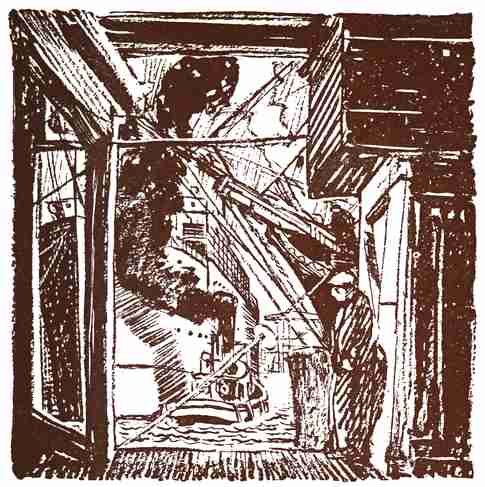
walk to a mess of craft and rigging, where we found his
little tub, and pushed out. In a few minutes we had
crossed the quiet stretch of water and were alongside.
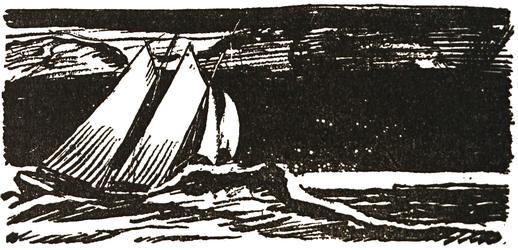
Like all pilot-boats, the Hermann Oelrichs was built
low in the water, so that it was easy to jump aboard.
Her sails were furled and, from the quiet prevailing,
one might have supposed that the crew had gone into
the village. No sound issued until we reached the
companionway. Then below we could see the cook
scraping cold ashes out of a fireless stove. He was cleaning
the cabin and putting things to rights before the
pilots arrived. He accepted our intrusion with a friendly
glance.
“Captain Rierson told us to come aboard,” we said.
“All right, sir. Stow your things in any one of them
bunks.”
We went about this while the ashes were taken out
and tossed overboard. When the cook returned it was
with a bucket and brush, and he attacked the oilcloth on
the floor industriously.
“Cozy little cabin, this, eh?”
“Yes, she’s a comfortable little boat,” replied the
cook. “These pilots take things purty comfortable.
She’s not as fast as some of the boats, but she’s all right
in rough weather.”
“Do you encounter much rough weather?”
“Well, now and again,” answered the cook, with the
vaguest suggestion of a twinkle in his eye. “It’s purty
rough sometimes in winter.”
“How long do you stay out?”
“Sometimes three, sometimes five days, sometimes
we get rid of all seven pilots the first day—there’s no
telling. It’s all ’cording to how the steamers come in.”
“So we may be out a week?”
“About that. Maybe ten days.”
We went on deck. It was warm and bright. Some
sailors from the fore-hatch were scrubbing down the
deck, which dried white and warm as fast as they
swabbed off the water. Wide-winged gulls were circling
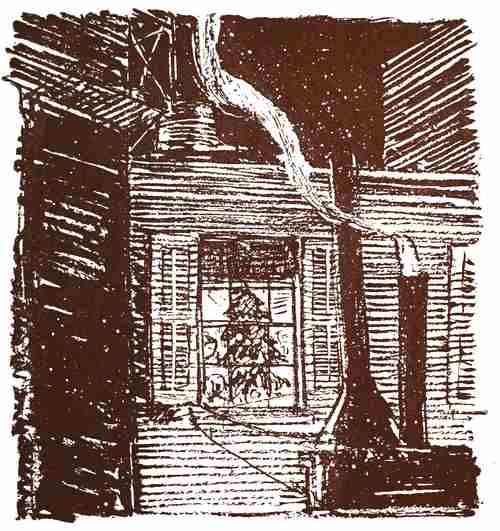
high and low among the ships of the harbor. On Staten
Island many a little curl of smoke rose from the chimneys
of white cottages.
That evening the crew of five men kept quietly to
their quarters and slept. The moon shone clear until
ten, when the barometer suddenly fell and clouds came
out of the east. By cock-crow it was raining, and by
morning it was drizzling and cold.
The pilots appeared one after another. They came
out to the edge of the cotton wharf through the mist
and rain, and waved a handkerchief as a signal that a
boat should be sent ashore for them. One or two, failing
to attract the immediate attention of the crew, resorted
to the expedient of calling out: “Schooner, Ahoy!” in
voices which partook of some of the stoutness of the sea.
“Come ashore, will you?” they shouted, when a head
appeared above deck.
No sooner were they recognized than the yawl was
launched and sent ashore. They came aboard and
descended quickly out of the rain into the only room
(or cabin) at the foot of the companionway. This was
at once their sitting-room, dining-room, bedroom, and
every other chamber for the voyage. Here they stowed
their satchels and papers in lockers beneath their individual
sleeping berths. Each one sought out a stout
canvas clothes bag, which all pilots use in lieu of a
trunk, and began to unpack his ship’s clothes. All took
off their land apparel and dressed themselves in ancient
seat-patched and knee-worn garments, which were far
more comfortable than graceful, and every one produced
the sailor’s essential, a pipe and tobacco.
Dreary as was the day overhead, the atmosphere of
the cabin changed with their arrival. Not only was it
soon thick with the fumes of many pipes, but it was
bright with genial temper. Not one of the company of
seven pilots seemed moody.
“Whose watch is it?” asked one.
“Rierson’s, I think,” was the answer.
“He ain’t here yet.”
“Here he comes now.”
At this a hale Norwegian, clean and hard as a pine
knot, came down the companionway.
“My turn to-day, eh? Are we all here?”
“Ay!” cried one.
“Then we might as well go, hey?”
“Ay! Ay!” came the chorus.
“Steward!” he called. “Tell the men to hoist sail!”
“Ay! Ay! sir!” answered the steward.
Then were rattlings and clatterings overhead. While
the little company in the cabin were chatting, the work
on deck was resulting in a gradual change, and when,
after a half-hour, Rierson put his head out into
the wind and rain above the companionway, the cotton
docks were far in the rear, all but lost in the mist and
drizzle. All sails were up and a stiff breeze was driving
the little craft through the Narrows. McLaughlin, the
boatman and master of the crew, under Rierson, was
at the wheel. Already we were being rocked and tossed
like a child in a cradle.
“Who controls the vessel,” I asked of him, “while
the pilots are on board?”
“The pilots themselves.”
“Not all of them?”
“No, not all at one time. The pilot who has the
watch has full control for his hours, then the next
pilot after him, and so on. No pilot is interfered with
during his service.”
“And where do we head now?”
“For Sandy Hook and the sea east of that. We are
going to meet inbound European steamers.”
The man at the wheel, McLaughlin, was a clean athletic
young chap, with a straight, full nose and a clear, steady
eye. In his yellow raincoat, rubber boots and “sou’wester”
he looked to be your true sea-faring man.
With the little craft plunging ahead in a storm of wind
and rain and over ever-increasing billows, he gazed out
steadily and whistled an airy tune.
“You seem to like it,” I remarked.
“Yes,” he answered. “It’s not a bad life. Rather
cold in winter, but summer makes up for it. Then
we’re in port every fifth or sixth day on an average.
Sometimes we get a night off.”
“The pilots have it better than that?”
“Oh, yes; they get back quicker. The man who has
the first watch may get back to-day, if we meet a
steamer. They might all get back if we meet enough
steamers.”
“You put a man aboard each one?”
“Yes.”
“How do you know when a steamer wants a pilot?”
“Well, we are in the track of incoming steamers.
There is no other pilot-boat sailing back and forth on
this particular track at this time. If a steamer comes
along she may show a signal for a pilot or she may turn
a little in our direction. Either way, we know she wants
one. Then we lay to and wait until she comes up. You’ll
see, though. One is likely to come along at any time
now.”
The interior of the little craft presented a peculiar
contrast to storm and sea without. In the fore compartment
stood the cook at his stove preparing the
midday meal. Sailors, when no orders were called from
above, lay in their bunks, which curved toward the
prow. The pots and pans of the stove moved restlessly
about with the swell. The cook whistled, timbers creaked,
the salt spray swished above the hatch, and mingled
odors of meats and vegetables combined and thickened
the air.
In the after half of the boat were the pilots, making
the best of idle time. No steamer was sighted, and so
they lounged and smoked. Two or three told of difficulties
on past voyages. Two of the stoutest and jolliest
were met in permanent conflict over a game of pinochle.
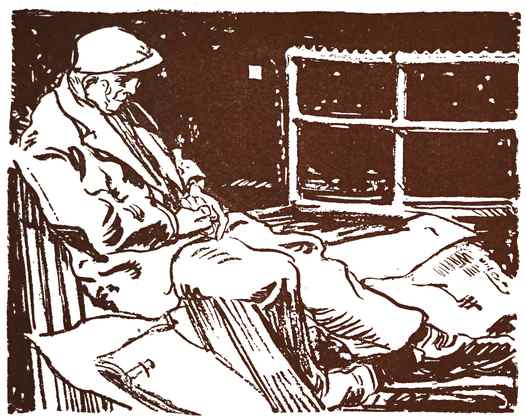
One read, the others took down pillows from the bunks,
and spreading them out on the wide seat that lined two
sides of the room, snored profoundly. Nearly all took
turns, before or after games, or naps, at smoking.
Sometimes all smoked. It was observable that no
“listener” was necessary for conversation. Some talked
loudly, without a single person heeding. At times all
talked at once in those large imperious voices which
seem common to the sea. The two old pilots at cards
never halted. Storms might come and storms might
go; they paused only to renew their pipes.
At the wheel, in tarpaulin and sou’wester, McLaughlin
kept watch. Sea spray kept his cheeks dripping. His
coat was glassy with water. Another pilot put his
head above deck.
“How are we heading?”
“East by no’.”
“See anything?”
“A steamer, outbound.”
“Which one?”
“The Tauric.”
“Wish she was coming in!” concluded the inquirer,
as he went below.
We kept before the wind in this driving way. All
the morning and all the afternoon the rain fell. The
cook served a wholesome meal of meats and vegetables,
and afterwards all pipes were set smoking more industriously
than ever. The two old pilots renewed their
cards. Every one turned to trifling diversions, with
the feeling that he must get comfort out of them. It
was a little drowsy, a little uncomfortable, a little apt
to make one long for shore. In the midst of the lull
the voice of the man at the wheel sounded at the
companionway.
“Steamer on the port bow! Pilot-boat Number Nine!
She’s hailing us.”
“Well, what does she want?”
“Can’t make out yet.”
One and all hastened on deck. On our left, in the
fog and rain, tossed a little steamer which was recognized
as the steam pilot-boat stationed at Sandy Hook.
She was starboarding to come nearer and several of
her pilots and crew were at her rail hailing us. As
she approached, keener ears made out that she wanted
to put two men aboard us.
“We don’t want any more men aboard here,” said
one. “We’ve got seven now.”
“No!” said several in chorus. “Tell ’em we can’t
take ’em.”
“We can’t take any more,” shouted the helmsman,
in long-drawn sounds. “We’ve got seven aboard now.”
“Orders to put two men aboard ye,” came back over
the tumbling waters. “We’ve a sick man.”
“Don’t let ’em put any more men aboard here. Where
they goin’ to sleep?” argued another. “One man’s got
to bunk it as it is, unless we lose one pretty soon.”
“How you goin’ to help it? They’re puttin’ their
men out.”
“Head away! Head away! They can’t come aboard
if you head away!”
“Oh, well; it’s too late now.”
It was really too late, for the steamer had already
cast a yawl and the two men, together with the crew,
were in it and heading over the churning water. All
watched them as they came alongside and clambered on.
They were Jersey pilots who had been displaced on
the other boat because one of their number had been
taken sick and more room was needed to make him
comfortable. He was thought to be dying, and must be
taken back to New York at once, and his condition
formed the topic of conversation for the rest of the day.
Meanwhile our schooner headed outward, with nothing
to reward her search. At five o’clock there was some
talk of not finding anything before morning. Several
advised running toward Princess Bay on Staten Island
and into stiller water, and as the minutes passed the
feeling crystallized. In a few minutes all were urging a
tack toward port, and soon it was done. Sails were
shifted, the prow headed shoreward, and gradually, as
the track of the great vessels was abandoned, the waters
became less and less rough, then more and more quiet,
until finally, when we came within distant sight of
Princess Bay and the Staten Island shore, the little vessel
only rocked from side to side; the pitching and churning
were over.
It was windy and cold on deck, however, and after the
crew had dropped anchor they remained below. There
was nothing to do save idle the time. The few oil lamps,
the stove-fire and the clearing away of dishes after
supper, gave the cabin of the fore-and-aft a very home-like
appearance.
Forward, most of the sailors stretched in their bunks
to digest their meal. There were a few magazines and
papers on the table, a few decks of cards and a set of
checkers. It was interesting to note the genial mood of
the men. One might fancy oneself anywhere but at sea,
save for the rocking of the boat. It was more like a
farmhouse kitchen. One little old sailor, grizzled and
lean, had only recently escaped from a Hongkong
trader, where he had been sadly abused. Another was
a mere boy, who belonged to Staten Island. He had
been working in a canning factory all winter, he said,
but had decided to go to sea for a change. It was not
his first experience; this alternating was a regular thing
with him. The summer previous he had worked as
cook’s scullion on one of the other pilot-boats; this
summer he was a sailor.
The Staten Islander had the watch on deck from
ten to twelve that night. By that time the rain had ceased
and the lights on the distant shore were visible, glimmering
faintly, it seemed good to be on deck. The wind blew
slightly chill and the waters sipped and sucked at the
prow and sides. Coming above I chatted with the young
sailor.
“Do you like sea life?” I asked him.
“There ain’t much to it.”
“Would you rather be on shore?”
“Well, if I didn’t have to work so hard.”
“You like one, then, as well as the other?”
“Well, on shore the hours are longer, but you get
your evenings and Sundays. Out here there ain’t any
hour your own, but there’s plenty days when there’s
nothin’ doin’. Some days there ain’t no wind. Sometimes
we cruise right ahead without touchin’ the sails.
Still, it’s hard, ’cause you can’t see nobody.”
“What would you do if you were on shore?”
“Oh, go to the show.”
It developed that his heart yearned for “nights off.”
The little, bright-windowed main street in New Brighton
was to his vision a kind of earthly heaven. To be there
of an evening when people were passing, to loaf on the
corner and see the bright-eyed girls go by, to be in
the village hubbub, was to him the epitome of living.
The great, silent, suggestive sea meant nothing to him.
After a while he went below and tumbled in and
McLaughlin, the boatman, took the turn. In the cabin
most of the pilots had gone to bed. Yet the two old
salts were still at pinochle, browbeating each other,
but in a subdued tone. All pipes were out. Snores were
numerous and long.
At dawn the pilot whose turn it was to guide the
next steamer into New York took the wheel. We sailed
out into the east and the morning, looking for prey.
It came soon, in the shape of a steamer.
“Steamer!” called the pilot, and all the other pilots
turned out and came on deck. The sea to the eastward,
whither they were looking, was utterly bare of
craft. Not a sail, not a wisp of smoke! Yet they saw
something and tacked ship so as to swing round and sail
toward it. Not even the telescope revealed it to my untrained
eyes until five minutes had gone by, when afar off
a speck appeared above the waters. It came on larger
and larger, until it assumed the proportions of a toy.
With the first announcement of a steamer the pilot who
was to take this one in gave the wheel to the pilot who
was to have the next one. He seemed pleased at getting
back to New York so soon. While the ship was coming
forward he went below and changed his clothes. In a
few minutes he was on deck, dressed in a neat business
suit and white linen. His old clothes had all been
packed in a grain sack. He had a bundle of New York
papers and a light overcoat over his arm.
“How did you know that steamer wanted a pilot?”
I asked him.
“I could tell by the way she was heading.”
“Do you think she saw you?”
“Yes.”
“Can you always tell when a steamer so far off
wants a pilot?”
“Nearly always. If we can’t judge by her course
we can see through the telescope whether she has a
signal for a pilot flying.”
“And when you go aboard her what will you do?”
“Go to the bridge and direct her course.”
“Do you take the wheel or do any work?”
“Not at all.”
“What about your breakfast?”
“I’ll take that with the officers of the deck.”
“Do you always carry a bundle of papers?”
“Sure. The officers and passengers like to get early
news of New York. Sometimes the papers are pretty
old before we hand them out, but they’re better than
nothing.”
He studied the approaching steamer closely through
the glass.
“The Ems,” he said laconically. “Get the yawl
ready, boys.”
Four sailors went to the lee side and righted the boat
there. The great vessel was plowing toward us at
a fine rate. Every minute she grew larger, until at half
a mile she seemed quite natural.
“Heave the yawl,” called the man at the wheel.
Over went the boat with a splash, and two men after
and into it. They held it close to the side of the
schooner until the departing pilot could jump in.
“Cast loose!” said the man at the wheel to the men
holding the rope.
“Ay! Ay! sir!” they replied.
“Good-by, Billie,” called the pilots.
“So long, boys,” he cried back.
Our schooner was moving swiftly away before the
wind. The man in the yawl pulled out toward where
the steamer must pass. Already her engines had stopped,
and the foam at her prow was dying away. One could
see that a pilot was expected. Quite a crowd of people,
even at that early hour, was gathered at the rail. A
ladder of rope was hanging over the side, almost at
the water’s edge.
The little yawl bearing the pilot pulled square across
the steamer’s course. When the vessel drifted slowly up,
the yawl nosed the great black side and drifted back by
the ladder. One of the steamer’s crew threw down a
rope, which the oarsman of the yawl caught. This held
the yawl still, close to the ladder, and the pilot, jumping
for a good hold, began slowly to climb upward. No
sooner had he seized the rope ladder than the engines
started and the steamer moved off. The little yawl, left
alone like a cork on a thrashing sea, headed toward us.
The schooner tacked and came round in a half circle to
pick it up, which was done with safety.
This was a busy morning. Before breakfast another
ship had appeared, a tramp steamer, and a pilot was
dressing to board her. Down the fore hatch could be
seen the cook, frying potatoes and meat, and boiling
coffee. The change in weather was pleasing to him, too,
for he was singing as he clattered the dishes and set the
table. In the cabin the pipes of the pilots were on, and
the two old salts were at pinochle harder than ever.
Another pilot left before breakfast, and after he was
gone another steamer appeared, this time the Paris.
It looked as though we would soon lose all our pilots and
have to return to New York. After the pilot had gone
aboard the Paris, however, the wind died down and we
sailed no more. Gradually the sea grew smoother, and
we experienced a day of perfect idleness. Hour after
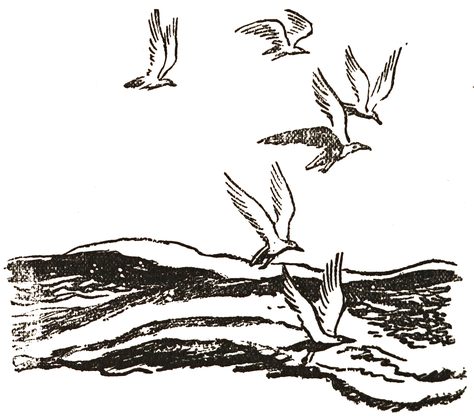
hour the boat rocked like a cradle. Seagulls gathered
around and dipped their wings in charming circles.
Flocks of ducks passed northward in orderly flight, honking
as they went. A little land-bird, a poor, bedraggled
sparrow, evidently blown to sea by adverse winds, found
rest and salvation in our rigging. Now it was perched
upon the main boom, and now upon the guy of the gaff-topsail,
but ever and anon, on this and the following day
it could be seen, sometimes attempting to fly shoreward,
but always returning after a fruitless quest for land.
No vessel appeared, however. We merely rocked and
waited.
The sailors in the forecastle told stories. The pilots
in the rear talked New York politics and criminal mysteries.
The cook brewed and baked. Night fell upon
one of the fairest skies that it is given us earthlings to
behold. Stars came out and blinked. The lightship at
Sandy Hook cast a far beacon, but no steamer took another
pilot that day.
Once during the watch that night it seemed that a
steamer far off to the southeastward was burning a blue
light, the signal for a pilot. The man at the wheel
scanned the point closely, then took a lighted torch
made of cotton and alcohol and circled it slowly three
times in the air. No answering blue light rewarded him.
Another time there grew upon the stillness the far-off
muffled sound of a steamer’s engine. You could hear
it distinctly, a faint “Pump, pump, pump, pump,
pump.” But no light could be seen. The signal torch
was again waved, but without result. The distinct throb
grew less and less, and finally died away. Some of the
pilots commented as to this but could not explain it.
They could not say why a vessel should travel without
lights at night.
At midnight a little breeze sprang up and the schooner
cruised about. In one direction appeared a faint glimmer,
which when approached, proved to be the riding
light of a freight steamer at anchor. All was still and
dark aboard her, save for two or three red and yellow
lights, which gleamed like sleepless eyes out of the black
hulk. The man at the wheel called a sailor.
“Go forward, Johnnie,” he said, “and hail her. See
if she wants a pilot.”
The man went to the prow and stood until the
schooner drew quite near.
“Steamer, ahoy!” he bellowed.
No answer.
“Steamer, ahoy!” he called again. A light moved in
the cabin of the other vessel. Finally a voice answered.
“Want a pilot?” asked our sailor.
“We have one,” said the dim figure, and disappeared.
“Is it one of the pilots of your association that they
have?” I asked.
“Yes; they couldn’t have any other. They probably
picked him up from one of our far-out boats. Every
incoming steamer must take a pilot, you know. That’s
the law. All pilots belong to this one association. It’s
merely a question of our being around to supply them.”
It turned out from his explanation that the desire of
the pilots to get a steamer was merely to obtain their
days off. When a pilot brings in a steamer it is not
likely that he will be sent out again for three days. Each
one puts in about the same number of days a month,
and all get the same amount of pay. There is no
rivalry for boats, and no loss of money by missing a
steamer. If one boat misses her, another is sure to
catch her farther in. If she refuses to take a pilot the
Government compels her owners to pay a fine of fifty
dollars, the price of a pilot to take her in.
On the third day now breaking we were destined to
lose another pilot. It was one of the two inveterate
pinochlers.
That night we anchored off Babylon, Long Island, in
the stillest of waters. The crew spent the evening
lounging in their bunks and reading, while the remaining
pilots amused themselves as usual. Two of them
engaged for a time in a half-hearted game of cards.
One told stories, but with the departure of so many the
spirits of the company drooped. There was no breeze.
The flap-flap of the sails went on monotonously. Breakfast
came, and then nine o’clock, and still we rocked
in one spot. Then a steamer appeared. As usual, it
was announced long before my untrained eyes could discern
it. But, with the first word, the remaining valiant
pinochler went below to pack. He was back in a few
minutes, very much improved in spirits and appearance.
“Does she starboard any?” he asked the man at the
wheel.
The latter used the telescope and then said:
“Don’t seem to, sir.”
“Think she sees us?”
“Can’t tell, sir,” said the boatman gravely.
“Spec’ we’d better fire the gun, eh?”
“Yes, sir.”
“You strip the gun. I’ll take the wheel.”
So a little gun—a tiny cannon, no less—was made
ready and while it was being put in place at the lee rail,
Germond, the oldest of the pilots, came on deck and took
the wheel.
“Going to fire the gun, eh?” he observed, in deep
bass tones.
“Yes,” said the pinochler.
“Well, that’s right. Blaze away.”
The boatman, who had superintended the charging
of the gun, now pulled a wire attached to a cap and
the little cannon spat out a flame with a roar that shook
the boat.
“Do they do this often?” I asked the footman.
“Not very. When fogs are on and boats can’t find
us it comes in handy. There’s hardly any use in this
case. I guess she sees us.”
Germond, at the wheel, seemed to enjoy playing warship,
for he called out: “Fire again, Johnnie!”
“Won’t she turn?” asked the restless pinochler.
“Don’t seem to.”
“Then,” said he, and cast a droll look of derision
upon the midget cannon and the immense steamer,
“sink her!”
With the third shot, however, we could see the steamer
begin to turn, and in a little while she was headed toward
us. We could not move and so we waited, while the
anxious pinochler walked the deck. Long before she
was near he ordered the yawl ready, and when she was
yet three-quarters of a mile off, cast over and jumped
aboard. He seemed somewhat afraid the yawl would
not be seen, and so took along with him a pilot flag, which
was a square of blue cloth fastened to a long bamboo
pole. This he held aloft as the men rowed, and away
they went far over the green sea.
The cook served coffee at three, and was preparing
supper when another steamer was sighted. She came
up rapidly, a great liner from Gibraltar, with a large
company of Italians looking over the rail.
“No supper for you,” said Germond. “You’ll have
to eat with the Dagos.”
“Oh, I don’t mind,” returned the other, smiling. “I
want to get back to New York.”
Just before supper, and when the sun was crimsoning
the water in the west, a “catspaw” came up and filled
our sails. The boat moved slowly off. At supper Germond
announced:
“Well, I go now.”
“Is there a steamer?”
“No, but I go on the other pilot-boat. I see her over
there. The last man always leaves his boat and goes on
one with more men. That allows this boat to go back for
another crew.”
“Do you get the first steamer in, on the other boat?”
“Yes, I have the first turn.” I understood now why
our crew, at the outset, objected to any pilots being taken
on our boat. It delayed the return of those on board to
New York. “Steward!” called Germond, finally, “tell
one of the men back there to run up a signal for the
other boat.”
“Ay! Ay! sir!” called back the steward.
At half after six the other pilot-boat drew near and
Germond packed his sea clothes and came up on deck.
“Well, here she is, boys,” he said. “Now I leave
you.”
They put out the yawl and he jumped in. When he
had gone we watched him climbing aboard the other
schooner.
“Now for New York!” exclaimed McLaughlin, the
boatswain, and master of the crew in the absence of any
pilot.
“Do we sail all night?”
“To get there by morning we’ll have to.”
All sails were then hoisted, and we bore away slowly.
Darkness fell. The stars came out. Far away the
revolving light of the Highlands of Navesink was our
guide. Far behind, the little pilot-boat which had
received Germond was burning a beacon for some steamer
which had signaled a blue light. Gradually this grew
more and more dim, and the gloom enveloped all.
We sat with subdued spirits at the prow, discussing
the dangers of the sea. McLaughlin, who had been five
years in the service, told of accidents and disappearances
in the past. Once, out of the night had rushed a steamer,
cutting a boat such as ours in two. One pilot-boat that
had gone out two years ago had never returned. Not a
stick or scrap was found to indicate what had become
of her fifteen men. He told how the sounding of the
fog-horns had chilled his heart the first year of his
service, and how the mournful lapping of the waters
had filled him with dread. And as we looked and saw
nothing but blackness, and listened and heard nothing
but the sipping of the still waters, it did seem as though
the relentless sea merely waited its time. Some day
it might have them all, sailor and cook, and where now
were rooms and lockers would be green water and
strange fishes.
That night we slept soundly. A fine wind sprang up,
and when morning came we were scurrying home over
a thrashing sea. We raced past Sandy Hook and put
up the bay. By eight o’clock we were at the Narrows,
with the Battery in sight. The harbor looked like a
city of masts. After the lonely sea it seemed alive with
a multitude of craft. Tugs went puffing by. Scows
and steamers mingled. Amid so much life the sea
seemed safe.