1. References.
Bibliographies.—L. Farrand, Basis of American History,
ch. xviii.; J. Larned, Literature of American History, 21-50;
J. Winsor, Narrative and Critical History, I., II.; Channing and
Hart, Guide, §§ 21, 77-80; C. Lummis, Reading List on Indians.
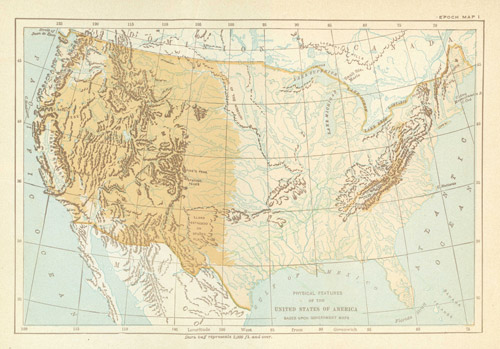
Historical Maps.—No. 1, this volume (Epoch Maps, No. 1);
T. MacCoun, Historical Geography of United States; school histories
of Channing, Elson, Gordy, James and Sanford, Mace,
McLaughlin, McMaster, and Montgomery.
General Accounts.—Historical significance of geography of
the United States: H. Mill, International Geography, ch. xxxix.;
F. Ratzel, Vereinigte Staaten, I. ch. ii.; B. Hinsdale, How to
Study and Teach History, ch. xiv.; E. Bogart, Economic History
of United States, introduction; E. Semple, American History and
its Geographic Conditions; A. Brigham, Geographic Influences in
American History; W. Scaife, America: its Geographical History.—Topographical
descriptions of the country: J. Whitney,
United States, I. pt. i.; N. Shaler, United States, I., and Nature
and Man in America; Mill, as above; E. Reclus, North America,
III.; Hinsdale, as above, ch. xv.—Prehistoric Man in America:
L. Morgan, Ancient Society; J. Nadaillac, Prehistoric America;
J. Foster, Prehistoric Races; Winsor, as above, I. ch. vi.; E.
Avery, United States and its People, I. chs. i., ii.; Farrand, as
above, ch. v.—The Indians (or Amerinds): D. Brinton, American
Race; C. Thomas, Indians in Historic Times; F. Hodge,
Handbook of American Indians; Farrand, as above, chs. vi.-xviii.;
Avery, as above, I. ch. xxii.; F. Dellenbaugh, North
Americans of Yesterday; S. Drake, Aboriginal Races of America;
G. Ellis, Red Man and White Man in North America; G. Grinnell,
Story of the Indian. The introduction to F. Parkman, Jesuits
in North America, and his Conspiracy of Pontiac, I. ch. i., are admirable
general surveys. Briefer, also excellent, is J. Fiske's Discovery
of America, I. ch. i. The mound-builders have now been
identified as Indians. L. Carr, Mounds of the Mississippi Valley
Historically Considered is the best exposition of this subject. C.
Thomas, Catalogue of Prehistoric Works East of the Rocky Mountains
is useful.
Special Histories.—Larned, History for Ready Reference, I.
83-115, gives brief account and bibliographies of tribes; Farrand,
as above, 279-286, does the same by geographical groups. Especially
notable are L. Morgan, League of the Iroquois, and C. Colden,
Five Indian Nations. For detailed treatment of the aborigines of
that section, consult H. Bancroft, Native Races of the Pacific
Coast, II., and Mexico, I.; J. Palfrey, New England, I. chs. i., ii.,
describes the Indians in that region; T. Roosevelt, Winning of the
West, I. chs. iii., iv., the Southern tribes; and Parkman, Pontiac,
the old Northwest tribes. There are numerous biographies of
chiefs, and a considerable literature on border warfare.
2. Physical Characteristics of North America.
Origin of the native races,
Whence came the native races of America? Doubtless
the chain of Aleutian islands served as stepping-stones
for straggling bands of Asiatics to cross over
into continental Alaska many centuries ago;
others may have traversed the ice-bridge of
Bering's Strait; possibly prehistoric vessels from China,
Japan, or the Malay peninsula were blown upon our
shores by westerly hurricanes, or drifted hither upon the
ocean currents of the Pacific. There are striking similarities
between the flora on each shore of the North
Pacific; and the Eskimos of North America, like the
West-Slope Indians of South America, have been thought
to exhibit physical resemblances to the Mongols
and Malays.
|a mere matter of conjecture.
|
On the other hand, some
archæologists hold that men as far advanced as
the present Eskimos followed the retreating ice-cap of the
last glacial epoch. In the absence of positive historical
evidence, the origin of the native peoples of America is
a mere matter of conjecture.
Difficulties of colonization from the west.
North America could not, in a primitive stage of the
mechanic arts, have been developed by colonization on
any considerable scale from the west, except
in the face of difficulties almost insuperable.
The Pacific coast of the country is dangerous
to approach; steep precipices frequently come down
to the shore, and the land everywhere rises rapidly
from the sea, until not far inland the broad and mighty
wall of the Cordilleran mountain system extends from
north to south. That formidable barrier was not scaled
by civilized men until modern times, when European
settlement had already reached the Mississippi from the
east, and science had stepped in to assist the explorers.
At San Diego and San Francisco are the only natural
harbors, although Puget Sound can be entered from the
extreme north, and skilful improvements have in our day
made a good harbor at the mouth of Columbia River.
The rivers of the Pacific Slope for the most part come
noisily tumbling down to the sea over great cliffs and
through deep chasms, and cannot be utilized for progress
far into the interior.
The Atlantic seaboard the natural approach to
North America.
The Atlantic seaboard, upon the other hand, is broad
and inviting. The Appalachian range lies for
the most part nearly a hundred miles inland.
The gently sloping coast abounds in indentations,—safe
harbors and generous land-locked
bays, into which flow numerous rivers of considerable
breadth and depth, by means of which the
land can be explored for long distances from tide-water.
By ascending the St. Lawrence and the chain of the
Great Lakes, the interior of the continent is readily
reached. Dragging his craft over any one of
a half-dozen easy portages in Wisconsin, Illinois,
Indiana, or Ohio, the canoe traveller can emerge
into the Mississippi basin, by means of whose far-stretching
waters he is enabled to explore the heart of the New
World, from the Alleghanies to the Rockies, from the
Great Lakes to the Gulf of Mexico.
|The river
system.|
A carrying trail, at
the headwaters of the Missouri, will lead him over to
tributaries of the Columbia, whereby he gains access
to the Pacific slope; while by another portage of a few
miles in length, from Pigeon River to Rainy River, he
is given command of the vast basin of Hudson Bay,—a
labyrinth of waterways extending northward to the
Arctic Ocean, and connected by still other portages
with the Pacific. The Hudson River and Lakes George
and Champlain form a natural highway from the St.
Lawrence southward to the ocean. By the Mohawk
and a short carrying-place, the Hudson was from early
times connected with the Great Lakes. The Potomac,
the Susquehanna, the Roanoke, and other Southern
rivers can be traced northwestward to their sources in
the mountains; and hard by are the headwaters of west-flowing
feeders of the Mississippi.
|The Appalachian valley
system.|
The Appalachian
mountains run for the most part in
parallel ridges northeast and southwest; and
their valley system, opening out through the Cumberland
Gap upon the Kentucky prairies and the valleys of the
Ohio basin, also affords a comparatively easy highway
from the Atlantic sea-coast to the interior.
Thus with the entrance of North America facing the
east, and with Europe lying but little more than one half
the distance from Boston that Asia lies from San Francisco,
it was in the order of things that from the east
should have come the people who were to settle and civilize
the New World. Colonists could on this side of the
continent found new commonwealths, yet at the same
time easily maintain their connection with the
fatherland.
|An inviting field for Aryan
colonization.|
The march of Aryan emigration
has ever been on lines little diverging from
due east or west. It is fortunate that the geographical
conditions of North America were such as to make her
an inviting field for the further migration of the race.
Geographical characteristics of New England;
The Atlantic border may be considered as the threshold
of the continent. It was among its dense, gloomy
forests of hard wood and pine that European nations
planted their colonies; here those colonies grew into
States, which were the nucleus of the American Union.
The Appalachians are not high enough seriously to affect
the climate or landscape of the region. Their flanks
slope gradually down to the sea, furrowed by rivers
which from the first gave character to the colonies.In
New England, where there is an abundance of
good harbors, the coast is narrow and the
streams are short and rapid, with stretches of
navigable water between the waterfalls which
turn the wheels of industry for a busy, ingenious, and
thrifty people.
|and of the
South.|
The long, broad rivers of the South,
flowing lazily through a wide base-plain, the
coast of which furnishes but little safe anchorage,
served as avenues of traffic for the large, isolated
colonial estates strung along their banks; the
autocratic planters taking pleasure in having
ports of entry at their doors.
|Three grand natural divisions of the Atlantic
slope.|
The Hudson
and the Potomac lead far inland,—paths to
the water ways of the interior,—and divide
the Atlantic slope into three grand natural divisions, the
New England, the Middle, and the Southern, in which
grew up distinct groups of colonies, having quite a
different origin, and for a time but few interests in common.
|Extractive
industries.|
The Appalachian mountains and their foot-hills
abound in many places in iron and coal; works
for the smelting of the former were erected
near Jamestown, Virginia, as early as 1620, and early in
the eighteenth century the industry began to be of considerable
importance in parts of New England, New
York, and New Jersey; but the mining of anthracite
coal was not commenced until 1820.
|Soil.|
The soil
of the Atlantic border varies greatly, being
much less fertile in the North than in the South; but
nearly everywhere it yields good returns for a proper
expenditure of labor.
|Climate.|
The climate is subject
to frequent and extreme changes. At about
30° latitude the mean temperature is similar to that on
the opposite side of the Atlantic; but farther north the
American climate, owing to the divergence of the Gulf
Stream and the influence of the great continent to the west,
is much colder than at corresponding points in Europe.
The rainfall along the coast is everywhere sufficient.
The Mississippi
basin.
Beyond the Appalachian mountain wall, the once
heavily forested land dips gently to the Mississippi;
then the land rises again, in a long, treeless
swell, up to the foot of the giant and picturesque
Cordilleras. The isothermal lines in this great
central basin are nearly identical with those of the
Atlantic coast. The soil east of the 105th meridian west
from Greenwich is generally rich, sometimes extremely
fertile; and it is now agreed that nearly all the vast
arid plains to the west of that meridian, formerly set
down as desert, needs only irrigation to blossom
as the rose.
|The Pacific
slope.|
The Pacific slope, narrow
and abrupt, abounds in fertile, pent-up valleys, with some
of the finest scenery on the continent and a climate
everywhere nearly equal at the same elevation; the
isothermal lines here run north and south, the lofty
mountain range materially influencing both climate and
vegetation.
Summary.
There is no fairer land for the building of a great
nation. The region occupied by the United States is
particularly available for such a purpose.
It offers a wide range of diversity in climate
and products, yet is traversed by noble rivers which intimately
connect the North with the South, and have been
made to bind the East with the West. It possesses in
the Mississippi basin vast plains unsurpassed for health,
fertility, and the capacity to support an enormous
population, yet easily defended; for the great outlying
mountain ranges, while readily penetrated by bands of
adventurous pioneers, and though climbed by railway
trains, might easily be made serious obstacles to invading
armies. The natural resources of North America are
apparently exhaustless; we command nearly every North
American seaport on both oceans, and withal are so
isolated that there appears to be no necessity for "entangling
alliances" with transatlantic powers. The United
States seems permitted by Nature to work out her own
destiny unhampered by foreign influence, secure in her
position, rich in capabilities. Her land is doubtless
destined to become the greatest stronghold of the Aryan
race.
3. The Native Races.
The aborigines.
When Europeans first set foot upon the shores of
America it was found not only that a New World had
been discovered, but that it was peopled by
a race of men theretofore unknown to civilized
experience. The various branches of the race
differed greatly from each other in general appearance
and in degrees of civilization, and to some extent were
settled in latitudinal strata; thus the reports concerning
them made by early navigators who touched at different
points along the coast, led to much confusion in
European estimates of the aborigines.
|Divisible into two
divisions.|
We
now know that but one race occupied the
land from Hudson Bay to Patagonia. Leaving
out of account the Carib race of the West Indies,
the portion resident in North and Central America may
be roughly grouped into two grand divisions:—
Mexicans, Peruvians, Pueblos, Cliff-Dwellers, and
Indians of the lower Mississippi valley.
I. The semi-civilized peoples represented by the sun-worshipping
Mexicans and Peruvians, who had attained
particular efficiency in architecture, road-making,
and fortification, acquired some knowledge
of astronomy, were facile if not elegant
in sculpture, practised many handicrafts, but
appear to have exhibited little capacity for
further progress. Their government was paternal
to a degree nowhere else observed, and the people,
exercising neither political power nor individual
judgment in the conduct of many of the common
affairs of life, were helpless when deprived of their
native rulers by the Spanish conquerors, Cortez and
Pizarro. Closely upon the border of this division, both
geographically and in point of mental status, were the
Pueblos and Cliff-Dwellers of New Mexico, Arizona, and
Southern California,—the occupants of the country
around the headwaters of the Rio Grande and Gila
rivers, and of the foot-hills of the Desert Range. These
people, like the Mexicans, lived in great communal
dwellings of stone or sun-dried brick, and were also sun-worshippers.
They made crude cloth and pottery, and
irrigated and cultivated large tracts of arid land, but
were inferior as fighters, and occupied a mental plane
considerably below the Mexicans. Allied in race and
similar in acquirements were the tribes inhabiting the
lower Mississippi valley, the Natchez and perhaps other
tribes lying farther to the east.
The Red Indians of North America.
II. The natives of North America, called Red
Indians,—a name which perpetuates the geographical
error of Columbus, and has given rise to an
erroneous opinion as to their color—occupied
a still lower plane of civilization. Yet one
must be cautious in accepting any hard-and-fast classification.
The North Americans presented a considerable
variety of types, ranging from the Southern Indians,
some of whose tribes were rather above the Caribs in
material advancement, and quite superior to them in
mental calibre, down to the Diggers, the savage root-eaters
of the Cordilleran region.
The migrations of some of the Red Indian tribes were
frequent, and they occupied overlapping territories, so
that it is impossible to fix the tribal boundaries with any
degree of exactness. Again, the tribes were so merged
by intermarriage, by affiliation, by consolidation, by the
fact that there were numerous polyglot villages of renegades,
by similarities in manner, habits, and appearance,
that it is difficult even to separate the savages into
families.
|Philological divisions of Red Indian tribes.|
It is only on philological grounds
that these divisions can be made at all. In a
general way we may say that between the
Atlantic and the Rockies, Hudson Bay and the Gulf
of Mexico, there were four Indian languages in vogue,
with great varieties of local dialect.
The Algonquians.
I. The Algonquians were the most numerous, holding
the greater portion of the country from the unoccupied
"debatable land" of Kentucky northward to
Hudson Bay, and from the Atlantic westward
to the Mississippi. Among their tribes were the Narragansetts
and Mohicans. These savages were rude
in life and manners, were intensely warlike, depended for
subsistence chiefly on hunting and fishing, lived in rude
wigwams covered with bark, skins, or matted reeds, practised
agriculture in a crude fashion, and were less stable
in their habitations than the Southern Indians. They
have made a larger figure in our history than any other
family, because through their lands came the heaviest
and most aggressive movement of white population.
Estimates of early Indian populations necessarily differ,
in the absence of accurate knowledge, but it is now
known that the numbers were never so great as was at
first estimated. The colonists on the Atlantic seaboard
found a native population much larger than elsewhere
existed, for the Indians had a superstitious, almost a
romantic, attachment to the seaside; and fish-food
abounded there. Back from the waterfalls on the Atlantic
slope,—in the mountains and beyond,—there were large
areas destitute of inhabitants; and even in the nominally
occupied territory the villages were generally small and
far apart. A careful modern estimate is that the Algonkins
at no time numbered over ninety thousand souls, and
possibly not over fifty thousand.
The Iroquois.
II. In the heart of this Algonquian land was planted
an ethnic group called the Iroquois, with its several distinct
branches, often at war with each other.
The craftiest, most daring, and most intelligent
of Red Indians, yet still in the savage hunter
state, the Iroquois were the terror of every native band
east of the Mississippi, and eventually pitted themselves
against their white neighbors. The five principal tribes
of this family—Mohawks, Oneidas, Onondagas, Cayugas,
and Senecas, all stationed in pallisaded villages
south and east of Lakes Erie and Ontario—formed a
loose confederacy, styled by themselves "The Long
House," and by the whites "The Five Nations," which
firmly held the waterways connecting the Hudson River
and the Great Lakes. The population of the entire
group was not over seventeen thousand,—a remarkably
small number, considering the active part they
played in American history, and the control which
they exercised over wide tracts of Algonquian territory.
Later they were joined by the Tuscaroras from
North Carolina, and the confederacy was thereafter known
as "The Six Nations."
The Southern Indians.
III. The Southern Indians occupied the country between
the Tennessee River and the Gulf, the Appalachian
ranges and the Mississippi. They were divided
into five lax confederacies,—the Cherokees,
Chickasaws, Choctaws, Creeks, and Seminoles.
Of a milder disposition than their Northern cousins, they
were rather in a barbarous than a savage state. The
Creeks, in particular, had good intellects, were fair agriculturists,
and quickly adopted many mechanic and
rural arts from their white neighbors; so that by the
time of the Revolution they were not far behind the small
white proprietors in industrial or domestic methods. In
the Indian Territory of to-day the descendants of some
of these Southern Indians are good farmers and herdsmen,
with a capacity for self-government and shrewd
business dealing. It is not thought that the Southern
tribes ever numbered above fifty thousand persons.
The Dakotahs.
IV. The Dakotah, or Sioux, family occupied for the
most part the country beyond the Mississippi. They
were and are a fierce, high-strung people, are
genuine nomads, and war appears to have
been their chief occupation. Before the advent of the
Spaniards they were foot-wanderers; but runaway horses
came to them from Mexico and from the exploring expeditions
of Narvaez, Coronado, and De Soto, and very
early in the historic period the Indians of the far western
plains became expert horsemen, attaining a degree of
equestrian skill equal to that of the desert-dwelling
Arabs. Outlying bands of the Dakotahs once occupied
the greater part of Wisconsin and northern Illinois,
and were, it is believed by competent investigators, one
of the various tribes of mound-builders. Upon withdrawing
to the west of the Mississippi, they left behind
them one of their tribes,—the Winnebagoes,—whom
Nicolet found (1634) resident on and about Green Bay
of Lake Michigan, at peace and in confederacy with the
Algonquians, who hedged them about. Other trans-Mississippi
nations there are, but they are neither as large
nor of such historical importance as the Dakotahs.
The above enumeration, covering the territory south of
Hudson Bay and east of the Rocky Mountains, embraces
those savage nations with which the white
colonists of North America have longest been
in contact.
|Other tribes.|
North and west of these limits were and are
other aboriginal tribes of the same race, but materially
differing from those to whom allusion has been made, as
well as from each other, in speech, stature, feature, and
custom. These, too, lie, generally speaking, in ethnological
zones. North of British Columbia are the fish-eating
and filthy Hyperboreans, including the Eskimos
and the tribes of Alaska and the British Northwest.
South of these dwell the Columbians,—the aborigines
of Oregon, Washington, and British Columbia,—a somewhat
higher type than the Hyperboreans, but much
degenerated from contact with whites. The Californians
are settled not only in what is now termed California, but
stretch back irregularly into the mountains of Oregon,
Idaho, Nevada, and Utah.
4. Characteristics of the Indian.
But of all the North American tribes, our interest in
this book is with the traditional Red Indian,—the savage
of eastern North America, the crafty forest warrior whom
our fathers met on landing, and whose presence so materially
shaped the fortunes of the colonies.
The Indian as a hunter and fisher.
First of all, the Indian was a hunter and fisherman.
As such, his life was a struggle for existence. Enemies
were to be driven from the tribe's hunting-grounds,
but the game-preserves of other
tribes were invaded when convenient, and this
led to endless feuds. War was not only a pastime, but
a necessity in the competition for food. Villages were
as a consequence almost invariably built at vantage
points,—at inlets of the sea, at waterfalls, on commanding
banks of lakes and rivers, on portage paths between
the headwaters of streams, and at river junctions.
Hence we find that many, if not most, of the early
white towns, built before railways were introduced, are
on sites originally occupied by Indian villages.
Political organization.
The political organization of the Indians was weak.
The villages were little democracies, where one warrior
held himself as good as another, except for the deference
naturally due to headmen of the several clans,
or to those of reputed wisdom or oratorical
ability. There was a sachem, or peace-chief, hereditary
in the female line, whose authority was but slight, unless
aided by natural gifts which commanded respect. In
times of war the fighting men ranged themselves as volunteers
under some popular leader,—perhaps a permanent
chief; sometimes a warrior without titular distinction.
Much which appears in the early writings about the
power and authority of "nobles," "kings," and "emperors"
among the red men was fanciful, the authors falling
into the error of judging Indian institutions by Old World
standards. Around the village council-fires all warriors
had a right to be heard; but the talking was chiefly done
by the privileged classes of headmen, old men, wise men,
and orators, who were also selected as the representatives
of villages in the occasional deliberative assemblies of
the tribe or confederacy. The judgment of such a council
could not bind the entire village, tribe, or confederacy;
any one might refuse to obey if it pleased him. It was
seldom that an entire tribe united in an important enterprise,
still more unusual for several tribes to stand by
each other in adversity. It was this weakness in organization,—inherent
in a pure democracy,—combined with
their lack of self-control and steadfastness of purpose,
and with the ever-prevailing tribal jealousies, which
caused Indians to yield before the whites, who better
understood the value of adherence in the face of a common
foe. Here and there in our history we shall note
some formidable Indian conspiracies for entirely dispossessing
the whites,—such as the Virginia scheme (1622),
King Philip's uprising (1675), and the Pontiac War (1763).
They were the work of native men of genius who had
the gift of organization highly developed, but who could
not find material equal to their skill; hence these
uprisings were short-lived.
The Indian as a fighter.
The strength of the Indian as a fighter lay in his
capacity for stratagem, in his ability to thread the tangled
thicket as silently and easily as he would an
open plain, in his powers of secrecy, and in
his habit of making rapid, unexpected sallies for robbery
and murder, and then gliding back into the dark
and almost impenetrable forest. The child of impulse,
he soon tired of protracted military operations; and in
a siege or in the open usually yielded to stoutly sustained
resistance on the part of an enemy inferior in
numbers. But the colonists were obliged to learn and
adopt the Indian's skulking method of warfare before
they could successfully cope with him in the forest.
Social characteristics.
The Indian was lord of his own wigwam and of the
squaws, whom he purchased of their fathers, kept as
his slaves, and could divorce at his caprice.
Families were not large, chiefly owing to
the lack of food and to heavy infant mortality. The
wigwams, or huts,—each tribe having peculiarities
in its domestic architecture,—were foully kept, and
the bodies of their dirty inhabitants swarmed with
vermin. Kind and hospitable to friends and unsuspected
strangers, the Indian was merciless to his enemies,
no cruelty being too severe for a captive. Yet
prisoners were often snatched from the stake or the
hands of a vindictive captor to be adopted into the family
of the rescuer, taking the place of some one slaughtered
by the enemy. In council and when among strangers,
the Indian was dignified and reserved, too proud to
exhibit curiosity or emotion; but around his own fire he
was often a jolly clown, much given to verbosity, and
fond of comic tales of doubtful morality. Improvidence
was one of his besetting sins.
Dress.
The summer dress of the men was generally a short
apron made of the pelt of a wild animal, the women
being clothed in skins from neck to knees;
in winter both sexes wrapped themselves in
large robes of similar material. Indian oratory was
highly ornate; it abounded in metaphors drawn from a
minute observance of nature and from a picturesque
mythology.
|Religion.|
A belief in the efficacy of religious observances
was deep seated. Long fastings, penances, and
sacrifices were frequent. The elements were
peopled with spirits good and bad. Every
animal, every plant, had its manitou, or incarnate spirit.
Fancy ran riot in superstition. Even the dances practised
by the aborigines had a certain religious significance,
being pantomimes, and in some features resembling
the mediæval miracle-plays of Europe.
|Medicine.|
The art of
healing was tinctured with necromancy, although
there was considerable virtue in their
decoctions of barks, roots, and herbs, and their vapor-baths,
which came in time to be borrowed from them
by the whites.
Intellectual status.
In intellectual activity the red man did not occupy
so low a scale as has often been assigned him. He
was barbarous in his habits, but was so
from choice: it suited his wild, untrammelled
nature. He understood the arts of politeness when he
chose to exercise them. He could plan, he was an incomparable
tactician and a fair strategist; he was a natural
logician; his tools and implements were admirably
adapted to the purpose designed; he fashioned boats
that have not been surpassed in their kind; he was
remarkably quick in learning the use of firearms, and
soon equalled the best white hunters as a marksman.
A rude sense of honor was highly developed in the
Indian; he had a nice perception of public propriety; he
bowed his will to the force of custom,—these characteristics
doing much to counteract the anarchical tendency
of his extreme democracy. He understood the value of
form and color, as witness his rock-carvings, his rude
paintings, the decorations on his finely tanned leather,
and his often graceful body markings. It was because
the savage saw little in civilized ideas to attract him, that
he either remained obdurate in the face of missionary
endeavors, or simulated an interest he could not feel.
5. Relations of the Indians and Colonists.
The Indians and the colonists.
The colonists from Europe met the Red Indian in a
threefold capacity,—as a neighbor, as a customer and
trader, and as a foe opposed to encroachments
upon his hunting grounds. At first
the whites were regarded by the aborigines
as of supernatural origin, and hospitality, veneration,
and confidence were displayed toward the new-comers.
But the morality of the Europeans was soon
made painfully evident to them.
|Indians as foes.|
When the
early Spaniards, and afterwards the English, kidnapped
tribesmen to sell them into slavery or to use them
as captive guides for future expeditions, or even murdered
the natives on slight provocation, distrust and hatred
naturally succeeded the sentiment of awe. Like
many savage races, like the earlier Romans, the Indian
looked upon the member of every tribe with which he
had not made a formal peace as a public enemy; hence
he felt justified in wreaking his vengeance on the race
whenever he failed to find individual offenders. He was
exceptionally cruel, his mode of warfare was skulking,
he could not easily be got at in the forest fastnesses
which he alone knew well, and his strokes fell heaviest
on women and children; so that whites came to fear
and unspeakably to loathe the savage, and often added
greatly to the bitterness of the struggle by retaliation
in kind. The white borderers themselves were frequently
brutal, reckless, and lawless; and under such conditions
clashing was inevitable.
The fur-trade, and inter-tribal barter.
But the love of trade was strong among the Indians,
and caused them to some extent to overcome
or to conceal their antipathies. There
had always existed a system of inter-tribal
barter, so widespread that the first whites landing
on the Atlantic coast saw Indians with copper ornaments
and tools which came from the Lake Superior
mines; and by the middle of the seventeenth century
many articles of European make had passed inland, by
means of these forest exchanges, as far as the Mississippi,
in advance of the earliest white explorers. The
trade with the Indians was one of the incentives to colonization.
The introduction of European blankets at once
revolutionized the dress of the coast tribes; and it is
surprising how quickly the art of using firearms was acquired
among them, and barbaric implements and utensils
abandoned for those of civilized make. So rapid was
this change that it was not long before the Indians became
dependent on the whites for nearly every article of
dress and ornament, and for tools and weapons. The
white traders, who travelled through the woods visiting
the tribes, exchanging these goods for furs, often cheated
and robbed the Indian, taught him the use of intoxicants,
bullied and browbeat him, appropriated his women, and in
general introduced serious demoralization into the native
camps. Trouble frequently grew out of this wretched
condition of affairs. The bulk of the whites doubtless
intended to treat the Indian honorably; but the forest
traders were beyond the pale of law, and news of the
details of their transactions seldom reached the coast
settlements.
The Indian as a neighbor.
As a neighbor the Indian was difficult to deal with,
whether in the negotiation of treaties of amity, or in
the purchase of lands. Having but a loose
system of government, there was no really
responsible head, and no compact was secure
from the interference of malcontents who would not
be bound by treaties made by the chiefs. The English
felt that the red-men were not putting the land to its
full use, that much of the territory was growing up as
a waste, that they were best entitled to it who could
make it the most productive. On the other hand, the
earlier cessions of land were made under a total misconception:
the Indians supposed that the new-comers
would, after a few years of occupancy, pass on and leave
the tract again to the natives. There was no compromise
possible between races with precisely opposite views of
property in land. |The inevitable struggle for mastery.|
The struggle was inevitable,—civilization
against savagery. No sentimental
notions could prevent it. It was in
the nature of things that the weaker must give way. For
a long time it was not certain that a combined effort
might not drive the whites into the sea and undo the
work of colonization; but in the end the savage went to
the wall.
Good effect of Indian opposition on the
colonists.
Taking a general view of the growth of the American
nation, it is now easy to see that it was fortunate that
Englishmen met in the Indian so formidable
an antagonist: such fierce and untamed savages
could never be held long as slaves;
and thus were the American colonists of the
North—the bone and sinew of the nation—saved from
the temptations and the moral danger which come from
contact with a numerous servile race. Again, every
step of progress into the wilderness being stubbornly
contested, the spirit of hardihood and bravery—so essential
an element in nation-building—was fostered among
the borderers; and as settlement moved westward slowly,
only so fast as the pressure of population on the seaboard
impelled it, the Americans were prevented from planting
scattered colonies in the interior, and thus were able to
present a solid front to the mother-country when, in
due course of time, fostering care changed to a spirit of
commercial control, and commercial control to jealous
interference and menace.
6. References.
Bibliographies.—Winsor, Columbus, and Narrative and Critical
History, I. xix-xxxvii, 33-58, 76-132, 369-444, II. 153-179,
205, III. 7-58, 78-84, 97-104, 121, 126, 184-218; Larned, Literature
of American History, 50-68, and History for Ready Reference,
I. 54-79; Avery, United States, I. 376-403; Channing and
Hart, Guide, §§ 81-96; also bibliographical chapters in Bourne,
Cheney, and Tyler, below.
Historical Maps.—No. 1, this volume (Epoch Maps, No. 1);
MacCoun; Winsor, Narrative and Critical History, I., II.; H.
Harrisse, Discovery of North America, and Découverte et Evolution
Cartographique de Terre-Neuve; E. L. Stevenson, Maps illustrating
Early Discovery and Exploration in America; maps in American
Nation series (Bourne, Cheney, and Tyler).
General Accounts.—On geographical knowledge of ancients,
and pre-Columbian discoveries: Winsor, Narrative and Critical,
I. chs. i., ii.,; W. Wilson, American People, I. ch. i.; Avery, I. chs.
iii.-vi.; E. Cheney, European Background of American History,
chs. i.-v.—On discovery and settlement, from Columbus to
Jamestown: M. Creighton, Age of Elizabeth (Epochs of Modern
History); R. Hildreth, United States, I. chs. i., iii.; G. Bancroft,
United States, I. chs. i.-v.; Winsor, Narrative and Critical, II.
chs. i.-vii., III. chs. i.-iv., and Columbus; Avery, I. chs. vii.-xxi.;
E. Channing, United States, I. chs. i.-v.; J. Doyle, English Colonies
in America, I. ch. iv.
Special Histories.—E. Bourne, Spain in America; Parkman,
Pioneers of France in the New World, 28-233, 296-309;
Winsor, Cartier to Frontenac, chs. i.-iii.; C. Baird, Huguenot
Emigration to America; L. Tyler, England in America, chs. i., ii.
For lives of explorers, consult bibliographies, above.
Contemporary Accounts.—Hakluyt, Voyages; Camden Society,
Publications, lxxxvii.; Relation of Captain Gosnold's Voyage
(1602); Breton, Brief and True Relation (1602); Pring,
Voyage for Discovery of North Part of Virginia (1603); Rosier,
True Relation (1605); Amerigo Vespuccius, Letters.—Reprints:
Prince Society, Publications; American History told by Contemporaries,
I. part ii.; J. Jameson, Original Narratives of Early
American History; American History Leaflets, 1, 3, 9, 13.
7. Pre-Columbian Discoveries.
The Basques, Normans, Welsh, Irish, and Scandinavians
are the principal claimants for the honor of
discovering America before Columbus; and there are
also believers in early African migrations to the western
continent, chiefly influenced by supposed ethnological
and botanical evidences found in South America.
|The Scandinavian claim.|
The
Scandinavians make out the strongest case.
Iceland, so tradition runs, was first conquered
by the Britons in the sixth century. Then followed a
succession of Danish and Irish settlements. But the
Celts were driven out by Ingolf, who led a colony of
Norwegians thither in 875 and founded Reikjavik.
The ancient Norse sagas—oral traditions, none of
which were fixed in writing until the twelfth century, and
most of them not until the fourteenth—mention voyages
to the west from Iceland, and the discovery of new lands
in that quarter as early as 876. In 985 Eric the Red is
said to have led colonies to this western land,—by this
time called Greenland. The following year (986) Bjarni
Herjulfson claimed to have been driven by contrary
winds to a strange shore nine days' sail southwest from
Greenland,—"to a land flat and covered with trees."
Then comes the familiar story, that in the year 1000 Leif,
son of Eric the Red, having come from Norway and
introduced Christianity into both Iceland and Greenland,
sailed away to the southwest with thirty-five companions,
intent on visiting the country which Bjarni had discovered
before him. They wintered, so the saga reads, "at
a place where a river flowed out from a lake," called the
region Vinland because of wild grapes growing there,
"erected large buildings," and then set out for Greenland
with a cargo of timber,—a commodity much needed
in the fishing colonies of the less-favored North. It is
related that other explorations succeeded this, and that
in 1007 a temporary settlement was formed in sunny Vinland,
where the colonists, nearly one hundred in number,
"had all the good things of the country, both of grapes
and of all sorts of game and other things." Trading voyages
to the new country now became frequent, say the
sagas, and considerable shipments of timber were made
from Vinland to Greenland. Eric Upsi, a Greenland
bishop, is alleged, on doubtful authority, to have gone to
Vinland in 1121; and in 1347 there is mention of a
Greenland ship sailing out there for a cargo of timber,—but
this is the very last reference to Vinland by the
Norwegian bards.
An enormous mass of literature has been the outgrowth
of these geographical puzzles in the sagas, and many
writers have ventured to identify every headland and
other natural object mentioned in them.
|It is shadowy, but not improbable.|
The common
theory among the advocates of the Scandinavian
claim is, that Vinland was somewhere
on the coast south of Labrador; but as to
the exact locality, there is much diversity of
opinion. There may easily have been early voyages to
the American mainland south of Davis Straits by the
hardy Norse seamen colonized in Iceland and Greenland,
and it is probable that there were numerous
adventures of that sort.
The sagas, like the Homeric tales, were oral narrations
for centuries before they were committed to writing, and
as such were subject to distortion and patriotic and romantic
embellishment. It is now difficult to separate
in them the true from the false; yet we have other
contemporaneous evidence (Adam of Bremen, 1076) that
the Danes regarded Vinland as a reality. Pretended
monuments of the early visits of Northmen to our shores
have been exhibited,—notably the old mill at Newport
and the Dighton Rock; but modern scholarship has
determined that these are not relics of the vikings, and
had a much less romantic origin. It is now safe to say
that nowhere in America, south of undisputed traces
in Greenland, are there any convincing archæological
proofs of these alleged centuries of Norse occupation
in America.
8. Early European Discoveries (1492-1512).
But even granting the possibility, and indeed the probability,
of pre-Columbian discoveries, they bore no lasting
fruit, and are merely the antiquarian puzzles and
curiosities of American history.
|American development begun with Columbus.|
The development
of the New World began with the
landing (Oct. 12, 1492) on an island in the
Bahamas, of Christopher Columbus, the agent of Spain.
It was an age of daring maritime adventure. India,
whence Europe obtained her gold and silks, her spices,
perfumes, and precious stones, was the common goal.
For many centuries the great trade route had been
by caravans from India overland through Central Asia
and the Balkan peninsula to Italy, the Rhine country,
the Netherlands, and beyond; but the raids of the
fierce desert tribes and the capture of Constantinople
(1453) had closed this path, and now the trade passed
through Egypt.
|The race for India.|
With improvements in the art of navigation
there arose a general desire to reach India
by sea. Three centuries before Christ, Aristotle had
taught that the earth was a sphere, and that
the waters which laved Europe on the west
washed the eastern shores of Asia. Here and there
through the centuries others advanced the same opinion,
and the map which the great Italian astronomer Toscanelli
sent to Columbus (1474) showed China to be
but fifty-two degrees west of Europe.
|The idea of sailing westward to reach India not
original with Columbus.|
The idea that by
sailing west India could be reached, was therefore quite
familiar to the contemporaries of Columbus, although he
stands in the front as the one man who put his
faith to the test. The mistake lay in the current
calculations regarding the size of the earth.
Instead of being only three thousand miles to
the west, Asia was twelve thousand, and the
continent of America blocked the way. It is probable
that Columbus went to his grave still firm in the belief
that he had reached the confines of India,—indeed, the
names he gave to the islands and to the strange people
who inhabited them stand as enduring evidence of his
geographical error.
The Portuguese, on the other hand, sought India by
the southeast passage, around the continent of Africa,
and had been creeping southward along the African coast
for several years before Spain sent Columbus to reach
Asia by the west. Thus in the race for India and the
discovery of intermediate lands, the Portuguese and the
Spanish had adopted opposite routes.
|Pope Alexander's bull.|
Pope Alexander
VI. now issued his famous bull (May 4, 1493),
partitioning the un-Christian world into two
parts,—Spain to have lands west of an imaginary meridian
100 leagues west of Cape de Verde islands, and Portugal
those to the east—a simple arrangement, on paper.
Next year, by agreement, the line was moved to 270
leagues westward, but it was still supposed to be in mid-ocean.
By this change, however, the eastern part of what
is now Brazil fell to Portugal.
England, although still Catholic, was not disposed to
allow Spain and Portugal to monopolize between them
those portions of the earth which Europeans had not
yet seen; and we are told that there was grievous disappointment
at the court of London because Spain had
been the path-breaker to the west.
|England sends out John Cabot.|
In 1497
John Cabot set sail from England armed with
a trading charter, to endeavor to reach Asia
by way of the northwest. He had knowledge of the
exploit of Columbus, and may well have heard of the
Scandinavian discovery of Vinland. Early in the morning
of the 24th of June he sighted the gloomy headlands
of Cape Breton,—the first known European to
make this important discovery. It is on record that
"great honors" were heaped upon the adventurous
mariner upon his return to England, and that the generous
king gave "£10 to him that found the new
isle"—the equivalent of $700 or $800 of our money.
Portugal reaches India by the southeast.
The year 1498 was one of the most notable in the long
and splendid history of maritime discoveryYoung
Vasco da Gama, of Portugal, turned the Cape
of Good Hope, and gayly sailed his little fleet
into the harbor of Calicut (May 20). At last
India had been discovered by the southeast passage:
Portugal had first reached the goal. In May, also, Columbus
set forth upon his third voyage, during which
he first discovered the mainland of South America;
|Sebastian Cabot's voyage.|
and
in the same month John Cabot's second son, Sebastian,
left Bristol in the hope of finding the northwest passage,
which his father had failed to reach, and
which was undiscovered until our own times
(1850). Icebergs turned Sebastian southward,
and he explored the American shores down to the vicinity
of Chesapeake Bay. From this voyage sprang the
claim under which the English colonies in North America
were founded.
Three years later (1501) a Portuguese mariner,
Gaspar Cortereal, explored the American coast south of
the Gulf of St. Lawrence for a long distance.
|Newfoundland as a colonial nucleus.|
By 1504
we know that fishermen from Brittany and Normandy
were at Newfoundland, and from that time
forward there appear to have been more or
less permanent colonies of fishermen there,—French,
Portuguese, Spanish, and English,—with their
little huts and drying scaffolds clustered along the shores.
Newfoundland proved valuable as a supply and repair
station for future explorers and colonizers. It was
the nucleus of both French and English settlement in
America. By 1578 there were no less than one hundred
and fifty French vessels alone employed in the Newfoundland
fisheries, and a good trade with the Indians
had been established.
Searching for a short cut through America.
The idea that America was but a projection of Asia
possessed all the early explorers; and indeed it was
a century and a half later (1728) before Bering
sailed from the Pacific Ocean to the Arctic
and proved that America was insulated. There
was another geographical error, which took even a longer
time to explode,—the notion that a waterway somewhere
extended through the American continent, uniting the
Atlantic and the Pacific. John Smith and other English
colonists thought that by ascending the James, the York,
the Potomac, the Roanoke, or the Hudson, they could
emerge with ease upon waters flowing to the ocean of the
west. Champlain sent (1634) the fur-trader Nicolet up
the Ottawa River and the Great Lakes into Wisconsin,
which he thought to be Asia; and Jolliet and Marquette
(1673) imagined they had found the highway thither when
their birch-bark canoes glided into the upper Mississippi
at Prairie du Chien.
One hundred and seven years before the Pilgrims
landed at Plymouth Rock, Balboa scaled the continental
backbone at Darien (1513), and in the name of Spain
claimed dominion over the waters of the Pacific. With
undaunted zeal did Spanish explorers then beat up and
down the western shore of the Gulf of Mexico, vainly
seeking for a passage through by water. A great stimulus
had now been given to the general desire to reach
India by sea; for the Turks were overrunning Egypt
(1512-1520) and despoiling the caravans from the East,
so that the manufactures and trade of western Europe
were sadly crippled. But thus far Portugal alone held
the key to the sea-route to India.
9. Spanish Exploration of the Interior (1513-1542).
This same year (1513) was notable also for the first
visit made by Spaniards to the mainland of North America.
|Ponce de Leon in Florida.|
Ponce de Leon, a valiant soldier worn
out in long service, and who had been serving
as governor of Porto Rico, went to the Florida
mainland, where a popular legend said there was a fountain
giving forth waters capable of recuperating life.
The country was ablaze with brilliant flowers, but the
elixir of life was not there, and he returned disappointed.
In 1519 Pineda, another Spaniard, explored the northern
shore of the Gulf of Mexico.
|Vasquez in South Carolina.|
The following year
(1520) a slave-hunting expedition, under Vasquez,
visited the coast of South Carolina,
which the commander styled Chicora. The
brilliant conquest of Mexico by Cortez (1519-1521) had
made that hardy adventurer the hero of Christendom;
and in the hope of rivalling his splendid achievement,
Vasquez returned to Chicora in 1525, commissioned by
Charles V. as governor of the country. But Chicora
was not Mexico, and the Red Indians were of a different
temper from the Aztecs. The expedition met with
disaster. While Vasquez was fighting the embittered
savages in South Carolina, Gomez, also in behalf of
Spain, was ranging along the Atlantic coast from Newfoundland
to New Jersey, and instituting a successful
trade with the natives.
Narvaez in the Florida wilds.
In April, 1528, Narvaez, with three hundred enthusiastic
young nobles and gentlemen from Spain, landed
at Tampa Bay and renewed his sovereign's claim to
Florida and its supposed wealth of mines
and precious stones. Led by the fables of the
wily native guides, who were careful to tell
what their Spanish tormentors wished most to hear,
they floundered hither and thither through the great
swamps and forests, continually wasted by fatigue, famine,
disease, and frequent assaults of savages. At last, after
many distressing adventures, but four men were left out
of this brilliant company,—Cabeza de Vaca, treasurer of
the expedition, and three companions. For eight years
did these four bruised and ragged Spaniards wearily
roam through the region now divided into Texas, Indian
Territory, New Mexico, and Arizona,—through entangled
forests, across broad rivers and desert stretches
beset with wild beasts and wilder men, but ever spurred
on by vague reports of a colony of their countrymen in
the far southwest. At last (May, 1536), the miserable
wanderers reached Culiacan, on the Gulf of California,
whence they were borne in triumph to the city of Mexico
as the guests of the province.
Spaniards reaching northward from Mexico.
Their coming revived the shadowy native tales of gold
mines and wealthy cities to the north, which had for
some years been exciting the cupidity of the
conquerors of Mexico. In response to these
rumors there had been frequent reachings out
northward. In 1528 Cortez had despatched
Maldonado up along the Pacific coast for three hundred
miles. Two years later (1530) Guzman penetrated to the
mouth of the Gulf of California and established the town
of Culiacan. Cortez again had vessels on the Pacific
in 1532, and by 1535 his lieutenants were claiming for
him the Lower California peninsula. It is possible that
Spanish vessels coasted northward beyond the Columbia;
but no news of their discoveries reached the geographers
in Europe.
It was in 1530 that specific reports first came, through
native slaves, of seven great cities of stone-built houses
a few hundred miles north of the capital of
the Aztecs, where the inhabitants had such a
profusion of gold and silver that their household
utensils were made of those metals.
|The "Seven Cities of Cibola."|
The search
for "the seven cities of Cibola," as these alleged communities
came to be called by the Spaniards, was at
once begun. Guzman, just then at the head of affairs
in New Spain, led northward a considerable expedition
of Spanish soldiers and Indians, which suffered great
hardships, but failed to discover Cibola.
Cabeza de Vaca and his fellow-adventurers claimed,
upon their arrival, to have themselves seen the seven
cities; and they enlarged on the previous
stories.
|Coronado's march.|
Coronado, governor of the northern
province of New Gallicia, was accordingly sent to conquer
this wonderful country which Guzman had failed
to find. Early in 1540 he set out with a well-equipped
following of three hundred Spaniards and eight hundred
Indians. The Cibola cities were found to be
but pueblos in Arizona or New Mexico, like the communal
dwellings of the Hopis and Zuñis, with the
aspect of which we are so familiar to-day; while the
mild inhabitants destitute of wealth, peacefully practising
their crude industries and tilling their irrigated
fields, were foemen hardly worthy of Castilian steel.
Disappointed, but still hoping to find the country of
gold, Coronado's gallant little army, frequently thinned
by death and desertion, beat for three years up and
down the southwestern wilderness,—now thirsting in the
deserts, now penned up in gloomy cañons, now crawling
over pathless mountains, suffering the horrors of starvation
and of despair, but following this will-o'-the-wisp
with a melancholy perseverance seldom seen in man save
when searching for some mysterious treasure. Coronado
apparently crossed the State of Kansas twice; "through
mighty plains and sandy heaths, smooth and wearisome
and bare of wood.... All that way the plains are as
full of crookback oxen as the mountain Serena in Spain
is of sheep.... They were a great succor for the hunger
and want of bread which our people stood in. One
day it rained in that plain a great shower of hail as big
as oranges, which caused many tears, weaknesses, and
vows." The wanderer ventured as far as the Missouri,
and would have gone still farther eastward but for his
inability to cross the swollen river. Co-operating parties
explored the upper valleys of the Rio Grande and Gila,
ascended the Colorado for two hundred and forty miles
above its mouth, and visited the Grand Cañon of the
same river. Coronado at last returned, satisfied that
he had been made the victim of travellers' idle tales.
He was rewarded with contumely and lost his place as
governor of New Gallicia; but his romantic march stands
in history as one of the most remarkable exploring
expeditions of modern times.
De Soto follows Narvaez.
Early in the summer of 1539 Hernando de Soto, the
favorite of Pizarro in the conquest of Peru (1532), anchored
his fleet in the bay of Espiritu Santo,
Florida, determined to gain independent renown
as the conqueror of the North American wilds.
His was a much larger and better-equipped party than
had subjugated either Mexico or Peru. But he met
the fate of Narvaez. False Indian guides led him hither
and thither through the swamps and moss-grown jungles
of the Gulf region, and the survivors formed a sorry
company indeed when the Mississippi River was reached
(April, 1541),—probably at the lowest Chickasaw Bluff,—after
two years of fruitless wandering. The next
winter, still betrayed by his savage guides and harassed
by attacks from other natives, he spent upon the Washita,
but despairing of reaching Mexico by land, he returned
to the Mississippi, where he died of swamp-fever (May
21, 1542). The great river he had discovered was his
tomb. His wretched followers, by this time much reduced
in numbers, descended the stream, and after great
hardships finally reached the Mexican coast-settlements
in September.
10. Spanish Colonies (1492-1687).
A half century had now passed since the advent of
Columbus in the Bahamas; yet upon the mainland to the
north, Spain as yet held neither harbor, fort, nor settlement.
In the southwest, the proximity of Mexico and the
milder character of the natives made it easier to maintain
a settlement in what is now United States territory.
|Spanish friars in the southwest.|
In
1582, forty years after Coronado's march, Franciscan
friars opened missions in the valleys of the
Rio Grande and the Gila,—the Cibola of old.
Sixteen years later (1598) Santa Fé was established
as the seat of Spanish power in the north; by
1630 this power was at its highest in New Mexico and
Arizona, fifty missions administering religious instruction
to ninety Pueblo towns. In 1687 the chain of missions had
reached the Gulf of California, and then slowly extended
northward along the Pacific coast till San Francisco,
with its system of Indian vassalage, was established in
1776. In Florida, after the extermination of the French
Huguenot colony in 1564, Spain made wholesale claims
to all that region; but De Gourgues dealt her settlements
a staggering blow, and she seemed thereafter incapable
of further colonizing the province.
|Spain's American possessions at close of sixteenth
century.|
At
the close of the sixteenth century Spain held
but few points in what is now the United
States,—Santa Fé in New Mexico, a few
scattering missions along the Gila and Rio Grande, and
St. Augustine in Florida.
11. The French in North America (1524-1550).
The French enter the field.
The French were not far behind the Spanish in their
attempts to colonize North America. In 1524 John
Verrazano, a Florentine in the employ of
Francis I., while seeking the supposed water
passage through America to China, explored
the coast from about Wilmington, N. C., to Newfoundland.
Ten years later (1534) Jacques Cartier, a St.
Malo seaman, sailed up the north shore of the estuary
of the St. Lawrence "until land could be seen on either
side."
|Cartier at Montreal;|
The next year he was back again, and
ascended to the first rapids at La Chine,
naming the island mountain there, Mont-Réal. Having
spent the winter in this inhospitable region, his reports
were such as to discourage for a time further attempts
at colonization in America by the French, who were just
now engaged at home in serious difficulties with Spain.
A truce being at last declared between France and
Spain, Cartier was made captain-general and chief pilot
of an American colonizing expedition which Francis
allowed the lord of Roberval to undertake. But this
conflict of authority was distasteful to both Cartier and
Roberval, and the former started off before his chief in
May, 1541.
|and Quebec.|
He built a fort near Quebec, but a year later
returned to France, just before Roberval arrived with
reinforcements for the colony. The latter remained for
a year in America before returning home, and it is thought
that he visited Massachusetts Bay in his voyages alongshore.
France was now ablaze with civil war,
and the Huguenots, with their independent
notions, were engaging all the resources of the royal
power, so that further American discoveries were for the
time postponed. The Newfoundland industry, however,
grew apace, for the Church prescribed a fish diet on certain
days and at certain seasons, and the consumption of
salted fish in Europe had grown to be enormous. Breton
vessels were from the first prominent in the traffic.
12. French Attempts to colonize Florida (1562-1568).
Coligny's colony at Port Royal.
Admiral Coligny, the great Huguenot leader, was ambitious
to establish a colony of French Protestants in
America which should be a refuge for his persecuted
countrymen whenever it became desirable
for them to seek new seats. Jean Ribaut
went out under his auspices in 1562, discovered St. John's
River in Florida, went up Broad River, named the country
Carolina, after the boy-king, Charles IX., and left twenty-six
colonists at Port Royal, on Lemon Island. But the
settlers soon tired of their enterprise, and the following
year set out for home. An English cruiser captured the
party on the high sea when it was reduced to the last
extremity for want of food. The more exhausted of the
company were landed in France; the rest were taken to
England.
Laudonnière in Florida.
The succeeding season (1564), another colonizing expedition,
made up of Protestants, headed by René Goulaine
de Laudonnière, and aided by the king, sought
Carolina. Avoiding Port Royal as ill-omened,
they established themselves on St. John's River. The
emigrants were a dissolute set, as emigrants were apt
to be in an age when the sweepings of European jails
and gutters were thought to furnish good colonizing
material for America. Laudonnière hung some of his
followers for piracy against Spanish vessels; others were
captured in the act by the Spaniards, and sold into slavery
in the West Indies. What remained of the colony soon
lost, through dishonesty and severity, the respect of the
Indians, who had at first received the intruders kindly.
When, in August, 1565, Sir John Hawkins, the noted
slaver and navigator, appeared with his fleet, he was able
to render the now half-starved settlers most needed help.
Ribaut soon came also, with recruits, provisions, seeds,
domestic animals, and farming implements, greatly to the
joy of the little colony.
But this happiness was not of long duration. The
attention of Philip II. of Spain was at length called to this
colony of French heretics which was gaining a foothold
upon his domain of Florida.
|The Spanish massacre.|
In August, 1565, his
agent, Pedro Melendez de Aviles, appeared on the scene
and announced his purpose to "gibbet and behead all the
Protestants in these regions." Melendez established St.
Augustine, which is thus the oldest town in
the United States east of the Mississippi, and
then with blood-thirsty deliberateness proceeded to wipe
the French settlement out of existence. French writers
claim that nine hundred persons were cruelly massacred;
and the Spanish estimate is not far below that number.
A Gascon soldier, Dominic de Gourgues, soon came
over (1567) to avenge the wrong done his fellow-Huguenots.
|The Huguenots
avenged.|
He captured all the Spanish establishments
left by Melendez, except St. Augustine.
When he found, the following year, that he
could not hold his prizes, he hung the Spanish prisoners to
trees and hastened back to France. His king, however,
being under the influence of Spain, disavowed this act of
reprisal, and relinquished all further claim to Florida.
13. The French in Canada (1589-1608).
The colonial policy of Henri IV. (1589-1610) was
more progressive and enlightened than that of his immediate
predecessors on the throne of France. But he
had not yet learned what succeeding generations were
to discover to their cost,—that criminals and paupers
do not make good colonists.
|De la Roche's ill-fated venture.|
In 1598 the familiar error
was repeated, when the Marquis de la Roche
took out a company of forty jail-birds, liberated
for the purpose, and landed them on
the dreary, storm-washed Isle of Sable, off the Nova
Scotia coast, where, eighty years earlier (1518), the Baron
de Léry had made a vain attempt to start a colony. La
Roche, beggared on his return home, was unable to succor
his colonists, who on their inhospitable sands lived
more like beasts than men. Five years later the twelve
skin-clad survivors were picked up by a chance vessel
and taken back to France, to tell a tale of almost
matchless horror.
Champlain's first voyage.
It was an age of licensed commercial monopolies, as
well as of other economic experiments. In the year 1600
Chauvin obtained the exclusive right to prosecute the
fur-trade in the New Land to the west, and united with
him a St. Malo merchant, Pontgravé. They made two
lucrative voyages, but established no settlement.
Samuel
de Champlain, in Pontgravé's company, went out in 1603,
ascending the St. Lawrence as far as Montreal.
|De Monts' colony.|
Later (this same year) De Monts, a Calvinist,
was given the viceroyalty and the fur-trade monopoly of
Acadia,—between the fortieth and sixtieth degrees of
latitude,—and religious freedom was granted
there for Huguenots, though the Indians were
to be instructed in the Romish faith. De Monts and
his strangely assorted party of vagabonds and gentlemen
first settled on an island, near the present boundary
between Maine and New Brunswick, in the fall of
1604, but the following spring moved to Port Royal,—now
Annapolis, Nova Scotia. This, the first French
agricultural colony yet planted in America, suffered disaster
after disaster; but although Port Royal was abandoned
in 1607, the germ of colonization lived.
|Quebec established.|
In 1608,
Champlain—who had, four years before, while
in the employ of De Monts, explored the
coast as far south as Cape Cod—set up a permanent
French post upon the gloomy cliff at Quebec. Soon
the Jesuits came; and by the time the "Mayflower"
had reached New England, New France was established
beyond a doubt, and French influence was penetrating
inland. Wandering savages from the Upper Lakes,
nearly a thousand miles in the interior, had at last seen
the white man and begun to feel his power.
14. English Exploration (1498-1584).
English interests at Newfoundland.
England would have followed up Cabot's discovery of
North America with more vigor had not Henry VII.,
being a Catholic prince, hesitated to set aside
the Pope's bull giving the new continent to
Spain. His subjects, however, made large
hauls of fish along the foggy shores of Newfoundland,
and in 1502 some American savages were exhibited to
him in London. Henry VIII. was at first similarly
scrupulous; but when, in 1533, he got rid of his queen,
Catharine of Aragon, he was free from Spanish entanglements,
and aspired to make England a maritime
nation. Among many other enterprises the northwest
passage allured him, although nothing came of his ventures
in that direction. With the accession of Edward VI.
(1547) a progressive era opened. The Newfoundland
fisheries were now so effectively encouraged that by 1574,
under Elizabeth, from thirty to fifty English ships were
making annual trips to the Grand Banks.
Elizabeth's courtiers looking towards America.
The most popular ventures among the nobles of Elizabeth's
court were the northwest passage, American colonization,
and freebooting voyages. Writers of
voyages and travels and cartographers sprang
up on every hand, the most noteworthy being
Richard Eden, Sir Humphrey Gilbert, Richard
Hakluyt, and Martin Frobisher. Patronized by the
powerful Earl of Warwick, Frobisher in three successive
voyages (1576-1578) vainly sought gold in Labrador.
Francis Drake, on his famous buccaneering tour
around the world, explored the Pacific coast of the
United States as far north as Cape Blanco (1579),
unsuccessfully searching for a short cut by water through
the continent.
Gilbert's voyage.
Gilbert saw that Newfoundland must thereafter be
considered as the nucleus of English settlement in America;
and in 1579 Sir Humphrey, himself a
soldier and a member of Parliament, accompanied
by his step-brother, Sir Walter Raleigh, went
out to lead the way. Storms and other disasters drove
them back, and it was 1583 before another squadron
could be equipped. Raleigh remained in England; but
Gilbert landed at St. John's, where he found that four
hundred vessels of various nationalities, mainly Spanish
and Portuguese, were annually engaged in the fisheries.
He took possession of the island for the queen, examined
the neighboring mainland, and freighted his ships
with glistening rock, ignorantly declared by an unskilful
expert accompanying the expedition to contain silver.
Upon the return voyage the vessel carrying Gilbert was
lost, the companion ship, with its worthless cargo,
reaching Falmouth safely.
15. English Attempts to colonize (1584-1606).
Amadas and Barlowe.
Under Raleigh's auspices two vessels set out in 1584,
commanded by Philip Amadas and Arthur Barlowe.
They landed at the island of Roanoke, the
southernmost of the reefs enclosing Albemarle
Sound, in North Carolina; but although charmed with
the country, which they declared to be "the most plentiful,
sweet, fruitful, and wholesome of all the world,"
and well treated by the Indians,—"people most gentle,
loving, and faithful,"—they made no settlement, and
returned to England. Raleigh, however, was pleased by
the reports brought back; he was knighted, his claim
was confirmed, he named the country Virginia, in token
of his virgin queen, and he entertained visions of establishing
a considerable province there, and of enjoying a
comfortable rent-roll.
Raleigh's first colony.
In 1585, aided by the queen, he sent out seven vessels
and one hundred and eight colonists, the fleet being
commanded by Sir Richard Grenville, and the
intending settlers by Ralph Lane, a soldier of
much merit. Few maritime enterprises were sent out by
England in the Elizabethan age that did not include in
their orders a project for preying on Spanish commerce
by the way; for our ancestors were as yet not far removed
in this regard from the spirit of the old Norse
pirates. Grenville therefore sailed around by the Canaries,
picked up Spanish prizes partly to meet the cost of
the undertaking, and in due time anchored at Wocoken,
whence he proceeded to Roanoke island.
With the colonists was Manteo, a native who had gone
to England with some former expedition; and the good-natured
fellow secured for his new friends a warm reception
on the part of the aborigines. But Grenville before
his return treated them harshly, leaving to them and the
colonists a legacy of mutual distrust and grievances. In
March, 1586, Lane ascended the Roanoke River, hoping
to find rich ores and pearls in the upper country; for the
deceitful savages, wishing to divide the white men's
forces, had told him that the stream had its source near
the western ocean, in a country abounding with these
articles, and encouraged his expedition with promises of
assistance. The enterprise proved full of hardship and
peril, and the governor returned just in time to check a
conspiracy to attack the garrison.
Lane had employed his men in frequent explorations,
their journeyings reaching on the north to Chesapeake
Bay and Elizabeth River, on the south to the Secotan.
But the situation became irksome. The spirit of adventure
and wealth-seeking prevailed among the colonists;
it was not a community calculated for the uneventful and
toilsome prosecution of agriculture; and before long the
fretful disease of homesickness prevailed on the island of
Roanoke.
In June, 1586, Sir Francis Drake appeared with twenty-three
vessels. He had made a rich haul from Spanish
treasure-ships in the West Indies, and had turned aside
on his return trip, curious to see how his friend Raleigh's
colony fared. Yielding to the importunities
of the settlers, he took them aboard his
fleet and carried them back to England.
|The enterprise abandoned.|
They
had been gone from Roanoke but a few days, when a
ship, bringing supplies sent out by Raleigh, sailed into the
inlet, only to find the place deserted. In another fortnight,
Grenville appeared with three well-furnished ships,
and left fifteen men on the island to renew the colonizing
experiment.
Raleigh displayed most remarkable persistence. He
was undismayed by this long chapter of disasters.
|Raleigh's second attempt.|
Men
on whose judgment he relied brought back good reports
from the site of the ill-fated colony, and again he fitted
out an expedition,—this time entirely at his own charge,
for Elizabeth had had enough of the experiment.
It was in July, 1587, when John White
arrived with Raleigh's new colonists off the
shores of North Carolina. At Roanoke, deer were quietly
grazing in a field fertilized by the bones of Grenville's
contingent of the year before, and the fort was in ruins.
Governor White re-established the settlement.
Birth of Virginia Dare.
The 18th of August the daughter of White, Eleanor
Dare, gave birth to a daughter, called Virginia, after
the country,—the first child of English parents
born on the soil of the United States.
A few days later, White left for England,—ostensibly
for recruits and supplies, the colony which he
left behind being composed of eighty-nine men, seventeen
women, and two children. But England was now
threatened with invasion from Spain; the energy and
resources of the island were being mustered in its defence;
Raleigh, Drake, Grenville, Frobisher, Hawkins,
and the rest were engaged in preparing to resist the
enemy. It was no time for colonization schemes. The
Armada scattered, the father of English colonization in
America found himself ruined, having spent £40,000
in his several fruitless ventures. Still hopeful, he next
adopted a scheme of making large grants in Virginia to
merchants and adventurers, and in this manner obtained
some aid.
Wreck of the colony.
In 1591 White returned to Roanoke, to find it again
deserted, with no traces of his daughter or of the other
colonists. They had probably been overcome by the
Indians, and those whose lives were spared
adopted into the neighboring tribes. In spite
of the many costly attempts, the sixteenth century closed
with no English settlement on the shores of America.
Causes of English failures thus far.
Among the principal causes of this early failure in
Virginia were the improper character and spirit of the
emigrants, who, instead of looking to the soil
as the chief source of supplies, expected to
find rich mines, or tribes possessing gold, and
relied upon England for the necessaries of life; they had
not enough occupation to keep them from brooding over
their isolation, and by their harshness they turned the
Indians into harassing enemies.
Gosnold's voyages.
Bartholomew Gosnold has had the reputation of being
the first mariner who set out for America on a direct
voyage from England, thus avoiding the West
Indies and the Spanish, and saving nearly a
thousand miles; but others before him had taken the direct
course,—notably Verrazano (1524).
|Pring in Maine, and Weymouth at Cape Cod.|
In 1602, while
trading with the Indians, Gosnold explored the coast from
Cape Elizabeth, Maine, to the Elizabeth Islands, on his
way landing upon and naming Cape Cod. The
following year Martin Pring discovered many
harbors and rivers in Maine.
In 1605 George Weymouth,
sent by the Earl of Southampton and
Lord Arundel, explored from Cape Cod northward.
He carried back with him several kidnapped
natives, three of whom he gave to Sir Ferdinando
Gorges, governor of the English port of Plymouth.
|Gorges becomes interested.|
Gorges was particularly struck with the
reported abundance of good harbors in the
north, compared with the scarcity of such in Virginia and
Carolina, and became at once strongly interested in New
England exploration.
Public attention in England had by this time become
strongly attracted to the northern region as probably the
most desirable for future experiments in colonization; it
was pointed out with much force that the lack of good
anchorage was one of the reasons why the southern
attempts had failed. Conditions in England, too, had at
last so changed as to make it possible to undertake colonization
with better assurances of success. But New
England was not destined to be the site of the first permanent
plantation. That honor was reserved for what is
now Virginia.
16. The Experience of the Sixteenth Century
(1492-1606).
Sixteenth century notable for interest in discovery
and settlement.
In reviewing the period from 1492 to 1606,—practically
the sixteenth century,—we see that it was notable
for the extraordinary interest displayed in discovery
and settlement. Attention has been
called to the part played by the general desire
of Europeans to secure the trade of India.
But we must not forget as well that, as a feature
of the great Renaissance and Reformation movement,
the spirit of investigation was abroad, in religion, philosophy,
and the arts; there had grown up great commercial
and trading cities, in which the successful foreign
merchant became a part of a powerful aristocracy; popular
imagination had been fired by traders' stories of
India, China, and Japan; there was an eagerness to
reach out into the regions of mystery, to enlarge the
horizon of human knowledge. The effect was greatly
to increase skill in navigation, to build up a merchant
marine, and—it being an age of universal freebooting—to
cultivate an experience in naval warfare which was
a preparation for the great sea-fights of the eighteenth
century.
Of the three nations which, in the sixteenth century,
attempted to colonize America north of the Gulf of
Mexico, all had practically failed. Spain had with comparative
ease conquered the unwarlike natives of Mexico
and Peru upon their cultivated plains.
|Causes of failure in North American
colonization.|
That very ease
took away the disposition, even had her people been
capable of the effort, slowly and painfully to subdue
the tangled forests and savage warriors of
Florida, with no other promise of reward
than the possession of unredeemed soil. Not
suited to the task, she utterly wasted alike the
resources of the home government applicable to colonization,
and those of the established colonies. France
had failed because of dissensions at home, inferior
powers of organization, the want of the proper colonizing
temper, and the severity of the climate in that
portion of the New World which she had seized upon
as the seat of her colonies. English colonization thus
far had been unproductive because there was a want of
understanding of the difficulties, because of the selection
of colonists who lacked experience in agriculture, because
poor harbors were generally chosen, because there
was difficulty in keeping up communications with the
mother-land, because the resident leaders lacked courage
and had not the staying qualities which were in
after years the salvation of the Plymouth Pilgrims. But
the effect of these early English efforts was important
in giving the people needed training in navigation and
colonization, and a knowledge of the country.
European claims in America, 1600.
Taking a general view of America at the close of the
sixteenth century, we find Spain in undisputed possession
of Peru, Central America, the country
west and northwest of the Gulf of Mexico,
the greater part of the West Indies, and the
coast of what is now Florida; while they claimed all
of the southern third of the present United States
and the greater part of South America, except Guiana
and Brazil. The French laid claim to the basin of the
St. Lawrence and to the coast northward and southward,
but their colonies were not as yet permanently
planted; the attempts to make Huguenot settlements
in Brazil (1555) and Florida had been unsuccessful,
and French claims there had been abandoned under
Spanish influence. It was not until 1609, when Hudson
sailed up the river named for him, that the Dutch
laid any claims to American soil. Cabral discovered
Brazil for the Portuguese in 1500; but when Portugal,
eighty years later, became the dependency of Spain
(a condition lasting sixty years), her South American
colonies were harried by the Dutch, though she did not
relinquish control of them. The English claimed all the
North American coast from Newfoundland to Florida,
and of course through to the Pacific, no one then entertaining
the belief that the continent was many hundred
miles in width; but as yet none of their colonizing efforts
had been successful. The Bermudas, Bahamas, and Barbados
were neither claimed nor settled by Englishmen
until the seventeenth century. The great Mississippi
basin had been visited by a few Spanish overland wanderers,
but as yet was practically forgotten and unclaimed,
except so far as it was included in the undefined Spanish
and English transcontinental zones; the Hudson Bay
country, Oregon, and Alaska were also undiscovered
lands. A few thousand miles of American coast-line
were now familiar to European explorers; but of the
interior of the continent scarcely more was known than
might be seen over the tree-tops from the mast-head of
a caravel.
17. References.
Bibliographies.—C. Lucas, Introduction to Historical Geography
of British Colonies, vii., viii.; Winsor, Narrative and Critical
History, III., V.; Larned, Literature of American History, 67-76;
Avery, United States, II. 409-411; E. Greene, Provincial America,
ch. xix.; Channing and Hart, Guide, §§ 92, 104, 110.
Historical Maps.—No. 2, this volume (Epoch Maps, No. 2);
MacCoun, Winsor, and Avery.
General Accounts.—Colonization: Lucas, as above (colonial
policies of the European states); J. Seeley, Expansion of
England, chs. iii., iv.; A. Smith, Wealth of Nations, chapter "Of
Colonies"; H. Morris, History of Colonization; A. Snow, Administration
of Dependencies, chs. i.-v.—English movement: G.
Beer, Origin of British Colonial System; H. Merivale, Colonization
and the Colonies; H. Egerton, Short History of British Colonial
Policy, and Origin and Growth of English Colonies; W.
Woodward, Expansion of British Empire; C. Dilke, Greater
Britain, and Problems of Greater Britain; E. Creasy, Imperial
and Colonial Constitutions; Mill, Colonial Constitutions; J. Toner,
Colonies of North America; J. Marsden, Early Puritans.—Free
institutions imported by American colonists, and colonial
government generally: Greene, Provincial Governor; E. Eggleston,
Transit of Civilization, and Beginners of a Nation; A. Low,
American People; Wilson, The State, §§ 832-864; E. Freeman,
English People in its Three Homes, lecture vi.; H. Taylor,
English Constitution, 15-48; Channing, Town and County Government;
C. Bishop, History of Elections in the Colonies.
Contemporary Accounts.—Published records (chiefly by
historical societies) of the several American colonies. See also
Hakluyt, Voyages; Holinshed, Chronicles.—Reprints: E. Arber,
Pilgrim Colonists; A. Brown, Genesis of United States; W. Macdonald,
Documentary Source Book of American History; American
History told by Contemporaries, I. part iii.
18. Colonial Policy of European States.
The time had now come for making the first permanent
English settlement in America. Before we proceed
to the story of that famous enterprise, however, it will be
well hastily to summarize the colonial policies of those
European States which have at various times established
plantations in the New World. It will be well also to
know what sort of people were the seed of English colonization,
and what institutions they brought with them as
the foundations of American commonwealths.
Motives of colonization.
Four motives, working either singly or conjointly, lead
to colonization,—the spirit of adventurous enterprise,
the desire for wealth, economic or political
discontent, and religious sentiment. For instance,
Columbus was quite as much a religious enthusiast
desirous of spreading the gospel in new lands as
he was an adventurer; the southern group of English
colonies in America was in the main the outgrowth of a
trading spirit working in conjunction with economic distress
in England; and the Puritan migration to New
England was impelled by economic and political causes,
as well as by religious.
Colonization is the expansion of the parent
State, though early viewed as a source of revenue to
it.
In a large sense the planting of a colony means merely
the expansion of the parent State. But this was not the
view formerly taken by European governments.
For a long time colonies were treated
as dependencies of the mother-country, existing
chiefly to furnish revenue to the latter,
either directly in taxes or indirectly in increased trade.
It was because the English colonists in America, taking
a broad view of their relationship to Great
Britain, wished to be treated as free Englishmen
in Greater Britain, and not merely as
revenue-producing subjects, that they revolted in 1776.
Colonial history is nearly everywhere the history of this
obtuseness of vision on the part of the home government,
and it is full of most painful details.
19. Spanish and Portuguese Policy.
Spain.
It chanced that the American discoveries made by
Spain were in the region of rich and physically weak
nations. Consequently she won her vast dominions
on this continent by sweeping conquest
rather than by commercial growth. This was in
sharp contrast with the slow, steady planting of New
England, where the settlers were obliged to conquer a
sterile soil and brave a rigid climate, where they were
hemmed about with savage neighbors who disputed
their establishment, and where they met as well the
sharp opposition, first of the Dutch, and then of the
French,—the latter, in their desire for the Mississippi
valley, jealously endeavoring to restrict Englishmen to the
Atlantic slope. The Spaniards were brave, and they
could rule with severity. But they thirsted for adventure,
conquest, and wealth, for which their appetite was
early encouraged; their progress in Mexico, Peru, and
the West Indies had been too rapid and brilliant for
them to be satisfied with the dull life and patient development
of an agricultural colony. Had they known in
advance the conditions of success on the North American
mainland, it is probable that we should never have
been obliged to chronicle the splendid but disastrous
expeditions of Narvaez and De Soto. They would
doubtless have made no attempt to subdue a land which
offered nothing for such appetites as theirs. Their aims
were sordid, their State was loosely knit, their commercial
policy was rigidly exclusive, their morals were lax,
and their treatment of the savages was cruel, despite the
tendency of the colonists to amalgamate with the latter,
and thus to descend in the scale of civilization. The
effect of the specie so easily acquired in Mexico and
Peru was to make Spain rapidly rich without manufactures;
but her people were thereby demoralized and
unfitted for the ordinary channels of employment, and
her rulers were corrupted and enfeebled; in the end the
country was impoverished, declining as rapidly as it had
risen. Spain's glory was fast waning both in the New
and the Old World at the close of the sixteenth century,
and France was ready, in the march of events, to succeed
to her place as the leading nation of Europe.
France was to be supplanted a century later by England,
which was not known as a great power until the dispersion
of the Armada. We have seen that in this historical
progress Spain unwittingly helped England by
driving the French out from Florida and Carolina;
nevertheless the decline of Spain left France the most
formidable rival of the English.
Portugal.
The Portuguese, though impelled by a similar passion
for conquest, were more eager for trade than their powerful
and often domineering Spanish neighbors.
They oppressed their colonies, were greedy in
their commercial strivings, maltreated the weak natives of
Brazil and the West Indies, lacked administrative ability
and the spirit of progress, and suffered from want of a
well-balanced colonial system. The Portuguese colonies
in America had much the same history as the Spanish,
their situation being similar. Brazil was of no great importance
until the early years of the nineteenth century,
and made herself independent in 1822,—thus following
the lead of Mexico, which set up an independent government
the previous year.
20. French Policy.
France.
France had no permanent colonies in America before
the seventeenth century. Port Royal was planted in
1604, and Quebec not until four years later. The French
were good fighters, enterprising, and while not eager
to colonize, were capable of adapting themselves to new
conditions; they had the capacity to carry their ideas
with them across the seas, and they readily
assimilated with the aborigines. While freely
intermarrying with the natives, unlike the Spaniards
they rather improved the savage stock than were degraded
by it. They had the faculty of making the red
barbarian a boon companion, and of inducing him to
serve them and fight for them; indeed, since their colonizing
enterprises were based on the fur-trade, their
opposition to the advance of English agricultural possession
was, like that of the Indians, fundamental. The
French and the savages were therefore united in a
common cause against a common foe.
The Breton and Norman merchant-seamen who went
out to Newfoundland and carried on fisheries and the
fur-trade paved the way for the future throng of emigrants.
As colonizers the French worked quietly and
persistently, and would have succeeded, had not their
enterprises been ruined by their unfortunate political and
ecclesiastical policy and the mismanagement of their
rulers. Louis XIV. was capricious and extravagant.
His court was a nest of intrigue, corruption, peculation,
jealousies, and dissensions. The Huguenots, who
represented the industrial classes, began the French
colonization of America; but we have seen how sadly
their government neglected them in Florida. Finally,
when the revocation of the Edict of Nantes (1685) resulted
in driving them from home, and they were eager
to join their lot with that of their countrymen in
Canada, priest-rule prescribed their deliberate exclusion
from the colonies,—which they could have made a New
France in fact,—and thus forced them to contribute their
strength to the rival English settlements farther down the
coast. The government was in some respects over-liberal
to its North American colonies,—it aided them
financially to an extent unknown elsewhere; but they
were not self-governed, and the king continually interfered
with the commercial companies, which in a large
measure controlled the colonies, so that a favor granted
through corrupt influences to-day might to-morrow be
revoked by counter-influences equally corrupt. Paternalism,
centralization, bureaucratic government, official
rottenness, instability of system, religious exclusiveness,
and a vicious system of land-tenure were the prime causes
of the ruin of New France; although we must not forget
that the centre of its power had been planted in an inhospitable
climate, and that its far-reaching water-system
tempted the inhabitants into the forests and cultivated the
fur-trade at the expense of agriculture, thereby placing
the province at a disadvantage from the start.
21. Dutch and Swedish Policy.
Holland.
The burden of over-population with which Spain,
France, and Portugal were troubled, and to relieve the
pressure of which was one of the motives of
their colonizing efforts, was not felt by Holland;
for despite the fact that she sustained a more
dense population than any other European State, her
citizens were prosperous. They were not stirred, like
neighboring peoples, by the impulse of emigration. Preeminently
a trading nation, Holland sought commerce
rather than extension of empire. Long the chief carrier
of Europe before striking into a broader field, she followed
in the steps of the Portuguese, and by the opening
of the seventeenth century took rank as a colonizing
power. Her most fruitful labors were in the East rather
than in the West. It was in the attempt to find the
northwest passage to India that Hudson discovered the
river which bears his name. With the Dutch, though
religious reformers, religion was secondary to trade. So
long as trade was good, they were patient under insult
and outrage. Individually they made but little impress
upon the community. Commerce was chiefly conducted
through large chartered companies, minutely managed
in Holland. Dutch colonies declined because their commercial
system was non-progressive and unsound; they
appear to have been unable to rise out of the trader
state. Yet we must not forget that Holland was of
small size and had overbearing, jealous neighbors; her
long and heroic struggle with Spain tended greatly to
delay her efforts to trade in and colonize the New
World.
Sweden.
The Swedish colony on the Delaware was planned by
authority of Gustavus Adolphus on broad, liberal principles;
he hoped it would become "the jewel
of his kingdom." But while it throve for a
time and gave much promise of endurance, the Dutch
soon overpowered it. Had the Swedish monarch lived
to carry out the design, doubtless he would have proved
that Scandinavians could successfully maintain an independent
province in the New World. Like the Germans,
however, they have in later years been in the main content
to colonize as the subjects of foreign governments.
22. English Policy.
England.
England remains the only country which planted populous
colonies within the present United States and retained
them long after they were planted. Her
insular position and fine harbors have given her
a race of sailors; her climate has proved favorable for
rearing a hardy people, who, secure in their boundaries
and not necessarily entangled in Continental affairs, have
been left free to develop and to push independent enterprises.
As regards American exploration, the fact that
England is the westernmost State in Europe had at first
much to do with her pre-eminence. Until the close of
the sixteenth century England's resources were slender,
and her government was not desirous of incurring the
hostility of stronger European neighbors by poaching too
freely on their colonial preserves. Cabot went out at
his own cost. Drake's operations, while adding to the
glory of England, and directly favored by Queen Elizabeth,
were continually endangering her with Spain. But
in the face of all discouragements, the sixteenth century
was a notable training period for English sea-rovers.
The records of the age are aglow with the deeds of the
Cabots, Frobisher, Davis, Drake, Cavendish, Gilbert,
Raleigh, Grenville, and their like, who, while invariably
failing in their persistent efforts at colonization, were
charting the American coast-line, making the New World
familiar to their countrymen, and striking out shorter
paths across the Atlantic. At first outstripped by other
European nations, England was becoming one of the
principal maritime powers when the seventeenth century
began. Spain, weakened by the defection of the Netherlands,
and still further humiliated by the defeat of the
Armada (1588), was by this time showing evidences of
decay, and France was the growing rival in the West.
English occupation in North America, like the
French, began with the fishermen who, following in
Cabot's wake, early sought the banks of Newfoundland.
|The English trading spirit.|
They were courageous, businesslike
men, who soon supplemented their calling
as fishermen with a profitable native trade in peltries.
The trading spirit has always been deeply implanted in
the Teutonic races; when England had gathered sufficient
strength to make it discreet to assert herself, we
find that her reachings out for wider territory took the
shape of commercial enterprise. The romantic adventurers
of the age of Elizabeth, as much freebooters as
explorers, were now succeeded by prosaic trading companies,
which undertook to plant colonies along the
Atlantic coast. In doing this they were impelled in
part by a desire to relieve England from some of her
surplus population; but in the main the colonies were to
serve as trading and supply stations.
Scanty State aid.
In aiding these corporations, which succeeded after a
fashion in planting colonies, but failed for the most part
in reaping profits, the State expected increased
revenue rather than the spread of European
civilization. In England, State assistance to such undertakings
was always slight and uncertain; the strength
of the early colonies lay in the wealth and persistence of
their promoters.
23. Character of English Emigrants.
The sixteenth and seventeenth centuries were full of
trouble for the English people.
|English impulse to emigration.|
Religious restlessness
was succeeded by revolution and civil war,
while crude and oppressive economic conditions
induced lawless disturbance and disaster.
Colonizing schemes were readily taken up in such times of
unrest. At first the notion prevailed that the colonies
might profitably be utilized for clearing the mother-country
of jail-birds and paupers, although with these went out
many who were worthy pioneers. It remained for the Plymouth
planting to demonstrate that only the honest and
thrifty can work out the salvation of a wilderness. America
attracted the attention alike of traders and settlers
because its soil was supposed to be rich, because the
climate was temperate and not unlike that of England,
because there was plenty of room, and because the
unknown land attracted the adventurous.
Englishmen as colonists.
Englishmen were soon found to be the best colonizers
in the world. An intelligent, large, well-built, and handsome
race, active in a high degree and passionately
fond of out-door life and manly sports,
they are brave and enterprising, will fight for supremacy,
are tenacious of purpose, and carry with them in
their migrations their ideas, their customs, and their
laws.
|Their characteristics,|
They do not assimilate with other
races,—in fact, there is inbred in them a
strong disdain of foreigners, and still more of inferior
races; but they rule with vigor, and make a lasting
impress of their characteristics upon the communities
they establish. Although Englishmen in the seventeenth
century, when they colonized America, lacked many of
the refinements of civilization, were coarse in their tastes
and sentiments, and much given to dissipation and petty
vices, a fibre of robust morality ran through the national
life. The leaders were educated, they were
ambitious for their race, and there was a healthy tone
to their patriotic aspirations. Simple and reserved in
manner, they prided themselves on repressing the utterance
of their feelings, entering upon the serious business
of rearing a nation in the wilds with most becoming
gravity. Their conduct was often bad, but they were
schooled in piety and reverence, and were steadfast in
high aims.
They had been trained in self-government, and were
sticklers for healthy political precedents. They were the
heirs of grim and sturdy Teutonic ancestors who knew
no rule but that imposed by "the armed assembly of the
whole people." The germs of modern English free
and representative institutions are to be plainly traced
in the forest councils of the Germanic tribes. In the
succeeding ages these institutions had grown irregularly,
but it was a growth founded on the irresistible
will of the people;
|and their free institutions.|
they had descended to the men of
the seventeenth century as the sacred heirlooms of
generations which had freely spent blood and
treasure for the rights of all Englishmen to
come. The principle and habit of self-government were
deep rooted in the heart of every English commoner; it
was a part of his nature. And this principle, this habit,
he brought with him to America. English institutions
were merely transplanted to the New World, where they
developed with perhaps greater rapidity than at home,—certainly
on somewhat different and characteristic lines;
but they were and still are English institutions.
24. Local Government in the Colonies.
The English town
The primary local body in the England which these
first colonists to America knew, was the parish, or town,
which had both an ecclesiastical and a temporal
jurisdiction. Next above the parishes
was the territorial division known as the county, with
an independent magistracy and a judicial and military
organization adapted to the needs of a large rural area.
In making independent settlements on the
American coast, the English commercial companies
and proprietors were not establishing states;
what they planted were but the germs of states.
|and county.|
Each
detached colony had a distinct life, and it was natural
that, despite the general rules of government established
by the companies, the people should proceed at once to
govern themselves in their local affairs upon either the
town or the county plan, according to circumstances.
The flexibility of English representative institutions has
never elsewhere been so well illustrated as in the different
forms they took on in the American colonies, without
once departing from the integrity of historic models.
The county the political unit in the Southern
colonies;
In the Southern colonies the country was traversed by
deep, broad river highways, leading far inland; the climate
was genial, the savages proved comparatively
friendly, and the introduction of slavery
tended to foster an aristocratic class of
landed proprietors,—large plantations, therefore,
were the rule. There were a few small trading
villages, but the bulk of the people were isolated, and
township governments were impracticable. The settlers
therefore adopted a primary government akin
to the English rural county, having jurisdiction over
a wide tract of country, with a commander of militia,
appointed by the governor and styled a lieutenant,
whose duties and authority were similar to those of
the lords-lieutenant at home; judicial powers being
exercised by eight or more gentlemen, also appointed
by the governor, serving as a county court. It should
be remembered that the Southern county was not,
as in England, a group of towns,—it was itself the
primary organization. The parish was sometimes, in
newly settled portions, co-extensive with the county; but
more often the latter was, for religious purposes, divided
into parishes, the vestries of which had authority in
some civil matters. Again, for the purposes of tax levy
and collection, the county was divided into precincts;
and in some districts conditions were such—among them
the hostility of the savages—that the people of each
plantation or small neighborhood assembled for worship
by themselves, and thus became recognized as a separate
community, in some matters self-governed. These differences
in local organization account for the terms "plantation,"
"congregation," and "hundred," often met
with in early Southern records. The tendency of the
Southern political and social system was to concentrate
power in the hands of a few men, in sharp distinction
to the New England plan, where the people governed
themselves in small primary assemblies, only delegating
the conduct of details to their agents, the town officers.
and the town in New England.
In New England, the narrowness of the Atlantic slope,
the shortness of the rivers, the severe climate, the hostility
of the savages, the neighborhood of the
French, the density of the forests, and the
fact that each community was an organized
religious congregation,—people belonging to one church,
who had "resolved to live together,"—led to the establishment
of more or less compact communities, called
towns; and these were the political and ecclesiastical
units. Since the conditions were changed, some features
of the English parish were modified to suit the more
primitive necessities of life in the wilderness.
|Unconscious reversion to older Teutonic forms.|
Thus we
find that here and there in New England was a reversion
to older Teutonic forms, although of this significant fact
the colonists themselves were unaware; for the now
familiar truth that the ancestry of our institutions
reaches back to the beginnings of
the race, had not then been discovered. Not
only was the English town government practically reproduced
on American soil, with such changes as were
adapted to the new environment, but the titles of the
town officials were, in many cases, borrowed from the
mother-land. When the first town meeting was held,
English local government had been successfully grafted
upon the New World.
The mixed system in the middle colonies.
In the middle colonies, which partook of the climatic
characteristics of both their Northern and Southern
neighbors, and had a population made up
of various nationalities, there were compact
trading towns as well as large agricultural
regions; and there we find a mixed system, of both
townships and counties.
Differences only in form.
With all these differences in form, the principle at
work was the same. From the beginning the American
colonists were hampered in the work of their
general assemblies, at first by commercial companies,
and then by royal and proprietary interference;
nevertheless, in the conduct of their purely local affairs
they often exercised a greater degree of freedom than
their brethren in England. It is the purpose of this
and succeeding volumes to show how, amid many shiftings,
unions, and divisions, these isolated, self-governing
English colonies, planted independently here and there
in the American wilds, unconscious of the great future
before them, were, by an orderly, logical progression of
events, the trend of which was often not noticeable to
the men of the time, successfully merged, at first into
states, and finally into a nation.
25. Colonial Governments.
Social distinctions.
The colonists were accustomed in England to specific
ranks and orders of society. In America, while there
were from the first sharp social distinctions,
the fact that the great body of the settlers began
life in the wilderness side by side, on an equal basis,
was favorable to a democratic sentiment. Nobility was
connected, in English minds, with great landed estates,
of which there were few in America outside of Virginia,
Maryland, South Carolina, and New York. Under
Locke's constitution it was attempted by the proprietaries
formally to divide Carolina society into groups, with
hereditary titles; but the project could not be carried
out. Nevertheless, Southern society was in the main as
distinctly stratified, after the introduction of slavery, as
though titles had existed. New England life was calculated
strongly to foster the spirit of independence; and
the slave class was not large enough materially to affect
social conditions. Still, there was an acknowledged and
respected aristocracy, founded on ancestry, education,
commercial success, and individual merit, but lacking
staying qualities; for it had neither large estates nor
primogeniture to back it. The scheme of Lord Brooke,
Lord Say and Sele, and others, to introduce hereditary
rank in Massachusetts (1636) fortunately failed to receive
popular approval.
Colonial governors.
Used as they were to the exercise of the royal prerogative,
the colonists accepted the free exercise by
the governors of the privileges of appointment
and veto, whether those officials were
selected by the Crown or by proprietaries. In addition
to these privileges, the governor of a royal
colony was the bearer of royal instructions and the
medium of royal directions; he was the executive
officer, the granter of pardons (except in capital cases),
the commander of the military and naval forces, the
head of the established church, and the chief of the
judiciary; and he could summon, prorogue, and dissolve
the assembly. The assembly held the purse-strings,
however, and the actual power of the governor
was consequently in a great degree curtailed. The
record of colonial politics is largely made up of disputes
between the representatives and the executive,
in which the assembly usually won by withholding
supplies until the governor came to its terms.
The judiciary.
The judiciary system was alike in no two colonies,
but there were certain resemblances in all. There were
commonly local justices of the peace, with
jurisdiction limited to petty civil cases; sometimes
these were elected by the freeholders of the
district, but generally they were appointed by the
governor. Then came the county courts, the members of
which were appointees of the governor, except in New
Jersey, where they were elected. These county judges
were representative gentlemen, and not trained in the
law. They had criminal jurisdiction except in capital
cases, and final jurisdiction in civil cases not involving
large amounts; the limit was £20 in Virginia and £2 in
Maryland, and elsewhere between these extremes. Next
was the provincial, supreme, or general court: ordinarily
this was composed of the governor, as chancellor, and
the members of his council; but in several colonies this
colonial court was a separate body, appointed by the
governor, who, with his council, constituted a still higher
court of appeals and chancery. From the highest courts
a suitor could, in important cases, carry his appeal to the
king in council. The common and statute law of England
prevailed when provincial law was silent on the
subject. Sometimes questions arose upon the validity
of provincial statutes: when the courts found that
they were not in accordance with the charter, they
declared them void; but the matter could be carried
to the English Privy Council for ultimate decision.
This was the germ of the power of the United States
Supreme Court to decide on the constitutionality of
a law.
Charters.
At first American territory was granted to chartered
commercial companies,—notably the Virginia Company
and the Council for New England,—which
sought to control their colonies from England,
under the supervision of the Crown. The Virginia
colony was early deprived of its charter by the Crown
(1624); but members of the Massachusetts Company
boldly emigrated to America, and taking advantage of
the confusion in England, kept up a practically independent
state for two generations; though at last (1692)
the people were obliged to accept a new charter establishing
a royal governor. The colonies of Rhode Island
and Connecticut obtained charters direct from England,
with privileges of self-government, and lived under them
till long after they had become States. New Hampshire,
after having been governed by Massachusetts, became a
royal province without having passed through the charter
or proprietary stage. The other colonies were proprietary,
but all finally reverted to the Crown. Maryland and
Pennsylvania and Delaware were still proprietary at the
outbreak of the Revolution, having been restored to the
proprietors after reversion.
Two houses.
The two houses of Parliament had made the colonists
accustomed to the bicameral system. In Virginia under
company management the corporation council
in England served in a measure as the upper
house, with powers of general direction. In Massachusetts
(where the company was technically resident in the
colony), and in the proprietary and royal colonies as well,
there was for a long time but one house. Finally, often
as the result of dissensions between the deputies and the
officials, the former came to sit apart,—the colonies thus
in most cases returning to the English system of two
houses; but the council was small, and had administrative
functions which made it very different from the House
of Lords. These colonial assemblies were schools for
the cultivation of the spirit of independence. Burke
said the colonists "had formed within themselves, either
by royal instruction or royal charter, assemblies so exceedingly
resembling a parliament in all their forms,
functions, and powers that it was impossible they should
not imbibe some opinion of a similar authority."
26. Privileges of the Colonists.
The suffrage.
Electoral qualifications varied greatly. In the consideration
of this, as well as of other institutions, Massachusetts
and Virginia must be taken as types of
opposite systems, the other colonies departing more or
less from them, according to proximity. Originally in
Massachusetts, "any person inhabiting within
the town" could vote at town-meetings;
later, with the arrival of objectionable immigrants, this
privilege was restricted (1634) to freemen,—practically
all the members of the church,—and still later (1691),
to "the possessors of an estate of freehold in land to the
value of 40s. per annum, or other estate to the value of
£40." In Virginia, at the start, all freemen were allowed
to vote. But it was afterwards decided (1670) that the
"usuall way of chuseing burgesses by the votes of all
persons who, haveing served their time, are freemen of
this country," was detrimental to the colony; and the
principle was laid down that "a voyce in such election"
should be given "only to such as by their estates, real
or personall, have interest enough to tye them to the
endeavour of the publique good." By the beginning of
the eighteenth century a freehold test obtained in most,
if not in all, the colonies. In 1746 Parliament added a
further qualification, in the guise of a general naturalization
law, providing that a voter must have resided
seven years in his colony, taken the oath of allegiance,
and professed the "Protestant Christian faith."
Representation.
The principle of representation, by which a few are
charged with acting and speaking for the many in the
conduct of public affairs, has been familiar
to Englishmen since the time when a parliament
was convoked during the contest between John
and the barons (1213). The practice was adopted early
in the history of the colonies,—the first house of burgesses
of Virginia meeting in 1619; while in Massachusetts,
the refusal of Watertown (1632) to be taxed
without representation caused the adoption of the plan of
sending deputies to the General Court. The American
colonial assemblies were more truly representative of the
great body of the people than the English Parliament
of the period; to-day, male suffrage is nearly universal
in England, and entirely so in all the British dependencies,
with the exception of the Crown colonies.
Rights of the colonists.
In the American colonies the execution of the laws
was as a rule comparatively an easy task. The English
colonists had been trained in the political art
of self-control; they had an abounding regard
for just laws and the courts; they respected precedent,
and stoutly stood for the common law, or recognized
customs of their race. They were restive under
statutes which conflicted with the customary rights of
Englishmen, which had come down to them from the
earliest times, and had been confirmed by Magna Charta.
These rights had not been strictly observed by the
Tudor sovereigns, and many of the earlier settlers had in
the mother-country assisted in agitation for their renewal.
Now that they were transplanted to America, the struggle
was continued at long range with the Stuarts, thus
developing in the colonists a habit of resistance which
was to stand them in good stead in the troublous period
leading up to the American Revolution.
27. References.
Bibliographies.—S. Kingsbury, Introduction to Records of Virginia
Company, 207-214; P. Bruce, Economic History of Virginia,
I. xv.-xix.; N. Mereness, Maryland, 521-524; E. Whitney, Government
of South Carolina, footnotes; Avery, United States, II. 411-417,
434-438, III. 407-410, 412, 413; Larned, Literature of American
History, 100-106; Winsor, III. 153-166, 553-562, V. 335-356;
C. Andrews, Colonial Self-Government, 351-354; Channing
and Hart, Guide, §§ 97-102.
Historical Maps.—Nos. 2 and 3, this volume (Epoch Maps,
Nos. 2, 3); Doyle, English Colonies, I.; MacCoun, Winsor, and
school histories cited in our ch. i.
General Accounts.—Lodge, English Colonies, chs. i., iii.,
v., vii.; Doyle, as above, I.; H. Osgood, American Colonies in
Seventeenth Century; Avery, as above, II. chs. ix., x., III. chs.
i.-iii.; Channing, United States, I. chs. v.-ix.; Andrews, as above,
chs. ix., xiii.-xv.; Greene, Provincial America, chs. i.-v.; Winsor,
as above, III. chs. v., xiii., V. ch. v.
Special Histories.—Virginia: Brown, First Republic in
America, and English Politics in Early Virginia History; Bruce,
as above; Fiske, Old Virginia and Her Neighbors; J. Cooke
(Commonwealths); L. Tyler, Cradle of the Republic, and Williamsburg;
R. Pryor, Birth of the Nation; J. Wayland, German Element
in Shenandoah Valley.—Maryland: Browne (Commonwealths),
Scharf, Bozman, Mereness, as above; C. Hall, Lords
Baltimore; B. Steiner, Beginnings of Maryland.—Carolinas: J.
Moore, I. chs. i.-iii.; C. Raper; E. McCrady, South Carolina under
Proprietary Government; S. Ashe, North Carolina, I. Lives of
Smith by Bradley, Roberts, and Smith.
Contemporary Accounts.—Reprints of Smith's True Relation,
and other early documents: Force, Tracts; publications of
historical societies and commissions of the several states; Carroll,
Historical Collections; Brown, Genesis of United States; Kingsbury
and Osgood, Records of Virginia Company; Jameson, Original
Narratives of Early American History; American History
told by Contemporaries, I. part iv; American History Leaflets,
No. 27.
28. Reasons for Final English Colonization.
Over-population of England in the seventeenth
century.
By the beginning of the seventeenth century it was
quite evident to thoughtful men that England needed
room for growth. The population of the
island had greatly increased during the fifteenth
and sixteenth centuries. The extension
of the wool trade had encouraged the
turning of vast tracts of tillable ground into sheep-pastures,
which elbowed large communities of farm-laborers
out of their calling. England at large waxed
great, the condition of the merchant and upper classes
was improved, but the peasant remained where he was,
the gulf widening between him and those above him.
The growth of the merchant class and their appearance
on the scene as large landholders, still further lessened
the feudal sympathy between peasant and landlord. The
land abounded with idle men. Everywhere was noticed
the uneasiness which frets a people too closely packed to
find ready subsistence. Starvation induced lawlessness.
|Colonization as a means of relief.|
Colonization was thought by many to be the
only means of obtaining permanent relief from
the pressing political and economic dangers of
pauperism; and naturally America, from which Gosnold,
Pring, and Weymouth had but recently brought favorable
reports, was deemed most available for the planting
of new English communities.
Chartered trading companies undertake the
task.
But the temper of Englishmen had somewhat changed
since the days of Raleigh's brilliant enterprises. A spirit
of sober calculation had succeeded with the
increase of the mercantile habit. Raleigh
was out of favor, and there were no longer
any private men who would undertake the
task of colonization. If it were to be done at all,
it must be by chartered trading companies; and naturally
they looked upon all ventures with merchants'
eyes rather than statesmen's. The career of the Muscovy
Company, which had been profitably trading to Russia
for a half century, and the rapid successes achieved by
the East India Company, founded in 1599, were pointed
to as examples of what could be done in this direction;
although the obvious fact that Russia and India
were old and wealthy countries, while America was a
wilderness peopled by savages, appears not to have been
considered.
29. The Charter of 1606.
Gosnold, returning from his voyage to New England,
was ardent in the desire to establish a colony in the
milder climate of Virginia, and easily won to his support
six representative Englishmen,—Richard Hakluyt, then
prebendary of Westminster, and now famous as an editor
of the chronicles of early voyages; Robert Hunt, a
clergyman; Sir Thomas Gates and Sir George Somers,
two "brave and pious gentlemen;" a London merchant
named Edward Maria Wingfield; and John Smith, a
soldier.
|The London and Plymouth Companies organized.|
As a result of their endeavors,—seconded by
Sir John Popham, chief justice of England, and Sir
Ferdinando Gorges (page 41),—a charter was granted
by King James (April 10, 1606) to a company with
two subdivisions,—1. The London Company,
composed of London merchants, who were
to establish a colony somewhere between
the 34th and 41st degrees of latitude; that
is, between the southern limit of the North Carolina of
to-day and the mouth of Hudson River. 2. The Plymouth
Company, composed chiefly of traders and country
gentlemen in the West of England, with chief offices
at Plymouth, who were to plant a settlement somewhere
between the 38th and 45th degrees; that is, north of the
mouth of the Potomac, and south of the Gulf of St.
Lawrence. But neither was to make a planting within
one hundred miles of the other, although their assigned
territories overlapped each other three degrees. Later
(1609), the southern colony was given bounds in more
specific terms,—it was to extend two hundred miles
along the coast in either direction from Old Point Comfort,
and "up into the land from sea to sea, west and
northwest;" this latter phrase being the foundation of
the later claim of Virginia to the Northwest.
How the colonies were governed.
King James, unlike Elizabeth, did not favor colonization;
but he was induced to yield his consent to this
undertaking. The colonies established under
the charter were directly under the king's control,
and not under that of Parliament. The
government of the two proposed colonies was placed
in the hands of two resident councils, of thirteen members
each, nominated by the Crown from among the
colonists; while above them was a general council of
fourteen in England, also appointed by the king. Afterwards,
eleven other persons, similarly selected, were
added to the council in England.
Royal instructions to the Virginia colonists.
The resident council was to govern according to laws,
ordinances, and instructions dictated by the Crown.
The royal instructions sent out with the first
colonists to Virginia stipulated that the Church
of England and the king's supremacy must be
maintained, but the president of the council
must not be in holy orders. The land tenure was to be
the same as in England. Jury trial was guaranteed.
Summary punishment must be enforced for drunkards,
vagrants, and vagabonds, while the death penalty was
prescribed for rioting, mutiny, and treason, murder, manslaughter,
and offences against chastity. The resident
council might coin money and control the extraction of
all precious metals, giving one fifth to the Crown. It
might also make provisions for the proper administration
of public affairs; but all laws were to remain in vogue
only conditionally, till ratified by the general council in
England or the Crown. In another clause the king
declared that all ordinances should be "consonant to the
laws of England and the equity thereof." All trade was
to be public, and in charge of a treasurer or cape merchant,—an
officer chosen by the resident council from
its own membership. All the produce of the colony was
to be brought to a magazine, from which settlers were to
be supplied with necessaries by the cape merchant.
Doyle says: "The company ... was to be a vast joint-stock
farm, or collection of farms, worked by servants
who were to receive, in return for their labor, all their
necessaries and a share in the proceeds of the undertaking."
As a pious afterthought, the colonists were
admonished "to show kindness to the savages and heathen
people in those parts, and use all proper means to
draw them to the true knowledge and service of God."
The rights of the patentees.
The rights given to the patentees, represented in the
general council in England, were: free transport of emigrants
and goods, the right to exact a duty of
two and one half per cent on trade with the
colony by Englishmen, and five per cent on
trade by foreigners. For twenty-one years the proceeds
of the enterprise were to accrue to the company; after
that, to the Crown.
The king is granted too much power.
It should be noted that this patent, given by James to
the combined London and Plymouth companies, differed
greatly from that granted by Elizabeth to
Gilbert and Raleigh, for it prescribed a constitution for the
colonies, and left but little to
the judgment of the patentees. The latter, in their
eagerness to get a commercial charter, had allowed the
king to assume an undue political control over their
establishment. It was fortunate for Englishmen, both
in America and England, that James was a weak monarch.
He might readily have used his supreme power
over the Virginia colonists, not only to browbeat them at
will, but to tax them unmercifully for the purpose of
raising money, with which he would be the better
enabled to bid the home Parliament defiance while attacking
the liberties of his people. He did not lack
desire, but was wanting in courage and astuteness,
and allowed those shrewder than himself gradually to
re-shape the American charter until, within twenty years,
Virginia had emerged into practical independence.
30. The Settlement of Virginia (1607-1624).
The London Company first in the field.
The London Company, of which Hakluyt, Somers, and
Gates were the most active spirits, was first in the field.
A hundred and forty-three colonists were
gathered aboard three ships,—the "Discovery,"
the "Good Speed," and the "Susan
Constant,"—which on the 19th of December, 1606,
sailed down the Thames, on the way to Virginia. The
composition of the party was not promising. Most
of them were "gentlemen," unused to and
scorning manual toil; only twelve were laborers;
and among the artisans were "jewellers,
gold-refiners, and a perfumer."
|Character of the colonists.|
Adventure, mines, and
golden sands were in the minds of the company, and the
"gentlemen" doubtless thought they were out for a
holiday excursion. The fact that there were neither
women nor children in the expedition shows how little
conception these people had of the true mission of a
colony. The little fleet was in charge of Christopher
Newport, a seaman of good reputation, with whom
Gosnold was associated.
John Smith.
Among the party was one of the patentees,—Captain
John Smith. He was the son of a Lincolnshire gentleman;
and being a soldier of fortune, had
travelled and experienced adventures in many
European countries,—a brave, robust, self-reliant, public-spirited,
enterprising, humane, and withal a boastful Englishman,
he has come down to us as one of the most
romantic figures in American history. Smith's active
temperament was not at first appreciated by his fellow-colonists,
and in a fit of jealousy on shipboard they put
him into irons upon a silly charge of conspiracy; and
though he had been named a councillor by the king, he
was not allowed to participate in the government for
nearly a month after landing.
Jamestown settled.
On the sixteenth of April, 1607, land was sighted, and
the adventurers soon entered Chesapeake Bay, naming
the outlying capes, Henry and Charles, after
the king's sons, and the river, which they soon
ascended, the James, in honor of the monarch himself.
Fifty miles above the mouth of the river is "a
low peninsula half buried in the tide at high water,"
which they unfortunately selected as the site of a town;
and landing there on the thirteenth of May, they called
the place Jamestown. Wingfield, one of the patentees,
was chosen president of the resident council, exploring
parties were sent out, fortifications were begun,
and a few log-huts reared. The colonists had been
instructed by the English council to search for water
passages running through to the Pacific. A party soon
set out, under Newport and Smith; but on reaching
the falls of the James turned back. At first they were
troubled by Indians; but peace had been made with the
neighboring chief before Newport left for England, the
twenty-second of June.
The marshes were rank, the water was bad, and food
scanty at Jamestown. The colonists were for the most
part a shiftless set, lacking the habit of industry.
|A dismal summer.|
The
heat was so intense during the first summer
that few houses were built, and the tents were
rotten and leaky. The natives, being ill-treated, soon
broke out again into hostilities. When autumn came,
fifty of the colonists had died. "Some departed suddenly,"
wrote a chronicler, "but for the most part
they died of mere famine. There were never Englishmen
left in a foreign country in such misery as we were
in this new discovered Virginia.... It would make
... hearts bleed to hear the pitiful murmurings and
outcries." The only men in office who had not in some
degree succumbed to the miseries of the situation were
Gosnold, a man of really superior ability, and Smith
himself, the latter having now attained to supreme control
by common consent. Smith compelled his people to
labor,—"he that will not work shall not eat," was his
dictum,—maintained trade with the Indians, among
whom he became popular, drilled the little garrison, kept
up the fortifications, explored and mapped the country
and the coast, wrote appeals for assistance to London,
and was the life and soul of the colony for two years.
In 1609 Newport had come out with supplies and one
hundred and twenty emigrants, who again were mainly
"gentlemen, goldsmiths, and libertines;" and he promptly
sailed back with a load of worthless shining earth.
Smith found the new-comers seized with a frenzy for
discovering gold mines, and his troubles increased.
|Smith the savior of the colony.|
The
company, impatient for returns, were disappointed
because he insisted on having the
people cultivate the rich soil, build houses,
trade with the natives, and explore, rather than go
seeking for gold where there was none. He appears to
have been the only man of authority in the enterprise
who understood the true conditions of colonization. He
had repeatedly urged the patentees in London to cease
sending him gentlemen, idlers, and curious handicraftsmen,
and instead of such to ship "carpenters, husbandmen
gardeners, fishermen, blacksmiths, masons, and
diggers up of trees' roots;" and insisted that they "as
yet must not look for profitable returning." To Smith
we owe it that Jamestown lived through all its early disasters,
so that when he left it, in October, 1609, it
had acquired a foothold and was the nucleus of permanent
settlement in Virginia. He never again returned
to the colony, although in later years we find him
diligently exploring the New England coast.
The king yields some of his prerogatives.
With the following year began a new order of things.
The London Company, stimulated by ill success, had
gained from the king many of the powers
heretofore reserved to himself, and secured
the appointment of Lord Delaware as governor
and captain-general; he was authorized to rule
by martial law, thus depriving the turbulent colonists
of numerous privileges heretofore given them.
|Administrations of Delaware and Dale.|
Delaware
was in Jamestown but for one year, being
succeeded by Sir Thomas Dale (1611), who found the
colony in ill condition; many of its servants
had defaulted, and there was a large deficiency.
In March following (1612), the company
obtained a fresh charter, giving it still further
powers of self-direction and of dealing with crime and
insubordination, and adding to its domain the Bermudas,
or Somers Islands,—called thus after Sir George Somers,
who had touched at them in 1609 while on a voyage of
relief to Virginia. Dale, now possessed of enlarged
authority, met with excellent success in bringing the
unruly mob of settlers under control of the military
code, and induced fresh immigration of a somewhat
better class. He caused the abandonment of the non-progressive
and unsatisfactory system of communal proprietorship,
introduced individual allotment, and broadened
the foundations of a prosperous State.
Samuel Argall, "a sea-captain of piratical tastes,"
followed Dale in the governorship (1617), but was soon
recalled (1618), because the settlers complained bitterly
of tyrannical and mercenary treatment at his hands.
|Liberals gain control of the company.|
The
liberals in England—prominent among whom were Sir
Edwin Sandys and the Earl of Southampton—had now
gained control of the corporation, and were
fighting the king through the colony, with the
result that Virginia gained in the next few
years political privileges which were never after wholly
relinquished; the colonists, too, had, in the case of
Argall, learned the power of organized resistance,—a
lesson which long stood them in good stead.
First meeting of the assembly.
The colony was granted a representative assembly,—the
first in America,—called the house of burgesses,
which was first convened in June, 1619. In
the words of the "briefe declaration," written
a few years later, "That they might have a
hande in the governinge of themselves, yt was graunted
that a general Assemblie shoulde be helde yearly once,
whereat were to be present the Govr and Counsell wth two
Burgesses from each Plantation, freely to be elected by
the Inhabitants thereof, this Assemblie to have power to
make and ordaine whatsoever lawes and orders should
by them be thought good and profitable for our subsistance."
In this assembly Governor Yeardley (arrived
April, 1619) and his council had seats and took active
part. The effect of this convention, composed of twenty-two
burgesses, representing eleven "cities," "hundreds,"
and "plantations," was greatly to restrict the governor's
power, heretofore quite absolute. Yeardley was a judicious
executive, and the settlement, in spite of many
difficulties, prospered under his rule.
|Indented servants.|
Men with families
began to come out from England; but an unfortunate
element in the immigration of the time was the class
of indented servants, which not only included
convicts and vagabonds, but was largely made
up of boys and girls entrapped on the London streets
by press-gangs and hurried off to Virginia to be forcibly
placed in servitude for long terms of years,—the
nucleus of the "poor white" element in the South.
Another and far worse disaster befell the colony this
year (1619).
|Introduction of slavery.|
Twenty African slaves, the first in America,
were landed and sold in Jamestown from a
Dutch man-of-war. This was the beginning
of a large and wide-spreading traffic in human beings
throughout the Southern colonies.
Further political concessions.
In 1622 Sir Francis Wyatt succeeded Governor
Yeardley, and brought out with him, as a gift to the
colonists, a most unexpected political concession,—confirmation
of all liberties previously
granted, and definite assurances and
provisions for the regular assemblage of the house of
burgesses. It is no wonder that the king declared the
London Company, with its free debates and bold experiments
in popular government in Virginia, "a seminary
for a seditious Parliament."
The following year (1623) the Indians combined
against the whites, who had persistently maltreated them,
and more than three hundred settlers were killed.
|Virginia becomes a royal province.|
This
loss, which was a serious blow to the colony, was one
of the grounds urged by James in annulling
the company's charter (1624). Thereupon the
settlers passed under the immediate control of
the king,—which was, on principle, an improvement over
government by a profit-seeking commercial company, however
liberal the tendencies of the latter. The growing
of tobacco had by this time become an important industry
in Virginia,—forty thousand pounds being shipped
to England in 1620,—and both James and his son and
successor, Charles, received a considerable revenue from
taxes on the product.
31. Virginia during the English Revolution
(1624-1660).
Harvey's administration.
After a succession of inefficient governors, Sir John
Harvey came out in 1629, being the first serving under
direct royal appointment. Harvey proved
obnoxious to the colonists because of his despotic
rule and constant attempt to browbeat
the house of burgesses; by the latter he was "thrust
out of his government" in 1635, whereupon he hastened
to England to plead his cause before Charles. The
king, much incensed at the unruly temper of his people,
ordered the governor back; but four years later, desirous
of mollifying the Virginians, upon the profits of whose
tobacco-raising he had an eye, the king supplanted Harvey,
and again sent out Wyatt. Under his mild rule
the colony once more lifted its head.
Berkeley's first term.
Sir William Berkeley succeeded Wyatt in 1642.
While frequently quarrelling with the assembly, as all
the royal governors did, and eager for the
spoils of office, he was an educated, courtly
gentleman and a courageous statesman, though often
unscrupulous and overbearing. A man of strong
passions and convictions, he was a pitiless hater of
enemies of the State; and in his estimation Puritans and
Catholics were more prominent in that category than the
marauding savages who skulked in the forests. A second
Indian uprising (1644) was vigorously suppressed by the
governor.
During the Long Parliament.
During the great struggle in England between
Charles I. and the Long Parliament (1642-1649), public
sentiment in Virginia was with the king.
There were but few Puritans in or about
Jamestown, and they had for the most part
come in from New England under Harvey's administration;
their missionary labors in the conservative South
were unwelcome, and they were warned "to depart the
collony with all conveniencie,"—while the Papists, who
had settled Maryland in 1634 under Lord Baltimore,
were not tolerated in Virginia under any conditions.
|Virginia a refuge for Cavaliers.|
The execution of Charles (1649) naturally aroused deep
indignation among the colonists, refugee Cavaliers
from England soon joined them by thousands,
and Berkeley seriously, but in vain,
invited Charles II. to take up his abode among his
American subjects. The extent of this sudden influx
of Cavalier immigration to the colony was so great that
while the population of Virginia was but fifteen thousand
in 1650, it had increased to forty thousand by 1670.
Parliamentary commissioners take possession.
Parliament, however, was not disposed to allow Virginia
to become a breeding-place for disloyalty to the
Commonwealth, and appointed commissioners
(1652), to whom the colony was surrendered
possession with surprising promptness. "No sooner,"
wrote Lord Clarendon, "had the 'Guinea' frigate anchored
in the waters of the Chesapeake than all thoughts
of resistance were laid aside." The Puritan party at
once took charge of the government, ruling with moderation
and wisdom; and the colony, now allowed the utmost
freedom in the conduct of its home affairs, prospered
politically and financially under the Protectorate.
Claiborne's quarrel with Maryland.
Among the commissioners was William Claiborne, an
able, resolute, and passionate Virginian, who was the
leader of the Puritan party, and carried on a considerable
trade with Nova Scotia, New England, and Manhattan.
He had been much before the public of late years.
The grant of Maryland to Lord Baltimore
was regarded by Virginians as an invasion of
their territory; and Claiborne, holding a royal
license to trade in that region, had planted a settlement
(1631) on Kent Island, in Chesapeake Bay, within the limits
now claimed by Baltimore. Not acknowledging Baltimore's
proprietorship there, he was summarily ejected.
The following year (1635) he led a party of rangers
against Maryland, compelled the Catholic governor, Calvert,
to fly to Virginia, and seized the government himself;
being soon expelled, however, by Calvert, who had
now secured Berkeley's support. As one of the Roundhead
commissioners to settle the affairs of the colonies,
the turbulent Claiborne proceeded promptly to pay back
some of his old debts against the Maryland Catholics.
In 1654, Puritan invaders of Maryland, headed by Claiborne,
who was now Secretary of the Province of Virginia,
met the Catholics near the mouth of the Severn
River and worsted them, thus again obtaining temporary
control of the northern colony. Three years later
a compromise was reached between Baltimore and the
Puritans.
Governors under the Commonwealth.
Richard Bennett was the first governor of Virginia
under the Commonwealth (1652), being elected by the
burgesses and receiving his authority from
them. He was succeeded by Edward Digges
(1655) and Samuel Matthews (1656), both
similarly chosen. They quarrelled with the burgesses,
like the governors of old, but were worthy and sensible
men, and when outvoted generally yielded with grace.
Claiborne's affair with Maryland and an unimportant
Indian panic (1656) were the only clouds upon the horizon
during this tranquil period.
32. Development of Virginia (1660-1700).
Berkeley recalled.
When Oliver Cromwell died (1658), his successor,
Richard, was accepted in Virginia without question; but
when the following year the latter abdicated,
Berkeley was quickly recalled, as "the servant
of the people," from peaceful retirement on his country
estate;
|The Restoration.|
and upon the Restoration (1660) the king's party
was suffered again to take control of the government,
and Claiborne was dismissed from
the secretaryship. The return of the Royalists to power
was accompanied in Virginia by harsh measures against
Dissenters, by the enforcement of the Navigation Act
under which the colonists were obliged to ship their tobacco
to English ports alone, and to import no European
goods except in vessels loaded in England, and by the
gift of the entire province to Lords Arlington and Culpeper.
The Puritans, angered by the harshness and
profligacy of the church, by economic distress occasioned
by the navigation laws, and by the ruthless invalidation
of long-established land-titles, rose against the provincial
government in 1663, and were not repressed until several
of their leaders were hanged. The government became
corrupt and despotic, and for many years the people
were denied the privilege of electing a new house of
burgesses,—the Royalist house chosen at the time of
the Restoration holding over by prorogation.
The Bacon rebellion.
The Bacon rebellion (1676) was an outgrowth of the
general discontent. The Indians were murdering settlers
in the frontier counties; but Berkeley,
accused of having fur-trade interests at stake,
and perhaps fearing to have the people armed, dismissed
the self-organized volunteers who proposed to go out
against the savages. Nathaniel Bacon, a popular young
member of the council, honest and courageous, but indiscreet,
took it upon himself to raise a small force for the
purpose. Berkeley refused Bacon a military commission,
and declared him and his rangers rebels, and sought to
crush them with the regular militia. Through the succeeding
four months Virginia was thrown into confusion
by a warfare which resembled the stormy military duels
with which the South American republics have been so
often harassed. The opposing forces had varying fortunes,
and the fickle militiamen rallied under one standard
or the other, according to the direction of the wind. Harrying
Berkeley out of Jamestown, Bacon burned the capital
to ashes, "that the rogues should harbor there no more."
In October he died, either from poisoning or swamp-fever.
His adherents, having no other cohesion than
their sympathy for him, now scattered, and were caught
by Berkeley, who executed twenty-three of them, and
returned to Jamestown to renew his tyrannical policy for
a time undisturbed.
|Berkeley recalled by the king.|
But even Charles tired of his governor's
harsh and bloody doings, saying: "That old fool
has hanged more men in that naked country than I have
done for the murder of my father." Berkeley
was summoned to England, his departure
being celebrated by the colonists with salutes,
bonfires, and general rejoicings. The king refused him
an audience upon his arrival in London, and Berkeley
died (1677) "of a broken heart."
A sorry time under the Royalists.
The Royalists were now in full power, the friends of
Bacon discreetly held their peace, and the governors
were allowed to browbeat and rob the province
at their will. The successor to Berkeley
was Colonel Sir Herbert Jeffries (1677);
after him came Sir Henry Chicheley (1678), Thomas
Lord Culpeper, one of the proprietors under the king's
patent (1679), Lord Howard of Effingham (1684), Sir
Francis Nicholson (1690), Sir Edmund Andros (1692)
and Nicholson again (1698). During the administration
of Culpeper, who was a greedy extortionist, the tobacco-planters
rose in rebellion because of the disaster to their
industry brought on by the attempt of government to
regulate prices and establish ports of shipment. The
governor hanged a number of the offenders, and still further
added to his unpopularity as a ruler and his notoriety
as a rascal by arbitrarily and for his own gain
raising and lowering the standard of coinage.
These closing years of the seventeenth century were
sorry times for Virginia. Riots and consequent imprisonments
and hangings were ordinary events. Nicholson
told the gentlemen of the province that he would "beat
them into better manners," or "bring them to reason
with halters about their necks." The people were discontented,
the province grew poorer as each new governor
introduced some fresh extortion, immigration
practically ceased, and the spirit of political independence
was torpid.
Virginia in the Albany Council.
There were two or three gleams of sunshine during
this period of almost total darkness. Delegates were
sent to Albany in 1684 to represent the
province at the famous council to consider a
plan of union for repressing Indian outbreaks.
It was one of the earliest attempts at the confederation
of the colonies,—a scheme which Governor Nicholson
persistently fostered, in the vain hope, it is said, of being
placed at the head of the united provinces as governor-general.
|Establishment of William and Mary College.|
Again, under Nicholson's rule (1691), the house
of burgesses sent Commissary Blair to England
to solicit a patent for a college. This
was obtained, and in 1693 the agent returned
with the charter of "William and Mary," the
second university in America,—Harvard, in Massachusetts,
being the first and Yale, founded in 1701, the
third. The new college was set up at Williamsburg,
whither Governor Nicholson had removed the capital of
the province.
|Arrival of Huguenots.|
Another event, quite as significant, signalized
the close of the century. De Richebourg's
colony of Huguenots settled (1699) on
the upper waters of the James and "infused a stream of
pure and rich blood into Virginia society."
Thus, in the ninety years from 1607 to 1697, the population
of Virginia had increased from a few score to
nearly a hundred thousand; the dreams of speedy wealth
entertained by the patentees had been idle, but the hard
labor of Englishmen, supplemented by the forced service
of negroes, had built up a prosperous agricultural community.
More important still was it that, through all
the vicissitudes of control, of government in England,
and of party in America, the germ of popular government
had grown into an established system, jealously
watched by the colonies.
33. Settlement of Maryland (1632-1635).
George Calvert, Lord Baltimore.
George Calvert, Lord Baltimore, had been one of the
members of the London Company as well as a councillor
in the Plymouth Company. From the beginning
of the century he had taken a strong
interest in English colonization schemes. A
staunch Roman Catholic, he was (1618-1625) principal
Secretary of State to James I. Baltimore's observation
of the turbulent career of Virginia had convinced him
that a commercial colony could not be successful, because
of divided administration and the mercenary aims of non-resident
stockholders. He went out with a colony to
Newfoundland (1621) under a proprietary patent, but the
inhospitable climate was against the project. In 1629 he
landed at Jamestown with forty Catholic colonists; but
the Protestant Virginians made it uncomfortable for the
Romanists, and they returned to England.
Secures a charter for Maryland.
Baltimore thereupon secured a charter from King
Charles I. for a tract of country north of Potomac river,
the limits being imperfectly defined,—on
the north, the fortieth degree of latitude (the
southern boundary of the Plymouth Company's
patent); on the west, a line drawn due north from the
head of the Potomac. The lands embraced in this grant
were within the bounds of Virginia, as specified in 1609,
but had thus far not been occupied.
|His son Cecil succeeds him.|
At the king's request
the country was named Maryland, in honor of his
queen, Henrietta Maria.
Lord Baltimore died before the
charter had passed the seal, and was succeeded in his
rights and titles by his son Cecil. The province
of Maryland being made a palatinate,
Lord Baltimore was given almost royal powers,
the Crown reserving feudal supremacy and exacting a
nominal yearly tribute.
|Provisions of the charter.|
The proprietor could declare
war, make peace, appoint all officers, including
judges, rule by martial law, pardon criminals,
and confer titles. He was to summon the freemen
to assist him in making laws, which were to be similar
to those of England, but did not require the king's confirmation,
and need not be sent to England. It was therefore
impossible for the Privy Council to check or inaugurate
legislation in Maryland. The relations between the
Crown and his lordship being thus established, it was
left for the colonists and the proprietor to settle their
relation under the charter; but no tax could be levied
without consent of the freemen.
In November, 1633, Cecil sent out his brother Leonard
with two hundred colonists,—some twenty of
whom were gentlemen, and the others laborers
and mechanics,—and in March following they founded
a town near the mouth of the Potomac, calling it St.
Mary's.
|Quarrel with Claiborne.|
The troubles with Claiborne, the Virginian
who had made a settlement on Kent Island,
in the Chesapeake and within Baltimore's
grant, have already been alluded to (page 77). The
dispute was a protracted one, and gave rise to much
ill-feeling and some bloodshed.
Religious toleration. Humane treatment of Indians.
Many of Baltimore's colonists were Protestants. He
was, however, sincere in his desire for complete religious
toleration, and did not appear to concern himself
in what his subjects believed. The Jesuit
priests accompanying the party exerted their influence
in behalf of a humane treatment of the Indians,
and a cordial friendship was soon established
with the resident tribes.
|The settlers of good quality.|
As for the
settlers, they were thrifty and industrious, held
their land in fee-simple, and up to the Commonwealth
period there was prosperity and content.
Legislative dispute with the proprietor.
The colonists were, however, not blind to their political
rights, in the midst of this economic security. In primary
assembly, in which proxies were allowed, the
freemen adopted a code of laws (1635) which
the proprietor rejected because the former had
presumed to take the initiative, and for two years the
province was self-governed under the English common
law. In 1638 a set of laws drafted by the proprietor was
promptly vetoed by the assembly, and thus a deadlock
was created. The matter was soon arranged by compromise,
with the utmost good-nature on both sides;
there was created a representative house of burgesses,—in
which, however, individual freemen might also appear,—Baltimore
was granted a poll-tax subsidy, and
the people reserved to themselves the rights of self-taxation
and legislative initiative. The anomalous system
of allowing both freemen—of whom there were but
one hundred and eighty-two in 1642—and their representatives
to sit in the general assembly continued, with
some variations, until 1647, when that body became truly
representative. Three years later (1650), the legislature
was divided into two houses, the burgesses sitting in the
lower chamber, and the councillors and others especially
summoned by the proprietor in the upper.
34. Maryland during the English Revolution (1642-1660).
Religious dissensions arise.
As in the other colonies, the outbreak of the civil war
in England resulted in serious dissensions in Maryland.
The Puritan party waxed strong, and sympathized
with Claiborne's intruding Protestant
colonists on Kent Island. The seizure of a
Parliament ship by Deputy-Governor Brent, under orders
from King Charles, resulted in popular disturbances.
|Claiborne drives out Calvert, but the latter eventually wins.|
Claiborne, taking advantage of the disorder
and coming over from Virginia, seized the
government at St. Mary's. Governor Calvert
fled to Virginia, where Governor Berkeley gave him shelter
until he was able to march back at the
head of a large force and suppress the Claiborne
administration, which was weak and
mercenary, and had not commended itself to the people.
Growth of the Protestant party.
Leonard Calvert died in 1647. William Stone, a Protestant,
appointed Governor in 1648, favored Parliament
as against the king, but was sworn by the proprietor
to protect Catholics and give them an
equal chance with other colonists. The Protestant
party grew apace; but while represented by the
governor and council, was in the minority in the assembly.
In 1649 a "Toleration Act" was passed, by which
Sunday games, blasphemy, and abuse of rival sects were
severally prohibited. "Whereas the enforcing of the
conscience in matters of religion," ran the preamble,
"hath frequently fallen out to be of dangerous consequence, ... and
the better to preserve mutual love
and amity among the inhabitants of the province," no person
professing to be a Christian shall be "in any ways
molested or discountenanced for or in respect of his
or her religion, nor in the free exercise thereof."
Under the Protectorate.
The Parliamentary commissioners sent to reduce the
colonies (1652) displaced Stone; but his great popularity
caused them to reinstate him. Stone,
however, now sided with the proprietor, who
wished to banish all colonists who would not take the
oath of fidelity to his lordship. The governor proclaimed
the Puritan leaders as seditious, and ejected many. The
Puritans therefore rose and called in Claiborne, who was
one of the Parliamentary commissioners, to help them.
In a pitched battle at Providence (1655) the Protestants
won, and followed up their victory by the execution of
several of Stone's followers and the sequestration of their
estates. Stone himself, though sentenced to death, was
reprieved. The party of Cromwell was now in full power
in the palatinate. Claiborne renewed his claim to Kent
Island; but the Commissioners for Plantations do not
appear ever to have recognized it.
Baltimore restored to his proprietorship.
Baltimore was finally restored to his proprietorship by
the English Commissioners for Plantations (1657), the
assembly accepted the situation, an Act of Indemnity
was passed, the right of the colonists
to self-government was reaffirmed, and the
policy of toleration was again adopted. The result of
the proprietor's restoration was to enlarge the political
privileges of the people, and toleration succeeded Catholic
supremacy in Maryland,—a reflex of the tendencies
of the Great Rebellion in the mother-land.
35. Development of Maryland (1660-1715).
Charles Calvert as governor.
In 1661 Charles Calvert, eldest son of Lord Baltimore,
became governor of the province. His admirable administration
lasted for fourteen years, during
which the colony greatly prospered, there being
a considerable immigration of Quakers and
foreigners,—Maryland, with its religious toleration and
beneficent laws, becoming widely known as a haven for
the oppressed of all nations. Unhampered by the proprietor,
the assembly was reasonable in its dealings with
him, and harmony prevailed between them. The crops,
particularly of tobacco, were profitable, the Indians were
never a source of serious disturbance, and the people were
contented and loyal.
By the death (1675) of Cecil, Lord Baltimore, Charles
fell heir to the family title and estates. Thomas Notly
was sent out from England as deputy-governor.
In 1681 the new proprietor secured the passage
of a law limiting the suffrage to those having freeholds
of fifty acres or other property worth forty pounds.
|A spirit of unrest.|
There was some popular uneasiness over this, as well as
over the encroachments on the Maryland grant made by
William Penn; the Navigation Act, compelling the
planters to sell their tobacco in English ports alone, was
also fretting the people; while the Protestants, most of
whom were now of the Church of England, and bitter
against Puritans and other Dissenters, as well as Catholics,
deemed the Toleration Act an impious compact.
|The Fendall and Coode revolt.|
Taking advantage of this spirit of unrest, and smarting
under old grievances, Josias Fendall, an unworthy
demagogue, intrigued with a retired
clergyman named John Coode and instigated
a revolt, in which the aid of some Virginians was obtained.
The uprising was promptly suppressed; but
under the influence of the revolution in England (1688)
Coode again headed an insurrection under the auspices
of the Association for the Defence of the Protestant
Religion. In 1689 the associators seized the government
of Maryland, under the flimsy pretext that they were upholding
the cause of William and Mary.
|Maryland declared a royal province.|
They at first
won the favorable consideration of the king; but in 1691
Maryland was declared a royal province, and
Sir Lionel Copley came out as the first royal
governor. Baltimore's interests were respected,
but he now became a mere absentee landlord. The
powers of government rested in the Crown, the Church
of England was established, and other Protestant sects
were discountenanced while practically tolerated, but
Catholics were persecuted.
Annapolis becomes the capital.
The capital was removed from St. Mary's, the centre
of the Catholic interest, to Annapolis,—first settled by
Puritans, and now controlled by the adherents
of the establishment. Maryland's prosperity,
heretofore unrivalled in the colonies, now suffered
a check, and for a term of years the royal administration
was signalized by religious persecution and a low
political and social tone, till in 1715 the proprietorship
was re-established. In 1729 the city of Baltimore was
founded as a convenient port for the planters. The settlement
and growth of Maryland had enforced two lessons
which were never wholly forgotten,—the possibility,
under official toleration, of bringing members of different
religious sects together in one civil community and government;
and the comfort and prosperity attainable in a
well-governed colony.
36. Early Settlers in the Carolinas (1542-1665).
Between Virginia and Spanish Florida a broad belt of
territory lay long unoccupied. A Huguenot colony in
1562 had had a brief existence there, and in consequence
France claimed the country as her share of Florida.
|Early colonial attempts.|
But
the Spaniards drove out the French, and thus
unwittingly left the field to the north clear for
the English. In 1584 Amadas and Barlowe
led a prospecting party to Roanoke Island (p. 38), and
here also (1585, 1587) two of Raleigh's ill-fated colonies
spent their strength. The swamp-girted coast had few
harbors, the colonizing material did not possess staying
qualities, the ill-treated Indians turned on the invaders of
their soil, the sites of settlements were ill-chosen. For
a long period of years after the failure of these enterprises
a prejudice existed against the middle region as a
colonizing ground.
Adventurous Virginians explore North Carolina.
But before Jamestown was two years old restless Virginians
had explored the upper waters of some of the
southern rivers, and by 1625 the region was
fairly familiar to hunters and adventurous
land-seekers as far south as the Chowan. In
1629 Charles I. gave "the province of Carolana"
to Sir Robert Heath, his attorney-general; but
nothing came of the grant. The Virginia Assembly took
it upon itself to issue exploring and trading permits in
the southern portion of the Virginia claims, often called
Carolana, to certain commercial companies, with the
result that the character of the country became generally
known.
|Roger Green plants Albemarle.|
In 1653 a small colony of Virginia dissenters,
harassed by the Church of England party at
home, were led by Roger Green to the banks
of the Chowan and Roanoke; and there they
planted Albemarle, the first permanent settlement in
what is now North Carolina.
Miscellaneous colonizing parties.
Numerous colonizing parties and individual settlers
ventured into North Carolina during the next twenty
years, and purchased lands of the Indians. Among
these were many Baptists and Quakers who had found
life intolerable in the northern settlements.
|New Englanders at Cape Fear River.|
The story
goes that in 1660 a number of New Englanders,
desiring to raise cattle, settled at the
mouth of Cape Fear River; but they incurred
the hatred of the Indians, and the colony soon melted
away. The survivors, upon taking their departure, affixed
to a post a "scandalous writing, ... the contents
whereof tended not only to the disparagement
of the land about the said river, but
also to the great discouragement of all such as should
hereafter come into those parts to settle."
|Colonists from Barbadoes at Clarendon.|
This was
said to have been found in 1663 by a company
of wanderers from the English community
on the island of Barbados, which had been
founded in 1625. These West Indian colonists, headed
by a wealthy planter, Sir John Yeamans, established themselves
(1664), to the number of several hundred, on the
Cape Fear, in the district which soon came to be known
as Clarendon.
37. Proprietorship of the Carolinas (1663-1671)
The Lords Proprietors acquire the Carolinas.
It is probable that Charles II. knew little of these
infant settlements of Virginians and Barbados men at
Albemarle and Clarendon,—which were some three
hundred miles apart,—or of the numerous small holdings
between them; but he cautiously confirmed all private
purchases from the Indians, in giving Carolina (1663)
to a coterie of his favorites. Chief among
these were the Earl of Clarendon, the Duke
of Albemarle, the Earl of Shaftesbury, and
Sir William Berkeley, then governor of Virginia. The
proprietaries had been commanded to recognize the land-claims
of the settlers already on the ground. William
Drummond, a Scotch colonist in Virginia, was made
governor of Albemarle, while Yeamans remained governor
of Clarendon, these two districts roughly corresponding
to the North and South Carolina of to-day.
|Early prosperity.|
The proprietaries at first authorized a popular
government on the simplest plan, and the settlers,
particularly in Albemarle, looked forward to a
prosperous career. A considerable trade in lumber and
fur at once sprang up, and the crops were good; for
the soil proved richer than in any other of the American
colonies then occupied.
An enlargement of bounds.
In 1667 Samuel Stephens succeeded Governor Drummond,
who went to Virginia, where he became a leader
in the Bacon rebellion. The Lords Proprietors
in 1665 secured a charter, with enlargements
of their bounds; their new grants in terms included
the present territory of the United States between
Virginia and Florida, to the Pacific. In 1670 was added
the Bahamas,—neither the claims of Virginia nor of
Spain being considered in the grants. Stephens was
assisted by a council of twelve, his own appointees when
the proprietaries did not choose them. The assembly, of
twelve members chosen by the people, was a lower house.
|Immigrants attracted.|
This first legislature met in 1669; and actuated
by a desire to attract immigrants, declared
that no debts contracted abroad by settlers previous
to removal to Carolina could be collected in their new
home. As a consequence, along with many desirable
colonists flocking in from the Bermudas, Bahamas, New
England, and Virginia, came others who were not worthy
material for a pioneer community. The proprietaries
themselves were quite liberal in their land-grants to
inhabitants.
Locke's Fundamental Constitutions.
Unfortunately for the Carolinians, the Lords Proprietors
engaged John Locke, the famous philosopher,
to devise for them a scheme of colonial government
(1669). It was a complicated feudal structure, entitled
the Fundamental Constitutions, not suited to any community,
old or new, and now chiefly interesting as a
philosophical curiosity. The province was
to be divided into counties, and they into
seignories, baronies, precincts, and colonies;
and the people were to be separated into four estates
of the realm,—proprietaries, landgraves, caciques,
and commons. Locke defined "political power to be
the right of making laws for regulating and preserving
property." The objects sought to be attained in his
constitution were avowedly the "establishing the interest
of the lords proprietors," the making of a government
"most agreeable to the monarchy, ... that we
may avoid erecting a numerous democracy," and the
connecting political power with hereditary wealth. The
leet-men, or tenants, were to be kept from asserting
themselves by rigid feudal restrictions: "nor shall any
leet-man or leet-woman have liberty to go off from the
land of their particular lord and live anywhere else without
license obtained from their said lord, under hand and
seal. All the children of leet-men shall be leet-men, and
so to all generations." The plan was the dream of an
aristocrat; it was an attempt to reproduce the thirteenth
century in the seventeenth; it was artificial and unwieldy.
While the rough backwoods-men could not grasp
its intricacies or understand its mediæval terms, they instinctively
felt it to be a useless bit of constitutional
romancing, and would have little to do with it.
The only important result of the attempt was to unsettle
existing conditions and, especially in Albemarle, to
create a contempt for all government; while the attempt
of the proprietaries to regulate trade strengthened the
too-prevalent spirit of lawlessness. Their officious lordships
had set out to establish the Church of England;
but the result of their interference was that the Quakers,
elsewhere despised, took advantage of the spirit of dissent
and obtained a firm hold over the Carolinians.
The planting of Charleston.
During this period of unrest in the northern settlements
William Sayle, who had explored the
coast in 1667, planted (1670-1671) a colony
"on the first highland" at the junction of the
Ashley and Cooper rivers,—the site of the Charleston
of to-day.
38. The Two Settlements of Carolina (1671-1700).
North Carolina neglected by the proprietaries.
The settlements at Cape Fear and Charleston being
more orderly and promising than that at Albemarle, the
proprietaries were henceforth more considerate
towards them. North Carolina, as it was
ultimately called, was practically left to take
care of itself for upwards of a decade, during
which the neglected colonists made a rough struggle
for existence upon their crude clearings in the wilderness,
those nearest the coast eking out their scanty
income by trafficking with New England smugglers.
Throughout the rest of the seventeenth century the proprietaries
had but a nominal hold upon the people of the
northern colony. In 1676 Thomas Eastchurch was appointed
governor of Albemarle, but he ruled only through
deputies. Deputy Miller, collector of the king's customs,
a drunken, vicious fellow, added to his unpopularity by
attempting to browbeat the assembly. The colonists
|The Culpeper rebellion.|
rose in arms (1678), imprisoned Miller, chose
one Culpeper as collector of customs, and
convened a new assembly, which confirmed
the revolutionary proceedings and controlled affairs until
1683, when Seth Sothel was sent out as governor.
Sothel won the reputation of being an arbitrary and
rapacious official, and in 1688 the unruly assembly
deposed and banished him, despite the feeble remonstrance
of the proprietaries.
Charleston aided by the proprietaries.
Meanwhile, Sayle's colony at Charleston made good
progress, the proprietaries being lavish in their aid of the
enterprise. While it was found that but few
features of Locke's elaborate constitutions
could be put into practice in a frontier settlement,
their lordships minutely managed the affairs of
the colony, leaving little to the judgment of the inhabitants.
Sayle died the first winter, and Yeamans, the
founder of the Cape Fear colony, succeeded him as governor
(1672). Two years later (1674), the unpopularity of
Yeamans led to his being supplanted by Joseph West,
who ruled in a wholesome manner for twelve years.
Thrifty condition of Clarendon.
In 1682 the Clarendon settlements, now chiefly centred
at Charleston, which had an excellent town government,
embraced about three thousand persons. Despite
trade restrictions, the exports of furs and
timber were large for the time, much live-stock
was reared, the cultivation of tobacco was extensively
engaged in, and the supply of fish was abundant.
Arrival of Huguenots.
The settlers were of various types,—among the colonists
being groups of Englishmen from the Bahamas,
Barbados, Virginia, and New England; while
in 1679 French Huguenots began to arrive
in considerable numbers, and had a permanent effect
upon the character of the province. A small party of
Scotch Presbyterians, flying from persecution at home,
established themselves at Port Royal,—the southernmost
of the English settlements. Two days' sail to
the south lay the Spanish town of St. Augustine.
|Scotch Presbyterians routed by the Spanish.|
The Spaniards, jealous of this encroachment,
and suffering as well from the
raids of pirates who made their headquarters in Charleston,
fell upon the little outpost of Port Royal (1686)
and completely destroyed it. It was long held as
a cause of complaint in the Carolinas that the proprietaries
peremptorily forbade the colonists chastising the
Spanish, on the principle that a dependency had no right
to carry on war against a country with which the home
government was at peace.
Colonial grievances in South Carolina.
The Huguenots, who had settled chiefly in Craven
County, were for a time denied all political rights,
although the proprietaries favored them. The
buccaneers, who frequently appeared in
Charleston, were continually preying on Spanish
commerce, and causing their lordships much trepidation
lest these sea-rovers should bring on a war with
Spain. The dissenters, who were in the majority, were
constantly warring with the Church of England party,
represented by the proprietaries. The trade restrictions
were exceedingly unpopular. Proprietary interference,
even when well intended, unsettled the public mind.
The colonists, while conducting their local political affairs
on independent English models, were continually
apprehensive of a change in the form of government, and
in general nursed many grievances, petty and great.
A period of turbulence.
After the close of West's first term (1683) there was
some turbulence, and within the following seven years a
succession of unsatisfactory governors. Sothel
(1690) was driven out by the Southern colonists
in 1691, as he had been by the Northern (page
93), and Philip Ludwell came on from Virginia to assume
control.
|The Carolinas reunited.|
The proprietaries had at last
changed their policy, and determined to rule
both Carolinas, as one province, Ludwell being
the first governor (1691) of the united colonies. He
was weak, however, and unable to restore order and public
confidence. Under his successor, Thomas Smith, the
assembly was granted a share in initiating legislation.
The century closes with improved conditions.
It was not until John Archdale, a sound-headed and
conservative Quaker, himself one of the proprietaries,
came out (1695) as governor that the colonists
ceased their bickerings and the province settled
down into a condition of peace and good
order. Joseph Blake, Archdale's nephew, succeeded
him (1696). Under Blake's benign rule the century
closed in the Carolinas with a better popular feeling
towards the Huguenots, complete religious toleration to
all Christians except Catholics, and a marked increase in
the material prosperity of the settlers.
The Carolinas, which had been planted sixty years
later than Virginia, were in 1700 still feeble; and it was
half a century before they began to be important colonies.
The chief interest of the Carolinas in the development of
America is the failure of the proprietors to stem or to
deflect the tide of local government. Nowhere does the
innate determination of the Anglo-Saxon to control his
own political destiny more strikingly appear than in
the contentions of the Carolinians with their rulers in
England.
39. References.
Bibliographies.—Same as § 27, above.
General Accounts.—Doyle, Colonies, I. ch. xiii.; Cooke,
Virginia, ch. xxiv.
Special Histories.—Eggleston, Beginners of a Nation; Bruce,
Social Life of Virginia, and Economic History of Virginia; S.
Fisher, Men, Women, and Manners in Colonial Times, I. ch. i.; T.
Page, Old Dominion, ch. iii.; A. Earle, Colonial Dames and Good
Wives, and Home Life in Colonial Days; M. Goodwin, Colonial
Cavalier; A. Wharton, Colonial Days and Dames; Hall, Lords
Baltimore, lecture vi.; Channing, Town and County Government;
J. Ballagh, Slavery in Virginia; S. Weeks, Quakers; G. Bernheim,
German Settlements; many publications in Johns Hopkins
University Studies. See also, biographies of prominent men.
Contemporary Accounts.—W. Hening, Statutes; narratives
enumerated in § 27, above. Reprints in American History told by
Contemporaries, I. chs. ix., xiii.; publications of historical societies
and commissions.
40. Land and People in the South.
Traits common to the Southern colonies.
Although of dissimilar origin, developed along somewhat
different lines, and having striking individual
characteristics, the Southern colonies
possessed in common so many traits—climatic,
geographical, social, and economic—that we may
conveniently treat them as a distinct group.
Geography.
Virginia and Maryland, topographically similar, have
numerous large and safe harbors, and the area of cultivation
extends to the coast. In the Carolinas there are
scarcely any good harbors; along the sea-shore are great
sand-fields and pine-barrens, interspersed by swamps,
but the country gradually slopes up to the Alleghany
foot-hills, the soil improving with the rise in
elevation. Throughout the Southern colonies
the country is drained by broad rivers running down to
the sea.
Population.
It is estimated that in 1688 there were but twenty-five
thousand persons, white and black, in Maryland, sixty
thousand in Virginia, and four thousand in the
Carolinas. The English were dominant in all
the colonies, but their supremacy was more strongly
marked in Virginia and Maryland than in the Carolinas,
where foreign elements (1700-1750) increased rapidly in
numbers and variety. The North Carolina lumbering industry
attracted many immigrants,—in the main French
Huguenots, Moravians, and Germans, with some Swiss
and Scotch-Irish interspersed. The Huguenots, a particularly
desirable class, were stronger in South Carolina
than in any other American colony. While Virginia and
Maryland were chiefly settled by colonists direct from
England, the Carolinas were largely peopled from the
other English colonies in North America, the Bahamas,
and the West Indies.
Unimportant character of the villages.
In the South the rich soil was widely distributed, the
rivers served as convenient highways, and the climate
was mild; except for protection from the
Indians, there was no necessity in colonial
times for the massing of the people. Villages
were few, and the plantations were strung along
the streams, often many miles apart and separated by
dense forests. The legislatures of the Southern provinces
from time to time endeavored to create trading and
manufacturing towns by statute; but with few exceptions
these remained, down to the Revolution, merely places
of resort for elections and courts, with perhaps an inn,
a jail, a court-house, and two or three dwellings. What
trade there was at these cross-roads hamlets was of the
most petty retail character, and the traders themselves
were deemed of small consequence in the community.
Jamestown remained the Virginia capital until late in the
century, and during the sessions of the legislature and
at gubernatorial inaugurations was a favorite resort for
the wealthy and fashionable from all parts of the province;
but it was a small, untidy village, with few of the
characteristics of a modern town except for its public
buildings. Williamsburg, its successor, was but little
better. The original capital of Maryland, St. Mary's,
was not worthy the name of town; but when, in the last
decade of the century, Providence, rechristened Annapolis,
became the seat of government, the new capital soon
grew into an improvement on the old, several sightly
public buildings were erected, and trade expanded with
the increase of fashion. Charleston, the capital of South
Carolina, was the most important town in the South; the
wealthiest planters in the colony lived there, leaving their
estates to the care of overseers; and trade, fashion, and
politics centred in the village, which was well-built and
handsome.
41. Slavery and Servants.
Negro slaves.
Society was divided into four classes, social distinctions
being sharply drawn.The lowest stratum was
composed of the negro slaves, first introduced
in 1619. For many years the number of
blacks was comparatively small, servile labor being
mainly performed by convicts and indented servants.
At first the African slave was looked upon as but an
improved variety of indented servant, whose term of
labor was for life instead of a few years. In 1650 there
were but three hundred negroes in Virginia and fifteen
thousand whites. The slave system fast extended, after
this date, so that in 1661 Virginia had two thousand
blacks, and by the close of the seventeenth century they
nearly equalled the whites in number; in South Carolina,
in 1708, two thirds of the population were of the negro
race. It was not until the blacks had become a numerous
class that we find the laws regarding them savoring
of harshness. They were especially severe after 1687,
when a negro insurrection in Virginia inspired the whites
with fear. The statutes for the repression of the slaves
now became fairly ferocious. In the eye of the law they
were simply chattels, being hardly granted the rights of
human beings. A master might kill his slave, for he was
but destroying his own property. Runaways could be
slain at sight by any one, the owner being reimbursed
from the public treasury. The laws against racial amalgamation
were savage, but the actual treatment of the
slave by his owner was not so barbarous as the laws
suggest,—especially in the two northern colonies of the
Southern group. He was there comfortably housed,
clothed, and fed, and indulged in many amusements.
The raising of tobacco required constant care at certain
seasons of the year, but there was much leisure, and the
occupation was healthful. Work in the rice-swamps and
indigo-fields, in the fierce summer heat of South Carolina,
was extremely exhausting, and the negroes rapidly wore
out; for this reason there was a tendency on the part of
the planters of that province to work them to their full
capacity while still in their prime. Nowhere else in the
South was slave life so burdensome, and nowhere was
the slave trade so active.
Indented white servants.
Removed from the slaves by the impassable gulf of
color, but nevertheless almost as much despised by the
upper and middle class whites as the blacks, were the
indented white servants. While here and there among
them were men capable, when freed from their bonds,
of rising to the middle and indeed the upper
class, they were of low character frequently,
such as transported convicts, the riff-raff of
London, and in some cases children who had been kidnapped
by lawless adventurers in the streets of the English
cities. As servants they were under no gentle bonds.
The laws concerning them were harsh. They might not
marry without the consent of their masters; an assault
on the latter was heavily punished; to run away was but
to lengthen the term of service, and for a second offence
to be branded on the cheek. For numerous petty offences
their service could be prolonged, and masters might
thus retain them for years after the term fixed in the
bond.
42. Middle and Upper Classes.
Middle class.
The middle class—small farmers and tradesmen—merged
into each other, so that it was often difficult to
draw the line between them. In South Carolina
there was practically no middle class, and
indented servants were few; there existed in this colony
a perfect oligarchy,—lords and their slaves. In all
the Southern colonies the trader was despised by the
upper class, which was composed of officials and wealthy
planters. The men of the middle class were uneducated,
rude, and addicted to gambling, hard-drinking, and rough
sports; they were, however, a sturdy set, manly and
liberty-loving, and gave strong political support to the
planters.
Upper class.
The upper class, in dress, manners, and political
thought, resembled the English country gentlemen of
their time. Here and there among them were men of
fair scholarship, with degrees from Oxford and Cambridge,
but the majority had but slight education,
such as was picked up haphazard from the
parish parson, an occasional tutor, or a freed servant of
more than ordinary attainments. The speech and manners
of the young were badly affected by being reared
among slaves. The life of both men and women in these
"good old colony days" was exceedingly monotonous;
the chief charge of the former being the care of their
plantation and negroes, and of the latter the superintendence
of their domestic affairs and the training of house
servants. There was much visiting to and fro among the
county families, and dancing was a favorite evening
amusement; and there were annual visits to the capital,
where horse-racing, gambling, cock-fighting, and wrestling
were favorite recreations. The Crown officers did
much to keep the English fashions alive, and the inauguration
of a governor was a brilliant social event.
The manners of the gentry were better than those of
the middle class; nevertheless they drank overmuch,
had a passion for gaming, and sometimes engaged in
brawls at the polling-places. The fist, especially in
Virginia and Maryland, was preferred to the duel as a
means of settling controversies. The landed gentlemen,
born aristocrats, were indolent, vain, haughty, arrogant,
and sensitive to restraint,—a natural outgrowth of the
social conditions of the times. But they had great virtues
as well as great faults. There was a keen sense of honor
among them, and great pride of ancestry. They were of
good, vigorous English stock, especially those who came
after the Restoration, and in the struggle for independence,
two generations later, furnished to the patriot cause
a high class of soldiers, diplomats, and statesmen.
43. Occupations.
Scarcity of professional men.
There were practically no professions in Virginia and
North Carolina. In Maryland and South Carolina a
litigious spirit prevailed, and there arose a
small body of lawyers fairly well equipped.
Medicine was in a crude state. The clergymen
of the English Established Church—except in
South Carolina, to which colony the London Society for
the Propagation of the Gospel sent out good material—were
as a rule sadly deficient in manners and education,
although there were among them many men of superior
attainments and noble character. This was especially
noticeable in Maryland. The dissenting ministers were
often of quite inferior calibre.
Agriculture.
Agriculture was the mainstay of the people, tobacco
being the one great crop; although in the Carolinas rice
and indigo came to be close rivals. Naval
stores were also a staple export. In South
Carolina there was a greater area devoted to mixed
tillage than elsewhere in the South, and corn and cotton
were raised in considerable quantities. In both the
Carolinas cattle-raising was an important industry, the
large branded herds roaming the glades and forests at
will.
Economic independence of the planter.
A great plantation, with its galleried manor-house, its
rows of negro quarters, and group of barns and shops,
was in a large measure a self-sustained community.
The planter needed little that could
be obtained elsewhere in his own colony or
in the South, and conducted his commercial operations
direct with England, the West Indies, and the Northern
colonies. Vessels came to his landing, bringing
the supplies which he had ordered of his correspondents,
and loading for the return trip with such material
as he had for export. Under this independent system,
whereby the rural magnate was his own merchant, and
negro slaves his only workmen, neither general trade nor
industries could flourish. Manufactures of every sort—even
tables, chairs, stools, wooden bowls, and birchen
brooms—were, along with many necessaries of life,
imported from England and neighboring colonies. There
were a few negroes on every plantation who were trained
to the mechanic arts; and a small number of white
craftsmen found work in travelling around the country,
doing such jobs as were beyond the capacity of the
slaves.
Commerce.
There was a considerable trade with the other continental
colonies, as well as with sister colonies in the
West Indies and with England. Small vessels
were built in Virginia and Maryland for the
coasting traffic, though Englishmen, New Englanders, and
Dutchmen were the principal carriers. The independent
methods of the planters, with their systems of barter and
direct importations, suited the lordly notions prevalent
among them; but the luxury was an expensive one, for it
placed them quite at the mercy of their foreign correspondents.
Tobacco was the chief export, and barter was
based upon its value, which, despite legal restrictions, was
subject to great fluctuation. The importance of the crop,
as the basis of exchange, led to governmental supervision
of its quality, which was uniformly excellent except in
North Carolina, where public spirit was at a low stage.
The importance attached by the government to this industry
is illustrated by a famous remark of Attorney-General
Seymour. In 1692, when a delegation from
Virginia were soliciting a charter for the College of
William and Mary, on the ground that a higher education
was necessary as a step towards the salvation of
souls by the clergy, he blurted out: "Souls! Damn your
souls; grow tobacco!" The Southern colonies had also
a large and profitable export of lumber, tar, turpentine,
and furs; from the Carolinas beef was shipped in great
quantities to the West Indies; and rice, indigo, and cotton
were sent to the Northern colonies and England. The
trade with the Indians grew to considerable proportions
in Virginia and Maryland, but was long neglected in the
Carolinas.
44. Navigation Acts.
Early attempts to protect English shipping.
All manner of trade, however, was more or less hampered
by the Parliamentary Acts of Navigation and
Trade. In the time of Richard II. (1377-1399)
it had been enacted that "None of the
king's liege people should ship any merchandise
out of or into the realm, except in the ships of the
king's ligeance, on pain of forfeiture." Under Henry
VII. (1485-1509) only English-built ships manned by
English sailors were permitted to import certain commodities;
and in the reign of Elizabeth (1558-1603) only
such vessels could engage in the English coasting trade
and fisheries.
The Commonwealth Acts.
The earliest English colonies were exempted by their
charters from these restrictions, but under James I.
(1603-1625) the colonies were included. For
many years the colonists did not heed the
Navigation Acts; in consequence, the Dutch,
then the chief carriers on the ocean, obtained control of
the colonial trade, and thereby amassed great wealth.
Jealous of their supremacy, the statesmen of the Commonwealth
sought to upbuild England by forcing English
trade into English channels; and this policy succeeded.
Holland soon fell from her high position as a maritime
power, and England, with her far-spreading colonies, succeeded
her. The Act of 1645 declared that certain articles
should be brought into England only by ships fitted out
from England, by English subjects, and manned by Englishmen;
this was amended the following year so as to
include the colonies. In exchange for the privilege of
importing English goods free of duty, the colonists were
not to suffer foreign ships to be loaded with colonial
goods. In 1651, a stringent Navigation Act was passed
by the Long Parliament, the beginning of a series of
coercive ordinances extending down to the time of the
American Revolution: it provided that the rule as to the
importation of goods into England or its territories, in
English-built vessels, English manned, should extend to
all products "of the growth, production, or manufacture
of Asia, Africa, or America, or of any part thereof, ...
as well of the English Plantations as others;" but the
term "English-built ships" included colonial vessels, in
this and all subsequent Acts.
Under the Restoration.
Under the Restoration the Commonwealth law was confirmed
and extended (1660). Such enumerated colonial
products as the English merchants desired to
purchase were to be shipped to no other country
than England; but those products which they did not
wish might be sent to other markets, provided they did
not there interfere in any way with English trade. In all
transactions, however, "English-built ships," manned by
"English subjects" only, were to be patronized. Three
years later (1663) another step was taken. By an Act of
that year, such duties were levied as amounted to prohibition
of the importation of goods into the colonies except
such as had been actually shipped from an English port;
thus the colonists were forced to go to England for their
supplies,—the mother-country making herself the factor
between her colonies and foreign markets.
Repression of intercolonial trade.
A considerable traffic had now sprung up between the
colonies. New England merchants were competing with
Englishmen in the Southern markets. At the behest
of commercial interests in the parent isle, an Act was
passed in 1673 seriously crippling this intercolonial
trade; all commodities that could
have been supplied from England were now
subjected to a duty equivalent to that imposed on their
consumption in England. From 1651 to 1764 upwards of
twenty-five Acts of Parliament were passed for the regulation
of traffic between England and her colonies. Each
succeeding ministry felt it necessary to adopt some new
scheme for monopolizing colonial trade in order to
purchase popularity at home. It was 1731 before the
home government began to repress the manufacture in
the colonies of goods that could be made in England;
thereafter numerous Acts were passed by Parliament
having this end in view.
England's coercive commercial policy a cause of the
Revolution.
In brief, the mother-country regarded her American
colonies merely as feeders to her trade, consumers of her
manufactures, and factories for the distribution
of her capital. Parliament never succeeded in
satisfying the greed of English merchants, while
in America it was thought to be doing too much. The
constant irritation felt in the colonies over the gradual
application of commercial thumb-screws—turned at last
beyond the point of endurance—was one of
the chief causes of the Revolution. Had it
not been that colonial ingenuity found frequent
opportunities for evading these Acts of Navigation and
Trade, the final collision would doubtless have occurred
at a much earlier period.
45. Social Life.
Travel and roads.
The system of agriculture throughout the South was
vicious. Few crops so soon exhaust the soil as tobacco;
and as this staple was the main reliance of the planters,
it was usual to seek fresh fields as fast as needed, leaving
the old planting grounds to revert to wilderness.
From this, as well as from other causes already
stated, the settlements became diffuse,
and great belts of forest often separated the holdings.
The far-reaching rivers were fringed with plantations,
and the waterways were the paths of commerce. The
cross-country roads were very bad, often degenerating
into mere bridle-paths; there was little travel, and that
largely restricted to saddle or sulky,—the former preferred;
for there were numerous streams to ford or swim.
It was not uncommon for travellers to lose their way and
to be obliged to pass the night in the thicket. Inns were
few and wretched; but the hospitality of the planters
was unstinted, every respectable wayfarer being joyfully
welcomed as a guest to the manor-houses.
Life at the plantations.
Some glowing pictures of life in these "baronial
halls," with their great open fireplaces, rich furnishings
imported from England, crowds of negro
lackeys, bounteous larders, and general air
of crude splendor, have come down to us in the journals
of pre-Revolutionary travellers. But the wealth of the
large planters was more apparent than real. Their wasteful
agricultural and business methods fostered a speculative
spirit, their habits were reckless, their tastes
expensive, and their hospitality ruinous; they were
generally steeped in debt, and bankruptcy was frequent.
The South Carolina planters, however, were more prosperous
and independent than those to the north of them.
Education.
The means of education were limited. Governor Berkeley,
in his famous report on the state of the Virginia colony
(1670), said: "I thank God there are no free
schools, nor printing, and I hope we shall not
have these hundred years; for learning has brought disobedience
into the world, and printing has divulged them,
and libels against the best of governments. God keep us
from both!" Berkeley told the truth. There were not only
no free schools, but scarcely any that were not free.
Settlers were supposed to be capable of teaching their
own children all that it was necessary for them to know.
At the wealthiest homes tutors were kept, some of these
being younger sons of good families in England who had
come to America in an adventurous spirit, while now and
then a freed servant who had seen better days was
employed in this capacity, as was, a little later, the case
in the family of the Washingtons; occasionally the
parish clergyman, when fitted for the task, instructed the
youth of the district, and here and there a young man
was sent to England to take a collegiate course. The
upper class as a rule had but meagre scholastic training
and few intellectual recreations, the middle class had
even a scantier mental equipment, while the poor whites
were densely ignorant. Berkeley's bluntly expressed
opposition to the education of the masses, as tending
to foster political and social independence, perhaps
reflected the sentiments of the majority of the ruling
order.
Religion.
In Virginia there was manifested throughout the
century an intolerant spirit towards dissenters by both
the ruling sects, Puritans and Churchmen.
Catholics and Quakers were persecuted, pilloried
and fined; but the sturdy Scotch-Irish Presbyterians
made a bold stand, and were finally tolerated after a
fashion. In Pennsylvania and Maryland there was more
religious toleration than elsewhere in the colonies,—the
Catholics were in political control until the triumph of
William and Mary, when the Protestants came to the front
and harassed the Catholics with exorbitant taxes. The
turbulent population of North Carolina paid little attention
to religious matters throughout the seventeenth century,
although there were some flourishing congregations.
There was no settled Episcopal minister there until 1701,
and no church until 1702. The majority in South Carolina
dissented from the Church of England, the Puritan
element holding political power, and it was 1681 before
an Episcopal church was built in Charleston; the Huguenots
were not at first tolerated, but in 1697 all Protestant
sects were guaranteed equal rights.
Crime.
The negroes and the poor whites formed the criminal
class,—a not inconsiderable element in the Southern colonies.
The pillory or stocks, whipping post,
and ducking-stool were maintained at every
county seat, and were familiar objects to all. Paupers,
and indeed all persons receiving public relief, were compelled
to wear conspicuous badges.
46. Political Life, and Conclusions.
Political life.
The colonists, like their brothers across sea, were eager
politicians, and their political methods were much the
same as in the mother-country. Attempts
upon the part of England to regulate the raising
and selling of tobacco, in connection with the general
policy of commercial and industrial control, led to frequent
quarrels with the home government, which were
harassing enough to the Americans, but served their
purpose as a school of legislative resistance. The gentlemen
controlled colonial affairs, but found efficient support
in the middle class; to these two classes suffrage
was for the most part restricted.
Administration.
The political organization throughout the South was
closely patterned after that of England, the governor
standing for the king, the council for the House
of Lords, and the assembly or house of burgesses
for the Commons. There were four sources of
revenue: (1) quit-rents, payable to the king or the proprietors;
(2) export and port duties, for the benefit of
the provincial government; (3) any duties levied by and
for the assembly; (4) regular parish, county, and provincial
levies. The last mentioned were payable in
tobacco, and the others as might be specified. The
system of taxation was simple, and was based chiefly on
lands and negroes; it was moderate in extent, but not
always paid cheerfully,—in North Carolina, especially,
there was chronic objection to taxes in any form.
Official rapacity.
The salaries of the government officials were small;
but the governor—who was the executive officer, and
might lawfully have ruled his little realm in
most despotic fashion, had not the assembly,
as the holder of the purse-strings, continually kept
him in check—considered the salary a small part of his
income. By farming the quit-rents, taking fees for patenting
lands, and assessing office-holders, he reaped a rich
harvest. Broken-down court favorites considered an appointment
to the colonies as governor a means of retrieving
fallen fortunes, and made little attempt to conceal
their sordid purpose. The members of the council were
often admitted to a share of the spoils, and official
morality was much of the time in a low condition.
Summary.
Thus we see that in the Southern colonies, in the year
1700, there were three sharply-defined social grades among
the whites,—the upper class, the middle class,
and the indented servants; with a caste still
lower than the lowest of these, the negro slaves. The
status of the bondsmen, both white and black, was
morally and socially wretched, and from them sprang the
criminal class: the former were the basis of the "poor
white trash," which remains to-day a degenerating influence
in the South. The presence of degraded laborers
made all labor dishonorable, and trade was held in contempt
by the country gentleman. The economic condition
was bad, there were practically no manufactures,
the methods of the planters were wasteful, there prevailed
a wretched system of barter based on a fluctuating
crop, and finances were unsettled. The manners even of
the upper class were often coarse, while those of the
lowest whites were not seldom brutal. The people were
clannish and narrow, having little communication or
sympathy with the outer world. Political power was for
the most part in the hands of the aristocratic planters,
backed by the middle class; the people at large exercised
but slight control over public affairs. Religion was
at a low ebb, especially in the established church; Bishop
Meade says, "There was not only defective preaching,
but, as might be expected, most evil living among the
clergy." The professions of law and medicine were
scarcely recognized. In looking back upon the life of
the Southern colonists at this time we cannot but consider
their social, economic, and moral condition as poor
indeed; but it must be remembered that there was latent
in them a sturdy vitality; these men were of lusty English
stock, and when the crisis came, a half century later, they
were of the foremost in the ranks and the councils of the
Revolution.
47. References.
Bibliographies.—Winsor, III. 244-256, 283-294; Larned,
Literature of American History, 72-92; Avery, II. 421-423;
Andrews, Colonial Self-Government, ch. xx.; Green, Provincial
America, ch. xix.; M. Wilson, Reading List on Colonial New England;
Channing and Hart, Guide, §§ 109-123.
Historical Maps.—No. 2, this volume (Epoch Maps, No. 2);
Doyle, Colonies, II.; MacCoun, Winsor, and school histories already
cited.
General Accounts.—J. Palfrey, New England, I. 47-268;
Winsor, III. chs. vii.-ix.; Doyle, II. chs. i.-vii.; Osgood, Colonies;
Lodge, Colonies, 341-351, 373-375, 385-387, 397, 398; Avery,
II. chs. v.-viii.; Andrews and Greene, as above, passim; Channing,
United States, I. ch. xiv.; B. James, New England; G.
Bancroft, I. 177-288; Hildreth, I. chs. vi., vii., ix.; Fiske, Beginnings
of New England, I. chs. i.-iii.; Eggleston, Beginners of a
Nation; L. Mathews, Expansion of New England, chs. i.-iii.
Special Histories.—Ellis, Puritan Age and Rule; E. Byington,
Puritans in England and New England, and Puritan as Colonist
and Reformer; D. Campbell, Puritan in Holland, England,
and America; M. Dexter, Story of the Pilgrims; J. Brown, Pilgrim
Fathers; W. Cockshott, Pilgrim Fathers; F. Noble, Pilgrims;
J. Goodwin, Pilgrim Republic; D. Howe, Puritan Republic.—Massachusetts:
W. Northend, Bay Colony; B. Adams, Emancipation
of Massachusetts; C. F. Adams, Three Episodes of Massachusetts
History; Winsor, Memorial History of Boston; H. Lodge,
Boston.—Connecticut: C. Levermore, Republic of New Haven;
E. Atwater, New Haven Colony; Andrews, River Towns of Connecticut;
C. Orr, Pequot War; state histories by Johnston (Commonwealths),
Trumbull, and Morgan.—Rhode Island: I. Richman,
Rhode Island: its Making and its Meaning; Arnold, Field,
and Richman (Commonwealths).—New Hampshire: Belknap
and Sanborn (Commonwealths).—Maine: Williamson.
Contemporary Accounts.—Morton, New England's Memorial
(1669); Bradford, Plymouth Plantation; Winthrop, New
England; Johnson, Wonder-Working Providence; Wood, New
England's Prospect; New England's First-Fruits; Shepard, Autobiography.—Reprints:
Force, Tracts; Arber, Pilgrim Colonists;
Young, Chronicles of Pilgrim Fathers, and Chronicles of
Massachusetts; Jameson, Original Narratives; American History
told by Contemporaries, I. part v.; and the many publications of
colonial and town record commissions, state and local historical
and antiquarian societies, Prince Society, Gorges Society, etc.
48. The New England Colonists.
It will be remembered that the commercial company
chartered by King James I. (1606) to colonize Virginia,
as all of English America was then styled, consisted of
two divisions,—the London (or South Virginia) Company,
and the Plymouth (or North Virginia) Company. We
have seen how the London Company planted a settlement
at Jamestown, and what came of it. The Plymouth Company
was not at first so successful.
|The Popham colony.|
In 1607, the same
year that Jamestown was founded, the Plymouth people—urged
thereto by two of their members, Sir Ferdinando
Gorges, governor of the port of Plymouth, and
Sir John Popham, chief-justice of England—sent out
a party of one hundred and twenty colonists to
the mouth of the Kennebec, headed by George
Popham, brother of Sir John; but the following
winter was exceptionally severe, many died, among
them Popham, and the survivors were glad of an opportunity
to get back to England (1608).
Smith's voyage to New England.
In 1614 John Smith, after five years of quiet life in
England, made a voyage to North Virginia as the agent
and partner of some London merchants, and
returned with a profitable cargo of fish and
furs. The most notable result of his voyage,
however, was the fact that he gave the title of New
England to the northern coast, and upon many of the
harbors he discovered, Prince Charles bestowed names
of English seaports. During the next half-dozen years
there were several voyages of exploration to New England,
its fisheries became important, and some detailed
knowledge of the coast was obtained; but its colonization
was not advanced.
The new Plymouth charter (1620).
Chief among the patrons of these enterprises was Sir
Ferdinando Gorges. In 1620 Gorges and his associates
secured a new and independent charter for
the Plymouth Company, usually known as the
Council for New England, wherein that corporation
was granted the country between the fortieth
and forty-eighth degrees of latitude,—from about Long
Branch, N. J., to the Bay of Chaleurs. The region received
in this charter the name which Smith had bestowed
upon it,—New England. To the company, consisting of
forty patentees, was given the monopoly of trade within
the grant, and its income was to be derived from the
letting or selling of its exclusive rights to individual or
corporate adventurers. It had power, also, both to establish
and to govern colonies. But the enterprise lacked
capital and popular support. Virginia, founded as an
outlet for victims of economic distress in England, appeared
to absorb all those who cared to devote either
money or energy to the planting of America. The reorganized
Plymouth Company would doubtless have waited
many years for settlements upon its lands, had not aid
come from an unexpected source.
Religious groups in England.
The persecution of a religious sect led to the permanent
planting of New England. The English Protestants
under Elizabeth may be roughly divided into
several groups: (1) The great majority of the
people, including most of the rich and titled,
adhered to the Church of England; as the "establishment,"
or State religion, it retained much of the Catholic
ritual and creed, but with many important omissions and
modifications. (2) Besides the Catholics, few and oppressed,
there was a distinct class who wished to stay the
progress of the Reformation and more closely to follow
Rome. (3) The Puritans sought to alter the forms of
the church in the other direction, but they were themselves
divided into two camps: (a) the conformists, who
would go further than the establishment in purifying the
State religion and in rejecting Romish forms, yet were
content to remain and attempt their reforms within the
folds of the Church; and (b) the dissenters, who had
withdrawn from the Church of England and would have
no communion with it. The dissenters were themselves
divided: (1) there were those who wished to be ruled
by elders, on the Presbyterian plan, such as had been
introduced by Calvin and his followers in Switzerland
and France, by Zwingli in Switzerland and Germany,
and by John Knox in Scotland; then there were (2) the
Independents, or Separatists, who would have each congregation
self-governing in religious affairs,—a system in
vogue in some parts of Germany. "Seeing they could
not have the Word freely preached, and the sacraments
administered without idolatrous gear, they concluded to
break off from public churches, and separate in private
houses." Sometimes the Separatists were called Brownists,
after one of their prominent teachers, Robert Browne.
The Presbyterians and Independents were alike few in
number in Elizabeth's time; but as the result of persecution
under James I., and the impossibility of obtaining
concessions to the demand for reform, these sects steadily
gained strength. The Independents in particular were
harshly treated, so that many fled to Holland, where
there was religious toleration for all; and from this branch
of the Separatists came the Pilgrims, who first colonized
New England.
49. Plymouth colonized (1620-1621).
The Scrooby congregation.
Among those who thus departed to a strange land, to
dwell among a people with habits and speech foreign to
theirs, were about one hundred yeomen and
artisans, members of the Independent congregation
at Scrooby, a village on the border between
Yorkshire and Nottinghamshire. Headed by their
wise and excellent minister, John Robinson, and the
ruling elder of the church, William Brewster,
the party first settled at Amsterdam (1608),
|The Independents in Holland.|
but early the following year moved to Leyden.
Here, joined by many other refugees, they lived for ten
years, laboring in whatever capacities they could obtain
employment.
They lived peacefully enough in Holland, free from
religious restraints, but remained Englishmen at heart;
they saw with dissatisfaction, as the years went on, that
there was no chance for material improvement in Leyden,
and that their children were being made foreigners.
After long deliberation they resolved to emigrate again,
this time to America, far removed from their old persecutors,
and there in the wilderness to rear a New England,
where they might live under English laws, speak
their native tongue, train their children in English
thought and habits, establish godly ways, and perchance
better their temporal condition. Mingled with these
aspirations was a desire to lay "some good foundation,
or at least make some way thereunto, for ye propagating
& advancing ye gospell of ye kingdom of Christ in
those remote parts of ye world; yea, though they should
be but even as stepping-stones unto others for ye performing
of so great a work."
Emigration to America.
Obtaining a grant of land from the London (South
Virginia) Company, and a promise from the king that
they should not be disturbed in their proposed colony if
they behaved properly, the emigrants sailed from Leyden
to Southampton, where they were to take passage
for the New World. These Pilgrims, as
they styled themselves, were about one hundred in
number, and under the excellent guidance of Brewster,
Robinson remaining behind with the majority of the
congregation, who had decided to await the result of
the experiment.
Possessing little beyond their capacity to labor, the
Pilgrims had found it necessary to make the best bargain
possible with a number of London capitalists for transportation
and supplies. A stock partnership was formed,
with shares at ten pounds each, each emigrant being
deemed equivalent to a certain amount of cash subscription;
all over sixteen years of age were counted as equal
to one share, and a sliding scale covered the cases of
children and those who furnished themselves with supplies.
All except those so provided drew necessaries
from the common stock. There was to be a community
of trade, property, and labor for seven years, at the end
of which time the corporation was to disband, and the
assets were to be distributed among the shareholders.
The entire capital stock at the beginning was seven
thousand pounds, from a quarter to a fifth of this being
represented by the persons of the emigrants. The London
partners sent out several laborers on their account.
The landing.
The voyage of the "Mayflower" is one of the most
familiar events in American history. Its companion vessel,
the "Speedwell," was obliged to return to
England because of an accident, and thus several
of the original company remained behind. The
adventurers first saw land on the ninth of November;
it was the low, sandy spit of Cape Cod. Their purpose
had been to settle in the domain of the South Virginia
Company, somewhere between the Hudson and the Delaware;
but fate happily willed otherwise. The captain,
thought to be in the pay of the Dutch, who were trading
on the Hudson, professed to be unable to proceed
farther southward because of contrary winds. After
beating up and down the bay between the cape and the
mainland, and exploring the coast here and there, the
Pilgrims landed at a spot "fit for situation" (Dec. 22,
1620).
The social compact.
With true English instinct for combination against
unruly elements, the Pilgrims had (November 11), while
lying off Cape Cod, formed themselves into
a body politic under a social compact. This
notable document read as follows: "We whose names
are under-writen, the loyall subjects of our dread soveraigne
Lord, King James, by ye grace of God of Great
Britaine, Franc, & Ireland king, defender of ye faith,
&c., haveing undertaken, for ye glorie of God and advancemente
of ye Christian faith, and honour of our
king and countrie, a voyage to plant ye first colonie in
ye Northerne parts of Virginia, doe by these presents
solemnly and mutualy in ye presence of God, and one of
another, covenant and combine ourselves togeather into
a civill body politick, for our better ordering and preservation
and furtherance of ye ends aforesaid; and by
vertue hearof to enacte, constitute, and frame such just
and equall lawes, ordinances, acts, constitutions, and
offices, from time to time, as shall be thought most meete
and convenient for ye generall good of ye Colonie, unto
which we promise all due submission and obedience."
The compact was signed by the adult males of the
company, forty-one in number, only twelve of whom bore
the title of "Master," or "Mr.,"—then of some significance.
They elected Deacon John Carver as their first
governor, styled the place where they landed Plymouth,
and entered upon the serious business of building New
England.
The first winter.
An exceptionally mild winter had opened, yet it was
with difficulty that they could provide adequate shelter
for themselves, much less secure comfortable
quarters. The stock of food they had brought
with them soon failed, and what was left was not wholesome;
in consequence of hunger and exposure, sickness
ensued, and about one half of the company died. Among
those who succumbed was Governor Carver; in his place
was chosen William Bradford, who held the office for
twelve years, was the historian of the colony, and until his
death (1657) the leading man among his people. Those
who survived this terrible ordeal were so few and feeble
that under ordinary conditions the Indians could readily
have massacred them. But owing to a pestilence which,
a few years before, had wasted the New England coast
tribes, it was many years before the aborigines were strong
enough seriously to annoy the Plymouth colonists.
Persistence amid adversity.
Had the Pilgrims been ordinary colonists, they would
no doubt have abandoned their settlement and returned
in the vessel that brought them. But they
were of sterner stuff than the men who succumbed
to less hardship at Roanoke and on
the Kennebec, and their religious conviction nerved them
to a grim task which they believed to be God-given. It
was not for faint-hearts to found a new Canaan.
In November, 1621, fifty more of the Leyden congregation
came out. By this time the people of Plymouth
had, amid many sore trials, erected log-houses enough
for their use, built a rude fort on the hill overlooking the
settlement, made a clearing of twenty-six acres, and had
laid by enough provisions and fuel for the winter. But
the addition to the number of mouths materially decreased
the per capita allotment of rations.
Patent from the Plymouth Company.
The Pilgrims having settled upon land for which they
had no grant, it had become necessary for the London
adventurers, who backed the enterprise, to
secure a patent from the reorganized Plymouth
Company. That company was working under
a charter from the king as the feudal lord,
giving it privileges of settlement, trade, and government;
rights to colonize and trade, it was authorized to parcel
out to others, in the form of patents, and a document of
this character was issued to the adventurers in May, 1621.
50. Development of Plymouth (1621-1691).
The industrial system.
The industrial system inaugurated at Plymouth was,
like that adopted for Jamestown, pure communism. The
governor and assistants organized the settlers
into a working band, all produce going into a
common stock, from which the wants of the people were
first supplied: the surplus to be the profit of the corporation.
As in the case of Jamestown, the London partners
were not pleased with the results of the speculation, and
in harshly expressing their dissatisfaction soon fell into
a wordy dispute with the colonists.
Dissatisfaction of the London partners.
Thirty-five new settlers came out in the autumn of 1622,
and thereafter nearly every year brought increase in the
number; but the partners failed to ship supplies
with the new-comers, deeming it proper
that the colony should be self-supporting; and
this neglect still further strained existing relations.
Communal system partially abandoned.
In 1624 the communal system was partially abandoned,
each freeman being allowed one acre as a permanent
holding. This land was to be as close to the
town as possible; for the climatic conditions,
the necessity for protection against Indians,
and the desire for ease of assemblage at worship, made it
important that the settlement should be compact,—in
sharp distinction to the scattered river-side plantations
of the South. In 1627 each household was granted
twenty acres as a private allotment; but for many years
there existed as well a system of common tillage and
pasturage similar to that with which the colonists were
familiar in the English villages. About the same time
(1627) the colonists purchased the interest of their London
partners for eighteen hundred pounds, and became
wholly independent of dictation from England.
The Pilgrims obtain sole control.
Up to this time many of the new colonists were sent
or selected by the London shareholders, and were not
always congenial to the Pilgrims. It now
rested with them to invite whom they might;
and as a result many of their faith from England
were brought over. In 1643 there were three thousand
inhabitants in the eight distinct towns comprising
Plymouth colony; there were also several independent
trading and fishing stations along the coast established
under the auspices of the Plymouth Company. The
colony was beyond the danger of abandonment.
The early history of Plymouth is a story full of painful
details of suffering. It was a long time before the
people became inured to the rigorous climate; the tedious
winters were often seasons of much hardship and
privation. The life they led was toilsome, but they bore
up under it bravely.
Relations with the Indians.
The original colonists were kind and considerate to the
aborigines, and for many years were the firm friends and
allies of Massasoit, head chief of the Pokanokets,
whose lands they had occupied. Whites
were not always as comfortable neighbors as
the savages. Thomas Weston, one of the London partners,
sent out (1622) an independent colony of seventy
men to Wessaugusset, about twenty-five miles north of
Plymouth. They were an idle, riotous set, and after
making serious trouble with the Indians, a year or two
later returned to England.
|Relations with white neighbors.|
In 1623, Robert
Gorges, son of Ferdinando, was appointed
governor-general of the country by the Council
for New England, and in person attempted to form a
colony upon land patented to him "on the northeast side
of Massachusetts Bay," but soon abandoned his enterprise
and returned home. In 1625, Captain Wollaston
appeared with a number of indented white servants and
started a colony on the site of the Quincy of to-day.
But this form of slave labor not being suited to the
democratic conditions of New England life, Wollaston
took his servants to the more congenial climate of Virginia,
and his plant was taken possession of by his partner,
Thomas Morton, who styled the settlement Merrymount.
Morton was much disliked by the Puritans, who
were scandalized at his free-and-easy habits, regarded the
apparently innocent sports in which he encouraged his
people as "beastly practices," and charged him with the
really serious offence of selling rum and firearms to the
natives. The Plymouth militia dispersed the merrymakers
and sent Morton to England (1628).
Several Church of England men, representatives of
Robert Gorges,—who had a patent for a strip of territory
ten miles coastwise and thirty miles inland,—had
come out in 1623, among them William Blackstone, settling
on Shawmut peninsula, now Boston, Thomas Walford
at Charlestown, and Samuel Maverick at Chelsea.
Blackstone afterwards vacated his peninsula in favor of
the Puritans of Charlestown. Maverick, in his palisaded
fort, was a man of importance, and afterwards a royal
commissioner to the colonies. There was also a small
trading station at the mouth of the Piscataqua, and
another at Nantasket, with here and there an individual
plantation. With most of these the Plymouth people
had business relations, but little else in common.
Form of government.
Plymouth was at first governed in primary assembly
with a governor and assistants elected by popular vote.
As the colony grew and new towns were
organized by compact bodies of people detaching
themselves from the parent settlement, it became
inconvenient for all of the people frequently to assemble
in Plymouth. The representative system was adopted
in 1638, each township sending two delegates to an administrative
body called the General Court, in which the
governor and assistants also sat. It was some years later
before the General Court was given law-making powers,
this privilege being retained by the whole body of freemen.
For sixteen years the laws of England were in
vogue, but in 1636 a code of simple regulations was
adopted, more especially suited to the community. The
assistants, with the aid of the jury, tried cases as well as
aided the governor in the conduct of public affairs.
Purely local matters were managed by primary assemblies
in the several towns, and petty cases were tried by town
magistrates.
Characteristics of Plymouth.
Many features of American government and character
may be readily traced to the influence of Plymouth.
It was the first permanent colony in New
England; it had become well established
before another was planted, and therefore
served in some sense as a model for its successors. It
was a community of Independents acting without a
charter, working out their own career practically free
from royal supervision or veto, and with an elective governor
and council. The Plymouth people were closely
knit: their struggle for existence had been hard, and it
had taught them the value of solidarity; they set the
example of a compact religious brotherhood; they were
good traders, cultivated peace with the Indian tribes, and
advanced their towns only so fast as they needed room
for growth and could hold and cultivate the land. In
many respects Plymouth may be regarded as a modern
American State in embryo.
Futile effort to obtain a charter.
Three several times (1618, 1676-77, and 1690-91)
the colony endeavored, as a measure of self-defence, to
obtain a charter from the Crown; but failed in
each application,—at first through the influence
of the prelates, and afterwards because
of the jealousy of its neighbors. Finally, in 1691, Plymouth
was incorporated with Massachusetts and lost its
identity.
51. Massachusetts founded (1630).
Boundary disputes.
The Plymouth Company did business in a rather haphazard
Way. Land-grants were freely made to all manner
of speculators, many of them members of
the corporation, with little or no regard to the
geography of New England. These grants were dealt
out to third parties, often with a lordly indifference to
previous patents. The result was that holdings frequently
overlapped each other, giving rise to boundary
quarrels which lasted through several generations of
claimants.
Settlement at Cape Ann.
In 1623, an association of merchants in Dorchester,
England, sent out a party to form a colony near the
mouth of the Kennebec, where they had fishing
interests. The master, however, landed his
men at Cape Ann, in Massachusetts Bay, the
site of the present Gloucester. Roger Conant, who,
withdrawing from Plymouth "out of dislike of their principles
of rigid separation," had made an independent
settlement at Cape Ann, was appointed local manager for
the Dorchester merchants. In 1626 the merchants abandoned
their colony as unprofitable, most of the settlers
returning to England; and Conant led those remaining
to Salem, then called Naumkeag.
White's scheme.
John White, a conforming Puritan rector at Dorchester,
determined to make this settlement of Dorchester men a
success. To the settlers at Naumkeag he sent
urgent advice to stay, while at home he set on
foot a movement which resulted in a definite scheme of
colonization. The arbitrary policy of Charles I. towards
dissenters had greatly alarmed the Puritans, and White's
plan of "raising a bulwark against the kingdom of Antichrist"
in America had the support of many wealthy and
influential men.
The Massachusetts land grant.
In 1628, six persons, heading the movement, obtained
from the Plymouth Company a patent for a strip about
sixty miles wide along the coast,—from three
miles south of Charles River to three miles
north of the Merrimack, and westward to the
Pacific Ocean, which in those days was thought to be
not much farther away than the river discovered by Hendrik
Hudson in 1609. This patent conflicted with grants
already issued (1622 and 1623) to Sir Ferdinando Gorges,
his son Robert, and John Mason, of whom we shall
hear later on.
The first charter (1628).
In September, 1628, John Endicott, gentleman, one of
the patentees, arrived at Salem with sixty persons, to
reinforce the colony already there, and supersede
Conant. The following spring, the patentees
being organized as a trading company,
the king granted them a charter styling the corporation
the Governor and Company of the Massachusetts Bay in
New England; their only relationship to the Plymouth
Company was now that of purchasers of a tract of the
latter's land.
Form of government.
Under this trading charter the whole body of freemen,
or members of the company, was to elect annually a
governor, a deputy-governor, and eighteen assistants,
who were to meet monthly to perform
such public duties as might be imposed upon them by the
quarterly meeting of the company, or "Quarter Court."
There was also to be an annual meeting, known as "General
Court," or "Court of Elections." Laws were to be
adopted by the general assembly of "freemen,"—that is,
of stockholders,—not contrary to the established laws
of England. Endicott was continued as governor of the
colony, which was at once recruited by three hundred
and eighty men and women of the better grade of colonizing
material.
Religious aspirations.
Although the company was chartered as a trading corporation,
its principal object was not gain, but to found a
religious commonwealth. It was composed of
men of rare ability and tact, as well as of consummate
courage. Among them were members of parliament,
diplomats, state officials, and some of the brightest
and most liberal-minded clergymen in England. The
church which they set up in Salem was not at first
avowedly Separatist, like that of Plymouth; it was simply
a purified English church, with a system of faith
and discipline such as they had long insisted upon in
the ranks of the mother-church. But under the circumstances
this purified church was as independent in its
character as the professedly Separatist congregations of
Plymouth; and it was not long, as one step led to another,
and persecution hurried them on, before the Massachusetts
Puritans were, like their brethren in England, full-fledged
Independents.
The company moves to America.
Soon there was taken the most important step of all.
The Massachusetts company, in the desire for still greater
independence, removed its seat of government to the
colony, thus boldly transforming itself, without legal sanction,
from an English trading company into an American
colonial government. In April, 1630, eleven
vessels went out to Massachusetts Bay, with
a large company of English reformers; and
during the year there crossed over to America not less
than a thousand English men and women who had
found the arbitrary rule of Charles quite unbearable.
|Character of the founders.|
John Winthrop, a wealthy Suffolk
gentleman forty-two years of age, and one of
the strongest and most lovable characters in American
history, was the first governor under the new arrangement.
Thomas Dudley, the deputy, was a stern and uncompromising
Puritan, cold and narrow-minded. Francis
Higginson, the first teacher, who had come over with
Endicott, but died in 1630, was a Cambridge alumnus
who had lost his church in Leicestershire because of
nonconformity. Skelton, the pastor, was also a Cambridge
man.
52. Government of Massachusetts (1630-1634).
Salem divides.
There were now too many people assembled at the
port of Salem for the supply of food, and sickness and
hunger prevailed to such an alarming degree
that many died in consequence. It became
necessary to divide, and independent congregations were
established, on the Salem model, at Charlestown, Cambridge,
Watertown, Roxbury, and later at Boston, which
soon became the capital of the colony (September, 1630).
Morton, who had returned to Merrymount, was again
driven from the country; Sir Christopher Gardiner, a
disturbing element among the settlers, was obliged to
withdraw to the Piscataqua: the Puritans now held Massachusetts
Bay, and brooked no rival claimants. In
establishing this commonwealth in America, the Puritan
founders were determined to have things their own way.
The theocracy established.
It was early decided by the General Court (1631) that
none but church members should be admitted as freemen.
Four times a year the freemen were to
meet in quarter court, and with them the
governor, his deputy, and the assistants. But,
as in Plymouth, it was found after a time that the towns
and the freemen had so multiplied that this primary
assemblage became inconvenient. In 1630 the assistants
were given the power to elect the governor and
deputy governor, and also to make laws. Then it came
about that in certain cases the control of the colony
was in the hands of only five of the assistants, which
made the government almost oligarchical. The cap-sheaf
was applied when (1631) it was ordered that the
assistants were to hold office so long as the freemen did
not remove them.
The Watertown protest.
That same year, however, came a vigorous protest
against this autocratic rule. The Watertown freemen
declined to pay a tax of £60, levied by the
assistants for fortifications built at Cambridge.
It was argued that a people who submitted to taxation
without representation were in danger of "bringing themselves
and posterity into bondage." The next General
Court accepted this plea as valid, and a House of Representatives
was inaugurated on the plan of the English
Commons, each town sending two deputies, and the governor
and assistants sitting as members.
The representative system established.
For a time the freemen resumed the right of election
of governor and deputy-governor, but soon handed this
duty over to the representatives. Voting by
ballot was introduced in 1634, and the freemen,
who had become annoyed at threats from
England of interference with their charter, asserted their
independence of the official class by rebuking the assistants,
turning Winthrop out of office, electing Dudley as
governor, making new rules for the election of deputies,
providing for an oath of allegiance to the colony, and
placing their representative system on an enduring foundation.
Ten years later (1644), as the result of a quarrel
between the assistants and the deputies, growing out of
a petty civil suit over a lost pig, the colonial parliament
became bicameral, the assistants forming one house, and
the deputies the other.
The representative system established.
There had been a healthy renewal of immigration to
Massachusetts in 1633 because of increased harshness
towards Puritans in England, and a number of
strong men,—such as Sir Henry Vane and
Hugh Peter,—destined to play no inconsiderable
part in the history of America and England, were
among the new arrivals. There were other Puritans
higher in the social scale who would have liked to come,—such
as Lord Say and Sele, and Lord Brook; but their
proposition (1636) that an hereditary order of nobility
be established in the province, did not meet with popular
favor; a desire to be free from such distinctions was
one of the causes which had impelled thousands to flee
to America. A little later (1638) the freemen put down
another attempt at aristocratic rule,—a movement looking
to the establishment of a permanent council, whose
members were to hold for life or until removed for cause.
53. Internal Dissensions in Massachusetts (1634-1637).
Condition of the colony (1634).
In 1634 the colony, now firmly planted with free English
institutions in full force, contained about four thousand
inhabitants, resident in sixteen towns.
The old log-houses of the first settlers were
gradually giving way to commodious frame
structures with gambrel roofs and generous gables. The
fields were being fenced, roads laid out between the
towns, and watercourses bridged; and the farms were
beginning to take on an air of prosperity. Goats, cattle,
and swine abounded. Adventurous trading skippers,
often in home-made boats, had cautiously worked their
way through Long Island Sound as far as the Dutch settlements
at New York, and up the coast to the Piscataqua,
doing a small business by barter. Salt fish, furs, and
lumber were exported to England, the vessels bringing
back manufactured articles; for as yet the industries of
New England were few and crude.
Harvard College founded.
The Massachusetts colonists were for the most part
middle-class Englishmen, and education was general
among them. Many were graduates of Cambridge,
and the clergymen had, as conscientious
Reformers seeing no hope of improvement in
the English Church, abandoned comfortable livings at
home to take charge of rude Independent meeting-houses
in America. In 1636, an appropriation of £400—a very
large sum, considering the means of the province—was
made by the General Court to found a college at Cambridge,
that "the light of learning might not go out, nor
the study of God's Word perish." Two years later
(1638) the Rev. John Harvard, a graduate of Emmanuel
College, who had come out in 1637, dying, left his library
and a legacy of £800 to the new institution of learning,
"towards the erecting of a college;" and the Court
decreed that it should bear his name. For two centuries
the college continued to receive grants from the
commonwealth.
Malcontents make trouble.
While the colonists were thus bravely making progress
in laying the foundations of liberal institutions
in America, there were troubles brewing
both at home and abroad. The uncongenial
spirits whom they had driven from Massachusetts
Bay made complaints in England of the ill-treatment
they had received, and carried to Archbishop Laud and
other members of the Privy Council reports that the
Puritans were setting up in America a practically independent
state and church. As an immediate consequence,
emigrants, early in 1634, were not permitted to go to
New England without taking the royal oath of allegiance
and promising to conform to the Book of Common
Prayer.
Attack on the charter.
In April a royal commission of twelve persons was
appointed, ostensibly to take charge of all the American
colonies, secure conformity, and even to revoke
charters; but it was well understood that
Massachusetts was especially aimed at. The Massachusetts
people were speedily ordered to lay their charter
before the Privy Council. Their answer, however, was
withheld, pending prayerful consideration. Meanwhile
Dorchester, Charlestown, and Castle Island were fortified;
a military commission was set to work to collect
and store arms; militiamen were drilled; arrangements
were made on Beacon Hill, in Boston, for signalling the
inhabitants of the interior in case of an attack; the
people were ordered on pain of death, in the event of
war, to obey the military authorities, and no longer to
swear allegiance to the Crown, but to the colony of
Massachusetts.
The charter annulled.
But the men of the colony were politic as well as
pugnacious, and despatched Winslow to England to
make peace with the authorities. While he
was in London, in February, 1635, the Plymouth
Company surrendered its charter to the king,
with the condition that the latter should annul all existing
titles in New England, and partition the country in
severalty among the members of the Plymouth council.
In accordance with this arrangement, a writ of quo warranto
was issued against the Massachusetts charter, it
was declared null and void, and Gorges was authorized to
be viceregal governor of New England.
Judgment suspended.
Winslow was imprisoned in England for four months
for having broken the ecclesiastical law in celebrating
marriages in the Plymouth colony, but upon
his release did good diplomatic work and neutralized
much of the opposition. Meanwhile, another and
stricter order was sent out to the Massachusetts Company
to surrender its charter. This again was met by silence
and renewed military preparations. English Puritans were
at this time attempting to leave for America in great numbers,
on account of acts of royal tyranny. The difficulty
with the Scotch Church ensued, and by 1640 the Long
Parliament was in session. In the excitement occasioned
by the Puritan rising in the mother-land, the day of punishment
for Massachusetts was postponed.
54. Religious Troubles in Massachusetts (1636-1638).
Roger Williams.
The opposition at home, occasioned by differences in
religious belief, was not, however, so easily thrust aside.
Roger Williams, an able and learned, but bigoted
young Welshman, a graduate from Pembroke
College, Cambridge, came out to Plymouth in 1631.
His tongue was too bold to suit the English ecclesiastical
authorities, and to gain peace he had been obliged to depart
for the colonies. In 1633 he went to Salem, where
he became pastor of the church. Williams was fond of
abstruse metaphysical discussion, and he was an extremist
in thought, speech, and action; but while his arguments
were phrased in such manner as often to make it difficult
for us to understand him, the views he held were in the
main what we style modern. He opposed the union
of church and state, such as obtained in Massachusetts,
where political power was exercised only by members of
the congregation; he was opposed to enforced attendance
on church, and would have done away with all contributions
for religious purposes which were not purely voluntary.
Such doctrines were, however, held to be dangerous
to the commonwealth; and indeed expression of them
would not at that time have been permitted in England
nor in many parts of Continental Europe. But this was
not all. Williams in a pamphlet pronounced it as his
solemn judgment that the king was an intruder, and had no
right to grant American lands to the colonists; that honest
patents could only be procured from the Indians by purchase;
and that all existing titles were therefore invalid.
This was deemed downright treason, which he was compelled
by the magistrates to recant. At Salem, Endicott,
who was one of his disciples, became so heated under his
pastor's teachings that, in token of his hatred of the symbols
of Rome, he cut the cross of St. George from the
English ensign. The General Court, greatly alarmed lest
these proceedings should anger the king, reprimanded
Endicott; and, because of his "divers new and dangerous
opinions," ordered Williams (January, 1636) to return
to England. The latter escaped, and passed the winter in
missionary service among the Indians. In the spring,
privately aided by the lenient Winthrop, the troublesome
agitator passed south, with five of his followers,
to Narragansett Bay, and there established Providence
Plantation.
Anne Hutchinson and the Antinomians.
Mrs. Anne Hutchinson arrived in Boston from England
in the autumn of 1634. She was a woman of brilliant
parts, but impetuous and indiscreet, and
by instinct an agitator. Her religious views
are described by Winthrop as containing "two
dangerous errors,—first, that the person of
the Holy Ghost dwells in a justified person; second,
that no sanctification can help to evidence to us our justification."
This is cloudy to a modern layman. The
theory is styled Antinomian by its enemies, and was substantially
as follows: Any person in a "state of grace"
or "justification" is at the same time "sanctified;"
since he is both justified and sanctified, the person of
the Holy Ghost dwells in his heart, and his acts cannot
in the nature of things partake of sin: therefore he
need have no great concern about the outward aspect of
his works. This doctrine was contrary to that entertained
by the Puritans, who believed that a person must
be first justified by faith, and then sanctified by works.
They thought the Antinomian dogma open to pernicious
interpretation, and not conducive to the welfare of society.
Its advocacy threw Boston into a great ferment.
Mrs. Hutchinson soon had a large following, among
whom were Wheelwright, John Cotton, and Thomas
Hooker, of the ministers; while among laymen who were
well inclined towards her doctrine was the younger Henry
Vane, then governor of the colony, who was in later years
to become prominent as one of the leaders in the English
Commonwealth. In the conditions then existing in Massachusetts
Mrs. Hutchinson's teachings were considered
dangerous to the State; they opposed the authority of
the ecclesiastical rulers, and this tended to breed civil
dissension. One of her supporters, Greensmith, was
fined £40 by the General Court (March, 1637) for publicly
declaring that all the preachers except Cotton, Wheelwright,
and Thomas Hooker taught a covenant of works
instead of a covenant of grace, the difference between
which, the layman Winthrop said, "no man could tell,
except some few who knew the bottom of the matter."
At the same time Wheelwright was found guilty of sedition
because in a sermon he had counselled his hearers
to fight for their liberties, but with weapons spiritual, not
carnal. When the Boston church supported their minister,
the Court responded by voting to hold its next
meeting at Newtown (Cambridge), where it might deliberate
amid quieter surroundings than at Boston.
When the Court of Election met at Newtown (May,
1637), Vane and his friends were, in the course of a
tumultuous session, dropped out of the government,
Winthrop was again chosen governor, and the uncompromising
heretic-hater Dudley deputy-governor. Vane
departed for England in disgust, never to return. For
a time it seemed as if peace had come under the politic
Winthrop, and the Hutchinsonians gave evidences of a
desire to compromise. In a few months, however, the
Court re-opened the whole controversy by legislating
against all new-comers who were tainted with heresy.
The old warfare broke out again. The charges of sedition
against Wheelwright were renewed, he was banished,
and fled, with a few adherents, to the Piscataqua.
Mrs. Hutchinson banished.
Mrs. Hutchinson was placed on trial (November, 1637)
and commanded to leave the colony, which she did in
March following, and went to Rhode Island.
Seventy-six of her followers were disarmed, some were
disfranchised, others fined, and still
others "desired and obtained license to remove themselves
and their families out of the jurisdiction." Quiet
once more prevailed. Wheelwright recanted after a time,
and was permitted to resume his habitation in Boston;
and many others of the disaffected were finally restored
to citizenship.
The policy of repression successful.
The little commonwealth had been shaken to its foundations
by a controversy which to-day—-when religion
and politics are separated, to the advantage of
both—would be considered of small moment
even in one of our rural villages; but the State
and the Church were one in the colony of Massachusetts,
and ecclesiastical contumacy was political contumacy as
well. Under such conditions there could safely be neither
liberty of opinion nor of speech; the welfare of a
government thus constituted lay in stern repression. The
suppression and banishment of Roger Williams and Mrs.
Hutchinson were eminently successful in restoring order
and public security, in the train of which came increased
immigration and greater prosperity.
55. Indian Wars (1635-1637).
The Dutch at Hartford.
While these things were going on in Boston and
Newtown, warfare of another sort was in progress to the
south. In 1635 residents of Massachusetts
made a settlement on the Connecticut river, on
the site of Windsor, above the Dutch fort at Hartford;
and later in the same year another party, under John
Winthrop the younger, built Saybrook, at the mouth of
the stream. These Connecticut settlements formed an
outpost in the heart of the Indian country, and trouble
was inevitable.
The Pequod war.
At last the attitude of the Pequods, the tribe occupying
the lower portion of the Connecticut valley, became unbearable;
they interfered with immigrants
going overland, and rendered trade by sea
dangerous. They endeavored to enlist the sympathy of
the Narragansetts in their forays. Could these tribes
have formed a coalition, it seems likely that the New
England colonists, then few and weak, must have been
driven into the sea. Roger Williams, bearing no malice
towards his old enemies in Massachusetts, averted this
calamity. As the result of great exertions on his part, the
Narragansetts were induced to disregard the overtures
of their old enemies, the Pequods, and the Connecticut
Indians went alone upon the war-path. They made life
a burden to the settlers in the little towns of Saybrook,
Hartford, Windsor, and Wethersfield. An appeal for aid
went up from the colonists in the Connecticut valley to
Massachusetts and Plymouth, and was promptly answered.
The Pequods crushed.
In the little intercolonial army of some three hundred
men, Captains John Mason of Windsor and John Underhill
of Massachusetts were the leading figures.
The Pequods were surprised in their chief
town (May 20, 1637), the walls of which were
burned by the whites, while volleys of musketry were
poured into the crowd of savages, who huddled together
in great fear. Says Underhill, "It is reported by themselves
that there were about four hundred souls in this
fort, and not above five of them escaped out of our hands;"
others report that seven hundred Pequods fell on that
terrible day. Of the besiegers but two were killed,
though a quarter of the force were wounded. From this
scene of slaughter the victorious colonists marched
through the rest of the enemy's territory, burning wigwams
and granaries, taking some of the survivors prisoners,
to be sold into slavery, and so thoroughly scattering
the others that the Pequod tribe never reorganized; the
expedition had thoroughly uprooted it.
56. Laws and Characteristics of Massachusetts
(1637-1643).
Laws.
For more than ten years after the planting of Massachusetts
the magistrates dispensed justice according to
their understanding of right and wrong; there
were no statutes, neither had the English
common law been officially recognized, except so far as it
was understood that Englishmen carried the law of their
land with them in emigrating to America. "In the year
1634," says Hutchinson, "the plantation was greatly
increased, settlements were extended more than thirty
miles from the capital town, and it was thought high time
to have known established laws, that the inhabitants
might no longer be subject to the varying uncertain judgments
which otherwise would be made concerning their
actions. The ministers and some of the principal laymen
were consulted with about a body of laws suited to the
circumstances of the colony, civil and religious. Committees
of magistrates and elders were appointed" from
year to year by the General Court, but it was not until
1641 that a body of statutes was finally adopted.
The Body of Liberties.
The influence of the clergy is well illustrated in the
fact that the two codes finally submitted were the work
of ministers,—John Cotton of Boston, and
Nathaniel Ward of Ipswich. The latter's
plan, in which he received the aid of Winthrop and
others of the elders, was adopted in 1641, under the title
of The Body of Liberties. In England, Ward had at
one time been a barrister, and was well read in the
common law, on which his code was mainly based, although
it also contained many features of the law of
Moses. Equal justice was vouchsafed to all, old or
young, freeman or foreigner, master or servant, man or
woman; persons and property were to be inviolable
except by law; brutes were to be humanely treated; no
one was to be tried twice for the same offence; barbarous
or cruel punishments were forbidden; public records
were to be open for inspection; church regulations were
to be enforced by civil courts, and church officers and
members were amenable to civil law; the Scriptures were
to overrule any custom or prescription; the general
rules of judicial proceedings were defined, as were also
the privileges and duties of freemen, and the liberties
and prerogatives of the churches; public money was
to be spent only with the consent of the taxpayers.
"There shall be no bond slaverie, villinage or Captivitie
amongst us unles it be lawfull Captives taken in just
warres, and such strangers as willingly selle themselves
or are sold to us;" but all such were to be allowed "all
the liberties and Christian usages which the law of god
established in Israell." Notwithstanding this enlightened
provision, persons continued to be born and to live and
die as slaves within the boundaries of the commonwealth
down to 1780. Servants fleeing from the cruelty
of their masters were to be protected, and there was to
be appeal from parental tyranny. "Everie marryed
woeman shall be free from bodilie correction or stripes
by her husband, unlesse it be in his owne defence upon
her assalt." The capital offences, selected from the
Scriptures, were twelve in number; among them were:
"(2) If any man or woman be a witch (that is, hath or
consulteth with a familiar spirit), they shall be put to
death;" and "(12) If any man shall conspire and attempt
any invasion, insurrection, or publique rebellion
against our commonwealth, ... or shall treacherously
and perfediouslie attempt the alteration and subversion
of our frame of politie or Government fundamentallie, he
shall be put to death." The essence of this Body of
Liberties was afterwards incorporated into the formal
laws of the colony. It was the foundation of the Massachusetts
code.
Characteristics of Massachusetts.
Massachusetts was the first large colony in New England.
Its people were educated, and as a rule of a higher
social grade than those of Plymouth. Under
a charter which contained many very liberal
provisions, a highly organized government was
developed, which served as a model to the other colonies,
and had a wide influence in the building of a nation
founded on the principles of self-government. Plymouth
had, after sixteen years, separated into towns; but when
organized town and church governments moved bodily
from Massachusetts to found Connecticut, Massachusetts
became the first mother of colonies. Massachusetts was
bolder, more aggressive, and more tenacious of her liberties
than any other of the American colonies; her people
took firm, sometimes obstinate, stand for their rights
as Englishmen, and were often alone in their early contentions
for principles upon which in after years the
Revolution was based. In their treatment of the Indians
they were inclined to be more imperious than their
neighbors.
57. Connecticut founded (1633-1639).
Plymouth traders at Windsor.
In 1633 Plymouth built a fur-trading house on the site
of Windsor, on the Connecticut River. A party of
Dutch traders from New York was already
planted at Hartford, in "a rude earthwork
with two guns," and strenuously objected to
this intrusion; but the Plymouth men found trade with
the Indians profitable, and stood their ground.
The Massachusetts hegira.
The same year the overland route to the Connecticut
was explored by the Massachusetts trader, John Oldham,
who was afterwards slain by the Pequods at
Block Island. The favorable reports which
Oldham carried back induced a number of
people in Newtown (Cambridge), Dorchester, and Watertown,
in the Massachusetts colony, to remove to the
Connecticut and set up an independent State. "Hereing
of ye fame of Conightecute river, they had a hankering
mind after it." Ostensibly they sought better pasturage
for their cattle, to prevent the Dutch from gaining a
permanent hold on the country, and to plant an outpost
in the Pequod country; but there also appear to have
been some differences of opinion between these people
and the Massachusetts authorities, growing out of the
taxation of Watertown in 1631; and no doubt their
ministers and elders—among whom were such strong
men as Thomas Hooker, Samuel Stone, and Roger Ludlow—were
desirous of greater recognition than they
obtained at home. These differences were not so grave
but that Massachusetts, after a spasm of opposition,
formally permitted the migration, gave to the outgoing
colonists a commission, and lent to them a cannon and
some ammunition.
Plymouth overawed.
During the summer of 1635 a Dorchester party planted
a settlement at Windsor around the walls of the Plymouth
post. Plymouth did not approve of this cavalier
treatment of her prior rights by the
Massachusetts pioneers, but was obliged to submit with
what grace she might, as she had in many controversies
with her domineering neighbor to the north.
Winthrop at Saybrook.
That same autumn (1635) John Winthrop, Jr., appeared
at the mouth of the Connecticut with a commission
as governor, issued by Lord Brook, Lord
Say and Sele, and their partners, to whom in
1631 Lord Warwick, as president of the council for New
England, had granted all the country between the Narragansett
River and the Pacific Ocean. Winthrop had
just thrown up a breastwork when a Dutch vessel appeared
on its way to Hartford with supplies for the
traders, and was ordered back; thus were the New
Amsterdam people cut off from a profitable commerce
on the Connecticut, and from territorial expansion eastward,
although their Hartford colony lived for many
years.
Condition of the colony (1636-1637).
The migration from Massachusetts to the Connecticut
continued vigorously during 1636, and by the spring of
1637 the colony had a population of eight
hundred souls, grouped in the three towns of
Windsor, Hartford, and Wethersfield,—Winthrop's
establishment at Saybrook being but a military
station, which had no connection with the Massachusetts
settlements up the river until 1644. The Pequod war,
in 1637, stirred Connecticut to its centre. A force of
about one hundred and fifteen Massachusetts and Connecticut
men, under the command of Capt. John Mason
of Windsor, was handled with much skill, and soon nearly
annihilated the Pequod tribe. The Indians crushed, immigration
was renewed, and prosperity became general
throughout the valley.
58. The Connecticut Government (1639-1643).
Government established.
During the first year the Connecticut towns were still
claimed by the parent colony, and were controlled by a
commission from Massachusetts. At the end
of that time (1637) there was held a General
Court, in which each town was represented by two magistrates,
this body adopting such local regulations as were
of immediate necessity.
The Connecticut Constitution.
In January, 1639, the three towns adopted a constitution
in which Massachusetts acquiesced, thus practically
abandoning her claims of sovereignty
over them. This Connecticut constitution was
undoubtedly, as Fiske says, "the first written
constitution known to history that created a government,"—the
"Mayflower" compact being rather an agreement
to accept a constitution, while Magna Charta did not
create a government. Bryce characterizes the Connecticut
document as "the oldest truly political constitution in
America." It is noticeable for the fact that it made no
reference to the king or to any charter or patent; it was
simply an agreement between colonists in neighboring
towns, independent of any but royal authority, as to the
manner of their local and general self-government. The
governor and six magistrates (another name for assistants)
were to be elected by a majority of the whole body of free
men; but later, with the spread of the colony, voting by
proxies was allowed. The governor alone need be a church
member, and he was not to serve for two years in succession;
but this restriction on re-election was abolished in
favor of the younger Winthrop in 1660. Each town might
admit freemen by popular vote; and it is noticeable that
despite the fact that the original settlers of Connecticut
came as organized congregations, with their ministers
and elders, it was ordained there should be no religious
restriction on suffrage, which was thus made almost
unrestricted; the towns were to be represented in the
General Court by two deputies each; the practical administration
was in the hands of the governor and his assistants,
who were also members of the General Court. In
time the system became bicameral, the deputies forming
the lower, and the council the upper house; the towns
were allowed all powers not expressly granted to the
commonwealth, the affairs of each being executed by a
board of "chief inhabitants," acting as magistrates. The
government of Connecticut was on the whole somewhat
more liberal and democratic than that of Massachusetts,
and was the model upon which many American States
were afterwards built.
Hooker's influence.
More than to any other man, the credit for this epoch-making
constitution belongs to the Rev. Thomas Hooker,
of Hartford, the leading spirit of the colony.
He argued that "the foundation of authority
is laid in the free consent of the people;" that "the
choice of public magistrates belongs unto the people by
God's own allowance;" and that "they who have power
to appoint officers and magistrates have the right also to
set the bounds and limitations of the power and place
unto which they call them." These are truisms to-day,
but in 1638 they were the utterances of a political
prophet.
Characteristics of Connecticut.
Under her liberal constitutional government, based upon
the voice of the people, Connecticut was from the first a
practically independent republic. The public
officers were plain, honest men, who acceptably
administered the affairs of the colony with
small cost. The colonists were shrewd in political management,
frugal in their expenditures, hard-working, and
ingenious. Education flourished, a severe morality obtained,
and religious persecution was unknown. Connecticut
was noted among the colonies for its prosperity,
independence, and enlightenment.
59. New Haven founded (1637-1644).
Origin of the colony.
Theophilus Eaton was a London merchant "of fair
estate, and of great esteem for religion and wisdom in
outward affairs." He was at one time an
ambassador to the Danish court, and had been
one of the original assistants of the Massachusetts Company,
although not active in its affairs. John Davenport
had been an ordained minister in London; he turned
Puritan, and on his resignation in 1633 went to Holland.
These two men formed a congregation, composed for the
most part of middle-class Londoners, who resolved to
migrate to America, there to set up a State founded on
scriptural models. The Plymouth and Massachusetts
men had started out with this same idea; but as the result
of circumstances, had made compromises which Eaton
and Davenport could not countenance.
The plantation covenant.
In July, 1637, the two leaders arrived in Boston with
a small company of their disciples, among whom were
several men of wealth and good social position,
but extremely narrow and bigoted in religious
faith. They have been styled the Brahmins
of New England Puritanism. They did not deem it
practicable to settle in Massachusetts, and the following
spring (March, 1638) sailed to Long Island Sound and
established an independent settlement on the site of
New Haven, thirty miles west of the Connecticut river.
For a year their only bond of union was a "plantation
covenant" to obey the Scriptures in all things.
The Constitution.
In October, 1639, there was adopted a constitution, in
the making of which Davenport had the chief hand.
The governor and four magistrates were to be
elected by the freemen, who were, as in Massachusetts,
church members; trial by jury was rejected,
because it lacked scriptural authority; and it was formally
declared "that the Word of God shall be the only
rule attended unto in ordering the affairs of government."
Eaton was chosen governor, and held the office by annual
election until his death, twenty years later.
Neighboring towns.
The neighborhood of New Haven was soon settled by
other immigrants, most of whom were also strict constructionists
of the Scriptures, while a few
others were as liberal in their ideas as the
people of the Connecticut valley. Guilford was established
(1639) seventeen miles to the north, and Milford
(1639) eleven miles westward; Stamford (1640), well on
towards New York, followed, while Southold was boldly
planted (1640) on Long Island, opposite Guilford, in
territory claimed by the Dutch. As each town was as
well a church, these were for some years little independent
communities, founded on the New Haven
model. In 1643, however, they formed a union with New
Haven, and a system of representation was introduced.
Each town sent up deputies to the General Court, in
which also sat the governor, deputy-governor, and assistants,
elected by the whole body of freemen; yet a majority
of either the deputies or the magistrates might veto
a measure. Local magistrates—seven to each town,
known as "pillars of the church"—tried petty cases,
but important suits were passed upon by the assistants.
The "seven pillars" were the autocrats of their several
towns, and colonial affairs were also practically in the
hands of the select few who controlled the church.
Peter's False Blue Laws.
At the meeting of the General Court in April, 1644, the
magistrates in the confederation were ordered to observe
"the judicial laws of God as they were delivered
by Moses." This injunction afterwards
gave rise to an absurd report, circulated in 1781
by Rev. Samuel Peters, a Tory refugee, that the New
Haven statutes were of peculiar quaintness and severity.
For nearly one hundred years Peters's fable of the New
Haven Blue Laws was accepted as historic truth.
Characteristics of New Haven.
At first, New Haven failed to prosper; but after a few
years, with the increase of trade, better times prevailed,
and by the close of the century the town was
noted for the wealth of its inhabitants and their
fine houses. Education was greatly encouraged,
and there were considerable shipping interests;
but the ecclesiastical system was peculiar, and suffrage
greatly restricted. There were, in consequence, frequent
outbursts of dissatisfaction among the people. The colony
thus had conspicuous elements of weakness, and was
finally absorbed by Connecticut.
60. Rhode Island founded (1636-1654).
Roger Williams.
In 1636, with five of his disciples, Roger Williams,
driven from Massachusetts as a reformer of a
dangerous type, established the town of Providence,
at the head of Narragansett Bay.
Anne Hutchinson.
The following year (1637) a party of Anne Hutchinson's
followers—also expelled from Massachusetts
because of heretical opinions—settled
on the island of Aquedneck (afterwards Rhode
Island), eighteen miles to the south. Mrs. Hutchinson
joined them in 1638, and the town was eventually called
Portsmouth.
Newport established.
Both communities at once attracted from Massachusetts
people who had either been expelled from that
colony or were not in entire harmony with it,
and by the close of 1638 Providence contained
sixty persons, and Portsmouth nearly as many. The
next year fifty-nine of the Portsmouth people, headed by
the chief magistrate, Coddington, dissenting from some
of Mrs. Hutchinson's "new heresies," withdrew to the
southern end of the island and settled Newport; but the
two towns reunited in 1640, under the name of Rhode
Island, with Coddington as governor.
The Providence agreement.
Each of these colonies, Providence and Rhode Island,
was at first an independent body politic. It is interesting
to note their original compacts. The
Providence agreement (1636), signed by Roger
Williams and twelve of his sympathizers, was
as follows: "We whose names are hereunder, desirous
to inhabit in the Town of Providence, do promise to subject
ourselves in active or passive obedience to all such
orders or agreements as shall be made for the public
good of the body, in an orderly way, by the major assent
of the present inhabitants, masters of families, incorporated
together into a town fellowship, and such others
whom they shall admit unto them, only in civil things."
Five freemen, called arbitrators, managed public affairs,
and for some years there appear to have been no fixed
rules for their guidance.
The Portsmouth declaration.
At Portsmouth the people united in the following declaration:
"We do here solemnly, in the presence of
Jehovah, incorporate ourselves into a body
politic, and as He shall help will submit our
persons, lives, and estates unto our Lord Jesus
Christ, the King of kings and Lord of lords, and to all
those perfect and most absolute laws of His, given us
in His holy words of truth, to be guided and judged
thereby." The freemen conducted public affairs in town
meeting, with a secretary, a clerk, and a chief magistrate.
Newport was similarly organized; but when Newport
and Portsmouth reunited, a more complex government
was instituted. A General Court was then established,
in which sat the governor, the deputy-governor, and four
assistants,—one town choosing the governor and two
of the assistants, and the other the deputy-governor and
the remaining assistants; the freemen composed the body
of the court, and settled even the most trivial cases. In
1641 it was declared that "it is in the power of the
body of the freemen orderly assembled, or the part of
them, to make and constitute just laws by which they
shall be regulated, and to depute from among themselves
such ministers as shall see them faithfully executed between
man and man." At the same session an order
was adopted "that none be accounted a delinquent for
doctrine, provided it be not directly repugnant to the
government or laws established."
An asylum for sectaries.
By the other colonies Providence and Rhode Island
were deemed hot-beds of anarchy. Persons holding
all manner of Protestant theological notions
flocked thither in considerable numbers, and
it is true that for many years there were hot contentions
between them, often to the disturbance of public order.
Despite these years of bickerings, Providence and Rhode
Island prospered.
Establishment of Providence Plantations.
Through the exertions of Roger Williams, Providence,
Portsmouth, and Newport, with a new town called Warwick
were united under one charter (1644),
as the colony of Providence Plantations. This
liberal document, issued by the Parliamentary
Committee on the Colonies, gave to the inhabitants along
Narragansett Bay authority to rule themselves "by such
form of civil government as by the voluntary consent of
all or the greatest part of them shall be found most
serviceable to their estate and condition." Larger power
could not have been wished for. By a curious provision,
adopted in 1647, a law had to be proposed at the General
Court; it was then sent round to the towns for the freemen
to pass upon it, thus giving the voters a voice in the conduct
of affairs, without the necessity of attending court.
A majority of freemen in any one town could defeat the
measure. A code of laws resembling the common laws
of England, and with few references to biblical precedents,
passed safely through the ordeal in 1647; one
important section provided that "all men may walk as
their conscience persuades them."
The Coddington faction.
The following year Coddington, as the head of a
faction, obtained a separate charter for Newport and
Portsmouth,—much to the disgust of many of
the inhabitants of those as well as of the other
towns. A bitter feud lasted until 1654, when
Williams once more appeared as peacemaker and secured
the reunion of all the towns under the general
charter of 1644, with himself as president. The old
law code was restored.
Characteristics of Rhode Island.
Rhode Island was founded by a religious outcast, and
always remained as an asylum for those sectaries who
could find no home elsewhere. The purpose
was noble, and Williams persisted in his policy,
despite the fact that life was often made
uncomfortable for him by his ill-assorted fellow-colonists,
who were continually bickering with each other.
Throughout the seventeenth century Rhode Island was
a hot-bed of disorder. Fanaticism not only expressed
itself in religion, but in politics and society; and no
scheme was so wild as to find no adherents in this confused
medley. The condition of the colony served as a
warning to its neighbors, seeming to confirm the wisdom
of their theocratic methods.
61. Maine founded (1622-1658).
Sir Ferdinando Gorges.
Sir Ferdinando Gorges, governor of Plymouth in England,
became interested in New England, we have seen,
as early as 1605. Ten years later he assisted
John Smith in organizing an unsuccessful
voyage to the northern coast; in 1620 we find him a
member of the council of the Plymouth Company; in
1622 he and John Mason (not the hero of the Pequod
war), both of them Churchmen and strong friends of the
king, obtained a grant of the country lying between the
Merrimack and Kennebec Rivers; and it was Gorges
who sent out Maverick to settle on Noddle's Island,
and Blackstone to hold the Boston peninsula. Later
(1629), Mason obtained an individual grant from the
Plymouth Council of the territory between the Merrimack
and the Piscataqua (New Hampshire), and Gorges
that from the Piscataqua to the Kennebec (Maine); these
grants were similar in character to the charter of the
Massachusetts Bay Company. When the Plymouth
Company threw up its charter in 1634, and New England
was parcelled out (1635) among the members of
the council, Gorges and Mason secured a confirmation
of their former personal grants. Mason died a few
months later, leaving the settlements in his tract to be
annexed to Massachusetts in 1641.
Becomes Lord Proprietor of Maine.
In April, 1639, Gorges obtained a provincial charter
from the king, conferring upon him the title of Lord
Proprietor of the Province or County of Maine,
his domain to extend, as before, from the
Kennebec to the Piscataqua, and backward
one hundred and twenty miles from the coast. He received
almost absolute authority over the people of his
province, who were then but three hundred in number.
Saco, established by him about the year 1623, was the
principal settlement, and contained one half of the population;
while a half-dozen smaller hamlets, chiefly of
his creation, were scattered along the neighboring shore,
inhabited by fishermen, hunters, and traders. The greater
part of these people were adherents of the king and the
Established Church. Notwithstanding Gorges's long-sustained
effort to attract men of wealth to his plantations,
the province was not as flourishing as its neighbors
to the south.
His cumbrous constitution.
Gorges amused his old age by drafting a cumbrous
Constitution for his people. He was to make laws in
conjunction with the freemen; the laws of
England were to prevail in cases not covered
by the statutes; the Church of England was
to be the State religion; all Englishmen were to be allowed
fishing privileges; the proprietor was to establish
manorial courts; and he was also empowered, of his own
motion, to levy taxes, raise troops, and declare war. In
examining the official machinery which Gorges sought to
erect in Maine, we are reminded of Locke's constitution
for the Carolinas; the proprietor was to be represented
by a deputy-governor, under whom was to be a long line
of officers with high-sounding titles, these to form the
council; with them were to meet the deputies selected
by the freeholders. The provinces were to be cut up
into bailiwicks or counties, hundreds, parishes, and tithings;
justice in each bailiwick was to be administered by
a lieutenant and eight magistrates, the nominees of the
proprietor or his deputy, and under each was a staff of
minor functionaries. There were almost enough officers
provided for in Gorges's plan to give every one of his
subjects a public position.
The colony neglected.
The proprietor himself never visited America; he was
represented by his son Thomas as deputy-governor.
It was impossible for the latter, however, to
carry all of his father's plans into effect, and
gradually the province sank into disorder and neglect.
Its towns were finally absorbed by Massachusetts (1652-1658).
Characteristics of Maine.
The settlers brought out to people Maine were the
servants of individuals or companies having a tract of land
to be occupied and cultivated, fisheries to conduct,
and fur-trade to prosecute. They did
not come to found a church or build a state,
and such institutions as they developed were the immediate
outcome of their necessities. They had little
sympathy or communication with their neighbors of
Massachusetts and Plymouth.
62. New Hampshire founded (1620-1685).
Origin of the first settlements.
We have seen that John Mason was given a grant in
1629 of the country between the Merrimack and the
Piscataqua. In his scheme for colonizing the
tract, Gorges was associated with him. But
David Thomson and three Plymouth fur-traders
had already gained a footing at Rye in 1622,
under a grant from the Plymouth Council. Dover had
been founded before 1628 by the brothers Hilton, Puritan
fish-dealers in London; and some of Mrs. Hutchinson's
adherents, exiles from Massachusetts, founded Exeter
and Hampton. In 1630 Neal, as colonizing agent of
Mason and Gorges, settled at Portsmouth, on the Piscataqua,
with a large party of farmers and fishermen, all
of them Church of England men; and it is probable that
this colony absorbed the neighboring settlement at Rye.
By the time the proprietors dissolved partnership in 1635
(page 150), considerable property had been accumulated
by them here, as in the inventory of their possessions at
Portsmouth we find twenty-two cannons, two hundred
and fifty small-arms, forty-eight fishing-boats, forty horses,
fifty-four goats, nearly two hundred sheep, and over a hundred
cattle. This argues a large establishment. Upon the
death of Mason, later in the year, the Piscataqua colony
was left to its own guidance. All of the New Hampshire
towns were from the first independent communities,
governed much after the fashion of the other English
towns to the south of them.
Characteristics of New Hampshire.
The beginnings of New Hampshire were the results of
commercial enterprise in England and theological dissensions
in Massachusetts. The inhabitants of
the several towns had little in common, and
held different political and religious views.
Planted under various auspices, when they grew to importance
they were the subject of long struggles for
jurisdiction. It would be tiresome to trace the history of
these disputes; suffice it to say that after many changes the
settlements on or near the Piscataqua were (1641-1643)
incorporated with Massachusetts, which ruled them with
marked discretion, and refrained from meddling with their
religious views. In 1679, as the result of disputes growing
out of the revival of the Mason claim in England,
New Hampshire was turned into a royal province, but in
1685 was reunited to Massachusetts. As to the character
of the people of New Hampshire, what has been said
in regard to those of Maine may in a great measure also
be applied to them.
63. References.
Bibliographies.—Same as § 47, above; Avery, II., III.;
Channing and Hart, Guide, §§ 124-128.
Historical Maps.—Same as § 47, above.
General Accounts.—Doyle, Colonies, II. chs. viii., ix., III.
chs. i.-v.; Lodge, Colonies, 351-362, 375-380, 387-392, 398-400;
Osgood, Colonies; Avery, II. chs. xiii.-xviii., III. chs. vii., viii., x.-xii.,
xix.-xxi.; G. Bancroft, I. 289-407, 574-613; Channing,
United States, I. chs. xv., xviii., xix.; Hildreth, I. chs. x., xii., xiv.;
Palfrey, New England, I. 269-408, III. 1-386; Fiske, Beginnings
of New England; Hallowell, Quaker Invasion of Massachusetts;
R. Frothingham, Rise of the Republic, chs. ii., iii.; A. MacLear,
Early New England Towns; Winsor, Narrative and Critical, as
in § 47.
Special Histories.—Consult the numerous local histories,
some of them of much importance; Winsor's Boston, and Sheldon's
Deerfield are examples.
Contemporary Accounts.—Sewall, Diary; Mather, Magnalia;
Bishop, New England Judged; Hubbard, Trouble with
the Indians.—Reprints in publications of colonial and town
record commissions, historical and antiquarian societies, Prince
Society, Gorges Society, etc.; Andros, Tracts; American History
Leaflets, Nos. 7, 25, 29; Old South Leaflets; American History
told by Contemporaries, I. ch. xx., II.
64. New England Confederation formed (1637-1643).
Local politics excluded.
In the preceding chapter has been sketched the origin
and planting of the New England colonies. Most of
those colonies maintained a separate existence
and had a history of their own during the
rest of the seventeenth century. But the limits
of this work do not permit a sketch of the local and
internal history of each colony. In this chapter will
therefore be considered only those events of common
interest and having a significance in the development of
all the colonies.
Connecticut makes overtures for a colonial
federation (1637).
First in time and first in its consequences is the
federation of the New England colonies, for which in
August, 1637, the men of Connecticut made
overtures to the Massachusetts General Court.
Connecticut, as an outpost of English civilization
in the heart of the Indian country and
"over against the Dutch," had especial need of support
from the older colonies to the east. The tribesmen were
uneasy and the menaces of the Dutch at New Amsterdam
were especially alarming. Twice had the doughty
Hollanders endeavored to drive English settlers from
the Connecticut valley and recover their lost fur-trade
there; both attempts had been failures, but it seemed
likely that in time the Dutch might summon sufficient
strength to make it more difficult to withstand them.
Again, the French, who had settled at Quebec in 1608,
were beginning to push the confines of New France
southward; and there had been trouble with them at
various times for several years, the outgrowth of boundary
disputes and race hatred. The Connecticut and Hudson
rivers were highways quite familiar to the French
Canadians and their Indian allies, and the Connecticut
colonists were apprehensive of partisan raids overland
from the north, which they could not hope to repel
single-handed.
Massachusetts at last favorable (1642).
The proposition for union was renewed in 1639, and
again in September, 1642. At first Massachusetts was indifferent;
but finally "the ill news we had out of
England concerning the breach between the
king and Parliament" appears to have caused
her statesmen to look favorably on the project. Affairs
were at such a pass in the mother-country that it behooved
Englishmen in America to be prepared to act on the
defensive in the event of the war-cloud drifting in their
direction. Should the king win, there was reason to
believe that he would speedily turn his attention towards
the correction of New England, which had long been to
dissenting Englishmen in the mother-land an object-lesson
in political independence and a ready refuge in
time of danger.
Formation of the New England Confederation.
In May, 1643, twelve articles were agreed upon at
Boston between the representatives of Massachusetts
Bay, Plymouth, Connecticut, and New Haven.
Winthrop tells us that the representatives
"coming to consultation encountered some
difficulties, but being all desirous of union
and studious of peace, they readily yielded each to other
in such things as tended to common utility." Compromises
were the foundation of this as well as of later
American constitutions.
The Constitution.
The four colonies were bound together by a formal
written constitution, under the name of "The United
Colonies of New England," in "a firm and
perpetual league of friendship and amity for
offence and defence, mutual advice and succor, upon all
just occasions, both for preserving and propagating the
truth and liberties of the Gospel, and for their own
mutual safety and welfare." Each colony was allowed to
manage its internal affairs; but a body of eight federal
commissioners, two from each colony, and all of them
church members, were empowered to "determine all
affairs of war or peace, leagues, aids, charges, and numbers
of men for war, division of spoils and whatsoever
was gotten by conquest, receiving of more confederates
for plantations into combination with any of the confederates,
and all things of like nature which were the proper
concomitants or consequents of such a confederation for
amity, offence, and defence." Six commissioners formed
a working majority of the board; but in case of disagreement,
the question at issue was to be sent to the legislatures
of the several colonies for decision. War expenses
were to be levied against each colony in proportion to its
male population between the ages of sixteen and sixty.
The board was to meet at least once a year, and oftener
when necessary. The president of the commissioners,
chosen from their own number, was to be "invested with
no power or respect" except that of a presiding officer.
65. Workings of the Confederation (1643-1660).
Inequality of representation.
The league which it represented is "interesting as the
first American experiment in federation;" but it had one
fertile source of weakness. There were in the
four colonies represented an aggregate population
of about twenty-four thousand, of which
Massachusetts contained fifteen thousand, the other three
having not more than three thousand each. In case of
war Massachusetts agreed to send one hundred men for
every forty-five furnished by each of her colleagues. In
two ways she bore the heaviest burden,—in the number
of men sent to war, and in the amount of taxes levied
therefor. As each colony was to have an equal vote in
the conduct of the league, Massachusetts was placed at a
disadvantage. She frequently endeavored to exercise
larger power than was allowed her under the articles,
thus arousing the enmity of the smaller colonies, and
endangering the existence of the union.
Massachusetts in control.
Nevertheless, during the twenty years in which the confederation
was the strongest political power on the continent
of North America, Massachusetts maintained
control of its general policy. Maine
and the settlements along Narragansett Bay in
vain made application to join the confederation. It was
objected that public order was not established in Rhode
Island, and moreover the oath taken by the freemen
there bespoke fealty to the English king. As for Maine,
its proprietor, Gorges, was enlisted on the side of the
monarch, and the political system in vogue in his province
differed from that in the other colonies.
Nature of the Board of Commissioners.
The board was little more than a committee of public
safety; it acted upon the colonial legislatures, and not on
the individual colonists, and had no power to
enforce its decrees. One of its early interests
was the building up of Harvard College; and
at its request there was taken up, throughout the four
colonies, a contribution of "corn for the poor scholars in
Cambridge."
Local independence greater than national
patriotism.
In the articles of confederation there was no reference
whatever to the home government. The New Englanders
had taken charge of their own affairs,
apparently without a thought of the supremacy
of either king or parliament. The spirit of
local independence among these people was
greater than national patriotism. With Laud in prison
and the king an outcast, there could be no interference
from that quarter, and Parliament was too busy just then
to give much thought to the doings of the distant American
colonists. In November (1643) Parliament instituted
a commission for the government of the colonies,
with the Earl of Warwick at its head; but it was of small
avail so far as New England was concerned.
Jealousy of interference from England.
Massachusetts was ever in an attitude of jealousy
towards even a suspicion of interference from England.
In 1644 the General Court voted that any
one attempting to raise soldiers for the king
should be "accounted as an offender of an
high nature against this commonwealth, and to be proceeded
with, either capitally or otherwise, according to
the quality and degree of his offence." The colony was,
however, no more for the Commons than for the king.
When, in 1651, Parliament desired that Massachusetts
surrender her charter granted by King Charles and receive
a new one at its hands, for a year no notice was
taken of the command; when at last England had a war
with Holland on her hands, the Massachusetts men
evasively replied that they were quite satisfied "to live
under the government of a governor and magistrates of
their own choosing and under laws of their own making."
The General Court was also bold enough to establish a
colonial mint (1652), and for thirty years coined "pine-tree
shillings," in the face of all objections. In 1653
Cromwell, always a firm friend to New England, was
declared Lord Protector; yet Massachusetts did not
allow the event to be proclaimed within her borders,
and when he wished Massachusetts to help him in his
war against the Dutch by capturing New Amsterdam, the
colonial court somewhat haughtily "gave liberty to his
Highness's commissioners" to raise volunteers in her
territory. At the Restoration it was not until warning
came from friends in England, that Charles II. was proclaimed
in New England.
66. Disturbances in Rhode Island (1641-1647).
The sectaries on Narragansett Bay.
Over on Narragansett Bay the public peace continued
to be disturbed by factious disputations. Because of
the freedom there generously offered to all
men, the settlements of Rhode Island and
Providence were the harboring-place for dissenters
of every class, who for the most part had been
ordered to leave the other colonies. Many of these persons
were of the Baptist faith, or held other theological
views which would be considered sober enough in our
day; but among them were numerous rank fanatics, whom
no well-ordered society was calculated to please.
The case of Gorton.
Some of Roger Williams's adherents had built Pawtuxet.
To them came a band of fanatics, headed by
Samuel Gorton, described by his orthodox
neighbors as "a proud and pestilent seducer,"
of "insolent and riotous carriage," but who was by
no means so black as they painted him. The Pawtuxet
settlers asked Massachusetts (1641) "of gentle
courtesy and for the preservation of humanity and
mankind," to "lend a neighbor-like helping hand" and
relieve them of the disturber. At the same time they
secured the annexation of their town to Massachusetts,
so that it might be within the jurisdiction of the latter.
Gorton and nine of his followers were taken as prisoners
to Boston (1643), where they were convicted of blasphemy,
and after four or five months at hard labor were
released, with threats of death if they did not at once
depart from Massachusetts soil.
Gorton went to England (1646) and appealed to the
parliamentary commissioners, who declared that he
might "freely and quietly live and plant" upon his land
which he had purchased from the Indians at Shawomet
(Warwick), on the western shore of Narragansett Bay.
Edward Winslow of Plymouth was now sent over (1647) to
represent Massachusetts in the Gorton case; and through
him the plea was entered that the commissioners, being
far distant from America, should not undertake the decision
of appeals from the colonies; and moreover, that
the Massachusetts charter was an "absolute power of
government." The commissioners, in return, protested
that they "intended not to encourage any appeals from
your justice;" nevertheless, they "commanded" the
General Court to allow Gorton and his followers to dwell
in peace; but "if they shall be faulty, we leave them to
be proceeded with according to justice." The offender
was allowed to return, but his presence was haughtily
ignored; and when his settlement was threatened by
Indians, he cited in vain the parliamentary order as a
warrant for assistance.
67. Policy of the Confederation (1646-1660).
Expressions of independence.
The sturdy and independent spirit of the colonists was
expressed in words as well as in deeds. While Winslow
was thus representing the colonists in England
he made his famous reply to those who were
disposed to criticise the formation of the New
England confederacy as a presumptuous assertion of
independence: "If we in America should forbear to
unite for offence and defence against a common enemy
till we have leave from England, our throats might be all
cut before the messenger would be half seas through."
A similar impatience of authority from England was expressed
by Governor John Winthrop. An opinion which
he delivered about this time betokened the proud and independent
attitude of Massachusetts, and was prophetic
of the spirit of the Revolution. By a legal fiction, when
the king granted land in America it was held as being in
the manor of East Greenwich. It was said that the
American colonists were represented in that body by
the member returned from the borough containing this
manor, and were therefore subject to Parliament. Winthrop
held, however, that the supreme law in the colonies
was the common weal, and should parliamentary authority
endanger the welfare of the colonists, then they would
be justified in ignoring that authority.
The Presbyterians.
Religious liberty was quite as dear to the New England
people as political liberty. In 1645, under Scottish
influence, Presbyterianism was established by
Act of Parliament as the state religion of
England. Massachusetts was, however, stoutly Independent,
and furnished some of the chief champions for
that faith during the great controversy which was then
raging between the two sects on both sides of the water.
A number of Massachusetts Presbyterians sought (1646)
to induce the home government to settle churches of
their faith in the colonies, and to secure the franchise to
all, regardless of religious affiliation; but before they
reached England to state their case the Independents
were again in the ascendent, and the Puritan theocracy in
Massachusetts was undisturbed. Two years later (1648)
a synod of churches was held at Cambridge, at which
was formulated a church discipline familiarly styled "the
Cambridge platform." In it the Westminster Confession
was approved, the powers of the clergy defined,
the civil power invoked to "coerce" churches which
should "walk incorrigibly or obstinately in any corrupt
way of their own," and the term "Congregational" established,
to distinguish New England orthodoxy from "those
corrupt sects and heresies which showed themselves
under the vast title of Independency." In 1649 this platform
was laid by the General Court before the several
congregations, and two years later it was formally
agreed to.
Encroachments upon Dutch possessions.
It was hardly to be supposed that a people so little
inclined to acknowledge the rights of England should
treat with greater respect those of Holland;
and indeed they had the countenance of the
home government in encroachments upon the
Dutch colonies. In 1642 Boswell, who represented
England at the Hague, advised his fellow-countrymen in
New England to "put forward their plantations and
crowd on, crowding the Dutch out of those places where
they have occupied."
The New Englanders were not slow to adopt this
aggressive policy. Settlements were pushed out westward
from New Haven on the mainland, and southward
on Long Island. Peter Stuyvesant, then governor of
New Netherland, bitterly complained of these encroachments,—for
the Dutch then claimed everything between
the Connecticut and Delaware rivers,—and appealed to
the federal commissioners to put a stop to them; but the
answer came that the Dutch were selling arms and
ammunition to the Indians, that their conduct was not
conducive to peace, that they harbored criminals from
the English colonies, and that the United Colonies proposed
to "vindicate the English rights by all suitable
and just means." Stuyvesant, who was a hot-headed
man, would have liked to go to war with the New Englanders,
but was informed by the Dutch West India
Company that war "cannot in any event be to our advantage:
the New England people are too powerful for
us." The matter was finally (1651) left to arbitrators,
who settled a provisional boundary line which "on the
mainland was not to come within ten miles of the Hudson
River," and which gave to Connecticut the greater
part of Long Island.
Weakness of the confederation in the Dutch
War.
War broke out between England and Holland in 1652,
and the Connecticut people were anxious to attack New
Netherland, which had not ceased its depredations
on the outlying settlements. All of
the federal commissioners except those from
Massachusetts voted to go to war; there was
a stormy session of the federal court, in which Massachusetts
endeavored in vain to override the other colonies.
Connecticut and New Haven applied to Cromwell
for assistance. He sent over a fleet to Boston, with
injunctions to Massachusetts to cease her opposition.
The General Court stoutly refused to raise troops for the
enterprise, although it gave to the agents of Cromwell
the privilege of enlisting five hundred volunteers in the
colony if they could. But while arrangements were in
progress for an attack by eight hundred men on New
Amsterdam, news came that England and Holland had
proclaimed peace (April 5, 1654), and warlike preparations
in America ceased.
Massachusetts in collision with the
commissioners.
The weakness of the New England confederation was
evident in domestic affairs as well as in foreign wars.
Massachusetts was frequently in collision with
the commissioners. An instance occurred as
early as 1642-1643, when trouble broke out
with the Narragansetts, who were friends and
allies of the disturber Gorton at Shawomet. Massachusetts
refused to sanction hostilities; nevertheless the
commissioners despatched a federal force against the
Indians; but the expedition proved futile, owing to lack
of support from the chief colony.
Contention between Connecticut and
Massachusetts.
Saybrook, at the mouth of the Connecticut River, was
purchased by the Connecticut federation in 1644. In
order to compensate herself, Connecticut levied
toll on every vessel passing up the river.
Massachusetts owned the valley town of
Springfield, and entered complaint before the
commissioners (1647) that Connecticut had no right to
tax Massachusetts vessels trading with a Massachusetts
town. Two years later (1649) the commissioners decided
in favor of Connecticut; whereupon Massachusetts
levied both export and import duties at Boston designed
to hamper the trade of her sister colonies; at the same
time she demanded that because of her greater size she
be allowed three commissioners, and insisted that the
power of the federal body be reduced. This action
created great hostility, and threatened at one time to
break up the union. By 1654 the contention had been
allowed to drop on both sides, and duties on intercolonial
trade ceased.
68. Repression of the Quakers (1656-1660).
Treatment of the Quakers.
During the remainder of the Commonwealth period
the most serious question which arose in New England
was what to do with the Quakers. In the theocracy
of the seventeenth century the attitude
of the sect was both theologically and
politically well calculated to arouse hostility. They
would strip all formalities from religion, they would recognize
no priestly class, they would not take up arms in
the common defence, would pay no tithes and take no
oath of allegiance, they doubted the efficacy of baptism,
had no veneration for the Sabbath, and had a large respect
for the right of individual judgment in spiritual
matters. They were aggressive and stubborn, and,
goaded on by persecution, broke out into fantastic displays
of opposition to the State religion. In England
four thousand of them were in jail at one time. When
Anne Austin and Mary Fisher arrived in Boston (1656)
from England, by way of the Barbados, as a vanguard
of the Quaker missionary army, the colonial authorities
were aghast with horror. The adventurous
women were shipped back to the Barbados, and a law
was enacted against "all Quakers, Ranters, and other
notorious heretics," providing for their flogging and
imprisonment at hard labor. Despite this harsh treatment,
the Quakers continued to arrive. Roger Williams
said, when applied to by Massachusetts to harry them
out of Rhode Island: where they are "most of all suffered
to declare themselves freely, and only opposed by
arguments in discourse, there they least of all desire to
come.... They are likely to gain more followers by
the conceit of their patient sufferings than by consent to
their pernicious sayings." Nevertheless, Rhode Island
was and is the stronghold of the Friends in New
England.
In 1657 it was enacted that Quakers who had once
been sent away and returned, should have their ears
lopped off, and for the third offence should have their
tongues pierced with red-hot irons. Banishment on pain
of death was recommended by the federal commissioners
in 1658; and in 1659-1660 four Quakers lost their lives by
hanging on Boston Common. Public sentiment revolted
at these spectacles, and in 1660 the Massachusetts death-law
was repealed, and Quakers were thereafter subjected
to nothing worse than being flogged in the several towns;
even this gradually ceased, with the growth of a more
humane spirit. In Connecticut the sect suffered but
little persecution, and in Rhode Island none; while
Plymouth and New Haven were nearly as harsh in their
treatment as Massachusetts.
New England in the hands of the council for the
plantations.
The restoration of royalty in England (1660) began a
new epoch in the history of the colonies. Their control
was placed in the hands of a council for the
plantations, and twelve privy councillors were
designated to take New England in charge.
The Quakers had seized the opportunity of
gaining an early hearing from the new king,
who was charitably disposed towards them. In its address
to Charles, the Massachusetts court expatiated on
the factious spirit of the Quakers; but the king replied
that while he meant well by the colonies, he desired that
hereafter the Quakers be sent to England for trial,—a
desire which was as a matter of course disregarded.
69. Royal Commission (1660-1664).
It is not surprising that the king was disposed to look
with suspicion upon the men of New England. He had
been told that the confederacy was "a war combination
made by the four colonies when they had a design to
throw off their dependence on England, and for that purpose."
|The king suspects New
England's loyalty.|
The New Englanders, too, had been somewhat
slow to proclaim his ascendancy; while two of the judges
who had sentenced his father to death, Goffe
and Whalley, were screened from royal justice
by the people of New Haven, and afterwards
by those of Hadley, a Massachusetts town in
the Connecticut valley. Massachusetts had been bold
enough when the home government was so distracted by
other affairs as to render attention to the colonies impracticable;
now that Charles appeared to be turning his attention
to America a more politic course was pursued. Simon
Bradstreet, a leading layman, and John Norton, prominent
among the ministers, were sent to England to make
peace with the Crown, and soon returned (1662) with a
gracious answer, which, however, was coupled with an
order to the court to grant all "freeholders of competent
estate" the right of suffrage and office-holding,
"without reference to their opinion or profession," to
allow the Church of England to hold services, to administer
justice in the name of the king, and to compel
all inhabitants to swear allegiance to him. The court
decreed that legal papers should thereafter run in the
king's name; but all other matters in the royal mandate
were referred to a committee which failed to report upon
them.
Arrival of royal commissioners.
Affairs now went on peacefully enough in Massachusetts
until 1664. In that year the king sent over four
royal commissioners to look after the colonies,
among them being Samuel Maverick, one of
the Presbyterian petitioners who had made
trouble for the New Englanders a few years before.
These commissioners were required "to dispose the
people to an entire submission and obedience to the
king's government;" also to feel the public pulse in
Massachusetts, in order to see whether the Crown might
not judiciously assume to appoint a governor for that
colony. They arrived at Boston in July with two ships-of-war
and four hundred troops. Obtaining help from
Connecticut, the expedition proceeded to New Amsterdam
and easily conquered that port from the Dutch.
During the months the commissioners were at Boston
they were engaged in a prolonged quarrel with the
Massachusetts men, who claimed that their charter
allowed them to govern themselves after their own
fashion, without interference from a royal commission.
The court was persistently importuned to give a plain
answer to the king's demands sent out in 1662; but
nothing satisfactory could be obtained, and the commissioners
were obliged to return without having accomplished
their mission. The Dutch war against England
was now going on, and political affairs at home were
unquiet. A policy of delay had been profitable for
Massachusetts.
Treatment of Connecticut,
In the other colonies of New England better treatment
had been accorded the commissioners. Connecticut had
sent over her governor, the younger Winthrop,
to represent her at court. He was well received
there, being a man of scholarly tastes and pleasing
manner; the king was the more disposed to favor him
because by helping Connecticut a rival to Massachusetts
would be built up. A liberal charter was granted to his
colony; and New Haven—disliked by Charles for having
harbored the regicides—was now, despite her protest,
annexed to her sister colony.
|and of Rhode Island.|
Rhode Island,
too, was benefited by the royal favor, and received
a charter making it a separate colony.
Doubtless the fact that the people of Narragansett Bay
had been shut out from the New England confederacy
had inclined the king to look kindly upon them. For
these reasons Connecticut and Rhode Island had received
the commissioners with consideration, while weak
Plymouth was also praised for her ready obedience.
Decadence of the confederation.
The suppression of New Haven by the king, and the
practical victory of the Quakers over the theocratic policy
of Massachusetts, were staggering blows to
the confederation. The federal commissioners
held triennial meetings thereafter until 1684,
when the Massachusetts charter was revoked; but its
proceedings, except during King Philip's war, were of
little importance.
A prosperous period.
The period of the decadence of the confederation, however,
was in the main one of prosperity for New England.
Emigration to America had almost wholly
ceased after 1640, with the rise of the Puritans
in England; but the restoration of the Stuarts and the
passage of the Act of Uniformity, with its accompanying
persecutions, caused a renewal of the departure of Dissenters,
and the movement included many, both laymen
and clericals, of eminent ability. New industries were
introduced, commerce grew, the area of settlement extended,
and wealth increased.
Change of attitude towards England.
But the accretion of wealth and the passage of time
brought changes in the attitude towards England that
threatened in a measure to counteract the quiet
struggle for independence which had been
going on for nearly half a century. A second
generation of Americans had come upon the stage, with
but a traditional knowledge of the tyrannies practised
upon their fathers in the old country. Larger wealth
secured greater leisure, which resulted in a cultivation of
the graceful arts, with a softening of the austere manners
and thinking of the first emigrants. There was now
manifest a desire on the part of many members of the
upper class to bring about closer relations with the Old
World, with its fine manners, its aristocracy, and its
historic associations. Opposition to England began to
give place to imitation of England; colonial life had
entered the provincial stage. Two parties had by this
time sprung up, although as yet without organization,—one
desiring to conciliate England, the other standing for
independence in everything except in name. Thus far
none had ventured to think of the possibility of dissolving
all political connection with the mother-land.
70. Indian Wars (1660-1678).
Indian policy of New England.
The Indian policy of the New Englanders was more
humane than that adopted in any of the other colonies
except Pennsylvania. Compensation had been
granted to the savages for lands taken, firm
friendships had been formed between some
of the chiefs and the whites, and the missionary enterprises
among the red-men were conducted on a large
scale and with much zeal. Martha's Vineyard, Cape Cod,
and the country round about Boston were the centres of
proselytism; the "praying Indians" were gathered into
village congregations with native teachers, most notable
being those under the supervision of John Eliot, "the
apostle." Of these converted Indians there were in 1674
about four thousand; several hundred of them were
taught a written language invented by Eliot, who successfully
undertook the monumental labor of translating the
Bible into it for their benefit.
Troubles with Philip.
Massasoit, head-chief of the Pokanokets, had made a
treaty of alliance with the Plymouth colonists soon after
their arrival, and kept it strictly until his death
(1660). His two sons were christened at Plymouth
as Alexander and Philip. Alexander died (1662)
at Plymouth, where he had gone to answer to a charge
of plotting with the Narragansetts against the whites.
Philip, now chief sachem, wrongfully thinking his brother
to have been poisoned, was thereafter a bitter enemy of
the dominant race. For twelve years there were numerous
complaints against him, and he was frequently
summoned to Plymouth to make answer. He was smooth-spoken
and fair of promise, but came to be regarded as
an unsatisfactory person with whom to deal. In 1674 it
became evident that Philip was planning a general Indian
uprising, to drive the English out of the land.
King Philip's War.
His territory was now chiefly confined to Mount Hope,—a
peninsula running into Narragansett Bay; and here
he "began to keep his men in arms about
him, and to gather strangers unto him, and to
march about in arms towards the upper end
of the neck on which he lived, and near to the English
houses." On the twentieth of June a party of his warriors
attacked the little town of Swanzey, killing many
settlers and perpetrating fiendish outrages. War-parties
from Mount Hope now quickly spread over the country,
joined by the Nipmucks and other tribes. Throughout
the white settlements panic prevailed, and several towns
in Massachusetts, as far west as the Connecticut valley,
were scenes of heart-rending tragedies.
The Narragansetts had played fast and loose in this
struggle, their disaffection growing with the success of
the savage arms. It was evident that unless crushed,
they would openly espouse Philip's cause in the coming
spring, and the danger be doubled. A thousand volunteers,
enlisted by the federal commissioners, on December
19 attacked their palisaded fortress in what is now
South Kingston. Two thousand warriors, with many
women and children, were gathered within the walls.
About one thousand Indians were slain in the contest,
which was one of the most desperate of its kind ever
fought in America.
The following spring and summer Philip again made
bloody forays on the settlements; but he was persistently
attacked, his followers were scattered, and he was at last
driven, with a handful of followers, into a swamp on Mount
Hope. Here (Aug. 12, 1676) he was shot to death by a
friendly Indian, and "fell upon his face in the mud and
water, with his gun under him; ... upon which the whole
army gave three loud huzzas." His hands and head
were cut off and taken to Boston and Plymouth respectively,
in token to the people at home that King Philip's
war was at an end, and that thereafter white men were to
be supreme in New England.
The effect of the struggle.
During the two years' deadly struggle the colonists
had been surfeited with horrors, of which the statistics of
loss can convey but slight idea. Of the eighty
or ninety towns in Plymouth and Massachusetts,
nearly two-thirds had been harried by
the savages,—ten or twelve wholly, and the others partially
destroyed; while nearly six hundred fighting men—about
ten per cent of the whole—had either lost their
lives or had been taken prisoners, never to return. It
was many years before the heavy war-debts of the colonies
could be paid; in Plymouth the debt exceeded
in amount the value of all the personal property.
The year before Philip fell (1675), trouble broke out
with the Indians to the north, on the Piscataqua. In
the summer of 1678 the English of Maine felt themselves
compelled to purchase peace, thus establishing a precedent
which fortunately has not often been followed in
America. The home government was much annoyed at
the obstinacy of the colonists in not calling on it for aid
in these two Indian wars. Jealous of English interference,
they preferred to fight their battles for themselves,
and thus to give no excuse to the king for maintaining
royal troops in New England.
71. Territorial Disputes (1649-1685).
Massachusetts extends her territory.
Massachusetts early gave evidence of a desire to extend
her territory. Disputes in regard to lands frequently
gave rise to quarrels with the Indians.
In 1649 the strip of mainland along Long
Island Sound, between the western boundary
of Rhode Island and Mystic River, was granted to her
by the federal commissioners. From 1652 to 1658 she
absorbed the settlements in Maine, now neglected by the
heirs of Gorges, just as in 1642-1643 she had annexed
the New Hampshire towns. The council for foreign
plantations had been dissolved in 1675, and the management
of colonial affairs was resumed by a standing committee
of the Privy Council styled "the Lords of the
Committee of Trade and Plantations." At this time the
Gorges and Mason heirs renewed their respective claims
to Maine and New Hampshire, which they said had been
wrongfully swallowed up by Massachusetts.
The king's charges against Massachusetts.
Other complaints against the Bay Colony, that had
been allowed to slumber for some time, were now revived,
and the Lords of Trade, as they were familiarly
called, were soon sitting in council upon the
deeds of the obstinate colony. The king's
charges of early years were again advanced: that the
Acts of Navigation and Trade (page 104) were not being
observed; that ships from various European countries
traded with Boston direct, without paying duty to England
on their cargoes; that money was being coined at
a colonial mint; and that Church of England members
were denied the right of suffrage. Edward Randolph,
a relative of the Masons, was sent over (1676) to be collector
at the port of Boston, now a town of five thousand
inhabitants, and to investigate the colonies. His manner
was insulting, and he was rudely treated by the people,
who were greatly embittered against England in consequence
of his malicious reports to the home government.
New Hampshire a royal province.
In 1679 the king erected New Hampshire into a
separate royal province. Edward Cranfield, a tyrannical
man, became the governor (1682), but his
conduct drove the people into insurrection.
He was obliged to fly to the West Indies
(1685), and in the same year New Hampshire was reunited
to Massachusetts.
Massachusetts purchases Maine.
In 1665 the royal commissioners detached Maine from
Massachusetts; but three years later (1668) that commonwealth
calmly took it back again. Gorges
was inclined to make trouble, and agents of
Massachusetts quietly purchased his claim
(1677) for £1,250. The skilful manœuvre excited the
displeasure of the king, who had intended himself to
buy out the claims of Gorges, in order to erect Maine
into a proprietary province for his reputed son, the Duke
of Monmouth. The company of Massachusetts Bay now
governed Maine under the Gorges charter as lord proprietor,
and did not make it a part of the Massachusetts
colony.
72. Revocation of the Charters (1679-1687).
The Massachusetts charter annulled.
It was two years later (1679) before Charles was
ready again to make a movement upon Massachusetts.
He demanded that Maine should be delivered
up to the Crown, on repayment of the purchase
money, and also that all other complaints
should at once be satisfied. The General Court
gave an evasive answer, and adopted its usual method
of sending over agents to ward off hostilities by a policy
of delay. But in 1684 the blow came: a writ of quo
warranto was issued against the simple trading charter
under which Massachusetts had so long been permitted
to grow and prosper; the charter was held to be annulled,
and the colony now became a royal possession.
Arrival of Andros.
With the death of Charles II. (1685), James II. came
to the English throne. As a Roman Catholic, and imbued
with a taste of absolute power, the
colonies had little favor to expect from him.
In 1686, as a step towards abolishing the American
charters, James sent over Sir Edmund Andros as governor
of Massachusetts, Plymouth, New Hampshire, and
Maine; he brought authority to ignore all local political
machinery and to govern the country through a council,
the president of which was Joseph Dudley, the unpopular
Tory son of the stern old Puritan who had been
Winthrop's lieutenant. The charters of Rhode Island
and Connecticut were demanded for annulment (1686).
The former colony was, as usual, obedient, and yielded up
her charter; Connecticut failed to respond to the demand
of Andros, and he went to Hartford (October,
1687) and ordered the charter to be produced. A familiar
myth alleges that the document was concealed from
him in the hollow trunk of a large tree, known ever after
as the "charter oak;" nevertheless Andros arbitrarily
declared the colony annexed to the other New England
colonies which he governed.
His despotic rule.
The following year (1688) Andros was also made governor
of New York and the Jerseys, his jurisdiction now
extending from Delaware Bay to the confines
of New France, with his seat of government at
Boston. The government of Andros was despotic, and
fell heavily on a people who had up to this time been accustomed
to their own way. Episcopal services were held
in the principal towns, and Congregational churches were
frequently seized upon for the purpose; the writ of habeas
corpus was suspended; a censorship of the press was
restored, with Dudley as censor; excessive registry fees
were charged; arbitrary taxes were levied; land grants
made under former administrations were annulled; private
property was unsafe from governmental interference;
common lands were enclosed and divided among the
friends of Andros; the General Court was abolished, and
most popular rights were ignored. Dudley tersely described
the situation (1687) on the trial of the Rev. John
Wise, of Ipswich, for heading a movement in that town
to resent taxation without representation: "Mr. Wise, you
have no more privileges left you than not to be sold for
slaves."
73. Restoration of the Charters (1689-1692).
Andros deposed.
In April, 1689, news came of the Revolution in England,
the flight of the arrogant James, and the accession
of the Prince of Orange. The example of revolt
was already foreshadowed in Boston, where
Andros and Dudley were deposed. Elsewhere in the
Northern colonies the representatives of the tyrant extortioners
were driven out. The Protestant sovereigns,
William and Mary, were proclaimed amid great popular
rejoicings.
New England under William and Mary.
The old charters were restored for the time. In September,
1691, Plymouth and the newly acquired territory
of Acadia were united to Massachusetts under
a new charter, which had been secured from
the king chiefly through the agency of the
Rev. Increase Mather, of Boston, now influential in colonial
politics, as were also other members of the Mather
family. In May following (1692) this new charter for
Massachusetts was received at Boston. It was not as
liberal as had been hoped. The people were allowed
their representative assembly as before, but the governor
was to be appointed by the Crown; the religious qualification
for suffrage was abolished, a small property
qualification (an estate of £40 value, or a freehold worth
£2 a year) being substituted; laws passed by the General
Court were subject to veto by the king,—a provision
fraught with danger to the colonists. Thus Massachusetts
became a Crown charter colony,—a position not
uncomfortable so long as the executive and the legislature
could agree. The first royal governor, Sir William
Phipps (1692-1695), proved to be popular, generous, and
well-meaning. He had a romantic history, but was of
slender capacity, and owed his appointment to the favor
of his pastor, Increase Mather.
Connecticut and Rhode Island received their charters
back; New Hampshire was governed by its new proprietor,
Samuel Allen, but without a charter; Maine
continued under Massachusetts,—the Bay Colony now
extending from Rhode Island to New Brunswick, except
for the short intervening strip of New Hampshire coast.
It was fortunate for American liberty that the scheme
of a consolidation of the New England colonies was put
forward by the Stuarts too late for accomplishment. It
was also fortunate that Massachusetts was flanked by and
often competed with by her neighbors, Plymouth, Connecticut,
Rhode Island, and New Hampshire, who were
protected against her by a jealous government in England,
and that the Dutch cut off her ambitious territorial
aspirations to the west. In the separate colonial life was
sown the spirit of local patriotism which is now embodied
in the American States. In New England, as in the
South, there was a leading, but never a dominant, colony;
the smaller colonies shared the experiences of the larger,
but were freer from calamitous changes, and enjoyed in
some respects governments which were more immediately
under the control of the people.
The end of the century saw all the New England colonies
established on what seemed a permanent basis of
loyalty to the Crown and of local independence.
74. References.
Bibliographies.—Same as §§ 47 and 63, above; Channing
and Hart, Guide, § 130.
Historical Maps.—Same as § 47, above.
General Accounts.—Osgood, Colonies; Doyle, Colonies, III.
ch. ix.; Lodge, Colonies, ch. xxii.; W. Weeden, Economic and Social
History; J. Bishop, History of American Manufactures;
American Statistical Association Publications, No. 1.
Special Histories.—Manners and customs: Earle, Costumes
of Colonial Times, Customs and Fashions in Old New England,
Sabbath in Puritan New England, and Stage Coach and Tavern
Days; W. Bliss, Colonial Times on Buzzard's Bay, and Old Colony
Town; F. Child, Colonial Parsons of New England; J. Felt,
Customs of New England; Fisher, Men, Women, and Manners,
I. chs. ii.-v.; Howe, Puritan Republic, chs. v.-ix.; W. Love, Fast
and Thanksgiving Days; M. Ward, Old Colony Days; Wharton,
Colonial Days and Dames.—Education: C. Johnson, Old Time
Schools and School Books; E. Brown, Making of our Middle
Schools.—Theology: B. Adams, Emancipation of Massachusetts;
F. Foster, New England Theology; M. Greene, Development of
Religious Liberty in Connecticut; C. F. Adams, Antinomianism.—Press:
C. Duniway, Freedom of Press in Massachusetts; G.
Littlefield, Early Massachusetts Press; R. Roden, Cambridge
Press.—Slavery: G. Moore, Slavery in Massachusetts; G. Williams,
Negro Race in America, 1619-1880; W. Dubois, Suppression
of Slave Trade.—On the witchcraft delusion: C. Upham,
Salem Witchcraft; S. Drake, Annals of Witchcraft; J. Taylor,
Witchcraft Delusion in Connecticut.—Medical practice: O.
Holmes, Medical Profession in Massachusetts. See also, biographies
of prominent men.
Contemporary Accounts.—Same as § 63, above.
75. Land and People.
Geography.
North of Cape Cod the shores of New England are
rugged and forbidding, though the coast-line is indented
by numerous inlets from the sea, affording safe
anchorage. To the south of the cape there are
also abundant harbors; but the mountains nowhere approach
the shore, and the beach is wide, with a sand strip
extending for some distance inland, while treacherous
shoals are not uncommon. The rivers, except those in
Maine and the Merrimac and the Connecticut, are small,
and have their sources in innumerable small lakes; the
upper streams fall in successions of picturesque cascades,
the water-power of which is often profitably utilized in
manufacturing; and the larger rivers are held back by
great dams, about which have grown up the manufacturing
towns of Manchester, Nashua, Lowell, Lawrence,
Holyoke, and many others.
Two ranges of mountains traverse New England:
the Green Mountains and their continuation, the Berkshire
Hills, run nearly north and south from Canada to
Connecticut; the White Mountains form a group, rather
than a chain, nearer the coast. In the eastern half of
Maine the low watershed comes down to within one
hundred and forty miles of the sea-shore, and the Atlantic-coast
region may be said practically to end there. The
highest elevation in the Appalachian system north of
North Carolina is Mount Washington (six thousand two
hundred and ninety feet), in the White Mountain range.
The soil of New England is for the most part thin, and
interspersed with rocks and gravel. The banks of some
of the principal rivers are enriched by alluvial deposits
left by overflows; there are fair pasturage lands in Vermont
and New Hampshire, while Maine, back from the
shore, has much good soil. The New England hills are
rich in quarries of fine building stone. Their mineral
wealth is not great; iron and manganese have been found
in considerable quantities, together with some anthracite
coal, lead, and copper. Originally New England was one
vast forest, and the trees had to be cleared away in order
to prepare the soil for cultivation. The climate is subject
to rapid variations, being generally accounted superb in
the summer and autumn; but the winters are long and
severe, and the springs late and brief.
The natural obstacles to human welfare in New England
were great; but the English settlers were men of
tough fibre and rare determination. They were not
daunted by rugged hills, gloomy forest, harsh climate,
and niggardly soil. With courageous toil they built up
thrifty towns along the narrow slope, and erected enduring
commonwealths, in which the English institutions to
which they had been accustomed were reproduced, and
often improved upon.
The population.
The population of New England in 1700, by which
time a second generation of Englishmen had arisen
in America, is roughly estimated at about
a hundred and five thousand souls, of whom
seventy thousand were in Massachusetts and Maine, five
thousand in New Hampshire, six thousand in Rhode
Island, and twenty-five thousand in Connecticut. The
people were almost wholly of pure English stock. Up
to 1640, when the first great Puritan exodus ceased, full
twenty thousand English Dissenters, mainly from the
eastern counties of England, came to New England;
thenceforth the population, says Palfrey, "continued to
multiply on its own soil for a century and a half, in
remarkable seclusion from other communities." During
this time there was a small infusion of Normans from the
Channel Islands, Welsh, Scotch-Irish (chiefly in 1652 and
1719), and Huguenots (1685). It is computed that at the
opening of the Revolutionary War ninety-eight per cent
of New England people were English or unmixed descendants
of Englishmen. Nowhere else in the American
colonies was there so homogeneous a population, or one
of such uniformly high quality. As said Stoughton,
lieutenant-governor of Massachusetts (1692-1701): "God
sifted a whole nation, that he might send choice grain
over into this wilderness."
76. Social Classes and Professions.
Classes.
Social distinctions were almost as sharply drawn in
New England as in the South. There was a powerful
and much-respected aristocratic class, beginning
with the village "squire" and ending
with the Crown officials in the capital towns. "The
foundations of rank," says Lodge, "were birth, ancestral
or individual service to the State, ability, education, and
to some extent wealth." The recognized classes were,
in order of precedence, gentlemen, yeomen, merchants,
and mechanics; and at church the people were punctiliously
seated according to station. Down to 1772 the
students in Harvard College were carefully arranged in
the catalogue in the order of their social rank, the
Hutchinsons, Saltonstalls, Winthrops, and Quincys near
the head. There was also a distinction between new-comers
and old-comers, the "old family" class laying
some pretensions to social superiority. The aristocrats
were not men of leisure,—everybody in New England
worked; but the public offices and the professions were
reserved for gentlemen. Now and then some of them
conducted large estates, although aristocracy was not, as
in England, supported on landed possessions and primogeniture.
The force of public opinion alone separated
the classes; with the growth of the democratic idea,
social barriers ultimately weakened, although they continued
to appear in the politics of the commonwealth
down to the middle of the present century.
Slavery.
Slaves were comparatively few in number, the greater
part of them being house and body servants, and they
were not harshly treated; travellers have left
record of the fact that some of the humbler
farmers ate at table with their human chattels. The race
was, however, generally despised, and in one of the old
churches in Boston is still to be seen the lofty "slaves'
gallery." Judge Samuel Sewall issued the first public
denunciation of slavery in Massachusetts, in a pamphlet
issued in 1700, wherein he denounced "the wicked practice."
For many years this distinguished jurist and diarist
followed up his assaults, allowing no opportunity to escape
wherein he might espouse the cause of the oppressed
"blackamores" and mitigate the severity of the
laws against them. But the colonists in general saw
nothing in the system to shock their moral sense, and it
was not until the Revolution that anti-slavery ideas began,
in New England, to spread beyond a narrow circle of
humanitarians.
The legal profession.
There was a full system of courts, ranging from the
colonial judges down to the justices of the peace and
"commissioners of small causes," appointed
by colonial authority in each town. The
magistrates were uniformly men of good character, of
the upper, well-educated class, and rendered substantial
justice, although not specially trained in the law. The
legal profession was practically neglected throughout the
seventeenth century, doubtless owing in great part to
lack of facilities for study and to the overtowering importance
of the ministry; we do not read of a professional
barrister in Massachusetts until 1688. There was,
however, no lack of litigation; personal disputes were rife
in Rhode Island, and in Connecticut there were frequent
legal contests between towns regarding lands. Between
the colonies, also, there were complicated and hotly-contested
boundary disputes. The bar gained strength, but
it was not till about the middle of the eighteenth century
that it stood beside the ministry.
The ministry.
We have had frequent evidences, in preceding chapters,
of the large influence of the clergy in the temporal
affairs of New England. The ranks of the
Puritan ministry contained men of the best
ability and station; they were pre-eminently the strongest
class, and as the popular leaders, deeply impressed their
character upon the laws and institutions of the community.
They were held in great affection and reverence;
but in a body of sturdy, intelligent parishioners
they could maintain their supremacy only by the exercise
of superior mental gifts: their calling was one offering
rich rewards for excellence, and attracted to it men of
the finest calibre, like the Mathers and Hooker. The
sloth or the dullard was soon taught by his people that he
had mistaken his calling. Jonathan Edwards, although
of a later period than that of which we are treating, was
a fair type, and his early resolution "to live with all my
might while I do live," was an expression of the spirit
which dominated his order.
Medicine.
It was an age in which quackery flourished. The regular
physicians, though excellent men and highly regarded
by the people, depended upon nostrums, and
had little medical knowledge; they were in
the main "herb-doctors" and "blood-letters." Many
of the practitioners were barbers, and others clergymen.
"This relation between medicine and theology," writes
Dr. Holmes, "has existed from a very early period; from
the Egyptian priest to the Indian medicine-man, the alliance
has been maintained in one form or another. The
partnership was very common among our British ancestors."
There were few facilities for the study of medicine
in the colonies until after the Revolution. The first medical
school in America was established in Philadelphia,
about 1760.
77. Occupations.
Domestic manufactures.
Unlike the Southern colonists, New Englanders were
dependent on England only for the most important manufactures.
Mechanics were sufficiently numerous
in every community. The lumber
industry was important, and in Connecticut
and Massachusetts there was profitable iron mining,
which gave rise to several kindred pursuits. There
being abundant water-power, small saw and grist mills
were numerous; there were many tanneries and distilleries;
the Scotch-Irish in Massachusetts and New
Hampshire made linens and coarse woollens, and beaver
hats and paper were manufactured on a small scale. The
people were largely dressed in homespun cloth, and a
spinning-wheel was to be found in every farm-house. It
was not until after the Revolution, however, that New
England manufacturing interests attained much magnitude;
the home government, through the Acts of Navigation
and Trade (page 104), had discouraged, as far as
possible, American efforts in this direction.
Fisheries.
The fisheries, particularly whale and cod, were an
important source of income, those of Massachusetts
being estimated, in 1750, at £250,000 per year.
Fishers' hamlets, with their great net-reels and
drying stages, were strung along the shores. The men
engaged in the traffic were hardy and bold, no weather
deterring them from long voyages to Newfoundland and
Labrador, while whale-fishers ventured into the Arctic
seas. From their ranks were largely recruited the superb
sailors who made the American navy famous in the two
wars with England.
Shipbuilding.
A pinnace, called the "Virginia," was constructed by
the Popham colonists in 1607,—the first ocean-going
vessel built in New England. Shipbuilding
was first undertaken at Plymouth in 1625, and
in Massachusetts six years later (1631). By 1650 New
England vessels were to be seen all along the coast,
and carried the bulk of the export cargoes. Before 1724
English ship carpenters complained of American competition.
In 1760 ships to the extent of twenty thousand
tons a year were being turned out of American
shipyards,—chiefly in New England; and most of them
found a market in the mother-country.
Commerce.
Dried fish was the chief commodity carried out of New
England, and was exported in American bottoms to
Spain, Portugal, and the West Indies. Fish-oil
and timber were also sent out of Maine and
Massachusetts to foreign countries; hay, grain, and cattle
were taken to New York, Philadelphia, and the West
Indies. There was an active longshore coasting service
by small craft, which ascended the rivers and gathered
produce from the farmers; these they took to neighboring
ports, and brought back other colonial products in
exchange. Larger vessels went with miscellaneous cargoes
to the West Indies, and returned with slaves and sugar.
New Englanders manufactured rum from West India
sugar and molasses, and exported the finished product.
There are instances of New England ships taking rum to
Africa, where it was exchanged for slaves; these slaves
were then transported to the West Indies, to be bartered
for sugar and molasses, which was carried home and
converted into rum. It was a day when kegs of rum and
wines were given to ministers at donation parties, and
ministers themselves made brandy by the barrel for domestic
use, and sold it to their parishioners. Wines
were imported from Madeira and Malaga, and manufactured
goods from England and the Continent. A very
large and profitable business was done in the general
carrying trade, which was developed by enterprising New
England men in all the sister colonies. Boston alone
employed, by the middle of the eighteenth century, about
six hundred vessels in her foreign commerce, and a thousand
in her fisheries and coast-trade.
Distribution of occupations.
At the beginning of the eighteenth century the population
was in about equal degree engaged in trade and
agriculture. Trade was the chief calling in
Rhode Island, and agriculture in Connecticut
and New Hampshire, while in Maine and
Massachusetts both flourished. All of the colonies were
also much interested in the fisheries.
78. Social Conditions.
The towns.
Boston, Newport, and New Haven were the chief towns;
the former was at this time the centre of political and mercantile
life on the North American continent,
and there were external evidences of considerable
wealth and some luxury. New Haven was famed for
its prosperous appearance, and the houses of its rich men
were of a better style of architecture than commonly seen
in the colonies. Small villages, neighborhood centres
of the several townships, abounded everywhere. The
houses of the minister and the school-teacher, with the
little shops of tradesmen and artisans, formed the nucleus
around which the farm-houses were grouped with more or
less density. The village streets, overhung with arching
elms, were kept in tolerable order by the "hog-reeves,"
"fence-viewers," and other town officials. The quaint,
roomy, gambrel-roofed houses were scrupulously plain and
clean, and were presided over by model housewives.
Life and manners.
The people in these rural communities were in moderate
financial circumstances, neat in habit, intelligent,
and fairly educated; both sexes, young and
old, worked hard, were frugal, thrifty, and as
a rule rigid in morals. While coldly reserved towards
strangers, they were kind and hospitable, and noted far
and wide for their acute inquisitiveness. They wore sober-colored
garments except on Sunday, the important
day of the week, when there was a general display of quaint
finery of a sombre character. The men wore long stockings
and knee-breeches, with buckled shoes; workmen had
breeches and jackets of leather, buckskin, or coarse canvas,
while those of higher degree were generally dressed
in coarse homespun,—only the richest could afford
imported cloths. Their great open fireplaces were ill-adapted
to withstand the winter's rigor. Their churches
were wholly unprovided with heating accommodations.
Their diet was spare. The well-to-do prided themselves
on their old silver tableware, and New England kitchens
were noted for their displays of brightly burnished pewter
and brasses. Cider and New England rum were favorite
beverages; but drunkenness was less prevalent than in
the other colonies: the New England temperament was not
inclined to excesses and roistering. The general tone of
life was sedate, even gloomy; the Puritans had "a lurking
inherited distrust for enjoyment," yet they cultivated
a certain dry humor, and for the young people there was
not lacking a round of simple amusements, such as
house-raisings, dancing parties, and husking, spinning,
quilting, and apple-paring bees, into which the neighborhoods
entered with great zest. In the towns there was
more pretension and ceremonial; but taking changed
conditions into account, the life of the townspeople and
their habits of thought differed but little from those of
their rural cousins.
Roads and travel.
The highways were generally of fair character, but the
larger streams were unbridged. Outside of the neighborhoods
of the large towns wheeled vehicles,
except for heavy loads, were not common
until the time of the Revolution. Horseback was the
ordinary mode of travel. A tavern kept by some leading
citizen could be found in every town, with good lodgings
at reasonable rates, although there was general complaint
of the cookery. Nowhere else in the colonies was there
so much intercommunication as in New England.
79. Moral and Religious Conditions.
Education.
A system of public education was among the first institutions
established by the Puritans. Each town had its
school; by 1649 there was no New England
colony, except Rhode Island, in which some
degree of education was not compulsory. Deep learning
was rare, but the people were well drilled in the rudiments;
except on the far-off borders of Maine there was
no illiteracy in New England when the Revolution broke
out. Latin schools and academies soon supplemented
parental instruction and the common schools. We have
seen that Boston was but six years old when Harvard
College was established (1636); and Yale College was
opened at New Haven in the year 1700.
Crime.
Crime appears to have been less frequent in New England
than in the Southern or the middle colonies; the
highways were safe after the close of King
Philip's war and the Tarratine trouble; doors
and windows were seldom barred in the country, and
young women could travel anywhere with perfect safety.
The list of capital crimes was a long one in that day, as
well in the mother-land as in the colonies, and hangings,
particularly of the pirates who infested the coast, were
spectacles frequently seen in New England. A more
cruel form of punishment was reserved for the negro
race. There were several cases of negroes being burned
at the stake for murder or arson. Great publicity was
given to all manner of punishments; gibbets, stocks,
ducking-stools, pillories, and whipping-posts were familiar
objects in nearly every town. Criminals might also be
branded, mutilated, or compelled to wear, conspicuously
sewed to their garments, colored letters indicative of the
offences committed. Hawthorne's romance of the "Scarlet
Letter" is based on this last-named custom.
Religion.
Organized on the Independent, or Congregational,
form, each religious congregation was a law unto itself,
electing its own deacons and minister, and was
but little influenced by the occasional synods,
or councils of churches, which at last fell into disuse.
At first the Church was bitterly intolerant; but this spirit
gradually softened as it became more and more separated
from the State. By the close of the seventeenth century
John Eliot complained that religion had declined; in
1749 Douglass was able to write, "At present the Congregationalists
of New England may be esteemed among
the most moderate and charitable of Christian professions."
The introduction of the Church of England
under Andros aroused bitter opposition. Episcopalianism
was vigorously preached against until the Revolution;
but there was no great cause for complaint, as it was not
sought to foist it upon the people, but to gain for it a
hearing. The name "Bishop's palace," still applied to
a house in Cambridge which was supposed when built
to have been intended for an imported bishop, bears
testimony to the popular feeling against the system. It
had no success except among the Tory element in
Boston and Portsmouth,—and later (1736-1750) in New
Haven. In Rhode Island perfect tolerance made the
colony a harboring place for all manner of despised sects
and factious disturbers driven out of other communities,
and the spirit of turbulence long reigned there.
"The great awakening."
A "great awakening" of religious fervor affected New
England between 1713 and 1744. Originating in Northampton,
Mass., in revivals under Solomon
Stoddard, the popular excitement became almost
frenzied under Jonathan Edwards, beginning in
1734. A visit from George Whitefield, the English revivalist,
in 1740 caused a great fervor of religious interest,
and it is estimated that twenty-five thousand converts
were made by the great agitator throughout his New
England pilgrimage. By 1744, when Whitefield again
visited the scene of his triumphs, the excitement had
greatly subsided.
80. The Witchcraft Delusion.
The witchcraft craze.
The witchcraft craze at Salem is commonly thought to
have been a legitimate outgrowth of the gloomy religion
of the Puritans. It was, however, but one of
those panics of fear which during several centuries
periodically swept over civilized lands. In the
twelfth century thousands of persons in Europe were sacrificed
because the people believed them to be witches, in
league with the devil, and with the power to ride through
the air and vex humanity in many occult ways. Pope
Innocent VIII. commanded (1484) that witches be arrested,
and hundreds of odd and repulsive old women
were burned or hanged in consequence. From King John
down to 1712, innocent lives were constantly sacrificed in
England on this charge; in the year 1661 alone, one hundred
and twenty were hanged there. It was therefore no
new frenzy that broke out in Massachusetts. In 1648
Margaret Jones was hanged as a witch at Charlestown;
in 1656 the sister of Deputy-Governor Bellingham, for
being "too subtle in her perception of what was occurring
around her," suffered the same fate; in 1688 an
Irish washerwoman named Glover went to the gallows
because a spiteful child said she had been bewitched by
the poor creature.
The trials.
There was general despondency in Massachusetts in
1692, the result of four small-pox epidemics which had
quickly followed each other, the loss of the old
charter, a temporary increase in crime, financial
depression, and general dread of another Indian
outbreak. The time was ripe for an epidemic of superstitious
fear. All at once it broke out with great fury
in the old town of Salem. Despite the protest of Cotton
Mather and other prominent clergymen, who, though
believers in witches, condemned unjust methods of procedure,
a special court of oyer and terminer was hastily
organized (1692) by the governor and council for the trial of
the accused. Lieutenant-Governor Stoughton, who presided
over this extraordinary tribunal, was in active sympathy
with the fanatics who conducted the prosecution.
The witnesses were chiefly children, and the testimony
the flimsiest ever seriously received in an American court
of justice. But the judges, although sober and respectable
citizens, were as deluded as the people; while the
frenzy lasted, nineteen persons were hanged for having
bewitched children in the neighborhood, and one was
pressed to death because he would not plead. Of the
hundreds of others who were arrested, two died while
in prison.
Sewall's repentance.
By the following year the craze had exhausted itself,
and there was a general jail-delivery. Many of the
children afterwards confessed to the falsity of
their testimony. Samuel Sewall was one of
the trial judges. He afterwards, while standing in his
pew in the Old South Church at Boston, had read at the
desk at public declaration expressing his deep repentance
that he had been in such grievous error, and asking the
congregation to unite with him in praying for the forgiveness
of God. Cotton Mather, however, endeavored to
vindicate himself by the statement, "I know not that
ever I have advanced any opinion in the matter of witchcraft
but what all the ministers of the Lord that I know
of in the world, whether English or Scotch, or French or
Dutch, are of the same opinion with me."
The witchcraft delusion elsewhere in the
colonies.
Belief in witchcraft was not confined to Massachusetts.
Evidence of this superstition—childish to us of to-day,
but a stern reality in the strongest minds of Cotton
Mather's time—was noticeable throughout
most of the colonies until the middle of
the eighteenth century. In 1705 a witch was
"ducked" in Virginia. There were trials for witchcraft
in Maryland during the last quarter of the seventeenth
century, but there is no evidence extant of an execution.
In Pennsylvania in 1683 a woman was tried as a witch,
and bound to good behavior. In 1779, during a similar
panic among the French creoles at Cahokia, Ill., two
negro slaves were condemned to be hanged, and another
to be burned alive while chained to a post, on the charge
of practising sorcery; there is, however, no evidence that
the sentence was carried out.
81. Political Conditions.
Administration.
The town was in New England the political unit.
The town-meeting was a primary assembly, at which
were transacted all local affairs,—those which
came nearest to the individual. The colonial
government dealt with general interests; the colonial
machinery of administration might break down, and yet
the immediate needs of the people would have been for
a time subserved by the town governments. This was
the case at the beginning of the Revolution. But the
indispensable function of legislation upon property and
contracts, the definition of crimes, and all the judicial
affairs of the people, were from the first carried out
by the colony. In the town-meetings—and in church
congregations, which were for a long period scarcely distinguishable
from them—the people were trained in self-government;
their intellects were sharpened, and there
was bred a stout spirit of political self-sufficiency. By
the beginning of the eighteenth century a freehold test for
suffrage was common in New England, as in most of the
American colonies. Taxes raised on land, polls, and
personal property were not onerous, as public expenditures
were carefully watched and criticised by a frugal
people. The introduction of royal governors opened the
door to bickerings between the executive and the legislature,—so
prominent a feature in eighteenth-century
colonial history prior to the Revolution. Up to 1700,
with a few exceptions, the political machinery had run
quite smoothly, when not subjected to outside interference.
The several colonial governments in New England
varied in detail, but they were alike in being largely
independent of England, in being administered in a spirit
of simplicity and economy, and in the extent to which
the body of the people were enabled to influence the
conduct of affairs.
Summary.
New England men were brave and liberty-loving,
stoutly withstanding any attempt on the part of the home
government to curtail their rights as Englishmen
or hamper their progress. They were
not always successful in their resistance, but were
vastly more independent than their French and Spanish
neighbors; and the principles of popular government
were nowhere else, even in the English colonies, so successfully
put in practice. They were hard-working, frugal,
God-fearing, educated, and virtuous men. They
sprang from a high quality of pure English stock, and
they had raised indeed "choice grain." They founded
an enduring empire amid obstacles that two and a half
centuries ago might well have seemed appalling. The
creed of the Puritans was harsh, their view of life
gloomy, and their church intolerant; but their mission,
as they conceived it, was a serious one, and the stormy
experience of Rhode Island was not calculated elsewhere
to encourage looseness in religious thinking. They were
enterprising and thrifty to a high degree. In commerce,
domestic trade, manufactures, and political sagacity,
for nearly two centuries New England easily led all
the American colonies. The nation owes much to the
wisdom, the energy, and the fortitude of New England
colonial statesmen; and New England institutions are
to-day in large measure characteristics of the American
commonwealth.
82. References.
Bibliographies.—Larned, Literature of American History,
92-100; Andrews, Colonial Self-Government, ch. xx.; Avery, II.
417-421, 438-444, III. 413-418, 430-432, 443-445; Winsor, III.
411-420, 449-456, 495-516, IV. 409-442, 488-502; Channing and
Hart, Guide, §§ 104-108.
Historical Maps.—Nos. 1, 2, and 3, this volume (Epoch
Maps, Nos. 1, 2, 3); Winsor, as above.
General Accounts.—Fiske, Dutch and Quaker Colonies;
Doyle, Colonies, IV.; Lodge, Colonies,
chs. ix.-xvi.; Channing,
United States, I. chs. xvi., xvii., II. chs. ii., iv., v., vii.;
Avery, II.
chs. iv., xi., xii., III. chs. iv.-vi., xv., xvii., xviii., xxvi.; Andrews,
as above, chs. v.-viii., xi., xii.;
Winsor, III. chs. x.-xii., IV. chs.
viii., ix.
Special Histories.—New York: Roberts (Commonwealths),
and Brodhead: O'Callaghan, New Netherlands; G. Schuyler,
Colonial New York, I.; W. Griffis, New Netherland; histories of
New York city by Innis, Janvier, Lamb, Rensselaer, Roosevelt,
Stone, and Wilson.—Delaware: Conrad and Scharf; Jameson,
Willem Usselinx.—New Jersey: Lee, Mulford, Raum, and
Tanner; F. Stockton, Stories of New Jersey; A. Melick, Old New
Jersey Farm.—Pennsylvania: S. Fisher, Making of Pennsylvania;
H. Jenkins, Pennsylvania; I. Sharpless, Two Centuries of Pennsylvania,
and Quaker Government; A. Myers, Irish Quakers; O.
Kuhns, German and Swiss Settlements; J. Sachse, Pennsylvania
Germans, and German Pietists; Scharf and Westcott, Philadelphia.
Contemporary Accounts.—Josselyn, Two Voyages (1675);
Dankers Sluyter, Voyage to New York (1679); Penn, Some Account
(1681); Budd, Good Order Established (1685); Sewel, History
of Quakers (1722); Hazard, Annals of Pennsylvania; Gabriel
Thomas, West Jersey. Reprints: Colonial Documents and Records
of New York, New Jersey, and Pennsylvania; Half Moon Series;
American History told by Contemporaries, I. part vi.; Jameson,
Original Narratives; publications by colonial and town record
commissions, and historical and antiquarian societies.
83. Dutch Settlement (1609-1625).
Hudson's discovery.
In September, 1609, Hendrik Hudson, an English
navigator in the employ of the Dutch East India Company,
sailed up the river to which his name
has been given by the English—the Dutch
called it North River—as far as the future site of Albany.
He found "that the land was of the finest kind
for tillage, and as beautiful as the foot of man ever trod
upon." Six weeks earlier Champlain, the commander
of New France, had been on the shores of Lake Champlain
about one hundred miles to the north, fighting the
native Iroquois. The object of Hudson's search was
a familiar one in his time,—the discovery of a water-passage
through the continent that might serve as a
short-cut to India, where his masters were engaged in
trade. He did not find what he sought, but opened the
way to a lucrative traffic with the American savages,
whose good graces the thrifty Dutch strove to cultivate.
The French leader's introduction to the Iroquois had
been as an enemy, but the explorer from Holland came
as a friend: the Dutch reaped advantage from the
contrast.
Early Dutch trading-posts.
Dutch traders annually visited the region of Hudson
River during the next few years. There was at first no
attempt at colonization, for Holland just at
that time was not prepared to give offence
to her old enemy, Spain, which claimed most
of North America by the right of discovery and Pope
Alexander's bull of partition. Nevertheless, the country
was styled New Netherland, and Holland recognized
it as a legal dependency. A Dutch navigator, Adrian
Block, as the result of an accident, spent a winter on
either Manhattan or Long Island, and built a coasting-vessel
(1614) for trafficking in furs. A small trading-house,
called Fort Nassau, was also erected this year
on the site of Albany; a similar establishment, without
defences, and surrounded by a few huts for traders,
was built on Manhattan Island, at the mouth of the
river, the following season (1615); a new Fort Nassau
was afterwards (1623) set up on the Delaware River,
four miles below the site of Philadelphia, but was soon
abandoned.
The New Netherlands Company.
In 1615 the New Netherland Company obtained a trading
charter from the States-General of Holland. The corporation
was granted a monopoly of the Dutch
fur-traffic in New Netherland for three years,
and conducted extensive operations between
Albany and the Delaware, coastwise and in the interior.
The Dutch thus far had not ventured to exercise political
control over the New Netherland. The country
was still claimed by the English Virginia Company.
The land originally granted to the Pilgrims from Leyden
by the latter company was described as being "about the
Hudson's River." We have seen how the party on the
"Mayflower" were prevented by storms—or possibly by
the design of the captain—from reaching their destination
and planting an English colony in the neighborhood
of the Dutch trading posts.
The Dutch West India Company.
In 1621 the Dutch West India Company came upon
the scene as the successor of the New Netherland Company.
Its charter bade it "to advance the
peopling of those fruitful and unsettled parts,"
and to "do all that the service of those countries
and the profit and increase of trade shall require."
The corporation was given almost absolute commercial
and political power in all Dutch domains between Newfoundland
and the Straits of Magellan, the home government
reserving only the right to decline confirmation of
colonial officers. Three years elapsed before the company
attempted to plant a colony. Thirty families of
Protestant Walloons—a people of mixed Gallic and Teutonic
blood, living in the southern provinces of Holland,
whose offer to settle in Virginia had been rejected by the
English—were sent over by the Dutch proprietors (1624)
to their new possessions. The greater part of the emigrants
went to Albany, which they styled Fort Orange;
others were sent to the Delaware River colony; a small
party went on to the Connecticut; a few settled on Long
Island; and eight men stayed on Manhattan. These settlements,
relying for their chief support on the fur-trade
with the Indians, were quite successful, and the New
Netherlands soon became an important group of commercial
colonies.
84. Progress within New Netherland (1626-1664).
The settlements united.
In 1626 Peter Minuit, then director for the company,
purchased Manhattan from the Indians, united all the
settlements under one system of direction, and
founded New Amsterdam (afterwards New
York city) as the central trading depot. In
every direction the trade of New Netherland grew.
The patroon system.
As the settlers seemed to be interested in commerce,
and agricultural colonization did not flourish, the corporation
secured from the States-General a new
charter of "freedoms and exemptions" (1629),
which they thought better adapted to the fostering of
emigration. This document sought to transplant the
European feudal system to the American wilds. Members
of the Dutch West India Company might purchase
tracts of land from the Indians and plant colonies thereon,
of which these proprietors were to be the patroons, or
patrons. Each patroon thus establishing a colony of fifty
persons upwards of fifteen years of age, was granted a
tract "as a perpetual inheritance," sixteen miles wide
along the river, or eight miles on both sides, "and so
far into the country as the situation of the occupiers will
permit." The company retained intervening lands; but
no one might settle within thirty miles of a patroon colony
without consent of the patroon, subject to the order of the
company's officials. The patroons were given political
and judicial power over their colonists; the latter might
take appeals to the New Netherlands council, but the patroons
were generally careful to bind the settlers before
starting out not to exercise this right.
Patroon settlements.
Leading members of the company were quick to avail
themselves of this opportunity to become members of a
landed aristocracy and absolute chiefs of whatever
colonies they might plant. Small settlements
were soon made on these several domains, which
were taken up chiefly along Hudson River, the principal
highway into the Indian country. Van Rensselaer
founded Rensselaerswyck, near Fort Orange; Pauw secured
Hoboken and Staten Island; while Godyn, Blommaert,
De Vries, and others settled Swaanendael, on the
Delaware. Many of the old patroon estates long remained
undivided, and the heirs of the founders claimed some
semi-feudal privileges well into the nineteenth century.
Attempts to collect long arrears of rent on the great Van
Rensselaer estate led to a serious anti-rent movement
(1839-1846), which broke out in bloody riots and affected
New York politics for several years.
Collisions with English traders.
The patroons, as individuals, haughtily assumed to shut
out the Dutch West India Company, of which they were
members, from the trade of their petty independent
States. The corporation was not only
torn by internal dissensions, but soon had on
hand a quarrel with New England because of the establishment
of a Dutch fur-trading post at Hartford, on the
Connecticut (1633), and the vain assertion of a right to
exclude English vessels from the Hudson river. On the
south, the Dutch came into collision with Virginians
trading on the Delaware and the Schuylkill. Trade increased,
but colonization did not thrive, owing in part
to the rapacity of the patroons, and partly to the mismanagement
of the governors sent out to represent the
company.
An Indian war.
The singular lack of tact displayed by Governor Kieft
led to an Algonquian Indian uprising (1643-45), which
resulted in the death of sixteen hundred savages,
but left the border settlements in ruins,
and seriously checked colonial growth for several years.
The Algonkins being enemies of the Iroquois, the
friendship originally formed between the Dutch and the
latter was not disturbed by this outbreak.
Attempts to foster colonization.
In 1640 the company fixed the limits of a patroon's
estate at one mile along the river front and two miles in
depth, but did not disturb the feudal privileges.
As a counter-influence, a new class of
settlers was provided for. Any one going to
New Netherland with five other emigrants might take
two hundred acres of land as a bounty and be independent
of the patroons. A species of local self-government
was also provided for at this time, the officers of each
town or village being chosen by the directors of the
company from a list made up by the inhabitants. These
inducements do not seem to have attracted many colonists,
for when Peter Stuyvesant came out as governor
(1647), and strutted about Manhattan "like a peacock,—as
if he were the Czar of Muscovy," there were only
three hundred fighting men in the entire province.
Up to this time the people had been obliged to rely
chiefly on petitions as a means of presenting their political
grievances.
|The colonists struggling for political rights.|
In 1641 Kieft had been forced by popular
opinion to call a council of twelve deputies from the
several settlements to advise him in regard to treatment
of the Indians, and again in 1644 to consult as to taxes;
but he rode rough-shod over the deputies. The
public outcry over this arbitrary conduct led to
his recall and the institution of some minor reforms.
Under Stuyvesant there was formed a
council of nine, the members being selected by him from
a list of popular nominations. The board was so arranged
as to be self-perpetuating, and the people, after
the original election, ceased to have any hand in its makeup.
In an important struggle between Stuyvesant and
the residents of New Amsterdam (1651) relative to an
excise tax, the director general was obliged to yield.
A heterogeneous population.
A source of anxiety to the rulers of New Netherland
was the heterogeneous character of the population. The
first permanent settlers had been the Walloons.
The Dutch themselves soon followed. Besides
these were several bands of Protestant reformers
who had fled from persecution in Europe, and numerous
sectaries from New England who had found life
intolerable there. There were so many French-speaking
people in the district that public documents were often
printed both in French and Dutch. In 1643 it was reported
that eighteen languages were spoken in New
Amsterdam.
Encroachments by the Swedes.
The South Company of Sweden sent out a colony in
1638 under charge of Minuit, formerly employed by the
Dutch West India Company. He built Fort
Christina, on the future site of Wilmington,
Del., and called the country New Sweden.
The Dutch governor at New Amsterdam vainly protested
against this occupation of territory claimed by his employers.
Two years later (1641) a party of Englishmen
from New Haven built trading-houses on the Schuylkill,
and at Salem, N. J., near Fort Nassau, but were soon
compelled to leave. The Swedish enterprise went unchecked
until Stuyvesant's rule, when a fort was built
(1651) on the site of Newcastle, Del., below the Swedish
fort; and four years after this (1655) the South Company
was obliged, upon display of force, to abandon its
enterprise.
85. Conquest of New Netherland (1664).
English interference.
So long as a foreign nation and a formidable commercial
rival held the geographical centre, the northern and
southern colonies of England were separated,
intercommunication was hampered, and international
boundary disputes arose. Moreover, New
Amsterdam had the best harbor on the coast, and the
Hudson river was an easy highway for traffic with the
Indians; it was, as well, altogether too convenient for
possible raids of French and Indians from the north.
For these reasons England was desirous of obtaining
possession of the New Netherlands. There were not
wanting excuses for interference. Englishmen in Connecticut,
on Long Island, and on the Schuylkill had had
land disputes with the Dutch, and there had been much
bad temper displayed on both sides.
England captures New Netherlands.
In 1654 Cromwell sent out a fleet to take the country;
but peace between England and Holland intervened in
time to give to New Netherland a respite of
ten years. In 1664 Charles II. revived the
claim that Englishmen had discovered the
region before the Dutch. In August of that
year Colonel Nicolls appeared before New Amsterdam,
then a town of fifteen hundred inhabitants, with a fleet
of four ships, having on board four hundred and fifty
English soldiers and Connecticut volunteers, and demanded
its surrender. There was a stone fort and
twenty cannon; but the enemy were too strong to be
profitably resisted. Despite Stuyvesant's protest, "I
would rather be carried to my grave" than yield, the
white flag was eagerly run up by the frightened town
officers, and Dutch rule in New Amsterdam came to an
end.
Importance of the conquest.
By October every possession of Holland in North
America was in the hands of the English, who now held
the Atlantic coast from the Savannah to the
Kennebec. The achievement of Nicolls had
rendered it possible for the American colonies
to unite, and thus was of the greatest importance to the
political development of the country. Had King Charles
been able to foresee the trend of events, he would no
doubt have been glad to allow the Dutch to stand as an
obstacle to the union of his transatlantic possessions.
Introduction of English rule.
The Duke of York was made proprietor of the conquered
territory, the province and capital being now
styled New York; Fort Orange was rechristened
Albany. But beyond the change of
names, little was done to interrupt the smooth
current of life, and Dutch customs in household and
trade were retained so far as practicable; while the public
offices were impartially shared, and former Dutch
officials were consulted. There was one notable act of
injustice: all land-grants had to be confirmed by the
new governor, Nicolls, and fees were exacted for this
service. Under English rule the prosperity of the
colony greatly increased.
86. Development of New York (1664-1700).
Local government.
The methods of local self-government were quietly
transformed. Under the Dutch, the towns, manors, and
villages held direct relations with the West
India Company. A systematic code drawn
by Nicolls and a convention of the settlers (1665)—promulgated
as "the duke's laws"—provided for town-meetings
for the election in each town by a "plurality of
the voices of the freeholders," of a constable and eight
overseers. These officers were the governing board of
the town, with judicial and legislative powers, thus differing
from the New England selectmen, who but carried
out the mandates of the town-meeting. There was created
a judicial district called a "riding," with an area embracing
several towns and presided over by a sheriff. In
1683, these ridings developed into counties; afterwards
(1703), it was arranged that a supervisor was to be elected
by the freeholders in each town, to represent it in a
county board whose duties were chiefly to levy, collect,
and apportion taxes. Thus we see the genesis in the
middle colonies of the mixed system of local government,—town
and county being of equal importance, with elective
executive officers in each: it was a compromise between
the town system of New England and the county
system of Virginia; and this mixed system now prevails
in perhaps most of the States of the Union. The duke's
charter enabled him to make all laws, without asking the
advice or assistance of the freemen. By "the duke's
laws," power was vested in the hands of the governor
and council, the people being wholly ignored in all matters
above the affairs of the riding. Perfect religious
liberty was allowed throughout the province.
Recapture by the Dutch.
In 1672 England and Holland were again at war, and
Francis Lovelace, then governor of New York, made
such preparations as he could against anticipated
attack. The Dutch colonists had had
more or less trouble about taxes with the English
authorities, and there had been some friction because
the duke had made grants to Carteret and Berkeley in
what afterwards by the release became New Jersey, and
thus had still further complicated land-titles; but in general
the English rule had been borne with comparative
equanimity. Nevertheless, the Dutch were highly delighted
when a fleet from Holland appeared before the
city (1673), and easily secured the surrender of the
place.
England again in possession.
Fifteen months later (1674) the treaty of Westminster
ceded the province back to England, and it
became New York once more. The population
at this time was about seven thousand.
The rule of Andros.
Edmund Andros, later concerned in the attempt to reduce
New England (page 174), now came out as governor.
His domestic policy was wise, and the province
experienced a healthy growth, the fur-trade
being greatly expanded under his administration.
Both Nicolls and Andros sought to neutralize the ill
effects of the New Jersey grants by contending that they
were still tributary to New York, and Andros, in particular,
adopted aggressive measures to maintain what he
held to be his prerogative; but Carteret and Berkeley
were too influential at court, and the governor was recalled
(1680) and given other employment.
Charter of liberties.
Under Governor. Thomas Dongan (1683-1688) the government
yielded to the clamor of the people, who pointed
to the greater freedom allowed the New Englanders;
and an assembly was formed composed
of eighteen deputies elected by the freeholders.
A charter of liberties was adopted by this body, with the
king's consent, making the assembly co-ordinate with the
governor and council; freeholders and freemen of corporations
were invested with the franchise; religious
toleration was ordained for all Christians; taxes were
not to be levied without the assembly's sanction: but all
laws were to require the assent of the duke, who was
also to grant lands and establish custom-houses. This
liberal treatment was of short duration. The Duke of
York came to the throne in 1685 as James II., and his
reign was signalized by depriving his subjects in New
York of their representative government (1686). The
governor and council were ordered to establish the Church
of England in the province, and to refuse permits to
schools not licensed by the Church.
Leisler's revolution.
In 1688 New York was annexed to New England
under the rule of Andros, who was represented in New
York by a deputy, Francis Nicholson. Later
in the year news came of the Revolution in
England. Jacob Leisler, an energetic but uneducated
German shopkeeper, who had come out as a soldier in
the West India Company's employ, headed the militia
in driving Nicholson out and proclaiming the Prince of
Orange. Leisler assumed the government; but his rule
was rash and arbitrary, although there is no doubt of
his patriotic spirit, and soon there arose a demand from
the conservative element for his withdrawal. By various
subterfuges, however, he retained office for three years.
His term was distinguished by his issuance of a call
for the first Colonial Congress held in America; it met
at Albany, February, 1690, with seven delegates, chiefly
from New England, and sought to organize a retaliatory
raid against the French and their Algonquian allies,
who had recently swept Schenectady with fire and tomahawk.
The following year (1691) Leisler was forced to
surrender to the royal governor, Col. Henry Sloughter,
who soon after, while intoxicated, was induced by Leisler's
enemies to sign the death-warrant of his predecessor.
Closing years of the century.
A representative assembly was called, which annulled
Leisler's proceedings and formulated a code similar to
the earlier charter of liberties. Governor. Benjamin
Fletcher (1692-1698) was notoriously corrupt.
He levied blackmail on the pirates and
smugglers who swarmed in the harbors, and intrigued for
money with members of the assembly; but in his dealings
with the hostile French and Indians he was firm
and successful. In 1698 the Earl of Bellomont was appointed
governor, and New York, New Jersey, Massachusetts,
and New Hampshire were jointly placed under
his rule. In New York he restored order, reduced
crime, and rooted out corruption and piracy, so that
when he died (1701), his loss was sincerely regretted.
Characteristics of New York.
New York had gone through a development which
down to the end of the eighteenth century marked the
colony out from her sisters. No other colony
had a history of any importance before the
English domination; in no other colony were a
foreign race and a foreign language and customs so intrenched.
No colony had such an experience of control
from England. The history of New York up to 1700 is
chiefly a history of administrations. The commercial
pre-eminence of New York was hardly shown in colonial
times. Its chief importance among the colonies arose
out of the relations with the Iroquois.
87. Delaware (1623-1700).
Early Dutch settlers.
We have seen that the Dutch West India Company
established (1623) a trading post, called Fort Nassau,
on the banks of the Delaware River within
the present town of Gloucester, N.J., and
four miles below the future site of Philadelphia. The
settlers were a portion of the party of Walloons sent out
to America in that year. Eight years later (1631), De
Vries, Blommaert, and other patroons (page 199) of New
Netherlands founded Swaanendael, near the site of
Lewes, Del.; but a quarrel soon arose between the new
settlers and the Indians, resulting in the complete massacre
of the Swaanendael colonists and the driving away
of the garrison at Fort Nassau. In 1635 the patroons
owning lands on both shores of Delaware Bay and River
sold their possessions to the Dutch West India Company,
and a small garrison was sent by the latter to re-occupy
Fort Nassau. A party of Englishmen from New Haven
attempted that year to settle in the district, but were
taken to New Amsterdam as prisoners.
The South Company of Sweden.
A third nation now appeared upon the scene as a
competitor for the Delaware country. The South Company
of Sweden—which purposed trading in
Asia, Africa, and America, but especially in
the last—had been chartered in 1624, under
the auspices of the enterprising and ambitious Gustavus
Adolphus, by Willem Usselinx, an Amsterdam merchant,
founder of the Dutch West India Company. Usselinx
had become embittered against the Dutch company,
which pursued a narrow and exclusive policy; and with
him in this new enterprise were associated several who
had been formerly connected with the Dutch corporation.
Among these were Samuel Blommaert, one of the chief
patroons in the Delaware region, and Peter Minuit, a
Walloon, once governor at New Amsterdam. Minuit led
the first Swedish trading colony to the Delaware River
(1638), and erected Fort Christina on the future site of
Wilmington, Del.
The rivals on the Delaware.
The governor at New Amsterdam, Kieft, protested
loudly against this invasion of soil claimed by the Dutch,
although it was clearly within the grant already
made to Lord Baltimore by the English,
who probably had as good right in the district
as the Dutch. The latter had indeed for a time allowed
it to revert to the Indians, after their first colonizing
attempt. Kieft rebuilt Fort Nassau, a menace to which
the Swedes replied by fortifying the island of Tinicum,
six miles below the mouth of the Schuylkill, thus planting
the first colony in Pennsylvania as well as in Delaware.
In 1643 this island became the seat of Swedish
government.
Prosperity of New Sweden.
New Sweden prospered. The settlers were industrious,
thrifty, intelligent, and contented. Along
the shores of Delaware River and Bay were
scattered neat hamlets, and the company's fur-trade
was extended far into the interior.
Swedish aggressiveness
In 1641 two English settlements were made on the
river by New Haven men; but there was good reason to
distrust the new-comers, who belonged to a
land-hungry race, and Dutch and Swedes
united to drive them out. Possibly the Swedes might
have finally settled down into friendly neighborhood relations
with the Dutch, had not the Swedish governor,
John Printz, adopted an aggressive attitude towards the
New Netherlanders. This led to reprisals. Stuyvesant,
who succeeded Kieft at New Amsterdam, built Fort
Casimir, near the present city of Newcastle, Del., below
the Swedish forts (1651), and thus endeavored to cut
them off from ocean communication.
|ends in the fall of New Sweden.|
In 1654 a Swedish
war-vessel anchored before Casimir, which
was quietly surrendered. The next year (1655)
Stuyvesant raised an army of six or seven
hundred men, which suddenly appeared on the Delaware,
overawed the Swedes, and compelled them to abandon
control of the region. Thus New Sweden fell, amid a
storm of protest, but without bloodshed.
The Dutch domination.
Part of the Delaware country was sold by the Dutch
West India Company to the city of Amsterdam (1656).
The officers sent out by the municipality were
as a rule inefficient, and the colony declined;
bad crops, famine, disease, Indian troubles, quarrels
with New Netherland, and boundary difficulties with
the English in Maryland, being additional reasons for
retrogression.
English rule established.
The city had just acquired the whole of the Delaware
River region, when the English took possession (1664),
and Amsterdam rule was succeeded by that of
the Duke of York, with laws similar to those
in vogue elsewhere in his province. There were a few
outbreaks, but as a rule both Dutch and Swedes prospered
under English domination.
Annexed to Pennsylvania.
The district was for some time the object of contention
by rival English claimants. Maryland and New Jersey
both wanted it, but Penn finally secured a
grant of the country (1682), to give his province
of Pennsylvania an outlet to the sea.
Delaware, now known as "the territories," "lower counties,"
or "Delaware hundreds" of Pennsylvania, was
for many years the source of much anxiety to its Quaker
proprietor, for political jealousy of the "province," or
Pennsylvania proper, gave rise to much popular discontent.
In 1691 the "territories" were granted a separate
assembly and a deputy-governor. But the "territories"
and the "province" were reunited under Fletcher's temporary
rule (1693), and so remained until 1703, when
Delaware was recognized as a separate colony, with an
assembly of its own, although under the same governorship
as Pennsylvania.
Characteristics of Delaware.
The separate existence of Delaware was almost an
accident. The colony was unjustly cut out of
the Maryland grant, and was little more than
a strip along Chesapeake Bay. It remained
down to the Revolution the smallest and least important
of all the colonies.
88. New Jersey (1664-1738).
We have already noticed the erection of Fort Nassau
by the Dutch, and the struggle over the possession of the
banks of Delaware River and Bay between the Dutch,
the Swedes, and the English.
|Berkeley and Carteret's grant.|
When the Duke of York
came into possession of the country (1664), he granted
the lands between the Delaware and the Hudson
to Lord Berkeley and Sir George Carteret,
under the name of New Jersey; this title was
in compliment to Carteret, who had been governor of the
island of Jersey and bravely held it for Charles II. during
the Great Rebellion. New Jersey had a hundred
and twenty miles of sea-coast; it was as yet sparsely
settled; it had a fixed natural boundary on the west;
and it was considered a particularly desirable seat for
colonization.
Liberal plan of government.
The new proprietors agreed upon a plan of government
by which the administration of affairs was placed in the
hands of a governor, council, and representative
assembly, as in the other colonies; the
proprietors reserved the right to annul laws
and to control the official appointments. There was to
be religious liberty to all "who do not actually disturb
the civil peace of said province;" and all who were
subjects of the king and swore fealty to him "and faithfulness
to the lords, shall be admitted to plant and become
freemen."
A body of laws framed.
Philip Carteret, a nephew of Sir George, came out
(1665) as governor, and with him a body of English emigrants,
who founded the town of Elizabeth.
There were already on the ground, at Bergen,
a number of Dutch and Swedes, while at
Shrewsbury were several English sectaries, exiles from
Connecticut and Long Island, who had purchased land
from the Indians. Other New Englanders settled Middletown
and Newark in 1666. Soon after the arrival of
Carteret, several more companies came out to New Jersey
from the Eastern colonies, together with a plentiful
sprinkling of Scotch. In May, 1668, deputies from each
of the towns met at Elizabeth to frame a body of laws
for the colony. The Puritan element strongly influenced
the code, particularly in the penalties for crime, which
were remarkable for their severity.
The Quaker purchase.
Throughout 1672 there was much turbulence, owing to
disputes about quit-rents between the inhabitants and
the proprietors. Berkeley was by this time
thoroughly dissatisfied, and sold his undivided
moiety of the province for a thousand pounds to a party
of Quakers who desired to found a retreat for their sect;
nine tenths of this purchase soon (1674) fell into the
hands of William Penn and other Friends who were associated
with him. Two years later (1676) the Penn
party purchased the remainder of the Quaker interest.
The Jerseys divided.
In 1673 the Dutch recaptured the district. When
they were obliged by treaty (1674) to give it back to the
English, Charles II. and the Duke of York
reaffirmed Sir George Carteret's claim in New
Jersey. The new charter for the first time made a division
of the country, giving Carteret the eastern part,—much
more than one half,—and leaving the rest to the
Quaker proprietors. In 1676, Carteret and the Quakers
agreed upon a boundary line, running from Little Egg
Harbor northwest to the Delaware, at 41° 40´.
West New Jersey.
In West New Jersey the Quakers set up a liberal
government, in which the chief features were religious
toleration, a representative assembly, and an
executive council, whose members—"ten
honest and able men fit for government"—were to be
elected by the assembly. As a proprietary body, the
framers of these "concessions and agreements" retained
no authority for themselves; they truly said,
"We put the power in the people." To this refuge for
the oppressed, four hundred Quakers came out from
England in 1677.
East New Jersey.
Sir George Carteret died in 1680, and in 1682 William
Penn and twenty-four associates—among whom
were several Scotch Presbyterians—purchased
East New Jersey from the Carteret
heirs. A government was established similar to that
in the western colony, except that the new proprietors
and their deputies were to form the executive council.
In neither colony were the public offices restricted to
Quakers, and every Christian possessed the elective
franchise.
Trouble with the Duke of York.
Both the Jerseys had made excellent progress; but for
several years there was difficulty with Andros (page 205),
who claimed that the country was still the
property of the Duke of York and therefore
within his jurisdiction, and who attempted to
levy taxes. There was much bitterness over the dispute,
in the course of which Andros displayed a despotic
temper; but in the end the duke's claims were overruled
by the English arbitrator.
The Crown takes possession.
When the duke ascended the throne as James II., he
had writs of quo warranto issued (1686) against the
Jersey governments on the ground of wholesale
smuggling by the residents. Under this
pressure the patents were surrendered to the
Crown (1688), so far as the government was concerned,
but there was a proviso that the landed rights of the
proprietors were to be undisturbed. Andros took the
two colonies under his charge; thus he was now governor
of all the country north and east of the Delaware,
except New Hampshire. But though united to
the northern colonies, the Jerseymen did not cease to
assert their independence. Andros again attempted
to levy taxes upon them, and they opposed him as
stubbornly as ever, claiming that there could be no
lawful taxation without representation. With the proprietors
also they had ceaseless bickerings over the
quit-rents. Affairs were in a feverish state until the
former, tired of keeping up the profitless discussion,
and now rent by dissensions in their councils, surrendered
all their claims to the Crown (1702). The policy
of James was to unite the colonies, and bring them into
greater dependence.
New Jersey's condition as a royal province.
New Jersey, at last reunited, was made a royal colony;
but until 1738, when given a governor of its own, it was
under the administration of the governor of
New York, who ruled through a deputy. The
New Jersey council was appointed by the
king, and there was a popularly elected representative
assembly. All Christian sects were tolerated,
but Roman Catholics were denied political privileges.
There was a property qualification for suffrage,—the
possession of two hundred acres of land, or other property
worth £50. The inhabitants were generally prosperous.
Their isolated geographical position secured
them immunity from attacks by hostile Indians; they
had scrupulously purchased the lands from the native
inhabitants, and with the few who were now left they
maintained friendly relations. The new government
brought them greater political security, and under it they
thrived even better than before.
Characteristics of New Jersey.
The annals of New Jersey are like the population and
political system,—confused and uninteresting. It was
many years before a tradition of common interest
could be established between East and
West New Jersey. One of the most remarkable
lessons in government furnished by the colony was a
decision of the courts that an Act of the assembly was
void because not in accordance with the frame of
government.
89. Pennsylvania (1681-1718).
Penn's charter.
In 1676 William Penn, prominent among the English
Quakers, became financially concerned, with others of
his sect, in the colony of West New Jersey,
and thereby acquired an interest in American
colonization. His father, an admiral in the English navy,
had left him (1670) a claim against the government for
sixteen thousand pounds; in lieu of this he induced
Charles II. (1681) to give him a proprietary charter of
forty thousand square miles in America. The king
called the region Pennsylvania, in honor of the admiral,
but against the protest of the grantee, who "feared lest
it be looked on as vanity in me."
His colonization scheme.
Penn at once widely advertised his dominions. He
offered to sell one hundred acres of land for £2, subject
to a small quit-rent, and even servants might
acquire half this amount. He proposed to
establish a popular government, based on the principle
of exact justice to all, red and white, regardless of religious
beliefs; there was to be trial by jury; murder
and treason were to be the only capital crimes; and
punishment for other offences was to have reformation,
not retaliation, in view. By the terms of the charter
Penn was, in conjunction with and by the consent of
the free-men, to make all necessary laws. The proposals
of the new proprietor were received with enthusiasm
among the people of his religious faith throughout
England.
In October three ship-loads of Quaker emigrants were
sent out, and a year later (1682) Penn himself followed,
with a hundred fellow-passengers. At the time of his
arrival the Dutch had a church at Newcastle, Del.,
which was within his grant, the Swedes had churches
at Christina, Tinicum, and Wicacoa, and Quaker meeting-houses
were established at Chester, Shakamaxon,
and near the lower falls of the Delaware.
Constitution and laws.
The constitution drawn up by Penn for his colony
provided that the proprietor was to choose the governor,
but the people were to elect the members of
the council, and also deputies to a representative
assembly; it was practically the West New Jersey
plan. The laws decided upon by the first assembly,
convened by the proprietor soon after his arrival, were
beneficent. They included provisions for the humane
treatment of Indians; for the teaching of a trade to each
child; for the useful employment of criminals in prisons;
for religious toleration, with the qualification that all public
officers must be professing Christians, and private
citizens believers in God. The principles set forth in
Penn's original announcement were thus given the sanction
of law.
Relations between the "territories" and the
province.
A distinction was made between the original Pennsylvania,
as granted by the king to Penn, and the territory
afterwards known as Delaware, which the
latter had obtained in a special grant from the
Duke of York,—the royal grant being known
as "the province," and the purchase from
the duke as "the territories," of Pennsylvania. In the
province three counties were established, and in the
territories three more. These counties were given popularly
elected governing boards, and were made the unit
of representation in the assembly; the towns were merely
administrative subdivisions of the counties, without any
form of local government.
Relations with the Indians.
Penn was eminently successful in treating with the
Indians in his neighborhood. Circumstances
favored him greatly in this regard, but nevertheless
much was due to his shrewd diplomacy
and humane spirit; and for a long period the Quaker
district of Pennsylvania was exempt from the border
warfare which harassed most of the other colonies.
Political turbulence.
Obliged to return to England in 1684, Penn did not
again visit his American possessions until fifteen years
had elapsed, and then but for a brief time
(1699-1701). This intervening period was
one of continuous political disquiet for the proprietor
and the colonists alike, despite the fact that the material
condition of the people—Quakers, Swedes, Dutch,
Germans, and Welsh alike—continued to improve. A
boundary dispute with Maryland required the intervention
of the English government (1685) as an arbitrator;
during two years (1692-1694), Penn was dispossessed of
his colony by the Crown; and the turbulent "territories"
gave him so much trouble that he sought peace by erecting
them into the separate colony of Delaware in 1703.
Dissensions, however, did not cease either in the
provinces or in Delaware. Penn died in 1718, leaving to
his heirs a legacy of petty but harassing disputes which
lasted until the Revolution.
Characteristics of Pennsylvania.
Planted as Pennsylvania was, half a century after the
earlier Southern and New England colonies, and aided
by rich men and court favorites, its progress was rapid
and its prosperity assured from the beginning. The pacific
policy of Penn towards the Indians saved
his colony from the expense and danger of
frontier wars. Nevertheless from the beginning
the colony showed the same indisposition to submit
to the control of proprietors that had so disturbed
Maryland and the Carolinas. Notwithstanding, Pennsylvania
shortly became the most considerable of the
middle colonies, and eventually equalled Virginia and
Massachusetts in importance.
90. References.
Bibliographies.—Same as § 82, above.
Historical Maps.—Same as § 82, above.
General Accounts.—Doyle, Colonies, IV.; Lodge, Colonies,
chs. xiii., xv., xvii.; Andrews, Colonial Self-Government, chs. xviii.,
xix. See also histories of separate colonies, § 82, above.
Special Histories.—Topography: Semple, American History
and its Geographic Conditions, chs. i.-iv.; Roberts, New York,
I. ch. viii.; Scharf, Delaware, ch. i.—Manners and Customs:
Fisher, Men, Women, and Manners in Colonial Times, I. chs. vi.,
vii., II. ch. viii.; Wilson, Rambles in Colonial Byways; Earle,
Colonial Days in Old New York; C. Hemstreet, When Old New
York was Young; T. Janvier, Old New York; E. Singleton,
Dutch New York; J. Van Rensselaer, Goede Vrouw of Mana-ha-ta;
A. Gummere, The Quaker: a Study in Costume; novels by
S. W. Mitchell.—Industries: Bishop, History of American Manufactures.—Slavery:
J. Brackett, Negro in Maryland. See also
§ 82, above, and biographies of prominent men.
Contemporary Accounts.—Same as § 82, above.
91. Geographical Conditions in the Middle Colonies.
Geography.
The middle section of the Atlantic plain in the United
States is distinguished by three deep indentations,—Chesapeake,
Delaware, and New York bays;
each of these is the expanded mouth of a comprehensive
river system, and furnishes abundant anchorage,—New
York bay being the finest harbor on the
continent. Along the coast south of New York is a
low, level base-plain of sand and clay, from twenty-five to
fifty miles in width, the larger towns being generally
situated on the uplands beyond. The Appalachian
mountains extend in several ridges across the middle
district from southwest to northeast, the highest elevations
being those of the Catskill group in southeastern
New York, where Slide Mountain towers 4,205 feet above
sea-level. New Jersey is largely occupied by the base-plain,
with hills in the northwest. From the eastern
range of mountains, the surface of New York slopes
gently down, with great diversity, to Lake Ontario; the
mountains are rent by the interesting and important
water-gap of the Mohawk valley, which in an earlier geological
age connected the lake basin with the trough of
the Hudson. Pennsylvania has three distinct topographical
divisions: (1) the highly fertile district between the
Blue Mountains and the sea,—including Delaware; (2)
the middle belt of elevated valleys, separated by low parallel
ridges of mountains rich in anthracite coal and iron
ore; (3) the upland north and west of the mountain walls,
sloping down to the tributaries of the Ohio with a wealth
of bituminous coal, oil, and natural gas.
Intermingling river-systems.
In the New York and Pennsylvania hills the numerous
rivers of the region have their rise. These rivers either
flow westward into the Mississippi basin, northward
into the Great Lakes, eastward into the
deep cleft cut through the mountains by the
Hudson, or southward into the estuaries of the Delaware
and Chesapeake. Within a short distance of each other
are waters which will reach the Atlantic ocean by three
divergent routes,—through the Gulf of Mexico, the Gulf
of St. Lawrence, and the bays we have mentioned. This
fact has had a potent influence on the course of American
settlement and trade, which have persistently followed
the water highways into the interior of the continent; and
along those rivers were fought two great wars.
Their historical significance.
The ease with which the French and English in
America could approach each other, along the almost
continuous water-route formed by Hudson
River and Lake Champlain and their tributaries,
made this central region the theatre of a
protracted and desperate struggle throughout the French
and Indian war; while we shall see that during the Revolution
the Hudson was regarded as the key to the military
situation. It has already been remarked (page 202)
how important the English government deemed the
possession of the Hudson, in 1664, as a means to the
unification of the Anglo-American empire. Through its
Mohawk arm, waters running into the Great Lakes could
be readily reached.
Soil and climate.
The soil in the middle district, back from the sandy
coast-belt, is for the most part fertile. Originally the
entire country was densely wooded, even to
the summits of the mountains, which nowhere
rise to the snow-line. The climate is, judged by the
record of average temperature, an agreeable compromise
between New England and the South; although, as elsewhere
on the Atlantic slope, it is subject to rapid and
extreme variations. Penn wrote that the "weather often
changeth without notice, and is constant almost in its
inconstancy."
92. People of the Middle Colonies.
Population of New York,
The population of the middle colonies was noted for its
heterogeneous character. New York was first settled by
the Dutch, who ruled the district for fifty years.
After the English conquest (1664), Dutch immigration
practically ceased; nevertheless in
1700 a majority of the whites were Dutch, although the
English, more of whom had emigrated from New England
than from the parent isle, were widely spread and
politically dominant. There were in 1700 about twenty-five
thousand inhabitants, perhaps two thousand five
hundred being blacks. Besides the prevailing Dutch and
English, there were many French Huguenots, a number
of Palatine Germans who had fled from persecution at
home, and a few Jews. The New York colonists chiefly
dwelt on the islands and shores of New York bay, and
the banks of the Hudson and Mohawk. Beyond this
thin fringe of settlement, the forest wall was for the most
part still unbroken. Agricultural development was as
yet slow, but the fur-trade was spreading far into the
interior.
of the Jerseys,
East Jersey had a population of about ten thousand,
composed of Quakers, New England men, and Scotch
Presbyterians. Of the four thousand inhabitants
of West Jersey, the Quakers were the
prevailing element. The population of New Jersey was
homogeneous, being very largely English; the few Dutch,
Germans, and Swedes having little effect on the character
of the colony. Jerseymen were vigorous and quick-witted,
although Governor Belcher (1748-1757) wrote, "They are
a very rustical people, and deficient in learning."
and of Pennsylvania and Delaware.
Pennsylvania and Delaware had, together, a population
of about twenty thousand in 1700, having developed more
rapidly than any other of the American colonies.
Somewhat over one half were English Quakers,
the others being sectaries from New England,
French, Dutch, Germans, Swedes, Finns, Welsh,
and Scotch-Irish Presbyterians. The Germans moved
in large numbers to what were then the western borders,
where they evolved a distinct dialect, popularly known
as "Pennsylvania Dutch." Although valuable pioneers
of civilization, they exhibited a stubborn temper, which,
with their strong opposition to the bearing of arms, made
them untrustworthy during the French and Indian wars.
The rugged, liberty-loving Scotch-Irish were a later
acquisition. The pure Irish, destined to become so
prominent on the frontier, did not commence arriving
until 1719. The Swedes were strong, sturdy, and simple
agriculturists. The English Quakers were of the middle
class of tradesmen and small farmers. Their prejudice
against taking up arms made it difficult for the colonial
military officers to defend the province against the disastrous
Indian forays of the eighteenth century, and was
a fruitful source of political and social disturbance.
By the close of the seventeenth century a people had
grown up in most of the middle colonies which was
largely English in composition, with habits of speech,
thought, and manner greatly affected by English traditions,
but still much modified by the liberal infusion of
blood from kindred nationalities on the continent of
Europe. The eager, enterprising spirit of the English,
quickened by removal to the New World, had, after a
generation or two of amalgamation, been noticeably tempered
by the phlegmatic temperament of the German,
Dutch, and Scandinavian settlers.
93. Social Classes.
Classes.
In the middle colonies, as in New England and the
South, there existed an acknowledged aristocracy, although
there was a wide gap between the
haughty and elegant Dutch manor-chiefs in
New York and the rude gentlemen farmers who headed
New Jersey society. The servile classes common to the
Southern colonies were also present here, as a foundation
for aristocratic distinction; but they were comparatively
insignificant in number. Nowhere in this middle group
was free white labor regarded as degrading; nearly all
the colonists were workers, whether behind the desk
or the counter, in the shop or in the field. Trade was
exalted to a high station.
Slavery.
New York had many negroes, left over from the
Dutch rule, but there was a strong physical prejudice
against them, and their further importation
was gradually restricted. In 1711 and 1741,
on insufficient evidence, the blacks were accused of plots
against the whites of New York city, and were cruelly
dealt with,—on the former occasion nineteen were
hanged; on the latter, eighteen suffered death by the
gallows, and thirteen were burned at the stake. The laws
against negroes were harsh in all of the middle colonies.
But in practice, slaves were mildly treated, compared
with those in the South. The Quakers were opposed to
human bondage on principle, yet many employed slaves,
chiefly as house-servants. There were numerous indented
servants, especially in Pennsylvania, and most
stringent laws were adopted for their regulation. From
these and the negroes the criminal class was recruited.
Among Pennsylvania Quakers were formed the first abolition
societies.
The Dutch aristocrats.
No aristocrats in America so nearly resembled the
nobility of the Old World as the great-landed Dutch
proprietors in New York,—such as the Van
Rensselaers, the Cortlandts, and the Livingstons.
Their vast estates up the Hudson, granted to
their fathers in the days of the Dutch West India Company,
were rented out to tenant-farmers, over whom they
ruled in princely fashion, dispensing justice, and bountifully
feasting the tenants on semi-annual rent-days. Some
of these estates were entitled to representatives in the
assembly, and the lords of the manor practically held
such appointments in their keeping. There was an impassable
gulf between the rural aristocrats and the small
freeholders and tradesmen. This condition of affairs
was not calculated to encourage settlement; and out of
these feudal privileges, often harshly exercised, there
arose conflicts which became riotous as the Revolution
approached.
Aristocracy among the Quakers.
The aristocrats of Pennsylvania and Delaware were
also the wealthy landed gentry, chiefly Penn's followers;
but the class was not strongly marked, and
almost imperceptibly faded away into the
ranks of the merchants and small freeholders.
Each village, however, had its Quaker "squire" or magistrate,
in powdered wig, broad ruffles, cocked hat, and
gold-headed cane, who meted out justice at the neighboring
tavern and was highly regarded. Rich and poor
alike, among the Quakers, were simple in tastes and habits.
In New Jersey there was a mild recognition of the
social superiority of the gentlemen farmers, notwithstanding
a strong underlying spirit of democracy; a rude
plenty prevailed, and the gentlemen's houses were not
without some degree of elegance.
94. Occupations.
The professions.
The judicial system was very similar to that which
obtained elsewhere in America. In each province was
an upper court, consisting of a chief justice
and associates, appointed by the governor;
from this an appeal might go in important cases to the
governor and council, and in causes involving £200 or
over, to the king in council. Below the upper court
was a regular series of courts, ranging down to the local
justices of the peace. Justice was cheap, and court
practice simple. In New York, the quality of both
bench and bar was inferior, and remained so down to the
Revolution; the judges had often no legal training, and
the law was not recognized as a profession. In Delaware,
New Jersey, and Pennsylvania men of ability and
character were engaged on the bench and at the bar,
and their calling won universal respect. Penn brought
out two physicians with him, and in the Quaker colonies
the art of medicine had from the first an honorable
standing; but in New York physicians were not licensed
until 1760. In all four colonies the clergymen for the
most part were zealous, upright men, of learning and
ability, and took high social rank.
Agriculture and manufacturing.
Except in New York, where trade was equally important,
agriculture was the chief industry; but as the soil
was fertile and the average farmer consequently
careless, farming was, except among
the painstaking Quakers of Pennsylvania, in
a low condition. The principal crop was wheat, although
there was much variety in farm products, and New Jersey
raised large herds of cattle on her broad lowland
meadows. There were many small manufactures for
domestic use, the most important being among the
Germans of Germantown, who made, in a small way,
paper and glass, and also some varieties of knit goods
and coarse cloths; the spinning-wheel was a familiar
household machine, for homespun was much worn by all
except the rich. But the bulk of manufactured goods
was imported from England and the continent of Europe.
Little picturesque windmills, with broad canvas sails,
after the Dutch fashion, were numerous. Many of the
Maryland and Virginia colonists came long distances to
patronize the Pennsylvania mills. It was not until 1720
than an iron furnace was erected in the latter province,—the
first in the middle group of colonies.
Trade and commerce.
The middle-colony people had a keen sense for trade.
The fur-traffic was widespread and of the first importance,
particularly in New York and Pennsylvania;
while the personal danger to the adventurous forest
trader was very great, the profits on packs of peltries
successfully landed in New York and Philadelphia
were such as to warrant the hazard.
The principal exports were grain, flour, and furs, and
vessels with these American products sailed to England,
Lisbon, Madeira, and the West Indies; the exports of
goods were never equal to the imports, however, and
ships bringing over wines, sugar, and miscellaneous manufactured
articles often found it difficult to obtain return
cargoes. There was a profitable 'longshore commerce
in farm products and small manufactures, boats penetrating
up the rivers far inland. New England bottoms
were largely employed, although a shipbuilding industry
soon sprang up at Philadelphia. New York was the
chief port of the middle colonies for foreign trade; her
merchants were highly active and prosperous.
95. Social Life.
Life and manners in New York.
In 1700 the Dutch were still the largest landowners in
New York. The English and other nationalities, jealously
excluded from the landed class as far as possible,
were to be mainly found in the large
towns in the southern portion of the province,
engaged in trade. The Dutch adhered to old dress and
customs with remarkable tenacity. Their farm-houses
were usually of wood, with the second story overhanging;
the great rafters showed in the ceilings; the fireplaces
were ornamented with pictured tiles, and above were rows
of great wooden and pewter dishes, and racks of long
tobacco-pipes; the floors were daily scrubbed and sanded,
and evidences of neatness and thrift were distinguishing
features. In the little hamlets, as well as on the farms,
there was plenty of good plain living; but the people,
while thrifty, sober, contented, and industrious, were
superstitious, ignorant, grasping, and slow. Life with
them was narrow and monotonous. The wealthy landed
proprietors lived on their estates up the Hudson in summer,
and moved to New York city in winter; their manor-houses
were large and richly furnished, they had trains
of servants, black and white, and maintained a degree of
splendor scarcely equalled elsewhere in the colonies.
The Dutch women, rich and poor, were noted for their
excellence as housekeepers, their unaffected piety, and
their love of flowers.
Elsewhere in the middle colonies.
In Pennsylvania and Delaware there was a wide difference
between the condition of the dwellers in the long-settled
portions, where there was intelligent
progress, sobriety, and neatness, and that of
the western borderers, who were a rude, turbulent
people, living amid wretched economic and sanitary
conditions. The better class of farmers in the
eastern section were prosperous but simple; men and
women alike worked in the fields, and a patriarchal system
of family life prevailed. The soberly attired Quakers
still exercised a large influence on society, which was
pervaded by a healthy moral tone; tradesmen had a particularly
keen sense of business honesty. New Jersey
was also a well-to-do colony; but her farms and villages
long had the reputation of presenting an untidy
appearance.
Social intercourse.
Although life among the middle-colony folk was sober
and filled with toil, there were the customary rough and
simple popular diversions of the period,—for
the farmers corn-huskings, spinning-bees,
house-raisings, and dancing-parties, at which hard drinking
was not infrequent; for the townsfolk horse-racing, bull-baiting,
cock-fighting, tavern-parties, balls, and picnics.
The people were, as a whole, of a more social temperament
than their New England neighbors. There was little
luxury within their reach, but they appear to have been as
a rule satisfied in their condition, and above want.
Town life.
The principal town was New York. Society there was
more gay than in Boston, and more fashionable than
in any other American city, except perhaps
Charleston. The wealthy landed proprietors
spent money freely during the winter season, and the
latest London styles were eagerly sought and followed.
A social polish was aimed at, clubs were fostered, and
pride was taken in the fact that no other American city
was so cosmopolitan in tone,—a result of its being the
centre of a far-reaching foreign trade. There was much
that was English in New York, yet even here the Dutch
influence was strong. Visitors speak of the wide, pleasant
streets lined with trees, the low brick and stone
houses, with their projecting eaves and their gables to
the street,—a fashion general in the colonies,—and
the insignificant character of the few public buildings.
Albany was the centre of the northern fur-trade, and
purely Dutch in composition and architecture.
Philadelphia was the Quaker capital. Laid out like a
checker-board, with architecture of severe simplicity, its
best residences were surrounded by gardens and orchards.
The town was substantial, neat, and had the appearance
of prosperity. Germantown, near by, settled by the Germans
(1683), was largely given over to small manufactures.
Newcastle was ill-built and unattractive. The New Jersey
towns were rather comely, but insignificant; Trenton
was chiefly supported by travellers along the great highway
between New York and Philadelphia.
Roads and travel.
There was little intercommunication, except between
the larger towns, and the facilities for travel were meagre.
Rude farm-wagons, two-wheeled chaises, and
saddle-horses were the chief means of conveyance
over the rough, stony roads; and on the many and
far-reaching rivers, travellers and traders proceeded leisurely
by slow-moving craft. New Jersey was traversed
by the highways between New York and Philadelphia,
over which post-boys rode weekly with the mail in saddlebags.
Taverns were in every town in New York and Pennsylvania,
and were favorite meeting-places for the
village and country folk; but in New Jersey it required
legislation to induce villages to maintain "ordinaries"
for wayfarers.
96. Intellectual and Moral Conditions.
Education.
Under the Dutch domination common schools flourished
in New York, each town supporting them by public
aid. The English, however, jealous of educational
enterprises under charge of a nonconforming
church, suffered them to fall into neglect. Thus
at the close of the seventeenth century education was
neither general nor of good quality. The English Society
for the Propagation of the Gospel established an excellent
Church of England school in New York city (1704),
but the Dutch did not take kindly to it; they long clung
to their mother-tongue and the few rude schools of their
own ordering. In Pennsylvania but little attempt was
made by the English in the direction of popular education
outside of the capital, where was opened (1698) the
now famous Penn Charter School, destined for fifty years
to be the only public school in the province. The Germans
and Moravians maintained some good private
schools in the larger Pennsylvania and New Jersey
towns, but educational facilities in the rural places were
generally wretched, where there were any at all.
Religion.
The Church of England was nominally established in
all except Pennsylvania; but it was managed with great
lack of discretion, and aroused popular hostility against
it and the mother-country. On Long Island and in New
Jersey the Puritans exerted a powerful influence on
manners and thought. Everywhere the laws against excesses
in amusement and Sabbath-breaking
were very severe, but only in the Puritan communities
were they strictly enforced, although a strong
sentiment of piety was general among all respectable
classes of the people. Except in New York, towards the
close of the seventeenth century there was toleration for
all Protestant sects, but in Pennsylvania alone were Roman
Catholics entitled to equal consideration; the New
York laws against "Jesuits and Popish priests" were
harsh, and founded on the false notion that they incited
the Indians to acts of violence. In New York the
Church of England endeavored for a time (commencing
in 1692), by violent persecution, to repress all forms
of dissent; but the sectaries flourished despite official
opposition. The leading denominations were the Dutch
Lutheran, Dutch Reformed, English Independent, and
English Presbyterian. The Scotch Presbyterians and
New England Congregationalists were most numerous in
New Jersey. In Pennsylvania and Delaware, next to the
Quakers stood the Lutherans and Scotch Presbyterians,
and the preachers of the latter church were vigorous
proselyters, especially successful among the western
borderers. The Germans, brought over, at first, largely
through Penn's efforts, included a number of persecuted
groups,—Quakers, Palatines, Ridge Hermits, Dunkards,
and Pietists. All Christian forms and creeds were liberally
represented in Pennsylvania, where there was as
genuine religious freedom as exists anywhere in the
United States to-day.
Crime and pauperism.
In none of the middle colonies was crime so prevalent
as to be a troublesome question, with the one exception of
piracy,—the most common and widely demoralizing of all
the dangers to which the colonists were subjected. Public
officials often corruptly connived at the practice, and
popular sentiment was not strongly against a set of men
who brought wealth to the seaport towns
and spent it lavishly. Hangings and whippings
were not infrequent public spectacles in the colonies,
and the pillory was much in use. In the Long
Island towns the New Englanders, who were dominant
there, faithfully reproduced their native customs in the
punishment of crime as in most other particulars. The
Quakers were, on the whole, the most lenient in their
treatment of evil-doers, up to 1718, when the second generation
of colonists abandoned the old theory of criminal
legislation and adopted measures of harsh repression
similar to those in vogue in other colonies. There was
little pauperism, but perhaps more in Pennsylvania than
elsewhere. In the treatment of this evil the Quakers
were also wise, and in Philadelphia they established the
first hospital for the insane, on the continent.
97. Political Conditions and Conclusion.
Political spirit in the Jerseys,
New Jersey having no foreign trade and but little
manufacturing, her people were without experience of the
harshness of the English Acts of Navigation
and Trade (page 104). Since there was not
much to complain of regarding treatment by
the mother-country, they were generally loyal. Taxes
were light, public salaries small, and the colony, with
Pennsylvania and New York as buffers, was in no danger
from Indians.
in New York,
On the other hand, New York was constantly subjected
to border warfare, which proved a serious financial burden;
taxation, levied by duties on slaves and
imports, and on real and personal property,
was clumsy and oppressive, and the government corrupt
and expensive. English officials and wealthy Dutch
were loyal because it was their interest to be
so; but the mass of the people, rich and poor, favored
liberal candidates to the assembly. The men from New
England exerted a strong influence on the general trend
of political thought. Elections excited great bitterness
and often rioting, and they were made an excuse for the
usual holiday excesses. There was a strong feeling of
resentment against the home government, growing out of
the Navigation Laws and the impressment of seamen.
and in Pennsylvania.
In Pennsylvania there prevailed a similar attitude of
opposition to England; the Quakers were, however, conservative,
and slow in action, and their dislike
to bear arms made the colony a drag upon
all attempts at continental union for common defence.
As in New York, local politics ran in extremely narrow
channels, and election riots were not uncommon.
Summary.
Taking a general view of the middle colonies, we find
that the fur-traffic, the fertile soil, a mixed system of
agriculture, and an enterprising commercial
spirit, were the chief sources of their material
prosperity. There was prevalent a broader spirit of religious
toleration; there was, perhaps, on the whole, a
more democratic spirit among all classes of the people,
than in New England or the South; except in the case of
the Dutch patroons, aristocracy did not flourish among
them; the state of popular education was pitiable; the
population was more mixed than anywhere else in America.
The continental nationalities gave a more cheerful
tone to society than existed in New England and the
South; the several communities varied greatly in speech,
customs, and thought, according to their origin, although
we find, as the eighteenth century opens, that the English
Puritans from New England were coming more and more
to exercise a considerable influence in political, social,
and religious affairs.
98. References.
Bibliographies.—Larned, Literature of American History,
430-438, 458-462; Winsor, VIII. 65-80, 175-177, 188-190, 270-291.
Historical Maps.—Nos. 2, 3, and 4, this volume (Epoch
Maps, Nos. 2, 3, 4); Winsor, MacCoun, and school histories already
cited.
General Accounts.—H. Fox-Bourne, Story of our Colonies,
chs. i.-xi.; Egerton, British Colonial Policy; Morris, History of
Colonization; E. Payne, European Colonies; Cotton and Payne,
Colonies and Dependencies.
Special Histories.—West Indies: Lucas, Historical Geography,
II., secs. i., ii.; C. Eden, West Indies; J. Froude, English
in West Indies (answered by J. Thomas, Froudacity); A. Kennedy,
Story of West Indies; J. Rodway, West Indies and Spanish Main;
J. Lefroy, Discovery and Early Settlement of Bermudas; J. Esquemeling,
Buccaneers of America (and similar books by Archenholtz,
Burney, and Pyle); J. Masefield, On the Spanish Main.—Newfoundland:
D. Prowse, Newfoundland; also histories of the island
by Hatton and Harvey, Smith, and Pedley; S. Dawson, Canada
and Newfoundland; W. Greswell, Geography of Canada and Newfoundland.—Nova
Scotia: J. Bourinot, Builders of Nova Scotia;
T. Haliburton, Nova Scotia; B. Murdoch, Nova Scotia; E.
Richard, Acadia.—Canada: see § 107.—Hudson's Bay Company:
G. Bryce, Remarkable History of Hudson's Bay Company;
L. Burpee, Search for the Western Sea; A. Laut, Conquest of Great
Northwest; B. Willson, Great Company. Consult also publications
of Royal Society of Canada, and provincial historical and
antiquarian societies.
Contemporary Accounts.—Whitbourne, Discourse and Discovery
of Newfoundland (1620); Mason, Brief Discourse of Newfoundland
(1620); Du Tertre, Histoire Générale des Antilles (1654);
Denys, Description and Natural History of Arcadia (1672); Labat,
Nouveau Voyage aux Isles d'Amérique (1724); Oldmixon, British
Empire in America (1741); Dobbs, Countries adjoining to Hudson's
Bay (1744); Ellis, Voyage to Hudson Bay (1748); Hakluyt,
Voyages. Reprints in publications of historical and antiquarian
societies.
99. Outlying English Colonies.
Differences between the thirteen colonies and their
English neighbors to the south and north.
It is usual to think and speak of the English colonies
in North America as though they included only the
thirteen which, in 1775, revolted against the
mother-country. In the eyes of the home
government, however, and of the colonists
themselves, the relations between the mother-land
and the English West India Islands, the
Bermudas, Nova Scotia, Newfoundland, Hudson's
Bay, and, after 1763, Canada, were much the same
as between it and Virginia or New Hampshire or Pennsylvania.
The chief differences between the colonies
were of race and occupation. Nova Scotia had, before
the Revolution, but a few thousand English inhabitants;
the West Indies were almost exclusively sugar-producing
colonies. Both on the north and on the southeast the
English colonies touched elbows with the French in active
commercial and territorial competition. The West
Indies were the emporium for sugar and slaves, and an
extensive traffic was had in both commodities with the
continental colonies. This important commerce has already
been frequently referred to, particularly in the
treatment of New England (page 185), whose vessels
did the bulk of the colonial carrying trade.
Why those neighbors did not revolt against
England.
Various causes conspired to prevent Englishmen in
these outlying plantations from joining their brethren of
New England, the middle colonies, and the
South, in the movement for independence.
The West India planters were largely aided
by English capital, and in England, where
many of them had summer residences, they enjoyed a
profitable and exclusive market for sugar, cotton, and
other tropical products. It was considered good policy
by English statesmen to favor the island colonies as
against the continental, for the products of the former
did not compete with those of Great Britain; so that while
the Navigation Acts (page 104), restricting all colonial
trade to British ports, at first bore heavily on the island
planters, they were compensated in part by numerous
discriminations in their favor. Many of these planters
were the sons of Cavaliers who had fled to the islands
of the Caribbean Sea to escape from the rule of the Commonwealth;
or wealthy men who had, in times of popular
disturbance, been made to feel uncomfortable in their
old homes on the American mainland. In Nova Scotia
and Newfoundland the ports were filled with English
traders and officers; and a great belt of untraversed forest
separated them from the New Englanders, with whom
they had little in common. But perhaps above all was
the fact that His Majesty's fleet easily commanded these
outlying colonies, and revolt was not to be thought of
within the reach of the guns of ships.
It is worth our while briefly to review the history
of these British American dependencies which for one
reason or another did not enter the struggle that was
soon to rend the empire in twain at the moment it had
reached its greatest extent.
100. Windward and Leeward Islands (1605-1814).
Settlement of Barbados.
Barbados, the easternmost of the Windward Islands,
was first visited by a party of English adventurers in
1605, since which time it has been an English
possession. But it was not until 1625 that a
colony was planted on the island. Its plan of government
was much the same as that of the mainland colonies.
Refuge for loyalists.
During the Puritan uprising in England, Barbados was
a place of refuge for loyalists, who were disposed, till the
appearance of a parliamentary force (1651), to
hold the island for the king. Under Cromwell's
rule many prisoners of war were sent to the island, thus
increasing the royalist population. The Restoration was
promptly proclaimed.
Warfare.
The colony made rapid progress, although now and
then checked by the fact that its exposed position made
it in time of war a favorite point of attack by
enemies of England. The numerous harbors
along the coast were, in such troublous periods, infested
by privateers, who seriously interfered with the commerce
of the island. In the war between Great Britain
and France, commencing in 1756, the West Indies was
the theatre of a prolonged conflict, into which the Barbadians
entered with zeal, supplying money and troops to
the English side, and oftentimes suffering from reverses.
Commerce.
Before the Navigation Acts (page 104), by which England
sought to compel all her colonists to trade with
her alone, the Dutch were good customers for
Barbados sugar; after that, English merchants
having a monopoly of the traffic, the planters had much
reason to complain. Nevertheless, the majority were
stanch Tories, and remained so throughout the Revolutionary
war. Many Barbadians settled from time to time
upon the mainland, particularly in the Carolinas. We
have seen that Sir John Yeamans, a Barbados planter,
led several hundred of his fellow-islanders thither (1664),
and founded a town on Cape Fear river (page 89).
St. Vincent, a hundred miles west of Barbados, although
discovered by Columbus in 1498 was unclaimed
until 1627, when it was granted to the Earl of
Carlisle by Charles I., along with others of the
Windward group. In 1722, the Duke of Montagu came
into possession of it; and then immigrants were introduced,
who exported sugar, rum, molasses, and arrowroot.
Other Windward islands.
St. Lucia was settled by the English in 1639; its ownership
was long passed back and forth by France and
England, but in 1794 the latter secured permanent
possession. The English flag was
raised over Tobago in 1580, but the island was alternately
held by English and Dutch until 1814, since which date
the proprietorship of the former has been undisputed.
Grenada and the Grenadines, colonized by the French,
first came into English possession under the treaty of
1763. Trinidad, the southernmost of the chain of islands
and one of the most valuable, was occupied by the Spanish
until 1797, when it was yielded up to Great Britain,
under show of force; to-day it is one of the most progressive
of the smaller English dependencies.
Early settlement.
Upon the Leeward, or northern, islands of the Caribbean
group are the colonies of Antigua, Montserrat,
St. Christopher (St. Kitts), Nevis, Dominica,
and the Virgin Islands. Antigua, the seat of
the present colonial government, is the most important.
English families settled there in 1632, and again
in 1663. Ravaged by France three years later (1666),
it was soon after restored to the English under the
treaty of Breda. Montserrat, the healthiest
|Changes in ownership.|
island in the West Indies, was also colonized
by the English in 1632, and remained in their
possession except for two brief terms (1664-1668 and
1782-1784), when the French were in control. St.
Christopher and Nevis form a united English colony
which traces its history back to 1628. Dutch buccaneers
intrenched themselves on the rocky islets of the
Virgin group as early as 1648, but were driven out by
English pirates in 1666, since which date the archipelago
has been the property of Great Britain; a better class of
settlers came in with the eighteenth century. Dominica,
the largest of the Leeward Isles, was included in Carlisle's
patent (1627); but the French were already in
possession, living on friendly terms with the native
Caribs, just as their compatriots in New France were
with the more warlike Algonkins. Ceded by France to
England in 1763, Dominica was several times recaptured,
and not finally relinquished to the latter until 1814.
101. Bermudas (1609-1750) and Bahamas (1522-1783).
Early settlement.
The fertile Bermudas, or Somers's Islands,—"still
vex'd Bermoothes" of Shakespeare,—lie about six
hundred miles east of South Carolina. They
bear the names of two navigators who were
cast away upon them,—Juan Bermudez, a Spaniard
(1522), and an Englishman, Sir George Somers (1609);
the latter being on his way to Virginia to administer the
affairs of that colony. Somers founded the first settlement.
In the possession of Virginia.
Under the third patent to the Virginia Company in 1612
(page 72), the Bermudas and all islands within three hundred
leagues of the Virginia shore were ceded to
that corporation. Except Nova Scotia, therefore,
the Bermudas are the only present English
colony which ever formed an integral part of any of the
present States or Territories of the United States. The
Virginia Company afterwards (1616) parted with its
right to the Bermuda Company, which carried thither a
considerable company of Virginians. During the Commonwealth,
the Bermudas, like Barbados, were a refuge
for royalists from England. Representative government,
similar to that of the mainland colonies, was established
in 1620, and has been ever since maintained. Tobacco
was the staple of the colony until about 1707, when a salt-making
industry sprang up and soon became the chief
interest.
Strategic importance.
The Bermudas were from the earliest times recognized
as an important marine station. During the Revolutionary
war Washington wrote: "Let us annex
the Bermudas, and thus possess a nest of hornets
to annoy the British trade." But the place was
undisturbed, and remained loyal to the king.
The landfall of Columbus.
The first American soil trod by Columbus was an
island in the fruitful Bahama group. "This country,"
he wrote, "excels all others as far as the day
surpasses the night in splendor." The natives
were numerous; "their conversation is the
sweetest imaginable; their faces always smiling; and so
gentle and so affectionate are they that I swear to your
highness there is not a better people in the world." Yet
(commencing in 1509) the Spaniards almost depopulated
the islands; forty thousand of these innocent aborigines
were carried away to a wretched death in the mines of
Cuba.
Spanish and French opposition to English
settlement.
In 1629, an English colony was planted on New Providence,
in the then deserted archipelago. But the French
and Spanish persisted in harrying the settlement,
which was frequently the scene of stormy conflicts.
At last, in 1718, the English government
drove out the pirates who had come to resort
there in great numbers, resettled the islands, and an era
of progress opened.
Americans capture the colony.
During the Revolutionary war many wealthy Tories
went from the continental colonies to the Bahamas and
opened up large plantations, with slave labor.
The colony was captured by the Americans
(1776),—the only conquest of British territory
during the Revolution, except the Canadian campaign of
1775 and the occupation of the Northwest by Virginia
troops in 1778. The Spanish took it in 1782, but it was
soon retaken by the English (1783). Three quarters of
a century later the islands became famous as the point of
departure for blockade-runners bound into Confederate
ports.
102. Jamaica (1655-1750).
England captures the island.
Jamaica was under Spanish control until 1655, when
an English fleet under Admirals Penn and Venables—the
former, father of the founder of Pennsylvania—compelled
the surrender of the island
to the Commonwealth. The opposition of the
Spanish planters and their negro slaves—the latter
were called Maroons—long made English government
difficult; the Spaniards were finally driven off, but the
Maroons, fleeing to the mountains, were troublesome
until the close of the eighteenth century. Much annoyance
was also suffered in the seventeenth century from
the buccaneers, who infested the Jamaica coast and
preyed indiscriminately on all West Indian commerce;
they were suppressed with great difficulty. In 1728,
English laws and statutes became applicable to the
island.
The Tory element.
Like other islands in the West Indies, Jamaica was
resorted to by many Tory planters from the continental
colonies, and apparently had no sympathy
with the struggle of the latter for independence.
It was a colony having a large slave population,
and after the separation of the continental colonies
became, to some degree, a competitor with them. The
abolition of slavery in the island (1830-1837) had a great
influence on the slavery conflict in the United States.
103. British Honduras (1600-1798).
Lawless character of English settlers.
Belize, or British Honduras, on the eastern shore of
the Yucatan peninsula, was not occupied by Englishmen
until after the suppression of freebooting
in the Spanish main,—about the opening of
the eighteenth century. At that time parties
of English dyewood and mahogany cutters, many of
whom had been pirates, established themselves at Belize.
Their holdings were frequently beset by rival Spanish
logging companies, but in 1798 the latter were expelled.
English rights questioned.
Since that day Belize has existed as a prosperous
Crown colony, although England's legal right
to the country is still questioned by some
authorities, and in 1846 this fact gave rise to
serious diplomatic difficulties with the United States.
104. Newfoundland (1497-1783).
Early settlements.
Newfoundland is the oldest of the colonial possessions
of Great Britain. We have seen (page 25) that John
Cabot discovered it in 1497, that Cortereal
was there for the Portuguese in 1500, and
that by 1504 fishermen from Normandy, Brittany, and
the Basque provinces were regularly engaged on its
shores. It was the nucleus for both French and English
occupation of the mainland, and from the first an
important fishery station.
Not until 1583 did the English take formal possession,
and it was much later before any of their numerous colonizing
schemes attained any great measure of success.
By the treaty of Utrecht (1713) Newfoundland was
acknowledged as English territory, but the French were
given fishing privileges on the western and northern
coasts. This led to diplomatic contentions,
|Growth of the colony.|
not yet ended; nevertheless settlement at once
increased, and a satisfactory growth has since been maintained.
In 1728, a form of civil government was for the
first time established.
Loyalty to England.
During the American Revolution Newfoundland had
sufficient inducement to remain loyal; since French and
American competitors in the fisheries were kept
out by British fleets, her merchants had a
monopoly of the European markets, and were enabled
to maintain high prices.
105. Nova Scotia, Acadia (1497-1755).
French and English rivalry.
First visited by the Cabots in 1497, it was not until
1604 that European colonization was attempted in Nova
Scotia, under the Frenchman De Monts (page
35). In 1613, the Virginia privateer, Argall,
basing his excuse on Cabot's previous discovery,
swooped down on the French settlements, demolished
the cabins, and expelled the inhabitants. A grant of the
peninsula—called Acadia by the French, but in this
document styled Nova Scotia by the king—was made by
James I. to Sir William Alexander; the latter was, however,
prevented by the French (1623) from carrying out
his colonizing scheme. Nevertheless, several Englishmen
and Scotchmen came into the country and mingled
with the French, who were slowly re-populating it.
New England captures the country.
Recaptured by an English force in 1654, Nova Scotia
was, thirteen years later (1667), ceded to France. But
the ease of communication by water made the
colony an uncomfortably close neighbor for
the English colonies farther south. In 1710
the Massachusetts men captured Port Royal; and in
1713 France relinquished possession to England by the
treaty of Utrecht. Again in 1745, Massachusetts volunteers
captured Louisbourg on Cape Breton (§§ 111, 112).
Deportation of the Acadians.
England paid little attention to Nova Scotia until 1749,
when four thousand emigrants were sent over to found
Halifax. The French settlers, known as Acadians,
had meanwhile become numerous, and
greatly abused their privileges as neutrals by
fostering and joining Indian war-parties against the New
England settlers. In 1755, the Acadians were easily
reduced by General Monkton, and seven thousand transported
to the British provinces southward, many of them
finally drifting to the French settlement at the mouth of
the Mississippi.
An asylum for Tories.
A colonial constitution of the regulation English pattern
was granted to Nova Scotia in 1758, and France
formally released her claim by the treaty of
1763. At the same time Cape Breton, which
had been a second time captured (1758), was added. The
Englishmen in Nova Scotia were largely of the official
and trading class, having little in common with their
neighbors of the more southern colonies. In the Revolution
several thousand loyalist refugees found an asylum
in the peninsula.
For the remaining French colony, Canada, special
treatment will be necessary.
106. Hudson's Bay Company.
Similarity to the Massachusetts Bay
Company.
The Hudson's Bay Company, from the time it was chartered
by Charles II. (1670) until its lands were sold to
the British Government (1869), was a joint-stock
association, with exclusive commercial
and political privileges, very similar to the
Company of Massachusetts Bay. To-day it trades as a
private corporation; its former territory—the lands draining
into Hudson's Bay—is now open to all on equal
terms.
French opposition.
Fur-trade factories, protected by strong forts, were
early planted by the company at the mouths of several
sub-arctic rivers, such as the Rupert, Moore,
Albany, Nelson, and Churchill, the only inhabitants
being the small garrisons and the company's
trading servants. Several expeditions were successively
made to Hudson's Bay by French war vessels; much devastation
was wrought and blood spilled, until in 1697 the
treaty of Ryswick put an end to the trouble, and left the
company in undisputed possession. It had lost more than
£200,000 in this predatory warfare, but soon regained its
position, through the profits of the fur-trade.
American rivals.
After the fall of New France (1763), the Hudson's Bay
Company met formidable rivals in the enterprising Northwest
and American organizations; the story of
the fierce competition which ensued, with its
effect on American settlement and international boundaries,
belongs to the period covered by other volumes
of this series.
Summary.
From the foregoing sketch it will be seen that for all
the American colonies to the south of Georgia the English
were obliged to fight a changeful battle
with the Spaniards and the French. It was
not till after the Revolutionary war that the permanent
ownership of the islands was assured to Great Britain.
A similar struggle, though briefer and sooner concluded,
went on for the possession of the colonies north of Maine.
But twelve years before the Revolution the last of them
had been yielded to the British. In Nova Scotia, and
later in Canada, English residents were not numerous till
the beginning of the nineteenth century. In Newfoundland
and Hudson's Bay, in colonial times, the settlers
were English, but in numbers they were few.
107. References.
Bibliographies.—Thwaites, Jesuit Relations, LXXI. 219-365,
and France in America, ch. xix.; H. Biggar, Early Trading Companies,
171-296; Larned, Literature of American History, 395-421;
Avery, II. 403-408, III. 436, 437; P. Gagnon, Essai de bibliographie
canadienne; H. Harrisse, Notes pour servir à l'histoire
du Canada. Consult also Wrong and Langton, Review of Historical
Publications relating to Canada (published annually).
Historical Maps.—No. 4, this volume (Epoch Maps, No. 4);
also maps in Parkman, Thwaites, Winsor, and MacCoun.
General Accounts.—Lucas, Historical Geography, V. The
standard English history of Canada is by W. Kingsford. The principal
French historians are M. Faillon, J. Ferland, F. Garnier
(English translation by Bell), and B. Sulte. The prime authority
for New France is Parkman's series (12 vols., condensed into one
by P. Edgar, 1902), France and England in North America.
Briefer and more recent treatment of New France will be found
in Works by Bourinot, Douglas, Greswell, Laut, Roberts, Thwaites,
and Tracy.
Special Histories.—Winsor, Cartier to Frontenac, and Mississippi
Basin; Biggar, as above; Doughty and Dionne, Quebec
under Two Flags; G. Parker, Old Quebec; Laut, Pathfinders of
the West; F. Ogg, Opening of the Mississippi; C. Moore, Northwest
under Two Flags; W. Munro, Seignorial System in Canada;
Bourinot, Local Government in Canada.—French and Indian War:
Parkman, Montcalm and Wolfe; A. Bradley, Fight with France for
North America; W. Wood, Fight for Canada; A. Doughty, Siege
of Quebec.—French in Northwest: Hinsdale, Old Northwest, chs.
iii.-v.; Thwaites, Wisconsin (Commonwealths).—Manners and
customs: C. Colby, Canadian Types of the Old Regime (1608-1698);
Dunn's Indiana (Commonwealths), chs. ii., iii. for the
Northwest; M. Pepper, Maids and Matrons of New France;
Machar and Marquis, Stories of New France. See also biographies
of prominent men.
Contemporary Accounts.—For detailed list, consult
Thwaites, France in America, 298-303. Numerous publications
of Canadian and American historical and antiquarian societies
(especially the Champlain Society) contain useful material. Relative
to the Northwest, see Wisconsin Historical Collections, XVI-XVIII.
108. Settlement of Canada (1608-1629).
The story of early French efforts at colonization in
North America, from Cartier's visit (1534) to Champlain's
foundation of Quebec (1608), the first permanent French
colony in Canada, has already been told (Chapter II.).
Effect of Iroquois opposition.
It was unfortunate for New France that Champlain
incurred at the outset the hostility of the Iroquois (page
196); the French and the Algonquians with
whom they maintained friendly relations were
long after sorely afflicted by them. Had it not
been for the Iroquois wall interposed between Champlain
and the South, the French would doubtless have preceded
the English upon the Atlantic plain. The presence of this
opposition led the founder of New France, in his attempts
to extend the sphere of French influence, to explore along
the line of least resistance, to the north and west.
Champlain on Lake Huron.
In 1611, Montreal was planted at the first rapids in the
St. Lawrence, and near the mouths of the Ottawa and
Richelieu. Four years later (1615), Champlain
reached Lake Huron by the way of the
Ottawa. There were easier highways to the
Northwest, but the French were compelled for many
years thereafter to take this path, because of its greater
security from the all-devouring Iroquois.
To extend the sphere of French influence and the
Catholic religion, as well as to induce the savages to
patronize French commerce, were objects which inspired
both lay and clerical followers of Champlain. Their
|Explorers and coureurs de
bois.|
wonderful zeal illumined the history of New France with
a poetic glamour such as is cast over no other part
of America north of Mexico. Under Champlain's
guidance and inspired by his example,
traders and priests soon penetrated to the far
west,—the former bent on trafficking for peltries, and the
latter on saving souls. Another large class of rovers,
styled coureurs de bois, or wood-rangers, wandered far and
wide, visiting and fraternizing with remote tribes of Indians;
they were attracted by the love of lawless adventure,
and conducted an extensive but illicit fur-trade.
Many of these explorers left no record of their journeys,
hence it is now impossible to say who first made some of
the most important geographical discoveries.
109. Exploration of the Northwest (1629-1699).
Early discoveries in the Northwest.
We know that by 1629, the year before the planting of
the Massachusetts Bay colony, Champlain saw an ingot
of copper obtained by barter with Indians
from the shores of Lake Superior. In 1634,
Jean Nicolet, another emissary from Champlain,
penetrated to central Wisconsin, by way of the Fox River,
and thence went overland to the Illinois country, making
trading agreements with the savage tribes along his path.
Seven years afterwards (1641), Jesuit priests said mass
before two thousand naked savages at Sault Ste. Marie.
In the winter of 1658-1659, two French fur-traders,
Radisson and Grosseilliers, imbued with a desire "to
travell and see countreys" and "to be knowne with the
remotest people," visited Wisconsin, probably saw the
Mississippi, and built a log fort on Chequamegon Bay
of Lake Superior. During 1662 they discovered James's
Bay to the far northeast, and became impressed with the
fur-trading capabilities of the Hudson's Bay region. Not
receiving French support in their enterprise, they sold
their services to England. On the strength of their discoveries,
the Hudson's Bay Company was organized
(1670). Saint-Lusson took formal possession of the
Northwest for the French king, at Sault Ste. Marie,
in 1671. Two years later (1673), Joliet and Marquette
made their now famous trip over the Fox-Wisconsin
waterway and rediscovered the Mississippi.
La Salle.
Champlain died at Quebec in 1635, having extended
the trade and domination of France westward to Wisconsin,
by the Ottawa highway. It remained for
the fur-trader, La Salle, one of the most brilliant
of American explorers, to add the Mississippi valley to
French territory (1679-1682), his route being up the Great
Lakes and via the Chicago-Illinois portage. It was 1699
before a French settlement was planted in Louisiana (Old
Biloxi), and 1718 before New Orleans was founded.
The central geographical fact to be remembered in connection
with the history of New France is, that the St.
Lawrence and the chain of Great Lakes which serve as
its feeders furnish a natural highway to the heart of the
continent (page 4).
Early explorations on the Great Lakes.
It has been shown that the hostility of the Iroquois
forced the French, in their earliest explorations westward,
to take the northern, or indirect, route of
the Ottawa River, and caused Huron to be
the first great lake discovered; Ontario, Superior,
and Michigan being next unveiled, in the order
named. Erie, the last to be seen by whites, was known
as early as 1640, but owing to Iroquois warriors blocking
the way, was not navigated until 1669, except by coureurs
de bois seeking the New York fur-markets. Thus Frenchmen
were familiar with the sites of Sault Ste. Marie,
Mackinaw, Ashland, Green Bay, Prairie du Chien, and
Chicago before they had visited the site of Detroit
(1669). But that place came to be recognized after its
settlement (1701) as the most important strategic point
in the western possessions of New France.
Differences between French and English
colonists.
The difference between the character of the English
and French colonies in North America was great. Englishmen
were content to sow and reap in a
plodding fashion, extending their territorial
bounds no faster than their settlements needed
room for growth. Their acquaintance with
the Indians did not, with the exception of the New York
and Southern fur-traders, extend beyond the tribes which
touched their borders. They were possessed of remarkable
vitality and a strong sense of political and commercial
independence.
110. Social and Political Conditions.
Coureur de bois versus
farmer.
The rigor of the Canadian winter, the shortness of the
summer season, and persistent annoyance from the Iroquois,
who at times had carried their warfare
to the very walls of the settlements, combined
to make the lot of the French farmer on the
St. Lawrence far from prosperous. During many of its
early years, New France largely depended for food upon
supplies brought out from the mother-country. The fur-trader
experienced but little more personal danger than
the agriculturist who remained upon his narrow farmhold
abutting on the St. Lawrence; while the fascination
of the unbridled life of adventure led by the former, free
from the restraints of church and society, was such as
strongly appealed to young men of spirit. The trade of
New France was farmed out to commercial companies
and to favorites of the king and his autocratic colonial
governors. Unlicensed traffic, such as was carried on
by the coureurs de bois, was looked upon as akin to
smuggling, and harsh laws were promulgated against
it. Nevertheless the forests, far into the continental
interior, were penetrated by gay adventurers conducting
illicit barter with the red barbarians, while the agriculture
of the colony languished. The river-systems of the
English coast colonies did not easily conduct to the
interior, but the far-reaching waterways of New France
were a continual invitation.
French treatment of the Indians.
Iroquois interests were bound up with the Dutch, and
after them with the English. The better to improve their
own position and to keep up prices, the Iroquois
sought to prevent Algonquians of the
upper lakes from trading with the Canadians.
But French influence in the Northwest was nevertheless
strong. Colonial officials cajoled the Indians and
plied them with presents; while the wandering traders
and their employees dwelt in comparative harmony with
the red men, were adopted into many of the tribes, and
married squaws, who reared in the forest villages an
extensive half-breed progeny.
Paternal policy of France.
The disposition of the French Crown to interfere with
the fur-trade and to repress all commercial initiative not
emanating from privileged circles, was but an
evidence of its general colonial policy. The
colony on the St. Lawrence was made continually
to feel the hand of the king. In contrast to the
free town and county systems of the English, the people
of New France had no voice in their government or in
the appointment of their officials. Even in the most
trivial affairs they looked to the Crown for action.
The administration of New France.
The country was governed much like a province in
France. It was divided: (1) for judicial purposes, into
districts, with a judge at the head of each,
from whom there might be an appeal to the
superior council. Within the districts were
(2) seigniories, or great estates. The seignior held his
land immediately from the king, and parcelled it out
among his vassals, the habitants, or cultivators, who paid
him a small rent, patronized his shops and mills, and
owed him certain feudal obligations. Upon the estates
were (3) parishes, in which the curé and the captain of
militia were the chief personages. The only public
duties exercised by the habitants were in connection
with parish affairs, and then the initiative was taken at
Quebec, where resided the central authority, vested in
the governor, intendant, and council. In 1672, Frontenac
attempted to set up in Canada an assembly of the three
estates or orders; but Colbert, the king's prime minister,
rebuked him, and gave directions for a gradual restriction
of all privileges of representation. "It seems better that
every one should speak for himself, and no one for all."
The people were not permitted to think or act for themselves,
and they did not covet the privilege. Without
political training, they had no notion of what the English
call political rights.
Causes of weakness.
Had King Louis XIV. been a wise monarch, paternalism
might not have been a disadvantage for a population
of this sort. But the royal patronage of colonial
enterprises was spasmodic, sometimes breaking
out into extravagant aid, again remarkable for its
penuriousness. There were several in the long roll of
colonial governors who were men of commanding ability,
and well fitted, under right conditions, to make of
New France a success,—notably Champlain (1622-1635),
Frontenac (1672-1682, and 1689-1698), and De Nonville
(1685-1689). But the times and the material at hand
were against them. Official corruption ran riot. From
the monopolists, who were the present favorites of the
king, down to the military commander of the most distant
forest trading station, officials considered the public
treasury and the resources of the colony as a source of
individual profit. The priesthood held full sway; little
was done without the sanction of the hierarchy. The
missionaries of the faith won laurels for bravery, self-denial,
and hardihood, under the most adverse circumstances.
But the policy of the Church was too exclusive
for the good of the colony. Huguenots, driven from
France by persecution, were forbidden by the bishops to
reside in Canada, and thus were compelled to contribute
their brain and brawn to the upbuilding of the rival English
settlements. Of all Frenchmen, these were the best
adapted to the rearing of an industrial empire in the New
World.
111. Intercolonial Wars (1628-1697).
The struggle between French and English
postponed.
In Champlain's time, while France was busy in crushing
Protestant revolts at home, the settlements of Port
Royal and Quebec, then wretched hamlets of a
few dozen huts each, fell an easy prey to small
English naval forces (1628-1629). For a few
months France did not hold one foot of ground
in North America. But as peace had been declared between
France and England before this conquest, the former
received back all its possessions, including Acadia
(Nova Scotia) and the island of Cape Breton. The inevitable
struggle for the mastery of the continent was
postponed, and Frenchmen held Canada for four generations
longer. By the close of the seventeenth century,
men of New France were ranging at will over much of
the country beyond the mountains, with visions of empire
as extensive as the continent.
English jealousy of the expansion of New
France.
The French were not exploring and occupying the
western country unwatched. English colonial statesmen
understood from the first the import of the
movement, and their alarm was frequently expressed
in communications to the home government.
While Charles II. was a pensioner of Louis
XIV., the royal intendant in Canada expressed the situation
clearly when he urged Louis (1666) to purchase New
York, "whereby he would have two entrances to Canada,
and by which he would give to the French all the peltries
of the north, of which the English share the profit by the
communication which they have with the Iroquois, by
Manhattan and Orange." In 1687, Governor Dongan of
New York warned the ministry at London: "If the
French have all they pretend to have discovered in these
parts, the king of England will not have a hundred miles
from the sea anywhere."
Extent of French settlement.
With the accession of Protestant William and Mary
(1689), the Palatinate war broke out between England
and France, and at once spread to America,
where it was styled King William's War. The
French had at that time colonies in the undefined
region of Acadia, on Cape Breton, and along the north bank
of the St. Lawrence as far up as Montreal. There were
a few small stockades scattered at long intervals through
the Illinois country, upon the banks of the upper Mississippi,
at Chequamegon Bay of Lake Superior, at Sault
Ste. Marie, on the St. Joseph's River, and elsewhere; with
here and there a lonely Jesuit mission, and the movable
camps of coureurs de bois. Elsewhere, north and west of
the Atlantic plain, the grim solitude was broken only by
bands of red savages, who roved to and fro through the
dark woodlands, intent on war or the chase.
The population of New France, in this wide region,
was not, in 1690, more than twelve thousand, against one
hundred thousand in New England and New York. Had
it not been for the help of her Indian allies, the military
strength of many of her more important stations, and the
fighting qualities of her commanders, aided by division in
the councils of the English colonists, New France would
from the first have made a feeble defence against the overpowering
resources of her southern neighbors.
King William's War.
King William's (or Frontenac's) War was costly to the
colonists, and resulted in no material advantage to either
side. The French, under Governor Frontenac,
conducted their operations with vigor. Three
winter expeditions, composed almost entirely of Indians,
were sent out (1690) against the English frontier line, furiously
attacking it at widely separated points,—New
York, New Hampshire, and Maine. In consequence of
the alarm created by these raids, the first colonial congress
was held at New York (1690). A fleet commanded
by Sir William Phipps (page 177), with eighteen hundred
New England militiamen on board, captured Acadia and
Port Royal that summer, but Acadia was retaken by the
French the following season. During the five ensuing
years fighting was confined to bushranging along the New
York and New England border. The struggle was without
further incident until Newfoundland yielded to the
French (1696), and a party of French and Indians sacked
the little village of Andover, Mass. (1697), but twenty-five
miles out of Boston. Later in the year came the treaty
of Ryswick, under which each belligerent recovered what
he possessed at the outset of the war.
112. Frontier Wars (1702-1748).
Outbreak of Queen Anne's War.
After the treaty of Ryswick (1697) there was peace
between England and France for five years. Then broke
out what is known in America as Queen Anne's
War (1702-1713), and in Europe as the War
of the Spanish Succession. The war originated
in Europe; but one of England's objects in the
struggle was to prevent the French from obtaining too
firm a foothold in America. Much the same military
operations as in King William's War were undertaken
by both of the American opponents.
Continuation of border warfare.
Three attempts were made by New England troops to
recapture Acadia (1704, 1707, and 1710), the last being
successful. The peace of Utrecht (1713) recognized
England's right to Acadia, "with its ancient boundaries,"
but it brought only nominal peace to the New
York and New England colonists. Unfortunately the
northern and western boundaries of Acadia
were not therein fixed, and the country between
the Kennebec and the St. Lawrence
was in as much dispute as ever. Border settlers all along
the line from the Hudson to the Kennebec were in hourly
peril of their lives from Indian scalping-parties. There
was abundant proof that the authorities of New France,
instructed by the government at Paris, were actively inciting
the red savages to forays for scalps and plunder.
This fact tended greatly to embitter the relations between
the rival white races, and led to measures of reprisal.
King George's War; capture of Louisbourg.
The irregular War of the Austrian Succession when
it extended to America was known as King George's
War (1744-1748). The principal event was
the capture (1744) by New England troops
of the strong fortress of Louisbourg, on the
island of Cape Breton. Having achieved so
heroic a victory almost single-handed, New Englanders
considered themselves slighted by the treaty of Aix-la-Chapelle
(1748), by which Louisbourg was surrendered
to France, and in other respects the unfortunate state
of affairs existing before the war was restored. Disappointment
was openly expressed, and tended still further
to strain the relations between the colonies and the
mother-land.
113. Territorial Claims.
Boundary disputes.
An attempt had been made at the convention at Aix-la-Chapelle
to settle the boundary disputes in America
by referring the matter to a commission. France now
asserted her right to all countries drained by streams
emptying into the St. Lawrence, the Great Lakes, and
the Mississippi. This allowed, the narrow strip of the
Atlantic coast would alone have been left to
English domination. It was asserted on behalf
of Great Britain that the charters of her coast colonies
carried their western bounds to the Pacific; further, that
as by the treaty of Utrecht France had acknowledged the
suzerainty of the British king over the Iroquois confederacy,
the English were entitled to all lands "conquered"
by those Indians, whose war-paths had extended from
the Ottawa River on the north to the Carolinas on the
south, and whose forays reached alike to the Mississippi
and to New England. For three years the commissioners
quarrelled at Paris over these conflicting claims;
but the dispute was irreconcilable; the only arbitrament
possible was by the sword.
The French line of frontier forts.
Meanwhile both sides were preparing to occupy and
hold the contested fields. New France already had a
weak chain of water-side forts and commercial
stations, the rendezvous of priests, fur-traders,
travellers, and friendly Indians, extending,
with long intervening stretches of savage-haunted wilderness,
through the heart of the continent,—chiefly on
the shores of the Great Lakes, and the banks of the principal
river highways,—from Lower Canada to her outlying
post of New Orleans. Around each of these
frontier forts was a scattered farming community, the
holdings being narrow fields reaching far back into the
country from the water-front, with the neat log-cabins
of the habitants nestled in close neighborhood upon the
banks. In the summer the men, aided by their large
families, tilled the ribbon-like patches in a desultory
fashion, and in the winter assisted the fur-traders as
oarsmen and pack-carriers. Many were married to
squaws, and the younger portion of the population was
to a large extent half-breed. They were a happy, contented
people, without ambition beyond the day's enjoyment,
combining with the light-heartedness of the
French the improvidence of the savage.
The French covet the Ohio.
From 1700 on, the conflict seemed inevitable. The
French realized that they could not keep up connection
between New Orleans and their settlements
on the St. Lawrence if not permitted
to hold the valley of the Ohio. Governor
La Jonquière (1749-1752) understood the situation, and
pleaded for the shipment of ten thousand French peasants
to settle the region; but the government at Paris
was just then as indifferent to New France as was King
George to his colonies, and the settlers were not sent.
114. Effect of French Colonization.
Characteristics of New France.
Of the region in which were scattered the permanent
French settlements, the southern shore of the Great
Lakes and the Mississippi valley eventually became a
part of the United States; although these settlements
were few and small, the influence of French operations
in the West, on the development of the English colonies,
was far reaching. New France will always
be renowned for the immense area held by
a small European population. She was from
the first hampered by serious drawbacks,—centralization,
paternalism, official corruption, instability of system,
religious exclusiveness, the fascination of the fur-trade, a
deadly Indian foe, and an inhospitable climate,—the sum
of which was in the end to destroy her (page 49). She
expanded with mushroom growth, but was predestined to
collapse. Yet more than any other part of North America,
the French colonies in what is now Canada preserve the
language and the customs of the time of their settlement.
115. References.
Bibliographies.—Avery, III. 438-440; Winsor, V. 392-406;
Channing and Hart, Guide, § 103.
Historical Maps.—No. 4, this volume (Epoch Maps, No. 4),
MacCoun, and school histories already cited.
General Accounts.—Avery, III. ch. xxiv.; Doyle, Colonies,
V. ch. viii.; G. Bancroft, II. 268-291; Greene, Provincial America,
ch. xv.; Hildreth, II. 362-377; Lodge, Colonies, ch. ix.; Winsor,
V. ch. vi.; McCrady, South Carolina under Royal Government,
chs. xi., xii.; W. Wilson, American People, II. 62-68; histories of
Georgia by Jones, McCall, and Stevens.
Special Histories.—C. Jones, Dead Towns of Georgia; P. A.
Strobel, Salzburgers; J. MacLean, Scotch Highlanders in America,
ch. vi.; G. White, Historical Collections of Georgia; lives of
Oglethorpe by Bruce, Cooper, Harris, and Wright.
Contemporary Accounts.—Oglethorpe, Account (1732);
Martyn, Reasons for Establishing Georgia (1733); Account Showing
Progress of Georgia (1741); Impartial Enquiry into State and
Utility of Province of Georgia (1741); Cadogan, Impartial Account
of Expedition against St. Augustine (1743); Moore, Voyage to
Georgia (1744); Egmont, Journal of Trustees for Establishing
Colony of Georgia; Candler, Colonial Records.
116. Settlement of Georgia (1732-1735).
Unsettled territory.
The southern boundary of South Carolina was practically
the Savannah River; but the English claimed as far
south as the St. John's. Just below the St.
John's, and one hundred and seventy miles
south of the Savannah, lay the old Spanish colony of
St. Augustine, founded (page 34) in 1565. The country
between the Savannah and the St. John's was a part of
the old Carolina claim; but when the Carolinas became
royal provinces the king reserved this unsettled district
as crown lands.
Formation of the Georgia Company.
James Oglethorpe had been an army officer; he was a
member of parliament, and was prominent in various
efforts at domestic reform, particularly in the
improvement of the condition of debtors' prisons.
Stirred by the terrible revelations of his
inquiry, he engaged other wealthy and benevolent men
with him, and formed a company (1732) for the settlement
of the reserved Carolina tract, which was to be
styled Georgia, in honor of the king, George II. The
proposed colony was to serve the double purpose of
checking the threatened Spanish advance upon the southern
colonies in America, and of furnishing a home for
members of the debtor class, who would be given a
chance to retrieve their fortunes by a fresh start in life.
This scheme, half philanthropic and half military, had
also in view the extension of the English fur-traffic
among the Cherokees, whose trade was now being
eagerly sought by the Spanish on the south, and the
French on the west.
The charter.
The company was given a charter under the name of
"The Trustees for establishing the Colony of Georgia
in America," its land-grant extending from
the Savannah to the Altamaha. There were
twenty-one trustees, with full powers of management;
they were to appoint the governor and other officials
during the first four years,—after that the Crown was to
appoint. No member of the company was to hold any
salaried colonial office. Never was a colony founded
upon motives more disinterested. It was to be, literally,
"an asylum for the oppressed." The settlers themselves
were not given any political privileges, for it was thought
the trustees would be better managers than a class of
people who had not heretofore proved their capacity for
business affairs. Slavery was prohibited, because it would
interfere with free white labor, and a slave population
might prove dangerous in case of a frontier war with the
Spanish. That immigration might be encouraged, and
thus that the colony might be strong from a military
point of view, it was ordered that no one should own over
five hundred acres of land. It was also ordained that all
foreigners should have equal rights with Englishmen,
that there was to be complete religious toleration except
for Roman Catholics, that none but settlers of steady
habits should be admitted, that no rum should be imported,
and that the colonists were to practise military
drill.
Savannah founded.
In November, 1732, Oglethorpe,—appointed governor
and general, without pay,—set out from England with
thirty-five selected families, and in February
(1733) founded the city of Savannah, on a
bluff overlooking Savannah River, some ten miles from
the sea. In May he made a firm alliance with the
neighboring Creeks, whom he treated with great consideration.
The second year (1734) there arrived a number
of German Protestants, persecuted exiles from Salzburg,
who had been invited to America by the English
Society for Propagating the Gospel.
|Other settlements.|
The Salzburgers
proved a desirable acquisition, setting a much-needed
example of industry and thrift. The Germans settled the
town of Ebenezer; in the same year Augusta
was planted, two hundred and thirty miles up
the Savannah River, as a fortified trading outpost in the
Indian country; while two years later (1736), another
armed colony was sent to found Frederica, at the mouth
of the Altamaha, on the Spanish frontier.
The fur-trade.
Augusta, which in 1741 numbered but forty-seven permanent
inhabitants, in addition to a small garrison, was
the chief seat of the Georgia and South Carolina
fur-traffic. It was the eastern key to the
Creek, Chickasaw, and Cherokee hunting-grounds. In
1741, it was estimated that about one hundred and
twenty-five white men—traders, pack-horse men, servants,
and townsmen—depended for their livelihood
upon the traffic centring at the Augusta station; another
estimate, made in the same year, placed the number of
horses engaged at five hundred, and the annual value of
skins at fifty thousand pounds. The profits were great,
and would have been larger but for sharp competition
in the far-away camps of the barbarians; there the
Georgians and Carolinians met Frenchmen, who had
wandered from far Louisiana by devious ways, part
water, and part land, and Virginians, who found their
way to the southwest through the parallel valley system,
thus escaping the necessity of climbing the mountain
wall.
117. Slow development of Georgia (1735-1755).
Dissatisfaction of the colonists.
The trustees perceived at last that men who had failed
at home were not likely to be successful as colonists, and
they sent over a party of Scotch Highlanders
and yet more German Protestants. The colony
now proved a success. Savannah was
well built, courts were established, the land-system was
well arranged, and Salzburgers, Moravians, and Highlanders
soon came out in considerable numbers (1735-1736).
Yet there was no lack of discontent. The very
class for whom the colony was founded formed its most
undesirable inhabitants; hardly a regulation originally
established for their supposed benefit was to their taste,
idle and worthless fellows were numerous, and some
of them, finding their complaints unheeded, fled to the
Carolinas or to join the rough borderers. Among the settlers
were three enthusiastic sectaries, Charles Wesley,
secretary to Oglethorpe, his brother John, a missionary
to the Indians, and George Whitefield, who succeeded the
latter after he returned to England. Whitefield in later
years deeply stirred the American colonists, from Florida
to New England, in his efforts to arouse in them a strong
religious conviction (page 190.)
Expedition against Spanish Florida.
In 1736, Oglethorpe made an expedition to the south
as far as the English claim extended, and planted several
forts. At the same time he made a treaty
with the Chickasaws, and thus strengthened
the southern line. Three years later (1739),
war broke out between Spain and England. Fearing
that he might not be able to withstand an attack from
the Spaniards, Oglethorpe took the offensive (1740), and
marching into Florida planted himself before St. Augustine,
which had a garrison of two thousand men, well
supplied with artillery. Troops from Carolina soon came
up. Sickness breaking out in the camp, and many of the
Carolinians deserting, the siege, which had been gallantly
conducted, was at last abandoned.
The Spaniards unsuccessfully retaliate.
Up to this time the Spaniards had been obliged to
stand on the defensive; Cuba was threatened by a large
English squadron,—but the attack there proved
a failure, and opportunity was given for concentrating
Spanish troops in Florida. In 1742
a heavy assault by land and sea was made on Frederica.
By a combination of bravery and superior stratagem,
Oglethorpe succeeded in holding the place until the enemy's
fleet was frightened off by the arrival of English
vessels, and Georgia was henceforth free from Spanish
invasion.
A change of policy.
Oglethorpe returned to England the following year
(1743), never to return to the colony. The trustees now
placed the government in charge of a president and four
assistants. But after the departure of its gallant
and public-spirited founder the colony no
longer flourished, and in a vain attempt to remove causes
for dissatisfaction the company made matters worse.
Slavery was introduced (1749), free traffic in rum was
permitted, and restrictions on the acquisition of land were
removed. Discontent grew apace among the original
settlers, who were always hard to suit; only the Highlanders
and Germans remained satisfied.
A royal province.
In 1752, the charter was surrendered by the disappointed
proprietors, and Georgia became a royal province,
with a government similar to that of South
Carolina. The change wrought improvement
in many ways.
Characteristics of Georgia.
Georgia was the last of the thirteen colonies to be
founded, and remained one of the weakest until long after
the Revolution. Its history is a proof that the
robust growth of a colony depends, not upon
the character and aims of its founders, but
upon the slow accretion of public sentiment and public
spirit.
118. References.
Bibliographies.—Avery, III. 426-446; Greene, Provincial
America, ch. xix.; Winsor, V. passim.
Historical Maps.—Nos. 3 and 4, this volume (Epoch Maps,
Nos. 3, 4); MacCoun, and school histories already cited.
General Accounts.—Avery, III. chs. x.-xxvii.; G. Bancroft,
II. 212-565; Channing, II. chs. xi.-xix.; Doyle, V.; G.
Eggleston, Eighteenth Century; Frothingham, Rise of Republic,
ch. iv.; Greene, as above; Hildreth, II. chs. xxii.-xxvii.; Lodge,
Colonies; E. Sparks, Expansion of American People; Wilson,
American People, II. chs. i.-iii; Winsor, V. chs. ii.-vi.
Special Histories.—Political: L. Kellogg, Colonial Charter;
Channing, Town and County Government; A. Cross, Anglican
Episcopate; Greene, Provincial Governor; C. Bishop, Elections in
American Colonies; A. McKinley, Suffrage Franchise; McCrady,
South Carolina.—Economic: Weeden, Economic History;
E. Lord, Industrial Experiments; G. Beer, Commercial Policy;
R. Paine, Ships and Sailors of Old Salem.—Nationalities:
L. Fosdick, French Blood in America; J. Rosengarten, French
Colonists and Exiles; S. Cobb, Palatines; F. Diffenderfer, German
Immigration; L. Bittinger, Germans in Colonial Times, and German
Religious Life; Sachse, German Sectarians; Wayland,
German Element; C. Hanna, Scotch-Irish; McLean, Scotch
Highlanders.—Financial: D. Dewey, Financial History, ch. i.;
A. Davis, Currency in Massachusetts Bay; F. McLeod, Fiat Money
in New England; C. MacFarlane, Pennsylvania Paper Currency;
W. Shaw, Currency.—Taxation: F. Jones, Taxation in Connecticut.—Press:
L. Schuyler, Liberty of Press; L. Rutherford,
Zenger.—See also F. Dexter, Population in Colonies, and state
histories.
Contemporary Accounts.—Hutchinson, History of Massachusetts
Bay; Falckner, Curieuse Nachricht von Pennsylvania
(1702); Madam Knight, Journal (1704); Fontaine, Diary (1710-1716);
Mittelberger, Journey to Pennsylvania (1750-1754);
Franklin, Autobiography; Woolman, Journal.
119. Population (1700-1750).
Phases of common development.
Up to 1700 the history of each colony is the history of
a unit; the impulse of colonization came in successive
waves, but each little commonwealth had its
own interests, its own struggles, and looked
forward to its own future. From 1700 to 1750,
though the separate life and history of each colony continued,
there were perceptible certain great phases of
common development, which will be briefly outlined.
Growth of population.
Although disturbed by wars with the French and Indians,
by domestic political quarrels, and by disputes with
the mother country regarding the regulation of
commerce and manufactures, there was a steady
growth of population in British North America during
the first half of the seventeenth century. The rewards of
industry were sufficient, coupled with considerable religious
and political freedom, to entice a continuous, though
fluctuating, immigration from England and the continent
of Europe. In New England, where the English stock
was practically unmixed with foreign blood, the rate of
progress was less pronounced than in Pennsylvania and
the South, which were largely recruited from other races.
In 1700, the population of New England was something,
over one hundred and five thousand. By the beginning of
the French and Indian War (1754) it was a little less than
four hundred thousand, New Hampshire having forty thousand,
Massachusetts and Maine two hundred thousand,
Rhode Island forty thousand, and Connecticut a hundred
and ten thousand. The middle colonies commenced the
century with fifty-nine thousand; but by 1750 this had,
chiefly owing to the exceptionally rapid growth of Pennsylvania
after 1730, increased to three hundred and fifty-five
thousand, of which New York contained ninety thousand,
New Jersey eighty thousand, and Pennsylvania and
Delaware one hundred and eighty-five thousand. In the
Southern group there was a population of eighty-nine thousand
in 1700, which had grown to six hundred and twenty-five
thousand in 1763, not counting Georgia, settled in
1733, which in twenty years had acquired a population
of five thousand; Maryland had a hundred and fifty-four
thousand, chiefly Englishmen, but there was a liberal admixture
of Germans and people of other nationalities.
Virginia had nearly three hundred thousand, of whom the
blacks were now in the majority. North Carolina, important
in numbers only, had ninety thousand, of whom
twenty per cent were slaves; South Carolina had eighty
thousand, the blacks outnumbering the whites by two or
three to one. The total for the thirteen colonies in 1750
is about thirteen hundred and seventy thousand.
120. Attacks on the Charters (1701-1749).
Attack on the New England charters.
For many years the New England charters were in imminent
danger of annulment, the purpose apparently being
to place the colonies under a viceregal
government. Those of Connecticut and Rhode
Island were the liberal documents granted to
them early in their career; electing their own governors,
they were practically independent of the mother-country,
and the general movement against the charters had these
two especially in view. From 1701 to 1749, the charters
were seriously menaced at various times; but on each occasion
the astute diplomacy of the colonial agents in England
succeeded in warding off the threatened attack.
Worthy of especial mention in this connection are Sir
Henry Ashurst, the representative of Connecticut, and
Jeremiah Dummer, his successor. In 1715, at a time
when it was proposed to annex Rhode Island and Connecticut
to the unchartered royal province of New Hampshire,
Dummer issued his now famous Defence of the
American Charters, in which he forcibly argued,—(1)
That the colonies "have a good and undoubted right to
their respective charters," inasmuch as they had been irrevocably
granted by the sovereign "as premiums for services
to be performed." (2) "That these governments
have by no misbehavior forfeited their charters," and
were in no danger of becoming formidable to the mother-land.
(3) That to repeal the charters would endanger
colonial prosperity, and "whatever injures the trade of
the plantations must in proportion affect Great Britain,
the source and centre of their commerce." (4) That the
charters should be proceeded against in lower courts of
justice, not in parliament. Dummer's presentment of the
case was regarded by the friends of the colonies as unanswerable,
and was largely instrumental in causing an
ultimate abandonment of the ministerial attack on the
New England charters.
The Carolinas become royal provinces.
In 1728, as a consequence of popular disturbances in
the Carolinas, a writ of quo warranto was issued against
the charter, and the proprietors sold their interests
to the Crown. A royal governor was now
sent out to each province. Heretofore, North
Carolina had been nominally ruled by a deputy serving
under the South Carolina governor.
121. Settlement and Boundaries (1700-1750).
Boundary disputes.
Boundary disputes were a constant source of intercolonial
irritation. There were long and vexatious boundary
wrangles between Connecticut and her neighbors,
Rhode Island, New York, and Massachusetts.
In 1683 an agreement reached between Connecticut
and New York was the basis of the present line, surveyed
in 1878-1879; it was 1826 before the final survey between
Connecticut and Massachusetts; the quarrel between
Connecticut and Rhode Island was protracted and
heated, the line between them not being definitively established
until 1840. Wentworth, the first royal governor
of New Hampshire (1740-1767), made large land-grants,
which overlapped territory claimed by New York, and
thus brought on a protracted boundary controversy between
those two provinces. Patents covering both sides
of Lake Champlain were alike issued by New York and
New Hampshire; the settlers east of the lake organized
in revolt, under the cognomen of Green Mountain
Boys, and were preparing to set up a government of their
own, when the Revolution broke out, and in 1777 the unacknowledged
government of Vermont was formed. A settlement
of the boundary was not reached until Vermont
was admitted to the Union (1791). The boundary disputes
of New York with Massachusetts and Connecticut were
settled prior to the Revolution. In 1737 a boundary commission
adopted the present line between Massachusetts
and New Hampshire. The same commission established
the present western boundary of Maine. In a contest
between Massachusetts and Rhode Island, the former
claimed a portion of the latter's territory, on the ground
that it was included in the old Plymouth patent; but in
the final settlement Rhode Island retained possession.
The Penn and Baltimore families long wrangled over the
boundaries between Pennsylvania and Maryland. An
agreement was reached in 1732, and ratified by a convention
in 1760: under its terms, Charles Mason and Jeremiah
Dixon, two eminent London mathematicians, ran the
famous "Mason and Dixon line" (1767), separating the
southern colonies from the northern. The boundary line
between the Carolinas was not defined until 1735-1746. To
the north and west, English boundary disputes with the
French led to protracted and harassing wars; while to
the south, Georgia's claims clashed with those of the
Spaniards in Florida, and during the war between Spain
and England occasion was taken by Oglethorpe (1740),
governor of Georgia, to invade Spanish territory (page 262).
Spotswood's enterprising spirit.
No man of his time was more energetic in pushing the
confines of settlement and encouraging development than
Governor Spotswood of Virginia (1710-1722),
a stalwart soldier who had fought under Marlborough.
He built iron furnaces, introduced
German vine-growers, made peace with the Indians, and
established several excellent mission schools for them
upon the frontier; under his administration the fur-trade
spread far inland, and he did much to extend topographical
knowledge of Virginia by fostering exploration.
The mountain borderers.
The Shenandoah valley, opened to settlement by
Spotswood, became, after 1730, a notable home for
Scotch-Irish Presbyterians, driven by English persecution
from their home in Ulster. They were by
this time coming over to America in two steady
streams, one pouring in at Philadelphia, and the
other at Charleston, S. C. Those arriving at Philadelphia
pushed westward to the mountains, and drifting
southwestward through the long parallel valleys of the
Alleghany range, met in the Shenandoah and kindred
valleys those of their brethren who had gone up into the
hills of Carolina. It was from these frontier valley homes
that the migration into Kentucky and Tennessee proceeded
a generation later, led by such daring spirits as
Boone, Sevier, and Robertson.
122. Schemes of Colonial Union (1690-1754).
Governmental plans.
Schemes for a union of the colonies, to provide for the
common defence and settle intercolonial differences, were
numerous enough, after the example set by the
New England Confederacy (Chapter VII.).
They emanated almost entirely, however, from
the government party, and chiefly for this reason were
regarded with popular suspicion. In 1690 a continental
congress had been held at New York for the purpose of
treating with the Iroquois against the common enemy,
New France (page 206). In 1697 William Penn laid before
the Board of Trade a plan providing for a high commissioner,
appointed by the king, to preside over a council
composed of two delegates from each province, and to
act as commander-in-chief in times of war. The scheme
aroused much opposition from colonial pamphleteers, and
failed of adoption; other plans which were promulgated
from time to time, for the next sixty years, were in the
main adaptations of Penn's, some of them providing for
two or three strongly centralized provinces, each to be
presided over by a Viceroy, assisted by a council of
colonial delegates.
Neighborhood congresses.
While the Board of Trade, distracted by doubts whether
the colonies could be more firmly held as separate governments
or under a viceregal union, was engaged
in considering the various propositions
submitted to it, several neighborhood congresses
were held by the provinces themselves, chiefly to
treat with Indians or for purposes of defence. But these
congresses were in no sense popular meetings; they were
composed of the official class, and had little more effect
on the people than to accustom them to the spectacle of
colonial union for matters of common interest.
The second colonial congress.
In 1754 the Lords of Trade recommended a second general
congress of the colonies, to treat with the Iroquois
again; they also favored "articles of union
and confederation with each other for the mutual
defence of his Majesty's subjects and interests
in North America, as well in time of peace as
war." The congress was held at Albany. Only seven
of the colonies were represented,—New Hampshire,
Massachusetts, Rhode Island, Connecticut, New York,
Pennsylvania, and Maryland. The convention adopted
a plan of union prepared by Franklin, providing for a
general government that should be self-sustaining and
control federal affairs,—war, Indians, and public lands,—while
the colonial governments were to retain their
constitutions intact.
|Its plan of union rejected.|
The plan was rejected by the
colonial assemblies. Franklin himself wrote:
"The Crown disapproved it, as having too
much weight in the democratic part of the
constitution, and every assembly as having allowed too
much to prerogative." The defeat of the Albany plan
marks the end of efforts at union on the part of the
official class. The next movement came from the people
themselves, as the result of oppression on the part
of the mother-country.
123. Quarrels with Royal Governors (1700-1750).
Quarrels between governors and assemblies.
The history of the English continental colonies during
the first half of the seventeenth century was largely made
up of petty bickerings between the popular assemblies
and the royal governors. The salary
question was the most prominent feature of
these disputes. Acting under orders from the Crown, the
governor in each colony insisted on being paid a regular
salary at stated intervals; but the assembly as persistently
refused, and desiring to keep him dependent upon
them, voted from time to time such sums as they chose.
The principle at stake was important: a fixed salary grant
would have been in the nature of a tax imposed by the
Crown. Had the assembly been complaisant, the government
would have been thrown into the hands of the royal
governor and council, through their absolute power to
veto laws. The acrimonious contention was greatly disturbing
to all material interests, but it served as a most
valuable constitutional training school for the Revolution.
The salary question in Massachusetts.
At times, in Boston, excitement over this perennial
quarrel ran to a high pitch, and now and then it looked as
though the assembly would be obliged to yield;
but the men of Massachusetts were of stubborn
clay, and never displayed more bravery than
when the governor, backed by writs from England, threatened
them the loudest. In 1728, the assembly, defended
itself, saying it was "the undoubted right of all Englishmen,
by Magna Charta, to raise and dispose of money for
the public service of their own free accord, without compulsion."
The Privy Council at last yielded the point
(1735), and left the Massachusetts governor free to receive
whatever the assembly chose to grant. In some
of the colonies this salary question resulted in frequent
deadlocks, in which all public business was at a standstill.
124. Governors of Southern Colonies.
Other differences.
Other differences between the governors and their assemblies
hinged on claims of prerogative, fees for issuing
land-titles, issues of paper money, official attempts
to favor the Church of England at the
expense of dissenters, and levies of men and money for the
public defence. There were also special grievances in many
of the provinces.
|South Carolina's experience.|
In South Carolina (1704-1706),
the proprietors attempted to exclude all
but Church of England men from the assembly.
This led to a bitter controversy, in which the dissenters
successfully appealed to the House of Lords, and
legal proceedings were commenced by the Crown for
the revocation of the Carolina charter; but they were
not then pushed to an issue. In 1719 the meddlesome
executive policy of the proprietors resulted in a popular
uprising, in which the governor was deposed. Later, the
authorities (1754-1765) attempted to resist the issue of
paper money, and also to reduce representation in the
assembly, while at the same time the home government
introduced some offensive regulations regarding land
patents. Popular indignation again expressed itself in
bloody turbulence, and the colony fell into great disorder.
North Carolina.
In North Carolina the scattered colonists maintained
a vigorous resistance to arbitrary authority; the tone of
official life was low; corruption in office was
common; contests over questions of public policy
often led to rioting and anarchy; bloodshed was not
infrequent in such times of popular disturbance. In the far
western valleys there was for a long period no pretence of
law or order, and criminals of every sort found a safe
refuge there; while pirates—until Blackbeard's capture
by Governor Spotswood of Virginia in 1718—freely used
the deep-coast inlets as snug harbors, from which they
darted out with rakish craft to attack passing merchant-vessels.
From 1704 to 1711 there was practically no
government in the province, owing to an insurrection
headed by Thomas Carey, whom Governor Spotswood
finally arrested (1710) and sent prisoner to England.
Virginia.
During the administration of Governor Nicholson
(1698-1705) the Virginia assembly had quietly gained
control of the financial machinery, by making
the treasurer an officer of its own appointment.
When, therefore, the customary eighteenth-century wrangling
commenced, the assembly was master of the situation.
The burgesses refused to vote money for public
defence until the governors yielded their claims of prerogative,
and land-title fees.
125. Governors of Middle Colonies.
Pennsylvania.
Nowhere was the weary disagreement between governor
and assembly so harmful to provincial interests as
in Pennsylvania. There were elements in the contention
there not existing elsewhere. The Penn family, as the
proprietors, resisted the proposed inclusion of their lands
in tax levies for the conduct of military operations, while
the assembly for many years would vote no
money for such purposes or pay the governor's
salary, except on the condition that the proprietary
estates paid their share in the cost of defence. The
proprietors finally yielded (1759). Other points of
difference were,—the assertion of the gubernatorial prerogative
of establishing courts, and proprietary opposition
to the reckless issues of paper money frequently
ordered by the assembly. The Quakers were opposed to
warfare on principle; they would neither take up arms
themselves in defence of the borderers from the French
and Indians, nor, except when driven to it in times of
great distress, vote money to equip or pay volunteers.
They had, too, a great objection to levying and paying
taxes; and in this they found strong allies in the Germans,
who had now come over in large numbers, chiefly
to settle on wild lands in the interior of the province.
Most of the Germans and Quakers would go to almost
any length in compromise with the Indian and French
invaders who were mercilessly destroying the pioneer settlements.
The proprietors and their governors fretted
and threatened; the English government sent over order
after order to the stubborn legislators; the borderers
plied the deputies with heart-rending appeals for aid: yet
the assembly long maintained its obstinate course, now
and then grudgingly voting insufficient issues of depreciated
bills of credit.
New York.
Lord Cornbury, who succeeded the Earl of Bellomont
as governor of New York and New Jersey (1702), was
not a man to inspire respect, being profligate
and overbearing; he opposed popular interests,
winning especial hatred through his petty persecution
of dissenters from the Church of England. He was
recalled in 1708, in response to general denunciation of
his course. His successors were in continuous and often
acrimonious controversy with their assemblies, but generally
succeeded in inducing the deputies to contribute
with more or less liberality to the conduct of expeditions
against the French and Indians.
New Jersey.
Governor Belcher of New Jersey (1748-1757), who had
been worsted in a heated salary contest in Massachusetts
(1730-1741), and had profited by experience,
was now one of the few executives who understood
how to handle an assembly. By an obliging temper
he readily secured the passage of such revenue bills
as were essential to the proper defence of the colony
in the French and Indian war, and avoided serious
dispute.
126. Governors of New England Colonies.
Phipps's difficulties in Massachusetts.
The brief term of Sir William Phipps (1692-1695), as
governor of Massachusetts,—a province then extending
all the way from Rhode Island to New Brunswick,
with the exception of New Hampshire,—was
filled with bitterness and disappointment.
At the outset of his career and the inauguration of the
new charter (page 176), the assembly in the absence of
any provision under that head, enacted that taxes were
only to be levied in the province with the consent of the
assembly. Had this rule been accepted by the Crown it
would have left little occasion for quarrels between governor
and people; its rejection by the home government
left the door open to a train of events which ended,
eighty-four years later, in continental independence. The
witchcraft delusion (page 190) had stirred the colony to
its centre, and Phipps gained no friends from his attitude
in that affair; he angered Boston and crippled its political
influence by securing the passage of a law (1694) that
deputies to the assembly must be residents of the districts
they represented; and his temper was so testy that
at the time of his recall he was engaged in a quarrel with
nearly every leading man in the province.
The Earl of Bellomont, and Massachusetts.
The Earl of Bellomont came over in 1698 as governor
of New York, New Jersey, Massachusetts, and New
Hampshire. In November the General Court
of Massachusetts invited him to visit Boston
"so soon as the season of the year might
comfortably admit his undertaking so long and difficult a
journey." In the following spring (1699) he responded
to the call. In Massachusetts Bellomont won favor by
siding, as he had in New York, with the popular party,
and recommending to his government the introduction of
many reforms. In Rhode Island, where he tarried by the
way, he found much to dissatisfy him, and reported the
people as being ignorant, in a state of political and moral
disorder, with an indifferent set of public officials, who
were corrupt and abetted the pirates who swarmed in
Narragansett Bay. Bellomont promptly devoted himself
to the suppression of these sea-robbers, and in the year of
his own death (1701) brought the notorious Kidd to the
gallows. Bellomont's conciliatory attitude towards Massachusetts
did not please the English Board of Trade,
which sent him warning that the colonists had "a thirst
for independency," as was particularly exemplified in
their "denial of appeals."
Connecticut and Rhode Island free from
disputes.
Connecticut and Rhode Island were left with their old
charters and their popularly elected governors, and thus
were happily spared those quarrels over salaries,
prerogatives, and fees which elsewhere in
the colonies aroused so much ill-feeling. Governor
Fletcher of New York was commissioned
to take military control of Connecticut. He went to Hartford
(1693) to assert his right; but meeting with rude
treatment, felt impelled to return home, and little more was
heard from him. Like Massachusetts, Connecticut was
successful in preventing legal appeals to England.
The Mason claim in New Hampshire.
In New Hampshire—which was separated from Massachusetts
in 1741 and became a royal province—there
had been more than a century of dispute between
the settlers and the proprietors respecting
the Mason claim, and much confusion had
at times arisen. The matter was at last ended by the
purchase of the claim by a land company (1749), which
released all of the settled tracts.
127. Effect of the French Wars (1700-1750).
War with French and Indians.
The aggressions of the French and their policy of inciting
the northern and western Indians to murderous attacks
on the slowly advancing English frontier, kept
the colonies which abutted on New France in
an almost constant state of excitement. Those
provinces which had no Indian frontier, such as Maryland,
Delaware, New Jersey, and Rhode Island, and the
Carolinas,—which latter had, however, several desperate
local Indian uprisings to quell,—experienced but little
alarm over the common danger, viewed schemes of union
with indifference, and contributed but grudgingly to the
funds and expeditions for general defence. Pennsylvania
was open to attack along an extended border; the Germans
and Quakers being opposed to making war on
Indians, her frontier suffered greatly from frequent raids
of the enemy. New York, being on the highway between
the Atlantic coast and the Great Lakes and Canada, was
the scene of many bloody encounters. No other province
was so greatly exposed, and on none did the cost of the
prolonged and desperate contest between the French and
English in America so heavily fall. In 1706, during
Queen Anne's war (1702-1713), the French made an
unavailing attack on Charleston, South Carolina. In the
capture of Port Royal (1710), New England men chiefly
participated, and they were otherwise prominent throughout
the war. In King George's War (1744-1748), New
Englanders alone took part, although New York and a
few other colonies contributed to the army chest. Louisburg
was captured in 1745 by New England troops, who
were highly elated at their brilliant conquest. England,
too busy with her own affairs, could not well send
protection the following year, when a French fleet threatened
New England; a curious chapter of marine disasters
alone saved the Americans from being severely
punished in retaliation. This doubtless unavoidable neglect
on the part of the mother-country, and the final surrender
of Louisburg to the French by the treaty of Aix-la-Chapelle
(1748), tended still further to strain the relations
between England and her colonies on the American
continent.
Vernon's expedition to the West Indies.
Admiral Vernon's expedition against the French in the
West Indies in 1740 was participated in by men from
nearly all the English colonies, island and
continental. A campaign against the Spanish
settlements in Florida was undertaken by Oglethorpe
during the same year (page 262). The Carolinas
gave somewhat tardy aid to Georgia in this daring
enterprise.
128. Economic Conditions.
Paper money and finance.
Massachusetts was the first of the colonies to issue
paper money. This was in 1690, to aid in fitting out an
expedition against Canada. The other provinces
followed at intervals. Affairs had come
to such a pass by 1748 that the price in paper of £100
in coin ranged all the way from £1100 in New England
to £180 in Pennsylvania. The royal governors in all
the colonies, acting under instructions from home, were
generally persistent opponents of this financial expedient.
Governor Belcher of Massachusetts, in a proclamation
against the practice (1740), said it gave "great interruption
and brought confusion into trade and business," and
"reflected great dishonor on his Majesty's government
here." In 1720, Parliament passed what was known as
"the Bubble Act," designed to break up all private banking
companies in the United Kingdom chartered for the
issue of circulating notes; this Act was made applicable to
the colonies in 1740, and reinforced in 1751, the last-named
Act forbidding the further issue of colonial paper money
except in cases of invasion or for the annual current expenses
of the government, these exceptional cases to be
under control of the Crown. In 1763 all issues to date
were declared void; although ten years later (1773), provincial
bills of credit were made receivable as legal tender
at the treasuries of the colonies emitting them. The controversy
between the colonies and the home government
over these issues of a cheap circulating medium developed
much bitterness on the part of the former, who
deemed the practice essential to their prosperity; and it
was one of the many causes of the Revolution.
Acts of Navigation and Trade.
Another constant source of irritation were the parliamentary
Acts of Navigation and Trade (page 104). In
the continental colonies there was no popular
sentiment against smuggling or other interference
with the operation of these obnoxious
laws. In no colony were the Acts strictly observed; had
they been enforced they would have worked unbearable
hardship. Massachusetts particularly offended the Board
of Trade by openly refusing to provide for their more
rigorous execution; coupling its stubborn behavior with
the bold assertion, quite contrary to ministerial ideas, that
the colonists were "as much Englishmen as those in England,
and had a right, therefore, to all the privileges which
the people of England enjoyed."
129. Political and Social Conditions (1700-1750).
Virginia ideas versus New England
ideas.
In the colonies, as afterwards in the States, there was a
continual contest for supremacy between Virginia, where
political power was lodged in the aristocratic
class, and New England, where there was a
voluntary recognition of aristocracy, but where
the body of the people ruled. Virginia ideas strongly
influenced North Carolina on the south, and Maryland,
Delaware, and Pennsylvania on the north. The tone of
life in South Carolina was purely southern, with no trace
of Virginian characteristics; New York, also free from
Virginian methods, was strongly influenced by New
England ideas.
Political affairs in the South;
The governing class in Virginia were of strong English
stock, and when occasion for political
action offered, were ready for it, proving themselves
good soldiers and statesmen, and furnishing
some of the most powerful leaders in the revolt
against the mother-country. Their protracted fights with
the French and Indians inured them to habits of the
camp; while quarrels with their governors, and bickerings
with the home government over the Navigation
Acts (page 104) and the impressment of seamen, furnished
schooling in constitutional agitation. By the
middle of the eighteenth century the majority of Virginians
were natives of the soil, and their attachment to
England was weaker than that of their fathers; while the
considerable foreign element weakened the bond of union
with the mother-country. In Maryland general hostility
to the Church of England and its impolitic attempt to
suppress dissent, was an important factor in widening the
breach. North Carolina continued to be distinguished
for disorder and a low state of morals, education, and
wealth, and produced no great leaders in the opposition
to Great Britain. The people, having a keen perception
of their rights, were eager enough in the patriot
cause; but there was a large Tory party, and consequently
fierce internal dissensions characterized the history
of the colony throughout the Revolutionary agitation.
Being dependent on England for trade and supplies,
the aristocratic planters of South Carolina were drawn
much closer to the mother-country than in any other
continental colony. The Tory element was powerful,
yet the best and strongest men of the slave-holding
class were patriots, and furnished several popular leaders
of ability,—the colony ranking second only to Virginia,
in the southern group, during the struggle with
the home government. Georgia was but newly settled,
and the English colonists were still strongly attached
to their native country; she was therefore more loyal
than her neighbors. The settlers from New England,
with the political shrewdness peculiar to their section,
succeeded in committing Georgia to the patriot cause;
but the mass of the people remained lukewarm, and
when English rule was overturned there was much lawlessness.
The community was immature, and had not
yet learned the art of self-government.
in the Middle Colonies;
The Navigation Acts and the impressment of seamen
bore hard on Pennsylvania, and there was no lack of
complaint against other forms of ministerial
interference with colonial rights. But the
Quakers, who were chiefly of the shopkeeping and trading
class, had not experienced the long and painful
struggle for existence that had been the lot of most of
the other colonists. They had been prosperous from the
beginning; and being conservative, timid, and slow in
disposition and action, were not easily persuaded to make
material sacrifices for the sake of political sentiment.
Thus Pennsylvania was an uncertain factor in the revolt.
New Jersey, with no Indian frontier, no foreign trade,
and but light taxes, had few causes for complaint against
England. Her rulers were thrifty, conservative farmers,
who were disposed to be loyal; yet as they were of pure
English descent, and tenacious of their liberties, they
were gradually drawn into an attitude of opposition to
English rule. New York was the only one of the middle
group of colonies which stood stoutly against England.
Since the days of Andros the people "caught at everything
to lessen the prerogative." New York city, as the
second commercial port on the coast, was naturally a seat
of opposition to the navigation laws. But the Tory minority
were nowhere more active or determined than
in New York.
and in New England.
The New Englanders were pure in race, simple and
frugal in habit, enterprising, vigorous, intelligent, and
with a high average of education. They were
small freeholders, possessed of a democratic
system which had powers of indefinite expansion, and
were trained in a political school well calculated to produce
great popular leaders. Their political principles,
developed by a century and a half of contention with the
home government, pervaded the colonial revolt, and were
carried out in the national government in which it resulted.
The New England Confederation of 1643 bore
fruit in the Stamp-Act congress of 1765, and still more in
the Confederation of 1781 and the Constitution of 1787.
130. Results of the Half-Century (1700-1750).
Although the period 1700-1750 has not the interest of
the previous half century of colonization, it has great constitutional
importance.
|The colonial spirit.|
The rugged individuality of the
founders of the colonies,—New England, middle, and
southern,—was beginning to give way to a distinctly
American character. The colonies lived separate
lives; there was little intercommunication,
but their interests were much the same, their relations
with the mother-country were the same, and in the intercolonial
wars they learned to act side by side. More
than this, they all enjoyed a greater degree of personal
freedom and local independence than was known anywhere
else in the world. They had no consciousness of
any desire to become independent. They had their own
assemblies, made their own laws, and disregarded the Acts
of Trade. In population the colonies increased between
1650 and 1700 from about 100,000 to 250,000; during the
period 1700-1750 they grew to 1,370,000. A few passable
towns were built,—Boston, Philadelphia, and New York.
Their means were small, their horizon narrow, but their
spirit was large.
The English Ohio Company.
As the year 1750 approached, there came upon the colonies
two changes, destined to lead to a new political life.
In the first place, the colonies at last began to overrun the
mountain barrier which had hemmed them in on the west,
and thus to invite another and more desperate struggle
with the French. The first settlement made west of the
mountains was on a branch of the Kanawha (1748); in the
same season several adventurous Virginians
hunted and made land-claims in Kentucky and
Tennessee. Before the close of the following
year (1749) there had been formed the Ohio Company,
composed of wealthy Virginians, among whom were two
brothers of Washington. King George granted the company
five hundred thousand acres, on which they were
to plant one hundred families and build and maintain
a fort. The first attempt to explore the region of the
Ohio brought the English and the French traders into
conflict; and troops were not long in following, on both
sides.
New colonial
policy.
At the same time the home government was awaking
to the fact that the colonies were not under strict control.
In 1750 the Administration began to
consider means of stopping unlawful trade.
Before the plan could be perfected the French and Indian
War broke out, in 1754. The story of that war
and of the consequences of simultaneously dispossessing
the French enemies of the colonies, and tightening the
reins of government, belongs to the next volume of the
series,—the Formation of the Union.
- Acadia, united to Massachusetts, 176. See Nova Scotia.
- Africa, supposed migrations from, to America, 21;
- European explorations of coast of, 24.
- Aix-la-Chapelle, treaty of, 255, 278.
- Alaska, Asiatic migration to, 2;
- Albany, founded, 196;
- as Fort Nassau, 197;
- as Fort Orange, 198, 199;
- re-named by English, 203;
- characteristics, 228;
- fur-trade, 253;
- first Colonial Congress, 80, 206;
- second Colonial Congress, 270.
- Albemarle, 89;
- a district in Carolina, 88-91.
- Alexander VI., Pope, bull of partition, 24, 36, 196.
- Algonquian Indians, status, 9-12;
- as allies of the French, 206, 246, 250;
- uprising in New York, 200.
- Alleghany mountains. See Appalachian.
- Andover, Mass., sacked by French and Indians, 254.
- Andros, Sir Edmund, governor of Virginia, 79;
- Augusta, Ga., founded, 260;
- Annapolis, Md., founded, 87, 98.
- —, Nova Scotia. See Port Royal.
- Antigua, Leeward Islands, 237.
- Antinomian theory, held by Anne Hutchinson, 133, 134.
- Appalachian mountains, extent of, 3,4, 6, 7;
- early explorations, 4, 269;
- characteristics, 5, 6, 97, 179, 219;
- aborigines, 11;
- early Scotch settlements in, 269.
- Argall, Samuel, governor of Virginia, 73;
- destroys French settlements in Acadia, 242.
- Arizona, aborigines of, 8;
- early Spanish explorations, 28-30;
- Spanish missions, 31.
- Armada, the Spanish, interrupts American colonization, 40;
- Asia, possible emigration from, to America, 2, 3;
- distance from America, 5;
- relation to American exploration, 25-27;
- early European commerce in, 23, 24.
- Assemblies, hampered by commercial companies and royal and proprietary interference, 58;
- hold the purse-strings, 59;
- origin of bicameral system, 61;
- representative system, 62, 63;
- in the South generally, 97, 109, 110;
- in Virginia, 73, 75, 77, 78;
- in the Carolinas, 90, 92;
- in Maryland, 82-86;
- in Pennsylvania, 215, 216;
- in New Jersey, 211, 212, 214;
- in New Netherlands, 200, 201;
- in New York, 200, 201, 204-206;
- in Connecticut, 142, 143;
- in Rhode Island, 147, 148;
- in Massachusetts, 123, 126, 128;
- quarrels with the royal governors (1700-1750), 271-279.
- Association for the defence of the Protestant religion in Maryland, 87.
- Atlantic slope, natural entrance of North America, 3, 5;
- rivers, 3, 4;
- three grand natural divisions, 5, 6;
- mining, 6;
- soil and climate, 6, 97;
- aborigines of, 9, 10;
- early fur-trade on, 18;
- early European explorations, 25-28;
- early English colonies on, 47.
- Bacon, Nathaniel, rebellion of, 78, 79, 80.
- Bahamas, the, discovered by Columbus, 23;
- claimed by English, 44;
- included in Carolina, 90;
- send settlers to Carolina, 93, 97;
- historical sketch, 239, 240.
- Balboa, Vasco Nuñez de, discovers Pacific ocean, 26.
- Baltimore, Md., founded, 87.
- Baptists, in Carolina, 89;
- Barbados, founded, 89;
- claimed by English, 44;
- send settlers to Virginia, 93;
- Quakers at, 165;
- historical sketch, 236, 237, 239.
- Basques, American discoveries by, 21;
- engaged in Newfoundland fisheries, 241.
- Belcher, Jonathan, governor of New Jersey, 221, 275;
- governor of Massachusetts, 279.
- Bellomont, Earl of, governor of New York, New Jersey, Massachusetts, and New Hampshire, 207, 274, 276.
- Berkeley, Sir William, governor of Virginia, 75, 77, 78, 79, 84;
- one of the Carolina proprietors, 89;
- on education in Virginia, 107, 108;
- interest in New Jersey colonization, 205, 211, 212.
- Bermudas, claimed by English, 44;
- annexed to Virginia, 72;
- send settlers to Carolina, 90;
- intercolonial relations, 234;
- historical sketch, 238, 239.
- Biloxi (Old), Miss., founded, 248.
- Blackbeard, a noted pirate, 273.
- Blommaert, Samuel, Dutch patroon, 199, 207, 208.
- Blue Laws, fabricated by Peters, 146.
- Boston, founded, 127;
- the Anne Hutchinson episode, 133-136;
- New Haven colonists in, 144;
- formation of New England Confederation, 156;
- Gortonites at, 160;
- expeditions against New Netherlands, 163, 164, 168;
- levies intercolonial duties, 164;
- repression of the Quakers, 165, 166;
- arrival of royal commissioners, 168;
- Indian missionary efforts, 170;
- evasion of Navigation Acts, 173;
- the rule of Andros, 175, 176;
- slavery, 182;
- commerce, 186;
- condition in 1700, 186;
- Tory element, 189;
- Sewall's repentance, 191, 192;
- characteristics, 228;
- disputes with Phipps, 275, 276;
- Bellomont's visit, 276.
- Boundary disputes between the Jerseys, 212;
- between Maryland and Pennsylvania, 217;
- between French and English colonies, 255, 256;
- summary of intercolonial, 267-269.
- Brazil, discovered by Cabral, 44;
- Portuguese colonies, 43, 44, 48;
- Huguenots in, 44.
- Brewster, William, leader of the Pilgrims, 116, 117.
- British Honduras, historical sketch, 241.
- Brittany, early fishers from, at Newfoundland, 26, 33, 241.
- Brook, Lord, attempt to introduce hereditary rank in Massachusetts, 59, 129;
- Connecticut land grant, 141.
- Brownists, a branch of the Independents, 115.
- Bubble Act, passed by Parliament, 279.
- Cabot, John, discovery of North America, 25, 36, 52, 241, 242.
- —, Sebastian, on the American coast, 25.
- California, gulf of, aborigines, 8, 12;
- early Spanish explorations, 28, 29, 31;
- Spanish missions, 31.
- Calvert, Cecilius, second Lord Baltimore, 82, 83, 85, 86.
- —, Charles, as governor of Maryland, 86;
- as third Lord Baltimore, 86, 87.
- —, Leonard, governor of Maryland, 77, 82, 83, 84.
- Calvin, John, influence of his teachings, 115.
- Calvinists, De Monts' colony of, 35, 36.
- Cambridge, Mass., founded, 127;
- fortifications at, 128;
- meeting of General Court, 135, 136;
- establishment of Harvard College, 130, 158, 188;
- emigration to Connecticut, 140;
- the "bishop's palace," 189.
- Cambridge platform adopted, 162.
- Cape Breton island, discovered by Cabot, 25;
- in early struggles between French and English, 252;
- fall of Louisburg, 243;
- in King William's War, 253;
- in King George's War, 255.
- Cape Cod, Champlain's visit, 36;
- named by Gosnold, 41;
- arrival of Pilgrims, 117, 118;
- Indian missionary efforts, 170;
- character of, 179.
- Carolina, named after Charles IX., 33;
- causes of failure of early colonies, 41-43;
- French expelled by Spaniards, 48;
- early settlers, 87-89;
- under the lords proprietors, 89-92;
- division of the colonies, 92;
- reunited, 94;
- Barbadians in, 236, 237;
- geography, 96, 97;
- population, 97;
- character of colonists, 97;
- agriculture, 102;
- commerce, 104.
- See North Carolina and South Carolina.
- Carteret, Sir George, obtains grant of New Jersey, 205, 211, 212.
- —, Philip, governor of New Jersey, 211.
- Cartier, Jacques, explores St. Lawrence River, 32, 246.
- Catholics, in England, 115;
- in Virginia, 76;
- in Maryland, 77, 81-87, 108;
- in the Carolinas, 95;
- in Pennsylvania, 108, 230;
- in New Jersey, 214;
- in Georgia, 260;
- policy of the church in New France, 49, 50, 246, 247, 251, 252.
- Champlain, Samuel de, early explorations, 26, 35;
- founds Quebec, 36, 246;
- fights the Iroquois, 196;
- on Lake Huron, 246, 247;
- as governor of New France, 251, 252;
- death, 248.
- Charles I., king of England, interest in Virginia, 75;
- interest in Maryland, 82, 84;
- interest in Carolina, 88;
- attitude towards the Puritans, 125, 127;
- annuls Massachusetts charter, 131;
- grants Windward Islands to Carlisle, 237;
- execution, 76.
- Charles II., king of England, reception of Berkeley, 79;
- proclaimed in Massachusetts, 159;
- attitude towards Quakers, 166;
- displeased with New Englanders, 166-168, 174;
- treatment of Connecticut and Rhode Island, 168, 169;
- claims New Netherlands, 202, 203;
- interest in New Jersey, 212;
- charter to Penn, 215;
- charters Hudson's Bay Company, 243;
- attitude towards New France, 252;
- death, 175.
- Charleston, S. C., founded, 92, 93, 98;
- churchmen in, 109;
- characteristics, 228;
- arrival of Scotch, 269;
- attacked by French, 278.
- Charlestown, Mass., founded, 122, 127;
- fortified, 131;
- hanging of a witch, 190.
- Charters, commercial privileges of, 104, 105;
- of Virginia, 60, 66-69, 72, 74, 113;
- of Maryland, 81, 82;
- of the Carolinas, 88, 89, 267, 272;
- of Georgia, 259;
- of Delaware, 216;
- of Pennsylvania, 210, 215, 217;
- under the Dutch, 197, 198;
- South Company of Sweden, 208;
- of New Jersey, 211-213;
- of Connecticut, 61, 141, 168, 175, 276, 277;
- of Rhode Island, 60, 61, 148, 149, 168, 175;
- Plymouth Company, 120, 121, 124, 131, 150;
- Massachusetts Bay, 60, 125-127, 131, 159, 169, 174, 175, 177;
- to the Gorges, 122, 125, 150;
- to John Mason, 125, 150, 152;
- New Hampshire, 174;
- ministerial attacks on the (1701-1749), 266, 267.
- Cherokee Indians, status, 11;
- relations with Georgians, 259, 261.
- Chesapeake Bay, Cabot at, 25;
- reached by Lane, 39;
- reached by Jamestown colonists, 70;
- arrival of royal commissioners, 76;
- Claiborne's operations, 77, 83;
- geography, 218, 219.
- Chickasaw Indians, status, 11;
- relations with Georgians, 261, 262.
- Chicora, Vasquez's conquest of, 27.
- Choctaw Indians, status, 11.
- Church of England, in England, 114, 115;
- in the Carolinas, 88, 91, 94, 109, 272;
- in Virginia, 67, 78, 108;
- in Maryland, 86, 87, 280;
- in the South generally, 102, 111;
- in New York, 229, 230, 274;
- in Massachusetts, 122, 130-132, 173, 175, 189;
- in New Hampshire, 152;
- in Maine, 150, 151;
- a source of dispute between governors and assemblies, 272.
- Cibola, Seven Cities of, visited by Spaniards, 29-31.
- Clarendon, a district in Carolina, 89, 90, 93.
- Claiborne, William, his quarrel with Maryland, 76-78, 83-85.
- Cliff-Dwellers, status, 8.
- Colonization, motives of, 46;
- early views of, 46;
- French policy, 35, 48-50;
- Spanish policy, 47, 48, 51;
- Portuguese policy, 48;
- Dutch policy, 50, 51;
- German policy, 51;
- English policy, 51, 53;
- relations of colonists with Indians, 17-19;
- experience of sixteenth century, 41-44;
- character of English emigrants, 53, 54;
- the institutions they imported, 55-63;
- reasons for the English movement, 65, 66.
- Columbus, Christopher, discoveries prior to his, 21-23;
- his discoveries, 23-25, 31, 237;
- his motives, 4, 6.
- Commerce, early Norse, 22;
- of Europe with India, 23, 24, 27, 42;
- fur-trade of early European explorers, 26, 28, 35, 52, 53;
- French commercial companies, 35;
- of Spain, in West Indies, 38, 39;
- as a motive of colonization, 46;
- Spanish policy, 47;
- Portuguese policy, 48, 50;
- Dutch policy, 50, 51, 103-105;
- early English commercial companies, 55, 65, 68, 69;
- London company, 66-74;
- Plymouth company, 114;
- Massachusetts Bay Company, 125-127;
- economic effect on England, 65;
- intercolonial, 102-107, 130;
- colonial, with England, 103, 104, 130, 169;
- the Navigation Acts, 104-106.
- See Fur-trade.
- Communal proprietorship, in Virginia, 68, 73;
- Congregationalists, origin of name, 162;
- organization, 189;
- in middle colonies, 230.
- Connecticut, founded, 136, 140-142;
- Pequod War, 136, 137;
- government, 142-144;
- early Dutch settlers, 136, 198, 199;
- conflicts between Dutch and English, 163, 202;
- New Haven founded and absorbed, 144-146, 168;
- characteristics of Connecticut and New Haven, 146;
- in the New England Confederation, 155, 156;
- river-toll levied, 164;
- treatment of Quakers, 166;
- Massachusetts absorbs more territory, 173;
- history of the charter, 168, 175, 177, 266, 267, 276, 277;
- litigation, 182, 183;
- iron mining, 184;
- agriculture, 186;
- colonization schemes on the Delaware, 208, 209;
- boundary disputes, 267, 268;
- represented in second colonial congress, 270;
- Fletcher's visit, 276, 277;
- population (1700) 180, (1754) 265.
- Cordilleran mountains. See Rocky mountains.
- Cornbury, Lord, governor of New York and New Jersey, 274, 275.
- Coronado, Francisco Vasquez de, search for Cibola, 11, 29-31.
- Cortereal, Gaspar, explores American coast, 25, 241.
- Cortez, Hernando, conquest of Mexico, 8, 27-29.
- Council for New England. See Plymouth Company.
- County, the, in England, 55; in the South, 56;
- in middle colonies, 57;
- in New York, 204;
- in Pennsylvania, 216.
- Coureurs de bois, their characteristics, 247, 249, 250;
- Creek Indians, status, 11;
- relations with Georgians, 260, 261.
- Cromwell, Oliver, accepted in Virginia, 76, 78;
- in Maryland, 85;
- friendship for New England, 159;
- expedition against New Netherlands, 163, 164, 202;
- sends prisoners to Barbados, 236.
- Cuba, slavery in, 239;
- threatened by English, 262.
- Culpeper, Thomas, Lord, governor of Virginia, 78-80.
- Cumberland Gap, a highway for exploration, 4.
- Dakotah Indians, status, 11, 12
- Dare, Virginia, first English child born in the United States, 40.
- Davenport, John, heads New Haven colony, 144, 145.
- Delaware, early Dutch settlers, 207, 208;
- the Swedes, 201, 208;
- fall of New Sweden, 209;
- annexed to Pennsylvania, 210, 216, 217;
- a separate colony, 61, 210, 217;
- geography, 218, 219;
- social classes, 222-224;
- occupations, 224, 225;
- trade and commerce, 225, 226;
- life and manners, 227;
- religion, 230;
- general characteristics, 210;
- Indian affairs, 277;
- influence of Virginian ideas on, 280;
- population (1700), 221, 222; (1750), 266.
- —, Lord, governor of Virginia, 72.
- — River, early settlements on, 51, 197-199, 207-210, 215, 216;
- Dutch claims on, 163;
- conflicts between Dutch and Swedes, 200.
- De Monts, Sieur, colonizes Nova Scotia, 35, 36, 242.
- De Soto, Hernando, expedition of, 11, 30, 31, 47.
- Detroit, site discovered, 248, 249.
- Digger Indians, status, 9.
- "Discovery," the, carries colonists to Virginia, 69.
- Dominica, Leeward Islands, 237, 238.
- Dorchester, Mass., fortified, 131;
- emigration from, to Connecticut, 140, 141.
- Drake, Sir Francis, explorations, 37, 52;
- relieves Raleigh's colony, 39;
- resists the Armada, 40.
- Dudley, Joseph, president of Andros's council, 175, 176.
- —, Thomas, lieutenant-governor of Massachusetts, 127, 135, 175;
- "Duke's laws," the, in New York, 203, 204.
- Dummer, Jeremiah, "Defence of the American Charters," 266, 267.
- Dunkards, in Pennsylvania, 230.
- Dutch, the, early claims in America, 44;
- colonial policy, 50, 51;
- as ocean carriers, 103, 104;
- plant New Netherlands, 196-198;
- patroon system, 198-200;
- operations on the Connecticut, 136, 140, 141;
- collisions with English traders and settlers, 47, 145, 155, 162-164, 199, 200;
- Swedish opposition, 51, 208, 209;
- wars with England, 159, 163, 164, 168, 201-203;
- fall of New Netherlands, 168, 202, 203;
- New Netherlands recaptured, but lost again, 205;
- in the West Indies, 236-238;
- in New York, 203, 204, 220, 221, 223, 227, 229, 231, 232;
- in New Jersey, 210, 211, 221;
- in Pennsylvania and Delaware, 207-210, 215, 217, 221, 222.
- — East India Company, sends out Hudson, 196.
- — Reformed Church, in middle colonies, 230.
- — West India Company, chartered, 197;
- patroon system, 198-200, 223;
- plan of government, 203;
- Delaware settlements, 207, 209;
- pacific policy towards New England, 163.
- East Indies, Dutch in the, 50.
- East New Jersey, as a separate province, 212-214;
- Eaton, Theophilus, heads New Haven colony, 144, 145.
- Edward VI., king of England, 36.
- Edwards, Jonathan, character, 183;
- Eliot, John, the Indian missionary, 170, 189.
- Elizabeth, queen of England, interest in American colonization, 37, 38, 40, 52, 53, 67, 68;
- English commerce under, 104;
- Puritanism under, 114, 115.
- England, attitude towards papal bull of partition, 24, 25;
- sends out Cabot, 25;
- fishing colony at Newfoundland, 26;
- early exploration and settlements in America, 36-44;
- becomes a great power, 48;
- reasons for final colonization of America, 65, 66;
- character of her colonists, 53-55;
- her colonial policy, 51-53;
- the institutions in which her colonists were trained, 53-58;
- Quaker repression, 165.
- Endicott, John, heads the Massachusetts colony, 125, 126.
- Eskimos, possible Asiatic origin of, 2, 3;
- Exeter, N. H., founded, 152.
- Finns, in Delaware and Pennsylvania, 221.
- Five Nations. See Iroquois.
- Fletcher, Benjamin, governor of New York, 206, 207, 210, 276.
- Florida, Spanish exploration of, 27, 28, 30, 31;
- Spanish occupation, 31, 32, 43, 88, 93;
- French occupation, 33, 34, 44, 49, 88;
- French expelled by Spanish, 48;
- Oglethorpe's expedition, 262, 278.
- Fort Christina, 208, 215. See Wilmington, Del.
- Fort Nassau, site of Albany, 197.
- Franklin, Benjamin, plan for colonial union, 271.
- Frederica, Ga., founded, 260;
- attacked by Spanish, 262.
- "Freeman," term defined, 62.
- French, the, colonies in Florida, 33, 34, 44, 49, 88;
- causes of failure of early colonies, 43, 44;
- early attempts to colonize Canada, 35, 36;
- fishing colony at Newfoundland, 26, 241, 242;
- Quebec founded, 36;
- France becomes a great power, 48, 52;
- colonial policy of 48-50;
- influence on English colonization in America, 57;
- opposition to English settlement, 47, 206, 207;
- in New Amsterdam, 201;
- in Pennsylvania and Delaware, 221;
- conflicts with English in West Indies, 236-239, 244;
- holds Acadia, 242, 243;
- troubles with Hudson's Bay Company, 244;
- rivalry of Georgian traders. 259, 261.
- Frobisher, Martin, efforts at American colonization, 37, 52;
- Frontenac, Louis de Buade, Comte de, governor of New France, 251, 254.
- Fundamental constitutions, devised for Carolina, 90, 91, 93, 95.
- Fur-trade, early spread of, 17, 18;
- by Norsemen, 22;
- by other early European explorers, 26, 28, 35, 52, 53;
- of New France, 35, 49, 50, 247-251, 256-258;
- by Claiborne, 76, 77;
- of Georgia, 259, 261;
- of Carolina, 93, 104;
- of Virginia, 104, 269;
- of Maryland, 104;
- of Pennsylvania, 225, 226;
- of New Amsterdam, 118;
- of New Sweden, 208, 209;
- of New York, 198, 202, 221, 225, 226, 228;
- in middle colonies generally, 232;
- of Connecticut, 140, 141, 155;
- of Plymouth, 122, 124;
- of New Hampshire, 152;
- of New England generally, 113;
- by Hudson's Bay Company, 243, 244;
- by American and Northwest companies, 244.
- Gama, Vasco da, reaches India, 25.
- George II., king of England, name-giver for Georgia, 259;
- grants land to Ohio Company, 283.
- Georgia, settlement of, 258-262;
- fur-trade, 259, 261;
- expedition against Florida Spaniards, 262, 278;
- becomes a royal province, 263;
- population (1750), 266;
- political spirit, 281.
- Germans, in Georgia, 269, 261, 263;
- in North Carolina, 97;
- in Virginia, 269;
- in Maryland, 266;
- in Pennsylvania and Delaware, 217, 221, 222, 225, 229, 230, 274, 277;
- in New York, 221.
- Germany, colonial policy of, 51;
- Presbyterian movement in, 115.
- Gomez, Estevan, on the North American coast, 27, 28.
- Gorges, Sir Ferdinando, early interest in American colonization, 41, 66, 150;
- member of Plymouth Company, 113, 114;
- lord proprietor of Maine, 150-152, 158;
- allied with Mason in colonizing New Hampshire, 125, 152.
- —, Robert, governor-general of New England, 122, 132;
- —, Thomas, deputy-governor of Maine, 152.
- Gorton, Samuel, difficulties with Rhode Islanders, 160, 161, 164.
- Gosnold, Bartholomew, voyages to America, 41, 65, 66, 69, 71.
- Green Bay, Wis., Nicolet at, 12, 248.
- Green Mountain Boys, origin of, 268.
- Greenland, discovered by Norsemen, 21;
- Norwegian settlements in, 21-23.
- Grenada, Windward Islands, 237.
- Grenadines, the, Windward Islands, 237.
- Grenville, Sir Richard, leads colony to Roanoke, 38-40, 52;
- "Guinea," the, in Chesapeake Bay, 76.
- Gustavus Adolphus, king of Sweden, interest in American colonization, 51, 208.
- Guzman, Nuño Beltran de, founds Culiacan, 28, 29;
- expedition to Cibola, 29.
- Hadley, Mass., shelters the regicides, 167.
- Hakluyt, Richard, early English chronicler, 37;
- interest in American colonization, 66, 69.
- Hartford, Conn., founded, 136, 140, 141;
- raided by Indians, 137;
- the charter-oak story, 175;
- early Dutch settlement at, 199;
- Fletcher's visit, 276, 277.
- Harvard College founded, 80, 130, 188;
- aided by New England Confederation, 158;
- social distinctions at, 181.
- Hawkins, Sir John, visits Florida, 34;
- Heath, Sir Robert, first proprietor of Carolina, 88.
- Henri IV., king of France, his colonial policy, 35.
- Henry VII., king of England, rewards Cabot, 25;
- attitude towards bull of partition, 36;
- Navigation Acts under, 104.
- — VIII., king of England, interest in northwest passage, 36.
- Hoboken, N. J., founded, 199.
- Holland, English Independents in, 115-117.
- Hooker, Thomas, supports Anne Hutchinson, 134;
- assists in settling Connecticut, 141;
- as a constitution-maker, 143;
- character, 183.
- Hopi Indians, Spanish with, 29, 30.
- Howard of Effingham, Lord, Governor of Virginia, 79.
- Hudson Bay, exploration of, 4;
- aborigines of, 9, 12;
- early French visits, 247, 248.
- Hudson, Hendrik, discovers Hudson River, 44, 50, 125, 196.
- — River, discovered by Hudson, 50, 125, 196;
- early Dutch trade on, 118;
- as a highway for trade, exploration, and Indian war-parties, 4, 5, 8, 155, 202, 219, 220, 255;
- named in London Company's charter, 66;
- Pilgrim land-grant on, 197;
- early settlements on, 221;
- patroons' estates on, 198-200, 223, 227;
- Dutch attempt to exclude English from, 199, 200.
- Hudson's Bay Company, organized, 248;
- intercolonial relations, 234;
- historical sketch, 243, 244.
- Huguenots, in Florida, 31-34, 49;
- De Monts' colony, 35, 36;
- in Brazil, 44;
- in New France, 49, 252;
- in Carolina, 87, 88, 93-95, 97, 108;
- in Virginia, 81;
- in New York, 221;
- in New England, 221.
- Hutchinson, Anne, religious agitator in Massachusetts, 133-136;
- in Rhode Island, 146, 147;
- her adherents in New Hampshire, 152.
- Iceland, early settlements in, 21, 22.
- Illinois, canoe portages in, 4;
- aborigines of, 12;
- French settlements, 247, 253.
- Independents, definition of term, 115;
- in Holland, 115-117.
- See Puritans.
- India, early commerce with Europe, 23, 24, 66;
- reached by Portuguese, 25;
- effect on American exploration, 26, 27, 50;
- search for water passage to, 42, 196.
- Indian Territory, Southern Indians in, 11;
- early Spanish exploration in, 28.
- Indians, their origin, 2, 3;
- philological divisions, 9-12;
- characteristics, 13-16;
- relations with English colonists in general, 17-19, 36, 38-43;
- Pequod War, 136, 137;
- Philip's War, 14, 170-172, 188;
- relations with the Spaniards, 27-32, 42, 43, 47, 238, 239;
- with the Portuguese, 48;
- with the French, 34, 35, 49, 246-258;
- with the Dutch, 163;
- with Georgia, 259-261;
- with Carolina, 88, 89, 277;
- with Virginia, 14, 68, 71, 74, 75, 77, 78, 269, 280;
- with Maryland, 83, 86, 277;
- with the South generally, 56, 97;
- with Pennsylvania, 216, 217, 222, 274, 277;
- with Delaware, 207-209, 277;
- with New Jersey, 211, 214, 231, 277, 282;
- with New York, 196, 198-202, 206, 207, 230, 270, 271, 277;
- with Connecticut, 140, 142, 155;
- with Rhode Island, 160, 161, 164, 277;
- with Massachusetts, 140, 170, 173;
- with Maine, 172;
- with New England generally, 119, 120, 133, 136, 137, 170.
- Ipswich, Mass., Nathaniel Ward at, 138;
- Irish, American discoveries by, 21;
- in Iceland, 21;
- in Pennsylvania and Delaware, 222.
- Iroquois, the, status, 10, 11;
- Jamaica, historical sketch, 240, 241.
- James I., king of England, charters London and Plymouth companies, 66-69, 113;
- interest in Virginia colonization, 74, 75, 81;
- treatment of Puritans, 115, 116.
- — II., king of England, colonial policy of, 175;
- attitude towards New York and New Jersey, 206, 213, 214;
- flight, 176.
- — River, exploration of, 26;
- named by Jamestown colonists, 70;
- Huguenot settlement on, 81.
- Jamestown, Va., settlement of, 70-72, 113;
- early iron smelting at, 6;
- introduction of slaves, 74;
- Indian massacre, 74;
- Puritans at, 76;
- burned, 79;
- Baltimore at, 81;
- as capital of Virginia, 98;
- communal proprietorship at, 120.
- Japan, prehistoric vessels from, 2;
- early European attempts to reach, 42.
- Jesuits, in New France, 36, 253;
- in Maryland, 83;
- in New York, 230;
- explorations in the Northwest, 247.
- Jolliet, Louis, discovery of Mississippi River, 26, 248.
- Kansas, crossed by Coronado, 30.
- Kent island, occupied by Claiborne, 77, 83-85.
- Kentucky, early exploration, 4;
- aborigines of, 9;
- early white settlements, 269, 283.
- Kidd, William, a noted pirate, 276.
- Kieft, William, governor of New Netherlands, 200, 201, 208, 209.
- Labrador, Norse discovery of, 22;
- early English voyages to, 37.
- Lake Champlain, as a highway for exploration and Indian raids, 4, 220;
- discovery, 196;
- New York and New Hampshire land claims on, 268.
- Lake Erie, aborigines on, 10, 11;
- Lake George, as a highway for exploration, 4.
- Lake Huron, reached by Champlain, 246, 248.
- Lake Michigan, discovered, 12, 248.
- Lake Ontario, aborigines on, 10, 11;
- Lake Superior, early fur-trade on, 18;
- in Champlain's time, 247;
- visited by Radisson and Grosseilliers, 247, 248;
- early French settlement on, 253.
- La Salle, Chevalier, explorations of, 248.
- Laud, Archbishop, represses dissent in Massachusetts, 131;
- Leeward Islands, English colonies on, 237, 238.
- Leisler, Jacob, heads a revolution in New York, 206.
- Leon, Ponce de, explores Florida, 27.
- Léry, Baron de, colonizing attempt of, 35.
- Locke, John, his constitution for the Carolinas, 58, 90, 91, 93, 95.
- London Company, chartered, 66, 113;
- settles Virginia, 69-74, 81;
- criticised by James I., 74;
- grant to the Pilgrims, 116, 117;
- charter annulled, 74.
- Long Island, Block's visit, 196;
- Walloon settlement, 198;
- conflicts between Dutch and English, 163, 202;
- Connecticut wins a part, 163;
- religion on, 229, 230;
- crime on, 231.
- Long Parliament, the, Virginia under, 76;
- Navigation Act of, 105;
- relation to Massachusetts, 132.
- Louis XIV., king of France, his colonial policy, 49, 251-253.
- Louisburg, captured by the English, 255, 278.
- Ludwell, Philip, governor of South Carolina, 94;
- and of reunited Carolina, 94.
- Lutherans, in middle colonies, 230.
- Louisiana, early French settlement of, 248.
- Lower California, early Spanish exploration of, 28, 29, 31.
- Maine, De Monts' colony, 36;
- visited by Gosnold and Pring, 41;
- Gorges' proprietorship, 150, 151, 173;
- characteristics, 150;
- not in the New England Confederation, 157, 158;
- absorbed by Massachusetts, 152, 173, 174;
- Indian uprising, 172, 188;
- rule of Andros, 175;
- in King William's War, 177, 254;
- river system, 179;
- commerce, 185;
- agriculture 186;
- education, 188;
- population (1700) 180, (1754) 265;
- boundary established, 268.
- Maldonado, Lorenzo Ferret de, on the Pacific coast, 28.
- Manhattan Island, Block's visit, 196;
- early settlement, 197, 198.
- See New York City.
- Marquette, Father Jacques, on Mississippi River, 26, 248.
- Martha's Vineyard, Indian missionary efforts at, 170.
- Maryland, origin of name, 82;
- settlement, 76, 81-84;
- landed estates, 58;
- judiciary, 60;
- during English Revolution, 84, 85;
- development, 86, 87;
- becomes a royal province, 61, 87;
- Claiborne's quarrel, 76, 77;
- geography, 96;
- character of colonists, 97;
- its capital, 98;
- occupations, 102;
- religion, 102, 108;
- commerce, 103, 104;
- tobacco-raising, 103;
- William and Mary's College, 103;
- witchcraft trials, 192;
- boundary disputes, 209, 217, 268;
- settlers patronize Pennsylvania mills, 225;
- represented in colonial congress, 270;
- Indian affairs, 83, 86, 277;
- influence of Virginia ideas on, 280;
- political spirit, 280;
- population (1688) 97, (1763) 266.
- Mason, Charles, runs "Mason and Dixon line," 268.
- —, Capt. John, in Pequod War, 137, 142.
- Massachusetts, settlement, 124-127, 144;
- suffrage qualifications, 61, 62, 167;
- social distinctions, 59;
- Harvard College founded, 80;
- internal dissensions, 129-132;
- religious troubles, 132-136, 146, 152;
- interest in Pequod War, 136, 137;
- laws, 137-139;
- characteristics, 139, 140;
- the Watertown protest, 62;
- emigration to Connecticut, 140-142;
- emigration to Rhode Island, 147;
- interest in the Gorton case, 160, 164;
- absorbs New Hampshire, 152, 153, 173;
- absorbs Plymouth, 124, 176;
- annexes land in Connecticut and Maine, 173;
- influence in the Confederation, 155-157, 164;
- independent attitude towards England, 158, 159, 161;
- jealousy of King Charles, 173;
- under the royal commissioners, 167, 168;
- charter annulled, 131, 132, 169, 174, 175;
- becomes a royal province, 175;
- rule of Andros, 175, 176;
- the Presbyterian movement, 162;
- attitude in war with New Netherlands, 163, 164;
- disputes Connecticut ship-toll, 164;
- repression of Quakers, 165, 166, 169;
- Philip's War, 170-172, 188;
- absorbs Acadia, 176;
- new charter, 176, 177;
- population, (1700) 180, (1754) 265;
- slavery, 182, 272, 275;
- iron mining, 184;
- manufactures, 184;
- fisheries, 184;
- shipbuilding and commerce, 185;
- agriculture, 186;
- witchcraft delusion, 190-192;
- boundary disputes, 267, 268;
- represented in second colonial congress, 270;
- Phipps's term, 275, 276;
- Bellomont's term, 207, 276;
- loses New Hampshire, 277;
- paper money, 278, 279.
- Massachusetts Bay, visited by Roberval, 33;
- — Company, chartered, 125;
- Massasoit, head-chief of Pokanokets, 121, 170.
- Mather, Cotton, in witchcraft trials, 191, 192.
- —, Increase, influence in Massachusetts politics, 176, 177.
- Maverick, Samuel, early Massachusetts settler, 122, 150;
- Melendez de Aviles, Pedro, his massacre of Huguenots in Florida, 34.
- Mexico, aborigines of, 8;
- Spanish conquest of, 8, 11, 27-31, 42, 47;
- Spanish colonies, 31, 32.
- — Gulf of, Spanish explorations of, 4, 27;
- aborigines of, 9, 11;
- Spanish possessions on, 43.
- Middletown, N. J., founded, 211.
- Milford, Conn., founded, 145.
- Mining, Spanish efforts at, 28-30;
- early English efforts, 6, 37, 39, 41;
- in Virginia, 6, 69, 71, 269;
- in New England, 180;
- in Pennsylvania, 219, 225.
- Minuit, Peter, founds New Amsterdam, 198;
- in employ of the Swedes, 201, 208.
- Mississippi River, portage-routes, 4;
- geography of basin, 6, 7;
- aborigines of valley of, 9-12;
- discovered by De Soto, 31, 44;
- French reaching out for the, 47;
- seen by Radisson and Grosseilliers, 247;
- seen by Jolliet and Marquette, 26, 248;
- early trade on, 18;
- drainage system, 219;
- La Salle on the, 248;
- early French settlements on, 253;
- as an element in French-English boundary disputes, 256.
- Mohawk Indians, status, 10, 11.
- Mohican Indians, status, 9, 10.
- Montreal, Cartier at, 32;
- Champlain's visit, 35;
- founded, 246.
- Montserrat, Leeward Islands, 237, 238.
- Moravians, in North Carolina, 97;
- in Pennsylvania, 229;
- in Georgia, 261.
- Morton, Thomas, at Merrymount, 122, 127.
- Nantasket, Mass., founded, 122.
- Narragansett Indians, status, 9, 10;
- Narvaez, Pamphilo de, in Florida, 11, 28, 30, 47.
- Navigation Acts, historical sketch of, 104-106;
- effect in South Carolina, 94;
- in Virginia, 78, 80, 280;
- in Maryland, 86;
- in Pennsylvania, 281;
- in the Jerseys, 231;
- in New York, 232;
- in Massachusetts, 173, 279, 280;
- in New England generally, 184;
- in the West Indies, 235, 236;
- one of the causes of the Revolution, 279.
- Nevis, Leeward Islands, 237, 238.
- New Amsterdam, founded, 198;
- Kieft's term, 208, 209;
- Stuyvesant's term, 201, 209;
- captured by English, 168, 202, 203;
- becomes New York, 203;
- fur-trade of, 253.
- See Dutch.
- Newark, N. J., founded, 211.
- New Brunswick, De Monts' colony in, 36.
- Newcastle, Del., founded, 202, 215;
- New England, geography of, 5, 6, 179, 180;
- early mining, 6;
- named by Smith, 72, 113, 114;
- population, (1690) 253, (1700) 180, 181, (1700-1750) 265;
- social distinctions, 58, 181, 182;
- slavery, 182;
- occupations, 182-184;
- manufactures, 184;
- fisheries and shipbuilding, 185;
- commerce, 77, 164, 185, 186, 234, 235;
- towns, 186;
- education, 188;
- crime, 188;
- religion, 189, 190, 194;
- witchcraft delusion, 190-192;
- life and manners, 187;
- political conditions, 192-194, 282;
- repression of Quakers, 165, 166;
- formation of the confederation, 156;
- decadence of the confederation, 169;
- in the hands of the Lords of Trade, 173;
- in Queen Anne's War, 255;
- in King George's War, 255, 256;
- ideas of versus Virginia ideas, 280, 281.
- New England, Council for, chartered, 60.
- Newfoundland, Spaniards at, 28;
- early European fishermen at, 36, 37, 49, 52;
- early French visits, 32, 33;
- claimed by England, 44;
- Baltimore's colony, 81;
- intercolonial relations, 234, 235;
- in King William's War, 254;
- historical sketch, 241, 242, 244.
- New France, founded, 36;
- Louis XIV.'s policy towards, 49, 50;
- Champlain fights the Iroquois, 196;
- early settlements of, 246, 247;
- exploration of the Northwest, 247-249;
- ambition for territorial aggrandizement, 155;
- contests with the English, 220, 234, 252-254, 274, 275, 277, 278;
- in Queen Anne's War, 254, 255;
- in King George's War, 255, 256;
- boundary disputes with English, 256;
- line of frontier forts, 256;
- struggle for the Ohio valley, 257;
- social and political conditions of, 249-252;
- general characteristics, 249, 257, 258;
- causes of decline, 49, 50.
- New Hampshire, Mason's grant, 150, 152, 173, 277;
- early colonizing efforts, 152, 153;
- soil, 179;
- manufactures, 184;
- agriculture, 186;
- characteristics, 153;
- population (1700), 180, (1754) 265;
- annexed by Massachusetts, 61, 153, 173;
- becomes a royal province, 61, 153, 174, 277;
- reunited to Massachusetts, 153, 174;
- rule of Andros, 175;
- under William and Mary, 177;
- in King William's War, 254;
- Bellomont's term, 276;
- boundary disputes, 268;
- represented in second colonial congress, 270.
- New Haven, founded, 144-146, 163;
- false "Blue Laws," 146;
- joins New England Confederation, 156;
- in war with New Netherlands, 163;
- treatment of Quakers, 166;
- shelters the regicides, 167;
- absorbed by Connecticut, 146, 168, 169;
- condition in 1700, 186;
- Yale College founded, 188;
- Tory element in, 189.
- New Jersey, early mining, 6;
- visited by Gomez, 28;
- early settlements, 199, 210-212;
- covets Delaware, 210;
- the two Jerseys, 212, 213;
- reunited as a royal province, 207, 213, 214;
- claimed by New York, 205;
- general characteristics, 214;
- election of county judges, 59, 60;
- geography, 219;
- social distinctions, 222-224;
- occupations, 224, 225;
- trade and commerce, 225, 226;
- life and manners, 227-229;
- education, 229;
- religion, 230;
- political conditions, 231, 282;
- Bellomont's term, 276;
- Indian affairs, 277, 282;
- population(1700), 221, (1750), 265.
- New Mexico, aborigines of, 8;
- Spanish explorations, 28-30;
- Spanish colonies, 31, 32.
- New Netherland, settlement of, 196-198;
- progress, 198-202;
- Puritan encroachments, 162-164;
- settlements on the Delaware, 207-209;
- conquered by England, 168, 202, 203, 210-212.
- New Netherlands Company, 197.
- New Orleans, founded, 248, 256.
- Newport, R. I., old mill at, 23;
- settled, 147;
- unites with Portsmouth, 148;
- chartered, 149.
- New York, early mining, 6;
- geography, 218-220;
- social classes, 222-224;
- occupations, 224, 225;
- trade and commerce, 77, 140, 185, 225, 226;
- fur-trade, 248-250;
- life and manners, 226-229;
- education, 229;
- religion, 229, 230;
- crime and pauperism, 230, 231;
- political conditions, 231, 232, 282;
- Indian affairs, 277;
- the Dutch régime, 196-202;
- captured by English, 202, 203;
- the "duke's laws," 204;
- recaptured by Dutch, 205;
- England again in possession, 205;
- the rule of Andros, 205, 206, 213;
- the charter of liberties, 205;
- Leisler's revolution, 206;
- French designs on, 253;
- in King William's War, 253, 254;
- in Queen Anne's War, 255;
- Bellomont's term, 276;
- colonial congress, 270, 271;
- boundary disputes, 267, 268;
- population, (1690) 253, (1700) 220, 221, (1750) 265;
- characteristics, 207.
- New York City, founded by the Dutch, 198;
- early commerce, 226;
- characteristics, 227, 228;
- education in, 229;
- political spirit in, 282.
- Nicholson, Sir Francis, governor of Virginia, 79, 80, 81, 273;
- deputy-governor of New York, 206.
- Normans, American discoveries by, 21, 180;
- early at Newfoundland, 26, 49, 241.
- North Carolina, aborigines of, 11;
- Raleigh's colonies, 38, 40;
- named in London Company's charter, 66;
- origin of, 88, 90;
- first settlements, 92, 93;
- Culpeper rebellion, 92;
- character of colonists, 97;
- their turbulent spirit, 273, 280, 281;
- occupations, 102;
- agriculture, 103;
- religion, 108, 109;
- mountains of, 179;
- becomes a royal province, 267;
- boundary established, 268;
- Indian affairs, 277;
- Oglethorpe's expedition, 278;
- influence of Virginian ideas, 280;
- population (1763), 266.
- North Virgina Company. See Plymouth Company.
- Norwegians, in Iceland, 21.
- Nova Scotia, early French settlement, 35, 36;
- Claiborne's trade with, 77;
- intercolonial relations, 234, 235;
- French-English struggles, 252;
- in King William's War, 253, 254;
- in Queen Anne's War, 255;
- removal of the Acadians, 243;
- general history, 242-244.
- Ocrakoke inlet, English colony on, 38.
- Oglethorpe, James, character, 259;
- founds Georgia, 259, 260;
- campaign against Florida Spaniards, 262, 269, 278.
- Ohio Company, its colonization efforts, 283.
- Onondaga Indians, 10, 11.
- Oregon, aborigines of, 12.
- Pacific ocean, crossed by prehistoric vessels, 2;
- effect on American exploration, 26, 27, 70;
- discovery by Balboa, 26.
- — slope, north-shore flora, 2;
- difficulties of colonizing, 3;
- geography, 3, 4, 6, 7;
- early Spanish explorations, 28, 29;
- Spanish missions, 31;
- Drake's explorations, 37.
- Palatinate War. See King William's War.
- Palatines, in Pennsylvania, 230.
- Paper money, governors oppose its issue, 272-274, 278, 289.
- Parish, the, in England, 55, 57;
- Patroon system, in New York, 198-200;
- Pawtuxet, R. I., founded, 160;
- Penn Charter School, founded, 229.
- Penn, William, secures grant of Delaware, 210;
- interested in New Jersey, 212, 213, 215;
- secures grant of Pennsylvania, 215;
- his government, 216;
- relations with Indians, 216, 217;
- boundary disputes with Maryland, 86;
- on American climate, 220;
- supported by aristocrats, 224;
- introduces physicians, 225;
- imports Germans, 230;
- plan for colonial union, 270;
- death, 217;
- his heirs resist taxation of their lands, 273, 274.
- —, Admiral Sir William, father of foregoing, 215, 240.
- Pennsylvania, settlements, 208, 209, 215;
- geography, 219;
- social classes, 222-224;
- occupations, 224, 225;
- trade and commerce, 225, 226;
- life and manners, 227-229;
- education, 229;
- religion, 108, 229, 230;
- crime and pauperism, 231;
- political conditions, 232, 280, 281;
- annexation of Delaware, 210, 216;
- development, 216, 217;
- witchcraft delusion, 192;
- boundary disputes, 86, 268;
- disagreement between governor and assembly, 273, 274;
- Indian affairs, 170, 277;
- paper money, 278;
- characteristics, 217;
- influence of Virgina ideas, 280;
- population (1700), 221, 222, (1750) 265, 266.
- Pequod Indians, uprising of, 136, 137, 140-142.
- Philadelphia, first medical school, 184;
- commerce, 185, 226;
- first insane hospital, 231;
- arrival of Scotch, 269;
- characteristics, 228.
- Philip II., king of Spain, 34.
- Philip's War, in New England, 169-172, 188.
- Phipps, Sir William, governor of Massachusetts, 177, 275, 276;
- captures Port Royal, 254.
- Pilgrims, their staying qualities, 43;
- in Holland, 115-117;
- voyage of "Mayflower," 117, 118;
- settlement of Plymouth, 118-120;
- land-grant on the Hudson, 197.
- Piracy, English, on Spanish commerce, 94;
- in New York, 206, 207;
- in the West Indies, 239, 240;
- in Virginia, 273;
- in Rhode Island, 276.
- Plantation, as a political unit, 56, 73.
- Plymouth, England, seat of Plymouth Company, 41, 66, 113, 150, 152.
- Plymouth Colony, settled, 116-120, 144;
- development, 120-124;
- characteristics, 123, 124, 139;
- marriages in, 132;
- Williams at, 132;
- fur-trade on the Connecticut, 140;
- in the Gorton case, 160;
- treatment of Quakers, 166;
- receives royal commissioners, 169;
- Indian affairs, 170-172;
- joins the confederation, 156;
- rule of Andros, 175;
- shipbuilding, 185;
- merged in Massachusetts, 124, 176;
- lesson of the colony, 53.
- Plymouth Company, chartered, 66;
- Baltimore a councillor, 81;
- southern boundary, 82;
- relations with New Englanders, 120, 122, 124;
- sends out Popham colony, 113;
- reorganizes, 114;
- grant to Massachusetts Bay Company, 125;
- grant to Brook and Say and Sele, 141;
- surrenders its charter, 131, 150, 152.
- Pokanoket Indians, relations with Plymouth, 121, 170.
- Popham, George, heads the Popham colony, 113.
- —, Sir John, interest in American colonization, 66, 113.
- Population, of Indian tribes, 9-11, 15;
- excess of, in Europe, 50, 53, 65;
- of Virginia (1650-1670), 76, (1697) 81;
- of the South generally (1688), 97;
- of Pennsylvania and Delaware (1700), 221, 222;
- of the Jerseys (1700), 221;
- of New York (1674), 205, (1690) 253, (1700) 220, 221;
- of Connecticut (1636), 141;
- of Rhode Island (1638), 147;
- of Plymouth (1643), 121;
- of Massachusetts (1634), 129;
- of New England generally (1690), 253, (1700) 180;
- of the English colonies generally (1700-1750), 265, 266;
- of New France (1690), 253.
- Portage paths, situation and importance of, 4;
- Port Royal, Nova Scotia, founded, 36, 48;
- —, S. C., founded by Huguenots, 33, 93;
- destroyed by Spanish, 93, 94.
- Portsmouth, N. H., founded, 152, 153;
- Portuguese, early explorations of, 24, 25, 27;
- Alexander's bull of partition and the, 24;
- fishing colony at Newfoundland, 26, 37, 241;
- South American colonies of the, 44;
- colonial policy of, 48;
- over-population, 50;
- trade with New England, 185.
- Presbyterians, in England, 115;
- in Scotland, 115, 132, 161;
- on the Continent, 115;
- in Virginia, 108;
- in Massachusetts, 161, 162;
- in Pennsylvania and Delaware, 221;
- in middle colonies generally, 230;
- in the Shenandoah valley, 269.
- Providence, R. I., founded, 133, 146;
- religious disturbances at, 148, 159;
- union with Rhode Island, 147;
- the compact, 147;
- chartered, 148, 149;
- population (1638), 147.
- —, Md., former name for Annapolis, 98.
- Pueblo Indians, status, 8;
- visited by Spaniards, 29, 30;
- Spanish missions among, 31, 32.
- Puritans, definition of term, 115;
- in Holland, 115, 117;
- motive of emigration to America, 46;
- settle New England, 116-140;
- gain ascendency over Massachusetts Presbyterians, 162;
- rise to power in England, 169;
- in Virginia, 75-78, 108;
- in South Carolina, 109;
- in Maryland, 84-87;
- in middle colonies, 230.
- Quakers, in Carolina, 89, 91, 95;
- in Virginia, 108;
- in Maryland, 86;
- in Pennsylvania and Delaware, 210, 215-217, 221-225, 227, 230-232, 274, 277, 281;
- in the Jerseys, 212, 213, 221;
- in New England, 165, 166, 169.
- Quebec, Cartier at, 32;
- founded by Champlain, 36, 48, 155, 246;
- capital of New France, 251;
- captured by English, 252.
- Radisson, Sieur, early French explorer, 247, 248.
- Raleigh, Sir Walter, interest in American colonization, 37-40, 52, 65, 68, 88;
- Randolph, Edward, collector at Boston, 173, 174.
- Representation, colonial practice of, 62;
- in Virginia, 73;
- in Maryland, 83, 84;
- in Pennsylvania, 216;
- in New Jersey, 211, 212, 214;
- in New Netherlands, 200, 201, 223;
- in New York, 204 206;
- in Connecticut, 143, 145;
- in Plymouth, 123;
- in Massachusetts, 62, 128, 129;
- the Watertown case, 128.
- Rhode Island, founded, 133, 135, 146-150;
- chartered, 61, 168;
- religious disturbances, 148, 149, 159-161, 189, 190, 194;
- Mrs. Hutchinson in, 135;
- treatment of Quakers, 165, 166;
- litigation, 182;
- trade, 186;
- education, 188;
- union of colonies as Providence Plantations, 148;
- not permitted to join the confederation, 157;
- charter troubles, 175, 177, 266, 267;
- boundary disputes, 267, 268;
- represented in second colonial congress, 270;
- Bellomont's visit, 276;
- Indian affairs, 277;
- population (1700), 180;
- characteristics, 49, 50.
- Ridge Hermits, in Pennsylvania, 230.
- Rensselaerswyck, N. Y., founded, 199.
- Roanoke Island, Raleigh's colony on, 38-40, 88, 119.
- Roberval, Jean François de, attempt at French colonization, 32, 33.
- Rocky Mountains, a barrier to colonization, 3;
- exploration of, 4;
- geography of, 6, 7;
- aborigines of, 8, 9, 12.
- Sable, Isle of, early French colonies on, 35.
- Saint-Lusson, Sieur de, early French explorer, 248.
- Salem, Mass., founded, 125, 126;
- divides, 127;
- Williams at, 132, 133;
- witchcraft delusion at, 190-192.
- Salzburgers, in Georgia, 260, 261.
- San Francisco, harbor of, 3;
- Santa Fé, N. Mex., founded, 31, 32.
- Sault Ste. Marie, early French visits to, 247, 248;
- French settlement at, 253.
- Savannah, Ga., founded, 258.
- Say and Sele, Lord, attempts to introduce hereditary rank, 59, 129;
- Connecticut land-grant to, 141.
- Scandinavians, pre-Columbian discoveries of, 21-23;
- Schenectady, N. Y., sacked by French and Indians, 206.
- Schuylkill River, conflicts between Dutch and English on, 200-202.
- Scotch-Irish, in Georgia, 261, 263;
- in North Carolina, 97;
- in Virginia, 108;
- in Shenandoah valley, 269;
- in Pennsylvania and Delaware, 221, 222;
- in New England, 180;
- in Nova Scotia, 242.
- Seminoles, status of, 11.
- Seneca Indians, status of, 10, 11.
- Sewall, Samuel, denounces slavery, 182;
- in witchcraft trials, 191, 192.
- Shenandoah valley, a home for Scotch Presbyterians, 269.
- Shipbuilding in New England, 146, 185;
- Block's vessel, 196;
- in Pennsylvania, 226.
- Shrewsbury, N. J., founded, 211.
- Sioux Indians. See Dakotahs.
- Six Nations. See Iroquois.
- Slavery, in Georgia, 260, 263;
- in South Carolina, 99;
- in Virginia, 74, 81, 99;
- in the South generally, 98, 99, 103, 110;
- in the middle colonies, 223, 224;
- in New England, 58, 139, 182, 185;
- in Illinois, 192;
- in the West Indies, 234, 239-241.
- Smith, Capt. John, attempts to reach the Pacific, 26;
- member of the London Company, 66;
- experiences at Jamestown, 70-72;
- voyage to New England, 113, 114, 150.
- Society for the Propagation of the Gospel, work in South Carolina, 102;
- in New York, 229;
- in Georgia, 260.
- Somers, Sir George, member of London Company, 66, 69, 72;
- Somers's Islands. See Bermudas.
- Sothel, Seth, governor of North Carolina, 92, 93;
- South Carolina as Chicora, 27;
- settlement of, 90;
- landed estates in, 58;
- occupations, 102;
- religion, 102, 109;
- trade, 102, 261;
- social life, 107;
- becomes a royal province, 267;
- boundary established, 268;
- Indian affairs, 277;
- Oglethorpe's expedition, 278;
- influence of Virginia ideas, 280;
- political condition, 281;
- population (1763), 266.
- Southern Indians, status of, 9, 11.
- Southold, L. I., founded, 145.
- Spaniards, conquest of Mexico and Peru, 8, 11;
- treatment of Indians, 17;
- early American discoveries, 23, 24;
- the bull of partition, 24, 36;
- fishermen at Newfoundland, 25, 37;
- exploration of American interior, 27-31;
- their American colonies, 26, 31, 32, 88;
- character of those colonies, 42, 43;
- conflicts with France, 32, 34, 93, 94;
- influence on English court, 36;
- conflicts with English, 38, 39, 237, 239-241, 244;
- war with Holland, 196;
- the Armada, 40;
- their colonial policy, 47, 48;
- over-population in Spain, 50;
- causes of failure of North American colonies, 42-44;
- trade with New England, 185;
- conflicts with Georgia, 259-262, 278.
- St. Augustine, Fla., founded, 32, 34, 94;
- in Oglethorpe's campaign, 259, 261.
- St. Christopher, Leeward Islands, 237, 238.
- St. John's, Newfoundland, early fisheries at, 37.
- St. Lawrence River, gateway to continental interior, 4, 248;
- explored by Cartier, 32;
- by Champlain, 35, 36;
- French claims on, 43, 255, 256;
- settlements on, 246, 249, 250, 253.
- St. Lucia, Windward Islands, 237.
- St. Mary's, Md., founded, 82, 83;
- St. Vincent, in Windward Islands, 237.
- Stamford, Conn., founded, 145.
- Stoughton, William, lieutenant-governor of Massachusetts, 181;
- in witchcraft trials, 191.
- Suffrage in judicial elections, 59;
- general qualifications, 61, 62;
- in Maryland, 86;
- in New Jersey, 213, 214;
- in New Netherlands, 200;
- in New York, 204, 205;
- in Connecticut, 143;
- in Massachusetts, 128, 167, 173, 176;
- in New England generally, 193.
- "Susan Constant," the, carries colonists to Virginia, 69.
- Swedes, colonial policy of the, 51;
- career of New Sweden, 201, 202, 208, 209;
- in Pennsylvania and Delaware, 208-210, 215, 217, 221, 222;
- in New Jersey, 211, 221.
- Swiss, in North Carolina, 97.
- Tarratine Indians, uprising in Maine, 188.
- Tennessee, character of early settlers, 269, 283.
- Texas, early Spanish exploration of, 28.
- Tinicum, island of, seat of Swedish government in America, 208, 215.
- Tobago, Windward Islands, 237.
- Town, the, in England, 55;
- Trenton, N. J., characteristics, 228.
- Trinidad, Windward Islands, 237.
- Tuscarora Indians, join the Five Nations, 11.
- Underhill, John, in Pequod War, 137.
- Union, schemes for colonial, New England Confederation, 155-158;
- Usselinx, Willem, founds South Company of Sweden, 208.
- Vaca, Cabeza de, in Narvaez's expedition, 28, 29.
- Vane, Sir Henry, governor of Massachusetts, 129, 134, 135.
- Van Rensselaer family, 199, 223.
- Verrazano, John, on the American coast, 32, 41.
- Virginia, named by Raleigh, 38;
- Raleigh's land grants, 40;
- causes of early failures in colonizing, 41-44;
- geography, 96;
- settlement, 69-75;
- character of colonists, 97, 114;
- landed estates, 58;
- judiciary, 60;
- suffrage, 61, 62;
- first assembly, 62;
- first charter, 66-69, 70, 113;
- second charter, 72;
- development, 75-81;
- becomes a royal province, 74;
- Bacon's rebellion, 78, 79, 90;
- occupations, 102;
- commerce, 103, 104;
- education, 107, 108;
- religion, 108;
- witch-ducking, 192;
- conflicts with Dutch, 197, 200;
- Walloons rejected, 198;
- piracy, 273;
- Spotswood's term, 269;
- Nicholson's term, 273;
- includes Bermudas, 238;
- Virginia ideas versus New England ideas, 280;
- reaching out to the West, 67, 283;
- population (1688), 97; (1763), 266.
- "Virginia," the early New England pinnace, 185.
- Virgin Islands, Leeward group, 237, 238.
- Walford, Thomas, settles at Charlestown, 122.
- Walloons, settle in New Netherlands, 198, 201;
- Warwick, Earl of, interest in American colonization, 37;
- president of Council for New England, 141, 158.
- Washington, George, education of, 108;
- opinion of Bermudas, 239.
- Watertown, Mass., founded, 127;
- protest against taxation without representation, 62, 128;
- emigration to Connecticut, 140.
- Welsh, American discoveries by, 21;
- in New England, 180;
- in Pennsylvania and Delaware, 217, 221.
- Wesley, Charles, in Georgia, 262.
- —, John, in Georgia, 262.
- West Indies, aborigines of, 8;
- Spanish conquest of, 43, 47;
- Spanish commerce, 39;
- piracy, 34;
- Portuguese in, 48;
- Dutch in, 50;
- trade with Southern colonies, 102, 104;
- trade with New England, 185;
- trade with middle colonies, 226;
- intercolonial relations, 234, 235.
- Westminster, treaty of, 205.
- Wethersfield, Conn., founded, 141;
- Weymouth, George, explores New England coast, 41, 65.
- Whitefield, George, revival work, 190, 262.
- William III., king of England, 206, 253.
- — and Mary, sovereigns of England, proclaimed in the colonies, 87, 176.
- William and Mary college, chartered, 80, 81, 103.
- Williams, Roger, character, 132;
- Williamsburg, capital of Virginia, 81, 98.
- Wilmington, Del., founded, 201, 208.
- —, N. C., early French visit to, 32.
- Windward Islands, English colonies, 236, 237.
- Wingfield, Edward Maria, member of London Company, 66;
- president of Jamestown, 70.
- Winslow, Edward, London agent of Massachusetts, 131, 132;
- in the Gorton case, 160;
- expression of colonial independence, 161.
- Winthrop, John, governor of Massachusetts, 127, 129, 135, 138, 156;
- expression of colonial independence, 161.
- —, John, Jr., founds Saybrook, 136, 141;
- governor of Connecticut, 143;
- London agent of Connecticut, 168.
- Wisconsin, canoe portages in, 4;
- aborigines of, 12;
- discovered by Nicolet, 26;
- early French explorations in, 247, 248.
- Witchcraft delusion, at Salem, 190-192, 275;
- Wocoken, island of, English colony on, 38, 88.
- Yale College, founded, 80, 188.
- Yeamans, Sir John, leads colony to Carolina, 89, 237;
- governor of South Carolina, 93.
- York, Duke of, proprietor of New York, 203, 210-212;
- becomes James II., 205, 206, 213;
- grants Delaware to Pennsylvania, 216.
- Zuñi Indians, visited by Spaniards, 29, 30.
EPOCH MAP II
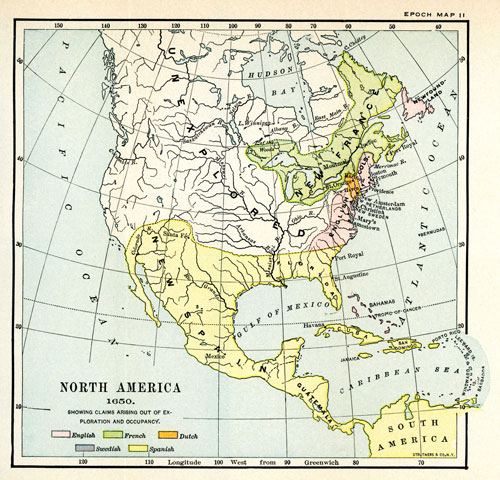
NORTH AMERICA
1650.
SHOWING CLAIMS ARISING OUT OF
EXPLORATION AND OCCUPANCY.
EPOCH MAP III
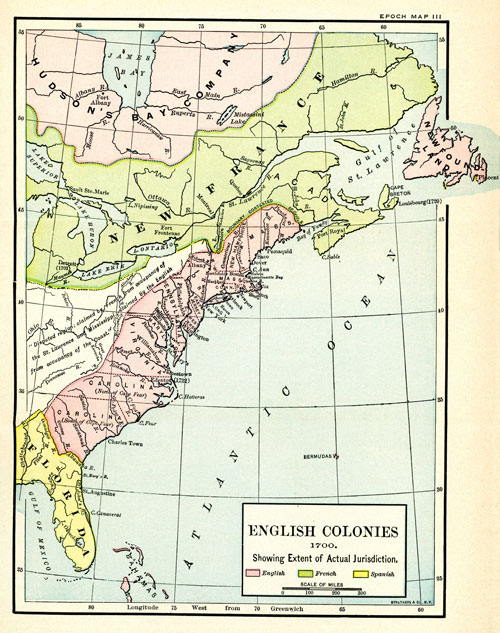
ENGLISH COLONIES
1700.
Showing Extent of Actual Jurisdiction.
EPOCH MAP IV
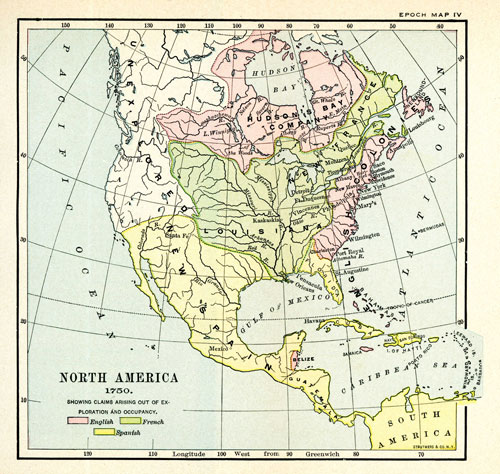
NORTH AMERICA
1750.
SHOWING CLAIMS ARISING OUT OF
EXPLORATION AND OCCUPANCY.
Punctuation was standardized. Missing punctuation was added, where appropriate.
Three instances of William Claiborne's name spelled 'Clayborne' were changed for
consistency within the text.
The index entry for Augusta, GA, is out of order in the original and was not amended.
Archaic and obsolete spellings were left unchanged.
The following spelling corrections were made:
'da Leon' to 'de Leon,' sidenote, Chapter II, § 9
'Greene' to 'Green,' sidenote, Chapter IV, § 36
'Roberth' to 'Robert,' Chapter IV, § 36
'browbreat' to 'browbeat,' Chapter IV, § 38
'circumtances' to 'circumstances,' Chapter XII, § 110
'beween' to 'between,' Chapter XIV, § 121
'king Charles' to 'King Charles,' index entry for Massachusetts
'Phillip's War' to 'Philip's War,' twice, in the index only
The following hyphenated words were changed for consistency within the text:
'brow-beat' to 'browbeat,' Chapter IV, § 31
'fire-places' to 'fireplaces,' Chapter V, § 45
'foot-hold' to 'foothold,' Chapter XII, § 112
'free-men' to 'freemen,' Chapter IX, § 89
'heartrending' to 'heart-rending,' Chapter XIV, § 125
'Jersey-men' to 'Jerseymen,' Chapter X, § 92
'long-shore' to 'longshore,' Chapter X, § 94
'overpopulation' to 'over-population,' index, Portuguese and index, Spaniards
're-affirm' to 'reaffirm,' Chapter IV, § 34
'Ship-building' to 'Shipbuilding,' Chapter VII, § 77;
index, Massachusetts; and index, Shipbuilding
'vice-regal' to 'viceregal,' Chapter XIV, § 120