By the Rev. Andrew Clark, M.A., Fellow of Lincoln College.
Lincoln College, or, in its full and official title, “The
College of the Blessed Mary and All Saints, Lincoln, in
the University of Oxford,” was founded by Richard Fleming,
Bishop of Lincoln, in the year 1429, in the eleventh year of his
episcopate and one year and one month before his death.
The founder, a native of Yorkshire, was educated in Oxford,
and held the office of Northern (or Junior) Proctor in 1407. He
was promoted to a prebendship in York Cathedral in 1415;
and was raised to the see of Lincoln in 1419. In 1424 Pope
Martin V., who held him in great esteem, advanced him to the
Archbishopric of York; but the king (Henry VI.) refused to
sanction the nomination; and Fleming, ejected from York, had
some difficulty in getting “translated” back to Lincoln.
Richard Fleming, as a graduate resident in Oxford, had been
noted for his sympathy with the tenets of the Wycliffists; but
in his later years he had come to regard the movement with
alarm, foreboding (as his preface to the statutes for his college
says) that it was one of those troubles of the latter days which
were to vex the Church towards the end of the world. The
Wycliffists professed to accept the authority of the Scriptures
and to find in them the warrant for their attacks on accepted
Church doctrines and institutions. In these same Scriptures,
rightly understood and expounded, Fleming believed that the
authority of the Church was laid down beyond contradiction.
And so, in the bitterness of his repulse from York, which he
perhaps attributed to the growing spirit of rebelliousness against
the Church, he determined to found (to use his own words)
“collegiolum quoddam theologorum”—“a little college of true
students in theology who would defend the mysteries of the
sacred page against those ignorant laics who profaned with
swinish snouts its most holy pearls.”
It is instructive to note the means by which he carried out
his purpose. There is a common impression that these pre-Reformation
prelates were possessed of great wealth. In some
few instances, this was the case, namely, where the prelate had
held in plurality several wealthy benefices, or had occupied a
rich see for a great number of years, or had inherited a large
private fortune; but in the majority of cases, the bishops were
not wealthy men, and from year to year spent the revenues of
their sees in works of public munificence or private charity.
Every bishop, however, had partially under his control several
of the Church endowments of his diocese, and could divert
them, even in perpetuity, to the use of any institution he
favoured, so long as they were not alienated from the Church.
Accordingly, Fleming proposed, as it seems, to build the College
out of his own moneys; but to provide for its endowment by
attaching to it existing ecclesiastical revenues. He therefore
obtained the sanction of the king (Henry VI.’s charter is dated
13th Oct., 1427) and Parliament, the Archbishop of Canterbury,
the mother-church of Lincoln, the Archdeacon of Oxford, the
parishioners of all three parishes, and the Mayor and Corporation
of Oxford, to dissolve the three contiguous parish churches of
All Saints, St. Mildred, and St. Michael,—all three being in the
patronage of the Bishop of Lincoln,—as also the chantry of St.
Anne in the church of All Saints, which was in the patronage
of the city of Oxford; and to unite them into a collegiate
church or college, which was to be “Lincoln College.”
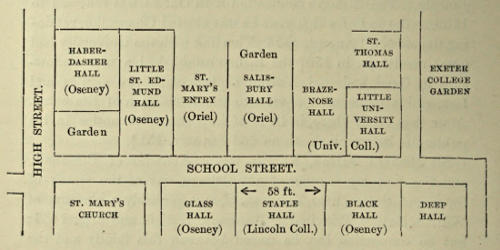
St. Mildred’s was a small parish occupying the present site of
Exeter College, and about half of the site of Jesus College;
its church was sadly out of repair, and had no funds for its
maintenance; and the ordinary parish population had given
place to Academical students with their Halls and Schools.
Fleming therefore planned to build his college on the site of
this church and its churchyard, increasing the area by the
purchase, on 4th April, 1430, of Craunford Hall, which stood
south of the churchyard, and, on the 20th June, 1430, by the
purchase of Little Deep Hall, which stood on the east of the
churchyard. The ground-plot so formed is represented by the
present outer quadrangle of the College.
The two churches of All Saints and St. Michael were to
provide the endowment of the College. The lands and houses
originally belonging to them had already been taken away when
they had been reduced from rectories to vicarages, before they
came to the patronage of the bishops of Lincoln. Their only
revenues now were therefore the offerings in church, the fees at
burials, etc., and the petty tithe (called “Sunday pence,” being
a penny per week from every house of over twenty shillings
annual value in the parish, doubled at the four great festivals,
viz. Christmas, Easter, Ascension, Whitsuntide).[159] These revenues,
together with the income of the chantry of St. Anne, seem to
have amounted to about £30; and out of them, when the College
was founded, £12 was to be paid for the maintenance of divine
service in the two churches and the chantry.
With these revenues Fleming proposed to endow a college
consisting of a Warden and seven Fellows, who should, (1) study
Theology, the queen and empress of all the faculties (omnium
imperatrix et domina facultatum); (2) pray for the welfare of
the founder during his life and for the health of his soul after
his death, as also for the souls of his kindred and of his benefactors
and of all faithful deceased.
Fleming’s charter, uniting the churches and erecting the
College, is dated 19th Dec., 1429. He did not live to see his
project accomplished, for he died suddenly on 25th January,
1430-1.
In what condition was the College when the founder died?
The following points may be noted:—
(1) The College was founded, and had received its charter of
incorporation, together with certain “ordinances” for its government,
which Rotheram says he imitated in framing the 1480
statutes;
(2) The buildings of the College had been begun, namely, the
present tower, with the rooms over the gateway, in which,
according to usual custom, the Head of the College was to reside,
and control the comings in and goings out of its members;
(3) MSS. had been given to the library;[160] the Catalogue of
1474 specifying twenty-five “books” as given by the founder,
chiefly theological (among these, Walden against Wycliffe), but
one or two historical;
(4) A small annual revenue had been provided for, but this
would probably not become available till the deaths, or cessions,
of the vicars of All Saints’ and St. Michael’s, and the chaplain of
St. Anne;
(5) A rector (William Chamberleyn) had been named by the
founder, but no Fellows; so that when Chamberleyn died (7th
March, 1433-4) Fleming’s successor, Bishop William Grey, finding
it impossible to supply the vacancy by election, according to
Fleming’s ordinances, himself nominated (on 7th May, 1434)
Dr. John Beke.
In Beke’s rectorship (1434-1460) the orphan College found
good patrons to carry out the intentions of its deceased founder.
Before 1437 John Forest, Dean of Wells, built the Hall, the
Kitchen, the Library (now the Subrector’s room), the Chapel
(now the Senior Library), with living rooms above and below
the Library and below the Chapel, so that he deservedly was
recognized by the College as its “co-founder.”
In 1444 William Finderne, of Childrey, gave a large sum of
money towards the buildings, and his estate of Seacourt, a
farm at Botley near Oxford; in return the College was to
appoint an additional Fellow (“sacerdos et collega”) to pray for
Finderne.
In 1436, we have evidence of a Rector, seven Fellows, and
two Chaplains of Lincoln College. An account-book of 1456 has
been preserved, showing the Rector and five Fellows in residence
and in receipt of commons.
Beke resigned in 1460, and was succeeded in Jan. 1460-1 by the
third Rector, John Tristrop, who had been resident in College as a
Commoner in 1455, and had probably at one time been Fellow.
In the first year of Tristrop’s rectorship the dissolution of the
College was threatened. The charter of incorporation had been
obtained from Henry VI.; and now that he had been deposed
(on 4th March, 1460-1) by Edward IV., some powerful person
seems to have coveted the possessions of the College, and suggested
that Edward IV. should not grant it a charter, but seize
it into his own hands. The College besought the protection of
George Nevill, Bishop of Exeter, Lord High Chancellor, himself
a graduate of Oxford. By Nevill’s influence the College secured
from Edward IV., on 23rd Jan., 1461-2, pardon of all offences and
release of all amercements incurred by them, and on 9th Feb.,
1461-2, a charter confirming the College and extending its
right to hold lands in mortmain. The reality of the danger and
the gratitude of the College for preservation are sufficiently
apparent by the way in which the Rector and Fellows tendered
their thanks to Bishop Nevill: although he had given nothing
to the College, yet by a solemn instrument, dated 20th Aug.,
1462, they assigned him the same place in their prayers as the
founder himself, “because he had delivered the College from
being torn to pieces by dogs and plunderers.”
This danger averted, and confidence in the legal position of the
College restored, the stream of benefactions again began to flow.
In 1463 the College purchased from University College three
halls lying next to it in St. Mildred’s (now Brasenose) Lane
and in Turl Street, thus doubling its original ground-plot.
In 1464 Bishop Thomas Beckington’s executors, out of the
monies he had left to be applied by them to charitable uses,
gave £200 to build a house for the Rector at the south end of
the hall, consisting of a large room on the ground-floor and
another on the first floor (the dining-room and drawing-room of
the present Rector’s Lodgings), with cellar and attic. On the
west front of this building was carved Beckington’s rebus[161]—a
flourished T, followed by a beacon set in a barrel (i. e. “beacon”—“tun”)
for “T. Beckington”—and his coat of arms, with the
rebus, on the east front.
In 1465 the founder’s nephew, Robert Fleming, Dean of
Lincoln, gave the library thirty-eight MSS., chiefly of classical
Latin authors, comprising Cæsar, Cicero, Aulus Gellius, Horace,
Juvenal, Livy, Plautus, Quintilian, Sallust, Suetonius, Terence,
Virgil. Most of these, along with the old plate of the College,
were embezzled by Edward VI.’s commissioners, under pretence
of purging the library of Romanist books.
Some years afterwards the very existence of the College was
a second time brought into danger. The scribe who wrote out
the charter of 1461-2 (1 Edward IV.), had done his work in
a most slovenly manner, dropping here and there words required
by the grammatical structure. Unfortunately for the College,
in one important place the words “et successoribus” were
omitted; and some one in authority, fastening on this omission,
suggested that the grant was only to the Rector and Fellows for
the time being, and on their death or removal would lapse to
the Crown. The College appealed, in 1474, for protection to
Thomas Rotheram, Bishop of Lincoln and therefore Visitor of
the College, and (from May 1474 to April 1475, and again from
Sept. 1475) Lord High Chancellor of England.
The manner of this appeal, as recounted by Subrector Robert
Parkinson about 1570, in the College register, is sufficiently
dramatic. When Rotheram, in the visitation of his diocese, was
at Oxford, the Rector or one of the Fellows of Lincoln College
preached before him from the text, Ps. lxxx. (lxxxi.), vers. 14, 15,
“Behold and visit this vine, and complete it which thy right
hand hath planted.” The preacher described the desolate condition
of the College, founded by Rotheram’s predecessor,
unprotected from the enemies who sought to destroy it; and his
words so moved the bishop that he at once rose up and told the
preacher that he would perform his desire.[162]
Rotheram was not slow in fulfilling his promise. To relieve
the present necessities of the College he gave, in July 1475, a
grant of £4 per annum during his life. Thereafter he completed
the front quadrangle by building its southern side;[163] and
he very greatly increased the endowments by impropriating[164] the
rectories of Long Combe in Oxfordshire and Twyford in Bucks.
He increased the number of Fellowships by five; but at least
three of these had been provided for by earlier benefactors, one
by Finderne, one by Forest and Beckington’s executors, and one
(for the study of Canon Law) by John Crosby, Treasurer of
Lincoln Cathedral.
To secure the legal position of the College, he obtained from
Edward IV., 16th June, 1478, a larger charter. In this the
king recites his former charter; mentions the doubt which had
arisen by reason of its omitting the words “et successoribus”;
and then sets the position of the College as a perpetua persona for
ever at rest. In the same charter the king still further increased
the amount of lands which the College might hold in mortmain.
On 11th Feb., 1479-80, Rotheram provided for the internal
government of the College by the giving of a full body of
statutes. Rotheram therefore is justly regarded as our restorer
and second founder.
The later years of the fifteenth and the earlier years of the
sixteenth centuries increased the estates of the College by four
great benefactions. By an agreement with Margaret Parker,
widow of William Dagville, a parishioner of All Saints parish,
the College in 1488 (5 Henry VIII.) came into possession of
considerable property in Oxford,[165] which had been bequeathed
by Dagville, subject to his widow’s life interest, by his will
dated 2nd June, 1474, and proved 9th Nov., 1476. In 1508
William Smith, Bishop of Lincoln, gave his manors of Senclers
in Chalgrove in Oxfordshire, and of Elston (or Bushbury) in
Staffordshire. In 1518 Edmund Audley, Bishop of Sarum,
gave £400, with which lands in Buckinghamshire were bought.
And in 1537 Edward Darby, Fellow in 1493, and now Archdeacon
of Stowe, gave a large sum of money, with which lands
in Yorkshire were bought. Darby directed that the number of
Fellowships should be increased by three, to be nominated by
himself in his lifetime (one of the first three whom he nominated
as Fellows was Richard Bruarne, afterwards Regius Professor
of Hebrew); and afterwards, one to be nominated by the Bishop
of Lincoln, the other two to be elected by the College.
In connection with Bishop Smith’s benefaction, we may note
here the singular fatality which has led the College in successive
ages to quarrel with its benefactors. Writing in 1570, Subrector
Robert Parkinson says, “Bishop Smith would have given
to our College all that he afterwards gave to Brasenose (founded
by him in 1509) had he agreed with the Rector and Fellows that
then were.” With Smith’s change of plans, part of Darby’s
benefaction went, for he also founded a Fellowship in Brasenose.
Sir Nathaniel Lloyd was a chief benefactor in the early
eighteenth century to All Souls in Oxford, and to Trinity Hall
in Cambridge: in three successive drafts of his will he takes the
trouble to write, “I gave £500 to Lincoln College, which was
not applied as I directed: so no more from me!” Lord Crewe,
our greatest benefactor of modern times, well deserving the title
of “our third founder,” was almost provoked[166] to recalling his
benefaction. A quarrel with John Radcliffe diverted from
Lincoln College the munificence which doubled the buildings
of University College and provided for the erection of the
Radcliffe Library, the Infirmary, and the Observatory. Other
instances, both remote and recent, might also be cited.
Having now brought the history of the endowments of the
College to that point where their application within its walls
can be conveniently described, it is necessary to leave the annals
of the College for a time and consider its organization, as it
was arranged for by Rotheram’s statutes, modified slightly by
subsequent benefactions.
The College was to consist of (I) the Rector; (II) Fellows;
(III) Chaplains; (IV) Commoners; (V) and Servants.
(I) To the Rector was, of course, in general terms committed
the government of the College and its members. But he was
allowed large limits of absence from College; and he was to be
capable of holding any ecclesiastical benefice in conjunction
with his rectorship. In the founder’s intention, therefore, the
headship of the College was to be an office of dignity, and the
holder set free from the ordinary routine of college work. It
was also to be a reward of past services to the College, because
only a Fellow, or ex-Fellow, was eligible for the office.
(II) The Fellows were to be thirteen in number, counting
the Rector as holding a Fellowship; and consequently, when
augmented by Darby, sixteen. Provision was made for the
increase of their number if the revenues of the College could
bear it; but this provision seems never to have been acted on.
The corresponding provision for diminution of the number of
Fellowships to eleven, to seven, to five, and even to three, was,
however, from time to time had recourse to; and as a rule, the
circumstances of the College have not permitted of the extreme
number of Fellowships being filled up.[167]
The Fellows were to be elected from graduates of Oxford or
Cambridge, born within the counties or dioceses described
below; and if not already in priest’s orders were to take them
immediately they were of age for them. A Bachelor of Arts
was not to be elected unless there was no Master of Arts
possessed of the proper county or diocese qualification. When,
however, Darby in 1537 gave his three additional Fellowships,
he recognized the fact that there might be no graduate in the
University eligible, and provided that they might be filled up
by the election of an undergraduate Fellow[168] either from undergraduates
in Oxford, or by taking a boy from some grammar
school in Lincoln diocese; but the person so elected was to
have no voice in College business until he had taken his degree.
Taking the full number of Rector, twelve Foundation Fellows,
and three Darby Fellows, the sixteen places on the foundation
of Lincoln College were assigned as follows—
One Fellowship was to be filled up from the diocese of Wells
(i. e. county of Somerset), in memory of the benefactions of
John Forest, dean, and Thomas Beckington, bishop, of Wells;
but this Fellow was specially excluded from election to the
Rectorship or Subrectorship. All the other places were to be
apportioned between the dioceses of York and Lincoln. It is
not known whether Fleming, himself a native of Yorkshire
and bishop of Lincoln, had made any such limitations; but
Rotheram, possessed of the same twofold interest, draws particular
attention to the fact that his College is designed to
make provision for natives of these two dioceses which had
hitherto been neglected by the founders of colleges. Four
places were assigned for natives of the county of Lincoln, with
a preference to natives of the archdeaconry of Lincoln; four
places were open to natives of the diocese of Lincoln; two
places were assigned for natives of the county of York, with a
preference to natives of the Archdeaconry of York, and within
that with a more particular preference to the parish of Rotherham,
in which the second founder was born; two places were to
be open to natives of the diocese of York. Of the Darby Fellowships,
one was to be for a native of the Archdeaconry of Stowe,
one for a native of Leicestershire or Northamptonshire (with
a preference to the former), and one for a native of Oxfordshire.[169]
The next point which we may consider is the duties of the
Fellows. These may be classified as follows:—
(1) They were to be “theologi” (students of theology), with
the single exception of the holder of the Fellowship founded by
John Crosby for the study of Canon Law. Their orthodoxy was
ensured by a very stringent clause directed against heretical
opinions:—“if it be proved by two trustworthy witnesses that
any Fellow, in public or in private, has favoured heretical tenets,
and in particular that pestilent sect, lately sprung up, which
assails the sacraments, divers orders and dignities, and property
of the Church,” the College is to compel him to immediate
submission and correction, or else to expel him.
(2) They were to pray for the souls of founders and benefactors,
at the celebration of mass, in bidding-prayers, in the graces in
hall, after disputations, and on the anniversaries of their death.
This was the chief duty contemplated by all pre-Reformation
benefactors.
(3) They had considerable duties to perform with regard to
their four Churches which may be classified thus:—
(a) As regards spiritualities. Although the ordinary services
of the Churches throughout the year were to be discharged by
four salaried Chaplains, yet, during Lent, a Fellow of the College
was to assist the Chaplain of All Saints in hearing confessions
and in other ministerial functions; another, similarly, to assist
the Chaplain of St. Michael’s; another, to assist the Chaplain
at Combe; and the Rector, or a Fellow appointed by him, to
assist the Chaplain at Twyford. On all greater festival days,
the Rector or his representative (in an amice, if he had one,
and if not, in surplice, and the hood of his degree), accompanied
by all the Fellows (except one who was to attend as representative
of the College at St. Michael’s), was to go to service at All
Saints.[170] St. Mildred’s Church was to be commemorated on her
day (13th July) by a celebration in the College chapel; and the
benefaction of John Bucktot by a Fellow going to Ashendon to
say mass on St. Matthias day, and that of William Finderne
by a similar service in Childrey parish church.[171] Sermons in
English were to be preached at All Saints on Easter Day and
on All Saints Day,[172] by the Rector, and on the dedication day of
that Church, by one of the Fellows; and at St. Michael’s on
Michaelmas Day, by one of the Fellows.[173]
(b) As regards temporalities. On the 6th of May a “Rector
chori” was to be appointed for All Saints and a “Rector
chori” for St. Michael’s; their duties were to occupy the
Rector’s stall in the chancel, and to collect all alms, fees, etc.,
for the bursar of the College. These duties at Twyford belonged
to the Rector of the College, and at Combe were supervised by
him.
(4) As regards the ordinary academical curriculum, the
founder’s requirements were by no means exacting.
(a) The College disputations were to be weekly during Term,
in Logic and Philosophy on Wednesdays, for those members
who had taken B.A. and not yet proceeded to M.A. (there being
no undergraduates, according to the founder’s scheme); and in
Theology on Fridays, for all members of M.A. standing. Both
sets of disputations were to cease during Lent, when the Fellows
were engaged in their ministerial duties.
(b) Fellows, elected as B.A., were to proceed to M.A. as soon
as possible; Fellows were to take B.D. (or B. Can. L. in case of
the Canonist Fellow) within nine years from M.A.; and, unless
the College approved of an excuse, to proceed to D.D. (or D.
Can. L.) within six years later. The last of these provisions,
however, was practically a dead letter, for the College never
forced any Fellow to the expensive dignity of the Doctorate.
(5) Study, however, as distinct from formal academical
exercises, was inculcated as a virtue both by persuasions and
punishments. The Subrector was charged to rebuke Fellows
not merely for offences against morality and decorum, but for
being neglectful of books; and unless the Fellows so admonished
submitted and mended their ways, they were to be
expelled.
The founder and later benefactors, as has been from time to
time noted, made gifts of “books” (i. e. MSS.) for the use of the
Fellows; and John Forest built a library for their reception.
According to Rotheram’s statutes, two classes of books were to
be recognized—
(a) Those which were to be chained in the library, and
which the reader had therefore to consult there. According to
the Catalogue of 1474, this library then contained 135 MSS.,
arranged on seven desks.
(b) Those which were to be considered as “in the common
choice” of the Rector and Fellows. On each 6th November a
list of these was to be made out; the Rector was to choose one,
and after him the Fellows one each, according to their seniority,[174]
and so on till the books were all taken out; thereafter, the
Fellows were to take the books to their own rooms, depositing
a bond for their safe custody and return. In 1476 there were
35 books in this “lending library,” different from the 135
above-mentioned. A record is also found of the books (18 in
number) thus borrowed by the Fellows in 1595 and (17 in
number) in 1596; among them are two copies of Augustine
De civitate Dei, and one of Servius In Virgilium.
(6) The Fellows had to take their share in the ordinary
routine of College business, especially in the two chief meetings
on 6th May and 6th November, called “chapters” (capitula),
and to serve when called upon in the College offices. These
were three in number, all held for one year only.
(a) The Subrector was charged with the general management
of the College during the Rector’s absence, the supervision of
the conduct of the Fellows and commoners, the presiding over
disputations, and the writing of all letters on College business.
The emblem of his office was a whip, which, with his alternative
title (Subrector sive Corrector[175]), is eloquent as to his
original duty of correcting faults of conduct by corporal punishment.
This scourge of four tails, made of plaited cord after the
old fashion, is still extant and perfect, is solemnly laid down by
the Subrector at the conclusion of his term of office, and
restored to him next day on his re-election. It has been
coveted for the Pitt-Rivers anthropological museum, as a genuine
example of the “flagellum” of mediæval discipline.
(b) The Bursar (thesaurarius) was charged with the duties of
paying bills, collecting rents, and keeping accounts; of seeing
that commons were duly and sufficiently supplied; and of
governing the College servants (over whom he had the power,
with the consent of the Rector, of appointment and dismissal).
(c) The Key-keeper (claviger) was to keep one of the three
keys with which the Treasury was locked, and one of the three
keys of the chest in the Treasury which contained the College
money, the other keys of these sets being in the charge of the
Rector and Subrector. This “chest of three keys” corresponds
to the balance to the credit of the College at its bankers and
its investments in the public stocks; in it were placed any
surplus money or donations to meet sudden calls for payment
or to wait investment; and the idea of appointing a key-keeper
was that the chest might never be approached by any person
at random or singly, but always by responsible officers, protected
against themselves by the presence of others.
(7) The Fellows were strictly required to reside in Oxford
and within College. During the Long Vacation they might be
absent from College for six weeks; at other times not for more
than two days, without special leave: the Rector and Subrector
had, however, general directions given them in the statutes
not to be niggardly in granting leave in cases where the presence
of the applicant was required by no College duties.
On several occasions of the visitation of the city by the
plague, this requirement of residence was relaxed; and the
Fellows were permitted to have all their allowances if they lived
in common at some place near Oxford. Thus, in the pestilence
of 1535, commons were allowed to the Rector, Subrector, and
five Fellows in residence at Launton, for a fortnight in some
cases, for a month in others; and in that of 1538, commons
were allowed to the Rector, Subrector, and twelve Fellows in
residence at Gosford (near Kidlington), during a period of no
less than fifteen weeks.
During Elizabeth’s reign, leaves of absence become frequent
and continuous, and are practically equivalent to non-residence.
The Fellows in this reign, and later, developed a bad habit of
asking for leave when their turn for disputing, or other duties,
came round; and several Visitors’ Injunctions are directed
against granting leaves unless a substitute has been provided
to perform all duties.
From this statement of the duties of the Fellows, we pass on
to discuss their emoluments. These can best be understood if
we group them together under separate heads.
(a.) Commons (communiæ), the weekly allowance for food
at the common table in the hall of the College, and at the
regular time of meals. Rotheram provided that in each week
there should be allowed for each Fellow in residence (counting
the Rector as a Fellow), the sum of sixteen-pence; fixing the
allowance at that amount, and not more, because, as he says,
“clerks” should avoid luxury.
Several festivals of the Church’s year were to be honoured
by an addition to the ordinary table-allowance. In the weeks
in which the following Holy-days occurred, the allowance for
commons for each Fellow was to be increased by the sum
named:—Epiphany (6th Jan.), 4d.; Purification of Mary (Feb.
2nd), 2d.; Carnis privium (Septuagesima Sunday), 2d.; Annunciation
of Mary (25th Mar.), 2d.; Easter, 8d.; Ascension, 4d.;
Whitsun day, 8d.; Corpus Christi, 4d.; St. Mildred (13th July),
2d.; Assumption of Mary (15th Aug.), 2d.; Nativity of Mary
(8th Sept.), 2d.; Michaelmas (29th Sept.), 2d.; dedication of St.
Michael’s Church (in Oct.), 2d.; All Saints’ Day (1st Nov.), 4d.;
dedication of All Saints’ Church (in Nov.), 4d.; Conception of
Mary (8th Dec.), 2d.; Christmas, 8d.
An incidental, and therefore very striking, indication of the
plagues which then infected the country is the care the statutes
take to provide for cases of leprosy or other noisome disease.
The Fellow so afflicted is to live away from the College, and to
receive yearly forty shillings in lieu of all allowances.
(b.) Salary (salarium), payments in money. Rotheram
made no grants for these, except to the Rector and the College
officers; but he gave liberty to other benefactors to make them.
The first distinct mention of such grants is in 1537, when
Edmund Darby directs that 3s. 4d. shall be paid annually to
each Fellow, and 6s. 8d. to the Rector. The dividends of the
College rents, after payment of all charges, known as “provision,”
date no doubt from a very early period, but their history
cannot now be traced.
(c.) Livery (vestura), allowance for clothing. For this also
Rotheram made no provision, except to permit it if given
by later benefactors. Edmund Audley, Bishop of Sarum, in
giving his benefaction in 1518, directed that forty shillings
per annum should be allowed pro robis to the Rector, and to
each of the four senior Fellows.
(d.) The Fellows in common were entitled to the services of
the common servants; for which see below.
(e.) The Fellows were entitled to have rooms (cameræ)
rent-free. These were to be chosen, according to seniority, on
the May chapter. About 1600 we find that along with his
room, the Fellow received also the attic (“loft,” or “cock-loft”)
over it, into which he might put a tenant from whom he might
receive rent. How far this custom had come down from
antiquity we have no means of saying.
(f.) Obits (obitus), allowances for being present at Mass on
the anniversary-day of a benefactor. A considerable benefactor
invariably made a bargain with the College, that his
name should be kept in remembrance, and his soul’s health
prayed for in a special Mass, yearly on the anniversary of his
death, or, if that should clash with some very solemn season of
the Church’s year, on the nearest convenient day. To insure
the presence of the Rector and Fellows, he generally ordered that
each Fellow present at the Commemoration Service should receive
a stipulated sum, which was called by the same name as the
day itself, an “obit.”
The following are the dates of the obits in Lincoln College,
and the amount paid to each Fellow; the Rector as celebrant,
receiving in each case double the amount which a Fellow
received:—Jan. 10th, Edward Darby, 1s.; Jan. 16th, Bishop
Beckington, 6d.; Feb. 23rd, Archdeacon Southam, 1s.; March
21st, John Crosby, 8d.; March 26th, Dean Forest, 1s.; April
11th, Cardinal Beaufort, 8d.; May 29th, Rotheram, the second
founder, 1s.; Aug. 23rd, Bishop Audley, 1s.; Oct. 10th, Bishop
William Smith, 1s.; Oct. 29th, William Dagvill, 1s.; Nov. 16th,
William Bate, 6d.—all of them early benefactors. The obit of
the first founder, Fleming, was fixed for Jan. 25th; but no allowances
made for it, gratitude alone being strong enough to ensure
the attendance of all the Fellows.
At the Reformation, the celebration of Mass and, consequently,
the observance of these anniversary services in the form directed
by the statutes, became illegal, and the chapel services ceased.
The allowances still continued to be paid to each Fellow who
was present in College on the particular day, the test of “presence”
being now dining in hall at the ordinary hour of dinner.
(g.) Pittances (pietantia). Besides the sum given to the
Rector and each Fellow on a benefactor’s anniversary day, it is
sometimes directed that a sum shall be paid to them in common
for “a pittance,” i. e. as I suppose, to provide a better dinner on
that day. Thus Cardinal Beaufort gave a pittance of 3s. 4d.;
Rotheram, one of 2s.; Edward Darby, one of 3s. 4d.
(III) The Chaplains were four in number. Two were to serve
the churches of All Saints and St. Michael in Oxford, one of
whom must be of the diocese of York, the other of the diocese
of Lincoln. They were to be appointed by the Rector, and
to be removed by him when he chose; and each to receive
from the College a stipend of £5 per annum. A third Chaplain
was to serve the church of Twyford under the same conditions,
except that his stipend was to be paid by the Rector; a fourth
was to serve the church of Combe Longa.
It was clearly no part of the founder’s intention that the
chaplaincies should be served by the Fellows: and we find, down
to the Civil War and the Commonwealth, instances of Chaplains
who were not Fellows. But after the Restoration, when £5
per annum no longer represented a reasonable year’s income,
there was a growing feeling that it was for the honour of the
College that the duties of Chaplain of All Saints, St. Michael’s,
and Combe should be undertaken by Fellows. And so long as
there were Fellows in orders enough for the duties, this was
done. In the last half century, recognizing the changed circumstances
of the times, the College has provided a more
adequate endowment for each of its four chaplaincies.
(IV) The Servants. Rotheram’s statutes provided that the
Rector and each Fellow should have free of charge his share of
the services of the “common” servants (i. e. of the College
servants). These were (1) the manciple, whose duty it was to
buy in provisions and distribute them in College; (2) the cook;
(3) the barber;[176] (4) the laundress. From an account-book of
1591, it appears that the salary of the manciple and of the
cook was £1 6s. 8d. per annum; of the barber, 10s.; and of the
laundress £2.
There was also the bible-clerk (bibliotista, contracted
bita), who was to be the Rector’s servant when he was in
residence. At dinner in hall he was to read, from the Bible,
or some expositor, or some other instructive book, a portion
appointed by the Rector or Subrector; and at dinner and
supper he was to wait at the Fellows’ table. For these services
he was to receive food and drink; a room; and washing and
shaving (the latter referring to the tonsure probably, and not
suggesting that he was old enough to grow a beard). Different
benefactors made additions to his emoluments; and at last,
until divided by the 1855 statutes into two “Rector’s Scholarships,”
the Bible-clerkship was the best paid office in College,
being worth three times the Subrectorship, twice the Bursarship,
or once and a half a Tutorship.
(V) The Commoners, or Sojourners (commensales seu sojornantes).
Almost from the first there had been graduates
resident in College, attracted by its quiet and by its social life,
but not on the foundation, and therefore receiving no allowances
from the College. Rotheram’s statutes provided for their discipline,
directing that they must take part in the disputations
of the Fellows, and so on. Undergraduates are by implication
excluded; and this presumption is increased to a certainty by
the fact that no provision is made in the statutes for tuition.
In its beginnings, therefore, Lincoln College differs from our
modern conceptions of a College alike in its aims and in its
constitution. In all external features, and partially also in its
domestic arrangements, it resembles a monastic house; but it
differs from a convent in two important, though not obvious,
points; first, that its inmates are not bound by a rule, and are
free to depart from the College into the wider service of the
Church; secondly, that the duty of prayer for benefactors
and the Christian dead is co-ordinate with two other duties,
the duty of serving certain churches, and the duty of studying
for study’s sake and for the truth. We have next to inquire
how the College changed its original character, and was made,
like other Oxford Colleges, a place of residence for undergraduates,
with a body of Fellows engaged in tuition. This was
one of the indirect results of the Reformation.
Under Henry VIII., Edward VI., and Elizabeth, the old
freedom of the University was taken away, lest, if the immunities
of the place continued, Oxford should become an
asylum for disaffected persons.[177] No undergraduate was to be
allowed in the University, unless he had the protection of a
graduate tutor; and residence was to be restricted to residence
within the walls of a College or Hall. There was thus an
external pressure forcing undergraduates to enter Colleges.
There was also a readiness from within the College to receive
them. The proceedings of the Reformers had been a violent
shock to the adherents of the old faith in Lincoln College; and
now that the routine of chapel services, masses, anniversaries,
obits, could no longer be pursued, these adherents devoted themselves
to training up young students in opposition to the new
movement. And when, under John Underhill (Rector 1577-1590),
the College was purged of the old leaven, the pressure of
poverty (which then began to be felt in the University) made
the Fellows glad to have undergraduates resident in College to
keep up the establishment and pay tuition fees.
Unfortunately, there are no statistics of the stages of this
change: the intervals between the years in which statements of
the numbers in College occur being too great. In 1552 there
were in College, the Rector, eleven Fellows, one B.A. Commoner,
and thirteen persons not graduates, of whom some were certainly
servitors, and some probably servants. In 1575 the Rector and
the greater part of the Fellows have undergraduate pupils
assigned to them in grammar and logic. In 1588 there were in
College, the Rector and twelve Fellows, sixteen undergraduate
Commoners, and nine servitors. In 1746, there were the Rector
and twelve Fellows, eight Gentlemen-commoners, eighteen
Commoners, and eight Servitors.
What provision was made for their instruction?
From about 1592 the College appointed annually these
instructors for its undergraduates: (a) two “Moderators,” to
preside over the disputations in “Philosophy” and in “Logic”
(occasionally when the College was full, an additional “Moderator”
was appointed in Logic); (b) a Catechist, or theological
instructor. Also, from 1615, a lecturer in Greek, annually
appointed, was added. Of these the catechetical lecture disappears
after 1642; the others continued to be annually filled
up till 1856, but for many years these had been merely nominal
appointments, the work of tuition devolving on regularly appointed
Tutors, as in other Colleges. But at what date these
last had been introduced into Lincoln College, is nowhere
stated. In some few years, exceptional appointments are made;
as, for example, in 1624 a Fellow is appointed to teach Hebrew;
in 1708, £6 per annum is paid to Philip Levi, the Hebrew
master.
Among these lecturers two may be noted. In 1607, and
again in 1609 and 1610, Robert Sanderson was Logic lecturer;
and began that vigorous course of Logic, which was published
in 1615, and long dominated the Schools of Oxford: indeed, its
indirect influence survived into the present half century, if, as
Rector Tatham wrote to Dean Cyril Jackson, “Aldrich’s logic is
cribbed from Sanderson’s.” In 1615 Sanderson was Catechist,
and perhaps at that time turned his attention to those questions
of casuistry, in which he was to gain enduring fame. John
Wesley was appointed to give the Logic and Greek lectures in
1727, 1728, 1730; and the Philosophy and Greek lectures in
1731, 1732, and 1733.
What provision was made for the maintenance of undergraduates
in the College?
In 1568, Mrs. Joan Traps, widow of Robert Traps, goldsmith
of London, bequeathed to the College lands at Whitstable in
Kent for the maintenance of four poor scholars. One scholar
was to be nominated from Sandwich School by the Mayor and
Jurats of that town, but not to be admitted unless the College
thought him fit; in defect of such nomination, Lincoln College
was to fill this place up (as it did the other three) from any
grammar school in England. Each of these four scholars was to
receive fifty-three shillings and fourpence half-yearly. Mrs. Traps
was also, in her husband’s name, a benefactor to Caius College,
Cambridge, in which College their portraits hang. Descendants
of R. Traps’ brother are still found in Lancashire, Catholics;
and one of them has told me his belief that the Traps had
bought Church lands at the dissolution of the monasteries,
intending to return them to the Church when the nation was
again settled on its old lines; but this hope failing, devoted
them to education,[178] as so many other conscientious purchasers
of Church lands did. If this be so, it is fitting that the first
recorded Traps’ Scholar, William Harte (elected 25th May,
1571), should have been one of those sufferers for the old faith,
whose cruel and barbarous murders are so dark a stain on the
“spacious times” of Elizabeth. Mrs. Joyce Frankland, daughter
of the Traps, augmented the stipend of these “scholars.” She
was afterwards a considerable benefactress to Brasenose College,
and a most munificent donor to Caius College, Cambridge. Is
she also to be numbered among those “offended benefactors”
who have been mentioned above? Or had Lincoln College in
her time been “reformed”? These four Traps’ scholars,[179] commonly
called the “Scholars of the House” (being distinguished,
as I suppose, by that name from the servitors maintained
privately by any Fellow), were for a century the only undergraduates
in Lincoln College in receipt of any endowment.
In 1640, Thomas Hayne left £6 per annum in trust to the
corporation of Leicester for the maintenance of two scholars in
Lincoln College to be elected by the Mayor, Recorder, and
Aldermen of that city. The corporation received this benefaction,
but never sent any scholar to the College. Numerous
educational benefactions throughout England were lost, like this,
in the anarchy of the Civil War.
In 1655, a Chancery suit was begun against Anthony Foxcrofte,
who had destroyed a codicil of Charles Greenwood,
Rector of Thornhill and Wakefield, by which two Fellowships
(or perhaps Scholarships) were bestowed on Lincoln College.
What the issue of the suit was, I cannot say; nothing, certainly,
came to the College.
About 1670, Edmund Parboe left a rent-charge of £10 per
annum issuing out of the Pelican Inn in Sandwich, of which £4
was to be paid to the master of the grammar-school there, £1 to
the Mayor and Juratts for wine “when they keep their ordinary
there,” £5 to Lincoln College for the increase of the scholarship
from Sandwich school; if no scholar is in College, it is to be
funded till one is sent, and the arrears paid to him. From that
date the corporation of Sandwich never nominated a scholar. I
suspect the Mayor and Juratts treated the £5, like the £1, as
a pour boire.
May the College still hope that the towns of Leicester and
Sandwich, or some one for them, will remember the long arrears
of these endowments, thus diverted from education? Even at
simple interest, they would be now a great benefaction; and at
compound interest, how great!
Later Scholarships and Exhibitions were founded by Rectors
Marshall (four, in 1688), Crewe (twelve, 1717), Hutchins (several,
1781), Radford (several, 1851); also by Mrs. Tatham, widow of
Rector Tatham (one, 1847). In 1857, Henry Usher Matthews,
formerly Commoner of the College, founded a Scholarship in
Lincoln College, and an Exhibition in Shrewsbury School to be
held in Lincoln College: but the Public Schools Commissioners
unjustly took the latter from the College. Since that date no
Scholarship benefaction has come to the College; but Scholarships
and Exhibitions have been created from time to time,
under the provisions of the Statutes of 1855, out of suspended
Fellowships.
The consideration of this change in the aims of the College
has led us beyond the point to which we had come in its
annals; it is therefore necessary to go back, and pass rapidly in
review its post-Reformation history.
John Cottisford, the eighth Rector of the College (elected in
March 1518-19), resigned on 7th Jan., 1538-9, probably[180] in
dismay at the course of events in the nation. His successor,
Hugh Weston, elected on 8th Jan., was possibly supposed to be
on the reforming side; for he was undisturbed by Edward VI.’s
Commissioners; but had to resign in 1555 to the Visitors
appointed by Cardinal Pole. Christopher Hargreaves, elected
on 24th Aug., 1555, and confirmed in his place by Cardinal
Pole’s Visitors, died on 15th Oct., 1558. His successor, Henry
Henshaw or Heronshaw, was hardly elected on 24th Oct., when
the hopes of the Romanist party were shattered. The College
register, in the greatness of its anxiety, breaks, on this one
occasion, the silence it observes as to affairs outside the College.[181]
“In the year of our Lord 1558, in November, died the lady
of most holy memory, Mary, Queen of England, and Reginald
Poole, Cardinal and Archbishop of Canterbury; the body of
the former was buried in Westminster, the body of the latter
in his cathedral church of Canterbury, both on the same day,
namely 14th December. At this date the following were Rector
and Fellows of Lincoln College,” and then follows a list of
them. Clearly the writer of this note did not look forward
to remaining long in College. Nor did he; within two years
Henshaw had to resign to Queen Elizabeth’s Visitors. Francis
Babington, who had just been made Master of Balliol by these
Visitors, was transferred to the Rectorship of Lincoln. In this
appointment we can detect the sinister influence which was to
direct elections at Lincoln for some time to come; Babington
was chaplain to Robert Dudley, Earl of Leicester, Chancellor of
the University after 1564. The election was in flagrant violation
of the Statutes which required that the Rector should be chosen
from the Fellows or ex-Fellows of the College. But it was the
policy of the Court to break College traditions, by thrusting
outsiders into the chief government: the same thing was done
in other Colleges, the case of Lincoln being peculiar only in the
frequency of the intrusion. Doubts began to be cast on Babington’s
sincerity; he was accused of secretly favouring Romanism;
and in 1563 he found it advisable to betake himself beyond
sea.[182] Leicester was ready with another of his chaplains, John
Bridgwater, who had been Fellow of Brasenose, and was not
statutably eligible for the Rectorship of Lincoln. Again the
Court was mistaken in its man. Under Bridgwater the College
became a Romanist seminary, and continued so for eleven years;
and then Bridgwater had to follow his predecessor across the
seas, retiring to Douay, where, Latinising his name into “Aquapontanus,”
he became famous as a theologian. He is still held
in honour among his co-religionists, and I remember several
visits paid to the College in recent years by admirers of his,
in hopes of seeing a portrait of him (but the College has none)
or his handwriting (which we have). Still another of his
chaplains was thrust into Lincoln College by the over-powerful
Leicester; this time John Tatham, Fellow of Merton. But
Tatham’s Rectorship was destined to be a brief one: elected in
July 1574, he was buried in All Saints’ Church on 20th
Nov., 1576.
Then there took place a very remarkable contest, six candidates
seeking the Rectorship. Only one, John Gibson, Fellow
since 1571, was statutably qualified; although of only six years’
standing as a Fellow he was still senior Fellow, a fact eloquent
as to the removal of the older Fellows from the College. Edmund
Lilly, of Magd. Coll., another candidate, relied apparently on his
popularity in the University. The other four candidates relied
on compulsion from outside, William Wilson, of Mert. Coll.,
being recommended by the Archbishop of Canterbury, while the
Chancellor (Lord Leicester) and the Bishops of Lincoln and
Rochester tried to secure the election of their respective Chaplains.
Leicester’s candidate, John Underhill, was specially
unacceptable to the College, having been removed from his
Fellowship at New College by the Bishop of Winchester (the
Visitor there), because of some malpractices with the College
moneys. The Fellows elected John Gibson; the Bishop of
Lincoln refused to admit him. Leicester wrote threatening
letters to the College; summoned several of the Fellows to London,
and browbeat them there. Then, thinking he had now
gained his point, he proceeded to frighten off the other candidates,
in order to leave a clear field for Underhill. The Fellows
again elected Gibson; and the Bishop of Lincoln again refused
to admit him. Then the Fellows elected Wilson; but the
Bishop refused to admit him. So that, there being no help for
it, they met again on 22nd June, 1577, and elected Underhill.
These proceedings caused great indignation in the University;
and a petition was drawn up, worded in very strong terms,
entreating the Archbishop of Canterbury to undertake the
defence of the University against the “iniquity, wrong, and
violence” which had been done. This was signed by resident
B.D.’s and M.A.’s, and presented to his Grace, who passed it on
to Leicester. Leicester thereupon wrote a long letter to Convocation,
trying to justify his action, and threatening to resign his
Chancellorship of the University if further attacked in this
matter.
Underhill’s first step after his election was to begin a new
register, and to tear out of the old register all records of the
proceedings since the death of Tatham; so that the only entry
in the College books concerning this controversy is that Underhill
was “unanimously elected.” Leicester visited the College
in 1585, and the Latin congratulatory verses on that occasion
are among the earliest printed of Oxford contributions to that
particularly dull form of literature. Underhill remained rector
till 1590. By that time the see of Oxford had been vacant
twenty years; and, as the leases of the episcopal estates were
running out, Sir Francis Walsingham required a bishop who
would make new leases and give him a share of the fines.
He selected Underhill for this purpose, who was consecrated
Bishop of Oxford in December 1589, and resigned the Rectorship
of the College in 1590. His patron, having no further
use for him after the renewal of the leases, neglected him; and
Underhill died in poverty and disgrace in May 1592.
Leicester being now dead, the College at this vacancy was left
to choose its own head; and Richard Kilby, Fellow since 1578,
was elected sixteenth rector on 10th December, 1590. Kilby’s
Rectorship proved one continuous domestic struggle, which has
left its mark in the College register in scored-out pages and
blotted entries, as plainly as an actual battle leaves its mark in
fields of grain trampled down by contending armies. The
question was about the number of Fellows. In Underhill’s
Rectorship the College appears to have been impoverished, and
unable to pay the full body of Fellows their allowances. Kilby’s
policy was to leave the Fellowships vacant, in order to keep up
the income of the present holders; the opposition in College
desired to fill up the Fellowships and to submit to a reduction
of stipend all round.
In April 1592 the number of Fellows had fallen to nine.
On 24th April three Fellows were elected; this election was
quashed by the Visitor on 8th December of the same year.
But the Fellows returned to the charge, and elected three
Fellows on 15th December, and five others on 16th December,
1592; so that in 1593 the College consists of the Rector and
the full number of Fellows (i. e. fifteen). Vacancies occur
rapidly, the Fellowships being so small in value. In 1596, and
again in 1599, elections of one Fellow are made, are appealed
against, but confirmed by the Visitor. In 1600 the number of
Fellows had again fallen as low as ten, and the Fellows wished to
proceed to an election; but the Rector (Kilby) tried to prevent
their doing so by retiring to the country. The Subrector,
(Edmund Underhill) called a meeting, and on 3rd November,
1600, the Fellows, in the Rector’s absence, elected into two
vacancies. Kilby induced the Visitor to quash these elections;
Edmund Underhill appealed to the Archbishop of Canterbury
as primate of the southern province. This was against the
statutes, which directed that no Fellow should invoke any other
judge than the Visitor; and on this ground, on 4th May, 1602,
Kilby procured Underhill’s expulsion. At the end of 1605
there were only five Fellows remaining; by 2nd May, 1606, two
more had resigned. On the next day the Rector and the three
Fellows remaining elected eight new Fellows, the last of the
eight being certainly not the least, but the most illustrious
Lincoln name of the century, Robert Sanderson, the prince of
casuists.
The years which follow, from this election to the breaking out
of the Civil War, present two aspects. Externally tokens of
prosperity are not wanting. The buildings were considerably
increased. In 1610 Sir Thomas Rotheram, probably the same
who had been Fellow from 1586 to 1593 and Bursar[183] in 1592,
and apparently of kin to the second Founder,[184] built the west
side of the chapel quadrangle. The chapel itself, with its
beautiful glass (said to be the work of an artist Abbott, brother
of the Archbishop), was the gift of John Williams, Bishop of
Lincoln and Visitor of the College. Bishop Williams at the
same time (1628-1631) built the east side of the chapel quadrangle.
The work cost more than he had promised to give, and
the College had to complete it at its own charges; £90 being
spent on this work in 1629, “as being all the sum that my lord
our benefactor did require or the College could spare.” It is
curious to find[185] the same benefactor doing exactly the same
thing in the fixed sum he gave (and would not increase) for
building the library at St. John’s College in Cambridge. If we
turn, however, to the domestic annals of the College during
this period we find an unlovely picture of turbulence and disorder.
Fellows and Commoners alike are accused of boorish
insolence, of swinish intemperance, of quarrelling and fighting.
Bursars mismanage their trust and fail to render account of the
College moneys they have received. Fellows try to defraud the
College by marrying in secret and retaining their Fellowships.
Two or three of the less scandalous scenes will be sufficient to
indicate the violence of the times. On 20th November, 1634,
Thomas Goldsmith, B.A., had to read a public apology in chapel
for “a most cruel and barbarous assault” on William Carminow,
an undergraduate. In December 1634 Thomas Smith, an
M.A. commoner, made “a desperate and barbarous assault” on
Nicholas North, another M.A. commoner, in the room of the
latter. The same Thomas Smith a month before had been
ordered by the Rector “to take his dogs[186] out of the College,”
which order he had treated with contempt. In October 1636
Richard Kilby and John Webberley, two Fellows, fell out and
fought; and “Mr. Kilbye’s face was sore bruised and beaten.”
The College ordered Webberley “to pay the charge of the
surgeon for healing of Mr. Kilbye’s face.”
We must pass very hastily over the period from 1641 to the
Restoration, not because the annals of Lincoln are lacking in
interest during these years, but because space presses and the
chief incidents have been noted in Wood’s History of the University
and in Burrows’ Register of the Parliamentary Visitation.
Paul Hood, the Rector, being a Puritan, kept his place under the
Commonwealth, and having been constitutionally elected before
the Civil War, retained it at the Restoration. Ten Fellows were
ejected by the Parliamentary Visitors, and ten put into their
place, at least six of them being persons of unsatisfactory character.
At the Restoration Hood got the King’s Commissioners
to eject those of the ten who remained, and seven Fellows were
elected in their place, the only name of interest among these
being that of Henry Foulis, famous in his own age for his violent
and bulky invectives against Presbyterianism and Romanism.
Lincoln College was singularly fortunate during the latter
half of the seventeenth and for the greater part of the eighteenth
centuries. Hood, at the Restoration, was in extreme old age,
and left the whole management of the College to Nathaniel
Crewe (Subrector 1664-1668), so that it fairly escaped
the break-down in manners, morals, and studies which the
Restoration brought to many Colleges. Crewe, after a short
Rectorship of four years (1668-1672), was raised to the
Episcopal Bench; and at the close of his long life proved our
greatest benefactor. When he resigned Crewe used his influence
to get Thomas Marshall elected Rector, a good scholar and a
good governor; who, on his death in 1685, left his estate to the
College. His successor, Fitz-herbert Adams, was also a considerable
benefactor. Of John Morley and Euseby Isham, who
followed, John Wesley speaks in the highest terms. Richard
Hutchins, twenty-third Rector (1755-1781), was a model
disciplinarian and an excellent man of business; and, following
Marshall’s example, left his estate for the endowment of
scholarships.
During this happy period much was done to improve the
College, which can only be touched on in the briefest outline
here. In 1662 John Lord Crewe of Steane (father of Nathaniel)
converted the old chapel—which since the consecration of the
new chapel on 15th September, 1631, had lain empty—into a
library, which it still remains, and changed the library into a
set of rooms. In 1662 the room under the library westwards
was set aside as a room where the Fellows might have their
common fires and hold their College meetings;[187] it is still the
Fellows’ morning-room. In 1684 the common-room was wainscotted
at a cost of £90, Dr. John Radcliffe subscribing £10, and
George Hickes and John Kettlewell each £5. In 1686 Fitz-herbert
Adams spent £470 on repairing and beautifying the
chapel. In 1697-1700 the hall was wainscotted at a cost of
£270, to which Lord Crewe gave £100. Rector Hutchins
bought from Magdalen College some of the houses between the
College and All Saints’ Church, and left money to purchase the
others, so as to form the present College garden.
During this period also the roll of the Fellows received some
of its more famous names. The two eminent non-jurors, George
Hickes and John Kettlewell; the celebrated physician, John
Radcliffe; John Potter, whose Greek scholarship promoted him
to the see of Canterbury; and John Wesley,[188] by and by to win
a name only less famous than that of Wycliffe in the history of
religion in England, may be cited.
The long period of prosperity which Lincoln College had
enjoyed during the later part of the seventeenth and the
earlier part of the eighteenth centuries was followed in the
end of the eighteenth and the beginning of the nineteenth
centuries by a period of decline, during which the College had
its full share in the general stagnation of the University,
and was chiefly notable for the grotesque eccentricities of its
rector, Edward Tatham (Rector 1792-1834). Tatham, an
M.A. of Queen’s College, had been elected into a Yorkshire
Fellowship at Lincoln in 1782. Shortly after his election
he came into conflict with the Rector (John Horner) over
a number of points in the interpretation of the statutes;
and after several appeals to the Visitor, was successful in his
contention. In 1790 he distinguished himself by the ponderous
learning, and the vigorous, if coarse, style of his Bampton
Lectures, The Chart and Scale of Truth by which to find the
cause of Error (published in 1790 in two volumes; a copy in
the College library has additional MS. notes by the author).
In March 1792 he was elected Rector, and one of his first
achievements was the use he made of his old practice in controversy
over the statutes to obtain from the Visitor an unstatutable
augmentation of the stipend of the Rector. In the
old obits, the Rector, being celebrant, had been assigned double
the allowance of any Fellow; and in elections, according to an
almost universal custom in Oxford Colleges, his vote counted
for two. By emphasizing these points and suppressing contradictory
evidence, Tatham persuaded the Visitor to decree
that for the future the Rector’s Fellowship should receive
double of all the allowances of an ordinary Fellowship.
Tatham was known as a forcible but most unconventional
preacher; and one phrase of his, used in the University pulpit,[189]
has become almost proverbial, that namely in which he wished
that “all the Jarman[190] philosophers were at the bottom of the
Jarman ocean,” forgetting in the heat of his rhetoric to make it
plain to his audience whether he meant the writers or their
writings. In University business Tatham was at war with
the Hebdomadal Board, and used to brow-beat its members,
accusing them of “intrigues, cabals, and subterfuges.” He
was therefore well-hated by many of his contemporaries, and a
great subject of those pasquils and lampoons which, orally and
in writing, circulated freely in the University. In several of
these Tatham had been compared in features and disposition to
the “devil,” who, after the fashion of the similar grotesque at
Lincoln Cathedral, “looked over Lincoln” from his niche on the
quadrangle-side of the gate-tower. Irritated at this, Tatham
ordered the leaden figure to be taken down.[191] Then came out a
lampoon, longer and more bitter than any before, in which the
wit consists in making the word “devil” occur as often as possible
in every quatrain, and the point is to suggest that when
Tatham was returning from dining out (“full of politics, learning,
and port was his pate”) the devil, tired of standing so long
inactive, had flown off with him into space; where leaving him,
the devil returned to establish himself in person in the Rectorship
and to govern the College with the help of “two imps, called
tutors.” During the later years of his life Tatham availed himself
of the large liberty of non-residence allowed the Rector by the
then statutes, and lived chiefly in the rectory-house at Combe.
There he enjoyed the pleasures of a rough country life, farming
the glebe, and devoting himself with marked success to the rearing
of his special breed of pigs. He rarely visited Oxford; and
when he did, always brought with him in his dog-cart a pair of
his pigs to be exposed for sale in the pig-market, which was then
held in High Street beside All Saints Church. On these occasions
his dress is described by a contemporary to have been so strictly
in keeping with his favourite pursuit that he ran no risk of
being mistaken for a Doctor of Divinity or the head of a College.
There was, however, one occasion on which Tatham came out
in his “scarlet,” with great effect. The College had some rights
in the naming of the master of Skipton Grammar School,
Yorkshire. On occasion of a vacancy the local governors were
disposed to dispute the claim. Tatham went north, at the
previous stage put on his Doctor’s robes, drove into Skipton
attired in their splendour, and dazzled the opposition into
acknowledging the College claim. He died on 24th April, 1834,
aged 84.
As might be expected, Lincoln College did not prosper
during Tatham’s rectorship. A scholarship was lost. Sir
George Wheler, a Commoner of the College, had left in 1719
a yearly rent-charge of £10 on a house in St. Margaret’s
parish, Westminster, to certain trustees “to pay to a poor
scholar in Lincoln College that shall have been bred up in
the grammar school at Wye.” From 1735 to 1759 no payment
was made; and then the Rev. Granville Wheler, in recognition
of arrears, increased the rent-charge to £20, and directed that
if no boy was sent from Wye, the scholarship should be open
to any grammar school in England. In Horner’s and Tatham’s
time the matter was neglected; and the benefaction is now for
ever lost to the College. Again, part of the money received
from the city in payment for the grand old College garden,
which by Act of Parliament was taken to form the present Market,
was invested in Government securities; but the books were so
carelessly kept that the exact details required by the Exchequer
could not afterwards be collected from them: so that part of
the property of Lincoln College is amongst those “unclaimed”
dividends out of which the new Law Courts were built. It
is surely unjust that the nation should thus make a College
suffer for the negligence of one generation of its officers. There
was also great degeneracy in the personnel of the College. Oxford
was then passing through that phase of hard-drinking which
within living memory still afflicted society in country places;
and from this vice Lincoln College was not exempt. Several
of the Fellows had curacies or small livings in the neighbourhood
of Oxford, to which they rode out, as represented in a
well-known cartoon of the time, on Saturday morning, returning
to the College on Monday. On Monday evening, therefore, they
were all met together, and preparations were made for a “wet
night.” When the Fellows entered Common-room after Hall,
a bottle of port was standing on the side-board for each of
their number. These finished there would be a second (and as
liberal) supply, and very probably after that several of them
would slip out to bring an extra bottle from their private
stores. Two instances of the corruptio optimi of the times—the
degradation of men who had received a University education—may
be cited. A Fellow of Lincoln College got into debt, and
his Fellowship was sequestrated by his creditors, who allowed
him a small pittance out of its proceeds, and applied the rest
to the liquidation of his debts; he became an ordinary tramp,
and died in the casual ward at Northampton, after holding
his Fellowship for twenty-five years. An ex-Fellow, incumbent
of one of the more distant and valuable College livings, got,
by his own extravagance, into the clutches of the money-lenders,
who sequestrated his living and confined him in
Oxford Debtors’ prison, where he remained year after year
till his death. When, in 1854, the new incumbent went
to the living, he found that the parishioners, unable to get
anything out of their Rector, had helped themselves from
the Rectory-house; windows, doors, staircases, floors, slates,
stones had been taken away, and the ruins, sold at auction,
fetched less than £10.
The tuition in College became of the meanest and poorest
stamp. The public lectures consisted in the lecturer hearing
the men translate without comment a few lines of Virgil or
Homer in the morning; and the informal instruction was
equally paltry. One story of a Lincoln tutor of the time may
be set down here, though it is probably exceptional and not
typical. The narrator, an Archdeacon, “Venerable” not only
by title but by years, said—“I was pupil to Mr. ——, and
I did not altogether approve of his method of tuition. His
method, sir, was this: I read through with him the greater
part of the second extant decade of Livy, in which, as you are
aware, the name of Hannibal not infrequently occurs. There
was a bottle of port on the table; and whenever we came to
the name of that Carthaginian general, my tutor would replenish
his glass, saying, ‘Here’s that old fellow again; we must drink
his health,’ never failing to suit the action to the word.”
An odd incident has to be told in connection with Tatham’s
death. An examination previous to an election to a Lincoln
county Fellowship had been duly announced, and on 24th
April, 1834, the candidates were assembled in Hall waiting for
the first paper. The opinion of his contemporaries had singled
out Henry Robert Harrison of Lincoln as the favourite candidate,
and it was, therefore, with some satisfaction that the
other candidates learned from one of their own number, that
the coach coming from Leicester had been overturned the day
before, and that Harrison, who was an outside passenger by it, had
had his leg broken, and would be unable to appear. The paper
was now given out, and they set to it with zest; but before they
had finished it a Fellow came in with a grave face, told them
that a messenger had brought word that the Rector had died
that morning at Combe, and that, as the College could not
proceed to an election till after a new Rector had been elected,
the Fellows had decided to postpone the examination. After
Radford’s election the usual notice was given of the Fellowship
examination; Harrison was now able to come to it; and on 5th
July, 1834, he was elected.
Mention may also be made of an undergraduate of Lincoln
College at this time who was famous beyond any undergraduate
of his own or subsequent years. Robert Montgomery, then in
the full enjoyment of the reputation of being the great poet of
the century, a reputation evinced by the sale of thousands of
copies of his poems, and unassailed as yet by any whisper of
adverse criticism, entered the College as Commoner on 18th
Feb., 1830. Although he put himself down in the Bible-Clerk’s
book as son of “Robert Montgomery, esquire,” he was really of
very poor parentage, and was able to come to the University
only by the profits of his pen. His undergraduate contemporaries,
whether because they believed it or not, used to assert that
he was the son of Gomerie, a well-known clown of the day. He
was mercilessly persecuted in College. Some of the forms of
this persecution were little creditable to the persecutors, and
had best be left unrecorded; but one instance of a practical joke
on the victim’s egregious vanity may be noted. When about to
enter for “Smalls” in his first term, he was persuaded to go to
the Vice-Chancellor and request that a special decree should be
proposed putting off his vivâ-voce till late in the vacation, “to
avoid the inconveniences likely to be caused by the crowds
which might be expected to attend the examination of that
distinguished poet.” Montgomery took a fourth class in
“Literæ Humaniores” in 1834, and was afterwards minister
of Percy Chapel in London, which members of the College used
occasionally to attend to listen to his florid but not ineffective
preaching.
John Radford, who had succeeded Tatham as Rector in 1834,
was succeeded in 1851 by James Thompson, and Thompson by
Mark Pattison in 1861. Both these elections were keenly, not
to say bitterly, contested, with a partizan spirit which has found
its way into several pamphlets and memoirs; but when the
present Rector, W. W. Merry, the thirtieth who has ruled over
the College, was elected in 1884, the College Register once
more recorded an election made “unanimi consensu omnium
suffragantium.” He had been Fellow and Lecturer since 1859;
and by his editions of Homer and Aristophanes, had charmed
wider circles of pupils than that of the College lecture-room.
It will be the duty of the future historian of Lincoln College
to mention with all honour the persons by whom, in these later
Rectorships, the College has reasserted its good name, which in
the beginning of the century had been somewhat tarnished; but
for the present the gratitude of members of the Society to these
must remain unexpressed in words; most of them are still alive,
and we must not praise them to their face. Of Radford, however,
this much may be said, that though not a strong governor,
his care for the College, and his munificence to it, well earned
his portrait its place among the benefactors in the College hall,
and the inscription on his stone in All Saints Church, which says
that he “dearly loved his College.”
One effect of Radford’s bounty must, however, be regretted.
Under his will the sum of £300 was expended in putting battlements
on the outer (and the earliest) quadrangle of the College,
so destroying its monastic appearance, and giving to it a castellated
air foreign to the time of its building and alien to its
traditions. This was the last step in a process of injudicious
repair, which beginning about 1819 had robbed the buildings of
their quaintness and individuality. Recent work has been more
reverent for the past. In 1889 the College removed the lath-and-plaster
wagon-roof in the hall and restored to view the fine
chestnut timbers of the original building. The liberality of
resident and non-resident members of the College has in the
present year provided a fund to complete this restoration of the
hall, and to recover in 1891 something of the grace which it
possessed in 1435, but lost in 1699.