SAVING
AND
WASTING
ON'T expect to lay
up a bank account
by what you save
from living inside
your allowance.
There are lots of unexpected
things coming up which
cost money. Only be careful and
choose the things that seem necessary.
You can't save much money;
but you don't have to waste a
cent to live and be a gentleman.
WRITING
HOME
Don't forget to write home once
every so often. Mama and Papa
are always glad to see the
College-town postmark; and, like
as not, Papa is paying your
way through College. Think how
you'd feel, if he forgot, sometimes,
to send that check!
WHEN
FATHER
COMES TO
TOWN
Don't treat Father or Uncle John
shabbily if one of them happens
in town unexpectedly. Maybe
you'll have a son or a nephew
in the old place one day; and
then you'll like to take a run
out, once in a while, and see how
things are getting on.
SHOWING
OFF AT
HOME
Don't swagger when you go
home for your first Thanksgiving
or Christmas vacation. It doesn't
make your friends envious of
you. It's apt to make them sore.
RUNNING
BILLS
Don't think that because you
can charge things at almost any
store in the College Town, it is
your duty to have your name on
the books of every firm. You don't
need to back every enterprise; besides,
most every firm has a habit
of rendering monthly bills, and a
few of these make even a fair
allowance look washed out and
faded.
THAT
AUTOMOBILE
Don't think that it is your
Father's duty to present you with
an automobile. In Father's day, it
was possible for a boy to go
through College without one of
these things. Remember that it
cost a few pence to repair them
and run them;—or rather run
them and then repair them; and
Father's twenty years in business
have taught him a few
things. Many a father would as
soon buy his son an auto, but is
not willing to endow one.
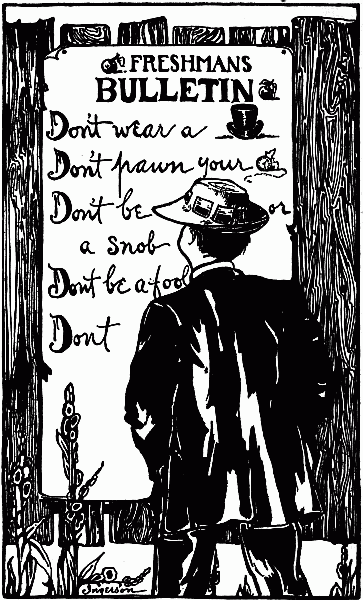
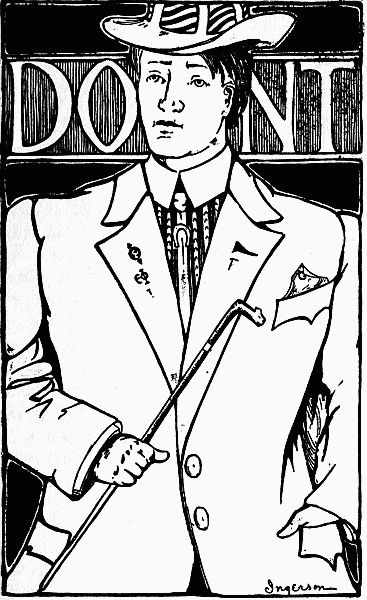
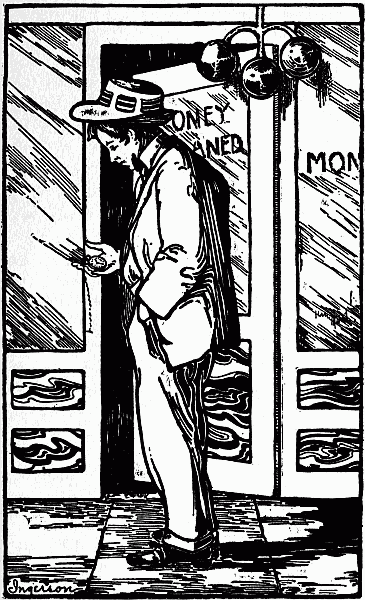 DONT PAWN YOUR WATCH DURING YOUR FIRST YEAR
ABOUT
PAWNING
YOUR
WATCH
Don't pawn your watch or
sleeve-links during your first year.
This privilege is limited to upper-classmen
who do Society. A
pawn-ticket is a very compromising
thing if found by some of
your close relatives. You don't
know what it is? It is a thin slip
of paper somewhat resembling a
check; only it weighs more heavily
on the mind. No matter how
funny a story you make at home
of pawning your Grandfather's
watch, the heads of the family
never see the joke. When you
rake in the price of exchange for
your pawned watch, it seems just
like finding money, but when you
pay it back out of a slim allowance
at the end of the month,
it seems like losing the same
amount, plus.
GETTING
HOOKED
ON
Don't buy cigars in wholesale
quantities from mysterious-looking
foreigners, who say they have
just done a neat little job of
smuggling from Havana, and are
willing to let you in on a good
thing. They may even flatter you
by telling you that you look trustworthy.
They really mean that
you look easy. It's your move.
BEGGARS
Don't give money to able-bodied
beggars. Some may even
speak good French or German.
If you happen to be taking French
or German, you will imagine that
you are the only one in the world
who can help them. But don't
yield. As for crippled or blind
and deaf beggars, help them now
and then. You don't have to
listen to their reminiscences of
Life in a Saw-mill to do this, unless
you care for that sort of thing.
QUESTIONS
OF CONSCIENCE—YOUR
OWN
BUSINESS
Don't kill your conscience in regard
to matters which you have
been brought up to see in certain
definite lights. If you think playing
cards for money and the
drinking of beer wrong, then don't
play and don't indulge. You'll
never be thought less of in College
for hanging on to principle.
Just be sure that your principles
are worth sticking up for, and then
stick. A wise old Englishman puts
it this way: "Obey your conscience;
but just be sure that your
conscience is not that of an ass."
THE 52
PASTEBOARDS
Don't get into the little game too
often. Under certain conditions
it's as easy as rolling off the
decalogue. Sometimes you get
in because you're afraid others
will think you are afraid to play.
This is really not courage. A
word more: when you're in,
often the time when you think
you can't afford to stop is just
the time when you can best afford
it. Take this advice; it is better
than that of R. E. Morse.
SPENDING
MONEY
Don't keep spending money for
a lot of things that you would
hardly care to itemize in the
account you send to Father. Remember
how he said, "I'll keep
you decently, only I don't want
College to make only a sport of
my boy." Sometimes, when you
are pressed, you think of asking
Father to lend you money to be
paid back with interest, when you
get older. Don't be surprised if he
refuses and asks, "Where's your
collateral?" Remember that the
Business World, hunting about
for something to which to attach
its respect and admiration, does
not single out the Undergraduate
in College.
EARNING
MONEY
Don't be ashamed of chances
to earn money in College, if you
need it. More fellows earn their
way through College than you
have any idea of. College men
have lots of respect for a fellow
who isn't ashamed to work.
THE DEAD
GAME ACT
Don't be a Sport or a Snob.
Either is fatal. The dead game act
plays itself out sooner than those
who work it suppose, and serves
oftener to point a weakness than
adorn a virtue.
IMITATING
Don't imitate the manner of
some one else. When you try
to be like some one else, you only
succeed in being unlike yourself.
People don't expect or want you
to be like them.
THE FANCY
INCOME
POSE
Don't pretend that you have a
fancy income, if you haven't. It's
a cheap, expensive pose. Lots
of fellows get money regularly
from home. All they have to do,
it would seem, is to rip open
letters and sign their names on
the back of what falls out. If
you aren't in this class, don't
pretend you are. It isn't how much
money you've got, but how you
make what you've got do, that
shows you up a good one.
THAT
BANK
ACCOUNT
Don't fail to keep one eye on
that bank account. It slowly and
surely dwindles. It needs watching
especially, about the time the
elms put on their new leaves,
and the undergraduates their new
flannel trousers. To end the year
with an over-drawn bank account
is risky. No fellow can afford to
have his credit go below par.
EXERCISE
Don't neglect the health habit.
Substitute the tennis racquet for
the cigarette, one of these days,
and note the difference. It may
make you feel like a King in the
pink of condition; after which
you'll probably try it again, which
won't hurt you a bit.
JOKES
Don't repeat all the jokes that
come into your head. Avoid especially
jokes that may be old.
Many a fellow's popularity may
hinge on the fact that he'll listen
to a funny story without insisting
on telling another that isn't quite
so funny.
SHOWING
OFF
Don't, if you are from a large
well-to-do Preparatory School,
talk too much about it, or think
that the College must be run on
the same plan as your school.
Your views may not be appreciated.
SWAGGERING
Don't aspire to be taken for an
upper-classman by cultivating a
walk or a swagger or an air. You
can work this so hard, that finally
you are the only one deceived.
ROWDYISM
Don't be rowdyish, or get the
reputation of being a drunken fellow.
The real fun you get out
of College need not be a continual
round of batting.
ABOUT
BEING
SNUBBED
Don't think it is always entirely
the other man's fault if he fails
to speak to you. If you have
not the ability to make an impression
worth another's remembering,
look to yourself.
COLLEGE
HABITS
Don't be a fool. This is the
sum and the substance of all
that herein precedes. A fellow
shows himself a fool or not a
fool by his habits. College habits
are funny things. The sooner
you form your College habits
the better,—or worse. To put off
the sensible resolve till the time
of your last exam may be as
useless as the call of the doctor
after the minister has left.
ABOUT
BEING THE
ASS
Don't imagine for a moment
that coming to College enables
you to act in a superior way to
others who have not enjoyed the
same privilege. A College career
is a grand, good thing; but its
object is to enable you, if possible,
better to understand the World,
not to lift you at all above it.
The World hates a fool; but a
College-bred fool, it thoroughly
despises. Don't let your ears
grow long, and don't bray.
ABOUT
BEING A
GENTLEMAN
Don't imagine that the College
Catalogue, or even this book, can
tell you all the things you need
to know concerning how to make
a man of yourself. After all, its
really up to you. Look about,
and be a gentleman. You say,
"But these few remarks hardly
begin to solve the problem."
And echo answers, "VERBUM
SAP."
HERE ENDS THE COLLEGE FRESHMAN'S DON'T
BOOK BY G. F. E. (A. B.) A SYMPATHIZER. DECORATIONS
AND INITIALS BY RAYMOND CARTER
ILLUSTRATIONS BY CHARLES FRANK INGERSON
PUBLISHED BY PAUL ELDER & COMPANY AND
PRINTED FOR THEM BY THE TOMOYE PRESS
UNDER THE DIRECTION OF J. H. NASH IN THE
CITY OF SAN FRANCISCO DURING THE MONTH
OF MAY AND YEAR NINETEEN HUNDRED & TEN
All of the illustration captions omit the apostrophe in the
word "DON'T." This was retained. All other punctuation was
corrected if wrong.
Page 9, "you" changed to "your" (your trunk is still)
Page 19, repeated word "to" deleted from text. Original
read (liable to to fall down...)
Page 29, "varities" changed to "varieties" (The varieties differ)