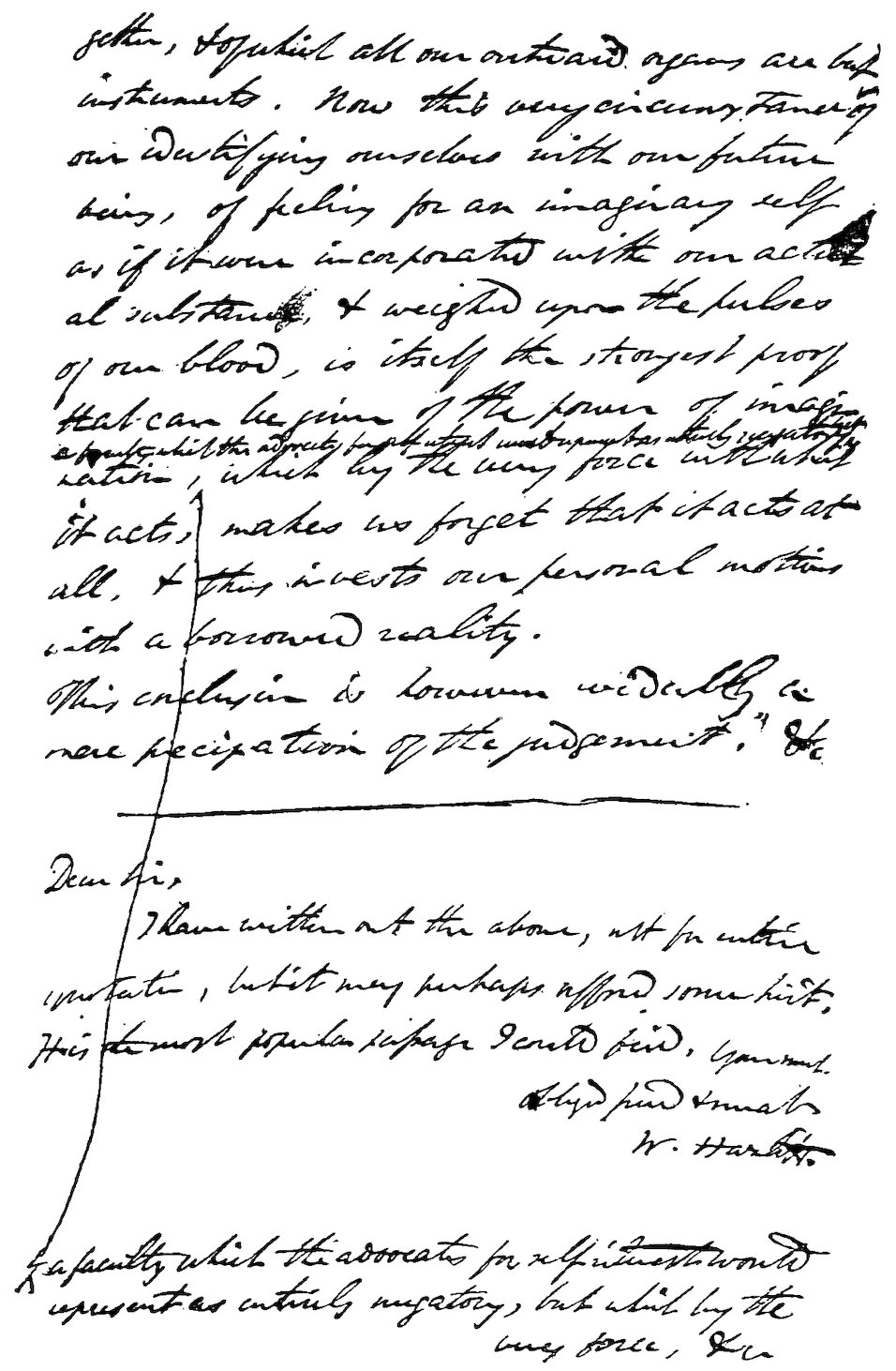
This work owes its present rank among philosophical productions, to
its embodiment of the great principle first brought forward by Hobbes.
All its author’s attempts to modify this principle or reconcile it to
common notions have been gradually exploded, and have given place
to the more severe and logical deductions of Hobbes from the same
general principle. Mr. Locke took the faculties of the mind as he
found them in himself and others, and endeavoured to account for
them on a new principle. By this compromise with candour and
common sense, he prepared the way for the introduction of the
principle, which being once established, very soon overturned all the
trite opinions and vulgar prejudices which were improperly associated
with it. There was in fact no place for them in the new system.
The great defect with which the ‘Essay on the Human Understanding’
is chargeable is, that there is not really a word about the
nature of the understanding in it, nor any attempt to show what it is
or whether it is or is not any thing, distinct from the faculty of simple
perception. The operations of thinking, comparing, discerning,
reasoning, willing, and the like, which Mr. Locke ascribes to it, are
the operations of nothing, or of I know not what. All the force of
his mind seems to have been so bent on exploding innate ideas, and
tracing our thoughts to their external source, that he either forgot or
75had not leisure to examine what the internal principle of all thought
is. He took for his basis a bad simile—that the mind is like a blank
sheet of paper, originally void of all characters whatever; for this,
though true as far as relates to innate ideas, that is, to any impressions
actually existing in it, is not true of the mind itself, which is not like
a sheet of paper, the passive receiver and retainer of the impressions
made upon it. The inference from this simile has however been that
the understanding is nothing in itself, nor the cause of any thing;
never acting, but always acted upon; that it is but a convenient
repository for the straggling images of things, a sort of empty room
into which ideas are conveyed from without through the doors of the
senses, as you would carry goods into an unfurnished lodging; and
hence it has been found necessary by succeeding writers to get rid of
those different faculties and operations which Mr. Locke elsewhere
allows to belong to the mind, but which are in truth only compatible
with the active powers and independent nature of the understanding.
I will first state Mr. Locke’s account of the origin of our ideas in his
own words, and will then endeavour to show in what that account is
defective; that is, what other act or faculty of the mind I conceive to
be necessary to the formation of our ideas, besides sensation or simple
perception. After employing eighty pages in a very laborious, and
for the most part sensible refutation of the doctrine of innate ideas,
which was popular at the time, but which Hobbes has not deigned to
notice, their impossibility being implied in the general principle that
all our ideas are derived from the senses, Mr. Locke proceeds in the
second book to treat of Ideas, and their origin. He then says:
‘Every man being conscious to himself that he thinks, and that
which his mind is applied about whilst thinking being the ideas that
are there, it is past doubt that men have in their minds several ideas,
such are those expressed by the words, whiteness, hardness, sweetness,
thinking, motion, man, elephant, army, drunkenness, and others: it is in
the first place then to be inquired how he comes by them. I know
it is a received doctrine that men have native ideas and original
characters stamped upon their minds in their very first being. This
opinion I have at large examined already: but I suppose what I
have said will be much more easily admitted when I have shewn
whence the understanding may get all the ideas it has, and by
what ways and degrees they may come into the mind, for which
I shall appeal to every one’s own observation and experience. Let us
then suppose the mind to be, as we say, white paper, void of all
characters, without any ideas: how comes it to be furnished?
Whence comes it by that vast store, which the busy and boundless
fancy of man has painted on it, in an almost endless variety?
76Whence has it all the materials of reason and knowledge? To this I
answer, in one word, from EXPERIENCE: in that all our knowledge is
founded, and from that it ultimately derives itself....
‘First, our senses, conversant about particular sensible objects, do
convey into the mind several distinct perceptions of things, according
to those various ways, wherein those objects do affect them; and thus
we come by those ideas we have of yellow, white, heat, cold, soft, hard,
bitter, sweet, and all those which we call sensible qualities, which when
I say the senses convey into the mind, I mean, they from external
objects convey into the mind what produces there those perceptions.
This great source of most of the ideas we have, depending wholly upon
our senses, and derived by them to the understanding, I call SENSATION.
‘Secondly, the other fountain from whence experience furnisheth
the understanding with ideas, is the perception of the operations of our
own mind within us, as it is employed about the ideas it has got:
which operations when the soul comes to reflect on and consider, do
furnish the understanding with another set of ideas, which could not
be had from things without: and such are perception, thinking, doubting,
believing, reasoning, knowing, willing, and all the different actings of
our own minds; which we being conscious of, and observing in ourselves,
do from these receive into our understandings as distinct ideas
as we do from bodies affecting our senses. This source of ideas
every man has wholly in himself; and though it be not sense, as
having nothing to do with external objects, yet it is very like it, and
might properly enough be called internal sense. But as I call the
other sensation, so I call this REFLECTION; the ideas it affords being
such only as the mind gets by reflecting on its own operations within
itself.... These two I say, viz. external, material things, as the
objects of sensation, and the operations of our own minds within as
the objects of REFLECTION, are to me the only originals from whence all
our ideas take their beginnings. The term operations here I use in a
large sense, as comprehending not barely the actions of the mind about
its ideas, but some sort of passions arising sometimes from them, such
as is the satisfaction or uneasiness arising from any thought.’
‘The understanding,’ proceeds Mr. Locke, ‘seems to me not to
have the least glimmering of any ideas, which it doth not receive from
one of these two. External objects furnish the mind with the ideas of
sensible qualities, which are all those different perceptions they produce
in us; and the mind furnishes the understanding with ideas of its own
operations. These, when we have taken a full survey of them, and
their several modes, combinations, and relations, we shall find to contain
all our whole stock of ideas: and that we have nothing in our minds,
which did not come in one of these two ways.’—Essay, vol. I. p. 84.
77Again, page 150, he says:
‘I pretend not to teach but to inquire, and therefore cannot but
confess here again, that external and internal sensation are the only
passages that I can find of knowledge to the understanding. These
alone, as far as I can discover, are the windows by which light is let
into this dark room. For methinks the understanding is not much
unlike a closet, wholly shut from light, with only some little opening
left, to let in external visible resemblances, or ideas of things without:
would the pictures coming into such a dark room but stay there, and
lie so orderly as to be found upon occasion, it would very much
resemble the understanding of a man in reference to all objects of
sight, and the ideas of them.’
This account of the origin of every thing that exists in the mind
differs from the simplicity of Hobbes’s system, and of the modern
philosophy, in supposing that there is another distinct source of ideas,
besides sensation, namely, reflection on the operations of our own
minds. I confess this addition appears to me to be very awkwardly
and inartificially made. For, in the first place, it is obvious to
remark that in most at least, if not all the instances enumerated by
the author, the operations themselves are the proper and immediate
sources of our ideas, not this kind of reflection on them, which seems
to be nothing but the repetition or recollection of the first conscious
impression, the perception of a perception. For example, Mr. Locke
includes among operations of our own minds ‘some sort of passions
arising from our ideas,’ i.e. as he explains it, the sense of pleasure
and pain. Now it is surely a little preposterous to make, not the
original feeling itself, but the after consideration or reflection on that
feeling, the source of our idea of pleasure or pain. In this sense,
reflection must be the source of all our ideas, whether of external
objects, or the operations of our own minds, for in the same sense
it may be argued, that the first impression of a sensible object is not
the source of the idea we have of it, till the soul comes to reflect on
and consider that original impression. But it might be said with
equal propriety, that we have one source of ideas, viz., sensation, and
another source of ideas, viz. ideas. From the view which Mr. Locke
has here taken of the subject, though the passions, or the satisfaction
and uneasiness attending certain things are ranked among the operations
of the mind, yet it is not quite clear whether we are supposed
to have any consciousness of them or not; whether they are not as
remote from any thing like perception, as the lifeless objects without
us, till coming to be afterwards reflected on and taken notice of by
the mind, they furnish the understanding with a new set of ideas.
The same reasoning may be applied to the other operations of
78perception, thinking, &c. for it seems to me that the original act of
perceiving or thinking is the source of my idea of those mental
operations, just as the first impression of any sensible object is the
source of my idea of that object. Not sensation and reflection,
therefore, but sensation and the operations of our own minds are more
properly the sources of our ideas, that is, these two furnish materials
for our reflection. I should not have dwelt so long upon this
distinction, which may be thought of little importance in itself, but
that I believe it has led to most of the errors of the ‘Essay.’ For
in consequence of separating the operations of the mind in a manner
from the mind itself, and making them exist only as objects for its contemplation,
Mr. Locke has been satisfied with considering those operations
as acting upon the mind like external things, not as emanating
from it. Thus, by a general formula, all our ideas of every kind are
represented as communicated to the mind by something foreign to
it, instead of growing out of, and being a part of its own nature and
essence.
Secondly, another objection to this division of our ideas into those
of sensation and reflection is, that it does not differ in any decisive
manner from the more simple statement of Hobbes and others, who
derive all our ideas from sensation. For by sensation these writers
do not understand merely the external image, but the perception or
feeling which accompanies it, and they contend that all our other
ideas are continuations, modifications, or different arrangements of
the original impressions, produced by objects on the senses. Now
there is nothing in the extract above given to disprove this statement:
and if so, the original hypothesis will remain in its full force. Indeed
Mr. Locke himself does not seem to have made up his mind, whether
it were so or not. For though he speaks of the mind as furnishing
the understanding with ideas, and with the materials of reason and
knowledge, and enumerates and explains the several operations of
the mind in comparing, distinguishing, &c. yet he elsewhere speaks
of ideas as existing in the understanding like pictures in a gallery, or
as if the whole process of the intellect were resolvable into the power
of receiving, retaining, carrying, and transposing the gross materials
furnished by the senses. In this case, I think the simplest way at
once is to make sensation the foundation of all our other ideas and
faculties. For my own part, the reason why I cannot assent to this
doctrine is, that I believe there is another act or faculty of the mind
implied in all our ideas, for which neither sensation nor any of its
modes can ever account, and which I shall here proceed to explain.
The principle which I shall attempt to prove is, that ideas are the
offspring of the understanding, not of the senses. By a sensation is
79meant the perception produced by the impression of the several parts
of an outward object, each by itself, on the correspondent parts of
an organised sentient being: by an idea I mean the conception produced
by a number of these together on the same conscious principle.
Besides the succession or juxtaposition of different sensible impressions,
I suppose that there is a common principle of thought, a
superintending faculty, which alone perceives the relations of things,
and enables us to comprehend their connexions, forms, and masses.
This faculty is properly the understanding, and it is by means of this
faculty that man indeed becomes a reasonable soul. What has led
more than any thing else to the exclusion of the understanding as a
distinct faculty of the mind, and to the principle of resolving the acts
of judging, reasoning, &c., into mere association, or succession of
ideas, has been the considering ideas themselves, or those particular
objects which are marked by one name, or strike at once upon the
senses, as simple things. Mr. Locke, it is true, has avoided this error
as far as relates to our ideas of substances, but he reckons among
simple ideas of the qualities of things several ideas, which are
evidently complex, such as extension, figure, motion, and number.
Hence, having laid in a certain stock of ideas without the necessity of
the understanding, it was thought an easy matter to build up the
whole structure of the human mind without it, as we build a house
with stones. The method, therefore, which I shall take to establish
the point I have in view, will be by showing that there is no one of
these simple ideas, or ideas of particular things, which are made the
foundation of all the rest, that is not itself an aggregate of many things,
or that can subsist a moment but in the understanding. I can conceive
of a being endued with the power of sensation, or simple perception,
so as to receive the direct impressions of things, and also with
memory, so as to retain them for any length of time, as they were
severally and unconnectedly presented, yet without the smallest degree
of understanding, or without ever having so much as a single thought.
The state of such a being would be that of animal life, and something
more with the addition of memory, but it would not amount to
intellect; which implies, besides actual, living impressions, the power
of perceiving their relations to one another, of comparing and contrasting
them, and of regarding the different parts of any object as
making one whole. Without this ‘discourse of reason,’ this surrounding
and forming power, we could never have the idea of a single
object, as of a table or a chair, a blade of grass, or a grain of sand.
Every one of these includes a certain configuration, hardness, colour,
&c., i.e. ideas of different things, received by different senses, which
must be put together by the understanding before they can be referred
80to any particular thing, or considered as one idea. Without this
faculty, all our ideas would be necessarily decomposed, and crumbled
down into their original elements and fluxional parts. We could
assuredly never carry on a chain of reasoning on any subject, for the
very links of which this chain must consist would be ground to
powder. There would be an infinite divisibility in the impressions of
the mind, as well as in the objects of matter. There would be a
total want of union, fellowship, and mutual intelligence between them,
for each impression must remain absolutely simple and distinct, unknown
to, and unconscious of the rest, shut up in the narrow cell of its own
individuality. No two of these atomic impressions could ever club
together to form even a sensible point, much less should we be able
to arrive at any of the larger masses, or nominal descriptions of things.
The most that sensation could possibly do for us, would be to furnish
us with the ideas of what Mr. Locke calls the simple qualities of
objects, as of colour or pressure, though not as a general notion or
diffused feeling; for it is certain that no one idea could ever contain
more than the tinge of a single ray of light, or the puncture of a single
particle of matter. Let us, however, for a moment suppose that the
several parts of objects are to be considered as individual things, or
ideal units; and then see whether, without the cementing power of
the understanding, we shall be able to conceive of them as forming a
complete whole, or any one entire object. Thus we may have a notion
of the legs and arms of a chair as so many distinct, positive things;
but without the power of perceiving them together in their several
proportions and situations, we could not have the idea of a chair as
one thing, or as a piece of furniture, intended for a particular use. It
is the mind (if I may be allowed such an expression) that makes up
the idea of the chair, and fits it together: that is in this case the
cabinet-maker, who unites the loose, disjointed parts, and makes them
one firm and well-compacted object. I might instance to the same
purpose a statue. Will any one say, that if the head and limbs and
different parts of a fine statue were to be taken asunder, broken in
pieces, and strewed about the floor, and first shown to him in that
state, he would have the same idea of the beauty, proportions, posture,
and effect of the whole, as if he had seen it in its original state?
But the idea which such a person might have of the statue in this way
would be completeness and harmony itself, compared with any idea
which could result from the sensible impression of the several parts.
For he might still in fancy piece together the broken, mutilated
fragments, prop up the limbs, set the head upon the shoulders, and
make out a crazy image of the whole; but without the understanding
reacting on the senses, and informing the eye with judgment and
81knowledge, there would be no possibility whatever of comparing the
different impressions received: no one part could have the slightest
reference to any other part or to the whole; there would be no
principle of cohesion left: we might have an infinite number of
microscopic impressions and fractions of ideas, but there being nothing
to unite them together, the most perfect grace and symmetry would
be only one mass of unmeaning, unconscious confusion. All nature,
all objects, all parts of all objects would be equally ‘without form
and void.’ The mind alone is formative, to use the expression of a
great German writer; or it is that alone which by its pervading and
elastic energy unfolds and expands our ideas, that gives order and
consistency to them, that assigns to every part its proper place, and
fixes it there, and that frames the idea of the whole. Or, in other
words, it is the understanding alone that perceives relation, but every
object is made up of relation. In short, there is no object or idea
which does not consist of a number of parts arranged in a certain
manner, but of this arrangement the parts themselves cannot be
sensible. To make each part conscious of its relation to the rest is
to suppose an infinite number of intellects instead of one; and to say
that a knowledge or perception of each part separately, without
a reference to the rest, can produce a conception of the whole; that
is, that a knowledge where no two impressions are or ever can be
compared, can include a comparison between them and many others,
is a contradiction and an absurdity.
It may be said perhaps, that not the sensation excited by any of
the parts of an object separately, but the sum of our sensations, excited
by all the parts, produces our idea of the whole. But it is not
possible that in a given number of impressions, where the mind never
has perception of more than a single part, there should be contained
notwithstanding a view of the whole at once. For as a single part
cannot of itself represent the whole object, so neither can this part by
being actually joined to others, which by the supposition are never
perceived to be joined with it, produce that idea, any more than if
those other parts had no existence. If the impression of the parts of
an object, absolutely and individually considered, were the same
thing as the idea of the object, any number of actual impressions,
arranged in any manner whatever, would necessarily be the same
object. But this is contrary to all fact. For then a curve line,
consisting of the same number of points, would not be distinguishable
from a straight one, nor a square from a triangle of the same
dimensions, and so on. In a being endued only with a power of
sensation, and supposed to be simple and undivided, there could be no
room for more than an individual impression at once. Our sensations
82must always succeed each other. One thought must have completely
passed away, before another could supply its place. Our ideas would
leave no traces of themselves, like the bubbles that rise and disappear
on the water, or the snow that melts as it falls. There would be
nothing in their fugitive, momentary existence to bind them together.
Ere we could stop to compare any one impression with any other, it
would be lost for ever in the dark abyss of time. Nothing could be
connected with any thing else, either coexisting with it, or going
before or after it. If on the other hand, we suppose any merely
sentient being to be extended and compounded, or to be capable of
receiving more than one impression at once, we shall yet gain little by
it. Such a sentient being will be nothing but a number of distinct
sentient beings. For as in the former instance, no two impressions
could co-exist together, so in the latter, though they existed together,
there could be no sort of communication between them. They would
be absolutely cut off from and exclusive of each other. The mind in
attending to any one must be wholly absorbed by it, and insensible of
the rest. Our sensations would to every rational purpose be placed
as completely out of the sphere of each other’s consciousness, as if
they were parcel of another intellect, or floated in the region of the
moon. That any number of detached, unconnected, actual sensations,
impressed on different sentient beings, would not of themselves imply
a conception of any one entire object is what every one is ready to
grant:—it would be equally clear, that this idea could not arise from
the impression of the different parts of an object on the different parts
of the same organized, extended, sentient substance, but that in this
case we involuntarily transfer our own consciousness to a being
incapable of it, and identify these distinct sensible impressions in the
same common intellect.
It is strange that Mr. Locke should rank among simple ideas that
of number, which he defines to be the idea of unity repeated. But
how this idea of successive or distinct units can ever give the idea of
repetition unless the former instances are borne in mind, I cannot
conceive. There might be a transition from one unit to another, but
no addition or aggregate formed. As well might we suppose that a
body of an inch diameter by shifting from place to place might enlarge
its dimensions to a foot or a mile, as that a succession of units, perceived
separately, should produce the complex idea of number. The
natural fool that Mr. Hobbes speaks of, may be supposed to observe
every stroke of the clock, and nod to it, or say one, one, one: but he
could never know what hour it strikes, according to Mr. Hobbes,
without the use of those names of order, one, two, three, &c. nor
according to my notion, without the help of that orderly understanding
83which first invented those names, and comprehends their
meaning. On the material hypothesis, the mind can have but one
idea at a time, and the idea of number could never enter into it.
Though Mr. Locke constantly supposes the mind to perceive
relations, and explains its operations in reasoning, comparing, &c. on
this principle, there is but one place in his work, in which he seems
to have been upon the point of discovering that this principle is at the
bottom of all our ideas whatever. He says, in the beginning of his
chapter on Power, which he classes among simple ideas, and which
in my opinion has a much more simple source than that which he
assigns to it,—‘I confess power includes in it some kind of relation (a
relation to action or change), as indeed which of our ideas, of what
kind soever, when attentively considered, does not? For our ideas
of extension, duration, and number, do they not all contain in them
a secret relation of the parts? Figure and motion have something
relative in them much more visibly: and sensible qualities, as colours
and smells, what are they but the powers of different bodies in relation
to our perception? and if considered in the things themselves, do
they not depend on the bulk, figure, texture, and motion of the parts?
All which include some kind of relation in them. Our idea therefore
of power I think may well have a place amongst other simple ideas,
and be considered as one of them, being one of those that make a
principal ingredient in our complex ideas of substances.’—Essay,
vol. i. p. 234. That is to say, in other words, the idea of power,
which is confessedly complex according to Mr. Locke, as depending
on the changes we observe produced in one thing by another, is to
pass for a simple idea, because it has as good a right to this denomination
as other complex ideas, which are usually classed as simple ones.
It is thus that the inquiring mind seems to be always hovering on the
brink of truth, but that timidity or indolence, or prejudice, which is
both combined, makes us shrink back, unwilling to trust ourselves to
the fathomless abyss.
I have thus endeavoured to give some account of what I mean by
the understanding, as the principle which is the foundation not only
of judgment, reason, choice, and deliberate action, but is included in
every idea of the mind, or conception even of sensible objects. I am
aware that what I have said may be looked upon as rhapsody and
extravagance by the strictest sect of those who are called philosophers.
The understanding has been set aside as an awkward incumbrance,
since it was conceived practicable to carry on the whole business of
thought and reason by a succession of external images and sensible
points. The fine network of the mind itself, the cords that bind and
hold our scattered perceptions together, and form the means of communication
84between them, are dissolved and vanish before the clear
light of modern metaphysics, as the gossamer is dissipated by the sun.
The adepts in this system smile at the contradictions involved in the
supposition of perceiving the relations between different things, and
say that this implies the absurdity that the mind may have two ideas
at once, which is with them impossible. Now I shall only contend
that if the mind cannot have two ideas at the same time, it can never
have any, since all the ideas we know of consist of more than one:
and though the consciousness we have of attending to different objects
at once, when we compare, judge, reason, will, &c., has been resolved
into a deception of the mind in mistaking a rapid succession of objects
for one general impression, yet it will hardly be pretended that we
deceive ourselves in thinking we have any ideas at all. Mr. Horne
Tooke, who is certainly one of the ablest commentators on the
doctrines of that school, says that it is as absurd to talk of a complex
idea as of a complex star, meaning that our ideas are as perfectly
distinct from, and have as little to do with one another, as the stars
that compose a constellation. Other writers, to avoid the seeming
contradiction of supposing the mind to divide its attention between
different objects, have suggested the instant of its passing from one to
the other as the true point of comparison between them; or that the
time when it had an idea of both together, was the time when it had
an idea of neither. As it was evident that while the mind was
entirely taken up with one idea, it could not have any knowledge of
another which did not yet exist, or had passed away, and as both
impressions cannot be supposed to co-exist in the same conscious
understanding (for on this system there is no such faculty), this
short, precious interval, this moment of leisure from both, this lucky
vacancy of thought, is pitched upon as that in which the mind performs
all its functions, and contemplates its various ideas in their
absence, as from some vantage ground the traveller stops to survey
the country on both sides of him. To such absurdities are ingenious
men driven by setting up argument against fact, and denying the most
obvious truths for which they cannot account, like the sophist who
denied the existence of motion, because he could not understand its
nature. It might be deemed a sufficient answer to those who build
systems and lay down formal propositions on the principle that the
mind can comprehend but one idea at a time, to say that they consequently
can have no meaning in what they write, since when they
begin a sentence they cannot have the least idea of what will be the
end of it, and by the time they get to the end of it must totally forget
the beginning. ‘Peace to all such!’
To show, however, that I am not quite singular in my notions on
85this subject of consciousness, and to remove, as I think, every shadow
of doubt upon it, I beg leave to refer my readers to two passages, the
one in Rousseau, and the other in Abraham Tucker, in support of the
almost obsolete prejudice which I have here endeavoured to defend.
The one is an argument to prove that judgment and sensation are not
the same, in the Vicar’s profession of faith in ‘Emilius,’ and the
other is the chapter on the independent existence of mind in the
‘Light of Nature Pursued.’
The passage in Rousseau seems evidently to have been intended as
an answer to the maxim of Helvetius that to feel is to judge, and to
his reasoning on this maxim, which is as follows:—
‘The question being reduced within these limits, I shall examine
at present whether the act of the mind in judging is any thing more
than a sensation. When I judge of the size or colour of the objects
around me, it is evident that the judgment formed of the different
impressions, which these objects make upon my senses, is properly only
a sensation: that I may say indiscriminately, either I judge, or I feel,
that of two objects, the one which I call a yard makes upon me a
different impression from another which I call a foot: that the colour
called red, produces a different effect upon the sight from that which
I call yellow; and I conclude that in this case to judge is only to feel
or perceive by the senses. But it may be said, let us suppose that any
one desires to know whether strength of body is preferable to mere
bulk; are we certain that we can decide this point by means of the
senses alone? Most undoubtedly, I reply: for in order to my coming
to a decision on the subject, my memory must first retrace to me
successively the different situations in which I may happen most frequently
to find myself in the course of my life. In this case, then,
to judge is to see that in these different situations strength will be
oftener an advantage to me than size. But it may be retorted, when
the question is to decide whether in a king justice is preferable to
mercy, is it conceivable that the conclusion here formed depends
entirely on sensation? The affirmative has undoubtedly at first sight
the air of a paradox: nevertheless, in order to establish its truth, we
will presuppose in any one a knowledge of what is meant by good
and evil, and also of the principle that one action is worse than
another, according as it is more injurious to the well-being of society.
On this supposition, what method ought the orator or poet to take, in
order to show most clearly that justice, preferable in a king to mercy,
preserves the greatest number of citizens to the state?
‘The orator will present three several pictures to the imagination
of his supposed hearer: in the first he will represent a just king, who
condemns and gives orders for the execution of a criminal; in the
86second, will be seen the good king, who opens the doors of his
dungeon, and strikes off the chains of the same criminal; in the third
picture, the criminal himself will be the principal figure, who, armed
with a poniard, on his escape from his cell hastens to assassinate fifty
of his fellow-citizens. But who is there that at the sight of these
three pictures will not instantly perceive that justice which, by the
death of a single individual, saves the lives of fifty persons, is preferable
to mercy? Nevertheless, this judgment is really nothing but a
sensation. In fact, if from the habit of connecting certain ideas with
certain words, the sound of these words may, as experience demonstrates,
excite in us almost the same sensations which we should feel
from the actual presence of the objects, it is evident that from the
contemplation of these three pictures, to judge that in a king justice
is preferable to mercy, is to feel and see that in the first picture a
single citizen is sacrificed, while in the third fifty are massacred;
whence I conclude that every act of the judgment is only a sensation.’—Helvetius
on the Mind, p. 12.
On this statement I may be permitted to remark that as the author
affirms that sensation is the same thing as judgment, so he seems to
conceive that the assertion of any proposition is the same thing as the
proof of it. He supposes three several pictures to be presented to a
man of understanding, and that from an attentive contemplation and
comparison of the different objects and events contained in them, he
comes to a judgment or conclusion, viz. That justice is preferable to
mercy. ‘Nevertheless,’ he says, ‘this judgment is really nothing but
a sensation.’ This is all the proof he brings; and perhaps, considering
the language and country in which this celebrated author
wrote, it is reasoning good enough. Do I say this with any view to
throw contempt on that lively, ingenious, gay, social, and polished
people? No; but philosophy is not their forte: they are not in
earnest in these remote speculations. In order duly to appreciate their
writings, we must consider them not as the dictates of the understanding,
but as the effects of constitution. Otherwise we shall do
them great injustice. They pursue truth, like all other things, as far
as it is agreeable; they reason for their amusement; they engage in
abstruse questions to vary the topics of conversation. Whatever does
not answer this purpose is banished out of books and society as a
morose and cynical philosophy. To obtrude the dark and difficult
parts of a question, or to enter into an elaborate investigation of them,
is considered as a piece of ill-manners. Those writers, therefore,
have been the most popular among the French who have supplied
their readers with the greatest number of dazzling conclusions founded
on the most slight and superficial evidence, whose reasonings could be
87applied to every thing, because they explained nothing, and who most
effectually kept out of sight every thing true or profound or interesting
in a question. Who would ever think of plunging into abstruse,
metaphysical inquiries concerning the nature of the understanding,
when he may with entire ease to himself and satisfaction to others
solve all the phenomena of the mind by repeating in three words,
Juger est sentir. As it was the object of the school-philosophy, by a
jargon of technical distinctions, to sharpen the eagerness of debate and
give birth to endless verbal controversies, so the modern system, transferring
philosophy from the cloistered hall to the toilette and the
drawing-room, is calculated, by a set of portable phrases, as familiar
and as current as the forms of salutation, to silence every difference
of opinion, and to produce an euthanasia of all thought. I have made
these remarks not to prejudice the question, but to prevent the prejudice
arising on the other side, from seeing the writers of a whole
nation, not deficient in natural talents or in acquired advantages, agree in
delivering the most puerile absurdities as profound and oracular truths.
The train of thought into which the author has fallen in the passage
above cited is pretty obvious. Having undertaken to prove that the
ideas of justice and mercy are mere sensations, and that the conclusion
that justice is preferable to mercy is also a mere sensation, in
order to shew the possibility of this he conjures up the ideas of a
good and a bad king, of a criminal, a prison, chains, a dagger, and
fifty citizens massacred before the eyes of the spectator, which form
the subject of three imaginary pictures, and which are in general considered
as so many sensible objects. All these sensible objects he
supposes to be implied in, and to be the materials out of which we
frame the judgment or conclusion, that justice is better than mercy;
and therefore he infers that there is nothing else implied in or necessary
to that judgment, and that consequently it is nothing but a
sensation. Having succeeded in resolving the compound and general
ideas of justice and mercy, good and evil, into a number of sensible
appearances, his imagination is entirely occupied with the novelty of
the objects before him, and he drops altogether the consideration,
whether the combination and comparison of these several objects or
sensations which is absolutely necessary to their forming the moral
ideas or inference spoken of, is not the act of some other faculty. In
short, the principle that a judgment is nothing but a sensation, is not
only a perfectly gratuitous assertion, but an assertion either without
meaning, or a palpable contradiction. For the single objects presented
in the foregoing metaphysical pictures, and which are supposed
to constitute the judgment, are not one sensation, but many. Now if
it be meant that these single objects, as they are perceived separately,
88or successively, one by one, without the intervention of any reflex act
of the mind combining and comparing them together, constitute of
themselves the judgment, ‘that justice is preferable to mercy,’ this is
to say, in so many words, that the mind forms a comparison between
things without comparing them, and judges of their relations without
perceiving them. On the other hand, if it be meant to include the
acts of the mind in comparing, judging, inferring, &c. in the term
sensation, then the proposition that judgment or sensation are the
same, will be nothing but an idle and insignificant abuse of words,
and will only prove that if to the sensation, or perception of particular
objects we add the faculty of comparing and judging, nothing farther
will be necessary for it to compare and judge. I shall therefore
dismiss this well known maxim as no better than a misnomer, as an
attempt to shorten the labour of thought by the interposition of an
unmeaning phrase, and to confound all the distinctions of the understanding
by an equivoque.
It will not be amiss in this place to transcribe a passage from the
Logic of the Abbé Condillac (a work which may be regarded as the
quintessence of slender thought, and of the art of substituting words
for things) to show how far the doctrine of the origin of all our ideas
from sensation may be carried, and what an imbecility it produces in
the mind, and deadness to any but external objects. The design of
the passage is to prove that morality is a visible thing. This however
is a work of supererogation, even on the principle supposed: for
it is not necessary to refer morality to any thing visible or audible, or
to any other of the senses, but the sense of pleasure and pain; our
feelings of this kind being allowed to come from, and make a part of
our original sensations. But this system is not an improvement on
reason, but a progression in superficiality and absurdity, a vast vacuity,
where ‘fluttering its pennons vain, the mind drops down ten thousand
fathoms deep.’
‘Moral ideas,’ says my author, ‘seem to elude the senses: they at
least elude the senses of those philosophers who deny that our knowledge
proceeds from sensation. They would gladly know of what colour virtue
is, or of what colour vice is. I answer that virtue consists in the habitual
performance of good actions, as vice consists in the habitual performance
of bad ones. Now these habits and these actions are visible.
‘What, then, is the morality of actions a thing which falls under
the cognizance of the senses! Wherefore should it not? Morality
depends solely on the conformity between our actions and the laws;
but these actions are visible, and the laws are so equally, since they
are certain conventions made by men.
‘But it will be said, if the laws are only things of convention, they
89must be altogether arbitrary. They may indeed be sometimes arbitrary;
there are but too many such laws; but those which determine
whether our actions are good or bad, are not so, nor can they be so.
They are the work of man, it is true, because they are conventions
which we have made; nevertheless, we alone have not made them:
nature made them as well as we, she dictated them to us, and it was
not in our power to make others. The wants and the faculties of
man being given, the laws which are to regulate his conduct must
necessarily follow: and though we enacted them, God who has
created us with such wants and such faculties, is in truth our sole
legislator. In obeying the laws which are conformable to our nature,
we render obedience to him who is the author of our nature; and
this is that which perfects the morality of actions.’—Page 56.
For a work entitled Logic, there are a pleasant number of contradictions
in this passage. To pass over many of them, if the laws
here spoken of are such merely in consequence of their being visible,
then all visible objects are laws, and all laws are equally moral. But
no! there are some arbitrary laws. Now if the goodness of the law
depends on their conformity to our wants and faculties, neither of
these are visible, any more than God who is said to be our only lawgiver.
So that ‘the latter end of this system of law and divinity
forgets the beginning.’ That those actions are moral which are
conformable to a moral law, and that those laws are moral, which
are agreeable to our nature and wants, may be readily admitted: but
I cannot myself think that this conformity is an object of the senses,
or that the true features of morality can ever be discerned but by the
eye of the understanding. The friends of morality, it seems, according
to our author, are not to despair, or to suppose that the distinctions
of right and wrong are banished entirely out of the material system.
They only become more clear and legible than ever; we are still
right in asserting virtue to have a real existence, namely, on paper,
and in supposing that we have some idea of it, as consisting of the
letters of the alphabet. Almost in the same manner, Mr. Horne
Tooke very gravely defines the essence of law and just, from the
etymology of these words, to consist in their being something laid
down, and something ordered (jussum); and when pressed by the
difficulty that there are many things laid down and ordered which
are neither laws nor just, he makes answer that their obligation
depends on a higher species of law and justice, to wit, a law which
is no where laid down, and a justice which is no where ordered,
except indeed by the nature of things, on which the etymology of
these two words does not seem to throw any light.
On all the other points of the modern metaphysical system, such
90as the nature of abstraction, judgment and reasoning, the materiality
of the soul, free-will, the association of ideas, &c. Mr. Locke either
halts between two opinions, or else takes the common-place side of
the question. The motion of the system, which bears his name and
which by this very delay gained all that it wanted to become popular,
was retrograde in him, not progressive. The extracts I am about to
give from his work will I think establish this point. They will at
the same time show him to be a man of strong practical sense, of
much serious thought and inquiry, and considerable freedom of
opinion, and a real lover of truth, though not so bold and systematic
a reasoner, or so great a dealer in paradoxes as some others. Moderation,
caution, a wish to examine every side of a question, and an
unwillingness to decide till after the most mature and circumspect
investigation, and then only according to the clearness of the evidence,
seem to have been the characteristics of his mind, none of which
denote the daring innovator, or maker of a system. What there is
of system in his work is Hobbes’s, as I have already shown: the
deviations from its common sense and general observation are his own.
There is throughout his reasoning the same contempt for the schoolmen,
and the same preference of native, rustic reason to learned
authority: the same notion of the necessity for reforming the system
of philosophy, and of the possibility of doing this by a more exact
use of words: there is the same dissatisfaction with the prevailing
system, but he at the same time entertained doubts of his own. What
he wanted was confidence and decision. The prolixity and ambiguity
of his style seem to have arisen from this source: for he is
never weary of examining and re-examining the same objection, and
he states his arguments with so many limitations and with such a
variety of expression to prevent misapprehension, that it is often
difficult to guess at his real meaning. There is it must be confessed a
sort of heaviness about him, a want of clearness and connection, which
in spite of all his pains, and the real plodding strength of his mind he
was never able to overcome. To return to his account of complex
ideas: the beginning of his observations on this subject is as follows:
‘We have hitherto considered those ideas, in the reception whereof
the mind is only passive, which are those simple ones received from
sensation and reflection before mentioned, whereof the mind cannot
make one to itself, nor have any idea which does not consist wholly
of them. But as the mind is wholly passive in the reception of all
its simple ideas, so it exerts several acts of its own, whereby out of
its simple ideas, as the materials and foundations of the rest, the other
are framed. The acts of the mind wherein it exerts its power over
its simple ideas, are chiefly these three.
91‘1. Combining several simple ideas into one compound one, and
thus all complex ideas are made. 2. The second is bringing two
ideas, whether simple or complex, together, and setting them by one
another, so as to take a view of them at once, without uniting them
into one; in which way it gets all its ideas of relations. 3. The
third is separating them from all other ideas that accompany them in
their real existence; this is called abstraction: and thus all its general
ideas are made. This shows man’s power to be much about the
same in the material and intellectual world: for the materials in
both being such as he has no power over, either to make or destroy,
all that man can do is either to unite them together, or to set them
by one another, or wholly to separate them.’—Vol. i. p. 151.
The first great point which Mr. Locke labours to prove in his
Essay, is that there are no innate ideas, which he seems to have
established very fully and clearly, if indeed so obvious a truth required
any formal demonstration. His chief proofs are from the case of a
man born blind, who has no idea of colours, and from the ignorance
which children and idiots have of those first principles and universal
maxims, which some philosophers and theologians, confounding the
faculties of the mind with actual impressions, had supposed to be
legibly engraven on the mind by the hand of its author. For the
supposing the understanding to be a distinct faculty of the mind no
more proves our ideas to be innate, than the allowing perception to
be a distinct original faculty of the mind, which everybody does,
proves that there must be innate sensations. These two positions
have, however, been sometimes considered as convertible by the
partisans on both sides of the question; the one arguing from the
existence of the soul and the power of thought to the positive perception
of certain truths, and the others concluding that by denying any
original inherent impressions, they had overturned the supposition of
the different faculties and powers which must be in the mind, to
account for the first production or subsequent modification of sensation
or of thought. For instance, it has been made a consequence
of the doctrine that there were no innate ideas, that there could be
no such thing as genius, or an original difference of capacity; as
if the capacity were not perfectly distinct from the actual impressions
by the very theory itself, and as if there might not be a difference in
the capacity of acquiring ideas as all experience shows, though none
in the knowledge acquired, because this capacity had never yet been
exerted. As well might we argue that of two houses that are just
built one is as commodious and capacious as the other, as well fitted
for the reception of guests and the disposal of furniture, because at
present neither of them is furnished or inhabited.
92The following passages will show the manner in which our author
treats this part of his subject:
‘The child certainly knows that the nurse that feeds it is neither
the cat it plays with, nor the blackamoor it is afraid of: that the
wormseed or mustard it refuses is not the apple or sugar it cries for;
this it is certainly and undoubtedly assured of: but will any one say
it is by virtue of this principle, That it is impossible for the same thing
to be and not to be, that it so firmly assents to these and other parts
of its knowledge? Or that the child has any notion or apprehension
of that proposition at an age, wherein yet, it is plain, it knows a
great many other truths? He that will say, children join these several
abstract speculations with their sucking bottles and their rattles, may
perhaps with justice be thought to have more passion and zeal for his
opinion, but less sincerity and truth than one of that age. Though
therefore there be several general propositions that meet with constant
and ready assent as soon as proposed to men grown up, who have
attained the use of more general and abstract ideas, and names
standing for them, yet they not being to be found in those of tender
years, who nevertheless know other things, they cannot pretend to
universal assent of intelligent persons, and so by no means can be
supposed innate: it being impossible, that any truth which is innate
(if there were any such) should be unknown, at least to any one who
knows any thing else. Since if they are innate truths, they must be
innate thoughts; there being nothing a truth in the mind which it
has never thought on.
‘That the general maxims we are discoursing of, are not known to
children, idiots, and a great part of mankind, we have already sufficiently
proved. But there is this farther argument against their
being innate, that these characters, if they were native and original
impressions, should appear fairest and clearest in those persons in
whom yet we find no footsteps of them. And it is in my opinion a
strong presumption that they are not innate, since they are least
known to those in whom if they were innate, they must need exert
themselves with most force and vigour. For children, idiots,
savages, and illiterate people being of all others the least corrupted
by custom or borrowed opinion, learning or education having not
cast their native thoughts into new moulds, nor by superinducing
foreign and studied doctrines, confounded those fair characters nature
had written there; one might reasonably imagine that in their minds
these innate notions should lie open fairly to every one’s view, as it is
certain the thoughts of children do. One would think according to
these men’s principles that all these native beams of light (were there
any such) should in those who have no reserves, no acts of concealment,
93shine out in their full lustre, and leave us in no more doubt
of their being there than we are of their love of pleasure and abhorrence
of pain. But alas, amongst children, idiots, savages, and the
grossly illiterate, what general maxims are to be found? What universal
principle of knowledge? Their notions are few and narrow,
borrowed only from those objects they have had most to do with, and
which have made upon their senses the frequentest and strongest impressions.
A child knows his nurse and his cradle, and by degrees
the playthings of a little more advanced age; and a young savage has
perhaps his head filled with love and hunting, according to the fashion
of his tribe. But he that from a child untaught, or a wild inhabitant
of the woods will expect these abstract maxims and reputed principles
of science, will I fear find himself mistaken. Such kind of general
propositions [as that which is, is; and that it is impossible for the
same thing to be and not to be] are seldom mentioned in the huts of
Indians, much less are they to be found in the thoughts of children,
or any impressions of them on the minds of naturals. They are the
language and business of the schools and academies of learned nations,
accustomed to that sort of conversation or learning, where disputes are
frequent: these maxims being suited to artificial argumentation, and
useful for conviction, but not much conducing to the discovery of
truth, or advancement of knowledge.’
I do not know that Mr. Locke has sufficiently distinguished
between two things which I cannot very well express otherwise than by
a turn of words, namely, an innate knowledge of principles, and innate
principles of knowledge. His arguments seem to me conclusive against
the one, but not against the other, for I think that there are certain
general principles or forms of thinking, something like the moulds in
which any thing is cast, according to which our ideas follow one
another in a certain order, though the knowledge, i.e., perception of
what these principles are, and the forming them into distinct propositions
is the result of experience. It is true, the child distinguishes
between its nurse and the blackamoor, between bitter and sweet:
what hinders it from confounding them? The ideas of same and
different are not included in these ideas themselves, nor are they
peculiar to any of them, but general terms. What then determines
the child to annex them uniformly to certain things and not to others?
It is plain then, that our ideas are not at liberty to run into clusters as
they please or as it happens, but are regulated by certain laws, to
which they must conform; or that the manner in which we conceive
of things does not depend simply on the particular nature of the
things, but on the general nature of the understanding. Mr. Locke
is clear for certain innate practical principles or general tendencies
94regulating all our actions, namely, the love of pleasure, and aversion to
pain. He does not however admit, as I can find, of any thing
similar to the operations of the understanding. The analogy, notwithstanding,
holds exactly the same in both cases. For the child is no
more conscious of any such general practical principle regulating all his
desires, than of any speculative principle regulating his notion of
things: he gets the idea of both from experience of their effects; but
I think that if there were no such principles in the mind itself, previous
to the actual impression of objects, and merely developed or
called into action by them, we must be perfectly indifferent both to the
reception of pleasure and pain, as we should feel no more repugnance
to admit one conclusion than another, however absurd or contradictory.
The necessity we are under of perceiving certain agreements or disagreements
between our ideas is as much, and in the same sense, the
foundation of judgment and reasoning, as the general desire of
happiness and aversion to misery is the foundation of morality.
This property of the understanding, by which certain judgments,
naturally follow certain perceptions, and are followed by other judgments,
is the faculty of reason, of order and proportion in the mind, and
is indeed nothing but the understanding acting by rule or necessity.
The long controversy between Locke and Leibnitz with respect to
innate ideas turned upon the distinction here stated, innate ideas being
thus referred not to the actual impressions of objects, but to the forms
or moulds existing in the mind, and in which those impressions are
cast. Leibnitz contended that there was a germ or principle of truth,
a pre-established harmony between its innate faculties and its acquired
ideas, implied in the essence of the mind itself. According to the
one it was like a piece of free stone, which the mason hews with
equal ease in all directions, and into any shape, as circumstances
require: according to the other, it resembles a piece of marble strongly
ingrained, with the figure of a man, or other animal, inclosed in it,
and which the sculptor has only to separate from the surrounding
mass.
I will add one more passage to draw the attention of my readers to
this intricate subject, and to show that the difficulties surrounding it
were not completely cleared up or even apprehended by the author of
the ‘Essay.’
‘Hath a child,’ he says, ‘an idea of impossibility and identity,
before it has of white or black, sweet or sour? Or is it from the
knowledge of this principle that it concludes that wormwood rubbed
on the nipple hath not the same taste that it used to receive from
thence? Is it the actual knowledge of Impossibile est idem esse et non
esse that makes a child distinguish between its mother and a stranger,
95or that makes it fond of the one, and fly the other? Or does the
mind regulate itself and its assent by ideas that it never had? Or
the understanding draw conclusions from principles which it never
yet knew or understood? The names impossibility and identity stand
for two ideas, so far from being innate, or born with us, that I think
it requires great care and attention to form them right in our understandings.
They are so far from being brought into the world with us,
so remote from the thoughts of infancy and childhood, that I believe
upon examination it will be found that many grown men want them.
‘If identity (to instance in that alone) be a native impression, and
consequently so clear and obvious to us that we must needs know it
even from our cradles; I would gladly be resolved by one of seven or
seventy years old, Whether a man, being a creature consisting of soul
and body, be the same man when his body is changed? Whether
Euphorbus and Pythagoras, having had the same soul, were the same
man, though they lived several ages asunder? Nay, whether the
cock too, which had the same soul, were not the same with both of
them? Whereby perhaps it will appear that our idea of sameness is
not so settled and clear as to deserve to be thought innate in us. For
if those innate ideas are not so clear and distinct as to be universally
known and naturally agreed on, they cannot be subjects of universal and
undoubted truths, but will be the unavoidable occasion of perpetual uncertainty.
For I suppose every one’s idea of identity will not be the
same that Pythagoras and thousand others of his followers have: and
which then shall be true, which innate? Or are these two different
ideas of identity both innate?’—Page 60.
Two things are obvious to remark on this passage. First, it seems
clear that the child, before it can pronounce that one thing is or is not
the same as another, must have the idea of what same is, i.e. of identity:
or it would be impossible for it to know what is or is not the same.
This idea, then, is necessarily included in or the result of the first
comparison it is able to make between any two of its impressions as
alike or unlike. Secondly, the difficulty of determining the question
proposed by Mr. Locke does not arise from the meaning of the word
identity, but of the word man. For if this is once clear and settled,
there will be no great effort of the understanding required to determine
whether a man is the same or not. They define him to be a creature
consisting of body and soul, and it is plain that if one of these, the
body, is altered, the man is not the same. The whole question,
therefore, here seems to turn on deciding what qualities are essential
to the idea of man, so that by keeping or leaving out some, he will or
will not retain his identity, in the practical and moral sense of the
term. It is the complex and general idea of man that the child
96wants, not that of identity or sameness which is reflected to it from
every object it meets, and which it perceives to agree or disagree
with some other.
In a note to one of the chapters on Innate Ideas, there is some
account of the controversy between our author and the Bishop of
Worcester (Stillingfleet) on the question whether the idea of a God
be innate and universal. The Bishop is anxious to have the universal
belief in a Deity understood in a strict sense, while Mr. Locke thinks
it must be reduced to a very great and decided majority, there being
instances of whole nations without this idea. ‘This,’ he says ‘is all
the universal consent which truth of matter-of-fact will allow; and
therefore all that can be made use of to prove a God. I would crave
leave to ask your lordship, were there ever in the world any atheists
or no? For if any one deny a God, such a perfect universality of
consent is destroyed, and if nobody does deny a God, what need of
arguments to convince atheists?’—Page 63. This is the acutest turn
he has any where given to an argument.
The concluding passage of his account of innate ideas is worth
quoting. It is a good description of the true spirit of philosophy, inclining
a little too much to self-opinion, from which, perhaps, it is not
easily separable:
‘What censure doubting thus of innate principles may deserve from
men who will be apt to call it pulling up the old foundations of knowledge
and certainty, I cannot tell; I persuade myself at least that the
way I have pursued, being conformable to truth, lays those foundations
surer. This I am certain, I have not made it my business to quit
or follow any authority in the ensuing discourse; truth has been my
only aim; and wherever that has appeared to lead, my thoughts have
impartially followed without minding whether the footsteps of any
other lay that way or no. Not that I want a due respect to other
men’s opinions; but after all the greatest reverence is due to truth; and
I hope it will not be thought arrogance to say, that perhaps we should
make greater progress in the discovery of rational and contemplative
knowledge, if we sought it in the fountain, in the consideration of things
themselves, and made use rather of our own thoughts than other men’s
to find it. For I think we may as rationally hope to see with other
men’s eyes, as to know by other men’s understandings. So much as we
ourselves consider and comprehend of truth and reason, so much we
possess of real and true knowledge. The floating of other men’s
opinions in our brains makes us not one jot the more knowing, though
they happen to be true. What in them was science, is in us but
opiniatrety, whilst we give up our assent only to reverend names, and
do not, as they did, employ our own reason to understand those truths
97which gave them reputation. Aristotle was certainly a knowing
man; but nobody ever thought him so, because he blindly embraced
and confidently vented the opinions of another. And if the taking
up of another’s principles, without examining them, made not him a
philosopher, I suppose it will hardly make any body else so. In the
sciences, every one has so much as he really knows and comprehends:
what he believes only and takes upon trust, are but shreds, which
however well in the whole piece, make no considerable addition to his
stock who gathers them. Such borrowed wealth, like fairy money,
though it were gold in the hand from which he received it, will be
but leaves and dust when it comes to use.’—Page 80.
In treating of the origin of our ideas, Mr. Locke labours to prove
that men think not always:—thinking, according to him, being to the
soul what motion is to the body; not its essence, but one of its
operations. In this opinion he may, as far as I know, be right: but
I think his proof of it drawn from the effects of sleep fails. The
reason why I think so is that I was never awakened suddenly but I
found myself dreaming, though in the interval required to awake
gradually from sleep we frequently forget our dreams before we are
quite awake, the impressions which objects have time to make upon
our bodies taking place of and obliterating the faint traces of our
sleeping thoughts. The common notion that the mind is then most
awake when the body is asleep, deserves the contempt with which Mr.
Locke treats it. It is one of the absurdities of common sense, which is
not entirely free from them any more than philosophy. Those who can
find any argument in favour of the immaterial nature and independent
powers of the soul in the sublime flights which it takes when emancipated
from the intrusion of sensible objects must have finer dreams than I have.
It would be well for this opinion if we could regularly forget the next
morning the smart repartees, magnificent sentiments and profound
remarks we so often dream we make. The singular significance which
in sleep we attach to absolute nonsense seems to arise from the very
impotence of our efforts, as we fancy that we can fly because we cannot
move at all. In sleep, indeed, the forms of imagination assume the appearance
of reality, but this advantage they seem to owe chiefly to what
Hobbes calls the silence of sense. That sleep, however, consists wholly
in this silence of sense (not affecting the mind itself) is so far from being
true, that it is not even necessary to it. Persons who walk in their
sleep, as I know from experience, get out of bed with their eyes open,
see and feel the objects about them, open the window, and leisurely
survey the opposite trees and houses, long before they recollect where
they are, or before the fresh air and the regular succession of known
objects dispel the drowsy phantoms of the night. The only essential
98difference between our sleeping and waking thoughts I believe is, that
in sleep the comprehensive faculty flags and droops; so that being
unable to consider many things at once or to retain a succession of ideas
in mind, we confound things together, and pass from one object to
another without order or connexion, any single circumstance in which
they agree being sufficient to make us associate them together or substitute
one for the other. Our thoughts are, as it were, disentangled
from the circumstances and consequences which at other times clog
their motions: they are let loose, and left at liberty to wander in any
direction that chance presents. The greatest singularity observable
in dreams is the faculty of holding a dialogue with ourselves, as if we
were really and effectually two persons. We make a remark, and
then expect the answer, which we are to give ourselves, with the
same gravity of attention, and hear it with the same surprise as if it
were really spoken by another person. We are played upon by
puppets of our own moving. We are staggered in an argument by an
unforeseen objection, or alarmed at a sudden piece of information of
which we have no apprehension till it seems to proceed from the
mouth of some one with whom we fancy ourselves conversing. We
have in fact no idea of what the question will be that we put to ourselves,
till the moment of its birth.
Mr. Locke in treating of our sensations as effects of the impressions
of the qualities of things, distinguishes these qualities according to the
usual opinion into primary and secondary. The former he considers
as really and in themselves the same as they appear to our senses: the
other as merely the effects produced by certain objects on the mind
and not existing out of it. As this question forms one of the common-places
of metaphysical inquiry, I shall give some account of it in his
own words.
‘The qualities that are in bodies, rightly considered, are of three
sorts.
‘First, The bulk, figure, number, situation, and motion or rest of
their solid parts; these are in them whether we perceive them or no;
and we have by these an idea of the thing as it is in itself: these I
call primary qualities.
‘Secondly, The power that is in any body by reason of its insensible
primary qualities to operate after a peculiar manner on any of
our senses, and thereby produce in us the different ideas of several
colours, sounds, smells, tastes, &c. These are usually called sensible
qualities.
‘Thirdly, The power that is in any body, by reason of the particular
constitution of its primary qualities, to make such a change in
the bulk, figure, texture, and motion of another body, as to make it
99operate on our senses differently from what it did before. Thus the
sun has a power to make wax white, and fire to make lead fluid.
These are usually called powers.
‘The first of these, as has been said, I think, may be properly called,
real, original, or primary qualities, because they are in the things
themselves, whether they are perceived or no: and upon their different
modifications it is that the secondary qualities depend. The other
two are only powers to act differently upon other things, which powers
result from the different modifications of those primary qualities.
‘But though these two latter sorts of qualities are powers barely,
and nothing but powers, relating to several other bodies, and resulting
from the different modifications of the original qualities, yet they are
generally thought otherwise of. For the second sort, viz., the
powers to produce several ideas in us by our senses, are looked upon
as real qualities in the things thus affecting us: but the third sort are
called and esteemed barely powers. For example, the ideas of heat
or light, which we receive by our eye or touch from the sun are commonly
thought real qualities, existing in the sun, and something more
than mere powers in it. But when we consider the sun in reference
to wax which it melts or blanches, we look on the whiteness and
softness produced in the wax, not as qualities in the sun, but effects
produced by powers in it: whereas, if rightly considered, these
qualities of light and warmth, which are perceptions in me when I am
warmed or enlightened by the sun, are no otherwise in the sun than
the changes made in the wax, when it is blanched or melted, are in
the sun. They are all of them equally powers in the sun, depending
on its primary qualities: whereby it is enabled in the one case so to
alter the bulk, figure, texture, or motion of some of the insensible
parts of my eyes or hands, as thereby to produce in me the idea of
light or heat; and in the other, it is able so to alter the bulk, figure,
texture, or motion of the insensible parts of the wax, as to make them
fit to produce in me the distinct ideas of white and fluid. The
reason why the one are ordinarily taken for real qualities, and the
other only for bare powers, seems to be, because the ideas we have of
distinct colours, sounds, &c., containing nothing at all in them of bulk,
figure, or motion, we are not apt to think them the effects of those
primary qualities which appear not to our senses to operate in their
production, and with which they have not any apparent congruity or
conceivable connexion. Hence it is that we are so forward to
imagine that those ideas are the resemblances of something really
existing in the objects themselves. But in the other case, in the
operation of bodies, changing the qualities, one of another, we plainly
discover that the quality produced hath commonly no resemblance
100with any thing in the thing producing it; wherefore we look on it as
a bare effect of power. For though receiving the idea of heat or
light from the sun, we are apt to think it is a perception and resemblance
of such a quality in the sun, yet when we see wax or a fair
face receive change of colour from the sun, we cannot imagine that to
be the perception or resemblance of any thing in the sun, because we
find not those different colours in the sun itself. For our senses being
able to observe a likeness or unlikeness of sensible qualities in two
different external objects, we forwardly enough conclude the production
of any sensible quality in any subject to be an effect of bare
power, and not the communication of any quality, which was really in
the efficient, when we find no such sensible quality in the thing that
produced it. But ourselves not being able to discover any unlikeness
between the idea produced in us and the quality of the object producing
it, we are apt to imagine that our ideas are resemblances of some
thing in the objects, and not the effects of certain powers placed in the
modification of their primary qualities, with which primary qualities
the ideas produced in us have no resemblance.’ Vol. i. page 127.
From the secondary qualities later writers, as Hume and Berkeley,
have proceeded to the primary ones, and have endeavoured to shew
that they have not a real existence out of the mind, any more than
the others. Hume says, ‘The fundamental principle of the modern
philosophy is the opinion concerning colours, sounds, tastes, smells,
heat and cold,’ &c.; and Bishop Berkeley has made use of the same
principle to banish the least particle of matter out of the universe.
What Hume has said is merely taken from Berkeley, from whom
his opinions are generally borrowed. As I do not know that I shall
have a better opportunity, I will here state Berkeley’s arguments
against the existence of these primary qualities, or his ideal system, in
his own words. I will only first observe, on the argument against
the existence of the secondary qualities of things, from their different
effects in different circumstances and on different persons, which Hume
considers as the only solid one, but which Berkeley thinks more
doubtful, seems to me no argument at all; for that an object changes
its colour, or food its taste, is in consequence of distance or of the
interposition of another object, or of the indisposition of the organ, and
does not prove that the object has not a particular colour, or the food
a particular taste, but that colour is combined with and altered by the
colour of the air, and that taste is combined with and altered by another
taste in the mouth or stomach. The logical inference is merely that
one object has not the same sensible qualities as another, or, as Berkeley
has remarked, that we do not know what the true or natural qualities
of any object are.
101‘It is evident,’ says Bishop Berkeley, ‘to any one who takes a
survey of the objects of Human Knowledge, that they are either ideas
actually imprinted on the senses, or else such as are perceived by
attending to the passions and operations of the mind, or, lastly, ideas
formed by help of memory and imagination; either compounding,
dividing, or barely representing those originally perceived in the
aforesaid ways. By sight I have the ideas of light and colours, with
their several degrees and variations. By touch I perceive hard and
soft, heat and cold, motion and resistance, &c. and of all these more
and less, either as to quantity or degree. Smelling furnishes me with
odours: the palate with tastes; and hearing conveys sounds to the
mind in all their variety of tone and composition. And as several of
these are observed to accompany each other, they come to be marked
by one name, and so to be reputed as one thing. Thus, for example,
a certain colour, taste, smell, figure, and consistence, having been
observed to go together, are accounted one distinct thing, signified by
the name apple. Other collections of ideas constitute a stone, a tree,
a book, and the like sensible things; which, as they are pleasing or
disagreeable, excite the passions of love, hatred, joy, grief, &c.
‘2. But besides all that endless variety of ideas or objects of
knowledge, there is likewise something which knows and perceives
them, and exercises divers operations, as willing, imagining, remembering,
&c. about them. This perceiving, active being is what I call
mind, spirit, soul, or myself. By which words I do not denote any
one of my ideas, but a thing entirely distinct from them, wherein they
exist, or, which is the same thing, whereby they are perceived, for
the existence of an idea consists in being perceived.
‘3. That neither our thoughts, nor passions, nor ideas formed by
the imagination, exist without the mind, is what every body will
allow; and to me it is no less evident that the various sensations or
ideas imprinted on the sense, however blended or combined together,
(that is, whatever objects they compose,) cannot exist otherwise than
in a mind perceiving them. I think an intuitive knowledge may be
obtained of this, by any one that shall attend to what is meant by the
term exist, when applied to sensible things. The table I write on, I
say, exists; i.e. I see and feel it, and if I were out of my study, I
should say it existed, meaning thereby, that if I was in my study
I might perceive it, or that some other spirit actually does perceive it.
There was an odour, i.e. it was smelt; there was a sound, i.e. it was
heard; a colour or figure, and it was perceived by sight or touch.
This is all that I can understand by these and the like expressions.
For as to what is said of the absolute existence of unthinking things
without any relation to their being perceived, that is to me perfectly
102unintelligible. Their esse is percipi, nor is it possible they should have
any existence, out of the minds or thinking things which perceive
them.
‘4. It is indeed an opinion strangely prevailing among men, that
houses, mountains, rivers, and in a word all sensible objects, have
an existence natural or real, distinct from their being perceived by the
understanding. But with how great an assurance and acquiescence
soever this principle may be entertained in the world, yet whoever
shall find in his heart to call it in question, may, if I mistake not,
perceive it to involve a manifest contradiction. For what are the
forementioned objects but the things we perceive by sense, and what,
I pray you, do we perceive besides our own ideas or sensations? And
is it not plainly repugnant that any one of these, or any combination
of them, should exist unperceived?
‘5. If we thoroughly examine this tenet, it will, perhaps, be found
at bottom to depend on the doctrine of abstract ideas. For can there
be a nicer strain of abstraction than to distinguish the existence of
sensible objects from their being perceived, so as to conceive them
existing unperceived? Light and colours, heat and cold, extension
and figures, in a word, the things we see and feel, what are they but
so many sensations, notions, ideas, or impressions on the sense; and
is it possible to separate, even in thought, any of these from perception?
For my part, I might as easily divide a thing from itself. I may,
indeed, divide in my thoughts, or conceive apart from each other,
those things which, perhaps, I never perceived by sense so divided.
Thus I imagine the trunk of a human body without the limbs, or conceive
the smell of a rose without thinking on the rose itself. So far
I will not deny I can abstract, if that may be properly called abstraction
which extends only to the conceiving separately such objects as
it is possible may really exist or be actually perceived asunder. But
my conceiving or imagining power does not extend beyond the
possibility of real existence or perception. Hence, as it is impossible
for me to see or feel any thing without an actual sensation of that
thing, so it is impossible for me to conceive in my thoughts any
sensible thing or object distinct from the sensation or perception of it.
In truth, the object and the sensation are the same thing, and cannot
therefore be extracted from each other.
‘6. Some truths there are so near and obvious to the mind that a
man need only open his eyes to see them. Such I take this important
one to be, viz. that all the choir of heaven, and furniture of the earth,
in a word, all those bodies which compose the mighty frame of the
world, have not any subsistence without a mind, that their esse is to
be perceived or known; that consequently, so long as they are not
103actually perceived by me, or do not exist in my mind or that of any
other created spirit, they must either have no existence at all, or else
subsist in the mind of some eternal spirit: it being perfectly unintelligible,
and involving all the absurdity of abstraction, to attribute to
any single part of them an existence independent of a spirit. To
make this appear with all the light and evidence of an axiom, it seems
sufficient if I can but awaken the reflection of the reader, that he may
take an impartial view of his own meaning, and turn his thoughts upon
the subject itself, free and disengaged from all embarrass of words and
prepossession in favour of received mistakes.
‘7. From what has been said, it is evident there is not any other
substance than spirit, or that which perceives. But for the fuller
demonstration of this point, let it be considered, the sensible qualities
are colour, figure, motion, smell, taste, &c.; i.e. the ideas perceived
by sense. Now, for an idea to exist in an unperceiving thing is a
manifest contradiction; for to have an idea is all one as to perceive;
that, therefore, wherein colour, figure, &c. exist must perceive them.
Hence it is clear there can be no unthinking substance or substratum
of those ideas.
‘8. But, say you, though the ideas themselves do not exist without
the mind, yet there may be things like them whereof they are copies
or resemblances, which things exist without the mind, in an unthinking
substance. I answer, an idea can be like nothing but an idea, a
colour or figure, can be like nothing but another colour or figure. If
we look but never so little into our thoughts, we shall find it impossible
for us to conceive a likeness except only between our ideas. Again,
I ask whether those supposed originals, or external things, of which our
ideas are the pictures or representations, be themselves perceivable or
no? If they are, then they are ideas, and we have gained our point;
but if you say they are not, I appeal to any one whether it be sense
to assert a colour is like something which is invisible: hard or soft,
like something which is intangible, and so of the rest.
‘9. Some there are who make a distinction between primary and
secondary qualities; by the former, they mean extension, figure,
motion, rest, solidity or impenetrability, and number; by the latter,
they denote all other sensible qualities, as colours, sounds, tastes, &c.
The ideas we have of these they acknowledge not to be the resemblances
of any thing existing without the mind, or unperceived, but
they will have our ideas of the primary qualities to be patterns or
images of things which exist without the mind, in an unthinking
substance, which they call matter. By matter, therefore, we are to
understand an inert, useless substance, in which extension, figure,
motion, &c. do actually subsist. But it is evident from what we have
104already shewn, that extension, figure, and motion are only ideas
existing in the mind, and that consequently neither they nor their
archetypes can exist in an unperceiving substance. Hence it is plain
that the very notion of what is called matter or corporeal substance
involves a contradiction in it, insomuch that I should not think it
necessary to spend more time in exposing its absurdity; but because
the tenet of the existence of matter seems to have taken so deep a
root in the minds of philosophers, and draws after it so many ill consequences,
I choose rather to be thought prolix and tedious, than
omit any thing that might conduce to the full discovery and extirpation
of that prejudice.
‘10. They who assert that figure, motion, and the rest of the
primary or original qualities do exist without the mind, in unthinking
substances, do at the same time acknowledge that colours, sounds,
heat, cold, &c. do not, which they tell us are sensations existing in
the mind alone, that depend on, and are occasioned by the different
size, texture, motion, &c. of the minute particles of matter. This
they take for an undoubted truth, which they can demonstrate beyond
all exception. Now if it be certain that those original qualities are
inseparably united with the other sensible qualities, and not, even in
thought, capable of being abstracted from them, it plainly follows
that they exist only in the mind. But I desire any one to reflect and
try whether he can, by any abstraction of thought, conceive the
extension and motion of a body, without all other sensible qualities.
For my own part, I see evidently that it is not in my power to form
an idea of a body extended and moving, but I must withal give it
some colour or other sensible quality, which is acknowledged to exist
only in the mind. In short, extension, figure, and motion, abstracted
from all other qualities, are inconceivable. Where, therefore, the
other sensible qualities are, there must these be also, i.e. in the mind,
and no where else.
‘11. Again, great and small, swift and slow, are allowed to exist
nowhere without the mind, being entirely relative, and changing as
the frame or position of the organs of sense varies. The extension,
therefore, which exists without the mind, is neither great nor small,
the motion neither swift nor slow; that is, they are nothing at all.
But, say you, they are extension in general and motion in general. Thus
we see how much the tenet of extended, moveable substances, existing
without the mind, depends on that strange doctrine of abstract ideas.
And here I cannot but remark, how nearly the vague and indeterminate
description of matter, or corporeal substance, which the modern philosophers
are run into by their own principles, resembles that antiquated
and so much ridiculed notion of materia prima, to be met with in Aristotle
105and his followers. Without extension, solidity cannot be conceived;
since, therefore, it has been shown that extension exists not in an
unthinking substance, the same must also be true of solidity.
‘12. That number is entirely the creature of the mind, even
though the other qualities be allowed to exist without it, will be
evident to whoever considers that the same thing bears a different
denomination of number, as the mind views it with different aspects.
Thus the same extension is one, or three, or thirty-six, according
as the mind considers it with reference to a yard, a foot, or an inch.
Number is so visibly relative, and dependent on men’s understandings,
that it is strange to think how any one should give it an absolute
existence without the mind. We say one book, one page, one line,
&c., all these are equally units, though some contain several of the
others; and in each instance it is plain the unit relates to some
particular combination of ideas arbitrarily put together by the mind.
‘13. Unity, I know, some will have to be a simple or uncompounded
idea, accompanying all other ideas into the mind. That I
have any such idea answering the word unity I do not find, and if I
had, methinks I could not miss finding it; on the contrary, it should
be the most familiar to my understanding, since it is said to accompany
all other ideas, and to be perceived by all the ways of sensation
and reflection.[6] To say no more, it is an abstract idea.
‘14. I shall farther add, that after the same manner as modern
philosophers prove colours, tastes, &c., to have no existence in
matter, or without the mind, the same thing may be likewise proved
of all other sensible qualities whatever. Thus for instance, it is
said, that heat and cold are affections only of the mind, and not
at all patterns of real beings existing in the corporeal substances
which excite them, for that the same body which appears cold to
one hand, seems warm to another. Now, why may we not as well
argue, that figure and extension are not patterns or resemblances of
qualities existing in matter, because to the same eye at different
stations, or eyes of a different texture at the same station, they
appear various, and cannot therefore be the images of any thing
settled and determinate without the mind? Again, ’tis proved that
106sweetness is not really in the sapid thing, because the thing remaining
unaltered, the sweetness is changed into bitter, as in case of a fever,
or otherwise vitiated palate. Is it not as reasonable to say, that
motion is not without the mind, since if the succession of ideas in the
mind become swifter, the motion, it is acknowledged, shall appear
slower without any external alteration.
‘15. In short, let any one consider those arguments which are
thought manifestly to prove that colours, tastes, &c. exist only
in the mind, and he will find they may with equal force be brought
to prove the same thing of extension, figure, and motion. Though
it must be confessed this method of arguing does not so much prove
that there is no extension, colour, &c. in an outward object, as that
we do not know by sense which is the true extension or colour of
the object. But the foregoing arguments plainly show it to be
impossible that any colour or extension at all, or other sensible
quality whatsoever, should exist in an unthinking subject without the
mind, or in truth, that there should be any such thing as an outward
object.’—Principles of Human Knowledge, pp. 54, &c.
Again, he says, page 58:—
‘But though it were possible that solid, figured movable substances
may exist without the mind, corresponding to the ideas we have of
bodies, yet how is it possible for us to know this? Either we must
know it by sense or by reason. As for our senses, by them we have
the knowledge only of our sensations, ideas, or those things that are
immediately perceived by sense, call them what you will; but they
do not inform us that things exist without the mind, or unperceived,
like to those which are perceived. This the materialists themselves
acknowledge. It remains, therefore, that if we have any knowledge
at all of external things, it must be by reason, inferring their existence
from what is immediately perceived by sense. But I do not see
what reason can induce us to believe the existence of bodies without
the mind, from what we perceive, since the very patrons of matter
themselves do not pretend there is any necessary connexion betwixt
them and our ideas. I say it is granted on all hands (and what
happens in dreams, frenzies, and the like, puts it beyond dispute)
that it is possible we might be affected with all the ideas we have
now, though there were no bodies existing without resembling them.
Hence it is evident the supposition of external bodies is not necessary
for the producing our ideas, since it is granted they are produced
sometimes, and might possibly be produced always, in the same
order we see them in at present, without their concurrence. But
though we might possibly have all our sensations without them, yet
perhaps it may be thought easier to conceive and explain the manner
107of their production, by supposing external bodies in their likeness
rather than otherwise, and so it might be at least probable there are
such things as bodies that excite their ideas in our minds. But
neither can this be said, for though we give the materialists their
external bodies, they, by their own confession, are never the nearer
knowing how our ideas are produced, since they own themselves
unable to comprehend in what manner body can act upon spirit, or
how it is possible it should imprint any idea in the mind. Hence it
is evident the production of ideas or sensations in our minds, can be
no reason why we should suppose matter or corporeal substances,
since that is acknowledged to remain equally inexplicable with, or
without this supposition. If therefore it were possible for bodies to
exist without the mind, yet to hold they do so, must needs be a very
precarious opinion; since it is to suppose, without any reason at all,
that God has created innumerable beings that are entirely useless, and
serve to no manner of purpose.
‘But say what we can, some one perhaps might be apt to reply,
he will still believe his senses, and never suffer any arguments, how
plausible soever, to prevail over the certainty of them. Be it so,
assert the evidence of sense as high as you please, we are willing to
do the same. That what I see and hear, and feel, doth exist, i.e. is
perceived by me, I no more doubt than I do of my own being: but
I do not see how the testimony of sense can be alleged as a proof
for the existence of any thing which is not perceived by sense. We
are not for having any man turn sceptic, and disbelieve his senses;
on the contrary, we give them all the stress and assurance imaginable,
nor are there any principles more opposite to scepticism than those
we have laid down, as shall be hereafter clearly shown. Secondly,
it will be objected that there is a great difference between real fire,
for instance, and the idea of fire, betwixt dreaming or imagining
oneself burnt and actually being so: if you suspect it to be only the
idea of fire which you see, do but put your hand into it, and you’ll
be convinced with a witness. This and the like may be urged in
opposition to our tenets. To all which the answer is evident from
what hath been already said, and I shall only add in this place,
that if real fire be very different from the idea of fire, so also is the
real pain that it occasions very different from the idea of the same
pain, and yet nobody will pretend that real pain either is, or can
possibly be, in an unperceiving thing or without the mind, any more
than its idea.’
Now with regard to this system, whatever we may think of the
solidity of the foundation, the superstructure is as light and elegant as
possible. There is a peculiar character in the metaphysical writings
108of Berkeley which is to be found no where else. With all the
closeness and subtilty of the deepest reflection, they combine the
ease and vivacity of a common essay: so that the most violent
paradoxes and elaborate distinctions are rendered familiar by the
simplicity of the style. His writings show that he had thought
with the utmost intensity on almost every subject, yet he has the
same careless freedom of manner as if he had never thought at all.
He is never entangled in the labyrinth of his own thoughts, and the
buoyancy of his spirit surmounts every objection with a singular
felicity, as if his mind had wings. It is perhaps worth remarking
that the ‘Principles of Human Knowledge’ were published in
1710, at a time when the author was only five-and-twenty, as was
the ‘Essay on Vision,’ the greatest by far of all his works, and the
most complete example of elaborate analytical reasoning and particular
induction joined together that perhaps ever existed. It is also generally
free from that air of paradox and fanciful hypothesis which runs
through his other writings.[7] I mention this the more because I
believe that the greatest efforts of intellect have almost always been
made while the passions are in their greatest vigour, and before hope
loses its hold on the heart, and is the elastic spring which animates
all our thoughts.
On the reasoning I have just quoted I will make one or two
remarks without pretending to enter into the real difficulties of the
question. First, it seems to me that the argument against the existence
of the secondary qualities, drawn from the various effects produced
by them on different minds or in different circumstances, which
Hume mentions as the only solid one, and which Berkeley thinks
more doubtful, is no argument at all. That an object at a distance,
for example, does not look like the same object near is in consequence
of the interposition of the air, which gives it a different hue; the
logical inference merely is that one object has not the same sensible
qualities as another, or as Berkeley has remarked, since the effect
depends upon the combination and reaction of a number of things that
we do not know what the true or natural qualities of each object are.
2. The proof of the non-existence of the primary qualities or of
matter altogether, as inconceivable by the mind, goes upon the supposition
that what is different cannot be the same. ‘An idea,’ says
109Berkeley, ‘can be like nothing but an idea, a perception like nothing
but a perception.’ But it might be proved in this manner that a
print cannot resemble a picture, because that which has colour cannot
be represented by any thing without colour. That as far as our ideas
are perceptions they do not resemble any thing in matter is true, but
no one ever supposed that in this respect there was any resemblance
between them, or that matter thought. That they cannot be alike in
any thing does not seem to me proved by this mode of reasoning:
for that our ideas of things are not mere perceptions is evident from
this, that they are different among themselves, that is, have other
distinguishing qualities besides being perceived.
3. Berkeley’s argument against the existence of matter not merely
as the object or archetype, but as the cause of our sensations, is
founded on the notion that we have a right to reject every general
conclusion in which there is the least flaw or difficulty. Common
sense is brought to the bar, like an old offender, and condemned upon
the slightest shadow of evidence. If the vulgar system is vulnerable
in any part, it is taken for granted that it ought to be discarded, to
make room for a perfectly rational and philosophical account, the
sufficiency of the understanding being never once doubted. But all
this severe logic and scrutiny into the perfect connexion of our ideas
vanishes, when the author comes to explain the cause of our external
impressions, or to find a substitute for matter. This, he says, is God
or an all-powerful spirit, and yet he affirms that we have no more idea
of spirit than of matter, and consequently the one ought upon this
theory to pass for a nonentity as much as the other.
‘We perceive a continual succession of ideas, some are anew
excited, others are changed or totally disappear. There is therefore
some cause of those ideas, whereon they depend, and which produces
and changes them. That this cause cannot be any quality or idea or
combination of ideas, is clear from what has been said. It must
therefore be a substance, but it has been shewn that there is no corporeal
or material substance. It remains therefore that the cause of
ideas is an incorporeal active substance or spirit.
‘A spirit is one simple, undivided, active being: as it perceives
ideas, it is called the understanding, and as it produces or otherwise
operates about them, it is called the will. Hence there can be no
idea formed of a soul or spirit. For all ideas whatever being passive
and inert, they cannot represent unto us by way of image or likeness
that which acts. Such is the nature of spirit or that which acts, that
it cannot be itself perceived, but only by the effects which it produceth.
If any man shall doubt of the truth of what is here delivered,
let him but reflect and try if he can frame the idea of any power or
110active being. A little attention will make it plain to any one, that to
have an idea which shall be like that active principle of motion and
change of ideas, is absolutely impossible.’ That is to say, matter is
here excluded from being the cause or in any way the occasion of our
ideas, because we know not what it is, and the inference is, that the
cause of our ideas must be spirit, of which we are equally ignorant.
The reasoning might have been reversed. But it is thus that philosophy
seems to be in general nothing else but ‘reason pandering
will.’ The literal conclusion from the foregoing argument is, that
there is nothing in the universe but oneself, nor even that, but only
the present idea: all other words must signify nothing.
To return to Mr. Locke. He has treated on the same question
in the second volume, but without advancing any thing remarkable
on it, and it is the only place in which he loses his temper, and
substitutes ridicule for argument.
In the chapter on Perception, there are some observations on the
manner in which our judgments alter the impressions of sensible
objects, which are well worth notice, and show that the author was
well acquainted with what may be called the practical processes of
the human mind.
He says, p. 130, ‘We are farther to consider concerning perception,
that the ideas we receive by sensation are often in grown people
altered by the judgment without our taking notice of it. When we
set before our eyes a round globe of any uniform colour, e.g. gold,
alabaster, or jet, it is certain that the idea thereby imprinted in our
mind is of a flat circle, variously shadowed with several degrees of
light and brightness coming to our eyes. But we having by use been
accustomed to perceive what kind of appearance convex bodies are
wont to make in us, what alterations are made in the reflections of
light by the difference of the sensible figures of bodies, the judgment
presently, by an habitual custom, alters the appearances into their
causes; so that from that which truly is variety of shadow or colour,
collecting the figure, it makes it pass for a mark of figure, and frames
to itself the perception of a convex figure and an uniform colour,
when the idea we receive from thence is only a plane variously
coloured; as is evident in painting. To which purpose I shall here
insert a problem of that very ingenious and studious promoter of
real knowledge, the learned and worthy Mr. Molineux, which he
was pleased to send me in a letter some months since: and it is this:
“Suppose a man born blind, and now adult, and taught by his touch
to distinguish between a cube and a sphere of the same metal and
nigh of the same bigness, so as to tell, when he felt the one and the
other, which is the cube, which the sphere. Suppose then the cube
111and sphere placed on a table, and the blind man made to see: Quere,
whether by his sight, before he touched them, he could now distinguish
and tell which is the globe, which the cube?” To which the
acute and judicious proposer answers, “No. For though he has
obtained the experience of how a globe, how a cube affects his touch,
yet he has not yet attained the experience that what affects his touch
so or so, must affect his sight so or so; or that a protuberant angle in
the cube that pressed his hand unequally, shall appear to his eye as it
does in the cube.” I agree’ (says Mr. Locke) ‘with this thinking
gentleman, whom I am proud to call my friend, in his answer to this
his problem; and am of opinion that the blind man at first sight,
would not be able with certainty to say, which was the globe, which
the cube, whilst he only saw them; though he could unerringly name
them by his touch, and certainly distinguish them by the difference
of their figures felt. This I have set down, and leave with my
reader as an occasion for him to consider how much he may be
beholden to experience, improvement, and acquired notions, where
he thinks he has not the least use of, or help from them, and the
rather, because this observing gentleman farther adds, that having
upon the occasion of my book, proposed this to divers very ingenious
men, he hardly ever met with one that at first gave the answer to it
which he thinks true, till by hearing his reasons they were convinced.’
Mr. Locke then adds other instances to the same effect, as ‘That a
man who reads or hears with attention and understanding takes little
notice of the characters or sounds, but of the ideas that are excited in
him by them. How frequently do we in a day cover our eyes with
our eyelids, without at all perceiving that we are in the dark! Men
that by custom have got the use of a by-word do almost in every
sentence pronounce sounds, which though taken notice of by others,
they themselves neither hear nor observe: and therefore it is not so
strange that our mind should often change the idea of its sensation
into that of its judgment, and make one serve only to excite the other
without our taking notice of it.’
On the problem above stated, which has been often made a subject
of dispute, I shall only remark that the answer given to it, with
which Mr. Locke agrees, is directly repugnant to his doctrine of the
real existence of the primary qualities of matter, namely figure and
extension. For it is plain, that if there is any thing in external
objects answering to their ideas in our minds, the ideas we have of
those qualities and which are conveyed by different senses, must be
like one another. If the ideas of figure as a visible and tangible
thing have no resemblance to themselves, it is ridiculous to suppose
that they can coincide with any thing out of them in nature. Secondly,
112it appears to me that the mind must recognise a certain similarity
between the impressions of different senses in this case. For instance,
the sudden change or discontinuity of the sensation, produced by the
sharp angles of the cube, is something common to both ideas, and if
so, must afford a means of comparing them together. Berkeley, in his
‘Essay on Vision,’ goes so far as to deny that there is any intuitive
analogy between the ideas of number as conveyed by different senses,
and asserts that the distinction between the two legs of a statue, for
instance, as perceived by the touch or by the sight would not imply
any idea of like or same. I grant this consequence to be true, on the
principle maintained by him that there are no abstract ideas in the
mind, for on this principle there can be no idea answering to the
words same or different, but then this argument would destroy all kind
of coincidence not only between ideas of different senses, but between
repeated impressions of the same sense. The ‘Essay on Vision,’ of
which I have already spoken, apparently originated in the problem
here inserted, and is a more complete exemplification of the effects of
association with respect to objects of sight than is to be found even in
Hartley’s account of this subject.
Mr. Locke’s account of the distinction between wit and understanding
I have already noticed; his explanation of the difference
between idiots and madmen has been often referred to, and is as
follows:
‘The defect in naturals seems to proceed from want of quickness,
activity, and motion in the intellectual faculties, whereby they are
deprived of reason: whereas madmen, on the other side, seem to
suffer by the other extreme. For they do not appear to me to have
lost the faculty of reasoning; but having joined together some ideas
very wrongly, they mistake them for truths; and they err as men do
that argue right from wrong principles: for, by the violence of their
imaginations, having taken their fancies for realities, they make right
deductions from them. Thus you shall find a distracted man, fancying
himself a king, with a right inference require suitable attendance,
respect, and obedience: others, who have thought themselves made
of glass, have used the caution necessary to preserve such brittle
bodies. Hence it comes to pass, that a man who is very sober, and
of a right understanding in all other things, may in one particular be
as frantic as any in Bedlam, if either by any sudden very strong
impression, or long fixing his fancy upon one sort of thoughts,
incoherent ideas have been cemented together so powerfully as to
remain united. But there are degrees of madness, as of folly; the
disorderly jumbling together of ideas is in some more, and some less.
In short, herein seems to lie the difference between idiots and madmen:
113that madmen put wrong ideas together, and so make wrong
propositions, but argue and reason right from them: but idiots make
very few or no propositions, and reason scarce at all.’
Mr. Locke’s account of Liberty and Necessity, contained in his
chapter ‘On Power,’ has been commented upon in the previous Essay.
As is there remarked, it is one which has been more found fault with
than any other part of his work, I think without reason. He seems
evidently to have admitted the definition of necessity, but not the
name, which is not much to be wondered at, considering the improper
use to which it is liable, and which can scarce be separated from it in
the closest reasoning, much less as a term of general signification: in
other words, he denies the power of the mind to act without a cause
or motive, or, in any manner, in any circumstances, from mere
indifference and absolute self motion; but he at the same time denies
the inference which has been drawn from this principle, that the mind
is not an agent at all, but altogether subject to external force, or blind
impulse.
Mr. Locke, in treating of complex ideas, divides them into three
sorts, those of modes, substances, and relations.
First, ‘Modes,’ he says, ‘I call such complex ideas, which,
however compounded, contain not in them the supposition of subsisting
by themselves, but are considered as dependences on, or affections of
substances: such are the ideas signified by the words triangle, gratitude,
murder, &c. Of these modes there are two sorts. 1. There are
some which are only variations or different combinations of the same
simple idea, without the mixture of any other, as a dozen or score,
which are nothing but the ideas of so many distinct units added
together, and these I call simple modes. 2. There are others, compounded
of simple ideas of several kinds put together, to make one
complex one; e.g. beauty, consisting of a certain composition of colour
and figure, causing delight in the beholder; theft, which being the
concealed change of the possession of any thing, without the consent
of the proprietor, contains, as is visible, a combination of several ideas
of several kinds, and these I call mixed modes.’
With respect to modes, the author endeavours to shew, I think
improperly, that as they are put together arbitrarily by the mind,
according to circumstances, that they have no real existence in nature,
and that the ideas we form of them are always correct. Neither of
these consequences will be found to follow: i.e. the circumstances and
actions which constitute theft do actually exist without the mind and
are necessary to that idea, though it is arbitrary in me according to the
occasion or the purpose in view, to think of that collection of ideas or
another, which shall constitute robbery; that is, I may add or leave
114out the circumstance of violence, as it happens; secondly, I may,
without being aware of it, add or leave out some circumstance
necessary to the combination of ideas spoken of, and thus confuse one
idea with another, and not merely miscal, as Mr. Locke supposes, but
misconceive the mode in question. We then merely miscal when
though we give a wrong name to a thing, the idea is kept perfectly
distinct and clear from other ideas, otherwise we confound both
names and things. But it will not be contended, that the ideas of
theft, robbery, and fraud, for instance, are always kept clear in every
one’s mind, so that he is at no loss ever to define them, or can
immediately in all cases refer any action to the class to which it
belongs. Every collection of ideas which the mind puts together is
undoubtedly that collection and no other; but in forming the ideas of
mixed modes, the mind does something more than this, or it supposes
one collection of ideas to be the same as another which it has had at
a former time, and gives a certain name to, and in this supposition it
often errs.
On this subject, the author is a good deal puzzled with the question,
how it is possible for the mind ever to confound one idea with
another? It is indeed a puzzling question, but the answer which he
gives to it in resolving it into a mistake of words, is very unsatisfactory.
For there is no more reason why we should mistake one name or sign
of an idea for another, than why we should mistake the ideas themselves.
If every circumstance belonging to our ideas was necessarily
clear and self-evident to the mind, the sign affixed to it, which is one
of those circumstances, would be so too, and we find that in those
things with which we have a thorough acquaintance, we never confound
one name with another, or if we should, it does not disturb the
idea, and is of no consequence.
Among the second sort of complex ideas Mr. Locke classes those
of substances. These, he says, are such combinations of simple
ideas as are taken to represent distinct, particular things, subsisting
by themselves, in which the supposed or confused idea of substance,
such as it is, is always the first or chief. Thus, if to substance be
joined the simple idea of a certain dull whitish colour, with certain
degrees of weight, hardness, ductility and fusibility, we have the
idea of lead; and a combination of the ideas of a certain sort of
figure, with the power of motion, thought, and reasoning, joined to
substance, make the ordinary idea of a man. Now of substances
also there are two sorts of ideas; one of single substances, as they
exist separately, as of a man or a sheep; the other of several of
those put together, as an army of men or a flock of sheep: which
collective ideas of several substances are as much each of them one
115single idea as that of a man or an unit.’ He then adds, ‘and the
third sort of complex ideas is that which we call relative, which
consists in the consideration and comparing one idea with another.’
This last sort of ideas seems to me the only ones that are perfectly
simple and indivisible: things themselves are always complex.
Mr. Locke considers rightly that we know nothing of the nature
of substance, and that we can only define it as an abstract idea of
some thing, that supports accidents or connects different sensible
qualities together. For this modest confession of his own ignorance
he was however called to a very severe account by the learned of
the time, Bishop Stillingfleet and others, who thought they knew
more of the matter, and could penetrate the essence of things.
The ‘Essay on the Human Understanding’ is swelled out with
repeated and long extracts from this controversy, and they are not
the least valuable part of the work, as they show to what shifts
men can be driven, to defend systematically not truth but their own
opinion, who become blind and obstinate by implicit faith, and who
by adhering to every established prejudice drive others into all the
absurdities of paradox.
Mr. Locke’s own account of our ideas of substance is a good
deal spun out, and is enriched with as many illustrations from the
qualities of gold, as if he had been candidate for the place of assay-master
of the mint. The chapter ‘On Identity’ is perhaps the best
reasoned and the most full of thought and observation of any in the
Essay: though the author sets out with an observation which seems
to augur differently. For after explaining identity as it relates to
individuality, or implies that a thing is the same with itself, he says,
‘From what has been said it is easy to discover what is so much
inquired after, the principium individuationis: and that, it is plain, is
existence itself, which determines a being of any sort to a particular
time and place, incommunicable to two beings of the same kind.’
He then, very wisely quitting this principle which would certainly be
of no use to him, proceeds directly to account for the identity of
different things from a continuance, not of the same substance, but
of the same essence, or of the characteristic properties of any thing,
carried on in succession; as a river is the same while it flows
through the same channel, or an oak while it retains the same
organization, and a man while he retains the same life and continued
consciousness.
In the chapter entitled ‘Of true and false Ideas,’ the author
supposes truth to depend on some mental or verbal proposition, and
does not, like Hobbes and the modern metaphysical writers, make
it consist entirely in a form of words. In the last chapter of the
116first volume he treats of the association of ideas. This chapter was
added after the first edition of the work, and he confesses, that the
subject was something new to him. He has treated it in that mixed
way of observation and reasoning, in which the peculiar force of his
mind lay. The account he has given of it does not form a system,
but the fragments of a system, something like the French memoirs
that are to serve for the materials of a history. He does not appear
to have laid down any general theorem on the subject, or to have
been aware of the possibility of applying this principle to account
in a plausible manner for the whole chain of our thoughts and
feelings, as Hobbes and Hartley have done. Sound, practical,
good sense, and a kind of discursive observation, neither grovelling
in vulgar common place, nor soaring into the regions of paradox, are
in fact the general characteristics of his mind, which has not been
understood by his admirers and commentators. A short passage
will suffice to show his manner of considering this doctrine of
association.
‘Many children,’ he says, ‘imputing the pain they endured at
school to their books they were corrected for, so join those ideas
together that a book becomes their aversion, and they are never
reconciled to the study and use of them all their lives after: and
thus reading becomes a torment to them, which otherwise possibly
they might have made the great pleasure of their lives. There are
rooms convenient enough that some men cannot study in, and fashions
of vessels, which though ever so clean and commodious they cannot
drink out of, and that by reason of some accidental ideas which are
annexed to them, and make them offensive: and who is there that
has not observed some man to flag at the appearance, or in the
company of some certain person, not otherwise superior to him, but
because having once on some occasion got the ascendant, the idea of
authority and distance goes along with that of the person? And he
that has been thus subjected is not able to separate them. Instances
of this kind are so plentiful every where, that if I add one more,
it is only for the pleasant oddness of it: it is of a young gentleman,
who having learned to dance, and that to great perfection, there
happened to stand an old trunk in the room where he learned: the
idea of this remarkable piece of household stuff had so mixed itself
with all the turns and steps of his dances, that though in that chamber
he could dance exceedingly well, yet it was only whilst that trunk
was there; nor could he perform well in any other place, unless that,
or some such other trunk had its due position in the room.’
The following passage approaches the nearest to the statement of a
general principle:
117‘This strong combination of ideas, not allied by nature, the mind
makes in itself either voluntarily or by chance: and hence it comes
in different men to be very different, according to their different
inclinations, educations, interests, &c. Custom settles habits of
thinking in the understanding, as well as of determining in the will,
and of motions in the body: all which seems to be but trains of
motion in the animal spirits, which once set agoing continue in the
same steps they have been used to, which by often treading are worn
into a smooth path, and the motion in it becomes easy, and as it
were natural. As far as we can comprehend thinking, thus ideas
seem to be produced in our minds; or if they are not, this may serve
to explain their following one another in an habitual train when once
they are put into that track, as well as it does to explain such
motions of the body. A musician used to any tune will find, that
let it but once begin in his head, the ideas of the several notes of it
will follow one another orderly in his understanding, without any
care or attention, as regularly as his finger moves orderly over the
keys of the organ to play out the tune he has begun, though his
inattentive thoughts be elsewhere a wandering. Whether the natural
cause of these ideas, as well as of that regular dancing of the fingers,
be the motion of his animal spirits, I will not determine, how probable
soever by this instance it appears to be so; but this may help us
a little to conceive of intellectual habits, and of the tying together
of ideas. That there are such associations of them made by custom
in the minds of most men, I think nobody will question, who has
well considered himself or others; and to this perhaps might be
justly attributed most of the sympathies and antipathies observable
in men, which work as strongly and produce as regular effects as
if they were natural, and are therefore called so, though they at first
had no other original but the accidental connexion of two ideas,
which either the strength of the first impression or future indulgence
so united, that they always afterwards kept company together in that
man’s mind, as if they were but one idea. I say, most of the
antipathies, I do not say all; for some of them are truly natural,
depend upon our original constitution, and are born with us; but a
great part of those which are counted natural, would have been
known to be from unheeded though perhaps early impressions, or
wanton fancies at first, which would have been acknowledged the
original of them, if they had been warily observed.’
The former part of this passage, relating to the dancing of the
animal spirits, the Abbé Condillac in his ‘Logic’ has paraphrased
with a self-sufficiency, an assumption of originality, and a smoothness
of flippancy, peculiar almost to himself.
118On the subject of materialism, Mr. Locke seems to have had two
opinions; the first, that as far as we can discern, the properties
of mind and matter are utterly distinct and irreconcileable; the
second, that God might for aught we know be able to superadd to
matter a faculty of thinking: either the one or the other of these
opinions must be without meaning. In speaking of the difficulties
attending both sides of this question, he has, however, offered one
of the best moral cautions against precipitancy of judgment and
impatience of inquiry to be found in any author. He says, (vol. ii.
p. 203:) ‘He that considers how hardly sensation is in our thoughts
reconcilable to extended matter, or existence to any thing that hath
no extension at all, will confess that he is very far from certainly
knowing what his soul is. It is a point which seems to me
to be put out of the reach of our knowledge: and he who will
give himself leave to consider freely, and look into the dark and
intricate part of each hypothesis, will scarce find his reason able to
determine him fixedly for or against the soul’s materiality. Since
on which side soever he views it, either as an unextended substance,
or a thinking extended matter, the difficulty to conceive either, will,
whilst either alone is in his thoughts, still drive him to the contrary
side. An unfair way which some men take with themselves; who
because of the unconceivableness of some thing they find in one,
throw themselves violently into the contrary hypothesis, though
altogether as unintelligible to an unbiassed understanding. This
serves not only to show the weakness and scantiness of our knowledge,
but the insignificant triumph of such sort of arguments, which drawn
from our own views may satisfy us that we can find no certainty on
one side of the question; but do not at all thereby help us to truth,
by running into the opposite opinion, which on examination will be
found clogged with equal difficulties.’
Mr. Locke has not, I think, himself enough attended to this
admirable caution in his adoption of the common argument to demonstrate
the existence of God à priori, towards which I conceive not
the slightest advances can be made in this method. For the axiom
that every thing must have a cause can never be made to infer the
existence of a first cause, that is, of something without a cause.
It is equally impossible for the human mind to conceive of the
beginning of existence, or to pass from nothing to something, either
by the help of an infinite series of finite existences, or by the infinite
duration of one simple, absolute existence. Those who wish to see
how far human ingenuity can push a complete confusion of ideas into
the verge of the strictest logical demonstration and self-evident truth,
may find all that they want in Dr. Clarke’s celebrated work on the
119‘Attributes,’ which contains more logical acuteness and more power
of scholastic disputation than any other work that I know of in
modern times. Hartley has lost himself in the same endless labyrinth
of finite and infinite series. And Locke’s statement of this
question is only better, because it is shorter, and goes straight forward,
without stopping to answer difficulties.