The Right Reverend V. S. Azariah, Bishop of Dornakal.
J. N. Farquhar, M.A., D.Litt. (Oxon.).
Already published.
The Heart of Buddhism. K. J. Saunders, M.A.
Asoka. J. M. Macphail, M.A., M.D.
Indian Painting. Principal Percy Brown, Calcutta.
Kanarese Literature, 2nd ed. E. P. Rice, B.A.
The Sāṁkhya System. A. Berriedale Keith, D.C.L., D.Litt.
Psalms of Marāṭhā Saints. Nicol Macnicol, M.A., D.Litt.
A History of Hindī Literature. F. E. Keay, M.A., D.Litt.
The Karma-Mīmāṁsā. A. Berriedale Keith, D.C.L., D.Litt.
Hymns of the Tamil Śaivite Saints. F. Kingsbury, B.A.,
and G. E. Phillips, M.A.
Rabindranath Tagore. E. J. Thompson, B.A., M.C.
Hymns from the Rigveda. A. A. Macdonell, M.A., Ph.D., Hon. LL.D.
Gotama Buddha. K. J. Saunders, M.A.
Subjects proposed and volumes under preparation.
SANSKRIT AND PALI LITERATURE.
Anthology of Mahāyāna Literature.
Selections from the Upanishads.
Scenes from the Rāmāyaṇa.
Selections from the Mahābhārata.
THE PHILOSOPHIES.
An Introduction to Hindu Philosophy. J. N. Farquhar
and Principal John McKenzie, Bombay.
The Philosophy of the Upanishads.
Śaṅkara’s Vedānta. A. K. Sharma, M.A., Patiāla.
Rāmānuja’s Vedānta.
The Buddhist System.
FINE ART AND MUSIC.
Indian Architecture. R. L. Ewing, B.A., Madras.
Indian Sculpture.
The Minor Arts. Principal Percy Brown, Calcutta.
Burmese Art and Artistic Crafts. Principal Morris,
Insein, Burma.
BIOGRAPHIES OF EMINENT INDIANS.
Rāmānuja.
Akbar. F. V. Slack, M.A., Calcutta.
Tulsī Dās.
VERNACULAR LITERATURE.
The Kurral. H. A. Popley, B.A., Madras, and K. T. Paul, B.A.,
Calcutta.
Hymns of the Āḷvārs. J. S. M. Hooper, M.A., Nagari.
Tulsī Dās’s Rāmāyaṇa in Miniature. G. J. Dann, M.A., (Oxon.),
Patna.
Hymns of Bengali Singers. E. J. Thompson, B.A., M.C.,
Bankura.
Kanarese Hymns. Miss Butler, B.A., Bangalore.
HISTORIES OF VERNACULAR LITERATURE.
Bengali. C. S. Paterson, M.A., Calcutta.
Gujarātī.
Marāthī. Nicol Macnicol, M.A., D.Litt., Poona.
Tamil.
Telugu. P. Chenchiah, M.A., Madras, and Raja Bhujanga Rao,
Ellore.
Malayālam. T. K. Joseph, B.A., L.T., Trivandrum.
Urdū. B. Ghoshal, M.A., Bhopal.
Burmese. Prof. Tung Pe, Rangoon.
Sinhalese.
NOTABLE INDIAN PEOPLES.
The Rājpūts.
The Syrian Christians. K. C. Mammen Mapillai, Alleppey.
The Sikhs.
VARIOUS.
Modern Folk Tales. W. Norman Brown, M.A., Ph.D., Philadelphia.
Indian Village Government.
Poems by Indian Women. Mrs. N. Macnicol.
Classical Sanskrit Literature.
Indian Temple Legends. K. T. Paul, B.A., Calcutta.
Indian Astronomy and Chronology. Dewan Bahadur L. D.
Swamikannu Pillai, Madras.
The Languages of India. Prof. R. L. Turner, London.
EDITORIAL PREFACE
“Finally, brethren, whatsoever things are
true, whatsoever things are honourable, whatsoever things are just,
whatsoever things are pure, whatsoever things are lovely, whatsoever
things are of good report; if there be any virtue, and if there be any
praise, think on these things.”
No section of the population of India can afford to neglect her ancient
heritage. In her literature, philosophy, art, and regulated life there
is much that is worthless, much also that is distinctly unhealthy; yet
the treasures of knowledge, wisdom, and beauty which they contain are
too precious to be lost. Every citizen of India needs to use them, if
he is to be a cultured modern Indian. This is as true of the Christian,
the Muslim, the Zoroastrian as of the Hindu. But, while the heritage of
India has been largely explored by scholars, and the results of their
toil are laid out for us in their books, they cannot be said to be
really available for the ordinary man. The volumes are in most cases
expensive, and are often technical and difficult. Hence this series of
cheap books has been planned by a group of Christian men, in order that
every educated Indian, whether rich or poor, may be able to find his
way into the treasures of India’s past. Many Europeans, both in India
and elsewhere, will doubtless be glad to use the series.
The utmost care is being taken by the General Editors in selecting
writers, and in passing manuscripts for the press. To every book two
tests are rigidly applied: everything must be scholarly, and everything
must be sympathetic. The purpose is to bring the best out of the
ancient treasuries, so that it may be known, enjoyed, and used.
THE COINS OF INDIA
THE HERITAGE OF INDIA SERIES
BY C. J. BROWN, M.A.
Reader in English Literature, Lucknow University;
Member of the Numismatic Society of India.
With Twelve Plates
“Time, which antiquates antiquities, and hath an art to make
dust of all things, hath yet spared these minor monuments.”
—Sir Thomas Browne, Hydriotaphia.
ASSOCIATION PRESS (Y.M.C.A.)
5, RUSSELL STREET, CALCUTTA
LONDON: OXFORD UNIVERSITY PRESS NEW YORK, TORONTO, MELBOURNE, BOMBAY, CALCUTTA AND MADRAS
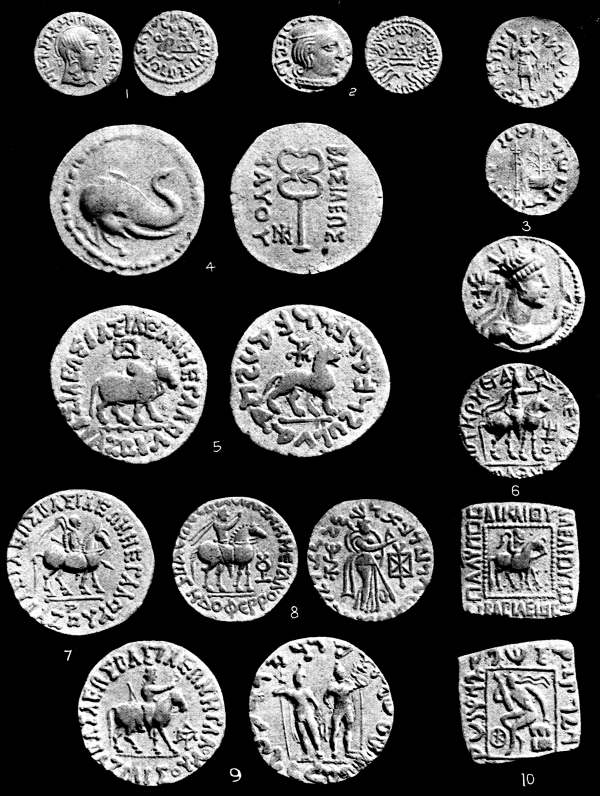
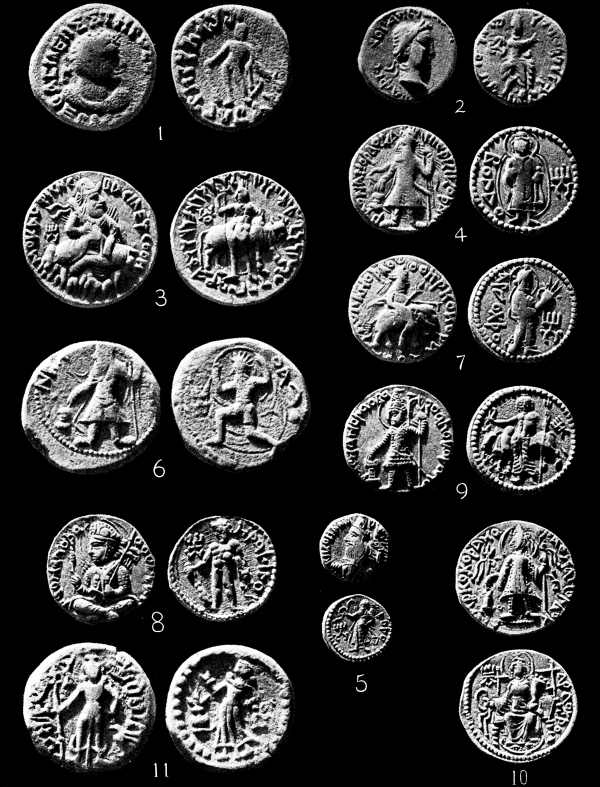
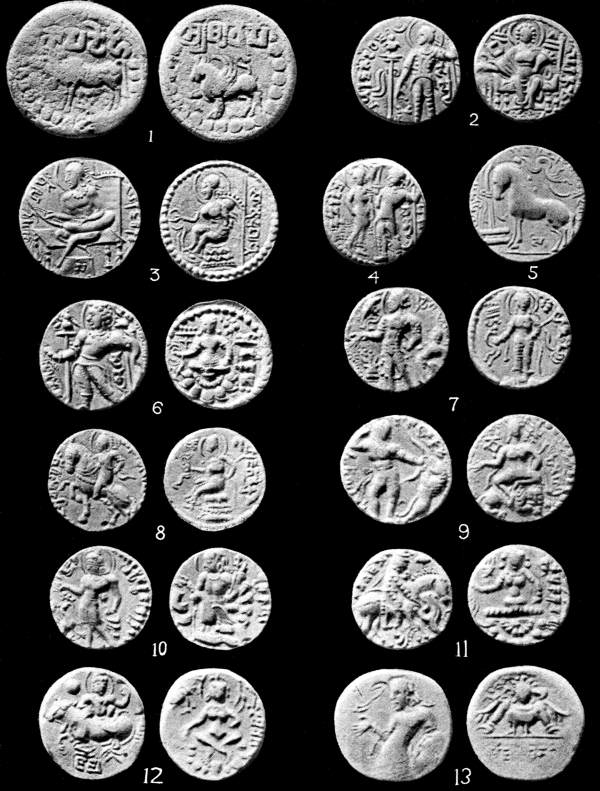
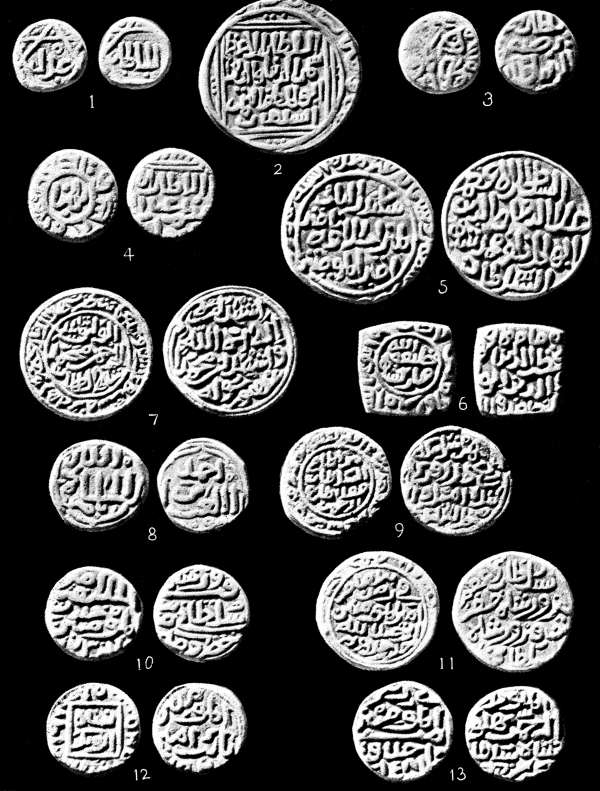
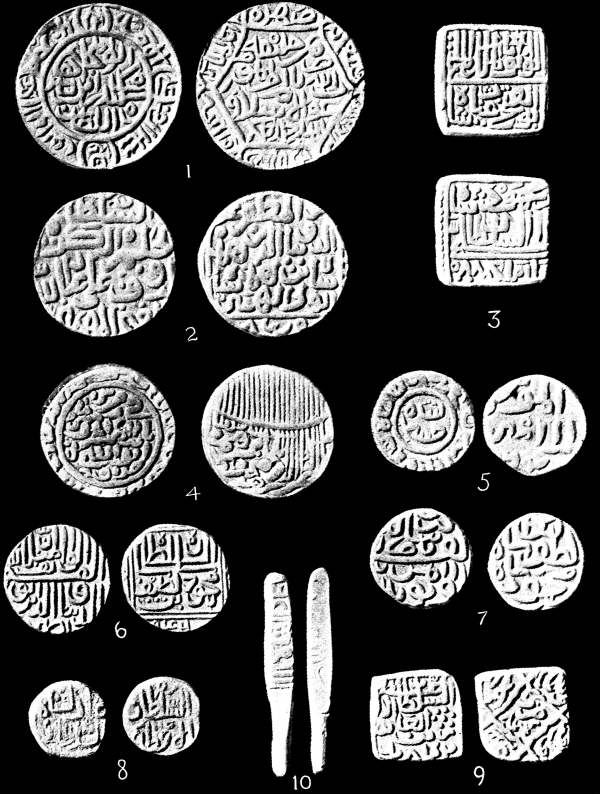
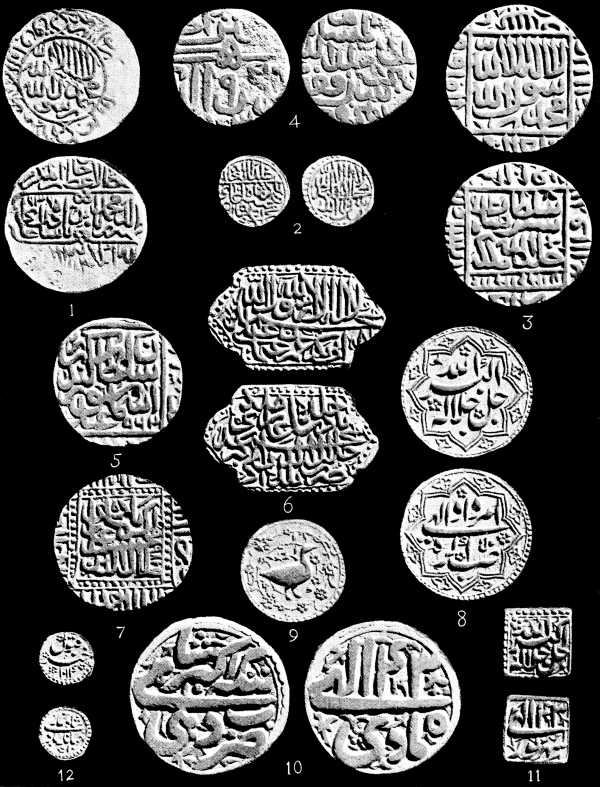
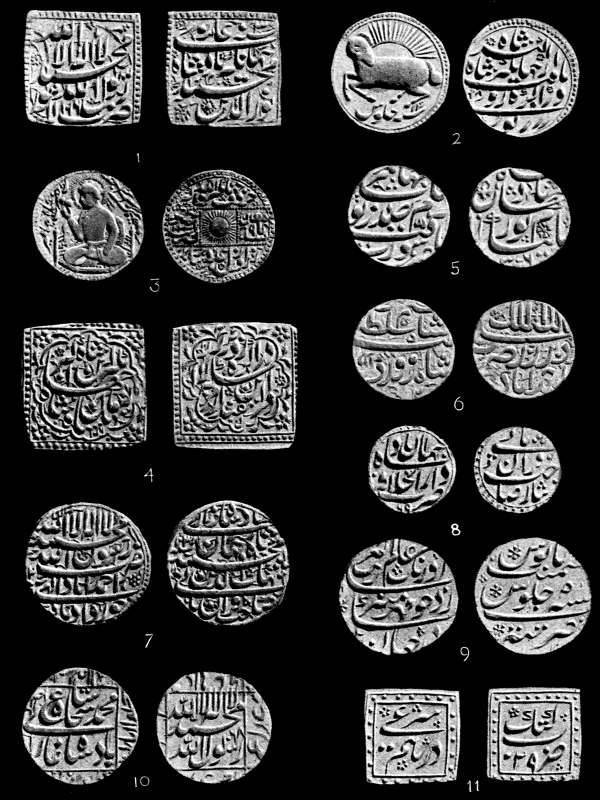
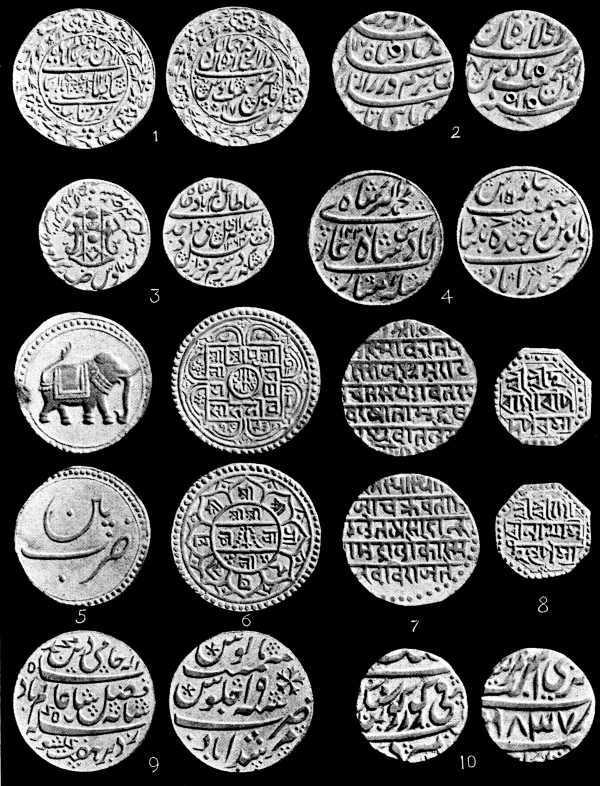
The Key to each Plate will be found on the page facing it.
INTRODUCTION
This little book has been written as an introduction to the study
of the subject with which it deals, and is intended primarily for
Indian readers. At the same time the writer trusts it may be of some
service to students and collectors, in India and elsewhere, as giving
a general conspectus of all the more important series of Indian coins.
Two objects have been kept prominently in view: (1) to describe
the evolution of the coinage itself, (2) to show its importance as
a source of history, or as a commentary upon economic, social and
political movements. In attempting this, certain limits have naturally
imposed themselves. Coins purely foreign in fabric, as those of the
Græco-Bactrian kings, of the Portuguese, and of the various European
trading companies, even when struck and current in India, have been
rigidly excluded: this exclusion does not, however, extend to money
issued by resident foreigners with the permission and in the style of
Indian rulers. For a cognate reason the year 1857 has been fixed as
the downward limit in this survey. Again, for the sake of simplicity,
technical topics, such as weight-standards and metallurgy, have only
been touched upon where discussion appeared unavoidable.
The chief desire of the writer has been to arouse in Indians an
interest in their country’s coinage, in the study of which so many
fields of research lie as yet almost untouched. Although India has
no coins to show comparable to the supreme artistic conceptions of
the Sicilian Greeks, the study of her coinage, in addition to its
exceptional importance as a source of history, is attended by peculiar
advantages, not the least of which is the fact that materials for
study lie, as it were, almost at one’s door. In nearly every Indian
bazar, even the smallest, in the shops of the Sarrafs or
money-changers, gold, silver and copper coins are to be had, sometimes
in plenty, and can be bought cheaply, often at little more than the
metal value. There is even the chance of obtaining for a few coppers,
and—a far more important consideration—saving from the melting pot, a
coin which may add a new fact, or a name, or a date to history.
A detailed description will be found opposite each of the plates,
giving transliterations and translations of the coin legends; and
these, with the list of selected authorities at the end of the book,
should provide the key to a fuller knowledge of the subject. To almost
all the works mentioned in the latter the writer is indebted, although
it has been impossible to acknowledge all obligations in detail.
Mention must also be made of Dr. George Macdonald’s fascinating little
study, The Evolution of Coinage (The Cambridge Manuals of
Science and Literature), as well as of the late Dr. Vincent Smith’s
Oxford History of India, which has in general been accepted as
the authority for the historical facts and dates, somewhat plentifully
incorporated throughout the book.
In conclusion, I am under special obligation to Mr. John Allan, of
the Department of Coins and Medals, British Museum, for continual
assistance, for kindly reading through my manuscript and offering
numerous useful suggestions, and particularly for his help in getting
casts prepared for the plates, all of which have been taken from coins
in the British Museum; to Mr. H. Nelson Wright, I.C.S., who also
kindly read through the manuscript, gave me invaluable assistance
in the transliteration of the coin legends, and freely placed at my
disposal his exact and extensive knowledge of the Muhammadan coins of
India. To Mr. J. H. Waller, Secretary of the Association Press, I am
also considerably indebted for the infinite trouble he has taken in
supervising the preparation of the blocks for both figures and plates
which illustrate this little volume.
C. J. Brown.
Ranikhet, May, 1921.
Note.—The Cambridge
History of India, Volume I, Ancient India, appeared while this book
was in the press. Fortunately, it has been possible to incorporate the
conclusions arrived at in that work, which have been accepted for the
period which it covers. The view of the Indo-Greek and later coinages
taken by Professor Rapson in Chapters XXII and XXIII has also been
generally accepted as a working hypothesis.
ABBREVIATIONS
Anno Domini
A.D.
Copper
Æ.
Hijrī Year
A.H.
Silver
AR.
Gold
AV.
Billon
Bil.
British Museum Catalogue
B.M.C.
Grains
Grs.
Indian Antiquary
I.A.
Indian Museum Catalogue
I.M.C.
Journal of the Asiatic Society of Bengal
J.A.S.B.
Journal of Bombay Branch of the Royal Asiatic Society
J.B.B.R.A.S.
Journal of the Royal Asiatic Society
J.R.A.S.
Numismatic Chronicle
Num. Chron.
Numismatic Supplement to the J.A.S.B.
Num. Supp.
Obverse
Obv.
Catalogue of Coins in the Panjāb Museum, Lahore
P.M.C.
Regnal Year
R.
Reverse
Rev.
Samvat Year
S.
Weight
Wt.
I THE EARLIEST COINAGE OF INDIA
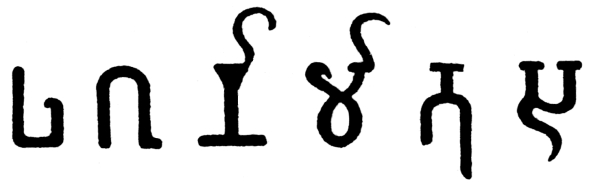
Fig. 1. Phagunimitrasa in Early Brāhmī Script.
Cf. Pl. I, 4.
Among primitive peoples trade was carried on by barter, that is,
exchange in kind. Gradually, with the spread of civilising influences
the inconvenience of promiscuous exchange made itself felt, and certain
media were agreed upon and accepted by the community at large. Wealth
in those early times being computed in cattle, it was only natural
that the ox or cow should be employed for this purpose. In Europe,
then, and also in India, the cow stood as the higher unit of barter.
At the lower end of the scale, for smaller purchases, stood another
unit which took various forms among different peoples—shells, beads,
knives, and where those metals had been discovered, bars of copper or
iron. In India the cowrie-shell, brought from the Maldive Islands, was
so employed, and is still to be seen in many bazars in the shops of the
smaller money-changers. The discovery of the precious metals carried
the evolution of coinage a stage further: for the barter unit was
substituted its value in metal, usually gold. The Greek stater
and the Persian daric certainly, and possibly the Indian
Suvarṇa, so frequently mentioned by Sanskrit authors, was the
value of a full-grown cow in gold, calculated by weight. However this
may be, in ancient India gold dust, washed out of the Indus and other
rivers, served the purposes of the higher currency, and from 518 B.C.
to about 350 B.C., when an Indian province or satrapy was included in
the Achæmenid Empire of Persia, 360 talents in gold dust was, Herodotus
tells us,[1]
paid annually as tribute from the province into the treasury of the
Great King.
Silver from natural sources was at that time less plentiful in India,
but was attracted thither in large quantities in exchange for gold,
which was cheaper there than elsewhere in the ancient world. The
transition from metal weighed out to the required amount to pieces of
metal of recognized weight and fineness regularized by the stamp of
authority is not difficult of explanation. The great convenience of
the latter would recommend them at once to the merchant, and to the
ruler as the receiver of tribute and taxes. Both in Asia and Europe
this transition can be illustrated from extant specimens; but, whereas
in Europe and Western Asia, from the inscriptions which appeared early
on the coins themselves and from outside evidence, we know the origin
of the earliest coins and the names of the cities or districts which
issued them, the origin of India’s earliest coinage, like so much of
her early history, is still shrouded in mystery.
This much can be said, that in its earliest stages the coinage of India
developed much on the same lines as it did on the shores of the Aegean.
Certain small ingots of silver, whose only mark is three circular dots,
represent probably the earliest form: next in order are some heavy bent
bars of silver with devices stamped out with a punch on one
side.[2]
These two classes of coins are computed to have been in circulation
as coins at least as early as 600 B.C., but they have not been found
in any quantity. The time as well as the territory in which they
circulated was probably therefore restricted. On the other hand, from
almost every ancient site in India, from the Sundarbans in Bengal to
Kābul, and as far south as Coimbatore, have been recovered thousands of
what are known to numismatists as “Punch-marked coins” and to Sanskrit
authors as Purāṇas (“ancient”) or Dharaṇas. These are
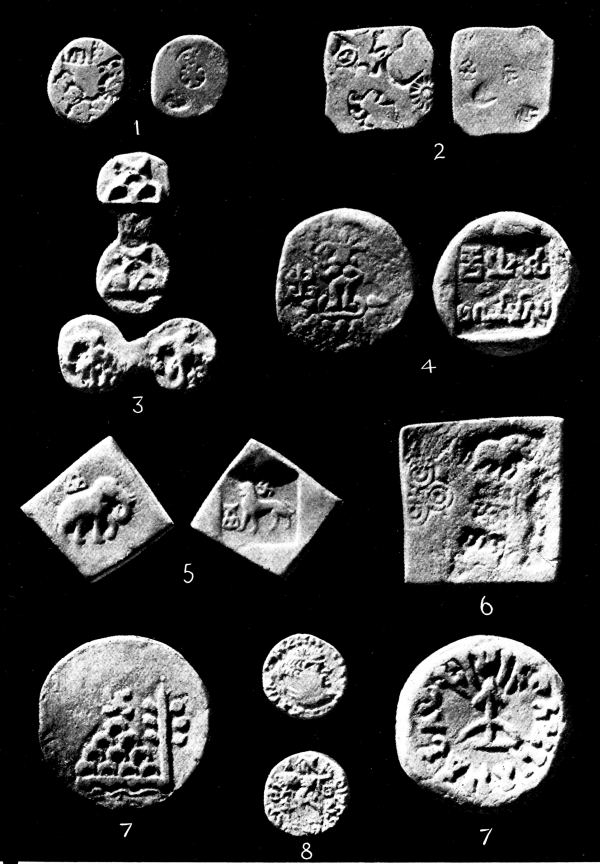
rectangular (Pl. I, 2) and circular
(Pl. I, 1) flat pieces of thin
silver (much alloyed), or more rarely copper, cut from a hammered sheet
of metal and clipped to the proper weight. One side (the obverse) is
occupied by a large number of symbols impressed on the metal by means
of separate punches. In the oldest coins the other, the reverse side,
is left blank, but on the majority there appears usually one, sometimes
two or three, minute punch marks; a few coins have both obverse and
reverse covered with devices. These devices appear in wonderful
variety—more than three hundred have been enumerated; they comprise
human figures, arms, trees, birds, animals, symbols of Buddhist
worship, solar and planetary signs. Much further detailed study of
these coins will be needed before anything can be definitely stated
about the circumstances under which they were minted. It seems probable
that in India, as in Lydia, coins were first actually struck by
goldsmiths or silversmiths, or perhaps by communal gilds (seṇi).
Coins with devices on one side only are certainly the oldest type, as
the rectangular shape, being the natural shape of the coin when cut
from the metal sheet, may be assumed to be older than the circular; on
the other hand, both shapes, and also coins with devices on one as well
as on both sides, are found in circulation apparently at the same time.
It has also been recently shown[3]
that groups of three, four, and sometimes five, devices on the
obverse are constant to large numbers of coins circulating within
the same district. It may perhaps therefore be conjectured that
the “punch-marked” piece was a natural development of the paper
hundī, or note of hand; that the coins had originally been
struck by private merchants and gilds and had subsequently passed
under royal control; that they at first bore the seal of the merchant
or gild, or combination of gilds, along with the seals of other gilds
or communities who accepted them;[4]
and that, when they passed under regal control, the royal seal and
seals of officials were first added to, and afterwards substituted
for, the private or communal marks. Be that as it may, we see here in
the very earliest coinage the commencement of that fascination which
the square coin seems to have exercised upon Indian moneyers of all
periods; for it continually reappears, in the coins of the Muhammadan
kingdoms of Mālwā and Kashmīr for example, in some beautiful gold and
silver issues of the Mughals, Akbar and Jahāngīr, and even in the
nineteenth century in copper pieces struck by the Bahāwalpūr State
in the Panjāb. Most writers agree, as indeed their shape, form, and
weight suggest, that the “punch-marked” coins are indigenous in origin,
and owe nothing to any foreign influence. In what part of India they
originated we do not know: present evidence and the little knowledge we
possess of the state of India in those times indicate some territory
in the north. As to the period during which they were in active
circulation we are not left so completely at the mercy of conjecture.
Finds and excavations tell us something: contemporary writers, Indian
and foreign, drop us hints. Sir John Marshall records, during the
recent excavations round Taxila, the find of 160 “punch-marked” coins
of debased silver, with a coin in fine condition of Diodotos of Bactria
(circ. 245 B.C.).[5]
Then there is the interesting statement of the usually trustworthy Latin writer,
Quintus Curtius, that Omphis (Āmbhi) presented “Signati argenti LXXX
talenta”—“80 talents of stamped silver”—to Alexander at Taxila. These
and similar pieces of evidence show us that “punch-marked” coins were
well established in Northern India during the fourth and third
centuries B.C., when the great Maurya Empire was at the height of its
power. The large quantities continually being unearthed suggest a long
period of circulation, so that in their earliest forms “punch-marked”
coins may go back to the sixth century, and may have remained current
in some districts of the north as late as the second century B.C. At
some period, perhaps during the campaigns of the great Chandragupta
and the settlement of the Empire under his grandson Aśoka, these
coins became the established currency of the whole Indian peninsula,
and in the southern districts, at least, they must have remained in
circulation for three, perhaps four, centuries longer than in the
north, for in Coimbatore district “punch-marked” coins have been found
along with a denarius of the Roman Emperor Augustus; and some of
the earliest individualistic coinages of the south, which apparently
emerge at a much later period, the so-called “padma-ṭaṅkas,” for instance,
seem to be the immediate successors of these “punch-marked” coins.
Now the distinction between north and south which has just been drawn
in tracing the history of this primitive coinage is very important; for
this same distinction enables us to divide the remaining ancient and
mediæval Indian coins down to the fourteenth century into two classes,
northern and southern. The reason for this is that Northern India,
during that period, was subjected to a series of foreign invasions;
the indigenous coinages of the north were therefore continually
being modified by foreign influences, which, with a few exceptions
to be noted, left the coinages of the south untouched, to develop by
slow stages on strictly Indian lines. The coins of the south will be
described in a separate chapter.
To return to Northern India: at the time of Alexander’s invasion the
whole of North-Western India and the Panjāb was split up into a number
of small states, some, like the important state of Taxila, ruled by a
king, others governed by “aristocratic oligarchies.” Almost all the
coins about to be dealt with are either of copper or brass, and the
earliest of them were struck, doubtless, by the ruling authorities in
these states. Even after their subjection to the great Maurya Emperors
some of these states may have retained their coining rights, for it
is a salient fact in the history of coins that coinage in the base
metals in India and elsewhere has not, until quite recent times, been
recognized, like coinage in gold and silver, as the exclusive privilege
of the ruler. A striking example is afforded in the copper token money
issued by private tradesmen in England during the eighteenth and early
nineteenth centuries. On the break up of the Maurya Empire, at the
close of the third century, a number of small independent kingdoms
sprang into existence, and these proceeded to issue coins, some bearing
evident traces of foreign influence, but on the whole following Indian
models closely enough to be included here.
No attempt can be made to deal with this class of coins exhaustively:
a few typical examples only can be selected for description and
illustration. The reader who wishes to pursue the subject further is
referred for guidance to the Bibliography at the end of this book; and,
since at present little attempt has been made to classify or examine
these coins in any detail, fewer fields of research are likely to yield
a richer reward to the patient student.
The earliest of these copper coins, some of which may be as early as
the fifth century B.C., were cast. The casting of coins by pouring
molten metal into a cavity formed by joining two moulds together must
have been a very ancient practice in India. Sometimes the moulds of
several coins were joined together for the casting process, and the
joins thus left are not infrequently found still adhering to the coins
(Pl. I, 3).[6]
These coins are for the most part anonymous. Even after striking from
dies had superseded this clumsy method in the North-West, we find cast
coins being issued at the close of the third century by the kingdoms of
Kauśāmbī, Ayodhyā and Mathurā, some of which bear the names of local
kings in the Brāhmī[7] script.
The earliest die-struck coins, with a device on one side of the coin
only, have been assigned to the end of the fourth century B.C. Some of
these, with a lion device, were certainly struck at Taxila, where they
are chiefly found. Others present various Buddhist symbols, such as the
bodhi-tree, svastika, or the plan of a monastery, and
may therefore belong to the time of Aśoka, when Buddhism first reached
the North-West, or Gandhāra, as the territory was then called. The
method of striking these early coins was peculiar, in that the die was
impressed on the metal when hot, so that a deep square incuse, which
contains the device, appears on the coin. A similar incuse appears on
the later double-die coins of Pañchāla (Pl. I, 4), Kauśāmbī, and on
some of Mathurā. This method of striking may have been introduced from
Persia, and was perhaps a derivative from the art of seal-engraving.
In the final stage of die-striking, devices were impressed on both
sides of the coin, and the best of these “double-die” coins show not
only greater symmetry of shape, either round or square, but an advance
in the art of die-cutting. Some of the earliest of this type have been
classed as gild tokens. The finest were struck in Gandhāra: among these
one of the commonest, bearing a lion on the obverse, and an elephant on
the reverse (Pl. I, 5), is of special importance, since an approximate
date can be assigned to it, for it was imitated by the Greek princes,
Pantaleon (Pl. II, 2) and Agathokles, who reigned on the North-West
frontier about the middle of the second century B.C. In the execution
and design of some die-struck coins from the North-West there are
undoubted traces of foreign influences: but such devices as the humped
bull, the elephant and the religious symbols are purely Indian. There
is, on the other hand, little foreign influence traceable in the
die-struck coins, all closely connected in point of style, which issued
during the first and second centuries B.C. from Pañchāla, Ayodhyā,
Kauśāmbī and Mathurā. A number of these bear Brāhmī inscriptions,
and the names of ten kings, which some would identify with the old
Śuṅga dynasty, have been recovered from the copper and brass coins of
Pañchāla, found in abundance at Rāmnagar in Rohilkhand, the site of the
ancient city Ahichhatra. Similarly twelve names of kings appear on the
Mathurā coins, but we have little knowledge of these kingdoms beyond
what the coins supply. Certain devices are peculiar to each series:
thus most of the Ayodhyā coins have a humped bull on the obverse, the
coins of Kauśāmbī a tree within a railing.
In the coins of Eraṇ[8]
we have an illustration, as Rapson says, “of the development of the
punch-marked system into the die system.” These coins are rectangular
copper pieces (Pl. I, 6), and the device on each consists of a
collection of symbols like those which appear on the “punch-marked”
coins, but struck from a single die. They are specially interesting
in that they represent the highest point of perfection reached by
purely Indian money. Some of these, in common with a class of round
coins found at Ujjain (Avanti), display a special symbol, the “cross
and balls,” known from its almost universal occurrence on the coins of
ancient Mālwā as the Mālwā or Ujjain symbol.
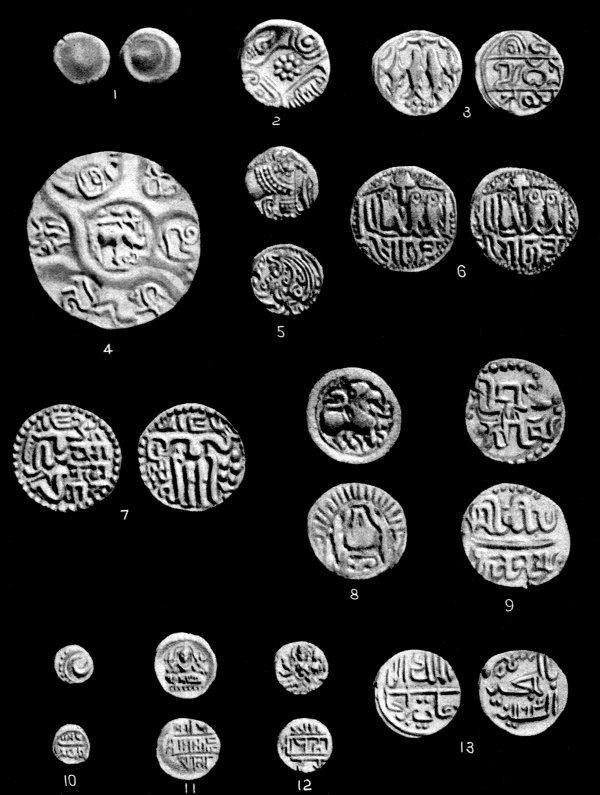
Key to Plate I
1. Round punch-marked coin. AR. Wt. about 50 grs.
Obv., an animal, solar symbol, etc.
Rev., three symbols.
2. Rectangular punch-marked coin. AR.
Obv., bull, solar symbol, etc.
Rev., several indistinct symbols.
3. Pair of cast coins, showing join. Æ.
Obv., three-arched chaitya, crescent above.
Rev., elephant to left.
4. Pañchāla: Phalgunīmitra. Æ. Wt. about 220 grs.
Obv., figure standing on lotus, to left a symbol.
Rev., in incuse, in early Brāhmī, Phagunimitrasa
“(Coin) of Phalgunīmitra”; above 3 symbols.
5. Taxila; double-die coin. Æ. Wt. about 180 grs.
Obv., elephant to right, above a chaitya.
Rev., in incuse, lion standing to left, above swastika, to left chaitya.
6. Eraṇ; punch-marked. Æ.
Obv., various symbols, including an elephant and the Ujjain symbol.
7. Andhra: Gotamīputra Viḷivāya kura. Bil. Wt. about 200 grs.
Obv., chaitya within railing, above swastika, to right a tree.
Rev., bow and arrow; around Raño Gotamiputasa Viḷivāyakurasa
“(Coin) of Rāja Gotamīputra Viḷivāyakura.”
8. Mathurā; Rājuvala, satrap. Bil. Wt. 38 grs.
Obv., diademed bust of king to right; corrupt Greek legend.
Rev., Pallas with ægis and thunderbolt to left; Kharoshṭhī legend,
Apratihatachakrasa chhatrapasa Rajavulasa
“(Coin) of the satrap Rājavula, invincible with the discus.”
Kharoshṭhī letters in field.
Note.—Where it has been impossible to
ascertain the weight of the particular coin illustrated, the average
weight of coins of its class has been given; all such weights are
qualified by the word “about.”
Plate I
Plate II
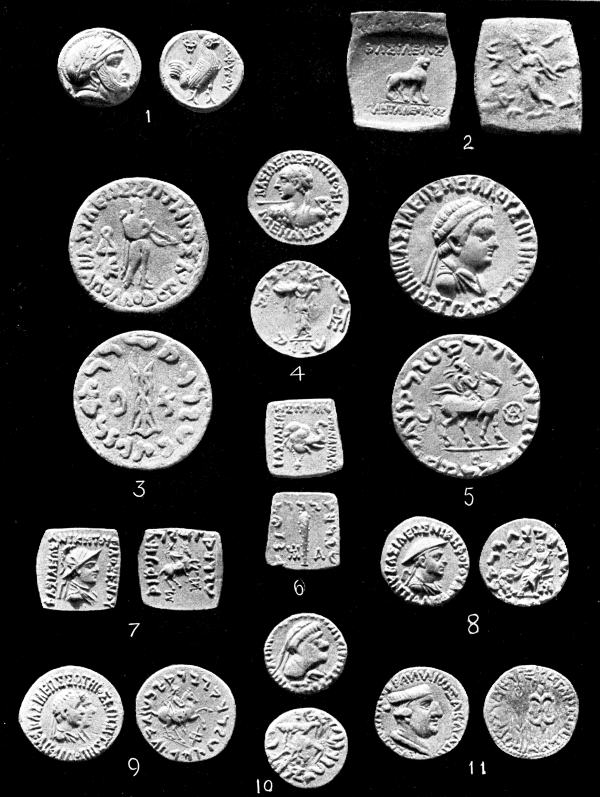
Key to Plate II
1. Sophytes (Saubhūti). AR. Drachm. Wt. 58·3 grs.
Obv., helmeted head of king to right.
Rev., cock to right, above caduceus; in Greek, Sophutou.
“(Coin) of king Strato Sōtēr and of his grandson, Strato Philopatēr.”
11. Nahapāna. AR. Hemidrachm. Wt. 29·2 grs.
Obv., head of satrap to right. Corrupt Greek legend.
Rev., thunderbolt and arrow. In Brāhmī, Raño Chhaharatasa;
in Kharoshṭhī, Nahapanasa,
“(Coin) of the Kshaharāta king Nahapāna.”
Though its territory lay partially in Southern India, it will be
convenient to include here the coinage of the great Andhra dynasty,
since several of its issues are closely connected with the currency
of the north. The Andhras probably became independent about the year
230 B.C., and their rule lasted for four and a half centuries. Their
coins of various types have been found in Mālwā, on the banks of the
Krishna and Godavari rivers, the original home of the race, as far
south as Madras, in north Konkan, and elsewhere in the Deccan and the
Central Provinces. The earliest to which a date can be assigned are
those bearing the name of a king Śrī Sāta, about 150 B.C. Most Andhra
coins are either of billon[10]
or lead, with Brāhmī legends on both obverse and reverse, and
characteristic devices are the elephant, chaitya (Buddhist
chapel), and bow (Pl. I, 7). Sometimes the “Ujjain symbol”
appears on the reverse. One issue, in lead, of Vasishṭhīputra Śrī Pulumāvi (about
A.D. 130) is interesting, in that it has on the obverse a ship with two
masts, and was evidently intended for circulation on the Coromandel
coast. Coins have been assigned to seven Andhra kings, the latest of
which, Śrī Yajña Sātakarṇī (about A.D. 184), struck not only the usual
lead and billon coins, but restruck and imitated the silver hemidrachms
of the satrap Nahapāna (Pl. III, 1). The Andhra lead coinage was copied
by one or two feudatory chiefs in Mysore and North Kanara.
II COINS OF THE INDO-GREEKS, THE ŚAKAS AND PAHLAVAS — I. COINS OF THE INDO-GREEKS — II. COINS OF THE ŚAKAS AND PAHLAVAS — III. COINS OF THE WESTERN SATRAPS AND OTHER IMITATORS OF THE GREEK MODELS
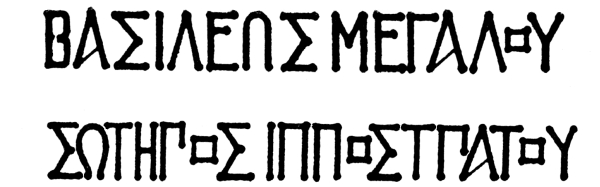
Fig. 2. Greek Script on Coin of Hippostratos. Cf. Pl. II, 5.
We have seen in the last chapter how foreign influences gradually began
to make themselves felt in the fabric and design of the purely native
coins of the North-West. These influences gradually widened until the
whole of Northern, Western and parts of Central India were affected.
Through eight centuries these foreign types were reproduced on the
coins of those territories; and we can observe the gradual debasement
of the original models as they become less and less intelligible to
successive strikers, until they disappear in the general cataclasm that
succeeded the terrible inroads of the Huns in the sixth century. In the
secluded kingdom of Kashmīr one type did indeed survive as late as the
fifteenth century, a mere shadow of a shade, from which all form and
feature had vanished. The coins included in this chapter and the next
are those of the invaders who brought about this important change.
But a further and a greater importance attaches to them. Since the
important discovery, in 1824, by Colonel Tod, that Greek coins had once
been struck in India, the names of thirty-three Greek and twenty-six
[11]
Indo-Scythia nor Śaka and Indo-Parthian or Pahlava princes, ruling
territories round the Indian frontier, have gradually been recovered
from coin legends, and not more than half-a-dozen of these are
known from other sources. Even the names of the later Kushāṇa kings
were first deciphered from their coins. Thus coins alone have been
responsible for the recovery of a whole period of Indian history.
Probably no class of Indian coins has attracted more attention or
been subjected to more patient examination than these, which mark the
first intermingling of Eastern and Western culture in India; yet,
as the relationship of the different kings and dynasties who minted
them, their dates, and the territories over which they ruled are still
largely matters of conjecture, it will be well to sketch in outline the
probable course which events took in Northern India and the adjacent
countries from the time of Alexander to the first century of our era.
In October, 326 B.C., Alexander began his retreat from the Panjāb. To
commemorate his victories he struck a medal;[12]
about the same time an Indian prince, Sophytes (Saubhūti), struck a
silver coin (Pl. II, 1) in the Greek style; with these two exceptions
scarcely a mark or lasting trace of his invasion remained. Eleven years
after Alexander’s death his general, Seleucos, founded the Seleucid
kingdom of Syria. Between the years 250-248 B.C. two of the chief
Syrian provinces revolted and became independent kingdoms, Bactria
under Diodotos and Parthia under Arsakes, both events fraught with
important consequences for India and her coinage. The fourth Bactrian
king, Demetrios (c. 190-150 B.C.), son of Euthydemos, as the Mauryan
Empire fell into decay, was able to extend his kingdom as far as the
Panjāb, and assumed the title of “King of the Indians.” But about the
same time he was confronted with a rival, Eukratides (c. 175-155 B.C.),
who deprived him of his Bactrian dominions, and even of a portion
of Gandhāra (the present districts of Peshāwar and Rawalpindi).
Henceforward there were two rival Greek dynasties, the house of
Eukratides, including the princes Heliokles, Antialkidas and Hermaios,
ruling in Kābul, Kandahār and Gandhāra, and the house of Euthydemos,
of whom the principal rulers were Apollodotos, Menander, Strato I,
Zoilos and Hippostratos, in East Gandhāra and the Panjāb. Pantaleon,
Agathokles and Antimachos, of the latter family, appear to have been
petty princes ruling north of Kābul (c. 155-140 B.C.), and there
must have been similar small principalities elsewhere, whose rulers
were contemporary. About the year 135 B.C. Heliokles, the last king
of Bactria, was driven out of that country by a Scythian tribe, the
Śakas, and fixed the headquarters of his rule at Kābul, and here his
descendants continued to reign till some time after 40 B.C., when the
last of them, Hermaios, was driven out by the Pahlavas. Meanwhile, in
about the year 126 B.C., the Śakas, pressed in their turn by another
nomadic tribe from Central Asia, the Yueh-chi, were driven out of
Bactria, and invaded India by way of Ariāna (Herāt) and Drangiāna
(Seistān), fixing their headquarters in Sind (Śakadvīpa). Moving thence
up the Indus valley, about the year 75 B.C., their chief, Maues,
captured Pushkalāvatī (Peshāwar), and thus drove a wedge in between the
dominions of the two Greek houses. His successor, Azes I, the possible
founder of the Vikrama era in 58 B.C., finally crushed the house of
Euthydemos, in the person of Hippostratos, in the Eastern Panjāb, some
time after 40 B.C. Closely related to the Śakas were the Pahlavas. The
earlier Pahlava princes, Vonones, Spalahores, and Spalirises ruled in
Drangiāna and Arachosia (Kandahār), whence, as already related, they
overran Kābul. Later on, in the first century A.D., probably through a
family alliance, they succeeded the Śakas in northern India and we find
the great king Gondopharnes (A.D. 19-45) ruling in Taxila. Associated
with the Śaka and Pahlava kings were a number of military governors,
such as Aspavarma and Sasas, whose names appear on coins with those
of their suzerains. Other rulers like Miaos are more difficult to place.
The splendid series of portrait coins of the Greek kings of Bactria
does not come within the scope of this work: their gold and silver
pieces, struck on the Attic standard,[13]
were never current in India proper, where they are rarely found, and
they really belong to the history of Greek coinage. Nevertheless they
are of the utmost importance for our subject, for in following these
models the Indo-Greek kings introduced Greek types, and among them the
portrait head, into the Indian coinage, and their example was followed
for eight centuries. This word “type” needs some definition. Originally
it meant the particular mark of authority on a coin as distinct from
other marks, but it has come to imply a distinguishing device more or
less artistic in character. Such devices appear on all Greek and Roman
coins. In this sense the coins of the Muhammadans cannot properly be
said to display “types,” for both obverse and reverse are usually
occupied entirely by the inscription.
Demetrios was the first Bactrian king to strike square copper coins
of the Indian type, with a legend in Greek on the obverse, and in
Kharoshṭhī on the reverse. His rival, Eukratides, struck these
bilingual square copper pieces in greater abundance, as well as a very
rare silver coin with inscriptions in both languages. The Gandhāra
copper coinage of Agathokles and Pantaleon (Pl. II, 2) has already
been alluded to. After the removal of the seat of government to
territory south of the Hindu Kush, we find the coinage undergoing a
radical change. The rare gold staters and the splendid tetradrachms of
Bactria disappear. The silver coins of the Indo-Greeks, as these later
princes may conveniently be called, are the didrachm (Pl. II, 5) and
the hemidrachm. With the exception of certain square hemidrachms of
Apollodotos and Philoxenos (Pl. II, 7), they are all round, are struck
to the Persian (or Indian) standard, and all have inscriptions in both
Greek and Kharoshṭhī characters. Copper coins, square for the most
part, are very numerous (Pl. II, 6). The devices are almost entirely
Greek, and must have been engraved by Greeks, or Indians trained in
the Greek traditions, yet “the engravers ... were no slavish copyists
of Western models, but were giving free and spontaneous expression to
their own ideas.”[14]
On the reverse is ordinarily to be found some god or goddess—Herakles,
Zeus, Pallas, or some symbol of their worship; the “two piloi” (caps)
of the Dioskouroi are of frequent occurrence. A notable square copper
coin of Eukratides has the figure of a seated Zeus, accompanied by the
legend in Kharoshṭhī, “The city deity of Kāpiśī,” suggesting
that others of these deities may stand as the patrons of
cities.[15]
Other reverse devices are the tripod, a king on horseback, and various
animals, including the specially Indian elephant and humped bull.
The portraits on the obverse, especially on the fine didrachms, are
realistic and boldly drawn, and show us clearly what manner of men
these early European rulers in India were. On most of these coins and
those of the Śaka rulers are found a great variety of monograms (Fig. 3)
formed of Greek letters, but the significance of these has never
been satisfactorily explained. From a study of monograms and types, and
particularly from observing the gradual debasement in style which takes
place, experts have been able to arrange these kings in chronological
order. Such tests are sometimes, however, delusive; the king, Zoilos,
for example, minted two types of hemidrachm, one in comparatively fine
style, the other very debased.
The extreme rarity of the money of a few kings, like Apollophanes,
Polyxenos and Theophilos, leads us to suppose that they were
pretenders. The most important kings, judging from the large number of
their coin types, were Antialkidas, king of Taxila, circ. 155-130 B.C.,
Apollodotos, Menander and Strato I. Antialkidas appears on one of his
numerous silver types wearing the striking flat cap, called “kausia”
(Pl. II, 8). Apollodotos’ coinage is remarkable for the large variety
of its copper types. Particularly noticeable are the large round pieces
which he introduced (Pl. II, 3). Menander’s
coins (Pl. II, 4) are found
all over Northern India in great quantities, and his didrachms, with
three distinct styles of portrait, are the finest of the series. The
heads of two queens, Agathokleia and Kalliope, are found conjoined,
the former with that of her son, Strato I, the latter with that of her
husband, Hermaios (Pl. II, 9), on a few rare coins. The debasement
which set in in Strato’s reign (Pl. II, 10) in the Eastern Kingdom,
and is evidenced not only in the poorness of design but even in the
striking of coins in lead, reached even a lower point in the coinage
of Hermaios. On one type of copper, with the head of Hermaios on the
obverse, the name of Kujūla Kadphises, the Kushāṇa, appears on the
reverse (Pl. IV, 1).[16]
After the conquest of Bactria by the Śakas in 135 B.C. there must have
been considerable intercourse, sometimes of a friendly, sometimes of
a hostile character, between them and the Parthians, who occupied
the neighbouring territory. This may account for the Parthian
influence which appears in certain features on the coins of the Śakas,
particularly in the title Basileōs Basileōn, “King of Kings,”
which all these kings, following the example of the Arsacid dynasty,
inscribed on the obverse of their coins.
Maues, whose coins are found only in the Panjāb, was the first king
of what may be called the Azes group of princes. His silver is not
plentiful; the finest type is that with a “biga” (two-horsed chariot)
on the obverse, and to this type belongs a square hemidrachm, the
only square Śaka silver coin known. His commonest copper coins, with
an elephant’s head on the obverse and a “caduceus” (staff of the god
Hermes) on the reverse (Pl. III, 4), are imitated from a round copper
coin of Demetrios. On another copper square coin of Maues the king is
represented on horseback. This striking device is characteristic both
of the Śaka and Pahlava coinage (Pl. III, 7); it first appears in a
slightly different form on coins of the Indo-Greek Hippostratos
(Pl. II, 5); the Gupta kings adopted it for their “horseman”
type, and it reappears in Mediæval India on the coins of numerous Hindu kingdoms,
and was even employed by Muhammadan invaders until the fourteenth century.
Silver coins of Azes I and Azilises, especially of the former, are
abundant. As on Maues’ coinage, Greek gods and goddesses, Zeus,
Herakles, Pallas and Poseidon, appear on both silver and copper of
these two kings, but now for the first time an Indian goddess, Lakshmī,
is introduced. A favourite device on the silver of Azilises is the
Dioskouroi (Pl. III, 9).[17]
His copper coins are all square, whereas Azes’ commonest type is a
large round coin with a bull on the observe and a lion on the reverse
(Pl. III, 5), unquestionably copied from the large round coins of
Apollodotos; for some of Azes I’s coins are restruck on those of
Apollodotos and Hippostratos. Another copper coin shows the king Azes
sitting cross-legged in the Indian fashion. On the reverse of another
copper coin, of the common “king on horseback” type, appears the name
of the Indian general, Aspavarma, which is also found on some coins of
the Pahlava Gondopharnes: this is a most important piece of evidence,
as it shows a connection between the two dynasties. The earlier Pahlava
kings, which we may call the Vonones group, were evidently far less
powerful than the Śaka rulers; their coins are scarcer, didrachms
particularly so, and are found only west of the Indus valley. On no
coins has the name of Vonones been found alone, but always associated
either with Spalahores, his brother, or his nephew, Spalagadames; the
names of the two latter are conjoined on another coin (Pl. III, 10).
A fourth prince, Spalirises, strikes coins of his own and also in
conjunction with Azes II.[18]
All the silver coins of this group are of the usual “king on horseback”
type; their copper coins are with one exception square.
Like the Indo-Greeks, the Śakas use Greek for the obverse and
Kharoshṭhī for the reverse legend.
The most important of the later Pahlava kings was Gondophares, or
Gondopharnes, famous as the King of India mentioned in the traditional
stories connected with the Apostle St. Thomas. In the British Museum
there is a silver coin of his struck in the pure Parthian style, but
the rest of his didrachms—no smaller coins are known—are of billon
(Pl. III, 8). Several types of these are known, but all have the usual
“king on horseback” obverse. On the reverse of one type the god Śiva
appears. His copper coins, all of them round, have a bust of the king
in the Parthian style, with either a figure of Nike or Pallas on the
reverse. The coins of his successors or contemporaries, Abdagases,
Orthagnes and Pakores, closely follow in type those of Gondopharnes.
Connected with these later Pahlavas are a few princes who call
themselves “Satrap”—among these the most prominent is Zeionises, who
minted some rather striking didrachms in pure silver. His not uncommon
copper coins imitate the bull and lion type of Azes. Lastly, there are
a number of miscellaneous rulers, such as Miaos and Hyrcordes, whose
coins present features so heterogeneous that it has been impossible
hitherto to assign them ancestry, nationality or even an approximate
date. The most important of these is the “nameless king,” whose
superscription consists of the titles, “King of Kings, the great
Saviour,” written in Greek only. His coins, all of copper, are well
struck, especially the commonest type, which shows a diademed head of
the king on the obverse and a horseman on the reverse (Pl. III, 6). On
all appears his special symbol, a three-pronged fork (Fig. 3, v).[19]
Obv., king radiate, standing to left sacrificing at a small altar,
spear in left hand. In Greek characters, Shāonānoshāo Kaneshki
Koshāno “(Coin) of the king of kings, Kanishka the Kushāṇa.”
Rev., Buddha facing nimbate, wallet in left hand; to right symbol.
In Greek, Boddo.
5. Kanishka. AV. Wt. 30·8 grs.
Obv., half-length portrait of king to left, spear in left hand.
Legend as on No. 4.
Rev., bearded deity to left, with fillet in right hand and tongs in left.
To left symbol, to right Athsho.
6. Kanishka. Æ.
Obv., as No. 4, but legend Shāo Kaneshki.
Rev., Wind god, undraped and radiate, running to left;
to left symbol, to right Oado.
7. Huvishka. AV. Wt. 120·9 grs.
Obv., king riding on an elephant to right, holds sceptre and
elephant-goad. Legend as on No. 4, but Oēshki.
Rev., goddess to right, holding cornucopiae in both hands;
to right symbol, to left Ardokhsho.
8. Huvishka. AV. Wt. 123 grs.
Obv., king seated cross-legged, turning to left;
goad in left hand, sceptre in right. Legend as on No. 7.
Rev., bearded Herakles, with club and lion’s skin, standing,
apple in left hand; to left symbol, to right Herakilo.
9. Vasudeva. AV. Wt. 122·3 grs.
Obv., similar to No. 4, but king wears suit of chain-mail;
also name Bazodēo in legend.
Rev., many-headed Śiva, standing in front of bull,
trident in left hand; symbol to right, to left Oesho.
10. Later Great Kushāṇa. AV. Wt. 121·4 grs.
Obv., as No. 4, but corrupt legend, Nāgarī letters,
to left “ha,” to right “vi.”
Rev., goddess seated on throne facing, holding noose in right,
cornucopiae in left hand; left, above symbol, below Nāgarī “la”;
to right Ardokhsho.
11. Yaudheya. Æ.
Obv., soldier standing, holding spear in right hand. In Brāhmī,
Yaudheyagaṇasya iaya dvi....
“Of the clan of Yaudheyas (?)”
Rev., standing figure, symbol on either side.
The coinage of the Indo-Greek kings made a deep impression upon their
successors and neighbours, just as the coinage of Bactria had impressed
the conquering Śakas, who copied it extensively in that country.
The crude coins of Miaos (or Heraos) and of Sapeleizes, two very
obscure rulers, are evidently modelled on the issues of Heliokles and
Eukratides. Śaka princes, like Maues, as we have seen, while adopting
many Greek features, employed a characteristic coinage of their own. On
the other hand, we find Rājuvula, one of the Śaka satraps who replaced
the Hindu kings of Mathurā in the first century A.D., slavishly copying
the billon hemidrachms of Strato II (Pl. I, 8). Nahapāna, a great
Śaka conqueror who founded a kingdom in the Western Ghats at about
the same period, also reproduced the Greek hemidrachm (Pl. II, 11),
as did the Andhra king, Śrī Yajña Gotamīputra (Pl. III, 1). Another
Śaka chieftain, Chashṭana, about A.D. 115, founded a kingdom in Mālwā,
striking hemidrachms like those of Nahapāna on the Greek model, and
resembling most nearly the coins of Apollodotos. The coins of both
these princes preserve the remains of Greek characters on the obverse,
and on the reverse are inscriptions in both Nāgarī[22]
and Kharoshṭhī, but after the death of Chashṭana the Kharoshṭhī
inscription disappears. His successors, known as the Western Satraps,
extended his dominions by conquests from the Andhras until they
embraced all the flourishing ports on the west coast with their
valuable sea-borne trade. Their hemidrachms are found in great
abundance throughout Western India: on the reverse of all appears the
Buddhist chaitya copied from the Andhra coinage; the portraits
on the obverse are distinctly Scythian in appearance. These coins are
of special historical importance; for in the reign of the fifth satrap,
Jīvadāman, dates in the so-called Śaka era,[23]
recording the year of issue, were added to the inscription (Pl. III, 2);
and these are of the greatest service in helping to date events
here and elsewhere in India down to the year A.D. 395, when the Guptas
conquered the country, and the long and monotonous series of Western
Satrap coins came to an end. The Guptas in their turn struck silver of
the same type; and these degenerate descendants of the Greek hemidrachm
had a further lease of life, when, imported by the Guptas from their
western (Pl. VI, 1) to their central dominions
(Pl. VI, 2), they were adopted by several minor dynasties,
including the Maukharīs, and were even struck by the invading Huns (Pl. VI, 7).
Imitation of both Greek and Śaka models is noticeable in the coins of
the Hindu state of Odumbara. (Pl. III, 3), the modern Pathānkot; both
these and the earlier silver coins of the Kuṇindas, who occupied hilly
districts near the river Satlej, have legends in Brāhmī and Kharoshṭhī;
both may be assigned to the first century B.C.
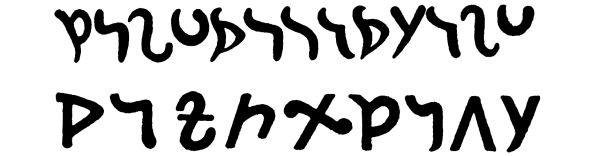
Fig. 3a. Kharoshṭhī Script on Coin of Hippostratos. Cf. Pl. II, 5.
III COINS OF THE KUSHĀṆA KINGS
Fig. 3b. Monograms on Indo-Greek Coins, etc.
Note.—The monograms in Fig. 3b
occur on coins of the following: (1) Eukratides, (2) Apollodotos, (3)
Apollodotos, Maues, (4) Azes I, (5) Sotēr Megas, (6) Gondopharnes and
Aspavarma.
The Yueh-chi, who drove the Śakas out of Bactria about the year 126
B.C., were destined to create “one of the greatest empires of ancient
India.” At some date after A.D. 25, one of the five tribes of which
they were composed, the Kushāṇas, became supreme, and under the
leadership of the head of that tribe, Kujūla Kadphises, they passed
south of the Hindu Kush, and overwhelmed the Pahlavas, then ruling in
the Kābul valley. The deposition of Pacores, successor of Gondopharnes
to the Pahlava kingdom of Taxila, must have taken place between the
years A.D. 45 and A.D. 64, and was effected by Vima Kadphises, the
second Kushāṇa king. Henceforward there is less confusion of dynasties.
We know the names and the chronological order of these powerful
Kushāṇa princes—Kujūla Kadphises, Vima Kadphises, Kanishka, Huvishka,
Vāsudeva; the names of the three last are even recorded in several
inscriptions. It seems to be now generally accepted that Kanishka
was the founder of the so-called Śaka era, and that consequently his
reign started in A.D. 78.[24]
The chief remaining difficulty is the attribution of certain copper coins
bearing the title Kujūla Kadaphes (Kharoshṭhī—Kuyula Kaphasa);
this must remain for the present unsettled.
The commoner type of these Kadaphes coins deserves special attention
(Pl. IV, 2); for the head on the obverse is directly copied from the
coins of one of the earlier Roman Emperors, probably Augustus, and
bears evidence to that Roman influence which is so marked in the
gold coinage of the Kushāṇas, and which is partly traceable to the
intercourse between the Yueh-chi and the Roman Empire before their
invasion of India, an intercourse which resulted in Kushāṇa ambassadors
being actually sent to the court of Augustus. But the plentiful issues
in gold of Vima Kadphises and his two successors, all struck on the
same standard as the Roman aureus, are due also to other causes.
Exports from India to different provinces of the Roman Empire, carried
by sea from the south, and by the overland routes in the north, were
paid for in Roman gold; and the aureus had, like the English
sovereign in more recent times, at this period acquired that
status as a current coin in India, which it already possessed in those
parts of Asia more directly under the influence of the imperial power.
It was only natural that these Kushāṇa invaders should seek to win
acceptance for their new gold currency by placing it on an equality
with the popular Roman gold. There was, moreover, at this time a world
shortage of silver: not only do we find the Pahlava kings striking
didrachms in debased silver, but the silver denarius itself was,
during the early empire, being reduced in weight and fineness. This
accounts for the disappearance of silver and the important place of
gold in the Kushāṇa coinage, and is probably also partly the reason why
the Western Satraps struck only small hemidrachms, and these often in
inferior silver.
The coins of Kujūla Kadphises are all of copper. Those which he struck
in the style of Hermaios have the head of the Greek king on the obverse
(Pl. IV, 1), and he used the same type after the name of Hermaios had
disappeared from the inscriptions; both these types were current in
the Kābul province. Another type, akin to the Śaka coins, has a bull
on the obverse and a Bactrian camel on the reverse. In one of his
inscriptions, for which like his successor he uses both Greek and
Kharoshṭhī, he is styled “The Great King, King of Kings, the Son of
Heaven.”
The gold of Vima Kadphises (c. A.D. 45-78) was struck in three
denominations, the double stater (Pl. IV, 3), the stater or
dināra,[25]
as the Kushāṇas called it (= the Roman aureus of 124 grains
weight), and the quarter stater. On the obverse of these appears either
the king’s head or bust, or the king seated cross-legged on a couch,
or, as on a rare stater in the British Museum, sitting in a two-horsed
chariot. On the copper coins, which are of three sizes, the king is
almost invariably standing, with his right hand placing an offering
upon a small altar at his side. The portrait of the king is most
realistic, though hardly flattering—a corpulent figure with a long
heavy face and a large nose, he appears wearing the long Kushāṇa cloak
and tall “Gilgit” boots, on his head a conical hat with streamers. Vima
Kadphises must have been a zealous convert to the worship of the Hindu
god Śiva, for the god or his emblem, the trident battle-axe, is the
invariable device on the reverse of all his coins. The title “Sotēr
Megas” on this king’s copper coins indicates a relationship between
him and the so-called “nameless king” mentioned in the previous
chapter, whose coins bear the same legend.
Kanishka, the real founder of the great Kushāṇa empire, which stretched
from Kābul[26]
to the banks of the Ganges, may have belonged to another branch of the
Yueh-chi—he was not, at any rate, nearly related to Vima Kadphises,
whose coins are distinct in many respects from those of Kanishka and
his successors. One marked distinction is the use of Greek legends only
by these later kings. The Greek is often very debased, and the reason
suggested for its employment is that Khotanese, the native tongue of
the Kushāṇas, was first reduced to writing in the Greek character.
Kanishka also introduced the Iranian title, Shāonānoshāo—“King
of Kings”—in place of the Greek form Basileōs Basileōn. On the
reverse side of the extensive gold (full and quarter staters only) and
copper coinage of Kanishka and Huvishka is portrayed a whole pantheon
of gods and goddesses; among them are the Greek gods, Helios, Herakles
(Pl. IV, 8), Selene; the Hindu god, Śiva (Oesho on the coins);
the Iranian deities, Athro, “Fire,” Oado, the wind god, Ardokhsho and
Nāna, and even the great Buddha himself (Pl. IV, 4), who had previously
appeared on a copper coin of Kadaphes. The representation of this
“mixed multitude” was probably intended to conciliate the religious
scruples of the numerous peoples included within the vast territory
of the Kushāṇa Empire. A standing figure of the king appears on the
obverse of Kanishka’s gold staters, on the small quarter staters is a
half (Pl. IV, 5) or quarter length portrait. On Huvishka’s gold the
standing figure never appears; the portrait is either half-length or
merely the king’s head; on one coin the king is seated cross-legged;
on another (exceedingly rare) he is riding an elephant (Pl. VI, 7).
Vāsudeva closely imitates Kanishka’s standing figure type on his gold.
Kanishka’s copper coinage is of two types: one has the usual “standing
king” obverse (Pl. IV, 6); and on the rarer second type the king is
sitting on a throne. Huvishka’s copper is more varied; on the reverse,
as on Kanishka’s copper, there is always one of the numerous deities;
on the obverse the king is portrayed (1) riding on an elephant, or (2)
reclining on a couch, or (3) seated cross-legged, or (4) seated with
arms raised.
Kanishka had been a great patron of Buddhism. Vāsudeva was evidently a
convert to Hinduism and an ardent devotee of Śiva. On the reverses of
his coins the deity is almost invariably Śiva accompanied by his bull
(Pl. IV, 9), but there is a rare copper piece on which the word “Vāsu”
in Brāhmī occupies the obverse, and the special symbol of Vāsudeva the
reverse. About half-a-dozen other symbols, which take the place of the
monograms of the Indo-Greeks, appear on the coins of the Kushāṇas.
After the death of Vāsudeva, in A.D. 220, the Kushāṇa power declined,
though the descendants of Kanishka held the Kābul valley till A.D. 425.
The coins of these kings, principally of two classes, are degenerate
copies of the gold coins of Kanishka and Vāsudeva. One continues the
standing king type with the Śiva and bull reverse; the second has the
standing king obverse, with the deity Ardokhsho, who was by this time
identified with the Indian Lakshmī, represented as sitting on a throne
and holding a cornucopia on the reverse (Pl. IV, 10). Certain Brāhmī
letters, now unintelligible, seem to have distinguished the coins of
successive rulers. It was this latter type, current throughout the
Panjāb, that the Gupta kings took as the model for their earliest
coinage. In A.D. 425 a tribe of the Little Yueh-chi, under a chief
named Kidāra, replaced the great Kushāṇa dynasty at Kābul; but they
were driven out fifty years later by an inroad of the Ephthalites, or
White Huns, and settled in the Chitrāl district and in Kashmīr. There
they struck coins in much alloyed gold and also in copper of this same
standing king and seated goddess type, and there it survived in a
hardly recognizable form in the later coins, until the Muhammadans put
an end to the Hindu kingdom in the fourteenth century. Certain kingdoms
in the Panjāb also copied the large copper coins of the Kushāṇas: the
most striking of these minor coinages is that of the Yaudheyas, whose
territory included the modern state of Bahāwalpūr. One type of their
coins shows a female standing figure on the obverse, and a soldier with
a Brāhmī inscription on the reverse (Pl. IV, 11). The earliest coins of
Nepāl current from the fifth to the seventh century also show traces of
Kushāṇa influence. These large copper pieces give the names of at least
four kings, Mānāṅka, Gunāṅka,[27]
Aṅśuvarman and Jishṇugupta. Various devices are used, among them the
goddess seated cross-legged. The coins of Aṅśuvarman, of the seventh
century, have a cow standing to the left on the obverse and a winged
horse with the king’s name on the reverse (Pl. V, 1).
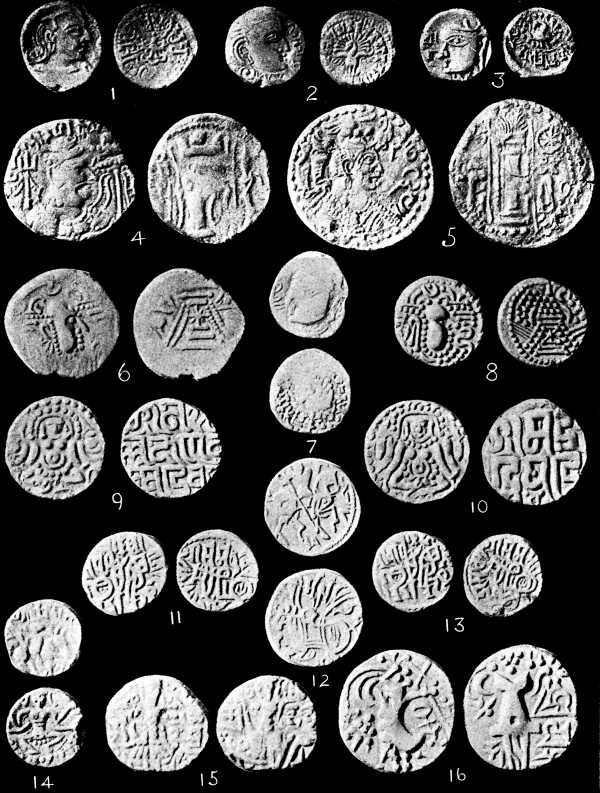
Key to Plate V
1. Nepāl: Aṁśuvarman. Æ.
Obv., cow to left, Kāmadehī,
“The cow that yields every wish.”
Rev., winged lion to left, Śryaṁśuvarma.
2. Samudragupta. Standard type. AV. Wt. 116 grs.
Obv., king standing to left, holding standard in left hand,
sacrificing at altar to his right; behind altar Garuḍa-headed
Obv., bust of king to right; in front, bull-standard; behind, trident.
Legend, Jayatu Mihirakula.
Rev., debased fire-altar and attendants.
5. Napkī Malik. AR (base). About 52 grs.
Obv., bust of king with winged head-dress;
above, buffalo’s head facing. Pahlavī legend, Napkī Malik.
Rev., Fire-altar and attendants, wheel over head of each.
6. Indian imitation of Sassanian coin. AR (base).
Obv. and Rev., as on No. 4, but very barbarous.
7. Toramāṇa. AR. Wt. 32·8 grs.
Obv., as on No. 3.
Rev., as on No. 3, but Śrī Toramāṇa.
8. Gadhiya paisa. AR (base). Wt. 60 grs.
Obv., head of king to right.
Rev., fire-altar. More debased than No. 6.
9. Mahoba: Hallakshaṇavarma. AV. Dramma. Wt. 63 grs.
Obv., four-armed goddess seated facing.
Rev., Śrīmad Hallakshaṇavarma Deva.
10. Ḍahāla: Gāṅgeya-deva. AV. Wt. 62 grs.
Obv., as on No. 9.
Rev., Śrīmad Gāṅgeya-deva.
11. Dehlī and Ajmer: Pṛithvī Rāja. Bil. Wt. 52 grs.
Obv., horseman to right; Śrī Pṛithvī Rāja deva.
Rev., recumbent bull to left; Asāvari Śrī Sāmanta
deva.[28]
12. Shāhis of Ohind: Spalapati-deva. AR. Wt. 50 grs.
Obv., horseman to right. Inscription in undeciphered characters.
Rev., recumbent bull to left. Śrī Spalapati-deva.
13. Narwar: Chāhaḍa-deva. Æ. Wt. 52 grs.
Obv., as No. 11, but legend Śrī Chāhaḍa-deva.
Rev., as No. 11.
14. Kashmīr; Harsha-deva. AV. Wt. 73 grs.
Obv., horseman to right; Harsha-deva.
Rev., seated goddess.
15. Id: Diddā Rānī. Æ. Wt. about 85 grs.
Obv., standing king to right.
Rev., seated goddess. To left, Śrī; to right, Diddā.
16. Id: Yaśovarman. AV (base). Wt. 112 grs.
Obv., standing king; under left arm, Kidā (ra).
Rev., seated goddess, Śrī Yaśovarma.
The reigns of Kanishka and Huvishka coincide with the most flourishing
period of the great Gandhāra school of sculpture, which had arisen
during the rule of the Śaka princes. Hellenistic influence is very
strongly marked in that art, and it may be interesting to consider
here briefly what contribution the coins make to the vexed question
of the respective parts played by Greek and Indian ideals in moulding
its character. A careful inspection of the successive coinages of the
Indo-Greeks, the Śakas and the Kushāṇas will show that the strongest
influences of pure Greek art had passed away before the reign of
Kanishka. With the establishment of Greek rule south of the Hindu
Kush, traces of the Indian craftsman’s hand begin to appear. As time
goes on these become more apparent, until, in the Kushāṇa period, the
whole fabric of the coins, if not entirely Indian, is far more Oriental
than Greek. That purely Indian influences were strongly at work is
very evident in the cult of Śiva as expressed on the coins of Vima
Kadphises and Vāsudeva for instance; in the Buddha coins of Kadaphes
and Kanishka, and in the typical Indian cross-legged attitude in which
Kadphises II and Huvishka are depicted; and, after all is said, the art
was produced in India and must have been largely if not entirely the
work of Indian craftsmen. Originality in art does not so much consist
in evolving something which has never existed before, but rather in the
ability to absorb fresh ideas and transmute them into a new form. And
thus it was in the time of Kanishka: Indian mysticism allowed itself
to be clad in Greek beauty of form. Eastern feeling ran, as it were,
into Western moulds to create this wonderful aftermath of Hellenic art,
which left an indelible mark upon every country of the Orient where the
cult of the Buddha penetrated.
IV THE COINAGE OF THE GUPTAS
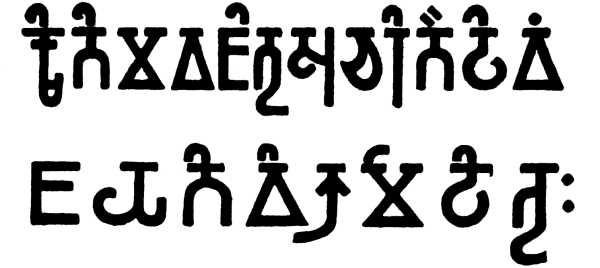
Fig. 4. Gupta Script on coin of Chandragupta II.
Cf. Pl. V, 7 (obverse).
The Gupta period, computing it roughly as lasting from A.D. 320 to
480, synchronises with a great revival of Hinduism, and along with
it of literature, the arts and sciences. The Gupta monarchs, as is
evident from their coins, although orthodox devotees of Vishṇu, were
liberal patrons. Kālidāsa and other writers raised literary Sanskrit
to a point of perfection never equalled before or since; the cave
frescoes of Ajanta bear witness to the genius of the Gupta painters;
the architecture and sculpture of the period show an equally high level
of attainment; all the greatest Hindu mathematicians and astronomers
flourished in the fifth and sixth centuries. It is, in fact, evident
that when the Hindu of to-day harks back to the Golden Age of Hinduism,
the picture he draws in his mind is coloured by traditions, which have
come to him from books or hearsay, of the age of the Guptas, rather
than by the fainter glimmerings of more heroic times from the Vedas or
the great Epics. So, too, the splendid gold coinage of the Guptas, with
its many types and infinite varieties and its inscriptions in classical
Sanskrit, now appearing on Indian coins for the first time, are the finest
examples of purely Indian art of this kind we possess.
The origin of the Gupta family is obscure. This much seems certain,
that the family was not of high caste, perhaps of the lowest. The
territory which the Guptas are first found ruling lay near Pāṭaliputra,
the modern Patna; it was much enlarged by one Gupta, on the decline
of the Kushāṇa power in its eastern territories; he was succeeded
by a son, Ghaṭotkacha, who assumed the title of Mahārāja, which
brings us out into the light of history; for with the year of his
son Chandragupta I’s accession, A.D. 320, the Gupta era starts. It
may appear strange that this monarch should have issued no coins of
his own, but there seems little reason now to doubt that, to his son
and successor, Samudragupta, the real founder of the Gupta Empire,
should be assigned those coins (Pl. V, 4) which bear the portraits of
Chandragupta and his wife Kumāradevī,[29]
a member of the illustrious Lichchavi family reigning at Vaiśālī[30]
as early as the seventh century B.C. Samudragupta’s conquests, as we
learn from his Allahabad pillar inscription, carved out for him an
empire which extended north to the base of the Himalayas, east to
the Brahmaputra river, south to the banks of the Narbadā, and west
to the Jumna and the Chambal, with a number of protected states on
his frontier between those rivers and the Chināb. On the completion
of his conquests he revived an ancient Hindu rite in celebrating the
Aśvamedha, or Horse-sacrifice. Now the states under Samudragupta’s
protection in the Panjāb were the districts of the old Kushāṇa Empire
in which the gold coinage current at this time was, as we saw in the
last chapter, a degraded form of the Kushāṇa “standing king” and
“seated goddess,” Ardokhsho-Lakshmī type: it was from these coins
(Pl. IV, 10) that the earliest and commonest form of Samudragupta’s issues,
the Standard type (Pl. V, 2) was imitated. The earliest specimens,
though much superior in workmanship, follow their model very closely:
the “standing king” still wears Kushāṇa dress; a Kushāṇa symbol still
appears on the reverse; only, on the obverse, in place of Śiva’s
trident, appears a Garuḍa-headed standard (Garuḍadhvaja), emblem
of the cult of Vishṇu. This coinage appears to have been introduced
about the middle of the reign: such legends as “The invincible one,
the lord of the earth” suggest, as indeed is obvious, that only
rich plunder made such a varied and plentiful gold currency possible.
Samudragupta struck only gold. In such abundance did the Kushāṇa kings
mint copper money that it may be said without exaggeration to have
remained in circulation in the Panjāb down to the nineteenth century;
in the time of the Guptas the bazars must have been full of it. But for
gold there is always an insatiable demand in India, and seven other
distinct varieties appeared during this reign. Of these the Archer
type, the commonest and most characteristic Gupta coin (Pl. V, 6),
struck by at least eight succeeding kings, is a natural development
of the Standard type, of which also further modifications are to be
found in the Battle-axe and Kācha types. On the obverse of the former
a second attendant figure is introduced, and a battle-axe instead of
a standard is in the king’s left hand. In the Kācha coins the change
takes place on the reverse, where a standing figure of Lakshmī facing
left takes the place of the seated goddess: the reverses of the
Tiger-slayer and Aśvamedha coins present variations of this motif.
The Tiger-slayer type, of which four specimens only are at present
known, is the prototype of the Lion-slayer issues of later kings, and
represents the king, dressed for the first time in an Indian waistcoat
and turban, trampling on a tiger as he shoots it. There remain the
Chandragupta I, Aśvamedha (Pl. V, 5) and Lyrist types, all three
obviously in the nature of commemorative medals, and perhaps intended
as pious gifts (dakshiṇa) to Brahmans. The Lyrist coins
(Pl. V, 3), the rarest of the three, merit special attention. Evidently
intended as a graceful tribute to the king’s accomplishments, he is
portrayed in Indian dress, sitting cross-legged on a high-backed rather
ornate couch, playing on a vīṇā, or Indian lute. On the reverse
appears the goddess Lakshmī seated to left on a mora (wicker
stool). The excellent modelling of the king’s figure, the skilful
delineation of the features, the careful attention to details, and the
general ornateness of design in the best specimens constitute this type
as the highest expression of Gupta numismatic art.
Chandragupta II Vikramāditya (= Sun of Power), who succeeded to the
throne in A.D. 375, extended still further the boundaries of the
empire, and at some time during his long reign, which lasted till A.D.
413, removed the capital from Pāṭaliputra to Ayodhyā. His gold coinage
is even more abundant than his father’s, two of whose types, the Archer
and Lion-slayer (Tiger-slayer), he continued; but on his later Archer
coins (Pl. V, 6) the goddess Lakshmī sits upon a lotus instead of a
throne; and in the second type, besides the substitution of a lion
for a tiger, there is a change on the reverse, Lakshmī being seated
on a lion in various attitudes. The figure of the Lion-slayer on the
obverse is sometimes turned to the right and sometimes to the left; and
a unique coin in the Lucknow Museum shows him attacking the lion with
a sword. The very rare Couch design of Chandragupta is a derivative of
Samudragupta’s Lyrist type. In the new Chattra type coins (Pl. V, 7)
we have yet a further variant of the Standard type: on the obverse of
these, behind the “standing king,” appears a boy or dwarf, holding an
umbrella (chattra) over his head; the reverse shows the goddess
Lakshmī standing on a lotus. An entirely new design is furnished by
this king’s Horseman coins (Pl. V, 8). A king on horseback was, as
we have seen, employed by the Indo-Greeks, and was characteristic of
the issues of the Śakas. The Gupta rendering of the motif is new and
spirited. The horse is fully caparisoned, facing in some coins to the
right, on others to the left, and the king, either fully clad or
sometimes only in a waistcoat, carries either a sword or a bow; the
reverse resembles that of the Lyrist type.
Kumāragupta I (413-455) struck a few very rare Aśvamedha coins, closely
resembling those of Samudragupta, except that they are far inferior in
execution, and the sacrificial horse on the obverse is standing to the
right instead of to the left.
He also continued to issue the Archer, Horseman and Lion-slayer
(Pl. V, 9) types of his predecessors. Kumāragupta’s Tiger-slayer coins closely
resemble their prototype struck by Samudragupta, except that on the
reverse the goddess Lakshmī is depicted feeding a peacock. Four new
designs appear on the gold of this reign. The Swordsman coins present
still another modification of the Standard type, their distinguishing
mark being that the king’s left hand rests on his sword-hilt instead
of grasping a standard; on the reverse is the usual goddess seated
on a lotus. Kumāragupta held the god Kārttikeya, one of whose names
was Kumāra, in special veneration. The Peacock type (Pl. V, 10) bears
evidence to this, for on the reverse the god himself appears riding on
his peacock, Paravāṇi, and on the obverse the king is shown standing
and feeding a peacock from a bunch of grapes. The rare Elephant-rider
type shows the king on the obverse riding on an elephant trampling on a
tiger; and the obverse of the still rarer Pratāpa type, so-called from
the legend on the reverse, is evidently an adaption from some foreign,
probably Roman, model.
Skandagupta, the last of the great Gupta kings, who succeeded his
father in A.D. 455, was occupied during the earlier part of his reign
in defending his empire against the inroads of the Huns, over whom
he appears to have gained a decisive victory. This probably accounts
for the comparative scarcity of his gold, of which only two types are
known. He continued the favourite device of the Archer with the “seated
goddess” reverse, and introduced a new type, on the obverse of which
the king appears standing on the left, facing the goddess Lakshmī on
the right, with the Garuḍa standard between them. But in this reign the
gold coinage underwent an important change of a different character.
Hitherto all the Gupta gold pieces had been dināras and followed
the weight standard adopted by the Kushāṇa kings from the Romans. All
Skandagupta’s coins are, on an average, heavier than those of his
predecessors; and certain of his Archer coins evidently represent
a new standard of about 142 grains, based, perhaps, on the ancient
Hindu suvarṇa; but along with the increase in weight there is a
corresponding depreciation in the purity of the gold.
The successors of Skandagupta—Puragupta, Narasiṅhagupta, Kumāragupta
II, Chandragupta III and Vishṇugupta, whose relationship and dates are
somewhat doubtful, struck gold coins only of the Archer type, showing
a gradual deterioration in design and execution. On a few coins of
the same type are found portions of names, such as Ghaṭo and
Jaya, even more difficult to identify. A certain Prakāśāditya,
perhaps identical with Puragupta, struck coins on which the king
appears on horseback slaying a lion, a combination of the Horseman and
Lion-slayer types (Pl. V, 11).
The inscriptions on Gupta coins are scarcely inferior to the designs
in interest: they vary with each successive type and frequently bear
a close relation to them. Thus on Samudragupta’s Battle-axe issue the
king is described as “Wielding the axe of Kṛitānta” (= Yama,
the god of Death), while on his Tiger-slayer coins he is given the
title Vyāghraparākramaḥ, “He who has the prowess of a tiger.”
Sometimes varieties of the same type are marked by a difference in
the inscription: no less than seven different legends are found on
Kumāragupta I’s Archer coins alone. The obverse legend, which encircles
the design, usually takes the form of a verse in Upagīti or some
other Sanskrit metre, celebrating in highly ornate language the king’s
glory on the earth and his future bliss in heaven, attained through
his merit acquired by sacrifice. On the gold of Samudragupta six such
metrical legends appear; Chandragupta II has only three; while
at least twelve are employed by Kumāragupta I. As an example the
obverse inscription on one class of Chandragupta II’s Chattra coins
(Fig. 4) may be taken: “Vikramāditya, having conquered the
earth, wins heaven by good works”; or the more ornate legend
on a variety of Kumāragupta I’s Horseman type: “The unconquered
Mahendra, invincible, the moon in the sky of the Gupta line, is
victorious.” When a verse appears on the obverse, the reverse
legend is distinct, consisting of a title, sometimes the repetition of
one which appears already in the metrical obverse inscription, such
as Apratirathaḥ, “The invincible one,” on the Archer coins
of Samudragupta. Sometimes the king’s name and titles only appear,
and then the legend on both obverse and reverse is often, though not
always, continuous, but here again the reverse inscription, which
appears to the right of the device, consists of a single title. Thus
on Chandragupta II’s Archer type appears the following: obverse,
Deva-Śrī-Mahārājādhirāja-Śrī-Chandraguptaḥ; reverse, Śrī
Vikramaḥ. Entirely distinct in point of their inscriptions from all
other Gupta coins are those struck by Samudragupta in memory of his
father and mother, known as the Chandragupta I type; on the obverse
appear the two names Chandragupta and Kumāradevī, and
on the reverse his mother’s family name, Lichchavayaḥ. This
relationship was evidently a matter of pride to the striker. Finally,
on the obverse of all coins of the Archer and most of the allied types
appears vertically, under or near the king’s left arm, part of the
king’s name, as Samudra, Chandra or Kumāra. This
vertical method of inscription can be traced back through the later
Kushāṇa coins to a Chinese source.[31]
Whether the symbols which occur regularly on all Gupta gold are
anything more than ornaments is doubtful.
The silver coinage of the Guptas starts, as has been already noticed,
with the overthrow of the Western Satraps by Chandragupta II. His
issues follow those of the conquered nation very closely, except that
on the obverse appears a figure of Vishṇu’s sacred bird, Garuḍa,
in place of the chaitya, and the dates are computed in the
Gupta instead of in the Śaka era. Obviously these were intended for
circulation in the recently annexed provinces. Kumāragupta, while
striking large quantities of the Garuḍa-type coins in the west (Pl. VI, 1),
extended the silver coinage to the Central Provinces of his Empire.
This latter class of money is entirely distinct in character: the head
on the obverse is drawn in a crude but quite original manner, and is
probably intended as a portrait of the king; on the reverse the king’s
devotion to Kārttikeya is once more displayed in the representation
of a peacock with outstretched wings. A third class of silver-plated
coins, with a rude figure of Garuḍa on the reverse, seems to have been
intended for the tributary state of Valabhī.[32]
Skandagupta continued the Garuḍa and Peacock types (Pl. VI, 2) of his
father, and introduced two new ones. The coins, of very base silver,
with Śiva’s sacred bull Nandi on the reverse, were probably current
in Kathiawar; but commoner than any of the preceding are certain
ill-shaped pieces with an altar on the reverse. None of the direct
descendants of Skandagupta appears to have struck silver, but a few
coins of the Peacock type were issued by Budhagupta, a king of Eastern
Mālwā, about A.D. 480. The dates which appear on these coins to the
left of the obverse head in the Western, and to the right in the
Central, issues are frequently defective or illegible. Inscriptions
are confined to the reverse, on the Peacock type always a metrical legend,
on all other types the king’s name accompanied by high-sounding titles.
The copper coinage, which is practically confined to the reign of
Chandragupta II, is far more original in design. Eight out of the nine
types known to have been struck by him have a figure of Garuḍa on the
reverse, usually accompanied by the name of the king, while the obverse
is occupied by the bust or head of the king, or by a three-quarter
length portrait. In one class this is varied by the reproduction of the
gold Chattra type obverse (Pl. V, 13). The tiny coins which constitute
the ninth type have the word Chandra in the obverse and a flower
vase (kalaśa) on the reverse. Only four copper pieces are at
present known of Kumāragupta.
After the death of Skandagupta, in A.D. 480,[33]
the Gupta Empire rapidly broke up. The inferiority and comparative
scarcity of his own gold coins, the still more debased issues of his
brother Puragupta and subsequent kings, and the disappearance of silver
money, bear ample evidence to their curtailed territory.
The impression produced by the magnificent coinage of the Guptas upon
the peoples of Northern India was undoubtedly as great as that created
by the currency of their Kushāṇa predecessors; but, after the general
devastation caused by the inroads of the Huns, few princes could have
retained sufficient wealth in their treasuries to imitate it. It is
significant then that the most notable imitations were the product of a
mint, secured by its remoteness from the ruthless hand of the invader,
in Central Bengal. These remarkable and not uncommon coins, with Śiva
reclining on his bull Nandi on the obverse, and the goddess Lakshmī
seated on a lotus on the reverse (Pl. V, 12), were struck by Śaśāṅka,
king of Gauḍa (circ. 600-625), notorious as the assassinator of
Harshavardhana’s elder brother, and a great “persecutor of Buddhism.”
In Bengal, too, for many years after the passing of the Gupta Empire,
were current flat gold pieces with crude reproductions of Gupta
designs, and, with the exception of the word Śrī on the obverse,
completely illegible inscriptions. Another rather striking coin
connected with the Gupta series, with a standing bull on the obverse,
bears the name Śrī Vīrasena, but who Vīrasena was is at present
unknown. A modification of the seated goddess motif was preserved on
the gold coinage of certain mediæval Rājpūt kingdoms.
Key to Plate VII
1. Gold globule, with faint punch-mark on reverse. Wt. about 52 grs.
2. Padma-ṭaṅka. AV. Wt. 57 grs.
Obv., eight-petalled lotus, surrounded by “Śaṅka” and two other
symbols. Inscription in a form of Nāgarī.
3. Pāṇḍya. AV. Wt. 57 grs.
Obv., two fishes under canopy; to right, lamp, to left, “chauri” (fly-whisk).
Rev., undeciphered inscription.
4. Eastern Chālukya: Rājarāja. AV. Wt. 66·8 grs.
Obv., in centre, boar to right; around, Śrī Rājarāja Saṁvat 35.
5. Koṅgudeśa. AV. Wt. 60·2 grs.
Obv., ornate elephant to right.
Rev., floral scroll design.
6. Choḷa. AR. Wt. 52 grs.
Obv. and Rev., tiger seated under a canopy, behind it a bow,
in front two fish, whole flanked by two fly-whisks.
In Nāgarī, below, Śrī Rājendraḥ.
7. Ceylon: Parākrama Bāhu. Æ.
Obv., standing king.
Rev., seated goddess. In Nāgarī, Śrī Parākramabāhu.
8. Pallava or Chālukya (?). AR. Wt. 103·9 grs.
Obv., lion to right.
Rev., vase on stand, circle of rays.
9. Kerala. AR. Wt. 36·3 grs.
Obv., undeciphered inscription.
Rev., in Nāgarī, Śrī Vīrakeralasya.
10. Kalīkūt: Tīpū. AV. Fanam. Wt. about 5·2 grs.
Obv., Persian “hē” (= Ḥaidar).
Rev., in Persian, Kalīkūt, 1199.
11. Vijayanagar: Kṛishṇa Deva Rāya. AV. Half pagoda. Wt. about 26 grs.
Obv., Vishṇu seated with discus and conch.
Rev., in Nāgarī, Śrī Pratāpa Kṛishṇa Rāya.
12. Id: Harihara II. AV. Half pagoda. Wt. 25 grs.
Obv., god and goddess seated.
Rev., in Nāgarī, Śrī Pratāpa Harihara.
13. Kananūr: ’Ali Rāja. AV.
Obv., in Arabic, Al-wālīu-l-mulk ’Alī Rāja,
“The guardian of the kingdom, ’Alī Rāja.”
Rev., Bi-l-hijrati as-sina 1194, “In the Hijrī year 1194.”
Plate VII
Plate VIII
Key to Plate VIII
1. Altamsh. Æ.
Obv., in hexagon, ’Adl.
Rev., in square, inscribed in a circle, As-sult̤ān.
2. Id: AR. Wt. about 165 grs.
Rev., in square, inscribed in a circle, As-sult̤ānu-l-a’z̤am
Obv., Fī zamani amīru-l-mominīn khuldat khilāfatuhu 858.
Rev., Al mutawakkilu ’ala-r-rahmān
(“Trusting in the Merciful one”)
Bahlol Shāh sult̤ān bi ḥaẓrati Dehlī.
The western silver coinage of the Guptas may have been imitated by
some of the powerful Maitraka rulers of Valabhī, who asserted their
independence at the end of the fifth century: coins bearing the name
Kṛishṇarāja, at present unidentified, are copied from Skandagupta’s
bull type. Far more important are the coins struck by Īśānavarman,
the Maukhari, and his successors, whose kingdom was in Bihār. These
follow the Central Peacock type, but the head on the obverse, excepting
the issue of one king, is turned to the left instead of to the right.
These otherwise insignificant coins have a twofold interest: they
were copied by the Hun Toramāṇa; and, more important still, the
name appearing on the last and most abundant coins of the series is
Śilāditya (Pl. VI, 3), who is almost certainly to be identified with
the great Harshavardhana of Thāṇeśar and Kanauj, himself a relation of
the Maukhari princes. What further strengthens this conjecture is the
fact that the dates on the Śilāditya coins are reckoned in a new era,
doubtless that which commenced with Harshavardhana’s coronation in
A.D. 606, whereas the Maukhari kings use the Gupta era. It is striking
testimony to the havoc wrought by the Hun invasions that these tiny
silver pieces are the only coins[34]
known to have been issued by this great king, who built up on the ruins
of Northern India an empire scarcely less extensive than that of the Guptas.
The copper money of the Guptas was copied by the Hun princes, Toramāṇa
and Mihiragula, but left no legacy behind, unless the small coins which
record the names of six Nāga princes of Narwar in Northern Rājputāna
may have been derived from it.
V MEDIÆVAL COINAGES OF NORTHERN AND CENTRAL INDIA TILL THE MUHAMMADAN CONQUEST — I. COINS OF THE HUNS AND INDO-SASSANIANS — II. COINS OF THE RĀJPŪT DYNASTIES — III. THE COINAGE OF KASHMĪR
Fig. 5. Śrī Maj Jajalla-deva, in old Nāgarī Script.
The centuries which elapsed between that great turning point in
Indian history, the Hun invasions, and the coming of the Muhammadans
in the twelfth century, suggest several points of comparison with
the so-called Dark Ages of European history. It was an age of
transition, pregnant with important developments for the future, but
individualistic expression, both in art and literature, remained
largely in abeyance. This want of originality is particularly marked
in the limited coinage of the numerous petty kingdoms which flourished
and declined during the seventh, eighth and ninth centuries. The most
important movement of the time was the rise of the Rājpūt clans, which
were now emerging as the dominant powers in Hindustān. The Bull and
Horseman type in the Rājpūt coinage symbolises this new force. In
addition to the issues of the Huns and the Rājpūt dynasties will be
described the money of Kashmīr, which, protected by its mountainous
frontiers, ordinarily remained shut off from the influence of political
events which agitated the kingdoms of the plains.
The military occupation of India by the Huns, or Hūṇas, lasted but
thirty years. By A.D. 500 Toramāṇa, leader of the tribe known as the
White Huns or Ephthalites, had established himself in Mālwā. On his
death, two years later, his successor, Mihiragula, completed the
conquest of Northern India, fixing his capital at Śākala (Siālkōt)
in the Panjāb, but was driven out by a confederacy of Hindu princes
under the leadership of Yasodharman of Mālwā in A.D. 528. He thereupon
seized the kingdom of Kashmīr, where he ruled till his death in 542.
Probably there were other Hūṇa chiefs who struck coins in India, but
the legends on their coins are so fragmentary that their names have not
as yet been satisfactorily deciphered. On some of the earliest Hūṇa
imitations of Sassanian silver coins, for example, the legend Shāhī
Javūvlah appears, but whether this is the name of a king or merely
a title is uncertain. No Hūṇa coins show any originality of design. The
majority are either imitated from or restruck upon Sassanian silver
pieces. The heads of both Toramāṇa and Mihiragula (Pl. VI, 4) on the
obverse are coarse and brutal to the last degree; on the reverse appear
the usual Sassanian fire-altar and attendants; the inscriptions are
generally in Nāgarī script. Toramāṇa also copied the silver coinage
of the Maukharīs (Pl. VI, 7). The copper of both princes show traces
of Sassanian and Gupta influence; the reverses especially recall the
fabric of Chandragupta II’s copper issues. Kushāṇa copper was imitated
by Mihiragula, probably during his reign in Kashmīr.
Although the Huns were mainly instrumental in introducing Sassanian
types into India, it seems certain that shortly after their invasion a
Sassanian dynasty, or a dynasty acknowledging the suzerainty of Persia,
was established in Western India; for coins with bilingual inscriptions
in Pahlavī and Nāgarī have been found, directly imitated from Sassanian
issues. One of these bears the name Shāhī Tigin, and the Nāgarī legend
reads, “King of India and Persia.” Another class with the name
Vāsudeva is directly copied from a type of the coinage of the Sassanian
Khusrū Parvīz struck in 627; but the best known and the most finely
executed are the flat copper and silver pieces (Pl. VI, 5) which bear
the name Napkī Malik; but whether this prince was a Persian or a
Hun is doubtful.
These Sassanian coins were the prototypes of degenerate base silver
pieces which are found in large quantities throughout Rājputāna,
and must have served as currency for the early Rājpūt states there
for centuries. At first they preserve the thin flat fabric of their
models (Pl. VI, 6), but as the head on the obverse and the fire-altar
on the reverse become more debased they grow thicker and more dumpy.
The curious coins known as Gadhiya Paisa (Pl. VI, 8), which
circulated in the same districts and also in Gujarāt, probably down
to a later period, also show traces of a Sassanian origin. The
silver coins with the legend Śrīmad Ādivarāha on the reverse,
and Vishṇu in his boar avatar (Varāha) as the type of the obverse,
retain traces of a fire-altar below the inscription. These have been
attributed to the powerful Bhoja-deva of Kanauj (840-890), whose
family, Gurjara in origin, had formerly ruled in south Rājputāna. Very
similar in fabric are those inscribed Śrī Vigraha, assigned to
Vigrahapāla I, circ. A.D. 910, of the Bengal Pāla dynasty.
All these debased coins follow the weight standard of their Sassanian
originals, which represented the Attic drachma of 67·5 grains, and in
inscriptions they are actually called “drammas.”
The coins of the various Rājpūt princes ruling in Hindustān and Central
India are usually gold, copper or billon, very rarely silver. The gold
coins are all “drammas” in weight; the usual type, which appears
to have been struck first by Gāṅgeya-deva Vikramāditya (1015-1040) of
the Kalachuri dynasty of Ḍahāla (Jabalpūr), bears the familiar goddess
(Lakshmī) on the obverse (Pl. VI, 10), with a slight deviation from the
Gupta device, in that the goddess has four instead of two arms; on the
reverse is an inscription giving the king’s name in old Nāgarī (Fig. 5).
Of the same type are the gold coins of six Chandel kings of Mahoba
(Pl. VI, 9) in Bundelkhand (circ. 1055-1280), of the Tomara dynasty
of Ajmer and Dehlī (978-1128), and of the Rāṭhor kings of Kanauj
(1080-1193). On the conquest of Kanauj, Muḥammad of G̱ẖ̱or actually
struck a few gold pieces in this style. On the gold of the last
three princes of the Kalachuri dynasty of Mahākośala, in the Central
Provinces (circ. 1060-1140), a rampant lion is substituted for the
seated goddess on the obverse.
The seated bull and horseman, the almost invariable devices on Rājpūt
copper and billon coins, were introduced by the Brahman kings of
Gandhāra, or Ohind (circ. 860-950), who first used them on silver; the
commonest of these are the issues of Spalapati-deva (Pl. VI, 12) and
Samanta-deva. The later coins of the dynasty, however, degenerate into
billon. The name of the king in Nāgarī appears along with the bull on
the reverse, and on the obverse of the Ohind coins is an inscription
hitherto undeciphered, but probably in some Turanian script. Bull
and Horseman coins, either copper or billon, were also struck by the
Tomara and Chauhan dynasties of Dehlī (Pl. VI, 11), the Rāṭhors of
Kanauj, Amṛitapāla Rāja of Budāyūn (Budāon), and the Rājpūt kings of
Narwar (1220-1260; Pl. VI, 13). Some of these last, in imitation of the
Muḥammadan invaders, placed dates in the Vikrama era[35]
on their coins. The Narwar horseman on later coins is particularly
crude in design. The Mahārājas of Kāngra continued to strike degenerate
Bull and Horseman coins, from 1315 down to 1625. Deviations from this
conventional type are rare. There is a unique coin of Śrī Kamāra, king
of Ohind, with a lion on the obverse and a peacock on the reverse,
while three kings of the same dynasty issued copper with an elephant
obverse and a lion reverse.
A few copper coins of the Mahākośala kings and of Jayavarma of Mahoba
have a figure of Hanumān on the obverse and a Nāgarī legend on the
reverse; and a similar legend takes the place of the bull on some
copper pieces of Asalla-deva and Gaṇapati-deva of Narwar.
The early history of Kashmīr as an independent kingdom is obscure;
trustworthy annals do not begin till its conquest by Mihiragula in
the sixth century. From that time down till about 1334, when it was
conquered by the Muhammadans, the country was ruled by four successive
dynasties. The earliest coins are considered to be those with the head
of a king on the obverse and a vase on the reverse, attributed from the
inscription Khiṅgi to a certain Khiṅgila of the fifth century.
A number of coins of the eighth century, struck by princes of the Nāga
dynasty, are known: these are for the most part of very base gold, and
were imitated from the standing king and seated goddess issues of the
Little Yueh-chi, who, as we have seen, conquered Kashmīr about the year
475, and the name of the original leader of that tribe, Kidāra,
still appears written vertically under the king’s arm. The workmanship
of these degenerate pieces (Pl. VI, 16) is of the rudest, and the
devices would be quite unintelligible without a knowledge of their
antecedents. Some copper coins give the name Toramāṇa, but the
identification of this prince with the famous Hūṇa chief presents many
difficulties.
With the accession of Śaṅkara Varma, the first of the Varma dynasty,
in A.D. 833, gold practically disappears. From the middle of the ninth
century nearly all the kings whose names are recorded in Kalhaṇa’s
great chronicle history of Kashmīr, the Rājataraṅgiṇī, of the
twelfth century, are represented by copper coins, but the uniform
degradation of the fabric deprives them of all interest. Among these
are the coins of two queens, Sugandhā and Diddā (980-1003) (Pl. VI, 15),
the latter chiefly remarkable for an adventurous career. The
flourishing state of sculpture and architecture during the eighth and
ninth centuries, and the natural artistic skill of the Kashmīrī people,
suggest that this extreme debasement of the coinage may at least be due
as much to a conservative dislike and suspicion of innovation as to a
lack of cunning in the engravers. Many parallels could be cited, the
classical example being the Attic tetradrachm, the archaic style of which
continued unchanged at Athens even during the brilliant age of Pheidias.
Obv., within square dotted border, legend as on No. 8.
Rev., Shahrīwar Ilāhī 43.
12. Jahāngīr. 1014-1 R. AR. (A “Ḵẖ̱air qabūl.”)
Obv., within dotted border Jahāngīr bādshāh ghāzī 1.
Rev., Khair qabūl, “May these alms be accepted.”
The one break in this monotonous Kashmīrī series occurs in the reign
of the tyrant Harsha-deva (1089-1111), who struck both gold and silver
in imitation of the ornate gold of Koṅgudeśa (Pl. VII, 5) in Southern
India, with an elephant’s head on the obverse. The same king also
issued a gold coin with a Horseman obverse and the usual seated goddess
on the reverse (Pl. VI, 14).
The sparseness and inferiority of the coinage during the period under
discussion in this chapter must be attributed chiefly to the general
insecurity, caused by the continual quarrels between the numerous petty
states. This state of unrest, together with the previous impoverishment
of the country at the hands of the Huns, doubtless accounts for the
small output of gold. It must be remembered that mercantile contracts
in India have always been carried on largely by notes of hand
(hundīs), and in times of disturbance these could be conveyed
more safely from city to city than coined money.
The scarcity of silver was due to other causes. At this period
the world supply of this metal seems to have been drawn chiefly
from Central Asia. The rise of the Arab power and the consequent
disturbances in Central Asia interrupted trade between India and the
west by land and sea, and must have curtailed, if they did not cut
off completely, the import of silver from abroad. So we find the
Rājpūt states reduced to employing an alloy, billon, which was almost
certainly used by them as a substitute for the more precious metal.
It is a most illuminating fact that gold, formerly exported from India,
disappears from the coinage of Europe at about this very period, while
silver is reduced to the meagre Carolingian penny standard.
VI THE COINAGE OF SOUTHERN INDIA — I. COINAGE OF THE DECCAN AND MYSORE — II. THE COINAGE OF TAMIL STATES — III. COINAGE OF THE EMPIRE OF VIJAYANAGAR AND LATER DYNASTIES
The difficulties of the historian in tracing the fortunes of the
numerous clans and dynasties which contended for sovereignty in the
south from the third to the fourteenth century have been enumerated
by Vincent Smith in his Oxford History of India. Even fewer
guide-posts mark the path of the numismatist. Legends on South Indian
coins are rare, and, when they occur are short, giving simply the
ruler’s name or title: dates are rarer still. As in the early coinage
of the Greeks, the heraldic symbol or cognizance serves as the stamp
of authority; the fish, for example, is so used by the rulers of the
Pāṇḍya dynasty. But in India we receive little help from contemporary
records; and the habit, which conquerors indulged, of incorporating on
their issues the cognizance of vanquished peoples, and the extensive
imitation of popular and well-established types, worse confounds the
confusion. In assigning coins to dynasties reliance has often to
be placed upon the evidence of find-spots, a dubious method at all
times, but least unsatisfactory for copper, which seldom circulates
freely beyond the country of its origin. Again, the isolation of the
southern peninsula is as marked in the development of the coinage as
in political history. With the sole exception of the elephant pagodas
of the Gajapati dynasty, imitated by Harsha-deva of Kashmīr, there is
no certain point of contact between the south and the north after the
third century A.D. Finally, the currency of the south has not received
that attention from scholars which has been bestowed upon the more
attractive money of the north. A careful systematic study, in
conjunction with the historical material now available, would doubtless
throw considerable light upon it and its strikers.
Certain marked characteristics belong to the coinage of the south,
which, in spite of foreign irruptions and their consequent innovations,
have persisted until recent times. Gold and copper were the metals used
almost exclusively; of the former there were two denominations, the
hūn, varāha or pagoda[37]
(50 to 60 grains) and the fanam (five to six grains), based
respectively on the weights of two seeds, the kaḷanju or molucca
bean (Cæsalpina bonduc) and the mañjāḍi (Adenathera
pavonina). Copper coins were called kāsu, of which the
English corruption is “cash,” while the rare silver coins appear to
have followed the gold standard. The Travancore silver chakram
was equal in weight to the fanam. The gold coin had an independent
development in the south, the various stages of which can be marked.
The earliest specimens—the age of these is doubtful—are spherules of
plain gold with a minute punch-mark on one side (Pl. VII, 1);
these developed into the cup-shaped “padma-ṭaṅkas,” stamped with punches,
first on one side only, later on both obverse and reverse. Finally came
die-struck pieces, of which the small thick Vijayanagar pagodas are
the typical southern form. Another characteristic is the preference
for tiny coins: this is particularly evident from about the sixteenth
century, when copper coins tend to decrease in size, and the fanam
acquired a wide popularity; the silver tārēs of Kalikat
(Calicut), which weigh only one or two grains, must be the smallest
known currency.[38]
A great variety of devices and symbols, usually Hindu gods and emblems,
also characterizes the copper currency, especially after the fifteenth
century, and this feature adds considerably to the difficulty of
correct attribution.
The dynasties of the south may be divided into two territorial
groups—(1) the kingdoms of the Deccan—all the country between the
river Narbadā on the north and the Kṛishṇa and Tuṅgabhadrā on the
south—and the Mysore country; Telugu was the language of the former,
Kanarese of the latter. (1) The remainder of the peninsula, where Tamil
and its cognate dialects were spoken, the country of the Pāṇḍyas,
Cheras, Choḷas, Pallavas and their successors.
During the first two centuries of the Christian era, and even after
the disappearance of the silver punch-marked coins, perhaps about A.D.
200, the currency of the south consisted chiefly of imported Roman
gold[39]
along with the spherules already mentioned. A certain quantity
of Roman silver must also have been in circulation, while the small
copper pieces bearing Roman devices and legends—one of them seems to
give the name of the Emperor Theodosius (A.D. 393)—were probably local
productions.
Conjecture has assigned the earliest coins connected with a local
dynasty to the Kurumbas, a pastoral tribe inhabiting the present Arcot
district. One type of these copper pieces with a two-masted ship on the
obverse is evidently derived from the similar Andhra issues struck for
the Coromandel coast, and so may belong to the third century A.D.
The first great dynasty to dominate Southern India was that of the
Chālukyas (a foreign tribe probably of Hūṇa-Gurjara origin), founded
by Pulakeśin I in the middle of the sixth century, whose capital
was at Bādāmī in the Bījāpūr district. His grandson, Pulakeśin II
(A.D. 608-642), became paramount in the Deccan, but the kingdom was
overthrown by the Rāshṭrakūṭas in 753. In 973, however, a Chālukya
prince, Tailapa, retrieved the fortunes of his family and founded
the Western Chālukya kingdom with its capital at Kalyāṇi, and this
lasted till 1190, after which the Chālukyas of the west, overthrown
by the Hoysaḷas, became petty chiefs. Meanwhile, in the middle of the
seventh century another dynasty, known as the Eastern Chālukyas, had
been established by Vishṇuvardhana, brother of the great Pulakeśin II,
in Kaliṅga with its capital at Veṅgī, which lasted till the eleventh
century, when it was overthrown by the Choḷas.
The earliest coin assignable to a Chālukya prince is a base silver
piece of Vishṇuvardhana (615-633), with a lion device and the king’s
title in Telugu, Vishamasiddhi, “Successful in scaling the
inaccessible places,” on the obverse, and a trident flanked by two
lamps on the reverse. Certain pagodas, fanams and copper coins, perhaps
of an earlier date, from the appearance on them of the boar, the
cognizance of the Chālukyas, have been conjectured to belong to that
dynasty. To the Eastern Chālukya princes, Śaktivarman (1000-1012) and
Rājarāja (1012-1062), belong large flat gold pieces, also depicting the
boar symbol, but with blank reverses (Pl. VII, 4).
The curious cup-shaped “padma-ṭaṅkas” (lotus ṭaṅkas) were possibly
first struck by the Kadambas (Pl. VII, 2), inhabiting Mysore and
Kanara. Similar coins, but with a lion or a temple in place of the
lotus and legends in old Kanarese, were struck by the Western Chālukya
kings, Jayasiṁha, Jagadekamalla and Trailokyamalla, of the eleventh
and twelfth centuries. In 1913, 16,586 of these cup-shaped coins were
unearthed at Kodur in the Nellore district, and this find shows that
the type was subsequently adopted by the Telugu-Choḷa chiefs of the
Nellore district in the thirteenth century.
The Hoysaḷa chiefs, who rose to paramount power under Ballāḷa II on
the ruins of the Western Chālukya kingdom, had for their cognizance a
maned lion. Some heavy gold coins with old Kanarese legends, which bear
that emblem, have, therefore, with probability been assigned to them.
On one of these appears the interesting inscription, Śrī Taḷakāḍa
gonda, “He who took the glorious Taḷkāḍ,” the capital of the old
Koṅgu-Chera kingdom.
There are numerous South Indian coins belonging to the twelfth
century which afford no certain clue to their strikers. Among these
the following have been tentatively assigned to petty dynasties who
succeeded to the territories of the Chālukyas: to the Kākatīya or
Gaṇapati dynasty of Waraṅgal (1110-1323), pagodas, fanams and copper
coins with a couchant bull on the obverse and incomplete Nāgarī legends
on the reverse; to Someśvara, one of the Kalachuri chiefs of Kalyāṇa
(1162-1175), pagodas and fanams with the king’s titles in old Kanarese
on the reverse, and on the obverse a figure advancing to the right;
to the Yādavas of Devagiri (1187-1311), a pagoda and a silver coin,
bearing a kneeling figure of Garuḍa on the obverse.
There remain to be noticed the coins of three dynasties. The original
home of the Gajapatis, “Elephant-Lords,” was Koṅgudesa—Western Mysore
with the modern districts of Coimbatore and Salem. About the ninth
century these Chera kings fled before the invading Choḷas to Orissa,
and there were coined the famous “Elephant pagodas” (Pl. VII, 5) and
fanams, which Harsha-deva of Kashmīr (A.D. 1089) copied. The scroll
device on the reverse also appears on some of the anonymous boar
pagodas attributed to the Chālukyas. To Anantavarman Choḍagaṅga, a
member of that branch of the Gaṅga dynasty of Mysore who settled in
Kaliṅga (Orissa), and ruled there from the sixth to the eleventh
century, are assigned fanams with a recumbent bull, conch and crescent
on the obverse, and Telugu regnal dates on the reverse. The gold coins
of two of the later Kādamba chiefs of Goa, Vishṇu Chittadeva (circ.
1147) and Jayakeśin III (circ. 1187), are also known; these bear the
special Kādamba symbol, the lion passant on the obverse, and a Nāgarī
legend on the reverse. One interesting inscription of the latter runs
as follows: “The brave Jayakeśideva, the destroyer of the Mālavas who
obtained boons from the holy Saptakoṭīsa (i.e. Śiva).”
The Tamil states of the far south first became wealthy owing to their
foreign sea-borne trade. Tradition has defined with some exactness
the territories held by the three principal races in ancient times;
the Pāṇḍyas inhabited the modern Madura and Tinnevelly districts, the
Choḷas the Coromandel Coast (Choḷamandalam), and the Chera or Keraḷa
country comprised the district of Malabar together with the states of
Cochin and Travancore. Although their frontiers varied considerably at
different periods, this distribution is sufficiently accurate for a
study of their coin types.
Nevertheless history affords but few glimpses in early times of these
peoples: the Pallavas, as is evident from inscriptions, a native
pastoral tribe akin to the Kurumbas, were the first dominant power
in the extreme south. At first Buddhists, but later converted to
Brahmanical Hinduism, during the sixth, seventh and eighth centuries
they extended their territories from their capital, Kāñchī, the modern
Conjeeveram, until these included even Ceylon; but they suffered
considerably from wars with the Chālukyas, and were overwhelmed in the
ninth century by the Choḷas and Pāṇḍyas. It was under the patronage of
the Pallavas that South Indian architecture and sculpture began in the
sixth century. The earlier Pallava coins, a legacy from the Andhras,
are indistinguishable from those of the Kurumbas; later pagodas and
fanams bear the Pallava emblem, the maned lion, either on obverse or
reverse (Pl. VII, 8),[40]
but the legends remain undeciphered.
The Pāṇḍyas had a chequered career: at first independent, then subject
to the Pallavas, they emerge in the ninth century to fall once more
during the eleventh and twelfth centuries under the domination of the
Choḷas. In the thirteenth century they were the leading Tamil state,
but gradually sank into local chieftains. The earliest Pāṇḍya coins
retain the ancient square form, but are die-struck, with an elephant on
the obverse and a blank reverse; later coins have a peculiar angular
device on the reverse; others of a still later period display a
diversity of emblems, such as wheels, scrolls and crosses. The Pāṇḍya
coins, assigned to a period from the seventh to the tenth century, are
gold and copper, and all bear the fish emblem adopted by the later
chiefs (Pl. VII, 3): the innovation is supposed to mark a change in
religion from Buddhism to Brahmanism. The fish appears sometimes
singly, sometimes in pairs, and sometimes, especially on the later
copper coins, in conjunction with other symbols, particularly the Choḷa
standing figure and the Chālukyan boar. The inscriptions on these, such
as Soṇāḍu koṇḍāṇ, “He who conquered the Choḷa country,” and
Ellān-talaiy-āṇāṇ, “He who is chief of the world,” are in Tamil,
but the intermingling of the symbols, evident marks of conquest, makes
any certain attribution difficult.
Madura, the later capital of the Pāṇḍyas, was captured by ’Alāu-d-dīn
in 1311, and an independent Muhammadan dynasty ruled there from 1334 to
1377, after which it was added to the Vijayanagar kingdom.
The Choḷas were supreme in Southern India from the accession of
Rājarāja the Great in 985 down to 1035, during which period they
extended their conquests to the Deccan and subdued Ceylon. After some
years of eclipse they rose again under Rājendra Kulottuṅga I (acc.
1074), who was related to the Eastern Chālukyas of Veṅgī. The Choḷa
power declined in the thirteenth century. The earlier coins of the
dynasty, before 985, are gold and silver pieces, portraying a tiger
seated under a canopy along with the Pāṇḍya fish (Pl. VII, 6); the
names inscribed on them have not been satisfactorily explained. The
later class of Choḷa coins, all copper, have a standing figure on the
obverse and a seated figure on the reverse, with the name Rāja
Rāja in Nāgarī. This type spread with the Choḷa power, and was
slavishly copied by the kings of Ceylon (1153-1296; cf. Pl. VII, 7),
and its influence is also noticeable on the earlier issues of the
Nāyaka princes of Madura and Tinnevelly.
Only one coin has been attributed to a Chera dynasty. A silver piece
in the British Museum, with Nāgarī legends on both sides (Pl. VII, 9),
belongs to the Keraḷa country, the extreme southern portion of the
western coast, and has been assigned to the eleventh or twelfth century.
The great mediæval kingdom of Vijayanagar was founded in 1336 by five
brothers as a bulwark against Muhammadan conquest, and continued to
flourish under three successive dynasties until the battle of Tālikota,
1565; the members of a fourth dynasty ruled as minor chiefs at
Chandragiri until the end of the seventeenth century.
The small, dumpy pagodas of Vijayanagar, with their half and quarter
divisions, set a fashion which has lasted to the present age. Coins,
gold or copper, of more than twelve rulers are known: on these appear a
number of devices, the commonest being the bull, the elephant, various
Hindu deities, and the fabulous “gaṇḍabheruṇḍa,” a double eagle holding
an elephant in each beak and claw. A pagoda on which a god and goddess
appear sitting side by side (Pl. VII, 12) was struck both by Harihara I
(acc. 1336) and Devarāya.[41]
The great Kṛishṇarāya, during whose reign (1509-1529) the Empire was at
its height, was evidently a devotee of Vishṇu. He struck the popular
“Durgi pagoda,”[42]
on which that god is portrayed holding the discus and conch (Pl. VII, 11).
Other coins of the dynasty which acquired fame were the “Gandikata
pagoda” of Rāmarāya (d. 1565), which had a figure of Vishṇu standing
under a canopy on the obverse; and the “Veṅkaṭapati pagoda,” struck by
one of the Rājas, named Veṅkaṭa, of the fourth dynasty. On the obverse
of this coin Vishṇu is standing under an arch, and on the reverse is
the Nāgarī legend, Śrī Veṅkaṭeśvarāya namaḥ, “Adoration to the
blessed Veṅkaṭeśvara,” Veṅkaṭeśvara being the deity of Veṅkaṭādri,
a sacred hill near Chandragiri. The so-called “three swami pagoda,”
introduced by Tirumalarāya (circ. 1570), displays three figures, the
central one standing, the other two seated. These are said to be either
Lakshmana with Rāma and Sītā, or Veṅkaṭeśvara with his two wives. The
legends on Vijayanagar coins are either in Kanarese or Nāgarī; the
latter is most commonly used, by the later kings exclusively.
During the sixteenth and seventeenth centuries the Nāyaka princes of
Tanjore, Madura and Tinnevelly and the Setupatis of Rāmnāḍ, originally
in subjection to Vijayanagar, gradually assumed independence. The
earlier coinage of the Madura Nāyakas bears the names of the chiefs on
the reverse in Tamil, but their later coins were struck in the name
of Veṅkaṭa, the “pageant” sovereign of Vijayanagar. Somewhat later,
probably, begin series of copper coins both of Madura and Tinnevelly,
with the Telugu legend Śrī Vīra on the reverse and a multitude
of varying devices on the obverse; these include the gods Hanumān and
Ganesh, human figures, the elephant, bull, lion, a star, the sun and
moon, etc. A similar copper series, with double or single crossed lines
on the reverse, are found in large quantities in Mysore. Yet another
series with the same reverse, also found in Mysore, bears on the
obverse the Kanarese numerals from 1 to 31.
Key to Plate XI
1. Jahāngīr. Lāhor. 1016-3 R. AR. Wt. 209 grs.
Obv., within square border of dots, on ornamented ground, the Kalima;
below, Ẓarb-i-Lāhor 1016.
Rev., Nūru-d-dīn Muḥammad Jahāngīr bādshāh g̱ẖāzī sana 3.
2. Id: Āgra. 1028-14 R. AV. Wt. 168 grs.
Obv., ram skipping to left, surmounted by sun;
below, Sana 14 julūs,
“The 14th year from the accession.”
Rev., Yāft dar Āgrah rū-i-zar zīwar || Az Jahāngīr Shāh-i-Shāh Akbar,
“The face of gold received ornament at Āgra from
Jahāngīr Shāh, Shāh Akbar [s. Son],” and Sana 1028.
3. Id: Ajmer. 1023-9 R. AV. Wt. 168 grs.
Obv., Jahāngīr nimbate seated cross-legged on throne,
head to left, goblet in right hand.
Around, Qazā bar sikka-i-zar kard taṣwīr || Shabih-i-ḥaẓrat-i-Shāh-i-Jahāngīr ,
“Destiny on coin of gold has drawn the portrait of His Majesty Shāh Jahāngīr.”
Rev., sun in square compartment in centre; to left,
“Struck at Amritsar, the accession to the eternal throne,
in the Sambat year, 1835.”
Note—In the Plate the obverse and reverse of No. 7
have been transposed.
With the extinction of the Vijayanagar kingdom the number of petty
states minting their own money rapidly increased. For example, the
“Durgi pagoda” continued to be struck by the Nāyakas of Chitaldrūg from
1689 to 1779; the god and goddess type was continued by the Nāyakas
of Ikkeri (1559-1640), and later on at Bednūr (1640-1763). On the
conquest of the latter city in 1763 by Ḥaidar ’Alī, the type was for
a short time struck by him with addition of the initial letter of his
name “hē” on the reverse; but this initial soon became the obverse and
the year and date in Persian occupied the reverse. So also the East
India Company issued, from Madras, pagodas of the “three swami” type,
and both British and Dutch Companies struck “Veṅkaṭapati pagodas,”
but with a granulated reverse. These latter Company coins acquired
the name “Porto Novo pagodas,” from one of their places of issue. The
famous “Star pagoda” was of this type, with the addition of a star on
the reverse. Likewise the Niz̤āms of Ḥaidarābād and the Nawābs of the
Karnatic struck pagodas of various types; those of the Nawāb Ṣafdar
’Alī are of the “Porto Novo” type with an “’Ain” on the granulated reverse.
At Bālāpūr, Qolār (Kolār), Gūtī and Ooscotta were struck fanams, and
at Imtiyāzgarh pagodas, with Persian inscriptions in the name of the
Mug̱ẖal Emperor, Muḥammad Shāh, and a small copper coinage in the name
of ’Ālamgīr II was in general circulation in parts of the peninsula;
small silver coins of a similar type are also known. An exceedingly
interesting fanam, as well as some copper pieces, bear the Nāgarī
legend, Śrī Rāja Śiva on the obverse, and Chhatrapati,
“Lord of the umbrella,” on the reverse, and have with great probability
been assigned to the great Marāṭhā chief, Śivajī.
The coinage of the old Keraḷa country, the Malabar coast, was, in 1657,
the Portuguese Viaggio di Vincenzo Maria informs us, in the hands of
the rulers of four states, Kannanur, Kalikat, Cochin and Travancore.
It is distinguished from that of the rest of the peninsula by its
large employment of silver, the most remarkable among these silver
coins being the tārēs, said to have been struck in Kalikat,
which have a śaṅkha shell on the obverse and a deity on the
reverse, and weigh only from one to two grains each. The same device,
a śaṅkha shell, appears on the silver puttans of Cochin,
struck both by the Dutch and the native rulers, and also on the old
and modern silver vellis of Travancore. Various gold fanams
were current in Travancore before the nineteenth century, the oldest,
known as the rasi, also has a śaṅkha on the obverse, and
is closely allied to the “Vīra rāya” fanams of Kalikat. During the
eighteenth century the copper coinage of Travancore was known as the
“Anantan kāsu”; on the obverse was a five-headed cobra, and on the
reverse the value of the coin, one, two, four or eight “cash” written
in Tamil. In the years 1764 and 1774 the Moplah chief of Kannanur, ’Alī
Rāja, struck double silver and gold fanams with Persian inscriptions,
recording his name and the date (Pl. VII, 13). The Muhammadan coinage
of Mysore is reserved for a later chapter.
VII THE MUHAMMADAN DYNASTIES OF DEHLĪ — I. COINS OF THE EARLY SULTANS, A.D. 1206-1324 — II. THE COINAGE OF MUḤAMMAD BIN TUG̱H̱LAQ, — III. THE COINAGE OF DEHLĪ, FROM 1351 to 1526
Fig. 7. The Kalima in ornate Arabic script on early tankah of Altamsh.
In earlier chapters we have seen how the Greek, the Śaka, the Pahlava
and the Kushāṇa invader each in his turn modified the contemporary
coinage of Northern India; the conquests of Muḥammad G̱ẖ̱orī wrought a
revolution. The earlier Muhammadan rulers, it is true, conceded so much
to local sentiment as to reproduce for a time the Bull and Horseman
issues of the Rājpūt states, and even to inscribe their names and
titles thereon in the Nāgarī script, but there was no real or lasting
compromise; the coinage was too closely bound up with the history and
traditions of their religion. Their issues in India are the lineal
descendants of those of earlier Muhammadan dynasties in Central Asia
and elsewhere. The engraving of images was forbidden by the Faith; and
accordingly, with some notable exceptions, pictorial devices cease
to appear on Indian coins. Both obverse and reverse are henceforth
entirely devoted to the inscription, setting forth the king’s name
and titles as well as the date, in the Hijrī era,[45]
and place of striking or mint, now making their first appearance on
Indian money. The inscribing of the sovereign’s name on the coinage was
invested with special importance in the eyes of the Muslim world, for
this privilege, with the reading of his name in the khutba,
or public prayer, were actions implying the definite assumption of
regal power. Another new feature was the inclusion in the inscription
of religious formulæ, that most commonly used being the Kalima or
profession of faith. “There is no god but Allah, and Muḥammad is
the prophet of Allah.” This practice, followed by many subsequent
Muhammadan rulers in India, owed its origin to the crusading zeal of
the early Khalifs of Syria in the eighth century.
The fabric of the coinage thus underwent a complete transformation;
not all at once, but gradually, as new districts were subjected to
Muhammadan conquerors, money of the new type spread over the whole
peninsula except the extreme south. Yet owing, no doubt, to its
sectarian association, it was not, until the great Mug̱ẖal currency
had attained a position of predominating importance, voluntarily
imitated by independent communities.
The Muhammadans were also destined to set up a new standard of weight,
but before this was accomplished nearly five centuries were to elapse.
The period under discussion in this chapter is chiefly interesting for
the reappearance of silver in the currency, due to the reopening of
commercial relations with Central Asia, and for the successive attempts
made by various sovereigns to restore order out of the chaos into which
the coinage had fallen during the preceding centuries. The gold and
silver currency was rectified by Altamsh and his successors with little
difficulty; but the employment of billon for their smaller money was
fatal; for the mixture of silver and copper in varying proportions,[46]
so liable to abuse, proved in the end unworkable as a circulating
medium; and not until Sher Shāh substituted pure copper for billon,
and adjusted this to his new standard silver coin, the rupee, was the
currency established on a firm basis.
The earliest Muhammadan kingdom in India was set up by ’Imādu-d-dīn
ibn Qāsim, in Sind, in A.D. 712, but as it exerted little influence on
its neighbours, the insignificant coins issued by its later governors
need not detain us. The gates of the North-West were first opened to
Muslim invaders by the expeditions of the great Sult̤ān Maḥmūd of
G̱ẖ̱aznī between the years A.D. 1001 and 1026. In 1021 the Panjāb was
annexed as a province of his dominions, and after 1051 Lāhor became
the capital of the later princes of his line, driven out of G̱ẖ̱aznī
by the chieftains of G̱ẖ̱or. Here they struck small billon coins with
an Arabic legend in the Cufic[47]
script on the reverse, retaining the Rājpūt bull on the obverse. Maḥmūd
himself struck a remarkable silver tankah[48]
at Lāhor, called on the coin Maḥmūdpūr, with a reverse
inscription in Arabic, and his name and a translation of the Kalima in
Sanskrit on the obverse.
The last of these G̱ẖ̱aznavid princes of Lāhor, Ḵẖ̱usrū Malik, was
deposed in 1187 by Muḥammad bin Sām of G̱ẖ̱or (Mu’izzu-d-dīn of the
coins), who, after the final defeat of Pṛithvīrāj of Ajmer and his
Hindu allies at the second battle of Thāṇeśar or Tarāin, in 1192,
founded the first Muhammadan dynasty of Hindustān, which nevertheless
actually starts with his successor, Qut̤bu-d-dīn Aibak, the first
Sultan to fix his capital at Dehlī. In dealing with the coins of the
five successive dynasties who ruled in Dehlī from 1206 to 1526, it will
be convenient to recognize three periods: (1) from the accession of
Qut̤bu-d-dīn Aibak in 1206 to the death of G̱ẖ̱iyās̤u-d-dīn Tug̱ẖlaq
in 1324, (2) the reign of Muḥammad bin Tug̱ẖlaq 1324-1351, (3) from
the accession of Fīroz Shāh III, 1351, to the death of Ibrāhīm Lodī, 1526°.
(A.H. 602-725)
The gold coins which Muḥammad bin Sām struck in imitation of the issues
of the Hindu kings of Kanauj with the goddess Lakshmī on the obverse,
are, except for the earliest gold issue of Ḥaidar ’Alī of Mysore,
without a parallel in Muhammadan history. He apparently struck no
silver for his Indian dominions; in fact, two centuries of invasion had
so impoverished the country that for forty years the currency consisted
almost entirely of copper and billon: hardly any gold appears to have
been struck, and silver coins of the earlier Sultans are scarce.
The third Sultan, Altamsh[49] (1211-1236),
however, issued several types of the silver tankah (Pl. VIII, 2),
the earliest of which has a portrait of the king on horseback on the
obverse. The latest type bears witness to the diploma of investiture
he had received in 1228 from the Khalif of Bag̱ẖdād, Al-Mustanṣir.
The inscriptions run as follows: on the obverse, “In the reign of
the Imām Al-Mustanṣir, the commander of the faithful,” and on the
reverse, “The mighty Sultan Shamsu-d-dunyā wā-d-dīn, the father
of the victorious, Sultan Altamsh.” Both legends are enclosed in
circles, leaving circular margins in which are inscribed the name of
the mint and the date in Arabic. This type was followed, sometimes
with slight variations, by seven succeeding Sultans, and although the
Khalif actually died in 1242, the words, “in the reign of,” were
not dropped until the time of G̱ẖ̱iyās̤u-d-dīn Balban (1266-1286).
Gold, though minted by ’Alāu-d-dīn Mas’ūd, Nāṣiru-d-dīn Maḥmūd, Balban
and Jalālu-d-dīn Ḵẖ̱iljī, was not common until ’Alāu-d-dīn Muḥammad
(1296-1316) had enriched his treasury by conquests in Southern India.
These gold coins (Pl. VIII, 5) are replicas of the silver in weight
and design. Divisional pieces of the silver tankah are extremely rare.
’Alāu-d-dīn, whose silver issues are very plentiful, changed the design
by dropping the name of the Khalif from the obverse and substituting the
self-laudatory titles, “The second Alexander, the right hand of the
Khalifate”; at the same time he confined the marginal inscription
to the obverse. His successor, Qut̤bu-d-dīn Mubārak, whose issues
are in some respects the finest of the whole series, employed the
old Indian square shape[50]
for some of his gold, silver and billon. On his coins appear the even
more arrogant titles, “The supreme head of Islām, the Khalif of the
Lord of heaven and earth.” G̱ẖ̱iyās̤u-d-dīn Tug̱ẖlaq was the
first Indian sovereign to use the title G̱ẖ̱āzī, “Champion of
the faith.”
Among the greatest rarities of this period are the silver tankahs of
two rois fainéants, Shamsu-d-dīn Kaiyūmars̤, the infant son of
Mu’izzu-d-dīn Kaiqubād (1287-1290), and Shihābu-d-dīn ’Umar, brother of
Qut̤bu-d-dīn Mubārak, who each occupied the throne only a few months.
Most of the coins struck in billon by these early Sultans, including
Muḥammad of G̱ẖ̱or, are practically uniform in size and weight (about
56 grains), the difference in value depending upon the proportions in
which the two metals were mixed in them. This question has not yet been
fully investigated, but it is probable that different denominations
were marked by different types.[51]
The drawback to such a coinage lay, as already noted, in the
impossibility of obtaining uniformity in coins of the same
denomination, and in the consequent liability to abuse. Numerous
varieties were struck. The Indian type known as the Dehlīwāla,
with the humped bull and the sovereign’s name in Nāgarī on the reverse,
and the Dehlī Chauhan type of horseman on the obverse, lasted till the
reign of ’Alāu-d-dīn Mas’ūd (1241-1246); on some coins of this class
Altamsh’s name is associated with that of Chāhada-deva of Narwar.
Another type, with the Horseman obverse and the Sultan’s name
and titles in Arabic on the reverse (Pl. VII, 3), survived till
Nāṣiru-d-dīn Maḥmūd’s reign,[52]
when it was replaced by coins with a similar reverse, but, on the
obverse, the king’s name in Arabic appears in a circle surrounded
by his titles in Nāgarī (Pl. VIII, 4). On the commonest type of the
later Sultans Arabic legends are in parallel lines on both obverse and
reverse. The billon coins of ’Alāu-d-dīn Muḥammad are the first to
bear dates. Qut̤bu-d-dīn Mubārak employs a number of special types,
including those square in shape (Pl. VIII, 6). Billon coins, mostly of
the Bull and Horseman type, were also struck by a number of foreigners
who invaded Western India during the thirteenth century. The most
important of these was the fugitive king of Ḵẖ̱wārizm Jalālu-d-dīn Mang-barnī.
The earliest copper of this period is small and insignificant.
Some coins, as well as a few billon pieces, bear the inscription
’adl, which may mean simply “legal,” i.e. currency
(Pl. VIII, 1). Balban introduced a type with the Sultan’s name and titles
divided between obverse and reverse. All copper is dateless.
The mint names inscribed on the coins of these Sultans sometimes afford
valuable historical evidence of the extent of their dominions. The
general term, Bilādu-l-hind, “The Cities of Hind,” is the first
to appear, on the silver of Altamsh. Dehlī is found on the same
king’s billon and copper. Lakhnautī, the modern Gaur in Bengal,
also occurs for the first time during this reign; Sult̤ānpūr,
a town on the Beas in the Panjāb, on a silver tankah of Balban;
Dāru-l-islām, “The seat of Islam” (possibly an ecclesiastical
mint in old Dehlī); and Qila Deogīr on the gold and silver
of ’Alāu-d-dīn Muḥammad; while Qut̤bābād is probably Qut̤bu-d-dīn
Mubārak’s designation for Deogīr.
A.D. 1325-1351 (A.H. 725-752)
Faḵẖ̱ru-d-dīn Jūna, on his coins simply Muḥammad bin Tug̱ẖlaq,
son and murderer of G̱ẖ̱iyās̤u-d-dīn Tug̱ẖlaq, has not unjustly
been called by Thomas “The Prince of moneyers.” Not only do his coins
surpass those of his predecessors in execution and especially in
calligraphy,[53]
but his large output of gold, the number of his issues of all
denominations, the interest of the inscriptions, reflecting his
character and activities, his experiments with the coinage,
particularly his forced currency, entitle him to a place among the
greatest moneyers of history. For his earliest gold and silver pieces
he retained the old 172·8 grain standard of his predecessors. His first
experiment was to add to these, in the first year of his reign, gold
dīnars of 201·6 grains (Pl. VIII, 7) and silver ’adlīs
of 144 grains weight, an innovation aimed apparently at adjusting the
coinage to the actual commercial value of the two metals, which had
changed with the influx of gold into Northern India after the Sultan’s
successful campaigns in the Deccan. But the experiment evidently did
not work; for after the seventh year of the reign these two new pieces
were discontinued.
Muḥammad bin Tug̱ẖlaq’s gold and silver issues, like those of his
predecessors, are identical in type. One of the earliest and most
curious of these was struck both at Dehlī and Daulatābād (Deogīr), his
southern capital, in memory of his father. It bears the superscription
of G̱ẖ̱iyāṣu-d-dīn accompanied by the additional title, strange
considering the circumstances of his death, Al Shahīd, “The
Martyr.” His staunch orthodoxy is reflected on nearly all his coins,
not only in the reappearance of the Kalima, but in the assumption by the
monarch of such titles as “The warrior in the cause of God” and
“The truster in the support of the Compassionate,” while the
names of the four orthodox Khalifs, Abūbakr, ’Umr, ’Us̤mān and ’Alī now
appear for the first time on the coinage of India. The early gold and
silver, of which about half-a-dozen different types exist, were minted
at Dehlī, Lakhnautī, Satgāon, Sult̤ānpūr (Warangal), Dāru-l-islām,
Tug̱ẖlaqpūr (Tirhut), Daulatābād, and Mulk-i-Tilang. In A.H. 741
(1340) Muḥammad sent an emissary to the Abbassid Khalif at Cairo for a
diploma of investiture, and in the meantime substituted the name of the
Khalif Al Mustakfī Billah for his own on the coinage; on the return of
the emissary, however, it was discovered that that Khalif had actually
died in A.H. 740, so during the latter years of the reign the name of
his successor, Al Ḥākim, appeared in its place (Pl. VIII, 8).
At least twenty-five varieties of Muḥammad bin Tug̱ẖlaq’s billon
coinage are known. From inscriptions on the Forced Currency, which
included tokens representing these billon pieces, we learn the names of
their various denominations. There appear to have been two scales of
division, one for use at Dehlī, and the other for Daulatābād and the
south. In the former the silver tankah was divided into forty-eight,
and in the latter into fifty jaitils. At Dehlī were current 2-,
6-, 8-, 12- and 16-gānī pieces, equal respectively to ¹/₂₄,
⅛th, ⅙th, ¼th and ⅓rd of a tankah. At Daulatābād there were halves (25
gānī) and fifths (10 gānī). The assignation of their
respective values to the actual coins is, however, still a matter of
difficulty.[54]
Billon as well as pure copper coins of the later years of the reign
bear the names of the two Khalifs. About twelve types[55]
of copper money were minted, most of them small and without special interest.
Between the years A.H. 730-732 (1329-1332) the Sultan attempted to
substitute brass and copper tokens (Pl. VIII, 9) for the silver and
billon coinage. In order to secure the success of this experiment,
he caused such appeals as the following to be inscribed on them:
“He who obeys the Sultan obeys the Compassionate”; and it
is significant that one of these tokens bears an inscription in
Nāgarī, the sole example of the use of this script by the orthodox
Sultan. These coins were struck at seven different mints, including
Dhār in Mālwā, but the scheme was doomed because of the ease with
which forgeries were fabricated; they were made in thousands; the
promulgation of the edict which accompanied the issue “turned the house
of every Hindu into a mint,” says a contemporary historian. The Sultan
thereupon withdrew the issue, and redeemed genuine and false alike at
his own cost.
(A.H. 752-932)
It has been suggested by historians that the disastrous consequences
of Muḥammad bin Tug̱ẖlaq’s experiment with the currency were in
part responsible for the disintegration of his wide empire. This is
improbable. His successor, Fīroz Shāh Tug̱ẖlaq, undoubtedly inherited
a full treasury, as the vast constructional works he undertook during
the thirty-seven peaceful years of his reign prove. But he was no
soldier; and the governors of the wealthy Deccan province probably
experienced little interference from the distant Court at Dehlī.
Daulatābād was an almost impregnable fort, and, doubtless, well stored
with munitions. Consequently truculent Viceroys had the sinews of
rebellion ready to their hand. The temptation was too great to be
resisted. Other governors followed the lead given in the Deccan; the
finest provinces rapidly fell away during the disturbed rule of Fīroz’s
successors and became independent kingdoms; so that in a few years
the dominions of the Dehlī kings were reduced to little more than the
district round the city.
Their discomfiture was completed when, in 1398, the plundering hosts
of Tīmūr swept down through Hindustān and occupied the capital. Under
these conditions the coinage naturally degenerated.
The gold of Fīroz Shāh is fairly common, and six types are known.
Following his predecessor’s example, he inscribed the name of the
Khalif Abū-l-’abbās and those of his two successors, Abū-l-fatḥ
and ’Abdullah, on the obverse, and his own name on the reverse,
accompanied by such titles as “The right hand of the commander of
the faithful” (i.e. the Khalif) and “The deputy of the
commander.” The latter appears on either the copper or billon coins
of nearly every subsequent ruler until Bahlol Lodī’s reign. In A.H. 760
(1359) Fīroz associated the name of his son, Fatḥ Ḵẖ̱ān, with his own
on the coinage.
Gold coins of subsequent kings are exceedingly scarce (Pl. VIII, 11);
the shortage of silver is even more apparent. Only three silver pieces
of Fīroz have ever come to light, and a few are known of Muḥammad
bin Fīroz, Maḥmūd Shāh, Muḥammad bin Farīd, Mubārak Shāh II, and
’Ālam Shāh. In the reign of Muḥammad bin Fīroz, the general title,
“The Supreme head of Islām, the commander of the faithful,” was
substituted for the actual name of the Khalif in the inscription. Fīroz
Shāh, following the example of Muḥammad bin Tug̱ẖlaq, issued in large
quantities a billon coin of about 144 grains weight (Pl. VIII, 10).
This was continued by his successors, but the proportion of silver was
apparently gradually reduced. The coinage of the later rulers, though
abounding in varieties, is almost confined to copper and billon pieces
(Pl. VIII, 12). During the whole period, with but two exceptions, one
mint name appears, Dehlī, accompanied by one or other of its honorific
titles, Ḥaẓrat or Dāru-l-Mulk.
The long reign of Fīroz seems to have established his coinage as
a popular medium of exchange; and this probably accounts for the
prolonged series of his posthumous billon coins, extending over a
period of forty years. Some of these and of the posthumous issues of
his son, Muḥammad, and of his grandson, Maḥmūd, were struck by Daulat
Ḵẖ̱ān Lodī and Ḵẖ̱iẓr Ḵẖ̱ān, two sultans who refused to assume
the insignia of royalty. The coinage of the Lodī family, Bahlol,
Sikandar and Ibrāhīm, despite the difference in standard, bears a
close resemblance to that of the Sharqī kings of Jaunpūr. The first
and the last minted copper and billon, Sikandar and his son, Maḥmūd,
a pretender (1529), billon only. Bahlol (1450-1489) issued a large
billon coin, the Bahlolī, of about 145 grains (Pl. VIII, 13),
and also a copper piece of 140 grains, first introduced by Fīroz, with
its half and quarter divisions. The mint name, Dehlī, appears on both
Bahlol’s and Sikandar’s coins, but it is frequently missing from the
latter, as the dies were made larger than the coin discs. The name
Shahr Jaunpūr, “The City Jaunpūr,” occurs on the later copper
of Bahlol after his reduction of the Sharqī kingdom in 1476. On their
billon coins all three kings adopt the formula, “Trusting in the
merciful one,” but on his larger copper pieces Bahlol retained the
old, “Deputy of the commander of the faithful.” In 1526 Ibrāhīm
Lodī was overthrown and killed on the field of Pānīpat by the Mug̱ẖal
Bābur; and once again the fortunes of the Indian coinage changed under
the auspices of a foreign dynasty.
VIII THE COINAGES OF THE MUHAMMADANS STATES — I. THE COINAGE OF THE GOVERNORS AND SULTANS OF BENGAL — II. COINAGE OF THE SULTANS OF KASHMĪR [56] — III. COINAGE OF THE SULTANS OF MADURA OR MA’BAR — IV. COINAGES OF THE DECCAN — V. THE COINAGE OF THE KINGDOM OF JAUNPŪR — VI. THE COINAGE OF MĀLWĀ — VII. THE COINAGE OF GUJARĀT
All the states whose coinages form the subject of this chapter, with
the exception of Kashmīr, were once provinces subject to the Dehlī
Sultans, and owed their independence to the ambition of powerful
viceroys, who took advantage at various times of the weakened control
of the central power. The earliest issues of each state were more or
less close imitations of the Dehlī currency, but local conditions soon
introduced modifications in standard and fabric, and in the course of a
century each had generally acquired a well-defined and characteristic
coinage of its own. Prosperity was usually short-lived; the inevitable
period of decay set in; and the coinage, confined at the close to
ill-struck copper pieces, illustrates history in striking fashion.
Bengal, however, was able to maintain its silver currency to the last.
Bengal was brought into subjection to the Dehlī kingdom in 1202 (A.H.
599) by Baḵẖ̱tiyār Ḵẖ̱iljī, who became the first governor of the
province. Till 1338 it was nominally ruled from the capital, Lakhnautī,
by independent governors; but at least six of these issued coins in
their own names; and after 1310 there was a divided governorship, the
rulers of East and West Bengal each assuming the right to coin.
Independence was gained under one of the rulers of East Bengal,
Faḵẖ̱ru-d-dīn Mubārak; and, after a year of discord, Shamsu-d-dīn
Ilyās Shāh, in 1339, brought the whole province under his control.
From 1339-1358 Bengal was ruled by four dynasties, the house of Ilyās
Shāh, 1339-1406 and 1442-1481, the house of the Hindu rāja, Ganesh,
1406-1442, the Ḥabshī kings, 1486-1490, and the house of the greatest
of Bengal kings, ’Alāu-d-dīn Ḥusain Shāh, 1493-1538. Bengal was then
ruled from Dehlī by Sher Shāh and his family; then independently from
1552-1563 by younger members of his dynasty; and finally by three
sovereigns of the Afg̱ẖān Kararānī family till 1576, when Bengal
became a province of Akbar’s empire.
Gold coins of Bengal are very scarce, and but one billon coin, of
the governor G̱ẖ̱iyās̤u-d-dīn Bahādur (1310-1323) has been found.
The place of copper, it is supposed, was supplied by cowries. Silver
coins are known of twenty-nine out of the fifty-six governors and
sultans, but the silver is inferior in purity to the Dehlī coins; and
that of the Sultans is struck to a local standard of 166 grains: they
are frequently much disfigured by countermarks and chisel-cuts made
by the money-changers. The coins of the governors and Sultans until
Shamsu-d-dīn Ilyās Shāh show Dehlī influence in fabric and inscription,
and this influence reappears occasionally later. The issues of the
earlier governors bear the Kalima on the obverse; for this later
governors substitute the name of the last Khalif of Bag̱ẖdād, Al
Must’aṣim. The independent kings adopt various titles expressing their
loyalty to the head of Islām, such as “The right hand of the Khalif,
aider of the commander of the faithful” and “Succourer of Islām
and the Muslims.” The convert, Jalālu-d-dīn Muḥammad (1414-1431),
revived the use of the Kalima, which is continued with two exceptions
by all his successors till ’Alāu-d-dīn Ḥusain Shāh’s reign. The most
usual personal titles are “The mighty Sultan,” or “The
strengthened by the support of the Compassionate,” but certain
rulers adopt striking formulæ of their own. Shamsu-d-dīn Ilyās Shāh,
following ’Alāu-d-dīn Muḥammad of Dehlī, called himself “The
Second Alexander,” and Sikandar Shāh (1358-89) was evidently
imitating Muḥammad bin Tug̱ẖlaq in “The warrior in the cause of
the Compassionate.” One of the most curious and interesting titles
appears on a coin of ’Alāu-d-dīn Ḥusain; it runs as follows: “The
Sultan, conqueror over Kāmrū and Kamtah and Jājnagar and Urīssah,”
alluding to his invasions of Assam and Orissa.
The coinage assumes a characteristic local type first under Sikandar
(Pl. IX, 1), son of the founder of the house of Ilyās, and henceforth
there is much variety of design, the Sultan’s name and titles being
enclosed in circles, squares, octagons, sometimes with multifoil
borders or scalloped edges; margins occur more usually on the reverse
only, sometimes on both sides, in which are inscribed the mint and
date in Arabic words. Nāṣiru-d-dīn Maḥmūd I (1442-59), abolished the
marginal inscription; and from his reign the mint name and date, in
figures, appear at the bottom of the reverse area. For some of his
coins Jalālu-d-dīn Muḥammad used Tughra characters, which,
owing to the up-strokes being elongated to the upper edge of the
coin, give the curious appearance of a row of organ-pipes. It must
be admitted that the majority of Bengal coins are entirely wanting
in artistic form, the depths being reached perhaps in some of the
issues of Ruknu-d-dīn Bārbak (1459-74); the calligraphy is of the
poorest quality; and the Bengali die-cutters frequently reveal their
ignorance of Arabic. The fine broad coins of the two Afg̱ẖān dynasties
display an immediate improvement; they are identical in form and
inscription with the Dehlī Sūrī coinage, and are struck to Sher Shāh’s
new silver standard. A special feature of the Bengal coinage is the
number of its mints; twenty-one names have been read on the coins,
but it is uncertain whether some of these are not temporary names for
better-known towns. The most important mints were Lakhnautī, Fīrozābād,
Satgāon, Fatḥābād, Ḥusainābād, Naṣratābād and Tānda. Also certain coins
are inscribed as struck at “The Mint” and “The Treasury.” The
broad silver coins of the little state of Jayantāpura,
though struck two centuries after the independent
coinage of Bengal had disappeared, seem to be a late
echo of the popularity it achieved, particularly in the
neighbouring hill states.
Kashmīr was conquered about the year 1346 by a Swāt, named Shāh Mirzā,
who, assuming the title of Shamsu-d-dīn, founded the first Muhammadan
dynasty. The most famous of succeeding rulers were the iconoclast
Sikandar (1393-1416) and the tolerant Zainu-l-’ābidīn (1420-70). From
1541 to 1551 Kashmīr was ruled by a Mug̱ẖal governor, Mirzā Ḥaidar,
nominally in subjection to the Emperor Humāyūn. In 1561 the Chak
dynasty succeeded and ruled till 1589, when Akbar annexed Kashmīr to
the empire. Coins are known of sixteen sultans; there are also coins in
the local style struck in the names of the Mug̱ẖals, Akbar and Humāyūn
and of Islām Shāh Sūrī. The gold of these Sultans is extremely scarce,
only about twelve specimens being known, including coins of Muḥammad
Shāh, Ibrāhīm and Yūsuf. They are all of one type: on the obverse is
the Kalima enclosed in a circle, the reverse inscription giving the
king’s name and titles and the mint, Kashmīr, is divided into
two parts by a double band running across the face of the coin. Most
characteristic of the Kashmīr kingdom are the square silver pieces
(Pl. IX, 9); size, shape and design suggest that the model for these may
perhaps be found in the recent billon issues of Qut̤bu-d-dīn Mubārak of
Dehlī (1316-20). Following conservative Kashmīr traditions, the design
once fixed remained unchanged till the downfall of the kingdom. The
obverse gives the ruler’s name accompanied invariably by the title,
“The most mighty Sultan,” and the date in figures; on the
reverse appears the legend “Struck in Kashmīr,” in a square
border set diagonally to the sides of the coin, and in the margins the
date (usually illegible) in Arabic words. Dates on Kashmīr coins are
frequently unreliable, they seem at times to have become conventional
along with the style.
The copper coinage follows in general the standard of the preceding
Hindu kings and is very poorly executed. In the commonest type the
obverse inscription is divided by a bar with a knot in the middle.
Zainu-l-’ābidīn struck several kinds of copper; a large crude square
type, also found in brass, may belong to an earlier reign. Of Ḥasan
Shāh a lead coin has been recorded.
When Muḥammad bin Tug̱ẖlaq formed the most southern districts of his
kingdom into a province, which he named Ma’bar, he seems to have struck
certain types of billon and copper specially for circulation there. In
1334 (A.H. 735) the governor, Jalālu-d-dīn Aḥsan Shāh, proclaimed his
independence, and he and his eight successors minted coins of copper
and billon[57]
in their capital, Madura, until they were subjugated by the king of
Vijayanagar in 1371 (A.H. 773). The last coin of ’Alāu-d-dīn Sikandar
Shāh is, however, dated A.H. 779. These coins, which are of little
interest, follow two types of the Dehlī coinage, one of which has the
sultan’s name in a circle with the date in Arabic in the surrounding
margin; the other has the title, “The most mighty Sultan,” on
the reverse, and the sultan’s name on the obverse (Pl. IX, 8). The
calligraphy is of a southern type and this alone distinguishes these
coins from Dehlī issues.
The Deccan province, after a series of revolts extending over four
years, became finally severed from the Dehlī kingdom in 1347 (A.H.
748). Certain copper coins in the Dehlī style, bearing this date, have
been attributed to Nāṣiru-d-dīn Isma’īl, the first officer to assume
the state of royalty. But in the same year he was superseded by Sultan
’Alāu-d-dīn Ḥasan Bahmanī, founder of a dynasty which ruled till 1518,
when its bloodstained annals as an independent kingdom closed, though
nominal sovereigns supported the pretensions of royalty until 1525. The
earliest known coin of the dynasty bears the date A.H. 757. The kingdom
at the height of its power, under Muḥammad Shāh III (1463-82), extended
from the province of Berār in the north to the confines of Mysore
in the south, and east to west from sea to sea. Until the time of
’Alāu-d-dīn Aḥmad Shāh II (1435-57) the capital was Kulbarga, renamed
by the founder of the kingdom Aḥsanābād; Aḥmad Shāh moved the seat of
government to Bīdar, which henceforth, under the name Muḥammadābād,
appears on the coinage in place of Aḥsanābād. No other mint names have
been found.
The gold and silver coins are fine broad pieces modelled on the tankahs
of ’Alāu-d-dīn Muḥammad of Dehlī. In the earlier reigns there is some
variety in arrangement and design: the legend on the silver of Aḥmad
Shāh I (1422-35), for example, is enclosed in an oval border, and
there is a gold piece of the versatile bigot, Fīroz Shāh (1399-1422),
corresponding in weight and fabric to Muḥammad bin Tug̱ẖlaq’s heavy
issue. But by the reign of Aḥmad Shāh II a single design had been
adopted for both metals (Pl. IX, 2); on the obverse are inscribed
various titles which changed with each ruler; on the reverse appear
the king’s name and further titles within a square area; while in the
margins are the mint name and date. The legend on the gold coins of
Maḥmūd Shāh (1482-1518), perhaps the commonest of the rare Bahmanī gold
issues, may serve as an example: obverse, “Trusting in the Merciful
one, the strong, the rich, the mighty Sultan”; reverse, “The
father of battles, Maḥmūd Shāh, the guardian, the Bahmanī.” Small
silver pieces were struck by the first two rulers, weighing from 15 to
26 grains.
The earliest copper follows closely that of Dehlī, but innovations
soon made their appearance, and after the reign of Aḥmad Shāh II coins
are found varying from 225 to 27 grains in weight; the copper standard
seems to have been continually changed. Some of the titles appearing on
the silver are usually to be found on the same ruler’s copper, but many
varieties in type are found, especially among the issues of Muḥammad
I (1358-73) and the later kings; of Maḥmūd Shāh seven varieties are
known, and seven are also known of Kalīmullah, the last nominal king,
struck probably by Amīr Barīd of Bīdar.
During the reign of Maḥmūd Shāh the great kingdom of the Deccan was
split up into five separate sultanates. Copper coins of at least three
of the Niz̤ām Shāhs of Aḥmadnagar (1490-1637) are known: they appear to
have had mints at Aḥmadnagar, Daulatābād and Burhānābād. The coinage of
Gulkanda is confined to a single copper type, struck by the two last
Qut̤b Shāhī kings, ’Abdullah and Abu-l-Ḥasan; the reverse bears the
pathetic legend, “It has come to an end well and auspiciously.”
The copper coins of the last five ’Ādil Shāhī rulers of Bījāpūr are
rather ornate, but usually very ill-struck; small gold pieces bearing
a couplet are known of Muḥammad (1627-56). Most interesting of all
Bījāpūr coins are the curious silver Lārīns,[58]
or fish-hook money, issued by ’Alī II, 1656-72 (Pl. IX, 10), which became
one of the standard currencies among traders in the Indian Ocean towards
the end of the sixteenth century. The coinage of the sultans of the
Maldive Islands, whereon they styled themselves “Sultans of land and
sea,” was based on that of Bījāpūr and survived till the present century.
The Eastern (Sharqī) kingdom of Jaunpūr, which also included the modern
districts of Gorakhpūr, Tirhut and Bihār, owed its independence to the
power and influence of the eunuch, Ḵẖ̱wāja-i-Jahān, who was appointed
“Lord of the East,” by Māḥmūd Shāh II of Dehlī, in 1394. The coinage
does not, however, begin till the reign of the third ruler Ibrāhīm
(1400-40), and he and his three successors continued to mint till 1476,
when Bahlol Lodī overthrew Ḥusain Shāh and re-annexed the province to
Dehlī. The bulk of the Jaunpūr coinage consists of billon and copper
pieces modelled on those of Dehlī. The commonest billon type has on
the obverse the legend, “The Khalif, the commander of the faithful,
may his khalifate be perpetuated”; the reverse gives the king’s
name, and on coins of the last three rulers their pedigree as well.
Maḥmūd Shāh (1440-58) introduced a type of copper with his name in a
circle on the obverse, which was continued by his successors (Pl. IX, 5).
Billon coins were struck in the name of Ḥusain Shāh for thirty
years after his expulsion from Jaunpūr in 1476 (A.H. 881); and a few
copper coins of about the same period bear the name of a rebel, Bārbak
Shāh, a brother of Bahlol Lodī. The silver coins of Ibrāhīm and Maḥmūd
are extremely scarce. Gold was struck by Ibrāhīm, Maḥmūd and Ḥusain.
With the exception of one coin of Ibrāhīm, which follows the ordinary
Dehlī model, all three rulers, evidently influenced by their neighbour,
Jalālu-d-dīn Muḥammad of Bengal, used the “organ-pipe” arrangement of
tughra characters for the inscription of the reverse (Pl. IX, 4).
The obverse inscription employed by Ibrāhīm and Maḥmūd, “In the
time of the supreme head of Islām, the deputy of the commander of the
faithful,” and the more correct form used by Ḥusain, which omits
the words “the deputy of,” again show Dehlī influence. Only one
coin, a large copper piece of Maḥmūd in the British Museum, is known to
bear the mint name Jaunpūr.
Mālwā, annexed to the Dehlī kingdom by ’Alāu-d-dīn in 1305, became
an independent state under the governor, Dilāwar Ḵẖ̱ān G̱ẖ̱orī,
in 1401. His son, Hoshang Shāh (1405-32), initiated the coinage. The
province, after incessant wars with Gujarāt, attained its widest
limits under the usurping minister, Maḥmūd I, Ḵẖ̱iljī (1436-68).
But after a civil war, in 1510, a steady decline set in, and in 1530
Bahādur Shāh of Gujarāt captured Mandū, the capital, and the country
remained a province of his kingdom for four years. It was next captured
by Humāyūn. Then, from 1536 to 1542, it was ruled by a Gujarātī
governor, Qādir Shāh. Finally it was governed by Bāz Bahādur, a son of
Sher Shāh’s nominee, Shujā’ Ḵẖ̱ān, from 1554 to 1560, when it was
conquered by Akbar and made a Mug̱ẖal province.
The first seven Sultans struck coins in all three metals. Maḥmūd I
introduced billon, and this was employed also by his three successors.
The characteristic feature of the Mālwā coinage is the square shape,
also introduced by Maḥmūd I; he and his successor, G̱ẖ̱iyās̤ Shāh
(1469-1500), struck both square and round coins, but from the reign
of Nāṣir Shāh (1500-10) the square form is used exclusively. The gold
pieces of the first two kings follow the Dehlī style. Maḥmūd, however,
introduced a new type for the reverse, dividing the face of the coin
into two equal parts by lengthening the tail of the last letter “yē” in
his name, Ḵẖ̱iljī. G̱ẖ̱iyās̤ Shāh used a similar band on both faces (Pl. IX, 3),
and this is a mark of almost all succeeding coins in both shapes.
The square base silver pieces of Maḥmūd II (1510-30), with the
inscriptions enclosed in circular and octagonal borders, are the finest
coins of the series. The rebel, Muḥammad II (1515), the Gujarāt king,
Bahādur, the governor, Qādir Shāh, and Bāz Bahādur struck copper coins
only. The mint name, Shādīābād (Mandū), “City of Delight,” is inscribed
only on coins of the earlier kings.
With the reign of G̱ẖ̱īyās̤ Shāh a series of ornaments begins to
appear on the coinage; the purpose of these is uncertain, but they
seem to be connected with the dates of issue. Like the Bahmanīs, the
Mālwā sovereigns use elaborate honorific titles for their inscriptions.
Perhaps the most striking is one of Maḥmūd I, who calls himself “The
mighty sovereign, the victorious, the exalted in the Faith and in the
world, the second Alexander, the right hand of the Khalifate, the
defender of the commander of the faithful.”
The tradition of the square shape lingered on in Mālwā and the
neighbourhood long after the extinction of its independence; curious
crude little pieces were struck, probably for a century at least, with
a mixture of Mug̱ẖal, Mālwā and Gujarātī inscriptions. Square copper
Mug̱ẖal coins were struck at Ujjain up to the time of Shāh Jahān I,
and Saṅgrāma Siṁha of Mewar (1527-32) also modelled his copper coinage
on that of Mālwā.
Z̤afar Ḵẖ̱ān, viceroy of the wealthy province of Gujarāt, threw off
his allegiance to Sultan Maḥmūd II of Dehlī in 1403, but the first
coins known are those of his grandson, Aḥmad I (1411-43), founder of
the great city of Aḥmadābād in A.H. 813 and of Aḥmadnagar in A.H. 829.
The dynasty reached the culmination of its power in the long reign of
Maḥmūd I (1458-1511), who instituted two new mints at Muṣt̤afaʾābād
in Girnār, and Muḥammadābād (Champānīr). He was succeeded by eight
princes, of whom Bahādur Shāh (1526-36) alone showed any ruling
ability. The province was added to the Mug̱ẖal Empire in 1572, but the
deposed king, Muz̤affar III, regained his throne for five months eleven
years later, and actually struck silver and copper of the Mug̱ẖal
Aḥmadābād type. Coins of nine of the fifteen kings are known.
The coinage, chiefly of silver and copper, at its commencement followed
the Dehlī style, but soon developed a characteristic fabric of its own,
though the late Dehlī copper type, with the Sultan’s name in a square
area, never entirely lost its influence in Gujarāt (Pl. IX, 6, 7).
The standard seems, however, always to have been a local one, based on the
weight of the Gujarātī rati of 1·85 grains. Gold pieces, except those
of Maḥmūd III (1553-61; Pl. IX, 6), are rare. Maḥmūd I also employed
billon, and his coins are the finest of the series. His silver coins,
on which the legends are enclosed in hexagons, scolloped circles and
other figures, are very ornate. The inscriptions are for the most
part simple; on the obverse appear various titles and formulæ, on the
reverse the king’s name, sometimes accompanied by his laqab
(kingly title). The earliest Persian couplet to appear on an Indian
coin is found on one of Maḥmūd II, dated A.H. 850. It runs as follows:
So long as the sphere of the seat of the mint,
the orb of the sun and moon remains,
May the coin of Maḥmūd Shāh the Sultan,
the aid of the Faith, remain.
Perhaps the most interesting of the Gujarāt series are the so-called
“pedigree coins,” each struck probably for some special occasion,
on which the striker traces his descent back to the founder of the
dynasty. Only four silver coins of this class have been recorded, two
of Aḥmad I, one dated A.H. 828 and the earliest known Gujarāt coin, one
of Maḥmūd I, and one of Bahādur Shāh.
Although the majority of coins were probably struck at Aḥmadābād,
the name actually occurs only on the copper of Muz̤affar III
of the years A.H. 977 and 978. Aḥmadnagar, accompanied
by an uncertain epithet, is inscribed on the copper of Aḥmad I
from A.H. 829 onwards. Shahr-i-a’z̤am (“the very great
city”) Muṣt̤afaʾābād appears on silver and copper,
and Shahr-i-mukarram (“the illustrious city”)
Muḥammadābād on all the finest silver pieces of Maḥmūd I.
Muz̤affar III granted permission to the Jām of Navānagar to coin
“korīs” (i.e. copper pieces), provided that they should bear the
king’s name. Such korīs, bearing debased Gujarāt legends, were also
coined for several centuries by the chiefs of Jūnagaḍh and Purbandar.
IX COINS OF THE SŪRĪS AND THE MUG̱H̱ALS
Fig. 9. Mint marks on Mug̱ẖal coins.
After the battle of Pānīpat, in 1526, Z̤ahīru-d-dīn Bābur’s rule in
Hindustān, until his death in 1530, was in reality nothing more than a
military occupation, and Humāyūn’s position during the first ten years
of his reign was even more unstable. The silver shāhruḵẖ̱īs,
or dirhams, of Bābur and Humāyūn, which follow in every respect
the Central Asian coinage of the Timurid princes, were obviously struck
only as occasion warranted, chiefly at Āgra, Lāhor (Pl. X, 1), Dehlī
and Kābul. The interesting camp mint Urdū first appears on a coin of
Bābur, an eloquent testimony to the nature of his sovereignty. On the
obverse of these coins is the Kalima, enclosed in areas of various
shapes with the names of the four orthodox Khalifs or Companions and
their attributes[59]
in the margins; on the reverse the king’s name, also in an area, in the
margins various titles, together with the mint and generally the date.
Humāyūn’s gold are tiny mintless pieces, also of Timurid fabric (Pl. X, 2);
a very few of these and some silver dirhams are known of Akbar’s
first three years. Bābur and Humāyūn’s copper coins are anonymous, and
were minted chiefly at Āgra, Dehlī, Lāhor and Jaunpūr.
Note.—The mint marks in Fig. 9
occur on coins of the following: (1) Humāyūn, Āgra, etc. (2) Shāh ’Ālam II,
Shāhjahānābād. (3) Aurangzeb, Multān. (4) East India Company, copied
from Mug̱ẖal coins. (5) Nawābs of Awadh, Muḥammadābād-Banāras.
(6) The Kitār—“dagger,” Shāh ’Ālam II, Narwar, etc. (7)
Ankūs—“Elephant-goad”—Marāṭhā coins.
The Afg̱ẖān Sher Shāh Sūrī, who after the expulsion of Humāyūn in 1540
(A.H. 947), controlled the destinies of Hindustān for five years, was a
ruler of great constructive and administrative ability, and the reform
of the coinage, though completed by Akbar, was in a great measure due
to his genius. His innovations lay chiefly in two directions: first,
the introduction of a new standard of 178 grains for silver, and one
of about 330 grains for copper, with its half, quarter, eighth and
sixteenth parts. These two new coins were subsequently known as the
rupee and the dām. The second innovation was a large
increase in the number of the mints: at least twenty-three mint names
appear on the Sūrī coins. The object of this extension, probably
suggested to Sher Shāh during his residence in Bihār by the Bengal
coinage, was no doubt to provide an ocular proof of sovereignty to his
subjects in the most distant provinces of his dominions; but the system
needed a firm and resolute hand at the centre of government.
Genuine gold coins of the Sūrī kings are exceedingly rare. The rupees
are fine broad pieces (Pl. X, 3); the obverse follows the style of
Humāyūn’s silver; the reverse bears the Sultan’s name in a square
or circular area, along with the date and the legend, “May God
perpetuate his kingdom,” and below the area the Sultan’s name in
Hindī, often very faulty.[60]
In the margin are inscribed the special titles of the Sultan, and
sometimes the mint. On a large number of both silver and copper coins
no mint name occurs; some of these seem to be really mintless, the dies
of others were too large for the coin discs. On a very common mintless
silver type of Islām Shāh (1545-53) and Muḥammad ’Ādil Shāh, the Arabic
figures 477 occur in the margin: the significance of these is unknown.
A few silver coins of Sher Shāh and Islām Shāh are square; half-rupees
are extremely scarce; a one-sixteenth piece is also known.
The majority of copper coins bear on the obverse the inscription,
“In the time of the commander of the faithful, the protector of the
religion of the Requiter”; on the reverse appear the Sultan’s name
and titles and the mint (Pl. X, 4). These inscriptions are sometimes
contained within square areas.
During the years 1552-56 two nephews and a cousin of Sher Shāh,
Muḥammad ’Ādil, Sikandar and Ibrāhīm, contested the throne and struck
both copper and silver. Coins of the two last are very rare (Pl. X, 5).
The few coins of Humāyūn’s short second reign of six months which
have survived show that he had adopted both the new silver and copper
standards of the Sūrīs, though he also coined dirhams. With Akbar’s
accession, in 1556 (A.H. 963), begins the Mug̱ẖal coinage proper.
The special value placed by Muhammadan sovereigns on the privilege
of coining has already been noticed; Muḥammad bin Tug̱ẖlaq used his
money as a means of imposing decrees upon his subjects; in a more
refined way Akbar used the coinage to propagate his new “Divine”
faith; and both he and the cultured Jahāngīr detected in it a ready
medium for the expression of their artistic tastes. The importance
attached to the currency by the Mug̱ẖal emperors is further
revealed in the full accounts given by Akbar’s minister, Abū-l-faẓl,
in the Āīn-i-Akbarī, and by Jahāngīr in his memoirs, the
Tūzuk-i-Jahāngīrī, and by the number of references to the
subject by historians throughout the whole period. From these and from
a study of the coins themselves scholars have collected a mass of
materials, from which it is now possible to give a fairly comprehensive
account of the Mug̱ẖal coinage. Abū-l-faẓl and Jahāngīr mention a
large number of gold and silver coins, varying from 2,000 tolahs[61]
to a few grains in weight. Gigantic pieces are also mentioned by Manucci,
Hawkins and others; and Manucci says that they were not current, but
that the king (Shāh Jahān) “gave them as presents to the ladies.” They
were also at times presented to ambassadors, and appear, indeed, to
have been merely used as a convenient form in which to store treasure.
Naturally very few of these pieces have survived, but a silver coin of
Aurangzeb is reported to be in Dresden, which weighs five and a half
English pounds, and there is a cast of a 200-muhar piece of Shāh Jahān
in the British Museum. In the British Museum also are two five-muhar
pieces, one of Akbar and one of Jahāngīr, both struck in the Āgra mint.
A few double rupees of later emperors, and a ten-rupee piece of Shāh
’Ālam II of Sūrat mint are also known. The standard gold coin of the
Mug̱ẖals was the muhar, of about 170 to 175 grains, the equivalent
of nine rupees in Abū-l-faẓl’s time. With the exception of a few of
Akbar’s square issues, which are slightly heavier, and Jahāngīr’s
experiment during his first five years, when it was raised first by
one-fifth to 204 grains, and then by one-fourth to 212·5 grains, the
muhar maintains a wonderful consistency of weight and purity to the end
of the dynasty. Half and quarter muhars are known of several emperors,
and a very few smaller pieces.
The rupee, adopted from Sher Shāh’s currency, is the most famous of all
Mug̱ẖal coins. The name occurs only once, on a rupee of Āgra minted
in Akbar’s forty-seventh year.[62]
This, too, maintained its standard of weight, 178 grains, practically
unimpaired, although during the reigns of the later emperors some
rupees minted by their officers are deficient in purity. The “heavy”
rupees of Jahāngīr’s early years exceed the normal weight, like the
muhars, first by one-fifth and then by one-fourth; and a few slightly
heavier than the normal standard were also minted by Shāh ’Ālam Bahādur
and Farruḵẖ̱siyar in Bihār and Bengal. Halves, quarters, eighths and
sixteenths were also struck. In Sūrat the half rupee appears to have
been in special demand, and in Akbar’s reign the half rupee was also
the principal coin issuing from Kābul.
In addition to the regular gold and silver currency, special small
pieces were occasionally struck for largesse; the commonest of these is
the nis̤ār, struck in silver by Jahāngīr, Shāh Jahān, Aurangzeb,
Jahāndār and Farruḵẖ̱siyar. Gold nis̤ārs are very scarce
(Pl. XI, 8). Jahāngīr also issued similar pieces, which he called
Nūr afshān, “Light scattering,” and Ḵẖ̱air qabūl, “May
these alms be accepted” (Pl. X, 12). In 1679 Aurangzeb reimposed the
jizyā, or poll-tax, on infidels, and, in order to facilitate
payment in the orthodox manner, struck the dirham shar’ī, “legal
dirham,” usually square in shape, in a number of mints (Pl. XI, 11).
Farruḵẖ̱siyar again issued these dirhams, when he re-instituted the
poll-tax in the sixth year of his reign. The Mug̱ẖal copper coinage
is based on Sher Shāh’s dām of 320 to 330 grains, which, with its
half, quarter and eighth, continued to be struck until the fifth year
of Aurangzeb, 1663 (A.H. 1073). The name dām occurs only once
on a half dām of Akbar of Srīnagar mint. The usual term employed is
Fulūs, “copper money,” or Sikkah fulūs, “stamped copper
money.” The names niṣfī (half dām), damrā (= quarter
dām), damrī (= one eighth of a dām) also appear on Akbar’s
copper. Jahāngīr inscribes the word rawānī on some of his full
and half dāms, and rā’īj on his smaller pieces, both meaning
simply “current.”
Between the forty-fifth and fiftieth years of Akbar’s reign were
issued, from eight mints, the full tankah of 644 grains weight,
with its half, quarter, eighth and sixteenth parts, though the large
full tankahs are known only from Āgra, Dehlī (Pl. X, 10),
Aḥmadābād and Bairāt. About the same time Akbar introduced the decimal
standard, with his series of four, two and one tānkī pieces,
struck at Aḥmadābād, Āgra, Kābul and Lāhor; ten tānkīs being
equal to one full tankah.
After the fifth year of Aurangzeb, owing to a rise in the price of
copper, the weight of the dām or fulūs was diminished to 220 grains,
and this became the accepted standard for southern mints. A few coins
of the heavier weight were struck subsequently by Aurangzeb, Shāh ’Ālam
Bahādur and Farruḵẖ̱siyar. The copper coinage of later emperors until
Shāh ’Ālam II’s reign is not plentiful.
The early gold and silver coins of Akbar bear the same inscriptions,
though there is some variation in their arrangement. Following Bābur’s
and the Sūrī coinage, the Kalima and Companions’ names appear on the
obverse, and on the reverse at the beginning of the reign the following
inscription, “Jalālu-d-dīn Muḥammad Akbar, Emperor, champion of
the Faith, the mighty Sultan, the illustrious Emperor, may God most
High perpetuate the kingdom and the sovereignty.” Portions of this
are dropped later on (Pl. X, 7). Squares, circles, lozenges and other
geometrical figures are employed to contain the more important parts of
the legend, and the mint name always, and the date generally, appear on
the reverse. About the year A.H. 985 the shape of the coins was changed
from round to square, but the same inscriptions were retained.
In the year 1579 (A.H. 987) Akbar promulgated his Infallibility Decree,
and in the same year appear quarter rupees from the Fatḥpūr, Lāhor,
and Aḥmadābād mints, with a new inscription, Allāhu Akbar, upon
the obverse. From the thirty-second year an expanded form of this,
Allāhu Akbar jalla jalālahu, “God is great, eminent is His
glory,” appears on a mintless series of square silver coins (Pl. X, 11);
and from the thirty-sixth year it is used regularly on the square
issues of the chief mints; later on there is a reversion to the round
form. These Ilāhī coins are all dated in Akbar’s new regnal era,[63]
and also bear the names of the Persian solar months. The custom of issuing
coins monthly continues with a few breaks in Jahāngīr’s reign until
the early years of Shāh Jahān. The round Ilāhī coins, especially those
of Āgra, Patna and Lāhor, display considerable artistic merit: certain
issues of Āgra of the fiftieth year (Pl. X, 8) are probably the finest
of the whole Mug̱ẖal series. Among the many remarkable coins struck by
Akbar may be mentioned the muhar, shaped like a double Mihrāb,
which appeared from the Āgra mint in A.H. 981 (Pl. X, 6); the Ilāhī
muhar of the fiftieth year, from the same mint, engraved with the
figure of a duck (Pl. X, 9); the beautiful “hawk” muhar, struck at
Asīrgarh in commemoration of its conquest in the forty-fifth year;
and the mintless half-muhar, bearing the figures of Sītā and Rāma.
Specimens of all these are in the British Museum. Akbar also initiated
the practice of inscribing verse-couplets on the coinage, into which
was worked the emperor’s name or the mint, or both. These were used
by him for only three mints, but with Jahāngīr the practice became
general, and forty-seven different couplets of his reign have been
recorded (cf. Key to Pl. XI, 2, 3, 4, 5, 6).
Jahāngīr’s gold and silver coins in their endless variety are the most
ornate of all Mug̱ẖal coins. Starting with a Kalima obverse, and his
name and titles on the reverse (Pl. X, 1), he soon adopted a couplet
legend; sometimes the couplet is peculiar to a single mint, sometimes
it serves a group of mints. During the fifth and sixth years at Āgra
(Pl. XI, 4) and Lāhor the couplets were for a short time changed every
month. In the latter year followed a new type, with the emperor’s name
on the obverse, and the month, date and mint name on the reverse; this
remains till the end of the reign on the coins of some mints, but at
Āgra, Lāhor, Qandahār and one or two others there is a return to the
couplet inscription. For varying periods between the years A.H. 1033
and 1037 the name of the Empress Nūr Jahān is associated in a couplet
with that of Jahāngīr on the issues of Āgra, Aḥmadābād, Akbarnagar,
Ilahābād, Patna, Sūrat (Pl. XI, 5) and Lāhor.
Jahāngīr seemed to find unceasing zest in novelty: from the sixth to
the thirteenth year of his reign the rupees of Āgra were minted in the
square and round shape in alternate months. In the thirteenth year
appeared the famous Zodiac coins, on which pictorial representations of
the signs of the zodiac were substituted for the names of the months on
the reverse; this type was retained on the Āgra muhars (Pl. XI, 2) till
the seventeenth year. The Zodiac rupees of Aḥmadābād lasted only for
five months during the thirteenth year, while single gold and silver
coins of this type are known of Lāhor, Fatḥpūr, Ajmer, Urdū and
Kashmīr, of various years up to A.H. 1036. The so-called Bacchanalian
and portrait muhars have been recently shown to be insignia presented
by Jahāngīr to his courtiers.[64]
Some of these are mintless, others were struck at Ajmer. On the obverse
of the latter the emperor appears seated cross-legged with a wine-cup
in his hand (Pl. XI, 3). The most remarkable of the former, struck in
the first year of the reign, bears a full-faced portrait of Akbar on
the obverse along with the inscription Allāhu Akbar, while a
representation of the sun covers the whole of the reverse.[65]
The beauty and rarity of the couplet rupees of Ajmer, Urdū dar
rāh-i-Dakan, “The camp on the road to the Deccan” and Mandū, as well as
a muhar from the last mint, all struck between the ninth and eleventh
years, entitle them to special mention.
Few of Shāh Jahān’s coins (A.H. 1037-1068) are of any artistic merit.
The earliest form of his gold and silver has the Kalima and mint name
on the obverse, and the emperor’s name and titles on the reverse
(Pl. XI, 7). From the second to the fifth year solar months[66]
were inscribed. From the fifth year to the end of the reign, except at the
Tatta mint, where the earlier style was retained, Shāh Jahān employed
a type, endless in its varieties, in which squares, circles, lozenges
form borders enclosing the Kalima on the obverse and the king’s name on
the reverse, while the names of the companions and their epithets are
restored and appear in the obverse margins. The square border form of
this type was also employed by Aurangzeb’s rivals, Murād Baḵẖ̱sh and
Shāh Shujā’ (Pl. XI, 10); and Aurangzeb uses square areas to contain the
inscriptions on his earlier rupees of Akbarābād (Āgra) and Jūnagarh,
and for a few coins of three other mints.
The coins of Aurangzeb (A.H. 1068-1119) and his successors are, with
a very few exceptions, monotonous in the extreme. On the obverse
there is either a couplet containing the king’s name, or this
inscription: “The blessed coin of ...,” followed by the name
of the particular king. On the reverse appears, with very occasional
variations, the following: “Struck at (the mint name), in
the year (the regnal year) of the accession associated with
prosperity.” The Hijrī date is placed on the obverse (Pl. XI, 9).
Pretentious personal titles are of infrequent occurrence on Mug̱ẖal
coins. Nevertheless the pretenders, Murād Baḵẖ̱sh and Shāh Shujā’,
style themselves “The Second Alexander.” Shāh Jahān I, in imitation of
his ancestor Tīmūr, who adopted the title “Lord of the fortunate
conjunction” (i.e. of the planets), called himself “The
Second Lord of the fortunate conjunction” (Ṣāḥib-i-qirān
s̤āni), and eight later emperors followed his example. Jahāngīr
used his princely name, Salīm, on his earliest coins from the Aḥmadābād
mint (Pl. XI, 6) and on a half rupee of Kābul. On a unique rupee of
Lāhor of Shāh Jahān I’s first year occurs the name Ḵẖ̱urram, while
Shāh ’Ālam Bahādur placed his pre-regnal name, Mu’az̤z̤am, on coins of
his first year of Tatta and Murshidābād.
Coins of special interest and rarity are those struck by pretenders,
particularly the rupees of Dāwar Baḵẖ̱sh of Lāhor, A.H. 1037; the
coins of Shāh Shujā’, 1068, of Bīdār Baḵẖ̱t, 1202-1203; and the rupee
of Jahāngīrnagar, struck by ’Az̤īmu-sh-shān in 1124. Commemorative
coins of the later emperors are exceedingly scarce, but the entry of
Lord Lake into Dehlī, in 1803, was marked on Shāh ’Ālam II’s gold and
silver coinage of the forty-seventh year by enclosing the obverse and
reverse inscriptions within a wreath of roses, shamrocks and thistles
(Pl. XII, 1).
The fabric of the copper coins is, in general, rude. With the exception
of the tankah and tānkī issues, Akbar’s copper is
anonymous; his Ilāhī copper, like the silver and gold, was dated in
the new era and issued monthly. Some of Jahāngīr’s rawānīs,
especially those from the Ajmer mint, have pretensions to artistic
merit. His copper issues, and those of succeeding kings, with the
exception of a few of Aurangzeb’s, have the king’s name and Hijrī date
on the obverse, and the mint and regnal year on the reverse.
The Hijrī era was used by all emperors and usually the regnal year
is inscribed as well. For his later coins, as has been seen, Akbar
employed his own Divine era, Jahāngīr and Shāh Jahān I each used
similar eras, but as they place the Hijrī year along with the solar
months on the coins the calculation of the dates is somewhat confusing.
From the time of Humāyūn onwards there appear on the coinage certain
marks, sometimes called mint marks, but perhaps more properly
designated ornaments (Fig. 9). The purpose of these on the earlier
issues is uncertain, later on they sometimes marked a change of
mint-masters; others appear to have been really distinctive mint marks,
such as that which appears on Shāh ’Ālam II’s Shāhjahānābād coins
(Fig. 9, 2).
Perhaps the most distinctive feature of the Mug̱ẖal coinage is the
diversity of mints. Akbar’s known mints number seventy-six. Copper
was struck in fifty-nine of these, the largest number recorded for
any emperor, while silver is known from thirty-nine. Aurangzeb’s
conquests in the Deccan raised the silver mints to seventy, whereas
copper mints sank to twenty-four. For the remaining emperors mints for
silver average about fifty until Shāh ’Ālam II’s time, when they rose
to eighty; most of these, however, were not under the imperial control.
The puppet emperors, Akbar II and Bahādur Shāh, were permitted by
the East India Company to strike coins only in their prison capital,
Shāhjahānābād (Dehlī). Altogether over two hundred mints are known, but
the greater number of these were worked only occasionally; Āgra, Dehlī,
Lāhor and Aḥmadābād alone struck coin continuously throughout the
Mug̱ẖal period. To these may be added Sūrat, Ilahābād, Jahāngīrnagar
and Akbarnagar from Jahāngīr’s reign, Multān from the reign of Shāh
Jahān I, and Itāwah and Barelī from the time of Aurangzeb. The practice
of giving mint towns honorific titles, in vogue with the early
Muhammadan Sultans, was continued by the Mug̱ẖals. Thus Dehlī became,
on being selected as the capital of the empire by Shāh Jahān I, in
A.H. 1048, Shāhjahānābād. In the second year of the same reign Āgra
became Akbarābād. Epithets were also frequently attached to mint names.
Dāru-l-ḵẖ̱ilāfat, “Seat of the Khalifate,” i.e. “Chief
City,” is applied to twelve mints besides Āgra. Dāru-s-salt̤anat
is the usual epithet of Lāhor. After A.H. 1100 Aurangzeb changed the
name of Aurangābād to Ḵẖ̱ujista Bunyād, “The fortunate foundation,”
the only example of a Mug̱ẖal mint called solely by an honorific epithet.
The great system of coinage illustrated by the Mug̱ẖals, operating
over such wide territories, needed, as has been already remarked,
a master hand to control it. With the dissensions which set in
between rival claimants to the empire on the death of Aurangzeb,
the controlling power was weakened. The diminished resources of his
treasury compelled the emperor, Farruḵẖ̱siyar (1713-19), to adopt
the fatal policy of farming out the mints. This gave the coup de
grâce to the system, and henceforward, as will be related in the
next chapter, we find independent, and semi-independent chiefs and
states striking coins of their own, but always with the nominal consent
of the Dehlī emperor, and almost invariably in his name. Not until the
nineteenth century was the Mug̱ẖal style and superscription generally discarded.
Such was the coinage of the “Great Mogul.” Considering it as the
output of a single dynasty, which maintained the high standard and
purity of its gold and silver for three hundred years, considering
also its variety, the number of its mints, the artistic merit of some
of its series, the influence it exerted on contemporary and subsequent
coinages, and the importance of its standard coin—the rupee—in the
commerce of to-day, the Mug̱ẖal currency surely deserves to rank as
one of the great coinages of the world.
X CONTEMPORARIES AND SUCCESSORS OF THE MUG̱H̱ALS — I. THE COINAGE OF ASSAM — II. THE COINAGE OF NEPĀL — III. SUCCESSORS TO THE MUG̱H̱ALS — SELECT BIBLIOGRAPHY — GENERAL — SPECIAL
The neighbours of the Mug̱ẖals were not slow to recognise the
excellence of their coinage. Even the Ṣafavī monarchs of Persia adopted
certain features. The East Himalayan kingdom of Assam, hitherto content
to use the money of Bengal, and the adjacent state of Nepāl, which had
been without a coinage of its own for centuries, within fifty years of
Akbar’s accession had both adopted the rupee standard.
Assam, the ancient Kāmarūpa, had been invaded in A.D. 1228 by the
Ahoms, a Shan tribe from Burma, and finally subdued by them in 1540.
By the year 1695 the royal family had definitely submitted to the
influence of Hinduism. Previously to that date, expression of devotion
to the tribal gods Lengdun, Tara and Phatuceng appears on the coins;
but the reverse legend of a coin of the Śaka year 1618 (A.D. 1696),
struck by Rudra Siṁha (1696-1714), runs as follows, in the highly
poetical Sanskrit so characteristic of later coin inscriptions: “A
bee on the nectar of the feet of Hara and Gaurī.”
The earliest known coins are those of Śuklenmung (1539-52), but these
and the money of his five successors were struck for ceremonial
occasions, probably only at the coronation, and a yearly coinage was
first introduced by Rudra Siṁha. The strange octagonal shape of the
coins is said to owe its origin to a statement in the Yoginī Tantra,
which describes the Ahom country as octagonal. Some of the smaller
coins are, however, round, and Śiva Siṁha, for a coin of Ś. 1651, on
which he associates the name of his queen, Pramatheśvarī, and Rājeśvara
Siṁha (1751-69), for two of his issues, adopted the square Mug̱ẖal
form and style with legends in Persian. The inscription on Śiva Siṁha’s
coin is as follows: obverse, Shāh Sheo Singh struck coin like the
sun by order of the Queen Pramatheśvarī Shāh; reverse, In the
year 15 of the fortunate reign at Gargāon 1651 (= A.D. 1729). For
this the Nūr Jahān issues of Jahāngīr were obviously the model. With
the exception of a coin of Śuklenmung, all gold and silver was struck
to a standard of 176 grains, and half, quarter, eighth, and even
smaller fractional pieces were minted. Several of the earlier Rājas
employed the Ahom language and script for their legends. Sanskrit
written in the Bengālī script was first used by Sūrya Nārāyaṇa
(1611-49). Pramatta Siṁha (1744-51) and Rājeśvara Siṁha employ both,
but after the coronation ceremony of the latter Sanskrit alone was
used. The legends, in either script, are always enclosed within dotted
borders (Pl. XII, 8). These thick rather solid-looking coins, though
attractive on account of their unusual shape, are entirely without
artistic merit; they ceased to be minted with the cession of Assam to
the British in 1826. The broad round silver pieces of the Rājas of
Jaintia (Jayantāpura) of the eighteenth century, and the coins of the
hill state of Tipperah, bear legends similar in style to the Assamese
Sanskrit coins, and, like them, are dated in the Śaka era. The dates on
the Ahom coins of Assam are reckoned according to the Jovian cycle of
sixty years.
The considerable Mug̱ẖal influence exhibited in the modern coinage
of the Malla kings of Nepāl, which starts in the early years of the
seventeenth century, finds expression in the native legend which
affirms that Rāja Mahendra Malla of Kāthmāṇḍū obtained permission to
strike coins from the Dehlī court. Although none of his money has come
to light, the story gains some support from the weight of the early
Nepalese coins, which are all half-rupees, and from a curious piece
of Pratāpa Malla of Kāthmāṇḍū (1639-89), which imitates Jahāngīr’s
coinage, even adopting fragments of the Persian inscription.
Nepāl, at the period when the coinage begins, was divided into
three principalities—Bhatgāon, Pātan and Kāthmāṇḍū—and probably
the earliest coins are those of Lakshmī Narasiṁha, ruler of the last
province (1595-1639), although the earliest date, Nepālī Samvat[67]
751 (= A.D. 1631) appears on one struck by Siddhi Narasiṁha of Pātan.
The usual design on the coins, perhaps suggested by some of Akbar’s
and Jahāngīr’s issues, consists of elaborate geometrically ornamented
borders surrounding a central square or circle, with the legends in
Nāgarī fitted into the spaces left in the design. On the obverse appear
the king’s name, titles and date, and on the reverse various symbols,
accompanied sometimes by a further title or a religious formula. The
Gūrkhas, who conquered the country in 1768, continued the style of
their predecessors (Pl. XII, 6), but occasionally struck full as well
as the ordinary half-rupees. Gīrvāṇ Yuddha Vikrama (1799-1816) and
Surendra Vikrama (1847-81) also struck gold similar in design to the
silver coins, and the latter introduced a copper currency.
The silver tang-ka (tankah) of Tibet was directly imitated from
the coinage of Jagajjaya Malla of Kāthmāṇḍū (1702-32).
The confusion into which the coinage of India fell on the break up of
the Mug̱ẖal power, when independent mints sprang up in every part of
their wide dominions, may be gathered from the calculation made in the
early part of the nineteenth century, that there were no less
than 994 different gold and silver coins, old and new, passing as
current in the country. The complexity of the subject is further
accentuated by the impossibility of distinguishing at present the
earlier coins of independent mints from the imperial issues. Later
on, the gradual debasement, caused by the addition of special local
marks and the evolution of distinctive types in certain states, makes
classification easier. Few of these coinages have hitherto been treated
comprehensively, and all that can be attempted here is a bare outline,
according more detailed treatment only to the more considerable
moneying states.
The papers of the East India Company, fortunately, have preserved for
us a record of events typical of what was taking place in many parts
of India. They show that, besides coining the South Indian pagodas,
already noticed, and copper and silver coins in European style, the
English factories were early engaged in reproducing the rupees of the
Mug̱ẖal emperors. The first which can be fixed with any certainty are
those from the mint of Bombay, or Mumbai, as it appears on the coins,
opened in the reign of Farruḵẖ̱siyar (1713-19); and in 1742 the
emperor, Muḥammad Shāh, granted the Company a sanad permitting
them to coin Arkāt rupees. Gradually the Company assumed control of
all mints within its increasing territories. In 1765, for example,
after the battle of Buxar it took over the Bengal mints. Uniformity of
standard was maintained, first by engraving special marks on the coins
(Fig. 9, 4), and then by fixing the regnal year.[68]
Thus the gold and silver coins of the Banāras mint of the Hijrī years 1190 to 1229 all
bear the same regnal date 17.[69]
So also the year 19 was fixed for the Murshidābād mint, the year 45
for Farruḵẖ̱ābād. These coins, still inscribed with the Mug̱ẖal
emperor’s name, became more and more European in style (Pl. XII, 9),
those of Farruḵẖ̱ābād being even struck with a milled edge, until
finally superseded by the British Imperial currency of 1835.
A similar evolution, but in the direction of deterioration, can be
traced in the issues of the Marāṭhās, Rājpūts, and other powers. The
Marāṭhās seized the important mint of Aḥmadābād in 1752; and the
coins struck there in the Mug̱ẖal style (until it was closed by
the British in 1835) all bear as a characteristic mark the “Ankūs,”
or elephant-goad. The Peshwa also had a mint at Pūna; and numerous
private mints in Mahārāsṭhra, some striking pagodas and fanams as well
as rupees, were worked with or without his permission. Other Marāṭhā
mints were those of the Bhonsla Rājas at Katak in Orissa and at Nāgpūr;
rupees of the latter bear the mint name Sūrat. So also the Gaikwār had
a mint at Baroda, Scindia at Ujjain and later on at Gwāliār, Holkār
at Indor. Jaśwant Rāo Holkār issued, in 1806, a notable rupee with
Sanskrit legends on both obverse and reverse (Pl. XII, 7).
Numerous Rājpūt states copied the imperial coinage in their local
mints, Jaipūr (opened about 1742), Bīkāner, Jodhpūr, and many others;
but in the nineteenth century the names of the ruling chiefs were
substituted for that of the titular emperor. Silver and gold were
struck in the emperor’s name by the Niz̤āms of Ḥaidarābād, who were
content to distinguish their several issues by the addition of their
initials (Pl. XII, 4) until 1857, after which the full name of the
Niz̤ām took the place of the emperor’s. The Rohillas during the period
of their ascendancy had a group of mints in Rohilkhand, the chief of
which were Najībābād, Murādābād, Barelī and Sahāranpūr. The copper
coinage of these independent states is excessively crude, and the
practice of striking to local standards, which began under the later
Mug̱ẖals, now became general. The copper mints were probably entirely
in private hands.
Here it will be convenient to deal with a coinage, which, though
partially of Mug̱ẖal lineage in other respects, stands by itself. The
reign of Tīpū Sult̤ān of Mysore, though lasting only sixteen years
(1782-99), was productive of one of the most remarkable individual
coinages in the history of India, comparable in many ways to that of
Muḥammad bin Tug̱ẖlaq. His father, Ḥaidar ’Alī, as we have already
seen (Chap. VI), struck pagodas and fanams. Tīpū continued to strike
both these, retaining the initial “hē” of Ḥaidar’s name, but adding
a mint name on the obverse or reverse (Pl. VI, 10). In addition, he
coined muhars and half muhars, in silver the double and full rupee,
with its half, quarter, eighth, sixteenth and thirty-second parts, and
in copper pieces of 40, 20,[70]
10, 5 and 2½ cash. The 40-cash piece weighed 340 grains. To each of
these coins, following perhaps the example of Jahāngīr, he gave a
special name. The pagoda, equal to the quarter of a muhar, he called,
for instance, Fārūqī; the double rupee, Ḥaidarī; the
rupee, Aḥmadī; the 20-cash piece, Zohra; and so on. The
Persian inscriptions on gold and silver are religious in character,
that on the rupee runs as follows: obverse, The religion of
Aḥmad (i.e.Islām) is illumined in the world by the
victory of Ḥaidar, struck at Nagar, the cyclic year Dalv, the Hijrī
year 1200; reverse, He is the Sultan, the unique, the just;
the third of Bahārī, the year Dalv, the regnal year 4. For his
copper coins Tīpū adopted the elephant device of the Wodeyar kings of
Mysore (1578-1733), and the animal appears in various attitudes on the
obverse, sometimes to right, sometimes to left, with trunk raised,
and with trunk lowered. On the 40-cash pieces he carries a flag. The
reverse gives the mint and, later in the reign, the distinctive name of
the coin also (Pl. XII, 5).
At least thirteen mints were working under Tīpū, the most important
being Pattan (Seringapatam), Nagar (Bednūr), and Bangalūr; for some
mints merely honorific titles appear, thus Naz̤arbār,
“scattering favour,” for Mysore.
The most remarkable and perplexing of Tīpū’s innovations was his method
of dating the coins. For this purpose he used the Jovian cycle of sixty
years, according to the Telugū reckoning, inventing special names
for each of the sixteen years of his reign, in accordance with their
correspondence with that cycle, and composing the names at different
periods from the letters supplied by the two systems of numeration
known as abjad and abtas̤. For the first four years of
his reign, when he employed the abjad system, he also dated his
coins in the Hijrī era; in the fifth year he invented a new era, the
Maulūdī, reckoned from the date of Muḥammad’s birth in A.D. 571; dates
in this era appear written from right to left. The execution of most of
Tīpū’s coins is exceptionally good.
Kṛishṇa Rāja Udayar (1799-1868), the restored Rāja of Mysore, for a
time continued the elephant copper pieces of Tīpū, but later changed
the device for a lion. Kanarese inscriptions (Fig. 6)
were, however, at once substituted for Persian.
We must now turn to Hindustān proper. Both Nādir Shāh, in 1739, and
Aḥmad Shāh Durrānī (1748-67) and his successors struck rupees and
muhars to the Mug̱ẖal standard for the districts they temporarily
occupied. Nādir’s issues are Persian in fabric, but the Durrānī coins,
struck at Shāhjahānābād (Pl. XII, 2), Farruḵẖ̱ābād, Lāhor, Multān,
Kābul, and several other mints, are largely Mug̱ẖal in style. On the
whole, the issues of these princes, especially those of Qandahār and
Peshāwar and the rare pieces of the pretenders, Sulaimān and Humāyūn,
reach a much higher artistic level than the contemporary Mug̱ẖal coins.
One of the most important results of Aḥmad Shāh’s repeated invasions
of the Panjāb was the formation of the Sikh League, known as the
Ḵẖ̱ālsā. After the seventh invasion, in 1764, the League assumed
the right of coinage; and from that date till 1777, with a gap of two
years, 1766-67, for Aḥmad Shāh’s last invasion, “Gobindshāhī” rupees
were struck at Lāhor, so-called from the name of the Gūrū Gobind
being included in the Persian couplet, which formed the inscription.
Amritsar, Ambratsar on the coins, became a mint in 1777. Its
earliest rupees, known as “Nānakshāhī,” bore a different couplet
(Pl. XII, 10). A few coins were also struck at Anandgarh. All Sikh coins
are dated in the Samvat era.[71]
The coins of Rañjīt Siṅgh (1799-1839) are of two distinct kinds, those
with Persian (often very faulty) and those with Gurmukhī[72]
inscriptions. Rupees of the Persian couplet type appear regularly from
the mints of Lāhor and Amritsar throughout his reign, from Multān
after 1818, from Kashmīr after 1819; and a few rupees are known
from Peshāwar, Jhaṅg and Pind Dādan Khān. The king’s name was never
inscribed on the coinage; but the characteristic Sikh “leaf” mark makes
its appearance upon his earliest rupee, dated S. 1857 (= A.D. 1800).
During the Samvat years 1861-63, first a peacock’s tail and then a
thumb-mirror appears on the Amritsar rupees; these are said to bear
reference to Rañjīt’s favourite dancing girl, Mora. A curious rupee of
Lāhor of S. 1885 displays the figures of Gūrū Nānak and his Muhammadan
follower, Mardānā. Rañjīt Siṅgh also coined muhars similar in style to
the rupees.
About the year S. 1885, apparently, the Gurmukhī coins were
introduced. A few gold and silver coins are known, but most are
copper, some weighing as much as 600 grains. The inscriptions are
generally religious in character; the commonest is Akāl Sahāī, Gūrū
Nānakjī, “O, Eternal one help us! Guru Nānakjī!”[73]
The reverse gives the date and mint, generally Ambratsar. The script is
usually very crude, and the “leaf” mark is almost invariably present.
Some coins, like those of Kashmīr, have bilingual legends in Persian and
Gurmukhī. Rupees of the Persian couplet type continued to be struck
after Rañjīt’s death, in S. 1896, till S. 1905 (= A.D. 1848). The
chiefs of the Sikh states, Patiāla, Jhind, Nābha and Kaital, and the
Dogra Rājas of Kashmīr, after A.D. 1846, also coined rupees of this
type. On some of these last was inscribed, on account of its supposed
talismanic power, the Christian monogram I.H.S.
In conclusion, we must consider the coins of the Nawāb-wazīrs
and kings of Oudh or Awadh. The existence of this province as
a separate principality began in 1720, when the wazīr, Sa’ādat
Ḵẖ̱ān, was created Ṣūbahdār. From 1754 to 1775 the Mug̱ẖal mint of
Muḥammadābād-Banāras was under the control of the third Nawāb-wazīr
Shujā’u-d-daula. From 1784 till 1818 succeeding nawābs continued to
mint in Lakhnau (Lucknow) the famous “Machhlīdār” rupees, so called
from the fish (Fig. 9, 5), the royal badge of Awadh, appearing on the
reverse. All of these bear the regnal date 26, and continue the mint
name Banāras. Other mints worked by the nawābs from time to time were
Barelī, after 1784, Ilahābād, 1776-1780, and Āṣafnagar.
In 1818 Lord Hastings persuaded G̱ẖ̱āzīu-d-dīn Ḥaidar to assume the
title of king, and from that time the regal series of coins begins. The
royal arms of Awadh, in various forms, appear on the obverse of gold,
silver and copper of G̱ẖ̱āzīu-d-dīn and his four successors, until
the forced abdication of the last king, Wājid ’Alī Shāh, in 1856. On
the reverse, the inscription, following the Mug̱ẖal example, takes
the form of a couplet; and silver and gold are struck to the Mug̱ẖal
standard (Pl. XII, 3). Fractional pieces of the rupee and muhar were
struck in all reigns. Though better executed and finer in metal than
those of most other successors of the Mug̱ẖals, these coins display
a certain monotony, all denominations in the three metals following
the prescribed pattern for the reign. Certain modifications in the
inscription, however, take place from time to time. The coins of Wājid
’Alī Shāh’s seventh and eighth years, of which five denominations in
each metal are known, are probably the finest of the series.
Two large silver medals are associated with the Awadh dynasty, the
first commemorating Shujā’u-d-daula’s victory over the Rohillas at
Mirān Katra, in 1774, the second struck by G̱ẖ̱āzīu-d-dīn Ḥaidar, in
honour of his coronation on 1st Muḥarram A.H. 1235. On the obverse of
the latter is an ornate and very realistic portrait of the king, and on
the reverse the arms of Awadh. Certain “Machhlīdār” rupees and muhars,
bearing the date A.H. 1229, on which the mint name Ṣūbah Awadh
occurs, are believed to have been minted by the Lucknow mutineers. It
is not unfitting that this short history of Indian coins should close
with a description of the money of the Awadh kings; for this latest
scion of the great Mug̱ẖal currency not only received its sanction
from an English Governor-General, but manifested, in the adoption of
armorial bearings of a Western type for its obverse, the beginning of
that European influence, which, later on in the nineteenth century, was
to revolutionise the coin types of the few Indian states, Ḥaidarābād,
Travancore, Gwāliār, Alwar, Baroda, etc., which retained the right of
minting after the introduction of the British Imperial currency.
J. Prinsep: Essays in Indian Antiquities, Ed. E.
Thomas, London, 1858; E. J. Rapson: Indian Coins
(Grundriss der Indo-Arischen Philologie und Altertumskunde),
Strassburg, 1897; C. J. Rodgers: Coin Collecting in
Northern India, Allahabad, 1894; V. A. Smith: Catalogue
of the Coins in the Indian Museum, Calcutta, Vol. I, Oxford, 1906
(for Chaps. I-VI and X); E. Thomas: “Ancient Indian Weights”
(= International Numismata Orientalia, I, Part i), 1865.
CHAP. I.—A. Cunningham: Coins of Ancient India, 1891; E.
J. Rapson: Catalogue of the Coins of the Andhra Dynasty, the
Western Kṣatrapas, etc., in the British Museum, London, 1908;
W. Theobald: “Notes on Some of the Symbols found on the
Punch-marked Coins of Hindustan,” J.A.S.B., 1890, p. 181; E.
H. Walsh: “An Examination of a Find of Punch-marked Coins in Patna
City,” Journal of the Bihār and Orissa Research Society, 1919,
p. 16, p. 463.
CHAPS. II-III.—A. Cunningham: “Coins of Alexander’s
Successors in the East,” 1873 (= Num. Chron., 1868-1873); id.:
“Coins of the Indo-Scythians,” 1892 (= Num. Chron., 1888-1892);
P. Gardner: Catalogue of Indian Coins in the British
Museum: Greek and Scythic Kings of Bactria and India, London, 1886;
E. J. Rapson: Cambridge History of India, Vol. I,
Chaps. XXII, XXIII; R. B. Whitehead: Catalogue of Coins in
the Panjāb Museum, Lahore, Vol. I, Oxford, 1914.
CHAP. IV.—J. Allan: Catalogue of the Coins of the Gupta
Dynasties in the British Museum, London, 1914.
CHAP. V.—R. Burn: “Some Coins of the Maukharīs and of the
Thanesar Line,” J.R.A.S., 1906, p. 843; A. Cunningham:
“Coins of the Later Indo-Scythians,” 1894 (= Num. Chron.,
1893-1894); id.: “Coins of Mediæval India,” 1894; C. J.
Rodgers: “Coins of the Mahārājahs of Kashmir,” J.A.S.B.,
1897, p. 277; id.: “Coins of the Mahārājahs of Kāngra,”
J.A.S.B., 1880, p. 10.
CHAP. VI.—G. Bidie: “The Pagoda or Varāha Coins of Southern
India,” J.A.S.B., 1883, p. 33; W. Elliot: “Coins of
Southern India,” 1886 (= International Numismata Orientalia III,
Part 2); E. Hultzch: “The Coins of the Kings of Vijayanagar,”
I.A., 1891, p. 301; id.: “South Indian Copper Coins,”
I.A., 1892, p. 321; id.: “Miscellaneous South Indian Coins,”
I.A., 1896, p. 317; R. P. Jackson: “The Dominions,
Emblems and Coins of the South Indian Dynasties,” 1913 (= British
Numismatic Journal, 1913); E. Loventhal: The Coins of
Tinnevelly, Madras, 1888; T. W. Rhys-Davids: “Ancient
Coins and Measures of Ceylon,” 1877 (= International Numismatia
Orientalia, I, Part 6); R. H. C. Tufnell: Hints to Coin
Collectors in Southern India, Madras, 1889.
CHAP. VII.—S. Lane Poole: Catalogue of Coins in the
British Museum, Sultans of Dehli, London, 1884; E. Thomas:
Chronicles of the Pathan Kings of Dehli, London, 1871; C. J.
Rodgers: “Coins Supplementary to Thomas, Chronicles of the Pathan
Kings,” Nos. I-VI., J.A.S.B., 1880-1896; H. N. Wright:
Catalogue of the Coins in the Indian Museum, Calcutta, Vol.
II, Oxford, 1907; id.: “Addenda to the Series of Coins of the Pathān
Sultāns of Dehlī,” J.R.A.S., p. 481, p. 769.
CHAP. VIII.—S. Lane Poole: Catalogue of Coins of the
Muhammadan States of India in the British Museum, London, 1885;
H. N. Wright: Catalogue of the Coins in the Indian
Museum, Calcutta, Vol. II, Oxford, 1907. Bengal.—E.
Thomas: “The Initial Coinage of Bengal,” J.A.S.B.,
1867, p. 1, 1873, p. 343; A. F. R. Hoernle: “A New Find of
Muhammadan Coins of Bengal” (2 papers), J.A.S.B., 1881, p. 53,
1883, p. 211. Kashmir.—C. J. Rodgers: “The Square
Coins of the Muhammadan Kings of Kashmir,” J.A.S.B., 1885, p.
92. Bahmanīs.—O. Codrington: “Coins of the Bahmanī
Dynasty,” Num. Chron., 1898, p. 259; J. Gibbs: “Gold
and Silver Coins of the Bahmanī Dynasty,” Num. Chron., 1881.
Gujarat.—G. P. Taylor: “Coins of the Gujarāt Saltanat,”
J.B.B.R.A.S., 1904, p. 278. Malwa.—L. White
King: “History and Coinage of Mālwā,” Num. Chron., 1903, p.
356, 1904, p. 62. Ma’bar.—E. Hultzch: “Coinage of the
Sultans of Madura,” J.R.A.S., 1909, p. 667.
CHAP. IX.—C. J. Brown: Catalogue of the Mug̱ẖal Coins
in the Provincial Museum, Lucknow, 2 Vols., Oxford, 1920; S.
Lane Poole: Catalogue of the Coins of the Moghul Emperors
in the British Museum, London, 1892; R. B. Whitehead:
Catalogue of the Coins of the Mug̱ẖal Emperors in the Panjāb
Museum, Lahore, Oxford, 1914; id.: “The Mint Towns of the
Mug̱ẖal Emperors of India,” J.A.S.B., 1912, p. 425; H.
N. Wright: Catalogue of the Coins in the Indian Museum,
Calcutta, Vol. III, Oxford, 1908. [Also a large number of articles
scattered through the J.R.A.S., I.A., J.A.S.B.,
especially the Numismatic Supplements to the last, starting from 1904.]
CHAP. X.—J. Allan: “The Coinage of Assam,” Num.
Chron., 1909, p. 300; C. J. Brown: “The Coins of the Kings
of Awadh,” Num. Supp., XVIII, J.A.S.B., 1912; M.
Longworth Dames: “Coins of the Durrānīs,” Num. Chron.,
Vol. VIII, 3rd series, p. 325; C. J. Rodgers: “On the
Coins of the Sikhs,” J.A.S.B., 1881, p. 71. East India
Company.—E. Thurston: “History of the East India
Company Coinage,” J.A.S.B., 1893, p. 52; id.: History of
the Coinage of the Territories of the E.I.C. in the Indian Peninsula
and Catalogue of the Coins in the Madras Museum, Madras, 1890.
Marathas.—A. Master: “The Post-Mug̱ẖal Coins
of Aḥmadābād”, Num. Supp., XXII, J.A.S.B., 1914;
M. G. Ranade: “Currencies and Mints Under Mahratta Rule”,
J.B.B.R.A.S., 1902, p. 191; G. P. Taylor: “On
the Baroda Coins of the Last Six Gaikwars,” Num. Supp.,
XVIII, J.A.S.B., 1912. Rajputana.—A. F. R.
Hoernle: “Notes on Coins of Native States”, J.A.S.B.,
1897, p. 261; W. W. Webb: The Currencies of the Hindu
States of Rajputana, London, 1893. Tipu Sultan.—R.
P. Jackson: “Coin Collecting in Mysore,” British Numismatic
Journal, 1909; G. P. Taylor: “The Coins of Tīpū Sult̤ān”,
(Occasional Memoirs of the Numismatic Society of India), 1914.
CHAP. VII-X.—W. H. Valentine: The Copper Coins of
India, I, II, London, 1914.
PRINCIPAL COLLECTIONS OF INDIAN COINS
India.—Indian Museum, Calcutta (all
classes); Dehlī Museum of Archæology (Sultans of Dehlī, Mug̱ẖals);
Panjāb Museum, Lahore (Indo-Greeks, Śakas, Pahlavas, Sultans of Dehlī,
Mug̱ẖals, Sikhs); Provincial Museum, Lucknow (Ancient Indian, Guptas,
Sultans of Dehlī, Mug̱ẖals, Awadh); Government Central Museum, Madras
(South Indian, Ceylon, Mysore, East India Company, Mug̱ẖals, Sultans
of Dehlī, Indo-Portuguese); Prince of Wales’ Museum, Bombay (Gujarāt,
Mug̱ẖals, Marāṭhas); Provincial Museum, Shillong (Sultans of Bengal,
Assam, Koch, Jaintia); Central Museum, Nagpur (Sultans of Dehlī,
Mug̱ẖals, Marāṭhas, Bahmanīs); Dacca Museum (Sultans of Bengal);
Patna Museum (Punch-marked series, Mug̱ẖals, Sultans of Dehlī, Bengal
Sultans); Peshawar Museum (Indo-Greeks, Śakas, Pahlavas, Mug̱ẖals,
Durrānīs), Macmahon Museum, Quetta (Durrānīs, Mug̱ẖals, Bārakzāīs).
London.—British Museum (all classes).
Continent.—Bibliothèque Nationale, Paris; Kaiser Friedrich
Museum, Berlin.
America.—American Numismatic Society’s Collection, New York.
[6]
This process was in operation in Morocco until the middle of the
nineteenth century. Nearchus, the companion of Alexander, says that the
Indians used only cast bronze but not hammered. Strabo XV, C. 716.
[7]
Brāhmī (Fig. 1), Phœnician in origin, was the native script of Northern
India, and was written from left to right. Kharoshṭhī (Fig. 2) was a
derivation from the Aramaic script, and was written from right to left;
it is believed to have been introduced during the Persian domination of
Western India, and continued in use on the North-West frontier until
about the fourth century A.D.
[8]
Eraṇ, or Erakina, the capital of the ancient East Mālwā
kingdom, in the Saugor district, Central Provinces.
[9]
In these bilingual coins, unless otherwise noted, the same inscription
is reproduced in both languages. Technically the reverse of this coin
is the obverse, as being the impression from the lower die.
[10]
Billon, or potin, is a mixture of silver and copper in
varying proportions.
[11]
Three fresh names have been added as recently as 1913.
[12]
The sole example known is in the British Museum: it is figured in
Vincent Smith’s Oxford History of India, 1920, p. 63.
[13]
On the Attic standard, adopted by Alexander, the Seleucid and
Bactrian kings, the drachm weighed 67·5 grains; on the Persian
standard, adopted by the Indo-Greeks (and hence in some works called
the Indian standard), it weighed 88 grains, but their coins rarely
reach the full weight. Mr. Whitehead, in a recent monograph, “The
Pre-Muhammadan Coinage of North-Western India” (Numismatic Notes
and Monographs, No. 13, The American Numismatic Society, New York,
1922), calls the two silver denominations of the Indo-Greeks drachms
and tetradrachms, thus supposing a separate Indian standard. I have
retained the hitherto accepted nomenclature, hemidrachms and didrachms
for convenience of reference to standard works.
[15]
For other city types see Camb. History of India, Vol. I, p. 557 sq.
[16]
It is suggested (Camb. History of India, p. 561) that the
coins of Hermaios extended over a long period, and that it was these
degenerate posthumous coins which Kujūla Kadphises copied.
[17]
They are also represented on horseback as on Eukratides’ coins.
[18]
This coin seems to provide the family link between the Śakas and Pahlavas.
[19]
It has been suggested with great probability that the title Sotēr
Megas (Great Saviour) was that of the military governor
(stratēgos) of Taxila under the Kushāṇas, and that these coins
were the anonymous issues of successive stratēgoi. Cf. Camb.
History of India, Vol. I, p. 581.
[20]
Four different Kharoshṭhī forms appear on coins—Kasa, Kaphsa, Kadapha
and Kaü. It is uncertain how many persons they denote.
[25]Dināra is derived from the Roman denarius.
It affords an interesting example of the vicissitudes which so many
coin names have experienced. The first letter of the same word d
(enarius) now signifies copper in English money.
[26]
The province of Kābul must be reckoned Indian territory from the time
of Chandragupta Maurya till the eleventh century. It was reunited to
India by the Mug̱ẖal Emperor Bābur in the sixteenth century and lost
again in the middle of the eighteenth.
[27]
It has been suggested with great probability that these are really
compound words signifying “the mark or device of Māna, of Guna.”
[28]
Asāvari is said to be a name of Durga; Śrī Sāmanta deva is
borrowed from the coinage of Ohind.
[29]
Cf. B.M.C., “Coins of the Gupta Dynasties,”
Introduction, pp. lxiv-lxviii.
[31]
Coins have been found in Khotān with a Chinese legend on the obverse
and a Kharoshṭhī inscription on the reverse. Cf. P.M.C., Vol. I,
p. 167, Nos. 134, 135.
[32]
In the Kathiawar peninsula, forming part of what was then
known as Surāshṭra.
[33]
Or according to Mr. Panna Lal, “Dates of Skandagupta and His
Successors,” Hindustan Review, January, 1918, in A.D. 467.
[34]
Certain thin silver coins of Sassanian type have been doubtfully
ascribed to him. Cf. Rapson, Indian Coins, p. 34, § 122.
[36]
With the introduction of the Ilāhī coins, Persian
gradually supersedes Arabic in the inscriptions.
[37]Hūn is a Hindustānī corruption of honnu, Kanarese for “a
half pagoda”; Varāha is probably derived from the boar (varāha)
cognizance on Eastern Chālukya coins; the origin of Pagoda, as
introduced by the Portuguese and applied to this coin, is obscure, cf.
Yule and Burnell, Hobson-Jobson under “Pagoda.” The considerable
variation in the weight of the pagodas issued by different dynasties
may be due simply to different local standards; but if the Chālukyas
were, as is supposed, of Gurjara origin, the heavier weights of their
coins may reflect the influence of the “dramma.”
[38]
The silver hemitetartemoria of Athens weighed 1·4 grs. each.
[39]
In 1850 a large number of Roman aurei, amounting, it is said, to five
coolie loads, were unearthed near Kannanur: most emperors between
Augustus, 29 B.C., and Antoninus Pius, A.D. 161, were represented. Cf.
“Remarks on Some Lately Discovered Roman Coins,” J.A.S.B., 1851,
p. 371.
[41]
The attributes of the two seated figures are sometimes those of Śiva,
sometimes those of Vishṇu; there is some difficulty in distinguishing
between the coins of Devarāya I (1406-1410) and Devarāya II
(1421-1445).
[42]
Durgi = belonging to durga, a hill fort. The coins are
said to have been struck at Chitaldrūg.
[43]
With a reference to Ḵẖ̱wāja Mu’īnu-d-dīn Chishtī, buried at Ajmer, A.D. 1236.
[44]
By the abjad system of reckoning, the letters of Jahāngīr
and Allāhu Akbar both make up 288.
[45]
The first year of the Hijrī era begins on Friday, July 15th-16th, A.D. 622.
[46]
The variation is due to the fact that silver and copper
only form a homogeneous alloy when mixed in the ratio of 71·89 of the
former to 28·11 of the latter. This fact was certainly unknown at this
period. Cf. J.A.S.B., N.S., XXXV, p. 22, “The Currency of the
Pathan Sultans,” by H. R. Nevill.
[47]
Cufic is the earliest rectilineal form of Arabic script.
[48]
Tankah is an Indian name applied to coins of various weights and metals
at different periods. For example, to the large silver and gold pieces
of Nāṣiru-d-dīn Maḥmūd, and later to a special copper issue of the
Mug̱ẖal Akbar.
[49]
The correct form of the Sultan’s name is Īltutmish;
Altamsh is a popular corruption.
[50]
Two gold coins of ’Alāu-d-dīn Muḥammad are the earliest known
Muhammadan coins of this shape. Cf. Num. Chron., 1921, p. 345.
[52]
A single specimen is known of the reign of Balban.
[53]
The fine calligraphy, however, caused the coin to be reduced in size:
all succeeding Sultans reproduced these small thick gold and silver
pieces, but not the fine script, with the unfortunate result that the
mint name which appears in the margin is frequently missing.
[54]
I am indebted to Colonel H. R. Nevill and Mr. H. N. Wright
for this information.
[60]
If the area is circular the Hindī inscription appears in the margin.
[61]
The tolah in Jahāngīr’s time weighed probably between 185
and 187 grains.
[62]
Cf. Lahore Museum Catalogue (Mug̱ẖal Emperors), Pl. XXI, iv.
[63]
This starts from 28th Rab’ī II, A.H. 963, the first year
of his reign, but was not instituted until the 29th year. The earliest
known coin dated in this era is of the year 31.
[64]
By S. H. Hodivala, Historical Studies in Mug̱ẖal Numismatics,
Memoir No. II, Numismatic Society of India, Calcutta, 1923.
[65]
In the possession of Mr. H. Nelson Wright, I.C.S.
[66]
Jahāngīr used a solar era of his own, starting from the date of his
accession. The years on Shāh Jahān’s coins are lunar. Cf. Hodivala,
loc-cit.
[67]
This Nepālī or Newār era was introduced by Rāja Rāghavadeva in A.D. 879.
[68]
This was to stop peculation on the part of money-changers, bankers and
even revenue collectors, who made a rebate on all rupees not of the
current year.
[69]
On the Banāras coins the actual regnal date, i.e. of Shāh ’Ālam
II, is added beneath the conventional date 17; this was not adopted for
other mints.
[70]
The 20-cash piece had been struck by Ḥaidar ’Alī in the last two years
of his reign, A.H. 1195-96. Cf. J. R. Henderson, The Coins of Ḥaidar
’Alī and Tīpū Sultān, Madras, 1921, p. 5.
[71]
The Samvat, which corresponds with the Vikrama era, begins in 58 B.C.
[72]
Gurmukhī is a Panjāb provincial form of the Nāgarī script (cf. Fig. 10).
[73]
The two parts of this legend are quite separate in sense.
Transcriber’s Notes:
ancient words were not corrected.
The illustrations have been moved so that they do not break up
paragraphs and so that they are next to the text they illustrate.
Typographical and punctuation errors have been silently corrected.