New original cover art included with this eBook is granted to the public domain.
BY AN OLD GUARD
SEVENTH EDITION.
LONDON:
KÖHLER & SON
Sole Proprietors SWAINE ADENEY BRIGG & SONS LTD.
185 PICCADILLY, W.1.
Telegrams: Phone:
Swadeneyne, Piccy, London. Regent 4277–8–9
“For more than a century the name of ‘Köhler’
has been associated with the trade of Musical Instrument
making; indeed, for four generations fathers
and sons have been practical and bona fide manufacturers.”—Vide
Sir George Grove’s “Dictionary of
Music and Musicians,” Part VII, page 68.
BY APPOINTMENT
1801.
ESTABLISHED IN 1780.
H.R.H. the Prince of Wales was pleased to
appoint Mr. Köhler a Juror at the International
Inventions Exhibition, 1885, Military Band Instrument
Section, Jury R.
THE COACH-HORN: WHAT TO BLOW and HOW TO BLOW IT
1
Some time ago I rather thoughtlessly remarked
to a subaltern in the Guards that I had a
notion of writing some instructions about
blowing a Coach-horn, together with a few
proper sounds appropriate to the road. The said
officer mentioned this to his friends, who in turn told
theirs; and since then I have been besieged with
inquiries as to when the work would appear; and
therefore, although immersed in far more important
business, still from a desire to be as good as my word—to
say nothing of promised subscriptions, and
anticipated profits—I have at last made up my mind
to “appear in print.”
A very worthy friend of mine, of no particular
talent (although he can sound a Coach-horn right
well, and drives his own four-in-hand), once asked
me to play something on the violin, and when I had
done so, he observed, “Ah, I learnt the fiddle when
I was young, and should have played very nicely
indeed, if I had taken the trouble.”
This sagacious remark applies not only to fiddle-playing,
but to every other undertaking in this world,
including even the proper sounding of a Coach-horn.
2Some persons can sound a horn almost by instinct
from early childhood, others experience an insurmountable
difficulty; and fabulous sums have been
offered to me by certain persons, whose names I
suppress for obvious reasons, if I could only make
them blow as well as myself. The truth is, they won’t
take the trouble.
Now I could sound a Horn at the early age of
seven, and so can my son at a similar time of life
(much to the annoyance of his mother, by-the-bye);
but this precocity of talent may, perhaps, be accounted
for by the fact that my father, my grandfather,
and even my grandfather’s uncle were bona
fide makers of Coach-horns, and I am, further, a
practical disciple of Hiram of Tyre, who, I may
remark, without incurring any penalties, was the
first artificer in metals in the days of King Solomon
(1 Kings vii. 14).
My principal object is to teach my readers—my
gentle readers, I believe is the correct term—how to
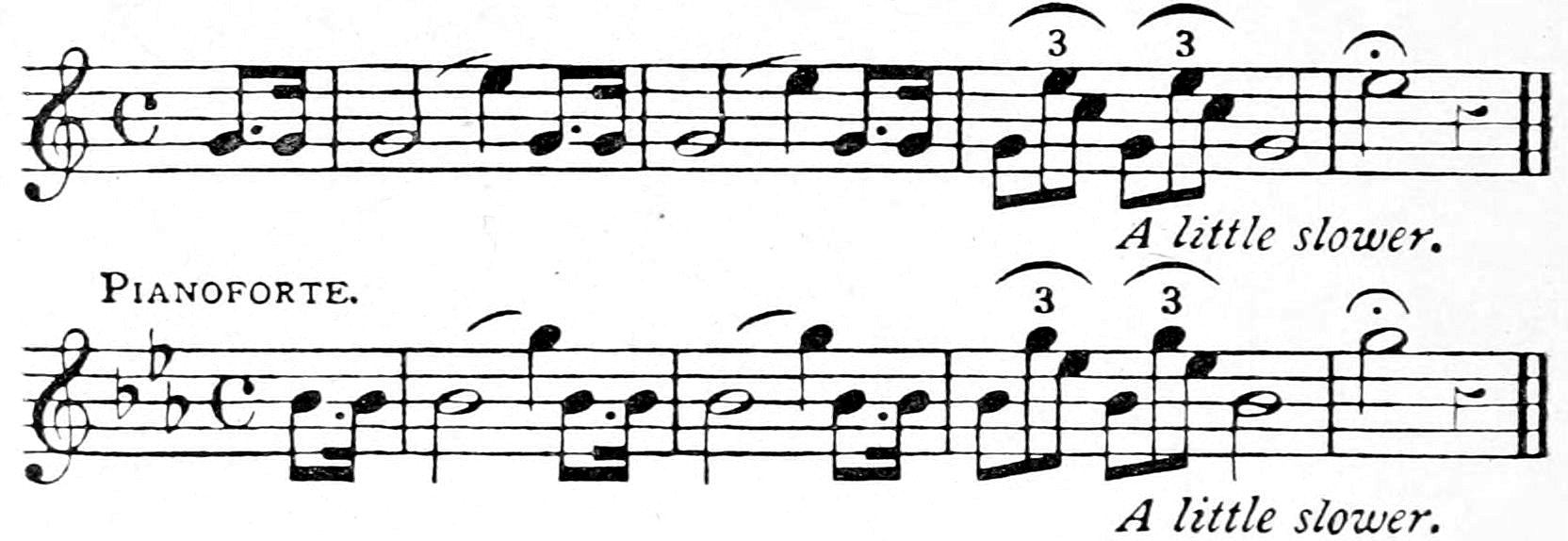
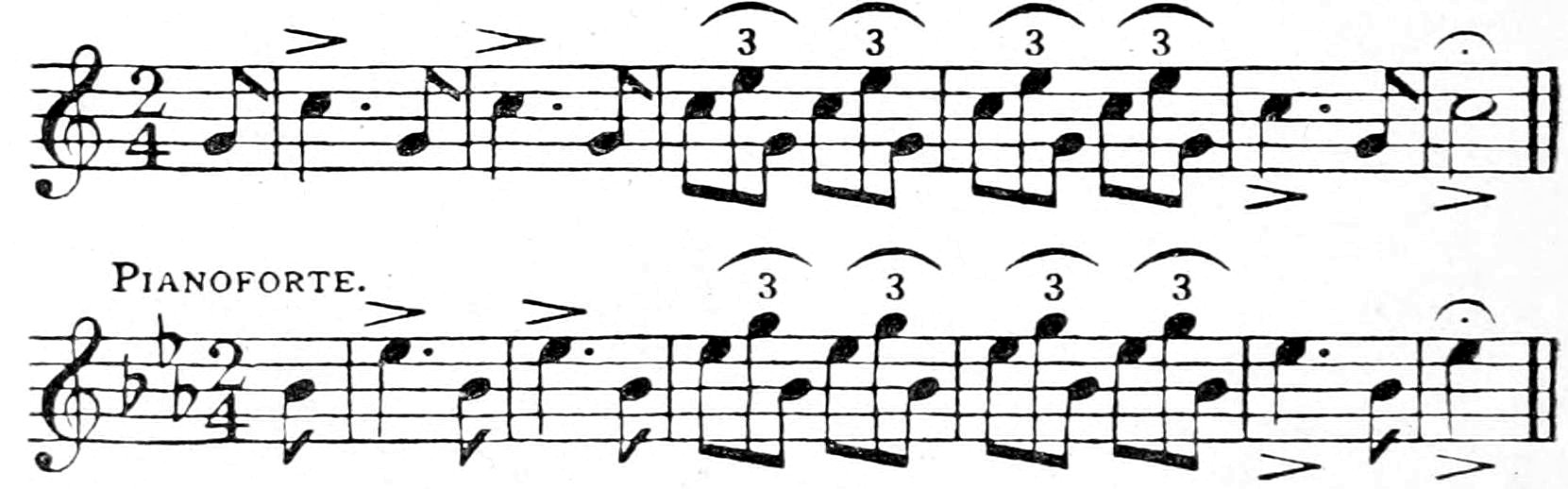
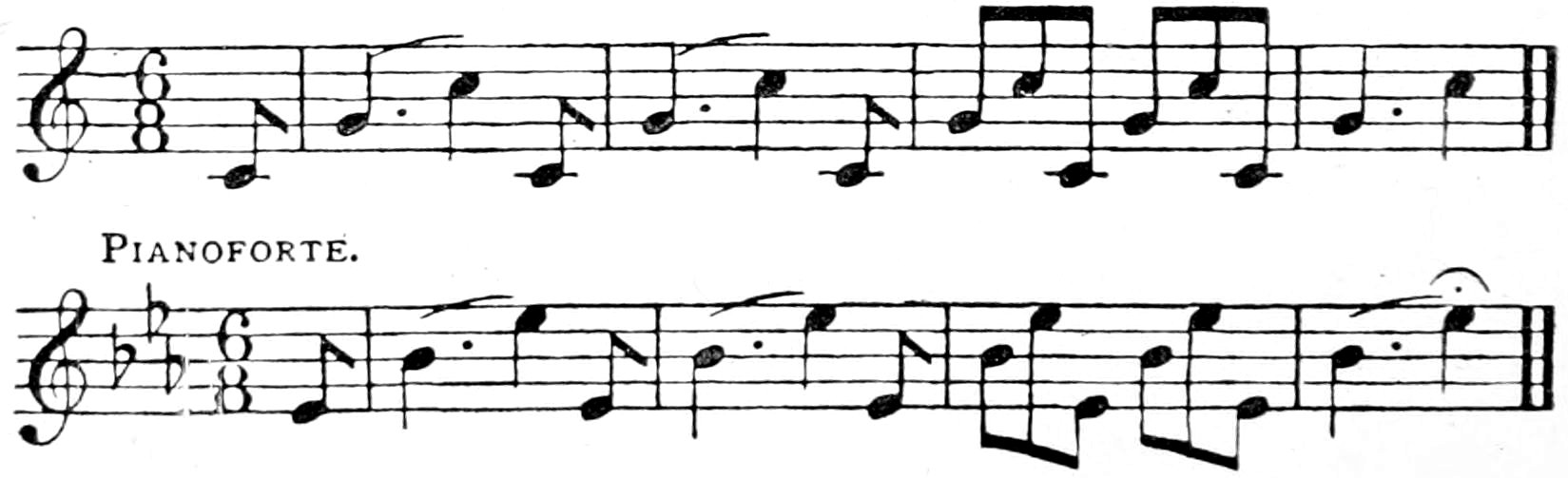
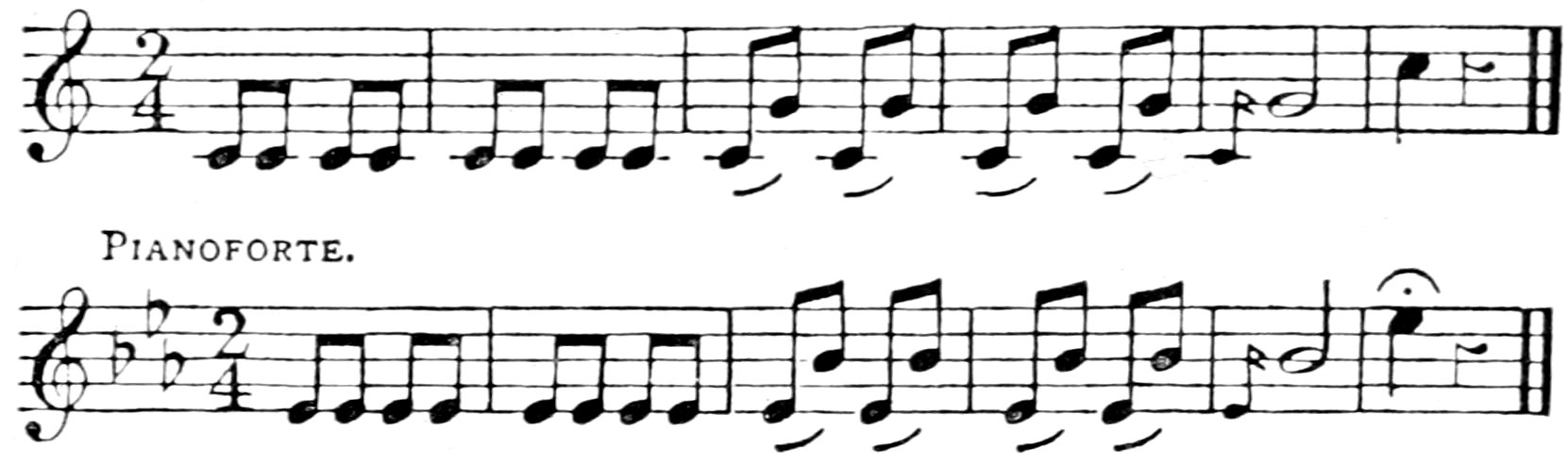
sound a Horn; but I have added a number of preludes
in which I have been obliged to use musical
notes, and I believe they will be found a useful addition
to these remarks, inasmuch as they comprise
easy calls, or soundings, familiar even to horses as
well as to coachmen, and therefore especially appropriate
to the road.
3
Before proceeding with my instructions, a description
of a Coach-horn, and the difference between that
and a Post-horn, may not be out of place, the former
being nowadays used exclusively for a four-in-hand;
although it should be borne in mind that the latter
was really the recognised signal Horn used
by all the guards on the fast Coaches which
carried the mails fifty years ago. Hence the
name “Post-horn.”
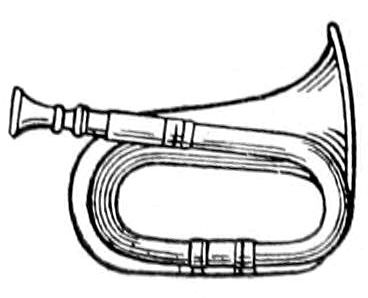
A Coach-horn should always be straight
and made of copper, with German-silver or
real silver mouthpiece and mountings, and
the bell should be funnel-shaped, and not
curved outwards like an ordinary trumpet-bell.
Although a strictly legitimate Coach-horn
should be made in one entire piece of
metal, still there has recently been
introduced a “Telescope” Coach-horn,
made with a joint ferrule in the
middle, which allows the top half to
slide inside the lower portion of the
Horn, without actually falling out—something
after the style of the portable
metal drinking cups. From
actual experience, I can safely say
that the tone and ease in blowing are
not in the least affected by this innovation—which,
indeed, I consider an
improvement—for Coach-horns when
thus “telescoped” are not nearly so
liable to get bent or injured, and are
more easily packed and carried about.
4
A Coach-horn ought really not to exceed thirty-six
inches in length, or else the peculiar ring or
note (musicians would call it the timbre) of the true
Coach-horn becomes lost, and merges into
that more resembling the field-bugle used in
the army.
I am, however, aware that in the present
age, when so much is done for the sake of
show and appearance, even to the sacrifice
of utility and comfort, many fairly good
Coach-horns are used measuring forty-six
inches, and even more; and I can further
account for such long Horns being adopted,
not merely for show, but because more can
be done upon them, as we say; that is, it is
easier to blow, not the same notes, but the
same number of notes upon them. There is
no accounting for taste, and as some people
like to hear the Coach-horn sounded as
William Simmons played his little bugle in
“Martin Chuzzlewit,” “who, whenever the
conversation flagged, played the first half of
a great many tunes, and regularly broke
down in the second,” then I will admit that
for playing “Buy a Broom” and other airs
very imperfectly, a four-foot Coach-horn will
answer the purpose; although for all the old-fashioned
coaching calls, I still maintain that
a shorter Horn is to be preferred.
My opinion has been confirmed by all the
authorities whom I have consulted upon the
subject; gentlemen, I may remark, belonging
to a generation now almost gone by, who remember
the days before the iron-horse made
its appearance and wrought such changes
5amongst us; when nothing longer than the “yard of
tin” was used on a Mail Coach, although the old
key-bugle was reserved, by such few guards as could
play it, for occasionally playing the simple and
popular airs of the day.
Now the Post, or, as it is now so often called, the
Tandem-horn, differs from the above, inasmuch as it
is of a much smaller calibre or bore, being
only twenty-eight or thirty-two inches in
length, and made always of brass instead of
copper. The bell, unlike that of the Coach-horn,
should be trumpet-shaped, for the tone
is materially affected thereby; and a well-curved
bell will yield a sound far more
appropriate to a pair of horses, tandem
fashion, than a funnel-shaped bell.
A proper Post-horn ought also to be made
with a slide, to elongate it if necessary, for
tuning purposes; for it is often effectively
used in the orchestra as a musical instrument;
for instance, in Kœnig’s unrivalled “Post-horn”
gallop, also in the more modern
“Down the Road” and the “New Derby”
gallops, etc. It need not necessarily
be straight, but may be
coiled up so as to be carried in
the pocket, in which shape it is
handier for use in a dog-cart or gig.
Having thus described the two kinds of Horns used
for coaching purposes, I will now proceed with my
INSTRUCTIONS TO LEARNERS.
6
Grasp the Horn firmly with the right hand about
six inches from the mouthpiece, holding it out straight
and in a line with the mouth, so as not to cause the
body to assume a stooping position. Then press the
mouthpiece about the centre of the mouth, a shade
more on the top lip than on the lower. Then almost
close the lips, but draw them tightly across the teeth
as if in the act of spitting something unpleasant out
of the mouth. Then, as it were, spit into the mouthpiece,
but without discharging more saliva than can
possibly be helped; thus blowing sharply into the
Horn, being, at the same time, careful not to puff out
the cheeks. Try to produce the sound “tpff” with
the tip of the tongue, drawing it back again quickly,
so as to be ready, as it were, for another note.
The sound at first will probably be but a short one,
but after a little practice it can be prolonged by
degrees. After doing this repeatedly, try then to
hold or prolong the note, and not let it break or
involuntarily subside into another sound.
Practise the same note repeatedly at first without
trying to sound different ones; remembering that,
before attempting to run it is necessary to know how
to walk properly.
Beginners will find their top lip become swollen
and numbed, after blowing a little time, in which case
I would advise them to leave off entirely for at least
half-an-hour, for it is of no use harassing the lip;
7and it is as futile to try to blow with a numbed lip as
to try to win a race with a tired horse.
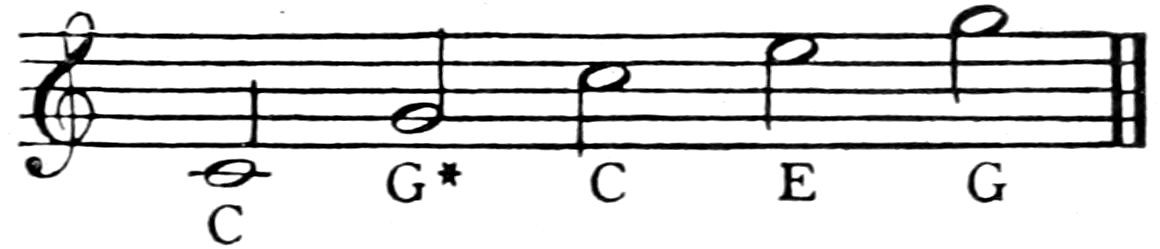
Five good, clear and natural notes can be produced
on the Coach-horn, viz.,
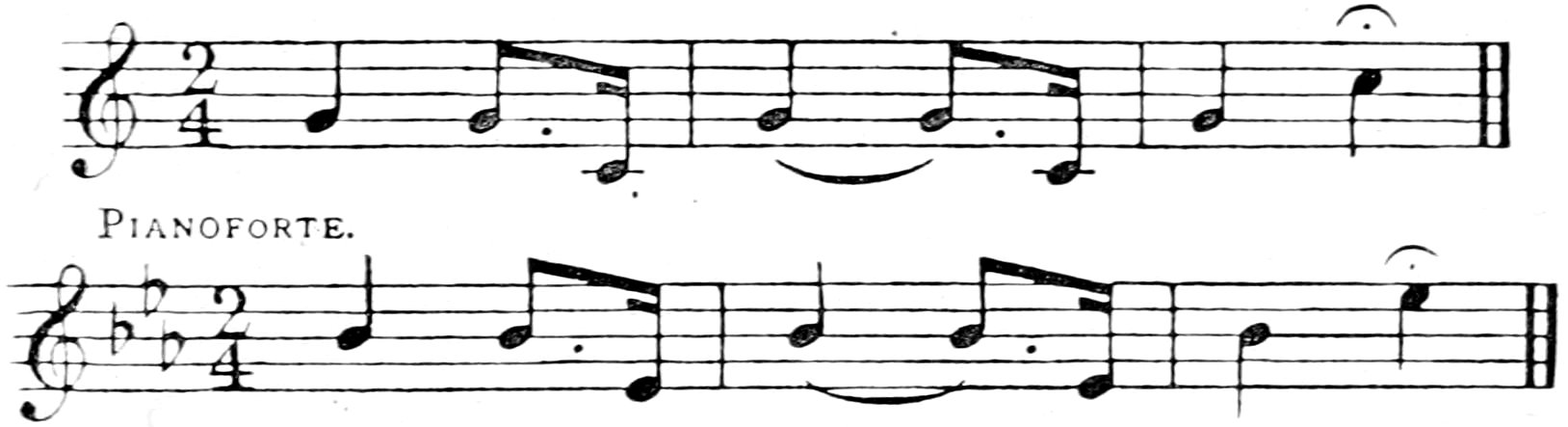
which, for the benefit of my non-musical readers, I
have marked C, G*, C, E, and top G.
Upon the Post-horn four notes are about all that
can be sounded with ease and comfort; indeed, it is
seldom that more than the first three notes are used.
Nine persons out of ten will produce the note G*
first, then, after a little practice, the upper notes will
come by compressing the lips a little more tightly, and
blowing, as it were, rather more against the top part
of the interior or cup of the mouthpiece. A very
little will do this, in fact, the extra pressure is almost
imperceptible. On the contrary, to produce the
bottom note C, the lowest note of all, it is necessary
to relax the lips so as to cause them to slacken a very
little, and then blow as straight and direct into the
mouthpiece as possible.
These are about all the instructions it is possible
to give, and I really believe that this is the first time
the theory of Horn-blowing has been so minutely
described. I only hope that I have succeeded in
making myself intelligible, and, in conclusion, I can
8only urge my readers, as I said before, to take the
trouble and to practise.
I quite agree with them that it is not exactly a
treat to hear a novice trying to blow a Coach-horn in
a house or in quiet lodgings, and therefore I would
recommend learners always to carry a mouthpiece in
their pockets. An ordinary cornet mouthpiece will
do, and blowing on this occasionally in the manner
I have described, whenever they feel inclined or have
the opportunity, will harden the lip and accustom it
to the mouthpiece, whilst the noise produced will not
even “wake the baby” or cause any other more
serious domestic disturbance.
A gallant Colonel, an eminent cornet player, whose
name I am scarcely at liberty to mention, told me of
a capital hint to persons learning to blow, which is to
place a hair inside the mouth and then try to spit it
out cleanly. This strikes me as an excellent suggestion,
for the action of blowing a Horn is very similar
and a hair is a very difficult thing to spit out of the
mouth cleanly, as I observed. It is important to mention
that when sounding a Horn on a coach, it is
always advisable for the performer to turn his head
aside a little, so as to avoid blowing right into the
teeth of the wind. Attention to this little point will
make a great difference in the ease of blowing.
Again, when driving through London or any other
large cities, the Horn should be used only when
necessary to clear the road of the innumerable ’buses
and cabs, both “growlers” and “hansoms,” which
block the way, rendering it almost impossible to
9“tool a team” through the crowded streets without
the aid of a Coach-horn.
Most coachmen will admit that at present the
sound of the Horn is always promptly and civilly
attended to by drivers of the above-mentioned public
conveyances; but this would not be the case if the
“cry of wolf” were made too common, and the Horn
sounded without occasion.
On a country road the case is very different, for
there the performer can give vent to his wind and
lungs to his heart’s content; his sounds, if musical,
tending to cheer the spirits and enliven the journey;
whilst if by chance discordant notes and queer noises
are produced, the effect will be the same, inasmuch
as the risible faculties and sympathies of his fellow-passengers
are sure to be aroused.
I hope it will not be thought out of place for me
here to acknowledge the kindness and hospitality of
the many proprietors of crack Coaches travelling out
of London in the season, who have so often offered
me a seat when they have had one to spare. Such
little outings have always afforded me much pleasure,
tending, as they do, to grease the wheels of life, and
make the journey more pleasant; and, although my
fare has often been good-naturedly but positively
refused, I have in such cases always made it a rule not
to forget the old-fashioned claims of the “professional,”
who is generally present, and the Guard attached to
the Coach, thus leaving those worthies even more
deeply impressed with my performance on the Coach-horn
than perhaps they otherwise might have been.
10During these trips it has been my good fortune to
meet with some extraordinary fellow-passengers, and
if I were free to narrate the various scenes I have
witnessed, this modest pamphlet would be increased
to a good sized volume.
One incident which happened to me as a pedestrian
may, however, be told without divulging any secrets
of the road.
In the Autumn of 1875 I was spending my holidays
at the very quiet seaside village of Felixstowe, near
Ipswich, where the Carabiniers were at that time
stationed. Strolling along the beach, watching the
shipping and the ever-restless waves, I heard a noise
not unlike the distant bellowing of a cow in the last
stages of pulmonary consumption or pleuro-pneumonia.
Slightly alarmed, I cast my eyes along the high road
which runs parallel to the shore, where I saw an
elegantly appointed Coach, with four horses and
grooms in livery, pulled up by the roadside whilst
a gentleman on the box seat was endeavouring to
sound a Coach-horn, and so to assemble the passengers
who had alighted for luncheon.
Having nothing whatever to do, I was seized with a
sudden fit of compassion for the gentleman who was
blowing the Horn—for he was getting black in the
face, and it was a smoking hot day. I took the liberty
to address him, saying that, if he would allow me to
make an attempt, I thought I might be able to produce
more musical sounds. With a “Ah, ah, thank you,
er,” he politely handed me the Horn. First glancing
at the maker’s name and Prize Medals which are conspicuously
stamped on all genuine Coach-horns, I
11remarked, “Ah, this is a good Horn, and no mistake,
for it came from the only man in London who knows
how to make a Coach-horn;” and then proceeding to
blow it in my usual inimitable style, I may say that
I made “the welkin ring again.”
The company immediately made their appearance,
and so delighted were they that I was even offered a
ride back to Ipswich, which a previous appointment
obliged me to decline with thanks, whilst the lady
passengers even applauded my performance by
enthusiastically clapping their hands.
This is not all, for I had almost forgotten the
occurrence, when about a month afterwards a gentleman
walked into the shop of the maker of the Coach-horn,
whom I at once recognised as my acquaintance
of the Felixstowe Coach. “Fine weather,” remarked
he. “Yes!” I replied, “just the sort of day for a
drive over to Felixstowe.” Staring at me for a
moment, he exclaimed, “By Jove, why you’re the
fellow who blew that Horn so well and praised the
maker so highly. Dear me, what a capital joke.” I
modestly replied something to the effect that it was
necessary in these days to be able to sound one’s own
trumpet, and that I seldom missed the opportunity
of doing so.
I believe this tale was told over the mess-table,
and I should like to have been present at the time.
Of course, there are Coach-horns and Coach-horns;
some easy to blow and of proper tone, others just the
reverse, and the difference is to be accounted for not
only in the model, but also in the workmanship,
12gauge of metal, and mode of their construction. With
these particulars I will not weary my readers, and it
being an admitted fact that there is only one firm of
musical instrument makers in London—I may say in
the world—who know how to make really good
Coach-horns, and that being the one with which I
happen to be connected, I hardly like mentioning
their name and address.
For very many years their old-fashioned workshop
stood near Covent Garden, but the exigencies of the
times, to say nothing about the increased rent of 50
per cent. demanded by the Ducal landlord at the
termination of the lease, rendered a removal to
Victoria Street, Westminster, advisable, if not compulsory(!)
Circumstances further compelled Messrs.
Köhler & Son to move first to Ebury Street, S.W.,
and then to Bromley, Kent. On taking over the
concern in 1907, the present proprietors, Messrs.
Swaine and Adeney, transferred the entire business
to their own premises at 185 Piccadilly, W., and to
this establishment gentlemen requiring good, easy-sounding
Coach-horns, possessing the true Coaching
tones, are confidently recommended.
ADDENDA TO THE THIRD EDITION.
13
Since I wrote this little book, ten years have
elapsed—ten eventful years to many of us; but the
precepts and principles of sounding the Horn remain
still unchanged from what they were even ten times
ten years ago. I have read the book through again,
and I see nothing to alter, nothing to correct, and
nothing to regret, except the fact that the book,
although copyright, entered at Stationers’ Hall and
registered at the British Museum in proper form, has
been copied by another “author,” some of my paragraphs
literally quoted word for word, and then
published by an eminent firm who certainly ought to
have known better. Imitation, however, being the
sincerest form of flattery, although not always the
pleasantest, I have not yet made this piracy a subject
for Her Majesty’s High Court of Justice.
I have, however, often been reproached, perhaps
not altogether unjustly, for the small amount of
printed matter contained in the first edition; and I
have, therefore, ventured to add a few more remarks
upon Coaching affairs generally, in the hope that they
will prove interesting, and meet with the same kind
approval from my readers.
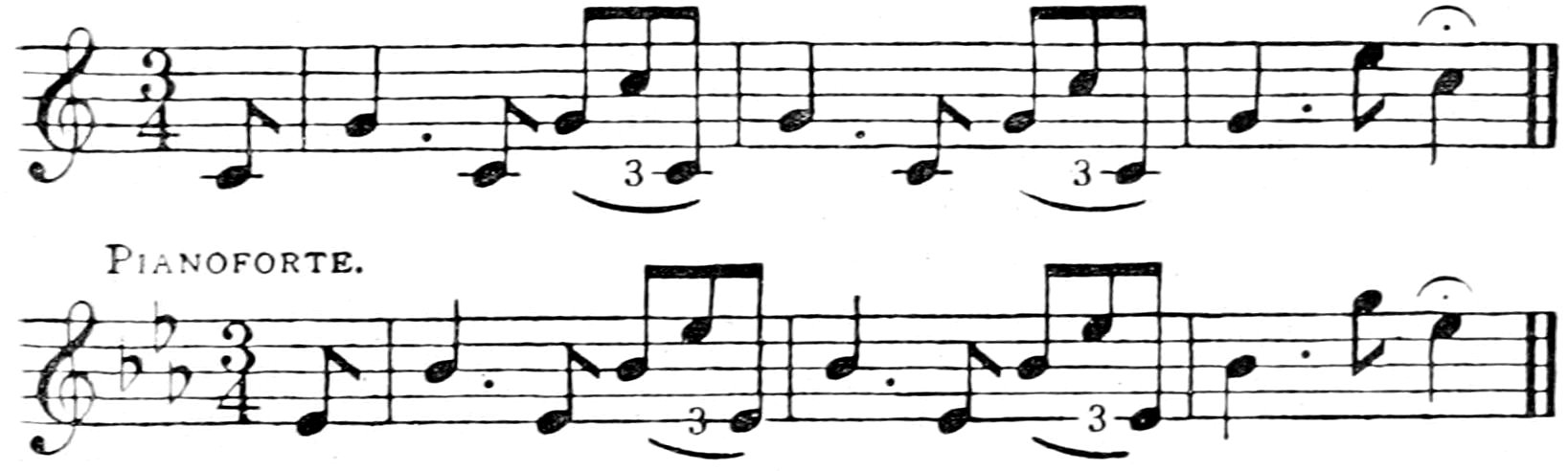
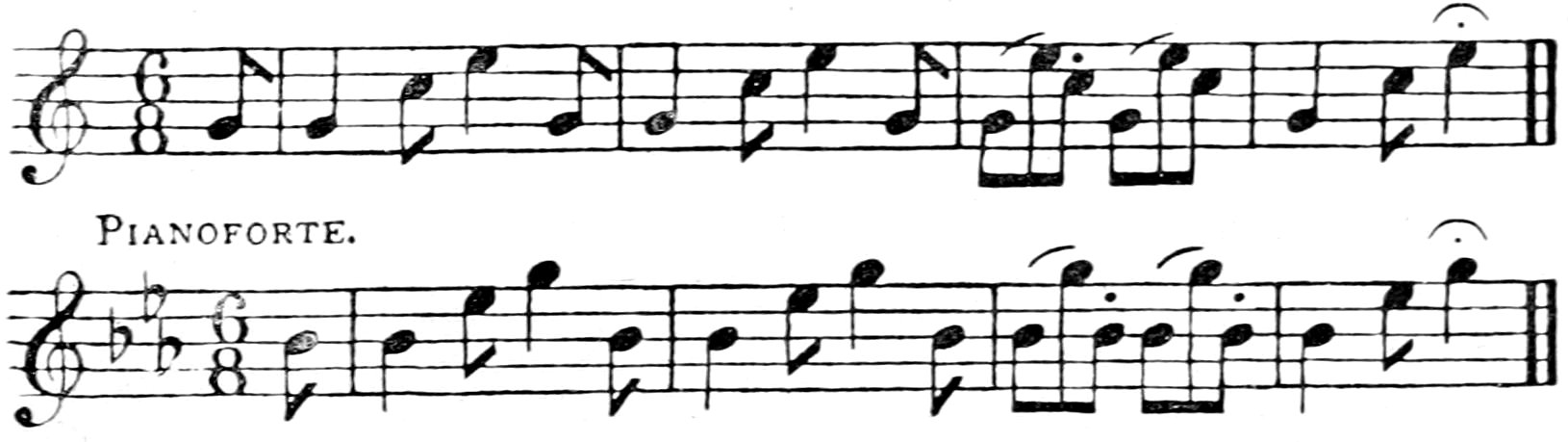
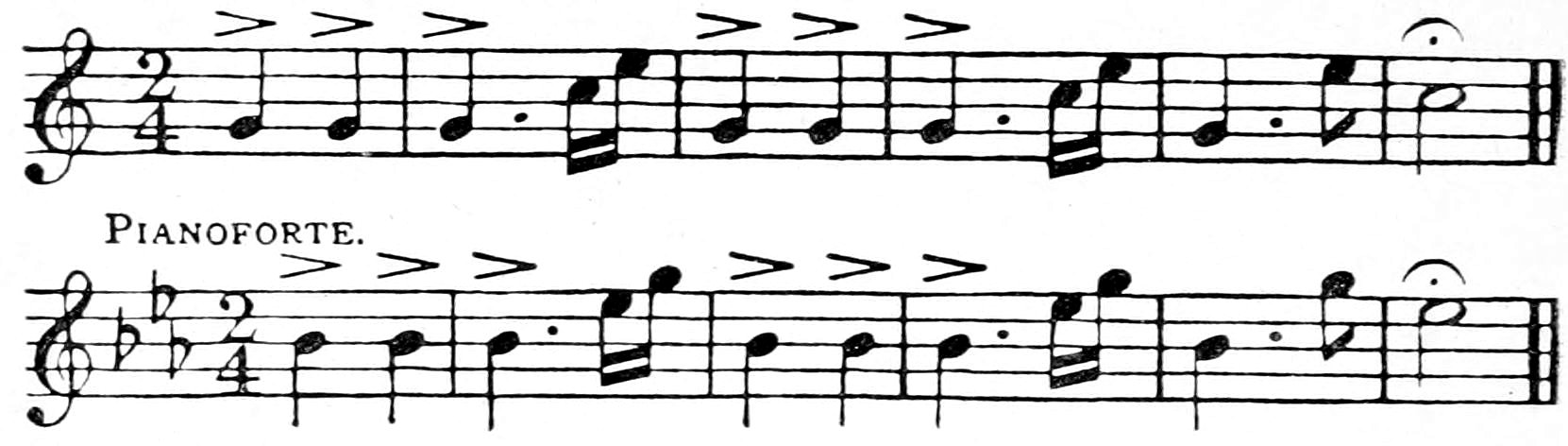
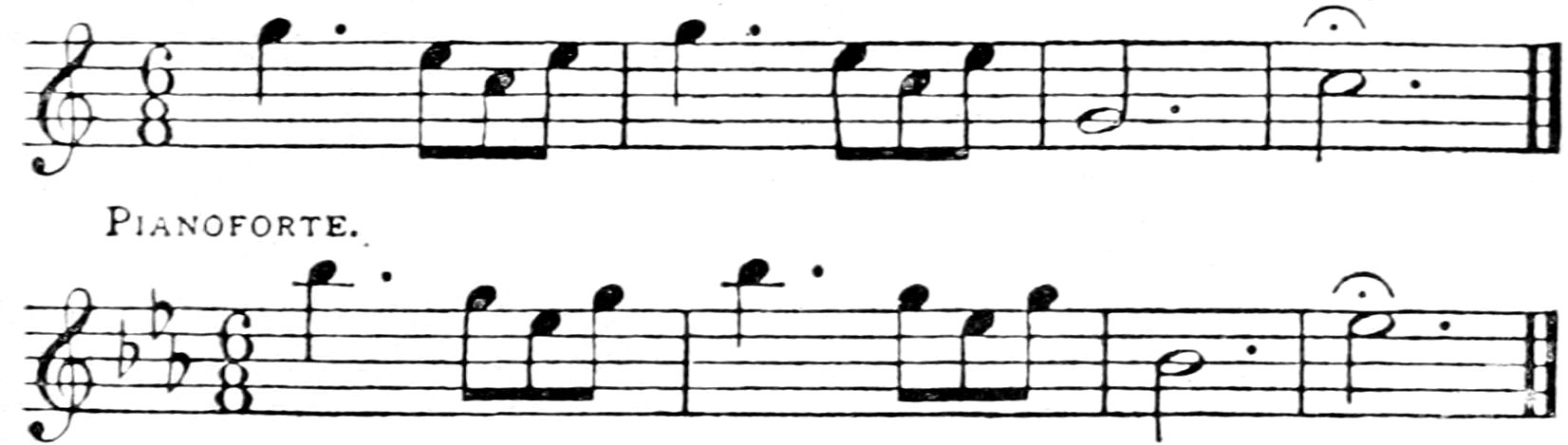
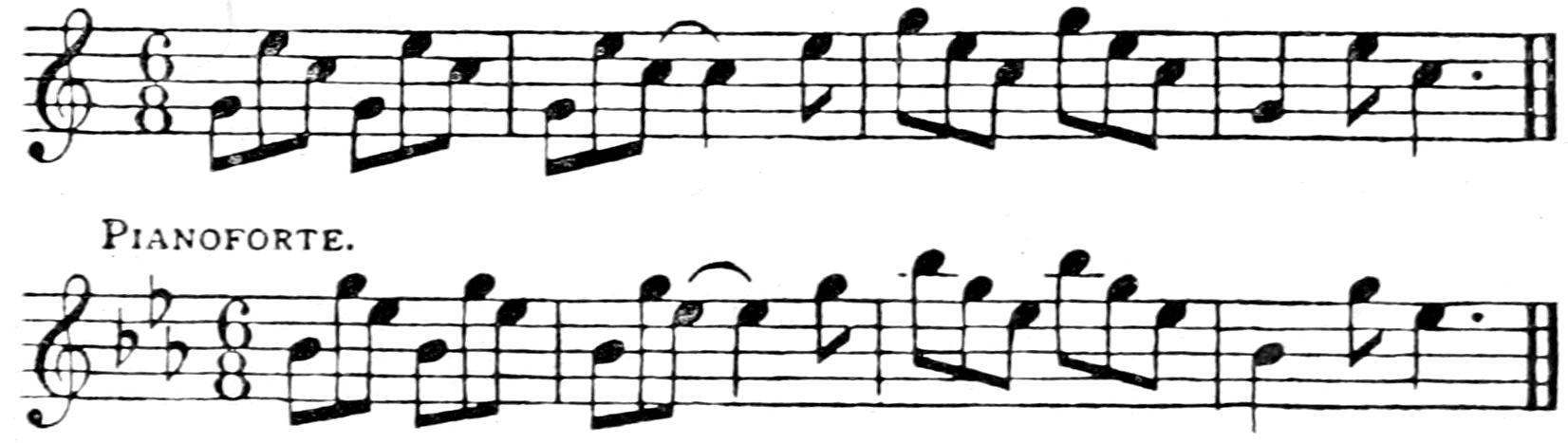
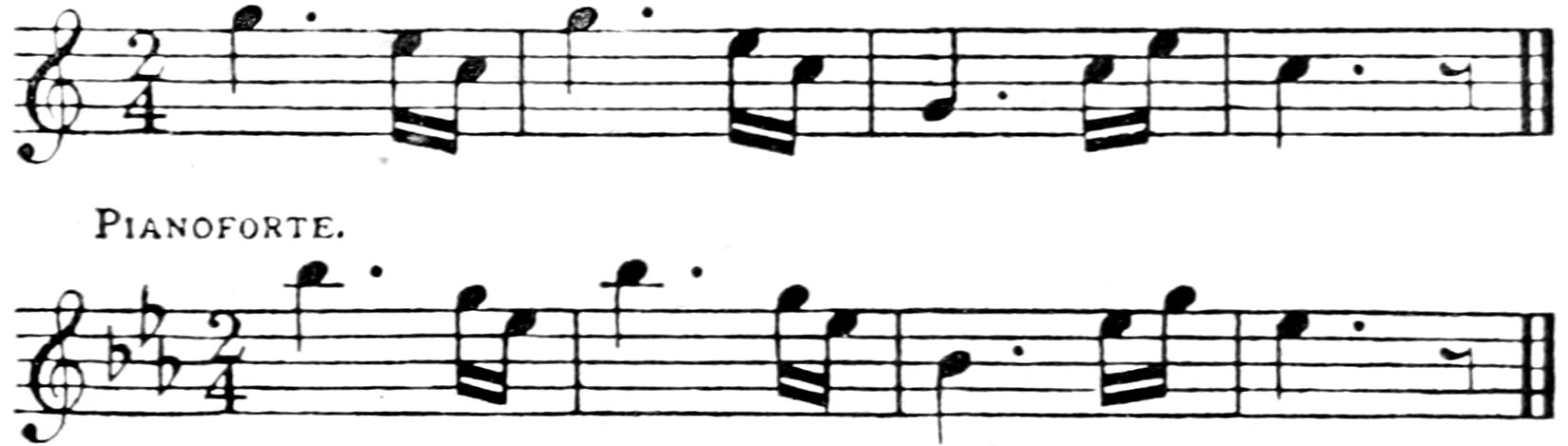
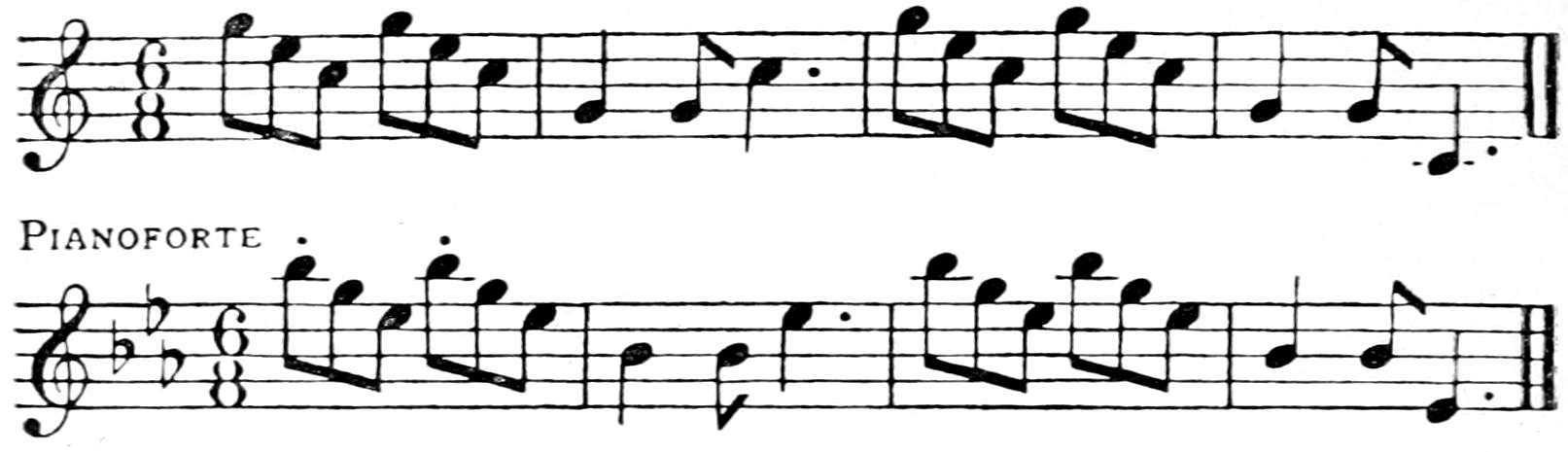
I have also been asked to add to what I may call
the music portion, by putting underneath the corresponding
tones or sounds which can be played on the
pianoforte; my object being that such of my readers
as are not acquainted with music sufficiently to transpose,
may get their sisters, or their cousins, or their
aunts, or someone even dearer (in prospective) to
strum them over for them on the pianoforte, thereby
enabling them to pick up the various calls correctly
14by ear. This will not be found such an uninteresting
occupation in agreeable society on a pouring wet day,
or when locked up in the house by frost and snow;
and the result, I hope, will prove in very many cases
satisfactory to all the parties concerned. Assuming
the pianoforte to be pretty well up to concert pitch,
the notes played will be found to harmonize exactly
with those which can be sounded on either of the
celebrated Coach-horns, the “Beaufort” or the
“Heavy Mail,” made by Köhler & Son, the firm
already alluded to.
And now I will preface the following remarks by
stating that I have recently returned from a trip—a
most enjoyable trip—to America, and I was surprised,
as well as delighted, to see the splendid array of
Coaches in connection with the New York Coaching
Club. The horses, too, are fine, well bred and powerful
animals; and I was particularly struck with a team
of fine bays, driven, I believe, by Mr. Bronson, which
went up town from the Brunswick Hotel at a spanking
rate.
May I be allowed to express the opinion that we
owe a great deal of the revival of four-in-hand driving
to our transatlantic cousins; for in 1851 there were
few, very few, what I may call “swell” Stage Coaches,
to be seen, at any rate, anywhere in the neighbourhood
of London or the Parks.
Years ago, poor Alf Teddar drove the Brighton
Coach in conjunction with Cracknell, as servant to the
Duke of Beaufort, the noble President of the Coaching
Club, and Mr. Cherry Angell, I think. But the late
Mr. Edward Sacheverell Chandos Pole, of Radbourn,
in 1866, revived the Derby and Brighton Coaches, and
15did much to make the art of driving Four-in-hand
popular. Both in appearance and reality that gentleman
was my beau-ideal of a thorough coachman.
Cool, calm, and decided, it was a treat to see how
cleverly he tooled his gallopers along the road; all the
time chatting pleasantly with his companions on the
box seat, or over his shoulder to his passengers. He
could blow the Horn, too, and drive at the same time;
rather a dangerous feat, which requires practice; and
I would not recommend my readers to try it, although
I have seen him do it.
Other gentlemen also identified themselves with
“the Road” out of London, amongst whom are to
be mentioned General Tyrwhitt, Colonel Clitherow,
Captain Cooper, Mr. Freeman, and Mr. Challoner
Smith, who were all accomplished “Whips” and
thorough Coachmen, studying their passengers as
well as the horses they drove.
This brings me down to about the time when
Mr. Tiffany, a New York gentleman, and a pupil of
Charles Ward, came to England and worked the
Brighton Coach with his celebrated skewbald team,
and Tom Tims as Guard, scenes carried down to
posterity by the three pictures so cleverly painted by
Mr. Sturgis.
I remember this gentleman (Mr. Tiffany, not
Mr. Sturgis) calling when our old workshops were in
Covent Garden, and after sounding several Coach-horns
(and hearing me blow them), he startled me by
saying, “Well, now, I want a Guard for my Coach,
and I guess you’re just the man I want. Now tell me
what would you ask for the season, say three months,
till the end of September?” I said this offer would
16require some consideration, but as he still pressed me
for an answer, I replied that I thought perhaps £600
would about compensate me for my absence from
business and its inevitable consequences. He burst
out laughing, and for once in my life I had the satisfaction
of hearing an American say (not that he meant
it) that “he couldn’t afford it!” Another American
gentleman, too, Mr. Kane, took over the Virginia
Water Coach, previously horsed by the then Lord
Macduff, Captain Dickson, and Mr. Williams, three
well-known Coachmen.
It may be a vulgar expression, but I have often
heard it remarked that Americans make money like
dirt, and that they spend it likewise, and certainly
Mr. Kane spent his with great liberality, his stud at
that time consisting of a horse a mile, besides reserves.
In connection with this subject, I ought to mention
with respect Mr. Charles Hoare and his Beckenham
Coach, and the one associated with Lord Bective,
Colonel Fletcher Hathorne, and Mr. Chaplin, driven
through the Garden of England to Tunbridge Wells.
There was also the Epsom and Dorking Coach, regularly
worked from the White Horse Cellars by Captain
Blythe, Sir Henry de Bathe, and Mr. Hankey, another
banker, through most pleasant country.
A series of wet, very wet, summers then ensued,
and although none of the well-known gentlemen I
have mentioned ever worked a Coach with any idea
of profit, still the paucity of passengers, combined
with torrents of rain, not only diminished the receipts,
but cast what I may truly call such a damper upon
Coaching enterprise that it was a wonder to me that
it did not collapse altogether.
17The season of 1887, however, has been a Jubilee one
for Coaching as well as for Her most Gracious Majesty;
and from inquiries I have made at Hatchett’s I find
that the number of passengers have been unusually
heavy, all the Coaches being well loaded up.
In the foregoing statements I have endeavoured to
trace the continuation of Coaching, when it languished
in London and its neighbourhood, at any rate, as a
fashionable amusement; although, no doubt, many
private Coaches existed and were driven in various
country places and provincial towns; and if I have
given more credit than is fairly due to our American
friends for the re-establishment of the art, it must be
attributed to the remembrances connected with the
trip already alluded to, and to the kindness and hospitality
I experienced when travelling in their country.
This little book having reached that pinnacle of
eminence known in the literary profession as a
“standard work,” I hope that none of the gentlemen
I have mentioned will object to see their names in
print, but should they do so, I herewith offer my
humble apologies. Some of them, alas! are no more;
others have changed their names by inheriting their
titles and estates; but many of them are acquainted
with the Old Guard, and know his name very well,
although I still prefer my nom de plume in this instance
to the one given to me by “my godfathers and godmothers
in my baptism, wherein,” etc.
With these remarks I conclude a third edition of
my work, leaving it to my readers to decide by their
appreciation of my efforts whether I shall ever be
called upon to issue a fourth. In the meantime, I
would ask them to remember the old toast,
“THE QUEEN AND THE ROAD!”
18Bromley, Kent,
February 2nd, 1907.
Sir,
We beg to announce that we have disposed of our entire
business to Messrs. Swaine & Adeney of 185, Piccadilly,
London, W., the well-known Whip Manufacturers.
We should like to thank our numerous customers for
their kind patronage for so many years, and trust that the
same will be extended to our successors who will keep a large
stock of all our specialities.
Yours faithfully,
KÖHLER & SON.
185, Piccadilly, London, W.
February 2nd, 1907.
Sir,
We beg to announce that as stated on the opposite side
we have purchased the old-established business of Messrs.
J. Köhler & Son, Bromley, Kent, Hunting, Coaching, and
Signal-Horn Manufacturers.
The factory will be retained as before, and customers
can therefore rely on obtaining the unique tone and excellent
qualities that have made their specialities so famous for over
a century.
All orders and communications should be addressed to
185, Piccadilly, London, W., where customers wishing to
choose a Horn personally will find a great variety of all the
well-known patterns; also of all other of Messrs. Köhler &
Son’s specialities.
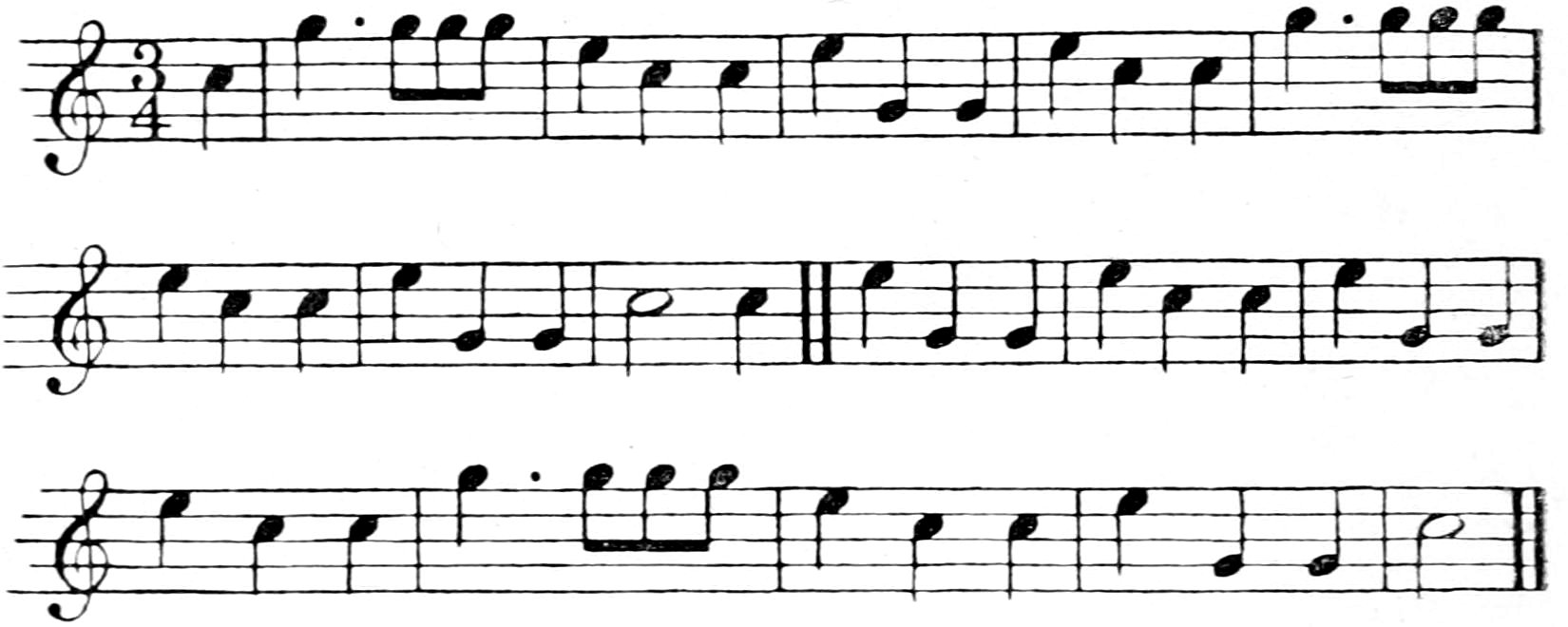
N.B.—When Köhler’s “Heavy Mail” Coach-horn (46 inches)
is used, the pianoforte should play the top line; but when
the “Beaufort” Coach-horn (36 inches) is used, the Pianoforte
should play the bottom line.
These Calls can be repeated; and all those marked *
can be sounded on Post-horns as well as Coach-horns.
Fixed typos; non-standard spelling and dialect retained.
Music Transcriber Notes:
The music files are the music transcriber's interpretation of the printed notation
and are placed in the public domain.
i_b_019m, no. III, horn part, bar 3, final note was missing staccato mark - corrected.
i_b_020m, no. VI, piano part, bar 6, final note should be a minim - corrected.
i_b_020m, no. VII, horn part, bar 4, final note was missing pause mark and slur -
corrected.
i_b_021m, no. VIII, horn part, bar 6, final note was missing pause mark - corrected.
i_b_022m, no, XII, piano part, bar 1, two notes have staccato marks, but neither the
horn part, nor the repeat of that bar do - omitted from transcription.