The object of this series is to present in separate Volumes a
comprehensive and trustworthy account of the general development
of European History, and to deal fully and carefully with the
more prominent events in each century.
The Volumes embody the results of the latest investigations,
and contain references to and notes upon original and other
sources of information.
No such attempt to place the History of Europe in a comprehensive,
detailed, and readable form before the English Public
has previously been made, and the Series forms a valuable continuous
History of Mediæval and Modern Europe.
Period I.—The Dark Ages. 476-918.
By C. W. C. Oman, M.A., Chichele Professor of Modern History
in the University of Oxford. 6s. net.
Period II.—The Empire and the Papacy. 918-1273.
By T. F. Tout, M.A., Professor of Mediæval and Modern History
at the Owens College, Victoria University, Manchester. 6s. net.
Period III.—The Close of the Middle Ages. 1272-1494.
By R. Lodge, M.A., Professor of History at the University of
Edinburgh. 6s. net.
Period IV.—Europe in the 16th Century. 1494-1598.
By A. H. Johnson, M.A., Historical Lecturer to Merton, Trinity,
and University Colleges, Oxford. 6s. net.
Period V.—The Ascendancy of France. 1598-1715.
By H. O. Wakeman, M.A., late Fellow of All Souls College,
Oxford. 6s. net.
Period VI.—The Balance of Power. 1715-1789.
By A. Hassall, M.A., Student of Christ Church, Oxford. 6s. net.
Period VII.—Revolutionary Europe. 1789-1815.
By H. Morse Stephens, M.A., Professor of History at Cornell
University, Ithaca, U.S.A. 6s. net.
Period VIII—Modern Europe. 1815-1899.
By W. Alison Phillips, M.A., formerly Senior Scholar of
St. John’s College, Oxford. 6s. net.
THE DARK AGES, 476-918
By C. W. C. OMAN, M.A., Chichele Professor of Modern History in the
University of Oxford.
Forming Volume I. of Periods of European History.
‘A thorough master of his subject, and possessed of a gift for clear expositions,
he has supplied the student with a most valuable and helpful book.’—Spectator.
‘No better exponent of this era, so full of difficulties and complications,
could have been chosen.’—Journal of Education.
‘Mr. Oman has done his work well. His narrative is clear and interesting,
and takes full account of recent research.’—English Historical Review.
‘This volume will be valued by all historical students as supplying a real
want in our historical literature, and supplying it well.... His touch is
sure and his insight keen. For the accuracy of his facts his historical
reputation is a sufficient guarantee.’—Times.
THE EMPIRE AND THE PAPACY, 918-1273
By T. F. TOUT, M.A., Professor of Mediæval and Modern History
at the Owens College, Victoria University, Manchester.
Forming Volume II. of Periods of European History.
‘This admirable and impartial work.... A more trustworthy historical
treatise on the period and subject has not hitherto appeared.’—Morning
Post.
‘One of the best of the many good historical textbooks which have come
out of our universities in recent years.’—Times.
‘Altogether Professor Tout has given us a most trustworthy adjunct to
the study of mediæval times, which all who may be called upon to interpret
those times to others may safely recommend and themselves profit by.’—English
Historical Review.
THE CLOSE OF THE MIDDLE AGES, 1273-1494
By R. LODGE, M.A., Professor of History at the University
of Edinburgh.
Forming Volume III. of Periods of European History.
‘The book is admirably written, it contains maps and genealogical tables,
an exhaustive index, and a bibliography which students will value as an aid
to the interpretation of the whole period as well as a clue to any part of it.’—Standard.
‘We are exceedingly thankful for the Series, and as we have already said,
to Prof. Lodge. There is no longer any excuse for English-speaking teachers
to be wholly ignorant of the history of Europe. The obligation lies on them
to purchase these volumes, and then read, mark, learn, and inwardly digest
them, so that they can supplement their teaching with intelligible comment.’—School
World.
‘The book must be regarded as quite indispensable to all English students
of the late Middle Ages.’—University Correspondent.
‘Professor Lodge’s book has the supreme merit of clearness, not less than
that of conciseness.’—Pall Mall Gazette.
‘A work of great value on one of the most difficult and at the same time
one of the most important periods of European history. The book is a
monument of skill and labour.’—Aberdeen Journal.
EUROPE IN THE 16th CENTURY, 1494-1598
By A. H. Johnson, M.A., Historical Lecturer at Merton, Trinity,
and University Colleges, Oxford.
Forming Volume IV. of Periods of European History.
‘A singularly clear, thorough, and consistent account of the great movements
and great events of the time, and the volume may be accepted as one
of the best extant handbooks to a period as complex as it is important.’—Times.
‘In the present volume Mr. A. H. Johnson has made a useful and unpretentious
contribution to a Series of which it can be said more truly than of
most series that it supplies a real want. Mr. Johnson is well known as one
of the most experienced and successful teachers of history at Oxford, and the
book has all the merits which the fact of being written by a good teacher can
give it. It is clear, sensible, and accurate, and commendably free from fads
or bias.’—Manchester Guardian.
‘There is certainly no other single book in English which covers the
ground so adequately.’—University Correspondent.
‘Mr. Johnson’s narrative is clear and accurate, and his grasp of the history
of his period wonderfully strong and comprehensive.’—Journal of Education.
THE ASCENDANCY OF FRANCE, 1598-1715
By H. O. Wakeman, M.A., Late Fellow of All Souls College, Oxford.
Forming Volume V. of Periods of European History.
‘His story is no dry compendium, but a drama, each act and scene of
which has its individual interest.’—Guardian.
‘Mr. Wakeman has produced an excellent sketch, both clear and concise.’—Oxford
Magazine.
‘Mr. Wakeman’s book is a sound, able, and useful one, which will alike
give help to the student, and attract the cultivated general reader.’—Manchester
Guardian.
‘A thoroughly scholarly and satisfactory monograph.’—Leeds Mercury.
THE BALANCE OF POWER, 1715-1789
By A. Hassall, M. A., Student of Christ Church, Oxford.
Forming Volume VI. of Periods of European History.
‘Although it contains more than 400 pages, we felt as we read its last page
that it was too short. It is not, however, too short to prevent its author
dealing adequately with his subject according to the scheme of the whole
Series. There is little detail in it, and but little theorising, and what it
contains are clear statements of masterly summaries.... We may cordially
recommend this interesting and well-written volume.’—Birmingham
Daily Gazette.
‘Treated with much accuracy, patience, and vigour.’—Educational Times.
‘The author has struggled manfully with the difficulties of his subject, and
not without a distinct measure of success. He has availed himself of the
latest researches on the period, and his narrative is well ordered and
illustrated by excellent maps and some useful appendices.’—Manchester
Guardian.
REVOLUTIONARY EUROPE, 1789-1815
By H. Morse Stephens, M.A., Professor of History at Cornell University,
Ithaca, U.S.A.
Forming Volume VII. of Periods of European History.
‘As a piece of literary workmanship can hardly be surpassed.... The
result is a boon to students, and a serviceable book of reference for the
general reader.’—Daily News.
‘Mr. Stephens has written a very valuable and meritorious book, which
ought to be widely used.’—Manchester Guardian.
‘An admirable, nay, a masterly work.’—Academy.
‘To say that Mr. Morse Stephens has compiled the best English textbook
on the subject would be faint praise.’—Journal of Education.
‘We are happy to extend a hearty welcome to this much-needed Series,
which, if it throughout keeps on the same high level of this volume, will fill
up a painful gap in our accessible historical literature.’—Educational Times.
‘The volume contains one of the clearest accounts of the French Revolution
and the rise of the First Napoleon ever written. In fact, it is the work
of a real historian. The style of the book is strong and picturesque.’—Western
Morning News.
MODERN EUROPE, 1815-1899
By W. Alison Phillips, M.A., formerly Senior Scholar of St. John’s
College, Oxford.
Forming Volume VIII. of Periods of European History.
‘An exceedingly difficult task has been accomplished, we may say without
hesitation, to admiration. We have read the book with the keenest and
quite unflagging enjoyment, and we welcome it as one of the very best
histories that have been written within the last few years.’—Guardian.
‘It has achieved, with a remarkable success, the difficult task of compressing
into a compact space the long history of a time of extraordinary complications
and entanglements; but—much more important—it has never lost
vigour and interest throughout the whole survey.... The completeness of
the book is really extraordinary.... The book is by far the best and
handiest account of the international politics of the nineteenth century that
we possess.... Should give Mr. Alison Phillips distinct rank among historians
of the day.’—Literature.
‘Altogether, the book offers a most luminous and quite adequate treatment
of its subject, and makes a worthy conclusion of a Series that well deserves to
be popular.’—Glasgow Herald.
‘He presents his materials with model clearness and arrangement, and with
a sound literary style, which will make the book attractive to the general
reader as well as useful to the student.’—Scotsman.
‘Mr. Phillips shows decided literary power in the handling of a not too
manageable period, and few readers with any appreciation of the march of
history, having once commenced the book, will be content to lay it aside
until the last page is reached.’—Manchester Guardian.
‘This thoughtful volume will give the intelligent reader both profit and
pleasure.’—Spectator.
THE CLOSE OF THE MIDDLE AGES
1272-1494
BY
R. LODGE, M.A.
PROFESSOR OF HISTORY IN THE UNIVERSITY OF EDINBURGH
PERIOD III
RIVINGTONS
34 KING STREET, COVENT GARDEN
LONDON
1906
Third Edition. Fourth Impression
All Rights Reserved
PREFACE
v
The period treated in this volume is one of unique
interest and significance in the history of Europe.
Within these two centuries the political and social
conditions of the so-called Middle Ages came to an
end, and the states system of Modern Europe took
its rise. But the importance of the period is more
than equalled by the almost superhuman difficulty of
narrating its events in anything like orderly and intelligible
sequence. Such unity as had been given
to Western Europe by the mediæval Empire and
Papacy disappeared with the Great Interregnum in the
middle of the thirteenth century; and such unity as
was afterwards supplied by the growth of formal international
relations cannot be said to begin before the
invasion of Naples by Charles VIII. of France at the
end of the fifteenth century. In the interval between
these two dates there is apparent chaos, and only the
closest attention can detect the germs of future order
in the midst of the struggle of dying and nascent
forces. It is easy to find evidence of astounding intellectual
activity and instances of brilliant political
and military achievement, but the dominant characteristic
of the age is its diversity, and it is hard to
vifind any principle of co-ordination. A cursory glance
over some of the most striking episodes of the period
will serve to illustrate the multiplicity of its interests.
The hundred years’ war between England and France;
the rise and fall of the House of Burgundy; the
struggle of old and new conceptions of ecclesiastical
polity in the Papal schism, in the Councils of Constance
and Basel, and in the Hussite movement; the marvellous
achievements of the republic of Venice, and
of Florence under both republican and Medicean rule;
the revival of art and letters, not only in one or two
great centres, but in numerous petty states which
would otherwise be wholly obscure; the growth and
decline of unique corporations, such as the Hanseatic
League and the Teutonic Order; the extension and
gradual union of the Christian states of Spain at the
expense of Mohammedanism, and at the same time
the gloomy story of the conquest of the Eastern
Empire by the Turks;—all these episodes might well
be treated in a volume apiece, but it is difficult to
arrange them within the compass of a book which
should deal with the general development of Europe.
No doubt it may be held that some of these events are
of more permanent importance than others, and that
the essential fact to grasp in the period is the rise
of great and coherent states like France, Spain, and
England. But it is equally true that the important
events are unintelligible without some knowledge of
the less important events with which they are connected;
that in this period Germany and Italy are
viimore prominent than Spain and England, or even
than France; and that Germany and Italy are not
coherent states at all. The former is a bundle of states,
and the latter can hardly be said to be as much. And
it may be urged with some force that German history
in the fourteenth century cannot be studied without
some attention being paid to Poland, Hungary, and
Denmark; that the history of Venice and Florence
cannot be isolated from that of Genoa and Pisa; and
that even in tracing the growth of states which achieved
some measure of unity it is necessary to note the
absorption of the formerly distinct and independent
provinces.
I have stated the difficulty, which is indeed sufficiently
obvious, but I cannot claim to have found
a thoroughly satisfactory solution. My endeavour
has been to make the narrative as clear and intelligible
as the conflicting needs of conciseness and of
frequent transitions will admit. I may perhaps point
out to my readers that in an age in which dynastic
interests and claims become of greater and greater
importance, in which royal marriages are a prominent
factor in international politics and vitally affect the
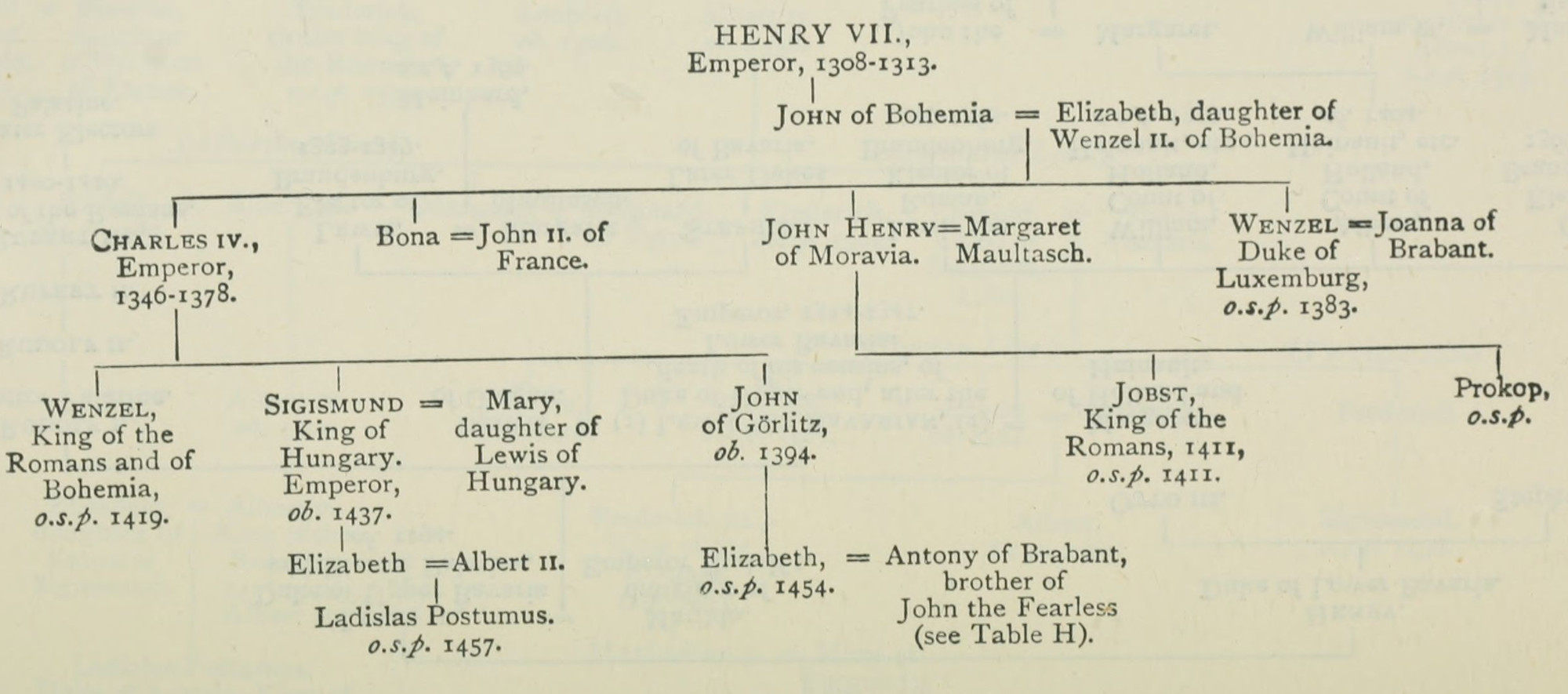
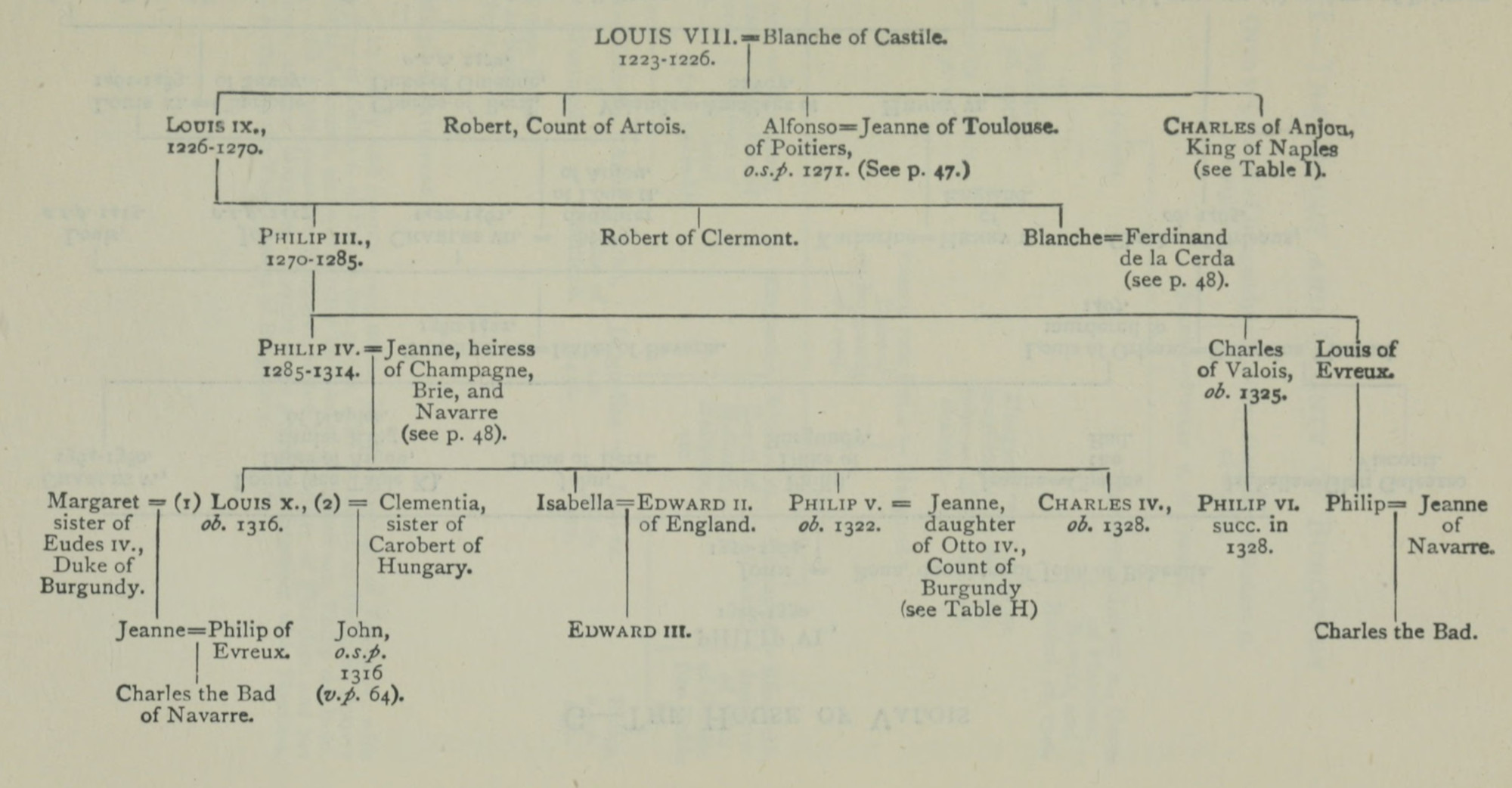
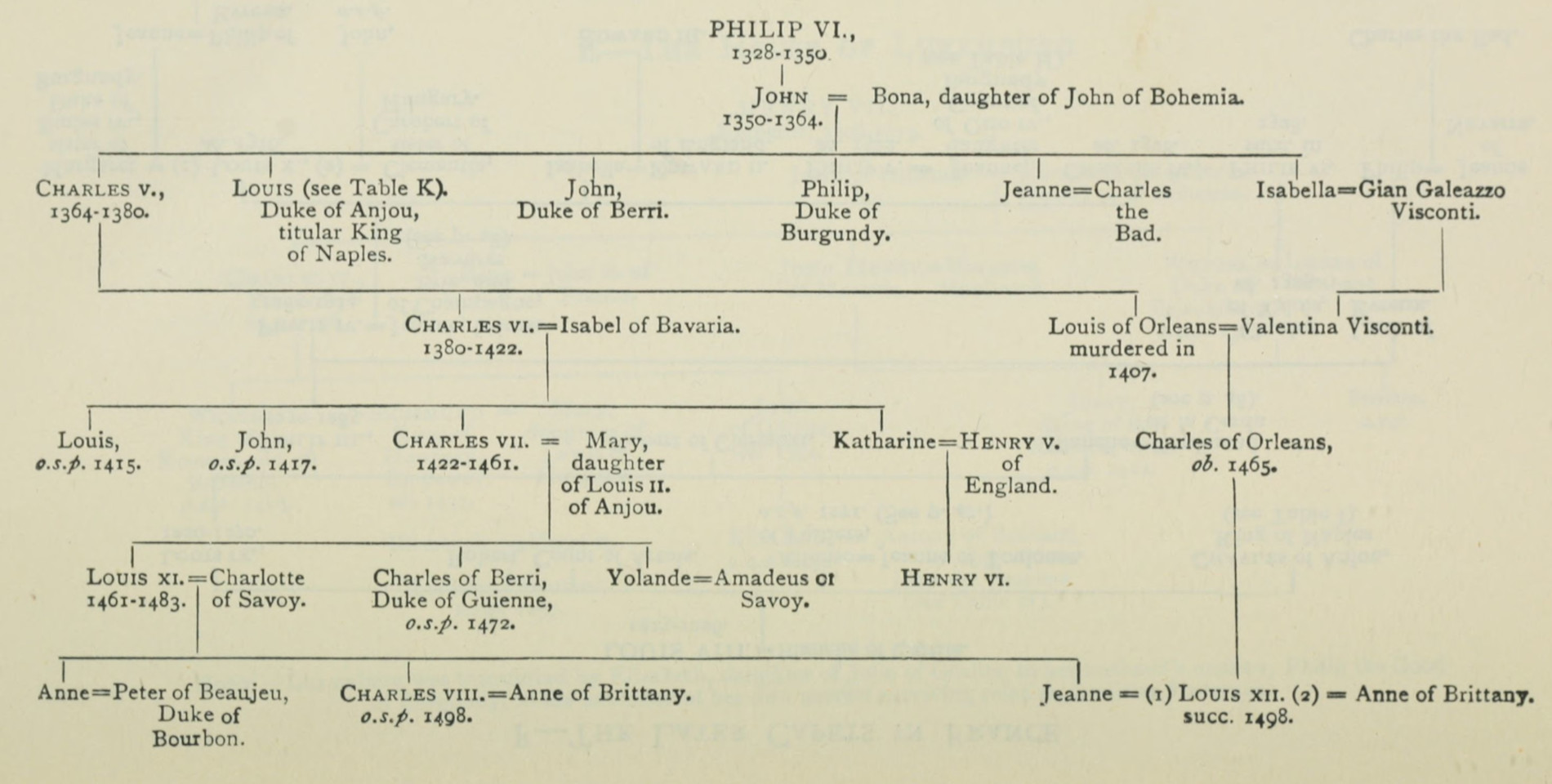
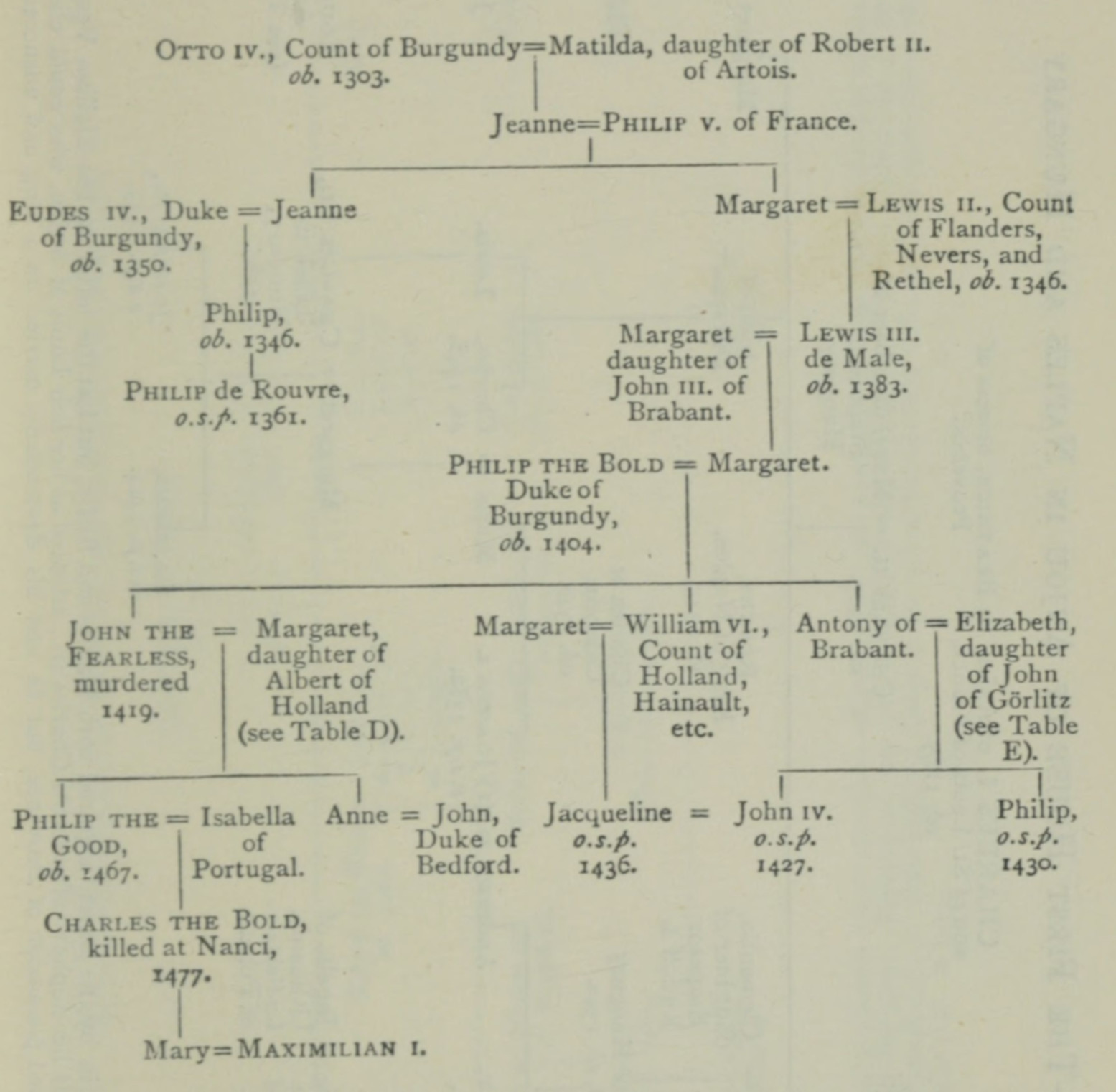
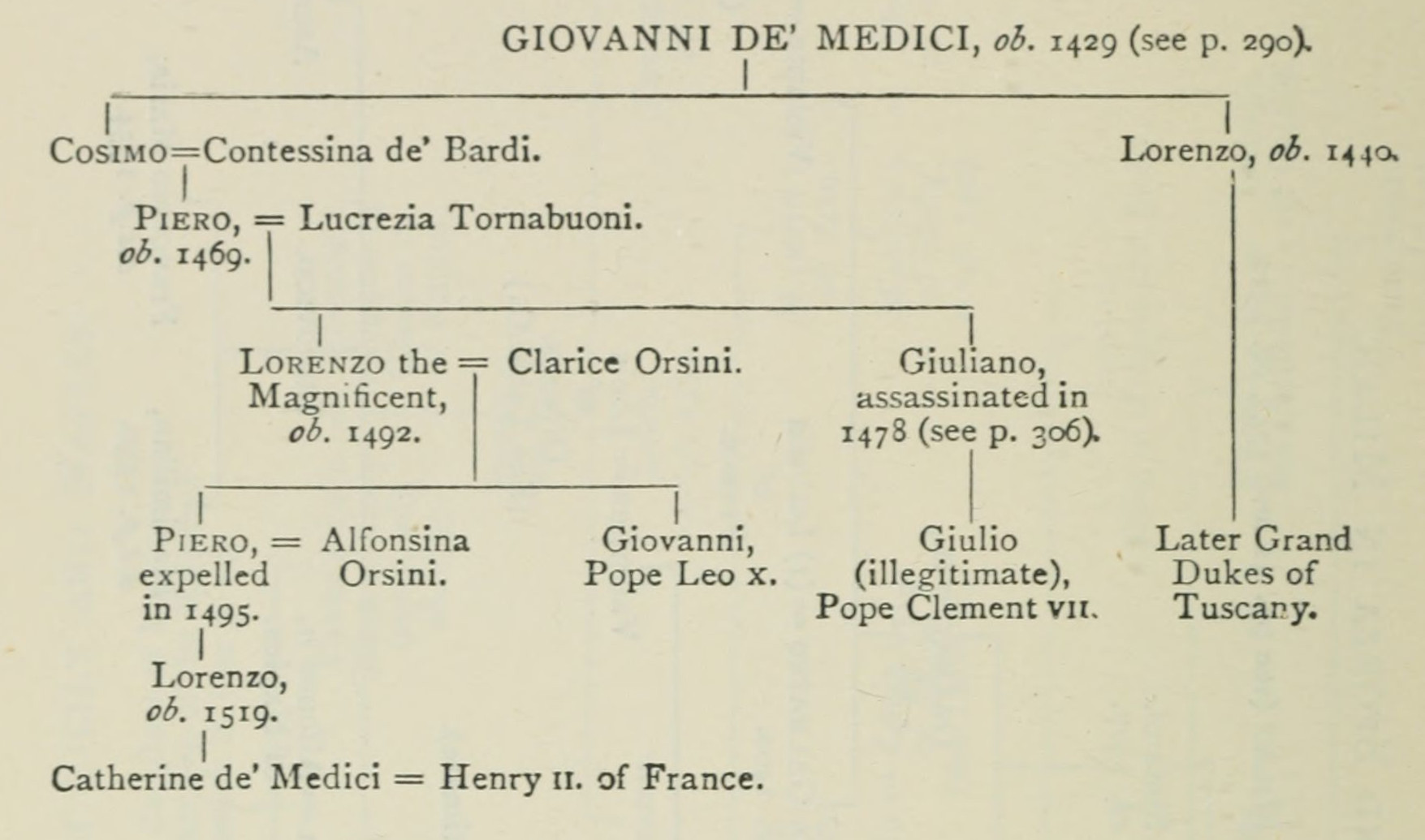
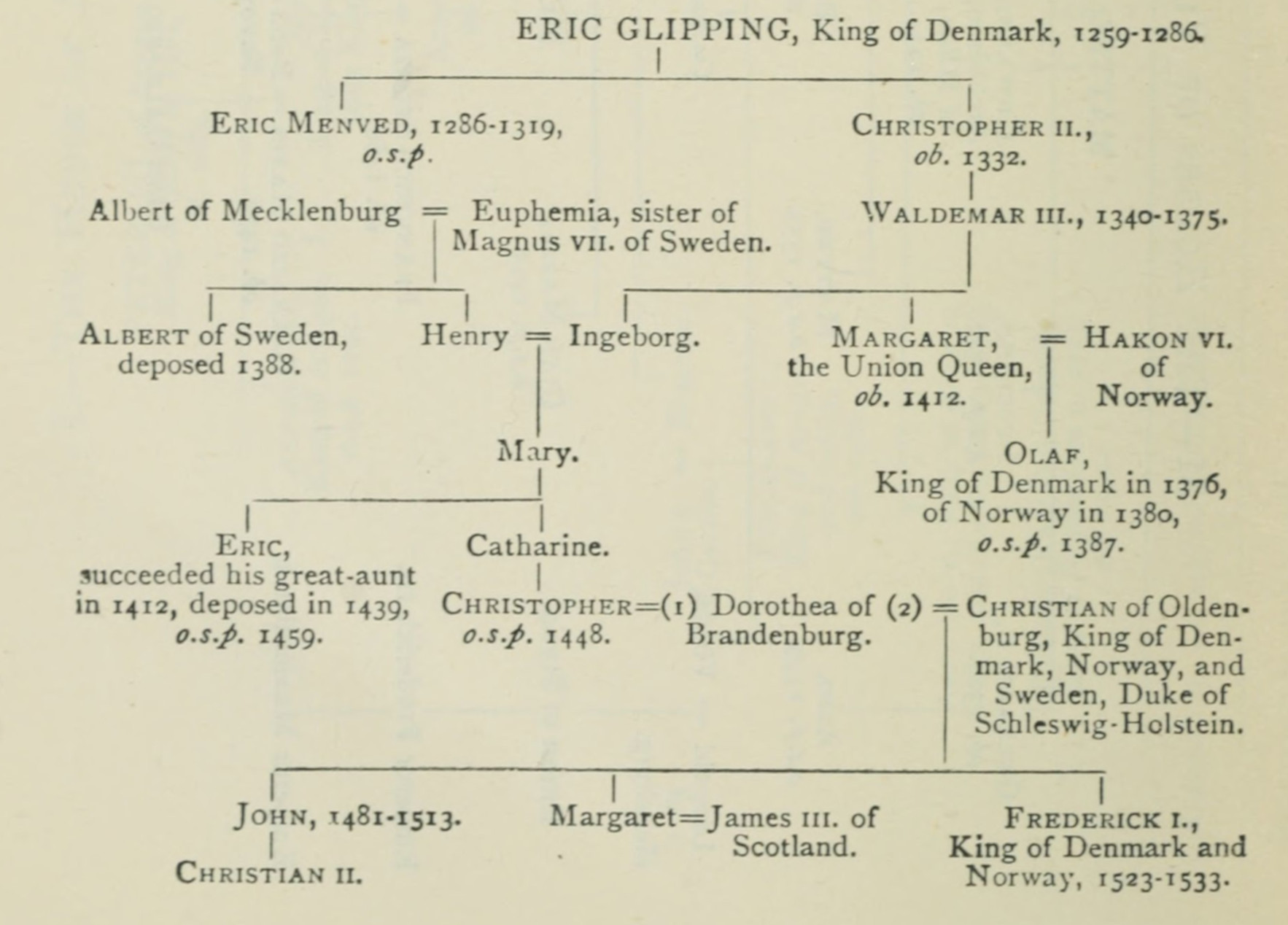
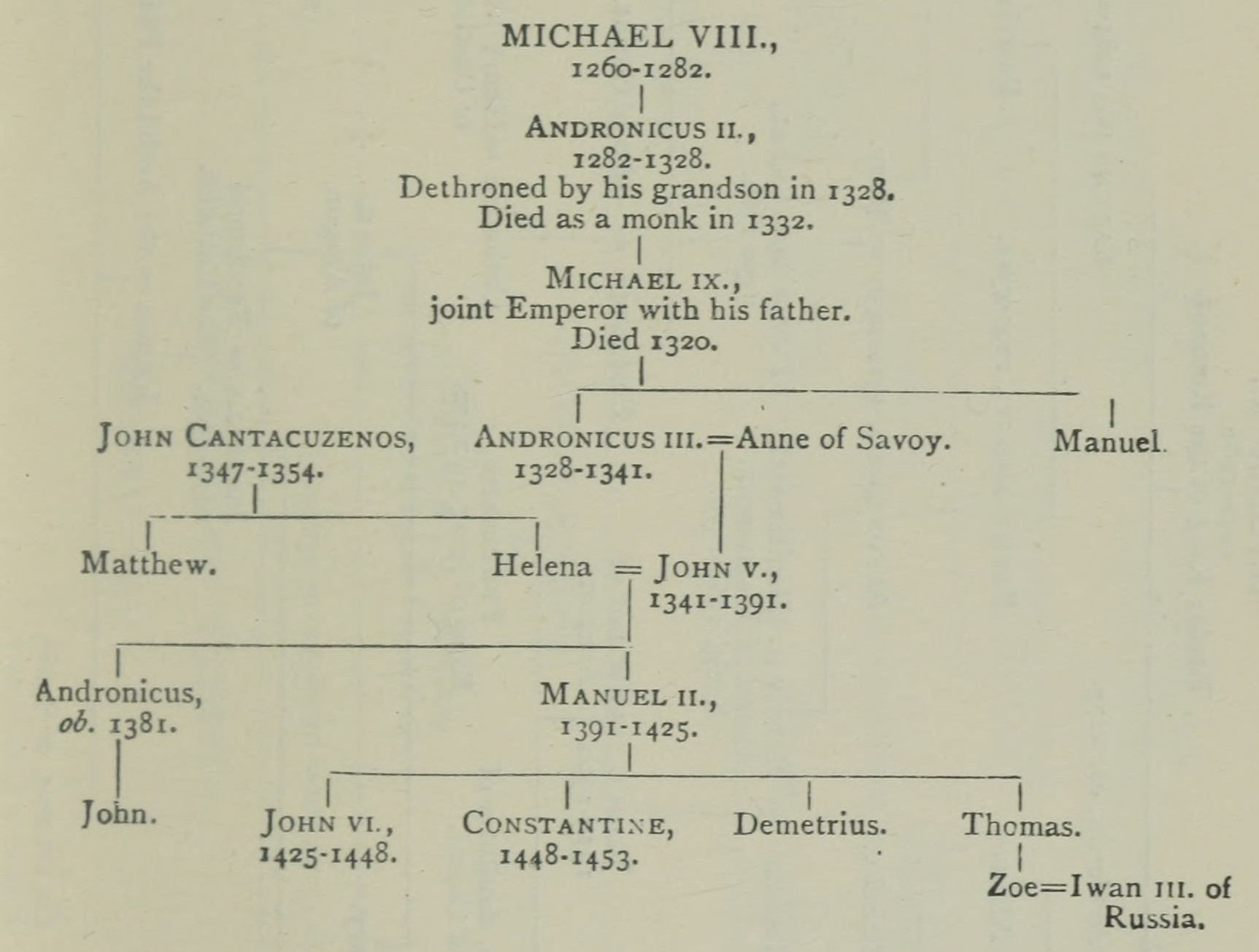
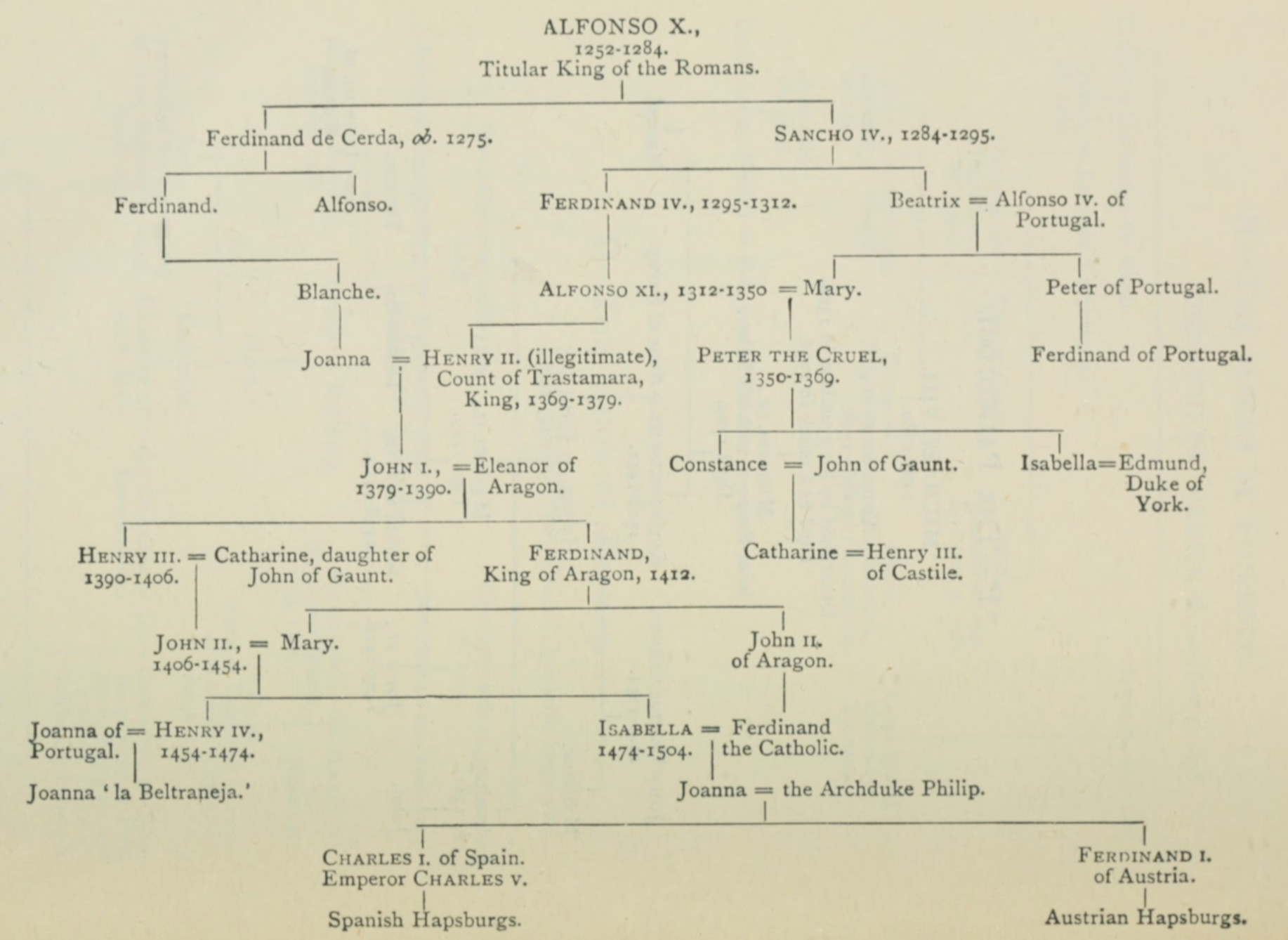
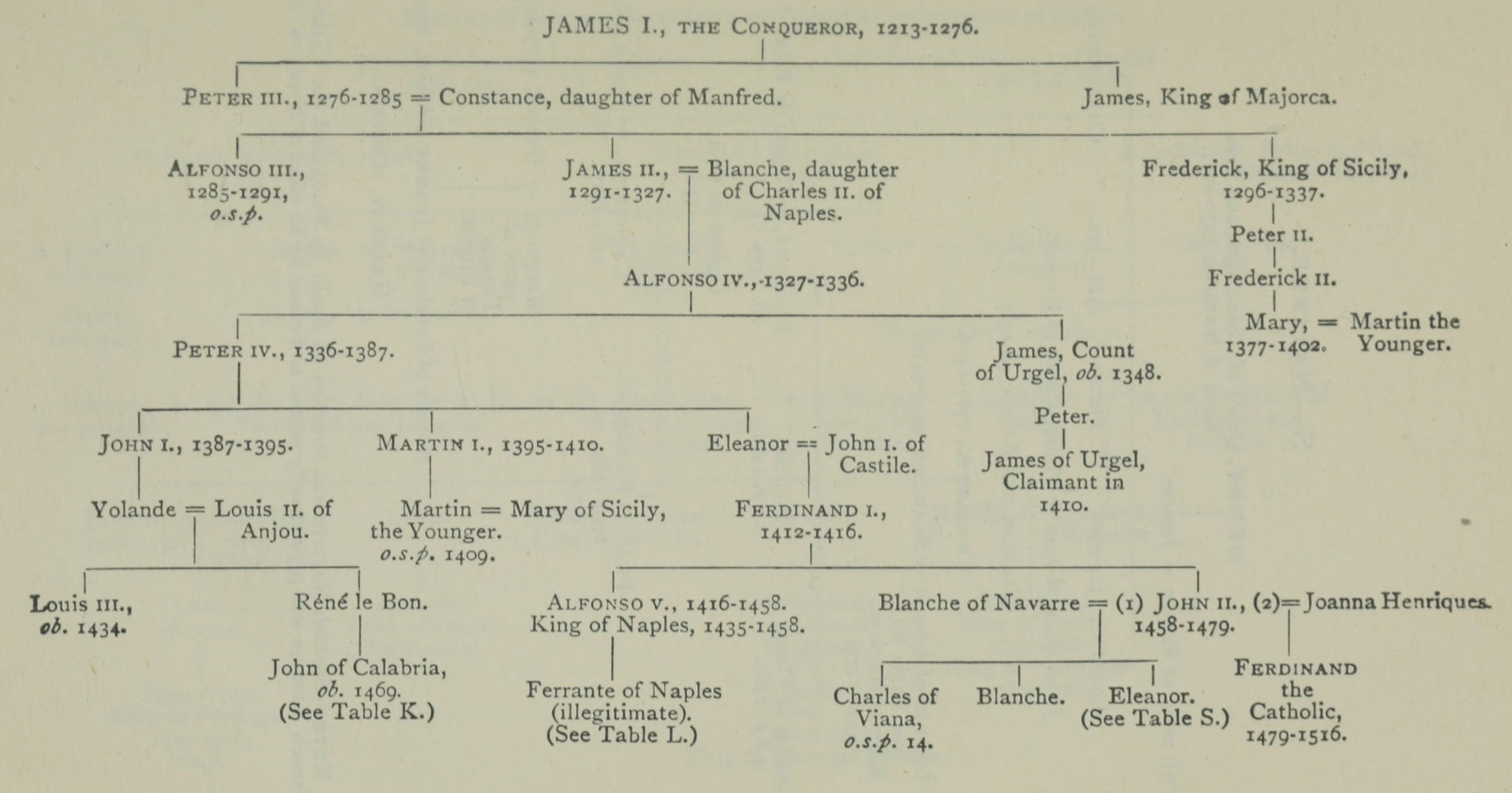
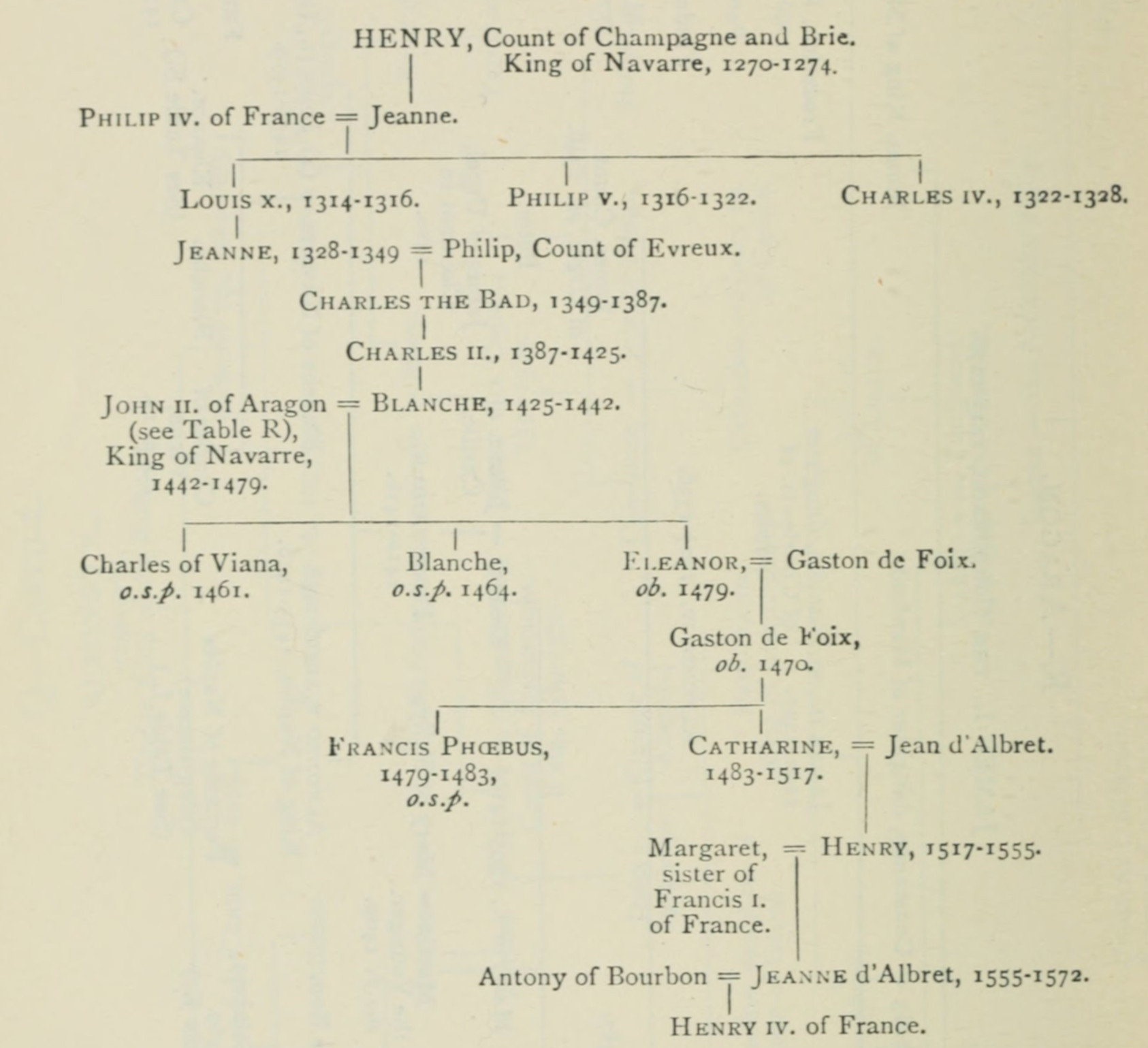
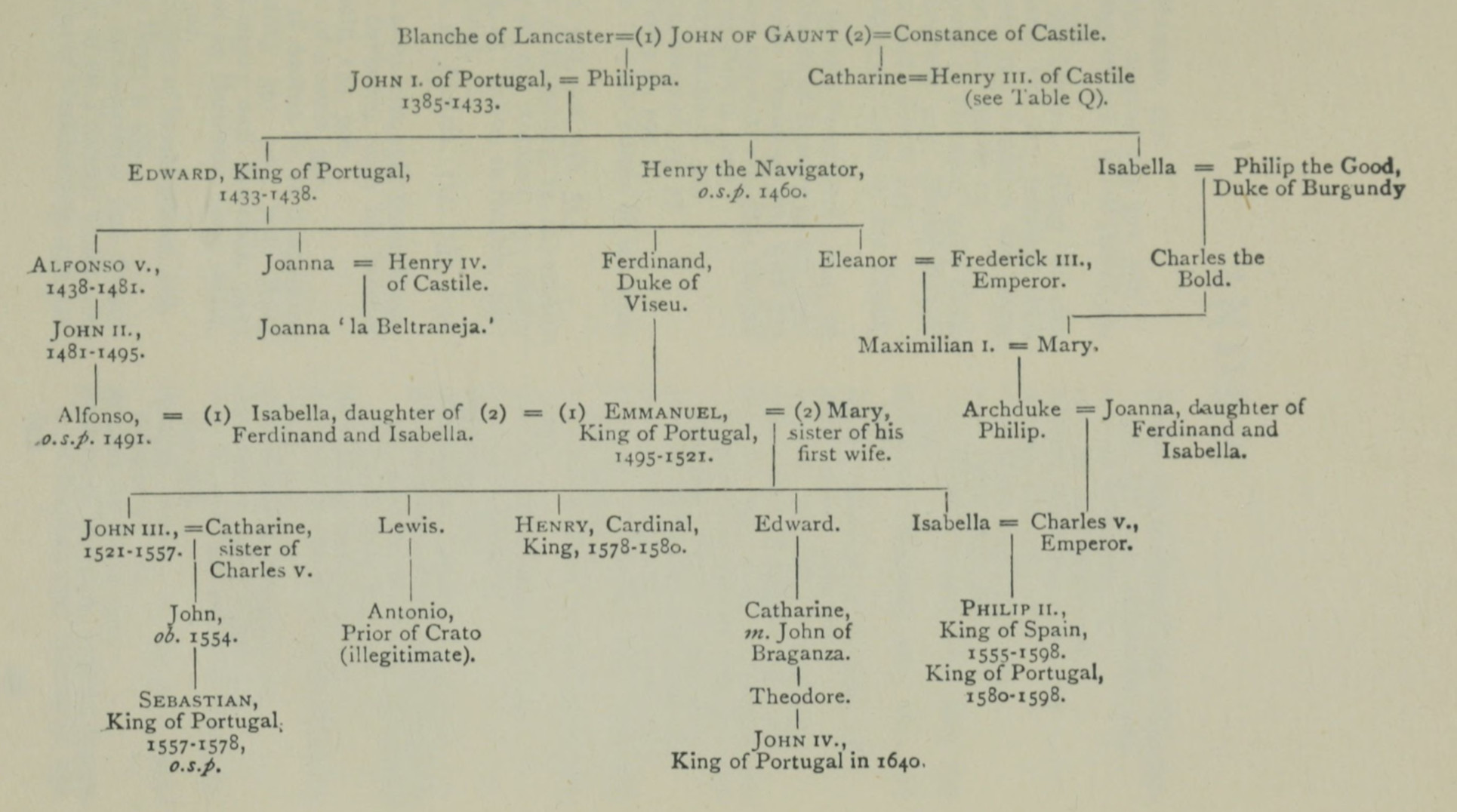
growth of the greatest states, a careful study of genealogy
is imperatively necessary. This will explain
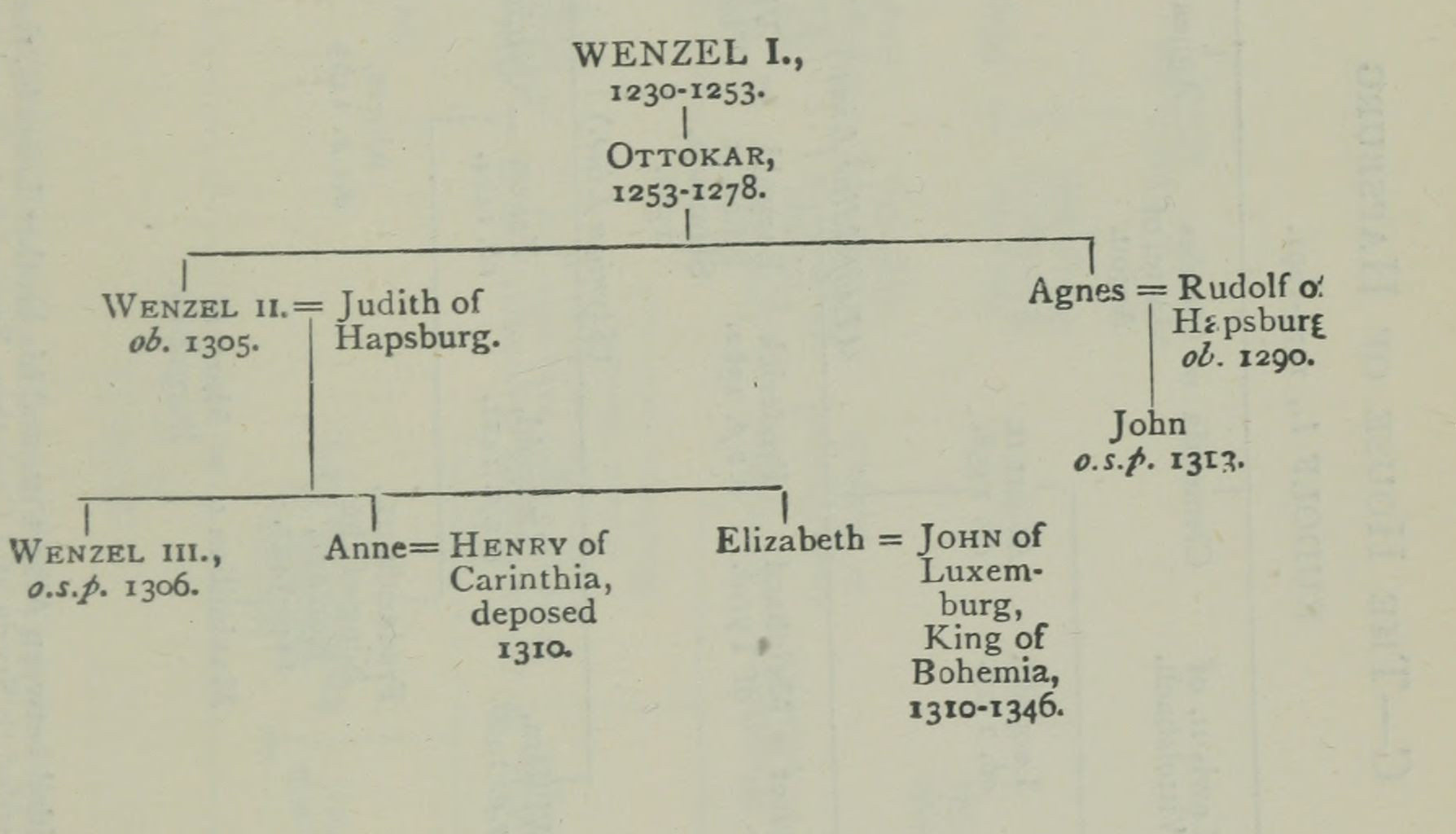
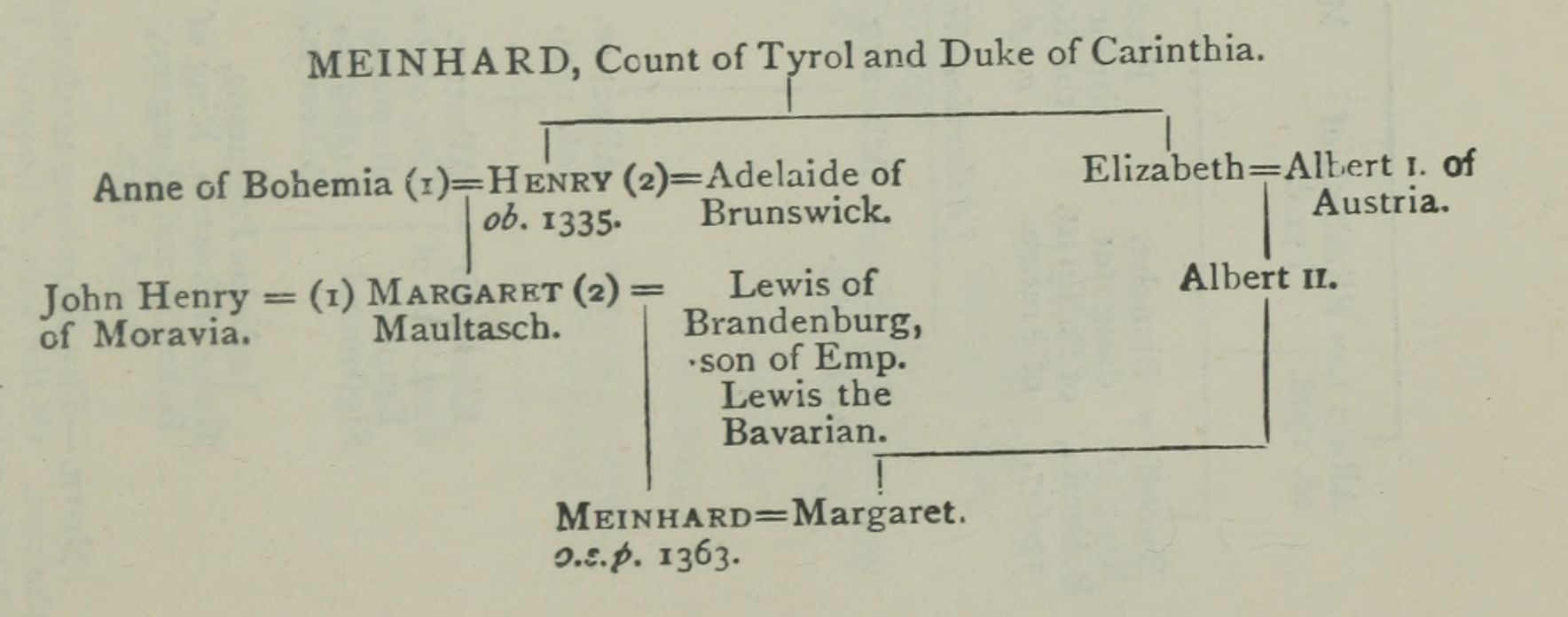
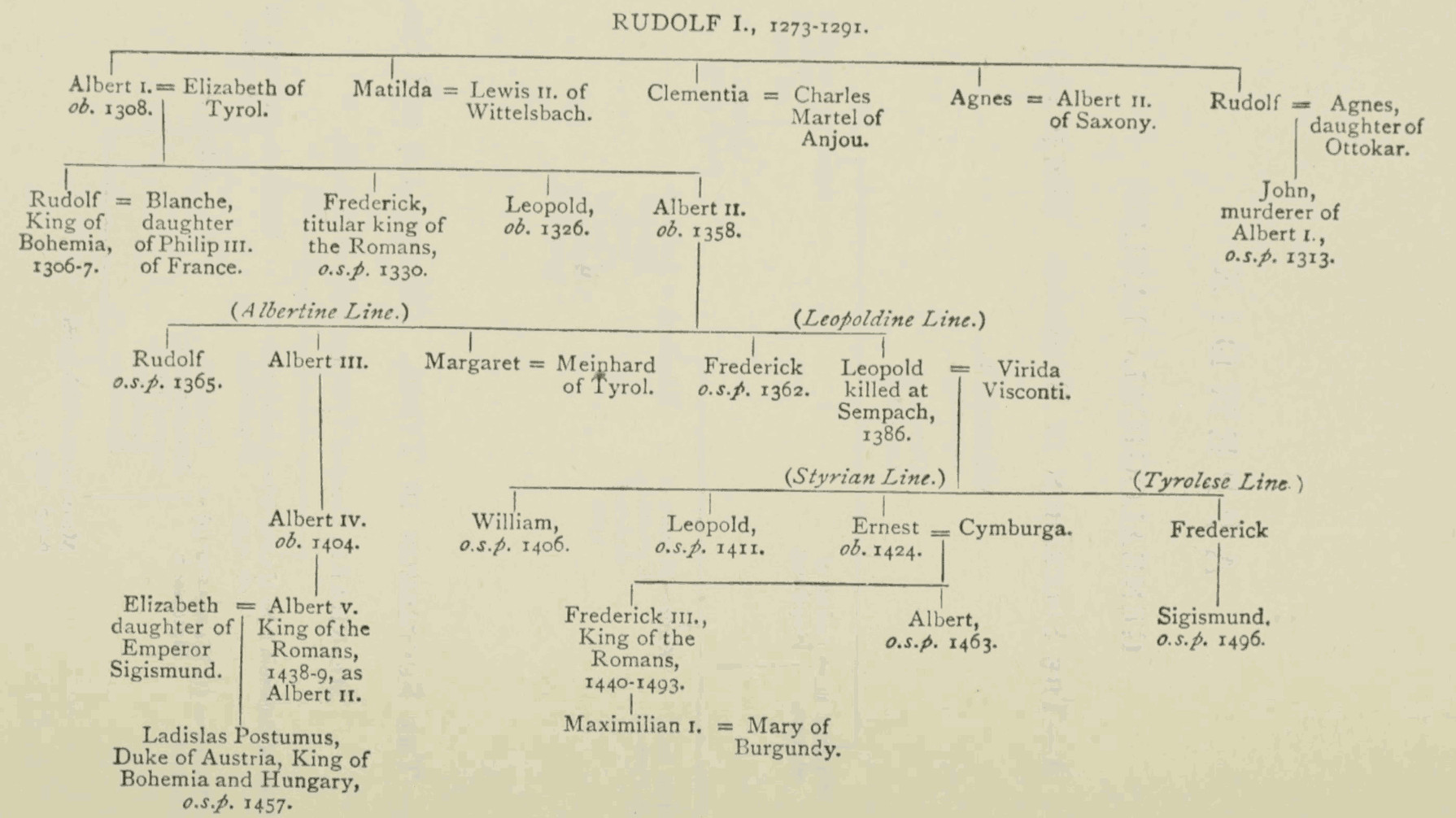
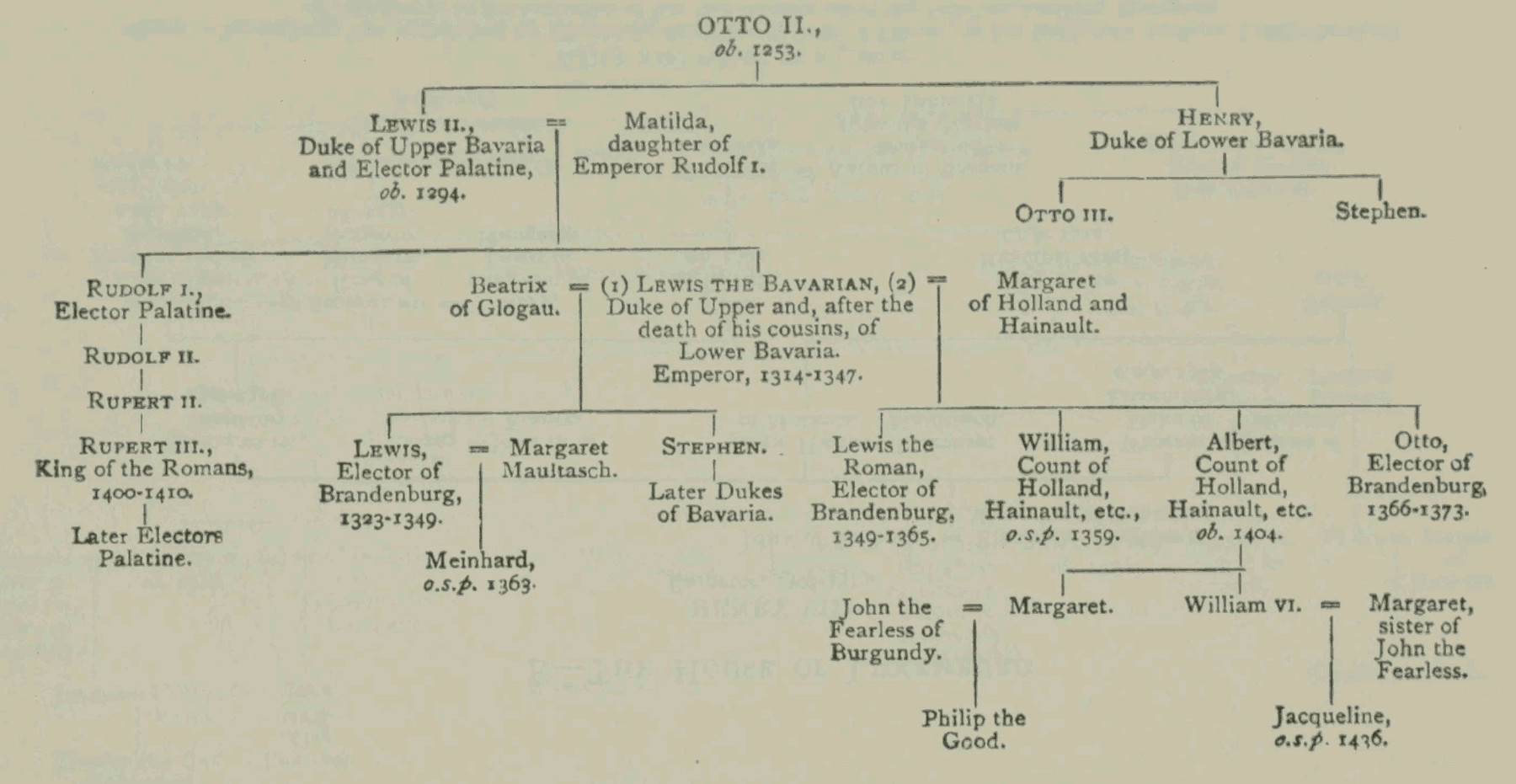
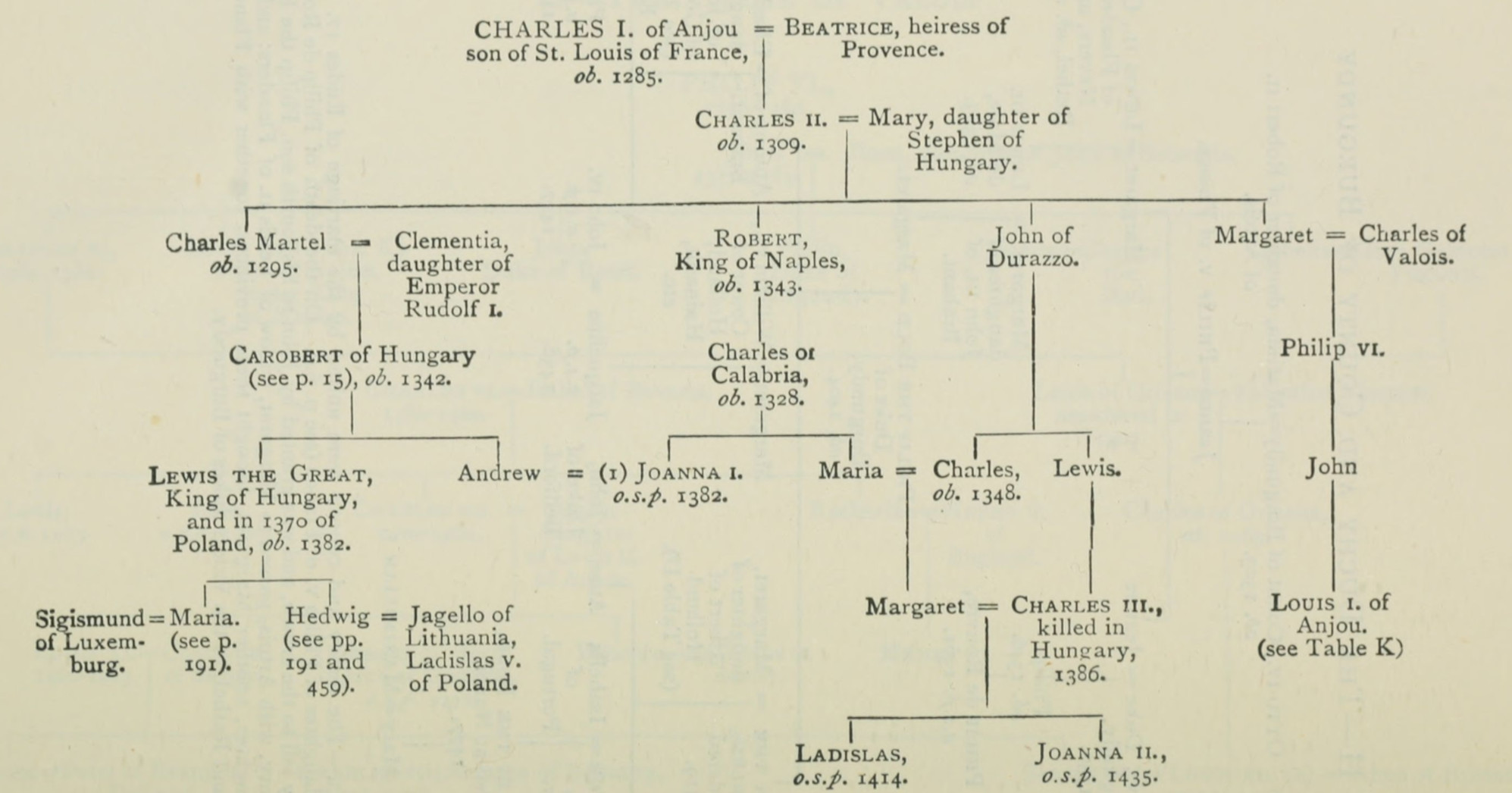
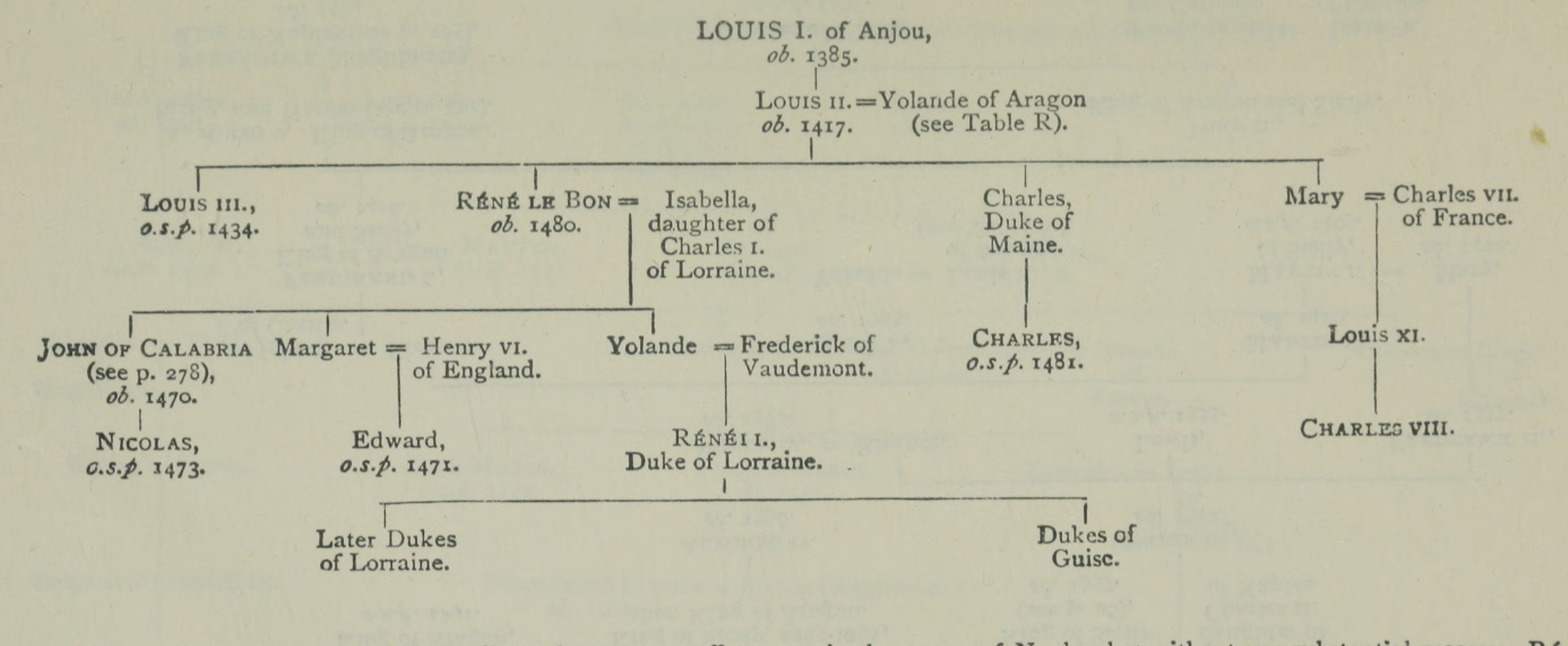
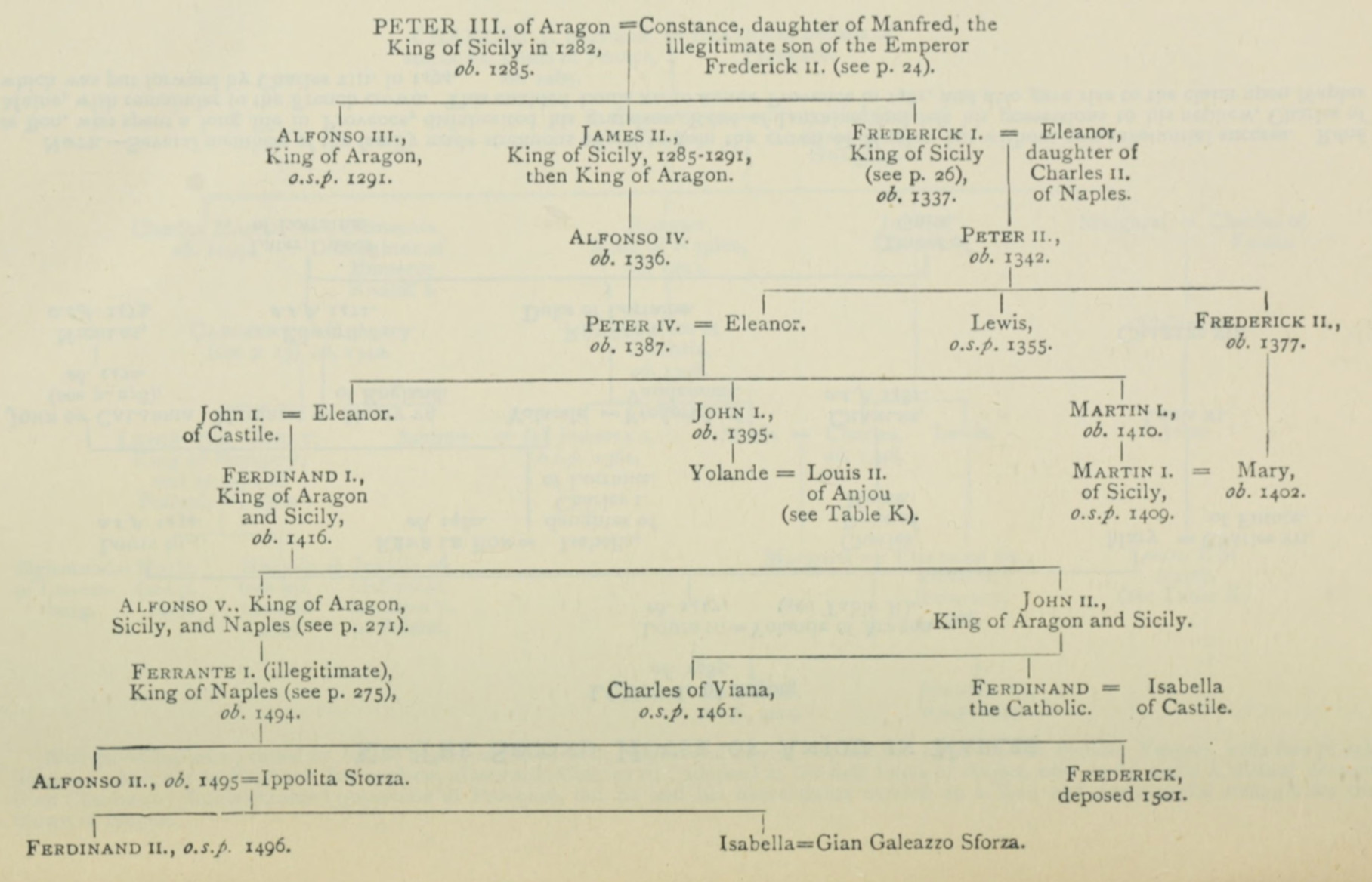
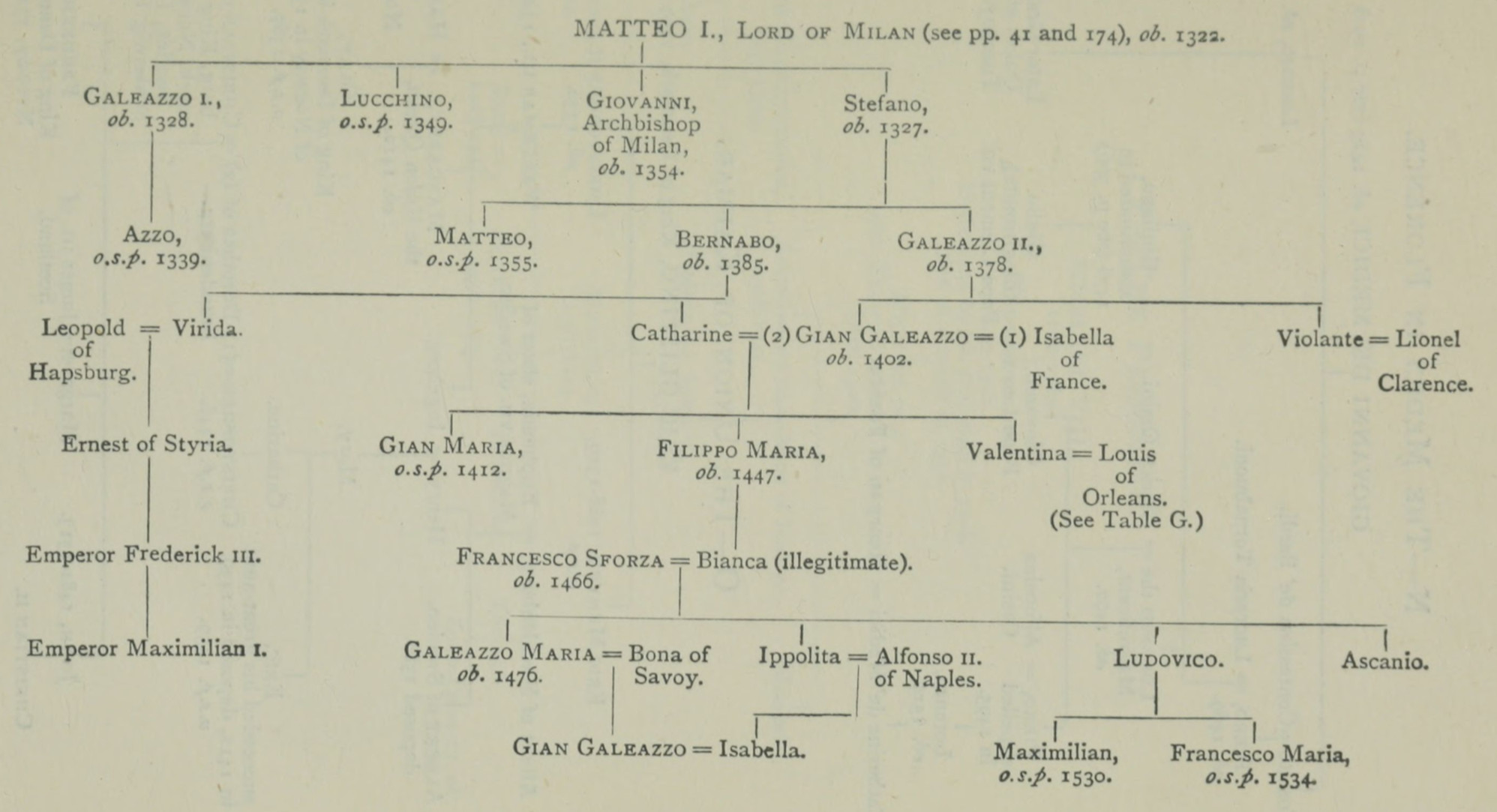
and justify the insertion of a number of genealogical
tables in the Appendix, which the student of the
period may find not the least useful part of the
volume.
1. France, to show the Additionst to the Monarchy between 1273 and 1494.
2. Possessions and Claims of Charles the Bold, Duke of Burgundy, 1467-1477.
3. Italy in the Fifteenth Century.
4. The Swiss Confederation.
BIBLIOGRAPHICAL NOTE
x
[The following list has no pretensions to be an exhaustive bibliography
of the period, nor does it profess to include all the authorities consulted
by the author. It is merely compiled with the object of offering suggestions
to any student who wishes to read more widely, either on the whole
period, or on any part of it. Those books which cannot be classed under
any of the great European states are placed under the head of ‘General.’]
General—
Lavisse et Rambaud, Histoire Générale du IVe. Siècle à nos jours,
Tome III.
Creighton, History of the Papacy during the Reformation, Vols. I.-III.
Froissart, Chroniques. [A popular and useful selection from the
translation of Lord Berners has been published by Messrs.
Macmillan and Co. in the ‘Globe’ Series. The most complete
edition is that by Kervyn de Lettenhove.]
Leroux, Recherches Critiques sur les relations politiques de la France
avec l’Allemagne.
Fournier, Le Royaume d`Arles.
Oman, History of War in the Middle Ages.
H. C. Lea, History of the Inquisition in the Middle Ages.
R. L. Poole, Illustrations of Medieval Thought.
Germany—
Nitzsch, Geschichte des Deutschen Volkes.
Lorenz, Deutsche Geschichte im 13-14 Jahrhunderte.
Zeller, Histoire de l’Allemagne.
Droysen, Geschichte der preussischen Politik, Vols. I. and II.
Dierauer, Geschichte der schweizerischen Eidgenossenschaft.
Palacky, Geschichte von Böhmen.
Loserth, Hus und Wiclif (translated).
Sartorius, Geschichte des Ursprunges der Deutschen Hanse.
Schäfer, die Hansestädte und König Waldemar von Dänemark.
Treitschke, Das Deutsche Ordensland Preussen,
Historische und politische Aufsätze, Vol. II.
Italy—
Villani, Croniche.
Sismondi, Histoire des Républiques italiennes du moyen âge.
xiCipolla, Storia delle Signorie Italiane, dal 1313 al 1530.
Gregorovius, Geschichte der Stadt Rom im Mittelalter (translated).
Romanin, Storia documentata di Venezia.
H. F. Brown, Venice, an Historical Sketch.
Machiavelli, Storia Fiorentina.
Perrens, Histoire de Florence.
Guido Capponi, Storia della republica di Firenze.
Napier, Florentine History.
Villari, Machiavelli (translated), Vol. I.
Von Reumont, Lorenzo de’ Medici (translated).
Armstrong, Lorenzo de’ Medici.
J. A. Symonds, Renaissance in Italy.
France and the Netherlands—
Martin, Histoire de France.
Michelet, Histoire de France.
Langlois, Le règne de Philippe le Hardi.
Boutaric, La France sous Philippe le Bel.
Perrens, Étienne Marcel.
S. Luce, Histoire de la Jacquerie.
Vanderkindere, Le siècle des Arteveldes.
Vallet de Viriville, Histoire de Charles VII.
Beaucourt, Histoire de Charles VII.
Cosneau, Le Connétable de Richemont.
P. Clément, Jacques Cœur et Charles VII.
Philippe de Commines, Mémoires.
Barante, Histoire des Ducs de Bourgogne.
Kirk, History of Charles the Bold.
Clamageran, Histoire de l’Impôt en France.
Gasquet, Précis des Institutions Politiques et Sociales
de l’ancienne France.
Spain—
Lafuente, Historia general de España.
Burke, History of Spain, 2 vols.
Schäfer und Schirrmacher, Geschichte von Spanien.
Prescott, Ferdinand and Isabella.
Fall of the Greek Empire—
Gibbon, Decline and Fall.
Finlay, Byzantine and Greek Empires
La Jonquière, Histoire de l’Empire Ottoman.
CHRONOLOGICAL TABLE
xii
[This table has been drawn up in order to bring together in their
chronological sequence those events in different parts of Europe which
are necessarily treated in the text under the head of different states. The
chief events in English History are inserted to serve as guide-posts, even
though in some cases no direct reference may be made to them in the
following pages.]
1273. Election of Rudolf of Hapsburg as King of the Romans. Crowned at Aachen, October 24
1274. Death of Henry, King of Navarre and Count of Champagne and Brie. Philip III. of France annexes Champagne and Brie, and assumes the government of Navarre
CHAPTER I GERMANY AND THE EMPIRE AFTER THE INTERREGNUM, 1273-1313
1
The Empire—German divisions—The Interregnum—Rudolf of Hapsburg—His
War with Ottokar—Adolf of Nassau—His relations with France—His
fall—Albert I.—The Succession in Hungary and Bohemia—The
Election of Henry VII.—His Italian Expedition—His Concessions to the
Princes—His son John and the Bohemian Crown—The French seizure of
Lyons—The importance of the Period 1273-1313 in German History
Ever since A.D. 962 the German monarchy had been combined
|The Empire and the German monarchy.|
with the Roman Empire, and the union proved harmful
to both offices. The universal authority of the
Emperor could hardly fail to become shadowy
and unreal, but it was rendered more distasteful
to non-German princes and peoples by the immediate
association of the Empire with a distinct kingdom,
with which they might have causes of quarrel. And as the
Empire became more and more localised, so the German
kingship became steadily weaker. The shadowy character of
the higher dignity tended to produce the same impression as
to the more real and practical office. The princes who held
their lands of the German king aimed more and more at the
independence of the external kings and rulers, who, in feudal
theory, held of the Emperor. The imperial claims brought
the Empire into collision with the Papacy, and the German
monarchy suffered from the blows which the Emperor’s power
received in the great Contest of Investitures. Moreover, the
Empire carried with it the crown of Italy; and the constant
waste of money and men in the vain attempt to establish a
2real dominion in the southern peninsula, not only weakened
individual German rulers, but also led to constant absences
from Germany which gave occasion to their northern vassals
to acquire independence. Above all the Empire was, by
tradition and by the very conception of the office, elective.
Thus the German kings were deprived of all the advantages
which normal hereditary succession gave to the rulers of
England and France. Not only did disputed elections give
rise to civil war with all its evils, but the constant change
from one family to another rendered impossible any consistent
policy of strengthening the central power. When at
last the Hapsburgs obtained quasi-hereditary possession of
the imperial dignity, disunion had made such progress that it
was too late to apply a remedy.
The decline of the central power and the consequent rise
|German divisions.|
of a large number of semi-independent political units, each
with a separate existence of its own, though held
together by certain common duties and interests,
make German history in this period peculiarly difficult and
complicated. And the number of these units was far greater
in the thirteenth century than would have seemed likely at an
earlier date. The great duchies formed by the Karolings had,
by the policy of subsequent rulers, been broken up or allowed
to become extinct. The great duchy of Swabia, for instance,
came to an end with the Hohenstaufen, and was never revived.
But the extinction of each duchy brought with it an
immense increase of the number of tenants-in-chief. Every
noble, town, and even village which had previously held of
the duke, now claimed to hold directly of the Emperor; and
though many of the weaker units fell victims to the greed of
powerful neighbours, yet some, like the original members of
the Swiss Confederation, succeeded in retaining the coveted
position. In Germany, too, primogeniture was in those days
a rare exception, and the practice of equal partition among
brothers necessarily led to a great increase in the number of
princely tenants of the Emperor.
3It is, of course, impossible in this volume to attempt to
|The lay princes.|
trace the separate history of the various principalities and
states which fill the rather ill-defined territory
known as Germany. But it is necessary at starting
to have a clear conception of some of the chief families
which play so important a part in subsequent history. The
four most prominent princely houses in the middle of the
thirteenth century were those of Ascania, Welf, Wittelsbach,
and Wettin. The first was sub-divided into two lines, descended
from the two sons of Albert the Bear. The elder
son had held the marks of Brandenburg in the north, which,
since 1267, were split up among several brothers. The
younger son, Bernard, had in 1180 received from Frederick
Barbarossa the diminished duchy of Saxony, which was now
held by his grandson, Albert II. (1261-1298). The great
family of Welf, so powerful in the previous century, was now
confined to the duchy of Brunswick, afterwards sub-divided
into Lüneburg (Hanover) and Wolfenbüttel (Brunswick).
The House of Wittelsbach was represented by two brothers,
Lewis II., who combined the duchy of Upper Bavaria with
the Palatine county (Pfalzgrafschaft) of the Rhine, and
Henry, who held the duchy of Lower Bavaria. Henry of
Wettin, whose descendants acquired Saxony in the fifteenth
century and retain it to the present day, was at this time
Margrave of Meissen and Landgrave of Thuringia. But the
most powerful individual prince at this time was Ottokar,
ruler of the Slav kingdom of Bohemia, which was brought by
geography and history into close connection with Germany.
To Bohemia, which he inherited in 1253 from his father,
Wenzel I., Ottokar had added by marriage and diplomacy
Austria, Styria, Carinthia, and Carniola, and thus held a
secure predominance in south-eastern Germany. There were
also three lesser families, as yet insignificant, and not regarded
as belonging to the princely class, which were destined within
this period to rise to importance in Germany, while two of
them have taken a position among the greatest dynasties
4Europe has ever seen. The House of Luxemburg, in the
thirteenth century the lords of a petty county near the
western frontier, produced in the next century four Emperors,
and founded a territorial power which survived the family
which had created it. The Hapsburgs, hitherto known only
as active and successful nobles in Swabia, within this period
built up a considerable state in south-eastern Germany, and
succeeded to the position which the Luxemburgs had founded.
Finally, the Hohenzollerns, who in the thirteenth century
combined scattered territories in Franconia with the office of
Burggraf of Nürnberg, acquired the electorate of Brandenburg
in the fifteenth century, and though their power grew more
slowly than that of the Luxemburgs and Hapsburgs, yet it
rested on a surer foundation, owed more to ability and policy
than to fortune, and may prove in the end both more brilliant
and more durable.
Among the great territorial princes of Germany must be
|The Bishops.|
reckoned the very numerous ecclesiastical tenants-in-chief of
the Empire. A large area of German soil, especially
along the valleys of the Rhine and the Main,
was held by bishops and monasteries. Of these clerical
princes the most powerful and prominent were the Rhenish
archbishops of Mainz, Köln, and Trier. In former times the
bishops had been severed from the secular princes by class
interests and traditions, and the separation had been encouraged
by many of the Emperors, whose policy was to
exalt themselves by playing one off against the other. But
after the middle of the thirteenth century this distinction
tends to become obscured. The rivalry between Emperors
and Popes, though it does not disappear, ceases to be the
dominant factor in German relations; and during the papal
residence in Avignon (1305-1376) the German bishops become
to some extent alienated from the Papacy. The result
is that the German princes, both clerical and secular, come to
form a fairly united class; and the most obvious interest
which binds them together is the desire to strengthen their
5own independence, their ‘liberty,’ as they call it, by weakening
the central power. On the other hand, the lesser tenants-in-chief
below the princely rank, known in later history as the
Ritterschaft, or knights, are impelled to cling to the monarchy
for support against the constant danger of princely encroachments.
Besides the princes and knights, there is a very important
|The imperial cities.|
body of tenants-in-chief—the Reichstädte, or imperial cities.
These had risen to importance, partly through the
economic conditions which gave them wealth, and
partly through the policy of several of the Emperors, who had
encouraged the growth of municipal life as a source of revenue
and as a check upon the power of the princes. German cities
may be divided roughly into two great groups: those in the
south, like Augsburg, Nürnberg, Ratisbon, etc., which obtained
importance from their position on the great commercial
routes leading from Venice and Genoa to different parts of
Europe; and those in the north, on the Baltic and the
German Ocean, whose function was to carry on the trade
between the east and the west of Northern Europe, and to
exchange at Bruges the products of the north for the commodities
brought by the southern merchants (see p. 422). The
strength of the towns lay in their wealth and their walls; their
weakness in their isolation and mutual jealousy. This weakness
the southern cities never overcame; their leagues for
common objects were never durable, and therefore never
effectual. But the northern towns were left more to themselves:
they came into contact with less developed states,
and they were subject to the pressure of more constant and
more immediate political interests. The necessity of securing
trade privileges in the countries lying to the east and west of
the Baltic, and the duty of defending their commercial routes
against the aggressive Scandinavian state of Denmark, which
commanded the outlets from the Baltic, forced the northern
towns into a semi-federal union, and the Hanseatic League
became for a time a great political power in the north. In
6the end the northern cities also succumbed, owing mainly to
a great change in trade routes, and partly to the growing
predominance of the princes. But at the beginning of this
period the future destiny of the German towns was unknown,
and to contemporaries it seemed quite possible that cities
like Nürnberg and Augsburg, or Lübeck and Hamburg,
might obtain an independence and a power not markedly
inferior to that which was actually acquired at this time by
Venice and Florence, which were in theory equally tenants-in-chief
of the Empire, though further removed from the
exercise of imperial authority.
The decline of the German kingship had begun in the
|The Interregnum and its results.|
eleventh century, but a partial revival had been effected by
the great Hohenstaufen Emperors, Frederick
Barbarossa, Henry VI., and Frederick II. With
the fall of the Hohenstaufen both Empire and
monarchy sank lower than they had ever done before.
During the Great Interregnum (1256-1273), two rival kings,
the Englishman Richard of Cornwall, and the Castilian king,
Alfonso X., had secured the nominal adherence of conflicting
parties in Germany, but neither had attempted to rule the
country. In these years not only did the tenants-in-chief
enjoy complete independence of any external authority, but
the imperial domains were either annexed by the princes, or
squandered by the two royal claimants in the attempt to
purchase adherents. This rendered it impossible to revive
the old monarchy, and produced changes which seemed to
render German unity for ever hopeless. Hitherto the elected
Emperor had resigned his hereditary dominions, and had
supported himself on the domain-lands, travelling about from
one estate to another. This was no longer possible. The
only way in which a future king could hope to secure any
respect or obedience was to acquire such a territorial power
as would make him formidable. Such a policy, consistently
pursued by a line of hereditary kings, might have resulted in
the gradual formation of a territorial monarchy like that of
7France. But the princes made use of their right of election,
at first to prevent the kingship passing to successive members
of the same family, and always to impose conditions which
should secure their own independence. The evil results
became abundantly plain in the century which followed the
Interregnum. Each successive Emperor set himself, not so
much to strengthen the monarchy, as to aggrandise his own
family; and the more successful he was, the more dangerous
and objectionable did that family become to his successor.
The same conditions which produced nepotism in the Papacy,
led to the adoption of a consistent policy of dynastic aggrandisement
by all the Emperors from Rudolf of Hapsburg
onwards.
In 1272 the death of Richard of Cornwall forced his
|Election of Rudolf I.|
adherents to consider the question of a new election, and at
the same time Pope Gregory X., alarmed by the
excessive power of the House of Anjou in Italy,
and afraid lest German disunion might give occasion for
French aggression north of the Alps, used all his influence
to urge on the unanimous choice of a new king in Germany.
For a long time the right of election had tended to fall into
fewer hands. The early German kings were selected by the
chief men and approved by the acclamations of a mass
meeting of all freemen. Gradually the form of popular
approval disappeared, and the princely tenants-in-chief assumed
an absolute power of nomination. Since then the
practice had grown up of a preliminary choice by some of the
chief princes, to be ratified by the rest. But in the thirteenth
century the idea arose that certain princes could elect without
any further ceremony. Superstition and custom seem to
have combined to suggest the number seven for these electors,
as they came to be called. But there were several contending
claimants for the right to be included in the favoured seven,
and it was not till the next century that these disputes were
finally settled. On the present occasion the lead was taken
by the great Rhenish princes, the Count Palatine with the
8three Archbishops. The only chance of securing a general
adhesion of the princes was to choose a king who was not so
strong as to excite either fear or jealousy. Mainly through
the exertions of Frederick III. of Hohenzollern, Burggraf of
Nürnberg, the choice of the electors fell upon his cousin
Rudolf, Count of Hapsburg, who was crowned at Aachen on
October 24, 1273. It is not a little curious that the election
of the first Hapsburg was brought about by the influence of
a Hohenzollern.
Rudolf’s position was no easy one when, at the age of
|Rudolf’s policy.|
fifty-five, he was called from his successful career in the petty
politics of Swabia[1] to assume the German kingship.
He had a large family of daughters, whose
marriages served to gain him adherents. At the coronation
ceremony one had been married to Lewis of Wittelsbach, and
another to Albert of Saxony. But such a tie was insufficient
to secure the docile obedience of his sons-in-law if he endeavoured
to exercise any real authority over them. Alfonso of
Castile retained the title of king of the Romans, and though
for the time he was powerless, his pretensions might easily
serve as a pretext for malcontents. A more formidable
opponent was Ottokar of Bohemia, whose claim to a voice in
the election had been disregarded, and who refused to acknowledge
the ‘pauper count’ of Hapsburg. In these circumstances
Rudolf showed all the prudence and foresight that
had already won him a reputation. He realised that it was
no longer possible to revive the pretensions of the Hohenstaufen.
He could not afford to alienate the Pope or to aim
at the recovery of an Italian kingdom. He must content
himself with obtaining what reality he could for the royal
power in Germany, and must find a territorial basis for that
power. The most obvious method of doing this was the
restoration of the duchy of Swabia in his own family, which
would enable him to achieve the aims which he had hitherto
pursued. But such a step would involve a quarrel with Lewis
9of Wittelsbach, who claimed to be regarded the heir of the
Hohenstaufen. Rudolf could not venture on such a risk,
and he fell back on the plan of wresting from Ottokar the
German fiefs in the south-east, which the latter had seized
during the Interregnum. Before attempting this, Rudolf had
to gain over the Pope, the close ally of the Bohemian king.
Through the agency of Frederick of Hohenzollern he concluded
a concordat with Gregory X., by which he confirmed
all previous concessions of Italian territory to the Papacy, and
recognised the Angevin kingdom of Naples and Sicily. These
promises were subsequently confirmed in a personal interview
with Gregory at Lausanne (October, 1275). In March 1280
Rudolf made a direct treaty with Charles of Anjou, by which
he confirmed his possession of Provence, and agreed to marry
his daughter Clementia to Charles’s grandson. Thus the
policy of Frederick II. was finally abandoned. To secure
undisturbed freedom of action in Germany, Rudolf resigned
Italy to the Pope and the House of Anjou.
Rudolf’s alliance with the Pope made him strong enough
|War with Ottokar.|
to take active measures against Ottokar, whose refusal to
recognise the election on the ground that his vote
had been rejected irritated the German princes.
At successive diets, in 1274 and 1275, he was summoned to
justify his occupation of Austria, Styria, Carinthia, and Carniola,
and on his refusal was called upon to resign these fiefs.
In 1276 Rudolf collected an imperial army and advanced
into Austria, where he was welcomed by a general rising of
the German nobles against Slav rule. Vienna capitulated,
and Ottokar, finding resistance hopeless, made peace on
November 21. On condition that Bohemia and Moravia
should be secured to him, he resigned the German provinces.
The treaty was to be confirmed by a double marriage of his
daughter to Rudolf’s son Hartmann, and of his son Wenzel
to one of Rudolf’s numerous daughters. Rudolf was so
confident in the results of his victory, that he hastened to
disband his army. But Ottokar had no intention of carrying
10out the treaty of Vienna, and he succeeded in gaining over
many of the chief German princes by representing the danger
of allowing a strong Hapsburg power to be established on the
Danube. The result was a renewal of the struggle in 1278
under widely altered conditions. The death of Gregory X.
(1276) had deprived Rudolf of much of the advantage gained
by his concordat with the Papacy. The Archbishops of
Mainz and Köln turned against him. Lewis of Wittelsbach
remained obstinately neutral. Henry of Lower Bavaria,
whom Rudolf had gained over in 1276 by a politic marriage,
openly supported Ottokar, who was also aided by the
Ascanian margraves of Brandenburg. In place of the imposing
army of 1276, the only German princes who sent
active aid to Rudolf were Frederick of Hohenzollern and the
Bishop of Basel. But the balance was turned in his favour
by the alliance of Ladislaus IV. of Hungary and by the support
of the Austrian and Styrian nobles, whom Ottokar had failed
to conciliate. In a great battle on the Marchfeld, the victory
was decided by a charge of the heavy-armed cavalry under
Frederick of Hohenzollern, and Ottokar himself perished on
the field (August 26, 1278). His death made Rudolf’s
victory decisive. Otto of Brandenburg, who undertook the
guardianship of the young king of Bohemia, Wenzel II.,
negotiated a treaty in October which renewed the stipulations
of 1276 as to the cession of the Austrian provinces and the
double marriage between the Hapsburg and Bohemian
families. In December 1282 Rudolf formally invested his
sons, Albert and Rudolf, with the imperial fiefs of Austria,
Styria, and Carniola. The duchy of Carinthia was given to
Meinhard, Count of Tyrol, whose daughter was married to
Albert of Austria.
The establishment of the Hapsburg dynasty in Austria is
|Rudolf in later years.|
an important event in German history. It was the great
achievement of Rudolf’s reign, and it was his last
notable success. His later attempts to strengthen
the central monarchy in Germany were, in the main, fruitless.
11A series of edicts to secure the public peace by restricting the
practice of private war, gained the grateful approval of the
towns and the lesser nobles, but were rendered ineffectual
by the absence in Germany of an efficient system of jurisdiction
and police. An ordinance prohibiting the creation
of any new county (Grafschaft) without royal consent
illustrates the general aim of Rudolf’s government, but
proved little more than a dead letter. The recovery of the
lost imperial domains, which Rudolf had pledged himself
to undertake at his election, was a task beyond his strength.
Even the towns, on whose support he reckoned, were alienated
by his attempt to raise an imperial revenue by their
taxation; and the appearance of a number of pretenders
claiming to be Frederick II. showed a tendency to contrast
Rudolf’s government with that of his predecessor, who had
been enabled to spare his German subjects by the wealth
which he extracted from Italy. A still more serious difficulty
was the obstinate refusal of the electors to choose his son
Albert as his successor during his own lifetime. This was
the most pressing object of Rudolf’s last years, and it was
unfulfilled when he died on July 15, 1291, at the age of
seventy-three. If he had lived two centuries earlier, he
might have ranked among the greatest of German kings; as
it is, he will always be remembered as the founder of the
greatest of German dynasties.
The objection to Albert of Austria rested on the considerable
|Adolf of Nassau.|
territories, both in the east and in Swabia,
which he inherited from his father. The same
motives which had induced the electors in 1273 to choose
Rudolf, led them to look for a successor whose position
should be still more humble than Rudolf’s had been. The
influence of the Archbishop of Mainz, Gerhard von Eppenstein,
secured the election of another ‘poor count,’ Adolf of
Nassau (May 5, 1292). He had purchased votes by promises,
which he could only fulfil by pawning the scanty remnants
of the imperial domains. But Adolf’s ambition was greater
12than his material power, and he had no intention of reigning
as the submissive puppet of the electors. No sooner had he
received the crown at Aachen (June 24) than he led an
army against Albert, and forced him to do homage and to
surrender the royal insignia which he had retained on his
father’s death. To repress the great princes, Adolf set
himself to conciliate the towns and the lesser nobles.
Taking advantage of the death of Frederick of Meissen
and Thuringia, he claimed those territories as vacant
imperial fiefs, and prepared to found there a hereditary
principality as his predecessor had done on the Danube.
Still more noteworthy was the attitude which he assumed
towards France. The kingdom of Arles or Burgundy,
|Relations with France.|
founded by Rudolf I. (888-912) and enlarged by
Rudolf II. (912-937) had, after the death of
Rudolf III. (1032), fallen to the German king, Conrad II.
Since then the crown of Arles had been regarded as one of
the three crowns, with those of Germany and Italy, which
passed on election to successive kings of the Romans. But
as the German monarchy declined, the supremacy in Burgundy
became more and more nominal, and many Emperors
neglected the ceremony of coronation at Arles altogether.
The kingdom split up into a number of quasi-independent
provinces, of which the chief were the free county of Burgundy
(Franche-comté), Savoy, Dauphiné, the Lyonnais, and
Provence. These provinces, though in theory they were
held as fiefs of the Empire, were gradually subjected to
systematic aggressions from the side of France, and Philip IV.
(1285-1314) pursued this policy of absorption more boldly
and openly than any of his predecessors. Adolf sought to
strengthen himself by posing as the champion of the unity of
the Empire, and in 1294 concluded a treaty with Edward I.
of England by which the two princes pledged themselves not
to lay down their arms until Philip had withdrawn from the
territories he was trying to wrest from both of them. But
the war which followed only brought out clearly the disunion
13and military impotence of Germany. The German princes
cared nothing for the border provinces as compared with
their own interests and independence. It was easy for
Philip IV. to stir up opposition to Adolf, and when peace was
negotiated by Boniface VIII. in 1298, no satisfaction was
given to the imperial claims.
Meanwhile the electors and princes had been seriously
|Adolf’s fall.|
alarmed by Adolf’s alliance with the lesser nobles and towns,
and by his temporary successes in Thuringia. To
put down the prince whom they had chosen, they
turned to Albert of Austria whom they had rejected. Albert,
who had already formed a close alliance with Wenzel II. of
Bohemia, and had been in communication with the French
king, was eager to strike a blow for his father’s crown. The
Archbishop of Mainz summoned a meeting of princes to
Frankfort on May 1, 1298, and Albert set out to attend it
with an army at his back. Adolf, however, collected troops
from his supporters among the lesser nobles, and prepared to
dispute his passage. By superior strategy Albert marched
round his opponent to the south, and succeeded in reaching
Mainz, whither the meeting was transferred. Here the electors
formally declared Adolf’s deposition (June 23), but the
irregular proposal of Albert of Saxony to elect Albert of
Austria on the spot met with no support. The army of the
princes now advanced against the king, and after a desperate
struggle near Göllheim, Adolf was slain—struck from his horse,
it was said, by the hand of his rival (July 2). He had made
a brief but creditable attempt to rule as a German king, but
was too weak to face the hostile coalition of the princes. His
schemes in Thuringia and Meissen perished with him, and
the House of Wettin recovered its territories.
After Albert’s victory as champion of the electors, the
|Albert I.|
latter could no longer avoid choosing him to fill the vacant
throne; but they soon had ample reason to recognise
the wisdom of their previous refusal. Albert
inherited his father’s policy, with more restless energy and
14greater military capacity. What he might have done for the
Hapsburg dynasty and the German monarchy if his career
had not been prematurely cut short by assassination it is impossible
to say, but the ten years of his reign are full of great
enterprises, most of which promised successful results. The
reputation for cruelty which he bears in history is mainly due
to the sternness of his manner and appearance, increased by
the loss of an eye, and to the fables which have grown up
round him in the more than dubious traditions of the Swiss.
To coerce Pope Boniface VIII., who refused to acknowledge
|Albert’s policy.|
his election, Albert concluded a treaty with Philip IV. of
France, who had a quarrel of his own with the
Papacy, and thus abandoned the attempt of Adolf
to defend the Burgundian frontiers. In December, 1299, he
had a personal interview with Philip, and arranged a marriage
between the French princess Blanche and his eldest son
Rudolf. In German politics he set himself to favour the
towns against the princes, and infuriated the latter by an
edict abolishing all tolls on the Rhine imposed since the
death of Frederick II. in 1250. The death of the Count of
Holland and Zealand (October, 1299) gave him an opportunity
to claim these provinces as vacant imperial fiefs in
opposition to John of Hainault, who claimed the inheritance
through his mother. This scheme, however, proved a failure,
and the House of Avesnes succeeded in adding Holland and
Zealand to Hainault. Encouraged by Albert’s check in the
north-west, the Rhenish archbishops and the Elector Palatine,
furious at the threatened loss of their tolls, formed a league
against the king whom they had voted for two years before.
But Albert was not so powerless as Adolf had been. Backed
by the enthusiastic support of the cities and aided by French
auxiliaries, he took the aggressive against his opponents, and
compelled them not only to abolish the tolls, but to recognise
the right of the towns to receive burghers of the pale
(Pfahlbürger)—that is, to confer the privileges and immunities
of citizenship on residents in the suburbs outside the
15walls. Few German kings since Henry III. had been so
successful in coercing their powerful vassals as was Albert in
these campaigns of 1301 and 1302.
For the next few years Albert’s attention was mainly
|Succession in Hungary.|
absorbed in eastern affairs. The death of Andrew III., the
last male of the Arpad dynasty in Hungary, left
that kingdom without any obvious heir. There
were two candidates, who were descended from the royal
family through females—Otto of Lower Bavaria, and Charles
Robert or Carobert, the grandson of Charles II., the Angevin
king of Naples. But the Magyar nobles passed over both, and
offered the crown to Wenzel II. of Bohemia, who accepted it
for his son Wenzel III. Such an accession of power to the
Premyslides was entirely opposed to Albert’s interests, both
as King of Germany and as Duke of Austria. As he had no
love for the Wittelsbachs in Lower Bavaria, he did not hesitate
to espouse the cause of Carobert, the son of his sister
Clementia, and the candidate supported by Boniface VIII.,
with whom Albert had reconciled himself in 1302. For a
time the Bohemian power proved too strong, but the death of
Wenzel II. (June, 1305) and the growing discontent in
Hungary with the conduct of the young king, enabled Carobert
to secure the crown, though his title was disputed for a
time by Otto of Wittelsbach.
In the next year (August, 1306) the murder of the young
|Succession in Bohemia.|
Wenzel III. left the Bohemian crown itself vacant. The sister
of the late king had married Henry of Carinthia
and Tyrol, the brother of Albert’s wife.[2] In spite
of this relationship Albert claimed the kingdom as a vacant
fief, and conferred it upon his eldest son Rudolf. The
consent of the Bohemian nobles was extorted or purchased,
and an agreement that Rudolf’s brothers should succeed if he
himself died childless, seemed to secure to the Hapsburgs
the permanent possession of a kingdom which, added to their
Austrian territories, would make them all-powerful on the
16eastern frontier of Germany. This was the greatest of
Albert’s achievements, and, if the acquisition had been permanent,
would have made his reign as important in Hapsburg
history as his father’s had been. But his last years were
clouded with disappointment. An attempt to renew his predecessor’s
claims upon Meissen and Thuringia was repulsed
by Frederick of Wettin, who defeated the royal army, under
Frederick of Hohenzollern, near Altenburg (May 31, 1307).
This defeat was followed by the sudden death, on July 4, of
the youthful Rudolf of Bohemia. The Bohemians had tired
of Hapsburg rule, and in spite of the agreement made at
Rudolf’s election, they now offered the crown to Henry of
Carinthia. Albert had already made one incursion
into Bohemia, and was preparing another,
|Albert’s death.|
when he was treacherously murdered by his nephew, John
(May 1, 1308).
John was the son of Albert’s brother Rudolf and Agnes,
daughter of Ottokar, and seems to have resented his uncle’s
refusal either to support his candidature for the Bohemian
crown, or to give him any share of the Hapsburg territories.
The assassination, therefore, was the result of mere personal
pique, but it was as important as if it had arisen from a deep-laid
political scheme. If Albert had lived longer he would
very probably have established his son Frederick in Bohemia,
and rendered his election to the German kingship inevitable.
In that case the Hapsburgs might have founded a territorial
monarchy in Germany, and the House of Luxemburg would
never have risen from obscurity. The complaint that Albert
neglected to enforce imperial pretensions in Italy is well
founded, but should rather be set to the credit of his political
capacity. The Italian connection was fatal to the best interests
of Germany. A far more serious criticism is his
failure to resist the aggressions of France. He aided the
House of Anjou to acquire the crown of Hungary in addition
to that of Naples, and although for the moment Charles
Robert’s candidature was opposed by Philip IV., it was certain
17that in the long-run the Angevin and Capet interests would
combine the two families. He made no opposition to the
transference of the papal residence from Rome to Avignon,
though the disadvantage to Germany was obvious when
Clement V. filled the Rhenish archbishoprics with partisans
of France.
It resulted from these changes that French influence was
|Election of Henry VII.|
very prominent in the election of 1308, and was strong enough
to secure the exclusion of Albert’s heir, Frederick
the Handsome. Philip IV.’s brother, Charles of
Valois, came forward as a candidate and was openly supported
by the Pope. But the secular princes were strong
enough to resist such a sacrifice of German interests to
ecclesiastical pressure, although their own interests prevented
them from supporting the Hapsburg. At this juncture, the
Archbishop Baldwin of Trier (appointed in 1307) suggested
as a compromise the choice of his brother, Henry of Luxemburg.
He was the descendant of the counts of Limburg and
Arlon, who had acquired Luxemburg by marriage in 1214.
His territorial power was too small to inspire jealousy in
Germany, while he was connected with France by education
and by military service in the war against Edward I. As no
other candidate had any chance of election, Henry VII. was
chosen without opposition on October 28, 1308. The Hapsburgs
found it necessary to acknowledge the new king on
condition of receiving confirmation of their fiefs.
The personal career of Henry VII. belongs rather to the
|Italian expedition.|
history of Italy than that of Germany, and will be considered
in the following chapter. From the first he
seems to have looked on Germany as a foreigner,
and abandoned the policy of his predecessor for the wild dream
of reviving the imperial power of the Hohenstaufen in Italy
at the head of the Ghibelline party. In 1310 he set out on
his southern expedition, which resulted in little beyond his
coronation in Rome (June 29, 1312). He never returned to
Germany. But before his departure he took some steps
18which were fraught with future consequence. To conciliate
the princes he withdrew the concessions by which Albert had
purchased the support of the towns. In 1310
|Concessions to the princes.|
he prohibited the creation of pfahlbürger, and
restored their tolls to the Rhenish princes. In the same
year he seized the opportunity to obtain a great acquisition
for his family. The Bohemians were in rebellion against
Henry of Carinthia, and offered the crown to Henry VII.’s son,
John, on condition that he should marry Elizabeth,
|John of Bohemia.|
daughter of Wenzel II. The offer was
accepted; but so little did Henry care even for his family
interests in comparison with his chimerical schemes, that he
did not delay his advance into Italy, and left the securing of
his son’s throne to the Archbishop of Mainz, Peter von
Aspelt. Fortunately, the enterprise did not require his
presence. Henry of Carinthia was expelled, and John of
Luxemburg was firmly seated on the Bohemian throne.
During the Italian expedition, which ended in Henry VII.’s
|France seizes Lyons.|
death near Siena (August 24, 1313), the interests of the
German monarchy were neglected, the princes
were left in complete independence, and Philip IV.
was enabled to carry on his aggressions with impunity. In
1310 he took advantage of a dispute between the archbishop
and the citizens of Lyons to send French troops into the city,
and in 1312 the former was compelled to make a treaty by
which he acknowledged the suzerainty of France.
Forty years had now elapsed since the close of the Great
|Importance of period 1273-1313 in German history.|
Interregnum. The kingly office had been revived, and had
been held by four princes, each of whom had
shown considerable vigour and capacity. But
the absence of hereditary succession had rendered
impossible the pursuit of any efficient scheme
for the enforcement of central authority and the repression of
princely independence. The greatest successes in this
direction had been gained by Albert I., but they had
been rendered nugatory by his untimely death and by his
19successor’s absorption in dreams of reviving the universal
empire. Germany in 1313, as in 1273, was a mere bundle of
states under a nominal head, while its neighbours England
and France had been receiving a strong national organisation
under the capable rule of Edward I. and Philip IV. That
Germany escaped for a century from the worst consequences
of her disunion was mainly due to the jarring
interests of the neighbouring states which led to the Hundred
Years’ War.
But it is misleading to regard the history of these forty
years as a mere chronicle of heroic efforts ending in hopeless
failure. The very divisions of Germany, while they weakened
its nationality, gave greater scope and variety to local development.
From this period we date the rise to greatness of the
two vigorous dynasties of Luxemburg and Hapsburg. To
it we have also to look for the first origins of the Swiss Confederation
[see chap. vii.], for the rise of the Hanseatic
League [see chap. xviii.], and for the establishment of a great
territorial power in Prussia by the Teutonic Order [see chap.
xix.]. It is necessary to follow the fortunes of the monarchy
in order to understand why German development was so
different from that of other contemporary states, but the real
interest of German history is to be found in the vigorous
growth of these political organisations on the extremities
rather than in the declining vitality of the central power.
CHAPTER II ITALY AND THE PAPACY, 1273-1313
20
Italy in the Fourteenth and Fifteenth Centuries—Causes of Italian disunion—The
Guelfs and Ghibellines—The Italian towns—The House of Anjou
in Naples—The Sicilian Vespers—The Popes and their States—Celestine
V. is succeeded by Boniface VIII.—The last of the Mediæval Popes—The
difficulties of Benedict XI. and Clement V.—The retirement of Clement V.
to Avignon and beginning of the ‘Babylonish Captivity’—The condition
of Tuscany—The Florentine Constitution—Genoa and Milan—The
Venetian Constitution—Henry VII. makes an Expedition into Italy—Its
failure—Death of Henry VII.
The two centuries which are treated in this volume constitute
|Italy in the fourteenth and fifteenth centuries.|
the most brilliant period in Italian history since the age of
Augustus. The absence of any central authority,
which disappeared even more completely in Italy
than in Germany, opened the way for the growth
of a number of political organisations, whose
history is as fascinating as their variety is bewildering. In
addition to the great dynasties of Anjou, Visconti, and
Medici, we have to watch the fortunes of the great republics
of Venice, Florence, and Genoa, of the temporal states
of the Church, and of a number of lesser families, such as the
House of Este in Ferrara, the della Scalas in Verona, the Gonzagas
in Mantua, the Montefeltri in Urbino, whose kaleidoscopic
changes are narrated with such wealth of detail in the
volumes of Sismondi. But what gives its special importance
to the history of this period is that in it Italy becomes the
teacher of Europe. It is to Italy that we trace that great
movement, known as the Renaissance, which began with the
revival of classical learning, but led on to the growth of
21national literatures, to the rise of a new spirit in the arts of
painting and sculpture, and to the enfranchisement of human
thought from the fetters of superstition, routine, and the
formulas of scholasticism. In the fifteenth century, Italy
originated the art of writing history as distinguished from the
compilation of mediæval chronicles. And finally, Italy
instructed Europe in politics as well as in letters and art.
The foremost European rulers of the sixteenth century learnt
the maxims of government from Italian princes and Italian
writers: the great states of modern times learnt from Italy the
practices of diplomacy and the theory of the balance of power.
Political science, which had made no progress since the days
of Aristotle, was revived by the writings of Machiavelli and
Guicciardini.
Yet Italy profited less than any other state from the
lessons which she taught. France, England, and Spain, all
of them the pupils of Italy, became strong, united, and
wealthy states, while Italy herself, in the very middle of an
intellectual and artistic activity which has remained the
wonder of the world, subsided into political insignificance,
and only finds a place in subsequent history as the stage on
which other nations fight out their quarrels. The solution
of this crucial problem, the combination of intellectual
progress with political decadence, can only be
found in a careful study of the conditions which
|Causes of Italian disunion.|
prevented the people of Italy from following the
normal tendencies of the period, and becoming a nation.
The causes of disunion are too numerous and deep-seated
to be summed up in a few sentences. But it may be
instructive to form a clear conception, at starting, of some of
the most notable conditions which influenced the course of
Italian history in the period which we have to consider. In
the first place, geography in Italy, as in Greece, tended to
disunion. The Apennines cut off the Lombard plain from
the rest of Italy, and divided the latter into two unequal
parts which were again split up by the lateral offshoots into
22divisions, not quite so small as those of Greece, but almost
equally marked off. The nominal subjection to an elective
emperor, who was also king of Germany, rendered impossible
the rise of any strong native power which could weld
together the separate political units. The influence of the
Papacy, which in the thirteenth century combined the
sovereignty of an Italian state with the spiritual headship
of Latin Christendom, proved almost as great an
obstacle as the Empire to national union. The great length
of Italy, by increasing isolation, hindered the growth
of common interests. The leagues occasionally founded
for common aims, such as the Lombard league against
Frederick Barbarossa and the league of Venice against
Charles VIII., were never more than temporary alliances,
and fell to pieces as soon as their immediate object was
gained.
The long quarrel between the Popes and the Hohenstaufen
|Guelfs and Ghibellines.|
Emperors bequeathed a fatal heritage to Italy in the
party feuds of Guelfs and Ghibellines. These
famous factions not only set one state against
another, but also gave rise to violent discord within each state.
And the parties lasted long after the original cause of quarrel
had come to an end. When the Hohenstaufen had perished
with Manfred and Conradin, when Rudolf of Hapsburg had
abandoned all imperial claims over central and southern Italy,
when the Papacy itself had quitted Italy to find a home on
the further boundary of Provence, it seemed as if party feuds
must inevitably die out for want of the fuel which had
originally kindled them. But the blaze of mutual hatred
continued to rage as fiercely as ever. The famous strife of
the Bianchi and Neri in Florence, which drove Dante into
exile from his native city, was fought out when Albert I. and
Boniface VIII. were in close alliance. These stereotyped and
quasi-hereditary feuds were not only destructive of all sense of
nationality, but they were strong enough to overpower the far
stronger and more local sentiment of common citizenship.
23Perhaps the strongest of all the disruptive forces in Italy
was the development, in the northern and central provinces,
of the municipality or commune as the normal
|The Commune as a political unit.|
unit of political life. This applies not only to
the republics proper, but also to those cities
whose liberties were overthrown by the rise of some
dominant family. The subjection of lesser cities by more
powerful neighbours did not create a state in which all
subjects stood in an equal relation of submission to a
despotic government, but one in which subject communes
were enslaved by a dominant commune, and were excluded
by it from all voice in the government. The citizens of
Pavia and Cremona were not the direct subjects of the
Visconti on a level with the Milanese themselves. They
were the subjects of Milan, and were ruled by Milanese
governors, just as Pisa and Pistoia were ruled by Florentines.
The absorption of the lesser cities continued, until in the
fifteenth century Italy practically consisted of five dominant
states—Naples, Milan, Venice, Florence, and the Papacy.
The result was the creation of a large subject population,
deprived of that share in politics which Italian citizens had
learnt in earlier times to consider their dearest right, and
constituting a permanent and dangerous element of discontent.
It was from this population that the condottieri
recruited those mercenary armies to which Italian writers
agree in attributing the disasters that befel their country, and
it was this population which welcomed foreign invasion as a
chance of escaping from domestic oppressions. Commines
tells us that the Italians ‘welcomed as saints’ the French
army that followed Charles VIII. to Naples, and the phrase
is significant of the unsoundness of the political condition of
Italy and of the utter absence of any sense of nationality.
The quarrel between Frederick II. and the Popes had
been embittered by the former’s possession of Naples and
Sicily, which brought him into threatening proximity to the
territories in central Italy which the Popes claimed to rule.
24To drive the Hohenstaufen from Italian soil the Popes
did not hesitate to call in foreign assistance. After a vain
attempt to draw England into the quarrel, the
crown of Sicily was offered as a papal fief to
|The House of Anjou in Naples.|
Charles of Anjou, the brother of Louis IX., and
Count of Provence through his wife Beatrix. At the battle
of Grandella near Benevento (February 26, 1266) Manfred,
the illegitimate son of Frederick II., was slain; and the still
more famous battle of Tagliacozzo (August 23, 1268) was
followed by the capture and execution of Conradin, the last
male representative of the House of Hohenstaufen. These
two victories secured Charles’s possession of Naples and Sicily,
though the marriage of Manfred’s daughter, Constance, to
Peter III. of Aragon created a rival claim which proved a
source of subsequent danger.
As the acknowledged head of the Guelf party, which was
for the moment supreme, Charles of Anjou seemed likely to
establish his ascendency over the greater part of Italy. The
Pope, claiming supremacy during the Interregnum, appointed
him imperial vicar and senator of Rome, while a number of
cities in Tuscany and Lombardy acknowledged his lordship.
But his ambitious schemes were suddenly checked by the
very power of which he posed as the champion. The Papacy
discovered that it had called in a protector who might prove
as dangerous a neighbour as the Hohenstaufen. Gregory X.
and Nicolas III., secured in their position by the concessions
of Rudolf of Hapsburg, did not hesitate to oppose the further
progress of the Neapolitan kings by a policy of mediation between
the Guelfs and Ghibellines. The election of Martin IV.
(February 24, 1281), a creature of Charles, seemed to offer
a new opportunity for Angevin aggression. The ascendency
of the Guelf faction was revived, and Charles was planning
an enterprise against Constantinople, when he was
arrested by the news of a great disaster. The
|Sicilian Vespers, 1282.|
Sicilians had long resented the harshness of
French rule, and John of Procida, an old partisan of the
25Hohenstaufen, had returned from his refuge in Aragon to
encourage the malcontents and to secure for them foreign
assistance. His plans were still incomplete, when a sudden
rising at Palermo was provoked by a brutal insult offered to
a woman by a French soldier during a procession on Easter
Monday (March 30, 1282). The people rose with shouts of
‘Death to the French!’ and more than four thousand men,
women, and children were massacred that evening. The
whole of Sicily joined in the rebellion, and offered the crown
to Peter III. of Aragon. When Peter arrived in August he
found that Charles, thirsting for vengeance, had
already laid siege to Messina. But the Catalan
|House of Aragon in Sicily.|
fleet under Roger di Loria, the most distinguished
naval commander of his time, was too formidable to be
faced by the mere transport vessels with which Charles was
provided. Sicily was perforce evacuated, and was never
recovered by the House of Anjou. The Sicilian Vespers
gave rise to a twenty years’ struggle, which concerns the
history of France and Spain as well as Italy. The Pope
decreed Peter’s deposition, both in Sicily and in Aragon, and
offered the latter crown to Charles of Valois, the second
son of Philip the Fair. But papal bulls failed to overcome
Aragonese obstinacy and Sicilian devotion. In 1283 Charles’s
son of the same name was captured in a naval battle by
Roger di Loria, and remained a prisoner for the next five
years. In 1285 Charles I. of Anjou died (January 7), after a
career which had known no failure till towards its close. The
same year witnessed the successive deaths of Pope Martin IV.
(March 12) and of Peter III. (November 11). The latter was
succeeded in Aragon by his eldest son Alfonso, and in Sicily
by his second son James. In 1288 the mediation of Edward I.
of England resulted in the conclusion of a treaty by which
Charles II. of Anjou was released to take possession of the
Neapolitan crown, and Sicily was confirmed to the House of
Aragon. But the treaty was never observed. No sooner was
Charles II. free than Nicolas IV. absolved him from his obligations,
26recognised him as king of the Two Sicilies on the same
terms as his father, and renewed the excommunication against
James. The war continued without a break. In 1291
Alfonso died, and James succeeded to the crown of Aragon.
Wearied of the long struggle, and anxious to free his Spanish
kingdom from the attacks of Charles of Valois, James agreed
to renounce the crown of Sicily. But the Sicilians refused to
return to French rule, and raised to the throne Frederick, the
youngest son of Peter III., who continued the struggle even
in opposition to his own brother. At last, in 1302, after an
unsuccessful attack on Sicily by Charles of Valois, peace
was concluded. Frederick was to marry Charles II.’s sister
Eleanor, and to retain the kingdom of Sicily during his lifetime,
but on his death it was to revert to the House of Anjou.
This last stipulation was never fulfilled, and Sicily and Naples
remained under separate rulers till 1435, when they were reunited
under an Aragonese king. The only other notable
event in the reign of Charles II. of Naples was the acquisition
of the Hungarian crown by his grandson, Carobert, which has
been already narrated (see p. 15). In 1309 Charles II. died,
and the crown of Naples passed to his second son, Robert,
the superior hereditary claims of Carobert of Hungary being
passed over. For the next thirty-four years Robert was the
acknowledged head of the Guelf party in Italy.
To the north of the kingdom of Naples lay the temporal
|The Papal States.|
dominions which the Popes claimed by virtue of real or
pretended donations from Emperors and others.
These territories had by this time reached the
boundaries which they retained to the present century.
They included the whole of Romagna, the Pentapolis, the
March of Ancona, and the Patrimony of St. Peter, with the
city of Rome and the Campagna. The concordat with
Rudolf of Hapsburg abolished all imperial suzerainty over
these districts, and thus secured to the Papacy a territorial
principality which Frederick II. had threatened to annihilate.
But the victory, great as it appeared, was in reality deceptive.
27It had been won with the aid of the House of Anjou, whose
protection might easily be converted into an oppressive
patronage. And the difficulties of temporal rule were a
serious addition to those of the spiritual oversight of Christendom,
especially as the Popes were usually elected in advanced
years, and their tenure of office was necessarily brief. More
than two centuries elapsed before papal suzerainty in central
Italy developed into direct papal government; and during
that period the absorption in secular interests not only diverted
the attention of the Popes from their higher duties, but also
tended to lower their estimation in the eyes of Europe. The
localisation of the Papacy in central Italy, while it gave some
appearance of security to the papal power, really degraded it,
just as the identification with the German monarchy degraded
the dignity of the Empire.
There is little reason to linger over the history of the
|The Popes, 1272-1290.|
individuals who fill the papal chair from the end of the
Interregnum till the departure to Avignon.
Gregory X. (1271-1276), elected after a vacancy
of nearly three years, was a man of high character and ability,
but he did not rule long enough to accomplish any great ends.
He set himself to restore order in Germany, to put an end to
party strife in Italy, and to check the arrogant ambition of
Charles of Naples. The council which he held at Lyons in
1274 is chiefly notable for the regulations drawn up to prevent
delays and external intervention in papal elections. Ten days
after the death of a Pope, the cardinals present on the spot
were to be shut up in conclave, and were to remain excluded
from intercourse with the outside world until they had agreed
on the choice of a successor. Gregory’s short-lived successors
were mainly occupied with their relations with Naples, with
party struggles in Italy, and with the growth of the noble
families in Rome. Temporal dominion, in which hereditary
succession was impossible, brought with it the vice of nepotism,
the desire to make the most of a short tenure of office for the
aggrandisement of relatives. Nicolas III. (1277-1280) bestowed
28lavish grants on the great House of Orsini, to which he
belonged; Martin IV. (1281-1285) was a mere puppet of
Charles of Anjou, and resided in his company at Viterbo;
Honorius IV. (1285-1287) was a Savelli, and exalted his family
at the expense of the Orsini; while Nicolas IV. (1288-1292)
raised the Colonna as a counterpoise to the other two families.
From this time the history of Rome was filled with the
feuds of these great baronial houses, and they exercised a
most disastrous influence on the spiritual as well as on the
temporal position of the Popes.
On the death of Nicolas IV. these baronial factions were so
|Celestine V., 1294.|
predominant and so evenly balanced in the conclave that no
election could take place for two years. At last,
in 1294, a sudden impulse induced the cardinals
to throw aside all secular considerations and to offer the
highest ecclesiastical dignity to a man whose only claim was
his reputation for sanctity. Celestine V. had for years lived
a hermit’s life in a cave near Sulmona. His election was a
unique experiment in papal history, and it was unsuccessful.
Personal piety was no sufficient substitute for the worldly
wisdom and experience required for the occupant of the papal
chair. After five months he was persuaded to abdicate, and
ultimately died (May, 1296) in a prison to which he was
consigned by his successor, Boniface VIII.
The pontificate of Boniface VIII. is by far the most important
|Boniface VIII., 1294-1303.|
of this period. He has been called the last of the
mediæval Popes. He was certainly the last who
attempted to exercise that general authority over
Christendom which Gregory VII. had claimed and
Innocent III. had acquired. His complete failure proved how
little the Papacy really profited by its victory over the Empire.
In order to weaken the authority of the Emperors, the Popes
had encouraged the growing nationality of the outlying
kingdoms, forgetful that they were forging a weapon which
might be used against themselves. Honorius III. and Innocent
IV. had waged a desperate struggle against Frederick II.29But the defeat of the Hohenstaufen did not, as they expected,
leave the Papacy supreme. Boniface VIII. found equally
formidable opponents in Edward I. of England and Philip IV.
of France. The Papacy might defeat the Empire, because
the latter was opposed to all the tendencies of the age, but
it was powerless against the force of national development.
To coerce the French and English kings, who refused to
submit to his arbitration, Boniface issued the bull Clericis
laicos which forbade the clergy to pay taxes to the secular
power. Edward I. replied by outlawing the clergy, and
forced them to acknowledge their membership of the state
and to contribute to its support. Philip IV. retaliated by
prohibiting the export of money from France, and thus cut off
French contributions to Rome. When the Pope claimed
Scotland as a papal fief and forbade any further English
invasions, Edward I. brought the bull before a parliament at
Lincoln (1301), which decreed that the king should not
answer before the Pope on any question concerning his
temporal rights. Philip IV. met the exorbitant papal pretensions
by a similar protest from the national representatives
at a meeting of the States-General (1302). And the French
king did not content himself with verbal protests. Taking
advantage of the discontent of the Colonnas, French troops
entered Anagni, where Boniface was residing, and for a
few days kept him a prisoner. This insult was a terrible
blow to the proud Pope, and a few weeks later he died
(October, 1303).
Benedict XI., the new Pope, had a difficult task to avoid
|Benedict XI., 1303-1304.|
either a degrading submission to France or a new quarrel
with Philip IV. and the Colonnas. To escape
intimidation he withdrew to Perugia, and for a
time succeeded in maintaining a conciliatory but not dishonourable
attitude. At last he found it necessary to issue
a bull against the chief authors of the outrage at Anagni
(June 29, 1304). Four weeks later the Pope was dead, and
contemporaries were almost unanimous in attributing his
30death to poison. The posthumous reputation of Boniface
VIII. was now the vital question at issue, and the
cardinals were almost evenly divided into a French party
which condemned him, and an Italian party which anathematised
his assailants. So irreconcilable were the two
parties that the cardinals, though shut up in the palace
at Perugia in accordance with the constitution of Gregory X.,
spent ten months in the vain attempt to choose a new Pope.
At last the deadlock was terminated by a strange compromise.
The supporters of Boniface were to name three
non-Italian prelates, and the hostile party was to choose one
of them. One of the three was the Archbishop of Bordeaux,
whose diocese lay within the dominions of Edward I. His
selection was due to the belief that he was the bitter enemy of
the French king. But tradition maintained that
Philip IV. contrived to buy him over to his side,
|Clement V., 1305-1313.|
and he was chosen Pope as Clement V. The coronation ceremony
took place at Lyons, and the new Pope never ventured
into Italy. His pontificate was one long struggle to avoid or to
moderate the concessions which Philip expected from him. The
charges against Boniface were ultimately referred to a council
at Vienna, which exonerated his memory. But on most
points Clement had to follow the wishes of the French king,
especially in the condemnation of the Templars. In 1309
Clement V. fixed his residence at Avignon, which was not
then a French town, and was probably chosen partly for that
reason, and partly for its neighbourhood to the Venaissin,
already a papal possession. But Avignon was in Provence,
which was held by the House of Anjou, and it was only
separated from France by the Rhone. As long as the Popes
continued to live there, they were exposed to overwhelming
French influence, and could hardly escape the charge, made
both from England and Germany, that they were mere
vassals of the king of France. It says much for the vitality
of the papal system that the ‘Babylonish captivity,’ as the
next seventy years have been called, did not result in the
31complete loss, not only of the Italian provinces, but of all
spiritual authority in Europe.
The district of Tuscany, which lies to the north-west of
the Papal States, had been split up since the death of the
|Tuscany.|
Countess Matilda into a number of city states,
mostly republics, but which from time to time
were subject to native or foreign despots. Siena, which
became in the fifteenth century mistress of southern Tuscany,
had not yet risen into prominence and never ranked among
the great states of Italy. Pisa, hitherto the most powerful of
the Tuscan communes and one of the greatest of Italian
ports, began to decline when the restoration of the Eastern
Empire (1261) established the ascendency of Genoa in the
Levant. In the naval struggle which followed, the two
republics were fairly evenly balanced; but a great Genoese
victory off the island of Meloria (1284) inflicted a blow from
which Pisa never recovered, though she retained her independence
for another century. Lucca rose to some importance
under Castruccio Castracani, and from time to time successfully
resisted the aggressions of Florence, but has no
continuous history that attracts attention. By far the most
important of the Tuscan cities was Florence, destined to be
|Florence.|
for a brilliant period the chief home of Italian
art and literature, to acquire the supremacy over
the whole of Tuscany, and to become for a few years in the
present century the capital of an Italian kingdom. It is at
the end of the thirteenth century that the foundation was laid
of the Florentine constitution, which has always attracted
special attention on account both of its own peculiarities and
of the greatness of the city in which it grew up.
No city in Italy had been more convulsed than Florence
|Constitution of Florence.|
by the struggle between Guelfs and Ghibellines, and these
factions were the more embittered against each
other by their coincidence with class distinctions.
The feudal nobles, although by no means united, were preponderantly
Ghibelline, while the wealthy burghers were
32inclined to the cause of the Papacy and Charles of Anjou.
After the defeat of Manfred in 1266 the supremacy of the
Guelfs was established, and was never overthrown from that
date. For some years the government was moderate and
pacific, but the news of the Sicilian Vespers in 1282 frightened
the Guelfs into an attempt to secure their power by
constitutional changes. The existing magistrates were superseded
|The ‘Priori.’|
by the ‘Priori delle Arti,’ at first three and
afterwards six in number. These constituted the
signory and held the chief executive power. They were
chosen from the seven greater guilds (arti maggiori) and held
office for two months at a time, re-election being forbidden
(divieto) until after an interval of two years. The greater
guilds, which had long existed as trade corporations before
their rise to political importance, consisted of the Calimala,
or cloth merchants, the wool-weavers, the bankers, the silk
manufacturers, physicians, furriers and lawyers. About the
same time a number of lesser guilds (arti minori) were
organised, and their number increased within the next sixteen
years to fourteen. Henceforth we can trace the existence
of four main divisions of the people of Florence: (1) the
grandi, or nobles; (2) the popolo grasso, the members of the
seven greater guilds; (3) the popolo minuto, or members of
the fourteen lesser guilds; (4) the ciompi, though this name
is of later origin, including those citizens who had no guild
organisation, and therefore no machinery either for self-government
or for influencing the conduct of public business.
By the constitution of 1282 the nobles were not excluded
from office, but if they wished to qualify themselves for it they
had to enter a guild. Many of them fulfilled this condition,
and several nobles held the office of prior during the next ten
years. But class jealousies continued to create domestic
quarrels, and in 1293 Giano della Bella, himself
of noble origin, proposed and carried the famous
|Ordinances of Justice, 1293.|
‘Ordinances of Justice.’ To qualify for office a man must
really practise the trade or craft to which he belonged. The
33grandi were not only to be excluded from any share in the
government, but they were subjected to serious social disqualifications.
In time of disorder they were confined to
their houses on penalty of exile. A noble could not accuse
a citizen or bear witness against him without the consent of
the signory, and the severest penalties were imposed on a
noble who wounded or killed a citizen. The duty of enforcing
these ordinances was intrusted to a specially
created official, the gonfalonier of justice, who
|The Gonfalonier.|
was to be appointed every two months and was to be a
member of the signory. The gonfalonier, who was intrusted
with the command of a large force of infantry, became the
most dignified officer of the state, though his actual powers
were not greater than those of the priors. From this time
one of the harshest penalties was to confer nobility upon a
political offender, and the greatest reward that could be
conferred upon a deserving grande was to degrade him to
the rank of a citizen. To protect the signory from attack a
fortified Palazzo Pubblico was built for their reception, a
building which is now famous as the Palazzo Vecchio.
Although the actual government of Florence from 1293
may be considered to be a plutocracy, in that the actual
conduct of affairs was monopolised by the wealthy
burghers, yet the constitution possessed a real
democratic basis. The ultimate power of making any constitutional
change rested with the parlamento, a mass meeting
|The Parliament.|
of all citizens in the great piazza. Such a meeting could at
any time appoint a balia, i.e. a committee with full powers to
alter the laws; and it was by this method that most of the
revolutions in Florentine history were accomplished.
Early in the fourteenth century the Florentine constitution
assumed the main features which it retained till the fall of
the republic. In 1321 a disastrous war with
Castruccio Castracani discredited the signory, and
displayed the weakness of a government which changed
every two months. To remedy this, a council of twelve
|The ‘Buonuomini.|34buonuomini was created, two from each sesto or district.
They were to hold office for six months instead of two, and
the signory was to take no important step without consulting
them. Two years later a far more important change was
made, when the system of filling offices by lot was introduced.
Hitherto the members of the outgoing administration had
elected their successors. But the city was disquieted by
factious quarrels at each election, and there was no security
for that equality which was rapidly becoming a
passion among the Florentines. In 1323 it was
determined to hold a squittinio, or scrutiny, every two
|The ‘Squittinio,’ 1323.|
years in place of the elections every two months. A committee
was formed of the signory for the time being with the
councils of the greater guilds and other influential citizens.
A list was drawn up of all citizens qualified for office by age
and by being clear of debt to the state (netti di specchio).
Their names were then put up to ballot in the committee.
The voting was by black and white beans, the former being
in favour of the candidate. All the names which received not
less than two-thirds of the black beans were placed in bags
(imborsare), and from these bags they were drawn to fill
vacancies as they arose. When the bags were empty a new
squittinio became necessary. It resulted from this system
that qualified citizens had a fairly equal chance of selection,
but there was no security that offices would go to the most
capable, and the arrangement was liable to serious abuses.
The party which could obtain a majority in the selecting
committee (balia), was certain to secure most of the offices
for its own partisans for at least two years.
By 1323 the Florentine constitution had assumed a fairly
definite shape. At its head stood the gonfalonier of justice
and the six priors, who had the chief conduct of affairs
and the right of initiating legislation. Then came the twelve
buonuomini, who were a sort of privy council to the signory,
and served as a check on its power. Next in rank were the
capitano del popolo, once the chief magistrate of the city, and
35the sixteen gonfaloniers of companies, who were responsible
for police and military arrangements. These were known as
the three greater offices (i tre maggiori). In critical times
special magistracies were sometimes created for a limited
time, such as the eight of war (otto di guerra), or the ten of
the sea (dieci del mare). There were two legislative councils:
the consiglio del popolo, three hundred in number, containing
only popolani; and the consiglio del commune, numbering two
hundred and fifty, to which nobles were also admitted. Besides
the regular municipal magistracies, there was an
|The ‘Parte Guelfa.’|
important body, the parte guelfa, which exercised
very great political influence. This corporation, which had
its own captains and council, had been formed after the great
Guelf victory of 1267 to administer the confiscated property
of the exiled Ghibellines. Its great wealth and efficient
organisation were employed for the assiduous maintenance of
Guelf ascendency, and in later times for resisting the claims
of the lower classes to a voice in the government.
Of the northern states only three deserve special mention
|Genoa.|
at this time. Genoa, isolated in the north-western corner and
surrounded by mountains, plays a very slight part
in the general history of Italy, though it has some
considerable importance as commanding the direct route from
Provence to the peninsula. The energies of its citizens were
mainly absorbed in the acquisition of wealth by eastern trade,
in maintaining wars with Pisa and Venice, and in the incessant
feuds of the great families of Doria and Spinola.
Milan, which had long held a predominant position among
|Milan.|
the Lombard towns, was already beginning to lose
its republican independence. There, as in Florence,
class divisions were mixed up with the quarrels of factions.
In 1259 the Guelf leader, Martino della Torre, headed the
citizens in a successful struggle against the Ghibelline nobles,
and took advantage of his victory to assume the lordship of
the city. The neighbouring towns of Lodi, Como, Vercelli,
and Bergamo fell one after another under the rule of the
36Della Torre. But in 1277 a revolution was effected by the
Ghibellines under the Archbishop of Milan, Otto Visconti,
to whom the lordship of the city was transferred, and from
whom it passed on his death in 1295 to his nephew Matteo
Visconti, the ancestor of the later dukes of Milan. But the
Visconti dynasty was not yet permanently established, and in
1302 a Guelf league was formed among the chief Lombard
towns which forced Matteo to withdraw, and Guido della
Torre became the ruler of Milan.
Venice, the last of the important northern states, was even
|Venice.|
more isolated from Italy than Genoa, both by geography and
by its absorbing interests in the Levant. The
overthrow of the Greek Empire in 1204 had given
Venice a commanding position in the east, but the restoration
of 1261 had raised a very formidable rival in Genoa, and
for more than a century the two republics were engaged in a
series of costly and exhausting wars. But the main interest
of Venetian history at this time lies in the building up of
that oligarchical constitution which gave to Venice a vigour
and consistency of political action quite unique in Italy, and
enabled her in the fifteenth century to establish a very formidable
power on the mainland.
The institutions of Venice, though sufficiently alien from
|Constitution of Venice.|
modern usages, were simplicity itself as compared with those of
Florence. This simplicity is due primarily to
the entire absence in Venice of a landed nobility,
whose power had to be overthrown in other Italian cities by
a series of revolts on the part of the citizens, and also to the
fact that Venice remained completely untouched by the
faction fights of Guelfs and Ghibellines. At the head of the
state stood the doge, elected for life, and in early
|The Doge.|
times possessed of almost autocratic power. But
his authority had been gradually limited by the compulsory
association of councillors, by the exaction of a solemn oath
on election (promissione ducale), and by the creation of new
institutions. By the fourteenth century the doge had
37become an ornamental sovereign, surrounded by great pomp
and ceremonial, presiding in all assemblies, but possessed of
no power of initiation and of no means of exerting more than
personal influence. A doge of strong character might still
mould the destinies of Venice, but it was by persuading his
colleagues, not by the exercise of any regal authority. The
election of the doge rested originally with the whole people.
In 1172 a council, which grew into the Maggior Consiglio, was
intrusted with the task, which was gradually delegated to
small committees chosen in various ways. At last, in 1268,
the elaborate system was adopted which lasted till the fall of
the republic. All members of the Grand Council over thirty
years of age drew balls from an urn, and thirty of these balls
were gilt. The thirty who drew the gilt balls were reduced
to nine by a second drawing of lots. The nine elected forty,
seven votes being a necessary minimum. The forty were
reduced by lot to twelve, who elected twenty-five, each
receiving at least nine votes. The twenty-five were reduced
by lot to nine, who elected forty-five, who must each receive
seven votes. The forty-five were reduced to eleven, who
chose forty-one, each to receive nine votes. The forty-one
then took an oath and proceeded to vote for the vacant
office. The voting was repeated until some candidate had
received at least twenty-five votes, and he became doge.
The form of demanding popular approval of the election did
not become obsolete until the election of Francesco Foscari
in 1423.
With the doge were associated six ducal councillors, who
were necessarily consulted on every subject and without
whom the doge could do nothing. In fact, the ducal
functions were really discharged, not by the doge, but by a
committee of seven of whom the doge was one. The Collegio
or cabinet of ministers (savii), conducted the routine work of
administration, and prepared all business for the other public
bodies. The business of every department passed through
the Collegio, in which the six savii grandi presided in weekly
38terms. The Quarantia, or Forty, was originally created in
the twelfth century to act as a permanent senate, but it was
gradually limited to judicial functions, and became the great
law-court of Venice. The functions of the senate fell to the
Pregadi, a body of a hundred and sixty members, whose
name was derived from the originally voluntary consultation
of prominent citizens by the doge. The Pregadi became a
permanent part of the constitution in 1229. Their chief
business was the first consideration of all legislative proposals,
the appointment of ambassadors, and the general supervision
of foreign affairs.
At the basis of the constitution was the Maggior Consiglio,
|The Great Council.|
which had gradually taken the place of the primary assembly
of all citizens. The council was originally elective,
and its rise was a natural result of the growth
of Venetian population. But in 1297 a law was carried which
finally changed the government of Venice from a democracy
to a close oligarchy. A list was drawn up of all who had
sat in the Great Council for the last four years, and their
names were put up to ballot in the Quarantia. All who
received twelve votes were to be members of the council.
Three electors were to be appointed every year to make a
list of any other candidates, and their names, if approved by
the doge and his councillors, were to be balloted by the
Quarantia. For a few years the addition of names was
frequent, though few candidates were successful unless their
ancestors had at some time or other had a seat in the council.
But in 1315 the names of all eligible candidates were drawn
up once for all and placed in a book, and in 1319 the three
annual electors were abolished. Henceforth membership of
the Great Council became a hereditary privilege, and the
admission of a member’s son as soon as he had reached the
age of twenty-five was regarded as a matter of course. The
serrata del Maggior Consiglio, or closing of the Great Council,
divided the Venetian population into two sharply defined
classes: the nobles, who had the privilege of membership,
39and the lower classes, who were for ever excluded from any
voice in the government.
Although the abolition of popular election in 1297 was a
change to which things had long been tending, it could
hardly take place without exciting considerable discontent.
Several conspiracies were formed against the new oligarchy,
and after the failure of a formidable plot under Bajamonte
Tiepolo in 1310, it was determined to devise
some new machinery for the detection and
repression of future revolts. Ten members were chosen by
|Council of Ten, 1319.|
the Great Council to act as a sort of committee of public
safety. So useful did they prove that they were renewed
year after year, and in 1335 they were made a permanent
part of the constitution. The Council really consisted of
seventeen, as the doge and his six councillors were associated
with the Ten. The latter were elected yearly, and could not
hold office again till a year had elapsed. The proper
function of the Ten was to act as a court of exceptional
jurisdiction, somewhat like the Star Chamber in England.
In this capacity they served as the efficient bulwark of the
Venetian aristocracy, and coerced the inferior citizens into
passive acquiescence in the rule of their superiors. As time
went on, the Ten became more and more powerful, and
began to interfere in the general conduct of affairs. So
great became the passion for secrecy in the Venetian
government, that in the sixteenth century the Ten began
to delegate their functions to a sub-committee, the three
Inquisitors of State.
For sixty years Italy had been allowed to take its own course
without any attempt at interference on the part of its nominal
suzerain in Germany. The news that Henry of
|Henry VII. in Italy, 1310-1313.|
Luxemburg, elected in 1308, was preparing to
visit Italy and to revive the imperial power,
made a profound impression in the peninsula, where the
Guelf and Ghibelline parties were as active and bellicose as
ever. These party names had by this time ceased to express
40any essential difference of principle. The imperial suzerainty
in the north, and the papal suzerainty in the south were
equally shadowy, and neither seemed substantial enough to
fight for. The idea that the Guelfs were the champions of
republican liberty as against aggressive despots, had ceased
to have any real foundation in facts. A Della Torre was
just as dangerous to the liberties of Milan as a Visconti.
Since the Popes had called in the House of Anjou, and
especially since a Pope had fixed his residence in Avignon,
it was impossible to contend that the Guelfs were the
champions of Italian independence against foreign domination.
The anomalous relations of Italian parties were reflected
in the equally anomalous position of Henry VII. A
German prince elected by German princes to the throne of
the Hohenstaufen, he seemed destined to revive the
principles of Ghibellinism and to assume the headship of a
revived Ghibelline faction. On the other hand, Henry was
French by education and sympathies, he owed his election
to the clerical partisans of France acting under papal
influence, and he was accompanied in his march by legates
whom the Pope had authorised to confer upon him the
imperial crown in Rome. It was no empty pretence of
moderation, but the expression of a real policy, when Henry
professed that he belonged to neither faction and intended
to act as a mediator between them. And his actions corresponded
with his professions. As he passed through the
Lombard cities he insisted on the return of all political
exiles, whichever party they belonged to. In Milan, where
he received the iron crown of Lombardy (January 6, 1311),
he recalled Matteo Visconti without overthrowing the rule
of Guido della Torre. But the Italians themselves had no
sympathy with his impartiality. Henry VII., like most of his
German predecessors, was in need of money, and the
attempt to levy a contribution of 100,000 ducats provoked
a rising in Milan. The rising was suppressed, but it resulted
in an inevitable alliance between the Emperor and the
41Ghibellines. Guido della Torre and his family were driven
into exile, and an attempted rebellion in the Guelf cities was
suppressed. Brescia alone made any lengthy resistance to
the German army. Before leaving Lombardy, Henry
appointed imperial vicars in the chief cities, and in Milan
he intrusted the office to Matteo Visconti, thus finally
establishing the dynasty which ruled Milan for a century
and a half, and at one time seemed likely to unite the whole
of northern Italy under its sway.
From this time the difficulties of Henry VII. rapidly
increased. The force of circumstances had compelled him
to become a Ghibelline against his will. The hopes which
that party built upon his arrival are expressed in the De
Monarchia of Dante. Peace could only be bestowed upon
Italy by a strong monarchy, and such a monarchy could only
be established by a German king with the traditions of the
Empire at his back. But the more enthusiastic the
Ghibellines became, the more resolute was the opposition
of the Guelfs. Robert of Naples, the close ally of Clement V.,
did not venture to embark on open hostilities, but he was
rendered both jealous and uneasy by Henry’s progress, and
did not hesitate to intrigue against him. Henry VII.
succeeded in obtaining the lordship of Genoa and Pisa, the
latter of which was always on the Ghibelline side. But
Florence, the leading Guelf city in Tuscany, obstinately
refused to admit the German king or his troops, and he
was compelled to pass on one side on his journey to Rome.
There he found the greater part of the city occupied by
the Guelf family of Orsini, assisted by a Neapolitan force.
A battle would have been necessary to obtain possession
of St. Peter’s, and the coronation ceremony had to take
place in the church of St. John Lateran (June 29, 1312).
Henry VII. was now convinced that the reduction of Italy to
obedience could only be accomplished by force of arms.
King Robert had as yet avoided any declaration of war, and
it would have been dangerous to attack Naples while the
42Guelfs in the north were strong enough to cut off communications
with Germany. It was decided to strike terror into the
Guelfs by the reduction of Florence. The German troops
advanced to the city walls in September, 1312, but they
found them too strong and too well garrisoned to venture on
an attack. Henry retreated to Pisa to await reinforcement.
Against Robert of Naples, who was preparing to give active
assistance to Florence, he issued the imperial ban, and
concluded an alliance with the Aragonese king of Sicily.
Henry had commenced his march to meet the
Neapolitan troops, when he suddenly died of
|Death of Henry VII., 1313.|
fever at Buonconvento, twelve miles from Siena
(August 24, 1313). The Ghibellines believed that he had
been poisoned by a Dominican monk in administering the
sacrament. The schemes of Henry VII. were entirely out
of date: the Holy Roman Empire, as Dante understood it,
was already an anachronism: and the Emperor’s death is
only important as marking the failure of the last serious
attempt to reduce Italy to obedience to a German king.
The forces of disunion were strong enough to break up any
monarchy; it was only an added weakness that the monarchy
was claimed by a foreigner.
CHAPTER III FRANCE UNDER THE LATER CAPETS, 1270-1328
43
Progress of the French Monarchy—Its difficulties—Philip III.—The inheritance
to Toulouse, Champagne, and Navarre—Wars with Castile and
Aragon—Accession of Philip IV. and the importance of his reign—His
War with England and Flanders—His relations with the Papacy—The
suppression of the Templars—His policy of annexation—His domestic
government—The King’s Court and its departments: the conseil du roi,
the chambre des comptes, and the Parlement of Paris—The States-General—Financial
maladministration—Death of Philip IV.—Louis X.—His
death and the succession question—The Salic Law—The short reigns of
Philip V. and Charles IV.
The history of the modern kingdom of France begins with
the break-up of the great Karoling Empire in the treaty of
Verdun (843). Western Francia, split off from the other
dominions of Charles the Great, continued for a century to
be ruled by his degenerate descendants. But the decentralising
movement did not stop with the division of the Frankish
Empire into three fairly well-defined units. The dukes and
counts, who had been provincial governors under Charles the
Great, took advantage of the growing weakness of the central
power to make their position hereditary and practically independent.
Superficial unity was only maintained by the
necessity of making head against the attacks of the Northmen.
The successful resistance of Paris to these invaders gave to
the dukes of Paris, the lords of the Isle de France, the royal
title which the Karolings at Laon were too feeble to defend.
But the early kings of the House of Capet were as powerless
as their predecessors. They themselves belonged to the
feudal nobles, they owed the crown to the support of their
44fellows, they were avowedly only primi inter pares. Hugh
Capet himself acknowledged this when he undertook to do
nothing of importance without consulting the tenants-in-chief.
During the eleventh century France was little more than
a geographical expression: its political unity was a mere
shadow: its ecclesiastical unity was independent of the
crown. But in the twelfth century two movements began
|Progress of the French monarchy.|
which were destined to exert the most decisive
influence on the fortunes of France: the rise of
the communes, and the growth of the royal power.
There was no formal alliance between the crown and the
bourgeoisie, but they had obvious common interests in opposition
to the feudal nobles, and they rendered the most vital
assistance to each other. Feudalism, attacked both from
above and from below, seemed destined to perish. The three
kings who dealt the most fatal blows to aristocratic isolation
were Philip Augustus (1180-1223), Louis IX. (1226-1270), and
Philip IV. (1285-1314). The third estate rendered its greatest
service to the monarchy by giving birth to the class of lawyers.
To their superior training and their persistent advocacy of the
principles of Roman Law was due the gradual break-down of
feudal jurisdiction. The cour du roy, at first either the court
of the royal domain or the court of peers for the trial of cases
concerning tenants-in-chief, became, as the Parliament of
Paris, the supreme judicial court for the whole of France.
Side by side with the advance of the central judicial power,
another great change was going on—the extension of the royal
domain. In the great fiefs female succession was admitted
in default of male heirs, and this proved fatal to the permanence
of many of the old families. With regard to the crown
there was no acknowledged rule of succession, because no
occasion for dispute arose. From the accession of Hugh
Capet in 987, to the death of Louis X. in 1316, there was
never wanting a son to succeed to his father. This uninterrupted
male succession for so many generations, almost unparalleled
among the reigning families of Europe, was an
45invaluable element of strength to the crown in its struggle
with feudalism. One by one the great fiefs fell in, were conquered,
or were acquired by marriage with heiresses. The
most notable successes were the acquisition of Normandy by
Philip Augustus, and of Languedoc after the Albigensian
crusade. By the time of Philip the Fair the only provinces
which retained their feudal independence were the county of
Flanders in the north, the duchy of Brittany in the west, the
duchy of Burgundy in the east, and the duchy of Aquitaine in
the south. The royal power and the territorial unity of France
had advanced pari passu, and Philip IV. found himself strong
enough to attempt acquisitions beyond the traditional frontiers
of France.
So far—during the twelfth and thirteenth centuries—the
tendency towards centralisation, in spite of temporary obstacles
and checks, had achieved that success which usually attends
directness and persistence of aim, and a politic, if sometimes
unscrupulous, choice of means. But at the death of Philip IV.
this progress was suddenly arrested, and during
the next two centuries a struggle had to be carried
|Difficulties of the monarchy in the fourteenth and fifteenth centuries.|
on, differing in many respects from that which
had gone before, but still involving many of the same
problems and ultimately terminating in a victory for
the same side. One essential factor in this struggle was the
tenure of the duchy of Aquitaine by a foreign prince—the king
of England. Obvious interest impelled English kings, like
Edward III. and Henry V., to ally themselves with all the
forces of disunion in France, and their efforts were aided and
stimulated by the chance which gave them a colourable claim
to the French crown. But the difficulties of the French kings
of the House of Valois were not due merely to English intervention.
There were two fatal flaws in their own policy and
that of their predecessors. (1) While taking every advantage
of the movement of the lower classes, the kings had done little
or nothing to satisfy their legitimate aspirations. They gave
the lawyers a distinguished position in the service of the
46crown, and that was all. Before long, the third estate was
sure to weary of an alliance in which all the substantial
advantages were on one side; and if the commons were able
or willing to form a coalition with the nobles against the
crown, they might impose checks upon the royal power similar
to those which were enforced by the English parliament.
That this danger was a real one will be seen when we come
to consider the attitude adopted by the States-General at the
time of the battle of Poitiers.[3] (2) While destroying the
old feudal nobility, the French kings had created a new one.
As the great fiefs fell in, many of them were granted out again
as appanages to members of the royal family. Doubtless it
was considered that blood-relationship would be sufficient to
unite their interests with those of the monarchy. But this
proved a complete miscalculation. Relationship counts for
very little in politics as against the impulse given by selfish
interests. Edward III. tried a similar policy in England, and
it led to the Wars of the Roses. In France it led to the long
contest of the Burgundians and Armagnacs, to the Praguerie
of 1440, and to the League of the Public Weal of 1465. The
féodalité apanagée, as French writers call these nobles of royal
birth in contradistinction to the old féodalité territoriale, did
not long delay to assume the same attitude as their predecessors,
and became the opponents of the monarchy which had
created them. Their overthrow tasked the devotion of the
capable servants of Charles VII., and gave full employment to
the mingled craft and resolution of Louis XI.
The futile expedition to Tunis, the expiring effort of that
crusading impulse which had urged mediæval Europe to
|Philip III., 1270-1285.|
heroic deeds, cost France the life of the noblest
of her long line of kings. Louis IX. was almost
the only French ruler who combined the highest moral virtues
with eminent political capacity. His son and successor,
Philip III., could claim neither of his father’s characteristics.
He was illiterate, and the rashness which earned him the
47name of le Hardi was not redeemed by any clear insight or
any signs of ability. He was only in name the head of the
House of Capet: the real master of French policy was his
uncle, Charles of Anjou. Paris looked for guidance to
Naples, rather than Naples to Paris. That the French
monarchy continued to advance, in spite of the incapacity of
the king, is a signal proof of its inherent strength and of the
ability of the trained lawyers who served it. The reign of
Philip III., obscure as it appears at first sight, was marked by
the acquisition of three important provinces, of which two
remained permanently subject to the crown.
Among the numerous victims who perished on the return
journey from Tunis were Alfonso of Poitiers (August 21,
1271), brother of St. Louis, and his wife Jeanne
|The Toulouse inheritance.|
of Toulouse, the last descendant of the famous
House of St. Gilles. They left no children, and their vast
inheritance, including the counties of Toulouse, Poitou,
Auvergne, and the marquisate of Provence,[4] fell to the French
crown. The only exceptions were the district of Agenais,
which was claimed by the English king, and the Venaissin,
near Avignon, which was ceded to the Papacy in accordance
with the treaty of Meaux in 1229. Thus France completed
the absorption of Languedoc, which had been begun in the
crusade against the Albigenses. It is true that Philip undertook
to rule his new territories as count, and not as king, and
that he created a special parliament and law-court at Toulouse,
but these concessions to local independence were only
temporary and illusory.
In 1274 occurred another important death, that of Henry,
King of Navarre and Count of Champagne and Brie, leaving
|Champagne and Navarre.|48an only daughter, Jeanne, aged three years. The widow,
Blanche of Artois, carried the infant heiress to France and
threw herself on the protection of the king. Philip
at once occupied Champagne and Brie, which
were henceforth united to the crown. At the same time he
procured a dispensation from Pope Gregory X. for the future
marriage of Jeanne to his own second son Philip, who soon
afterwards became heir to the throne by the death of his
elder brother. The people of Navarre revolted against this
high-handed settlement of their fate by a foreign prince, but
their resistance was crushed by a French army, and Philip
assumed the government of the kingdom as guardian for his
future daughter-in-law.
These territorial gains were the only notable successes of
Philip III.’s reign, and his remaining years were mainly occupied
|Wars with Castile and Aragon.|
with two futile wars in Spain. Alfonso X.,
formerly the claimant of the throne of the Cæsars,
was still reigning in Castile, but the actual conduct
of affairs fell in his old age to his sons, Ferdinand de la
Cerda and Sancho. The elder, who had married Philip III.’s
sister Blanche, died in 1275, leaving two sons. The Castilian
Cortes, in regulating the succession, passed over these children,
and secured the crown on Alfonso’s death to Sancho, who
had earned the name of ‘the Brave’ for his exploits against
the Moors. Philip was indignant at the exclusion of his
nephews, and took up arms to support their claims. But his
invasion of Castile was so reckless and ill-planned as to gain
him the name of le Hardi, and he was unable to force a
passage through the mountains. His intervention was naturally
fruitless, and Sancho succeeded to Castile on his father’s
death.
The second war was more prolonged. The Sicilian Vespers
in 1282 (v. p. 25), which resulted in the transfer of Sicily to
Peter III. of Aragon, made a profound impression in France,
and many nobles hurried to offer their services to Charles of
Anjou. The Pope excommunicated Peter III., and offered
49the crown of Aragon to Philip III.’s second surviving son,
Charles of Valois, on condition that it should never be united
to France. The offer was accepted in 1284, and in the next
year Philip himself headed a great expedition against Aragon,
which was dignified by the name of a crusade. The capture of
the fortresses of Elna and Girona, both after an obstinate resistance,
were the only successes of the campaign. Roger di
Loria with his Catalan sailors destroyed the French fleet, and
cut off the possibility of receiving supplies by sea. At the
same time disease broke out in the French army. Philip
found it necessary to retreat, and died at Perpignan
|Death of Philip III., 1285.|
on October 5, 1285. He left three sons:
Philip, who in 1284 had married Jeanne, heiress
of Navarre; Charles, Count of Valois and Alençon, and
titular King of Aragon; and Louis, Count of Evreux, whose
descendants afterwards ruled in Navarre.
Philip IV. was seventeen years old when he succeeded his
father, and he died at the age of forty-seven. In the course
|Philip IV., 1285-1314.|
of these thirty years he set a mark upon French
life and government which has never been completely
effaced, not even by the floods of successive revolutions.
Yet our knowledge of his reign, and especially of his
person and character, is singularly scanty. That he was
good-looking we know from his being called le Bel, but we
are not informed whether he was tall or short. His character
we have to infer from his actions, and we are forced to conclude
that it was far less attractive than his face. This dearth
of contemporary records is the more notable when it is contrasted
with the striking picture which we possess of his
grandfather, and with the wealth of narrative on the subject
of the fourteenth century wars. Philip was not the man to
be the hero of a Joinville or a Froissart, and no Philippe de
Commines had yet arisen. There is little that is heroic or
picturesque about his reign. The most striking scene, the
humiliation of Boniface VIII., is repulsive in itself and is discreditable
to Philip’s memory. It may even be said that
50there was little result to show for his restless activity. The
two enterprises which he had most at heart—the annexation
of Aquitaine and Flanders—ended in failure. His only
territorial acquisition of importance was Lyons. The suppression
of the Templars was not an achievement to be proud of.
A notable victory was gained over the Papacy, but it was
gained by discreditable methods; and, after all, the residence
at Avignon brought no permanent advantages to France.
Philip’s great work lay in the comparatively obscure details of
domestic government, in the improvement and completion of
administrative machinery, and in the removal of all obstacles
in the way of an efficient despotism. These are achievements
which escape the notice of historians who are attracted by the
heroes of chivalry, but they produce far more definite and
deep-seated results than the most brilliant exploits on the
battlefield. It must be admitted that Philip IV. was cruel
and cold-blooded; that his regard for the letter of the law
was a mere disguise for unscrupulousness; that this unscrupulousness
was the more repulsive for the hypocrisy which
could always find pretexts to justify it; it may even be
admitted that his failures in external politics outweighed his
successes,—yet he must be always memorable as the real
founder of that administrative centralisation which has ever
since been the dominant characteristic of the government
of France, and has been a prominent cause of the subsequent
greatness, if also of the subsequent disasters, of that
country.
If this estimate of the reign be correct, it is obvious that
we need not linger long over Philip’s foreign relations, and
that our attention will be better devoted to his domestic
measures. The war with Aragon, which he inherited, never
interested him, as the only possible gainers by it were his
brother and his cousin. After lasting for nearly twenty years,
it ended in the final loss of Sicily by the House of Anjou, and
the abandonment by Charles of Valois of his claims on Aragon
on condition that his cousin, Charles II. of Naples, should
51give up to him his appanages of Anjou and Maine. Before
this settlement had been arrived at, Philip had turned his
attention to a far more exciting enterprise—the attempt to
|Wars with England.|
wrest Guienne and Gascony from Edward I. of
England. These provinces had been united to the
English crown since the marriage of Henry II. with Eleanor
of Aquitaine, and on the whole they were fairly satisfied
to remain subject to their distant ruler, whose island kingdom
gave them a convenient market for the produce of their
vineyards. But Edward I. had his hands full with the
suppression of discontent in his recent conquests in Wales,
and with enforcing his lately acknowledged suzerainty over
Scotland. This gave Philip IV. an opportunity which he
was not slow to seize. Taking advantage of a naval quarrel
between some Norman sailors and the mariners of the
Cinque Ports, and of the refusal of the Gascons to acknowledge
the judicial authority of the French courts, Philip summoned
Edward I. to appear before him to answer for the breach
of his obligations as a vassal (November, 1293). Edward
was aware that a contumacious attitude towards his suzerain
would set a dangerous example to John Balliol in Scotland,
and did all in his power to avoid a rupture. Unable to go to
France in person he sent as a proxy his brother Edmund,
who had married Philip’s mother-in-law, Blanche of Artois.
On this docile envoy Philip played what can only be described
as ‘the confidence trick.’ He assured him of his perfect
friendliness to England, offered the hand of his sister
Margaret to Edward, who was now a widower, and in return
he demanded that, as a mere sign of trust and submission,
Gascony should be ceded to him for a period of forty days.
Edmund consented; but on the expiration of the time,
Philip declared the English king to be contumacious for not
having appeared in person, and his troops remained in
occupation of the Gascon fortresses. After this there was no
alternative but war. Edward was at an immense disadvantage.
He had a war with Scotland and Wales on his hands;
52his subjects, especially the clergy, were discontented at his
exactions, and the enemy was already in possession of a large
part of his territories. His only ally of importance, Adolf of
Nassau, was too impotent in Germany to effect any diversion.
On the other hand, Philip offered aid to John Balliol, and
thus laid the foundation of that permanent alliance between
France and Scotland which lasted till the reign of Mary
Stuart. The actual hostilities were unimportant, but the
balance of success was decidedly against the English. It
was at this time that Boniface VIII.’s attempt to interfere led
to his first quarrel with Philip IV., and to the issue of the
bull Clericis laicos (v. p. 29). In 1297 the war assumed a
new phase. Edward I. had succeeded in deposing John
Balliol and in conquering Scotland, so that he was now free
to take part in the continental war. At the same time he
found an ally in Count Guy of Flanders, who had hitherto
been kept passive by Philip’s detention of his daughter as a
hostage. But Edward was again hampered by quarrels with
the clergy and the barons, and the latter refused to serve in
Gascony if the king persisted in going in person to Flanders.
The result was that Guienne and Gascony were left defenceless,
while Edward and his Flemish ally were unable to make
head against the French. This check and the outbreak of a
Scotch rebellion under Wallace forced Edward to make
overtures for peace, and Philip determined to postpone the
annexation of Aquitaine until he had completed the reduction
of Flanders. Boniface VIII. had been compelled by difficulties
in Italy to draw closer to the French king, and he had
published a modified interpretation of his bull against clerical
contributions to secular rulers. He was now allowed to act
as mediator, though Philip protested that he accepted his
mediation as a private person and not as Pope. It was
arranged that both parties should retain their possessions
as they stood until the conclusion of a final settlement.
As a security for future peace, Edward I. was to marry
Philip’s sister, Margaret, and the young Edward of Wales
53was betrothed to Philip’s daughter, Isabella. Both kings
abandoned their allies (June 30, 1298).
While Edward I. returned to defeat Wallace at the battle
of Falkirk, Flanders was left at Philip’s mercy. The Flemish
citizens had no love for their count, and would render him
no assistance. In this hopeless position, Guy
|War in Flanders.|
was induced by the treacherous promises of
Charles of Valois to trust to the clemency of his suzerain.
He was at once thrown into prison, and his fief was declared
forfeited to the crown (1300). On his first visit to his new
province, Philip’s cupidity was excited by the wealth which
he found there. His wife, Jeanne of Navarre, exclaimed,
when she saw the jewellery of the ladies of Bruges: ‘I
thought I was the only queen in France, but I find that here
there are six hundred.’ The attempt to gratify the greed thus
aroused was certain to lead to discontent. The Flemings
were as fond of their wealth as they were jealous of their independence.
They soon discovered that it was better to be
oppressed by their count than to be both oppressed and pillaged
by their French governor, Jacques de Chatillon. The signal
for a general rebellion was given in Bruges, as twenty
years before in Palermo, by a massacre of the French.
Philip despatched a large feudal army under Robert of
Artois to crush the insurgents. The French nobles reckoned
on an easy victory over unwarlike and ill-armed citizens,
but they were undone by their own confidence and recklessness,
and were utterly routed in the famous battle of Courtrai
(July 11, 1302). This was the first of a great series of
battles which taught Europe that an infantry force, if properly
led and handled, could more than hold their own against
mounted and heavily accoutred men-at-arms. It was some
time before the lesson was thoroughly learned; but when it
was mastered, the military system of the Middle Ages collapsed,
and with it perished the social organisation which rested on
the invincibility of the knightly force. Philip IV. advanced
in person to recover the lost honour and power of France,
54but the approach of winter compelled him to retire without
having done anything towards the suppression of the rebellion.
The great disaster of 1302, the first which Philip
had yet experienced, came at the crisis of his quarrel with
the Papacy, and forced him to moderate his ambition. In
1303 he concluded a final peace with Edward I. and resigned
his acquisitions in Aquitaine. In 1304, Boniface VIII. being
dead, a great effort was made for the reduction of Flanders.
At Mons-en-Puelle (August 18), by carefully avoiding the
ruinous mistakes at Courtrai, Philip succeeded in defeating
the Flemings; but his victory was hardly won, and was by no
means so decisive as that of his opponents had been.
Within three weeks the rebels had re-formed their army and
were as formidable and undaunted as ever. Philip found
himself compelled to recognise that he had undertaken a
task beyond his strength, and he hastened to escape from it
by concluding a treaty (June, 1305). Robert of Béthune,
the eldest son of Count Guy, who had died in prison in 1303,
was invested with the fiefs of Flanders, Nevers, and Rethel;
the Flemings undertook to pay 200,000 livres to the French
king, and to hand over as security for the payment Douai, Lille,
and other towns on the southern frontier. It was long since
a French king had suffered such a humiliating check. In
1300, Philip seemed to have secured the whole of Flanders
and the greater part of Aquitaine. Four years later he had
lost both provinces.
Philip’s relations with the Papacy have been already alluded
to (v. p. 29). In his quarrel with Boniface VIII. he had
substantial justice on his side, and the national development
of France necessitated an energetic resistance to the
exorbitant pretensions of the mediæval Papacy. But these
considerations do not justify the brutality of the French
soldiery at Anagni, nor the vindictiveness with which Philip
persisted in blackening the character of Boniface after the
latter’s death. Equally inexcusable was his treatment of the
ill-fated Benedict XI., though there is no reasonable ground
55for believing the charge that Philip’s agents poisoned the Pope
in consequence of his excommunication of Boniface’s assailants.
In Clement V. the king was face to face with a Pope
upon whose subservience he had reasonable claims, and who
was fully his match in diplomatic subtlety and in the want of
scruples. The hold which Philip obtained upon
the Papacy at this time enabled him to effect the
blackest action of his reign, the destruction of
the Templars. The crusades in the East had come to an
|Suppression of the Templars.|
end with the fall of Acre in 1291, and the Orders which had
been formed for the defence or conquest of Palestine must
inevitably fall victims to the jealousy which their wealth and
independence excited in Europe, or they must undertake
some new task which would justify their existence and give
them a renewed hold on the public opinion of Europe. The
Knights of St. John and of the German Order of St. Mary
chose the latter course, and secured a prolongation of their
corporate existence—the one in Prussia, and the other in the
island of Rhodes. The Templars, who had been the most
prominent in the wars of Palestine, were the least prepared
to find a new occupation, and their inaction impaled them on
the other horn of the dilemma. It is needless to go through
the long catalogue of charges, some horrible and some
absurd, which were brought by the king’s agents against the
Order. It was inevitable that a celibate society of warriors
should give occasion for the belief that the vow of chastity
was not always observed. It is credible that in their intercourse
with the Saracens many of the knights may have been
led into unbelief, or even to adopt a contemptuous and
irreverent attitude towards Christianity. But it is not
credible that the whole Order was guilty of the obscenity,
blasphemy, and irreligion that were charged against its
members. Confessions extorted under horrible tortures and
recanted when health and sanity were restored, do not
constitute evidence from which any reasonable conclusions
can be drawn. But Philip IV. was deaf to all considerations
56of justice or of clemency, and his iron will extorted a condemnation
from judicial tribunals and from the Pope. In
1310, after the trial had lasted for two years, fifty-four knights
were burned in Paris, and many other executions followed.
In 1312 the Order was formally suppressed, and its possessions
transferred to the Knights of St. John. This last
provision was only imperfectly fulfilled, and much of the
Templars’ hoarded wealth never passed from the hands of the
king. In 1314 the last grand master, Jacques de Molai,
after a solemn retractation of all extorted confessions, and a
denial of the truth of all charges against the Order, perished
at the stake on an island in the Seine.
Philip’s last success was an encroachment on those border
territories between France and Germany which constituted
|Encroachments in Arles.|
the obsolete kingdom of Arles. The first step
towards their annexation to France had been
taken when Philip III. inherited the marquisate
of Provence (see above, p. 47). In 1291 Philip IV. had
arranged a marriage between his second son, Philip, and
Jeanne, daughter and heiress of Otto IV., Count of Burgundy.
This marriage brought Franche-Comté under French influence,
but did not result in the final annexation of the
province, which was not accomplished till the treaty of
Nymegen in 1678. For a long time the city of Lyons and
the adjacent territory had been objects of French covetousness,
and constant quarrels between the archbishop and the
citizens offered frequent pretexts for intervention. At last, in
1312, taking advantage of the Emperor Henry VII.’s absence
in Italy, Philip IV. ventured to take the final step, and Lyons
was incorporated with France.
We must now turn to Philip IV.’s domestic government,
|Domestic Government.|
which constitutes his sole claim to a place among the
great kings of history. His aims were those
of his predecessors—those, in fact, of all kings in
the later Middle Ages who wished to extend their power. He
had to destroy feudalism as a basis of government, or, in the
57words of a great historian, to ‘eliminate the doctrine of
tenure from political life.’ The essential vice of the feudal
system was that every man was directly bound only to the
immediate lord of whom he held his land; the connection
with that lord’s suzerain was purely indirect. Hence came
an inevitable tendency to disruption; the tie between vassal
and lord was stronger than the indirect tie between the sub-tenant
and the king; if a great noble rebelled he could
compel his tenants to follow him even against his suzerain.
For this system, which had many merits, but was inconsistent
with either national unity or a strong government, Philip
desired to substitute an organisation in which all Frenchmen,
whether tenants-in-chief or sub-tenants, should stand in equal
subjection to the law and to the king as the source and
guardian of the law.
To accomplish this end, an efficient administrative
machinery was necessary, and of this the foundations had
been laid by Philip’s predecessors. The country was divided
into bailliages in the north and sénéchaussées in the south.
Philip IV. regulated and extended the functions of the bailiffs
and seneschals, and employed them not only to carry out
his edicts in the provinces, but also to supply him with that
accurate local information without which centralisation is
useless and incompetent. Besides these local officials, he
|The King’s Court.|
had the cour du roi which attended his person.
This body, the earliest institution of Capetian
France, was originally merely the court of the king’s domain,
and consisted of the household officers and the immediate
domain tenants. From time to time, however, the king must
have had to decide questions concerning the great tenants-in-chief,
and by the essential principle of feudalism such
questions must be referred to their equals. Hence arose the
court of peers, the creation of which is assigned by tradition
to Philip Augustus when he summoned John of England to
answer for the murder of Arthur of Brittany. Whether this
court ever had a separate existence from the domain court is
58difficult to decide, but if it had, it soon lost it. In the reign
of Louis IX. the domain court was transformed, when necessary,
into a court of peers by the addition to it of some of the
great vassals. At the same time, the court was made more
efficient by the introduction of trained lawyers. Under
Philip IV. these lawyers became the real managers of the
work of justice and administration; and the nobles, though
retaining the right of attendance, preferred as a rule to absent
themselves from business in which their want of legal training
placed them at a conspicuous disadvantage. The work of
the court included all departments of government: the
advising of the king, the management of finance, and the
administration of justice. And the judicial work was
enormously increased, partly by the compulsion of the nobles
to allow appeals from their local courts to that of the suzerain,
and partly by the reservation of an increasing number of cas
royaux—i.e. cases which had to be brought in the first instance
before the king. It was impossible for one body of men to
discharge such a vast mass of business, and the court was
gradually split up into three great departments, which continued,
with modifications in detail, to conduct the routine
administration of France till the Revolution.
(1) The first of these divisions was the conseil du roi, which
corresponds roughly to the Privy Council in England. It
consisted of the great officers of the household with fifteen
councillors of state and two or more secretaries. Its chief
business was to advise the king in all affairs of government.
Ordinary jurisdiction was delegated to the Parliament, but
the council continued to exercise judicial power. Appeals
could in the last instance be made to the king in council, and
he could evoke cases to it from other courts.
(2) The chambre des comptes was the financial division of
the royal court, and resembles the English Exchequer. It
received and audited the accounts of the bailiffs and seneschals;
it had jurisdiction in all financial suits, and it
registered all edicts and deeds which concerned the domain.
59(3) The most famous of the three bodies was the great
law-court of France, the Parliament of Paris. Its functions
correspond to those of the courts of King’s Bench and
Common Pleas in England, but its peculiar history arises
from the maintenance of a corporate unity and authority
which the English judges never possessed. Philip IV. not
only gave to the Parliament a separate existence, he also
fixed its sessions in Paris, and organised its three earliest
sub-divisions. The chambre des requêtes decided the lesser
cases of first instance brought directly before the Parliament.
The chambre des enquêtes received and prepared
for further consideration all appeals from lower courts. The
grande chambre was the largest and most important of the
sub-divisions, and is often called the Parliament by itself. In
it the peers retained the right of sitting down to the Revolution,
but they only appeared on formal occasions. The
grande chambre decided all important appeals, and cases of
first instance concerning the peers, the royal officers, and the
members of the sovereign courts. At first the Parliament
only met twice a year, at Easter and All Saints. But the two
sessions proved insufficient to discharge the growing business
of the court, and, later in the century, it was made a permanent
court, and its members were appointed for life or
during the royal pleasure. In addition to its judicial work,
the Parliament had to register all royal edicts, treaties of
peace, and other formal documents. This was originally a
duty rather than a right; and it was not till much later
that the Parliament based upon this practice a claim to
remonstrate against, or even to veto, the edicts of the king.
The organisation of this administrative machinery is the
greatest achievement of Philip IV.’s domestic government.
|The States-General.|
But his reign is also noteworthy for the origin
of the States-General, which at one time
promised to become the basis of a constitutional system of
government such as was our Parliament established in
England, but was ultimately crushed into insignificance by
60the crown which had created it as a mere instrument to
serve its own ends. The first meeting was held in 1302,
when Philip wished to parade the unanimity of his subjects
in opposing the pretensions of Boniface VIII. They were
summoned again in 1308 to condemn the Templars, and in
1314 to support the king in a renewed war with Flanders.
Philip may have found a model for these assemblies either
in the provincial estates of Languedoc and Brittany, or in
the Cortes of Castile and Aragon, but it is more than probable
that he was inspired by the example of his great
contemporary, Edward I. of England, who in 1295 had
summoned the famous ‘model parliament,’ and had himself
in 1301 obtained a protest against the papal claims from a
parliament at Lincoln.
The States-General under Philip IV. are especially remarkable
for their numbers. All tenants-in-chief, whether
clerical or lay, were invited to attend in person, and those
who were prevented by any unavoidable cause might send
proxies. The cathedral chapters and monasteries sent
representatives; and so did all the towns of any size in the
kingdom. There was no attempt to determine the condition
which entitled a man either to vote or to be elected. The
only class which was unrepresented was the peasantry.
When the States met, they were divided into three estates:
clergy, nobles, and citizens. The meeting only lasted a day,
and there was no general discussion. The royal spokesman
explained the object for which they were summoned, and
then each estate separately drew up a document in accordance
with the wishes of the king.
It is obvious that the summons of the States-General was
not in any way forced upon the king by external pressure, but
was a mere expedient to strengthen his hands. The assembly
never got rid of this taint on their origin. If a French king
thought his end could be best attained by summoning the
States-General, he summoned them: but if, on the contrary,
he thought it advisable to treat separately with the various
61provinces, he did so. Later in the century an attempt was
made to secure regular assemblies with definite authority,
but the attempt was a failure, and parliamentary government
was never established in France until the nineteenth century.
The whole of Philip’s rule is marked by the steady
encroachments upon feudal independence and privilege of
an unscrupulous but efficient despotism. He claimed for
the crown the right of creating peers, which he exercised in
favour of Charles II. of Naples and of Robert of Artois. He
raised to the rank of nobles men who had no qualification
either by descent or by tenure, and was thus enabled to
reward those ministers who borrowed from Roman Law the
phrase, quod principi placuit legis habet vigorem, and coined
from it a French legal adage, which the monarchy might have
taken for its motto: que veut le roi, si veut la loi. But there
was one glaring defect in Philip IV.’s government, which he
also bequeathed to his successors. His financial
|Financial maladministration.|
administration was as incompetent as it was
tyrannical and oppressive. He strained to the
utmost the normal sources of revenue, the income from the
domain and the feudal incidents. When these were
exhausted, he imposed gabelles or taxes on the sale of
commodities. But these taxes he was foolish enough to
farm out to his creditors in order to obtain large sums of
ready money. Such an expedient, especially in early times,
always results in loss to the state and oppression to the taxpayer.
More ruinous, because more dishonest, was the
constant debasement of the coinage, which Philip carried
to such lengths that contemporaries called him the ‘false
coiner.’ Thus the founder of the French monarchy was
also responsible for the defect which ultimately ruined his
creation. It is an extraordinary thing that France, one of
the richest countries in Europe, and in some ways one of the
most efficiently governed, never had a sound financial system
under the old monarchy. Philip’s successors imitated the
defects as well as the merits of his rule. To his devices of
62farming the taxes and of debasing the currency they added
the disastrous practice of selling offices, and of increasing
their value by granting their holders exemption from taxation.
Many Frenchmen saw and deplored the evil results of this
system, but no one was strong enough to apply a drastic
remedy. The deficit which resulted was the immediate
occasion, though not the cause, of the great revolution. It
may be fanciful, but it is not preposterous, to contend that,
if Philip IV. had been a capable and honest financier,
the Bourbons might still be seated on the throne of
France.
Such a harsh government as that of Philip IV. could
not possibly be popular. His direct attack upon their
|Death of Philip IV.|
interests exasperated the noblesse, and his
financial extortions alienated the bourgeoisie.
In 1314 a new war broke out with Flanders, and Philip
attempted to defray its expense by a heavy tax upon all
commodities, to be levied on their sale, from both seller
and purchaser. This caused an explosion, and for the
first and only time nobles and third estate were leagued
together against the king. Such an alliance threatened to
ruin the monarchy, and Philip was forced to yield. He
abolished the tax, and promised to redress the grievances
of his subjects as regards the coinage. Soon after this
humiliation he died (November 29, 1314).
During the next fourteen years Philip’s three sons ruled
in rapid succession, and their reigns are chiefly notable for
|Louis X., 1314-16.|
the establishment of the all-important rule of succession
which excluded females from the succession to the French
throne. The eldest, Louis X., was only twenty-four
years old at his father’s death, and took no
interest in the work of government. The conduct of affairs
was allowed to fall into the hands of his uncle, Charles of
Valois, who had always sympathised with the feudal opposition
to Philip IV. The triumph of the reactionary party was
seen in the trial and execution of Enguerrand de Marigny,
63one of the chief advisers of the late king. But the nobles,
freed for the moment from royal domination, were short-sighted
enough to throw over their recent alliance with the
bourgeoisie, and thus lost an excellent chance of imposing
permanent restrictions upon the power of the crown. The
concessions which they obtained were solely in the interests
of their own class, and even they were not national concessions
but were embodied in a series of provincial charters.
The absence of national unity, to which these events
testified, was a cause of the ultimate victory of the monarchy,
which had never again to face such a hostile union of classes
as had been formed for the moment in 1314.
Apart from this momentary victory of the feudal nobles,
the reign of Louis X. is absolutely uneventful. He got rid of
his first wife, Margaret of Burgundy, in order that he might
marry Clementia, sister of Carobert of Hungary. He also
undertook an expedition to Flanders in order to force the
Count to observe his treaty obligations; but the campaign
was wholly unsuccessful, and soon afterwards the young king
died, on June 5, 1316. His death was more
|Succession question in 1316.|
important than his life, as it gave rise to the first
doubtful succession since the reign of Hugh
Capet. For the first time for more than three centuries there
was no male heir to the crown, as Louis only left a daughter,
Jeanne, the offspring of his first marriage. As the question
of female succession had never arisen before, there was no
rule to decide either way. But the problem in this case was
further complicated by the fact that Clementia, Louis’s second
wife, was expecting a child to be born five months after her
husband’s death. Until this event took place nothing could
be settled, and during the necessary interregnum the regency
was naturally intrusted to Philip, the elder brother of the late
king. Meanwhile the interests of Jeanne were maintained by
her maternal uncle, Eudes IV. of Burgundy, with whom Philip
concluded a treaty. This provided that if Clementia gave
birth to a son he should succeed to the whole inheritance,
64but if the posthumous child were a daughter, then Jeanne was
to have Navarre, Champagne, and Brie until she was of
marriageable age, when she was to choose whether to renounce
the crown of France or to demand a formal consideration of
her claims.
In November, 1316, Louis X.’s widow gave birth to a son,
who is reckoned in the list of French kings as John I. The
child was born on a Sunday, and died on the
following Friday. Thus the claims of Jeanne
were left in full force, but they were seriously prejudiced by
the fact that during the previous five months her uncle had
obtained a firm hold of the reins of government, which he
was by no means prepared to resign. The Duke of Burgundy
was bribed to abandon the cause of Jeanne by a marriage
with Philip’s daughter, and by the gift of Franche-Comté and
500,000 crowns as his bride’s dowry. The French lawyers,
sharing the general prejudice against female rule, which
resulted from so long a period of male succession, hunted
out a clause in the laws of the Salian Franks which forbade
|The so-called Salic Law.|
the inheritance by women of terra Salica. This clause they
arbitrarily applied to the crown, and thus coined the famous
expression, the Salic Law. But it must never be forgotten
that the exclusion of women from the throne of France rests,
not upon any ancient rule, but upon the precedent of Jeanne’s
exclusion in 1316, followed and confirmed by further exclusions
in 1322 and 1328.
Once securely established on the throne, Philip V. showed
|Philip V., 1316-22.|
himself a resolute and able ruler. The reaction in favour of
feudal independence was checked; the lawyers
recovered their ascendency in the royal counsels;
and the administrative machinery of Philip IV. was once more
set in working order. Numerous assemblies were held, in
which the third estate was fully represented; and a vigorous
attempt was made to improve trade, and to check provincial
isolation by establishing uniformity in coinage, weights, and
measures. But Philip did not live long enough to carry out
65designs which, if successful, might have given him a place
among the great administrators of France. He died in 1322
leaving only daughters, and his brother Charles IV.
had little difficulty in seizing, not only the throne,
|Charles IV., 1322-28.|
but also Navarre, Champagne, and Brie, which ought to have
been left in the hands of Jeanne. The reign of Charles is of
little importance except in connection with England, where
Edward II. was deposed and murdered by a conspiracy
headed by his faithless wife and Charles’s sister, Isabella of
France. To his nephew, the young Edward III., Charles
handed over Guienne, but retained the district of Agen, to
be the source of future disputes. With Charles IV.’s death
(January 31, 1328) the main line of the House of Capet came
to an end. There was still one doubt as to the rule or custom
of succession. That women could not themselves hold the
crown had been settled by three successive precedents within
twelve years. But could they transmit a claim to their male
descendants? There were in 1328 two possible claimants on
this ground—Philip, the son of Eudes IV. of Burgundy by a
daughter of Philip V., and Edward III. of England, whose
mother was a sister of the three last kings. But France was
not likely to adopt a rule of succession which might at any
moment give the crown to a foreign prince. And so the
crown passed to the nearest male heir, Philip of Valois.
CHAPTER IV FRANCE UNDER THE EARLY VALOIS, 1328-1380
66
The accession of Philip of Valois—His relations with Navarre and England—Robert
of Artois—Philip’s action in Gascony, Scotland, and Flanders
brings on War with England—Edward III. and Jacob van Artevelde—Edward
III. claims the French Crown—Beginning of the Hundred Years’
War—English Expedition into Picardy—The succession in Brittany
followed by a war—The Murder of Artevelde—The battle of Crecy and
siege of Calais—Annexation of Dauphiné to France—Accession of King
John and renewal of the war with England—Battle of Poitiers—Etienne
Marcel and the States-General of 1355 and 1357—The Ordinance of
March 3, 1357—Anarchy in France—The Murder of the Marshals—Royalist
reaction—The Jacquerie—The Murder of Marcel and the capture
of Paris—English Invasion of 1359 followed by the Treaty of
Bretigni—The succession to Burgundy—Charles V/’s Government—Success
of his policy in Brittany and Spain—The reconquest of the
English Provinces—Last years of Charles V/—Du Guesclin and de
Clisson.
The first result of the accession of Philip VI. was the severance
|Accession of Philip of Valois, 1328.|
of the crowns of France and Navarre, which had been
united since the marriage of Philip the Fair (see
p. 48). Navarre was now given up to Jeanne,
the daughter of Louis X., and her husband, Philip
of Evreux. In return Jeanne abandoned all other claims,
either to the French crown or to the provinces of Champagne
and Brie. By this bargain Philip secured his throne against
one possible claimant, and confirmed the exclusion of female
succession in France. Another rival, Edward III. of England,
who could contend that females might transmit a claim to a
male heir, was not at the moment very formidable. He was
very young, he had obtained the throne through his father’s
67deposition in 1327, and for the time he was under the tutelage
of his mother Isabella and her paramour Mortimer. So far
from putting forward a claim to the French crown, Edward III.
came over to Amiens in 1329, and recognised Philip VI.
by doing homage to him for his inherited possessions in
Aquitaine.
So confident was Philip in the strength of his position that
he did not hesitate to provoke enemies both at home and
abroad, and this recklessness ultimately led to a quarrel with
England, and to the outbreak of a war which lasted more
than a hundred years, and exercised the most decisive influence
upon the development of both nations.
Among the nobles who had contributed most to
bring about Philip VI.’s accession was his brother-in-law,
Robert of Artois. He was a grandson of Count Robert of
|Robert of Artois.|
Artois, who had fallen in the battle of Courtrai in 1302. In
spite of the normal preference for male succession, the grandson
had been excluded in favour of his aunt Matilda, whose
daughter Jeanne had married Philip V. Robert had made
several efforts to vindicate his claim to Artois, but without
success. On the accession of Philip VI., however, he was
confident of obtaining justice, and at once commenced a suit
for the purpose of proving that the inheritance had been unlawfully
withheld from him. Matilda and Jeanne came to
Paris to defend their rights, and both of them died within a
short interval of each other, not without strong suspicions of
foul play. Their claims now passed to Margaret, the daughter
of Jeanne and Philip V. Robert of Artois found himself
accused, not only of employing poison to rid himself of his
rivals, but also of forging documents in support of his claims,
and of employing magic arts against the king himself. His
supposed accomplices were tortured into some sort of confession,
and Robert, finding that he had lost the royal favour
on which he had reckoned, fled from the court. The suit
was decided against him (1332), and he himself sentenced to
banishment. He found a refuge in England, and in his
68eagerness for revenge set himself to urge Edward III. to claim
the French throne on the ground of his mother’s descent from
Philip IV.
Edward III. might have paid little attention to such
obviously interested advice had not events elsewhere brought
him into hostile relations with France. Philip VI. was suspected,
with some justice, of desiring to imitate his uncle’s
policy in Gascony, and to bring that province directly under
his rule. More serious still was his conduct in regard to
|War in Scotland.|
Scotland. The treaty of Northampton in 1328, by which the
independence of Scotland had been recognised,
had stipulated for the restoration of their lands to
those nobles who had supported England in the war. Robert
Bruce died in 1329 without carrying out this part of the
treaty, and the nobles who ruled during the minority of his
son David were not likely to give up possessions which had
fallen into their own hands. The dispossessed nobles determined
to maintain their own cause in arms, and a successful
battle at Dupplin Moor enabled them to place Edward
Balliol upon the Scottish throne. Edward III. had given no
aid to this expedition, but now that the revolution was accomplished,
he was willing to profit by it and to receive Edward
Balliol’s homage. But the partisans of David Bruce rallied
from their first defeat and drove Balliol from the throne.
Edward III. now led an army into Scotland, won the battle of
Halidon Hill (1333), captured Berwick, and restored Balliol.
The result was a renewal of the Scottish war, and the party of
independence appealed for aid to France. Philip VI. did not
hesitate to secure such a useful ally in case of future difficulties
with England. French troops were despatched to Scotland,
and the safety of the young Scottish king was secured
by sending him to France. From this time may be dated the
permanent alliance between France and Scotland, which was
at once a grievance and a source of serious embarrassment
to English rulers.
English and French troops were now fighting each other as
69auxiliaries on Scottish soil, and it was obvious that the two
countries must soon be involved in open strife. The final
impulse was supplied by events in Flanders. In the fourteenth
|Flanders.|
century Flanders was the most important trading
and manufacturing country in western Europe.
Ghent was the Manchester, and Bruges the Liverpool, of that
day. In Bruges we are told that merchants from seventeen
kingdoms had settled homes, while strangers journeyed thither
from all parts of the known world. It was the great centre-point
of mediæval commerce, where the products of north,
south, and east were brought together and exchanged against
each other. Still more important to the Flemings themselves
and to their relations with England was the manufacture of
wool. England produced the longest and finest wool, which
was woven into cloth and worsted on the looms of Ghent
and Ypres. With France, on the other hand, the relations
of the Flemings were purely political. The Count of Flanders,
who found his subjects very difficult to govern, was the vassal
of the French king, and his authority could hardly be maintained
without the aid of his suzerain. To the material
interests of the Flemings France was almost wholly alien.
France, as contrasted with the other states of Europe, was
little affected by the commercial spirit of the age. While
Edward III. and the Black Prince, who appear in the pages of
Froissart as mirrors of chivalry, were yet sufficiently practical
to encourage the industrial interests of their subjects, the
Valois kings pursued a totally different policy. They crushed
industry by excessive and ill-judged imposts. They maintained
no police to give safety to the foreign merchant, and
foreign wares were kept out of France by the insecurity of the
roads and the heavy duties upon imports. This difference is
paralleled by the difference in the military system of the two
countries. The English king, supported by the growing
wealth of his subjects, was able to leave the majority of his
people at home, and to make war with a well-paid and
equipped mercenary army. The King of France, after extorting
70all he could wring from the pockets of his subjects, compelled
them to serve in the old feudal array, and led them to
be butchered by opponents who were numerically inferior,
but had been trained to war, and were not distracted from
the work before them by the sense that they were neglecting
their material interests at home.
Philip VI. had been involved in a Flemish war at the very
beginning of his reign. The citizens of West Flanders, headed
by Bruges and Ypres, rose in revolt against their Count, Lewis,
who appealed for aid to the French king. A feudal army
was led to his assistance, and the citizens, weakened by the
abstention of Ghent, were crushed at the battle of Cassel
(1328). The Flemings had to suffer, not only for their unsuccessful
rebellion, but also for their previous victory at
Courtrai, which had now been so ruinously reversed. Their
leaders were mercilessly hunted to death, the town charters
were confiscated, and their fortifications razed to the ground.
The authority of the count was restored, but he was more
than ever the dependent vassal of the French king. In 1336,
at the command of Philip VI., he ordered the imprisonment
of all Englishmen in Flanders. Edward III. promptly retaliated
by prohibiting the exportation of English wool and the
import of foreign cloth. Flemish artisans were induced to
emigrate to England, and to lay the foundations of a prosperous
woollen manufacture in Norfolk.
These events, which may be taken as the actual origin of
the hundred years’ war, illustrate the folly and recklessness of
|Alliance of England with the Flemings.|
Philip VI. So far his quarrel with Edward III.
in Aquitaine and in Scotland had been a personal
quarrel; and the English people, though reluctant
to lose the profitable trade with Bordeaux, were by no means
enthusiastic either for the continental dominions of their king,
or even for the establishment of his suzerainty over Scotland.
But to strike at English trade with Flanders was to inflict a
mortal blow at the most sensitive of English interests. From
this time the quarrel with France became a national as well
71as a royal quarrel, and Edward could count upon the unanimous
support of his subjects. Still more serious was the
effect of Philip’s action in Flanders. In the fourteenth century,
as in the Napoleonic wars at the beginning of the
nineteenth century, England had the stronger position in a
trade dispute with the Continent. The Flemish market was
important to England, but English wool was indispensable to
Flanders. The reprisals of Edward III., forced upon him by
the action of the French king, threatened the Flemings with
the ruin of their most important industry. A new rising,
more formidable than that of 1328, was at once planned.
Ghent, which had then held aloof, was now prepared to play
its part; and in Ghent arose a leader, Jacob van
|Jacob van Artevelde.|
Artevelde, whose eloquence and decision gave him
for a time practical omnipotence, while his guidance gave to
the movement a unity and consistency which previous rebellions
had too often lacked. His avowed object was to restore
the supply of wool to the Flemish looms, and for this purpose
to establish friendly relations with England. He assembled
at Ghent the men of the chief cities, and ‘showed them that
they could not live without the King of England; for all
Flanders was supported by cloth-making, and without wool
one could not make cloth; therefore he urged them to keep
the English king their friend.’ At the same time he was
anxious to avoid any needless infraction of feudal law, and
therefore suggested that Edward should claim the French
crown, pointing out that the Flemings could not lawfully serve
the King of England against the King of France, but that they
could serve the lawful King of France against the usurper.
Edward III. saw that war was inevitable; and the arguments
of Artevelde convinced him, if any conviction were needed,
|Edward III. claims the French crown.|
that by putting forward a claim to the crown he
would gain powerful supporters, and in the end
more substantial advantages. In 1337 he published
his claim before a parliament, and set to
work to form continental alliances. The Emperor, Lewis
72the Bavarian, indignant at Philip’s dictation to the Pope,
Benedict XII., was willing to support the English king. In
September, 1338, he met Edward at Coblentz, and formally
invested him with the office of imperial vicar in the provinces
on the left bank of the Rhine. The Duke of Brabant and
several other princes of the Netherlands were persuaded or
bribed to promise contingents to the English army. Edward’s
position seemed to be of overwhelming strength. He could
attack France on both sides, from Flanders and Artois on
the north-east, and from Guienne and Gascony on the south-west.
But the English successes were by no means so great as
had been confidently expected. Edward’s first expedition
|Opening of hostilities.|
into Picardy in 1339 was a complete failure. The
Emperor, vacillating as ever, would give no effective
aid, the Flemings were content with the recovery of the
wool supply, and it was only the sluggishness of Philip VI.
which enabled the English forces to retire without serious
loss. In 1340 the enterprise was renewed. A French and
Genoese fleet had been collected off Sluys to dispute the
landing. The Genoese commander refused to fight in a
position which made it impossible to manœuvre, and left the
French vessels to be utterly destroyed in the first important
encounter of the war. But this naval victory was the solitary
triumph of the campaign. Although the Flemings, under the
influence of Artevelde, gave more active assistance than in
the previous year, Edward was repulsed from the walls of
St. Omer and Tournai. In September he concluded a truce
for nine months with Philip VI. The only gainers by the
war were the Flemings, who had practically abrogated the
authority of their count, and had organised an independent
federation of communes.
It seemed for the moment as if the war might collapse
altogether in 1340. Edward’s allies had either deserted him
or were obviously lukewarm in his cause. He had spent vast
sums of money without having any substantial result to show
73for it. His subjects were discontented, and Edward chose
this moment for a violent quarrel with his chief minister,
Archbishop Stratford, who was backed up by the English
parliament. But the dwindling flames of the war were rekindled
into a blaze by a quarrel about the succession
in Brittany. Duke John III. died in 1340,
|Succession quarrel in Brittany.|
leaving no children. Of his two brothers, the
elder was dead, but had left a daughter, Jeanne, who was
married to Charles of Blois, a nephew of Philip VI. The
younger brother was John de Montfort, who claimed the
vacant duchy as the nearest male heir. The Count of Blois
appealed, on behalf of his wife, to the Parliament of Paris,
and that court decided in her favour. The result was a civil
war between the French and the Celtic population of Brittany,
the Celts supporting de Montfort and rejecting the rule of
Charles of Blois as an alien. Philip VI. determined to support
the cause of his nephew and the decision of his parliament.
De Montfort crossed over to England and recognised Edward
III. by doing homage to him for Brittany. Thus in the case
of Brittany, as in that of Artois, the two kings were committed
to principles which ran counter to their own claims. The
French king, who owed his crown to the so-called Salic law,[5]
appeared as the champion of female succession; while
Edward III., who claimed to be King of France through his
mother, contended for the exclusive right of the male heir.
The war in Brittany offered to Edward III. ‘the finest
|War in Brittany.|
possible entry for the conquest of the kingdom of France,’
but his intervention served rather to prolong than
to decide the struggle. Charles of Blois, with the
aid of John of Normandy, the heir to the French crown,
began by gaining important successes. Nantes was captured,
and John de Montfort sent prisoner to Paris. But the heroic
Countess of Montfort, a sister of the Count of Flanders,
supported her husband’s cause with masculine energy and
courage, and the arrival of English succour restored the
74balance of forces in Brittany. But Edward III. still found
himself confronted by superior numbers, and in 1343 papal
mediation succeeded in arranging a general truce for three
years. The truce, however, was not allowed to run its full
term. John de Montfort escaped from his prison, and the
severity with which Philip VI. punished some nobles in
Brittany and Normandy for suspected treason led to a renewal
of hostilities in 1345. Edward III. determined to
make greater efforts than ever, and to attack France on three
sides—from Guienne, Brittany, and Flanders. In Guienne
Henry of Lancaster gained a considerable victory at Auberoche,
and captured several fortresses which were held by the
French. In Brittany John de Montfort died, leaving his
claims to his son, and his death prevented any important
operations from being undertaken. Meanwhile Edward himself
prepared to co-operate with the Flemings on the north-east.
But his plans were interrupted by what appeared to be
a great disaster to his cause. Jacob van Artevelde
had incurred the distrust of his fellow-citizens.
|Murder of Artevelde.|
He had found it increasingly difficult to reconcile the jarring
pretensions of the rival cities, or to compose the jealous
divisions of the fullers and weavers of Ghent. In his alliance
with England he had gone further than the majority of the
Flemings desired. They would have been content to impose
conditions upon their count, whereas Artevelde had
schemed to depose him altogether, and to transfer the direct
government of Flanders to the Prince of Wales. But the
final accusation against the once popular leader was that he
had placed the great treasure of Flanders at the disposal of
the English king. In a rising of the infuriated mob, Artevelde’s
house was stormed and he himself slain. For the moment
Edward feared that he might lose his hold upon Flanders.
But Artevelde’s policy survived him. The Flemings were not
prepared to make unconditional submission to their count,
and to extort conditions the alliance with England must be
maintained. They hastened to excuse their conduct to the
75English king, to assure him of the continuance of their support.
But Edward had received the news of another loss,
which checked his advance in 1345. This was the death of
his brother-in-law, William IV. of Holland, Hainault, and
Zealand. As he left no children, his territories were seized
by Lewis the Bavarian and conferred upon one of his younger
sons (see p. 108). The Emperor had already deserted the
English alliance, and the establishment of the House of Wittelsbach
in the dominions of William IV. broke up the coalition
which Edward III. had formed on the borders of France.
These checks induced Edward, not to relax his efforts, but to
alter his plans. The military interest of 1346 seemed likely to
|Campaign of 1346.|
be concentrated in the south-west. A large French
army under Philip’s eldest son, John of Normandy,
entered Guienne, recovered many of the places lost in the
previous year, and besieged the inferior English troops in
Aiguillon. Edward III. collected a large army at Southampton,
and set sail on July 2. His intention was to land at
Bordeaux, and march to the relief of Aiguillon. But his
voyage was hindered by storms, and the advice of some of
his French followers induced him to make for the coast of
Normandy. The province was wholly unprepared for attack,
and the English met with little resistance on their devastating
march. Along the valley of the Seine they advanced as
far as Poissi, where the flames of the burning houses were
seen from the walls of Paris. Meanwhile, Philip VI. had
strained every nerve to collect a second army for the defence
of his capital. Among the allies who came to his aid were
John of Bohemia and the newly elected King of the Romans,
Charles IV. But Edward declined to assault Paris, or to face
an army which was now larger than his own. Misleading
Philip by a feint in the direction of Tours, he crossed the
Seine at Poissi, and marched at full speed towards Picardy,
in order to effect a junction with the Flemings. Philip
followed with his enormous force, and the destruction of the
bridges over the Somme seemed to shut the English in a
76trap. But a captured peasant guided Edward to a comparatively
unguarded ford at Blanche Taque, and the French
arrived just as the last of the enemy had crossed. The
battle, however, was only postponed, though the crossing of
the river enabled Edward to choose his own ground, instead
of fighting at a disadvantage with an impassable river behind
him. To continue the retreat with an exhausted army pursued
by superior numbers must have ended in disaster, and
Edward drew up his troops at Crecy, near Abbeville,
|Battle of Crecy, 1346.|
to try the hazard of the first pitched battle
of the war. The result was to teach the world a lesson in the
art of warfare which had only been imperfectly suggested by
the battles of Stirling Bridge, Bannockburn, and Courtrai.
It was a combat of infantry against cavalry, of missile weapons
against heavy armour and lances, of trained professional
soldiers against a combination of foreign mercenaries with
disorderly feudal levies. And the inevitable result was made
the more decisive by the utter want of generalship on the
part of the French king. Obeying a momentary impulse
of rage, he ordered his troops to engage when they were
exhausted by a long march. The Genoese crossbows were
wetted by rain, and their bolts fell harmless, while they were
exposed to a hail of arrows from the English longbows.
Then the men-at-arms charged over the unfortunate Genoese,
and were already in disorder before they could reach the
enemy. There was individual prowess in plenty, but no
organisation or discipline, and the bravest of the assailants
only rushed upon a certain fate. Philip fled in despair, but
the King of Bohemia, the Counts of Flanders and Alençon,
and many lesser princes and nobles, were left dead upon the
field. Edward III. made no attempt to turn back upon
France. It would have been difficult for him to feed his
soldiers in a district which had been already swept bare by
the requisitions and the pillage of two great armies. After
allowing three days for rest and the burying of the dead, he
continued his march northwards, and laid siege to Calais.
77His victory had decisive results both in the west and the
south. The siege of Aiguillon was raised, and the retirement
of the Duke of Normandy left Guienne at the mercy of
the English. Henry of Lancaster recovered the places lost
at the beginning of the year, and, entering Poitou, took and
sacked Poitiers. In Brittany the French cause met with
almost equal disasters. Charles of Blois was captured and
carried a prisoner to England, and, though his wife continued
the struggle, the party of de Montfort had for a time a secure
predominance. To complete the list of failures, an attempted
diversion by David of Scotland, who invaded England in the
autumn of 1346, ended in the king’s defeat and capture at
the battle of Nevill’s Cross.
Meanwhile Edward III. was engaged in the blockade of
Calais, where Jean de Vienne held out with heroic obstinacy
|Siege of Calais, 1346-7.|
for nearly a whole year. The death of Lewis of
Flanders at Crecy seemed to open the prospect
of a reconciliation of the Flemings with France, and if this
could have been effected, the siege would probably have
ended in failure. The young Count, Lewis de Mâle, had
done nothing to incur the enmity of his subjects, and they
welcomed his return with enthusiasm. But in their treaty
with Edward III. the Flemings had agreed that their new ruler
should marry an English princess. This stipulation Lewis
refused to fulfil, and when the citizens tried to coerce him,
he escaped from subjects who had become his gaolers and
returned to the French court. His departure left the Flemings
bound to the English alliance, and to Philip VI.’s lavish offers
of bribes they turned a deaf ear. The siege could only be
raised by force, and Philip collected an army for that purpose.
But when he approached he found the English too strongly
entrenched, and retired without risking a battle. Thus,
deprived of all hope of succour from outside, the defenders
were forced to accept Edward’s terms, and to hand over the
town, with six of the principal burghers, to his mercy. The
burghers were spared on the entreaty of Queen Philippa, but
78the whole population of Calais was expelled to make room
for English settlers. Gradually, as Edward’s wrath at the
prolonged resistance died away, some of the original inhabitants
were allowed to return, but the population of Calais
continued to be preponderantly English during the two
centuries that it remained subject to England.
The fall of Calais was the last military disaster of Philip VI.’s
reign. Both England and France were exhausted by the
strain of the contest, and the outbreak of the terrible Black
Death, which ravaged western Europe in 1348 and 1349,
diverted men’s minds from international quarrels. A truce,
originally concluded for ten months, was prolonged by mutual
consent for several years. Philip concluded his reign in
peace, and before his death (August 22, 1350) he
was able to add an important province to France,
and thus to gain some consolation for the losses
|Dauphiné annexed to France.|
of the English war. Among the largest fragments of the old
kingdoms of Arles was Dauphiné, ruled as a fief of the Empire
by the Dauphins of Vienne. The last of these princes,
Humbert, had supported Lewis the Bavarian in his struggles
against France and the Avignon Popes. But like so many
of the Emperor’s allies, he was alienated by Lewis’s weakness
and selfishness, and pecuniary troubles forced him to change
his policy and to draw closer to France. In 1343 he concluded
a treaty with Philip VI. by which Dauphiné, in default
of lawful issue to himself, was to fall to a younger son of the
French king. In the next year this treaty was modified to
secure the inheritance to the heirs to the French crown; and
finally in 1349 Humbert’s life-interest in the province was
bought out by payment of a large sum, and Dauphiné was
handed over to the House of Valois, and in the course of the
next generation became the regular appanage of the eldest
son of the reigning king. About the same time, France
acquired another advantage on the side of Flanders. In 1348
Lewis de Mâle recovered his county, and by encouraging
internal quarrels among his subjects, he not only evaded the
79hated obligation of an English marriage, but also restored
some measure of authority over the turbulent Flemings. As
long as his power could be maintained, it might be hoped
that France would escape the dangers of Flemish co-operation
with the English.
John the Good, as he is called by the caprice of historical
nomenclature, was no better a ruler than his father, and was
even more unfortunate. He had already been
active both in military and civil affairs, but had
|Accession of King John, 1350.|
profited little by his experience. War, in his
eyes, was nothing but a tournament on a large scale. Of
orderly finance he had no conception; and as to the welfare
of his subjects he had neither interest nor insight. He was
a reckless spendthrift, imbued with the chivalrous ideals of
the day, and subject to sudden gusts of passion, alternating
with fitful and uncalculating acts of generosity. His accession
marks the appearance on the scene of a new generation
of actors. The Black Death had been most fatal to the
lower classes, but it had by no means spared those of higher
rank. In a single year John had lost his mother, Jeanne of
Burgundy; his first wife, the sister of Charles IV.; his uncle
Eudes IV., who had added Franche-Comté to the duchy of
Burgundy, and now left both Burgundies to an infant grandson,
Philip de Rouvre; and his cousin, Jeanne of Navarre,
whose kingdom and possessions in France passed to her son,
deservedly known in history as Charles the Bad, and destined
to be the evil genius of France in the hour of her worst misfortunes.
In England there had been a similar clearance of
prominent personages. Edward III. still lived, but he played
little further part in the French war, where his place was
taken by the Black Prince.
The truce with England expired in 1351, but for some
years the revived hostilities were only local and unimportant.
So great was the mutual exhaustion of the two states, that
the new Pope, Innocent VI., elected in 1352, almost succeeded
in negotiating a general peace. But, as before, it was internal
80disturbances in France which led to a renewal of the war.
Charles of Navarre had been invested with the county of
Evreux and with the large possessions of his
|Renewed war with the English.|
mother in Normandy and the Ile-de-France. He
had also received in 1352 the hand of the king’s
daughter, Jeanne. But his ambition was still unsatisfied, and
John took no further pains to conciliate a prince who could
advance claims to Champagne and Brie, and might, under
favourable circumstances, become a rival candidate for the
crown. In 1354 the king’s favourite, Charles of Spain, was
assassinated by the emissaries of the King of Navarre. John
was induced to pardon his son-in-law; but the reconciliation
was only hollow, and Charles was impelled by real or imaginary
grievances to open negotiations with Edward III. The
English king could not resist the temptation of invading
France with the aid of so powerful an ally, and prepared to
enter Normandy through Calais in 1355. This danger compelled
John once more to make overtures to his rebellious
son-in-law, and Edward found himself deprived of the promised
aid. He landed at Calais, ravaged the neighbouring districts,
and then withdrew to repel a Scottish invasion. The Black
Prince was more successful. Starting from Bordeaux, he
marched through Languedoc, treating that province as
Edward III. had treated Normandy in 1346. But the French
king was as reckless as ever. Early in 1356 he surprised
Charles of Navarre as he was banqueting with the Dauphin
at Rouen, put his chief supporters to death, and carried the
king a prisoner to Paris. The result of this violent act was
to excite general disaffection. Charles’s brother, Philip of
Navarre, promptly took up arms, and appealed for English
support. The Black Prince was not slow to respond. His
plan was to march northward through the most fertile districts
of France, cross the Loire, and advance through Maine to
join the rebels in Normandy. But his force was insufficient
for such an enterprise. John hastily collected an army, the
Loire valley was blocked, and Prince Edward had to retire
before vastly superior numbers.
81John hurried eagerly in pursuit, and actually reached Poitiers
before the enemy. A battle was now inevitable. So hopeless
|Battle of Poitiers, 1356.|
were the odds that the Black Prince was willing
to accept any honourable terms, but John declined
to let the enemy escape. All the advantages, however, of
superior numbers were thrown away by the egregious folly of
the French king. He sent a small detachment of men-at-arms
to attack the English position on the hill, while he
ordered the bulk of his army to dismount on the plain. The
men-at-arms, who had to advance by a narrow lane under
the arrows of the English archers, were speedily routed, and
the English cavalry followed up this success by butchering
the dismounted host, who could neither stand their charge
nor fly. The king, after fighting bravely to the last, was
taken prisoner with his youngest son Philip, and the flower of
the French nobility either shared his captivity or escaped it
only by death on the field. As at Crecy, the English made
no attempt to profit by their victory. The Black Prince was
content to carry his illustrious prisoner to Bordeaux, whence
he subsequently despatched him to London.
The crushing defeat at Poitiers and the captivity of the
king marked the climax of a long series of disasters, of which
|Discontent in France.|
the cause was to be sought in the continued maladministration
of French kings and ministers.
No country could be brought into such a plight as that to
which France was reduced without giving rise to serious and
dangerous discontent, and this discontent had already found
expression before the campaign of 1356. From 1350 to 1355
frequent assemblies of local estates had been held for the
raising of supplies, and these had not been voted without
ominous grumbling and demands for redress of grievances.
At last, in November 1355, King John had found it necessary
to convoke the States-General of Languedoil,
|States-General of 1355.|
in order to deliberate on the best mode of resisting
the national foes. The ‘deputies of the
three estates’—for nobles and clergy could only attend when
82elected by their order—met in Paris on November 30. The
orator of the third estate, in the formal reply to the chancellor’s
opening speech, was Etienne Marcel, provost of the
merchants in Paris, and for the next four years one of the
most important men in France. After deliberating on the
matters submitted to them, the States drew up the great
ordinance of December 28, 1355. They granted to the king
a gabelle upon salt, and a tax of eight deniers the pound on
the sale of all commodities. These are to be levied upon all
classes—clergy, nobles, non-nobles, and even the members of
the royal family. The collection of the taxes is to be superintended
by delegates chosen by the estates, and the expenditure
is to be controlled by a council of nine, three from
each estate. Purveyance and the arbitrary alteration of the
money-standard were forbidden. Finally, the dates were
fixed for two subsequent sessions—one in March and the
other in November of the next year.
It is obvious that the States-General acted, whether
consciously or unconsciously, in imitation of the English
Parliament, and took advantage of the financial
difficulties of the crown to impose constitutional
checks upon the royal power. But, unfortunately,
the financial skill of the estates was by no means equal to
|Financial blunders of the States.|
the importance of their objects, or to their energy in striving
after them. The gabelle on salt has in all ages been the most
unpopular tax in France, and the tax upon sales breaks all
the canons of taxation which modern economists have agreed
to accept. Great disaffection was excited by the attempt to
collect the tax, and in some provinces serious disturbances
took place. When the States-General met in March they
yielded at once to the expression of public opinion, repealed
the obnoxious taxes, and imposed in their place an extraordinary
income-tax, which was so adjusted that the percentage
increased as the income diminished. After taking
steps to control the collection and expenditure of the revenue,
the estates adjourned till May 6. They then discovered that
83the amount raised was wholly insufficient to defray the necessary
expenditure, and in their ignorance and perplexity they
reimposed the unpopular taxes on salt and sales, and ordered
the levy in June and August of two extra charges upon
incomes.
After the battle of Poitiers matters seemed more hopeless
than ever. The king’s eldest son, Charles,[6] assumed the
government on his father’s imprisonment, but he displayed
little of the wisdom or capacity for which he was afterwards
renowned. His first act was to convene the States-General
|States-General of Oct. 1356.|
on October 17. The assembly was unusually
large, the third estate being represented by exceptional
numbers. Of the nobles, however, the
attendance was very small. Large numbers of them had
perished at Poitiers, and the survivors were discredited.
Thus the balance of classes, so necessary for the success of
constitutional changes, was overthrown. The third estate
became preponderant in the assembly, and its leader, Marcel,
obtained considerable support from the clergy through his
ally Robert Lecoq, Bishop of Laon. The demands of the
estates were far more extreme than those of the earlier
assemblies. They were no longer content to impose checks
upon the government, but determined to take it into their
own hands. The royal ministers were to be dismissed, and
thirty-six delegates—twelve from each estate—were to be
appointed to manage the affairs of the kingdom. At the
same time, outspoken complaints were made of the failure
to carry out promised reforms, especially in the matter of the
coinage, and the release of the King of Navarre was demanded.
But the Dauphin, encouraged by the grant of a
considerable subsidy from the estates of Languedoc, was not
prepared to hand over his authority to the States-General.
He prorogued the assembly, endeavoured to raise money
84from the provincial estates, and even ventured on a new
debasement of the currency. The reforming party was driven
by this obstinacy to revolutionary methods. The mob rose
in Paris, and Marcel ordered the royal officials to cease minting
the inferior coins. The Dauphin, who had gone to Metz
to demand the mediation of Charles IV. with England,
returned to find his capital in open revolt. Unable to resist
the popular demands, he was forced to hold a new meeting
of the States-General on February 5, and to accept the ordinance
which they drew up of March 3, 1357. In
|Ordinance of March 3, 1357.|
this the policy which had been proposed in the
earlier session was carried out, and the royal power was subordinated
to that of the States. The commission of thirty-six
was definitely appointed to superintend every branch of
the administration. An aid was granted for the maintenance
of 3000 men-at-arms, but it was to be collected and spent,
not by royal officials, but by nominees of the States. The
predominance of the third estate is conspicuous in the articles
directed against the nobles. They were forbidden to carry on
private wars, and if they disregarded the prohibition, the local
authorities or the people might arrest them and compel them
to desist by fines or imprisonment. Not only was purveyance
forbidden, but it was permitted to the people to assemble at
the ringing of a bell, and to oppose its collectors by force.
King John, who was about to start from Bordeaux to
London, sent a message to Paris to annul an ordinance which
dealt so shrewd a blow at the royal authority. But the
Parisians were not prepared to submit to a distant and captive
king, the Dauphin was forced to promulgate the ordinance,
and the revolution in the government of France was completed.
|Anarchy in France.|
The thirty-six showed their power by
purging the royal council and the magistracy of
all who were suspected of hostility to the popular party. But
any hopes that the change of rulers would bring prosperity to
France were doomed to disappointment. The revolutionary
government was no more successful than that which it had
85superseded. The provinces were not prepared to submit to
the dictation of Paris, and their discontent encouraged the
Dauphin to wait for an opportunity of recovering power.
The nobles became more and more indignant at the predominance
of the bourgeois. The English, still exulting in
their triumph of the previous year, were content to accept a
truce for two years; but the mercenary troops, deprived of
their legitimate occupation, wandered about the country
pillaging or levying blackmail on the people. Conscious that
their position was insecure, and that the Dauphin might at
any moment become actively hostile, Marcel and his associates
endeavoured to secure a powerful ally by releasing Charles of
Navarre (November, 1357). The only result was to kindle a
civil war. The Dauphin had been compelled to promise the
restoration of all his cousin’s possessions, but his lieutenants
would not give up the strong places, and Charles the Bad
took up arms. For the moment he was the ally of the
bourgeois, but he had no real sympathy with the cause of
reform, and sought to fish in troubled waters for his own gain.
The disasters of the ruling dynasty seemed to offer him a fair
chance of establishing a right to the throne. In his speeches
to the people he was careful to point out that his own claim
was much stronger than that of Edward III.
As the reforming movement became weaker and more
discredited, it began to adopt more violent and revolutionary
methods. The career of Marcel is marked by
increasing narrowness and selfishness. He had
begun by advocating measures for the regeneration of France,
then he had become the champion of the third estate; within
that estate he was driven to maintain the preponderance of
Paris and its mob; and at last he had to fight in Paris for his
own personal ascendency. At the beginning of 1358 his
adherents adopted as their ensign a red and blue cap. The
Dauphin was raising an army against the King of Navarre,
and had recalled many of his former ministers. A new
exhibition of mob violence was necessary to intimidate him
86into submission. Marcel forced his way into the Louvre,
|Murder of the marshals.|
where the marshals of Normandy and Champagne were
murdered in their master’s presence. The unfortunate prince
fell on his knees to beg for his own life, and had to submit to
the indignity of wearing the parti-coloured cap, which was
placed on his head by Marcel himself. For the moment this
deplorable act seemed to have achieved its end. The
Dauphin was cowed into submission; his unpopular advisers
were dismissed, and Charles of Navarre was admitted to Paris
and formally reconciled with his cousin.
But the murder of the marshals was really as impolitic as it
was criminal. The open dictation of the mob, and the failure
of the bourgeois government to remedy the misfortunes
of France, provoked a violent reaction in
|Royalist reaction.|
favour of the monarchy which had been so insultingly defied.
With fatal self-confidence Marcel allowed the Dauphin, who
now assumed the title of regent, to leave Paris and to throw
himself upon the loyalty of the provinces. Charles summoned
the States-General to meet in May 1358, at Compiègne
instead of in Paris. The meeting was not very numerous,
but it expressed the prevalent sentiment of France in favour
of royalty. Marcel endeavoured to strengthen himself by
forming a league of towns for the maintenance of common
interests, but it was only joined by the towns in the immediate
neighbourhood of Paris. Civil war was inevitable, and the
new fortifications which Marcel had built to protect the capital
against English attack were now to be employed for the
defence of the citizens against their fellow-countrymen.
At this critical moment the evils of France were suddenly
multiplied by the rising of a class for which neither king,
nobles, nor citizens had done anything. The
|The Jacquerie.|
serfs or villeins of France had suffered terrible
hardships within the last decade. Their numbers had been
decimated by the Black Death, and the survivors had to add
to their own tasks the work of those who had perished.
Their hard-won savings had been wrung from them to pay
87the ransom of their lords, who had fallen into the hands of
the English at Poitiers or elsewhere. The lands from which
they extracted a scanty living were devastated by the mercenary
soldiers in peace as well as in war. Despairing of redress,
they determined, at any rate, to avenge their sufferings. The
story of their revolt is one of almost unredeemed horror. It
began in the district of Beauvais, and rapidly spread over
Champagne, Picardy, and the Ile-de-France. Castles were
burned; men, women, and even children were tortured and
put to death. But the nobles soon recovered from the first
panic, and took arms against enemies whom they now loathed
as much as they had previously despised them. The ill-armed
peasants were unable to face the trained men-at-arms,
and the suppression of the revolt was as murderous and
destructive as its outbreak.
There was little real sympathy between peasants and bourgeois.
They had, it is true, a common enemy in the nobles,
and Marcel had tried to use the Jacquerie as a diversion in
his own favour. But he gave no efficient aid to his allies,
and his half-hearted connection only brought upon himself
the discredit and disaster of their ruinous defeat. From the
victorious troops of the nobles the regent was able to form
an army for the reduction of his rebellious capital. The
citizens were bellicose, but they were not warlike,
and it was necessary to bring trained troops to
|Siege of Paris.|
the aid of their undisciplined valour. Charles of Navarre was
appointed captain-general of Paris, and brought a mercenary
army for its defence. But the king’s aims were as purely
selfish as ever. While professing to defend the city, he was
negotiating with the regent for its surrender. Such proceedings
excited serious mistrust, which was increased by quarrels
between the citizens and the soldiers of Navarre. At last the
king left Paris for St. Denis, and further resistance seemed
almost hopeless. The citizens were willing to make terms,
but the Dauphin would not negotiate with the murderer of
the marshals. Marcel felt that in such a dilemma he could
88no longer trust his followers. A party was already formed
within the city which was hostile to his continued ascendency,
and in favour of restoring the royal authority. If the citizens
had to choose between their own safety and the interests of
their provost, their choice could not be long delayed. There
was only one apparent means of escape, and
Marcel clutched at it. He offered to surrender
Paris to Charles of Navarre, and to proclaim him King of
France. But on the very night when this treacherous design
was to be carried out, Marcel was assassinated by one of his
|Murder of Marcel.|
own followers (July 31, 1358). It is easy to see and condemn
the errors of his later career, but his name will always be
memorable in French history as the leader of the most
notable attempt, before 1789, to give to France a constitutional
form of government.
Two days after the death of Marcel the regent Charles
entered Paris, and the restoration of the royal authority was
signalised by the severe punishment of its chief opponents.
In the next year Charles bought off the King of Navarre, who
had lost all hopes of gaining the crown with the collapse of
the bourgeois revolution. There still remained the war with
England. During the truce John had been negotiating for
his release, and in 1359 he agreed to the cession
of nearly the whole of northern and western
France. But the Dauphin was of opinion that the mutilation
of his inheritance was too high a price to pay for his father’s
liberty. He convened the States-General, now the docile
instrument of the prince whose authority had been so recently
defied by its predecessors. The so-called treaty of London
was unanimously rejected, and Edward III. had no alternative
but to renew the war. He collected an enormous army for
the invasion of France in October, 1359. But the Dauphin
had learned a lesson from experience, and would fight no
more battles like Crecy and Poitiers. The English army
|English invasion, 1359.|
advanced to Rheims, but found the city too strongly defended.
An attack upon Burgundy was repelled, not by arms, but by
89the payment of a large sum of money. Edward marched
against Paris, but the Dauphin refused to quit the shelter of
the walls, and the invaders had to turn westwards to Chartres.
The country had been so desolated by war and pestilence
that it was difficult to feed the army, the season was wet and
unfavourable, and Edward III., finding that his army was
wasting away without gaining any success, agreed to negotiate.
By the treaty of Bretigni (May 8, 1360) he renounced
|Treaty of Bretigni.|
his claims to the French throne and to
the Norman and Plantagenet provinces north of the Loire.
In return he was to enjoy full sovereignty, without any homage
to the French king, in his own conquest of Calais, and in the
possessions which Eleanor had brought to Henry II., viz.
Guienne, Gascony, Poitou, Saintonge, and a number of smaller
territories. France was to renounce the Scottish, and England
the Flemish alliance. The ransom of King John was fixed at
three million crowns, to be paid in six yearly instalments.
On receipt of the first instalment the king was to be released,
but hostages were to be given for the payment of the remainder.
It was not easy to raise the ransom from exhausted
France; but Galeazzo Visconti was opportunely willing to
pay six hundred thousand gold florins to gain for his son the
hand of a French princess, and this bargain with the Milanese
despot enabled John to return to his kingdom. He seems,
however, to have found the cares of government a disagreeable
burden after the comparative gaiety of his imprisonment
in London. In 1363 his second son, Louis of Anjou, escaped
from Calais, whither he had gone as one of his father’s hostages.
John seized the opportunity to parade a chivalrous
regard for his plighted word, and at the same time to abandon
duties which had become difficult and distasteful. Leaving
the regency once more to his eldest son, he sailed to England
in January 1364, and died in London three months later.
Before his departure he had done one act which is of cardinal
importance in the history of France. In 1361 a return of
the plague had carried off Philip de Rouvre, the childless
90ruler of Burgundy, Franche-Comté, and Artois. The two
latter provinces, which had come to Philip through the female
line, passed to Margaret of Flanders, but the duchy
|Duchy of Burgundy.|
of Burgundy escheated to the crown. A prudent
king would have retained the direct rule of so valuable a
possession; but John, with reckless generosity, gave it away
to his fourth son Philip, who had fought boldly by his side at
Poitiers, and had shared his captivity. This Philip the Bold is
the founder of the great line of the Valois Dukes of Burgundy.
The new king, Charles V., had been the practical ruler of
France since the battle of Poitiers. During those eight years
|Government of Charles V.|
he had learned from harsh experience many
lessons which stood him in good stead when
circumstances enabled him to gain some success. The very
weakness of his bodily health, which contemporaries attributed
to poison administered by Charles of Navarre during their
early friendship, debarred him from the active exercises of
chivalry, and impelled him to cultivate his mental faculties.
Fragile, timid, a stranger to the joys of the tournament and
the battle-field, he seems strangely out of place in the days of
the Black Prince and Bertrand du Guesclin, of John Chandos
and the Captal de Buch. Yet Charles V. is the greatest of
the Valois kings before Louis XI., and must be reckoned
among the founders of modern France. His chief task was
to restore the despotic power of the crown, which had been
so rudely shaken between 1355 and 1358. Arbitrary taxation
was to supersede the grant of supplies by the estates; military
and civil officials were to be royal nominees; even the local
assessors and collectors of taxes were to be under the supervision
and control of the crown. Only once did the States-General
meet during the reign, and then they were summoned
merely to strengthen the king’s hands. But the despotism of
Charles V. was a capable and orderly government, wholly
different from that of his predecessors. It is curious to note
how this absolute king adopts and turns to his own advantage
the expedients of his enemies. He reimposed the gabelle91on salt, and the aides or taxes on the sale of commodities,
the two financial expedients of the States of 1355. He
retained the élus, the local collectors whom the States had
nominated to levy these charges, though he was careful to
take their appointment into his own hands. He gave tardy
expression to the will of the estates by putting an end to the
debasement of the currency, the worst of all grievances, and
by imposing strict limitations on the right of purveyance.
When his brother, Louis of Anjou, provoked discontent by
his brutal administration in Languedoc, Charles did not
hesitate to dismiss him from the governorship, and to grant
redress to the complainants. Such a government was a great
and a novel boon in the fourteenth century, and it is only on
its financial side that it is open to hostile criticism. The
expenses, both civil and military, were enormous, and the
people were subjected to a heavier burden of taxation than
they had ever experienced before. And the taxes were not
only excessive in amount and arbitrary in their imposition,
they were also oppressive and unequal. To increase the
receipts from the gabelle, Charles V. introduced the practice
of requiring every family to purchase at least a fixed amount
of salt from the royal granaries; and the principle of equality,
which is enjoined in his ordinances, was infringed by the
frequent grant or sale of exemptions, sometimes to a class,
sometimes to a district or a corporation. It is these exemptions,
multiplied as time goes on, which make the financial
system of France, down to the Revolution, so unjust, so disorderly,
and so inefficient. And Charles V. was also responsible
for a disastrous innovation. His predecessors had
received a revenue from customs duties levied on the frontiers
of their kingdom. Charles was the first to hamper
domestic trade by imposing customs on the transit from one
province to another.
But in spite of these drawbacks the administration of
Charles V. was eminently successful, and it was this success
which led his subjects to approve, or even to welcome, the
92|The French welcome absolute rule.|
arbitrary character of his rule. A people which had suffered
from every kind of misfortune, from foreign invasion, pestilence,
and civil strife, as the French had done
in the middle of the fourteenth century, is
never very eager to limit the power of a capable
ruler. What it needs is a government which will maintain
order at home, and retrieve the national honour by victories
over foreign foes; and to such a government much will be
forgiven. If the English had reason to approve the personal
rule of the Tudor sovereigns, the French a century earlier
had infinitely more reason to support a king who gratified
their most imperious desires. For not only did Charles V.
remedy the most glaring defects of his predecessors’ administration,
but this most unmilitary of kings was able to gain
triumphs over the hated English which a few years before
must have seemed impossible.
The first opportunity for an indirect renewal of the strife
with England was offered by affairs in Brittany. The treaty
|War in Brittany.|
of Bretigni had left unsettled the long struggle
between John de Montfort and Charles of Blois,
and England and France were not pledged to abandon the
cause of their respective candidates. In the very year of his
accession Charles V. determined to strike a vigorous blow in
favour of the House of Blois, and sent Bertrand du Guesclin,
whose military genius he had already detected, to lead a considerable
force into Brittany. But this first enterprise was
not crowned with success. The superior discipline of the
English mercenaries enabled them to gain a decisive victory
in the hard-fought battle of Aurai (September 29, 1364).
Charles of Blois was slain, and Bertrand du Guesclin was left
a prisoner in the hands of John Chandos. To prevent a
complete transfer of the allegiance of Brittany to the English
king Charles V. found it necessary to negotiate, and in April,
1365, John de Montfort was recognised as duke, with the
proviso that if he died without male issue the duchy should
pass to the eldest son of Charles of Blois.
93More important in its ultimate results was French intervention
in Castile. The government of Peter the Cruel had
excited the bitter enmity of his subjects, who
|War in Castile.|
found a champion in the king’s bastard half-brother,
Henry of Trastamara. Henry appealed for aid to
France, and Charles V. welcomed the opportunity to rid his
country of the hated free companies. Bertrand du Guesclin,
who had been ransomed from his captors, raised an army
among these professional soldiers, and crossed the Pyrenees
at the end of 1365. The task of the invaders was facilitated
by a general revolt of the Castilians. Henry of Trastamara
was crowned king, and Peter fled to Bordeaux to implore
English assistance. The Black Prince was conscious that
French ascendency in the Spanish peninsula threatened his
duchy of Aquitaine, and chivalrous motives impelled him to
support a legitimate king against a usurper. Peter made the
most lavish promises of pay to his auxiliaries, and the Black
Prince became surety for the good faith of his guest. In
1367 all preparations were complete, and the treacherous
Charles of Navarre gave a passage through his kingdom to
the invaders. Between Najara and Navarrette, not far from
the later battle-field of Vittoria, a complete victory was won
over the French and Castilian forces. Du Guesclin was once
more a captive, Peter the Cruel recovered his crown, and
Henry of Trastamara had to seek safety in exile. But Peter
proved to be as faithless as he was cruel. He declined to
fulfil his promises to allies who seemed to be no longer necessary,
and the English prince was in great straits to satisfy the
soldiers who had trusted in his surety. To make matters
worse the troops were wasted with disease, and the Black
Prince himself contracted a fever which remained in his
blood and led to his early death. With his temper embittered
and his health broken, he led the remnants of his
army back to Gascony. His departure was followed by a
new revolution in Castile. Henry of Trastamara returned
to reclaim the crown, and du Guesclin, whom the Black
94Prince imprudently allowed to pay a second ransom, once
more entered his service. In 1369 the French troops won
the battle of Montiel, and in a personal interview which
followed Peter was stabbed to the heart by his half-brother.
Thus all the fruits of the battle of Najara were lost, and a
king was seated in Castile who was pledged to the French
alliance.
These events in Castile encouraged Charles V. to carry out
a long-cherished design for the reconquest of the English
|Renewal of English war.|
provinces. A pretext for a rupture was found in
the discontent which was excited in Aquitaine by
the heavy taxes levied by the Black Prince to defray the
expenses of his Spanish expedition. In 1368 several of the
Gascon nobles, regardless of the treaty of Bretigni, appealed
to Charles V., as their suzerain, to redress their grievances.
Charles delayed a final rupture until he had made his preparations,
and had heard of the triumph of his ally in Castile.
In 1369 he summoned the Black Prince to appear in Paris
to answer the complaints of his subjects before the court of
peers. Edward replied grimly that he would willingly go to
Paris, but with sixty thousand men in his company. It was
easier, however, to utter the threat than to carry it out. The
conditions which had enabled the English to gain some conspicuous
successes in the earlier war were now altered, and
to some extent reversed. The wise government of Charles V.
had already removed many of the administrative evils which
had crippled France under his grandfather and his father.
Thanks to du Guesclin, the French king could now put into
the field a professional army under capable leaders, in place
of the disorderly feudal levies which had been cut to pieces
at Crecy and Poitiers. The Black Prince was no longer the
active and resolute commander that he had shown himself
before his illness, and he lost some of his most capable
lieutenants, notably Chandos, who died in 1370. The
provinces ceded at Bretigni had had some years’ experience
of English rule, and their discontent was stimulated by a
95growing sense of national sympathy with the rest of France.
Another very prominent cause of the reversal of military
success in the years following 1369 is to be found in the
cautious tactics deliberately adopted and enforced by Charles V.
himself. For an invading army victory is imperatively necessary;
for the defenders it is enough not to be defeated.
Charles forbade his generals, no matter what provocation
they received, to risk an engagement in the open field.
They were to shut their troops in the strong towns, and to
leave the English armies to be wasted by disease, by want of
provisions, and by the difficulty of coercing a
|English disasters.|
hostile population. As the invaders departed, the
French could harass their march, cut off stragglers and supplies,
and occupy the territory which the enemy was compelled
to evacuate. These tactics were eminently successful, and
they were immensely aided by the support of the Castilian
fleet, which enabled the French to gain a temporary naval
ascendency. This deprived the English of direct communication
with the coast of Aquitaine, and forced them to carry
on military operations at a disastrous distance from their
ultimate base of supplies. Almost the only English success
was the capture of Limoges in 1370 by the Black Prince,
who blackened his own reputation by ordering an indiscriminate
massacre of the inhabitants. Soon afterwards he
was compelled by illness to return to England, and to resign
his duchy of Aquitaine, which he never revisited. In 1372
the English fleet, which was carrying an army under the Earl
of Pembroke to Bordeaux, was destroyed off La Rochelle by
the combined naval forces of France and Castile. A new
and larger force was prepared in 1373 under John of Gaunt,
but in consequence of this maritime disaster it was necessary
to land the troops at Calais. Thence John of Gaunt marched
right across France, but he found no enemy to beat in the
field, and he could not take a single fortress. Meanwhile his
troops melted away through desertion, disease, and famine.
A defeated army could hardly have been in a more lamentable
96condition than that of which a scanty and impoverished
remnant succeeded in reaching Bordeaux. The failure of
this great effort on the part of England was decisive. Already
several provinces had been practically lost, and by 1374, of
all the vast possessions which had been gained at Bretigni,
there remained only Calais in the north, and the strip of land
stretching from Bordeaux to Bayonne. In 1375 the Pope
succeeded in negotiating a truce for two years, and before its
expiry both the Black Prince and Edward III. had died, and
England, bitterly chagrined at such complete and unexpected
disasters, had passed under the rule of a child.
In 1378 hostilities were resumed, though the English
wished to prolong the truce, and it seemed almost inevitable
that Charles V. would complete his task of expelling
|Last years of Charles V.|
the foreigner from French soil. The English
had no longer any allies in France. John de Montfort, who
had clung to his old protectors ever since the outbreak of
war in 1369, had been expelled from Brittany, which was now
almost wholly occupied by royal troops. Charles of Navarre,
who had been a traitor to both sides in turn, discovered his
mistake in allowing the English power to be so completely
depressed, and opened negotiations with John of Gaunt for a
joint effort to recover the lost provinces. But between France
and Castile the King of Navarre found himself powerless.
The royal troops seized the strong places which he possessed
in France, while the Castilians entered Navarre and laid siege
to Pampeluna. Charles the Bad was deserted even by his
own son, and was forced to make a humiliating peace in 1378.
If the French forces had now been concentrated on the
reduction of Bordeaux and Bayonne, and if the Castilian
fleet had been employed to cut off reinforcements by sea, the
English must have lost their last strongholds in Aquitaine.
But Charles V. was tempted by his successes to undertake a
more ambitious project—the annexation of the duchy of
Brittany to the royal domain. Such a plan at once raised
the whole of Brittany against him. The supporters of the
97House of Blois, who had fought for the king against de
Montfort, were resolute to defend the independence of their
province. The great soldiers of France, Bertrand du Guesclin
and Olivier de Clisson, were Bretons by birth, and though
they obeyed the royal orders, their action in Brittany was
reluctant and inefficient. The rebellion was wholly successful;
John de Montfort was restored to his duchy, and was
even welcomed by the widowed Countess of Blois, who had
so long championed the cause of her husband against him.
This failure in Brittany was a bitter disappointment to
Charles V., and his chagrin was increased by the death of
Bertrand du Guesclin. The king himself did not long survive
his most brilliant and faithful servant, and at the time
of his death (September 16, 1380), the English still possessed
a foothold in the north and south of France, which enabled
them to make disastrous use of the disorders of the next
reign.
CHAPTER V LEWIS THE BAVARIAN AND THE AVIGNON POPES, 1314-1347
98
Disputed election to the Empire—Quarrel between Lewis IV. and John XXII.—The
Franciscans and the Pope—The Heresy of the Beatific Vision—National
feeling in Germany—Causes of the failure of Lewis as Emperor—The
Expedition of the Emperor to Italy—Lewis supports the Anti-Pope—His
retirement from Italy—His position in 1338—The Succession
question in the Tyrol—Election of Charles IV.—Death of Lewis.
The death of the Emperor Henry VII. (1313) gave occasion for
one of those disputed elections which were almost inevitable as
|Disputed election in the Empire.|
long as there was no central power strong enough
to control German factions, and as long as the
rules or custom of election were uncertain and ill-defined.
The Hapsburgs eagerly grasped at the opportunity
of recovering the power they had lost by the death of Albert I.
Their opponents, headed as before by Baldwin of Trier,
passed over John of Bohemia on account of his youth,
and put forward as their candidate Lewis, Duke of Upper
Bavaria. The rival forces were not ill-balanced. On October
19, 1314, Frederick the Handsome, son of Albert I., was
chosen at Sachsenhausen by the Archbishop of Köln, Henry
of Carinthia, still claiming the crown of Bohemia (see p. 18),
the Elector Palatine, and the Duke of Saxe-Wittenberg. On
the following day five electors—the Archbishops of Mainz and
Trier, John of Bohemia, Margrave Waldemar of Brandenburg,
and the Duke of Saxe-Lauenburg—gave their votes at Frankfurt
in favour of Lewis the Bavarian. Thus two votes—those
of Saxony and Bohemia—were cast by rival claimants upon
both sides. On November 25, a double coronation took
99place: Frederick being crowned at Bonn, and Lewis at
Aachen. The dispute could only be settled by arms; and
a desultory war, lasting for seven years, was closed in 1322
by the battle of Mühldorf, where the capture of his rival
seemed to secure the final victory of Lewis.
But the very completeness of Lewis’s triumph only served
to provoke a far more formidable enemy than the Hapsburg
duke. As long as the war lasted in Germany, the Pope
had been content to pursue his policy of strengthening the
Guelf party in Italy, confident that his Ghibelline opponents
could receive no assistance from beyond the Alps.
Clement V., on hearing of the death of Henry VII., had seized
the opportunity to claim the administration, and to grant the
office of imperial vicar during the vacancy to his patron and
ally, Robert of Naples. John XXII., who succeeded Clement
in 1316, after an interregnum of over two years, continued
his predecessor’s policy. But Robert of Naples could only
just hold his own against the Visconti and other Ghibelline
leaders; and the battle of Mühldorf seemed likely to
turn the scale decisively against the Guelfs. In his partisanship
for the Angevin cause, John XXII. determined
to revive the most extreme claims of the
mediæval Papacy. On the pretext that he had
|Quarrel of Lewis IV. and John XXII.|
the right to decide the disputed election, and that
neither claimant could assume the imperial office without
his sanction, he called upon Lewis to plead his cause before
the Roman Curia (1323), and, when he failed to appear,
pronounced him contumacious and finally proceeded to issue
a bull of excommunication against him. Thus commenced
a struggle between the Empire and Papacy which was continued
under the pontificates of Benedict XII. (1334-1342)
and Clement VI., and was hardly terminated by the death of
Lewis in 1347.
In many ways this struggle looks like a revival of past
struggles between Emperors and Popes, and to raise the old
questions as to the relations of Church and State. But if it
100|Peculiarities of the quarrel.|
is examined a little closer, it will be found to differ in several
important respects from its predecessors, and to present
peculiar characteristics of its own. In the first
place, the dispute arises from more petty causes,
and the combatants are of lesser mould than the protagonists
of earlier times. There is no Hildebrand or Innocent III.
among the Avignon Popes, and Lewis the Bavarian lacks
both the courage and the imposing personality of Frederick
Barbarossa or Frederick II. The pretensions of the rival
powers are less far-reaching and exalted; and if at times we
find the language of the past reproduced in the papal bulls,
it sounds unreal and almost ridiculous. No more conclusive
illustration of the decline of both Papacy and Empire
can be presented than the impression of unreality and insignificance
produced on the mind by the records of this long
and obstinate contest.
Yet it is hardly probable that this impression was shared
by contemporary spectators. To them the struggle must
have seemed to involve questions of vital importance. No
previous contest between the rival heads of Christendom
had produced so much literature, or literature of such
merit and significance. Michael of Cesena, the general
of the Franciscan Order, John of Jandun, and William
of Ockham, ‘The Invincible Doctor,’ exhausted the subtleties
of the scholastic philosophy in their championship of the
imperial position against papal pretensions. Above all,
Marsiglio of Padua, in his great work the Defensor Pacis,
examined with equal acuteness and insight the fundamental
relations of the spiritual and secular powers, and laid down
principles which were destined to find at any rate partial
expression in the Reformation.[7]
This outburst of literary and philosophical activity was
due in great part to the fact that for the first time in the
101long strife between Papacy and Empire, the struggle involved
doctrinal differences. Hitherto the contest had been between
Church and State, and the Church had been for the most
part united. But, on the present occasion, the Church was
profoundly divided. The great Franciscan Order had been
founded by the professed advocate of clerical
poverty. In course of time this original principle
|The Franciscans and the Pope.|
had been departed from, and the Order had
amassed considerable wealth, though it had been found desirable
to conceal the change by making the Pope the trustee,
and giving the Order the mere usufruct of its property. This
lapse from the strictness of the original rules had given rise
to a schism within the Order. The Spiritual Franciscans,
or Fraticelli, maintained that Christ and the Apostles held
no individual or corporate property, and that the Church was
bound to copy the examples of its founders. This doctrine,
which was accepted by a chapter of the Order in 1322,
was not likely to find favour with a Pope who was accused,
with good reason, of avarice. John XXII., urged on by the
Dominicans, denounced the doctrine as heretical, and
thereby alienated the Franciscans, who could plead in their
favour a bull of Nicolas III., and appealed from the authority
of the Pope to a General Council of the Church. In common
hostility to John XXII., the Franciscans espoused the cause
of Lewis the Bavarian, and it was among them that he
found his most enthusiastic champions, and his most influential
advisers.
This antagonism of a section of the Church to its own
head seemed likely to be increased in John XXII.’s later
years, when he was induced to favour the
|Heresy of the Beatific Vision.|
dogma that the dead are not admitted to the
divine presence until after the final day of judgment.
This contention struck at the root of the prevalent
custom of invoking the mediation of the saints, and provoked
a storm of opposition throughout Europe. Even the French
king threatened to abandon the cause of so heterodox a Pope,
102and on his death-bed John found it prudent or necessary to
retract his too hasty opinion.
It is obvious that these doctrinal disputes weakened the
Papacy, and so far tended to give the Emperor an advantage.
But this gain to Lewis was as nothing compared with the
strength which he derived from the most noteworthy peculiarity
of the struggle. In all previous contests with the Empire,
the Popes had been able to command the services of an anti-imperial
party within Germany, and this party had included
not only the great ecclesiastics, but many of the lay princes.
But in the great critical moments of the struggle with Lewis,
this was found to be impossible. For the first
time in history the German ruler found himself
|National sentiment in Germany.|
backed up by a vigorous national sentiment
among his subjects, a sentiment quite as strong as that which
had supported Philip IV. of France against Boniface VIII.
The primary cause of this unwonted union among German
princes and people was undoubtedly the residence at Avignon
and the subservience of the Popes to France. The
national revolt against a spiritual authority which allowed
itself to become the tool of a hostile state, led in England to
the issue of the great statutes of Provisors and Præmunire,
and found equally resolute expression in Germany in the
famous decrees of 1338. Benedict XII., more moderate and
placable than his predecessor, had been on the verge of a
reconciliation with the Emperor, but was actually forbidden
to put an end to the quarrel by the imperious Philip VI.
This open dictation on the part of the French king drove
the Germans to fury. In July, 1338, all the electors with
the exception of the King of Bohemia met at Rense on the
Rhine, and formally resolved that the imperial authority
proceeds directly from God, and that the prince who is
legally chosen by the electors becomes king and emperor
without any further ceremony or confirmation. This meeting
is noteworthy in the constitutional history of Germany as
the first occasion on which the electors assumed corporate
103functions other than the filling of a vacancy in the throne.
In the following month, a numerously attended diet at
Frankfort endorsed the declaration of Rense, and proceeded
to draw up laws which should strengthen the central power.
The punishment of death is decreed against all breakers of
the public peace: the feudal tenant who takes arms against
his imperial overlord is declared to forfeit both life and
property: whoever refuses to take up arms at the summons
of the Emperor is pronounced guilty of felony. The decrees
of Frankfort seem to promise a revival of the German
monarchy.
In spite of all these advantages on the side of the Emperor,
the quarrel ended, not exactly in a papal triumph, yet in the
complete and humiliating discomfiture of Lewis.
Doubtless the personal character of the Emperor
|Causes of Lewis’s failure.|
contributed essentially to this result. Lewis was well-meaning
but vacillating: he could take strenuous measures under the
influence of a stronger will, but when he lost his adviser his
habitual irresolution and his superstitious dread of the terrors
of excommunication returned upon him. To carry through
the contest he required the firmness, the intellectual craft,
and the want of reverence of a Philip the Fair; and he had
none of these qualities. On more than one critical occasion,
when success seemed within his grasp, he alienated and disgusted
his supporters by grovelling offers to purchase absolution
by surrendering all the principles which were at stake in
the quarrel. Moreover, the doctrinal disputes in which he
became involved, although a source of weakness to the Pope,
were not an equal source of strength to the Emperor. The
Franciscans had many powerful opponents, especially in the
great rival Order of St. Dominic, and these were alienated
from the Emperor by his alliance with a faction in the
Church. The Franciscan cause rested upon an unpractical
enthusiasm which could not command the lasting support of
the clergy, accustomed as they were to wealth and to the
influence which it confers. And in the end, the strong
104corporate spirit of the Church was inevitably aroused and
alienated by the spectacle of a secular ruler interfering in
questions of dogma, and claiming a right of interpretation
and decision.
There was, too, in the Emperor’s position a fundamental
weakness which, unless detected and remedied, was inevitably
fatal to his success. Neither Lewis nor the Franciscan
advisers who in the early years of the struggle dictated his
conduct, could realise that the conditions of the Middle
Ages were passing away. They could not see that the old
imperial pretensions were obsolete; that intervention in Italy
had always brought ruin to German kings; that even in Italy
the Guelfs had the stronger, because the less anti-national,
position; and that the Ghibellines, the professed champions
of imperial ascendency, only pursued this policy for their own
ends, and had no real desire to weaken their independence
by the foundation of a strong Italian monarchy. Lewis had
an almost unique opportunity of building up such a monarchy
in Germany, not on the lines of the mediæval Empire, but on
the basis of the newly awakened national sentiment and
sympathy. This opportunity he threw away because he had
no conception of the conditions under which alone such
success could be attained. Instead of endeavouring to rule
as an Edward I. or a Philip IV., he set himself to imitate the
Ottos of the tenth century.
In 1325 Germany was astounded by the news that Lewis
had been formally reconciled with his imprisoned rival. It
is true that the treaty was not carried out, and Frederick,
unable to fulfil his promises in face of the opposition of his
brothers, returned to captivity. But in the following year the
death of Leopold, the most resolute and active of the Hapsburg
princes, removed all danger to Lewis from this quarter,
and enabled him to follow the advice of his Franciscan
counsellors and to take aggressive measures
against the Pope. In 1327 the Emperor appeared
|Lewis in Italy.|
at Trent, where he was welcomed by the Ghibelline leaders
105eager to have his assistance against Robert of Naples. At
Milan he received the iron crown of Lombardy, and thence,
accompanied by Castruccio Castracani, Lord of Lucca, he set
out for Rome. The Guelf cause seemed to be ruined in
northern and central Italy, and the partisans of the Pope and
Naples fled from the city. In January, 1328, Lewis was
crowned Emperor by two bishops, whose chief qualification
was that they shared with their patron the penalties of excommunication.
Three months were spent in planning
further proceedings, and in April John XXII. was formally
declared uncanonically elected and guilty of heresy.
In May, Peter di Corvara, a Franciscan friar, nominated
by the Emperor and accepted by the acclamations of the
citizens, assumed the papal title as Nicolas V.
This initiation of a schism in the interests of the Franciscan
party marks the limit of the Emperor’s success in Italy. He
had committed himself to an enterprise which he had neither
the moral nor the material force to carry through. His
immediate enemy, Robert of Naples, had not yet been even
attacked. When the imperial troops advanced southwards in
June, they were speedily compelled to retreat, and Lewis
thought it advisable to evacuate Rome and retire to the
Ghibelline strongholds in the north. The Emperor was
accompanied by his Antipope, and the Roman populace, with
characteristic inconstancy, expelled the imperial partisans
and opened their gates to the Orsini and the Neapolitan
troops. To make matters worse, death carried off two of
Lewis’s chief advisers, Castruccio Castracani and Marsiglio of
Padua. From this time his career in Italy was one long
catalogue of blunders, and he eagerly seized the excuse for
returning to Germany on the news of the death of his former
rival, Frederick the Handsome (January, 1330). The unfortunate
Nicolas V., deserted by his patron, was compelled to
resign his dignity and to make the most humiliating submission
to John XXII. He ended his life a prisoner in the
palace of Avignon.
106After such a complete and disastrous failure it might have
been thought that the cause of Lewis was ruined, and that he
too would have to submit to the triumphant Pope. But the
open alliance of the Papacy with France, and the consequent
alienation of Germany, enabled him to recover much of the
lost ground, and by 1338 his position appeared
|Position of Lewis in 1338.|
to be firmer than ever. At the head of a
national movement, which had expressed its sentiments unmistakably
in the decrees of Rense and Frankfort, and
closely allied with Edward III. of England, who was now
committed to his great war with France, Lewis seemed
able to dictate his own terms both to Benedict XII. and
Philip VI.
But Lewis was as incapable as ever of pursuing a resolute
and consistent course of policy, and at the very moment
when success seemed assured he began to vacillate and draw
back. In 1340 he suddenly abandoned the English alliance
and made terms with Philip VI., in the hope that the French
king would use his influence to secure for him the papal
absolution. Philip, delighted to be freed from a very pressing
danger, did endeavour to intercede with the Pope, but
even the gentle Benedict fired up at this attempt to command
what the king had previously forbidden; and the Pope
died in April 1342, without having granted the Emperor the
pardon for which he craved. The Germans were naturally
disgusted by Lewis’s pusillanimity, but this feeling was as
nothing compared to the storm of indignation excited by the
Emperor’s conduct in the question of Tyrol. The final
cause of Lewis’s failure is to be found in his reckless pursuit
of that policy of family aggrandisement which had been
almost forced upon the holders of the imperial dignity since
the Great Interregnum. In his insatiable greed for territory,
he did not hesitate to alienate the chief German princes at a
time when their support was absolutely indispensable.
In 1335 Henry, Duke of Carinthia and Count of Tyrol,
had died leaving an only daughter, Margaret Maultasch, who
107|Succession question in Tyrol.|
was married to John Henry of Moravia, a son of King John
of Bohemia. The claim of Margaret to succeed to her
father’s territories was contested by the dukes of Austria,
whose father, Albert I., had married the sister of Henry of
Carinthia. The struggle for the succession between the
Houses of Hapsburg and Luxemburg ended in a partition,
the Hapsburg dukes taking Carinthia, while
Tyrol was ceded to their niece Margaret. But
the marriage relations of Margaret and John
Henry proved extremely inharmonious, and in 1341 the
former discarded her husband and threw herself upon the
protection of the Emperor. The temptation to acquire a
new province for his House was more than Lewis could
resist. He had already in 1323, on the death of Waldemar
of Brandenburg, conferred the vacant provinces and electorate
on his eldest son Lewis. On the death of his cousins, the
sons of Henry of Lower Bavaria, he had seized their land
and had thus united the whole of Bavaria under his own rule.
To these acquisitions he would now add the county of
Tyrol. In reckless defiance of ecclesiastical prejudice, he
usurped rights which had hitherto been exercised by the
Church. By solemn decree he granted Margaret a divorce
from her husband, and a dispensation to marry his own son,
Lewis of Brandenburg.
The consequences of this reckless action might have been
foreseen. The clergy were alienated by the assumption of
clerical powers by a layman, while the lay princes,
headed by John of Bohemia, were jealously
indignant at such an addition to the already
immense possessions of the Bavarian House. The new Pope,
Clement VI., found himself at last in a position to raise an
anti-imperial party in Germany, and to bring about the election
of a rival king. But for the fact that Philip VI. was now
engaged in the war with England, Clement, who was a
thorough Frenchman, would probably have used all his
influence to secure the election of the French king. As it
108was, it was natural to find a candidate in the House of
Luxemburg, which had most cause for exasperation with
Lewis, and was also closely allied with France. John of
Bohemia himself was disqualified by blindness, having lost
his eyesight in a campaign against the heathen Wends of
Prussia, but his eldest son, Charles, was put forward in his
|Election of Charles IV., 1346.|
place. The only electors who supported Lewis were his own
son, Lewis of Brandenburg, and the Archbishop of Mainz,
Henry of Virneburg. The Pope, to secure another vote,
deposed the archbishop, and awarded his see to Gerlach of
Nassau. On June 11, 1346, the three Archbishops, with John
of Bohemia and Rudolf of Saxony, formally elected Charles
as king of the Romans. With characteristic quixotism the
blind king, instead of asserting his son’s title with arms,
hurried the new king off to France to aid his ally, Philip VI.
On the field of Crecy John of Bohemia fell in heroic despair,
but Charles IV., whose share in the battle is wrapped in some
obscurity, escaped to Germany to maintain his title.
Meanwhile Lewis had made the last great addition to the
territories of his family. His second wife, Margaret, was a
sister of William IV. of Holland and Hainault, and
|Death of Lewis, 1347.|
on the death of that prince in 1345 his possessions
fell to William V., a son of Lewis by this second marriage.
The House of Wittelsbach seemed for the moment so powerful
that it need fear no rival, and the injudicious absence of the
Luxemburg princes had enabled Lewis to strengthen himself
still further by an alliance with Albert of Austria. Charles
found his position almost hopeless. An attack upon Tyrol
was repulsed, and he was forced to retire to Bohemia. Lewis,
confident of an easy triumph, left the prosecution of the
campaign to the Margrave of Brandenburg and returned to
Bavaria, where he died suddenly on October 11, 1347, while
engaged in a boar-hunt near Munich.
CHAPTER VI CHARLES IV. AND THE GOLDEN BULL
109
Charles IV. secures the German Crown—His rule in Bohemia—His coronation
in Italy—Difficulties in Germany—The Golden Bull—The Papacy and
the Golden Bull—The results of the Golden Bull—The intentions of
Charles IV.—The Territorial Policy of Charles IV.—The Succession
question in Upper Bavaria—The election and coronation of Wenzel—The
Swabian League—The Great Schism—Death of Charles IV.—Partition
of the Luxemburg territories.
When Charles IV. returned from the campaign in France,
which had cost his father’s life, he seemed to have very little
|Position of Charles IV. in 1347.|
chance of gaining the imperial throne, to which
he had been elected by the opponents of Lewis the
Bavarian. It is true that Bohemia was rich in
mineral wealth, but in territorial power the House of Luxemburg
was no match for the House of Wittelsbach, whose various
members ruled over the Palatinate, the whole of Bavaria, the
marks of Brandenburg, Tyrol, and the border districts of
Hainault, Holland, Zeeland, Friesland, and Utrecht. The
second son of Lewis, Stephen, was head of the powerful
Swabian League, and the imperial towns were all on the side
of the Bavarian Emperor. The electors who had given Charles
their votes were not prepared to make any sacrifices in his
cause, and Albert of Austria, the most powerful of the non-electoral
princes, was committed to the cause of Lewis. The
chief ally to whom Charles might have looked for support was
the French king; but Philip VI. was fully occupied in the war
with Edward III., and was thus unable to take any part in the
affairs of Germany.
And Charles had another great disadvantage in his relations
110to the Papacy. In return for the support of Clement VI. he
had made very extreme concessions in a treaty arranged at
Avignon in April 1346. He had admitted that the imperial
coronation must follow confirmation of the election by the
Pope; he had promised that he would only go to Rome with
the Pope’s consent, and would only stay there a single day;
the Pope was to be arbiter in the disputes between the
Empire and France. It is true that this treaty had not been
published: and it is also true that Lewis had more than once
offered even greater concessions as the price of absolution.
Still, it was patent to all that Charles was the Papal candidate;
and the injudicious boast of Clement that he held the imperial
throne in his gift was not likely to conciliate German princes
and people who had so energetically protested against spiritual
dictation from Avignon. The imperial cities refused to open
their gates to the Pfaffen-Kaiser, or ‘parson’s emperor,’ as
they called him in derision.
While affairs were in this almost hopeless condition, three
events occurred which greatly improved Charles’s prospects.
The first was the sudden death of his rival, Lewis
the Bavarian. Another was the outbreak in
1348 of the Great Plague or Black Death, which
diverted men’s attention from political disputes,
and led them to look for the checking of anarchy and disorder
to the prince who possessed at any rate the title of king.
The third event was the appearance in Brandenburg of a
pretender claiming to be Waldemar, the last margrave of the
House of Ascania, who was supposed to have died in 1319,
when the electorate had been conferred upon the eldest son
of the late Emperor. The ‘false Waldemar,’ as he is called,
declared that he had never died, but had been driven by the
stings of conscience to undertake a prolonged pilgrimage,
from which he now returned to claim his rights. In order to
weaken his Wittelsbach opponent, Charles gave his countenance
|Charles secures the German crown.|
to the pretender, who speedily secured a large part of
Brandenburg.
111It was an additional advantage to Charles that the party of
the late Emperor had great difficulty in finding a successor to
put in his place. In 1348 four electors—Henry of Virneburg,
who still held the see of Mainz in defiance of the papal
authority, the Elector Palatine Rupert, Lewis of Brandenburg,
and Eric of Saxe-Lauenburg, who claimed to exercise
the electoral vote of Saxony—sent proxies to Ober-Lahnstein
to proceed to a new election. The vacant crown was offered
in the first place to Edward III. of England, who had indirectly
rendered a service to the Bavarian party by preventing
French aid being sent to Charles IV. But Edward could
neither neglect the French war nor face the resolute opposition
of the English Parliament. On his refusal, the crown
was offered to Lewis of Brandenburg, who had enough to do
to cope with the false Waldemar, and then to Frederick of
Meissen, who declined to risk anything in a losing cause.
At last, in despair, the electors chose Gunther of Schwartzburg,
a military leader of some reputation, but below the
highest princely rank. Gunther, who had little to lose and
everything to gain, accepted the proffered dignity, but he
died in 1349, before he had time to test his ability to
hold it.
Charles IV. set himself, with rare diplomatic ability, to
make the most of his own advantages and of the difficulties
of his opponents. The imperial cities, discontented by the
death of their patron, Lewis the Bavarian, and involved in
difficulties and disorders by the Plague, were gained over by
the concession of privileges, and one by one opened their
gates to Charles. Albert of Austria was detached from the
Wittelsbach alliance by a politic marriage between his eldest
son Rudolf and Charles’s second daughter Catharine. Charles,
himself a widower, sued for the hand of a daughter of the
Elector Palatine, and thus gained to his side the head of the
House of Wittelsbach. Finally, by disowning the cause of
the false Waldemar, he achieved the reconciliation of his
most resolute opponent, Lewis of Brandenburg. The death
112of Gunther of Schwartzburg removed all difficulties in the
way of Charles’s recognition, and by 1350 his title was
acknowledged throughout the whole of Germany.
Charles IV. is incontestably the greatest ruler whom Europe
produced in the fourteenth century, yet his merits have met
|Character of Charles IV.|
with singularly little appreciation except from
Bohemian historians. To most English readers
he is chiefly known from the saying of Maximilian I. that he
was ‘the father of Bohemia but the stepfather of the Empire,’
or by the more recent epigram of Mr. Bryce who says that ‘he
legalised anarchy and called it a constitution.’ Of the two
sayings, the latter is by far the more unjust and ill-founded.
Charles is a unique figure in the family of Luxemburg which
rose to such sudden and short-lived eminence in the fourteenth
century. His grandfather, Henry VII., threw away his
life in a chimerical effort to revive an imperial authority which
was no longer either possible or desirable. His father, John
of Bohemia, was the representative knight-errant of his time,
perhaps the noblest type of fourteenth century chivalry—now
crusading in Poland, now trying to found a new territorial
power in Italy, and in the end deserting his own interests to
fight and fall in the service of an ally. Of Charles’s sons, the
eldest, Wenzel, was a good-natured hedonist, who had few
desires beyond the pleasures of the table; and the second,
Sigismund, was a schemer who always imagined more than he
could achieve. In the midst of this remarkable family, which
can boast of three emperors and a king who twice narrowly
missed election to the same dignity, Charles IV. stands in
complete contrast both to his predecessors and his successors.
He had none of the romantic enthusiasm of his father or his
grandfather, but he had what was far better—a strong sense
of the practical duties of government, and a strenuous business
capacity which enabled him to carry them out. It is true
that he failed to maintain the Ghibelline cause in Italy, but
he preferred the more solid and substantial aim of building
up a territorial monarchy in Germany. He was distinguished
113among contemporary monarchs for his preference of diplomacy
to force, for his strong legal sense, and his love of
order. Like Edward I. of England and Philip IV. of France,
he marks the transition from mediæval to modern ideals and
methods of government.
The merits of Charles IV.’s government in Bohemia have
never been contested. One of the first-fruits of his good
|Bohemia under Charles IV.|
understanding with Clement VI. was the procuring
of a papal bull to erect Prague into a metropolitan
see, whereas it had previously been dependent on
the Archbishop of Mainz. In 1348, while his affairs in
Germany were in their most critical condition, Charles laid
the foundations of the University of Prague, with a constitution
modelled upon that of the University of Paris, where
the king himself had studied. To Charles the Bohemian
capital owes not only its university and its archbishopric,
but also its famous bridge over the Moldau, and many of its
most notable buildings. Much of his attention was given to
the promotion of commerce. He established a uniform
coinage, provided for the protection of highways, and lowered
the tolls upon roads and rivers. He projected a canal from
the Moldau to the Danube, which was to carry through
Bohemia the traffic between Venice and the Hanseatic
League. Many of his measures were protective in the extreme.
Every foreign trader who crossed the Bohemian frontier was
compelled to expose his wares for sale in Prague; no foreigner
could conclude a bargain except through a native merchant;
and all goods had to be sold by Bohemian weight and
measure. Short-sighted as such regulations may appear in
the present day, they were in accordance with the ideas of
the time, and they were not unsuccessful in attaining their
end. From German and Slavonic countries nobles, merchants,
teachers and scholars flocked to the capital of
Bohemia; the members of the university were to be counted
by thousands before Charles’s death.
Under this beneficent rule Prague promised to become the
114chief city of Germany, and the balance of power and of
civilisation was transferred from the west to the east.
Charles, undoubtedly, looked forward to securing for the
House of Luxemburg a position almost exactly similar to that
afterwards attained by the House of Hapsburg; and he
trusted that his descendants would enjoy, as the Hapsburgs
did in later times, an unbroken and quasi-hereditary succession
to the imperial throne. And his more sanguine schemes did
not stop at this point. He founded in Prague a cloister of
Slavonic monks, collected from Bosnia, Servia, and Croatia,
whose task was to draw closer the bonds between Bohemia
and the eastern Slavs, and ultimately to pave the way for a
union between the Latin and Greek Churches. If this
dream had been fulfilled, the Luxemburg House might have
founded a power greater than that of any Emperor, and
Bohemia, which has always been a triangular wedge thrust
from the east into the west, might have become a rivet
between the two great divisions of the Continent.
In 1354 Charles IV. set out for Italy to receive the
Lombard crown at Milan, and the imperial crown in Rome.
|Charles IV. in Italy.|
From the Ghibelline point of view his journey
was ignominious, but as throwing light upon
Charles’s policy it was of great significance. He refused to
be drawn into the vortex of Italian politics, or to break his
treaty with the Pope. To the representations of the Ghibelline
leaders, as to the eloquent appeals of Petrarch, Charles
turned a deaf ear. He entered Rome to be crowned,
paraded the streets in his imperial robes, and then retired
outside the walls to San Lorenzo. With as little delay as
possible, he hastened on his return journey. It was a
deliberate renunciation of the claim of the mediæval
Emperors to rule in Italy. Charles saw clearly that Germany
had been ruined by the attempts of its rulers to make their
monarchy in Italy a practical force, and in the interests of
Germany he refused to imitate the folly of his predecessors.
His main object was the reconstruction of an orderly and
115efficient authority in Germany, and that object could only be
achieved by resolutely cutting himself free from the entanglement
of Italian ambitions.
It was to the task of reform in Germany that Charles
devoted himself immediately on his return to Germany, and
his conferences with the diets at Nürnberg in
1355 and 1356 resulted in the issue of the great
enactment with which his name will always be connected—the
Golden Bull. There were two great and pressing
|Difficulties in Germany.|
problems which required solution. One very obvious cause
of recent disorders in Germany had been the disputed elections
to the Empire, and these were intimately associated with the
uncertainty as to the rules of election. It is true that
tradition had decided that there should be seven electors,
and that certain sees and certain families had claims to the
right of voting. But the German practice of subdividing
lands among male heirs had given rise to great uncertainty
as to which member of a family should exercise this right.
Thus the House of Wittelsbach was split into two main
branches, the one holding the Palatinate of the Rhine, the
other the duchy of Bavaria. By family agreement the
Wittelsbach vote was to be given alternately by the heads of
the two branches, but such an arrangement was certain to
give rise to quarrels. In 1314 the Saxon vote had been
given on opposite sides by two rival claimants, and the same
thing had taken place in the elections of 1346 and 1348.
The prevention of similar disputes in the future was a
primary condition of peace and order in Germany, and was
one of the main objects of the Golden Bull.
The second great and pressing difficulty in Germany was
the danger of the complete disruption of all political unity.
There were innumerable tenants-in-chief, electors, princes,
knights and cities, held together by nothing but common
allegiance to a monarchy which had lost all efficient authority.
If no remedy could be devised, Germany must become a
mere geographical expression like Italy. The cities would
116become independent republics, and desolating wars between
them and their princely neighbours would lead to incurable
anarchy. In that case, the border provinces must inevitably
fall to the growing power of France. Lyons was already
gone; Dauphiné was practically lost. Provence and Franche-Comté,
though acknowledging imperial suzerainty, were
subject to French influence and destined to fall, with the
Netherlands, under the rule of a French dynasty. German
ascendency would disappear, first in the valley of the Rhone
and then in that of the Rhine.
Charles IV. was fully alive to these dangers. He had
accompanied his father to Italy in 1330, had acted for a
time as his vicegerent, and had then acquired an insight into
Italian politics which profoundly influenced his subsequent
policy. It is hardly too much to say that his guiding motive
was to preserve Germany from the fate which nominal subjection
to imperial rule had brought upon Italy. And though
he was connected by relationship, education, and past alliances
with the Valois House of France, he was by no means blind
to the dangers of French aggression in the west. It was in
the vain hope of checking the constant falling away of border
lands that in 1365 he went through the ceremony of being
crowned King of Arles, disused by his predecessors since
Frederick Barbarossa.
On the subject of imperial elections, the provisions of the
Golden Bull are clear and precise, and they remained a
|The Golden Bull, 1356.|
fundamental law until the Holy Roman Empire
ended its shadowy existence in 1806. The
number of electors is fixed at seven—viz. three ecclesiastics,
the Archbishops of Mainz, Köln, and Trier, and four lay
princes, the King of Bohemia, the Count Palatine of the
Rhine, the Duke of Saxony, and the Margrave of Brandenburg.
The three ecclesiastical electors are to be archchancellors
of the three kingdoms: the Archbishop of
Mainz in Germany, the Archbishop of Köln in Italy, and
the Archbishop of Trier in Arles. The four secular electors
117are to hold the great household offices: the King of Bohemia
is chief cup-bearer, the Count Palatine grand-seneschal, the
Duke of Saxony grand-marshal, and the Margrave of Brandenburg
grand-chamberlain. The election of the Kings of
the Romans and future Emperors is to be held in Frankfort,
and decided by a majority of votes. The elected prince is
to be crowned at Aachen, and to hold his first diet at Nürnberg.
The territories to which the electoral dignity is attached
are never to be divided, and the succession is to be regulated
by the rules of primogeniture among male agnates. During
a minority, the electoral vote and the administration of the
electoral provinces are to be intrusted to the nearest male
relative on the father’s side. The electors are to take rank
before all other princes; they are to have the royal rights of
coining money and of final jurisdiction without appeal. All
confederations of subjects without the leave of their territorial
lord are prohibited, and the towns are forbidden to grant their
citizenship to pfahlbürger, or burghers outside the walls, or to
receive fugitive serfs to the shelter of their walls and franchises.
There is one omission in the Golden Bull which is as significant
and important as any of its direct provisions. The
|The Papacy and the Golden Bull.|
papal claims to confirm or veto an election, and
to administer the Empire during a vacancy, were
passed over in complete silence. The great
electoral resolutions of Rense were practically but silently
erected into an imperial law, and the election of future
Emperors was to be treated as a private affair of the German
nation. Innocent VI. did not hesitate to show his displeasure at
the promulgation of such a law by a prince who was regarded
as the docile creature of the Holy See. But Charles IV.
showed a firmness worthy of Edward I. or of Philip the
Fair. When the papal nuncio tried to levy a tenth of clerical
revenues, Charles replied by demanding a reform of ecclesiastical
abuses and by threatening to confiscate Church property.
The Pope was forced to give way, and to abandon his opposition
to the Golden Bull.
118With regard to the practical results of the Golden Bull,
historians are unanimous. It erected an aristocratic federation
|Results of the Golden Bull.|
in Germany in place of the older monarchy, and
the German constitution never lost the impress
which it received in the fourteenth century. The powers and
privileges which the Bull conferred upon the electors were
inconsistent with the exercise of efficient monarchical authority.
And though the secular electors in 1356 were not, with the
exception of Charles himself, very powerful princes, yet it
was certain that the establishment of primogeniture and of
indivisibility of territories would before long give them a
territorial power proportionate to their elevated rank.
But historians have misjudged Charles IV., partly because
|Motives of Charles IV.|
they have fallen into the common error of confusing the
results of the Golden Bull with the intentions
of its author, and partly because they have paid
insufficient attention to the precise circumstances of the time
in which he lived. Charles was profoundly convinced—and
it is difficult to maintain that he was wrong—that the mediæval
Empire was at an end, and that any attempt to revive it would
result in the ruin of Germany. The forces which he most
dreaded were the rising cities in the north and south, and
the greater territorial princes, such as the Hapsburgs and
the Bavarian Wittelsbachs. Both of these were weakened
by the Golden Bull—the cities by its actual provisions, and
the princes by their definite exclusion from the electoral vote,
and by the virtual lowering of their rank which was effected
by the elevation of the electors. It is true that the electors
themselves received powers and privileges which might prove
the foundation of independence, but at the same time their
interests were enlisted on the side of unity. The Golden
Bull gave them a grander position as joint rulers of Germany
than they could look forward to as mere rulers in their own
provinces. Thus it might reasonably be hoped that they
would resist the further progress of that disruption which had
already done so much harm to Germany.
119And while he provided this check upon growing disunion,
Charles IV. had no desire or expectation that the state of
things recognised and confirmed in the Golden Bull should
be permanent. His intention was to obtain for the House of
Luxemburg such an overwhelming territorial strength that
he would secure to his successors a practically hereditary
claim to the imperial office, and also such a predominance
in the electoral college as would enable them to rule Germany
through that body. By gradually adding province after province
to the family domain, it might be possible in the end to
build up a territorial monarchy like that which existed in
England and was in process of construction in France. It
is true that such a monarchy might be less imposing than
the wide-reaching claims of imperial suzerainty, but it would
be infinitely stronger and more advantageous to Germany.
No single lifetime could be long enough to effect such a
work, and Charles’s direct heirs only lasted for a single generation,
and were themselves incapable of following in their
father’s footsteps. But such territorial power as was afterwards
gained in Germany by the Hapsburgs was, for the most
part, acquired by following the lines laid down by Charles IV.,
and in more than one way the Hapsburgs may be regarded
as the heirs of the House of Luxemburg.
It is this definite policy which gives to Charles’s territorial
ambitions an interest and a dignity which are lacking to the
purely selfish and aimless acquisitiveness of his
|Territorial acquisitions of Charles IV.|
predecessor. In 1356 John, Duke of Brabant
and Limburg died, and his territories passed to
his daughter and her husband Wenzel, Duke of Luxemburg,
Charles’s youngest brother. The Emperor supported his
brother against the rival claims of the Count of Flanders,
and obtained from the duchess and the estates of Brabant an
agreement that, in default of heirs, the provinces should fall
to the main line of Luxemburg. In 1363 occurred a very
important crisis in the family relationships of Germany
through the death of Meinhard, the only son of Margaret
120Maultasch and of Lewis of Bavaria, the eldest son of the late
Emperor (see p. 107). Meinhard’s death left vacant both Tyrol
and the duchy of Upper Bavaria. The Hapsburg claim to Tyrol,
which had failed in 1335, was promptly renewed by Rudolf
of Austria. Rudolf was one of the princes who were most
indignant at the increased rank given to the electors by the
Golden Bull, and he had shown his irritation by assuming
the title of ‘archduke,’ which in the next century was permanently
adopted by the House of Hapsburg. Charles IV.
seized the opportunity to gain over so powerful a malcontent.
He confirmed Rudolf in possession of Tyrol, and at the same
time concluded with him a treaty of mutual inheritance by
which, on the extinction of either House, the other was to
inherit all its lands. At the time, the House of Hapsburg
seemed nearer to extinction than that of Luxemburg; and, as
a matter of fact, the treaty was never actually carried out.
But it is not a little curious that within a century after the
male line of Luxemburg had come to an end, almost all the
territories which it held in 1364 had passed, in one way or
another, into the hands of the Hapsburgs.
Meanwhile a struggle had broken out as to the succession
in Upper Bavaria. By a treaty made in 1349 between the
sons of Lewis the Bavarian, that duchy ought now to have
gone to Lewis the Roman and Otto, in whose favour their
elder brother Lewis had renounced the possession of Brandenburg.
But the second brother, Stephen of Lower Bavaria,
anticipated their claim and obtained his own recognition from
the estates of Upper Bavaria. The two margraves applied
for assistance to Charles IV., and promised him the succession
to Brandenburg if they died without heirs. This agreement
ultimately took effect in 1373, when Otto, the surviving margrave,
was induced or compelled to cede Brandenburg to the
Emperor, who pledged himself to the estates that the union
of Brandenburg with Bohemia should be perpetual. Thus
Charles acquired a second electoral vote and a very notable
increase of his territorial power in northern Germany.
121About the same time he betrothed his second son, Sigismund,
to the daughter of Lewis the Great, King of Hungary
and Poland, and thus opened a prospect of adding these
states to the now enormous possessions of the Luxemburg
House.
These actual or prospective acquisitions could be of little
permanent value unless Charles could secure to his House the
continued occupation of the imperial office, and in
1374 he began to sound the electors on the subject
|Election of Wenzel.|
of the election of his son Wenzel, a boy of fifteen years old.
But there were many difficulties in the way. The Golden Bull
made no provision for an election during the lifetime of any
occupant of the throne. The spirit, if not the letter, of the law
was against such a thing. There were also serious objections
to the election of a minor, and many princes were jealous of
the predominance already gained by the Luxemburgers.
Charles, however, was not very scrupulous in such a critical
matter, even about the observance of his own laws. He
gained over the electors, but by the old objectionable method
of bribing them. He did not hesitate to appeal for papal
approval, thus reviving the pretensions which the Golden Bull
had practically abrogated. But his policy was successful in
its immediate aim. Wenzel was elected at Frankfort on
June 16, and crowned at Aachen on July 6, 1376.
The election of Wenzel as King of the Romans was the last
triumph of Charles IV. His repressive attitude towards the
cities had met with only partial success. The great northern
Hansa had conducted a successful war against Waldemar III.,
one of the strongest of Danish kings, and in 1370 had forced
him to conclude a humiliating treaty at Stralsund (see p. 437).
And in 1376 a new danger arose in the south.
The Swabian towns were disgusted at the sacrifice
|The Swabian League.|
of the last imperial domains in their province to purchase
electoral votes. They renewed an old league under the
leadership of Ulm, and refused to recognise Wenzel’s election.
At Reutlingen (May 14, 1377) the forces of the league won
122a complete victory over their hated enemy, the Count of
Würtemburg. This was followed by a rapid extension of the
confederation, and Charles was too old and too weak to
attempt its suppression. In August, 1378, he authorised his
son Wenzel to conclude a peace between the towns and the
princes, and to concede the right of union to the former.
Thus one of the provisions of the Golden Bull was abandoned
during Charles’s own lifetime.
Nor was this the only blow which Charles experienced in
his later years. He had long struggled to put an end to the
papal residence at Avignon, which was a scandal to Europe
and a serious injury in many ways to German and imperial
interests. He had succeeded in persuading Urban V. to
return to Rome in 1367, and had himself visited the Pope in
the Eternal City. But Urban was alienated by Charles’s refusal
to take active measures against the Ghibelline Visconti,
and was easily induced by his French cardinals to return to
Avignon. The whole work had to be begun again. At last,
in 1377, Gregory XI. was persuaded to quit the
|The Great Schism.|
banks of the Rhone and to take up his residence
in Rome. But he was meditating a second withdrawal from
the city when he was overtaken by death. The new election
had to take place in Rome, and the choice of the cardinals
fell upon an Italian, Urban VI. This seemed for the moment
a conspicuous triumph for Charles IV. But Urban’s violence
alienated the French cardinals, who seceded from Rome and
elected a rival Pope, Clement VII. Clement naturally threw
himself upon French support, and fixed his residence at Avignon.
Thus the return to Rome, instead of putting an end to
scandal, gave rise to the famous schism in the Church which
lasted for forty years. Charles IV. was bitterly chagrined, and
appealed to all the European princes to recognise Urban and
to resist the excessive and dictatorial power of France. And
there was some reasonable ground for such an appeal. A
brother of Charles V. of France was Duke of Burgundy, and the
Duke’s wife was the heiress of Flanders, Artois, and Franche
123Comté. Another brother claimed the succession in Naples, and
the King of Hungary and Poland was a member of the older
House of Anjou. The prince who was naturally expected to
resist this threatening danger to the balance of states was
Charles IV., who might have found it necessary to lead an
army against the French king and the Antipope. But on
November 29, 1378, just two months after the
|Death of Charles IV.|
outbreak of the schism, death removed him from
the scene of strife.
Before his death, Charles IV.’s weakness for his children had
led him into an act which was ruinous to his most cherished
schemes. The Golden Bull had shown how
clearly he appreciated the advantages to a state of
indivisibility and a strict rule of primogeniture.
|Partition of Luxemburg territories.|
These advantages he deliberately threw away in his own case.
He even broke the solemn pledge which he had given never
to separate the marks of Brandenburg from Bohemia. He left
Bohemia and Silesia to his eldest son, Wenzel, while he transferred
Brandenburg to his second son, Sigismund, and formed
a duchy in Lausitz for the third son, John of Görlitz. Moravia
was already in the hands of Jobst and Prokop, the sons of
Charles’s second brother, John Henry; while Luxemburg was
still held by the surviving brother, Wenzel, the husband of the
Duchess of Brabant and Limburg. The family possessions
had increased enormously since the days of Henry VII., but
they were of comparatively little value when scattered among
so many hands. The House of Luxemburg was never destined
to hold the position imagined for it by the greatest ruler it
produced, Charles IV.
CHAPTER VII RISE OF THE SWISS CONFEDERATION
124
The origin of Swiss independence—The Hapsburgs in Swabia—The Forest
Cantons—The League of 1291—Its Character—The Battle of Morgarten—Luzern
joins the League—Zürich under Brun joins the League—Accession
of Glarus—The League conquers Zug—Bern joins the League—The
Eight Cantons—Continued danger from Austria—Rudolf IV. in
Swabia—Leopold II., his brother, renews the war with the Swiss—Battle
of Sempach—Treaty of 1389.
The Swiss Confederation has played a part in European
|Interest of Swiss history.|
history wholly out of proportion either to the area which it
covers, or to the population which it includes. It
is placed in the midst of the western peoples of
the Continent, on the border where the Romance
and German elements touch each other at the most decisive
political and strategic points. This geographical position has
made the continuance of Switzerland an international necessity.
At the same time, Swiss history offers to the contemplation
of the scientific historian the most perfect, as it has been
the most durable, of federal constitutions. And this confederation
is the more unique and important because it shows how
common interests and dangers can hold together communities,
not only of different origin and institutions, but also of
differing race and language. The story of its origin is one of
the most fascinating episodes in the history of the fourteenth
century.
The beginnings of Swiss history have been obscured in two
ways: by the poetical myths which have gradually grown up,
and by the theories which have been spun in the imagination
125|Legends as to origin of Swiss independence.|
of patriotic antiquaries. The myths as to the origin of Swiss
independence have long enjoyed a world-wide fame, and it
has been reserved for the harsh criticism of the
nineteenth century to show that they had no real
historical basis. The story of William Tell shooting
the apple on his child’s head has been proved
to be an ancient legend of the heroic sagas. The hoisting of
the bailiff’s hat in the market-place of Altdorf is an addition
of quite recent origin. No bailiff of the name of Gessler ever
existed in the district; and if there was a William Tell, which
cannot be proved, he was of no political importance whatever.
Even the more probable and important story of Fürst, Melchthal,
and Stauffacher, and of their oath on the field of Rütli,
has also been ruthlessly demolished. If these men ever lived
and did the deeds for which they are renowned, it must have
been in some other place and in quite another relation.
The antiquarian theories as to the origin of the Swiss people
are quite as baseless as the legends, and not nearly so interesting.
They have varied sometimes in their form, but their
object has always been to show that the Forest Cantons, the
earliest members of the league, had some special race origin
and some peculiar independence, apart from the rest of
Germany. They were founded, it is said, by settlers from
Norway and Sweden, who left their homes for fear of losing
their liberties, and swore to maintain them in a foreign land.
All such stories are absolutely without foundation. Modern
researches have proved, not only that the Forest Cantons were
members of the Empire like their neighbours, but that various
lords, spiritual and temporal, held different rights over them
at various times. Their constant effort was to get rid of the
authority of these feudal lords, and to vindicate a position of
direct dependence upon the Empire alone. It was this effort
which led to the first formation of a league.
The Lake of Luzern, on the shores of which the original
Swiss cantons are situated, lies within the limits of the old
duchy of Swabia. The extinction of the line of dukes left a
126number of individuals and corporations in Swabia without
any intermediate lord between them and the Emperor. But
as the imperial authority declined, and especially
during the Great Interregnum, the chief families
in Swabia set themselves to reduce their weaker
neighbours to subjection. The most successful of these
|The Hapsburgs in Swabia.|
families was that of Hapsburg, whose original estates were in
the district of Brugg, at the junction of the Aar and the Reuss.
By the middle of the thirteenth century the family had vastly
extended their possessions. In addition to their lands in the
Aargau, they had large territories in the Breisgau and in
Elsass. Rudolf III., born in 1218, set himself to extend his
power by every possible means—by war, negotiation, and
purchase. His avowed object was to restore the territorial
unity of Swabia under Hapsburg rule. And if the old duchy
had been revived, it would have been difficult to intrust it to
any other family.
But against this aggressive policy was arrayed the desire for
local independence, of which the most successful champions
were the villages of Uri, Schwyz, and Unterwalden.
|The Forest cantons.|
Uri had been granted in 853 by Lewis
the German to the abbey of nuns in Zürich, but in 1231 the
inhabitants had obtained from Frederick II. an acknowledgment
of their independence of any power except the Emperor.
The other two cantons, without such explicit proofs, had
claims which were generally acknowledged to a similar
position. The endeavour to maintain this independence of
direct rule must have brought the villagers into collision with
their powerful neighbour, the Count of Hapsburg. For the
moment the struggle was postponed by the news that
Rudolf III. had been elected King of the Romans in 1273.
Thus he obtained in his new capacity a suzerainty over the
cantons, which they were prepared to deny him as Lord of
Swabia. The contest must have seemed hopelessly unequal
now that the Hapsburg Count could use his imperial authority
to support his dynastic ambition. But Rudolf’s attention
127was diverted from local affairs by his struggle with Ottokar,
by the acquisition of Austria, and by the establishment of his
family in this new eastern possession. He never relinquished
his original aims in Swabia, but he was no longer able to
concentrate his attention on their achievement. The Hapsburg
conquest of Austria was the first foundation of Swiss
independence.
But the peasants by the Lake of Luzern showed a clear
appreciation of the danger that threatened them. In August,
1291, immediately after the death of Rudolf, they
|The original League of 1291.|
drew up the first league of which any record has
been preserved. The document itself is worth
quoting:—‘Know all men that we, the people of the valley of
Uri, the community of the valley of Schwyz, and the mountaineers
of the lower valley, seeing the malice of the times,
have solemnly agreed and bound ourselves by oath to aid and
defend each other with all our might and main, with our
lives and property, both within and without our boundaries,
each at his own expense, against every enemy whatever who
shall attempt to molest us, either singly or collectively. This
is our ancient covenant. Whoever hath a lord let him obey
him according to his bounden duty. We have decreed that
we will accept no magistrate in our valleys who shall have
obtained his office for a price, or who is not a native and
resident among us. Every difference among us shall be
decided by our wisest men; and whoever shall reject their
award shall be compelled by the other confederates. Whoever
shall wilfully commit a murder shall suffer death, and he
who shall attempt to screen the murderer from justice shall
be banished from our valleys. An incendiary shall lose his
privileges as a free member of the community, and whoever
harbours him shall make good the damage. Whoever robs
or molests another shall make full restitution out of the
property he possesses among us. Every one shall acknowledge
the authority of a chief magistrate in either of the
valleys. If internal quarrels arise, and one of the parties
128shall refuse fair satisfaction, the confederates shall support
the other party. This covenant, for our common weal, shall,
God willing, endure for ever.’
It is obvious from this simple document that the league, at
its first origin, is something more than a mere defensive
|Character of the League.|
alliance. It regulates to a certain extent the
punishment for crime, probably because endless
confusion would arise if different penalties were enforced in
each canton, and a criminal could fly from one to the other.
At the same time, there is no complete federal government
formed all at once. There is no mention of a joint assembly
to consider matters of common interest; nor is there any
provision for a common taxation for federal purposes. Each
canton is to carry on war at its own expense, and is to furnish,
not a fixed contingent, but the whole male population capable
of bearing arms. The league was not the work either of
theorists or of experienced politicians, but was drawn up by
three village communities in the face of present danger, and
future difficulties were left to settle themselves. And the
provision about obedience to a lord proves that the object of
the league was to guard against oppression rather than to
claim independence. But experience soon proved that independence
was the only safeguard against oppression.
Limited as its aims were, the league could hardly have
maintained itself if Rudolf’s eldest son Albert had succeeded
his father on the imperial throne. And here we
|The League confirmed.|
may notice the good fortune that attended the
infant confederacy. If the Hapsburgs had continued to be a
mere Swabian family there is little doubt that they would
have been successful in enforcing their immediate sovereignty.
The election of Rudolf, and his acquisition of Austria, gave
the cantons a breathing space in which they could agree upon
joint action for their defence. The failure of the Hapsburgs
to maintain the imperial dignity was another piece of luck for
the allies. It gave them powerful allies and a pretext for
adhering to their claim of direct dependence upon the Empire.
129They reaped an immediate advantage from the election of
Adolf of Nassau on the death of Rudolf. Adolf, eager to
weaken his rival, Albert of Austria, at once confirmed the
league of 1291, and promised it imperial protection. But the
fall of Adolf and the election of Albert again put the confederates
in a very dangerous position. It is to Albert’s
reign that the tyranny of bailiffs, like Gessler, is attributed.
But these stories have no contemporary authority. Albert
certainly appointed bailiffs by virtue of his imperial authority,
but we have no record that he appointed aliens, or that his
bailiffs were tyrannical. In fact, Albert, like his father, had
his hands full with imperial affairs, and had no time to devote
himself to his interests in Swabia. The league remained
passive during his reign, and wisely gave him no pretext for
hostile interference. Had Albert’s son succeeded to the
Empire, the Forest Cantons would probably have been gradually
absorbed in the Hapsburg dominions. But here again
their good fortune came to their aid. After Albert’s death
the imperial crown was withheld from his House for several
generations. The Luxemburg and Bavarian Emperors were
for the most part hostile to the Austrian dukes, and were not
unwilling to strengthen the opposition to them in Swabia.
One of the first acts of Henry VII. was to grant to the
league the most ample confirmation of their sole dependence
upon the Empire and complete exemption from all foreign
jurisdiction. In return for this they sent three hundred
soldiers to accompany the Emperor on his Italian campaign—the
first occasion on which Swiss troops served outside their
own country. In the struggle between Lewis the Bavarian
and Frederick of Austria the confederates naturally adopted
the side of the former. Leopold, Frederick’s brother, determined
to punish the rebellious and audacious
peasants, as he called them. There is a legendary
account of the great battle between the opposing
|Battle of Morgarten, 1315.|
forces; but all that is known is that Leopold’s men-at-arms
allowed themselves to be attacked in a narrow valley at
130Morgarten, where they had no room for evolution, and the
Swiss, having first thrown them into confusion by a shower of
stones and other missiles, routed them at the first down-hill
charge. This is the first of the great fights which showed the
Swiss to be invincible on their own ground, and trained them
to become for a time the finest infantry in Europe. The
victory was celebrated by the formal renewal of the league at
the village of Brunnen; Lewis the Bavarian recognised the
value of the service to his cause by confirming the edict of
Henry VII.; and by a treaty in 1318 the Hapsburgs withdrew
all claims to administrative authority within the limits of the
Forest Cantons. The league was now a recognised and
successful body to which its neighbours could look for aid in
an emergency.
The nearest, and for that reason the most important, of
these neighbours was the town of Luzern, which had grown
|Luzern joins the League, 1330.|
up in the territory and under the protection of the
abbey of Murbach. As the town grew in power
and wealth, the direct ownership of the abbey
was broken off, but the monks retained in their hands the
appointment of chief magistrate until it was purchased from
them by Rudolf of Hapsburg. The buying up of similar
rights was one of the chief methods by which he sought to
extend his ascendency in Swabia. From that time Luzern
had acknowledged some measure of subjection to the
Hapsburgs, and had aided them with men and money in
their struggle with Lewis the Bavarian. But the demands of
their overlords became more and more onerous, and growing
discontent seems to have impelled the citizens to seek the
support of the neighbouring villages. On December 7, 1330,
Luzern was formally admitted to the league, and this completed
the union of the four Forest Cantons.
There was in this no express defiance of the Hapsburgs,
whose rights, jurisdiction, and feudal prerogatives were
expressly reserved in the treaty, nor was any change made
in the oligarchical government of Luzern. But in time it
131was inevitable that the citizens should be influenced by
the independence and the democratic constitution of their
allies. The burgher nobles formed a conspiracy
in 1343 to break off the compact with the three
original cantons. The legend tells that the plot was overheard
by a boy, who was discovered and pledged to secrecy.
|Revolution in Luzern.|
He kept the letter of his promise by telling the secret to
a stove in a room where the butchers’ guild was holding a
meeting. The citizens were alarmed, and the conspirators
arrested; and the result was that not only did Luzern
remain a member of the league, but a new executive council
was created of 300 members, while the power of levying
taxes, making war and concluding peace, was vested in the
whole community. Thus the exclusive oligarchy was overthrown.
Two other cities, Zürich and Bern, though farther distant
than Luzern, were destined to play a more prominent part
in the history of the league. Zürich was in the fourteenth
century a free imperial city, and owed no obedience to any
intermediate lord. The government was a close
oligarchy, as the council consisted of thirty-six
members, all of whom belonged to the old burgher families.
As long as their power remained unshaken, there was little
likelihood of any close connection with the peasants of the
original cantons. But Zürich, like so many other towns at
the time, underwent a revolution. The artisans, organised in
their own guilds, were stirred up to dispute the exclusive rule
of the old burghers. The leader of the revolution was Rudolf
|Rudolf Brun in Zürich.|
Brun, one of the most remarkable demagogues of a century
which produced Rienzi, Marcel, and the Arteveldes. Brun
was himself a member of the ruling class, but sought to
gratify his own ambition by turning against it. In 1336 the
political change was accomplished. The members of the
council were intimidated into flight, and a mass meeting
decreed that the government should be reformed, and that
in the meantime Brun should hold supreme power. Before
132long the new constitution was promulgated. Brun was
appointed burgomaster for life with the assistance of a
council of twenty-six. Thirteen of these were to be nominees
of the burgomaster—six nobles and seven plebeians; the other
thirteen were the tribunes of the guilds. For the next fifteen
years Rudolf Brun was practically despot in Zürich, but
it was not until his authority was seriously threatened that
he had any inducement to ally himself with such sturdy
opponents of personal rule as the inhabitants of the Forest
Cantons.
The undisguised despotism of Brun not unnaturally provoked
a reaction in Zürich, and the members of the dispossessed
|Zürich joins the League, 1351.|
oligarchy were encouraged to intrigue
for his overthrow. They found zealous supporters
among the nobles outside the walls, especially
in John of Hapsburg, Count of Rapperschwyl, a cousin of
the Austrian dukes. The story of the discovery of the plot
is strangely reminiscent of the similar incident in the history
of Luzern. A baker’s boy overheard the incautious conspirators,
and informed his master. Brun was warned, and
the rising was ruthlessly suppressed. All citizens suspected
of disaffection were put to death, John of Hapsburg was
imprisoned, and his town of Rapperschwyl was razed to the
ground. But this act provoked the anger of the Austrian
Hapsburgs, and to protect himself against their threatened
vengeance, Brun found himself compelled to secure the
alliance of the Forest Cantons. The agreement of May 2, 1351,
is of great importance, as showing a marked progress towards
federation, and also because its provisions gave rise to many
subsequent difficulties. ‘We, the cantons of Zürich, Luzern,
Uri, Schwyz, and Unterwalden, do hereby enter into a firm
and perpetual union: we engage to assist each other with our
lives and fortunes against all who shall in any ways attempt
to injure us in our honour, property, or freedom: this we
bind ourselves to perform at all times and in all places
within the Aar, the Thur, the Rhine, and Mount St. Gothard.
133Whenever the council or community that calls for aid shall
declare upon oath that the case is urgent, each canton shall,
without evasion or delay, and at its own cost, send the demanded
aid. In great emergencies, such as a distant march
or a long campaign, the cantons shall hold a congress at
Einsiedeln and there deliberate on the measures to be pursued.
We, the confederate cantons, solemnly reserve all the
rights of the Holy Roman Empire and its sovereign, and
each of us his previous alliances. Each canton may form
new alliances, but not to the prejudice of the league. We
will jointly preserve the burgomaster and the constitution of
Zürich. Should (quod Deus avortat) any dissension arise
between Zürich and the Forest Cantons, the city shall send
two good and wise men, and the cantons two others, to
Einsiedeln, and these four shall, on oath, decide the difference:
if their votes are equal, they shall chose a fifth
associate from any canton, and he shall give the casting vote.’
The progress towards federalism is shown in the provisions
for conference and arbitration; while the diplomacy of Rudolf
Brun is evident in the clauses by which a canton is enabled
to form separate alliances, and the Forest Cantons are
pledged to uphold the existing constitution of Zürich.
Meanwhile Albert the Lame of Austria, the last survivor
of the numerous sons of Albert I.,[8] was arming to avenge the
injury done to his kinsman and to vindicate Hapsburg rights
in Swabia. In 1352 his troops advanced to the siege of
Zürich, and the neighbouring towns and villages were called
upon to send aid to the invaders. The people of Glarus, not
far from Zürich, were dependent upon the abbey
|Accession of Glarus, 1352.|
of Seckingen, and the administration was in the
hands of a steward appointed by the abbess. The Counts of
Hapsburg had acquired, more than a century before, the
position of advocate, or military champion, of the abbey, and
this gave them a claim to the feudal service of the people of
Glarus. But to the demands of Albert II. they replied that
134they were only bound to serve in the interests of the abbey
of Seckingen, and refused to fight in a private quarrel of the
duke. Albert at once sent a body of troops to coerce
Glarus, but the inhabitants obtained the assistance of the
Forest Cantons and repulsed them. The result was the conclusion
of a permanent league between Glarus and its allies.
The rights and revenues of both duke and abbess were
expressly reserved in the treaty, and the people of Glarus
promised to make no new alliances without the concurrence
of the confederates.
About the same time the league made its first conquest.
Hitherto the various members had joined of their own
accord; but now the league took the offensive,
and to secure their own safety compelled the
little town of Zug to join them. Zug lies between Zürich
|Conquest of Zug, 1352.|
and the Lake of Luzern, and was occupied by an Austrian
garrison. The inhabitants of Schwyz marched to the walls
and demanded its surrender, declaring that they had no
intention to diminish the authority of the Duke of Austria or
to change the constitution of Zug. As no aid came from
Albert II., the townsmen found it necessary to submit, and
were formally admitted to the league.
The expedition of Albert was thus a complete failure, and
the campaign of 1352 was closed by a hollow treaty. All
prisoners were to be released, and all hostages
|Treaty of 1352.|
and plunder returned. Zug and Glarus were to
pay the duke their accustomed allegiance. The confederates
were pledged in the future to conclude no alliance with
Austrian vassals: nor were Luzern and Zürich to admit such
vassals to their citizenship. But all former alliances, immunities,
and established regulations were to remain in
force. The terms were perhaps intentionally ambiguous.
The Austrian duke contended that they involved the separation
of Zug and Glarus from the league, while the confederates
held that the last clause entitled them to maintain
the alliance. But though the treaty itself was but a doubtful
135gain, it was followed by a very great accession of strength
to the league. A successful embassy was sent to invite the
adhesion of the powerful city of Bern, and a
|Bern joins the League, 1353.|
treaty was arranged at the beginning of 1353.
The direct alliance is made with the three original
cantons; Zürich and Luzern being only indirectly involved,
while Glarus and Zug are not mentioned at all. ‘The Swiss
of the three Forest Cantons shall be assisted by Bern, whenever
they shall be in need: and the cantons in return undertake
to defend the city of Bern, its burghers, and all its
property.... We, the Bernese, promise to assist Zürich and
Luzern, when required by our Swiss confederates: we, of
Zürich and Luzern, promise that whenever Bern shall be
attacked and its council shall send to the Forest Cantons for
aid, we will at our own expense immediately march to its
assistance.’
The accession of Bern completes the number of the eight
old cantons; and the league had grown to these dimensions
|The eight old Cantons.|
in just over sixty years, from 1291 to 1353. But
it is obvious that as yet there were little more
than the elements of a federation. There was no central
government, and no supreme court of justice. The allies
stood on various and unequal terms with each other,
and some were not connected at all. Bern was not
directly allied with Zürich or Luzern, and not allied at all
with Glarus and Zug. Glarus and Zug had no connection
with each other, and the former had made more submissive
terms than any other canton. Moreover, differences in
constitution prevented the various members of the league
from regarding political questions in the same light. Bern
maintained its exclusive aristocracy, Zürich and Luzern had
adopted a mixed constitution, while the three original cantons,
with Zug and Glarus, were pure democracies, in which every
adult male had a share in political power.
If all danger from the Austrian dukes had come to an end
in 1353, it is probable that this ill-cemented league would
136|Continued danger from Austria.|
have fallen to pieces. But as long as the Hapsburgs
remained great landholders in Swabia, their weaker neighbours
were in danger of absorption, and it was
this which ultimately hardened the league into
a lasting federation. Albert II. was resolute to
enforce his interpretation of the treaty of 1352. In 1354 he
demanded that Glarus and Zug should renounce their alliance
with the other cantons. The league appealed to the
Emperor, but Charles IV. was pledged to the policy of
discountenancing such associations, and he gave his support
to the Hapsburg claims. And Albert had another advantage
in the self-seeking policy pursued by Rudolf Brun, who was
still supreme in Zürich, and who was quite ready to make
terms with Austria if he could thereby strengthen his own
position. The influence of Zürich nearly induced the Forest
Cantons to accept a treaty which would have involved a
surrender of the most vital points at issue, and it was only at
the last minute that the apparent treachery was discovered.
The result was a coolness between Zürich and the confederates,
and the former went so far as to conclude a
separate treaty with the Austrian duke. Fortunately Albert II.
was too old and worn out to profit by this disunion, and just
before his death he concluded a truce for eleven years with
the league, leaving matters in statu quo for the time.
Albert the Lame died in 1358 leaving behind him four
sons, who were born after he had been married for nineteen
years without issue, and when the extinction of
the main line of his House seemed imminent.
Before his death he made an arrangement that his territories
should pass undivided to the joint rule of his four sons.
The second son, Frederick, died soon after his father, and
the third son, Albert, preferred the study of philosophy to the
cares of politics. The two active members of the family
were the eldest son, Rudolf, and the youngest, Leopold.
|Rudolf IV. in Swabia.|
Rudolf married the daughter of Charles IV., quarrelled with
his father-in-law about the elevation of the electors, and was
137only reconciled on being allowed to annex the province of
Tyrol (see p. 120). In his Swabian dominions he showed
himself an active and capable ruler. He retained the support
of Rudolf Brun, to whom he granted a pension and the title
of privy councillor. He bought up the territory of Rapperschwyl,
thus thrusting in a wedge between the lake of Zürich
and the Forest Cantons. On pretence of aiding the pilgrims
to Einsiedeln, he built a magnificent wooden bridge over the
lake, which was regarded by contemporaries as one of the
wonders of the world. His real object was to get into his
hands the control of the chief highway between Italy and
Germany. His restless activity would certainly have brought
him, sooner or later, into collision with the Swiss, but in the
midst of his schemes he died suddenly in 1365, when he was
only twenty-six years old.
Of the two surviving brothers, Albert III. and Leopold, the
latter had been the confidant of Rudolf’s ambitious schemes,
|Leopold II. in Swabia.|
and was eager to carry them out. With this
object he induced his brother to revive the
practice of partition, and to content himself with the duchy of
Austria. Leopold received as his share Styria, Carinthia,
Tyrol, and the Swabian lands. It was to Swabia that he
devoted most of his attention. On every side he purchased
territorial and other rights. His aim was that of his great-grandfather:
the formation of a strong and united Swabian
principality in Hapsburg hands. In the pursuit of such an
aim he was inevitably brought into collision with the Swiss.
One of Leopold’s most conspicuous successes was the
obtaining from Wenzel, the feeble successor of Charles IV.,
the office of imperial advocate in Upper and Lower
Swabia. He soon found himself involved in grave
difficulties. To make head against the Swabian league of towns,
the princes and knights were forced to form confederations
among themselves. In such a state of things local collisions
were frequent, and there seemed the possibility of a great war of
|Renewal of war.|
classes. The Swiss naturally supported the Swabian League,
138and Leopold, after a vain struggle to act as arbiter between
the hostile forces, found himself forced by Swiss aggression to
throw himself on the opposite side. The forces of the
neighbouring nobles flocked to his banner at Baden in
Aargau, and as the Swabian League failed to send any assistance
to the Swiss, Leopold seemed to have good reason to
expect a complete and easy victory. But the Swiss, who had
defiantly broken the treaty of 1352, were conscious that the
struggle was one for liberty or subjection. Rudolf Brun was
dead, and Zürich had returned to complete harmony with the
confederates. No effort was spared to collect forces, and the
|Battle of Sempach, 1386.|
Swiss victory at Sempach, July 9, 1386, was even
more decisive, if more hardly won, than that of
Morgarten. Leopold himself, fighting with reckless
ardour to redeem the fortunes of the day, fell upon the
field. His death virtually decided the war. It is true that the
Swiss had to fight and win another battle at Näfels, before they
could force their opponents to terms. But the treaty of 1389
|Treaty of 1389.|
was as complete as any Swiss patriot of those
days could desire. The sons of Leopold renounced
all feudal claims, direct or indirect, over Luzern,
Glarus, or Zug. Thus within a hundred years from the
formation of the league of 1291, the Swiss had succeeded in
obtaining for the whole territory comprised in the extended
confederacy that position of dependence upon the Empire
alone, which had been the first aim of the Forest Cantons.
CHAPTER VIII ITALY IN THE FOURTEENTH CENTURY, 1313-1402
139
Guelfs and Ghibellines—Equality of parties leads to foreign intervention—Lewis
the Bavarian—John of Bohemia—League against Mastino della
Scala—Walter de Brienne in Florence—Rise of mercenaries—Foreign and
native Condottieri—Joanna I. of Naples—Succession disputes in Naples—Rome
and the Papal States—Career of Rienzi—Cardinal Albornoz
recovers the Papal States—Return of the Popes to Rome and outbreak of
the Great Schism—Strife of classes and families in Florence—Rising of
the Ciompi—Revolution of 1382 and triumph of the oligarchy in Florence—Rivalry
of Venice and Genoa—War of Chioggia—The Visconti in Milan—Successes
of Gian Galeazzo Visconti—His death.
The death of Henry VII. marks the failure of the last serious
effort on the part of a German king to carry out the ideal of
|Guelfs and Ghibellines.|
Dante’s De Monarchia by establishing an efficient
monarchy in Italy. A few years earlier the
Papacy, which had done more than any other power to
thwart the imperial pretensions, had almost deliberately
weakened its authority by transferring its residence to the
banks of the Rhône. It seemed as if Italy might for a time
be freed from the rivalry of the two claimants to universal rule,
whose quarrel had done so much to cause discord and
anarchy in the peninsula. But it is one of the numerous
anomalies of Italian history that the factions of Guelfs and
Ghibellines continue their feuds with the same vigour and
animosity as in the days when each had a substantial cause
to fight for. Yet beneath these feuds we can trace a growing
undercurrent of political interests and of selfish aggrandisement,
which gradually led to the absorption of the lesser
states by their more powerful neighbours, and ultimately to
140the formation of the five greater powers whose rivalry fills the
history of the next century. The example was set by Venice,
|Venetian policy.|
whose geographical position removed her from
the main current of party strife, while her interests
were more strictly defined than those of any other state. In
the east she had to maintain and extend her trade and her
influence against the rivalry of Genoa; and she had also to
face the serious problems raised by the steady decline of
the Eastern Empire and the constant aggressions of the
Turks. In the west she had not yet acquired any territory
on the mainland, but two pressing interests compelled her to
keep a watchful eye on the politics of Lombardy. She could
not with safety allow any continental power to obtain complete
control of the Alpine passes through which Venetian
merchandise found its way to the markets of Central Europe.
Still less could she neglect the imperative need of securing
supplies of food. Built upon the small islands of the lagoons,
she could not possibly raise enough produce to feed her
citizens, and was necessarily dependent upon importations
from eastern Lombardy or Dalmatia. If a hostile power
could cut off these supplies, Venice must be speedily starved
into surrender. This double interest forced Venice to play
a more prominent part in Italian politics than her isolated
position seemed to warrant, and in the end impelled her to
join in the scramble for territory on the mainland.
With the exception of Venice, all the Italian states were
more or less involved in the strife of factions. In the south
|Balance of parties.|
Robert of Naples, relying upon Papal and French
support, still held the Guelf leadership, and still
aimed, like his grandfather, at converting this leadership into
a kingdom of Italy. But the Angevin power was no longer
what it had been in the days of Charles I. The Sicilian
Vespers had given Sicily to a hostile dynasty, and the Popes
in Avignon were less valuable allies than their predecessors
in Rome. In the north lay the main strength of the Ghibelline
party. Despots, like Matteo Visconti in Milan and
141Cangrande della Scala in Verona, were rapidly overthrowing
the republican independence of the Lombard cities, and these
men had no legal basis for their authority save their appointment
as imperial vicars. Between Naples and Lombardy lay
the Papal States and Tuscany. In the former, the Popes
continued to employ what authority they could wield through
their legates on the Guelf and Angevin side. But the decline
of their direct authority led to the rise of petty despots in
cities which were nominally papal fiefs, and these despots,
desiring the maximum of independence for themselves,
naturally leaned towards Ghibellinism. In Tuscany there
was also a marked division. Florence was the head of a
group of communes which retained republican institutions
and were ardently Guelf in sympathy. But Pisa, also a
republic, was equally resolute on the Ghibelline side.
On the whole the two parties were so evenly matched in
strength, that it was difficult for either to resist the temptation
of trying to turn the balance in its own favour by
|Foreign intervention in Italy.|
calling in foreign assistance. It is true that a
number of writers, including Sismondi, have represented
the Guelfs as the national and the Ghibellines as
the anti-national party. But this view involves both a misconception
of the mediæval empire, and also the anachronism
of assuming a sense of nationality to exist in Italy at a time
when no such idea was possible. The only sentiment which
could vie with devotion to party was patriotism; but patriotism
beyond the bounds of his own city was as unknown to a
citizen of Florence or Milan as it was to an Athenian or a
Spartan in the days of Greek independence. Robert of
Naples was as much a foreigner to a native of Lombardy
or Tuscany as Lewis the Bavarian, and the king of France
was much more so. As long as party spirit was the strongest
force in Italy, we can trace a succession of appeals for foreign
intervention: and when party spirit finally gave way to the
rivalry of state with state, this intervention grew into conquest
and occupation.
142Henry VII. in the last struggle before his death had clearly
and correctly perceived that the key to the situation was in
|Struggle in Tuscany.|
Tuscany, that if the Ghibelline cause could triumph
in that province the overthrow of the Guelfs might
be confidently expected. And not long after his death the
desired state of things seemed not unlikely to be realised.
One of the most famous adventurers of the age, Castruccio
Castracani, who had risen to prominence by his military
ability, made himself lord of Lucca and there became a
formidable neighbour to Florence. In 1325 he reduced the
intermediate town of Pistoia, and defeated the Florentine
forces at Altopascio. So terrified were the Florentines that
they resolved to sacrifice their independence as the price of
safety and the victory of their party. They offered the lordship
of the city to Robert of Naples, who accepted it for his
only son, Charles of Calabria. The progress of Castruccio
was checked, and the appearance of Neapolitan forces in
Tuscany impelled the Ghibelline leaders to call in the assistance
of Lewis of Bavaria (vide p. 104). Lewis
|Lewis the Bavarian in Italy.|
entered Italy in 1327, but his coming brought
little real gain to his allies. In Milan he imprisoned
his host, Galeazzo Visconti, and restored to the
citizens a mockery of republican independence. Pisa, in
spite of her Ghibelline traditions, stood a month’s siege before
she would open her gates to a prince who might hand her
over as a reward to his chief supporter Castruccio Castracani.
No attempt was made to attack the Duke of Calabria in
Florence, and Lewis hurried on to Rome. There he was
crowned emperor. John XXII. was deposed as a heretic, and
an Antipope was elected. Castruccio was formally created
Duke of Lucca, Pistoia, and Volterra. But the news came
that the Florentines had captured Pistoia by stratagem, and
Castruccio had to hurry north for the defence of his duchy.
He was indignant that Lewis had given the lordship of Pisa
to the empress, and in defiance of imperial authority he took
measures to secure his own rule in the city. From Pisa he
143advanced to a successful siege of Pistoia, but he died almost
immediately after (September 3, 1328) of a fever contracted
in the trenches.
The death of Castruccio and the humiliating failure of
Lewis the Bavarian, who was forced to evacuate Rome in the
autumn of 1328, deprived the Ghibellines of the advantages
which they had secured in the early part of the year. Lucca,
which had threatened to subdue both Florence and Pisa,
became a prize for which many states and adventurers contended.
But the Guelfs did not profit as much as might have
been expected from the disasters of their opponents. Charles
of Calabria, having served the purpose of the Florentines by
saving them from Castruccio, died on November 9, 1328, and
Florence recovered her independence. Robert of Naples,
profoundly discouraged by the death of his only son, abandoned
most of his ambitious projects and ceased to interfere
in the politics of northern Italy. Soon afterwards the emperor
found it necessary to leave Italy in order to look after his
interests in Germany. Before his departure he restored
Milan to the rule of Azzo Visconti, the son of the deposed
Galeazzo, who had perished, like Castruccio, of a disease contracted
during the siege of Pistoia.
The departure of Lewis and the inactivity of the Neapolitan
king left the parties in northern Italy to fight out their
quarrels without foreign aid. The Ghibellines had
lost their short-lived ascendency in Tuscany, but
they were still omnipotent on the Lombard plain.
By far the most powerful Ghibelline prince at this time was
|Power of Mastino della Scala.|
Mastino della Scala, who in 1329 had succeeded his uncle
Cangrande in the government of Verona. Cangrande, a
typical Italian despot in his combination of relentless cruelty
with the patronage of letters, had established a strong territorial
power in eastern Lombardy. He had forced Marsilio
Carrara to govern Padua as his lieutenant, while he had
brought into direct submission the towns of Vicenza, Feltre,
Belluno, and Treviso, and was thus enabled to control the
144most important eastern passes through the Alps. Mastino
inherited his uncle’s ambition with his territories, and on
receiving an appeal for aid from the Ghibelline exiles of
Brescia, he eagerly seized the pretext for laying siege to that
city. This aggression led to the most interesting and unique
instance of foreign intervention in Italy.
John of Bohemia
|John of Bohemia.|
(vide p. 18) happened to be at the moment on the
Italian borders at Trent, negotiating the marriage
of his second son with the heiress of Tyrol, Margaret Maultasch
(vide p. 107). He had never taken part in Italian politics,
but he enjoyed a brilliant reputation in Europe, and there
was much in his position to attract the attention of the
Italians. He was known to be on the most intimate terms
with the Pope and the French king, both patrons of the Guelf
cause. At the same time, as the son of Henry VII., he had
strong claims on the allegiance of the Ghibellines. If any
man could act as a mediator in the party feuds of Italy, it was
the head of the house of Luxemburg.
To King John the besieged Brescians appealed for assistance,
and offered in return the sovereignty over the city.
|Successes of John in Italy.|
The prospect of a new field for adventure was
more than John could resist. He ordered levies
to be collected in Bohemia, and warned Mastino
della Scala to desist from attacking a city which owned his
lordship. Mastino obeyed on condition that the Ghibelline
exiles should be restored; and this promise, to the great
chagrin of the dominant party in Brescia, the king fulfilled.
On his entry into the city (December 31, 1330) John
announced that he would belong to no party, that his one
aim was to restore peace and justice, and that he hoped
that before long there would be no more Guelfs and
Ghibellines. The immediate effect of such unprecedented
language was almost magical. The Italians, exhausted with
continual party warfare, welcomed as a protecting angel the
prince who promised impartiality. One after another the
cities of northern Italy, Bergamo, Cremona, Pavia, Vercelli,
145and Novara, placed themselves under the rule of John of
Bohemia. Even Azzo Visconti, the powerful lord of Milan,
found it advisable to acknowledge the suzerainty of the king,
and to accept the title of royal vicar. Soon afterwards
John’s dominions were extended southwards by the submission
of Parma, Reggio, Modena, and the unfortunate
Lucca, which had been tossed from hand to hand since the
death of Castruccio Castracani. In every case the exiles,
of either faction, were allowed to return, and the government
was established without any regard to party divisions. For
a moment it seemed that the spontaneous action of the
Italians themselves might create the monarchy that had so
long seemed an impossible dream.
But John’s success was too sudden to be lasting. Party
enmities were too deeply rooted to be torn up at the first
|Opposition to John.|
effort. Men began to ask in whose name had he
come; did he represent the Emperor or the
Pope? An appeal to these potentates produced only
negative answers. John XXII. was indignant with the king
for restoring the Ghibelline exiles in Guelf strongholds;
Lewis was jealous that a rival should succeed where he had
failed. And John had enemies both in Italy and outside.
Mastino della Scala felt himself threatened by the rise of a
conterminous principality in Lombardy, and Florence was
afraid lest a power which extended so far as Lucca might
endanger her own independence. In the north the dukes
of Austria and the kings of Poland and Hungary formed a
league against him, and John had to cross the Alps for the
defence of Bohemia. His absence only hastened the
destruction of a dominion that rested on too shallow a
foundation to endure. If he had succeeded for a moment
in uniting Guelfs and Ghibellines under his rule, a still more
wonderful union was brought about for his overthrow. In
1332 the strange spectacle was seen of a close league of
Florence and Naples with Azzo Visconti, Mastino della
Scala, and other Ghibelline princes of the north. Mastino
146had already succeeded in capturing Brescia, and Azzo had
seized upon Bergamo and Vercelli. The rest of John’s
possessions were to be partitioned among the allies. Cremona
was to go to Visconti, Parma to Mastino, Modena to the
house of Este, Reggio to the Gonzagas of Mantua, and Lucca
to the Florentines.
John of Bohemia had succeeded in dividing the northern
league, and had proceeded to France and Avignon in order
to secure the support of Philip VI. and the Pope.
He now hurried back to the aid of his son
Charles, whom he had left in charge of his Italian dominions.
But he found that he had no sufficient native support to
|Collapse of his power.|
enable him to face the hostile coalition. The two parties
whom he had tried to conciliate were now united in
opposition. He had few real interests at stake in Italy,
whither he had been mainly attracted by the love of
adventure. Instead of prosecuting the struggle, he sold his
prerogatives in each town to the highest bidder he could
find, and quitted Italy with his son in 1333. The episode is
interesting as throwing light on the character of John, and on
the impulsive character of the Italians, but in an indirect
way it was of unforeseen importance. The future emperor,
Charles IV., never forgot the experience of Italian politics
which he had obtained during the two years in which he
acted as his father’s deputy, and one of the dominant
influences which shaped his subsequent policy in Germany
(see chapter vi.), was a desire to save that country from
falling into the same condition as Italy.
The chief gainers by the overthrow of John of Bohemia
were the Ghibelline leaders of the confederacy against him,
|League against Mastino della Scala.|
and especially Mastino della Scala, who not only
took his own share of the plunder, but refused to
give up Lucca, which should have fallen to
Florence. It was reckoned by contemporaries
that only one European prince, the king of France, drew a
larger revenue from his subjects than the lord of Verona.
147But the rapid growth of his power only served to excite the
enmity of his neighbours. Venice was impelled by self-interest
to attack a potentate who not only dominated the
district from which the republic drew its most available
supplies of food, but also commanded the all-important
Alpine passes. Florence was eager to punish the ill-faith
which withheld from her the coveted possession of Lucca.
Marsilio Carrara was tempted by the prospect of recovering
the independent lordship of Padua, while Azzo Visconti and
the other Lombard despots welcomed the opportunity of
destroying the ascendency in Lombardy which for the last
decade had been enjoyed by the Scaligers. The result was
the formation of a powerful league which Mastino was unable
to resist. In 1338 he was forced to conclude a treaty
which put an end to the preponderance of Verona in the
north. Venice received Treviso, with the adjacent territory,
Castelbaldo and Bassano, thus securing a land fertile in corn
and cattle, and at the same time access to the foot of the
Alps. The Carrara dynasty was established in Padua as a
buffer between Venice and the growing power of the Visconti,
who seized Brescia and Bergamo. Only Verona and Vicenza
remained to the house of Scala.
But the unfortunate Florentines were again duped of the
reward which should have attended their alliance with the
Ghibelline princes. Lucca was indeed ceded by Mastino
for a money payment, but the Pisans intervened to prevent
such an addition to the dominions of their rivals. In 1341
the Pisans defeated the forces of Florence, and in the next
year they obtained the surrender of Lucca. This disappointment
was the last of a series of disasters which weakened and
discredited the government of the popolo grasso in Florence
(vide p. 32). In their chagrin the citizens resorted
to the expedient, so familiar in the mediæval
history of Italy, of intrusting a temporary dictatorship
to a foreigner. Their choice fell upon Walter
|Walter de Brienne in Florence, 1343.|
de Brienne, who had previously been active in Florence as
148a follower of Charles of Calabria. His ancestors had
gained the duchy of Athens at the time when the
Fourth Crusade had given to western princes the dominion
of the eastern empire, and though his father had been
forced to resign in 1312, Walter still called himself Duke
of Athens. The temporary military and judicial authority
intrusted to the duke failed to satisfy his ambition,
and he set himself to establish a permanent despotism in
Florence. It was not difficult for him to gain over the
grandi and the lower classes, who were jealous of the
monopoly of power claimed by the wealthy burgesses. With
their aid a parliament was convoked which insisted on voting
the signory to the duke for his life. But ten months of
arbitrary rule sufficed to disgust the most liberty-loving people
in Italy, and the nobles and lesser guilds combined with the
greater guilds to overthrow the despotism which had risen
through the jealousy of classes. Walter de Brienne ordered
his hired horsemen to ‘course the city,’ i.e. to gallop along the
principal streets and disperse the insurgents. But the
citizens had erected barricades to bar the progress of
the cavalry, and the duke, besieged in the Palazzo Vecchio,
was compelled to abdicate. His fall was followed by concessions
to the grandi who had taken an active
part in the struggle. The Ordinances of Justice
|Constitutional changes.|
(vide p. 32) were repealed, and the office of
gonfalonier, whose original function was to enforce the
ordinances, was abolished. The government was to be
intrusted to twelve priors, three from each quarter of the
city; and of these three, one was to be a noble and two
burghers. Other offices were also thrown open to the nobles.
But the old jealousy of the grandi was too deeply seated to
allow this arrangement to be permanent. A rising of the
mob forced the four noble priors to quit the palazzo. The
nobles took up arms to defend their cause, but the civil
strife was fatal to the power of their whole class. The
ordinances, and with them the office of gonfalonier, were
149revived, and the only permanent result of the crisis was the
extension of political privileges to the popolo minuto, or
members of the lesser guilds. The number of priors was
fixed at eight, two from each quarter, and half the number
were to belong to the lesser guilds. The gonfalonier was to
be chosen alternately from the two classes of citizens. But
while the exclusion of the noble class from office was
rendered permanent, some five hundred members of that
class were freed from its disabilities by being disennobled
and ‘raised’ to the rank of ordinary burghers.
The martial spirit which enabled the Florentines to defeat
the schemes of the Duke of Athens, was by no means
common in Italy at the time, and did not endure
long even in Florence. The fourteenth century
witnessed a change in the military system of
|Rise of Mercenaries in Italy.|
Italy which was destined to exercise the most vital and
lasting effects upon the history of the peninsula. In the
twelfth and thirteenth centuries the military force of each
state had consisted of the male population of the state
organised as a militia. The central rallying-point of the
army was the carroccio or city standard, and the regiments
were arranged according to local divisions, or sometimes
according to the guild organisation of the city. Such a force
was the firmest security for the maintenance of political
liberty. But when despots began to overthrow republican
independence in most of the communes, their first aim was
to disarm their subjects, and to procure troops who had no
natural sympathy with the native population. The example
was set by Frederick II., whose government of his southern
kingdom furnished in many ways a model for the imitation
of later rulers. In his struggle with the Popes he incurred
great odium by taking Saracens into his pay. The northern
despots tried to secure their power by enlisting foreign
soldiers under their standard. Each of the successive
invasions of Henry VII., Lewis the Bavarian, and John of
Bohemia, left behind a number of German adventurers who
150were willing to take Italian pay. These men were formed
into body-guards by the Visconti and other Italian despots,
who were thus enabled to disarm their subjects, and to
trample on their liberties. And the republics which retained
their independence soon found it necessary to follow the
example of the princes. The mercenary troops were for
the most part heavy-armed cavalry, and the civic infantry
were no match for them in the open field. The republics
would only have courted destruction by continuing to employ
a force which was inadequate for their defence. Moreover,
under the altered conditions of warfare, campaigns were
much longer than when the struggle was decided by a single
contest between the armed populace of two rival cities. The
ordinary citizen could no longer afford to sacrifice his time
and his business to do work which he might pay others to
do for him. It was cheaper to be heavily taxed for the
maintenance of a hired force, than to leave the shop or the
counting-house for a protracted campaign. The Florentines
soon adopted the custom of employing mercenaries, and in
1351 commuted personal service for a money payment. The
Venetians, though they employed native crews and native
commanders in their fleet, always hired foreigners to fight
their battles on land. One result of the change was that
infantry was wholly superseded by heavy-armed cavalry, until
the general use of gunpowder, and the intervention of the
great powers in Italy, brought about another great change in
the art of war.
At first the mercenary troops in Italy were employed as the
body-guard of a tyrant, or as the standing army of a republic.
But as the leaders of these forces became conscious
|Foreign Condottieri.|
of their power, they began to form
independent armies, which might live at the expense of the
unwarlike natives, or might acquire wealth by letting out
their services to the highest bidder. The first notable
instance of such an army was in 1343, when a German,
Werner, or, as the Italians called him, Guarnieri, formed the
151Great Company. He levied contributions on the states which
he entered with his forces, and only occasionally took part in
the Italian wars. The same company, or another with the
same name, appears in 1353 under the command of Fra
Moreale, who was afterwards put to death by Rienzi. When
the treaty of Bretigny put an end for a time to the English
wars in France, a new flood of foreign adventurers poured
into Italy, where they formed the White Company under the
famous Englishman, John Hawkwood or Giovanni Acuto. He
was distinguished among condottieri for the fidelity with which
he performed his contracts, and the Florentines expressed
their sense of his services by giving him a tomb and a
monument in the Duomo.
In the earlier part of the fourteenth century the majority
of the mercenary soldiers and their commanders were
foreigners; in the later part of the century their
place was to a large extent taken by native troops
and condottieri. As the smaller communes were gradually
deprived of liberty and of an independent political life by the
extension of the larger states, the more energetic and
|Native Condottieri.|
ambitious citizens were only too glad to find an opening for
their activity in the career of arms. In 1379 the Company of
St. George, into which none but Italians were admitted, was
founded by Alberigo da Barbiano, a noble of Romagna. In
this company were trained Braccio and Sforza, the founders
of the two great schools of Italian commanders in the
fifteenth century. That the native troops could be as
efficient as the foreigners whom they superseded was proved
in 1401, when a German army in the service of the Emperor
Rupert was routed by an Italian force which had been hired
by the Duke of Milan.
Whatever semblance of unity had been given to Italian
history by the continuance of party feuds disappeared
altogether in the later part of the fourteenth century, when
party allegiance was finally subordinated to the desire of
each state for territorial aggrandisement. Chronological
152arrangement becomes impossible, and all that can be done
is to briefly point out the most notable incidents in the
history of the greater states. It will be convenient to begin
this survey with the south of the peninsula, and to proceed
northwards.
The ambition of Robert of Naples had been moderated by
the death of his only son in 1328, and though he continued
|Naples.|
to support the Popes in their quarrel with Lewis
the Bavarian, he took very little part in Italian
politics in his later years. The subsequent history of Naples
turns for the most part upon dynastic rivalry, and demands
an accurate knowledge of genealogy.[9] Robert himself had
succeeded his father in 1309 to the exclusion of the stronger
hereditary claim of his nephew, Carobert of Hungary.
Carobert died in 1342, leaving two sons, Lewis, king of
Hungary and afterwards of Poland, and Andrew. Robert,
who died in the following year, had no direct descendants
except two granddaughters, Joanna and Maria, the children
of Charles of Calabria. In the hope of averting strife with
the Hungarian branch Robert, before his death, arranged a
marriage between Joanna and her cousin Andrew.
|Joanna I. and Andrew.|
But this expedient failed to produce the desired
result. Joanna claimed the right of succession to her grandfather,
and wished to treat her husband as a mere prince-consort.
Andrew, however, insisted on the priority of his
own claim as the male representative of the eldest line. The
quarrel was complicated by the action of two descendants of
Robert’s younger brothers, Lewis of Taranto, who was suspected
of being Joanna’s lover, and Charles of Durazzo, who
had married Maria, the queen’s younger sister. Both were
aspirants for the succession, and while Lewis sided with
Joanna, Charles encouraged the Hungarian prince to assert
his claims. At last, in 1345, Europe was scandalised by the
news that Andrew had been murdered. Suspicion rested
from the first upon Joanna and Lewis of Taranto, whom she
153subsequently married, though it is as difficult to furnish
absolute proof of their guilt as in the superficially similar
case of Mary Stuart and Bothwell. Lewis of Hungary, however,
considered himself justified in accusing Joanna of his
brother’s murder, and took measures to exact vengeance and,
|Lewis of Hungary invades Naples.|
at the same time, to assert his own claim. His expedition
was delayed for two years by the intrigues of Pope Clement VI.,
by the struggle in Germany between Lewis the Bavarian and
Charles IV., and by the opposition of the Venetians, always
quarrelling with Hungary for the possession of Dalmatia.
It was not till the end of 1347 that Lewis was able to make
his way overland to Naples. Many of the nobles, including
Charles of Durazzo, rallied to his cause, and
Joanna was forced to fly to Provence. Lewis
was crowned king of Naples, and one of his first
acts was to put to death Charles of Durazzo,
nominally on a charge of complicity in Andrew’s death, but
probably because he might prove a dangerous candidate for the
throne. The outbreak of the Black Death and difficulties in
Hungary compelled Lewis to return northwards, and Joanna
seized the opportunity to attempt the recovery of her
kingdom. To raise money she sold Avignon to Clement VI.,
and it remained a papal possession till its annexation to
France in 1791. Joanna’s return to Naples was followed by
a desultory war with the Hungarian party. Lewis returned
to uphold his cause in 1350, but he found it practically
impossible to hold a kingdom so distant from Hungary, and in
1351 he agreed to a treaty. The question of Joanna’s guilt was
referred to the Pope, and on his decision in her favour Lewis
resigned the Neapolitan crown, magnanimously refusing the
money compensation which was offered him by the papal award.
For the next thirty years the history of Naples was comparatively
uneventful. Joanna married two more husbands
|Succession to Joanna I.|
after the death of Lewis of Taranto, but had no
children to survive her. As she grew old the
question of the succession became of pressing importance.
154Her nearest relative was her niece, Margaret, the daughter of
her sister Maria and the Charles of Durazzo who had been
put to death in 1348. The latter’s brother, Lewis, had left a
son, another Charles of Durazzo, who, in 1370, married his
cousin Margaret, and was afterwards treated by Joanna as
her heir. But in 1378 the Great Schism in the Papacy began,
and the queen and her nephew took opposite sides. Joanna
was the first and most ardent supporter of Clement VII.,
whereas Charles of Durazzo, who had been trained and
employed by his kinsman, Lewis of Hungary, espoused the
cause of Urban VI. The result was a violent quarrel, and
Urban encouraged Charles, in 1381, to take up arms against
Joanna instead of waiting for the succession. Determined to
disinherit her undutiful kinsman, and, at the same time, to
gain the support of France, Joanna offered to
|The second House of Anjou.|
adopt as her heir Louis of Anjou, brother of
Charles V. of France. Louis could trace descent
from the Neapolitan house, as his great-grandfather, Charles
of Valois, had married a daughter of Charles II. of Naples.
The offer was accepted, and from it arose the claim to
Naples of the second house of Anjou—a claim which distracted
southern Italy for a century, and ultimately passing
to the French king, became the pretext for the famous
invasion of Charles VIII. in 1494. But for the moment
Joanna’s action brought her little good. Before aid could
come from France she was taken prisoner by Charles, and
died in captivity (May 22, 1382). The successful
|Charles III. and Louis I.|
prince was crowned as Charles III. of Naples.
His rival, Louis of Anjou, seized one of Joanna’s dominions,
the county of Provence, which remained in the hands of his
descendants. He also led a formidable army to enforce his
claim upon Naples, but he was not successful, and died in
1385 without gaining more than the mere title of king.
Charles III. was now firmly established in Naples, but the
disturbances in Hungary after the death of Lewis the Great
induced him to assert a claim to that kingdom. A momentary
155success was followed by his assassination (February 24, 1386).
Hungary fell into the hands of Sigismund, and civil war broke
out in Naples between the supporters of Ladislas,
|Ladislas and Louis II.|
Charles III.’s son, and Louis II. of Anjou, who
inherited the claims of his father. There is no need to trace
the details of the struggle, which after many fluctuations of
success ended in the victory of Ladislas. For a few years
in the next century Ladislas was one of the most influential
and active princes of Italy. On his premature death in 1414,
the crown of Naples passed to his sister Joanna II., in whom
the direct line of the original Angevin house of Naples came
to an end.
It would be tedious, and perhaps impossible, to narrate in
detail the history of the Papal States during the residence of
|Rome and the Papal States.|
the Popes at Avignon and the subsequent schism.
Under the strongest of the preceding Popes, there
had never been any organised central government
in the territories which owned their sway. The Popes had
been the suzerains rather than the rulers of the States of the
Church. Every considerable city was either a republic with
its own municipal government, or was subject to a despot
who had succeeded in undermining the communal institutions.
Even in Rome itself the bishop could exercise little direct
authority. Over and over again, the turbulence of the citizens
had driven successive Popes to seek a refuge in some smaller
town. In fact, the Romans might easily have shaken off papal
rule altogether but for two considerations. The Popes drew
so much wealth from Latin Christendom that they could
afford to levy very light taxes upon their immediate subjects.
And the Romans gained enormous indirect profit from the
crowds of pilgrims and wealthy suitors who were constantly
drawn to the papal court. It is true that this profit was
diverted to Avignon in the fourteenth century, but though
this was a great grievance to the Romans, it was a reason for
demanding the return of the Popes rather than for making
the separation permanent. The government of Rome was in
156theory republican, but nothing survived from the ancient
republic except its memory and its disorder. A Senate
had been revived in the twelfth century only to prove a
complete failure, and the name of Senator had come to be
applied to a temporary magistrate, who was sometimes elected
by the citizens but more often nominated by the Pope. A
central board of thirteen officers, one from each rione or
district of the city, was intrusted with the municipal administration,
but it had little real authority. Every other commune
in Italy had found it necessary to restrict or abolish the
privileges of the feudal nobles. But in Rome the Colonnas,
the Orsini, and other noble families enjoyed the most lawless
independence and treated the citizens with the utmost contempt.
The brawls of their retainers filled the streets with
disorder, and it was dangerous for the townspeople to resist
any outrage either on person or on property. The Popes
had rarely been successful in checking the lawlessness of the
barons, and now that the Pope was at a distance from Rome
all restraint upon their licence seemed to be removed.
It was in these circumstances that a momentary revival of
order and liberty was effected by the most extraordinary adventurer
of an age that was prolific in adventurers.
|Rienzi.|
Cola di Rienzi was born of humble parents, though
he afterwards tried to gratify his own vanity and to gain the
ear of Charles IV. by claiming to be the bastard son of
Henry VII. A wrong which he could not venture to avenge
excited his bitter hostility against the baronage, while the
study of Livy and other classical writers inspired him with
regretful admiration for the glories of ancient Rome. He
succeeded in attracting notice by his personal beauty and by
the rather turgid eloquence which was his chief talent. In
1342 he took the most prominent part in an embassy from
the citizens to Clement VI., and though he failed to induce
the Pope to return to Rome, which at that time he seems to
have regarded as the panacea for the evils of the time, he
gained sufficient favour at Avignon to be appointed papal
157notary. From this time he deliberately set himself to raise
the people to open resistance against their oppressors, while
he disarmed the suspicions of the nobles by intentional
buffoonery and extravagance of conduct. On May 20, 1347,
the first blow was struck. Rienzi with a chosen band of
conspirators, and accompanied by the papal vicar, who had
every interest in weakening the baronage, proceeded to the
Capitol, and, amidst the applause of the mob, promulgated the
laws of the buono stato. He himself took the title
|The ‘good estate.’|
of Tribune in order to emphasise his championship
of the lower classes. The most important of his laws were
for the maintenance of order. Private garrisons and fortified
houses were forbidden. Each of the thirteen districts was to
maintain an armed force of a hundred infantry and twenty-five
horsemen. Every port was provided with a cruiser for
the protection of merchandise, and the trade on the Tiber was
to be secured by a river police.
The nobles watched the progress of this astonishing revolution
with impotent surprise. Stefano Colonna, who was
|Rienzi’s triumph and fall.|
absent on the eventful day, expressed his scorn of
the mob and their leader. But a popular attack
on his palace convinced him of his error, and
forced him to fly from the city. Within fifteen days
the triumph of Rienzi seemed to be complete, when the
proudest nobles of Rome submitted and took an oath to
support the new constitution. But the suddenness of his
success was enough to turn a head which was never of the
strongest. The Tribune began to dream of restoring to the
Roman Republic its old supremacy. And for a moment
even this dream seemed hardly chimerical. Europe was
really dazzled by the revival of its ancient capital. Lewis of
Hungary and Joanna of Naples submitted their quarrel to
Rienzi’s arbitration. Thus encouraged, he set no bounds to
his ambition. He called upon the Pope and cardinals to
return at once to Rome. He summoned Lewis and Charles,
the two claimants to the imperial dignity, to appear before
158his throne and submit to his tribunal. His arrogance was
shown in the pretentious titles which he assumed, and in the
gorgeous pomp with which he was accompanied on public
and even on private occasions. On August 15, after bathing
in the porphyry font in which the Emperor Constantine had
been baptized, he was crowned with seven crowns representing
the seven gifts of the Holy Ghost. His most loyal
admirer prophesied disaster when the Tribune ventured on
this occasion to blasphemously compare himself with Christ.
And Rienzi’s government deteriorated with his personal
character. It had at first been liberal and just; it became
arbitrary and even treacherous. His personal timidity made
him at once harsh and vacillating. The heads of the great
families, whom he had invited to a banquet, were seized and
condemned to death on a charge of conspiracy. But a
sudden terror of the possible consequences of his action
caused him to relent, and he released his victims just as they
were preparing for execution. His leniency was as ill-timed
as his previous severity. The nobles could no longer trust
him, and their fear was diminished by the weakness which
they despised while they profited by it. They retired from
Rome and concerted measures for the overthrow of their
enemy. The first attack, which was led by Stefano Colonna,
was repulsed almost by accident; but Rienzi, who had shown
more cowardice than generalship, disgusted his supporters by
his indecent exultation over the bodies of the slain. And
there was one fatal ambiguity in Rienzi’s position. He had
begun by announcing himself as the ally and champion of
the Papacy, and Clement VI. had been willing enough to
stand by and watch the destruction of the baronage. But
the growing independence and the arrogant pretensions of the
Tribune exasperated the Pope. A new legate was despatched
to Italy to denounce and excommunicate Rienzi as a heretic.
The latter had no longer any support to lean upon. When
a new attack was threatened, the people sullenly refused to
obey the call to arms. Rienzi had not sufficient courage to
159risk a final struggle. On December 15 he abdicated and
retired in disguise from Rome. His rise to power, his dazzling
triumph, and his downfall were all comprised within the brief
period of seven months.
For the next few years Rienzi disappeared from view.
According to his own account he was concealed in a cave in the
|Rienzi in exile.|
Apennines, where he associated with some of the
wilder members of the sect of the Fraticelli, and
probably imbibed some of their tenets. Rome relapsed into
anarchy, and men’s minds were distracted from politics by
the ravages of the Black Death. The great jubilee held in
Rome in 1350 became a kind of thanksgiving service of those
whom the plague had spared. It is said that Rienzi himself
visited the scene of his exploits without detection among the
crowds of pilgrims. But he was destined to reappear in a
more public and disastrous manner. In his solitude his
courage and his ambition revived, and he meditated new
plans for restoring freedom to Rome and to Italy. The
allegiance to the Church, which he had professed in 1347,
was weakened by the conduct of Clement VI. and by the
influence of the Fraticelli, and he resolved in the future to
ally himself with the secular rather than with the ecclesiastical
power, with the Empire rather than with the Papacy. In
August 1351 he appeared in disguise in Prague and demanded
an audience of Charles IV. To him he proposed the far-reaching
scheme which he had formed during his exile. The
Pope and the whole body of clergy were to be deprived of
their temporal power; the petty tyrants of Italy were to be
driven out; and the emperor was to fix his residence in Rome
as the supreme ruler of Christendom. All this was to be
accomplished by Rienzi himself at his own cost and trouble.
Charles IV. listened with some curiosity to a man whose
career had excited such universal interest, but he was the
last man to be carried away by such chimerical suggestions.
The introduction into the political proposals of some of the
religious and communistic ideas of the Fraticelli gave the
king a pretext for committing Rienzi to the Archbishop of
160Prague for correction and instruction. The archbishop communicated
with the Pope, and on the demand of Clement VI.
Charles agreed to hand Rienzi over to the papal court on
condition that his life should be spared. In 1352 Rienzi
was conveyed to Avignon and thrust into prison. He owed
his life perhaps less to the king’s request than to the opportune
death of Clement VI. in this year.
The new Pope, Innocent VI., was more independent of
French control than his immediate predecessors. The
French king was fully occupied with internal disorders, and
with the English war. Thus the Pope was able to give more
attention to Italian politics, which were sufficiently pressing.
The independence and anarchy of the Papal States constituted
a serious problem, but the danger of their subjection
to a foreign power was still more serious. In 1350 the
important city of Bologna had been seized by the Visconti
of Milan, and the progress of this powerful family threatened
to absorb the whole of the Romagna. Innocent determined
to resist their encroachments, and at the same time to restore
the papal authority, and in 1353 he intrusted
|Albornoz in Italy.|
this double task to Cardinal Albornoz. Albornoz,
equally distinguished as a diplomatist and as a military
commander, resolved to ally the cause of the Papacy with
that of liberty. His programme was to overthrow the tyrants
as the enemies both of the people and of the Popes, and
to restore municipal self-government under papal protection.
His attention was first directed to the city of Rome, which,
after many vicissitudes since 1347, had fallen under the
influence of a demagogue named Baroncelli. Baroncelli had
revived to some extent the schemes of Rienzi, but had
declared openly against papal rule. To oppose this new
tribune, Albornoz conceived the project of using
the influence of Rienzi, whose rule was now
|Rienzi’s return and death, 1354.|
regretted by the populace that had previously
deserted him. The Pope was persuaded to release Rienzi
from prison and to send him to Rome, where the
161effect of his presence was almost magical. The Romans
flocked to welcome their former liberator, and he was reinstalled
in power with the title of Senator, conferred upon
him by the Pope. But his character was not improved by
adversity, and his rule was more arbitrary and selfish than it
had been before. The execution of the condottiere, Fra
Moreale, was an act of ingratitude as well as of treachery.
Popular favour was soon alienated from a ruler who could
no longer command either affection or respect, and in a
mob rising Rienzi was put to death (October 8, 1354).
But his return had served the purpose of Albornoz. Rome
was preserved to the Papacy, and the cardinal
|Recovery of the Papal States.|
could proceed in safety with his task of subduing
the independent tyrants of Romagna.
Central Italy had not yet witnessed the general introduction
of mercenaries, and the native populations still fought their
own battles. The policy of exciting revolts among the
subject citizens was completely successful, and by 1360
almost the whole of Romagna had submitted to the papal
legate. His triumph was crowned in this year, when, by
skilful use of quarrels among the Visconti princes, he succeeded
in recovering Bologna.
But the successes of Albornoz appeared more like the
conquests of a foreign power than the restoration of a
legitimate authority. The long residence in
Avignon had alienated Italian sympathies from
|Return of the Popes to Rome.|
the Papacy. The Visconti embarked in open
war with the Popes after the fall of Bologna, and they had
many advantages on their side. The ecclesiastical thunders
which had frightened Lewis the Bavarian into submission
had no terrors for Italian princes. When Bernabo Visconti
received a bull of excommunication from the Pope, he
forced the legates to eat the parchment and the leaden seal.
It was evident that nothing but a return to Italy could
render permanent the restored secular authority of the Popes.
Urban V., who succeeded Innocent VI. in 1362, was induced
162by the arguments of Albornoz and the personal influence of
Charles IV. to disregard the prejudices of the cardinals, and in
1368 he entered Rome, where he was joined by the emperor.
But Urban was soon discouraged by the death of Albornoz,
and the obvious weakness of imperial support. He had no
natural interests in Italy, which was a foreign country to
him, and he found Rome quite as uncomfortable a place of
residence as it had been represented. In 1370 he embarked
for Marseilles, and returned to Avignon. His departure had
the most disastrous results. Papal authority was repudiated
by the cities of Romagna, and the Visconti hastened to take
advantage of the altered conditions. Even Gregory XI., who
had been chosen by the cardinals as the least likely candidate
to quit Avignon, found it necessary to follow his
predecessor’s example and return to Italy. But his experience
in Rome convinced him that the enterprise was hopeless,
and his departure was only prevented by his death
(March, 1378). The choice of an Italian, Urban VI., as his
successor was a partial concession to the violence
|The Schism, 1378-1418.|
of the Roman mob. On the first pretext the
French cardinals deserted their nominee, and the election of
a rival Pope, Clement VII., inaugurated the Great Schism
which lasted for forty years. During this period the
temporal authority of the Papacy was again annihilated,
and it was not till the Council of Constance had restored
unity in 1418 that its revival could once more be seriously
undertaken.
The history of Florence in the fourteenth century is filled
with a continuous struggle of classes and families for political
|Florence.|
ascendency. Though the details of the struggle
are complicated and wearisome, it is necessary
to pay some attention to its general character in order to
understand the conditions under which the later authority of
the Medici grew up. The expulsion of the Duke of Athens
had been followed by a settlement by which the grandi
were excluded from political power, which was to be shared
163between the members of the greater and the lesser guilds.
But as time went on, and the memory of previous disasters
was effaced, the popolo grasso began to aim at the
|Class jealousies.|
recovery of their former preponderance in the
city. To propose a direct change of the constitution might
provoke a rising of the artisans, so it was decided to obtain
the desired end by indirect methods. A law of 1301, of
which it was forbidden to propose the revocation under
heavy penalties, decreed that a Ghibelline, or any man suspected
of not being a true Guelf, was to be incapable of
holding office. For the carrying out of this law there grew
up the practice of ammonizio, which has been called the
ostracism of Florence. If a charge of Ghibellinism were
brought against a man, and supported by six witnesses, who
swore to public report, the priors were bound to admonish
the accused, and any person thus admonished (ammonito)
was excluded from office. His name was not placed in the
bags, or if it were already included, it was put on one side
when drawn out and another name drawn in its place. This
party device was now employed by the wealthy burghers to
recover a monopoly of power for their class. By systematically
bringing a charge of Ghibellinism against the members
of the lesser guilds who were likely to obtain office, their
exclusion could be effected without any open assertion of
disqualification. In carrying out this policy the plutocrats
were aided by the organisation of the parte Guelfa (vide p. 35),
which was the stronghold of oligarchical interests within the
republic. The accusations were managed by the captains of
the parte, and they could always find the necessary six
witnesses. The pretext for so strict an enforcement of the
law against Ghibellinism was found in the two Italian visits
of Charles IV. in 1353 and 1368, though the emperor did
nothing whatever to excite the alarm of the Guelfs.
No sooner had the wealthy burghers won their victory by
the abuse of what should have been a legal proceeding, than
they were divided by the family quarrel of the Albizzi and
164the Ricci. Both families belonged to the popolo grasso, and
|The Albizzi and Ricci.|
their feud had at first none of the political significance
which came to be associated with it. In fact,
the Ricci were the first to urge the harsh enforcement
of the anti-Ghibelline laws, hoping to discredit their
opponents, who came originally from the Ghibelline town of
Arezzo. But the Albizzi succeeded in gaining the support of
the parte Guelfa, and were thus enabled to turn the tables on
their rivals. The ammonizio was as useful a weapon against
the Ricci faction as against the popolo minuto. By 1374 the
Albizzi and their supporters had got the government into
their hands. But the indiscreet violence of their proceedings
provoked serious opposition. The ammoniti, constantly increasing
in number, became more and more formidable.
The desire for office, such a passion among the Florentines,
was not merely due to ordinary ambition, but also to the
fact that the taxes were assessed by the arbitrary will of the
state officials. The dominant faction, however, failed to
appreciate the dangers that confronted them, and in seven
months of 1377 more than eighty persons were admonished.
This recklessness brought about their ruin. In May 1378,
Salvestro de’ Medici, who belonged to the Ricci party, was
drawn as gonfalonier. The bags were so depleted that the
possibility of his selection was foreseen, but his attachment
to Guelf principles was so well known that it was considered
unsafe to accuse him. In his second month of office he
proposed a law to lessen the power of the parte Guelfa, and
to facilitate the recovery of civic rights by the ammoniti.
As the scheme met with opposition in the council, one of
Salvestro’s supporters, Benedetto Alberti, called the people
to arms, and the law was carried under the pressure of mob
violence. The result was an unforeseen revolution. The
Ricci had been driven by common grievances
into an alliance with the lesser guilds, but the
|Rising of the Ciompi, 1378.|
demand for redress was taken up by the Ciompi, the lowest
class of all. They were influenced, not so much by the wish
165to obtain political power as by the desire to extort better
terms from their employers. Their movement was half
revolution and half strike. The rising of the mob, which
speedily passed beyond the control of those who had called
in its aid, might have destroyed the foundations of the state
but for the action of a poor wool-comber, Michel Lando,
who was raised to the office of gonfalonier by the accident
of popular caprice. He succeeded in suppressing disorder,
while he satisfied the more rational demands of his own class.
A number of new guilds were formed of artisans who had
hitherto been unorganised. Of the eight priors, three were
to be taken from the arti maggiori, three from the arti
minori, and two from the new guilds. After effecting this
settlement, Lando, with a modesty as rare as the untaught
statesmanship he had displayed, resigned his office. His
retirement left the chief power in the hands of the party
which had started the movement, but had been unable to
control its course. Salvestro de’ Medici had disappeared
from public life. Though he was only a distant relative of
the later Medici, his career served to associate the family
name with the popular cause, and to give them a cue for the
policy they afterwards pursued. The leadership of his party
fell into the hands of a triumvirate, consisting of Benedetto
Alberti, Tommaso Strozzi, and Giorgio Scali. Alberti was
a fairly moderate politician, but his two associates were
ambitious demagogues, who imitated the abuses of the
Albizzi, and employed the ammonizio to rid
|Counter-revolution in 1382.|
themselves of their personal enemies. The inevitable
reaction set in in 1382. A hostile
signoria came into office, and a servant of Giorgio Scali
was arrested on a charge of bearing false witness. Strozzi
fled from the city, but Scali, trusting in the favour of the
mob, determined to resist. His attempt to rescue his
servant was a failure, and he himself was seized by the
priors. The populace would not rise on his behalf, and
he was put to death. A counter-revolution undid all the
166changes of 1378. A balia constituted by a parliament
abolished the new guilds, and decreed that the priors should
be chosen, four from the greater, and four from the lesser
guilds. The gonfalonier was always to belong to the former,
who thus secured a majority in the signory. The Albizzi
and other exiles were recalled to the city.
For the next fifty years after 1382, Florence was ruled by
an ever-narrowing oligarchy. First, the greater guilds
|Oligarchical rule in Florence.|
recovered a practical monopoly of office. Later,
certain members of these guilds obtained such
complete ascendency that the government almost
ceased to be a republic, and thus the way was prepared for
the absolutism of the Medici. In 1387 Benedetto Alberti,
the most blameless of the leaders in 1378, was driven into
exile. A new squittinio filled the bags with the names of
partisans of the dominant faction. A separate bag was
formed for the chief leaders of the faction, and two priors
were to be drawn from among them (Priori del Borsellino).
Six of the priors were to belong to the greater guilds, and
only two to the lesser. In 1393 Maso Albizzi, the leader of
the oligarchy, held the office of gonfalonier, and further
measures were taken to strengthen its supremacy. If a
gonfalonier were drawn who was displeasing to the rulers,
another was to be drawn in his place, though the former was
to remain one of the priors. Three priors instead of two
were to be taken from the borsellino, or special bag. The
signory was allowed to raise troops, and to levy taxes for
their payment, without having to obtain the consent of the
councils. These measures provoked a rising among the
artisans. The rioters repaired to the house of Vieri de
Medici, and invited him to lead them against the Albizzi.
Vieri, who was a kinsman of Salvestro de’ Medici, refused the
offer of the mob, and the movement was suppressed. In
1397 another rebellion, in which two members of the Medici
family were concerned, was also put down, and the rule of
the dominant oligarchy was more firmly established than ever.
167The great characteristic of this period of oligarchical
government is the activity and aggressiveness of the republic
|Growth of Florentine dominions.|
in its external relations. Before 1342 Florence
had acquired the rule of considerable territories
beyond the limits of its own contado, but most
of these dominions were lost in the disturbances which
accompanied the expulsion of the Duke of Athens. The
great service which the oligarchy rendered to Florence was
the recovery of its ascendency in northern Tuscany. Prato,
Pistoia, Volterra, San Miniato, and several lesser towns were
acquired between 1350 and 1368. In 1387 the important
town of Arezzo was sold to the Florentines by Enguerrand de
Coucy, who had held it as the lieutenant of Louis of Anjou.
For some years after this the growth of Florence was checked
by a desperate war against the encroachments of Gian
Galeazzo Visconti, who threatened to unite Tuscany and
Lombardy under his rule. It was in this war that Sir John
Hawkwood commanded for Florence against the Milanese
condottiere, Jacopo del Verme. After Hawkwood’s death in
1394, the republic was for a time in serious danger. To save
their independence, the Florentines took the unusual step of
appealing for German assistance, and urged the Elector
Palatine, Rupert, who had been elected king of the Romans
in opposition to Wenzel of Bohemia, to make war against
the lord of Milan. The defeat of the German army at the
battle of Brescia left Florence in greater straits than ever,
when the sudden death of Gian Galeazzo in 1402 not only
saved the Florentines from Milanese aggression, but enabled
them to resume their policy of expansion. Within the next
twenty years Pisa, Cortona, and Livorno had been added to
the dominions of Florence.
In northern Italy the fourteenth century witnessed the
final struggle between the two great maritime republics,
|Venice and Genoa.|
Venice and Genoa. Ever since the beginning
of the Crusades they had been rivals for commercial
and political ascendency in the Levant. At first the
168advantage had been on the side of the Venetians, and the
diversion of the Fourth Crusade in 1204 to attack the Eastern
Empire had given them a dominant position in the islands
and coasts of the Ægean. But the Genoese had their
revenge in 1261, when they aided to overthrow the Latin
Empire, and to establish Michael Palæologus in Constantinople.
As a reward for their services they received
the suburb of Pera with the fortress of Galata, whence they
could dictate to the occupants of the imperial throne. The
control of the straits enabled them to assume a virtual
monopoly of the trade of the Black Sea, and their port of
Caffa in the Crimea became one of the most flourishing cities
in the east. Pisa, which had once been the equal or even
the superior of Genoa, lost all maritime importance after the
battle of Meloria (1284). For the next century Venice and
Genoa contended on fairly equal terms. In wealth and
maritime power they were evenly matched. Genoa had most
of the northern trade that passed through the Black Sea and
Constantinople; but Venice, which retained possession of
Negropont, Crete, and other islands, had the advantage in
the other two channels of eastern trade, through Asia Minor
and Egypt. Genoa, however, was ready to seize any
opportunity of contesting this southern trade with her rival.
The occupation of Chios gave her a valuable port in the
Ægean. Cyprus, which became an important commercial
centre after the fall of Acre (1291), was the scene of many
conflicts between the two republics. The people and the
ruling house of Lusignan were in favour of Venice, but the
Genoese went to war to secure their interests, and the seizure
of Famagusta in 1373 gave them for some time the upper
hand in Cyprus. On the African coast they also succeeded
in establishing trade settlements. Farther west, the Genoese
had several things in their favour. The occupation of Corsica
gave them a great addition of maritime strength, though
their dispute with Aragon for the possession of Sardinia
exposed them to the enmity of the Catalans, who ranked
169after Venice and Genoa as the third naval power in the
Mediterranean. On the mainland the mountains which
confined Genoa to a narrow strip of coast, and prohibited
territorial expansion, served also to protect her from
continental enemies. Venice, on the other hand, ever since
the war with Mastino della Scala had given her territories on
the mainland, was exposed to the hostility of her neighbours,
especially the kings of Hungary and the lords of Padua. If
these states were allied with Genoa, Venice ran the risk of
being cut off from supplies both by sea and land. As against
this balance of strength in east and west, there was one
important difference between the two states which ultimately
turned the scales decisively in favour of Venice. By the
beginning of the century she had built up a constitution
which, whatever its narrowness and other defects, had the
supreme merit of stability. The so-called conspiracy of
Marin Falier, which led to the execution of the Doge in 1355,
only served to prove the strength of the edifice which he
proposed to attack, and the impotence of the chief magistrate
to resist the Council of Ten. Genoa, on the other hand,
was one of the most turbulent and factious of Italian cities.
For a long time the leaders of these domestic feuds were the
four noble houses of Doria, Fieschi, Spinola, and Grimaldi,
who disguised their family jealousies under the names of
Ghibelline and Guelf. In 1339 the Genoese, weary of their
factions, adopted for their chief magistracy the title of Doge,
and conferred it by acclamation upon an eminent citizen,
Simone Boccanegra. After the fashion of Florence and other
Tuscan communes, the nobles were disqualified from holding
political office. But in Genoa the remedy proved wholly
illusory. The nobles continued to command the military
and naval forces of the republic, and were thus enabled to
retain their predominance in the state. The offices, which
they could not hold themselves, were conferred upon their
plebeian adherents, as the Adorni and Fregosi, who for a long
time succeeded each other in the dogeship according to the
170fluctuations of power among their noble patrons. As
Commines tells us, ‘the nobles in Genoa could appoint a
doge, though they could not hold the office themselves.’
Thus Genoa continued to be distracted by factions, and when
the citizens sought a brief interval of repose, the only method
by which they could secure it was to sacrifice their liberty
to a foreign ruler—sometimes to Milan, and sometimes to
France.
The attempt of the Genoese merchants at Caffa to exclude
the Venetians from the lucrative free trade with the Tartars
led to numerous quarrels in the Black Sea, and
|War of Venice and Genoa, 1350-5.|
ultimately to open warfare between the two
states. Venice secured the support of John
Cantacuzene, the Greek emperor, who disliked Genoese
dictation at Pera, and of Peter of Aragon, who was contending
with Genoa for the possession of Sardinia. In 1352
Niccolo Pisani, with a powerful fleet of Venetian, Greek, and
Catalan vessels, sailed to attack Pera, which was defended by
the Genoese admiral, Paganino Doria. In the narrow waters
of the Bosphorus the allies were unable to make full use of
their numbers, and a furious storm threw their vessels into
such disorder that they did more harm to each other than to
the enemy. Pisani was forced to retire, but Doria, though
victorious, had suffered such losses that he was superseded
by Antonio Grimaldi. In 1353 the Aragonese, who had fewer
interests in the Levant than their allies, insisted upon transferring
hostilities to the coast of Sardinia. In the open water
off Cagliari the Venetians and Catalans gained a complete
victory, and Grimaldi with difficulty escaped to carry the
news of this crushing disaster to Genoa. Pisani was too
weakened by the encounter to venture a direct attack upon
Genoa, but the Genoese were so panic-stricken that they
offered the lordship of the city to Giovanni Visconti, in order
to gain the aid of Milan. Venice replied to this move by an
alliance with the opponents of Milan on the mainland, but
the struggle continued to be fought out at sea. Paganino
171Doria, restored to the command after Grimaldi’s defeat, once
more carried the war into eastern waters. Pisani, after an
uneventful campaign in 1354, had retired into winter quarters
at Portolungo on the coast of the Morea, under the shelter
of the island of Sapienza. There the Venetians were surprised
by Doria, and their fleet was completely annihilated
(November 4, 1354). The battle of Sapienza was the most
decisive engagement of the struggle. It was followed by the
conspiracy and death of Marin Falier, and the Venetians were
so discouraged by the combination of external defeat and
domestic treason that they concluded peace with Genoa in
1355. All demands for concessions in the Black Sea were
abandoned, and Genoa retained its superiority in the northern
trade.
For the next twenty years the two republics remained at
peace with each other. Genoa succeeded in throwing off the
Milanese yoke in 1356, with the result that the factions
resumed their quarrels. Venice became involved in a war
with Lewis the Great of Hungary (1356-8), in which Dalmatia
was lost and Treviso was only retained with difficulty. This
was followed by a revolt in Crete which was put down (1364),
and by almost continuous quarrels with Francesco Carrara of
Padua. These events forced the Venetians to maintain a
policy of peace in the east. Even the war of 1373 in Cyprus,
which subjected that island to the suzerainty of Genoa, failed
to provoke more than a verbal protest from Venice. But
events in the Eastern Empire at last drove the two republics
to resume hostilities. John Palæologus had promised to
Venice the rocky island of Tenedos, which commanded the
entrance to the Hellespont. The Genoese, regarding this as
threatening their security in Pera, organised a palace revolution
in Constantinople, and seated Andronicus on the throne
in place of his father. In return for this aid the usurper
ceded Tenedos to his allies. But the governor of the island
refused to recognise the authority of Andronicus, and handed
his charge over to the Venetians. This was the immediate
172occasion for war. Vettor Pisani, in 1378, defeated the
Genoese fleet off Cape Antium, and cleared the Adriatic of
|War of Chioggia, 1378-81.|
the pirates who plundered Venetian commerce.
The winter he spent in the harbour of Pola, and
was still there when he was confronted by Luciano
Doria in command of another Genoese force (May 7, 1379).
In the battle which followed Pisani was completely defeated,
and was sentenced by the indignant Venetians to six months’
imprisonment and exclusion from any command for five
years. Pietro Doria, the successor of Luciano who had been
killed in the engagement, led the victorious fleet to the
lagoons of Venice. The town of Chioggia, which commanded
one of the main entrances from the open sea, was taken after
an obstinate defence, and the way was opened to Venice
itself. A prompt attack would probably have been successful,
but Doria preferred the slower and surer method of a
blockade. In this he reckoned upon the aid of Francesco
Carrara, who eagerly welcomed the opportunity of humbling
the formidable republic, and undertook to prevent the transit
of supplies from the mainland. Never had the Venetians
been in such a strait, but the courage of the citizens rose to
meet the danger. Every vessel in Venetian waters was
equipped and manned, and Vettor Pisani, the idol of the
sailors, was released from prison to assume the chief command.
Messengers were sent eastwards to recall Carlo Zeno,
who had been despatched to the Levant at the beginning of
the war with the second Venetian fleet. Meanwhile Pisani
undertook the defence of Venice, and gradually drove the
Genoese back to their stronghold of Chioggia. There he
determined to shut them in by blocking the main outlets to
the sea. Ships full of stones were sunk in the channels of
Brondolo, Chioggia, and Malamocco, and thus the blockaders
were in their turn blockaded. But Pisani’s force was hardly
strong enough to maintain the blockade during the storms of
winter. If reinforcements came from Genoa he would be
forced to retire, and Venice would once more be in imminent
173danger. So conscious were the Venetian leaders of the risk
of ultimate defeat that they even discussed the possible
abandonment of their islands and the transference of the
republic to Crete. On the 1st of January 1380 sails were
seen in the distance, but as they approached they proved to
be the long-expected fleet of Zeno. This sealed the fate of
the Genoese in Chioggia. Every effort to force a passage, or
to cut a canal through the low-lying barrier between them
and the sea, was foiled by the vigilance of the besiegers, and
on June 24 the whole of the Genoese force was compelled to
capitulate.
By the fall of Chioggia Venice secured a magnificent and
permanent triumph over her great Italian rival. The naval
|Decline of Genoa.|
power of Genoa never recovered from the blow
which it then received, and commercial superiority
could only be maintained by maritime ascendency. Chagrined
at such a sudden change from anticipated triumph to
humiliating defeat, distracted by domestic feuds, and perpetually
endangered by the aggressive policy of Milan, the
Genoese sought to escape from their troubles by accepting
the suzerainty of Charles VI. of France, and admitting a
French governor into the city (1396). For the next century
Genoa enters into history mainly as an object of contention
between France and Milan, and the greatness of the republic
perished with its independence.
But Venice had to pay more than one heavy penalty for
her success. In the east the war of the two republics had been
|Venice after the War.|
suicidal. In their mutual jealousy they had
completely lost sight of their common interest in
upholding the Eastern Empire against the Turks. The
struggle between Venice and Genoa was among the chief
causes of the rapid growth of the Ottoman power, which was
destined to be fatal to both the contending states. The
more Venice gained in the east by the decline of Genoa the
more she stood to lose to the advancing Turks; and nearer
home the struggle was costly to Venice. By the peace of
174Turin, in 1381, she had to confirm the cession of Dalmatia
to Hungary, to resign the island of Tenedos, which had been
the occasion of the war, and to give up Treviso and all other
possessions on the mainland of Italy. All that she had gained
in the contest with the Scaligers was lost again. It is true
that Treviso was ceded to Leopold of Hapsburg in order to
disappoint Francesco Carrara, whose aggrandisement would
be much more dangerous to Venice. But Leopold had too
much to engage his attention in Germany to be keenly
interested in Italian territories. Five years later he sold
Treviso, with Feltre and Ceneda, to Carrara, who thus
obtained that control over the approaches to the Alpine
passes which had driven Venice to make war on Mastino
della Scala. For the second time Venice was forced by the
same danger to take an active part in the politics of northern
Italy. There was one obvious method of humbling the
house of Carrara, and that was to invite the intervention of
Gian Galeazzo Visconti, who required the annexation of
Padua to complete his supremacy in Lombardy. On the
other hand, such a policy involved the equally obvious
danger that the lord of Milan would prove a far more
formidable neighbour than the lord of Padua. To understand
the course of action adopted by Venice in this dilemma
it is necessary to turn to the history of Milan.
At the beginning of the fourteenth century the lordship of
Milan was disputed by two families, the della Torre and the
|The Visconti in Milan.|
Visconti. The supremacy of the latter was
established in 1312 when Henry VII. conferred
the title of imperial vicar upon Matteo Visconti. Of Matteo’s
numerous family four sons deserve mention: Galeazzo,
Lucchino, and Giovanni, who all ruled in Milan, and Stefano,
who died in 1327 without obtaining power, but whose children
subsequently came to govern. Galeazzo, the eldest son,
who succeeded his father in 1322, was deposed by Lewis the
Bavarian in 1327, and died in the following year at the siege
of Pistoia. His son Azzo recovered, in 1329, the sovereignty
175of Milan, and the tide of imperial vicar. He proved a successful
ruler, and by joining in the successive leagues against
John of Bohemia and Mastino della Scala, he extended his
authority over the greater part of central Lombardy. On his
early death in 1339 his uncle Lucchino succeeded to the
lordship over Milan, Bergamo, Brescia, Cremona, Lodi,
Piacenza, Vercelli, Novara, and a less complete sovereignty
over Pavia. To these dominions Lucchino added Parma in
1346, and Tortona, Alessandria, and Asti in 1347. On the
west these territories were bounded by the dominions of the
Marquis of Montferrat and the Count of Savoy; while on
the east they were separated from Venice and the States of
the Church by the possessions of four tyrants of lesser power—the
Gonzagas in Mantua, the house of Este in Ferrara, the
della Scala in Verona and Vicenza, and the Carrara in Padua.
On the death of Lucchino in 1349 his dominions passed to
his younger brother Giovanni, who had entered the Church,
and had received from Benedict XII. the archbishopric of
Milan. In spite of his ecclesiastical position Giovanni did
not scruple to aggrandise himself at the expense of the
Papacy. In 1350 he induced the Pepoli, who had made
themselves lords of Bologna, to cede that city to him. This
advance from Lombardy into central Italy made a profound
impression on contemporaries, and completely altered the
position of the Visconti. It marked the beginning of a
prolonged quarrel with the Papacy, and it alarmed Florence
and the Tuscan communes for their independence. In 1353
the defeat of Genoa in her naval war with Venice led to the
temporary submission of the Ligurian republic to Milanese
rule. This was the last great triumph of the militant
archbishop, who died suddenly in 1354.
The house of Visconti was now represented by the three
sons of Stefano: Matteo, Bernabo, and Galeazzo. They
agreed to divide their uncle’s dominions between them, but
to keep the two chief cities of Milan and Genoa under their
joint rule. Matteo, who was vicious and debauched even
176|Bernabo and Galeazzo Visconti.|
beyond the standard of the Visconti, was assassinated by order
of his brothers in 1355, and Bernabo and Galeazzo divided
his share between them. On the whole their joint
rule was wonderfully harmonious, though in later
life they fell rather apart and adopted different
residences—Bernabo in Milan and Galeazzo in Pavia. Few
pictures are more repulsive than that which has been handed
down of the domestic government of the two brothers. In
the midst of lavish profusion and ostentatious patronage of
men of letters, they ruled their subjects with a rod of iron.
State criminals, instead of immediate execution, were publicly
tortured for forty days according to a fixed daily programme.
The game laws were enforced with atrocious severity even
for those days. A peasant who had killed a hare was given
to Bernabo’s hounds to be devoured by them. Yet these
bloodthirsty despots, belonging to an upstart family and
without any recognised or legal title in their dominions, were
allowed to ally themselves by intermarriage with the greatest
dynasties in Europe. They were the richest rulers of their
time, and their wealth induced even kings to shut their eyes
both to the cruelty of their rule and to their ignoble origin.
Bernabo married his daughter Verde or Virida to the Leopold
of Hapsburg who afterwards fell in the battle of Sempach.
Galeazzo obtained for his son, Gian Galeazzo, the hand of
Isabella, daughter of John of France, with the county of
Vertus in Champagne; and his daughter Violante was married
to Lionel of Clarence, the second son of Edward III. of
England.
In spite of these alliances, which gave to the Visconti a
unique position among the despots of northern Italy, the
|Milanese reverses.|
rule of the two brothers was by no means uninterruptedly
successful. Genoa revolted in 1356
and recovered its freedom. Cardinal Albornoz, who was
engaged in restoring papal authority in the Papal States,
organised a league among the northern despots, the Gonzagas,
the della Scala, the Marquis of Montferrat, and all who
177were jealous of Visconti ascendency. Pavia recovered its
independence for two years under the encouragement of a
republican monk, Jacopo Bussolari, but was compelled to
surrender to Galeazzo in 1359. Asti, Novara, Como, and
other western towns were for a time wrested from Visconti
rule by the Marquis of Montferrat. A more serious loss
was that of Bologna. Giovanni d’Oleggio, who had been
appointed governor of the city by Giovanni Visconti, refused
to acknowledge the authority of the latter’s nephews. When
Bernabo endeavoured to compel his submission in 1360,
Oleggio baulked him by surrendering Bologna to Albornoz.
The successes of the papal legate and the return of Urban V.
to Rome seemed for a moment to render hopeless any
extension of the rule of the Visconti beyond the limits of
Lombardy. But Albornoz died in 1368, Urban returned to
Avignon in 1370, and a general revolt in Romagna against
papal rule restored to the Visconti the advantages which for
a moment they had lost. It was not, however, Bernabo
Visconti who profited by these changes, but a new and more
famous member of the family.
In 1378—an eventful year in Italian history—Galeazzo
Visconti died, leaving his share of the family dominions to
his only son, Gian Galeazzo. Fearing the ambition
|Gian Galeazzo Visconti.|
of Bernabo, who might well desire to provide for
his numerous children at his nephew’s expense,
the young prince ruled in Pavia with such ostentation of
piety and moderation that his uncle deemed him a harmless
simpleton. Having thus disarmed all suspicion, Gian
Galeazzo decoyed his uncle from Milan to a friendly interview,
consigned him to a prison which he never left alive,
and reunited the territories of Bernabo with his own (1385).
To the cruelty and unscrupulousness of his predecessors,
Gian Galeazzo added a dogged resolution and a capacity for
intrigue which enabled him to attain a height of power
beyond their most sanguine dreams. Personally he was so
timid that a sudden sound excited a terror which he could
178not conceal. But his lack of courage—an unusual defect
among Italian tyrants—proved no bar to his ambition. His
wealth enabled him to attract to his service most of the ablest
condottieri of the age, and to purchase from them a fidelity
which was quite uncommon. Himself the husband of a French
princess, he drew closer the connection with France by marrying
his daughter, Valentina, to Charles VI.’s brother, Louis of
Orleans (1389). The bride not only brought to the Orleans
family the town of Asti as her dowry, but also an eventual
claim to the succession in Milan which was fraught with most
momentous consequences to Europe. A few years later
Gian Galeazzo succeeded in removing one great defect in the
dignity of the Visconti by obtaining from Wenzel, king of the
Romans, the formal creation in his favour of a hereditary
duchy of Milan (1395).
The great ambition of Gian Galeazzo Visconti was to
found a kingdom of northern Italy, and circumstances were
|His schemes.|
so extraordinarily favourable that he very nearly
succeeded in gaining his object. The two great
Guelf powers, Naples and the Papacy, might naturally be
expected to oppose such a design. But the Papacy was in
the throes of the Schism, and Naples was the scene of civil
strife between the two houses of Anjou. Of the three leading
republics whose independence was directly threatened,
Genoa was powerless. Florence was hampered by the
jealousy of Siena, Perugia, and other communes in Tuscany
and Romagna, while Venice had for the moment more immediate
enemies than Milan, and might be bribed to aid in
their destruction. The empire was in the feeble hands of
Wenzel, France in the equally feeble hands of Charles VI.,
and both princes were allied with the Visconti. There
seemed to be hardly any danger either of foreign intervention
or of efficient resistance in Italy.
The first task which Gian Galeazzo undertook was the
reduction of eastern Lombardy. A quarrel between Francesco
Carrara and Antonio della Scala gave him his opportunity.
179|Conquest of Verona and Padua.|
He offered his aid to both princes, but ultimately concluded
a treaty with Carrara in 1387 by which Verona was to go
to himself and Vicenza to Padua. Both cities
were easily taken by Gian Galeazzo’s troops, and
the once famous house of della Scala was ruined.
But the lord of Milan kept Vicenza as well as Verona, and
Carrara perceived too late that he had only hastened his own
downfall. Venice was eager to punish the neighbour who
had done all he could for her destruction in the wars both
with Hungary and with Genoa. In spite of the obvious
danger of aggrandising Milan, Venice agreed to a partition
of the territories of Carrara. Resistance to such a combination
was hopeless; Padua was compelled to surrender to
Milanese rule, and Treviso and the marches were handed
over to Venice (1388). The supremacy of Gian Galeazzo in
Lombardy was now uncontested. The remaining princes of
Savoy, Montferrat, Mantua, and Ferrara, were all, for one
reason or another, his humble vassals.
In 1389 Gian Galeazzo was free to turn his attention to
Tuscany and Romagna, where his ambition seemed to be
equally favoured by internal dissensions. Siena,
Perugia, and a number of petty lords in Romagna
|War with Florence, 1390-2.|
joined in a league against Florence, whose fall
would have assured the supremacy of Milan. But the
Florentine oligarchy served the republic faithfully in this
hour of danger. Sir John Hawkwood was taken into the
service of Florence, and the Count of Armagnac was bribed
to bring a body of French troops to aid the republic. Visconti
had engaged the most eminent Italian leaders, Jacopo
dal Verme, Facino Cane, and others, and the numerical
superiority of their troops might have gained an ultimate
victory. Armagnac was defeated and slain, and this disaster
compelled Hawkwood, who had invaded Lombardy as far as
the Adda, to conduct a difficult and hazardous retreat. But
the balance was turned against Milan by a wholly unexpected
reverse in the north. The younger Francesco Carrara, who
180had been imprisoned with his father after the fall of Padua,
succeeded in escaping. After hairbreadth escapes and the
most romantic wanderings over Europe, he succeeded in
getting supplies of money from Florence and of men from
Bavaria. With a small body of followers he entered Padua
by the bed of the Brenta in June 1390. The citizens welcomed
his return, and the rule of Milan was overthrown.
This revolution in Padua was a great blow to Gian Galeazzo.
It compelled him to withdraw part of his forces from Tuscany,
and in 1392 he decided to postpone his southern enterprise
and to conclude a treaty. Padua was left in the hands of
Francesco Carrara on condition of paying tribute to Milan;
Florence was to abstain from intervention in Lombardy, and
Gian Galeazzo from intervention in Tuscany.
The treaty of 1392 was followed by a few years of troubled
peace, broken by only a brief renewal of hostilities in 1397,
which was ended by another treaty in 1398.
During these years Gian Galeazzo continued to
prosecute his schemes by diplomacy and intrigue.
|Successes of Gian Galeazzo.|
In 1394 a revolution was effected in Pisa and the lordship of
the city acquired by Jacopo d’Appiano, who was notoriously
in the pay of Milan. Five years later, Appiano’s son completed
the bargain by handing over Pisa to Gian Galeazzo in
return for the principality of Piombino. Genoa only escaped
a similar fate by a voluntary submission to France in 1396.
Siena in 1399, Perugia and Assisi in 1400 sought to escape
the disorders of faction by accepting the rule of Milan.
Everywhere republican liberties seemed destined to give way
to the advance of despotism. Paolo Guinigi, with the help
of Milanese gold, made himself lord of Lucca in 1400, and in
the next year Giovanni Bentivoglio became the master of
Bologna. Slowly but surely the coils were being drawn round
Florence, and the league which she had formed for the defence
of liberty was wholly broken up. Hawkwood had died in
1394, and no leader of equal merit could be found except in the
service of Milan. A momentary prospect of relief was offered
181when the princes of Germany in 1400 deposed the incapable
Wenzel and gave the kingship of the Romans to the Elector
Palatine, Rupert III. Rupert undertook to invade Italy and
to crush the upstart ruler of Milan whom his rival had raised
to the rank of duke. But the German troops were no match
either in skill or in discipline for the mercenaries of Italy, and
were utterly routed at Brescia by Jacopo dal Verme (October
24, 1401). The last hope of Florence disappeared when
Giovanni Bentivoglio, who had turned against Milan, was
compelled to surrender, and the Bolognese welcomed the
substitution of a foreign for a native despot
(July, 1402). But death intervened to thwart an
|His death in 1402.|
ambition which human opposition had failed to check. On
September 3, 1402, Gian Galeazzo was carried off by the
plague at the age of fifty-five. The kingdom of northern
Italy perished with the man who had practically created it.
CHAPTER IX THE SCHISMS IN THE PAPACY AND EMPIRE, 1378-1414
182
Decline of German Monarchy—Dangers to Germany—Policy of Charles IV.—Return
of the Papacy to Rome and election of Urban VI.—Election of
Clement VII. and beginning of the Schism—The German towns and
their hostility to the nobles—Weakness of Wenzel—The town-war—Peace
of Eger—The Succession to Hungary and Poland—The Jagellon
House is established in Poland, and Sigismund in Hungary—Opposition
to Wenzel in Germany—Troubles in Bohemia—France and the Schism—Meeting
of Wenzel and Charles VI.—A Schism is created in the Empire—The
idea of a General Council—Negotiations between the rival Popes—Europe
and the Schism—The Council of Pisa—The Triple Schism—Alexander
V. and his successor John XXIII.—Death of Rupert of the
Pale—Election of Sigismund—Jobst—Death of Jobst—Second election
of Sigismund—Sigismund and Pope John XXIII.—Summons of the
Council of Constance.
With the year 1378 begins a period of anarchy and confusion
characteristic of the decay of an old organisation, and the
inevitable precursor of a new system. In that year died
Gregory XI. and Charles IV., the representatives of secular
and ecclesiastical authority as conceived in the Middle Ages.
Of the two claimants to universal rule, the Papacy and the
Empire, the former was immeasurably the stronger. It
possessed a large revenue and an admirable administrative
system. The Empire had neither. Its claims to rule over
Christendom were no longer acknowledged. Even in Italy
its suzerainty was recognised as a legal form, but in actual
politics little regard was paid to it. And the German
monarchy had fallen with the grandiose and unreal dignity
to which it was attached. The imperial domains had been
seized or squandered. The central administration and
183jurisdiction were hardly existent. Such authority as the king
|Decline of German monarchy.|
possessed rested upon the territorial powers which he held
independently of his kingship. His nominal
vassals—ecclesiastics, lay princes, knights and
cities—enjoyed practical independence. If they
quarrelled with each other, they fought the quarrel out as if
they had been independent states. If the Emperor intervened,
it was as a partisan rather than as an arbiter. There was
no parliamentary organisation, as in England, where the
interests of the various estates could find effective expression.
There was no overwhelming national sentiment, such as was
created by the Hundred Years’ War in France, to enable the
monarchy to gain ascendency and to crush rival pretensions.
The dangers of this growing disunion were sufficiently
obvious in the fourteenth and fifteenth centuries. It seemed
|Dangers to Germany.|
almost inevitable that Germany would lose all
semblance of a state, and that as it fell to pieces
foreign powers would seize upon the fragments. In the
south-east the Turks were gradually establishing themselves
on the ruins of the Byzantine Empire, and threatened to
advance up the valley of the Danube into the heart of
southern Germany. Further north a powerful Slav kingdom
was erected in Poland under the House of Jagellon, whose
mission seemed to be to annihilate the progress which German
influences had effected by means of the Teutonic knights.
The Slav kingdom of Bohemia, which under the House of
Luxemburg had become almost the capital of Germany,
revolted against the rule and the religion of its kings, and the
Hussite victories revealed more clearly than any other single
event the rottenness and impotence of the existing system
in Germany. In the north, the Union of Kalmar brought
the three Scandinavian states under a single ruler, and threatened
to deprive the German Hansa of the ascendency in
northern waters which Lübeck and its associates had gained
by their victory over Waldemar III. of Denmark. In the
south, the Swiss Confederation was tending to free itself from
184even nominal dependence on the Empire, and there were
other leagues in Swabia and on the Rhine which were not
unlikely to follow its example. In the west, German weakness
had already allowed France to swallow a great part of the
old kingdom of Arles, and though France was for a time
crippled by the war with England and by internal dissensions,
a new and more pressing danger was created by the rapid
growth of the Valois dukes of Burgundy, who absorbed one
imperial fief after another, and at one time almost succeeded
in building up a middle kingdom along the Rhine, which
would have excluded Germany from all real influence on
the development of western Europe.
Charles IV., the greatest ruler of the fourteenth century,
had clearly grasped both the dangers of the situation and
|Policy of Charles IV.|
the only remedies which could be applied.
Either Germany must be organised as a federation
which should combine some measure of local independence
with joint action for common interests, or a single
family must collect such an aggregate of territories in its
hands as might become the nucleus of a new territorial
monarchy. Charles had kept both expedients before him.
He had laid the foundations of a federal organisation by
conferring corporate powers and privileges upon the electors.
At the same time he had made the Luxemburg family the
strongest in Germany, and had placed it in a position to do
for Germany what the Capets had done for France. It is a
common error to maintain that Charles IV.’s policy was a
complete failure; that what he meant to be a temporary expedient
proved permanent, while his ultimate aims were
never achieved. It is true that a territorial monarchy was not
established, and that such unity as Germany has since
possessed has been federal rather than monarchical. But
what really held Germany together from the fifteenth to the
eighteenth century was not the federal system, but the territorial
power of the house of Hapsburg. And that territorial
power was, in the main, founded by Charles IV. It is as
185the heirs of the Luxemburg family that the Hapsburgs
assumed their unique position in Germany. Charles IV.
achieved more lasting results than he has been credited with,
but the fruits of his policy were gathered by others than his
own descendants.
One very obvious source of weakness to Charles IV. had
been his failure to control the ecclesiastical system, owing
to the residence of the Popes at Avignon.
|Return of the Papacy to Rome.|
Charles himself had gained the German monarchy
to some extent as the papal nominee; but
he had found it necessary to resist papal intervention in
Germany as long as that intervention was dictated by a
foreign power. It was obviously Charles’s duty and interest
to restore the Papacy to Rome, where alone it could exercise
impartial authority. He had induced Urban V. to transfer
his residence to Rome, but his hopes had been disappointed
by the Pope’s speedy return to the banks of the Rhône.
Once again his influence had been successful, and in 1377
Gregory XI. had left Avignon for the Eternal City. But both
Pope and cardinals found Rome too turbulent to be an
agreeable abode, and they were preparing for another flitting
when the death of Gregory compelled the conclave to meet
for a new election within the Vatican. The mob
surrounded the palace and demanded the choice
of a Roman Pope. The majority of the cardinals
were Frenchmen, but they were divided among themselves,
and they were afraid of the violence of the citizens. As a
compromise, they chose a Neapolitan, the archbishop of Bari,
|Election of Urban VI., 1378.|
who took the name of Urban VI. So little confidence had
the cardinals that their decision would please the people,
that they escaped in disguise and left the news of the election
to become known gradually. This fact is sufficient to prove
that the election was not altogether compulsory, and as soon
as the mob had shown itself acquiescent, the cardinals were
unanimous in acknowledging Urban.
But this unanimity was very short-lived. Urban VI. had never
186been a cardinal, and was personally unknown to most of his
electors. He proved to be a man of violent temper and rough
manners, eager to exercise his unexpected authority,
and reckless of opposition or advice. The
cardinals, who had hoped for a pliant and grateful tool, found
themselves confronted with a master who announced that he
would begin the reform of the Church with its chief dignitaries.
He silenced remonstrances by the rudest sarcasms,
and declared that he would never return to Avignon. Disappointed
and indignant, many of the cardinals quitted
Rome for Anagni. Encouraged by the support of France
and Naples, they declared that Urban’s election was invalid
on account of the intimidation of the mob, and on September
20, 1378, proceeded to elect Robert of Geneva, a militant
ecclesiastic who had succeeded Cardinal Albornoz as commander
|Election of Clement VII.|
of the papal troops in Italy. The Antipope assumed
the name of Clement VII., and his election commenced a
schism in the Church which lasted for forty years.
Charles IV. had watched these events in Italy with the
greatest chagrin. He gave unhesitating support to Urban VI.,
and urged the European princes to resist the revival of
French dictation in the Church. But his death on November
29 removed the one statesman who might possibly have
checked the progress of the schism. His son and successor,
Wenzel, pursued his father’s policy, but he was too young,
and, as it proved, too incapable, to exercise the same influence.
He threatened Joanna I. of Naples with the imperial ban if
she did not give up the cause of Clement; and this threat was
the more formidable because the Neapolitans themselves
favoured their fellow-countryman Urban. But the only result
was to aggravate the schism. Finding that residence on
Neapolitan soil was no longer safe, Clement VII. and his
|The schism in the Church, 1378-1417.|
cardinals left Italy for Avignon. There Clement
was secure of French support, and before long
he was also recognised by the Spanish kingdoms,
Castile, Aragon, and Navarre. Germany, England, and most
187of the northern kingdoms gave their allegiance to Urban VI.,
and after his death to his successors, Boniface IX. (1389-1404),
Innocent VII. (1404-5), and Gregory XII., elected in
1405. Clement VII. lived till 1394, when he was succeeded
by a Spaniard, Peter de Luna, who took the name of Benedict
XIII.
The schism in the Church was by no means the only
difficulty which Wenzel had to face. In Germany, as in
|The German towns.|
other countries, the feudal system, in which social
and political relations depended upon the tenure
of land, had been modified by the growth of towns, whose
interests lay in industry rather than in agriculture, while their
desire to maintain peace conflicted with the military habits
and traditions of the noble landholders. In England and
in France the monarchy had advanced its own interests by
taking the rising towns under its patronage and by aiding
the growth of municipal self-government. At one time,
under Lewis the Bavarian, a similar policy had seemed possible
in Germany. At the diet of Frankfort in 1344 the speaker
of the town deputies had used the memorable words: civitates
non possunt stare nisi cum imperio: imperii lesio earum est
destructio. But Charles IV., guided by his experiences in
Italy, had distrusted the towns: he had suspected them of
aiming at independence rather than the strengthening of the
monarchy: and in the Golden Bull he had deliberately
opposed the development of the towns while he had conceded
great powers to the electors. But his policy in this respect
had not been altogether successful even during his own lifetime.
The Hanse towns in the north had risen to the zenith
of their power in 1370, and Charles had found it politic to
conciliate them by a personal visit to Lübeck. In the south
the Swabian League had been formed under the leadership of
Ulm, had defeated the warlike Count of Würtemburg, and
had compelled the old emperor to allow them the right of
union, of which they had been deprived by the Golden
Bull.
188The death of Charles IV. and the accession of the feeble
and self-indulgent Wenzel enabled the towns to take bolder
measures. In 1381 an alliance was concluded at
|Hostility of towns and nobles.|
Speier between the Swabian League and the towns
on the Rhine; and its object was not merely
mutual defence, but ‘to scourge and punish their mutual
enemies.’ The league thus formed contained seventy-two
towns, and could supply a military force of ten thousand men-at-arms.
And this force was by no means their only or their
most effective weapon. By granting a modified form of
citizenship (Pfahlbürgerthum), they annexed whole villages
in their neighbourhood, thus depriving the lords at once of
subjects, revenue, and territory. If the landholder tried to
recover his loss, he only devastated his own property, while the
offending citizens were safe within walls that until the general
use of gunpowder were almost impregnable. It was no
wonder that the princes resented the growth of a power
which seemed likely to rival their own. But the class which
was most immediately threatened by the towns was that of
the knights or lesser tenants-in-chief. Their chief occupations
were warfare and pillage, and the towns were resolute in
putting a stop to practices which ruined their trade. Single-handed
the knights were powerless against the civic forces,
and they were driven to form leagues, such as the famous
League of the Lion, for their own defence. There was
little love lost between the knights and the princes, but class
prejudices and associations tended to draw them together
against a foe whom they both detested and contemned.
The materials were prepared for a great war of classes in
Germany.
Wenzel had neither the ability nor the experience to enable
him to deal successfully with such a problem, and his attention
was also occupied by family affairs in the east and by the
quarrel in the Church. His only expedient was to form
associations for the maintenance of the peace in which both
princes and cities should be included. By this means he
189succeeded in postponing but not in preventing a war. The
quarrel of Leopold of Hapsburg with the Swiss precipitated
matters. The Swiss confederation differed from the Swabian
and Rhenish leagues in that it included village communities
of peasants as well as towns. When in 1385 an alliance with
the Swabian League was proposed, the original forest cantons
refused to take any part in the matter, and only the towns,
Bern, Zürich, Zug and Luzern were parties to the compact.
The battle of Sempach was won mainly by the peasants, and
the Swabian towns sent no assistance. But the fall of Leopold
of Hapsburg, the champion of princely interests, was
hailed as a triumph by the towns, and had the natural effect
of increasing their pride and pretensions. In
1387 the war which had been on the verge of
outbreak since 1379 at last began. There was little that was
notable in the actual hostilities, except their extent. The
|The town war, 1387-9.|
war was merely a simultaneous explosion of the numerous
feuds which had often been waged before between a noble
and a too powerful town. As long as the citizens stood on
the defensive, they were successful, and the armies of the
princes and knights were repulsed from their walls. Emboldened
by these successes, they determined to leave their
walls and to invade the territories of their old enemy, Eberhard
of Würtemburg. But the German towns had no such
soldiers as the peasants of the Alps, and no such geographical
advantages as the Swiss had. In the open field their forces
were cut to pieces by the feudal cavalry. On August 24,
1388, the united troops of the Swabian League suffered a
severe defeat at Döffingen. The weakness of their position
was now apparent. They could resist aggression, but they
could not themselves take the offensive. The Rhenish towns
were defeated with great loss at Worms, and Nürnberg, the
latest and the most important recruit of the Swabian League,
was reduced to submission by the Burggraf.
But the triumph of the nobles was incomplete. Though
they had been victorious in the field, they were as unable as
190before to carry on siege operations. Their defensive strength
enabled the towns to negotiate the peace of Eger (1389)
|Peace of Eger, 1389.|
on fairly equal terms. By this treaty all leagues
and unions were to be abrogated on both sides.
All future disputes between the towns and the nobles were
to be settled by arbitration. For this purpose four commissioners
were appointed in Swabia, Franconia, Bavaria,
and the Rhenish provinces. Each commission was to consist
of four nobles, four citizens, and a president to be appointed
by the Emperor. It is obvious that the towns, though defeated,
had not been wholly unsuccessful, and had secured a
position of equality with their opponents. But the real importance
of the war is the discredit which it cast upon the
monarchy. Wenzel had been unable either to prevent the
war or to influence its course. And the organisation created
for the maintenance of the peace was a local and representative
organisation, in which the central authority had little
more than a nominal share.
While Germany was convulsed with the town war, the House
of Luxemburg had made an important territorial acquisition in
the east. Lewis the Great, king of Hungary and
Poland, the head of the original House of Anjou
in Naples, had died in 1380. He left a widow,
Elizabeth, and two daughters, Maria and Hedwig. In spite
|Succession in Hungary and Poland.|
of the natural prejudices against female rule, he had induced
his subjects to recognise his daughters’ claim to the succession.
If they were passed over, the nearest male heir was
Charles of Durazzo,[10] who was engaged in a struggle for the
crown of Naples with Louis of Anjou, brother of Charles V.
of France. Maria, the elder of the two daughters, was
betrothed to Sigismund, the second son of Charles IV. She
was accepted by the Hungarians, and Sigismund was eager
that his future wife should also gain the crown of Poland.
But the Poles, influenced by the growing Slav sentiment,
were unwilling to continue the connection with Hungary or
191to accept a German ruler. They insisted upon electing the
younger sister Hedwig, and upon choosing a husband for
her. Hedwig was sent to Poland in 1385, and in the next
year was married to Jagello, prince of Lithuania, who was
baptized as a Christian under the name of Ladislas. The
union of Poland and Lithuania under the Jagellon house
founded a powerful Slav state to the north-east of Germany,
and led to the downfall of the Teutonic Knights, who could
no longer claim to conduct a crusade when their foes had
accepted Christianity (see p. 459).
Meanwhile Sigismund, disappointed in Poland, came near
to losing Hungary as well. Elizabeth, the late king’s widow,
|Sigismund’s accession in Hungary, 1387.|
unwilling to surrender authority to an ambitious
son-in-law, tried to break off Maria’s engagement,
and to bring about a marriage with a French
prince. But her schemes were suddenly checkmated
by a revolt of the Hungarian nobles, who offered the
crown to Charles of Durazzo, now established on the throne
of Naples. Charles accepted the offer, and landed in Dalmatia
in 1385. This unexpected danger forced Elizabeth
to appeal for assistance to Sigismund, whose long-delayed
marriage was hastily solemnised in October 1385. The
bridegroom hurried off to raise troops for the defence of his
wife’s crown, and among his expedients for gaining money
he pawned a great part of Brandenburg to his cousin Jobst
of Moravia. Meanwhile events in Hungary moved with
kaleidoscopic rapidity. Charles of Naples, after having
apparently secured his kingdom, was assassinated by the
emissaries of Elizabeth in February 1386. Elizabeth recovered
authority in her daughter’s name, and at once
quarrelled with her son-in-law, whose assistance seemed to
be no longer needed. But the nobles of Croatia determined
to avenge the death of Charles. They seized Elizabeth and
Maria, and carried them off to the fortress of Novigrad. When
the fortress was besieged, the former was put to death, and
Maria was threatened with the same fate. In the general
192anarchy, the Hungarian nobles determined to offer the crown
to Sigismund, who was crowned in 1387, and soon afterwards
succeeded in effecting his wife’s release. His accession added
a new province to the Luxemburg possessions, and at the
same time founded the dynastic connection between Hungary
and Bohemia which still exists.
The acquisition of Hungary did nothing to strengthen the
position of the House of Luxemburg in Germany, while it
increased the jealousy with which its overgrown
territories were regarded. The western princes,
representing the original German duchies of
Bavaria, Franconia, and Swabia, resented the transference of
power to a dynasty whose possessions lay mostly in the east,
and some of them outside Germany altogether. The House
of Wittelsbach, from whose hands Charles IV. had snatched
the imperial dignity, were the foremost in raising this outcry
of the west against the east. And the malcontents were not
|Opposition to Wenzel in Germany.|
without more serious grounds of complaint. Wenzel had
done nothing to terminate the ecclesiastical schism. His
feeble and vacillating conduct during the town war had disgusted
the princes; and after the peace of Eger he had practically
withdrawn from German politics, and had left the
kingdom in a state of anarchy. Even in the east he incurred
difficulties and humiliations which brought discredit
upon his person and his office.
Charles IV. had had two sources of strength which his
successor entirely lacked. He could rely upon the enthusiastic
loyalty of the Bohemians, and he was
the undisputed head of the Luxemburg family.
Neither of his brothers had ever ventured to oppose his will.
But under Wenzel Bohemia enjoyed neither the prestige nor
|Troubles in Bohemia.|
the good government which had endeared Charles to his
subjects, while there was a growing feeling that it was degrading
to a Slav people to be ruled by a German prince and by
German methods. The sentiment of race which had led
Poland to unite with Lithuania under Jagello was beginning
193to be powerful in Bohemia, in spite of its long and intimate
association with Germany. Wenzel himself was not personally
unpopular. The very coarseness of his character and manners,
which degenerated in time into brutish gluttony and drunkenness,
seems to have evoked a rude sympathy, at any rate
among the lower classes. But his reckless passion led him
into gross political blunders, his unconcealed contempt alienated
the clergy, while his patronage of unworthy favourites
exasperated the nobles. A series of disorderly revolts began
in 1387, and followed each other in rapid succession. And
Wenzel’s kinsmen, instead of assisting the head of their house,
rather added to his embarrassments. The evil genius of the
family was his cousin, Jobst of Moravia, a man who anticipated
the Italians of the next century in his selfish cunning
and his complete disregard of moral rules. Jobst had already
gained Brandenburg by trading on the pecuniary difficulties
of Sigismund, and he hoped by discrediting Wenzel to obtain
for himself the Bohemian and the imperial crowns. In 1394
he was at the head of a baronial revolt, in which Wenzel was
seized and imprisoned by the rebels. The most loyal member
of the family, John of Görlitz, who succeeded in releasing
his brother, was treated by Wenzel with gross ingratitude,
and died in 1396, not without grave suspicions of poison.
Sigismund, though absorbed in the pursuit of his own ends,
was less cynically selfish than Jobst, and showed some regard
for the dignity and interests of his house. But he was prevented
from giving Wenzel any real assistance or guidance
by the necessity of defending his own kingdom of Hungary
against the Turks. In 1396 he led a large crusading army
to be cut to pieces by the forces of Bajazet I. on the field of
Nicopolis. But for the advance of the Tartars under Timour,
eastern Europe would have been at the mercy of the victorious
sultan.
The scandals in Bohemia and the quarrels among the
Luxemburg princes seem to have convinced the western
princes that Wenzel was as little to be feared as respected.
194He had given them a new grievance in 1395 by granting the
title of Duke of Milan and thus raising to princely rank the
aggressive Ghibelline leader in northern Italy, Gian Galeazzo
Visconti. And three years later he gave them a pretext for
throwing off their allegiance by his action with regard to the
|France and the schism.|
schism in the Church. From the first the University of Paris,
then by far the most influential university in Europe, had set
itself against a schism which the French government
had done much to bring about. At first
the king had silenced the university, but gradually he had
come to share its views. France found it extremely expensive
to support a schismatic Pope who had little but French contributions
to look to for the maintenance of himself and his
court. Popular sympathy was cooled when a Spaniard, Peter
de Luna, was chosen to succeed the French Pope Clement VII.
Under the guidance of the university leaders, Pierre d’Ailly
and Jean Gerson, Charles VI. and his ministers determined to
end the schism by ‘the way of neutrality,’ i.e. by withdrawing
allegiance from the two rival Popes, and thus forcing them to
abdicate, when a new election could restore unity to Christendom.
To give effect to this scheme, it was necessary to secure
simultaneous action on the part of the supporters of the
Roman Pope Boniface IX., and of these the most exalted was
the King of the Romans. Wenzel seems to have inherited
some of the traditional attachment to France of the Luxemburg
|Meeting of Wenzel and Charles VI.|
dynasty, and he had quarrelled with Boniface
about the appointment of an Archbishop of Mainz.
The two kings, the one a confirmed drunkard and
the other subject to fits of insanity, met at Rheims in 1398 to
discuss the most pressing problem of the age. Their personal
intercourse cannot have been very edifying. On one occasion
Wenzel was invited to a banquet with the French king, and
when the Dukes of Burgundy and Berri came to escort the
guest, they found that he had already dined, and was lying
under the table in a drunken sleep. But the interview resulted
in a more or less formal agreement that France should
195extort the resignation of Benedict, while Wenzel was to do
the same by Boniface.
The Elector Palatine had already warned Wenzel that if he
withdrew his allegiance from the Pope who had confirmed
his title, his subjects would no longer be bound
|Schism in the Empire, 1400.|
to him. The interview at Rheims had the effect
of hurrying the execution of a plan which had been for some
time in contemplation. Boniface IX., though careful to avoid
committing himself to the conspiring princes, was not unwilling
to checkmate Wenzel by encouraging his opponents in
Germany. Of the seven electors, two, representing Bohemia
and Brandenburg, belonged to the Luxemburg house, while
the Duke of Saxony held aloof. The other four, whose
territories bordered on the Rhine, met in 1400 at Lahnstein,
decreed the deposition of Wenzel, and elected one of their
own number, the Count Palatine, Rupert III. But the Rhenish
electors, like the recalcitrant cardinals in 1378, had no power
to enforce their decree of deposition, and the only result of
their action was to create a schism in the Empire side by side
with the schism in the Church.
Rupert was a far wiser ruler and a far better man than his
rival, and if to his other virtues he had added the slightest
military capacity, he might have gained a complete
triumph. Wenzel continued to quarrel with
|The rival Kings of the Romans.|
his brother and his cousins, and during a revolt
in Hungary Sigismund was for five months a prisoner in the
hands of his barons. If Ladislas of Naples had not been
occupied in his contest with Louis II. of Anjou, he might
have enforced the claims of the House of Durazzo to the
Hungarian crown, as his father had done in 1385. But the
difficulties of the Luxemburg princes were not enough to
enable Rupert to profit by them. He invaded Bohemia, and
actually reached Prague, where Jobst and the malcontent
nobles offered him their support. But at the first slight
reverse he withdrew, and his opportunity was lost when Sigismund
escaped from captivity and came to govern Bohemia for
196his incompetent brother. Then Rupert tried to obtain an
indirect triumph by crushing Wenzel’s protégé, Gian Galeazzo
Visconti. He hoped thus to restore German influence in
Italy, which the two last Luxemburg rulers had allowed to
decay, and also to receive the imperial crown from the gratitude
of Boniface IX. Florence and all the opponents of the
Milanese despot promised to aid him with men and money.
But his Italian expedition was even more unsuccessful than
his invasion of Bohemia. His army was utterly routed by
the mercenary forces of Gian Galeazzo under the walls of
Brescia (October 21, 1401), and he returned to Germany the
laughing-stock of Europe. His failure encouraged Wenzel
to plan a journey to Italy to obtain his long-delayed coronation,
and Sigismund undertook to escort him. Boniface IX.,
who was now committed to the cause of Rupert, sought to
foil the scheme by urging Ladislas of Naples to an invasion
of Hungary, which proved unsuccessful. But the project was
perforce abandoned on the news of the death of Gian Galeazzo
(September 3, 1402). From this time the rival Kings of the
Romans abstained from direct attacks on each other, and
contented themselves with their respective obedience, the one
in the west and the other in the east. Germany was so
accustomed to dispense with any active exercise of the royal
authority that the schism created little excitement and less
inconvenience.
The schism in the Church was far more important to
Europe, though the chief actors were hardly more imposing
than the rival emperors. The position of the
Papacy was necessarily shaken by the contentions
of two old men, each claiming to exercise divine
authority, and each cursing the other with human petulance.
The religious were shocked by such a spectacle: the irreligious
laughed and mocked. A contemporary remarks that for a
long time Christians had had an earthly god who forgave
their sins, but now they have two such gods, and if one will
not forgive their sins, they go to the other. The prolonged
197scandal forced men to change their conception of papal
power, and to contend that such power does not exist for its
own ends, but for the sake of the whole Church. If therefore
that power is grossly abused, it is the right and even the
duty of the Church to interfere on behalf of its suffering
|The idea of a General Council.|
members. Hence arose the conciliar idea, which dominates
all other ecclesiastical conceptions in the first half of the
fifteenth century. The Church, as represented by a General
Council, is superior to the head, as the whole body is superior
to any member. This idea found its main support in the
Universities, especially in Paris, Oxford, and Prague. The
schism in the Empire and the prominence of the University
of Paris enabled France to take the foremost place in urging
the summons of a Council to put an end to ecclesiastical
anarchy. France had already adopted a policy of neutrality
in 1398, and had gone so far as to besiege Avignon and to
make Benedict XIII. a prisoner. But a reaction had set in
when no other power followed the example of France, and
the Orleanist party, in opposition to the Duke of Burgundy,
had espoused the cause of Benedict. In 1402, to the great
chagrin of the University of Paris, France returned to its
allegiance, and Benedict, released from his captivity, journeyed
to the coast of Provence and opened negotiations with his
rival in Rome. The last two Roman Popes, Innocent VII.
and Gregory XII., had only been elected on the express
condition that they would resign as soon as their opponent
did the same. Gregory XII. went so far as to make an agreement
|Negotiations between the two Popes.|
with Benedict, by which the two Popes pledged themselves
to create no new cardinals, and to meet
together at Savona in 1407. The agreement was
probably insincere on Gregory’s part, and at any
rate there were powerful influences at work to prevent its
execution. Gregory XII. might be old and unambitious, but
his relatives were eager to profit by his elevation, and he was
too feeble to disregard their wishes. And Ladislas of
Naples, who had become almost supreme at Rome under
198Innocent VII., had his own interest in prolonging the schism.
A Roman Pope with a rival at Avignon was bound to support
him against the Angevin claimant to Naples: but a new Pope,
chosen at Savona under French influence, would be sure to
espouse the cause of Louis of Anjou. None of the princes
of Europe wished France to recover the ascendency in Church
matters which it had enjoyed from 1305 to 1378, yet this
would probably be the result if France were allowed to take
the lead in terminating the schism. So the negotiations
between the two Popes remained ludicrously futile. Gregory
came as far north as Lucca, and Benedict as far south as
Spezzia, yet they could not agree to meet. ‘The one,’ said
Leonardo Bruni, ‘like a land animal, refused to approach
the sea; the other, like a water-beast, refused to leave the
shore.’
But Europe was not prepared to allow its interests to be
any longer sacrificed by the selfish procrastination of two
aged priests. In France Benedict’s chief supporter,
the Duke of Orleans, had been removed
by assassination in 1407, and Charles VI. was
induced by the University to withdraw his allegiance
once more. Benedict replied by a bull of excommunication
against the French bishops, but the bull was
burned, on the proposal of the University. This boldness
convinced Benedict that he could no longer trust in France,
and he fled to Perpignan, in his native state of Roussillon.
But meanwhile an important event had taken place in Italy.
|The Cardinals desert the Popes.|
The cardinals who had supported the respective Popes shared
the general disgust at the obstinate refusal of their masters to
fulfil their oft-repeated pledges. Though the Popes had
never met, they had come near enough to allow their cardinals
to confer together. The result was that most of them abandoned
the Popes, put themselves under Florentine protection,
and summoned a General Council to meet at Pisa.
The European states were invited to approve the action of
the cardinals by sending delegates to Pisa. The support of
199|The attitude of Europe.|
France was assured, and England readily agreed to acknowledge
the Council. The Spanish kingdoms, on the other
hand, remained passively loyal to Benedict XIII.,
and Germany was divided. Wenzel, who had
never done anything to carry out the policy of neutrality which
he had promised France to adopt in 1398, agreed to support
the Council on condition that his title as King of the Romans
was formally recognised. But Rupert, although many of his
chief supporters were inclined to favour the cause of the
cardinals, remained obstinate in his allegiance to the Roman
Pope. Within Italy, Ladislas of Naples showed his determination
to enforce his own interests by occupying Rome
with his troops. The two Popes, threatened with general
desertion, made a tardy effort to conciliate public opinion by
each summoning a council of his own. But very few prelates
could be induced to attend, and the Council of Pisa only
gained in importance by comparison with these conciliabula.
At Pisa the Council was opened on March 25, 1409. The
|The Council of Pisa, 1409.|
delegates present may be divided into two parties. The
majority, including the cardinals who had summoned
the assembly, desired merely to end the
schism and to restore the old organisation in the Church.
But some of the more enlightened ecclesiastics, such as
d’Ailly and Gerson, wished to take advantage of an exceptional
opportunity, and to effect such reforms in the Church
as would render similar scandals impossible in the future.
Thus the programme of the Council came to be divided into
the causa unionis and the causa reformationis. It was agreed
to take the more pressing question of unity first, but to conciliate
the reformers it was given to be understood that the
Council should not separate until it had considered the
reformation of the Church, both in its head and its members.
After this matters proceeded without any hurry, but without
any conflict of opinion. Charges against the two Popes were
drawn up and publicly read. Gregory and Benedict were
cited to appear and answer before the Council. After the
200third summons they were declared contumacious, and deprived
of their usurped office and dignity. It is noteworthy
that the Popes were not deposed simply on the ground of
public advantage, or because they were not canonically
elected; but distinct charges were brought against them, and
the Council claimed the right to impose the punishment of
deposition. It was a novel spectacle for Europe to see the
principles of constitutional government applied in the Church
as they had been enforced in the English state in the cases of
Edward II. and Richard II. With the ground cleared by the
decree of deposition, the cardinals proceeded to a new election,
and after eleven days’ deliberation, their choice fell upon
the Archbishop of Milan, who took the name of Alexander V.
(June 26, 1409). The question of reform was adroitly postponed
for the consideration of a new council which was to
meet in 1412, and the Council of Pisa was dissolved on
August 7, 1409.
The Council broke up under the impression that it had
accomplished at any rate the most important part of its programme.
But it was soon evident that the schism
was as far from an end as ever. Neither Gregory
nor Benedict would acknowledge the legality of the Council
and its proceedings: and indeed it was not hard to question
|The triple schism.|
the legality of proceedings that were undoubtedly revolutionary
and without precedent. The Council had no coercive power
to enforce its edicts, and as long as the Popes could find any
princes interested in supporting them, so long they would
cling to their titles. The only difference that the Council
had made was that, whereas before there had been two rival
Popes, there were now three. The pontificate of
|Alexander V.|
Alexander V. only lasted ten months. During
that period he succeeded in recovering Rome from Ladislas,
but only by reviving civil war by the recognition of Louis of
Anjou’s claim to Naples. His only ecclesiastical measure
was a bull which endeavoured to settle an old quarrel in
favour of the mendicant orders. Alexander himself was a
201Franciscan, and he recognised the full rights of the friars to
receive confession and to administer the sacraments. The
bull provoked a storm of opposition from the parish clergy,
whose rights were infringed by the intruding friars, and from
the University of Paris, always at war with the Franciscans.
The University, which had so recently welcomed the Pope’s
election, now expelled all mendicants, and demanded that
they should renounce the privileges conferred upon them by
the bull. In the midst of this general disapproval, Alexander
V. died (May 8, 1410), and the cardinals elected as his
successor the clerical condottiere, Baldassare
|Election of John XXIII.|
Cossa, who took the name of John XXIII. The
new Pope had rendered great services in the protection of the
Council and the recovery of Rome, and he seemed to be the
only man who could be trusted to resist the threatening
power of Ladislas of Naples. But he had no pretensions to
piety, or even to respectability, and the elevation of a licentious
soldier to the highest ecclesiastical dignity was in itself
a scandal to Christendom almost as great as the schism
itself.
The apparent failure of the Council of Pisa seemed to
bring discredit upon its supporters and to justify the action
of those who had held aloof. But Rupert was
not able to profit by any improvement this might
|Death of Rupert.|
have made in his position, as he died on May 18, 1410, a few
days after Alexander V. His death forced upon the western
electors the problem of a new election, and ten years’ experience
had so fully convinced them of the difficulty of
overthrowing the House of Luxemburg, that no candidate
outside that house seems to have been considered. There
were now three surviving Luxemburg princes: Wenzel, who
still claimed to be King of the Romans; Sigismund, who
had gained a considerable reputation by the success of his
recent rule in Hungary; and the ambitious Jobst, who had
added Brandenburg and Lausitz to his inheritance in Moravia,
and was now the chief adviser of his cousin in Bohemia. On
202the great question of the Church these princes had taken
opposite sides: Wenzel and Jobst had acknowledged the
Council, while Sigismund had never withdrawn his allegiance
from Gregory XII. The four Rhenish electors, who alone
had voted in the election of Rupert, were equally divided on
the same question. The Archbishop of Trier and the Elector
Palatine were adherents of the Roman Pope, while the Archbishops
of Mainz and Köln supported Alexander V. and his
successor. As none of them were inclined to stultify their
action in 1400 by recognising Wenzel, the ecclesiastical
differences decided their votes. The electors of Mainz and
Köln were in favour of Jobst, and the other two were inclined
to support Sigismund.
Sigismund was the first to bring forward his claims, and he
had much to recommend him. He had compelled Bosnia to
submit to his rule: the Servians acknowledged
the suzerainty of Hungary; and he had reduced
|Election of Sigismund.|
the greater part of Dalmatia, always inclined to set up a
Neapolitan prince. Thus he could offer Germany the most
efficient protection against the Turks, while as heir to
Bohemia he seemed the only man who could mediate in
the growing hostility of Germans and Slavs. As he could
not come to Germany in person, he intrusted his cause to
Frederick of Hohenzollern, Burggraf of Nürnberg, who had
saved his life at the battle of Nicopolis, and had since become
his most intimate adviser. But in spite of Sigismund’s distinguished
reputation, his chances of election seemed small if
he could only secure two votes, and if Jobst gave the Brandenburg
vote in his own favour. To get rid of this difficulty
Sigismund determined to repudiate the bargain by which
Brandenburg had been pledged to his cousin, and to claim
and exercise the vote himself. He appointed Frederick of
Hohenzollern to act as his proxy: and on September 1, 1410,
the latter appeared with the four Rhenish electors at Frankfort.
This last move on Sigismund’s part found his opponents
unprepared. Jobst had made up his mind to stand by the
203cause of Wenzel and to secure his own election on his cousin’s
death. He and Rudolf of Saxony had declined to attend the
meeting on the ground that there was no vacancy. The
electors of Mainz and Köln did all they could to delay
matters, but on September 20 the Elector Palatine and the
Archbishop of Trier refused to wait any longer. Punctiliously
fulfilling all the customary forms, they examined and approved
the powers of the Burggraf of Nürnberg, and declared Sigismund
to be unanimously elected. By the letter of the Golden Bull
the election was incontestably valid, and even the doubtfulness
of his claim to Brandenburg could hardly be urged against it.
But Sigismund’s opponents had numbers on their side, and
were eager to atone for the blunder they had made in allowing
a march to be stolen upon them. Jobst induced
|Election of Jobst.|
Wenzel to make an agreement by which the latter
was to be recognised as Roman Emperor, and in return confirmed
Jobst in the possession of Brandenburg and promised
to give the Bohemian vote in favour of his election as King
of the Romans. In October Frankfort witnessed a new
election. Five electors, either in person or by proxy, gave
their votes in favour of Jobst of Moravia. Thus for the
second time events in the Empire copied the example of
those in the Church. The first schism between two rival
Popes had been followed by a schism between two rival Kings
of the Romans. In 1409 a third Pope was added, and the
next year witnessed the unique spectacle of three princes of
the same family each claiming the highest temporal dignity
on earth. There could be no clearer proof of the unsuitability
of mediæval conceptions to the conditions of Europe
in the fifteenth century.
The triple schism in the Empire was, however, of short
duration. Sigismund was preparing to attack his rival, when
|Death of Jobst.|
Jobst suddenly died on January 12, 1411. His
removal rendered possible an agreement between
the two brothers. Sigismund recovered his inherited fief of
Brandenburg, and intrusted its administration to Frederick
204of Nürnberg. Moravia was annexed to the Bohemian crown,
and has never since been severed from it. As regards the
imperial dignity, Wenzel agreed to give his own vote for
Sigismund, as he had given it the previous year to Jobst, on
condition that his own title should be recognised and that
he should have a prior claim to be made emperor. The
support of the Archbishops of Mainz and Köln Sigismund
purchased by changing his attitude on the Church question
and abandoning the cause of Gregory XII. On
July 21, 1411, a third election took place at
|Second election of Sigismund.|
Frankfort, when the five votes which had been
given for Jobst were unanimously registered in favour of
Sigismund. The Elector Palatine and the Archbishop of
Trier took no part in the matter, as they refused to cast a
slur on the legality of their previous election.
Sigismund was now to all intents and purposes the only
King of the Romans, as Wenzel made no attempt to busy
|Sigismund and John XXIII.|
himself with anything but Bohemian affairs. In
his new capacity Sigismund displayed the bustling
activity and the readiness to turn from one great
scheme to another which had always characterised him.
He began by making war on the Venetians, who had encroached
upon Dalmatia. When this war was ended by a
truce in 1413, he entered Italy to reconquer Lombardy from
the Visconti. But he found the power of Filippo Maria too
strongly established to be easily overthrown, and he was
about to retire when fortune threw another and more distinguished
enterprise in his way. John XXIII. had succeeded to
his predecessor’s alliance with Louis II. of Anjou and to the
war with Ladislas of Naples. The defeat of the Neapolitan
king at Rocca-Secca (May 19, 1411) induced him to conclude
a treaty by which he was to abandon Gregory XII. and
John was to desert the Angevin cause. But Ladislas had
more ambitious aims than merely to secure his position in
Naples. He desired to build up a kingdom of Italy, and for
this purpose to seize upon the States of the Church which lay
205between him and the northern principalities and republics.
No sooner had John XXIII. disbanded his mercenary forces
than Ladislas resumed hostilities, occupied Rome, and drove
the Pope to find refuge in Florence. In this strait John
looked eagerly round for support, and the most obvious ally
was Sigismund, who had his own reasons for checking the
aggrandisement of Ladislas. But Sigismund would only give
his assistance on condition that the Pope should summon a
new Council to some German city in order to put an end to
the schism. John saw clearly the danger of such a proceeding
to his own position, and strove to alter the place of meeting
to some town south of the Alps. Sigismund, however, stood
firm, the Pope’s difficulties were pressing, and at
last a formal summons was issued for a Council
|Summons of the Council of Constance.|
to meet at Constance on November 1, 1414.
Before the dreaded date arrived, the death of Ladislas
(August 6) freed the Pope from his most immediate difficulties
and caused him to repent of his too hasty acquiescence.
Sigismund had apparently gained a signal triumph. He had
ousted the French monarchy from the lead of the reforming
movement in Europe, and if he could conduct the Council to
a successful issue, he would have done much to restore the
prestige both of the imperial dignity and of the German
kingship. Men were reminded of the days when the early
emperors, Otto the Great and Henry III., had dominated the
Church as well as the State.
CHAPTER X THE HUSSITE MOVEMENT AND THE COUNCIL OF CONSTANCE, 1409-1418
206
Questions before the Council of Constance—The Hussite Movement—Its
Political Aspect—Exodus of Germans from Prague—Hus at the Council
of Constance—Parties at Constance—Hus imprisoned—Attacks on John
XXIII.—His flight—Triumph of Sigismund—Deposition of John XXIII.—The
Council during Sigismund’s absence—Sigismund’s journey—Dissensions
in the Council—Election of Martin V.—Dissolution of the Council.
The Council of Constance, like that of Pisa, had two very
|Questions before the Council of Constance.|
obvious questions to consider: (1) the restoration of unity;
and (2), if the reforming party could have its way,
the reform of the Church in its head and members.
But circumstances forced the Council to consider
a third question, which had never been even
touched in the discussions at Pisa. This was reformation in
its widest sense: not merely a constitutional change in the
relations of Pope and hierarchy, but a vital change in dogma
and ritual. This question was brought to the front by the
so-called Hussite movement in Bohemia. The fundamental
issues involved were those which have been at the bottom of
most subsequent disputes in the Christian Church. How far
was the Christianity of the day unlike the Christianity to be
found in the record of Christ and His Apostles? And the
difference, if any, was it a real and necessary difference consequent
on the development of society, or was it the result of
abuses and innovations introduced by fallible men? The
orthodox took their stand upon the unity and authority of the
Church. The Church was the true foundation of Christ and
207the inheritor of His spirit. Therefore what the Church
believed and taught, that alone was the true Christian doctrine:
and the forms and ceremonies of the Church were the
necessary aids to faith. The reformers, on the other hand,
looked to Scripture for the fundamental rules of life and
conduct. Any deviation from these rules, no matter on what
authority, must be superfluous, and might very probably be
harmful.
The Hussite movement was older than Hus, and it was
|The Hussite movement.|
partly native and partly foreign in its origin. The first
impulse to religious reform is to be found, in
Bohemia as in England, in the dissensions between
the parish clergy and the mendicant orders. The
latter, being in immediate dependence upon the Papacy,
were not subject to the ordinary authority of the bishops, and
soon learned to consider themselves superior to the parish
clergy. The bishops usually supported their own dependants,
while the friars often found a powerful ally in the Pope.
One result of this long-standing quarrel was that the people
learned to question the authority of their ecclesiastical
superiors. Wherever it is necessary or possible to take one
of two sides, a certain amount of thought and independence
is called into exercise by the choice. This first questioning
spirit among the Bohemians was taken advantage of by a
series of reforming teachers in the fourteenth century, of
whom the best known are Konrad Waldhäuser, Milecz of
Kremsier, and Mathias of Janow. These men attacked the
degradation of the Church, the vices of monks and friars, the
wealth and worldliness of the higher clergy. But it was not
until the rise of Hus that there was any system in the demand
for reform, or any cohesion among the reformers. And the
systematic teaching of Hus was for the most part derived
from the great English teacher, John Wyclif. It was a rule
in the University of Prague that Bachelors of Arts might not
deliver their own lectures, but must expound the teaching of
distinguished professors either of Prague, Paris, or Oxford.
208The marriage of Anne of Bohemia, Wenzel’s sister, with
Richard II. led to considerable intercourse between England
and Bohemia. Many Bohemian students, notably the friend
and disciple of Hus, Jerome of Prague, completed part of their
course in Oxford, and returned to their native land carrying
with them Wyclif’s treatises, or the record and recollection of
his oral teaching. Wyclif, like the Bohemian reformers, had
begun by quarrelling with the friars and denouncing the vices
of the clergy. The disputes with the Avignon Popes had led
him on to attack the extreme claims of papal authority: and
gradually he had come to question some of the most prominent
dogmas of the Church, notably that of transubstantiation.
Hus was at first reluctant to accept all the conclusions
of Wyclif, but he advanced step by step in the same direction,
and in the end it was as the avowed disciple of the English
reformer that he became the leader of a religious party in
Bohemia.
But it is important to remember that the Hussite movement
had a secular as well as an ecclesiastical side. Bohemia
|Political aspect of the Hussite movement.|
was a Slav state, and for centuries there had been a
conflict between Slavs and Germans. At one time
the Slavs had advanced along the southern shores
of the Baltic almost as far as the North Sea. But,
harassed by the attacks of the Magyars, they had been unable
to hold their own, and had gradually been subdued or driven
eastwards by German influences, represented by the Dukes of
Saxony, the Margraves of Brandenburg, the Hanseatic League,
and finally the crusading order of the Teutonic Knights. At
the end of the fourteenth century this steady eastward advance
of the Germans met with a severe, and to some extent a permanent,
check. No doubt the chief agency in effecting this
was the success of the Jagellon kings of Poland in their war
with the Teutonic Order. But the Hussite movement belongs
to the same Slav reaction, and for a time contributed almost
as directly as Polish victories to assure the successful resistance
of the Slavs. Hus himself, born of humble parentage
209in the village of Husinec, was profoundly imbued with popular
sympathies, and lost no opportunity of identifying himself and
his teaching with the national cause. And in this aim he was
served by events in the University of Prague, where he early
rose to a distinguished position. Founded in the days of
Bohemian ascendency under Charles IV., the University had
from the first attracted a large number of German teachers and
students, and had become far larger and more distinguished
than any purely German university. Like the Paris University,
on which it had been modelled, it was divided into
four nations—Bohemians, Poles, Bavarians, and Saxons.
After the foundation of a Polish university at Cracow, the
Polish nation at Prague had come to be composed mainly of
Germans from Silesia, Pomerania, and Prussia. Thus to all
intents and purposes the University was composed of two
nations, Germans and Bohemians, of whom the former had
three times as much power as the latter. In all questions
which were decided by the vote of the nations, the Germans
had three votes to one, and as offices went in rotation to the
four nations, they had three turns to the Bohemian one. As
the divergent interests of Slavs and Germans became accentuated
by political and religious differences, the inferiority of
the Bohemians in their own University became more and
more of a grievance. It was on religious questions that the
quarrel was most embittered. The majority of the orthodox
party in the University consisted of Germans, and they
denounced the growth of Wycliffite heresy. A German
teacher brought forward a number of propositions which had
been attributed to Wyclif and condemned by a Synod in
London. In spite of the opposition of Hus and his Bohemian
supporters, the majority in the University voted that the
doctrines were heretical, and prohibited their teaching.
Wenzel, who was at this time supporting the rebellious
cardinals, was anxious that his intervention should not be
weakened by the charge of the prevalence of heresy in his
dominions, and was at first inclined to support the majority.
210But when he applied to the University for their approval of
the Council of Pisa, he found the Bohemians ready to
acquiesce, while the Germans were mostly on the side of the
Roman Pope. At this moment the so-called ‘contest of the
three votes’ was at its height, and Hus had adroitly come
forward as the champion of the cause of his fellow-countrymen.
In the hope of forwarding his ecclesiastical policy,
Wenzel was induced to intervene in the University quarrel.
In January 1409 he issued an edict that henceforth the
Bohemians should have three votes and three turns in office,
while the foreign nations were only to have one between
them. The Germans protested vigorously, and as they failed
to obtain redress, determined to leave Prague. The roads
were crowded with the emigrants, and it was reckoned that
on one day two thousand Germans took their departure.
The exodus of the Germans from Prague is an important
|Exodus of the Germans from Prague.|
historical event. For sixty years Prague had been the capital
of Germany, partly as the residence of the Emperor,
and partly as the seat of the leading
University. With the students had come German
traders, who had made Prague a commercial as well as an
intellectual centre. All this came to a sudden end in 1409.
Prague lost its prominence among German towns. Other
universities were strengthened by the addition of the exiles
from Bohemia; and a large number of them founded a new
university at Leipzig. Germany received a great intellectual
impulse, which was strengthened rather than weakened by
the loss of a general centre. And for Bohemia the consequences
were no less important. The German element in
the country received a blow which was fatal to its further
development for two centuries. At the same time the great
dam which had hitherto impeded the spread of the new
religious doctrines was removed. The rapidity with which
the people received the Wycliffite or Hussite teaching shows
not only that the soil was already well prepared for the seed,
but also the strength of the national antipathy to foreigners.
211With the departure of the Germans, all opposition to the
recognition of the Council of Pisa by Bohemia came to an
end. But the religious dispute was as far from a
settlement as ever. Although the people were
inclined to regard Hus as the champion of the national cause,
there was still a large orthodox party among the upper classes,
and the clergy were resolutely opposed to doctrinal reform.
Alexander V. issued a bull ordering the Archbishop of Prague
to put down heresy, and Wyclif’s writings were publicly
burned. Hus appealed from the Pope ill-informed to the
Pope when he should be better informed. In 1412 the
quarrel was envenomed. John XXIII. had proclaimed a
crusade against Ladislas of Naples, and endeavoured to raise
money by the sale of indulgences. Hus protested against
such an iniquity as vigorously as did Luther a century later,
and the papal bull was burned in the public square. Riots
broke out in Prague, and Bohemia seemed to be on the verge
of civil war. Wenzel could only obtain a temporary truce by
persuading Hus to retire for a time into the country. Meanwhile
Sigismund had succeeded in inducing John XXIII. to
summon a General Council, and anxious to pacify his future
kingdom, he invited Hus to attend. The reformer’s friends
warned him of the danger he would run in accepting the
invitation, but Hus was eager to state his opinions before
an assembly of Christendom, and on receiving a promise of
|Hus invited to Constance.|
a personal safe-conduct from Sigismund, he arrived in Constance
on November 3, 1414.
The Council of Constance is one of the most notable
|The Council of Constance.|
assemblies in the history of the world. In the number and
fame of its members, in the importance of its
objects, and above all, in the dramatic interest of
its records, it has few rivals. It is like the meeting of two
worlds, the old and the new, the mediæval and the modern.
We find there represented views which have hardly yet been
fully accepted, which have occupied the best minds of succeeding
centuries: at the same time, the Council itself and its
212ceremonial carry us back to the times of the Roman Empire,
when Church and State were scarcely yet dual, and when
Christianity was co-extensive with one united Empire. At
Constance all the ideas, religious and political, of the Middle
Ages seem to be put upon their trial. If that trial had ended
in condemnation, there could be no fitter point to mark the
division between mediæval and modern history. But the
verdict was acquittal, or at least a partial acquittal; and the
old system was allowed, under modified conditions, a lease of
life for another century. It must not be forgotten that there
were great secular as well as ecclesiastical interests involved in
the Council. Princes and nobles were present as well as
cardinals and prelates. The Council may be regarded not
only as a great assembly of the Church, but also as a great
diet of the mediæval empire.
The man who had done more than any one to procure the
summons of the Council, and whose interests were most closely
|Parties at Constance.|
bound up in its success, was Sigismund, King of
the Romans and potential Emperor. He was
eager to terminate the schism, and to bring about such a
reform in the Church as would prevent the recurrence of
similar scandals. But his motive in this was not merely disinterested
devotion to the interests of the Church. He wished
to revive the prestige of the Holy Roman Empire, and to
gratify his own personal vanity, by posing as the secular head
of Christendom and the arbiter of its disputes. More especially
he wished to restore the authority of the monarchy in
Germany, and to put an end to that anarchic independence
of the princes, of which the recent schism was both the illustration
and the result. In pursuing this aim he was confronted
by the champions of ‘liberty’ and princely interests,
who were represented at Constance by the Archbishop of
Mainz and Frederick of Hapsburg, Count of Tyrol. The
archbishop, John of Nassau, had been prominent in effecting
and prolonging the schism in the Empire. He was a firm
supporter of John XXIII., and had no interest in attending the
213Council except to thwart the designs of the king, whom he
had been the last to accept. Frederick of Tyrol was the
youngest son of that Duke Leopold who had fallen at Sempach
in the war with the Swiss. Of his father’s possessions
Frederick had inherited Tyrol and the Swabian lands, and
the propinquity of his territories made him a powerful personage
at Constance. His family was the chief rival of the
House of Luxemburg for ascendency in eastern Germany,
and he himself seems to have cherished a personal grudge
against Sigismund. To these enemies Sigismund could oppose
two loyal allies, the Elector Palatine Lewis, who had
completely abandoned the anti-Luxemburg policy pursued
by his father Rupert, and Frederick of Hohenzollern, the
most prominent representative of national sentiment in
Germany, who had already given in Brandenburg an example
of that restoration of order which he wished Sigismund to
effect throughout his dominions.
Of the clerical members of the Council the most prominent
at the commencement was the Pope John XXIII. He had
been forced by his difficulties in Italy to issue the summons,
but as the time for the meeting approached he felt more and
more misgiving. His one object was to maintain himself in
office; but he was conscious that neither Sigismund nor the
cardinals would hesitate to throw him over if he stood in the
way of the restoration of unity. He therefore allied himself
with Sigismund’s opponents, the Elector of Mainz and
Frederick of Tyrol, and spared no pains to bring about dissension
between Sigismund and the Council.
The assembled clergy may be divided roughly into two
parties: the reformers, and the conservative or ultramontane
|Clerical parties.|
party. The reformers were not in favour of any
radical change in the Church. They were if anything
more vehemently opposed than their antagonists to the
doctrines of Wyclif and Hus. Such reform as they desired
was aristocratic rather than democratic. They had no intention
of weakening the authority of the Church; but within
214the Church they desired to remove gross abuses, and to
strengthen the hierarchy as against the Papacy. Their chief
contention was that a General Council has supreme authority,
even over the Pope, and they wished such councils to meet
at regular intervals. By this means papal absolutism would
be limited by a sort of oligarchical parliament within the
Church. The conservatives, on the other hand, consisting
chiefly of the cardinals and Italian prelates, had no wish to
alter a system under which they enjoyed material advantages.
Their object, as it had been at Pisa, was to restore the union
of the Church, but to defeat, or at any rate postpone, any
schemes of reform.
The Council was opened on November 5, but the meeting
was only formal, and no real business was transacted for a
month. Meanwhile Hus had been followed to
Constance by the representatives of the orthodox
party in Bohemia, who brought a formidable list of charges
against the reformer. John XXIII. at once saw in this
an opportunity for embroiling the Council with Sigismund.
Adroitly keeping himself in the background, he allowed the
cardinals to take the lead in the matter. They summoned
Hus to appear before them, and in spite of his protest that
he was only answerable to the whole Council, they committed
|Hus imprisoned.|
him to prison. The news that his safe-conduct had been so
insultingly disregarded reached Sigismund as he was starting
for Constance after the coronation ceremony at Aachen. He
arrived on Christmas day, and at once demanded that Hus
should be released. The Pope excused himself, and threw
the blame on the cardinals. To the king’s right to protect
his subject the cardinals opposed their duty to suppress
heresy. In high dudgeon, Sigismund declared that he would
leave the Council to its fate, and actually set out on his
return journey. The Pope was jubilant at the success of his
wiles. But Sigismund’s friends, and especially Frederick of
Hohenzollern, urged him not to sacrifice the interests of
Germany and of Christendom for the sake of a heretic. This
215advice, and the feeling that his personal reputation was staked
on the success of the Council, triumphed. Sigismund returned
to Constance, and Hus remained a prisoner. From this
moment John XXIII. began to despair.
The Pope’s position became worse when the Council, copying
the procedure of the universities, began to discuss matters,
|Attacks on John XXIII.|
not in a general assembly, but each nation separately.
This deprived John of the advantage
which he hoped to gain from the numerical majority of Italian
prelates attending the Council. Four nations organised themselves:
Italians, French, Germans, and English. Over the
last three John XXIII. had no hold whatever. To his disgust
they treated him, not as the legitimate Pope, whose authority
was to be vindicated against his rivals, but as one of three
schismatic Popes, whose retirement was a necessary condition
of the restoration of unity. When he tried to evade their
demand, they brought unanswerable charges against his
personal character, and threatened to depose him. He tried
to disarm hostility by declaring his readiness to resign if the
other Popes would do the same. His promise was welcomed
with enthusiasm, but neither Sigismund nor his supporters
were softened by it. In spite of the vehement protests of the
Elector of Mainz that he would obey no Pope but John XXIII.,
the proposal was made to proceed to a new election. John
had to fall back upon his last expedient. If he departed from
Constance he might throw the Council into fatal
|The Pope’s flight.|
confusion: at the worst he could maintain himself
as an Antipope, as Gregory and Benedict had done against
the Council of Pisa. His ally Frederick of Tyrol was prepared
to assist him. Frederick arranged a tournament outside
the walls, and while this absorbed public interest, the
Pope escaped from Constance in the disguise of a groom,
and made his way to Schaffhausen, a strong castle of the
Hapsburg count.
For the moment John XXIII. seemed not unlikely to gain his
end. Constance was thrown into confusion by the news of
216|Triumph of Sigismund.|
his flight. The mob rushed to pillage the papal residence.
The Italian and Austrian prelates prepared to leave the city,
and the Council was on the verge of dissolution. But Sigismund’s
zeal and energy succeeded in averting
such a disaster. He restored order in the city,
persuaded the prelates to remain, and took prompt measures
to punish his rebellious vassal. An armed force under
Frederick of Hohenzollern succeeded in capturing not only
John XXIII. but also Frederick of Tyrol. The latter was
compelled to undergo public humiliation, and to hand over
his territories to his suzerain on condition that his life should
be spared. No such exercise of imperial power had been
witnessed in Germany since the days of the Hohenstaufen,
and Sigismund chose this auspicious moment to secure a
powerful supporter within the electoral college by handing
over the electorate of Brandenburg to Frederick of Nürnberg
(April 30, 1415). He thus established a dynasty which was
destined to play a great part in German history, and ultimately
to create a new German Empire.
The unsuccessful flight of John XXIII. not only enabled
Sigismund to assume a more authoritative position in the
Council and in Germany: it also sealed his own
fate. The Council had no longer any hesitation
|Deposition of John XXIII.|
in proceeding to the formal deposition of the Pope (May 29,
1415). As the two Popes who had been deposed at Pisa
had never been recognised at Constance, the Church was
now without a head. But instead of hastening to fill the
vacancy, the Council turned aside to the suppression of
heresy and the trial of Hus. On three occasions,
the 5th, 7th, and 8th of June, Hus was heard
before a general session. No point in his teaching excited
greater animadversion than his contention that a priest,
whether Pope or prelate, forfeited his office by the commission
of mortal sin. With great cunning his accusers drew
him on to extend this doctrine to temporal princes. This
was enough to complete the alienation of Sigismund, and
217after the third day’s trial he was the first to pronounce in
|Execution of Hus.|
favour of condemnation. The last obstacle in the way of the
prosecution was thus removed, and Hus was burned in a
meadow outside the city walls on July 6, 1415.
With the death of Hus ends the first and most eventful
period of the Council of Constance. Within these seven or
eight months Sigismund and the reforming party, thanks to
|The Council during Sigismund’s absence.|
the division of the Council into nations, seemed to have
gained a signal success. Sigismund had purchased his
triumph by breaking his pledge to Hus, and for this he was
to pay a heavy penalty in the subsequent disturbances in
Bohemia. But for the moment these were not foreseen, and
Sigismund was jubilantly eager to prosecute his scheme.
Warned by the experience of its predecessor
at Pisa, the Council of Constance was careful
not to put too much trust in paper decrees.
John XXIII. was not only deposed, but a prisoner.
Gregory XII. had given a conditional promise of resignation,
and had so few supporters as to be of slight importance.
But Benedict XIII. was still strong in the allegiance of the
Spanish kingdoms, and unless they could be detached from
his cause there was little prospect of ending the schism.
This task Sigismund volunteered to undertake, and he also
proposed to avert the impending war between England and
France, to reconcile the Burgundian and Armagnac parties
in the latter country, and to negotiate peace between the
King of Poland and the Teutonic Knights. It would indeed
be a revival of the imperial idea if its representative could
thus act as a general mediator in European quarrels. The
Council welcomed the offer with enthusiasm, and showed
their loyalty to Sigismund by deciding to postpone all important
questions till his return. And this decision was actually
adhered to. During the sixteen months of Sigismund’s
absence (July 15, 1415, to January 27, 1417) only two
prominent subjects were considered by the Council. One
was the trial of Jerome of Prague, which was a mere corollary
218of that of Hus, and ended in a similar sentence. The other
was the thorny question raised by the proposed condemnation
of the writings of Jean Petit, a Burgundian partisan who had
defended the murder of the Duke of Orleans. The leader
of the attack upon Jean Petit was Gerson, the learned and
eloquent chancellor of the University of Paris. But so completely
had the matter become a party question, and so
great was the influence of the Duke of Burgundy, that the
Council could not be induced to go further than a general
condemnation of the doctrine of lawful tyrannicide; and
Gerson’s activity in the matter provoked such ill-will that
after the close of the Council he could not venture to return
to France, which was then completely under Burgundian and
English domination.
It is impossible to narrate here the story of Sigismund’s
|Sigismund’s journey.|
journey, though it abounds with illustrations of his impulsive
character and of the attitude of the western states
towards the imperial pretensions. It furnished
conclusive proofs, if any were needed, that however the
Council, for its own ends, might welcome the authority of a
secular head, national sentiment was far too strongly developed
to give any chance of success to a projected revival
of the mediæval empire. As regards his immediate object,
Sigismund was able to achieve some results. He failed to
induce Benedict XIII. to abdicate, but the quibbles of the
veteran intriguer exhausted the patience of his supporters,
and at a conference at Narbonne the Spanish kings agreed
to desert him and to adhere to the Council of Constance
(December 1415). But Sigismund’s more ambitious schemes
came to nothing. So far from preventing a war between
England and France, he only forwarded an alliance between
Henry V. and the Duke of Burgundy, and though he
may have done this in the hope of forcing peace upon
France, the result was to make the war more disastrous and
prolonged.
When Sigismund reappeared in Constance (January 27,
219|Dissensions in the Council.|
1417), he found that the state of affairs both in Germany and
in the Council had altered for the worse. Frederick of Tyrol
had returned to his dominions and had been welcomed by
his subjects. The Archbishop of Mainz had renewed his
intrigues, and an attempt had even been made to release
John XXIII. With the Elector Palatine, formerly his loyal
supporter, Sigismund had quarrelled on money matters, and
it seemed possible that the four Rhenish electors would form
a league against Sigismund as they had done against Wenzel
in 1400. Still more galling was his loss of influence in the
Council. The adhesion of the Spanish kingdoms
had been followed by the arrival of Spanish prelates,
who formed a fifth nation and strengthened the party
opposed to reform. The war between England and France
had created a quarrel between the two nations at Constance,
and the French deserted the cause they had once championed
rather than vote with their enemies. Sigismund could only
rely upon the English and the Germans: and the question
which agitated the Council was one of vital importance.
Which was to come first, the election of a new Pope, or the
adoption of a scheme of ecclesiastical reform? The conservatives
contended that the Church could hardly be said
to exist without its head; that no reform would be valid
until the normal constitution of the Church was restored.
On the other hand, it was urged that no reform was possible
unless the supremacy of a General Council was fully recognised;
that certain questions could be more easily discussed
and settled during a vacancy; that if the reforms were agreed
upon, a new Pope could be pledged to accept them, whereas
a Pope elected at once could prevent all reform. Party
spirit ran extremely high, and it seemed almost impossible
to effect an agreement. Sigismund was openly denounced
as a heretic, while he in turn threatened to imprison the
cardinals for contumacy. But gradually the balance turned
against the reformers. Some of the leading German bishops
were bribed to change their votes. The head of the English
220representatives, Robert Hallam, Bishop of Salisbury, died at
the critical moment, and the influence of Henry Beaufort,
the future cardinal, induced the English nation to support an
immediate election. It was agreed that a new Pope should
be chosen at once, and that the Council should then proceed
to the work of reform. But the only preliminary concession
that Sigismund and his party could obtain was the issue of
a decree in October 1417, that another Council should meet
within five years, a second within seven years, and that
afterwards a Council should be regularly held every ten years.
For the new election it was decided that the twenty-three
cardinals should be joined by thirty delegates of the Council,
six from each nation. The conclave met on
November 8, and three days later their choice
|Election of Martin V., Nov. 11, 1417.|
fell upon Cardinal Oddo Colonna, who took the
name of Martin V. Even the defeated party could not refrain
from sharing in the general enthusiasm at the restoration of
unity after forty years of schism. But their fears as to the
ultimate fate of the cause of reform were fully justified. Soon
after his election Martin declared that it was impious to
appeal to a Council against a papal decision. Such a declaration,
as Gerson said, nullified the acts of the Councils of Pisa
and Constance, including the election of the Pope himself.
In their indignation the members made a strong appeal to the
Pope to fulfil the conditions agreed upon before his election.
But Martin had a weapon to hand which had been furnished
by the Council itself. It was the division into nations that
had led to the fall of John XXIII., and it was the same division
into nations that had ruined the prospects of reform. The
Pope now drew up a few scanty articles of reform, which he
offered as separate concordats to the French, Germans, and
English. It was a dangerous expedient for a Pope to adopt,
because it seemed to imply the separate existence of national
churches; but it answered its immediate purpose. Martin
could contend that there was no longer any work for the
Council to do, and he dissolved it in May 1418. He set out
221|Dissolution of the Council, May, 1418.|
for Italy, where a difficult task awaited him. Papal authority
in Rome had ceased with the flight of John XXIII. in 1414.
Sigismund offered the Pope a residence in some
German city, but Martin wisely refused. The
support of his own family, the Colonnas, enabled
him to re-enter Rome in 1421. By that time almost all traces
of the schism had disappeared. Gregory XII. was dead: John
XXIII. had recently died in Florence: Benedict XIII. still held
out in his fortress of Peniscola, but was impotent in his
isolation.
CHAPTER XI THE HUSSITE WARS AND THE COUNCIL OF BASEL, 1419-1449
222
Sigismund and Germany—Hussite parties in Bohemia—Crusades against the
Hussites—Bohemian victories—Bohemia and Poland—Attempted reforms
in Germany—The Crusade of 1427—Reforms of 1427—The Crusade of
1431—Summons of the Council of Basel—Its procedure—Its quarrel with
Eugenius IV.—His submission—The Compacts with Bohemia—Civil war
in Bohemia—Battle of Lipan—Sigismund acknowledged king of Bohemia—The
Council of Basel and reforms—Divisions within the Council—Negotiations
with the Greeks—Quarrel of the Pope and Council—Council
of Ferrara or Florence—Attitude of France and Germany—The Pragmatic
Sanction—Deposition of Eugenius IV.—Election of Felix V.—The
Council’s prestige declines—Triumph of Eugenius IV.—Reconciliation of
Germany to Eugenius IV.—Close of the Council of Basel—Failure of the
Conciliar Movement.
The ultimate failure of the reforming party at Constance had
|Sigismund and Germany.|
ruined all Sigismund’s schemes for the restoration of monarchical
authority in Germany. Ready as he was to
form magnificent projects, he was equally easily
discouraged and turned aside. After quitting the Council he
devoted himself to personal and dynastic interests, to the
defence of Hungary against the Turks, and to the enforcement
of his claim to succeed in Bohemia. Germany and
German interests he abandoned almost as completely as his
brother had done. The result was a gradual rupture of the
friendship that had hitherto existed between himself and
Frederick of Brandenburg. The latter had made it his life’s
task to restore unity to Germany, in order to save that country
from internal dissolution and foreign attack. The desertion
of Sigismund from what had been a common cause forced
223him to change his means, but not his end. Hitherto he had
striven to unite Germany under the monarchy, but that was
impossible when the king would not undertake to govern.
Frederick was forced to scheme for a federal union of
Germany which should be independent of, and perhaps hostile
to, the monarchy. And the necessity of some such union was
made more and more manifest by events in Bohemia.
In Bohemia the news of Hus’s death had provoked a storm
of indignation, and had intensified the national sentiment
of hostility to Germany. Sigismund was regarded
|Hussite parties in Bohemia.|
with special loathing as a perjured traitor as well
as a party to a murder. Even the sluggish
Wenzel shared the sentiments of his subjects. He bitterly
reviled his brother for breaking his safe-conduct, ordered that
no Bohemian should henceforth appear before a foreign
tribunal, and showed special favour to the party which
demanded vengeance for Hus’s death. Under the leadership
of Nicolas of Husinec, lord of the village where Hus had
been born, and of John Ziska, already known as a capable
military leader, the Hussites made great strides towards
ascendency in Bohemia. The chief doctrine which they
advanced was the communion in both kinds. They held
that laymen were entitled to receive the cup in the sacrament
as well as the priests, and hence, as a religious party, they
received the name of Utraquists. But though they were
united in this contention, and also in common hostility to
Germany and German influences, there were important divisions
among the Hussites. The moderate party, or Calixtines,
were in favour of a gradual reform, and wished to separate
political from religious questions. They were also called
Pragers, because they were strongest in the capital and in the
University of Prague. In 1420 their demands were formulated
in the ‘four articles of Prague,’ which became the avowed creed
of the party. These were: (1) complete liberty of preaching;
(2) the communion in both kinds for all Christians; (3) the
exclusion of priests from temporal affairs and the holding of
224property; (4) the subjection of clergy to secular penalties for
crimes and misdemeanours. But side by side with the
Calixtines was a radical and democratic party, known as the
Taborites. Like the Lollards in England, they mixed up
social and religious questions, and advocated republican and
even communistic theories.
The death of Wenzel in 1419 added a new element of
bitterness to the quarrel between the Hussites and the
|Crusades against the Hussites.|
champions of orthodoxy. The obvious heir to
the crown was Sigismund, the only surviving
male of the Luxemburg house. But Sigismund
was regarded as peculiarly responsible for Hus’s death, and as
the representative of all that was foreign and anti-Bohemian.
It was inevitable that his claim should be resisted, or only
accepted on very stringent conditions. At the moment
Sigismund was engaged in a Turkish war, and left the
government in the hands of Wenzel’s widow. But as soon as
possible he patched up a truce with the Turks, and prepared
to take possession of his new kingdom. Frederick of
Brandenburg urged him to adopt a conciliatory policy, to
play off one party against the other, and to gain over the
moderates by a few concessions in religious matters. But
Sigismund was eager to secure the support of the Pope, who
was resolutely opposed to any tampering with heresy; and
most of his German advisers urged that any concessions to
his subjects would make them haughty and disobedient in
the future. The counsel of Frederick of Brandenburg was
rejected, and in March 1420 Martin V. published a crusade
against the Hussites. A German army was to be raised to
prosecute the religious war. No decision could have been
more disastrous. Party divisions in Bohemia were at once
reconciled, and all classes joined in maintaining a national
resistance against a common foe. And this resistance
|Bohemian victories, 1420-22.|
was completely successful. Ziska proved
to be a general of the first rank. Not only did
he give to his troops the cohesion and discipline of a standing
225army, but he introduced innovations which mark an epoch
in the history of mediæval warfare. Especially prominent is
the excellence of his artillery, and the use which he made of
his baggage-waggons. These were formed into a sort of
movable fortress, equally formidable both for defence and
aggression. The German armies opposed to him were the
feudal levies, collected from various states, bound together
by no common interests or enthusiasms, and recognising no
common discipline or authority. In three successive campaigns—1420,
1421, and 1422—the Germans were routed
and driven from Bohemia, until at last the mere rumour of
Ziska’s approach was sufficient to drive his enemies into disorderly
and panic-stricken flight. A contemporary says that
the Germans were inspired with such a loathing for heretics
that they could not bring themselves to strike them, or even
to look them in the face.
After the failure of the third crusade in 1422, Bohemia was
left to herself for five years. Nicolas of Husinec had died in
1421, Ziska was carried off by the plague in 1424,
and the leadership of the militant party passed to
a general of hardly less ability, Prokop. With the removal of
external danger, the bond which had held parties together
was broken, the old divisions and quarrels reappeared, and
the country was a prey to the horrors of civil war. An
attempt was made to identify the common interests of the
Slav race in opposition to Germany by offering the crown to
|Bohemia and Poland.|
Ladislas of Poland. But Ladislas was afraid of compromising
his position by an alliance with heretics, and though his
nephew Korybut was for a time sent into Bohemia, the
opportunity of forming a powerful Slav monarchy on the
frontier of Germany was allowed to slip.
Meanwhile the humiliation of successive and crushing
defeats had made a profound impression in Germany. The
battle of Brescia (v. p. 196) had already shown the weakness
of German arms; but the failure to crush the Hussites proved
that the military and political systems of Germany were equally
226|Attempted reforms in Germany.|
rotten. The more patriotic of the princes, like Frederick of
Brandenburg, were driven to consider the necessity of some
drastic reform. The restoration of monarchical
authority was the most obvious remedy for disorder,
but the general distrust of Sigismund put
that out of the question. The old alliance of the Hohenzollerns
with the Luxemburg kings had now come to an end.
In 1422 Albert III., the last of the Ascanian electors of Saxony,
died, leaving no obvious heir. His only daughter was married
to the eldest son of the Elector of Brandenburg. A few years
earlier Sigismund would have welcomed the opportunity of
increasing the territorial and political influence of his chief
supporter in Germany. But things had changed since the
Council of Constance, the Hohenzollern claims were disregarded,
and the vacant electorate was conferred by Sigismund
upon Frederick of Meissen, the founder of the Wettin
line in Saxony, which rules there in the present day. This
marks the final rupture between Sigismund and the Elector
of Brandenburg; and in attempting to reform the constitution
of Germany the latter found himself in opposition to his
former patron. In 1422 it had been proposed at a diet at
Nürnberg to raise a mercenary army in place of the feudal
troops, and to defray the expense by levying a general
imperial tax of one per cent., ‘the hundredth penny,’ as it
was called. But this project was foiled by the opposition of
the towns, who feared that they would have to pay the money
while the princes would pocket it. In 1424 the electors
formed a close league among themselves, and practically
assumed to act as if they were the joint heads of a federation.
Sigismund was furious at this open disregard of his authority,
and prepared to go to war against Frederick of Brandenburg
and his associates. Hostilities had actually broken out, when
the news arrived that the Hussites, who had hitherto been
content with standing on the defensive, were invading the
neighbouring German provinces. The Pope was roused by
this to make new efforts for the success of a crusade, and he
227|The fourth crusade, 1427.|
appointed Cardinal Beaufort, the uncle of Henry VI. of
England, to act as papal legate. At the same time another
attempt was made to strengthen the military organisation of
Germany. At a diet at Frankfort (April 1427) the old
mode of levying troops was abandoned, and it was agreed
that one out of every twenty adult males should be chosen
by lot. In this way it was hoped to eradicate the provincial
jealousies, which had hitherto been a fatal source of discord.
Frederick of Brandenburg was to act as commander-in-chief.
But the financial difficulty was still in the way. None of the
proposed taxes could be carried, and at last they had to fall
back upon the tenths granted by the Pope and a poll-tax on
the Jews. The army collected was the largest
that had yet been employed in the war; but the
result was all the more ignominious. On the news that
Prokop and his dreaded Taborites were at hand, the crusaders
fled in headlong confusion. On the frontier they were met
by Cardinal Beaufort, who implored them to return, and in
his rage tore the imperial standard to pieces, and trampled it
underfoot. But it was all in vain, and the legate was swept
away with the panic-stricken mob.
This was the most ignominious reverse yet experienced,
and under the impression which it produced a new diet at
|Reforms of 1427.|
Frankfort hastened to adopt the most far-reaching
reforms. A regular income-tax was imposed, and
a general poll-tax graduated according to rank. The revenue
thus derived was to be collected by local delegates, and paid
to the central power. But this central power was not the
German monarchy. The two commanders-in-chief, Cardinal
Beaufort and Frederick of Brandenburg, were to be aided by
a council of nine, consisting of one nominee of each of the
six electors, and three representatives of the imperial towns.
This body was authorised to raise fresh troops, or to levy
additional taxes. Such an arrangement amounted to a practical
deposition of Sigismund, whose authority was transferred
to this new federal council. But the reform was little more
228than a paper scheme. The forces of disunion were too strong
to be readily overcome. Much of the money remained unpaid,
and in consequence the troops could neither be raised
nor equipped. Frederick of Brandenburg was forced to fall
back upon the policy of negotiation which he had always
favoured. He saw clearly that every invasion of Bohemia
strengthened the extreme party, and that the only prospect
of settlement lay in gaining over the moderates to the German
side. But the negotiations were foiled by the irresolution of
Sigismund, the discord among the German princes, and the
obstinacy of the Pope. Cardinal Beaufort was ordered to
lead a new crusade in 1429, but he found it necessary to
disarm domestic opponents by sending the troops he had
raised to serve in France. Martin V. was furious but impotent.
In 1430 he appointed a new legate, Cardinal Cesarini, in
|Fifth crusade, 1431.|
place of Beaufort, and in 1431 a German army
was at last collected on the principles laid down
in 1427. In August it crossed the frontier, and encamped
under the walls of Tauss. But on the news of Prokop’s
approach, the old panic set in, and the troops fled in confusion.
With the so-called battle of Tauss the fifth crusade,
the last effort to crush the Hussite by force of arms, came to
an end. The war had lasted twelve years, and had given
convincing proofs of the evils of provincial disunion, but it
had come two centuries too late to inspire the Germans with
a sense of national duties and interests. From this time the
only hope of restoring peace in eastern Europe lay in the
proceedings of the General Council, which had already been
summoned to meet at Basel.
One of the most important decrees of the Council of Constance
had provided for the sequence of future councils; and
|Summons of the Council of Basel, 1431.|
though Martin V. looked upon the arrangement
with profound mistrust, he dared not wholly disregard
it. The first of these assemblies met in
1423, first at Pavia and then at Siena. It was attended only
by Italian prelates, who were easily manageable, and it was
229dissolved without passing any important enactments except
that its successor was to meet in 1431 at Basel. As the time
approached Martin began to be filled with dread of another
Council beyond the Alps. But the condition of Europe was
too disturbed, and the danger too great of allowing Bohemian
heresy to spread, for him to run the risk of alienating
Germany by changing the place of meeting. On February 1
he ordered the Council to meet on March 4, and appointed
Cardinal Cesarini to preside as his representative. On
February 20 Martin V. died, leaving his successor Eugenius IV.
to face the dangers and difficulties which he foresaw.
Very few prelates appeared in Basel at the appointed date;
but the defeat of the Germans at Tauss suddenly gave great
importance to the Council, as offering the only prospect of
the conclusion of peace. In September Cesarini arrived from
Bohemia, and from this time numbers rapidly
increased. The first matter for consideration
|Procedure of the Council.|
was the method of procedure. It was decided to abandon
the division into nations, which had been tried at Constance,
on the ground that national jealousy weakened the unity of
the Council. Instead, the Council was to be divided into
four deputations, composed of representatives from each
nation. Each deputation was to consider a separate subject:
(1) the restoration of peace; (2) matters of doctrine and
faith; (3) the reform of the Church; (4) the general business
of the Council. When a matter had been discussed in a
deputation, it was to be brought before the whole Council,
and votes were to be taken by deputations. If they were
equally divided, the deputations were to be re-formed, and
the question debated afresh. A committee of twelve was
formed to arrange the division into deputations, and to decide
on the right of any individual to take part in the Council.
From the first this committee took a very broad view in this
matter, and the result was that the Council soon began to
assume a democratic character. At Constance the great
prelates and university dignitaries had been the dominant
230force: at Basel power tended to fall into the hands of the
mass of the clergy.
The most pressing business of the Council was to negotiate
with the victorious Hussites, and under the influence of
Cesarini it was decided to invite the Bohemians
to send delegates to Basel. This gave the
greatest umbrage in Rome, where the dangers from Bohemia
were less keenly felt, and the prejudice against any dealings
|Quarrel with Eugenius IV.|
with excommunicated heretics was strongest. Eugenius IV.,
who was much less prudent and statesmanlike than his predecessor,
determined to check such dangerous proceedings at
the outset. On December 18, 1431, he issued a bull dissolving
the Council, and summoning another to meet in eighteen
months at Bologna. The bull dropped like a bomb-shell in
the peaceful deliberations of Basel, where no thought of the
possible displeasure of the Pope had been entertained. But
after the first feeling of dismay, it was resolved to resist.
Cesarini was profoundly convinced that the dissolution of the
Council would result in the complete alienation of Germany
and the triumph of the Hussite heresy, and he wrote an
earnest letter to explain his views. Sigismund and all the
princes whose interests demanded peace were inclined to
support the Council, which was thus emboldened to make
a firm stand against the Pope. In February 1432 it was
decided that a General Council could not be dissolved without
its own consent; and in April the Pope and cardinals were
ordered to present themselves at Basel within three months.
A new schism seemed likely to break out, not as before
between rival heads of the Church, but between the Church
itself and its head. The contest was between parliamentary
and despotic authority, and it was as difficult in the Church
as in the State to reconcile their rival pretensions.
In the end the Pope was forced to give way, partly by the
pressure of secular interests, and partly by the difficulties in
which he was involved in Italy. In 1432 Sigismund came
to Rome to receive the imperial crown from the Pope, and
231|Submission of the Pope.|
refused to abandon the cause of the Council, which he hoped
might secure his tardy recognition in Bohemia. In 1433 the
partiality of Eugenius for his native city of Venice
involved him in a quarrel with Filippo Maria
Visconti. The mercenary troops of Milan, aided by the
Colonnas, whom Eugenius sought to abase from the position
Martin V. had given them, laid siege to Rome, and the Pope
could only save himself from imprisonment by an ignominious
flight to Florence. In these circumstances he could hardly
hope for a victory over the recalcitrant Council, and in
December 1433 he abandoned the unequal contest. He
declared the Council of Basel to be a lawful œcumenical
council, and confirmed its decrees.
The papal recognition came in time to give increased
importance and authority to the Council’s negotiations with
|The Compacts with Bohemia.|
the Bohemians, which had been carried on without
interruption during the quarrel with Eugenius.
Bohemian deputies, including Prokop himself—as
redoubtable a theologian as he was a general—had
been admitted to Basel at the end of 1432, and had carried
on for three months a disputation with the speakers of the
Council. The basis of discussion was supplied by the four
articles of Prague, and, thanks to the conciliatory temper of
Cesarini, the controversy had rarely gone beyond the decencies
of orderly debate. No definite agreement was arrived
at at Basel, but it was agreed that delegates from the Council
should in their turn proceed to negotiate with the diet at
Prague. There, after infinite labour, a rudimentary compromise
was arranged in what are called the Compactata. On
the great question of the cup the Council had to give way, and
the Bohemians and Moravians were to be allowed to receive
the communion in both kinds. Liberty of preaching was
nominally conceded, but it was added that priests must be
ordained by their ecclesiastical superiors, and that the authority
of bishops must be obeyed. Clergy were to be punished
for crimes ‘according to the law of God and the ordinances
232of the fathers.’ On the question of clerical property the
Council gained the day. The right of the Church to possess
and administer heritable property was fully recognised, and
it was declared sacrilege for a layman to interfere with it.
The Compactata were very far from being an authoritative
treaty, but their importance lies in the fact that they secured
|Civil war in Bohemia.|
the approval of the nobles and moderate party in
Bohemia, who had long desired the restoration
of peace and order. The Taborites and the army, on the
other hand, were resolute in condemning the proposed terms,
and the quarrel developed into open war. At Lipan, in April
|Battle of Lipan, 1434.|
1434, the Taborites found themselves confronted
by men who had learned tactics in the same school
as themselves. They were enticed from their waggon-fortress
by a feigned flight, while a troop of cavalry cut off their
retreat. Prokop himself was slain, and the army, which had
been so long the terror of Europe, was almost wholly cut to
pieces. With the downfall of the extreme party the chief
difficulty in the way of the restoration of the monarchy was
removed. But the nobles were not prepared for an unconditional
submission to Sigismund. They demanded, among
other things, a complete amnesty and the exclusion
|Sigismund acknowledged in Bohemia.|
from office of all who refused to receive the communion
in both kinds. Sigismund found it necessary
to at any rate feign compliance, and in August 1436 he
made his formal entry into Prague. As a European question
the Hussite movement may be regarded as having come to
an end. Not that Bohemia was really pacified, or that the
doctrines of Hus had been abandoned, but all danger of any
general adoption of these doctrines in central Europe had
disappeared. As long as the Hussites were supported by the
forces of national enthusiasm they had been irresistible:
their defeat was due to their own dissensions.
In 1434 the Council of Basel was at the height of its power
and reputation. Eugenius IV. had been forced to recognise
its authority. Its negotiations with the Bohemians had not
233|Reforming activity of the Council.|
indeed produced a definite treaty, but they had resulted in
dividing the moderate from the extreme party, and the defeat
of the latter had brought a peaceful settlement within measurable
distance. Encouraged by these successes, the Council
undertook with energy the task of reforming the
Church. A series of decrees show how strong
was the dislike of the despotic rule of the Papacy.
Papal reservations, by which the right of patrons to appoint
to benefices were evaded, was declared illegal. The establishment
of diocesan and provincial synods was recommended.
Appeals from the decision of a bishop to Rome were forbidden.
But these measures were surpassed in boldness by an edict
of June 1435, which forbade the payment of annates, or the
first year’s revenue of a bishopric or benefice. This threatened
to deprive the Pope of his chief source of revenue, and provoked
a violent outcry from the cardinals and officials of the
Curia. But Eugenius IV., still an exile from Rome, did not
feel strong enough to resist. He accepted the decree, only
asking that some compensation in the way of national contributions
should be given him. This pusillanimity encouraged
the Council to further attacks on the papal power. The unrestricted
right of the chapters to elect bishops was confirmed:
all papal commendations were done away with: appeals from
a General Council to the Pope were declared to be heretical.
The extreme measures of the Council were fatal to its unity.
It was felt that many of the decrees were inspired by French
and German antipathy to Italian preponderance
in the Church. At the same time the numerical
|Divisions in the Council.|
majority of the lower clergy was regarded with growing mistrust
by the bishops and other dignitaries. Reforms might
begin with the Papacy, but were not likely to stop there.
Cesarini and other moderate men, who had supported the
Council as long as the Bohemian negotiations were at a
critical stage, were now inclined to rally to the cause of the
Pope. This growing papal party found an active and unscrupulous
leader in the Bishop of Taranto, whose aim was
234to bring about an irreconcilable quarrel between the Pope
and the Council. On the other side, the reforming and anti-Italian
party was headed by the Cardinal Archbishop of Arles,
a prelate of unquestioned piety and learning, but a resolute
antagonist of the Papacy and perhaps a personal enemy of
Eugenius IV. On the same side was a man destined to play
an important part in the history of the Council and of
Christendom, Æneas Sylvius Piccolomini. He was a native
of Siena who had come to Basel in the suite of the Bishop
of Fermo, and had since acted as secretary to various prelates.
He had made a name for himself by his oratorical powers,
the purity of his Latin style, and his diplomatic ability. He
had attached himself to the reforming party, but no one suspected
him of having any firm convictions, and those who
knew his easy and pleasure-loving nature can have had little
expectation that he would one day rise to the headship of the
Church. Between the two extreme parties at the Council was
a moderate section, headed by a Spaniard, John of Segovia,
but it was neither numerous nor important.
The quarrel within the Council and the growing hostility
between the Council and the Pope were both brought to a
|Negotiations with the Greeks.|
head by the negotiations with the Greeks. The
eastern Emperor, John VI., though not actually at
war with the Ottoman Turks, felt that they were
closing round him on every side, and that an attack on Constantinople
was before long inevitable. In his despair he
appealed for the assistance of western Europe, and was prepared
to purchase it by sacrificing the independence of the
Greek Church. The idea of uniting the Eastern and
Western Churches had long been cherished by the Popes,
and Eugenius IV. was the more eager to take the matter up
as it offered the prospect of a triumph over the hated Council
of Basel. But the Greeks were fully aware of the divisions
in the Western Church, and sent envoys to the Council as
well as to the Pope. Hence arose an eager competition as to
which should gain control of the negotiations. The Council
235offered to send a fleet to bring the Greek prelates to the
coast, and to pay all the expenses of their stay at Basel. To
raise the money necessary for the fulfilment of these promises,
the Council usurped a papal prerogative and issued indulgences
to those who would contribute to the union of the Churches.
Eugenius, on his side, issued a memorial to the princes of
Europe, in which he enumerated the misdeeds of the Council,
and promised to undertake the reform of the Church with the
aid of another Council, which for the sake of the Greeks would
be held in some Italian city.
Meanwhile the Greek question had provoked violent disputes
in Basel. The papal legates proposed that for the
convenience of the Greeks they should adjourn
either to Florence or to Udine in the territories
of Venice. The moderate party suggested Pavia,
|Open quarrel between Pope and Council.|
as being less dependent upon the Pope, and this
received the support of Æneas Sylvius, who was beginning
to veer round to the papal side. But the extreme party
would not hear of either proposal. The Archbishop of Arles
moved that the Council should remain at Basel or, if the
Greeks preferred it, should adjourn to Avignon. The debates
were marked by the most unseemly behaviour, and it was
with difficulty that the reverend fathers could be restrained
from laying violent hands upon each other. The motion of
the anti-papal party was carried by more than three-fifths
of the Council; but the next morning it was discovered that
this had been abstracted, and that the decree of the papal
minority, duly signed and sealed, had been put in its place.
This audacious piece of trickery was attributed to the Archbishop
of Taranto, and so great was the indignation against
him that he found it advisable to flee to Italy, where he was
rewarded by Eugenius with the cardinal’s hat. And the
anger of the majority was not diminished when they learned
that the Greeks had been persuaded to accept the papal invitation
to attend a Council in Italy. The Council was driven
to the most extreme measures to try and discredit the Papacy.
236In July 1437 the Pope and cardinals were summoned to
appear at Basel within sixty days to answer the charges
brought against them. On October 1 Eugenius was pronounced
contumacious for not having obeyed the summons.
The Pope, on his side, had issued a bull (September 18)
dissolving the Council at Basel, and summoning an assembly
to meet at Ferrara in order to effect the union of the Churches.
There was no longer any room in Basel for partisans of the
Papacy, and by the beginning of 1438 Cesarini and all who
were frightened by the extreme measures of the Council had
crossed the Alps.
Eugenius presided at the Council which met at Ferrara in
1438 and on the outbreak of the plague was transferred to
|Council of Ferrara or Florence, 1438-9.|
Florence. Months were spent in futile debates
on the differences between the two Churches.
By far the most prominent subject of discussion
was the great filioque controversy. The Latin
Church had added these words to the original wording of
the creed as fixed at the Council of Nicæa, while the Greek
Church had never adopted them. The other differences which
gave rise to debate were the use of leavened or unleavened
bread in the sacrament, the doctrine of purgatory, and the
papal supremacy. The Greek Church, as the petitioning
body, was ultimately forced to accept, without being convinced,
the Roman views on all four questions. A decree
for the union of the two Churches was drawn up, and Eugenius
thought he was celebrating the crowning triumph of the
Papacy (July 6, 1439). But, as far as actual results went,
the triumph was premature. The Greeks at home refused
to accept the decision of their representatives, and clamoured
that they had been betrayed. Nor did John VI. gain any aid
to make up for the unpopularity he had incurred. Western
Europe was fatally divided against itself, and paid little heed
to the safety of Constantinople. The union of the Greek
and Latin Churches remained a mere document.
The quarrel between the Pope and the Council of Basel
237had become irreconcilable when the latter was deserted by
all the adherents of Eugenius, and when Cesarini was succeeded
|Attitude of France and Germany.|
as president by the Archbishop of Arles.
The result of the quarrel could only be decided
by the adhesion of the secular states to one side or
the other. The two states to which the Council chiefly looked
for support were Germany and France, the countries from
which most of the remaining members were drawn. But
these two states, instead of warmly espousing the cause of
the Council, seemed rather inclined to take advantage of the
schism to establish their own ecclesiastical independence.
In 1438 a synod of French clergy accepted the
|Pragmatic Sanction of Bourges, 1438.|
famous Pragmatic Sanction of Bourges, the foundation
of the liberties of the Gallican Church.
This measure adopted, in the special interests of France,
most of the decrees against the papal power which had been
carried in the Council as applying to the whole Church.
France was beginning to recover from the prolonged wars
with Burgundy and England, and the Pragmatic Sanction
offered the supreme advantage of checking the drain of
French wealth to fill the coffers of the Pope. In Germany
Sigismund had died in 1437, and the electors and leading
princes began by adopting a policy of strict neutrality between
the Council and the Papacy. But the policy adopted by
France offered temptations both to lay and clerical princes,
and a diet at Mainz drew up what was practically
the German equivalent of the Pragmatic Sanction
|Pragmatic Sanction of Mainz, 1439.|
of Bourges. Annates were to be abolished, papal
reservations and provisions forbidden, provincial and diocesan
synods organised. The conception of national churches,
which had been encouraged by Martin V.’s concordats at
Constance, seemed in 1439 to be strong enough to rend the
Church in pieces.
The loss of temporal support and the apparent success of
the rival assembly in Italy did not soothe the temper of the
councillors at Basel. In spite of the vigorous opposition of
238the moderate party, they proceeded to accuse Eugenius IV.
of heresy and schism, and by a decree of June 25, 1439, he
|Deposition of Eugenius IV., 1439.|
was formally deposed. It was now determined
to proceed to a new election. As the Archbishop
of Arles was the only cardinal at Basel, it was
decided that he should be aided by thirty-two delegates from
the Council. The task of election was a difficult one, as the
poverty of the Council made it necessary to choose a Pope
who could afford to defray his own expenses. At the fifth
scrutiny it was found that twenty-six votes had been given for
the Duke of Savoy, who was declared Pope, with the name
|Election of Felix V.|
of Felix V. From the first he disappointed the hopes of his
electors. Although he had been living in retirement
since the death of his wife and had amassed
a considerable treasure, he had no intention of maintaining
himself and the Council from his private funds. He demanded
that he should receive a revenue as Pope, and the Council
was forced to go back on its own decrees and to grant him a
fifth of ecclesiastical revenues for a year. This measure was
certain to alienate all who had supported the Council in the
hope of diminishing clerical taxes, and as a matter of fact the
tax was only paid within the territories of Savoy. From all
points of view the election was a very disadvantageous step. It
disgusted those who had hoped for a substantial
|Declining prestige of the Council.|
measure of reform from the Council of Basel.
As long as the dispute was between a General
Council and the Pope, there were certain principles at stake
which might induce men to give energetic support to one side
or the other. But by its last act the Council had merely
revived a personal schism, of which Europe was already
profoundly weary. The Council of Basel continued to exist
for nine years after the election of Felix V., but every year its
numbers and its influence steadily declined. Even the Antipope
quarrelled with the assembly to which he owed his
appointment. In 1444 Felix quitted Basel and took up his
residence at Lausanne.
239The ultimate victory of Eugenius IV. was assured by the
mistakes of his opponents. It only remained for him to
|Triumph of Eugenius IV.|
complete his triumph by securing the support
of the temporal powers of Europe. While he
resided in Florence his legates succeeded in restoring the
papal supremacy in Rome, and in 1443 he was able once
more to return to his capital city. He was careful to avoid
the mistakes in Italian politics which had cost him so dear
in 1433. Even his arch-opponent, Filippo Maria Visconti,
was gained over to his side. The recognition of France was
purchased by the countenance which the Pope gave to the
Angevin cause in Naples. But when the Neapolitan war
ended in the victory of Alfonso of Aragon, Eugenius adroitly
changed sides without forfeiting the French allegiance. He
had thus put an end to all serious opposition in Italy.
England and the Spanish kingdoms took little interest in the
schism, and had no motive for supporting Felix V. There
remained Germany, which had openly declared for a policy of
neutrality. Until the German king and princes could be gained
over, the revival of papal authority was incomplete. The task
of effecting the reconciliation of Germany was undertaken and
accomplished by one man, Æneas Sylvius Piccolomini.
The kingship of the Romans was transferred on the death
of Sigismund to his son-in-law, Albert of Austria. But Albert
died within two years of his elevation, and in
1440 the choice of the electors fell upon another
Hapsburg, Frederick III., Duke of Styria and
Carinthia, and guardian in Austria of Albert’s
infant son, Ladislas Postumus. As soon as Frederick had
settled family affairs in the east, he came to Germany in 1442
|Reconciliation of Germany to the Roman Pope.|
to receive the crown at Aachen and to consider the question
of the schism. Envoys from Basel and from Eugenius IV.
had already appeared before the German diet, but their
exhaustive arguments had not led to any decision, and the
neutrality was still observed. In 1442 Frederick III. visited
Basel, and there took into his service Æneas Sylvius. The
240latter was convinced that the cause of Council and Antipope
was hopeless, and determined to win his own pardon and
advancement by rendering some conspicuous service to
Eugenius IV. His diplomacy was as successful as it was
unscrupulous. By 1445 he had succeeded in arranging
terms between his master and the Pope. Frederick undertook
to restore Germany to its obedience to Rome; and
Eugenius in return promised to give him the imperial crown,
to allow him the nomination to certain bishoprics and benefices,
and to grant him a substantial bribe from the ecclesiastical
revenues. It was a disgraceful treaty, and in spite of
the secrecy with which it was negotiated, it became known
that some such agreement was being made. The German
princes were indignant at what they considered a betrayal,
and were resolute to vindicate their own independence of
their elected king. The electors of Trier and Köln, together
with a number of electoral princes, determined, as a protest
against Frederick’s conduct, to adhere to Felix V. Thus the
policy of neutrality was abandoned, and Germany was split
into parties on the question of the schism. To make matters
worse, Eugenius IV., emboldened by his treaty with the King
of the Romans, issued a bull in February 1446 declaring the
Archbishops of Köln and Trier to be deprived of their sees
as heretics and traitors. This rash act seemed to make
reconciliation impossible. But Æneas Sylvius was equal to
the occasion. The electors issued the most extreme demands:
that the Pope should withdraw his bull against the two archbishops,
that he should confirm the Pragmatic Sanction of
1439, acknowledge the supremacy of General Councils, and
summon a new council to meet in Germany in 1447. Æneas
Sylvius journeyed to Rome, where he persuaded Eugenius to
restore the two archbishops, and to return a moderate answer
to the electoral demands. Then he proceeded to Germany
as papal envoy, bribed the Archbishop of Mainz to desert the
electoral league, and did not hesitate to alter the wording of
the papal answer in order to conciliate German pride. By
241these means he avoided an open rupture, and induced the
diet at Frankfort to agree to terms, in spite of the protests of
the Archbishops of Köln and Trier. Then Æneas Sylvius
hurried back to Rome, with envoys from the diet, in order to
explain and justify his conduct to the Pope. He found
Eugenius IV. on his death-bed, and it was necessary to hasten
matters in order to avoid the complications that might arise
with a new election. A provisional concordat was patched
up. A new council was to meet in some German town, but
only if the German princes were agreed. The supremacy of
a council was recognised, but in the most general terms, so
as to avoid any reference to the assembly at Basel. The
Pragmatic Sanction and the suspension of annates were temporarily
confirmed, until some final arrangement could be
agreed upon. These terms were accepted by Eugenius on
February 23, 1447, and four days later he died. His successor
was the famous scholar and collector, Thomas of
Sarzana, who took the name of Nicolas V. He was wise
enough to follow the recent policy of his predecessor in
German affairs. Æneas Sylvius returned to Germany to
complete his work. The malcontent princes were gained
over by separate negotiations. When the obstinate Archbishop
of Trier was induced to acknowledge Nicolas V.,
opposition in Germany was at an end. The final concordat
was arranged in 1448, and was based upon the provisional
terms of the previous year. The clauses about the Council
were accepted as they stood, but on the other points the Pope
gained substantial advantages. Annates were restored, and
the restrictions which had been placed upon papal patronage
by the Pragmatic Sanction were for the most part repealed.
It only remained to get rid of the moribund Council of
Basel. A few bishops from Savoy and some clergy of humble
|End of the Council of Basel, 1449.|
rank were the only members left. Frederick III.
sent an order for the dissolution of the Council
to the civic magistrates. The exiled members
proceeded to Lausanne, and there, by the mediation of
242France, made terms with the Papacy. Felix V., who had
never received the homage of a temporal sovereign, resigned
the papal title in exchange for the cardinal’s hat. The Archbishop
of Arles returned to his see, where he was universally
beloved. He died in 1450, and in the next century was
canonised by Clement VII.
With the Council of Basel ended the conciliar movement
for reform, which had resulted from the scandal of the great
|Failure of the Conciliar Movement.|
schism. It had failed, not from any lack of
honest purpose, or from the blunders of its
adherents, but because it was out of harmony
with the conditions of the age. A few centuries earlier it
might have been possible to reform the Church, and at the
same time to retain its unity. But by the fifteenth century
such a scheme was too late. Political division had advanced
so far as to bring with it ecclesiastical divisions. The sentiment
that was recognised in the concordats of Martin V. and
asserted in the Pragmatic Sanctions of Bourges and Mainz,
was stronger than the theory of the supremacy of a general
council over the Pope. The Reformation of the sixteenth
century was a series of national revolts against papal domination,
and it owed its success to its harmony with political
conditions and interests.
The failure of the conciliar movement brought with it a
revival of papal authority. The reaction which had commenced
under Martin V. seemed to be complete under
Nicolas V. The great jubilee which was held in Rome in
1450 was a fitting celebration of the papal triumph. But it
proved to be only a Pyrrhic victory. The Papacy learned
neither wisdom nor toleration from the trials through which
it had passed. While continuing to trample on the spirit of
individual freedom, the Popes, in their greed for temporal
dominion, gave rise to scandals far more glaring from the
moral point of view than the senile bickerings of the schism.
The Protestant revolution more than avenged the defeat of
the Councils of Constance and Basel.
CHAPTER XII MILAN AND VENICE IN THE FIFTEENTH CENTURY, 1402-1494
243
Disruption of the duchy of Milan after the death of Gian Galeazzo Visconti—Venice
acquires Eastern Lombardy as far as the Adige—Wars between
Venice and Sigismund—Filippo Maria Visconti restores the duchy of
Milan—Wars between Venice and Milan—Venetian frontier extended to
the Adda—Death of Filippo Maria—Venice and Francesco Sforza—Peace
of Lodi—Deposition and death of Francesco Foscari—Venice and the
Turks—Treaty of Constantinople—War with Ferrara—Acquisition of
Cyprus—Decline of Venice—Francesco Sforza in Milan—His relations
with France—Galeazzo Maria Sforza—His assassination—Regency of
Bona of Savoy—Ludovico il Moro—His relations with Naples—Calls in
Charles VIII. of France.
The anarchy in the duchy of Milan, which followed the
death of Gian Galeazzo Visconti in 1402, illustrates at once
|Disruption of the duchy of Milan.|
the ability of its founder and the difficulties
which he had succeeded in overcoming. He left
his dominions to his two legitimate sons, Gian
Maria and Filippo Maria, who were to rule in Milan and
Pavia respectively under the guardianship of their mother.
But the widowed duchess, Caterina, proved wholly unable to
wield the power which her husband left in her hands. The
condottieri, who had shown such unwonted loyalty to Gian
Galeazzo, seized the opportunity to carve out principalities
for themselves. In nearly every city of Lombardy the lordship
was seized by some adventurer, who sought to make
himself independent. In Milan itself the cruelties with
which Caterina sought to put down disorder provoked an
insurrection. The duchess was imprisoned and poisoned
244(1404), and Gian Maria was intrusted with the government
under the guidance of a council of citizens. But Gian Maria
carried the cruelty and debauchery of his predecessors to the
verge of insanity. The only use which he made of his power
was to gratify his monstrous passions by the torture of his
fellow-creatures. At last some semblance of order was restored
by Facino Cane, one of the most eminent generals in the service
of Gian Galeazzo. On the death of his employer he had made
himself master of Alessandria, Tortona, and other western
towns. Later he had assumed the regency for Filippo Maria in
Pavia, and he now reduced Gian Maria to similar submission.
This authority he held till his death, when the Milanese
nobles, rather than allow Gian Maria to recover the government,
assassinated that youthful monster in 1412.
These disorders in Lombardy naturally led to the loss of
the southern acquisitions of Gian Galeazzo. The hostility
|Losses in Romagna and Tuscany.|
of Pope Boniface IX. had to be bought off by the
restoration of Bologna and Perugia to the papal
states (1403). Siena recovered its republican
liberties in 1404, and Paolo Guinigi maintained his rule in
Lucca as an independent prince. Pisa, the most important
of the Milanese conquests, had been bequeathed by Gian
Galeazzo to a bastard son, Gabriele Maria. But Gabriele,
finding himself unable to face the double danger of Pisan
rebellion and Florentine attack, became the vassal of France
in order to gain the aid of Marshal Boucicault, the French
governor in Genoa. Within a year, however, he had
quarrelled with his suzerain: the policy of France ceased to
be hostile to Florence: and so the strange spectacle was seen
of Boucicault and Gabriele, in mutual enmity, selling their
sovereign rights to Florence, while the Pisans repudiated the
authority of both and reclaimed their old independence
(1405). The Florentine oligarchy was prompt to seize the
opportunity that had long been looked for, and a strict
blockade forced Pisa to surrender after an obstinate resistance
of many months (October 9, 1406). By the reduction
245of the rival republic, Florence took the first great stride
towards the formation of the later grand duchy of Tuscany.
But the most notable result of the temporary decline of
Milan was the permanent establishment of Venetian dominion
in Eastern Lombardy, an event fraught with the
most momentous consequences both for Venice
|Venice acquires Verona and Padua.|
and for Italy. Francesco Carrara, who had
recovered Padua in 1390, and had been allowed to retain it
under tribute to Milan (see p. 180), was one of the first
princes to take advantage of Gian Galeazzo’s death to obtain
both freedom and aggrandisement. In alliance with the
surviving members of the house of della Scala he seized
Verona, and then got rid of his allies in order to keep his
conquest to himself (1404). From Verona he advanced to
the siege of Vicenza, but the citizens offered the lordship to
Venice, while the duchess Caterina, beset with difficulties in
Milan, also appealed for aid to the maritime republic. This
double invitation, together with the traditional enmity to the
Carrara family, overcame any reluctance on the part of the
Venetians. They agreed to aid the duchess on condition
that all Milanese territory to the east of the Adige should be
ceded to them. Caterina accepted the terms, hard as they
were, and in June 1404 Venice declared war against the lord
of Padua. Vicenza opened its gates to the Venetians, and
in the course of 1405 both Verona and Padua were compelled
to surrender to superior forces. Francesco Carrara
was carried off to die in a Venetian prison.
Venice had now recovered and enormously extended the
territories she had lost in the war of Chioggia. Not only
|Venice at war with Sigismund.|
Treviso, Feltre, and Belluno, but Bassano, Verona,
Vicenza, and Padua acknowledged her sway.
And before long she was in possession of another
province, Dalmatia, which she had gained from Hungary,
and lost again in the previous century. Pope Boniface IX.,
engaged in a quarrel with Sigismund of Hungary, had stirred
up Ladislas of Naples to revive his father’s claim to the
246Hungarian crown (see pp. 154 and 191). In 1402 Ladislas
had landed at Zara in Dalmatia, and was crowned king by the
papal legate. But his early success was followed by reverses,
and, discouraged by the memory of his father’s fate, Ladislas
returned to Naples. But he was not unwilling to cause
annoyance to his successful rival, and in 1409 he sold his
rights in Dalmatia to Venice. This led to a prolonged war
with Sigismund, who in 1411 was recognised as king of the
Romans, and desired to gain distinction and authority in
Italy. In 1411 his troops occupied Feltre and Belluno, but
they were defeated in the open field by Carlo Malatesta in
the service of Venice. In 1413 a truce put an end to
hostilities for a time, and Sigismund was enabled to concentrate
his attention on ecclesiastical questions and the
council of Constance. But the possession of Dalmatia was
still a subject of dispute, and war was renewed in 1418.
Sigismund, however, was occupied with the difficulties which
the execution of Hus had excited in Bohemia, and Venice
met with little efficient opposition. By 1421 the province of
Friuli and almost the whole of the Dalmatian coast were
subject to Venetian rule.
Meanwhile important events had taken place in Milan.
On the murder of his elder brother, Filippo Maria Visconti
|Filippo Maria Visconti.|
had emerged from the obscurity in which he had
previously lived, and showed himself not unfitted
to fill his father’s place. With even greater personal
cowardice, which induced him to conceal himself almost
entirely from human vision, he combined the same subtle
powers of intrigue, and the same ability to discover and make
use of military talent in others. Only two defects of character
prevented him from achieving the same measure of success
as had fallen to Gian Galeazzo. He was less resolute in the
pursuit of his ends, and momentary discouragement led him
at times to relinquish an object when it was almost within his
grasp. And his inveterate habits of suspicion involved him
not infrequently in serious danger by driving into opposition
247the men who were capable of rendering him the most
valuable services. It was impossible to be loyal to a prince
who distrusted a victorious general even more than he
dreaded to hear of a defeat.
The first act of Filippo Maria was to marry the widow of
Facino Cane, although she was twenty years older than
himself. By this means he acquired Alessandria,
Tortona, Novara, and Vercelli, and also the
control of Facino’s numerous and disciplined
|He restores the duchy of Milan.|
troops. With their aid he made himself master of Milan
and avenged his brother’s death. Once secure in his position,
he did not scruple to rid himself of his elderly benefactress,
whose age rendered her an unsuitable spouse. In the attack
upon Milan he had noted the courage and conduct of
Francesco Carmagnola, who took his name from the village
near Turin where he had been born. He raised the Piedmontese
soldier to the command of his army, and employed
him to reduce to submission the cities which had formerly
owned his father’s sway. One after another the despots who
had usurped authority since the death of Gian Galeazzo were
compelled to surrender, and by 1421 the duchy of Milan
extended from Piedmont in the west to the line of the Adige
in the east. Even Genoa, which had freed itself from French
rule in 1411, was forced after a prolonged struggle to
acknowledge the suzerainty of Filippo Maria.
Thus Venice, at the very moment of her successful expansion
eastwards, found herself confronted on her western
border by a prince who could advance weighty
claims to the most valuable of her recently
acquired dominions. The republic was thus called upon to
|Parties in Venice.|
solve one of the most serious problems of her whole history.
Hitherto power on the mainland had come to her in the
course of events; it had been the product of her obvious
interest in protecting her trade routes and the sources of her
supply of food. There had not as yet been any deliberate
going out of her way to seek for territories. But her most
248pressing interests were now secured, and the question at once
arose whether she could or would stop at the point which she
had reached in 1421. Upon this question were formed the
two great parties which divided Venice during the remainder
of the century. The Doge, Tommaso Mocenigo, who held
office from 1414 to 1423, urged the maintenance of the
status quo as the only means of retaining that maritime
supremacy which was essential for the defence of the overwhelming
interests of Venice in the east. To enter into
Italian politics as the avowed rival of Milan for ascendency in
Lombardy would inevitably result in handing over the Levant
to the Turks. And if Venice lost her commerce, she would
find territorial dominion, which she could only gain and keep
by employing hired foreigners in place of her own citizens, a
very unsatisfactory source either of wealth or of political greatness.
On the other hand, many of the younger nobles,
headed by Francesco Foscari, laid stress upon the undoubted
interests of Venice on the mainland, and upon the certainty
that the duke of Milan would never abandon his claims to
Verona and Padua. They contended with vehemence that
the western frontier as it stood was hopelessly insecure, that
a state must either advance or lose ground, and that aggression
is often the only means of defence. But the policy of this
party was really inspired less by these arguments, sound as
they were in some respects, than by the instinctive greed for
territory which had become the guiding motive of the great
Italian states.
The difference between the two parties was brought to a
head in 1423 by the appearance of successive embassies
|Appeals from Florence.|
from Florence to demand aid against the duke
of Milan. Filippo Maria had resumed his father’s
schemes of aggression in Tuscany and the Romagna. Florence
was forced into war to defend her independence, and her
troops suffered one defeat after another. Nothing but the
intervention of the great northern republic seemed likely to
arrest the duke’s progress, and the appeals to Venice became
249more and more pressing. The first embassy in 1423 had
been repulsed by the influence of Mocenigo, but he had died
later in the year, and his place was filled by the election of
his opponent, Foscari. Still, parties in Venice were too
evenly balanced to admit of a decisive intervention in the
war, and the Florentine envoys proceeded from prayers to
threats. If Venice would give no aid, Florence would seek
her own safety by joining with Milan. ‘When we refused
to help Genoa, she made Visconti lord of the city; if you
refuse to help us, we will make him king of Italy.’ At the
critical moment the Florentine appeal was reinforced by the
arrival of Carmagnola, who had incurred the jealous suspicion
of Filippo Maria, and had been driven in disgrace from his
service. His announcement that the duke would never be
satisfied till he had driven the Venetians from Lombardy,
and the prospect of utilising so distinguished a general
against his former employer, turned the scale in favour
of Foscari and his party. At the end of 1425 it was
decided to join Florence in open war against the duke of
Milan.
The struggle opened with notable successes for Venice.
Brescia was taken in 1426, and in December Filippo Maria
confirmed its cession by a formal treaty. But
the treaty was only a device to gain time and to
collect forces. In 1427 hostilities were renewed,
|War between Venice and Milan.|
and three of the most famous condottieri of the day—Francesco
Sforza, Niccolo Piccinino, and Carlo Malatesta—commanded
the forces of Milan. But Carmagnola gained a brilliant
victory at Macalo (October 11), and in 1428 Visconti again
made peace by handing over Bergamo in addition to Brescia.
Thus in two campaigns the Venetian frontier had been
extended from the Adige to the Adda. But Filippo Maria
could hardly remain satisfied with an arrangement which
brought his enemies within striking distance of Milan itself.
In 1431 the war was renewed, and Carmagnola was induced
by lavish payments and promises to remain in the service of
250Venice. The republic had now to face the difficulties and
dangers of employing mercenary soldiers. From the first
the practice had been adopted of sending two native nobles
to the camp as proveditori. Nominally they were responsible
for the commissariat, but their real function was to keep a
jealous watch on the conduct of the general. Carmagnola
had already incurred the suspicion of his employers. Except
in the battle of Macalo he had taken little personal part in
the war, and had shown himself more solicitous of his own
interests than of those of Venice. He had released his
prisoners without ransom, in accordance with the etiquette
of his profession, and had openly conducted an independent
intercourse with the duke of Milan. It seemed that he had
no wish to go too far in crushing a prince whom he had
formerly served and might serve again. Still, as long as
their arms were successful, the Venetian oligarchy had kept
their fears and suspicion to themselves. But in 1431 came
a series of reverses. Francesco Sforza won a victory at
Soncino, and the Venetian fleet on the Po was destroyed
through the failure of Carmagnola to come to its support.
Failure was taken as a proof of treachery, and the Council
of Ten determined to inflict an exemplary punishment.
They acted with characteristic duplicity and decision.
Carmagnola was invited to Venice to discuss the next campaign,
and his distrust was removed by a triumphal
reception. But he was hurried from the palace
|Execution of Carmagnola.|
to prison, and a secret trial resulted in his condemnation
and death (May 5, 1432). In the picturesque
history of the condottieri of the fifteenth century the execution
of Carmagnola is one of the most famous episodes. He had
done nothing that was not in accordance with the traditions
of his craft, but one state at any rate ventured to give striking
proof that she would not allow independence to her hired
defenders. It was a dangerous dilemma from which Venice
sought to extricate herself. A too eminent and successful
general might endanger her freedom, but it was difficult in
251the future to induce the ablest men to serve a state which
was ready to exact such rigorous penalties.
The war continued for nine years after Carmagnola’s
death. Florence was allied with Venice, and thus the
attention of Filippo Maria was engaged in Tuscany as well as
in Lombardy. This diversion was the salvation of Venice,
which was more than once on the verge of losing not only
Brescia, but also Verona. Fortunately for her, too, her rule
was more lenient than that of Milan, and her subjects were
resolutely in favour of their new against their former master.
The struggle was complicated by the action of Francesco
Sforza, who throughout played his own game and joined one
side or the other as his private interest dictated. His desire
was to force Filippo Maria to give him the hand of his
natural daughter, Bianca, and to make this marriage the
foundation of a principality in Lombardy. He was at last
successful in attaining his end. The long siege of Brescia
was raised by his intervention on behalf of Venice, and a
peace in 1441 secured to Venice the possession of Brescia
and Bergamo. In the same year Venice expelled the ruling
house of Polenta from Ravenna, and took possession of that
city, a step which brought the republic southwards towards
the states of the Church and prepared the way for a prolonged
struggle with the papacy.
Filippo Maria had been compelled to give his daughter
with the lordship of Cremona and Pontremoli to Francesco
Sforza, but he dreaded and disliked his son-in-law
and schemed to effect his ruin. Sforza,
however, showed himself as adroit an intriguer as
the duke. He defeated Niccolo Piccinino and his two sons,
and induced Venice and Florence to renew their war with
Milan. At the head of the army of the republics he reduced
his father-in-law to such straits that he must concede all
demands. Just as he was prepared to desert his employers
|Death of Filippo Maria.|
in order to earn the succession to Milan as his reward, the
news arrived of Filippo Maria’s death (August 13, 1447).
252With Filippo Maria the male line of the Visconti came
|Succession in Milan.|
to an end. There were three possible claimants through
females—Sforza through his wife, the duke of
Orleans through his mother Valentina Visconti,
and Frederick of Styria through his grandmother Virida
Visconti. But none of these claims had any legal validity,
as the investiture by Wenzel had only recognised male succession.
The citizens of Milan, not unnaturally, deemed
that despotism was at an end and restored a republican
government. These events excited the keenest interest in
Venice. For more than twenty years the Venetians had
been engaged in almost continuous war with Milan, but since
1428 they had not gained a square yard of territory in
Lombardy. Foscari and his followers urged that advantage
should be taken of the confusion following Visconti’s death
to establish Venetian ascendency, and they carried the day.
It was a fatal decision from the point of view of the policy
which they advocated. If the republic of Milan had been
allowed to establish itself, the result within a few years would
have been the alienation and revolt of the subject cities, and
in the troubled waters Venice could have fished with great
advantage to herself. But the hasty attack on the part of the
Venetians forced the newly formed republic to throw itself
into the arms of the person who was most dangerous both to
Milanese independence and to Venetian ambition. Francesco
Sforza undertook to defend Milan against Venice, and he
showed equal promptness and ability. He destroyed the
Venetian fleet on the Po at Casalmaggiore and defeated their
army with great loss at Caravaggio. The Venetians, having
made one false step, tried to redeem it by doing still worse.
They made a treaty with Sforza, by which he
|Francesco Sforza, duke of Milan, 1450.|
pledged himself to hand over to them Crema and
the Ghiara d’Adda on condition that they would
not oppose his designs. The wily general now turned his
victorious troops against his employers, who were wholly
unprepared to cope with such unexpected treachery. One
253city after another had to open its gates, and in 1450
Milan surrendered and acknowledged its conqueror as duke.
Now the Venetians could realise the folly of their conduct.
They had found it hard enough to cope with Milan under
the rule of the cowardly Visconti, but they could have no
chance of extending their rule in Lombardy if the duchy
were allowed to pass to the first soldier of the age. They
determined by a strenuous effort to overthrow Sforza before
he had securely established his authority. But they were
unsuccessful in the war which ensued, and the tragic news
of the fall of Constantinople compelled them to turn their
attention from Italy to their imperilled interests in the east.
A peace was patched up with Milan at Lodi in 1454. Venice
resigned her recent acquisitions, and her western frontier was
restored to the same limits as in 1428.
For half a century the history of Venice had been closely
bound up with that of Milan through their mutual rivalry for
territorial expansion in Lombardy. With the
peace of Lodi this intimate connection ceased for
forty years. As long as the Sforza dynasty was
secure in Milan, Venice could not hope to do more than
retain Brescia and Bergamo. And for a time her interests in
Lombardy were thrust entirely into the background by the
necessity of facing the absorbing problem of Turkish advance
in the east. The policy of Foscari, so gloriously attractive in
the days of Carmagnola’s early successes, had ended in disastrous
failure. Men forgot the annexation of Bergamo and
Brescia, and remembered only that Crema had been lost, and
that while they were fighting for it Constantinople had fallen.
For some time the party hostile to the doge had found a way
of attacking him through the person of his son. Jacopo
Foscari had been condemned in 1445 for taking bribes and
sentenced to exile. Two years later the prayers of his father
obtained leave for his return. But in 1450 one of the judges
|Deposition and death of Foscari.|
who had imposed the original sentence was murdered.
Jacopo Foscari was denounced to the Ten; and although
254there was no real evidence against him, and torture failed
to extract a confession, he was again exiled. Conscious of
his innocence, he made strenuous efforts to escape, and
was imprudent enough to correspond with the Turks and
with Francesco Sforza. On a charge of treason the exile was
brought to Venice, again subjected to terrible torture, and
sent back to Candia, where he died in 1457. These events
shook the reason of the aged doge, and his neglect of his
official duties induced the Ten to demand his abdication.
Even the Venetians, trained by the constant fear of denunciation
to suppress their feelings, could not help murmuring
as the old man descended the steps of the palace. A few
days later Foscari died, listening, it is said, to the bells which
announced the election of his successor. He had served the
state loyally, if mistakenly, for thirty-four years, he had raised
Venice to a lofty position among the powers of Italy, and he
met with the ingratitude which the instinct of self-preservation
impelled the Venetian oligarchy to show towards every
individual who exercised a commanding influence on the
destinies of the republic.
While these events were going on at home, Venice was
keenly interested in Eastern affairs. Now that Constantinople
|Venice and the Turks.|
had fallen, it was no longer possible to pursue the
old policy of bolstering up the Eastern Empire as
a buffer between the Turks and Venetian possessions. Two
alternative courses were open to the republic. She might
take the place of Constantinople and become the bulwark of
Christendom against the infidel. Or she might endeavour
to secure the continuance of Venetian commerce in the east
by making an advantageous treaty with the conquerors. The
heroic policy was advocated by Foscari, the more cautious
and selfish policy by his opponents, and the declining credit
of the doge enabled them to carry the day. In April 1454 a
treaty was concluded with Mohammed II. On payment of
a yearly tribute, the Venetians were allowed to retain their
ports and other possessions in the east, and to continue their
255Levant trade in temporary security. A district in Constantinople
was assigned for the residence of Venetian merchants
under a Venetian bailiff. It was no small argument in favour
of this treaty that it enabled Venice to strike another blow at
her old rival Genoa. The Genoese had for some time aided
the Turks in various ways, and had received the promise of
special trade privileges as their reward. But the Sultan
found it cheaper to buy off the hostility of a possible foe
than to pay the stipulated price for services already
rendered.
For a few years Venice profited by the treaty of 1454, and
abstained from giving aid to the struggling Christian populations,
either of the Balkan provinces or of Greece. But the
Turkish conquests were too extensive and rapid not to
awaken serious misgivings. In spite of the famous relief
of Belgrad by Hunyadi, Servia was reduced, and Wallachia
and Bosnia were overrun without serious resistance. Only
Albania, under the heroic Scanderbeg, succeeded by desperate
efforts in prolonging its independence, and in extorting terms
from the Sultan. It was more alarming to the Venetians
when the Turkish armies crossed the isthmus into the Morea,
and equipped a fleet for the conquest of Lesbos and the
other islands in the Ægean. The most strenuous opponents
of war had to admit the uselessness of a paper treaty to
restrain a conqueror so unscrupulous as Mohammed II. At
this juncture, Pope Pius II. was making strenuous efforts to
rouse the princes of Western Europe to a crusade against the
Turks. Venice was convinced that the further maintenance
of peace was impossible; and if the pope could secure them
allies in the name of religion, their prospects of success would
be improved. But these hopes of assistance were doomed to
disappointment, when, in 1464, Pius proceeded to Ancona
to welcome and bless the crusading host. The Venetian
fleet was the only efficient force which Christendom had
furnished in response to the demand of its ecclesiastical
chief.
256The war which Venice waged for sixteen years against
overwhelming odds is by no means the least heroic episode
|Turkish war, 1463-79.|
in the history of the republic. Occasionally, as
when Niccolo Canale failed to save Negropont
in 1470, the Venetian commanders hesitated to act with
decision in the service of a state which allowed little freedom
to its subordinates, and was apt to punish failure as if it were
treason. But, on the whole, the war was waged with equal
courage and conduct. It could, however, have but one
result. Mohammed II. employed all the resources of Turkish
diplomacy to prevent any coalition of Italian powers, and
Venice was not so popular that other states were likely to
deplore or to share her misfortunes. It is true that Scanderbeg
was induced to break his treaty with the Sultan, and to admit
Venetian garrisons into his fortresses of Kroja and Scutari.
But Scanderbeg died at the beginning of 1467, leaving the
guardianship of his son and his dominions to his ally. This
proved to be a fatal bequest. After the reduction of the
Morea, a Turkish force entered Albania and laid siege to
Scutari. The fortress was heroically defended by Antonio
Loredano, Mohammed was engaged in Asia Minor, and the
siege had to be raised. But the triumph was only temporary.
In 1478 Albania was again invaded. Kroja was taken, and
Scutari, though it repulsed all attempts to storm the walls,
was closely blockaded. Venice was worn out with her prolonged
and exhausting efforts, and in 1479 the peace of
Constantinople brought the war to a close. Venice gave up
Scutari, Kroja, Negropont, Lemnos, and her possessions in
the Morea, but was allowed to retain her Levant trade and
her quarter in Constantinople on payment of 150,000 ducats
down and a yearly tribute of 10,000 ducats. Two years later,
the death of Mohammed II. and the accession of a feebler
sultan, freed the republic from immediate danger in the
east.
The disasters of the Turkish war had a demoralising effect
upon Venice. In her eastern dominions the more ambitious
257and enterprising of the Venetian nobles had found scope for
an ability and an energy that at home would be regarded
with suspicion. These men had now to turn their attention
to Italian politics, and they urged the state to seek compensation
for losses in the Levant at the expense of its
neighbours. From this time the policy of Venice became
far more openly grasping and selfish than it had ever been
before, and the enmities thus provoked ultimately led to the
league of Cambray. Aggression in Lombardy was still blocked
by the Sforza dynasty, and it was therefore necessary to find
some weaker power to attack. A quarrel with
Ferrara about the manufacture of salt gave the
desired pretext, and Venice joined with the
turbulent pope Sixtus IV. in an alliance against Ercole
|War with Ferrara, 1482-84.|
d’Este. Ferrara was powerless against such a combination,
and the Venetian forces seized Rovigo and the adjacent
territory. But an act of such unprovoked aggression excited
the misgivings of the other states; and Naples, Milan, and
Florence formed a league to maintain the balance of power
against the attempts of Venice and the papacy to disturb it.
Alfonso of Calabria, who enjoyed an unmerited reputation for
military skill, advanced to the aid of Ferrara, Sixtus deserted
an ally who had obviously no regard for papal interests, and
Venice was compelled to conclude the peace of Bagnolo in
1484, by which Rovigo was retained, but all other conquests
were restored.
About this time Venice had the good fortune to make an
acquisition in the east, which was some set-off against her
losses to the Turks. The last king of Cyprus,
James of Lusignan, had married a Venetian lady,
Catarina Cornaro. In order to exalt her to
sufficient rank, the republic of Venice had formally adopted
her as a daughter of the state. The next year, 1473, the
king died, and Venice at once interfered as paternal guardian
|Venice acquires Cyprus.|
of the widow and her posthumous child. For some years
Catarina ruled under Venetian protection and control, but in
2581488 she was half induced, half compelled to abdicate, and
the banner of St. Mark was hoisted in Famagusta. Catarina
Cornaro was allowed to retain the title of queen, and lived in
considerable magnificence at Asolo till the outbreak of war
in 1508 drove her to seek a refuge in Venice, where she died
in 1510.
But the insatiable greed of the Venetians for territory was
by no means appeased by the annexation of Cyprus, which
|Venetian greed of territory.|
could not long be retained except under tribute to
the Turks. It was to Italy that the ambition
of the republic was mainly directed, and the
Ferrarese war had taught her more than one lesson. If her
western boundary was to be extended, the Sforzas must be
driven from Milan; if territory was to be gained in the south,
the triple league for the maintenance of the balance of power
must be broken up; and, above all, the house of Aragon in
Naples must be punished for its action in 1483, and rendered
powerless for the future. How could these ends be achieved?
One solution of the problem offered itself in 1493, and that
was the intervention of a foreign state. A number of
Neapolitan nobles, driven into exile by the merciless rule
of Ferrante and Alfonso, came to Venice for advice as to
how they might best overthrow the Aragonese despots. The
senate advised them to invite Charles VIII. of France to claim
Naples as representing the house of Anjou. The advice was
taken, and the invitation was acted upon in 1494. The
motives of Venice are perfectly obvious. A French invasion
would weaken the house of Aragon; it would dislocate the
league of the great powers; and in the disturbance which
would follow, Venice, isolated and secure herself, could sell
her assistance for the price of ports in Apulia, which would
complete her ascendency in the Adriatic. Nor was this all.
A French prince—Louis of Orleans—was a claimant to the
duchy of Milan. If the French once entered Italy, this
claim was sure to be advanced against the Sforzas, and the
dynasty, which had so long blocked any advance towards
259Cremona or Milan, might be overthrown, or at any rate reduced
to comparative impotence. The reckoning was equally
cold-blooded, selfish, and astute. The immediate aims were
achieved. After the first successes of Charles VIII. Venice
turned against France and received Otranto, Brindisi, and
other ports in Apulia, as a reward for helping to restore the
Aragonese line in Naples. The duke of Orleans, on becoming
Louis XII. of France, attacked Ludovico Sforza and purchased
the alliance of Venice by ceding Cremona and the
Ghiara d’Adda. The fall of Cæsar Borgia enabled Venice to
annex a considerable part of the papal states, and there was
no Italian league to interfere. But Nemesis overtook
|Decline of Venice.|
the republic a few years later, when every
state which had been at any time despoiled, combined to
attack the common enemy. The ruin of Venice, however,
was not the work of the league of Cambray, but of causes
which she could not control. No treaties with the Turks
could keep the Levant trade as open as it had been, and the
people on the Atlantic seaboard set to work to find an independent
route to the east. In 1486 Bartholomew Diaz
rounded the Cape, and in 1498 Vasco da Gama continued
the voyage to India. For three centuries and a half the
Mediterranean ceased to be the great highway of commerce,
and became merely a considerable inland sea. The marvellous
prosperity of Venice ceased with the conditions which had
given rise to it.
Until the invasion of Charles VIII. brought Venice and
Milan once more together, there had been little direct connection
between the two states since the treaty of Lodi gave
leisure to Francesco Sforza to secure his position
|Francesco Sforza in Milan.|
in his newly acquired duchy. In this task he
was as successful as he had been in the unscrupulous
methods by which he rose to power. From the
first he determined to sink the condottiere in the prince.
Peace, and not war, became the primary object of his policy.
With Cosimo de’ Medici he was already on the most friendly
260terms, and as long as he or his descendants retained their
power no opposition was to be feared from Florence. Venice
had received a sharp lesson, and her attention was diverted
to the east. The popes had enough to do to maintain their
recently recovered authority in the papal states. The only
other important state in Italy was Naples. As a military
leader Sforza had played a prominent part in Neapolitan
politics. He had been the champion of the house of Anjou,
and when the victory ultimately rested with Alfonso of Aragon,
Sforza had been deprived of his estates in Apulia and the
Abruzzi. But as duke of Milan, Francesco was eager to be
on good terms with the king of Naples. All his interests
were now opposed to the Angevin claim on Naples, which
might easily be allied with the Orleanist claim to Milan.
A double marriage was arranged to cement the alliance
between Naples and Milan. Alfonso’s grandson, another
Alfonso, was betrothed to Ippolita, Sforza’s daughter, and
one of Sforza’s sons was to marry Alfonso’s granddaughter.
When Alfonso’s death, in 1458, was followed by a renewed
attempt of the Angevins to gain Naples, Sforza gave his cordial
support to Ferrante, the natural son of the late king, and
materially aided him in defending his throne.
It was extremely fortunate for Francesco Sforza that his
alliance with the house of Aragon did not lead to a serious
breach with France, which had recovered the
|Relations with France.|
suzerainty of Genoa in 1458. It was from Genoa
that John of Calabria sailed to Naples in 1460 to maintain
the cause of his father Réné, and one of the most notable
acts of Sforza in thwarting the Angevin pretensions was his
encouragement of a successful revolt of the Genoese in 1461.
At this critical moment Charles VII. of France died, and his
successor, Louis XI., not only had no love for the Anjou
princes, but was an avowed admirer and imitator of Francesco
Sforza. The result was a treaty in 1464, by which the town
of Savona and all French claims to Genoa were ceded to the
duke of Milan, and later in the year Sforza succeeded in subjecting
261the Ligurian republic to his rule. When Louis XI.
was hard pressed in 1465 by the League of the Public Weal,
Sforza not only sent his eldest son with a considerable force
to attack the duke of Bourbon, he also repaid his obligations
by the celebrated advice to Louis that he should divide his
enemies by conceding their demands and then reduce them
separately. French history tells how triumphantly the king
followed the counsel of his chosen model.
The government of Galeazzo Maria Sforza, who succeeded
in Milan without opposition on his father’s death in March
|Galeazzo Maria Sforza, 1466-76.|
1466, was comparatively uneventful. The external
relations were maintained by Simonetta,
who had been secretary to Francesco, and remained
in office under the son, on the same lines as under
the previous duke. The connection with France was drawn
closer by Galeazzo’s marriage with Bona of Savoy, the sister-in-law
of Louis XI. It is true that for a moment the growing
power of Charles the Bold attracted Milan to an alliance with
Burgundy in 1475. But on the news of the duke’s first
reverse at the battle of Granson, Galeazzo hastened to return
to the French alliance. The wanton cruelty of Galeazzo’s
rule in Milan illustrates the demoralising effect of unbridled
power upon a weak and passionate nature. To the love of
bloodshed, which had characterised so many of the Visconti,
he added a lustful debauchery which outraged the honour of
the noblest families of Milan. Against a lawless despotism
the only remedy is rebellion, and the revival of classical
learning tended to glorify tyrannicide by parading the examples
of Brutus and of Harmodius and Aristogiton. Three
young nobles—Girolamo Olgiati, whose sister Galeazzo had
dishonoured, Carlo Visconti, and Andrea Lampugnani—determined
to win eternal fame by the murder of the tyrant.
Sacrilege had little terrors for Italians, and Galeazzo Maria
fell beneath their daggers in the Church of St. Stephen
(December 26, 1476). But the mass of the citizens were
too accustomed to subjection to espouse the cause of the
262rebels. Two of the assassins were slain on the spot, and
Olgiati was executed after suffering horrible tortures, which
he endured with the stoicism of an ancient Roman.
Galeazzo Maria Sforza left an only son, Gian Galeazzo, who
was only eight years old. He was immediately acknowledged
as duke of Milan, under the regency of his mother,
|Regency of Bona of Savoy.|
Bona of Savoy, but the real government rested
in the hands of Simonetta. The latter succeeded
in overcoming the first difficulties that the regency encountered.
A rising in Genoa was suppressed, and the
brothers of the late duke, who wished to oust their sister-in-law,
were driven into exile. But in 1479 wholly unexpected
problems arose. Francesco Sforza had leant on the alliance
of Florence and Naples, and as long as those two states were
on friendly terms Simonetta pursued the same policy. The
conspiracy of the Pazzi, however, involved Florence not only
in a quarrel with Pope Sixtus IV., but also in a war with
Naples. Bona of Savoy, under Simonetta’s guidance, clung
to the Florentine alliance, and prepared to send forces to
aid Lorenzo de’ Medici. Ferrante of Naples determined to
prevent the intervention of Milan. He stirred up a new
rebellion in Genoa, which succeeded in expelling the Milanese
garrison from the citadel. At the same time, he urged the
uncles of the young duke to resume their attack on the
regency of Bona. Aided by divisions in the government,
the brothers contrived to secure their return to Milan and to
overthrow Simonetta, who was put to death at Pavia (1480).
Ludovico il Moro, the eldest surviving son of Francesco
Sforza, now succeeded without serious difficulty in prosecuting
his schemes. The young duke was declared of age in
order to terminate his mother’s regency, and Ludovico carried
on the government in his nephew’s name.
The circumstances under which Ludovico had obtained
his power seemed to bind him closely to Ferrante
|Ludovico il Moro.|
of Naples, who was now reconciled with Lorenzo
de’ Medici, so that the triple alliance was restored, and was
263able to interfere decisively in the war of Ferrara (see above,
p. 257). The young Gian Galeazzo was married to Isabella,
the daughter of Alfonso of Calabria, and granddaughter of
Ferrante. All would have been well if Ludovico’s ambition
had been satisfied with actual rule. But he was resolved to
supplant his nephew in the duchy, and if necessary to get rid
of him by foul means. Such a scheme was certain to meet
with the determined opposition of the rulers of Naples; and
Ludovico, without venturing upon an open rupture, sought
for means to protect himself from their hostility. The first
sign of growing mistrust was visible in the war of Ferrara,
when the half-hearted action of Ludovico allowed Venice to
escape with comparatively favourable terms in the treaty of
Bagnolo. Matters became worse when Isabella of Naples
openly complained to her father and grandfather of the way
in which her husband was treated by his uncle. Even more
bitter was her ill-feeling when Ludovico married Beatrice
d’Este, and a personal jealousy grew up between the nominal
and the real duchess. Isabella was furious that she should
be compelled to live in poverty and semi-captivity while her
rival was the centre of a magnificent court.
The rulers of Naples naturally espoused the cause of
Isabella and her husband, and Ludovico was conscious that
an open quarrel could not be long delayed. It was
necessary for him to strengthen his position by
alliances, either within Italy or without. Venice
was not a power that could be trusted to act unselfishly in
support of Milan. Florence was the oldest ally of the house
of Sforza, but Lorenzo de’ Medici died in 1492, and his son
Piero showed a perilous inclination to prefer the Neapolitan
cause to that of Ludovico. In his despair Ludovico made
up his mind to turn to France. He had already established
|Ludovico calls in the French.|
a connection with France when, after reducing Genoa once
more to submission to Milan, he agreed in 1490 to hold the
city under the suzerainty of the French king. In 1493 he
discovered that the Neapolitan exiles, acting on the advice of
264Venice, were urging Charles VIII. to attack Naples. Ludovico
sent an embassy to support this appeal and to promise his
co-operation. He had no expectation or desire that the
French should conquer Naples, but he wished to have a
French army between Milan and the southern kingdom while
he established himself as duke in the place of his nephew.
When once France had served his purpose, he was confident
of his ability to rid himself and Italy of an ally who was
no longer needed. But cunning as Ludovico was, he overreached
himself. It is true that Gian Galeazzo died at the
required moment, that Ludovico became duke with an imperial
investiture, which no previous Sforza had received, and
that the French invasion prevented any opposition on the
part of Naples. But among the Frenchmen who entered
Italy was Louis of Orleans, who seized the opportunity to
assert his claim to the duchy of Milan as the descendant
of Valentina Visconti. Ludovico succeeded for the time in
defeating the duke, who was not well beloved by Charles VIII.
But a few years later Louis himself became king of France,
and one of his first enterprises was the expulsion of the
Sforzas from Milan. Ludovico had ample time to repent
of his short-sighted policy in calling in French aid while
he lay a prisoner in the castle of Loches, where he died in
1510.
CHAPTER XIII NAPLES AND THE PAPAL STATES IN THE FIFTEENTH CENTURY
265
The Papal States during the Schism and Ladislas of Naples—Martin V.
returns to Rome—Succession question in Naples—Troubles of Eugenius
IV.—War in Naples between Réné of Anjou and Alfonso of Aragon—Victory
of Alfonso V.—Last years of Eugenius IV.—Nicolas V.—Calixtus
III.—Death of Alfonso V. of Naples—Pius II.—Congress of Mantua—War
in Naples between Ferrante and John of Calabria—Death of Pius II.
at Ancona—Paul II.—Sixtus IV. and his nephews—War with Florence—Relations
with Ferrara and Venice—Disorders in Rome—Innocent VIII.—Rising
against Ferrante in Naples—Election of Alexander VI.—His
alliance with Naples.
Boniface IX. was the ablest and most successful of the
Roman popes during the Schism. The impotence into which
|The Papal States and Ladislas of Naples.|
the temporal authority of the papacy had fallen
may be judged by the fact that Boniface found it
advisable or necessary to sell the vicariate, i.e. the
right to exercise authority in the Pope’s name,
to the despots who had usurped lordship in the various
cities. Yet this very sale, though it seemed to legalise acts
of violence and rebellion, brought with it some advantages
besides filling the Pope’s coffers. The purchase of rights was
in itself an acknowledgment that the Pope possessed them,
and this could be employed some day against the purchasers.
And in several ways Boniface directly increased his power.
He induced the citizens of Rome, always as greedy of papal
wealth as they were jealous of papal rule, to invite him to
take up his residence in his capital on terms which ruined the
foundations of republican liberties. He aided Ladislas of
266Naples to gain his final victory over Louis II. of Anjou in
1399 (vide p. 155), and Ladislas repaid his obligation by
helping the Pope to suppress formidable risings of the Roman
barons. On the death of Gian Galeazzo Visconti, he succeeded
in recovering for the papacy the towns of Bologna,
Perugia, and Assisi, which had fallen under the sway of the
duke of Milan. But Boniface bequeathed to his successors
one very serious difficulty. Ladislas of Naples, who owed
his crown to papal support, conceived the plan of extending
his kingdom at the expense of the papacy, and even of
reducing the papal states under his personal rule. His first
attempt to stir up rebellion in Rome, in order that he might
intervene for his own profit in the struggle, resulted in the
expulsion of Innocent VII. and the sack of the Vatican, but
the citizens hastened to come to terms with the Pope when
they discovered that the only alternative to his rule was subjection
to Naples (1405). Another opportunity offered itself
in 1407, when Gregory XII. left Rome in order to simulate
willingness to confer with Benedict XIII. for the closing of the
schism. Ladislas had no wish that the schism should end,
not only because its continuance facilitated his schemes of
aggression, but also because it strengthened his position in
Naples. The movement for union had its chief strength in
France, and any successful intervention of France in Italy
would lead to a new attempt to gain Naples for the younger
house of Anjou. In 1408 Ladislas seized Rome, and practically
made himself master of the papal states. But to some
extent his plan miscarried. Gregory XII., it is true, pleaded
events in Rome as a reason for avoiding a conference, but
his cardinals deserted him and joined with those of Benedict
to hold a council at Pisa (vide p. 199). The attempt of
Ladislas to disperse the Council by invading Tuscany was
foiled by the resistance of Florence, and the Assembly proceeded
to depose the two existing popes and to elect Alexander
V. Baldassare Cossa, the papal legate in Bologna,
who combined the training and habits of a condottiere with
267the office of cardinal, undertook the task of recovering Rome
and of punishing the prince who still adhered to the cause of
Gregory XII. Rome was captured at the beginning of 1410,
but Alexander V. died in May, and the all-powerful Cossa
was elected to succeed him as John XXIII. The new pope
entered Rome in triumph in 1411, and his first act was to
despatch a powerful army under Braccio, Sforza, and other
famous generals, to support the cause of Louis of Anjou in
Naples. A great victory was won at Rocca-Secca (May 19,
1411), but the delay of the conquerors enabled Ladislas to
rally his forces, and before long to gain the upper hand.
Louis II. abandoned the enterprise in despair. Attendolo
Sforza deserted to the side of the Neapolitan king, and
John XXIII. made peace with his enemy in 1412, the one
abandoning the cause of Gregory XII., the other promising to
disown the duke of Anjou. But Ladislas had no intention
of observing the peace. As soon as his preparations were
completed, he again marched upon Rome in 1413, and drove
John XXIII. in hasty and undignified flight to Florence. This
crushing disaster forced the Pope into those appeals for aid
to Sigismund, which ultimately led to the summons of the
Council of Constance and to his own ignominious deposition.
But in August 1414, before the Council had begun its session,
Ladislas died, leaving his crown to his sister, Joanna II.,
and the scheme of subjecting the papal states to Naples
perished with him. The citizens of Rome expelled Sforza and
his troops from the city, and welcomed the return of a papal
legate.
When unity was at last restored to the Church by the election
of Martin V., the new Pope had a very cheerless prospect
|Martin V., 1417-1431.|
before him. His obvious task was to restore to
the papacy some measure of the authority and
influence which had been forfeited by its experiences during
the last hundred years. To do this he must find a residence
in which he would be more secure than his recent predecessors
from the dictation of secular rulers. Sigismund urged
268him to reside in some German city, and the French would
have welcomed him to Avignon. But Martin, himself a
Roman by birth, refused to find a home except in the ancient
capital of the world. Rightly or wrongly, he decided that
temporal dominion in a state of his own was necessary to
secure the independence of the Pope, and that to attain this
he must recover and consolidate the papal provinces in Italy.
The whole history of the papacy during the fifteenth century
was moulded by this decision. The popes became more and
more absorbed in the extension of their temporal power, even
when their spiritual authority was weakened by it. Nepotism
and other evils were the result of this devotion to secular
interests, and a revolt of outraged and alienated opinion
became inevitable.
But Martin had many difficulties to overcome before he
could carry out his intention of taking up his abode in Rome.
|Martin returns to Rome.|
The departure of John XXIII. to Constance had
left the papal states in the condition of anarchy
which had become chronic. Neapolitan influence
was still strong, but the policy of Naples was no longer
directed by the strong will of Ladislas. His sister and successor,
Joanna II., was devoid of political capacity, and abandoned
herself to sensual indulgence and the guidance of
favourites. Through her incompetence the chief influence
over the destinies of Naples was allowed to fall into the hands
of the two great condottieri, Braccio da Montone and Attendolo
Sforza, who had been brought into rivalry by their connection
with Neapolitan affairs during the previous reign.
Braccio, who had quarrelled with Ladislas, and joined
John XXIII., had been left by that Pope as governor of
Bologna. After the departure of his employer he seized his
native city of Perugia and set himself to carve a private principality
out of the states of the Church. In 1417 he actually
made himself master of Rome, and was besieging the castle
of St. Angelo, when Sforza was despatched from Naples to
compel his retirement. These events forced Martin V. on his
269accession to ally himself with Joanna and Sforza, and a treaty
was arranged in 1419 by which Naples was to restore all that
had been occupied in the papal states. But a quarrel between
Joanna and Sforza deprived this treaty of all importance, and
Martin determined to coerce and distract Naples by encouraging
internal feuds in that kingdom. As Joanna was childless,
the question of the succession to a crown
|Succession question in Naples.|
which had already been so hotly disputed was
certain to give rise to difficulties. Louis II. of
Anjou, the rival of Ladislas, had died in 1417; but his eldest
son, Louis III., was eager to enforce his father’s claim and to
purchase the support of the papacy. Martin V. and Sforza
declared their recognition of Louis as heir to the kingdom.
But Joanna, indignant at this attempt to force a successor
upon her, turned to a family whose rivalry with her own
dynasty was older than that of the younger house of Anjou.
Alfonso of Aragon had become king of Sicily in 1409, and
was not likely to refuse the prospect of a notable increase of
his power in the Mediterranean by the acquisition of Naples.
He eagerly accepted the offer of Joanna to adopt him as her
heir, and he induced Braccio to enter his service in order to
oppose Sforza. Thus civil war was kindled in Naples, and its
outbreak gave the Pope the opportunity for which he had
been waiting. Leaving Florence, where he had resided since
his departure from Constance, he made his way to Rome in
September 1420. There he set himself to put an
|Rule of Martin V.|
end to disorders and to strengthen the foundations
of papal rule. The exhaustion of the combatants in
Naples, and the successive deaths of Braccio and Sforza in
1424, freed him from the danger of any intervention from the
south. Alfonso abandoned the contest for a time, and
Joanna agreed to recognise the claim of Louis of Anjou to be
regarded as her successor. Perugia and the other territories
of Braccio returned on his death to their allegiance to the
Pope. In Rome itself Martin had one source of strength in
the support of his own family of Colonna, though their
270advancement to places of dignity and importance was certain
to create difficulties for his successor. Once secure in his
temporal dominions, the Pope was free to turn his attention
to the general affairs of the Church. The first council which
he was bound to summon by the decrees of Constance met
at Siena, and was adroitly managed so as to avoid any further
limitation of papal authority. By putting himself at the head
of the movement to crush the Hussites, and by appointing a
papal legate to lead the armies against the heretics, Martin
tried to recover for the papacy the position which it had
enjoyed in the time of the great crusades of the Middle
Ages. But the crusading spirit was dead in Europe, and the
successive victories of the Bohemians not only frustrated his
designs, but also compelled him to summon a Council to
meet at Basel shortly before his own death on February 20,
1431.
Eugenius IV., who was unanimously elected to succeed
Martin V., had a troubled pontificate of sixteen years. He
|Troubles of Eugenius IV.|
at once set himself to deprive the Colonna family
of the predominance which they had acquired
in Rome through the favour of his predecessor;
but he could only accomplish this by an alliance with the
Orsini, and he thus revived the old feuds among the Roman
barons which it was the interest and the duty of the popes
to check. Very soon after his accession he engaged in a
bitter quarrel with the Council of Basel, and he completely
failed in his endeavour to detach Sigismund from the cause
of the Council as the price of conferring the imperial crown
upon that prince. To make matters worse, he allowed his
sympathies with his native city of Venice to involve him
in a quarrel with Filippo Maria Visconti of Milan. In
1433 the climax of his misfortunes seemed to be reached,
when a combination of Milanese hostility with domestic
discontent drove him to fly in disguise from Rome, and to
seek refuge in Florence. These accumulated disasters
compelled him to adopt a humbler tone towards the
271Council of Basel, which was conducting negotiations with
the Bohemians as if its authority completely superseded that
of the Pope.
About this time the succession dispute in Naples gave rise
to a prolonged war. Louis III. of Anjou died in 1434, but
|War of Angevins and Aragonese in Naples.|
Joanna made a new will in favour of his younger
brother Réné of Provence. Soon afterwards the
queen herself died, on February 2, 1435. Alfonso
V. at once came forward to assert his own claims
against those of Réné, and the Neapolitan baronage was
divided into the factions of Anjou and Aragon. It was impossible
for the papacy to remain neutral in a struggle which
so intimately concerned its own interests. Eugenius began
by claiming the kingdom as a fief which had lapsed to its
suzerain on the extinction of the line of papal vassals. But
he soon dropped this claim and reverted to the normal policy
of supporting the Angevin candidate. At first, events seemed
to turn decisively in favour of Réné. A Genoese fleet, fighting
on his side, won a great naval victory off the island of
Ponza, in which Alfonso himself was taken prisoner. But
in a personal interview with Filippo Maria Visconti, who
claimed the captive by virtue of his suzerainty over Genoa,
Alfonso convinced him that it would be impolitic either to
strengthen the papacy which was allied with Venice, or to
establish French influence in Southern Italy. By these
arguments he not only secured his own release, but also
laid the foundations of a durable alliance between his own
dynasty and the dukes of Milan. From this time the fortunes
of war turned steadily in favour of the Aragonese party,
though it was not till 1442 that Réné finally abandoned the
contest, and Alfonso V. was formally recognised as king of
Naples. His accession reunited for a time the crowns of
Naples and Sicily, which had been separated since the Sicilian
Vespers in 1282 (see p. 25).
So far Eugenius had met with little but failure and disappointment.
He gained an apparent victory over the
272Council of Basel when he induced the Greeks to conduct
the negotiations for a union of eastern and western churches
at a rival council which met first at Ferrara,
|Later years of Eugenius IV.|
and later in Florence. But the treaty which was
settled at the Council was repudiated by public
opinion in Greece, and the Pope gained little real advantage
from the parade of negotiations which proved abortive. Yet
the later years of his pontificate were more successful than
seemed likely from the beginning. Rome did not long
enjoy the republican liberty which the citizens claimed to
have recovered on the Pope’s departure. The warlike Cardinal
Vitelleschi succeeded by 1435 in reducing the capital
to submission. So successful were the rigorous and cruel
measures of the legate that Eugenius suspected him of a
design to establish his own power in the papal states. In
1440 Vitelleschi was imprisoned and died, either from poison
or from the wounds he received in the struggle with his
captors. Scarampo, who took his place, maintained his
authority by the same means as his predecessor had employed.
In 1443 Eugenius was able to quit Florence and
to return to Rome in perfect security. He gained the alliance
of Naples by recognising the title of Alfonso V. But his
greatest triumph was the inauguration of the negotiations
with Germany, through the medium of Æneas Sylvius
Piccolomini, which led to the failure and humiliation of
the Council of Basel. The final treaty was practically
concluded, though still unsigned, when Eugenius died, on
February 23, 1447.
Thomas of Sarzana, who succeeded to the papacy as
Nicolas V., had already won a considerable reputation as a
|Nicolas V., 1447-1455.|
student of ancient literature. Though he was
rather a diligent collector of manuscripts and
works of art than an original scholar, his patronage
made Rome for a time the centre of humanist culture.
His greatest work was the foundation of the Vatican library.
As a politician Nicolas showed less ability and interest than as
273a student, but he was a sincere lover of peace, and he was
able to maintain the position which Eugenius had won in
his later years. He concluded the concordat with Germany,
which put an end to the revolt originating with the Council
of Basel, and the Council itself came to an ignominious end
in 1449. In 1450 Nicolas celebrated the restoration of
unity, and conciliated the Roman people, by a grand jubilee
which brought the wealth of Europe to the eternal city.
In spite of this general rejoicing, the next year witnessed a
famous conspiracy against the secular authority of the Pope.
Stefano Porcaro was a Roman noble who had won the favour
of Nicolas by his devotion to ancient literature. But these
studies led Porcaro, as they had previously led Rienzi, to
an enthusiastic admiration of republican liberty. When he
endeavoured to inspire the people with his opinions he
was banished by the Pope to Bologna. Thence he returned
secretly to Rome and organised a plot to imprison the Pope
and cardinals, and to restore the republic, with Porcaro as
tribune. More than four hundred persons were engaged
in the scheme, and the number proved fatal to secrecy.
Porcaro and nine of his followers were imprisoned in the
castle of St. Angelo and executed without trial. After an
interval of a few days harsh measures were resumed, and a
number of suspected persons shared the same fate. This
severity extinguished the last active desire to restore Roman
liberty. Papal rule was strengthened by the failure of the
plot; but Porcaro’s name, like that of Rienzi, lived long in
the affections of the people. No sooner was this crisis
passed than the news came that Constantinople had been
taken by Mohammed II. in 1453. The empire had long
ceased to possess any general authority in Europe, but the
papacy still claimed to represent that unity of Christendom,
whose disappearance had rendered such a catastrophe possible.
It was upon the papacy, therefore, that the chief discredit
fell of so notable a triumph for the infidel. But Nicolas V.
had no ability to cope with such a vast problem as was
274involved in the union of the jarring interests of European
states for the purpose of joint resistance to the Turks.
Unable to devise any practical scheme, he gave himself up
to despair, lamented that fate had raised him from a private
station, and died in 1455.
After the death of Nicolas V. the choice of the cardinals
fell upon Alfonso Borgia, who took the name of Calixtus III.|Calixtus III., 1455-1458.|
He was a native of the Aragonese province of
Valencia, and had been rewarded with the cardinalate
for services rendered to the papacy in
negotiations with Alfonso V. Although over seventy years
of age, Calixtus showed creditable energy in urging the
princes of Europe to war against the Turks, and he had
the consolation of hearing of the signal victory of John
Hunyadi, when Mohammed II. was repulsed from the walls
of Belgrad in 1456. But the pontificate of Calixtus is
mainly noteworthy for the elevation of a relative who was
destined to involve the papacy in the gravest scandals.
Nepotism was a natural result of the secular aims of the
fifteenth century popes. As long as the popes had been
the active heads of Christendom their energies were fully
employed in carrying out a great task. But they were now
little more than temporal princes, and their position differed
from that of other princes in the impossibility of transmitting
their power to a dynasty, and in the brief period of rule
which was possible for men elected in advanced years.
Hence there was a serious temptation to the popes to
aggrandise their relatives at the expense of the Church or
of neighbouring princes, and thus to confer those advantages
upon their family which a secular prince could bring about
by the normal action of hereditary succession. Calixtus
had three nephews, the sons of a sister and a man called
Lenzuoli. These young men were allowed to take the
maternal name of Borgia, and their interests were vigorously
forwarded by their uncle. Two were appointed cardinals,
to the great scandal of the College and of Roman opinion;
275and one of these, Rodrigo Borgia, became the notorious
Pope Alexander VI. The third nephew received the title
of duke of Spoleto, and the offices of Gonfalonier of the
Church and prefect of Rome.
Before the death of Calixtus important events had taken
place in Naples. Alfonso V., after the prolonged war which
secured him the throne, had enjoyed a singularly peaceful
reign. The personal charm which had enabled him to gain
over Filippo Maria Visconti also served to win the affection
of his subjects; and his court was rendered famous not
only by its magnificence, but also by the eminence of the
scholars who were attracted to Naples by royal patronage.
But Alfonso’s death, in June 1458, threatened a revival of
dynastic struggles in southern Italy. As he had no lawful
issue, his hereditary kingdoms of Aragon and Sicily passed
to his brother, John II. But Alfonso claimed the right to
dispose of Naples as a private acquisition of his own, and
bequeathed the kingdom to his illegitimate son, Ferrante.
The Neapolitans themselves were not at first inclined to
resent an arrangement which freed them from a connection
with Aragon and Sicily which might be regarded as subjection.
But it was obvious that the accession of a bastard would
encourage the house of Anjou to revive its claim, while
the legitimate line in Aragon could always assert the same
right to Naples which had been vindicated by Alfonso
himself. It was therefore of great importance to Ferrante
to obtain recognition from the Pope, who claimed to be
suzerain of Naples, and he had some right to demand it with
confidence from Calixtus, who was born a subject of Aragon.
But the Pope, whether he remembered the traditional Angevin
alliance of the papacy, or whether he sought in the spoils of
Naples for new means of advancing his nephews, refused to
recognise Ferrante, and claimed to dispose of the kingdom
as a vacant papal fief. Before, however, he could make any
efficient opposition to the new king, he was removed by death
on August 6, 1458.
276The choice of the cardinals now fell upon the most remarkable
Pope of the century, Æneas Sylvius Piccolomini, who
adopted the Virgilian epithet of Pius as his papal
|Pius II., 1458-64.|
name. In his youth Æneas Sylvius had lived a
gay and not too decorous life. The author of the novel of
Euryalus and Lucretia, and the confidant of the amours of
princes, he had first achieved political distinction at the
Council of Basel. There his literary and oratorical ability
had given him a position of recognised eminence; but when
the cause of the Council began to decline, he had entered the
service of Frederick III., and had played by far the most prominent
part in effecting a reconciliation between Germany
and the papacy. For these services he had been rewarded
by Nicolas V. with the bishopric of Siena, his native city, and
by Calixtus III. with the cardinal’s hat. Raised to the
papacy, he set himself to destroy the last traces of conciliar
opposition to Roman supremacy, and with this object in view
he strained every nerve to put himself at the head of a great
crusading movement against the Turks. His career is full of
strange contradictions, and the contrast has often been drawn
between his unscrupulous youth and early manhood and the
austere enthusiasm which he displayed as Pope. He himself
was fully sensible of the incongruity, and in his famous
recantation he urged his hearers to cast away Æneas and
take Pius in his place: Æneam rejicite, Pium accipite.
As peace was absolutely necessary for any action against
the Turks, the first act of Pius was to reverse the policy of
his predecessor, and to recognise Ferrante as de
facto king of Naples, though he was careful to
avoid any formal decision on the question of legal right. In
1459 he summoned a congress of Western princes to meet at
|Congress of Mantua.|
Mantua, in the confident hope that his eloquence would prove
as effective as that of Peter the Hermit in the eleventh
century. On the appointed date the Pope and his personal
followers found themselves alone in Mantua. After a month’s
anxious delay, some ambassadors and a few German and
277Italian princes appeared, and the Congress was declared open.
But the Pope soon discovered that his hopes had been far
too sanguine; and after much eloquence had been expended
in invectives against the Turks, the Congress broke up without
achieving anything. There is no need to seek far for the
causes of the failure of the Mantuan Congress. The growth
of nations, with separate and often conflicting interests of their
own, had destroyed all the conditions which had rendered
possible the crusades of the Middle Ages. There were also
special causes at the time which rendered it difficult for
Pius II. to gain any real support for his schemes. The
French were angry with the Pope for having prejudiced the
Angevin claims to Naples by his recognition of Ferrante.
Pius replied to the remonstrances of the French envoys by
attacking the Pragmatic Sanction of Bourges; and though he
might claim a dialectical victory, such discussions were not
conducive to a good understanding with France. Even
Frederick III., the old patron of Æneas Sylvius, was at this
time dissatisfied with the Pope for refusing to support his
claims to the Hungarian crown, which had gone to the son
of John Hunyadi, Mathias Corvinus. In Germany there were
still traces of that spirit of opposition to the papacy which had
been both a cause and a result of the conciliar movement;
and Pius II. chose this moment to exasperate the German
princes who shared these opinions by issuing from Mantua
the bull Execrabilis, by which he condemned as detestable
heresy any future appeal from the bishop of Rome to a
general council.
Just at this very time there broke out the war in Naples,
which the Pope had endeavoured to avert. The Neapolitan
|War in Naples.|
barons revolted against the harsh rule of Ferrante,
and appealed for aid to the house of Anjou.
Réné le Bon was unwilling to quit his luxurious life in
Provence; but his son John, titular duke of Calabria, was at
once more capable and more ambitious. From Genoa,
which was at this time under French suzerainty, John sailed
278to the Neapolitan coast, and was speedily joined by a large
number of partisans. Hostilities in Naples were fatal to the
crusading schemes of Pius II. In spite of his desire to avoid
a quarrel with France, he could not withdraw his support
from Ferrante, and he was further attached to the Aragonese
cause by the influence of Francesco Sforza, who feared that
an Angevin triumph in the south might encourage the duke
of Orleans to advance a claim to Milan. But in spite of the
aid of the Pope and of Sforza, the cause of Ferrante did not
at first prosper. John gained an important victory at Sarno
on July 7, 1460; and his general, Jacopo Piccinino, also
succeeded in defeating the Aragonese forces. But in the
next year there was a very decided turn of fortune. The death
of Charles VII. gave the French throne to Louis XI., who was
ill disposed towards his Angevin relatives, while he was a
warm admirer of Francesco Sforza. Genoa had already
repudiated the French control, and before long Louis agreed
to transfer his claims over Genoa to the duke of Milan.
Thus John of Calabria, who had brought with him few men
and little money, was deprived of the prospect of aid from
France. His Neapolitan supporters began to desert him
after his first reverse in 1462, and in 1464 John was compelled
to abandon the enterprise as hopeless and return to France.
His brief but adventurous career is full of incident. He
sought to punish Louis XI. for his desertion by joining the
League of the Public Weal. When that war was over, he
carried on his quarrel with the house of Aragon by joining
the Catalans in their revolt against John II. In that quarrel
he met his death in 1469. Four years later his only son,
Nicolas, also died, and the male descendants of Réné of
Provence came to an end. The house of Anjou was now
represented only by Réné himself; by his daughters, Yolande
and Margaret, who had married respectively Frederick of
Vaudemont and Henry VI. of England; and by his brother’s
son, Charles of Maine. Of the two daughters, Margaret had
lost her only son, Edward, at Tewkesbury in 1471; but
279Yolande had a son, called Réné after his grandfather, who
was engaged in defending the duchy of Lorraine against the
attacks of Charles the Bold of Burgundy. When the old
Réné died in 1480, he disinherited this grandson, who was
then his only descendant, in favour of his nephew Charles of
Maine, with the further provision that on the extinction of
the latter’s line the inheritance should pass to the French
crown. In the next year Charles of Maine died without
children, and by virtue of this will Provence and Bar were
seized by Louis XI. At a later date Charles VIII. was induced
to found upon his succession to the house of Anjou a claim to
the crown of Naples, which inaugurated a new epoch, not
only in the relations between France and Italy, but also in
the international politics of Europe.
During the war in Naples Pius II. had despaired of a
crusade, and with characteristic ingenuity and self-confidence
he devised a new scheme for securing the victory
of the cross over the crescent. The eloquence
which had failed to arouse the princes of Europe
might prove more successful with their heathen opponent.
He drew up and despatched a lengthy epistle to Mohammed
II., urging him to become a Christian, and promising on that
condition to confirm him in possession of the eastern empire,
as his predecessors had given the empire of the west to
Charles the Great. As far as we know the Sultan returned
no answer to this unique proposal. But the pacification of
Naples by the victory of Ferrante, and the growing uneasiness
of Venice at the continuance of Turkish aggression in Greece
and the Archipelago, encouraged the Pope to resume his more
warlike plans. In 1463 he concluded an alliance with the
Venetians and Mathias Corvinus of Hungary. He renewed
his exhortations to a general crusade, and declared his
intention of leading it in person. In 1464 he went to
Ancona, which had been fixed for the meeting of the
crusading forces. Again the aged Pope met with a bitter
disappointment. The only crusaders at Ancona were a few
280adventurers who had nothing to lose, and hoped to make
their profit out of the papal treasures. At last, on August 12,
the Venetian fleet approached the harbour, and Pius was
carried to the window to witness its entry. This effort was
|Death of Pius II. at Ancona.|
his last, and two days later he died, straining his eyes eastward,
and with his last breath urging the prosecution of the
crusade. The poignant contrasts of his career were conspicuous
to the last. Æneas Sylvius, careless, light-hearted,
and untroubled by moral scruples, had faithfully represented
the new epoch in which he lived. Pius II., enthusiastic,
gloomy, and passionate, seems to be the ghost risen from the
Middle Ages, which were dead.
The pontificate of Paul II. was short and comparatively
uneventful. He belonged to the Venetian family of the
|Paul II., 1464-71.|
Barbi, and his election seemed likely to cement
that alliance between the papacy and the maritime
republic on which Pius II. had ultimately relied for
resistance to the Turkish advance. But Paul acquiesced
without much protest in the failure of his predecessor’s plans;
and by urging Hungary into war with the heretical George
Podiebrad of Bohemia, he rendered impossible even a league
of eastern princes against the infidel. Paul’s name is also
associated with a so-called persecution of the humanists,
because he imprisoned some members of the Roman academy
who had talked vaguely and irresponsibly of a restoration of
the republic. But it is absurd to treat a simple measure
of internal police as evidence of a definite and far-reaching
policy, or as marking a reaction from the patronage of letters
by Nicolas V. The whole episode has attracted more attention
than it deserves through the interested emphasis of the
chronicler, Platina, who has exaggerated both his own
sufferings and his own importance. Paul II. was a true Pope
of the Renaissance, looking at affairs from an intellectual
rather than from a spiritual point of view, and exulting both
in his own handsome figure, which led him to desire the
name of Formosus, and in the beauty of the jewels and
281carvings of which he was an industrious and intelligent
collector. But he was free from the grosser vices and crimes
which have given notoriety to his successors.
The name of Sixtus IV. might well have been handed down
to posterity as typifying the extreme degradation in which the
|Nepotism of Sixtus IV.|
papacy was involved in this century by its absorption
in temporal interests, but that the bolder
and more picturesque crimes of Cæsar Borgia have secured
that pre-eminence for the pontificate of Alexander VI. The
aims and actions of Sixtus were those of a secular prince, and
display that cynical disregard of moral considerations which
has been portrayed as the characteristic of the age in the
pages of Machiavelli. No previous Pope had ventured to
show so reckless a determination to use his office for the
advancement of his relatives, and to employ his relatives as a
means of strengthening the temporal power of the papacy.
Three of his nephews were the sons of his brother, Raffaelle
della Rovere. The eldest, Lionardo, was made prefect of
Rome, and was married to a natural daughter of Ferrante
of Naples. Giuliano della Rovere, the most capable and
vigorous of the family, was raised by his uncle to be cardinal
of San Pietro ad Vincula. After playing a prominent part as
the opponent of the two succeeding popes, he gained the
tiara himself as Julius II. The third son, Giovanni, succeeded
Lionardo as prefect of Rome, and Sixtus obtained for him
the hand of Joanna, daughter of Federigo da Montefeltro, duke
of Urbino, a marriage which in the next generation gave the
duchy to a della Rovere dynasty. But the Pope’s most
lavish favours were conferred upon the two sons of a sister,
Piero and Girolamo Riario. Piero was made a cardinal at
the age of twenty-five, and received so many preferments,
including the archbishopric of Florence, that he drew a
princely revenue from the Church. He only lived three years
after his uncle’s accession, but during that time he succeeded
in startling Europe by the stories of the extraordinary pomp
and debauchery on which he squandered his wealth. The
282promotion of Girolamo Riario, a layman, was effected within
the papal states, and had more lasting results. The papal
treasure was employed to purchase for him the lordship of
Imola; he was married to Caterina, a natural daughter
of Galeazzo Maria Sforza, and on the extinction of the
Ordelaffi in 1480 his uncle’s support gained for him the city
of Forli with the title of duke. The whole policy of the
Pope was directed for years to the aggrandisement of a youth
who proved no more worthy of his elevation than his brother
had been. In 1488 the people of Forli rose and murdered
him, and only the heroism of his widow secured for a time
the continuance of his dynasty.
The obvious intention of the Pope to extend his temporal
power and to abuse it for the aggrandisement of his nephew
excited the misgivings of the neighbouring states,
and especially of Florence, which was at this
time under the guidance of Lorenzo de’ Medici. In order
to remove this obstacle from their way, Sixtus and Riario
organised the famous conspiracy of the Pazzi for the overthrow
of the Medici rule. The Pope asserted his ignorance
of any scheme of assassination, but he must have known that
success could hardly be achieved without bloodshed, and his
denial of complicity was a merely formal attempt to save the
credit of the holy see. The plot very narrowly missed its
aim: Giuliano de’ Medici was killed in the cathedral of
Florence, but Lorenzo escaped with a severe wound, and the
chief conspirators, including the archbishop of Pisa, fell
victims to the popular fury. Enraged at the failure of his
scheme, Sixtus excommunicated the Florentines for laying
violent hands upon a dignitary of the Church, and formed a
league with Ferrante of Naples for the overthrow of the
republic. The disorder in Milan following the death of
|War with Florence.|
Galeazzo Maria Sforza, and the fact that Venice was still
engaged in the Turkish war, deprived Florence of her natural
allies, and in 1479 the city was exposed to serious peril.
Lorenzo de’ Medici, however, not only averted the danger,
283but dexterously employed it to strengthen his authority. At
considerable personal risk, he undertook a journey to Naples,
and succeeded in negotiating a peace with Ferrante. Sixtus
was at first inclined to continue the war; but the occupation
of Otranto by a Turkish force in 1480 constituted such a
serious menace to Italy, that the obstinate Pope was forced
to come to terms with his opponents and to withdraw the
bull of excommunication against Florence.
The Turkish invasion compelled Ferrante of Naples and
his son Alfonso to withdraw their troops from Tuscany, and
|Relations with Ferrara and Venice, 1482-84.|
to concentrate their attention on the recovery of Otranto.
Fortunately for Italy, the death of Mohammed II. on May 3,
1481, and a dispute as to the Turkish succession, led to the
withdrawal of the invaders, and enabled the Neapolitan
rulers to claim a military triumph which they had done little
or nothing to bring about. But the alliance
between Naples and the papacy had been completely
annulled, and Sixtus, as restless as ever,
did not scruple to form a new coalition, which was destined
to have momentous results to Italy. Venice had concluded
the treaty of Constantinople with the Turks in 1479, and was
eager to obtain upon Italian soil compensation for its losses
in the east. Hence arose in 1482 an unscrupulous and
unprecedented alliance between the papacy and Venice for
the spoliation of Ercole d’Este of Ferrara. The danger to
the balance of power in Italy led to the formation of a hostile
coalition between Naples, Florence, and Milan. Sixtus IV.
soon discovered that he had gained nothing by his change
of allies. Venice had seized the district of Rovigo from
Ferrara, but had obviously no intention of handing over any
share of the spoils to Girolamo Riario. At the same time,
Neapolitan troops entered the papal states and threatened
Rome, and there was a risk that the misdeeds of the papacy
might result in the meeting of another general council. The
Pope, whose policy was entirely selfish, did not hesitate to
avert the danger by a sudden and complete change of front.
284In 1483 he made peace with Naples and Ferrara, excommunicated
the Venetians for disturbing the peace of Italy,
and prepared to seize the cities which Venice had acquired
within the papal dominions. But his restless greed was
again doomed to disappointment. Venice adroitly ended
the war by the treaty of Bagnolo, in which the only loser was
the unfortunate duke of Ferrara, and Sixtus was chagrined
to find that he had gained absolutely nothing by his ill-faith.
Soon afterwards he died on August 12, 1484, and contemporary
lampoons declared that he died of peace.
‘Nulla vis potuit sævum extinguere Sixtum:
Audito tantum nomine pacis, obit.’
In Rome itself the pontificate of Sixtus IV. had been as
turbulent as his foreign relations. The great families, and
especially the Colonnas, had opposed the advancement
of the Pope’s nephews, and had thus drawn
on themselves the wrath of Sixtus. A long civil war ensued,
|Disorders in Rome.|
in which the barons allied themselves with the foreign
enemies of the Pope, at one time with Florence, at another
with Naples or with Venice. In this war Sixtus displayed
all his cold-blooded cruelty and treachery. The stronghold
of his enemies was the castle of Marino, which was surrendered
by Lorenzo Colonna on condition that he should
be restored to his family. Sixtus fulfilled his promise by
sending them his corpse. The mother appeared at the papal
court, and producing her son’s head, exclaimed, ‘See how a
Pope keeps faith!’ It was a graphic picture of the terrible
degradation of Rome by the Pope’s abandonment of spiritual
aims for temporal ambition. Directly the Pope’s death was
known, the Colonnas headed a rising which sacked the
palaces of the Riarios and drove their adherents from Rome.
The character of Innocent VIII. has been painted by some
historians in blacker colours than it deserves. It is true that
|Innocent VIII., 1484-92.|
he was the first Pope who recognised his own
children, but they seem to have been born before
he took orders, and his devotion to them did not involve
285him in such scandals as disgrace his predecessor and his
successor. The principality of Anguillara was purchased for
his son, Franceschetto Cibo, but the latter was more interested
in gaining money than power, and his first act after his
father’s death was to sell his territories to Virginio Orsino.
Innocent himself had little capacity and little interest in
politics. He spent great part of his time in a state of
lethargy, which not infrequently gave the appearance of death.
Among those who exercised a dominant influence over the
feeble Pope was Lorenzo de’ Medici, who married his daughter
Maddalena to Franceschetto Cibo, and as a part of the
bargain, obtained the cardinal’s hat for his second son,
Giovanni, at the age of fourteen. It was under Innocent
VIII. that the Medici obtained that position at the papal
court which enabled them to produce two almost successive
popes, Leo X. and Clement VII., and enabled these popes
to use the power of the Church to suppress the liberties of
their native city.
By far the greatest difficulty of Innocent VIII.’s pontificate
was connected with Naples. Ever since the withdrawal of
|Rising of Neapolitan barons.|
John of Calabria in 1464, the bastard house of
Aragon had enjoyed undisputed possession of the
Neapolitan throne. Jacopo Piccinino, the condottiere,
who had been formidable in the previous struggle,
was enticed to Naples by Ferrante with the aid of Francesco
Sforza, and was treacherously put to death in 1465. At the
time of his alliance with Sixtus IV. against Lorenzo de’ Medici,
Ferrante had succeeded in reducing his tribute to his papal
suzerain to the annual gift of a white horse. The freedom
from external danger enabled the king to make the royal
authority despotic, and to annul the independence of the
feudal nobles. His son, Alfonso of Calabria, gained an
undeserved military reputation by the withdrawal of the
Turks from Otranto, and from that time was associated with
his father in the government. Under his influence the royal
rule became even more tyrannical and oppressive, and in
2861485 the barons determined to rebel. Innocent VIII., who
desired to extort the old tribute from Naples which his predecessor
had commuted, espoused their cause, and Venice,
always hostile to the house of Aragon, gave secret assistance.
It was decided to revive the Angevin pretensions, and Réné of
Lorraine, the grandson of Réné le Bon, was invited to come
to Italy as a claimant of the crown for which his ancestors
had so long contended. But the rebellion ended in complete
failure. Neither Florence nor Milan would consent to such
a disturbance of the normal relations of Italy as would be
involved in French intervention. The military force of the
Neapolitan rulers was overwhelming, and Alfonso, for the
second time, led an army against Rome. To complete
the disasters of the Pope and his allies, Réné of Lorraine,
who was engaged in prosecuting a hopeless claim upon Provence
at the French court, allowed the opportunity of gaining
Naples to slip from his hands. But the mere threat of a
French invasion was enough to induce Ferrante and Alfonso
to come to terms. The Pope was bought off by the restoration
of the former tribute, and the Neapolitan barons,
deprived of all hope of assistance, submitted on the understanding
that a full amnesty should be granted to them.
The promise was broken with that cynical disregard of good
faith which marked the politics of Italy in the fifteenth
century. The nobles who returned to Naples were imprisoned,
and were never again seen alive. The sole survivors were
those who preferred to remain in exile rather than trust the
rulers whom they had endeavoured to depose. These men
eagerly watched for an opportunity which might enable them
at once to avenge the death of their associates and to regain
their own confiscated territories. In 1493 they were at last
enabled to act. The death of Lorenzo de’ Medici, and the
growing alienation of Ludovico Sforza from Naples, removed
some of the chief securities for peace in Italy. By the advice
of Venice the Neapolitan exiles petitioned for the intervention,
not of the duke of Lorraine, but of the French king,
287Charles VIII. Before any final decision had been come to at
the French court, Ferrante had died on January 25, 1494,
and Alfonso II. was left to face the danger of which his own
violence and misrule had been the principal cause.
Innocent VIII. had not lived to witness this new crisis in
the history of Naples. His death in 1492 had been followed
by a very important election. The most prominent
candidates for the suffrages of the conclave were
Ascanio Sforza, the brother of Ludovico, and Giuliano della
Rovere, the nephew of Sixtus IV. But neither could obtain
the requisite majority, and in the end Ascanio Sforza was
bribed to support the candidature of the wealthiest of the
Roman cardinals, Rodrigo Borgia, a nephew of Calixtus
III. The well-known fact that he had several natural children,
born to him not only since he was a priest, but since he had
been a cardinal, seems to have been completely disregarded.
|Election of Alexander VI.|
A lavish expenditure of money and promises secured his
election, and he assumed the title of Alexander VI. The
first great problem which the new Pope had to solve concerned
the approaching struggle in Naples. In spite of his obligations
to Ascanio Sforza, and his antagonism to the Orsini,
who were closely connected at this time with the house of
Aragon, Alexander allowed himself to be drawn in 1493
into an alliance with Ferrante, and on his death he recognised
the title of Alfonso II. The French invasion, which the Pope
was thus pledged to resist, threatened the papacy for some
time with serious dangers; but in the end it proved one of
the chief circumstances which enabled Alexander himself,
and afterwards Julius II., to erect the temporal power upon
firmer foundations than any of their predecessors had been
able to construct.
CHAPTER XIV FLORENCE UNDER THE MEDICI
288
The period of oligarchical rule in Florence—Maso and Rinaldo degli Albizzi—Niccolo
da Uzzano—The opposition and Giovanni de’ Medici—War
with Filippo Maria Visconti—The Catasto—Unsuccessful attack upon
Lucca—Expulsion of the Medici—Fall of the Albizzi, and return of
Cosimo de’ Medici—Character and methods of Cosimo’s rule—Luca
Pitti and the coup d’état of 1458—Cosimo’s foreign policy—Piero de’
Medici and his opponents—Victory of Piero—Accession of Lorenzo de’
Medici—Approximation to monarchy—Alienation of Naples, and quarrel
with Sixtus IV.—Conspiracy of the Pazzi—War in 1478 and 1479—Lorenzo
goes to Naples—Conclusion of peace—Constitutional changes
in 1480—Lorenzo’s later years—Importance of his death—Reckless conduct
of the younger Piero.
The leaders of the Florentine democracy paid a heavy
penalty for their momentary triumph in 1378. A violent
|Oligarchical rule in Florence.|
reaction in 1382 restored the oligarchy under the
leadership of the Albizzi, and for the next fifty
years the curious machinery of the civic constitution
was carefully manipulated to secure the ascendency of
the dominant faction. Although it is by no means the most
famous, there can be no doubt that this is one of the most
successful periods in Florentine history. Under the resolute
guidance of a close oligarchy, Florence maintained a heroic
struggle against the encroachments of Gian Galeazzo Visconti
until his death in 1402 saved the city from almost inevitable
submission. When the Milanese dominions fell to
pieces, Florence seized the opportunity to gain a great prize;
and the city of Pisa, which commanded the mouth of the
Arno, was in 1406 compelled to surrender after an obstinate
289resistance (see p. 244). Then followed a long war with
Ladislas of Naples, in the course of which Florence acquired
the important town of Cortona. And in 1421 the commercial
interests of the city were strengthened by the purchase from
Genoa of a second port—Livorno.
For a long time the active leader of the victorious faction
and the most influential politician in Florence was Maso
degli Albizzi, a nephew of the Piero degli Albizzi who had
been so prominent in the party strife of the fourteenth
century (see p. 164). Maso had returned from exile in 1382,
and at various times held most of the chief offices of the
state. While he was gonfalonier in 1393 harsh measures
were taken to complete the defeat of the democrats. But,
apart from the severity shown to the unfortunate Alberti and
their supporters, Maso showed himself a wise and tolerant
ruler. When he died in 1417, his place was, to some extent,
taken by his eldest son, Rinaldo, who displayed great industry
and integrity, but less prudence and insight than his father.
The almost hereditary prominence of these two men did
much to accustom the Florentines to that disguised despotism
which was afterwards established by the Medici. But the
Albizzi never enjoyed such undivided ascendency as was held
by Cosimo and Lorenzo de’ Medici. At least as influential a
leader as Rinaldo was Niccolo da Uzzano, who is frequently
spoken of by contemporaries as the head of the party. He
seems to have been a sincere enthusiast for aristocratic rule,
and it was greatly due to his influence that the Albizzi were
prevented from making themselves absolute masters of the
city. His reputation for wisdom and insight was deservedly
high, and his death in 1432 proved a fatal blow to the party
in whose counsels he had always been on the side of
moderation.
In spite of the services which it rendered to the state, the
oligarchical government did not succeed in averting discontent
and hostility. The strongest political sentiment
among the Florentines was the love of equality, which found
290practical expression in the system of filling offices by lot.
This love of equality was more outraged by the domination
of a clique of ruling families than it would have been by the
government of a single despot. The lesser guilds and the
lower classes resented their virtual exclusion from office; and
many wealthy citizens, who had incurred the displeasure of
the dominant faction, found themselves equally left in the
cold. Moreover, the militant foreign policy of the government
was extremely expensive; and the burden of taxation, as
was always the case in Florence, fell more heavily upon the
opponents than upon the supporters of the government.
Gradually the cause of the opposition came to be more and
more identified with the house of Medici. The action of
Salvestro de’ Medici in 1378 had identified the name with
the popular cause, though he did not personally profit by its
short-lived victory. In 1393, when the severe measures of
Maso degli Albizzi provoked a popular rising, it was to Vieri
de’ Medici, a kinsman of Salvestro, that the mob appealed for
guidance, and it was his moderate advice which checked the
rebellion. But it was a member of another branch of the
family—Giovanni de’ Medici—who, in the second decade of
the fifteenth century, came to be regarded as the leader of
those who disapproved of the conduct of affairs by the ruling
party. Giovanni was a banker and money-changer, and was
so successful in his business that he became the richest
citizen in Florence, if not in Italy. He employed his wealth
in extending his popularity, though he was extremely careful
to avoid any action which might give the government a handle
against him. In 1421 he was drawn as gonfalonier, and
Niccolo da Uzzano wished to cancel the appointment as
dangerous. But Giovanni’s hold on the people, and especially
on the lesser guilds, made such a step perilous, and his two
months of office passed uneventfully. Giovanni de’ Medici
died in 1429, leaving two sons—Cosimo, afterwards the ruler
of Florence, and Lorenzo, whose descendants in the sixteenth
century became grand-dukes of Tuscany.
291As long as the oligarchical government was successful,
there was little prospect of its overthrow, but from 1421 its
credit steadily declined. The reunion of the
|War with Filippo Maria Visconti.|
Milanese territories under Filippo Maria Visconti
constituted a serious menace to Florence,
and the imperative duty of self-defence compelled the republic
to embark once more in a desperate struggle for existence.
In 1424 the Florentine army, under Pandolfo Malatesta, was
defeated with great loss in the battle of Zagonara. A
despairing appeal was made to Venice for assistance, and
the intervention of Carmagnola saved Florence from
annihilation. But the spoils of victory were monopolised
by Venice, and the aggrandisement of their ally was by no
means popular with the Florentines. The power of the
oligarchy had rested upon the success of their foreign policy,
and alarming discontent was the inevitable result of an
unsuccessful war. Two important measures were resorted
to in the hope of restoring the prestige of the dominant
faction. The heavy expenses of the war had called attention
to the old grievance of arbitrary taxation, and in
1427 a reform was introduced to provide a more
|The Catasto of 1427.|
equitable basis of assessment. According to Machiavelli,
the acceptance of the Catasto, as it was called, was due to the
influence of Giovanni de’ Medici. Every citizen was to
report to the gonfalonier of his district his whole income
from every source; and concealment was to be punished by
confiscation. From fixed capital the income was to be
estimated at seven per cent. These reports were to be
collected into four books, one for each quarter of the city;
and henceforth the assessment of taxation was to be determined
by them instead of depending upon a man’s political
position and opinions. As wealth fluctuated rapidly in a
mercantile community, a new catasto was to be made every
three years. It was a notable sacrifice on the part of the
ruling clique, and probably tended to weaken their unanimity,
but it helped to pacify public opinion for a time. Rinaldo
292degli Albizzi now came forward with a new scheme for
restoring the credit of his party. Ever since the days of
|Attack upon Lucca, 1430.|
Castruccio Castracani, the annexation of Lucca
had been a darling object of Florentine ambition.
Lucca was, at this time, ruled by one of its own citizens—Paolo
Guinigi—who had sided with Milan in the recent war.
Rinaldo proposed to treat this as a pretext for attacking
Lucca. It was in vain that Niccolo da Uzzano pointed out
the risks of the enterprise. Giovanni de’ Medici was dead,
and his son Cosimo supported the proposal of Rinaldo. His
conduct on this occasion has exposed him to the suspicion
that he foresaw the failure of the enterprise, and was willing
to ruin his opponent even at the expense of the state. War
was declared in 1430, and Rinaldo degli Albizzi was appointed
one of the commissioners to superintend the siege of Lucca.
The enterprise was as unsuccessful as it was unjust, and its
failure was ultimately fatal to the party in power. Rinaldo,
unjustly accused of peculation, threw up his command in
disgust. The duke of Milan was drawn into the war, and
the two most famous condottieri of the day—Francesco Sforza
and Niccolo Piccinino—were employed in his service. After
suffering serious reverses in the field, the Florentines were
glad to accept the mediation of the emperor Sigismund, and
in 1433 peace was made, leaving things as they were before
the war.
But no treaty could restore the previous conditions within
the city. Niccolo da Uzzano had died in 1432, and his death
|Expulsion of the Medici, 1433.|
deprived his party of their strongest support,
while it removed the moderating influence on
their conduct. Cosimo de’ Medici was at once
more ambitious and less cautious than his father, and he and
Rinaldo degli Albizzi were now avowed rivals for ascendency.
The latter, conscious of his growing weakness, determined to
have recourse to violence. In September 1433, when the
signoria was composed of Rinaldo’s adherents, Cosimo de’
Medici was summoned to appear before the magistrates, and
293was imprisoned while his fate was deliberated upon. For
some time it was generally expected that he would be put to
death. But the wealth which his father had collected stood
him in good stead, and his judges were not proof against
corruption. The majority decided for a milder sentence.
Cosimo was banished for ten years to Padua, and his brother
Lorenzo for five years to Venice. Most of their prominent
adherents shared their exile, and the Medici were declared
incapable of holding any office in Florence.
The victory of Albizzi seemed to be assured when Cosimo
went into exile in October 1433. The ordinary machinery
of a Florentine coup d’état had been set in motion. The
people had been convened in the piazza, and had approved
the appointment of a balia or revolutionary committee.
But by a strange oversight on the part of so experienced
a partisan, Rinaldo had failed to obtain for this committee
the right of refilling the bags with the names of candidates
for office. The result was that the weakness of his position
was only slightly modified. His own party was divided and
inclined to be mutinous because the catasto was not abolished.
And the alienation of public opinion by military failures
could only be removed by some conspicuous success. In
1434 Florence became involved in a war in Romagna between
Filippo Maria Visconti and the Pope. Again her troops were
defeated in the field, and her ally, Eugenius IV., driven from
Rome by the Colonnas, was forced to seek a refuge within
her walls. In this moment of depression the accident of lot
resulted in the formation of a signoria in September 1434,
which was favourable to the Medici. Rinaldo
|Recall of the Medici, 1434.|
in his turn was summoned before a hostile
magistracy, and he came accompanied by eight hundred
armed men. But he lost the favourable opportunity for
overawing his opponents by consenting to an interview with
Eugenius IV., who had offered his mediation. This delay
proved fatal. The popolo minuto took up arms and surrounded
the piazza; while the signoria called in armed
294peasants from the country. The parliament created a balia
in the interests of the party, which had for the moment the
upper hand. The Medici and Alberti families were recalled
and declared eligible for office. Rinaldo degli Albizzi with
his son and about seventy partisans were banished from
Florence, and few of them ever returned to their native
city. Cosimo de’ Medici, who was in Venice when the
news of this sudden revolution reached him, re-entered
Florence on October 6, 1434. For the next three centuries
the history of Florence is bound up with the history of the
house of Medici.
The ascendency which the dramatic events of 1433 and
1434 gave to Cosimo de’ Medici was not only retained
|Character of Medicean Rule.|
during his life, but became for a time a hereditary possession.
Yet it is impossible to point to any great apparent change in
the constitution. The old magistracies and councils continued
to exist and to fulfil their former functions.
Cosimo was extremely careful to avoid any outward
signs of despotism. He continued to live
in his former residence; and nothing in his dress or his
manner of life distinguished him from his fellow-citizens.
Like his defeated rival, he surrounded himself with a sort of
body-guard of allied families, whose interests he skilfully
identified with his own. To all appearance this was as much
an oligarchy as the government which it had displaced. The
difference is to be found in two points. On the one hand
Cosimo was enabled, partly by his wealth, and partly by his
extensive foreign connections, to exercise a far stronger
control over his adherents and over the state than either
Maso or Rinaldo degli Albizzi had ever been able to wield.
And, on the other hand, the influential families who rose to
power under Cosimo did not represent the domination of a
class as the rule of the Albizzi had done. The Medici never
forgot that they owed their original rise to their championship
of democratic equality; and they were careful to avoid
any unnecessary collision with the prejudices of the mob.
295Even a disguised despotism must aim at the obliteration of
classes, and this can be clearly traced in the policy of Cosimo.
He transferred several families from the lesser to the greater
guilds, and thus obscured a distinction which had been at
one time of supereminent importance. And he even procured
the repeal of the disqualifications against the old
nobility on which the foundations of the historic municipality
had been built.
It is not difficult to trace the methods by which Cosimo maintained
the power which had fallen into his hands. He had
two primary objects to attain: he must prevent
|Methods of Cosimo’s Government.|
the more important offices from falling into the
hands of malcontents, and he must diminish
their number by bringing home to them the hardships and
dangers of opposition and the rewards that were to be gained
by loyalty. Cosimo boasted of the humanity of his rule, and
he was always careful to intrust to his followers the initiation
of harsh proposals. But his policy was really one of proscription.
The Albizzi and their allies were treated with the
greatest severity. Not only were they banished, but their
place of exile was constantly changed, and they were hunted
about Italy like wild beasts. It was no wonder that their
patriotism gave way to a desire for revenge, and they joined
the duke of Milan against their native city. But the battle
of Anghiari in 1440 destroyed all hope of success, while
their treason gave a pretext for more merciless treatment.
The financial administration was employed to the same ends.
The catasto of 1427 was abolished, and the system of
arbitrary assessment was revived. This enabled Cosimo to
reward his adherents and to punish malcontents. Giannozzo
Mannetti, a harmless student, whose only offence was his
popularity, was called upon to pay taxes to the amount of
135,000 florins, and could only avoid ruin by going into
voluntary exile. It was a common saying that Cosimo
employed the taxes, as northern princes used the dagger, to
rid himself of his opponents.
296For the regulation of offices Cosimo employed the revolutionary
machinery which was in theory the ultimate enforcement
of popular sovereignty. The balia which had recalled
the Medici in 1434 had received from the parliament full
power to reform the state. Every five years this power was
renewed—in 1439, 1444, 1449, and 1454. The most important
act of the balia was the appointment of ten accoppiatori
to superintend the filling of the bags with the names of those
who were eligible for office. This was in itself a fairly
ample assurance that no opposition to the Medici could be
anticipated from the magistracy; and to make it doubly sure,
the names of the gonfalonier and priors were selected every
two months by the accoppiatori. They were made, as the
phrase went, not by lot, but by hand. But as time went on,
this prolonged departure from normal procedure gave rise to
grumbling; and as there were good reasons for avoiding at
the moment any appearance of disunion in the city, Cosimo
determined to yield. In 1455 the balia, which had been
renewed the year before, was abolished, and the practice of
drawing the names of the signoria was revived. The concession
was more apparent than real; for the bags had only
recently been refilled, and three years would elapse before
a new squittinio would be necessary. For that time the
ascendency of the Medici party was secure, and before it had
elapsed measures might be taken to prolong it. But that the
revival of liberty was of some moment is proved by the
proposal in the signoria of January 1458 to restore the catasto.
Cosimo’s partisans urged him to employ energetic measures
to defeat a scheme which attacked their own pockets. But
he was not unwilling to teach them how dependent they
were upon his support, and he allowed the system of strict
and impartial assessment to be revived.
There was one very obvious danger to which such a
government as that of Cosimo de’ Medici was
exposed. Jealousy and ill-will might arise among
his intimate associates. It was his deliberate policy to
297place them in prominent positions, and they were perforce
intrusted with the secrets of his administration. One or
more of them might seek to use their experience for their
own advancement and to free themselves from the control of
their patron. This danger was partially realised in Cosimo’s
later years, and serious difficulties arose from the same source
in the time of his son. In 1458 it had become a grave
question how far the revival of republican freedom should be
allowed to go. The death of Alfonso of Naples removed
one great motive for continuing the conciliatory policy of the
last three years; and the appointment to the gonfaloniership
of Luca Pitti, one of the oldest and closest of Cosimo’s
adherents, gave the opportunity for decisive action. After
careful precautions had been taken to control the avenues to
the piazza and to impress the mob, a parliament was convened
by the ringing the great bell of the Palazzo Publico. A balia|Coup d’état of 1458.|
of 350 citizens, together with the existing signoria, was
endowed with full authority. Accoppiatori were appointed
to fill the bags, and a permanent committee, the Otto di
Balia, received the control of the civic police. By a curious
irony it was announced to the people that the priors should
henceforth be called, not priori delle arti, but priori della
Liberta. The name was chosen, says Machiavelli, to designate
what had been lost.
But in this revolution to confirm the previous revolution
Cosimo had carefully abstained from taking any active share.
In the eyes of the mob the victorious politician
|Luca Pitti.|
was Luca Pitti, who seemed to himself, as to
others, to overshadow his employer. Puffed up with ambition,
he began to build the magnificent palace on the southern side
of the Arno, which, afterwards the residence of the grand-dukes
of Tuscany, and now the shrine of one of the greatest
picture galleries in the world, has done more than any
political achievement to preserve to posterity the name of its
founder. Cosimo was probably convinced that little real
danger was to be dreaded from Luca Pitti, and he made no
298attempt to alter or correct the popular impression. As long
as his influence was really unimpaired he cared little who
had the appearance and pomp of supremacy.
As a great banker, Cosimo de’ Medici was an important
personage in many foreign courts, quite apart from his
|Cosimo’s Foreign Policy.|
political position in Florence. With very notable
dexterity he played his two parts so as to make
each improve the other. He employed his
financial relations to strengthen his hold upon the strings of
Florentine policy, and he utilised his political influence to
increase his business and his profits. It is in foreign affairs
far more than in domestic administration that he showed
himself to be the real ruler of Florence. He inherited from
the Albizzi a struggle against Filippo Maria Visconti and an
alliance with Venice. As long as the duke of Milan threatened
the independence of Florence, and especially when he
espoused the cause of the exiled Albizzi, Cosimo could not
safely depart from the traditional policy of Florence. But
the death of Filippo Maria in 1447 and the establishment of
a republic in Milan gave him more scope for originality. He
had to choose between the aggrandisement of Venice in
Lombardy, which must have been the inevitable result of the
maintenance of the Milanese republic, and the erection of
a military power in Milan which should hold Venice in
check. Without any hesitation he decided for the latter
alternative, and the later history of Italy was vitally influenced
by his choice. The financial and other aid which he received
from Florence was one of the most potent factors in enabling
Francesco Sforza to obtain the lordship of Milan in 1450,
and to conclude the treaty of Lodi with Venice in 1454.
Another hardly less momentous question for Italy arose
after the death of Alfonso V. of Naples, when in 1460 the
Angevin claim was revived in antagonism to Ferrante.
Although Florence was closely allied with France by her
Guelf traditions and her commercial interests, Cosimo was
resolute in his support of Ferrante and in urging Francesco
299Sforza to do the same. Again his attitude helped to turn
the scale in a struggle where, for a time, the balance was
undecided. He just lived to hear of the retirement of John
of Calabria, which secured the bastard house of Aragon from
serious attack for the next thirty years. By his action in
these two great crises Cosimo must be regarded as the real
author of that triple alliance between Naples, Milan, and
Florence, of which his grandson in later years made such
a masterly use.
Cosimo’s death in 1464 left the headship of the family
to his only surviving son, Piero, who was already middle-aged
|Piero de’ Medici and his opponents.|
and in feeble health. The five years during
which he survived his father are chiefly noteworthy
because they witnessed the great split in
the Medicean party, which careful observers must have seen
for some time to be inevitable. Four of the most prominent
associates of Cosimo—Luca Pitti, Diotisalvi Neroni,
Angelo Acciaiuoli, and Niccolo Soderini—were unwilling to
give to the son the deference which they had shown to the
father. Luckily for the Medici, their unanimity did not go
far. The first three were actuated by motives of personal
ambition, which might easily lead them to quarrel with
each other, while Niccolo Soderini was an enthusiast for
democracy, and had no desire to humble Piero in order to
exalt another in his place. Neroni was the ablest of the
leaders, but he was lacking in personal courage, and preferred
to employ intrigue and constitutional methods rather
than violence. It was only gradually that two parties were
organised in avowed opposition to each other. The anti-Medicean
party received the nickname of the Mountain,
because the great palace of Luca Pitti was rising on the
hill of San Giorgio. The residence of the Medici stood on
level ground to the north of the Arno, and hence Piero’s
adherents were known as the Plain.
The first trial of strength took place in 1465, when the
opposition made a bid for popularity by proposing to abolish
300the balia of 1458 and to restore the constitutional method
of filling offices by lot. Piero was too cautious to oppose
such a measure, and it was carried with virtual unanimity.
In November the first draw took place, and Niccolo Soderini
became gonfalonier. Disunion among the leaders prevented
any use being made of the advantage which chance had
given them, and Soderini went out of office at the end of
December without having effected any further change in the
constitution. In the next year the party strife was extended
to foreign politics. Venice had never forgotten or forgiven
the part which Florence had played in establishing the
Sforzas in Milan. Now that Francesco was dead and succeeded
by the more reckless Galeazzo Maria, there was
some possibility of evicting a dynasty which was a perpetual
bar to Venetian expansion in Lombardy. But to overthrow
the Sforzas it was first necessary to overthrow the Medici.
And so the leaders of the Mountain made overtures to
Venice, regardless of the consideration that a complete
reversal of foreign policy might damage the interests of
Florence. The Venetians were too cautious to commit themselves
to an alliance with a faction which might fail, and
moreover they had the Turkish war on their hands. But
there was a secret understanding that if Piero de’ Medici
were got rid of, either by the dagger or by a revolution,
his opponents would be aided by troops under Bartolommeo
Coleone, a condottiere in the pay of Venice, and Ercole
d’Este, brother of the duke of Ferrara.
Piero knew enough of these schemes to induce him to
draw closer the alliance with Milan and Naples which his
|Crisis of 1466.|
father had bequeathed to him. His elder son,
Lorenzo, received his first experience of diplomacy
by being sent on an embassy to Ferrante. The news that
Ercole d’Este had advanced in the direction of Pistoia
brought matters to a crisis. Piero hurried to Florence from
his villa at Careggi, and is said to have escaped an ambush
on the way through the vigilance and acuteness of Lorenzo.
301Galeazzo Maria Sforza was invited to send troops to the
assistance of Florence, and the peasants from the Medici
estates were armed and brought into the city. On the other
side Niccolo Soderini collected two hundred men who were
kept in arms in the Pitti palace. Civil war seemed inevitable,
but by a tacit agreement active violence was postponed till
the new signoria was drawn at the end of August. Fortune
or skill favoured the Medici, and a gonfalonier and priors
devoted to their interests took up office on September 1.
On the next day the great bell called the people to a parliament
in the piazza. The armed adherents of Piero commanded
every entrance, and the dissentients who obtained
admission were too few or too timid to make themselves
heard. A numerous balia was proposed by the signoria
and approved by acclamation. For the next ten years the
priors were to be made by hand. Neroni, Acciaiuolo, and
Niccolo Soderini were banished. Luca Pitti, who had been
bribed or persuaded to desert his associates, was allowed
to remain, but his ostentation had made him unpopular,
and he spent the rest of his life in harmless insignificance.
His gigantic palace remained unfinished till it was completed
by the Medici in the next century.
There still remained the danger of foreign intervention.
Neroni, who had been banished to Sicily, defied the decree
and repaired to Venice. It was decided to carry
|Failure of the anti-Mediceans.|
out the scheme which had been arranged in the
previous year. Bartolommeo Coleone was to
conduct in the interest of the exiles what was ostensibly
a private enterprise. He was joined in the spring of 1467
by Ercole d’Este and several of the smaller princes of
Romagna. Neapolitan and Milanese auxiliaries were sent
to the aid of Florence, whose forces were under the supreme
command of Federigo da Montefeltro, duke of Urbino.
Italy watched with eager interest the progress of the campaign,
which was conducted with the punctilious precision
so dear to the professional soldier of Italy. There was a
302great deal of marching, but very little fighting and very
little execution. The armies never came anywhere near
Florence, whose fate was supposed to be at stake, and no
decisive advantage was gained by either side. But this was
in itself decisive enough. It was sufficient for the Medici
to avoid defeat; the exiles could hope for nothing unless
they gained a great victory. In 1468 peace was negotiated
by Pope Paul II., leaving matters in statu quo. The exiles
lost all hope of returning to Florence. Niccolo Soderini
died in Germany in 1474; Neroni lived in Rome till 1482;
Angelo Acciaiuoli entered a Carthusian monastery in Naples.
The struggle of 1466 and 1467 removed any possible
doubt as to the position of the Medici. The whole aim
of the opposition and their supporters had been
to effect their overthrow, and the attempt had
failed. They were undistinguished by any title, but they
were as obviously the rulers of Florence as if they called
themselves dukes or counts. This was made clear after
the death of Piero de’ Medici on December 3, 1469.
Tommaso Soderini, Niccolo’s brother, who had remained
faithful during the recent crisis, convened a pratica or
|Accession of Lorenzo.|
informal meeting of the principal citizens. He proposed
that Lorenzo de’ Medici, who was only twenty-one, and
therefore below the legal age for holding any magistracy
in the republic, should be invited to exercise the power
that had been wielded by Cosimo and Piero. A deputation
was chosen to carry the offer, which Lorenzo accepted
after a becoming show of hesitation.
Lorenzo’s conduct shows that he was fully conscious of
the altered position which events had enabled him to assume.
Hitherto the Medici had been content to intermarry with
Florentine families, and thus to recognise their equality of
rank. But Lorenzo, as a prince, must seek a foreign bride,
and he married Clarice Orsini, a daughter of the famous
family of Roman nobles. Though his own tastes led him
to show an interest in art and literature, and to encourage
303|Constitutional changes.|
the amusements of the people, he was also inspired by the
wish to establish a court on the lines which had become
familiar in the principalities of Italy. In their intercourse
with Lorenzo the Florentines showed a deference and even
a servility which would have been deemed wholly out of
place in the days of Cosimo and Piero. This growth of
a monarchical element within the republic is probably the
explanation of the numerous and obscure constitutional
changes which were made or attempted
in the early years of Lorenzo’s administration. Their essential
object was to secure absolute control of appointments
to the signory. In 1470 it was proposed that the accoppiatori
should be chosen every year by a new college of forty-five,
consisting of men who had discharged this function since
the return of the Medici in 1434. The scheme was denounced
as an attempt to subject the city to forty-five
tyrants, and failed to pass the council of a hundred. In
the next year, however, the same object was attained in a
different way. The existing accoppiatori were associated with
the sitting members of the signoria as a permanent committee,
and the names which they proposed were to be carried in
the Hundred by a bare majority, instead of by the usual
majority of two-thirds. In the same year the legislative
functions of the old councils of the people and of the
commune were suspended for ten years. It is difficult to
estimate the precise significance of these and other changes,
but their general effect was to narrow the circle of families
among whose members the more important offices circulated.
This was certain to excite dissatisfaction; and among the
malcontents we find the Pazzi, an old noble family which
had devoted itself to commerce, and now became rivals of
the Medici in business as well as in politics.
Events proved that discontent within Florence was not
very formidable, unless it was reinforced by
|Foreign policy.|
difficulties in foreign relations. Lorenzo had been
brought up by his grandfather to regard Milan and Naples as
304the normal allies of Florence, Venice as a dangerous rival
of Florence and a resolute opponent of the Medici ascendency,
and the papacy as a variable force depending on the
idiosyncracies of rapidly changing popes, and requiring to be
very carefully watched. Lorenzo had learned the lesson, but
with the egotism and self-sufficiency of youth he was not
disinclined to attempt a few experiments on his own account.
If he could establish friendly relations with the papacy and
with Venice, he might make his own position stronger than
ever, and might pose as mediator and almost as arbiter
in the relations of the Italian states. On the election of
Sixtus IV. in 1471, Lorenzo went in person as Florentine
envoy to carry the usual congratulations. He returned not
only with a confirmation of his banking privileges in Rome,
but with the lucrative appointment of receiver of the papal
revenues. At the same time he opened negotiations with
Venice, which led in 1474 to the embassy of Tommaso
Soderini and the conclusion of an alliance between Venice,
Milan, and Florence.
But these new connections were dearly purchased by the
alienation of Naples. Ferrante regarded Venice as the inveterate
enemy of his kingdom and his family.
As long as the Medici had identified their interests
with his own he had been eager to uphold
|Alienation of Naples and quarrel with Sixtus IV.|
their power in Florence. But a good understanding
of Milan and Florence with Venice threatened
Naples with isolation, and Ferrante must seek support elsewhere.
Sixtus had already allowed the Neapolitan tribute
to be commuted for a formal gift; and as the ties between
Naples and the papacy were drawn closer, a coolness grew
up between Sixtus and Lorenzo. The origin of the quarrel
is to be found in the opposition of Florence to the aggrandisement
of Girolamo Riario (see p. 282). Lorenzo refused to
find the money for the purchase of Imola, and the Pope
transferred the post of receiver-general from the Medici to
the Pazzi. The dispute was speedily embittered. Sixtus
305appointed Francesco Salviati to the archbishopric of Pisa
without consulting Lorenzo, and in defiance of his wishes.
The Florentines, on their side, refused to admit the archbishop
to his see; they supported the Vitelli in Citta di
Castello, and in many ways showed an inclination to thwart
the Pope’s schemes in Romagna. For some time, however,
the dispute did not seem likely to lead to serious results.
But the death of Galeazzo Maria Sforza in 1476, and the
obvious weakness of the government of the regent, Bona of
Savoy, encouraged the opponents of the Medici to bolder
acts than they would have contemplated when Milan could
give efficient support to Florence. In 1477 Girolamo Riario
and Francesco Pazzi began to discuss in Rome
|Conspiracy of the Pazzi.|
how to overthrow a family which stood in the
way of both of them. By the beginning of 1478 the main
outlines of the conspiracy had been agreed to. Francesco
Salviati and Jacopo Pazzi, the head of the family in Florence,
had agreed to take part in the plot. It was understood that
the Pope and the king of Naples would give active support,
but they took no responsibilities for the actual means by
which the desired end was to be attained. Assassination
was a recognised weapon in Italian politics, and it was
obviously difficult to effect a revolution in Florence without
it. Sixtus IV. might plead that he was ignorant of this part
of the design, but morally the plea is worthless. If the
Medici government had been unpopular in Florence, it might
have been possible to organise a rebellion and to overthrow
them by means of a parliament. But there was no widespread
discontent in the city, and the Pazzi had no strong
following among either the lower or the wealthy classes. It
was decided, therefore, to kill Lorenzo and his brother
Giuliano, and to trust to the resultant confusion and foreign
intervention. A number of hired mercenaries, headed by
Giovanni Battista da Montesecco, were engaged to carry out
the two immediate objects—the murder of the brothers and
the seizure of the magistrates. It says much for the fidelity
306of the plotters that no one was found to betray the design,
in spite of the discouragement caused by unavoidable delays.
The great practical difficulty arose from the necessity of
assassinating Lorenzo and Giuliano at the same moment, for
fear that one might receive warning from the fate of the
other. And unless both were removed, the plot would end
in failure. At last the desired opportunity was offered by
a banquet which the Medici gave in honour of Cardinal
Raffaelle Riario, a great-nephew of the Pope. But Giuliano
was too unwell to attend, and the time and place had to be
altered. On Sunday, April 26, 1478, the two brothers were
to be present at divine service in the cathedral, and the
elevation of the host was to be the signal to the assassins.
This gave rise to an unexpected difficulty. Montesecco, who
had undertaken to slay Lorenzo, refused to commit sacrilege
by shedding blood in a church, and two priests were chosen
to take his place. But the priests, though they did not share
the scruples, also lacked the strength and skill of the soldier.
As the little altar bell tinkled, Giuliano was struck down,
and Francesco Pazzi dealt the final deathblow. But Lorenzo
was only wounded in the shoulder, and in the confused scuffle
which followed he succeeded in escaping to the sacristy,
where his friends closed the bronze doors in the face of the
murderers. Elsewhere the conspirators were equally unsuccessful.
Archbishop Salviati, who had gone to the Palazzo
to superintend the seizure of the gonfalonier and priors,
excited suspicion by his obvious agitation, and was seized
with several of his followers. Jacopo Pazzi headed a procession
through the streets with shouts of ‘Liberty,’ but the
people raised the counter-cry of ‘Palle! Palle!’ in favour of
the Medici, and the leaders of the demonstration were carried
by the mob to the Palazzo. On the arrival of the news that
Giuliano de’ Medici was dead, Francesco Pazzi, the archbishop
of Pisa, and several other prisoners were promptly
hanged from the windows. Vindictive severity was shown
to the Pazzi and their allies. Guglielmo Pazzi, who had
307married Lorenzo’s sister, was the only member of the family
who escaped. The two priests who had taken refuge in a
monastery were dragged from their sanctuary by the mob
and barbarously murdered. Montesecco had left Florence,
but he was captured, and after giving evidence which implicated
the Pope in the conspiracy, was executed. One of
the murderers succeeded in reaching Constantinople, but
even there the vengeance of the Medici was able to reach
him. He was handed over by Mohammed II., and brought
back to Florence, where in 1479 he shared the fate of his
accomplices.
Within Florence all danger was at an end. The cowardly
nature of the attack rallied public opinion to the Medici; and
|War with Naples and the Papacy.|
the death of a brother, who had hitherto enjoyed the larger
share of popular favour, served to exalt the survivor and to
remove from his way a possible rival. The fate of the conspirators
was a striking object-lesson to future malcontents.
But Lorenzo’s signal triumph only exasperated the foreign
enemies whom his reckless policy had alienated.
He had broken up the triple alliance, in which
Florence served as a link between Milan and
Naples, and had divided Italy into a northern and a southern
league. These were now brought into collision by the failure
of the Pazzi conspiracy. Both Sixtus IV. and Ferrante of
Naples had good reasons for desiring the overthrow of
Lorenzo, and these reasons were multiplied now that success
had made him more formidable. The Pope, urged on by
Girolamo Riario, and infuriated by the execution of an archbishop
and the murder of priests, called upon the Florentines
to banish Lorenzo, who was to be made the scapegoat for
the crime of his opponents. The citizens refused to give up
their leader, and published the confession of Montesecco.
Sixtus laid the city under an interdict, and prepared for war.
The papal troops under Federigo da Montefeltro and a
Neapolitan army under Alfonso of Calabria marched into
southern Tuscany, where the adhesion of Siena gave the
308invaders a convenient base of operations. Florence appealed
to her allies, and obtained assistance from Milan under Gian
Jacopo Trivulzio, and from Venice under Galeotto Pico of
Mirandola. Ercole d’Este was appointed commander-in-chief
for the republic. Great hopes were also entertained of the
intervention of France, and Louis XI. despatched Philippe
de Commines to Italy to try what diplomacy could effect in
favour of Lorenzo de’ Medici.
In 1478 Florence made a creditable resistance against
superior forces. The fortification of Poggio Imperiale blocked
the Val d’Elsa, the most vulnerable approach to
|Campaigns of 1478 and 1479.|
the city; and when the disappointed invaders
turned eastwards to the valley of the Chiana, they had
only completed the preliminary operation of taking Monte
San Savino when winter put an end to operations. But
in the campaign of 1479 fortune turned decisively against
the Florentines. A revolution in Milan, which was dexterously
organised by Ferrante, not only compelled the withdrawal of
the Milanese troops; but by substituting the rule of Ludovico
Sforza for that of Bona of Savoy, detached Milan for a time
from the Florentine alliance. The Turkish attack on Scutari,
which reduced Venice to such straits that it was necessary to
make the peace of Constantinople, and to refrain from any
vigorous action in Italy, was also attributed by contemporary
suspicion to the wily suggestions of the Neapolitan king.
Worst of all, France would not take action. A few hundred
French lances would have been worth far more than the
threat of a general council which the Pope knew would not
be carried out. Florence found herself isolated and exposed
to a crushing attack. The plague broke out within the walls,
Poggio Imperiale was stormed, and nothing but the ponderous
tactics of a mercenary army saved the city from the necessity
of an ignominious surrender. Lorenzo de’ Medici was in a
very difficult position. In a sense the city was enduring
these sufferings and risks on his behalf, and the loyalty of
the citizens might give way under an intolerable strain. He
309sought and found a way out of the dilemma by an enterprise
which his adherents and apologists have agreed to consider
|Lorenzo goes to Naples.|
heroic. In December 1479 he set out on an
embassy to Naples. The fate of Jacopo Piccinino
was sufficiently recent to convince people that it was dangerous
to trust to the good faith of Ferrante, yet it is difficult to
believe that Lorenzo undertook the journey without some
fairly substantial assurance that there was less risk in it than
appeared on the surface. After all, Ferrante had originally
been the cordial friend of Lorenzo; and although he had since
then taken offence, he might be appeased by a renewal of the
old understanding. Events had proved that it was not worth
while to alienate Naples in order to establish better relations
with Venice, and Lorenzo was quite willing to do penance
for his blunder. And the alliance between Naples and the
Pope did not rest upon very substantial foundations.
Lorenzo could point out that Sixtus only cared for the
aggrandisement of his nephew, that he was already preparing
to expel the Ordelaffii from Forli in order to give a duchy to
Girolamo, and that a strong secular power in the papal states
was by no means likely to benefit Naples. There was an
ultimate argument in the relations of the Medici with France.
The revival of the Angevin claim was a perpetual nightmare
to Ferrante and his son, and it might well prove that the
house of Aragon would find in a Florentine alliance a substantial
bulwark to their throne. At all events, whether
hazardous or not, the enterprise was successful. Lorenzo
returned to Florence in 1480 with a treaty of
|Conclusion of peace, 1480.|
peace. It was not, of course, a very glorious
agreement: the southern districts of Florentine territory
were ceded to Siena, the allies in Romagna were left at the
mercy of the Pope, and there was no provision for the restoration
of the northern fortress of Sarzana, which had been
seized during the war by the Fregosi of Genoa. But anything
was better than the continuance of the war, and Lorenzo was
hailed as the saviour of the state. It is true that there was a
310momentary reaction, when it was found that the Neapolitan
forces were in no hurry to quit Tuscany, and that Alfonso
was apparently taking advantage of party feuds in Siena to
maintain a permanent foothold in the province. But the
Turks intervened to checkmate any such design, and the
occupation of Otranto compelled Alfonso and his troops to
retire for the defence of their own territory. Even the
obstinate Pope was forced to give way by the danger from
the infidel. Sixtus ceased to insist that Lorenzo should
make another more humiliating, and perhaps more perilous
journey to Rome, and withdrew the interdict which he had
launched against Florence for venturing to punish ecclesiastics
for a flagrant crime.
The conspirators had failed, and foreign enemies had failed,
to overthrow the Medici, and their failure necessarily strengthened
the dynasty against which these strenuous
|Constitutional changes in 1480.|
attacks had been directed. In 1480 Lorenzo
was able to carry through vital changes in the
constitution which for the rest of his life secured his authority
against serious attack. It is noteworthy that no use was
made of the parliament, as on previous occasions, when
revolutionary decrees had to be enacted. The proposals
were made by the signoria and carried in the ordinary way
through the three councils. A constituent body of thirty was
nominated by the signory. These were to appoint a ‘greater
council’ of two hundred and ten members, afterwards enlarged
to two hundred and fifty-eight, who were to act as a temporary
balia, having power to legislate and to control the filling of
the bags with the names of suitable candidates for office. In
order to secure a wide distribution of influence, no family,
except two specially named, was to have more than three
members on the council. By a far more important provision
the thirty were to nominate another forty, and with them
were to constitute a permanent Council or Senate, known as
the Seventy. The Seventy held office for life, and filled
vacancies by co-optation. From among them were to be
311chosen the two important executive committees—the Otto di
Pratica, who took the place of the occasional committees of
eight or ten whom it had been usual to appoint in time of
war, and the Otto di Balia, who superintended the police of
the city. The institution of the Seventy did not abolish any
of the old magistracies and councils; these still continued as
a means of rewarding supporters and flattering men’s love of
importance. But it placed side by side with them what
Florence had not for a long time possessed, a permanent
machinery of government, and thus supplied the stability, the
want of which had been the chief cause which raised the
Medici to their anomalous and ill-defined position in the
state. It was inevitable that the Seventy, with its two standing
committees, should gradually draw into its hands the real
power which could never be effectually employed by officials
who changed every two months.
The troubles of the last three years had taught Lorenzo a
lesson which he never forgot. The prompt punishment which
followed his youthful errors in statecraft had been
|Lorenzo’s later years.|
an invaluable training to him. For the next
twelve years the internal history of Florence is absolutely
uneventful, a fact which is itself the best evidence of the
capacity of its ruler. Freed from the fear of domestic opposition,
Lorenzo could concentrate his attention on external
affairs, and he became the foremost statesman in Italy.
Reverting to the sound traditions which his grandfather had
handed down, he maintained an alliance with Naples on the
one side, and with Milan on the other, and was thus enabled
to check the aggressive tendencies of Venice and the papacy,
and at the same time to avert the danger of foreign intervention.
In the war of Ferrara (1482-84) he was an active member
of the coalition which saved the house of Este from annihilation,
though he was chagrined that the interested defection
of Ludovico Sforza enabled Venice not only to escape well-deserved
punishment, but also to retain the polesina of
Rovigo. In 1485 a more serious difficulty arose when the
312Neapolitan rebels, backed up by Innocent VIII., endeavoured
to revive the Angevin claims. Florence had no love for the
house of Aragon, and was closely connected by many ties
with France. Fortunately, the appeal was made to Réné of
Lorraine instead of to Charles VIII., and so Lorenzo could
support the cause of Ferrante without any overt breach of the
French alliance. And while engaged in these questions of
high policy, Lorenzo never lost sight of the immediate
interests of Florence. He took advantage of party feuds in
Siena to procure the restoration of most of the territories
which had been ceded in 1480. And he not only recovered
Sarzana from Genoa, but he added to it the neighbouring
fortresses of Pietrasanta and Sarzanella, thus giving to
Florence a strong frontier on the ridge of the Apennines,
which, if properly garrisoned, would have enabled the republic
to check the invasion of Charles VIII.
In Lorenzo’s last years a new and momentous political problem
was created by the growing alienation between Naples
and Milan. Ludovico Sforza could not carry out his
designs upon his nephew’s duchy without incurring
|Importance of Lorenzo’s death.|
the hostility of Ferrante and Alfonso; and
upon Florence, as the middle state of the league, devolved
the responsibility of mediating between her two allies. It
was a task which required all Lorenzo’s tact, experience, and
patience, and it may be doubted whether even he could have
ultimately succeeded in averting a collision. It is just possible,
however, that consummate prudence on the part of Florence
might have prevented French intervention in Italy, and in
that case the whole course of European history might have
been altered. But in 1492, when the fate of Italy was
trembling in the balance, Lorenzo died; and his death at
this critical moment must be ranked with those other
events—the discovery of America, the conquest of Granada,
and the election of Alexander VI.—which make 1492
one of the most memorable years in the history of
Europe.
313Enough has been said of the Florentine constitution to
show that the power of the Medici did not rest upon very
solid foundations. They had no military force
|Recklessness of Piero de’ Medici.|
behind them; none of the ordinary securities
on which a despotism must rely for its permanence.
They ruled, partly because they supplied an
element of stability, which the civic constitution notoriously
lacked, partly because they maintained the credit and the
influence of the state in Italy and in Europe, but mainly
because they had managed to conciliate the interests and the
allegiance of a majority of the citizens. But if the Florentines
once felt that their own interests and the security of the
republic were endangered by the ascendency of the Medici,
that ascendency must inevitably fall. And this was precisely
the impression which Piero, Lorenzo’s eldest son, set himself
to produce. Discarding all pretence of civic equality, he
indulged in the airs and pretensions of a prince born in the
purple. And while his haughtiness disgusted the mass of the
citizens, he made no effort to retain the support of the prominent
families with whom his father had lived on familiar
terms. But his most fatal blunder was in foreign relations.
His mother was an Orsini, and his wife was an Orsini, and
under the influence of his foreign relatives he abandoned the
mediating position of Lorenzo, and allied himself unconditionally
with the rulers of Naples. This action had a double
result. It completed the exasperation of the Florentines,
who had never loved the Neapolitan alliance even when their
trust in the wisdom of Cosimo or Lorenzo had convinced
them that it was to their interest to adhere to it. And it
drove Ludovico Sforza into that desperate appeal to France
which was the immediate cause of Charles VIII.’s invasion.
When the French came, Piero showed himself to be pusillanimous
as well as incompetent. He took no steps to hold
the defensible passes of the Apennines against the invaders;
and when they had reached Pisa, he sought to disarm their
hostility by a more ruinous surrender than the most extreme
314supporter of a French alliance would have advocated. The
patience of the citizens was exhausted; and Piero’s flight was
followed by the expulsion of his family and the restoration
for a few troubled years of republican independence in
Florence.
CHAPTER XV BURGUNDIANS AND ARMAGNACS IN FRANCE, 1380-1435
315
Minority of Charles VI.—The princes of the lilies—Risings in Paris—Intervention
in Flanders—Battle of Roosebek and death of Philip
van Artevelde—Rule of the Marmousets—Insanity of Charles VI.—Rivalry
for the government—Philip the Bold of Burgundy—Louis of
Orleans—John the Fearless—Murder of Orleans—Outbreak of civil
war—The Cabochiens in Paris—Victory of the Armagnacs in 1413—Henry
V. invades France—Battle of Agincourt—Armagnacs retain
their ascendency in France—English successes in Normandy—Burgundians
seize Paris—Murder of John the Fearless—Treaty of
Troyes—War in Northern France—Deaths of Henry V. and Charles
VI.—John of Bedford and Charles VII.—Divided allegiance of France—Humphrey
of Gloucester and Jacqueline of Hainault—Quarrels at
the court of Charles VII.—Philip the Good acquires territories in the
Netherlands—Siege of Orleans—Successes of Jeanne Darc—Her
capture and death—Character of the War—Quarrel of Bedford and
Burgundy—Treaty of Arras and death of Bedford.
The death of Charles V. in 1380 ushered in one of the most
disastrous periods in the history of France. The young
|Minority of Charles VI.|
Charles VI. was only eleven years of age, and the
government fell into the hands of his uncles, the
dukes of Anjou, Berri, and Burgundy, and their brother-in-law,
the duke of Bourbon. These men represented the new
class of royal nobles, or princes of the lilies, and it was soon
evident that their interests were those of their caste, and not
those of the monarchy with which they were connected by
blood. Their conduct was characterised by the same selfish
love of independence as had been displayed by the older
feudal nobles, whose lands had fallen to them by inheritance,
316marriage, or royal grant. It was a momentous fact for France
that the power of the crown was wielded just at this time by
men who desired not to advance that power, but merely to
abuse it for their own profit and that of their fellow-nobles.
Everywhere feudalism was fighting a final and
desperate struggle to maintain itself against the
|Feudalism and its opponents.|
forces which were destined to effect its overthrow.
In Germany the Swabian towns were engaged in war with the
nobles, and the Swiss were preparing for the struggle in which
they won their great victory of Sempach. In England social
discontent was encouraged and organised by the teaching of
Lollard priests, and the year 1381 witnessed the famous
upheaval which is usually associated with the picturesque
episode of the Kentish leader, Wat Tyler. In Flanders the
citizens of Ghent were heading a rebellion against their count,
Lewis de Mâle; and though the latter succeeded in detaching
Bruges from the league of towns, he found the militia of
Ghent more than a match for his feudal levies, and was compelled
to appeal for assistance to his suzerain, the French
king. It is important to remember that these movements
were connected by more than the accident of occurring at the
same time. News travelled more rapidly in the fourteenth
century than it had done in earlier times, and a consciousness
of common class interests was beginning to unite men
of different countries, as common religious interests united
them two centuries later. Events in Germany and England,
and still more events in Flanders, influenced opinion and
action in France. The burghers of Paris and other towns
had not forgotten their temporary triumphs in 1356 and 1357,
and in 1380 the general unrest in western Europe gave them
a new stimulus to action just at a time when the change
of government made their grievances more intolerable.
Even under Charles V. the burden of taxation had excited
indignant murmuring, and on his deathbed the
|Risings in Paris.|
wise king had promised that the recent imposts
on the sale of commodities should be abolished. But Charles’s
317brothers needed money for their own purposes; and the eldest,
Louis of Anjou, was so greedy, that he stole the crown jewels
and the treasure which Charles had amassed for his son.
An order was issued that the taxes should be collected in
spite of the promised relief. Paris rose in revolt, and an
ordinance was extorted from the terrified regents that all
taxes imposed since the reign of Philip IV. should be withdrawn.
Peace was purchased for a year by this concession;
but at the beginning of 1382, while the regents were engaged
in suppressing a rising in Rouen, an attempt was again made
to collect the tax on sales. The mob rose in arms, and their
most common weapon gave them the name of Maillotins,
or the hammerers. The streets were barricaded, and again
the government yielded. In May 1382 an amnesty was promised
to the rebels, who showed their gratitude by a civic
gift of a hundred thousand francs.
This treaty was the last act of the duke of Anjou, who had
hitherto been the guiding spirit in the regency. His one aim
had been to collect funds for an expedition to Italy, and in
this year he set out for Naples to enforce his claim against
Charles of Durazzo (see p. 154). His departure left the chief
power in the hands of Philip of Burgundy, who had bought
off his elder and incapable brother, the duke of Berri, by
handing over to him the wealthy province of Languedoc.
Hitherto the French Government had refused to give any
assistance to the count of Flanders, who was reduced to
great straits by a victory of the Gantois outside
|Intervention in Flanders.|
the walls of Bruges (May 2, 1382). Philip van
Artevelde, the son of Jacob van Artevelde, was now more
powerful than his father had ever been. He was not only
supreme in Ghent, but he claimed to be ruwaert or regent
of the whole of Flanders. After his victory he proceeded
to lay siege to Oudenarde, the last stronghold of the court
and the Flemish nobles. If the town were allowed to fall,
the triumph of the burghers would be complete. There was
sufficient evidence of intercourse between Ghent and Paris
318to excite the misgivings of a French ruler, and, moreover, the
duke of Burgundy had a strong personal interest of his
own in the matter. He was the son-in-law, and his wife was
the heiress of Lewis de Mâle. It was imperative that he
should strike a blow on behalf of an authority that might
before long be his own, and the French nobles were eager
to suppress a civic revolt which set such a bad example to
their own vassals. A large feudal force was collected to
advance to the relief of Oudenarde, and the young king
himself, who was keenly interested in military affairs, accompanied
the army in person. Filled with the confidence
inspired by their recent victory, the Flemings
|Battle of Roosebek.|
quitted their strong position and advanced to
attack a stronger and better-armed force than their own.
On the field of Roosebek they were enveloped by the
converging wings of the French army, and were almost
annihilated. The corpse of Philip van Artevelde was found
at the bottom of a heap of the slain. A prompt advance
must have resulted in the capture of Ghent, but the French
were satisfied with their success, and soon afterwards withdrew.
The chief sufferers were not the defeated Flemings,
but the Maillotins of Paris. The victorious army was irresistible
on its return. Most of the leaders of the recent
rebellion suffered death. The gates of the city were thrown
down, and its municipal liberties were abolished.
With the suppression of the bourgeoisie all opposition to
the regents seemed to be at an end. But in 1388 occurred
a dramatic revolution which is a strange parallel to contemporary
events in England. Charles VI. declared
himself to be of age, dismissed his uncles to
|Rule of the Marmousets.|
their estates, and intrusted the Government to men who
had been trained in the service of his father. For the
next four years these Marmousets or parvenus, as the nobles
scornfully called them, ruled with equal capacity and moderation.
Suddenly, in 1392, came another extraordinary change
in the course of events. One of the ablest of the royal
319ministers was the Constable, Olivier de Clisson, a follower
and fellow-countryman of Bertrand du Guesclin. An attempt
was made to assassinate him in the streets of Paris, and the
would-be murderers sought refuge with the duke of Brittany,
who had a quarrel of his own with the Constable. Charles VI.
was furious, and led an army towards Brittany to
exact vengeance. But his health was already
|Insanity of Charles VI.|
undermined by precocious debauchery and the premature
possession of power. On the journey he became so violently
insane that he had to be kept in forcible restraint. He lived
for thirty years after this, but never recovered the complete
control of his faculties, though he had intervals of comparative
lucidity. As a rule he was worst in the hot weather
of summer and autumn, and recovered to some extent in the
colder months of winter and early spring. It would probably
have been better for France if his insanity had been complete
and permanent, as in that case it would have been
necessary to make regular provision for the regency. As it
was, the government was still carried on in the king’s name;
but it was notorious that even when he was at his best he
had lost all strength of will, and was the obedient slave of
whoever had control of his person at the time. These conditions
led to that struggle for the exercise of power which
brought such innumerable woes to France in the next half
century.
The duke of Burgundy was with the king at the time of
the seizure, and took prompt advantage of it to recover the
authority which he had been compelled to relinquish
|Origin of party feuds.|
four years before. By so doing he excited
the bitter animosity of Louis of Orleans, the king’s younger
brother, who clamoured that he was ousted from his proper
position by his uncle. From this rivalry arose in the course
of time the famous factions of Burgundians and Armagnacs,
whose quarrels distracted France and rendered the country
an easy prey to the foreign invaders. It would be useless
and wearisome to trace in detail the frequent fluctuations of
320success and failure, but it is important to form a clear idea
of the position of the two antagonists, and of the interests
which became involved in their disputes.
Philip the Bold or the Rash (le Hardi) was the youngest
and favourite son of King John, and had been taken prisoner
with his father at Poitiers. To reward his bravery
|Philip of Burgundy.|
and devotion John gave him the duchy of Burgundy
when it fell in to the Crown in 1361 on the death
of Philip de Rouvre. But the greatness of the house was
mainly due to a lucky marriage. Charles V. procured for his
brother the hand of Margaret, the only child of Lewis de
Mâle, count of Flanders, Artois, Nevers, Rethel, and Burgundy.
When Lewis died, in 1383, these territories came
through his wife to Philip, who became at once one of the
wealthiest and most powerful princes in Europe. The object
of Charles V. in promoting this marriage had been to connect
these fiefs, and especially Flanders, more closely with France.
The ultimate result was precisely the reverse; the connection
of Burgundy with France was weakened. Commercial
interests tended to sever Flanders from France and to attach
it to England (see p. 71). These interests proved stronger
than feudal and family ties. Instead of Flanders following
Burgundy, Burgundy followed Flanders. Thus, although
the duke of Burgundy was the first peer of France, and as
count of Flanders was doubly a peer, yet he found himself
more and more detached from France, and impelled to play
the part of a foreign and independent prince. It is important
to remember that part of Flanders and Franche
Comté, or the county of Burgundy, were imperial fiefs, and
had no legal connection with France. As time went on this
non-French element in the position of the house of Burgundy
was destined to be greatly extended. In 1385 an
important double marriage was concluded with the Wittelsbach
count of Holland, Hainault, and Zealand, the son of
Lewis the Bavarian (see p. 108). The son of Count Albert,
afterwards William VI. (1404-1417), was to marry Philip’s
321daughter, Margaret; while Philip’s eldest son, John of Nevers,
was to marry Albert’s daughter, another Margaret. It was
to strengthen this alliance, which two generations later
brought these Wittelsbach possessions to the house of
Burgundy, that Philip negotiated the marriage of Charles
VI. to a princess of another branch of the Wittelsbach
house, Isabel of Bavaria—a marriage that was fraught with
anything but blessing to France. Another imperial fief,
Brabant, which was held by the aunt of Philip’s wife, passed
in 1406 to his second son, Antony, and ultimately to the
main Burgundian branch. This gradual absorption of
adjacent provinces by the Valois dukes gave to what came
to be known as the Netherlands, or the Low Countries, their
first semblance of political unity.
The young Louis of Orleans was, in territorial power and
prospects, quite insignificant by the side of his uncle and
rival. His great ambition was to redress this
|Louis of Orleans.|
obvious inequality. At every opportunity he
induced his brother to alienate domain-lands to him in spite
of the protests of the Marmousets. By these grants and by
purchase he obtained the duchy of Orleans, which Charles
V. had promised should never be severed from the Crown,
Perigord, a part of Angoumois, and the counties of Valois,
Dreux, and Blois. His marriage in 1386 with Valentina
Visconti, daughter of Gian Galeazzo, which gave to his
descendants a claim upon Milan in later times, brought to
him a million francs as dowry, but in the way of territory
only the town of Asti in Lombardy, and the county of Vertus
in Champagne. Louis even competed with his uncle for
territories in the Netherlands, and in 1401 he agreed to
purchase Luxemburg from Wenzel. But this proved a complete
fiasco, and Luxemburg was ultimately absorbed in the
Burgundian dominions. One discreditable advantage in the
struggle was gained by the duke of Orleans. He became
the paramour of the queen, Isabella of Bavaria, and by
this means he not only secured her support, but also the
322influence which she still retained over her unhappy
husband.
Early in the fifteenth century changes took place in the
personages of the drama, though its action was only slightly
changed by them. Philip the Bold died in 1404, leaving three
sons. The second son, Antony of Rethel, succeeded his
great-aunt in the duchy of Brabant and Limburg, and
married Elizabeth of Luxemburg, a grand-daughter of the
Emperor Charles IV. The youngest son, Philip, received
only the county of Nevers. With the exception of Nevers
and Rethel, the whole magnificent inheritance
|John the Fearless.|
of Philip and Margaret passed to their eldest
son, John, who also succeeded to the position of protagonist
in the party strife in France. John had been taken prisoner
by the Turks at the famous battle of Nicopolis (1396), and
the reckless courage which he displayed on that occasion
gained for him the name of the Fearless (Jean sans Peur).
He displayed the same impulsiveness in politics as in the
field, and this led him into criminal blunders, and ultimately
to a violent death. Like all politicians of the time, he sought
to use marriage as a means of strengthening his position.
His eldest daughter was married to the duke of Guienne or
dauphin, and the king’s second son, John of Touraine, was
betrothed to the daughter of his brother-in-law, William VI.
of Holland.
In 1407 Louis of Orleans was assassinated in Paris; and
after some hesitation, John the Fearless avowed himself to be
the instigator of the murder, and put forward
|Murder of Orleans.|
arguments to justify it. Instead of putting an
end to the quarrel, this act proved the occasion for civil
war. The sons of the duke of Orleans deemed it a sacred
duty to avenge their father’s death, and they were encouraged
by the support of all opponents of Burgundy. As they were
young and inexperienced, the practical leadership of the
party was undertaken by Bernard of Armagnac, the father-in-law
of the young Charles of Orleans, and himself the
323son-in-law of the duke of Berri, the only surviving uncle of
the king. From him the party derived the name by which
it is usually known both to contemporaries and to history.
The strife of parties had its origin in a purely personal
rivalry for power, but it gradually came to absorb all the
elements of social, political, and ecclesiastical
conflict in France. Louis of Orleans was the
|Burgundians and Armagnacs.|
champion of the past, of feudal independence
and privileges. His party, especially after his death, included
most of the noble families of France. Louis had
been the supporter of Richard II. against Henry IV., of
Wenzel against his rival the Elector Palatine Rupert, of the
Avignon popes against the policy of neutrality in the great
schism. The Burgundians were forced to espouse the
opposite side in these disputes. They clamoured for financial
economy and encouraged the growth of municipal liberties.
Flemish interests impelled them to maintain a good understanding
with Henry IV. after his successful usurpation. In
the matter of the schism they urged the ‘way of cession,’ and
thus gained the support of the University of Paris. Orleans
had alienated this powerful corporation by encouraging the rival
schools of Orleans, Montpellier, and Toulouse. The University
of Paris showed such devotion to the Burgundian cause
that Jean Petit, one of the leaders of the Sorbonne, marshalled
all the hackneyed arguments in favour of tyrannicide
in order to justify the murder of Orleans. But this went too
far for doctors of more tender conscience, and at Constance
Jean Gerson, the chancellor of the University, pressed for the
condemnation of Jean Petit’s discourse, and thereby incurred
the bitter enmity of John the Fearless (see p. 218). The
great strength of the Burgundians lay in the enthusiastic
support of the Parisians; the duke at once rewarded and conciliated
their support by restoring in 1409 the municipal
institutions which had been abolished in 1383.
The war has also a geographical as well as a social significance.
The west and south were Armagnac, while the north
324and east of France were Burgundian. This opposition was
of long standing, and rested upon a substantial difference of
race. In the south-west the strongest element of the population
was the Romanised Celts; whereas in the north-east the
Teutonic or Frankish race preponderated. For a long time,
especially since the Albigensian crusades, the south had been
reduced to subservience by the north, and in the Armagnac
party it strove to shake off some of the fetters that had been
imposed upon it.
In thus roughly estimating the significance of the civil
strife in France, it is important to avoid being too precise and
dogmatic. It was not so much a struggle of principles as a
personal quarrel, in which certain principles became involved.
It is to some extent misleading to speak of the Armagnacs
as an aristocratic, and the Burgundians as a popular or
bourgeois party. The parties did not set out with definite
character and policy; but circumstances and momentary
exigencies forced them to seek allies where they could, and
these allies could only be gained by at least a professed
devotion to their interests. The age also is full of contradictions,
which make it the more difficult to draw definite
distinctions. The dukes of Burgundy were the champions
of municipal privilege in Paris; in Flanders it was their first
business to restrict the independence of the cities. Philip the
Bold declaimed against the extravagance of the government
when he was excluded from it, and promised the people relief
from taxation. But he was personally extravagant, his rule
was at least as expensive as that of his opponents, and he
died so profoundly in debt that his widow had to undergo
a ceremonial proof of bankruptcy in order to secure the
inheritance of her children from the disappointed creditors.
Again, Louis of Orleans is apparently the champion of a
reactionary feudalism; but in another aspect he is a disciple
of the Renaissance, and a patron of the new learning that was
to overthrow the essential ideas of mediæval feudalism. In
this, as in other respects, he may be instructively compared
325with an Englishman who was almost his contemporary,
Humphrey of Gloucester.
It was fortunate for France that in the early stages of the
quarrel little danger was to be feared from England. The
minority of Richard II. was disturbed at first by
the social discontent which led to the rising of
|Relations with England.|
1381, and afterwards by party and personal
jealousies which almost produced a great civil war. When
Richard II. at last took the reins of government into his own
hands and effected a temporary pacification, he began to
prepare for his dramatic revenge upon his opponents, and for
that attempt to establish a despotic power which resulted in
his deposition. The result was that during his reign the war
with France languished. Truces were frequently made and
prolonged, and during the interval of nominal hostility no
operations of importance were undertaken on either side. In
1396 Richard II. actually paid a visit to Paris, and was
betrothed to Isabella, daughter of Charles VI. The revolution
of 1399, which gave the English crown to Henry IV.,
seemed likely to bring about a resumption of hostilities,
especially when Henry married the dowager duchess of
Brittany, and thus renewed that connection with the house
of Montfort which had in the past given the English an easy
entry into France. But for some years Henry IV. sat but
insecurely upon his throne, and the struggle against successive
rebellions left him little time or inclination for an
aggressive foreign policy. It was not until French parties
were led by their irreconcilable enmity to each other to
invite English intervention that the prolonged suspension of
hostilities between the two countries came to an end.
The murder of the duke of Orleans exasperated, but at the
same time intimidated the other princes of France, and their
terror was increased by the punishment which the duke of
Burgundy inflicted in 1408 upon the citizens of Liége for a
revolt against their bishop. In spite of the pitiful entreaties
of the widowed Valentina, John the Fearless was allowed to
326retain supreme control of the government through his son-in-law
the dauphin, who was now put forward to represent his
father; and the young duke of Orleans and his brother had
to undergo the shame of a formal reconciliation with their
father’s murderer. It was not till 1410 that the first league
of princes was formed to overthrow the Burgundian
|Civil war breaks out in 1410.|
ascendency. It included the dukes of Berri
and Bourbon, Louis II. of Anjou, the titular king
of Sicily, the sons of Louis of Orleans, and the counts of
Clermont, Alençon, and Armagnac. The duke of Brittany,
who had previously been the ally of Burgundy, also joined the
league because a daughter of John the Fearless had married
the count of Penthièvre, on whom the claims of the rival house
of Blois had devolved. It would take too long to trace the
actual progress of the war or to enumerate the hollow truces and
treaties by which it was occasionally interrupted. Neither party
could claim any monopoly of patriotism, and both appealed
successfully to England for assistance. In 1411 aid was sent
to the Burgundians, and in the next year to their opponents.
This was not due, as has often been asserted, to a politic
desire to prolong the civil war in France, but was the result of
a change of parties in England. In 1411, when the Burgundian
alliance was concluded, the Prince of Wales and the Beauforts
were in power. In January 1412 their influence was undermined
by an obscure intrigue, Henry Beaufort resigned the
chancellorship, and the Prince of Wales, who had incurred his
father’s displeasure, quitted the court. The government fell
into the hands of Archbishop Arundel and Thomas of Clarence,
Henry IV.’s second son, and they reversed the foreign policy
of their predecessors. Clarence in person commanded the
expedition, which was despatched to help the Armagnacs, but
did little except ravage Normandy and part of Guienne.
The chief interest in the struggle lay in the efforts of the
Armagnacs to get possession of Paris, the stronghold of
Burgundian influence. In 1411 the princes advanced to
besiege the city. The exigencies of the defence gave a
327temporary ascendency to the lower class of the citizens, who
were the most enthusiastic partisans of Burgundy, and among
them the lead was taken by the powerful guild
|The Cabochiens in Paris.|
of butchers. One Caboche, a flayer, acquired an
unenviable eminence which gave to his associates
the name of Cabochiens. For two years they were all-powerful
in the city, and their history is marked by one of
those extraordinary contrasts which are more familiar in the
history of France than in any other country. On the one
hand, their rule was disgraced by the brutal atrocities of a
Paris mob at its worst. On the other hand, there must have
been among their leaders men of virtue and capacity, who
saw clearly the administrative evils under which France was
suffering. On May 25, 1413, was issued the famous Cabochian
ordinance, containing 258 articles, which has been
warmly praised by more than one eminent historian as a wise
and far-seeing measure of reform. But the authors of the
ordinance hardly acted in its spirit, and it was so short-lived
that it has no practical importance.
The horrors of Cabochian rule excited a strong reaction
among the higher class of citizens, and the Armagnacs were
|Armagnac victory in 1413.|
enabled by their aid to enter Paris. The great
ordinance was revoked in September 1413, and
all offices were transferred to members of the
victorious faction. The dauphin, who had quarrelled with
his father-in-law, joined his former opponents, and this enabled
them to claim that they were governing in the king’s
name and interest. In 1414 the Armagnacs assumed the
offensive, drove the duke of Burgundy from one town after
another, and even invaded Artois. Before Arras a treaty
was concluded which left Paris and the persons of the queen
and the dauphin in the hands of the Armagnacs. John the
Fearless, chagrined by his defeat, and excluded from all
political influence, resumed those relations with the English
to which he was impelled by Flemish interests. Henry V.,
who as Prince of Wales had shown himself disposed to aid
328the Burgundians in 1411, was now on the throne. He was
free from some of the difficulties which had made his father
|English invasion of France.|
pursue a peace policy, and the condition of
France offered him an irresistible temptation to
renew the war. In 1415 he formally announced
his intention of asserting his claim to the crown of France, and
laid siege to Harfleur. The Armagnacs were by no means
dismayed by the news. The militant instincts of an
aristocracy were strong among them, and a victory over
the English invaders would complete their triumph over the
Burgundians. A feudal army was hastily collected under
the constable d’Albret, and the offers of aid from Paris and
other communes were haughtily rejected. The expected
success was to be for the party, not for the nation. But
the military ability of the nobles was not equal to their exclusiveness.
A slight exertion would have relieved Harfleur,
but the town was allowed to surrender on September
|Fall of Harfleur.|
22. This was a considerable gain to the
English; for Harfleur, though less defensible than Calais, was
far better suited for aggressive purposes. It was the real
key to Normandy, whereas the strength of Calais lay in its
isolation. But the English army had suffered heavily during
the siege, and prudence seemed to dictate that it should
either return to England or spend the winter in Harfleur.
Henry, however, trusting to the incapacity and disunion of
his enemies, decided to lead his diminished army, not more
than fifteen thousand at most, through a hostile country to
Calais. The bridges on the Somme had been broken down,
and the English made for the famous ford of Blanchetaque,
where Edward III. had effected his crossing before the battle
of Crecy. A prisoner declared that the ford was guarded by
six thousand troops, and the English turned southwards to
find another crossing. One place after another was found
to be impracticable, and the army had passed Nesle before
they discovered some marshy shallows which gave them the
desired passage. They thus escaped the trap into which they
329had fallen, but their march had brought them to the south
of the French army, which in overwhelming numbers blocked
the way to Calais. It was necessary to fight or perish. In the
|Battle of Agincourt.|
battle of Agincourt (October 25, 1415) the muddy
state of the ground, the reckless insubordination
of the French nobles, and the skill of the archers gave the
English an extraordinarily easy victory. The losses on the
French side were enormously increased by a massacre of
the prisoners, which Henry ordered when the appearance of
some camp-followers was taken as the approach of a new
army. Among the slain were the constable d’Albret, the
duke of Alençon, and the two brothers of John the Fearless,
Antony of Brabant and Philip of Nevers. The duke himself
had refused to join his opponents, and his brothers only
arrived in time to share the defeat. The most important of
the prisoners whose lives had been spared were the young
Charles of Orleans and the count of Richemont, brother of
the duke of Brittany. As far as Henry V. was concerned, he
gained no immediate advantage in France, except the ability
to continue his retreat. He hastened to Calais, and there
embarked for England.
The Armagnacs had destined for themselves all the glory
of the expected victory, and they had to endure all the shame
of the defeat. The Parisians openly exulted at
|Continued party strife in France.|
the humiliation of their oppressors, and prepared
to welcome John the Fearless, who advanced as
far as Lagni on his way to the capital. But the duke had
lost much of the energy of his younger days. Bernard of
Armagnac, who had played no part in recent events, hurried
up from the south and took prompt measure to suppress the
Burgundian sympathies of the citizens. He only arrived just
in time. The dauphin, worn out by debauchery of every
kind, died on December 18, and the heir of the throne was
now John of Touraine, who was the creature of the Burgundian
party. If John the Fearless had succeeded in reaching Paris,
his hold on the government would have been secure. But
330he had lost his opportunity, and retired after four months
of absolute inactivity. His enemies called him in derision
John of Lagni.
In 1416 there was no renewal of the English invasion, and
the attention of Henry VI. was fully occupied with diplomacy.
Sigismund had quitted Constance with the professed intention
of putting an end to the international quarrels which
impeded the work of the council. But his visits to France
and to England failed to effect the desired result. Their
chief result was to ally Sigismund with Henry V. and to
bring about a better understanding between the latter and
the duke of Burgundy, who had found it difficult to maintain
any alliance with England after the death of his two brothers
at Agincourt. Meanwhile Armagnac continued a reign of
terror in Paris. The citizens were disarmed, the chains and
barriers in the streets were removed, and a strict system of
espionage enabled the government to detect and punish any
attempt to rebel. The atrocities of the Cabochiens were
equalled by their opponents, and without the excuse that
could be offered for the brutal action of a mob. The one
difficulty in Armagnac’s way was the fact that the dauphin
John was in the hands of the duke of Burgundy at Valenciennes.
But in April 1417 the dauphin died so opportunely
that Armagnac was suspected of having brought it about.
The only surviving prince, Charles, was the son-in-law of
Louis II. of Anjou, and had been brought up in bitter
hostility to the Burgundians. The one influence over him
that might stand in the way of Armagnac was that of his
mother. In a lucid interval Charles VI. was induced to
notice and resent his wife’s notorious misconduct, and
Isabel of Bavaria was sent into disguised captivity at Tours.
Indignant at this insult, she forgot the quarrel of a lifetime,
sought the alliance of John the Fearless, and escaped from
Tours with his aid. This encouraged the Burgundians to
fresh exertions. The queen claimed to act as regent during
her husband’s ‘occupation,’ as it was euphemistically called.
331At Amiens she and the duke of Burgundy established a
council and a parliament in opposition to those in Paris,
which were ‘subjected to the usurpers of the royal power.’
The civil war was carried on in a series of petty combats over
the northern provinces, in which each side was equally discredited
by acts of the grossest brutality.
The renewed outbreak of civil war encouraged Henry V.
to enter Normandy again in 1417. Little resistance was
offered to him, except at Caen, and a truce with
|English in Normandy.|
the duke of Brittany gave him a secure hold upon
north-western France. The rapid success of the foreign invasion
gave rise to negotiations between the French factions,
and a treaty was on the verge of conclusion in May 1418,
when it was broken off by Armagnac and his brutal colleague,
Tannegui du Châtel. This was more than the Parisians could
endure; the gates were opened to admit a body
|Burgundians seize Paris.|
of Burgundian cavalry, and the citizens rose with
cries of ‘Burgundy and peace.’ Armagnac was discovered
and slain, but the dauphin succeeded in escaping to Melun,
where he was joined by Tannegui and other followers, who
had made a bold but unsuccessful attempt to hold out in
the Bastile. The revolution in Paris gave to the Burgundians
the ascendency in the north, but the dauphin continued to
call himself lieutenant-general for his father, and set up a
council and a parliament in Poitiers.
One result of the revolution was to impose the burden of
national defence upon the duke of Burgundy. The Parisians,
although Burgundian, had not ceased to be Frenchmen, and
their clamour compelled the duke to take measures against
the English. He escorted the insane king to take the oriflamme
from St. Denis, and he established a camp at Beauvais.
|Fall of Rouen.|
But he did nothing to relieve Rouen, which was
offering a heroic resistance to Henry V., and the
town was forced to capitulate on January 19, 1419. A
systematic government was set up in Normandy as a dependency
of the English crown.
332The news of the fall of Rouen roused the national spirit
of France. The two parliaments of Paris and Poitiers combined
to demand internal peace in the face of
|Negotiations between the factions.|
the foreign foe. On May 14 a truce for three
months was concluded. But the English successes
continued, and the capture of Pontoise enabled them
to threaten Paris. The pressure of imminent danger forced
the rival factions into closer relations with each other, and
it was agreed that a meeting should take place between the
dauphin and John the Fearless for the final settlement of all
differences. This was a great blow to the extreme Armagnacs,
who dreaded the loss of power and the vengeance of Burgundy.
Tannegui du Châtel and his associates determined
by a desperate act to put an end to all
|Murder of John of Burgundy.|
prospects of pacification. The interview took
place on September 10, 1419, on the bridge at Montereau,
and John the Fearless was treacherously assassinated by the
dauphin’s followers. Whether Charles himself was aware of
the plot beforehand is open to question, but by continued
association with the murderers he made himself an accomplice
after the event.
The murder of John the Fearless was a fatal event for
France. It revived the unity of the Burgundian party, which
had been rapidly breaking up, and for the moment
|Treaty of Troyes, 1420.|
it subordinated all sentiment of nationality to
the desire for revenge. The young duke Philip vowed that
the dauphin, whom he regarded as his father’s assassin, should
never sit upon the throne of France. Isabel of Bavaria, who
had never loved her youngest son, did not scruple to join the
duke in a close alliance with the English. The treaty of
Troyes (May 21, 1420) excluded the dauphin from the succession,
arranged that Henry V. should marry Katharine of
France, that he and his descendants should be the heirs of
Charles VI., and that Henry should be regent during the
lifetime of his father-in-law. Normandy and all other English
conquests were to be reunited to the French crown on Henry’s
333accession, and he swore to observe the laws and customs of
France. Paris, already dominated by Burgundian partisans,
and exposed to the danger of English attack from Pontoise,
could make no resistance to an arrangement which proposed
to subject France to an English dynasty.
The treaty of Troyes was a treaty with one of the factions
in France; it was not a treaty with the French nation. In
order to carry it out it was necessary to enforce
|War in northern France.|
the submission of the Armagnacs, who had the
support of almost all the provinces south of the
Loire, and also held a number of strong places north of that
river. The reduction of the latter was the first task of the
English and Burgundians. Some of them surrendered
readily, but Melun held out for four months, and with its
fall the campaign of 1420 ended. Henry V. returned to
England, but was recalled by the news of a serious reverse.
Thomas of Clarence, who had been left in command, was
defeated and slain by a combined force of French and Scots
at Baugé in Anjou (March 23, 1421), and a rising in favour
of the dauphin took place in Picardy. Henry’s return restored
victory to the English arms. While Philip of Burgundy
put down the malcontents in Picardy, the English laid siege
to Meaux, the chief Armagnac stronghold in northern France.
With its surrender (March 22, 1422) the supremacy of the
allies to the north of the Loire seemed to be assured. A
few adventurers, at the head of mercenary forces, remained
to pillage the country, but there was no longer any centre of
organised resistance to the English. Their army was preparing
to cross the river when it was recalled by the news
that Henry V. had died of dysentery, at the early
|Deaths of Henry V. and Charles VI.|
age of thirty-four (August 31, 1422). Seven
weeks later, the unfortunate Charles VI. was also
carried to the grave, accompanied by the tears of his subjects,
who remembered that if he had never ruled, so he had never
oppressed them. None of his own family were present at
the funeral, and the only mourner of princely rank was the
334Duke of Bedford, now regent of France for the infant Henry
VI., who was solemnly proclaimed King of France and
England.
For several years after 1422 there were two kings of
France—Henry VI., represented by his uncle Bedford, with
Paris as his capital; and Charles VII., a youth of
twenty years of age, at Bourges. The position
|Bedford and Charles VII.|
of the latter had been completely changed by the treaty of
Troyes. He was no longer the mere head of an unscrupulous
and discredited faction, but the leader of a national cause.
This washed out the stain of the murder of Montereau.
There was hardly a French nation as yet, otherwise Henry V.
had never conquered Normandy, but there was certainly a
sentiment of nationality. A duke of Burgundy, half of whose
possessions lay outside France, might be comparatively free
from such a sentiment, but his French subjects were not.
From the very first the result of the struggle was certain.
All the permanent influences were in favour of Charles and
against England. Only two things were necessary to secure
the victory of Charles VII.—the national sentiment must be
kindled into a blaze, which was done by Jeanne Darc, and
Burgundy must be detached from England. This was sooner
or later inevitable, both from the natural jarring of interests
and from the pressure brought to bear upon the duke by his
own followers. Henry VI. wore the crown of France, partly
by virtue of the Burgundian alliance, and partly because the
feeling of national union had been overpowered for a time by
domestic feuds and by the misery which they had brought to
the country. Directly this double basis collapsed, the English
power fell. That it lasted as long as it did was due to the
difference between the respective leaders. John of Bedford
was a great soldier and a great diplomatist; there was no one
on the French side who equalled him in either capacity.
Charles VII. may have had scant justice dealt to him by
historians, and his latest biographer would have us believe
that he was a model of kingly virtues. But these virtues,
335such as they were, were developed by adversity. At the time
when he assumed the royal title, he was too young to have
much experience of government, his training had been against
him, and he had been fatally compromised by the criminal
violence of his associates. He was not personally a coward,
but he disliked war, and he disliked publicity. Two important
cities—Bourges and Poitiers—remained faithful to
him, but he preferred the more congenial solitude of Loches
and Chinon. He had excellent advisers. The council and
parliament which he established at Poitiers comprised many
of the ablest members of those institutions who had left Paris
in 1418. So far as it was possible to conduct a civil government
during the war, it was conducted well. But against
these civilian advisers must be set the influence of brutal
adventurers, such as Tannegui du Châtel, whose services he
could not dispense with, and whom he was too feeble to
restrain. Their gradual disappearance enabled him at last
to free himself from the Armagnac party, and to render conspicuous
services to France. But for the first seven years of
his reign he had to contend with inferior instruments against
superior force.
Geographically, France was fairly evenly divided. Paris,
with the Ile de France, Normandy, Picardy, Champagne,
and all the Burgundian fiefs, together with
Western Guienne and Gascony, recognised
|Division of France.|
Henry VI. Maine and Anjou were a battleground between
parties. Their duke, Louis III., was absent in Italy, engaged
in the effort to secure the succession in Naples. His mother—Yolande
of Aragon—was the mother-in-law of Charles VII.,
and an influential personage at his court. Charles could
count, in the first place, upon the provinces which he had
held in fief before his father’s death—Touraine, Dauphiné,
Berri, and Poitou. Orleans, whose duke was still a prisoner
in England, was loyal, and so were Auvergne, Lyons, Bourbon,
Languedoc, and the eastern parts of Guienne and Gascony.
The duke of Brittany was doubtful. He was intimately
336connected with both parties. He had married Charles VII.’s
sister, but he was the nephew through his mother of the
first duke of Burgundy, and that mother had been the second
wife of Henry IV. of England. His family was under great
obligations to England, but his subjects were, for the most
part, averse to the English alliance; and his brother—Arthur
of Richemont—had been one of Henry V.’s prisoners at
Agincourt. For the moment the attitude of John V. was
decided by a foolish attempt on the part of the Armagnac
leaders to excite a revolt in Brittany in favour of the count
of Penthièvre. This drove the duke, in 1423, to acknowledge
Henry VI. and to make a treaty with the dukes of Bedford
and Burgundy. At the same time, Bedford tried to strengthen
the ties between Burgundy and England by marrying Philip’s
sister Anne. There were three provinces—Lorraine, Savoy,
and Provence—which were not French, but for many years
had been involved by their geography in French politics.
Provence belonged to the duke of Anjou, and was certain,
sooner or later, to support Charles VII. Amadeus VIII. of
Savoy was the uncle of the duke of Burgundy, but held a
neutral position, and tried to play the part of mediator.
Charles of Lorraine had been an ardent Burgundian partisan,
and had been appointed constable in 1418 by John the Fearless.
But since then he had been gained over by Yolande,
and induced to marry his only daughter to her second son,
Réné.
The actual military operations were not, for some time, of
first-rate importance. There was no campaign on a large
scale, and only two battles which deserve mention.
A few places in the north, notably Guise and
|Campaigns of 1423-24.|
Ivry, held out for Charles VII., and Picardy was always ready
to revolt. Important assistance was rendered by Scotland, the
permanent ally of France against England. Buchan, a Scot,
was appointed constable of France, and the earl of Douglas,
who brought a number of adventurers, was created count of
Touraine. In 1423 a mixed French and Scottish army was
337defeated by the English and Burgundians at Crevant. In
1424 a more important engagement took place. The English
had laid siege to Ivry, and a great effort was made to relieve
the garrison. Bedford in person met the relieving army at
Verneuil, and inflicted a crushing defeat upon them. Douglas,
Buchan, and a number of French nobles were slain; Maine
was completely reduced, and the remaining fortresses in
Picardy surrendered.
At this juncture Bedford’s progress was arrested, and his
whole design was threatened with ruin by the action of his
brother, Humphrey of Gloucester, whose reckless
selfishness nearly effected a complete rupture
|Gloucester quarrels with Burgundy.|
with Burgundy. The dearest aim of Philip the
Good was to absorb the dominions in the Netherlands of
the two collateral branches of his house.[11] Holland, Hainault,
and Zealand had now passed, by the death of William VI.,
to his only daughter, Jacqueline. Another of Philip’s uncles,
Antony of Brabant, had left two sons, John IV. and Philip.
The duke of Burgundy had contrived to unite these two
lines into one by marrying Jacqueline to John IV. of Brabant.
But the marriage was inharmonious, Jacqueline fled from
her husband, and appealed for aid to the duke of Gloucester.
Philip was infuriated when he learned that Gloucester had
actually married Jacqueline, having obtained a dispensation
from the old anti-pope, Benedict XIII. A prolonged and
intricate quarrel followed. Gloucester claimed his wife’s
territories and defied Philip, who supported John of Brabant,
to mortal combat. Bedford was in despair. He endeavoured
to pacify Philip by ceding to him the Picard towns of Roye,
Mondidier, and Péronne, and by allowing him to annex to
Burgundy the counties of Auxerre and Macon. Fortunately,
Gloucester was as changeable as he was rash and hot-tempered.
He repudiated Jacqueline in order to marry
Eleanor Cobham, and Philip the Good was free to settle
matters with his cousin without being hampered by English
338intervention. But Gloucester continued to put difficulties
in Bedford’s way. He quarrelled so violently with his uncle,
Henry Beaufort, that Bedford was compelled to return to
England, where the task of peacemaker detained him from
December 1425 till the spring of 1427.
Meanwhile Philip of Burgundy had been nearly impelled
by the conduct of Gloucester to desert England and come
to terms with Charles VII. One difficulty in the
way was removed by the dismissal from the court
|Quarrels at the court of Charles VII.|
of Tannegui du Châtel and the other accomplices
of the assassination at Montereau. Philip had declared that
he would never pardon the murderers of his father, and the
negotiations with Burgundy enabled Yolande and the wiser
advisers of Charles VII. to procure their expulsion. The
office of constable was given to the count of Richemont, and
this induced the duke of Brittany to acknowledge Charles.
The latter could now claim to be no longer the champion
of the Armagnacs, but a national king, and a reconciliation
with Burgundy seemed to be the natural and inevitable result
of the change. But the hopes of all patriotic Frenchmen
were disappointed for a time by Charles’s weakness of character.
In his youth he was always under the thumb of a
favourite, and the favourite at this moment was Pierre de
Giac. Giac’s wife had been the mistress of John the
Fearless, and she had been employed to induce him, in
spite of warnings, to keep his appointment at Montereau.
With such a record behind him, it was natural that Giac
should do all in his power to thwart the negotiations with
Burgundy. Richemont, who had just returned to Bourges
from an unsuccessful campaign in Normandy, was furious
at the frustration of a project on which the salvation of
France depended. The favourite was seized at night, condemned
to a hasty trial, and drowned. A successor, who
incurred the displeasure of the rugged constable, was assassinated.
Charles VII. could not venture to punish those
acts of violence, but he refused to pardon or trust their
339instigator. As intimidation had failed, Richemont tried
a new way to effect his object. He introduced a new
favourite, George de la Tremouille, who proved the evil
genius of the king and of France for the next six years. La
Tremouille became all-powerful at court, but he turned
against the patron to whom he owed his advancement.
Richemont was banished from Bourges, and a small civil war
broke out between his partisans and those of the favourite.
The condition of France seemed more hopeless than ever.
The reconciliation with Burgundy had failed; and, to make
matters worse, the duke of Brittany, left unaided to oppose
the English, had made terms with them at the end of 1427
and had become the vassal of Henry VI.
Meanwhile Bedford had succeeded, by persistent diplomacy,
in removing the difficulties that stood in his way. Henry
Beaufort was gratified by being allowed to receive the
cardinal’s hat, which Henry V. had forbidden, and was induced
to leave England in order to head a crusade against the
Hussites in Bohemia. The quarrel between Gloucester and
Burgundy was terminated by the former’s marriage, and by
the death in 1427 of Jacqueline’s lawful husband, John of
Brabant, whose duchy passed to his younger
|Burgundian aggrandisement in the Netherlands.|
brother. Philip the Good might not be a very
devoted ally, but no opposition was to be expected
from him as long as he was allowed to swallow
the Netherlandish provinces at will. His war with Jacqueline
continued until she undertook to acknowledge him as her
heir in Holland, Hainault, and Zealand, and to grant him the
immediate administration of these provinces as her mainbourg.
Luxemburg was in the hands of Elizabeth, widow of
Philip’s uncle, Antony of Brabant. She was no relation by
blood to the house of Burgundy, and there were members of
her own family to whom the duchy ought to have passed,
but Philip succeeded in the end in securing possession of
Luxemburg. Namur he purchased from its count. The only
provinces in the Netherlands which were free from Burgundian
340domination were the duchy of Gelderland and the bishoprics
of Liége and Utrecht.
Burgundy being thus pacified, Bedford was encouraged by
the mingled folly and misfortunes of his opponents to make
new exertions in France. In 1428 he received
|Siege of Orleans.|
reinforcements under the earl of Salisbury, and
a regular campaign was planned instead of the petty local
war of partisans that had been carried on for the last four
years. It was determined to lay siege to Orleans, which was
situated at the elbow of the Loire, and constituted the key
to southern France. Its capture would involve the submission
of Touraine, Berri, and Poitou, the very heart of
Charles VII.’s kingdom. The importance of the siege was
fully recognised, and desperate exertions were made both for
the attack and the defence. The English forces were not
numerous enough to form a complete blockade, but they
gradually drew nearer and nearer, and their engineering
works were regarded as the masterpieces of the age. The
French attempted to cut off a large convoy of provisions,
escorted by Sir John Fastolf, but they were defeated in the
battle of the Herrings. This skirmish seemed likely to
decide the fate of the city. The besieged sent envoys to
Philip of Burgundy, offering to surrender to him if the
English would withdraw. Philip was eager that the offer
should be accepted, but Bedford replied that after having
beaten the bushes he would not allow another to seize the
birds. The duke was so indignant that he ordered his own
troops to retire, and thus a second blow was struck at the
Anglo-Burgundian alliance.
Meanwhile Charles VII., whose kingdom was at stake, was
doing nothing. Tremouille would not allow him to arrange
terms with the constable, and assistance from Scotland,
which was urgently demanded, could not arrive
|Appearance of Jeanne Darc.|
in time to save Orleans. It was at this juncture
that Jeanne Darc made her famous appearance
at Chinon. It is impossible, in a concise narrative, to do
341justice to the extraordinarily dramatic episodes that followed
in such rapid succession. All that can be attempted is to
tell the story of the chief events in which Jeanne played her
part, without endeavouring to discuss her claim to supernatural
guidance, or to throw any new light upon her remarkable
character and influence. Great efforts were made by the
courtiers to exclude her from the royal presence; but the
impression she had already made upon the common people,
and the influence of Yolande of Aragon, at last brought about
the desired meeting. She gained the confidence of the king
by reassuring him about the legitimacy of his birth, a matter
on which he entertained not unnatural doubts, though he had
never communicated his misgivings to any one. After some
delay, a force was raised with which she entered Orleans on
April 29, 1429. On May 4 the attack upon the English
|French successes in 1429.|
positions was commenced, and on May 8 the
siege was raised. Jeanne herself carried the
great news to Charles VII. at Loches, and insisted
that he should accompany her to Rheims for his coronation,
which had never yet taken place. The indolent king and his
courtiers were reluctant to undertake a long and hazardous
march through a country which had long been held by the
enemy, but the persistence of the victorious maid carried the
day. To the astonishment of Europe, the French had
suddenly become invincible. Jargeau was stormed, a large
body of English under Talbot and Fastolf was routed at
Patay (June 18), and one town after another opened its gates
to the advancing army. In Troyes it was determined to
make a stand, but at the first assault the citizens rose and
compelled the garrison to surrender. On July 16 Rheims
was entered, and on the next day the coronation took place
with the accustomed formalities.
The daring and success of the march to Rheims made
a profound impression. Jeanne clamoured for an immediate
advance upon Paris, and it is probable that if she had
had her way the capital would have fallen. Bedford was
342in despair. In Normandy the opponents of English rule
were gaining ground, and the loyalty of the Parisians was
doubtful. To obtain an army he had to conclude his famous
agreement with Cardinal Beaufort, by which the troops which
had been collected for the Hussite war were diverted, much
to the indignation of Martin V., to make war upon Charles VII.
In order to secure Paris, he had to appeal to the duke of
Burgundy, and to purchase his continued support by the
cession of Meaux and by the appointment of a Burgundian
partisan to the office of captain of the city. Fortunately
for the English regent, there was treachery and division in
the royal camp. La Tremouille and his associates were
eager to destroy the ascendency which Jeanne was acquiring
over the king. She was known to have advised him to come
to terms with the constable and to free himself from evil
advisers, and they felt that the triumph of France would
be dearly purchased at the cost of their own overthrow.
And although the younger leaders, such as Dunois, the
bastard half-brother of the duke of Orleans, were devoted
to the heroine, the older commanders were indignant at
being controlled by a girl. Jeanne found that she had to
contend with a regular conspiracy, of which Charles VII.
himself, to his eternal shame, was a willing accomplice.
Futile negotiations with Burgundy provided a pretext for
a delay which enabled Bedford and Beaufort to bring up
troops for the defence of Paris. But a rising in Normandy
compelled Bedford to retire northwards, and Jeanne at last
succeeded in inducing the royal forces to advance. Compiègne,
Senlis, and Beauvais surrendered in rapid succession.
From Beauvais, the bishop, Pierre Cauchon, was expelled
as an English partisan, and he was destined to take a terrible
revenge for the injury. But at St. Denis, Charles VII. refused
to run any further risks, although his approach would probably
have induced the Parisians to rise. Losing all patience,
the maid attacked the fortifications with a volunteer force,
but met with her first repulse. She returned to St. Denis
343with the proposal to cross the Seine and attempt a new
attack on the right bank. To her horrified amazement, the
bridge had been destroyed by order of the royal council.
Against such despicable treachery it was impossible to contend.
Charles withdrew to the Loire and disbanded his
army. Jeanne with difficulty obtained leave to attack some
of the smaller places on the Loire, but after some successes
she was driven back from La Charité, to the undisguised
relief of the courtiers.
In spite of these bitter disappointments, the French cause
had made immense strides in 1429. The attack on Orleans
had been foiled, the greater part of Champagne and Brie
had been recovered, and the dormant loyalty of the northern
peoples had received a sudden stimulus. But these successes
had also served to give new vigour to the alliance between
Burgundy and England. Philip was no longer a loyal
supporter of Henry VI., but he was not prepared to acquiesce
in a triumph of Charles VII. that was obtained without his
aid. Moreover, his greed for territory was by no means
satisfied, and he knew that as the English got into difficulties
the value of his aid would increase. Bedford was quite
willing to pay the price, and offered the investiture of Champagne.
It is true that the province was no longer in English
hands, and that its acceptance imposed upon Philip the
necessity of recovering it from the French. But Champagne
was of superlative importance to the duke, because it would
serve to unite his two chief possessions—Flanders and the
duchy of Burgundy. He accepted the offer of the regent,
and in 1430 the Burgundian troops once more
|Capture of Jeanne.|
took the field and laid siege to Compiègne. The
news that one of her precious conquests was threatened,
roused Jeanne from the inaction in which she had been
kept against her will. Without authority from the king,
she collected a small band of devoted followers, and threw
herself into the besieged town. It was her last enterprise.
A sortie which she headed was repulsed, and she was cut
344off before she could regain the fortifications. She was taken
prisoner by the followers of John of Luxemburg, a cadet
of the house of St. Pol (May 24, 1430).
From the English point of view, the capture of Jeanne
was insufficient. The impression she had made must be
|Her trial and death.|
effaced, and she herself must be discredited as
well as punished. A charge of heresy and witchcraft
was equally suggested by the superstition of the age
and by the extravagant claims to supernatural powers which
Jeanne herself had put forward. It was natural for her
enemies to hold that these powers came not from above,
but from Satan. The university of Paris, which boasted
itself the home of the highest learning of the time, gave
the first cue for persecution. They demanded that she
should be tried before the inquisition of faith, which had
been established in France by Innocent III., but had since
fallen into oblivion. But the university was not sufficiently
under English dictation, and they had a more suitable
instrument to hand. The bank of the Oise on which Jeanne
had been captured was just within the bishopric of Beauvais;
and Pierre Cauchon, an exile from his diocese, and ambitious
of the archbishopric of Rouen, was at the beck and call of
Bedford. He demanded the surrender of the prisoner to
his jurisdiction, and undertook the necessary negotiations
with John of Luxemburg and his suzerain. In ordinary
times Philip the Good might have preferred to retain so
valuable a prize; but his cousin, Philip of Brabant and
Limburg, had just died, and he was anxious to secure the
succession. The Nevers branch of his house had strong
claims to a partition of the inheritance; and as Bedford’s
intervention might prove decisive, it was imperative to avoid
any quarrel with the English. The bargain was quickly
settled. John of Luxemburg carried his prisoner into Artois,
resigned her to his suzerain, and left to the duke of Burgundy
the disgrace of selling the champion of France to
the foreigner. In November 1430 the shameful transaction
345was completed. Into the details of the trial, with its arid
scholasticism and its wanton brutality, it is unnecessary to
enter. The presiding judge was the bishop of Beauvais,
but he was guided throughout by Bedford and Cardinal
Beaufort. A condemnation was from the first a foregone
conclusion, and the martyr was burned in the old market-place
of Rouen on May 28, 1431.
Meanwhile the war had been going on, and the allies had
gained little by the capture of their most formidable opponent.
Even Compiègne held out successfully
|Character of the war.|
through a six months’ siege. An Anglo-Burgundian
army was defeated in Champagne, and Philip was
chagrined to see the prize on which he had confidently
reckoned lost to him for ever. In Normandy the English
gained some successes, but these were counterbalanced by
the loss of Melun. In 1431 hostilities were resumed in
Champagne, Picardy, Artois, and Burgundy. It would be
tedious and useless to describe the innumerable skirmishes
and sieges in which, as a rule, only insignificant forces
took part. With the disappearance of Jeanne Darc all
restraint upon the brutal instincts of the soldiers had been
removed. Most of the leaders were mercenary adventurers
who fought, not out of devotion to one side or the other,
but because their followers could only be kept together by
plunder. The atrocities committed by the French troops
were the greatest obstacle to the success of Charles VII.
The people were everywhere inclined to return to their
allegiance, but they hesitated to trust their lives and property
to such defenders. The war was complicated by an important
dispute about the succession in Lorraine. On the
death of Charles I. in 1431 the duchy was claimed by his
son-in-law, Réné of Anjou, who was already duke of Bar.
But he was opposed by Antony of Vaudemont, a nephew
of the late duke, who maintained that Lorraine was a
male fief. Charles VII. sent assistance to his brother-in-law,
while Philip the Good espoused the cause of Vaudemont.
346The Burgundians gained a complete victory in July 1431,
when Réné was taken prisoner. But the Lorrainers were
hostile to the count of Vaudemont, and in the end the
dispute was compromised. Réné recovered his liberty, and
his rival withdrew his claims to the duchy on condition that
his son Frederick should marry Réné’s daughter, Yolande.
Bedford was fully conscious that the English cause was
steadily losing ground in France. He tried to stimulate the
loyalty of the Parisians by bringing over the young Henry VI.
to be crowned in Paris. It was his answer to the coronation
ceremony of Rheims. But it failed to produce the desired
result. The French were indignant that the chief part in the
ceremony was taken by Cardinal Beaufort, and not by a
native prelate. The common people complained that there
was no remission of taxes and no release of prisoners. Even
more serious was the growing alienation of Burgundy. In
1432 occurred the death of Bedford’s wife, Anne
|Rupture between Bedford and Burgundy.|
of Burgundy. She was popular with the Parisians,
whereas the regent was not, and she had always
been a mediator between her husband and her
brother. To make matters worse, within five months Bedford
found a new bride in the person of Jacquetta of Luxemburg,
daughter of the count of St. Pol, and niece of the captor of
Joan of Arc. She was a vassal of Burgundy, and Philip was
indignant that she should make so important a marriage
without his consent. Cardinal Beaufort made vain attempts
to effect a reconciliation between the two dukes. They
were induced to come to St. Omer, but the interview did not
take place, and the personal quarrel was never healed.
Meanwhile important events were taking place at the court
of Charles VII. The ill-feeling against the omnipotent
favourite, La Tremouille, had been steadily growing, and the
queen’s mother, Yolande of Aragon, organised a conspiracy
for his overthrow. The conspirators acted in
|Fall of La Tremouille.|
conjunction with the constable Richemont, who
sent some of his trusty Bretons to aid them, but wisely
347abstained from interfering in person. The plot was successful.
La Tremouille was surprised in his bed, and was kept
in close captivity till he had ceased to be formidable. The
king was terrified when he heard the news, but was consoled
when he learned that the dreaded Richemont was not present.
It was not till 1434 that Charles consented to be reconciled
to the constable, whose rough exterior and brusque measures
against former favourites had outweighed his loyal services to
the national cause. From this time a new era opened for
France. The Royal Council was reformed under the guidance
of Yolande, and room was found in it for some of those
bourgeois ministers, to whom was due the later reorganisation
of the kingdom. Even Charles himself began to show unwonted
energy, a change which unsupported tradition has
assigned to the influence of his mistress, Agnes Sorel.
French historians are never tired of insisting that France
owed its salvation in the fifteenth century to two women,
the one a saint and the other a sinner.
The quarrel between Bedford and Burgundy and the suppression
of feuds and jealousies at the court of Charles
removed the most obvious difficulties which had
|Treaty of Arras, 1435.|
hitherto impeded a reconciliation between the
French king and Philip the Good. Strenuous negotiations
resulted in an agreement that a congress should meet at Arras
in July 1435. The English were to be invited to accept
reasonable terms, and if they refused Philip was to do all in
his power to restore peace to the kingdom. The inevitable
result of the congress was easy to foresee. Beaufort and the
English envoys rejected the first French demand that
Henry VI. should resign the crown of France, and quitted
Arras. It only remained to arrange matters with Philip, who
was in a position to dictate his own terms. It was the
suzerain who sued for pardon and the vassal who granted it.
The duke demanded and received the counties of Auxerre
and Macon in perpetuity for himself and his heirs, the towns
on the river Somme, which on certain conditions might be
348redeemed by the French king, and the recognition of his
claims to the county of Boulogne, which had been contested
by the heirs of the late duchess of Berri. In addition,
Philip was to be freed from all homage and subjection to
Charles VII. during their common lifetime. If Charles died
first, Philip was to do homage to his successor; but if Philip
died first, his heir would become the vassal of Charles VII.
On these exorbitant conditions Philip agreed to forget all
past wrongs, i.e. the death of his father, to which Charles
virtually pleaded guilty, and to enter into a defensive alliance
against the English. The treaty, which put an end to the
long feud between Burgundians and Armagnacs, was signed
on September 21, 1435. A week earlier Bedford had died.
He had lived long enough to witness the collapse of the
foundation on which the edifice rested, to whose construction
he had devoted all his abilities and exertions.
CHAPTER XVI REVIVAL OF THE FRENCH MONARCHY, 1435-1494
349
English disasters and loss of Paris—Prolongation of war—France exhausted
and demoralised—Necessity of reform—Ordinance of 1439—The Praguerie
—Creation of a standing army—Peace party in England—-Henry
VI. marries Margaret of Anjou—Renewal of war—Conquest of
Normandy and Guienne—Last years of Charles VII.—Accession of
Louis XI.—His character and early actions—League of the Public
Weal—Treaty of Conflans—Charles the Bold and Liége—Louis recovers
Normandy—Interview at Péronne—Charles of France receives Guienne—Relations
of France and Burgundy with England—Renewal of war
between Louis and Charles—Death of the Duke of Guienne—Charles’s
acquisitions in Germany—Fate of St. Pol—War with the Swiss and
death of Charles the Bold—Mary of Burgundy marries Maximilian—Treaty
of Arras—Successes of Louis XI.—Regency of Anne of Beaujeu—Charles
VIII. marries Anne of Brittany—Question of Naples.
The death of Bedford and the treaty of Arras were events
of decisive importance. The English power in northern
|English disasters in 1435-6.|
France had rested upon the Burgundian alliance,
which was now irretrievably lost. Philip, it is
true, had not promised active aid to Charles VII.,
and probably intended to observe a profitable neutrality.
But the English were too indignant at his desertion to
allow this. They insulted his envoys, maltreated his subjects
who were resident in England, and set themselves to
inflict all the damage they could upon Flemish trade. The
result was that not only was Philip forced into hostilities
with his late allies, but the Flemish citizens, hitherto the
strongest link between him and England, urged on the war
and offered to take the whole burden of it upon themselves.
350The rupture with Burgundy altered both the balance of
military force and the sentiments of the population in the
northern provinces. A rising took place in Normandy, and
even Harfleur, the first conquest of Henry V., opened its
gates to French troops. Many of the strong places in the
Ile de France were held by Burgundian commanders, and
they followed their duke’s example in going over to Charles VII.
In 1436 the constable Richemont was strong enough to
attack Paris. The citizens had been partisans of Burgundy
rather than of England; they had been alienated by recent
measures of repression; and the French now commanded the
water-ways by which the normal supplies of food reached
the capital. The fear of famine impelled the
|Loss of Paris.|
citizens to a course which they were eager to
adopt upon other grounds. One of the gates was opened
to the constable, and the populace rose with shouts of
‘Peace! The king and the duke of Burgundy!’ The
English garrison, after taking refuge in the Bastille, was
allowed to depart upon honourable terms. The parliament
and the other sovereign courts returned to their old abodes,
and Paris became once more the capital of France.
The fall of Paris seemed to herald the immediate collapse
of the English dominion in France. Yet the general expectation
was disappointed, and the war went on for another
seventeen years. A number of causes combined to retard
the progress of the French arms. The assistance rendered
by the duke of Burgundy proved far less efficient than had
been anticipated. In the first heat of resentment at the
treatment he received from the English, Philip vowed a
striking revenge, and in 1436 he advanced with a large
force to the siege of Calais. But his troops were mostly
Flemings, who had never been very skilful in aggressive
warfare, and had lost most of their military aptitudes during
the comparative peace which they had enjoyed under Burgundian
rule. The siege was abandoned in disorder even
before the arrival of Gloucester with a relieving force.
351Philip was deeply chagrined at this humiliating failure,
and a quarrel with the commune of Bruges diverted his
attention from the war and induced him in 1439 to conclude
a truce for the Netherlands with the English. Even
more serious than the loss of such a powerful ally was
the exhaustion and demoralisation of France. For nearly
thirty years the country had been the scene of a desolating
war which combined the worst horrors of civil strife
and foreign invasion, and added to them some evils
which were peculiar to itself. The most efficient military
force on the French side was furnished by the companies
of adventurers which had been originally introduced by
Armagnac. The employment of these men proved a curse
to France. They recognised no authority except that of
their own commanders, and their loyalty to them was only
purchased by the plunder which they were allowed to extort
with impartial greed from friend and foe. The horrible
tortures which they inflicted in order to compel the hapless
peasants to disclose their savings, are among the most
revolting incidents of a period in which horrors are the
rule rather than the exception. The significant name of
écorcheurs or flayers, applied to them by their victims, has
become almost a technical term. The country was depopulated
as well as despoiled, and the provinces in English
occupation were the worst sufferers. Financial difficulties
on both sides were a prominent cause of the prolongation
of the war. Military operations on a large scale were impossible.
So-called battles were mere skirmishes. A force
of 2000 men was an army. Isolated leaders struck a blow
here, or captured a town there, merely to keep their soldiers
employed and to obtain booty, but not with the object of
gaining any decisive advantage. To many of these leaders
the termination of the war meant ruin and effacement, a
result which they were by no means eager to hasten.
In order to equip France for the final effort that was
needed to expel the foreign conqueror from her soil, it was
352necessary to undertake those administrative reforms which
constitute the real glory of the reign of Charles VII.|Ministers of Charles VII.|
Charles is known in history by the name of ‘le
bien servi,’ and it is probably to the ministers
rather than to the king that the credit of the internal progress
of France is due. Richemont and Dunois carried out the
arduous task of transforming the free companies into a disciplined
force under royal control. The two brothers,
Gaspard and Jean Bureau, improved the French artillery
till it became the best in Europe, a pre-eminence which it
retained for the rest of the century. But the most famous
adviser of Charles was the merchant of Bourges, Jacques
Cœur. He owed his influence to the great wealth which
he acquired by trade with the Levant. Hitherto the cities
of Italy and the Catalans had been without serious rivals
in the Mediterranean. Jacques Cœur brought Marseilles
into competition with Venice, Genoa, and Barcelona. His
loans to the monarchy enabled Charles VII. to carry on the
war when the exhaustion of the country made it almost
impossible to fill the exchequer by means of taxation.
Charles rewarded him with the office of argentier, or treasurer
of the royal household. In this capacity he took an active
part in reforming the financial administration, and especially
in restoring the currency which had been ruinously debased
during the recent disorders.
By far the most important single measure of the reign was
the Ordonnance sur la Gendarmerie, published by the States-general
at Orleans in 1439. The preamble recites
|Ordinance of 1439.|
that it is made ‘to remedy and put an end
to the great excesses and robberies committed by the gens
de guerre, who have long lived and do now live upon the
people without order or justice.’ In the future no one is
to raise a company without royal licence, and all captains
are to be nominated by the king, who is to fix the number
and arms of their soldiers. Pillage is expressly forbidden,
and jurisdiction over the troops is placed in the hands of
353royal judges. For the payment of the troops an important
financial innovation is made. The nobles are forbidden to
impose a taille or tallage on their domain, and the taille is
to be a national tax paid to the king. Thus Charles VII.
received a revenue of 1,800,000 livres. There was nothing
in the ordinance to make this tax permanent, or to give to
the king any power of arbitrarily fixing the amount of the
taille; but the permanence of the taille was held to be
involved in the permanence of the military force which it
was granted to support. And the successors of Charles VII.
held that the right to levy the taille without consent gave
them also the right to increase it without asking for any
fresh grant. The acquiescence of the French people was
due to the sufferings they had gone through. Worn out
by the prolonged war and by the terrible exactions of the
free companies, they were eager to strengthen the hands of
the monarchy to which alone they could look for a restoration
of peace and order. The absolute control of the
national force and the national revenue, which the action of
the States-general of Orleans allowed the crown to assume,
enabled the monarchy to erect a despotism in France.
Englishmen may hold that orderly government and national
independence were dearly purchased by the sacrifice of all
securities for constitutional liberty, but it is at least probable
that if they had ever found themselves in such an evil plight
they would have concluded the same bargain on the same
terms.
But though the mass of the people were ready to welcome
any addition to the royal power, the French nobles were
sufficiently keen-sighted to perceive the dangers
|The Praguerie.|
which it involved to their hereditary privileges.
The ordinance of 1439 expressly deprived them of three
valued rights: the power of taxing their own domain, the
maintenance of troops under their own authority, and the
carrying on of private war, which was enumerated among
the causes of disorder which must be suppressed by the
354royal troops. It was necessary to strike at once before the
monarchy became too strong. In 1440 a formidable conspiracy
was formed under the leadership of the dukes of
Bourbon and Alençon. Nearly all the great nobles of
France were concerned in it, except the duke of Burgundy,
who was occupied with his own affairs, and the two brothers-in-law
of the king, Réné le Bon and Charles of Maine.
Even Dunois allowed himself to be seduced from the royal
cause by the desire to uphold the interests of his class.
La Tremouille emerged from his obscurity to seize a last
opportunity of injuring the country and overthrowing the
hated constable. In the very forefront of the conspirators
was the dauphin, Louis, who had quarrelled with his father
on the ground that his mother was insulted by the ostentatious
pomp of Agnes Sorel, and whose restless ambition
demanded a share in the government. Like many another
heir to a throne, Louis found himself as prince allied with
a cause of which as king he became the strenuous opponent.
The ‘Praguerie,’as the rising was called, in allusion to the
recent disturbances in Bohemia, seemed at first sight to be
irresistible, especially as the captains of the companies joined
in the movement. But the king showed unexpected energy
and decision; the people rallied to his side, and the selfish
coalition against national interests broke to pieces. Many
of the leaders escaped punishment by betraying their
associates, and Louis was banished to his province of
Dauphiné.
The suppression of the Praguerie enabled the government
to take the necessary steps for carrying out the ordinance
of 1439. By 1445 fifteen companies had been
|Creation of a standing army.|
created, each under a captain selected by the
king. A company contained a hundred lances,
and a lance implied six persons, viz., the man-at-arms, his
page, three archers, and a coutillier, a soldier armed with
a coutil or dagger worn at the side. Thus the total number
of the gens d’ordonnance, as they were called, was nine
355thousand. Each captain on appointment had to take the
following oath: ‘I promise and swear by God and Our Lady
that I will maintain justice—that I will allow no pillage—that
I will unsparingly punish all those under my charge
who are guilty of such offence, and that I will make reparation
for the injuries that come to my knowledge.’ The gens
d’ordonnance were a cavalry force, and three years later an
ordinance of 1448 instituted a body of infantry, the francs
archiers. Each parish was to equip at the common expense
a single archer. During peace the cost of his maintenance
was borne by the parish, but when he was on service he
was to receive pay from the crown. They were called ‘free’
archers because they were exempt from the taille and other
obligations. Besides these troops, the king had his Scottish
Guard, which had grown up during the intimate connection
with Scotland in the early years of the reign and received
its final organisation in 1445. There was also an efficient
body of artillerymen and engineers, the creation of the
brothers Bureau. That these military reforms were admirably
suited to their purpose is proved both by the complete
cessation of complaints about military outrages, and by the
extraordinarily rapid successes of the French troops when
active hostilities were resumed.
While France was occupied with these reforms and with
the ecclesiastical disputes connected with the Pragmatic
Sanction of Bourges (see p. 237), England in
|Parties in England.|
her turn was becoming more and more involved
in those internal dissensions which developed into the Wars
of the Roses. The personal quarrel between Gloucester
and Cardinal Beaufort proved the origin of a lasting party
struggle. After the treaty of Arras, Beaufort and his supporters
had seen clearly that the conquest of France was
impossible and had urged the conclusion of peace as the
only means of preserving a part of the provinces acquired
by Henry V. and Bedford. On the other hand, Gloucester,
backed by the unreasoning sentiment of the mob, had urged
356the disgrace of surrender and the necessity of a dogged
prosecution of the war. The strife of parties had materially
contributed to relax the efforts of England in the languid
warfare that went on from 1436 to 1444. In 1441 the peace
party had secured the release of Charles of Orleans, who had
been a prisoner since the battle of Agincourt and had found
solace during his captivity in the composition of poems which
have given him an honourable place in literary history.
Three years later the Duke of Suffolk, who was gradually
superseding the aged cardinal in the leadership of the party,
succeeded in arranging a truce for twenty-two months and
in negotiating a marriage between Henry VI. and Margaret
of Anjou, a daughter of Réné le Bon and a niece of
Charles VII.’s wife. The marriage was solemnised in 1445,
but it was extremely unpopular in England. Not only did
Margaret bring no dowry, but it was part of the bargain
that Anjou and Maine should be handed over to her uncle,
Charles of Maine. Anjou had never been thoroughly conquered,
but Maine had long been in English hands and
they still had a garrison in its capital, Le Mans. Dreading
the outbreak of popular fury, Suffolk did all in his power
to keep the agreement secret and to postpone its execution.
But in 1448, after several prolongations of the truce, the
patience of the French was exhausted, and a small force
marched to Le Mans and compelled the withdrawal
|Renewal of the war, 1449.|
of the garrison and the evacuation of the
whole province. The truce was now extended
for another two years, but no permanent treaty could be
arranged, and a renewal of hostilities was sooner or later
inevitable. France had by this time completed the work
of internal reorganisation, while England was hopelessly
unprepared and distracted by factious disputes. Under
these circumstances it was madness for England to provoke
a quarrel. But Suffolk and the Beauforts were conscious
that the surrender of Maine had alienated public opinion,
and hoped by a display of vigour to disarm opposition.
357The garrison of Le Mans had been quartered on the border
of Normandy and Brittany. On March 24, 1449, while the
truce was still in force, these troops attacked and took the
Breton town of Fougères. The act was as ill-timed
|Conquest of the English provinces.|
as it was treacherous. Not only did it
give Charles VII. a pretext for renewing the war,
but it alienated the young Francis I. of Brittany, who had
hitherto maintained an attitude of friendly neutrality. The
duke appealed for aid to his suzerain, and Charles VII.
despatched his army to invade Normandy. The campaign
was little more than a triumphal progress for the French
troops. Within two months more than twenty towns were
taken. When Rouen was besieged, the citizens rose and
shut up the garrison in the citadel, where Edmund Beaufort,
who commanded, had to surrender (October 19, 1449). By
the end of the year the English had lost the whole of
Normandy except a few places on the coast, which were
all taken in the course of 1450. In England these sudden
and unexpected reverses excited a storm of indignation.
Adam de Moleyns, bishop of Chichester, was assassinated
at Portsmouth. Suffolk was impeached, exiled by the king,
and murdered at sea. The rising of Jack Cade was only a
prominent symptom of the prevalent discontent. The duke
of York came over from Ireland, and civil war was on the
verge of breaking out. But domestic disturbances, however
justified by previous misgovernment, were ill calculated to
assist the defence of the French provinces. From Normandy
the French turned their attention to Guienne, and the
campaign in the south was as rapid and successful as that
in the north. On August 26, 1451, Bayonne surrendered,
and the English held nothing in France except Calais and
the adjacent forts of Guines and Ham. It is true that the
long commercial intercourse with England and the recollection
of the lenity of English rule as compared with that of
Charles VII. led to a rising in Bordeaux in 1452, and an
English force under the veteran Talbot was sent to take
358advantage of the opportunity. But Talbot was defeated and
slain at the battle of Castillon (July 17, 1453), and Bordeaux
was soon afterwards compelled to capitulate.
In spite of the glory reflected upon Charles VII. by the
restoration of unity, independence, and comparative order
to his kingdom, his later years were the reverse
of happy. The gloomy suspicion which he had
|Later years of Charles VII.|
contracted in his troubled youth became a settled habit as
he grew old. He shut himself up from the eyes of his
subjects with the obscure mistresses who became his companions
after the death of Agnes Sorel in 1450. To his
loyal minister, Jacques Cœur, he showed the same cynical
ingratitude as he had formerly displayed to Joan of Arc.
There were plenty of courtiers who were jealous of the
influence of the merchant whose wealth made the phrase
‘rich as Jacques Cœur’ almost a proverbial expression.
All sorts of charges, ranging from malversation to the
poisoning of Agnes Sorel, were trumped up to procure his
ruin. His property was confiscated, and after a trial in
which the evidence was ludicrously unconvincing, the sentence
of death was commuted by royal clemency to perpetual
imprisonment. From his prison he escaped to Italy, and
was appointed by Nicolas V. commander of the papal galleys
in the projected war against the Turks. But he died in
1456 before he had any opportunity of winning distinction
in this novel capacity.
By far the greatest trouble of Charles VII. in the later part
of his reign arose out of his quarrel with his elder son Louis.
After the suppression of the Praguerie a temporary
|Quarrel with the dauphin.|
reconciliation took place, and the dauphin
returned to court. But Charles was intensely suspicious of
his son, and in 1446 the alleged discovery of a new conspiracy
induced him to banish Louis once more to Dauphiné. From
this time the quarrel became irreconcilable, and father and
son never met again. For the next ten years Louis set himself
to rule his appanage as if it were an independent principality.
359He erected a parliament of his own at Grenoble and
a university at Valence. His court became the refuge of all
malcontents against the royal government. To strengthen
himself against his father he concluded a close alliance with
the duke of Savoy, and married his daughter Charlotte. So
notorious was the quarrel that the Pope and the kings of
Aragon and Castile proffered their mediation, but in vain.
At last, in 1456, Charles despatched Dammartin with an army
to compel the submission of Dauphiné. Louis had no
adequate military force of his own, his father-in-law declined
to run the risk of assisting him, and he fled to Franche-Comté
and threw himself upon the protection of the duke
of Burgundy. Philip received him with great pomp in
Brabant, and assigned to him a residence at Genappe, where
he remained for the next five years.
Since the treaty of Arras and the futile siege of Calais,
Philip the Good had taken little part in the affairs of France.
He had allowed the Praguerie to be put down,
|Relations with Burgundy.|
and the English to be expelled from France,
without stirring to the aid of either, although the
aggrandisement of the French monarchy was obviously
dangerous to himself. His absorbing interest during these
years was the government and extension of the heterogeneous
dominions which had come under his rule. The Flemish
citizens found it difficult to defend their liberties against a
ruler who could employ against them the resources of so many
other provinces. A rising in Bruges in 1437 was suppressed
with great severity. In 1448 a more serious rebellion broke
out in Ghent, and the citizens appealed for aid to Charles VII.
But the French king was prevented from interfering by the
renewal of the English war, and the Gantois were left unaided
to conduct a heroic resistance against overwhelming odds.
It was not till 1453 that a crushing defeat at the battle of
Gavre compelled them to submit, and even then the duke
granted fairly moderate terms to such formidable opponents.
This victory was followed by the acquisition of Luxemburg,
360which Philip finally acquired on the death of his aunt
Elizabeth, in opposition to the strong legal claims of Ladislas
Postumus, whose mother was a daughter of the emperor
Sigismund. In spite of the extent and wealth of his
dominions, Philip was conscious of two serious elements
of weakness. There was no social or political unity between
the various provinces, which were held together only by subjection
to a common ruler. And, geographically, they were
split into two distinct units. Between the Netherlands and
the two Burgundies lay the provinces of Champagne and
Lorraine, over which the duke had no legal authority.
He could not travel from his northern capital at Brussels
to his southern residence at Dijon without having to pass
through foreign and possibly hostile territories.
Charles VII. was fully conscious of the danger involved to
the French monarchy in the erection of a practically independent
state on the eastern and north-eastern frontiers of
France. His suzerainty over the French fiefs of Philip was
suspended during the latter’s lifetime by the treaty of Arras,
and even when it should be revived by his own death or that
of the duke, it would be of little use against a vassal who was
strong enough to defy his overlord. The most pressing
danger was the occupation by Philip of the strongest places
in Picardy, which brought him into dangerous proximity to
Paris. Twice Charles endeavoured to exercise the power of
redeeming the towns on the Somme which had been reserved
in the treaty of Arras, but both times he had to put up with a
rebuff. An open struggle between France and the Burgundian
power was, sooner or later, inevitable, but Charles was too
weary of warfare to allow it to break out during his reign.
Even when the duke gave such an ostentatious welcome to
the rebellious dauphin, the king refused to depart from his
policy of peace. But he showed a grim sense of humour
when he heard of the reception of his restless and ambitious
son in Brussels. Philip, he said, ‘is nourishing the fox who
will one day devour his chickens.’
361The dauphin was still at Genappe when the news reached
him that his father had died on July 22, 1461. It was said
that Charles was so terrified of being poisoned in
|Accession of Louis XI.|
his food that he starved himself to death; and it
is quite possible that his suspicious timidity was a trait of
insanity inherited from the unfortunate Charles VI. Louis
lost no time in setting out to take possession of his kingdom,
and he was accompanied by his Burgundian host and
champion. At the coronation ceremony at Rheims, and in
the formal entry into Paris, Philip played the most prominent
part. It is true that, in accordance with the treaty of Arras,
he did homage to the new king for his French fiefs, but under
the circumstances the homage seemed almost ironical. In
the eyes of the people the duke was the powerful patron and
protector, while his nominal suzerain appeared as his grateful
dependant. Louis was still looked upon as the leader of the
Praguerie, as the rebel lord of Dauphiné, as the fugitive guest
in the dominions of the duke of Burgundy; and his first acts
seemed to accord with the principles which had guided his
conduct in the past. He gave the duchy of Berri as an
appanage to his younger brother Charles. To Philip’s son
and heir, Charles of Charolais, he granted the government of
the all-important province of Normandy. The duke of
Brittany received the government of the district between the
Lower Seine and the Loire. The faithful servants of his
father, such as Dunois and Dammartin, were dismissed, and
the latter was imprisoned. The offices thus left vacant were
conferred upon men who had supported the dauphin against
the late king. It seemed as if the feudal nobles of France
had at last found a king who would govern in their interests
rather than in those of the crown. The history of the reign
is the record of their bitter disappointment.
Louis XI. is perhaps the most familiar figure in the history
of the fifteenth century. His character has been painted for
all time by Philippe de Commines; and his portrait has been
described for English readers by Sir Walter Scott. He is
362the model prince of the new type, the astute pupil of that
|Character and policy of Louis XI.|
Italian statecraft which Machiavelli drew up in a systematic
treatise. He was, according to Chastellain, ‘the
universal spider’; his intrigues formed a vast web
with himself at the centre. No consideration of
morality, pride, or mercy was allowed to interfere with the
attainment of his ends. His industry was unceasing, and he
had a wonderful insight into the weaker side of human
nature. ‘No one ever took more trouble to gain over a man
who might do him either service or injury.’ His one weakness
was a caustic tongue, and he acknowledged that his
indulgence of this unruly member frequently brought him
into scrapes. He was naturally suspicious and mistrustful;
he would listen to advice, but follow his own counsel; his
ministers must be his tools; independence was treachery in
his eyes. He forgot nothing, and forgave nothing, but he
could dissimulate even his anger. His policy has been
equally clearly portrayed for us. He was, in the words of
Commines, ‘the enemy of all great men, whose power might
surpass his own, and he was naturally the friend of men of
low estate.’ But this phrase must not be misunderstood.
Louis XI. did not depress the nobles in order to exalt the
lower classes or to extend their liberty. Municipal independence
was as hateful to him as aristocratic privilege.
Everything was to be equally subject to the crown. The
great achievement of his reign was the victory of centralisation
over the tendencies to disintegration in France. Individual
members of the bourgeois class were his favourite
instruments; for the class itself he did nothing, except so far
as the people were better off under a strong monarchy than
under the rule of a selfish and divided noble caste.
Commines tells us that Louis XI. was ‘the wisest king at
recovering from a false step,’ and at the beginning of his
reign false steps were not infrequent. In the
|Louis’ first measures.|
first consciousness of the authority which he had
long coveted, he made many powerful enemies by his restless
363activity, and did not stop to consider the danger to which
their combined hostility might expose him. The vengeful
spirit with which he began his reign soon gave way to the
resolute purpose of increasing his power. Instead of conciliating
the people by the expected remission of taxes, he
imposed a new charge upon the sale of wines. To the great
indignation of the clergy he annulled the Pragmatic Sanction
of Bourges, which, for the last twenty-three years, had given
a large measure of independence to the Gallican Church.
Yet his strong sense of his own authority prevented him from
restoring to the papacy its former powers, and ecclesiastical
anarchy prevailed during the rest of his reign. The Roman
Curia treated the Pragmatic Sanction as null and void,
whereas the Parliament of Paris acted as if it were still in force,
and the king regulated his conduct according to his varying
need to conciliate either the papacy or his own subjects.
But the chief dissatisfaction with the rule of Louis was felt
by the nobles. An edict which declared hunting to be a
domain right of the crown, and prohibited
|Alienation of the nobles.|
private preserves as illegal, excited intense ill-feeling
among men to whom the chase was not only the chief
occupation of their lives, but also a badge of their rank.
And the greater princes had special grievances. The duke
of Bourbon was deprived of the government of Guienne
which he had mis-used. With the duke of Brittany the king
quarrelled on the old grounds as to the homage due for the
duchy and the extent of the ducal rights to the revenue of
vacant benefices. Francis II. opened negotiations with
Edward IV., and tried to renew the Anglo-Burgundian
alliance. On discovering these plans, Louis was compelled,
in self-defence, to withdraw the government of Normandy
from Charles of Charolais. At the same time, in order to
render Charles’s hostility impotent, and to strengthen the
crown against the prince whose patronage he resented even
while he had profited by it, Louis set himself to foment
domestic disturbances at the court of Burgundy. During
364his five years of exile he had established intimate relations
with Philip the Good’s favourite ministers, Antony of Croy
and his brother John of Chimay. The growing ascendency
of these men and the suspicion that they were allied with and
possibly in the pay of the French king, roused the animosity
of Charles of Charolais, who quarrelled so fiercely with his
father on the subject that he quitted Brussels and took up
his residence in Holland. His absence enabled
|Quarrel with Charles the Bold.|
Louis, with the help of the Croy brothers, to
induce Philip to allow the redemption of the
Somme towns for the stipulated 400,000 crowns. Charles
was more furious than ever at the curtailment of his inheritance
and the strengthening of the French frontier at his
expense. In 1464 events enabled him to turn the tables on
his opponents. A report was spread that an emissary of
Louis had plotted to kidnap Charles in Holland, and though
there was probably no foundation for the story, it served to
bring about a partial reconciliation between Philip and his
son. Louis XI. sent an embassy to Brabant to denounce the
untruth, and to demand the surrender of its author, but the
Chancellor of France used such peremptory language that
Philip’s pride was roused, and not only was the demand
refused, but the Croy favourites, who were identified with
French interests, were disgraced and expelled from the
court. Philip himself was now old and feeble, and allowed
the reins of government to fall into the hands of his impetuous
son, whom contemporaries and posterity have agreed to call
Charles the Bold or the Rash. This was a serious defeat for
the plans of Louis. Charles was more of an independent
prince than a vassal of France, but in both capacities it was
his interest to weaken the French monarchy by encouraging
the feudal independence of the great nobles. The policy
which he pursued for the next few years is clearly expressed
in his own phrase: ‘Instead of one king of France I would
like to see six!’
In 1465 the adhesion of Burgundy emboldened the princes
365of the lilies to take active measures against the monarchy.
The most prominent organiser of the conspiracy
was the duke of Bourbon, who acted as negotiator
|The war of the Public Weal, 1465.|
between the two most powerful associates, the
duke of Brittany and Charles the Bold. The signal for
concerted action was the flight to Brittany of Charles of
Berri, a youth of nineteen, who was to take the part which
Louis himself had played in the Praguerie. At the court
of Francis were assembled Dunois and most of the other
servants of Charles VII. whom Louis had too hastily dismissed.
A sort of open letter or manifesto was drafted in
the name of the duke of Berri and addressed to Philip of
Burgundy. In it the confederates denounced the oppressive
rule of Louis as injurious to the welfare of the people; and
this profession of public spirit to cover private aims was
sufficient to give them the name of the ‘League of the
Public Weal.’ Louis had for some time been conscious of
the approach of danger, and had sought to strengthen himself
against it. The duke of Savoy was his brother-in-law,
and the aid of Francesco Sforza was purchased by the
cession of Genoa. This, however, ruined the Angevin cause
in Naples, and John of Calabria, eager for vengeance, brought
Italian and Swiss mercenaries to the aid of the league. In
England, which could render more efficient aid than any
other power, Louis’ scheme met with failure. He had gained
over Warwick, the apparently all-powerful king-maker, and
hoped, with his help, to induce Edward IV. to form a marriage
alliance with France. But Edward preferred the charms of
Elizabeth Woodville, a niece of the count of St. Pol, who
was marshalling the forces of Burgundy for an invasion of
Picardy, and this marriage was a blow to the influence of
Warwick and the interests of Louis. The king found himself
almost isolated in France. His old province of Dauphiné
was loyal to him, and his uncle, Charles of Maine, undertook
to oppose the rebels on the border of Brittany. In Paris,
too, he had conciliated the citizens, but most of the towns
366were passively waiting to see which side would prove the
stronger. In these circumstances Louis felt that it would
be dangerous to stake everything on the devotion of his
capital, and instead of waiting to be attacked he determined
to take the offensive. Some of the royal troops preferred
to support their local overlords, but the great mass of them
were loyal to the crown, and the possession of a trained and
well-equipped force was the one advantage which the king
possessed over his enemies who had to collect hasty levies
from among their vassals. His first march was against the
duke of Bourbon, as the most resolute and the most central
of his opponents, and he had already made considerable
progress when he was recalled by the news that Charles
the Bold, at the head of his father’s forces, was threatening
Paris. Louis hoped to enter the capital without a contest,
but chance or treachery brought the two armies so close
together that a collision was inevitable. The battle of Montlhéri
was a confused skirmish in which no military capacity
was displayed on either side. The left wing of each army
routed its immediate opponents, and thus neutralised each
other’s success. The Count of Charolais claimed the victory
on the ground that his troops were left in occupation of
the field, but he had suffered the greater losses, and the only
tangible result was obtained by the king, who entered Paris
two days later. Soon afterwards the arrival of Berri and
Brittany from the north-west and of John of Calabria from
the south-east gave the princes an apparently overwhelming
superiority of numbers. But they were divided by mutual
jealousies and by the selfishness of their several aims, and
thus concerted action was rendered impossible. The urgent
necessity of increasing his forces and of securing the valleys
of the Seine, Marne, and Yonne, by which Paris was provisioned,
compelled Louis to make an expedition to Normandy.
By so doing he ran a very serious risk of losing
Paris, but the citizens refused to listen to the specious offers
of the princes, and the king returned with 12,000 troops
367and a supply of provisions. Following the advice of Francesco
Sforza, he sought to divide his opponents by separate
negotiations. But there was one demand, that he should
give the government of Normandy to Charles of Berri, which
he persistently refused to grant. Not only was the province
one of the largest and wealthiest of the kingdom, but in the
hands of his brother it would serve to connect the two most
powerful malcontents, Brittany and Burgundy, and the three
together could reduce Paris to such straits that they would
be able to dictate terms to the king. But while this difficulty
proved a stumbling-block in the way of the negotiations,
the news came that Rouen had been treacherously surrendered
to his opponents. Louis at once decided that, the mischief
being done, it was better to put an end to the present war
and to trust to future opportunities for a chance of recovering
his losses. In October the treaty was drawn up
|Treaty of Conflans.|
at Conflans and finally signed at St. Maur des
Fossés. ‘The public weal was changed into individual weal,’
and no attempt was made to carry out the professions
which the princes had put forward at the outset. The Pragmatic
Sanction, with regard to which the king’s conduct was
most obviously indefensible, was not even mentioned. The
most important provisions were the restoration of the Somme
towns to Burgundy, with the provision that they should not
be again redeemed till after the death of Charles and his
immediate heir, and the cession of Normandy to Charles
of Berri. But nearly every member of the league received
some concession. The duke of Brittany was to have Montfort
and Étampes, and his claims to sovereign rights, with
regard to ecclesiastical revenues, were allowed. St. Pol was
to be constable, John of Calabria was to have certain cessions
in Lorraine and money for the maintenance of troops to
support the Angevin cause, and the dispossessed officials of
Charles VII. were to recover their places. The princes of
the lilies seemed to have won a complete victory over the
monarchy.
368But Louis knew that he had only to bide his time. The
very completeness of their success dissolved the bonds that
held the confederates together. United they were irresistible,
but if they could be severed from each other the king could
hope to regain what he had lost. Even during the siege
of Paris his shrewd eye had been keen to detect the nascent
jealousies which were to give him the desired opportunity
for revenge. Already his intrigues had provided an occupation
for the forces of Burgundy. In the heart
|Risings in Liége.|
of the Netherlands lay the ecclesiastical principality
of Liége, ruled by its bishop as a vassal of the
empire. Annexation was impossible, and geography made
complete independence equally out of the question. Liége
was famous then as it is now for its iron manufactures,
and the prosperous artisans, the most democratic community
in mediæval Europe, were in constant revolt against episcopal
rule. It was the policy of the Burgundian dukes to maintain
a hold over the bishop by supporting him against his
rebellious subjects, and the present bishop, Louis of Bourbon,
was a dissolute youth wholly subservient to his uncle, Philip
the Good, to whom he owed his mitre. On the other hand,
the citizens looked for aid to France, which was the chief
market for their produce. As soon as the war began, Louis
had taken measures to organise a revolt in Liége, which
broke out on the arrival of a false report that the Burgundian
troops had been completely routed at Montlhéri. Dinant,
the second town of the principality, incurred the special
displeasure of Philip by hanging over the walls an effigy of
Charles of Charolais with an inscription declaring him to
be a bastard. Directly after the treaty of Conflans, Charles
led his troops into Liége to put down disorder and to punish
this insult. But the season was too far advanced for active
operations, and after forcing upon Liége the ‘piteous peace,’
by which the cause of Dinant was abandoned and the liberties
of the city curtailed, Charles dispersed his forces for the
winter. In 1466 the invasion was renewed, and the aged
369duke, Philip, accompanied the army in person to enjoy the
luxury of revenge. Dinant was taken and razed to the
ground, and the men of Liége, roused by the sufferings of
their neighbours to a tardy breach of the recent treaty, were
compelled to renew their submission, to pay a heavy fine,
and to hand over fifty leading citizens as hostages for their
good faith. In spite of these reverses they retained their
obstinate antipathy to external control and their confident
expectation of assistance from France. In 1467 Charles the
Bold, who had become duke of Burgundy by his father’s
death on June 15, led what had now become an annual
expedition for the attack on Liége. Under the walls of
St. Tron an obstinate battle ended in a victory for the
Burgundians. Liége might still have stood a siege, but the
citizens, divided and cowed, agreed to capitulate. The walls
were levelled to the ground, and the free constitution of the
city was annulled. So impressive was Charles’s success, that
Ghent, which had won increased privileges by a rising on
the occasion of his ‘joyous entry,’ hastened to appease
him by a timely submission. It seemed for a moment
that the champion of feudal independence in France might
succeed in establishing despotic government within his own
territories.
While Charles was engaged in his first campaign against
Liége, Louis had seized the opportunity to recover the most
serious of his losses. As soon as the treaty of
|Louis recovers Normandy.|
Conflans had been concluded, the dukes of Berri
and Brittany had set out together to take possession
of Normandy. But the triumphant confederates quarrelled
over the division of the spoil. The feeble Charles of
Berri resented the patronage and pretensions of his ally, who
claimed for his own subjects the most valuable places in the
duchy. Louis took prompt advantage of the dispute. He
concluded a treaty with the indignant Francis of Brittany at
Caen, and despatched the royal troops to Rouen. The
province was recovered as rapidly as it had been lost, and
370the two duke—‘wise after the event’—made up their
differences and set themselves in Brittany to devise means for
regaining what they had forfeited by their own folly. They
made urgent appeals for aid to Edward IV. of England and
to Burgundy, and Louis was fully alive to the danger of such
a coalition. He had two trump cards to play in the intricate
negotiations which followed. In England he had gained over
the earl of Warwick, and Warwick, though his influence was
waning, and he was unable to prevent the marriage of Charles
the Bold with Margaret of York, was yet strong enough to
avert for a time any active intervention of England in opposition
to France. And Louis, as we have seen, was able to
hamper the action of Burgundy by stirring up disaffection
in Liége. His supreme object was to keep Burgundy and
Brittany apart, and he constantly offered to abandon the
cause of the Liégeois if Charles would give him a free hand
in dealing with the dukes of Brittany and Berri. But Charles
the Bold was too astute to approve of so one-sided a bargain,
and Louis was forced to adopt another ruse. In 1468 he
bribed his brother and duke Francis to conclude a separate
treaty, without consulting Burgundy, and then he promptly
communicated the fact of their desertion to Charles. He
was confident that Charles’s indignation would impel him to
punish them by a similar abandonment, and when his envoys
failed to conduct the negotiations to a successful issue he
determined to try his own powers of diplomacy. The
experienced politicians of Europe were astounded to hear
that the French king had obtained an unconditional safe-conduct
from his vassal, and had ventured with a wholly
inadequate escort to run the risk of a personal
|Interview at Péronne.|
interview at Péronne. But in his own self-confidence
and his contempt for the ability of his rival, Louis
had made another ‘false step.’ He had completely forgotten
that his emissaries were at the moment engaged in rekindling
the smouldering embers of rebellion in Liége. While he was
still the duke’s guest at Péronne, the news arrived that the
371citizens had seized the bishop, and had barbarously murdered
several members of the chapter. Charles was so furious that
his more prudent advisers had great difficulty in dissuading
him from laying violent hands upon his suzerain. Louis’s
father had been held responsible for the murder of a duke of
Burgundy; and it might well have been that the duke’s
grandson would not shrink from the death of a king of
France. Louis could only escape from his perilous position
by agreeing to all the terms dictated by the host who was
now his gaoler. He had to incur the ignominy of accompanying
the Burgundian army in a fourth expedition against
Liége, and to take part in the destruction of a city whose
chief fault was a too implicit confidence in his own promises
of support. If Charles had demanded the restoration of
Normandy to the duke of Berri, Louis could hardly have
refused. But the duke of Burgundy had not yet forgotten
the action of Brittany earlier in the year, and he was more
anxious to strengthen himself than to weaken the French
king by renewing the old league against him. Instead of
Normandy, he demanded the cession to the king’s brother
of Champagne and Brie. Isolated from Brittany, Charles of
Berri could hardly fail to become the tool of Burgundy; and,
in the hands of a submissive ally, these provinces would
serve to connect the Netherlands with the original Burgundian
possessions. Louis perforce consented; but before he
escaped from the toils, his quick mind had already discovered
a means of evading the danger. At his parting
interview with Charles he put forward as a casual suggestion
that his brother might decline the proffered appanage, and
asked what he should do. Charles replied, without thought,
that in that case he must leave the king to satisfy the duke.
Louis took these hasty words as authority to make an independent
bargain. No sooner was he safe within his own
realm than he offered his brother the duchy of Guienne.
Guienne was a far more wealthy and important province than
Champagne, and in itself was a greater loss to the crown;
372but, on the other hand, it was far removed from the two
dangerous opponents of the crown—the dukes of Burgundy
and Brittany—and Louis knew that his brother, by himself,
was not likely to be formidable. The bribe was accepted,
and thus the most important provision of the treaty of
Péronne was never carried into effect.
The substitution of Guienne for Champagne freed Louis
from the worst consequences of his ill-timed visit to Péronne,
but it did little or nothing to remove the great standing
difficulties in his way. Burgundy and Brittany were as powerful
and as independent as ever. They could reckon on the
support of all the feudal nobles in France who wished to
limit the authority of the crown. Worst of all, they could
call in the aid of the Yorkist king of England, who had
recently proved his complete estrangement from France by
giving his sister in marriage to Charles the Bold.
It was obviously of immense importance to Louis
|Relations of France and Burgundy with England.|
to secure himself from danger on the side of
England, and for the moment events seemed to
favour his schemes. Warwick was now completely
estranged from Edward IV., and Clarence, the latter’s
brother, had joined the king-maker and had married his elder
daughter, Isabel Neville. But Edward was still too strong
for his opponents, and in 1470 Warwick and Clarence had to
seek refuge in France. Louis seized the opportunity to effect
a reconciliation between his cousin, Margaret of Anjou, and
the man who had done more than any other to ruin the
Lancastrian cause. Warwick’s second daughter, Anne, was
married to the ill-fated Edward, titular prince of Wales, and
the former champion of the Yorkists undertook to restore the
house of Lancaster. Such an extraordinary and unexpected
coalition effected an easy revolution in England. Henry VI.
emerged from his prison to play, for a few more months,
the part of king; and Edward IV. sought safety and assistance
in the dominions of his brother-in-law. Charles the
Bold found himself placed by these events in an awkward
373dilemma. Descended through his mother from John of
Gaunt, he had long posed as a supporter of the Lancastrian
cause, and had sheltered at his court many of the leading
nobles of that party. Recent events had forced him into an
alliance with Edward IV., but it had been dictated by policy
rather than by good-will. If the restoration of Henry VI.
were permanent, Charles could hope to gain such support
among the Lancastrian nobles as would secure him against
the French proclivities of Warwick and Margaret of Anjou.
On the other hand, Edward was his wife’s brother; he was a
refugee in the Burgundian province of Holland; to disown
him would put an end to all hope of English assistance in
the event of Edward recovering his crown. Charles escaped
from the dilemma in a manner characteristic of the age.
Publicly he protested his devotion to the house of Lancaster,
but secretly he gave Edward sufficient assistance to enable
him to return to England. The desertion of Clarence, who
had no interest in restoring the Lancastrian dynasty, and the
ill-concealed enmity with which the Lancastrian partisans
continued to regard Warwick, gave Edward successive
victories over the two sections of the hostile coalition. At
Barnet, the Nevilles were crushed and Warwick slain (April
14, 1471), and three weeks later Margaret and her immediate
followers met with a fatal reverse at Tewkesbury. The
deaths of the prince of Wales and his father left the house of
Lancaster almost extinct, except for a solitary scion of the
illegitimate line of Beaufort, and the permanence of the
Yorkist dynasty, with its numerous male representatives,
seemed to be assured.
The decisive victory of Edward IV. was a blow to Louis XI.,
and it was the more serious because in 1470 he had become
involved in new hostilities with Charles the Bold.
|The Constable St. Pol.|
This was in great measure due to the Count of
St. Pol, who had been an influential personage at
the French court ever since the war of the Public Weal. His
position was in many ways an extraordinary one. For his
374hereditary estates he was a vassal of Charles the Bold,
and the bulk of these estates lay in or near the province of
Picardy, the very frontier where the rivalry between French
and Burgundian interests was most acute. As Constable he
was a servant of the French king and the chief commander
of the standing forces of the crown. The incongruity of
such a double relation had been clearly shown in recent
events. In 1466 St. Pol had taken part as a Burgundian
vassal in the campaign against Dinant and Liége. In the
next year he had headed the French embassy which had
suggested the abandonment of Liége by Louis as the price of
Charles’s severance from Brittany. The importance and the
anomaly of the constable’s position were both increased by
his own marriage with Mary of Savoy, Louis XI.’s sister-in-law,
and by the marriage of his niece, Elizabeth Woodville, to
Edward IV. of England. It was the ambition of St. Pol to
play the part of an independent potentate in the politics of
Europe, and he conceived that the best way to do this was
to prolong the strife between France and Burgundy. Not
only did the war increase his power and importance as constable
of France, but it also enabled him, through the position
of his own estates, to hold a sort of balancing position
between the two opponents. Both might hate and fear him,
but it was in the highest degree unlikely that they would
combine against him; and as both must bid for his support,
it was in his power to make his own terms with either side as
interest and policy should dictate. Accordingly, in 1470, he
persuaded Louis to strike a blow for the recovery of the
Somme towns, and in the king’s name he took possession of
Amiens and St. Quentin. Charles the Bold was
|Renewed war between France and Burgundy.|
taken by surprise, and the want of a standing
army always made it difficult for him to meet any
sudden move on the part of the French king.
He was naturally indignant that the blow should be dealt by
one of his own vassals, and his anger was by no means
diminished when he received a message from St. Pol and his
375associates that they would desert to his side if he would
marry his daughter Mary to Charles of Guienne. Charles
had no desire to give up his daughter, whose hand was a
valuable asset in his diplomacy, and he had no intention of
submitting to coercion in the choice of a son-in-law. His
obstinacy compelled the constable and the confederate nobles
to remain outwardly loyal to the king, though their real aim
was to reduce the duke to such straits that he must accept
their terms. An attempt on the part of Charles to recover
Amiens ended in failure, and the critical struggle in England
led to a truce in April 1471, by which the captured towns
were left in the king’s hands. The Yorkist victory seemed
likely to turn the balance in favour of Burgundy, but, fortunately
for Louis, Edward IV. was resolutely hostile to the
marriage project put forward by the French princes. It is
true that a dauphin had been born in 1470, but he was a
sickly child, and if he died the duke of Guienne would once
more become heir to the throne, and the possible absorption
of the vast Burgundian inheritance by the French monarchy
would be ruinous to English interests and ambition. Sooner
than allow such a union to be effected Edward would abandon
Burgundy and join Louis. But Louis was discouraged by
the failure of his English policy. He knew that he could
not trust the loyalty of his instruments, and he preferred
diplomacy to the renewal of a war in which there was little
prospect of assured gain. So for six months he negotiated
with Charles, offering to restore Amiens and St. Quentin and
to abandon St. Pol to the vengeance of his injured suzerain,
on condition that Charles would give up all connection with
the dukes of Guienne and Brittany. At last, in the spring of
1472, Charles announced that he would accept the proffered
terms. At the same time he privately assured the dukes that
he only agreed to the treaty in order to recover his own
possessions, and that he had no intention of deserting them.
But Louis was not so easily duped. He had received
intelligence that his brother was hopelessly unwell, and he
376adroitly postponed any final agreement until the news came
that the duke of Guienne had died on May 24. Of
|Death of Charles of Guienne.|
course it was rumoured that so opportune an event
must be due to contrivance rather than to chance,
but Louis’s gains were so substantial that he could afford to
disregard a suspicion which had no real foundation. Guienne
reverted to the crown, troops were despatched to invade
Brittany, and the treaty on which so much time had been
spent was repudiated. Charles was carried away by rage and
disappointment. Although the truce was not yet expired he
crossed the Somme to harry the territories of the French
king. Nesle was taken and sacked with a brutality unusual
even in fifteenth century France, and Charles advanced to
the siege of Beauvais. But his military skill was not equal
to his indignation, and after a prolonged attack he was compelled
to retreat and to close the campaign by a truce in
November, 1472. Curiously enough this proved more durable
than many formal treaties of peace. The truce was renewed
from time to time, and Charles and Louis never again met
in open hostility.
The death of the duke of Guienne proved far more important
than his life had been. A coalition of the princes of the
lilies had nearly ruined the monarchy in 1465,
|Altered policy of Charles the Bold, 1472.|
and the energies of Louis had been taxed ever
since to prevent its revived activity. That
coalition was now wholly broken up. Charles
the Bold was as hostile as ever to the French king, but he
was compelled to adopt different means to overthrow his rival.
Hitherto his primary concern had been with the affairs of
France. He had appeared to the world as the powerful
vassal who headed the forces of feudalism to depress the
authority of his suzerain. Henceforth he turned his chief
attention from his French to his German provinces, and
sought to build up a rival kingdom along the valley of the
Rhine, which might surpass France in wealth and power, and
might even bring to its ruler the imperial crown. The danger
377to Louis was perhaps as great, but it was wholly different in
character, and it required wholly different expedients to cope
with it. That within France the monarchy had gained a
decisive victory over the forces arrayed against it was recognised
by two of the most subtle intellects of the time.
Philippe de Commines, the born vassal and the intimate
adviser of Charles the Bold, had already made the acquaintance
of Louis XI. during the troubled days at Péronne. In
the autumn of 1472 he deserted his suzerain to enter the
service of the king, whose character and career he has described
in the most important historical work of the century.
His example was followed by Odet d’Aydie, lord of Lescun,
who had hitherto been the trusted guide of Charles of Guienne
and Francis of Brittany. The shrewd Gascon found no
difficulty in gaining the favour of his new employer, and he
was rewarded with the title of count of Comminges.
Already, before 1472, Charles the Bold had taken an
important step in the direction of territorial aggrandisement
in Germany. Alsace and the Breisgau, representing
the original Swabian possessions of the house
|Acquisitions of Charles the Bold in Germany.|
of Hapsburg, had been ruled since 1439 by
Sigismund, son of that Frederick of Tyrol who
had played a prominent part in the early stages of the Council
of Constance (see p. 213). Like his ancestors, Sigismund
had become involved in a quarrel with the members of the
Swiss confederation, and by a treaty in 1468 he had pledged
himself to pay to the League a considerable sum of money.
Unable to raise the sum from his own resources, he had
applied to Charles the Bold, who agreed to furnish the money
if Alsace and the Breisgau were handed over to him as
security. It was more than improbable that the penniless
count of Tyrol would ever redeem the pledge, and Charles,
treating the provinces as his own possession, intrusted the
administration to Peter of Hagenbach. When, in 1472, the
direct opposition to Louis XI. came to an end, Charles turned
with avidity to that acquisition of lands in Germany which
378was to prove the cause of his ruin. Interfering as arbiter in
a dispute between father and son in Gelderland, he seized
the disputed duchy for himself (1473). In the same year
occurred the death of Nicolas of Calabria, the grandson and
last male descendant of the old Réné le Bon. The duchy of
Lorraine now passed to another grandson, Réné of Vaudemont,
who inherited both the Angevin and the Vaudemont
claim. Lorraine was of peculiar importance to Charles the
Bold, as it lay between his northern and his southern
dominions. Although he had no legal claim to interfere, he
seized the young duke and only released him on condition
that he should cede four fortresses as a guarantee for the
free passage of Burgundian forces through Lorraine. Meanwhile
Charles was negotiating with the emperor Frederick III.
to have his duchy of Burgundy erected into a kingdom, and
he intended to claim all those territories which at one time
or another had borne the name of Burgundy. Such a claim
would have included Savoy, Provence, and several adjacent
districts. The emperor was to be bribed by the proposal of
a marriage between his son Maximilian and the heiress of
these vast dominions present and prospective. An interview
was arranged at Trier, and Charles brought with him the
crown that was to be placed on his head. But Frederick III.,
always cautious and rather timid, was alarmed by the extravagant
pretensions of the aspirant to royalty, and he was
cognisant of a scheme to recover Alsace for his cousin
Sigismund. So one night the emperor slipped away in a
boat down the Moselle, leaving the duke the laughing-stock
of Europe. But this humiliation failed to check Charles’s
ambition, and in 1474 he embarked on a new enterprise.
The archbishop of Cologne, Robert of Bavaria, deposed by
his chapter and his subjects, appealed for assistance to the
duke of Burgundy, who seized the opportunity to gain on the
middle Rhine a preponderance similar to that which he had
acquired in the bishopric of Liége. With a large army
Charles entered the territories of Cologne, as the champion
379of the archbishop against his rebellious subjects, and laid
siege to Neuss, a fortress on the Rhine held by the Landgrave
of Hesse, whose brother had been appointed administrator
of the diocese.
The siege of Neuss was one of the great blunders of
Charles the Bold. He had never shown any skill in siege
operations, and for a whole year his obstinacy
|Louis XI. stirs up enemies against Charles the Bold.|
kept him before a town which he was ultimately
unable to reduce. During these months his
enemies were able to attack with impunity the
extremities of his dominions, and he lost a
favourable opportunity of weakening his chief opponent
Louis XI. Louis was frequently urged by his advisers to
check the aggrandisement of the Burgundian duke by a
renewal of direct hostilities. But he preferred the more
subtle policy of allowing his rival to exhaust his strength
in distant enterprises, while he secretly encouraged the
resistance of the German princes and people whose interests
were threatened by Charles’s progress. Among the latter
were the leading members of the Swiss Confederation. They
had always quarrelled with the Hapsburgs in Alsace, and
they were not likely to find a less formidable neighbour in
the duke of Burgundy, whose expansion southwards could
hardly be effected without destroying their independence.
The oppressive rule of Peter of Hagenbach, Charles’s bailiff
in Alsace, was bitterly resented by all the cities and towns
of Swabia, and Bern, now the leading canton of the Confederation,
was prominent in demanding redress. Louis
seized the opportunity to score a notable diplomatic victory.
He induced Sigismund to demand the restoration of Alsace,
and he set himself to reconcile the Swiss with their old
opponent. On March 30, 1474, it was agreed by the Everlasting
Compact that Sigismund should renounce all Hapsburg
claims within the territory of the League, and that
the confederates should support him in recovering the
provinces which had been pledged to Charles. The chief
380Swabian towns furnished the necessary money to redeem
the pledge, and when Charles took no notice of the demand
for restitution, Alsace was invaded and Hagenbach was put
to death (May 9, 1474). After this there was good reason
to dread the duke’s enmity, and a strong party was formed
within the League which contended that the safest method
of defence was to anticipate attack. French gold was
employed to aid and extend this party, which was headed
by Nicolas von Diesbach of Bern, and the emperor
Frederick III. was induced to use his authority to urge on
a war with Burgundy. In October a treaty was concluded
with France, and this was followed by a formal defiance
of Charles and an invasion of Franche-Comté. Charles
received the news of these events before Neuss, but he
refused to abandon the siege, and the only step which he
took to protect his interests in the south was to conclude
a close alliance with Yolande of France, the dowager-duchess
and regent of Savoy. Yolande was the sister of Louis XI.,
but her policy was as independent and self-seeking as that
of her brother, and she did not scruple to break off the
intimate alliance between Savoy and France which had
resulted in her own marriage and that of Louis. She even
used her influence to detach her brother-in-law, Galeazzo
Maria Sforza, from France, and to arrange an alliance
between Milan and Burgundy. But the first result of her
action was to extend the area of Swiss aggression, and in
the spring of 1475 Granson, Morat, and other Savoyard
territories fell into the hands of the confederates. About the
same time Réné of Lorraine was induced by the French
king to repudiate his recent treaty with Charles the Bold
and to invade the duchy of Luxemburg. So formidable
was the coalition now formed that Louis sent to Frederick III.
to propose a partition of the Burgundian territories, the
French provinces to be escheated to the crown, and the
German fiefs to be claimed by the emperor. But the
cautious Hapsburg would not commit himself to so far-reaching
381a scheme, and replied that he preferred not to
bargain about the bear’s skin until the beast was dead.
The position of Charles was one of great danger. He
was practically at war with the Swiss, with Sigismund of
Tyrol, with the duke of Lorraine, and with the forces of
the empire, which he had alienated by his unjustifiable
intervention in the affairs of Cologne. But Charles knew
that these enemies were all set in motion by Louis XI., and
that if he could ruin his arch-opponent the hostile coalition
would almost certainly fall to pieces. And in 1475 he had
an unequalled chance of dealing a fatal blow
to the power of France. For years the duke
|Edward IV. invades France, 1475.|
of Brittany and other opponents of the French
monarchy had been striving to bring about a renewal of
the English invasion, and at last their efforts were rewarded
with success. Edward IV., securely established on the English
throne by the double defeat of the Nevilles and the Lancastrian
nobles, determined to resume the ambitious schemes
of Henry V. and to make himself king of France with the
aid of Burgundy. In 1474 the terms of the treaty had been
arranged with Charles, who was to receive as his reward
Champagne and some smaller districts, together with complete
emancipation from the suzerainty of France. In the summer
of 1475 a considerable English army was transported to
Calais, and Charles at last set himself free to aid his ally
by retiring from Neuss, and concluding an agreement with
the emperor by which the Pope was to arbitrate in the
dispute about Cologne. The truce between Burgundy and
France had expired on May 1, and Charles had refused
all the entreaties of Louis for its prolongation. But all the
hopes which Charles had based upon the intervention of
England were doomed to disappointment. Edward IV. was
immensely chagrined when Charles arrived alone at Calais,
having sent his army from Neuss to chastise the duke of
Lorraine. St. Pol, who had offered to admit the English
into St. Quentin, fired upon the approaching forces from
382behind the closed gates. The French monarchy was infinitely
stronger in 1475 than it had been in 1415, and
Edward IV. was shrewd enough to see that with such support
as he received from professed allies the conquest of France
was impossible. Louis on his side was not slow to profit
by the obvious discouragement of the invaders, and promptly
opened negotiations which resulted in a personal interview
at Pecquigni on the Somme. In return for a large sum
of money and a promise that the dauphin should marry
his daughter Elizabeth, Edward agreed to withdraw from
France. Charles was furious at what he denounced as
treacherous desertion, but his own conduct had been so
obviously selfish that his complaints were treated as unreasonable,
and he was compelled to renew his former truce
with Louis XI.
The failure of the English invasion and the renewal of
peaceful relations between France and Burgundy proved
|Fate of St. Pol.|
fatal to St. Pol, who had succeeded for five years
in maintaining a practically independent position
in Picardy. He had been profoundly disappointed by the
termination of active hostilities in 1472, but he still trusted
in his ability to play off one rival against the other, and
he was confident that their mutual jealousy would never
allow them to act together against him. For a time his
forecast had been justified. In 1472 it had been proposed
that Louis and Charles should unite to punish the constable,
but the scheme had broken down, because neither would
trust the other. In 1475 the proposal was renewed. St.
Pol’s recent conduct, and especially his relations with
Edward IV. who handed over to Louis the constable’s
correspondence, had created a strong desire to punish the
man who betrayed and deceived everybody in turn. Charles
was to have St. Quentin, Ham, and Bohain, with all the
fiefs which St. Pol held of him, on condition that he would
undertake to capture the constable and either punish him
within eight days or hand him over to the king. On the
383news of this treaty St. Pol determined to trust Charles
rather than Louis, partly because he believed him to be
less vindictive, and partly because after his territories were
in Charles’s hands the latter had little to gain by inflicting
any further penalty. Charles was besieging Nanci when his
ministers sent word that the constable was in their hands.
Charles was anxious to avoid any French opposition in
Lorraine and he sent instructions that if Nanci held out
beyond November 24, St. Pol was to be handed over to
the French, but if it were taken before that date they were
to keep him in their hands. Nanci did not surrender till
after the time had elapsed, but Charles began to think
that his order had been hasty and that St. Pol might still
be useful to him in his quarrel with France. His instructions
to delay the transfer, however, came too late, as the
Burgundian ministers, many of whom had a personal grudge
against St. Pol, had punctually obeyed the original order.
Louis was not unwilling to show that neither rank, nor
royal relationship, nor eminent office could save a rebel
against the crown, and St. Pol, of whose treason there was
ample proof, was executed in Paris on December 19,
1475.
At the end of 1475 Charles the Bold seemed to be at the
height of his power. He was at peace both with the emperor
and the king of France. Since the submission of Ghent he
had met with no opposition from his subjects in the Netherlands.
The fall of St. Pol had restored his complete
ascendency in Picardy. Savoy and Milan were apparently
loyal and almost submissive allies. The aged Réné of
Provence, who had never loved the house of Vaudemont,
expressed his willingness to disinherit his only surviving
grandson in favour of the duke of Burgundy. Above all,
Charles had at last succeeded in uniting the two main
divisions of his realm by the conquest of Lorraine, and he
determined to make Nanci the capital of the Burgundian
kingdom that seemed now to be within his grasp. His one
384immediate task was to recover the province of Alsace, and
to punish the Swiss, not only for aiding to restore Sigismund,
but also for their raids upon his own territories
and those of his allies. His troops were exhausted
|Charles’s war with the Swiss, 1476.|
by their exertions in the long siege of
Neuss and the subsequent conquest of Lorraine; but his
resources, both in men and money, were so infinitely superior
to those of his opponents that it was hardly possible to doubt
his ultimate victory. The Swiss had begun the war as the
allies of the emperor and the French king, but they were now
deserted by both. In February 1476 Charles crossed the
Jura to drive the Swiss from the districts they had seized in
Savoy. Granson, a town near the lake of Neuchâtel, which
was held by the house of Orange as a fief of Savoy, was taken
by the Burgundians, and the garrison was put to death.
Two days later the confederates arrived, and at once began
the attack. Charles ordered a portion of his army to retire
to the plain where he could use his superior cavalry. But
the retirement became a panic-stricken retreat, and the Swiss,
pressing their advance, gained a complete and easy victory
(March 2, 1476). Granson was recovered, and the Burgundian
camp and artillery were the prize of the conquerors.
So humiliating a disaster was the more galling to Charles
that it shook the fidelity of his allies. The succession in
Provence upon which he had confidently reckoned, was now
transferred by Réné to the French king. Galeazzo Maria
Sforza opened negotiations with Louis, and even Yolande of
Savoy began to contemplate the possibility of a reconciliation
with her brother. But Savoy could hardly desert Charles as
long as there was a prospect of recovering the lost lands with
his help; and the Burgundian power was not destroyed by a
single disaster. Within a few weeks a new army had been
collected at Lausanne, and Charles advanced to the siege of
Morat, which the Bernese had taken from the Count of
Romont, a brother of the late duke of Savoy. The Swiss
hastily reassembled the troops, which had been disbanded
385after their recent success in spite of the warnings of Bern.
On June 22, an obstinate, and for a long time, a very equal
contest was fought out under the walls of Morat. At last the
Swiss gained a decisive advantage by turning the flank of the
Burgundian army; and the very obstinacy with which the
latter fought only served to make their losses heavier.
Nearly two-thirds of Charles’s forces were practically annihilated,
and the final desertion of his allies, combined with the
disaffection of his own subjects, rendered it hopeless to renew
the struggle. Savoy made peace with the Swiss, through the
mediation of France; and Granson, Morat, and other towns
of Vaud became subject to the Confederation. Charles retired
into gloomy solitude near Pontarlier, and it was feared that
his reason would give way as he cursed the ill-fortune which
had humbled so powerful a prince before a despicable foe.
He was roused from his retreat by the news that Lorraine
was lost to him. The young Réné had joined the Swiss in
the battle of Morat, and had proceeded after the victory to
raise a force with which he had recovered Nanci. Charles
hurriedly collected a third army, and, in spite of the winter
cold, commenced a second siege of the town which he had
destined to be his capital. The scanty garrison
could not long have resisted the attack, but Réné
appealed for the assistance of the Swiss, and they
|Death of Charles the Bold.|
sent 20,000 men to raise the siege. The Italian mercenaries,
in whom Charles placed great confidence, were headed
by the count of Campobasso, a Neapolitan who had
been driven into exile for his adhesion to the house of
Anjou. Of that house Réné of Lorraine might now claim
to be the lawful heir; and Campobasso was induced to
desert his master in favour of the family to which his first
allegiance was due. This treachery placed Charles at a
fatal disadvantage, and he had to fight between the besieged
and the relieving forces. But his dogged character
would not allow him to retreat, and in a third contest with
the despised German Confederation the great Valois duke
386of Burgundy found an obscure and unhonoured death
(January 5, 1477).
Louis XI. had watched the events of the last twelve months,
at first with anxiety, and later with feverish attention. Ever
since his accession he had been haunted by the
|Louis seizes Burgundian territories.|
sense of Charles’s hostility, and the dangers which
it involved; and now his great rival had been
slain by the agency of an unforeseen and apparently unequal
opponent. The only claimant of the vast inheritance left
vacant by the death of Charles the Bold was an unmarried
girl of twenty-one years. Various schemes were debated in
the royal council as to the best way of profiting by so favourable
a contingency. One very obvious plan was to effect a
marriage between Mary of Burgundy and the dauphin. But
there were several objections to this. The dauphin was only
in his eighth year; he was already betrothed to an English
princess, and Edward IV. was not likely either to pardon an
insult to his daughter, or to acquiesce in the absorption of
the Burgundian inheritance by the French monarchy. To
the alternative scheme of marrying Mary to a French noble
of royal blood, such as Charles of Angoulême, it could be
objected that the new dynasty thus created might be as
dangerous and disloyal as that to which it would succeed.
Louis determined to keep the possibility of either marriage
as a card to be played, if necessary or expedient, but in the
meantime to take measures for the occupation of those
Burgundian territories which France could acquire without
serious opposition. The revival of such a power as that of
Charles might be prevented, and the adhesion of German
princes might be purchased, by a partition of the fiefs which
the late duke had held of the empire. No preparations had
been made to resist Louis, and his promptness ensured a considerable
measure of success. He had an unquestionable
claim to the Somme towns, whose transfer had been limited
to male heirs; and the duchy of Burgundy could be reasonably
claimed as an escheated fief. But Flanders, Artois, and
387Franche-Comté had come to the Burgundian house through
an heiress, so that Mary’s right of succession could hardly be
disputed. Regardless of this consideration, and of the fact
that Franche-Comté was an imperial fief, Louis proceeded
with the work of annexation. Both the duchy and the
county of Burgundy submitted to French rule. From
Picardy, which returned willingly to its former allegiance,
the forces of Louis entered Artois and succeeded in reducing
its capital, Arras.
The occupation of Artois brought the French to the frontier
of Flanders, the most wealthy and important of the Burgundian
possessions. The Flemish citizens, and especially
|Conduct of the Flemings.|
those of Ghent, where Mary of Burgundy was
residing, were not likely to allow the choice of
their future ruler to be settled without their participation.
Their policy in the matter was quite distinct. They had
hated Burgundian rule and the Burgundian ministers whom
Charles and his predecessors had appointed to govern them.
As long as their sovereign had been a mere count of Flanders,
they had enjoyed a large measure of independence and self-government,
but they had lost this under the too powerful
Valois dynasty. They therefore welcomed the occupation of
the Burgundies, and had no objection to a further weakening
of Mary’s inheritance. But they would not be annexed to
France, and the aggressive measures of Louis XI. drove them
into opposition to him. The Burgundian ministers, whom
Charles had left in authority, were seized by the mob on the
discovery that they were conducting separate negotiations
with France, and in spite of the passionate entreaties of
Mary, were put to death. The plan that commended itself
to the people of Ghent was to marry Mary to Adolf of
Gelderland, the youthful monster who had been imprisoned
and disinherited for brutal ill-treatment of his father. Adolf
was released and sent to oppose the French before Tournay;
where, to Mary’s great relief, he was killed in an unsuccessful
attempt to relieve the town. This event, and the necessity
388of gaining support against the encroachments of France, forced
the Gantois to revive the scheme of marrying Mary to
|Maximilian marries Mary of Burgundy.|
Maximilian of Hapsburg, the son of the emperor
Frederick III. Mary herself, naturally frightened
and aggrieved by the conduct of Louis since her
father’s death, was not averse to the proposal,
and the marriage was solemnised in August 1477. Louis was
extremely chagrined by the news of an event, which not only
frustrated his plans for a further partition of the Burgundian
inheritance, but also compelled him to fight for the provinces
he had already seized. Maximilian undertook the championship
of his wife’s claims with his usual impetuosity. But he
was hampered by his want of money—Commines calls his
father ‘the most perfectly niggardly man of his time’—and
by the obstruction of the Flemish citizens, who had taken
advantage of the weak government since Charles the Bold’s
death to recover much of their old independence. In 1482
Mary died, leaving two infant children, Philip and Margaret.
This was a great blow to Maximilian, who had no longer any
formal authority in the Netherlands, except so far as the
estates of the various provinces recognised him as his son’s
guardian. In these circumstances he was not unwilling to
come to terms with Louis, and the treaty of Arras
|Treaty of Arras, 1482.|
gave to the king most of the territories he had
contended for. The dauphin, Charles, was to be betrothed
to Margaret, the daughter of Maximilian and Mary, and she
was to be brought up in France as its future queen. Artois
and Franche Comté were to be regarded as her dowry. The
treaty made no mention of the Somme towns or of the duchy
of Burgundy, and thus tacitly conceded Louis’s contention
that his legal rights to these provinces were indisputable. It
was fortunate for Louis that Edward IV., who had good reason
to regard this treaty as both injurious and insulting, was not
able to give practical expression to his displeasure. He died
in 1483, and the disturbances which followed kept England
from any idea of intervention on the Continent. But though
389the treaty of Arras appears, at first sight, to be a considerable
triumph for the policy of Louis, the permanent gain to the
French monarchy was not very great. Artois and Franche-Comté
were lost again before very long; and the annexation
of the Netherlands to the Hapsburg possessions, together
with the subsequent further aggrandisement of that house,
involved France in even greater dangers than those which
had been threatened by the Valois dukes of Burgundy. But
the subsequent struggle which thus arose differed from its
predecessor in one very important respect. The Hapsburgs
of Spain and Austria were more powerful sovereigns than
Philip the Good or Charles the Bold, but they were complete
foreigners to France, and had none of that traditional
and family alliance with French nobles and French parties
which gave to the Valois-Burgundian dynasty such a unique
position. The contest with the Hapsburgs served to
strengthen, not to destroy, the national unity of France.
The relations with Burgundy constitute by far the most
important episode of the reign of Louis XI.; and he could
|Successes of Louis XI.|
boast of no more conspicuous achievement than
the defeat of Charles the Bold, and the annexation
of a considerable share of his dominions. But he gained
other successes and acquired other lands. By intervening to
support John II. of Aragon against the rebellious Catalans
(1462), he obtained the cession of Roussillon and Cerdagne,
and for a time extended the French frontier to the Pyrenees.
And the Angevin inheritance was almost as great a windfall to
the monarchy as the duchy of Burgundy. Réné le Bon had
hastily abandoned the cause of Charles the Bold, after the
latter’s defeats in 1476; and Louis XI. succeeded in extorting
from his uncle an arrangement by which the latter’s territories
were to pass, in the first place, to his nephew, Charles of
Maine, and on the extinction of his line to the crown. The
successive deaths of Réné in 1480 and of Charles of Maine in
1481, gave to Louis the possession of Anjou and Maine, with
the duchy of Bar and the imperial fief of Provence. Equally
390important, from the point of view of the French monarchy,
were the signal humiliations inflicted by Louis upon the great
feudatories who had ventured, in the early years of his reign,
to identify themselves with the cause of opposition to the
monarchy. The duke of Alençon was kept a prisoner till his
death in 1476. The count of Armagnac, the restless leader
of the southern nobles, was attacked in his chief town of
Lectoure and perished in the sack which followed its capture.
His cousin, the duke of Nemours, who had been a favourite
companion of Louis in his youth and had since been twice
pardoned for ungrateful treachery, was executed in 1477
after having suffered the most horrible tortures. The fate
of St. Pol has been already related. With regard to the
nobles who were more closely related to the royal family,
Louis took precautions to ensure their loyalty or to disarm
their opposition. The duke of Bourbon abstained from
further rebellion after the War of the Public Weal. His
brother and heir, Pierre de Beaujeu, was married to the
king’s eldest daughter, Anne, with the proviso that if they
left no male heirs the succession should pass to the crown.
For Louis of Orleans, the heir-presumptive to the throne
after the dauphin, a bride was found in another daughter,
Jeanne, who was deformed in person and was regarded as
unlikely to have issue.
The government of Louis XI., though in many ways
advantageous to France, was too obviously selfish to be
popular. His death in August, 1483, transferred
the crown to his only son, Charles VIII., but as
|Regency of Anne of Beaujeu.|
he was too young to rule, the actual government
was assumed by Anne of Beaujeu. She had much of her
father’s ability and all his love of power, but her position
was insecure and she was obliged to conciliate support by
measures which Louis XI. would never have adopted. The
States-General were convoked at Tours in January 1484,
and for the first time the rural districts were represented in
the third estate, which had hitherto included only delegates
391from the towns. Although the estates recognised the regent,
their cahier of grievances showed an obvious hostility to
the despotic rule of the late king. Among other things
they demanded that they should meet regularly every second
year. But the States-General, having lost all efficient control
over taxation, had no power to extort concessions, and the
crown reserved absolute discretion as to the redress of
grievances. A more serious danger to Anne was a coalition
of nobles, including the duke of Brittany and headed by
Louis of Orleans, who deemed it a wrong that he was
excluded from the regency. There was some risk that the
confederates might receive support from Richard III. of
England, who had good reason to divert the attention of his
subjects to a foreign war, and from Réné of Lorraine, who
advanced a well-founded claim to his grandfather’s dominions
of Bar and Provence. Anne of Beaujeu showed notable
ability in meeting her opponents. To prevent English intervention,
Henry of Richmond, whose mother was the
last of the Beauforts, was encouraged to prosecute the
enterprise which placed the house of Tudor on the throne
(1485). The duke of Lorraine was partially satisfied by the
cession of Bar, and the prospect of gaining Provence was
dangled before his eyes in an artfully prolonged law-suit,
which was not decided against him until all danger was
over. Meanwhile, the princes, deprived of external aid,
proved powerless to resist the forces of the crown. The
Bretons were defeated, and Louis of Orleans, carried a
prisoner to Bourges, found it to his interest to reconcile
himself with his cousin.
A few days after the defeat of the Bretons the death of
duke Francis II. extinguished the male line of the Montforts,
and left the one great province which had retained
|Succession in Brittany.|
its old independence in the hands of his
daughter Anne (September 9, 1488). The disposal of the
hand of so important an heiress was naturally a matter of
great political interest, and Anne of Beaujeu, who wished
392to use the opportunity for the gain of the monarchy, was
chagrined to learn in 1490 that the young duchess had been
married by proxy to Maximilian of Austria, who had been
a widower since the death of Mary of Burgundy. Declaring
the marriage to be null without royal consent, she despatched
an army into Brittany, and Anne of Brittany was compelled
to give her hand to Charles VIII. A double injury was
thus inflicted upon Maximilian. Not only was he deprived
of a wife, but his daughter, who had been educated in France
since 1482 as the future queen, was sent back to him. The
archduke, however, was too distant and too busy elsewhere
to be immediately formidable, and it was worth while to
risk his displeasure in order to secure possession of Brittany.
But the children of Charles VIII. and Anne did not survive
their parents, and two subsequent marriages were necessary
before the union of Brittany with France was complete.
The marriage of the king was the last achievement of Anne
of Beaujeu, whose regency came to an end when her brother
assumed the reins of government, while she herself
|The question of Naples.|
became duchess of Bourbon by the death
of her brother-in-law. In 1493 a wholly new problem was
presented to the French government by the arrival of
Neapolitan exiles with an invitation to Charles VIII. to claim
the crown of Naples on the same grounds as he already held
Provence. The late regent and the more experienced councillors
were resolute in opposing the scheme. But Charles
himself and his younger associates were dazzled by the
prospect of an Italian kingdom, and the proffered support
of Ludovico Sforza seemed to give a reasonable prospect
of success. Before Charles could venture to quit his kingdom
it was necessary to secure it against the hostility of
jealous neighbours. Henry VII. of England, who had come
forward as the champion of Anne of Brittany, was bought
off by the peace of Etaples which offered him a large
money bribe (1492). The treaty of Barcelona restored
Roussillon and Cerdagne to Ferdinand of Aragon (January
3931493); while the enmity of Maximilian was appeased by
the treaty of Senlis and the cession of Artois and Franche-Comté,
which had been the stipulated dowry of Margaret
(May 23, 1493). In September 1494, Charles set out on
his journey towards the Alps. The resources of the revived
French monarchy were to be employed in an enterprise of
which no one could foresee the end, but which was destined
to usher in a new epoch in the history of Europe.
CHAPTER XVII GERMANY AND THE HAPSBURG EMPERORS, 1437-1493
394
German disunion in the fifteenth century—The House of Hapsburg—The
succession in Hungary and Bohemia—The Imperial election in 1438—Death
of Albert II.—Election of Frederick III.—Death of Frederick I. of
Brandenburg—Futile opposition in Germany to the Emperor and the
Papacy—Frederick III. at war with the Swiss—Sigismund of Tyrol—Succession
to Albert II. in Austria, Hungary, and Bohemia—Ladislas
Postumus—Relief of Belgrade and death of John Hunyadi—Death of
Ladislas Postumus—Austria falls to the Styrian Hapsburgs—Election of
Mathias Corvinus in Hungary and of George Podiebrad in Bohemia—War
between Hungary and Bohemia—Relations of Frederick III. with
Burgundy—Hungarian conquests in Austria—Last years and death of
Frederick III.
In the history of three of the great countries of Europe,
France, England, and Spain, the fifteenth century marks a
|Disunion and weakness of Germany.|
decisive epoch in the growth both of national
unity and of monarchical government. In France
the civil strife of Armagnacs and Burgundians
and the long struggle against the English prepared
the way for the rule of Charles VII. and Louis XI. In
England the Wars of the Roses ended with the accession
of a powerful Tudor dynasty. In Spain national sentiment
was kindled by the anti-Moorish crusades, and the union
of the chief kingdoms by the marriage of Ferdinand and
Isabella led to the great expansion of Spain under the
despotic rule of Charles I. and Philip II. The history of
Germany resembles that of its neighbours up to a certain
point. Anarchy and disorder were as conspicuous there as
they were in France under Charles VI., or under Henry VI.395in England. The schism which filled the first decade of the
century both illustrated and increased the weakness and
the degradation of the once powerful German monarchy.
But in Germany no remedy was found for political and
social disunion. No ruler arose with the strength and the
resolution that were needed to transform a vague suzerainty
into a territorial monarchy, as Charles IV. had schemed to
do. On the contrary, there was a marked decline of
imperial authority, which reached its nadir in the reign of
Frederick III. The impulsive Sigismund had striven for a
moment to revive the Ghibelline tradition, and he seemed
to have made a considerable stride when, in 1415, he
humbled the pride of Frederick of Tyrol, and rewarded the
loyalty of Frederick of Hohenzollern with the electoral Mark
of Brandenburg. But Sigismund’s imperial ambitions were
bound up with the cause of the reforming party at Constance,
and he was discouraged and disconcerted by its
failure. From that time he abandoned the interests of
Germany to devote himself to the affairs of Bohemia and
Hungary. The party which had rallied round him at Constance,
deserted by their natural leader, endeavoured to give
to Germany a new central government which should take
the place of the decadent monarchy. A series of ignominious
defeats by the Hussites enabled them to carry through
the diet some tentative reforms in 1427. There was to be
a system of imperial taxation, an imperial army, and a
standing representative council to wield the executive power
which the emperors had allowed to fall from their hands.
But the projected reforms ended in failure. The sense of
nationality was not strong enough to overcome the selfish
independence of states and classes. The two last crusades
against the Bohemians were even more humiliating to
Germany than their predecessors.
That the disunion of Germany was a source of many evils
and of serious dangers was apparent even to the proverbial
blindness of contemporaries. The dependence of
396Italy had become the merest name. Even Milan, which
under the Visconti was most closely connected with Germany,
was about to pass to the Sforzas, who did not think it worth
while even to apply for imperial investiture. North of the
Alps, Lyons and Dauphiné had long been absorbed by
France. Provence and Lorraine were in the hands of a
French dynasty, and before the end of the century the
former had been acquired by the French crown. Savoy
was more independent of France, but hardly more closely
tied to Germany. The Old League of High Germany, as
the Swiss confederation was then called, had paraded devotion
to the empire as a means of resisting the claims of the
Hapsburgs, but the cantons really desired freedom from all
external control, and by the end of the century they had
practically acquired it. Franche-Comté was ruled by a
Valois duke of Burgundy, Philip the Good, who was absorbing
one after the other a number of imperial fiefs in the Low
Countries. The Scandinavian kingdoms, strengthened for a
time by the union of Kalmar, were beginning to recover their
previous losses, and the Hanseatic League, the champion
of German interests in the Baltic and the North Sea, was
no longer at the height of its power. In the north-east,
the Teutonic knights had been fatally weakened by the
union of Poland and Lithuania, and since the battle of
Tannenberg in 1410 were waging what seemed to be a
hopeless struggle against the powerful Jagellon kings. The
danger of a general Slav revolt against German encroachments
had been brought even more nearly home to the
princes of Germany by the long Bohemian war. It is true
that the extreme Hussites had been defeated in 1434, but it
was by their own countrymen; and the sentiment of
national independence, which was necessarily anti-German,
was almost as strong as ever. And in the south-east a
new and far more terrible danger was approaching. The
Turks had already established themselves in the Balkan
peninsula, and threatened to sweep up the Danube valley.
397Hungary was the only substantial guard to the German
frontier; and if Hungarian resistance failed, it was hardly
likely that the German troops, impotent to crush the ill-armed
followers of Ziska, would be able to resist the all-conquering
Janissaries.
Losses on the extremities were the inevitable result of
weakness at the centre. But although this weakness continued,
Germany escaped from some of the extreme disasters
which seemed almost inevitable. It is possible that a too
vigorous attempt to bring about a compulsory union might
have broken the state up into its component parts, and
Germany, like Italy, might have become a mere geographical
expression. That this complete disruption was avoided, and
that Germany retained at any rate some symbols of unity,
may be attributed, partly to the very looseness of the federal
tie, which was so little felt that it was hardly worth while to
make an effort for its rupture, and partly to the extraordinary
series of events which enabled a single family, the House of
Hapsburg, to obtain a sort of hereditary primacy within
Germany. In view of the danger threatened by Slavs and
Turks, it was of supreme importance that Germany should
retain its hold upon the border states of Bohemia and
Hungary, which had been gained by Sigismund. But with
Sigismund’s death in 1437 the male line of the House
of Luxemburg became extinct, and the family was only
represented by two women—Sigismund’s own daughter,
Elizabeth, who was married to Albert V. of Austria, and
his niece, another Elizabeth, the widow of Antony of
Brabant.
Although Albert of Austria might claim through his wife
the succession to the Luxemburg inheritance, the most
|The House of Hapsburg.|
sanguine of contemporary observers could hardly
have foretold that the Hapsburgs would bring
even partial salvation to Germany. Since the
first great expansion of the family under Rudolf I. and his
immediate successors, its power and prestige had sensibly
398diminished. This had been caused, partly by defeats at
the hands of the Swiss, and partly by the subdivision of
Hapsburg territories effected in 1370 between the two
brothers, Albert III. and Leopold III. (see p. 137). Albert
had taken the archduchy of Austria, and Leopold the other
territories of the House—the Swabian lands, Styria, Carinthia,
Carniola, and Tyrol. The Albertine line in Austria had
been continued by the successive rulers Albert IV. (d. 1404)
and Albert V. The history of the Leopoldine line had been
less simple. Leopold himself had fallen in 1386 in the
famous battle of Sempach, and had left his dominions to the
joint rule of four sons—William, Leopold, Ernest, and
Frederick. But the first precedent of subdivision was again
followed, and in the end the two surviving sons, Ernest and
Frederick, shared the inheritance between them. Ernest,
the founder of the Styrian, and ultimately the dominant,
branch of the House, was called ‘the Iron’ on account
of his physical strength, and his marriage with Cymburga,
a niece of the Polish king, is said to have brought the
famous Hapsburg lip into the family. On his death in
1424 his two sons, Frederick and Albert, succeeded as joint
rulers to Styria, Carinthia, and Carniola. Meanwhile
Frederick, who had received Tyrol and the Swabian lands,
had played a prominent part in the early stages of the Council
of Constance, and his territories had been confiscated by
Sigismund in 1415. But the imperial authority was not
strong enough to make the penalty permanent, and in 1417
Frederick recovered his dominions with the approval and
aid of his subjects. He lived till 1439, when he left a young
son, Sigismund, to succeed him.
The death of the Emperor Sigismund gave rise to three
problems of considerable magnitude. It extinguished a
dynasty which had held the imperial crown for
|Succession in Hungary and Bohemia.|
nearly a whole century, and it opened the succession
in two kingdoms which were of supreme
importance to Germany in her relations with the Slavs on
399one hand and with the Turks on the other. The House of
Luxemburg had built up a unique territorial power on the
eastern frontier of the empire, and it was very doubtful if
it could be retained by any other family. In Hungary
little opposition was made to the accession of Albert V.
of Austria, who had already won a reputation in the Turkish
wars for valour and sagacity. But before his coronation
he had to promise to refuse the imperial crown if it should
be offered to him, a stipulation which shows how little
the Hungarians valued the connection with Germany.
In Bohemia, Albert had identified himself with the
orthodox party, and could reckon on its support. But the
Hussites, still a majority of the population, were resolutely
opposed to him, not only on religious grounds, but also
because his accession would continue the hated German
domination, and his claim ran counter to their contention
that the Bohemian crown was elective. The result was a
renewal of civil war. Albert was accepted and crowned by
his partisans, while the Hussites sought to gain the general
support of the Slavs by offering the crown to Casimir, the
brother of Ladislas of Poland.
Meanwhile the electors in Germany had to fill the imperial
throne. The reforming party, which had been stirred to
activity by the disasters of the Hussite war, was
still in existence and still headed by Frederick of
|Election of Albert II., 1338.|
Hohenzollern. If they could control the election,
it might be possible to return to the policy which Sigismund
had pursued in his early years. Their desire was to choose
a prince whose interests lay within Germany and not outside,
and who would sacrifice any personal or family considerations
for the general welfare. The candidate whom they
put forward was Frederick of Hohenzollern himself, who had
already given an example within Brandenburg of that reforming
activity which was needed to put an end to the selfish
and distracting divisions of Germany. But the majority
of the German princes were little influenced by patriotic
400considerations. They valued independence far higher than
unity. It was no grievance to them that Sigismund had
neglected Germany since 1417, and had busied himself with
affairs in Bohemia and Hungary. They turned their eyes to
Albert V. of Austria, who seemed to occupy precisely the
same position as Sigismund had held in his later years. His
immediate objects lay so far outside the empire that he was
not likely to interfere with princely independence, while the
pursuit of his own interests in the east might indirectly render
no small service to Germany. Another and perhaps decisive
argument in Albert’s favour was that he had adopted that
policy of neutrality in the struggle between Pope and Council
which commended itself to most of the German princes.
When the Electoral College met in March 1438, it was
speedily evident that Albert had a secure majority in his
favour, and Frederick of Brandenburg gracefully withdrew
his candidature in order to allow the election to be unanimous.
The election does not bulk very largely in either
contemporary or later narrative, but it was really of quite
decisive importance. Until the fall of the Holy Roman
Empire in 1806, with the exception of one short interval in
the eighteenth century, the Hapsburgs retained practically
hereditary possession of the imperial crown. Under them
Germany became a loose and ineffective federation, held
together by tradition and habit and by the ascendency of a
dynasty which showed remarkable astuteness and obstinacy
in the pursuit of its own interests. The monarchy of the
Ottos and the Hohenstaufen had ceased to exist, and the
traditions of Ghibellinism became an anachronism after
1438. The choice in that year lay between a Hapsburg and
a Hohenzollern; and it is of more than superficial interest
to note that when the empire of the Hapsburgs had come
to an end, when the evils of disunion had at last worked
their own cure, the first attempt to revive German unity was
the election of a Hohenzollern to the throne which the
Hapsburgs had failed to fill.
401Albert II., as he is called in the list of emperors, only
accepted the proffered dignity with considerable reluctance,
and was never able to visit Germany, even for the
|Death of Albert II.|
purpose of being crowned. His first occupation
was to enforce his claim in Bohemia against his rival, the
Polish prince Casimir. With the aid of a German force,
Albert laid siege to Tabor, which was still the great Hussite
stronghold. The besiegers were repulsed by a sally headed
by a young Bohemian noble, George Podiebrad; and though
Albert was more successful in Silesia, where there was a large
German element in the population, the fate of Bohemia was
still doubtful when he was called away by the news that the
Turks had invaded Servia and were threatening Hungary.
Leaving his representatives with instructions to patch up a
truce with Poland, Albert hurried to meet this new danger.
But he wholly failed to relieve Semendria, and his troops
were decimated by dysentery contracted in the marshy valley
of the Theiss. Albert himself was attacked by the disease,
and hurried homeward in the hope of seeing his capital and
his wife once more. On the way he learned that his cause
in Bohemia was jeopardised by treachery, that the Council of
Basel had revived the schism by electing Felix V. as anti-pope,
and that the Turks were advancing upon Belgrad, the
key of Hungary. At this crisis, when disaster or ruin seemed
imminent from every side, Albert succumbed to disease just
as he had reached the outskirts of Vienna (October 27, 1439).
His death seemed to make the general confusion worse confounded.
Not only was the empire again left without a
head, but the recently-established connection of Austria with
Hungary and Bohemia was dissolved before it had had time to
gain any strength, and it was extremely doubtful whether it
would ever be restored. The only children born to Albert
and Elizabeth were two daughters, but Elizabeth was pregnant
at the time of her husband’s death, and until the child was
born any question of hereditary right must remain in abeyance.
It will perhaps be clearer to consider the imperial
402election and the general history of Germany before turning
to the tangled series of events which ensued in Albert’s
personal dominions.
The election of 1438 was too recent for any marked
change to have taken place in the balance of parties, and the
principles which had then prevailed were re-affirmed
|Election of Frederick III.|
in 1440 with even greater emphasis. In choosing
Albert the electors could argue with some force that they
were giving the imperial office to the strongest candidate.
Albert was the legitimate successor of the late emperor, and
he was a powerful prince. Not only was he archduke of
Austria, but he had been crowned king in Hungary and
Bohemia, and though he was opposed in the latter country
he had a better claim than his opponent. Moreover, his
personal character and his past achievements commanded
general respect. None of these arguments could be advanced
in favour of Frederick of Styria, who was now brought forward
by the electors who had supported Albert. In his father’s
territories of Styria, Carinthia, and Carniola he was only joint
ruler with his brother Albert. He was barely twenty-four
years old, so that little was known of his character and
abilities, but he had given no proof either of energy or capacity
for affairs. But these considerations had no weight with
men who desired only a King Log, and Frederick was chosen
by five votes to two on February 2, 1440. The rival candidate
was Lewis of Hesse, who was put forward and supported
by Frederick of Brandenburg. Events had convinced the latter
that in face of the jealous hostility of the house of Wettin
neither he nor any member of his family had a chance of success.
His vote on this occasion was almost the last public act
of the first Hohenzollern elector of Brandenburg, though he
received one more proof of the esteem in which
|Death of Frederick I. of Brandenburg.|
he was held. A council of forty-seven was formed
in this year to choose a new king for Bohemia.
Ten votes were split among several candidates,
while thirty-seven were given for Margrave Frederick. But
403he was too old and too weary to entertain any new ambitions,
and the flattering offer was declined. On September 21, 1440,
he died, leaving his territories to the joint rule of his four
sons. For nearly fifty years, ever since he saved Sigismund’s
life in the battle of Nicopolis, he had played a foremost part
in German politics. He had met with failures as well as
triumphs, but he had always secured respect, both for
distinguished ability and for purity of motive. He was the
last champion of the grand imperial traditions, which had
really perished at the time of the Great Interregnum, though
Henry VII. and, at one time, Sigismund had made an effort
for their revival. It was fitting that Frederick should die in
the year in which the ideas which he represented met with
their final reverse. But he was much more than the champion
of the mediæval past. He was the real creator of the modern
state of Prussia, which has become the centre of a revived
German nationality, and has thus succeeded to some extent in
carrying out the schemes in the advancement of which its
great founder spent his life.
Frederick III., who held the German crown for fifty-three
years, was almost as inefficient a ruler as the drunken Wenzel,
but his inaction was due rather to set purpose than
|Character of Frederick III.|
to incompetence. He is described by a German
chronicler as handsome and well built, of quick intelligence
but of placid spirit, fond above measure of peace and quiet.
Even the labours of the chase were distasteful to him, and his
chief delight was in architecture and the collection of precious
stones. By many he was considered a coward. His acute
contemporary, Philippe de Commines, calls him ‘the most
perfectly niggardly man that ever lived.’ In another passage,
however, Commines admits that his long experience of
men had given him wisdom. This was quite true. Frederick
had none of the energy and decision of a statesman who
wishes to control the course of events. But he had the
merit of self-control, and a cheery confidence that patience
and delay would bring improvement, no matter how hopeless
404might seem the condition of affairs. His reputation
for cowardice arose from his habit of evading difficulties
when he felt unable to face them. Thus, in 1451, when he
was threatened by a simultaneous rising in Austria and
Styria, he left the rebels to do their worst, and hurried off
to Italy to receive the imperial crown. In 1473 he had his
famous interview at Trier with Charles the Bold, who desired
to receive the royal title. Unwilling either to grant the
request or to exasperate the duke by a direct refusal, the
emperor escaped by night to Cologne. Such expedients
were not very dignified, nor were they calculated to produce
any great triumphs of statesmanship, but they were not
ill suited to avoid fatal disasters. In Germany Frederick was
threatened with reforms which should annul the royal power,
and even with deposition, yet he succeeded in the end in
defeating his opponents. In his hereditary dominions he
suffered many humiliations; and at one time the greater part
of Austria, including the capital, Vienna, had fallen into the
hands of the Hungarians. But at the time of his death,
Frederick left the house of Hapsburg infinitely more powerful
than it had been at the time of his accession. The
family territories, which had been subdivided since 1370,
were gradually re-united in the hands of the Styrian line.
And the marriage of his son Maximilian with Mary of
Burgundy raised the Hapsburgs to be one of the great
dynasties of Europe, and prepared the way for still greater
pre-eminence in the future.
Of Germany as a state there is naturally very little history
under a king who deliberately neglected his duties. For
nearly thirty years Frederick III. remained obstinately
|German opposition to Frederick III.|
secluded in his own territories, and
never visited any other part of Germany. Diets
were held and matters of the gravest importance debated,
but neither entreaties nor threats could induce the emperor
to attend. In the first great problem of his reign, the quarrel
between the papacy and the Council of Basel, Frederick
405showed the most cynical disregard of national interests and
prejudices. The pope was anxious to annul the pragmatic
sanction of 1439, which had given some measure of independence
to the German Church. Frederick allowed himself
to be bribed into a secret treaty with the papacy, and the
diplomacy of Æneas Sylvius Piccolomini was employed to
divide and gain over the princes and electors. Eugenius IV.
lived just long enough to accept the preliminary treaty, and
the final concordat was concluded with Nicolas V. (see p.
241). Equally discreditable, though less treacherous and self-seeking,
was Frederick’s conduct when the news came that
Constantinople had fallen before the Turkish attack. The
pope and the emperor, as the joint heads of Christendom,
were the natural leaders of resistance to the encroachments
of the infidel. And Frederick III. had strong personal and
territorial interests at stake which he might consider more
important than the obligations of his high dignity. Nicolas
V. hastened to issue exhortations to a new crusade, and
Æneas Sylvius set himself to rouse the martial spirit of
Germany. But Frederick III. shut himself up in his room,
and with tears lamented the instability of human greatness.
The German diet met at Ratisbon in 1453, and at Frankfort
in 1454, but the emperor would not appear, and in his
absence no decision could be come to. Bitter indignation
was felt and expressed at such pusillanimous inactivity. The
archbishop of Trier, Jacob von Sirk, who had never pardoned
Frederick for his betrayal of the German Church to the
papacy, took the lead of the opposition. With him was
allied the Elector Palatine Frederick the Victorious, who
had supplanted the infant nephew for whom he had been
guardian, but had never been able to obtain the imperial
sanction for his usurpation. The deposition of the emperor
was discussed, and Philip of Burgundy, who professed great
ardour for the projected crusade, was suggested as his
successor. Ultimately in 1455 a more practical scheme was
put forward for the creation of a central administrative body,
406in which the emperor might appoint a deputy if he would
not attend in person. This council, in which the electors
would have preponderated, was to put down disorder, to
raise a revenue by an imperial tax upon clergy and laity
alike, and was to take measures for the defence of the empire
against the Turks. The scheme came to nothing. Frederick
III. opposed a passive resistance, and the archbishop of Trier
was more interested to gain power and prominence for
himself than to effect any real reform. In 1456 Mohammed
II. laid siege to Belgrade, and the fall of the fortress would
have opened the whole valley of the upper Danube to the
Turks. The danger was warded off, not by the exertions
of emperor or princes, but by the heroism and skill of a
Hungarian soldier.
With the opposition to the emperor was combined
hostility to the papacy. Many of the princes looked back with
regret to the pragmatic sanction of 1439, and
envied the French who still retained the pragmatic
|German hostility to the papacy.|
sanction of Bourges. The death of
Nicolas V. in 1455 and the election of Calixtus III. gave an
opportunity for formulating the old complaints against the
Roman see. Some of the electors proposed to summon a
new general council in a German city to take up the work
of ecclesiastical reform which the council of Basel had failed
to carry through. At the same time the reform of the
imperial administration was again mooted, and Frederick III.
was called upon to attend a meeting of the diet. But the
princes had ceased to be a united party. Albert Achilles,
the brother of the elector of Brandenburg, had quarrelled
with the Elector Palatine, and now came forward as the
supporter of the emperor. The archbishop of Trier was
dead and his successor was gained to the side of Frederick
III. The opposition leaders still threatened to depose the
emperor, but they had no longer a majority behind them.
Frederick III. by a masterly inactivity had thwarted the
projects of administrative reform, and thus set the seal upon
407German disunion. His triumph brought with it a victory
for the papacy. Ecclesiastical tenths were constantly levied
on the pretext of a Turkish crusade, but the money passed
into the pope’s coffers. Half the benefices in Germany were
practically in the gift of the Curia. In 1459 Æneas Sylvius
became pope as Pius II. in succession to Calixtus III. In
1460 he dealt a fatal blow to the conciliar opposition with
which he had been so closely associated in earlier years.
The bull Execrabilis declared any appeal from a papal
decision to a general council to be impious and heretical.
From this time the opposition to the papacy in Germany
was only weak and fitful until a new era began in the next
century.
For his inaction in Germany, Frederick III. had a fairly
substantial excuse in the constant troubles in which he was
involved at home. Not only had he to contend with the
factious opposition of his brother Albert and the Styrian
nobles, but in 1439 the death of his uncle Frederick left
him to act as guardian for the young Sigismund of Tyrol,
and later in the same year he was called upon to deal with
the very serious problems to which the death of Albert II.
gave rise. As Sigismund’s guardian, Frederick III. had to
administer Tyrol and the Swabian territories, and the latter
brought him into collision with the Swiss. For
a long time jealousy had existed between the
|Frederick III. and the Swiss.|
rural cantons and the city members of the
League, especially Zürich. This was brought to a head in
1436 by the death of the count of Toggenburg. His
inheritance was claimed by the emperor, by the Confederation
as a whole, and by Zürich. When the citizens seized a
large part of the disputed territory, the rest of the confederates,
headed by Schwyz, took up arms and compelled
them to disgorge their booty. It was the prominent part
taken by the men of Schwyz on this occasion which helped
to give their name to the whole Confederation. Indignant
at the humiliation, Zürich drew aloof from the League and
408appealed to Frederick III. as both emperor and representative
of the House of Hapsburg. Frederick could not resist the
temptation to enforce the imperial claims to Toggenburg,
and also to recover the Aargau which the Swiss had taken
from his uncle, Frederick of Tyrol, at the time of his quarrel
with the Emperor Sigismund. The war broke out in 1442,
and in spite of Frederick’s assistance Zürich was again closely
besieged by the forces of the Confederation. Unable to
spare more troops from his own territories, Frederick resorted
to the extraordinary expedient of employing French
mercenaries against his German subjects. Charles VII., freed
for the time from his war with England, was only too glad
to get rid of some of the écorcheurs, who had become a curse
to France. Instead of the 5000 men whose services were
demanded, he sent nearly 20,000 so-called ‘Armagnacs’ to
invade Swabia under the nominal command of the dauphin.
Devastation and misery marked the track of this vast force
as it advanced to raise the siege of Zürich. A few hundred
Swiss tried to block the way, and on the field of St. Jacob,
the German Thermopylæ, they were completely annihilated.
But their heroism had gained its end. The invaders, who
had suffered terrible losses, hastened to conclude a truce
with such resolute foes, and retired to Alsace. In 1445 they
were induced to evacuate the country, but it was long before
the horrors of the raid were forgotten in Germany. Frederick
III., who had brought such sufferings upon his subjects,
gained nothing by his unpatriotic action. The Swiss were
more than ever determined to resist the hated Hapsburgs to
the last. The war went on till 1450, when Zürich deserted
the Austrian alliance and returned to the League. Frederick
had to give up the guardianship of his cousin
|Sigismund of Tyrol.|
Sigismund, who became independent ruler in
Tyrol and the Swabian territories. His subsequent history
may be briefly traced. Involved in constant quarrels with
the Swiss, for which he was inadequately provided with men
and money, he pledged his Swabian lands in 1469 to Charles
409the Bold. They proved as fatal a possession to the
Burgundian duke as they had been to the Hapsburgs. The
wily Louis XI. gained one of his greatest diplomatic triumphs
when he reconciled the Swiss with Sigismund of Tyrol, and
stirred them up to make war against their powerful neighbour.
After successive defeats at Granson and Morat,
Charles the Bold fell in 1477 before the walls of Nancy.
Sigismund of Tyrol recovered his Swabian inheritance, but
he had no children, and before his death in 1496 he handed
his territories over to Frederick III.’s son Maximilian, in whose
hands all the Hapsburg territories were reunited.
The succession to Albert II. in Austria, Hungary, and
Bohemia gave rise to a series of complications in the east,
and involved Frederick III. in many difficulties.
Albert’s widow, Elizabeth, gave birth to a son,
Ladislas Postumus, on February 22, 1440. In
|Succession in Austria, Hungary, and Bohemia.|
Austria, where the rule of male succession was
unquestioned, the infant duke was immediately acknowledged,
and was placed under the guardianship of Frederick III.
But in Bohemia and Hungary, where Hapsburg rule was
both novel and unpopular, the problem was by no means
so easily settled. In Hungary there was no absolute rule of
inheritance, and female succession was not excluded either by
custom or law. Sigismund’s claim to the crown had rested
on his marriage with the daughter of Lewis the Great, and
Albert had been accepted as the son-in-law of Sigismund.
It was possible to contend that there was no real vacancy,
and that Elizabeth was lawful queen. The primary need of
Hungary was defence against the Turks, and in order to
strengthen the kingdom the nobles compelled Elizabeth
to offer her hand, and with it the Hungarian crown, to
Ladislas III. of Poland. On the birth of her son, Elizabeth
repudiated the engagement, and had the infant crowned
king. But she was not strong enough to enforce her will,
and on her death in 1442 the Polish king was generally
acknowledged in Hungary. But he perished in the great
410battle of Varna against the Turks in 1444, and in the
following year the Hungarians returned to the direct line
and recognised Ladislas Postumus as king. But he was
still a minor in the guardianship of Frederick III.; and as
the Hungarians would not allow a foreigner to administer
their kingdom, they gave the office of governor in 1446 to
John Hunyadi, who had won a brilliant reputation in the
Turkish war. Meanwhile, Bohemia had pursued its own
course. The Utraquists, the most numerous and powerful
party in the kingdom, refused to recognise claims based upon
hereditary right or dynastic treaties, and insisted upon the
right of election. In all probability they would have chosen
the Jagellon king of Poland, if he had not already been
accepted in Hungary. The connection with Hungary was
no more popular than that with Austria. The crown was
offered to Frederick of Brandenburg, but he would not
have it, and in the end it was decided to elect Ladislas
Postumus as king, and to intrust the administration during
the minority to a council of Regency. But this settlement
of the succession failed to produce any harmony among the
contending parties. The Roman Catholics, headed by
Ulrich von Rosenberg, desired a complete reconciliation
with Germany and the Papacy. The Utraquists, who found
a capable leader in George Podiebrad, were resolute to
maintain the national independence and the religious settlement
arranged in the Compactata with the Council of Basel.
A prolonged civil war ended in the Utraquist victory and
the appointment of George Podiebrad as governor of Bohemia
in 1452.
The Hapsburg rule in Hungary and Bohemia was nominally
prolonged by the recognition of Ladislas Postumus in his
father’s dominions. But in actual fact there was
|Ladislas Postumus.|
little strength in the connection, as each state
arranged its own affairs with intentional disregard of its
fellows. To Frederick III., the guardianship of his young
cousin brought little but incessant worries and annoyances.
411Neither Hungary nor Bohemia would allow him any
authority whatever, and even in Austria Styrian administration
was extremely unpopular. Both the Austrian nobles
and John Hunyadi were urgent in demanding that Ladislas
Postumus should be released from external tutelage and
intrusted to the care of his own subjects. George Podiebrad,
on the other hand, who had no wish to jeopardise
his own authority by the presence of a young king, who
might fall under the influence of his opponents, urged
Frederick to maintain his rights as guardian. In 1451
a simultaneous rising broke out in Austria and in Styria.
Frederick III. chose this moment for a journey to Rome,
to receive the imperial crown at the hands of the Pope.
He endeavoured to checkmate the rebels by taking Ladislas
Postumus with him. The coronation, on March 19, 1452,
was the last that was destined to take place in the ancient
capital of the empire. On the emperor’s return to Germany,
he was disgusted to find that his absence had only exasperated
his opponents. The Austrian nobles entered Styria
and attacked him in his own capital of Neustadt. Unable
to resist any longer, Frederick agreed in September 1452
to hand over his ward to the Count of Cilly, who carried
him in triumph to Vienna.
Ladislas Postumus seemed to have a brilliant career before
him, when he emerged from tutelage to be Duke of Austria
and King of Hungary and Bohemia. He was at the time
in his thirteenth year, and he had only five troubled years
to live. Hungary and Bohemia remained under the administration
of Hunyadi and Podiebrad, but Ladislas was
involved in quarrels with the two regents by the evil influence
of the Count of Cilly. It was still
uncertain whether the young king would succeed
|Relief of Belgrad, 1456.|
in asserting his personal authority, when the
fall of Constantinople and the pressing danger from the
Turks compelled a temporary pacification. In 1456,
Mohammed II. with a huge army laid siege to Belgrade,
412and Turkish vessels sailed up the Danube to exclude
any attempt to relieve the garrison by way of the river.
Hungary and south-eastern Germany would be exposed
to invasion if the great fortress were allowed to fall. For
a moment, something like the old crusading fervour was
excited by the preaching of an enthusiastic Franciscan,
Fra Capistrano, and Hunyadi undertook the command of
the motley host that was collected by the eloquence of the
friar. A flotilla of rafts and boats was prepared, and the
destruction of the Turkish ships, under the very eyes of
the Sultan and his army, enabled the relieving force to
enter Belgrad. But Mohammed II. refused to acknowledge
his defeat. As a blockade was no longer possible, he
determined to carry the fortress by storm. One by one
the outworks were carried by sheer force of numbers in spite
of the heroic resistance of the defenders. The crescent was
about to be elevated to announce a signal victory, when
Hunyadi and Capistrano headed a last sally. The Turks
were driven in headlong flight from the walls, their camp was
stormed and burned, and before evening the Sultan’s army
was in full flight for Sofia, leaving 20,000 men on the field
(July 22, 1456). The relief of Belgrade was a magnificent
achievement, but it cost the life of the two leaders. Hunyadi
died of camp fever on August 11, and a few weeks later
Capistrano followed him to the grave.
The death of the Hungarian regent was welcomed by
Count Cilly as removing a rival from his path. But the
great soldier had left two sons, Ladislas and
Mathias, who inherited their father’s popularity
|Death of Ladislas Postumus.|
and might aspire to hold his position in the
state, and Cilly schemed to effect their ruin. Ignorant that
his intrigues had been discovered, he accompanied the young
king on a visit to the rescued fortress. No sooner were
they within Belgrade than they found themselves prisoners,
and Cilly was brought before Ladislas Hunyadi, reproached
for his treachery, and put to death. Ladislas Postumus
413was shrewd enough to dissimulate his wrath and to pretend
to pardon the murderers. But he was only waiting his time.
Early in 1457 he returned to Pesth, and as soon as he had
surrounded himself with his own partisans, he had Ladislas
Hunyadi taken prisoner, tried and executed for the murder
of Cilly. Mathias, the younger brother, he carried off to
Vienna and thence to Prague. At the latter city he was
preparing to celebrate his marriage with Madeline, daughter
of Charles VII. of France, when he died suddenly on
November 23, 1457. So tragic an event made a profound
impression in Europe. Ladislas Postumus was too young
to be regarded as responsible for the demerits of his government,
and his handsome face and winning manners had
always made him personally popular. In Vienna the news
was received with paroxysms of grief, and a suspicion was
naturally entertained that the young prince had met with
foul play. That he should have died in Prague was almost
conclusive proof of crime. German dislike of the Slavs
and Roman Catholic detestation of heretics combined to
formulate the charge against George Podiebrad. Before
long men told in detail how the poison had been administered,
its effects on the unfortunate victim, and the way in which
the doctors had been suborned by the Bohemian regent.
But there is not the slightest foundation for these stories,
and Ladislas unquestionably died of the plague or Black
Death which devastated Europe at intervals throughout the
fourteenth and fifteenth centuries.
For the second time within a few years the connexion
between Austria, Hungary, and Bohemia was dissolved, and
as Ladislas Postumus left no descendants, it seemed extremely
unlikely that it would be renewed. In each of the
three countries which he ruled he represented a different
dynasty. In Austria he was the last of the Albertine line,
and his death left the primacy to the Styrian branch of the
Hapsburgs. In Hungary he had ruled, through the marriage
of his grandfather Sigismund, as the ultimate descendant of
414the Angevin dynasty, which had held the crown for a century
and a half. In Bohemia, through his mother Elizabeth, he
represented the house of Luxemburg. Great interest attached
to the succession. Austria, by family agreement, passed to
the joint rule of the three surviving Hapsburg princes,
Frederick III. and his brother Albert, and their cousin Sigismund
of Tyrol. Such an arrangement gave rise to quarrels,
which were only terminated by the death of Albert in 1463,
when Frederick III. bought off Sigismund with a money
payment and assumed the undivided government of the
Austrian duchy. In Hungary it was decided to disregard all
hereditary claims, and to fill the throne by free
|Elections of Mathias Corvinus and George Podiebrad.|
election. On January 24, 1458, the choice of
the diet fell upon Mathias Corvinus, the surviving
son of Hunyadi, whose final exploit in relieving
Belgrade had made him a national hero. In Bohemia a
similar contempt was shown for dynastic or treaty claims,
and the growing national sentiment found expression in the
election of George Podiebrad (March 2, 1458). These two
elections were events of no ordinary significance. They
marked a popular protest against dynastic arrangements
which had paid no regard to national interests, and had so
often brought about the rule of alien princes. The practical
assertion of the rights of the people, of the principle of
nationality, and of the idea that merit rather than birth
confers a claim to rule, was a serious blow to the vested
interests of European kings and princes.
The termination of Hapsburg rule in Hungary and Bohemia
was a bitter disappointment to Frederick III., who had hoped
to succeed his cousin in these kingdoms. But as usual, his
exertions were unequal to his ambition; and after a futile
struggle he was compelled to acknowledge his successful
rivals. Common interests drew the new kings
together, and the marriage of Mathias with the
|War between Hungary and Bohemia.|
daughter of Podiebrad seemed likely to be the
basis of a close and lasting alliance. Such an alliance would
415have been of the greatest value to Europe, and would
have constituted a formidable barrier to Turkish aggression.
George Podiebrad had already shown consummate statesmanship
in restoring order in the distracted state of Bohemia, and
Mathias soon proved that he had inherited no inconsiderable
share of the military skill and energy of his father. But
unfortunately religious differences placed an impediment in
the way of the concerted action of two princes who had no
superior among the monarchs of their time. Mathias was
an orthodox member of the Church, while his father-in-law
had been born and bred a Utraquist, and had consistently
directed his policy to the maintenance of the Compacts
of 1433. But these concessions to the Hussites had been
extorted with difficulty from the Council of Basel, and successive
popes were eager to restore uniformity of belief and
ritual by their revocation. Pius II., encouraged by a confident
expectation of the revival of crusading ardour, ventured to
annul the Compacts in 1462, and his successor, Paul II., in
1466 decreed the deposition of Podiebrad as a heretic. The
result of these papal measures was to rekindle a religious war
in Bohemia, and Breslau became the centre of a rebellious
Catholic league. But Podiebrad was well able to hold his
own against domestic opposition, and the Pope, with the
connivance of the Emperor, set himself to obtain the active
assistance of the Hungarian king. Mathias had no sympathy
with heresy, his wife had died in 1464, and he was tempted
by the prospect of acquiring the Bohemian crown for himself
and of gaining the active support of the German states against
the Turks. War broke out in 1468, but Mathias, in spite of
occasional victories, gained little honour or substantial advantage.
In fact the chief result of hostilities was to deprive him
of the prospect of gaining Bohemia. George Podiebrad,
driven by Hungarian invasion to seek the support of Poland,
suggested Ladislas, the son of Casimir of Poland, as his
successor. The proposal was not unwelcome to the diet.
The sentiment of nationality was conciliated by the choice of
416a Slav prince, and the only lingering sentiment of loyalty to the
ancient dynasty was gratified by the thought that Ladislas’s
mother was the younger daughter of Albert II. and Elizabeth
of Luxemburg, and that therefore some of the blood of
Charles IV. ran in his veins. On the death of Podiebrad in
1471, Ladislas succeeded in attaining the crown in spite of
all the efforts of Mathias to exclude him.
Mathias had good reason to suspect that the emperor, his
professed ally, had supported the candidature of Ladislas,
and during the later part of his reign he was engaged in
almost continual hostilities with Austria. Frederick III. was
no soldier, and for a time he was glad to purchase the restoration
of conquered territories by a money payment to his
formidable neighbour. His attention was absorbed during
a whole decade by the important events in the
|Frederick III and Burgundy.|
west which preceded and followed the death of
Charles the Bold. His great desire was to secure
the hand of Charles’s daughter for his son Maximilian, but he
must many times have despaired of achieving his end. In
1473 he evaded by flight Charles’s imperative request for a
royal title. In the next year he had to raise an imperial
army in order to relieve Neuss from the Burgundian besiegers,
though he was careful to avoid actual hostilities, and rejected
the artful proposals of Louis XI. for a partition of the territories
of a common enemy. Yet he used his influence to
bring about the war between Charles and the Swiss, which
restored to the Hapsburgs their ancient lands in Swabia, and
in which Charles met with his defeat and death. Then at
last Frederick found his opportunity. Pressed by the selfish
aggression of Louis XI., Mary of Burgundy concluded the
marriage with Maximilian which had been so long debated,
and brought to her husband the great Burgundian inheritance,
though the treaty of Arras (1482) shore off some provinces
which Louis XI. would not relinquish.
This notable triumph was followed by an equally signal
humiliation. The war with Hungary was renewed, and
417Mathias Corvinus overran the whole of Austria and great
part of Styria and Carinthia. In 1485 Vienna was compelled
to surrender, and Frederick III., driven from his
|Last years of Frederick III.|
capital, was forced to wander as an imperial
mendicant from one German monastery to another. Yet the
old man never lost his cheerfulness or his confidence in the
future. He refused to allow Maximilian to conclude a treaty
in which any permanent cession of Austrian territory should
be stipulated, and insisted upon waiting for a favourable turn
in the course of events. In 1486 he induced the electors to
choose Maximilian as King of the Romans, and thus secured
the continuance of the imperial dignity in his family. In
1490 Mathias Corvinus died leaving no legitimate heir to
continue the line of Hunyadi. Neither Frederick nor Maximilian
could secure the succession, and the Hungarian diet
offered the crown to Ladislas of Bohemia. But though the
extension of Jagellon power was in itself displeasing, the
change of rulers enabled the Hapsburgs to recover their
losses. In 1491 Ladislas was compelled to sign the treaty of
Pressburg, by which all the conquests of Mathias were restored,
and it was arranged that on the extinction of his male line
his territories should pass to the Hapsburgs. By a series of
chances, this condition was actually carried out within the
next forty years. But the exertions of Maximilian to extort
these terms from the Hungarian king had involved him in a
great humiliation in the west. The heiress of Brittany, to
whom he had been actually married by proxy, was forced
to give her person and her province to the French king
Charles VIII., and his only daughter, Margaret, who had been
for years betrothed to the latter, was repudiated and sent
back to her father. But the wrong brought with it some compensation
when Charles VIII., in 1493, found it a necessary
preliminary to his Italian expedition to conciliate his injured
rival by the restoration of Artois and Franche-Comté. The
year before, Maximilian had received Tyrol and Alsace from
Sigismund, so that Frederick III. lived to see the Hapsburg
418dominions not only reunited in a single line, but vastly
extended. For some time he had allowed all power to fall
into the hands of his impetuous son, and little interest was
aroused in the midst of more exciting events by the news
that the old emperor had died on August 19, 1493. For
years he had inscribed the five vowels as a mystic sign on all
his buildings, books, and ornaments, and it appeared that
their significance was Austriæ est imperare orbi universo, or
in German Alles Erdreich ist Œsterreich unterthan. The
implied prophecy was never literally fulfilled, but it came
nearer to fulfilment than any contemporary of Frederick III.
could have anticipated. And to this result the patient and
rather ignoble diplomacy of the long-lived emperor contributed
in no small degree.
CHAPTER XVIII THE HANSEATIC LEAGUE AND THE SCANDINAVIAN KINGDOMS
419
Relations of Germany in the fourteenth century with Scandinavians and
Slavs—The towns of southern and northern Germany—Unions of German
merchants abroad—Trade in the Baltic and the North Sea—Alliance of
Lübeck and Hamburg—Origin of the Hanseatic League—Aggressions
of Eric Menved—Collapse of Denmark and revival of the League—Waldemar
III. and the capture of Wisby—The Hanse towns at war with
Waldemar—Treaty of Stralsund—The League at the zenith of its power—Queen
Margaret and the Union of Kalmar—War between Denmark
and Holstein for the possession of Schleswig—Deposition of Eric of
Pomerania—Christopher of Bavaria re-unites the three kingdoms—Christian
I. of Oldenburg and the severance of Sweden from the Union—Karl
Knudson and the Stures—Christian I. acquires Schleswig and
Holstein—Gradual decline of the Hanseatic League.
The fourteenth century is not a period to which Germans
look back with pride or satisfaction. It produced no great
|Relation of Germany with Scandinavians and Slavs.|
rulers, like the Ottos, or Frederick Barbarossa, or
Frederick II., who are the favourite heroes of
German history in the middle ages. In their
place we have Lewis the Bavarian and his
pusillanimous struggle with French popes, Charles IV. with
his subtle and cold-blooded policy which has been little
understood or appreciated because it produced no great
obvious results, and Wenzel, whose drunken incompetence
led to deposition and schism. There is an obvious decline
of German power and prestige. The crowns of Italy and of
Arles confer upon their holder a nominal dignity as unreal
as that of the Roman Empire itself. The German kingship
420is more substantial, but possesses little efficient authority.
The king’s influence depends more upon his private territorial
possessions than upon his royal position, and his chief
interest is in the aggrandisement of his family rather than
the extension of the powers of the crown. He cannot extort
obedience from his powerful vassals, still less can he defend
the distant frontiers of his kingdom. Yet in spite of the
impotence of the central authority, there were two points on
the frontier on which the cause of Germany was championed
with brilliant though not very lasting success. To the north-west
lay the Scandinavian kingdoms of Norway, Sweden and
Denmark, of which Denmark was the nearest and for a long
time the most powerful. The Danes were of German origin,
and for generations they had recognised the overlordship of
German emperors. But they had gradually become severed
from the southern members of their own race, and their
interests and prejudices were in many respects anti-German.
Knud VI. (1182-1202) repudiated any allegiance to the
emperor, and the break-up of the Saxon duchy by Frederick
Barbarossa destroyed the most efficient bulwark of northern
Germany against Danish aggression. Geographical position
enabled the Danes to claim a control of the Baltic, which
more than one king from Waldemar II. (1202-1241) to
Waldemar III. (1340-1375) sought to convert into absolute
supremacy. Resistance to a design which would have been
disastrous to Germany was undertaken, not by the emperors,
who showed a curious incapacity to appreciate the importance
of the Baltic, but by the famous association of North German
towns which is known as the Hanseatic League. Their
motive was neither patriotism nor a sense of nationality, but
a selfish pursuit of trading interests: nevertheless their action
saved Germany from a serious danger. Farther east was a
still greater problem. In the ninth century the whole of the
southern coast of the Baltic was inhabited by Slavs, who had
displaced the earlier German settlers. With the tenth
century began a long struggle on the part of the Germans to
421drive back this alien migration, or at any rate to extort
submission and the acceptance of Christianity from the
conquered Slavs. Thanks to the exertions of two great
families, the Welfs in Saxony and the Ascanians in Brandenburg,
this task was in great measure accomplished by the
thirteenth century. As far as the Vistula German preponderance
had been established and secured by the introduction
of German settlers and the foundation of German
towns. But to the east of the Vistula the struggle was still
going on, and it still involved religious as well as political
and commercial interests. Here again, as in the north-west,
the emperors were absolutely inactive, and the Teutonic
Order was left almost unaided to carry on a crusade in
Lithuania and Livonia for the extension at once of Christianity
and of German civilisation. These two very different
corporations, the Hanse towns and the Teutonic knights—with
the equally different Swiss Confederation in the south—are
in many ways the most interesting developments of
German life in an age when Germany as a whole was weak
and anarchical.
The towns of Germany developed more slowly than the
great Italian republics, and never attained to the same
measure of independence or fame. Yet in many
respects their history is similar. Both owed
|The German towns.|
their municipal self-government to the weakness of the
central authority, and both owed their prosperity to an
advantageous position for carrying on trade. The great
commercial routes, by which the commodities made or
collected in Italy were distributed throughout central Europe,
ran through southern Germany, and it was their position on
these routes that gave importance to such towns as Ulm,
Ratisbon, Augsburg, and Nürnberg. In the north an almost
equally lucrative trade was conducted along the shores of
the Baltic and the North Sea, and this trade was almost a
monopoly in the hands of German merchants. And the
northern sailors had another source of wealth in the fishing
422industry, which was of special importance in the Middle Ages,
when strict rules as to fasting were enforced by the Church.
The combination of trade and fishing brought prosperity to
the great northern towns of Bremen, Hamburg, Lübeck,
Rostock, Danzig, and many others. Between the north and
the south lay the great city of Cologne, interested in the
southern trade as it found its way along the Rhine valley,
and having also a large stake in the commerce with England
and other countries bordering on the North Sea. But the
real meeting-place of north and south was in the Flemish
city of Bruges, whither merchants from all parts of Europe
thronged to exchange their respective wares.
The fourteenth century is the golden age of the German
towns, the period in which their wealth and political importance
were higher than at any other period. But
there is a marked and noteworthy distinction
|Distinction between northern and southern towns.|
between the northern and the southern groups.
The great southern cities had many interests in
common with each other. They had to resist the growing
power of the territorial princes, always jealous of municipal
independence; they were eager to put down disorder and
private war; and obvious motives impelled them to oppose
excessive tolls on roads and rivers and to obtain security for
travellers. These interests, and especially the need of police
measures to put down robbery or to extort redress, induced
them from time to time to form alliances among themselves.
But still stronger than community of interest was the jealousy
with which the cities regarded each other, and none of these
leagues proved lasting. The dominant aim of the southern
cities was independence and isolation. In the north the
sense of rivalry was equally strong, but the dangers and
difficulties were in many ways greater, and thus there was a
more powerful impulse towards union. The surrounding
states were all of them more backward and less civilised
than the Germans; and this gave to the northern towns an
infinitely greater political influence than could be exercised
423by those of the south, which had to deal with powerful and
highly developed communities. Hence, while the southern
cities could never combine together except for a short time
and an immediate object, those in the north gradually formed
a league, faulty and ill adjusted in many ways, but which
gave its members far greater importance than they could
have acquired by isolated action, and even enabled them to
play for a short time a dominant part in the politics of
northern Europe.
The word ‘hansa’ is of some importance in the Middle
Ages. In its earliest known use it means a band or troop
of soldiers. Hence it acquires its later meaning of a union
or association, especially for mercantile purposes. It is also
used for the charge made by a superior authority for leave to
carry on trade. When Henry the Lion wished to encourage
trade in his newly acquired town of Lübeck, he authorised
foreign merchants to enter and leave it absque theloneo et
absque hansa, ‘without tax or toll.’ But its most usual
signification is association or guild; the hansa is the
merchant-guild, the hans-hus is the guild-hall. And it is in
this sense that it came to be applied to the great Hansa, the
league of north German towns. The very name expresses
the important fact that the league of towns had its origin in
a league or leagues of traders.
The whole social and economic life of the Middle Ages
is dominated by the principle of association. The village
community or manor is the most familiar illustration; the
Church with its inner corporations is another. In urban
communities we find the same thing. Whoever wished to
practise a handicraft must belong to a guild: whoever
wished to engage in commerce must enter a trade-guild
or hansa. The individual was powerless. Only through
union with others did he obtain capacity of action and
protection for his activity. Any comparison of the modern
association with the mediæval union is as a rule superficial
and misleading. What is now a matter of use and advantage
424was then a matter of necessity, of actual if not of formal
compulsion. The essential distinction is to be found in
the very limited area of state action in early times. In the
Middle Ages the corporation fulfilled most of the duties
which the undeveloped state had neither the will nor the
power to undertake.
If the home trader required an association, the merchant
who journeyed to foreign countries needed one still more.
There were few commission agents in the Middle
Ages, and the merchant in person had to superintend
|Unions of German merchants abroad.|
the carriage and the sale of his goods. The
perils of travelling by land were great; those by
sea were far greater. Pirates were almost as numerous and
more difficult to resist than land-robbers, and the dangers
of navigation were a very serious consideration when sailors
had no compass to guide their course, and owners had no
system of insurance to cover their risks. It was no wonder
that traders desired to travel in considerable numbers in
order that perils and disasters might be avoided, or at the
worst, chronicled. But it was when the merchants reached
a foreign soil that the necessity of union became most
pressing. It often took a long time to dispose of a cargo;
and as winter travelling was considered impossible, it was
frequently necessary to spend several months in a foreign
land. Hence the merchants combined to acquire joint
property in the chief markets they visited: not only inns
for personal lodging, but warehouses for the stowage of
goods, and harbourage for their ships. These ‘factories,’
as they were called, became the central point of the union
or hansa formed by the merchants. The mediæval system
of law gave another impulse towards combination. Law
in early time was personal, not territorial; it did not apply
to all persons on the soil. The guest, as the foreigner
was called, if not altogether lawless, was yet at a great
disadvantage as compared with the native. Any disputes
among the foreign merchants had to be settled among
425themselves and by their own law. In disputes with natives
it was difficult for them to obtain justice, unless they could
secure some powerful support within the state. To carry on
trade at all they required privileges and concessions, which
were not easily to be gained by individuals. All these
considerations forced the merchants to adopt a corporate
organisation. At the head of the hansa were elders or
aldermen, who administered justice among the members,
held assemblies for the consideration of common interests,
and represented the community in its relations with the
outside world. The more efficient this organisation was,
the better able were the merchants to obtain privileges,
especially the remission of duties upon trade, from the community
with which they had to deal. The new-comer could
only share these privileges by obtaining admission to the
hansa, and for this he had to obtain the consent of the
members and to pay a money fee.
The two chief scenes of mercantile activity in the north
were the Baltic and the North Sea, connected with each other
only by the narrow straits which separate the
|Trade in the Baltic and North Sea.|
islands and peninsulas of Scandinavia. The
great centre of the Baltic trade was Wisby, the
capital of the island of Gothland. So important and flourishing
was Wisby in the twelfth and thirteenth centuries that
many merchants took up their abode there; and though it
remained a part of the Swedish kingdom, it became to all
intents and purposes a German town. Thus an important
distinction grew up between the German residents in Wisby
and the older union of merchants, who only visited the
town for purposes of trade. From Wisby factories were
organised for the extension of eastern trade. Of these, by
far the most important was at Novgorod, which became
the great centre of trade with Russia. In the course of the
thirteenth century the ascendency of Wisby in the Baltic
was threatened by the rise of a group of towns upon territory
which had been won back for Germany from the Wends,
426the most westerly of the Slav settlers on the Baltic coasts.
These ‘Wendish’ towns, as they are called, though in
population and character they were wholly German, were
Lübeck, Rostock, Wismar, Stralsund, and Greifswald; and
among them Lübeck, thanks to its advantageous position
on the Trave and to the efficient patronage it received,
played from the first by far the most prominent part. In
the North Sea there were three great foreign markets to
which German merchants resorted, and where they formed
hansas of notable importance. These were Bergen in
Norway, London in England, and Bruges in Flanders. For
a long time the majority of the North Sea traders came
from Cologne, which was as predominant in the west as
Wisby had become in the east. But other towns became
rivals of Cologne, notably Hamburg on the Elbe, and
Bremen on the Weser. Even from inland towns, such as
Soest, Dortmund, and Münster in Westphalia, merchants
journeyed to the coast and hired vessels for the conveyance
of their goods to England or Norway.
It was inevitable that these unions of German merchants
in foreign parts should exercise a marked influence upon
the conduct of the towns from which they came.
|Influence of trade on the relations of the towns.|
The merchants were only occasional sojourners
in their foreign abodes; the greater part of their
lives was spent at home. And it is important
to remember that the councils of most of the north German
towns were composed almost solely of merchants. Artisans
were jealously excluded and looked down upon, and there
are few traces of a land-owning nobility in the German
towns such as that which played a prominent part in the
history of Florence and other Italian cities. Hence the
policy of the town councils was guided by the mercantile
interests of their members. And the foreign hansas, if they
failed to gain what they wanted, appealed for support to the
towns from which the members came. Thus when merchants
were closely associated in trade, their towns were
427naturally drawn into co-operation for common interests.
This joint action for the furtherance of trade and the protection
of the fisheries gave the first great impulse to the
formation of town leagues. As long as the Baltic and the
North Sea were fairly distinct units, the tendency was to
form two or more separate groups. The towns on the North
Sea tended to group themselves round Cologne or Hamburg,
while in the Baltic one or two leagues might have been
formed under the guidance of Wisby or of Lübeck. But
a new era in the development of northern Germany set in
when the Baltic towns began to encroach upon the North
Sea trade, and when Lübeck undertook to dispute the
primacy of Cologne in the west, as she had already disputed
the pre-eminence of Wisby in the east. The great struggle
took place in London. Here German merchants had been
active since the reign of Æthelred II., one of whose laws
enacts that ‘the men of the emperor shall be held as worthy
of good laws as ourselves.’ These early traders must have
come mostly from Cologne, and it was the men of Cologne
who formed the first German hansa in England. Other
merchants had to obtain admission by payment to the
Hansa of Cologne, and gradually it expanded to admit most
of the traders from the Rhine and Westphalia. But natives
of other districts found it difficult to gain admission, and
when the men of Lübeck appeared upon the scene they set
themselves to break down the monopoly of Cologne. In
this struggle they had the support of Hamburg, already a
serious rival to Cologne, and possessed of a more advantageous
site for trade with England. When applicants had
money and influence behind them, it was not difficult to
obtain concessions from the English government, which
found a pecuniary interest in the protection of foreign
merchants. In 1266 and 1267 Hamburg and Lübeck were
allowed to form hansas of their own on the model of that
of Cologne. These were not in London, but at Lynn, a
favourite port of the Germans on the east coast. In the
428early years of Edward I. the three separate hansas were
fused into a single Hansa Alamanniæ, of which we first
find official mention in the year 1282. Its members were
known to the English as the Easterlings or Osterlings, a
name which they afterwards adopted for themselves.
The combination of all German merchants to form a single
hansa in England is in many ways a very significant event.
It marks a union between Baltic and North Sea
|Alliance of Lübeck and Hamburg.|
traders, which for the first time rendered possible
a general league of all the towns of northern
Germany. It was brought about by the joint action of Lübeck
and Hamburg, and there is a well-founded tradition which
attributes to the alliance of these two towns the origin of the
Hanseatic League. For free trade between the Baltic and
the North Sea it was imperative, if possible, to secure the
passage through the narrow channels of the Sound and the
Belt. But these were dominated by Denmark, which in those
days held not only the peninsula of Jutland and the island
of Zealand, but also the southern provinces of what is now
Sweden. Geography enabled the Danes either to close the
straits or to levy a toll upon the vessels that passed through.
Moreover, the great centre of the herring fishery in the
thirteenth and fourteenth centuries was the coast of Skaania,
on the eastern side of the Sound. Here again the Danes
had it in their power to inflict damage upon the German
merchants and sailors who flocked to the coast of Skaania
during the fishing season. Hence one of the most pressing
needs of the north German towns was to protect the straits
and the fisheries from Danish aggression, and the lead in
this defence naturally devolved upon the two towns which
stood nearest to the barrier between the two seas—Lübeck
to the east of Jutland, and Hamburg to the west. The two
towns were not very distant from each other; and if, at the
worst, the passage of the Sound was blocked, a merchant
could unlade his goods at either port, carry them overland to
the other, and thence renew his voyage either on the Baltic
429or the North Sea. The earliest alliance between the two
towns had for its object the protection of the roads leading
from one to the other, and from this they advanced to
common action in England and in Flanders.
It was no wonder that other towns tended to ally themselves
with the two cities which could and did render such
invaluable services to a cause which was common
|The origin of the Hanseatic League.|
to all. By the end of the fourteenth century we
can find sufficient traces of combination among
the north German towns to justify the fixing of this as the
date of the origin of the Hanseatic League. Lübeck was
the more active and enterprising of the two allies, and had
the more commanding position through her intimate connection
with the Wendish and other Baltic towns, which were
already united together by the acceptance of the Lübeck
laws. It was an obvious advantage for German merchants to
have a common legal system for the settlement of disputes in
which any of them might from time to time be involved; and
in spite of the opposition of Wisby, Lübeck had succeeded in
procuring the adoption of its code by most of the eastern
traders. The hegemony which was thus acquired within a
limited area both fitted and encouraged Lübeck to undertake
the leadership of a larger and more ambitious combination.
It was from Lübeck that invitations were issued to the other
towns to send delegates for the discussion of matters of
common interests, and many of the early meetings were
held within its walls. In 1284 a complaint of injuries
received from Norway led to a decision of the towns at an
assembly at Rostock to close all export and import trade with
Norway until redress had been obtained. It was further
determined to cease all intercourse with Bremen if that city
should refuse to accept the decision of the other towns. In
1293 a meeting of delegates from the Saxon and Baltic towns
resolved that henceforth all appeals from Novgorod should
be carried to Lübeck. Wisby was supported only by Riga
and Osnabrück in opposing a resolution which recognised the
430ascendency of its rival. In 1300 the consideration of commercial
grievances in Flanders was undertaken in a general
assembly at Lübeck, to which all the north German towns
were invited from the mouths of the Rhine to the Gulf of
Riga.
By the beginning of the fourteenth century the unions of
German merchants in foreign parts had lost their independence,
and had become subject to the control and guidance of
the towns. But the combination thus created among the
towns was in many ways incomplete. There was nothing
like a federation involving permanent obligations upon its
members. The meetings were only occasional, when any
matter requiring settlement arose, and there was a great
variation in the number of towns represented, according as
the matter was of general or local interest. Within the large
area over which the north German trading communities were
spread, there were many smaller combinations of towns, connected
by joint action in the past, by agreements as to the
use of common laws or a common currency, or merely by
local contiguity. These smaller associations were older and
possessed more consistency than any general league. In fact,
such a general league can hardly be said to have come into
existence; and so far as it was beginning to grow up, it was
concerned solely with commerce, and had no political significance
whatever. Some of the towns were free imperial cities,
as Lübeck had become on the fall of Henry the Lion,
whereas the majority were subject to a territorial prince.
Under such conditions an efficient federation for political
purposes was impossible. This is illustrated by the history
of the early years of the fourteenth century. In
1307 Lübeck, threatened by the neighbouring
|Aggressions of Eric Menved.|
count of Holstein, appealed for assistance to
Eric Menved, king of Denmark, and actually acknowledged
Danish suzerainty. Such an act on the part of the most
flourishing German city on the Baltic shows how little any
sentiment of nationality existed among the citizens. Eric was
431emboldened to attempt the recovery of that ascendency over
the Baltic coasts which his predecessor, Waldemar II., had
for a time established till it was overthrown at the battle of
Bornhöved in 1227. In carrying out his aim he had to
subdue the Wendish towns. Rostock and Wismar were compelled
to submit, and only Stralsund offered a successful
resistance to the Danes. But the striking fact is that the
towns rendered no assistance to each other. The whole
episode proves that their union was limited to the protection
of mercantile interests. As long as the Danish king abstained
from any attack upon German commerce, there was no
machinery for common action. Still it would seem that the
loss of political independence brought with it a diminished
ability to act together in any way. For some years after the
submission of Lübeck we lose any traces of combination
among the north German towns, and the foreign merchants
were left once more to protect their own interests without
any assistance or any control from the municipalities at
home.
But this decline of the towns, which amounted almost to a
dissolution of the growing league, was as short-lived as the
revival of Danish preponderance on the Baltic.
|Decline of Denmark.|
Eric Menved had attempted a task beyond the
resources either of his own ability or of his state. His
extravagant and reckless policy forced him to purchase
support by lavish grants of lands and privileges, and
the consequent growth of a powerful nobility in Denmark
proved a serious hindrance to later kings. Eric himself died
in 1319, and left his brother, Christopher II., to face the
troubles for which he had been responsible. Christopher
found it impossible to resist the combination of foreign attack
with domestic rebellion. The whole of Denmark was lost,
either to the native nobles or to German invaders; while
Skaania and the adjacent provinces were seized by Magnus
of Sweden, who had also obtained the crown of Norway as
the grandson of King Hakon. When Christopher died in
432exile in 1332 the Danish monarchy seemed for the next eight
years to be practically extinguished. The sudden collapse of
|Revival of the League.|
Denmark restored independence to the Wendish
towns, and with it revived the activity of the
League. The anarchy and disorder in the north during and
after the reign of Christopher II. rendered the duty of defending
trade-routes and fishing-stations more imperative than
ever. Between 1330 and 1360 we find evidence of more and
more regular meetings of the town delegates; and it is in
these years that the name of Hansa, hitherto used only for
the mercantile unions in England and other foreign countries,
came to be applied to the league of towns. In 1358 an
assembly was summoned of ‘all towns belonging to the
Hansa of the Germans,’ and the invitation was sent to
Cologne and Wisby, to the towns of Brandenburg, Saxony,
Westphalia, Prussia, and Livonia. Already, in 1352, Magnus
of Sweden speaks of ‘the merchants of the sea-towns, called
hanse-brothers.’ The decrees of the assembly are binding
upon all members, and the penalty is expulsion from the
League and its privileges. ‘If any town of the German
Hansa shall refuse to observe this,’ says one decree, ‘the
town shall remain for ever outside the German Hansa, and
shall be deprived for ever of German law.’ About this time
Bremen, which had been excluded ever since the quarrel
with Norway in 1284, was restored to membership of the
League. Within the wider association, which champions the
interests of all north German traders, we find distinct evidence
of a recognised division into three parts for more local
purposes. The Wendish and Saxon towns under the leadership
of Lübeck constitute one division. Another is formed
of the eastern settlements in Gothland, Livonia, and Sweden,
with Wisby as a sort of capital; while a curious and unexplained
combination of Westphalian and Prussian towns are
grouped round Cologne. In 1347 an agreement was made
that each third should elect two elders every year to manage
the German depôt at Bruges. Thus by the middle of the
433fourteenth century we find that the Hanseatic League has
gained a definite organisation, although its functions are
still limited to matters of trade, and have no strictly political
character. But events were soon to occur which were to try
the stability of the League and to give it more political
importance than it had yet possessed.
For eight years after the death of Christopher II. Denmark
was without a king, but in 1340 Waldemar III., Christopher’s
youngest son, undertook the task of recovering
|Waldemar III and the capture of Wisby.|
his father’s dominions. He received the
assistance of the Wendish towns, which had no
interest in the prolongation of anarchy, while they seized the
opportunity to obtain a confirmation of their privileges as the
price of their help. They even watched with equanimity
when, in 1360, he wrested the province of Skaania from the
feeble hands of Magnus of Sweden. But they found that
success had rendered Waldemar less easy to deal with than
he had been in the days of his weakness, and they had to
pay a heavy sum for the renewal of their fishing rights. Still,
the relations with Denmark were altogether peaceful when, in
1361, the news arrived that a Danish fleet had sailed to the
island of Gothland, and that a Danish army had sacked the
ancient town of Wisby, whose wealth gave rise to the current
phrase that the pigs ate out of silver troughs. The old
tradition assigned greed of plunder as the motive for the
raid. Later writers have suggested that it was merely the
continuance of the quarrel with Sweden about Skaania, or
that Waldemar intended to use the central position of Gothland
for the purpose of carrying out the ambitious plans of
Waldemar II. and Eric Menved.
The delegates of the Hanse towns were assembled at
Greifswald when the astounding news arrived. The action
|First war with Waldemar III.|
of Waldemar created a wholly novel problem
for a mercantile association to deal with. Wisby
was subject to Sweden, and it was against Sweden that an
act of open hostility had been committed. But Wisby was
434also a great centre of German trade, its wealth had been
created by Germans, and it was one of the chief towns of
the Hanseatic League. It was instinctively felt rather than
reasoned that it was impossible to allow Waldemar’s action
to pass without active resentment, and that the League must
justify its existence by undertaking new duties and responsibilities.
The assembly passed a decree forbidding all trade
and intercourse with Denmark, and then adjourned in order
to give time for negotiations with Magnus of Sweden and his
son Hakon, who had been since 1350 independent king of
Norway in his father’s place. On September 7, 1361, the
second meeting was held, and it was decided to go to war
with Denmark in alliance with Sweden, Norway, and Holstein.
For the first time a federal tax was imposed, in the
form of an export duty of fourpence in the pound, which was
to be levied by all the towns until Michaelmas 1362.
The Hanse towns had promised to furnish two thousand men
with the necessary ships, and Sweden and Norway were to do the
same. In April the Hanseatic fleet sailed to the
|Disastrous campaign of 1362.|
Sound under the command of John Wittenborg,
the burgomaster of Lübeck. The Swedish contingent
failed to appear, but the Germans were persuaded
by their allies to abandon the projected attack upon Copenhagen
and to lay siege to Helsingborg, a strong fortress on
the coast of Skaania. Too many of the sailors had been
taken from the ships in order to press the siege, when Waldemar
suddenly appeared with the Danish fleet. He at once
attacked the ships of the League—sunk some, and carried off
the rest with their cargoes and the remnant of their crews.
Wittenborg had perforce to abandon the siege, and returned
home to pay the penalty for failure with his life. The disaster
was as terrible as it was unexpected, and the towns considered
themselves lucky to be able to conclude a truce in November
for fourteen months, during which trade was to be resumed
and no new charges were to be imposed by the Danish king.
But there was no security that Waldemar would observe
435his promises, especially when he succeeded in depriving the
Hanse towns of their allies. Magnus and Hakon had never
been eager for the war with Denmark, which was really the
work of the nobles in the Swedish Council. The Council
had arranged a marriage between Hakon and the daughter
of the count of Holstein, but Waldemar seized the lady as
she was on her way to Sweden, and kept her a prisoner until
the match was broken off. In 1363 he persuaded Hakon to
marry his own daughter Margaret, and thus laid the foundation
for the future union of the three kingdoms. This
marriage was a serious blow to the League, which seemed to
be on the verge of dissolution. The Wendish towns had
been most active in the war, and would have been the chief
gainers by its successful issue. Upon them inevitably fell
the chief blame for the disaster. The Prussian towns refused
to pay the export duty; they said that they had granted it
for the protection of the Sound, but the Sound was now less
protected than ever. It was quite useless to make the obvious
reply that Lübeck and its neighbours had spent far more and
lost far more, and that their losses included men as well as
money.
If Waldemar had behaved with statesmanlike prudence
and moderation, he might have permanently weakened, if
not destroyed, the League, which was the chief
|Temporary peace.|
obstacle in his way. If once the more distant
towns had been convinced that their interests in Danish
waters were as secure after defeat as they had been before,
they would hardly have adhered to an alliance which proved
costly as well as useless. But Waldemar was eager to deprive
the German traders of all the privileges they had obtained
through the weakness of Denmark since the days of Eric
Menved, and this danger served to keep the Hanse towns
together in spite of their discouragement and their quarrels
with each other. Before the truce had expired, Waldemar set
out at the end of 1363 on a long tour to the principal courts
of Europe. During his absence the Danish Council agreed
436to prolong the truce, but it seemed almost impossible to
arrange any permanent peace upon terms that the German
merchants could accept. It was still doubtful whether the
towns would give way or venture on a renewal of hostilities,
when events in Sweden compelled the Danes to moderate
their demands. The Swedish nobles had long been alienated
by the feeble government of Magnus. They had resented
the loss of Skaania and the humiliating conquest of Gothland.
Their fierce indignation was roused by the change of
policy in 1363, when the Holstein alliance was abandoned
and Hakon was married to Margaret of Denmark. In 1364
they declared Magnus deposed, and elected in his place
Albert, the second son of the duke of Mecklenburg, and of
Euphemia, a sister of Magnus. The elder brother was passed
over because he had married Ingeborg, another daughter of
Waldemar III., and the Swedes would have no connection
with Denmark. A civil war followed, in which the forces of
Magnus and Hakon were defeated, and the former was taken
prisoner. The greater part of Sweden acknowledged Albert.
When Waldemar returned from his travels, he found his
plans checkmated by this Swedish revolution, and resolved
to overthrow the new dynasty in alliance with his son-in-law
Hakon. In order to prepare for this new war, he concluded
the treaty of Wordingborg in September 1365 with the Hanse
towns. Freedom of trade through the Sound and a confirmation
of German privileges on the coast of Skaania were
granted, but only for a period of six years. It was obviously
a truce rather than a real treaty; neither side was satisfied
with its terms; and the inevitable struggle between Danish
and German interests in the Baltic was only postponed.
That Waldemar, in attacking the new king of Sweden, was
influenced by wholly selfish motives, is proved by the treaty
|Second Danish war.|
which he concluded in July 1366 with the duke
of Mecklenburg. In return for the formal cession
of Gothland and other considerable territories, he abandoned
the cause of Magnus and Hakon, and agreed to recognise
437and support Albert and his successors in the remaining provinces
of Sweden. This unprincipled policy raised Denmark
to a greater height of power than it had reached since the
days of Waldemar II. Emboldened by success, the king did
not scruple to break his recent agreement with the Hanse
towns. In the course of 1367 several German ships were
seized and plundered in the Sound, and increased tolls were
levied upon vessels resorting to the coast of Skaania for the
fishing season. Even the distant south-western towns, which
had taken hardly any part in the previous war, felt that these
outrages were intolerable, and clamoured for active measures
in defence of their trade and industry. It is significant of
the greater unanimity of the League on this occasion that the
decisive meeting was held, not as usual in a Baltic town, but
at Cologne. There in November 1367 it was decided to go
to war with the Danish king; and if any town should hold
aloof from the common cause, ‘its burghers and merchants
shall have no intercourse with the towns of the German
Hansa, no goods shall be bought from them or sold to them;
they shall have no right of entry or exit, of lading or unlading,
in any harbour.’ A new export duty was imposed for a year,
and the sum raised was to be divided among the towns in
proportion to the contingent which each furnished. To avoid
the quarrels which had followed the last campaign, it was
expressly enacted that no injury or loss on the part of any
town should give it a claim upon the others for compensation.
All privileges or other advantages which should be
gained in the war were to belong equally to all the members
of the League.
It was a formidable array of enemies that Waldemar had
to face in 1368. His treaty with the duke of Mecklenburg
|triumph of the League.|
had come to nothing, because the Swedes refused
to sacrifice their own interests to their new
dynasty, and would not surrender the stipulated territories.
So Waldemar had to renew both the alliance with Hakon
and the war with Albert of Sweden. On the mainland both
438Mecklenburg and Holstein were on the side of his enemies,
the nobles of Jutland were on the verge of rebellion, and
now he had provoked the Hanse towns to a new campaign.
In the presence of these dangers he adopted an extraordinary
course of action. In April 1368 he placed all his accumulated
treasure upon a ship, and sailed to Pomerania, leaving
the Danish Council to govern the kingdom during his absence,
and to carry on the war which he had provoked. For two
years he wandered about Europe from one court to another,
while his dominions were overrun by his enemies. The
Hanseatic fleet appeared in the Sound soon after the king’s
departure, and at once attacked Copenhagen. The town was
taken and destroyed, and the fortress was occupied by a
German garrison. From Zealand the victorious traders
turned to Skaania, and by the end of the year every fortress,
except the redoubtable Helsingborg, had fallen into their
hands. It was decided to keep their forces in the field
during the winter and to prolong the tax on exports for
another year. In 1369 Helsingborg surrendered after an
obstinate resistance, and the Danes, attacked also from
Holstein and Mecklenburg, opened negotiations with the
Hanse towns. Hakon of Norway had already concluded a
truce by which all the rights and privileges of German
merchants in his kingdom were confirmed. On
|Treaty of Stralsund.|
May 24, 1370, the Treaty of Stralsund put an
end to the Danish war. For fifteen years all the castles and
fortified places on the coast of Skaania were to be held by
the League, which was to receive two-thirds of the revenue
of the province in order to cover the cost of their maintenance.
These terms, which transferred the control of the
Sound and its fisheries from Denmark to the Hansa, were to
be confirmed by Waldemar as the condition of his return
to his kingdom. No future king was to be placed
on the Danish throne without the consent of the Hanse
towns and until he had confirmed all their privileges and
concessions.
439The second Danish war marks an important epoch in the
history of the Hanseatic League. Not only was it raised to
the position of an influential power in northern
|The League at the zenith of its power.|
Europe, but its whole character had undergone
an important change. Hitherto it had been a
mercantile league for the extension and strengthening of
trade privileges, and for the settlement of trade disputes.
The decisions of the Cologne assembly in 1377 had superadded
to this mercantile association a political and military
alliance. It is true that that alliance was in express terms
only temporary and for the achievement of an immediate
object—the protection of the narrow waters from outrage and
oppression. But the new obligations which success brought
to the League gave to the Cologne decrees a more permanent
importance than had been contemplated at the time of their
adoption. The occupation of the forts on the Sound
conceded by the treaty of Stralsund, and the necessity of
constantly watching the changes and struggles in the Scandinavian
kingdoms—a necessity which was all the more pressing
after the Union of Kalmar—compelled the League to maintain
an armed force in constant readiness, and to continue
the collection of a federal revenue for military purposes.
When new towns applied for admission to the League, and
there were many such applications in the years following the
Treaty of Stralsund, they had to accept, not only the old
conditions as to trade, but also the more stringent obligations
imposed by the assembly at Cologne. Thus the League
became more concentrated and more highly organised than
it had been before the war. The federal assemblies were
more frequent, and their sessions were longer and more full
of business. Every year there was a general assembly at
midsummer, but there were also frequent provincial meetings,
especially of the Wendish towns, which continued to form
the most central and the most influential unit within the
League. And not only was the external activity of the
League greater, but it began to concern itself with the internal
440affairs of its members. In the fourteenth century the
ascendency of the merchants in municipal government was
threatened by the rise of the artisans in Germany, as it was
in Florence and other southern towns. The Hanseatic
League, essentially mercantile in its origin and its aims,
naturally made itself the champion of the old exclusive
oligarchy. In 1374 a rising took place in Brunswick against
the ruling council: some of its members were executed, and
the rest were driven into exile. For this offence Brunswick
was formally expelled from the League, and its merchants
were excluded from all the markets under its control. This
mercantile excommunication was now a formidable weapon,
and the men of Brunswick had to make humble reparation
for their democratic aspirations before they could obtain
their readmission to the confederacy. But in emphasising
the greater unity and greater influence of the League after
its victory over Waldemar III., it is imperative to remember
that there were several defects and weaknesses in its federal
constitution. The very wide extent over which the towns
were spread, from the Scheldt to the Gulf of Finland,
and the jealousy which mercantile rivalry must almost
inevitably create, rendered any complete real unity of interest
and purpose almost impossible. There was never any
assembly at which all the towns were represented, and, in
fact, it would be difficult to give a precise enumeration of the
members of the League at any given date. Sometimes
several towns would combine to give authority to a single
delegate, but no town considered itself bound to take part
in the meeting. Not infrequently the delegates would declare
that their instructions did not allow them to consent to a
proposal, and that they must refer the matter back to their
respective town-councils. Hence arose uncertainty and
delay. But the chief defect was that membership of the
League was not and could not be the only political obligation
of the towns. Most of them were subject to some immediate
authority, usually that of a territorial prince. Thus they had
441a double allegiance, and the two might come into collision
with each other. The princes might allow their towns to
gain trading privileges by joining the League, but they were
not likely to consent to any diminution of their own authority.
Under such conditions it is wonderful that the League held
together as long as it did.
The increased dignity and importance of the Hanseatic
League after the Treaty of Stralsund are illustrated by the
action of the emperor. Charles IV., as is shown
|Charles IV and the League.|
in the Golden Bull, disapproved of confederations
of towns and of the rapid growth of municipal
independence. Waldemar III. was his personal friend, and
during the recent war the emperor had more than once
endeavoured to use his influence in behalf of the Danish
king. But in 1373 Charles had obtained Brandenburg from
the last Wittelsbach Margrave (see p. 120), and thus acquired
a new interest of his own in the politics of northern Germany.
He was now eager to conciliate the League and to obtain
the privileges which it could give to the towns of his new
dominion. In 1375 he left Prague to pay a visit to Lübeck,
where the magnificence of his reception made a profound
impression on contemporaries. Tradition declared that he
began his speech in acknowledgment of civic hospitality with
the words ‘My Lords’; and when the burgomaster shook his
head to deprecate such a title, the emperor continued: ‘You
are Lords! The old imperial registers prove that Lübeck is
one of the five chief towns of the empire; that your city
councillors are also imperial councillors; and that they may
enter his council without waiting for his permission.’ The
chronicler complacently adds that the five chief towns were
Rome, Venice, Pisa, Florence, and Lübeck.
The Treaty of Stralsund was followed by a general restoration
of peace in the north. Waldemar III. returned to his
kingdom, and obtained the restoration of the
Mecklenburg conquests by a treaty with Duke
Albert, who had established one son on the throne of Sweden,
442and now hoped with Waldemar’s support to gain Denmark
for his grandson. In 1371 the long strife between Sweden
and Norway came to an end. On condition that Magnus
and Hakon should abandon all claims to the Swedish crown,
Albert agreed to release the former from his imprisonment
and to allow him an annual income till his death, which
|Death of Waldemar III.|
occurred three years later. The most pressing question in
the north was the succession to Waldemar in Denmark.
His only son had died in 1363, so that Waldemar was the
last male of his dynasty. Of his two daughters who had
lived to become brides, the elder, Ingeborg, had married
Henry of Mecklenburg, the elder brother of the reigning
king of Sweden, and the younger, Margaret, had married
Hakon of Norway. Thus the choice lay between two
children—Albert, the son of Ingeborg and Henry, and
Olaf, the son of Hakon and Margaret. The Mecklenburg
claimant was recognised as his heir by Waldemar, and had
the support of the Emperor Charles IV. and of the powerful
count of Holstein. But the Danes had not forgotten the
rule of the German invaders in the time of Christopher II.;
and when Waldemar died in 1375, they elected the five-year-old
Olaf as his successor. Both by treaty rights and by
actual power the Hanse towns were entitled to a voice in the
decision, and they seem to have preferred the possibility
of a union between Denmark and Norway to an extension
of the already formidable power of the House of Mecklenburg.
Olaf was acknowledged by the League, and one of
his first acts was to confirm the provisions of the Treaty of
Stralsund.
In 1380 Hakon of Norway died, and Olaf wore his father’s
crown in addition to that of Denmark. During his minority
his mother Margaret ruled in both kingdoms.
|Queen Margaret and the Union of Kalmar.|
In 1386 she found it necessary to conciliate the
count of Holstein by the cession of Schleswig,
which was to be held as a fief of Denmark; but
in other respects her government was so successful, that on
443her son’s death in 1387 she was invited to succeed him by
the Danes and Norwegians. At the same time she received
an offer of the crown of Sweden. The government
of Albert of Mecklenburg, who had rewarded his German
followers with lands and offices, had excited great ill-will
among the Swedish nobles, whose power was more than a
match for that of the king. The conquest of the distracted
kingdom proved a comparatively easy task. At Falköping
in 1389 Albert was completely defeated, and after seven
years’ imprisonment he could only procure his liberty by
abdication. Stockholm, aided by forces from Mecklenburg,
held out for some years; and the famous association of
the Vitalien-Brüder, or ‘Victualling Brothers,’ originally
formed for its relief, became a formidable body of pirates
in the Baltic. The interference which they caused to trade
induced the Hanse towns to employ their mediation in
favour of Margaret, who became queen of the three Scandinavian
kingdoms. Her great ambition was to render this
union permanent. As she had no surviving child of her
own, she adopted Eric of Pomerania, the grandson of her
sister Ingeborg. In 1397 she convened the councils of the
three kingdoms to Kalmar, and induced them to agree to a
formal act of union. The three kingdoms were to be
irrevocably united under the same king, and the election
of successors to the crown was limited to the descendants
of Eric. Each state was to retain its own laws and institutions,
but treaties with foreign powers were to be binding
upon all. The arrangement had one obvious defect. No
single electing body was created; and if each kingdom could
choose a king, even within the limits of a single family, there
was no security that their choice would fall upon the same
person.
The fifteenth century was a troubled period in the history
of northern Europe, but its events are far less interesting
and far less important than those of the fourteenth century.
There were two great questions at issue: Whether the Union
444of Kalmar could be permanent, and whether the Hanse
towns could retain either their unity of action or the preponderance
in the north which it had given them. Both
questions remained in doubt during the century, but
ultimately both were answered in the negative. To maintain
the union of the three Scandinavian kingdoms, which
had no great love for each other, while in two of them a
powerful noble class had obtained a considerable measure of
independence, would have required either exceptional good
fortune or exceptional ability, and the successors of Margaret
had neither. Even the ‘Union Queen’ herself made a
serious blunder in her later years. Count Gerhard of
|War between Denmark and Holstein.|
Holstein, to whom she had granted Schleswig,
as a hereditary fief, died in 1404, leaving a young
son Henry to succeed him. Encouraged by her
previous triumphs, Margaret could not resist the
temptation of trying to escape from the bargain she had
made in 1386, and to gain Schleswig for the crown. Various
claims to the duchy were put forward on behalf of Denmark,
but the Schauenburg princes were resolute in support of
Gerhard’s son. The struggle lasted for thirty years, and in
the course of it most of the north German states became
involved. Margaret died suddenly in 1412, but Eric of
Pomerania continued to maintain the claims which his great-aunt
had put forward with the mingled obstinacy and violence
which marked his character. The authority of the king of
the Romans was called in to settle the dispute, and twice
Sigismund gave a formal decision in favour of the Danish
crown. But as had happened more than once before, the
Hanseatic League showed a greater regard for the interests
of Germany than the German king. Hamburg, closely
associated with Holstein, from the first supported the House
of Schauenburg, and gradually Lübeck and the other Hanse
towns were involved in the war against Eric. Their intervention,
combined with disturbances in Sweden, turned the
balance; and in 1435 Adolf of Holstein, who had succeeded
445his brother Henry in 1428, was recognised as duke of
Schleswig.
The war with Holstein was not only unsuccessful, it also
involved Eric in serious domestic difficulties. Sweden and
Norway, which required the constant attention of
the king, were left unvisited and unregarded. In
Denmark, Eric could only induce the nobles to serve in a
war in which they had little interest by lavish concessions
which further weakened the royal authority. In all the
kingdoms discontent was excited by increased taxation and
by debasement of the coinage. Another grievance was
furnished by Eric’s partiality for his Pomeranian relatives,
and his avowed desire to secure the succession to his
cousin, Boguslav. In 1434 the first rising took place in
Sweden among the peasants of Dalecarlia, but Eric succeeded
in conciliating Karl Knudson, the leader of the
nobles, who was appointed Marshal of the kingdom, and
in 1435 the Union of Kalmar was confirmed by the Swedish
diet. But the king’s neglect of the duties of government
had become intolerable, and in 1439 he was formally deposed
|Deposition of King Eric.|
by the Danish Council. As neither of the other
kingdoms had the slightest desire to support Eric, this act
rendered vacant the three Scandinavian thrones. The
deposed king lived for another twenty years, but he never
had any chance of recovering the dignity he had forfeited.
The Danes proceeded in 1439 to offer the crown to
Christopher of Bavaria, whose mother was a sister of Eric,
|Christopher of Bavaria.|
and he accepted it upon conditions which
narrowly limited the royal power. One of his
first acts was to settle the dispute about Schleswig by
confirming the duchy to Adolf of Holstein as a hereditary
fief. The action of Denmark had no binding force upon
the other kingdoms, but lavish bribes to Karl Knudson and
the clergy purchased the acceptance of the Swedish diet; and
Norway, which had shown less enmity to Eric than the other
states, was induced to follow the example of its neighbour.
446In 1442 Christopher was recognised in the three Scandinavian
kingdoms, and the Union of Kalmar was continued for
another generation. In 1446 he strengthened his position
by marrying Dorothea of Brandenburg, but no heir had been
born to continue the Bavarian dynasty, when Christopher
was carried off by a sudden death in January 1448.
With the death of Christopher the severance of the
kingdoms seemed to be inevitable. There was no obvious
heir to any one of them, and it was hardly possible
that they should combine to find the same
|Severance of Sweden.|
successor. Sweden and Denmark were the first to act, and
neither paid the slightest regard to the proceedings in the
other. In Sweden there was a strong party hostile to the
union; and an organised demonstration on the part of the
mob led to the hasty election of Karl Knudson, who had
been for years the most powerful and wealthy noble of the
kingdom (June 1448). Meanwhile the Danes had offered
the crown to Adolf, count of Holstein and duke of Schleswig.
He refused the offer, but suggested the choice of his sister’s
son, Christian of Oldenburg, who could claim descent from a
daughter of Eric Glipping, the predecessor and father of
Eric Menved. Christian was accepted, but the conditions
which were imposed upon him gave the chief control of the
government to the council of nobles. And he also had to
pay for his uncle’s support by a formal document, in which
assurance was given that the duchy of Schleswig or south
Jutland ‘shall never be united or annexed to the kingdom of
Denmark, so that one person shall be lord of both.’ In
Norway, less energetic and independent than the other two
kingdoms, there was a prolonged struggle as to whether the
Danish or the Swedish king should be chosen. Karl Knudson
believed that he had assured his own election, and he actually
assumed the crown in Trondhjem, but the party which supported
the Danish connection proved the stronger, and in
August 1450 the diet decreed the permanent union of
Denmark and Norway.
447Denmark and Norway remained united under the Oldenburg
dynasty until the latter was combined with Sweden by the
|Christian I. recovers Sweden.|
decision of the allies in 1815. It would probably
have been better if Christian I. had abandoned
all idea of recovering Sweden. But the Union
of Kalmar was not to perish without giving rise to a long and
exhausting struggle. Many of the Swedish nobles were
jealous of the elevation of Karl Knudson to royal rank, and
the archbishop of Upsala headed an opposition party which
appealed for Danish intervention. Christian could not resist
the temptation of gaining a third crown. In 1457 Karl
Knudson was forced to flee to Danzig. Christian was crowned
at Upsala, and his son John or Hans was acknowledged as
his heir. This success was followed by another conspicuous
triumph. In 1459 the death of Adolf of Holstein
|Schleswig and Holstein.|
and Schleswig extinguished the male line of the
chief branch of the House of Schauenburg. Christian could
advance a double claim to the vacant county and duchy.
He was the nearest relative of his uncle Adolf on the female
side, and he could contend that Schleswig as a Danish fief
escheated to the overlord on the extinction of the family to
which it had been granted. On the other hand, the surviving
Schauenburg princes claimed to be the nearest male heirs,
and they could point to Christian’s own pledge in 1448 that
Schleswig should never be united to the Danish crown. The
dispute enabled the estates of the two provinces to exercise
powers which had never hitherto belonged to them. On
condition that Schleswig and Holstein should remain united,
and that they should be free to elect any member of the
family and not be bound to take the successor to the Danish
throne, they accepted Christian as duke and count in March
1460. The Schauenburg princes were bought off by a money
payment. In 1479 the Emperor Frederick III. raised Holstein
from a county to a duchy, and granted the formal investiture
to Christian I.
Good fortune had suddenly raised the House of Oldenburg
448to an extraordinary preponderance of territorial power in the
north. No previous ruler had succeeded in uniting the
|Independence of Sweden.|
three Scandinavian kingdoms with two considerable
provinces on the mainland. But the real
strength of Christian I. was in no way proportioned to its
appearance. He had purchased every state by concessions
which sapped the very foundations of the central authority.
In Sweden especially his kingship was merely nominal. The
strong national sentiment of the Swedes objected to the
Union of Kalmar because, in spite of stipulated equality, it
made their state little more than a province of Denmark.
The archbishop of Upsala, whose quarrel with Karl Knudson
had given the crown to Christian, was really more powerful
than the king. Disputes were inevitable, and in 1467 Karl
was invited to quit his exile in Danzig and to resume possession
of the crown. On his death in 1470, his nephew, Sten
Sture, was proclaimed regent of Sweden. Christian led an
army to compel his submission, but was completely defeated
and driven from the kingdom. For the next half century a
succession of Stures ruled Sweden in practical independence.
Sweden was not the only territory that was lost to Christian I.
In 1469 his daughter Margaret was married to James III. of
Scotland; and the Orkneys and Shetlands, which had been in
the hands of Denmark since the tenth century, were pledged
to the Scottish king as security for the princess’s dowry. As
the pledge was never redeemed, the islands were to all intents
and purposes ceded to Scotland. The death of Christian in
1481 left his dominions to his eldest son John. The new
king was weakened by having to divide Schleswig and Holstein
with his younger brother Frederick, and by an unsuccessful
war which he carried on to extort the submission
of the independent peasants of Ditmarsh. Thus though he
was able for a time to recover Sweden and to assume the
crown, he could not retain his hold upon the kingdom. Sten
Sture regained the government in 1500, and after his death
it was transmitted to his successors, Svante Sture and a
449younger Sten. The desperate effort of the next Danish king,
Christian II., to restore the Kalmar Union, and the cruelty
which he displayed in the famous ‘blood-bath of Stockholm’
only led to the final vindication of Swedish independence by
Gustavus Vasa.
Meanwhile the fifteenth century had been a period of
difficulty and stress to the Hanseatic League. The Union
of Kalmar in itself constituted a serious danger
|Gradual decline of the Hanseatic League.|
to the north German towns. The privileges
which they had extorted from the Scandinavian
rulers amounted to a practical monopoly of trade
and fishing rights along their coasts. The obvious interest
and duty of a really strong ruler would impel him to repudiate
such restrictions on the freedom of his subjects.
Fortunately for the League, the Union was never much more
than nominal. The policy of the Wendish towns was
steadily directed to place difficulties in the way of the
Scandinavian rulers, and to encourage every tendency to
independence in the subject provinces. Thanks to the
weakness of the successive kings and the turbulent opposition
of the Swedes to the Union, this policy was successful,
and the Hanse towns were enabled to retain for a time their
political and mercantile ascendency in the north. But in
spite of this the century was on the whole a period of decline
in the history of the League. The weaknesses which were
inherent in the coalition from the first became more and
more visible. Foreign competition, especially that of the
English, was a constant and increasing source of trouble.
In the fourteenth century the Germans still had a preponderant
share of the import and export trade of England.
In the fifteenth century the native traders steadily set themselves
to get the better of the privileged foreigners, and by
the reign of Henry VII. the English had established a considerable
direct trade, not only with Flanders and Norway,
but also with the countries on the Baltic. But foreign
competition was a less serious danger than internal weakness
450and disruption. In the course of the fifteenth century a
notable change began in the balance of northern trade. At
first the western towns of the League had been for the most
part engaged in trade in the North Sea, whereas the eastern
towns had carried on their trade in both the North Sea and
the Baltic. In the fifteenth century the western towns, and
especially those of the Netherlands, began to encroach upon
the Baltic trade and entered into rivalry with Lübeck,
Rostock, Stralsund, and Danzig. This growing importance
of the western and non-Baltic merchants was completed by
two changes which could neither be foreseen nor controlled.
For more than a century the gregarious herrings had made
the coast of Skaania their favourite summer resort, and in
consequence this had been the scene of the largest and most
lucrative fishing industry in Europe. In the middle of the
fifteenth century the fish made one of those sudden and
inexplicable changes of habitat, which have more than once
affected the social and economic relations of the northern
states. They ceased to enter the Baltic in any large numbers,
and transferred themselves to the coast of Holland. The
privileged position in Skaania for which the Hanse towns
had struggled so long and so successfully became all at once
almost valueless, and the gains of the Dutch were measured
by the losses of the Wendish and other Baltic towns. This
change was followed by the great geographical discoveries
which began at the end of the century. These had the effect
of transferring the great trade routes from European waters
to the outlying oceans, and this proved as fatal to the towns
on the Baltic as it was to those on the Mediterranean.
Commercial jealousy and the growth of wholly separate
interests of their own impelled the towns of the Netherlands
to independent political action, which in the end led to the
severance of their connection with the League. Thus in the
war waged by King Eric to gain possession of Schleswig the
chief Hanse towns supported Holstein, but the Netherlanders
sent assistance to Eric in order to gain a share in those
451commercial privileges in the Scandinavian kingdoms which
Lübeck and its immediate associates tried to keep in their
own hands. Also it must be remembered that the Netherlands
became less German as they fell under the rule of the
Valois dukes of Burgundy. There was no formal rupture of
vassalage to the empire, but practically there was complete
independence of control, and the new rulers directed the
conduct of their subjects to suit their own ends. This points
to the fundamental weakness of the Hanseatic League, which
led to its gradual dissolution in the course of the next
century and a half. If Germany could have been made into
a single united state, the League, as the champion of
common German interests, might have had a prolonged
existence. But Germany became a very loose federation of
territorial princes, and in such a state there was no room for
an active and efficient league of towns. The local prince
would not allow the burghers within his dominions sufficient
independence to make their membership of such a league a
reality. As the provinces became more compact, the towns
were withdrawn from their federal allegiance and tied down
to their direct duties as subjects of the prince. This gradual
process destroyed the Hanseatic League. A few imperial
cities, as Lübeck, Hamburg, and Bremen, retained the name
of Hanse towns till the present century, but the name was
used to express independence rather than union.
CHAPTER XIX THE TEUTONIC ORDER AND POLAND
452
Foundation of the Teutonic Order—Struggles of Germans and Slavs in the
Baltic provinces—The Knights are invited to Prussia—Their conquests—Quarrel
with the Papacy and complete transfer of the Order to Prussia—Further
territorial acquisitions—The Order at the height of its power
under Kniprode—Union of Poland and Lithuania—The Battle of Tannenberg—Decline
of the Order—Internal discontent and disorder in
Prussia—The Prussian League—Civil war and Polish conquest—The
Peace of Thorn—End of the Teutonic Order and of the Order of the
Sword.
The great Emperor Frederick Barbarossa died in Asia Minor
as he was leading his forces to take part in the
Third Crusade. The German army broke to
|Foundation of the Teutonic Order.|
pieces after the loss of its leader, and only a few
scanty fragments reached Palestine to take part
in the siege of Acre (1189). The besiegers were decimated
by the diseases to which troops are liable in an unaccustomed
climate, and complaints were made that the German sick
were neglected in such scanty hospital arrangements as then
existed. Under the pious care of some merchants from
Lübeck and Bremen, an order was formed to combine the
functions of soldiers and nurses. The ‘German Knights of
St. Mary’ borrowed most of their rules from the Hospitallers
or Knights of St. John, but some of their military regulations
were adopted from the still more famous Order of the Temple.
In 1191 the new crusading order received a bull of confirmation
from Pope Clement III., and the first grand-master fixed
his headquarters in Acre, which had now fallen before the
assaults of the Crusaders. Its origin and its peculiarly
453national character were emphasised by the limitation of
membership to men of German birth and speech. Like the
Templars and Hospitallers, the Teutonic knights were the
recipients of numerous gifts and bequests from pious benefactors,
and acquired considerable estates in western Europe.
But crusading ardour had begun to decline in the West, and
the Germans had never taken quite as prominent a part in
the movement as the Romance nations. If the activity of
the Teutonic Order had been confined to Palestine, it is not
likely that its existence could have been either prolonged or
important. But within forty years from its foundation a new
sphere was provided for its military exertions.
By the end of the twelfth century immense strides had
been made by Christianity and German civilisation
|Germans and Slavs.|
among the Slavonic peoples to the south of
the Baltic. Bohemia and Poland, the two outposts of the
Slavs to the south-west, had been converted and brought into
some sort of submission to the German Emperors. Their
most thriving towns were filled with German settlers; and
some of the border provinces, such as Silesia, had already
received a preponderantly German element in their population.
To the north-west the efforts of Henry the Lion and
Albert the Bear had conquered and converted the Wends;
Lübeck and other towns had been founded to serve as
centres of German commerce and German influence; and
bishoprics had been created for Mecklenburg and Pomerania.
But from the valley of the Vistula to the Gulf of Finland
there stretched an immense tract of dreary country, alternately
sandy wastes and undrained marsh, in which a number
of Slavonic peoples—Prussians, Lithuanians, Esthonians, and
Livonians—still lived their primitive life, engaged in hunting,
pasture, and rudimentary agriculture. They retained their
heathen religion and their ancient customs, and were regarded
by their more advanced neighbours as little better than
savages. In the tenth century St. Adalbert of Prague had
met with a martyr’s death as he sought to preach the Gospel
454to the Prussians, and ever since there had been a nominal
bishopric on the eastern Baltic, but its holders had never
ventured to reside in their diocese.
In the thirteenth century a vigorous effort was made to
extend Christianity among these eastern Slavs.
|Teutonic knights invited to Prussia.|
The Bishop of Riga founded in 1200 the Order
of the Sword to compel the acceptance of the
faith by the people of Livonia. Soon afterwards
Christian, a Cistercian monk of Oliva, undertook to preach
the Gospel among the Prussians. The Pope gave him the
title of Bishop of Prussia; and a Polish duke, Konrad of
Masovia, who claimed the border district of Kulm, promised
him active assistance. But the task proved beyond the
powers of duke and bishop. The Prussians rose against the
intruders, destroyed their settlements, and carried fire and
sword into the Kulmerland and Masovia itself. This war
between the Christian and the heathen Slavs gave occasion
for the introduction of the Teutonic knights into Prussia. In
1226 an embassy from Konrad of Masovia appeared before
the grand-master in Italy, and offered to cede the Kulmerland
if the Order would undertake to defend him from the
Prussians.
Hermann von Salza, who was grand-master at the time,
was an intimate adviser of the Emperor Frederick II., who had
given the black eagle of the empire as the Order’s standard,
and a man of no small importance in the politics of
southern Europe. Endowed with equal energy and foresight,
he welcomed the opportunity of founding a new
Christian state in the north, where greater security and
distinction could be gained than in upholding a losing cause
in the Holy Land. But he had no intention of fighting the
battles of the Polish duke or the Prussian bishop without
adequate reward, and he took the most painstaking precautions
to secure the independent rule of the Order in what was
destined to be its future home. Frederick II., who knew
little and cared less about the fate of the Baltic provinces,
455was easily induced to grant to the Order a formal investiture
of the district of Kulm with all future conquests in Prussia.
This was followed by treaties with the Duke of Masovia and
with Christian of Oliva, whose original alliance had been
broken by their rival claims to suzerainty; and finally, to
remove any difficulties with Rome, Pope Gregory IX. was persuaded
to claim the lands of the heathen as the property of
St. Peter, and to grant them to the Order on payment of a
nominal tribute (1234).
In 1231 the first detachment of Knights entered Prussia
and commenced the work of conquest. In spite
of their smaller numbers, their superior arms and
|Conquest of Prussia.|
discipline gave them an immense advantage over the disorderly
hordes which opposed them. As each district was
reduced to submission, a fortress was built to enforce obedience
and to serve as a base for further operations. Thus, in
the first few years, Thorn, Kulm, and Marienwerder were
built and garrisoned in rapid succession. In 1237 the
Knights of the Sword agreed to form a close alliance with
the Teutonic Order, of which they became a subordinate
branch, though retaining a considerable measure of autonomy.
Thus the heathen were threatened with attack on
both sides—on the west from the valley of the Vistula, and
on the north-east from Riga and the coast of Livonia. But
the rapid successes of the Knights provoked jealousy and
opposition. The Poles were indignant at the establishment
of a German state between their own borders and the Baltic,
and political and race antipathy soon overpowered the
original alliance on religious grounds. Konrad of Masovia
bitterly repented his shortsighted cession of Kulmerland,
and both from Poland and from Pomerania aid was sent to
the heathen Prussians. Even the bishop, Christian of Oliva,
was alienated by the Order’s assumption of ecclesiastical
independence, and did his utmost to enforce his own claims
to superiority in the conquered districts. But the Papacy
remained loyal to the warrior priests, whom it regarded as
456submissive vassals. The usual indulgences were offered to
all who would undertake the pious duty of joining a crusade
against the heathen, and crowds of recruits were induced to
secure their temporal prosperity and their future salvation
by fighting in the service of the Knights. The most famous
of the princely allies was Ottokar of Bohemia, the lord of
Austria, and the most powerful of German princes in the
middle of the thirteenth century. In 1255 he led a large
army into Prussia, and the fortress of Königsberg was named
in his honour.
But the conquest of Prussia was not achieved without
difficulties and reverses. In 1260 a general rising was
organised among the Slav population, and for the next ten
years the Knights were in serious danger of losing all they
had gained. But their dogged resolution prevailed in the
end, and by 1280 the land had once more been forced into
sullen submission. The desperate struggle had seriously
diminished a population which was always thinly scattered
over a huge area. To fill the place of those who had fallen
or had migrated eastwards to preserve their independence
in Lithuania, the Order encouraged the settlement of
German peasants and German burghers. The conquest of
Prussia was a victory for Germany as well as for Christianity.
The Slavs had to accept the religion and the language of the
conquerors.
The end of the thirteenth century ushered in a period of
trial for the great crusading orders. The fall of
|Quarrel with the Papacy.|
Acre in 1291 marked the ultimate failure of the
attempts to recover the Holy Land for Western Christendom.
The military associations were discredited by their ill-success;
and while they lost their hold upon popular favour, their
immense wealth excited the avarice of the temporal princes.
The Papacy had fallen from the lofty position which it had
held in the time of Innocent III., and was forced to become
the accomplice and the agent of the royal spoilers. The
Templars were first persecuted and then suppressed by
457Philip IV. of France and his creature Pope Clement V. The
Knights of St. John only escaped a similar fate by throwing
themselves into Rhodes, and by holding the island as a
bulwark of Christendom against the encroaching Mohammedan
power. The position of the Teutonic Order was as
insecure as that of their older and, for a time, more prosperous
rivals. The grand-master had removed his headquarters
from Acre to Venice, and thence could watch the approach
of danger. When, in 1309, Clement V. issued a hostile bull
against the Order, the Knights were prepared with a practical
and efficient answer. The only way to prove
their strength and their value to Europe was to
concentrate their undivided energies upon the
work which had been undertaken on the Baltic coast. The
hostility of a distant Pope would there be comparatively
impotent, and they could strengthen themselves by a close
alliance with the interests and forces of Germany. It was,
no doubt, a great sacrifice for the Knights to abandon a
residence in southern Europe, where they had enjoyed considerable
wealth and influence, and to bury themselves in a
|Transference of the Order to Prussia.|
remote and barbarous district in the inclement north. But
there was no other alternative if they would escape destruction;
and in 1309 the grand-master transferred his residence
from Venice to Marienburg, which became henceforth the
headquarters of the Order.
The severance of the Teutonic Order from all connection
with Palestine and its concentration in Prussia had many
important results. The close connection which
had been hitherto maintained with the Papacy was
weakened, and the ties with Germany and the Empire were
drawn closer. Henry VII. hastened to assure the Knights of
his protection and to confirm their rights and privileges.
Hitherto they had conquered in the name of the Church,
henceforth their triumphs are to be for the extension of
Germany. And these triumphs were for a time proportioned
to their increased unity and strength. In 1311, by dexterously
458taking advantage of a dispute between Brandenburg
|Acquisition of Pomerellen.|
and Poland, they seized the district of Pomerellen on the left
bank of the Vistula, which contained the important city of
Danzig. This acquisition enormously strengthened the
position of the Order on its western or German border; but,
at the same time, it led to the long and desperate struggle
with Poland which ultimately brought disaster in its train. And
the conquest illustrates the changed attitude of the Order, for
which the quarrel with the Papacy was partially responsible.
Its aims have become political rather than religious. It is
no longer solely absorbed in the task of forcibly converting
the heathen, but can turn aside to the pursuit of self-aggrandisement
at the expense of its Christian neighbours.
The Papacy, which had been so enthusiastic a supporter
of the Teutonic Order in the thirteenth century, was on the
side of Poland in the fourteenth. But its ecclesiastical
|The Order at the height of its power.|
weapons were blunted by the energetic
support which was given to Lewis the Bavarian,
and by the complete alienation of Germany owing to the
residence in Avignon. The first war with Poland ended in
the victory of the Order. In 1343 Casimir the Great concluded
the Treaty of Kalisch, by which he confirmed the
cession of Pomerellen and other disputed territories near
the valley of the Vistula. In 1346 Denmark handed over to
the Order its ancient claims on the province of Esthonia.
The Knights had now acquired almost the whole of the Slav
territories to the south-east of the Baltic. Only the Lithuanians
remained obstinately heathen and obstinately independent,
and against them the Order waged a fairly successful
war during the grand-mastership of Winzig von Kniprode
from 1351 to 1382. During these years the Teutonic Order
was at the zenith of its power and prosperity. Brandenburg,
which might have contested its ascendency in the north,
was rendered impotent by the extinction of the Ascanian
line, and by its rapid transfer through the hands of successive
Wittelsbach and Luxemburg margraves. In Poland
459Casimir the Great was succeeded in 1370 by his nephew,
Lewis of Hungary, who had no sympathy with the anti-German
prejudices of the Polish nobles, and was disinclined
to employ his forces in the defence of the heathen peasants
of Lithuania. The campaigns of the Order had become a
recognised school of warfare for the active and ambitious
youth of northern Europe. Among the numerous allies who
gave their services to the cause of Christianity were the
adventurous John of Bohemia, who lost his eyesight in the
marshes of Prussia, and Henry of Derby, son of John of
Gaunt, who later established the Lancastrian dynasty on the
English throne. Chaucer, in describing the career of his
knight, says that
‘Full ofte tyme he had the bord bygonne
Aboven alle naciouns in Pruce,
In Lettowe had he reysed and in Ruce.’
The death of Kniprode in 1382 was followed by the death
of Lewis the Great of Hungary and Poland. The party of
strong Slav sympathies among the Polish nobles
were determined to put an end to the union with
Hungary and the rule of a foreign king. Lewis’s
|Union of Poland and Lithuania.|
younger daughter, Hedwig, was invited to assume the crown
of Poland, but she was compelled to offer her hand to
Jagello, the grand prince of Lithuania. Jagello agreed to
purchase a bride and a kingdom by accepting Christianity,
and was baptized and crowned by the name of Ladislas in
1387. The accession of this Lithuanian dynasty, under
whose rule Poland rose to the height of its power, dealt a
fatal blow to the interests of the Teutonic Order. The two
great enemies of the Order, whose quarrels with each other
had more than once given the Knights both military and
diplomatic triumphs, were henceforth united in a common
cause. And the conversion of the Lithuanians, who now
adopted the faith of their neighbours and allies, struck at
the very foundations of the Order, which rested upon the
460conception of a crusade against the heathen. Now that
Prussia was surrounded by a ring of Christian states, there
could no longer be any pretext for a religious war; and
foreign princes and nobles were not likely to take an active
interest in what became from this time a purely political
struggle. The stream of auxiliaries from Europe was dried
up at its source, and the Order had to fall back upon the
expensive and unsatisfactory expedient of filling its armies
with mercenary troops.
For more than three hundred years Germany had been
steadily conquering the Slavs, driving them eastwards, or
subjecting them to overwhelming German influences.
|War with Poland.|
Thanks to the Hanseatic League and
to the Teutonic Knights, the Baltic had been made into a
German sea. But with the fifteenth century a reaction set in
in favour of both Scandinavians and Slavs. Just as the
Union of Kalmar involved a serious danger to the Hanse
towns, so the close association of Lithuania and Poland
threatened the vital interests of the Teutonic Knights. In
Bohemia the same reaction against German predominance
found expression in the Hussite movement, and in the
internal quarrels within the University of Prague (see p. 209).
But it was in Prussia that the Slavs gained their most durable
successes, though the victories of Ziska and Prokop over the
crusading armies of Germany made the greater impression
upon Europe at the time. The inevitable struggle which
altered conditions forced upon the Teutonic Order broke
out in 1409. In the next year the largest armies
which had ever met in these northern wars confronted
each other on the field of Tannenberg. After a
|Battle of Tannenberg.|
terrible contest, in which John Ziska, the future leader of
the Hussites, fought for the men of his own race, superior
numbers gave a decisive victory to the forces of Poland and
Lithuania. The grand-master and the flower of his Knights
fell in the battle, and Prussia seemed to be at the mercy of
the conquerors. But the progress of King Ladislas was
461checked by the heroic resistance of the fortress of Marienburg;
and he consented, in the Peace of Thorn (1411), to
give up all his conquests except one district, which was to be
ceded only for his own lifetime. The ruin of the Order was
postponed for half a century.
The defeat at Tannenberg might have proved less fatal in
its results if it had not been accompanied by growing internal
weakness. An order of militant monks may provide
|Decline of the Order.|
a magnificent fighting force, but it is unlikely
to prove a satisfactory conductor of civil administration.
The great evil in Prussia was the absence of any substantial
common interest between the governors and the governed.
At first the German settlers were bound to the Knights as
their protectors against the original inhabitants; but as time
went on, and new generations grew up in the country of
their birth, the original enmity between Germans and Slavs
gradually cooled, and the two peoples were brought closer
together in the ordinary intercourse of industry, trade, and
social life. But this growing union was a source of danger
rather than of gain to the ruling Order, because it deprived
them of the aid of that section of the population which
might naturally have been expected to support the Government.
The Knights themselves, being bound by the priestly
vow of celibacy, could not train up successors with a hereditary
knowledge of the people and the country. Each generation
of Knights came from other districts, and had to learn the
work of government afresh. They came for the most part
from southern Germany, and their habits and even their
language differed in many respects from those of the Low
Germans who had come in to settle in their towns and
villages. And strict as the disciplinary code of the Order
was, it was difficult to enforce its rules among men who were
not secluded from the world in monasteries, but were busily
engaged in the work of war and administration, and were in
constant intercourse with visitors from all countries. The
charges of immorality and unbelief which had been urged
462against the Templars could certainly be brought with equal
if not with greater force against the members of the Teutonic
Order. The Knights had none of the ordinary restraints of
family affection, private property, and home life; and it would
have been superhuman if most of them had been able to
resist the temptations to which their mode of life and their
despotic authority over their subjects exposed them. For
there was nothing like constitutional life in Prussia outside
the Order itself. The authority of the grand-master was
limited by the necessity of gaining the consent of his chapter
and by the great independence of the provincial masters.
But there was no machinery by which the Knights could
receive advice and information from the people whom they
ruled. Even the Prussian nobles, whether of German or
Slavonic origin, were excluded from all voice in the government.
After the battle of Tannenberg an attempt was made
to establish a representative diet, in order to enlist popular
sympathy in the task of resisting invasion. But it was the
arbitrary act of an individual grand-master, and it broke the
standing rule which forbade priests to be guided by the
counsel of laymen. The economic policy of the Order was
peculiarly affected by this want of easy intercourse with the
traders whose interests were at stake. The most important
towns within its dominions—Danzig, Elbing, Memel, Thorn,
Kulm, and Königsberg—were extremely flourishing, and all
except Memel were members of the Hanseatic League. On
the whole, a wise instinct impelled the Knights to maintain a
close alliance with the League, which so ably championed
the cause of Germany in the western Baltic, and thus the
danger of conflicting interests between the Order and the
Hanse towns proved less than might have been expected.
But the Knights themselves embarked in trade, especially in
amber; and, after the fashion of rulers, they sought to regulate
the market to bring gain to themselves, a course of action
which excited the jealous hostility of the professional merchants.
And their imitation of the action of the League
463proved disastrous. For the maintenance of their great war
against Denmark, the Hanse towns had imposed a duty upon
all exports to be levied at each port (see p. 434). The
Teutonic Order imposed a similar tax for the Polish war, and
endeavoured to make it a permanent source of revenue.
But the inevitable comparison was not in their favour. The
Hanseatic League was fighting in the common interests of
all German traders, and it was reasonable to ask them to
contribute. The Order was conducting a war in which the
merchants as such had no appreciable interest at all. The
heavy taxation necessitated by the employment of mercenaries
raised the question whether the government of the Order
was worth the expense. Both nobles, citizens, and peasants
were gradually convinced that their welfare was by no means
bound up with crusades in Lithuania and perpetual warfare
with Poland. In 1440 a number of nobles and twenty-one
towns combined to form a ‘Prussian League’ for the defence
of their liberties and common interests. There was no overt
defiance of the Order, but the League constituted a state
within the state, and a collision with the older government
was sooner or later inevitable. And when it did occur, it
was more than probable that the foreign enemies of the
Order would be able to make use of the League to serve
their own purposes.
As the alienation of their subjects became more and more
pronounced, the Knights were driven to maintain their power
by measures of ever-increasing severity. They denounced
their opponents as traitors. But they themselves had no
better claim to be considered as patriots. They were not
native Prussians, and they had none of that instinctive devotion
to the cause of their country which can hardly ever be
acquired except under the subtle influences of birth and
early training. For this love of the soil loyalty to a corporation
proved a very inadequate substitute. Henry of
Plauen, the hero of the defence of Marienburg in 1410, was
rewarded for his services by election to the vacant grand-mastership.
464But a few years later he incurred the displeasure
of the chapter and was formally deposed. In his chagrin he
did not hesitate to open treacherous negotiations with the
Polish king, and ultimately he died in the prison to which he
was justly condemned. Such an instance was by no means
isolated; and, in fact, many of the Knights were secretly
members of the Prussian League. The wonder is, not that
the Order fell, but that its rule was for a time so successful,
and that it lasted as long as it did.
Under the circumstances that grew up in the fifteenth
century, with the Government divided in itself and confronted
by the growing hostility of its subjects, a renewal
|Civil war and Polish invasion.|
of the Polish war could only be attended with
disaster. For many years a quarrel was averted
by a series of abject concessions, which were interpreted as a
sign of weakness, and naturally encouraged further demands.
At last the final catastrophe was hurried on by the outbreak
of civil war. The Prussian League had become more
and more openly antagonistic to the rule of the Order, and
it was determined to make a resolute effort to crush the disaffection.
In 1453 the Emperor Frederick III. was induced
to condemn the League, and the Order armed its forces to
carry out the imperial decree. The result might have been
foreseen. The League renounced all allegiance to the Teutonic
Order, and offered the suzerainty of Prussia to Casimir
of Poland. The offer was accepted. The Polish king
declared Prussia to be annexed to his dominions, and an
army was led by Casimir himself to aid the rebels. For
twelve years the unfortunate country was doomed to suffer
all the horrors of civil strife and foreign invasion. In spite
of the tremendous odds against them, the Knights offered a
resistance worthy of their military reputation in the past. In
1457 the grand-master was forced to quit the fortress of
Marienburg, where seventy of his predecessors had held
their residence for a century and a half. A refuge was found
for a time in the eastern castle of Königsberg, which was to
465be the future home of kings of Prussia in times of similar
distress. But the town of Marienburg held out with heroic
obstinacy for another three years, and siege operations there
and elsewhere delayed the progress of the Poles long after
they had crushed all resistance in the open field. The grand-master
made frantic appeals to the Emperor and the German
princes for aid against the Slavonic conquerors of the great
province which the Order had won for Germany. To
Frederick II. of Brandenburg he sold the Neumark (1455),
which had been handed over to the Teutonic Knights by
Sigismund in 1402. But prayers and bribes were equally
unavailing to excite any sentiment of nationality among
princes who had long ceased to regard anything but their
own territorial interests. In 1466 it was at last
necessary to submit to the consequences of defeat
|Treaty of Thorn, 1466.|
and to sign the Treaty of Thorn. The whole of western
Prussia, with Pomerellen, including the towns of Danzig,
Thorn, Elbing, and Kulm, was ceded to Poland, and the
valley of the Vistula passed once more into the hands of the
Slavs. Eastern Prussia, with Königsberg as its capital, was
left in the hands of the Order, but it was to be held as a
Polish fief. All allegiance to any other secular prince was
to be repudiated, and thus the connection with Germany was
formally ended. Future grand-masters were to do homage
on election to the king of Poland, and were to sit on his left
hand in the Polish Diet.
It is needless to dwell at any length on the subsequent
fate of the Teutonic Order, which had fallen so lamentably
|End of the Teutonic Order.|
from its high estate. The Knights of the Sword
repudiated their subordination to a grand-master
who was no longer a sovereign prince, and assumed
the independent rule of Livonia and Esthonia. The House
of Jagellon went from one triumph to another; and its
ascendency in eastern Europe seemed to be established
when Ladislas, a younger son of Casimir IV., was elected to
the crown of Bohemia in 1471, and to that of Hungary in
4661490. Resistance to so great a power as Poland had now
become must have seemed chimerical, yet the Knights continued
to cherish the idea of recovering their lost independence.
With this object in view they resisted all proposals
to unite the grand-mastership with the Polish monarchy, and
adopted the policy of electing successive chiefs from the great
families of northern Germany, in the hope of enlisting their
support for the cause of Prussia. Thus in 1498 they chose
Frederick of Saxony, and in 1511 Albert of Hohenzollern.
The latter was for a time encouraged by the promise of
assistance held out by Maximilian I. But the Hapsburgs
ever preferred the interests of their house to those of Germany;
and the hopes of Albert were dashed to the ground
when he learned that Maximilian had, in 1516, concluded a
treaty and a double marriage alliance with the Jagellon
princes in order to secure to his grandson Ferdinand the
succession in Hungary and Bohemia. In anger and despair
Albert determined to repudiate his allegiance both to Church
and Empire. In 1525 he adopted the Protestant faith, confirmed
the cession of West Prussia to Poland, and received
East Prussia as a hereditary duchy for himself and his heirs.
Although an obstinate minority of the Knights refused to
acknowledge the validity of the grand-master’s action, the
Teutonic Order was practically dissolved. The remnant of
the state which it had built up with such strenuous exertions
fell a century later to the main line of the electors of Brandenburg,
and gave a title to the monarchy which has become in
later times the paramount power in a united Germany.
The Order of the Sword lingered a few years longer, only
to meet with a similar fate in the end. In 1561 the last
grand-master, Gotthard Ketteler, finding it impossible
|End of the Order of the Sword.|
to maintain independence, imitated the
action of Albert of Hohenzollern. He carved
out for himself the secular duchy of Courland, to be held in
vassalage to Poland, while the rest of Livonia and Esthonia
was thrown as an apple of discord into the midst of the rival
467Baltic states—Poland, Denmark, Sweden, and Russia. The
struggle which followed is noteworthy, not only because it
led to the temporary ascendency of Sweden in the Baltic,
and so to the achievements of its warrior-kings, Gustavus
Adolphus, Charles X., and Charles XII., but also because it
gave occasion for the first appearance of Russia as a European
power.
CHAPTER XX THE CHRISTIAN STATES OF SPAIN
468
Suspension of the Moorish wars in the middle of the thirteenth century—Constitution
of Castile—Disorders in the kingdom—Alfonso XI.’s victories
over the Moors—Peter the Cruel and Henry of Trastamara—John
of Gaunt in Spain—John II. of Castile and Alvaro de Luna—Henry III.
and the accession of Isabella in Castile—The Constitution of Aragon—Acquisition
of Sicily and Sardinia—The general Privilege and the Privilege
of Union—Reign of Peter IV.—Re-union of Sicily with Aragon—Accession
of the House of Trastamara in Aragon—Alfonso V. gains
Naples—Relations of Aragon and Navarre—John II. and Charles of
Viana—Union of Castile and Aragon—Government of Ferdinand and
Isabella—The Santa Hermandad and the Inquisition—Conquest of
Granada—Geographical discoveries of Portugal and Castile—The Bull
of Borgia and the Treaty of Tordesillas.
The middle of the thirteenth century was an important
turning-point in the history of Spain. Hitherto the Christian
|Suspension of Moorish wars.|
states had been engaged in a continuous crusade
for the conquest or expulsion of the Moors, who
had held almost the whole peninsula in the eighth
century. But the capture of Cordova in 1236, and of Seville
in 1248, with the reduction of the province of Murcia in
1266, drove the Moors to their last stronghold in the kingdom
of Granada, which they were allowed to retain in comparative
peace for nearly two centuries and a half. This cessation of
military activity in the south was due to several causes.
Granada itself was strongly defended by nature, and its
population was more homogeneous than that of the dominions
which had been lost. And the old enemies of the Moors
were now diminished in number. Portugal was cut off
from all direct contact with the infidel by the district round
469Seville and Cadiz, and Aragon was equally isolated by the
intervention of the Castilian province of Murcia. The only
state which had a conterminous frontier with the Moors was
Castile, and the attention of Castile was distracted from its
southern neighbours by internal feuds and foreign interests.
One result of the termination of the religious war is that
Spanish history loses such unity as it had hitherto possessed,
and it is henceforth necessary to follow the separate history
of its component states. And with its unity the history of
the peninsula loses much of its dignity and importance. The
record of internal feuds, of dynastic revolutions, and of
criminal bloodshed, which fills the annals of the Spanish
kingdoms, and especially of Castile, would hardly be worth
preserving if it were not the necessary prelude to the rise of
Spain in the sixteenth century to a foremost position among
the powers of Europe.
Castile, permanently united with Leon since 1230, was the
largest, and ultimately the dominant state of Spain. It had
been formed in the course of a prolonged religious
|Constitution of Castile.|
war, and this had left a permanent impress on the
constitution. While the kings had risen to power
as military leaders, the nobles and cities had also earned
great independence in a struggle which had often depended
more upon sudden local effort than upon the action of large
armies; and the clergy, as the preachers of religious ardour
against the infidel, retained more authority than in any
other country in Europe. When national exertion was
relaxed by the diminution of external danger, a struggle
between the rival forces was inevitable; and though the
victory rested in the end with the monarchy, it was long
before this result was assured. The national assembly, or
Cortes, was composed of three estates—clergy, nobles, and
citizens—and its importance varied very much from time to
time. But the royal power was more effectually limited by
the danger of armed resistance than by any formal constitutional
restrictions. The great nobles were independent
470princes in their own domains, and could command the
allegiance of their vassals in private feuds with each other,
and even in warfare against the crown. For the vindication
of their own rights, and for resisting the encroachments of
the barons, the towns claimed and exercised the right of
forming an armed union or hermandad. It was fortunate for
the kings that conflicting interests and mutual jealousy prevented
any common action between classes whose power
both of offence and defence was so extremely formidable.
Alfonso X., who ruled in Castile from 1252 to 1284, is
known in history as ‘The Wise,’ but the epithet was earned
|Disorders in Castile.|
by his remarkable learning rather than by his
ability as a ruler. The only territorial acquisition
of his reign, Murcia, was won for him by the arms of
Aragon. He abandoned the war against the Moors for a
vain effort to gain the imperial dignity, which he disputed
during the Great Interregnum with an English rival, Richard
of Cornwall. His later years, and the reigns of his successors,
Sancho IV. (1284-1295) and Ferdinand IV. (1295-1312),
were disturbed by a disputed succession to the crown.
Alfonso’s eldest son, Ferdinand de Cerda, died in 1275,
leaving two sons, who are known as the Infantes de Cerda.
According to modern ideas, their hereditary claim would be
incontestable. But in the Middle Ages it was frequently held
that nearness of blood gave a better claim than descent in an
elder line. On this ground Alfonso’s second son, Sancho,
was recognised as his father’s heir, and succeeded in ousting
his nephews. But the Infantes de Cerda had many partisans
in Castile, and a prolonged but desultory struggle ensued,
in which the neighbouring kings of Aragon and Portugal
were involved. The actual contest was ended by a treaty in
1305, by which the claimants were bought off with lavish
grants of land. But the disorders to which it had given rise
were not so easily suppressed. Two successive kings, Ferdinand
IV. and Alfonso XI. (1312-1350), came to the throne
in their childhood, and a minority is always an evil in an
471early stage of society. Castile in this matter was almost as
unlucky as was Scotland a little later, and the results in the
two countries were very similar. The noble families fought
out private wars among themselves, and the kings became
rather partisans than arbiters among their subjects. In fact,
the chief force for the maintenance of order was supplied,
not by the monarchy, but by a great hermandad or brotherhood,
which was formed in 1295 by thirty-four Castilian towns.
The obvious weakness of Castile, after nearly seventy years
of anarchy, encouraged the Moors to make an effort for the
recovery of their lost power. Abul Hakam, the
|War of Alfonso XI. with the Moors.|
Emir of Fez, crossed the Straits of Gibraltar in
1339 with a large army. He was joined by the
ruler of Granada, and their combined forces laid
siege to Tarifa. The approach of danger had a wholesome
and healing effect upon Castile. Alfonso XI. was enabled to
make peace with his rebellious subjects, and also with the
king of Portugal, whose daughter he had married only to
desert her for the beautiful Eleanor de Guzman. In 1340 he
advanced to the relief of Tarifa, and gained in the battle of the
Salado the first victory which had fallen to a Castilian king
for nearly a century. The complaisant chronicler of the
royal achievement tells us that only twenty Christians perished
in a battle which cost the lives of two hundred thousand
Moslems. It is at any rate authentic that Abul Hakam was
driven back to Africa, and that in 1344 Alfonso captured the
town of Algeciras. He hoped to complete his success by the
reduction of Gibraltar, which would have excluded any
further reinforcement from Africa to the Moors of Granada.
But he was carried off by the Black Death in 1350, and this
event led to the abandonment of the siege. Alfonso’s successes
against the infidel have outweighed in the histories of
Spain both the vices of his private character and the disorder
that prevailed in the kingdom during his minority and the
greater part of his reign.
Few historical epithets have been more thoroughly deserved
472|Peter the Cruel.|
than that of ‘the Cruel,’ as attached to the name of Peter I.
(1350-1369). Numerous attempts to whitewash his character
have been made in vain, and all that can be said
in his favour is that he had received very great
provocation. He was the only son of Alfonso XI. and Maria
of Portugal, and during his father’s reign both he and his
mother had been kept in ignominious seclusion, while every
mark of favour was showered upon the royal mistress, Eleanor
de Guzman, and her numerous children. Henry, the eldest
of the bastards, was Count of Trastamara, and his twin-brother
Frederick held the grand-mastership of the great Order of
St. James. It was by no means unnatural that the dowager
queen should urge her son, when he came into power, to
avenge the insults which she had so long endured in angry
impotence. Eleanor de Guzman was strangled in 1351, and
two of her sons in later years were murdered by the king’s
own hand. Henry of Trastamara sought safety in exile, first
in Portugal, and afterwards in France. It would be disgusting
even to enumerate the atrocious acts which have
been attributed, some with more and some with less authority,
to the youthful monster in his early years. His treatment of
Blanche of Bourbon, whose hand he had solicited from the
French king, is a conspicuous but rather mild illustration of
his ruthless temperament. He was living openly with a
mistress, Maria de Padilla, when the princess arrived, and he
refused even to see her. Later, under considerable pressure,
he went through the form of marriage, but immediately
returned to the arms of his mistress; and the bride, who was
never a wife, was consigned to a solitary prison, and ultimately
poisoned. In 1356 Peter put down a rebellion among
his nobles, and took the most sanguinary vengeance upon
his defeated opponents. His thirst for bloodshed seems, in
moments of excitement, to have amounted almost to mania.
Yet, for a long time at any rate, he was not unpopular with
the lower orders among his subjects. It was upon the nobles
and the Jews, neither very popular with the people, that his
473hand fell with such severity, and he could show at times a
coarse good-nature and a taste for rough buffoonery which
won him some popular applause. This helps to explain why
he met with little or no opposition when he endeavoured to
secure the succession to his own illegitimate children. In
1362 he solemnly swore to the Cortes, and his oath was supported
by the archbishop of Toledo, that he had been for
ten years the lawful husband of Maria de Padilla, and the
docile Cortes recognised her children as legitimate heirs to
the crown. But this settlement was not destined to be
carried out. Bastardy in Spain, as in Italy, was not considered
so fatal a bar to inheritance as it was regarded in
northern countries. Henry of Trastamara found supporters
in Peter of Aragon and Charles V. of France, who had both
grounds of quarrel with the king of Castile. The latter, who
was preparing to repudiate the treaty of Bretigni and to
renew the war with the English, was not unwilling to allow
Bertrand du Guesclin to train on Spanish soil the military
companies which he was forming for the service of France.
In 1365 a large army crossed the Pyrenees into Aragon, and
thence proceeded in the next year to establish Henry of
Trastamara upon the Castilian throne. Peter fled to Bordeaux
to implore the aid of the Black Prince, and unfortunately
succeeded in touching a chivalrous chord in his host’s
character. At the battle of Najara the war-hardened troops,
which had won the victory of Poitiers, proved more than a
match for the only half-trained recruits of du Guesclin (1367).
Peter recovered his kingdom, but he showed as much ingratitude
to his auxiliaries as he showed barbarity towards his own
subjects. Neither the Black Prince nor his army ever completely
recovered from their successful but disastrous campaign
in Spain, and Charles V. was able in a few years from
1369 to expel the English from nearly the whole of their
possessions in France (see p. 95). But the betrayer had no
better fortune than the betrayed. The departure of Peter’s
allies enabled Henry of Trastamara to return to Castile, and
474with French aid to win the battle of Montiel. In a personal
interview the two half-brothers came to blows, and Henry’s
dagger avenged the death of his murdered kinsfolk. The
two surviving children of Peter and Maria Padilla, Constance
and Isabella, had been left at Bordeaux, and were married to
two brothers of the Black Prince—John of Gaunt, duke of
Lancaster, and Edmund Langley, duke of York.
Henry II. had by no means reached the end of his troubles
when the death of Peter enabled him for the
|Henry II., 1369-79.|
second time to ascend the throne of Castile.
His title was contested by two rival candidates—Ferdinand
of Portugal, whose grandmother had been a daughter of
Sancho IV., and John of Gaunt, who asserted the legitimacy
and rights of his wife as recognised by the Cortes of 1362.[12]
The Portuguese king was the nearer and, for the moment,
the more formidable opponent, but French aid enabled
Henry to attack Lisbon and extort a treaty of peace. The
illness of the Black Prince left the conduct of the war in
France to John of Gaunt, and so Henry was able at once to
harass his rival and to repay some of his obligations to
Charles V. by sending a Castilian fleet to cut off direct communication
between England and Gascony. Thus the reign,
which had opened so stormily, ended in complete peace,
and Henry of Trastamara handed on the crown to his son
|John I. 1379-90.|
John I. (1379). His accession gave the signal
for a renewal of the war with Portugal and of the
Lancastrian claim. In 1385 the Portuguese troops won a
crushing victory at Aljubarrota, and in the next year John
of Gaunt came to the Peninsula in person to uphold his
wife’s cause. His daughter Philippa was married to the
new king of Portugal, John I., and their united forces invaded
Castile and occupied Compostella. But the Castilians had
no desire to accept a foreign dynasty; and John of Gaunt,
never very lucky or very resolute in his enterprises, was
induced to desert his son-in-law and to conclude a separate
475peace (1387). Catharine, the only daughter of John of
Gaunt and Constance, was betrothed to John of Castile’s
eldest son Henry, the first heir to the crown who received
the title of Prince of Asturias, and the mother’s claim was
renounced in favour of the youthful bride.
Henry III., though he was only a boy when his father was
suddenly killed by a fall from his horse, proved to be one of
|Henry III., 1390-1406.|
the ablest kings in the history of Castile. He
insisted on a resumption of domain-lands which
had fallen into the hands of the nobles, and maintained
greater order in the kingdom than had been known for many
generations. His marriage with Catharine of Lancaster freed
him from any rival claimants to the throne, and also contributed
to the maintenance of peace with Portugal, whose
queen was Catharine’s half-sister. But, unfortunately, his
health was never strong, and he died in 1406 at the early
age of twenty-seven, leaving a boy of two years
old to succeed him. As it happened, the minority
|John II., 1406-1454.|
of John II. proved to be the most successful and orderly
part of his reign. The regency was shared between his
mother and his uncle Ferdinand; and so great was the
respect inspired by the latter, that he might easily have
supplanted his nephew with the general approval of the
Castilians. But Ferdinand acted with perfect loyalty; and
after his elevation to the throne of Aragon in 1412, he
continued to give honest and disinterested advice to his
sister-in-law. Unfortunately, when John II. was old enough
to take the government into his own hands, he proved wholly
unworthy of the care with which his kingdom had been administered
for him. Unwarlike and averse to the cares of business,
he allowed himself to be completely overshadowed by the
famous Alvaro de Luna, grand-master of the
|Alvaro de Luna.|
Order of St. James, and constable of Castile.
Alvaro de Luna was no commonplace favourite. He was by
general recognition the most accomplished knight of his
country and his age, and he combined with his brilliant
476personal attractions political abilities of no mean order. He
set himself to increase the authority of the crown because
that authority was wielded by himself, and he achieved no
small measure of success. He trampled upon the privileges
of his brother nobles, and he prepared the way for the humiliation
of the third estate by reducing the representation in
the Cortes to seventeen of the principal cities. But his government,
although despotic, was by no means conducive to
order. The absolutism of a king may be submitted to and
even welcomed, but the absolutism of a subject is certain
to excite discontent among those who consider themselves
to be legally his equals. The reign of John II. was filled by
a series of conspiracies and rebellions, and the malcontents
in Castile received formidable assistance from the king’s
cousin, John of Aragon. The constable, however, was as
successful in the battle-field as in the tilt-yard, and no
Castilian rebel or foreign foe was strong enough to effect his
overthrow. His ultimate downfall was due to the ingratitude
of his master. John’s second wife, Isabella of Portugal,
indignant that her authority counted for so little in the state,
set herself to sow distrust between her husband and the all-powerful
minister. The more domestic influence triumphed
for the moment over the feeble mind of the king, and Alvaro
de Luna was put to death after a parody of a trial in 1453.
John II. only survived the constable a year, and his death
in 1454 ushered in a still more troubled period for Castile.
He left behind him three children—Henry, the
son of his first wife, Mary of Aragon, and Isabella
and Alfonso, the offspring of Isabella of Portugal. Henry IV.,
|Henry IV., 1454-74.|
who succeeded his father, was the most incapable king of
Castile until the accession of the unfortunate Charles II.
in the seventeenth century. He was equally feeble in mind
and body, and the contempt of his subjects found expression
in his appellation of ‘Henry the Impotent.’ There were
several aspirants to fill the position which Alvaro de Luna
had held in the previous reign, and success rested with
477Beltran de la Cueva, who had all the showy without any of
the solid qualities of the famous constable. It was currently
reported that the handsome favourite supplemented his
influence over the king by securing the affections of the
queen, Joanna of Portugal. The birth of a daughter increased
instead of allaying the scandal, and the unfortunate infanta
was generally known as ‘la Beltraneja.’ Jealousy of the
favourite and disgust with the king’s incompetence combined
to provoke a formidable rebellion (1465). At Avila the
rebels went through the formal ceremony of deposing a
puppet dressed up to represent the king. The crown was
offered to Henry’s half-brother Alfonso, on the ground that
Joanna was illegitimate, but the young prince died in 1468,
before the civil war had come to a decisive end. Isabella,
to whom the malcontents now turned, showed that she had
inherited the qualities of her mother rather than those of her
father. With a calculating wisdom beyond her years, she
|Isabella.|
refused to weaken her claim by allowing her
cause to be associated with rebellion against the
monarchy. At the same time she was equally resolute to
avoid any recognition of the legitimacy of her niece. Her
firmness extorted a treaty from Henry IV., by which she was
recognised as his heiress, and on this condition the rebels
were induced to lay down their arms (1468). In the next
year Isabella concluded her all-important marriage with
Ferdinand, the heir to the crown of Aragon. As soon as the
immediate danger of deposition was removed, Henry IV.
embarked in a struggle to repudiate the recent treaty and to
secure the succession to his wife’s daughter. But he died in
1474 without having succeeded in his aim, and his half-sister
inherited the crown. The cause of Joanna was now espoused
by her uncle, Alfonso V. of Portugal, but Isabella succeeded
in maintaining the position she had won. Her accession,
and the subsequent union of the crowns of Aragon and
Castile, ushered in a new and more distinguished epoch in
the history of the Spanish peninsula.
478The kingdom of Aragon was formed by the union of the
three provinces of Aragon, Catalonia, and Valencia. The
union was very imperfect, as each province jealously
|Constitution of Aragon.|
insisted upon retaining its own laws and
institutions, and resented any attempt to introduce uniformity
of administration. The powers of the monarchy were more
narrowly restricted than in the neighbouring kingdom of
Castile. The privileges of the ricos hombres, or great nobles,
were so extensive as to make them almost the equals of their
king, and the desire to maintain these privileges brought
about among them a wholly unusual unity of interest and
political action. Ferdinand the Catholic expressed this
difference between the two kingdoms in his saying that
‘it was as difficult to divide the nobles of Aragon as to
unite the nobles of Castile.’ And the citizens were not far
behind the nobles in the spirit of independence, which was
especially strong in the maritime province of Catalonia.
The representation of towns in the Cortes of Aragon dates
back to 1133, thirty-three years before any similar concession
was made in Castile, and more than a century before any
regular practice of central representation was established in
England. The Cortes was not a general assembly of the
whole kingdom, but each province had its own Cortes, which
possessed within its borders the supreme control of jurisdiction,
legislation, and taxation. In Valencia and Aragon the
assembly consisted, as in Castile and France, of the ordinary
three estates—clergy, nobles, and citizens. But the Cortes of
Aragon contained four estates or arms (brazos). Besides the
clergy and the delegates of towns, the secular nobles were
divided into two distinct classes—(1) the ricos hombres, who
had the right of attending either in person or by proxy, and
(2) the infanzones, or lesser tenants-in-chief, and the caballeros,
the sub-tenants, who were entitled to attend in virtue of their
knighthood. In the office of Justiciar, Aragon possessed a
unique institution which has always attracted the interest of
historical students. Originally the Justiciar was merely the
479president of the Cortes when it sat as a court of justice, and
his functions were of no special political importance. But
in course of time he became the mediator, and ultimately
the supreme arbiter, in all disputes between the monarch
and his subjects. In this capacity he was regarded as
at once the depositary and the champion of constitutional
traditions and liberties. The dignity of the office was
enhanced by the character of its successive holders,
and the history of Aragon abounds with instances of their
resolute resistance to despotism on the one hand or to
lawless disorder on the other. It is noteworthy that the
responsibility of the Justiciar to the Cortes was secured by
his selection from the lesser nobles or knights. The ricos
hombres, whose privileges included exemption from execution
or any corporal punishment, were always excluded from the
office.
James I. of Aragon (1213-1276) is known by the honourable
title of the Conqueror. He brought the long Moorish
wars to an end, and completed the extension of the kingdom
by the annexation of the Balearic Islands, which had long
been a nest of Mussulman pirates, and of Valencia. He also
effected the reduction of Murcia, but with rare loyalty
handed it over to the king of Castile, in whose name he had
carried on the war (1266). One result of these victories was
that his successors, freed from the pressure of continual warfare
at home, were able to turn their attention eastwards to
events in Italy. Peter III. (1276-1285) was
married to Constance, the daughter and heiress
|Aragon and Sicily.|
of Manfred, and thus acquired a claim to be
regarded as the successor of the Hohenstaufen in Naples
and Sicily. But it is doubtful whether this claim would have
led to any practical results but for the massacre of the French
in the famous Sicilian Vespers (1282). To protect themselves
from the vengeance of Charles of Anjou, the islanders
appealed to the king of Aragon, and offered him the crown.
Hence arose the prolonged wars against a coalition formed
480by the Angevin rulers of Naples, the popes and the kings of
France, which constitute the most prominent episode, not
only in the later years of Peter III., but also in the reigns of
his two sons and successors, Alfonso III. (1285-1291) and
James II. (1291-1327). These wars have already been
referred to in connection with the history both of France
and of Italy (see pp. 25, 48), and it is unnecessary to tell the
story again. The essential points to remember are that in
1295 Boniface VIII. negotiated a treaty by which James II.
was to marry Blanche, the daughter of Charles II. of Naples,
to receive the island of Sardinia, and resign his claim upon
Sicily; but the Sicilians refused to agree to terms in which
they had had no voice, offered the crown to James’s younger
brother Frederick, and succeeded in 1302 in establishing him
upon the throne. Hence in the end there was a double gain.
Sicily was secured to a younger branch of the house of
Aragon, and on its extinction reverted to the main line.
Some years later James III. (1327-1336) took Sardinia from
the Genoese and Pisans in virtue of a treaty which had been
very imperfectly carried out on his side, as the only price which
he paid for his acquisition had been an ineffectual attempt
to expel his brother from a kingdom which he had deemed
himself too weak to retain. Sardinia remained united with
Aragon, and so with Spain, until the treaty of Rastadt in
1714 gave it to Austria, and the treaty of London in
1720 transferred it, with the title of king, to the duke of
Savoy.
These Italian wars were not without their influence on the
history of Aragon. They were waged in the interest of the
dynasty, not of the kingdom, and the Aragonese
|Concessions to the Aragonese.|
had a substantial grievance in being called upon
to furnish money, men, and ships for an enterprise
in which they had no particular concern. Hence the
kings were compelled to appease their subjects by concessions,
which went far beyond any sacrifices extorted from
contemporary rulers in other countries. The ‘General
481Privilege,’ granted by Peter III. in 1283, has been compared,
and justly compared, with the English Magna Charta. It
provided salutary securities for general and individual liberty,
and its frequent confirmation shows that it was highly valued.
But four years later Alfonso III. went to a dangerous extreme
when he signed the famous ‘Privilege of Union’ (1287).
By this his subjects were formally authorised to take up arms
against their sovereign if he attempted to infringe their privileges.
Rebellion may be and often is the only effectual
safeguard against oppression, but it is harmful and unnecessary
to formulate a right to rebel. The Privilege of Union
put a very formidable weapon into the hands of the nobles,
who could always disguise the selfish pursuit of their own
interests under the pretence that they were engaged in
opposing despotism.
Peter IV. of Aragon (1336-1387) was the first king who set
himself to free the monarchy from some of the excessive
|Reign of Peter IV.|
restraints which had been imposed upon it. He
annexed to the crown the Balearic Islands, which
had been held since 1374 by a younger son of
James the Conqueror and his descendants, under the title of
kings of Majorca. The reigning king, James II., made a
prolonged struggle to retain a dominion which he had done
nothing to forfeit, but was compelled to submit to the superior
force of his imperious cousin. This arbitrary act was followed
by an attempt to settle the succession according to the personal
wishes of the king. At the time (1347) Peter had only
one child, a daughter Constance, and the heir-presumptive
to the throne was his half-brother James, Count of Urgel.
There was no law or custom excluding females from the succession
in Aragon, but there was a very strong prejudice in
favour of male heirs, and they had usually been preferred to
heiresses, even though the latter stood nearer in the line of
descent. The attempt of James to procure a settlement in
favour of his daughter, combined with the generally high-handed
character of his government, provoked a formidable
482rising among the nobles, and also gave them a powerful leader
in James of Urgel. Claiming the rights accorded by the
Privilege of 1287, the rebels formed a Union at Saragossa
and formulated their demands. The king, taken by surprise,
was compelled at first to feign compliance; but the opportune
death of James of Urgel, attributed by contemporaries to
poison administered by his brother’s command, together with
a rally of the Catalans to the cause of the king, turned the
balance in favour of Peter IV. In 1348 the royal forces met
the rebels on the field of Epila, and gained a complete victory.
The Privilege of Union was promptly revoked, and the parchment
on which it was written was destroyed by the king’s
own hands. Thus the monarchy gained a really considerable
triumph, and the nobles were the only immediate sufferers.
In fact, Peter made no attempt to curtail any popular liberties,
and the authority of the Justiciar was more firmly established
in his reign by the grant of a life-tenure to the holders of the
office. His later years were occupied with wars against his
cruel namesake in Castile, with a struggle against the Genoese
in Sardinia, and with the suppression of an attempt on the
part of James III. to recover his father’s kingdom of Majorca.
The original doubt about the succession was removed by the
birth of two sons, who successively came to the
throne as John I. (1387-1395) and Martin I.
(1395-1410). Their reigns are chiefly noteworthy
for the reunion of Sicily with Aragon. The two crowns had
|Reversion of Sicily.|
been separated since the repudiation of his claims by James II.
had given his younger brother Frederick the opportunity of
gaining a kingdom. Since 1302 Sicily had been peacefully
held by the descendants of Frederick I.; and on the extinction
of the male line had fallen to an heiress, Mary, the
daughter of Frederick II. by a marriage with a daughter of
Peter IV. of Aragon. Mary was married in 1391 to her cousin,
Martin the Younger, the only son of Martin I., who was
enabled by the support of his uncle and father to obtain the
Sicilian crown. On his early death in 1409, the island kingdom
483fell to his father, who for the one remaining year of his life
was king both of Aragon and of Sicily.
The death of Martin the Younger not only brought the
crown of Sicily to the king of Aragon, but also gave rise to a
disputed succession in the latter kingdom. The
|Disputed succession.|
elder Martin was now the only surviving male
descendant of Peter IV., and he died in 1410, before any
arrangement had been come to about his successor. If male
descent were insisted upon, the obvious heir was James of
Urgel, whose grandfather had been the second son of
Alfonso IV. Recent precedents, notably the accession of
Martin himself in preference to the daughters of John I., were
in favour of the exclusion of heiresses, but there remained
the open question whether the male descendants of a woman
could derive a claim through her. Of such candidates, two
were most prominent—Louis, the eldest son of Louis II. of
Anjou and John I.’s daughter Yolande, and Ferdinand, the
regent of Castile in the minority of John II., whose mother
was Eleanor, a daughter of Peter IV.[13] There can be no
doubt that the count of Urgel had by far the strongest hereditary
claim; but his own rash assumption that he had only
to take the crown provoked opposition among the rather
contentious Aragonese, and he was ultimately excluded. A
joint committee was appointed from the Cortes of the three
provinces to inquire into precedents; and after an interregnum
of two years, their choice curiously fell upon Ferdinand of
Castile, whose claim by descent was unquestionably weaker
than that of his rivals (1412).
Thus the lucky house of Trastamara, in spite of its
illegitimate origin, had come to furnish a king in Aragon
as well as in Castile. And within a generation events
enabled the family to add to these possessions the kingdom
of Naples, and for a time the kingdom of Navarre.
Ferdinand I. did not live long enough to display in Aragon
the great qualities which his administration in Castile had
484shown him to possess. His elder son Alfonso V. (1416-1458)
|Alfonso V. and Naples.|
is more associated with the history of Italy than with that
of Spain. He inherited from his father Sicily
and Sardinia as well as Aragon, and in 1423 his
adoption by Joanna II. opened to him the prospect of inheriting
Naples. But the vicious queen soon changed her mind,
disinherited Alfonso, and adopted in his place Louis III. of
Anjou, who could claim through his mother a better right to
the crown of Aragon than Alfonso himself. This double
adoption led to the long war between the house of Aragon
and the second house of Anjou, which raged for the last
twelve years of Joanna’s reign, and for eight years after her
death. It ended in the victory of Alfonso, who reigned
peacefully in Naples until his death in 1458 (see p. 271). As
he left no legitimate children, Aragon, Sicily, and Sardinia
passed to his brother John II. (1458-1494), but Naples was
transferred to his bastard son Ferrante I. Half a century
was to elapse before the kingdom of the Two Sicilies was
re-formed by Ferdinand the Catholic.
While Alfonso was engaged in winning the crown of Naples
amidst the turmoil of an Italian war, his younger brother
John had succeeded in establishing an intimate
|Relations of Aragon and Navarre.|
relation with Navarre. This little kingdom,
which comprised territory on both sides of the
Pyrenees, had for a long time been more closely connected
with France than with Spain.[14] United with the French
crown by the marriage of Blanche of Navarre with Philip IV.,
it had again become independent on the extinction of the
direct line of the house of Capet. When Philip of Valois
ascended the throne of France, Navarre passed to the rightful
heiress, Jeanne, the daughter of Louis X., and she was
crowned with her husband, Philip of Evreux, in 1329.
Their son, Charles the Bad (1349-1387), played a prominent,
though not very creditable part in French history during the
wars with Edward III. (see Chapter IV.). Charles II. (1387-1425),
485who succeeded his father, devoted more attention to
art and letters than to politics, and kept his kingdom in peace
and obscurity. His daughter and heiress, Blanche, married
John of Aragon, but the succession was secured to her children.
As long as she lived Blanche ruled Navarre in her
own right, and on her death in 1442 her son,
Charles of Viana, was entitled to the crown of
|John II. and Charles of Viana.|
Navarre. He actually undertook the administration
of the kingdom; but in deference, apparently, to his
mother’s wishes, he forbore to assume the royal title, which
was still borne by his father. In the ordinary course of
things, no special difficulty need have arisen, as Charles would
have succeeded his father in Aragon as well as Navarre. But
in 1447 John concluded a second marriage with Joanna Henriquez,
daughter of the Admiral of Castile, and a woman of equal
energy and ambition. She persuaded her husband to intrust
her with the administration of Navarre, and Charles of Viana
found plenty of advisers to remind him that the kingdom was
lawfully his own, and to urge resistance to such an encroachment
upon his authority. Hence arose a civil war between
the father and the stepmother on the one side, and the son
on the other. The great Navarrese families of Beaumont and
Egremont, as uniformly hostile to each other as the Orsini
and Colonnas in Rome, gladly welcomed so congenial a pretext
for warfare. The Beaumonts were intimately associated
with Charles, so the Egremonts had perforce to espouse the
cause of his father. At Aybar, in 1452, the royal troops won
the victory, and Charles fell a prisoner into his father’s hands.
He was released soon afterwards, but his power had been
destroyed by his defeat, and his position was rendered worse
by the birth of a son, afterwards Ferdinand the Catholic, to
the queen in 1452. Joanna hardly concealed her intention
to secure the recognition of her own son as heir to his father,
and her influence over John was unbounded. The unfortunate
prince of Viana set out to Naples in 1458 to implore
the advice and assistance of his uncle Alfonso V. But Alfonso
486died in 1458, and John was now king in Aragon instead of
merely lieutenant for his brother. In 1460 Charles of Viana
ventured to return to his father’s kingdom, and, after a feigned
welcome, was thrown into prison at Lerida. This gross
injustice—for there was no shadow of a charge to be brought
against the prince—excited a rebellion among the liberty-loving
Catalans. The revolt rapidly spread to the other
provinces, and the king of Castile showed a suspicious interest
in the welfare of the heir to the crown of Aragon. John II.
found it politic to yield to such general pressure. Charles of
Viana was released and appointed governor of Catalonia, but
before he could undertake the rule of his province he was
removed by poison.
This terrible crime enabled John to retain possession of
Navarre for his lifetime, but it rather increased his difficulties
|Rebellion in Catalonia.|
in his lawful kingdom. The Catalans renewed
their rebellion to avenge the death of the prince
whose cause they had championed with such fatal results, and
besieged the queen and her son in the fortress of Gerona.
Unable to force his way through to their aid, John was compelled
to purchase the assistance of Louis XI. of France by
pledging the provinces of Roussillon and Cerdagne to cover
his expenses. French troops raised the siege of Gerona, but
the Catalans maintained an obstinate resistance. They went
so far as to offer the crown to Réné le Bon of Anjou and
Provence, who was a grandson, through his mother, of John I.
Réné, old, and averse to risk or exertion, sent his chivalrous
son, John of Calabria, who had already fought a desperate
war against the reigning Aragonese king of Naples (see
p. 277), to carry on the war with the same family on the soil
of Aragon. For a time John was almost in despair. He had
become blind, and in 1468 he lost the wife whom he had
loved and trusted too well. But the old man fought on with
a dogged obstinacy which deserved its reward. In 1469
John of Calabria died, and in 1472 the fall of Barcelona
completed the reduction of Catalonia. On his death in 1479
487John bequeathed to Ferdinand an inheritance which was only
diminished by the loss of Roussillon and Cerdagne, and these
provinces were restored by Charles VIII. in 1493 in the hope
of preventing the sending of aid from Aragon or Sicily to
the bastard ruler of Naples, whom Charles was preparing to
attack.
Death had at last relaxed the tenacious grip which John II.
had so long maintained upon the kingdom of Navarre. Of
his three children by his first wife Blanche—Charles
|Navarre after 1479.|
of Viana, Blanche, and Eleanor—only
the last, who had married Gaston de Foix, survived her
father; Charles had been poisoned by his father, and Blanche
had been poisoned by her sister. And, after all, Eleanor only
outlived her father for a few weeks. Her grandson, Francis
Phœbus, succeeded her, but died in 1483, and his sister
Catharine carried the kingdom to the house of d’Albret.
From this family Ferdinand the Catholic wrested that part of
Navarre which lay on the Spanish side of the Pyrenees. The
remainder came to the house of Bourbon by the marriage of
duke Antony to Jeanne d’Albret, and by the accession of
their son Henry IV. to the throne was ultimately annexed to
France. When in the following century Roussillon and
Cerdagne were finally handed over to the same state (1659),
the Pyrenees at last became, as nature seemed to have
intended, although history was always thwarting her intention,
a boundary between two separate states.
The union of Castile and Aragon by the accession in the
two kingdoms of Isabella (1474) and Ferdinand (1479) laid
the foundations of a kingdom of Spain, and
|Union of Castile and Aragon.|
opened the way for a brief period of Spanish
predominance in Europe. Yet the union of the
kingdoms was merely personal: it was no more, in some
ways it was even less, than the union of England and Scotland
effected by the accession of James I. in the former
kingdom in 1603. The great states of the peninsula were
not welded into one; they remained distinct units, each with
488its own national characteristics, its own laws and institutions,
its own sense of corporate life and interests. This imperfection
of the union is a fundamental fact in later Spanish
history; it marks the essential difference between Spain and
its more successful neighbour France; it is a chief cause of
the rapid and apparently irreparable decline of Spain in a
later age. Nevertheless, in spite of its defects, the union
was a necessary condition of the emergence of Spain from
its mediæval isolation. The very want of harmony among
the component states contributed to the rise of the royal
power, and the strength and weakness of Spain were equally
bound up with the fate of the monarchy. Without the forces
of Aragon it would have been impossible for Isabella to put
down the disorderly independence of the Castilian nobles,
or for Charles V. to repress the communes and to degrade
the Cortes to impotence. And without the forces of Castile
Philip II. could never have ventured to trample upon the
hardy liberties of Aragon.
The grand period of Spanish history, and even great part
of the reigns of Ferdinand and Isabella, lie beyond the limits
of this volume, which is only concerned with
|Government of Ferdinand and Isabella.|
the earlier achievements of these monarchs. The
primary duty of the queen was to strike at the
independence of the Castilian nobles, and to put an end to
the lawless anarchy which had reached its height under the
feeble rule of her brother. For this purpose she found an
instrument ready to her hand in the time-honoured privileges
of the burgher class. In 1476 she proposed and carried in
the Cortes the organisation of the Santa Hermandad, or
Holy Brotherhood, which was to supply a force of civic
police on a most extensive scale. Its affairs were managed
by a central junta, composed of deputies from all the cities
of Castile, which was convened once a year. A small army
of two thousand cavalry, with attendant archers, was formed
to enforce the decisions of local magistrates and of the
supreme court. The nobles protested against the measure
489as unconstitutional, but the protest of the chief evil-doers
is a proof of its value and its efficiency. Other measures
followed in rapid succession. The extravagant grants of
lands and pensions which had been made to the nobles in
recent years were revoked, the fortresses which had served
as centres of brigandage were destroyed, and steps were
taken to codify the numerous laws which had been enacted
since the reign of Alfonso X. The grandmasterships of the
orders of Calatrava, Alcantara, and St. James, which conferred
upon their holders powers too great to be safely
intrusted to subjects, were on successive vacancies annexed
to the crown. And the strengthened monarchy showed
itself the enlightened protector of the material interests of
its subjects. Trade and industry were encouraged by the
remodelling of taxation, by a much-needed reform of the
currency, and by the removal of the barriers to commercial
intercourse between Castile and Aragon. It has been
reckoned that the royal revenue, without any increased
charges upon the people, was multiplied thirty-fold between
Isabella’s accession in 1474 and her death in 1504.
The greatest of rulers have their defects, and Isabella’s
were a fanatical hatred of heresy and a feminine passion for
religious uniformity. There can be no doubt
that her influence predominated in bringing about
|The Spanish Inquisition.|
the introduction of the Inquisition, which was authorised
by a bull of Sixtus IV. in 1478, and was set in working in
1483 under the presidency of Torquemada. It may be
regarded as the first institution of a united Spain. Its
extension to Aragon excited much opposition among the
liberty-loving people, but the iron will of Ferdinand proved
irresistible. One of the first outcomes of religious persecution
was the expulsion of the Jews in 1492. Some two
hundred thousand Jews are said to have been driven from
Spain by this edict. It was a cruel measure, but it was not
so disastrous as it has been represented by some writers, who
seem to have forgotten that it was followed, not by the
490immediate decline of Spain, but by a period of unexampled
prosperity.
The first overt proof to the world that a new power had
arisen in Spain was furnished by the final extinction of the
|Conquest of Granada.|
Moorish dominion in the peninsula. The most
signal illustration of the weakness caused by the
internal disorders of Castile for the last two hundred years
is to be found in the prolonged existence of the kingdom of
Granada. The establishment of a united and efficient state
upon their borders was fatal to the Moors. The war began
in 1481, and was steadily but not impetuously prosecuted for
ten years. On November 25, 1491, the capitulation of the
Moorish capital was signed. The terms granted to the conquered
were as liberal as prudent policy could dictate or as
their heroic resistance had deserved. Full liberty as to the
exercise of their religion and the maintenance of their own
laws was granted to all who would peacefully submit to
Christian rule. But unfortunately the terms were not
observed. After seven years of tranquillity the bigotry of
the Castilian government proved stronger than considerations
either of honour or of policy. The Moors were suddenly
called upon to choose between conversion and exile. Those
who accepted the former alternative had to live under a sort
of ban in the midst of an alien and hostile majority, until
the insane edict of expulsion against the Moriscoes in 1609
deprived Spain of a harmless and industrious element of its
population just at the time when it could least afford to
lose them.
In one great department of activity—geographical discovery
and expansion—Spain was anticipated and to some extent
|Portugal.|
guided by her neighbour Portugal. Portugal began
life as one of the struggling Christian states
of Spain, with no essential difference from the other petty
counties or kingdoms which were in the end combined to
form larger states. Gradually Portugal had been hardened
into something like nationality by a long struggle, first to
491secure its existence against the Moors, and then to resist
that absorption into Castile which considerations of geography
and race seemed to render not only natural, but almost inevitable.
The first end was achieved by the victories of Alfonso I.
(1112-1185), who exchanged the title of count for that of
king; the second by the victory of Aljubarrota in 1385 (see
above, p. 474), and the wise government of John I. (1383-1433).
It was in the reign of the latter that Portugal
|Geographical discovery.|
began to interest itself in the task of exploring
the west coast of Africa, which was destined to bring to the
small kingdom such a lavish measure of wealth and renown.
His third son, who was also the grandson of an Englishman,
John of Gaunt, was the famous Prince Henry the Navigator.
He was inspired with a confident belief that it was possible
to sail round Africa, and that the Portuguese might by this
route divert to themselves the great gains which the Venetians
and Genoese enjoyed from their indirect trade with India
through the Levant. His dream was not fulfilled during his
own lifetime, but his efforts contributed to its later realisation.
For forty years he laboured to fit out expeditions for
African exploration, and to these were due the successive
discovery, or in some cases the re-discovery, of Porto Santo
(1419), Madeira (1420), the Canaries, which were later surrendered
to Castile, the Azores (1431-1444), the White Cape
or Cabo Blanco (1441), and Cape Verde (1446). When
once the great shoulder of Africa had been rounded it was
easy to reach the Guinea coast. The death of Prince Henry
in 1460 checked, but did not arrest the progress of discovery.
Africa had been found to produce one very valuable commodity—slaves—and
Portugal was keenly interested in the
lucrative but demoralising slave-trade. This served to
stimulate frequent voyages to the west coast of Africa, and
it was certain that before long some of the more adventurous
sailors would be induced, either by design or by accident, to
prolong their journeys. Moreover, as the fifteenth century
advanced, the impulse to find a new route to India became
492constantly stronger. The Levant was becoming more and
more a Turkish lake. First the coast of Asia Minor and
then Constantinople fell into their hands. There was a
growing danger that the great markets in which the Venetians
and Genoese had purchased from Arab caravans the products
of the East would be closed to Christian merchants. Europe
could not afford to dispense with commodities which had
become almost necessaries to her peoples, or to purchase
them upon terms which drained the western countries of
their all too scanty supply of the precious metals. A great
prize was offered to the discoverers of a direct maritime connection
with India, and the competition became more and
more keen. Portugal, thanks to Prince Henry, had
been first in the race, and she deservedly won the
prize. In 1486 Bartholomew Diaz reached Algoa
|The Cape route to India.|
Bay, having at last rounded the Cape, to which he gave the
well-merited name of Cabo Tormentoso, or the stormy cape;
though King John II., with greater prescience and less
familiarity, insisted upon calling it the Cape of Good Hope.
Twelve years later, in 1498, Vasco da Gama completed the
work by conducting a continuous voyage from Lisbon to
Calicut.
Meanwhile Castile had attempted to solve the great problem
of the age. By the treaty of 1479, when Isabella was recognised
and the claims of Joanna were abandoned
by her uncle and husband, Alfonso V., Portugal
had given up the Canaries, but had received the confirmation
of past and future discoveries on the African coast. Thus
Spain was debarred from competing with Portugal on the
route to India which Henry the Navigator had pointed out.
But Christopher Columbus, a Genoese mariner who entered
|Discovery of America.|
the service of Castile, proposed to find a way to Asia by
sailing westwards. In 1492 the first of his ever-famous
voyages brought him to land which he conceived to be part
of India. He had really found the new world of America,
but his fruitful error has given to the islands at which he first
touched the name of the West Indies.
493These two discoveries, of America and of the route to
India round the Cape, are perhaps the greatest events of the
fifteenth century. They brought men face to face
with new problems, new conceptions, new interests,
|Partition of the New World.|
which have drawn a conspicuous line of
demarcation between the Middle Ages and later times. But
these belong to a subsequent period. The most immediate
result was to create a danger of collision between Spain and
Portugal, which contemporary statesmanship set itself to
avert. A bull of Alexander VI. in 1493 drew an imaginary
line a hundred leagues west of the Azores, and gave the
countries to the west of the line to Spain and those to the
east to Portugal. This arrangement was modified in the
next year by the treaty of Tordesillas between the two
countries, which shifted the line of demarcation some
hundred and seventy leagues farther west. This served to
give to Portugal its subsequent claim to Brazil. But the
monstrous pretension of the two pioneers of discovery to
monopolise all its fruits to themselves provoked before long
the vigorous resistance of northern countries which were
equally fitted by geography for oceanic trade. When Spain
in 1580 annexed Portugal, the struggle against a single
monopoly became more desperate; and it was this, even
more than differences of religion, which led to those prolonged
wars with the English and Dutch in which the power
of Spain was shattered.
CHAPTER XXI THE GREEK EMPIRE AND THE OTTOMAN TURKS
494
The Greek Empire after the recovery of Constantinople in 1261—The reigns
of Michael VIII. and Andronicus II.—The Grand Company of the
Catalans—Civil war and deposition of Andronicus II.—The Seljuk and
Ottoman Turks—Conquests of Othman and Orchan—The tribute of
children—John V. and John Cantacuzenos—Stephen Dushan and
the Empire of Servia—First conquests of the Turks in Europe—Vassalage
of the Greek Empire—Turkish successes against the Slavonic
States—Bajazet I. attacks Constantinople—Battle of Angora—Revival of
the Ottoman power—The Emperor John VI. and the Council of Florence—Wars
of Amurath II. with Hungary—Revolt of Albania under
Scanderbeg—Mohammed II. takes Constantinople—Conquest of Servia,
Wallachia, and Bosnia—Conquest of Greece—War with Venice—The
Turks in Otranto—Death of Mohammed the Conqueror.
It is not a little curious that the two powers which claimed
to represent the ancient Empire of Rome both perished in
the thirteenth century. The fall of the Hohenstaufen
|The Greek Empire after 1261.|
and the Great Interregnum mark the real
end of the western Empire. Henceforth it is
nothing more than a feeble kingship of Germany with a
shadowy claim to suzerainty over Italy. The eastern Empire
was annihilated by the destructive triumph of the Crusaders
in 1204. Its so-called revival in 1261 was merely the
recovery of Constantinople by a prince who had previously
ruled in Nicæa. The rule of Michael Palæologus and his
successors, though the forms of ceremonies of Roman tradition
were carefully maintained, has no claim to be called a
Roman Empire at all; at the most, it is a Greek or Byzantine
Empire. Their territories were smaller than those of several
of the western kings. In Europe they held little more than
495Constantinople itself, with the adjacent district of Roumelia
and the peninsula of Chalcidice. To the north and west
they were hemmed in by the independent kingdoms of Bulgaria
and Servia. The greater part of the Morea was split
up into small states in the hands either of Frankish princes
or of Venice. Venice also held the important islands of
Corfu, Crete, and Negropont, and many of the lesser islands
in the Ægean were ruled by Venetian families. In Asia
Minor the Palæologi succeeded in retaining for a time the
greater part of the west coast with a few towns on the Black
Sea; but the rest of the peninsula was in the hands of the
Turkish sultans of Iconium, with the exception of a small
strip in the south-eastern corner of the Black Sea, which constituted
the so-called Empire of Trebizond. It is true that
Michael VIII. himself, and even some of his feeble successors,
made a few acquisitions of territory, especially in the Morea,
but these were counterbalanced by quite equal losses. The
Knights of St. John, who lived in Crete for a few years after
their expulsion from Acre in 1291, seized Rhodes and the
small adjacent islands in 1310. And the Genoese, who had
rendered valuable service in the war with the Latin emperors,
demanded very large concessions as their reward. Not only
did they receive the suburb of Pera or Galata, which they
fortified against the Greek emperors, but they established
their power at Kaffa in the Crimea, and in Azof, at the
mouth of the Don, thus securing a monopoly of the Black
Sea trade, and they also seized upon the islands of Lesbos
and Chios.
It is a sorry task to trace the fortunes of the decadent
Greek Empire during the two centuries that were secured to
it, not by any ability on the part of its rulers or any heroism
on the part of their subjects, but partly by a series of accidents
which checked the advance of encroaching neighbours,
and partly by the extraordinary defensive strength of the
capital. There is hardly a single episode in this period of
Greek history that inspires any interest or would deserve any
496attention, but that the weakness of the Empire was a prominent
cause of that rapid rise of the Ottoman Turks which is
one of the great events in history. In Constantinople itself
there is little to record except miserable court jealousies and
intrigues, and the most puerile discussions of minute questions
of religious dogma. The recent establishment of Latin
rule had inspired the Greeks with a bitter hatred of Roman
Catholicism, and at the same time with a consciousness of
their own weakness. Hence the stolid conservatism which
characterised the administration in both Church and State
under the Palæologi. ‘The Greeks gloried in the name of
Romans; they clung to the forms of the imperial government
without its military power; they retained the Roman code
without the systematic administration of justice, and prided
themselves on the orthodoxy of a Church in which the clergy
were deprived of all ecclesiastical independence, and lived
in a state of vassalage to the imperial Court. Such a society
could only wither, though it might wither slowly’ (Finlay).
The fall of the Latin Empire could not take place without
causing a sensation in western Europe, and for some time
Michael VIII. had to fear a possible attempt to
effect its restoration. Charles of Anjou, who as
|Michael VIII. and Andronicus II.|
the champion of the Papacy has gained Naples
and Sicily from the Hohenstaufen, twice pledged himself to
carry his victorious forces across the Adriatic, in 1266 by
the treaty of Viterbo with the exiled Baldwin II., and in 1281
by the treaty of Orvieto with Venice and Pope Martin IV.
So alarmed was Michael VIII., that he resorted to the last
expedient of a Greek emperor in distress, and sought to conciliate
the Pope by offering to bring about the union of the
Greek with the Latin Church. But his pusillanimity made
him unpopular with his subjects, and proved to be wholly
unnecessary. Both schemes of the Neapolitan king were
rendered abortive; the former by the attack of the luckless
Conradin in 1267, the latter by the Sicilian Vespers in 1282
(see p. 25). These events enabled Michael, who died in the
497latter year, to leave an undiminished dominion to his son,
Andronicus II. The new emperor was as superstitious and
as timidly orthodox as any of his bishops could desire, and
his personal character was far better than that of the majority
of Eastern despots; but he was a thoroughly worthless and
incompetent ruler. His long reign, which lasted from 1282
to 1328, was marked by three events which brought the
Empire to the verge of ruin. Ruling over a comparatively
small and unwarlike population, the Greek emperors after
1261 were peculiarly dependent upon mercenary troops for
either defensive or aggressive warfare. In 1303 chance gave
to Andronicus the service of perhaps the finest
fighting force in Europe at that time. The
twenty years’ struggle for the possession of Sicily between the
houses of Anjou and Aragon had just ended in the victory of
the latter, and Frederick I. of Sicily was not unwilling to rid
himself of the hardy soldiers from Catalonia and the other
Aragonese provinces who had gained him his crown, but
were likely to be a source of trouble and disorder now that
peace had been concluded. Under the leadership of a
brilliant adventurer, Roger de Flor, these men were formed
|The Grand Company.|
into the ‘Grand Company of the Catalans,’ and were transported
to the eastern Empire. Properly led, these troops
might have taken advantage of the dismemberment of the
Seljuk dominions to gain the whole of Asia Minor for the
Palæologi. But Andronicus II. was incapable of even planning
so ambitious a project. The strength of the Company
was wasted in petty operations; and when the withholding of
arrears of pay provoked a mutiny, the emperor recklessly
endeavoured to intimidate the mercenaries by procuring the
assassination of their idolised commander. Vowing vengeance,
the Catalans turned their arms against their employer,
routed the armies that were sent against them, and for the
next few years lived in luxurious idleness upon the spoils
which they wrested from the emperor’s unfortunate subjects.
Nor was it possible to expel them, and they only quitted the
498dominions of Andronicus when they were tempted in 1310 to
enter the service of the duke of Athens. The emperor’s last
years were darkened by a civil war which was
almost as disastrous as his quarrel with the
foreign mercenaries. His grandson, another Andronicus, a
|Civil war, 1321-1328.|
young man of considerable ability but of vicious habits,
raised the standard of rebellion in 1321 because he was not
admitted to the position of joint-emperor which had been
held by his father till his death in the previous year. The
war was interrupted by several futile attempts to bring about
a reconciliation; but at last the partisans of the young prince,
among whom John Cantacuzenos was the most prominent,
gained a complete victory in 1328, when the capital was
taken and Andronicus II. was deposed in favour of his grandson.
Four years later the aged emperor died, after having
been compelled to become a monk in order to render his
restoration impossible. The terrible waste of force in the
ravages of the Grand Company and the miserable contest
between grandfather and grandson are the more significant
when it is remembered that in this reign occurred the first
collision between the Greek Empire and its destined
destroyers, the Ottoman Turks.
The Ottoman Turks, or Osmanlis, as they call themselves,
were by no means the only or the earliest members of the
|The Ottoman Turks.|
Turkish race to gain distinction. Long before
their appearance in history the Seljuk Turks had
risen to ascendency in western Asia, first as the soldiers and
then as the masters of the Saracen caliphs. A Seljuk dynasty
established itself in the eleventh century in Nicæa with the
title of Sultans of Rome, as ruling over great part of the
Roman Empire. The early crusades had aided the Eastern
emperors to drive the Turks back from Nicæa to Iconium,
but they remained the dominant power in Asia Minor. The
disruption of the eastern Empire after the Fourth Crusade
would probably have enabled the Seljuks to extend their
dominions if they had not been at the same time exposed to
499attacks from the Moguls in the east. It was in this war that
we first hear of the Ottoman Turks. One of the sultans of
Iconium was hard pressed in battle by the Moguls, when the
scale was turned by the intervention of a small but warlike
band of Turks under Ertogrul, the father of Othman,
from whom their later name was derived. The grateful
sultan rewarded his unexpected auxiliaries with a considerable
grant of lands; and when the Seljuk power was broken up on
the death of Aladdin III. in 1307, Othman was one of the
numerous emirs who acquired independence. Among these
emirs Othman and his successors gradually rose to acknowledged
pre-eminence, chiefly through their victories at the
expense of the Greek emperors, which attracted to their
service the ablest and most ambitious Turks from
|Conquests of Othman and Orchan.|
the other provinces. Just before Othman’s death
in 1326 his forces captured the Greek city of
Brusa, which became the Asiatic capital of the Ottomans.
Under his son and successor, Orchan, the Turkish power
made immense strides. Orchan’s first enterprise was the
attack on Nicæa, which may be regarded as the second
capital of the Byzantine Empire. No formal siege was laid
to the city, but the Turks constructed strong forts in the
neighbourhood, from which they could harass the inhabitants
and cut off supplies of water and food. Andronicus III. and
his minister, John Cantacuzenos, crossed the Bosphorus to
attempt the relief of Nicæa, but were defeated at Pelekanon
(1329), the first battle in which a Greek emperor confronted
the Ottoman Turks in arms. Nicæa surrendered in 1330, and
was treated with such leniency as to create a temporary impression
that the Greeks would be better off under Turkish
than under Byzantine rule. The military incapacity of the
emperor allowed Orchan to continue his aggressions with
comparative ease; and at the end of the next ten years the
only territories retained by Andronicus in Asia Minor were the
two towns of Phocæa and Philadelphia, together with a small
strip of territory along the eastern coast of the Bosphorus.
500Orchan is famous in Turkish history not only as a conqueror,
but also as a legislator and administrator. One of his
institutions proved invaluable to his successors.
The law of Mohammed offered two alternatives to
unbelievers—the Koran or tribute. By payment of tribute
the conquered could purchase the security of life and property
and the permission to retain their own religious worship.
|The tribute children.|
Orchan introduced the innovation of exacting this tribute not
only in money or goods, but in children. Every Christian
village was compelled to furnish every year a fixed proportion
of the strongest and most promising boys about eight years of
age. These children were brought up in the Mohammedan
religion, and were educated with the greatest care both for
body and mind. As they grew older, according as they excelled
in mental or physical qualities, they were drafted either
into the civil administration or into the army. The civil
servants taken from these children formed an administrative
body, which was under the absolute control of the sultan, and
was more efficient than could be found in any other country
at that time. The troops were still more serviceable. They
constituted the famous Janissaries (Yeni Tcheri or new troops),
who for two centuries were unsurpassed by any other military
force. With diabolical ingenuity the Turks secured the victory
of the Crescent by the children of the Cross, and trained
up Christian boys to destroy the independence and authority
of their country and their Church.
A critical period in Byzantine history followed the death of
Andronicus III. in 1341. His young son, John V., was left
|John V. and John Cantacuzenos.|
under the regency of his mother, Anne of Savoy.
But the authority of the regent was disputed by
John Cantacuzenos, who had been virtual prime
minister under Andronicus, and was now persuaded by his
partisans to assume the imperial title. A prolonged strife of
factions followed, in which both sides were base enough to
appeal for the support of the Turks. Cantacuzenos was
successful in gaining Orchan to his side, but by a bargain
501which even Greek morality considered disgraceful. His
daughter was married to the Mussulman sultan, and was sent
to reside in the harem at Brusa. But the complaisant father
achieved his object. In 1347 he was recognised as emperor
by the empress-regent, and was to be allowed to hold the
executive authority for ten years, when it was to be shared
with John V., who was to marry Helena, another daughter of
Cantacuzenos. The latter was now crowned again with his
wife, and John V. was also crowned with his bride. Thus
Constantinople witnessed the unique pageant of two emperors
and three empresses at the same time.
This civil war had not only given to the Turks a dangerous
insight and influence in Greek politics, it had also enabled
a rival power to extend itself on the western side of the
empire. Stephen Dushan, who had become king
|Conquests of Stephen Dushan.|
of Servia in 1333, took advantage of the anarchy
in Constantinople to seize Albania, Epirus, and
Thessaly, and thus to extend his dominions to the Adriatic
on one side and to the Ægean on the other. He assumed
the title of Emperor of Roumania, Slavonia, and Albania.
It would probably have been for the ultimate advantage of
Europe if he could have extinguished the Greek empire
altogether by the conquest of Constantinople. But he was
not strong enough to do this, and his territories were divided
after his death in 1355. His conquests left the European
dominions of Byzantium hardly larger than those in Asia.
Besides the capital, with the adjacent part of Thrace, there
were Thessalonica and another strip of territory, about a third
of the Morea, and a few islands in the Ægean. Even between
Constantinople and Thessalonica there was no secure communication
except by sea, as the intervening territory was
held by Servia.
The treaty of 1347 was not likely to bring about lasting
peace in Constantinople, and in 1351 a quarrel between
John V. and his father-in-law gives us another illustration
of the weakness of the empire. The dispute became mixed
502up with the standing quarrel between the Venetians and the
Genoese. The Genoese maintained that alliance with the
Palæologi which had given them their predominance
|Renewed disorder in Constantinople.|
in the east, and therefore Cantacuzenos
tried to overthrow them by obtaining the support
of Venice. The two Italian republics fought out their own
quarrel in Greek waters, without much regard to the interests
of their allies. The Venetians were defeated in 1352 in a
great naval battle fought within sight of Constantinople, and
Cantacuzenos was compelled to confirm all the privileges of
the victors. His authority never recovered from the blow,
and in 1354 he was compelled to abdicate and become a
monk.
The same year in which John V. became sole emperor
witnessed the first permanent establishment of the Turks
|The Turks in Europe.|
upon European soil. Hitherto they had only
appeared either as plunderers or as the auxiliaries
of Cantacuzenos. But in 1354 Suleiman, Orchan’s eldest
son, took advantage of an earthquake, which had destroyed
the walls of many towns in Thrace, to seize and garrison
Gallipoli. John V., afraid that the Turks might support
Matthew Cantacuzenos, who claimed to take his father’s
place as emperor, was unable to attempt their expulsion,
and Gallipoli became the basis for later conquests. Suleiman
died in 1358, and Orchan in 1359; but the new sultan,
Amurath or Murad I., added one city after another to his
rule, till in 1361 he made himself master of Adrianople,
which became the European capital of the Turks for nearly
a century. The fact that these early conquests of Amurath
were gained without serious opposition in the districts in
which the party of Cantacuzenos had been most numerous
seems to show that faction had overpowered all sense of
patriotism among the Greeks. The conquest of Adrianople
brought the Turks to the northern boundary of the Byzantine
empire, and for the next few years they were occupied with
wars against the Slavonic states—Bulgaria, Servia, and Bosnia—great
503parts of which were conquered or compelled to pay
tribute.
John V., finding himself surrounded by the growing
dominions of the infidel, made desperate efforts
to obtain aid from western Europe. In 1369 he
|Vassalage of the Empire.|
actually went to Rome to meet Urban V., who had
just returned to his capital, and agreed to a written profession
of faith, in which he accepted the Roman view on all the
questions at issue between the two Churches—that the procession
of the Holy Ghost is from both Father and Son; that
unleavened bread may be used in the Sacrament; and that the
Church of Rome is supreme in matters of faith and jurisdiction.
But the document was worthless to either side. The
emperor could not coerce the faith of his subjects, and the
Papacy in the middle of the fourteenth century was powerless
to rouse any crusading ardour among the European princes.
Discouraged by the failure of this negotiation, the pusillanimous
emperor sought a still more humiliating path to
safety. He became the vassal of the Turkish sultan, allowed
him to occupy Thessalonica; and when his own son Andronicus
headed a successful rebellion, it was put down by Turkish aid
purchased by a treaty which stipulated for the payment of
tribute by the Greek emperor (1381).
The Slavonic states to the north and west of Constantinople
offered a more resolute, though not in the end a more successful
resistance than the Greeks. In 1387 a great
|Turkish conquests in the north.|
league was formed for mutual protection, under
the leadership of the king of Bosnia. For
a time this checked the Ottoman advance; but in 1389
Amurath won a complete victory over the allied forces at
Kossova, where the Servian king was slain. Amurath himself
was killed after the battle by a Servian noble who pretended
to be a deserter. But the murder brought no gain to the
Slavonic cause, as Bajazet I. succeeded at once to his father’s
position and reaped all the fruits of the victory. The new
king of Servia had to give his sister in marriage to the sultan,
504and to promise both tribute and military service. Wallachia
was also made to pay tribute, and Bulgaria was annexed to the
Ottoman dominions, which were thus extended to the Danube.
The most vigorous effort made by a European combination
against the infidel, when Sigismund of Hungary was joined
by a band of French nobles under John of Nevers, heir to the
duchy of Burgundy, only served to give another still more
brilliant victory to Bajazet under the walls of Nicopolis
(1396). Sigismund narrowly escaped captivity; and John the
Fearless, as he was afterwards called, was only allowed to
save the lives of twenty-four of his fellow-prisoners, who were
to carry back to Europe the tale of the prowess and the
fantastic mixture of cruelty and magnanimity displayed by
their conqueror.
Meanwhile John V. had died in 1391, and was succeeded
by his second son, Manuel II., the elder brother, Andronicus,
having died in 1381. Manuel had been compelled
|First Turkish siege of Constantinople.|
to lead a Greek contingent into Asia to aid Bajazet
in taking Philadelphia, one of the last cities in Asia
Minor which retained its independence, and was still at Brusa
when the news arrived of his father’s death. He succeeded in
escaping to Constantinople, but it was lucky for him that the
sultan was engaged in reducing to obedience the Seljuk emirates
which had not yet recognised the supremacy of the Ottoman
dynasty. This enabled Manuel to make good his position,
but he had to accept the same subjection as had been imposed
upon his father. When, however, the great coalition
was formed under Sigismund to resist the Turks, Manuel had
welcomed the prospect of regaining his freedom, and Bajazet
had learned how little he could trust the fidelity of his
imperial vassal. After his victory at Nicopolis the sultan
determined to inflict a signal punishment on all those tributary
princes who had ventured to oppose him. In 1397 he
reduced Epirus and Thessaly, while Manuel was harassed by
the recognition of his nephew John, the son of Andronicus,
as emperor. Recognising the futility of relying upon his own
505strength to resist the sultan, Manuel came to terms with his
nephew, admitted him as a colleague, and left the administration
in his hands, while he himself set out on a tour through
western Europe to implore assistance. During his absence
Bajazet laid regular siege to Constantinople, and would
probably have completed its conquest if he had not been
called away to Asia to resist the attack of the great Tartar
leader, Timour, or Tamerlane, who had already marched
victoriously over the greater part of Asia. In the famous
|Battle of Angora, 1402.|
battle of Angora, the Ottoman Turks met with a
crushing defeat (1402). Bajazet himself fell into
the conqueror’s hands, and was still a captive when he died
in 1403.
The battle of Angora gave Constantinople a reprieve for
fifty years. Manuel, whose western journey had given him
little beyond experience and discouragement, was unexpectedly
able to return to his capital and to banish the nephew whom
necessity rather than affection had compelled him to admit as
a colleague. It is true that he had to pacify Timour by
paying to him the same tribute as he had owed to Bajazet.
But the Tartar had too much to do in the east to undertake
the conquest of Europe, and his destructive career came to
an end in 1405 as he was on his way to attempt the subjugation
of China. The Ottoman power seemed to be annihilated.
Not only did the Seljuk emirs in Asia recover their independence,
but for ten years after Bajazet’s death his four
sons carried on a fratricidal struggle for the succession. Yet
all that the Emperor Manuel could gain from such extraordinary
good fortune was the recovery of Thessalonica and
a few districts in Thessaly and Epirus. When in
1413 Mohammed I. succeeded in reuniting his
|Revival of the Ottoman power.|
father’s dominions, the Greek emperor with the
other European vassals hastened to renew their submission;
and the sultan met with so little difficulty in Europe, that he
was able to devote the remaining eight years of his reign to
the reduction of the princes of Caramania and other opponents
506in Asia. The extraordinary rapidity with which the Ottomans
recovered their power after the apparently shattering blow of
1402 proves that their authority, thanks to the wisdom and
ingenuity of Orchan, rested upon far stronger foundations
than that of any other Asiatic conquerors.
Mohammed I. was succeeded in 1421 by his son Amurath II.
Manuel Palæologus, rendered confident by the unbroken
peace of the last few years, was bold enough to stir up
opposition against the new sultan by supporting a pretender
who claimed to be a son of Bajazet. Amurath had no difficulty
in defeating and putting to death the rival claimant, and in
1422 he undertook another siege of Constantinople in order
to punish the emperor’s insolence. An attempt to carry the
walls by storm was repulsed with heavy loss to the assailants,
but the raising of the siege was due to a rebellion in Asia in
favour of a brother of the sultan. When in 1424 Amurath
returned to Europe after putting down disorder in the east,
Manuel hastened to appease his wrath by the payment of
increased tribute and by the cession of several cities in
Thrace.
John VI., who succeeded his father, Manuel II., in 1425,
was perhaps the feeblest of all the Palæologi. His whole
reign was spent in endeavouring to evade dangers
|Reign of John VI.|
which he was incapable of confronting. The
best known event of his reign is the Council which was held
in 1438 and 1439, first at Ferrara, and then at Florence, to
negotiate for the union of the eastern and western Churches
(see p. 236). As far as the powers of the Council went, the
treaty of union was fully and finally ratified. But the Greeks
could resist their own ruler with more courage and confidence
than they could face the infidel assailant, and such a
storm of reprobation greeted the return of the emperor and
the envoys that they hastened to disavow their formal acts.
The decrees of the Council of Florence remained a dead
letter. It was fortunate for John that he had no occasion to
rely either upon western aid or upon the loyalty of his
507subjects. His very weakness and pliancy disarmed hostility
and avoided all occasions of rupture. His reign was a period
of almost complete peace. Thessalonica, which had repudiated
the rule of Constantinople and put itself under the
protection of Venice, was conquered by Amurath in 1430.
But with this exception the Sultan paid little attention to the
Byzantine empire, and devoted all his energies to war with
more formidable enemies in the north and west.
In 1427 a new king came to the throne of Servia, and set
himself from the first to repudiate the vassalage to which his
predecessors had been subjected since the great
battle of Kossova. The Wallachians and Bosnians
were inspired by the same sentiments, and George
|Amurath II.’s wars with Hungary.|
of Servia purchased the aid of Sigismund of Hungary by
ceding the great border fortress of Belgrade. Against this
powerful confederacy Amurath waged a successful war for
several years. In 1438 he had advanced as far as Semendria;
and Albert of Austria, who had succeeded Sigismund on the
throne of Hungary, vainly endeavoured to compel the sultan
to raise the siege. Semendria fell, but the war was checked
for a time by an outbreak of dysentery in both armies, and
Albert perished of the disease. This was followed by an
event which for a moment turned the balance in favour of
the Christians. In 1440 Hungarians offered their vacant
crown to Ladislas of Poland in order to enlist the aid of
the great house of Jagellon. For four years the combined
Slavs and Magyars not only held their own against the
dreaded Janissaries, but even gained some notable successes.
Under the leadership of John Hunyadi the allies repulsed
the Turks from the walls of Hermanstadt and defeated them
in the open field (1442). In the next year Hunyadi crossed
the Danube, routed a Turkish army near Nissa, and pursued
the fugitives in a brilliant march across the Balkans. These
successes extorted from Amurath the treaty of Szegedin
(July 12, 1444), by which he abandoned his suzerainty over
Servia and Bosnia, and allowed Wallachia to be annexed to
508Hungary. So chagrined was the sultan at this unexpected
reverse, that he resigned the government to his son, Mohammed,
and retired to seclusion at Magnesia. This news
inspired the Christian princes and prelates with the belief
that the Ottoman power was on the verge of ruin, and that
another effort would suffice to bring about its complete overthrow.
The representations of Pope Eugenius IV. and his
legate persuaded Ladislas, against the advice of Hunyadi, to
repudiate the treaty of Szegedin and to renew the war. The
Hungarian army crossed the Danube into Bulgaria, marched
to the coast of the Black Sea, and captured the important
town of Varna. But Amurath had been roused from his
retirement by the news of this act of Christian treachery.
Hastily collecting his troops, he advanced to Varna. In the
battle which ensued the invaders were scattered to the winds,
and Ladislas was slain (November 10, 1444). Servia and
Bosnia were once more reduced to submission; and although
Hunyadi tried to renew the struggle in 1448, he was defeated
and taken prisoner in the second battle of Kossova.
Amurath had retired for the second time to Magnesia after
the victory of Varna, but he was recalled by the outbreak of
disorders which Mohammed was unable to quell,
and he continued to rule till his death in 1451.
During his last years he was busied with a rising in Albania,
headed by George Castriot, or Scanderbeg, as the Turks
|Scanderbeg in Albania.|
called him. This famous patriot had been trained in the
Turkish service, and thoroughly understood the strength and
the weakness of their tactics. Collecting round him a band
of hardy mountaineers, he avoided all conflicts in the open
ground; and, aided by the difficult character of the country,
maintained a harassing guerilla warfare for more than twenty
years. But though he caused great annoyance to his enemies,
he was not strong enough to divert them from the career of
successful aggression which has given to a prince, who had
twice shown an apparent incapacity for government, the
name of Mohammed the Conqueror.
509Mohammed II. ascended the throne with the firm determination
to reduce the tributary states into complete subjection,
and to begin the work with the Greek
Empire. The year 1452 was spent in open preparation
|Mohammed II. takes Constantinople.|
for the siege of Constantinople. A fort
was built upon the Bosphorus, troops and stores
were collected from all parts of the Turkish dominions, and
foreign engineers were employed to construct larger cannon
than had ever yet been employed in warfare. Constantine,
who had succeeded his brother John in 1448, was fully aware
of the danger which threatened his capital. To remove any
difficulties with the western powers he confirmed the acts of
the Council of Florence, and the union of the Churches was
formally celebrated in St. Sophia. The bigoted Greeks
looked on in sullen indignation, and resolved to do nothing
for a prince who thus paltered with heresy. And Latin
Christendom was not prepared to do anything in return for
this tardy acceptance of its creed. France and England
were exhausted by their long struggle, which was just ending
in the loss of the English possessions on the mainland;
Philip of Burgundy was absorbed in the extension of his rule
in the Netherlands; Germany was hopelessly distracted; and
Frederick III., the weakest of emperors, was unable to govern
even his own hereditary provinces. In the eastern states the
disputes that had gathered round the succession of Ladislas
Postumus distracted attention from vital interests in the
distant Balkan peninsula. The only peoples who could give
any aid to the Greeks were the Venetians, Genoese, and
Catalans, whose trade with the Levant impelled them to
do all in their power to maintain the feeble ramparts of
Christianity against the Turks; and their forces, scanty as they
were in proportion to the work to be performed, provided
the only efficient garrison for the city of the eastern Cæsars.
In the spring of 1453 the great siege began. The first
general assault was repulsed; and a Genoese squadron, by
superior weight and seamanship, forced its way through the
510immense Turkish flotilla which attempted to exclude the
arrival of supplies and reinforcements by sea. But this was
the last success of the defenders, whose limited numbers had
to hold five miles of fortifications against an overwhelming
attack. On the 29th of May the last assault was ordered,
and after a desperate struggle for two hours the Janissaries
forced an entrance through a great breach which the artillery
had made in the wall. The Emperor Constantine, whose
heroism did something to redeem the cowardly incapacity of
his predecessors, fell at the head of the defenders of his
capital. The mass of the Greeks did nothing to resist the
advance of the victorious assailants, and Mohammed II.
made a triumphal progress to the Church of St. Sophia, which
witnessed on that day the first celebration of the worship of
the Prophet. The measures of the conqueror were marked
by consummate wisdom. To conciliate the bigotry of the
natives, which had signally contributed to his victory, and to
interpose a permanent barrier between his new subjects and
western Christendom, Mohammed proclaimed himself the
protector of the Greek Church, and allowed the installation
of a new Patriarch, whose gratitude should take the form of
servility to his Mussulman patron. To remove the disastrous
results of the siege, Mohammed set himself to restore the
buildings of the city, and to encourage the immigration of
settlers from all parts of his dominions. Before the end
of his reign Constantinople was more populous and more
flourishing than it had been at any time under the rule of
the Palæologi.
The European powers were aghast when the news arrived
that Constantinople had fallen; but as they had been impotent
to save the city, they were still more unable to attempt
its recovery with any prospect of success. This was fully
recognised by those states which were most immediately
concerned. The Venetians and Genoese continued their
inveterate rivalry in the haste with which they made terms
with the conqueror, and purchased the retention of their
511trading privileges and of their possessions in the east by the
payment of tribute. The two brothers of Constantine,
Demetrius and Thomas, who had established themselves as
petty princes at Patras and Mistra in the Morea, obtained
temporary recognition upon similar terms, and even received
Turkish aid to put down a rebellion among their subjects.
Leaving these self-seeking vassals in their humiliating
dependence, Mohammed turned his arms
to the subjection of the tributary states in the
|Conquest of Servia, Wallachia, and Bosnia.|
north. In 1455 he advanced through Servia,
expelled its king, and in the next year laid siege to Belgrade.
Here he met with his first and most serious reverse. The
crusading army raised by Hunyadi and Capistrano not
only relieved the fortress, but drove the sultan and his
shattered army in disorderly flight to Sofia (see p. 412). This
signal triumph saved Hungary and eastern Germany from
serious danger for eighty years, but it failed to effect the
liberation of the Balkan states. The Hungarian hero died
on the scene of his greatest exploit; and the subsequent death
of Ladislas Postumus, and the difficulties attending the succession,
distracted the attention of Hungary from the eastern
war. Mohammed II. returned to the attack with renewed
vigour, and in 1457 and 1458 Servia was again overrun and
made a province of the Ottoman dominions. For the next
three years Mohammed was engaged with war in Albania and
in Greece, but in 1462 he again turned northwards and completed
his work by the annexation of Wallachia (1462) and of
Bosnia (1464).
The incompetence of the two surviving Palæologi, Thomas
and Demetrius, and their incessant quarrels with each other,
created such anarchy in the Morea that intervention
|Conquest of Greece.|
was almost forced upon the Turks. At first
a few garrisons were sent to the chief cities for the enforcement
of order, but in 1460 an army was despatched to take
more stringent measures. Resistance was hopeless. Demetrius
was taken prisoner and conveyed to Asia Minor, where
512a small territory was assigned to him rather as a place of exile
than as a principality. Thomas fled in a Venetian galley to
Corfu, and thence made his way to Rome. By the end of the
year the whole of the peninsula, with the exception of a few
harbours which were held by the Venetians, was in Turkish
occupation. At the same time, the Turks were also active to
the north of the isthmus of Corinth. The last duke of Athens
was put to death by the bowstring; and his duchy, with the
other Frankish principalities which had survived since the
partition of Greece among the Crusaders, was annexed by the
Turks. In the Ægean the conquest of the islands was undertaken
by a Turkish fleet, and was completed in 1462 by the
capture of Lesbos. Only Rhodes continued to make good
its resistance under the Knights of St. John.
The annexation of Greece constituted a serious danger to
the Venetians, who now held the only considerable possessions
in the east which were left under Christian
rule. So far they had gained rather than lost by
the fall of Constantinople, because their treaty with Mohammed
in 1454 had given them greater advantages over the
Genoese than they could have extorted from the Palæologi,
who had usually favoured their rivals. But a series of significant
events convinced them that the sultan was not likely to
observe the treaty any longer than his interest impelled him.
While he was still confronted with serious problems in the
north and the south, he had good reason for desiring to pacify
Venice. But his successive conquests had removed these
difficulties from his way, and there was no longer any substantial
reason for allowing the Venetian dominions to escape
the fate that had attended the other tributary states. There
had always been a party in Venice which had opposed the
|War with Venice.|
policy expressed in the treaty of 1454; and the obvious
approach of danger, heralded by the fall of Lesbos, enabled
this party to gain the upper hand in 1463. It is needless to
trace the history of the war, which has been already alluded
to in connection with the history of Venice (see Chapter
513XII.). On the whole, it was creditable to the capacity and the
resolution of the great maritime republic; and though the
Venetians could not prevent the loss of Negropont and the
conquest of Albania, which had been left under their protection
on the death of Scanderbeg, they obtained better terms
than were given to any other opponent of Mohammed. By
the treaty of Constantinople in 1479 the Turks obtained
Albania and the islands of Negropont and Lemnos, but
Venice was able to keep her possessions in the Morea and
some of her trading privileges in the Levant on payment of
increased tribute. The Venetian quarter in Constantinople
was restored under the administration of a bailiff appointed
by the Republic.
The conquests of Mohammed II. were not confined to
Greece and the Balkan peninsula. In Asia Minor he extinguished
|Other conquests of Mohammed II.|
the independence of the feeble empire of
Trebizond (1461), which had been allowed to
remain in harmless obscurity under a branch of
the Comneni ever since their expulsion from
Constantinople in 1204. He also completed the subjection
of the princes of Caramania, the most inveterate opponents of
the Ottoman ascendency. To the north of the Black Sea he
extorted tribute from the Tartars of the Crimea, and ruined
the Genoese by depriving them of their valuable establishments
at Kaffa and Azof. In 1480 he undertook an enterprise
which made almost more sensation in Europe than the
siege of Constantinople. A Turkish force landed on the
coast of Apulia and took possession of Otranto. For the
moment men believed that the conqueror of the eastern
empire would complete his fatal work by the capture of Rome,
the capital of the west. But the dreadful anticipation was
never realised. The death of Mohammed in
|Mohammed’s death, 1481.|
1481 led to the recall of the garrison from
Otranto. Under his successor Bajazet II., the only
one of the early Ottoman rulers who did not display conspicuous
courage and ability, the progress of the Turkish
514arms was stayed for a generation, to be resumed again under
Selim I., the conqueror of Egypt, and under the great
Suleiman, who at last overcame the obstacle offered by
Belgrade, and added to his dominions the greater part
of Hungary.
CHAPTER XXII THE RENAISSANCE IN ITALY
515
Some differences between mediæval and modern history—The period of the
Renaissance is the transition between the two periods—The Renaissance
in its wider and in its narrower sense—Prominence of Italy in the Renaissance—The
revival of letters—Dante, Petrarch, and Boccaccio—The age
of collectors—The age of criticism—The revival of art—(1) Painting—(2)
Sculpture—(3) Architecture—Humanism and the Reformation—The
impulse given to education.
The division of history into periods is always arbitrary, and
always, if too rigidly interpreted, misleading. Yet some sort
of division is not only convenient, but almost
|Mediæval and modern history.|
necessary, and the distinction between mediæval
and modern history is as clearly marked as any
distinction of the kind can be. It is, of course, impossible to
fix upon any date, and to say that here the Middle Ages come
to an end and modern times begin, just as it is impossible to
say that on a given day in the year winter ends and spring
begins. The changes in history, as in the seasons, are
gradual, and not sudden. Between the great historic epochs
there is a period of transition in which the changes which
mark them off from each other are slowly developing, sometimes
advancing, sometimes apparently receding, but ultimately,
by a gradual evolutionary process, reaching completion.
And another word of caution is necessary. It must be borne
in mind that the Middle Ages—the period which follows the
disruption of the Roman Empire by the immigration of the
German peoples, and ends with the formation of the great
national states which still exist—do not constitute a complete
516homogeneous and stationary epoch. Social and political
changes were not perhaps quite as rapid before the fifteenth
century as they have been since the Reformation, but changes
were constantly taking place. A generalisation about the
eighth century cannot be applied without serious modifications
to the eleventh or the twelfth. All attempts to estimate
the Middle Ages as a whole can only be extremely superficial
and general.
It follows that it is impossible to give any adequate account
of the differences between mediæval and modern history in a
few perfunctory sentences or paragraphs. The
|Differences between the two periods.|
differences are real and substantial, but they must
be felt rather than expressed, and can only be
properly and usefully comprehended by a prolonged study of
the past. There is, it may be said, a difference of historical
atmosphere, to which some historians, eager above measure
to find comparisons and parallels, have never become
acclimatised, in spite of great learning and research. The
often-quoted phrase that ‘history is past politics’ has been
responsible for a woful number of anachronisms. For the
historical student imagination, the power of projecting himself
by a sort of instinct into the conditions and life of the past,
is almost as necessary a quality as painstaking industry. And
imagination is rather fettered than assisted by the attempt to
express what it sees, in precise and formal language. For the
immediate purpose of this chapter it will be better to abandon
all attempt at minute precision or completeness of analysis,
and to be content with pointing out three salient characteristics
of the Middle Ages, which the modern reader should grasp at
the outset. These may serve to guide him to the appreciation
of other and deeper distinctions between that period and
the more familiar times that have followed it.
In the first place, the modern conception of the state as a
nation was very imperfectly grasped in the Middle Ages. The
modern nations, such as the French, English, Spaniards, and
others, were in process of formation, but they only became
517fully conscious of their distinct corporate unity at the end of
the period. Mediæval theorists—guided by the traditions of
the Roman Empire, as modified by the influences of Christianity—regarded
Christendom as a single state under two
heads—the Pope and the Emperor—who held ecclesiastical
and secular authority as delegates of the Deity. The best
concrete illustration of this conception of unity is offered by
the Crusades, which ended in failure, partly on account of the
distance of the scene of action, but mainly because the unity
of Christendom was theoretical rather than real. Internally
western Christendom was organised under what is called the
Feudal System, a semi-agricultural and semi-military organisation,
in which the mutual rights and duties of classes to each
other were regulated by the tenure of land, while industry,
the most potent of modern forces, had no place in it. Allied
with feudalism was the fantastic body of rules and customs
known as Chivalry. Chivalry was as essentially non-national
as Christianity itself. A French and a German knight had
more in common with each other than either had with a
French or German citizen or peasant.
In the second place, the social unit in the Middle Ages
was not what it is now, the individual man, but a corporation;
either the feudal unit which in England is called the
manor, or the municipal commune, or within the commune
the guild. There was no scope for the activity of the
individual by himself. The only way in which an able and
ambitious man could hope to rise from obscurity to eminence
was by entering the greatest of all corporations—the Church.
Thirdly, the mediæval period was a period of ignorance.
Learning and education were for the most part monopolised
by the clergy, and in their hands were bound down by prescription
and by ecclesiastical authority. Everybody knows
with what ill-will the Church regarded freedom of inquiry and
scientific research: the charge of heresy was always ready to
be brought against a Roger Bacon or a Galileo. Moreover,
quite apart from the influence of the Church, learning and
518literature were withheld from the mass of the people by their
expense. Printing was unknown, and paper was only introduced
at the very end of the period. Parchment was so
expensive that many of the manuscripts of ancient writers
were erased in order to make room for monkish chronicles
or service-books. Moreover, such literature as existed was
in Latin, and that in itself was sufficient to close it alike to
nobles, burghers, and peasants, most of whom were unable to
read or write even their native tongue. And ignorance was,
as usual, accompanied by gross superstition. To realise this
it is only necessary to peruse the lists of marvels with which
the mediæval chroniclers fill their pages, or to study the
working of the judicial system in which the guilt or innocence
of an accused person was decided by the ordeal.
The period of the Renaissance, in its proper and most comprehensive
meaning, may be regarded as the age in which the
|The Renaissance.|
social and political system of the Middle Ages came
to an end, in which mediæval restrictions upon
liberty of thought and inquiry were abolished. It may be said
to begin in the thirteenth century, to be in full progress
during the fourteenth and fifteenth centuries, and to be continued
in an altered form in the religious struggles of the
sixteenth century. It is, in fact, the period covered by the
present volume. To this great epoch of transition, ‘The
Close of the Middle Ages,’ belong a number of changes of
the first magnitude: the decline of the Empire and the
Papacy, and of the ideas and traditions with which they were
connected; the growth and the hardening into shape of the
French, Spanish, and English nations; the rise of national
literatures and of the conception of national churches; the
breaking up of feudalism and chivalry by the growing importance
of industry; the overthrow of aristocratic and ecclesiastical
predominance by the rise of the people to political
influence; the growth of strong territorial monarchies based
upon popular support, though in every country except England
the monarchy kicked away its support as soon as it was
519no longer needed. With these changes must be coupled the
results of the great inventions and discoveries of the age: the
employment of the compass and the astrolabe, and the consequent
development of maritime adventure, which led to the
finding of a new way to India and a new world across the
Atlantic, and so to an enormous extension of knowledge and a
complete alteration of the great trade-routes of the world; the
discovery of gunpowder, and the revolution which it effected
not only in the art of war, but also in the organisation of
society, which in the Middle Ages was inextricably bound up
with the military system; the invention of printing, followed
by a vast extension and popularisation of literature and
knowledge; and, finally, the great astronomical discovery of
Copernicus, which overthrew the old belief in the stability
and central position of the earth, and dealt a fatal blow to
the vast structure of superstition which had been erected
upon that belief.
All these vast changes belong to the Renaissance; they are
all part of the development which has been aptly called a
new birth; no one of them can be fully appreciated apart
from the rest. Some of them have been alluded to in the
preceding pages of this volume; all of them merit the most
careful consideration; their mere enumeration is enough to
show their immense importance. But a single chapter can
only serve as a sort of sign-post, and the dictates of prudence
compel a limitation of attention to two movements with which
the name of the Renaissance has been pre-eminently and
sometimes exclusively associated—the revival of letters and
the revival of art. And it is to the Renaissance in this
narrower sense that Italy rendered its most active and
enduring services.
The revival of literature and art was peculiarly the work of
Italy. It is not merely that the Italians began the work and
that other nations carried it on to completion. The recovery
of ancient literature and art and the application of the lessons
to be learned from them to contemporary needs were both
520begun and completed in Italy. It was only after this completion
|Prominence of Italy in the Renaissance.|
that the other countries came in to learn the lessons
which Italy was able and ready to teach them.
It is true that the spirit inspired by this teaching
was applied by the other nations with great
results to the reform of religion, to the extension of geographical
knowledge, and to new discoveries in the realms of
science. But this must not blind us to the magnitude and
completeness of the task accomplished by Italy single-handed;
nor must it be forgotten that, in the departments
of painting and sculpture at any rate, the actual
achievements of the Italians have never been surpassed by
their pupils.
Nor is there anything surprising in the prominence of
the part played by Italy in the intellectual Renaissance.
Although Italy, like the other provinces of Rome, fell a
victim to the barbarian invaders, yet the tradition of
supremacy which Roman victories had created was not
wholly destroyed, and it was revived with the growing
authority of the Papacy during the Middle Ages. Moreover,
the geographical position of Italy was of immense importance
in an age when the Mediterranean was still the centre
of the world’s commerce. Trade and manufactures brought
wealth to the great civic communities of Italy, to Florence,
Venice, and Genoa, and wealth has rarely failed to create a
sense of self-importance, a consciousness of power and a
desire for freedom, while at the same time it supplies the
leisure requisite for prolonged intellectual exertion. But it
may be thought—after what has been said before—that the
Church, having its central seat and authority in Italy, would
be strong enough to suppress independence of thought and
inquiry. But to this suggestion two answers may be made.
It is an old saying that familiarity breeds contempt. The
Italians had no objection to the presence of the Papacy in
their midst. On the contrary, it flattered their pride to think
that Rome was still the head of a great spiritual empire, as it
521had once been of a vast territorial power. Moreover, the
tribute of other states was poured into Italy by way of the
papal coffers; and Italians had, if not a monopoly, at any rate
a preponderant share in the cardinalate and other lucrative
offices in the Church. But at the same time the Italians by
no means felt the same superstitious awe and reverence of the
Church and Papacy as prevailed in more distant countries.
The ecclesiastical thunders of excommunication and interdict
were much less dreaded by people who could see the working
of the machinery which could produce such awful sounds.
The abuses of the papal court, which ultimately produced
the indignant revolt of the greater part of northern Europe,
were so familiar to the Italians that they were hardly
scandalised by them. Thus though the Italians, as a whole,
showed little zeal for religious reform, they were, at any rate
the wealthier classes, usually free from superstition and
unlikely to tolerate ecclesiastical despotism.
It is also to be noted that the popes in Italy did not
always pursue a policy of enlightened devotion to their
spiritual interests. These interests were, or were
|The Papacy and the Renaissance.|
thought to be at a later time, opposed to freedom
of thought, and therefore to such an advance in
literature and art as would favour such freedom. But the popes
were secular princes as well as heads of the Church. The
central provinces of Italy constituted a considerable temporal
principality; and it frequently happened that the interests of
this principality by no means coincided with the interests of
Roman Catholicism throughout Europe. The same motives
which made so many Italian princes the munificent patrons
of literature and art appealed to the popes also in their
secular capacity. They, too, desired to have a magnificent
and learned court; they were ambitious to compete with the
Medici of Florence and with the kings of Naples; they wished
to have their palaces and their churches built and adorned
by the most eminent artists of their time; they were eager
that their praises should be handed down to posterity by men
522whose genius would secure immortality to their patrons as
well as to themselves. Thus individual popes, such as
Nicolas V. and Leo X., were the industrious furtherers of the
Renaissance; and they unconsciously stimulated a movement
which was destined to overthrow the magnificent structure of
ecclesiastical autocracy which had been built up by their
great predecessors from Gregory VII. to Innocent III. Such
shortsightedness has many parallels in history. It is easy
to recall how the French nobles in the eighteenth century
flirted with a philosophy which preached the doctrine of
popular rights and liberties; and how the French monarchy
gave practical aid to a rebellion which secured such rights
and liberties in North America, thus encouraging the advance
of that Revolution which for a time swept the French monarchy
and the French nobility from the face of the earth.
Turning now to a rapid survey of the actual achievements
of Italy, we find that the revival of literature and art was
not only a stimulus to intellectual progress and a
|The Revival of letters.|
deathblow to ignorance and superstition; it also
marks a great step in the freedom of the individual from
mediæval restrictions. In art, and still more in literature,
the individual found a career by which he could exercise his
highest talents, and in which he could attain a personal
eminence hitherto impossible. Dante, who stands on the
threshold of the Renaissance, was the first great man in the
Middle Ages who stood out by himself, unconnected with any
corporate body or institution. He used to boast exultingly
that he was his own party. The Divine Comedy gave literary
form to the first of the new living languages of Europe. For
Italy the work was almost too great; it has left too weighty an
impression upon his fellow-countrymen. To this day it is the
highest ambition of an Italian writer to use the language of
Dante, and he must have frequent recourse to a dictionary
to make sure that his words were really current in the
thirteenth century. It is never wholesome to have too
marked a distinction between the language of literature and
523that of ordinary life, and this servile habit of looking back
has checked the growth of a really great Italian literature in
later times. But Dante, with all his greatness, was not really
imbued with the modern spirit. He had not emancipated
himself from the ideas of his time, though he had raised
himself above them. In his De Monarchia he willingly
surrendered himself to the scholastic philosophy, and made a
vigorous effort to defend the already effete and worthless
theory of a universal empire. Dante stands on the threshold
of the Renaissance, but he is rather the last giant of the
Middle Ages than the herald of a new epoch.
Dante was followed by Petrarch, whose sonnets have
influenced literary form in all countries, while his passionate
devotion to the literature and liberty of the ancients makes
him the first of Italian humanists. A contemporary of
Petrarch was a man of still greater original genius, Giovanni
Boccaccio. Like Petrarch, Boccaccio was a great lover and
student of ancient literature, and he did much to introduce
the study of Greek into Italy. But it is as the author of the
Decameron that he is entitled to the greatest fame. In this
collection of stories he displayed a contempt for superstition
and a delight in life which were alien to the spirit of the Middle
Ages. Chaucer borrowed many plots of the Canterbury Tales
from the Decameron; and through Chaucer and other writers
Boccaccio has influenced the whole of later English literature.
These three great men were followed by a crowd of
collectors, men who travelled throughout Europe and even
|The age of collection.|
beyond it in search of manuscripts of ancient
authors. It is almost impossible nowadays to
appreciate the extraordinary ardour with which the search
was carried on. In some cases the greed for these new and
valuable possessions tempted men into actions which in a
less worthy cause would have merited the name of fraud.
The greatest of these collectors, who really performed an
invaluable service to the world with marvellous industry and
success, were Poggio Bracciolini, Francesco Filelfo, and
524Niccolo Niccoli, the founder of the library of St. Mark in
Florence. Their most bountiful patrons were Cosimo de’
Medici, the ‘father of his country,’ and Pope Nicolas V.
During this period, which is roughly the first half of the
fifteenth century, the Italian language seemed likely to fall
into oblivion. The only great writers in Italy were Poggio
and Æneas Sylvius, and they both wrote solely in Latin.
That Italian did not go wholly out of fashion was due, in the
first place, to the influence of the Medici in Florence. One
great object of their ambition was to attract the most learned
men of the day to their court. But their anomalous position
as despots masquerading in republican robes compelled them
to appeal to popular favour. Hence even their studies had
to some extent to be regulated so as to please the people.
The magnificent Lorenzo himself set an example by writing
the famous ‘carnival songs’ to be sung at popular festivals.
These songs have a place of their own in the history of
Italian literature; but they are of special importance as showing
how a great prince, in the midst of Greek and Latin
studies, could find time to cultivate the language of the
people. The finest Italian poem of the century is the
Giostra of Politiano, who was not only an eminent scholar,
but also a courtier and a favourite companion of Lorenzo
de’ Medici.
In classical studies the second part of the fifteenth century
was not so much an age of collection as an age of criticism.
|The age of criticism.|
Men set themselves to read and interpret the
treasures which had been already brought together,
and they were insensibly led to apply the teaching of
ancient writings to the circumstances and problems of their
own time. Prominent among the scholars who gave to the
world the fruits of their researches were Lorenzo Valla in
Rome and Naples, and Ficino and Politiano in Florence. It
is impossible to over-estimate the solvent influence of these
studies upon human thought. Much of the scholastic philosophy
which had been based upon a corrupt translation of
525Aristotle from the Arabic gave way at once before a study of
the philosopher’s original text. All kinds of delusions and
superstitious beliefs were overturned by the new spirit of
inquiry. Lorenzo Valla published a treatise to prove that
the pretended Donation of Constantine, upon which the popes
had professed to base their claim to temporal sovereignty,
was a forgery. Valla was at this time in the service of
Alfonso the Magnanimous of Naples, who had quarrelled
with the Pope. Under his protection Valla went on to
attack the whole ecclesiastical system, and especially the
moral decline of monasticism. These may serve as illustrations
of the influence exerted by the new culture. In fact,
so great was the energy displayed in the work of destruction,
that it seemed probable that all the old religious bonds would
be broken before anything had been found to take their
place. If Italy had stood alone, this might have been the
case. But by this time the new learning had begun to spread
to other countries. The more sober temperament of the
Germans revolted against the extravagances of many of the
Italian scholars. Luther and Reuchlin were impelled by the
critical spirit of the age to revolt against the mediæval
system, but they were not content with mere negation, and
their revolt, constructive as well as destructive, has been
called the Reformation.
If we can trace to the Italians the origin of modern literature,
we may with still greater confidence call them the
creators of modern art, or at any rate of the arts
|The revival of art.|
of painting and sculpture. Architecture was the
only form of art which did not fall into decay during the
Middle Ages, and in which the northern peoples may claim
at least equality with the people of Italy. But in painting
and sculpture the Italians can claim not only that they are
entitled to all the glories of their revival, but also that they
brought these arts to their highest perfection. This is far
more than can be said of their services to literature.
In the Middle Ages painting was so bound down by fixed
526|1. Painting.|
and arbitrary rules that it hardly deserved the name of an
art. It was employed only for religious purposes,
and it was forced to conform to the dominant
religious spirit. Custom and tradition regulated not only the
subject and its treatment, but even the very colours to be
employed. Any departure from these recognised rules, if it
had been possible, would have been regarded as impious.
The altar-pieces of mediæval churches were covered with
stiff and lifeless representations of madonnas and saints.
These had a conventional value, and no artistic standard was
dreamt of. There were many pictures, but no artists. The
individual, as was so often the case in the Middle Ages, was
repressed and kept down by the society of which he was perforce
a member. Anybody can obtain a concrete illustration
of the differences in painting between the Middle Ages and
modern times, who can compare a picture of Cimabue or any
other contemporary artist with a picture by Titian. The
Renaissance, which bridges over the gap between these artists,
is the steady though gradual assertion of the freedom of the
individual from the bondage of mediæval rules and traditions.
The change may be traced in the increased love of
nature, in the new reverence for and study of the human
figure, and in the improvement of artistic methods. The
most important of the technical changes were the introduction
of fresco for wall-pictures, the discovery of oil-colours,
which is to be credited to the Flemings, and the
employment of copper-plate and woodcuts, which made it
possible to reproduce and disseminate great works of art.
But still more important than any change in method was the
change in the very spirit of art; for the old stereotyped
forms were substituted imitations of the beautiful from Nature.
The study of anatomy and perspective became necessary for
a painter. Works of art ceased to be mechanical copies of
a pattern prescribed by ecclesiastical authority; they became
an index to the mind of the free artist. The change marks
a complete alteration in the motives of religion as well as of
527art. Religion ceased to be a superstitious reverence for
something unearthly and inhuman; it was brought into closer
relation with the ordinary life of men and women.
The beginning of the Renaissance in painting is usually
placed in the fourteenth century. At that time two great
art cities, Florence and Siena, were especially prominent.
The first great Florentine artist whose name has been handed
down to posterity is Cimabue. His Sienese contemporary
was Duccio. In their works we see the first conception of
the beauty of the human face and figure, though they were
still bound down to the old stiffness of composition and the
prescribed distribution of colours. They were followed by
a number of artists who have obtained lasting renown. In
Florence Giotto, equally great as a painter, sculptor, and
architect, founded a school which raised the whole character
of art, besides effecting a great improvement in technique.
Giotto was the first to substitute dramatic painting for the
stiff and lifeless representation of human figures which had
hitherto been universal. With him may be coupled the
name of Andrea Orcagna, Ambrogio Lorenzetti, and Fra
Angelico, though the last-named belongs chronologically to
a somewhat later period. But of these men the same observation
may be made as of Dante in literature. They are
rather the greatest men of an age which is already passing
away than the beginners of a new period. Giotto especially
is the Dante of art. He and his contemporaries sum up in
a pictorial form the mediæval theories and conceptions of
religion and of human life. To their representation they
contribute a vast improvement in manner and style, as did
Dante in his great poem, but what they represent is essentially
mediæval. In fact, if any one wished to see the
Middle Ages before his eyes, he might be referred to three
great pictures of this period. The gloomy personal religion,
which weighed down the spirits of thoughtful men in the
Middle Ages, may be seen in Orcagna’s picture, ‘The Triumph
of Death,’ in the Campo Santo of Pisa. On the other hand,
528the converse side of religious life in the Middle Ages, the
grand and awe-inspiring organisation of the Church, is represented
in ‘The Church Militant and Triumphant,’the work
of Giotto’s pupils, in the Spanish Chapel of Santa Maria
Novella in Florence. And the stormy political life of a
mediæval commune may be studied in the frescoes of
Ambrogio Lorenzetti, entitled ‘Civil Government,’ on the
walls of the Palazzo Publico of Siena.
It is when we leave the school of Giotto and his pupils,
and turn to the next generation of painters in the fifteenth
century, that we find the artistic change associated with the
Renaissance in full progress. Florence was still the most
important city in the history of art. The first great painter
in this transition period was Masaccio. His frescoes in the
Brancacci Chapel of the Church of the Madonna del Carmine
at Florence may be taken as illustrating the next marked
advance in independence and artistic beauty from the days
of Giotto. These works exercised great influence upon all
later artists, and especially upon Raphael, who made them
the subject of special study. Masaccio was followed by a
large number of eminent painters, among whom may be
named Filippo Lippi, in connection with whom Browning’s
poem gives so vivid a picture of the artistic struggles of the
early Renaissance, Sandro Botticelli, who was the first to
introduce classical myths and allegories as alternative subjects
with the old Biblical stories, Filippino Lippi, Domenico
Ghirlandaio, and Luca Signorelli. The last is perhaps in
some way the ablest, though by no means the most pleasing,
of the fifteenth century painters. In the boldness of his conceptions,
in his knowledge of anatomy, and in his contempt
for arbitrary and meaningless rules, he is not only the forerunner
but the rival of Michael Angelo. But Florence,
although the most important, was by no means the only city
in which this artistic revolution was taking place. The same
sort of work was being done in Perugia by Pietro Perugino,
the tutor of Raphael, in Padua by Andrea Mantegna, one of
529the greatest of fifteenth century painters, and, above all, in
Venice by Giovanni and Gentile Bellini and by Vittore
Carpaccio. It was the work of these men, in addition to
that of the Florentine and many other painters, which prepared
the way for the supreme artists of the sixteenth
century—Leonardo da Vinci, Michael Angelo, Raphael,
Andrea del Sarto, Giorgione, Titian, and Tintoretto. These
painters still devoted their talents mainly to the illustration
of religious subjects; but they treated these subjects in a
human and secular spirit. The religious and devotional aspect
was subordinated to the desire for artistic perfection of form
and colour, and to the exciting of natural associations in the
minds of men and women. There is nothing really irreligious
in their art, though it shows a new way of regarding both art
and religion. At the same time, it is possible to discover in
these artists of the completed Renaissance a certain relaxation
of moral earnestness and purpose as compared with their
predecessors; their very mastery of colour and of drawing
seems to mislead them; there is no longer the noble struggle
to express a lofty meaning in spite of difficulties and drawbacks.
It was the perception of these differences which led
many thoughtful artists and art students, who formed what
has been called the pre-Raphaelite school, to devote themselves
to the study of the earlier and less faultless painters
of the fifteenth century, and somewhat to undervalue the
more mature artists who had been the idols of previous
generations.
The Renaissance marks almost a greater epoch in the
history of sculpture than in that of painting. In some
|2. Sculpture.|
respects the change which took place was the
same. Great artists revolted against the prescribed
forms of the Middle Ages, and produced works of
greater beauty and greater originality. But sculpture was
more profoundly influenced than painting by the revived
study of antiquity. The great painters of ancient Greece
were mere names, their works had perished. It was therefore
530only the classical spirit that influenced painting. Direct
imitation was impossible. With sculpture it was otherwise.
Greek and Roman statues were still in existence, and many
that had been buried were unearthed and welcomed with
passionate reverence. In some of these statues had been
realised the utmost possible beauty of form and truth to
nature that were possible in sculpture. It was impossible to
surpass them, and before long the passion for antiquity led
to a servile imitation of the ancient originals. But the first
enthusiasm did produce a few great master-workers who
rivalled the artists of Greece. The first to inaugurate the
new epoch in the history of sculpture was Niccolo da Pisano.
A Greek sarcophagus, still preserved, had been brought to
Pisa, and Niccolo was induced by its beauty to make a
thorough study of Greek forms and methods. From this time
he set himself to reconcile, as far as was possible, the Greek
love of beauty with the traditions of Christian art. He was
followed in the next century by a number of great sculptors,
most of whom were Florentines. Among their names the
most important are those of Lorenzo Ghiberti, who carved
the gates for the Baptistery in Florence, which Michael
Angelo declared worthy to be the gates of Paradise; Luca
della Robbia, whose chief works are reliefs in terra-cotta;
Donatello, the sculptor of the famous figure of David; and
Andrea Verrocchio, the modeller of the grand equestrian
statue of Bartolommeo Coleone, which stands near the Scuola
di San Marco in Venice. After them came the great masters
of Renaissance sculpture—Benvenuto Cellini and Michael
Angelo. The Memoirs of the former may be commended to
any one who wishes to study the purely artistic temperament,
uninfluenced by considerations of religion or morality, which
was produced in the later stages of the Renaissance. Sculpture,
it must be remembered, was more essentially non-religious
and pagan than painting. The beauty of the face
was necessarily subordinate to beauty of figure. Thus the
new religious impulse of the sixteenth century, which led to
531the Reformation in northern Europe and to the counter-Reformation
in the south, was in many ways alien or hostile
to sculpture, and from this time the art tended to decline.
In architecture the Renaissance exerted an overwhelming
and permanent influence, and here again Italy led the way,
but it may be questioned whether the influence
resulted in unmixed gain. Architecture had
never been a lost art, as painting and sculpture had been.
Nor was classical influence a new thing, for the Romanesque
style of the early Middle Ages had been based upon ancient
models. Beyond the Alps the early Romanesque buildings
had been followed by the great Gothic churches and
cathedrals which remain the great monument of the religious
zeal of the Germanic peoples in the later Middle Ages.
Gothic architecture had been introduced into Italy by German
builders in the later part of the thirteenth century. But
Italian Gothic was a different style of architecture from that
which prevailed in the northern countries. From the first it
had been modified by national usages and by considerations
of climate. The great Gothic churches of Italy are the
cathedrals of Orvieto and Siena, and they are very different
from the Gothic cathedrals of Germany, France, and England.
The excessive height in proportion to the width and length,
the enormous arches, and the flying buttresses are absent in
Italy. Italy never departed altogether from the classical
models.
The Renaissance in architecture, as in sculpture, was the
result of the revival of classical studies; and its formal changes
|3. Architecture.|
are to be seen in the return, first to the round arch of the
Romanesque period, and later, in the use of the flat top or
lintel of the Greeks and Romans. The great building of the
early or transitional Renaissance is the Cathedral of Florence,
with its magnificent dome, the work of Filippo Brunellesco,
and the progress of the movement, may be traced in St. Peter’s
in Rome, designed by Bramante, but modified and completed
after his death, and finally in the palaces built by Palladio in
532Vicenza and Verona. Thus only the beginning of the architectural
Renaissance belongs properly to the period covered
in this volume, whereas much more progress had been made
in painting and sculpture by the end of the fifteenth century.
And its ultimate results were in many ways alien to the true
spirit of the real Renaissance. Gothic architecture, whatever
its defects, had given great scope for originality. After the
main design had been agreed upon, the completion of details
had been left in great measure to the ability and imagination
of the individual workmen. But the architecture of the later
Renaissance laid supreme stress upon symmetry and uniformity.
Thus the workmen could no longer be allowed to
be original. Every detail, as well as the central design, had
to be fixed from the outset. The result was magnificent and
imposing, but it was purchased at the sacrifice of originality
and imagination. When the first vigour of the intellectual
revival was spent, there was a marked decline in architecture
as in sculpture, because in both the imitative faculty was
cultivated rather than the power of independent creation.
The Renaissance, like all great historic movements, contained
good and evil intermingled together. Its two prominent
|Humanism and the Reformation.|
directions, especially in its earlier period, were
the revival of classical influences in literature and
art, and the vindication of originality of thought
and of individual freedom. Both had their
special dangers, and they only went together for a limited
distance. The first tended to degenerate into the slavish
and mechanical imitation of ancient models; the second led
in many cases to atheism, to licence, to the chaos of pure
negation. Nor were these the only evils. The Renaissance
spirit of free inquiry, when applied to religion, gave rise to
the Reformation, and the religious Reformation hastened to
turn against the spirit that had given it birth. Extreme
Protestantism or Puritanism was in many ways diametrically
opposed to humanism. Savonarola, who may be said to
represent the Puritan spirit upon Italian soil, urged his
533followers to make bonfires of their pictures, their personal
ornaments, and even of their books. The English Puritans
denounced the love of beauty in art as a carnal and misleading
pleasure. The Protestants, who owed their origin to the
assertion of freedom of thought and worship, soon came to
erect a rigid system of dogma and church government, which
was fully as repressive and intolerant as that against which
they had revolted. The persecution which they resisted with
such heroism impelled them, unfortunately, not to practise
toleration, but to become persecutors in their turn.
That the good results of the Renaissance were not entirely
destroyed or overwhelmed either by the evils of the movement
|Spread of education.|
itself or by the reaction provoked by those
evils, is due to the impulse which the Renaissance
and the Reformation both gave to education. In every
country the introduction of the new learning and the reformed
religion was followed by the creation of new schools and
universities, and by the improvement of educational methods
in the institutions which already existed. To the spread of
education we owe the greatest and most permanent result
of the Renaissance, the union, instead of the antagonism,
of morality and culture. And this union has resulted in a
higher morality than that inspired by compulsory beliefs and
compulsory observances—the morality of the free mind and
conscience of the individual.
B. The Succession in Tyrol. (See pp. 107 and 120.)
536
C. The House of Hapsburg.
Note.—The Hapsburg territories were divided between Albert III. and his brother Leopold, the former taking Austria, and the latter all
the rest. Of the sons of Leopold, Ernest succeeded to Styria and Carinthia, Frederick to Tyrol and the lands in Swabia. The Albertine line
became extinct with the death of Ladislas Postumus, when Austria passed to Frederick III., and the latter’s son, Maximilian I., reunited all
the territories of the house.
537
D. The House of Wittelsbach.
538
E. The House of Luxemburg.
Note.—Luxemburg was transferred by Elizabeth, daughter of John of Görlitz, to her husband’s nephew, Philip the Good
of Burgundy, to the exclusion of her own nearest surviving relative, Ladislas Postumus.
539
F. The Later Capets in France.
540
G. The House of Valois.
541
H. The Duchy and County of Burgundy.
Notes.—The duchy and county were united by the marriage of Eudes IV. with
Jeanne, daughter of Philip V. of France (see p. 64). On the death of Philip de Rouvre
the duchy fell to the crown, and was granted by John to his fourth son, Philip the Bold.
The County, with Artois, passed to Margaret, widow of Lewis II. of Flanders: and her
grand-daughter, another Margaret, brought these provinces, together with Flanders,
Nevers, and Rethel, to the Valois dukes of Burgundy.
542
I. The First House of Anjou in Naples and Hungary.
Notes.—Charles I., called in by the popes, acquired both Naples and Sicily, but lost the latter in the Sicilian Vespers, 1282 (see p. 25).
Joanna I., in order to disinherit her nephew, afterwards Charles III., adopted as her heir Louis of Anjou, who could claim a distant descent
from Charles II. Louis obtained possession of Provence, but he and his descendants carried on a long and unsuccessful struggle for the
crown of Naples.
543
K. The Second House of Anjou in Naples.
Note.—Several members of the family made strenuous efforts to gain the crown of Naples, but without any substantial success. Réné
le Bon, who spent a long life in Provence, disinherited his grandson, Réné of Lorraine, and left his possessions to his nephew, Charles of
Maine, with remainder to the French crown. This enabled Louis XI. to annex Provence in 1481, and also gave rise to the claim upon Naples
which was put forward by Charles VIII. in 1494.
544
L. The House of Aragon in Sicily and Naples.
545
M. The Houses of Visconti and Sforza in Milan.
546
N. The Medici in Florence.
O. The Union of Kalmar.
547
P. The Palæologi.
548
Q. Castile.
549
R. Aragon.
550
S. Navarre.
Note.—Spanish Navarre was annexed to Spain by Ferdinand the Catholic in 1512.
French Navarre was permanently united to France by an edict of Henry IV. in 1607.
551
T. Some European Connections of the House of Portugal.
4. Since 1125 Provence had been divided into two parts: (1) the county,
south of the Durance, which was given to the family of Bérenger, and
passed, with the hand of their heiress Beatrice, to Charles I. of Anjou and
Naples; (2) the marquisate, between the Durance, the Isère, the Alps,
and the Rhône, which was held by the counts of Toulouse, and was
brought by Jeanne to her husband, Alfonso of Poitiers.
6. Charles had been created by his father Duke of Normandy as well as
Dauphin of Vienne. It is shorter and simpler to call him the Dauphin,
though to contemporaries he was known by his higher title.
7. See on this subject Riezler, Die Literarischen Widersacher der
Päpste zur Zeit Ludwigs des Baiers, and Creighton, History of the Papacy
during the Reformation, i. pp. 35-41.