1. Purpose of the Study. Interwoven with the fabric of our
English literature, of our epics, dramas, lyrics, and novels, of our
essays and orations, like a golden warp where the woof is only too
often of silver, are the myths of certain ancient nations. It is the
purpose of this work to relate some of these myths, and to illustrate
the uses to which they have been put in English literature,
and, incidentally, in art.
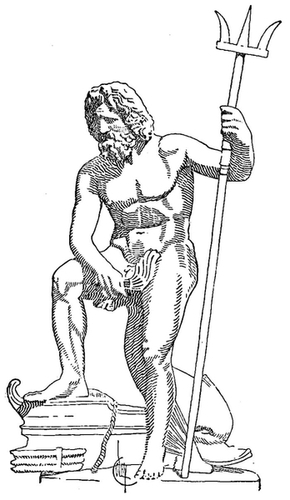
2. The Fable and the Myth. Careful discrimination must be
made between the fable and the myth. A fable is a story, like that
of King Log, or the Fox and the Grapes, in which characters and
plot, neither pretending to reality nor demanding credence, are
fabricated confessedly as the vehicle of moral or didactic instruction.
Dr. Johnson narrows still further the scope of the fable:
"It seems to be, in its genuine state, a narrative in which beings
irrational, and sometimes inanimate, are, for the purpose of moral
instruction, feigned to act and speak with human interests and
passions." Myths, on the other hand, are stories of anonymous
origin, prevalent among primitive peoples and by them accepted
as true, concerning supernatural beings and events, or natural
beings and events influenced by supernatural agencies. Fables are
made by individuals; they may be told in any stage of a nation's
history,—by a Jotham when the Israelites were still under the
Judges, 1200 years before Christ, or by Christ himself in the
days of the most critical Jewish scholarship; by a Menenius
when Rome was still involved in petty squabbles of plebeians and
patricians, or by Phædrus and Horace in the Augustan age of
Roman imperialism and Roman letters; by an Æsop, well-nigh
fabulous, to fabled fellow-slaves and Athenian tyrants, or by La
Fontaine to the Grand Monarch and the most highly civilized
race of seventeenth-century Europe.
Fables are vessels made to order into which a lesson may be
poured. Myths are born, not made. They are born in the infancy
of a people. They owe their features not to any one historic individual,
but to the imaginative efforts of generations of story-tellers.
The myth of Pandora, the first woman, endowed by the immortals
with heavenly graces, and of Prometheus, who stole fire from heaven
for the use of man; the myth of the earthborn giants that in the
beginning contested with the gods the sovereignty of the universe;
of the moon-goddess who, with her buskined nymphs, pursues the
chase across the azure of the heavens, or descending to earth cherishes
the youth Endymion,—these myths, germinating in some
quaint and childish interpretation of natural events or in some fireside
fancy, have put forth unconsciously, under the nurture of the
simple folk that conceived and tended them, luxuriant branches and
leaves of narrative, and blossoms of poetic comeliness and form.
The myths that we shall relate present wonderful accounts of the
creation, histories of numerous divine beings, adventures of heroes
in which magical and ghostly agencies play a part, and where
animals and inanimate nature don the attributes of men and gods.
Many of these myths treat of divinities once worshiped by the
Greeks and the Romans, and by our Norse and German forefathers
in the dark ages. Myths, more or less like these, may be
found in the literatures of nearly all nations; many are in the
memories and mouths of savage races at this time existent. But
the stories here narrated are no longer believed by any one. The
so-called divinities of Olympus and of Asgard have not a single
worshiper among men. They dwell only in the realm of memory
and imagination; they are enthroned in the palace of art.
The stories of Greek, Roman, Norse, and German mythology
that have most influenced our English literature will follow in the
order named. The Romans, being by nature a practical, not a
poetic, people, incorporated in their literature the mythology of
the Greeks. We shall, however, append to our description of the
Greek gods a brief account of the native Latin divinities that
retained an individuality in Roman literature.
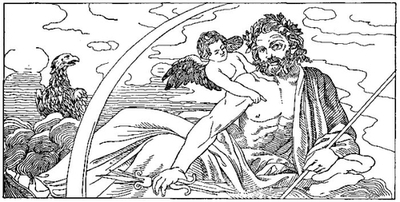
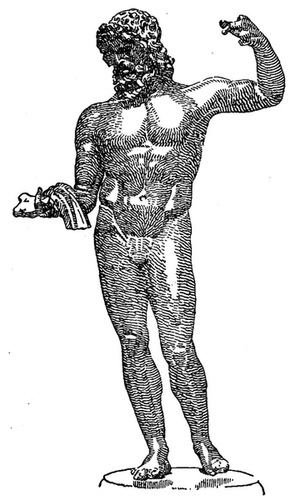
Fig. 1. Jupiter surveying the World
3. Origin of the World.[2] There were among the Greeks several
accounts of the beginning of things. Homer tells us that River
Ocean, a deep and mighty flood, encircling land and sea like a
serpent with its tail in its mouth, was the source of all. According
to other myths Night and Darkness were the prime elements
of Nature, and from them sprang Light. Still a third theory,
attributed to Orpheus, asserts that Time was in the beginning,
but had himself no beginning; that from him proceeded Chaos,
a yawning abyss wherein brooded Night and Mist and fiery air,
or Æther; that Time caused the mist to spin round the central
fiery air till the mass, assuming the form of a huge world egg,
flew, by reason of its rapid rotation, into halves. Of these, one
was Heaven, the other Earth. From the center of the egg proceeded
Eros (Love) and other wondrous beings.
But the most consistent account of the origin of the world and
of the gods is given by the poet Hesiod, who tells us that Chaos,
the yawning abyss, composed of Void, Mass, and Darkness in
confusion, preceded all things else. Next came into being broad-bosomed
Earth, and beautiful Love who should rule the hearts of
gods and men. But from Chaos itself issued Erebus,[3] the mysterious
darkness that is under Earth,—and Night, dwelling in
the remote regions of sunset.
From Mother Earth proceeded first the starry vault of Heaven,
durable as brass or iron, where the gods were to take up their abode.
Earth brought forth next the mountains and fertile fields, the stony
plains, the sea, and the plants and animals that possess them.
4. Origin of the Gods. So far we have a history of the throes
and changes of the physical world; now begins the history of
gods and of men. For in the heart of creation Love begins to
stir, making of material things creatures male and female, and
bringing them together by instinctive affinity. First Erebus and
Night, the children of Chaos, are wedded, and from them spring
Light and Day; then Uranus, the personified Heaven, takes Gæa,
the Earth, to wife, and from their union issue Titans and hundred-handed
monsters and Cyclopes.
The Titans[4] appear to be the personification of mighty convulsions
of the physical world, of volcanic eruptions and earthquakes.
They played a quarrelsome part in mythical history;
they were instigators of hatred and strife. Homer mentions specially
two of them, Iapetus and Cronus; but Hesiod enumerates
thirteen. Of these, the more important are Oceanus and Tethys,
Hyperion and Thea, Cronus and Rhea, Iapetus, Themis, and
Mnemosyne. The three Cyclopes represented the terrors of rolling
thunder, of the lightning-flash, and of the thunderbolt; and,
probably, for this reason, one fiery eye was deemed enough for
each. The hundred-handed monsters, or Hecatonchires, were also
three in number. In them, probably, the Greeks imaged the sea
with its multitudinous waves, its roar, and its breakers that seem
to shake the earth. These lightning-eyed, these hundred-handed
monsters, their father Uranus feared, and attempted to destroy by
thrusting them into Tartarus, the profound abysm of the earth.
Whereupon Mother Earth, or Gæa, indignant, called for help upon
her elder children, the Titans. None dared espouse her cause
save Cronus, the crafty. With an iron sickle he lay in wait for
his sire, fell upon him, and drove him, grievously wounded, from
the encounter. From the blood of the mutilated Uranus leaped
into being the Furies, whose heads writhe with serpents; the
Giants, a novel race of monsters; and the Melic Nymphs, invidious
maidens of the ashen spear.
5. The Rule of Cronus. Now follows the reign of Cronus, lord
of Heaven and Earth. He is, from the beginning, of incalculable
years. In works of art his head is veiled, to typify his cunning and
his reserve; he bears the sickle not only as memento of the means
by which he brought his father's tyranny to end, but as symbol of
the new period of growth and golden harvests that he ushered in.
For unknown ages Cronus and Rhea, his sister-queen, governed
Heaven and Earth. To them were born three daughters, Vesta,
Ceres, and Juno, and three sons, Pluto, Neptune, and Jupiter.
Cronus, however, having learned from his parents that he should
be dethroned by one of his own children, conceived the well-intentioned
but ill-considered device of swallowing each as it was born.
His queen, naturally desirous of discouraging the practice,—when
it came to the turn of her sixth child, palmed off on the insatiable
Cronus a stone carefully enveloped in swaddling clothes. Jupiter
(or Zeus), the rescued infant, was concealed in the island of Crete,
where, nurtured by the nymphs Adrastea and Ida, and fed on the
milk of the goat Amalthea, he in due season attained maturity.
Then, assisted by his grandmother Gæa, he constrained Cronus to
disgorge the burden of his cannibal repasts. First came to light
the memorable stone, which was placed in safe keeping at Delphi;
then the five brothers and sisters of Jupiter, ardent to avenge
themselves upon the unnatural author of their existence and
their captivity.
6. The War of the Titans. In the war which ensued Iapetus
and all the Titans, except Oceanus, ranged themselves on the side
of their brother Cronus against Jupiter and his recently recovered
kinsfolk. Jupiter and his hosts held Mount Olympus. For ages
victory wavered in the balance. Finally Jupiter, acting again under
the advice of Gæa, released from Tartarus, where Uranus had confined
them, the Cyclopes and the Hecatonchires. Instantly they
hastened to the battle-field of Thessaly, the Cyclopes to support
Jupiter with their thunders and lightnings, the hundred-handed
monsters with the shock of the earthquake. Provided with such
artillery, shaking earth and sea, Jupiter issued to the onslaught.
With the gleam of the lightning the Titans were blinded, by the
earthquake they were laid low, with the flames they were well-nigh
consumed: overpowered and fettered by the hands of the Hecatonchires,
they were consigned to the yawning cave of Tartarus.
Atlas, the son of Iapetus, was doomed to bear the heavens on his
shoulders. But a more famous son of the same Titan, Prometheus,
who had espoused the cause of Jove, acquired dignity hereafter to
be set forth.
7. The Division of Empire. In the council of the gods that
succeeded, Jupiter was chosen Sovereign of the World. He delegated
to his brother Neptune (or Poseidon) the kingdom of the sea
and of all the waters; to his brother Pluto (or Hades), the government
of the underworld, dark, unseen, mysterious, where the spirits
of the dead should dwell, and of Tartarus, wherein were held the
fallen Titans. For himself Jupiter retained Earth and the Heaven,
into whose broad and sunny regions towered Olympus, the favored
mountain of the greater gods.[5]
8. The Reign of Jupiter. New conflicts, however, awaited this
new dynasty of Heaven—conflicts, the subject of many a tale
among the ancients. Gæa, though she had aided her grandson
Jupiter in the war against Cronus, was soon seized with compunctions
of conscience; and contemplating the cruel fate of her sons
the Titans, she conceived schemes of vengeance upon their conqueror.
Another son was born to her—Typhon, a monster more
awful than his predecessors—whose destiny it was to dispute the
sway of the almighty Zeus. From the neck of Typhon dispread
themselves a hundred dragon-heads; his eyes shot fire, and from
his black-tongued chaps proceeded the hissing of snakes, the
bellowing of bulls, the roaring of lions, the barking of dogs, pipings
and screams, and, at times, the voice and utterance of the
gods themselves. Against Heaven this horror lifted himself; but
quailing before the thunderbolt of Jove, he too descended to
Tartarus, his own place and the abode of his brethren. To this
day, however, he grumbles and hisses, thrusts upward a fiery
tongue through the crater
of a volcano, or, breathing
siroccos, scorches trees and
men.
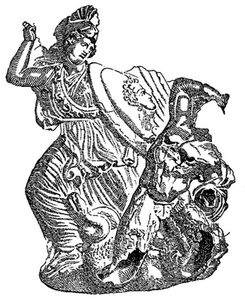
Later still, the Giants,
offspring of the blood that
fell from the wounded Uranus,
renewed the revolt
against the Olympian gods.
They were creatures nearer
akin to men than were the
Titans, or the Cyclopes, or
Typhon. They clothed themselves
in the skins of beasts,
and armed themselves with
rocks and trunks of trees.
Their bodies and lower limbs
were of snakes. They were
awful to encounter or to look
upon. They were named, like men, the earthborn; and their
characteristics would suggest some prehistoric brutish race, hotheaded,
not amenable to reason.[6] Of the Giants, the more mighty
were Alcyoneus of the winter storms and icebergs, Pallas, and
Enceladus, and Porphyrion the fire-king,—leader of the crew.
In the war against them, Juno and Minerva, divinities of the new
dynasty of Heaven, took active part,—and Hercules, an earthly
son of Jupiter, whose arrows aided in their defeat. It was from
the overthrow of Pallas that Athena (or Minerva) derived, according
to certain records, her proud designation of Pallas-Athena.[7] In
due course, like the Titans and Typhon, the Giants were buried
in the abyss of eternal darkness. What other outcome can be
expected when mere physical or brute force joins issue with the
enlightened and embattled hosts of heaven?
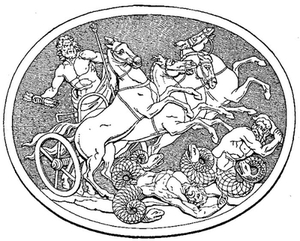
9. The Origin of Man was a question which the Greeks did not
settle so easily as the Hebrews. Greek traditions do not trace all
mankind to an original pair. On the contrary, the generally
received opinion was that men grew out of trees and stones, or
were produced by the rivers or the sea. Some said that men and
gods were both derived from Mother Earth, hence both autochthonous;
and some, indeed, claimed an antiquity for the human race
equal to that of the divinities. All narratives, however, agree in
one statement,—that the gods maintained intimate relations with
men until, because of the growing sinfulness and arrogance of
mankind, it became necessary for the immortals to withdraw their
favor.
10. Prometheus, a Creator. There is a story which attributes
the making of man to Prometheus, whose father Iapetus had,
with Cronus, opposed the sovereignty of Jupiter. In that conflict,
Prometheus, gifted with prophetic wisdom, had adopted the cause
of the Olympian deities. To him
and his brother Epimetheus was
now committed the office of
making man and providing him
and all other animals with the
faculties necessary for their
preservation. Prometheus was
to overlook the work of Epimetheus.
Epimetheus proceeded
to bestow upon the different
animals the various gifts of
courage, strength, swiftness, sagacity;
wings to one, claws to
another, a shelly covering to a
third. But Prometheus himself
made a nobler animal than these.
Taking some earth and kneading
it with water, he made man
in the image of the gods. He
gave him an upright stature, so
that while other animals turn
their faces toward the earth,
man gazes on the stars. Then
since Epimetheus, always rash,
and thoughtful when too late,
had been so prodigal of his
gifts to other animals that no
blessing was left worth conferring
upon the noblest of creatures,
Prometheus ascended to
heaven, lighted his torch at the
chariot of the sun, and brought
down fire. With fire in his
possession man would be able
to win her secrets and treasures
from the earth, to develop commerce,
science, and the arts.
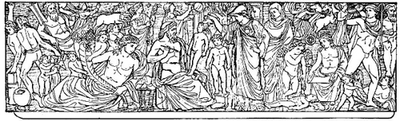
Fig. 4. Prometheus making Man
11. The Age of Gold. Whether in this or in other ways the
world was furnished with inhabitants, the first age was an age of
innocence and happiness. Truth and right prevailed, though not
enforced by law, nor was there any in authority to threaten or to
punish. The forest had not yet been robbed of its trees to yield
timbers for vessels, nor had men built fortifications round their
towns. There were no such things as swords, spears, or helmets.
The earth brought forth all things necessary for man, without his
labor in plowing or sowing. Perpetual spring reigned, flowers
sprang up without seed, the rivers flowed with milk and wine, and
yellow honey distilled from the oaks. This Golden Age had begun
in the reign of Cronus.[8] And when these heroes fell asleep in
death, they were translated in a pleasant dream to a spiritual existence,
in which, unseen by mortal eyes, they still attended men as
monitors and guardians.
12. The Silver Age came next, inferior to the golden. Jupiter
shortened the spring, and divided the year into seasons. Then, first,
men suffered the extremes of heat and cold, and houses became
necessary. Caves were their dwellings,—and leafy coverts of the
woods, and huts woven of twigs. Crops would no longer grow without
planting. The farmer was constrained to sow the seed, and the
ox to draw the plow. This was a race of manly men, but insolent
and impious. And when they died, Jupiter made them ghosts of
the underworld, but withheld the privilege of immortal life.
13. Prometheus, Champion of Man. During this age when, as
Hesiod says, the altars of the blessed were neglected, and the
gods were denied their due, Prometheus stood forth—the champion
of man against the Olympians.[9] For the son of Cronus had
grudged mortals the use of fire, and was, in fact, contemplating
their annihilation and the creation of a new race. Therefore, once
upon a time, when gods and men were in dispute at Sicyon concerning
the prerogatives of each, Prometheus, by an ingenious
trick, attempted to settle the question in favor of man. Dividing
into two portions a sacrificial bull, he wrapped all the eatable parts
in the skin, cunningly surmounted with uninviting entrails; but
the bones he garnished with a plausible mass of fat. He then
offered Jupiter his choice. The king of Heaven, although he perceived
the intended fraud, took the heap of bones and fat, and,
forthwith availing himself of this insult as an excuse for punishing
mankind, deprived the race of fire. But Prometheus regained the
treasure, stealing it from Heaven in a hollow tube.
14. Pandora. Doubly enraged, Jupiter, in his turn, had recourse
to stratagem. He is declared to have planned for man a curse
in the shape of woman. How the race had persisted hitherto without
woman is a mystery; but that it had done so, with no slight
degree of happiness, the experience of the Golden Age would
seem to prove. However, the bewitching evil was fashioned,—in
Heaven, properly enough,—and every god and goddess contributed
something to her perfection. One gave her beauty, another
persuasive charm, a third the faculty of music. And they named
her Pandora, "the gift of all the gods." Thus equipped, she was
conveyed to earth and presented to Epimetheus, who, without
hesitation, accepted the gift, though cautioned by his brother to
beware of Jupiter and all his ways. And the caution was not
groundless. In the hand of Pandora had been placed by the
immortals a casket or vase which she was forbidden to open.
Overcome by an unaccountable curiosity to know what this vessel
contained, she one day lifted the cover and looked in. Forthwith
there escaped a multitude of plagues for hapless man—gout, rheumatism,
and colic for his body; envy, spite, and revenge for his
mind—and scattered themselves far and wide. Pandora hastened
to replace the lid; but one thing only remained in the casket, and
that was hope.
15. Prometheus Bound. Because of his unselfish devotion to
the cause of humanity, Prometheus drew down on himself the
anger of Olympian Jove, by whose order he was chained to a rock
on Mount Caucasus, and subjected to the attack of an eagle (or a
vulture) which, for ages, preyed upon his liver, yet succeeded not
in consuming it. This state of torment might have been brought
to an end at any time by Prometheus, if he had been willing to
submit to his oppressor; for he possessed a secret which involved
the stability of Jove's throne. This was that by a certain woman
Jove would beget a son who should displace him and end the sway
of the Olympians. The god naturally desired more accurate information
of this decree of Fate. But to reveal the secret Prometheus
disdained. In this steadfastness the Titan was supported by the
knowledge that in the thirteenth generation there should arrive a
hero,—sprung from Jove himself,—to release him.[10] And in fullness
of time the hero did arrive: none other than the mighty
Hercules desirous of rendering the highest service to mankind.
No higher service, thinks this radiant and masterful personage,—who,
as we shall see, had already cleared the world of many a
monster,—remains to be performed than to free the champion of
mankind, suffering through the ages because he had brought light
into the world. "The soul of man," says Hercules to the Titan—
The soul of man can never be enslaved
Save by its own infirmities, nor freed
Save by its very strength and own resolve
And constant vision and supreme endeavor!
You will be free? Then, courage, O my brother!
O let the soul stand in the open door
Of life and death and knowledge and desire
And see the peaks of thought kindle with sunrise!
Then shall the soul return to rest no more,
Nor harvest dreams in the dark field of sleep—
Rather the soul shall go with great resolve
To dwell at last upon the shining mountains
In liberal converse with the eternal stars.[11]
And he kills the vulture; and sets Jove's victim free.
By his demeanor Prometheus has become the ensample of
magnanimous endurance, and of resistance to oppression.
Titan! to whose immortal eyes
The sufferings of mortality,
Seen in their sad reality,
Were not as things that gods despise,
What was thy pity's recompense?
A silent suffering, and intense;
The rock, the vulture, and the chain,
All that the proud can feel of pain,
The agony they do not show,
The suffocating sense of woe,
Which speaks but in its loneliness,
And then is jealous lest the sky
Should have a listener, nor will sigh
Until its voice is echoless....
Thy godlike crime was to be kind,
To render with thy precepts less
The sum of human wretchedness,
And strengthen man with his own mind.
But, baffled as thou wert from high,
Still, in thy patient energy,
In the endurance and repulse
Of thine impenetrable spirit,
Which earth and heaven could not convulse,
A mighty lesson we inherit[12]....
16. Longfellow's Prometheus. A happy application of the story
of Prometheus is made by Longfellow in the following verses:[13]
Of Prometheus, how undaunted
On Olympus' shining bastions
His audacious foot he planted,
Myths are told, and songs are chanted,
Full of promptings and suggestions.
Beautiful is the tradition
Of that flight through heavenly portals,
The old classic superstition
Of the theft and the transmission
Of the fire of the Immortals!
First the deed of noble daring,
Born of heavenward aspiration,
Then the fire with mortals sharing,
Then the vulture,—the despairing
Cry of pain on crags Caucasian.
All is but a symbol painted
Of the Poet, Prophet, Seer;
Only those are crowned and sainted
Who with grief have been acquainted,
Making nations nobler, freer.
In their feverish exultations,
In their triumph and their yearning,
In their passionate pulsations,
In their words among the nations,
The Promethean fire is burning.
Shall it, then, be unavailing,
All this toil for human culture?
Through the cloud-rack, dark and trailing,
Must they see above them sailing
O'er life's barren crags the vulture?
Such a fate as this was Dante's,
By defeat and exile maddened;
Thus were Milton and Cervantes,
Nature's priests and Corybantes,
By affliction touched and saddened.
But the glories so transcendent
That around their memories cluster,
And, on all their steps attendant,
Make their darkened lives resplendent
With such gleams of inward lustre!
All the melodies mysterious,
Through the dreary darkness chanted;
Thoughts in attitudes imperious,
Voices soft, and deep, and serious,
Words that whispered, songs that haunted!
All the soul in rapt suspension,
All the quivering, palpitating
Chords of life in utmost tension,
With the fervor of invention,
With the rapture of creating!
Ah, Prometheus! heaven-scaling!
In such hours of exultation
Even the faintest heart, unquailing,
Might behold the vulture sailing
Round the cloudy crags Caucasian!
Though to all there is not given
Strength for such sublime endeavor,
Thus to scale the walls of heaven,
And to leaven with fiery leaven
All the hearts of men forever;
Yet all bards, whose hearts unblighted
Honor and believe the presage,
Hold aloft their torches lighted,
Gleaming through the realms benighted,
As they onward bear the message!
17. The Brazen Age. Next to the Age of Silver came that of
brass,[14] more savage of temper and readier for the strife of arms,
yet not altogether wicked.
18. The Iron Age. Last came the hardest age and worst,—of
iron. Crime burst in like a flood; modesty, truth, and honor fled.
The gifts of the earth were put only to nefarious uses. Fraud, violence,
war at home and abroad were rife. The world was wet
with slaughter; and the gods, one by one, abandoned it, Astræa,
following last, goddess of innocence and purity.
19. The Flood. Jupiter, observing the condition of things,
burned with anger. He summoned the gods to council. Obeying
the call, they traveled the Milky Way to the palace of Heaven.
There, Jupiter set forth to the assembly the frightful condition of
the earth, and announced his intention of destroying its inhabitants,
and providing a new race, unlike the present, which should
be worthier of life and more reverent toward the gods. Fearing
lest a conflagration might set Heaven itself on fire, he proceeded
to drown the world. Not satisfied with his own waters, he called
his brother Neptune to his aid. Speedily the race of men, and
their possessions, were swept away by the deluge.
20. Deucalion and Pyrrha. Parnassus alone, of the mountains,
overtopped the waves; and there Deucalion, son of Prometheus,
and his wife Pyrrha, daughter of Epimetheus, found refuge—he
a just man and she a faithful worshiper of the gods. Jupiter, remembering
the harmless lives and pious demeanor of this pair,
caused the waters to recede,—the sea to return to its shores, and
the rivers to their channels. Then Deucalion and Pyrrha, entering
a temple defaced with slime, approached the unkindled altar
and, falling prostrate, prayed for guidance and aid. The oracle[15]
answered, "Depart from the temple with head veiled and garments
unbound, and cast behind you the bones of your mother." They
heard the words with astonishment. Pyrrha first broke silence:
"We cannot obey; we dare not profane the remains of our parents."
They sought the woods, and revolved the oracle in their minds.
At last Deucalion spoke: "Either my wit fails me or the command
is one we may obey without impiety. The earth is the great
parent of all; the stones are her bones; these we may cast behind
us; this, I think, the oracle means. At least, to try will harm us
not." They veiled their faces, unbound their garments, and, picking
up stones, cast them behind them. The stones began to grow
soft and to assume shape. By degrees they put on a rude resemblance
to the human form. Those thrown by Deucalion became
men; those by Pyrrha, women. It was a hard race that sprang up,
and well adapted to labor.
21. The Demigods and Heroes. As preceding the Age of Iron,
Hesiod mentions an Age of Demigods and Heroes. Since, however,
these demigods and heroes were, many of them, reputed to
have been directly descended from Deucalion, their epoch must be
regarded as subsequent to the deluge. The hero, Hellen, son of
Deucalion and Pyrrha, became the ancestor of the Hellenes, or
Greeks. The Æolians and Dorians were, according to legend,
descended from his sons Æolus and Dorus; from his son Xuthus,
the Achæans and Ionians derived their origin.
Another great division of the Greek people, the Pelasgic, resident
in the Peloponnesus or southern portion of the peninsula,
was said to have sprung from a different stock of heroes, that of
Pelasgus, son of Phoroneus of Argos and grandson of the river-god
Inachus.
The demigods and heroes were of matchless worth and valor.
Their adventures form the subject of many of the succeeding chapters.
The Older Heroes, especially, were endowed with godlike
qualities, which they devoted to the service of mankind in the
destruction of monsters, the founding of cities, or the introduction
of civilization. Such were Perseus, the hero of Argos and his
descendant Hercules, who came to be worshiped as the national
hero of the Greeks. Such, too, Cadmus, the founder of Thebes,
and Cecrops of Athens, and one of his successors, Theseus, a
"second Hercules." Each city of Greece had its patron hero, to
whom it accorded the honors of divinity. The Younger Heroes
were chieftains in the Theban and the Trojan wars and in numerous
other military or predatory expeditions.
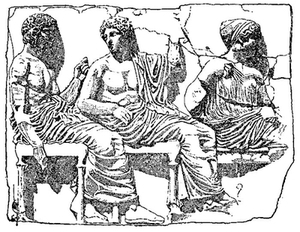
Fig. 5. Poseidon, Dionysus, and Goddess
22. Olympus. The heaven of the Greek gods was the summit
of an ideal mountain called Olympus.[17] A gate of clouds, kept by
goddesses, the Hours or Seasons,
opened to permit the passage of the
Celestials to earth, and to receive
them on their return. The gods had
their separate dwellings; but all,
when summoned, repaired to the
palace of Jupiter,—even the deities
whose usual abode was the earth,
the waters, or the underworld. In the
great hall of the Olympian king the
gods feasted each day on ambrosia
and nectar. Here they conversed of
the affairs of heaven and earth; and
as they quaffed the nectar that Hebe
poured, Apollo made melody with
his lyre and the Muses sang in responsive
strain. When the sun was
set, the gods withdrew to their respective dwellings for the night.
The following lines from the Odyssey express the conception
of Olympus entertained by Homer:
So saying, Minerva, goddess, azure-eyed,
Rose to Olympus, the reputed seat
Eternal of the gods, which never storms
Disturb, rains drench, or snow invades, but calm
The expanse and cloudless shines with purest day.
There the inhabitants divine rejoice
Forever.[18]
23. The Great Gods. The gods of Heaven were the following:[19]
- Jupiter (Zeus).[20]
- His daughter, Minerva (Athena), who sprang from his brain, full-grown and full-armed.
- His sister and wife, Juno (Hera).
- His children by Juno,—Mars (Ares), Vulcan (Hephæstus), and Hebe.
- His children by Latona,—Apollo, or Phœbus, and Diana (Artemis).
- His daughter by Dione,—Venus (Aphrodite).[21]
- His son by Maia,—Mercury (Hermes).
- His sister, Vesta (Hestia), the oldest born of Cronus and Rhea.
Of these all were deities of the highest order save Hebe, who
must be ranked with the lesser gods. With the remaining ten
"Great Gods" are sometimes reckoned the other sister of Jupiter,
Ceres (Demeter), properly a divinity of earth, and Neptune
(Poseidon), ruler of the sea.
24. Jupiter[22] (Zeus). The Greek name signifies the radiant light
of heaven. Jupiter was the supreme ruler of the universe, wisest
of the divinities and most glorious. In the Iliad he informs the
other gods that their united strength would not budge him: that, on
the contrary, he could draw them and earth and the seas to himself,
and suspend all from Olympus by a golden chain. Throned
in the high, clear heavens, Jupiter was the gatherer of clouds and
snows, the dispenser of gentle rains and winds, the moderator of
light and heat and the seasons, the thunderer, the wielder of the
thunderbolt. Bodily strength and valor were dear to him. He was
worshiped with various rites in different lands, and to him were
sacred everywhere the loftiest trees and the grandest mountain
peaks. He required of his worshipers cleanliness of surroundings
and person and heart. Justice was his; his to repay violation of
duty in the family, in social relations, and in the state. Prophecy
was his; and his will was made known at the oracle of Dodona,
where answers were given to those who inquired concerning the
future. This oracular shrine was the most ancient in Greece.
According to one account two black doves had taken wing from
Thebes in Egypt. One flew to Dodona in Epirus, and, alighting
in a grove of oaks, proclaimed to the inhabitants of the district
that they should establish there an oracle of Jupiter. The other
dove flew to the temple of Jupiter Ammon in the Libyan oasis,
and delivered a similar command. According to another account,
these were not doves but priestesses who, carried off from Thebes
by the Phœnicians, set up oracles at Oasis and Dodona. The
responses of the oracle were given
by the rustling of the oak trees in
the wind. The sounds were interpreted
by priests.
That Jupiter himself, though
wedded to the goddess Juno, should
be charged with numerous other
love affairs, not only in respect of
goddesses but of mortals, is, in
part, explained by the fact that to
the supreme divinity of the Greeks
have been ascribed attributes and
adventures of numerous local and
foreign divinities that were gradually
identified with him. It is, therefore,
not wise to assume that the
love affairs of Jupiter and of other
divinities always symbolize combinations
of natural or physical forces
that have repeated themselves in
ever-varying guise. It is important to understand that the more
ideal Olympian religion absorbed features of inferior religions,
and that Jupiter, when represented as appropriating the characteristics
of other gods, was sometimes, also, accredited with
their wives.
Beside the children of Jupiter already enumerated, there should
here be mentioned, as of peculiar consequence, Bacchus (Dionysus),
the god of wine, a deity of earth,—Proserpine, the wife of
Pluto and queen of the underworld,—and Hercules, the greatest
of the heroes.
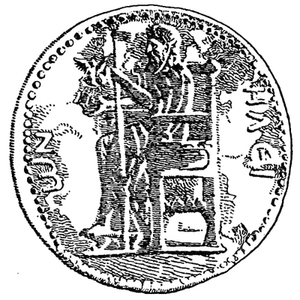
Fig. 8. Zeus after
Phidias
25. Conceptions of Jupiter. The Greeks usually conceived the
Jupiter of war as riding in his thunder-car, hurling the thunderbolt
or lashing his enemies with a scourge of lightning. He wore
a breastplate or shield of storm-cloud like the skin of a gray goat
(the Ægis), fearful to behold, and made by the god of fire. His
special messenger was the eagle. It was, however, only with the
passage of generations that the Greeks came to represent their
greatest of the gods by the works of men's hands. The statue of
Olympian Jove by Phidias was considered the highest achievement
of Grecian sculpture. It was of colossal dimensions and, like other
statues of the period, "chryselephantine," that is, composed of
ivory and gold. For the parts representing flesh were of ivory laid
on a framework of wood, while the drapery
and ornaments were of gold. The height
of the figure was forty feet, of the pedestal
twelve. The god was represented as seated
on his throne. His brows were crowned
with a wreath of olive; he held in his right
hand a scepter, and in his left a statue of
Victory. The throne was of cedar, adorned
with gold and precious stones.
The idea which the artist essayed to
embody was that of the supreme deity of
the Hellenic race, enthroned as a conqueror, in perfect majesty
and repose, and ruling with a nod the subject world. Phidias
informs us that the idea was suggested by Homer's lines in the
first book of the Iliad:
Jove said, and nodded with his shadowy brows;
Waved on th' immortal head th' ambrosial locks,—
And all Olympus trembled at his nod.[23]
Unfortunately, our knowledge of this famous statue is confined to
literary descriptions, and to copies on coins. Other representations
of Jove have been obtained from Greek bronze statuettes, or
the wall-paintings of Herculaneum and Pompeii.
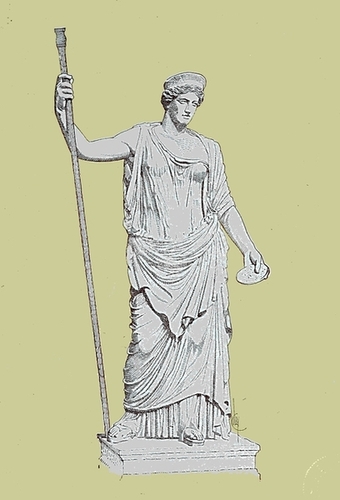
26. Juno[24] (Hera), sister and wife of Jupiter. According to some,
the name Hera means Splendor of Heaven, according to others,
the Lady. Some think it approves her goddess of earth; others,
goddess of the air; still others, for reasons by no means final, say
that it signifies Protectress, and applies to Juno in her original function
of moon-goddess, the chosen guardian of women, their aid in
seasons of distress. Juno's union with Jupiter was the prototype of
earthly marriages. She is the type of matronly virtues and dignity.
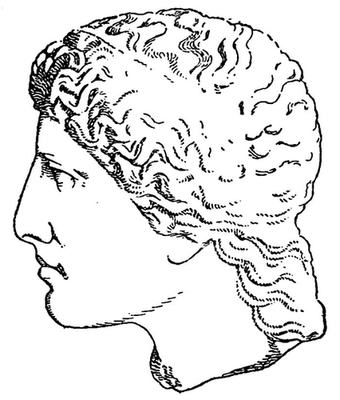
She was the daughter of Cronus and Rhea, but was brought up
by Oceanus and Tethys in their dwelling in the remote west
beyond the sea. Without the knowledge
of her parents, she was wedded
to Jupiter in this garden of the gods
where ambrosial rivers flowed, and
where Earth sent up in honor of the
rite a tree of life, heavy with apples
golden like the sunset. Juno was the
most worthy of the goddesses, the
most queenly; ox-eyed, says Homer;
says Hesiod, golden-sandaled and
golden-throned. Glorious beyond
compare was her presence, when
she had harnessed her horses, and
driven forth the golden-wheeled chariot that Hebe made ready,
and that the Hours set aside. Fearful, too, could be her wrath.
For she was of a jealous disposition, which was not happily affected
by the vagaries of her spouse; and she was, moreover, prone to
quarrels, self-willed, vengeful, proud, even on occasion deceitful.
Once, indeed, she conspired with Minerva and Neptune to bind the
cloud-compeller himself. More than once she provoked him to
blows; and once to worse than blows,—for her lord and master
swung her aloft in the clouds, securing her wrists in golden handcuffs
and hanging anvils to her feet.
The cities that the ox-eyed goddess favored were Argos, Sparta,
and Mycenæ. To her the peacock and the cow were dear, and
many a grove and pasture rejoiced her sacred herds.
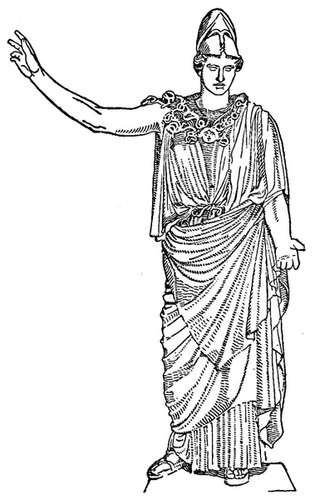
27. Minerva (Athene or Athena), the virgin goddess. She sprang
from the brain of Jove, agleam with panoply of war, brandishing a
spear and with her battle-cry awakening the echoes of heaven and
earth. She is goddess of the lightning that leaps like a lance from
the cloud-heavy sky, and hence, probably, the name Athene.[25] She
is goddess of the storms and of the rushing thunderbolt, and is,
therefore, styled Pallas. She is
the goddess of the thundercloud,
which is symbolized by her tasseled
breastplate of goatskin, the
ægis, whereon is fixed the head of
Medusa, the Gorgon, that turns to
stone all beholders. She is also the
goddess of war, rejoicing in martial music and
protecting the war horse and the warship. On
the other hand, she is of a gentle, fair, and
thoughtful aspect. Her Latin name Minerva
is connected with the Sanskrit, Greek, and
Latin words for mind. She is eternally a
virgin, the goddess of wisdom, of skill, of contemplation,
of spinning and weaving, of horticulture
and agriculture. She is protectress of
cities, and was specially worshiped in her own
Athens, in Argos, in Sparta, and in Troy. To
her were sacrificed oxen and cows. The olive
tree, created by her, was sacred to her, and also
the owl, the cock, the serpent, and the crow.
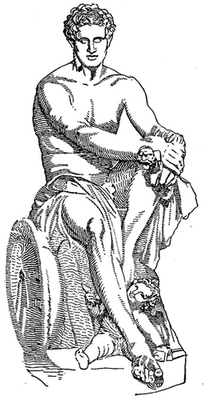
28. Mars (Ares),[26] the war-god, son of Jupiter and Juno. The
meaning of the name Ares is uncertain; the most probable significations
are the Slayer, the Avenger, the Curse. The Roman
god of war, Mars, is the bright and burning one. Homer, in the
Iliad, represents Ares as the insatiable warrior of the heroic age,
who, impelled by rage and lust of violence, exults in the noise
of battle, revels in the horror of carnage. Strife and slaughter
are the condition of his existence. Where the fight is thickest,
there he rushes in without hesitation, without question as to which
side is right. In battle array he is resplendent,—on his head
the gleaming helmet and floating plume, on his arm the leathern
shield, in his hand the redoubtable spear of bronze. Well-favored,
stately, swift, unwearied, puissant, gigantic, he is still the foe of
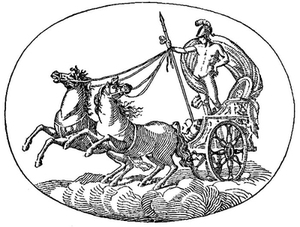
wisdom, the scourge of mortals. Usually he fights on foot, sometimes
from a chariot drawn by four horses,—the offspring of the
North Wind and a Fury. In the fray
his sons attend him,—Terror, Trembling,
Panic, and Fear,—also his
sister Eris, or Discord (the mother of
Strife), his daughter Enyo, ruiner of
cities, and a retinue of bloodthirsty
demons. As typifying the chances of
war, Mars is, of course, not always
successful. In the battles before Troy,
Minerva and Juno bring him more
than once to grief; and when he complains
to Jupiter, he is snubbed as a
renegade most hateful of all the gods.[27]
His loved one and mistress is the goddess
of beauty herself. In her arms the
warrior finds repose. Their daughter
Harmonia is the ancestress of the
unquiet dynasty of Thebes. The favorite
land of Mars was, according to
Homer, the rough, northerly Thrace.
His emblems are the spear and the
burning torch; his chosen animals
are haunters of the battle field,—the vulture and the dog.
29. Vulcan (Hephæstus), son of Jupiter and Juno, was the god
of fire, especially of terrestrial fire,—volcanic eruption, incendiary
flame, the glow of the forge or the hearth. But as the fires
of earth are derived from that of heaven, perhaps the name
Hephæstus (burning, shining, flaming) referred originally to the
marvelous brilliance of the lightning. Vulcan was the blacksmith
of the gods, the finest artificer in metal among them. His forge in
Olympus was furnished not only with anvils and all other implements
of the trade, but with automatic handmaidens of silver and gold,
fashioned by Vulcan himself. Poets later than Homer assign to
Vulcan workshops under various volcanic islands. From the crater
of Mount Ætna poured
forth the fumes and
flames of his smithy.
He built the dwellings
of the gods; he made
the scepter of Jove, the
shields and spears of
the Olympians, the arrows
of Apollo and
Diana, the breastplate
of Hercules, the shield
of Achilles.
He was lame of gait,—a
figurative suggestion,
perhaps, of the flickering, unsteady nature of fire. According
to his own story,[28] he was born halt; and his mother, chagrined by
his deformity, cast him from Heaven out of the sight of the gods.
Yet, again,[29] he says that, attempting once to save his mother
from Jupiter's wrath,
he was caught by the
foot and hurled by the
son of Cronus from
the heavenly threshold:
"All day I flew;
and at the set of sun
I fell in Lemnos, and
little life was left in
me." Had he not been
lame before, he had good reason to limp after either of these
catastrophes. He took part in the making of the human race, and
in the special creation of Pandora. He assisted also at the birth of
Minerva, to facilitate which he split Jupiter's head open with an ax.
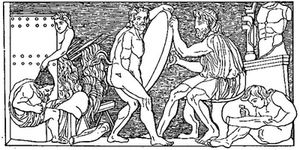
Fig. 13. The Forge of Vulcan
His wife, according to the Iliad and Hesiod's Theogony, is
Aglaia, the youngest of the Graces; but in the Odyssey it is
Venus. He is a glorious, good-natured god, loved and honored
among men as the founder of wise customs and the patron of
artificers; on occasion, as a god of healing and of prophecy. He
seems to have been, when he chose, the cause of "inextinguishable
laughter" to the gods, but he was by no means a fool. The famous
god of the strong arms could be cunning, even
vengeful, when the emergency demanded.
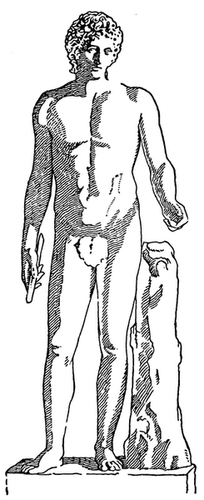
Fig. 14. Apollo in
the Vatican
30. Apollo, or Phœbus Apollo, the son
of Jupiter and Latona, was preëminently
the god of the sun. His name Phœbus signifies
the radiant nature of the sunlight; his
name Apollo, perhaps, the cruel and destructive
heat of noonday. Soon after his birth,
Jupiter would have sent him to Delphi to
inculcate righteousness and justice among the
Greeks; but the golden god Apollo chose
first to spend a year in the land of the
Hyperboreans, where for six continuous
months of the year there is sunshine and
spring, soft climate, profusion of herbs and
flowers, and the very ecstasy of life. During
this delay the Delphians sang pæans,—hymns
of praise,—and danced in chorus
about the tripod (or three-legged stool),
where the expectant priestess of Apollo had
taken her seat. At last, when the year was
warm, came the god in his chariot drawn by swans,—heralded by
songs of springtide, of nightingales and swallows and crickets.
Then the crystal fount of Castalia and the stream Cephissus overflowed
their bounds, and mankind made grateful offerings to the
god. But his advent was not altogether peaceful. An enormous
serpent, Python, had crept forth from the slime with which, after
the flood, the Earth was covered; and in the caves of Mount
Parnassus this terror of the people lurked. Him Apollo encountered
and after fearful combat slew, with arrows, weapons which
the god of the silver bow had not before used against any but feeble
animals,—hares, wild goats, and such game. In commemoration
of this illustrious conquest, he instituted the Pythian games, in
which the victor in feats of strength, swiftness of foot, or in the
chariot race, should be crowned with a wreath of beech leaves.
Apollo brought not only the warm spring and summer, but also
the blessings of the harvest. He warded off the dangers and diseases
of summer and autumn;
and he healed the sick. He
was patron of music and of
poetry. Through his oracle
at Delphi, on the slopes of
Parnassus in Phocis, the
Pythian god made known
the future to those who
consulted him. He was a
founder of cities, a promoter
of colonization, a giver of
good laws, the ideal of fair
and manly youth,—a pure
and just god, requiring clean
hands and pure hearts of
those that worshiped him.
But though a god of life
and peace, the far-darter
did not shun the weapons
of war. When presumption
was to be punished, or
wrong righted, he could bend his bow and slay with the arrows of
his sunlight. As in the days of his youth he slew the Python, so, also,
he slew the froward Tityus, and so the children of Niobe. While
Phœbus Apollo is the Olympian divinity of the sun, fraught with
light and healing, spiritual, creative, and prophetic, he must not
be confounded with a god of the older dynasty, Helios (offspring
of Hyperion, Titanic deity of light), who represented the sun in
its daily and yearly course, in its physical rather than spiritual manifestation.
The bow of Apollo was bound with laurel in memory
of Daphne, whom he loved. To him were sacred, also, many
creatures,—the wolf, the roe, the mouse, the he-goat, the ram,
the dolphin, and the swan.[30]
31. Shelley's Hymn of Apollo.
The sleepless Hours who watch me as I lie,
Curtained with star-inwoven tapestries,
From the broad moonlight of the sky,
Fanning the busy dreams from my dim eyes,—
Waken me when their mother, the gray Dawn,
Tells them that dreams and that the moon is gone.
Then I arise, and climbing Heaven's blue dome,
I walk over the mountains and the waves,
Leaving my robe upon the ocean foam;
My footsteps pave the clouds with fire; the caves
Are filled with my bright presence, and the air
Leaves the green earth to my embraces bare.
The sunbeams are my shafts, with which I kill
Deceit, that loves the night and fears the day;
All men who do or even imagine ill
Fly me, and from the glory of my ray
Good minds and open actions take new might,
Until diminished by the reign of night.
I feed the clouds, the rainbows, and the flowers
With their ethereal colors; the moon's globe
And the pure stars in their eternal bowers
Are cinctured with my power as with a robe;
Whatever lamps on Earth or Heaven may shine,
Are portions of one power, which is mine.
I stand at noon upon the peak of Heaven,
Then with unwilling steps I wander down
Into the clouds of the Atlantic even;
For grief that I depart they weep and frown:
What look is more delightful than the smile
With which I soothe them from the western isle?
I am the eye with which the universe
Beholds itself and knows itself divine;
All harmony of instrument or verse,
All prophecy, all medicine, are mine,
All light of art or nature;—to my song,
Victory and praise in their own right belong.
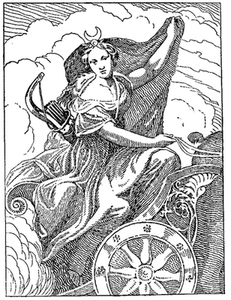
Fig. 17. Diana. After Correggio
32. Diana (Artemis), twin sister of Apollo, was born on Mount
Cynthus in the island of Delos. Latona, the future mother of
Diana and Apollo, flying
from the wrath of Juno,
had besought, one after
another, the islands of the
Ægean to afford her a
place of rest; but they
feared too much the potent
queen of heaven. Delos
alone consented to become
the birthplace of the future
deities. This isle was then
floating and unstable; but
on Latona's arrival, Jupiter
fastened it with adamantine
chains to the bottom
of the sea, that it might be
a secure resting-place for
his beloved. The daughter
of Latona is, as her name
Artemis indicates, a virgin
goddess, the ideal of modesty,
grace, and maidenly vigor. She is associated with her brother,
the prince of archery, in nearly all his adventures, and in attributes
she is his feminine counterpart. As he is identified with sunlight,
so is she, his fair-tressed sister, with the chaste brilliance of the
moon. Its slender arc is her bow; its beams are her arrows with
which she sends upon womankind a speedy and painless death.
In her prerogative of moon-goddess she is frequently identified
with Selene, daughter of Hyperion, just as Apollo is with Helios.
Despising the weakness of love, Diana imposed upon her nymphs
vows of perpetual maidenhood, any violation of which she was
swift and severe to punish. Graceful in form and free of movement,
equipped for the chase, and surrounded by a bevy of fair
companions, the swift-rushing goddess was wont to scour hill,
valley, forest, and plain. She was, however, not only huntress,
but guardian, of wild beasts,—mistress withal of horses and kine
and other domestic brutes. She
ruled marsh and mountain; her
gleaming arrows smote sea as
well as land. Springs and woodland
brooks she favored, for in
them she and her attendants
were accustomed to bathe. She
blessed with verdure the meadows
and arable lands, and from
them obtained a meed of thanks.
When weary of the chase she
turned to music and dancing;
for the lyre and flute and song
were dear to her. Muses, Graces,
nymphs, and the fair goddesses
themselves thronged the rites of
the chorus-leading queen. But
ordinarily a woodland chapel or
a rustic altar sufficed for her
worship. There the hunter laid
his offering—antlers, skin, or
edible portions of the deer that Artemis of the golden arrows had
herself vouchsafed him. The holy maid, however, though naturally
gracious, gentle, and a healer of ills, was, like her brother, quick to
resent injury to her sacred herds or insult to herself. To this stern
temper Agamemnon, Orion, and Niobe bore regretful testimony.
They found that the "fair-crowned queen of the echoing chase,"
though blithe and gracious, was by no means a frivolous personage.
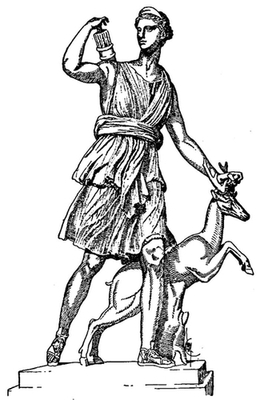
Fig. 18. Diana (Artemis) of
Versailles
Diana was mistress of the brute creation, protectress of youth,
patron of temperance in all things, guardian of civil right. The
cypress tree was sacred to her; and her favorites were the bear,
the boar, the dog, the goat, and specially the hind.
33. Jonson's Hymn to Cynthia (Diana).
Queen and Huntress, chaste and fair,
Now the sun is laid to sleep,
Seated in thy silver chair
State in wonted manner keep:
Hesperus entreats thy light,
Goddess excellently bright.
Earth, let not thy envious shade
Dare itself to interpose;
Cynthia's shining orb was made
Heaven to clear when day did close:
Bless us then with wishèd sight,
Goddess excellently bright.
Lay thy bow of pearl apart,
And thy crystal-shining quiver;
Give unto the flying hart
Space to breathe, how short soever:
Thou that mak'st a day of night,
Goddess excellently bright.[31]
34. Venus (Aphrodite), goddess of love and beauty, was, according
to the more ancient Greek conception, a daughter of Jupiter
and Dione;[32] but Hesiod says that she arose from the foam of the
sea at the time of the wounding of Uranus, and therefore was called,
by the Greeks, Aphrodite, the foam-born.[33] Wafted by the west
wind, and borne upon the surge, she won first the island of Cythera;
thence, like a dream, she passed to Cyprus, where the grace and
blossom of her beauty conquered every heart. Everywhere, at the
touch of her feet the herbage quivered into flower. The Hours
and Graces surrounded her, twining odorous garlands and weaving
robes for her that reflected the hues and breathed the perfume
of crocus and hyacinth, violet, rose, lily, and narcissus. To her
influence is ascribed the fruitfulness of the animal and of the vegetable
creation. She is goddess of gardens and flowers, of the rose,
the myrtle, and the linden. The heaths and slumberous vales,
pleasant with spring and vernal breezes, are hers. In her broidered
girdle lurk "love and desire, and loving converse that steals the
wits even of the wise." For she is the mistress of feminine charm
and beauty, the golden, sweetly smiling Aphrodite, who rules the
hearts of men. She lends to mortals seductive form and fascination.
To a few, indeed, her favor is a blessing; but to many her
gifts are treacherous, destructive of peace. Her various influence
is exemplified in the stories of Pygmalion and Adonis, Paris and
Æneas, Helen, Ariadne, Psyche, Procris, Pasiphaë, and Phædra.
Her power extended over sea as well as land, and her temples
rose from many a shore. On the waters swan and dolphin were
beloved of her; in air, the sparrow and the dove. She was usually
attended by her winged son Cupid, of whom much is to be told.
Especially dear to her were Cyprus, Cnidos, Paphos, Cythera,
Abydos, Mount Eryx, and the city of Corinth.
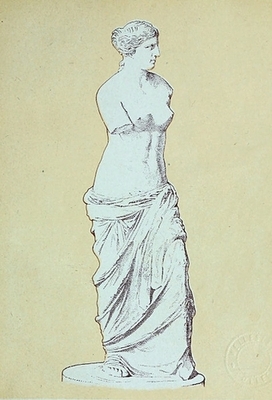
35. The "Venus of Milo." Of artistic conceptions of Aphrodite,
the most famous are the statues called the Venus of Melos
and the Venus of the Medici.[34] A comparison of the two conceptions
is instituted in the following poem.[35] The worshiper apostrophizes
the Venus of Melos, that "inner beauty of the world,"
whose tranquil smile he finds more fair than "The Medicean's
sly and servile grace":
From our low world no gods have taken wing;
Even now upon our hills the twain are wandering:[36]
The Medicean's sly and servile grace,
And the immortal beauty of thy face.
One is the spirit of all short-lived love
And outward, earthly loveliness:
The tremulous rosy morn is her mouth's smile,
The sky, her laughing azure eyes above;
And, waiting for caress.
Lie bare the soft hill-slopes, the while
Her thrilling voice is heard
In song of wind and wave, and every flitting bird.
Not plainly, never quite herself she shows:
Just a swift glance of her illumined smile
Along the landscape goes;
Just a soft hint of singing, to beguile
A man from all his toil;
Some vanished gleam of beckoning arm, to spoil
A morning's task with longing, wild and vain.
Then if across the parching plain
He seek her, she with passion burns
His heart to fever, and he hears
The west wind's mocking laughter when he turns,
Shivering in mist of ocean's sullen tears.
It is the Medicean: well I know
The arts her ancient subtlety will show,—
The stubble field she turns to ruddy gold;
The empty distance she will fold
In purple gauze; the warm glow she has kissed
Along the chilling mist:
Cheating and cheated love that grows to hate
And ever deeper loathing, soon or late.
Thou, too, O fairer spirit, walkest here
Upon the lifted hills:
Wherever that still thought within the breast
The inner beauty of the world hath moved;
In starlight that the dome of evening fills;
On endless waters rounding to the west:
For them who thro' that beauty's veil have loved
The soul of all things beautiful the best.
For lying broad awake, long ere the dawn,
Staring against the dark, the blank of space
Opens immeasurably, and thy face
Wavers and glimmers there and is withdrawn.
And many days, when all one's work is vain,
And life goes stretching on, a waste gray plain,
With even the short mirage of morning gone,
No cool breath anywhere, no shadow nigh
Where a weary man might lay him down and die,
Lo! thou art there before me suddenly,
With shade as if a summer cloud did pass,
And spray of fountains whispering to the grass.
Oh, save me from the haste and noise and heat
That spoil life's music sweet:
And from that lesser Aphrodite there—
Even now she stands
Close as I turn, and O my soul, how fair!
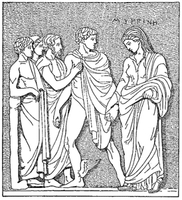
Fig. 20. Hermes Psychopompos
36. Mercury (Hermes), born in a cave of Mount Cyllene in
Arcadia, was the son of Jupiter and Maia (the daughter of Atlas).
According to conjecture, his name Hermes means the Hastener.
Mercury, swift as the
wind, was the servant
and herald of Jupiter
and the other gods.
On his ankles (in plastic
art), and his low-crowned,
broad-brimmed
petasus, or hat, were
wings. As messenger
of Heaven, he bore
a wand (caduceus) of
wood or of gold, twined
with snakes and surmounted
by wings, and
possessed of magical
powers over sleeping,
waking, and dreams.
He was beautiful and
ever in the prime of
youthful vigor. To a voice sweet-toned and powerful, he added
the persuasiveness of eloquence. But his skill was not confined
to speech; he was also the first of inventors—to him are ascribed
the lyre and the flute. He was the forerunner, too, of mathematicians
and astronomers. His agility and strength made him easily
prince in athletic pursuits. His cunning rendered him a dangerous
foe; he could well play the trickster and the thief, as Apollo found
out to his vexation, and Argus, and many another unfortunate.
His methods, however, were not always questionable; although
the patron of gamblers and the god of chance, he, at the same
time, was the furtherer of lawful industry and of commerce by land
and sea. The gravest function of the Messenger was to conduct
the souls of the dead, "that gibber like bats as they fare, down the
dank ways, past the streams of Oceanus, past the gates of the sun
and the land of dreams, to the mead of asphodel in the dark realm
of Hades, where dwell the souls, the phantoms of men outworn."[37]
37. Vesta (Hestia), goddess of the hearth, public and private,
was the first-born child of Cronus and Rhea and, accordingly, the
elder sister of Jupiter, Juno, Neptune, Pluto, and Ceres. Vesta
was an old maid by choice. Averse to Venus and all her ways,
she scorned the flattering advances of both Neptune and Apollo,
and resolved to remain single. Whereupon Jupiter gave her to
sit in the middle of his palace, to receive in Olympus the choicest
morsels of the feast, and, in the temples of the gods on earth,
reverence as the oldest and worthiest of Olympian divinities. As
goddess of the burning hearth, Vesta is the divinity of the home:
of settled, in opposition to nomadic, habits of life. She was worshiped
first of the gods at every feast. Before her shrine in
city and state the holy flame was religiously cherished. From her
altars those of the other gods obtained their fires. No new colony,
no new home, was duly consecrated till on its central hearth there
glowed coals from her ancestral hearth. In her temple at Rome a
sacred fire, tended by six virgin priestesses called Vestals, was
kept religiously aflame. As the safety of the city was held to be
connected with its conservation, any negligence, by which it might
go out, was severely punished. Whenever the fire did die, it was
rekindled from the rays of the sun.
38. Of the Lesser Divinities of Heaven the most worthy of
mention are:
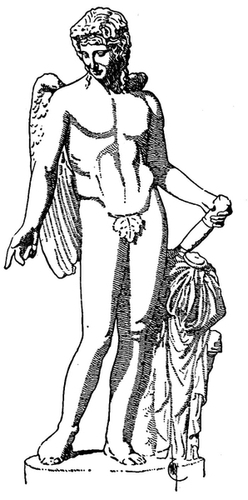
1. Cupid (Eros), small but mighty god of love, the son of
Venus and her constant companion. He was often represented
with eyes covered because of the blindness of his actions. With
his bow and arrows, he shot the darts of desire into the bosoms of
gods and men. Another deity named Anteros, reputed the brother
of Eros, was sometimes represented as the avenger of slighted
love, and sometimes as the symbol of reciprocal affection. Venus
was also attended at times by another brother of Eros, Himeros, or
Longing, and by Hymen, a beautiful youth of divine descent, the
personification of the wedding feast
and leader of the nuptial chorus. Of
Eros the poet Gosse writes:
Within a forest, as I strayed
Far down a somber autumn glade,
I found the god of love;
His bow and arrows cast aside,
His lovely arms extended wide,
A depth of leaves above,
Beneath o'erarching boughs he made
A place for sleep in russet shade.
His lips, more red than any rose,
Were like a flower that overflows
With honey pure and sweet;
And clustering round that holy mouth,
The golden bees in eager drouth
Plied busy wings and feet;
They knew, what every lover knows,
There's no such honey-bloom that blows.[38]
2. Hebe, daughter of Jupiter and
Juno, goddess of youth and cupbearer
to the gods. According to one story, she resigned that office on
becoming the wife of Hercules. According to another, Hebe was
dismissed from her position in consequence of a fall which she
met with one day when in attendance on the gods. Her successor
was Ganymede, a Trojan boy whom Jupiter, in the disguise of an
eagle, seized and carried off from the midst of his playfellows on
Mount Ida, bore up to Heaven, and installed in the vacant place.
3. The Graces, daughters of Jove by Eurynome, daughter of
Oceanus. They were goddesses presiding over the banquet, the
dance, all social pleasures, and polite accomplishments. They were
three in number,—Euphrosyne, Aglaia, and Thalia. Spenser describes
the office of the Graces thus:
These three on men all gracious gifts bestow
Which deck the body or adorn the mind,
To make them lovely or well-favored show;
As comely carriage, entertainment kind,
Sweet semblance, friendly offices that bind,
And all the complements of courtesy;
They teach us how to each degree and kind
We should ourselves demean, to low, to high,
To friends, to foes; which skill men call civility.
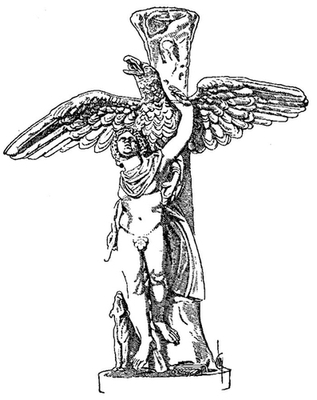
Fig. 22. Rape of Ganymede
4. The Muses, daughters of Jupiter and Mnemosyne (Memory).
They presided over song and prompted the memory. They are
ordinarily cited as nine in number; and to each of them was
assigned patronage in some department of literature, art, or
science. Calliope was the muse of epic poetry, Clio of history,
Euterpe of lyric poetry, Melpomene of tragedy, Terpsichore of
choral dance and song, Erato of love poetry, Polyhymnia of sacred
poetry, Urania of astronomy, Thalia of comedy.
5. Themis, one of the Titans, a daughter of Uranus. She
sat, as goddess of justice, beside Jupiter on his throne. She was
beloved of the father of gods and men, and bore him the Hours,
goddesses who regulated the seasons, and the Fates.
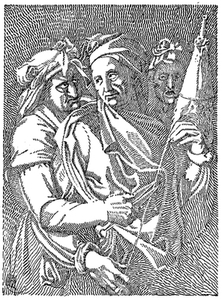
Fig. 24. The Three Fates
From the painting by Michelangelo(?)
6. The Fates, three in number,—Clotho, Lachesis, and Atropos.
Their office was to spin the thread of human destiny, and they were
provided with shears
with which they cut it
off when they pleased.[39]
According to Hesiod,
they were daughters of
Night.
7. Nemesis, daughter
of Night. She represented
the righteous anger and
vengeance of the gods,
particularly toward the
proud, the insolent, and
breakers of the law.
8. Æsculapius, son
of Apollo. By his skill
in medicine he restored
the dead to life. Being
killed by the lightning
of Jove, he was translated
to the ranks of
Heaven. His function
was the art of healing.
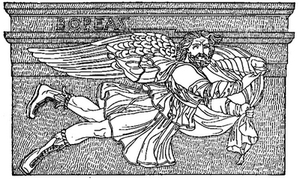
9. The Winds,—Boreas,
or Aquilo, the
north wind; Zephyrus, or Favonius, the west; Notus, or Auster, the
south; and Eurus, the east. The first two, chiefly, have been celebrated
by the poets, the former as the type of rudeness, the latter of
gentleness. It is said that Boreas loved the nymph Orithyia and
tried to play the lover's part, but met with poor success; for it was
hard for him to breathe gently, and sighing was out of the question.
Weary at last of fruitless endeavors, he acted out his true character,
seized the maiden and bore her off. Their children were Zetes and
Calaïs, winged warriors, who accompanied the Argonautic expedition
and did good service in an encounter with those monstrous birds,
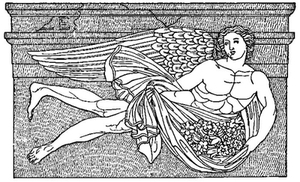
the Harpies. Zephyrus
was the lover of Flora
(Chloris).
Here, too, may be
mentioned Æolus, the
king of the winds,
although he is not
a lesser divinity of
Heaven. His palace
was on the precipitous
isle of Æolia,
where, with his six
sons and six daughters, he kept eternal carouse. The winds, which
he confined in a cavern, he let loose as he saw fit or as he was
bidden by superior deities. He is sometimes called Hippotades.[40]
10. Helios, Selene, and Eos, children of the Titan Hyperion.
Helios and Selene
were the more ancient
Greek divinities
of Sun and Moon respectively.
Helios, the
charioteer of the sun,
is, as has been already
said, frequently identified
with his successor,
Apollo. The attributes
and adventures of
Selene were merged
in those of the more modern Diana. Eos, or, in Latin nomenclature,
Aurora, the rosy-fingered goddess of the Morn, was mother
of the stars and of the morning and evening breezes. Saffron-robed
she rises from the streams of Ocean, to bring light to gods and men.
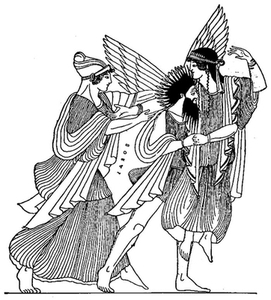
Fig. 27. Boreas carrying off Orithyia
11. Phosphor, the morning-star, the star of Venus, son of Aurora
and the hunter Cephalus. Hesper, the evening-star, was sometimes
identified with Phosphor.
He was king of the
Western Land, and, say some,
father of the Hesperides, who
guarded the golden apples
of the sunset.
The Spirit in Milton's
Comus tells of
... the gardens fair
Of Hesperus, and his daughters three
That sing about the golden tree.
Along the crispèd shades and bowers
Revels the spruce and jocund Spring;
The Graces and the rosy-bosomed Hours
Thither all their bounties bring.
There eternal Summer dwells,
And west winds with musky wing
About the cedarn alleys fling
Nard and cassia's balmy smells.
Iris there with humid bow
Waters the odorous banks, that blow
Flowers of more mingled hue
Than her purfled scarf can shew.
And Tennyson taking the lines as a text has written the melodious
and mystic song of the Hesperides, beginning—
The golden apple, the golden apple, the hallowed fruit,
Guard it well, guard it warily,
Singing airily,
Standing about the charmèd root.
Round about all is mute,
As the snowfield on the mountain-peaks,
As the sandfield at the mountain-foot.
Crocodiles in briny creeks
Sleep and stir not: all is mute.
If ye sing not, if ye make false measure,
We shall lose eternal pleasure,
Worth eternal want of rest.
Laugh not loudly: watch the treasure
Of the wisdom of the West.
Readers of this poem will notice that Tennyson follows the
tradition by which a sleepless dragon is introduced among the
guardians of the Hesperian fruit. Still other versions substitute
for Hesperus, the Titan Atlas.
12. Various Other Personifications. The constellation Orion,
whose story will be narrated; Victoria (Nike), the goddess of
Victory; Discors (Eris), the goddess of Strife; and Iris, goddess
of the rainbow, who is represented frequently as a messenger of
the gods.
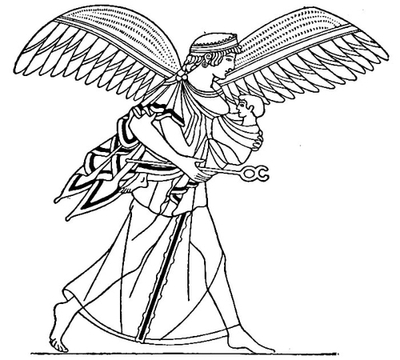
Fig. 28. Iris carrying Child
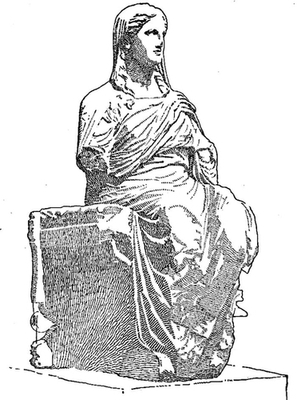
Fig. 29. Demeter of Knidos
39. Conception of the World. The Greek poets believed the
earth to be flat and circular. In their opinion their own country
occupied the middle
of it, and the central
point was either Mount
Olympus, the abode of
the gods, or Delphi,
famous for its oracle.
The circular disk of the
earth was crossed from
west to east and divided
into two equal parts by
the Sea, as they called
the Mediterranean and
its continuation the
Euxine, the only seas
with which they were
acquainted. Around
the earth flowed River
Ocean, from south to
north on the western
side, in a contrary direction
on the eastern. It
flowed in a steady, equable
current, unvexed by
storm or tempest. The
sea and all the rivers on earth received their waters from it.
The northern portion of the earth was inhabited by the Hyperboreans,
dwelling in bliss and everlasting spring beyond the
mountains whose caverns sent forth the piercing blasts of the
north wind. Their country was inaccessible by land or sea. They
lived exempt from disease or old age, from toils and warfare. "I
come" sings one of them,[42]—
I come from a land in the sun-bright deep,
Where golden gardens glow,
Where the winds of the north, becalmed in sleep,
Their conch-shells never blow.
On the south side of the earth, close to the stream of Ocean,
dwelt the Æthiopians, whom the gods held in such favor that they
left at times the Olympian abodes
to partake of the Æthiopian sacrifices
and banquets. On the western
margin of the earth, by the
stream of Ocean, lay the Elysian
Plain, where certain mortals enjoyed
an immortality of bliss.
The Dawn, the Sun, and the
Moon were supposed to rise out of
Ocean on the eastern side and to
drive through the air, giving light
to gods and men. The stars, also,
except those forming the Wain or
Bear and others near them, rose
out of and sank into the stream
of Ocean. There the sun-god
embarked in a winged boat, which
conveyed him by the northern part
of the earth back to his place of
rising in the east.
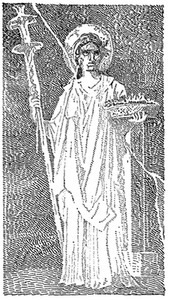
40. Ceres (Demeter), the goddess
of sowing and reaping, of
harvest festivals, and of agriculture in general, was sister of Jupiter
and daughter of Cronus and Rhea. She is connected through her
daughter Proserpine, queen of Hades, with the holy ceremonies and
rites of death and of the lower world. Of the institutions founded
or favored by her the most important were the mysteries celebrated
at Eleusis, concerning which we know that, in the presence of individuals
initiated in the secret ritual and
perhaps with their coöperation, scenes
were enacted which represented the
alternation of death and life in nature
and, apparently, forecast the resurrection
and immortality of man. Sacred
to Ceres and to Proserpine were golden
sheaves of corn and soporific poppies;
while, among animals, cows, sheep, and
pigs were acceptable to them.
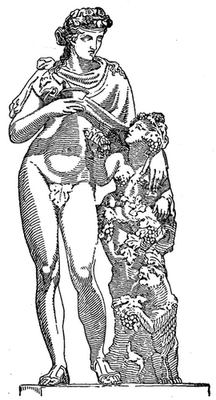
Fig. 31. Dionysus and
the Vine
41. Gæa (Ge), the Mother Earth,
wife of Uranus, belongs to the older
order of gods; so also, another goddess
of the earth, Rhea, the wife of
Cronus and mother of Jupiter. In
Phrygia, Rhea became identified with
Cybele, whose worship, as mother of
the gods, was at a later period introduced
into Rome. The Greek mother,
Rhea, was attended by the Curetes; the
Phrygian mother by the Corybantes,
who celebrated her orgies with enthusiastic din of trumpets, drums,
and cymbals. Cybele presided over mountain fastnesses and fortified
places.
42. Bacchus (Dionysus), the god of wine, was the son of Jupiter
and Semele, daughter of Cadmus of Thebes. He was especially
the god of animal life and vegetation. He represented not only
the intoxicating power of wine but its social and beneficent influences,
and was looked upon as a promoter of civilization, a lawgiver,
and a lover of peace. His forehead was crowned with vine
leaves or ivy. He rode upon the tiger, the panther, or the lynx,
or was drawn by them in a car. His worshipers were Bacchanals,
or Bacchantes. He was attended by Satyrs and Sileni and by
women called Mænads, who, as they danced and sang, waved in
the air the thyrsus, a staff entwined with ivy and surmounted by
a pine cone. Ordinarily, as in the following verses by Dryden, the
convivial qualities of the god overshadow all the rest:
The praise of Bacchus then the sweet musician sung,
Of Bacchus ever fair, and ever young.
The jolly god in triumph comes;
Sound the trumpets, beat the drums;
Flushed with a purple grace
He shows his honest face:
Now give the hautboys breath; he comes, he comes.
Bacchus, ever fair and young,
Drinking joys did first ordain;
Bacchus' blessings are a treasure,
Drinking is the soldier's pleasure;
Rich the treasure,
Sweet the pleasure,
Sweet is pleasure after pain.[43]
43. The Lesser Divinities of Earth were:
1. Pan, son of Mercury and a wood-nymph or
Dryad. He was the god of woods and fields, of
flocks and shepherds. He dwelt in caves, wandered
on the mountains and in valleys, amused himself
with the chase, led the dances of the Dryads,
and made love to them. But his suit was frequently
of no avail, for though good-natured he
was not prepossessing; his hoofs and horns did
not enhance his comeliness. He was fond of
music and was himself inventor of the syrinx,
or shepherd's pipe, which he played in a masterly
manner. Like other gods who dwelt in forests,
he was dreaded by those whose occupations caused
them to pass through the woods by night; for
gloom and loneliness oppress and appall the mind. Hence sudden
unreasonable fright was ascribed to Pan and called a Panic terror.
2. The Nymphs. Pan's partners in the dance, the Dryads,
were but one of several classes of nymphs. There were, beside
them, the Oreads, nymphs of mountains and grottoes; and the
Water-Nymphs, who are mentioned in later sections.
3. The Satyrs, deities of the woods and fields. In early art
they appear as bearded creatures with snub noses, goats' ears, and
horses' tails. Later they resemble youths, sometimes with sprouting
horns. The goat-legged satyr is found in Roman poetry.
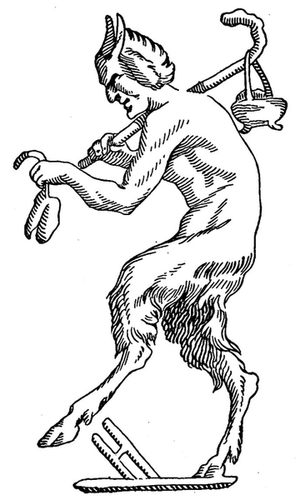
44. The Underworld was the region of darkness inhabited by
the spirits of the dead and governed by Pluto (Hades) and Proserpina,
his queen. According to the Iliad, this realm lay "beneath
the secret places of the earth."[45] And from the Odyssey we gather
that it is not in the bowels of the earth, but on the under side at the
limits of the known world, across the stream Oceanus, where is a
waste shore, the land of the Cimmerians, shrouded in mist and
cloud, never lighted by the sun "neither when he climbs up the
starry heavens nor when again he turns earthward from the firmament."[46]
From that land one goes beside the stream till he reaches
the dank house of Hades. The realm of darkness is bounded by
awful rivers: the Styx, sacred even among the gods, for by it they
sealed their oaths, and the Acheron, river of woe,—with its tributaries,
Phlegethon, river of fire, and Cocytus, river of wailing.
Hither past the White Rock, which perhaps symbolizes the bleaching
skeletons of the dead, and past the gates of the sun, it is the
duty of Hermes (Mercury) to conduct the outworn ghosts of mortals.
One of the Greek dramatists, Sophocles, tells us that this
shore of death is "down in the darkling west."[47] In later poems we
read that Charon, a grim boatman, received the dead at the River
of Woe, and ferried them across, if the money requisite for their
passage had been placed in their mouths and their bodies had been
duly buried in the world above.[48] Otherwise he left them gibbering
on the hither bank. The abode of Pluto is represented as wide-gated
and thronged with guests. At the gate Cerberus, a three-headed,
serpent-tailed dog, lay on guard,—friendly to the spirits entering,
but inimical to those who would depart. The palace itself
is dark and gloomy,
set in the midst of uncanny
fields haunted
by strange apparitions.
The groves of somber
trees about the palace,—the
meads of Asphodel,
barren or, at
best, studded with
futile bushes and pale-flowered
weeds, where
wander the shades,—and
the woods along
the waste shore "of
tall poplars and willows
that shed their fruit before the season" are, without any particular
discrimination, celebrated by the poets as the Garden of Proserpine.
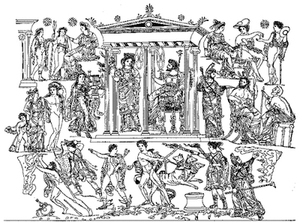
Fig. 34. The Greek Underworld
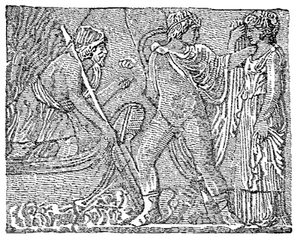
Fig. 35. Hermes conducting a Soul
to Charon
Here life has death for neighbor,
And far from eye or ear
Wan waves and wet winds labor,
Weak ships and spirits steer;
They drive adrift, and whither
They wot not who make thither;
But no such winds blow hither,
And no such things grow here.
No growth of moor or coppice,
No heather-flower or vine,
But bloomless buds of poppies,
Green grapes of Proserpine,
Pale beds of blowing rushes,
Where no leaf blooms or blushes
Save this whereout she crushes
For dead men deadly wine.
* * * * *
Pale, beyond porch and portal,
Crowned with calm leaves, she stands
Who gathers all things mortal
With cold immortal hands;
Her languid lips are sweeter
Than love's, who fears to greet her,
To men that mix and meet her
From many times and lands.
She waits for each and other,
She waits for all men born;
Forgets the earth her mother,
The life of fruits and corn;
And spring and seed and swallow
Take wing for her and follow
Where summer song rings hollow,
And flowers are put to scorn.
* * * * *
We are not sure of sorrow,
And joy was never sure;
To-day will die to-morrow;
Time stoops to no man's lure;
And love, grown faint and fretful,
With lips but half regretful
Sighs, and with eyes forgetful
Weeps that no loves endure.
From too much love of living,
From hope and fear set free,
We thank with brief thanksgiving
Whatever gods may be
That no life lives forever;
That dead men rise up never;
That even the weariest river
Winds somewhere safe to sea.
Then star nor sun shall waken,
Nor any change of light;
Nor sound of waters shaken,
Nor any sound or sight;
Nor wintry leaves nor vernal,
Nor days nor things diurnal:
Only the sleep eternal
In an eternal night.[49]
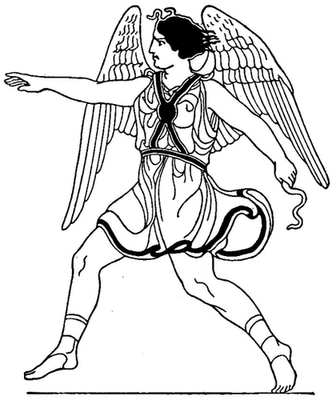
45. Tartarus and the Elysian Fields. With the ghosts of Hades
the living might but rarely communicate, and only through certain
oracles of the dead, situate by cavernous spots and sheer abysms,
deep and melancholy streams, and baleful marshes. These naturally
seemed to afford access to the world below, which with the later
poets, such as Virgil, comes to be regarded as under the ground.
One of these descents to the Underworld was near Tænarum in
Laconia; another, near Cumæ in Italy, was Lake Avernus, so foul
in its exhalations that, as its name portends, no bird could fly across
it.[50] Before the judges of the
lower world,—Minos, Æacus,
and Rhadamanthus,—the souls
of the dead were brought to trial.
The condemned were assigned to
regions where all manner of torment
awaited them at the hands
of monsters dire,—the fifty-headed
Hydra and the avenging
Furies. Some evildoers, such as
the Titans of old, were doomed to
languish in the gulf of Tartarus
immeasurably below. But the
souls of the guiltless passed to
the Elysian Fields, where each
followed the chosen pursuit of
his former life in a land of spring, sunlight, happiness, and song.
And by the Fields there flowed the river Lethe, from which the
souls of those that were to return to the earth in other bodies
drank oblivion of their former lives.
46. The Islands of the Blest. Homer mentions, elsewhere, an
Elysium of the western seas, which is a happy land, "where life is
easiest for men: no snow is there, nor yet great storm, nor any
rain; but always ocean sendeth forth the breeze of the shrill
West to blow cool on men."[51] Hither favored heroes pass without
dying, and live under the happy rule of Rhadamanthus. The
Elysium of Hesiod and Pindar is likewise in the Western Ocean,
on the Islands of the Blessed, the Fortunate Isles. From this
dream of a western Elysium may have sprung the legend of the
island Atlantis. That blissful region may have been wholly imaginary.
It is, however, not impossible that the myth had its origin
in the reports of storm-driven mariners who had caught a glimpse
of occidental lands. In these Islands of the Blest, the Titans,
released from Tartarus after many years, dwelt under the golden
sway of the white-haired Cronus.[52]
There was no heavy heat, no cold,
The dwellers there wax never old,
Nor wither with the waning time,
But each man keeps that age he had
When first he won the fairy clime.
The night falls never from on high,
Nor ever burns the heat of noon;
But such soft light eternally
Shines, as in silver dawns of June
Before the sun hath climbed the sky!
* * * * *
All these their mirth and pleasure made
Within the plain Elysian,
The fairest meadow that may be,
With all green fragrant trees for shade,
And every scented wind to fan,
And sweetest flowers to strew the lea;
The soft winds are their servants fleet
To fetch them every fruit at will
And water from the river chill;
And every bird that singeth sweet,
Throstle, and merle, and nightingale,
Brings blossoms from the dewy vale,—
Lily, and rose, and asphodel,—
With these doth each guest twine his crown
And wreathe his cup, and lay him down
Beside some friend he loveth well.[53]
47. Pluto (Hades) was brother of Jupiter. To him fell the sovereignty
of the lower world and the shades of the dead. In his
character of Hades, the viewless, he is hard and inexorable.
By virtue of the helmet or cap given him by the Cyclopes, he
moved hither and yon, dark, unseen,—hated of mortals. He was,
however, lord not only of all that descends to the bowels of the
earth, but of all that proceeds from the earth; and in the latter
aspect he was revered as Pluto, or the giver of wealth. At his
pleasure he visited the realms of day,—as when he carried off
Proserpina; occasionally he journeyed to Olympus; but otherwise
he ignored occurrences in the upper
world, nor did he suffer his subjects,
by returning, to find them out. Mortals,
when they called on his name,
beat the ground with their hands and,
averting their faces, sacrificed black
sheep to him and to his queen.
Among the Romans he is known also
as Dis, Orcus, and Tartarus. But
Orcus is rather Death, or the Underworld,
than ruler of the shades.
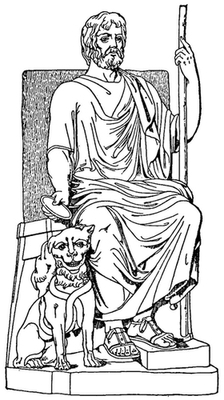
48. Proserpina (Persephone) was the
daughter of Ceres and Jupiter. She was
queen of Hades,—a name applied both
to the ruler of the shades and to his
realm. When she is goddess of spring,
dear to mankind, Proserpina bears a
cornucopia overflowing with flowers,
and revisits the earth in duly recurring
season. But when she is goddess of death, sitting beside Pluto,
she directs the Furies, and, like her husband, is cruel, unyielding,
inimical to youth and life and hope. In the story of her
descent to Hades will be found a further account of her attributes
and fortunes.
49. The Lesser Divinities of the Underworld were:
1. Æacus, Rhadamanthus, and Minos, sons of Jupiter and
judges of the shades in the lower world. Æacus had been during
his earthly life a righteous king of the island of Ægina. Minos had
been a famous lawgiver and king of Crete. The life of Rhadamanthus
was not eventful.
2. The Furies (Erinyes or Eumenides), Alecto, Tisiphone, and
Megæra, born of the blood of the wounded Uranus. They were
attendants of Proserpina. They punished with the frenzies of
remorse the crimes of those who had escaped from or defied
public justice. The heads of the Furies were wreathed with
serpents.
3. Hecate, a mysterious divinity sometimes identified with Diana
and sometimes with Proserpina. As Diana represents the moonlight
splendor of night, so Hecate represents its darkness and terrors.
She haunted crossroads and graveyards, was the goddess of sorcery
and witchcraft, and wandered by
night, seen only by the dogs whose
barking told of her approach.
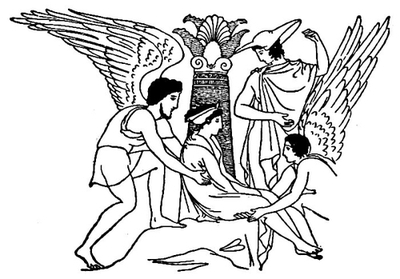
Fig. 39. Death, Sleep, and Hermes
laying a Body in the Tomb
4. Sleep, or Somnus (Hypnos),
and Death (Thanatos), sons of
Night.[54] They dwell in subterranean
darkness. The former brings
to mortals solace and fair dreams,
and can lull the shining eyes of
Jove himself; the latter closes
forever the eyes of men. Dreams,
too, are sons of Night.[55] They dwell beside their brother Death,
along the Western Sea. Their abode has two gates,—one of
ivory, whence issue false and flattering visions; the other of horn,
through which true dreams and noble pass to men.[56]
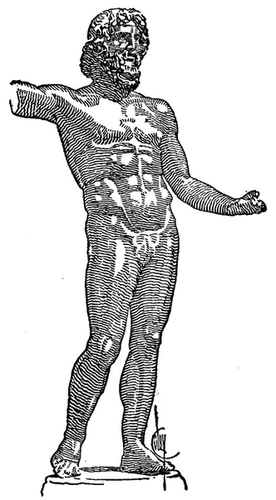
50. The Older Dynasty. There were two dynasties of the sea.
The Older, which flourished during the rule of Cronus, was founded
by the Titans, Oceanus and Tethys,
from whom sprang three thousand
rivers and ocean-nymphs unnumbered.
The palace of Oceanus was
beyond the limits of the bountiful
earth,[58] surrounded by gardens and
all things fair. From ages immemorial
another dweller in the glimmering
caves of Ocean was Pontus (the
deep sea or the waterway), who
became, by Mother Earth, father of
Nereus. This Nereus, a genial old
man of the sea, was distinguished
for his prophetic gifts, his knowledge,
his love of truth and justice.
Taking to wife one of the daughters
of Oceanus, the nymph Doris, he
was blessed with a family of fifty fair
daughters, the Nereïds.[59] Of these
daughters the most famous are
Panope, Galatea, Thetis, and Amphitrite; the last of whom gave
her hand to Neptune (Poseidon), brother of Jove, and thus united
the Older and the Younger dynasties of the sea.
51. Of the Younger Dynasty of the waters Neptune and
Amphitrite were the founders. Neptune's palace was in the
depths of the sea, near Ægæ in
Eubœa; but he made his home
on Olympus when he chose. The
symbol of his power was the
trident, or three-pronged spear,
with which he could shatter rocks,
call forth or subdue storms, and
shake the shores of earth. He
created the horse and was the
patron of horse races. His own
steeds were brazen-hoofed and
golden-maned. They drew his
chariot over the sea, which became
smooth before him, while
dolphins and other monsters of
the deep gamboled about his
path. In his honor black and
white bulls, white boars, and rams
were sacrificed.
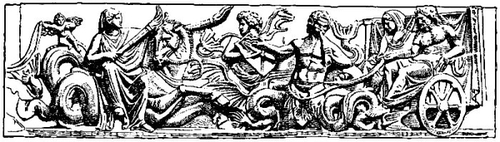
Fig. 41. Wedding of Poseidon and Amphitrite
52. The Lesser Divinities of
the Waters[60] were:
1. Triton, the son of Neptune
and Amphitrite, trumpeter
of Ocean. By his blast on the
sea-shell he stirred or allayed the
waves.
2. Proteus, an attendant and,
according to certain traditions, a
son of Neptune. Like Nereus,
he was a little old man of the
sea. He possessed the prophetic
gift and the power of changing
his shape at will.
3. The Harpies, foul creatures,
with heads of maidens, bodies,
wings, and claws of birds, and
faces pale with hunger. They are the offspring of Thaumas, a
son of Pontus and Gæa.
4. The uncanny offspring of Phorcys and Ceto,—children of
Pontus,—who rejoiced in the horrors of the sea:
a. The Grææ, three hoary witches, with one eye between them
which they used in turn.
b. The Gorgons, whose glance was icy death.
c. The Sirens, muses of the sea and of death, who by their
sweet singing enticed seafarers to destruction.
d. Scylla, also destructive to mariners, a six-headed monster
whose lower limbs were serpents and ever-barking dogs.
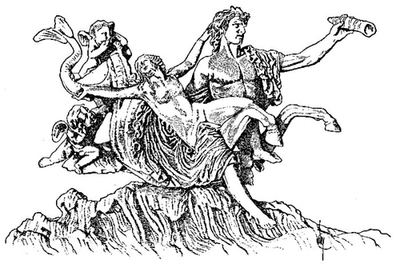
Fig. 42. Triton carrying off a Nymph
5. Atlas, who stood in the far west, bearing on his shoulders the
vault of heaven. He was once regarded as a divinity of the sea, but
later as a mountain. He was the son of Iapetus and the father of
three classes of nymphs,—the Pleiads, the Hyads, and, according
to some stories, the Hesperids. The last-mentioned, assisted by
their mother Hesperis and a dragon, guarded the golden apples of
the tree that had sprung up to grace the wedding of Jove and Juno.
The daughters of Atlas were not themselves divinities of the sea.
6. The Water-Nymphs. Beside the Oceanids and the Nereïds,
who have already been mentioned, of most importance were the
Naiads, daughters of Jupiter. They presided over brooks and fountains.
Other lesser powers of the Ocean were Glaucus, Leucothea,
and Melicertes, of whom more is said in another section.
In the following statement of the difference between ancient
and modern conceptions of nature, the poet lends new charm to
the fabled rulers of the sea.
The world is too much with us; late and soon,
Getting and spending, we lay waste our powers:
Little we see in Nature that is ours;
We have given our hearts away, a sordid boon!
This sea that bares her bosom to the moon;
The winds that will be howling at all hours,
And are upgathered now like sleeping flowers;
For this, for everything, we are out of tune;
It moves us not.—Great God! I'd rather be
A Pagan suckled in a creed outworn;
So might I, standing on this pleasant lea,
Have glimpses that would make me less forlorn;
Have sight of Proteus rising from the sea;
Or hear old Triton blow his wreathèd horn.[61]
53. Gods Common to Greece and Italy. Of the deities already
mentioned, the following, although they were later identified with
certain Greek gods and goddesses[62] whose characteristics and
adventures they assumed, had developed an independent worship
in Italy: Jupiter (Zeus); Juno (Hera); Minerva (Athene); Diana
(Artemis); Mars (Ares); Venus (Aphrodite); Vulcanus, or Mulciber
(Hephæstus); Vesta (Hestia); Mercurius (Hermes); Neptunus
(Poseidon); Ceres (Demeter); Liber (Bacchus); Libera
(Persephone); Magna Mater, the great mother of the gods (Rhea,
Cybele); Orcus (Pluto, Hades); Tellus, the Earth (Gæa).
54. Italian Gods. There were also divinities always peculiar to
Roman mythology.[63] Of these the more important are:
1. Saturn, an ancient Italian deity (as his name indicates) of
seeds and sowing, the introducer of agriculture. Fanciful attempts
were made to identify him with the Grecian god Cronus; and it
was fabled that after his dethronement by Jupiter he fled to Italy,
where he reigned during the Golden Age. In memory of his
dominion, the feast of Saturnalia was held every year in the winter
season. Then all public business was suspended; declarations of
war and criminal executions were postponed; friends made presents
to one another; and even slaves were indulged with great
liberties. A feast was given them at which they sat at table while
their masters served, to show the natural equality of men, and
that all things belonged equally to all in the reign of Saturn.
The wife of Saturn was Ops, goddess of sowing and harvest (later
confounded with Rhea). Another Roman deity of earth was
Consus, whose name means "the keeper of the stores." He is the
god of the stored-up harvest; and his altar is said to have been discovered
underground by Romulus. It was in the Circus Maximus
and was uncovered only on the days of his festivals, the harvest
home of August and the granary feast of December. The underground
altar is a reminiscence of the ancient custom of storing corn
underground or at any rate of burying the sacrifices offered to deities
of the earth. The harvest festival was celebrated with horse races,
which, originating in a very simple way with the primitive farmers,
became in time the distinctive feature of the Circus Maximus.
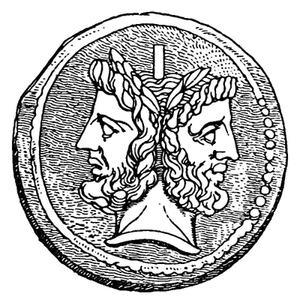
2. Janus, whose name is derived from the Latin root which
means "going" and is connected with janua, a passage or door,
is the most distinctive and most important of
the native Italic deities. He is not only the
god of doors, or material openings, but more
truly of beginnings,—especially of good beginnings
which insure good endings. Hence
undoubtedly he is represented as facing both
ways; for the Romans very properly believed
that beginning and ending were of the same
piece, and that an undertaking ill begun
could not achieve success. His temple, or
covered passage, in the Forum had doors facing east and west for
the beginning and ending of the day; and between stood his two-faced
statue. In every home the morning prayer was addressed to
him; in every domestic enterprise his assistance was implored. He
was the god, also, of the opening year; hence his month, January,
on the first day of which words only of good omen were uttered,
and gifts were given (strenae, a name still preserved in the French
word for New Year's presents, étrennes), and, for good luck, some
stroke of work was bestowed on every undertaking planned for
the year. He was publicly invoked not only on New Year's day,
but on the first day of each month, by priests and people alike;
and in these prayers his name was mentioned even before that of
Jupiter. He is the god of civilization, and is sometimes called
Consivius, or the Sower.[64] Of course he was invoked when wars
were commenced. And during their progress the doors of his
temple stood always open. In peace they were closed; but they
were shut only once between the reign of Numa and that of
Augustus. It was natural that his worship should gradually absorb
that of Sol, the Sun, who opens the day and completes the year and
blesses with his rays the seeds that are sown; and such was the
case. But Janus and his wife Jana were not originally connected
even in name with Dianus (Sol, Apollo) and Diana (the moon).
3. Quirinus, a war-god, said to be no other than Romulus, the
founder of Rome, exalted after his death to a place among the
immortals.
4. Bellona, a war-goddess.
5. Lucina, the goddess who brings to light, hence the goddess
of childbirth: a title bestowed upon both Juno and Diana.
6. Terminus, the god of landmarks. His statue was a rude
stone or post, set in the ground to mark the boundaries of fields.
7. Faunus, the grandson of Saturn. He was worshiped as a
god of fields and shepherds and also of prophecy. His name in
the plural, Fauni, expressed a class of gamesome deities, like the
Satyrs of the Greeks. There was also a goddess called Fauna, or
Bona Dea (good goddess). To Maia, wife of Vulcan, this designation,
Bona Dea, was sometimes applied.
8. Sylvanus, presiding over forest-glades and plowed fields.
9. Pales, the goddess presiding over cattle and pastures. Flora,
the goddess of flowers. Pomona, presiding over fruit trees. Vertumnus,
the husband of Pomona, was guardian of fruit trees,
gardens, and vegetables.
Pomona loves the orchard,
And Liber loves the vine,
And Pales loves the straw-built shed
Warm with the breath of kine;
And Venus loves the whisper
Of plighted youth and maid
In April's ivory moonlight,
Beneath the chestnut shade.[65]
10. The Penates, gods who were supposed to attend to the
welfare and prosperity of the family. Their name is derived from
Penus, the storehouse or inner chamber, which was sacred to
them. Every master of a family was the priest to the Penates of
his own house.
The Lares, or Lars, were also tutelary deities, but they differed
from the Penates since they were regarded as the deified spirits
of ancestors, who watched over and protected their descendants.
The Lares were more particularly divinities presiding over the
household or family; but there were also public Lares, or guardian
spirits of the city, Lares of the precincts, Lares of the fields, Lares
of the highways, and Lares of the sea. To the Penates, to the
domestic Lares (whose images were preserved in a private shrine),
and to the Manes (shades that
hovered over the place of
burial), the family prayers of
the Romans were addressed.
Other spirits, the Lemures and
Larvæ, more nearly correspond
to our ghosts.
The Romans believed that
every man had his Genius and
every woman her Juno; that
is, a spirit who had given them
being and was regarded as
a protector through life. On
birthdays men made offerings to their Genius, women to their Juno.
11. Other Italian deities were the gods of the rivers, such as
Father Tiber, and the goddesses of the springs and brooks, such as
Juturna, whose pool in the Forum was sacred. This nymph was
also a goddess of healing and, according to later tradition, was
beloved by Jupiter. Earlier stories, however, make her the wife
of Janus and the mother of Fontus, the god of flowing waters,
who had an altar on the Janiculan hill and was worshiped at an
annual festival called the Fontinalia, when the wells were wreathed
with garlands. Held in especial honor were the Camenæ, fountain-nymphs,
goddesses of prophecy and healing (later identified with
the Muses). The leader of them was Carmenta, who sang both the
future and the past. With her is sometimes associated the nymph
Egeria, from whom the Roman king Numa is said to have received
instruction concerning the forms of worship which he introduced.
12. The Romans worshiped, also, Sol, the Sun; Luna, the
Moon; Mater Matuta, the Dawn; Juventus, Youth; Fides,
Honesty; Feronia, goddess of groves and freedmen; and a great
number of personified abstractions of conduct and experience,
such as Fortune and Health.
Many of these Latin divinities were derived from the earlier
cult and ritual of the Etruscan inhabitants of Italy.
55. Myths of Jupiter and Juno. Not a few of the adventures
of Jupiter turn upon his love affairs. Among the immortals his
queen had rivals in his affection; for instance, Latona, a goddess
of darkness, daughter of the Titans Cœus and Phœbe. This goddess
became, as we have already seen, the mother of Apollo and
Diana. The ire of Juno against
her was never appeased. In
consequence of it, numerous
trials were visited upon Latona,
some of which find a place
among the adventures of her
children.
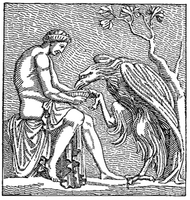
56. Love Affairs of Jupiter.
Not only with immortals but
with mortals were Jupiter's relations
sometimes of a dubious
character. His devotion to the
beautiful daughters of men involved
him in frequent altercations
with his justly jealous
spouse. Of his fondness for Danaë, whom he approached in a
shower of gold, particulars are given in the story of her son Perseus;
of his love for Alcmene, the granddaughter of that Perseus,
we are informed in the myths of her son Hercules; and of his
attentions to Leda, whom he wooed in guise of a swan, we learn
in the accounts of their children Pollux and Helen. Other love
passages, upon which narratives depend, concern Io, Callisto,
Europa, Semele, Ægina, and Antiope.
57. Io[66] was of divine ancestry. Her father was the river-god
Inachus, son of Oceanus. It is said that Juno one day, perceiving
the skies suddenly overcast, surmised that her husband had raised
a cloud to hide some escapade. She brushed away the darkness
and saw him on the banks of a glassy river with a beautiful heifer
standing near. Juno suspected, with reason, that the heifer's form
concealed some fair nymph of mortal mold. It was Io, whom
Jupiter, when he became aware of the approach of his wife, had
changed into that form.
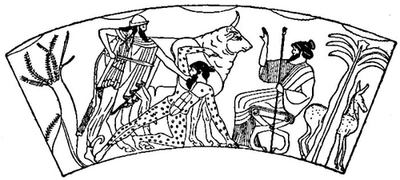
Fig. 46. Hermes Kills Argus
The ox-eyed goddess joined her husband, noticed the heifer,
praised its beauty, and asked whose it was and of what herd.
Jupiter, to stop questions,
replied that it was a fresh
creation from the earth.
Juno begged it as a gift.
What could the king of
gods and men do? He
was loath to surrender his
sweetheart to his wife; yet
how refuse so trifling a
present as a heifer? He could not, without exciting suspicion,
and he therefore consented. The goddess delivered the heifer
to Argus, to be strictly watched.
Now Argus had a hundred eyes in his head, and never went
to sleep with more than two at a time, so that he kept watch of
Io constantly. He suffered her to graze through the day and at
night tied a rope round her neck. She would have stretched out
her arms to implore freedom of Argus, but that she had no arms
to stretch out and her voice was a bellow. She yearned in vain
to make herself known to her father. At length she bethought
herself of writing, and inscribed her name—it was a short one—with
her hoof on the sand. Inachus recognized it, and, discovering
that his daughter whom he had long sought in vain was hidden
under this disguise, mourned over her. While he thus lamented,
Argus, observing, drove her away and took his seat on a bank
from whence he could see in every direction.
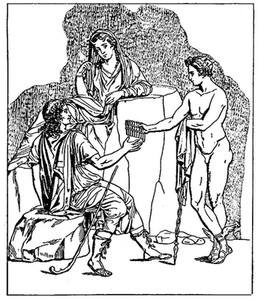
Fig. 47. Io, Argus, and Mercury
Jupiter, grieved by the sufferings of his mistress, sent Mercury
to dispatch Argus. Mercury took his sleep-producing wand and
presented himself on earth as a shepherd driving his flock. As
he strolled, he blew upon his syrinx or Pandean pipes. Argus
listened with delight. "Young man," said he, "come and take a
seat by me on this stone. There is no better place for your flock
to graze in than hereabouts, and here is a pleasant shade such as
shepherds love." Mercury sat down, talked, told stories till it
grew late, and played upon
his pipes his most soothing
strains, hoping to lull the
watchful eyes to sleep, but
in vain; for Argus still
contrived to keep some of
his eyes open, though he
shut the rest.
But among other stories,
Mercury told him how the instrument
on which he played
was invented. "There was
a certain nymph," said he,
"whose name was Syrinx,—much
beloved by the satyrs
and spirits of the wood. She
would have none of them,
but was a faithful worshiper
of Diana and followed the chase. Pan, meeting her one day,
wooed her with many compliments, likening her to Diana of the
silver bow. Without stopping to hear him she ran away. But on
the bank of the river he overtook her. She called for help on her
friends, the water-nymphs. They heard and consented. Pan threw
his arms around what he supposed to be the form of the nymph and
found he embraced only a tuft of reeds. As he breathed a sigh, the
air sounded through the reeds and produced a plaintive melody.
Whereupon the god, charmed with the novelty and with the
sweetness of the music, said, 'Thus, then, at least, you shall be
mine.' Taking some of the reeds of unequal lengths and placing
them together, side by side, he made an instrument and called it
Syrinx, in honor of the nymph." Before Mercury had finished his
story he saw the eyes of Argus all asleep. At once he slew him and
set Io free. The eyes of Argus Juno took and scattered as ornaments
on the tail of her peacock, where they remain to this day.
But the vengeance of Juno was not yet satiated. She sent a
gadfly to torment Io, who, in her flight, swam through the sea,
named after her, Ionian. Afterward, roaming over many lands,
she reached at last the banks of the Nile. Then Jupiter interceded
for her; and upon his engaging not to pay her any further attention,
Juno consented to restore her to her form.
In a poem dedicated to Leigh Hunt, by Keats, the following
allusion to the story of Pan and Syrinx occurs:
So did he feel who pulled the boughs aside,
That we might look into a forest wide, ...
Telling us how fair trembling Syrinx fled
Arcadian Pan, with such a fearful dread.
Poor nymph—poor Pan—how he did weep to find
Nought but a lovely sighing of the wind
Along the reedy stream; a half-heard strain,
Full of sweet desolation, balmy pain.
58. Callisto of Arcadia was another maiden who excited the
jealousy of Juno. Her the goddess changed into a bear. Often,
frightened by the dogs, Callisto, though lately a huntress, fled in
terror from the hunters. Often, too, she fled from the wild beasts,
forgetting that she was now a wild beast herself; and, bear as she
was, she feared the bears.
One day a youth espied her as he was hunting. She saw him
and recognized him as her son Arcas, grown to manhood. She
stopped and felt inclined to embrace him. He, alarmed, raised
his hunting spear and was on the point of transfixing her, but
Jupiter arrested the crime and, snatching away both of them,
placed them in the heavens as the Great and Little Bear.
Juno, enraged at seeing her rival so set in honor, hastened to
ancient Tethys and Oceanus and, complaining that she was supplanted
in Heaven, cried, "So do my punishments result—such
is the extent of my power! I forbade her to wear human form,—she
and her hateful son are placed among the stars. Better
that she should have resumed her former shape, as I permitted Io
to do. Perhaps my husband means to take her to wife, and put
me away! But you, my foster parents, if you feel for me, and see
with displeasure this unworthy treatment of me, show it, I beseech
you, by forbidding this guilty couple from coming into your waters."
The powers of the Ocean assented, and consequently the two constellations
of the Great and Little Bear move round and round in
the neighborhood of the pole, but never sink, as do the other
stars, beneath the Ocean.[67]
59. Europa was the daughter of Agenor, king of Phœnicia,
son of the god Neptune. The story of Jupiter's love for her is
thus told by the idyllic poet, Moschus:
To Europa, princess of Asia, once on a time, a sweet dream was sent by
Cypris.... Then she beheld two continents at strife for her sake, Asia and
the further shore, both in the shape of women. Of these one had the guise
of a stranger, the other of a lady of that land, and closer still she clung about
her maiden, and kept saying how she was her mother, and herself had nursed
Europa. But that other with mighty hands, and forcefully, kept haling the
maiden, nothing loth; declaring that, by the will of ægis-bearing Jupiter,
Europa was destined to be her prize.
But Europa leaped forth from her strown bed in terror, with beating heart,
in such clear vision had she beheld the dream.... And she said, "Ah! who
was the alien woman that I beheld in my sleep? How strange a longing for
her seized my heart, yea, and how graciously she herself did welcome me, and
regard me as it had been her own child! Ye blessed gods, I pray you, prosper
the fulfillment of the dream!"
Therewith she arose, and began to seek the dear maidens of her company,
girls of like age with herself, born in the same year, beloved of her heart, the
daughters of noble sires, with whom she was always wont to sport, when she
was arrayed for the dance, or when she would bathe her bright body at the
mouths of the rivers, or would gather fragrant lilies on the leas....
Now the girls, so soon as they were come to the flowering meadows, took great
delight in various sorts of flowers, whereof one would pluck sweet-breathed
narcissus, another the hyacinth, another the violet, a fourth the creeping
thyme; and on the ground there fell many petals of the meadows rich with
spring. Others, again, were emulously gathering the fragrant tresses of the
yellow crocus; but in the midst of them all the princess culled with her hand
the splendor of the crimson rose, and shone preëminent among them all like
the foam-born goddess among the Graces. Verily, she was not for long to set
her heart's delight upon the flowers.... For of a truth, the son of Cronus,
so soon as he beheld her, was troubled, and his heart was subdued by the
sudden shafts of Cypris, who alone can conquer even Jupiter. Therefore, both
to avoid the wrath of jealous Juno, and being eager to beguile the maiden's
tender heart, he concealed his godhead, and changed his shape, and became a
bull....
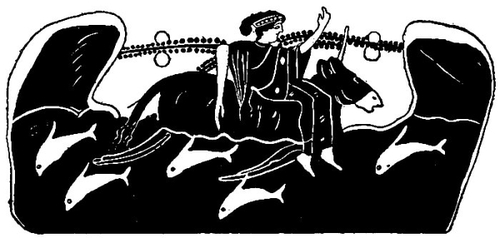
Fig. 48. Europa on the Bull
He came into the meadow, and his coming terrified not the maidens, nay,
within them all wakened desire to draw nigh the lovely bull, and to touch
him, and his heavenly fragrance
was scattered afar,
exceeding even the sweet
perfume of the meadows.
And he stood before the
feet of fair Europa, and
kept licking her neck,
and cast his spell over
the maiden. And she still
caressed him, and gently
with her hands she wiped
away the deep foam from his lips, and kissed the bull. Then he lowed so
gently, ye would think ye heard the Mygdonian flute uttering a dulcet sound.
He bowed himself before her feet, and bending back his neck, he gazed on
Europa, and showed her his broad back. Then she spake among her deep-tressed
maidens, saying,—
"Come, dear playmates, maidens of like age with me, let us mount the bull
here and take our pastime, for, truly, he will bear us on his back, and carry all
of us! And how mild he is, and dear, and gentle to behold, and no whit like
other bulls! A mind as honest as a man's possesses him, and he lacks nothing
but speech."
So she spake, and smiling, she sat down on the back of the bull, and the
others were about to follow her. But the bull leaped up immediately, now he
had gotten her that he desired, and swiftly he sped to the deep. The maiden
turned, and called again and again to her dear playmates, stretching out her
hands, but they could not reach her. The strand he gained, and forward he
sped like a dolphin, faring with unwetted hooves over the wide waves. And
the sea, as he came, grew smooth, and the sea monsters gamboled around,
before the feet of Jupiter; and the dolphin rejoiced, and rising from the deeps,
he tumbled on the swell of the sea. The Nereïds arose out of the salt water,
and all of them came on in orderly array, riding on the backs of sea beasts.
And himself, the thunderous shaker of the world, appeared above the sea, and
made smooth the wave, and guided his brother on the salt sea path, and round
him were gathered the Tritons, these hoarse trumpeters of the deep, blowing
from their long conchs a bridal melody.
Meanwhile, Europa, riding on the back of the divine bull, with one hand
clasped the beast's great horn, and with the other caught up the purple fold
of her garment, lest it might trail and be wet in the hoar sea's infinite spray.
And her deep robe was swelled out by the winds, like the sail of a ship, and
lightly still did waft the maiden onward. But when she was now far off from
her own country, and neither sea-beat headland nor steep hill could now be
seen, but above, the air, and beneath, the limitless deep, timidly she looked
around, and uttered her voice, saying,—
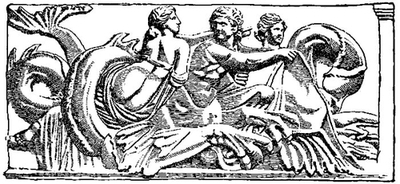
Fig. 49. Nereïds on Sea Beasts
"Whither bearest thou me, bull god? What art thou? How dost thou fare
on thy feet through the path of the sea beasts, nor fearest the sea? The sea
is a path meet for swift ships that traverse the brine, but bulls dread the salt
sea ways. What drink is sweet to thee, what food shalt thou find from the deep?
Nay, art thou then some god, for godlike are these deeds of thine." ...
So spake she, and the horned bull made answer to her again: "Take
courage, maiden, and dread not the swell of the deep. Behold, I am Jupiter,
even I, though, closely beheld, I wear the form of a bull, for I can put on the
semblance of what thing I will. But 'tis love of thee that has compelled me
to measure out so great a space of the salt sea, in a bull's shape. So Crete
shall presently receive thee, Crete that was mine own foster-mother, where thy
bridal chamber shall be."[68]
According to tradition, from this princess the continent of
Europe acquired its name. Her three sons are famous in Greek
myth: Minos, who became king of Crete, and after his death a
judge in the lower world; Rhadamanthus, who also was regarded
as king and judge in the world of ghosts; and Sarpedon, who was
ancestor of the Lycians.
The adventures of Europa's brother Cadmus, who by the command
of his father went forth in quest of the lost maiden, fall
under the myths of Mars.[69]
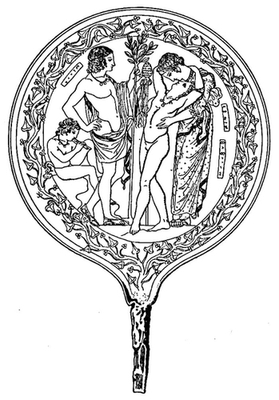
Fig. 50. Bacchus embracing Semele
60. Semele was the daughter
of Cadmus, founder of Thebes.
She was descended, through
both parents, from the gods;
for her mother Harmonia was
daughter to Mars and the
laughter-loving Venus. To
Semele Jupiter had appeared,
and had paid court in unostentatious
manner and simple
guise. But Juno, to gratify her
resentment against this new
rival for her lord's affections,
contrived a plan for her destruction.
Assuming the form
of Beroë, the aged nurse of
Semele, she insinuated doubts
whether it was indeed Jove
himself who came as a lover.
Heaving a sigh, she said, "I hope it will turn out so, but I can't
help being afraid. People are not always what they pretend to be.
If he is indeed Jove, make him give some proof of it. Ask him
to come arrayed in all his splendors, such as he wears in Heaven.
That will put the matter beyond a doubt." Semele was persuaded
to try the experiment. She asks a favor, without naming what it
is. Jove gives his promise, and confirms it with the irrevocable
oath, attesting the river Styx, terrible to the gods themselves.
Then she made known her request. The god would have stopped
her as she spake, but she was too quick for him. The words
escaped, and he could neither unsay his promise nor her request.
In deep distress he left her and returned to the upper regions.
There he clothed himself in his splendors, not putting on all his
terrors, as when he overthrew the giants, but what is known among
the gods as his lesser panoply. With thunders and lightnings
he entered the chamber of Semele. Her mortal frame could not
endure the splendors of the immortal radiance. She was consumed
to ashes.[70] Her son was the god Bacchus.[71] Semele, in the
blissful seats of Heaven, whither she was transported by the sorrowful
Jove, has been represented as recounting thus the story of
her doom:
What were the garden-bowers of Thebes to me?
What cared I for their dances and their feasts,
Whose heart awaited an immortal doom?
The Greek youths mocked me, since I shunned in scorn
Them and their praises of my brows and hair.
The light girls pointed after me, who turned
Soul-sick from their unending fooleries....
There came a change: a glory fell to me.
No more 'twas Semele, the lonely girl,
But Jupiter's Beloved, Semele.
With human arms the god came clasping me:
New life streamed from his presence; and a voice,
That scarce could curb itself to the smooth Greek,
Now and anon swept forth in those deep nights,
Thrilling my flesh with awe; mysterious words—
I knew not what; hints of unearthly things
That I had felt on solemn summer noons,
When sleeping Earth dreamed music, and the heart
Went crooning a low song it could not learn,
But wandered over it, as one who gropes
For a forgotten chord upon a lyre.
Yea, Jupiter! But why this mortal guise,
Wooing as if he were a milk-faced boy?
Did I lack lovers? Was my beauty dulled,
The golden hair turned dross, the lithe limbs shrunk?
The deathless longings tamed, that I should seethe
My soul in love like any shepherd girl?
One night he sware to grant whate'er I asked:
And straight I cried, "To know thee as thou art!
To hold thee on my heart as Juno does!
Come in thy thunder—kill me with one fierce
Divine embrace!—Thine oath!—Now, Earth, at last!"
The Heavens shot one swift sheet of lurid flame;
The world crashed: from a body scathed and torn
The soul leapt through, and found his breast, and died.
Died?—So the Theban maidens think, and laugh,
Saying, "She had her wish, that Semele!"
But sitting here upon Olympus' height,
I look down, through that oval ring of stars,
And see the far-off Earth, a twinkling speck—
Dust-mote whirled up from the Sun's chariot wheel—
And pity their small hearts that hold a man
As if he were a god; or know the god—
Or dare to know him—only as a man!
O human love! art thou forever blind?[72]
61. Ægina. The extent to which those who were concerned
only indirectly in Jupiter's love affairs might yet be involved in
the consequences of them is illustrated by the fortunes of Ægina.
This maiden, the daughter of Asopus, a river-god, attracted the
attention of Jupiter, who straightway ran off with her. Now, on
the one hand, Sisyphus, king of Corinth, having witnessed the
intrigue, was indiscreet enough to disclose it. Forthwith the vengeance
of the king of gods and men fell upon him. He was condemned
to Hades and, attempting to escape thence, had resort
to a series of deceptions that resulted in his eternal punishment.[73]
On the other hand, the inhabitants of the island that had the misfortune
to bear Ægina's name incurred the displeasure of Juno, who
devastated their land with a plague. The following account of this
calamity is placed in the mouth of Æacus, king of the island:[74]
"At the beginning the sky seemed to settle down upon the
earth and thick clouds shut in the heated air. For four months
together a deadly south wind prevailed. The disorder affected the
wells and springs. Thousands of snakes crept over the land and
shed their poison in the fountains. The force of the disease was
first spent on the lower animals,—dogs, cattle, sheep, and birds.
The oxen fell in the midst of their work. The wool dropped from
the bleating sheep. The horse groaned at his stall and died an
inglorious death. Everything languished; dead bodies lay in the
roads, the fields, and the woods; the air was poisoned by them.
Next the disease attacked the country people, and then the dwellers
in the city. At first the cheek was flushed and the breath drawn
with difficulty. The tongue grew rough and swelled, and the dry
mouth stood open, with its veins enlarged, and gasped for the air.
Men could not bear the heat of their clothes or their beds, but
preferred to lie on the bare ground. Nor could the physicians
help, for the disease attacked them also. At last men learned to
look upon death as the only deliverer from disease. All restraint
laid aside, they crowded round the wells and fountains, and drank,
without quenching thirst, till they died. On all sides lay my people
strewn like over-ripened apples beneath the tree, or acorns under
the storm-shaken oak. You see yonder a temple on the height.
It is sacred to Jupiter. Often, while the priest made ready for
sacrifice, the victim fell, struck down by disease without waiting
for the blow. At length all reverence for sacred things was lost.
Bodies were thrown out unburied, wood was wanting for funeral
piles, men fought with one another for the possession of them.
Finally there were none left to mourn; sons and husbands, old
men and youths, perished alike unlamented.
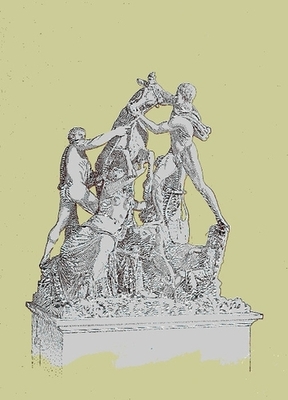
"Standing before the altar, I raised my eyes to Heaven. 'O
Jupiter,' I said, 'if thou art indeed my father, give me back my
people, or take me also away!' At these words a clap of thunder
was heard. 'I accept the omen,' I cried. By chance there grew
by the place where I stood an oak with wide-spreading branches,
sacred to Jupiter. I observed on it a troop of ants busy with their
labor. Observing their numbers with admiration, I said, 'Give
me, O father, citizens as numerous as these, and replenish my
empty city.' The tree shook, and the branches rustled, though
no wind agitated them. Night came on. The tree stood before
me in my dreams, with its numerous branches all covered with
living, moving creatures, which, falling to the ground, appeared to
gain in size, and by and by to stand erect, and finally to assume
the human form. Then I awoke. My attention was caught by
the sound of many voices without. While I began to think I was
yet dreaming, Telamon, my son, throwing open the temple gates,
exclaimed, 'Father, approach, and behold things surpassing even
your hopes!' I went forth; I saw a multitude of men, such as I
had seen in my dream. While I gazed with wonder and delight,
they approached and, kneeling, hailed me as their king. I paid
my vows to Jove, and proceeded to allot the vacant city to the
new-born race. I called them Myrmidons from the ant (myrmex),
from which they sprang. They are a diligent and industrious race,
eager to gain, and tenacious of their gains."
The Myrmidons were the soldiers of Achilles, the grandson of
King Æacus, in the Trojan War.
62. Antiope was, according to the Odyssey, another daughter
of Asopus, therefore a sister of Ægina. But later poets make
this darling of Jove daughter of Nycteus, king of Thebes. While
she was engaged in the Mænad dances, Jupiter as a satyr wooed
and won her. She bore him two sons, Amphion and Zethus, who,
being exposed at birth on Mount Cithæron, grew up among the
shepherds, not knowing their parentage. After various adventures
Antiope fell into the hands of her uncle Lycus, the usurping king
of Thebes, who, egged on by his wife Dirce, treated her with
extreme cruelty. Finally, when doomed by Dirce to be dragged
to death behind a bull, Antiope found means to inform her children
of her kinship to them. As it happened, they had been
ordered to execute the cruel sentence upon their mother. But
with a band of their fellow herdsmen, they attacked and slew
Lycus instead, and, tying Dirce by the hair of her head to a bull,
let her perish by her own device.[75]
While among the herdsmen, Amphion had been the special care
of Mercury, who gave him a lyre and taught him to play upon it.
His brother Zethus had occupied himself in hunting and tending
the flocks. Amphion himself is one of the most famous of mythical
musicians. Having become king of Thebes, it is said that when
he played on his lyre, stones moved of their own accord and took
their places in the wall with which he was fortifying the city.
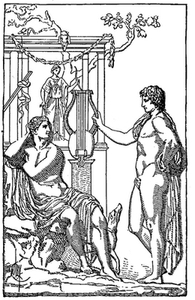
Fig. 51. Amphion and Zethus
... 'Tis said he had a tuneful tongue,
Such happy intonation,
Wherever he sat down and sung
He left a small plantation;
Wherever in a lonely grove
He set up his forlorn pipes,
The gouty oak began to move,
And flounder into hornpipes.
The mountain stirred its bushy crown,
And, as tradition teaches,
Young ashes pirouetted down
Coquetting with young beeches;
And briony-vine and ivy-wreath
Ran forward to his rhyming,
And from the valleys underneath
Came little copses climbing.
The linden broke her ranks and rent
The woodbine wreaths that bind her,
And down the middle, buzz! she went
With all her bees behind her:
The poplars, in long order due,
With cypress promenaded,
The shock-head willows, two and two,
By rivers gallopaded.
Came wet-shot alder from the wave,
Came yews, a dismal coterie;
Each plucked his one foot from the grave,
Poussetting with a sloe-tree:
Old elms came breaking from the vine,
The vine streamed out to follow,
And, sweating rosin, plumped the pine
From many a cloudy hollow.
And wasn't it a sight to see,
When, ere his song was ended,
Like some great landslip, tree by tree,
The country-side descended;
And shepherds from the mountain-eaves
Looked down, half-pleased, half-frightened,
As dashed about the drunken leaves
The random sunshine lightened.[76]
The musician's life was, however, not all harmony and happiness.
Owing to the pride of his wife Niobe, daughter of King
Tantalus, there befell him and his house a crushing calamity,
which is narrated among the exploits of Apollo and Diana.
63. Jupiter, a Friend of Man. The kindly interest evinced by
the Thunderer toward mortals is displayed in the story of Baucis
and Philemon. Once on a time Jupiter, in human shape, visited
the land of Phrygia, and with him Mercury, without his wings.
They presented themselves as weary travelers at many a door,
seeking rest and shelter, but found all closed; for it was late, and
the inhospitable inhabitants would not rouse themselves to open
for their reception. At last a small thatched cottage received them,
where Baucis, a pious old dame, and her husband Philemon had
grown old together. Not ashamed of their poverty, they made it
endurable by moderate desires and kind dispositions. When the
two guests crossed the humble threshold and bowed their heads
to pass under the low door, the old man placed a seat, on which
Baucis, bustling and attentive, spread a cloth, and begged them to
sit down. Then she raked out the coals from the ashes, kindled a
fire, and prepared some pot-herbs and bacon for them. A beechen
bowl was filled with warm water, that their guests might wash.
While all was doing, they beguiled the time with conversation.
The old woman with trembling hand set the table. One leg was
shorter than the rest, but a piece of slate put under restored the
level. When it was steady she rubbed the table down with sweet-smelling
herbs. Upon it she set some of chaste Minerva's olives,
some cornel berries preserved in vinegar, and added radishes and
cheese, with eggs lightly cooked in the ashes. The meal was served
in earthen dishes; and an earthenware pitcher, with wooden cups,
stood beside them. When all was ready the stew, smoking hot,
was set on the table. Some wine, not of the oldest, was added,
and for dessert, apples and wild honey.
Now while the repast proceeded, the old folks were astonished
to see that the wine, as fast as it was poured out, renewed itself in
the pitcher of its own accord. Struck with terror, Baucis and
Philemon recognized their heavenly guests, fell on their knees,
and with clasped hands implored forgiveness for their poor entertainment.
There was an old goose, which they kept as the guardian
of their humble cottage, and they bethought them to make
this a sacrifice in honor of their guests. But the goose, too nimble
for the old folk, with the aid of feet and wings eluded their pursuit
and at last took shelter between the gods themselves. They
forbade it to be slain, and spoke in these words: "We are gods.
This inhospitable village shall pay the penalty of its impiety; you
alone shall go free from the chastisement. Quit your house and
come with us to the top of yonder hill." They hastened to obey.
The country behind them was speedily sunk in a lake, only their
own house left standing. While they gazed with wonder at the
sight, that old house of theirs was changed. Columns took the
place of the corner posts, the thatch grew yellow and appeared a
gilded roof, the floors became marble, the doors were enriched
with carving and ornaments of gold. Then spoke Jupiter in benignant
accents: "Excellent old man, and woman worthy of such a
husband, speak, tell us your wishes. What favor have you to ask
of us?" Philemon took counsel with Baucis a few moments, then
declared to the gods their common wish. "We ask to be priests
and guardians of this thy temple, and that one and the same
hour may take us both from life." Their prayer was granted.
When they had attained a great age, as they stood one day before
the steps of the sacred edifice and were telling the story of the
place, Baucis saw Philemon begin to put forth leaves, and Philemon
saw Baucis changing in like manner. While still they exchanged
parting words, a leafy crown grew over their heads. "Farewell,
dear spouse," they said together, and at the same moment the
bark closed over their mouths. The Tyanean shepherd still shows
the two trees,—an oak and a linden, standing side by side.[77]
The story of Baucis and Philemon has been imitated by Swift
in a burlesque style, the actors in the change being two wandering
saints, and the house being changed into a church, of which
Philemon is made the parson:
... They scarce had spoke, when, fair and soft,
The roof began to mount aloft;
Aloft rose every beam and rafter;
The heavy wall climbed slowly after.
The chimney widened and grew higher,
Became a steeple with a spire.
The kettle to the top was hoist,
And there stood fastened to a joist,
But with the upside down, to show
Its inclination for below;
In vain, for a superior force,
Applied at bottom, stops its course;
Doomed ever in suspense to dwell,
'Tis now no kettle, but a bell.
A wooden jack, which had almost
Lost by disuse the art to roast,
A sudden alteration feels,
Increased by new intestine wheels;
And, what exalts the wonder more,
The number made the motion slower;
The flier, though 't had leaden feet,
Turned round so quick you scarce could see 't;
But slackened by some secret power,
Now hardly moves an inch an hour.
The jack and chimney, near allied,
Had never left each other's side.
The chimney to a steeple grown,
The jack would not be left alone;
But up against the steeple reared,
Became a clock, and still adhered;
And still its love to household cares
By a shrill voice at noon declares,
Warning the cook-maid not to burn
That roast meat which it cannot turn.
The groaning chair began to crawl,
Like a huge snail, along the wall;
There stuck aloft in public view,
And with small change, a pulpit grew.
A bedstead of the antique mode,
Compact of timber many a load,
Such as our ancestors did use,
Was metamorphosed into pews,
Which still their ancient nature keep
By lodging folks disposed to sleep.
64. Juno's Best Gift. What the queen of heaven deemed the
greatest blessing reserved for mortals is narrated in the beautiful
myth of Biton and Cleobis. One Cydippe, an ancient priestess
of the white-armed goddess, had desired to behold the famous
new statue of Hera at Argos. Her sons testified their affection
for their mother by yoking themselves, since no oxen were at
hand, to her chariot, and so dragging her through heat and dust
many a weary league till they reached the temple, where stood the
gold and ivory masterwork of Polyclitus. With admiration the
devoted priestess and her pious sons were received by the populace
crowding round the statue. The priest officiating in the
solemn rites thought meet that so reverend a worshiper should
herself approach the goddess,—ay, should ask of Hera some
blessing on her faithful sons:
... Slowly old Cydippe rose and cried:
"Hera, whose priestess I have been and am,
Virgin and matron, at whose angry eyes
Zeus trembles, and the windless plain of heaven
With hyperborean echoes rings and roars,
Remembering thy dread nuptials, a wise god,
Golden and white in thy new-carven shape,
Hear me! and grant for these my pious sons,
Who saw my tears, and wound their tender arms
Around me, and kissed me calm, and since no steer
Stayed in the byre, dragged out the chariot old,
And wore themselves the galling yoke, and brought
Their mother to the feast of her desire,
Grant them, O Hera, thy best gift of gifts!"
Whereat the statue from its jeweled eyes
Lightened, and thunder ran from cloud to cloud
In heaven, and the vast company was hushed.
But when they sought for Cleobis, behold,
He lay there still, and by his brother's side
Lay Biton, smiling through ambrosial curls,
And when the people touched them they were dead.[78]
65. Myths of Minerva. Minerva, as we have seen,[79] presided
over the useful and ornamental arts, both those of men—such as
agriculture and navigation—and those of women—spinning,
weaving, and needlework. She was also a warlike divinity, but
favored only defensive warfare. With Mars' savage love of violence
and bloodshed she, therefore, had no sympathy. Athens,
her chosen seat, her own city, was awarded to her as the prize of
a peaceful contest with Neptune, who also aspired to it. In the
reign of Cecrops, the first king of Athens, the two deities had
contended for the possession of the city. The gods decreed that
it should be awarded to the one who produced the gift most useful
to mortals. Neptune gave the horse; Minerva produced the olive.
The gods awarded the city to the goddess, and after her Greek
appellation, Athena, it was named.
66. Arachne. In another contest, a mortal dared to come into
competition with the gray-eyed daughter of Jove. This was Arachne,
a maiden who had attained such skill in the arts of carding and
spinning, of weaving and embroidery, that the Nymphs themselves
would leave their groves and fountains to come and gaze upon her
work. It was not only beautiful when it was done, but beautiful
also in the doing. To watch her one would have said that Minerva
herself had taught her. But this she denied, and could not bear
to be thought a pupil even of a goddess. "Let Minerva try her
skill with mine," said she. "If beaten, I will pay the penalty."
Minerva heard this and was displeased. Assuming the form of
an old woman, she appeared to Arachne and kindly advised her
to challenge her fellow mortals if she would, but at once to ask
forgiveness of the goddess. Arachne bade the old dame to keep
her counsel for others. "I am not afraid of the goddess; let her
try her skill, if she dare venture." "She comes," said Minerva,
and dropping her disguise, stood confessed. The Nymphs bent
low in homage and all the bystanders paid reverence. Arachne
alone was unterrified. A sudden color dyed her cheek, and then
she grew pale; but she stood to her resolve and rushed on her
fate. They proceed to the contest. Each takes her station and
attaches the web to the beam. Then the slender shuttle is passed
in and out among the threads. The reed with its fine teeth strikes
up the woof into its place and compacts the web. Wool of Tyrian
dye is contrasted with that of other colors, shaded off into one
another so adroitly that the joining deceives the eye. And the
effect is like the bow whose long arch tinges the heavens, formed
by sunbeams reflected from the shower,[80] in which, where the colors
meet they seem as one, but at a little distance from the point of
contact are wholly different.
Minerva wove the scene of her contest with Neptune (Poseidon).
Twelve of the heavenly powers were represented, Jupiter, with
august gravity, sitting in the midst. Neptune, the ruler of the sea,
held his trident and appeared to have just smitten the earth, from
which a horse had leaped forth. The bright-eyed goddess depicted
herself with helmed head, her ægis covering her breast, as when
she had created the olive tree with its berries and its dark green
leaves.
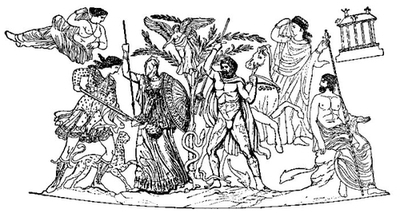
Fig. 52. Contest of Athena and Poseidon
Amongst these leaves she made a Butterfly,
With excellent device and wondrous slight,
Fluttering among the olives wantonly,
That seemed to live, so like it was in sight;
The velvet nap which on his wings doth lie,
The silken down with which his back is dight,
His broad outstretchèd horns, his hairy thighs,
His glorious colors, and his glistering eyes.
Which when Arachne saw, as overlaid
And masterèd with workmanship so rare,
She stood astonished long, ne aught gainsaid;
And with fast-fixèd eyes on her did stare.[81]
So wonderful was the central circle of Minerva's web; and in
the four corners were represented incidents illustrating the displeasure
of the gods at such presumptuous mortals as had dared to
contend with them. These were meant as warnings from Minerva
to her rival to give up the contest before it was too late.
But Arachne did not yield. She filled her web with subjects
designedly chosen to exhibit the failings and errors of the gods.
One scene represented Leda caressing the swan; and another,
Danaë and the golden shower. Still another depicted Europa
deceived by Jupiter under the disguise of a bull. Its appearance
was that of a real bull, so naturally was it wrought and so natural
the water in which it swam.
With such subjects Arachne filled her canvas, wonderfully well
done but strongly marking her presumption and impiety. Minerva
could not forbear to admire, yet was indignant at the insult. She
struck the web with her shuttle and rent it in pieces; then, touching
the forehead of Arachne, she made her realize her guilt. It
was more than mortal could bear; and forthwith Arachne hanged
herself. "Live, guilty woman," said Minerva, "but that thou
mayest preserve the memory of this lesson continue to hang, both
thou and thy descendants, to all future times." Then, sprinkling
her with the juices of aconite, the goddess transformed her into a
spider, forever spinning the thread by which she is suspended.[82]
67. Myths of Mars. The relations of Mars to other deities
may be best illustrated by passages from the Iliad, which, generally
speaking, presents him in no very favorable light.
68. Mars and Diomede. In the war of the Greeks and the
Trojans,[83] the cause of the former was espoused by Minerva, of
the latter by Mars. Among the chieftains of the Greeks in a
certain battle, Diomede, son of Tydeus, was prominent. Now
when Mars, scourge of mortals, beheld noble Diomede, he made
straight at him.
... And when they were come nigh in onset on one another, first Mars
thrust over the yoke and horses' reins with spear of bronze, eager to take away
his life. But the bright-eyed goddess Minerva with her hand seized the spear
and thrust it up over the car, to spend itself in vain. Next Diomede of the
loud war cry attacked with spear of bronze; and Minerva drave it home against
Mars' nethermost belly, where his taslets were girt about him. There smote
he him and wounded him, rending through his fair skin,—and plucked forth
the spear again. Then brazen Mars bellowed loud as nine thousand warriors
or ten thousand cry in battle as they join in strife and fray. Thereat trembling
gat hold of Achæans and Trojans for fear, so mightily bellowed Mars
insatiate of battle.
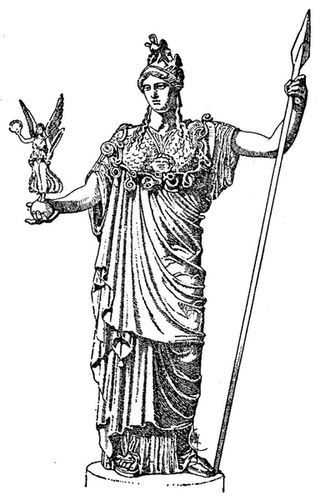
Even as gloomy mist appeareth from the clouds when after heat a stormy
wind ariseth, even so to Tydeus' son Diomede brazen Mars appeared amid
clouds, faring to wide Heaven. Swiftly
came he to the gods' dwelling, steep
Olympus, and sat beside Jupiter, son
of Cronus, with grief at heart, and
showed the immortal blood flowing
from the wound, and piteously spake
to him winged words: "Father Jupiter,
hast thou no indignation to behold
these violent deeds? For ever cruelly
suffer we gods by one another's devices,
in showing men grace. With
thee are we all at variance, because
thou didst beget that reckless maiden
and baleful, whose thought is ever
of iniquitous deeds. For all the other
gods that are in Olympus hearken to
thee, and we are subject every one;
only her thou chaste-nest not, neither
in deed nor word, but settest her on,
because this pestilent one is thine
own offspring. Now hath she urged
on Tydeus' son, even overweening
Diomede, to rage furiously against
the immortal gods. The Cyprian first
he wounded in close fight, in the wrist of her hand, and then assailed he me,
even me, with the might of a god. Howbeit my swift feet bare me away; else
had I long endured anguish there amid the grisly heaps of dead, or else had
lived strengthless from the smitings of the spear."
Then Jupiter the cloud-gatherer looked sternly at him, and said: "Nay, thou
renegade, sit not by me and whine. Most hateful to me art thou of all gods
that dwell in Olympus; thou ever lovest strife and wars and battles. Truly
thy mother's spirit is intolerable, unyielding, even Juno's; her can I scarce
rule with words. Therefore I deem that by her prompting thou art in this
plight. Yet will I no longer endure to see thee in anguish; mine offspring
art thou, and to me thy mother bare thee. But wert thou born of any other
god unto this violence, long ere this hadst thou been lower than the sons of
Heaven."
So spake he and bade Pæan heal him. And Pæan laid assuaging drugs
upon the wound, and healed him, seeing he was in no wise of mortal mold.
Even as fig juice maketh haste to thicken white milk, that is liquid but curdleth
speedily as a man stirreth, even so swiftly healed he impetuous Mars.
And Hebe bathed him and clothed him in gracious raiment, and he sate down
by Jupiter, son of Cronus, glorying in his might.
Then fared the twain back to the mansion of great Jupiter, even Juno and
Minerva, having stayed Mars, scourge of mortals, from his man-slaying.[84]
69. Mars and Minerva. It would seem that the insatiate son of
Juno should have learned by this sad experience to avoid measuring
arms with the ægis-bearing Minerva. But he renewed the contest
at a later period in the fortunes of the Trojan War:
... Jupiter knew what was coming as he sat upon Olympus, and his heart
within him laughed pleasantly when he beheld that strife of gods. Then no
longer stood they asunder, for Mars, piercer of shields, began the battle and
first made for Minerva with his bronze spear, and spake a taunting word:
"Wherefore, O dogfly, dost thou match gods with gods in strife, with stormy
daring, as thy great spirit moveth thee? Rememberest thou not how thou
movedst Diomede, Tydeus' son, to wound me, and thyself didst take a visible
spear and thrust it straight at me and pierce through my fair skin? Therefore
deem I now that thou shalt pay me for all that thou hast done."
Thus saying, he smote on the dread tasseled ægis that not even the lightning
of Jupiter can overcome—thereon smote blood-stained Mars with his
long spear. But she, giving back, grasped with stout hand a stone that lay
upon the plain, black, rugged, huge, which men of old time set to be the landmark
of a field; this hurled she, and smote impetuous Mars on the neck, and
unstrung his limbs. Seven roods he covered in his fall, and soiled his hair
with dust, and his armor rang upon him. And Minerva laughed, and spake to
him winged words exultingly: "Fool, not even yet hast thou learnt how far
better than thou I claim to be, that thus thou matchest thy might with mine.
Thus shalt thou satisfy thy mother's curses, who deviseth mischief against
thee in her wrath, for that thou hast left the Achæans and givest the proud
Trojans aid."
Thus having said, she turned from him her shining eyes. Him did Venus,
daughter of Jupiter, take by the hand and lead away, groaning continually, for
scarce gathered he his spirit back to him.[85]
70. The Fortunes of Cadmus. Toward mortals Mars could show
himself, on occasion, as vindictive as his fair foe, the unwearied
daughter of Jove. This fact not only Cadmus, who slew a serpent
sacred to Mars, but all the family of Cadmus found out to their cost.
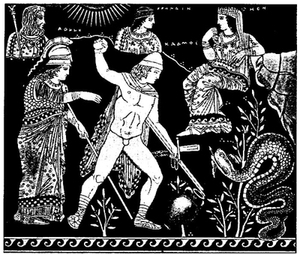
Fig. 54. Cadmus slaying the Dragon
When Europa was carried away by Jupiter in the guise of a bull,
her father Agenor commanded his son Cadmus to go in search of
her and not to return without her. Cadmus sought long and far;
then, not daring to return unsuccessful, consulted the oracle of
Apollo to know what country he should settle in. The oracle informed
him that he would find a cow in the field, should follow her
wherever she might wander, and where she stopped should build a
city and call it Thebes. Cadmus had hardly left the Castalian cave,
from which the oracle was delivered, when he saw a young cow
slowly walking before him. He followed her close, offering at the
same time his prayers to Phœbus. The cow went on till she passed
the shallow channel of Cephissus and came out into the plain of
Panope. There she stood still. Cadmus gave thanks, and stooping
down kissed the foreign soil, then lifting his eyes, greeted the surrounding
mountains. Wishing to offer a sacrifice to his protecting
deity, Minerva, he sent his servants to seek pure water for a libation.
Near by there stood an ancient grove which had never been
profaned by the ax, in the midst of which was a cave thick covered
with the growth of bushes, its roof forming a low arch from
beneath which burst forth a fountain of purest water. But in the
cave lurked a serpent with crested head, and scales glittering like
gold; his eyes shone like fire; his body was swollen with venom;
he vibrated a triple tongue and showed a triple row of teeth. No
sooner had the Tyrians dipped their pitchers in the fountain and
the in-gushing waters had made a sound, than the monster, twisting
his scaly body in a huge coil, darted upon them and destroyed
some with his fangs, others in his folds, and others with his
poisonous breath.
Cadmus, having waited for the return of his men till midday,
went in search of them. When he entered the wood and saw their
lifeless bodies and the dragon with his bloody jaws, not knowing
that the serpent was sacred to Mars, scourge of mortals, he lifted
a huge stone and threw it with all his force at the monster. The
blow made no impression. Minerva, however, was present, unseen,
to aid her worshiper. Cadmus next threw his javelin, which penetrated
the serpent's scales and pierced through to his entrails.
The monster attempted to draw out the weapon with his mouth,
but broke it off, leaving the iron point rankling in his flesh. His
neck swelled with rage, bloody foam covered his jaws, and the
breath of his nostrils poisoned the air around. As he moved onward,
Cadmus retreated before him, holding his spear opposite to
the serpent's opened jaws. At last, watching his chance, the hero
thrust the spear at a moment when the animal's head thrown back
came against the trunk of a tree, and so succeeded in pinning him
to its side.
While Cadmus stood over his conquered foe, contemplating its
vast size, a voice was heard (from whence he knew not, but it was
Minerva's) commanding him to take the dragon's teeth and sow
them in the earth. Scarce had he done so when the clods began
to move and the points of spears to appear above the surface.
Next, helmets with their nodding plumes came up; next, the
shoulders and breasts and limbs of men with weapons, and in time
a harvest of armed warriors. Cadmus prepared to encounter a new
enemy, but one of them said to him, "Meddle not with our civil
war." With that he who had spoken smote one of his earthborn
brothers with a sword, and he himself fell pierced with an arrow
from another. The latter fell victim to a fourth, and in like manner
the whole crowd dealt with each other till all but five fell slain.
These five joined with Cadmus in building his city, to which they
gave the name appointed.
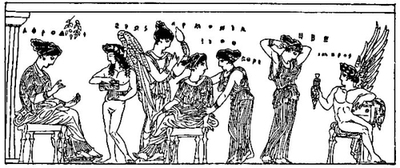
FIG. 55. Harmonia in Company of Deities
As penance for the destruction of this sacred serpent, Cadmus
served Mars for a period of eight years. After he had been absolved
of his impiety,
Minerva set him over
the realm of Thebes,
and Jove gave him to
wife Harmonia, the
daughter of Venus
and Mars. The gods
left Olympus to honor
the occasion with their
presence; and Vulcan presented the bride with a necklace of surpassing
brilliancy, his own workmanship. Of this marriage were
born four daughters, Semele, Ino, Autonoë, and Agave, and one
son, Polydorus. But in spite of the atonement made by Cadmus, a
fatality hung over the family. The very necklace of Vulcan seemed
to catch the spirit of ill luck and convey a baleful influence to such
as wore it. Semele, Ino, Actæon the son of Autonoë, and Pentheus
the son of Agave, all perished by violence. Cadmus and
Harmonia quitted Thebes, grown odious to them, and emigrated to
the country of the Enchelians, who received them with honor and
made Cadmus their king. But the misfortunes of their children
still weighing upon their minds, Cadmus one day exclaimed, "If a
serpent's life is so dear to the gods, I would I were myself a serpent."
No sooner had he uttered the words than he began to
change his form. Harmonia, beholding it, prayed the gods to let
her share his fate. Both became serpents. It is said that, mindful
of their origin, they neither avoid the presence of man nor do
they injure any one. But the curse appears not to have passed
from their house until the sons of their great-great-grandson
Œdipus had by fraternal strife ended themselves and the family.[86]
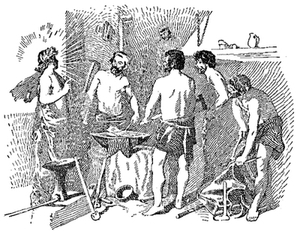
Fig. 56. The Forge of Vulcan
From the painting by Velasquez
71. Myths of Vulcan. The stories of Vulcan are few, although incidents
illustrating his character are sufficiently numerous. According
to an account already given, Vulcan, because of his lameness,
was cast out of Heaven by his mother Juno. The sea-goddesses
Eurynome and Thetis took him mercifully to themselves, and for
nine years cared for him, while he plied his trade and gained proficiency
in it. In order to revenge himself upon the mother who
had so despitefully used him, he fashioned in the depths of the
sea a throne of cunning device, which he sent to his mother. She,
gladly accepting the glorious gift, sat down upon it, to find out
that straightway all manner of invisible chains and fetters wound
and clasped themselves about her so that she could not rise. The
assistance of the gods was of no avail to release her. Then Mars
sought to bring Vulcan to Heaven by force that he might undo his
trickery; but before the flames of the fire-god, the impetuous warrior
speedily retreated. One god, however, the jovial Bacchus, was
dear to the blacksmith. He drenched Vulcan with wine, conducted
him to Olympus, and by persuasion caused him to set the queen of
gods and men at liberty.
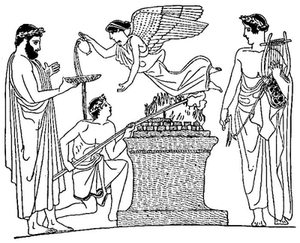
FIG. 57. A Sacrifice to Apollo
That Vulcan was not permanently hostile to Juno is shown
by the services that on various occasions he rendered her. He
forged the shield of her favorite Achilles; and, at her instance, he
undertook a contest against
the river Xanthus. Homer[87]
describes the burning of
elms and willow trees and
tamarisks, the parching of
the plains, the bubbling of
the waters, that signalized the
fight, and how the eels and
other fish were afflicted by
Vulcan till Xanthus in anguish
cried for quarter.
72. Myths of Apollo. The
myths which cluster about the
name of Phœbus Apollo illustrate, first, his birth and the wanderings
of his mother, Latona; secondly, his victory over darkness and winter;
thirdly, his gifts to man,—youth and vigor, the sunshine of
spring, and the vegetation of early summer; fourthly, his baleful
influence,—the sunstroke and drought of midsummer, the miasma
of autumn; fifthly, his life on earth, as friend and counselor of
mankind,—healer, soothsayer, and musician, prototype of manly
beauty, and lover of beautiful women.
73. The Wanderings of Latona. Persecuted by the jealousy of
the white-armed Juno, Latona fled from land to land. At last, bearing
in her arms the infant progeny of Jove, she reached Lycia,
weary with her burden and parched with thirst. There the following
adventure ensued. By chance the persecuted goddess espied
in the bottom of the valley a pond of clear water, where the country
people were at work gathering willows and osiers. She approached
and kneeling on the bank would have slaked her thirst
in the cool stream, but the rustics forbade her. "Why do you
refuse me water?" said she. "Water is free to all. Yet I ask it of
you as a favor. I have no intention of washing my limbs in it,
weary though they be, but only of quenching my thirst. A draft
of water would be nectar to me, and I would own myself indebted
to you for life itself. Let these infants move your pity, who stretch
out their little arms as if to plead for me."
But the clowns persisted in their rudeness; they added jeers,
and threatened violence if she did not leave the place. They waded
into the pond and stirred up the mud with their feet, so as to
make the water unfit to drink. Enraged, the goddess no longer
supplicated the clowns, but lifting her hands to Heaven exclaimed,
"May they never quit that pool but pass their lives there!" And
it came to pass accordingly. They still live in the water, sometimes
totally submerged, then raising their heads above the surface or
swimming upon it; sometimes coming out upon the bank, but soon
leaping back again into the water. Their voices are harsh, their
throats bloated, their mouths distended by constant railing; their
necks have shrunk up and disappeared, and their heads are joined
to their bodies. Their backs are green, their disproportioned bellies
white. They dwell as frogs in the slimy pool.[88]
74. Apollo, the Light Triumphant. Soon after his birth the
sun-god spent a year among the Hyperboreans, whose shining land
has been already described.[89] On his return, slaying with his golden
arrows the Python that had infested the slopes near Delphi, he
sang for the first time that song of victory which, as the Pæan,
is still among all nations synonymous with jubilation, praise, and
thanksgiving. In his conflict with another monster of darkness
and winter, the god of the silver bow had the assistance of his
sister Diana. By their unerring fiery darts they subdued the giant
Tityus, who not only had obstructed the peaceful ways to the
oracle of Delphi, but had ventured to insult the mother of the twin
deities. They overthrew also the Aloadæ, Otus and Ephialtes, sons
of Iphimedia and Neptune. These monsters, the reputed sons of
Aloeus, represent, perhaps, the unregulated forces of vegetation;
they were renowned for their strength, stature, and courage. They
grew at the rate of three cubits in height and one in breadth
every year; and, when nine years of age, they attempted, by piling
Mount Ossa upon Olympus, and Mount Pelion on top, to scale
the skies and dethrone the immortals. It is reported that not
Apollo and Diana, but Jupiter himself with
his lightning slew them. They atoned for
their presumption in Hades, where, bound
by serpents to a pillar, they were tormented
by the perpetual hooting of a screech owl.[90]
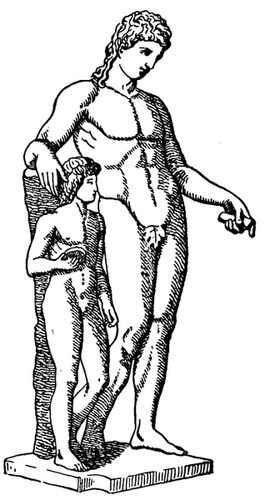
Fig. 58. Apollo with Hyacinthus
75. Hyacinthus. The fiery force of the
Far-darter was not felt by the monsters
of darkness alone. His friendship for the
young and the vigorous was frequently as
dangerous as it was dear to the objects of it.
He was, for instance, passionately fond of a
youth named Hyacinthus. The god of the
silver bow accompanied the lad in his sports,
carried the nets when he went fishing, led
the dogs when he went to hunt, followed
him in his excursions in the mountains, and
neglected for him both lyre and arrows. One
day they played a game of quoits; Apollo, heaving aloft the discus
with strength mingled with skill, sent it high and far. Hyacinthus,
excited with the sport and eager to make his throw, ran forward to
seize the missile; but it bounded from the earth and struck him
in the forehead. He fainted and fell. The god, as pale as himself,
raised him and tried all his art to stanch the wound and retain the
flitting life, but in vain. As when one has broken the stem of a
lily in the garden it hangs its head and turns its flowers to the
earth, so the head of the dying boy, as if too heavy for his neck,
fell over on his shoulder. "Thou diest, Hyacinth," spake Phœbus,
"robbed of thy youth by me. Would that I could die for thee! But
since that may not be, my lyre shall celebrate thee, my song shall
tell thy fate, and thou shalt become a flower inscribed with my regret."
While the golden god spoke, the blood which had flowed
on the ground and stained the herbage ceased to be blood; and a
flower of hue more beautiful than the Tyrian sprang up, resembling
the lily, save that this is purple and that silvery white. Phœbus
then, to confer still greater honor, marked the petals with his sorrow,
inscribing "Ai! ai!" upon them. The flower bears the name
of Hyacinthus, and with returning spring revives the memory of
his fate.[91]
It was said that Zephyrus (the west wind), who was also fond
of Hyacinthus and jealous of his preference of Apollo, blew the
quoit out of its course to make it strike Hyacinthus.
While this youth met his death by accident, another of Apollo's
favorites, his own son, brought death upon himself by presumption.
The story is as follows:
76. Phaëthon[2] was the son of Apollo and the nymph Clymene.
One day Epaphus, the son of Jupiter and Io,[92] scoffed at the idea
of Phaëthon's being the son of a god. Phaëthon complained of
the insult to his mother Clymene. She sent him to Phœbus to ask
for himself whether he had not been truly informed concerning
his parentage. Gladly Phaëthon traveled toward the regions of
sunrise and gained at last the palace of the Sun. He approached
his father's presence, but stopped at a distance, for the light was
more than he could bear. Phœbus Apollo, arrayed in purple, sat
on a throne that glittered with diamonds. Beside him stood the
Day, the Month, the Year, the Hours, and the Seasons. Surrounded
by these attendants, the Sun beheld the youth dazzled
with the novelty and splendor of the scene, and inquired the purpose
of his errand. The youth replied, "Oh, light of the boundless
world, Phœbus, my father—if thou dost yield me that name—give
me some proof, I beseech thee, by which I may be known
as thine!" He ceased. His father, laying aside the beams that
shone around his head, bade him approach, embraced him, owned
him for his son, and swore by the river Styx[93] that whatever proof
he might ask should be granted. Phaëthon immediately asked to
be permitted for one day to drive the chariot of the sun. The
father repented of his promise and tried to dissuade the boy by
telling him the perils of the undertaking. "None but myself," he
said, "may drive the flaming car of day. Not even Jupiter, whose
terrible right arm hurls the thunderbolts. The first part of the way
is steep and such as the horses when fresh in the morning can
hardly climb; the middle is high up in the heavens, whence I
myself can scarcely, without alarm, look down and behold the earth
and sea stretched beneath me. The last part of the road descends
rapidly and requires most careful driving. Tethys, who is waiting
to receive me, often trembles for me lest I should fall headlong.
Add to this that the heaven is all the time turning round and carrying
the stars with it. Couldst thou keep thy course while the sphere
revolved beneath thee? The road, also, is through the midst of
frightful monsters. Thou must pass by the horns of the Bull, in
front of the Archer, and near the Lion's jaws, and where the
Scorpion stretches its arms in one direction and the Crab in
another. Nor wilt thou find it easy to guide those horses, with
their breasts full of fire that they breathe forth from their mouths
and nostrils. Beware, my son, lest I be the donor of a fatal gift;
recall the request while yet thou canst." He ended; but the youth
rejected admonition and held to his demand. So, having resisted
as long as he might, Phœbus at last led the way to where stood
the lofty chariot.
It was of gold, the gift of Vulcan,—the axle of gold, the pole
and wheels of gold, the spokes of silver. Along the seat were rows
of chrysolites and diamonds, reflecting the brightness of the sun.
While the daring youth gazed in admiration, the early Dawn threw
open the purple doors of the east and showed the pathway strewn
with roses. The stars withdrew, marshaled by the Daystar, which
last of all retired also. The father, when he saw the earth beginning
to glow and the Moon preparing to retire, ordered the Hours to
harness up the horses. They led forth from the lofty stalls the
steeds full fed with ambrosia, and attached the reins. Then the
father, smearing the face of his son with a powerful unguent, made
him capable of enduring the brightness of the flame. He set the
rays on the lad's head, and, with a foreboding sigh, told him to
spare the whip and hold tight the reins; not to take the straight
road between the five circles, but to turn off to the left; to keep
within the limit of the middle zone and avoid the northern and the
southern alike; finally, to keep in the well-worn ruts and to drive
neither too high nor too low, for the middle course was safest
and best.[94]
Forthwith the agile youth sprang into the chariot, stood erect,
and grasped the reins with delight, pouring out thanks to his
reluctant parent. But the steeds soon perceived that the load they
drew was lighter than usual; and as a ship without ballast is tossed
hither and thither on the sea, the chariot, without its accustomed
weight, was dashed about as if empty. The horses rushed headlong
and left the traveled road. Then, for the first time, the Great and
Little Bears were scorched with heat, and would fain, if it were
possible, have plunged into the water; and the Serpent which lies
coiled round the north pole, torpid and harmless, grew warm, and
with warmth felt its rage revive. Boötes, they say, fled away,
though encumbered with his plow and unused to rapid motion.
When hapless Phaëthon looked down upon the earth, now spreading
in vast extent beneath him, he grew pale, and his knees shook
with terror. He lost his self-command and knew not whether to
draw tight the reins or throw them loose; he forgot the names of
the horses. But when he beheld the monstrous forms scattered
over the surface of heaven,—the Scorpion extending two great
arms, his tail, and his crooked claws over the space of two signs
of the zodiac,—when the boy beheld him, reeking with poison
and menacing with fangs, his courage failed, and the reins fell
from his hands. The horses, unrestrained, went off into unknown
regions of the sky in among the stars, hurling the chariot over
pathless places, now up in high heaven, now down almost to the
earth. The moon saw with astonishment her brother's chariot
running beneath her own. The clouds began to smoke. The
forest-clad mountains burned,—Athos and Taurus and Tmolus
and Œte; Ida, once celebrated for fountains; the Muses' mountain
Helicon, and Hæmus; Ætna, with fires within and without, and
Parnassus, with his two peaks, and Rhodope, forced at last to part
with his snowy crown. Her cold climate was no protection to
Scythia; Caucasus burned, and Ossa and Pindus, and, greater
than both, Olympus,—the Alps high in air, and the Apennines
crowned with clouds.
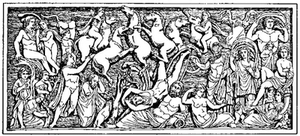
Fig. 59. The Fall of Phaëthon
Phaëthon beheld the world on fire and felt the heat intolerable.
Then, too, it is said, the people of Æthiopia became black because
the blood was called by the heat so suddenly to the surface; and
the Libyan desert was dried up to the condition in which it remains
to this day. The Nymphs of the fountains, with disheveled hair,
mourned their waters, nor were the rivers safe beneath their banks;
Tanaïs smoked, and Caïcus, Xanthus, and Mæander; Babylonian
Euphrates and Ganges, Tagus, with golden sands, and Caÿster,
where the swans resort. Nile fled away and hid his head in the
desert, and there it still remains concealed. Where he used to discharge
his waters through seven mouths into the sea, seven dry
channels alone remained. The earth cracked open, and through
the chinks light broke into Tartarus and frightened the king of
shadows and his queen. The sea shrank up. Even Nereus and his
wife Doris with the Nereïds, their daughters, sought the deepest
caves for refuge. Thrice Neptune essayed to raise his head above
the surface and thrice was driven back by the heat. Earth, surrounded
as she was by waters, yet with head and shoulders bare,
screening her face with her hand, looked up to heaven, and with
husky voice prayed Jupiter, if it were his will that she should
perish by fire, to end her agony at once by his thunderbolts, or
else to consider his own Heaven, how both the poles were smoking
that sustained his palace, and that all must fall if they were
destroyed.
Earth, overcome with heat and thirst, could say no more. Then
Jupiter, calling the gods to witness that all was lost unless some
speedy remedy were applied, thundered, brandished a lightning
bolt in his right hand, launched it against the charioteer, and struck
him at the same moment from his seat and from existence.
Phaëthon, with his hair on fire, fell headlong, like a shooting star
which marks the heavens with its brightness as it falls, and Eridanus,
the great river, received him and cooled his burning frame.
His sisters, the Heliades, as they lamented his fate, were turned
into poplar trees on the banks of the river; and their tears, which
continued to flow, became amber as they dropped into the stream.
The Italian Naiads reared a tomb for him and inscribed these
words upon the stone:
Driver of Phœbus' chariot, Phaëthon,
Struck by Jove's thunder, rests beneath this stone.
He could not rule his father's car of fire,
Yet was it much so nobly to aspire.[95]
77. The Plague sent upon the Greeks before Troy. It was not,
however, only by accident, or by the ill-advised action of those
whom he loved, that Apollo's gifts of light and heat were turned
into misfortunes. Mortals who offended him were leveled by the
cruel sunstroke, by arrows of malarial venom, of manifold sickness
and death.
When the host of the Achæans was encamped before Troy, the
king of men, Atrides, unjustly declined to restore his captive,
Chryseïs of the fair cheeks, to her father Chryses, the priest of
far-darting Apollo. Then the aged Chryses went apart and prayed
aloud, "Hear me, god of the silver bow, ... let the Danaans pay
by thine arrows for my tears!"
So spake he in prayer; and Phœbus Apollo heard him, and came down
from the peaks of Olympus wroth at heart, bearing on his shoulders his bow
and covered quiver. And the arrows clanged upon his shoulders in his wrath,
as the god moved; and he descended like to night. Then he sate him aloof
from the ships, and let an arrow fly; and there was heard a dread clanging of
the silver bow. First did he assail the mules and fleet dogs, but afterward,
aiming at the men his piercing dart, he smote; and the pyres of the dead
burnt continually in multitude. Nor until Agamemnon had sent back his
winsome captive to her father did Apollo remove from the Danaans the loathsome
pestilence.[96]
78. The Punishment of Niobe is another illustration of the swift
and awful vengeance of Apollo, and also of his sister Diana. This
Niobe was the daughter of a certain Tantalus, king of Phrygia,
who had been received at the table of the gods by his father
Jupiter. But there was a strain of ingratitude and conceit in both
father and daughter. The father not only betrayed the secrets of
the gods, but, to ridicule their reputed omniscience, attempted at
a banquet to deceive them into eating the roasted flesh of his own
son Pelops. The gods were not deceived. Pelops was restored
to life,—Tantalus consigned to Tartarus. The daughter Niobe,
although she owed her happy marriage with Jupiter's son Amphion,
and her seven stalwart sons and seven blooming daughters, to the
favor of the gods and of Latona in particular, boasted of her birth,
her marriage, and her offspring, bragged of her superiority to
Latona, and, on one occasion, scoffed at the annual celebration in
honor of the goddess and her two children. Surveying the people
of Thebes with haughty glance, she said, "What folly to prefer
beings whom you have never seen to those who stand before your
eyes! Will you prefer to me this Latona, the Titan's daughter,
with her two children? I have seven times as many. Were I to
lose some of my children, I should hardly be left as poor as Latona
with her two only. Put off the laurel from your brows,—have
done with this worship!" The people left the sacred services
uncompleted.
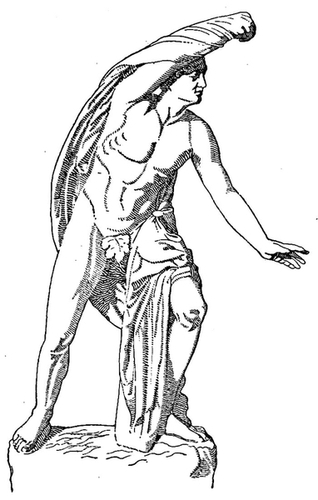
The goddess was indignant. On the Cynthian mountain top
she thus addressed her son and daughter: "My children, I who
have been so proud of you both and have been used to hold
myself second to none of the goddesses except Juno alone, begin
now to doubt whether I am indeed a goddess. I shall be deprived
of my worship altogether unless you protect me." She was proceeding
in this strain, but Apollo interrupted her. "Say no more,"
said he; "speech only delays punishment." So said Diana also.
Darting through the air, veiled in clouds, they alighted on the
towers of the city. Spread out
before the gates was a broad
plain where the youth of the city
pursued their warlike sports.
The sons of Niobe were there
with the rest,—some mounted
on spirited horses richly caparisoned,
some driving gay chariots.
Ismenos, the first-born,
as he guided his foaming steeds
was struck by an arrow from
above. "Ah me!" he cried,—dropped
the reins and fell
lifeless. Another, hearing the
sound of the bow, gave the rein
to his horses and attempted to
escape. The inevitable arrow
overtook him as he fled. Two
others, younger, stood wrestling
breast to breast: one arrow
pierced them both. Alphenor,
an elder brother, hastened to
the spot to render assistance, but fell in the act of brotherly duty.
One only was left, Ilioneus. "Spare me, ye gods!" he cried,
addressing all of them, in his ignorance that all needed not his
supplication; and Apollo would have spared him, but the arrow
had already left the string, and it was too late.
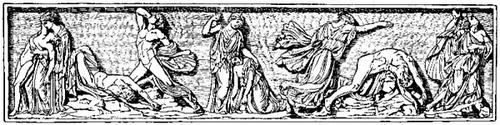
Fig 61. The Children of Niobe
When Niobe was acquainted with what had taken place, she
was indignant that the gods had dared, and amazed that they had
been able to do it. Her husband Amphion, overwhelmed with
the blow, destroyed himself. But the mother knelt over the lifeless
bodies and kissed them. Raising
her pallid arms to heaven, "Cruel
Latona," said she, "satiate thy hard
heart while I follow to the grave
my seven sons. Yet where is thy
triumph? Bereaved as I am, I am
still richer than thou, my conqueror."
Scarce had she spoken, when the
bow sounded and struck terror into
all hearts except Niobe's alone. She
was brave from excess of grief. Her
daughters stood in garments of
mourning over the biers of their
dead brothers. One after another
they fell, struck by arrows, beside
the corpses that they were bewailing.
Only one remained, whom the
mother held clasped in her arms
and covered, as it were, with her
whole body. "Spare me one and
that the youngest! Oh, spare me
one of so many!" she cried; and
while she spoke, that one fell dead.
Desolate she sat among sons, daughters,
husband, all dead, and seemed
torpid with grief. The breeze moved
not her hair, no color was on her
cheek, her eyes glared fixed and
immovable, there was no sign of
life about her. Her very tongue
cleaved to the roof of her mouth
and her veins ceased to convey the
tide of life. Her neck bent not,
her arms made no gesture, her foot
no step. She was changed to stone,
within and without. Yet tears continued
to flow; and borne on a
whirlwind to her native mountain, she still remains, a mass of
rock from which a trickling stream flows, the tribute of her never-ending
grief.[97]
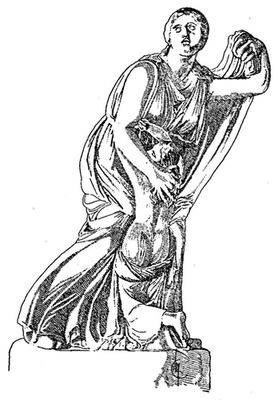
Fig. 62. Niobe and her Youngest Daughter
Amid nine daughters slain by Artemis
Stood Niobe; she rais'd her head above
Those beauteous forms which had brought down the scath
Whence all nine fell, rais'd it, and stood erect,
And thus bespake the goddess enthroned on high:
"Thou heardest, Artemis, my daily prayer
That thou wouldst guide these children in the pass
Of virtue, through the tangling wilds of youth,
And thou didst ever guide them: was it just
To smite them for a beauty such as thine?
Deserv'd they death because thy grace appear'd
In ever modest motion? 'twas thy gift,
The richest gift that youth from heaven receives.
True, I did boldly say they might compare
Even with thyself in virgin purity:
May not a mother in her pride repeat
What every mortal said?
One prayer remains
For me to offer yet.
Thy quiver holds
More than nine arrows: bend thy bow; aim here!
I see, I see it glimmering through a cloud.
Artemis, thou at length art merciful:
My children will not hear the fatal twang."[98]
79. The Lamentation for Linus. How the people of Argos fell
under the displeasure of Apollo is told in the story of Linus,
a beautiful son of Apollo and Psamathe. In fear of her father
the king, Psamathe exposed the child on the mountains where,
brought up by shepherds among the lambs, he was in tender youth
torn to pieces by dogs. Meanwhile, Psamathe herself was driven
from her father's home; wherefore Apollo sent against the land
of the Argives a monster that for a season destroyed the children,
but at last was slain by a noble youth named Corœbus. To
appease the wrathful deity, a shrine was erected midway between
Argos and Delphi; and every year Linus and his mother were
bewailed in melancholy lays by the mothers and children of Argos,
especially by such as had lost by death their own beloved. The
fate of Linus, like that of Hyacinthus and others who succumb
in the springtime of life under the excessive love of some shining
deity,[99] typifies the sudden withering of herbs and flowers
and of animal life,—the calves and lambs, young children too,
under the fierce shafts of summer. The very name of Linus is
taken from the refrain ai-linon, or "woe is me," of the lament
anciently sung by the country people when thus afflicted by the
unhealthy heats, because of which the crops fail and the dogs go
mad and tear the little lambs to pieces. In the Iliad there is a
beautiful picture which shows us that the song was not reserved
completely for the dog days. It is of a vineyard teeming plenteously
with clusters:
And there was a pathway through it by which the vintagers might go. And
maidens and striplings in childish glee bare the sweet fruit in plaited baskets.
And in the midst of them a boy made pleasant music on a clear-toned viol, and
sang thereto a sweet Linos-song with delicate voice; while the rest with feet
falling together kept time with the music and song.[100]
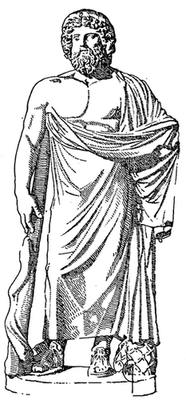
80. Æsculapius. The Thessalian princess Coronis (or the
Messenian, Arsinoë) bore to Apollo a child who was named
Æsculapius. On his mother's death
the infant was intrusted to the charge
of Chiron, most famous of the Centaurs,
himself instructed by Apollo and
Diana in hunting, medicine, music, and
the art of prophecy. When the sage
returned to his home bearing the infant,
his daughter Ocyrrhoë came forth to
meet him, and at sight of the child
burst into a prophetic strain, foretelling,
the glory that he should achieve.
Æsculapius, when grown up, became a
renowned physician; in one instance he
even succeeded in restoring the dead to
life. Pluto resented this, and, at his
request, Jupiter struck the bold physician
with lightning and killed him, but
after his death received him into the
number of the gods.[101]
81. Apollo in Exile. Apollo, indignant
at the destruction of this son,
wreaked his vengeance on the innocent workmen who had made
the thunderbolt. These were the Cyclopes, who had their workshop
under Mount Ætna, from which the smoke and flames of
their furnaces are constantly issuing. Apollo shot his arrows at
the Cyclopes, a deed which so incensed Jupiter that he condemned
him to serve a mortal for the space of one year. Accordingly,
Apollo went into the service of Admetus, king of Thessaly, and
pastured his flocks for him on the verdant banks of the river
Amphrysus. How the god lived among men, and what they
thought of him, is well told in the following verses.
82. Lowell's Shepherd of King Admetus.
There came a youth upon the earth,
Some thousand years ago,
Whose slender hands were nothing worth,
Whether to plow, or reap, or sow.
Upon an empty tortoise-shell
He stretched some chords, and drew
Music that made men's bosoms swell
Fearless, or brimmed their eyes with dew.
Then King Admetus, one who had
Pure taste by right divine,
Decreed his singing not too bad
To hear between the cups of wine:
And so, well pleased with being soothed
Into a sweet half-sleep,
Three times his kingly beard he smoothed,
And made him viceroy o'er his sheep.
His words were simple words enough,
And yet he used them so,
That what in other mouths was rough
In his seemed musical and low.
Men called him but a shiftless youth,
In whom no good they saw;
And yet, unwittingly, in truth,
They made his careless words their law.
They knew not how he learned at all,
For idly, hour by hour,
He sat and watched the dead leaves fall,
Or mused upon a common flower.
It seemed the loveliness of things
Did teach him all their use,
For, in mere weeds, and stones, and springs
He found a healing power profuse.
Men granted that his speech was wise,
But, when a glance they caught
Of his slim grace and woman's eyes,
They laughed, and called him good-for-naught.
Yet after he was dead and gone
And e'en his memory dim,
Earth seemed more sweet to live upon,
More full of love, because of him.
And day by day more holy grew
Each spot where he had trod,
Till after-poets only knew
Their first-born brother as a god.
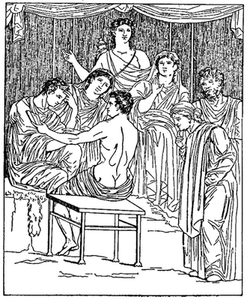
Fig. 64. Admetus must Die
83. Admetus and Alcestis.[102] Admetus was a suitor, with others,
for the hand of Alcestis, the daughter of Pelias, who promised her
to him who should come
for her in a chariot drawn
by lions and boars. This
task Admetus performed by
the assistance of his divine
herdsman, and was made
happy in the possession of
Alcestis. But Admetus falling
ill and being near to
death, Apollo prevailed on
the Fates to spare him on
condition that some one
should consent to die in his
stead. Admetus, in his joy at
this reprieve, thought little
of the ransom, and, perhaps
remembering the declarations
of attachment which
he had often heard from his courtiers and dependents, fancied that
it would be easy to find a substitute. But it was not so. Brave
warriors, who would willingly have periled their lives for their
prince, shrunk from the thought of dying for him on the bed of
sickness; and old servants who had experienced his bounty and
that of his house from their childhood up were not willing to lay
down the scanty remnant of their days to show their gratitude.
Men asked, "Why does not one of his parents do it? They cannot
in the course of nature live much longer, and who can feel like
them the call to rescue the life they gave from an untimely end?"
But the parents, distressed though they were at the thought of
losing him, shrunk from the call. Then Alcestis, with a generous
self-devotion, proffered herself as the substitute. Admetus, fond
as he was of life, would not have submitted to receive it at such
a cost; but there was no remedy. The condition imposed by the
Fates had been met, and the decree was irrevocable. As Admetus
revived, Alcestis sickened, rapidly sank, and died.
Just after the funeral procession had left the palace, Hercules,
the son of Jupiter and Alcmena, arrived. He, to whom no labor
was too arduous, resolved to attempt her rescue. Said he:
"I will go lie in wait for Death, black-stoled
King of the corpses![103] I shall find him, sure,
Drinking, beside the tomb, o' the sacrifice:
And if I lie in ambuscade, and leap
Out of my lair, and seize—encircle him
Till one hand join the other round about—
There lives not who shall pull him out from me,
Rib-mauled, before he let the woman go!
But even say I miss the booty,—say,
Death comes not to the boltered blood,—why, then,
Down go I, to the unsunned dwelling-place
Of Koré[104] and the king there,—make demand,
Confident I shall bring Alkestis back,
So as to put her in the hands of him
My host, that housed me, never drove me off:
Though stricken with sore sorrow hid the stroke,
Being a noble heart and honoring me!
Who of Thessalians, more than this man, loves
The stranger? Who that now inhabits Greece?
Wherefore he shall not say the man was vile
Whom he befriended,—native noble heart!"
So, one look upward, as if Zeus might laugh
Approval of his human progeny,—
One summons of the whole magnific frame,
Each sinew to its service,—up he caught,
And over shoulder cast the lion-shag,
Let the club go,—for had he not those hands?
And so went striding off, on that straight way
Leads to Larissa and the suburb tomb.
Gladness be with thee, Helper of our world!
I think this is the authentic sign and seal
Of Godship that it ever waxes glad,
And more glad, until gladness blossoms, bursts
Into a rage to suffer for mankind,
And recommence at sorrow: drops like seed
After the blossom, ultimate of all.
Say, does the seed scorn earth and seek the sun?
Surely it has no other end and aim
Than to drop, once more die into the ground,
Taste cold and darkness and oblivion there:
And thence rise, tree-like grow through pain to joy,
More joy and most joy,—do man good again.
So to the struggle off strode Herakles.
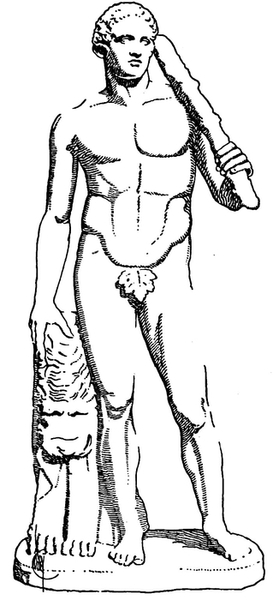
Long time the Thessalians waited and mourned. As for Herakles,
no doubt they supposed him dead. When—but can it be?
... Ay, he it was advancing! In he strode,
And took his stand before Admetos,—turned
Now by despair to such a quietude,
He neither raised his face nor spoke, this time,
The while his friend surveyed him steadily.
That friend looked rough with fighting: had he strained
Worst brute to breast was ever strangled yet?
Somehow, a victory—for there stood the strength,
Happy, as always; something grave, perhaps;
The great vein-cordage on the fret-worked front,
Black-swollen, beaded yet with battle-dew
The golden hair o' the hero!—his big frame
A-quiver with each muscle sinking back
Into the sleepy smooth it leaped from late.
Under the great guard of one arm, there leant
A shrouded something, live and woman-like,
Propped by the heartbeats 'neath the lion-coat.
When he had finished his survey, it seemed,
The heavings of the heart began subside,
The helpful breath returned, and last the smile
Shone out, all Herakles was back again,
As the words followed the saluting hand.
"Admetus," said he, "take and keep this woman, my captive, till
I come thy way again." But Admetus would admit no woman into
the hall that Alcestis had left empty. Then cried Herakles, "Take
hold of her. See now, my friend, if she look not somewhat like
that wife thou hast lost."
Ah, but the tears come, find the words at fault!
There is no telling how the hero twitched
The veil off; and there stood, with such fixed eyes
And such slow smile, Alkestis' silent self!
It was the crowning grace of that great heart,
To keep back joy: procrastinate the truth
Until the wife, who had made proof and found
The husband wanting, might essay once more,
Hear, see, and feel him renovated now—
Able to do now all herself had done,
Risen to the height of her: so, hand in hand,
The two might go together, live and die.
Beside, when he found speech, you guess the speech.
He could not think he saw his wife again:
It was some mocking God that used the bliss
To make him mad! Till Herakles must help:
Assure him that no specter mocked at all;
He was embracing whom he buried once,
Still,—did he touch, might he address the true,
True eye, true body of the true live wife?
... And Herakles said little, but enough—
How he engaged in combat with that king
O' the dæmons: how the field of contest lay
By the tomb's self: how he sprang from ambuscade,
Captured Death, caught him in that pair of hands.
But all the time, Alkestis moved not once
Out of the set gaze and the silent smile;
And a cold fear ran through Admetos' frame:
"Why does she stand and front me, silent thus?"
Herakles solemnly replied, "Not yet
Is it allowable thou hear the things
She has to tell thee; let evanish quite
That consecration to the lower Gods,
And on our upper world the third day rise!
Lead her in, meanwhile; good and true thou art,
Good, true, remain thou! Practice piety
To stranger-guests the old way! So, farewell!
Since forth I fare, fulfill my urgent task
Set by the king, the son of Sthenelos."[105]
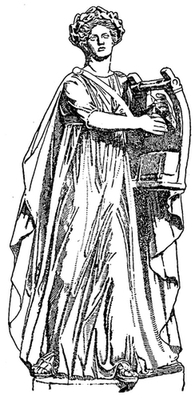
Fig. 66. The Palatine Apollo
84. Apollo, the Musician. Not only in Arcadia, Laconia, and
Thessaly did Apollo care as a herdsman for the cattle of a mortal
master; in Mount Ida, too, by the
order of Jupiter he herded for a year
the "shambling, crook-horned kine" of
King Laomedon, and, playing on the
lyre, aided Neptune to build the walls
of Troy, just as Amphion, in his turn,
had aided in the building of Thebes.
Apollo's life as herdsman was spent in
establishing wise laws and customs, in
musical contests on the flute and the
lyre, or in passages of love with nymphs
and maidens of mortal mold.
85. Apollo, Pan, and Midas.[106] It is
said that on a certain occasion Pan had
the temerity to compare his music with
that of Apollo and to challenge the god
of the lyre to a trial of skill. The challenge
was accepted, and Tmolus, the
mountain-god, was chosen umpire. The
senior took his seat and cleared away
the trees from his ears to listen. At a
given signal Pan blew on his pipes, and with his rustic melody
gave great satisfaction to himself and his faithful follower Midas,
who happened to be present. Then Tmolus turned his head toward
the sun-god, and all his trees turned with him. Apollo rose, his brow
wreathed with Parnassian laurel, while his robe of Tyrian purple
swept the ground. In his left hand he held the lyre and with his
right hand struck the strings. Tmolus at once awarded the victory
to the lyric god, and all but Midas acquiesced in the judgment. He
dissented and questioned the justice of the award. Apollo promptly
transformed his depraved pair of ears into those of an ass.
King Midas tried to hide his misfortune under an ample turban.
But his hair-dresser found it too much for his discretion to keep
such a secret; he dug a hole in the ground and, stooping down,
whispered the story, and covered it up. But a thick bed of reeds
springing up in the meadow began whispering the story, and has
continued to do so from that day to this, every time a breeze
passes over the place.
86. Shelley's Hymn of Pan. In the following verses Pan taunts
Apollo as he might have done when Midas was sitting contentedly by:
From the forests and highlands
We come, we come;
From the river-girt islands,
Where loud waves are dumb,
Listening to my sweet pipings.
The wind in the reeds and the rushes,
The bees on the bells of thyme,
The birds on the myrtle bushes,
The cicale above in the lime,
And the lizards below in the grass,
Were as silent as ever old Tmolus was
Listening to my sweet pipings.
Liquid Peneüs was flowing,
And all dark Tempe lay,
In Pelion's shadow, outgrowing
The light of the dying day,
Speeded by my sweet pipings.
The Sileni, and Sylvans, and Fauns,
And the Nymphs of the woods and waves,
To the edge of the moist river-lawns,
And the brink of the dewy caves,
And all that did then attend and follow
Were silent with love, as you now, Apollo,
With envy of my sweet pipings.
I sang of the dancing stars,
I sang of the dædal Earth,
And of Heaven—and the giant wars,
And Love, and Death, and Birth,—
And then I changed my pipings,—
Singing how down the vale of Menalus
I pursued a maiden, and clasp'd a reed:
Gods and men, we are all deluded thus!
It breaks in our bosom and then we bleed:
All wept, as I think both ye now would,
If envy or age had not frozen your blood,
At the sorrow of my sweet pipings.
87. Marsyas also was unfortunate enough to underrate Apollo's
musical ability. It seems that the flute, an invention of Minerva's,
had been thrown away by that goddess because Cupid laughed at
the grimaces which she made while playing it. Marsyas found the
instrument, blew upon it, and elicited such ravishing sounds that
he was tempted to challenge Apollo himself to a musical contest.
The god, of course, triumphed, and he punished Marsyas by flaying
him alive.
88. The Loves of Apollo. Beside Psamathe of Argos, Coronis
of Thessaly, and the nymph Clymene, who have been already mentioned,
Apollo loved the muse Calliope, who bore him Orpheus,[107]
and the nymph Cyrene, whose son was Aristæus.[108] Of his relations
with other maidens the following myths exist.
89. Daphne.[109] The lord of the silver bow was not always prosperous
in his wooing. His first love, which, by the way, owed its
origin to the malice of Cupid, was specially unfortunate. It
appears that Apollo, seeing the boy playing with his bow and
arrows, had tauntingly advised him to leave warlike weapons for
hands worthy of them and content himself with the torch of love.
Whereupon the son of Venus had rejoined, "Thine arrows may
strike all things else, Apollo, but mine shall strike thee."
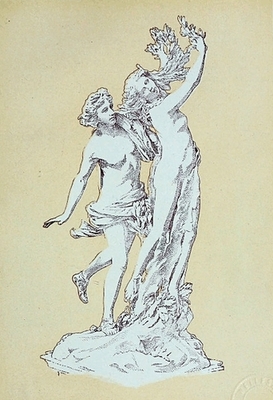
So saying, he took his stand on a rock of Parnassus, and drew
from his quiver two arrows of different workmanship,—one to
excite love, the other to repel it. The former was of gold and
sharp pointed, the latter blunt and tipped with lead. With the
leaden shaft he struck the nymph Daphne, the daughter of the river-god
Peneüs, and with the golden one Apollo, through the heart.
Forthwith the god was seized with love for the maiden, but she,
more than ever, abhorred the thought of loving. Her delight was
in woodland sports and in the spoils of the chase. Spurning all
lovers, she prayed her father that she might remain always unmarried,
like Diana. He consented, but, at the same time, warned
her that her beauty would defeat her purpose. It was the face of
this huntress maiden that Apollo saw. He saw
the charming disorder of her hair, and would
have arranged it; he saw her eyes bright as
stars; he saw her lips, and was not satisfied
with only seeing them. He longed for Daphne.
He followed her; she fled swifter than the
wind, nor delayed a moment at his entreaties.
"Stay," said he, "daughter of Peneüs; I am
not a foe. It is for love I pursue thee. I am no
clown, no rude peasant. Jupiter is my father.
I am lord of Delphi and Tenedos. I know all
things, present and future. I am the god of
song and the lyre. My arrows fly true to the
mark; but alas! an arrow more fatal than mine
has pierced my heart! I am the god of medicine
and know the virtues of all healing plants.
Alas! I suffer a malady that no balm can cure."
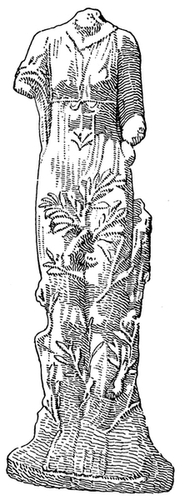
The nymph continues her flight and leaves
his plea half-uttered. But even as she flies she
charms him. The wind catches her garments,
and her unbound hair streams loose behind her. The god, sped by
Cupid, gains upon her in the race. His panting breath blows upon
her hair. Her strength begins to fail, and, ready to sink, she calls
upon her father, the river-god: "Help me, Peneüs! open the earth
to inclose me, or change my form, which has brought me into
this danger!" Scarcely had she spoken when a stiffness seized
her limbs; and little by little she took on the appearance of a
laurel tree. Apollo embraced the branches and lavished kisses on
the wood. The branches shrank from his lips. "Since thou canst
not be my wife," said he, "thou shalt assuredly be my tree. I will
wear thee for my crown. I will decorate with thee my harp and my
quiver. When the Roman conquerors conduct the triumphal pomp
to the Capitol, thou shalt be woven into wreaths for their brows.
And, as eternal youth is mine, thou also shalt be always green, and
thy leaf know no decay." The laurel tree bowed its head in grateful
acknowledgment.
The delicious humor of Lowell's extravaganza upon the story
amply justifies the following citation:
Phœbus, sitting one day in a laurel tree's shade,
Was reminded of Daphne, of whom it was made,
For the god being one day too warm in his wooing,
She took to the tree to escape his pursuing;
Be the cause what it might, from his offers she shrunk,
And, Ginevra-like, shut herself up in a trunk;
And, though 't was a step into which he had driven her,
He somehow or other had never forgiven her;
Her memory he nursed as a kind of a tonic,
Something bitter to chew when he'd play the Byronic,
And I can't count the obstinate nymphs that he brought over
By a strange kind of smile he put on when he thought of her.
"My case is like Dido's," he sometimes remarked;
"When I last saw my love, she was fairly embarked
In a laurel, as she thought—but (ah, how Fate mocks!)
She has found it by this time a very bad box;
Let hunters from me take this saw when they need it,—
You're not always sure of your game when you've treed it.
Just conceive such a change taking place in one's mistress!
What romance would be left?—who can flatter or kiss trees?
And, for mercy's sake, how could one keep up a dialogue
With a dull wooden thing that will live and will die a log,—
Not to say that the thought would forever intrude
That you've less chance to win her the more she is wood?
Ah! it went to my heart, and the memory still grieves,
To see those loved graces all taking their leaves;
Those charms beyond speech, so enchanting but now,
As they left me forever, each making its bough!
If her tongue had a tang sometimes more than was right,
Her new bark is worse than ten times her old bite."[110]
90. Marpessa. Another maiden who declined Apollo's love was
Marpessa.[1] She is called by Homer "the fair-ankled daughter of
Evenus."
The god Apollo from the heaven of heavens
Her mortal sweetness through the air allured;[2]
but Idas, "that was strongest of men that were then on earth,"[111]
carried her off, assisted by Poseidon who gave him a winged chariot.
Her father Evenus vainly tried to catch up with the fleeing
lovers; but Apollo found them in Messene, and wrested the maiden
away. Then Jupiter, while the lovers were engaged in combat,
separated them, saying, "Let her decide."
They three together met; on the one side,
Fresh from diffusing light on all the world
Apollo; on the other without sleep
Idas, and in the midst Marpessa stood.
Just as a flower after drenching rain,
So from the falling of felicity
Her human beauty glowed, and it was new;
The bee too near her bosom drowsed and dropped.[2]
According to the story as romantically told by the English poet
Phillips, first spoke Apollo. The god told her that he dreaded
that one so fair should ever taste of sorrow and death; how, if she
lived with him, she should bide
In mere felicity above the world
In peace alive and moving, where to stir
Is ecstasy, and thrilling is repose,[112]
immortal, scattering joy without intermission, lighting the world,
bringing bliss to struggling men and sorrowing women, dispelling
shadows and shadowy fear.
Then Idas, humbly,—
"After such argument what can I plead?
Or what pale promise make? Yet since it is
In women to pity rather than to aspire,
A little will I speak."
And he tells her simply that he loves her,—loves her not only for
her beauty, but
"Because Infinity upon thee broods;
And thou art full of whispers and of shadows;—"
and because her voice is music, her face mystery beyond his power
to comprehend;
"O beauty lone and like a candle clear
In this dark country of the world! Thou art
My woe, my early light, my music dying."
And Marpessa?—
As he was speaking, she with lips apart
Breathed, and with dimmer eyes leaned through the air
As one in dream, and now his human hand
Took in her own; and to Apollo spoke,—
saying that she knew how sweet it might be forever with a god
to aid suffering men and women and "gild the face that from its
dead looks up"; but still she feared immortality, for, though dying
not, she must grow old, and her god lover would tire of her when
once her youth was faded. And as for that "existence without
tears for evermore" which he promised,—
"Yet I being human, human sorrow miss.
The half of music, I have heard men say,
Is to have grieved."
To sorrow she was born. It is out of sadness that men have made
this world beautiful. If she chooses Idas, then they two will prosper
together, grow old together, and last descend into the "natural
ground," and "leave behind a wholesome memory on the earth."
When she had spoken, Idas with one cry
Held her, and there was silence; while the god
In anger disappeared. Then slowly they,
He looking downward, and she gazing up,
Into the evening green wandered away.
91. Clytie.[113] In the story of Clytie the conditions are reversed.
She was a water-nymph and in love with Apollo, who made her
no return. So she pined away, sitting all day long upon the cold
ground with her unbound tresses streaming over her shoulders.
Nine days she sat, and tasted neither food nor drink,—her own
tears and the chilly dew her only sustenance. She gazed on the sun
when he rose; and as he passed through his daily course to his setting,
she saw no other object,—her eyes fixed constantly on him.
At last, they say, her limbs took root in the ground and her face
became a flower, turning on its stem to follow the journeying sun.
In the following lines, Thomas Moore
uses the flower as an emblem of constancy:
The heart that has truly loved never forgets,
But as truly loves on to the close;
As the sunflower turns on her god when he sets
The same look that she turned when he rose.
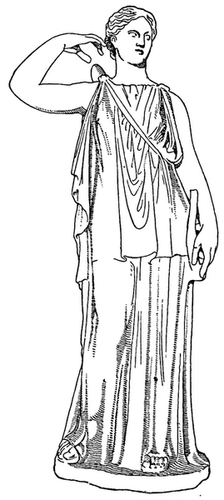
92. Myths of Diana. In company with her
radiant brother, we find Diana subduing Tityus
and the Python and assisting in the punishment
of Niobe. The speedy transformation of
Daphne has been attributed to this goddess, the
champion of maidenhood. According to some,
it was she, too, that changed Callisto into a bear,
when for love of Jupiter that nymph deserted
the huntress-band. Numerous are the myths
that celebrate the severity of the goddess of the
unerring bow toward those who offended her.
How she served Agamemnon for slaying one
of her hinds is told in the story of Troy;[114] how
she punished Œneus for omitting a sacrifice to
her is narrated in the episode of the Calydonian hunt.[115] Similar
attributes of the goddess are exemplified in the myths of Arethusa,
Actæon, and Orion. It is only when she is identified with Selene,
the peaceful moonlight, that we perceive a softer side of character,
such as that displayed in her relations with Endymion.
93. The Flight of Arethusa.[116] A woodland nymph of Elis was
this Arethusa; she delighted not in her comeliness, but in the
joys of the chase. One day, returning from the wood heated with
exercise, she descended to a stream silently flowing, so clear that
you might count the pebbles on the bottom. She laid aside her
garments; but while she sported in the water, she heard an indistinct
murmur rising as out of the depths of the stream. She made
haste to reach the nearest bank. A voice followed her, "Why
flyest thou, Arethusa? Alpheüs am I, the god of this stream."
The nymph ran, the god pursued. Arethusa,
at last exhausted, cried for help to Diana, who,
hearing, wrapped her votary in a thick cloud.
Perplexed, the river-god still sought the trembling
maiden. But a cold sweat came over her.
In less time than it takes to tell, she had become
a fountain. Alpheüs attempted then to mingle
his stream with hers. But the Cynthian queen
cleft the ground, and Arethusa, still endeavoring
to escape, plunged into the abyss and, passing through the
bowels of the earth, came out in Sicily, still followed by the passionate
river-god.
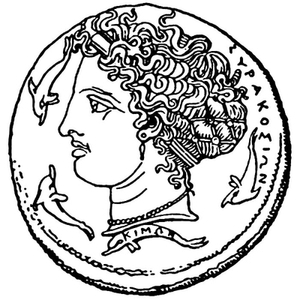
94. Shelley's Arethusa. In the following version of the pursuit,
Arethusa was already a river when Alpheüs espied her.
Arethusa arose
From her couch of snows
In the Acroceraunian mountains,—
From cloud and from crag,
With many a jag,
Shepherding her bright fountains,
She leapt down the rocks,
With her rainbow locks
Streaming among the streams;—
Her steps paved with green
The downward ravine
Which slopes to the western gleams:
And gliding and springing
She went, ever singing,
In murmurs as soft as sleep;
The Earth seemed to love her,
And Heaven smiled above her,
As she lingered towards the deep.
Then Alpheüs bold
On his glacier cold,
With his trident the mountain strook
And opened a chasm
In the rocks;—with the spasm
All Erymanthus shook.
And the black south wind
It concealed behind
The urns of the silent snow,
And earthquake and thunder
Did rend in sunder
The bars of the springs below;
The beard and the hair
Of the River-god were
Seen through the torrent's sweep,
As he followed the light
Of the fleet nymph's flight
To the brink of the Dorian deep.
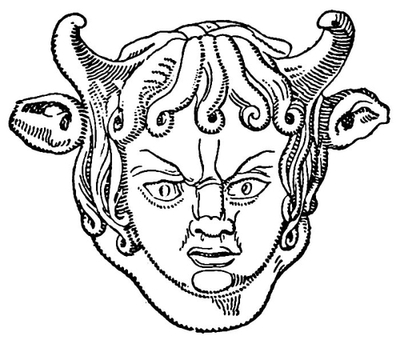
Fig. 70. A Young River-god
"Oh, save me! Oh, guide me!
And bid the deep hide me,
For he grasps me now by the hair!"
The loud Ocean heard,
To its blue depth stirred,
And divided at her prayer;
And under the water
The Earth's white daughter
Fled like a sunny beam;
Behind her descended
Her billows unblended
With the brackish Dorian stream:—
Like a gloomy stain
On the emerald main,
Alpheüs rushed behind,—
As an eagle pursuing
A dove to its ruin
Down the streams of the cloudy wind.
Under the bowers
Where the Ocean Powers
Sit on their pearlèd thrones,
Through the coral woods
Of the weltering floods,
Over heaps of unvalued stones;
Through the dim beams
Which amid the streams
Weave a network of colored light;
And under the caves,
Where the shadowy waves
Are as green as the forest's night:
Outspeeding the shark,
And the swordfish dark,
Under the ocean foam,
And up through the rifts
Of the mountain clifts
They past to their Dorian home.
And now from their fountains
In Enna's mountains,
Down one vale where the morning basks,
Like friends once parted
Grown single-hearted,
They ply their watery tasks.
At sunrise they leap
From their cradles steep
In the cave of the shelving hill;
At noontide they flow
Through the woods below
And the meadows of Asphodel:
And at night they sleep
In the rocking deep
Beneath the Ortygian shore;—
Like spirits that lie
In the azure sky
When they love but live no more.
95. The Fate of Actæon.[117] Diana's severity toward young Actæon,
grandson of Cadmus whose kindred fell under the curse of
Mars, is thus narrated.
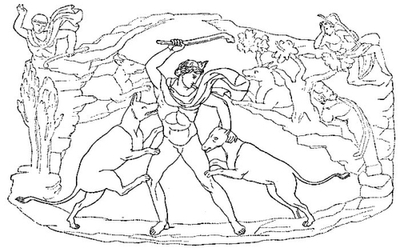
One day, having repaired to a valley inclosed by cypresses and
pines, where gushed a fountain of sparkling water, the chaste Diana
handed her javelin, her quiver, and her bow to one nymph, her
robe to another, while a third unbound the sandals from her feet.
Then Crocale, the most skillful of them, arranged her hair, and
Nephele, Hyale, and the rest drew water in capacious urns. While
the huntress queen was thus employed in the labors of the toilet,
Actæon, the son of Autonoë and Aristæus, having quitted his companions
of the chase and rambling without any especial object, came
to the place, led thither by his destiny. As he presented himself at
the entrance of the cave, the nymphs, seeing a man, screamed and
rushed towards the goddess to hide her with their bodies. But she
was taller than the rest and overtopped them all by a head. Such
a color as tinges the clouds at sunset or at dawn came over the
countenance of Diana, thus taken by surprise. Surrounded as she
was by her nymphs, she yet turned half away and sought with a
sudden impulse for her arrows. As they were not at hand, she
dashed the water into the face of the intruder, saying, "Now go
and tell, if you can, that you have seen Diana unappareled." Immediately
a pair of branching stag's horns grew out of the huntsman's
head, his neck gained in length, his ears grew sharp-pointed,
his hands became feet, his arms, his long legs, and his body were
covered with a hairy spotted hide. Fear took the place of his
former boldness, and the hero fled. What should he do?—go
home to the palace or lie hid in the woods? While he hesitated
his dogs saw him. Over rocks and cliffs, through mountain gorges
that seemed impracticable, he fled, and they followed. The air
resounded with the bark of the dogs. Presently one fastened on
his back, another seized his shoulder; the rest of the pack came
up and buried their teeth in his flesh. His friends and fellow-huntsmen
cheered on the dogs, and, looking everywhere for Actæon,
called on him to join the sport. At the sound of his name, he
turned his head and heard them regret that he should be away.
He earnestly wished he was. But Diana had no pity for him, nor
was her anger appeased till the dogs had torn his life out.
96. The Fortunes and Death of Orion. Orion, the son of Neptune,
was a giant and a mighty hunter, whose prowess and manly
favor gained for him the rare good will of Diana.
It is related that he loved Merope, the daughter of Œnopion,
king of Chios, and sought her in marriage. He cleared the island
of wild beasts and brought the spoils of the chase as presents to
his beloved; but as Œnopion constantly deferred his consent,
Orion attempted to gain possession of the maiden by violence.
Her father, incensed at his conduct, made Orion drunk, deprived
him of his sight, and cast him out on the seashore. The blinded
hero, instructed by an oracle to seek the rays of morning, followed
the sound of a Cyclops' hammer till he reached Lemnos, where
Vulcan, taking pity on him, gave him Cedalion, one of his men,
to be his guide to the abode of the sun. Placing Cedalion on his
shoulders, Orion proceeded to the east, and there meeting the sun-god,
was restored to sight by his beam.[118]
After this he dwelt as a hunter with the queen of the echoing
chase; and it was even hinted that she loved him. Her brother,
highly displeased, often chid her, but to no purpose. One day,
therefore, observing Orion as he waded through the sea with his
head just above the water, Apollo pointed out the black object to
his sister, and maintained that she could not hit it. The archer
goddess discharged a shaft with fatal aim: the waves rolled the
dead body of Orion to the land. Then bewailing her fatal error
with many tears, Diana placed him among the stars, where he
appears as a giant, with a girdle, sword, lion's skin, and club.
Sirius, his dog, follows him, and the Pleiads fly before him.[119] In
the beginning of winter, all through the night, Orion follows the
chase across the heavens; but with dawn he sinks toward the
waters of his father Neptune. In the beginning of summer, he
may be seen with daybreak in the eastern sky, where, beloved by
Aurora, he remains gradually paling before the light of day till,
finally, Diana, jealous of his happiness, draws her gentle darts
and slays him.
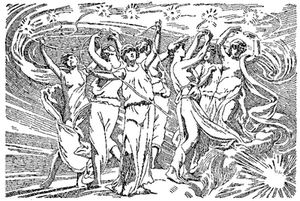
Fig. 72. The Pleiades
From the painting by Vedder
97. The Pleiads,[120] who still fly before Orion in the heavens,
were daughters of Atlas, and nymphs of Diana's train. One day
Orion saw them in Bœotia, became enamored of them, and gave
pursuit. In their distress they prayed to the gods to change their
form. Jupiter, accordingly, turned them into pigeons, and made
them a constellation. Though their number was seven, only six
stars are visible; for Electra, it is said, left her place that she
might not behold the ruin of Troy, which had been founded by
her son Dardanus. The sight had such an effect on her sisters
that they blanched, and have been pale ever since. But Electra
became a comet; her hair floating wildly behind her, she still
inconsolably ranges the expanse of heaven. According to some,
the lost Pleiad is Merope, who was vested with mortality in consequence
of her marriage with the mortal Sisyphus, king of Corinth.
Tennyson's reference
to the Pleiads, in "Locksley
Hall," is of course
familiar to all readers.
98. Endymion. The
frequent absence of Diana
from her duties in heaven
is said to have awakened
suspicion among the deities
of Olympus, who
doubted whether she actually
occupied these intervals
with hunting. It is
easy to imagine the satisfaction
with which Venus,
who so often had been
reproached by Diana with
her undue fondness of
beautiful youths, would
welcome news of a corresponding
weakness on the
part of the cold-hearted
and apparently unyielding
huntress queen. And such satisfaction Venus once enjoyed, if we
may trust the later classical and the modern poets who have identified
Diana with Selene, the more ancient goddess of the moon.
For, one calm, clear night Selene looked down upon the beautiful
Endymion, who fed his flock on Mount Latmos, and saw
him sleeping. The heart of the goddess was unquestionably warmed
by his surpassing beauty. She came down to him; she kissed him;
she watched over him while he slept. She visited him again and
again. But her secret could not long be hidden from the company
of Olympus. For more and more frequently she was absent from
her station in the sky, and toward morning she was ever paler
and more weary with her watching. When, finally, her love was
discovered, Jupiter gave Endymion, who had been thus honored,
a choice between death in any manner that was preferable, or perpetual
youth united with perpetual sleep. Endymion chose the
latter. He still sleeps in his Carian cave, and still the mistress of
the moon slips from her nocturnal course to visit him. She takes
care, too, that his fortunes shall not suffer by his inactive life:
she yields his flock increase, and guards his sheep and lambs from
beasts of prey.[121]
Keats, whose Endymion journeys on a mission under sea, thus
describes a meeting of the goddess and her lover:
On gold sand impearled
With lily shells and pebbles milky white,
Poor Cynthia greeted him, and soothed her light
Against his pallid face: he felt the charm
To breathlessness, and suddenly a warm
Of his heart's blood: 'twas very sweet; he stayed
His wandering steps, and half-entrancèd laid
His head upon a tuft of straggling weeds,
To taste the gentle moon, and freshening beads,
Lashed from the crystal roof by fishes' tails.
And so he kept, until the rosy veils,
Mantling the east, by Aurora's peering hand
Were lifted from the water's breast, and fanned
Into sweet air; and sobered morning came
Meekly through billows:—when like taper-flame
Left sudden by a dallying breath of air,
He rose in silence, and once more 'gan fare
Along his fated way.[122]
99. Myths of Venus. Round the goddess of love cluster
romances of her own tender passion, of the affairs of the winged
Cupid, and of the loves of the worshipers at her shrine. Of the
affection of Venus for Mars and of her relations with Anchises,[123]
the father of Æneas, mention is elsewhere made. The following
is the myth of Venus and Adonis.
100. Adonis.[124] The sweetly smiling goddess, playing one day
with her boy Cupid, wounded her bosom with one of his arrows.
Before the wound healed, she looked upon Adonis, the son of
Cinyras and Myrrha, and was captivated by him. She no longer
took any interest in her favorite resorts,—Paphos, and Cnidos,
and Amathus, rich in metals. She absented herself even from
Olympus, for Adonis was dearer to her than heaven. Him she
followed and bore him company. She who loved to recline in
the shade, with no care but to cultivate her charms, now rambled
through the woods and over the hills, girt like the huntress Diana.
She chased game that is safe to hunt, but kept clear of the wolves
and bears. She charged Adonis, too, to beware of dangerous
animals. "Be brave toward the timid," she would say, "courage
against the courageous is not safe." Having thus, on one occasion,
warned him, she mounted her chariot drawn by swans and drove
away through the air. But Adonis was too noble to heed such
counsels. The dogs had roused a wild boar from his lair, and the
youth threw his spear and wounded the animal with a sidelong
stroke. The beast drew out the weapon with his jaws, and, rushing
after Adonis, buried his tusks in the lad's side, and stretched him
dying upon the plain. The rest of the story is thus recounted:
... Low on the hills is lying the lovely Adonis, and his thigh with the
boar's tusk, his white thigh with the boar's tusk, is wounded; and sorrow on
Cypris he brings, as softly he breathes his life away.
His dark blood drips down his skin of snow; beneath his brows his eyes
wax heavy and dim; and the rose flees from his lip, and thereon the very kiss
is dying, the kiss that Cypris will never forego.
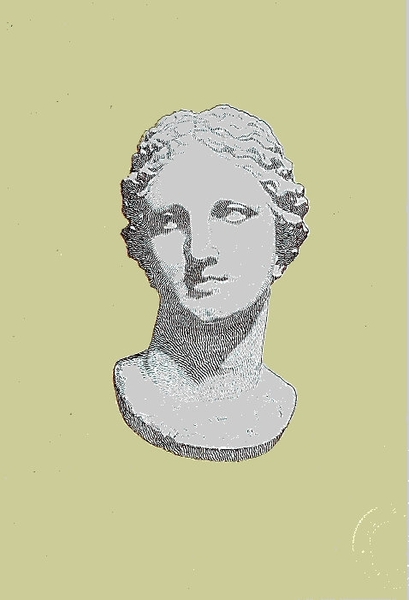
... She hath lost her lovely lord, with him she hath lost her sacred beauty.
Fair was the form of Cypris while Adonis was living, but her beauty has died
with Adonis! Woe, woe for Cypris, the mountains all are saying. And the
oak trees answer, Woe for Adonis!
And the rivers bewail the sorrows of
Aphrodite, and the wells are weeping
Adonis on the mountains. The flowers
flush red for anguish, and Cytherea
through all the mountain-knees, through
every dell, doth shrill the piteous dirge:
Woe, woe for Cytherea, he hath
perished, the lovely Adonis!
... When she saw, when she
marked the unstanched wound of
Adonis, when she saw the bright red
blood about his languid thigh, she cast
her arms abroad, and moaned, "Abide
with me, Adonis, hapless Adonis, abide!... Awake,
Adonis, for a little while,
and kiss me yet again, the latest kiss!...
This kiss will I treasure, even as
thyself, Adonis, since, ah, ill-fated, thou
art fleeing me, thou art fleeing far,
Adonis, and art faring to Acheron,
to that hateful king and cruel, while
wretched I yet live, being a goddess,
and may not follow thee! Persephone,
take thou my lover, my lord, for thyself
art stronger than I, and all lovely
things drift down to thee. But I am
ill-fated, inconsolable is my anguish;
and I lament mine Adonis, dead to me,
and I have no rest for sorrow.
"Thou diest, oh, thrice-desired, and
my desire hath flown away as a dream!
Nay, widowed is Cytherea, and idle are
the Loves along the halls! With thee has
the girdle of my beauty perished. For
why, ah, overbold, didst thou follow the
chase, and being so fair, why wert thou
thus overhardy to fight with beasts?"
So Cypris bewailed her, the Loves
join in the lament:
Woe, woe for Cytherea, he hath
perished, the lovely Adonis!
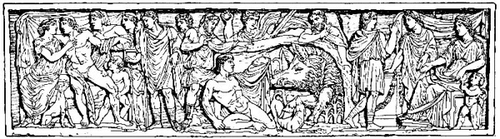
Fig. 74. The Death of Adonis
A tear the Paphian sheds for each blood-drop of Adonis, and tears and
blood on the earth are turned to flowers. The blood brings forth the rose;
the tears, the wind-flower.
Woe, woe for Adonis, he hath perished, the lovely Adonis!
... Cease, Cytherea, from thy lamentations, to-day refrain from thy dirges.
Thou must again bewail him, again must weep for him another year.
101. Cupid and Psyche.[126] A certain king and queen had three
daughters. The charms of the two elder were more than common,
but the beauty of the youngest was such that the poverty of language
is unable to express its praise. In fact, Venus found her
altars deserted, while men paid their vows to this virgin. When
Psyche passed, the people sang her praises and strewed her way
with chaplets and flowers.
This perversion of homage gave great offense to Venus, who
complained that Paris might just as well not have yielded her the
palm of beauty over Pallas and Juno, if a mortal were thus to usurp
her honors. Wherefore she called Cupid and, pointing out Psyche
to him, bade him infuse into the bosom of that haughty girl a
passion for some low, unworthy being.
There were in Venus's garden two fountains,—one of sweet
waters, the other of bitter. Cupid filled two amber vases, one from
each fountain, and suspending them from the top of his quiver,
hastened to the chamber of Psyche, whom he found asleep. He
shed a few drops from the bitter fountain over her lips, though
the sight of her almost moved him to pity; and then he touched
her side with the point of his arrow. She awoke, and opening
her eyes upon Cupid (himself invisible), so startled him that in
his confusion he wounded himself with his arrow. Heedless of
his wound, his thought now was to repair the mischief he had
done. He poured, at once, the waters of joy over her silken
ringlets.
But Psyche, henceforth frowned upon by Venus, derived no
benefit from her charms. Her two elder sisters had long been
married to princes; but Psyche's beauty failed to awaken love.
Consequently her parents, afraid that they had unwittingly incurred
the anger of the gods, consulted the oracle of Apollo.
They received answer, "The virgin is destined for the bride of no
mortal lover. Her husband awaits her on the top of the mountain.
He is a monster whom neither gods nor men can resist."
This dreadful decree of the oracle filled the people with dismay;
but, at Psyche's request, preparations for her fate were
made. The royal maid took her place in a procession, which
more resembled a funeral than a nuptial pomp, and with her
parents, amid the lamentations of their subjects, ascended the
mountain, where she was left alone.
While Psyche stood there, panting with fear and with eyes full
of tears, the gentle Zephyr lifted her and, with an easy motion,
bore her to a flowery dale. By degrees her mind became composed,
and she laid herself down on the grassy bank to sleep.
When she awoke refreshed with sleep, she beheld near by a
pleasant grove of tall and stately trees. Entering, she discovered
in the midst a fountain, and fast by a palace whose august front
showed that it was not the work of mortal hands, but the happy
retreat of some god. She approached the building and entered.
Every object she met filled her with pleasure and amazement.
Golden pillars supported the vaulted roof, and the walls were
enriched with carvings and paintings that represented beasts of
the chase and rural scenes. Other apartments were filled with
still other beautiful and precious productions of nature and art.
While her eyes were thus occupied, the voice of an invisible
being addressed her: "Sovereign lady, all that thou beholdest is
thine. We whose voices thou dost hear are thy servants. Retire,
we pray thee, to thy chamber, repose on thy bed of down, and
when it may please thee repair to the bath. Food awaits in the
adjoining alcove."
After repose and the refreshment of the bath, Psyche seated
herself in the alcove, where, without any visible aid, a table immediately
presented itself, covered with delicacies and nectareous
wines. Her ears, too, were delighted with music from invisible
performers.
For a long time she did not see her husband. He came in the
hours of darkness and fled before the dawn of morning; but his
accents were full of love and inspired a like passion in her. Often
she begged him to stay and let her behold him, but he would not
consent. "Having looked upon me," he said, "mayhap thou
wouldst fear, mayhap adore, me; but all I ask of thee is love. I
would rather thou shouldst love me as an equal than adore me as
a god." This reasoning somewhat quieted Psyche for a time. But
the thought of her parents and of her sisters, left in ignorance
of her fate, preyed on her
mind to such a degree that
at last, telling her distress
to her lord, she drew from
him an unwilling consent
that her sisters should be
brought to see her.
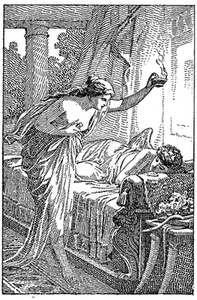
Fig. 75. Psyche at the Couch of Cupid
From the painting by Thumann
Zephyr, promptly obedient,
soon brought them
across the mountain down
to their sister's valley. They
embraced her. She returned
their caresses, and then committed
them to the care of
her attendant voices, who
should refresh them in her
bath and at her table, and
show them her treasures.
The view of these delights
caused envy to enter their
bosoms. They plied their
fortunate sister with questions
about her husband.
Psyche replied that he was
a beautiful youth, who generally spent the daytime in hunting
upon the mountains. The sisters, not satisfied with this reply,
soon made her confess that she had never seen him. Then they
proceeded to fill her bosom with dark suspicions. Probably her
husband was a dreadful monster, such as the Pythian oracle had
prophesied. Probably he was a direful serpent, who nourished
her now to devour her by and by. They advised her to provide
herself against the night with a lamp and a sharp knife, told her
what to do if her husband turned out the monster that they surmised,
and, so saying, departed.
These persuasions Psyche resisted as well as she could, but they
did not fail to have their effect on her mind. She prepared a lamp
and a sharp knife, and hid them out of sight of her husband. That
night, when he had fallen into his first sleep, she silently rose and
uncovering her lamp—
Scarce kept back a cry
At what she saw; for there before her lay
The very Love brighter than dawn of day;
And as he lay there smiling, her own name
His gentle lips in sleep began to frame,
And, as to touch her face, his hand did move;
O then, indeed, her faint heart swelled for love,
And she began to sob, and tears fell fast
Upon the bed.—But as she turned at last
To quench the lamp, there happed a little thing
That quenched her new delight, for flickering
The treacherous flame cast on his shoulder fair
A burning drop; he woke, and seeing her there
The meaning of that sad sight knew full well,
Nor was there need the piteous tale to tell.[127]
Without a word, Cupid spread his white wings, and flew out of
window. Psyche, in vain endeavoring to follow, fell to the earth.
For but an instant Cupid, staying, reproached her with distrust of
him. "No other punishment inflict I than to leave thee forever.
Love cannot dwell with suspicion." And so he flew away.
When Psyche had recovered some degree of composure, she
looked around her. The palace and gardens had vanished. She
found herself not far from the city where her sisters dwelt.
Thither she repaired, and told them the story of her misfortunes,
whereat they inwardly rejoiced. "For now," thought they, "he
will perhaps choose one of us." With this idea, they rose early
the next morning and, ascending the mountain, each called upon
Zephyr to receive her and bear her to his lord; then, leaping up,
failed of the support of Zephyr, fell down the precipice, and was
dashed to pieces.
Psyche, meanwhile, wandered day and night, without food or
repose, in search of her husband. But he was lying heartsick in
the chamber of his mother; and that goddess was absent upon her
own affairs. Then the white sea gull which floats over the waves
dived into the middle deep,
And rowing with his glistening wings arrived
At Aphrodite's bower beneath the sea.
She, as yet unaware of her son's mischance, was joyously consorting
with her handmaidens; but he, the sea gull,
But he with garrulous and laughing tongue
Broke up his news; how Eros fallen sick
Lay tossing on his bed, to frenzy stung
By such a burn as did but barely prick:
A little bleb, no bigger than a pease,
Upon his shoulder 'twas, that killed his ease,
Fevered his heart, and made his breathing thick.
"For which disaster hath he not been seen
This many a day at all in any place:
And thou, dear mistress," said he, "hast not been
Thyself among us now a dreary space:
And pining mortals suffer from a dearth
Of love; and for this sadness of the earth
Thy family is darkened with disgrace....
"'Tis plain that, if thy pleasure longer pause,
Thy mighty rule on earth hath seen its day:
The race must come to perish, and no cause
But that thou sittest with thy nymphs at play,
While on the Cretan hills thy truant boy
Has with his pretty mistress turned to toy,
And, less for pain than love, now pines away."[128]
And Venus cried angrily, "My son, then, has a mistress! And
it is Psyche, who witched away my beauty and was the rival of my
godhead, whom he loves!"
Therewith she issued from the sea, and, returning to her golden
chamber, found there the lad sick, as she had heard, and cried
from the doorway, "Well done, truly! to trample thy mother's
precepts under foot, to spare my enemy that cross of an unworthy
love; nay, unite her to thyself, child as thou art, that I might have
a daughter-in-law who hates me! I will make thee repent of thy
sport, and the savor of thy marriage bitter. There is one who shall
chasten this body of thine, put out thy torch, and unstring thy bow.
Not till she has plucked forth that hair, into which so oft these
hands have smoothed the golden light, and sheared away thy
wings, shall I feel the injury done me avenged." And with this
she hastened in anger from the doors.
And Ceres and Juno met her, and sought to know the meaning
of her troubled countenance. "Ye come in season," she cried; "I
pray you, find for me Psyche. It must needs be that ye have heard
the disgrace of my house." And they, ignorant of what was done,
would have soothed her anger, saying, "What fault, Mistress, hath
thy son committed, that thou wouldst destroy the girl he loves?
Knowest thou not that he is now of age? Because he wears his
years so lightly must he seem to thee ever to be a child? Wilt
thou forever thus pry into the pastimes of thy son, always accusing
his wantonness, and blaming in him those delicate wiles which are
all thine own?" Thus, in secret fear of the boy's bow, did they
seek to please him with their gracious patronage. But Venus,
angry at their light taking of her wrongs, turned her back upon
them, and with hasty steps made her way once more to the sea.[129]
And soon after, Psyche herself reached the temple of Ceres,
where she won the favor of the goddess by arranging in due order
the heaps of mingled grain and ears and the carelessly scattered
harvest implements that lay there. The holy Ceres then counseled
her to submit to Venus, to try humbly to win her forgiveness,
and, mayhap, through her favor regain the lover that
was lost.
Obeying the commands of Ceres, Psyche took her way to the
temple of the golden-crowned Cypris. That goddess received her
with angry countenance, called her an undutiful and faithless
servant, taunted her with the wound given to her husband, and
insisted that for so ill-favored a girl there was no way of meriting a
lover save by dint of industry. Thereupon she ordered Psyche to
be led to the storehouse of the temple, where was laid up a great
quantity of wheat, barley, millet, vetches, beans, and lentils prepared
for food for her pigeons, and gave order, "Take and separate
all these grains, putting all of the same kind in a parcel by
themselves,—and see that thou get it done before evening." This
said, Venus departed and left the girl to her task. But Psyche, in
perfect consternation at the enormous task, sat stupid and silent;
nor would the work have been accomplished had not Cupid stirred
up the ants to take compassion on her. They separated the pile,
sorting each kind to its parcel and vanishing out of sight in a
moment.
At the approach of twilight, Cytherea returned from the banquet
of the gods, breathing odors and crowned with roses. Seeing the
task done, she promptly exclaimed, "This is no work of thine,
wicked one, but his, whom to thine own and his misfortune thou
hast enticed,"—threw the girl a piece of black bread for her
supper, and departed.
Next morning, however, the goddess, ordering Psyche to be summoned,
commanded her to fetch a sample of wool gathered from
each of the golden-shining sheep that fed beyond a neighboring
river. Obediently the princess went to the riverside, prepared to
do her best to execute the command. But the god of that stream
inspired the reeds with harmonious murmurs that dissuaded her
from venturing among the golden rams while they raged under
the influence of the rising sun. Psyche, observing the directions
of the compassionate river-god, crossed when the noontide sun
had driven the cattle to the shade, gathered the woolly gold from
the bushes where it was clinging, and returned to Venus with her
arms full of the shining fleece. But, far from commending her,
that implacable mistress said, "I know very well that by the aid of
another thou hast done this; not yet am I assured that thou hast
skill to be of use. Here, now, take this box to Proserpine and say,
'My mistress Venus entreats thee to send her a little of thy beauty,
for in tending her sick son she hath lost some of her own.'"
Psyche, satisfied that her destruction was at hand, doomed as
she was to travel afoot to Erebus, thought to shorten the journey
by precipitating herself at once from the summit of a tower. But
a voice from the tower, restraining her from this rash purpose,
explained how by a certain cave she might reach the realm of
Pluto; how she might avoid the peril of the road, pass by Cerberus,
and prevail on Charon to take her across the black river
and bring her back again. The voice, also, especially cautioned her
against prying into the box filled with the beauty of Proserpine.
So, taking heed to her ways, the unfortunate girl traveled safely
to the kingdom of Pluto. She was admitted to the palace of
Proserpine, where, contenting herself with plain fare instead of the
delicious banquet that was offered her, she delivered her message
from Venus. Presently the box, filled with the precious commodity,
was restored to her; and glad was she to come out once more into
the light of day.
But having got so far successfully through her dangerous task, a
desire seized her to examine the contents of the box, and to spread
the least bit of the divine beauty on her cheeks that she might
appear to more advantage in the eyes of her beloved husband.
Therewith down by the wayside did she sit
And turned the box round, long regarding it;
But at the last, with trembling hands, undid
The clasp, and fearfully raised up the lid;
But what was there she saw not, for her head
Fell back, and nothing she rememberèd
Of all her life, yet nought of rest she had,
The hope of which makes hapless mortals glad;
For while her limbs were sunk in deadly sleep
Most like to death, over her heart 'gan creep
Ill dreams; so that for fear and great distress
She would have cried, but in her helplessness
Could open not her mouth, or frame a word.[130]
But Cupid, now recovered from his wound, slipped through a
crack in the window of his chamber, flew to the spot where his
beloved lay, gathered up the sleep from her body and inclosed it
again in the box, then waked Psyche with the touch of an arrow.
"Again," said he, "hast thou almost perished by thy curiosity.
But now perform the task
imposed upon thee by my
mother, and I will care
for the rest."
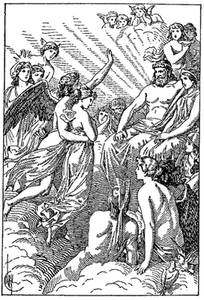
Fig. 76. Psyche and Cupid on Mount Olympus
From the painting by Thumann
Then Cupid, swift as
lightning penetrating the
heights of heaven, presented
himself before Jupiter
with his supplication.
Jupiter lent a favoring ear
and pleaded the cause of
the lovers with Venus.
Gaining her consent, he
ordered Mercury to convey
Psyche to the heavenly
abodes. On her advent,
the king of the immortals,
handing her a cup of ambrosia,
said, "Drink this,
Psyche, and be immortal.
Thy Cupid shall never break
from the knot in which he
is tied; these nuptials shall
indeed be perpetual."
Thus Psyche was at last united to Cupid; and in due season a
daughter was born to them whose name was Pleasure.
The allegory of Cupid and Psyche is well presented in the following
lines:
They wove bright fables in the days of old,
When reason borrowed fancy's painted wings;
When truth's clear river flowed o'er sands of gold,
And told in song its high and mystic things!
And such the sweet and solemn tale of her
The pilgrim-heart, to whom a dream was given,
That led her through the world,—Love's worshiper,—
To seek on earth for him whose home was heaven!
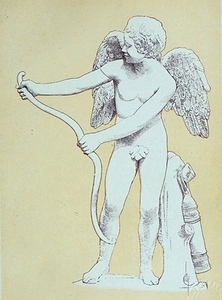
In the full city,—by the haunted fount,—
Through the dim grotto's tracery of spars,—
'Mid the pine temples, on the moonlit mount,
Where silence sits to listen to the stars;
In the deep glade where dwells the brooding dove,
The painted valley, and the scented air,
She heard far echoes of the voice of Love,
And found his footsteps' traces everywhere.
But never more they met! since doubts and fears,
Those phantom-shapes that haunt and blight the earth,
Had come 'twixt her, a child of sin and tears,
And that bright spirit of immortal birth;
Until her pining soul and weeping eyes
Had learned to seek him only in the skies;
Till wings unto the weary heart were given,
And she became Love's angel bride in heaven![131]
The story of Cupid and Psyche first appears in the works of
Apuleius, a writer of the second century of our era. It is therefore
of much more recent date than most of the classic myths.
102. Keats' Ode to Psyche. To this fact allusion is made in the
following poem:
O Goddess! hear these tuneless numbers, wrung
By sweet enforcement and remembrance dear,
And pardon that thy secrets should be sung
Even into thine own soft-conchèd ear:
Surely I dreamt to-day, or did I see
The wingèd Psyche with awakened eyes?
I wandered in a forest thoughtlessly,
And, on the sudden, fainting with surprise,
Saw two fair creatures, couchèd side by side
In deepest grass, beneath the whispering roof
Of leaves and tumbled blossoms, where there ran
A brooklet, scarce espied!
'Mid hushed, cool-rooted flowers, fragrant-eyed,
Blue, silver-white, and budded Tyrian,
They lay calm-breathing on the bedded grass;
Their arms embracèd, and their pinions, too;
Their lips touched not, but had not bade adieu,
As if disjoinèd by soft-handed slumber,
And ready still past kisses to outnumber
At tender eye-dawn of Aurorean love:
The wingèd boy I knew:
But who wast thou, O happy, happy dove?
His Psyche true!
O latest born and loveliest vision far
Of all Olympus' faded hierarchy!
Fairer than Phœbe's sapphire-regioned star,
Or Vesper, amorous glowworm of the sky;
Fairer than these, though temple thou hast none,
Nor altar heaped with flowers;
Nor virgin-choir to make delicious moan
Upon the midnight hours;
No voice, no lute, no pipe, no incense sweet
From chain-swung censer teeming;
No shrine, no grove, no oracle, no heat
Of pale-mouthed prophet dreaming.
O brightest! though too late for antique vows
Too, too late for the fond believing lyre,
When holy were the haunted forest boughs,
Holy the air, the water, and the fire;
Yet even in these days so far retired
From happy pieties, thy lucent fans,
Fluttering among the faint Olympians,
I see, and sing, by my own eyes inspired.
So let me be thy choir, and make a moan
Upon the midnight hours;
Thy voice, thy lute, thy pipe, thy incense sweet
From swingèd censer teeming,
Thy shrine, thy grove, thy oracle, thy heat
Of pale-mouthed prophet dreaming.
Yes, I will be thy priest, and build a fane
In some untrodden region of my mind,
Where branchèd thoughts, new grown with pleasant pain,
Instead of pines shall murmur in the wind:
Far, far around shall those dark clustered trees
Fledge the wild-ridgèd mountains steep by steep;
And there by zephyrs, streams, and birds and bees,
The moss-lain Dryads shall be lulled to sleep;
And in the midst of this wide quietness
A rosy sanctuary will I dress
With the wreathèd trellis of a working brain,
With buds, and bells, and stars without a name,
With all the gardener Fancy e'er could feign,
Who breeding flowers, will never breed the same;
And there shall be for thee all soft delight
That shadowy thought can win,
A bright torch, and a casement ope at night,
To let the warm Love in!
The loves of the devotees of Venus are as the sands of the sea
for number. Below are given the fortunes of a few: Hippomenes,
Hero, Pygmalion, Pyramus, and Phaon. The
favor of the goddess toward Paris, who awarded
her the palm of beauty in preference to Juno
and Minerva, will occupy our attention in connection
with the story of the Trojan War.
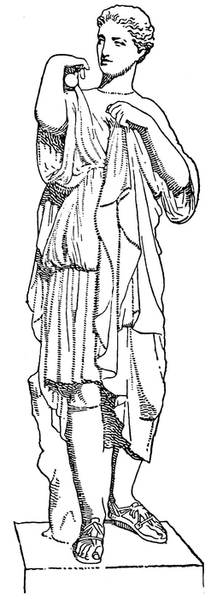
Fig. 77. Artemis
of Gabii
103. Atalanta's Race.[132] Atalanta, the daughter
of Schœneus of Bœotia, had been warned
by an oracle that marriage would be fatal to her
happiness. Consequently she fled the society
of men and devoted herself to the sports of the
chase. Fair, fearless, swift, and free, in beauty
and in desire she was a Cynthia,—of mortal
form and with a woman's heart. To all suitors
(for she had many) she made answer: "I will
be the prize of him only who shall conquer me
in the race; but death must be the penalty of
all who try and fail." In spite of this hard condition
some would try. Of one such race Hippomenes
was to be judge. It was his thought,
at first, that these suitors risked too much for
a wife. But when he saw Atalanta lay aside her
robe for the race with one of them, he changed his mind and
began to swell with envy of whomsoever seemed likely to win.
The virgin darted forward. As she ran she looked more beautiful
than ever. The breezes gave wings to her feet; her hair flew
over her shoulders, and the gay fringe of her garment fluttered
behind her. A ruddy hue tinged the whiteness of her skin, such
as a crimson curtain casts on a marble wall. Her competitor was
distanced and was put to death without mercy. Hippomenes, not
daunted by this result, fixed his eyes on the virgin and said, "Why
boast of beating those laggards? I offer myself for the contest."
Atalanta looked at him with pity in her face and hardly knew
whether she would rather conquer so goodly a youth or not. While
she hesitated, the spectators grew impatient for the contest and
her father prompted her to prepare. Then Hippomenes addressed
a prayer to Cypris: "Help me, Venus, for thou hast impelled
me." Venus heard and was propitious.
Fig. 78. Atalanta's Race
From the painting by Poynter
She gathered three golden apples from the garden of her temple
in her own island of Cyprus and, unseen by any, gave them to
Hippomenes, telling him how to use them. Atalanta and her lover
were ready. The signal was given.
They both started; he, by one stride, first,
For she half pitied him so beautiful,
Running to meet his death, yet was resolved
To conquer: soon she near'd him, and he felt
The rapid and repeated gush of breath
Behind his shoulder.
From his hand now dropt
A golden apple: she lookt down and saw
A glitter on the grass, yet on she ran.
He dropt a second; now she seem'd to stoop:
He dropt a third; and now she stoopt indeed:
Yet, swifter than a wren picks up a grain
Of millet, rais'd her head: it was too late,
Only one step, only one breath, too late.
Hippomenes had toucht the maple goal
With but two fingers, leaning pronely forth.
She stood in mute despair; the prize was won.
Now each walkt slowly forward, both so tired,
And both alike breathed hard, and stopt at times.
When he turn'd round to her, she lowered her face
Cover'd with blushes, and held out her hand,
The golden apple in it.
"Leave me now,"
Said she, "I must walk homeward."
He did take
The apple and the hand.
"Both I detain,"
Said he, "the other two I dedicate
To the two Powers that soften virgin hearts,
Eros and Aphrodite; and this one
To her who ratifies the nuptial vow."
She would have wept to see her father weep;
But some God pitied her, and purple wings
(What God's were they?) hovered and interposed.[133]
But the oracle was yet to be fulfilled. The lovers, full of their
own happiness, after all, forgot to pay due honor to Aphrodite,
and the goddess was provoked at their ingratitude. She caused
them to give offense to Cybele. That powerful goddess took from
them their human form: the huntress heroine, triumphing in the
blood of her lovers, she made a lioness; her lord and master a lion,—and
yoked them to her car, where they are still to be seen in all
representations in statuary or painting of the goddess Cybele.
104 Hero and Leander were star-crossed lovers of later classical
fiction.[134] Although their story is not of supernatural beings, or of
events necessarily influenced by supernatural agencies, and therefore
not mythical in the strict sense of the word, it deserves to be
included here both because of its pathetic beauty and its long literary
tradition. The poet Marlowe puts the story into English thus:
On Hellespont, guilty of true love's blood,
In view and opposite two cities stood,
Sea-borderers, disjoin'd by Neptune's might
The one Abydos, the other Sestos hight.
At Sestos Hero dwelt; Hero the fair,
Whom young Apollo courted for her hair,
And offer'd as a dower his burning throne,
Where she should sit, for men to gaze upon....
Some say, for her the fairest Cupid pin'd,
And, looking in her face, was strooken blind.
But this is true: so like was one the other,
As he imagined Hero was his mother;
And oftentimes into her bosom flew,
About her naked neck his bare arms threw,
And laid his childish head upon her breast,
And, with still panting rockt, there took his rest.
In Abydos dwelt the manly Leander, who, as luck would have
it, bethought himself one day of the festival of Venus in Sestos,
and thither fared to do obeisance to the goddess.
On this feast-day,—O cursèd day and hour!—
Went Hero through Sestos, from her tower
To Venus' temple, where unhappily,
As after chanc'd, they did each other spy.
So fair a church as this had Venus none;
The walls were of discolored jasper-stone, ...
And in the midst a silver altar stood:
There Hero, sacrificing turtle's blood,
Vail'd to the ground, veiling her eyelids close;
And modestly they opened as she rose:
Thence flew Love's arrow with the golden head;
And thus Leander was enamourèd.
Stone-still he stood, and evermore he gaz'd,
Till with the fire, that from his countenance blaz'd,
Relenting Hero's gentle heart was strook:
Such power and virtue hath an amorous look.
It lies not in our power to love or hate,
For will in us is overrul'd by fate.
When two are stript long e'er the course begin,
We wish that one should lose, the other win;
And one especially do we affect
Of two gold ingots, like in each respect:
The reason no man knows; let it suffice,
What we behold is censur'd by our eyes.
Where both deliberate, the love is slight:
Who ever lov'd, that lov'd not at first sight?
He kneel'd; but unto her devoutly prayed:
Chaste Hero to herself thus softly said,
"Were I the saint he worships, I would hear him";
And, as she spake those words, came somewhat near him.
He started up; she blush'd as one asham'd;
Wherewith Leander much more was inflam'd.
He touch'd her hand; in touching it she trembled:
Love deeply grounded, hardly is dissembled....
So they conversed by touch of hands, till Leander, plucking up
courage, began to plead with words, with sighs and tears.
These arguments he us'd, and many more;
Wherewith she yielded, that was won before.
Hero's looks yielded, but her words made war:
Women are won when they begin to jar.
Thus having swallow'd Cupid's golden hook,
The more she striv'd, the deeper was she strook:
Yet, evilly feigning anger, strove she still,
And would be thought to grant against her will.
So having paus'd awhile, at last she said,
"Who taught thee rhetoric to deceive a maid?
Ay me! such words as these should I abhor,
And yet I like them for the orator."
With that Leander stoop'd to have embrac'd her,
But from his spreading arms away she cast her,
And thus bespake him: "Gentle youth, forbear
To touch the sacred garments which I wear." ...
Then she told him of the turret by the murmuring sea where
all day long she tended Venus' swans and sparrows:
"Come thither." As she spake this, her tongue tripp'd,
For unawares, "Come thither," from her slipp'd;
And suddenly her former color chang'd,
And here and there her eyes through anger rang'd;
And, like a planet moving several ways
At one self instant, she, poor soul, assays,
Loving, not to love at all, and every part
Strove to resist the motions of her heart:
And hands so pure, so innocent, nay, such
As might have made Heaven stoop to have a touch,
Did she uphold to Venus, and again
Vow'd spotless chastity; but all in vain;
Cupid beats down her prayers with his wings....
Fig. 79. Hero and Leander
From the painting by Keller
For a season all went well. Guided by a torch which his mistress
reared upon the tower, he was wont of nights to swim the
strait that he might enjoy her company. But one night a tempest
arose and the sea was rough; his strength failed and he was
drowned. The waves bore his body to the European shore, where
Hero became aware of his death, and in her despair cast herself
into the sea and perished.
A picture of the drowning Leander is thus described by Keats:[135]
Come hither all sweet maidens soberly,
Down looking aye, and with a chasten'd light,
Hid in the fringe of your eyelids white,
And meekly let your fair hands joinèd be,
As if so gentle that ye could not see,
Untouch'd, a victim of your beauty bright,
Sinking away to his young spirit's night,
Sinking bewilder'd 'mid the dreary sea:
'Tis young Leander toiling to his death;
Nigh swooning he doth purse his weary lips
For Hero's cheek, and smiles against her smile.
O horrid dream! see how his body dips
Dead-heavy; arms and shoulders gleam awhile;
He's gone; up bubbles all his amorous breath!
105. Pygmalion and the Statue.[136] Pygmalion saw so much to
blame in women, that he came at last to abhor the sex and resolved
to live unmarried. He was a sculptor, and had made with wonderful
skill a statue of ivory, so beautiful that no living woman was to
compare with it. It was indeed the perfect semblance of a maiden
that seemed to be alive and that was prevented from moving only
by modesty. His art was so perfect that it concealed itself, and its
product looked like the workmanship of nature. Pygmalion at last
fell in love with his counterfeit creation. Oftentimes he laid his
hand upon it as if to assure himself whether it were living or not,
and could not even then believe that it was only ivory.
The festival of Venus was at hand,—a festival celebrated with
great pomp at Cyprus. Victims were offered, the altars smoked,
and the odor of incense filled the air. When Pygmalion had performed
his part in the solemnities, he stood before the altar and,
according to one of our poets, timidly said:
O Aphrodite, kind and fair,
That what thou wilt canst give,
Oh, listen to a sculptor's prayer,
And bid mine image live!
For me the ivory and gold
That clothe her cedar frame
Are beautiful, indeed, but cold;
Ah, touch them with thy flame!
Oh, bid her move those lips of rose,
Bid float that golden hair,
And let her choose me, as I chose,
This fairest of the fair!
And then an altar in thy court
I'll offer, decked with gold;
And there thy servants shall resort,
Thy doves be bought and sold![137]
According to another version of the story, he said not, "bid
mine image live," but "one like my ivory virgin." At any rate,
with such a prayer he threw incense on the flame of the altar.
Whereupon Venus, as an omen of her favor, caused the flame to
shoot up thrice a fiery point into the air.
When Pygmalion reached his home, to his amazement he saw
before him his statue garlanded with flowers.
Yet while he stood, and knew not what to do
With yearning, a strange thrill of hope there came,
A shaft of new desire now pierced him through,
And therewithal a soft voice called his name,
And when he turned, with eager eyes aflame,
He saw betwixt him and the setting sun
The lively image of his lovèd one.
He trembled at the sight, for though her eyes,
Her very lips, were such as he had made,
And though her tresses fell but in such guise
As he had wrought them, now was she arrayed
In that fair garment that the priests had laid
Upon the goddess on that very morn,
Dyed like the setting sun upon the corn.
Speechless he stood, but she now drew anear,
Simple and sweet as she was wont to be,
And once again her silver voice rang clear,
Filling his soul with great felicity,
And thus she spoke, "Wilt thou not come to me,
O dear companion of my new-found life,
For I am called thy lover and thy wife?...
"My sweet," she said, "as yet I am not wise,
Or stored with words aright the tale to tell,
But listen: when I opened first mine eyes
I stood within the niche thou knowest well,
And from my hand a heavy thing there fell
Carved like these flowers, nor could I see things clear,
But with a strange, confusèd noise could hear.
"At last mine eyes could see a woman fair,
But awful as this round white moon o'erhead,
So that I trembled when I saw her there,
For with my life was born some touch of dread,
And therewithal I heard her voice that said,
'Come down and learn to love and be alive,
For thee, a well-prized gift, to-day I give.'"[138]
A fuller account of Venus' address to the statue is the following:
O maiden, in mine image made!
O grace that shouldst endure!
While temples fall, and empires fade,
Immaculately pure:
Exchange this endless life of art
For beauty that must die,
And blossom with a beating heart
Into mortality!
Change, golden tresses of her hair,
To gold that turns to gray;
Change, silent lips, forever fair,
To lips that have their day!
Oh, perfect arms, grow soft with life,
Wax warm, ere cold ye wane;
Wake, woman's heart, from peace to strife,
To love, to joy, to pain![139]
The maiden was called Galatea. Venus blessed the nuptials, and
from the union Paphos was born, by whose name the city, sacred
to Venus, is known.
106. Pyramus and Thisbe.[140] Pyramus was the handsomest youth
and Thisbe the fairest maiden in Babylonia, where Semiramis
reigned. Their parents occupied adjoining houses. Propinquity
brought the young people together, and acquaintance ripened into
love. They would gladly have married, but their parents forbade.
One thing, however, parents could not forbid (for Venus and Cupid
favored the match),—that love should glow with equal ardor in the
bosoms of both. They conversed by signs and glances, and the fire
burned the more intensely
that it was covered. In the
wall between the two houses
there was a crack, caused by
some fault in the structure.
It afforded a passage to
the voice; and tender messages
passed back and forth
through the gap. When night
came and they must say
farewell, the lovers pressed
their lips upon the wall, she
on her side, he on his.
Fig. 80. Thisbe
From the painting by Edward Burne-Jones
One morning, when Aurora
had put out the stars
and the sun had melted the
frost from the grass, they
met at the accustomed spot
and arranged a meeting for
that night at a well-known
edifice, standing without the
city's bounds,—the Tomb
of Ninus. The one who
first arrived should await the other at the foot of a white mulberry
tree near a cool spring. Evening came. Thisbe, arriving first, sat
alone by the monument in the dim light of the evening. Suddenly
she descried a lioness, her jaws reeking with recent slaughter,
approaching the fountain to slake her thirst. The maiden fled at
the sight, dropping her veil as she ran. The lioness, after drinking
at the spring, turned toward the woods, and, seeing the veil on
the ground, tossed and rent it with her bloody mouth.
Now Pyramus approached the place of meeting. He saw in
the sand the footsteps of the lion. He found the veil all rent and
bloody. "O, hapless girl," cried he, "I have been the cause of
thy death; but I follow thee!" So saying, he drew his sword and
plunged it into his heart. The blood spurted from the wound and
tinged the white mulberries of the tree all red, and, sinking into
the earth, reached the roots, so that the sanguine hue mounted
through the trunk to the fruit.
By this time Thisbe, still trembling with fear, yet wishing not
to disappoint her lover, stepped cautiously forth, looking anxiously
for the youth, eager to tell him the danger she had escaped.
When she came to the spot and saw the changed color of the
mulberries, she doubted whether it was the same place. While
she hesitated, she saw the form of her lover struggling in the
agonies of death. She screamed and beat her breast, she embraced
the lifeless body, poured tears into its wounds, and imprinted
kisses on the cold lips. "O, Pyramus," she cried, "what has done
this? It is thine own Thisbe that speaks." At the name of Thisbe
Pyramus opened his eyes, then closed them again. She saw her
veil stained with blood and the scabbard empty of its sword.
"Thine own hand has slain thee, and for my sake," she said. "I,
too, can be brave for once, and my love is as strong as thine.
But ye, unhappy parents of us both, deny us not our united request.
As love and death have joined us, let one tomb contain us.
And thou, tree, retain the marks of slaughter. Let thy berries
still serve for memorials of our blood." So saying, she plunged
the sword into her breast. The two bodies were buried in one
sepulcher, and the tree henceforth produced purple berries.
107. Phaon ferried a boat between Lesbos and Chios. One day
the queen of Paphos and Amathus,[141] in the guise of an ugly crone,
begged a passage, which was so good-naturedly granted that in recompense
she bestowed on the ferryman a salve possessing magical
properties of youth and beauty. As a consequence of the use made
of it by Phaon, the women of Lesbos went wild for love of him.
None, however, admired him more than the poetess Sappho, who
addressed to him some of her warmest and rarest love-songs.
108. The Vengeance of Venus. Venus did not fail to follow
with her vengeance those who dishonored her rites or defied her
power. The youth Hippolytus who, eschewing love, preferred
Diana to her, she brought miserably to his ruin. Polyphonte she
transformed into an owl, Arsinoë into a stone, and Myrrha into a
myrtle tree.[142] Her influence in the main was of mingled bane and
blessing, as in the cases of Helen, Œnone, Pasiphaë, Ariadne,
Procris, Eriphyle, Laodamia, and others whose stories are elsewhere
told.[143]
109. Myths of Mercury. According to Homer,[144] Maia bore
Mercury at the peep of day,—a schemer subtle beyond all belief.
He began playing on the lyre at noon; for, wandering out of the
lofty cavern of Cyllene, he found a tortoise, picked it up, bored
the life out of the beast, fitted the shell with bridge and reeds,
and accompanied himself therewith as he sang a strain of unpremeditated
sweetness. At evening of the same day he stole the
oxen of his half brother Apollo from the Pierian mountains, where
they were grazing. He covered their hoofs with tamarisk twigs,
and, still further to deceive the pursuer, drove them backward into
a cave at Pylos. There rubbing laurel branches together, he made
fire and sacrificed, as an example for men to follow, two heifers
to the twelve gods (himself included). Then home he went and
slept, innocent as a new-born child! To his mother's warning that
Apollo would catch and punish him, this innocent replied, in effect,
"I know a trick better than that!" And when the puzzled Apollo,
having traced the knavery to this babe in swaddling clothes, accused
him of it, the sweet boy swore a great oath by his father's
head that he stole not the cows, nor knew even what cows might
be, for he had only that moment heard the name of them. Apollo
proceeded to trounce the baby, with scant success, however, for
Mercury persisted in his assumption of ignorance. So the twain
appeared before their sire, and Apollo entered his complaint: he
had not seen nor ever dreamed of so precocious a cattle-stealer,
liar, and full-fledged knave as this young rascal. To all of which
Mercury responded that he was, on the contrary, a veracious
person, but that his brother Apollo was a coward to bully a helpless
little new-born thing that slept, nor ever had thought of "lifting"
cattle. The wink with which the lad of Cyllene accompanied this
asseveration threw Jupiter into uncontrollable roars of laughter.
Consequently, the quarrel was patched up: Mercury gave Apollo
the new-made lyre; Apollo presented the prodigy with a glittering
whiplash and installed him herdsman of his oxen. Nay even, when
Mercury had sworn by sacred Styx no more to try his cunning in
theft upon Apollo, that god in gratitude invested him with the
magic wand of wealth, happiness, and dreams (the caduceus), it
being understood, however, that Mercury should indicate the future
only by signs, not by speech or song as did Apollo. It is said that
the god of gain avenged himself for this enforced rectitude upon
others: upon Venus, whose girdle he purloined; upon Neptune,
whose trident he filched; upon Vulcan, whose tongs he borrowed;
and upon Mars, whose sword he stole.
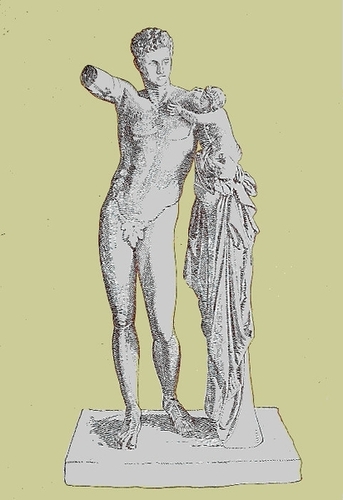
The most famous exploit of the Messenger, the slaughter of
Argus, has already been narrated.
110. Myths of Bacchus. Since the adventures of Ceres, although
she was a goddess of earth, are intimately connected with the life
of the underworld, they will be related in the sections pertaining to
Proserpine and Pluto. The god of vernal sap
and vegetation, of the gladness that comes of
youth or of wine, the golden-curled, sleepy-eyed
Bacchus (Dionysus),—his wanderings,
and the fortunes of mortals brought under
his influence (Pentheus, Acetes, Ariadne,
and Midas), here challenge our attention.
Fig. 82. Silenus taking Dionysus to School
111. The Wanderings of Bacchus. After
the death of Semele,[145] Jove took the infant
Bacchus and gave him in charge to the
Nysæan nymphs, who nourished his infancy
and childhood and for their care were placed
by Jupiter, as the Hyades, among the stars.
Another guardian and tutor of young Bacchus
was the pot-bellied, jovial Silenus, son of
Pan and a nymph, and oldest of the Satyrs.
Silenus was probably an indulgent preceptor.
He was generally tipsy and would have
broken his neck early in his career, had not
the Satyrs held him on his ass's back as he reeled along in the
train of his pupil. After Bacchus was of age, he discovered the
culture of the vine and the mode of extracting its precious juice;
but Juno struck him with madness and drove him forth a wanderer
through various parts of the earth. In Phrygia the goddess
Rhea cured him and taught him her religious rites; and then
he set out on a progress through Asia, teaching the people the
cultivation of the vine. The most famous part of his wanderings
is his expedition to
India, which is said
to have lasted several
years. Returning in
triumph, he undertook
to introduce his worship
into Greece, but
was opposed by certain
princes who dreaded
the disorders and madness
it brought with it.
Finally, he approached
his native city Thebes,
where his own cousin,
Pentheus, son of Agave
and grandson of Harmonia
and Cadmus, was
king. Pentheus, however,
had no respect
for the new worship and forbade its rites to be performed.[146] But
when it was known that Bacchus was advancing, men and women,
young and old, poured forth to meet him and to join his triumphal
march.
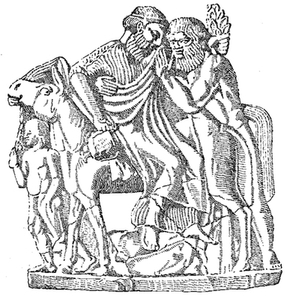
Fig. 83. Bearded Dionysus and Satyr
Fauns with youthful Bacchus follow;
Ivy crowns that brow, supernal
As the forehead of Apollo,
And possessing youth eternal.
Round about him fair Bacchantes,
Bearing cymbals, flutes, and thyrses,
Wild from Naxian groves or Zante's
Vineyards, sing delirious verses.[147]
It was in vain Pentheus remonstrated, commanded, and threatened.
His nearest friends and wisest counselors begged him not to oppose
the god. Their remonstrances only made him the more violent.
112. The Story of Acetes. Soon the attendants returned who
had been dispatched to seize Bacchus. They had succeeded in
taking one of the Bacchanals prisoner, whom, with his hands tied
behind him, they brought before the king. Pentheus, threatening
him with death, commanded him to tell who he was and what these
new rites were that he presumed to celebrate.
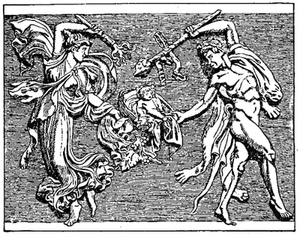
Fig. 84. Satyr and Mænad with Child Dionysus
The prisoner, unterrified, replied that he was Acetes of Mæonia;
that his parents, being poor, had left him their fisherman's trade,
which he had followed till he had acquired the pilot's art of steering
his course by the
stars. It once happened
that he had
touched at the island
of Dia and had sent
his men ashore for
fresh water. They returned,
bringing with
them a lad of delicate
appearance whom
they had found asleep.
Judging him to be
a noble youth, they
thought to detain him
in the hope of liberal
ransom. But Acetes
suspected that some god was concealed under the youth's exterior,
and asked pardon for the violence done. Whereupon the sailors,
enraged by their lust of gain, exclaimed, "Spare thy prayers for
us!" and, in spite of the resistance offered by Acetes, thrust the
captive youth on board and set sail.
Then Bacchus (for the youth was indeed he), as if shaking off
his drowsiness, asked what the trouble was and whither they were
carrying him. One of the mariners replied, "Fear nothing; tell us
where thou wouldst go, and we will convey thee thither." "Naxos
is my home," said Bacchus; "take me there, and ye shall be well
rewarded." They promised so to do; but, preventing the pilot from
steering toward Naxos, they bore away for Egypt, where they might
sell the lad into slavery. Soon the god looked out over the sea
and said in a voice of weeping, "Sailors, these are not the shores
ye promised me; yonder island is not my home. It is small glory
ye shall gain by cheating a poor boy." Acetes wept to hear him,
but the crew laughed at both of them and sped the vessel fast over
the sea. All at once it stopped in mid-sea, as fast as if it were
fixed on the ground. The men, astonished, pulled at their oars
and spread more sail, but all in vain. Ivy twined round the oars
and clung to the sails,
with heavy clusters of
berries. A vine laden
with grapes ran up
the mast and along
the sides of the vessel.
The sound of flutes was
heard, and the odor of
fragrant wine spread
all around. The god
himself had a chaplet
of vine leaves and
bore in his hand a
spear wreathed with
ivy. Tigers crouched
at his feet, and forms
of lynxes and spotted
panthers played around
him. The whole crew became dolphins and swam about the ship.
Of twenty men Acetes alone was left. "Fear not," said the god;
"steer towards Naxos." The pilot obeyed, and when they arrived
there, kindled the altars and celebrated the sacred rites of Bacchus.
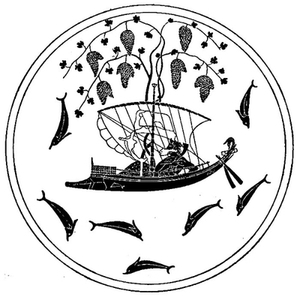
So far had Acetes advanced in his narrative, when Pentheus,
interrupting, ordered him off to his death. But from this fate the
pilot, rendered invisible by his patron deity, was straightway rescued.
Meanwhile, the mountain Cithæron seemed alive with worshipers,
and the cries of the Bacchanals resounded on every side. Pentheus,
angered by the noise, penetrated through the wood and reached an
open space where the chief scene of the orgies met his eyes. At
the same moment the women saw him, among them his mother
Agave, and Autonoë and Ino, her sisters. Taking him for a wild
boar, they rushed upon him and tore him to pieces,—his mother
shouting, "Victory! Victory! the glory is ours!"
So the worship of Bacchus was established in Greece.
It was on the island of Naxos that Bacchus afterward found
Ariadne, the daughter of Minos, king of Crete, who had been deserted
by her lover, Theseus. How Bacchus comforted her is related
in another section. How the god himself is worshiped is told by
Edmund Gosse in the poem from which the following extracts are
taken:
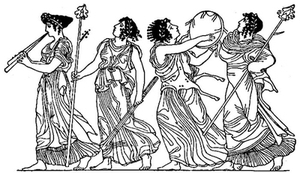
Fig. 86. Bacchic Procession
Behold, behold! the granite gates unclose,
And down the vales a lyric people flows;
Dancing to music, in their dance they fling
Their frantic robes to every wind that blows,
And deathless praises to the vine-god sing.
Nearer they press, and nearer still in sight,
Still dancing blithely in a seemly choir;
Tossing on high the symbol of their rite,
The cone-tipped thyrsus of a god's desire;
Nearer they come, tall damsels flushed and fair,
With ivy circling their abundant hair;
Onward, with even pace, in stately rows,
With eye that flashes, and with cheek that glows,
And all the while their tribute-songs they bring,
And newer glories of the past disclose,
And deathless praises to the vine-god sing.
... But oh! within the heart of this great flight,
Whose ivory arms hold up the golden lyre?
What form is this of more than mortal height?
What matchless beauty, what inspirèd ire!
The brindled panthers know the prize they bear,
And harmonize their steps with stately care;
Bent to the morning, like a living rose,
The immortal splendor of his face he shows,
And where he glances, leaf and flower and wing
Tremble with rapture, stirred in their repose,
And deathless praises to the vine-god sing....[148]
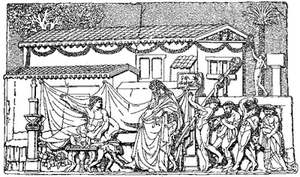
Fig. 87. Dionysus visiting a Poet
113. The Choice of King Midas.[149] Once Silenus, having wandered
from the company of Bacchus in an intoxicated condition,
was found by some peasants, who carried him to their king, Midas.
Midas entertained him royally and on the eleventh day restored
him in safety to his divine pupil. Whereupon Bacchus offered
Midas his choice of a reward. The king asked that whatever he
might touch should be changed into gold. Bacchus consented.
Midas hastened to put his new-acquired power to the test. A
twig of an oak, which he plucked from the branch, became gold in
his hand. He took up a stone; it changed to gold. He touched
a sod with the same result. He took an apple from the tree; you
would have thought he had robbed the garden of the Hesperides.
He ordered his servants, then, to set an excellent meal on the
table. But, to his dismay, when he touched bread, it hardened in
his hand; when he put a morsel to his lips, it defied his teeth. He
took a glass of wine, but it flowed down his throat like melted gold.
He strove to divest himself of his power; he hated the gift he
had lately coveted. He raised his arms, all shining with gold, in
prayer to Bacchus, begging to be delivered from this glittering
destruction. The merciful deity heard and sent him to wash away
his fault and its punishment in the fountainhead of the river
Pactolus. Scarce had Midas touched the waters, before the gold-creating
power passed into them, and the river sands became
golden, as they remain to this day.
Thenceforth Midas, hating wealth and splendor, dwelt in the
country and became a worshiper of Pan, the god of the fields.
But that he had not gained common sense is shown by the decision
that he delivered somewhat later in favor of Pan's superiority,
as a musician, over Apollo.[150]
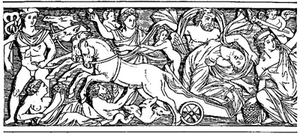
Fig. 88. Rape of Proserpina
114. Myths of Ceres, Pluto, and Proserpine. The search of
Ceres for Proserpine, and of Orpheus for Eurydice, are stories
pertaining both to Earth and Hades.
115. The Rape of Proserpine.[151] When the giants were imprisoned
by Jupiter under Mount Ætna, Pluto (Hades) feared lest the
shock of their fall might expose his kingdom to the light of day.
Under this apprehension, he mounted his chariot drawn by black
horses, and made a circuit of inspection to satisfy himself of the
extent of the damage. While he was thus engaged, Venus, who
was sitting on Mount Eryx playing with her boy Cupid, espied
him and said, "My son, take thy darts which subdue all, even Jove
himself, and send one into the breast of yonder dark monarch,
who rules the realm of Tartarus. Dost thou not see that even in
heaven some despise our power? Minerva and Diana defy us; and
there is that daughter of Ceres, goddess of earth, who threatens to
follow their example. Now, if thou regardest thine own interest
or mine, join these two in one." The boy selected his sharpest
and truest arrow, and sped it right to the heart of Pluto.
In the vale of Enna is a lake embowered in woods, where Spring
reigns perpetual. Here Proserpine (Persephone) was playing with
her companions, gathering lilies and violets, and singing, one may
imagine, such words as our poet Shelley puts into her mouth:
Sacred Goddess, Mother Earth,
Thou from whose immortal bosom,
Gods, and men, and beasts, have birth,
Leaf and blade, and bud and blossom,
Breathe thine influence most divine
On thine own child, Proserpine.
If with mists of evening dew
Thou dost nourish these young flowers
Till they grow, in scent and hue,
Fairest children of the hours,
Breathe thine influence most divine
On thine own child, Proserpine.[152]
Pluto saw her, loved her, and carried her off. She screamed for
help to her mother and her companions; but the ravisher urged
on his steeds and outdistanced pursuit. When he reached the
river Cyane, it opposed his passage, whereupon he struck the bank
with his trident, and the earth opened and gave him a passage to
Tartarus.
116. The Wanderings of Ceres.[153] Ceres (Demeter) sought her
daughter all the world over. Bright-haired Aurora, when she came
forth in the morning, and Hesperus, when he led out the stars in
the evening, found her still busy in the search. At length, weary
and sad, she sat down upon a stone, and remained nine days and
nights in the open air, under the sunlight and moonlight and falling
showers. It was where now stands the city of Eleusis, near the
home of an old man named Celeus. His little girl, pitying the old
woman, said to her, "Mother,"—and the name was sweet to the
ears of Ceres,—"why sittest thou here alone upon the rocks?"
The old man begged her to come into his cottage. She declined.
He urged her. "Go in peace," she replied, "and be happy in thy
daughter; I have lost mine." But their compassion finally prevailed.
Ceres rose from the stone and went with them. As they
walked, Celeus said that his only son lay sick of a fever. The
goddess stooped and gathered some poppies. Then, entering
the cottage, where all was in distress,—for the boy Triptolemus
seemed past recovery,—she restored the child to life and
health with a kiss. In
grateful happiness the
family spread the table
and put upon it curds
and cream, apples, and
honey in the comb.
While they ate, Ceres
mingled poppy juice
in the milk of the boy.
When night came, she
arose and, taking the
sleeping boy, molded
his limbs with her
hands, and uttered
over him three times
a solemn charm, then
went and laid him in
the ashes. His mother,
who had been watching
what her guest
was doing, sprang forward
with a cry and
snatched the child from the fire. Then Ceres assumed her own form,
and a divine splendor shone all around. While they were overcome
with astonishment, she said, "Mother, thou hast been cruel in thy
fondness; for I would have made thy son immortal. Nevertheless,
he shall be great and useful. He shall teach men the use of the plow
and the rewards which labor can win from the soil." So saying, she
wrapped a cloud about her and mounting her chariot rode away.
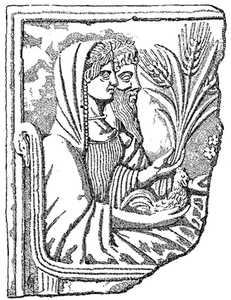
Fig. 89. Hades and Persephone
Ceres continued her search for her daughter till at length she
returned to Sicily, whence she first had set out, and stood by the
banks of the river Cyane. The river nymph would have told the
goddess all she had witnessed, but dared not, for fear of Pluto;
so she ventured merely to take up the girdle which Proserpine had
dropped in her flight, and float it to the feet of the mother. Ceres,
seeing this, laid her curse on the innocent earth in which her
daughter had disappeared. Then succeeded drought and famine,
flood and plague, until, at last, the fountain Arethusa made intercession
for the land. For she had seen that it opened only unwillingly
to the might of Pluto; and she had also, in her flight from
Alpheüs through the lower regions of the earth, beheld the missing
Proserpine. She said that the daughter of Ceres seemed sad,
but no longer showed alarm in her countenance. Her look was
such as became a queen,—the queen of Erebus; the powerful
bride of the monarch of the realms of the dead.
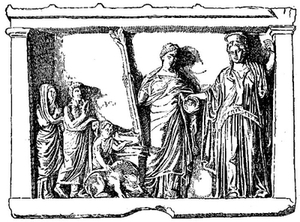
Fig. 90. Sacrifice to Demeter and Persephone
When Ceres heard this, she stood awhile like one stupefied;
then she implored Jupiter to interfere to procure the restitution
of her daughter. Jupiter consented on condition that Proserpine
should not during her stay in the lower world have taken any food;
otherwise, the Fates forbade her release. Accordingly, Mercury
was sent, accompanied by Spring, to demand Proserpine of Pluto.
The wily monarch consented; but alas! the maiden had taken a
pomegranate which Pluto offered her, and had sucked the sweet
pulp from a few of the seeds. A compromise, however, was effected
by which she was to pass half the time with her mother, and the
rest with the lord of Hades.
Of modern poems upon the story of the maiden seized in the
vale of Enna, none conveys a lesson more serene of the beauty of
that dark lover of all fair life, Death, than the Proserpine of Woodberry,
from which we quote the three following stanzas. "I pick,"
says the poet wandering through the vale of Enna,
I pick the flowers that Proserpine let fall,
Sung through the world by every honeyed muse:
Wild morning-glories, daisies waving tall,
At every step is something new to choose;
And oft I stop and gaze
Upon the flowery maze;
By yonder cypresses on that soft rise,
Scarce seen through poppies and the knee-deep wheat,
Juts the dark cleft where on her came the fleet
Thunder-black horses and the cloud's surprise
And he who filled the place.
Did marigolds bright as these, gilding the mist,
Drop from her maiden zone? Wert thou last kissed,
Pale hyacinth, last seen, before his face?
* * * * *
Oh, whence has silence stolen on all things here,
Where every sight makes music to the eye?
Through all one unison is singing clear;
All sounds, all colors in one rapture die.
Breathe slow, O heart, breathe slow!
A presence from below
Moves toward the breathing world from that dark deep,
Whereof men fabling tell what no man knows,
By little fires amid the winter snows,
When earth lies stark in her titanic sleep
And doth with cold expire;
He brings thee all, O Maiden flower of earth,
Her child in whom all nature comes to birth,
Thee, the fruition of all dark desire.
* * * * *
O Proserpine, dream not that thou art gone
Far from our loves, half-human, half-divine;
Thou hast a holier adoration won
In many a heart that worships at no shrine.
Where light and warmth behold me,
And flower and wheat infold me,
I lift a dearer prayer than all prayers past:
He who so loved thee that the live earth clove
Before his pathway unto light and love,
And took thy flower-full bosom,—who at last
Shall every blossom cull,—
Lover the most of what is most our own,
The mightiest lover that the world has known,
Dark lover, Death,—was he not beautiful?[154]
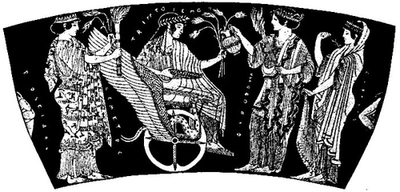
Fig. 91. Triptolemus and the Eleusinian Deities
117. Triptolemus and the Eleusinian Mysteries. Ceres, pacified
with this arrangement, restored the earth to her favor. Now she
remembered, also, Celeus and his family, and her promise to his
infant son Triptolemus. She taught the boy the use of the plow
and how to sow the seed. She took him in her chariot, drawn by
winged dragons, through all the countries of the earth; and under
her guidance he imparted to mankind valuable grains and the
knowledge of agriculture. After his return Triptolemus built a
temple to Ceres in Eleusis and established the worship of the
goddess under the name of the Eleusinian mysteries, which in the
splendor and solemnity
of their observance
surpassed all
other religious celebrations
among the
Greeks.
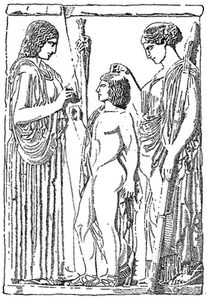
Fig. 92. Demeter, Triptolemus, and Proserpina
118. Orpheus and
Eurydice.[155] Of mortals
who have visited
Hades and returned,
none has a sweeter or
sadder history than Orpheus,
son of Apollo
and the Muse Calliope.
Presented by his father
with a lyre and taught
to play upon it, he became
the most famous
of musicians, and not
only his fellow mortals
but even the wild
beasts were softened
by his strains. The
very trees and rocks
were sensible to the
charm. And so also was Eurydice,—whom he loved and won.
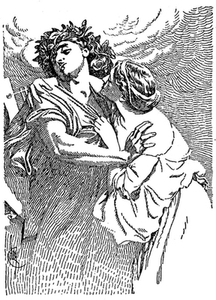
Fig. 93. Orpheus and Eurydice
From the painting by Lord Leighton
Hymen was called to bless with his presence the nuptials of
Orpheus with Eurydice, but he conveyed no happy omens with
him. His torch smoked and brought tears into the eyes. In keeping
with such sad prognostics, Eurydice, shortly after her marriage,
was seen by the shepherd Aristæus, who was struck with her beauty
and made advances to her. As she fled she trod upon a snake in
the grass, and was bitten in the foot. She died. Orpheus sang his
grief to all who breathed the upper air, both gods and men, and
finding his complaint of no avail, resolved to seek his wife in the
regions of the dead. He descended by a cave situated on the side
of the promontory of Tænarus, and arrived in the Stygian realm.
He passed through crowds
of ghosts and presented
himself before the throne
of Pluto and Proserpine.
Accompanying his words
with the lyre, he sang his
petition for his wife. Without
her he would not return.
In such tender strains
he sang that the very ghosts
shed tears. Tantalus, in
spite of his thirst, stopped
for a moment his efforts for
water, Ixion's wheel stood
still, the vulture ceased to
tear the giant's liver, the
daughters of Danaüs rested
from their task of drawing
water in a sieve, and Sisyphus
sat on his rock to
listen.[156] Then for the first
time, it is said, the cheeks
of the Furies were wet with tears. Proserpine could not resist and
Pluto himself gave way. Eurydice was called. She came from among
the new-arrived ghosts, limping with her wounded foot. Orpheus
was permitted to take her away with him on condition that he should
not turn round to look at her till they should have reached the upper
air. Under this condition they proceeded on their way, he leading,
she following. Mindful of his promise, without let or hindrance the
bard passed through the horrors of hell. All Hades held its breath.
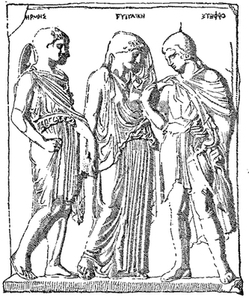
Fig. 94. Farewell of Orpheus and Eurydice
... On he slept,
And Cerberus held agape his triple jaws;
On stept the bard. Ixion's wheel stood still.
Now, past all peril, free was his return,
And now was hastening into upper air
Eurydice, when sudden madness seized
The incautious lover; pardonable fault,
If they below could pardon: on the verge
Of light he stood, and on Eurydice
(Mindless of fate, alas! and soul-subdued)
Lookt back.
There, Orpheus! Orpheus! there was all
Thy labor shed, there burst the Dynast's bond,
And thrice arose that rumor from the lake.
"Ah, what!" she cried, "what madness hath undone
Me! and, ah, wretched! thee, my Orpheus, too!
For lo! the cruel Fates recall me now;
Chill slumbers press my swimming eyes.... Farewell!
Night rolls intense around me as I spread
My helpless arms ... thine, thine no more ... to thee."
She spake, and, like a vapor, into air
Flew, nor beheld him as he claspt the void
And sought to speak; in vain; the ferry-guard
Now would not row him o'er the lake again,
His wife twice lost, what could he? whither go?
What chant, what wailing, move the Powers of Hell?
Cold in the Stygian bark and lone was she.
Beneath a rock o'er Strymon's flood on high,
Seven months, seven long-continued months, 'tis said,
He breath'd his sorrows in a desert cave,
And sooth'd the tiger, moved the oak, with song.[157]
The Thracian maidens tried their best to captivate him, but he
repulsed their advances. Finally, excited by the rites of Bacchus,
one of them exclaimed, "See yonder our despiser!" and threw
at him her javelin. The weapon, as soon as it came within the
sound of his lyre, fell harmless at his feet; so also the stones that
they threw at him. But the women, raising a scream, drowned
the voice of the music, and overwhelmed him with their missiles.
Like maniacs they tore him limb from limb; then cast his head
and lyre into the river Hebrus, down which they floated, murmuring
sad music to which the shores responded. The Muses buried
the fragments of his body at Libethra, where the nightingale is
said to sing over his grave more sweetly than in any other part of
Greece. His lyre was placed by Jupiter among the stars; but the
shade of the bard passed a second time to Tartarus and rejoined
Eurydice.
Other mortals who visited the Stygian realm and returned were
Hercules, Theseus, Ulysses, and Æneas.[158]
119. Lord of the Sea. Neptune (Poseidon) was lord both of salt
waters and of fresh. The myths that turn on his life as lord of the
sea illustrate his defiant invasions
of lands belonging to other gods, or
his character as earth shaker and
earth protector. Of his contests
with other gods, that with Minerva
for Athens has been related. He
contested Corinth with Helios,
Argos with Juno, Ægina with
Jove, Naxos with Bacchus, and
Delphi with Apollo. That he did
not always make encroachments
in person upon the land that he
desired to possess or to punish,
but sent some monster instead,
will be seen in the myth of Andromeda[159]
and in the following
story of Hesione,[160] the daughter of
Laomedon of Troy.
Neptune and Apollo had fallen
under the displeasure of Jupiter
after the overthrow of the giants.
They were compelled, it is said,
to resign for a season their respective functions and to serve
Laomedon, then about to build the city of Troy. They aided the
king in erecting the walls of the city but were refused the wages
agreed upon. Justly offended, Neptune ravaged the land by floods
and sent against it a sea monster, to satiate the appetite of which
the desperate Laomedon was driven to offer his daughter Hesione.
But Hercules appeared upon the scene, killed the monster, and
rescued the maiden. Neptune, however, nursed his wrath; and it
was still warm when the Greeks marched against Troy.
Of a like impetuous and ungovernable temper were the sons of
Neptune by mortal mothers. From him were sprung the savage
Læstrygonians, Orion, the Cyclops Polyphemus, the giant Antæus
whom Hercules slew, Procrustes, and many another redoubtable
being whose fortunes are elsewhere recounted.[161]
120. Lord of Streams and Fountains. As earth shaker, the ruler
of the deep was known to effect convulsions of nature that made
Pluto leap from his throne lest the firmament of the underworld
might be falling about his ears. But as god of the streams and fountains,
Neptune displayed milder characteristics. When Amymone,
sent by her father Danaüs to draw water, was pursued by a satyr,
Neptune gave ear to her cry for help, dispatched the satyr, made
love to the maiden, and boring the earth with his trident called
forth the spring that still bears the Danaïd's name. He loved the
goddess Ceres also, through whose pastures his rivers strayed; and
Arne the shepherdess, daughter of King Æolus, by whom he
became the forefather of the Bœotians. His children, Pelias and
Neleus, by the princess Tyro, whom he wooed in the form of her
lover Enipeus, became keepers of horses—animals especially dear
to Neptune. Perhaps it was the similarity of horse-taming to wave-taming
that attracted the god to these quadrupeds; perhaps it was
because they increased in beauty and speed on the pastures watered
by his streams. It is said, indeed, that the first and fleetest of
horses, Arion, was the offspring of Neptune and Ceres, or of Neptune
and a Fury.
121. Pelops and Hippodamia.[162] To Pelops, brother of Niobe,
Neptune imparted skill in training and driving horses,—and with
good effect. For it happened that Pelops fell in love with Hippodamia,
daughter of Œnomaüs, king of Elis and son of Mars,—a
girl of whom it was reported that none could win her save by
worsting the father in a chariot race, and that none might fail in
that race and come off alive. Since an oracle, too, had warned
Œnomaüs to beware of the future husband of his daughter, he had
provided himself with horses whose speed was like the cyclone.
But Pelops, obtaining from Neptune winged steeds, entered the
race and won it,—whether by the speed of his horses or by the
aid of Hippodamia, who, it is said, bribed her father's charioteer,
Myrtilus, to take a bolt out of the chariot of Œnomaüs, is uncertain.
At any rate, Pelops married Hippodamia. He was so injudicious,
however, as to throw Myrtilus into the sea; and from that
treachery sprang the misfortunes of the house of Pelops. For
Myrtilus, dying, cursed the murderer and his race.
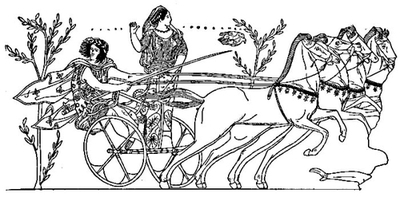
Fig. 96. Pelops winning the Race, Hippodamia looking on
122. Myths of Stars and Winds. The tales of Stars and Winds
and the other lesser powers of the celestial regions are closely interwoven.
That the winds which sweep heaven should kiss the stars
is easy to understand. The stories of Aurora (Eos) and of Aura, of
Phosphor and of Halcyone, form, therefore, a ready sequence.
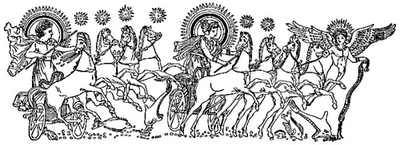
Fig. 97. Phosphor, Eos, and Helios (the Sun) rising from the Sea
123. Cephalus and Procris.[163] Aurora, the goddess of the dawn,
fell in love with Cephalus, a young huntsman. She stole him away,
lavished her love upon him, tried to content him, but in vain. He
cared for his young wife Procris more than for the goddess. Finally,
Aurora dismissed him in displeasure, saying, "Go, ungrateful mortal,
keep thy wife; but thou shalt one day be sorry that thou didst
ever see her again."
Cephalus returned and was as happy as before in his wife. She,
being a favorite of Diana, had received from her for the chase a
dog and a javelin, which she handed over to her husband. Of
the dog it is told that when about to catch the swiftest fox in
the country, he was changed with his victim into stone. For the
heavenly powers, who had made both and rejoiced in the speed
of both, were not willing that either should conquer. The javelin
was destined to a sad office. It appears that Cephalus, when
weary of the chase, was wont to stretch himself in a certain shady
nook to enjoy the breeze. Sometimes he would say aloud, "Come,
gentle Aura, sweet goddess of the breeze, come and allay the heat
that burns me." Some one, foolishly believing that he addressed
a maiden, told the secret to Procris. Hoping against hope, she
stole out after him the next morning and concealed herself in the
place which the informer had indicated. Cephalus, when tired with
sport, stretched himself on the green bank and summoned fair
Aura as usual. Suddenly he heard, or thought he heard, a sound as
of a sob in the bushes. Supposing it to proceed from some wild
animal, he threw his javelin at the spot. A cry told him that the
weapon had too surely met its mark. He rushed to the place
and raised his wounded Procris from the earth. She, at last,
opened her feeble eyes and forced herself to utter these words:
"I implore thee, if thou hast ever loved me, if I have ever deserved
kindness at thy hands, my husband, grant me this last
request; marry not that odious Breeze!" So saying, she expired
in her lover's arms.
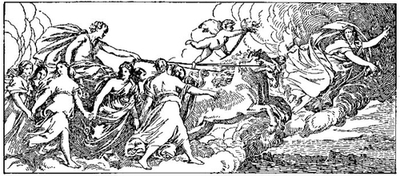
Fig. 98. Sun, rising, preceded by Dawn
From the painting by Guido Reni
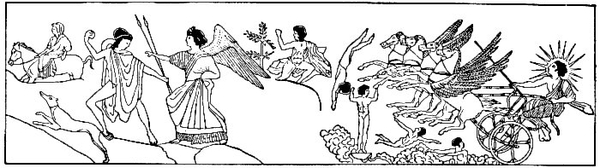
Fig. 99. Sunrise; Eos pursuing Cephalus
124. Dobson's The Death of
Procris. A different version of
the story is given in the following:
Procris, the nymph, had wedded Cephalus;—
He, till the spring had warmed to slow-winged days
Heavy with June, untired and amorous,
Named her his love; but now, in unknown ways,
His heart was gone; and evermore his gaze
Turned from her own, and even farther ranged
His woodland war; while she, in dull amaze,
Beholding with the hours her husband changed,
Sighed for his lost caress, by some hard god estranged.
So, on a day, she rose and found him not.
Alone, with wet, sad eye, she watched the shade
Brighten below a soft-rayed sun that shot
Arrows of light through all the deep-leaved glade;
Then, with weak hands, she knotted up the braid
Of her brown hair, and o'er her shoulders cast
Her crimson weed; with faltering fingers made
Her golden girdle's clasp to join, and past
Down to the trackless wood, full pale and overcast.
And all day long her slight spear devious flew,
And harmless swerved her arrows from their aim,
For ever, as the ivory bow she drew,
Before her ran the still unwounded game.
Then, at the last, a hunter's cry there came,
And, lo! a hart that panted with the chase.
Thereat her cheek was lightened as with flame,
And swift she gat her to a leafy place,
Thinking, "I yet may chance unseen to see his face."
Leaping he went, this hunter Cephalus,
Bent in his hand his cornel bow he bare,
Supple he was, round-limbed and vigorous,
Fleet as his dogs, a lean Laconian pair.
He, when he spied the brown of Procris' hair
Move in the covert, deeming that apart
Some fawn lay hidden, loosed an arrow there;
Nor cared to turn and seek the speeded dart,
Bounding above the fern, fast following up the hart.
But Procris lay among the white wind-flowers,
Shot in the throat. From out the little wound
The slow blood drained, as drops in autumn showers
Drip from the leaves upon the sodden ground.
None saw her die but Lelaps, the swift hound,
That watched her dumbly with a wistful fear,
Till, at the dawn, the hornèd wood-men found
And bore her gently on a sylvan bier,
To lie beside the sea,—with many an uncouth tear.
125. Ceyx and Halcyone. The son of Aurora and Cephalus was
Phosphor, the Star of Morning. His son Ceyx, king of Trachis in
Thessaly, had married Halcyone, daughter of Æolus.[164] Their reign
was happy until the brother of Ceyx met his death. The direful
prodigies that followed this event made Ceyx feel that the gods
were hostile to him. He thought best therefore to make a voyage
to Claros in Ionia to consult the oracle of Apollo. In spite of his
wife's entreaties (for as daughter of the god of winds she knew
how dreadful a thing a storm at sea was), Ceyx set sail. He was
shipwrecked and drowned. His last prayer was that the waves
might bear his body to the sight of Halcyone, and that it might
receive burial at her hands.
In the meanwhile, Halcyone counted the days till her husband's
promised return. To all the gods she offered frequent incense, but
more than all to Juno. The goddess, at last, could not bear to be
further pleaded with for one already dead. Calling Iris, she enjoined
her to approach the drowsy dwelling of Somnus and bid him send
a vision to Halcyone in the form of Ceyx, to reveal the sad event.
Fig. 100. The God of Sleep
Iris puts on her robe of many
colors, and tinging the sky with her
bow, seeks the cave near the Cimmerian
country, which is the abode
of the dull god, Somnus. Here
Phœbus dare not come. Clouds
and shadows are exhaled from the
ground, and the light glimmers
faintly. The cock never there calls
aloud to Aurora, nor watchdog nor
goose disturbs the silence. No wild
beast, nor cattle, nor branch moved
with the wind, nor sound of human
conversation breaks the stillness.
From the bottom of the rock the
river Lethe flows, and by its murmur
invites to sleep. Poppies grow before
the door of the cave, from whose
juices Night distills slumbers which
she scatters over the darkened earth.
There is no gate to creak on its
hinges, nor any watchman. In the
midst, on a couch of black ebony adorned with black plumes and
black curtains the god reclines, his limbs relaxed in sleep. Around
him lie dreams, resembling all various forms, as many as the harvest
bears stalks, or the forest leaves, or the seashore sand grains.
Brushing away the dreams that hovered around her, Iris lit up
the cave and delivered her message to the god, who, scarce opening
his eyes, had great difficulty in shaking himself free from himself.
Then Iris hasted away from the drowsiness creeping over her,
and returned by her bow as she had come. But Somnus called
one of his sons, Morpheus, the most expert in counterfeiting forms
of men, to perform the command of Iris; then laid his head on
his pillow and yielded himself again to grateful repose.
Morpheus flew on silent wings to the Hæmonian city, where he
assumed the form of Ceyx. Pale like a dead man, naked and dripping,
he stood before the couch of the wretched wife and told her
that the winds of the Ægean had sunk his ship, that he was dead.
Weeping and groaning, Halcyone sprang from sleep and, with
the dawn, hastening to the seashore, descried an indistinct object
washed to and fro by the waves. As it floated nearer she recognized
the body of her husband. In despair, leaping from the mole,
she was changed instantly to a bird, and poured forth a song of
grief as she flew. By the mercy of the gods Ceyx was likewise
transformed. For seven days before and seven days after the winter
solstice, Jove forbids the winds to blow. Then Halcyone broods
over her nest; then the way is safe to seafarers. Æolus confines
the winds that his grandchildren may have peace.
126. Aurora and Tithonus.[165] Aurora seems frequently to have
been inspired with the love of mortals. Her greatest favorite, and
almost her latest, was Tithonus, son of Laomedon, king of Troy.
She stole him away and prevailed on Jupiter to grant him immortality;
but forgetting to have youth joined in the gift, after some time
she began to discern, to her great mortification, that he was growing
old. When his hair was white she left his society; but he still
had the range of her palace, lived on ambrosial food, and was clad
in celestial raiment. In time he lost the power of using his limbs;
and then she shut him up in his chamber, whence his feeble voice
might at times be heard. Finally, she turned him into a grasshopper.
127. Tennyson's Tithonus. The following is, according to a fine
poetic conception, the lament of the old man when but a white-haired
shadow:
The woods decay, the woods decay and fall,
The vapors weep their burthen to the ground,
Man comes and tills the field and lies beneath,
And after many a summer dies the swan.
Me only cruel immortality
Consumes: I wither slowly in thine arms,
Here at the quiet limit of the world,
A white-haired shadow roaming like a dream
The ever silent spaces of the East,
Far-folded mists, and gleaming halls of morn.
Alas! for this gray shadow, once a man—
So glorious in his beauty and thy choice,
Who madest him thy chosen, that he seem'd
To his great heart none other than a God!
I ask'd thee, "Give me immortality."
Then didst thou grant mine asking with a smile,
Like wealthy men who care not how they give;
But thy strong Hours indignant work'd their wills,
And beat me down and marr'd and wasted me,
And tho' they could not end me, left me maim'd
To dwell in presence of immortal youth,
Immortal age beside immortal youth,
And all I was, in ashes. Can thy love,
Thy beauty, make amends, tho' even now,
Close over us, the silver star, thy guide,
Shines in those tremulous eyes that fill with tears
To hear me? Let me go: take back thy gift:
Why should a man desire in any way
To vary from the kindly race of men,
Or pass beyond the goal of ordinance
Where all should pause, as is most meet for all?
A soft air fans the cloud apart; there comes
A glimpse of that dark world where I was born.
Once more the old mysterious glimmer steals
From thy pure brows, and from thy shoulders pure,
And bosom beating with a heart renew'd.
Thy cheek begins to redden thro' the gloom,
Thy sweet eyes brighten slowly close to mine,
Ere yet they blind the stars, and the wild team
Which love thee, yearning for thy yoke, arise,
And shake the darkness from their loosen'd manes,
And beat the twilight into flakes of fire.
Lo! ever thus thou growest beautiful
In silence, then before thine answer given
Departest, and thy tears are on my cheek.
Why wilt them ever scare me with thy tears,
And make me tremble lest a saying learnt
In days far-off, on that dark earth, be true?
"The gods themselves cannot recall their gifts."
Ay me! ay me! with what another heart
In days far-off, and with what other eyes
I used to watch—if I be he that watched—
The lucid outline forming round thee; saw
The dim curls kindle into sunny rings;
Changed with thy mystic change, and felt my blood
Glow with the glow that slowly crimson'd all
Thy presence and thy portals, while I lay,
Mouth, forehead, eyelids, growing dewy-warm
With kisses balmier than half-opening buds
Of April, and could hear the lips that kiss'd
Whispering I knew not what of wild and sweet,
Like that strange song I heard Apollo sing,
While Ilion like a mist rose into towers.
Yet hold me not forever in thine East:
How can my nature longer mix with thine?
Coldly thy rosy shadows bathe me, cold
Are all thy lights, and cold my wrinkled feet
Upon thy glimmering thresholds, when the steam
Floats up from those dim fields about the homes
Of happy men that have the power to die,
And grassy barrows of the happier dead.
Release me, and restore me to the ground;
Thou seëst all things, thou wilt see my grave:
Thou wilt renew thy beauty morn by morn;
I earth in earth forget these empty courts,
And thee returning on thy silver wheels.
128. Memnon, the son of Aurora and Tithonus, was king of the
Æthiopians. He went with warriors to assist his kindred in the
Trojan War, and was received by King Priam with honor. He
fought bravely, slew Antilochus, the brave son of Nestor, and held
the Greeks at bay until Achilles appeared. Before that hero he fell.
Then Aurora, seeing her son's fate, directed his brothers, the
Winds, to convey his body to the banks of the river Æsepus in
Mysia. In the evening Aurora, accompanied by the Hours and
the Pleiads, bewept her son. Night spread the heaven with clouds;
all nature mourned for the offspring of the Dawn. The Æthiopians
raised his tomb on the banks of the stream in the grove of
the Nymphs, and Jupiter
caused the sparks and
cinders of his funeral pile
to be turned into birds,
which, dividing into two
flocks, fought over the
pile till they fell into the
flame. Every year at
the anniversary of his
death they celebrated his
obsequies in like manner.
Aurora remained inconsolable.
The dewdrops
are her tears.[166]
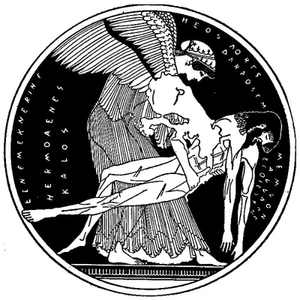
Fig. 101. The Death of Memnon
The kinship of Memnon
to the Dawn is certified
even after his death.
On the banks of the Nile are two colossal statues, one of which
is called Memnon's; and it was said that when the first rays of
morning fell upon this statue, a sound like the snapping of a harp-string
issued therefrom.[167]
So to the sacred Sun in Memnon's fane
Spontaneous concords choired the matin strain;
Touched by his orient beam responsive rings
The living lyre and vibrates all its strings;
Accordant aisles the tender tones prolong,
And holy echoes swell the adoring song.[168]
129. Pan, and the Personification of Nature. It was a pleasing
trait in the old paganism that it loved to trace in every operation of
nature the agency of deity. The imagination of the Greeks peopled
the regions of earth and sea with divinities, to whose agency it
attributed the phenomena that our philosophy ascribes to the operation
of natural law. So Pan, the god of woods and fields,[169] whose
name seemed to signify all, came to be considered a symbol of
the universe and a personification of Nature. "Universal Pan,"
says Milton in his description of the creation:
Universal Pan,
Knit with the Graces and the Hours in dance,
Led on the eternal Spring.
Later, Pan came to be regarded as a representative of all the
Greek gods and of paganism itself. Indeed, according to an early
Christian tradition, when the heavenly host announced to the shepherds
the birth of Christ, a deep groan, heard through the isles of
Greece, told that great Pan was dead, that the dynasty of Olympus
was dethroned, and the several deities sent wandering in cold and
darkness.
The lonely mountains o'er,
And the resounding shore,
A voice of weeping heard and loud lament;
From haunted spring and dale,
Edged with poplar pale,
The parting Genius is with sighing sent;
With flower-inwoven tresses torn,
The nymphs in twilight shade of tangled thickets mourn.[170]
Many a poet has lamented the change. For even if the head
did profit for a time by the revolt against the divine prerogative
of nature, it is more than possible that the heart lost in due
proportion.
His sorrow at this loss of imaginative sympathy among the
moderns Wordsworth expresses in the sonnet, already cited, beginning
"The world is too much with us." Schiller, also, by his
poem, The Gods of Greece, has immortalized his sorrow for the
decadence of the ancient mythology.
Fig. 102. Pan Blowing
His Pipe, Echo
Answering
Ah, the beauteous world while yet ye ruled it,—
Yet—by gladsome touches of the hand;
Ah, the joyous hearts that still ye governed,
Gods of Beauty, ye, of Fable-land!
Then, ah, then, the mysteries resplendent
Triumphed.—Other was it then, I ween,
When thy shrines were odorous with garlands,
Thou, of Amathus the queen.
Then the gracious veil, of fancy woven,
Fell in folds about the fact uncouth;
Through the universe life flowed in fullness,
What we feel not now was felt in sooth:
Man ascribed nobility to Nature,
Rendered love unto the earth he trod,
Everywhere his eye, illuminated,
Saw the footprints of a God.
* * * * *
Lovely world, where art thou? Turn, oh, turn thee,
Fairest blossom-tide of Nature's spring!
Only in the poet's realm of wonder
Liv'st thou, still,—a fable vanishing.
Reft of life the meadows lie deserted;
Ne'er a godhead can my fancy see:
Ah, if only of those living colors
Lingered yet the ghost with me![171]
* * * * *
It was the poem from which these stanzas are taken that
provoked the well-known reply of Elizabeth Barrett Browning,
contained in The Dead Pan. Her argument may be gathered
from the following stanzas:
By your beauty which confesses
Some chief Beauty conquering you,
By our grand heroic guesses
Through your falsehood at the True,
We will weep not! earth shall roll
Heir to each god's aureole,
And Pan is dead.
Earth outgrows the mythic fancies
Sung beside her in her youth;
And those debonair romances
Sound but dull beside the truth.
Phœbus' chariot course is run!
Look up, poets, to the sun!
Pan, Pan is dead.
130. Stedman's Pan in Wall Street.[172] That Pan, however, is not
yet dead but alive even in the practical atmosphere of our western
world, the poem here appended, written by one of our recently
deceased American poets, would indicate.
Just where the Treasury's marble front
Looks over Wall Street's mingled nations;
Where Jews and Gentiles most are wont
To throng for trade and last quotations;
Where, hour by hour, the rates of gold
Outrival, in the ears of people,
The quarter chimes, serenely tolled
From Trinity's undaunted steeple,—
Even there I heard a strange, wild strain
Sound high above the modern clamor,
Above the cries of greed and gain,
The curbstone war, the auction's hammer;
And swift, on Music's misty ways,
It led, from all this strife for millions,
To ancient, sweet-do-nothing days
Among the kirtle-robed Sicilians.
Fig. 103. The Music Lesson
And as it still'd the multitude,
And yet more joyous rose, and shriller,
I saw the minstrel where he stood
At ease against a Doric pillar:
One hand a droning organ play'd,
The other held a Pan's pipe (fashioned
Like those of old) to lips that made
The reeds give out that strain impassioned.
'T was Pan himself had wandered here,
A-strolling through the sordid city,
And piping to the civic ear
The prelude of some pastoral ditty!
The demigod had cross'd the seas,—
From haunts of shepherd, nymph, and satyr,
And Syracusan times,—to these
Far shores and twenty centuries later.
A ragged cap was on his head:
But—hidden thus—there was no doubting
That, all with crispy locks o'erspread,
His gnarlèd horns were somewhere sprouting;
His club-feet, cased in rusty shoes,
Were cross'd, as on some frieze you see them.
And trousers, patched of divers hues,
Conceal'd his crooked shanks beneath them.
He filled the quivering reeds with sound,
And o'er his mouth their changes shifted,
And with his goat's-eyes looked around
Where'er the passing current drifted;
And soon, as on Trinacrian hills
The nymphs and herdsmen ran to hear him,
Even now the tradesmen from their tills,
With clerks and porters, crowded near him.
The bulls and bears together drew
From Jauncey Court and New Street Alley,
As erst, if pastorals be true,
Came beasts from every wooded valley;
The random passers stay'd to list,—
A boxer Ægon, rough and merry,—
Broadway Daphnis, on his tryst
With Naïs at the Brooklyn Ferry.
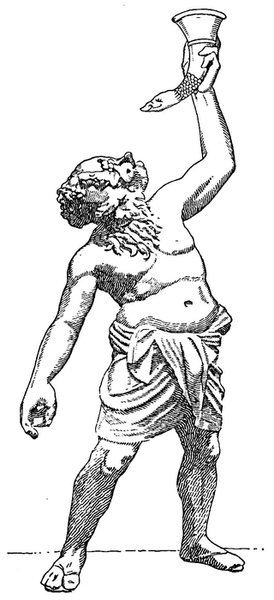
A one-eyed Cyclops halted long
In tatter'd cloak of army pattern,
And Galatea joined the throng,—
A blowsy, apple-vending slattern;
While old Silenus stagger'd out
From some new-fangled lunch-house handy
And bade the piper, with a shout,
To strike up "Yankee Doodle Dandy!"
A newsboy and a peanut girl
Like little Fauns began to caper:
His hair was all in tangled curl,
Her tawny legs were bare and taper.
And still the gathering larger grew,
And gave its pence and crowded nigher,
While aye the shepherd-minstrel blew
His pipe, and struck the gamut higher.
O heart of Nature! beating still
With throbs her vernal passion taught her,—
Even here, as on the vine-clad hill,
Or by the Arethusan water!
New forms may fold the speech, new lands
Arise within these ocean-portals,
But Music waves eternal wands,—
Enchantress of the souls of mortals!
So thought I,—but among us trod
A man in blue with legal baton;
And scoff'd the vagrant demigod,
And push'd him from the step I sat on.
Doubting I mused upon the cry—
"Great Pan is dead!"—and all the people
Went on their ways:—and clear and high
The quarter sounded from the steeple.
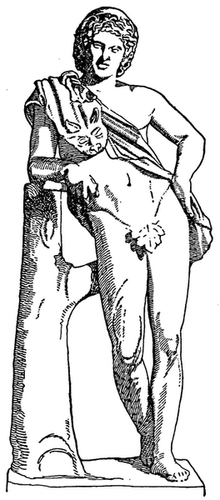
131. Other Lesser Gods of Earth. Of the company of the
lesser gods of earth, besides Pan, were the Sileni, the Sylvans,
the Fauns, and the Satyrs, all male; the
Oreads and the Dryads or Hamadryads,
female. To these may be added the
Naiads, for, although they dwelt in the
streams, their association with the deities
of earth was intimate. Of the nymphs,
the Oreads and the Naiads were immortal.
The love of Pan for Syrinx has
already been mentioned, and his musical
contest with Apollo. Of Silenus we have
seen something in the adventures of
Bacchus. What kind of existence the
Satyr enjoyed is conveyed in the following
soliloquy:
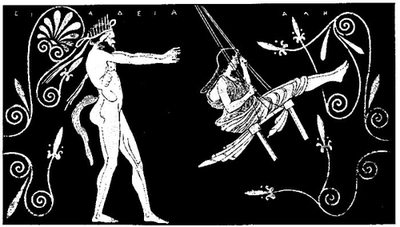
Fig. 107. Satyr swinging Maiden
The trunk of this tree,
Dusky-leaved, shaggy-rooted,
Is a pillow well suited
To a hybrid like me,
Goat-bearded, goat-footed;
For the boughs of the glade
Meet above me, and throw
A cool, pleasant shade
On the greenness below;
Dusky and brown'd
Close the leaves all around;
And yet, all the while,
Thro' the boughs I can see
A star, with a smile,
Looking at me....
Why, all day long,
I run about
With a madcap throng,
And laugh and shout.
Silenus grips
My ears, and strides
On my shaggy hips,
And up and down
In an ivy crown
Tipsily rides;
And when in doze
His eyelids close,
Off he tumbles, and I
Can his wine-skin steal,
I drink—and feel
The grass roll—sea high;
Then with shouts and yells,
Down mossy dells,
I stagger after
The wood-nymphs fleet,
Who with mocking laughter
And smiles retreat;
And just as I clasp
A yielding waist,
With a cry embraced,
—Gush! it melts from my grasp
Into water cool,
And—bubble! trouble!
Seeing double!
I stumble and gasp
In some icy pool![173]
132. Echo and Narcissus.[174] Echo was a beautiful Oread, fond of
the woods and hills, a favorite of Diana, whom she attended in the
chase. But by her chatter she came under the displeasure of Juno,
who condemned her to the loss of voice save for purposes of reply.
Subsequently having fallen in love with Narcissus, the beautiful
son of the river-god Cephissus, Echo found it impossible to express
her regard for him in any way but by mimicking what he said;
and what he said, unfortunately, did not always convey her sentiments.
When, however, he once called across the hills to her,
"Let us join one another," the maid, answering with all her heart,
hastened to the spot, ready to throw her arms about his neck. He
started back, exclaiming, "Hands off! I would rather die than
thou shouldst have me!" "Have me," said she; but in vain.
From that time forth she lived in caves and among mountain cliffs,
and faded away till there was nothing left of her but her voice. But
through his future fortunes she was constant to her cruel lover.
This Narcissus was the embodiment of self-conceit. He shunned
the rest of the nymphs as he had shunned Echo. One maiden,
however, uttered a prayer that he might some time or other feel
what it was to love and meet no return of affection. The avenging
goddess heard. Narcissus, stooping over a river brink, fell in love
with his own image in the water. He talked to it, tried to embrace
it, languished for it, and pined until he died. Indeed, even after
death, it is said that when his shade passed the Stygian river it
leaned over the boat to catch a look of itself in the waters. The
nymphs mourned for Narcissus, especially the water-nymphs; and
when they smote their breasts, Echo smote hers also. They prepared
a funeral pile and would have burned the body, but it was
nowhere to be found. In its place had sprung up a flower, purple
within and surrounded with white leaves, which bears the name
and preserves the memory of the son of Cephissus.
133. Echo, Pan, Lyde, and the Satyr. Another interesting episode
in the life of Echo is given by Moschus:[175]
Pan loved his neighbor Echo; Echo loved
A gamesome Satyr; he, by her unmoved,
Loved only Lyde; thus through Echo, Pan,
Lyde, and Satyr, Love his circle ran.
Thus all, while their true lovers' hearts they grieved,
Were scorned in turn, and what they gave received.
O all Love's scorners, learn this lesson true:
Be kind to love, that he be kind to you.
134. The Naiads. These nymphs guarded streams and fountains
of fresh water and, like the Naiad who speaks in the following
verses, kept them sacred for Diana or some other divinity.
Dian white-arm'd has given me this cool shrine
Deep in the bosom of a wood of pine:
The silver-sparkling showers
That hive me in, the flowers
That prink my fountain's brim, are hers and mine;
And when the days are mild and fair,
And grass is springing, buds are blowing,
Sweet it is, 'mid waters flowing,
Here to sit and know no care,
'Mid the waters flowing, flowing, flowing,
Combing my yellow, yellow hair.
The ounce and panther down the mountain side
Creep thro' dark greenness in the eventide;
And at the fountain's brink
Casting great shades, they drink,
Gazing upon me, tame and sapphire-eyed;
For, awed by my pale face, whose light
Gleameth thro' sedge and lilies yellow
They, lapping at my fountain mellow,
Harm not the lamb that in affright
Throws in the pool so mellow, mellow, mellow,
Its shadow small and dusky-white.
Oft do the fauns and satyrs, flusht with play,
Come to my coolness in the hot noonday.
Nay, once indeed, I vow
By Dian's truthful brow,
The great god Pan himself did pass this way,
And, all in festal oak-leaves clad,
His limbs among these lilies throwing,
Watch'd the silver waters flowing,
Listen'd to their music glad,
Saw and heard them flowing, flowing, flowing,
And ah! his face was worn and sad!
Mild joys like silvery waters fall;
But it is sweetest, sweetest far of all,
In the calm summer night,
When the tree-tops look white,
To be exhaled in dew at Dian's call,
Among my sister-clouds to move
Over the darkness, earth bedimming,
Milky-robed thro' heaven swimming,
Floating round the stars above,
Swimming proudly, swimming proudly, swimming,
And waiting on the Moon I love.
So tenderly I keep this cool, green shrine,
Deep in the bosom of a wood of pine;
Faithful thro' shade and sun,
That service due and done
May haply earn for me a place divine
Among the white-robed deities
That thread thro' starry paths, attending
My sweet Lady, calmly wending
Thro' the silence of the skies,
Changing in hues of beauty never ending,
Drinking the light of Dian's eyes.[176]
135. The Dryads, or Hamadryads, assumed at times the forms
of peasant girls, shepherdesses, or followers of the hunt. But they
were believed to perish with certain trees which had been their
abode and with which they had come into existence. Wantonly to
destroy a tree was therefore an impious act, sometimes severely
punished, as in the cases of Erysichthon and Dryope.
136. Erysichthon,[177] a despiser of the gods, presumed to violate
with the ax a grove sacred to Ceres. A venerable oak, whereon
votive tablets had often been hung inscribed with the gratitude
of mortals to the nymph of the tree,—an oak round which the
Dryads hand in hand had often danced,—he ordered his servants
to fell. When he saw them hesitate, he snatched an ax from one,
and boasting that he cared not whether it were a tree beloved of
the goddess or not, addressed himself to the task. The oak seemed
to shudder and utter a groan. When the first blow fell upon the
trunk, blood flowed from the wound. Warned by a bystander to
desist, Erysichthon slew him; warned by a voice from the nymph
of the tree, he redoubled his blows and brought down the oak.
The Dryads invoked punishment upon Erysichthon.
The goddess Ceres, whom they had supplicated, nodded her
assent. She dispatched an Oread to ice-clad Scythia, where Cold
abides, and Fear and Shuddering and Famine. At Mount Caucasus,
the Oread stayed the dragons of Ceres that drew her chariot;
for afar off she beheld Famine, forespent with hunger, pulling up
with teeth and claws the scanty herbage from a stony field. To her
the nymph delivered the commands of Ceres, then returned in
haste to Thessaly, for she herself began to be an hungered.
The orders of Ceres were executed by Famine, who, speeding
through the air, entered the dwelling of Erysichthon and, as he
slept, enfolded him with her wings and breathed herself into him.
In his dreams the caitiff craved food; and when he awoke, his
hunger raged. The more he ate, the more he craved, till, in
default of money, he sold his daughter into slavery for edibles.
Neptune, however, rescued the girl by changing her into a fisherman;
and in that form she assured the slave-owner that she had
seen no woman or other person, except herself, thereabouts. Then,
resuming her own appearance, she was again and again sold by her
father; while by Neptune's favor she became on each occasion a
different animal, and so regained her home. Finally, increasing
demands of hunger compelled the father to devour his own limbs;
and in due time he finished himself off.
137. Dryope, the wife of Andræmon, purposing with her sister
Iole to gather flowers for the altars of the nymphs, plucked the
purple blossoms of a lotus plant that grew near the water, and
offered them to her child. Iole, about to do the same thing, perceived
that the stem of the plant was bleeding. Indeed, the plant
was none other than a nymph, Lotis, who, escaping from a base
pursuer, had been thus transformed.
Dryope would have hastened from the spot, but the displeasure
of the nymph had fallen upon her. While protesting her innocence,
she began to put forth branches and leaves. Praying her
husband to see that no violence was done to her, to remind their
child that every flower or bush might be a goddess in disguise, to
bring him often to be nursed under her branches, and to teach
him to say "My mother lies hid under this bark,"—the luckless
woman assumed the shape of a lotus.
138. Rhœcus.[178] The Hamadryads could appreciate services as
well as punish injuries.
Hear now this fairy legend of old Greece,
As full of freedom, youth, and beauty still,
As the immortal freshness of that grace
Carved for all ages on some Attic frieze.[179]
Rhœcus, happening to see an oak just ready to fall, propped
it up. The nymph, who had been on the point of perishing with
the tree, expressed her gratitude to him and bade him ask what
reward he would. Rhœcus boldly asked her love, and the nymph
yielded to his desire. At the same time charging him to be mindful
and constant, she promised to expect him an hour before sunset
and, meanwhile, to communicate with him by means of her messenger,—a
bee:
Now, in those days of simpleness and faith,
Men did not think that happy things were dreams
Because they overstepped the narrow bourn
Of likelihood, but reverently deemed
Nothing too wondrous or too beautiful
To be the guerdon of a daring heart.
So Rhœcus made no doubt that he was blest,
And all along unto the city's gate
Earth seemed to spring beneath him as he walked,
The clear, broad sky looked bluer than its wont,
And he could scarce believe he had not wings,
Such sunshine seemed to glitter through his veins
Instead of blood, so light he felt and strange.
But the day was past its noon. Joining some comrades over the
dice, Rhœcus forgot all else. A bee buzzed about his ear. Impatiently
he brushed it aside:
Then through the window flew the wounded bee,
And Rhœcus, tracking him with angry eyes,
Saw a sharp mountain peak of Thessaly
Against the red disk of the setting sun,—
And instantly the blood sank from his heart....
... Quite spent and out of breath he reached the tree,
And, listening fearfully, he heard once more
The low voice murmur, "Rhœcus!" close at hand:
Whereat he looked around him, but could see
Naught but the deepening glooms beneath the oak.
Then sighed the voice, "O Rhœcus! nevermore
Shalt thou behold me or by day or night,
Me, who would fain have blessed thee with a love
More ripe and bounteous than ever yet
Filled up with nectar any mortal heart:
But thou didst scorn my humble messenger
And sent'st him back to me with bruisèd wings.
We spirits only show to gentle eyes,
We ever ask an undivided love,
And he who scorns the least of Nature's works
Is thenceforth exiled and shut out from all.
Farewell! for thou canst never see me more."
Then Rhœcus beat his breast, and groaned aloud,
And cried, "Be pitiful! forgive me yet
This once, and I shall never need it more!"
"Alas!" the voice returned, "'tis thou art blind,
Not I unmerciful; I can forgive,
But have no skill to heal thy spirit's eyes;
Only the soul hath power o'er itself."
With that again there murmured, "Nevermore!"
And Rhœcus after heard no other sound,
Except the rattling of the oak's crisp leaves,
Like the long surf upon a distant shore,
Raking the sea-worn pebbles up and down.
The night had gathered round him: o'er the plain
The city sparkled with its thousand lights,
And sounds of revel fell upon his ear
Harshly and like a curse; above, the sky,
With all its bright sublimity of stars,
Deepened, and on his forehead smote the breeze:
Beauty was all around him and delight,
But from that eve he was alone on earth.
According to the older tradition, the nymph deprived Rhœcus
of his physical sight; but the superior insight of Lowell's interpretation
is evident.
139. Pomona and Vertumnus.[180] Pomona was a Hamadryad of
Roman mythology, guardian especially of the apple orchards, but
presiding also over other fruits. "Bear me, Pomona," sings one of
our poets,—
Bear me, Pomona, to thy citron groves,
To where the lemon and the piercing lime,
With the deep orange, glowing through the green,
Their lighter glories blend. Lay me reclined
Beneath the spreading tamarind that shakes,
Fanned by the breeze, its fever-cooling fruit.[181]
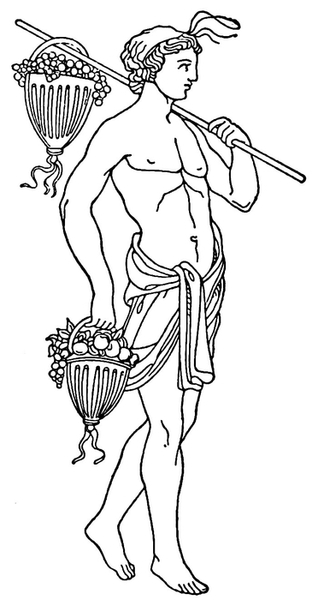
This nymph had scorned the offers of love made her by Pan,
Sylvanus, and innumerable Fauns and Satyrs. Vertumnus, too,
she had time and again refused. But he, the
deity of gardens and of the changing seasons,
unwearied, wooed her in as many guises as
his seasons themselves could assume. Now
as a reaper, now as haymaker, now as plowman,
now as vinedresser, now as apple-picker,
now as fisherman, now as soldier,—all to no
avail. Finally, as an old woman, he came to
her, admired her fruit, admired especially the
luxuriance of her grapes, descanted on the
dependence of the luxuriant vine, close by,
upon the elm to which it was clinging;
advised Pomona, likewise, to choose some
youth—say, for instance, the young Vertumnus—about
whom to twine her arms. Then
he told how the worthy Iphis, spurned by
Anaxarete, had hanged himself to her gatepost;
and how the gods had turned the hard-hearted virgin to stone
even as she gazed on her lover's funeral. "Consider these things,
dearest child," said the seeming old woman, "lay aside thy scorn
and thy delays, and accept a lover. So may neither the vernal frosts
blight thy young fruits, nor furious winds scatter thy blossoms!"
When Vertumnus had thus spoken, he dropped his disguise
and stood before Pomona in his proper person,—a comely youth.
Such wooing, of course, could not but win its just reward.
140. The Cranes of Ibycus.[182] The Furies, called also Diræ
(the terrible ones), Erinyes (the persecutors, or the angered ones),
and finally, by way of euphemism, Eumenides (the well-meaning),
though they were spirits of the underworld, visited earth to punish
filial disobedience, irreverence to old age, perjury, murder, treachery
to guests, even unkindness toward beggars. They avenged the
ghosts of such as, dying violent deaths, possessed on earth no representatives
either by law or by kindred to avenge them. Therefore,
as we shall see, they persecuted Orestes, who had slain his
mother. Therefore, like the accusing voice
of conscience, they marshaled to punishment
the murderers of Ibycus.
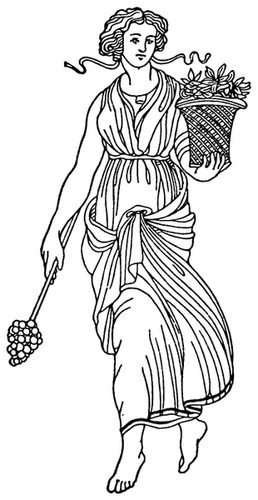
This poet, beloved of Apollo, was, while
journeying to the musical contest of the
Isthmus at Corinth, attacked by two robbers
in the Corinthian grove of Neptune. Overcome
by them, he commended his cause as
he fell to a flock of cranes that happened
to be screaming hoarsely overhead. But
when his body was found, all Greece, then
gathered at the festival, demanded vengeance
on the murderer.
Soon afterward, the vast assemblage in
the amphitheater sat listening to a play in
which the Chorus personated the Furies.
The Choristers, clad in black, bore in their fleshless hands torches
blazing with a pitchy flame. Advancing with measured step, they
formed ranks in the orchestra. Their cheeks were bloodless, and
in place of hair writhing serpents curled around their brows.
Forming a circle, these awful beings sang their hymn. High it
swelled, overpowering the sound of the instruments:
"Happy the man whose heart is pure from guilt and crime!
Him we avengers touch not; he treads the path of life secure
from us. But woe! woe! to him who has done the deed of secret
murder. We, the fearful brood of Night, fasten ourselves upon
him, soul and flesh. Thinks he by flight to escape us? Fly we
still faster in pursuit, twine our snakes around his feet, and bring him
to the ground. Unwearied we pursue; no pity checks our course;
still on, still on to the end of life, we give no peace, no rest."
Stillness like the stillness of death sat over the assembly. Suddenly
a cry burst from one of the uppermost benches,—"Lo,
comrade, the avengers of Ibycus!" A flock of cranes crossed the
sky. "The murderer has informed against himself," shouted the
assemblage. The inference was correct. The criminals, straightway
seized, confessed the crime and suffered the penalty.
141. Galatea and Polyphemus. The water-gods may be roughly
classed as dwellers in the sea and dwellers in the streams. Of the
former, daughters of Nereus and Doris, none was fairer than Galatea,
sister of Amphitrite and Thetis. She loved Acis, the son of
Faunus by a Naiad, and was loved in return; but her happiness
was disturbed and finally ruined by the persistent and jealous attentions
of the Cyclops Polyphemus.
For the first time in his life the Cyclops began to care for his
appearance; he harrowed his coarse locks with a currycomb, mowed
his beard with a sickle, and, looking into the sea when it was calm,
soliloquized, "Beautiful seems my beard, beautiful my one eye,—as
I count beauty,—and the sea reflects the gleam of my teeth
whiter than the Parian stone."[183]
... He loved, not with apples, not roses, nor locks of hair, but with fatal
frenzy; and all things else he held but trifles by the way. Many a time from
the green pastures would his ewes stray back, self-shepherded, to the fold.
But he was singing of Galatea; and pining in his place, he sat by the seaweed
of the beach from the dawn of day with the direst hurt beneath his
breast of mighty Cypris' sending,—the wound of her arrow in his heart!
Yet this remedy he found, and sitting on the crest of the tall cliff and
looking to the deep, 'twas thus he would sing:
"Oh, milk-white Galatea, why cast off him that loves thee? More white
than is pressed milk to look upon, more delicate than the lamb art thou, than
the young calf wantoner, more sleek than the unripened grape! Here dost
thou resort, even so, when sweet sleep possesses me, and home straightway
dost thou depart when sweet sleep lets me go, fleeing me like an ewe that
has seen the gray wolf. I fell in love with thee, maiden, I, on the day when
first thou camest, with my mother, and didst wish to pluck the hyacinths from
the hill, and I was thy guide on the way. But to leave loving thee when
once I had seen thee, neither afterward, nor now at all, have I the strength,
even from that hour. But to thee all this is as nothing, by Zeus, nay, nothing
at all!
"I know, thou gracious maiden, why it is that thou dost shun me. It is
all for the shaggy brow that spans my forehead, from this to the other ear,
one long, unbroken eyebrow. And but one eye is on my forehead, and broad
is the nose that overhangs my lip. Yet I (even such as thou seest me) feed a
thousand cattle, and from these I draw
and drink the best milk in the world.
And cheese I never lack, in summer time
or autumn, nay, nor in the dead of winter,
but my baskets are always overladen.
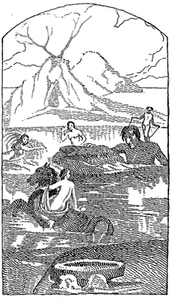
Fig. 112. Galatea and
Polyphemus
"Also I am skilled in piping, as none
other of the Cyclopes here, and of thee,
my love, my sweet apple, and of myself,
too, I sing, many a time, deep in the night.
And for thee I tend eleven fawns, all crescent
browed, and four young whelps of the
bear. Nay, come thou to me and thou shalt
lack nothing that now thou hast....
"But if thou dost refuse because my
body seems shaggy and rough, well, I have
faggots of oak-wood, and beneath the ashes
is fire unwearied, and I would endure to let
thee burn my very soul, and this my one
eye, the dearest thing that is mine.
"Ah me, that my mother bore me not
a finny thing, so would I have gone down
to thee, and kissed thy hand, if thy lips
thou would not suffer me to kiss! And
I would have brought thee either white
lilies or the soft poppy with its scarlet petals. Nay, these are summer's
flowers, and those are flowers of winter, so I could not have brought thee
them all at one time.
"Now, verily, maiden, now and here will I learn to swim, if perchance
some stranger come hither, sailing with his ship, that I may see why it is so
dear to thee to have thy dwelling in the deep. Come forth, Galatea, and
forget as thou comest, even as I that sit here have forgotten, the homeward
way!...
"Oh, Cyclops, Cyclops, whither are thy wits wandering? Ah, that thou
wouldst go and weave thy wickerwork and gather broken boughs to carry to
thy lambs: in faith, if thou didst this, far wiser wouldst thou be!
"Milk the ewe that thou hast; why pursue the thing that shuns thee?
Thou wilt find, perchance, another, and a fairer, Galatea. Many be the girls
that bid me stay with them, and softly they all laugh, if perchance I answer
them. On land it is plain that I, too, seem to be somebody!"[184]
Having, one day, in such wise sung, Polyphemus wandered,
beside himself for passion, into the woods. On a sudden he came
in sight of Galatea and Acis in the hollow of a rock, where they
had hearkened to the strains of the Cyclops. The monster, infuriate,
crying that this should be the last of
their love-meetings, overwhelmed his
rival with a tremendous rock. Purple
blood spirted from under the stone, by
degrees grew paler, and finally became
the stream that still bears the name of
the unfortunate youth. But Galatea remained
inconsolable.[185]
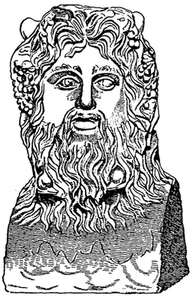
142. Glaucus and Scylla.[186] Another
deity of the sea was Glaucus, the son
of that Sisyphus who was punished in
Hades for his treachery to the gods.
Glaucus had been a comely young fisherman;
but having noticed that a certain
herb revived fishes after they were
brought to land, he ate of it and suffered
metamorphosis into something new and strange, half man, half
fish, and after the fashion of a sea-god. Of his experience during
this "sea change" the following is an account:
I plunged for life or death. To interknit
One's senses with so dense a breathing stuff
Might seem a work of pain; so not enough
Can I admire how crystal-smooth it felt,
And buoyant round my limbs. At first I dwelt
Whole days and days in sheer astonishment;
Forgetful utterly of self-intent,
Moving but with the mighty ebb and flow.
Then like a new-fledged bird that first doth show
His spreaded feathers to the morrow chill,
I tried in fear the pinions of my will.
'Twas freedom! and at once I visited
The ceaseless wonders of this ocean bed.[187]
He became guardian of fishes and divers and of those who go
down to the sea in ships. Later, being infatuated of the fair virgin
Scylla (daughter of the sea-god Phorcys and granddaughter of
Pontus), he paid his court to her, but the maiden rejected him.
Whereupon, in desperation, Glaucus sought the aid of Circe, an
enchantress. She, because she coveted for herself the handsome
sea-green god, transformed her rival into a monster hideously
fashioned of serpents and barking dogs.[188] In this shape Scylla
thereafter infested the shore of Sicily and worked evil to mariners,[189]
till finally she was petrified as a reef, none the less perilous to
all seafarers.
A modern version of the fate of Glaucus and Scylla is given by
Keats in the Endymion. Glaucus consents to Circe's blandishments
for a season, but becoming disgusted with her treachery
and cruelty, he endeavors to escape from her. The attempt proving
unsuccessful, he is brought back and sentenced to pass a
thousand years in decrepitude and pain. Consequently, returning
to the sea, he there discovers the body of Scylla, whom the goddess
has not transformed, but drowned, and learns that if he
passes his thousand years in collecting the bodies of drowned
lovers, a youth beloved of the gods will, in time, appear and help
him. This prophecy is fulfilled by Endymion, who aids in restoring
Glaucus to youth, and Scylla and the drowned lovers to life.
143. Nisus and Scylla.[190] The daughter of Phorcys is frequently
confounded with another Scylla, daughter of King Nisus
of Megara. Scylla of Megara betrayed her father to his enemy,
Minos II of Crete, with whom, although the kings were at war,
she had fallen violently in love. It seems that Nisus had on his
head a purple lock of hair, upon which depended his fortune and
his life. This lock his daughter clipped and conveyed to Minos.
But recoiling from the treacherous gift, that king, after he had
conquered Megara, bound Scylla to the rudder of his ship and so
dragged her through the waves toward Crete. The girl was ultimately
transformed into the monster of the barking dogs, or, according
to another authority, into a bird continually the prey of
the sea eagle, whose form her father Nisus had assumed.
144. Leucothea.[191] Another sea change was that of Ino, the
daughter of Cadmus and wife of Athamas, who, flying from her
frantic husband, sprang, with her child Melicertes in her arms,
from a cliff into the sea. The gods, out of compassion, made her
a goddess of the sea under the name of Leucothea, and her son
a god under that of Palæmon. Both were held powerful to save
from shipwreck and were invoked by sailors. Palæmon was usually
represented as riding on a dolphin. In his honor the Isthmian
games were celebrated. By the Romans he was called Portumnus,
and had jurisdiction of ports and shores.
145. Proteus and Aristæus.[192] Though Aristæus, the lover of
Eurydice, was son of Apollo and guardian himself of herds and
flocks, protector of vine and olive, and keeper of bees, still he
was son of Cyrene, a water-nymph, and his most interesting adventure
brought him into contact with another deity of the sea.
His bees having perished, Aristæus resorted for aid to his
mother. She, surrounded by her maidens in the crystalline abode
under her river, overheard his complaints and ordered that he
should be brought into her presence. The stream at her command
opened itself and let him enter, while it stood heaped like
a mountain on either side. Cyrene and her nymphs, having poured
out libations to Neptune, gave the youth to eat and listened to his
complaint, then informed him that an aged prophet named Proteus,
who dwelt in the sea and pastured the sea calves of Neptune,
could explain the cause of the mortality among the bees and how
to remedy it; but that the wizard would have to be chained and
compelled to answer, and that even when chained, he would try to
escape by assuming a series of dreadful forms. "Still, thou hast
but to keep him fast bound," concluded Cyrene, "and at last,
when he finds his arts of no avail, he will obey thy behest." The
nymph then sprinkled her son with nectar, whereupon an unusual
vigor filled his frame and courage his heart.
Cyrene led her son to the prophet's cave, which was in the
island of Pharos, or of Carpathos,[193] and concealed him. At noon
issued Proteus from the water, followed by his herd of sea calves,
which spread themselves along the shore. He, too, stretched himself
on the floor of the cave and went to sleep. Aristæus immediately
clapped fetters on him and shouted at the top of his voice.
Proteus, finding himself captured, resorted to his craft, becoming
first a fire, then a flood, then a horrible wild beast, in rapid succession;
nor did he succumb till all schemes had failed to set him
free. Then he resumed his old form and, in response to the
questioning of Aristæus, said: "Thou receivest the merited reward
of thy deed, by which Eurydice met her death. To avenge her,
the nymphs have sent this destruction on thy bees. Their anger
thou must appease. Four bulls shalt thou select, of perfect form
and size, and four cows of equal beauty; and four altars shalt thou
build to the nymphs, and shalt sacrifice the animals, leaving their
carcasses in the leafy grove. To Orpheus and Eurydice thou shalt
pay such funeral honors as may allay their resentment. Returning
after nine days, examine the bodies of the cattle slain and see
what has befallen." Aristæus faithfully obeyed these directions.
Returning to the grove on the ninth day he found that a swarm
of bees had taken possession of one of the carcasses and were pursuing
their labors there as in a hive.[194]
146. Acheloüs and Hercules.[195] A similar contest took place
between Hercules and the river-god Acheloüs. The cause of the
strife was Dejanira of Calydon, whom both heroes loved. Hercules
boasted his divine descent. Acheloüs, not content with advancing
his claim as lord of the mightiest and most ancient river of
Greece, insinuated suspicions with regard to the value of Hercules'
pretensions. Then began a mighty struggle. Finding he was no
match for Hercules in the wrestler's art, Acheloüs glided away
in the form of a serpent. Hercules, remarking that it was the
labor of his infancy to strangle snakes,[196] clasped the neck of
Acheloüs and choked him. Then
Acheloüs assumed the seeming of
a bull. Whereupon Hercules, seizing
him by the horns, dragged his
head to the ground, overthrew him,
and rent one horn away. This
trophy the Naiads consecrated and
filled with flowers for the goddess
of Plenty, who, adopting it as her
symbol, named it Cornucopia.
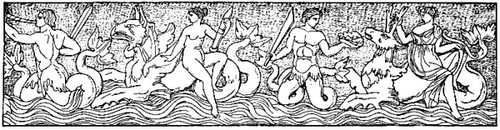
Fig. 114. Nereïds and Sea Monsters
147. Milton's Sabrina Fair. No
writer in modern times has made
more graceful poetic use of the divinities
of the streams than has Milton.
The following song, chanted by a
Spirit in invocation of "the gentle
nymph" (of the poet's invention)
"that with moist curb sways the
smooth Severn stream," is but one
refrain of many caught by the poet
from the far-echoing chorus of classical
verse:
Sabrina fair,
Listen where thou art sitting
Under the glassy, cool, translucent wave,
In twisted braids of lilies knitting
The loose train of thy amber-dropping hair;
Listen for dear honor's sake,
Goddess of the silver lake,
Listen and save.
Listen and appear to us
In name of great Oceanus.
By th' earth-shaking Neptune's mace,
And Tethys' grave, majestic pace,
By hoary Nereus' wrinkled look,
And the Carpathian wizard's hook,
By scaly Triton's winding shell,
And old soothsaying Glaucus' spell,
By Leucothea's lovely hands,
And her son that rules the strands,
By Thetis' tinsel-slippered feet,
And the songs of Sirens sweet,
By dead Parthenope's[1] dear tomb
And fair Ligea's[197] golden comb,
Wherewith she sits on diamond rocks,
Sleeking her soft, alluring locks,
By all the nymphs that nightly dance
Upon thy streams with wily glance;
Rise, rise, and heave thy rosy head
From thy coral-paven bed,
And bridle in thy headlong wave,
Till thou our summons answered have.
Listen and save.[198]
148. The Older and the Younger Heroes. We have already
narrated the adventures of certain demigods and heroes, such
as Prometheus, Deucalion, Cadmus, Amphion, Orpheus. Others
of importance were Perseus, Hercules, Minos, Œdipus, Theseus,
Jason, Meleager, Peleus, Pelops, Castor and Pollux. These and
their contemporaries may be called the Older Heroes. They are
renowned either for individual exploits or for the part played by
them in one or more of three great expeditions,—the War against
Laomedon of Troy, the Voyage for the Golden Fleece, and the
Hunt of the Calydonian Boar.
The Younger Heroes were of a later generation, which was
concerned in four important enterprises,—the War of the Seven
against Thebes, the Trojan War, the Wanderings of Ulysses, and
the Adventures of Æneas.
The exploits of the Older Heroes may be arranged in respect of
their probable sequence in time, and of their grouping according
to families of heroes. If we observe the principle of genealogy,
one race, that of Inachus of Argos, attracts our notice in the heroes
descended from Pelasgus,[199] Belus, and Agenor. The family of Belus
gives us the famous House of Danaüs, the family of Agenor the
Houses of Minos and Labdacus. Another race, that of Deucalion,
gives us the heroes of the Hellenic branch, most notably those
descended from Æolus. With these families most of the Older
Heroes are, by blood or by adventure, to some extent connected.
Bearing this fact in mind and at the same time observing the
chronological sequence of adventures, we obtain an arrangement of
myths as illustrating the races, families, or houses—(1) of Danaüs
of Argos, (2) of Æolus of Thessaly, (3) of Ætolus, (4) of Minos
of Crete, (5) of Cecrops and of Erichthonius of Attica, (6) of
Labdacus of Thebes.[200]
149. The Genealogy of Danaüs. As the Hellenes, in the north,
traced their descent from Deucalion and Pyrrha of Thessaly, so the
Pelasgic races of the south from the river-god Inachus, son of
Oceanus. The son of Inachus, Phoroneus, lived in the Peloponnesus
and founded the town of Argos. This Phoroneus conferred
upon the Argives the benefits attributed by other Greeks to Prometheus.
He was succeeded by his son Pelasgus, from whom
a division of the Greek people derive their name. With the
love of Jupiter for the sister of Phoroneus, the fair Io, we are
already acquainted. Her son was Epaphus, king of Egypt, from
whom were descended
(1) Agenor of Phœnicia,
father of Europa
and Cadmus, and (2)
Belus of Egypt, father
of Ægyptus and Danaüs.
To the family
of Agenor we shall return
in the history of
Minos, son of Europa,
and of Œdipus, descendant
of Cadmus.
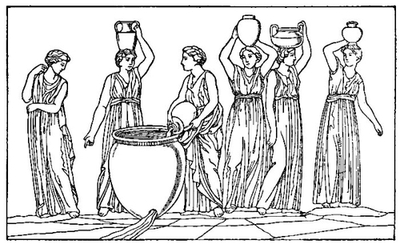
150. The Danaïds.[201] Ægyptus and his fifty sons drove Danaüs
and his fifty daughters back to Argos, the ancestral home of the
race. Finally, a reconciliation was arranged by means of a fiftyfold
marriage between the sons of Ægyptus and the Danaïds. But in
accordance with a treacherous command of Danaüs, all his daughters
save Hypermnestra slew their husbands on the wedding night.
For this crime the forty-nine Danaïds were condemned to spend
eternity in Tartarus, trying to fill with water a vessel full of holes.
From Hypermnestra and her husband, Lynceus, was sprung the
royal house of Argos. Their son was Abas, their grandson, Acrisius,—of
whom the following narrative is told.
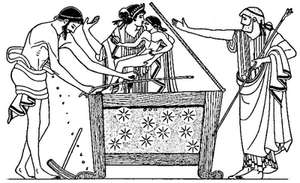
Fig. 116. Danaë and Perseus and the Chest
151. The Doom of King Acrisius.[202] The daughter of Acrisius
was Danaë, of surpassing loveliness. In consequence of an oracle
which had prophesied that the son of Danaë would be the means
of his grandfather's death, the hapless girl was shut in an underground
chamber, that no man might love or wed her. But Jupiter,
distilling himself into a shower of gold, flooded the girl's prison,
wooed, and won her. Their son was Perseus. King Acrisius, in
dismay, ordered mother and child to be boxed up in a chest and
set adrift on the sea. The two unfortunates were, however, rescued
at Seriphus by a fisherman, who conveyed the mother and infant
to Polydectes, king of the country, by whom they were treated at
first with kindness, but afterwards with cruelty.
152. Perseus and Medusa.[203] When Perseus was grown up, Polydectes
sent him to attempt the conquest of the Gorgon Medusa,[204]
a terrible monster who had laid waste the country. She had once
been a maiden whose hair was her chief glory, but as she dared to vie
in beauty with Minerva, the goddess deprived her of her charms and
changed her ringlets into hissing serpents. She became a monster
of so frightful an aspect that no living thing could behold her
without being turned into stone. All around the cavern where she
dwelt might be seen the stony figures of men and animals that had
chanced to catch a glimpse of her and had been petrified at the
sight. Perseus, favored by Minerva and Mercury, set out against
the Gorgon, and approached first the cave of the three Grææ:
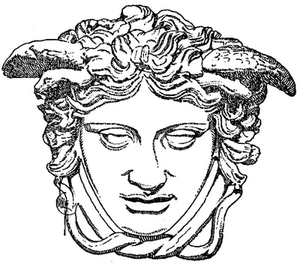
There sat the crones that had the single eye,
Clad in blue sweeping cloak and snow-white gown;
While o'er their backs their straight white hair hung down
In long thin locks; dreadful their faces were,
Carved all about with wrinkles of despair;
And as they sat they crooned a dreary song,
Complaining that their lives should last so long,
In that sad place that no one came anear,
In that wan place desert of hope and fear;
And singing, still they rocked their bodies bent,
And ever each to each the eye they sent.[205]
Snatching the eye, Perseus compelled the Grææ, as the price
of its restoration, to tell him how he might obtain the helmet of
Hades that renders its wearer invisible,
and the winged shoes and pouch that
were necessary. With this outfit, to
which Minerva added her shield and
Mercury his knife, Perseus sped to the
hall of the Gorgons. In silence sat two
of the sisters,—
But a third woman paced about the hall,
And ever turned her head from wall to wall
And moaned aloud, and shrieked in her despair;
Because the golden tresses of her hair
Were moved by writhing snakes from side to side,
That in their writhing oftentimes would glide
On to her breast, or shuddering shoulders white;
Or, falling down, the hideous things would light
Upon her feet, and crawling thence would twine
Their slimy folds about her ankles fine.[206]
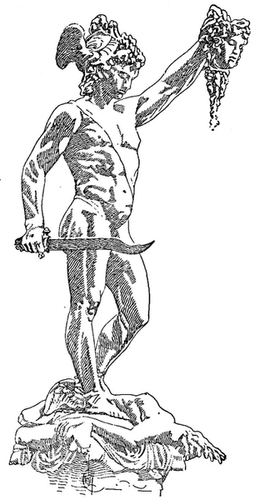
Fig. 119. Perseus
From the sculpture by Cellini
This was Medusa. Her, while she was praying the gods to end
her misery, or, as some say, while she was sleeping, Perseus approached,
and, guided by her
image reflected in the bright
shield which he bore, cut off
her head, and so ended her
miserable existence. Thus are
described the horror and the
grace of her features in death:
It lieth, gazing on the midnight sky,
Upon the cloudy mountain peak supine;
Below, far lands are seen tremblingly;
Its horror and its beauty are divine.
Upon its lips and eyelids seems to lie
Loveliness like a shadow, from which shine,
Fiery and lurid, struggling underneath,
The agonies of anguish and of death.
Yet it is less the horror than the grace
Which turns the gazer's spirit into stone;
Whereon the lineaments of that dead face
Are graven, till the characters be grown
Into itself, and thought no more can trace;
'Tis the melodious hue of beauty thrown
Athwart the darkness and the glare of pain,
Which humanize and harmonize the strain.[207]...
153. Perseus and Atlas. From the body of Medusa sprang
the winged horse Pegasus, of whose rider, Bellerophon, we shall
presently be informed.
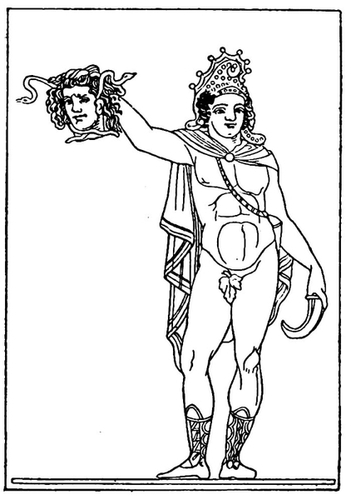
Fig. 120. Perseus with Head of Medusa
After the slaughter of Medusa, Perseus, bearing with him the head
of the Gorgon, flew far and wide, over land and sea. As night came
on, he reached the western limit of the earth, and would gladly have
rested till morning. Here was the realm of Atlas, whose bulk surpassed
that of all other men. He was rich in flocks and herds, but
his chief pride was his garden of the Hesperides, whose fruit was
of gold, hanging from golden branches,
half hid with golden leaves. Perseus said
to him, "I come as a guest. If thou holdest
in honor illustrious descent, I claim
Jupiter for my father; if mighty deeds, I
plead the conquest of the Gorgon. I seek
rest and food." But Atlas, remembering
an ancient prophecy that had warned him
against a son of Jove who should one day
rob him of his golden apples, attempted
to thrust the youth out. Whereupon Perseus,
finding the giant too strong for him,
held up the Gorgon's head. Atlas, with
all his bulk, was changed into stone. His
beard and hair became forests, his arms
and shoulders cliffs, his head a summit, and
his bones rocks. Each part increased in mass till the giant became
the mountain upon whose shoulders rests heaven with all its stars.
154. Perseus and Andromeda. On his way back to Seriphus, the
Gorgon-slayer arrived at the country of the Æthiopians, over whom
Cepheus was king. His wife was Cassiopea—
That starred Æthiope queen that strove
To set her beauty's praise above
The sea-nymphs, and their powers offended.[208]
These nymphs had consequently sent a sea monster to ravage
the coast. To appease the deities, Cepheus was directed by the
oracle to devote his daughter Andromeda to the ravening maw
of the prodigy. As Perseus looked down from his aërial height,
he beheld the virgin chained to a rock. Drawing nearer he pitied,
then comforted her, and sought the reason of her disgrace. At
first from modesty she was silent; but when he repeated his questions,
for fear she might be thought guilty of some offense which
she dared not tell, she disclosed her name and that of her country,
and her mother's pride of beauty. Before she had done speaking, a
sound was heard upon the water, and the monster appeared. The virgin
shrieked; the father and mother, who had now arrived, poured
forth lamentations and threw their arms about the victim. But the
hero himself undertook to slay the monster, on condition that, if the
maiden were rescued by his valor, she should be his reward. The
parents consented. Perseus embraced his promised bride; then—
Loosing his arms from her waist he flew upward, awaiting the sea beast.
Onward it came from the southward, as bulky and black as a galley,
Lazily coasting along, as the fish fled leaping before it;
Lazily breasting the ripple, and watching by sand bar and headland,
Listening for laughter of maidens at bleaching, or song of the fisher,
Children at play on the pebbles, or cattle that passed on the sand hills.
Rolling and dripping it came, where bedded in glistening purple
Cold on the cold seaweeds lay the long white sides of the maiden,
Trembling, her face in her hands, and her tresses afloat on the water.[209]
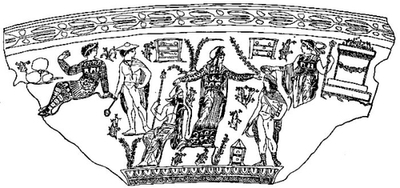
Fig. 121. Perseus finds Andromeda
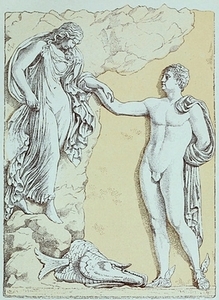
PERSEUS FREEING ANDROMEDA
The youth darted down upon the back of the monster and
plunged his sword into its shoulder, then eluded its furious attack
by means of his wings. Wherever he could find a passage for his
sword, he plunged it between the scales of flank and side. The
wings of the hero were finally drenched and unmanageable with the
blood and water that the brute spouted. Then alighting on a rock
and holding by a projection, he gave the monster his deathblow.
The joyful parents, with Perseus and Andromeda, repaired to
the palace, where a banquet was opened for them. But in the
midst of the festivities a noise was heard of warlike clamor, and
Phineus, who had formerly been betrothed to the bride, burst in,
demanding her for his own. In vain, Cepheus remonstrated that
all such engagements had been dissolved by the sentence of death
passed upon Andromeda, and that if Phineus had actually loved
the girl, he would have tried to rescue her. Phineus and his adherents,
persisting in their intent, attacked the wedding party and
would have broken it up with most admired disorder, but
Mid the fabled Libyan bridal stood
Perseus in stern tranquillity of wrath,
Half stood, half floated on his ankle plumes
Out-swelling, while the bright face on his shield
Looked into stone the raging fray.[210]
Leaving Phineus and his fellows in merited petrifaction, and conveying
Andromeda to Seriphus, the hero there turned into stone
Polydectes and his court, because the tyrant had rendered Danaë's life
intolerable with his attentions. Perseus then restored to their owners
the charmed helmet, the winged shoes, and the pouch in which he
had conveyed the Gorgon's head. The head itself he bestowed upon
Minerva, who bore it afterward upon her ægis or shield. Of that
Gorgon shield no simpler moral interpretation can be framed than
the following:
What was that snaky-headed Gorgon shield
That wise Minerva wore, unconquered virgin,
Wherewith she freezed her foes to congealed stone,
But rigid looks of chaste austerity,
And noble grace that dashed brute violence
With sudden adoration and blank awe![211]
With his mother and his wife Perseus returned to Argos to seek
his grandfather. But Acrisius, still fearing his doom, had retired
to Larissa in Thessaly. Thither Perseus followed him, and found
him presiding over certain funeral games. As luck would have it,
the hero took part in the quoit throwing, and hurled a quoit far
beyond the mark. The disk, falling upon his grandfather's foot,
brought about the old man's death, and in that way the prophecy
was fulfilled. Of Perseus and Andromeda three sons were born,
through one of whom, Electryon, they became grandparents of the
famous Alcmene, sweetheart of Jove and mother of Hercules.
155. Bellerophon and the Chimæra.[212] The horse Pegasus, which
sprang from the Gorgon's blood, found a master in Bellerophon of
Corinth. This youth was of the Hellenic branch of the Greek
nation, being descended from Sisyphus and through him from
Æolus, the son of Hellen.[213] His adventures should therefore be
recited with those of Jason and other descendants of Æolus in the
next chapter, but that they follow so closely on those of Perseus.
His father, Glaucus, king of Corinth, is frequently identified with
Glaucus the fisherman. This Glaucus of Corinth was noted for his
love of horse racing, his fashion of feeding his mares on human
flesh, and his destruction by the fury of his horses; for having
upset his chariot, they tore their master to pieces. As to his son,
Bellerophon, the following is related:
In Lycia a monster, breathing fire, made great havoc. The
fore part of his body was a compound of the lion and the goat;
the hind part was a dragon's. The king, Iobates, sought a hero to
destroy this Chimæra, as it was called. At that time Bellerophon
arrived at his court. The gallant youth brought letters from
Prœtus, the son-in-law of Iobates, recommending Bellerophon in
the warmest terms as an unconquerable hero, but adding a request
to his father-in-law to put him to death. For Prœtus, suspecting
that his wife Antea looked with too great favor on the young
warrior, schemed thus to destroy him.
Iobates accordingly determined to send Bellerophon against
the Chimæra. Bellerophon accepted the proposal, but before
proceeding to the combat, consulted the soothsayer Polyidus, who
counseled him to procure, if possible, the horse Pegasus for the
conflict. Now this horse had been caught and tamed by Minerva
and by her presented to the Muses. Polyidus, therefore, directed
Bellerophon to pass the night in the temple of Minerva. While he
slept, Minerva brought him a golden bridle. When he awoke, she
showed him Pegasus drinking at the well of Pirene. At sight of the
bridle, the winged steed came
willingly and suffered himself
to be taken. Bellerophon
mounted him, sped through
the air, found the Chimæra,
and gained an easy victory.
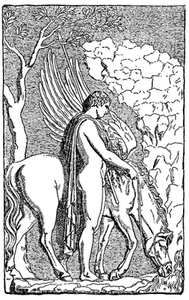
Fig. 122. Bellerophon and Pegasus
After the conquest of this
monster, Bellerophon was subjected
to further trials and
labors by his unfriendly host,
but by the aid of Pegasus he
triumphed over all. At length
Iobates, seeing that the hero
was beloved of the gods, gave
him his daughter in marriage
and made him his successor
on the throne. It is said that
Bellerophon, by his pride and
presumption, drew upon himself
the anger of the Olympians;
that he even attempted to fly
to heaven on his winged steed;
but the king of gods and men sent a gadfly, which, stinging Pegasus,
caused him to throw his rider, who wandered ever after lame, blind,
and lonely through the Aleian field, and perished miserably.
156. Hercules (Heracles): His Youth.[214] Alcmene, daughter of
Electryon and granddaughter of Perseus and Andromeda, was
beloved of Jupiter. Their son, the mighty Hercules, born in
Thebes, became the national hero of Greece. Juno, always hostile
to the offspring of her husband by mortal mothers, declared war
against Hercules from his birth. She sent two serpents to destroy
him as he lay in his cradle, but the precocious infant strangled
them with his hands. In his youth he passed for the son of his stepfather
Amphitryon, king of Thebes, grandson of Perseus and
Andromeda, and son of Alcæus. Hence his patronymic, Alcides.
Rhadamanthus trained him in wisdom and virtue, Linus in music.
Unfortunately the latter attempted one day to chastise Hercules;
whereupon the pupil killed the master with a lute. After this melancholy
breach of discipline, the youth was rusticated,—sent off to
the mountains, where among the herdsmen and the cattle he grew
to mighty stature, slew the Thespian lion, and performed various
deeds of valor. To him, while still a youth, appeared, according to
one story, two women at a meeting of the ways,—Pleasure and
Duty. The gifts offered by Duty were the "Choice of Hercules."
Soon afterward he contended with none other than Apollo for the
tripod of Delphi; but reconciliation was effected between the combatants
by the gods of Olympus, and from that day forth Apollo
and Hercules remained true friends, each respecting the prowess
of the other. Returning to Thebes, the hero aided his half brother
Iphicles and his reputed father Amphitryon in throwing off the
yoke of the city of Orchomenus, and was rewarded with the hand
of the princess Megara. A few years later, while in the very pride
of his manhood, he was driven insane by the implacable Juno. In
his madness he slew his children, and would have slain Amphitryon,
also, had not Minerva knocked him over with a stone and
plunged him into a deep sleep, from which he awoke in his right
mind. Next, for expiation of the bloodshed, he was rendered subject
to his cousin Eurystheus and compelled to perform his commands.
This humiliation, Juno, of course, had decreed.
157. His Labors. Eurystheus enjoined upon the hero a succession
of desperate undertakings, which are called the twelve "Labors
of Hercules." The first was the combat with the lion that infested
the valley of Nemea, the skin of which Hercules was ordered
to bring to Mycenæ. After using in vain his club and arrows
against the lion, Hercules strangled the animal with his hands
and returned, carrying its carcass on his shoulders; but Eurystheus,
frightened at the sight and at this proof of the prodigious
strength of the hero, ordered him to deliver the account of his
exploits, in future, outside
the town.
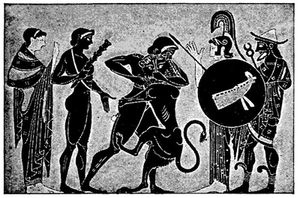
Fig. 123. Heracles and the Nemean Lion
His second labor
was the slaughter of
the Hydra, a water
serpent that ravaged
the country of Argos
and dwelt in a swamp
near the well of Amymone.
It had nine
heads, of which the
middle one was immortal.
Hercules struck
off the heads with his club; but in the place of each dispatched,
two new ones appeared. At last, with the assistance of his faithful
nephew Iolaüs, he burned away the other heads of the Hydra and
buried the ninth, which was immortal, under a rock.
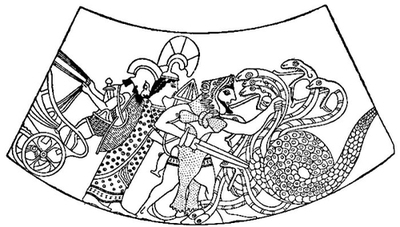
Fig. 124. Heracles and the Hydra
His third labor was the capture of a boar that haunted Mount
Erymanthus in Arcadia. The adventure was, in itself, successful.
But on the same journey
Hercules made the
friendship of the centaur
Pholus, who, receiving
him hospitably,
poured out for him
without stint the choicest
wine that the centaurs
possessed. As a
consequence, Hercules
became involved in a
broil with the other centaurs of the mountain. Unfortunately his
friend Pholus, drawing one of the arrows of Hercules from a brother
centaur, wounded himself therewith and died of the poison.
The fourth labor of Hercules was the capture of a wonderful
stag of golden antlers and brazen hoofs, that ranged the hills of
Cerynea, between Arcadia and Achaia.
His fifth labor was the destruction of the Stymphalian birds,
which with cruel beaks and sharp talons harassed the inhabitants
of the valley of Stymphalus, devouring many of them.
His sixth labor was the cleaning of the Augean stables. Augeas,
king of Elis, had a herd of three thousand oxen, whose stalls had not
been cleansed for thirty years. Hercules, bringing the rivers Alpheüs
and Peneüs through them, purified them thoroughly in one day.
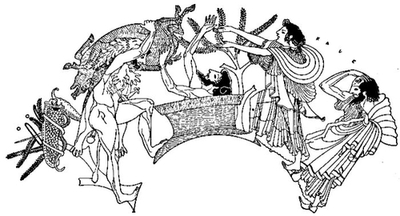
Fig. 125. Heracles bringing Home the Boar
His seventh labor was the overthrow of the Cretan bull,—an awful
but beautiful brute, at once a gift and a curse bestowed by Neptune
upon Minos of Crete.[215] This monster Hercules brought to Mycenæ.
His eighth labor was the removal of the horses of Diomedes,
king of Thrace. These horses subsisted on human flesh, were
swift and fearful. Diomedes, attempting to retain them, was killed
by Hercules and given to the horses to devour. They were then
delivered to Eurystheus; but, escaping, they roamed the hills of
Arcadia, till the wild beasts of Apollo tore them to pieces.
His ninth labor was of a more delicate character. Admeta, the
daughter of Eurystheus, desired the girdle of the queen of the
Amazons, and Eurystheus ordered Hercules to get it. The Amazons
were a nation dominated by warlike women, and in their
hands were many cities. It was their custom to bring up only the
female children, whom they hardened by martial discipline; the
boys were either dispatched to the neighboring nations or put to
death. Hippolyta, the queen, received Hercules kindly and consented
to yield him the girdle; but Juno, taking the form of an
Amazon, persuaded the people that the strangers were carrying off
their queen. They instantly
armed and beset the ship.
Whereupon Hercules, thinking
that Hippolyta had acted
treacherously, slew her and,
taking her girdle, made sail
homeward.
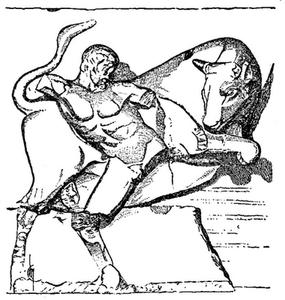
Fig. 126. Heracles with the Bull
The tenth task enjoined
upon him was to capture
for Eurystheus the oxen
of Geryon, a monster with
three bodies, who dwelt in
the island Erythea (the
red),—so called because
it lay in the west, under
the rays of the setting sun.
This description is thought
to apply to Spain, of which Geryon was king. After traversing
various countries, Hercules reached at length the frontiers of
Libya and Europe, where he raised the two mountains of Abyla
and Calpe as monuments of his progress,—the Pillars of Hercules;
or, according to another account, rent one mountain into
two and left half on each side, forming the Strait of Gibraltar.
The oxen were guarded by the giant Eurytion and his two-headed
dog, but Hercules killed the warders and conveyed the oxen in
safety to Eurystheus.
One of the most difficult labors was the eleventh,—the robbery
of the golden apples of the Hesperides. Hercules did not know
where to find them; but after various adventures, arrived at Mount
Atlas in Africa. Since Atlas was the father of the Hesperides,
Hercules thought he might through him obtain the apples. The
hero, accordingly, taking the burden of the heavens on his own
shoulders,[216] sent Atlas to seek the apples. The giant returned with
them and proposed to take them himself to Eurystheus. "Even
so," said Hercules; "but, pray, hold this load for me a moment,
while I procure a pad to ease my shoulders." Unsuspectingly the
giant resumed the burden of the heavens. Hercules took the
apples.
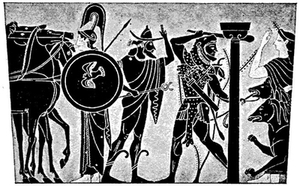
Fig. 127 Heracles and Cerberus
His twelfth exploit was to fetch Cerberus from the lower world.
To this end he descended into Hades, accompanied by Mercury
and Minerva. There
he obtained permission
from Pluto to carry
Cerberus to the upper
air, provided he could
do it without the use
of weapons. In spite
of the monster's struggling
he seized him,
held him fast, carried
him to Eurystheus, and
afterward restored him
to the lower regions. While in Hades, Hercules also obtained
the liberty of Theseus, his admirer and imitator, who had been
detained there for an attempt at abducting Proserpine.[217]
After his return from Hades to his native Thebes, he renounced
his wife Megara, for, having slain his children by her in
his fit of madness, he looked upon the marriage as displeasing to
the gods.
Two other exploits not recorded among the twelve labors are
the victories over Antæus and Cacus. Antæus, the son of Poseidon
and Gæa, was a giant and wrestler whose strength was invincible
so long as he remained in contact with his mother Earth. He
compelled all strangers who came to his country to wrestle with
him, on condition that if conquered, they should suffer death.
Hercules encountered him and, finding that it was of no avail
to throw him,—for he always rose with renewed strength from
every fall,—lifted him up from the earth and strangled him in
the air.
Later writers tell of an army of Pygmies which, finding Hercules
asleep after his defeat of Antæus, made preparations to
attack him, as if they were about to attack a city. But the hero,
awakening, laughed at the little warriors, wrapped some of them
up in his lion's skin, and carried them to Eurystheus.
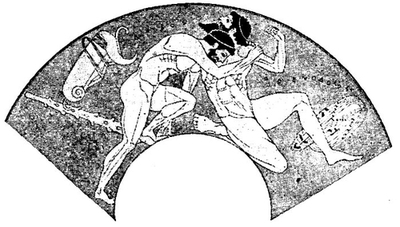
Fig. 128. Heracles and Antæus
Cacus was a giant who inhabited a cave on Mount Aventine
and plundered the surrounding country. When Hercules was driving
home the oxen of Geryon, Cacus stole part of the cattle while
the hero slept. That their footprints might not indicate where
they had been driven,
he dragged them backward
by their tails to
his cave. Hercules
was deceived by the
stratagem and would
have failed to find his
oxen, had it not happened
that while he was
driving the remainder
of the herd past the
cave where the stolen ones were concealed, those within, beginning to
low, discovered themselves to him. Hercules promptly dispatched
the thief.
Through most of these expeditions Hercules was attended by
Iolaüs, his devoted friend, the son of his half brother Iphicles.
158. His Later Exploits. On the later exploits of the hero we
can dwell but briefly. Having, in a fit of madness, killed his friend
Iphitus, he was condemned for the offense to spend three years as
the slave of Queen Omphale. He lived effeminately, wearing at
times the dress of a woman and spinning wool with the handmaidens
of Omphale, while the queen wore his lion's skin. But
during this period he contrived to engage in about as many adventures
as would fill the life of an ordinary hero. He rescued
Daphnis from Lityerses and threw the bloodthirsty king[218] into the
river Mæander; he discovered the body of Icarus[219] and buried it;
he joined the company of Argonauts, who were on their way to
Colchis to secure the golden fleece, and he captured the thievish
gnomes, called Cercopes. Two of these grotesque rascals had
made off with the weapons of Hercules while he was sleeping.
When he had caught them he strapped them, knees upward, to a
yoke and so bore them away. Their drollery, however, regained
them their liberty. It is said that some of them having once
deceived Jupiter were changed to apes.
159. The Loss of Hylas.[220] In the Argonautic adventure Hercules
was attended by a lad, Hylas, whom he tenderly loved and
on whose account he deserted the expedition in Mysia; for Hylas
had been stolen by the Naiads.
... Never was Heracles apart from Hylas, not when midnoon was high in
heaven, not when Dawn with her white horses speeds upwards to the dwelling
of Zeus, not when the twittering nestlings look towards the perch, while their
mother flaps her wings above the smoke-browned beam; and all this that the
lad might be fashioned to his mind, and might drive a straight furrow, and
come to the true measure of man....
And Hylas of the yellow hair, with a vessel of bronze in his hand, went to
draw water against supper-time for Heracles himself and the steadfast Telamon,
for these comrades twain supped ever at one table. Soon was he ware of a
spring in a hollow land, and the rushes grew thickly round it, and dark swallowwort,
and green maidenhair, and blooming parsley, and deer grass spreading
through the marshy land. In the midst of the water the nymphs were arranging
their dances,—the sleepless nymphs, dread goddesses of the country people,
Eunice, and Malis, and Nycheia, with her April eyes. And now the boy was
holding out the wide-mouthed pitcher to the water, intent on dipping it; but the
nymphs all clung to his hand, for love of the Argive lad had fluttered the soft
hearts of all of them. Then down he sank into the black water, headlong all,
as when a star shoots flaming from the sky, plumb in the deep it falls; and a
mate shouts out to the seamen, "Up with the gear, my lads, the wind is fair
for sailing."
Then the nymphs held the weeping boy on their laps, and with gentle words
were striving to comfort him. But the son of Amphitryon was troubled about the
lad, and went forth, carrying his bended bow in Scythian fashion, and the club
that is ever grasped in his right hand. Thrice he shouted, "Hylas!" as loud as
his deep throat could call, and thrice again the boy heard him, and thrice came
his voice from the water, and, hard by though he was, he seemed very far away.
And as when a bearded lion, a ravening lion on the hills, hears the bleating of
a fawn afar off and rushes forth from his lair to seize it, his readiest meal, even
so the mighty Heracles, in longing for the lad, sped through the trackless briars
and ranged over much country.
Reckless are lovers: great toils did Heracles bear, in hills and thickets
wandering; and Jason's quest was all postponed to this....
Thus loveliest Hylas is numbered with the Blessed; but for a runaway they
girded at Heracles—the heroes—because he roamed from Argo of the sixty
oarsmen. But on foot he came to Colchis and inhospitable Phasis.
160. The Rescue of Daphnis.[221] Daphnis was the ideal Sicilian
shepherd and to him was ascribed the invention of pastoral story
and song. His father was Hermes (Mercury); his mother, a
nymph who laid him when an infant in a charming valley in a
laurel grove from which he received his name,[222] and on account of
which Apollo loved him and endowed him with the gift of idyllic
verse. He was brought up by nymphs and shepherds, and, avoiding
the noisy haunts of men, he tended his flocks on Mount Ætna,
winter and summer. He loved a maiden named Piplea, but she
was borne away by robbers. He followed them to Phrygia, and
there found his sweetheart in the power of the king of that realm,
Lityerses. This Lityerses had a pleasant custom of making strangers
try a contest with him in reaping corn. If he overcame them,
he cut off their heads in the evening and concealed their bodies in
the sheaves, singing a comfortable song meanwhile. In order to
win back Piplea, Daphnis entered upon the reaping contest with
the king and made himself comfortable, too, by singing a harvest
song meanwhile. But Lityerses surpassed him at the work and
was about to put him to death, singing no doubt a comfortable
song of the reaper, Death, meanwhile,—when suddenly Hercules
appeared upon the scene. He doesn't seem to have spent much
time singing: he assured Daphnis of his head by cutting off that
of the pleasant king; and then he threw the body into the river
Mæander. Daphnis regained his Piplea and one would suppose
that they lived happy ever after. Another story, unfortunately,
relates events in which Piplea's name does not occur. A Naiad
fell in love with the handsome shepherd and made him promise
eternal fidelity to her, threatening him with blindness if he violated
his vow. It was hard for poor Daphnis, for nearly every lass he
met made love to him. At last a princess intoxicated him and
he forgot his vow. Immediately the Naiad showed the quality of
her love by striking him blind. He consoled himself for a while
by singing his songs and playing the flute as he wandered from
place to place. Then weary, he called on his father for aid. Mercury
accordingly transported him to heaven and caused a well to
gush forth on the spot from which he ascended. Here the Sicilians
offered yearly sacrifice in his honor.
Theocritus gives us a Lityerses song as he undoubtedly used to
hear it sung by the harvesters of the country-side in Sicily:[223]
Demeter, rich in fruit and rich in grain, may this corn be easy to win and fruitful exceedingly!
Bind, ye binders, the sheaves, lest the wayfarer should cry, "Men of straw were the workers here; aye, and their hire was wasted!"
See that the cut stubble faces the North wind, or the West;—'tis thus that the grain waxes richest.
They that thresh corn should shun the noonday sleep; at noon the chaff parts easiest from the straw.
As for the reapers, let them begin when the crested lark is waking, and cease when he sleeps, but take holiday in the heat.
Lads, the frog has a jolly life: he is not cumbered about a butler to his drink; for he has liquor by him unstinted!
Boil the lentils better, thou miserly steward; take heed lest thou chop thy fingers, when thou'rt splitting cummin seed.
When Matthew Arnold is writing of the death of his dear friend,
the poet, Arthur Hugh Clough, who died in Italy,[224] he says:
And now in happier air,
Wandering with the great Mother's train divine....
Within a folding of the Apennine,
Thou hearest the immortal chants of old!
Putting his sickle to the perilous grain
In the hot cornfield of the Phrygian king,
For thee the Lityerses song again
Young Daphnis with his silver voice doth sing;
Sings his Sicilian fold,
His sheep, his hapless love, his blinded eyes:—
And how a call celestial round him rang,
And heavenward from the fountain-brink he sprang,—
And all the marvel of the golden skies!
161. The Expedition against Laomedon. After his servitude
under Omphale was ended, Hercules sailed with eighteen ships
against Troy. For Laomedon, king of that realm, had refused to
give Hercules the horses of Neptune, which he had promised in
gratitude for the rescue of his daughter Hesione from the sea-monster.[225]
The hero, overcoming Troy, placed a son of Laomedon,
Priam, upon the throne, and gave Hesione to Telamon, who, with
Peleus, Oïcles, and other Greek heroes, had accompanied him.
Also worthy of mention among the exploits of Hercules were his
successful expeditions against Pylos and Sparta, his victory over
the giants, his struggle with Death for the body and life of
Alcestis,[226] and his delivery, according to prophecy, of Prometheus,
who until that time had remained in chains upon the Caucasian
Mountains.[227]
162. The Death of Hercules. Finally, the hero married Dejanira,
daughter of Œneus of Calydon and sister of Meleager of the
Calydonian hunt. With her he lived three prosperous years. But
on one occasion, as they journeyed together, they came to a river
across which the centaur Nessus carried travelers for a stated fee.
Hercules proceeded to ford the river and gave Dejanira to Nessus
to be carried across. Nessus, however, attempted to make off with
her; whereupon Hercules, hearing her cries, shot an arrow into his
heart. The centaur, as he died, bade Dejanira take a portion of his
blood and keep it, saying that it might be used as a charm to preserve
the love of her husband. Dejanira did so. Before long,
jealous of Hercules' fondness for Iole of Œchalia, a captive maiden,
she steeped a sacrificial robe of her husband's in the blood of
Nessus. As soon as the garment became warm on the body of
Hercules, the poison penetrated his limbs. In his frenzy he seized
Lichas, who had brought him the fatal robe, and hurled him into
the sea; then tried to wrench off the garment, but it stuck to his
flesh and tore away whole pieces of his body.
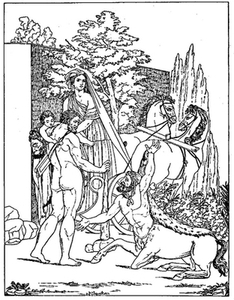
Fig. 129. Hercules and Nessus
Alcides, from Œchalia crowned
With conquest, felt the envenomed robe, and tore,
Through pain, up by the roots Thessalian pines,
And Lichas from the top of Œta threw
Into the Euboic Sea.[228]
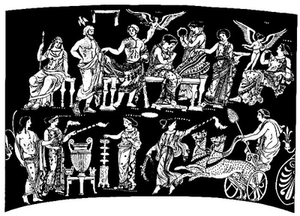
THE WEDDING OF HERCULES AND HEBE
In this state he embarked on board a ship and was conveyed home.
Dejanira, on seeing what she had unwittingly done, hanged herself.
Hercules, prepared to die, ascended Mount Œta, where he built a
funeral pile of trees, gave his bow and arrows to Philoctetes,[229] and
laid himself upon the pile, his head resting on his club and his
lion's skin spread over him. With a countenance as serene as if
he were taking his place at a festal board, he commanded Philoctetes
to apply the torch. The flames spread apace, and soon invested
the whole mass.[230]
The gods themselves grieved to see the champion of the earth
so brought to his end. But Jupiter took care that only his mother's
part in him should perish by the flames. The immortal element,
derived from Jupiter himself, was translated to heaven; and by
the consent of the gods—even of reluctant Juno—Hercules was
admitted as a deity to the ranks of the immortals. The white-armed
queen of heaven was finally reconciled to the offspring of
Alcmene. She adopted him for her son and gave him in marriage
her daughter Hebe.
Deep degraded to a coward's slave,
Endless contests bore Alcides brave,
Through the thorny path of suffering led;
Slew the Hydra, crushed the lion's might,
Threw himself, to bring his friend to light,
Living, in the skiff that bears the dead.
All the torments, every toil of earth,
Juno's hatred on him could impose,
Well he bore them, from his fated birth
To life's grandly mournful close.
Till the god, the earthly part forsaken,
From the man in flames asunder taken,
Drank the heavenly ether's purer breath.
Joyous in the new unwonted lightness,
Soared he upwards to celestial brightness,
Earth's dark heavy burden lost in death.
High Olympus gives harmonious greeting
To the hall where reigns his sire adored;
Youth's bright goddess, with a blush at meeting,
Gives the nectar to her lord.[231]
In the tragedy called The Maidens of Trachis, Sophocles describes
this hero as "The noblest man of all the earth, of whom
thou ne'er shalt see the like again." To some of us the manner
of his earthly end may seem unworthy; but the Greek poets teach
that, in the unabated vigor of one's powers, serenely to meet and
accept one's doom is the happiest death. This view is well expressed
by Matthew Arnold in the following fragment of a Greek
chorus sung with reference to the death of Hercules:
O frivolous mind of man,
Light ignorance, and hurrying, unsure thoughts!
Though man bewails you not,
How I bewail you!...
For you will not put on
New hearts with the inquirer's holy robe,
And purged, considerate minds.
And him on whom, at the end
Of toil and dolor untold,
The Gods have said that repose
At last shall descend undisturb'd—
Him you expect to behold
In an easy old age, in a happy home;
No end but this you praise.
But him, on whom, in the prime
Of life, with vigor undimm'd,
With unspent mind, and a soul
Unworn, undebased, undecay'd,
Mournfully grating, the gates
Of the city of death have forever closed—
Him, I count him, well-starr'd.[232]
Here we take leave for a time of the descendants of Inachus.
We shall revert to them in the stories of Minos of Crete and of
the house of Labdacus.
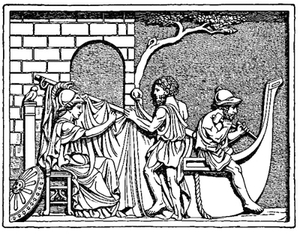
Fig. 130. The Building of the Argo
163. Descendants of Deucalion. Athamas, brother of Sisyphus,
was descended from Æolus, whose father, Hellen, was the son of
Deucalion of Thessaly. Athamas had by his wife Nephele two
children, Phrixus and Helle. After a time, growing indifferent to
his wife, Athamas put her away and took Ino, the daughter of
Cadmus. The unfortunate sequel of this second marriage we have
already seen.[233]
Nephele, apprehending danger to her children from the influence
of their stepmother, took measures to put them out of her
reach. Mercury gave her a ram with a golden fleece, on which she
set the two children. Vaulting into the air, the animal took his
course to the east; but when he was crossing the strait that divides
Europe and Asia, the girl Helle fell from his back into the sea,
which from her was afterward called the Hellespont—now the
Dardanelles. The ram safely landed the boy Phrixus in Colchis,
where he was hospitably received by Æetes, the king of that country.
Phrixus sacrificed the ram to Jupiter, but the fleece he gave
to Æetes, who placed it in a consecrated grove under the care of
a sleepless dragon.[234]
164. The Quest of the Golden Fleece.[235] Another realm in Thessaly,
near to that of Athamas, was ruled over by his nephew Æson.
Æson, although he had a son Jason, surrendered the crown to a
half brother, Pelias,[236] on condition that he should hold it only during
the minority of the lad. This young Jason was, by the way, a
second cousin of Bellerophon and of the Atalanta who ran against
Hippomenes, and a first cousin of Admetus, the husband of Alcestis.[237]
When, however, Jason, being grown up, came to demand the crown,
his uncle Pelias with wily intent suggested to him the glorious
quest of the golden fleece. Jason, pleased with the thought, forthwith
made preparations for the expedition. At that time the only
species of navigation known to the Greeks consisted of small boats
or canoes hollowed out from trunks of trees; when, accordingly,
Jason employed Argus to build a vessel capable of containing fifty
men, it was considered a gigantic undertaking. The vessel was
named Argo, probably after its builder. Jason soon found himself
at the head of a bold band of comrades, many of whom afterward
were renowned among the heroes and demigods of Greece.
From every region of Ægea's shore
The brave assembled; those illustrious twins
Castor and Pollux; Orpheus, tuneful bard;
Zetes and Calaïs, as the wind in speed;
Strong Hercules and many a chief renowned.
On deep Iolcos' sandy shore they thronged,
Gleaming in armor, ardent of exploits,—
And soon, the laurel cord and the huge stone
Uplifting to the deck, unmoored the bark;
Whose keel of wondrous length the skillful hand
Of Argus fashioned for the proud attempt;
And in the extended keel a lofty mast
Upraised, and sails full swelling; to the chiefs
Unwonted objects. Now first, now they learned
Their bolder steerage over ocean wave,
Led by the golden stars, as Chiron's art
Had marked the sphere celestial.[238]
Theseus, Meleager, Peleus, and Nestor were also among these
Argonauts, or sailors of the Argo. The ship with her crew of
heroes left the shores of Thessaly, and touching at the island of
Lemnos, thence crossed to Mysia and thence to Thrace. Here
they found the sage Phineus, who instructed the Argonauts how
they might pass the Symplegades, or Clashing Islands, at the
entrance of the Euxine Sea. When they reached these islands
they, accordingly, let go a dove, which took her way between the
rocks and passed in safety, only losing some feathers of her tail.
Jason and his men, seizing the favorable moment of the rebound,
plied their oars with vigor and passed safe through, though the
islands closed behind them and actually grazed the stern of the vessel.
They then rowed along the shore till they arrived at the eastern
end of the sea, and so landed in the kingdom of Colchis.
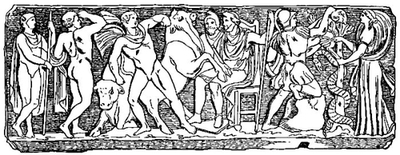
Fig. 131. Jason Conquers the Bulls and Steals the Fleece
Jason made known his message to the Colchian king, Æetes,
who consented to give up the golden fleece on certain conditions,
namely, that Jason should yoke to the plow two fire-breathing
bulls with brazen feet, and that he then should sow the teeth of
the dragon that Cadmus had slain. Jason, although it was well
known that a crop of armed men would spring up from the teeth,
destined to turn their weapons against their producer, accepted
the conditions, and a time was set for the undertaking. The hero,
however, wisely spent the interval in wooing Medea, the daughter
of Æetes; and with such success that they plighted troth before
the altar of Hecate. The princess then furnished her hero with a
charm which should aid him in the contest to come.
Accordingly, when the momentous day was arrived, Jason with
calmness encountered the fire-breathing monsters and speedily
yoked them to the plow. The Colchians stood in amazement;
the Greeks shouted for joy. Next, the hero proceeded to sow the
dragon's teeth and plow them in. Up sprang, according to prediction,
the crop of armed men, brandished aloft their weapons,
and rushed upon Jason. The Greeks trembled for their hero.
Medea herself grew pale with fear. The hero himself for a time,
with sword and shield, kept his assailants at bay; but he surely
would have been overwhelmed by the numbers, had he not resorted
to a charm which Medea had taught him: seizing a stone, he threw
it in the midst of his foes. Immediately they turned their arms
against one another, and soon there was not one of the dragon's
brood alive.
It remained only to lull to sleep the dragon that guarded the
fleece. This was done by scattering over him a few drops of a
preparation which, again, Medea had supplied. Jason then seized
the fleece, and, with his friends and his sweetheart accompanying,
hastened to the vessel. It is said that, in order to delay the pursuit
of her father Æetes, Medea tore to pieces her young brother
Absyrtus and strewed fragments of him along the line of their
flight. The ruse succeeded.
165. The Return of the Argonauts. On their way home the
Argonauts beat a devious course, sailing after other dangers had
been overcome, by the island that the Sirens infested. And here
the heroes would have hung their halsers and remained, had not
Orpheus vanquished the seductive strains of the sea-muses with his
own more melodious and persuasive song.[239]
Oh, happy seafarers are ye
And surely all your ills are past,
And toil upon the land and sea,
Since ye are brought to us at last;
chanted the Sirens, promising long rest and the kingdoms of sleep.
But now, but now, when ye have lain
Asleep with us a little while
Beneath the washing of the main,
How calm shall be your waking smile!
Then Orpheus replied, encouraging his men:
A little more, a little more,
O carriers of the Golden Fleece!
A little labor with the oar,
Before we reach the land of Greece.
E'en now, perchance, faint rumors reach
Men's ears of this our victory,
And draw them down upon the beach
To gaze across the empty sea.
Again the Sirens:
Alas! and will ye stop your ears,
In vain desire to do aught,
And wish to live 'mid cares and fears,
Until the last fear makes you nought?
But Orpheus, reminding the rowers of home and love and joy:
Is not the May-time now on earth,
When close against the city wall
The folks are singing in their mirth,
While on their heads the May flowers fall?
carried them past triumphant.
The Argonauts arrived safe in Thessaly. Jason delivered the
fleece to Pelias, and dedicated the Argo to Neptune.
166. Medea and Æson.[240] Medea's career as a sorceress was, by
no means, completed. At Jason's request she undertook next to
restore his aged father Æson to the vigor of youth. To the full
moon she addressed her incantations, to the stars, to Hecate, to
Tellus, the goddess of the earth. In a chariot borne aloft by
dragons she traversed the fields of air to regions where flourished
potent plants, which only she knew how to select. Nine nights
she employed in her search, and during that period shunned all
intercourse with mortals.
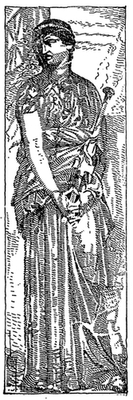
Next she erected two altars, the one to Hecate, the other to
Hebe, and sacrificed a black sheep,—pouring libations of milk
and wine. She implored Pluto and his stolen bride to spare the
old man's life. Then she directed that Æson be led forth; and
throwing him into a deep sleep, she laid him
on a bed of herbs, like one dead. No eye profane
looked upon her mysteries. With streaming
hair thrice she moved round the altars,
dipped flaming twigs in the blood, and laid
them thereon to burn. Meanwhile, the caldron
with its contents was preparing. In it she put
magic herbs, with seeds and flowers of acrid
juice, stones from the distant East, and sand
from the shore of all-surrounding ocean, hoar-frost
gathered by moonlight, a screech owl's
head and wings, and the entrails of a wolf.
She added fragments of the shells of tortoises
and the liver of stags—animals tenacious of
life—and the head and beak of a crow, which
outlives nine generations of men. These, with
many other things "without a name," she
boiled together for her purposed work, stirring
them with a dry olive branch. The branch,
when taken out, instantly was green and erelong
was covered with leaves and a plentiful
growth of young olives; and as the liquor
boiled and bubbled and sometimes bubbled over, the grass wherever
the sprinklings fell leaped into verdure like that of spring.
Seeing that all was ready, Medea cut the throat of the old man,
let out his blood, and poured into his mouth and his wound the
juices of her caldron. As soon as he had completely imbibed them,
his hair and beard lost their whiteness and assumed the color of
youth; his paleness and emaciation were gone; his veins were
full of blood, his limbs of vigor and robustness; and Æson, on
awakening, found himself forty years younger.
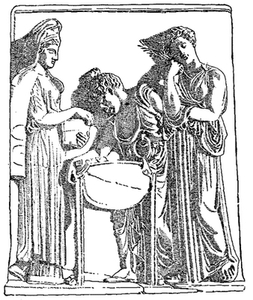
Fig. 133. Medea and Daughters of Pelias
167. Pelias.[241] In another instance, Medea made her arts the
instrument of revenge. Pelias, the usurping uncle of Jason, still
kept him out of his heritage. But the daughters of Pelias wished
Medea to restore their father also to youth. Medea simulated
consent, but prepared her caldron for him in a new and singular
way. She put in only water and a few simple herbs.
In the night she persuaded the daughters of Pelias to kill him.
They at first hesitated to strike, but Medea chiding their irresolution,
they turned away
their faces and, giving
random blows, smote him
with their weapons. Starting
from his sleep, the
old man cried out, "My
daughters, would you kill
your father?" Whereat
their hearts failed them,
and the weapons fell from
their hands. Medea, however,
struck the fatal blow.
They placed him in the
caldron, but, as might be
expected, with no success.
Medea herself had taken
care to escape before they
discovered the treachery.
She had, however, little
profit of the fruits of her crime. Jason, for whom she had sacrificed
so much, put her away, for he wished to marry Creüsa, princess
of Corinth. Whereupon Medea, enraged at his ingratitude,
called on the gods for vengeance; then, sending a poisoned robe
as a gift to the bride, killing her own children, and setting fire
to the palace, she mounted her serpent-drawn chariot and fled to
Athens. There she married King Ægeus, the father of Theseus;
and we shall meet her again when we come to the adventures of
that hero.[242]
The incantation of Medea readily suggests that of the witches
in Macbeth:
Round about the caldron go;
In the poison'd entrails throw.—
Toad, that under cold stone
Days and nights has thirty-one
Swelter'd venom sleeping got,
Boil thou first i' the charmèd pot....
Fillet of a fenny snake
In the caldron boil and bake;
Eye of newt and toe of frog,
Wool of bat and tongue of dog,
Adder's fork and blind-worm's sting,
Lizard's leg and howlet's wing,—
For a charm of powerful trouble
Like a hell-broth boil and bubble....
Scale of dragon, tooth of wolf,
Witches' mummy, maw and gulf
Of the ravin'd salt-sea shark,
Root of hemlock digged i' the dark....
Make the gruel thick and slab.[243]
168. The Calydonian Hunt.[244] One of the heroes of the Argonautic
expedition had been Meleager, a son of Œneus and Althæa,
rulers of Calydon in Ætolia. His parents were cousins, descended
from a son of Endymion named Ætolus, who had colonized that
realm. By ties of kinship and marriage they were allied with many
historic figures. Their daughter Dejanira had become, as we have
already noted, the wife of Hercules; while Leda, the sister of
Althæa, was mother of Castor and Pollux,[245] and of Clytemnestra
and Helen, intimately concerned in the Trojan War.
When her son Meleager was born, Althæa had beheld the three
Destinies, who, as they spun their fatal thread, foretold that the
life of the child should last no longer than a certain brand then
burning upon the hearth. Althæa seized and quenched the brand,
and carefully preserved it while Meleager grew to boyhood, youth,
and man's estate. It chanced, then, that Œneus, offering sacrifices
to the gods, omitted to pay due honors to Diana; wherefore she,
indignant at the neglect, sent a boar of enormous size to lay waste
the fields of Calydon. Meleager called on the heroes of Greece
to join in a hunt for the ravenous monster. Theseus and his friend
Pirithoüs,[246] Jason, Peleus the father of Achilles, Telamon the father
of Ajax, Nestor, then a youth, but who in his age bore arms with
Achilles and Ajax in the Trojan War,[247]—these and many more
joined in the enterprise. With them came, also, Atalanta, the
daughter of Iasius, of the race of Callisto,—
Arcadian Atalanta, snowy-souled,
Fair as the snow and footed as the wind.[248]
A buckle of polished gold confined her vest, an ivory quiver hung
on her left shoulder, and her left hand bore the bow. Her face
blended feminine beauty with the graces of martial youth. Meleager
saw and, with chivalric reverence, somewhat thus addressed her:
For thy name's sake and awe toward thy chaste head,
O holiest Atalanta! no man dares
Praise thee, though fairer than whom all men praise,
And godlike for thy grace of hallowed hair
And holy habit of thine eyes, and feet
That make the blown foam neither swift nor white,
Though the wind winnow and whirl it; yet we praise
Gods, found because of thee adorable
And for thy sake praiseworthiest from all men:
Thee therefore we praise also, thee as these,
Pure, and a light lit at the hands of gods.[249]
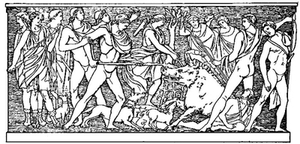
Fig. 134. Meleager on the Boar Hunt
But there was no time then for love; on to the hunt they
pushed. To the hunt went also Plexippus and Toxeus, brothers
of Queen Althæa, braggarts, envious of Meleager. Speedily the
hunters drew near the monster's lair. They stretched strong nets
from tree to tree; they uncoupled their dogs; they sought the
footprints of their quarry in the grass. From the wood was a
descent to marshy ground. Here the boar, as he lay among the
reeds, heard the shouts of his pursuers and rushed forth against
them. One and another is thrown down and slain. Jason, Nestor,
Telamon open the attack, but in vain.
... Then all abode save one,
The Arcadian Atalanta: from her side
Sprang her hounds, laboring at the leash, and slipped,
And plashed ear-deep with plunging feet; but she
Saying, "Speed it as I send it for thy sake,
Goddess," drew bow and loosed; the sudden string
Rang, and sprang inward, and the waterish air
Hissed, and the moist plumes of the songless reeds
Moved as a wave which the wind moves no more.
But the boar heaved half out of ooze and slime,
His tense flank trembling round the barbèd wound,
Hateful; and fiery with invasive eyes,
And bristling with intolerable hair,
Plunged, and the hounds clung, and green flowers and white
Reddened and broke all round them where they came.[1]
It was a slight wound, but Meleager saw and joyfully proclaimed
it. The attack was renewed. Peleus, Amphiaraüs, Theseus, Jason,
hurled their lances. Ancæus was laid low by a mortal wound.
But Meleager,—
Rock-rooted, fair with fierce and fastened lips,
Clear eyes and springing muscle and shortening limb—
With chin aslant indrawn to a tightening throat,
Grave, and with gathered sinews, like a god,—
Aimed on the left side his well-handled spear,
Grasped where the ash was knottiest hewn, and smote,
And with no missile wound, the monstrous boar
Right in the hairiest hollow of his hide,
Under the last rib, sheer through bulk and bone,
Deep in; and deeply smitten, and to death,
The heavy horror with his hanging shafts
Leapt, and fell furiously, and from raging lips
Foamed out the latest wrath of all his life.[250]
Then rose a shout from those around; they glorified the
conqueror,—crowded to touch his hand. But he, placing his foot
upon the head of the slain boar, turned to Atalanta, and bestowed
on her the head and the rough hide—trophies of his success.
Thereat she laughed—
Lit with a low blush to the braided hair,
And rose-colored and cold like very dawn,
Golden and godlike, chastely with chaste lips,
A faint grave laugh; and all they held their peace,
And she passed by them. Then one cried, "Lo now,
Shall not the Arcadian shoot out lips at us,
Saying all we were despoiled by this one girl?"
And all they rode against her violently
And cast the fresh crown from her hair, and now
They had rent her spoil away, dishonoring her,
Save that Meleager, as a tame lion chafed,
Bore on them, broke them, and as fire cleaves wood,
So clove and drove them, smitten in twain; but she
Smote not nor heaved up hand; and this man first,
Plexippus, crying out, "This for love's sake, Sweet,"
Drove at Meleager, who with spear straightening
Pierced his cheek through; then Toxeus made for him,
Dumb, but his spear shake; vain and violent words,
Fruitless; for him, too, stricken through both sides
The earth felt falling....
... And these being slain,
None moved, nor spake.[251]
Of this fearful sequel to the hunt, Althæa has heard nothing.
As she bears thank offering to the temples for the victory of her
son, the bodies of her murdered brothers meet her sight. She
shrieks, and beats her breast, and hastens to change the garments
of joy for those of mourning. But when the author of the deed
is known, grief gives way to the stern desire of vengeance on
her son. The fatal brand, which the Destinies have linked with
Meleager's life, she brings forth. She commands a fire to be prepared.
Four times she essays to place the brand upon the pile;
four times draws back, shuddering before the destruction of her
son. The feelings of the mother and the sister contend within
her. Now she is pale at the thought of the purposed deed, now
flushed again with anger at the violence of her offspring. Finally,
the sister prevails over the mother:—turning away her face, she
throws the fatal wood upon the burning pile. Meleager, absent
and unconscious of the cause, feels a sudden pang. He burns;
he calls upon those whom he loves, Atalanta and his mother. But
speedily the brand is ashes, and the life of Meleager is breathed
forth to the wandering winds.
When at last the deed was done, the mother laid violent hands
upon herself.
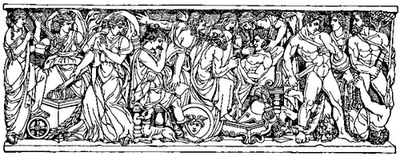
Fig. 135. The Death of Meleager
169. Merope. A heroine connected by blood with Atalanta was
Merope,[252] daughter of king Cypselus of Arcadia, and descended
from Arcas, the son of Callisto and Jupiter. On account of her
relationship to Atalanta her story may be told here, though she is
not a member of the family of Ætolus. Her husband, Cresphontes
the Heraclid, king of Messenia, had been slain with two of his
sons by rebellious nobles; and one Polyphontes, leader of the
revolt, reigned in his stead and took Merope to wife. But her
third son by Cresphontes, Æpytus, had been concealed by her in
Arcadia. Thence, in due season, he returned unknown to her,
with the purpose of wreaking vengeance on the murderers of his
sire. He pretended to have slain Æpytus, and so as a stranger
won the favor of Polyphontes, but came near losing his life at his
mother's hands. A recognition being happily effected, Æpytus,
aided by his mother, put Polyphontes to death and took possession
of the kingdom. This story has been frequently dramatized, first
by Euripides in a lost play called Cresphontes, and most recently
by Matthew Arnold, whose Merope is a masterpiece of classical
invention and of poetic execution.
170. Castor and Pollux. Leda, the sister of Althæa and aunt of
Meleager, bore to Tyndareus, king of Sparta, Castor and Clytemnestra.
To Jove she bore Pollux and Helen. Pollux and Castor—one,
the son of a god and immortal, the other, of mortal breed
and destiny—are famous for their fraternal affection. Endowed
with various manly virtues,—Castor a horse-tamer, Pollux a boxer,—they
made all expeditions in common. Together they joined
the Calydonian hunt. Together they accompanied the Argonauts.
During the voyage to Colchis it is said that, a storm arising,
Orpheus prayed to the Samothracian gods and played on his harp,
and that when the storm ceased, stars appeared on the heads of the
brothers. Hence they came to be honored as patrons of voyagers.
They rendered, indeed, noteworthy service to the Argonauts
returning from Colchis with Medea and the Golden Fleece. For
when the voyagers attempted a landing at Crete they were confronted
by the gigantic warder of the island. This was Talus, a
form of living brass, fashioned by Hephæstus (Vulcan) and presented
to King Minos, about whose Cretan domain he made his
rounds three times a day. Ordinarily when Talus saw voyagers
nearing the coast he fired himself red-hot and embraced them as
they landed. For some reason he did not welcome the Argonauts
in this warm fashion, but
Whirling with resistless sway
Rocks sheer uprent, repels them from the bay.[1]
Medea, objecting to the volley of stones, resorts to necromantic
spells:
Thrice she applies the power of magic prayer,
Thrice, hellward bending, mutters charms in air;
Then, turning toward the foe, bids Mischief fly,
And looks Destruction as she points her eye.[253]
Maddened, as might be surmised, by so insidious and unaccustomed
a form of attack, the Man of Brass "tears up whole hills to
crush his foes"; then fleeing in sudden panic, he is overcome by
the stupor of the enchantment and taken captive by Castor and
Pollux. He had in his body only one vein, and that plugged on
the crown of his head with a nail. Medea drew out the stopper.
At a later period when Theseus and his friend Pirithoüs had
carried off Helen from Sparta, the youthful heroes, Castor and
Pollux, with their followers hasted to the rescue. Theseus being
absent from Attica, the brothers recovered their sister. Later still,
we find Castor and Pollux engaged in a combat with Idas and
Lynceus of Messene, some say over the daughters of Leucippus,
others, over a herd of oxen. Castor was slain; but Pollux, inconsolable
for the loss of his brother, besought Jupiter to be permitted
to give his own life as a ransom for him. Jupiter so far consented
as to allow the two brothers to enjoy the boon of life alternately,
each spending one day under the earth and the next in the heavenly
abodes. According to another version, Jupiter rewarded the
attachment of the brothers by placing them among the stars as
Gemini, the Twins. They received heroic honors as the Tyndaridæ
(sons of Tyndareus); divine honors they received under the name
of Dioscuri (sons of Jove).[254]
171. The Twin Brethren among the Romans. In Rome they
were honored with a temple in the Forum and made the patrons
of knighthood because of the assistance they rendered in the battle
of Lake Regillus. In the moment of dire distress they had appeared,
a princely pair:
So like they were, no mortal
Might one from other know;
White as snow their armor was,
Their steeds were white as snow.
Never on earthly anvil
Did such rare armor gleam,
And never did such gallant steeds
Drink of an earthly stream.
And all who saw them trembled,
And pale grew every cheek;
And Aulus the Dictator
Scarce gathered voice to speak:
"Say by what name men call you?
What city is your home?
And wherefore ride ye in such guise
Before the ranks of Rome?"
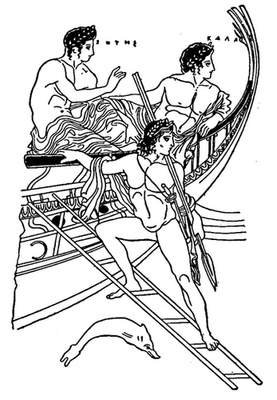
Fig. 136. Castor and Pollux
capturing the Giant Talus
(Left portion)
"By many names," they answered,—
"By many names men call us;
In many lands we dwell:
Well Samothracia knows us;
Cyrene knows us well;
Our house in gay Tarentum
Is hung each morn with flowers;
High o'er the masts of Syracuse
Our marble portal towers;
But by the brave Eurotas
Is our dear native home;
And for the right we come to fight
Before the ranks of Rome."
After the battle was won they were
the first to bear the tidings to the city.
With joy the people acclaimed them,—
But on rode these strange horsemen,
With slow and lordly pace;
And none who saw their bearing
Durst ask their name or race.
On rode they to the Forum,
While laurel boughs and flowers,
From housetops and from windows,
Fell on their crests in showers.
When they drew nigh to Vesta,
They vaulted down amain,
And washed their horses in the well
That springs by Vesta's fane.
And straight again they mounted,
And rode to Vesta's door;
Then, like a blast, away they passed,
And no man saw them more....
And Sergius the High Pontiff
Alone found voice to speak:
"The gods who live forever
Have fought for Rome to-day!
These be the Great Twin Brethren
To whom the Dorians pray.
Back comes the chief in triumph
Who, in the hour of fight,
Hath seen the Great Twin Brethren
In harness on his right.
Safe comes the ship to haven,
Through billows and through gales
If once the Great Twin Brethren
Sit shining on the sails....
Here, hard by Vesta's temple,
Build we a stately dome
Unto the Great Twin Brethren
Who fought so well for Rome!"[255]
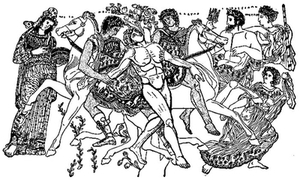
Fig. 137. Castor and Pollux capturing the Giant Talus
(Right portion)
For many a year the procession, in which the knights, olive-wreathed
and purple-robed, marched in honor of the Twin Brethren,
continued to be held; and still there stand three columns of their
temple above the pool of Juturna and Vesta's ruined shrine.
172. Minos of Crete was a descendant of Inachus in the sixth
generation. A son of Jupiter and Europa, he was, after death,
transferred, with his brother Rhadamanthus and with King Æacus,
to Hades, where the three became judges of the Shades. This is
the Minos mentioned by Homer and Hesiod,—the eminent lawgiver.
Of his grandson, Minos II, it is related that when aiming
at the crown of Crete, he boasted of his power to obtain by prayer
whatever he desired, and as a test, he implored Neptune to send
him a bull for sacrifice. The bull appeared, but Minos, astonished
at its great beauty, declined to sacrifice the brute. Neptune, therefore
incensed, drove the bull wild,—worse still, drove Pasiphaë,
the wife of Minos, wild with love of it. The wonderful brute was
finally caught and overcome by Hercules, who rode it through the
waves to Greece. But its offspring, the Minotaur, a monster bull-headed
and man-bodied, remained for many a day a terror to
Crete, till finally a famous artificer, Dædalus, constructed for
him a labyrinth, with passages and turnings winding in and about
like the river Mæander, so that whoever was inclosed in it might
by no means find his way out. The Minotaur, roaming therein,
lived upon human victims. For it is said that, after Minos had
subdued Megara,[256] a tribute of seven youths and seven maidens
was sent every year from Athens to Crete to feed this monster;
and it was not until the days of Theseus of Athens that an end
was put to both tribute and Minotaur.[257]
173. Dædalus and Icarus.[258] Dædalus, who abetted the love
of Pasiphaë for the Cretan bull, afterwards lost the favor of
Minos and was imprisoned by him. Seeing no other way of
escape, the artificer made, out of feathers, wings for his son
Icarus and himself, which he fastened
on with wax. Then poising
themselves in the air, they flew away.
Icarus had been warned not to approach
too near the sun, and all went
well till they had passed Samos and
Delos on the left and Lebynthos on
the right. But then the boy, exulting
in his career, soared upward.
The blaze of the torrid sun softened
the waxen fastening of his wings.
Off they came, and down the lad
dropped into the sea which after him
is named Icarian, even to this day.
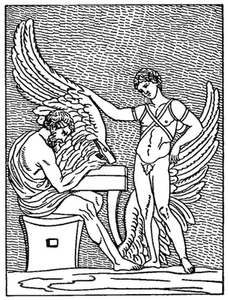
Fig. 138. Dædalus and Icarus
... With melting wax and loosened strings
Sunk hapless Icarus on unfaithful wings;
Headlong he rushed through the affrighted air,
With limbs distorted and disheveled hair;
His scattered plumage danced upon the wave,
And sorrowing Nereïds decked his watery grave;
O'er his pale corse their pearly sea flowers shed,
And strewed with crimson moss his marble bed;
Struck in their coral towers the passing bell,
And wide in ocean tolled his echoing knell.[259]
The story, save for its tragic conclusion, reads like a remarkable anticipation
of the exploits of the Wright brothers, Blériot, and Latham
with the aëroplane to-day, or of Count Zeppelin with his airships.
Dædalus, mourning his son, arrived finally in Sicily where,
being kindly received by King Cocalus, he built a temple to
Apollo and hung up his wings, an offering to the god. But
Minos, having learned of the hiding place of the artificer, followed
him to Sicily with a great fleet; and Dædalus would surely
have perished, had not one of the daughters of Cocalus disposed
of Minos by scalding him to death while he was bathing.
It is said that Dædalus could not bear the idea of a rival. His
sister had placed her son Perdix under his charge to be taught the
mechanical arts. He was an apt scholar and gave striking evidences
of ingenuity. Walking on the seashore, he picked up the
spine of a fish, and, imitating it in iron, invented the saw. He
invented, also, a pair of compasses. But Dædalus, envious of his
nephew, pushed him off a tower and killed him. Minerva, however,
in pity of the boy, changed him into a bird, the partridge,
which bears his name.
To the descendants of Inachus we shall again return in the
account of the house of Labdacus.
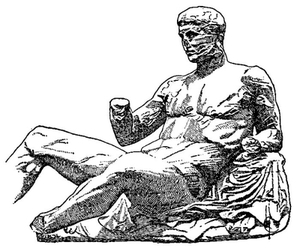
174. From Cecrops[260] to Philomela. Cecrops, half-snake, half-man,
came from Crete or Egypt into Attica, founded Athens, and
chose Minerva rather than Neptune as its guardian. His successor
was Erichthonius,[261] or Erechtheus, a snake-formed genius of the
fertile soil of Attica. This
Erichthonius[262] was a special
ward of the goddess
Minerva, who brought
him up in her temple.
His son Pandion had two
daughters, Procne and
Philomela, of whom he
gave the former in marriage
to Tereus, king of
Thrace (or of Daulis in
Phocis). This ruler, after
his wife had borne him
a son Itys (or Itylus),
wearied of her, plucked
out her tongue by the roots to insure her silence, and, pretending
that she was dead, took in marriage the other sister, Philomela.
Procne by means of a web, into which she wove her story, informed
Philomela of the horrible truth. In revenge upon Tereus,
the sisters killed Itylus and served up the child as food to the
father; but the gods, in indignation, transformed Procne into a
swallow, Philomela into a nightingale, forever bemoaning the murdered
Itylus, and Tereus into a hawk, forever pursuing the sisters.[263]
175. Matthew Arnold's Philomela.
Hark! ah, the nightingale—
The tawny-throated!
Hark, from that moonlit cedar what a burst!
What triumph! hark!—what pain!
O wanderer from a Grecian shore,
Still, after many years in distant lands,
Still nourishing in thy bewilder'd brain
That wild, unquench'd, deep-sunken, old-world pain—
Say, will it never heal?
And can this fragrant lawn
With its cool trees, and night,
And the sweet, tranquil Thames,
And moonshine, and the dew,
To thy rack'd heart and brain
Afford no calm?
Dost thou to-night behold,
Here, through the moonlight on this English grass,
The unfriendly palace in the Thracian wild?
Dost thou again peruse,
With hot cheeks and sear'd eyes,
The too clear web, and thy dumb sister's shame?
Dost thou once more assay
Thy flight, and feel come over thee,
Poor fugitive, the feathery change
Once more, and once more seem to make resound
With love and hate, triumph and agony,
Lone Daulis, and the high Cephissian vale?
Listen, Eugenia—
How thick the bursts come crowding through the leaves!
Again—thou hearest?
Eternal passion!
Eternal pain!
According to another version of this story, it was Philomela
who was robbed of her tongue and who wove the web by means
of which the queen Procne learned the truth.
176. Theseus.[264] A descendant of Erechtheus, or of Cecrops, was
Ægeus, king of Athens. By Æthra, granddaughter of Pelops, he
became the father of the Attic hero, Theseus. Ægeus, on parting
from Æthra, before the birth of the child, had placed his sword
and shoes under a large stone and had directed her to send the
child to him if it should prove strong enough to roll away the
stone and take what was under. The lad Theseus was brought up
at Trœzen, of which Pittheus, Æthra's father, was king. When
Æthra thought the time had come, she led Theseus to the stone.
He removed it with ease and took the sword and shoes. Since at
that time the roads
were infested with robbers,
his grandfather
Pittheus pressed him
earnestly to take the
shorter and safer way
to his father's country,
by sea; but the youth,
feeling in himself the
spirit and soul of a
hero and eager to
signalize himself like
Hercules, determined
on the more perilous
and adventurous journey
by land.
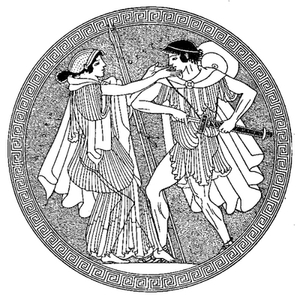
Fig. 140. Æthra and Theseus
His first day's journey
brought him to
Epidaurus, where dwelt Periphetes, a son of Vulcan. This ferocious
savage always went armed with a club of iron, and all travelers
stood in terror of his violence; but beneath the blows of the
young hero he speedily fell.
Several similar contests with the petty tyrants and marauders of
the country followed, in all of which Theseus was victorious. Most
important was his slaughter of Procrustes, or the Stretcher. This
giant had an iron bedstead on which he used to tie all travelers
who fell into his hands. If they were shorter than the bed, he
stretched them till they fitted it; if they were longer than the bed,
he lopped off their limbs.
In the course of time Theseus reached Athens, but here new
dangers awaited him. For Medea, the sorceress, who had fled
from Corinth after her separation from Jason,[265] had become the
wife of Ægeus. Knowing by her arts who the stranger was, and
fearing the loss of her influence with her husband if Theseus
should be acknowledged as his son, she tried to poison the
youth; but the sword which he wore discovered him to his father
and prevented the fatal
draft. Medea fled to
Asia, where the country
afterwards called Media
is said to have received
its name from her.
Theseus was acknowledged
by his sire and
declared successor to
the throne.
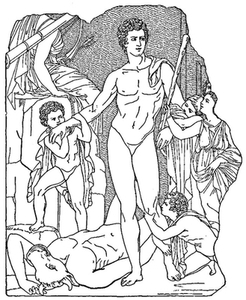
Fig. 141. Theseus and the Minotaur
177. Theseus and
Ariadne.[266] Now the
Athenians were at that
time in deep affliction
on account of the tribute
of youths and maidens
which they were
forced to send to the
Minotaur, dwelling in
the labyrinth of Crete,—a
penalty said to have
been imposed by Minos upon the Athenians because Ægeus had
sent Androgeüs, the son of Minos, against the Marathonian bull
and so had brought about the young man's death.
From this calamity Theseus resolved to deliver his countrymen
or to die in the attempt. He, therefore, in spite of the entreaties
of his father, presented himself as champion of Athens and of her
fair sons and daughters, to do battle against the Minotaur, and
departed with the victims in a vessel bearing black sails, which he
promised his father to change for white in the event of his returning
victorious. So,—
Rather than cargo on cargo of corpses undead should be wafted[267]
Over the ravening sea to the pitiless monster of Creta,—
Leaving the curvèd strand Piræan, and wooing the breezes,
Theseus furrowed the deep to the dome superb of the tyrant.
Then as the maid Ariadne beheld him with glances of longing,—
Princess royal of Creta Minoan, tender, sequestered,—
Locked in a mother's embrace, in seclusion virginal, fragrant,
Like some myrtle set by streaming ways of Eurotas,
Like to the varied tints that Spring invites with her breezes,—
Then, as with eager gaze she looked her first upon Theseus,
Never a whit she lowered her eyes nor ceased to consume him,
Ere to the core profound her breast with love was enkindled.
—God-born boy, thou pitiless heart, provoker of madness,
Mischievous, mingling care with the fleeting pleasure of mortals,—
Goddess of Golgi, thou, frequenter of coverts Idalian,
In what wildering seas ye tossed the impassionate maiden
Ever a-sighing,—aye for the fair-haired stranger a-sighing!
Ah, what ponderous fears oppressed her languishing bosom,
How, more pallid than gold her countenance flashed into whiteness,
What time Theseus marched unto death or to glory undying,
Manful, minded to quell the imbruted might of the monster!
Not unaided, however, did he undertake the task; for Ariadne,
apprehensive lest he might lose his way in the dædalian labyrinth,
furnished him with a thread, the gift of Vulcan, which, unrolled
by Theseus as he entered the maze, should enable him on his return
to retrace his former path. Meanwhile—
Offering artless bribes, Ariadne invoked the Immortals,
Kindled voiceless lip with unvoicèd tribute of incense,
Suppliant, not in vain: for, like to an oak upon Taurus,
Gnarlèd, swinging his arms,—like some cone-burthenèd pine tree
Oozing the life from his bark, that, riven to heart by the whirlwind,
Wholly uprooted from earth, falls prone with extravagant ruin,
Perishes, dealing doom with precipitate rush of its branches,—
So was the Cretan brute by Theseus done to destruction,
E'en so, tossing in vain his horns to the vacuous breezes.
Then with abundant laud he turned, unscathed from the combat,
Theseus,—guiding his feet unsure by the filament slender,
Lest as he threaded paths circuitous, ways labyrinthine,
Some perverse, perplexing, erratic alley might foil him.
Why should I tarry to tell how, quitting her sire, Ariadne
Quitting the sister's arms, the infatuate gaze of the mother,—
She whose sole delight, whose life, was her desperate daughter,—
How Ariadne made less of the love of them all than of Theseus?
Why should I sing how sailing they came to the beaches of Dia,—
White with the foam,—how thence, false-hearted, the lover departing
Left her benighted with sleep, the Minoïd, princess of Creta?
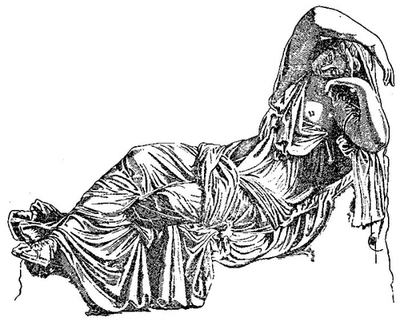
Fig. 142. The Sleeping Ariadne
Gazing amain from the marge of the flood-reverberant Dia,
Chafing with ire, indignant, exasperate,—lo, Ariadne,
Lorn Ariadne, beholds swift craft, swift lover retreating.
Nor can be sure she sees what things she sees of a surety,
When upspringing from sleep, she shakes off treacherous slumber,
Lone beholds herself on a shore forlorn of the ocean.
Carelessly hastens the youth, meantime, who, driving his oar-blades
Hard in the waves, consigns void vows to the blustering breezes.
But as, afar from the sedge, with sad eyes still the Minoïd
Mute as a Mænad in stone unmoving stonily gazes—
Heart o'erwhelmed with woe—ah, thus, while thus she is gazing,—
Down from her yellow hair slips, sudden, the weed of the fine-spun
Snood, and the vesture light of her mantle down from the shoulders
Slips, and the twisted scarf encircling her womanly bosom;
Stealthily gliding, slip they downward into the billow,
Fall, and are tossed by the buoyant flood at the feet of the fair one.
Nothing she recks of the coif, of the floating garment as little,
Cares not a moment then, whose care hangs only on Theseus,—
Wretched of heart, soul-wrecked, dependent only on Theseus,—
Desperate, woe-unselfed with a cureless sorrow incessant,
Frantic, bosoming torture of thorns Erycina had planted....
Then, they say, that at last, infuriate out of all measure,
Once and again she poured shrill-voicèd shrieks from her bosom;
Helpless, clambered steeps, sheer beetling over the surges,
Whence to enrange with her eyes vast futile regions of ocean;—
Lifting the folds, soft folds of her garments, baring her ankles,
Dashed into edges of upward waves that trembled before her;
Uttered, anguished then, one wail, her maddest and saddest,—
Catching with tear-wet lips poor sobs that shivering choked her:—
"Thus is it far from my home, O traitor, and far from its altars—
Thus on a desert strand,—dost leave me, treacherous Theseus?
Thus is it thou dost flout our vow, dost flout the Immortals,—
Carelessly homeward bearest, with baleful ballast of curses?
Never, could never a plea forfend thy cruelly minded
Counsel? Never a pity entreat thy bosom for shelter?...
Hence, let never a maid confide in the oath of a lover,
Never presume man's vows hold aught trustworthy within them!
Verily, while in anguish of heart his spirit is longing,
Nothing he spares to assever, nor aught makes scruple to promise:
But, an his dearest desire, his nearest of heart be accorded—
Nothing he recks of affiance, and reckons perjury,—nothing.
"Oh! what lioness whelped thee? Oh! what desolate cavern?
What was the sea that spawned, that spat from its churning abysses,
Thee,—what wolfish Scylla, or Syrtis, or vasty Charybdis,
Thee,—thus thankful for life, dear gift of living, I gave thee?...
Had it not liked thee still to acknowledge vows that we plighted,
Mightest thou homeward, yet, have borne me a damsel beholden,
Fain to obey thy will, and to lave thy feet like a servant,
Fain to bedeck thy couch with purple coverlet for thee.
"But to the hollow winds why stand repeating my quarrel,—
I, for sorrow unselfed,—they, but breezes insensate,—
Potent neither voices to hear nor words to re-echo?...
Yea, but where shall I turn? Forlorn, what succor rely on?
'Haste to the Gnossian hills?' Ah, see how distantly surging
Deeps forbid, distending their gulfs abhorrent before me!
'Comfort my heart, mayhap, with the loyal love of my husband?'
Lo, the reluctant oar, e'en now, he plies to forsake me!—
Nought but the homeless strand of an isle remote of the ocean!
No, no way of escape, where the circling sea without shore is,—
No, no counsel of flight, no hope, no sound of a mortal;
All things desolate, dumb, yea, all things summoning deathward!
Yet mine eyes shall not fade in death that sealeth the eyelids,
Nor from the frame outworn shall fare my lingering senses,
Ere, undone, from powers divine I claim retribution—
Ere I call—in the hour supreme, on the faith of Immortals!
"Come, then, Righters of Wrong, O vengeful dealers of justice,
Braided with coil of the serpents, O Eumenides, ye of
Brows that blazon ire exhaling aye from the bosom,
Haste, oh, haste ye, hither and hear me, vehement plaining,
Destitute, fired with rage, stark-blind, demented for fury!—
As with careless heart yon Theseus sailed and forgot me,
So with folly of heart, may he slay himself and his household!"
... Then with a nod supreme Olympian Jupiter nodded:
Quaked thereat old Earth,—quaked, shuddered the terrified waters,
Ay, and the constellations in Heaven that glitter were jangled.
Straightway like some cloud on the inward vision of Theseus
Dropped oblivion down, enshrouding vows he had cherished,
Hiding away all trace of the solemn behest of his father.
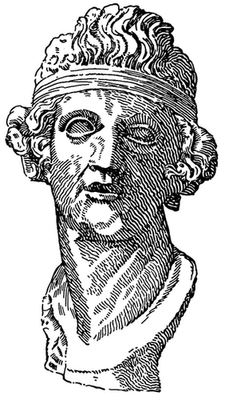
Fig. 143. Head of
Dionysus
For, as was said before, Ægeus, on the departure of his son for
Creta, had given him this command: "If Minerva, goddess of our
city, grant thee victory over the Minotaur, hoist on thy return,
when first the dear hills of Attica greet thy vision, white canvas
to herald thy joy and mine,
that mine eyes may see the
propitious sign and know the
glad day that restores thee
safe to me."
... Even as clouds compelled by urgent push of the breezes
Float from the brow uplift of a snow-envelopèd mountain,
So from Theseus passed all prayer and behest of his father.
Waited the sire meanwhile, looked out from his tower over ocean,
Wasted his anxious eyes in futile labor of weeping,
Waited expectant,—saw to the southward sails black-bellied—
Hurled him headlong down from the horrid steep to destruction,—
Weening hateful Fate had severed the fortune of Theseus.
Theseus, then, as he paced that gloom of the home of his father,
Insolent Theseus knew himself what manner of evil
He with a careless heart had aforetime dealt Ariadne,—
Fixed Ariadne that still, still stared where the ship had receded,—
Wounded, revolving in heart her countless muster of sorrows.
Fig. 144. The Revels of Bacchus and Ariadne
178. Bacchus and Ariadne.
But for the deserted daughter
of Minos a happier fate was
yet reserved. This island, on
which she had been abandoned,
was Naxos, loved and
especially haunted by Bacchus, where with his train of reeling
devotees he was wont to hold high carnival.
... Sweeping over the shore, lo, beautiful, blooming Iacchus,—
Chorused of Satyrs in dance and of Nysian-born Sileni,—
Seeking fair Ariadne,—afire with flame of a lover!
Lightly around him leaped Bacchantès, strenuous, frenzied,
Nodding their heads, "Euhoe!" to the cry, "Euhoe, O Bacchus!"
Some—enwreathèd spears of Iacchus madly were waving;
Some—ensanguined limbs of the bullock, quivering, brandished;
Some—were twining themselves with sinuous snakes that twisted;
Some—with vessels of signs mysterious, passed in procession—
Symbols profound that in vain the profane may seek to decipher;
Certain struck with the palms—with tapered fingers on timbrels,
Others the tenuous clash of the rounded cymbals awakened;—
Brayed with a raucous roar through the turmoil many a trumpet,
Many a stridulous fife went, shrill, barbarian, shrieking.[268]
So the grieving, much-wronged Ariadne was consoled for the
loss of her mortal spouse by an immortal lover. The blooming god
of the vine wooed and won her. After her death, the golden crown
that he had given her was transferred by him to the heavens. As
it mounted the ethereal spaces, its gems, growing in brightness,
became stars; and still it remains fixed, as a constellation, between
the kneeling Hercules and the man that holds the serpent.
179. The Amazons. As king of Athens, it is said that Theseus
undertook an expedition against the Amazons. Assailing them
before they had recovered from the attack of Hercules, he carried
off their queen Antiope; but they in turn, invading the country
of Athens, penetrated into the city itself; and there was fought
the final battle in which Theseus overcame them.
180. Theseus and Pirithoüs. A famous friendship between
Theseus and Pirithoüs of Thessaly, son of Jupiter, originated in
the midst of arms. Pirithoüs had made an irruption into the plain
of Marathon and had carried off the herds of the king of Athens.
Theseus went to repel the plunderers. The moment the Thessalian
beheld him, he was seized with admiration, and stretching out his
hand as a token of peace, he cried, "Be judge thyself,—what
satisfaction dost thou require?"—"Thy friendship," replied the
Athenian; and they swore inviolable fidelity. Their deeds corresponding
to their professions, they continued true brothers in
arms. When, accordingly, Pirithoüs was to marry Hippodamia,
daughter of Atrax, Theseus took his friend's part in the battle
that ensued between the Lapithæ (of whom Pirithoüs was king)
and the Centaurs. For it happened that at the marriage feast, the
Centaurs were among the guests; and one of them, Eurytion, becoming
intoxicated, attempted to offer violence to the bride. Other
Centaurs followed his example; combat was joined; Theseus leaped
into the fray, and not a
few of the guests bit the
dust.
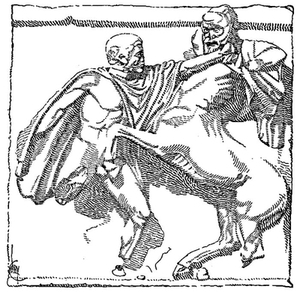
Fig. 145. Lapith and Centaur
Later, each of these
friends aspired to espouse
a daughter of Jupiter.
Theseus fixed his choice
on Leda's daughter Helen,
then a child, but afterwards
famous as the cause
of the Trojan War; and
with the aid of his friend
he carried her off, only,
however, to restore her
at very short notice. As
for Pirithoüs, he aspired
to the wife of the monarch of Erebus; and Theseus, though aware
of the danger, accompanied the ambitious lover to the underworld.
But Pluto seized and set them on an enchanted rock at his palace
gate, where fixed they remained till Hercules, arriving, liberated
Theseus but left Pirithoüs to his fate.
181. Phædra and Hippolytus. After the death of Antiope,
Theseus married Phædra, sister of the deserted Ariadne, daughter
of Minos. But Phædra, seeing in Hippolytus, the son of Theseus,
a youth endowed with all the graces and virtues of his father and
of an age corresponding to her own, loved him. When, however,
he repulsed her advances, her love was changed to despair and
hate. Hanging herself, she left for her husband a scroll containing
false charges against Hippolytus. The infatuated husband, filled,
therefore, with jealousy of his son, imprecated the vengeance of
Neptune upon him. As Hippolytus one day drove his chariot
along the shore, a sea monster raised himself above the waters
and frightened the horses so that they ran away and dashed the
chariot to pieces. Hippolytus was killed, but by Æsculapius was
restored to life, and then, removed by Diana from the power of his
deluded father, was placed in Italy under the protection of the
nymph Egeria.
In his old age, Theseus, losing the favor of his people, retired
to the court of Lycomedes, king of Scyros, who at first received
him kindly, but afterwards treacherously put him to death.
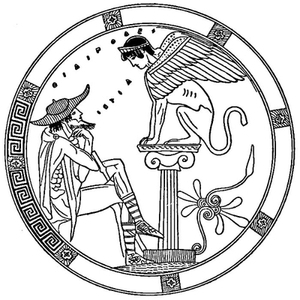
Fig. 146. Œdipus and the Sphinx
182. The Misfortunes of Thebes. Returning to the descendants
of Inachus, we find that the curse which fell upon Cadmus when
he slew the dragon of Mars followed nearly every scion of his
house. His daughters, Semele, Ino, Autonoë, Agave,—his grandsons,
Melicertes, Actæon, Pentheus,—lived sorrowful lives or
suffered violent deaths. The
misfortunes of one branch of
his family, sprung from his son
Polydorus, remain to be told.
The curse seems to have spared
Polydorus himself. His son
Labdacus, also, lived a quiet
life as king of Thebes and left
a son, Laïus, upon the throne.
But erelong Laïus was warned
by an oracle that there was danger
to his throne and life if
his son, new-born, should reach
man's estate. He, therefore,
committed the child to a herdsman
with orders for its destruction; but the herdsman, moved
with pity yet not daring entirely to disobey, pierced the child's
feet, purposing to expose him to the elements on Mount Cithæron.
183. Œdipus and the Sphinx.[269] In this plight the infant was
given to a tender-hearted fellow-shepherd, who carried him to
King Polybus of Corinth and his queen, by whom he was adopted
and called Œdipus, or Swollen-foot.
Many years afterward, Œdipus, learning from an oracle that he
was destined to be the death of his father, left the realm of his
reputed sire, Polybus. It happened, however, that Laïus was then
driving to Delphi, accompanied only by one attendant. In a narrow
road he met Œdipus, also in a chariot. On the refusal of the youthful
stranger to leave the way at their command, the attendant killed
one of his horses. Œdipus, consumed with rage, slew both Laïus
and the attendant, and thus unknowingly fulfilled both oracles.
Shortly after this event, the city of Thebes, to which Œdipus
had repaired, was afflicted with a monster that infested the high-road.
She was called the Sphinx. She had the body of a lion and
the upper part of a woman. She lay crouched on the top of a rock
and, arresting all travelers who came that way, propounded to
them a riddle, with the condition that those who could solve it
should pass safe, but those who failed should be killed. Not one
had yet succeeded in guessing it. Œdipus, not daunted by these
alarming accounts, boldly advanced to the trial. The Sphinx asked
him, "What animal is it that in the morning goes on four feet, at
noon on two, and in the evening upon three?" Œdipus replied,
"Man, who in childhood creeps on hands and knees, in manhood
walks erect, and in old age goes with the aid of a staff." The
Sphinx, mortified at the collapse of her riddle, cast herself down
from the rock and perished.
184. Œdipus, the King. In gratitude for their deliverance, the
Thebans made Œdipus their king, giving him in marriage their
queen, Jocasta. He, ignorant of his parentage, had already become
the slayer of his father; in marrying the queen he became the
husband of his mother. These horrors remained undiscovered till,
after many years, Thebes being afflicted with famine and pestilence,
the oracle was consulted, and, by a series of coincidences, the double
crime of Œdipus came to light. At once, Jocasta put an end to
her life by hanging herself. As for Œdipus, horror-struck,—
When her form
He saw, poor wretch! with one wild fearful cry,
The twisted rope he loosens, and she fell,
Ill-starred one, on the ground. Then came a sight
Most fearful. Tearing from her robe the clasps,
All chased with gold, with which she decked herself,
He with them struck the pupils of his eyes,
With words like these: "Because they had not seen
What ills he suffered, and what ills he did,
They in the dark should look, in time to come,
On those whom they ought never to have seen,
Nor know the dear ones whom he fain had known."
With suchlike wails, not once or twice alone,
Raising his eyes he smote them, and the balls,
All bleeding, stained his cheek.[270]
185. Œdipus at Colonus. After these sad events Œdipus would
have left Thebes, but the oracle forbade the people to let him go.
Jocasta's brother, Creon, was made regent of the realm for the two
sons of Œdipus. But after Œdipus had grown content to stay,
these sons of his, with Creon, thrust him into exile. Accompanied
by his daughter Antigone, he went begging through the land. His
other daughter, Ismene, at first stayed at home. Cursing the sons
who had abandoned him, but bowing his own will in submission to
the ways of God, Œdipus approached the hour of his death in
Colonus, a village near Athens. His friend Theseus, king of
Athens, comforted and sustained him to the last. Both his daughters
were also with him:
And then he called his girls, and bade them fetch
Clear water from the stream, and bring to him
For cleansing and libation. And they went,
Both of them, to yon hill we look upon,
Owned by Demeter of the fair green corn,
And quickly did his bidding, bathed his limbs,
And clothed them in the garment that is meet.
And when he had his will in all they did,
And not one wish continued unfulfilled,
Zeus from the dark depths thundered, and the girls
Heard it, and shuddering, at their father's knees,
Falling they wept; nor did they then forbear
Smiting their breasts, nor groanings lengthened out;
And when he heard their bitter cry, forthwith
Folding his arms around them, thus he spake:
"My children, on this day ye cease to have
A father. All my days are spent and gone;
And ye no more shall lead your wretched life,
Caring for me. Hard was it, that I know,
My children! Yet one word is strong to loose,
Although alone, the burden of these toils,
For love in larger store ye could not have
From any than from him who standeth here,
Of whom bereaved ye now shall live your life."[271]
There was sobbing, then silence. Then a voice called him,—and
he followed. God took him from his troubles. Antigone
returned to Thebes,—where, as we shall see, her sisterly fidelity
showed itself as true as, aforetime, her filial affection.
Her brothers, Eteocles and Polynices, had meanwhile agreed to
share the kingdom between them and to reign alternately year by
year. The first year fell to the lot of Eteocles, who, when his
time expired, refused to surrender the kingdom to his brother.
Polynices, accordingly, fled to Adrastus, king of Argos, who gave
him his daughter in marriage and aided him with an army to
enforce his claim to the kingdom. These causes led to the celebrated
expedition of the "Seven against Thebes," which furnished
ample materials for the epic and tragic poets of Greece. And
here the younger heroes of Greece make their appearance.
186. Their Exploits. The exploits of the sons and grandsons
of the chieftains engaged in the Calydonian Hunt and the Quest
of the Golden Fleece are narrated in four stories,—the Seven
against Thebes, the Siege of Troy, the Wanderings of Ulysses,
and the Adventures of Æneas.
187. The Seven against Thebes.[272] The allies of Adrastus and
Polynices in the enterprise against Thebes were Tydeus of Calydon,
half brother of Meleager, Parthenopæus of Arcadia, son of
Atalanta and Mars, Capaneus of Argos, Hippomedon of Argos, and
Amphiaraüs, the brother-in-law of Adrastus. Amphiaraüs opposed
the expedition for, being a soothsayer, he knew that none of the
leaders except Adrastus would live to return from Thebes; but on
his marriage to Eriphyle, the king's sister, he had agreed that
whenever he and Adrastus should differ in opinion, the decision
should be left to Eriphyle. Polynices, knowing this, gave Eriphyle
the necklace of Harmonia and thereby gained her to his interest.
This was the selfsame necklace that Vulcan had given to Harmonia
on her marriage with Cadmus; Polynices had taken it with
him on his flight from Thebes. It seems to have been still fraught
with the curse of the house of Cadmus. But Eriphyle could not
resist so tempting a bribe. By her decision the war was resolved
on, and Amphiaraüs went to his fate. He bore his part bravely
in the contest, but still could not avert his destiny. While, pursued
by the enemy, he was fleeing along the river, a thunderbolt
launched by Jupiter opened the ground, and he, his chariot, and
his charioteer were swallowed up.
It is unnecessary here to detail all the acts of heroism or atrocity
which marked this contest. The fidelity, however, of Evadne
stands out as an offset to the weakness of Eriphyle. Her husband,
Capaneus, having in the ardor of the fight declared that he
would force his way into the city in spite of Jove himself, placed
a ladder against the wall and mounted; but Jupiter, offended at
his impious language, struck him with a thunderbolt. When his
obsequies were celebrated, Evadne cast herself on his funeral pile
and perished.
Fig. 147. Eteocles and Polynices kill
each other
It seems that early in the contest Eteocles consulted the soothsayer
Tiresias as to the issue. Now, this Tiresias in his youth had
by chance seen Minerva bathing, and had been deprived by her
of his sight, but afterwards had obtained of her the knowledge of
future events. When
consulted by Eteocles,
he declared that victory
should fall to
Thebes if Menœceus,
the son of Creon, gave
himself a voluntary victim.
The heroic youth,
learning the response,
threw away his life in
the first encounter.
The siege continued
long, with varying success.
At length both
hosts agreed that the brothers should decide their quarrel by single
combat. They fought, and fell each by the hand of the other. The
armies then renewed the fight; and at last the invaders were forced
to yield, and fled, leaving their dead unburied. Creon, the uncle of
the fallen princes, now became king, caused Eteocles to be buried
with distinguished honor, but suffered the body of Polynices to lie
where it fell, forbidding any one, on pain of death, to give it burial.
188. Antigone,[273] the sister of Polynices, heard with indignation
the revolting edict which, consigning her brother's body to
the dogs and vultures, deprived it of the rites that were considered
essential to the repose of the dead. Unmoved by the dissuading
counsel of her affectionate but timid sister, and unable to
procure assistance, she determined to brave the hazard and to
bury the body with her own hands. She was detected in the act.
When Creon asked the fearless woman whether she dared disobey
the laws, she answered:
Yes, for it was not Zeus who gave them forth,
Nor justice, dwelling with the gods below,
Who traced these laws for all the sons of men;
Nor did I deem thy edicts strong enough,
That thou, a mortal man, should'st overpass
The unwritten laws of God that know no change.
They are not of to-day nor yesterday,
But live forever, nor can man assign
When first they sprang to being. Not through fear
Of any man's resolve was I prepared
Before the gods to bear the penalty
Of sinning against these. That I should die
I knew (how should I not?), though thy decree
Had never spoken. And before my time
If I shall die, I reckon this a gain;
For whoso lives, as I, in many woes,
How can it be but he shall gain by death?
And so for me to bear this doom of thine
Has nothing fearful. But, if I had left
My mother's son unburied on his death,
In that I should have suffered; but in this
I suffer not.[274]
Creon, unyielding and unable to conceive of a law higher than that
he knew, gave orders that she should be buried alive, as having
deliberately set at nought the solemn edict of the city. Her lover,
Hæmon, the son of Creon, unable to avert her fate, would not
survive her, and fell by his own hand. It is only after his son's
death and as he gazes upon the corpses of the lovers, that the
aged Creon recognizes the insolence of his narrow judgment.
And those that stand beside him say:
Man's highest blessedness
In wisdom chiefly stands;
And in the things that touch upon the gods,
'T is best in word or deed,
To shun unholy pride;
Great words of boasting bring great punishments,
And so to gray-haired age
Teach wisdom at the last.[275]
189. The Epigoni.[276] Such was the fall of the house of Labdacus.
The bane of Cadmus expires with the family of Œdipus. But the
wedding gear of Harmonia has not yet fulfilled its baleful mission.
Amphiaraüs had, with his last breath, enjoined his son Alcmæon
to avenge him on the faithless Eriphyle. Alcmæon engaged his
word, but before accomplishing the fell purpose, he was ordered
by an oracle of Delphi to conduct against Thebes a new expedition.
Thereto his mother Eriphyle, influenced by Thersander, the son
of Polynices, and bribed this time by the gift of Harmonia's wedding
garment, impelled not only Alcmæon but her other son,
Amphilochus. The descendants (Epigoni) of the former Seven
thus renewed the war against Thebes. They leveled the city to the
ground. Its inhabitants, counseled by Tiresias, took refuge in foreign
lands. Tiresias himself perished during the flight. Alcmæon,
returning to Argos, put his mother to death but, in consequence,
repeated in his own experience the penalty of Orestes. The outfit
of Harmonia preserved its malign influence until, at last, it was
devoted to the temple at Delphi and removed from the sphere of
mortal jealousies.
190. Three Families. Before entering upon the causes of the war
against Troy, we must notice the three Grecian families that were
principally concerned,—those of Peleus, Atreus, and Tyndareus.
191. Peleus[277] was the son of Æacus and grandson of Jove. It
was for his father Æacus, king of Phthia in Thessaly, that, as we
have seen, an army of Myrmidons was created by Jupiter. Peleus
joined the expedition of the Argonauts, and on that journey beheld
and fell in love with the sea-nymph Thetis, daughter of Nereus
and Doris. Such was the beauty of the nymph that Jupiter himself
had sought her in marriage; but having learned from Prometheus,
the Titan, that Thetis should bear a son who should be
greater than his father, the Olympian desisted from his suit and
decreed that Thetis should be the wife of a mortal. By the aid of
Chiron, the Centaur, Peleus succeeded in winning the goddess for
his bride. In this marriage, to be productive of momentous results
for mortals, the immortals manifested a lively interest. They
thronged with the Thessalians to the wedding in Pharsalia; they
honored the wedding feast with their presence and, reclining on
ivory couches, gave ear while the three Sisters of Fate, in responsive
strain, chanted the fortunes of Achilles,—the future hero
of the Trojan War,—the son that should spring from this union
of a goddess with a mortal. The following is from a translation of
the famous poem, The Wedding of Peleus and Thetis:[278]
... Now, on the day foreset, Aurora forsaking the ocean
Crimsons the orient sky: all Thessaly, seeking the palace,
Fares to the royal seat, in populous muster exultant,
Heavy of hand with gifts, but blithesome of cheer for the joyance.
Scyros behind they leave, they leave Phthiotican Tempe,
Crannon's glittering domes and the battlements Larissæan,
Cumber Pharsalia, throng the abodes and the streets of Pharsalus.
Fields, meanwhile are untilled, grow tender the necks of the oxen,
None with the curving teeth of the harrow cleareth the vineyard,
None upturneth the glebe with bull and the furrowing plowshare,
None with gardener's knife lets light through the branches umbrageous;
Squalid the rust creeps up o'er plows forgotten of plowmen.
Bright is the palace, ay, through far retreating recesses
Blazing for sheen benign of the opulent gold and the silver:
Ivory gleams on the thrones, great goblets glint on the tables,
Glitters the spacious home, made glad with imperial splendor,—
Ay, but most—in the hall midmost—is the couch of the goddess,
Glorious, made of the tusk of the Indian elephant—polished—
Spread with a wonder of quilt empurpled with dye of the sea-shell.
On this coverlet of purple were embroidered various scenes illustrating
the lessons of heroism and justice that the poet would
inculcate: to the good falleth good; to the evil, evil speedily.
Therefore, the story of Theseus and Ariadne, which has already
been recounted, was here displayed in cunning handiwork. For
Theseus, the false lover, bold of hand but bad of heart, gained by
retributive justice undying ruth and misery; whereas Ariadne, the
injured and innocent, restored to happiness, won no less a reward
than Bacchus himself. Gorgeously woven with such antique and
heroic figures was the famous quilt upon the couch of Thetis. For
a season the wedding guests feasted their eyes upon it.
Then when Thessaly's youth, long gazing, had of the wonder
Their content, they gan give place to the lords of Olympus.
As when Zephyr awakes the recumbent billows of ocean,
Roughens the placid deep with eager breath of the morning,
Urges the waves, and impels, to the threshold of journeying Phœbus,—
They, at first, blown outward unroughly when Dawn is a-rising,
Limp slow-footed, and loiter with laughter lightsomely plashing,
But, with the freshening gale, creep quicker and thicker together,
Till on horizon they float refulgent of luminous purple,—
So from the portal withdrawing the pomp Thessalian departed
Faring on world-wide ways to the far-off homes of their fathers.
Now when they were aloof, drew nigh from Pelion's summit
Chiron bearing gifts from copses and glades of the woodland—
Gifts that the meadows yield: what flowers on Thessaly's mountains,
Or, by waves of the stream, the prolific breath of the West Wind,
Warming, woos to the day, all such in bunches assorted
Bore he. Flattered with odors the whole house brake into laughter.
Came there next Peneüs, abandoning verdurous Tempe—
Tempe embowered deep mid superimpendent forests.
And after the river-god, who bore with him nodding plane trees
and lofty beeches, straight slim laurels, the lithe poplar, and the
airy cypress to plant about the palace that thick foliage might give
it shade, followed Prometheus, the bold and cunning of heart,
wearing still the marks of his ancient punishment on the rocks of
Caucasus. Finally the father of the gods himself came, with his
holy spouse and his offspring,—all, save Phœbus and his one
sister, who naturally looked askance upon a union to be productive
of untold misfortune to their favored town of Troy.
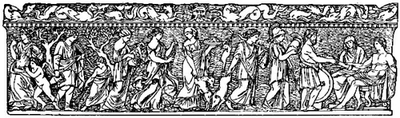
Fig. 148. The Gods bring Wedding Gifts
... When now the gods had reclined their limbs on the ivory couches,
Viands many and rare were heaped on the banqueting tables,
Whilst the decrepit Sisters of Fate, their tottering bodies
Solemnly swayed, and rehearsed their soothfast vaticination.
—Lo, each tremulous frame was wrapped in robe of a whiteness,
Down to the ankles that fell, with nethermost border of purple,
While on ambrosial brows there rested fillets like snowflakes.
They, at a task eternal their hands religiously plying,
Held in the left on high, with wool enfolded, a distaff,
Delicate fibers wherefrom, drawn down, were shaped by the right hand—
Shaped by fingers upturned,—but the down-turned thumb set a-whirling,
Poised with perfected whorl, the industrious shaft of the spindle.
Still, as they span, as they span, was the tooth kept nipping and smoothing,
And to the withered lip clung morsels of wool as they smoothed it—
Filaments erstwhile rough that stood from the twist of the surface.
Close at their feet, meantime, were woven baskets of wicker
Guarding the soft white balls of the wool resplendent within them.
Thus then, parting the strands, these Three with resonant voices
Uttered, in chant divine, predestined sooth of the future—
Prophecy neither in time, nor yet in eternity, shaken.
"Thou that exaltest renown of thy name with the name of thy valor,
Bulwark Emathian, blest above sires in the offspring of promise,
Hear with thine ears this day what oracles fall from the Sisters
Chanting the fates for thee;—but you, ye destiny-drawing
Spindles, hasten the threads of the destinies set for the future!
"Rideth the orb upon high that heralds boon unto bridegrooms—
Hesperus,—cometh anon with star propitious the virgin,
Speedeth thy soul to subdue—submerge it with love at the flood tide.
Hasten, ye spindles, and run, yea, gallop, ye thread-running spindles!
"Erstwhile, never a home hath roofed like generous loving,
Never before hath Love conjoinèd lovers so dearly,—
Never with harmony such as endureth for Thetis and Peleus.
Hasten, ye spindles, and run, yea, gallop, ye thread-running spindles!
"Born unto you shall be the undaunted heart of Achilles,
Aye by his brave breast known, unknown by his back to the foeman,—
Victor in onslaught, victor in devious reach of the race-course,
Fleeter of foot than feet of the stag that lighten and vanish,—
Hasten, ye spindles, and run, yea, gallop, ye thread-running spindles!"
192. Achilles, Son of Peleus. So the sisters prophesied the
future of the hero, Achilles,—from his father called Pelides;
from his grandfather, Æacides. How by him the Trojans should
fall, as fall the ears of corn when they are yellow before the
scythe; how because of him Scamander should run red, warm with
blood, choked with blind bodies, into the whirling Hellespont;
how finally he himself, in his prime, should fall, and how on his
tomb should be sacrificed the fair Polyxena, daughter of Priam,
whom he had loved. "So," says Catullus, "sang the Fates. For
those were the days before piety and righteous action were spurned
by mankind, the days when Jupiter and his immortals deigned to
consort with zealous man, to enjoy the sweet odor of his burnt-offering,
to march beside him to battle, to swell his shout in victory
and his lament in defeat, to smile on his peaceful harvests, to
recline at his banquets, and to bless the weddings of fair women
and goodly heroes. But now, alas," concludes Catullus, "godliness
and chastity, truth, wisdom, and honor have departed from among
men":
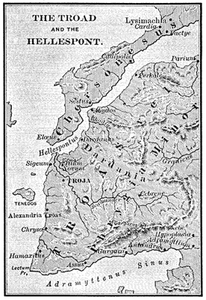
Wherefore the gods no more vouchsafe their presence to mortals,
Suffer themselves no more to be touched by the ray of the morning.
But there were gods in the pure,—in the golden prime of the Ages.
The hero of the Trojan War, here prophesied, Achilles, fleet of
foot, the dauntless, the noble, the beloved of Zeus, the breaker of the
ranks of men, is the ideal hero of the Greeks,—the mightiest of the
Achæans far. Of his youth many interesting stories are told: how
his mother, endeavoring to make him invulnerable, plunged him in
the river Styx, and succeeded save with regard to his ankles by which
she held him; and how he was educated in eloquence and the
arts of war by his father's friend Phœnix, and by his father's other
friend Chiron, the centaur, in riding and hunting and music and the
art of healing. One of the most Greek-minded of our English poets,
Matthew Arnold,[279] singing of a beauteous dell by Etna, tells how
In such a glen, on such a day,
On Pelion, on the grassy ground,
Chiron, the aged Centaur, lay,
The young Achilles standing by.
The Centaur taught him to explore
The mountains; where the glens are dry
And the tired Centaurs come to rest,
And where the soaking springs abound
And the straight ashes grow for spears,
And where the hill goats come to feed
And the sea eagles build their nest.
He showed him Phthia far away.
And said, "O boy, I taught this lore
To Peleus, in long distant years!"
He told him of the gods, the stars,
The tides;—and then of mortal wars,
And of the life which heroes lead
Before they reach the Elysian place
And rest in the immortal mead;
And all the wisdom of his race.
Upon the character of Achilles, outspoken, brave, impulsive; to
his friends passionately devoted, to his foes implacable; lover of war
and lover of home; inordinately ambitious but submissive to divine
decree;—upon this handsome, gleaming, terrible, glooming,
princely warrior of his race, the poet of the Iliad delights to dwell,
and the world has delighted in the portraiture from that day to this.
193. Atreus was the son of Pelops and Hippodamia and grandson
of Tantalus, therefore great-grandson of Jove. Both by blood
and by marriage he was connected with Theseus. He took to wife
Aërope, granddaughter of Minos II, king of Crete, and by her
had two sons, Agamemnon, the general of the Grecian army in
the Trojan War, and Menelaüs, at whose solicitation the war was
undertaken. Of Atreus it may be said that with cannibal atrocity
like that of his grandsire, Tantalus, he on one occasion wreaked
his vengeance on a brother, Thyestes, by causing him to eat the
flesh of two of his own children. A son of this Thyestes, Ægisthus
by name, revived in due time against Agamemnon the treacherous
feud that had existed between their fathers.
194. Tyndareus was king of Lacedæmon (Sparta). His wife
was Leda, daughter of Thestius of Calydon, and sister of Althæa,
the mother of Meleager and Dejanira. To Tyndareus Leda bore
Castor and Clytemnestra; to Jove she bore Pollux and Helen. The
two former were mortal; the two latter, immortal. Clytemnestra
was married to Agamemnon of Mycenæ, to whom she bore Electra,
Iphigenia, Chrysothemis, and Orestes. Helen, the fair immediate
cause of the Trojan War, became the wife of Menelaüs, who
with her obtained the kingdom of Sparta.
Of the families of Peleus, Atreus, and Tyndareus, the genealogies
will be found in the Commentary corresponding with these
sections of the story; also the genealogy of Ulysses, one of the
leaders of the Greek army during the war and the hero of the
Odyssey, which narrates his subsequent adventures; and that of
the royal family of Troy against whom the war was undertaken.
A slight study of these family trees will reveal interesting relationships
between the principal participants in the war. For instance:
that the passionate Achilles and the intolerant Ajax, second only
to Achilles in military prowess, are first cousins; and that the
family of Ajax is connected by marriage with that of the Trojan
Hector, whom he meets in combat. That Ulysses is a distant
cousin of his wife Penelope and of Clytemnestra, the wife of
Agamemnon; and that he is a kinsman of Patroclus, the bosom
friend of Achilles. In the family of Tyndareus we note most the
tragic and romantic careers of the women,—Clytemnestra, who
murdered her husband and married his cousin Ægisthus; Helen,
whose beauty provoked war between her two husbands and their
races; Penelope, whose fidelity to her absent lord is the marvel of
the Odyssey. It will be noticed, too, that the daughter of Helen,
Hermione, is strangely enough married first by the son of Achilles
and, afterwards, by the son of Agamemnon, and so becomes sister-in-law
to her noble cousins, Electra and Iphigenia.
The kinsmen and descendants of Peleus—Telamon, Ajax,
Teucer, Achilles, Neoptolemus—are characterized by their personal
valor, their intolerant and resentful temper. In the family of
Atreus, the men are remarkable for their kingly attributes; the
principal women for their unwavering devotion to religious duty.
The members of the royal family of Troy are of richly varied and
most unusual individuality: like Tithonus and Memnon, Paris,
Hesione, Cassandra and Polyxena, poetic and pathetic; like Laomedon,
Priam, Hector and Troilus, patriotic, persistent in the face
of overwhelming odds; but all fated to a dolorous end. Of
those engaged in the Trojan War, Æneas and his aged father,
Anchises, beloved of Venus, are practically the only survivors to a
happier day.
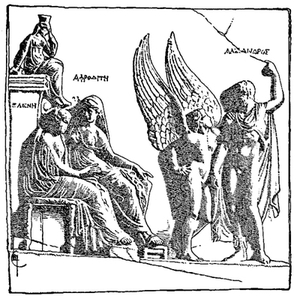
Fig. 150. Helen Persuaded
... At length I saw a lady within call,
Stiller than chisel'd marble, standing there:
A daughter of the gods, divinely tall,
And most divinely fair.
Her loveliness with shame and with surprise
Froze my swift speech: she turning on my face
The starlike sorrows of immortal eyes,
Spoke slowly in her place.
"I had great beauty; ask thou not my name:
No one can be more wise than destiny.
Many drew swords and died. Where'er I came
I brought calamity."[280]
195. Its Origin. At the nuptials of Peleus and Thetis all the
gods had been invited with the exception of Eris, or Discord.
Enraged at her exclusion, the goddess threw a golden apple among
the guests, with the inscription, "For the fairest." Thereupon
Juno, Venus, and Minerva each claimed the apple. Not willing
to decide so delicate a matter, Jupiter sent the goddesses to Mount
Ida where Paris, son of Priam, king of Troy, was tending his
flocks. Till that moment the shepherd-prince had been happy.
He was young and beautiful and beloved,—"White-breasted like a
star," says Œnone, the nymph whom he had wedded:
White-breasted like a star
Fronting the dawn he moved; a leopard skin
Dropp'd from his shoulder, but his sunny hair
Cluster'd about his temples like a god's:
And his cheek brighten'd as the foam-bow brightens
When the wind blows the foam, and all my heart
Went forth to embrace him coming ere he came.[1]
But to him was now committed the judgment between the goddesses.
They appeared:
And at their feet the crocus brake like fire,
Violet, amaracus, and asphodel,
Lotos and lilies: and a wind arose,
And overhead the wandering ivy and vine,
This way and that, in many a wild festoon
Ran riot, garlanding the gnarlèd boughs
With bunch and berry and flower thro' and thro'.[281]
Juno promised him power and riches, Minerva glory and renown
in war, Venus the fairest of women for his wife,—each attempting
to bias the judge in her own favor. Paris, forgetting the fair
nymph to whom he owed fealty, decided in favor of Venus, thus
making the two other goddesses his enemies. Under the protection
of the goddess of love, he soon afterwards sailed to Greece. Here
he was hospitably received by Menelaüs, whose wife, Helen, as
fairest of her sex, was unfortunately the prize destined for Paris.
This fair queen had in time past been sought by numerous suitors;
but before her decision was made known, they all, at the suggestion
of Ulysses, son of Laërtes, king of Ithaca, had taken an oath
that they would sustain her choice and avenge her cause if necessary.
She was living happily with Menelaüs when Paris, becoming
their guest, made love to her, and then, aided by Venus, persuaded
her to elope with him, and carried her to Troy. From this cause
arose the famous Trojan War,—the theme of the greatest poems
of antiquity, those of
Homer and Virgil.
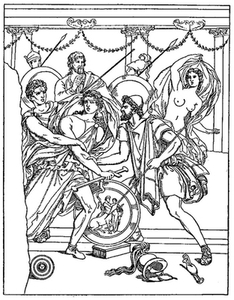
Fig. 151. Achilles taken from Scyros
Menelaüs called
upon the chieftains
of Greece to aid him
in recovering his wife.
They came forward
with a few exceptions.
Ulysses, for instance,
who had married a
cousin of Helen's,
Penelope, daughter of
Icarius, was happy in
his wife and child,
and loth to embark in
the troublesome affair.
Palamedes was sent to
urge him. But when
Palamedes arrived at
Ithaca, Ulysses pretended
madness. He
yoked an ass and an
ox together to the plow and began to sow salt. The ambassador, to
try him, placed the infant Telemachus before the plow, whereupon
the father, turning the plow aside, showed that his insanity was a
mere pretense. Being himself gained for the undertaking, Ulysses
lent his aid to bring in other reluctant chiefs, especially Achilles,
son of Peleus and Thetis. Thetis being herself one of the immortals,
and knowing that her son was fated to perish before Troy if
he went on the expedition, endeavored to prevent his going. She,
accordingly, sent him to the court of King Lycomedes of the island
of Scyros, and induced him to conceal himself in the garb of a
maiden among the daughters of the king. Hearing that the young
Achilles was there, Ulysses went disguised as a merchant to the
palace and offered for sale female ornaments, among which had
been placed some arms. Forgetting the part he had assumed,
Achilles handled the weapons and thereby betrayed himself to
Ulysses, who found no great difficulty in persuading him to disregard
his mother's counsels and join his countrymen in the war.
It seems that from early youth Paris had been reared in obscurity,
because there were forebodings that he would be the ruin of
the state. These forebodings appeared, at last, likely to be realized;
for the Grecian armament now in preparation was the greatest that
had ever been fitted out. Agamemnon, king of Mycenæ and brother
of Menelaüs, was chosen commander in chief. Preëminent among
the warriors was the swift-footed Achilles. After him ranked his
cousin Ajax, the son of Telamon, gigantic in size and of great
courage, but dull of intellect; Diomede, the son of Tydeus, second
only to Achilles in all the qualities of a hero; Ulysses, famous for
sagacity; and Nestor, the oldest of the Grecian chiefs, to whom
they all looked up for counsel.
But Troy was no feeble enemy. Priam the king, son of Laomedon
and brother of Tithonus and Hesione, was now old; but he
had been a wise prince and had strengthened his state by good
government at home and powerful alliances with his neighbors.
By his wife Hecuba he had a numerous family; but the principal
stay and support of his throne was his son Hector, one of the
noblest figures of antiquity. The latter had, from the first, a presentiment
of the ruin of Troy, but still he persevered in heroic resistance,
though he by no means justified the wrong which brought
this danger upon his country. He was united in marriage with
the noble Andromache, and as husband and father his character
was not less admirable than as warrior. The principal leaders on
the side of the Trojans, beside Hector, were his relative, Æneas,
the son of Venus and Anchises, Deiphobus, Glaucus, and Sarpedon.
196. Iphigenia in Aulis. After two years of preparation, the
Greek fleet and army assembled in the port of Aulis in Bœotia.
Here Agamemnon, while hunting, killed a stag that was sacred to
Diana. The goddess in retribution visited the army with pestilence
and produced a calm which prevented the ships from leaving the
port. Thereupon, Calchas the soothsayer announced that the wrath
of the virgin goddess
could only be appeased by
the sacrifice of a virgin,
and that none other but
the daughter of the offender
would be acceptable.
Agamemnon, however reluctant,
submitted to the
inevitable and sent for his
daughter Iphigenia, under
the pretense that her marriage
to Achilles was to be
at once performed. But,
in the moment of sacrifice,
Diana, relenting,
snatched the maiden away
and left a hind in her
place. Iphigenia, enveloped in a cloud, was conveyed to Tauris,
where Diana made her priestess of her temple.[282]
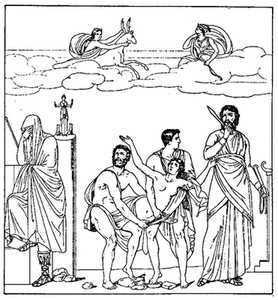
Fig. 152. The Sacrifice of Iphigenia
Iphigenia is represented as thus describing her feelings at the
moment of sacrifice:
"I was cut off from hope in that sad place,
Which men call'd Aulis in those iron years:
My father held his hand upon his face;
I, blinded with my tears,
"Still strove to speak: my voice was thick with sighs
As in a dream. Dimly I could descry
The stern black-bearded kings, with wolfish eyes
Waiting to see me die.
"The high masts flicker'd as they lay afloat;
The crowds, the temples, waver'd, and the shore;
The bright death quiver'd at the victim's throat;
Touch'd; and I knew no more."[283]
197. Protesilaüs and Laodamia. The wind now proving fair,
the fleet made sail and brought the forces to the coast of Troy.
The Trojans opposed their landing, and at the first onset one of
the noblest of the Greeks, Protesilaüs, fell by the hand of Hector.
This Protesilaüs had left at home his wife Laodamia (a niece of
Alcestis),—who was most tenderly attached to him. The story
runs that when the news of his death reached her, she implored
the gods for leave to converse with him if but for three hours.
The request was granted. Mercury led Protesilaüs back to the
upper world; and when the hero died a second time Laodamia
died with him. It is said that the nymphs planted elm trees round
his grave, which flourished till they were high enough to command
a view of Troy, then withered away, giving place to fresh branches
that sprang from the roots.
Wordsworth has taken the story of Protesilaüs and Laodamia
for a poem invested with the atmosphere of the classics. The
oracle, according to the tradition, had declared that victory should
be the lot of that party from which should fall the first victim in
the war. The poet represents Protesilaüs, on his brief return to
earth, relating to Laodamia the story of his fate:
"The wished-for wind was given:—I then revolved
The oracle, upon the silent sea;
And, if no worthier led the way, resolved
That, of a thousand vessels, mine should be
The foremost prow in pressing to the strand,—
Mine the first blood that tinged the Trojan sand.
"Yet bitter, ofttimes bitter, was the pang
When of thy loss I thought, belovèd Wife!
On thee too fondly did my memory hang,
And on the joys we shared in mortal life,—
The paths which we had trod—these fountains, flowers,
My new-planned cities, and unfinished towers.
"But should suspense permit the foe to cry,
'Behold they tremble!—haughty their array,
Yet of their number no one dares to die'?
In soul I swept the indignity away:
Old frailties then recurred:—but lofty thought,
In act embodied, my deliverance wrought."...
... Upon the side
Of Hellespont (such faith was entertained)
A knot of spiry trees for ages grew
From out the tomb of him for whom she died;
And ever, when such stature they had gained
That Ilium's walls were subject to their view,
The trees' tall summits withered at the sight;
A constant interchange of growth and blight!
198. Homer's Iliad. The war continued without decisive result
for nine years. Then an event occurred which seemed likely to
prove fatal to the cause of the Greeks,—a quarrel between Achilles
and Agamemnon. It is at this point that the great poem of Homer,
the Iliad, begins.
Of this and the other epics from which the story is drawn an
account will be found in Chapter XXXII below; and a list of
the best English translations, in the corresponding sections of the
Commentary. What delight one may derive from reading the
Greek epics even in translation is nowhere better expressed than
in the following sonnet of John Keats, "On First Looking into
Chapman's Homer":
Much have I travel'd in the realms of gold,
And many goodly states and kingdoms seen;
Round many western islands have I been
Which bards in fealty to Apollo hold.
Oft of one wide expanse had I been told
That deep-brow'd Homer ruled as his demesne:
Yet did I never breathe its pure serene
Till I heard Chapman speak out loud and bold:
—Then felt I like some watcher of the skies
When a new planet swims into his ken;
Or like stout Cortez when with eagle eyes
He stared at the Pacific—and all his men
Look'd at each other with a wild surmise—
Silent, upon a peak in Darien.
199. The Wrath of Achilles. The Greeks, though unsuccessful
against Troy, had taken the neighboring and allied cities; and in
the division of the spoil a female captive, by name Chryseïs,
daughter of Chryses, priest of Apollo, had fallen to the share of
Agamemnon. Chryses came bearing the sacred emblems of his
office and begged the release of his daughter. Agamemnon refused.
Thereupon Chryses implored Apollo to afflict the Greeks
till they should be forced to yield their prey. Apollo granted the
prayer of his priest and sent such pestilence upon the Grecian
camp, that a council was called to deliberate how to allay the wrath
of the gods and avert the plague. Achilles boldly charged the misfortunes
upon Agamemnon as caused by his withholding Chryseïs.
Agamemnon, in anger, consented, thereupon, to relinquish his
captive, but demanded that Achilles should yield to him in her
stead Briseïs, a maiden who had fallen to that hero's share in the
division of the spoil. Achilles submitted, but declared that he
would take no further part in the war,—withdrew his forces
from the general camp and avowed his intention of returning to
Greece.
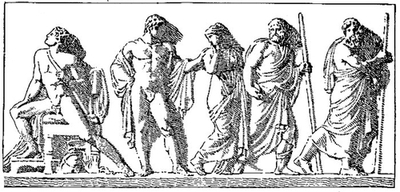
Fig. 153. The Surrender of Briseïs
From the relief by Thorwaldsen
200. The Enlistment of the Gods. The gods and goddesses interested
themselves as much in this famous siege as did the parties
themselves. It was well known in heaven that fate had decreed
the fall of Troy, if her enemies only persevered. Yet there was
room for chance sufficient to excite by turns the hopes and fears
of the powers above who took part with either side. Juno and
Minerva, in consequence of the slight put upon their charms by
Paris, were hostile to the Trojans; Venus for the opposite cause
favored them; she enlisted, also, her admirer Mars on the same
side. Neptune favored the Greeks. Apollo was neutral, sometimes
taking one side, sometimes the other. Jove himself, though he
loved Priam, exercised a degree of impartiality,—not, however,
without exceptions.
201. Thetis intercedes for Achilles. Resenting the injury done
by Agamemnon to her son, Thetis, the silver-footed, repaired to
Jove's palace, and besought him to grant success to the Trojan
arms and so make the Greeks repent of their injustice to Achilles.
The father of the gods, wavering at first, finally sighed and consented,
saying, "Go thou now, but look to it that Juno see thee
not, for oft she taunts me that I aid the Trojan cause." Vain
precaution: the jealous queen had seen only too well, and quickly
she confronted the Thunderer with her suspicions,—
"Fateful favor to Achilles, hast thou granted now I trow!"
said she.
Zeus that rolls the clouds of heaven, her addressing answered then:
"Moonstruck! thou art ever trowing; never I escape thy ken.
After all, it boots thee nothing; leaves thee of my heart the less,—
So thou hast the worser bargain. What if I the fact confess?
It was done because I willed it. Hold thy place—my word obey,
Lest if I come near, and on thee these unconquered hands I lay,
All the gods that hold Olympus naught avail thee here to-day."[284]
202. Agamemnon calls a Council. In the events which immediately
follow we are introduced to the more important human personages
on both sides. To begin with, Agamemnon, king of men,
deceived by a dream sent by Jupiter, calls a council of the Greeks
in which, desiring to arouse them to fresh onslaught upon the
Trojans, he tests their patience first by depicting the joys of the
return home to Greece, and nearly overreaches himself in his cunning;
for had it not been for the wise Nestor, king of sandy Pylos,
and Ulysses of many devices, peer of Jove in wisdom, the common
soldiers, fired with hope of viewing their dear native land and
wives and little children once more, would have launched the ships
and sailed forthwith. Among the murmuring host of those who
clamor for retreat the leader is Thersites, uncontrolled of speech,
full of disorderly words, striving idly against the chieftains, aiming
ever to turn their authority into ridicule. He is the one ludicrous
character of the Iliad, this boaster and scandalmonger, sneering
and turbulent of tongue:
His figure such as might his soul proclaim;
One eye was blinking, and one leg was lame;
His mountain shoulders half his breast o'erspread,
Thin hairs bestrewed his long misshapen head.
Spleen to mankind his envious heart possest,
And much he hated all, but most the best.
Ulysses or Achilles still his theme;
But royal scandal his delight supreme.[1]
Him Ulysses hearing rebukes, raising his scepter to strike:
"Peace, factious monster, born to vex the state,
With wrangling talents formed for foul debate....
Have we not known thee, slave of all our host,
The man who acts the least, upbraids the most?..."
He said, and cowering as the dastard bends,
The weighty scepter on his back descends:
On the round bunch the bloody tumors rise;
The tears spring starting from his haggard eyes:
Trembling he sat, and, shrunk in abject fears,
From his wild visage wiped the scalding tears.[285]
The revolt is thus stayed. A banquet of the Greek chieftains
is then held, merely of the greatest—Nestor, Idomeneus of Crete,
Ajax the son of Telamon and cousin of Achilles, and Ajax the less,
son of Oïleus, Ulysses, also, and Agamemnon himself. Menelaüs
comes, unbid but not unwelcome. Sacrifices are offered, but in
vain; Jove heeds them not. Finally, a muster of the Greek troops,
by nations and by kings, is determined upon; and so the army is
set in array.
203. Paris plays the Champion. Likewise the army of the
Trojans; and battle is about to be joined when forth from the
Trojan ranks steps Paris himself to challenge some champion of
the opposing host to single combat,—the beauteous Paris,
In form a god! The panther's speckled hide
Flowed o'er his armor with an easy pride,—
His bended bow across his shoulders flung,
His sword beside him negligently hung,
Two pointed spears he shook with gallant grace,
And dared the bravest of the Grecian race.[1]
Him, Menelaüs whom he had betrayed, Menelaüs loved of Mars,
raging like a lion, swift espies and, leaping from his chariot,
hastens to encounter. But Paris, smitten with a sense of his own
treachery, fearful, trembling, pale at sight of the avenger, betakes
himself to his heels and hides in the thick of the forces behind.
Upbraided, however, by the generous Hector, noblest of Priam's
sons, the handsome Trojan recovers his self-possession and consents
to meet Menelaüs in formal combat between the opposing
hosts: Helen and the wealth she brought to be the prize; and,
thus, the long war to reach its termination. The Greeks accept
the proposal, and a truce is agreed upon that sacrifices may be
made on either side for victory, and the duel proceed.
204. Helen surveys the Grecian Host. Meantime, Iris, the goddess
of the rainbow, summons Helen to view the impending duel.
At her loom in the Trojan palace the ill-starred daughter of Leda
is sitting, weaving in a golden web her own sad story. At memory
of her former husband's love, her home, her parents, the princess
drops a tear; then, softly sighing, turns her footsteps to the
Scæan gate. No word is said of her matchless beauty, but what it
was Homer shows us by its effect. For as she approaches the tower
where aged Priam and his gray-haired chieftains sit, these cry,—
"No wonder such celestial charms
For nine long years have set the world in arms;
What winning graces! what majestic mien!
She moves a goddess, and she looks a queen.
Yet hence, oh Heaven! convey that fatal face,
And from destruction save the Trojan race."[286]
—Words reëchoed by our English Marlowe, two thousand years
later:
Was this the face that launched a thousand ships,
And burnt the topless towers of Ilium?
Sweet Helen, make me immortal with a kiss.—
Her lips suck forth my soul: see, where it flies!
Come, Helen, come, give me my soul again!
Here will I dwell, for heaven is in these lips,
And all is dross that is not Helena....
Oh, thou art fairer than the evening air
Clad in the beauty of a thousand stars;
Brighter art thou than flaming Jupiter
When he appeared to hapless Semele;...
And none but thou shalt be my paramour![287]
Priam, receiving his daughter-in-law tenderly, inquires of her
the names of one and another of the Greeks moving on the plain
below.—
"Who, that
Around whose brow such martial graces shine,
So tall, so awful, and almost divine?"[2]
"The son of Atreus," answers she, shamefacedly. "Agamemnon,
king of kings, my brother once, before my days of shame."
"What's he whose arms lie scattered on the plain?
Broad is his breast, his shoulders larger spread,
Though great Atrides overtops his head.
Nor yet appear his care and conduct small;
From rank to rank he moves and orders all."[2]
"That is Ulysses," replies Helen, "of the barren isle of
Ithaca; but his fame for wisdom fills the earth."
Old Antenor, seated by Priam's side, thereupon recalls the modesty
and the restrained but moving eloquence of the wondrous son
of Laërtes.
The king then asked, as yet the camp he viewed,
"What chief is that, with giant strength endued;
Whose brawny shoulders, and whose swelling chest,
And lofty stature, far exceed the rest?"[288]
"That is Ajax the great," responds the beauteous queen, "himself
a host, bulwark of the Achæans." And she points out Idomeneus,
also, the godlike king of Crete; then scans the array for her
own dear brothers Castor and Pollux;—in vain, for them the
life-giving earth held fast there in Lacedæmon, their native land.
205. Menelaüs defeats Paris. Now from both sides sacrifices
have been made to Jove, avenger of oaths, with prayer for victory
and vow of fidelity to the contract made. But Jove vouchsafes
not yet fulfillment. The lists are measured out by Hector and
Ulysses. The duel is on. Paris throws his spear: it strikes, but
fails to penetrate the shield of Menelaüs. Menelaüs then breaks
his blade upon the helmet of the Trojan, seizes him by the horsehair
crest, and drags him toward the Grecian lines. But Aphrodite
touches the chin strap of Paris' headpiece so that it breaks and
leaves the futile helmet in the victor's hand. Then, wrapping her
favorite in a mist, the goddess bears him from the pursuit of
the furious Menelaüs, and, laying him safe in Helen's chamber,
summons his mistress, who first upbraids, then soothes him with
her love.
The Greeks claim the victory, and with justice. The Trojans,
then and there, would have yielded Helen and her wealth, and
the fate of Troy might have been averted, had it not been for the
machinations of the goddesses, Juno and Minerva. These could
not bear that the hated city should thus escape. Prompted by the
insidious urging of Minerva, one of the Trojans, Pandarus, breaks
the truce; he shoots his arrow full at the heart of the unsuspecting
Menelaüs. Minerva, of course, deflects the fatal shaft. But
the treachery has accomplished its purpose; the war is reopened
with fresh bitterness.
206. The Two Days' Battle. The battle which then begins lasts
for two whole days. In its progress we witness a series of single
combats. Pandarus the archer wounds Diomede, the son of Tydeus.
He in turn, raging over the plain, fells Pandarus with his spear
and crushes Æneas, Priam's valiant kinsman, to his knees with a
great stone. Venus shrouds her fallen son in her shining veil
and will rescue him. But Diomedes, clear of vision, spies her out
and drives his pointed spear against her hand, grazing the palm
of it. Out leaps the ichor, life-stream of the blessed gods, and the
goddess shrieking drops her burden and flees from the jeering
Diomede;—nay, mounts even to Olympus where, sobbing in the
arms of her mother, Dione, she finds solace of her pain, and
straightway turns to hopes of vengeance. Æneas, meantime, is
wrapped by Phœbus Apollo in a dusky cloud and borne aloft to
that god's temple, where Diana and Latona heal him.
To Diomede still breathing slaughter, the god of war himself,
Mars, now appears in form of a Thracian captain, opposing him
and stirring Hector and the swiftly recovered Æneas and the godlike
Sarpedon against the Greeks. And the Greeks give back, but
the keen eye of Diomede pierces the disguise of the War-god,
and he shouts a warning to his comrades. Then Minerva descends
to where Diomede, the son of Tydeus, is resting beside
his chariot, and she spurs him afresh to the fray. "Thou joy of
my heart," says she, "fear thou neither Mars nor any other of the
immortals, for I shall help thee mightily." So she takes the place
of his charioteer, and together they drive upon the War-god. And
that one cannot come at the son of Tydeus to strike him down,
because of the ward that Minerva vouchsafes. But, for his part,
Diomede strikes his spear against the nethermost belly of Mars
and wounds him, rending his fair skin; and he plucks forth
the spear again. Then brazen Mars bellows loud as nine or ten
thousand soldiers all at once; and, like Venus before him, betakes
himself to Olympus. There, complaining to Jove, he receives
stern reprimand for his intolerant and hateful spirit, stirring men
ever to strife,—"like thine own mother Juno, after whom, not
after me, thou takest." Thus, the father of the gods; and he
makes an end, and bids Pæan, the family physician, heal him.
Diomedes, still bearing down upon the Trojans, is about to fight
with a young warrior when, struck by his appearance, he inquires
his name. It is Glaucus, and the youth is grandson of the noble
Bellerophon. Then Diomede of the loud war cry is glad and strikes
his spear into the earth and declines to fight. "For lo," says he,
"our grandfathers were guest-friends, and guest-friends are we.
Why slay each other? There are multitudes of Trojans for me to
slay, and for thee Achæans in multitude, if thou canst. Let us
twain rather exchange arms as a testimony of our good faith."
And this they do; and Diomede gets the best of the bargain, his
armor being worth but nine oxen, and young Glaucus' five score.
207. Hector and Andromache. The Trojans being still pushed
nearer to their own walls, Hector, bravest of Priam's sons, returns
to the city to urge the women to prayer, and to carry the loitering
Paris back with him to the defense. Here he meets his brave mother
Hecuba, and then the fair Helen; but most to our purpose and his,
his wife, the white-armed Andromache, the noblest of the women
of the Iliad, for whom he has searched in vain.
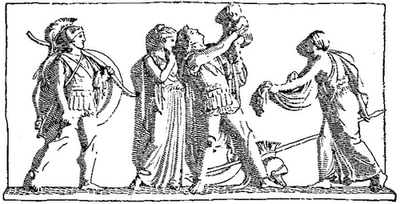
Fig. 154. Hector's Farewell
From the relief by Thorwaldsen
But when he had passed through the great city and was come to the Scæan
gates, whereby he was minded to issue upon the plain, then came his dear-won
wife, running to meet him, even Andromache, daughter of great-hearted
Eëtion.... So she met him now; and with her went the handmaid bearing
in her bosom the tender boy, the little child, Hector's loved son, like unto a
beautiful star. Him Hector called Scamandrius, but all the folk Astyanax,
"defender of the city." So now he smiled and gazed at his boy silently, and
Andromache stood by his side weeping, and clasped her hand in his, and
spake and called upon his name. "Dear my lord, this thy hardihood will undo
thee, neither hast thou any pity for thine infant boy, nor for hapless me that
soon shall be thy widow; for soon will the Achæans all set upon thee and slay
thee. But it were better for me to go down to the grave if I lose thee; for
nevermore will any comfort be mine, when once thou, even thou, hast met thy
fate,—but only sorrow. Moreover I have no father, now, nor lady mother....
And the seven brothers that were mine within our halls, all these on the
selfsame day went within the house of Hades; for fleet-footed, goodly Achilles
slew them all amid their kine of trailing gait and white-faced sheep....
Nay, Hector, thou art to me father and lady mother, yea and brother, even
as thou art my goodly husband. Come now, have pity and abide here upon
the tower, lest thou make thy child an orphan and thy wife a widow." ...
Then great Hector of the glancing helm answered her: "Surely I take thought
for all these things, my wife; but I have very sore shame of the Trojans and
Trojan dames with trailing robes, if like a coward I shrink away from battle.
Moreover mine own soul forbiddeth me, seeing I have learnt ever to be valiant
and fight in the forefront of the Trojans, winning my father's great glory and
mine own. Yea of a surety, I know this in heart and soul; the day shall
come for holy Ilios to be laid low, and Priam and the folk of Priam of the
good ashen spear. Yet doth the anguish of the Trojans hereafter not so much
trouble me, neither Hecuba's own, neither king Priam's, neither my brethren's,
the many and brave that shall fall in the dust before their foemen, as doth
thine anguish in the day when some mail-clad Achæan shall lead thee weeping,
and rob thee of the light of freedom.... But me in death may the heaped-up
earth be covering, ere I hear thy crying and thy carrying into captivity."[289]
So spoke the great-hearted hero, and stretched his arms out to
take his little boy. But
The babe clung crying to his nurse's breast,
Scared at the dazzling helm, and nodding crest.
With secret pleasure each fond parent smiled,
And Hector hasted to relieve his child,—
The glittering terrors from his brows unbound
And placed the beaming helmet on the ground.
Then kissed the child, and, lifting high in air,
Thus to the gods, preferred a father's prayer:
"O thou! whose glory fills the ethereal throne,
And all ye deathless powers! protect my son!
Grant him, like me, to purchase just renown,
To guard the Trojans, to defend the crown,
Against his country's foes the war to wage.
And rise the Hector of the future age!
So when, triumphant from successive toils
Of heroes slain, he bears the reeking spoils,
Whole hosts may hail him with deserved acclaim
And say, 'This chief transcends his father's fame':
While, pleased, amidst the general shouts of Troy,
His mother's conscious heart o'erflows with joy."[290]
So prayed he, the glorious Hector, foreboding of the future, but
little thinking that, when he himself was slain and the city sacked,
his starlike son should be cast headlong to death from Troy's
high towers, and his dear wife led into captivity as he had
dreaded, indeed, and by none other than Neoptolemus, the son of
his mortal foe, Achilles. But now Hector laid the boy in the arms
of his wife, and she, smiling tearfully, gathered him to her fragrant
bosom; and her husband pitied her, and caressed her with his
hand, and bade her farewell, saying:
"Andromache! my soul's far better part,
Why with untimely sorrows heaves thy heart?
No hostile hand can antedate my doom,
Till fate condemns me to the silent tomb.
Fixed is the term to all the race of earth;
And such the hard condition of our birth,
No force can then resist, no flight can save;
All sink alike, the fearful and the brave.
No more—but hasten to thy tasks at home,
There guide the spindle, and direct the loom;
Me glory summons to the martial scene,
The field of combat is the sphere for men.
Where heroes war, the foremost place I claim,
The first in danger, as the first in fame."[291]
He took up his horsehair crested helmet; and she departed to
her home, oft looking back and letting fall big tears, thinking that
he would no more come back from battle.
208. Neptune aids the Discouraged Greeks. But the end was
not to be so soon. Hector, returning to the field, challenged the
bravest of the Greeks to combat. Nine accepted the challenge;
but the lot fell upon Ajax, the son of Telamon. The duel lasted
till night, with deeds of valor on both sides; and the heroes parted,
each testifying to his foeman's worth. The next day a truce was
declared for the burning of the dead; but, soon after, the conflict
was renewed, and before the might of Hector and his troops the
Greeks were driven back to their trenches.
Then Agamemnon, king of men, called another council of his
wisest and bravest chiefs and, grievously discouraged, proposed,
this time in earnest, that they reëmbark and sail home to Greece.[292]
In the debate that ensued Nestor advised that an embassy should
be sent to Achilles persuading him to return to the field; and that
Agamemnon should yield the maiden, the cause of dispute, with
ample gifts to atone for the wrong he had done. Agamemnon
assented; and Ulysses, Ajax, and Phœnix were sent to carry to
Achilles the penitent message. They performed that duty, but
Achilles was deaf to their entreaties. He positively refused to
return to the attack and persisted in his determination to embark
for Greece without delay.
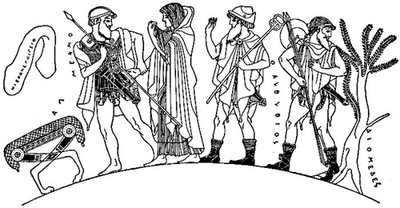
Fig. 155. The Embassy to Achilles
(Left section)
Meanwhile the Greeks, having constructed a rampart around
their ships, were now, instead of besieging Troy, in a manner
themselves besieged, within their rampart. The next day after the
unsuccessful embassy to Achilles, another battle was fought, in
which Agamemnon raged mightily with his spear till, wounded, he
was forced to retire to the hollow ships; and Ulysses, too, bravely
warring, had a narrow escape with life.[293] Then the Trojans, favored
by Jove, succeeded in forcing a passage through the Grecian rampart
and were about to set fire to the ships. But Neptune, seeing
the Greeks hard pressed, came to their rescue.[294] Appearing in the
form of Calchas the prophet, he raised the ardor of the warriors
to such a pitch that they forced the Trojans to give way. Here
Ajax, son of Telamon, performed prodigies of valor. Bearing his
massy shield and "shaking his far-shadowing spear," he encountered
Hector.[295] The Greek shouted defiance, to which Hector
replied, and hurled his lance at the huge warrior. It was well
aimed and struck Ajax where the belts that bore his sword and
shield crossed each other on the breast, but the double guard prevented
its penetrating, and it fell harmless. Then Ajax, seizing a
huge stone, one of those that served to prop the ships, hurled it
at Hector. It struck him near the neck and stretched him on the
plain. His followers instantly seized him and bore him off stunned
and wounded.
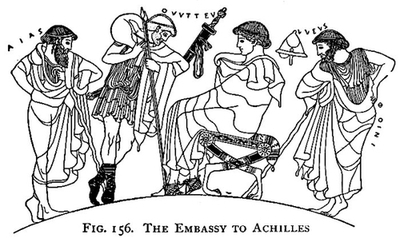
Fig. 156. The Embassy to Achilles
(Right Section)
209. Jupiter inspirits the Trojans. While Neptune was thus
aiding the Greeks and driving back the Trojans, Jupiter saw
nothing of what was going on, for his attention had been drawn
from the field by the wiles of Juno.[296] That goddess had arrayed
herself in all her charms, and to crown all had borrowed of Venus
her girdle, the Cestus, which enhanced the wearer's charms to
such a degree that they were irresistible. So prepared, Juno had
joined her husband, who sat on Olympus watching the battle.
When he beheld her, the fondness of his early love revived and,
forgetting the contending armies and all other affairs of state, he
gave himself up to her and let the battle go as it would.
But this oblivion did not continue long. When, upon turning
his eyes downward, the cloud-compeller beheld Hector stretched,
almost lifeless, on the plain, he angrily dismissed Juno, commanding
her to send Iris and Apollo to him.[297] The former bore a peremptory
message to Neptune, ordering him to quit the contest.
Apollo was dispatched to heal Hector's bruises and to inspirit his
heart. These orders were obeyed with such speed that while the
battle was still raging, Hector returned to the field and Neptune
betook himself to his own dominions.
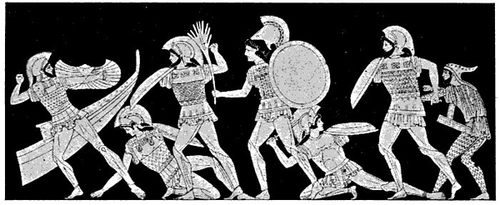
Fig. 157. The Battle by the Ships
210. Achilles and Patroclus. An arrow from the bow of Paris
had wounded Machaon, son of Æsculapius, a brave warrior, who,
having inherited his father's art, was of great value to the Greeks
as their surgeon. Nestor, taking Machaon in his chariot, conveyed
him from the field. As they passed the ships of Achilles, that
hero, looking over the battle, saw the chariot of Nestor, and recognized
the old chief, but could not discern who the wounded warrior
was. Calling Patroclus, his companion and dearest friend, he
sent him to Nestor's tent to inquire. Patroclus, performing the
behest, saw Machaon wounded and, having told the cause of his
coming, would have hastened away, but Nestor detained him to
tell him the extent of the Grecian calamities. He reminded him
also how, at the time of the departure for Troy, Achilles and himself
had been charged by their respective sires: the one to aspire
to the highest pitch of glory; the other, as the elder, to keep
watch over his friend and to guide his inexperience. "Now,"
said Nestor, "is the time for such guidance. If the gods so please,
thou mayest win Achilles back to the common cause; but if not,
let him at least send his soldiers to the field, and come thou, Patroclus,
clad in his armor. Perhaps the very sight of it may drive
back the Trojans."[298]
211. Patroclus in the Armor of Achilles. Patroclus, strongly
moved by this address, hastened to his friend, revolving in his
mind what he had seen and heard.[299] He told the prince the sad
condition of affairs at the camp of their late associates; Diomede,
Ulysses, Agamemnon, Machaon, all wounded, the rampart broken
down, the enemy among the ships preparing to burn them and
thus to cut off all means of return to Greece. While they spoke,
the flames burst forth from one of the ships. Achilles, at the sight,
relented so far as to intrust Patroclus with the Myrmidons for the
onslaught and to lend him his armor that he might thereby strike
the more terror into the minds of the Trojans. Without delay the
soldiers were marshaled, Patroclus put on the radiant armor,
mounted the chariot of Achilles, and led forth the men ardent for
battle. But before his friend went, Achilles strictly charged him
to be content with repelling the foe. "Seek not," said he, "to
press the Trojans without me, lest thou add still more to the disgrace
already mine." Then exhorting the troops to do their best,
he dismissed them full of ardor to the fight.
Patroclus and his Myrmidons at once plunged into the contest
where it raged hottest. At the sight of them the joyful Grecians
shouted, and the ships reëchoed the acclaim; but the Trojans,
beholding the well-known armor, struck with terror, looked everywhere
for refuge. First those who had got possession of the ship
and set it on fire allowed the Grecians to retake it and extinguish
the flames. Then the rest fled in dismay. Ajax, Menelaüs, and
the two sons of Nestor performed prodigies of valor. Hector was
forced to turn his horses' heads and retire from the enclosure,
leaving his men encumbered in the fosse to escape as they could.
Patroclus drove all before him, slaying many; nor did one dare to
make a stand against him.
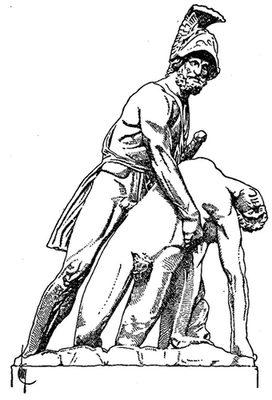
Fig. 158. Menelaüs with the Body
of Patroclus
212. The Deaths of Sarpedon and Patroclus. At last the grandson
of Bellerophon, Sarpedon, son of Jove and Laodamia, ventured
to oppose the Greek warrior. The Olympian looked down
upon his son and would have snatched him from the fate impending,
but Juno hinted that if he did so, the other inhabitants of
heaven might be induced to interpose in like manner whenever any
of their offspring were endangered,—an
argument to which
Jove yielded. Sarpedon threw
his spear, but missed Patroclus;
the spear of the Greek, on the
other hand, pierced Sarpedon's
breast, and he fell, calling to his
friends to save his body from
the foe. Then a furious contest
arose for the corpse. The
Greeks succeeded in stripping
Sarpedon of his armor, but
Jove would not suffer the body
to be dishonored. By his command
Apollo snatched it from
the midst of the combatants
and committed it to the care of
the twin brothers Death and
Sleep. By them it was transported
to Lycia, Sarpedon's
native land, and there received
due funeral rites.
Thus far Patroclus had succeeded to the utmost in repelling the
foe and relieving his countrymen, but now came a change of fortune.
Hector, borne in his chariot, confronted him. Patroclus
threw a vast stone at the Trojan, which missed its aim, but smote
Cebriones, the charioteer, and felled him from the car. Hector
leaped from the chariot to rescue his friend, and Patroclus also
descended to complete his victory. Thus the two heroes met face
to face. At this decisive moment the poet, as if reluctant to give
Hector the glory, records that Phœbus Apollo, taking part against
Patroclus, struck the helmet from his head and the lance from his
hand. At the same moment an obscure Trojan wounded him in
the back, and Hector pressing forward pierced him with his spear.
He fell mortally wounded.
Then arose a tremendous conflict for the body of Patroclus; but
his armor was at once taken possession of by Hector, who, retiring
a short distance, divested himself of his own mail, put on that of
Achilles, then returned to the fight.[300] Ajax and Menelaüs defended
the body, and Hector and his bravest warriors struggled to capture
it. The battle still raged with equal fortune, when Jove enveloped
the whole face of heaven in a cloud. The lightning flashed, the
thunder roared, and Ajax, looking round for some one whom he
might dispatch to Achilles to tell him of the death of his friend
and of the imminent danger of his remains falling into the hands
of the enemy, could see no suitable messenger. In desperation
he exclaimed:
"Father of heaven and earth! deliver thou
Achaia's host from darkness; clear the skies;
Give day; and, since thy sovereign will is such,
Destruction with it; but, oh, give us day!"[301]
Jupiter heard the prayer and dispersed the clouds. Ajax sent
Antilochus to Achilles with the intelligence of Patroclus' death
and of the conflict raging for his remains; and the Greeks at last
succeeded in bearing off the body to the ships, closely pursued by
Hector and Æneas and the rest of the Trojans.
213. The Remorse of Achilles. Achilles heard the fate of his
friend with such distress that Antilochus feared for a while lest he
might destroy himself.[302] His groans reached the ears of Thetis,
far down in the deeps of ocean where she abode, and she hastened
to inquire the cause. She found him overwhelmed with self-reproach
that he had suffered his friend to fall a victim to his resentment.
His only consolation was the hope of revenge. He
would fly instantly in search of Hector. But his mother reminded
him that he was now without armor and promised, if he would
but wait till the morrow, to procure for him a suit of armor from
Vulcan more than equal to that he had lost. He consented, and
Thetis immediately repaired to Vulcan's palace. She found him
busy at his forge, making tripods for his own use, so artfully constructed
that they moved forward of their own accord when wanted,
and retired again when dismissed. On hearing the request of
Thetis, Vulcan immediately laid aside his work and hastened to
comply with her wishes. He fabricated a splendid suit of armor
for Achilles; first a shield adorned with elaborate devices, of which
a noble description is given by Homer, then a helmet crested with
gold, then a corselet and greaves of impenetrable temper, all perfectly
adapted to the hero's form, and of consummate workmanship.
The suit was made in one night, and Thetis, receiving it,
descended to earth and laid it at Achilles' feet at the dawn of day.
214. The Reconciliation of Agamemnon and Achilles. The first
glow of pleasure that Achilles had felt since the death of Patroclus
was at the sight of this splendid armor.[303] And now arrayed
in it, he went forth to the camp, calling the chiefs to council.
When the leaders were assembled, Achilles addressed them. Renouncing
his displeasure against Agamemnon and bitterly lamenting
the miseries that had resulted from it, he called on them to
proceed at once to the field. Agamemnon made a suitable reply,
laying the blame on Ate, the goddess of infatuation; and thereupon
complete reconcilement took place between the heroes.
Then Achilles went forth to battle, heartened by the inspiration
of Minerva and filled with a rage and thirst for vengeance that
made him irresistible. As he mounted his chariot, one of his immortal
coursers was, strange to say, endowed suddenly with speech
from on high and, breaking into prophecy, warned the hero of his
approaching doom. But, nothing daunted, Achilles pressed upon
the foe. The bravest warriors fled before him or fell by his lance.[304]
Hector, cautioned by Apollo, kept aloof; but the god, assuming
the form of one of Priam's sons, Lycaon, urged Æneas to encounter
the terrible warrior. Æneas, though he felt himself unequal,
did not decline the combat. He hurled his spear with all
his force against the shield, the work of Vulcan. The spear pierced
two plates of the shield, but was stopped in the third. Achilles
threw his spear with better success. It pierced through the shield
of Æneas, but glanced near his shoulder and made no wound.
Then Æneas, seizing a stone, such as two men of modern times
could hardly lift, was about to throw it,—and Achilles, with sword
drawn, was about to rush upon him,—when Neptune, looking out
upon the contest, had pity upon Æneas, who was sure to have the
worst of it. The god, consequently, spread a cloud between the
combatants and, lifting the Trojan from the ground, bore him over
the heads of warriors and steeds to the rear of the battle. Achilles,
when the mist cleared away, looked round in vain for his adversary,
and acknowledging the prodigy, turned his arms against other
champions. But none dared stand before him; and Priam from
his city walls beheld the whole army in full flight toward the city.
He gave command to open wide the gates to receive the fugitives,
and to shut them as soon as the Trojans should have passed, lest
the enemy should enter likewise. But Achilles was so close in
pursuit that that would have been impossible if Apollo had not, in
the form of Agenor, Priam's son, first encountered the swift-footed
hero, then turned in flight, and taken the way apart from
the city. Achilles pursued, and had chased his supposed victim
far from the walls before the god disclosed himself.[305]
215. The Death of Hector. But when the rest had escaped into
the town Hector stood without, determined to await the combat.
His father called to him from the walls, begging him to retire nor
tempt the encounter. His mother, Hecuba, also besought him, but
all in vain. "How can I," said he to himself, "by whose command
the people went to this day's contest where so many have
fallen, seek refuge for myself from a single foe? Or shall I offer
to yield up Helen and all her treasures and ample of our own beside?
Ah no! even that is too late. He would not hear me
through, but slay me while I spoke." While he thus ruminated,
Achilles approached, terrible as Mars, his armor flashing lightning
as he moved. At that sight Hector's heart failed him and he fled.
Achilles swiftly pursued. They ran, still keeping near the walls,
till they had thrice encircled the city. As often as Hector approached
the walls Achilles intercepted him and forced him to
keep out in a wider circle. But
Apollo sustained Hector's strength
and would not let him sink in weariness.
Then Pallas, assuming the
form of Deiphobus, Hector's bravest
brother, appeared suddenly at his
side. Hector saw him with delight,
and thus strengthened, stopped his
flight, and, turning to meet Achilles,
threw his spear. It struck the shield
of Achilles and bounded back. He
turned to receive another from the
hand of Deiphobus, but Deiphobus
was gone. Then Hector understood
his doom and said, "Alas! it is plain
this is my hour to die! I thought
Deiphobus at hand, but Pallas deceived
me, and he is still in Troy.
But I will not fall inglorious." So
saying he drew his falchion from his
side and rushed at once to combat.
Achilles, secure behind his shield,
waited the approach of Hector.
When he came within reach of his
spear, Achilles, choosing with his eye
a vulnerable part where the armor
leaves the neck uncovered, aimed
his spear at that part, and Hector
fell, death-wounded. Feebly he said,
"Spare my body! Let my parents
ransom it, and let me receive funeral
rites from the sons and daughters
of Troy." To which Achilles replied,
"Dog, name not ransom nor pity to
me, on whom you have brought such
dire distress. No! trust me, nought
shall save thy carcass from the dogs.
Though twenty ransoms and thy weight in gold were offered, I
should refuse it all."[306]
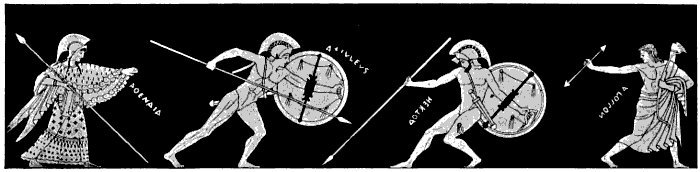
Fig. 159. Contest of Achilles and Hector
216. Achilles drags the Body of Hector. So saying, the son of
Peleus stripped the body of its armor, and, fastening cords to the
feet, tied them behind his chariot, leaving the body to trail along
the ground. Then mounting the chariot he lashed the steeds and
so dragged the body to and fro before the city. No words can tell
the grief of Priam and Hecuba at this sight. His people could
scarce restrain the aged king from rushing forth. He threw himself
in the dust and besought them each by name to let him pass.
Hecuba's distress was not less violent. The citizens stood round
them weeping. The sound of the mourning reached the ears of
Andromache, the wife of Hector, as she sat among her maidens
at work; and anticipating evil she went forth to the wall. When
she saw the horror there presented, she would have thrown herself
headlong from the wall, but fainted and fell into the arms of
her maidens. Recovering, she bewailed her fate, picturing to
herself her country ruined, herself a captive, and her son, the
youthful Astyanax, dependent for his bread on the charity of
strangers.
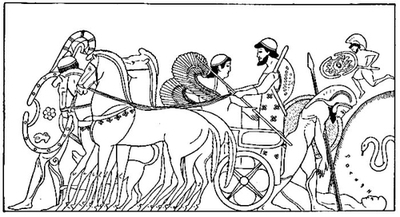
Fig. 160. Achilles over the Body of Hector at the
Tomb of Patroclus
After Achilles and the Greeks had thus taken their revenge
on the slayer of Patroclus, they busied themselves in paying due
funeral rites to their friend.[307] A pile was erected, and the body
burned with due solemnity. Then ensued games of strength and
skill, chariot races, wrestling, boxing, and archery. Later, the
chiefs sat down to the funeral banquet, and finally retired to rest.
But Achilles partook neither of the feast nor of sleep. The recollection
of his lost friend kept him awake,—the memory of their
companionship in toil and dangers, in battle or on the perilous
deep. Before the earliest dawn he left his tent, and joining to his
chariot his swift steeds, he fastened Hector's body to be dragged
behind. Twice he dragged him round the tomb of Patroclus, leaving
him at length stretched in the dust. But Apollo would not
permit the body to be torn or disfigured with all this abuse; he
preserved it free from taint or defilement.[308]
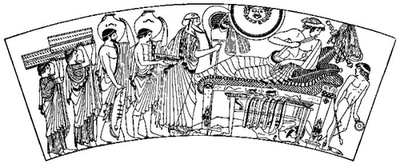
Fig. 161. Priam's Visit to Achilles
While Achilles indulged his wrath in thus disgracing Hector,
Jupiter in pity summoned Thetis to his presence. Bidding her
prevail on Achilles to restore the body of Hector to the Trojans,
he sent Iris to encourage Priam to beg of Achilles the body of his
son. Iris delivered her message, and Priam prepared to obey.
He opened his treasuries and took out rich garments and cloths,
with ten talents in gold and two splendid tripods and a golden cup
of matchless workmanship. Then he called to his sons and bade
them draw forth his litter and place in it the various articles designed
for a ransom to Achilles. When all was ready, the old
king with a single companion as aged as himself, the herald
Idæus, drove forth from the gates, parting there with Hecuba
his queen, and all his friends, who lamented him as going to
certain death.
217. Priam in the Tent of Achilles.[309] But Jupiter, beholding
with compassion the venerable king, sent Mercury to be his guide
and protector. Assuming the form of a young warrior, Mercury
presented himself to the aged couple; and, when at the sight of
him they hesitated whether to fly or yield, approaching he grasped
Priam's hand and offered to be their guide to Achilles' tent. Priam
gladly accepted his service, and Mercury, mounting the carriage,
assumed the reins and conveyed them to the camp. Then having
cast the guards into a heavy sleep, he introduced Priam into the
tent where Achilles sat, attended by two of his warriors. The aged
king threw himself at the feet of Achilles and kissed those terrible
hands which had destroyed so many of his sons. "Think, O
Achilles," he said, "of thine own father, full of days like me, and
trembling on the gloomy verge of life. Even now, mayhap, some
neighbor chief oppresses him and there is none at hand to succor
him in his distress. Yet, knowing that Achilles lives, he doubtless
still rejoices, hoping that one day he shall see thy face again.
But me no comfort cheers, whose bravest sons, so late the flower of
Ilium, all have fallen. Yet one I had, one more than all the rest
the strength of my age, whom fighting for his country thou hast
slain. His body I come to redeem, bringing inestimable ransom
with me. Achilles! reverence the gods! recollect thy father! for
his sake show compassion to me!" These words moved Achilles,
and he wept, remembering by turns his absent father and his lost
friend. Moved with pity of Priam's silver locks and beard, he
raised him from the earth and spake: "Priam, I know that thou
hast reached this place conducted by some god, for without aid
divine no mortal even in his prime of youth had dared the attempt.
I grant thy request, for I am moved thereto by the manifest will
of Jove." So saying he arose, went forth with his two friends, and
unloaded of its charge the litter, leaving two mantles and a robe
for the covering of the body. This they placed on the litter and
spread the garments over it, that not unveiled it should be borne
back to Troy. Then Achilles dismissed the old king, having first
pledged himself to a truce of twelve days for the funeral solemnities.
As the litter approached the city and was descried from the
walls, the people poured forth to gaze once more on the face of
their hero. Foremost of all, the mother and the wife of Hector
came, and at the sight of the lifeless body renewed their lamentations.
The people wept with them, and to the going down of the
sun there was no pause or abatement of their grief.
The next day, preparations were made for the funeral solemnities.
For nine days the people brought wood and built the pile;
and on the tenth they placed the body on the summit and applied
the torch, while all Troy, thronging forth, encompassed the pyre.
When it had completely burned, they quenched the cinders with
wine, and, collecting the bones, placed them in a golden urn, which
they buried in the earth. Over the spot they reared a pile of stones.
Such honors Ilium to her hero paid,
And peaceful slept the mighty Hector's shade.[310]
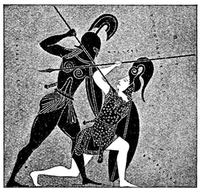
Fig. 162. Achilles and Penthesilea
218. The Fall of Troy. The story of the Iliad ends with the
death of Hector, and it is from the Odyssey and later poems that
we learn the fate of the other heroes. After the death of Hector,
Troy did not immediately fall, but receiving aid from new allies,
still continued its resistance. One of these allies was Memnon, the
Ethiopian prince, whose story
has been already told.[311] Another
was Penthesilea, queen
of the Amazons, who came
with a band of female warriors.
All the authorities attest the
valor of these women and the
fearful effect of their war cry.
Penthesilea, having slain many
of the bravest Greeks, was at
last slain by Achilles. But
when the hero bent over his
fallen foe and contemplated
her beauty, youth, and valor,
he bitterly regretted his victory. Thersites, the insolent brawler
and demagogue, attempting to ridicule his grief, was in consequence
slain by the hero.[312]
219. The Death of Achilles. But Achilles himself was not
destined to a long life. Having by chance seen Polyxena, daughter
of King Priam,—perhaps on occasion of the truce which was
allowed the Trojans for the burial of Hector,—he was captivated
with her charms; and to win her in marriage, it is said (but not
by Homer) that he agreed to influence the Greeks to make peace
with Troy. While the hero was in the temple of Apollo negotiating
the marriage, Paris discharged at him a poisoned arrow,[313] which,
guided by Apollo, fatally wounded him in the heel. This was his
only vulnerable spot; for Thetis, having dipped him when an infant
in the river Styx, had rendered every part of him invulnerable
except that by which she held him.[314]
220. Contest for the Arms of Achilles. The body of Achilles
so treacherously slain was rescued by Ajax and Ulysses. Thetis
directed the Greeks to bestow her son's armor on that hero who
of all survivors should be judged most deserving of it. Ajax and
Ulysses were the only claimants. A select number of the other
chiefs were appointed to award the prize. By the will of Minerva
it was awarded to Ulysses,—wisdom being thus rated above valor.
Ajax, enraged, set forth from his tent to wreak vengeance upon
the Atridæ and Ulysses. But the goddess robbed him of reason
and turned his hand against the flocks and herds of the Argives,
which he slaughtered or led captive to his tent, counting them the
rivals who had wronged him. Then the cruel goddess restored to
him his wits. And he, fixing his sword in the ground, prepared
to take his own life:
"Come and look on me,
O Death, O Death,—and yet in yonder world
I shall dwell with thee, speak enough with thee;
And thee I call, thou light of golden day,
Thou Sun, who drivest on thy glorious car,
Thee, for this last time,—never more again!
O Light, O sacred land that was my home;
O Salamis, where stands my father's hearth,
Thou glorious Athens, with thy kindred race;
Ye streams and rivers here, and Troïa's plains,
To you that fed my life I bid farewell;
This last, last word does Ajax speak to you;
All else, I speak in Hades to the dead."[3]
Then, falling upon his sword, he died. So, in the words of his
magnanimous foe, Ulysses, passed to the god that ruleth in gloom
The best and bravest of the Argive host,
Of all that came to Troïa, saving one,
Achilles' self.[315]
On the spot where his blood sank into the earth a hyacinth sprang
up, bearing on its leaves the first two letters of his name, Ai, the
Greek interjection of woe.[316]
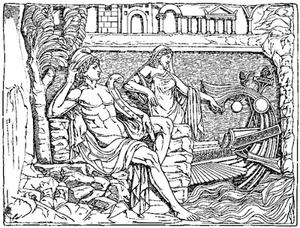
Fig. 163. Œnone warning Paris
It was now discovered that Troy could not be taken but by the
aid of the arrows of Hercules. They were in possession of Philoctetes,
the friend who had been with Hercules at the last and had
lighted his funeral pyre. Philoctetes[317] had joined the Grecian expedition
against Troy; but he accidentally wounded his foot with
one of the poisoned arrows, and the smell from the wound proved
so offensive that his companions carried him to the isle of Lemnos
and left him there. Diomede and Ulysses, or Ulysses and Neoptolemus
(son of Achilles), were now sent to induce him to rejoin
the army. They succeeded. Philoctetes was cured of his wound
by Machaon, and Paris was the first victim of the fatal arrows.
221. Paris and Œnone. In his distress Paris bethought him of
one whom in his prosperity he had forgotten. This was the nymph
Œnone, whom he had married when a youth and had abandoned
for the fatal beauty of Helen. Œnone, remembering the wrongs
she had suffered, refused to heal the wound; and Paris went back
to Troy and died. Œnone quickly repented and hastened after him
with remedies, but came too late, and in her grief hanged herself.
222. The Palladium. There was in Troy a celebrated statue
of Minerva called the Palladium. It was said to have fallen from
heaven, and the belief
was that the city could
not be taken so long
as this statue remained
within it. Ulysses and
Diomede entered the
city in disguise and succeeded
in obtaining the
Palladium, which they
carried off to the Grecian
camp.
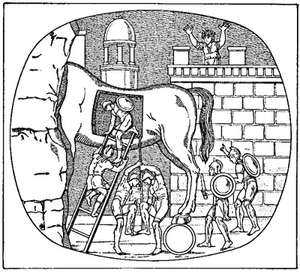
Fig. 164. The Wooden Horse
223. The Wooden Horse. But Troy still held out. The Greeks
began to despair of subduing it by force, and by
advice of Ulysses they resorted to stratagem.[318] They pretended to
be making preparations to abandon the siege; and a number of the
ships were withdrawn and concealed behind a neighboring island.
They then constructed an immense wooden horse, which they gave
out was intended as a propitiatory offering to Minerva; but it was,
in fact, filled with armed men. The rest of the Greeks then betook
themselves to their ships and sailed away, as if for a final departure.
The Trojans, seeing the encampment broken up and the fleet
gone, concluded that the enemy had abandoned the siege. The
gates of the city were thrown open, and the whole population issued
forth, rejoicing at the long-prohibited liberty of passing freely over
the scene of the late encampment. The great horse was the chief
object of curiosity. Some recommended that it be taken into the
city as a trophy; others felt afraid of it. While they hesitated,
Laocoön, the priest of Neptune, exclaimed, "What madness, citizens,
is this! Have you not learned enough of Grecian fraud to
be on your guard against it? For my part, I fear the Greeks even
when they offer gifts."[319] So saying, he threw his lance at the
horse's side. It struck, and a hollow sound reverberated like a
groan. Then perhaps the people might have taken his advice and
destroyed the fatal horse with its contents, but just at that moment
a group of people appeared dragging forward one who seemed a
prisoner and a Greek. Stupefied with terror, the captive was
brought before the chiefs. He informed them that he was a Greek,
Sinon by name; and that in consequence of the malice of Ulysses,
he had been left behind by his countrymen at their departure.
With regard to the wooden horse, he told them that it was a propitiatory
offering to Minerva, and had been made so huge for the
express purpose of preventing its being carried within the city;
for Calchas the prophet had told them that if the Trojans took
possession of it, they would assuredly triumph over the Greeks.
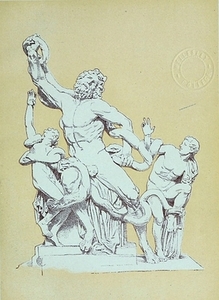
224. Laocoön and the Serpents. This language turned the tide
of the people's feelings, and they began to think how they might
best secure the monstrous horse and the favorable auguries connected
with it, when suddenly a prodigy occurred which left no
room for doubt. There appeared advancing over the sea two immense
serpents. They came upon the land and the crowd fled in
all directions. The serpents advanced directly to the spot where
Laocoön stood with his two sons. They first attacked the children,
winding round their bodies and breathing pestilential breath in
their faces. The father, attempting to rescue them, was next
seized and involved in the serpent's coils.
... Vain
The struggle; vain, against the coiling strain
And gripe, and deepening of the dragon's grasp,
The old man's clinch; the long envenomed chain
Rivets the living links,—the enormous asp
Enforces pang on pang, and stifles gasp on gasp.[320]
He struggled to tear them away, but they overpowered all his
efforts and strangled him and the children in their poisonous folds.
The event was regarded as a clear indication of the displeasure of
the gods at Laocoön's irreverent treatment of the wooden horse,
which they no longer hesitated to regard as a sacred object and
prepared to introduce with due solemnity into the city. They did
so with songs and triumphal acclamations, and the day closed with
festivity. In the night the armed men who were inclosed in the
body of the horse, being let out by the traitor Sinon, opened the
gates of the city to their friends who had returned under cover of
the night. The city was set on fire; the people, overcome with feasting
and sleep, were put to the sword, and Troy completely subdued.
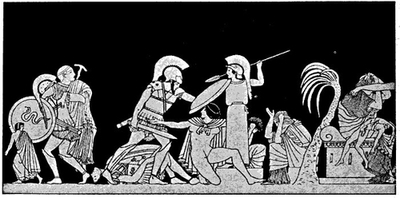
Fig. 165. The Sack of Troy
(Left half)
225. The Death of Priam. Priam lived to see the downfall of
his kingdom and was slain at last on the fatal night when the
Greeks took the city. He had armed himself and was about to
mingle with the combatants,[321] but was prevailed on by Hecuba to
take refuge with his daughters and herself as a suppliant at the
altar of Jupiter. While there, his youngest son, Polites, pursued
by Pyrrhus, the son of Achilles, rushed in wounded and expired
at the feet of his father; whereupon Priam, overcome with indignation,
hurled his spear with feeble hand against Pyrrhus and was
forthwith slain by him.
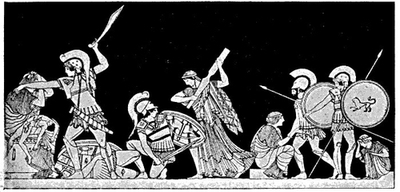
Fig. 166. The Sack of Troy
(Right half)
226. The Survivors.[322] Queen Hecuba and her daughter Cassandra
were carried captives to Greece. Cassandra had been loved
by Apollo, who gave her the gift of prophecy; but afterwards offended
with her, he had rendered the gift unavailing by ordaining
that her predictions should never be believed. Polyxena, another
daughter, who had been loved by Achilles, was demanded by the
ghost of that warrior and was sacrificed by the Greeks upon his
tomb. Of the fate of the white-armed Andromache we have already
spoken. She was carried off as the wife of Neoptolemus, but he
was faithful to her for only a short time. After he had cast her
aside she married Helenus, a brother of Hector, and still later
returned to Asia Minor.
227. Helen, Menelaüs, and Agamemnon. On the fall of Troy,
Menelaüs recovered possession of his wife, who, it seems, had not
ceased to love him, though she had yielded to the might of Venus
and deserted him for another.[323] After the death of Paris, she aided
the Greeks secretly on several occasions: in particular when Ulysses
and Diomede entered the city in disguise to carry off the Palladium.
She then saw and recognized Ulysses, but kept the secret
and even assisted them in obtaining the image. Thus she became
reconciled to Menelaüs, and they were among the first to leave the
shores of Troy for their native land. But having incurred the displeasure
of the gods, they were driven by storms from shore to
shore of the Mediterranean, visiting Cyprus, Phœnicia, and Egypt.
In Egypt they were kindly treated and presented with rich gifts, of
which Helen's share was a golden spindle and a basket on wheels.
... Many yet adhere
To the ancient distaff at the bosom fixed,
Casting the whirling spindle as they walk.
... This was of old, in no inglorious days,
The mode of spinning, when the Egyptian prince
A golden distaff gave that beauteous nymph,
Too beauteous Helen; no uncourtly gift.[324]
Milton also alludes to a famous recipe for an invigorating draft,
called Nepenthe, which the Egyptian queen gave to Helen:
Not that Nepenthes which the wife of Thone
In Egypt gave to Jove-born Helena,
Is of such power to stir up joy as this,
To life so friendly or so cool to thirst.[325]
At last, arriving in safety at Sparta, Menelaüs and Helen resumed
their royal dignity, and lived and reigned in splendor; and
when Telemachus, the son of Ulysses, in search of his father,
arrived at Sparta, he found them celebrating the marriage of their
daughter Hermione to Neoptolemus, son of Achilles.
Agamemnon[326] was not so fortunate in the issue. During his
absence his wife Clytemnestra had been false to him; and when
his return was expected, she with her paramour, Ægisthus, son of
Thyestes, laid a plan for his destruction. Cassandra warned the
king, but as usual her prophecy was not regarded. While Agamemnon
was bathing previous to the banquet given to celebrate
his return, the conspirators murdered him.
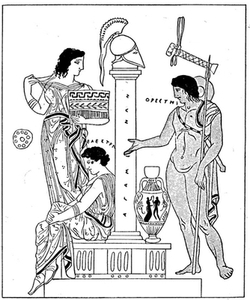
Fig. 167. Orestes and Electra at the Tomb
of Agamemnon
228. Electra and Orestes. It was the intention of the conspirators
to slay his son Orestes also, a lad not yet old enough to be an
object of apprehension, but from whom, if he should be suffered to
grow up, there might be danger. Electra, the sister of Orestes, saved
her brother's life by sending him secretly to his uncle Strophius,
king of Phocis. In the palace of Strophius, Orestes grew up with
the king's son Pylades, and formed with him a friendship which
has become proverbial.
Electra frequently reminded
her brother
by messengers of the
duty of avenging his
father's death; he, too,
when he reached maturity,
consulted the
oracle of Delphi, which
confirmed him in the
design. He therefore
repaired in disguise to
Argos, pretending to
be a messenger from
Strophius, who would
announce the death of
Orestes. He brought
with him what purported
to be the ashes
of the deceased in a
funeral urn. After visiting
his father's tomb and sacrificing upon it, according to the rites
of the ancients, he met by the way his sister Electra. Mistaking her
for one of the domestics, and desirous of keeping his arrival a secret
till the hour of vengeance should arrive, he produced the urn. At
once his sister, believing Orestes to be really dead, took the urn from
him, and, embracing it, poured forth her grief in language full of tenderness
and despair. Soon a recognition was effected, and the prince,
with the aid of his sister, slew both Ægisthus and Clytemnestra.[327]
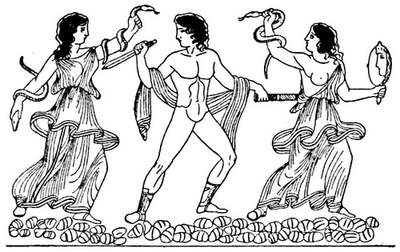
Fig. 168. Orestes pursued by Furies
229. Orestes pursued by the Furies.[328] This revolting act, the
slaughter of a mother by her son, though extenuated by the guilt
of the victim and the express command of the gods, did not fail
to awaken in the breasts of
the ancients the same abhorrence
that it does in ours. The
Eumenides seized upon Orestes
and drove him frantic from land
to land. In these wanderings
Pylades accompanied him and
watched over him. At length in
answer to a second appeal to the
oracle, Orestes was directed to
go to the temple of the Tauri in Scythia and to bring thence a statue
of Diana which was believed to have fallen from heaven. Accordingly
the friends went to the Tauric Chersonese. Since there the
barbarous people were
accustomed to sacrifice
to the goddess all
strangers who fell into
their hands, the two
friends were seized
and carried bound to
the temple to be
made victims. But
the priestess of Diana
of the Tauri was no
other than Iphigenia,
the sister of Orestes,
who had been snatched
away by Diana at the
moment when she was
about to be sacrificed.
Ascertaining from the prisoners who they were, Iphigenia disclosed
herself to them; and the three made their escape with the statue
of the goddess, and returned to Mycenæ.[329]
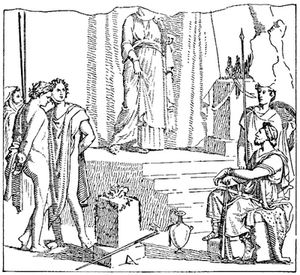
Fig. 169. Orestes and Pylades before the
King of the Tauri
230. His Purification. But Orestes was not yet relieved from
the vengeance of the Erinyes. Finally, he took refuge with
Minerva at Athens. The goddess afforded him protection and
appointed the court of Areopagus to decide his fate. The Erinyes
brought their accusation, and Orestes pleaded the command
of the Delphic oracle as his excuse. When the court voted and
the voices were equally divided, Orestes was acquitted by the command
of Minerva. He was then purified with plentiful blood
of swine.
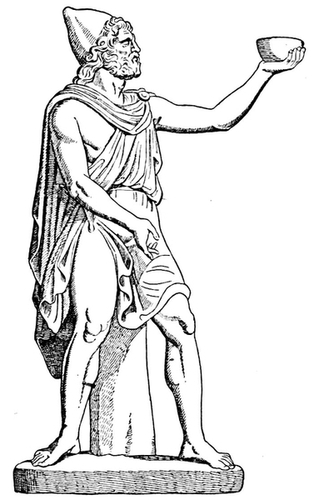
As one that for a weary space has lain
Lulled by the song of Circe and her wine
In gardens near the pale of Proserpine,
Where that Ææan isle forgets the main,
And only the low lutes of love complain,
And only shadows of wan lovers pine,—
As such an one were glad to know the brine
Salt on his lips, and the large air again,
So, gladly, from the songs of modern speech
Men turn and see the stars, and feel the free
Shrill wind beyond the close of heavy flowers;
And, through the music of the languid hours,
They hear like ocean on a western beach
The surge and thunder of the Odyssey.[330]
231. From Troy to Phæacia. The
Odyssey of Homer narrates the wanderings
of Ulysses (Odysseus) in his
return from Troy to his own kingdom,
Ithaca.[331]
From Troy the vessels first made
land at Ismarus, city of the Ciconians,
where, in a skirmish with the inhabitants,
Ulysses lost six men from each ship.[332]
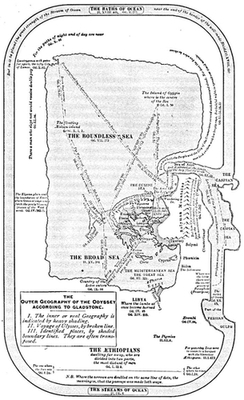
THE OUTER GEOGRAPHY OF THE ODYSSEY ACCORDING TO GLADSTONE.
232. The Lotus-eaters. Sailing thence they were overtaken
by a storm which drove them for nine days till they reached the
country of the Lotos-eaters. Here, after watering, Ulysses sent
three of his men to discover who the inhabitants were. These
men on coming among the Lotos-eaters were kindly entertained
by them and were given some of their own food, the lotos plant,
to eat. The effect of this food was such that those who partook
of it lost all thought of home and wished to remain in that country.
It was by main force that Ulysses dragged these men away, and he
was even obliged to tie them under the benches of his ship.
Tennyson in The Lotos-eaters has fittingly expressed the dreamy,
languid feeling which the lotus-food is said to have produced.
... How sweet it were, hearing the downward stream,
With half-shut eyes ever to seem
Falling asleep in a half-dream!
To dream and dream, like yonder amber light
Which will not leave the myrrh-bush on the height;
To hear each other's whisper'd speech;
Eating the Lotos, day by day,
To watch the crisping ripples on the beach,
And tender curving lines of creamy spray;
To lend our hearts and spirits wholly
To the influence of mild-minded melancholy;
To muse and brood and live again in memory,
With those old faces of our infancy
Heap'd over with a mound of grass,
Two handfuls of white dust, shut in an urn of brass!
Dear is the memory of our wedded lives,
And dear the last embraces of our wives
And their warm tears: but all hath suffer'd change;
For surely now our household hearths are cold:
Our sons inherit us: our looks are strange:
And we should come like ghosts to trouble joy.
... But, propt on beds of amaranth and moly,
How sweet (while warm airs lull us, blowing lowly)
With half-dropt eyelid still,
Beneath a heaven dark and holy,
To watch the long bright river drawing slowly
His waters from the purple hill—
To hear the dewy echoes calling
From cave to cave thro' the thick-twined vine—
To watch the emerald-color'd water falling
Thro' many a wov'n acanthus-wreath divine!
Only to hear and see the far-off sparkling brine,
Only to hear were sweet, stretch'd out beneath the pine.
The Lotos blooms below the barren peak:
The Lotos blows by every winding creek:
All day the wind breathes low with mellower tone:
Thro' every hollow cave and alley lone
Round and round the spicy downs the yellow Lotos-dust is blown.
We have had enough of action, and of motion we,
Roll'd to starboard, roll'd to larboard, when the surge was seething free,
Where the wallowing monster spouted his foam-fountains in the sea.
Let us swear an oath, and keep it with an equal mind,
In the hollow Lotos-land to live and lie reclined
On the hills like Gods together, careless of mankind....
233. The Cyclopes. They next arrived at the country of the
Cyclopes. The Cyclopes[333] inhabited an island of which they were
the only possessors. They dwelt in caves and fed on the wild productions
of the island and on what their flocks yielded, for they
were shepherds. Ulysses left the main body of his ships at anchor,
and with one vessel went to the Cyclopes' island to explore for
supplies. He landed with his companions, carrying with them a
jar of wine for a present. Coming to a large cave they entered it,
and, finding no one within, examined its contents. They found it
stored with the riches of the flock, quantities of cheese, pails and
bowls of milk, lambs and kids in their pens, all in good order.
Presently arrived the master of the cave, Polyphemus, bearing an
immense bundle of firewood, which he threw down before the
cavern's mouth. He then drove into the cave the sheep and goats
to be milked, and, entering, rolled to the cave's mouth an enormous
rock, that twenty oxen could not draw. Next he sat down
and milked his ewes, preparing a part for cheese and setting the
rest aside for his customary drink. Then turning round his one
huge eye he discerned the strangers, and growled out at them, demanding
who they were and where from. Ulysses replied most
humbly, stating that they were Greeks from the great expedition
that had lately won so much glory in the conquest of Troy, that
they were now on their way home, and finished by imploring his
hospitality in the name of the gods. Polyphemus deigned no
answer, but reaching out his hand seized two of the men, whom
he hurled against the side of the cave and dashed out their brains.
He proceeded to devour them with great relish, and having made
a hearty meal, stretched himself on the floor to sleep. Ulysses
was tempted to seize the opportunity and plunge his sword into
him as he slept, but recollected that it would only expose them all
to certain destruction, as the rock with which the giant had closed
up the door was far beyond their power to remove, and they would
therefore be in hopeless imprisonment.
Next morning the giant seized two more of the men and dispatched
them in the same manner as their companions, feasting
on their flesh till no fragment was left. He then moved away the
rock from the door, drove out his flocks, and went out, carefully replacing
the barrier after him. When he was gone Ulysses planned
how he might take vengeance for his murdered friends and effect
his escape with his surviving companions. He made his men prepare
a massive bar of wood cut by the Cyclops for a staff, which
they found in the cave. They sharpened the end of the staff and
seasoned it in the fire, and hid it under the straw on the cavern
floor. Then four of the boldest were selected, with whom Ulysses
joined himself as a fifth. The Cyclops came home at evening,
rolled away the stone, and drove in his flock as usual. After
milking them and making his arrangements as before, he seized
two more of Ulysses' companions, dashed their brains out, and
made his evening meal upon them as he had on the others. After
he had supped, Ulysses approaching him handed him a bowl of
wine, saying, "Cyclops, this is wine; taste and drink after thy
meal of man's flesh." He took and drank it, and was hugely
delighted with it, and called for more. Ulysses supplied him once
and again, which pleased the giant so much that he promised him
as a favor that he should be the last of the party devoured. He
asked his name, to which Ulysses replied, "My name is Noman."
After his supper the giant sought his repose, and was soon
sound asleep. Then Ulysses with his four select friends held the
end of the stake in the fire till it was one burning coal, then poising
it exactly above the giant's only eye, they plunged it deep into
the socket, twirling it round as a carpenter does his auger. The
howling monster with his outcry filled the cavern, and Ulysses
with his aids nimbly got out of his way and concealed themselves
in the cave. He, bellowing, called aloud on all the Cyclopes
dwelling in the caves around him, far and near. They, on his cry,
flocked round the den, and inquired what grievous hurt had caused
him to sound such an alarm and break their slumbers. He replied,
"O friends, I die, and Noman gives the blow." They answered,
"If no man hurts thee, it is the stroke of Jove, and thou must
bear it." So saying, they left him groaning.
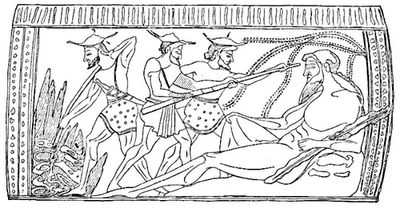
Fig. 171. Boring out the Cyclops' Eye
Next morning the Cyclops rolled away the stone to let his flock
out to pasture, but planted himself in the door of the cave to feel
of all as they went out, that Ulysses and his men should not escape
with them. But Ulysses had made his men harness the rams
of the flock three abreast, with osiers which they found on the
floor of the cave. To the middle ram of the three one of the
Greeks suspended himself, so protected by the exterior rams on
either side. As they passed, the giant felt of the animals' backs
and sides, but never thought of their bellies; so the men all passed
safe, Ulysses himself being on the last one that passed. When
they had got a few paces from the cavern, Ulysses and his friends
released themselves from their rams and drove a good part of the
flock down to the shore to their boat. They put them aboard with
all haste, then pushed off from the shore; and when at a safe distance
Ulysses shouted out, "Cyclops, the gods have well requited
thee for thy atrocious deeds. Know it is Ulysses to whom thou
owest thy shameful loss of sight." The Cyclops, hearing this,
seized a rock that projected from the side of the mountain, and
rending it from its bed,
he lifted it high in the
air, then exerting all
his force, hurled it in
the direction of the
voice. Down came the
mass, just forward of
the vessel. The ocean,
at the plunge of the
huge rock, heaved the
ship toward Polyphemus; but a second rock which he hurled,
striking aft, propelled them fortunately in the direction that they
desired to take. Ulysses was about to hail the giant again, but his
friends besought him not to do so. He could not forbear, however,
letting the giant know that they had escaped his missile,
but waited till they had reached a safer distance than before.
The giant answered them with curses, while Ulysses and his
friends, plying their oars vigorously, regained their companions.
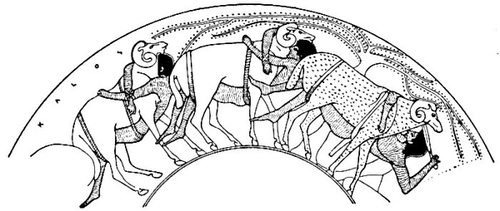
Fig. 172. Ulysses and Two Companions under
Rams
234. The Bag of Winds. Ulysses next arrived at the island of
Æolus.[334] He treated Ulysses hospitably, and at his departure gave
him, tied up in a leathern bag with a silver string, such winds as
might be hurtful and dangerous, commanding fair winds to blow
the barks toward their country. Nine days they sped before the
wind, and all that time Ulysses had stood at the helm without
sleep. At last quite exhausted he lay down to sleep. While
he slept, the crew conferred together about the mysterious bag,
and concluded it must contain treasures given by the hospitable
King Æolus to their commander. Tempted to secure some portion
for themselves, they loosed the string, when immediately
the winds rushed forth. The ships were driven far from their
course and back again to the island they had just left. Æolus,
indignant at their folly, refused to assist them further, and they
were obliged to labor over their course once more by means of
their oars.
235. The Læstrygonians. Their next adventure was with the
barbarous tribe of Læstrygonians. The vessels all pushed into the
harbor, tempted by the secure appearance of the cove, completely
landlocked; only Ulysses moored his vessel without. As soon as
the Læstrygonians found the ships completely in their power, they
attacked them, heaving huge stones which broke and overturned
them, while with their spears they dispatched the seamen as they
struggled in the water. All the vessels with their crews were
destroyed, except Ulysses' own ship which had remained outside.
He, finding no safety but in flight, exhorted his men to ply their
oars vigorously; and they escaped.
236. The Isle of Ææa. With grief for their slain companions
mixed with joy at their own escape, they pursued their way till they
arrived at the Ææan isle, where Circe dwelt, the daughter of the
sun. Landing here, Ulysses climbed a hill and, gazing round, saw
no signs of habitation except in one spot at the center of the
island, where he perceived a palace embowered with trees. He sent
forward one half of his crew, under the command of Eurylochus,
to see what prospect of hospitality they might find. As they approached
the palace, they found themselves surrounded by lions,
tigers, and wolves, not fierce, but tamed by Circe's art, for she was
a powerful magician. These animals had once been men, but had
been changed by Circe's enchantments into the forms of beasts.
The sounds of soft music were heard from within, and a sweet
female voice singing. Eurylochus called aloud, and the goddess
came forth and invited them in; they all gladly entered except
Eurylochus, who suspected danger. The goddess conducted her
guests to a seat, and had them served with wine and other delicacies.
When they had feasted heartily, she touched them one by
one with her wand, and they became immediately changed into
swine, in "head, body, voice, and bristles," yet with their intellects
as before. She shut them in her styes and supplied them
with acorns and such other things as swine love.
Eurylochus hurried back to the ship and told the tale. Ulysses
thereupon determined to go himself and try if by any means he
might deliver his companions. As he strode onward alone, he met
a youth who addressed him familiarly, appearing to be acquainted
with his adventures. He announced himself as Mercury, and informed
Ulysses of the arts of Circe and of the danger of approaching
her. As Ulysses was not to be dissuaded from his attempt,
Mercury provided him with a sprig of the plant Moly, of wonderful
power to resist sorceries, and instructed him how to act.
Fig. 173. The Castle of Circe
Meanwhile the companions of Ulysses made mournful plaint to
their cruel mistress:
Huddling they came, with shag sides caked of mire,—
With hoofs fresh sullied from the troughs o'er-turned,—
With wrinkling snouts,—yet eyes in which desire
Of some strange thing unutterably burned,
Unquenchable; and still where'er She turned
They rose about her, striving each o'er each,
With restless, fierce importuning that yearned
Through those brute masks some piteous tale to teach,
Yet lacked the words thereto, denied the power of speech....
... "If swine we be,—if we indeed be swine,
Daughter of Persé, make us swine indeed,
Well-pleased on litter-straw to lie supine,—
Well-pleased on mast and acorn-shales to feed,
Stirred by all instincts of the bestial breed;
But O Unmerciful! O Pitiless!
Leave us not thus with sick men's hearts to bleed!—
To waste long days in yearning, dumb distress,
And memory of things gone, and utter hopelessness!
... "Make thou us men again,—if men but groping
That dark Hereafter which th' Olympians keep;
Make thou us men again,—if men but hoping
Behind death's doors security of sleep;—
For yet to laugh is somewhat, and to sleep;—
To feel delight of living, and to plow
The salt-blown acres of the shoreless deep;—
Better,—yea better far all these than bow
Foul faces to foul earth, and yearn—as we do now!"
So they in speech unsyllabled. But She,
The fair-tressed Goddess, born to be their bane,
Uplifting straight her wand of ivory,
Compelled them groaning to the styes again;
Where they in hopeless bitterness were fain
To rend the oaken woodwork as before,
And tear the troughs in impotence of pain,—
Not knowing, they, that even at the door
Divine Odysseus stood,—as Hermes told of yore.[335]
Ulysses, reaching the palace, was courteously received by Circe,
who entertained him as she had done his companions, but after
he had eaten and drunk, touched him with her wand, saying,
"Hence, seek the stye and wallow with thy friends." But he, instead
of obeying, drew his sword and rushed upon her with fury
in his countenance. She fell on her knees and begged for mercy.
He dictated a solemn oath that she would release his companions
and practice no further harm against him or them; and she repeated
it, at the same time promising to dismiss them all in safety
after hospitably entertaining them. She was as good as her word.
The men were restored to their shapes, the rest of the crew summoned
from the shore, and all magnificently entertained day after
day, till Ulysses seemed to have forgotten his native land and to
have reconciled himself to an inglorious life of ease and pleasure.
237. Ulysses visits Hades. At length his companions recalled
him to nobler sentiments, and he received their admonition gratefully.
Circe, won over by his prayers, consented to send him on
his homeward way. But she warned him that first he must perform
another journey, must visit the Underworld and there learn from
the shade of Tiresias, the blind prophet of Thebes, the way and
measure of his path, and how to proceed to Ithaca over the
teeming deep.
"But who will guide us?" queried Ulysses in amaze; "for no
man ever yet sailed to hell in a black ship."
"Son of Laërtes," replied the Goddess, "Ulysses of many devices,
nay, trouble not thyself for want of a guide, by thy ship
abiding, but set up the mast and spread abroad the white sails and
sit thee down; and the breeze of the North Wind will bear thy
vessel on her way. But when thou hast now sailed in thy ship
across the stream Oceanus where is a waste shore and the groves
of Persephone, even tall poplar trees and willows that shed their
fruit before the season, there beach thy ship by deep-eddying
Oceanus, but go thyself to the dank house of Hades. Thereby
into Acheron flows Pyriphlegethon, and Cocytus, a branch of the
water of the Styx; and there is a rock, and the meeting of the
two roaring waters. There dig a trench and pour a drink offering
to all the dead, mead and sweet wine and water, sprinkling white
meal thereon. And when thou hast prayed to them, offer up a ram
and a black ewe. Then will many spirits come to thee of the dead
that be departed; but thou shalt draw thy sharp sword and suffer
them not to approach the blood, ere thou hast word of Tiresias."[336]
So Ulysses and his companions did as they were bid. And the
ship came to the limits of the world, to the deep-flowing Oceanus.
There is the land and city of the Cimmerians, where no ray of
sunshine ever falls, but deadly night is outspread over miserable
mortals. And there Ulysses and those with him performed the
drink offering and the prayer and the sacrifice; and Ulysses fended
off the spirits of the dead from the blood until the soul of the
Theban prophet arrived. And that one, having drunk of the dark
blood, declared unto Ulysses the future of his way: how the Earthshaker,
god of the waters, should oppose him, but how he should
win home without further disaster if, when passing the isle Thrinacia,
he would but restrain the spirit of his men so that they
should do no injury to the cattle of the Sun grazing thereon. If,
however, these cattle were not respected but hurt, then there should
follow ruin for both ship and men; and Ulysses himself on the
ship of strangers should return late in time to his home, to find
sorrows there, proud men wasting his patrimony and wooing his
godlike wife to wed her. But that he should avenge their violence,
and settle his affairs at home, and then betake himself again to
wandering; and that from the sea should his own death come,—"the
gentlest death that may be, which shall end thee fordone
with smooth old age; and the folk shall dwell happily around thee."
In the land of Hades, Ulysses saw also the shade of his mother,
and spoke with her of his father and of Penelope, his wife, and of
his son Telemachus. And he saw also the shades of Antiope and
Alcmene and Phædra and Procris; and of Agamemnon, and
Achilles, and Ajax, the son of Telamon, and of many others,
and spoke with them of their own fates and of the affairs of the
upper world.
238. The Sirens. Returning from the abode of the shades,
Ulysses revisited the Ææan isle and recounted to Circe his adventures
and the wondrous visions and the laws of Hell. She in return
speeded his homeward voyage, instructing him particularly
how to pass safely by the coast of the Sirens.[337]
These nymphs had the power, as has been already said, of
charming by their song all who heard them, so that mariners
were impelled to cast themselves into the sea to destruction. Circe
directed Ulysses to stop the ears of his seamen with wax, so that
they should not hear the strain; to have himself bound to the
mast, and to enjoin his people, whatever he might say or do, by
no means to release him till they should have passed the Sirens'
island. Ulysses obeyed these directions. As they approached the
Sirens' island, the sea was calm, and over the waters came notes
of music so ravishing and attractive that Ulysses struggled to get
loose and, by cries and
signs to his people,
begged to be released;
but they, obedient to his
previous orders, sprang
forward and bound
him still faster. They
held on their course,
and the music grew
fainter till it ceased to
be heard, when with
joy Ulysses gave his
companions the signal
to unseal their ears;
and they relieved him from his bonds. It is said that one of the
Sirens, Parthenope, in grief at the escape of Ulysses drowned herself.
Her body was cast up on the Italian shore where now stands
the city of Naples, in early times called by the Siren's name.
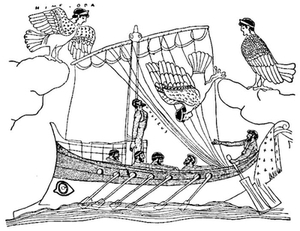
Fig. 174. Ulysses and the Sirens
239. Scylla and Charybdis. Ulysses had been warned by Circe
of the two monsters Scylla and Charybdis. We have already met
with Scylla in the myth of Glaucus. She dwelt in a cave high up
on the cliff, from whence she was accustomed to thrust forth her
long necks (for she had six heads), and in each of her mouths to
seize one of the crew of every vessel passing within reach. The
other terror, Charybdis, was a gulf nearly on a level with the
water. Thrice each day the water rushed into a frightful chasm,
and thrice was disgorged. Any vessel coming near the whirlpool
when the tide was rushing in must inevitably be engulfed; not
Neptune himself could save it. On approaching the haunt of the
dread monsters, Ulysses kept strict watch to discover them. The
roar of the waters as Charybdis engulfed them gave warning at
a distance, but Scylla could nowhere be discerned. While Ulysses
and his men watched with anxious
eyes the dreadful whirlpool,
they were not equally on
their guard from the attack
of Scylla,[338] and the monster,
darting forth her snaky heads,
caught six of his men and bore
them away shrieking to her
den. Ulysses was unable to
afford any assistance.
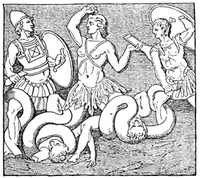
Fig. 175. Ulysses and Scylla
240. The Cattle of the Sun.
Both Tiresias and Circe had
warned him of another danger.
After passing Scylla and Charybdis the next land he would make
was Thrinacia, an island whereon were pastured the cattle of
Helios, the Sun, tended by his daughters Lampetia and Phaëthusa.
These flocks must not be violated, whatever the wants of the voyagers
might be. If this injunction were transgressed, destruction
was sure to fall on the offenders. Ulysses would willingly have
passed the island of the Sun without stopping, but his companions
so urgently pleaded for the rest and refreshment that would be
derived from anchoring and passing the night on shore, that
Ulysses yielded. He made them swear, however, not to touch the
sacred flocks and herds, but to content themselves with what provision
they yet had left of the supply which Circe had put on
board. So long as this supply lasted the people kept their oath;
but contrary winds detained them at the island for a month, and
after consuming all their stock of provisions, they were forced to
rely upon the birds and fishes they could catch. Famine pressed
them, and at last, in the absence of Ulysses, they slew some of the
cattle, vainly attempting to make amends for the deed by offering
from them a portion to the offended powers. Ulysses, on his
return to the shore, was horror-struck at perceiving what they had
done, and the more so on account of the portentous signs which
followed. The skins crept on the ground, and the joints of meat
lowed on the spits while roasting.
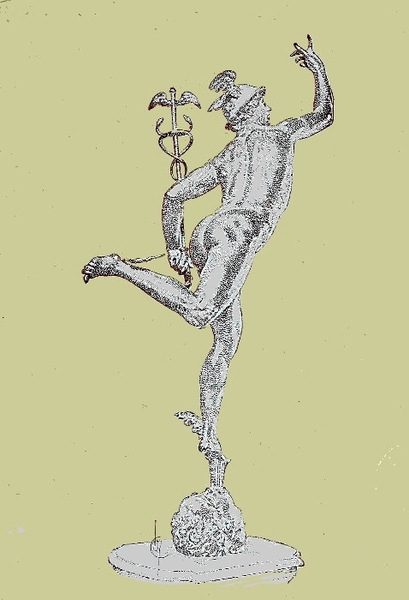
The wind becoming fair, they sailed from the island. They had
not gone far when the weather changed, and a storm of thunder
and lightning ensued. A stroke of lightning shattered their mast,
which in its fall killed the pilot. At last the vessel itself went to
pieces. The keel and mast floating side by side, Ulysses formed of
them a raft to which he clung; and, the wind changing, the waves
bore him to Calypso's island. All the rest of the crew perished.
241. Calypso's Island. Calypso, a sea-nymph, received Ulysses
hospitably, entertained him magnificently, became enamored of
him, and wished to retain him forever, offering him immortality.
He remained with her seven long years. But he persisted
in his resolution to return to his country and his wife and son.[339]
Calypso at last received the command of Jove to dismiss him.
Mercury brought the message to her and found her in her grotto.
A garden vine, luxuriant on all sides,
Mantled the spacious cavern, cluster-hung
Profuse; four fountains of serenest lymph,
Their sinuous course pursuing side by side,
Strayed all around, and everywhere appeared
Meadows of softest verdure, purpled o'er
With violets; it was a scene to fill
A god from heaven with wonder and delight.[340]
Calypso, with much reluctance, proceeded to obey the commands
of Jupiter. She supplied Ulysses with the means of constructing
a raft, provisioned it well for him, and gave him a favoring gale.
He sped on his course prosperously for many days, till at last,
when in sight of land, a storm arose that broke his mast and
threatened to rend the raft asunder. In this crisis he was seen
by a compassionate sea-nymph, Leucothea, who, in the form of a
cormorant, alighted on the raft and presented him with a girdle,
directing him to bind it beneath his breast, that, if he should be
compelled to trust himself to the waves, it might buoy him up and
enable him to reach the land.
242. The Land of the Phæacians. Ulysses clung to the raft so
long as its timbers held together, and when it no longer yielded
him support, binding the girdle around him, he swam. Minerva
smoothed the billows before him and sent him a wind that rolled
the waves towards the shore. The surf beat high on the rocks
and seemed to forbid approach; but at length finding calm water
at the mouth of a gentle stream, he landed, spent with toil, breathless
and speechless and almost dead. Reviving after some time,
he kissed the soil, rejoicing, yet at a loss what course to take. At
a short distance he perceived a wood, to which he turned his steps.
There finding a covert sheltered by intermingling branches alike
from the sun and the rain, he collected a pile of leaves and formed
a bed, on which he stretched himself, and, heaping the leaves over
him, fell asleep.
The land where he was thrown was Scheria, the country of the
Phæacians.[341] These people dwelt originally near the Cyclopes;
but, being oppressed by that savage race, they migrated to the isle
of Scheria under the conduct of Nausithoüs, their king. They were,
the poet tells us, a people akin to the gods, who appeared manifestly
and feasted among them when they offered sacrifices, and
did not conceal themselves from solitary wayfarers when they met
them. They had abundance of wealth and lived in the enjoyment
of it undisturbed by the alarms of war; for as they dwelt remote
from gain-seeking man, no enemy ever approached their shores,
and they did not even require to make use of bows and quivers.
Their chief employment was navigation. Their ships, which went
with the velocity of birds, were endued with intelligence; they
knew every port and needed no pilot. Alcinoüs, the son of Nausithoüs,
was now their king, a wise and just sovereign, beloved by
his people.
Now it happened that the very night on which Ulysses was cast
ashore on the Phæacian island, and while he lay sleeping on his
bed of leaves, Nausicaa, the daughter of the king, had a dream
sent by Minerva, reminding her that her wedding day might not
be far distant, and that it would be but a prudent preparation for
that event to have a general washing of the clothes of the family.
This was no slight affair, for the fountains were at some distance
and the garments must be carried thither. On awaking, the princess
hastened to her parents to tell them what was on her mind,—not
alluding to her wedding day, but finding other reasons equally
good. Her father readily assented and ordered the grooms to
furnish forth a wagon for the purpose. The clothes were put
therein, and the queen, her mother, placed in the wagon likewise
an abundant supply of food and wine. The princess took her seat
and plied the lash, her attendant virgins following her on foot.
Arrived at the riverside they turned out the mules to graze, and
unlading the carriage, bore the garments down to the water, and,
working with cheerfulness and alacrity, soon dispatched their labor.
Then having spread the garments on the shore to dry, and having
themselves bathed, they sat down to enjoy their meal; after which
they rose and amused themselves with a game of ball, the princess
singing to them while they played. But when they had
refolded the apparel and were about to resume their way to the
town, Minerva caused the ball thrown by the princess to fall into
the water, whereat they all screamed, and Ulysses awaked at the
sound.
Utterly destitute of clothing, he discovered that only a few bushes
were interposed between him and a group of young maidens, whom,
by their deportment and attire, he discovered to be not mere peasant
girls, but of a higher class. Breaking off a leafy branch from
a tree, he held it before him and stepped out from the thicket. The
virgins at sight of him fled in all directions, Nausicaa alone excepted,
for her Minerva aided and endowed with courage and discernment.
Ulysses, standing respectfully aloof, told his sad case,
and besought the fair object (whether queen or goddess he professed
he knew not) for food and clothing. The princess replied
courteously, promising present relief and her father's hospitality
when he should become acquainted with the facts. She called back
her scattered maidens, chiding their alarm and reminding them
that the Phæacians had no enemies to fear. This man, she told
them, was an unhappy wanderer, whom it was a duty to cherish,
for the poor and the stranger are from Jove. She bade them bring
food, and the garments of some of her brothers that were among
the contents of the wagon. When this was done, and Ulysses retiring
to a sheltered place had washed his body free from the sea-foam,
and clothed himself, and eaten, Pallas dilated his form and
diffused grace over his ample chest and manly brows.
The princess, seeing him, was filled with admiration and scrupled
not to say to her damsels that she wished the gods would send her
such a husband. To Ulysses she recommended that he repair to
the city, following herself and her train so far as the way lay through
the fields; but when they should approach the city, she desired
that he no longer be seen in her company, for she feared the remarks
which rude and vulgar people might make on seeing her
return accompanied by such a gallant stranger. To avoid this she
directed him to stop at a grove adjoining the city, in which were
a farm and garden belonging to the king. After allowing time for
the princess and her companions to reach the city, he was then to
pursue his way thither, and should be easily guided by any he
might meet to the royal abode.
Ulysses obeyed the directions and in due time proceeded to
the city, on approaching which he met a young woman bearing
forth a pitcher for water.[342] It was Minerva who had assumed that
form. Ulysses accosted her and desired to be directed to the
palace of Alcinoüs, the king. The maiden replied respectfully,
offering to be his guide; for the palace, she informed him, stood
near her father's dwelling. Under the guidance of the goddess
and, by her power, enveloped in a cloud which shielded him from
observation, Ulysses passed among the busy crowd and with wonder
observed their harbor, their ships, their forum (the resort of
heroes), and their battlements, till they came to the palace, where
the goddess, having first given him some information of the country,
king, and people he was about to meet, left him. Ulysses,
before entering the courtyard of the palace, stood and surveyed
the scene. Its splendor astonished him. Brazen walls stretched
from the entrance to the interior house, of which the doors were
gold, the doorposts silver, the lintels silver ornamented with gold.
On either side were figures of mastiffs wrought in gold and silver,
standing in rows as if to guard the approach. Along the walls
were seats spread through all their length with mantles of finest
texture, the work of Phæacian maidens. On these seats the princes
sat and feasted, while golden statues of graceful youths held in
their hands lighted torches which shed radiance over the scene.
Full fifty female menials served in household offices, some employed
to grind the corn, others to wind off the purple wool or ply
the loom. For the Phæacian women as far exceeded all other
women in household arts as the mariners of that country did the
rest of mankind in the management of ships. Without the court
a spacious garden lay, four acres in extent. In it grew many a lofty
tree, pomegranate, pear, apple, fig, and olive. Neither winter's
cold nor summer's drought arrested their growth.
The languid sunset, mother of roses,[343]
Lingers, a light on the magic seas,
The wide fire flames, as a flower uncloses,
Heavy with odor, and loose to the breeze.
The red rose clouds, without law or leader,
Gather and float in the airy plain;
The nightingale sings to the dewy cedar,
The cedar scatters his scent to the main.
The strange flowers' perfume turns to singing,
Heard afar over moonlit seas:
The Siren's song, grown faint in winging,
Falls in scent on the cedar-trees.
As waifs blown out of the sunset, flying,
Purple, and rosy, and gray, the birds
Brighten the air with their wings; their crying
Wakens a moment the weary herds.
Butterflies flit from the fairy garden,
Living blossoms of flying flowers;
Never the nights with winter harden,
Nor moons wax keen in this land of ours.
Great fruits, fragrant, green and golden,
Gleam in the green, and droop and fall;
Blossom, and bud, and flower unfolden,
Swing and cling to the garden wall.
Deep in the woods as twilight darkens,
Glades are red with the scented fire;
Far in the dells the white maid hearkens
Song and sigh of the heart's desire.
Ulysses stood gazing in admiration, unobserved himself, for the
cloud which Minerva spread around him still shielded him. At
length having sufficiently observed the scene, he advanced with
rapid step into the hall where the chiefs and senators were assembled,
pouring libation to Mercury, whose worship followed the evening
meal. Just then Minerva dissolved the cloud and disclosed him to
the assembled chiefs. Advancing to the place where the queen sat,
he knelt at her feet and implored her favor and assistance to enable
him to return to his native country. Then withdrawing, he
seated himself in the manner of suppliants, at the hearth-side.
For a time none spoke. At last an aged statesman, addressing
the king, said, "It is not fit that a stranger who asks our hospitality
should be kept waiting in suppliant guise, none welcoming
him. Let him, therefore, be led to a seat among us and supplied
with food and wine." At these words the king, rising, gave his
hand to Ulysses and led him to a seat, displacing thence his own
son to make room for the stranger. Food and wine were set
before him and he ate and refreshed himself.
The king then dismissed his guests, notifying them that the
next day he would call them to council to consider what had best
be done for the stranger.
When the guests had departed and Ulysses was left alone with
the king and queen, the queen asked him who he was and whence
he came, and (recognizing the clothes which he wore as those
which her maidens and herself had made) from whom he received
those garments. He told them of his residence in Calypso's isle
and his departure thence; of the wreck of his raft, his escape by
swimming, and of the relief afforded by the princess. The parents
heard approvingly, and the king promised to furnish a ship in
which his guest might return to his own land.
The next day the assembled chiefs confirmed the promise of
the king.[344] A bark was prepared and a crew of stout rowers
selected, and all betook themselves to the palace, where a bounteous
repast was provided. After the feast the king proposed that the
young men should show their guest their proficiency in manly
sports, and all went forth to the arena for games of running,
wrestling, and other exercises. After all had done their best,
Ulysses being challenged to show what he could do, at first declined,
but being taunted by one of the youths, seized a quoit of
weight far heavier than any the Phæacians had thrown, and sent
it farther than the utmost throw of theirs. All were astonished
and viewed their guest with greatly increased respect.
After the games they returned to the hall, and the herald led in
Demodocus, the blind bard,—
Dear to the Muse,
Who yet appointed him both good and ill,
Took from him sight, but gave him strains divine.
He took for his theme the Wooden Horse, by means of which the
Greeks found entrance into Troy. Apollo inspired him, and he
sang so feelingly the terrors and the exploits of that eventful time
that all were delighted, but Ulysses was moved to tears. Observing
which, Alcinoüs, when the song was done, demanded of him
why at the mention of Troy his sorrows awaked. Had he lost
there a father, or brother, or any dear friend? Ulysses replied by
announcing himself by his true name, and, at their request, recounted
the adventures which had befallen him since his departure
from Troy. This narrative raised the sympathy and admiration of
the Phæacians for their guest to the highest pitch. The king proposed
that all the chiefs should present him with a gift, himself
setting the example. They obeyed, and vied with one another in
loading the illustrious stranger with costly gifts.
The next day Ulysses set sail in the Phæacian vessel, and in a
short time arrived safe at Ithaca, his own island.[345] When the vessel
touched the strand he was asleep. The mariners, without waking
him, carried him on shore, and landed with him the chest
containing his presents, and then sailed away.
Neptune was so displeased at the conduct of the Phæacians in
thus rescuing Ulysses from his hands, that, on the return of the
vessel to port, he transformed it into a rock, right opposite the
mouth of the harbor.
243. Fate of the Suitors. Ulysses had now been away from
Ithaca for twenty years, and when he awoke he did not recognize
his native land:
"Some god hath cast me forth upon this land,
And O! what land? So thick is the sea mist,
All is phantasmal. What king ruleth here?
What folk inhabit?—cruel unto strangers,
Or hospitable? The gods have lied to me
When they foretold I should see Ithaca.
This is some swimming and Cimmerian isle,
With melancholy people of the mist.
Ah! Ithaca, I shall not see thee more!"[346]
But Minerva, appearing in the form of a young shepherd, informed
him where he was, and told him the state of things at his palace.
More than a hundred nobles of Ithaca and of the neighboring
islands had been for years suing for the hand of Penelope, his
wife, imagining him dead, and lording it over his palace and
people as if they were owners of both.
Penelope was one of those mythic heroines whose beauties were
not those of person only, but of character and conduct as well.
She was the niece of Tyndareus,—being the daughter of his
brother Icarius, a Spartan prince. Ulysses, seeking her in marriage,
had won her over all competitors. But, when the moment
came for the bride to leave her father's house, Icarius, unable to
bear the thoughts of parting with his daughter, tried to persuade
her to remain with him and not accompany her husband to Ithaca.
Ulysses gave Penelope her choice, to stay or go with him. Penelope
made no reply, but dropped her veil over her face. Icarius urged
her no further, but when she was gone erected a statue to Modesty
on the spot where they had parted.
Ulysses and Penelope had not enjoyed their union more than a
year when it was interrupted by the events which called Ulysses
to the Trojan War. During his long absence, and when it was
doubtful whether he still lived, and highly improbable that he
would ever return, Penelope was importuned by numerous suitors,
from whom there seemed no refuge but in choosing one of them
for her husband. She, however, employed every art to gain time,
still hoping for Ulysses' return. One of her arts of delay was by
engaging in the preparation of a robe for the funeral canopy of
Laërtes, her husband's father. She pledged herself to make her
choice among the suitors when the web was finished. During the
day she worked at it, but in the night she undid the work of the day.
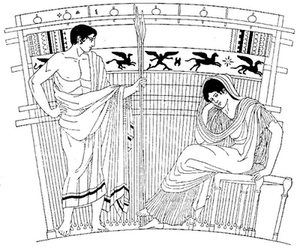
Fig. 176. Penelope and Telemachus
That Ulysses on returning might be able to take vengeance
upon the suitors, it was important that he should not be recognized.
Minerva accordingly metamorphosed him into an unsightly
beggar, and as such he was kindly received by Eumæus, the swineherd,
a faithful servant of his house.[347]
Telemachus, his son, had for some time been absent in quest
of his father, visiting the courts of the other kings who had
returned from the Trojan expedition. While on the search, he
received counsel from Minerva to return home.[348] He arrived
at this juncture, and sought Eumæus to learn something of the
state of affairs at the palace before presenting himself among
the suitors. Finding a stranger with Eumæus, he treated him
courteously, though in the garb of a beggar, and promised him
assistance. Eumæus was sent to the palace to inform Penelope
privately of her son's arrival, for caution was necessary with regard
to the suitors, who, as Telemachus had learned, were plotting to
intercept and kill him. When the swineherd was gone, Minerva
presented herself to Ulysses and directed him to make himself
known to his son. At the same time she touched him, removed
at once from him the appearance of age and penury, and gave him
the aspect of vigorous manhood that belonged to him. Telemachus
viewed him with astonishment, and at first thought he must
be more than mortal. But Ulysses announced himself as his father,
and accounted for the change of appearance by explaining that it
was Minerva's doing.
Then threw Telemachus
His arms around his father's neck and wept.
Desire intense of lamentation seized
On both; soft murmurs uttering, each indulged
His grief.[349]
The father and son took counsel together how they should get
the better of the suitors and punish them for their outrages. It
was arranged that Telemachus should proceed to the palace and
mingle with the suitors as formerly; that Ulysses should also go
as a beggar, a character which in the rude old times had different
privileges from what we concede to it now. As traveler and storyteller,
the beggar was admitted in the halls of chieftains and often
treated like a guest; though sometimes, also, no doubt, with contumely.
Ulysses charged his son not to betray, by any display of
unusual interest in him, that he knew him to be other than he
seemed, and even if he saw him insulted or beaten, not to interpose
otherwise than he might do for any stranger. At the palace
they found the usual scene of feasting and riot going on. The
suitors pretended to receive Telemachus with joy at his return,
though secretly mortified at the failure of their plots to take his
life. The old beggar was permitted to enter and provided with a
portion from the table. A touching incident occurred as Ulysses
entered the courtyard of the palace. An old dog lay in the yard
almost dead with age, and seeing a stranger enter, raised his head,
with ears erect. It was Argus, Ulysses' own dog, that he had in
other days often led to the chase.
Soon as he perceived
Long-lost Ulysses nigh, down fell his ears
Clapped close, and with his tail glad sign he gave
Of gratulation, impotent to rise,
And to approach his master as of old.
Ulysses, noting him, wiped off a tear
Unmarked.
... Then his destiny released
Old Argus, soon as he had lived to see
Ulysses in the twentieth year restored.[350]
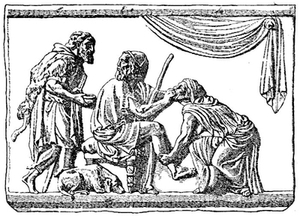
Fig. 177. Ulysses recognized by Euryclea
As Ulysses sat eating his portion in the hall, the suitors soon
began to exhibit their insolence to him. When he mildly remonstrated,
one of them
raised a stool and with
it gave him a blow.
Telemachus had hard
work to restrain his indignation
at seeing his
father so treated in his
own hall; but, remembering
his father's injunctions,
said no more
than what became him
as master of the house,
though young, and protector
of his guests.
Once again was the wanderer all but betrayed;—when his
aged nurse Euryclea, bathing his feet, recognized the scar of
a wound dealt him by a boar, long ago.[351] Grief and joy overwhelmed
the crone, and she would have revealed him to Penelope
had not Ulysses enjoined silence upon her.
Penelope had protracted her decision in favor of any one of her
suitors so long that there seemed to be no further pretense for
delay. The continued absence of her husband seemed to prove
that his return was no longer to be expected. Meanwhile her
son had grown up and was able to manage his own affairs. She
therefore consented to submit the question of her choice to a trial
of skill among the suitors. The test selected was shooting with the
bow.[352] Twelve rings were arranged in a line, and he whose arrow
was sent through the whole twelve was to have the queen for his
prize. A bow that one of his brother heroes had given to Ulysses
in former times was brought from the armory and with its quiver
full of arrows was laid in the hall. Telemachus had taken care that
all other weapons should be removed, under pretense that in the
heat of competition there was danger, in some rash moment, of
putting them to an improper use.
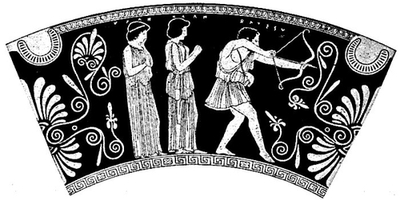
Fig. 178. Ulysses kills the Suitors
(Left half)
All things being prepared for the trial, the first thing to be done
was to bend the bow in order to attach the string. Telemachus
endeavored to do it, but found all his efforts fruitless; and modestly
confessing that he had attempted a task beyond his strength,
he yielded the bow to another, He tried it with no better success,
and, amidst the laughter and jeers of his companions, gave it up.
Another tried it, and another; they rubbed the bow with tallow, but
all to no purpose; it would not bend. Then spoke Ulysses, humbly
suggesting that he should be permitted to try; for, said he,
"beggar as I am, I was once a soldier, and there is still some
strength in these old limbs of mine." The suitors hooted with
derision and commanded to turn him out of the hall for his insolence.
But Telemachus spoke up for him, and, merely to gratify
the old man, bade him try. Ulysses took the bow and handled it
with the hand of a master. With ease he adjusted the cord to its
notch, then fitting an arrow to the bow he drew the string and
sped the arrow unerring through the rings.
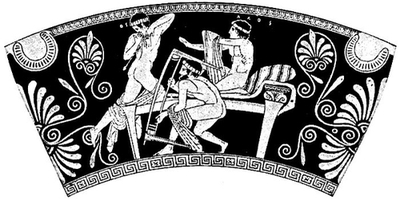
Fig. 179. Ulysses kills the Suitors
(Right half)
Without allowing them time to express their astonishment, he
said, "Now for another mark!" and aimed direct at Antinoüs, the
most insolent of the suitors.[353] The arrow pierced through his throat
and he fell dead. Telemachus, Eumæus, and another faithful follower,
well armed, now sprang to the side of Ulysses. The suitors,
in amazement, looked round for arms, but found none, neither
was there any way of escape, for Eumæus had secured the door.
Ulysses left them not long in uncertainty; he announced himself
as the long-lost chief, whose house they had invaded, whose
substance they had squandered, whose wife and son they had persecuted
for ten long years; and told them he meant to have ample
vengeance. All but two were slain, and Ulysses was left master of
his palace and possessor of his kingdom and his wife.
244. Tennyson's Ulysses. Tennyson's poem of Ulysses represents
the old hero,—his dangers past and nothing left but to
stay at home and be happy,—growing tired of inaction and resolving
to set forth again in quest of new adventures.
It little profits that an idle king,
By this still hearth, among these barren crags,
Match'd with an agèd wife, I mete and dole
Unequal laws unto a savage race,
That hoard, and sleep, and feed, and know not me.
I cannot rest from travel: I will drink
Life to the lees: all times I have enjoy'd
Greatly, have suffer'd greatly, both with those
That loved me, and alone; on shore, and when
Thro' scudding drifts the rainy Hyades
Vext the dim sea: I am become a name;
For always roaming with a hungry heart
Much have I seen and known: cities of men,
And manners, climates, councils, governments,
Myself not least, but honor'd of them all;
And drunk delight of battle with my peers,
Far on the ringing plains of windy Troy.
I am a part of all that I have met;
Yet all experience is an arch wherethro'
Gleams that untravel'd world, whose margin fades
Forever and forever when I move.
How dull it is to pause, to make an end,
To rust unburnish'd, not to shine in use!
As tho' to breathe were life. Life piled on life
Were all too little, and of one to me
Little remains: but every hour is saved
From that eternal silence, something more,
A bringer of new things; and vile it were
For some three suns to store and hoard myself,
And this gray spirit yearning in desire
To follow knowledge like a sinking star,
Beyond the utmost bound of human thought.
This is my son, mine own Telemachus,
To whom I leave the scepter and the isle—
Well-loved of me, discerning to fulfil
This labor, by slow prudence to make mild
A rugged people, and thro' soft degrees
Subdue them to the useful and the good.
Most blameless is he, centered in the sphere
Of common duties, decent not to fail
In offices of tenderness, and pay
Meet adoration to my household gods,
When I am gone. He works his work, I mine.
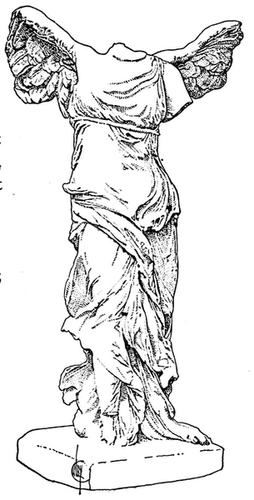
Fig. 180. The Nike of
Samothrace
There lies the port: the vessel puffs her sail:
There gloom the dark broad seas. My mariners,
Souls that have toil'd, and wrought, and thought with me—
That ever with a frolic welcome took
The thunder and the sunshine, and opposed
Free hearts, free foreheads—you and I are old;
Old age has yet his honor and his toil;
Death closes all: but something ere the end,
Some work of noble note, may yet be done,
Not unbecoming men that strove with Gods.
The lights begin to twinkle from the rocks:
The long day wanes: the slow moon climbs: the deep
Moans round with many voices. Come, my friends,
'Tis not too late to seek a newer world.
Push off, and sitting well in order smite
The sounding furrows; for my purpose holds
To sail beyond the sunset, and the baths
Of all the western stars, until I die.
It may be that the gulfs will wash us down:
It may be we shall touch the Happy Isles,
And see the great Achilles, whom we knew.
Tho' much is taken, much abides; and tho'
We are not now that strength which in old days
Moved earth and heaven, that which we are, we are;
One equal temper of heroic hearts,
Made weak by time and fate, but strong in will
To strive, to seek, to find, and not to yield.
Roman Virgil, thou that singest
Ilion's lofty temples robed in fire,
Ilion falling, Rome arising,
wars, and filial faith, and Dido's pyre;
Landscape lover, lord of language
more than he that sang the Works and Days,
All the chosen coin of fancy
flashing out from many a golden phrase;...
Light among the vanish'd ages;
star that gildest yet this phantom shore;
Golden branch amid the shadows,
kings and realms that pass to rise no more;...
Now the Rome of slaves hath perish'd,
and the Rome of freemen holds her place,
I, from out the Northern Island
sunder'd once from all the human race,
I salute thee, Mantovano,
I that loved thee since my day began,
Wielder of the stateliest measure
ever molded by the lips of man.[354]
245. From Troy to Italy. Homer tells the story of one of the
Grecian heroes, Ulysses, in his wanderings on his return home
from Troy. Virgil in his Æneid[355] narrates the mythical fortunes of
the remnant of the conquered people under their chief Æneas,
the son of Venus and the Trojan Anchises, in their search for a
new home after the ruin of their native city. On that fatal night
when the wooden horse disgorged its contents of armed men, and
the capture and conflagration of the city were the result, Æneas
made his escape from the scene of
destruction, with his father and his
wife and young son. The father,
Anchises, was too old to walk with
the speed required, and Æneas took
him upon his shoulders. Thus burdened,
leading his son and followed
by his wife, he made the best of his
way out of the burning city; but in
the confusion his wife, Creüsa, was
swept away and lost.
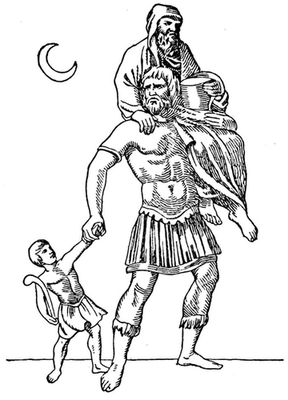
Fig. 181. Æneas, Anchises,
and Iulius
246. The Departure from Troy. On arriving at the place of rendezvous,
numerous fugitives of both sexes were found, who put themselves
under the guidance of Æneas. Some months were spent in preparation,
and at length they embarked. They first landed on the
neighboring shores of Thrace, and were preparing to build a city,
but Æneas was deterred by a prodigy. Preparing to offer sacrifice,
he tore some twigs from one of the bushes. To his dismay the
wounded part dropped blood. When he repeated the act, a voice
from the ground cried out to him, "Spare me, Æneas; I am thy
kinsman, Polydore, here murdered with many arrows, from which
a bush has grown, nourished with my blood." These words recalled
to the recollection of Æneas that Polydore was a young prince of
Troy, whom his father had sent with ample treasures to the neighboring
land of Thrace, to be there brought up, at a distance from
the horrors of war. The king to whom he was sent had murdered
him and seized his treasures. Æneas and his companions, considering
the land accursed by the stain of such a crime, hastened away.
247. The Promised Empire. They next landed on the island of
Delos. Here Æneas consulted the oracle of Apollo, and received
an answer, ambiguous as usual,—"Seek thy ancient mother;
there the race of Æneas shall dwell, and reduce all other nations
to their sway." The Trojans heard with joy and immediately
began to ask one another, "Where is the spot intended by the
oracle?" Anchises remembered that there was a tradition that
their forefathers came from Crete, and thither they resolved to
steer. They arrived at Crete and began to build their city; but
sickness broke out among them, and the fields that they had
planted, failed to yield a crop. In this gloomy aspect of affairs,
Æneas was warned in a dream to leave the country and seek a
western land called Hesperia, whence Dardanus, the true founder
of the Trojan race, was reported to have migrated. To Hesperia,
now called Italy, they therefore directed their future course, and
not till after many adventures, and the lapse of time sufficient to
carry a modern navigator several times round the world, did they
arrive there.
248. The Harpies. Their first landing was at the island of the
Harpies. These were disgusting birds, with the heads of maidens,
with long claws, and faces pale with hunger. They were sent by
the gods to torment a certain Phineus, whom Jupiter had deprived
of his sight in punishment of his cruelty; and whenever a meal
was placed before him, the harpies darted down from the air and
carried it off. They were driven away from Phineus by the heroes
of the Argonautic expedition, and took refuge in the island where
Æneas now found them. When the Trojans entered the port they
saw herds of cattle roaming over the plain. They slew as many as
they wished, and prepared for a feast. But no sooner had they
seated themselves at the table than a horrible clamor was heard
in the air, and a flock of these odious harpies came rushing down
upon them, seizing in their talons the meat from the dishes and
flying away with it. Æneas and his companions drew their swords
and dealt vigorous blows among the monsters, but to no purpose,
for they were so nimble it was almost impossible to hit them, and
their feathers were, like armor, impenetrable to steel. One of them,
perched on a neighboring cliff, screamed out, "Is it thus, Trojans,
ye treat us innocent birds, first slaughter our cattle and then make
war on ourselves?" She then predicted dire sufferings to them
in their future course, and, having vented her wrath, flew away.
249. Epirus. The Trojans made haste to leave the country, and
next found themselves coasting along the shore of Epirus. Here
they landed and to their astonishment learned that certain Trojan
exiles, who had been carried there as prisoners, had become rulers
of the country. Andromache, the widow of Hector, had borne
three sons to Neoptolemus in Epirus. But when he cast her off
for Hermione, he left her to her fellow-captive, Helenus, Hector's
brother. Now that Neoptolemus was dead she had become the
wife of Helenus; and they ruled the realm. Helenus and Andromache
treated the exiles with the utmost hospitality, and dismissed
them loaded with gifts.
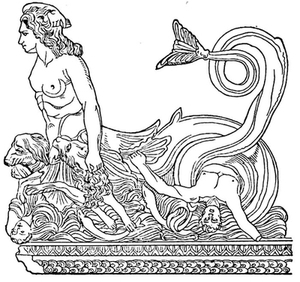
250. The Cyclopes Again. From hence Æneas coasted along
the shore of Sicily and passed the country of the Cyclopes. Here
they were hailed from the shore by a miserable object, whom by his
garments tattered, as they were, they perceived to be a Greek.
He told them he was one of Ulysses' companions, left behind
by that chief in his hurried departure. He related the
story of Ulysses' adventure with Polyphemus, and besought them
to take him off with them, as he had no means of sustaining
his existence where he was, but wild berries and roots, and lived
in constant fear of the Cyclopes. While he spoke Polyphemus
made his appearance,—terrible, shapeless, vast, and, of course,
blind.[356] He walked with cautious steps, feeling his way with a
staff, down to the seaside, to wash his eye-socket in the waves.
When he reached the water he waded out towards them, and his
immense height enabled him to advance far into the sea, so that
the Trojans in terror took to their oars to get out of his way.
Hearing the oars, Polyphemus shouted after them so that the
shores resounded, and at the noise the other Cyclopes came forth
from their caves and woods, and lined the shore, like a row of
lofty pine trees. The Trojans plied their oars and soon left them
out of sight.
Æneas had been cautioned by Helenus to avoid the strait guarded
by the monsters Scylla and Charybdis. There Ulysses, the reader
will remember, had lost six of his men, seized by Scylla while the
navigators were wholly intent upon avoiding Charybdis. Æneas,
following the advice of Helenus, shunned the dangerous pass and
coasted along the island of Sicily.
251. The Resentment of Juno. Now Juno, seeing the Trojans
speeding their way prosperously towards their destined shore, felt
her old grudge against them revive, for she could not forget the
slight that Paris had put upon her in awarding the prize of beauty
to another. In heavenly minds can such resentment dwell![357]
Accordingly she gave orders to Æolus, who sent forth his sons,
Boreas, Typhon, and the other winds, to toss the ocean. A terrible
storm ensued, and the Trojan ships were driven out of their course
towards the coast of Africa. They were in imminent danger of
being wrecked, and were separated, so that Æneas thought that
all were lost except his own vessel.
At this crisis, Neptune, hearing the storm raging, and knowing
that he had given no orders for one, raised his head above the
waves and saw the fleet of Æneas driving before the gale. Understanding
the hostility of Juno, he was at no loss to account for it,
but his anger was not the less at this interference in his province.
He called the winds and dismissed them with a severe reprimand.
He then soothed the waves, and brushed away the clouds from
before the face of the sun. Some of the ships which had got on
the rocks he pried off with his own trident, while Triton and a
sea-nymph, putting their shoulders under others, set them afloat
again. The Trojans, when the sea became calm, sought the nearest
shore,—the coast of Carthage, where Æneas was so happy as
to find that one by one the ships all arrived safe, though badly
shaken.
252. The Sojourn at Carthage. Dido. Carthage, where the
exiles had now arrived, was a spot on the coast of Africa opposite
Sicily, where at that time a Tyrian colony under Dido, their queen,
were laying the foundations of a state destined in later ages to be
the rival of Rome itself. Dido was the daughter of Belus, king of
Tyre, and sister of Pygmalion, who succeeded his father on the
throne. Her husband was Sichæus, a man of immense wealth,
but Pygmalion, who coveted his treasures, caused him to be put to
death. Dido, with a numerous body of friends and followers, both
men and women, succeeded in effecting their escape from Tyre, in
several vessels, carrying with them the treasures of Sichæus. On
arriving at the spot which they selected as the seat of their future
home, they asked of the natives only so much land as they could
inclose with a bull's hide. When this was readily granted, the
queen caused the hide to be cut into strips, and with them inclosed
a spot on which she built a citadel, and called it Byrsa
(a hide). Around this fort the city of Carthage rose, and soon
became a powerful and flourishing place.
Such was the state of affairs when Æneas with his Trojans arrived
there. Dido received the illustrious exiles with friendliness
and hospitality. "Not unacquainted with distress," she said, "I
have learned to succor the unfortunate."[358] The queen's hospitality
displayed itself in festivities at which games of strength and skill
were exhibited. The strangers contended for the palm with her
own subjects on equal terms, the queen declaring that whether
the victor were "Trojan or Tyrian should make no difference to
her."[359] At the feast which followed the games, Æneas gave at her
request a recital of the closing events of the Trojan history and his
own adventures after the fall of the city. Dido was charmed with
his discourse and filled with admiration of his exploits. She conceived
an ardent passion for him, and he for his part seemed well
content to accept the fortunate chance which appeared to offer
him at once a happy termination of his wanderings, a home, a
kingdom, and a bride. Months rolled away in the enjoyment of
pleasant intercourse, and it seemed as if Italy and the empire
destined to be founded on its shores were alike forgotten. Seeing
which, Jupiter dispatched Mercury with a message to Æneas
recalling him to a sense of his high destiny, and commanding him
to resume his voyage.
Æneas parted from Dido, though she tried every allurement and
persuasion to detain him. The blow to her affection and her pride
was too much for her to endure, and when she found that he was
gone, she mounted a funeral pile which she had caused to be prepared,
and having stabbed herself was consumed with the pile.
The flames rising over the city were seen by the departing Trojans,
and, though the cause was unknown, gave to Æneas some
intimation of the fatal event.
253. Palinurus. Italy at Last. After touching at the island
of Sicily, where Acestes, a prince of Trojan lineage, bore sway,
and gave them a hospitable reception, the Trojans reëmbarked
and held on their course for Italy. Venus now interceded with
Neptune to allow her son at last to attain the wished-for goal and
find an end of his perils on the deep. Neptune consented, stipulating
only for one life as a ransom for the rest. The victim was
Palinurus, the pilot. As he sat watching the stars with his hand
on the helm, Somnus, sent by Neptune, approached in the guise of
Phorbas, and said, "Palinurus, the breeze is fair, the water smooth,
and the ship sails steadily on her course. Lie down awhile and
take needful rest. I will stand at the helm in thy place." Palinurus
replied, "Tell me not of smooth seas or favoring winds,—me who
have seen so much of their treachery. Shall I trust Æneas to
the chances of the weather and the winds?" And he continued
to grasp the helm and to keep his eyes fixed on the stars. But
Somnus waved over him a branch moistened with Lethæan dew,
and his eyes closed in spite of all his efforts. Then Somnus pushed
him overboard, and he fell; but as he kept his hold upon the helm,
it came away with him. Neptune was mindful of his promise, and
held the ship on her track without helm or pilot till Æneas discovered
his loss and, sorrowing deeply for his faithful steersman,
took charge of the ship himself. Under his guidance the ships
at last reached the shores of Italy, and joyfully the adventurers
leaped to land.
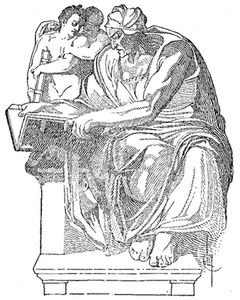
Fig. 183. The Cumæan Sibyl
From the painting by Michelangelo
254. The Sibyl of Cumæ. While his people were employed in
making their encampment, Æneas sought the abode of the Sibyl.
It was a cave connected with a temple and grove, sacred to Apollo
and Diana. While Æneas contemplated the scene, the Sibyl accosted
him. She seemed to know his errand, and, under the influence
of the deity of the place, burst forth in a prophetic strain,
giving dark intimations of labors and perils through which he was
destined to make his way to final success. She closed with the encouraging
words which
have become proverbial:
"Yield not to
disasters, but press
onward the more
bravely."[360] Æneas replied
that he had
prepared himself for
whatever might await
him. He had but one
request to make. Having
been directed in
a dream to seek the
abode of the dead in
order to confer with
his father Anchises to
receive from him a
revelation of his future
fortunes and those of
his race, he asked her
assistance to enable
him to accomplish the
task. The Sibyl replied:
"The descent to Avernus is easy; the gate of Pluto stands
open night and day; but to retrace one's steps and return to the
upper air, that is the toil, that the difficulty."[361] She instructed him
to seek in the forest a tree on which grew a golden branch. This
branch was to be plucked off and borne as a gift to Proserpine,
and if fate was propitious, it would yield to the hand and quit its
parent trunk, but otherwise no force could rend it away. If torn
away, another would succeed.
Æneas followed the directions of the Sibyl. His mother, Venus,
sent two of her doves to fly before him and show him the way,
and by their assistance he found the tree, plucked the branch,
and hastened back with it to the Sibyl.
255. The Infernal Regions. The region where Virgil locates
the entrance to the infernal regions is, perhaps, the most strikingly
adapted to excite ideas of the terrific and preternatural of any on
the face of the earth. It is the volcanic region near Vesuvius,
where the whole country is cleft with chasms from which sulphurous
flames arise, while the ground is shaken with pent-up vapors,
and mysterious sounds issue from the bowels of the earth. The
lake Avernus is supposed to fill the crater of an extinct volcano.
It is circular, half a mile wide and very deep, surrounded by high
banks, which in Virgil's time were covered with a gloomy forest.
Mephitic vapors rise from its waters, so that no life is found on
its banks, and no birds fly over it. Here Æneas offered sacrifices
to the infernal deities, Proserpine, Hecate, and the Furies. Then
a roaring was heard in the earth, the woods on the hilltops were
shaken, and the howling of dogs announced the approach of the
deities. "Now," said the Sibyl, "summon thy courage, for thou
shalt need it." She descended into the cave of Avernus, and
Æneas followed. Before the threshold of hell they passed through
a group of beings who are enumerated as Griefs and avenging
Cares, pale Diseases, and melancholy Age, Fear and Hunger that
tempt to crime, Toil, Poverty, and Death,—forms horrible to view.
The Furies spread their couches there, and Discord, whose hair
was of vipers tied up with a bloody fillet. Here also were the
monsters, Briareus, with his hundred arms, Hydras hissing, and
Chimæras breathing fire. Æneas shuddered at the sight, drew his
sword and would have struck, but the Sibyl restrained him. They
then came to the black river Cocytus, where they found the ferryman
Charon, old and squalid, but strong and vigorous, who was
receiving passengers of all kinds into his boat, stout-hearted heroes,
boys and unmarried girls, as numerous as the leaves that fall at
autumn or the flocks that fly southward at the approach of winter.
They stood pressing for a passage and longing to touch the opposite
shore. But the stern ferryman took in only such as he chose,
driving the rest back. Æneas, wondering at the sight, asked the
Sibyl, "Why this discrimination?" She answered, "Those who
are taken on board the bark are the souls of those who have received
due burial rites; the host of others who have remained unburied
are not permitted to pass the flood, but wander a hundred
years, and flit to and fro about the shore, till at last they are taken
over." Æneas grieved at recollecting some of his own companions
who had perished in the storm. At that moment he beheld
Palinurus, his pilot, who fell overboard and was drowned. He addressed
him and asked him the cause of his misfortune. Palinurus
replied that the rudder was carried away, and he, clinging to it, was
swept away with it. He besought Æneas most urgently to extend
to him his hand and take him in company to the opposite shore.
The Sibyl rebuked him for the wish thus to transgress the laws
of Pluto, but consoled him by informing him that the people of
the shore where his body had been wafted by the waves should
be stirred up by prodigies to give it due burial, and that the promontory
should bear the name of Cape Palinurus,—and so it does
to this day. Leaving Palinurus consoled by these words, they approached
the boat. Charon, fixing his eyes sternly upon the advancing
warrior, demanded by what right he, living and armed,
approached that shore. To which the Sibyl replied that they would
commit no violence, that Æneas' only object was to see his father,
and finally exhibited the golden branch, at sight of which Charon's
wrath relaxed, and he made haste to turn his bark to the shore
and receive them on board. The boat, adapted only to the light
freight of bodiless spirits, groaned under the weight of the hero.
They were soon conveyed to the opposite shore. There they were
encountered by the three-headed dog Cerberus, with his necks
bristling with snakes. He barked with all three throats till the
Sibyl threw him a medicated cake, which he eagerly devoured, and
then stretched himself out in his den and fell asleep. Æneas and
the Sibyl sprang to land. The first sound that struck their ears
was the wailing of young children who had died on the threshold
of life; and near to these were those who had perished under false
charges. Minos presides over them as judge and examines the
deeds of each. The next class was of those who had died by their
own hand, hating life and seeking refuge in death. How willingly
would they now endure poverty, labor, and any other infliction
if they might but return to life! Next were situated the regions
of sadness, divided off into retired paths, leading through groves
of myrtle. Here roamed those who had fallen victims to unrequited
love, not freed from pain even by death itself. Among these
Æneas thought he descried the form of Dido, with a wound still
recent. In the dim light he was for a moment uncertain, but
approaching, perceived it was indeed she. Tears fell from his
eyes, and he addressed her in the accents of love. "Unhappy
Dido! was then the rumor true that thou hadst perished? And
was I, alas! the cause? I call the gods to witness that my departure
from thee was reluctant and in obedience to the commands
of Jove; nor could I believe that my absence would have cost thee
so dear. Stop, I beseech thee, and refuse me not a last farewell."
She stood for a moment with averted countenance and eyes fixed
on the ground, and then silently passed on, as insensible to his
pleadings as a rock. Æneas followed for some distance, then
with a heavy heart rejoined his companion and resumed his route.
They next entered the fields where roam the heroes who have
fallen in battle. Here they saw many shades of Grecian and Trojan
warriors. The Trojans thronged around him and could not
be satisfied with the sight. They asked the cause of his coming
and plied him with innumerable questions. But the Greeks, at the
sight of his armor glittering through the murky atmosphere, recognized
the hero, and, filled with terror, turned their backs and fled,
as they used to do on the plains of Troy.
Æneas would have lingered long with his Trojan friends, but
the Sibyl hurried him away. They next came to a place where the
road divided, the one way leading to Elysium, the other to the
regions of the condemned. Æneas beheld on one side the walls
of a mighty city, around which Phlegethon rolled its fiery waters.
Before him was the gate of adamant that neither gods nor men
can break through. An iron tower stood by the gate, on which
Tisiphone, the avenging Fury, kept guard. From the city were
heard groans, and the sound of the scourge, the creaking of iron,
and the clanking of chains. Æneas, horror-stricken, inquired of
his guide what crimes were those whose punishments produced
the sounds he heard. The Sibyl answered, "Here is the judgment
hall of Rhadamanthus, who brings to light crimes done in life
which the perpetrator vainly thought impenetrably hid. Tisiphone
applies her whip of scorpions and delivers the offender over to
her sister Furies." At this moment with horrid clang the brazen
gates unfolded, and within, Æneas saw a Hydra with fifty heads
guarding the entrance. The Sibyl told him that the gulf of Tartarus
descended deep, so that its recesses were as far beneath their
feet as heaven was high above their heads. In the bottom of this
pit the Titan race, who warred against the gods, lie prostrate;
Salmoneus also, who presumed to vie with Jupiter, and built a
bridge of brass over which he drove his chariot that the sound
might resemble thunder, launching flaming brands at his people
in imitation of lightning, till Jupiter struck him with a real thunderbolt
and taught him the difference between mortal weapons and
divine. Here also is Tityus, the giant, whose form is so immense
that, as he lies, he stretches over nine acres, while a vulture preys
upon his liver, which as fast as it is devoured grows again, so that
his punishment will have no end.
Æneas saw groups seated at tables loaded with dainties, while
near by stood a Fury who snatched away the viands from their lips
as fast as they prepared to taste them. Others beheld suspended
over their heads huge rocks, threatening to fall, keeping them in
a state of constant alarm. These were they who had hated their
brothers, or struck their parents, or defrauded the friends who
trusted them, or who, having grown rich, kept their money to
themselves and gave no share to others,—the last being the most
numerous class. Here also were those who had violated the marriage
vow, or fought in a bad cause, or failed in fidelity to their
employers. Here was one who had sold his country for gold,
another who perverted the laws, making them say one thing to-day
and another to-morrow.
Ixion was there, fastened to the circumference of a wheel ceaselessly
revolving; and Sisyphus, whose task was to roll a huge stone
up to a hilltop; but when the steep was well-nigh gained, the rock,
repulsed by some sudden force, rushed again headlong down to
the plain. Again he toiled at it, while the sweat bathed all his
weary limbs, but all to no effect. There was Tantalus, who stood
in a pool his chin level with the water, yet he was parched with
thirst and found nothing to assuage it; for when he bowed his
hoary head, eager to quaff, the water fled away, leaving the ground
at his feet all dry. Tall trees, laden with fruit, stooped their heads
to him,—pears, pomegranates, apples, and luscious figs; but when,
with a sudden grasp, he tried to seize them, winds whirled them
high above his reach.
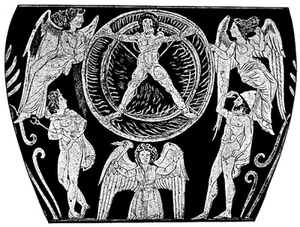
Fig. 184. Ixion on the Wheel
256. The Elysian Fields. The Sibyl now warned Æneas that
it was time to turn from these melancholy regions and seek the
city of the blessed. They passed through a middle tract of darkness
and came upon the Elysian Fields, the groves where the happy
reside. They breathed a freer air and saw all objects clothed in a
purple light. The region had a sun and stars of its own. The
inhabitants were enjoying themselves in various ways, some in
sports on the grassy turf, in games of strength or skill, others
dancing or singing. Orpheus struck the chords of his lyre and
called forth ravishing sounds. Here Æneas saw the founders of
the Trojan state, great-hearted heroes who lived in happier times.
He gazed with admiration on the war chariots and glittering arms
now reposing in disuse. Spears stood fixed in the ground, and the
horses, unharnessed, roamed over the plain. The same pride in
splendid armor and generous steeds which the old heroes felt in
life accompanied them here. He saw another group feasting and
listening to the strains of music. They were in a laurel grove,
whence the great river Po has its origin and flows out among
men. Here dwelt those who fell by wounds received in their
country's cause, holy priests also, and poets who have uttered
thoughts worthy of Apollo, and others who have contributed to
cheer and adorn life by their discoveries in the useful arts, and
have made their memory blessed by rendering service to mankind.
They wore snow-white fillets about their brows. The Sibyl addressed
a group of these and inquired where Anchises was to be
found. They were directed where to seek him, and soon found
him in a verdant valley, where he was contemplating the ranks
of his posterity, their destinies and worthy deeds to be achieved
in coming times. When he recognized Æneas approaching, he
stretched out both hands to him, while tears flowed freely. "Dost
thou come at last," said he, "long expected, and do I behold thee
after such perils past? O my son, how have I trembled for thee,
as I have watched thy course!" To which Æneas replied, "O
father! thy image was always before me to guide and guard me."
Then he endeavored to infold his father in his embrace, but his
arms inclosed only an unsubstantial shade.
257. The Valley of Oblivion. Æneas perceived before him a
spacious valley, with trees gently waving to the wind, a tranquil
landscape, through which the river Lethe flowed. Along the banks
of the stream wandered a countless multitude, numerous as insects
in the summer air. Æneas, with surprise, inquired who were these.
Anchises answered: "They are souls to which bodies are to be
given in due time. Meanwhile they dwell on Lethe's bank and
drink oblivion of their former lives." "O father!" said Æneas, "is
it possible that any can be so in love with life as to wish to leave
these tranquil seats for the upper world?" Anchises replied by
explaining the plan of creation. The Creator, he told him, originally
made the material of which souls are composed, of the four
elements, fire, air, earth, and water, all which when united took
the form of the most excellent part, fire, and became flame. This
material was scattered like seed among the heavenly bodies, the
sun, moon, and stars. Of this seed the inferior gods created man
and all other animals, mingling it with various proportions of earth,
by which its purity was alloyed and reduced. Thus the more earth
predominates in the composition, the less pure is the individual;
and we see that men and women with their full-grown bodies have
not the purity of childhood. So in proportion to the time which
the union of body and soul has lasted, is the impurity contracted
by the spiritual part. This impurity must be purged away after
death, which is done by ventilating the souls in the current of
winds, or merging them in water, or burning out their impurities
by fire. Some few, of whom Anchises intimates that he is one,
are admitted at once to Elysium, there to remain. But the rest,
after the impurities of earth are purged away, are sent back to life
endowed with new bodies, having had the remembrance of their
former lives effectually washed away by the waters of Lethe. Some
souls, however, there still are, so thoroughly corrupted that they
are not fit to be intrusted with human bodies, and these pass by
metempsychosis into the bodies of brute animals.
Anchises, having explained so much, proceeded to point out to
Æneas individuals of his race who were hereafter to be born, and
to relate to him the exploits they should perform in the world.
After this he reverted to the present, and told his son of the
events that remained to him to be accomplished before the complete
establishment of himself and his followers in Italy. Wars
were to be waged, battles fought, a bride to be won, and, in the
result, a Trojan state founded, from which should rise the Roman
power, to be in time the sovereign of the world.
As Æneas and the Sibyl pursued their way back to earth, he
said to her: "Whether thou be a goddess or a mortal beloved by
the gods, by me thou shalt always be held in reverence. When I
reach the upper air, I will cause a temple to be built to thy honor,
and will myself bring offerings." "I am no goddess," said the
Sibyl; "I have no claims to sacrifice or offering. I am mortal,
yet, could I but have accepted the love of Apollo, I might have
been immortal. He promised me the fulfillment of my wish, if I
would consent to be his. I took a handful of sand and, holding it
forth, said, 'Grant me to see as many birthdays as there are sand-grains
in my hand.' Unluckily I forgot to ask for enduring youth.
This also he would have granted could I have accepted his love,
but, offended at my refusal, he allowed me to grow old. My youth
and youthful strength fled long ago. I have lived seven hundred
years, and to equal the number of the sand-grains I have still to
see three hundred springs and three hundred harvests. My body
shrinks up as years increase, and in time I shall be lost to sight,
but my voice will remain, and future ages will respect my sayings."
These concluding words of the Sibyl alluded to her prophetic
power. In her cave she was accustomed to inscribe on leaves
gathered from the trees the names and fates of individuals. The
leaves thus inscribed were arranged in order within the cave, and
might be consulted by her votaries. But if, perchance, at the
opening of the door the wind rushed in and dispersed the leaves,
the Sibyl gave no aid to restoring them again, and the oracle was
irreparably lost.
258. The Fulfillment of Prophecy. Æneas, having parted from
the Sibyl and rejoined his fleet, coasted along the shores of Italy
and cast anchor in the mouth of the Tiber. The poet, having
brought his hero to this spot, the destined termination of his wanderings,
invokes his Muse to tell him the situation of things at
that eventful moment. Latinus, third in descent from Saturn, ruled
the country. He was now old and had no male descendant, but
had one charming daughter, Lavinia, who was sought in marriage
by many neighboring chiefs, one of whom, Turnus, king of the
Rutulians, was favored by the wishes of her parents. But Latinus
had been warned in a dream by his father, Faunus, that the destined
husband of Lavinia should come from a foreign land. From that
union should spring a race destined to subdue the world.
Our readers will remember that in the conflict with the harpies,
one of those half-human birds had threatened the Trojans with
dire sufferings. In particular, she predicted that before their wanderings
ceased they should be pressed by hunger to devour their
tables. This portent now came true; for as they took their scanty
meal, seated on the grass, the men placed their hard biscuit on
their laps and put thereon whatever their gleanings in the woods
supplied. Having dispatched the latter, they finished by eating the
crusts. Seeing which, the boy Iulus said playfully, "See! we are
eating our tables." Æneas caught the words and accepted the
omen. "All hail, promised land!" he exclaimed, "this is our
home, this our country!" He then took measures to find out who
were the present inhabitants of the land and who their rulers. A
hundred chosen men were sent to the village of Latinus, bearing
presents and a request for friendship and alliance. They went and
were favorably received. Latinus immediately concluded that the
Trojan hero was no other than the promised son-in-law announced
by the oracle. He cheerfully granted his alliance, and sent back
the messengers mounted on steeds from his stables and loaded
with gifts and friendly messages.
Juno, seeing things go thus prosperously for the Trojans, felt
her old animosity revive, summoned Alecto from Erebus, and sent
her to stir up discord. The Fury first took possession of the queen,
Amata, and roused her to oppose in every way the new alliance.
Alecto then sped to the city of Turnus and, assuming the form of
an old priestess, informed him of the arrival of the foreigners and
of the attempts of their prince to rob him of his betrothed. Next she
turned her attention to the camp of the Trojans. There she saw
the boy Iulus and his companions amusing themselves with hunting.
She sharpened the scent of the dogs and led them to rouse
up from the thicket a tame stag, the favorite of Silvia, the daughter
of Tyrrheus, the king's herdsman. A javelin from the hand of
Iulus wounded the animal, which had only strength left to run homeward
and die at its mistress's feet. Her cries and tears roused her
brothers and the herdsmen, and they, seizing whatever weapons
came to hand, furiously assaulted the hunting party. These were
protected by their friends, and the herdsmen were finally driven
back with the loss of two of their number.
These things were enough to rouse the storm of war, and the
queen, Turnus, and the peasants all urged the old king to drive
the strangers from the country. He resisted as long as he could,
but, finding his opposition unavailing, finally gave way and retreated
to his retirement.
259. The Gates of Janus Opened. It was the custom of the
country, when war was to be undertaken, for the chief magistrate,
clad in his robes of office, with solemn pomp to open the gates of
the temple of Janus, which were kept shut as long as peace endured.
His people now urged the old king to perform that solemn
office, but he refused to do so. While they contested, Juno herself,
descending from the skies, smote the doors with irresistible force
and burst them open. Immediately the whole country was in a
flame. The people rushed from every side, breathing nothing
but war.
Turnus was recognized by all as leader; others joined as allies,
chief of whom was Mezentius, a brave and able soldier, but of detestable
cruelty. He had been the chief of one of the neighboring
cities, but his people drove him out. With him was joined his son
Lausus, a generous youth worthy of a better sire.
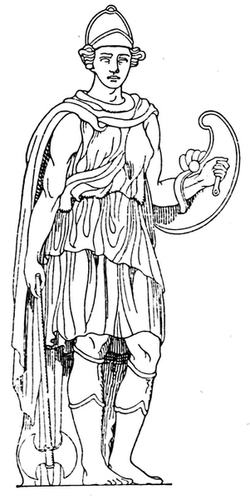
260. Camilla. Camilla, the favorite of Diana, a huntress and
warrior after the fashion of the Amazons, came with her band of
mounted followers, including a select number of her own sex, and
ranged herself on the side of Turnus. This maiden had never
accustomed her fingers to the distaff or the
loom, but had learned to endure the toils of
war and in speed to outstrip the wind. It
seemed as if she might run over the standing
corn without crushing it, or over the surface
of the water without dipping her feet.
Camilla's history had been singular from the
beginning. Her father, Metabus, driven from
his city by civil discord, carried with him in
his flight his infant daughter. As he fled
through the woods, his enemies in hot pursuit,
he reached the bank of the river Amasenus,
which, swelled by rains, seemed to debar
a passage. He paused for a moment, then
decided what to do. He tied the infant to his
lance with wrappers of bark, and poising the
weapon in his upraised hand, thus addressed
Diana: "Goddess of the woods! I consecrate this maid to thee";
then hurled the weapon with its burden to the opposite bank. The
spear flew across the roaring water. His pursuers were already
upon him, but he plunged into the river, and swam across, and
found the spear with the infant safe on the other side. Thenceforth
he lived among the shepherds and brought up his daughter
in woodland arts. While a child she was taught to use the bow
and throw the javelin. With her sling she could bring down the
crane or the wild swan. Her dress was a tiger's skin. Many
mothers sought her for a daughter-in-law, but she continued faithful
to Diana and repelled the thought of marriage.
261. Alliance with Evander. Such were the formidable allies
that ranged themselves against Æneas. It was night, and he lay
stretched in sleep on the bank of the river under the open heavens.
The god of the stream, Father Tiber, seemed to raise his head
above the willows and to say: "O goddess-born, destined possessor
of the Latin realms, this is the promised land; here is to be thy
home, here shall terminate the hostility of the heavenly powers, if
only thou faithfully persevere. There are friends not far distant.
Prepare thy boats and row up my stream; I will lead thee to Evander,
the Arcadian chief. He has long been at strife with Turnus
and the Rutulians, and is prepared to become an ally of thine.
Rise! offer thy vows to Juno and deprecate her anger. When thou
hast achieved thy victory, then think of me." Æneas woke and paid
immediate obedience to the friendly vision. He sacrificed to Juno,
and invoked the god of the river and all his tributary fountains to
lend their aid. Then for the first time a vessel filled with armed
warriors floated on the stream of the Tiber. The river smoothed
its waves and bade its current flow gently, while, impelled by the
vigorous strokes of the rowers, the vessel shot rapidly up the stream.
About the middle of the day they came in sight of the scattered
buildings of the infant town where in after times the proud city of
Rome grew, whose glory reached the skies. By chance the old king,
Evander, was that day celebrating annual solemnities in honor of
Hercules and all the gods. Pallas, his son, and all the chiefs of
the little commonwealth stood by. When they saw the tall ship
gliding onward through the wood, they were alarmed at the sight
and rose from the tables. But Pallas forbade the solemnities to be
interrupted and, seizing a weapon, stepped forward to the river's
bank. He called aloud, demanding who the strangers were and
what their object. Æneas, holding forth an olive branch, replied:
"We are Trojans, friends to you and enemies to the Rutulians.
We seek Evander and offer to join our arms with yours." Pallas,
in amaze at the sound of so great a name, invited them to land,
and when Æneas touched the shore, he seized his hand and held
it long in friendly grasp. Proceeding through the wood they joined
the king and his party, and were most favorably received. Seats
were provided for them at the tables, and the repast proceeded.
262. The Site of Future Rome. When the solemnities were
ended, all moved towards the city. The king, bending with age,
walked between his son and Æneas, taking the arm of one or the
other of them, and with much variety of pleasing talk shortening
the way. Æneas with delight looked and listened, observing all
the beauties of the scene and learning much of heroes renowned
in ancient times. Evander said: "These extensive groves were
once inhabited by fauns and nymphs, and a rude race of men who
sprang from the trees themselves and had neither laws nor social
culture. They knew not how to yoke the cattle, nor raise a harvest,
nor provide from present abundance for future want, but browsed
like beasts upon the leafy boughs or fed voraciously on their hunted
prey. Such were they when Saturn, expelled from Olympus by
his sons, came among them and drew together the fierce savages,
formed them into society, and gave them laws. Such peace and
plenty ensued that men ever since have called his reign the Golden
Age; but by degrees far other times succeeded, and the thirst of
gold and the thirst of blood prevailed. The land was a prey to successive
tyrants till fortune and resistless destiny brought me hither,
an exile from my native land, Arcadia."
Having thus said, he showed him the Tarpeian rock, and the
rude spot, then overgrown with bushes, where in after times the
Capitol was to rise in all its magnificence. He next pointed to
some dismantled walls and said, "Here stood Janiculum, built by
Janus, and there Saturnia, the town of Saturn." Such discourse
brought them to the cottage of Evander, whence they saw the lowing
herds roaming over the plain where soon should stand the
proud and stately Forum. They entered, and a couch, well stuffed
with leaves and covered with the skin of a Libyan bear, was spread
for Æneas.
Next morning, awakened by the dawn and the shrill song of birds
beneath the eaves of his low mansion, old Evander rose. Clad in a
tunic, and a panther's skin thrown over his shoulders, with sandals
on his feet and his good sword girded to his side, he went forth to
seek his guest. Two mastiffs followed him,—his whole retinue and
bodyguard. He found the hero attended by his faithful Achates,
and Pallas soon joining them, the old king spoke thus:
"Illustrious Trojan, it is but little we can do in so great a cause.
Our state is feeble, hemmed in on one side by the river, on the
other by the Rutulians. But I propose to ally thee with a people
numerous and rich, to whom fate has brought thee at the propitious
moment. The Etruscans hold the country beyond the river.
Mezentius was their king, a monster of cruelty, who invented unheard-of
torments to gratify his vengeance. He would fasten the
dead to the living, hand to hand and face to face, and leave the
wretched victims to die in that dreadful embrace. At length people
cast him out, him and his house. They burned his palace,
and slew his friends. He escaped and took refuge with Turnus,
who protects him with arms. The Etruscans demand that he shall
be given up to deserved punishment, and would ere now have attempted
to enforce their demand; but their priests restrain them,
telling them that it is the will of heaven that no native of the
land shall guide them to victory and that their destined leader
must come from across the sea. They have offered the crown to
me, but I am too old to undertake such great affairs, and my son is
native-born, which precludes him from the choice. Thou, equally
by birth and time of life and fame in arms pointed out by the
gods, hast but to appear to be hailed at once as their leader.
With thee I will join Pallas, my son, my only hope and comfort.
Under thee he shall learn the art of war and strive to emulate
thy great exploits."
Then the king ordered horses to be furnished for the Trojan
chiefs, and Æneas, with a chosen band of followers and Pallas
accompanying, mounted and took the way to the Etruscan city,[362]
having sent back the rest of his party in the ships. Æneas and
his band safely arrived at the Etruscan camp and were received
with open arms by Tarchon and his countrymen.
263. Turnus attacks the Trojan Camp. In the meanwhile Turnus
had collected his bands and made all necessary preparations
for the war. Juno sent Iris to him with a message inciting him to
take advantage of the absence of Æneas and surprise the Trojan
camp. Accordingly the attempt was made; but the Trojans were
found on their guard, and having received strict orders from Æneas
not to fight in his absence, they lay still in their intrenchments and
resisted all the efforts of the Rutulians to draw them into the field.
Night coming on, the army of Turnus, in high spirits at their
fancied superiority, feasted and enjoyed themselves, and finally
stretched themselves on the field and slept secure.
264. Nisus and Euryalus. In the camp of the Trojans things
were far otherwise. There all was watchfulness and anxiety, and
impatience for Æneas' return. Nisus stood guard at the entrance
of the camp, and Euryalus, a youth distinguished above all in the
army for graces of person and fine qualities, was with him. These
two were friends and brothers in arms. Nisus said to his friend:
"Dost thou perceive what confidence and carelessness the enemy
display? Their lights are few and dim, and the men seem all
oppressed with wine or sleep. Thou knowest how anxiously our
chiefs wish to send to Æneas and to get intelligence from him.
Now I am strongly moved to make my way through the enemy's
camp and to go in search of our chief. If I succeed, the glory
of the deed will be reward enough for me, and if they judge the
service deserves anything more, let them pay it thee."
Euryalus, all on fire with the love of adventure, replied: "Wouldst
thou then, Nisus, refuse to share thy enterprise with me? And
shall I let thee go into such danger alone? Not so my brave father
brought me up, nor so have I planned for myself when I joined
the standard of Æneas and resolved to hold my life cheap in comparison
with honor." Nisus replied: "I doubt it not, my friend;
but thou knowest the uncertain event of such an undertaking, and
whatever may happen to me, I wish thee to be safe. Thou art
younger than I and hast more of life in prospect. Nor can I be
the cause of such grief to thy mother, who has chosen to be here
in the camp with thee rather than stay and live in peace with the
other matrons in Acestes' city." Euryalus replied, "Say no more.
In vain dost thou seek arguments to dissuade me. I am fixed in
the resolution to go with thee. Let us lose no time." They called
the guard and, committing the watch to them, sought the general's
tent. They found the chief officers in consultation, deliberating
how they should send notice to Æneas of their situation. The
offer of the two friends was gladly accepted, themselves loaded
with praises and promised the most liberal rewards in case of
success. Iulus especially addressed Euryalus, assuring him of his
lasting friendship. Euryalus replied: "I have but one boon to ask.
My aged mother is with me in the camp. For me she left the
Trojan soil and would not stay behind with the other matrons at
the city of Acestes. I go now without taking leave of her. I could
not bear her tears nor set at naught her entreaties. But do thou, I
beseech thee, comfort her in her distress. Promise me that and
I shall go more boldly into whatever dangers may present themselves."
Iulus and the other chiefs were moved to tears and promised
to do all his request. "Thy mother shall be mine," said Iulus,
"and all that I have promised thee shall be made good to her, if
thou dost not return to receive it."
The two friends left the camp and plunged at once into the
midst of the enemy. They found no watch, no sentinels posted,
but, all about, the sleeping soldiers strewn on the grass and among
the wagons. The laws of war at that early day did not forbid a
brave man to slay a sleeping foe, and the two Trojans slew, as they
passed, such of the enemy as they could without exciting alarm.
In one tent Euryalus made prize of a helmet brilliant with gold
and plumes. They had passed through the enemy's ranks without
being discovered, but now suddenly appeared a troop directly in
front of them, which, under Volscens, their leader, were approaching
the camp. The glittering helmet of Euryalus caught their
attention, and Volscens hailed the two and demanded who and
whence they were. They made no answer, but plunged into the
wood. The horsemen scattered in all directions to intercept their
flight. Nisus had eluded pursuit and was out of danger, but, since
Euryalus was missing, he turned back to seek him. He again entered
the wood and soon came within sound of voices. Looking
through the thicket he saw the whole band surrounding Euryalus
with noisy questions. What should he do; how extricate the youth;
or would it be better to die with him?
Raising his eyes to the moon which now shone clear, he said,
"Goddess, favor my effort!" and, aiming his javelin at one of the
leaders of the troop, struck him in the back and stretched him
on the plain with a deathblow. In the midst of their amazement
another weapon flew, and another of the party fell dead. Volscens,
the leader, ignorant whence the darts came, rushed sword in hand
upon Euryalus. "Thou shalt pay the penalty of both," he said,
and would have plunged the sword into his bosom, when Nisus,
who from his concealment saw the peril of his friend, rushed forward
exclaiming, "'T was I! 't was I! Turn your swords against
me, Rutulians. I did it; he only followed me as a friend." While
he spoke the sword fell and pierced the comely bosom of Euryalus.
His head fell over on his shoulder, like a flower cut down by the
plow. Nisus rushed upon Volscens and plunged his sword into
his body, and was himself slain on the instant by numberless blows.
265. The Death of Mezentius. Æneas, with his Etrurian allies,
arrived on the scene of action in time to rescue his beleaguered
camp; and now the two armies being nearly equal in strength,
the war began in good earnest. We cannot find space for all the
details, but must simply record the fate of the principal characters.
The tyrant Mezentius, finding himself engaged against his revolted
subjects, raged like a wild beast. He slew all who dared withstand
him, and put the multitude to flight wherever he appeared. At
last he encountered Æneas, and the armies stood still to see the
issue. Mezentius threw his spear, which, striking Æneas' shield,
glanced off and hit Antores,—a Grecian by birth who had left
Argos, his native city, and followed Evander into Italy. The poet
says of him, with simple pathos which has made the words proverbial,
"He fell, unhappy, by a wound intended for another,
looked up to the skies, and, dying, remembered sweet Argos."[363]
Æneas now in turn hurled his lance. It pierced the shield of
Mezentius and wounded him in the thigh. Lausus, his son, could
not bear the sight, but rushed forward and interposed himself,
while the followers pressed round Mezentius and bore him away.
Æneas held his sword suspended over Lausus and delayed to
strike, but the furious youth pressed on, and he was compelled to
deal the fatal blow. Lausus fell, and Æneas bent over him in pity.
"Hapless youth," he said, "what can I do for thee worthy of thy
praise? Keep those arms in which thou gloriest, and fear not but
that thy body shall be restored to thy friends and have due funeral
honors." So saying, he called the timid followers and delivered
the body into their hands.
Mezentius meanwhile had been borne to the riverside, and had
washed his wound. Soon the news reached him of Lausus' death,
and rage and despair supplied the place of strength. He mounted
his horse and dashed into the thickest of the fight, seeking Æneas.
Having found him, he rode round him in a circle, throwing one
javelin after another, while Æneas stood fenced with his shield,
turning every way to meet them. At last after Mezentius had
three times made the circuit, Æneas threw his lance directly at
the horse's head. The animal fell with pierced temples, while a
shout from both armies rent the skies. Mezentius asked no mercy,
but only that his body might be spared the insults of his revolted
subjects and be buried in the same grave with his son. He received
the fatal stroke not unprepared, and poured out his life and
his blood together.
266. The Deaths of Pallas and Camilla. While these things
were doing in one part of the field, in another Turnus encountered
the youthful Pallas. The contest between champions so unequally
matched could not be doubtful. Pallas bore himself bravely, but
fell by the lance of Turnus. The victor almost relented when he saw
the brave youth lying dead at his feet, and spared to use the privilege
of a conqueror in despoiling him of his arms. The belt only,
adorned with studs and carvings of gold, he took and clasped round
his own body. The rest he remitted to the friends of the slain.
After the battle there was a cessation of arms for some days to
allow both armies to bury their dead. In this interval Æneas challenged
Turnus to decide the contest by single combat, but Turnus
evaded the challenge. Another battle ensued, in which Camilla,
the virgin warrior, was chiefly conspicuous. Her deeds of valor
surpassed those of the bravest warriors, and many Trojans and
Etruscans fell pierced with her darts or struck down by her battle-ax.
At last an Etruscan named Aruns, who had watched her
long, seeking for some advantage, observed her pursuing an enemy
whose splendid armor offered a tempting prize. Intent on the
chase she observed not her danger, and the javelin of Aruns struck
her and inflicted a fatal wound. She fell and breathed her last in
the arms of her attendant maidens. But Diana, who beheld her fate,
suffered not her slaughter to be unavenged. Aruns, as he stole
away glad but frightened, was struck by a secret arrow, launched
by one of the nymphs of Diana's train, and he died ignobly and
unknown.
267. The Final Conflict. At length the final conflict took place
between Æneas and Turnus. Turnus had avoided the contest as
long as he could; but at last, impelled by the ill success of his
arms and by the murmurs of his followers, he braced himself to
the conflict. The outcome could not be doubtful. On the side of
Æneas were the expressed decree of destiny, the aid of his goddess-mother
in every emergency, and impenetrable armor fabricated
by Vulcan, at her request, for her son. Turnus, on the other hand,
was deserted by his celestial allies, Juno having been expressly forbidden
by Jupiter to assist him any longer. Turnus threw his lance,
but it recoiled harmless from the shield of Æneas. The Trojan
hero then threw his, which, penetrating the shield of Turnus,
pierced his thigh. Then Turnus' fortitude forsook him, and he
begged for mercy; Æneas, indeed, would have spared his opponent's
life, but at the instant his eye fell on the belt of Pallas,
which Turnus had taken from the slaughtered youth. Instantly
his rage revived, and exclaiming, "Pallas immolates thee with this
blow," he thrust him through with his sword.
Here the poem of the Æneid closes, and we are left to infer
that Æneas, having triumphed over his foes, obtained Lavinia for
his bride. Tradition adds that he founded a city and called it
Lavinium, after her name. His son Iulus founded Alba Longa,
which became the birthplace of Romulus and Remus and the cradle
of Rome.
268. The Creation. According to the Eddas there was once no
heaven above nor earth beneath, but only a bottomless deep, Ginungagap,
and a world of mist, Niflheim, in which sprang a fountain.
Twelve rivers issued from this fountain, Vergelmir, and
when they had flowed far from their source, they froze into ice, and
one layer accumulating over another, the great deep was filled up.
Southward from the world of mist was the world of light, Muspelheim.
From this proceeded a warm wind upon the ice and
melted it. The vapors rose in the air and formed clouds, from
which sprang Ymir, the rime-cold giant and his progeny, and the
cow Audhumbla, whose milk afforded nourishment and food to
the giant. The cow got nourishment by licking the hoar frost and
salt from the ice. While she was one day licking the salt stones
there appeared at first the hair of some being, on the second day
his whole head, and on the third the entire form endowed with
beauty, agility, and power. This new being was a god, Bori, from
whom and his wife, a daughter of the giant race, sprang Bor, the
father of Odin, Vili, and Ve. These three slew the giant Ymir,
and out of his body formed the earth, of his blood the seas, of his
bones the mountains, of his hair the trees, of his skull the heavens,
and of his brain clouds, charged with hail and snow. Of Ymir's
eyebrows the gods built a fence around the Midgard or mid-earth
between Niflheim and Muspelheim, destined to become the abode
of man.
Odin then regulated the periods of day and night and the
seasons by placing in the heavens the sun and moon, and appointing
to them their respective courses. As soon as the sun began
to shed its rays upon the earth, it caused the vegetable world to
bud and sprout. Shortly after the gods (the Anse-race, Anses,
Æsir, or Asa-folk) had created the world, they walked by the side
of the sea, pleased with their new work, but found that it was still
incomplete, for it was without human beings. They therefore took
an ashen spar and made a man out of it; woman they made out
of a piece of elm; and they called the man Ask and the woman
Embla. Odin then gave them life and soul, Vili reason and motion,
and Ve bestowed upon them the senses, expressive features, and
speech. Midgard was given them as their residence, and they
became the progenitors of the human race.
269. Yggdrasil. The mighty ash tree, Yggdrasil, was supposed
to support the whole universe. It sprang from the body of Ymir,
and had three immense roots, extending one into Midgard (the
dwelling of mortals), another into Jötunheim (the abode of the
giants), and the third below Niflheim, into the region of Death.
By the side of each of these roots is a spring, from which it is
watered. The root that extends into Midgard is carefully tended
by the three Norns,—goddesses who are regarded as the dispensers
of fate. They are Urd (the past), Verdandi (the present),
Skuld (the future). The spring at the Jötunheim side is Mimir's
well, in which wisdom and wit lie hidden, but that below Niflheim
refreshes also the dark dragon of despair, Nidhogg (the back-biter),
which perpetually gnaws at the root. Four harts run across the
branches of the tree and nip the buds; they represent the four
winds. Under the tree lies Ymir, and when he tries to shake off its
weight the earth quakes. The boughs overshadow the earth, and
the top rises into Asgard in the zenith.
270. Odin and his Valhalla. To Asgard, the abode of the gods,
access is gained only by crossing the bridge, Bifrost (the rainbow).
Asgard—Gladsheim for the gods, Vingolf for the goddesses—consists
of golden and silver palaces; but the most beautiful of these
is Valhalla, the great hall of Odin. When seated on his throne he
overlooks heaven and earth. Beside him sits Frigga (or Fricka),
his wife, who knows all things. Upon his shoulders are the ravens,
Hugin and Munin,—Thought and Memory,—who fly every day
over the whole world, and on their return report to him what they
have seen and heard. At his feet lie his two wolves, Geri and
Freki, to whom Odin gives the meat that is set before him, for he
himself stands in no need of food. Mead is for him both food and
drink. He invented the Runic characters; the decrees of fate, inscribed
therein, it is the business of the Norns to engrave upon a
metal shield. From Odin's name, spelt Woden, as it sometimes
is, comes our English word, Wednesday.
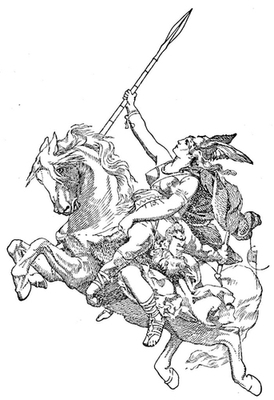
Fig. 186. Valkyrie bearing a Hero to Valhalla
From the painting by Dielitz
Odin is frequently called Alfadur (Allfather), but this name is
sometimes used in a way that shows that the Scandinavians had an
idea of a deity superior to Odin, uncreated and eternal. In Valhalla
Odin feasts with his chosen heroes, all those who have fallen bravely
in battle, for all who die a peaceful death are excluded. The flesh
of the boar Serimnir is served up to them and is abundant for all.
For although this boar is cooked every morning, he becomes whole
again every night. For drink the heroes are supplied abundantly
with mead from the she-goat Heidrun. When the heroes are not
feasting, they amuse themselves with fighting. Every day they ride
out into the court or field and fight until they cut each other in
pieces. This is their pastime; but when mealtime comes, they
recover from their wounds and return to feast in Valhalla.
271. The Valkyries. The Valkyries are warlike virgins, mounted
upon horses and armed with helmets, shields, and spears. Odin is
desirous of gathering many heroes in Valhalla that he may gloriously
meet the giants in the day of the final contest; he therefore
sends to every battle field for the bravest of those who shall be
slain. The Valkyries, Choosers of the Slain, are his messengers.
Later they are called his daughters. When they ride forth on
their errand, their armor sheds a weird flickering light over the
northern skies, making what men call the Aurora Borealis.[365]
272. Thor and the Other Gods. Of the following, Thor, Vidar,
Bragi, Balder, and Höder are sons of Odin. Thor, the thunderer,
Odin's eldest son, is the strongest of gods and men, and possesses
three precious things. The first is a hammer, which both the Frost
and the Mountain giants (Hrim-thursar and Berg-risar) know to
their cost, when they see it hurled against them in the air, for it
has split many a skull of their fathers and kindred. When thrown,
it returns to his hand of its own accord. The second rare thing
he possesses is the belt of strength. When he girds it about him
his divine might is doubled. The third is his iron gloves, which
he puts on whenever he would use his mallet efficiently. From
Thor's name is derived our word Thursday.
Vidar comes next in strength to Thor.
Bragi is the god of poetry, and his song records the deeds of
warriors. His wife, Iduna, keeps in a box the apples which the
gods, when they feel old age approaching, have only to taste of
to become young again.
Balder, dearest of the Anses, is the god of sunlight, spring, and
gladness. Höder, his opposite, is the blind god of winter.
Of other gods, Freyr presides over rain and sunshine and all the
fruits of the earth. His sister Freya (Freia) is the most propitious of
the goddesses. She loves music, spring, and flowers, and the fairies
of Elfheim. She is the goddess of love. Her day is Friday.
Tyr (Ziu or Tiw), from whose name is derived our Tuesday,
is the wrestler among the gods; and preëminently the "god of
battles."
Heimdall is the watchman of the gods, and is therefore placed
on the borders of heaven to prevent the giants from forcing their
way over the bridge Bifrost. He requires less sleep than a bird,
and sees by night as well as by day a hundred miles around him.
So acute is his ear that no sound escapes him, for he can even
hear the grass grow,—and the wool on a sheep's back.
273. Loki and his Progeny. Loki (or Loge) is described as the
calumniator of the gods and the contriver of all fraud and mischief.
He is the son of Farbauti, the Charon of Norse mythology. He is
handsome and well made, but of fickle mood and evil disposition.
Although of the demon race, he forced himself into the company
of the gods, and seemed to take pleasure in bringing them into
difficulties, and in extricating them out of the danger by his
cunning, wit, and skill. Loki has three children. The first is the
wolf Fenris, the second the Midgard Serpent, the third Hela
(Death). The gods were not ignorant that these monsters were
maturing and that they would one day bring much evil upon gods
and men. So Odin deemed it advisable to send one to bring them
to him. When they came he threw the serpent in that deep ocean
by which the earth is surrounded. But the monster has grown to
such an enormous size that, holding his tail in his mouth, he encircles
the whole earth. Hela he hurled below Niflheim and gave
her power over nine worlds or regions, in which she distributes
those who are sent to her,—that is, all who die of sickness or old
age. Her hall is called Eliudnir, or Sleet-den. Hunger is her table,
Starvation her knife, Delay her man, Slowness her maid, Pale Woe
her door, Stumbling-stone her threshold, Care her bed; and Falling-peril
forms the hangings of her apartments. She may easily
be recognized, for her body is half flesh color and half blue, and
she presents a stern and forbidding countenance.
The wolf Fenris gave the gods a great deal of trouble before
they succeeded in chaining him. He broke the strongest fetters
as if they were made of cobwebs. Finally the gods sent a messenger
to the mountain spirits, who made for them the chain
called Gleipnir. It is fashioned of six things,—the noise made
by the footfall of a cat, the beards of women, the roots of stones,
the breath of fishes, the nerves (sensibilities) of bears, and the
spittle of birds. When finished it was as smooth and soft as a
silken string. But when the gods asked the wolf to suffer himself
to be bound with this apparently slight ribbon, he suspected their
design, fearing that it was made by enchantment. He therefore
consented to be bound with it only upon condition that one of the
gods put his hand in his (Fenris') mouth as a pledge that the band
was to be removed again. Tyr alone had courage enough to do
this. But when the wolf found that he could not break his fetters
and that the gods would not release him, he bit off Tyr's hand.
Tyr, consequently, has ever since remained one-handed.
274. The Conflict with the Mountain Giants. When the gods
were constructing their abodes and had already finished Midgard
and Valhalla, a certain artificer came and offered to build them a
residence so well fortified that they should be perfectly safe from
the incursions of the Frost giants and the giants of the mountains.
But he demanded for his reward the goddess Freya, together with
the sun and moon. The gods yielded to the terms, provided that
the artificer would finish the whole work without any one's assistance,
and all within the space of one winter. But if anything
remained unfinished on the first day of summer, he should forfeit
the recompense agreed on. On being told these terms, the artificer
stipulated that he be allowed the use of his horse Svadilfari, and
this request, by the advice of Loki, was conceded. He accordingly
set to work on the first day of winter, and during the night let his
horse draw stone for the building. The enormous size of the stones
struck the gods with astonishment, and they saw clearly that the
horse did one half more of the toilsome work than his master.
Their bargain, however, had been concluded and confirmed by
solemn oaths, for without these precautions a giant would not have
thought himself safe among the gods,—still less, indeed, if Thor
should return from the expedition he had then undertaken against
the evil demons.
As the winter drew to a close the building was far advanced,
and the bulwarks were sufficiently high and massive to render the
place impregnable. In short, when it wanted but three days to
summer, the only part that remained to be finished was the gateway.
Then sat the gods on their seats of justice and entered into
consultation, inquiring of one another who among them could have
advised the rest to surrender Freya, or to plunge the heavens in
darkness by permitting the giant to carry away the sun and the
moon.
They all agreed that no one but Loki, the author of so many
evil deeds, could have given such counsel, and that he should
be put to a cruel death unless he contrived some way to prevent
the artificer from completing his task and obtaining the stipulated
recompense. They proceeded to lay hands on Loki, who in his
fright promised upon oath that, let it cost him what it might, he
would so manage matters that the man should lose his reward.
That night when the man went with Svadilfari for building-stone,
a mare suddenly ran out of a forest and began to neigh. The
horse thereat broke loose and ran after the mare into the forest,
obliging the man also to run after his horse; thus, therefore, between
one and another the whole night was lost, so that at dawn
the work had not made the usual progress. The man, seeing that
he must fail of completing his task, resumed his own gigantic
stature, and the gods now clearly perceived that it was in reality
a mountain giant who had come amongst them. Feeling no longer
bound by their oaths, they called on Thor, who immediately ran to
their assistance and, lifting up his mallet, paid the workman his
wages, not with the sun and moon, and not even by sending him
back to Jötunheim, for with the first blow he shattered the giant's
skull to pieces and hurled him headlong into Niflheim.
275. The Recovery of Thor's Hammer. Soon afterward it happened
that Thor's hammer fell into the possession of the giant
Thrym, who buried it eight fathoms deep under the rocks of
Jötunheim. Thor sent Loki to negotiate with Thrym, but he
could only prevail so far as to get the giant's promise to restore
the weapon if Freya would consent to be his bride. Loki returned
and reported the result of his mission, but the goddess of love was
horrified at the idea of bestowing her charms on the king of the
Frost giants. In this emergency Loki persuaded Thor to dress
himself in Freya's clothes and accompany him to Jötunheim.
Thrym received his veiled bride with due courtesy, but was greatly
surprised at seeing her eat for her supper eight salmon and a
full-grown ox besides other delicacies, washing the whole down with
three tuns of mead. Loki, however, assured him that she had not
tasted anything for eight long nights, so great was her desire to
see her lover, the renowned ruler of Jötunheim. Thrym had at
last the curiosity to peep under his bride's veil, but started back in
affright, and demanded why Freya's eyeballs glistened with fire.
Loki repeated the same excuse, and the giant was satisfied. He
ordered the hammer to be brought in and laid on the maiden's lap.
Thereupon Thor threw off his disguise, grasped his redoubted
weapon, and slaughtered Thrym and all his followers.
276. Thor's Visit to Jötunheim. One day Thor, with his servant
Thialfi and accompanied by Loki, set out for the giants'
country. Thialfi was of all men the swiftest of foot. He bore
Thor's wallet containing their provisions. When night came on
they found themselves in an immense forest, and searched on all
sides for a place where they might pass the night. At last they
came to a large hall, with an entrance that took the whole breadth
of one end of the building. Here they lay down to sleep, but
towards midnight were alarmed by an earthquake which shook the
whole edifice. Thor, rising up, called on his companions to seek
with him a place of safety. On the right they found an adjoining
chamber into which the others entered, but Thor remained at the
doorway with his mallet in his hand, prepared to defend himself
whatever might happen. A terrible groaning was heard during the
night, and at dawn of day Thor went out and found lying near
him a huge giant, still snoring in the way that had alarmed them.
For once Thor was afraid to use his mallet, and as the giant soon
waked up, Thor contented himself with simply asking his name.
"My name is Skrymir," said the giant, "but I need not ask
thy name, for I know that thou art the god Thor. But what has
become of my glove?" Thor then perceived that what they had
taken overnight for a hall was the giant's glove, and the chamber
where his two companions had sought refuge was the thumb.
Skrymir then proposed that they should travel in company, and
Thor consenting, they sat down to eat their breakfast. When
they had done, Skrymir packed all the provisions into one wallet,
threw it over his shoulder, and strode on before them, taking such
tremendous strides that they were hard put to it to keep up with
him. So they traveled the whole day, and at dusk Skrymir chose a
place for them to pass the night in under a large oak tree. Skrymir
then told them he would lie down to sleep. "But take ye the
wallet," he added, "and prepare your supper."
Skrymir soon fell asleep and began to snore strongly, but when
Thor tried to open the wallet, he found the giant had tied it up so
tight he could not untie a single knot. At last Thor became wroth,
and grasping his mallet with both hands, he struck a furious blow
on the giant's head. Skrymir, awakening, merely asked whether a
leaf had not fallen on his head, and whether they had supped and
were ready to go to sleep. Thor answered that they were just going
to sleep, and so saying went and laid himself down under another
tree. But sleep came not that night to Thor, and when Skrymir
snored again so loud that the forest reëchoed with the noise, he
arose, and, grasping his mallet, launched it with such force at the
giant's skull that it made a deep dint in it. Skrymir, awakening,
cried out: "What's the matter? Are there any birds perched on
this tree? I felt some moss from the branches fall on my head.
How fares it with thee, Thor?" But Thor went away hastily, saying
that he had just then awoke, and, that as it was only midnight,
there was still time for sleep. He, however, resolved that if he
had an opportunity of striking a third blow, it should settle all
matters between them. A little before daybreak he perceived that
Skrymir was again fast asleep, and again grasping his mallet, he
dashed it with such violence that it forced its way into the giant's
skull up to the handle. But Skrymir sat up, and, stroking his
cheek, said: "An acorn fell on my head. What! Art thou awake,
Thor? Methinks it is time for us to get up and dress ourselves;
but you have not now a long way before you to the city called
Utgard. I have heard you whispering to one another that I am
not a man of small dimensions, but if you come to Utgard, you
will see there many men much taller than I. Wherefore I advise
you, when you come there, not to make too much of yourselves;
for the followers of Utgard-Loki will not brook the boasting of
such little fellows as you are. You must take the road that leads
eastward; mine lies northward, so we must part here."
Hereupon he threw his wallet over his shoulders and turned
away from them into the forest, and Thor had no wish to stop
him or to ask for any more of his company.
Thor and his companions proceeded on their way, and towards
noon descried a city standing in the middle of a plain. It was so
lofty that they were obliged to bend their necks quite back on
their shoulders in order to see to the top of it. On arriving they
entered the city, and seeing a large palace before them with the
door wide open, they went in and found a number of men of
prodigious stature, sitting on benches in the hall. Going further,
they came before the king Utgard-Loki, whom they saluted with
great respect. The king, regarding them with a scornful smile,
said, "If I do not mistake me, that stripling yonder must be the
god Thor." Then addressing himself to Thor, he said: "Perhaps
thou mayst be more than thou appearest to be. What are the feats
that thou and thy fellows deem yourselves skilled in?—for no one
is permitted to remain here who does not, in some feat or other,
excel all other men."
"The feat that I know," said Loki, "is to eat quicker than any
one else, and in this I am ready to give a proof against any one
here who may choose to compete with me."
"That will indeed be a feat, if thou performest what thou promisest,"
said Utgard-Loki, "and it shall be tried forthwith."
He then ordered one of his men, who was sitting at the farther
end of the bench and whose name was Logi, to come forward and
try his skill with Loki. A trough filled with meat having been set
on the hall floor, Loki placed himself at one end and Logi at the
other, and each of them began to eat as fast as he could, until they
met in the middle of the trough. But it was found that Loki had
only eaten the flesh, while his adversary had devoured both flesh and
bone, and the trough to boot. All the company therefore adjudged
that Loki was vanquished.
Utgard-Loki then asked what feat the young man who accompanied
Thor could perform. Thialfi answered that he would run a
race with any one who might be matched against him. The king
observed that skill in running was something to boast of, but if the
youth would win the match, he must display great agility. He then
arose and went, with all who were present, to a plain where there
was good ground for running on, and calling a young man named
Hugi, bade him run a match with Thialfi. In the first course Hugi
so much outstripped his competitor that he turned back and met
him not far from the starting-place. Then they ran a second and
a third time, but Thialfi met with no better success.
Utgard-Loki then asked Thor in what feats he would choose
to give proofs of that prowess for which he was so famous. Thor
answered that he would try a drinking-match with any one. Utgard-Loki
bade his cupbearer bring the large horn which his followers
were obliged to empty when they had trespassed in any way against
the law of the feast. The cupbearer having presented it to Thor,
Utgard-Loki said, "Whoever is a good drinker will empty that
horn at a single draft, though most men make two of it; but the
most puny drinker can do it in three."
Thor looked at the horn, which seemed of no extraordinary size,
though somewhat long; however, as he was very thirsty, he set
it to his lips and, without drawing breath, pulled as long and as
deeply as he could, that he might not be obliged to make a second
draft of it; but when he set the horn down and looked in, he could
scarcely perceive that the liquor was diminished.
After taking breath, Thor went to it again with all his might,
but when he took the horn from his mouth, it seemed to him that
he had drank rather less than before, although the horn could now
be carried without spilling.
"How now, Thor," said Utgard-Loki, "thou must not spare thyself;
if thou meanest to drain the horn at the third draft, thou
must pull deeply; and I must needs say that thou wilt not be
called so mighty a man here as thou art at home if thou showest no
greater prowess in other feats than methinks will be shown in this."
Thor, full of wrath, again set the horn to his lips and did his
best to empty it; but on looking in found the liquor was only a
little lower, so he resolved to make no further attempt, but gave
back the horn to the cupbearer.
"I now see plainly," said Utgard-Loki, "that thou art not quite
so stout as we thought thee; but wilt thou try any other feat?—though
methinks thou art not likely to bear any prize away with
thee hence."
"What new trial hast thou to propose?" said Thor.
"We have a very trifling game here," answered Utgard-Loki,
"in which we exercise none but children. It consists in merely
lifting my cat from the ground; nor should I have dared to mention
such a feat to the great Thor if I had not already observed
that thou art by no means what we took thee for."
As he finished speaking a large gray cat sprang on the hall floor.
Thor put his hand under the cat's belly and did his utmost to raise
him from the floor, but the cat, bending his back, had, notwithstanding
all Thor's efforts, only one of his feet lifted up, seeing
which Thor made no further attempt.
"This trial has turned out," said Utgard-Loki, "just as I imagined
it would. The cat is large, but Thor is little in comparison to
our men."
"Little as ye call me," answered Thor, "let me see who among
you will come hither now that I am in wrath and wrestle with me."
"I see no one here," said Utgard-Loki, looking at the men
sitting on the benches, "who would not think it beneath him to
wrestle with thee; let somebody, however, call hither that old
crone, my nurse Elli, and let Thor wrestle with her if he will.
She has thrown to the ground many a man not less strong than
this Thor is."
A toothless old woman then entered the hall, and was told by
Utgard-Loki to take hold of Thor. The tale is shortly told. The
more Thor tightened his hold on the crone the firmer she stood.
At length, after a very violent struggle, Thor began to lose his
footing, and was finally brought down upon one knee. Utgard-Loki
then told them to desist, adding that Thor had now no
occasion to ask any one else in the hall to wrestle with him, and
it was also getting late; so he showed Thor and his companions
to their seats, and they passed the night there in good cheer.
The next morning, at break of day, Thor and his companions
dressed themselves and prepared for their departure. Utgard-Loki
ordered a table to be set for them, on which there was no lack of
victuals or drink. After the repast Utgard-Loki led them to the
gate of the city, and on parting asked Thor how he thought his
journey had turned out and whether he had met with any men
stronger than himself. Thor told him that he could not deny but that
he had brought great shame on himself. "And what grieves me
most," he added, "is that ye will call me a person of little worth."
"Nay," said Utgard-Loki, "it behooves me to tell thee the
truth, now thou art out of the city, which so long as I live and
have my way thou shalt never enter again. And, by my troth, had
I known beforehand that thou hadst so much strength in thee, and
wouldst have brought me so near to a great mishap I would not
have suffered thee to enter this time. Know then that I have all
along deceived thee by my illusions; first in the forest, where I
tied up the wallet with iron wire so that thou couldst not untie it.
After this thou gavest me three blows with thy mallet; the first,
though the least, would have ended my days had it fallen on me,
but I slipped aside and thy blows fell on the mountain, where thou
wilt find three glens, one of them remarkably deep. These are the
dints made by thy mallet. I have made use of similar illusions in
the contests ye have had with my followers. In the first, Loki, like
hunger itself, devoured all that was set before him, but Logi was
in reality nothing else than Fire, and therefore consumed not only
the meat but the trough which held it. Hugi, with whom Thialfi
contended in running, was Thought, and it was impossible for
Thialfi to keep pace with that. When thou, in thy turn, didst attempt
to empty the horn, thou didst perform, by my troth, a deed
so marvelous that had I not seen it myself I should never have
believed it. For one end of that horn reached the sea, which thou
wast not aware of, but when thou comest to the shore thou wilt
perceive how much the sea has sunk by thy drafts. Thou didst
perform a feat no less wonderful by lifting up the cat, and to tell
thee the truth, when we saw that one of his paws was off the floor,
we were all of us terror-stricken, for what thou tookest for a cat
was in reality the Midgard serpent that encompasseth the earth,
and he was so stretched by thee that he was barely long enough to
inclose it between his head and tail. Thy wrestling with Elli was
also a most astonishing feat, for there was never yet a man, nor
ever will be, whom Old Age, for such in fact was Elli, will not
sooner or later lay low. But now, as we are going to part, let me
tell thee that it will be better for both of us if thou never come
near me again, for shouldst thou do so, I shall again defend myself
by other illusions, so that thou wilt only lose thy labor and get no
fame from the contest with me."
On hearing these words Thor, in a rage, laid hold of his mallet
and would have launched it at him, but Utgard-Loki had disappeared,
and when Thor would have returned to the city to destroy
it, he found nothing around him but a verdant plain.
277. The Sword of Freyr. Freyr also possessed a wonderful
weapon, a sword which would of itself spread a field with carnage
whenever the owner desired it. Freyr parted with this sword, but
was less fortunate than Thor and never recovered it. It happened
in this way: Freyr once mounted Odin's throne, from whence one
can see over the whole universe, and looking round, saw far off in
the giant's kingdom a beautiful maid, at the sight of whom he was
struck with sudden sadness, insomuch that from that moment he
could neither sleep nor drink nor speak. At last Skirnir, his
messenger, drew his secret from him, and undertook to get him
the maiden for his bride, if he would give him his sword as a
reward. Freyr consented and gave him the sword, and Skirnir
set off on his journey and obtained the maiden's promise that
within nine nights she would come to a certain place and there
wed Freyr. Skirnir having reported the success of his errand,
Freyr exclaimed:
"Long is one night,
Long are two nights,
But how shall I hold out three?
Shorter hath seemed
A month to me oft
Than of this longing time the half."
So Freyr obtained Gerda, the most beautiful of all women, for
his wife, but he lost his sword.
278. The Death of Balder. Balder the Good, having been tormented
with terrible dreams indicating that his life was in peril,
told them to the assembled gods, who resolved to conjure all things
to avert from him the threatened danger. Then Frigga, the wife
of Odin, exacted an oath from fire and water, from iron and all
other metals, from stones, trees, diseases, beasts, birds, poisons,
and creeping things, that none of them would do any harm to
Balder. Odin, not satisfied with all this, and feeling alarmed for the
fate of his son, determined to consult the prophetess Angerbode, a
giantess, mother of Fenris, Hela, and the Midgard serpent. She
was dead, and Odin was forced to seek her in Hela's dominions.
But the other gods, feeling that what Frigga had done was quite
sufficient, amused themselves with using Balder as a mark, some
hurling darts at him, some stones, while others hewed at him with
their swords and battle-axes, for do what they would, none of them
could harm him. And this became a favorite pastime with them,
and was regarded as an honor shown to Balder. But when Loki
beheld the scene, he was sorely vexed that Balder was not hurt.
Assuming, therefore, the shape of a woman, he went to Fensalir,
the mansion of Frigga. That goddess, when she saw the pretended
woman, inquired of her if she knew what the gods were doing at
their meetings. She replied that they were throwing darts and
stones at Balder, without being able to hurt him. "Ay," said Frigga,
"neither stones, nor sticks, nor anything else can hurt Balder, for
I have exacted an oath from all of them." "What," exclaimed the
woman, "have all things sworn to spare Balder?" "All things,"
replied Frigga, "except one little shrub that grows on the eastern
side of Valhalla and is called Mistletoe, which I thought too young
and feeble to crave an oath from."
As soon as Loki heard this he went away and, resuming his
natural shape, cut off the mistletoe and repaired to the place where
the gods were assembled. There he found Höder standing apart,
without partaking of the sports on account of his blindness, and
going up to him said, "Why dost thou not also throw something
at Balder?"
"Because I am blind," answered Höder, "and see not where
Balder is, and have, moreover, nothing to throw."
"Come, then," said Loki, "do like the rest and show honor to
Balder by throwing this twig at him, and I will direct thy arm
toward the place where he stands."
Höder then took the mistletoe and, under the guidance of Loki,
darted it at Balder, who, pierced through and through, fell down
lifeless. Never was there witnessed, either among gods or men,
a more atrocious deed.
So on the floor lay Balder dead; and round[366]
Lay thickly strewn swords, axes, darts, and spears,
Which all the gods in sport had idly thrown
At Balder, whom no weapon pierced or clove;
But in his breast stood fixt the fatal bough
Of mistletoe, which Lok the accuser gave
To Höder, and unwitting Höder threw—
'Gainst that alone had Balder's life no charm.
And all the gods and all the heroes came,
And stood round Balder on the bloody floor,
Weeping and wailing; and Valhalla rang
Up to its golden roof with sobs and cries;
And on the tables stood the untasted meats,
And in the horns and gold-rimmed skulls the wine.
And now would night have fall'n and found them yet
Wailing; but otherwise was Odin's will.
He bade them not to spend themselves in unavailing grief, for
Balder, though the brightest god of heaven and best beloved, had
but met the doom ordained at his birth by the Norns. Rather let
the funeral pile be prepared, and let vengeance on Loki be left to
Odin himself. So speaking, Odin mounted his horse Sleipnir and
rode away to Lidskialf, and the gods in Valhalla returned to the
feast:
And before each the cooks, who served them, placed
New messes of the boar Serimnir's flesh,
And the Valkyries crowned their horns with mead.
So they, with pent-up hearts and tearless eyes,
Wailing no more, in silence ate and drank,
While twilight fell, and sacred night came on.
But the blind Höder, leaving the gods, went by the sea to Fensalir,
the house of Frigga, mother of the gods, to ask her what way
there might be of restoring Balder to life and heaven. Might Hela
perchance surrender Balder if Höder himself should take his place
among the shades? "Nay," replied Frigga, "no way is there but
one, that the first god thou meetest on the return to Asgard take
Sleipnir, Odin's horse, and ride o'er the bridge Bifrost where is
Heimdall's watch, past Midgard fortress, down the dark, unknown
road to Hel, and there entreat the goddess Hela that she yield
Balder back to heaven." Höder, returning cityward, met Hermod,
swiftest of the gods,—
Nor yet could Hermod see his brother's face,
For it grew dark; but Höder touched his arm.
And as a spray of honeysuckle flowers
Brushes across a tired traveler's face
Who shuffles through the deep dew-moisten'd dust
On a May evening, in the darken'd lanes,
And starts him, that he thinks a ghost went by,
So Höder brush'd by Hermod's side, and said:
"Take Sleipnir, Hermod, and set forth with dawn
To Hela's kingdom, to ask Balder back;
And they shall be thy guides who have the power."
He spake, and brush'd soft by and disappear'd.
And Hermod gazed into the night, and said:
"Who is it utters through the dark his hest
So quickly, and will wait for no reply?
The voice was like the unhappy Höder's voice.
Howbeit I will see, and do his hest;
For there rang note divine in that command."
So speaking, the fleet-footed Hermod came
Home, and lay down to sleep in his own house;
And all the gods lay down in their own homes.
And Höder, too, came home distraught with grief,
Loathing to meet, at dawn, the other gods;
And he went in, and shut the door, and fixt
His sword upright, and fell on it, and died.
But from the hill of Lidskialf Odin rose,
The throne, from which his eye surveys the world;
And mounted Sleipnir, and in darkness rode
To Asgard. And the stars came out in heaven,
High over Asgard, to light home the king.
But fiercely Odin gallop'd, moved in heart:
And swift to Asgard, to the gate he came,
And terribly the hoofs of Sleipnir rang
Along the flinty floor of Asgard streets,
And the gods trembled on their golden beds
Hearing the wrathful father coming home—
For dread, for like a whirlwind Odin came.
And to Valhalla's gate he rode, and left
Sleipnir; and Sleipnir went to his own stall,
And in Valhalla Odin laid him down.
That night in a vision appeared Balder to Nanna his wife,
comforting her:
"Yes, and I fain would altogether ward
Death from thy head, and with the gods in heaven
Prolong thy life, though not by thee desired—
But right bars this, not only thy desire.
Yet dreary, Nanna, is the life they lead
In that dim world, in Hela's moldering realm;
And doleful are the ghosts, the troops of dead,
Whom Hela with austere control presides.
For of the race of gods is no one there
Save me alone, and Hela, solemn queen;
For all the nobler souls of mortal men
On battle field have met their death, and now
Feast in Valhalla, in my father's hall;
Only the inglorious sort are there below—
The old, the cowards, and the weak are there,
Men spent by sickness, or obscure decay.
But even there, O Nanna, we might find
Some solace in each other's look and speech,
Wandering together through that gloomy world,
And talking of the life we led in heaven,
While we yet lived, among the other gods."
He spake, and straight his lineaments began
To fade; and Nanna in her sleep stretch'd out
Her arms towards him with a cry, but he
Mournfully shook his head and disappear'd.
And as the woodman sees a little smoke
Hang in the air, afield, and disappear,
So Balder faded in the night away.
And Nanna on her bed sank back; but then
Frea, the mother of the gods, with stroke
Painless and swift, set free her airy soul,
Which took, on Balder's track, the way below;
And instantly the sacred morn appear'd.
With the morn Hermod, mounting Sleipnir, set out on his mission.
For the space of nine days and as many nights he rode
through deep glens so dark that he could not discern anything,
until he arrived at the river Gyoll, which he passed over on a
bridge covered with glittering gold. The maiden who kept the
bridge asked him his name and lineage, telling him that the day
before five bands of dead persons had ridden over the bridge, and
did not shake it as much as he alone. "But," she added, "thou
hast not death's hue on thee; why then ridest thou here on the
way to Hel?"
"I ride to Hel," answered Hermod, "to seek Balder. Hast thou
perchance seen him pass this way?"
She replied, "Balder hath ridden over Gyoll's bridge, and yonder
lieth the way he took to the abodes of death."
Hermod pursued his journey until he came to the barred gates
of Hel. Here he alighted, girthed his saddle tighter, and remounting
clapped both spurs to his horse, which cleared the gate by a
tremendous leap without touching it. Hermod then rode on to the
palace, where he found his brother Balder occupying the most distinguished
seat in the hall, and passed the night in his company.
The next morning he besought Hela to let Balder ride home with
him, assuring her that nothing but lamentations were to be heard
among the gods. Hela answered that it should now be tried whether
Balder was so beloved as he was said to be. "If, therefore," she
added, "all things in the world, both living and lifeless, weep for
him, then shall he return to life; but if any one thing speak against
him or refuse to weep, he shall be kept in Hel."
Hermod then rode back to Asgard and gave an account of all
he had heard and witnessed.
The gods upon this dispatched messengers throughout the world
to beg everything to weep in order that Balder might be delivered
from Hel. All things very willingly complied with this request,
both men and every other living being, as well as earths, and stones,
and trees, and metals, just as we have all seen these things weep
when they are brought from a cold place into a hot one.
Then the messengers returned,—
... And they rode home together, through the wood
Of Jarnvid, which to east of Midgard lies
Bordering the giants, where the trees are iron;
There in the wood before a cave they came,
Where sate in the cave's mouth a skinny hag,
Toothless and old; she gibes the passers-by.
Thok is she called, but now Lok wore her shape;
She greeted them the first, and laughed and said:
"Ye gods, good lack, is it so dull in heaven
That ye come pleasuring to Thok's iron wood?
Lovers of change, ye are, fastidious sprites.
Look, as in some boor's yard, a sweet-breath'd cow,
Whose manger is stuffed full of good fresh hay,
Snuffs at it daintily, and stoops her head
To chew the straw, her litter at her feet—
So ye grow squeamish, gods, and sniff at heaven!"
She spake, but Hermod answered her and said,
"Thok, not for gibes we come; we come for tears.
Balder is dead, and Hela holds her prey,
But will restore, if all things give him tears.
Begrudge not thine! to all was Balder dear."
Then, with a louder laugh, the hag replied:
"Is Balder dead? and do ye come for tears?
Thok with dry eyes will weep o'er Balder's pyre.
Weep him all other things, if weep they will—
I weep him not! let Hela keep her prey."
She spake, and to the cavern's depth she fled,
Mocking; and Hermod knew their toil was vain.[367]
So was Balder prevented from returning to Asgard.
279. The Funeral of Balder. The gods took up the dead body
and bore it to the seashore, where stood Balder's ship Hringham,
which passed for the largest in the world. Balder's dead body was
put on the funeral pile, on board the ship; and the body of Nanna
was burned on the same pile with her husband's. There was a
vast concourse of various kinds of people at Balder's obsequies.
First came Odin accompanied by Frigga, the Valkyries, and his
ravens; then Freyr in his car drawn by Gullinbursti, the boar;
Heimdall rode his horse Gulltopp, and Freya drove in her chariot
drawn by cats. There were also a great many Frost giants and
giants of the mountain present. Balder's horse was led to the pile
fully caparisoned, and
was consumed in the
same flames with his
master.
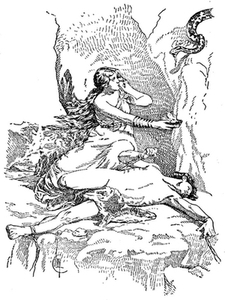
Fig. 187. Loki and Siguna
From the painting by Gebhardt
But Loki did not
escape his merited
punishment. When he
saw how wroth the gods
were, he fled to the
mountain and there
built himself a hut with
four doors, so that he
could see every approaching
danger. He
invented a net to catch
the fishes, such as fishermen
have used since
his time. But Odin
found out his hiding
place and the gods assembled
to take him.
He, seeing this, changed
himself into a salmon
and lay hid among the stones of the brook. But the gods took
his net and dragged the brook, and Loki, finding he must be
caught, tried to leap over the net; but Thor caught him by the
tail, and compressed it so that salmon ever since have had that
part remarkably fine and thin. They bound him with chains and
suspended a serpent over his head, whose venom falls upon his
face drop by drop. His wife, Siguna, sits by his side and catches
the drops as they fall, in a cup; but when she carries it away to
empty it, the venom falls upon Loki, which makes him howl with
horror and writhe so that the whole earth shakes.
280. The Elves. The Edda mentions another class of beings,
inferior to the gods, but still possessed of great power; these
were the Elves. The white spirits, or Elves of Light, were exceedingly
fair, more brilliant than the sun, and clad in garments of a
delicate and transparent texture. They loved the light, were kindly
disposed to mankind, and generally appeared as fair and lovely
children. Their country was called Elfheim, and was the domain
of Freyr, in whose sunlight they always sported.
The black elves, ugly, long-nosed dwarfs, of a dirty brown color,
appeared only at night. They avoided the sun as their most deadly
enemy, because his beams changed them immediately into stones.
Their language was the echo of solitudes, and their dwelling places
subterranean caves and clefts. They were supposed to have come
into existence as maggots produced by the decaying flesh of Ymir's
body. They were afterwards endowed by the gods with a human
form and great understanding. They were particularly distinguished
for a knowledge of the mysterious powers of nature, and for the
runes which they carved and explained. They were the most skillful
artificers of all created beings, and worked in metals and in
wood. Among their most noted works were Thor's hammer, and
the ship Skidbladnir, which they gave to Freyr. This vessel was so
large that it could contain all the deities with their war and household
implements, but so skillfully was it wrought that when folded
together it could be put into a side pocket.
281. Ragnarok. It was a firm belief of the Northern nations
that a time would come when all the visible creation, the gods of
Valhalla and Niflheim, the inhabitants of Jötunheim, Elfheim, and
Midgard, together with their habitations, would be destroyed. The
fearful day of destruction will not however be without warning.
First will come a triple winter, during which snow will fall from
the four corners of the heavens, the frost be severe, the wind
piercing, the weather tempestuous, and the sun impart no gladness.
Three such winters will pass without being tempered by a single
summer. Three other like winters will follow, during which war
and discord will spread over the universe. The earth itself will be
afraid and begin to tremble, the sea leave its basin, the heavens
tear asunder; men will perish in great numbers, and the eagles of
the air feast upon their still quivering bodies. The wolf Fenris will
now break his bands, the Midgard serpent rise out of his bed in
the sea, and Loki, released from his bonds, will join the enemies
of the gods. Amidst the general devastation the sons of Muspelheim
will rush forth under their leader Surter, before and behind
whom are flames and burning fire. Onward they ride over Bifrost,
the rainbow bridge, which breaks under the horses' hoofs. But
they, disregarding its fall, direct their course to the battle field
called Vigrid. Thither also repair the wolf Fenris, the Midgard
serpent, Loki, with all the followers of Hela, and the Frost giants.
Heimdall now stands up and sounds the Giallar horn to assemble
the gods and heroes for the contest. The gods advance, led on
by Odin, who, engaging the wolf Fenris, falls a victim to the monster.
Fenris is, in turn, slain by Vidar, Odin's son. Thor wins
great renown by killing the Midgard serpent, but, recoiling, falls
dead, suffocated with the venom which the dying monster vomits
over him. Loki and Heimdall meet and fight till they both are
slain. The gods and their enemies having fallen in battle, Surter,
who has killed Freyr, darts fire and flames over the world, and the
universe is consumed. The sun grows dim, the earth sinks into
the ocean, the stars fall from heaven, and time is no more.
After this Alfadur (not Odin but the Almighty) will cause a new
heaven and a new earth to arise out of the sea. The new earth,
filled with abundant supplies, will produce its fruits without labor
or care. Wickedness and misery will no more be known, but the
gods and men will live happily together.
This twilight of the gods is aptly described in a conversation
held between Balder and Hermod, after Hermod has a second
time ridden to Hel:
And the fleet-footed Hermod made reply:[368]—
"Thou hast then all the solace death allows,
Esteem and function; and so far is well.
Yet here thou liest, Balder, underground,
Rusting for ever; and the years roll on,
The generations pass, the ages grow,
And bring us nearer to the final day
When from the south shall march the fiery band
And cross the bridge of heaven, with Lok for guide,
And Fenris at his heel with broken chain;
While from the east the giant Rymer steers
His ship, and the great serpent makes to land;
And all are marshal'd in one flaming square
Against the gods, upon the plains of heaven.
I mourn thee, that thou canst not help us then."
He spake; but Balder answered him, and said:—
"Mourn not for me! Mourn, Hermod, for the gods;
Mourn for the men on earth, the gods in heaven,
Who live, and with their eyes shall see that day!
The day will come, when fall shall Asgard's towers,
And Odin, and his sons, the seed of Heaven;
But what were I, to save them in that hour?
If strength might save them, could not Odin save,
My father, and his pride, the warrior Thor,
Vidar the silent, the impetuous Tyr?
I, what were I, when these can nought avail?
Yet, doubtless, when the day of battle comes,
And the two hosts are marshal'd, and in heaven
The golden-crested cock shall sound alarm,
And his black brother-bird from hence reply,
And bucklers clash, and spears begin to pour—
Longing will stir within my breast, though vain.
But not to me so grievous as, I know,
To other gods it were, is my enforced
Absence from fields where I could nothing aid;
For I am long since weary of your storm
Of carnage, and find, Hermod, in your life
Something too much of war and broils, which make
Life one perpetual fight, a bath of blood.
Mine eyes are dizzy with the arrowy hail;
Mine ears are stunn'd with blows, and sick for calm.
Inactive, therefore, let me lie in gloom,
Unarm'd, inglorious; I attend the course
Of ages, and my late return to light,
In times less alien to a spirit mild,
In new-recover'd seats, the happier day."
He spake; and the fleet Hermod thus replied:—
"Brother, what seats are these, what happier day?
Tell me, that I may ponder it when gone."
And the ray-crownèd Balder answered him:—
"Far to the south, beyond the blue, there spreads
Another heaven, the boundless—no one yet
Hath reach'd it; there hereafter shall arise
The second Asgard, with another name.
Thither, when o'er this present earth and heavens
The tempest of the latter days hath swept,
And they from sight have disappear'd and sunk,
Shall a small remnant of the gods repair;
Höder and I shall join them from the grave.
There reassembling we shall see emerge
From the bright ocean at our feet an earth
More fresh, more verdant than the last, with fruits
Self-springing, and a seed of man preserved,
Who then shall live in peace, as now in war.
But we in heaven shall find again with joy
The ruin'd palaces of Odin, seats
Familiar, halls where we have supp'd of old,
Reënter them with wonder, never fill
Our eyes with gazing, and rebuild with tears.
And we shall tread once more the well-known plain
Of Ida, and among the grass shall find
The golden dice wherewith we played of yore;
And that shall bring to mind the former life
And pastime of the gods—the wise discourse
Of Odin, the delights of other days.
O Hermod, pray that thou may'st join us then!
Such for the future is my hope; meanwhile,
I rest the thrall of Hela, and endure
Death, and the gloom which round me even now
Thickens, and to inner gulf recalls.
Farewell, for longer speech is not allow'd."
282. The Saga of the Volsungs.[369] Sigi, son of Odin, was a
mighty king of the Huns whom Odin loved and prospered exceedingly.
Rerir, also, the son of Sigi, was a man of valor and one who
got lordship and land unto himself; but neither Sigi nor Rerir were
to compare with Volsung, who ruled over Hunland after his father
Rerir went home to Odin.
To Volsung were born ten sons and one daughter,—Signy by
name; and of the sons Sigmund was the eldest and the most
valiant. And the Volsungs abode in peace till Siggeir, king of
Gothland, came wooing Signy, who, though loath to accept him,
was, by her father's desire, betrothed to him.
Now on the night of the wedding great fires were made in the
hall of the Volsungs, and in the midst stood Branstock, a great oak
tree, about which the hall had been built, and the limbs of the tree
spread over the roof of the hall; and round about Branstock they
sat and feasted, and sang of ancient heroes and heard the music
of the harp that went from hand to hand.
But e'en as men's hearts were hearkening some heard the thunder pass[370]
O'er the cloudless noontide heaven; and some men turned about
And deemed that in the doorway they heard a man laugh out.
Then into the Volsung dwelling a mighty man there strode,
One-eyed and seeming ancient, yet bright his visage glowed;
Cloud-blue was the hood upon him, and his kirtle gleaming-gray
As the latter morning sun-dog when the storm is on the way;
A bill he bore on his shoulder, whose mighty ashen beam
Burnt bright with the flame of the sea, and the blended silver's gleam.
And such was the guise of his raiment as the Volsung elders had told
Was borne by their fathers' fathers, and the first that warred in the wold.
So strode he to the Branstock, nor greeted any lord,
But forth from his cloudy raiment he drew a gleaming sword,
And smote it deep in the tree-bole, and the wild hawks overhead
Laughed 'neath the naked heaven as at last he spake and said:
"Earls of the Goths, and Volsungs, abiders on the earth,
Lo there amid the Branstock a blade of plenteous worth!
The folk of the war-wand's forgers wrought never better steel
Since first the burg of heaven uprose for man-folk's weal.
Now let the man among you whose heart and hand may shift
To pluck it from the oak-wood e'en take it for my gift.
Then ne'er, but his own heart falter, its point and edge shall fail
Until the night's beginning and the ending of the tale.
Be merry, Earls of the Goth-folk, O Volsung Sons be wise,
And reap the battle-acre that ripening for you lies:
For they told me in the wild wood, I heard on the mountain-side
That the shining house of heaven is wrought exceeding wide,
And that there the Early-comers shall have abundant rest
While Earth grows scant of great ones, and fadeth from its best,
And fadeth from its midward, and groweth poor and vile:—
All hail to thee, King Volsung! farewell for a little while!"
So sweet his speaking sounded, so wise his words did seem
That moveless all men sat there, as in a happy dream
We stir not lest we waken; but there his speech had end
And slowly down the hall-floor, and outward did he wend;
And none would cast him a question or follow on his ways,
For they knew that the gift was Odin's, a sword for the world to praise.
Then all made trial, Siggeir and his earls, and Volsung and his
people, to draw forth the sword from Branstock, but with no success,
till Sigmund, laying his hand carelessly on the precious hilt,
drew forth the naked blade as though it were loose in the oak.
Whereupon Siggeir offered money for the sword, but Sigmund
scorned the offer.
But in time Siggeir had his vengeance. Inviting King Volsung
and his sons to Gothland, he fell upon them, slew the king, and
suffered the sons, fastened under a log, to be devoured in succession
by a she-wolf—all but Sigmund, who through the wile of
his sister Signy was rescued. He, driven to the life of an outlaw,
sought means to avenge his father, and Signy, on her part, strove
to aid him,—without avail, however, till Sinfiotli, the son of
herself and Sigmund, was grown to manhood. This youth bore
Sigmund company. For a season, as wolves, they scoured the
woods; finally resuming the form of men, they slew the children
of Siggeir and burned him in his hall. Signy, having helped to
avenge her father, died with her husband.
Sigmund, thereupon, became king, and took to himself a wife.
But she, suffering injury at the hands of Sinfiotli, poisoned him
with a horn of ale. Then Sigmund sorrowed nigh to death over
his son, and drove away that queen, and soon after she died. He
then married Hiordis the fair; but before long, doing battle against
Lyngi, the son of Hunding,—a chieftain who also had loved the
fair Hiordis,—he got his death wound:
For lo, through the hedge of the war-shafts a mighty man there came,
One-eyed and seeming ancient, but his visage shone like flame;
Gleaming-gray was his kirtle, and his hood was cloudy-blue;
And he bore a mighty twibil, as he waded the fight-sheaves through,
And stood face to face with Sigmund, and upheaved the bill to smite.
Once more round the head of the Volsung fierce glittered the Branstock's light,
The sword that came from Odin; and Sigmund's cry once more
Rang out to the very heavens above the din of war.
Then clashed the meeting edges with Sigmund's latest stroke,
And in shivering shards fell earthward that fear of worldly folk.
But changed were the eyes of Sigmund, and the war-wrath left his face;
For that gray-clad mighty helper was gone, and in his place
Drave on the unbroken spear-wood 'gainst the Volsung's empty hands:
And there they smote down Sigmund, the wonder of all lands,
On the foemen, on the death-heap his deeds had piled that day.
To Hiordis, after Sigmund's death, was born Sigurd, like whom
was never man for comeliness and valor and great-heartedness and
might. He was the greatest of the Volsungs. His foster-father was
Regin, the son of Rodmar, a blacksmith, who taught him the lore
of runes and many tongues; and, by means of a story of ancient
wrongs, incited him to the destruction of the dragon Fafnir. For
Regin told that while the gods, Odin and Hœnir, were wandering
with Loki near Rodmar's house, Loki slew one of Rodmar's sons,
Otter. Whereupon Rodmar demanded that the gods should fill
the Otter-skin with gold and cover it with gold. Now Loki, being
sent to procure the gold, caught Andvari the dwarf, and from him
procured by force a hoard of the precious metal and with it a magic
ring, whose touch bred gold. But Andvari cursed the ring and
the gold and all that might possess either. The gods forthwith
filled Otter with the dwarf's gold, and surrendered both gold and
ring to Rodmar. Immediately the curse began to work. Fafnir,
brother of Regin and Otter, slew Rodmar and seized the treasure
and, assuming a dragon's form, brooded upon the hoard. With
this tale Regin egged on Sigurd to the undoing of Fafnir. He
welded him, too, a resistless sword out of the shards of Sigmund's
sword, Gram (the wrath). Then Sigurd swore that he would slay
the dragon. But first, riding on his horse, Greyfell, of the blood
of Odin's Sleipnir, he avenged upon the sons of Hunding the
death of his father. This done, Sigurd rode to Glistenheath and
slew Fafnir, the dragon, and eating of his heart, learned the language
of the birds; and at their advice he slew Regin also, who
plotted against him.
So, setting the ring of Andvari on his finger and bearing the
gold before him on his horse, Greyfell, Sigurd comes to the Hill
of Hindfell:
And sitteth awhile on Greyfell on the marvelous thing to gaze:
For lo, the side of Hindfell inwrapped by the fervent blaze,
And naught 'twixt earth and heaven save a world of flickering flame,
And a hurrying, shifting tangle, where the dark rents went and came....
Now Sigurd turns in his saddle, and the hilt of the Wrath he shifts,
And draws a girth the tighter; then the gathered reins he lifts,
And crieth aloud to Greyfell, and rides at the wildfire's heart;
But the white wall wavers before him and the flame-flood rusheth apart,
And high o'er his head it riseth, and wide and wild is its roar
As it beareth the mighty tidings to the very heavenly floor;
But he rideth through its roaring as the warrior rides the rye,
When it bows with the wind of the summer and the hid spears draw anigh;
The white-flame licks his raiment and sweeps through Greyfell's mane,
And bathes both hands of Sigurd and the hilts of Fafnir's bane,
And winds about his war-helm and mingles with his hair,
But naught his raiment dusketh or dims his glittering gear;—
Then it falls and fades and darkens till all seems left behind,
And dawn and the blaze is swallowed in mid-mirk stark and blind....
Then before him Sigurd sees a shield-hung castle, surmounted
by a golden buckler, instead of a banner, which rings against the
flagstaff. And he enters and finds the form of one asleep, in armor
cap-a-pie.
So he draweth the helm from the head, and, lo, the brow snow-white,
And the smooth unfurrowed cheeks, and the wise lips breathing light;
And the face of a woman it is, and the fairest that ever was born,
Shown forth to the empty heavens and the desert world forlorn:
But he looketh, and loveth her sore, and he longeth her spirit to move,
And awaken her heart to the world, that she may behold him and love.
And he toucheth her breast and her hands, and he loveth her passing sore;
And he saith, "Awake! I am Sigurd," but she moveth never the more....
Then with his bright blade Sigurd rends the ring-knit mail that
incloses her, "till naught but the rippling linen is wrapping her
about,"—
Then a flush cometh over her visage and a sigh upheaveth her breast,
And her eyelids quiver and open, and she wakeneth into rest;
Wide-eyed on the dawning she gazeth, too glad to change or smile,
And but little moveth her body, nor speaketh she yet for a while;
And yet kneels Sigurd, moveless, her wakening speech to heed,
While soft the waves of the daylight o'er the starless heavens speed,
And the gleaming vines of the Shield-burg yet bright and brighter grow,
And the thin moon hangeth her horns dead-white in the golden glow.
Then she turned and gazed on Sigurd, and her eyes met the Volsung's eyes.
And mighty and measureless now did the tide of his love arise,
For their longing had met and mingled, and he knew of her heart that she loved,
As she spake unto nothing but him and her lips with the speech-flood moved.
Brynhild, it was,—the Valkyrie,—who long time had lain in
that enchanted sleep that Odin, her father, had poured over her,
dooming her to mortal awakening and to mortal love, for the evil
she had wrought of old when she espoused the cause in battle of
those whom the Norns had predestined to death. Her might none
but the fearless awaken; and her had Sigurd awakened; and she
loved him, for he was without fear and godlike. And she taught
him many wise sayings; and they plighted troth, one to the other,
both then and again; and Sigurd gave her the ring of Andvari.
But they were not destined to dwell together in wedlock, and
Brynhild, foreseeing the future, knew even this.
Sigurd was to wed with another than Brynhild, and it fell in
this wise. In the land of the Nibelungs (Niblungs, Nibelungen)
dwelt Gudrun, daughter of Giuki, the Nibelung king. And Gudrun
dreamed a dream in which a fair hawk feathered with feathers of
gold alighted upon her wrist. She went to Brynhild for the interpretation
of the dream. "The hawk," said Brynhild, "is Sigurd."
And so it came to pass. Sigurd, visiting the court of the Nibelungs,
was kindly entreated by King Giuki and his three sons, Gunnar,
Hogni, and Guttorm; and he performed deeds of valor such that
they honored him. But after many days, Grimhild, the mother
of Gudrun, administered to Sigurd a magic potion that removed
from him all memory of Brynhild. So Sigurd loved and wedded
the fair Gudrun. Indeed he soon joined others in urging his
wife's brother Gunnar, a doughty warrior, to sue for the hand of
Brynhild herself. But Brynhild would have no one that could
not ride through the flames drawn up around her hall. After
Gunnar had made two unsuccessful attempts, Sigurd, assuming
the form of King Gunnar, mounted Greyfell and rode for the
second time through the flames of Hindfell. Then, still wearing
the semblance of Gunnar, he gained the consent of Brynhild to
the union, and exchanged rings with her,—she giving him
none other than the ancient ring of Andvari back again. But
even this did not recall to Sigurd's memory his former ride and
his former love. Returning to the land of the Nibelungs, he
announced the success of his undertaking and told all things to
Gudrun, giving her the fatal ring that he had regained from
Brynhild.
In ten days came Brynhild by agreement to the Hall of the
Nibelungs, and though she knew well the deceit that had been
practiced on her, she made no sign; nay, was wedded, according
to her promise, to King Gunnar. But as they sat at the wedding-feast,
the charm of Grimhild was outworn,—Sigurd looked upon
Gunnar's bride and knew the Brynhild of old, the Valkyrie, whom
he had loved; "and Brynhild's face drew near him with eyes
grown stern and strange."
But, apparently, all went well till the young queens, one day
bathing in the Water of the Nibelungs, fell into contention on a
matter of privilege. Brynhild claimed precedence in entering the
river on the ground that Gunnar was the liege lord of Sigurd.
Gudrun, white with wrath, flashed out the true story of the ride
through the flames, and thrust in Brynhild's face the Andvari
ring. Consumed with jealousy, Brynhild plotted revenge. She
loved Sigurd still, and he, since he had regained his memory,
could not overcome his love for her. But the insult from Gudrun
Brynhild would not brook. By her machinations, Guttorm, the
brother of Gudrun, was incited to slay Sigurd. He, accordingly,
stabbed the hero while asleep, but Sigurd, throwing Gram at the
assassin, cut him in twain before he could escape.
Woe me! how the house of the Niblungs by another cry was rent,
The awakening wail of Gudrun, as she shrank in the river of blood
From the breast of the mighty Sigurd: he heard it and understood,
And rose up on the sword of Guttorm, and turned from the country of death,
And spake words of loving-kindness as he strove for life and breath;
"Wail not, O child of the Niblungs! I am smitten, but thou shalt live,
In remembrance of our glory, mid the gifts the gods shall give!...
It is Brynhild's deed," he murmured, "and the woman that loves me well;
Nought now is left to repent of, and the tale abides to tell.
I have done many deeds in my life-days, and all these, and my love, they lie
In the hollow hand of Odin till the day of the world go by.
I have done and I may not undo, I have given and I take not again;
Art thou other than I, Allfather, wilt thou gather my glory in vain?"
So ended the life of Sigurd. Brynhild, overcome with sorrow,
dealt herself a mortal wound and was burned on the funeral pyre
beside Sigurd the Volsung.
In time Gudrun became the queen of Atli, the Budlung. He,
in order to obtain the hoard of Sigurd, which had passed into the
hands of the Nibelungs,—Gudrun's brothers,—bade them visit
him in Hunland. Fully warned by Gudrun, they still accepted the
invitation and, arriving at the hall of Atli, were after a fearful conflict
slain. But they did not surrender the hoard—that lay concealed
at the bottom of the Rhine. Gudrun with the aid of Nibelung,
her brother Hogni's son, in the end slew Atli, set fire to his hall,
and brought ruin on the Budlung folk. Then leaping into the sea,
she was borne with Swanhild, her daughter by Sigurd, to the realm
of King Jonakr, who became her third husband. Swanhild, "fairest
of all women, eager-eyed as her father, so that few durst look
under the brows of her," met, by stress of love and treachery, a
foul end in a foreign land, trampled under foot of horses.
Finally Gudrun sent her sons by Jonakr to avenge their half-sister's
death; and so, bereft of all her kin and consumed with
sorrow, she called upon her ancient lover, Sigurd, to come and
look upon her, as he had promised, from his abiding-place among
the dead. And thus had the words of her sorrow an end.
Her sons slew Jormunrek, the murderer of Swanhild, but were
themselves done to death by the counsel and aid of a certain warrior,
seeming ancient and one-eyed,—Odin the forefather of the
Volsungs,—the same that had borne Sigi fellowship, and that
struck the sword into Branstock of Volsung's hall, and that faced
Sigmund and shattered Gram in the hour of Sigmund's need, and
that brought to Sigurd the matchless horse Greyfell, and oft again
had appeared to the kin of the Volsungs;—the same god now
wrought the end of the Nibelungs. The hoard and the ring of
Andvari had brought confusion on all into whose hands they fell.
283. The Lay of the Nibelungs.[371] In the German version of this
story—called the Nibelungenlied—certain variations of name,
incident, and character appear. Sigurd is Siegfried, dwelling in
Xanten near the Rhine, the son of Siegmund and Siegelind, king
and queen of the Netherlands. Gudrun is Kriemhild, sister of
Gunther (Gunnar), king of the Burgundians, and niece of Hagen
(Hogni), a warrior of dark and sullen mien, cunning, but withal
loyal and brave, the foe of the glorious Siegfried. Siegfried weds
Kriemhild, takes her to the Netherlands and lives happily with her,
enjoying the moneys of the Nibelungen hoard, which he had taken
not from a dwarf, as in the Norse version, but from two princes,
the sons of King Nibelung. Meanwhile Gunther dwells in peace
in the Burgundian land, husband of the proud Brunhild, whom
Siegfried had won for him by stratagem not altogether unlike that
of the Norse story. For the Brunhild of the Yssel-land had declared
that she would marry no man save him who should surpass
her in athletic contest. This condition Siegfried, wearing the Tarnkappe,
a cloak that rendered him invisible, had fulfilled for Gunther.
He had also succored poor Gunther after his marriage with
Brunhild. For that heroine, in contempt of Gunther's strength,
had bound him hand
and foot and suspended
him from a nail on their
bedroom wall. By
agreement Siegfried
had again assumed Gunther's
form and, after a
fearful tussle with the
queen, had reduced her
to submission, taking
from her the ring and
girdle which were the
secret sources of her
strength, and leaving
her to imagine that she
had been conquered by
her bridegroom, Gunther.
The ring and
girdle Siegfried had bestowed
upon Kriemhild,
unwisely telling her at
the same time the story of Brunhild's defeat. Although the Nibelungenlied
offers no explanation, it is evident that the injured queen
of Yssel-land had recognized Siegfried during this ungallant intrigue;
and we are led to infer that there had been some previous
acquaintance and passage of love between them.
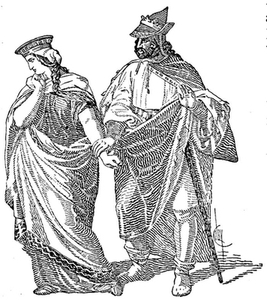
Fig. 188. Gunther and Brunhild.
From the fresco by Julius Schnorr von Carolsfeld
At any rate, Siegfried and Kriemhild, retiring to the Netherlands,
were ruling happily at Xanten by the Rhine; and all might
have continued in peace had not Brunhild resented the lack of
homage paid by Siegfried, whom she had been led to regard as a
vassal, to Gunther, his reputed overlord.
In her heart this thought she fostered, deep in its inmost core;[372]
That still they kept such distance, a secret grudge she bore.
How came it that their vassal to court declined to go,
Nor for his land did homage, she inly yearned to know.
She made request of Gunther, and begged it so might be,
That she the absent Kriemhild yet once again might see,
And told him, too, in secret, whereon her thoughts were bent,—
Then with the words she uttered her lord was scarce content.
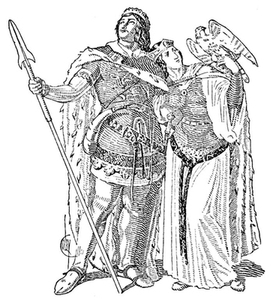
Fig. 189. Siegfried and Kriemhild
From the fresco by Julius Schnorr von Carolsfeld
But Gunther yielded,
and Siegfried and Kriemhild
were invited to Worms,
nominally to attend a high
festival.
... With what joy and gladness welcomed were they there!
It seemed when came dame Brunhild to Burgundy whilere,
Her welcome by dame Kriemhild less tender was and true;
The heart of each beholder beat higher at the view....
Received was bold Sir Siegfried, as fitted well his state,
With the highest honors; no man bore him hate.
Young Giselher and Gernot proffered all courtly care;
Never met friend or kinsman reception half so fair.
One day at the hour of vespers certain knights proved themselves
at tilting in the regal courtyard. Conspicuous among these
was Siegfried. And the proud queens sitting together were thinking
each on the good knight that she loved full well. Then outspoke
fair Kriemhild, "My husband is of such might that surely
he should rule these realms"; Brunhild answered, "So long as
Gunther lives that can never be."
... Thereto rejoined fair Kriemhild, "See'st thou how proud he stands,
How proud he stalks, conspicuous among those warrior bands,
As doth the moon far-beaming the glimmering stars outshine?
Sure have I cause to pride me when such a knight is mine."
Thereto replied queen Brunhild, "How brave soe'er he be,
How stout soe'er or stately, one greater is than he.
Gunther, thy noble brother, a higher place may claim,
Of knights and kings the foremost in merit and in fame."
So began the altercation. It attained its climax the same day,
when each queen attempted to take precedence of the other in
entering the cathedral for the celebration of the mass.
Both met before the minster in all the people's sight;
There at once the hostess let out her deadly spite.
Bitterly and proud she bade fair Kriemhild stand;
"No vassaless precedeth the lady of the land."
Then, full of wrath, Kriemhild, in terms anything but delicate,
acquainted her haughty sister-in-law with the deception that had
twice been practiced upon her by Siegfried and Gunther; nay,
worse, corroborated her statement by displaying both ring and
girdle that Brunhild had lost. The altercation came to the ears
of the kings. Gunther made complaint to Siegfried. Then,
... "Women must be instructed," said Siegfried, the good knight,
"To leave off idle talking and rule their tongues aright.
Keep thy fair wife in order, I'll do by mine the same.
Such overweening folly puts me indeed to shame."
But it was too late to mend the matter. With devilish intent Brunhild
plotted vengeance. Siegfried, the author of her mortification,
must die the death. The foes of Siegfried persuaded his wife, unaware
of their design, to embroider in his vesture a silken cross over
the one spot where the hero was vulnerable. Then the crafty Hagen,
who had been suborned by Brunhild to the baleful deed, bided his
time. One day, Gunther, Hagen, and Siegfried, heated in running,
stayed by a brook to drink. Hagen saw his chance.
... Then, as to drink, Sir Siegfried down kneeling there he found,
He pierced him through the crosslet, that sudden from the wound
Forth the life-blood spurted, e'en o'er his murderer's weed.
Nevermore will warrior dare so foul a deed....
... With blood were all bedabbled the flowerets of the field.
Some time with death he struggled as though he scorned to yield
E'en to the foe whose weapon strikes down the loftiest head.
At last prone in the meadow lay mighty Siegfried dead.
Brunhild glories in the fall of Siegfried and exults over the
mourning widow. Kriemhild, sitting apart, nurses schemes of
vengeance. Her brothers affect to patch up the breach in order
that they may obtain the hoard of the Nibelungs. But this treasure,
after it has been brought to Worms, is sunk, for precaution's
sake, by Hagen, in the Rhine. Although in time Kriemhild becomes
the wife of King Etzel (Atli, Attila) of Hunland, still she
does not forget the injury done her by her kin. After thirteen
years she inveigles her brothers and their retainers, called now
Nibelungs because of their possession of the hoard, to Etzel's
court, where, after a desperate and dastardly encounter, in which
their hall is reduced to ashes, they are all destroyed save Gunther
and Hagen. Immediately, thereafter, Gunther's head is cut off at
her orders; and she herself, with Siegfried's sword Balmung,
severs the head of the hated Hagen from his body. With these
warriors the secret of the hidden hoard passes. Kriemhild, having
wreaked her vengeance, falls by the hand of one of her husband's
knights, Hildebrand, who, with Dietrich of Bern, had played a
prominent part among the associates of King Etzel.
"I cannot say you now what hath befallen since;
The women all were weeping, and the Ritters and the prince,
Also the noble squires, their dear friends lying dead:
Here hath the story ending; this is the Nibelungen's Need."[373]
284. Wagner's Tetralogy. In his famous Ring of the Nibelung
the German composer, Richard Wagner, returns to the Norse version
of the stories recounted in the chapter preceding this. He is responsible
not only for the musical score of the four operas of which the
Ring consists, but for the text and scenic arrangement as well. As
musical dramas the four plays constitute the grandest series of the
kind that the world possesses. But even if they were not wedded
to such music, the Rhine-gold, the Valkyrie, the Siegfried, and
the Twilight (or Dusk) of the Gods would be entitled, for creative
invention, imaginative insight and power, and poetic diction, to rank
with notable dramas, ancient or modern. The tetralogy (or series
of four) presents the whole story of the accursed Nibelung gold,
from that dawn when it was wrested from the daughters of the
Rhine to that dusk when it was restored, having wrought meanwhile
the doom of Nibelungs, Volsungs, and the gods themselves.
285. The Rhine-gold. We are at the bottom of the Rhine: a
greenish twilight, and moving water, and everywhere sharp points
of rocks jutting from the depths. Around the central rock three
Rhine-daughters swim, guarding it carefully, but laughing and
playing, and chasing one the other as they guard. To them from
a chasm climbs Alberich, the Nibelung, he who in the old Norse
lay was known as Andvari. He views the maidens with increasing
pleasure. He addresses them, he clambers after them, he strives
to catch them; they lure him on, they mock him and escape his
grasp; he woos them each in turn, all unsuccessfully. He gazes
upward—"Could I but catch one"; then once more failing, remains
in speechless rage. Rage soon transformed to wonder: for
through the water from above there filters a brightening glow, a
magical light, streaming from the summit of the central rock where
in the splendor of the morning sun the Rhine-gold laughs a-kindle.
"What is it, ye sleek ones,
That there doth gleam and glow?"[374]
Has he never heard of the Rhine-gold? they ask. Of the wondrous
star whose glory lightens the waves? He has not. He scorns it.
"The golden charm," cries one of the maidens,—
"The golden charm
Wouldst thou not flout
Knewest thou all of its wonders."
"The world's wealth," jeers another,
"Could be won by a man
If out of the Rhine-gold
He fashioned the Ring
That measureless might can bestow...
He who the sway
Of love forswears,
He who delight
Of love forbears,
Only he can master the magic
That forces the gold to a ring!"
"But we fear not thee—oh, no—for thou burnest in love for us."
So, lightly sing the Rhine-daughters; but Alberich, with his
eyes on the gold, has heeded well their chatter. "The world's
wealth," he mutters; "might I win that by the spell of the gold?
Nay, though love be the forfeit, my cunning shall win me delight."
Then terribly loud he cries,
"Mock ye, mock on!
The Nibelung neareth your toy;—"
then, clambering with haste to the summit,
"My hand, it quenches your light;
I wrest from the rock your gold;
I fashion the ring of revenge;
Now, hear me, ye floods—
Accursèd be love henceforth."
Tearing the gold from the rock, he plunges into the depths and
disappears. After him dive the maidens. In vain. Far, far below,
from Nibelheim rises the mocking laughter of Alberich, Lord of
the Gold.
The scene changes. An open space on a mountain height becomes
visible. The dawning day lights up a castle, glittering with
pinnacles, on the top of a cliff. Below flows silent the Rhine. At
one side, on a flowery bank, Wotan (Odin), king of the gods, lies
sleeping, and Fricka (Frigga) his wife. They wake. Wotan turns
toward his castle, new-built by the giants, and exults; but Fricka
reminds him of the terrible price that is yet to be paid for its building,—none
other, forsooth, than the person of Freia, the fair one,
the goddess of spring and love, she who tends the garden of the
gods, and whose apples, eaten from day to day, confer eternal
youth,—she is the wage that the giants will claim.
"I mind me well of the bargain," returns Wotan, "but I give
no thought to fulfill it. My castle stands; for the wage—fret not
thyself."
"Oh, laughing, impious lightness," reproves him Fricka, "thy
bargain is fast, and is still to rue."
Nay, on the moment rushes Freia to them, pleading, pursued
by the giants. "Give her to us!" they cry,—Fasolt and Fafner,
mighty twain that unslumbering had reared the walls of Wotan's
castle, to win them a woman, winsome and sweet.
"Now pay us our wage!"
"Nay," coolly answers Wotan, "other guerdon ask. Freia may
I not grant!"
But the giants insist. They accuse the god of faithlessness. He
jests with them, temporizing, awaiting anxiously the arrival of
Loge (Loki), spirit of cunning, at whose suggestion that bargain
had been struck. For even then Loge had secretly assured Wotan
that Freia should in the emergency be ransomed. The giants,
indignant at the delay, press on Freia. She calls on her brothers,
Froh (Freyr) and Donner (Thor). They rush to her rescue: Froh
clasps the fair one; Donner plants himself before the importunates.
"Know ye the weight of my hammer's blow?" thunders he.
There is battle in the air.
Then enters Loge, demon of fire, mischief-maker, traitor, and
thief, whom long ago Wotan had lifted from his evil brood and
of him made a friend and counselor.
"Now hear, crabbèd one; keep thy word," says Wotan, sharply.
Loge appears to be nonplussed. He has restlessly searched to
the ends of the world to find a ransom for Freia; "but naught is
so rich that giant or man will take it as price for a woman's worth
and delight." He has sought amid the forces of water and earth
and air; "but naught is so mighty that giant or man will prefer it
above a woman's worth and delight!" And yet,—slyly Loge lets
fall the word,—there is the ruddy Gold:
"Yea, one I looked on, but one, who love's delights forswore,
for ruddy gold renouncing the wealth of woman's grace."
And he recounts the marvels of the Rhine-gold. The giants
offer to take it in lieu of Freia; nay, gods and goddesses as well
are held by the charm of the glittering hoard; by the lure, and
the dread too, of the Ring that, once fashioned, gives measureless
might to its lord. Even now, doubtless, he who has forsworn love
has muttered the magic rune and rounded the sovereign circlet of
gold. If so, the gods themselves shall be his slaves,—slaves of
the Nibelung Alberich.
"The ring I must win me," decides Wotan.
"But at the cost of love?" queries Froh.
Loge counsels the theft of the gold from Alberich and its restoration
to the daughters of the Rhine. But the gods are not thus far-sighted,
and the giants insist upon the hoard as their due. They seize
Freia, and bear her away as pledge till that ransom be paid....
"Alack, what aileth the gods?"
It is Loge who speaks. A pale mist falls upon the scene, gradually
growing denser. The light of the heavenly abodes is quenched. Wotan
and all his clan become increasingly wan and aged. Freia of the
Garden is departed: the apples of youth are decaying; "old and gray,
worn and withered, the scoff of the world, dies out the godly race!"
"Up, Loge," calls Wotan, dismayed, "descend with me. To
Nibelheim go we together. To win back our youth, the golden
ransom must I gain."
The scene changes to Nibelheim, the subterranean home of the
Nibelungs. Wotan and Loge find Mime, Alberich's brother, bewailing
the fate of the Nibelungs—for Alberich has fashioned
the Ring and all below groan under his tyranny. Even now, reluctantly
indeed, Mime is forging the Tarnhelm for his tyrant brother,—a
wishing-cap by whose magic the wearer may transfer himself
through space and assume whatever form he please, or make himself
invisible, at will. Alberich, in the flush of power, enters, driving
before him with brandished whip a host of Nibelungs from
the caverns. They are laden with gold and silver handiwork. At
Alberich's command they heap it in a pile. He draws the Ring from
his finger; the vanquished host trembles and, shrieking, cowers
away.
"What seek ye here?" demands he, looking long and suspiciously
at Wotan and Loge.
They have heard strange tidings, says Wotan, and they come to
see the wonders that Alberich can work. Then Loge induces the
Nibelung lord to exhibit the virtues of the Tarnhelm. Readily
beguiled, he displays his necromantic power. First he transforms
himself into a loathly dragon. The gods pretend dismay:—he
can make himself great; can he make himself small, likewise?
"Pah, nothing simpler! Look at me now!" He dons the Tarnhelm,
and lo, a toad!
"There, grasp quickly," says Loge. Wotan places his foot on
the toad, and Loge seizes the Tarnhelm. Alberich becomes visible
in his own form, writhing under Wotan's foot. The gods bind him
and drag him to the chasm by which they had descended.
The scene changes to the open space before Valhalla. Alberich,
dragged in by Loge, is forced to deliver up the hoard and the
Tarnhelm and the Ring. Wotan contemplates the Ring and puts
it on. Alberich is set at liberty.
"Am I now free?" cries he, "free in sooth? Thus greets you
then my freedom's foremost word: As by curse it came to me, accursed
forever be this Ring! As its gold gave measureless might,
let now its magic deal death to its lord. Its wealth shall yield
pleasure to none. Care shall consume him who doth hold it. All
shall lust after its delights; yet naught shall it boot him who wins
the prize! To its lord no gain let it bring; and forever be murder
drawn in its wake, till again once more in my hand, rewon, I
hold it!"
So the baffled Nibelung curses, and departs. Then enter Fricka,
Donner, and Froh, followed soon by the giants, who bring Freia
back. They refuse, Fasolt and Fafner, to release the fair goddess
until she is fully redeemed; and they claim not only Tarnhelm
and gold, but Ring as well. With the Ring Wotan refuses to part.
In that moment rises from a rocky cleft the goddess of the earth,
Erda, the beloved of heaven's god, and mother by him of the
Valkyries.
"Yield it, Wotan, yield it," she cries warningly. "Flee the
Ring's dread curse."
"What woman warneth me thus?"
"All that e'er was, know I," pronounces Erda:
"How all things are;
How all things shall be.
Hear me! hear me! hear me!
All that e'er was, endeth:
A darksome day
Dawns for your godhood!
Be counseled; give up the Ring."
She vanishes, the all-wise one; and Wotan surrenders the Ring.
Freia is redeemed, and the gods glow again with youth. No sooner
have the giants gained possession of the Ring than they proceed
to quarrel over it. Fafner strikes out with his staff and stretches
Fasolt on the ground. From the dying man he hastily wrests the
Ring, puts it into his sack, and goes on quietly packing the gold.
In a solemn silence the gods stand horrified. Care and fear fetter
the soul of Wotan. That he may shake himself free of them he
determines to descend to Erda; she yet can give him counsel.
But first,—for Donner has cleared with his thunder and lightning
the clouds that had overspread the scene,—he will enter "Valhalla,"
his castle, golden-gleaming in the evening sunlight.
"What meaneth the name, then?" asks Fricka, as they cross
the rainbow bridge.
Wotan evades the question, for he still dreads the curse pronounced
by the Nibelung upon all who have owned the Ring; and
that name, "Valhalla," indicates just the means by which he hopes
to escape the curse. He has thought to avert the doom of the gods
by gathering in this Valhalla, or Hall of the Slain, the spirits of
heroes fallen in battle—especially of heroes of a race that shall
spring from himself, the Volsungs (or Wälsungs) yet to be born.
They shall do battle for the gods when sounds the crack of doom.
But of all this Wotan says naught. He will say in the hour of his
triumph.
As the gods enter Valhalla the plaints of the Rhine-maidens
for the loss of their gold arise from the river below.
286. In The Valkyrie Wotan proceeds with his plan. During
his wanderings on earth, under the name of Wälse, he has become
the father of twin children, Siegmund and Sieglinde. These have,
in early youth, been separated by the murderous turmoil of warring
clans, but now they are to be reunited; and Wotan, with a primitive
disregard of the fact that they are brother and sister, intends
to make them man and wife, in order that from them may issue
the heroic race that, in the latter days, shall defend Valhalla from
the onslaught of the powers of evil.
The play opens with the interior of a woodland lodge. In the
center rises the stem of a mighty ash tree, about which has been
built an apartment of roughly hewn logs. It is toward evening
and a violent thunderstorm is just subsiding. This is the home
of Hunding, chieftain of the Neiding clan. The door opens, and
Siegmund, flying from his enemies, wounded and weaponless,
enters. Seeing no one, he closes the door, strides toward the fire,
and throws himself wearily down on a bearskin:
"Whoe'er own this hearth,
Here must I rest me."
He remains stretched out motionless. A woman enters from an
inner chamber. It is Sieglinde. She takes compassion on the
helpless fugitive, admires his noble bearing, gives him drink, and
bids him tarry till her husband be home. They gaze upon each
other with ever-increasing interest and emotion. Suddenly Siegmund
starts up as if to go.
"Who pursues thee?" she inquires.
"Ill fate pursues where'er I go. To thee, wife, may it never
come. Forth from thy house I fly."
She calls him back. "Then bide thou here. Thou canst not
bring ill fate where ill fate already makes its home."
He leans against the hearth. Again the eyes of the twain meet.
Hunding enters, regards the stranger with suspicion, notes the
resemblance between him and Sieglinde; but he consents to harbor
him for the night.
"Thy name and fortune?"
"Wehwalt," says Siegmund, "for woe still waits on my steps;
Wehwalt, the son of Wolfe." And thus concealing his race, he
tells a story in other respects true: how in his childhood a cruel
host had laid waste his home and killed his mother and carried
away the sister who was his twin, and how he and his father, the
Wolf, for years had battled in the woodlands against the Neidings.
The Neidings! They are Hunding's clan.
"My house holds thee, Wölfing, to-night. To-morrow defend
thee; with death thou shalt pay for this life!" And Hunding
withdraws, Sieglinde with him.
Siegmund is weaponless. The firelight sends a sudden glow
upon the ash tree, and a sword-hilt there sends back an answering
gleam. But Siegmund knows not what it means. Clad in white,
Sieglinde steals from the inner room. She has left Hunding
asleep, overcome by a slumberous draft.
"Thy coming is life," cries Siegmund.
"A weapon, now, let me show thee," she replies. And she tells
how, on the day of her unhappy wedding, a stranger, all in gray,
low-hatted and one-eyed, had entered the Hunding hall and struck
into the ash stem a sword that none but the bravest of heroes could
win, and how all in turn had tried in vain to draw forth the sword.
Now she knows for whom it was ordained,—
"It was for thee, my deliverer, my hero held in my arms!"
They embrace. He declares his lineage. He is son of him
whose eye proudly glistened from under the low-brimmed hat,—son
of Wälse, the wanderer. He is Siegmund, the Victorious. For
him, the sword Nothung.—And he draws it easily forth.
"Art thou Siegmund?" she cries; "Sieglinde am I. Thine
own twin sister thou winnest at once with the sword."
"Bride and sister be to thy brother; then nourish the Wälsungs
for aye!"
So the twain make their compact.
In the second act we are transported to a wild and rocky place.
Before Wotan, fully armed and carrying his spear, stands Brünnhilde,
the warrior maid, likewise fully armed. She is one of the
nine Valkyries, daughters of Wotan and Erda, fostered for battle
that they might forfend the doom foretold by Erda herself,—the
shameful defeat of the gods. Well have the Valkyrs, choosers
of the slain, performed their task, stirring mortal hearts to battle
and riding through the air above to designate the bravest for
death, and with their spirits to fill the halls on Valhalla's height.
Now, however, Wotan is ordering Brünnhilde to haste to the
fray,—not on death's errand but on errand of life,—to shield
Siegmund the Wälsung in the fight. The Valkyrie springs
shouting from rock to rock, and disappears behind the mountain
crags.
All seems to be arranged. But lo, Fricka, in her ram-drawn
car! She descends and strides toward her scheming spouse. The
goddess has heard the cry of Hunding, calling for vengeance on
the twinborn pair who have rashly wrought him wrong; and as
guardian of wedlock she demands the death of Siegmund in the
coming conflict. Wotan tries to persuade her that Siegmund's
success is needful to the gods,—the warrior band of mortal souls
gathered by the Valkyries in the heights of Valhalla cannot alone
suffice to avert the onslaught of the powers of darkness.
"Needed is one who, free from help of godhood, fights free
of the godhead's control. Only such an one is meet for the deed
which is denied to a god to achieve."
But Fricka is not to be deceived nor thwarted in her aim. She
brushes aside the plea of Wotan and his subterfuge,—who has
ever heard that heroes can accomplish what the gods cannot? And
as for heroes unaided—none such is Siegmund.
"Who was it," she asks, "that brought him his conquering
sword? and whose shield is ordained to cover him in the fight?"
"I cannot o'erthrow him," breaks out Wotan; "he has found
my sword."
"Destroy its magic then," retorts the implacable queen. "Give
word to thy shouting war-maid that Siegmund fall!"
Wotan is conquered. Sadly he revokes the order given to Brünnhilde.
"Then takest thou from Siegmund thy shield?" cries that one
in amazement.
And the god: "Yea! though Alberich's host threaten our downfall;
though again the Ring be won by the Nibelung, and Valhalla
be lost forever. By bargains bound myself, I may not wrest the
Ring from the foeman, from Fafner the giant. Therefore, to fulfill
my purpose, I had thought to create a Free One who for me should
fight. Now, with loathing, I find ever myself in all my hand has
created. The Other for whom I have longed, that Other I never
shall find. Himself must the Free One create him; my hand
shapes nothing but slaves. For when this hand of mine touched
Alberich's Ring, my heart grew greedy of gold. I fled from the
curse, but the curse flies not from me. What I love best must I
surrender; whom most I cherish, I must slay. One thing awaits
me yet—the downfall! Yea, that portended Erda,—Erda, the
all-wise.
"'When the dusky foe,' she said,—
'When the dusky foe of love
Grimly getteth a son,
The doom of the gods
Delays not long!'
And of late I have heard that the Nibelung has bought him a
wife. Their son shall inherit,—their son, the child of spite, shall
inherit the empty pomp of the gods!"
It was of Hagen, yet unborn, the baleful curse of the Volsungs,
of Hagen, the traitor, that Erda had prophesied. And thus dimly
is foreshadowed the Twilight of the Gods.
But Brünnhilde?
"Siegmund thou hast taught me to love," murmurs the Valkyrie.
Then boldly,—
"For his sake thy wavering word I defy!"
The war-father turns in wrath upon this new rebellion, and on
pain of eternal penalty enjoins upon his daughter her new duty:
"Fight truly for Fricka! Siegmund strike thou! Such be the
Valkyrie's task!"
The war-maid seeks out Siegmund and announces to him his
approaching death. But that hero's distress at the thought of parting
from Sieglinde stirs her to the quick. And, in the moment
of battle, Brünnhilde disobeys the All-father's injunction;—she
shields the warrior whom she loves. Then suddenly appears Wotan,
standing over Hunding and holding his spear across in front of
Siegmund.
"Go back from the spear! In splinters the sword!" shouts
the god.
In terror Brünnhilde sinks back. Siegmund's sword breaks on
the outstretched spear, and Hunding pierces the Volsung's breast.
Brünnhilde hastily gathers the bits of the broken sword, lifts Sieglinde
to horse, and escapes through the gorges behind.
The scene changes to the Valkyries' rocky home. Through the
drifting clouds come riding the eight sisters of Brünnhilde, in full
armor each, and each bearing before her the body of some slain
hero. They await Brünnhilde. She, fleeing from Wotan's pursuit,
at last arrives. She implores them to shield Sieglinde from the
wrath of the god, but unsuccessfully; and then she urges Sieglinde
to fly. At first, benumbed by despair, the widowed woman refuses;
but when Brünnhilde mentions the child that is to be born—the
world's most glorious hero—she consents.
"Him thou shalt bear, thy son and Siegmund's. For him ward
thou well these mighty splinters of his father's sword. He shall
weld them anew and swing the victorious blade! His name from me
let him take—'Siegfried'; for Siegfried in triumph shall live!"
Comforted and hopeful, Sieglinde betakes herself to that forest
far to the east, where the Nibelung's hoard had been borne by Fafner.
There, in dragon's form, he guarded the gold and the Ring;
and thither Wotan is not likely to pursue.
It thunders and lightens. Wotan, raging terribly, strides from
crag to crag. The other Valkyries are driven from the scene.
Brünnhilde hears her doom:
"The heavenly host
No more shall know thee;
Outcast art thou
From the clan of the gods:
The bond by thee has been broken;
Henceforth from sight of my face art thou banned!"
Immortal, she had followed the might of love; mortal, now she
shall sleep, and that sleep shall endure till one comes to awaken her;
and to him, whosoe'er it may be, she shall be subject thenceforth.
The Valkyrie drops to her knees:
"Ah, let no craven awake me!" she cries. "Surround me with
horrors, with fires that shall fright: that none but the most fearless
of heroes may find me here on the fell!"
Wotan accedes to her petition. He kisses her on both eyes and
lays her unconscious, asleep, in the shade of a broad-branching fir
tree. Then,—
"Appear! Come, waving fire,
And wind thee in flames round the fell!
Loge, Loge, appear!"
A sea of flames encircles the spot, and Wotan proclaims:
"He who my spear-point's
Sharpness feareth
Shall cross not this flaming fire!"
Alone, under her long steel shield, sleeps the Valkyrie.
287. Siegfried. The drama of Siegfried opens in the cavern of
Mime, in the forest "far to the east" to which Sieglinde had fled.
Mime, the dwarf, is he whom erstwhile his Nibelung brother, Alberich,
then lord of the Ring, had held in thrall at the bottom of the
Rhine. Some years before the events represented in this play, the
dwarf had found Sieglinde dying in the woods, and had received
from her Siegfried, her new-born son, and with him the pieces of
Siegmund's broken sword, Nothung.
Young Siegfried, noble, proud, and strong, has been nurtured
in ignorance of his lineage and destiny, as Mime's son. But of
that lineage and destiny the cunning dwarf is well aware; and
while he trains Siegfried to doughty deeds, he ceaselessly forges
at the splinters of the sword, hoping to reweld them himself and
through Siegfried's might to win victory over Fafner, the present
lord of the Ring, and so achieve unmeasured wealth and the mastery
of the world. But Siegfried despises his foster-father and
seeks ever to discover the story of his own descent. The attempts
of Mime to shape anew the pieces of Nothung fail; and he daily
forges other swords, which Siegfried scorns and breaks at the first
trial. In the course of time, however, there comes to Mime's cave a
"Wanderer"—it is Wotan himself—and tells the dwarf that
only one, a man who knows not fear, can remake the all-conquering
sword. He tells him, too, of the mighty spear, fashioned of
the world ash tree's hallowed branches, with which he, Wotan, rules
the earth. But no word he says of the doom that is to befall that
spear at the blow of the conquering sword,—the doom, forsooth,
of the gods themselves.
Mime, after trying in vain to arouse in Siegfried the sense of
fear, suggests to the youth that he try to reforge Nothung. Siegfried
seizes the splinters, pounds them, and files them to powder;
melts them over the charcoal of the ash tree's stem, and, singing
at his work, refashions the sword. While this is doing, through
the pauses of Siegfried's song can be heard the voice of Mime,
muttering: "The sword will be forged ... and Fafner vanquished....
When Siegfried has slain that dragon ... he will
be athirst.... I will brew him a drink.... One drop will lay
him in sleep.... With the sword that he forges I'll kill him....
Mine, then, the Ring and the hoard!"
At last the sword is shaped and sharpened. Siegfried swings it
before him:
"Nothung, Nothung, conquering sword; again to life have I
woke thee! Strike at the traitor, cut down the knave! See, Mime,
thou smith; so sunders Siegfried's sword!" and he strikes the
anvil in twain from top to bottom. It falls asunder with a great
noise, and the dwarf drops with terror to the ground.
The scene changes to the forest in front of Fafner's cave.
Alberich is watching gloomily by, and the Wanderer rides in to
taunt him with false hope of the Ring.
"A hero nears to set free the hoard," says the Wanderer. "Fafner
will fall. Perchance if Alberich warn the dragon, he may win
the Ring in token of gratitude."
Alberich makes the approaches. Fafner yawns: "I have and I
hold; let me slumber!"
With scornful laughter the Wanderer rides away. But "one
day," snarls Alberich,—"one day shall I see you all fade, ye
light-hearted eternals. The wise one keepeth his watch and surely
worketh his spite!"
As the day breaks Siegfried and Mime enter, Siegfried wearing
his sword hung in a girdle of rope, and blithely blowing a horn.
Fafner, in the shape of a huge lizardlike dragon, comes out of his
cave and forward to the stream for water. At sight of the nonchalant
youth piping his wood-notes gay, the monster emits a snort
that serves his need of a laugh,—"I came for drink; now, too, I
find food."
The conflict is speedily joined. More than once Siegfried is
well-nigh lost; but his chance comes. The dragon exposes his
heart, and Siegfried sinks his sword into it up to the hilt. In
the moment of death, Fafner warns the young hero to beware of
him who stirred him to the fight. But Siegfried pays little heed.
The blood of the dragon bespatters his hand; it burns. Siegfried
involuntarily carries his hand to his lips. There is a wood
bird singing. Siegfried regards him with astonishment. "Almost,"
he says, "it seems as wood birds were speaking to me," and he
hearkens.
"Hei!" sings the wood bird; "now Siegfried owns all the
Nibelung's hoard. Let him but search the cavern, and hoard,
Tarnhelm, and Ring will make him the lord of the world!"
"Thanks, dearest birdling," Siegfried replies, and possesses himself
of Tarnhelm and Ring. The hoard he leaves where it was.
"Hei!" sings the wood bird; "Ring and Tarnhelm Siegfried
has won. Now let him not trust the treacherous tongue of the
falsest of friends!"
No sooner is that warning given than Mime, who has meanwhile
been wrangling with Alberich over the division of the spoils,
creeps forward.
"See, thou art weary; drink of the broth I have brewed, and
take rest," he says smilingly to Siegfried. But under his breath
he is muttering, "Drink, and choke thee to death," as he pours
the draft into the drink horn and offers it.
"Taste thou my sword, loathsome babbler!" cries the young
hero, and strikes him dead at a blow; then pitches his body on top
of the hoard and stops up the mouth of the cave with the grinning
corpse of the dragon.
"Thanks, friendliest birdling! But happiness yet have I not.
Brothers and sisters hast thou; but I—am so alone; nor brother
nor sister, nor father nor mother. One comrade had I; he laid out
to catch me, and now I have slain him, perforce. Ah, birdling, find
me a comrade true!"
"Hei!" chatters the wood bird; "a glorious bride for Siegfried
have I. On a rocky fastness she sleeps, and guarded by fire is her
home. Who fighteth the flames wakens the maid; Brünnhilde,
Brünnhilde, he wins for his own!"
"Where'er thou fliest, follows my foot," shouts Siegfried, bubbling
with joy.
The scene changes. In a wild spot at the foot of a rocky mountain
Wotan, the Wanderer, desiring the success of Siegfried and
still knowing that that success involves the doom of the gods, seeks
counsel from Erda. The all-wise one refuses to answer,—refers
him to the Norns. "The Norns are waking, they wind the rope.
The Norns will give thee answer!"
"Ah, no!" replies the Wanderer. "Their weaving is ever in
thrall to fate. To thee I come that I may learn how to stay the
wheel that is already rolling."
"Ask Brünnhilde!"
"In vain, All-wise One; the piercing sting of care was planted
by thee. Ruin and downfall were foretold by thee. Say to me, now,
how a god may conquer his care!"
"Thou art—not what thou hast said." No more will Erda
vouchsafe.
Not what he has said! Then, surely, the gods are beyond redemption.
But not even so shall the harvest be reaped by the
Nibelungs. "Nay, to the Volsung shall be my heritage," decrees
Wotan: "to him who has known me never, though chosen by
me; to the lad of dauntless daring, though untaught by my counsel.
Pure from greed, gladdened by love-dreams, he has won the
Nibelung's Ring. Against him the curse of Alberich cannot avail."
While yet the Wanderer is speaking, Erda descends to endless
sleep. Dawn illumines the scene. Siegfried's bird comes fluttering
to the foreground, but, frighted by vision of the god, takes wing and
disappears. Siegfried presses on.
"My birdling has flown from my eyes," he remarks. "I needs
must find out the rock for myself."
"The way that the wood bird pointed," announces Wotan, encountering
him, "shalt thou not pass!"
"Ho ho! Wouldst thou stay me? Who art thou, then, that here
withstandest?"
"Fear the fell's defender! By my might the slumbering maid is
held enchained. He who should wake her, he who should win her,
mightless would make me forever. Go back, then, foolhardy boy!"
As the Wanderer speaks, the splendor spreads from the flame-girdled
rock above.
"Go back thyself, thou babbler! There where the fires are blazing,—to
Brünnhilde now must I hie!" And Siegfried pushes
forward.
The Wanderer bars the way to the mountain: "Once already
that sword of thine, Nothung, has broken on the haft of this sacred
spear!"
"'Tis, then, my father's slayer!" thinks Siegfried; and nothing
loath to face that foe, he raises the new-forged sword and strikes
to pieces the All-father's spear!
"Fare on," says Wotan, quietly picking up the fragments, "I
cannot withstand thee."
The god vanishes in darkness. The hero, light-hearted, blowing
his horn, scales the cliffs, passes the fire,—wakes Brünnhilde.
She, at first, with maidenly might struggles against his passion for
her and her growing tenderness for him. She deplores the byrnie,
shield and helm, symbols of her godhead, that he has torn from
her. But, mortal now, she surrenders to a mortal's love:
"O Siegfried, Siegfried, child of delight,
Love thyself,—and turn thee from me;
Oh, bring not thine own to naught!"
And Siegfried:
"I—love thee: didst thou but love me!
Mine am I no more: oh, would that thou wert mine!...
Waken, O maid; live in laughter:
Sweetest delight, be mine, be mine!"
Then she, with a joyful cry:
"Oh, child of delight! Oh, glorious hero!
Thou foolish lord of loftiest deeds!
Laughing must I love thee,
Laughing welcome my blindness;
Laughing let us be lost,
With laughter go down to death....
Farewell, Valhalla's light-giving world:
Thy stately towers let fall in dust!
Farewell, O glittering pomp of the gods!
Complete your bliss, eternal host!
Now rend, ye Norns, your rope of runes:
Dusk of Gods in darkness arise;
Night of downfall dawn in mist!"
And thus, turning their backs on Valhalla, and radiant with the
light of human love, the twain, laughing, face toward death.
288. The Twilight of the Gods. The play opens with a prelude.
By the Valkyrie's rock sit the three Norns and sing of past, present,
and future, weaving through the night their rope of runes.
As they foretell the burning of Valhalla and the end of the gods,
the rope breaks, and the Norns disappear into the earth.
The sun rises, and in the first act of the play Siegfried and
Brünnhilde enter from their cave. She sends him forth in quest
of heroic adventures in the world, giving him her horse, Grane,
and receiving from him the Ring as a pledge of his love.
The scene changes, and we behold the interior of the Gibichungs'
hall on the Rhine. Gunther and Gutrune, his sister, are in
converse with Hagen, their half brother,—dark and treacherous
son of Grimhilde, their mother, and of Alberich the Nibelung,
erstwhile owner of the Ring. Hagen alone knows, it would seem,
that Siegfried has already ridden through the flames and won
Brünnhilde. The others know merely that that hero has slain
Fafner and is lord of the Tarnhelm, hoard, and Ring. Hagen,
anxious to regain the heritage of the Nibelungs, urges marriage
on Gunther, naming Brünnhilde as a fitting bride for him. As,
however, Siegfried alone can pass through the fire to come at her,
he proposes that Gutrune shall win Siegfried's love and induce him
to serve Gunther. Siegfried's horn is heard, and he presently enters
and is made welcome. Gutrune, at the instigation of Hagen,
brings Siegfried a potion which causes him to love her, and drives
clean out of his mind all memory of Brünnhilde. In the madness
of his passion for Gutrune, Siegfried swears blood-brotherhood
with Gunther, and promises by the aid of the Tarnhelm to make
Brünnhilde Gunther's wife, if only in return Gutrune shall be his.
The newly sworn "brothers" depart for Brünnhilde's rock.
In the next scene we are again before the home of Brünnhilde.
Waltraute, a Valkyrie, comes to beg Brünnhilde to give back the
Ring to the Rhine-maidens, and so avert the doom of the gods.
"What, then, aileth the immortals?" cries Brünnhilde in alarm.
"Since Wotan doomed thee, no more hath he sent us to war," replies
Waltraute. "No more hath he gathered the souls of the slain
about him in Valhalla. Alone he has ridden unceasing through the
world. But, one day, home he came bearing his spear all splintered
in his hand. Wordless, with a sign he bade Valhalla's heroes hew
the world ash tree in pieces and pile it like firewood around the
Hall of the Blest. And from that hour silent he sits on his throne,
about him the awe-struck gods and heroes, the war-maids cowering
at his knees. None tastes the apples of youth. To-day Wotan
remembered thee; his eye grew soft and, as dreaming, he spake:
'If once more the daughters of Rhine
Should win from her finger the Ring,
Of the load of the curse
Were the world and immortals made free.'
Brünnhilde, yield up the Ring, and end all the grief of the world!"
"The Ring?" wails Brünnhilde. "Knowest thou what 'tis to
me? One flash of its fire outvalues all heaven's delight; for the
gleam of that Ring is Siegfried's love!
"From love I never shall turn;
Of his love they never shall rob me,
Though into ruins
Valhalla's splendor should fall!"
Thus Brünnhilde refuses, and sends Waltraute away to take her
defiance to Valhalla.
But retribution is swift, for on the moment Siegfried, changed to
Gunther's shape by the Tarnhelm, comes and claims Brünnhilde
as his bride. She resists and threatens him with the Ring. But
now Siegfried, forgetful of the past, struggles for another with his
own dear wife, overcomes her, and wrests the Ring from her. He
then commands her to go into the cave, whither, after drawing his
sword to lay between them as symbol of his loyalty to Gunther, he
follows her.
The second act is outside the Gibichungs' hall. It is early morning
of the next day. After a short scene in which the ever-plotting
Alberich urges Hagen to get the Ring, Siegfried returns and tells
Hagen and Gutrune of the winning of Brünnhilde and her approach
with Gunther. Hagen calls together the vassals to welcome Gunther
and his bride. The royal pair presently arrive and are received with
loud acclaim. Straightway Brünnhilde recognizes Siegfried (who,
however, does not know her) and, seeing the Ring on Siegfried's
finger, she asks Gunther what he has done with the ring he took
from her. His confusion reveals the truth to her, and she proclaims
that she is wedded to Siegfried and not to Gunther. Siegfried
swears on the point of Hagen's spear that her accusation is false.
She repeats it, taking the same oath. Siegfried, Gutrune, and their
vassals go out to prepare for the double wedding celebration; Gunther,
Hagen, and Brünnhilde remaining solemnly condemn Siegfried
to death for what seems treachery to one and all. Hagen, left alone,
glories in the prospect of regaining the Ring.
The third act discloses an open place on the banks of the Rhine.
The three Rhine-maidens pray to the sun for the return of the
Rhine-gold. Siegfried, who has strayed from his companions on a
hunting expedition, comes to the river bank. The maidens unsuccessfully
attempt, by wiles and warnings of ill fate, to get the Ring
from him, and finally swim away, foretelling his death that very day.
Gunther, Hagen, and their vassals come to the place, and all sit
down to rest. At Hagen's suggestion Siegfried relates the story of
his life. But, lo! when he comes to the episode of his first passage
through the fire, a draft given him by Hagen restores his memory,
and innocently he tells of the waking and winning of Brünnhilde.
All start up in amaze; Hagen stabs Siegfried in the back with his
spear, and steals away. Siegfried falls, and after a few words sung
to Brünnhilde, whom he sees as in a vision, he dies. His body is
placed on a bier and borne away by the vassals with great pomp
and state as the sun sets.
In the last scene we have the interior of the Gibichungs' hall
as before. It is night. Gutrune comes from her chamber anxious
for Siegfried. Presently Hagen's voice is heard calling for torches
to light the returning hunters. He enters and, in reply to Gutrune's
questions, tells her that Siegfried has been slain by a wild boar.
Then come the vassals, bearing Siegfried's body. It is placed on a
bier in the center of the hall. Hagen claims the Ring as his right
for slaying Siegfried, but Gunther defies him to touch Gutrune's
heritage. They fight and Gunther falls. As Hagen approaches the
corpse to take the Ring, the dead Siegfried raises his arm threateningly.
All start back in horror, and just then Brünnhilde enters
and comes down to the bier. Here, after ordering a pyre to be
built on the river bank, she sings a funeral song over Siegfried.
The body, from which she has taken the Ring, is then placed on
the pyre. Setting the Ring on her own finger, Brünnhilde calls on
the Rhine-maidens to take it in turn from her ashes:
"Let fire, burning this hand
Cleanse, too, the Ring from its curse."
She applies the torch:
"So cast I the brand
On Valhall's glittering walls.—
When ye see in the kindling fire,
Siegfried and Brünnhild' consumed;
When ye see the river-daughters
Bear the Ring away to the deep:
To northward then
Look through the night!
When the heaven there gleams
With a holy glow,
Then know ye all
That Valhall's end ye behold!"
Her horse is brought. She mounts it and springs into the flames,
which flare up and seize on the hall itself. The river overflows
and rolls over the fire. The Rhine-maidens swim up and regain
the Ring. Hagen rushes into the flood to get it from them, but
is dragged down to the depths by their arms as they swim away.
In the sky is seen a vision of Valhalla in flames.
The breed of the gods is gone like breath. The loveless Ring
has worked its curse. Each in his turn its lords have bitten the
dust. And Brünnhilde reads the moral:
"Not goods nor gold
Nor glory of gods
Can fashion a blessing for weal,
Can win a blessing from woe,—
But Love alone!"