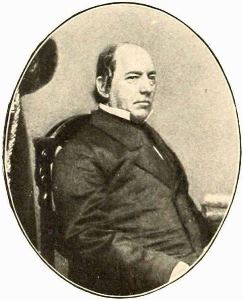
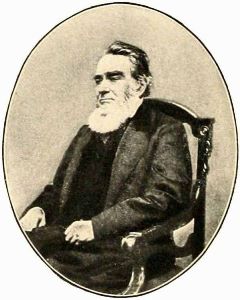
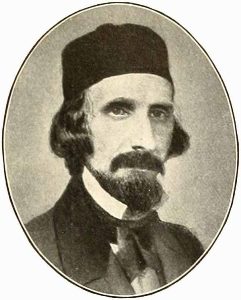
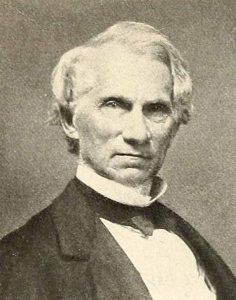
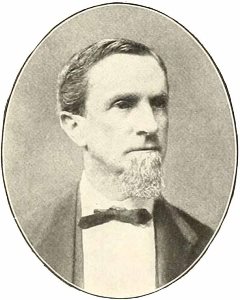
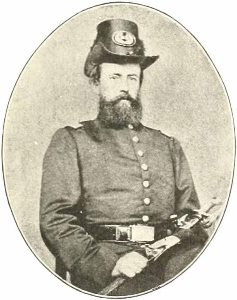
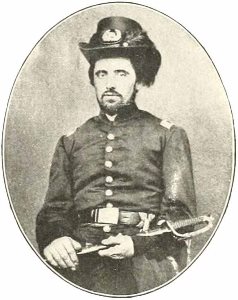
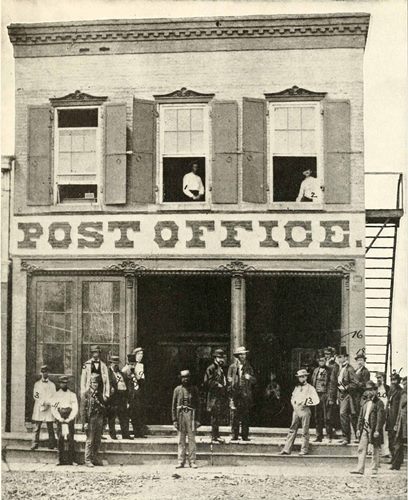
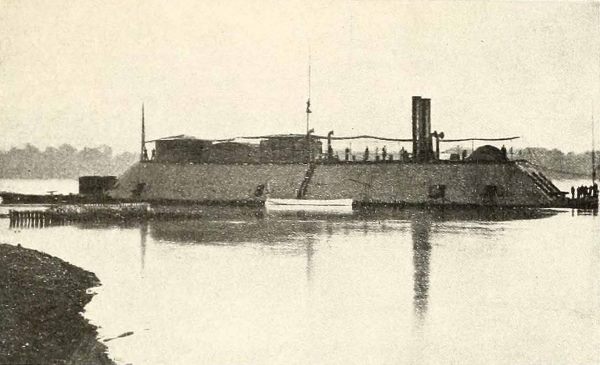
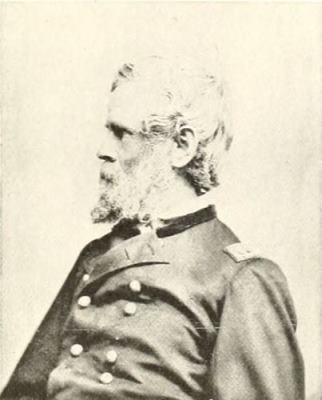
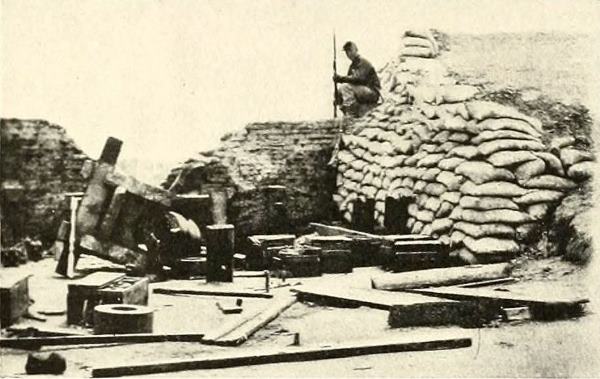
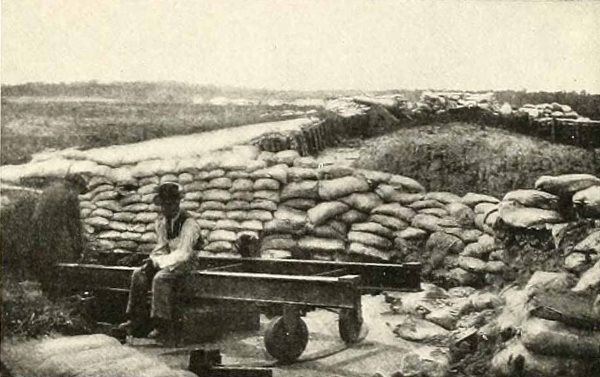
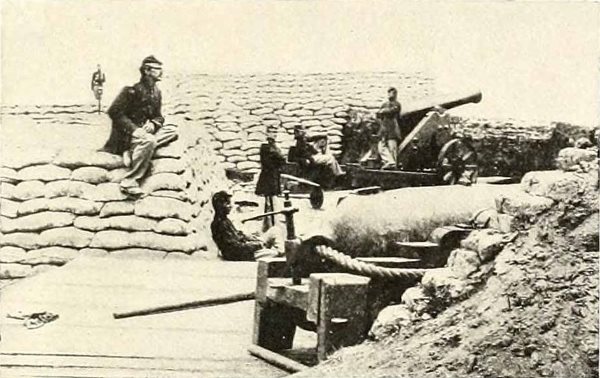
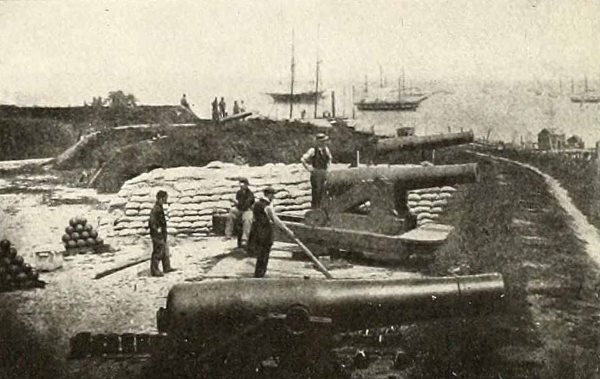
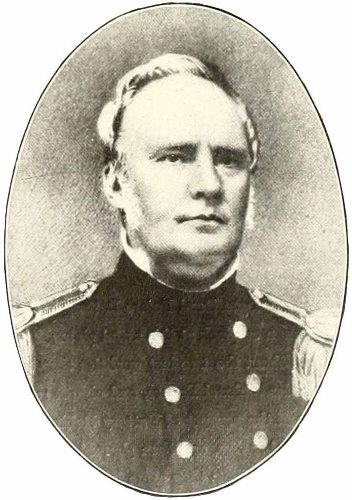
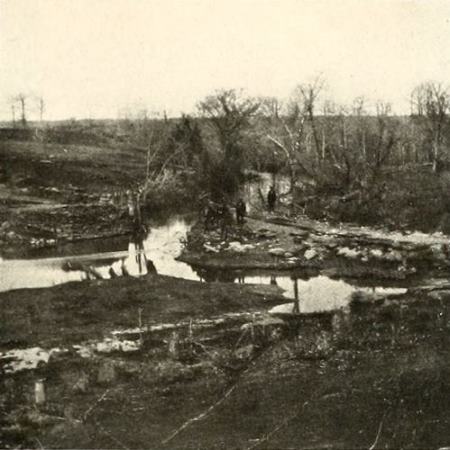
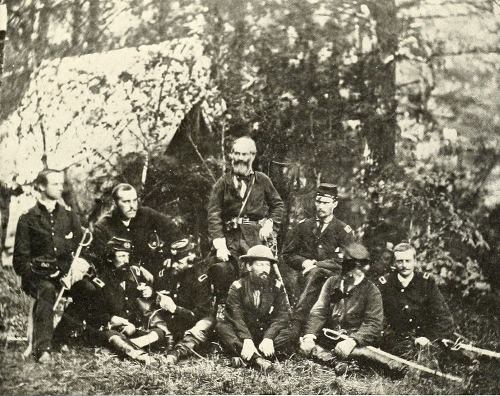
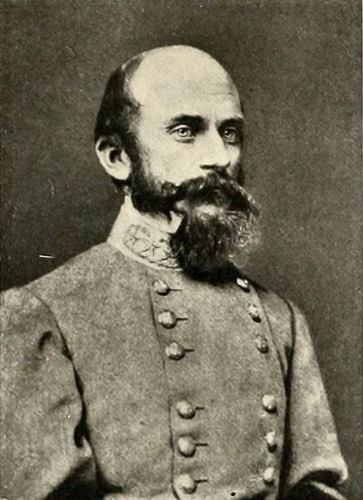
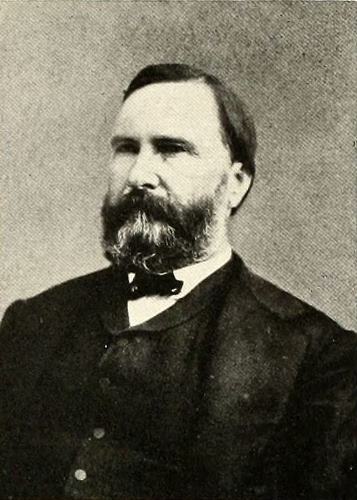
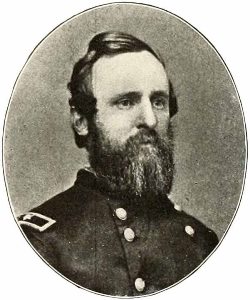
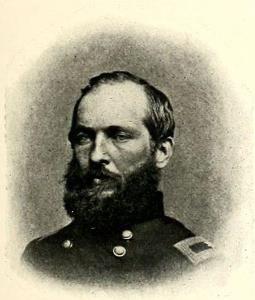
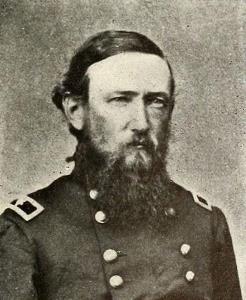
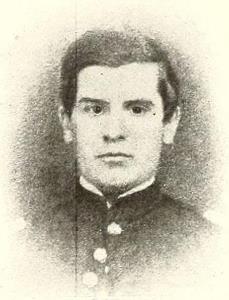
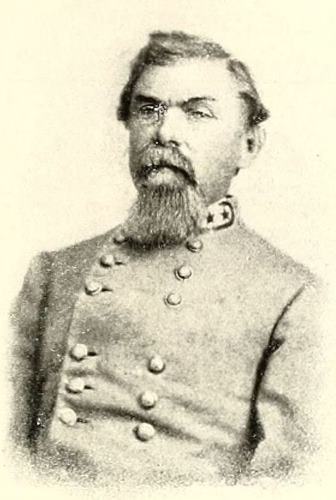
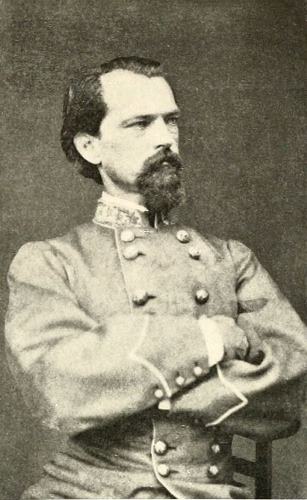
Johnston was an officer who, by the common consent of the military men
of both sides, was reckoned second only to Lee, if second, in the
qualities which fit an officer for the responsibility of great
commands.... He practised a lynx-eyed watchfulness of his adversary,
tempting him constantly to assault his entrenchments, holding his
fortified positions to the last moment, but choosing that last moment
so well as to save nearly every gun and wagon in the final withdrawal,
and always presenting a front covered by such defenses that one man in
the line was, by all sound military rules, equal to three or four in
the attack. In this way he constantly neutralized the superiority of
force his opponent wielded, and made his campaign from Dalton to the
Chattahoochee a model of defensive warfare. It is Sherman’s glory
that, with a totally different temperament, he accepted his
adversary’s game, and played it with a skill that was finally
successful, as we shall see.—Major-General Jacob D. Cox, U. S. V., in “Atlanta.”
The two leading Federal generals of the war, Grant and Sherman, met at
Nashville, Tennessee, on March 17, 1864, and arranged for a great
concerted double movement against the two main Southern armies, the Army
of Northern Virginia and the Army of Tennessee. Grant, who had been made
commander of all the Federal armies, was to take personal charge of the
Army of the Potomac and move against Lee, while to Sherman, whom, at
Grant’s request, President Lincoln had placed at the head of the Military
Division of the Mississippi, he turned over the Western army, which was to
proceed against Johnston.
It was decided, moreover, that the two movements were to be simultaneous
and that they were to begin early in May. Sherman concentrated his forces
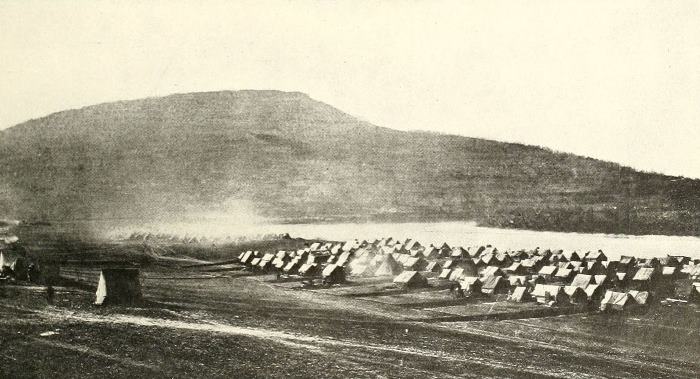
around Chattanooga on the Tennessee River, where the Army of the
Cumberland had spent the winter, and where a decisive battle had been
fought some months before, in the autumn of 1863. His army was composed of
three parts, or, more properly, of three armies operating in concert.
These were the Army of the Tennessee, led by General James B. McPherson;
the Army of Ohio, under General John M. Schofield, and the Army of the
Cumberland, commanded by General George H. Thomas. The last named was much
larger than the other two combined. The triple army aggregated the grand
total of ninety-nine thousand men, six thousand of whom were cavalrymen,
while four thousand four hundred and sixty belonged to the artillery.
There were two hundred and fifty-four heavy guns.
Soon to be pitted against Sherman’s army was that of General Joseph E.
Johnston, which had spent the winter at Dalton, in the State of Georgia,
some thirty miles southeast of Chattanooga. It was by chance that Dalton
became the winter quarters of the Confederate army. In the preceding
autumn, when General Bragg had been defeated on Missionary Ridge and
driven from the vicinity of Chattanooga, he retreated to Dalton and
stopped for a night’s rest. Discovering the next morning that he was not
pursued, he there remained. Some time later he was superseded by General
Johnston.
By telegraph, General Sherman was apprised of the time when Grant was to
move upon Lee on the banks of the Rapidan, in Virginia, and he prepared to
move his own army at the same time. But he was two days behind Grant, who
began his Virginia campaign on May 4th. Sherman broke camp on the 6th and
led his legions across hill and valley, forest and stream, toward the
Confederate stronghold. Nature was all abloom with the opening of a
Southern spring and the soldiers, who had long chafed under their enforced
idleness, now rejoiced at the exhilarating journey before them, though
their mission was to be one of strife and bloodshed.
Johnston’s army numbered about fifty-three thousand, and was divided into
two corps, under the respective commands of Generals John B. Hood and
William J. Hardee. But General Polk was on his way to join them, and in a
few days Johnston had in the neighborhood of seventy thousand men. His
position at Dalton was too strong to be carried by a front attack, and
Sherman was too wise to attempt it. Leaving Thomas and Schofield to make a
feint at Johnston’s front, Sherman sent McPherson on a flanking movement
by the right to occupy Snake Creek Gap, a mountain pass near Resaca, which
is about eighteen miles below Dalton.
Sherman, with the main part of the army, soon occupied Tunnel Hill, which
faces Rocky Face Ridge, an eastern range of the Cumberland Mountains,
north of Dalton, on which a large part of Johnston’s army was posted. The
Federal leader had little or no hope of dislodging his great antagonist
from this impregnable position, fortified by rocks and cliffs which no
army could scale while under fire. But he ordered that demonstrations be
made at several places, especially at a pass known as Rocky Face Gap. This
was done with great spirit and bravery, the men clambering over rocks and
across ravines in the face of showers of bullets and even of masses of
stone hurled down from the heights above them. On the whole they won but
little advantage.
During the 8th and 9th of May, these operations were continued, the
Federals making but little impression on the Confederate stronghold.
Meanwhile, on the Dalton road there was a sharp cavalry fight, the Federal
commander, General E. M. McCook, having encountered General Wheeler.
McCook’s advance brigade under Colonel La Grange was defeated and La
Grange was made prisoner.
Sherman’s chief object in these demonstrations, it will be seen, was so to
engage Johnston as to prevent his intercepting McPherson in the latter’s
movement upon Resaca. In this Sherman was successful, and by the 11th he
was giving his whole energy to moving the remainder of his forces by the
right flank, as McPherson had done, to Resaca, leaving a detachment of
General O. O. Howard’s Fourth Corps to occupy Dalton when evacuated. When
Johnston discovered this, he was quick to see that he must abandon his
entrenchments and intercept Sherman. Moving by the only two good roads,
Johnston beat Sherman in the race to Resaca. The town had been fortified,
owing to Johnston’s foresight, and McPherson had failed to dislodge the
garrison and capture it. The Confederate army was now settled behind its
entrenchments, occupying a semicircle of low wooded hills, both flanks of
the army resting on the banks of the Oostenaula River.
On the morning of May 14th, the Confederate works were invested by the
greater part of Sherman’s army and it was evident that a battle was
imminent. The attack was begun about noon, chiefly by the Fourteenth Army
Corps under Palmer, of Thomas’ army, and Judah’s division of Schofield’s.
General Hindman’s division of Hood’s corps bore the brunt of this attack
and there was heavy loss on both sides. Later in the day, a portion of
Hood’s corps was massed in a heavy column and hurled against the Federal
left, driving it back. But at this point the Twentieth Army Corps under
Hooker, of Thomas’ army, dashed against the advancing Confederates and
pushed them back to their former lines.
The forenoon of the next day was spent in heavy skirmishing, which grew to
the dignity of a battle. During the day’s operations a hard fight for a
Confederate lunette on the top of a low hill occurred. At length, General
Butterfield, in the face of a galling fire, succeeded in capturing the
position. But so deadly was the fire from Hardee’s corps that Butterfield
was unable to hold it or to remove the four guns the lunette contained.
With the coming of night, General Johnston determined to withdraw his army
from Resaca. The battle had cost each army nearly three thousand men.
While it was in progress, McPherson, sent by Sherman, had deftly marched
around Johnston’s left with the view of cutting off his retreat south by
seizing the bridges across the Oostenaula, and at the same time the
Federal cavalry was threatening the railroad to Atlanta which ran beyond
the river. It was the knowledge of these facts that determined the
Confederate commander to abandon Resaca. Withdrawing during the night, he
led his army southward to the banks of the Etowah River. Sherman followed
but a few miles behind him. At the same time Sherman sent a division of
the Army of the Cumberland, under General Jeff. C. Davis, to Rome, at the
junction of the Etowah and the Oostenaula, where there were important
machine-shops and factories. Davis captured the town and several heavy
guns, destroyed the factories, and left a garrison to hold it.
Sherman was eager for a battle in the open with Johnston and on the 17th,
near the town of Adairsville, it seemed as if the latter would gratify
him. Johnston chose a good position, posted his cavalry, deployed his
infantry, and awaited combat. The Union army was at hand. The skirmishing
for some hours almost amounted to a battle. But suddenly Johnston decided
to defer a conclusive contest to another time.
Again at Cassville, a few days later, Johnston drew up the Confederate
legions in battle array, evidently having decided on a general engagement
at this point. He issued a spirited address to the army: “By your courage
and skill you have repulsed every assault of the enemy.... You will now
turn and march to meet his advancing columns.... I lead you to battle.”
But, when his right flank had been turned by a Federal attack, and when
two of his corps commanders, Hood and Polk, advised against a general
battle, Johnston again decided on postponement. He retreated in the night
across the Etowah, destroyed the bridges, and took a strong position among
the rugged hills about Allatoona Pass, extending south to Kenesaw
Mountain.
Johnston’s decision to fight and then not to fight was a cause for
grumbling both on the part of his army and of the inhabitants of the
region through which he was passing. His men were eager to defend their
country, and they could not understand this Fabian policy. They would have
preferred defeat to these repeated retreats with no opportunity to show
what they could do.
Johnston, however, was wiser than his critics. The Union army was larger
by far and better equipped than his own, and Sherman was a
master-strategist. His hopes rested on two or three contingencies that he
might catch a portion of Sherman’s army separated from the rest; that
Sherman would be so weakened by the necessity of guarding the long line of
railroad to his base of supplies at Chattanooga, Nashville, and even
far-away Louisville, as to make it possible to defeat him in open battle,
or, finally, that Sherman might fall into the trap of making a direct
attack while Johnston was in an impregnable position, and in such a
situation he now was.
Not yet, however, was Sherman inclined to fall into such a trap, and when
Johnston took his strong position at and beyond Allatoona Pass, the
Northern commander decided, after resting his army for a few days, to move
toward Atlanta by way of Dallas, southwest of the pass. Rations for a
twenty days’ absence from direct railroad communication were issued to the
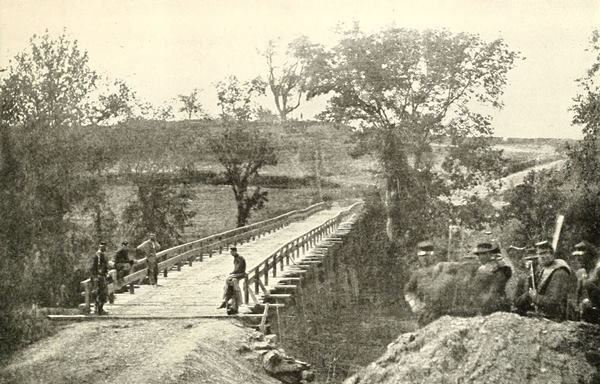
Federal army. In fact, Sherman’s railroad connection with the North was
the one delicate problem of the whole movement. The Confederates had
destroyed the iron way as they moved southward; but the Federal engineers,
following the army, repaired the line and rebuilt the bridges almost as
fast as the army could march.
Sherman’s movement toward Dallas drew Johnston from the slopes of the
Allatoona Hills. From Kingston, the Federal leader wrote on May 23d, “I am
already within fifty miles of Atlanta.” But he was not to enter that city
for many weeks, not before he had measured swords again and again with his
great antagonist. On the 25th of May, the two great armies were facing
each other near New Hope Church, about four miles north of Dallas. Here,
for three or four days, there was almost incessant fighting, though there
was not what might be called a pitched battle.
Late in the afternoon of the first day, Hooker made a vicious attack on
Stewart’s division of Hood’s corps. For two hours the battle raged without
a moment’s cessation, Hooker being pressed back with heavy loss. During
those two hours he had held his ground against sixteen field-pieces and
five thousand infantry at close range. The name “Hell Hole” was applied to
this spot by the Union soldiers.
On the next day there was considerable skirmishing in different places
along the line that divided the two armies. But the chief labor of the day
was throwing up entrenchments, preparatory to a general engagement. The
country, however, was ill fitted for such a contest. The continuous
succession of hills, covered with primeval forests, presented little
opportunity for two great armies, stretched out almost from Dallas to
Marietta, a distance of about ten miles, to come together simultaneously
at all points.
A severe contest occurred on the 27th, near the center of the
battle-lines, between General O. O. Howard on the Federal side and General
Patrick Cleburne on the part of the South. Dense and almost impenetrable
was the undergrowth through which Howard led his troops to make the
attack. The fight was at close range and was fierce and bloody, the
Confederates gaining the greater advantage.
The next day Johnston made a terrific attack on the Union right, under
McPherson, near Dallas. But McPherson was well entrenched and the
Confederates were repulsed with a serious loss. In the three or four days’
fighting the Federal loss was probably twenty-four hundred men and the
Confederate somewhat greater.
In the early days of June, Sherman took possession of the town of
Allatoona and made it a second base of supplies, after repairing the
railroad bridge across the Etowah River. Johnston swung his left around to
Lost Mountain and his right extended beyond the railroad—a line ten miles
in length and much too long for its numbers. Johnston’s army, however, had
been reënforced, and it now numbered about seventy-five thousand men.
Sherman, on June 1st, had nearly one hundred and thirteen thousand men and
on the 8th he received the addition of a cavalry brigade and two divisions
of the Seventeenth Corps, under General Frank P. Blair, which had marched
from Alabama.
So multifarious were the movements of the two great armies among the hills
and forests of that part of Georgia that it is impossible for us to follow
them all. On the 14th of June, Generals Johnston, Hardee, and Polk rode up
the slope of Pine Mountain to reconnoiter. As they were standing, making
observations, a Federal battery in the distance opened on them and General
Polk was struck in the chest with a Parrot shell. He was killed instantly.
General Polk was greatly beloved, and his death caused a shock to the
whole Confederate army. He was a graduate of West Point; but after being
graduated he took orders in the church and for twenty years before the war
was Episcopal Bishop of Louisiana. At the outbreak of the war he entered
the field and served with distinction to the moment of his death.
During the next two weeks there was almost incessant fighting, heavy
skirmishing, sparring for position. It was a wonderful game of military
strategy, played among the hills and mountains and forests by two masters
in the art of war. On June 23d, Sherman wrote, “The whole country is one
vast fort, and Johnston must have full fifty miles of connected
trenches.... Our lines are now in close contact, and the fighting
incessant.... As fast as we gain one position, the enemy has another all
ready.”
Sherman, conscious of superior strength, was now anxious for a real
battle, a fight to the finish with his antagonist. But Johnston was too
wily to be thus caught. He made no false move on the great chessboard of
war. At length, the impatient Sherman decided to make a general front
attack, even though Johnston, at that moment, was impregnably entrenched
on the slopes of Kenesaw Mountain. This was precisely what the Confederate
commander was hoping for.
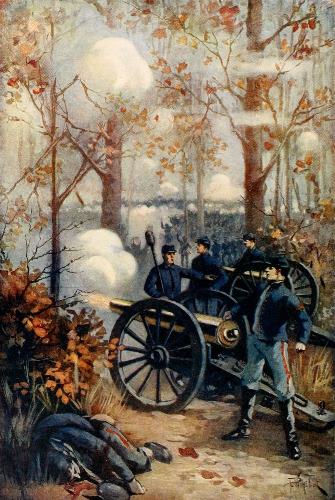
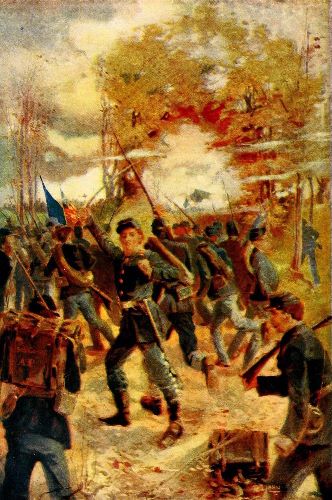
The desperate battle of Kenesaw Mountain occurred on the 27th of June. In
the early morning hours, the boom of Federal cannon announced the opening
of a bloody day’s struggle. It was soon answered by the Confederate
batteries in the entrenchments along the mountain side, and the deafening
roar of the giant conflict reverberated from the surrounding hills. About
nine o’clock the Union infantry advance began. On the left was McPherson,
who sent the Fifteenth Army Corps, led by General John A. Logan, directly
against the mountain. The artillery from the Confederate trenches in front
of Logan cut down his men by hundreds. The Federals charged courageously
and captured the lower works, but failed to take the higher ridges.
The chief assault of the day was by the Army of the Cumberland, under
Thomas. Most conspicuous in the attack were the divisions of Newton and
Davis, advancing against General Loring, successor of the lamented Polk.
Far up on a ridge at one point, General Cleburne held a line of
breastworks, supported by the flanking fire of artillery. Against this a
vain and costly assault was made.
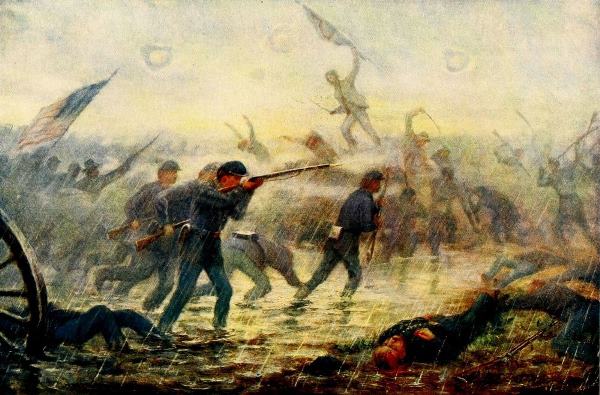
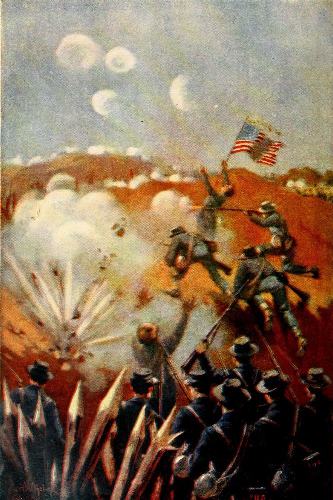
When the word was given to charge, the Federals sprang forward and, in the
face of a deadly hail of musket-balls and shells, they dashed up the
slope, firing as they went. Stunned and bleeding, they were checked again
and again by the withering fire from the mountain slope; but they
re-formed and pressed on with dauntless valor. Some of them reached the
parapets and were instantly shot down, their bodies rolling into the
Confederate trenches among the men who had slain them, or back down the
hill whence they had come. General Harker, leading a charge against
Cleburne, was mortally wounded. His men were swept back by a galling fire,
though many fell with their brave leader.
This assault on Kenesaw Mountain cost Sherman three thousand men and won
him nothing. Johnston’s loss probably exceeded five hundred. The battle
continued but two and a half hours. It was one of the most recklessly
daring assaults during the whole war period, but did not greatly affect
the final result of the campaign.
Under a flag of truce, on the day after the battle, the men of the North
and of the South met on the gory field to bury their dead and to minister
to the wounded. They met as friends for the moment, and not as foes. It
was said that there were instances of father and son, one in blue and the
other in gray, and brothers on opposite sides, meeting one another on the
bloody slopes of Kenesaw. Tennessee and Kentucky had sent thousands of men
to each side in the fratricidal struggle and not infrequently families had
been divided.
Three weeks of almost incessant rain fell upon the struggling armies
during this time, rendering their operations disagreeable and
unsatisfactory. The camp equipage, the men’s uniforms and accouterments
were thoroughly saturated with rain and mud. Still the warriors of the
North and of the South lived and fought on the slopes of the mountain
range, intent on destroying each other.
Sherman was convinced by his drastic repulse at Kenesaw Mountain that
success lay not in attacking his great antagonist in a strong position,
and he resumed his old tactics. He would flank Johnston from Kenesaw as he
had flanked him out of Dalton and Allatoona Pass. He thereupon turned upon
Johnston’s line of communication with Atlanta, whence the latter received
his supplies. The movement was successful, and in a few days Kenesaw
Mountain was deserted.
Johnston moved to the banks of the Chattahoochee, Sherman following in
the hope of catching him while crossing the river. But the wary
Confederate had again, as at Resaca, prepared entrenchments in advance,
and these were on the north bank of the river. He hastened to them, then
turned on the approaching Federals and defiantly awaited attack. But
Sherman remembered Kenesaw and there was no battle.
The feints, the sparring, the flanking movements among the hills and
forests continued day after day. The immediate aim in the early days of
July was to cross the Chattahoochee. On the 8th, Sherman sent Schofield
and McPherson across, ten miles or more above the Confederate position.
Johnston crossed the next day. Thomas followed later.
Sherman’s position was by no means reassuring. It is true he had, in the
space of two months, pressed his antagonist back inch by inch for more
than a hundred miles and was now almost within sight of the goal of the
campaign—the city of Atlanta. But the single line of railroad that
connected him with the North and brought supplies from Louisville, five
hundred miles away, for a hundred thousand men and twenty-three thousand
animals, might at any moment be destroyed by Confederate raiders.
The necessity of guarding the Western and Atlantic Railroad was an
ever-present concern with Sherman. Forrest and his cavalry force were in
northern Mississippi waiting for him to get far enough on the way to
Atlanta for them to pounce upon the iron way and tear it to ruins. To
prevent this General Samuel D. Sturgis, with eight thousand troops, was
sent from Memphis against Forrest. He met him on the 10th of June near
Guntown, Mississippi, but was sadly beaten and driven back to Memphis, one
hundred miles away. The affair, nevertheless, delayed Forrest in his
operations against the railroad, and meanwhile General Smith’s troops
returned to Memphis from the Red River expedition, somewhat late according
to the schedule but eager to join Sherman in the advance on Atlanta.
Smith, however, was directed to take the offensive against Forrest, and
with fourteen thousand troops, and in a three days’ fight, demoralized him
badly at Tupelo, Mississippi, July 14th-17th. Smith returned to Memphis
and made another start for Sherman, when he was suddenly turned back and
sent to Missouri, where the Confederate General Price was extremely
active, to help Rosecrans.
To avoid final defeat and to win the ground he had gained had taxed
Sherman’s powers to the last degree and was made possible only through his
superior numbers. Even this degree of success could not be expected to
continue if the railroad to the North should be destroyed. But Sherman
must do more than he had done; he must capture Atlanta, this Richmond of
the far South, with its cannon foundries and its great machine-shops, its
military factories, and extensive army supplies. He must divide the
Confederacy north and south as Grant’s capture of Vicksburg had split it
east and west.
Sherman must have Atlanta, for political reasons as well as for military
purposes. The country was in the midst of a presidential campaign. The
opposition to Lincoln’s reëlection was strong, and for many weeks it was
believed on all sides that his defeat was inevitable. At least, the
success of the Union arms in the field was deemed essential to Lincoln’s
success at the polls. Grant had made little progress in Virginia and his
terrible repulse at Cold Harbor, in June, had cast a gloom over every
Northern State. Farragut was operating in Mobile Bay; but his success was
still in the future.
The eyes of the supporters of the great war-president turned longingly,
expectantly, toward General Sherman and his hundred thousand men before
Atlanta. “Do something—something spectacular—save the party and save the
country thereby from permanent disruption!” This was the cry of the
millions, and Sherman understood it. But withal, the capture of the
Georgia city may have been doubtful but for the fact that at the critical
moment the Confederate President made a decision that resulted,
unconsciously, in a decided service to the Union cause. He dismissed
General Johnston and put another in his place, one who was less strategic
and more impulsive.
Jefferson Davis did not agree with General Johnston’s military judgment,
and he seized on the fact that Johnston had so steadily retreated before
the Northern army as an excuse for his removal. On the 18th of July, Davis
turned the Confederate Army of Tennessee over to General John B. Hood. A
graduate of West Point of the class of 1853, a classmate of McPherson,
Schofield, and Sheridan, Hood had faithfully served the cause of the South
since the opening of the war. He was known as a fighter, and it was
believed that he would change the policy of Johnston to one of open battle
with Sherman’s army. And so it proved.
Johnston had lost, since the opening of the campaign at Dalton, about
fifteen thousand men, and the army that he now delivered to Hood consisted
of about sixty thousand in all.
While Hood was no match for Sherman as a strategist, he was not a
weakling. His policy of aggression, however, was not suited to the
circumstances—to the nature of the country—in view of the fact that
Sherman’s army was far stronger than his own.
Two days after Hood took command of the Confederate army he offered
battle. Sherman’s forces had crossed Peach Tree Creek, a small stream
flowing into the Chattahoochee, but a few miles from Atlanta, and were
approaching the city. They had thrown up slight breastworks, as was their
custom, but were not expecting an attack. Suddenly, however, about four
o’clock in the afternoon of July 20th, an imposing column of Confederates
burst from the woods near the position of the Union right center, under
Thomas. The Federals were soon at their guns. The battle was short,
fierce, and bloody. The Confederates made a gallant assault, but were
pressed back to their entrenchments, leaving the ground covered with dead
and wounded. The Federal loss in the battle of Peach Tree Creek was
placed at over seventeen hundred, the Confederate loss being much greater.
This battle had been planned by Johnston before his removal, but he had
been waiting for the strategic moment to fight it.
Two days later, July 22d, occurred the greatest engagement of the entire
campaign—the battle of Atlanta. The Federal army was closing in on the
entrenchments of Atlanta, and was now within two or three miles of the
city. On the night of the 21st, General Blair, of McPherson’s army, had
gained possession of a high hill on the left, which commanded a view of
the heart of the city. Hood thereupon planned to recapture this hill, and
make a general attack on the morning of the 22d. He sent General Hardee on
a long night march around the extreme flank of McPherson’s army, the
attack to be made at daybreak. Meantime, General Cheatham, who had
succeeded to the command of Hood’s former corps, and General A. P.
Stewart, who now had Polk’s corps, were to engage Thomas and Schofield in
front and thus prevent them from sending aid to McPherson.
Hardee was delayed in his fifteen-mile night march, and it was noon before
he attacked. At about that hour Generals Sherman and McPherson sat talking
near the Howard house, which was the Federal headquarters, when the sudden
boom of artillery from beyond the hill that Blair had captured announced
the opening of the coming battle. McPherson quickly leaped upon his horse
and galloped away toward the sound of the guns. Meeting Logan and Blair
near the railroad, he conferred with them for a moment, when they
separated, and each hastened to his place in the battle-line. McPherson
sent aides and orderlies in various directions with despatches, until but
two were still with him. He then rode into a forest and was suddenly
confronted by a portion of the Confederate army under General Cheatham.
“Surrender,” was the call that rang out. But he wheeled his horse as if to
flee, when he was instantly shot dead, and the horse galloped back
riderless.
The death of the brilliant, dashing young leader, James B. McPherson, was
a great blow to the Union army. But thirty-six years of age, one of the
most promising men in the country, and already the commander of a military
department, McPherson was the only man in all the Western armies whom
Grant, on going to the East, placed in the same military class with
Sherman.
Logan succeeded the fallen commander, and the battle raged on. The
Confederates were gaining headway. They captured several guns. Cheatham
was pressing on, pouring volley after volley into the ranks of the Army of
the Tennessee, which seemed about to be cut in twain. A gap was opening.
The Confederates were pouring through. General Sherman was present and saw
the danger. Calling for Schofield to send several batteries, he placed
them and poured a concentrated artillery fire through the gap and mowed
down the advancing men in swaths. At the same time, Logan pressed forward
and Schofield’s infantry was called up. The Confederates were hurled back
with great loss. The shadows of night fell—and the battle of Atlanta was
over. Hood’s losses exceeded eight thousand of his brave men, whom he
could ill spare. Sherman lost about thirty-seven hundred.
The Confederate army recuperated within the defenses of Atlanta—behind an
almost impregnable barricade. Sherman had no hope of carrying the city by
assault, while to surround and invest it was impossible with his numbers.
He determined, therefore, to strike Hood’s lines of supplies. On July
28th, Hood again sent Hardee out from his entrenchments to attack the Army
of the Tennessee, now under the command of General Howard. A fierce battle
at Ezra Church on the west side of the city ensued, and again the
Confederates were defeated with heavy loss.
A month passed and Sherman had made little progress toward capturing
Atlanta. Two cavalry raids which he organized resulted in defeat, but the
two railroads from the south into Atlanta were considerably damaged. But,
late in August, the Northern commander made a daring move that proved
successful. Leaving his base of supplies, as Grant had done before
Vicksburg, and marching toward Jonesboro, Sherman destroyed the Macon and
Western Railroad, the only remaining line of supplies to the Confederate
army.
Hood attempted to block the march on Jonesboro, and Hardee was sent with
his and S. D. Lee’s Corps to attack the Federals, while he himself sought
an opportunity to move upon Sherman’s right flank. Hardee’s attack failed,
and this necessitated the evacuation of Atlanta. After blowing up his
magazines and destroying the supplies which his men could not carry with
them, Hood abandoned the city, and the next day, September 2d, General
Slocum, having succeeded Hooker, led the Twentieth Corps of the Federal
army within its earthen walls. Hood had made his escape, saving his army
from capture. His chief desire would have been to march directly north on
Marietta and destroy the depots of Federal supplies, but a matter of more
importance prevented. Thirty-four thousand Union prisoners were confined
at Andersonville, and a small body of cavalry could have released them. So
Hood placed himself between Andersonville and Sherman.
In the early days of September the Federal hosts occupied the city toward
which they had toiled all the summer long. At East Point, Atlanta, and
Decatur, the three armies settled for a brief rest, while the cavalry,
stretched for many miles along the Chattahoochee, protected their flanks
and rear. Since May their ranks had been depleted by some twenty-eight
thousand killed and wounded, while nearly four thousand had fallen
prisoners, into the Confederates’ hands.
It was a great price, but whatever else the capture of Atlanta did, it
ensured the reëlection of Abraham Lincoln to the presidency of the United
States. The total Confederate losses were in the neighborhood of
thirty-five thousand, of which thirteen thousand were prisoners.
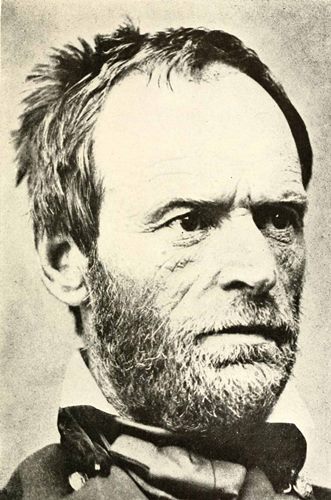
COPYRIGHT, 1911, REVIEW OF REVIEWS CO.
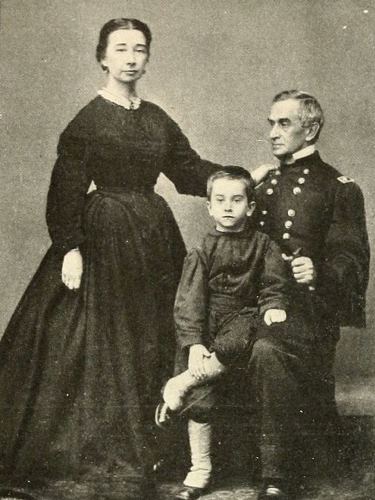
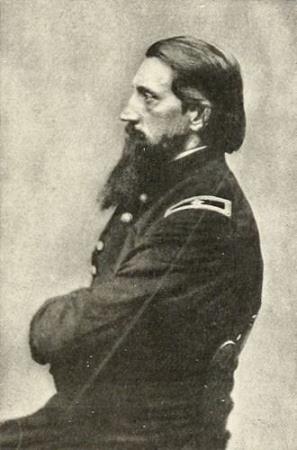
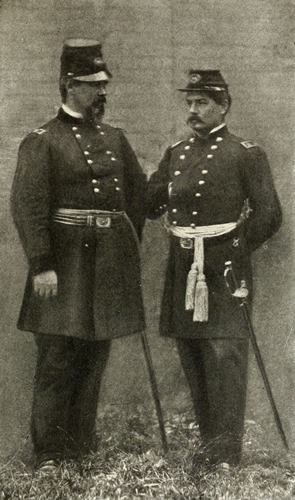
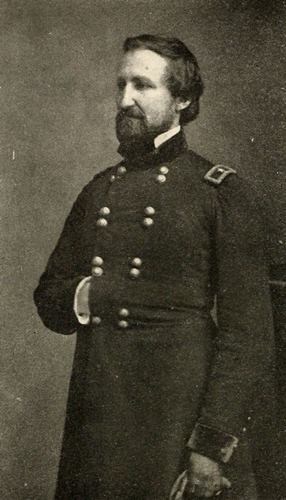
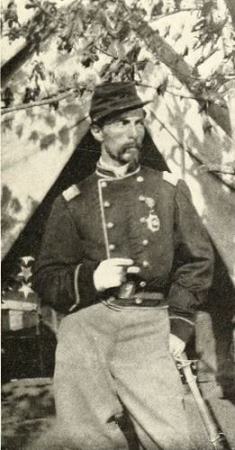
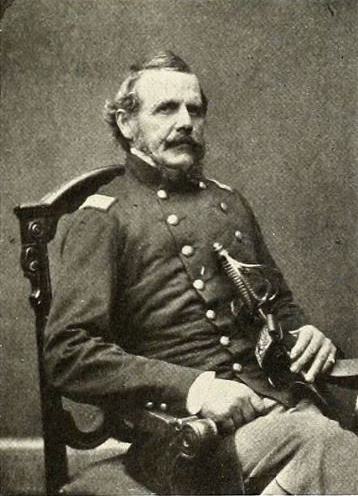
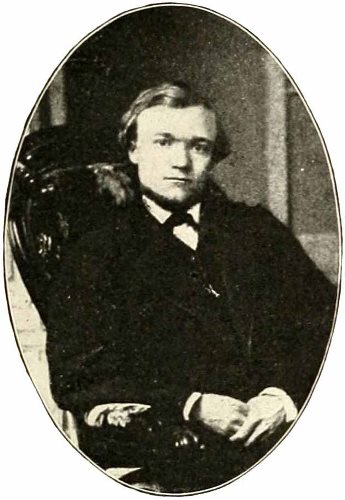
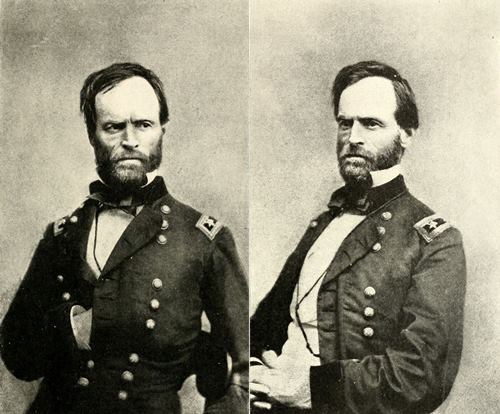
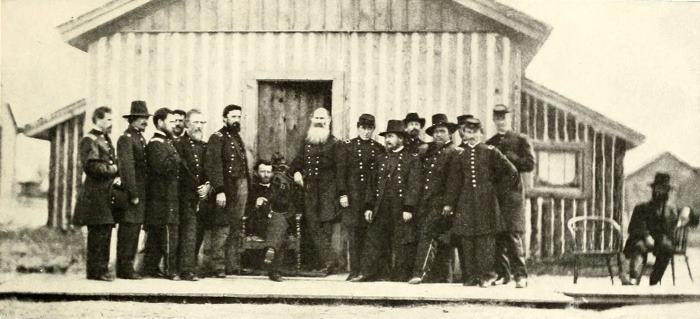
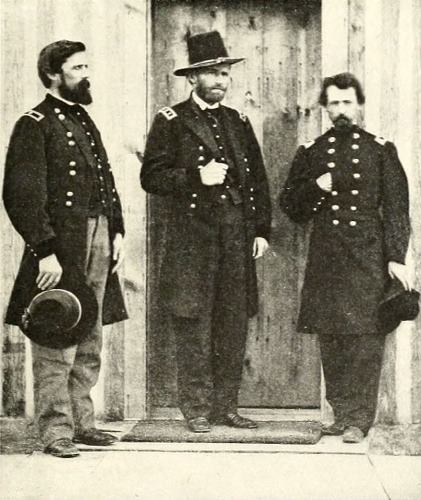
SHERMAN IN 1865
If Sherman was deemed merciless in war, he was superbly generous when the
fighting was over. To Joseph E. Johnston he offered most liberal terms of
surrender for the Southern armies. Their acceptance would have gone far to
prevent the worst of the reconstruction enormities. Unfortunately his
first convention with Johnston was disapproved. The death of Lincoln had
removed the guiding hand that would have meant so much to the nation. To
those who have read his published correspondence and his memoirs Sherman
appears in a very human light. He was fluent and frequently reckless in
speech and writing, but his kindly humanity is seen in both.
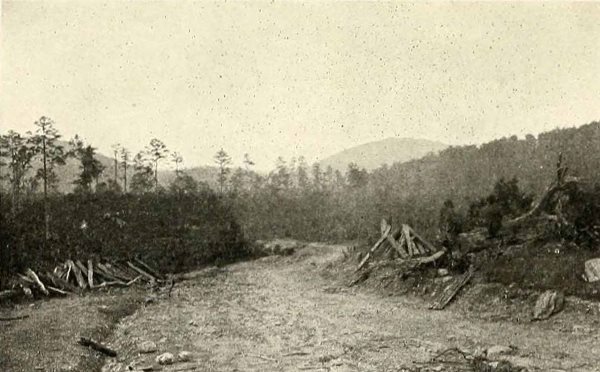
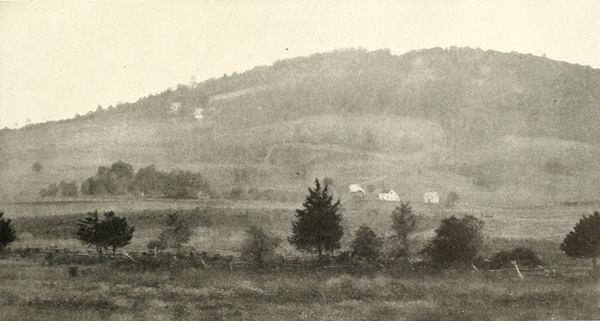
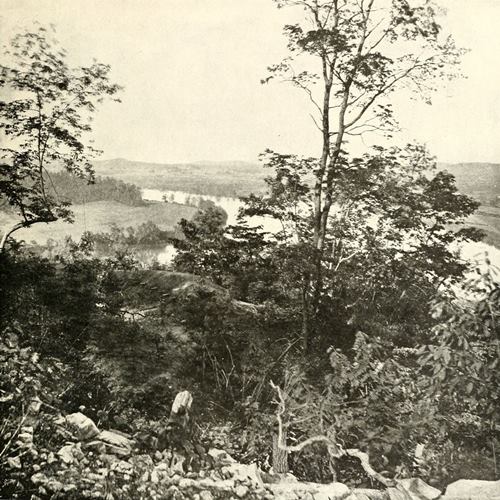
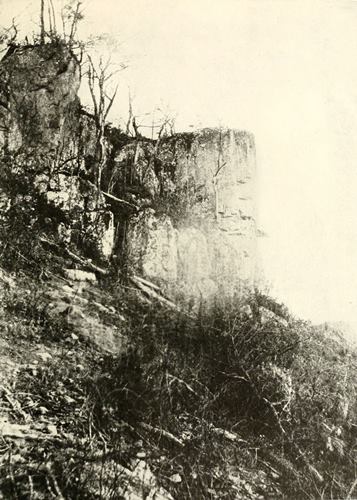
BUZZARD’S ROOST, GEORGIA, MAY 7, 1864
In the upper picture rises the precipitous height of Rocky Face as Sherman
saw it on May 7, 1864. His troops under Thomas had moved forward along the
line of the railroad, opening the great Atlanta campaign on schedule time.
Looking down into the gorge called Buzzard’s Roost, through which the
railroad passes, Sherman could see swarms of Confederate troops, the road
filled with obstructions, and hostile batteries crowning the cliffs on
either side. He knew that his antagonist, Joe Johnston, here confronted
him in force. But it was to be a campaign of brilliant flanking movements,
and Sherman sat quietly down to wait till the trusty McPherson should
execute the first one.
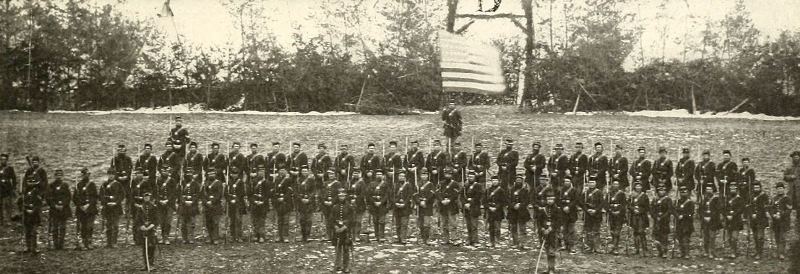
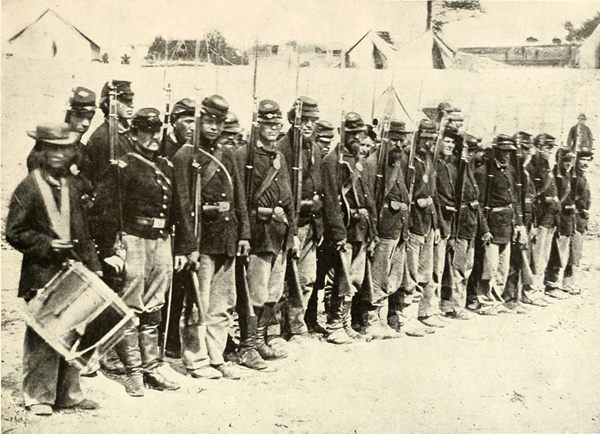
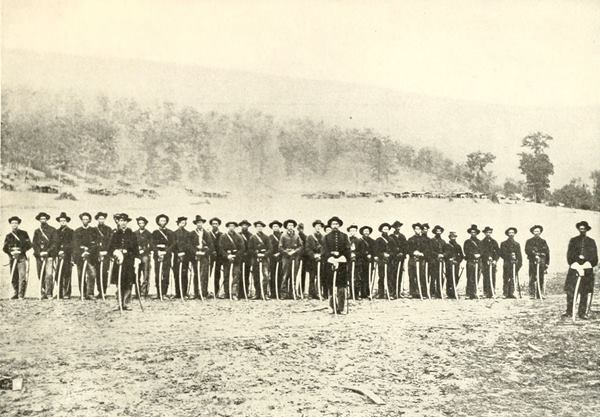
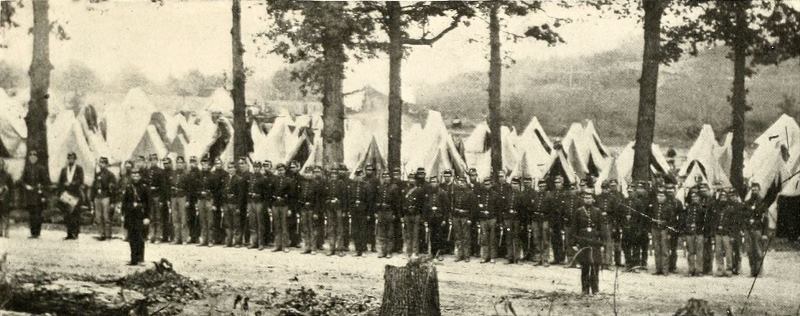
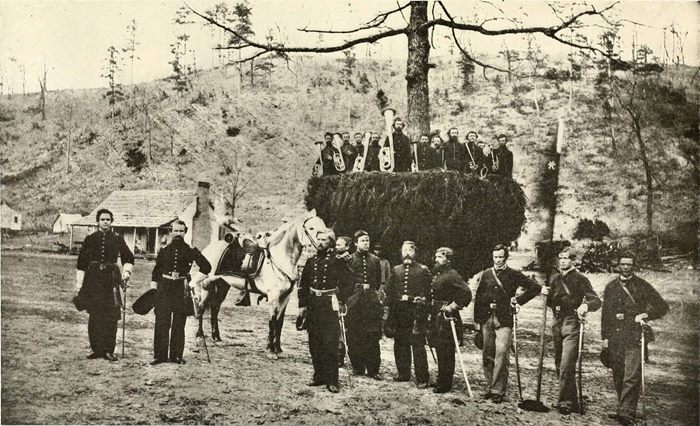
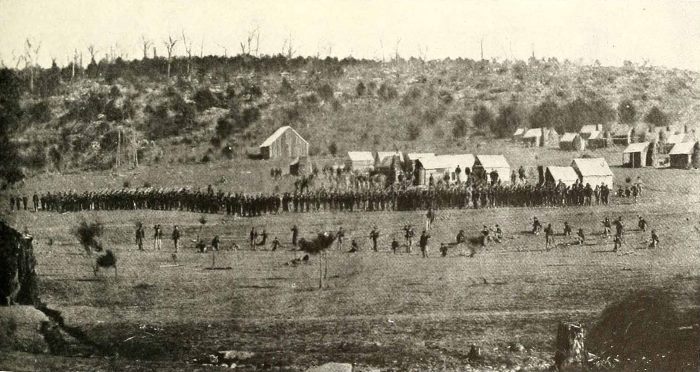
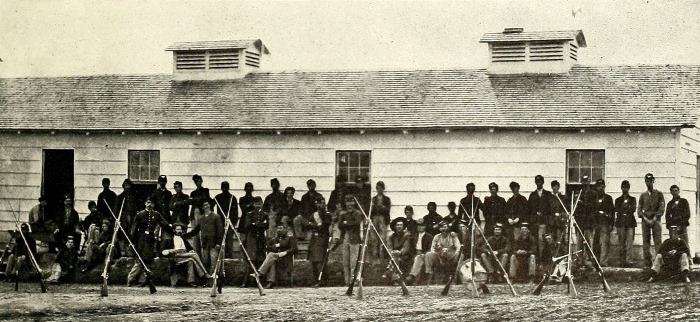
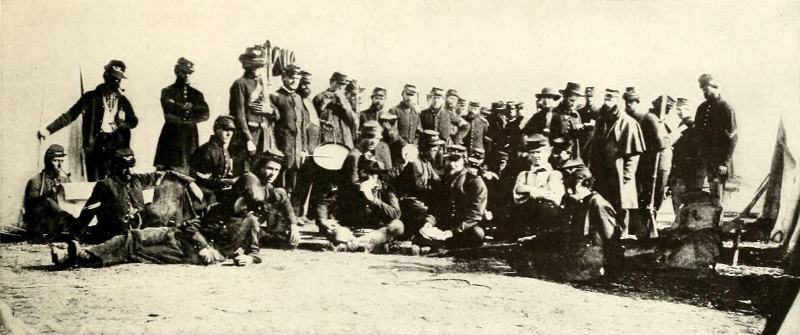
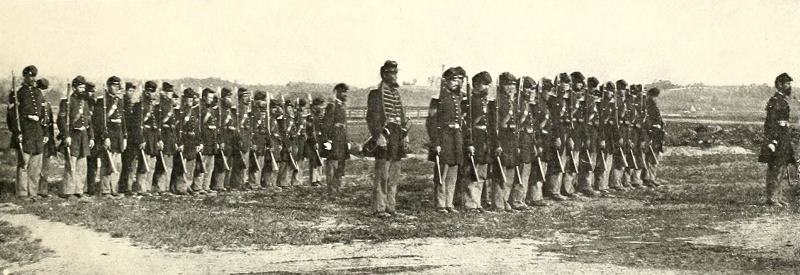
In the lower picture, drawn up on dress parade, stands one of the finest
fighting organizations in the Atlanta campaign. This regiment won its
spurs in the first Union victory in the West at Mill Springs, Kentucky,
January 19, 1862. There, according to the muster-out roll, “William Blake,
musician, threw away his drum and took a gun.” The spirit of this drummer
boy of Company F was the spirit of all the troops from Minnesota. A
Georgian noticed an unusually fine body of men marching by, and when told
that they were a Minnesota regiment, said, “I didn’t know they had any
troops up there.” But the world was to learn the superlative fighting
qualities of the men from the Northwest. Sherman was glad to have all he
could get of them in this great army of one hundred thousand veterans.
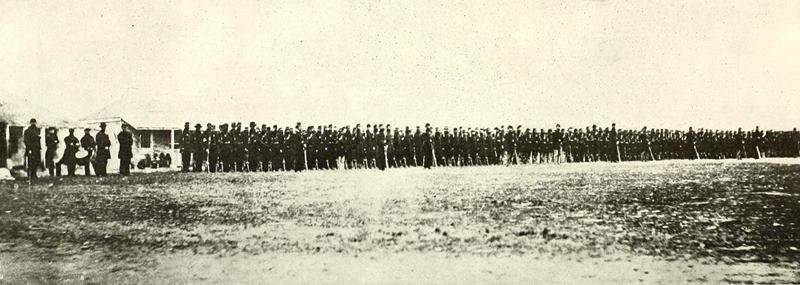
COPYRIGHT, 1911, REVIEW OF REVIEWS CO.
THE SECOND MINNESOTA INFANTRY—ENGAGED AT ROCKY FACE RIDGE, MAY 8-11, 1864
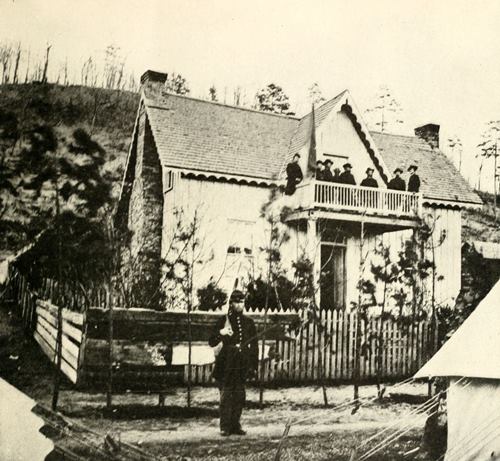
COPYRIGHT, 1911, REVIEW OF REVIEWS CO.
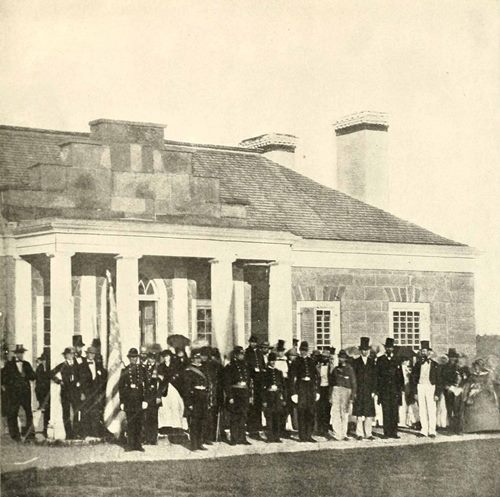
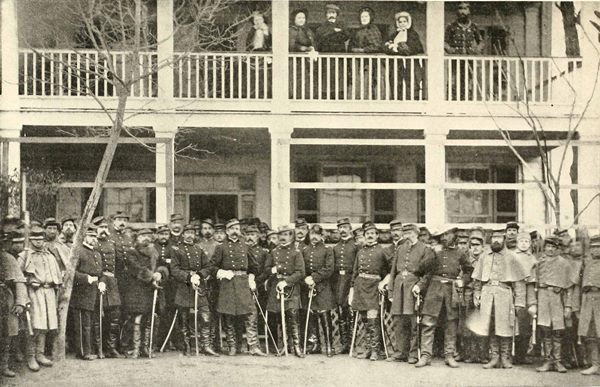
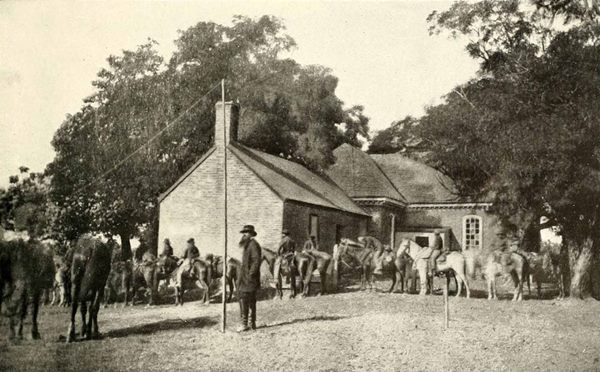
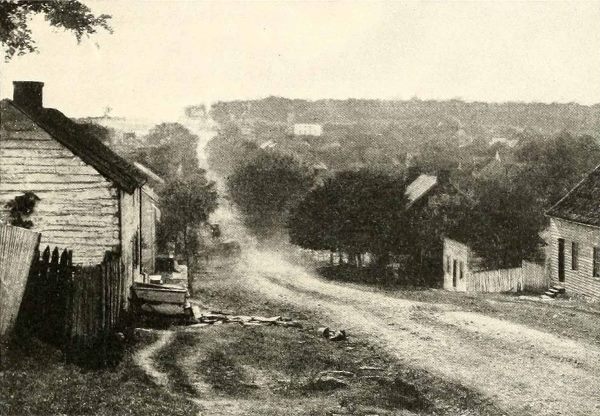
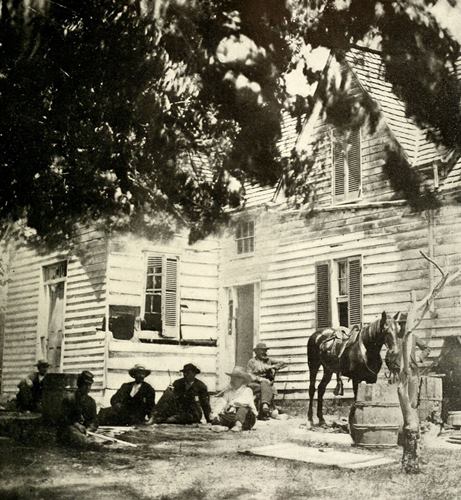
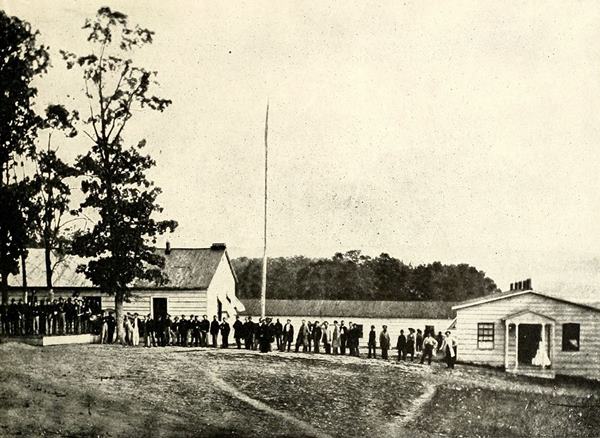
IN THE FOREFRONT—GENERAL RICHARD W. JOHNSON AT GRAYSVILLE
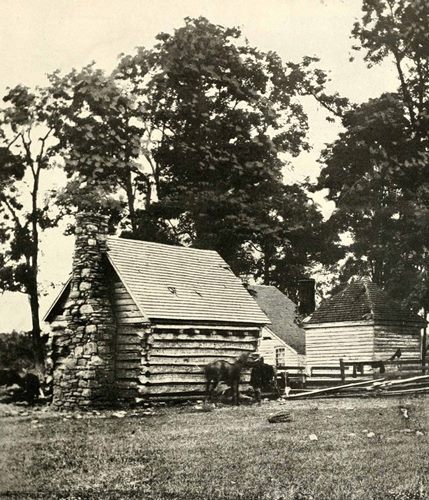
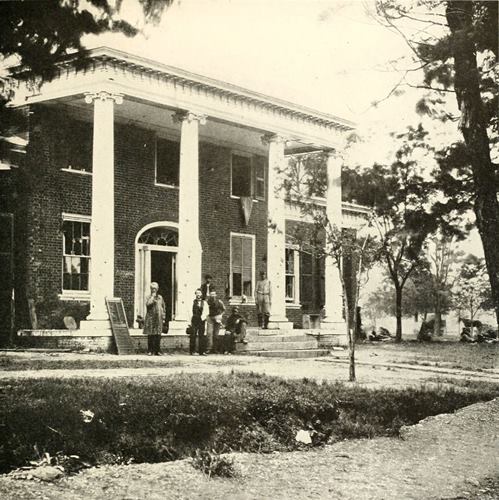
On the balcony of this little cottage at Graysville, Georgia, stands
General Richard W. Johnson, ready to advance with his cavalry division in
the vanguard of the direct movement upon the Confederates strongly posted
at Dalton. Sherman’s cavalry forces under Stoneman and Garrard were not
yet fully equipped and joined the army after the campaign had opened.
General Richard W. Johnson’s division of Thomas’ command, with General
Palmer’s division, was given the honor of heading the line of march when
the Federals got in motion on May 5th. The same troops (Palmer’s division)
had made the same march in February, sent by Grant to engage Johnston at
Dalton during Sherman’s Meridian campaign. Johnson was a West Pointer; he
had gained his cavalry training in the Mexican War, and had fought the
Indians on the Texas border. He distinguished himself at Corinth, and
rapidly rose to the command of a division in Buell’s army. Fresh from a
Confederate prison, he joined the Army of the Cumberland in the summer of
1862 to win new laurels at Stone’s River, Chickamauga, and Missionary
Ridge. His sabers were conspicuously active in the Atlanta campaign; and
at the battle of New Hope Church on May 28th Johnson himself was wounded,
but recovered in time to join Schofield after the fall of Atlanta and to
assist him in driving Hood and Forrest out of Tennessee. For his bravery
at the battle of Nashville he was brevetted brigadier-general, U. S. A.,
December 16, 1864, and after the war he was retired with the brevet of
major-general.
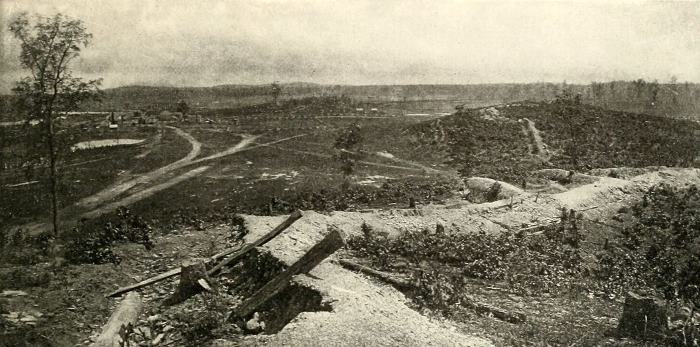
COPYRIGHT, 1911, REVIEW OF REVIEWS CO.
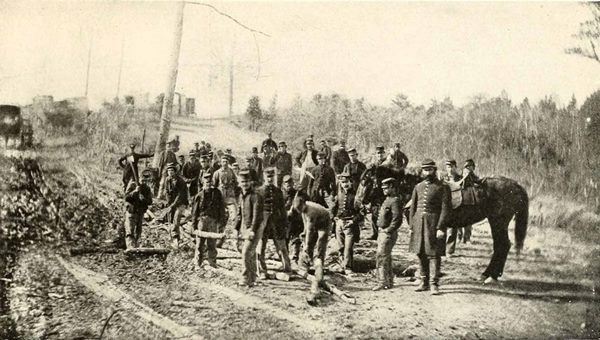
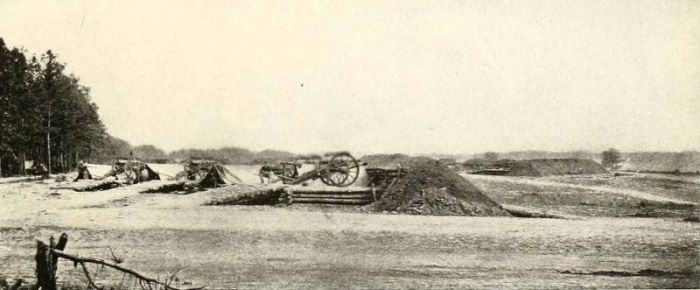
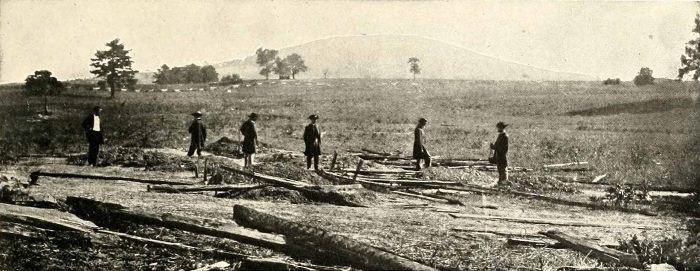
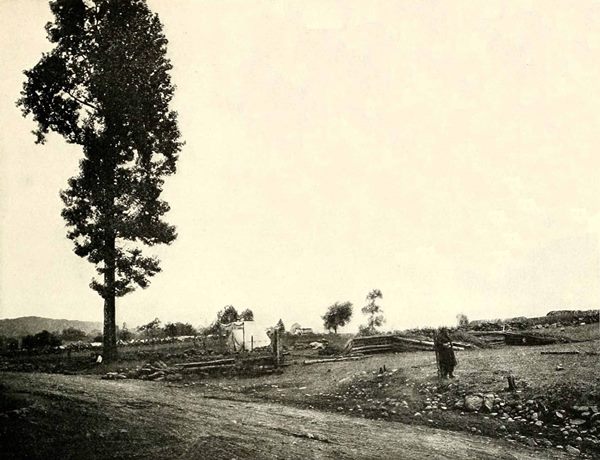
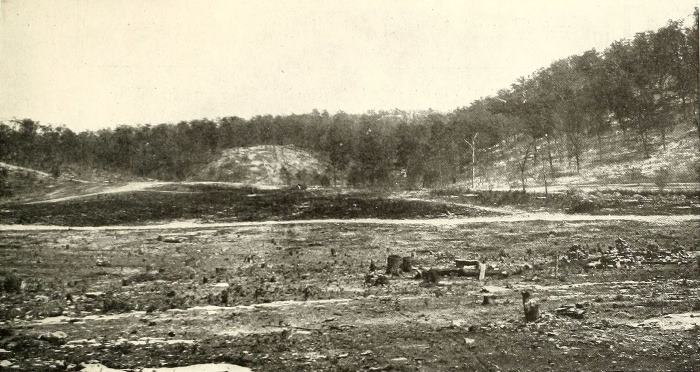
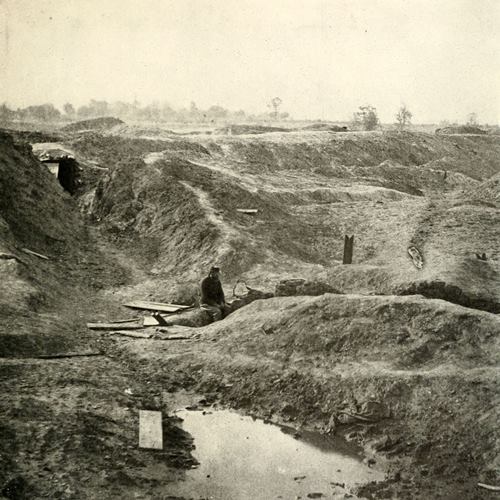
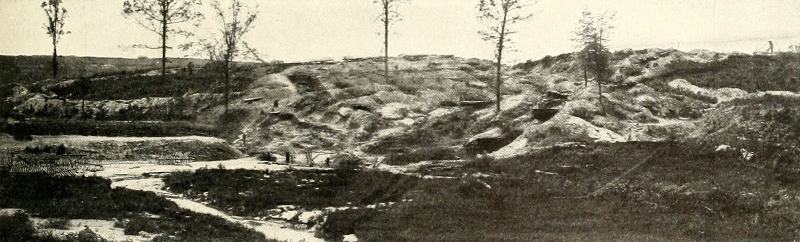
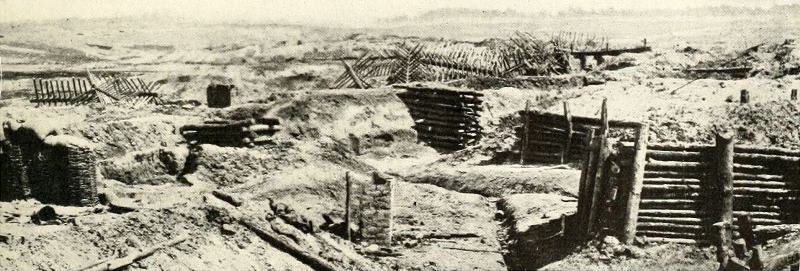
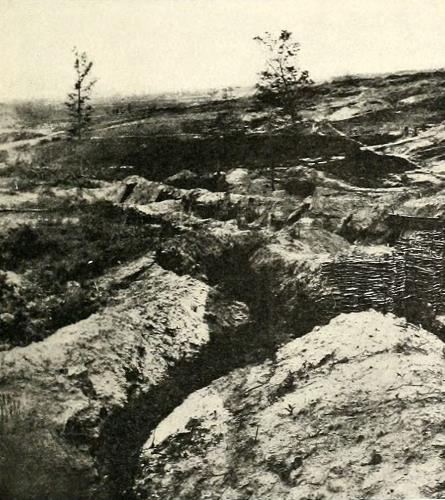
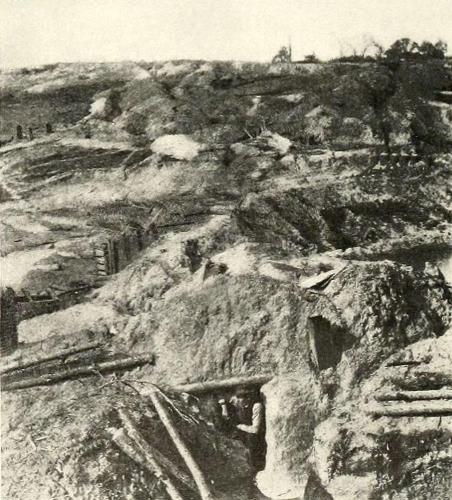
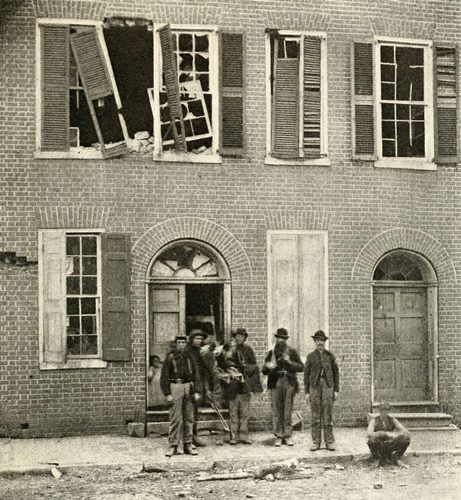
RESACA—FIELD OF THE FIRST HEAVY FIGHTING
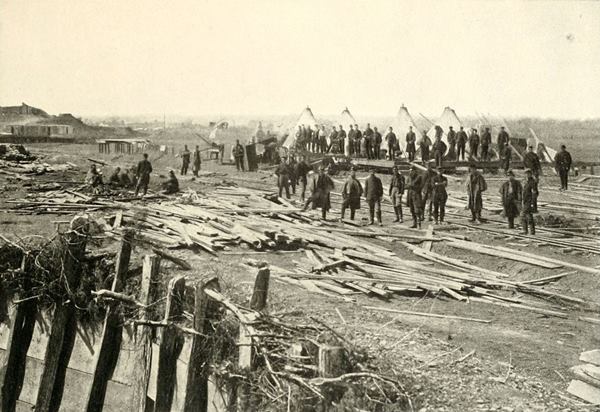
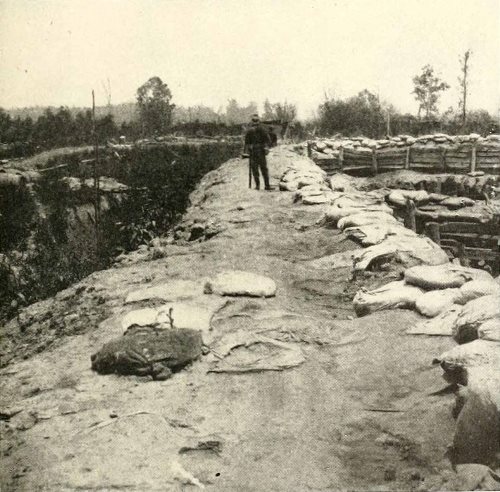
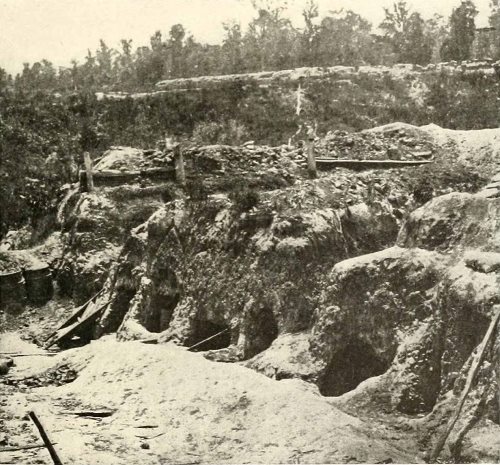
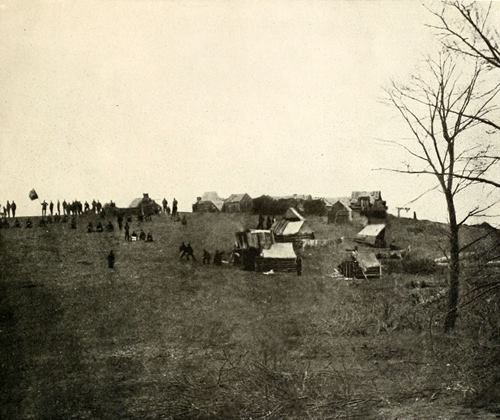
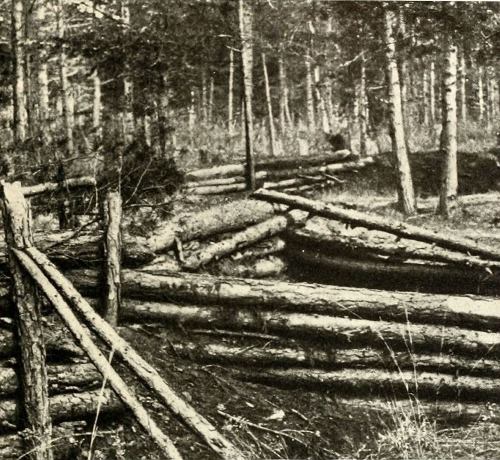
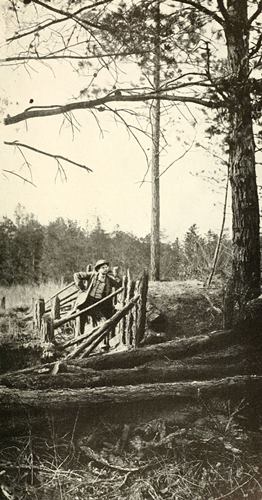
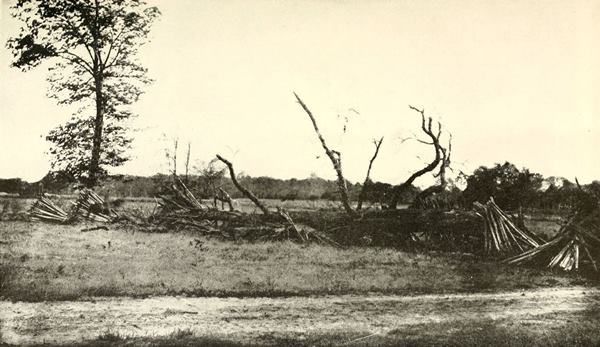
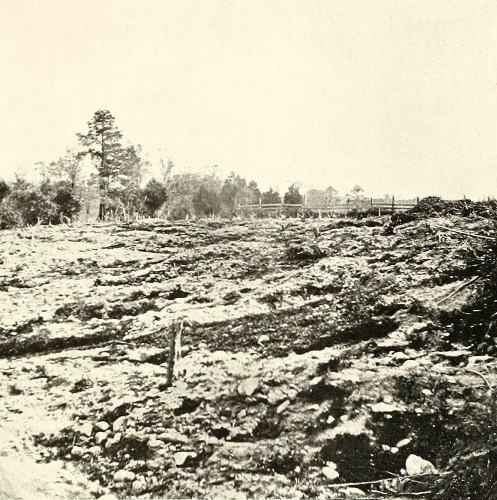
The chips are still bright and the earth fresh turned, in the foreground
where are the Confederate earthworks such at General Joseph E. Johnston
had caused to be thrown up by the Negro laborers all along his line of
possible retreat. McPherson, sent by Sherman to strike the railroad in
Johnston’s rear, got his head of column through Snake Creek Gap on May
9th, and drove off a Confederate cavalry brigade which retreated toward
Dalton, bringing to Johnston the first news that a heavy force of Federals
was already in his rear. McPherson, within a mile and a half of Resaca,
could have walked into the town with his twenty-three thousand men, but
concluded that the Confederate entrenchments were too strongly held to
assault. When Sherman arrived he found that Johnston, having the shorter
route, was there ahead of him with his entire army strongly posted. On May
15th, “without attempting to assault the fortified works,” says Sherman,
“we pressed at all points, and the sound of cannon and musketry rose all
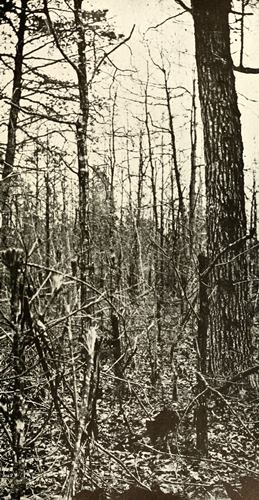
day to the dignity of a battle.” Its havoc is seen in the shattered trees
and torn ground in the lower picture.
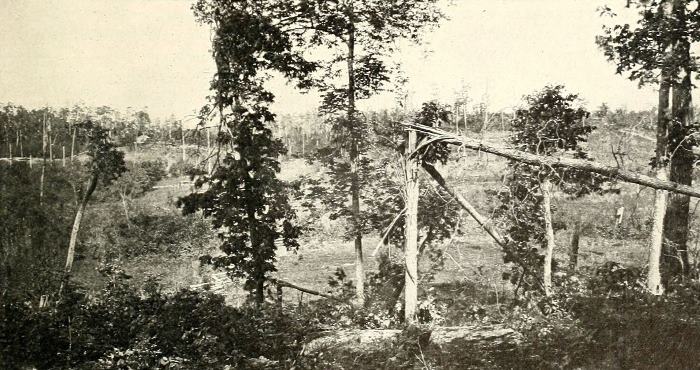
COPYRIGHT, 1911, REVIEW OF REVIEWS CO.
THE WORK OF THE FIRING AT RESACA
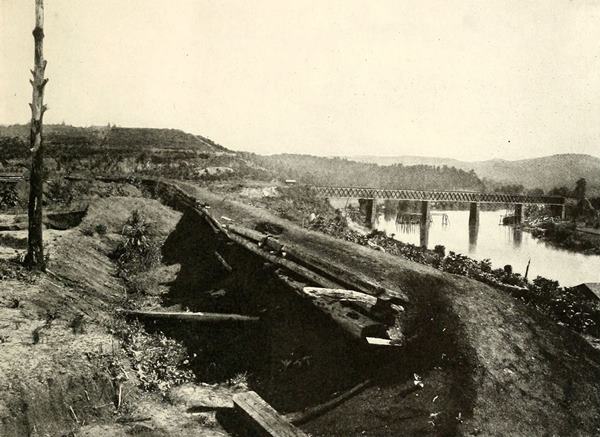
COPYRIGHT, 1911, REVIEW OF REVIEWS CO.
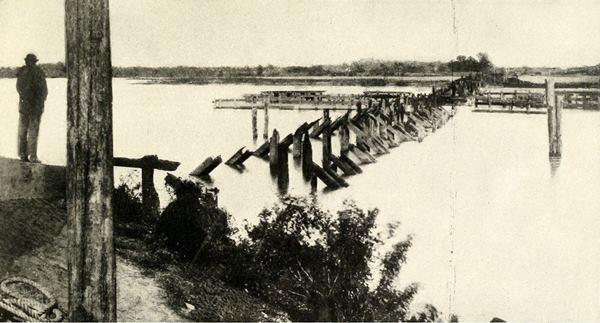
ANOTHER RETROGRADE MOVEMENT OVER THE ETOWAH BRIDGE
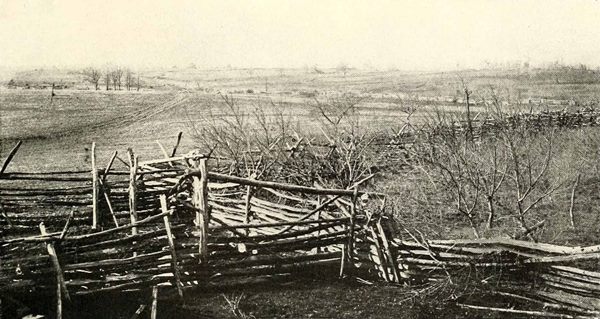
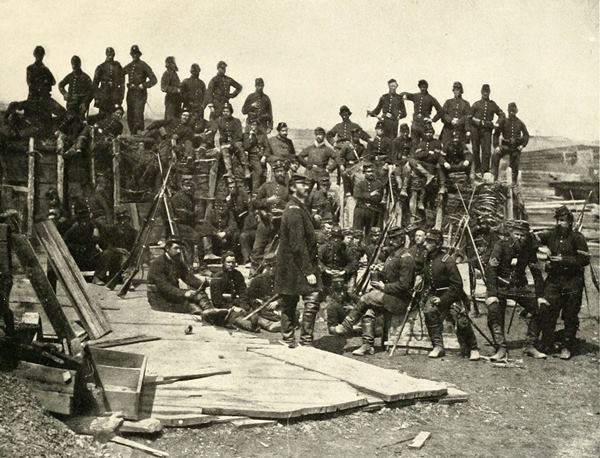
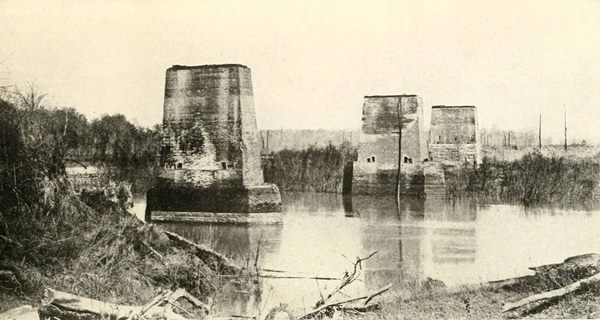
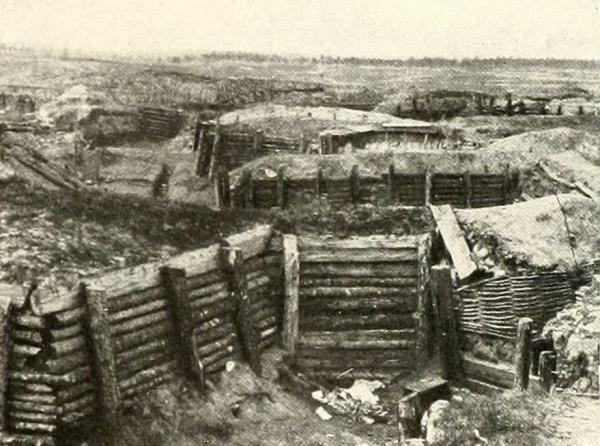
The strong works in the pictures, commanding the railroad bridge over the
Etowah River, were the fourth fortified position to be abandoned by
Johnston within a month. Pursued by Thomas from Resaca, he had made a
brief stand at Kingston and then fallen back steadily and in superb order
into Cassville. There he issued an address to his army announcing his
purpose to retreat no more but to accept battle. His troops were all drawn
up in preparation for a struggle, but that night at supper with Generals
Hood and Polk he was convinced by them that the ground occupied by their
troops was untenable, being enfiladed by the Federal artillery. Johnston,
therefore, gave up his purpose of battle, and on the night of May 20th put
the Etowah River between himself and Sherman and retreated to Allatoona
Pass, shown in the lower picture.
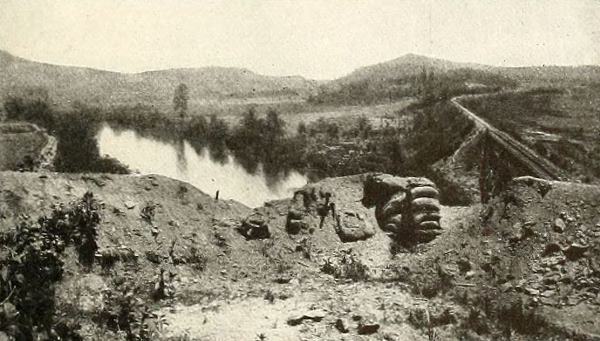
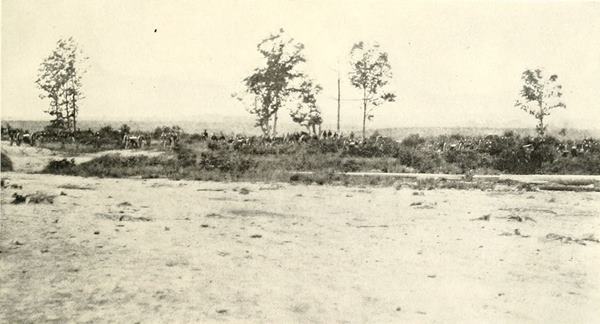
ALLATOONA PASS IN THE DISTANCE
In taking this the camera was planted inside the breastworks seen on the
eminence in the upper picture. Sherman’s army now rested after its rapid
advance and waited a few days for the railroad to be repaired in their
rear so that supplies could be brought up. Meanwhile Johnston was being
severely criticized at the South for his continual falling back without
risking a battle. His friends stoutly maintained that it was all
strategic, while some of the Southern newspapers quoted the Federal
General Scott’s remark, “Beware of Lee advancing, and watch Johnston at a
stand; for the devil himself would be defeated in the attempt to whip him
retreating.” But General Jeff C. Davis, sent by Sherman, took Rome on May
17th and destroyed valuable mills and foundries. Thus began the
accomplishment of one of the main objects of Sherman’s march.
COPYRIGHT, 1911, PATRIOT PUB. CO.
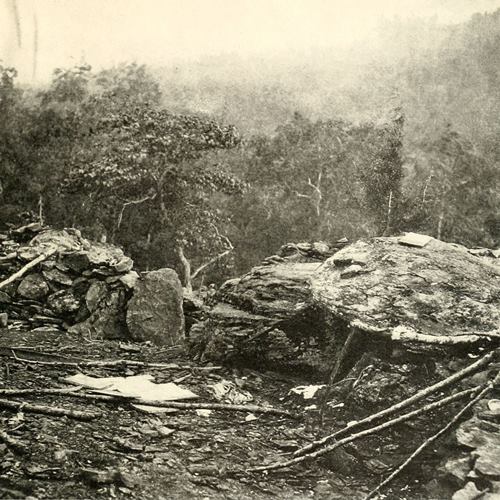
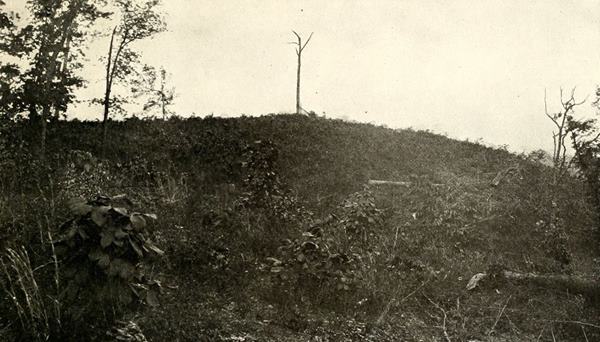
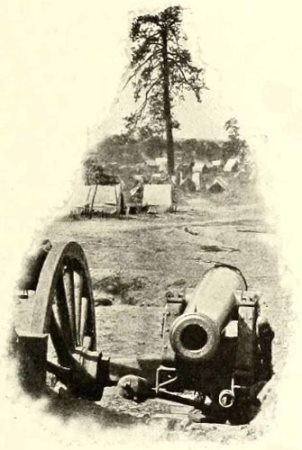
PINE MOUNTAIN, WHERE POLK, THE FIGHTING BISHOP OF THE CONFEDERACY, WAS KILLED
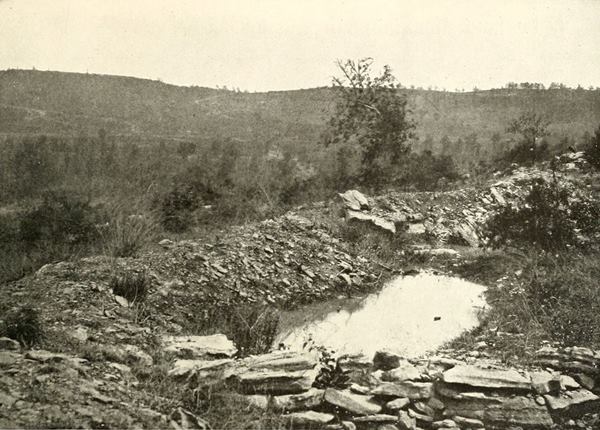
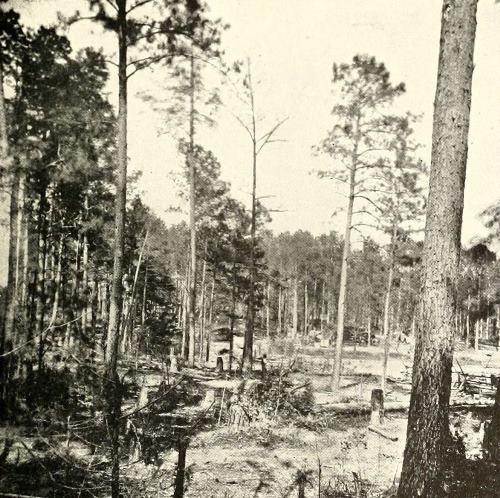
The blasted pine rears its gaunt height above the mountain slope, covered
with trees slashed down to hold the Federals at bay; and here, on June 14,
1864, the Confederacy lost a commander, a bishop, and a hero.
Lieut.-General Leonidas Polk, commanding one of Johnston’s army corps,
with Johnston himself and Hardee, another corps commander, was studying
Sherman’s position at a tense moment of the latter’s advance around Pine
Mountain. The three Confederates stood upon the rolling height, where the
center of Johnston’s army awaited the Federal attack. They could see the
columns in blue pushing east of them; the smoke and rattle of musketry as
the pickets were driven in; and the bustle with which the Federal advance
guard felled trees and constructed trenches at their very feet. On the
lonely height the three figures stood conspicuous. A Federal order was
given the artillery to open upon any men in gray who looked like officers
reconnoitering the new position. So, while Hardee was pointing to his
comrade and his chief the danger of one of his divisions which the Federal
advance was cutting off, the bishop-general was struck in the chest by a
cannon shot. Thus the Confederacy lost a leader of unusual influence.
Although a bishop of the Episcopal Church, Polk was educated at West
Point. When he threw in his lot with the Confederacy, thousands of his
fellow-Louisianians followed him. A few days before the battle of Pine
Mountain, as he and General Hood were riding together, the bishop was told
by his companion that he had never been received into the communion of a
church and was begged that the rite might be performed. Immediately Polk
arranged the ceremony. At Hood’s headquarters, by the light of a tallow
candle, with a tin basin on the mess table for a baptismal font, and with
Hood’s staff present as witnesses, all was ready. Hood, “with a face like
that of an old crusader,” stood before the bishop. Crippled by wounds at
Gaines’ Mill, Gettysburg, and Chickamauga, he could not kneel, but bent
forward on his crutches. The bishop, in full uniform of the Confederate
army, administered the rite. A few days later, by a strange coincidence,
he was approached by General Johnston on the same errand, and the man whom
Hood was soon to succeed was baptized in the same simple manner. Polk, as
Bishop, had administered his last baptism, and as soldier had fought his
last battle; for Pine Mountain was near.
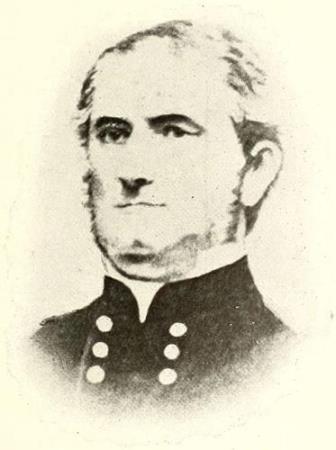
LIEUT.-GEN. LEONIDAS POLK, C. S. A.
COPYRIGHT, 1911, REVIEW OF REVIEWS CO.
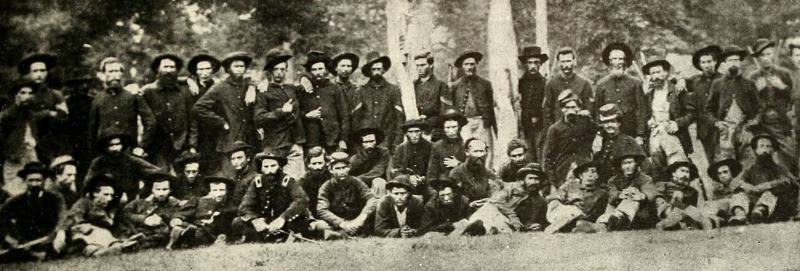
IN THE HARDEST FIGHT OF THE CAMPAIGN—THE ONE-HUNDRED-AND-TWENTY-FIFTH OHIO
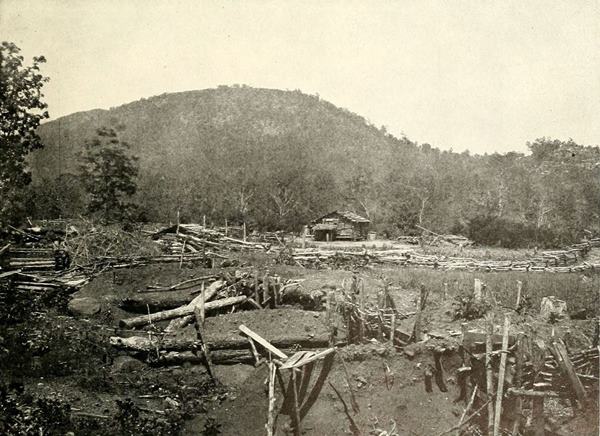
During the dark days before Kenesaw it rained continually, and Sherman
speaks of the peculiarly depressing effect that the weather had upon his
troops in the wooded country. Nevertheless he must either assault
Johnston’s strong position on the mountain or begin again his flanking
tactics. He decided upon the former, and on June 27th, after three days’
preparation, the assault was made. At nine in the morning along the
Federal lines the furious fire of musketry and artillery was begun, but at
all points the Confederates met it with determined courage and in great
force. McPherson’s attacking column, under General Blair, fought its way
up the face of little Kenesaw but could not reach the summit. Then the
courageous troops of Thomas charged up the face of the mountain and
planted their colors on the very parapet of the Confederate works. Here
General Harker, commanding the brigade in which fought the 125th Ohio,
fell mortally wounded, as did Brigadier-General Daniel McCook, and also
General Wagner.
COPYRIGHT, 1911, REVIEW OF REVIEWS CO.
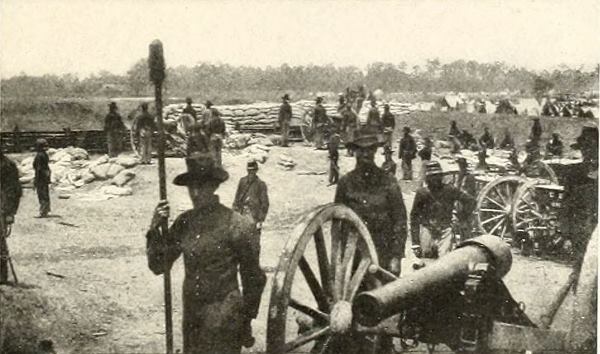
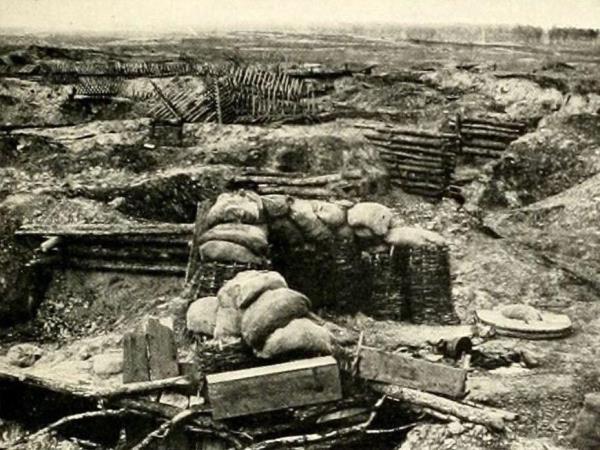
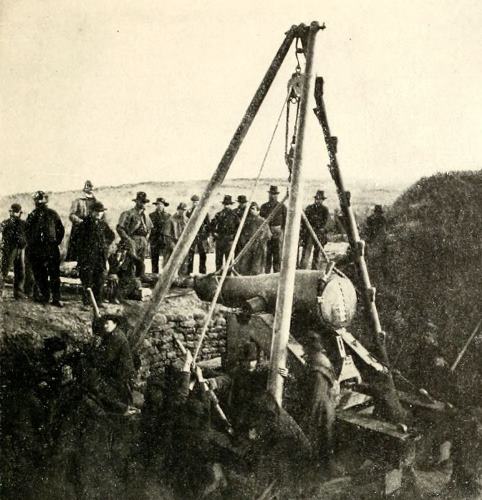
FEDERAL ENTRENCHMENTS AT THE FOOT OF KENESAW MOUNTAIN
COPYRIGHT, 1911, REVIEW OF REVIEWS CO.
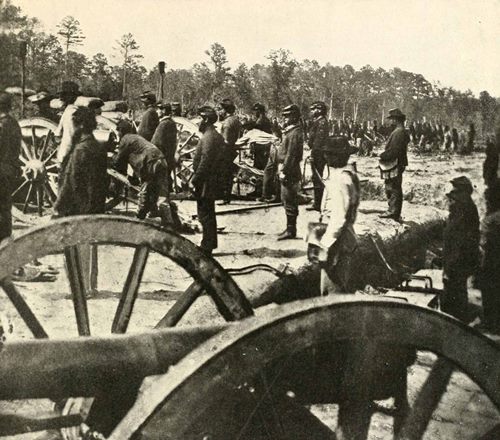
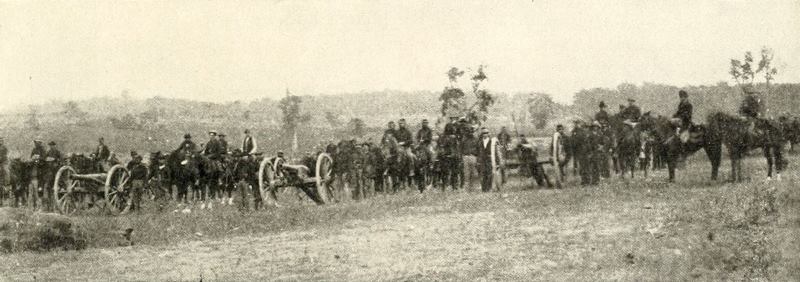
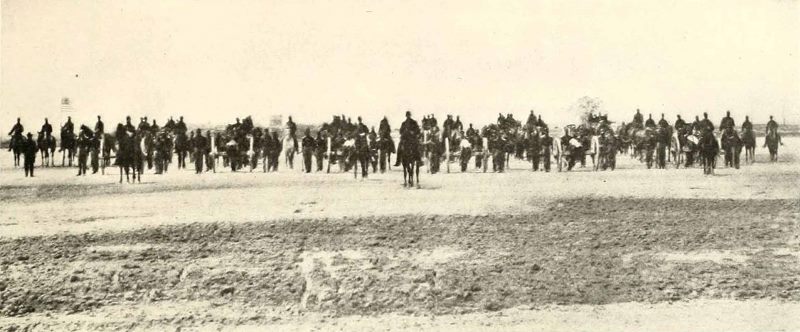
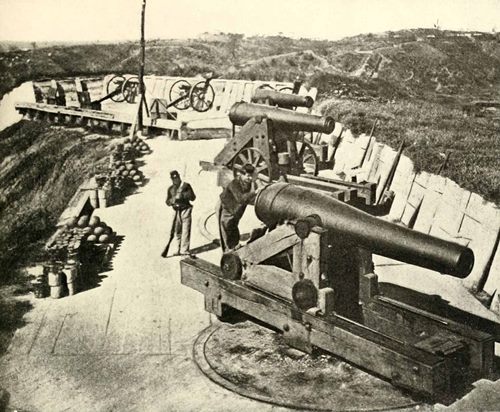
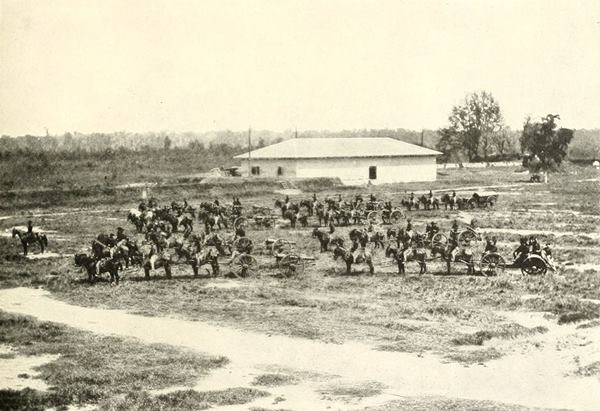
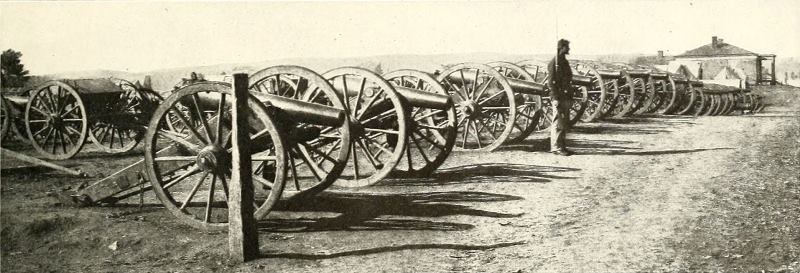
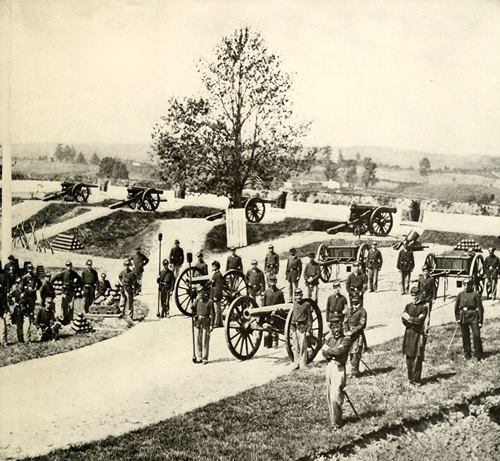
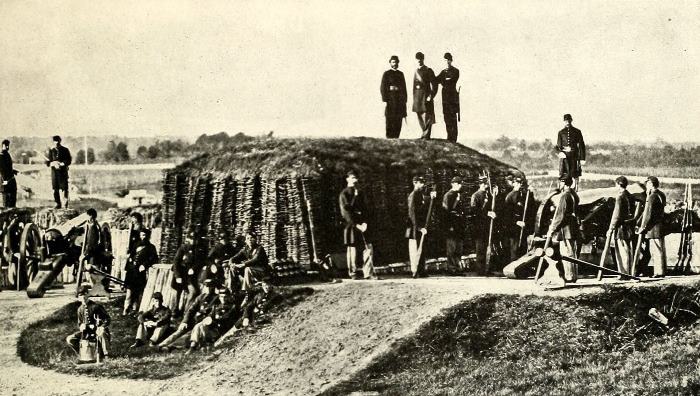
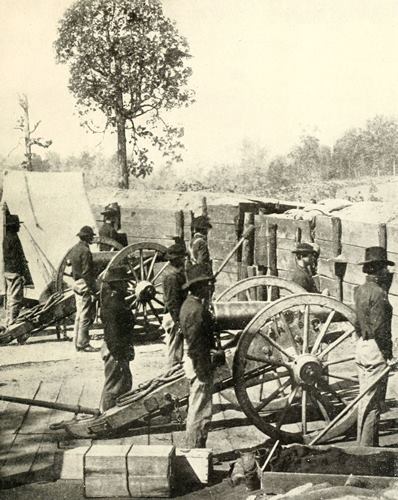
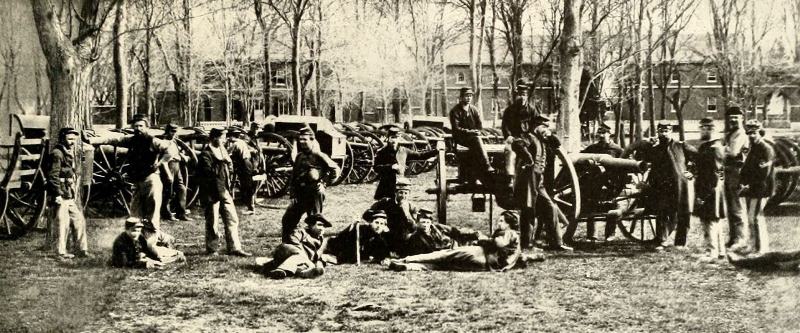
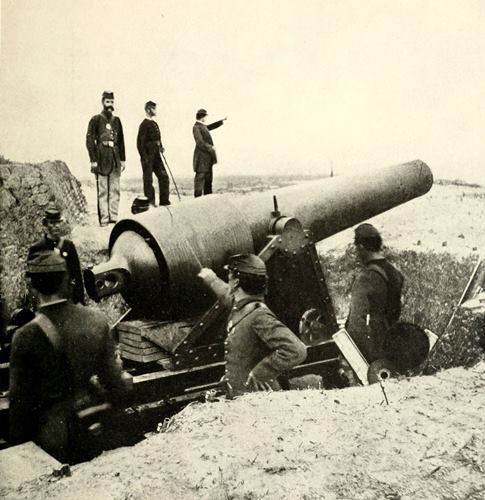
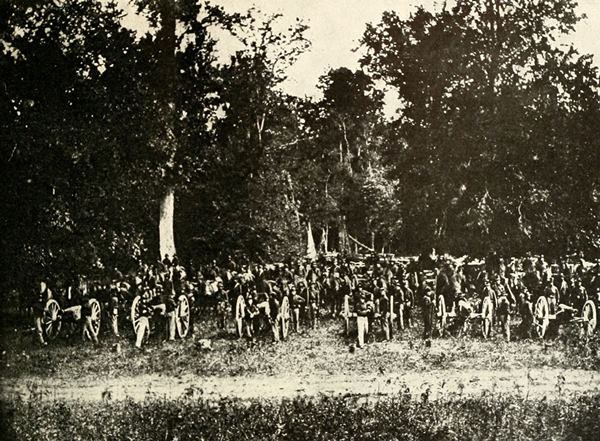
A VETERAN BATTERY FROM ILLINOIS, NEAR MARIETTA IN THE ATLANTA CAMPAIGN
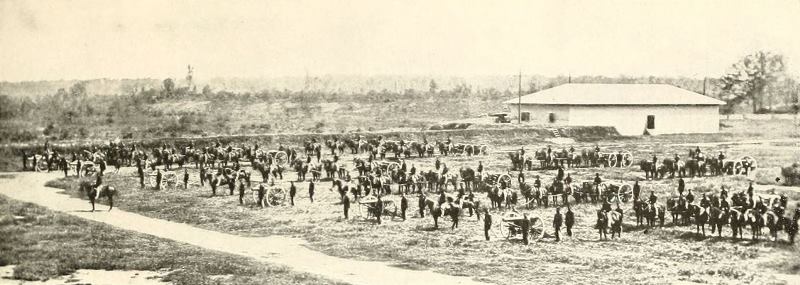
Battery B of the First Illinois Light Artillery followed Sherman in the
Atlanta campaign. It took part in the demonstrations against Resaca,
Georgia, May 8 to 15, 1864, and in the battle of Resaca on the 14th and
15th. It was in the battles about Dallas from May 25th to June 5th, and
took part in the operations about Marietta and against Kenesaw Mountain in
June and July. During the latter period this photograph was taken. The
battery did not go into this campaign without previous experience. It had
already fought as one of the eight batteries at Fort Henry and Fort
Donelson, heard the roar of the battle of Shiloh, and participated in the
sieges of Corinth and Vicksburg. The artillery in the West was not a whit
less necessary to the armies than that in the East. Pope’s brilliant feat
of arms in the capture of Island No. 10 added to the growing respect in
which the artillery was held by the other arms of the service. The
effective fire of the massed batteries at Murfreesboro turned the tide of
battle. At Chickamauga the Union artillery inflicted fearful losses upon
the Confederates. At Atlanta again they counted their dead by the
hundreds, and at Franklin and Nashville the guns maintained the best
traditions of the Western armies. They played no small part in winning
battles.
COPYRIGHT, 1911, REVIEW OF REVIEWS CO.
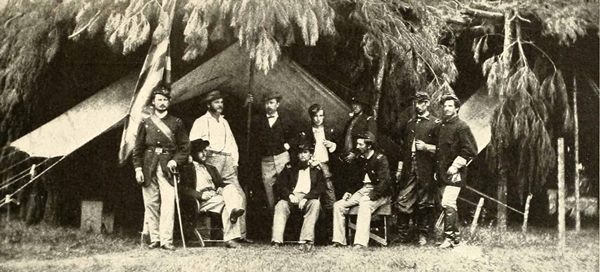
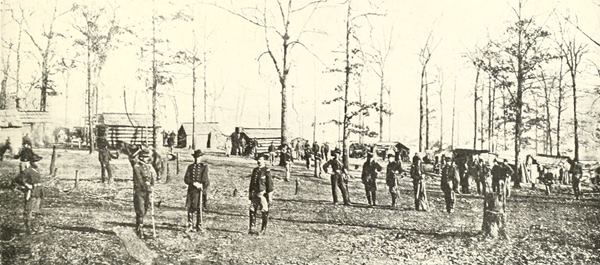
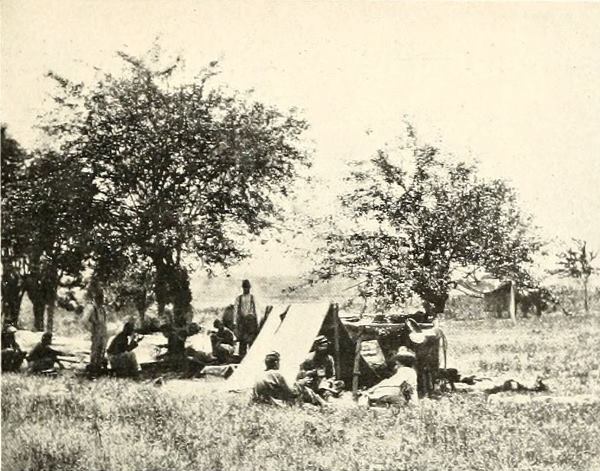
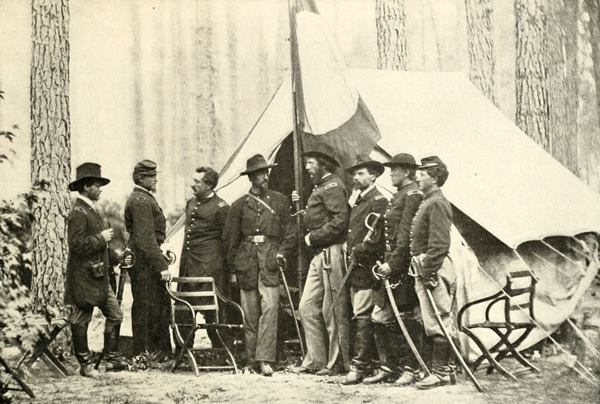
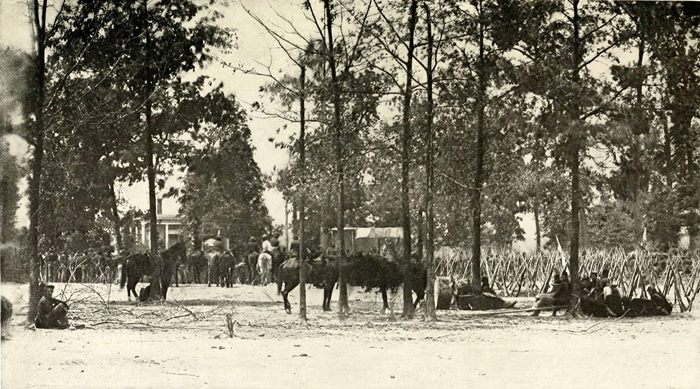
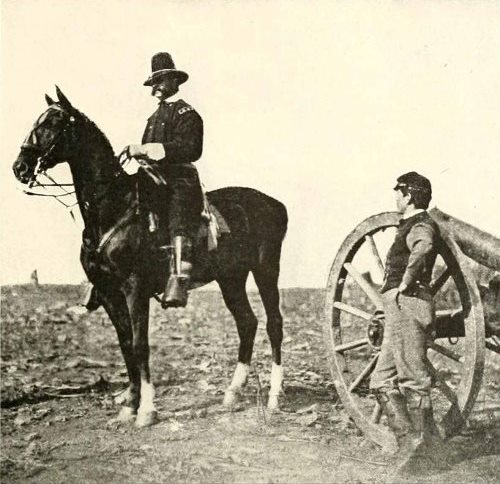
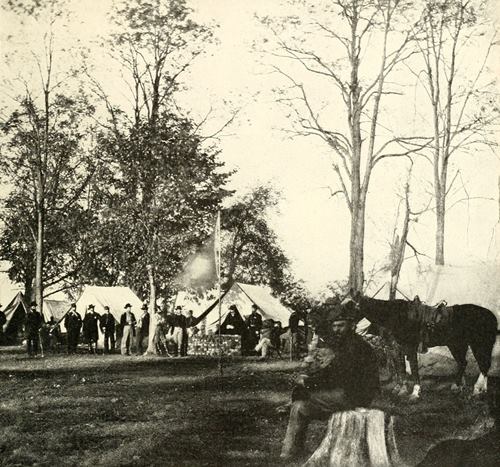
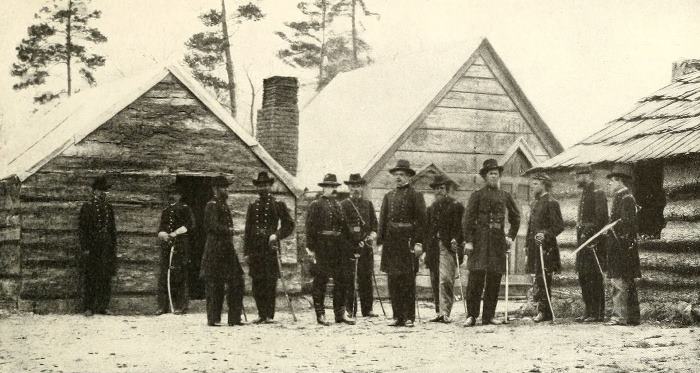
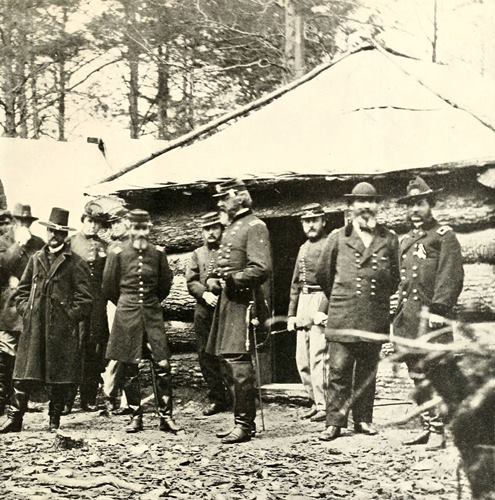
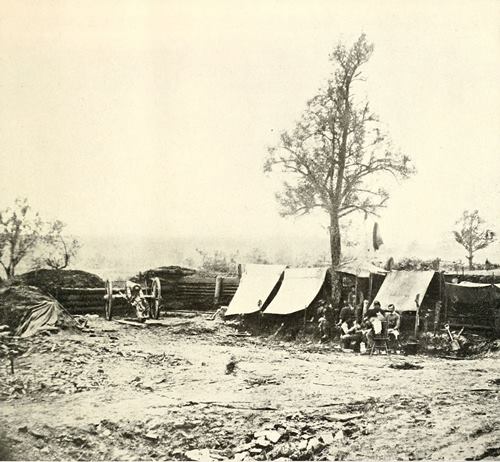
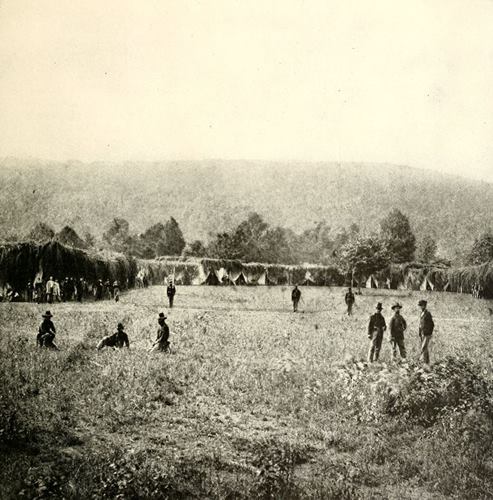
THOMAS’ HEADQUARTERS NEAR MARIETTA DURING THE FIGHTING OF THE FOURTH OF JULY
This is a photograph of Independence Day, 1864. As the sentries and staff
officers stand outside the sheltered tents, General Thomas, commanding the
Army of the Cumberland, is busy; for the fighting is fierce to-day.
Johnston has been outflanked from Kenesaw and has fallen back eastward
until he is actually farther from Atlanta than Sherman’s right flank. Who
will reach the Chattahoochee first? There, if anywhere, Johnston must make
his stand; he must hold the fords and ferries, and the fortifications
that, with the wisdom of a far-seeing commander, he has for a long time
been preparing. The rustic work in the photograph, which embowers the
tents of the commanding general and his staff, is the sort of thing that
Civil War soldiers had learned to throw up within an hour after pitching
camp.
COPYRIGHT, 1911, REVIEW OF REVIEWS CO.
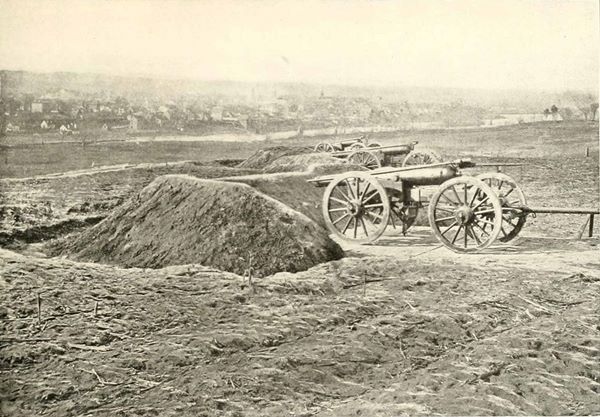
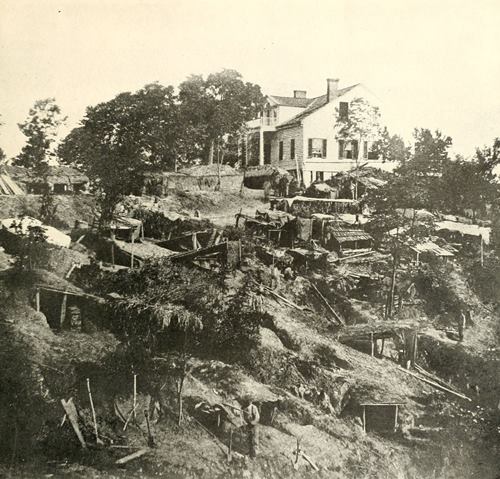
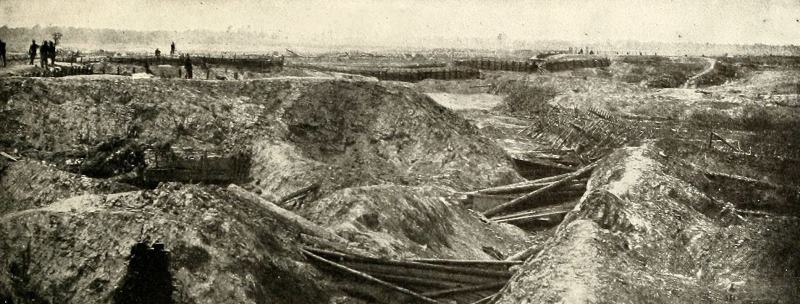
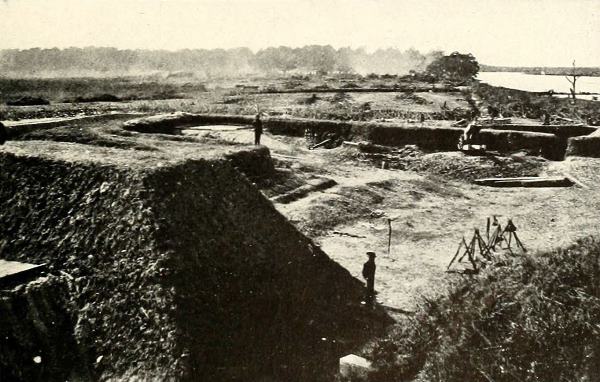
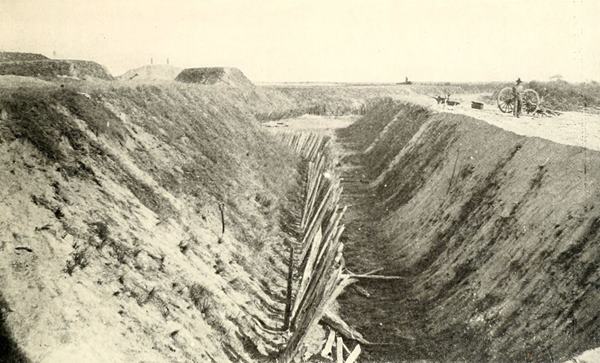
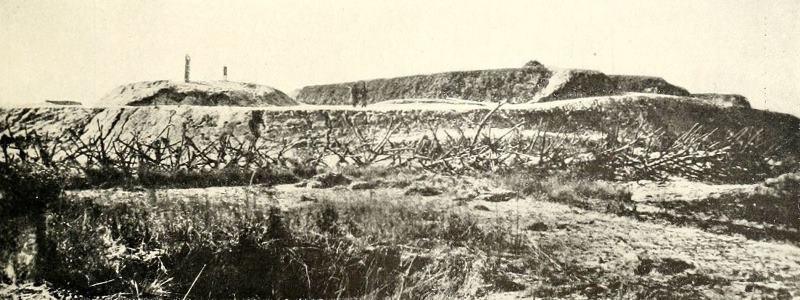
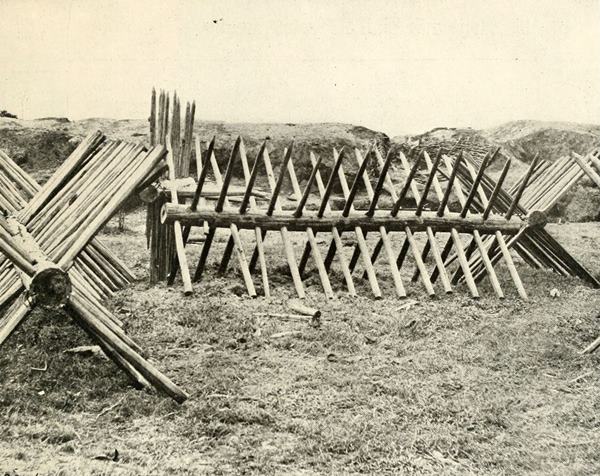
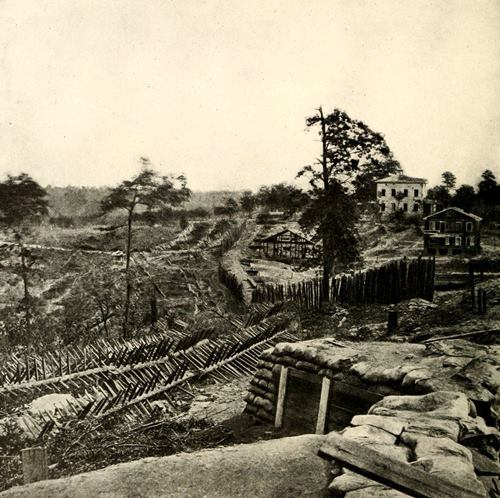
PALISADES AND CHEVAUX-DE-FRISE GUARDING ATLANTA
At last Sherman is before Atlanta. The photograph shows one of the
keypoints in the Confederate defense, the fort at the head of Marietta
Street, toward which the Federal lines were advancing from the northwest.
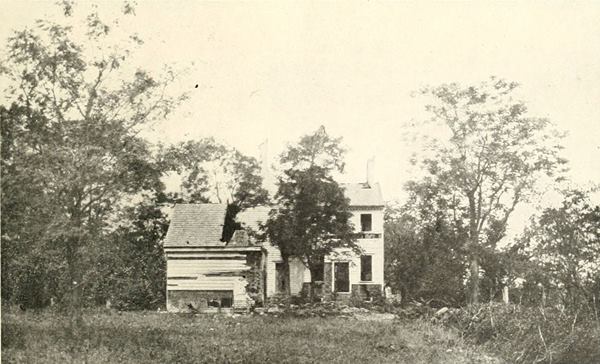
The old Potter house in the background, once a quiet, handsome country
seat, is now surrounded by bristling fortifications, palisades, and double
lines of chevaux-de-frise. Atlanta was engaged in the final grapple with
the force that was to overcome her. Sherman has fought his way past
Kenesaw and across the Chattahoochee, through a country which he describes
as “one vast fort,” saying that “Johnston must have at least fifty miles
of connected trenches with abatis and finished batteries.” Anticipating
that Sherman might drive him back upon Atlanta, Johnston had constructed,
during the winter, heavily fortified positions all the way from Dalton.
During his two months in retreat the fortifications at Atlanta had been
strengthened to the utmost. What he might have done behind them was never
to be known.
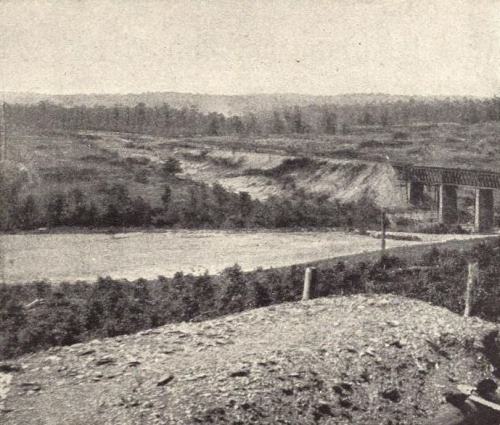
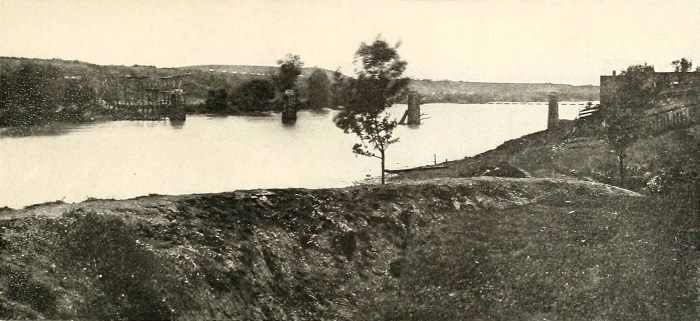
THE CHATTAHOOCHEE BRIDGE
“One of the strongest pieces of field fortification I ever saw”—this was
Sherman’s characterization of the entrenchments that guarded the railroad
bridge over the Chattahoochee on July 5th. A glimpse of the bridge and the
freshly-turned earth in 1864 is given by the upper picture. At this river
Johnston made his final effort to hold back Sherman from a direct attack
upon Atlanta. If Sherman could get successfully across that river, the
Confederates would be compelled to fall back behind the defenses of the
city, which was the objective of the campaign. Sherman perceived at once
the futility of trying to carry by assault this strongly garrisoned
position. Instead, he made a feint at crossing the river lower down, and
simultaneously went to work in earnest eight miles north of the bridge.
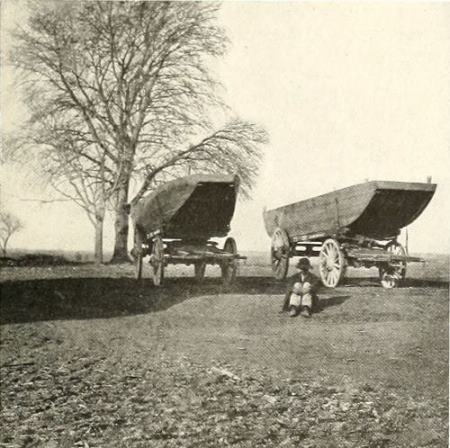
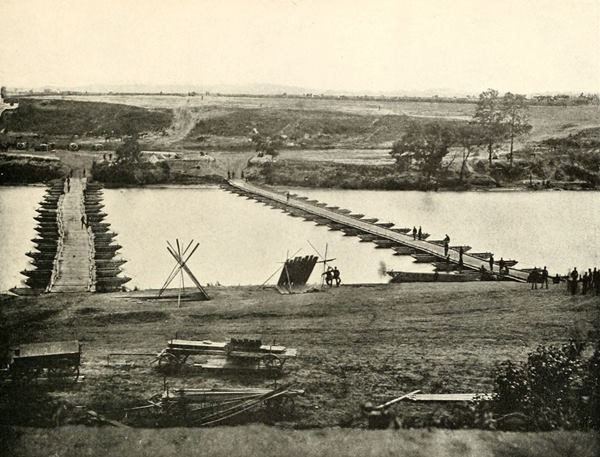
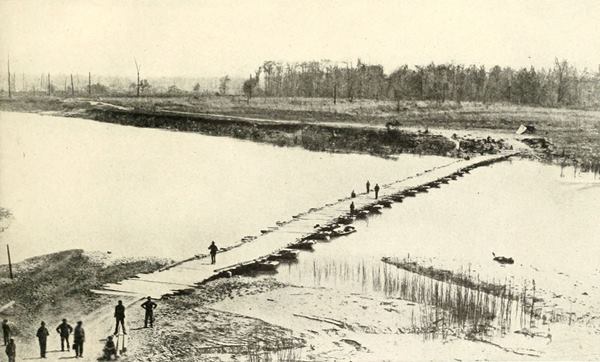
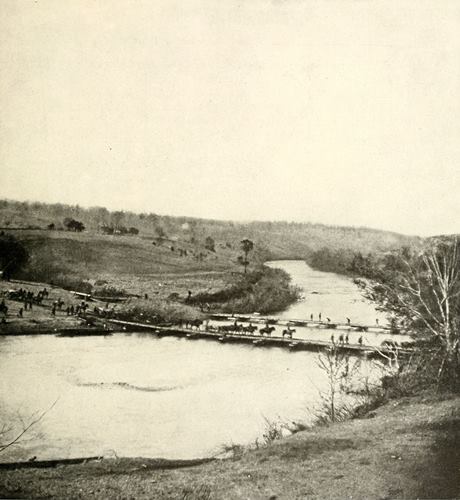
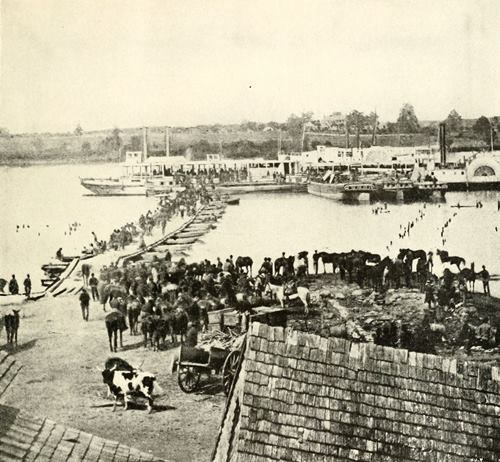
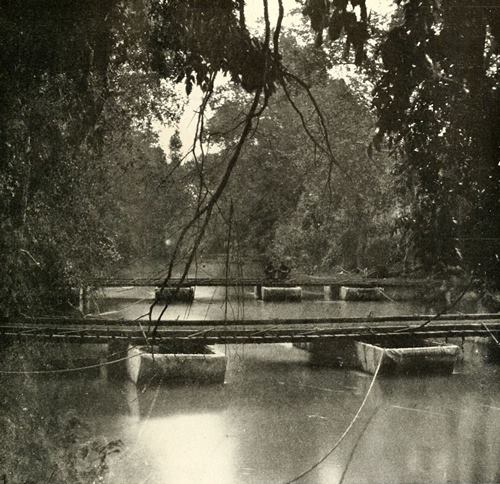
The lower picture shows the canvas pontoon boats as perfected by Union
engineers in 1864. A number of these were stealthily set up and launched
by Sherman’s Twenty-third Corps near the mouth of Soap Creek, behind a
ridge. Byrd’s brigade took the defenders of the southern bank completely
by surprise. It was short work for the Federals to throw pontoon bridges
across and to occupy the coveted spot in force.
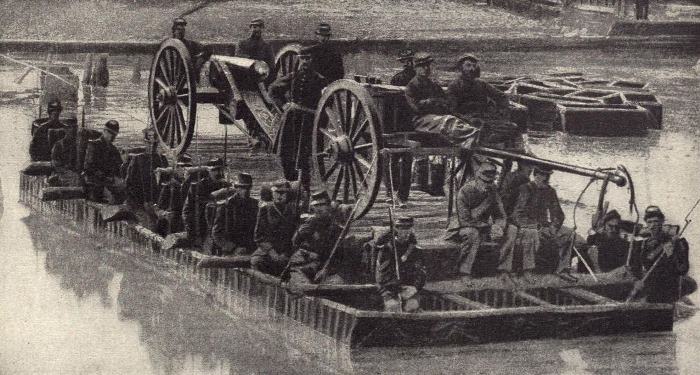
COPYRIGHT, 1911, REVIEW OF REVIEWS CO.
INFANTRY AND ARTILLERY CROSSING ON BOATS MADE OF PONTOONS
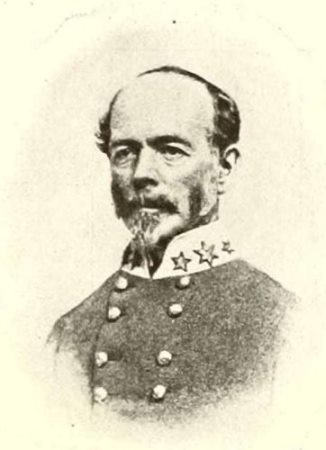
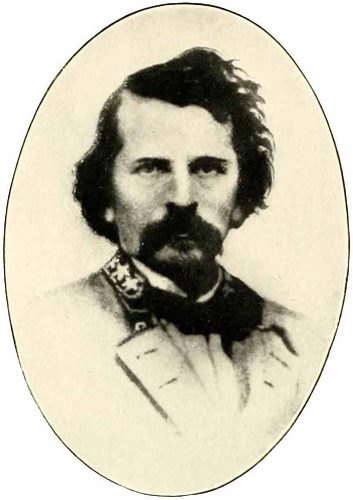
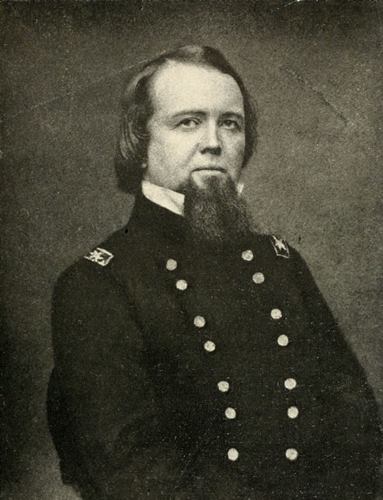
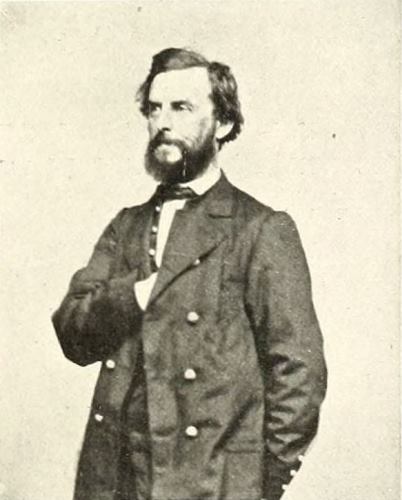
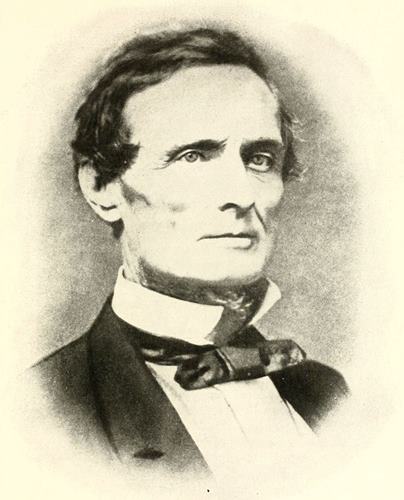
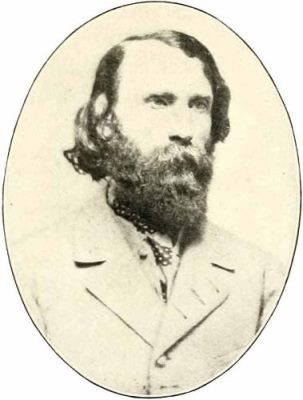
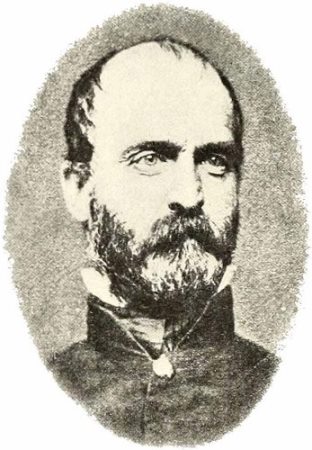
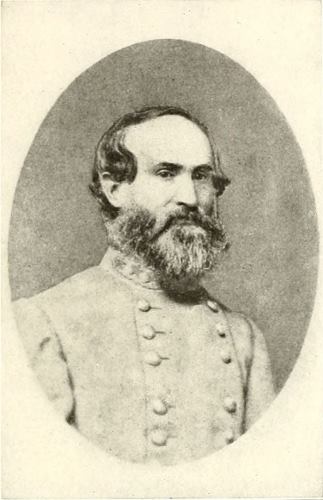
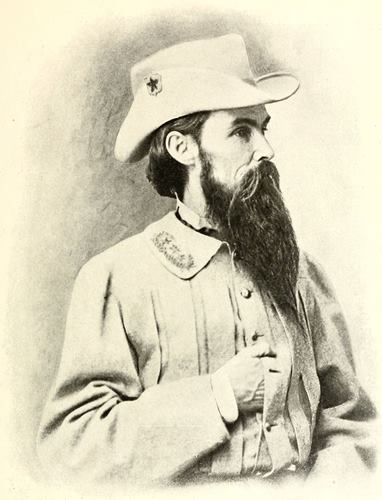
GENERAL JOSEPH EGGLESTON JOHNSTON, C. S. A.
BORN 1809; WEST POINT 1829; DIED 1891
Johnston’s parrying of Sherman’s mighty strokes was “a model of defensive
warfare,” declares one of Sherman’s own division commanders, Jacob D. Cox.
There was not a man in the Federal army from Sherman down that did not
rejoice to hear that Johnston had been superseded by Hood on July 18th.
Johnston, whose mother was a niece of Patrick Henry, was fifty-seven years
old, cold in manner, measured and accurate in speech. His dark firm face,
surmounted by a splendidly intellectual forehead, betokened the
experienced and cautious soldier. His dismissal was one of the political
mistakes which too often hampered capable leaders on both sides. His
Fabian policy in Georgia was precisely the same as that which was winning
fame against heavy odds for Lee in Virginia.
The countenance of Hood, on the other hand, indicates an eager, restless
energy, an impetuosity that lacked the poise of Sherman, whose every
gesture showed the alertness of mind and soundness of judgment that in him
were so exactly balanced. Both Schofield and McPherson were classmates of
Hood at West Point, and characterized him to Sherman as “bold even to
rashness and courageous in the extreme.” He struck the first offensive
blow at Sherman advancing on Atlanta, and wisely adhered to the plan of
the battle as it had been worked out by Johnston just before his removal.
But the policy of attacking was certain to be finally disastrous to the
Confederates.
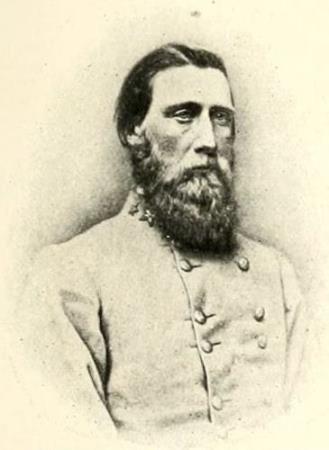
LIEUTENANT-GENERAL JOHN B. HOOD, C. S. A.
BORN 1831; WEST POINT 1853; DIED 1879
COPYRIGHT, 1911, REVIEW OF REVIEWS CO.
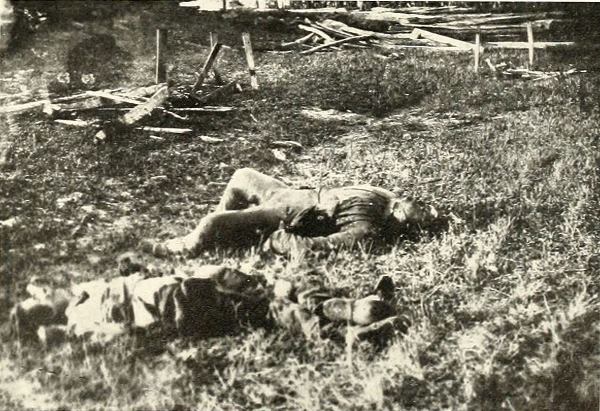
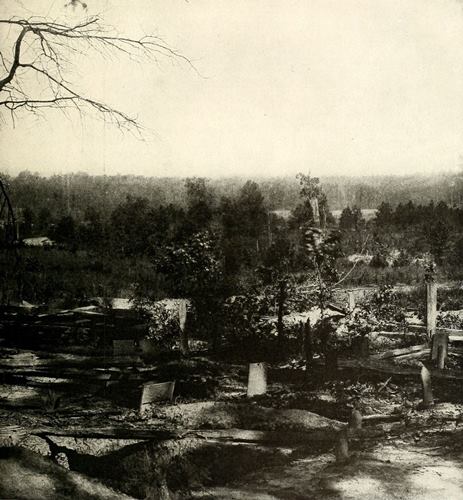
PEACH-TREE CREEK, WHERE HOOD HIT HARD
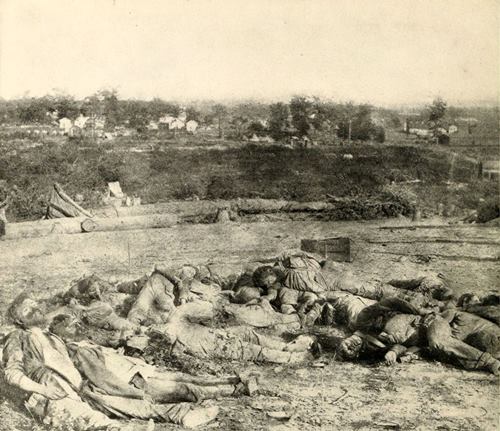
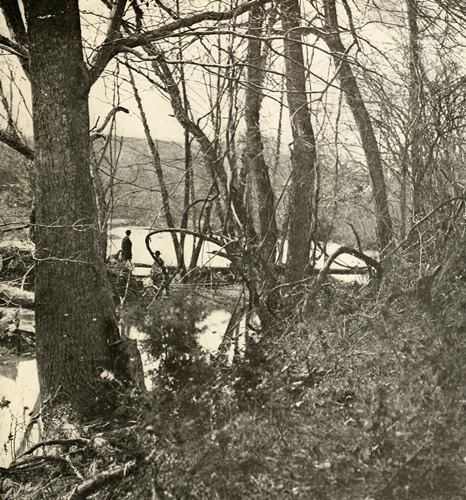
Counting these closely clustered Federal graves gives one an idea of the
overwhelming onset with Hood become the aggressor on July 20th. Beyond the
graves are some of the trenches from which the Federals were at first
irresistibly driven. In the background flows Peach-Tree Creek, the little
stream that gives its name to the battlefield. Hood, impatient to
signalize his new responsibility by a stroke that would at once dispel the
gloom at Richmond, had posted his troops behind strongly fortified works
on a ridge commanding the valley of Peach-Tree Creek about five miles to
the north of Atlanta. Here he awaited the approach of Sherman. As the
Federals were disposing their lines and entrenching before this position,
Hood’s eager eyes detected a gap in their formation and at four o’clock in
the afternoon hurled a heavy force against it. Thus he proved his
reputation for courage, but the outcome showed the mistake. For a brief
interval Sherman’s forces were in great peril. But the Federals under
Newton and Geary rallied and held their ground, till Ward’s division in a
brave counter-charge drove the Confederates back. This first effort cost
Hood dear. He abandoned his entrenchments that night, leaving on the field
five hundred dead, one thousand wounded, and many prisoners. Sherman
estimated the total Confederate loss at no less than five thousand. That
of the Federals was fifteen hundred.
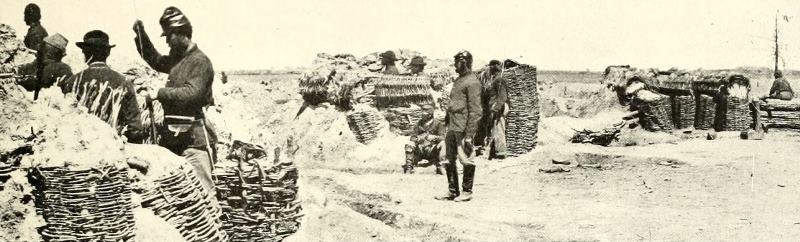
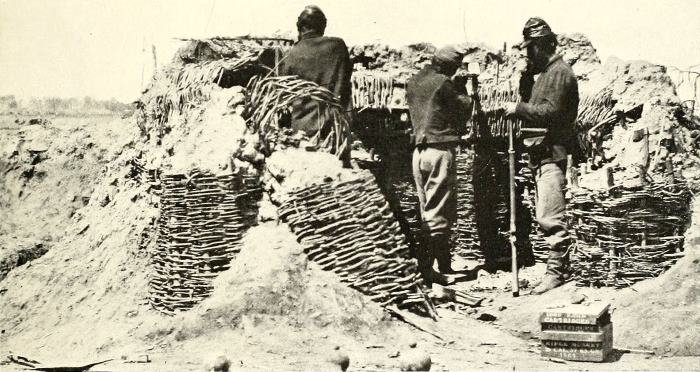
COPYRIGHT, 1911, PATRIOT PUB. CO.
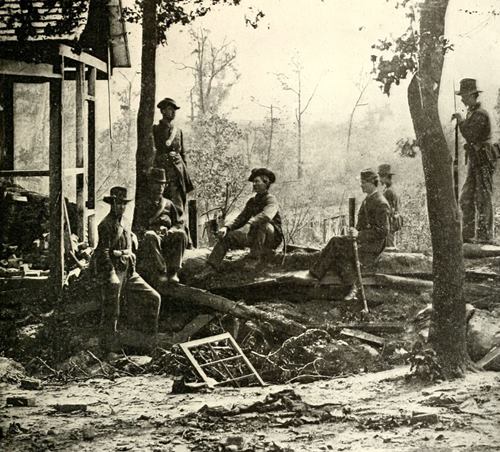
THE ARMY’S FINGER-TIPS—PICKETS BEFORE ATLANTA
A Federal picket post on the lines before Atlanta. This picture was taken
shortly before the battle of July 22d. The soldiers are idling about
unconcerned at exposing themselves; this is on the “reserve post.”
Somewhat in advance of this lay the outer line of pickets, and it would be
time enough to seek cover if they were driven in. Thus armies feel for
each other, stretching out first their sensitive fingers—the pickets. If
these recoil, the skirmishers are sent forward while the strong arm, the
line of battle, gathers itself to meet the foe. As this was an inner line,
it was more strongly fortified than was customary with the pickets. But
the men of both sides had become very expert in improvising field-works at
this stage of the war. Hard campaigning had taught the veterans the
importance to themselves of providing such protection, and no orders had
to be given for their construction. As soon as a regiment gained a
position desirable to hold, the soldiers would throw up a strong parapet
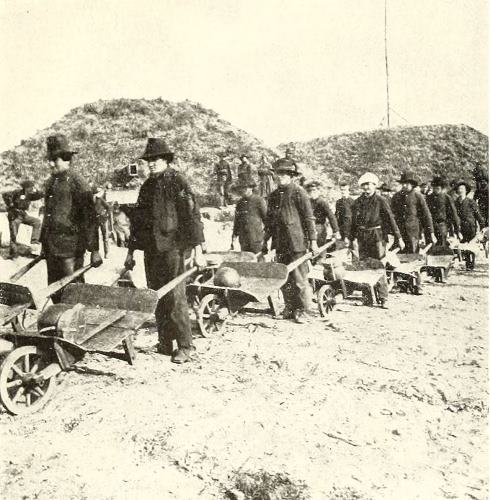
of dirt and logs in a single night. In order to spare the men as much as
possible, Sherman ordered his division commanders to organize pioneer
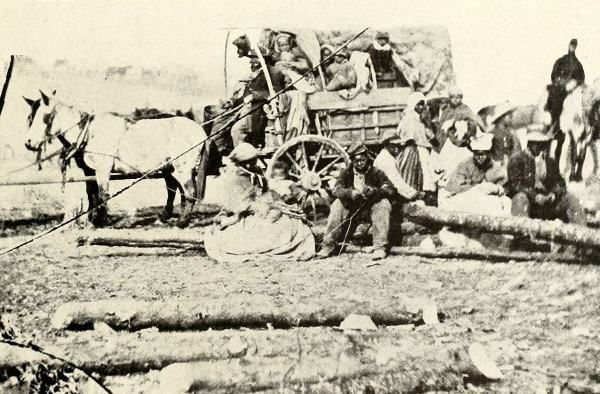
detachments out of the Negroes that escaped to the Federals. These could
work at night.
COPYRIGHT, 1911, PATRIOT PUB. CO.
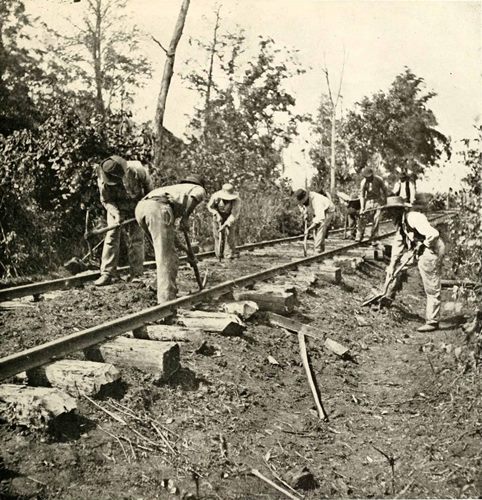
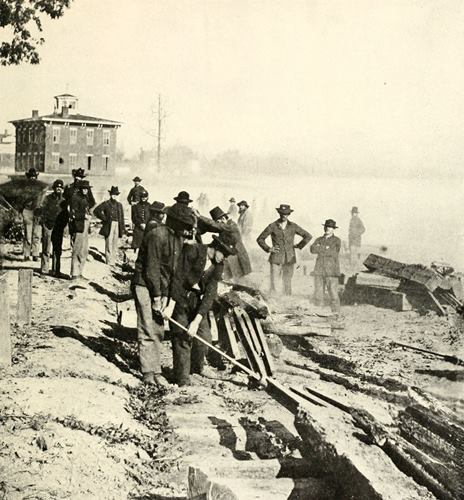
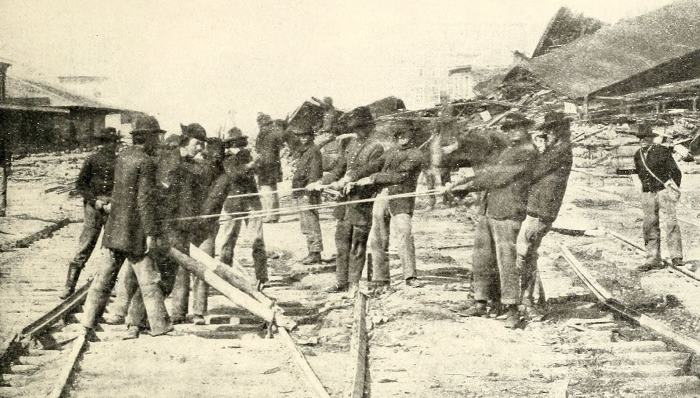
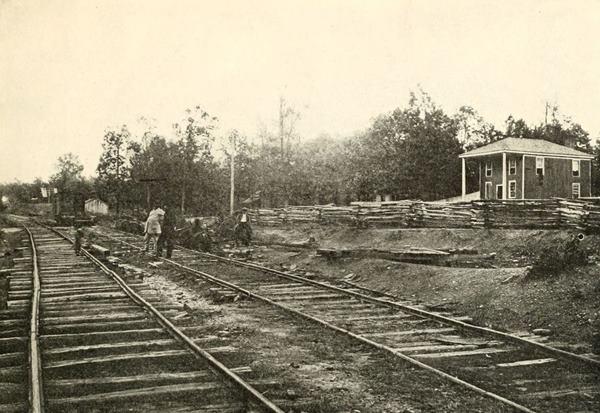
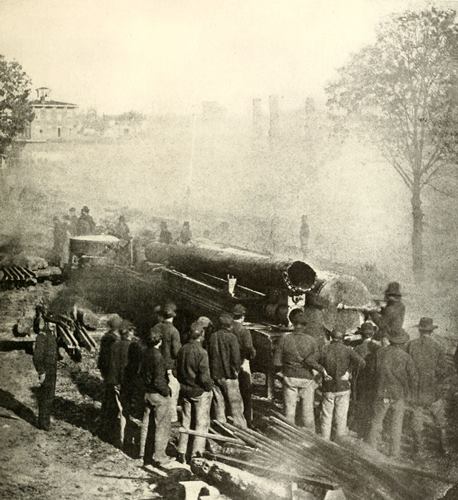
THE FINAL BLOW TO THE CONFEDERACY’S SOUTHERN STRONGHOLD
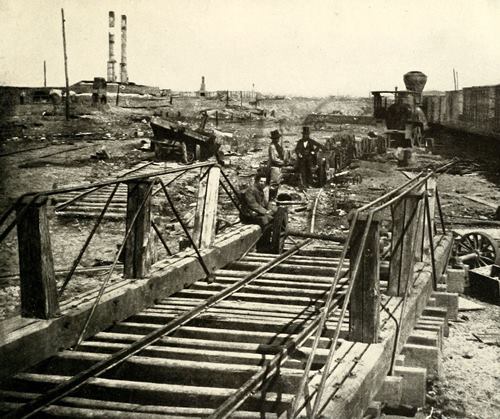
It was Sherman’s experienced railroad wreckers that finally drove Hood out
of Atlanta. In the picture the rails heating red-hot amid the flaming
bonfires of the ties, and the piles of twisted débris show vividly what
Sherman meant when he said their “work was done with a will.” Sherman saw
that in order to take Atlanta without terrific loss he must cut off all
its rail communications. This he did by “taking the field with our main
force and using it against the communications of Atlanta instead of
against its intrenchments.” On the night of August 25th he moved with
practically his entire army and wagon-trains loaded with fifteen days’
rations. By the morning of the 27th the whole front of the city was
deserted. The Confederates concluded that Sherman was in retreat. Next day
they found out their mistake, for the Federal army lay across the West
Point Railroad while the soldiers began wrecking it. Next day they were in
motion toward the railroad to Macon, and General Hood began to understand
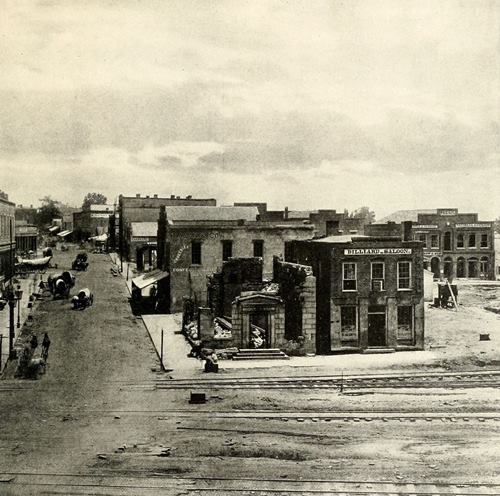
that a colossal raid was in progress. After the occupation, when this
picture was taken, Sherman’s men completed the work of destruction.
COPYRIGHT, 1911, REVIEW OF REVIEWS CO.
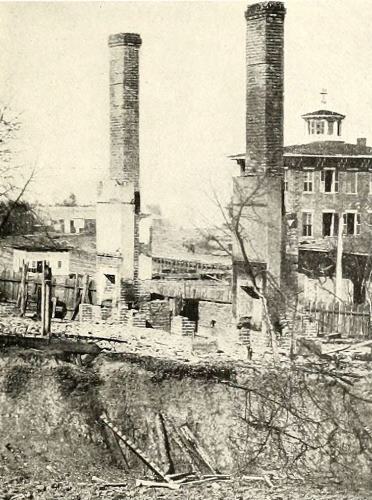
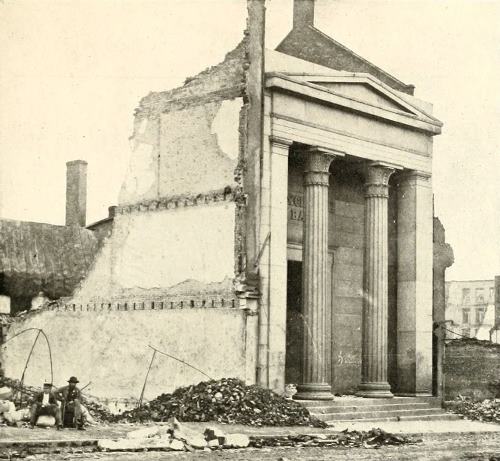
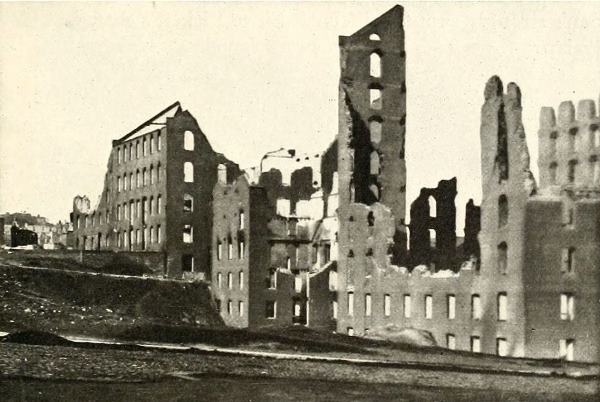
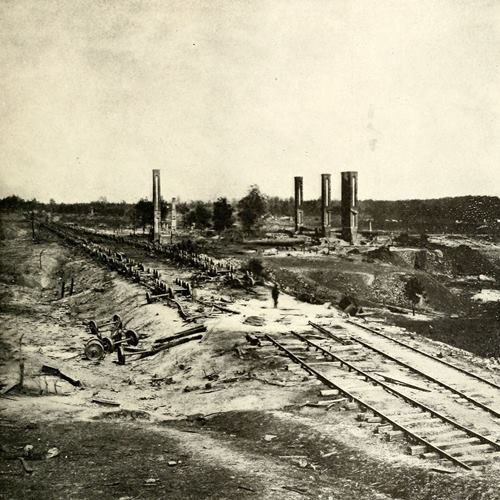
THE RUIN OF HOOD’S RETREAT—DEMOLISHED CARS AND ROLLING-MILL
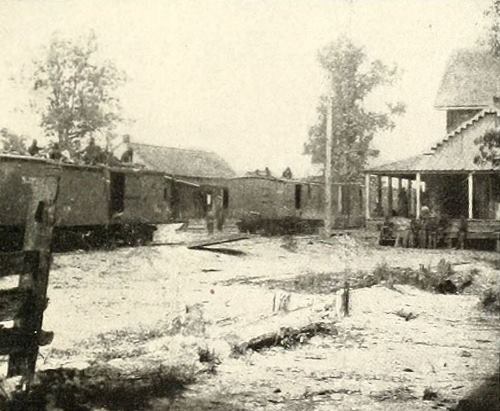
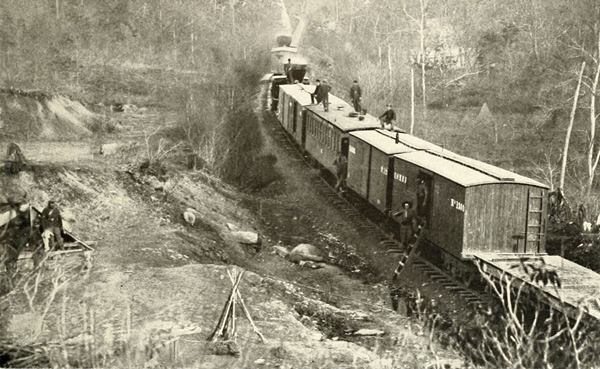
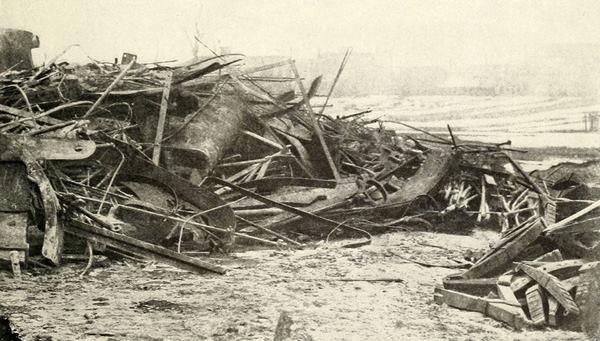
On the night of August 31st, in his headquarters near Jonesboro, Sherman
could not sleep. That day he had defeated the force sent against him at
Jonesboro and cut them off from returning to Atlanta. This was Hood’s last
effort to save his communications. About midnight sounds of exploding
shells and what seemed like volleys of musketry arose in the direction of
Atlanta. The day had been exciting in that city. Supplies and ammunition
that Hood could carry with him were being removed; large quantities of
provisions were being distributed among the citizens, and as the troops
marched out they were allowed to take what they could from the public
stores. All that remained was destroyed. The noise that Sherman heard that
night was the blowing up of the rolling-mill and of about a hundred cars
and six engines loaded with Hood’s abandoned ammunition. The picture shows
the Georgia Central Railroad east of the town.
REPRESENTATIVE SOLDIERS FROM A DOZEN STATES LEADERS IN SECURING VOLUNTEERS FOR NORTH AND SOUTH
 |
|
 |
|
 |
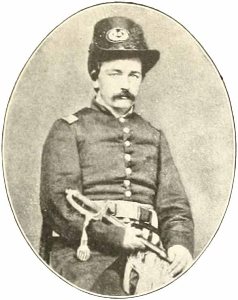
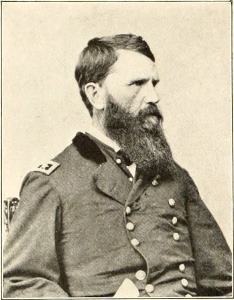
| BLAIR, OF MISSOURI |
|
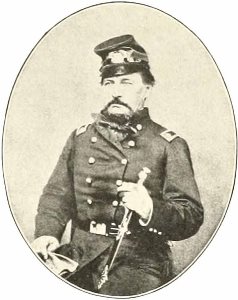
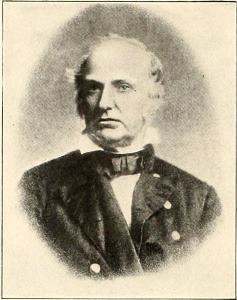
BAKER, OF CALIFORNIA |
|
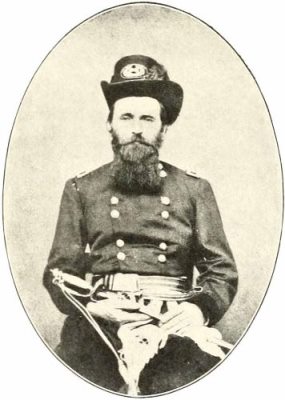
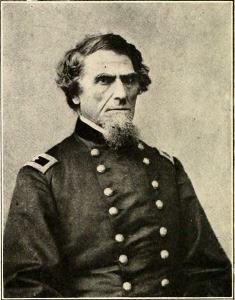
KELLEY, OF WEST VIRGINIA |
| Although remaining politically neutral throughout the war, Missouri contributed four hundred and forty-seven separate military organizations
to the Federal armies, and over one hundred to the Confederacy. The Union sentiment in the State is said to have been due to Frank P. Blair, who,
early in 1861, began organizing home guards. Blair subsequently joined Grant’s command and served with that leader until Sherman took the helm in
the West. With Sherman Major-General Blair fought in Georgia and through the Carolinas. |
|
California contributed twelve military organizations to the Federal forces, but none of them took part in the campaigns east of the
Mississippi. Its Senator, Edward D. Baker, was in his place in Washington when the war broke out, and, being a close friend of Lincoln, promptly
organized a regiment of Pennsylvanians which was best known by its synonym “First California.” Colonel Baker was killed at the head of it at the
battle of Ball’s Bluff, Virginia, October 21, 1861. Baker had been appointed brigadier-general but declined. |
|
West Virginia counties had already supplied soldiers for the Confederates when the new State was organized in 1861. As early as May, 1861, Colonel
B. F. Kelley was in the field with the First West Virginia Infantry marshalled under the Stars and Stripes. He served to the end of the war
and was brevetted major-general. West Virginia furnished thirty-seven organizations of all arms to the Federal armies, chiefly for local defense
and for service in contiguous territory. General Kelley was prominent in the Shenandoah campaigns. |
| |
 |
|
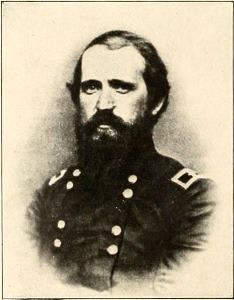 |
|
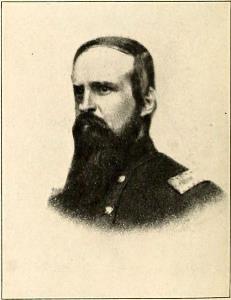 |
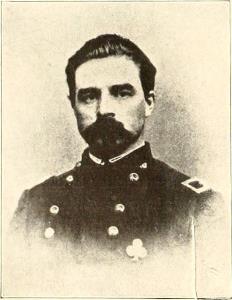
| SMYTH, OF DELAWARE |
|
MITCHELL, OF KANSAS |
|
CROSS, OF NEW HAMPSHIRE |
| Little Delaware furnished to the Federal armies fifteen separate military organizations. First in the field was Colonel Thomas A. Smyth, with the
First Delaware Infantry. Early promoted to the command of a brigade, he led it at Gettysburg, where it received the full force of Pickett’s charge
on Cemetery Ridge, July 3, 1863. He was brevetted major-general and fell at Farmville, on Appomattox River, Va., April 7, 1865, two days before the
surrender at Appomattox. General Smyth was a noted leader in the Second Corps. |
|
The virgin State of Kansas sent fifty regiments, battalions, and batteries into the Federal camps. Its Second Infantry was organized and led to the
field by Colonel R. B. Mitchell, a veteran of the Mexican War. At the first battle in the West, Wilson’s Creek, Mo. (August 10, 1861), he was
wounded. At the battle of Perryville, Brigadier-General Mitchell commanded a division in McCook’s Corps and fought desperately to hold the Federal
left flank against a sudden and desperate assault by General Bragg’s Confederates. |
|
New Hampshire supplied twenty-nine military organizations to the Federal armies. To the Granite State belongs the grim distinction of furnishing
the regiment which had the heaviest mortality roll of any infantry organization in the army. This was the Fifth New Hampshire, commanded by
Colonel E. E. Cross. The Fifth served in the Army of the Potomac. At Gettysburg, Colonel Cross commanded a brigade, which included the Fifth
New Hampshire, and was killed at the head of it near Devil’s Den, on July 2, 1863. |
| |
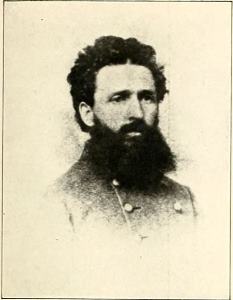 |
|
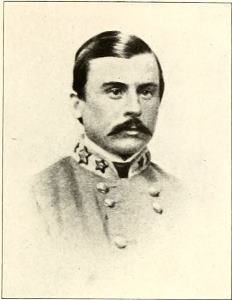 |
|
 |
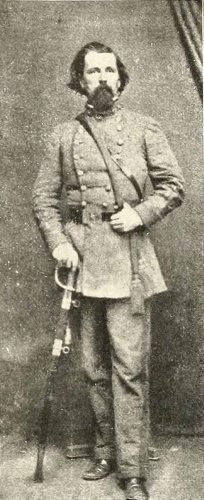
| PEARCE, OF ARKANSAS |
|
STEUART, OF MARYLAND |
|
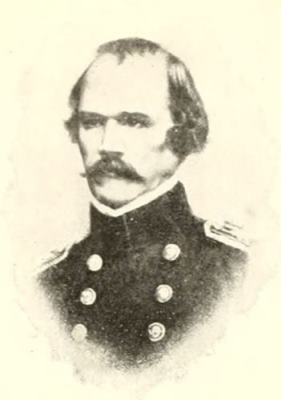
CRITTENDEN, THE CONFEDERATE |
| Arkansas entered into the war with enthusiasm, and had a large contingent of Confederate troops ready for the field in the summer of 1861. At
Wilson’s Creek, Missouri, August 10, 1861, there were four regiments and two batteries of Arkansans under command of Brigadier-General N. B.
Pearce. Arkansas furnished seventy separate military organizations to the Confederate armies and seventeen to the Federals. The State was gallantly
represented in the Army of Northern Virginia, notably at Antietam and Gettysburg. |
|
Maryland quickly responded to the Southern call to arms, and among its first contribution of soldiers was George H. Steuart, who led a battalion
across the Potomac early in 1861. These Marylanders fought at First Bull Run, or Manassas, and Lee’s army at Petersburg included Maryland troops
under Brigadier-General Steuart. During the war this little border State, politically neutral, sent six separate organizations to the Confederates
in Virginia, and mustered thirty-five for the Federal camps and for local defense. |
|
Kentucky is notable as a State which sent brothers to both the Federal and Confederate armies. Major-General George B. Crittenden, C. S. A., was the
brother of Major-General Thomas L. Crittenden, U. S. A. Although remaining politically neutral throughout the war, the Blue Grass State sent
forty-nine regiments, battalions, and batteries across the border to uphold the Stars and Bars, and mustered eighty of all arms to battle
around the Stars and Stripes and protect the State from Confederate incursions. |
| |
 |
|
 |
|
 |
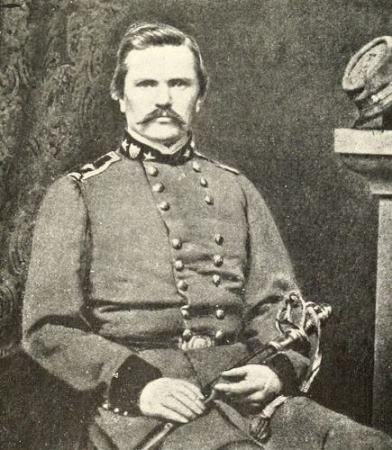
| RANSOM, OF NORTH CAROLINA |
|
FINEGAN, OF FLORIDA |
|
CLEBURNE, OF TENNESSEE |
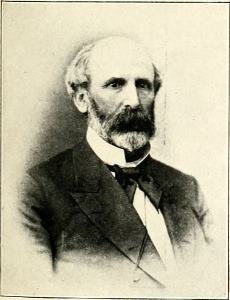
| The last of the Southern States to cast its fortunes in with the Confederacy, North Carolina vied with the pioneers in the spirit with
which it entered the war. With the First North Carolina, Lieut.-Col. Matt W. Ransom was on the firing-line early in 1861. Under his leadership as
brigadier-general, North Carolinians carried the Stars and Bars on all the great battlefields of the Army of Northern Virginia. The State furnished
ninety organizations for the Confederate armies, and sent eight to the Federal camps. |
|
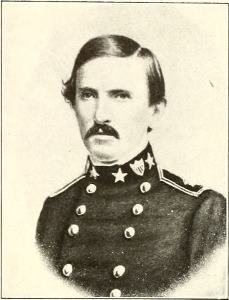
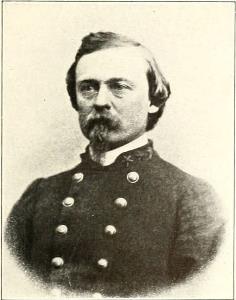
Florida was one of the first to follow South Carolina’s example in dissolving the Federal compact. It furnished twenty-one military
organizations to the Confederate forces, and throughout the war maintained a vigorous home defense. Its foremost soldier to take the field when the
State was menaced by a strong Federal expedition in February, 1864, was Brigadier-General Joseph Finegan. Hastily gathering scattered detachments,
he defeated and checked the expedition at the battle of Olustee, or Ocean Pond, on February 20. |
|
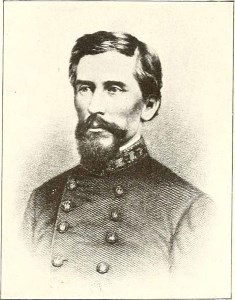
Cleburne was of foreign birth, but before the war was one year old he became the leader of Tennesseeans, fighting heroically on Tennessee soil.
At Shiloh, Cleburne’s brigade, and at Murfreesboro, Chattanooga, and Franklin, Major-General P. R. Cleburne’s division found the post of honor.
At Franklin this gallant Irishman “The ‘Stonewall’ Jackson of the West,” led Tennesseeans for the last time and fell close to the breastworks.
Tennessee sent the Confederate armies 129 organizations, and the Federal fifty-six. |
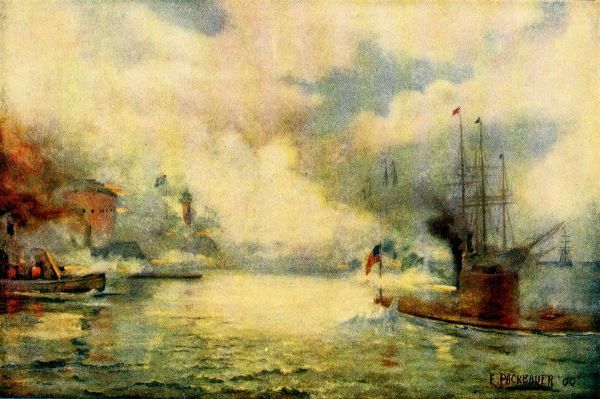
 Painted by E. Packbauer.
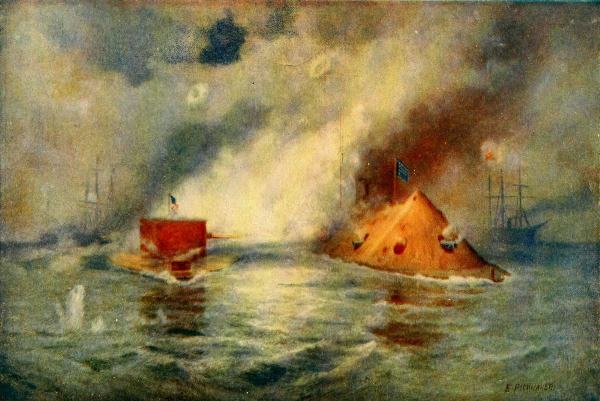
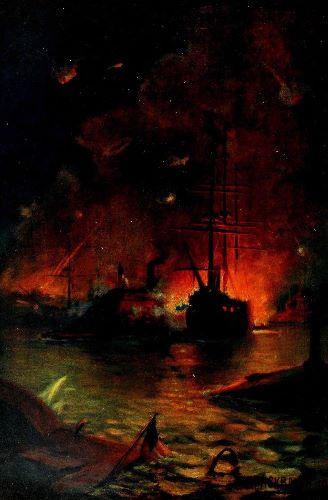
Copyright, 1901, by Perrien-Keydel Co., Detroit, Mich., U. S. A.THE LAST OF THE FRIGATE.
Larger Image