"There's many a boy here today who looks on war as
all glory, but, boys, it is all hell."
—WILLIAM TECUMSEH SHERMAN
Of the 2.3 million men enlisted in the Union Army, seventy per
cent were under 23 years of age. Approximately 100,000 were 16
and an equal number 15. Three hundred lads were 13 or less, and
the records show that there were 25 no older than 10 years.
The average infantry regiment of 10 companies consisted of 30
line officers and 1300 men. However, by the time a new regiment
reached the battlefield, it would often have less than 800 men
available for combat duty. Sickness and details as cooks, teamsters,
servants, and clerks accounted for the greatly reduced
numbers. Actually, in many of the large battles the regimental
fighting strength averaged no more than 480 men.
In 1864 the basic daily ration for a Union soldier was (in ounces):
20—beef, 18—flour, 2.56—dry beans, 1.6—green coffee, 2.4—sugar,
.64—salt, and smaller amounts of pepper, yeast powder, soap,
candles, and vinegar. While campaigning, soldiers seldom obtained
their full ration and many had to forage for subsistence.
In the Army of Northern Virginia in 1863 the rations available for
every 100 Confederate soldiers over a 30-day period consisted of
1/4 lb. of bacon, 18 oz. of flour, 10 lbs. of rice, and a small amount
of peas and dried fruit—when they could be obtained. (It is little
wonder that Lee elected to carry the war into Pennsylvania—if
for no other reason than to obtain food for an undernourished army.)
During the Shenandoah Valley campaign of 1862 "Stonewall" Jackson
marched his force of 16,000 men more than 600 miles in 35 days.
Five major battles were fought and four separate Union armies,
totaling 63,000, were defeated.
In June 1864, the U.S.S. Kearsarge sank the C.S.S. Alabama in a
fierce engagement in the English Channel off Cherbourg, France.
Frenchmen gathered along the beach to witness the hour-long
duel, which inspired a young French artist, Edouard Manet, to
paint the battle scene that now hangs in the Philadelphia Museum
of Art.
The Confederate cruiser Shenandoah sailed completely around the
world raiding Union commerce vessels and whalers. The ship and
crew surrendered to British authorities at Liverpool in November
1865, seven months after Lee's surrender at Appomattox.
The greatest naval bombardment during the war was on Christmas
Eve, 1864, at Fort Fisher, North Carolina. Fifty-seven vessels,
with a total of 670 guns, were engaged—the largest fleet ever
assembled by the U.S. Navy up to that time. The Army, Navy, and
Marines combined in a joint operation to reduce and capture the
fort.
In July, 1862 the first Negro troops of the Civil War were organized
by General David Hunter. Known as the 1st South Carolina Regiment,
they were later designated the 33rd Regiment United States
Colored Troops. Some 186,000 Negro soldiers served in the Union
Army, 4,300 of whom became battle casualties.
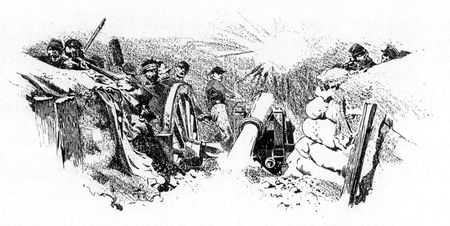
At the battle of Fredericksburg in 1862, the line of Confederate
trenches extended a distance of seven miles. The troop density
in these defensive works was 11,000 per mile.
Over 900 guns and mortars bristled from the 68 forts defending
the Nation's Capital during the war. The fortifications, constructed
by the Engineer Corps during the early part of the war,
circled the city on a 37-mile perimeter.
During Sherman's campaign from Chattanooga to Atlanta, the
Union Army of the Tennessee, in a period of four months, constructed
over 300 miles of rifle pits, fired 149,670 artillery
rounds and 22,137,132 rounds of small-arms ammunition.
To fire a Civil War musket, eleven separate motions had to be
made. The regulation in the 1860's specified that a soldier should
fire three aimed shots per minute, allowing 20 seconds per shot
and less than two seconds per motion.
At the battle of Stone's River, Tennessee, in January, 1863, the
Federal infantry in three days exhausted over 2,000,000 rounds of
ammunition, and the artillery fired 20,307 rounds. The total
weight of the projectiles was in excess of 375,000 pounds.
At the Battle of First Bull Run or Manassas, it has been estimated
that between 8,000 and 10,000 bullets were fired for every
man killed and wounded.
The campaign against Petersburg, the longest sustained operation
of the war, began in the summer of 1864 and lasted for 10 months,
until the spring of '65. The fighting covered an area of more
than 170 square miles, with 35 miles of trenches and fortifications
stretching from Richmond to the southwest of Petersburg. During
September, 1864, nearly 175 field and siege guns poured forth a
daily average of 7.8 tons of iron on the Confederate works.
The greatest cavalry battle in the history of the western hemisphere
was fought at Brandy Station, Virginia, on June 9, 1863.
Nearly 20,000 cavalrymen were engaged for more than 12 hours.
At the height of the battle, along Fleetwood Hill, charges and
countercharges were made continuously for almost three hours.
The greatest regimental loss of the entire war was borne by the
1st Maine Heavy Artillery. The unit saw no action until 1864, but
in the short span of less than one year, over half of its 2,202 men
engaged in battle were hit. In the assault on Petersburg in June,
1864, the regiment lost 604 men killed and wounded in less than
20 minutes.
The largest regimental loss in a single battle was suffered by the
26th North Carolina Infantry at Gettysburg. The regiment went
into battle with a little over 800 men, and by the end of the third
day, 708 were dead, wounded, or missing. In one company of 84,
every officer and man was hit.
Of the 46 Confederate regiments that went into the famous charge
at Gettysburg on July 3, 1863, 15 were commanded by General
Pickett. Thirteen of his regiments were led by Virginia Military
Institute graduates; only two of them survived the charge.
The heaviest numerical loss during any single battle was at
Gettysburg, where 40,322 Americans were killed or wounded. On
the Union side 21 per cent of those engaged were killed or wounded,
in the Confederate ranks 30 per cent—the largest percentage of
Confederates hit in any battle. The largest percentage of Union
soldiers hit in battle was at Port Hudson in May 1863, where 26.7
per cent of those engaged were killed or wounded.
During May and June 1864 the Armies of the Potomac and the
James lost 77,452 men—a greater number than Lee had in his
entire army.
Union Army hospitals treated over 6 million cases during the
war. There were twice as many deaths from disease as from
hostile bullets. Diarrhea and dysentery alone took the lives of
44,558 Union soldiers.
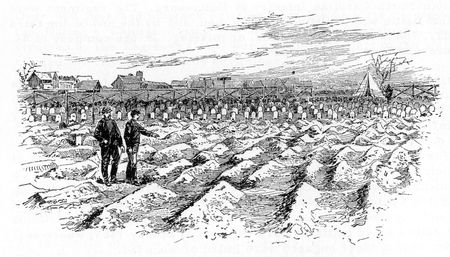
From 1861-1865 the Quartermaster Corps of the Union Army
made 116,148 burials.
In the 79 National Civil War cemeteries, 54 per cent of the graves
are those of unknown soldiers. The largest Civil War cemetery
is at Vicksburg, where 16,000 soldiers rest; only 3,896 are known.
At the Confederate prison site in Salisbury, North Carolina, where
12,126 Union soldiers are buried, 99 per cent are unknown.