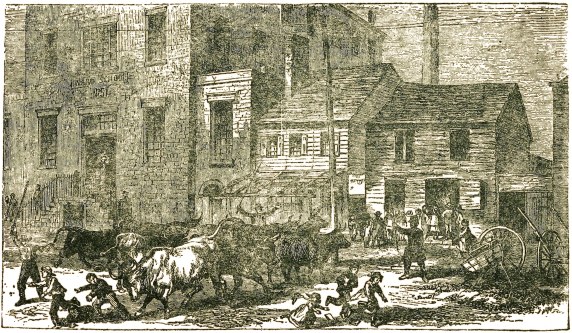
The illustrations in this chapter, with the frontispiece
of the book, have all been reproduced
from the elaborate report published by the Council
of Hygiene of the Citizens’ Association. My
address before the Legislative Committee is here
given as it then appeared in The New York
Times of March 13, 1865, with the correction of
some typographical errors. It consisted of a
detailed presentation of the facts recorded and
sworn to by the medical inspectors employed by
the Citizens’ Association, together with photographic
illustrations which were made by them.


MR. CHAIRMAN: I have been requested
to lay before you some
of the results of a sanitary inspection
of New York City, undertaken
and prosecuted to a
successful completion by a voluntary
organization of citizens.
There has long been a settled conviction in the
minds of the medical men of New York, that
that city is laboring under
sanitary evils of which it
might be relieved. This
opinion is not mere conjecture,
but it is based upon the daily observations
which they are accustomed to make in the pursuit
of professional duties.
Familiar, by daily study, with the causes of
diseases, and the laws which govern their
spread, they have seen yearly accumulating
about and within the homes of the laboring
classes all the recognized causes of the most
Alarm of Medical
Men
preventible diseases, without a solitary measure
being taken by those in authority to apply an
effectual remedy. They have seen the poor
crowded into closer and closer quarters, until
the system has actually become one of tenant-house
packing. They have witnessed the prevalence
of terrible and fatal epidemics, having
their origin in or intensified by these conditions,
and many of their professional brethren have
perished in the courageous performance of
their duties to the poor and suffering.
Cognizant of these growing evils, and believing
that they are susceptible of removal, they
have repeatedly and publicly protested against
the longer tolerance of such manifest causes of
disease and death in our city. Large bodies of
influential citizens have been equally impressed
with the importance of radical reform in the
health organizations of New York, and have
strenuously labored, but in vain, to obtain
proper legislative enactments.
To give practical effect to their efforts, it was
determined in May last to undertake a systematic
investigation of the sanitary condition
of the city. For this purpose a central organization
was formed, and when I mention the
names of its leading members, I
A Systematic
Investigation
give you the best assurance that
the work was undertaken in the
interests of science and humanity.
The president was Dr. Joseph M. Smith,
one of the ablest writers on sanitary science in
this country, and among its members were
Drs. Valentine Mott, James Anderson, Willard
Parker, Alonzo Clark, Gurdon Buck, James R.
Wood, Charles Henschel, Alfred C. Post, Isaac
E. Taylor, John W. Draper, R. Ogden Doremus,
Henry Goulden, Henry D. Bulkley, and Elisha
Harris.
In prosecuting this inquiry the Association
was guided by the experience of similar organizations
in Great Britain, where sanitary science
is now cultivated with the greatest zeal, and is
yielding the richest fruits. As a preliminary
step to the introduction of sanitary reforms,
many of the populous towns of England made
a more or less complete inspection of the homes
of the people to determine their condition, and
to enable them to arrive at correct conclusions
as to the required remedial measures. The
English Government undertook a similar investigation
through its “Commissioners for Inquiring
into the State of Large Towns and
Populous Districts,” and the voluminous and
exhaustive reports of that Commission laid the
foundation of the admirable sanitary system of
that country.
The first object of sanitary organization was
apparently, therefore, to obtain detailed information
as to the existing causes of disease
and the mortality of the population, and as to
the special incidence of that mortality upon
each sex, and each age, on separate places,
on various occupations; in fact, to present
a detailed account of what may be called, in
commercial phrase, our transactions in human
life.
Evidently the best method of arriving at
such knowledge was by a systematic inspection.
And that inspection must be a
house-to-house visitation, in which the course
of inquiry not only developed all the facts relating
to the sanitary, but
A House-to-House
Inspection
equally to the social condition
of the people. It
must necessarily be required
of the inspector that he visit every house,
and every family in the house, and learn by
personal examination, inquiry, and observation,
every circumstance, external and internal to the
domicile, bearing upon the health of the individual.
To perform such service satisfactorily, skilled
labor must be employed. No student of general
science, much less a common artisan, was qualified
to undertake this investigation into the
causes of disease; however patent these causes
might be, he had no power to appreciate their
real significance. Minds trained by education,
and long experience in observing and treating
the diseases of the laboring classes, could alone
thoroughly and properly accomplish the work
proposed.
Happily, experts were at hand and prepared
to enter upon the task, viz.: the dispensary
physicians. The daily duties of these practitioners
have been for years to practice among
the poor, and study minutely their diseases;
and thus they have gained an
The Medical
Experts
extensive and accurate knowledge
of the sanitary and social
condition of the mass of the people.
Many of these practitioners have been engaged
in dispensary service, and in a single district,
for ten to twenty years. They have thus
become so familiar with the poor of their district,
though often numbering 40,000 to 50,000,
that they know the peculiarities of each house,
the class of disease prevalent each month of the
year, and to a large extent the habits, character,
etc., of the families which occupy them.
From this class of medical men the Council
selected, as far as possible, its corps of Inspectors.
As a body, they represent the best medical
talent of the junior portion of the profession
of New York. Many occupy high social
positions, and all were men of refinement, education,
and devotion to duty. They entered
upon the work with the utmost enthusiasm;
engaging in it as a purely scientific study.
Everywhere the people welcomed the Inspectors,
invited them to examine their homes, and
gave them the most ample details.
The plan of inspection adopted by the Council
was as follows: The city was divided into
thirty-one districts and an Inspector selected
for each, care being taken to assign to each inspector
a district with which he was most familiar.
Plan of
Inspection
The Inspector was directed
to commence his inspection by first
traversing the whole district, to
learn its general and topographical
peculiarities. He was then to take up the
squares in detail, examining them consecutively
as they lie in belts.
Commencing at a given corner of his district,
he was first to go around the square and note:
1. Nature of the ground. 2. Drainage and
sewerage. 3. Number of houses in the square.
4. Vacant lots and their sanitary condition. 5.
Courts and alleys. 6. Rear buildings. 7. Number
of tenement houses. 11. Drinking shops,
brothels, gambling saloons, etc. 12. Stores and
markets. 13. Factories, schools, crowded buildings.
14. Slaughter-houses (describe particularly).
15. Bone and offal nuisances. 16.
Stables, etc. 17. Churches and school edifices.
Returning to the point of starting, he was to
commence a detailed inspection of each building,
noting: a. Condition and material of buildings.
b. Number of stories and their height.
c. Number of families intended to be accommodated,
and space allotted to each. d. Water
supply and house drainage. e. Location and
character of water-closets. f. Disposal of garbage
and house slops. g. Ventilation, external
and internal. h. Cellars and basements, and
their population. i. Conditions of halls and
passages. j. Frontage on street, court, alley—N.,
E., S. or W. 18. Prevailing character of the
population. 19. Prevailing sickness and mortality.
20. Sources of preventible disease and
mortality. 21. Condition of streets and pavements.
22. Miscellaneous information.
He entered each room, examined its means of
ventilation and its contents, noted the number
of occupants by day and by night, and
carefully estimated the cubical area to each
person. Whenever any contagious or infectious
disease was discovered, as
Each Room
Examined
fever, smallpox, measles, scarlatina,
the Inspector made a special
report upon the dwelling.
This report embodied specific answers to a
series of questions, furnished in a blank form,
requiring him 1. To trace and record the medical
history of the sick person. 2. To ascertain
and record facts relating to the family and other
persons exposed to the patients and to the
causes of the malady. 3. To report the sanitary
condition of the domicil. 4. To report the statistics
and sanitary condition of the population
of that domicil. 5. To report upon the sanitary
condition of the locality or neighborhood and
its population. 6. To preserve and make returns
of these records. 7. To prepare on the
spot the necessary outlines or data for the
sketching of a map or descriptive chart of the
domicil, block, or locality.
Each Inspector was supplied with a notebook
and a permanent record-book; in the first
he constantly made notes as his examination
proceeded, and in the latter these notes were
expanded and put on permanent record. These
permanent record-books are the property of
the Association and embrace for the most part
minute details concerning every building and
tenement occupied by the laboring classes, as
also, grog-shops, stables, vacant lots, slaughter-houses,
etc.
Each Inspector was furnished with materials
for drawing, and was directed to make accurate
drawings of the squares in his district, locating
each building, vacant lot, etc., and distinguishing
the character and condition of each by an
appropriate color. Many of these drafts of
districts are beautiful specimens of art, and as
sanitary charts enable the observer to locate infectious
and contagious diseases, and with the
aid of the permanent records, to determine the
internal and external domiciliary conditions
under which they occur.
I have been thus minute in specifying the details
of the plan of inspection, the qualifications
of the Inspectors, and the means employed, in
order that the character of the work and the
value of the results obtained may be properly
appreciated.
Early in the month of May the work of thoroughly
inspecting the insalubrious quarters,
where fever and other pestilential diseases
prevail, had been commenced, and the fact was
soon ascertained that smallpox and typhus fever
were existing and spreading
Period of the
Inspection
in almost every crowded locality
of the city. It was not
until about the middle of July
that the entire corps of Inspectors was engaged.
The work was then prosecuted with vigor and
without interruption to the middle of November,
when it was completed. The Inspectors
met regularly every Saturday evening to report
to a committee on the part of the Council the
progress of their work, and to receive advice
and instruction in regard to all questions of a
doubtful character.
On the completion of the inspection each Inspector
was required to prepare a final report
embodying the general results of his labors.
These reports have all been properly collated,
under the direction of the Association, and are
now passing through the press. They will soon
appear in an octavo volume of about 400 pages,
largely illustrated, with maps and diagrams. It
will be the first interior view of the sanitary and
social condition of the population of New York,
and will abundantly demonstrate the fact that,
though a great and prosperous commercial
centre, she does not afford happy homes to hundreds
of thousands.
Before proceeding to an analysis of this
work, it will be necessary to notice the topographical
peculiarities of our city, and the
distribution of its population. New York is an
island having an area of about thirty-four
square miles, inclusive of its
Distribution of
Population
parks. Unlike Philadelphia,
London, and most other large
cities, which have a background
of hundreds of square miles upon which
to extend according to the exigencies of the
population or of business, New York is limited
in its power of expansion, and must accommodate
itself to its given area. While it is true that a
large business population will gather upon the
adjacent shores, it is equally true that these
non-residents will be of the better class. The
laboring population will, for the most part, remain
upon the island, and must be accommodated
in the city proper, as they are compelled
to live near their work.
New York has, thus far, grown without any
control or supervision, until its population is
estimated at 1,000,000 of persons. Of this number,
at least one-half are of the laboring and dependant
classes, compelled to live under such
conditions as they find in their homes, without
any power, either to change or improve them.
Following the natural law which governs the
movements of such a population, the wealthier
or independent class spreads itself with its business
arrangements over the larger proportion
of the area, and the poorer or dependent class
is crowded into the smallest possible space.
Already New York has covered about 8 of
its 34 square miles with the dwellings of a
population not far from 1,000,000, and all
its commercial and manufacturing establishments.
And the result is, as might have been
anticipated, the dependent
Tenant-House
Packing
class, numbering fully one-half
of the people, is crowded
into tenant-houses which occupy
an area of not more than two square
miles. Such crowding amounts literally to
packing.
For example, it is estimated that there are
three contiguous blocks of tenant-houses which
contain a larger population than Fifth Avenue;
or, again, if Fifth Avenue had front and rear
tenant-houses as densely packed as tenant-houses
generally are, there would be a population
of 100,000 on that single avenue. A single
tenant-court in the Fourth Ward is arranged
for the packing of 1,000 persons.
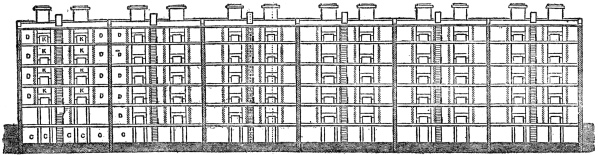
GOTHAM COURT, CHERRY STREET, 1865—LONGITUDINAL ELEVATION
Arranged for the Packing of 1,000 Persons
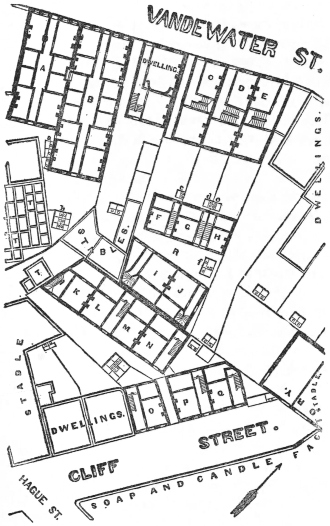
SECTION OF CITY 240 BY 150 FEET, OCCUPIED
BY 111 FAMILIES, AND BY STABLES, SOAP
FACTORY, AND TANYARD
A resident of the same Ward reports that:
“On a piece of ground 240 feet by 150, there are
20 tenant-houses, occupied by 111 families, 5
stables, a large soap and candle factory, and a
tan-yard, the receptacle of green hides. The
filth and stench of this locality are beyond any
power of description.” In general, it may be
stated that the average number of families to
a house among the poor is 7, or about 35 persons.
It is necessary also to make a single explanation,
to render more apparent the bearing of
the facts developed. For the purposes of
sanitary inquiry, the causes of disease are divided
into those which are inevitable, and those
Avoidable and
Inevitable Disease
which are avoidable or removable,
and hence it follows
that diseases and
deaths are divided into
those which are inevitable and those which are
preventable. For example: Of unavoidable
causes of disease, we have vicissitudes of
weather, accidents, old age, physical degenerations,
etc.
Of avoidable or removable causes of disease
we have those conditions around or within our
dwellings or places of business or resort, errors
in our mode of living, etc., which vitiate health,
or rather tend to diseases, and yet which can
be removed or changed by human agency. For
example, a country residence may be most
favorably located for health, and yet decaying
vegetable matter in the cellar, or a cesspool so
situated as to allow the gaseous emanations to
be diffused through the house, will expose all
the inmates to fevers, diarrhoea and dysentery.
These would be preventable diseases, and all
the deaths therefrom would be preventable, and
hence unnecessary deaths. In like manner in
cities, all diseases and deaths due to causes
which human agencies can remove are preventable.
And it is a melancholy fact that fifty per
cent of the mortality of cities is estimated to be
due to such causes, and is hence unnecessary.
In reviewing the result of this inspection, I
shall call your attention only to the more patent
causes of disease found existing, and to the
preventable diseases discovered, and their relation
to these causes. In this evidence you will
find ample proof that radical reforms are required
in the health organizations of New York.
I will first notice the causes of disease which
exist external to our dwellings, and which
are the most readily susceptible of remedy.
The first that attracts attention in New York is
the condition of the streets. No one can
Filthy
Streets
doubt that if the streets in a thickly
populated part of a town are made the
common receptacle of the refuse of
families, that in its rapid decomposition a vast
amount of poisonous gases must escape, which
will impregnate the entire district, penetrate
the dwellings, and render the atmosphere in
the neighborhood in a high degree injurious to
the public health. In confirmation of this statement,
I will quote the City Inspector, who, in a
former communication to the Common Council,
says:
“As an evidence of the effect of this state of
things upon the health of the community, I
would state that the mortality of the city, from
the first of March, has been largely on the increase,
until it has now reached a point of fearful
magnitude. For the week ending April 27th,
there were reported to this department one
hundred and forty more deaths than occurred
during the same week of the previous year.
Were this increase of mortality the result of an
existing pestilence or epidemic among us, the
public would become justly alarmed as to the
future; but although no actual pestilence, as
such, exists, it is by no means certain that we
are not preparing the way for some fatal
scourge by the no longer to be endured filthy
condition of our city.”
The universal testimony of the sanitary inspectors
is that in all portions of the city occupied
by the poorer classes, the streets are in the
same filthy condition as that described by the
City Inspector, and, that street filth is one of the
most fruitful causes of disease.
Says the Inspector of the Eighth Ward:
“Laurens, Wooster, Clark, and Sullivan are
in a most filthy condition, giving off insalubrious
emanations on which depend the many
cases of fever, cholera infantum, dysentery,
and pulmonary diseases. I have
Street Filth
and Disease
observed that near where other
streets cross the above-named
streets there is a greater proportionate
amount of sickness; and this fact I have
shown by special reports of typhus and typhoid
fever in Grand and Broome, and dysentery in
Spring.”
The Inspector of the Sixth Ward says: “Domestic
garbage and filth of every kind is thrown
into the streets, covering their surface, filling the
gutters, obstructing the sewer culverts, and
sending forth perennial emanations which must
generate pestiferous disease. In winter the filth
and garbage, etc., accumulate in the streets, to
the depth sometimes of two or three feet. The
garbage boxes are a perpetual source of nuisance
in the streets, filth and offal being thrown
all around them, pools of filthy water in many
instances remaining in the gutters, and having
their source in the garbage boxes.”
The Inspector of the Seventh Ward says:
“The whole most easterly portion of the district,
the streets and gutters are very filthy with mud,
ashes, garbage, etc.”
The Inspector of the Thirteenth Ward says:
“The streets are generally in a filthy and unwholesome
condition; especially in front of the
tenant-houses, from which the garbage and
slops are, to a great extent, thrown into the
streets, where they putrefy, rendering the air
offensive to the smell and deleterious to health.
The refuse of the bedrooms of those sick with
typhoid and scarlet fevers and smallpox is frequently
thrown into the streets, there to contaminate
the air, and, no doubt, aid in the
spread of those pestilential diseases.”
Says the Inspector of the Ninth Ward: “The
effect of dirty streets upon the public health is
too well known, and too often insisted upon, to
need any exposition in this report. The largest
number of cases of cholera infantum, cholera
morbus, and kindred disease, is always found
in localities where the streets are dirtiest.”
The Inspector of the Seventeenth Ward
writes: “The two following localities present
the appearance of dung-hills rather than the
thoroughfares in a civilized city, viz.: Sixth
Street, between Bowery and Second Avenue,
and Eleventh Street, between First and Second
Avenues.”
The Inspector of the Eleventh Ward says: “As
a rule, the streets are extremely dirty and
offensive, and the gutters obstructed with
filth. The filth of the streets is composed of
Animals
Dead
house-slops, refuse vegetables, decayed fruit,
store and shop sweepings, ashes, dead animals,
and even human excrements. These
putrifying organic substances are
ground together by the constantly
passing vehicles. When dried
by the summer’s heat, they are driven by the
wind in every direction in the form of dust.
When remaining moist or liquid in the form of
“slush,” they emit deleterious and very offensive
exhalations. The reeking stench of the
gutters, the street filth, and domestic garbage of
this quarter of the city, constantly imperil the
health of its inhabitants. It is a well-recognized
cause of diarrhoeal diseases and fevers.”
The Inspector of the Eighteenth Ward reports:
“The streets in the eastern part of the
district, east of First Avenue especially, have,
for the past six months, been in a most inexcusably
filthy condition. The pavement here is uneven,
there are deep gutters at either side of
the streets, filled with foul slops, in which float
or are sunk every form of decaying animal and
vegetable matter. Occasionally, at remote and
irregular intervals, carts come round, these
stagnant pools are dredged, so to speak, and
their black and decayed solid contents raked
out. If there be anything on earth that is ‘rank
and smells to heaven,’ these gutters do on such
occasions, especially in the summer months.
The streets in this part of the city are the principal
depositories of garbage. In some instances
heaped up at the sides of the streets, in others
thrown about promiscuously, the event in either
case is the same, if it be allowed to remain day
after day, as it usually is. After having passed
through every stage of decay, after having corrupted
the surrounding air with its pestilential
smell, it gradually becomes dessicated and converted
into dust by the summer sun and the
constantly passing vehicles. And now every
horse that passes stirs it up, every vehicle leaves
a cloud of it behind; it is lifted into the air with
every wind and carried in every direction.
“Those who are directly responsible for this
state of things suffer no more than the cleanly
and thrifty who are so unfortunate as to live
anywhere the wind, blowing from this quarter,
reaches them. And what a pulvis compositum
is it to breathe into the lungs! As we pass by,
our mouths become full of it, we draw it in with
our breath. It is swallowed into the stomach,
it penetrates our dress and clings until it
has covered our perspiring skin. Surely no
dumping-ground, no sewer, no vault, contains
more filth or in greater variety than did the air
in certain parts of our city during the long season
of drought the past summer. And wherever
the wind blows, the foul corruption is carried;
by a process as sure and universal as the diffusion
of gases, is it conveyed throughout the city.
Such, often, is the air drawn into the lungs with
every respiration, of the poor sufferer stifled
with consumption or burning with fever. No
barrier can shut it out, no social distinction can
save us from it; no domestic cleanliness, no
private sanitary measures can substitute a pure
atmosphere for a foul one.”
But I need not multiply these quotations. It
will suffice to state that during the week ending
August 5th, a special inspection of all the
streets was made and they were found to be
reeking, and, indeed, almost impassable, with
filth. And to-day they are in, if possible, a still
worse condition than ever before.
Closely allied to the streets are courts and
alleys. These cul-de-sacs leading to, and
adjoining the close and unventilated homes
of the poor, are almost universally in a more
filthy condition than the adjacent street. They
are the receptacles of much of
Filthy Courts
and Alleys
the waste of the house, and are
rarely cleaned. The air of these
places during the summer is
often the most stifling and irrespirable, and yet
as it descends it enters the closely packed tenant-house
and furnishes to the inmates the
elements of disease and death. Says the Inspector
of the Fourth Ward:
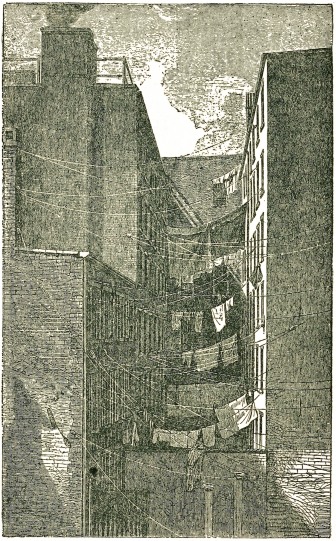
A TENANT-HOUSE CUL-DE-SAC, PARK STREET, NEAR
CITY HALL, WITH 307 INMATES; PHOTOGRAPHED
FROM A HOUSE-TOP IN PEARL STREET, 1865
“Slops from rear buildings of such premises
are usually emptied into a shallow gutter cut in
the flagging and extending from the yard, or
space between front and rear buildings, to the
street. This is often clogged up by semi-fluid
filth, so that the alley and those parts of the
yard through which it runs are not infrequently
overflown and submerged to the depth of several
inches. There are more than four hundred
families in this district whose homes can only
be reached by wading through a disgusting deposit
of filthy refuse. In some instances, a staging
of plank, elevated a few inches above the
surface, is constructed through the alleys.”
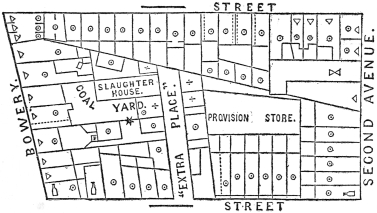
A CUL-DE-SAC, SHOWING OVERCROWDING, NEAR
SLAUGHTER-HOUSE AND STABLES
New York, 1865
In the court is found generally that most
pestiferous of all the sources of civic uncleanliness
and unhealthiness—the privy and
cesspool. These receptacles are rarely drained
Cesspool
Abominations
into the sewers, and consequently require for
their cleanliness the frequent and faithful attention
of the scavenger. The reports
of the sanitary inspectors
prove that this work is most
irregularly and imperfectly
done. Hundreds of places were found where
these nuisances existed within, under or beside
large tenant-houses, creating a vast amount of
disease and death. Numerous instances of this
kind are detailed in these reports, which are almost
too revolting to be believed. I will quote
but one or two illustrations:
“The privies (two in one) of Nos. — and —
West Twenty-fourth Street need instant cleaning.
They are overflowing the yard, and are
very offensive. The privy No. — Seventh
Avenue, as in the preceding two adjoining
houses, is in the yard, and adjoins the house,
and is on a line with the southerly wall of house
No. — (the adjacent house), which has a back
area; the wall of said area being part of the
foundation of the privy. At times the fluid portion
of the privy oozes through its own and the
area wall.
“The privy of the rear tenant-house No. —
West Twenty-second Street is used by 42 persons;
it has five subdivisions, one for every two
families. The compartments are so small that
a person can scarcely turn round in them, and
so dark that they have to be entered with an
artificial light. The cellar itself, as has been
stated, is damp,
dark, and without
ventilation.
Under such circumstances
the
emanations of
the excrementious
matter of
42 persons can
find no escape;
thus this privy-cellar
is worse
than a Stygian
pit.”
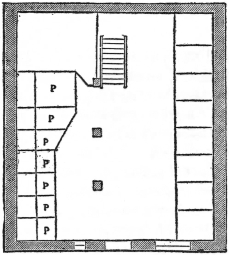
PLAN OF CELLAR
The Inspector
of the Fifth
Ward says: “Very few tenements have water-closets
in the house; they have privies in the
yards, which, as a rule, are insufficient for the
accommodation of the numbers crowded into
the houses; many are not connected with the
sewers; are seldom cleaned, being allowed to
overflow in some cases, rendering the neighborhood
offensive with insalubrious emanations.”
The Inspector of the Fourteenth Ward states
that: “The water-closets are nearly all in the
yards—but few being in the houses—and
connecting with the sewers. The greater number
of these sewers are in a filthy condition,
being but seldom emptied. Many of those
which communicate with the privies are choked
up by all sorts of offal being thrown into them,
thereby producing a very bad condition.”
The Inspector of the Seventeenth Ward reports:
“The privies of East Eleventh Street,
rear, are beneath the floored alley-way leading
to the building. Large holes in this floor
allow ocular inspection from above, and admit
rain and dirt. These nuisances
Unbelievable
Vileness
are almost always overflowing,
and the passage leading to them
is full of fæcal matter. It would
seem impossible for human beings to create or
endure such vileness. The cellar is used by
children and others as a privy; the foul air there
seems never to change.”
The Inspector of the Sixteenth Ward says:
“The privies form one end of the chief features
of insalubrity. Nearly all of them are too small
in size and too few in number, and without
ventilation or seat-covers. About twelve were
found locked securely, and on procuring the key
and inspecting the privy, such masses of human
excrements were found on the seats and floors
as would justify the locking of the door to protect
unwary persons from injury. Occupants
of rear buildings are the principal sufferers
from this insalubrity. The proximity of privies
is in some cases eight feet from the windows of
rear houses; the odor in these is, especially at
night, intolerable. Instances of the kind are to
be found at Nos. —, — and — West Seventeenth
Street, and others. They are also too few in
number; for example, No. — West Nineteenth
Street, where in the front and rear buildings
more than one hundred persons live who have
one common privy, with a single partition dividing
it, and but four seats in all. Twenty-five
persons are expected to use one seat-opening.”
The Inspector of the Twentieth Ward says:
“During my inspection I reported a number
which were filled, and at the same time in such
need of repair as to hazard the lives of those
who entered them. The proximity of these
places to the houses in many cases is a fact to
which I would call your attention. One instance
of this kind I may state: At a house in Fortieth
Street, between Broadway and Seventh Avenue,
the privy is situated about 10 feet from the door,
and there is another on a line 10 feet from the
first, and still another within 10 feet of the last
mentioned, making three privies within 30 feet,
and two of these belong to houses fronting on
Broadway. The offensive odor arising from
these places contaminates the air of the houses
in the vicinity. This house, in Fortieth Street,
is actually unfit to live in. At the time of my
inspection the noxious gases from these privies
were strongly perceptible in every part of the
house.”
The Inspector of the Seventeenth Ward reports:
“The privies are in most cases in the rear
court-yard. In about two-thirds of the houses
the privies are connected with the sewer. Overflowing
privies are frequently found. Sometimes
they are located in a dark place, which
in all cases must be considered an evil. Such
is the case in some houses in Rivington, Stanton,
Ninth and Eldridge streets. All these places
are filthy, and exceedingly offensive and dangerous
to the whole neighborhood; in some
places the foundation of the privies being rotten
and broken, and fæcal matter runs into the
cellar, as in No. — ‘Extra Place,’ where diseases
and deaths have occurred. The contents of a
privy in a court at No. — Fifth Street have, from
a similar cause, saturated the yard of premises
on the Bowery, where several children died
during the summer.”
I will at this point simply allude to special
nuisances. New York has within the narrow
limits of its present occupied area of about
eight square miles, in addition to its one million
of people, and all its commercial and manufacturing
Special
Nuisances
establishments, a vast number
of special nuisances, which are,
to a greater or less degree, detrimental
to its public health.
There are nearly 200 slaughter-houses, many of
which are in the most densely populated districts.
To these places droves of cattle, hogs,
and sheep are constantly driven, rendering the
streets filthy in the extreme, and from them flow
blood and refuse of the most disgusting character.
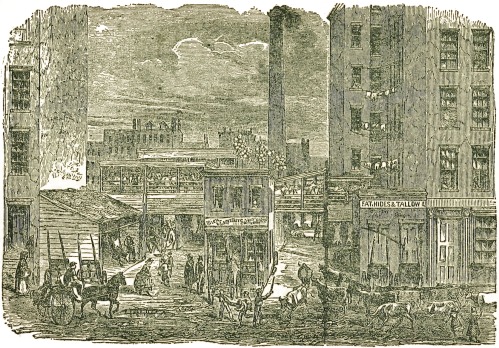
SLAUGHTER-PENS IN REAR OF TENANT-HOUSES IN THE
ELEVENTH WARD, 1865
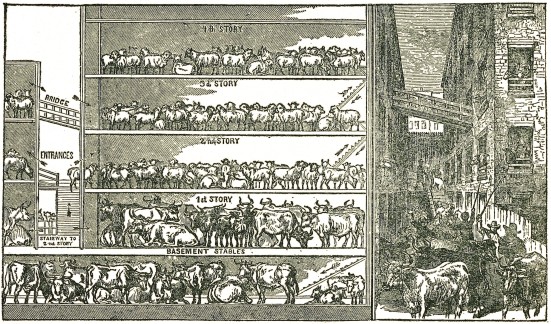
SIXTH STREET CATTLE MARKET, 1865
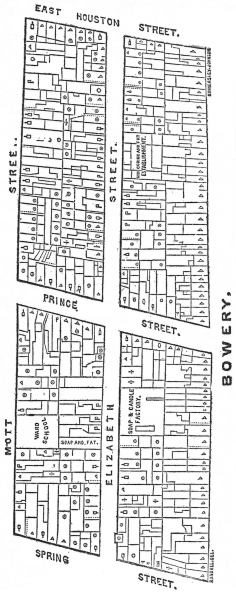
REGION OF HIDE-CURING, FAT-GATHERING,
FAT AND SOAP
BOILING, AND SLAUGHTER-PENS,
BEHIND THE BOWERY SHOPPING
HOUSES, 1865
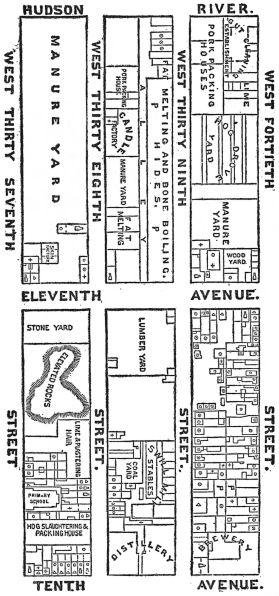
REGION OF BONE-BOILING AND SWILL-MILK
NUISANCES, 1865
In certain populous sections are fat-boiling,
entrails-cleansing, and tripe-curing establishments,
which poison the air for squares around
with their stifling emanations. To these must
be added hundreds of uncleaned stables, immense
manure heaps, etc., etc. But I shall not
dwell further on these subjects, and the evidence
regarding them.
I pass from the consideration of the external
to the internal domiciliary conditions. The
poorer classes of New York are found living
either in cellars or in tenement houses. It is
estimated by the City Inspector that 18,000 persons
live in cellars. This
Cellar Population—
Dens of Death
is also about the estimate
of the police.
The apartments of these
people are not the light and airy basement
rooms of the better class houses, but their
homes are, in the worst sense, cellars. These
dark, damp and dreary abodes are seldom
penetrated by a ray of sunlight, or enlivened by
a breath of fresh air. I will quote several descriptions
from these reports. In the Fourth
Ward many of these cellars are below tide
water. Says the Inspector of that district:
“This submarine region is not only excessively
damp, but is liable to sudden inroads from the
sea. At high tide the water often wells up
through the floors, submerging them to a considerable
depth. In very many cases the vaults
of privies are situated on the same or a higher
level, and their contents frequently ooze
through the walls into the occupied apartments
beside them. Fully one-fourth of these subterranean
domiciles are pervaded by a most
offensive odor from this source, and rendered
exceedingly unwholesome as human habitations.
These are the places in which we most
frequently meet with typhoid fever and dysentery
during the summer months. I estimate
the amount of sickness of all kinds affecting the
residents of basements and cellars, compared
with that occurring among an equal number of
the inhabitants of floors above ground, as being
about a ratio of 3 to 2.”
The Inspector of the Fifteenth Ward reports:
“In a dark and damp cellar, about 18 feet square
and 7 feet high, lived a family of seven persons;
within the past year two have died of typhus,
two of smallpox, and one has been sent to the
hospital with erysipelas. The tops of the windows
of this abode are below the level of the
surface, and in the court near are several privies
and a rear tenant-house. Yet this occurred but
a short distance from the very heart of the city.”
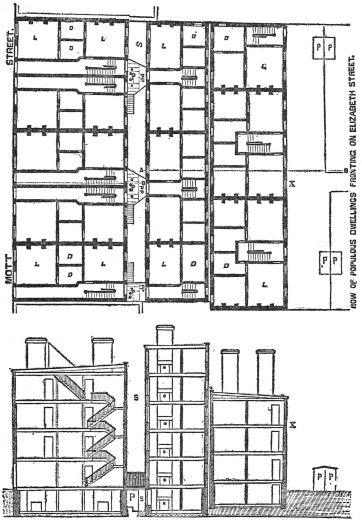
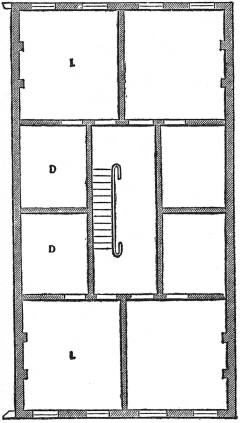
TRANSVERSE SECTIONAL VIEW OF ROOKERY BETWEEN
BROADWAY AND BOWERY, 1865
In its dark, damp cellar, 18 feet square by 7 high, lived 7 persons
L, Living Room; D, Dormitory
The Inspector of the Ninth Ward writes: “At
Nos. —, —, — and — Hammond Street, and also
at No. — Washington Street, are inhabited cellars,
the ceilings of which are below the level
of the street, inaccessible to the rays of the sun,
and always damp and dismal. Three of them
are flooded at every heavy rain, and require to
be baled out. They are let at a somewhat
smaller rent than is asked for apartments on an
upper floor, and are rented by those to whom
poverty leaves no choice. They are rarely vacant.”
The Inspector of the Seventeenth Ward states
that: “In 17 squares 55 houses contain 246 persons
living in cellars entirely underground. As
a matter of course such cellars are unhealthy
dwelling apartments. Stanton Place has some
of these miserable cellar-apartments, in which
diseases have been generated. These cellars
are entirely subterranean, dark and damp.”
The Inspector of the Sixth Ward says: “There
has been some improvement within the last
few years—the cellar population having
been perceptibly decreased, yet 496 persons
still live in damp and unwholesome quarters
under ground. In some of
496 Persons
Under Ground
them water was discovered
trickling down the walls, the
source of which was sometimes
traced to the courts and alleys, and sometimes
to the soakage from the water-closets.
The noxious effluvia always present in these
basements are of a sickening character. Many
of the cellars are occupied by two or three families;
a number are also occupied as lodging-houses,
accommodating from twenty to thirty
lodgers. One, near the corner of Elm and
Worth streets, is now fifteen or sixteen feet below
the level of the street (the street having been
raised ten feet). The lodging-house keeper
complained to the Inspector that her business
had fallen off some since the street was raised.
As might be expected, the sickness rate is very
high; rheumatic disease, fevers, strumous diseases,
cholera infantum, etc., etc., running riot
among the population. Indeed, in nearly every
basement disease of some kind has been found
peculiarly prevalent
and fatal.”
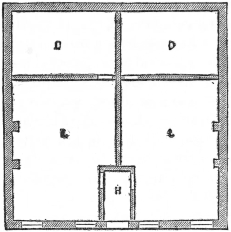
PLAN OF CELLAR IN THE SIXTEENTH
WARD, 1865, OCCUPIED BY TWO
FAMILIES, EACH WITH A DARK
LIVING-ROOM, AND A DARK, DAMP
DORMITORY
Another Inspector
says: “At
No. — West Sixteenth
Street,
two families, in
which are thirteen
persons, occupy
the basement.
It is so
dark that ordinary
type can be
seen with difficulty.
In the other
case the people
were healthy before entering the basement;
since, however, they have been ill; the mother
has phthisis. Of twenty-four cellars, note of
which has been made, four only were in good
sanitary condition. The rest were more or less
filthy, some indescribably so. One contained
urine, bones, and soakage from the privy.”
The Inspector of the Eighteenth Ward writes:
“There are a few cellars so dark that one cannot
see to read in them, unless by artificial light,
except for a few hours in the day, by sitting
close to the window; and there are many basement
rooms into whose gloomy recesses not a
single direct ray from the sun ever shone. The
latter are, as a rule, by half their depth below
the level of the street. Dark and damp, with
very little chance for circulation of air, it would
be difficult to imagine a human being more completely
beyond reach of sanitary provisions.
And when we consider that four large families
often crowd this subterranean floor, no words
are needed to show their condition deplorable.
That a generally impaired vitality is promoted
by living in this unnatural way, ‘a nameless,
ever new disease,’ there can be no question;
that these people will be especially prone to
whatever form of prevailing sickness may be
about in the community, no one can doubt; but
whether there is any specific cause involved,
capable of producing definite forms of disease,
is more difficult to determine.”
An Inspector thus describes a visit to one of
these subterranean abodes: “We enter a
room whose low ceiling is blackened with
smoke, and its walls discolored with damp. In
front, opening on a narrow area covered with
green mould, two small windows,
A Visit to the
Cave-Dwellers
their tops scarcely level
with the court-yard, afford at
noonday a twilight illumination
to the apartment. Through their broken
panes they admit the damp air laden with effluvia,
which constitutes the vital atmosphere
inhaled by all who are immured in this dismal
abode. A door at the back of this room communicates
with another which is entirely dark, and
has but this one opening. Both rooms together
have an area of about eighteen feet square.
“The father of the family, a day laborer, is
absent. The mother, a wrinkled crone at thirty,
sits rocking in her arms an infant whose pasty
and pallid features tell that decay and death
are usurping the place of health and life. Two
older children are in the street, which is their
only playground, and the only place where they
can go to breathe an atmosphere that is even
comparatively pure. A fourth child, emaciated
to a skeleton, and with that ghastly and unearthly
look which marasmus impresses on its
victims, has reared his feeble frame on a rickety
chair against the window sill, and is striving to
get a glimpse of the smiling heavens, whose
light is so seldom permitted to gladden its longing
eyes. Its youth has battled nobly against
the terrible morbid and devitalizing agents
which have oppressed its childish life—the
poisonous air, the darkness, and the damp; but
the battle is nearly over—it is easy to decide
where the victory will be.”
But I need not multiply the evidences that
18,000 people, men, women, and children (a
goodly-sized town), are to-day living in our
city in a condition the most destructive to
health, happiness, and morals that could possibly
be devised. As you look into these abodes
of wretchedness, filth and disease, the inmates
manifest the same lethargic habits as animals,
burrowing in the ground. They are, indeed,
half narcotized by the constant inhalation of the
emanations of their own bodies, and by a prolonged
absence of light and fresh air. Here we
never find sound health, while the constant sickness
rate ranges from 75 to 90 per cent.
Now, as to the second condition under which
we find the laboring classes. It is estimated
by the police that the tenant-house population
of New York reaches the enormous figure
of 500,000 or about half of the
total number of inhabitants.
Tenant-House
Population
The great and striking fact in
regard to the domiciliary
condition of the tenant-house class is overcrowding
and deficient sunlight and fresh air.
The landlord of the poor tenant-house has two
principal motives—first, to pack as many people
as he can in a given space, and second, to
make as few improvements and repairs as possible.
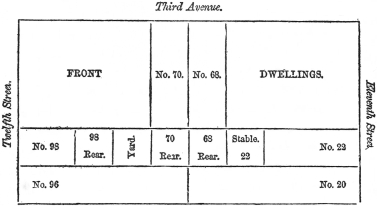
PLAN SHOWING REAR TENANT-HOUSES, NEAR A STABLE,
IN THE SEVENTEENTH WARD, 1865
The tenant-houses are of two classes, viz.,
the front and the rear. The latter is closely
allied to the cellar; being shut out from air and
sunlight, it is generally damp, gloomy, and
filthy. The space between the front and rear
house, familiarly called the “well hole,” contains
the privy and cesspool, the emanations
from which are closely confined to this space,
and slowly but constantly pervade with their
disgusting odors all the rooms and recesses.
The tenant-house has frequently been described
by sensation writers, with all its miseries,
its diseases and its deaths. But no pen
nor pencil can sketch the living reality. It is
only by personal inspection that one can learn
to what depths of social and physical degradation
human beings can descend. Said a committee
appointed by your body to investigate
the condition of the tenant-houses of New York:
“Sitting together upon the same broken box,
lying together upon the same dirty straw, covered
by the same filthy shreds, vieing with each
other in the utterance of foul obscenities, you
have a picture of the mass of corruption and
squalid misery gathered inside the walls of that
unventilated building in Mission Place. In that
single house there was that which made the soul
sicken and turn in horror from the sight. Vice,
with its pretentious brow, and wretchedness,
with hollow cheek and sunken, glazed eye, were
there; hunger and lust stood side by side, petit
larceny and cold-blooded murder were holding
converse.”
The inspectors describe more or less minutely
a large number of tenant-houses, and also
of groups:
“‘Cat Alley’ is the local designation of a group
of dilapidated tenant-houses in an alley on
Cannon Street. The alley is unpaved, and is
Cat
Alley
excessively filthy. The privy is a small and
broken-down structure, covering only a part of
the vault, which is now full almost to overflowing.
The inhabitants are degraded, both
physically and socially. In several of
the domiciles, at the time of our last inspection,
there was neither bedstead nor
table. Twelve of these families were found in a
wretched condition, and all the children we saw
were covered with dirt, and presented the intensest
aspects of scrofulous disease; their sore
eyes, encrusted heads, and dehumanizing appearance,
told the story of want and neglect, and
of greater evils to come.
“Five small houses, two and a half stories in
height, including the basements, each containing
apartments for six families, front on an alley
called Rivington Place. This alley is always in
a filthy condition. The houses on it are small
and overcrowded. The 30 families that reside
in these five houses have no other water supply
than that which two hydrants furnish in the exterior
courtyard; while for this population of
nearly 200 persons, of all ages, there are but two
privy vaults, and, at the time of the last inspection
of the quarters, these vaults were filled
nearly to the surface. In the year 1849, 42 individuals
died here in three weeks of cholera,
and not one recovered that was taken sick. The
reasons are plain: they have no ventilation, and
the houses being double, the exhalations from
one apartment are inhaled by the other.
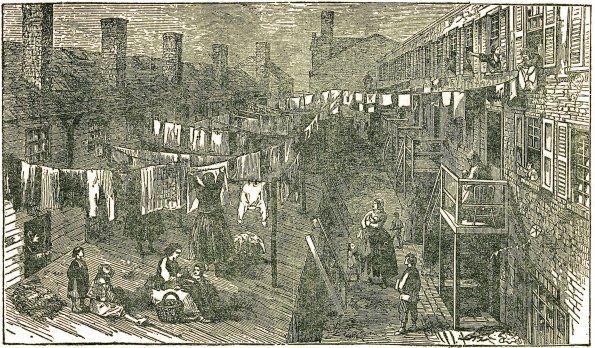
THE FILTHY ALLEY CALLED RIVINGTON PLACE, 1865,
IN THE REAR OF NUMBERS 316 AND 318 RIVINGTON STREET
“At No. — West Twenty-fifth Street, a
wretched tenement of two apartments, the
rooms occupied by one family. The sitting-room
is about 10×12 feet, and the bedroom
about 5×12, without a single window or air hole.
These rooms were occupied in the hot month of
July by a colored female, having pulmonary
consumption, and her two children. Here she
died, shortly after we made the inspection of
her domicilium; having no money nor friends,
a Christian burial was denied her for four days,
although the neighbors acquainted the police of
the fact, and they the Health Warden.”
“Rag Pickers Row” is thus described:
“The houses are of wood, two stories,
with attic and basement. The attic rooms
are used to deposit the filthy rags and bones as
they are taken from gutters and slaughter-houses.
The yards are filled with
Rag Pickers
Row
dirty rags hung up to dry, sending
forth their stench to all the
neighborhood, and are exceedingly
nauseous, operating upon me as an emetic.
The tenants are all Germans of the lowest order,
having no national nor personal pride; they are
exceedingly filthy in person, and their bed-clothes
are as dirty as the floors they walk on;
their food is of the poorest quality, and their
feet and heads, and doubtless their whole
bodies, are anasarcous, suffering from what they
call rheumatism, but which is in reality a
prostrate nervous system, the result of foul air
and inadequate supply of nutritious food.
They have a peculiar taste for the association
of dogs and cats, there being about 50 of the
former and 30 of the latter. The whole number
of apartments is 32, occupied by 28 families,
number 120 in all, 60 adults and 60 children.
The yards are all small, and the sinks running
over with filth.”
Says a visitor in the Eighth Ward: “The instances
are many in which one or more families,
of from three to seven or more members,
of all ages and both sexes, are congregated
in a single and often contracted apartment.
Here they eat, drink,
Tenant-House
Degeneration
sleep, work, dress and undress,
without the possibility of that
privacy which an innate modesty
imperatively demands. In sickness and in
health it is the same.
“What is the consequence? The sense of
shame—the greatest, surest safeguard of virtue,
except the grace of God—is gradually
blunted, ruined, and finally destroyed. New
scenes are witnessed and participated in, with
a countenance of brass, the very thought of
which, once, would have filled the sensitive
heart of modesty with pain, and covered its cheek
with burning blushes. The mind of one thus
brought in daily and nightly contact with such
scenes must become greatly debased, and its
fall, before the assaults of vice, rendered almost
certain.”
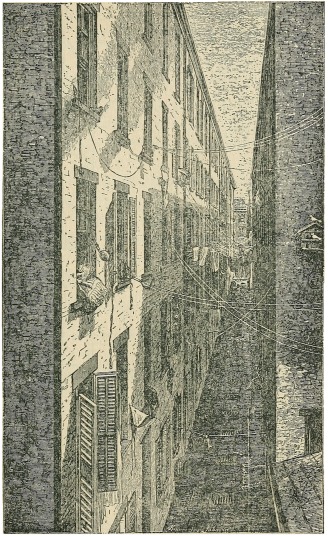
GOTHAM COURT, ON CHERRY STREET, 1865
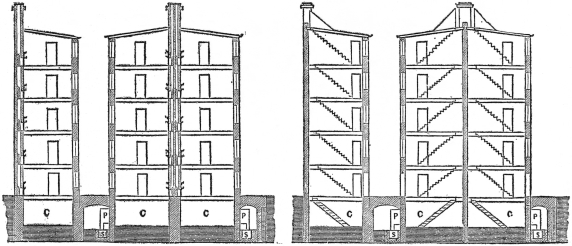
TRANSVERSE SECTIONAL ELEVATION OF THE GOTHAM COURT ROOKERY
C, Cellar; P, Privy; S, Sewer
Another writes: “These houses seem to be
always open to newcomers, and, in some way
or other, they can accommodate them. I have
found three families, of men, women, and children,
in one room; there they lived and there
they slept. Can any one doubt that there must
be a rapid declension of morals in both parents
and children, or that a bar is here opposed to
moral and religious instruction, or that this
state of things is consequent on the circumstances
and condition of life?”
I could give you many details of other tenant-houses,
the reputation of which is a reproach
to any city in the civilized world. Such is
“Gotham Court,” “Rotten Row,” “The Great
Eastern,” “Sebastopol,” “Quality Row,” “Bummer’s
Retreat,” etc. Speaking of the tenant-house,
the Rev. Dr. Muhlenburg says:
“‘Their homes!’ that cold and damp cellar,
about as tenantable as your coal vault! Do you
call that a home for the distressed body,
crowded in one corner there, swollen with the
pains of rheumatism? Or that close apartment,
heated or stifling in preparing the evening meal,
on the shattered stove—that suffocating room,
where you would not stop within for a moment—is
that the home which you think so favorable
for the worn asthmatic, catching every
breath as if the last? Ask any clergyman, he
will tell you with how little satisfaction he
makes his visits among the poor, when they are
laboring among disease; how he never has the
heart to speak of comfort for the soul, when
discomforts of the body call so loudly for relief,
and for which the scanty aid he can minister
seems akin to mockery!”
“THE GREAT EASTERN,” NUMBER 115 EAST 37TH STREET,
1865
Mr. N. P. Willis who witnessed the “draft”
riots thus truthfully and graphically describes
the inmates of tenant-houses:
“The high brick blocks and closely packed
houses where the mobs originated, seemed to
be literally hives of sickness and vice.
The
Rioters
It was wonderful to see, and difficult to
believe, that so much misery, disease
and wretchedness can be huddled together
and hidden by high walls, unvisited and
unthought of, so near our own abodes. Lewd,
but pale and sickly young women, scarce decent
in their ragged attire, were impudent and scattered
everywhere in the crowd. But what numbers
of these poorer classes are deformed—what
numbers are made hideous by self-neglect
and infirmity! Alas! human faces look so
hideous with hope and self-respect all gone!
And female forms and features are made so
frightful by sin, squalor, and debasement! To
walk the streets as we walked them, in those
hours of conflagration and riot, was like witnessing
the day of judgment, with every wicked
thing revealed, every sin and sorrow blazingly
glared upon, every hidden abomination laid bare
before hell’s expectant fire? The elements of
popular discord are gathered in these wretchedly
constructed tenement houses, where poverty,
disease, and crime find an abode. Here
disease in its most loathsome forms propagates
itself. Unholy passions rule in the domestic
circle. Everything, within and without, tends
to physical and moral degradation.”
Such, Mr. Chairman, is the external and internal
sanitary condition of the homes of
500,000 people in the City of New York to-day,
as revealed by this inspection. It requires
no extraordinary amount of medical knowledge
to determine the physical condition
Tenant-House
Rot
of this immense population,
living under such circumstances.
Even though no devastating
epidemic is found ravaging the tenant-house,
yet the first sight of the wretched inmates convinces
you that diseases far more destructive to
health and happiness, because creating no
alarm, are wasting the vital energies, and slowly
but surely consuming the very tissues of the
body.
Here infantile life unfolds its bud, but perishes
before its first anniversary. Here youth
is ugly with loathsome diseases and the deformities
which follow physical degeneracy.
Here the decrepitude of old age is found at
thirty. The poor themselves have a very expressive
term for the slow process of decay
which they suffer, viz.: “Tenant-house Rot.”
The great majority are, indeed, undergoing a
slow decomposition—a true eremacausis, as
the chemists term it. And with this physical
degeneration we find mental and moral deterioration.
The frequent expression of the
poor, “We have no sickness, thank God,” is
uttered by those whose sunken eyes, pale
cheeks, and colorless lips speak more eloquently
than words, of the unseen agencies which are
sapping the fountains of health. Vice, crime,
drunkenness, lust, disease, and death, here hold
sway, in spite of the most powerful moral and
religious influences.
Religious teachers and Bible readers are beginning
to give this class over as past all
remedy, until their physical condition is improved.
Their intellects are so blunted and
their perceptions so perverted by the noxious
atmosphere which they breathe, and the all-pervading
filth in which they live, move, and
have their being, that they are not susceptible
to moral or religious influences. In London,
some of the city missionaries have entirely
abandoned the tenant-house class. There is, undoubtedly,
a depraved physical condition which
explains the moral deterioration of these people,
and which can never be overcome until we
surround them with the conditions of sound
health. A child growing up in this pestilential
atmosphere becomes vicious and brutal, not
from any natural depravity, but because it is
mentally incapable of the perceptions of truth.
Most truly does the Inspector of the Fourth
Ward say:
“There is a tenant-house cachexy well-known
to such medical men as have a
practical acquaintance with these abodes;
nor does it affect alone the physical condition
of their inmates. It has its moral prototype in
an ochlesis of vice—a contagious
Tenant-House
Cachexy
depravity, to whose
malign influence the youthful
survivors of the terrible physical
evils to which their infancy is exposed, are
sure to succumb. We often find in persons of
less than middle age, who have long occupied
such confined and filthy premises, a morbid condition
of the system unknown elsewhere. The
eye becomes bleared, the senses blunted, the
limbs shrunken and tremulous, the secretions
exceedingly offensive. There is a state of premature
decay.
“In this condition of life the ties of nature
seem to be unloosed. Maternal instinct and filial
affection seem to participate in the general decay
of soul and body. A kind Providence, whose
hand is visible even here, mercifully provides
that the almost inevitable decay and death
which man’s criminal neglect entails on the offspring
of the unfortunate who dwell in these
dreary mansions, shall elicit comparatively
feeble pangs of parental anguish. To the physical
and moral degradation, the blight of these
miserable abodes, where decay reigns supreme
over habitation and inhabitant alike, may be
plainly traced much of the immorality and
crime which prevail among us. The established
truth, that, as the corporeal frame deteriorates,
man’s spiritual nature is liable also to degenerate,
receives its apt illustration here.”
But, sir, acute diseases, and those frequently
of the most destructive character, prevail at
all seasons among the tenant-house population,
and generally with fearful fatality. Although
the last summer and autumn were unusually
healthy, these records show
Prevailing
Diseases
the prevalence of a vast amount
of diseases among the poor of New
York. These diseases are of a
kind that always originate in or are aggravated
by the crowding of families in unventilated
apartments, want of sunlight and pure air, house
and street filth, etc.
First Ward: The diseases prevalent in this
district the past season have been principally
typhus, measles, diarrhoea, dysentery, cholera
morbus, cholera infantum, and marasmus.
Diarrhoeal diseases are most prevalent in those
insalubrious quarters already described, and at
a season when the exciting causes are at their
greatest stage of development and activity.
Second and Third Wards: Typhus fever made
its appearance in tenant-houses, and in two or
three instances spread through all the families
immediately exposed. At one place the disease
attacked successively every member of the family
immediately exposed, but was prevented
from spreading further by free ventilation.
Fifth Ward: The slips, in consequence of receiving
the sewerage of the district and surrounding
parts of the city, are generally foul
and the undoubted source of much sickness.
Smallpox has prevailed more extensively than
for many years back. Typhus and typhoid fevers
have been prevalent over the whole district.
Eighth Ward: The prevailing diseases of the
past season have been fevers of the typhus,
typhoid, remittent and intermittent types, cholera
infantum, scarlatina, dysentery, and diarrhoea,
all confined to densely populated tenements.
The typhus and typhoid fevers have
been of a malignant type in two houses, twelve
out of eighteen cases proving fatal.
Ninth Ward: The prevailing diseases during
the past season have been typhoid fever, dysentery,
diarrhoea, scarlet fever, measles, and a
few cases of variola.
Sixth Ward: The seeds of disease exist
everywhere, and although removable and
susceptible of sanitary control, they are yet
uncontrolled, and at any time may spring into
Seeds of Disease
Uncontrolled
activity and a terrific life, that shall only have
the power and effect of death. Cholera, when
it visits these shores again,
will first break forth
here, if proper sanitary
measures be neglected. Typhus
fever nests exist in all parts of the district;
and it has been traced from these nests to every
ward in the city, spreading the disease not only
in the worst localities, but into the homes of the
industrious, the wealthy, and the highest classes
of society. This disease is now on the increase,
and if proper sanitary measures are not adopted
to remove the predisposing and the infecting
causes, we may again have an epidemic of that
scourge.
Fourteenth Ward: There have been attended
in this district, during the last year, over 200
cases of typhoid and typhus fever by one dispensary
physician; also, 70 cases of dysentery, and
50 cases of smallpox. There is one particular
locality which has contributed to the spread
and intensity of the fever contagion, viz.: the
little street known as Jersey Street. It is always
filthy, and the effluvia arising therefrom is extremely
offensive. The privies are generally
full nearly to overflowing, and the yards are
also in a dirty condition, heaps of refuse matter
being allowed to remain and to accumulate continually
in many of them. There is no sewer
in this little street, though the streets at each
end are sewered.
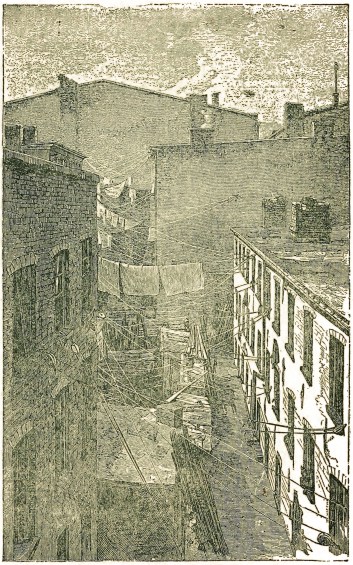
A PERPETUAL FEVER-NEST: REAR TENANT-HOUSES
IN WASHINGTON STREET, 1865
Tenth Ward: The most prominent diseases
during the past year have been
phthisis, typhoid and scarlet fevers, cholera
infantum, dysentery, smallpox, and diphtheria.
They were most prevalent in the poorest
part of the district, having the
Where Disease
Flourishes
lowest ground, the filthiest
streets, and the most dense
population of poor and careless
people, who are crowded in the numerous
tenant-houses, shanties, and small dwellings,
which were built for one or two families, but
are now made to contain from five to ten.
Nineteenth Ward: The diseases that have
chiefly prevailed during the past season are dysentery,
diarrhoea, cholera morbus, cholera infantum
and the exanthematous fevers. They
were of the most frequent occurrence in the
most crowded and insalubrious quarters.
Fifteenth Ward: Since the commencement of
the survey, scarlet fever, typhoid fever, smallpox,
and cholera infantum have prevailed in
the tenant-houses of this ward. Six cases of
smallpox occurred in one of three thickly peopled
rows of such dwellings, and the disease
was communicated to a child in an adjacent
street, who had been playing in the infected
neighborhood. Seven cases of typhoid also occurred
in a court among children, and this was
within a few doors of better class houses.
Eleventh Ward: Typhus and typhoid fevers
have been found prevailing in all sections of this
district. Smallpox, scarlatina, measles, and
pulmonary diseases are met with in almost
every street. Typhus is the most typical of the
preventable diseases that abound in the
Eleventh Ward. Cholera infantum and obstinate
diarrhoeal maladies were prevalent in
the rear tenements and throughout the lowest
streets during the summer and autumn.
To give you an idea of the wide prevalence of
these diseases, I will notice one or two more in
detail.
Smallpox is the very type of preventable
diseases. We have a safe and sure preventive
in thorough vaccination. And yet this
loathsome disease is at this moment an epidemic
in New York. In two days’ time, the inspectors
found 644 cases, and in two weeks,
Smallpox
upward of 1,200; and it was estimated
that only about one-half
were discovered. In many large tenant-houses,
six, eight, and ten cases were found at the same
time. They found it under every conceivable
condition tending to promote its communicability.
It was in the street cars, in the stages, in
the hacks, on the ferry-boats, in junk-shops, in
cigar-stores, in candy-shops, in the families of
tailors and seamstresses, who were making
clothing for wholesale stores, in public and
in private charities. I hold in my hand a list
of cases of smallpox found existing under circumstances
which show how widespread is this
disease. Bedding of a fatal case of smallpox
was sold to a rag-man; case in a room where
candy and daily papers were sold; case on a
ferry-boat; woman was attending bar and acting
as nurse to her husband who had smallpox;
girl who was making cigars while scabs were falling
from her skin; seamstress who was making shirts
for a Broadway store, one of which was thrown
over the cradle of a child sick of smallpox; tailors
making soldiers’ clothing, have their children,
from whom the scabs were falling,
wrapped in the garments; a woman selling
vegetables had the scabs falling from her face,
among the vegetables, etc., etc. Instances of
this kind can be quoted at any length, but these
examples are sufficient to show that smallpox
spreads uncontrolled throughout our city. And
they show, too, how this disease is disseminated
abroad. Says the Inspector of the Fourth
Ward:
“In localities where smallpox prevailed I
found, in some instances within a few feet
of the patients, tailors at work for our best
clothing establishments. Such infected vestments—worse
than the tunic of the Centaur—bring
Smallpox in Tailored
Garments
disease and death not only to the wearers,
but to many others. The occupant of the
crowded tenant-house procures from such a
source a coat or a blanket, and soon a loathsome
pest attacks the
young and unprotected
members of his family,
and ultimately spreads
through the entire quarter, destroying life after
life and endangering the health of a whole community.
“Smallpox, suddenly breaking out in some
secluded rural district, often owes its unsuspected
origin to the above causes. In the
remote solitude of the ocean the seaman opens
the chest in which he has deposited such obnoxious
apparel, and from this Pandora’s box
scatters the seeds of pestilence among his comrades,
which, ripening, shall spread its germs
to distant ports.”
Or, what is more striking, take the following
from the report of the Inspector of the Fifth
Ward:
“The largest wholesale establishments for the
sale of dry goods on this side of the Atlantic
Ocean are in immediate contact with the tenant-houses
of the worst class, and which are infested
with smallpox and typhus fever. The two
freight depots and the principal passenger depot
of the Railroad Company are in the same close
association with these nests of infection. In the
region immediately surrounding are also situated
several hotels, and a large number of
boarding-houses, whose inmates are thus in danger
of personal contact with these diseases any
moment. West Broadway, running through the
very centre of the district, is traversed by five
different lines of railway cars, with an average
of five cars passing every minute, and carrying
millions of passengers yearly by the very doors
of these houses. Broadway, at but a short distance
removed, is the principal thoroughfare of
the city. Hudson Street on the west is also a
leading route for city travel; and the cross
streets of the district are traversed daily by multitudes
to reach various lines of steamboats,
cars, and steamships, which leave the city opposite
this point.
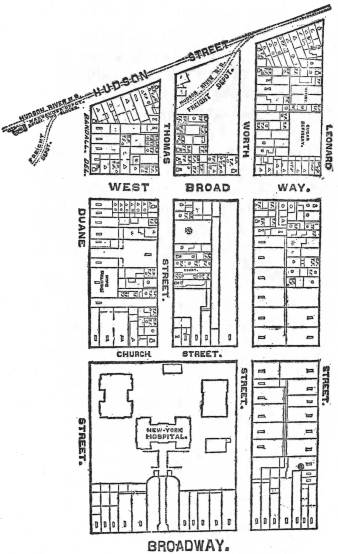
A REGION OF SMALLPOX AND TYPHUS FEVER, 1865
“All this large amount of daily travel passes
through a region always containing cases of
typhus fever, and largely infected with smallpox.
Is it any cause of surprise that cases of
these diseases are here contracted, to be carried
to distant sections of the country, there to develop
themselves, to the surprise and alarm of
whole neighborhoods? It is also well to remember
that several large livery stables are located
in the immediate neighborhood, whose vehicles,
it is well-known, are frequently employed to
carry persons, suffering from these diseases, to
hospitals, or to attend at funerals. These vehicles
are, perhaps, immediately afterward
driven to the various car and steamboat lines
to secure passengers, who are thus exposed in
the most dangerous manner to these diseases.”
Second only to smallpox as a preventable
disease, but of a more fatal character, is
typhus fever. Typhus is greatly aggravated
by domestic filth, and by overcrowding,
with deficient ventilation. The inspectors
found and located by street and number
Typhus
Fever
no less than 2,000 cases of this
most contagious and fatal disease.
Commencing in a large tenant-house
in Mulberry Street, it was traced from locality
to locality, in the poorer quarters, until it was
found to have visited nearly every section of
the city. It became localized in many tenant-houses
and streets, where it still remains, causing
a large amount of sickness and mortality.
At Mulberry Street, in a notoriously filthy
house, it has existed for more than four years.
This house has a population of about 320, which
is renewed every few months. During the period
alluded to, there have been no less than 60
deaths by fever in this single house, and 240
cases. To-day this fever is raging uncontrolled
in that house, creating more orphans than
many well-fought battles. Every new family
which enters these infected quarters is sure to
fall a victim to this pestilential disease.
PLAN OF FEVER-NEST, EAST 17TH
STREET, 1865
Here 85 Cases of Typhus Occurred in
One Season
The tenant-house No. — East Seventeenth
Street, which reaks with filth, gives the same
history; upward of 85 cases, with a large percentage
of deaths, occurred in this single house
during the past season. And still it remained
unclean and open to new tenants. I could mention
scores of these houses in every part of the
tenant-house district where typhus has apparently
taken
up its abode, and
from whence it
sends out in every
direction its
deadly streams.
Not only have
single houses become
centres of
contagion, but
this fever has, in
many instances,
become localized
in crowded
streets, which to-day
are almost
impassable on
account of the
heaps of garbage,
and the
courts and alleys
of which are
reeking with
filth, making
them great centres
of pestilence.
From many of these tenements whole
families have been swept away.
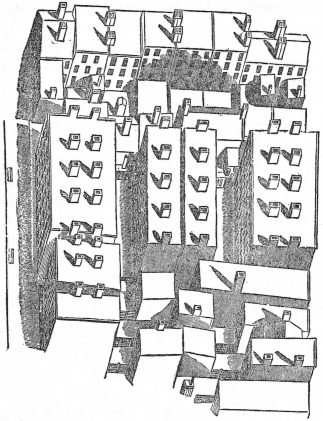
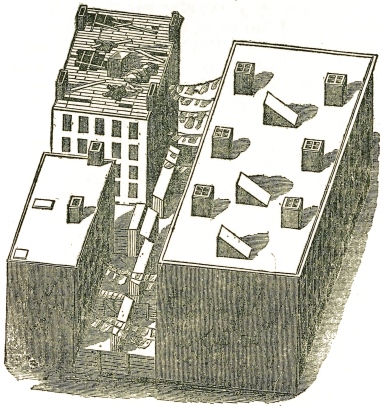
BIRD’S-EYE VIEW OF FEVER-NEST, 1865, NOT FAR
FROM BROADWAY AND FIFTH AVENUE
Jersey Street, a short but uncleaned avenue,
adjacent to a fashionable part of Broadway, is
another great depot of fever, which, according
to these records, frequently contained upward
of thirty cases in progress at one time. East
Eleventh Street, between First and Second
Avenues, now, as all the past summer, in a horribly
filthy condition, is a local habitation of fever
of the worst type. The same statement may
be made of nearly every district where the
tenant-houses are especially crowded, and the
streets, courts, and alleys are unusually filthy.
Intestinal diseases, as cholera infantum,
diarrhoea, dysentery, typhoid fever, etc.,
which arise from, or are intensely aggravated
by the emanations from putrescible material
in streets, courts, and alleys, or from cesspools,
privies, drain pipes, sewers,
Intestinal
Affections
etc., were prevalent in the tenant-house
districts, creating, as usual,
a vast amount of sickness, and a
large infant mortality. Very generally these
diseases were directly traceable to the decomposing
filth, and in some instances were stopped
by the removal of the nuisance.
The Inspector of the Eighth Ward reports:
“Cholera infantum has probably consigned
many more to the grave during the past summer
than all other diseases in my inspection
district. In every case examined I have found
it associated with some well-marked course of
insalubrity; vegetable and animal decomposition
have been the most prominent causes. That
fifty per cent die from preventable causes in
my inspection district I do not doubt.”
The Inspector of the Sixth Ward says: “The
mortality among children is fearfully high,
many families having lost all their children;
others four out of five or six.”
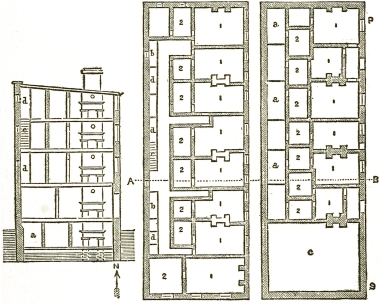
PLAN OF MONROE STREET FEVER-NEST, 1865
The Inspector of the Ninth Ward says he
found among the people living near the
mouth of an open sewer: “That no less than
twenty-nine cases of dysentery and diarrhoea,
Living at a
Sewer’s Mouth
five of which had terminated fatally, had occurred
during the three weeks
immediately preceding his inspection.”
He adds: “Now,
when we take into consideration
the fact that there are only twenty-two
dwellings on this square (a considerable portion
of it being occupied by a large lumber-yard),
and that all these cases had occurred
within a period of about twenty-one days, the
ratio becomes appalling. How many cases
may have occurred subsequently, I have not
sought to ascertain, my time being fully occupied
in the inspection of the other parts of my
district. But a still more direct and specific action
of the poisonous emanations proceeding
from this obstructed sewerage, manifested itself
in the dwelling on the corner of West and
Gansevoort streets, which is in the closest
proximity to the outlet of the sewer. Here I
learned, upon inquiry, that typhoid fever had
prevailed almost continuously during the preceding
winter, and I found three severe cases of
dysentery at the time of my visit.”
But I will not occupy time with further details
of the evidence which this inspection furnishes
of the vast accumulation of the causes of
unhealthiness which exist in New York, and of
the wide prevalence of contagious diseases
arising therefrom or aggravated thereby.
The next point of inquiry is as to the effect
of these conditions upon the public health of
the city. Our constituted health authorities
claim that notwithstanding this excessive concentration
of the causes of disease around and
in the homes of half of our population, the
death-rate of New York is very low. To properly
understand this statement, we must inquire
what is the rate of death from inevitable causes.
It has been estimated by careful writers on
vital statistics that 17 in 1,000 living persons
annually die from inevitable causes. That is,
in a community of 1,000 persons living under
circumstances such that persons die only from
The Normal
Death-Rate
old age, cancer, casualties, etc.,
17 will die annually, and no
more. And this number is the
maximum that will die without
the occurrence of some disease due to a removable
cause. Taking this standard as the absolute
necessary death-rate, we can readily estimate
the number of unnecessary or preventable
deaths which occur in any community.
Says the Registrar-General of England
(Twentieth Annual Report): “Any deaths in a
people exceeding 17 in 1,000 annually are unnatural
deaths. If the people were shot,
drowned, burnt, poisoned by strychnine, their
deaths would not be more unnatural than the
deaths wrought clandestinely by diseases in excess
of the quota of natural death—that is, in
excess of seventeen in 1,000 living.”
Taking this as the standard, let us see how
the death-rate of New York compares with
it. It is claimed by the city officials that notwithstanding
the vast accumulation of the universally-recognized
Death-Rate of
New York
causes of disease, New York
has a low death-rate. It is not
reasonable to suppose this
statement true, nor is it true, as
will presently appear. It is
stated very truly in the City Inspector’s Report
for 1863, that “it is only by taking a connected
view of a period of years that a correct judgment
can be formed of the state of health of a
city,” and upon this basis let us determine what
is the mortality of New York.
Take the 11 years preceding the last census,
viz., 1860, excluding, however, 1854, the year of
the cholera. I select this period because it includes
the three last census returns, and it is
only where we have the census returns with the
mortality records that we have accurate data for
our estimates. Now, the City Inspector’s own
records (reports of 1863, page 192) show that
during the period referred to, the death-rate of
New York City was never below 28 in the 1,000,
and twice exceeded 40 in the 1,000, the average
being as high as 33 in the 1,000. These deductions
are made directly from the City Inspector’s
Reports, and, as they are claimed to be infallible,
these conclusions cannot be controverted.
Now, when you remember that the highest
death-rate fixed by sanitary writers for inevitable
deaths is 17 in 1,000, and that all deaths
above that standard are considered preventable,
it is apparent what a fearful sacrifice of life
there is in New York. Estimated at the very
minimum death-rate of the last decennial period,
viz.: 28 in 1,000, New York annually lost
11 from preventable deaths in 1,000 of her population,
or upwards of 7,000 yearly, on an average,
giving the enormous sum total for this
period of 77,000 preventable deaths.
It may be urged that cities never can attain
to this standard of healthfulness, but English
writers maintain that the rate of 17 in the 1,000
is the true measure of the public health, and
that even the most populous towns may yet be
brought up to it. Nor can we doubt that there
is much plausibility in the assertion, when we
find the mortality in Philadelphia fall to 18 in
1,000, and that of London gradually descend
from 30 in 1,000 to 22 in 1,000.
It is maintained, also, that New York has a
lower death-rate than London or Philadelphia.
Let us see how far this assertion is
sustained by the records of the health authorities
of those cities. During the decennial period
preceding, but including
New York, London, and
Liverpool Compared
1860, and excluding
1854, as in the
former comparison,
the minimum mortality in London was 20 in
1,000, the maximum 24 in 1,000, the mean
about 22 in 1,000. These figures are from the
Registrar-General Reports.
The rate of mortality of Philadelphia for the
same period was as follows: Minimum 18 in
1,000, maximum 23 in 1,000, mean about 20 in
1,000. These figures are from the report of Dr.
Jewell, long the able Health Officer of that city.
Placed in their proper relation, these mortality
statistics read as follows: The number of deaths
to the 1,000 living for the ten years, 1850–60
inclusive, but exclusive of 1854, is for
| |
Min. |
Max. |
Av. |
| London |
20 |
24 |
22 |
| Philadelphia |
18 |
23 |
20 |
| New York |
28 |
41 |
33 |
If, then, New York had as low an average
death-rate as Philadelphia, she would have
saved 13 in 1,000 of her population during that
period, or in 1860, 10,577. These figures may
seem excessive, but they are careful deductions
from the annual returns of the several cities.
And yet it is reiterated year after year by the
City Inspector, that “New York City, at this day,
can lay claim to the privilege of being numbered
with the most healthy in the world.”
With what consummate justice did Dr. Jewell
administer this withering rebuke to our pretentious
official. “It is unnecessary,” he says, in
his report of 1860, “to comment upon this extraordinary
statement, when the above figures
contradict so positively the assertion. It is to be
regretted that the inspector had not availed himself
of the above statistical information, which
would have obliged him to have presented a
widely different statement, although one indicating
a more severe pressure of sanitary
evils, upon the health of their population, than
his report develops.”
But excessive as is this death-rate, it is not
the full measure of the penalty which we
pay to the demon of filth. A high death-rate
from the diseases which it engenders or intensifies,
always implies a large amount of sickness.
It is estimated by competent
Constant
Sickness
authority that there are 28 cases of
sickness for every death. On this
basis of estimate what an enormous
amount of unnecessary sickness exists in our
midst! Nor is this a mere supposition. I have
an accurate census of many groups of families
of that portion of our population who live immured
in filth, and here we find the constant
sickness-rate excessive. It is no uncommon
thing to find it 50, 60, and 70 per cent.
I wish now to call your attention to the fact
that great as is our mortality and sickness
rate, its excess is not equally distributed over
the entire population, but falls exclusively upon
the poor and helpless. One-half, at least, of
Where the Death Pressure
Is Greatest
the population of New York have a death-rate
no higher than the people of a healthy country
town, while the death pressure upon the other
half is frightfully
severe. For example,
the Seventeenth
Ward,
which is inhabited principally by the wealthy
class and has but few tenant-houses, has a death-rate
of but 17 in 1,000, or only the death-rate
from inevitable causes; but the Sixth and
Fourth Wards, which are occupied by the laboring
classes, have a death-rate varying from
36 to 40 in 1,000.
Thus it appears that while the average death-rate
of the city is very high, it is principally
sustained by those Wards where the tenant-house
population is the most numerous. We
find this excess of mortality just where we found
the causes of diseases existing most numerously.
And when we sift the matter further, we find
that the excess of mortality is not even equally
distributed over these populous poor Wards, but
is concentrated upon individual tenant-houses.
For example, while the mortality of the Sixth
Ward is nearly 40 in 1,000, the mortality of its
large tenant-houses is as high as 60 to 70 in
1,000. The following is a recent census of a
large but not exceptional tenant-house of that
Ward: Number of families in the house, 74;
persons, 349; deaths, 18, or 53 in 1,000; constant
sickness, 1 in 3; deaths of children, 1 in 6, or at
the rate of 16 in 1,000.
The following table illustrates the distribution
of the mortality of New York among the different
classes of inhabitants at the last census:
| Average mortality of entire city |
|
28 in 1,000 |
| Mortality of better class |
10 to | 17 “ “ |
| Mortality of tenant-house |
50 “ | 60 “ “ |
But I should not do justice to this branch of
inquiry without noticing the alleged causes
of the high mortality of New York. The
first is the large foreign immigration. The reliance
to be placed upon that scapegoat may be
readily shown. Emigration
Some Scapegoats—
Foreign
Immigration
occurs to this
country under two conditions:
1. The emigrant
is driven from home by famine, in which case
the poorer class emigrate, or, 2, he is allured by
advantages for labor or business, when the
middle classes principally emigrate.
Now, it is under the latter circumstances
that emigration generally takes place to the
United States. This is seen in the vast sums of
money which the emigrants now annually bring,
and the amounts which they return to their
friends as the result of their labor. This class
is always very hardy and healthy, as is proved
by the small mortality that occurs in transitu
being but 4.31 per cent for ten years. Besides,
we have the official statements of the Commissioners
of Emigration that but 3 per cent remain
in the city.
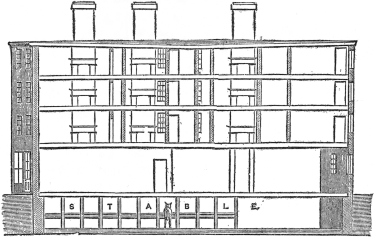
A SIXTH WARD FEVER-NEST WITH DEATH-RATE
OF 53 IN 1,000
But the City Inspector himself shows the utter
fallacy of this alleged cause of excessive mortality
in his report for 1860, in which he makes
the true explanation, and attributes to its proper
cause whatever increased mortality arises from
emigrants. He says:
“Most of the children who arrive in this city
from foreign ports, although suffering from the
effects of a protracted voyage, bad accommodations,
and worse fare, do not bring with them
any marked disease beyond those which, with
proper care, nursing, and wholesome air, could
not be easily overcome. The causes of this excessive
mortality must be searched for in this
city, and are readily traceable to the wretched
habitations in which parents and children are
forced to take up their abode; in the contracted
alleys, the tenement house, with its hundreds of
occupants, where each cooks, eats, and sleeps in
a single room, without light or ventilation, surrounded
with filth, an atmosphere foul, fetid,
and deadly, with none to console with or advise
them, or to apply to for relief when disease
invades them.”
Again, it is alleged that the floating population
causes the excess of deaths. But it
has been established by Dr. Playfair that
the floating population is the most healthy.
The same is true of wandering tribes, of a moving
army, and equally of individuals.
The Floating
Population
But when they fix
their habitations or encamp,
that moment the causes of disease
begin to gather about them, and unless sanitary
regulations are carefully observed, diseases,
such as fever, diarrhoeal affections, etc.,
begin to prevail.
The poor population of New York is to-day
but an immense army in camp, upon small
territory, crowded into old filthy dwellings, and
without the slightest police regulation for cleanliness.
If this army should abandon its camp
and begin a roving life in the country, all the
diseases now prevalent would disappear. And
it must be added, that if these deserted and uncleaned
tenements should immediately be filled
by healthy people from the country, the new
tenants would at once begin to suffer from all
the pestilential diseases now indigenous to that
part of the city.
I have now laid before you, as briefly as possible,
the accumulated evidence that New York
is to-day full to repletion with all the causes
which originate and intensify the most loathsome
and fatal diseases known to mankind.
This evidence proves that at least half a million
of its population are literally submerged
in filth, and half-stifled in an atmosphere
charged with all the elements of death. I have
demonstrated that the legitimate fruits of her
sanitary evils is an excessively high death-rate
and a correspondingly large sickness rate.
The all-important question which now concerns
us as citizens, and you as practical
legislators, is, can these evils be remedied?
We answer, yes. In the first place the
streets can be kept clean. Other cities
accomplish this
object, and therefore
Can the Causes of Disease
Be Removed?
New York can,
and we have striking
illustrative examples. In certain portions
of the city the streets are as clean as this
floor. They are swept daily, and scarcely a
particle of dust is left in the streets or gutters
the year round. But they are cleaned by private
contract of the people residing upon them.
What individual enterprise can do for whole
squares, surely a corporation so lavish in
money as New York ought to be able to do for
the city at large.
The courts, alleys, cesspools, and privies can
be cleansed and kept in good condition. There
are tenant-houses which are as clean in all their
alleys, courts, and cellars as the best-kept private
houses. These are dwellings for the poor
in which the landlord takes especial interest.
What is done for the surroundings of one of
these houses, may be done for all. But the
tenant-houses of the worst class may be quickly
placed in a good sanitary condition.
The inspectors furnish many examples of this
fact. They were frequently mistaken in
their inspection for an official, and when
their visit to the tenant-houses was reported to
the landlord, he hastened to renovate the building.
Some of the most
Improvements During
the Inspection
filthy quarters were so
completely changed
within forty-eight
hours that the inspectors could scarcely recognize
the locality. The Inspector of the Eighth
Ward says:
“The sanitary improvement in my district
during the progress of my inspection was
plainly visible. Exceedingly filthy places, overflowing
cesspools, and privies, which were
numerous in my first visit, were suddenly
cleaned. Often upon my second visit, with paper
and pencil
in my hand to
sketch the filthy
scene, I would
find the quarters
cleaned and
whitewashed,
and the air, instead
of being
laden with disagreeable
odors,
would be comparatively
pure
and wholesome.
Many of these
sudden transitions
were from
fear of the presumption
that
my inspection
had some official
authority; but
the greater part were brought about by explaining
to the people the necessity of cleanliness.
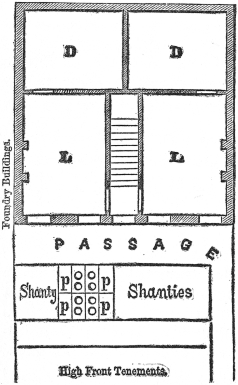
PLAN OF A TYPICAL FEVER-NEST,
1865
“Pools of filthy water from obstructions at the
street corners, and accumulated along the gutters,
would quickly disappear, when the people
would be convinced of the deleterious effect
upon the public health. It will be well for the
inhabitants of New York City, and especially
for those of this section, when there shall be
laws not only to compel them to keep their
houses and surroundings clean and free from
the effluvia resulting from vegetable and animal
decomposition, but to prevent the overcrowding
of tenant-houses, where fatal diseases are
generated, and where death walks around.”
The tenant-house population is susceptible of
infinite improvement, when once rescued
from the reign of filth, and restored to a
pure atmosphere and clean homes. The poor
live in these wretched tenements because they
are compelled to, and not
How to Improve
the People
from choice. They universally
complain that they
cannot escape from domestic
and street filth. It surrounds and pervades
their habitations, always accumulating, and
never diminishing. The most tidy house-wife,
compelled to live in the midst of this ocean of
rubbish, with all its degrading associations, soon
finds the same level, and from this she can be
rescued only by giving her again a clean and
well-ordered home. And such a home every
municipal government is bound to secure to the
poorest and humblest citizen.
Let the landlord be compelled to keep his
house in good repair, supply it with an abundance
of pure water, connect the privy with the
sewer, open free ventilation, afford means for
removal of garbage, and then keep a careful
oversight of his tenants, enforcing cleanliness.
If this were done, the tenant-house people
would immediately improve, and the death-rate,
if we may judge from other cities, would fall
one-fourth.
Again, the cellar population can be removed
from their subterranean abodes, and placed in
better homes. Liverpool has solved this problem
for us.
In 1847 that city had a cellar population
of 20,000; an ordinance was passed forbidding
the occupation of underground rooms
as residences, with certain restrictions, and
within three years the great mass of people in
these subterranean haunts were removed to
better tenements, with a great reduction of the
mortality of the city.
That city, formerly the most unhealthy in
England, has continued the reforms thus inaugurated
by compelling landlords to improve
their tenant-houses, and the result is that it has
become one of the healthiest towns of Europe.
London has recently taken similar action in regard
to cellar tenements. What these cities
have done, New York can and ought to do for
her public health.
What the diseases which prevail with such
fatality in the uncleaned tenant-houses are
for the most part preventable, we have the
most undoubted evidence. That smallpox is
preventable is known to every school-boy, and
yet that loathsome disease to-day
A Town That
Was Immune
prevails throughout all the
tenant-house districts of New
York, without the slightest restraint
on the part of our local authorities. Typhus
is to-day ravaging the homes of the poor
without “let or hindrance,” and yet cleanliness
and pure air are sure preventives. Of this truth
these reports furnish many examples.
The fever-nest—West Thirty-third Street—is
one of a row of tenant-houses five stories high,
and contains 16 families. It was in a filthy condition,
without Croton water, waste-pipes
stopped, sinks overflowing and emitting offensive
odors; fever had prevailed all winter,
nearly every person in the house having had
an attack, four having died. It was never inspected
by a city official. The owner was induced
to clean the house, and from that date
not a case of fever has occurred. The inspector
who reports this case very justly adds: “If,
when the first case of fever occurred in this
building, the owner had been compelled to put
it in a good sanitary condition, six human lives
would undoubtedly have been saved, besides a
great amount of sickness.”
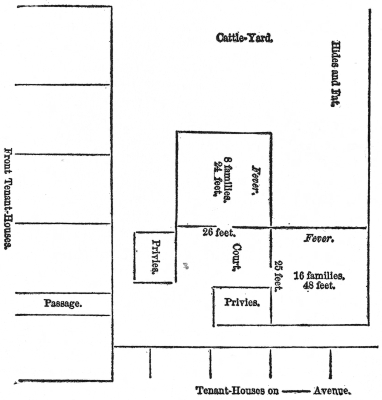
PLAN OF A REAR CUL-DE-SAC FEVER-NEST, 1865
Cholera infantum and diarrhoeal affections
are found in their greatest intensity where
putrescible animal matter and domestic filth
exist. Remove these causes, or remove the patients
from the neighborhood, and these diseases
generally disappear at once. Diphtheria
is found to be most intense in the vicinity of
unclean stables. It is, therefore, with great
propriety, that the entire class of zymotic diseases
are now called “filth and foul air” diseases
by the English sanitary writers. Remove
the filth and foul air, and these diseases disappear
as effect follows cause.
But while it is admitted that the streets of a
town may be cleaned, the condition of the
poor improved, and diseases, under the
most favorable circumstances, prevented, it may
be doubted whether the sanitary condition of
populous towns can be
Can Populous Towns
Be Improved?
materially changed, and
the death-rate greatly
reduced. Yet in England,
where sanitary science is enthusiastically
cultivated, there is not only no doubt that large
towns can be thus improved, but that the mortality
of London itself may be no greater than
that of the country.
Already, indeed, the London Times boasts
“that the average of health throughout the City
of London is higher than the average of health
throughout all England, taking town and country
together. The mortality in all England is
at the rate of 22.8 in every 1,000 of the population;
in the City of London it is at the rate of
22.3 for every 1,000 inhabitants! The improvement
has been progressive; it has been slow,
but steady and sure. Gradually the mortality
has decreased, until the yearly death roll of
3,763 has been reduced to 2,904 within a period
of nine years, during which the city has been
under the rule of the Sanitary Commission.
The deaths this year—22.3 per 1,000, or one in
every forty-five of the inhabitants—are nine
per cent below the general average, and represent
a saving of 286 lives. And secondly, this
gratifying result has been obtained in the face
of obstacles which seemed to be almost insurmountable.”
Liverpool affords a striking example of the
power of sanitary measures, rigidly enforced to
improve the public health. It was formerly the
most unhealthy city of England, being the very
home of typhus, smallpox, and allied preventable
diseases. But it adopted vigorous measures
of reform, improving its poorer districts,
and the death-rate has fallen eight in 1,000.
Macclesfield, Salisbury, and many other English
towns have had their mortality reduced 8,
10, and 15 in 1,000 by the vigorous prosecution
of sanitary improvements. All the populous
towns of that country are moving in this reform,
and, as a result, the general death-rate of towns
is approximating that of the country.
The Health Officer of London announced that
cleanliness would preserve a town from the
visitations of epidemics. But there must be
cleanliness of the streets, cleanliness of the
Cleanliness Preserves
from Epidemics
courts, cleanliness of the apartments, and cleanliness
of the person. On the approach of the
cholera in 1849 the
town of Worcester,
England, determined
to test the theory, and
set vigorously to work and cleaned the town
thoroughly, removing everything of an offensive
nature, and adopting the most stringent regulations
against the accumulation of filth about or
within the homes of the people. The result
was that this “destroyer” of unclean cities
made a Passover with the people of Worcester,
for on every lintel and door-post was written—Cleanliness,
Cleanliness. Not a house was
entered, and the town was saved in the midst
of the most frightful desolation.
New Orleans is another striking example of
the value of civic cleanliness. Since, by military
regulations, it is kept constantly in a cleanly
condition, it has had no visitation of its old enemy,
yellow fever.
The degree of public health of a town is
therefore measured by its cleanliness, and its
capacity for health depends upon its capacity
for cleanliness.
There is scarcely a city which has such absolute
need of an efficient and intelligent
sanitary government as New York. On its
small territory three, four, or five millions of
Importance of Sanitary
Government
people are yet to be accommodated with houses.
Already there are crowded upon less than eight
of its thirty-two
square miles all of our
commercial, business,
and manufacturing
interests, and the houses of nearly 1,000,000 of
people. And in the natural relations of the poor
and rich, the former consisting of more than
half of the entire population, are crowded into
less than a fourth of this area. Of what vast
importance is it that a wise and intelligent
authority be vigilantly exercised, so that in its
future growth and expansion every condition
pertaining to health shall be secured to its inhabitants!
It is universally conceded that New York has
in the highest degree all the natural advantages
of salubrity. Its climate is the mean between
the extremes of heat and cold; its topographical
peculiarities are admirably adapted
for drainage and sewerage; its exposure is
southern; its shores are swept by two rivers,
which bear seaward everything that enters them
beyond the power of the flowing tide to return
it; its rural surroundings are of the most healthful.
In every respect it is regarded by competent
observers as most favorably located for
cleanliness, and the highest degree of public
health. And there can be no doubt, that should
New York be placed under a wise sanitary government,
which would improve all its natural
advantages for health, it would become the
cleanest and healthiest city in the world, and
one of the most delightful places of residence.
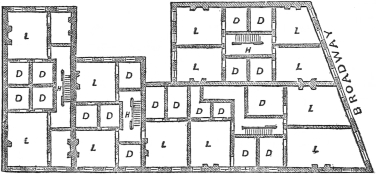
FLOOR-PLAN OF A NEW FEVER-BREEDING STRUCTURE
NEAR BROADWAY AND CENTRAL PARK, 1865
But this is not a matter which concerns the
citizens of New York alone. The people of
the State have a vital interest in the public
health of our city. Connected as it is by means
of rapid inter-communication with all parts of
the country, there is every
The Entire Country
Concerned
facility offered for the
wide diffusion of the
seeds of contagion. It is
estimated by accurate statisticians that no less
than 250,000 persons pass in and out of New
York daily over the ferries and railroads. It
could not fail to happen that if any contagious
disease prevailed in this city, it would be
carried into the country and widely disseminated.
And such is now a matter of daily occurrence.
There is no doubt that nearly all the
epidemics of smallpox in country towns, and
much of the typhus and similar diseases, have
their origin in New York. I have in my hand
letters from all parts of the State confirming this
statement. They strikingly illustrate the want
of a good sanitary police in New York, and the
power of a great commercial centre to scatter
disease broadcast over the country.
A few of these cases will abundantly illustrate
the point:
Dr. J. S. Sprague, of Cooperstown, Otsego
County, reports the occurrence of twenty-six
cases of smallpox in that town, communicated
by one person in October, 1860, who took the
disease at a hotel in our city, in which a person
with the disease had recently died. He was a
merchant, and came to the city on business.
Dr. C. C. F. Gay, of Buffalo, reports the case
of a female, who arrived from New York in
November, 1860, and was removed from the
cars of the Erie Railroad to the State Line Road,
and proceeded westward. As was afterward
ascertained, she had smallpox, and communicated
the disease at Columbus, Ohio, where
there were three deaths produced by it. Four
deaths were directly traceable to this exposure,
viz.: three milkmen and one baggage man, all of
whom came in contact with the sick woman.
W. T. Babbitt mentions the case of a young
man who took the disease in this city at a hotel
where it was prevailing, at which he stopped
while on a visit here, in whom the disease appeared
after his return to Olean, in Cattaraugus
County.
Dr. M. Jarvis, of Canestota, Madison County,
relates the case of a man who visited this city
with horses for sale, and was attacked with
symptoms of smallpox some ten days after his
return to Smithfield, in that county, who communicated
the disease to his family, from whom
it spread to others in that and, also, in a neighboring
town.
Dr. C. M. Noble, of Waverley, Delaware
County, mentions the case of a merchant
of that place, who came to this city with
his wife, and went to one of our most frequented
hotels. Being very much fatigued, they retired
to the room provided
Smallpox in a
Hotel Bedroom
for them without any particular
examination of it—but
found in the morning
that they had been put in a room from which
a patient with smallpox had just been removed,
without its having been cleansed. The gentleman
was seized with a malignant form of that
disease after his return home. Two deaths and
six cases of smallpox and varioloid resulted
from this case.
Dr. S. W. Turner, of Chester, Connecticut,
gives also two cases, one of smallpox and one
of varioloid, in that and a neighboring place,
which could be traced to this city.
Dr. Snow, the vigilant Health Officer of Providence,
R. I., states that smallpox is rarely
known in that city, except when imported from
New York.
I could repeat these details until it was
shown that nearly every town in the State,
and nearly every city in the country, has been
inoculated by New York with this most loathsome
disease. The most striking and most
melancholy instances of
New York Inoculates
the Nation
the free dissemination
of contagion are found
in the army, where
whole regiments have been stricken with smallpox
through infected clothing manufactured at
the homes of the poor, where the disease was
prevailing. But these are facts too well known
to every medical man, and even to the community,
to require further illustration.
What terror smallpox creates in country towns
when it attacks its first victim, you very well
know. The house where it occurs is quarantined,
and not unfrequently the sufferer is deserted
by his friends, and left to recover or die,
as the case may be. Business with the country
is often suspended by the placards posted upon
the highways, with the terrifying word “Smallpox”
upon them, and a finger pointing ominously
to the town. In nine cases out of ten,
another finger should point toward New York,
as the source of the pestilence.
It has been estimated by a competent observer,
that every case of smallpox in a country
town costs, by derangement of business alone,
more money than is annually expended upon
its public schools. If we add to this pecuniary
loss the feverish excitement and popular apprehension,
and the sufferings and probable death
of the victim from want of proper care, we may
but indifferently estimate the cost to the country
of the prevalence of this disease.
Now, this diffusion of contagion from New
York, we contend, is unnecessary. Every well-informed
medical man knows that we may have
a sanitary police so vigilant, so efficient and so
powerful, that it will not only preserve the public
health, but prevent the spread of disease
therefrom. We hold, therefore, that you are not
only called upon to protect the people of the
City of New York from contagious disease, but
equally that you are bound to protect the people
of the State from dissemination of pestilence
by every legislative safeguard which sanitary
science can suggest.
The Sanitary Committee of the Board of
Health, during the prevalence of cholera in
1849, remark in their report:
“The labors of your committee, during the
Inefficiency of
Health Organizations
past appalling season of sickness and death,
and the awful scenes of
degradation, misery, and
filth developed to them
by their researches,
have brought into full view the fact that we
have no sanitary police worthy of the name;
that we are unprotected by that watchful regard
over the public health which common sense dictates
to be necessary for the security of our
lives, the maintenance of the city’s reputation,
and the preservation of the interests of the inhabitants.”
This is a perfectly truthful statement of the
present condition of New York. Practically,
it is a city without any sanitary government.
In its growth it is developing the natural history
of a city that utterly ignores all rules and
regulations which tend to
Without Sanitary
Government
make the homes of its people
pleasant and healthy.
It is the only city in
the civilized world which disregards the Platonic
idea that in a model republic medical men
should be selected to preserve and promote the
public health. Its board of health, the mayor
and common council, is an unwieldly body.
Its commissioners of health have limited powers,
and are equally incompetent.
The City Inspector’s department, which alone
has the machinery for sanitary inspection
and surveillance, is a gigantic imposture. Of
its forty-four health wardens, whose duty it
should be to make house-to-house inspections,
searching out the cause
The City Inspector’s
Department
of disease, and using
every known agency for
the control and suppression
of epidemics, many are liquor dealers, and
all are grossly ignorant. Not one has any
knowledge of medical subjects, nor dare they
freely visit such diseases as smallpox, typhus,
or cholera.
During this entire voluntary inspection, extending
over six months, health wardens have
rarely been known to visit infected quarters, although
smallpox, fever, etc., etc., have been prevalent,
and the city has been in a most disgracefully
filthy condition. A single health warden
recently ventured to visit a house where smallpox
existed in an upper room; he sent for the
attendant, and when she appeared, ordering
her not to approach him, he gave the following
as the best means of prevention: “Burn camphor
on the stove, and hang bags of camphor
about the necks of the children.”
To what depth of humiliation must that community
have descended, which tolerates as its
sanitary officers men who are not only utterly
disqualified by education, business, and moral
character, but who have not even the poor
qualification of courage to perform their duties.
But perhaps the most decisive proof of the utter
and hopeless inefficiency of our multiform
health arrangements is found in the fact that all
the evils from which we now suffer have grown
up under their care. A late City Inspector thus
emphatically gave expression to the popular
feeling in regard to existing organizations:
“With such a system, can there be a wonder
that the sanitary condition of the city is not improved?
* * * Nor must the consideration be
kept from view, that the members of the common
council, the board of health, and commissioners
of health are all, from the manner of
their appointment, subject to partisan influence.
To expect a perfect sanitary system,
under such a condition of things, is to expect
an impossibility.”
The medical officer of health for the City of
London, a gentleman of large experience,
thus defines a health organization capable of
answering the demands of a large and growing
town: “The object of this organization lies in
a word: inspection, inspection of
Sanitary
Inspection
the most constant, most searching,
most intelligent, and most trustworthy
kind, is that in which the
provisional management of our sanitary affairs
must essentially consist.” The results of this
work of voluntary sanitary inspection which I
have before me prove on every page the truth of
the above statement. No health organization without
daily inspection would have any efficiency.
Of the value of such thorough inspection in
the suppression of epidemics, and in the prevention
of disease, there are abundant examples.
The people of a populous town of England,
becoming alarmed at the approach of cholera
in 1849, organized a corps of inspectors,
whose duty it was to visit from house to house,
and inquire for cases of premonitory diarrhoea,
and when found to apply the remedy at once.
The result was that cholera did not visit that
town. The same systematic house-to-house
visitation was adopted in some poor districts of
London in 1854, and there was an almost complete
exemption of those parts of the city, while
some quarters of the wealthy, which were not
under such surveillance, suffered severely.
But it is essential that this inspection should
be by thoroughly qualified medical men,
and it must consist in a house-to-house visitation.
Disease must be sought for, found, its
incipient history completely made out, the
causes upon which it depends
Inspection Must
Be Thorough
reported, and its remedy
suggested. Every case of
death should be visited, and
all the circumstances attending the development
of the disease, if it belong to the preventable
class, should be rigidly investigated and reported,
in order that the central bureau may
apply the proper remedy.
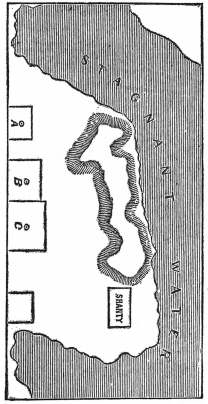
FEVER-BREEDING STAGNANT
WATER, EIGHTH AVENUE,
BETWEEN 75TH AND 76TH
STREETS, 1865
Striking examples
of the value of
medical sanitary
inspection are furnished
by this voluntary
organization.
One inspector
found diarrhoeal
affections very
prevalent in a settlement
in an up-town
ward, and for
a long time was
baffled in his efforts
to discover
the cause. He was
finally led to examine
the water of
a neighboring well,
which the people
used. This water
appeared to be of
an excellent quality,
but on examination
by Prof.
Draper, it was found to contain a large amount
of organic matter, derived either from a sewer
or privy. Prof. Draper pronounced it liquid
poison. The mystery was at once solved, and
the proper remedy suggested.
In another instance a very contagious disease
was found in a tenant-house, and after a long
course of inquiry it was at length discovered
that a washer-woman, living in the basement,
had taken in sailors’ clothing. The sailors
were found, the ship visited from which they
came, and there the disease was found. None
but medical men can prosecute such investigations
with success, or suggest the proper remedy.
If such a corps of sanitary inspectors were
daily patrolling their districts, visiting from
house to house, searching out sanitary evils, advising
and aiding the people in the adoption of
preventive measures, no epidemics of smallpox,
typhus, scarlet fever, or cholera would ever gain
more than a transient foothold. The sanitary
inspector would truly become an officer of
health and would be everywhere welcome.
The remedy for our evils must be apparent;
and this remedy is suggested in such terse
unqualified language by the City Inspector
above quoted, that I call the attention of the
committee especially to this remark,
as a proper guide in your deliberations.
The
Remedy
In the City Inspector’s report
for 1861 we find the following:
“The stay of pestilence, to be effectual,
must be prompt, and equally prompt must
be the interposition of barriers against the
introduction of disease, which may be kept
back, but, once introduced, can with difficulty
be checked or extirpated. For these reasons,
there should be a power existing in other hands
that may be ready to be used at the moment the
exigency may arise.” * * * “The remedy, apparent
to every one, must consist in the adoption
of laws transferring the power of sanitary
regulations to some other authority of a different
order of instruction in sanitary science.”
* * * “The first groundwork of reform, in the
opinion of the undersigned, is to bestow upon
some other body, differently constituted, all
power over the sanitary affairs of the city; and,
until this is done, all other proposals of reform
will be deprived of their essentially beneficial
features. To escape present complications is
the first great point to be gained; and this point
secured, simplicity, promptness, and efficiency
may be substituted for inefficiency, complication,
and delay.”
Accepting this as the first step in reform, the
practical question arises: How shall that body
be constituted to which is to be confided the
sanitary interests of New York?
If the experience of other large cities is of any
value, or, indeed, if we rely simply on common
sense, the following are indispensable
prerogatives in any well-organized health
board:
1. It should be independent
of all political influence and
above all partisan control.
2. It should combine executive
ability with a profound knowledge of disease
and the proper measures of prevention. To
this end the board should be composed in part
An Efficient
Health Board
of men especially accustomed to the dispatch
of business, and in part of medical men of great
skill and experience.
3. It should have a corps of skilled medical
officers as inspectors, which should be the eyes,
the ears, in a word, the senses of the board, in
every part of the city, searching out disease, investigating
the causes which give rise to it, the
conditions under which it exists, the means of
its propogation, and the most effectual mode of
its suppression.
4. It should have a close alliance with the
police, which must be its arm of power in the
prompt and efficient execution of its orders.