The Bosphorus in Summer—The Tower of Galata—Mosque of Topphannè—Summer
Palace of the Grand Vizier—Seraï of the Princess
Salihè—Seraïs and Salemliks—Palace of Azmè Sultane—Turkish
Music—Token Flowers—Palace of the Princess Mihirmàh—The
Hill of the Thousand Nightingales—Turkish, Greek, and Armenian
Houses—Cleanliness of the Orientals—The Armenians—Cemetery
of Isari—The Castle of Europe—Mahomet and the Greeks—Village
of Mirgheun—The Haunted Chapel of St. Nicholas—Palace of Prince
Calimachi—Imperial Jealousy—Death of Calimachi—The Bosphorus
by Moonlight—Love of the Orientals for Flowers—Depth of the
Channel—An Imperial Brig—Turkish Justice—Fortunes of the
Turkish Fleet—Sudden Transitions—Influence of Russian Sophistry—The
Sultan’s Physicians—Naval Appointments—Rigid Discipline—The
Penalty of Disobedience—The Death-Banquet—Tahir Pasha—Radical
Remedy—Vice of the Turkish System of Government—Unkiar
Skelessi—A Mill and a Manufactory—Pic Nics—Arabian
Encampment—Bedouin Beauty—Poetical Locality.
Nothing can be richer nor more various than
the shores of the Bosphorus on a sunshiny day
in summer; and many a delightful hour have I
spent, in company with my father, in the contemplation
of the glorious succession of pictures which
they offer to the lover of the beautiful in nature.
One delicious morning, when not a flitting cloud
marred the clear lustre of the sky, when a gentle
breeze murmured over the ripple, and the song
of the birds swelled cheerily upon the wind, we
resolved to enjoy them to their fullest extent;
and, as our caïque darted along the European
coast, a thousand interesting objects presented
themselves.
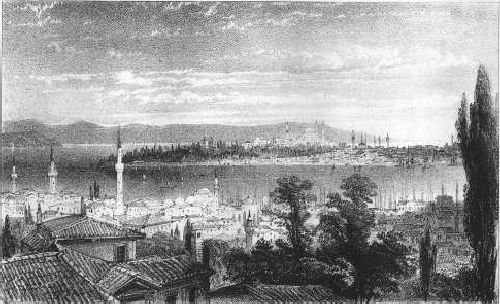
| Miss Pardoe del. |
Day & Haghe Lith.rs to the King. |
| THE SERAGLIO POINT, from the HEIGHT of PERA. |
| Henry Colburn, 13 G.t Marlborough St 1837. |
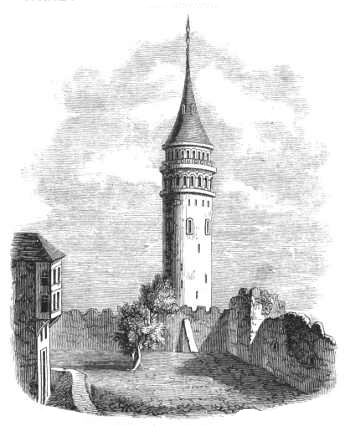
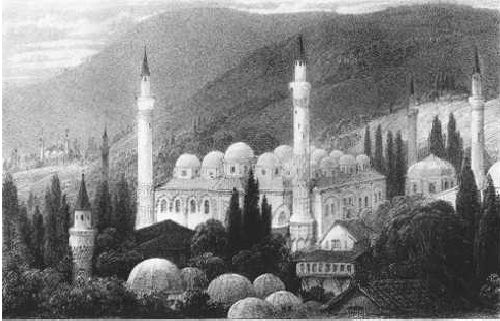
The tower of Galata, rife with memories of
the days when the dreaded Janissaries ruled the
destinies of the Empire, crowned the height,
which, clothed with houses and with verdure,
swept downward to the port. The spiral minarets
of the Imperial mosque of Topphannè
were flaunting their golden glories in the light;
the sounds of busy life were on the wind; and
the port once past, the wide artillery-ground,
and the stately barrack were succeeded by the
summer palace of the Grand Vèzir, standing
proudly against the current, as though, like the
Emperor of old, it dared the wave to overwhelm
it. The wide sweep of hilly country, gradually
closing, and becoming more lofty in the rear
of the buildings that fringe the stream, was
clothed with trees of every tint; from among
which the many-coloured houses peeped forth
in the most picturesque irregularity. Here and
there a gleaming minaret shot upwards into
the clear Heaven from amid a cluster of plum-coloured
Judas trees laden with blossom, or a
clump of limes filling the air with perfume; and
leaving the dark spiral cypresses far beneath
it; as the spirit, soaring above the earth, outtravels
the gloom and care from which it frees
itself.
What a line of palaces stretched along the
coast! And what a wilderness of gardens, climbing
the steeps behind them, made the background
of the picture no inapt representation of
fairy-land; while at intervals a little bay formed
a delicious nook occupied by country-houses,
and terraced-coffee-shops, where the luxurious
Osmanli smoked his pipe, and inhaled his tiny
cup of mocha, amid sights and sounds to which
the world can probably produce no parallel.
The stately serail of the Princess Salihè, and
the modest palace of her less high-born husband,
which is attached like an excrescence to the far-spreading
edifice occupied by the harem of his
Imperial partner, stands upon a spot where the
stream widens, as if to reflect more perfectly
the golden shores that hem it in.
There is something amusing enough to a
foreigner in the one-sided dwellings of the Sultan’s
sons-in-law. Without the palace as well
as within, they are constantly reminded of the
superiority of their Imperial spouses. As they
glide along in their gilded caïques, they pass
the harem, with its tall doors of bronze, and
golden lattices; its far-stretching terraces, and
guarded avenues; and they arrive before the
small landing-place which gives ingress to their
own diminutive salemliek, with its single entrance,
and its window draperies of white
cotton.
You cannot pass the Palace of Azmè Sultane,
the elder sister of the Sultan, without being
saluted by the sounds of music. The ladies of
her harem are many of them consummate musicians,
according to Turkish ideas of harmony;
and the tinkle of the zebec, the long notes of
the violin, the ringing rattle of the tambourine,
and a chorus of female voices, are so constantly
sweeping over the water through the closed
lattices, that your boatmen universally slacken
their pace as they reach the Seraïl. Oriental
music requires distance to mellow it: and when
it floats along the water, as though it rose from
the ocean caves; and you suffer your imagination
to dwell upon the white arms which are
tossed in air as the silver wheels of the elastic
tambourine ring out; and the delicate fingers
that press the strings, and the rich red lips and
large dark eyes that lend new grace to the
wild and bounding melodies of the country—you
are almost ready to fancy for the moment, that
Apollo must have first swept his lyre in a
Turkish harem.
While you look fixedly towards the lattices, as
though to search for the embodiment of your
romantic fancies, you may discover proofs that
the community is not one vowed to the rosary,
though it may wear the veil. Here it is an orange
attached by a lock of hair to the outer frame of
the small centre window of the trellice-work;
there it is a marigold suspended by a red ribbon;
while, partially concealed, and twined amid the
minute squares of the jealous screen, you may
perhaps discover a small cluster of roses.
This is the very land of practical romance!
An arrow’s flight beyond the Palace of the
elder Sultana, stands that of the Imperial bride
of Saïd Pasha; a long, irregular, rose-coloured
pile, pleasantly situated at the mouth of a lovely
bay, whose shores are bright with groves and
many-tinted villas; while in the distance, where
the channel again narrows, the castles of Europe
and Asia may be seen looming out against the
pure blue of the sky. We loitered at this sweet
spot for a brief space, and then, darting once
more forward, soon arrived under the “Hill of
the Thousand Nightingales.” Rightly is it
named, for the mid-day air was vocal with their
melody, and the dense foliage of the forest trees
quivered with their song; while, as the melancholy
music came to us along the water, its
sadness was deepened by the aspect of a few
scattered tombs gleaming out amid the rank
underwood. The variety of timber which clothed
the eminence formed such varying shades of
green; from the bright soft tint of the water-willow,
whose flexile branches swayed in the
breeze like silken streamers, to the tall, dark,
silent cypresses, that it was a study for a landscape
painter.
Beyond this lovely hill, the shore is edged
with Greek, Armenian, and Turkish houses;
and here commences the moral interest of the
locality. The dwellings of the raïahs are, when
of any extent, almost universally painted of two
different colours on the outside, in order to give
them the appearance of separate tenements, and
thus deceive the passers-by; while those of the
Turks themselves are perfectly illustrative of
the momentary condition of their owners.
The Osmanli is the creature of the present;
he never falls back upon the past; he has no
glorious memories to wile him from himself;
every page of his history is shadowed over by
some gloomy recollection—nor dare he dwell
upon the future, for he is the subject of a despotic
government: the proud Pasha of to-day
may be headless, or at best houseless to-morrow;
and hence, the premature decay of three-fourths
of the Turkish dwellings.
When an individual becomes possessed of
power, he buys or builds a residence suited to
his brightened fortunes: he lavishes his revenue—why
should he hoard it? it can only excite
the cupidity of the Sultan, and accelerate his
disgrace; or awaken the jealousy of his rivals,
and insure his ruin. He makes his house gay
without, and convenient within; but all its accessories
are ephemeral—the paint which he
spreads over the surface remains fresh for a
year, and that suffices him. Perchance it may
outlast his favour; should it not do so, it is no
unpleasant task to renew it; and if it should,
he contents himself with the weather-stained
walls of a more golden season. Once in disgrace,
he repairs only just sufficiently to defy the
weather, and troubles himself no further. And
thus, after you have been a few months in the
country, and have studied in some degree the
nature and habits of the people, you may give a
shrewd guess as you ride along, at the past and
present position of the owner of every edifice
that fringes the Bosphorus.
The courtier has raised a pile which looks as
though it had been finished only yesterday; the
walls are so bright, and the lattices are so perfect—the
blue ripple chafes against the marble
steps that lead to the columned portico; and
the feathery acacias nestle among their blossoming
boughs, gilded kiosks, and lordly terraces.
The slighted favourite has still servants
lounging about his door, and a stately landing-place
beside which his caïque dances on
the wave; but a shade has past over the picture:
the summer sun and the winter wind
have deadened the bright blue or the soft olive
of the edifice, and here and there a slender bar
is rent away from the discoloured lattices. The
fair forest trees still wave along the covered
terrace, but the steps are grass-grown, and the
flower-vases are overthrown—they might be
replaced; but it is better policy to let them
suffer with their master.
The dwelling of the exile is still more distinguishable.
The shutters are hanging loose
and beating in the wind; the broken casements
no longer exclude the weather; the lattices
are wrenched away; the terrace-wall is
falling inch by inch into the wave; the rank
grass is forcing its way through the crevices
of the marble floor; the garden kiosks are roofless;
and the green fresh boughs are flaunting
in the sunshine, mocking the desolation which
they dominate.
Fathers do not, in Turkey, build, or plant, or
purchase for their sons—their fathers did it not
for them—it would entail the probable loss of
both principle and interest.
The Armenian houses are peculiarly remarkable
for their cleanliness. All the inhabitants
of Constantinople in decent circumstances are
scrupulously nice on this point, but the Armenians
exceed all others: every respectable
dwelling being scoured throughout once a week
with soap and water. I have already, in speaking
of this people, alluded to their utter deficiency
in sentiment and ambition: their lives are
frittered away in inconsequent details; and
hence the attention and interest are bestowed
on comparatively insignificant objects, which
render them remarkable to strangers.
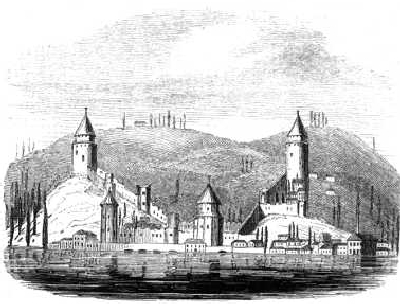
Another striking object on the coast is the
romantic and beautiful little cemetery of Isari,
situated immediately beneath the Castle of Europe,
by which it is dominated as by the eagle-eïrie
of some feudal Baron. Rocks, rudely flung
together, and in their perpendicular ascent impervious
to vegetation, sustain the foundations
of the fortress; while around and among them
snatches of kindlier earth are covered with dense
rich underwood, from amid which tall graceful
trees spring up, and overshadow the gilded
marble of many a columned gravestone.
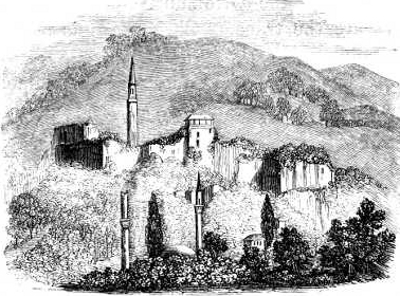
The Castle of Europe, standing immediately
opposite to the valley occupied by the
castle on the other coast, is built after a singular
fancy. Tradition tells that Mahomet,
from his Asiatic mountains, contemplated with
envy the lovely shores of Europe; and that,
unable to restrain his desire of possessing at
least a speck of the fair landscape, he entreated
permission of the Greeks to be allowed to build
a small fortress as a landing-place, on their
territory. The favour was granted, the materials
collected, and the present Castle of Europe
completed in six days; the ground-plan forming
the characters of the Prophet’s name.
Near the edge of the channel, a small arched
door is pointed out to the curious, whence the
Janissaries who had become obnoxious to the
reigning Sultan, and whose especial prison it
was, were ejected from the fortress after they
had been bow-strung, in order to be flung into
the Bosphorus; while, at the instant that the
waters closed over them, a gun was fired from
one of the towers, to intimate to the Imperial
despot that justice had been done on his enemies.
This Castle, like the Fortresses of the Dardanelles,
has been suffered to fall into partial
decay, but an order was lately issued for their
simultaneous restoration, and workmen are now
busily employed in repairing the united ravages
of time and neglect.
The little village of Mirgheun, about a mile
higher up the channel, is one of the prettiest
things on the Bosphorus. A long street, terminating
at the water’s edge, stretches far into
the distance, its centre being occupied by a
Moorish fountain of white marble, overshadowed
by limes and acacias, beneath which are coffee
terraces; constantly thronged with Turks, sitting
gravely in groups upon low stools not
more than half a foot from the ground, and
occupied with their chibouks and mocha.
A short distance beyond Mirgheun the channel
widens into a little bay, one of whose extremities
is occupied by a ruined house, standing in the
midst of a garden. This house, which was formerly
a chapel dedicated to St. Nicholas, is now
the property of a Turk, but is never inhabited
in consequence of a superstition so wild, and
withal so fully credited by both Greeks and
Musselmauns, that I must not pass it by unnoticed.
The chapel was desecrated during the Greek
revolution; and taken possession of, under the
Imperial sanction, by a Turk, who, hurling the
effigy of the saint from the niche above the
altar, converted the holy shrine into a dwelling-place
for himself and his family; but on the
very night on which he removed thither he was
destined to pay the price of his sacrilege, for he
was found in the morning dead in his bed; an
event which so appalled his relatives that they
immediately disposed of the house to a neighbour,
whose only child fell a victim, in the same
mysterious manner, to the vengeance of the outraged
saint—a third purchaser lost his wife by
the like means; and the spot became from that
day the dread and horror of every True Believer;
while it is an extraordinary fact that its Infidel
owner sent for a Greek Papas to exorcise the evil
spirit, or to conciliate the saint; and that a solemn
sprinkling of holy water and chanting of hymns
took place; but it is impossible to say with what
success, as no tenant has subsequently been
found for the dwelling, which is rapidly crumbling
to decay.
As you approach Therapia, you come upon a
long stretch of wall, pierced in one regular line
with small square windows, and looking exactly
like an ill-kept manufactory; while the fine
stone terrace that runs along its whole façade,
and the thickly-planted shrubberies which clothe
the hill behind it, have something so lordly and
imposing in their aspect, that your attention is
irresistibly attracted, and your curiosity awakened.
Should your caïquejhes be Greeks, they
will scarcely answer your inquiry without muttering
an imprecation through their clenched
teeth. It is the sorry remain of the palace of
Prince Calimachi, seized by the Sultan in a fit
of despotic jealousy, and converted into a stable
for the Imperial stud, but so entirely disproportioned
to its new office as to be perfectly useless—the
extent being immense, and the number of
the Sultan’s horses extremely limited; it has
consequently been abandoned to premature decay,
and a noble object is thus blotted from the
landscape, and degraded into a deformity.
The son of the Prince was Dragoman to the
Porte when the seizure was made; but being a
Greek, his court interest availed him nothing;
his ideas were too magnificent, and he paid the
forfeit of his luxury.
But the misfortunes of Prince Calimachi did
not end here. Exiled to Broussa, he endeavoured
in the bosom of his family to lose the memory
of his departed splendour; when he was one day
invited to the palace of the Pasha to encounter
him at chess, of which game both were passionately
fond. Calimachi accepted the defiance with
alacrity, for he knew not how dearly he was to
pay the gratification. While he was deliberating
on a move, the Pasha waved his hand, and
in an instant the fatal cord was about the throat
of his victim. The bereaved wife was next summoned;
and though the dark ring of extravasated
blood betrayed the deed which had been done,
she was told that the Prince had expired from
an attack of paralysis; nor did she dare to
gainsay the falsehood; and thus she bore away
the body of her murdered husband in the silence
of despair.
The Sultan has a kiosk on the one hand, and
a summer palace on the other, of this melancholy
memorial of despotic power; but I was in no mood
to admire either with such an object before me.
To be seen in all its beauty, the Bosphorus
should be looked upon by moonlight. Then it is
that the occupants of the spacious mansions
which are mirrored in its waters, enjoy to the
fullest perfection the magnificence of the scene
around them. The glare of noon-day reveals too
broadly the features of the locality; while the
deep, blue, star-studded sky, the pure moonlight,
and the holy quiet of evening, lend to it, on
the contrary, a mysterious indistinctness which
doubles its attraction. The inhabitants of the
capital are conscious of this fact; and during
the summer months, when they occupy their
marine mansions, one of their greatest recreations
is to seat themselves upon the seaward
terraces, to watch the sparkling of the ripple,
and to listen to the evening hymn of the seamen
on board the Greek and Italian vessels;
amused at intervals by a huge shoal of porpoises
rolling past, gambolling in the moonlight, and
plunging amid the waves with a sound like thunder:
while afar off are the dark mountains of
Asia casting their long dusky shadows far across
the water, and the quivering summits of the tall
trees on the edge of the channel sparkling like
silver, and lending the last touch of loveliness to
a landscape perhaps unparalleled in the world.
Shakspeare must have had a vision of the
Bosphorus, when he wrote the garden scene in
Romeo and Juliet!
All the Orientals idolize flowers. Every good
house upon the border of the channel has a parterre,
terraced off from the sea, of which you
obtain glimpses through the latticed windows;
and where the rose trees are trained into a
thousand shapes of beauty—sometimes a line
of arches rises all bloom and freshness above
a favourite walk—sometimes the plants are
stretched round vases of red clay of the most
classical formation, of which they preserve the
shape—ranges of carnations, clumps of acacias,
and bosquets of seringa, are common; and the
effect of these fair flowers, half shielded from
observation, and overhung with forest trees,
which are in profusion in every garden, is extremely
agreeable.
Another peculiarity of the Bosphorus is the
great depth of the water to the very edges of the
channel. The terraces that hem it in are frequently
injured by their contact with the shipping
which, in a sudden lull of wind, or by some
inadvertence on the part of the helmsman,
“run foul” (to use a nautical expression) of the
shore; nor is it the terraces alone that suffer,
for the houses whose upper stories project over
the stream, which is almost universally the case
where they are of any extent, are constantly
sustaining injury from the same cause.
We had occupied our summer residence only
two days, when an Imperial Brig in the Turkish
service, in attempting a tack, thrust its bowsprit
through the centre window of the magnificent
saloon of an Armenian banker, with
whose family we were acquainted. The master
of the house, exasperated at the evident carelessness
in which the accident had originated,
rushed out upon the terrace to remonstrate,
but his remonstrances were unheeded; and he
had scarcely re-entered the house when the
Turkish captain, who was intoxicated, landed,
and without ceremony passed into the outer
court, accompanied by some of his crew; and,
seizing the brother of the gentleman, and several
of his servants, gave them a severe beating, and
then quietly returned on board. The vessel was
extricated after a time, carrying away with it
nearly the whole front of the saloon, and a large
portion of the roof; after which, the gallant
commander again entered the house, and insisted
upon conveying its master to Constantinople,
there to expiate the sin of insolence to a
Turkish officer. The Saraf, however, having
business in the city, had already departed, and
consequently escaped the inconvenience and insult
destined for him.
Were I the Admiral of a Fleet charged with
the conquest of a channel like that of the Bosphorus,
I would employ none but Turkish sailors,
who are never so much at home as when aground,
or hung on to some building; they would
literally carry the thing by assault. Their
mighty ships of war do as they like, for they
are constantly “touching,” when they are supposed
to be cruizing; and “aground” when the
authorities at home believe them to be at sea.
Where did you meet the Admiral’s schooner
as you came from Malta? On shore off Tenedos.
Where did you speak the frigate on your way
here? Aground at Gallipoli? These were the
answers to two questions put by myself; and
had I ventured twenty more I should probably
have received similar replies.
Englishmen will probably, at the first glance,
wonder why it should be thus; but it would be
greater subject for astonishment were it otherwise.
When a Field Marshal, by kissing the
Sublime Toe, is translated at once into a Lord
High Admiral; and the Colonel of a Cavalry
regiment becomes by an equally simple process
a manufacturer of Macaroni; and when each is
called upon to teach that which he never learnt,
and to command ere he has been taught how to
obey; the effects of the system may be readily
foreseen. Nevertheless, were the Turks permitted
to employ even subordinate European
officers in their army and navy, much of the evil
might be obviated. But Russia is opposed to
a measure which would give them a correct
idea of their own physical strength—by weakening
the morale, she enervates the whole system;
while, by her happy art of consopiation, and
her finished tact at glossing over effects, and
inventing causes, she has taught them to believe
themselves independent of extraneous aid,
Heaven-inspired, and all-sufficient.
It signifies not how irrelevant the duties of
any situation may be to his previous habits
and talent, no Turk would hesitate to accept it
on that account, should the occasion of self-aggrandizement
present itself; and he has two
satisfactory reasons for acting thus—he must
at least be as capable of fulfilling them as his
predecessor, who was equally ill-fitted for the
trust—and, should he refuse one good offer, he
would probably never have a second. Thus
reason the Osmanlis, and upon this conviction
they act. Nor is Sultan Mahmoud one whit
more difficult or quick-sighted on this point than
his subjects; or more scrupulous as to the efficiency
of those to whom he gives important appointments,
than they are in accepting them;
and a ludicrous example of this uncalculating
facility occurred very lately, so perfectly in point
that I cannot forbear to mention it.
His Highness had a favourite physician, to
whom he had entrusted the superintendence of a
public establishment, and who died suddenly at
Scutari. When informed of his death, the Sultan
was visibly affected: and in the first moment
of regret he inquired anxiously if the deceased
had left any family. He was answered that he
had an only son, a clerk in the Greek Chancellery,
whose situation was far from a lucrative
one; and he immediately desired that the youth,
who had not yet attained his twentieth year,
should be appointed on the instant to his father’s
vacancy, and receive the same salary which had
been enjoyed by his parent. He was obeyed;
and the spruce clerk at once became metamorphosed
into the solemn physician, or something
as near like it as he could accomplish.
By an arrangement not altogether so satisfactory,
surgeons are supplied to the ships of
war. When a medical man is required on board
some vessel of the line, individuals appointed for
the purpose walk into the first chemist’s shop
they may happen to pass, seize the master,
carry him off, hurry him first into a caïque, and
thence to the ship; appoint him surgeon, enter
him on the books, acquaint him with the amount
of his pay; and, should he venture to remonstrate,
give him a sound flogging.
Nor are “the powers that be” at all more
particular in their bearing towards the officers
of the ships, whom they flog (the captains
inclusive) whenever they chance to consider
the operation desirable. On a late occasion,
two of the frigates ran foul of each other
in the Channel, upon which Tahir Pasha, the
High Admiral, bestowed the bastinado so unsparingly
upon their commanders, that the blood
penetrated their garments; and they were subsequently
flung into some den in the hold, and
there left during three days, not only without
attendance, but literally without food!
It may be asked what punishment can be
inflicted on the crews, if such unceremonious
measures are pursued with the officers; and as
one fact is better than a score of assertions, I
will reply by relating another very recent occurrence,
described to me by a Greek gentleman
who was present during the whole transaction.
The Capitan Pasha had a party of friends to
dine with him on board his ship, who were about
to seat themselves at table, when it was reported
to him that one of the crew, in defiance
of the order which forbade any individual
to go on shore, had surreptitiously left the
vessel.
“Let me know when he returns on board;”
was the cold and careless rejoinder of the High
Admiral, who had scarcely uttered the words,
when the re-appearance of the delinquent was
announced, after an absence of about ten
minutes. He was ordered below to account for
his conduct to the Pasha, whose very name is a
terror to the whole fleet, when he stated that
the following day being Friday (the Turkish
Sabbath), he had ventured on shore to procure
some clean linen, fearing the anger of the Admiral
should he appear dirty.
“And was it for this trifle that you disobeyed
my orders?” asked the Pasha; “I must take
measures to prevent any future instance of the
same misconduct—” and grasping an iron bar
that served to secure one of the cabin windows,
and which stood near him—without the
pause of a moment—surrounded by his guestsstanding
beside a table spread for a banquet
and with his victim crouching at his feet—he
struck the quailing wretch upon the head, and
murdered him with a blow. The body fell heavily
on the earth in the death-spasm; and the Admiral,
addressing himself to an attendant, quietly
ordered that the corpse should be removed, and
the dinner served: but several of the party declined
remaining after what they had witnessed,
declaring their inability to partake of food at
such a moment; these were, of course, Turks;
for the Greek guests, although equally disgusted
and heart-sick, were not at liberty to withdraw
without danger; and the dead man was borne
away, and the living feasted, with his death-groan
still ringing in their ears, and his last
fierce agony yet grappling at their hearts!
Tahir Pasha is a perfect embodiment of the
vulgar idea of Turkish character which was so
lately prevalent in Europe. He is the slave of
his passions, and apparently without human
affections or human sympathies. He lost his
only son by his own violence, having beaten him
so severely for quitting the house without his
permission, that the unhappy young man died a
day or two subsequently, in consequence of the
injuries which he had sustained; and, instead
of profiting by this awful occurrence, he afterwards
murdered a nephew in the same manner.
And yet I have heard men, carried away
by party-spirit, and hoodwinked by prejudice,
maintain that this fiend in human shape was
not cruel; and bolster their opinions with a
sophistry that made me shudder.
I inquired of an attaché of the Porte whether the
Sultan was aware of the waste of life in his fleet,
where a week seldom passes in which some luckless
wretch does not fall a victim to the wrath of
the High Admiral; and the coolness of the answer
was inimitable: “What has His Highness to do
with it?” “How!” I rejoined in my turn, “are
they not his subjects?” “Of course; but Tahir
Pasha commands the fleet; and, while he does
so, he has a right to enforce its discipline as he
thinks best. Why should the Sultan interfere?”
“But such wholesale cruelty is so revolting.”
“Perhaps so; yet how can it be remedied?”
“Were I the Sultan,” I answered unhesitatingly,
“I would decapitate the High Admiral;
it would be a saving of human blood.”
The Turk laughed at my earnestness as he replied;
“Mashallah! you have hit upon a radical
remedy. But how would you secure the fleet
against a second Tahir Pasha?”
He was right. The evil exists rather in the
system than in the individual; but it is, nevertheless,
a blessing for Turkey, that the equal of
her High Admiral, for ruthlessness and cruelty,
is probably not to be found in the country. And
yet, to look at him, you would imagine that no
thought of violence, no impulse of revenge, had
ever stirred his spirit; he has the head of an
anchorite, and the brow of a saint. I never
beheld a more benevolent countenance—Lavater
would have been at fault with him.
One of the most pleasant excursions that can
be made to the opposite coast, is to Unkiar
Skelessi, or the Sultan’s Pier; a sweet valley,
under the shadow of the Giant’s Mountain, in
which the famous treaty was signed with Russia.
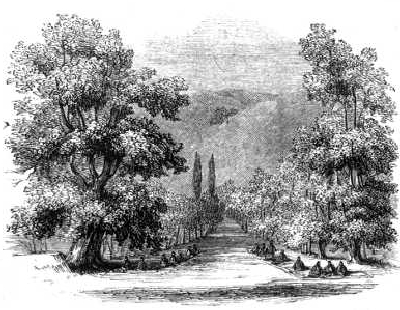
It is profusely shaded with majestic trees, the
largest in the neighbourhood, and is entirely
covered with rich grass. The spot on which
the ceremony took place is overhung with maples,
and washed by a running stream: behind
it rises a range of hills; and on its left stands
an extensive manufactory of cloth, and a paper-mill,
erected at an immense expense, and furnished
with their elaborate machinery by the
present Sultan, who caused an elegant kiosk to
be erected upon the height for his own use,
when he went to superintend the works, which
were, however, abandoned as soon as the novelty
had worn off. They are now falling rapidly to
ruin; and the noble run of water which was
forced from its channel to turn the wheels of the
mill, is wasting itself in an useless course across
the valley, ere it is finally lost in the Bosphorus.
This lovely spot is much frequented on festival
days by all classes of the population, who form
pic-nic parties, and spend hours under the shade
of the tall trees, sipping their coffee and sherbet;
or occupying the different terraces which overlook
the Bosphorus, with regular pleasure-parties,
whose servants come well provided with
provisions, and who linger throughout the whole
day, enjoying the cool breezes from the sea, and
the long shadows of the boughs beneath which
they sit.
Higher up the valley, you generally meet with
an encampment of Bedouin Arabs, where you
are almost certain to see two or three faces of
dark flashing beauty, which repay you for the
annoyance that you experience from the importunity
of the troop of children who assail you
directly you approach the tents; little, ragged,
merry-looking, vociferous urchins, of whom you
cannot rid yourself either by bribes or menaces.
These dark, proud beauties—for they are
proud-looking, even amid their tatters, with their
large, wild, black eyes, and their long raven hair
plaited in many braids, which fall upon their
shoulders, and hang below their waists; their
round, smooth arms bare to the elbow, whence
the large, hanging sleeves fall back; and their
well-turned little feet peeping out from beneath
their ample trowsers; these dark, proud beauties
greet you with a smile, and a “Mashallah!”
that introduce you to teeth like pearls, and
voices like music; and as they sit, weaving their
baskets for the market of Constantinople, they
extend towards you their slender, henna-tipped
fingers, and ask your piastres, without taking
the trouble to rise, rather as a tribute to their
loveliness, than as an offering to their necessities.
To escape from the importunities of the
children, whom the sight of the tempting metal
renders only more importunate, you have but
to plunge deeper into the valley, and lose yourself
among the majestic plane trees with which
it abounds. The nightingale alone disturbs the
deep silence of the solitude, save when at intervals
the lowing of the cattle on the mountain
sweeps along upon the wind.
It was here that De Lille wrote his “Pleasures
of Imagination.”—It was here that De
la Martine improvised to the memory of his
daughter; the soil is poetic.