Invitation from Mustapha Pasha of Scodra—The Caïque, and the
Caïquejhes—How to Travel in a Caïque—Hasty Glances—Self-Gratulation—Scutari—Imperial
Superstition—The Seraglio Point—Dolma
Batchè—Beshiktash—The Turning Dervishes—Beglièrbey—The
Kiosks—A Dilemma—A Ruined Palace—An Introduction—A
Turkish Beauty—A Discovery—A New Acquaintance—The
Buyuk Hanoum—Fatiguing Walk—Palace of Mustapha
Pasha—The Harem—Turkish Dyes—Ceremonies of Reception—Turkish
Establishment—The Buyuk Hanoum—Turkish Chaplets—The
Imperial Firman—Pearls, Rubies, and Emeralds—The Favourite
Odalique—Heyminè Hanoum—A Conversation on Politics—Scodra
Pasha—Singular Coincidence—Convenience of the Turkish Kitchen—Luxury
of the Table—Coquetry of the Chibouk—Turkish Mode of
Lighting the Apartments—Gentleness towards the Slaves—Interesting
Reminiscences—Domestic Details—Dilaram Hanoum—A
Paragraph on Pearls—A Turkish Mirror—A Summons—Scodra
Pasha—Motives for Revolt—The Imperial Envoy—Submission—Ready
Wit of the Pasha’s Son—The Reception Room—Personal
Appearance of the Scodra Pasha—Inconvenient Courtesy—Conversation
on England—Philosophy—Pleasant Dreams—The Plague-Smitten.
Accompanied by a Greek lady of my acquaintance,
I embarked one fine morning on board our
caïque, to pay a visit to the wife and daughter
of Mustapha Pasha of Scodra. As his palace
was situated in a distant quarter of the city,
and we were anxious to avoid the necessity of
rattling over the rude and broken pavement of
the streets in an araba, we resolved to stretch
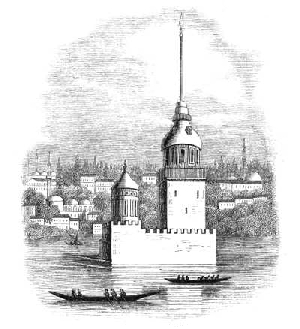
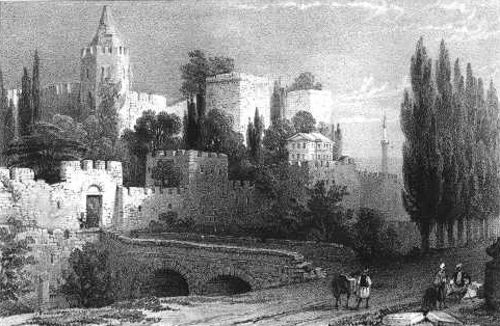
out beyond the Seraglio Point; and, following
the walls that are now crumbling into ruin
along the coast, disembark at Yani-capu, or the
New Gate pier.
Our sturdy rowers accordingly bent to their
oars, and the arrowy caïque shot across the port,
and out into the wider sea beyond, like a wild
bird. The boatmen were clad in their summer
garb, for the sunshine lay bright upon the water,
and scarcely a breath of air murmured among
the dark branches of the cypress groves. They
wore shirts of silk gauze, of about the thickness
of mull-muslin, with large hanging sleeves, and
bordered round the breast with a narrow scallopping
of needlework; their ample trowsers
were of white cotton, and their shaven heads
were only partially covered by small skull-caps
of red cloth, with pendent tassels of purple silk;
their feet were bare.
My companion and myself occupied cushions
spread along the bottom of the boat: the most
comfortable, as well as the safest way to travel
in a caïque, which, from its peculiar formation, is
liable to be overset by the slightest imprudence;
while our Greek servant, with his legs folded
under him, was seated on the raised stern of the
boat, immediately behind us.
What pretty peeps we had of the Seraglio
gardens, as we shot along; through the many
latticed openings contrived for the gratification
of the fair prisoners. What magnificent glimpses
of domes and minarets, of bursting foliage, of
marble fountains, and of gilded kiosks! But,
alas! how vain must have been all the luxurious
inventions of the most luxurious of Sultans,
to insure happiness to the tenants of this painted
prison! I looked around me on the sea-birds
that were sporting upon the wave—above me,
to the fleecy clouds that were sailing over the
blue ether—far into the distance where a shoal
of dolphins were gamboling almost above the water;
and, as I felt the motion of the swift caïque,
while it was gently heaved up and down by the
current of the sea of Marmora, and saw how
rapidly we sped along, I breathed a silent thanksgiving
that I too was free! Free to come and
to go—to love or to reject—to gaze in turn upon
every bright and beautiful scene of nature, untrammelled,
and unquestioned—that no Sultan
could frown me into submission—no Kislar Agha
frighten me into hypocrisy—in short, that I
was not born a subject of his Sublime Highness,
Mahmoud the Powerful.
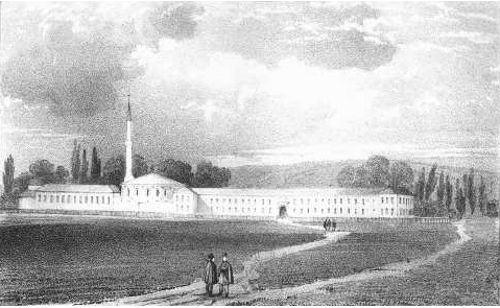
On our left, rose the lordly mountain of Bulgurlhu
Dagi, above Scutari, whose shores were
fringed with country-houses, and hanging gardens;
gradually deepening into a sterner character
as they receded from the Bosphorus, and
lifting to the sky the palace-like barrack, and
the elegant Persian kiosk of the Sultan. The
present Sovereign has a superstition derived
from an astrologer whom he consulted in his
youth, that, while he is constructing Imperial
residences, he is sure to be fortunate in his other
undertakings; and hence he is continually adding
to the almost countless numbers of palaces
and kiosks, that occupy the loveliest spots
throughout the vicinity of the capital.
The most extensive and ancient of these is
that which is situated at the entrance of the
harbour, and gives its name to the “Seraglio
Point,” the walls of the Imperial Seraï running,
as I have already mentioned, far along the
coast. On the opposite shore is the small but
elegant palace of Scutari, with its bowery terraces,
which are overlooked by the Sultan’s principal
residence of Dolma Batchè; and you may
shoot an arrow from the many-coloured and
irregularly constructed palace of Dolma Batchè
to the vast edifice now building on the same
border of the Bosphorus, with infinitely less taste
and more architectural pretension—although,
with true Eastern inconsistency, the whole of the
stupendous palace above Beshiktash, save the
foundation, is of wood, surrounded by a colonnade,
supported on stately columns of white
marble.
This palace, of which the expence is estimated
at a million sterling, has been already a considerable
time in progress; and is erected on a
locality that was partly occupied by a beautiful
kiosk of Sultan Selim, and partly by a Tekiè
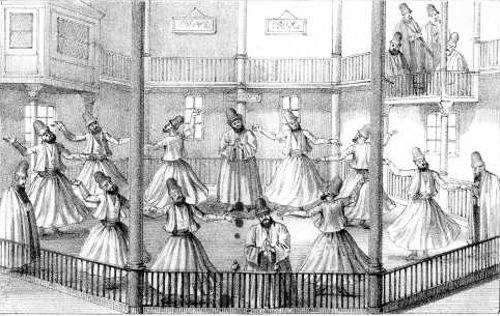
and Chapel of Turning Dervishes.
These latter, with a tenacity altogether incompatible
with our European ideas of a despotic
government, resolutely refused to quit
their convent, when the plan of the new palace
which rendered their ejection indispensable was
explained to them. They had come to a resolution
not to move—their mausoleum contained
the holy ashes of a saint, and, in short, they were
determined to measure their strength with the
Sultan. Accordingly, raising the cry of sacrilege,
they continued snugly within their convent
walls, which were soon overtopped by the
Imperial pile that rose gradually on either side
of them.
But Sultan Mahmoud was born a century too
late to be thus baffled—the work went on; and
he bore the opposition to his will with most exemplary
patience so long as it did not retard the
operations of his architects. But, when the moment
at length arrived which rendered expedient
the removal of the fraternity, he claimed
from the Chèïk Islam, or High Priest, his permission
to expel them; and, having failed in procuring
it, quietly mounted his horse, and rode up
to the convent gate. The Chief Dervish met him
on the threshold, and the dialogue was brief:—
“Your Tekiè occupies the ground necessary
to the completion of my palace:—you must
vacate it.”
“We guard the sepulchre of a saint, may it
please your Sublime Highness.”
“My pleasure is your immediate removal—I
have provided a place of reception for your community.”
“We are not strong enough to contend against
your Imperial will. We obey.” And the fraternity
were put in possession of an extensive
edifice, lately occupied by the Court Jester!
By a strange chance, this house was situated
immediately under the holy tomb which had
afforded to the Dervishes their principal pretext
for disobedience to the Imperial mandate; and
the Sultan adroitly availed himself of the fact to
impress upon them the eligibility of the situation,
pointing out, with a solemnity worthy of
the occasion, that it was more decent for them
to be domesticated on the very spot consecrated
by the remains of the illustrious deceased, than
at the distance of a furlong, as had hitherto been
the case. The observation was a happy one, and
the remark unanswerable; and the fraternity
were fain to affect accordance with the sentiment,
however inconvenient its effects.
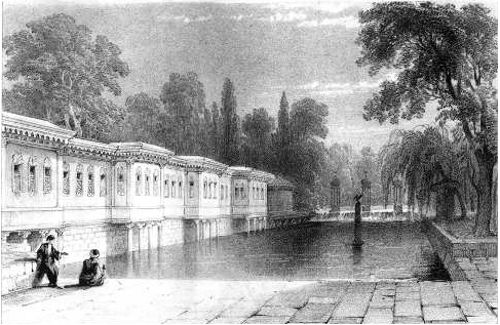
Immediately opposite, seated upon the Asian
shore, like a regal beauty contemplating her
gorgeousness in the clear mirror of the Bosphorus,
rises the summer palace of Beglièrbey—with
its walls of pale gold and dead white; the prettiest
and most fanciful of all the Imperial residences,
and rendered doubly agreeable by its
spacious gardens and overhanging groves.
But the kiosks! Who shall number the kiosks!
those gilt-latticed, many-formed, and graceful
toys, which seem as though they had been rained
from the sky during an hour of sunshine—see
them on the heights of the Asian shore—seek
them in the depths of the “Valley of Sweet Waters”—count
them as they rise at short distances
along the walls of the Seraï—pause a moment to
admire their fairy-like beauty as you gallop
through some lovely glen, so wild and solitary
that you almost fancied yourself to have been
the first who has ever explored its recesses—any
where, every where, you come upon them; and
they are so neatly kept, so brightly gilt, and
so gaily painted, that they look like gigantic
flowers scattered over the landscape.
But back, my truant fancy, to the sea of Marmora,
and the shores of Scutari; where the light
caïque is bounding over the heaving waters,
and Mount Olympus, with its crown of snow, is
summoning you to memories of the days when,
if Gods indeed were not, men lent them life!
Back to the hoary walls of Byzantium—to the
lingering relics of the Ancient Romans—to the
City of the True Believers!
We passed the little bay of Cum-capu, or Sandport,
and our caïque shortly afterwards shot into
the creek of Yani-capu; but we had not left the
boat five minutes when we became suspicious
that the servant was not altogether so familiar
with the road leading to the palace of the Pasha
as he had professed to be. Nor were our suspicions
erroneous; for, after leading us up one
street and down another; along the foot of the
Aqueduct of Justinian; and amid the blackened
remains of the last great fire, he fairly
confessed that he had lost his way.
In this dilemma, we took a guide, who assured
us that he was as familiar with the palace of
the Scodra Pasha as with his own house, and
so he proved to be; though the trifling inconvenience
that ensued convinced us that we were
as far from our object as ever. After threading
a vast number of narrow streets, each more
filthy than the last, we at length reached one
which, built on a steep acclivity, boasted a somewhat
more comfortable and cleanly appearance;
the houses were larger and better kept, and the
shops less frequent and more respectable. Our
guide stopped before a pair of great gates about
half way up the hill, and, seizing the knocker,
gave very audible evidence of our wish for admittance;
after which he pocketed his piastres,
and withdrew.
On the opening of the gate, we found ourselves
in a small covered court, choked with
rubbish. A house, literally “tottering to its fall,”
and propped on the garden side with heavy
pieces of timber, presented itself as the palace
of the Pasha; and the door of the harem, which
one rude blow would have shivered to atoms,
was immediately before us.
We looked at each other in wonder; but, as
the servant who had given us admittance assured
us that we had made no mistake, which
we were not only inclined, but really anxious to
believe that we had done, we desired to be conducted
to the Buyuk Hanoum. A loud blow on
the door of the harem, most portentously echoed
by the void beyond, was instantly answered by
the appearance of a tall, bony, grinning negress;
who, having bade us welcome, invited us to follow
her to her mistress.
The stairs by which we ascended to the harem
creaked and quivered beneath our weight; the
window that lighted them was uncurtained,
and its missing panes were replaced by rags and
paper—there was no matting upon the floor of
the empty, chilly, comfortless hall into which
the apartments opened—and the whole appearance
of the place was so desolate and wretched,
that I shivered as I remembered that I had engaged
myself to pass the night there.
Having traversed the hall, the slave lifted the
heavy curtain veiling the door of one of the inner
apartments; and, having obeyed her bidding,
we found ourselves in a small, snug, well-heated
room, closely carpeted and curtained; and at
the instant of our entrance a beautiful girl rose
from the sofa where she had been seated, and
welcomed us with a smile and a blush that
made us forget at once “the ruin of her house.”
There was one circumstance connected with the
greeting, however, that struck us as very singular;
she made no allusion to our having been
expected: but there was, on the contrary, a sort
of wonder and curiosity in her manner, which,
with intuitive good-breeding, she did not express.
We were both still haunted by the idea that
there must be some mistake; and this impression
was heightened by the timid and constrained
bearing of the young beauty, who, after having
clapped her hands, and desired the two or three
slaves who hastily obeyed the summons to prepare
sweetmeats and coffee, suddenly sank into
silence, as though waiting to learn the purport
of our visit. My companion, acting upon the
presumption that some mistake must exist, although
she was unable to comprehend its nature,
once more inquired if she were correct in supposing
that we were in the palace of the Scodra
Pasha.
Again she was answered affirmatively.
“And you are then the beautiful daughter of
the Pasha, of whom I have heard so much?”
“I am the wife of his son,”—was the reply,
which, concise as it was, brought a brighter
blush to the cheek of the speaker.
And she was beautiful, according to the strict
rule of Turkish loveliness; with rich red lips,
large dark sleepy eyes, and a throat as white
and dazzling as the inner leaf of the water-lily.
“You are young to be a wife; have you been
long married?”
“Exactly twelve months—I am thirteen; my
husband is a year older.”
“Did you expect us earlier?”
“Expect you!” echoed the fair Turk, opening
her deep eyes in wonder: “Mashallah! how
could I expect that two Frank ladies would come
to visit me?”
This was inexplicable!
“I trust that the Pasha has quite recovered
his late indisposition,” pursued my companion
after a moment’s silence.
“I did not know that he was unwell; we have
not heard from him lately.”
“Heard from him?” echoed Madame——in
her turn; “my husband had a long conversation
with him yesterday.”
Again the beauty dilated her large eyes in
wonder. “Impossible! He is in Albania.”
Here was the solution of the enigma. We were
bound on a visit to Mustapha Pasha, the rebel—and
we were under the roof of Omer Pasha,
his present successor!
After a hearty laugh on all sides, we were
quite at our ease; the young beauty handed
scented conserves and coffee to us with her own
pretty, plump, henna-tipped fingers; and informed
us that her mother-in-law, the Buyuk
Hanoum, and herself, were occupying a house
lent to them by a friend, for the few weeks
which they found it expedient to pass in Constantinople,
while making their arrangements
for Albania, where they were shortly to join the
Pasha.
After passing half an hour in chatting on
various subjects, we rose to take our leave, and
to profit by the polite offer of our new acquaintance
to send a servant to point out to us the
palace of Mustapha Pasha. As we were
making our parting compliments, a slave came
in to request that we would pay a visit to the
Buyuk Hanoum in her apartment, whither she
had just returned from the bath.
We immediately assented, and were conducted
to a spacious room at the other extremity of
the hall, where we found the lady seated under
the tandour, and almost in darkness; the windows
of the room being on the old Turkish
principle—that is, perforated in a double tier—the
lower ones so closely latticed that they admitted
scarcely any light, and barely permitted
those within to see into the street; and the upper
ones, small and half circular, dull with dust,
situated close to the ceiling, and, in several instances,
where time or accident had displaced
the glass, repaired roughly with thin planks
nailed across. The atmosphere of the apartment
was close and oppressive, perfume having
been flung into the mangal as we entered, which
was rising in a dense vapour; and every creek
and crevice in the room (and they were not few)
being stopped with pink paper.
The Buyuk Hanoum received us with much
courtesy, and apologized for not having welcomed
us herself on our first arrival in her own
apartment, owing to her having been at the
moment in the bath; and she appeared much
amused at the mistake, (of which her slaves
had already informed her) that had brought us
under her roof. She had formerly been a fine
woman, but was no longer young, and had consequently
lost all the charming fraicheur (I
use the French word, for it is perfectly untranslateable)
which is the great beauty of Oriental
females. In the course of conversation, we
discovered that she was sister to one of the
wives of Achmet Pasha; and had herself been
to pay a visit to the harem of Mustapha Pasha
the previous day.
As our engagement still remained to be fulfilled,
we did not long linger in the apartment
of the Buyuk Hanoum; but, taking leave of herself
and her pretty little daughter-in-law, who
had, during our visit, remained standing at the
end of the room, with her hands folded meekly
before her, while we shared the sofa of the
hostess: we placed ourselves under the guidance
of a bearded and turbaned Moslem, who was
awaiting us in the courtyard, and once more
sallied forth.
What a walk we had! Up and down, and in
and out, until I began to think that the tales of
Eastern enchantment that I had read in my
girlhood were now realized for my individual
inconvenience, and that the palace was receding
as rapidly as we advanced. I was not, however,
suffered to persist in this idle fancy, for
we really did arrive at last, although some
hours later than we should have done, before
the great gates of an extensive edifice, which I
am bound to admit had, externally, more the
appearance of a barrack than a palace. Half a
dozen servants, several of them negroes, were
lounging in listless idleness at the entrance,
which our arrival instantly changed into ready
and officious bustle.
We were ushered across an extensive courtyard
to one of the wings of the palace, a vast,
irregular, pile of building; and a single stroke
upon the door of the harem was immediately
answered from within: a group of smiling
female slaves received us in an inner court,
wherein stood the araba of the Buyuk Hanoum,
and a very handsome marble fountain, at which
a pretty girl of about eighteen was performing
her ablutions. A couple of the negroes accompanied
us up stairs, and, leading us across a very
handsome saloon, whose recesses were filled with
cushions, and whose open gallery commanded
the court beneath, showed us into a smaller
apartment, and seated us on a sofa, whereon lay
a mandolin and a tambourine, probably flung
there by some fair musicians whom our approach
had startled from their pastime.
Here we were shortly joined by a very old
woman, who came to pay her compliments to
us; and who, from her manner, was evidently a
confidential person in the harem. She had been
extremely beautiful, and was still a fine ruin;
the outline of her features being delicate and
regular; while her hair, of a bright chesnut colour,
unmixed with a taint of gray, gave her a
softness of expression perfectly singular. This
latter circumstance only served to convince me
of the great superiority of the dyes in use
among the Turkish women, to those common in
Europe; a fact which I had already occasion to
notice: whatever may be the age of a Turkish
female, she is seldom disfigured by gray hair,
but, on the contrary, her tresses are as pure in
colour, and as smooth and glossy, as those of
the youngest girl in her family.
A female slave shortly afterwards appeared to
conduct us to the apartment of the Buyuk Hanoum,
which, when we entered, was half filled
with attendants, some standing in a semicircle
round the mangal, and others squatted on the
carpet at the extremity of the room.
As this was the first harem that I had
visited, where the establishment was on the true
Turkish footing—or, to speak more plainly,
where there were more candidates than one for
the affections of the master of the house,
although there was, in point of fact, actually
but one wife—I paid particular attention to
those delicate shades of etiquette and gradations
of ceremony that I had been prepared to
notice in these “princely families.”
The Buyuk Hanoum occupied the upper end
of the sofa, against which the tandour was
placed; she was a plain woman, with a cold and
somewhat stern expression of countenance: and
there was more haughtiness in the bend and the
smile wherewith she welcomed us, than I had
yet seen exhibited by a Turkish female; when
we entered, she was amusing herself, as is common
with both sexes in this country, (as well
Turks as Armenians) in passing rapidly through
her fingers the beads of a chaplet, that rested
on the gold-embroidered covering of the tandour.
I must be permitted a momentary digression
on the subject of these chaplets, which are as
popular, or very nearly so, as the chibouk. They
resemble, somewhat, the rosary of the Roman
Catholics, save that instead of being terminated
by a crucifix and a knot of relics, they are
merely beads strung upon a silk cord, divided
at intervals by some of a larger size, and secured,
at the junction of the cord, by a carved
acorn, or an ornament of a like description.
They are commonly made of a wood, which, becoming
heated by the action of the hand emits
a delicious perfume; but their material depends
upon the taste and means of the owner; the
poorer classes carrying chaplets of berries, common
beads, and other cheap substitutes, for this
somewhat costly indulgence.
The more independent the circumstances of a
Turk, and consequently the less use he is called
upon to make of his hands, the more constantly
are they employed in toying with his chaplet—his
fingers are busy with it as he walks along
the street—you hear the light click, click, click,
of the fast-falling beads, as he is squatted on
his sofa—nay, so fond is he of this dull enjoyment,
that, only a short period after my arrival
at Constantinople, a Firman was issued by the
Sultan, forbidding the use of the chaplet in the
mosques, the noise of so many collected together,
and all at work at the same time, disturbing the
Mufti.
It is composed of ninety-nine beads, without
including that which connects the ends of the
cord. With each of the former, an attribute of
God is recited thus; Great—Glorious—Excellent—Omnipotent—&c.
&c. The final bead
terminates the ejaculatory prayer, and bears the
name of the Deity himself.
The chaplet of the Buyuk Hanoum was of
fine pearls, beautifully matched, and each the
size of a pea, the divisions being formed by
emeralds similarly shaped and sized, and the
whole string secured by one pear-shaped emerald
the size of a hazel-nut.
At the angle of the sofa sat the favourite
Odalique of the Pasha, a short, slight, unattractive
woman of about thirty years of age;
with common, and rather coarse features, but
with a shrewd and keen expression that almost
made them interesting. Close beside her
was seated a third lady, who, although certainly
not pretty, was nevertheless tall, graceful,
and delicate, with full, fine eyes, and an exquisite
complexion; when we entered, she was
employed in fondling a sweet little child of
between one and two years old. A pile of
cushions, carefully and comfortably arranged,
were prepared immediately opposite to the seat
of the Buyuk Hanoum, for her fair daughter, but
the lovely Heyminè had not yet left the bath.
At the invitation of the Buyuk Hanoum, we
placed ourselves beside her, and partook of
sweetmeats and coffee, amid the polite greetings
of the whole party; and the refreshments had
scarcely disappeared, when the fair bather entered
the apartment.
How shall I describe the beautiful Heyminè
Hanoum? How paint the soft, sweet, sleepy
loveliness of the Pasha’s daughter? She was
just sixteen, at the age when Oriental beauty is
at its height, and Oriental gracefulness unsurpassed
by any gracefulness on earth. Her
slight, willow-like, figure—her dark deep eyes,
long and lustrous, with lashes edging like
silken fringes their snowy and vein-traced lids—her
luxuriant hair, black as the wing of the
raven—her white and dazzling teeth—and the
sweet but firm expression of her beautifully
formed mouth——
I had seen many lovely women in Turkey, but
never one so purely, so perfectly lovely, as Heyminè
Hanoum; and I am not quite sure that I
did not admire her the more for the deep shade
of melancholy that cast a sort of twilight over
her beauty, and softened, without diminishing,
its effect.
She had been born in Albania; it was the
land of her love; the Buyuk Hanoum, her mother,
was descended from one of the most powerful
and princely families of the country; and she
had been used to see her looked upon with the
reverence due to her birth and rank; she remembered
that the Pasha, her father, had
dared, in his pride of place, to measure strength
with the Sultan, his master, and to defy his
power—he had failed, but the haughty effort
had been made; and the fair Heyminè looked
back with sadness and regret to the days of past
splendour and warrior strife amid which she
had grown to womanhood. She clung to her
mother with the loving gentleness that spoke
in her deep eyes: but she worshipped her
father, as something more than mortal; and her
fair cheek flushed crimson, and her proud lip
dilated into smiles, as she spoke of him. And
how she had garnered up within her heart those
sweet, sad, memories which mock the brightness
of the present! How she dwelt upon the
country she had loved and lost, and amid whose
mountains she had breathed the breath of freedom!
I never saw the enthusiasm of the spirit
more legibly written upon the brow of any
human being than on her’s. It redeemed the
apathy of a score of Eastern women!
The Buyuk Hanoum was as far from being
reconciled to the change of country and position
as her daughter; but her sadness was more
subdued by resignation—she had reached the
age when reverses are less keenly felt—a calm
sorrow sat upon her brow, and breathed in her
low, tremulous, tone; but the blood which
leaped to the brow of the daughter in warmer
gushes as she spoke of the past only curdled
more chillingly about the heart of the mother
when the same visions arose in vain mockery
before her, to remind her of what had once been,
and could never be again!
Scodra Pasha had earned for himself a place
on the page of history, but he had paid a high
and a painful price for the privilege. He had
tasted for a brief space the intoxicating draught
of power, but the bowl had been dashed from his
lips. He had defied the yoke beneath which he
had been ultimately bowed, and the iron that
has been resisted is ever that which eats deepest
into the soul.
It must be a severe trial to sink from a leader
to a vassal; even when it is from a rebel chief
to the dependent Pasha of a Sultan. Mustapha
Pasha had been almost a sovereign in Albania,
a brave soldier, and a powerful prince; and,
when he accepted the conditions of his Imperial
Master, and bought his life at the price of his
country and his fortune, the struggle of the
spirit must have been a bitter one.
It was a singular circumstance that, at the
period of my first visit to his harem, he was occupying
a palace adjoining that in which resided
another attainted noble—the Ex-Pasha of Bagdad!
Both men of information—both blighted
in their ambition, and bowed beneath the power
they had defied—they amused the ennui of
their monotonous existence with writing poetry;
and moralizing on the instability of human
greatness. I have remarked elsewhere that the
Turks are seldom found wanting in philosophy.
As we did not arrive at the Pasha’s palace for
several hours after we were expected, it was
supposed that some accidental circumstance had
prevented our visit, and the family had consequently
dined before we got there: but such an
occurrence as this never causes the slightest
inconvenience in a Turkish house, where the
culinary arrangements are so regulated that you
can command an excellent repast at whatever
moment you may chance to require it.
On the present occasion, I rather regretted
that the profuse and even sumptuous dinner
that was served up to us was, from an excess
of courtesy on the part of our entertainers, perfectly
European in its arrangement, being accompanied
by silver forks, knives, and chairs;
but the luxury of the East had, nevertheless, its
part in the banquet, for the cloth that covered
the table was enriched with a deep border of exquisite
needlework, and the napkins of muslin,
almost as impalpable as a cobweb, were richly
embroidered in gold. Wine was handed to us
on a beautifully chased golden salver, and the
glasses from which we drank it were of finely
cut crystal; while the table stood upon a tapestry
carpet.
But the most beautiful objects employed
during the repast were the silver basin,
strainer, and vase, that were held by two
black slaves for us to wash our hands, while a
third stood a pace behind them, bearing upon
his arm the napkin, wrought with a border of
flowers in coloured silks, whereon they were to
be dried. The vase, shaped like that from
which Ganymede might have poured wine for
Imperial Jove, was chased in the most delicate
manner with grapes and vine leaves; and the
same design enriched the border of the capacious
basin.
As soon as we had dined, we adjourned to the
private apartment of Heyminè Hanoum, at her
especial invitation; when the young beauty,
freed from the restraint of her mother’s presence,
clapped her hands, and ordered her pipe,
which she smoked with as much grace and gusto
as any Moslem of the Empire. They who cavil
at this application of the word grace, have certainly
never seen a young Turkish woman
manage her chibouk—Nothing can be more coquettish!
The chapter on fans, so celebrated in the
“Spectator,” might be out-written a hundredfold
by one competent to describe the manœuvres
of an Eastern beauty, with her amber-lipped
and gold-twisted pipe. Such soft and
studied attitudes—such long and slowly-drawn
respirations, having all the sentiment of a sigh
without its sadness—such clasping and unclasping
of the delicate fingers about the slender
tube—-no novice should venture to smoke
beside a Turkish woman, who is not satisfied
to look as awkward as a poor mortal can desire!
We were all comfortably nestled among our
cushions; and, on a small round table at the extremity
of the apartment, stood a tray, bearing
four wax lights. This custom of clustering the
candles together is common in both Turkish,
Armenian, and Greek houses; and is peculiarly
congenial to the indolence of Eastern habits, as
it leaves such deep shadows in the distance, that
those who have no immediate occupation to
confine them to the vicinity of the glare may
doze in undisturbed twilight on their sofas.
At intervals, a slave entered to trim the
candles, or to replenish the pipe of Heyminè
Hanoum; and each lingered awhile, unchidden,
to listen to a fragment of the conversation, or to
indulge in another gaze at the Frank strangers;
among the rest, one pale, languid-looking
woman, who complained of sudden and severe
suffering, and to whom the Pasha’s daughter
spoke even more kindly and gently than to any
of the others, squatted down near the door, and
remained a considerable time, with her head
drooping on her bosom, apparently amused in
spite of her indisposition.
The slaves, both black and white, were innumerable—I
should think that we had at least a
score in attendance on us during dinner.
Despite the occasional interruptions that I
have described, our conversation became gradually
extremely interesting. The young beauty
talked of Albania—of the proud and happy
life that she had led there during her father’s
prosperity; and then of the misery which she
had endured in exchanging its delights for the
chilling observances and restraints of the
Turkish capital. Had the heart of Heyminè
Hanoum beat in the breast of her father, let the
result have been what it might, he never would
have recanted his rebellion.
From the political position of her family, she
digressed to its social condition; and I was not
a little amused by the perfect sang froid with
which she entered into a detail of the domestic
arrangements of the household.
“You have seen my brother;” she said, “and
I need not tell you that he is delicate and
sickly. He was my mother’s last child, and the
Pasha feared that he should be left without a
son. In this dilemma, he expressed to the
Buyuk Hanoum his desire to contract a second
marriage; but this she would by no means permit.
She could not, however, avoid seeing that
his anxiety was but too well founded: and she
accordingly proposed a compromise, to which
he at once agreed. Without loss of time, he
wrote to a friend in Constantinople to purchase
for him four young Circassians, and to embark
them, under the charge of an elderly woman,
for Albania.
“Young as I was, I shall not attempt to describe
to you my mortification on their arrival.
I saw the tears of my mother, which, when
alone with me, she did not attempt to suppress;
we had hitherto had but one heart and one interest
in the harem of my father, and we became
suddenly domesticated with strangers—women
of another land and another language; to whom
we were knit by no ties, bound by no sympathies.
“But all this is idle. You saw the Odalique
who sat nearest to my mother? Allah has been
gracious to her—she has borne two sons to the
Pasha.—She with the large dark eyes, who
when you entered was nursing her infant, has
no other child than that one little girl. A third
you will shortly see, when she pays me her
visit previously to retiring for the night:
I love her much, but she, poor thing! is
childless. The fourth died in consequence of
her sufferings during the passage to Albania,
which was tempestuous and protracted. The
aged woman who received you on your arrival
was the person who accompanied the
four Circassians from Constantinople, and—but
here is Dilaram Hanoum.”
As she spoke, the curtain that shaded the
door was pushed aside, and the Odalique entered.
She was by far the prettiest woman of
the three, but there was a subdued and hopeless
expression about her, which showed at once that
she had not been a favourite child of fortune.
She was slight and beautifully formed, with a
low, soft voice which was almost music. She
appeared much attached to the lovely Heyminè,
and hastened, after the first salutations were
over, to replenish the pipe that rested beside
the young beauty, and to hand it to her; a
mark of attention and respect which was acknowledged
by its object with the graceful salutation
common in the East—the pressure of the
fingers of the right hand to the lips and brow.
The conversation was, of course, changed on
her entrance; and the subject of jewels having
been mentioned, Heyminè Hanoum despatched
a slave for a handkerchief with which she was
in the habit of binding up her hair, in order to
show us one of the Albanian fashions. It was
of black muslin, painted with groups of coloured
flowers, and bordered all round with a deep
fringe of fine pearls. I never in my life saw
any mixture which produced a more striking
effect; and when she wound it about her head—the
dark glossy tresses of her hair relieved by
the bright tints of the flowers, and the whiteness
of her clear brow rivalling the pearls that
rested on it—her crimson jacket, lined with
sable, falling back, and revealing the transparent
chemisette of gauze, and the fair throat which it
shaded—the pale blue silk trowsers trimmed
with silver, and the small white naked foot
that peeped for an instant from beneath them
as she altered her position—I thought that earth
could hold nothing more lovely than Heyminè
Hanoum!
I was very busily engaged in examining an
elegant hand-mirror set in a frame of chased
silver, when a couple of negroes entered to invite
us to the presence of the Pasha, who was awaiting
us in his apartment. I have already mentioned
that one room in the harem is appropriated
to the master of the house, wherein he receives
such of its inmates as he desires to converse
with.
The message was scarcely delivered when the
Buyuk Hanoum, whom the Pasha had desired
to introduce us, entered the apartment, evidently
somewhat surprised at the honour which was
about to be bestowed upon two female Infidels.
I had heard a great deal of the Scodra Pasha,
and I naturally desired to see him; nor perhaps
may it be amiss to impart to my readers a portion
of his history.
Mustapha Pasha was residing on his Pashalik
in Albania when Sultan Mahmoud reformed the
national costume of the country, and replaced
the lofty turbans and flowing garments of past
centuries, with the scarlet fèz and frock coat of
the present day. When the order for this change
reached the Pasha, he at once communicated it
to the troops, who resisted it with such violence
as to threaten not only the liberty, but the life
of their Chief if he persisted in its enforcement.
In vain did he argue, explain, and persuade;
the soldiery, wedded to their ancient usages, refused
to listen to his reasonings; their opposition
being furthermore aggravated by a conscription,
enforced with sufficient severity to lend
them arguments against all concession to a
power by which they were thus oppressed; and
he finally found himself compelled to adopt a
decided line of conduct in order to insure his
own personal safety.
Already nearly in a state of siege in one of his
palaces—surrounded by troops on whom he could
by no means depend, seconded as they were by
the people, in the indignation excited by the
threatened infringement on their cherished habits—drawing
the whole of his revenue from the soil—married
to a lady of the country—possessed
of considerable property within the Pashalik—and
threatened with death by an infuriated populace—it
cannot be wondered at that Mustapha
Pasha, thus hard pressed, resolved to assist his
people in the struggle; and strengthening his
army, and trusting to his mountain fastnesses,
determined on a resistance to the Imperial will
which at once placed Albania in a state of revolt.
It were tedious to detail at length the various
fortunes of the rebel Pasha: a brave man, beloved
by his troops, and sincere in the same
cause—greatly assisted, moreover, by the mountainous
and difficult character of the country
naturally possesses the means of making head
against a superior power to his own; and thus
it was with the Scodra Pasha. Many abortive attempts
were made to dislodge and capture him,
by an army under the command of Reschid Mehemet
Pasha, but in vain. He still held on his way,
until at length the Sultan, irritated at the ill-success
of his endeavours, despatched Achmet
Pasha with full power to act as a pacificator,
and to use all possible means to recall the rebel
chief to his allegiance, and an order not to return
without having terminated the rebellion.
Thus instructed, the Imperial Envoy left the
capital for Albania; and his attempts were not
destined to be as fruitless as those of his predecessors.
The rebel Pasha’s army had fought
for their lives as well as their privileges; they
had gone too far to recede; and Achmet Pasha
felt at once the utter futility of persisting in a
system of violence which could produce no definite
result. The character of his adversary was
well known to him; it was high, honourable,
and unsullied, save by his revolt against his
Imperial Master; and it was to this knowledge
that he resolved to trust, in order to bring about
a submission which the Sultan’s arms were unable
to effect. He accordingly despatched a
messenger to Mustapha Pasha, by whom he requested
an interview; and, to prove that no
treachery was intended on the one hand, or
feared on the other, he offered to place himself
in the power of the rebel leader, by meeting him
alone and unattended wherever he might appoint.
The Scodra Pasha, a man of amiable disposition
and quick feelings, was touched by this
mark of confidence, and unhesitatingly acceded
to the request; when Achmet Pasha, without
further delay, fulfilled the conditions which he
had imposed upon himself, mounted his horse,
and rode boldly off to the palace of the rebel.
He was received with the utmost courtesy;
coffee and pipes were introduced, and the two
Pashas sat down side by side upon their cushions
to discuss the important subject of their meeting.
To a man of Mustapha Pasha’s good sense
and sound judgment, it was by no means difficult
for his visitor to demonstrate in the clearest
manner the hopelessness of his situation. It was
true that hitherto he had baffled all the attempts
of the Imperial troops, by the wisdom of
his measures, the judiciousness of his arrangements,
the bravery of his own bearing, and the
zeal of his soldiery. But this state of things
could not last for ever—he was feeding upon
his own strength, and his resources must ultimately
fail—he had yet time to make a creditable
and a free submission—he had still an opportunity
to save his head—but, when he yielded
from weakness, (and, should he persist in his
rebellion, the bitter hour of helplessness must
come;) how could he look for a mercy which he
had rejected when it was freely extended to
him?
Thus pressed, both by exterior argument and
internal conviction; wearied also, it may be, of
opposition to a sovereign whom he reverenced;
the rebel leader asked time for deliberate consideration
ere he returned a definite answer to
the proposition—he stipulated also that an assurance
should be solemnly given that his own
life and those of his family should be spared;
which Achmet Pasha did not hesitate to promise
upon the spot. It was accordingly determined
that the latter should remain two days in the
palace of the rebel chief, when he should either
depart alone, and unmolested, bearing with him
the continued defiance of the revolted province;
or that he should return to Constantinople accompanied
by his host, and the females of his
family, under the safeguard of his plighted
word.
The latter alternative was adopted; and Achmet
Pasha ultimately returned to Constantinople
in company with the Scodra Pasha and
his Harem. The fortune of the rebel chief was
confiscated, and a hundred and twenty thousand
piastres a-year settled upon him to supply the
means of existence. But some time elapsed ere
he was admitted to the presence, and allowed
the high honour of kissing the foot, of his Sublime
Highness.
On the same occasion he presented his two
eldest sons, with whom the Sultan was so much
pleased that he created them Pashas on the instant;
and, having entered into conversation with
them, he inquired how they liked the fèz, upon
which the younger of the two, a fine boy of eight
years of age, answered with a promptitude worthy
of an accomplished courtier, that he had always
liked it, but since he had seen it on the head of the
Sultan, he should like it a thousand times better;
a reply which so delighted Mahmoud that he
immediately presented him with a watch magnificently
enriched with diamonds. Nor was
the child less fortunate throughout the audience,
for the smiling sovereign tried him with
another question, to which he answered with
even more point—“And which do you like the
best, my young Pasha?” asked the Sultan:
“Constantinople or Albania?”
“Constantinople,” replied the boy; “because
you are here—the leaves cannot come upon the
trees without the sun; and we cannot grow up
to be brave men if we are not near you.”
No wonder that Mustapha Pasha looks upon
the mother of the boy as “the Light of the
Harem.”
The Buyuk Hanoum led us across the outer
saloon to a spacious staircase, then across an
upper hall, through a short gallery, and finally
to the door of the Pasha’s apartment. As I
crossed the threshold, I was actually dazzled
with light: the room was large; and was raised
one step at the upper end, round which ran
the sofa. Two tables, bearing trays of candles,
were placed near the entrance; and a
silver branch holding others was in the arched
recess between them. The curtains and the covering
of the sofa were of crimson satin, the
latter fringed with gold a foot in depth, and furnished
with cushions of gold tissue embroidered
with coloured silk. At the extremity of the
dais a pile of cushions were heaped upon the
floor; and at the upper end of the sofa squatted
the Pasha, with a negro slave on each side of
him, busied in arranging his pipe which had
been just replenished. A capacious mangal,
heavy with perfume, occupied the centre of
the floor.
Mustapha Pasha is still in the prime of life;
of the middle size, with an agreeable and sensible
expression of face, and a slight cast in one of
his eyes. He received us very courteously, and
ordered chairs for my friend and myself near his
own seat, while he motioned the Buyuk Hanoum
to be seated also; an intimation which she
obeyed by placing herself on the extreme edge
of the sofa. The next ceremony was to cause
pipes to be presented to my companion and myself;
the greatest honour that can be conferred
on a female in Turkey being an invitation to
smoke in the presence of the other sex.
This was indeed a dilemma, for smoking had
formed no part of my education; and I knew
that, did I even raise the pipe to my lips, I should
infallibly be ill; but the Pasha fortunately
remarked the slight shudder and the gesture
of repugnance with which I took it from
the hand of the slave; and he immediately requested
me to refuse it, if I found it disagreeable,
as he merely sought to pay me a compliment by
offering it.
I need not say how gladly I availed myself of
the permission, much to the amusement of the
Pasha; who, after he had inhaled a few whiffs
of his own chibouk, sent a second message to the
harem, which was answered by the speedy appearance
of Heyminè Hanoum and the favourite
Odalique. A motion of his hand invited both to
take their places upon the cushions already
alluded to; and then I remarked the ascendency
of the latter over the spirit of the
Pasha—an ascendency due probably as much to
her being the mother of his two sons, as to her
natural shrewdness of intellect. Be that as it
may, however, it was easy to perceive that she
was a woman of great natural talent, and wonderful
quickness of perception; and very likely
to retain the supremacy that she had gained.
The Pasha understood a little French, but did
not attempt to speak it; though it is probable
that he will soon do so, as he is studying the
language with unwearying perseverance. He
has already formed a very respectable library,
where he has collected together the works of
Voltaire, Racine, Boileau, Molière, and many
other standard authors; and he has done so thus
prematurely, he says, in order that the sight of
the volumes may stimulate him to industry; as
he never looks towards them without reflecting
on the riches that are hidden from him by his
ignorance of the language, and which may one
day be within his grasp.
I was astonished at many of the questions
that he asked me; they were so unlike the generality
of those to which I had already become
accustomed in the country. He was very inquisitive
on the subject of the Thames Tunnel—inquired
as to its probable expense—the period
at which it was likely to be completed—the
width of the river at that precise spot—the
amount of the toll to be paid by passengers—the
mode in which the money had been obtained
for its construction—in what manner it would
be lighted—in short, he entered into every particular
connected with the undertaking so earnestly,
that I had reason to congratulate myself
on being able to satisfy his curiosity.
He next asked a number of questions relatively
to the Fire Insurance Companies of London,
of which he had heard vaguely; and, when
I had explained to him the whole of the system,
he expressed his regret that no institution of the
kind had been established in Constantinople; a
want to which he was the more sensible as he
had lately lost a house filled with valuable furniture
and effects, of which he had been unable
to save the smallest portion. He inquired if I
thought that one of our Companies would consent
to accept an insurance for his palace; as in
the event of their being willing to do so, he
would immediately take steps to make the arrangement.
I explained to him the difficulty of
inducing them to run so great a risk, aware as
they must be of the frequency of fires in Stamboul,
and the exorbitant interest they would require
in the event of their consenting to his wish:
when he at once allowed the objection to be perfectly
reasonable, although he much regretted
the necessity of abandoning the idea.
In the course of conversation, some allusion
having been made to the philosophy with which
he supported his reverses, his reply was so characteristic
that it deserves record. “The chariot
of my fortunes,” he said, “had, for so long
a time, run smoothly over the highways of life,
that I ought rather to feel surprise at its even
pace during so many years, than wonder that
its wheels should fail at last.”
To comment on such an answer would be
idle.
It was not without regret that I took leave of
the Pasha, whose courteous manners and intelligent
conversation rendered him a most agreeable
companion; and, had I been able to converse
with him in his own language, I have no doubt
that I should have been still more impressed in
his favour. Before we quitted him, he invited us
to spend a few days with the Buyuk Hanoum,
and his daughter, during the marriage festivities
of the Princess Mihirmàh, at a house which he
had taken at the “Sweet Waters;” and, as we
re-entered the harem, I could not refrain from
expressing to the fair Heyminè my admiration
of the intelligence and information of her father.
But all praise of the Pasha to his daughter was
“gilding refined gold, painting the lily, and
throwing a perfume o’er the violet;” human
commendations could not exalt him higher in
her esteem.
If splendour could insure repose, we were destined
to a long night of slumber beneath the
roof of Mustapha Pasha, for our beds were one
blaze of gold and embroidery; and it is certain
that the fair form which hovered about me until
I sank upon my pillows had a most pleasant
influence over my dreams; I never passed a more
delicious night. I had visions of beauty, of which
the lovely Heyminè was the type and subject:
and if some faint impressions of strife and suffering
mingled in the illusion, a bright smile
and a soft glance dispelled the gloom, and
brought back the light and the loveliness, that
had been veiled for a moment, with tenfold lustre.
In the morning we returned to Pera, carrying
with us a store of pleasant memories for which
we were indebted to this amiable family; and
it was not without a very painful emotion that
we learnt, in the course of the second day after
we had quitted them, that the harem of the
Pasha was dispersed in all directions, and the
palace completely empty. The sick slave, whom
I mentioned as having passed a considerable
time in the apartment of Heyminè Hanoum,
had died the previous night of plague!