CHAPTER I. Why I went to Great Salt Lake City.—The various Routes.—The Line of Country traversed.—Diaries and Disquisitions.
A tour through the domains of Uncle Samuel without visiting
the wide regions of the Far West would be, to use a novel
simile, like seeing Hamlet with the part of Prince of Denmark, by
desire, omitted. Moreover, I had long determined to add the last
new name to the list of “Holy Cities;” to visit the young rival,
soi-disant, of Memphis, Benares, Jerusalem, Rome, Meccah; and
after having studied the beginnings of a mighty empire “in that
New World which is the Old,” to observe the origin and the working
of a regular go-ahead Western and Columbian revelation.
Mingled with the wish of prospecting the City of the Great Salt
Lake in a spiritual point of view, of seeing Utah as it is, not as it
is said to be, was the mundane desire of enjoying a little skirmishing
with the savages, who in the days of Harrison and Jackson
had given the pale faces tough work to do, and that failing,
of inspecting the line of route which Nature, according to the
general consensus of guide-books, has pointed out as the proper,
indeed the only practical direction for a railway between the Atlantic
and the Pacific. The commerce of the world, the Occidental
Press had assured me, is undergoing its grand climacteric: the
resources of India and the nearer orient are now well-nigh cleared
of “loot,” and our sons, if they would walk in the paths of
their papas, must look to Cipangri and the parts about Cathay
for their annexations.
The Man was ready, the Hour hardly appeared propitious for
other than belligerent purposes. Throughout the summer of
1860 an Indian war was raging in Nebraska; the Comanches,
Kiowas, and Cheyennes were “out;” the Federal government
had dispatched three columns to the centres of confusion; intestine
feuds among the aborigines were talked of; the Dakotah or
Sioux had threatened to “wipe out” their old foe the Pawnee,
both tribes being possessors of the soil over which the road ran.
Horrible accounts of murdered post-boys and cannibal emigrants,
greatly exaggerated, as usual, for private and public purposes,
filled the papers, and that nothing might be wanting, the following
positive assertion (I afterward found it to be, as Sir Charles
Napier characterized one of a Bombay editor’s saying, “a marked
and emphatic lie”) was copied by full half the press:
“Utah has a population of some fifty-two or fifty-three thousand—more
or less—rascals. Governor Cumming has informed
the President exactly how matters stand in respect to them.
Neither life nor property is safe, he says, and bands of depredators
roam unpunished through the territory. The United States
judges have abandoned their offices, and the law is boldly defied
every where. He requests that 500 soldiers may be retained at
Utah to afford some kind of protection to American citizens who
are obliged to remain here.”
“Mormon” had in fact become a word of fear; the Gentiles
looked upon the Latter-Day Saints much as our crusading ancestors
regarded the “Hashshashiyun,” whose name, indeed, was almost
enough to frighten them. Mr. Brigham Young was the
Shaykh-el-Jebel, the Old Man of the Hill redivivus, Messrs. Kimball
and Wells were the chief of his Fidawin, and “Zion on the
tops of the mountains” formed a fair representation of Alamut.
“Going among the Mormons!” said Mr. M—— to me at New
Orleans; “they are shooting and cutting one another in all directions;
how can you expect to escape?”
Another general assertion was that “White Indians”—those
Mormons again!—had assisted the “Washoes,” “Pah Utes,” and
“Bannacks” in the fatal affair near Honey Lake, where Major
Ormsby, of the militia, a military frontier-lawyer, and his forty
men, lost the numbers of their mess.
But sagely thus reflecting that “dangers which loom large from
afar generally lose size as one draws near;” that rumors of wars
might have arisen, as they are wont to do, from the political necessity
for another “Indian botheration,” as editors call it; that
Governor Cumming’s name might have been used in vain; that
even the President might not have been a Pope, infallible; and
that the Mormons might turn out somewhat less black than they
were painted; moreover, having so frequently and willfully risked
the chances of an “I told you so” from the lips of friends,
those “prophets of the past;” and, finally, having been so much
struck with the discovery by some Western man of an enlarged
truth, viz., that the bugbear approached has more affinity to the
bug than to the bear, I resolved to risk the chance of the “red
nightcap” from the bloodthirsty Indian and the poisoned bowie-dagger—without
my Eleonora or Berengaria—from the jealous
Latter-Day Saints. I forthwith applied myself to the audacious
task with all the recklessness of a “party” from town precipitating
himself for the first time into “foreign parts” about Calais.
And, first, a few words touching routes.
THE PACIFIC RAILROADAs all the world knows, there are three main lines proposed
for a “Pacific Railroad” between the Mississippi and the Western
Ocean, the Northern, Central, and Southern.[2]
The first, or British, was in my case not to be thought of; it
involves semi-starvation, possibly a thorough plundering by the
Bedouins, and, what was far worse, five or six months of slow
travel. The third, or Southern, known as the Butterfield or
American Express, offered to start me in an ambulance from St.
Louis, and to pass me through Arkansas, El Paso, Fort Yuma on
the Gila River, in fact through the vilest and most desolate portion
of the West. Twenty-four mortal days and nights—twenty-five
being schedule time—must be spent in that ambulance; passengers
becoming crazy by whisky, mixed with want of sleep, are
often obliged to be strapped to their seats; their meals, dispatched
during the ten-minute halts, are simply abominable, the heats
are excessive, the climate malarious; lamps may not be used at
night for fear of unexisting Indians: briefly, there is no end to
this Via Mala’s miseries. The line received from the United
States government upward of half a million of dollars per annum
for carrying the mails, and its contract had still nearly two years
to run.
There remained, therefore, the central route, which has two
branches. You may start by stage to the gold regions about
Denver City or Pike’s Peak, and thence, if not accidentally or
purposely shot, you may proceed by an uncertain ox-train to
Great Salt Lake City, which latter part can not take less than
thirty-five days. On the other hand, there is “the great emigration
route” from Missouri to California and Oregon, over which
so many thousands have traveled within the past few years. I
quote from a useful little volume, “The Prairie Traveler,”[7] by
Randolph B. Marcy, Captain U. S. Army. “The track is broad,
well worn, and can not be mistaken. It has received the major
part of the Mormon emigration, and was traversed by the army
in its march to Utah in 1857.”
The mail-coach on this line was established in 1850, by Colonel
Samuel H. Woodson, an eminent lawyer, afterward an M. C., and
right unpopular with Mormondom, because he sacrilegiously owned
part of Temple Block, in Independence, Mo., which is the old
original New Zion. The following are the rates of contract and
the phases through which the line has passed.
1. Colonel Woodson received for carrying a monthly mail
$19,500 (or $23,000?): length of contract 4 years.
2. Mr. F. McGraw, $13,500, besides certain considerable extras.
3. Messrs. Heber Kimball & Co. (Mormons), $23,000.
4. Messrs. Jones & Co., $30,000.
5. Mr. J. M. Hockaday, weekly mail, $190,000.
6. Messrs. Russell, Majors, & Waddell, army contractors; weekly
mail, $190,000.[8]
Thus it will be seen that in 1856 the transit was in the hands
of the Latter-Day Saints: they managed it well, but they lost the
contracts during their troubles with the federal government in
1857, when it again fell into Gentile possession. In those early
days it had but three changes of mules, at Forts Bridger, Laramie,
and Kearney. In May, 1859, it was taken up by the present
firm, which expects, by securing the monopoly of the whole line
between the Missouri River and San Francisco, and by canvassing
at head-quarters for a bi-weekly—which they have now obtained—and
even a daily transit, which shall constitutionally extinguish
the Mormon community, to insert the fine edge of
that
wedge which is to open an aperture for the Pacific Railroad about
to be. At Saint Joseph (Mo.), better known by the somewhat
irreverent abbreviation of St. Jo, I was introduced to Mr. Alexander
Majors, formerly one of the contractors for supplying the
army in THE UTAH LINE.Utah—a veteran mountaineer, familiar with life on the
prairies. His meritorious efforts to reform the morals of the land
have not yet put forth even the bud of promise. He forbade his
drivers and employés to drink, gamble, curse, and travel on Sundays;
he desired them to peruse Bibles distributed to them gratis;
and though he refrained from a lengthy proclamation commanding
his lieges to be good boys and girls, he did not the less expect
it of them. Results: I scarcely ever saw a sober driver; as for
profanity—the Western equivalent for hard swearing—they would
make the blush of shame crimson the cheek of the old Isis bargee;
and, rare exceptions to the rule of the United States, they are not
to be deterred from evil talking even by the dread presence of a
“lady.” The conductors and road-agents are of a class superior
to the drivers; they do their harm by an inordinate ambition to
distinguish themselves. I met one gentleman who owned to three
murders, and another individual who lately attempted to ration
the mules with wild sage. The company was by no means rich;
already the papers had prognosticated a failure, in consequence
of the government withdrawing its supplies, and it seemed to
have hit upon the happy expedient of badly entreating travelers
that good may come to it of our evils. The hours and halting-places
were equally vilely selected; for instance, at Forts Kearney,
Laramie, and Bridger, the only points where supplies, comfort,
society, are procurable, a few minutes of grumbling delay
were granted as a favor, and the passengers were hurried on to
some distant wretched ranch,[9] apparently for the sole purpose of
putting a few dollars into the station-master’s pockets. The travel
was unjustifiably slow, even in this land, where progress is mostly
on paper. From St. Jo to Great Salt Lake City, the mails might
easily be landed during the fine weather, without inconvenience
to man or beast, in ten days; indeed, the agents have offered to
place them at Placerville in fifteen. Yet the schedule time being
twenty-one days, passengers seldom reached their destination before
the nineteenth; the sole reason given was, that snow makes
the road difficult in its season, and that if people were accustomed
to fast travel, and if letters were received under schedule time,
they would look upon the boon as a right.
Before proceeding to our preparations for travel, it may be as
well to cast a glance at the land to be traveled over.
The United States territory lying in direct line between the
Mississippi River and the Pacific Ocean is now about 1200 miles
long from north to south, by 1500 of breadth, in 49° and 32° N.
lat., about equal to Equatorial Africa, and 1800 in N. lat. 38°.
The great uncultivable belt of plain and mountain region through
which the Pacific Railroad must run has a width of 1100 statute
miles near the northern boundary; in the central line, 1200;
and through the southern, 1000. Humboldt justly ridiculed the
“maddest natural philosopher” who compared the American continent
to a female figure—long, thin, watery, and freezing at the
58th°, the degrees being symbolic of the year at which woman
grows old. Such description manifestly will not apply to the
2,000,000 of square miles in this section of the Great Republic—she
is every where broader than she is long.
The meridian of 105° north longitude (G.)—Fort Laramie lies
in 104° 31′ 26″—divides this vast expanse into two nearly equal
parts. The eastern half is a basin or river valley rising gradually
from the Mississippi to the Black Hills, and the other outlying
ranges of the Rocky Mountains. The average elevation near the
northern boundary (49°) is 2500 feet, in the middle latitude (38°)
6000 feet, and near the southern extremity (32°), about 4000 feet
above sea level. These figures explain the complicated features
of its water-shed. The western half is a mountain region whose
chains extend, as far as they are known, in a general N. and S.
direction.
The 99th meridian (G.)—Fort Kearney lies in 98° 58′ 11″—divides
the western half of the Mississippian Valley into two unequal
parts.
The eastern portion, from the Missouri to Fort Kearney—400
to 500 miles in breadth—may be called the “Prairie land.” It
is true that passing westward of the 97° meridian, the mauvaises
terres, or Bad Grounds, are here and there met with, especially
near the 42d parallel, in which latitude they extend farther to the
east, and that upward to 99° the land is rarely fit for cultivation,
though fair for grazing. Yet along the course of the frequent
streams there is valuable soil, and often sufficient wood to support
settlements. This territory is still possessed by settled Indians,
by semi-nomads, and by powerful tribes of equestrian and wandering
savages, mixed with a few white men, who, as might be
expected, excel them in cunning and ferocity.
The western portion of the valley, from Fort Kearney to the
base of the Rocky Mountains—a breadth of 300 to 400 miles—is
emphatically “the desert,” sterile and uncultivable, a dreary expanse
of wild sage (artemisia) and saleratus. The surface is sandy,
gravelly, and pebbly; cactus carduus and aloes abound; THE WESTERN GRAZING-GROUNDS.grass is
found only in the rare river bottoms where the soils of the different
strata are mixed, and the few trees along the borders of streams—fertile
lines of wadis, which laborious irrigation and coal mining
might convert into oases—are the cotton-wood and willow, to which
the mezquite[10] may be added in the southern latitudes. The desert
is mostly uninhabited, unendurable even to the wildest Indian.
But the people on its eastern and western frontiers, namely, those
holding the extreme limits of the fertile prairie, and those occupying
the desirable regions of the western mountains, are, to quote
the words of Lieutenant Gouverneur K. Warren, U. S. Topographical
Engineers, whose valuable reconnaissances and explanations
of Nebraska in 1855, ’56, and ’57 were published in the Reports
of the Secretary of War, “on the shore of a sea, up to which population
and agriculture may advance and no farther. But this
gives these outposts much of the value of places along the Atlantic
frontier, in view of the future settlements to be formed in the
mountains, between which and the present frontier a most valuable
trade would exist. The western frontier has always been looking
to the east for a market; but as soon as the wave of emigration
has passed over the desert portion of the plains, to which the
discoveries of gold have already given an impetus that will propel
it to the fertile valleys of the Rocky Mountains, then will the
present frontier of Kansas and Nebraska become the starting-point
for all the products of the Mississippi Valley which the population
of the mountains will require. We see the effects of it in the
benefits which the western frontier of Missouri has received from
the Santa Fé tract, and still more plainly in the impetus given to
Leavenworth by the operations of the army of Utah in the interior
region. This flow of products has, in the last instance, been
only in one direction; but when those mountains become settled,
as they eventually must, then there will be a reciprocal trade materially
beneficial to both.”
The mountain region westward of the sage and saleratus desert,
extending between the 105th and 111th meridian (G.)—a little
more than 400 miles—will in time become sparsely peopled.
Though in many parts arid and sterile, dreary and desolate, the
long bunch grass (Festuca), the short curly buffalo grass (Sisleria
dactyloides), the mesquit grass (Stipa spata), and the Gramma, or
rather, as it should be called, “Gamma” grass (Chondrosium fœnum),[11]
which clothe the slopes west of Fort Laramie, will enable
it to rear an abundance of stock. The fertile valleys, according
to Lieutenant Warren, “furnish the means of raising sufficient
quantities of grain and vegetables for the use of the inhabitants,
and beautiful healthy and desirable locations for their homes.
The remarkable freedom here from sickness is one of the attractive
features of the region, and will in this respect go far to compensate
the settler from the Mississippi Valley for his loss in the
smaller amount of products that can be taken from the soil. The
great want of suitable building material, which now so seriously
retards the growth of the West, will not be felt there.” The
heights of the Rocky Mountains rise abruptly from 1000 to 6000
feet over the lowest known passes, computed by the Pacific Railroad
surveyors to vary from 4000 to 10,000 feet above sea-level.
The two chains forming the eastern and western rims of the Rocky
Mountain basin have the greatest elevation, walling in, as it were,
the other sub-ranges.
There is a popular idea that the western slope of the Rocky
Mountains is smooth and regular; on the contrary, the land is
rougher, and the ground is more complicated than on the eastern
declivities. From the summit of the Wasach range to the eastern
foot of the Sierra Nevada, the whole region, with exceptions, is a
howling wilderness, the sole or bed of an inland sweetwater sea,
now shrunk into its remnants—the Great Salt and the Utah Lakes.
Nothing can be more monotonous than its regular succession of
high grisly hills, cut perpendicularly by rough and rocky ravines,
and separating bare and barren plains. From the seaward base
of the Sierra Nevada to the Pacific—California—the slope is easy,
and the land is pleasant, fertile, and populous.
After this aperçu of the motives which sent me forth, once more
a pilgrim, to young Meccah in the West, of the various routes, and
of the style of country wandered over, I plunge at once into personal
narrative.
Lieutenant Dana (U. S. Artillery), my future compagnon de voyage,
left St. Louis,[12] “the turning-back place of English sportsmen,”
for St. Jo on the 2d of August, preceding me by two days. Being
accompanied by his wife and child, and bound on a weary
voyage to Camp Floyd, Utah Territory, he naturally wanted a
certain amount of precise information concerning the route, and
one of the peculiarities of this line is that no one knows any thing
about it. In the same railway car which carried me from St. Louis
were five passengers, all bent upon making Utah with the least
delay—an unexpected cargo of officials: Mr. F********, a federal
judge with two sons; Mr. W*****, a state secretary; and Mr.
G****, a state marshal. As the sequel may show, Dana was doubly
fortunate in securing places before the list could be filled up by
the unusual throng: all we thought of at the time was our good
luck in escaping a septidium at St. Jo, whence the stage started on
Tuesdays only. We hurried, therefore, to pay for our tickets—$175
each being the moderate sum—to reduce our luggage to its
minimum approach toward 25 lbs., the price of transport for excess
being exorbitantly fixed at $1 per lb., and to lay in a few
necessaries for the way, tea and sugar, tobacco and cognac. I will
not take liberties with my company’s KIT.“kit;” my own, however,
was represented as follows:
One India-rubber blanket, pierced in the centre for a poncho,
and garnished along the longer side with buttons, and corresponding
elastic loops with a strap at the short end, converting it into
a carpet-bag—a “sine quâ non” from the equator to the pole. A
buffalo robe ought to have been added as a bed: ignorance, however,
prevented, and borrowing did the rest. With one’s coat as
a pillow, a robe, and a blanket, one may defy the dangerous
“bunks” of the stations.
For weapons I carried two revolvers: from the moment of
leaving St. Jo to the time of reaching Placerville or Sacramento
the pistol should never be absent from a man’s right side—remember,
it is handier there than on the other—nor the bowie-knife
from his left. Contingencies with Indians and others may
happen, when the difference of a second saves life: the revolver
should therefore be carried with its butt to the fore, and when
drawn it should not be leveled as in target practice, but directed
toward the object by means of the right fore finger laid flat along
the cylinder while the medius draws the trigger. The instinctive
consent between eye and hand, combined with a little practice,
will soon enable the beginner to shoot correctly from the hip;
all he has to do is to think that he is pointing at the mark, and
pull. As a precaution, especially when mounted upon a kicking
horse, it is wise to place the cock upon a capless nipple, rather
than trust to the intermediate pins. In dangerous places the revolver
should be discharged and reloaded every morning, both
for the purpose of keeping the hand in, and to do the weapon
justice. A revolver is an admirable tool when properly used;
those, however, who are too idle or careless to attend to it, had
better carry a pair of “Derringers.” For the benefit of buffalo
and antelope, I had invested $25 at St. Louis in a “shooting-iron”
of the “Hawkins” style—that enterprising individual now dwells
in Denver City—it was a long, top-heavy rifle; it weighed 12 lbs.,
and it carried the smallest ball—75 to the pound—a combination
highly conducive to good practice. Those, however, who can
use light weapons, should prefer the Maynard breech-loader, with
an extra barrel for small shot; and if Indian fighting is in prospect,
the best tool, without any exception, is a ponderous double-barrel,
12 to the pound, and loaded as fully as it can bear with
slugs. The last of the battery was an air-gun to astonish the natives,
and a bag of various ammunition.
Captain Marcy outfits his prairie traveler with a “little blue
mass, quinine, opium, and some cathartic medicine put up in doses
for adults.” I limited myself to the opium, which is invaluable
when one expects five consecutive days and nights in a prairie
wagon, quinine, and Warburg’s drops, without which no traveler
should ever face fever, and a little citric acid, which, with green
tea drawn off the moment the leaf has sunk, is perhaps the best
substitute for milk and cream. The “holy weed Nicotian” was
not forgotten; cigars must be bought in extraordinary quantities,
as the driver either receives or takes the lion’s share: the most
satisfactory outfit is a quantum sufficit of Louisiana Pirique and
Lynchburg gold-leaf—cavendish without its abominations of rum
and honey or molasses—and two pipes, a meerschaum for luxury,
and a brier-root to fall back upon when the meerschaum shall
have been stolen. The Indians will certainly pester for matches;
the best lighting apparatus, therefore, is the Spanish mechero, the
Oriental sukhtah—agate and cotton match—besides which, it offers
a pleasing exercise, like billiards, and one at which the British
soldier greatly excels, surpassed only by his exquisite skill in
stuffing the pipe.
For literary purposes, I had, besides the two books above
quoted, a few of the great guns of exploration, Frémont, Stansbury,
and Gunnison, with a selection of the most violent Mormon
and Anti-Mormon polemicals, sketching materials—I prefer the
“improved metallics” five inches long, and serving for both diary
and drawing-book—and a tourist’s writing-case of those sold by
Mr. Field (Bible Warehouse, The Quadrant), with but one alteration,
a snap lock, to obviate the use of that barbarous invention
called a key. For instruments I carried a pocket sextant with a
double face, invented by Mr. George, of the Royal Geographical
Society, and beautifully made by Messrs. Cary, an artificial horizon
of black glass, and bubble tubes to level it, night and day
compasses, with a portable affair attached to a watch-chain—a
traveler feels nervous till he can “orienter” himself—a pocket
thermometer, and a B. P. ditto. The only safe form for the latter
would be a strong neckless tube, the heavy pyriform bulbs in
general use never failing to break at the first opportunity. A
Stanhope lens, a railway whistle, and instead of the binocular,
useful things of earth, a very valueless telescope—(warranted by
the maker to show Jupiter’s satellites, and by utterly declining
so to do, reading a lesson touching the non-advisability of believing
an instrument-maker)—completed the outfit.
The prairie traveler is not particular about TOILET.toilet: the easiest
dress is a dark flannel shirt, worn over the normal article; no
braces—I say it, despite Mr. Galton—but broad leather belt for
“six-shooter” and for “Arkansas tooth-pick,” a long clasp-knife,
or for the rapier of the Western world, called after the hero who
perished in the “red butchery of the Alamo.” The nether garments
should be forked with good buckskin, or they will infallibly
give out, and the lower end should be tucked into the boots,
after the sensible fashion of our grandfathers, before those ridiculous
Wellingtons were dreamed of by our sires. In warm weather,
a pair of moccasins will be found easy as slippers, but they are
bad for wet places; they make the feet tender, they strain the
back sinews, and they form the first symptom of the savage mania.
Socks keep the feet cold; there are, however, those who should
take six pair. The use of the pocket-handkerchief is unknown
in the plains; some people, however, are uncomfortable without
it, not liking “se emungere” after the fashion of Horace’s father.
In cold weather—and rarely are the nights warm—there is
nothing better than the old English tweed shooting-jacket, made
with pockets like a poacher’s, and its similar waistcoat, a “stomach
warmer” without a roll collar, which prevents comfortable
sleep, and with flaps as in the Year of Grace 1760, when men
were too wise to wear our senseless vests, whose only property
seems to be that of disclosing after exertions a lucid interval of
linen or longcloth. For driving and riding, a large pair of buckskin
gloves, or rather gauntlets, without which even the teamster
will not travel, and leggins—the best are made in the country,
only the straps should be passed through and sewn on to the
leathers—are advisable, if at least the man at all regards his epidermis:
it is almost unnecessary to bid you remember spurs, but
it may be useful to warn you that they will, like riches, make to
themselves wings. The head-covering by excellence is a brown
felt, which, by a little ingenuity, boring, for instance, holes round
the brim to admit a ribbon, you may convert into a riding-hat or
night-cap, and wear alternately after the manly slouch of Cromwell
and his Martyr, the funny three-cornered spittoon-like “shovel”
of the Dutch Georges, and the ignoble cocked-hat, which completes
the hideous metamorphosis.
And, above all things, as you value your nationality—this is
written for the benefit of the home reader—let no false shame
cause you to forget your hat-box and your umbrella. I purpose,
when a moment of inspiration waits upon leisure and a mind at
ease, to invent an elongated portmanteau, which shall be perfection—portable—solid
leather of two colors, for easy distinguishment—snap
lock—in length about three feet; in fact, long enough
to contain without creasing “small clothes,” a lateral compartment
destined for a hat, and a longitudinal space where the umbrella
can repose: its depth—but I must reserve that part of the
secret until this benefit to British humanity shall have been duly
made by Messrs. Bengough Brothers, and patented by myself.
The dignitaries of the mail-coach, acting upon the principle
“first come first served,” at first decided, maugre all our attempts
at “moral suasion,” to divide the party by the interval of a week.
Presently reflecting, I presume, upon the unadvisability of leaving
at large five gentlemen, who, being really in no particular hurry,
might purchase a private conveyance and start leisurely westward,
they were favored with a revelation of “’cuteness.” On
the day before departure, as, congregated in the Planter’s House
Hotel, we were lamenting over our “morning glory,” the necessity
of parting—in the prairie the more the merrier, and the fewer
the worse cheer—a youth from the office was introduced to tell,
Hope-like, a flattering tale and a tremendous falsehood. This
juvenile delinquent stated with unblushing front, over the hospitable
cocktail, that three coaches instead of one had been newly
and urgently applied for by the road-agent at Great Salt Lake
City, and therefore that we could not only all travel together, but
also all travel with the greatest comfort. We exulted. But on
the morrow only two conveyances appeared, and not long afterward
the two dwindled off to one. “The Prairie Traveler” doles
out wisdom in these words: “Information concerning the route
coming from strangers living or owning property near them, from
agents of steam-boats and railways, or from other persons connected
with transportation companies”—how carefully he piles
up the heap of sorites—“should be received with great caution,
and never without corroboratory evidence from disinterested
sources.” The main difficulty is to find the latter—to catch your
hare—to know whom to believe.
I now proceed to my Diary.
THE START.
Tuesday, 7th August, 1860.
Precisely at 8 A.M. appeared in front of the Patee House—the
Fifth Avenue Hotel of St. Jo—the vehicle destined to be our
home for the next three weeks. We scrutinized it curiously.
The mail is carried by a “Concord coach,” a spring wagon,
comparing advantageously with the horrible vans which once dislocated
the joints of men on the Suez route. MAIL-COACH.—MULES.The body is shaped
somewhat like an English tax-cart considerably magnified. It is
built to combine safety, strength, and lightness, without the slightest
regard to appearances. The material is well-seasoned white
oak—the Western regions, and especially Utah, are notoriously
deficient in hard woods—and the manufacturers are the well-known
coachwrights, Messrs. Abbott, of Concord, New Hampshire;
the color is sometimes green, more usually red, causing the
antelopes to stand and stretch their large eyes whenever the vehicle
comes in sight. The wheels are five to six feet apart, affording
security against capsising, with little “gather” and less “dish;”
the larger have fourteen spokes and seven fellies; the smaller
twelve and six. The tires are of unusual thickness, and polished
like steel by the hard dry ground; and the hubs or naves and the
metal nave-bands are in massive proportions. The latter not unfrequently
fall off as the wood shrinks, unless the wheel is allowed
to stand in water; attention must be paid to resetting them, or in
the frequent and heavy “sidlins” the spokes may snap off all
round like pipe-stems. The wagon-bed is supported by iron
bands or perpendiculars abutting upon wooden rockers, which
rest on strong leather thoroughbraces: these are found to break
the jolt better than the best steel springs, which, moreover, when
injured, can not readily be repaired. The whole bed is covered
with stout osnaburg supported by stiff bars of white oak; there is
a sun-shade or hood in front, where the driver sits, a curtain behind
which can be raised or lowered at discretion, and four flaps
on each side, either folded up or fastened down with hooks and
eyes. In heavy frost the passengers must be half dead with cold,
but they care little for that if they can go fast. The accommodations
are as follows: In front sits the driver, with usually a conductor
or passenger by his side; a variety of packages, large and
small, is stowed away under his leather cushion; when the brake
must be put on, an operation often involving the safety of the vehicle,
his right foot is planted upon an iron bar which presses by
a leverage upon the rear wheels; and in hot weather a bucket for
watering the animals hangs over one of the lamps, whose companion
is usually found wanting. The inside has either two or
three benches fronting to the fore or placed vis-à-vis; they are
movable and reversible, with leather cushions and hinged padded
backs; unstrapped and turned down, they convert the vehicle
into a tolerable bed for two persons or two and a half. According
to Cocker, the mail-bags should be safely stowed away under
these seats, or if there be not room enough, the passengers should
perch themselves upon the correspondence; the jolly driver, however,
is usually induced to cram the light literature between the
wagon-bed and the platform, or running-gear beneath, and thus,
when ford-waters wash the hubs, the letters are pretty certain
to endure ablution. Behind, instead of dicky, is a kind of boot
where passengers’ boxes are stored beneath a stout canvas curtain
with leather sides. The comfort of travel depends upon packing
the wagon; if heavy in front or rear, or if the thoroughbraces be
not properly “fixed,” the bumping will be likely to cause nasal
hemorrhage. The description will apply to the private ambulance,
or, as it is called in the West, “avalanche,” only the latter,
as might be expected, is more convenient; it is the drosky in
which the vast steppes of Central America are crossed by the
government employés.
On this line mules are preferred to horses as being more enduring.
They are all of legitimate race; the breed between the
horse and the she-ass is never heard of, and the mysterious jumard
is not believed to exist. In dry lands, where winter is not
severe—they inherit the sire’s impatience of cold—they are invaluable
animals; in swampy ground this American dromedary
is the meanest of beasts, requiring, when stalled, to be hauled out
of the mire before it will recover spirit to use its legs. For sureness
of foot (during a journey of more than 1000 miles, I saw but
one fall and two severe stumbles), sagacity in finding the road,
apprehension of danger, and general cleverness, mules are superior
to their mothers: their main defect is an unhappy obstinacy
derived from the other side of the house. They are great in hardihood,
never sick nor sorry, never groomed nor shod, even where
ice is on the ground; they have no grain, except five quarts per
diem when snow conceals the grass; and they have no stable
save the open corral. Moreover, a horse once broken down requires
a long rest; the mule, if hitched up or ridden for short distances,
with frequent intervals to roll and repose, may still, though
“resté,” get over 300 miles in tolerable time. The rate of travel
on an average is five miles an hour; six is good; between seven
and eight is the maximum, which sinks in hilly countries to three
or four. I have made behind a good pair, in a light wagon, forty
consecutive miles at the rate of nine per hour, and in California
a mule is little thought of if it can not accomplish 250 miles in
forty-eight hours. The price varies from $100 to $130 per head
when cheap, rising to $150 or $200, and for fancy animals from
$250 to $400. The value, as in the case of the Arab, depends
upon size; “rats,” or small mules, especially in California, are
not esteemed. The “span”—the word used in America for beasts
well matched—is of course much more expensive. At each station
on this road, averaging twenty-five miles apart—beyond the
forks of the Platte they lengthen out by one third—are three
teams of four animals, with two extra, making a total of fourteen,
besides two ponies for the express riders. In the East they work
beautifully together, and are rarely mulish beyond a certain ticklishness
of temper, which warns you not to meddle with their
ears when in harness, or to attempt encouraging them by preceding
them upon the road. In the West, where they run half
wild and are lassoed for use once a week, they are fearfully handy
with their heels; they flirt out with the hind legs, they rear like
goats, breaking the harness and casting every strap and buckle
clean off the body, and they bite their replies to the chorus of
curses and blows: the wonder is that more men are not killed.
Each fresh team must be ringed half a dozen times before it will
start fairly; there is always some excitement in change; some
George or Harry, some Julia or Sally disposed to shirk work or
to play tricks, some Brigham Young or General Harney—the
Trans-Vaal Republican calls his worst animal “England”—whose
stubbornness is to be corrected by stone-throwing or the lash.
But the wagon still stands at the door. We ought to start at
8 30 A.M.; we are detained an hour while last words are said,
and adieu—a long adieu—is bidden to joke and julep, to ice and
idleness. Our “plunder”[13] is clapped on with little ceremony; a
hat-case falls open—it was not mine, gentle reader—collars and
other small gear cumber the ground, and the owner addresses to
the clumsy-handed driver the universal G— d—, which in these
lands changes from its expletive or chrysalis form to an adjectival
development. We try to stow away as much as possible;
the minor officials, with all their little faults, are good fellows,
civil and obliging; they wink at non-payment for bedding, stores,
weapons, and they rather encourage than otherwise the multiplication
of whisky-kegs and cigar-boxes. We now drive through
the dusty roads of St. Jo, the observed of all observers, and presently
find ourselves in the steam ferry which is to convey us
from the right to the left bank of the Missouri River. The “Big
Muddy,” as it is now called—the Yellow River of old writers—venerable
sire of snag and sawyer, displays at this point the source
whence it has drawn for ages the dirty brown silt which pollutes
below their junction the pellucid waters of the “Big Drink.”[14]
It runs, like the lower Indus, through deep walls of stiff clayey
earth, and, like that river, its supplies, when filtered (they have
been calculated to contain one eighth of solid matter), are sweet
and wholesome as its brother streams. The Plata of this region,
it is the great sewer of the prairies, the main channel and common
issue of the water-courses and ravines which have carried on
the work of denudation and degradation for days dating beyond
the existence of Egypt.
According to Lieutenant Warren, who endorses the careful examinations
of the parties under Governor Stevens in 1853, the
THE MISSOURI RIVERMissouri is a superior river for navigation to any in the country,
except the Mississippi below their junction. It has, however, serious
obstacles in wind and frost. From the Yellow Stone to its
mouth, the breadth, when full, varies from one third to half a mile;
in low water the width shrinks, and bars appear. Where timber
does not break the force of the winds, which are most violent
in October, clouds of sand are seen for miles, forming banks,
which, generally situated at the edges of trees on the islands and
points, often so much resemble the Indian mounds in the Mississippi
Valley, that some of them—for instance, those described by
Lewis and Clarke at Bonhomme Island—have been figured as
the works of the ancient Toltecs. It would hardly be feasible to
correct the windage by foresting the land. The bluffs of the Missouri
are often clothed with vegetation as far as the debouchure
of the Platte River. Above that point the timber, which is chiefly
cotton-wood, is confined to ravines and bottom lands, varying
in width from ten to fifteen miles above Council Bluffs, which is
almost continuous to the mouth of the James River. Every
where, except between the mouth of the Little Cheyenne and the
Cannon Ball rivers, there is a sufficiency of fuel for navigation;
but, ascending above Council Bluffs, the protection afforded by
forest growth on the banks is constantly diminishing. The trees
also are injurious; imbedded in the channel by the “caving-in”
of the banks, they form the well-known sawyers, or floating timbers,
and snags, trunks standing like chevaux de frise at various
inclinations, pointing down the stream. From the mouth of the
James River down to the Mississippi, it is a wonder how a steamer
can run: she must lose half her time by laying to at night,
and is often delayed for days, as the wind prevents her passing
by bends filled with obstructions. The navigation is generally
closed by ice at Sioux City on the 10th of November, and at Fort
Leavenworth by the 1st of December. The rainy season of the
spring and summer commences in the latitude of Kansas, Missouri,
Iowa, and Southern Nebraska, between the 15th of May
and the 30th of June, and continues about two months. The
floods produced by the melting snows in the mountains come
from the Platte, the Big Cheyenne, the Yellow Stone, and the
Upper Missouri, reaching the lower river about the 1st of July,
and lasting a month. Rivers like this, whose navigation depends
upon temporary floods, are greatly inferior for ascent than for descent.
The length of the inundation much depends upon the
snow on the mountains: a steamer starting from St.Louis on the
first indication of the rise would not generally reach the Yellow
Stone before low water at the latter point, and if a miscalculation
is made by taking the temporary rise for the real inundation, the
boat must lay by in the middle of the river till the water deepens.
Some geographers have proposed to transfer to the Missouri,
on account of its superior length, the honor of being the real head
of the Mississippi; they neglect, however, to consider the direction
and the course of the stream, an element which must enter
largely in determining the channels of great rivers. It will, I
hope, be long before this great ditch wins the day from the glorious
Father of Waters.
The reader will find in Appendix No. I. a detailed itinerary,
showing him the distances between camping-places, the several
mail stations where mules are changed, the hours of travel, and
the facilities for obtaining wood and water—in fact, all things required
for the novice, hunter, or emigrant. In these pages I shall
consider the route rather in its pictorial than in its geographical
aspects, and give less of diary than of dissertation upon the subjects
which each day’s route suggested.
Landing in Bleeding Kansas—she still bleeds[15]—we fell at once
into “Emigration Road,” a great thoroughfare, broad and well
worn as a European turnpike or a Roman military route, and undoubtedly
the best and the longest natural highway in the world.
For five miles the line bisected a bottom formed by a bend in the
river, with about a mile’s diameter at the neck. The scene was
of a luxuriant vegetation. A deep tangled wood—rather a thicket
or a jungle than a forest—of oaks and elms, hickory, basswood[16]
and black walnut, poplar and hackberry (Celtis crassifolia), box elder,
and the common willow (Salix longifolia), clad and festooned,
bound and anchored by wild vines, creepers, and huge llianas, and
sheltering an undergrowth of white alder and red sumach, whose
pyramidal flowers were about to fall, rested upon a basis of deep
black mire, strongly suggestive of chills—fever and ague. After
an hour of burning sun and sickly damp, the effects of the late
storms, we emerged from the waste of vegetation, passed through
a straggling “neck o’ the woods,” whose yellow inmates reminded
me of Mississippian descriptions in the days gone by, THE PRAIRIE.and after
spanning some very rough ground we bade adieu to the valley
of the Missouri, and emerged upon the region of the Grand Prairie,[17]
which we will pronounce “perrairey.”
Differing from the card-table surfaces of the formation in Illinois
and the lands east of the Mississippi, the Western prairies
are rarely flat ground. Their elevation above sea-level varies
from 1000 to 2500 feet, and the plateau’s aspect impresses the eye
with an exaggerated idea of elevation, there being no object of
comparison—mountain, hill, or sometimes even a tree—to give a
juster measure. Another peculiarity of the prairie is, in places,
its seeming horizontality, whereas it is never level: on an open
plain, apparently flat as a man’s palm, you cross a long groundswell
which was not perceptible before, and on its farther incline
you come upon a chasm wide and deep enough to contain a settlement.
The aspect was by no means unprepossessing. Over
the rolling surface, which, however, rarely breaks into hill and
dale, lay a tapestry of thick grass already turning to a ruddy yellow
under the influence of approaching autumn. The uniformity
was relieved by streaks of livelier green in the rich soils of the
slopes, hollows, and ravines, where the water gravitates, and, in
the deeper “intervales” and bottom lands on the banks of streams
and courses, by the graceful undulations and the waving lines of
mottes or prairie islands, thick clumps and patches simulating orchards
by the side of cultivated fields. The silvery cirri and cumuli
of the upper air flecked the surface of earth with spots of
dark cool shade, surrounded by a blaze of sunshine, and by their
motion, as they trooped and chased one another, gave a peculiar
liveliness to the scene; while here and there a bit of hazy blue
distance, a swell of the sea-like land upon the far horizon, gladdened
the sight—every view is fair from afar. Nothing, I may
remark, is more monotonous, except perhaps the African and Indian
jungle, than those prairie tracts, where the circle of which
you are the centre has but about a mile of radius; it is an ocean
in which one loses sight of land. You see, as it were, the ends of
the earth, and look around in vain for some object upon which
the eye may rest: it wants the sublimity of repose so suggestive
in the sandy deserts, and the perpetual motion so pleasing in the
aspect of the sea. No animals appeared in sight where, thirty
years ago, a band of countless bisons dotted the plains; they will,
however, like the wild aborigines, their congeners, soon be followed
by beings higher in the scale of creation. These prairies are
preparing to become the great grazing-grounds which shall supply
the unpopulated East with herds of civilized kine, and perhaps
with the yak of Tibet, the llama of South America, and the
koodoo and other African antelopes.
As we sped onward we soon made acquaintance with a traditionally
familiar feature, the “pitch-holes,” or “chuck-holes”—the
ugly word is not inappropriate—which render traveling over the
prairies at times a sore task. They are gullies and gutters, not
unlike the Canadian “cahues” of snow formation: varying from
10 to 50 feet in breadth, they are rivulets in spring and early summer,
and—few of them remain perennial—they lie dry during the
rest of the year. Their banks are slightly raised, upon the principle,
in parvo, that causes mighty rivers, like the Po and the Indus,
to run along the crests of ridges, and usually there is in the
sole a dry or wet cunette, steep as a step, and not unfrequently
stony; unless the break be attended to, it threatens destruction to
wheel and axle-tree, to hound and tongue. The pitch-hole is more
frequent where the prairies break into low hills; the inclines along
which the roads run then become a net-work of these American
nullahs.
Passing through a few wretched shanties[18] called Troy—last
insult to the memory of hapless Pergamus—and Syracuse (here
we are in the third, or classic stage of United States nomenclature),
we made, at 3 P.M., Cold Springs, the junction of the Leavenworth
route. Having taken the northern road to avoid rough
ground and bad bridges, we arrived about two hours behind time.SQUALOR.
The aspect of things at Cold Springs, where we were allowed an
hour’s halt to dine and to change mules, somewhat dismayed our
fine-weather prairie travelers. The scene was the rale “Far
West.” The widow body to whom the shanty belonged lay sick
with fever. The aspect of her family was a “caution to snakes:”
the ill-conditioned sons dawdled about, listless as Indians, in skin
tunics and pantaloons fringed with lengthy tags such as the redoubtable
“Billy Bowlegs” wears on tobacco labels; and the
daughters, tall young women, whose sole attire was apparently a
calico morning-wrapper, color invisible, waited upon us in a protesting
way. Squalor and misery were imprinted upon the
wretched log hut, which ignored the duster and the broom, and
myriads of flies disputed with us a dinner consisting of dough-nuts,
green and poisonous with saleratus, suspicious eggs in a massive
greasy fritter, and rusty bacon, intolerably fat. It was our
first sight of squatter life, and, except in two cases, it was our
worst. We could not grudge 50 cents a head to these unhappies;
at the same time, we thought it a dear price to pay—the sequel
disabused us—for flies and bad bread, worse eggs and bacon.
The next settlement, Valley Home, was reached at 6 P.M.
Here the long wave of the ocean land broke into shorter seas, and
for the first time that day we saw stones, locally called rocks (a
Western term embracing every thing between a pebble and a
boulder), the produce of nullahs and ravines. A well 10 to 12
feet deep supplied excellent water. The ground was in places so
far reclaimed as to be divided off by posts and rails; the scanty
crops of corn (Indian corn), however, were wilted and withered
by the drought, which this year had been unusually long. Without
changing mules we advanced to Kennekuk, where we halted
for an hour’s supper under the auspices of Major Baldwin, whilom
Indian agent; the place was clean, and contained at least one
charming face.
Kennekuk derives its name from a chief of the Kickapoos, in
whose reservation we now are. This tribe, in the days of the
Baron la Hontan (1689), a great traveler, but “aiblins,” as Sir
Walter Scott said of his grandmither, “a prodigious story-teller,”
then lived on the Rivière des Puants, or Fox River, upon the
brink of a little lake supposed to be the Winnebago, near the
Sakis (Osaki, Sawkis, Sauks, or Sacs),[19] and the Pouteoustamies
(Potawotomies). They are still in the neighborhood of their
dreaded foes, the Sacs and Foxes,[20] who are described as stalwart
and handsome bands, and they have been accompanied in their
southern migration from the waters westward of the Mississippi,
through Illinois, to their present southern seats by other allies of
the Winnebagoes,[21] the Iowas, Nez Percés, Ottoes, Omahas, Kansas,
and Osages. Like the great nations of the Indian Territory,
the Cherokees, Creeks, Choctaws, and Chickasaws, they form intermediate
social links in the chain of civilization between the
outer white settlements and the wild nomadic tribes to the west,
the Dakotahs and Arapahoes, the Snakes and Cheyennes. They
cultivate the soil, and rarely spend the winter in hunting buffalo
upon the plains. Their reservation is twelve miles by twenty-four;
as usual with land set apart for the savages, it is well watered
and timbered, rich and fertile; it lies across the path and in
the vicinity of civilization; consequently, the people are greatly
demoralized. The men are addicted to intoxication, and the
women to unchastity; both sexes and all ages are inveterate beggars,
whose principal industry is horse-stealing. Those Scottish
clans were the most savage that vexed the Lowlands; it is the
case here: the tribes nearest the settlers are best described by
Colonel B——’s phrase, “great liars and dirty dogs.” They have
well-nigh cast off the Indian attire, and rejoice in the splendors of
boiled and ruffled shirts, after the fashion of the whites. According
to our host, a stalwart son of that soil which for generations
has sent out her best blood westward, Kain-tuk-ee, the Land of
the Cane, the Kickapoos number about 300 souls, of whom one
fifth are braves. He quoted a specimen of their facetiousness:
when they first saw a crinoline, they pointed to the wearer and
cried, “There walks a wigwam.” Our “vertugardin” of the 19th
century has run the gauntlet of the world’s jests, from the refined
impertinence of Mr. Punch to the rude grumble of the American
Indian and the Kaffir of the Cape.
Beyond Kennekuk we crossed the first Grasshopper Creek.
Creek, I must warn the English reader, is pronounced “CRIK.”“crik,”
and in these lands, as in the jargon of Australia, means not “an
arm of the sea,” but a small stream of sweet water, a rivulet; the
rivers of Europe, according to the Anglo-American of the West,
are “criks.” On our line there are many grasshopper creeks; they
anastomose with, or debouch into, the Kansas River, and they
reach the sea viâ the Missouri and the Mississippi. This particular
Grasshopper was dry and dusty up to the ankles; timber
clothed the banks, and slabs of sandstone cumbered the sole. Our
next obstacle was the Walnut Creek, which we found, however,
provided with a corduroy bridge; formerly it was a dangerous
ford, rolling down heavy streams of melted snow, and then crossed
by means of the “bouco” or coracle, two hides sewed together,
distended like a leather tub with willow rods, and poled or paddled.
At this point the country is unusually well populated; a
house appears after every mile. Beyond Walnut Creek a dense
nimbus, rising ghost-like from the northern horizon, furnished us
with a spectacle of those perilous prairie storms which make the
prudent lay aside their revolvers and disembarrass themselves of
their cartridges. Gusts of raw, cold, and violent wind from the
west whizzed overhead, thunder crashed and rattled closer and
closer, and vivid lightning, flashing out of the murky depths
around, made earth and air one blaze of living fire. Then the
rain began to patter ominously upon the carriages; the canvas,
however, by swelling, did its duty in becoming water-tight, and
we rode out the storm dry. Those learned in the weather predicted
a succession of such outbursts, but the prophecy was not
fulfilled. The thermometer fell about 6° (F.), and a strong north
wind set in, blowing dust or gravel, a fair specimen of “Kansas
gales,” which are equally common in Nebraska, especially during
the month of October. It subsided on the 9th of August.
Arriving about 1 A.M. at Locknan’s Station, a few log and timber
huts near a creek well feathered with white oak and American
elm, hickory and black walnut, we found beds and snatched
an hourful of sleep.
8th August, to Rock Creek.
Resuming, through air refrigerated by rain, our now weary way,
we reached at 6 A.M. a favorite camping-ground, the “Big Nemehaw”
Creek, which, like its lesser neighbor, flows after rain into
the Missouri River, viâ Turkey Creek, the Big Blue, and the Kansas.
It is a fine bottom of rich black soil, whose green woods at
that early hour were wet with heavy dew, and scattered over the
surface lay pebbles and blocks of quartz and porphyritic granites.
“Richland,” a town mentioned in guide-books, having disappeared,
we drove for breakfast to Seneca, a city consisting of a few
shanties, mostly garnished with tall square lumber fronts, ineffectually,
especially when the houses stand one by one, masking
the diminutiveness of the buildings behind them. The land,
probably in prospect of a Pacific Railroad, fetched the exaggerated
price of $20 an acre, and already a lawyer has “hung out his
shingle” there.
Refreshed by breakfast and the intoxicating air, brisk as a bottle
of veuve Clicquot—it is this that gives one the “prairie fever”—we
bade glad adieu to Seneca, and prepared for another long
stretch of twenty-four hours. That day’s chief study was of wagons,
those ships of the great American Sahara which, gathering in
fleets at certain seasons, conduct the traffic between the eastern
and the western shores of a waste which is every where like a
sea, and which presently will become salt. The white-topped
wain—banished by railways from Pennsylvania, where, drawn by
the “Conestoga horse,” it once formed a marked feature in the
landscape—has found a home in the Far West. They are not
unpicturesque from afar, these long-winding trains, in early morning
like lines of white cranes trooping slowly over the prairie, or
in more mysterious evening resembling dim sails crossing a rolling
sea. The vehicles are more simple than our Cape wagons—huge
beds like punts mounted on solid wheels, with logs for
brakes, and contrasting strongly with the emerald plain, white
tilts of twilled cotton or osnaburg, supported by substantial oaken
or hickory bows. The wain is literally a “prairie ship:” its
body is often used as a ferry, and when hides are unprocurable
the covering is thus converted into a “bull boat.” Two stakes
driven into the ground, to mark the length, are connected by a
longitudinal keel and ribs of willow rods; cross-sticks are tied
with thongs to prevent “caving in,” and the canvas is strained
over the frame-work. In this part of the country the wagon is
unnecessarily heavy; made to carry 4000 lbs., it rarely carries
3000: westward I have seen many a load of 31⁄2 tons of 2000 lbs.
each, and have heard of even 6 tons. The wheels are of northern
white oak, well seasoned under pain of perpetual repairs, the
best material, “bow-dark” Osage orange-wood (bois d’arc or Maclura
aurantiaca), which shrinks but little, being rarely procurable
about Concord and Troy, the great centres of wagon manufacture.
The neap or tongue (pole) is jointed where it enters the hounds,
or these will be broken by the heavy jolts; and the perch is often
made movable, so that after accidents a temporary conveyance
can be made out of the débris. A long covered wooden box
hangs behind: on the road it carries fuel; at the halt it becomes
a trough, being preferred to nose-bags, which prevent the animals
breathing comfortably; and in the hut, where every part of the
wagon is utilized, it acts as a chest for valuables. A bucket
swings beneath the vehicle, and it is generally provided with an
extra chain for “coraling.” The teams vary in number from six
to thirteen yoke; they are usually oxen, an “Old Country” prejudice
operating against the use of cows.[22] The yoke, of pine or
other light wood, is, as every where in the States, simple and effective,
presenting a curious contrast to the uneasy and uncertain
contrivances which still prevail in the antiquated Campagna and
other classic parts of Europe. A heavy cross-piece, oak or cotton-wood,
is beveled out in two places, and sometimes lined with
sheet-lead, to fit the animals’ necks, which are held firm in bows
of bent hickory passing through the yoke and pinned above.
The several pairs of cattle are connected by strong chains and
rings projecting from the under part of the wood-work.
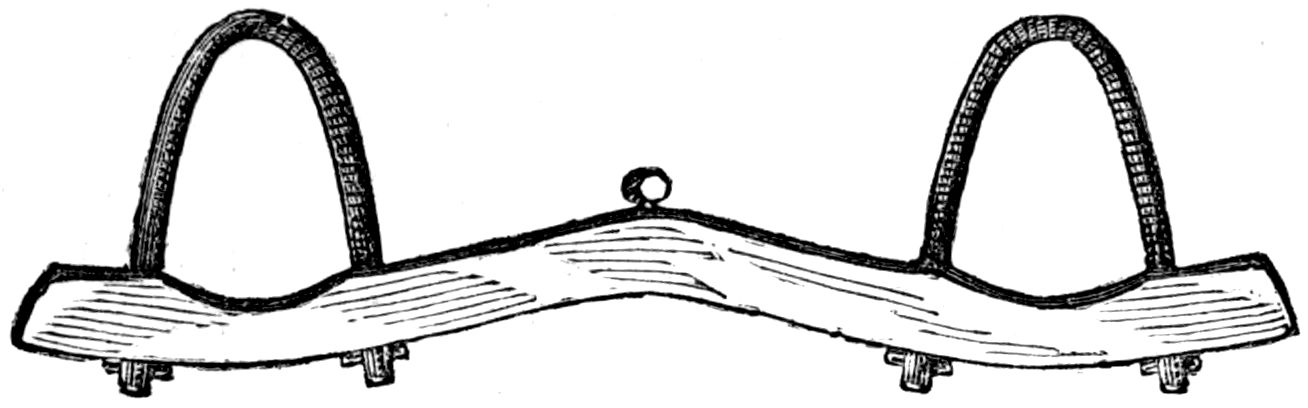
THE WESTERN YOKE.
THE “RIPPER.”The “ripper,” or driver, who is bound to the gold regions of
Pike’s Peak, is a queer specimen of humanity. He usually hails
from one of the old Atlantic cities—in fact, from settled America—and,
like the civilized man generally, he betrays a remarkable
aptitude for facile descent into savagery. His dress is a harlequinade,
typical of his disposition. Eschewing the chimney-pot or
stove-pipe tile of the bourgeois, he affects the “Kossuth,” an
Anglo-American version of the sombrero, which converts felt into
every shape and form, from the jaunty little head-covering of the
modern sailor to the tall steeple-crown of the old Puritan. He
disregards the trichotomy of St. Paul, and emulates St. Anthony
and the American aborigines in the length of his locks, whose
ends are curled inward, with a fascinating sausage-like roll not
unlike the Cockney “aggrawator.” If a young hand, he is probably
in the buckskin mania, which may pass into the squaw
mania, a disease which knows no cure: the symptoms are, a leather
coat and overalls to match, embroidered if possible, and finished
along the arms and legs with fringes cut as long as possible, while
a pair of gaudy moccasins, resplendent with red and blue porcelain
beads, fits his feet tightly as silken hose. I have heard of
coats worth $250, vests $100, and pants $150: indeed, the poorest
of buckskin suits will cost $75, and if hard-worked it must be renewed
every six months. The successful miner or the gambler—in
these lands the word is confined to the profession—will add
$10 gold buttons to the attractions of his attire. The older hand
prefers to buckskin a “wamba” or round-about, a red or rainbow-colored
flannel over a check cotton shirt; his lower garments,
garnished a tergo with leather, are turned into Hessians by being
thrust inside his cow-hide Wellingtons; and, when in riding gear,
he wraps below each knee a fold of deer, antelope, or cow skin,
with edges scalloped where they fall over the feet, and gartered
tightly against thorns and stirrup thongs, thus effecting that graceful
elephantine bulge of the lower leg for which “Jack ashore” is
justly celebrated. Those who suffer from sore eyes wear huge
green goggles, which give a crab-like air to the physiognomy, and
those who can not procure them line the circumorbital region with
lampblack, which is supposed to act like the surma or kohl of
the Orient. A broad leather belt supports on the right a revolver,
generally Colt’s Navy or medium size (when Indian fighting
is expected, the large dragoon pistol is universally preferred);
and on the left, in a plain black sheath, or sometimes in the more
ornamental Spanish scabbard, is a buck-horn or ivory-handled
bowie-knife. In the East the driver partially conceals his tools;
he has no such affectation in the Far West: moreover, a glance
through the wagon-awning shows guns and rifles stowed along
the side. When driving he is armed with a mammoth fustigator,
a system of plaited cow-hides cased with smooth leather; it is a
knout or an Australian stock-whip, which, managed with both
hands, makes the sturdiest ox curve and curl its back. If he
trudges along an ox-team, he is a grim and grimy man, who delights
to startle your animals with a whip-crack, and disdains to
return a salutation: if his charge be a muleteer’s, you may expect
more urbanity; he is then in the “upper-crust” of teamsters;
he knows it, and demeans himself accordingly. He can do nothing
without whisky, which he loves to call tarantula juice, strychnine,
red-eye, corn juice, Jersey lightning, leg-stretcher, “tangle-leg,”[23]
and many other hard and grotesque names; he chews tobacco
like a horse; he becomes heavier “on the shoulder” or “on
the shyoot,” as, with the course of empire, he makes his way westward;
and he frequently indulges in a “spree,” which in these
lands means four acts of drinking-bout, with a fifth of rough-and-tumble.
Briefly, he is a post-wagon driver exaggerated.
Each train is accompanied by men on horse or mule back—oxen
are not ridden after Cape fashion in these lands.[24] The equipment
of the cavalier excited my curiosity, especially the saddle,THE PRAIRIE SADDLE.
which has been recommended by good authorities for military use.
The coming days of fast warfare, when “heavies,” if not wholly
banished to the limbo of things that were, will be used as mounted
“beef-eaters,” only for show, demand a saddle with as little
weight as is consistent with strength, and one equally easy to the
horse and the rider. In no branch of improvement, except in
hat-making for the army, has so little been done as in saddles.
The English military or hunting implement still endures without
other merit than facility to the beast, and, in the man’s case, faculty
of falling uninjured with his horse. Unless the rider be copper-lined
and iron-limbed, it is little better in long marches than
a rail for riding. As far as convenience is concerned, an Arab
pad is preferable to Peat’s best. But the Californian saddle can
not supply the deficiency, as will, I think, appear in the course of
description.
The native Indian saddle is probably the degenerate offspring
of the European pack-saddle: two short forks, composing the
pommel and cantle, are nailed or lashed to a pair of narrow sideboards,
and the rude tree is kept in shape by a green skin or hide
allowed to shrink on. It remarkably resembles the Abyssinian,
the Somal, and the Circassian saddle, which, like the “dug-out”
canoe, is probably the primitive form instinctively invented by
mankind. It is the sire of the civilized saddle, which in these
lands varies with every region. The Texan is known by its circular
seat; a string passed round the tree forms a ring: provided
with flaps after the European style, it is considered easy and comfortable.
The Californian is rather oval than circular; borrowed
and improved from the Mexican, it has spread from the Pacific to
the Atlantic slope of the Rocky Mountains, and the hardy and
experienced mountaineer prefers it to all others: it much resembles
the Hungarian, and in some points recalls to mind the old
French cavalry demipique. It is composed of a single tree of
light strong wood, admitting a freer circulation of air to the horse’s
spine—an immense advantage—and, being without iron, it can
readily be taken to pieces, cleaned or mended, and refitted. The
tree is strengthened by a covering of raw-hide carefully sewed
on; it rests upon a “sweat-leather,” a padded sheet covering the
back, and it is finished off behind with an “anchero” of the same
material protecting the loins. The pommel is high, like the crutch
of a woman’s saddle, rendering impossible, under pain of barking
the knuckles, that rule of good riding which directs the cavalier
to keep his hands low. It prevents the inexperienced horseman
being thrown forward, and enables him to “hold on” when likely
to be dismounted; in the case of a good rider, its only use is
to attach the lariat, riata, or lasso. The great merit of this “unicorn”
saddle is its girthing: with the English system, the strain
of a wild bull or of a mustang “bucker” would soon dislodge the
riding gear. The “sincho” is an elastic horsehair cingle, five to
six inches wide, connected with “lariat straps,” strong thongs
passing round the pommel and cantle; it is girthed well back
from the horse’s shoulder, and can be drawn till the animal suffers
pain: instead of buckle, the long terminating strap is hitched
two or three times through an iron ring. The whole saddle is
covered with a machila, here usually pronounced macheer, two
pieces of thick leather handsomely and fancifully worked or
stamped, joined by a running thong in the centre, and open to
admit the pommel and cantle. If too long, it draws in the stirrup-leathers,
and cramps the ankles of any but a bowlegged man.
The machila is sometimes garnished with pockets, always with
straps behind to secure a valise, and a cloak can be fastened over
the pommel, giving purchase and protection to the knees. The
rider sits erect, with the legs in a continuation of the body line,
and the security of the balance-seat enables him to use his arms
freely: the pose is that of the French schools in the last century,
heels up and toes down. The advantages of this equipment are
obvious; it is easier to horse and man probably than any yet invented.
On the other hand, the quantity of leather renders it
expensive: without silver or other ornaments, the price would
vary from $25 at San Francisco to $50 at Great Salt Lake City,
and the highly got-up rise to $250 = £50 for a saddle! If the
saddle-cloth slips out, and this is an accident which frequently
occurs, the animal’s back will be galled. The stirrup-leathers
can not be shortened or lengthened without dismounting, and
without leggins the board-like leather macheer soon makes the
mollets innocent of skin. The pommel is absolutely dangerous:
during my short stay in the country I heard of two accidents, one
fatal, caused by the rider being thrown forward on his fork. Finally,
the long seat, which is obligatory, answers admirably with
the Californian pacer or canterer, but with the high-trotting military
horse it would inevitably lead—as has been proved before
the European stirrup-leather was shortened—to hernias and other
accidents.
To the stirrups I have but one serious objection—they can not
be made to open in case of the horse falling; when inside the
stiff leather macheer, they cramp the legs by bowing them inward,
but habit soon cures this. Instead of the light iron contrivances
which before recovered play against the horse’s side,
which freeze the feet in cold, and which toast them in hot weather,
this stirrup is sensibly made of wood. In the Eastern States
it is a lath bent somewhat in the shape of the dragoon form, and
has too little weight; the Californian article is cut out of a solid
block of wood, mountain mahogany being the best, then maple,
and lastly the softer pine and cotton-wood. In some parts of the
country it is made so narrow that only the toe fits in, and then
the instep is liable to be bruised. For riding through bush and
thorns, it is provided in front with zapateros or leathern curtains,
secured to the straps above, and to the wood on both sides: they
are curiously made, and the size, like that of the Turk’s lantern,
denotes the owner’s fashionableness; dandies may be seen with
the pointed angles of their stirrup-guards dangling almost to the
ground. The article was borrowed from Mexico—the land of
character dresses. When riding through prickly chapparal, the
leathers begin higher up, and protect the leg from the knee downward.
I would not recommend this stirrup for Hyde Park, or
even Brighton; but in India and other barbarous parts of the
British empire, where, on a cold morning’s march, men and officers
may be seen with wisps of straw defending their feet from
the iron, and on African journeys, where the bush is more than
a match for any texture yet woven, it might, methinks, be advantageously
used.
The same may be said of the THE PRAIRIE SPUR.spurs, which, though cruel in appearance,
are really more merciful than ours. The rowels have
spikes about two inches long; in fact, are the shape and size of a
small starfish; but they are never sharpened, and the tinkle near
the animal’s sides serves to urge it on without a real application.
The two little bell-like pendants of metal on each side of the rowel-hinge
serve to increase the rattling, and when a poor rider is
mounted upon a tricksy horse, they lock the rowels, which are
driven into the sincho, and thus afford another point d’appui. If
the rider’s legs be long enough, the spurs can be clinched under
the pony’s belly. Like the Mexican, they can be made expensive: $25
a pair would be a common price.
BRIDLE.The bridle is undoubtedly the worst part of the horse’s furniture.
The bit is long, clumsy, and not less cruel than a Chifney.
I have seen the Arab ring, which, with sufficient leverage, will
break a horse’s jaw, and another, not unlike an East Indian invention,
with a sharp triangle to press upon the animal’s palate, apparently
for the purpose of causing it to rear and fall backward.
It is the offspring of the Mexican manége, which was derived,
through Spain, from the Moors.
Passing through Ash Point at 9 30 A.M., and halting for water
at Uncle John’s Grocery, where hang-dog Indians, squatting,
standing, and stalking about, showed that the forbidden luxury—essence
of corn—was, despite regulations, not unprocurable there,
we spanned the prairie to Guittard’s Station. This is a clump of
board houses on the far side of a shady, well-wooded creek—the
Vermilion, a tributary of the Big Blue River, so called from its red
sandstone bottom, dotted with granitic and porphyritic boulders.
Our conductor had sprained his ankle, and the driver, being in
plain English drunk, had dashed like a Phaeton over the “chuck-holes;”
we willingly, therefore, halted at 11 30 A.M. for dinner.
The host was a young Alsatian, who, with his mother and sister,
had emigrated under the excitement of Californian fever, and had
been stopped, by want of means, half way. The improvement
upon the native was palpable: the house and kitchen were clean,
the fences neat; the ham and eggs, the hot rolls and coffee, were
fresh and good, and, although drought had killed the salad, we
had abundance of peaches and cream, an offering of French to
American taste which, in its simplicity, luxuriates in the curious
mixture of lacteal with hydrocyanic acid.
At Guittard’s I saw, for the first time, the Pony Express rider
arrive. In March, 1860, “the great dream of news transmitted
from New York to San Francisco (more strictly speaking from St.
Joseph to Placerville, California) in eight days was tested.” It
appeared, in fact, under the form of an advertisement in the St.
Louis “Republican,”[25] and threw at once into the shade the great
Butterfield Mail, whose expedition had been the theme of universal
praise. Very meritoriously has the contract been fulfilled.
At the moment of writing (Nov., 1860), the distance between
New York and San Francisco has been farther reduced by the
advance of the electric telegraph—it proceeds at the rate of six
miles a day—to Fort Kearney from the Mississippi and to Fort
Churchill from the Pacific side. The merchant thus receives his
advices in six days. The contract of the government with Messrs.
Russell, Majors, and Co., to run the mail from St. Joseph to Great
Salt Lake City, expired the 30th of November, and it was proposed
to, continue it only from Julesburg on the crossing of the
South Platte, 480 miles west of St. Joseph. Mr. Russell, however,
objected, and so did the Western States generally, to abbreviating
the mail-service as contemplated by the Post-office Department.
His spirit and energy met with supporters whose interest it was
not to fall back on the times when a communication between New
York and California could not be secured short of twenty-five or
thirty days; and, aided by the newspapers, he obtained a renewal
of his contract. The riders are mostly youths, mounted upon active
and lithe Indian nags. They ride 100 miles at a time—about
eight per hour—with four changes of horses, and return to their
stations the next day: of their hardships and perils we shall hear
more anon. The letters are carried in leathern bags, which are
thrown about carelessly enough when the saddle is changed, and
the average postage is $5 = £1 per sheet.
Beyond Guittard’s the prairies bore a burnt-up aspect. Far
as the eye could see the tintage was that of the Arabian Desert,
sere and tawny as a jackal’s back. It was still, however, too early;THE PRAIRIE FIRES.
October is the month for those prairie fires which have so frequently
exercised the Western author’s pen. Here, however, the
grass is too short for the full development of the phenomenon,
and beyond the Little Blue River there is hardly any risk. The
fire can easily be stopped, ab initio, by blankets, or by simply rolling
a barrel; the African plan of beating down with boughs might
also be used in certain places; and when the conflagration has
extended, travelers can take refuge in a little Zoar by burning the
vegetation to windward. In Texas and Illinois, however, where
the grass is tall and rank, and the roaring flames leap before the
wind with the stride of maddened horses, the danger is imminent,
and the spectacle must be one of awful sublimity.
In places where the land seems broken with bluffs, like an
iron-bound coast, the skeleton of the earth becomes visible; the
formation is a friable sandstone, overlying fossiliferous lime, which
is based upon beds of shale. These undergrowths show themselves
at the edges of the ground-waves and in the dwarf precipices,
where the soil has been degraded by the action of water.
The yellow-brown humus varies from forty to sixty feet deep in
the most favored places, and erratic blocks of porphyry and various
granites encumber the dry water-courses and surface drains.
In the rare spots where water then lay, the herbage was still green,
forming oases in the withering waste, and showing that irrigation
is its principal, if not its only want.
Passing by Marysville, in old maps Palmetto City, a county
town which thrives by selling whisky to ruffians of all descriptions,
we forded before sunset the “Big Blue,” a well-known tributary
of the Kansas River. It is a pretty little stream, brisk and
clear as crystal, about forty or fifty yards wide by 2·50 feet deep
at the ford. The soil is sandy and solid, but the banks are too
precipitous to be pleasant when a very drunken driver hangs on
by the lines of four very weary mules. We then stretched once
more over the “divide”—the ground, generally rough or rolling,
between the fork or junction of two streams, in fact, the Indian
Doab—separating the Big Blue from its tributary the Little Blue.
At 6 P.M. we changed our fagged animals for fresh, and the land
of Kansas for Nebraska, at Cotton-wood Creek, a bottom where
trees flourished, where the ground had been cleared for corn, and
where we detected the prairie wolf watching for the poultry. The
fur of our first coyote was light yellow-brown, with a tinge of red,
the snout long and sharp, the tail bushy and hanging, the gait
like a dog’s, and the manner expressive of extreme timidity; it
is a far more cowardly animal than the larger white buffalo-wolf
and the black wolf of the woods, which are also far from fierce.
At Cotton-wood Station we took “on board” two way-passengers,
“lady” and “gentleman,” who were drafted into the wagon containing
the Judiciary. A weary drive over a rough and dusty
road, through chill night air and clouds of musquetoes, which we
were warned would accompany us to the Pacific slope of the
Rocky Mountains, placed us about 10 P.M. at Rock, also called
Turkey Creek—surely a misnomer; no turkey ever haunted so
villainous a spot! Several passengers began to suffer from fever
and nausea; in such travel the second night is usually the crisis,
after which a man can endure for an indefinite time. The “ranch”
was a nice place for invalids, especially for those of the softer sex.
Upon the bedded floor of the foul “doggery” lay, in a seemingly
promiscuous heap, men, women, children, lambs, and puppies, all
fast in the arms of Morpheus, and many under the influence of a
much jollier god. The employés, when aroused pretty roughly,
blinked their eyes in the atmosphere of smoke and musquetoes,
and declared that it had been “merry in hall” that night—the
effects of which merriment had not passed off. After half an
hour’s dispute about who should do the work, they produced cold
scraps of mutton and a kind of bread which deserves a totally
distinct generic name. The strongest stomachs of the party made
tea, and found some milk which was not more than one quarter
flies. This succulent meal was followed by the usual douceur.
On this road, however mean or wretched the fare, the station-keeper,
who is established by the proprietor of the line, never
derogates by lowering his price.
The Valley of the Little Blue, 9th August.
LITTLE BLUE RIVER VALLEY.A little after midnight we resumed our way, and in the state
which Mohammed described when he made his famous night
journey to heaven—bayni ’l naumi wa ’l yakzán—we crossed the
deep shingles, the shallow streams, and the heavy vegetation of
the Little Sandy, and five miles beyond it we forded the Big
Sandy. About early dawn we found ourselves at another station,
better than the last only as the hour was more propitious. The
colony of Patlanders rose from their beds without a dream of ablution,
and clearing the while their lungs of Cork brogue, prepared
a neat déjeûner à la fourchette by hacking “fids” off half a
sheep suspended from the ceiling, and frying them in melted tallow.
Had the action occurred in Central Africa, among the Esquimaux,
or the Araucanians, it would not have excited my attention:
mere barbarism rarely disgusts; it is the unnatural cohabitation
of civilization with savagery that makes the traveler’s
gorge rise.
Issuing from Big Sandy Station at 6 30 A.M., and resuming
our route over the divide that still separated the valleys of the
Big Blue and the Little Blue, we presently fell into the line of
the latter, and were called upon by the conductor to admire it.
It is pretty, but its beauties require the cosmetic which is said to
act unfailingly in the case of fairer things—the viewer should
have lately spent three months at sea, out of sight of rivers and
women. Averaging two miles in width, which shrinks to one
quarter as you ascend, the valley is hedged on both sides by low
rolling bluffs or terraces, the boundaries of its ancient bed and
modern debordements. As the hills break off near the river, they
show a diluvial formation; in places they are washed into a variety
of forms, and being white, they stand out in bold relief. In
other parts they are sand mixed with soil enough to support a
last-year’s growth of wheat-like grass, weed-stubble, and dead
trees, that look like old corn-fields in new clearings. One could
not have recognized at this season Colonel Frémont’s description
written in the month of June—the “hills with graceful slopes
looking uncommonly green and beautiful.” Along the bluffs the
road winds, crossing at times a rough projecting spur, or dipping
into some gully washed out by the rains of ages. All is barren
beyond the garden-reach which runs along the stream; there is
not a tree to a square mile—in these regions the tree, like the bird
in Arabia and the monkey in Africa, signifies water—and animal
life seems well-nigh extinct. As the land sinks toward the river
bottom, it becomes less barren. The wild sunflower (Helianthus)—it
seldom, however, turns toward the sun—now becomes abundant;
it was sparse near the Missouri; it will wax even more
plentiful around Great Salt Lake City, till walking through the
beds becomes difficult. In size it greatly varies according to the
quality of the soil; six feet is perhaps the maximum. It is a
growth of some value. The oleaginous seeds form the principal
food of half-starved Indians, while the stalks supply them with a
scanty fuel: being of rapid growth, it has been used in the States
to arrest the flow of malaria, and it serves as house and home to
the rattlesnake. Conspicuous by its side is the sumach, whose
leaf, mixed with kinnikinik, the peel of the red willow, forms the
immemorial smoking material of the Wild Man of the North.
Equally remarkable for their strong odor are large beds of wild
onions; they are superlatively wholesome, but they effect the
eater like those of Tibet. The predominant colors are pink and
yellow, the former a lupine, the latter a shrub, locally called the
rabbit-bush. The blue lupine also appears with the white mallow,
the eccentric putoria, and the taraxacum (dandelion), so much
used as salad in France and in the Eastern States. This land appears
excellently adapted for the growth of manioc or cassava.
In the centre of the bottom flows the brownish stream, about
twenty yards wide, between two dense lines of tall sweet cotton-wood.
The tree which was fated to become familiar to us during
our wanderings is a species of poplar (P. monilifera), called by the
Americo-Spaniards, and by the people of Texas and New Mexico,
“Alamo:” resembling the European aspen, without its silver
lining, the color of the leaf, in places, appears of a dull burnished
hue, in others bright and refreshingly green. Its trivial name is
derived, according to some, from the fibrous quality of the bark,
which, as in Norway, is converted into food for cattle and even
man; according to others, from the cotton-like substance surrounding
the seeds. It is termed “sweet” to distinguish it from
a different tree with a bitter bark, also called a cotton-wood or
narrow-leaved cotton-wood (Populus angustifolia), and by the Canadians
liard amère. The timber is soft and easily cut; it is in
many places the only material for building and burning, and the
recklessness of the squatters has already shortened the supply.
This valley is the Belgium of the adjoining tribes, the once
terrible Pawnees, who here met their enemies, the Dakotahs and
the Delawares: it was then a great buffalo ground; and even
twenty years ago it was well stocked with droves of wild horses,
turkeys, and herds of antelope, deer, and elk. The animals have
of late migrated westward, carrying off with them the “bones of
contention.” Some details concerning the present condition of
these bands and their neighbors may not be uninteresting—these
poor remnants of nations which once kept the power of North
America at bay, and are now barely able to struggle for existence.
In 1853, the government of the United States, which has ever
acted paternally toward the Indians, treating with them—Great
Britain did the same with the East Indians—as though they were
a civilized people, availed itself of the savages’ desire to sell lands
encroached upon by the whites, and set apart for a general reservation
181,171 square miles. Here, in the Far West, were collected
into what was then believed to be a permanent habitation,
the indigenes of the land, and the various bands once lying east
of the Mississippi. This “Indian’s home” was bounded, in 1853,
on the north by the Northwestern Territory and Minnesota; on
the south by Texas and New Mexico; to the east lay Iowa, Missouri,
and Arkansas; and to the west, Oregon, Utah, and New
Mexico.
The savages’ reservation was then thus distributed. The eastern
portion nearest the river was stocked with tribes removed to
it from the Eastern States, namely, the Iowas, Sacs and Foxes,
Kickapoos, Delawares, Potawotomies, Wyandottes, Quapaws, Senecas,
Cherokees, Seminoles, Creeks, Choctaws, Chickasaws, Miamis,
and Ottawas. The west and part of the northeast—poor and
barren lands—were retained by the aboriginal tribes, Ponkahs,
Omahas or Mahas, Pawnees, Ottoes, Kansas or Konzas, and
Osages. The central and the remainder of the western portion—wild
countries abounding in buffalo—were granted to the Western
Pawnees, the Arickarees, Arapahoes, Cheyennes, Kiowas, Comanches,
Utahs, Grosventres, and other nomads.
It was somewhat a confusion of races. For instance, the Pawnees
form an independent family, to which some authors join the
Arickaree; the Sacs (Sauk) and Foxes, Winnebagoes, Ottoes,
Kaws, Omahas, Cheyennes, Mississippi Dakotahs, and Missouri
Dakotahs, belong to the Dakotan family; the Choctaws, Creeks,
and Seminoles are Appalachians; the Wyandottes, like the Iroquois,
are Hodesaunians; and the Ottawas, Delawares, Shawnees,
Potawotomies, Peorians, Mohekuneuks, Kaskaskias, Piankeshaws,
Weaws, Miamis, Kickapoos, and the Menomenes, are, like the Ojibwas,
Algonquins.
The total number of Indians on the prairies and the Rocky
Mountains was estimated roughly at 63,000.
Still the resistless tide of emigration swept westward: the federal
government was as powerless to stem it as was General Fitzroy
of New South Wales to prevent, in 1852, his subjects flocking
to the “gold diggings.” Despite all orders, reckless whites
would squat upon, and thoughtless reds, bribed by whisky, tobacco,
and gunpowder, would sell off the lands. On the 20th of May,
1854, was passed the celebrated “Kansas-Nebraska Bill,” an act
converting the greater portion of the “Indian Territory,”THE INDIAN TERRITORY. and all
the “Northwestern Territory,” into two new territories—Kansas,
north of the 37th parallel, and Nebraska, north of the 40th. In
the passage of this bill, the celebrated “Missouri Compromise” of
1828, prohibiting negro slavery north of 36° 30′, was repealed,
under the presidency of General Pierce.[26] It provided that
the
rights and properties of the Indians, within their shrunken possessions,
should be respected. By degrees the Indians sold their
lands for whisky, as of old, and retired to smaller reservations.
Of course, they suffered in the bargain; the savage ever parts
with his birthright for the well-known mess of pottage. The
Osages, for instance, canceled $4000, claimed by unscrupulous
traders, by a cession of two million acres of arable land. The
Potawotomies fared even worse; under the influence of liquor,
ὡς λεγουσι, their chiefs sold 100,000 acres of the best soil on the
banks of the Missouri for a mere song. The tribe was removed
to a bald smooth prairie, sans timber and consequently sans game;
many fled to the extreme wilds, and the others, like the Acadians
of yore, were marched about till they found homes—many of
them six feet by two—in Fever Patch, on the Kaw or Kansas
River. Others were more fortunate. The Ottoes, Omahas, and
Kansas had permanent villages near the Missouri and its two tributaries,
the Platte and the Kansas. The Osages, formerly a large
nation in Arkansas, after ceding 10,000,000 of acres for a stipend
of $52,000 for thirty years, were settled in a district on the west
bank of the Neosho or Whitewater—the Grand River. They are
described as the finest and largest men of the semi-nomad races,
with well-formed heads and symmetrical figures, brave, warlike,
and well disposed to the whites. Early in June, after planting
their maize, they move in mounted bands to the prairies, feast
upon the buffalo for months, and bring home stores of smoked
and jerked meat. When the corn is in milk they husk and sundry
it; it is then boiled, and is said to be better flavored and
more nutritious than the East Indian “butah” or the American
hominy. After the harvest in October they return to the game
country, and then pass the winter under huts or skin lodges.
Their chief scourge is small-pox: apparently, all the tribes carry
some cross. Of the settled races the best types are the Choctaws
and the Cherokees; the latter have shown a degree of improvability,
which may still preserve them from destruction; they
have a form of government, churches, theatres, and schools; they
read and write English; and George Guess, a well-known chief,
like the negro inventor of the Vai syllabarium in West Africa,
produced an alphabet of sixty-eight characters, which, improved
and simplified by the missionaries, is found useful in teaching the
vernacular.
Upon the whole, however, the philanthropic schemes of the
government have not met with brilliant success. The chiefs are
still bribed, and the people cheated by white traders, and poverty,
disease, and debauchery rapidly thin the tribesmen. Sensible
heads have proposed many schemes for preserving the race. Apparently
the best of these projects is to introduce the Moravian
discipline. MISSIONARIES.
Of all missionary systems, I may observe, none have
hitherto been crowned with important results, despite the blood
and gold so profusely expended upon them, except two—those of
the Jesuits and the United Brethren. The fraternity of Jesus
spread the Gospel by assimilating themselves to the heathen; the
Unitas Fratrum by assimilating the heathen to themselves. The
day of Jesuitism, like that of protection, is going by. The advance
of Moravianism, it may safely be prophesied, is to come.
These civilization societies have as yet been little appreciated, because
they will not minister to that ignorant enthusiasm which
extracts money from the pockets of the many. Their necessarily
slow progress is irksome to ardent propagandists. We naturally
wish to reap as well as to sow; and man rarely invests capital in
schemes of which only his grandson will see the results.
The American philanthropist proposes to wean the Indian savage
from his nomad life by turning his lodge into a log tent, and
by providing him with cattle instead of buffalo, and the domestic
fowl instead of grasshoppers. The hunter become a herdsman
would thus be strengthened for another step—the agricultural
life, which necessarily follows the pastoral. Factors would be appointed
instead of vicious traders—coureurs des bois, as the Canadians
call them; titles to land would be granted in fee-simple,
practically teaching the value of property in severalty, alienation
into white hands would be forbidden, and, if possible, a cordon
militaire would be stretched between the races. The agricultural
would lead to the mechanical stage of society. Agents and assistant
craftsmen would teach the tribes to raise mills and smithies
(at present there are mills without millers, stock without breeders,
and similar attempts to make civilization run before she can
walk), and a growing appreciation for the peace, the comfort, and
the luxuries of settled life would lay the nomad instinct forever.
The project labors only under one difficulty—the one common
to philanthropic schemes. In many details it is somewhat visionary—utopian.
It is, like peace on earth, a “dream of the wise.”
Under the present system of Indian agencies, as will in a future
page appear, it is simply impossible. It has terrible obstacles in
the westward gravitation of the white race, which, after sweeping
away the aborigines—as the gray rat in Europe expelled the black
rat—from the east of the Mississippi in two centuries and a half,
threatens, before a quarter of that time shall have elapsed, to drive
in its advance toward the Pacific the few survivors of now populous
tribes, either into the inhospitable regions north of the 49th
parallel, or into the anarchical countries south of the 32d. And
where, I may ask, in the history of the world do we read of a people
learning civilization from strangers instead of working it out
for themselves, through its several degrees of barbarism, feudalism,
monarchy, republicanism, despotism? Still it is a noble project;
mankind would not willingly see it die.
THE PAWNEES.The Pawnees were called by the French and Canadian traders
Les Loups, that animal being their totem, and the sign of the tribe
being an imitation of the wolf’s ears, the two fore fingers of the right
hand being stuck up on the side of the head. They were in the last
generation a large nation, containing many clans—Minnikajus, the
Sans Arc, the Loup Fork, and others. Their territory embraced
both sides of the Platte River, especially the northern lands; and
they rendered these grounds terrible to the trapper, trader, and
traveler. They were always well mounted. Old Mexico was then,
and partially is still, their stable, and a small band has driven off
horses by hundreds. Of late years they have become powerless.
The influenza acts as a plague among them, killing off 400 or
500 in a single season, and the nation now numbers little more
than 300 braves, or rather warriors, the latter, in correct parlance,
being inferior to the former, as the former are subservient to the
chief. A treaty concluded between them and the United States
in the winter of 1857 sent them to a reserve on the Loup Fork,
where their villages were destroyed by the Sioux. They are
Ishmaelites, whose hand is against every man. They have attempted,
after the fashion of declining tribes, to strengthen themselves
by alliances with their neighbors, but have always failed
in consequence of their propensity to plunder developing itself
even before the powwow was concluded. They and the northern
Dakotahs can never be trusted. Most Indian races, like the Bedouin
Arabs, will show hospitality to the stranger who rides into
their villages, though no point of honor deters them from robbing
him after he has left the lodge-shade. The Pawnees, African-like,
will cut the throat of a sleeping guest. They are easily distinguished
from their neighbors by the scalp-lock protruding from
a shaven head. After killing white men, they have insulted the
corpse in a manner familiar to those who served in the Affghan
war. They have given up the practice of torturing prisoners,
saying that the “Great Spirit,” or rather, as the expression should
be translated, the “Great Father” no longer wills it. The tradition
is, that a few years ago a squaw of a hostile tribe was snatched
from the stake by a white trader, and the action was interpreted
as a decree of heaven. It is probably a corruption of the
well-known story of the rescue of the Itean woman by Petalesharoo,
the son of the “Knife Chief.” Like the Southern and Western
Indians generally, as is truly remarked by Captain Mayne
Reid,[27] “They possess more of that cold continence and chivalrous
delicacy than characterize the Red Men of the forest.” They
are too treacherous to be used as soldiers. Like most pedestrian
Indians, their arms and bodies are light and thin, and their legs
are muscular and well developed. They are great in endurance.
I have heard of a Pawnee, who, when thoroughly “stampeded”
by his enemies, “loped” from Fort Laramie to Kearney—300
miles—making the distance as fast as the mail. This bad tribe
is ever at war with their hereditary enemies the Sioux. They
do not extend westward of Fort Kearney. The principal sub-tribe
is the Arickaree, or Ree, called Pedani by the Dakotah, who
attacked and conquered them. Their large villages, near the
mouth of the Grand River, were destroyed by the expedition sent
in 1825-26, under Colonel Leavenworth, to chastise the attack
upon the trading party of General Ashley.
THE DELAWARES.A more interesting people than the Pawnee is the Delaware,
whose oldest tradition derives him from the region west of the
Mississippi. Thence the tribe migrated to the Atlantic shores,
where they took the title of Lenne Lenape, or men, and the neighboring
races in respect called them “uncle.” William Penn and
his followers found this remnant of the great Algonquin confederacy
in a depressed state: subjugated by the Five Nations, they
had been compelled to take the name of “Iroquois Squaws.” In
those days they felt an awe of the white man, and looked upon
him as a something godlike. Since their return to the West their
spirit has revived, their war-path has reached through Utah to
the Pacific Ocean, to Hudson’s Bay on the north, and southward
to the heart of Mexico. Their present abodes are principally near
Fort Leavenworth upon the Missouri, and in the Choctaw territory
near Fort Arbuckle, upon the eastern Colorado or Canadian
River. They are familiar with the languages, manners, and customs
of their pale-faced neighbors; they are so feared as rifle
shots that a host of enemies will fly from a few of their warriors,
and they mostly lead a vagrant life, the wandering Jews of the
West, as traders, hunters, and trappers, among the other Indian
tribes. For 185 years the Shawnees have been associated with
them in intermarriage, yet they are declining in numbers; here
and there some are lost, one by one, in travel or battle; they have
now dwindled to about a hundred warriors, and the extinction of
the tribe appears imminent. As hunters and guides, they are
preferred to all others by the whites, and it is believed that they
would make as formidable partisan soldiers as any on this continent.
When the government of the United States, after the fashion
of France and England, begins to raise “Irregular Native
Corps,” the loss of the Delawares will be regretted.
Changing mules at Kiowa about 10 A.M., we pushed forward
through the sun, which presently was mitigated by heavy nimbi,
to Liberty Farm, where a station supplied us with the eternal
eggs and bacon of these mangeurs de lard. It is a dish constant
in the great West, as the omelet and pigeon in the vetturini days
of Italy, when, prompted by the instincts of self-preservation, the
inmates of the dove-cot, unless prevented in time, are said to have
fled their homes at the sight of Milordo’s traveling carriage, not
to return until the portent had disappeared. The Little Blue ran
hard by, about fifty feet wide by three or four deep, fringed with
emerald-green oak groves, cotton-wood, and long-leaved willow:
its waters supply catfish, suckers, and a soft-shelled turtle, but the
fish are full of bones, and taste, as might be imagined, much like
mud. The country showed vestiges of animal life, the prairie
bore signs of hare and antelope; in the valley, coyotes, wolves,
and foxes, attracted by the carcasses of cattle, stared us in the
face, and near the stream, plovers, jays, the bluebird (sialia), and
a kind of starling, called the swamp or redwinged blackbird, twittered
a song of satisfaction. We then resumed our journey over
a desert, waterless save after rain, for twenty-three miles; it is the
divide between the Little Blue and the Platte rivers, a broken table-land
rising gradually toward the west, with, at this season, a
barren soil of sand and clay. As the evening approached, a smile
from above lit up into absolute beauty the homely features of the
world below. The sweet commune with nature in her fairest
hours denied to the sons of cities—who must contemplate her
charms through a vista of brick wall, or over a foreground of
chimney-pots—consoled us amply for all the little hardships of
travel. Strata upon strata of cloud-banks, burnished to golden
red in the vicinity of the setting sun, and polished to dazzling silvery
white above, lay piled half way from the horizon to the zenith,
with a distinct strike toward a vanishing point in the west,
and dipping into a gateway through which the orb of day slowly
retired. Overhead floated in a sea of amber and yellow, pink and
green, heavy purple nimbi, apparently turned upside down—their
convex bulges below, and their horizontal lines high in the air—while
in the east black and blue were so curiously blended that
the eye could not distinguish whether it rested upon darkening
air or upon a lowering thunder-cloud. We enjoyed these beauties
in silence; not a soul said, “Look there!” or “How pretty!”
At 9 P.M., reaching “Thirty-two-mile Creek,” we were pleasantly
surprised to find an utter absence of the Irishry. The station-master
was the head of a neat-handed and thrifty family from
Vermont; the rooms, such as they were, looked cosy and clean—and
the chickens and peaches were plump and well “fixed.” Soldiers
from Fort Kearney loitered about the adjoining store, and
from them we heard past fights and rumors of future wars which
were confirmed on the morrow. Remounting at 10 30 P.M., and
before moonrise, we threaded the gloom without other accident
than the loss of a mule that was being led to the next station.
The amiable animal, after breaking loose, coquetted with its pursuers
for a while, according to the fashion of its kind, and when
the cerne or surround was judged complete, it dashed through the
circle and gave leg-bail, its hoofs ringing over the stones till the
sound died away in the distant shades.
The Platte River and Fort Kearney, August 10.
LA GRANDE PLATTE.
After a long and chilly night—extensive evaporation making
40° F. feel excessively cold—lengthened by the atrocity of the
musquetoes, which sting even when the thermometer stands below
45°, we awoke upon the hill sands divided by two miles of
level green savanna, and at 4 A.M. reached Kearney Station, in
the valley of La Grande Platte, seven miles from the fort of that
name. The first aspect of the stream was one of calm and quiet
beauty, which, however, it owed much to its accessories: some
travelers have not hesitated to characterize it as “the dreariest of
rivers.” On the south is a rolling range of red sandy and clayey
hillocks, sharp toward the river—the “coasts of the Nebraska.”
The valley, here two miles broad, resembles the ocean deltas of
great streams; it is level as a carpet, all short green grass without
sage or bush. It can hardly be called a bottom, the rise from
the water’s edge being, it is calculated, about 4 feet per 1000.
Under a bank, from half a yard to a yard high, through its two
lawns of verdure, flowed the stream straight toward the slanting
rays of the rising sun, which glittered upon its broad bosom, and
shed rosy light over half the heavens. In places it shows a sea
horizon, but here it was narrowed by Grand Island, which is fifty-two
miles long, with an average breadth of one mile and three
quarters, and sufficiently elevated above the annual flood to be
well timbered.
Without excepting even the Missouri, the Platte is doubtless
the most important western influent of the Mississippi. Its valley
offers a route scarcely to be surpassed for natural gradients,
requiring little beyond the superstructure for light trains; and by
following up its tributary—the Sweetwater—the engineer finds
a line laid down by nature to the foot of the South Pass of the
Rocky Mountains, the dividing ridge between the Atlantic and
the Pacific water-beds. At present the traveler can cross the 300
or 400 miles of desert between the settlements in the east and the
populated parts of the western mountains by its broad highway,
with never-failing supplies of water, and, in places, fuel. Its banks
will shortly supply coal to take the place of the timber that has
thinned out.
The Canadian voyageurs first named it La Platte, the Flat River,
discarding, or rather translating after their fashion, the musical and
picturesque aboriginal term, “Nebraska,” the “shallow stream:”
the word has happily been retained for the Territory. Springing
from the eastern slope of the Rocky Mountains, it has, like all the
valley streams westward of the Mississippi, the Niobrara, or Eau
qui court,[28] the Arkansas, and the Canadian River, a declination
to the southeast. From its mouth to the junction of its northern
and southern forks, the river valley is mostly level, and the scenery
is of remarkable sameness: its singularity in this point affects
the memory. There is not a tributary, not a ravine, in places not
a tree to distract attention from the grassy intermediate bottom,
which, plain as a prairie, extends from four to five and even twelve
miles in width, bounded on both sides by low, rolling, sandy hills,
thinly vegetated, and in few places showing dwarf bluffs. Between
the forks and Fort Laramie the ground is more accented,
the land near its banks often becomes precipitous, the road must
sometimes traverse the tongues and ridges which project into the
valley, and in parts the path is deep with sand. The stream averages
about a mile in breadth, and sometimes widens out into the
semblance of an estuary, flowing in eddies where holes are, and
broken by far-reaching sand-bars and curlew shallows. In places
it is a labyrinth of islets, variously shaped and of all sizes, from
the long tongue which forms a vista to the little bouquet of cool
verdure, grass, young willows, and rose-bushes. The shallowness
of the bed causes the water to be warm in summer; a great contrast
to the clear, cool springs on its banks. The sole is treacherous
in the extreme, full of quicksands and gravel shoals, channels
and cuts, which shift, like those of the Indus, with each year’s
flood; the site being nearly level, the river easily swells, and the
banks, here of light, there of dark colored silt, based, like the floor,
on sand, are, though vertical, rarely more than two feet high. It
is a river willfully wasted by nature. The inundation raises it to
about six feet throughout: this freshet, however, is of short duration,
and the great breadth of the river causes a want of depth
which renders it unfit for the navigation of a craft more civilized
than the Indian’s birch or the Canadian fur-boat. Colonel Frémont
failed to descend it in September with a boat drawing only
four inches. The water, like that of the Missouri, and for the same
reason, is surcharged with mud drained from the prairies; carried
from afar, it has usually a dark tinge; it is remarkably opaque
after floods; if a few inches deep, it looks bottomless, and, finally,
it contains little worth fishing for. From the mouth to Fort Kearney,
beyond which point timber is rare, one bank, and one only,
is fringed with narrow lines of well-grown cotton-wood, red willows,
and cedars, which are disappearing before the emigrant’s
axe. The cedar now becomes an important tree. It will not grow
on the plains, owing to the dryness of the climate and the excessive
cold; even in the sheltered ravines the wintry winds have
power to blight all the tops that rise above prairie level, and where
the locality is better adapted for plantations, firs prevail. An interesting
effect of climate upon the cedar is quoted by travelers
on the Missouri River. At the first Cedar Island (43° N. lat.) large
and straight trees appear in the bottom lands, those on the bluffs
being of inferior growth; higher up the stream they diminish,
seldom being seen in any number together above the mouth of
the Little Cheyenne (45° N. lat.), and there they are exceedingly
crooked and twisted. In the lignite formations above the Missouri
and the Yellow Stone, the cedar, unable to support itself
above ground, spreads over the hill-sides and presents the appearance
of grass or moss.
Beyond the immediate banks of the Platte the soil is either
sandy, quickly absorbing water, or it is a hard, cold, unwholesome
clay, which long retains muddy pools, black with decayed
vegetation, and which often, in the lowest levels, becomes a mere
marsh. The wells deriving infiltration from the higher lands beyond
are rarely more than three feet deep; the produce is somewhat
saline, and here and there salt may be seen efflorescing from
the soil around them. In the large beds of prêle (an equisetum),
scouring rush, and other aquatic plants which garnish the banks,
myriads of musquetoes find a home. Flowers of rich, warm color
appear, we remark, in the sandy parts: the common wild helianthus
and a miniature sunflower like chamomile, a thistle (Carduus
leucographus), the cactus, a peculiar milk-plant (Asclepias syrivea),
a spurgewort (Asclepias tuberosa), the amorpha, the tradescantia,
the putoria, and the artemisia, or prairie sage. THE WILD GARDEN.The richer soils
and ravines produce in abundance the purple aster—violet of
these regions—a green plant, locally known as “Lamb’s Quarters,”
a purple flower with bulbous root, wild flax with pretty
blue blossoms, besides mallow, digitalis, anemone, streptanthis,
and a honeysuckle. In parts the valley of the Platte is a perfect
parterre of wild flowers.
After satisfying hunger with vile bread and viler coffee—how
far from the little forty-berry cup of Egypt!—for which we paid
75 cents, we left Kearney Station without delay. Hugging the
right bank of our strange river, at 8 A.M. we found ourselves at
Fort Kearney, so called, as is the custom, after the gallant officer,
now deceased, of that name.
Every square box or block-house in these regions is a fort; no
misnomer, however, can be more complete than the word applied
to the military cantonments on the frontier. In former times the
traders to whom these places mostly belonged erected quadrangles
of sun-dried brick with towers at the angles; their forts still
appear in old books of travels: the War Department, however,
has been sensible enough to remove them. The position usually
chosen is a river bottom, where fuel, grass, and water are readily
procurable. The quarters are of various styles; some, with their
low verandas, resemble Anglo-Indian bungalows or comfortable
farm-houses; others are the storied houses, with the “stoop” or
porch of the Eastern States in front; and low, long, peat-roofed
tenements are used for magazines and out-houses. The best material
is brown adobe or unburnt brick; others are of timber,
whitewashed and clean-looking, with shingle roofs, glass windows,
and gay green frames—that contrast of colors which the
New Englander loves. The habitations surround a cleared central
space for parade and drill; the ground is denoted by the tall
flag-staff, which does not, as in English camps, distinguish the
quarters of the commanding officer. One side is occupied by the
officers’ bungalows, the other, generally that opposite, by the adjutant’s
and quartermaster’s offices, and the square is completed
by low ranges of barrack and commissariat stores, while various
little shops, stables, corrals for cattle, a chapel, perhaps an artillery
park, and surely an ice-house—in this point India is far behind
the wilds of America—complete the settlement. Had these
cantonments a few more trees and a far more brilliant verdure,
they would suggest the idea of an out-station in Guzerat, the Deccan,
or some similar Botany Bay for decayed gentlemen who
transport themselves.
While at Washington I had resolved—as has already been intimated—when
the reports of war in the West were waxing loud,
to enjoy a little Indian fighting.INDIAN FIGHTING. The meritorious intention—for
which the severest “wig,” concluding with something personally
offensive about volunteering in general, would have been its
sole result in the “fast-anchored isle”—was most courteously received
by the Hon. John B. Floyd, Secretary of War, who provided
me with introductory letters addressed to the officers commanding
various “departments”[29]—“divisions,”
as they would
be called by Englishmen—in the West. The first tidings that
saluted my ears on arrival at Fort Kearney acted as a quietus:
an Indian action had been fought, which signified that there
would be no more fighting for some time. Captain Sturgis, of
the 1st Cavalry, U. S., had just attacked, near the Republican Fork
of Kansas River, a little south of the fort, with six companies
(about 350 men) and a few Delawares, a considerable body of the
enemy, Comanches, Kiowas, and Cheyennes, who apparently had
forgotten the severe lesson administered to them by Colonel—now
Brigadier General—Edwin V. Sumner, 1st Cavalry, in 1857,
and killed twenty-five with only two or three of his own men
wounded. According to details gathered at Fort Kearney, the
Indians had advanced under a black flag, lost courage, as wild
men mostly will, when they heard the pas de charge, and, after
making a running fight, being well mounted as well as armed, had
carried off their “cripples” lashed to their horses. I had no time
to call upon Captain Sully, who remained in command at Kearney
with two troops (here called companies) of dragoons, or heavy
cavalry, and one of infantry; the mail-wagon would halt there
but a few minutes. I therefore hurriedly chose the alternative
of advancing, with the hope of seeing “independent service” on
the road. Intelligence of the fight had made even the conductor
look grave; fifty or sixty miles is a flea-bite to a mounted war-party,
and disappointed Indians upon the war-path are especially
dangerous—even the most friendly can not be trusted when they
have lost, or have not succeeded in taking, a few scalps. We subsequently
heard that they had crossed our path, but whether the
tale was true or not is an essentially doubtful matter. If this
chance failed, remained the excitement of the buffalo and the
Mormon; both were likely to show better sport than could be
found in riding wildly about the country after runaway braves.
OUTPOST SYSTEMS.We all prepared for the “gravity of the situation” by discharging
and reloading our weapons, and bade adieu, about 9 30 A.M.,
to Fort Kearney. Before dismissing the subject of forts, I am
disposed to make some invidious remarks upon the army system
of outposts in America.
The War Department of the United States has maintained the
same system which the British, much to their loss—I need scarcely
trouble the reader with a list of evils done to the soldier by
outpost duty—adopted and pertinaciously kept up for so long a
time in India; nay, even maintain to the present day, despite the
imminent danger of mutiny. With the Anglo-Scandinavian race,
the hate of centralization in civil policy extends to military organization,
of which it should be the vital principle. The French,
gifted with instinct for war, and being troubled with scant prejudice
against concentration, civil as well as military, soon abandoned,
when they found its futility, the idea of defending their
Algerian frontier by extended lines, block-houses, and feeble intrenched
posts. They wisely established, at the centres of action,
depôts, magazines, and all the requisites for supporting large
bodies of men, making them pivots for expeditionary columns,
which by good military roads could be thrown in overwhelming
numbers, in the best health and in the highest discipline, wherever
an attack or an insurrectionary movement required crushing.
The necessity of so doing has long occurred to the American
government, in whose service at present “a regiment is stationed
to-day on the borders of tropical Mexico; to-morrow, the war-whoop,
borne on a gale from the northwest, compels its presence
to the frozen latitudes of Puget’s Sound.” The objections to altering
their present highly objectionable system are two: the first
is a civil consideration, the second a military one.
As I have remarked about the centralization of troops, so it is
with their relation to civilians; the Anglo-Scandinavian blood
shows similar manifestations in the Old and in the New Country.
The French, a purely military nation, pet their army, raise it to
the highest pitch, send it in for glory, and when it fails are to its
faults a little blind. The English and Anglo-Americans, essentially
a commercial and naval people, dislike the red coat; they
look upon, and from the first they looked upon, a standing army
as a necessary nuisance; they ever listen open-eared to projects
for cutting and curtailing army expenditure; and when they have
weakened their forces by a manner of atrophy, they expect them
to do more than their duty, and if they can not command success,
abuse them. With a commissariat, transport, and hospitals—delicate
pieces of machinery, which can not run smoothly when roughly
and hurriedly put together—unaccustomed to and unprepared
for service, they land an army 3000 miles from home, and then
make the world ring with their disappointment, and their complainings
anent fearful losses in men and money. The fact is that,
though no soldiers in the world fight with more bravery and determination,
the Anglo-Scandinavian race, with their present institutions,
are inferior to their inferiors in other points, as regards the
art of military organization. Their fatal wants are order and
economy, combined with the will and the means of selecting the
best men—these belong to the emperor, not to the constitutional
king or the president—and most of all, the habit of implicit subjection
to the commands of an absolute dictator. The end of this
long preamble is that the American government apparently thinks
less of the efficiency of its troops than of using them as escorts to
squatters, as police of the highway. Withal they fail; emigrants
will not be escorted; women and children will struggle when they
please, even, in an Indian country, and every season has its dreadful
tales of violence and starvation, massacre and cannibalism. In
France the emigrants would be ordered to collect in bodies at certain
seasons, to report their readiness for the road to the officers
commanding stations, to receive an escort, as he should deem
proper, and to disobey at their peril.
The other motive of the American outpost system is military,
but also of civilian origin. Concentration would necessarily be
unpalatable to a number of senior officers, who now draw what in
England would be called command allowances at the several stations.[30]
One of the principles of a republic is to pay a man only
while he works; pensions, like sinecures, are left to governments
less disinterested. The American army—it would hardly be believed—has
no pensions, sale of commissions, off-reckonings, nor
retiring list. A man hopelessly invalided, or in his second childhood,
must hang on by means of furloughs and medical certificates
to the end. The colonels are mostly upon the sick-list—one died
lately aged ninety-three, and dating from the days of Louis XVI.—and
I heard of an officer who, though practicing medicine for
years, was still retained upon the cadre of his regiment. Of course,
the necessity of changing such an anomaly has frequently been
mooted by the Legislature; the scandalous failure, however, of an
attempt at introducing a pension-list into the United States Navy
so shocked the public that no one will hear of the experiment being
renewed, even in corpore vili, the army.
To conclude the subject of outpost system. If the change be
advisable in the United States, it is positively necessary to the
British in India. The peninsula presents three main points, not
to mention the detached heights that are found in every province,
as the great pivots of action, the Himalayas, the Deccan, and the
Nilgherry Hills, where, until wanted, the Sepoy and his officer, as
well as the white soldier—the latter worth £100 a head—can be
kept in health, drilled, disciplined, and taught the hundred arts
which render an “old salt” the most handy of men. A few years
ago the English soldier was fond of Indian service; hardly a regiment
returned home without leaving hundreds behind it. Now,
long, fatiguing marches, scant fare, the worst accommodation, and
the various results of similar hardships, make him look upon the
land as a Golgotha; it is with difficulty that he can be prevented
from showing his disgust. Both in India and America, this will
be the great benefit of extensive railroads: they will do away with
single stations, and enable the authorities to carry out a system
of concentration most beneficial to the country and to the service,
which, after many years of sore drudgery, may at last discern the
good time coming.
In the United States, two other measures appear called for by
circumstances. The Indian race is becoming desperate, wild-beast
like, hemmed in by its enemies that have flanked it on the east
and west, and are gradually closing in upon it. The tribes can
no longer shift ground without inroads into territories already occupied
by neighbors, who are, of course, hostile; they are, therefore,
being brought to final bay.
THE CAMEL CORPS.The first is a camel corps. At present, when disturbances on a
large scale occur in the Far West—the spring of 1862 will probably
see them—a force of cavalry must be sent from the East,
perhaps also infantry. “The horses, after a march of 500 or 600
miles, are expected to act with success”—I quote the sensible remarks
of a “late captain of infantry” (Captain Patterson, U. S.
Army)—“against scattered bands of mounted hunters, with the
speed of a horse and the watchfulness of a wolf or antelope, whose
faculties are sharpened by their necessities; who, when they get
short of provisions, separate and look for something to eat, and
find it in the water, in the ground, or on the surface; whose bill
of fare ranges from grass-seed, nuts, roots, grasshoppers, lizards,
and rattlesnakes, up to the antelope, deer, elk, bear, and buffalo,
and who, having a continent to roam over, will neither be surprised,
caught, conquered, overawed, or reduced to famine by a
rumbling, bugle-blowing, drum-beating town passing through
their country on wheels, at the speed of a loaded wagon.” But
the camel would in these latitudes easily march sixty miles per
diem for a week or ten days, amply sufficient to tire out the sturdiest
Indian pony; it requires water only after every fifty hours,
and the worst soil would supply it with ample forage in the shape
of wild sage, rabbit-bush, and thorns. Each animal would carry
two men, with their arms and ammunition, rations for the time
required, bedding and regimental necessaries, with material to
make up a tente d’abri if judged necessary. The organization
should be that of the Sindh Camel Corps, which, under Sir Charles
Napier, was found so efficient against the frontier Beloch. The
best men for this kind of fighting would be the Mountaineers, or
Western Men, of the caste called “Pikes;” properly speaking,
Missourians, but popularly any “rough” between St. Louis and
California. After a sound flogging, for the purpose of preparing
their minds to admit the fact that all men are not equal, they
might be used by sea or land, whenever hard, downright fighting
is required. It is understood that hitherto the camel, despite the
careful selection by Mr. De Leon, the excellent Consul General
of the United States in Egypt, and the valuable instructions of
Hekekyan Bey, has proved a failure in the Western world. If
so, want of patience has been the sole cause; the animal must be
acclimatized by slow degrees before heavy loading to test its powers
of strength and speed. Some may deem this amount of delay
impossible. I confess my belief that the Anglo-Americans can,
within any but the extremest limits, accomplish any thing they
please—except unity.
The other necessity will be the raising of native regiments.
The French in Africa have their Spahis, the Russians their Cossacks,
and the English their Sepoys. The American government
has often been compelled, as in the case of the Creek battalion,
which did good service during the Seminole campaign, indirectly
to use their wild aborigines; but the public sentiment, or rather
prejudice, which fathers upon the modern Pawnee the burning
and torturing tastes of the ancient Mohawk, is strongly opposed
to pitting Indian against Indian in battle. Surely this is a false
as well as a mistaken philanthropy. If war must be, it is better
that Indian instead of white blood should be shed. And invariably
the effect of enlisting savages and barbarians, subjecting
them to discipline, and placing them directly under the eye of the
civilized man, has been found to diminish their ferocity. The
Bashi Buzuk, left to himself, roasted the unhappy Russian; in
the British service he brought his prisoner alive into camp with
a view to a present or promotion. When talking over the subject
with the officers of the United States regular army, they have
invariably concurred with me in the possibility of the scheme,
provided that the public animus could be turned pro instead of
con; and I have no doubt but that they will prove as leaders of
Irregulars—it would be invidious to quote names—equal to the
best of the Anglo-Indians, Skinner, Beatson, and Jacob. The
men would receive about ten dollars per man, and each corps
number 300. They would be better mounted and better armed
than their wild brethren, and they might be kept, when not required
for active service, in a buffalo country, their favorite quarters,
and their finest field for soldierlike exercises. The main
point to be avoided is the mistake committed by the British in
India, that of appointing too many officers to their Sepoy corps.
We left Kearney at 9 30 A.M., following the road which runs
forty miles up the valley of the Platte. It is a broad prairie,
plentifully supplied with water in wells two to four feet deep;
the fluid is cool and clear, but it is said not to be wholesome.
Where the soil is clayey pools abound; the sandy portions are
of course dry. Along the southern bank near Kearney are few
elevations; on the opposite or northern side appear high and
wooded bluffs. The road was rough with pitch-holes, and for the
first time I remarked a peculiar gap in the ground like an East
Indian sun-crack—in these latitudes you see none of the deep fissures
which scar the face of mother earth in tropical lands—the
effect of rain-streams and snow-water acting upon the clay. Each
succeeding winter lengthens the head and deepens the sole of this
deeply-gashed water-cut till it destroys the road. A curious mirage
appeared, doubling to four the strata of river and vegetation
on the banks. The sight and song of birds once more charmed
us after a desert where animal life is as rare as upon the plains
of Brazil. After fifteen miles of tossing and tumbling, we made
“Seventeen-mile Station,” and halted there to change mules.
About twenty miles above the fort the southern bank began to
rise into mounds of tenacious clay, which, worn away into perpendicular
and precipitous sections, composes the columnar formation
called O’Fallon’s Bluffs. At 1 15 P.M. we reached Plum
Creek, after being obliged to leave behind one of the conductors,
who had become delirious with the “shakes.” The establishment,
though new, was already divided into three; the little landlady,
though she worked so manfully, was, as she expressed it,
“enjoying bad health;” in other words, suffering from a “dumb
chill.” I may observe that the Prairie Traveler’s opinions concerning
the power of encamping with impunity upon the banks
of the streams in this country must not be applied to the Platte.
The whole line becomes with early autumn a hotbed of febrile
disease. And generally throughout this season the stranger
should not consider himself safe on any grounds save those defended
from the southern trade-wind, which, sweeping directly
from the Gulf of Mexico, bears with it noxious exhalations.
About Plum Ranch the soil is rich, clayey, and dotted with
swamps and “slews,” by which the English traveler will understand
sloughs. The dryer portions were a Gulistan of bright red,
blue, and white flowers, the purple aster, and the mallow, with its
parsnip-like root, eaten by the Indians, the gaudy yellow helianthus—we
remarked at least three varieties—the snowy mimulus,
the graceful flax, sometimes four feet high, and a delicate
little euphorbia, while in the damper ground appeared the polar
plant, that prairie compass, the plane of whose leaf ever turns toward
the magnetic meridian. This is the “weed-prairie,” one of
the many divisions of the great natural meadows; grass prairie,
rolling prairie, motte prairie, salt prairie, and soda prairie. It deserves
a more poetical name, for
“These are the gardens of the desert, these
The unshorn fields, boundless and beautiful,
For which the speech of England has no name.”
Buffalo herds were behind the hills, but we were too full of
sleep to follow them. The plain was dotted with blanched skulls
and bones, which would have made a splendid bonfire. Apparently
the expert voyageur has not learned that they form good
fuel; at any rate, he has preferred to them the “chips” of which
it is said that a steak cooked with them requires no pepper.[31]
We dined at Plum Creek on BUFFALO-BEEF.buffalo,
probably bull beef, the
worst and dryest meat, save elk, that I have ever tasted; indeed,
without the assistance of pork fat, we found it hard to swallow.
As every one knows, however, the two-year old cow is the best
eating, and at this season the herds are ever in the worst condition.
The animals calve in May and June, consequently they are
in August completely out of flesh. They are fattest about Christmas,
when they find it difficult to run. All agree in declaring
that there is no better meat than that of the young buffalo: the
assertion, however, must be taken cum grano salis. Wild flesh
was never known to be equal to tame, and that monarch did at
least one wise thing who made the loin of beef Sir Loin. The
voyageurs and travelers who cry up the buffalo as so delicious,
have been living for weeks on rusty bacon and lean antelope; a
rich hump with its proper menstruum, a cup of café noir as strong
as possible, must truly be a “tit-bit.” They boast that the fat
does not disagree with the eater; neither do three pounds of heavy
pork with the English plow-boy, who has probably taken less exercise
than the Canadian hunter. Before long, buffalo flesh will
reach New York, where I predict it will be held as inferior to
butcher’s meat as is the antelope to park-fed venison. While
hunting, Indians cut off the tail to test the quality of the game,
and they have acquired by habit a power of judging on the run
between fat and lean.
Resuming our weary ride, we watered at “Willow Island
Ranch,” and then at “Cold Water Ranch”—drinking-shops all—five
miles from Midway Station, which we reached at 8 P.M.
Here, while changing mules, we attempted with sweet speech and
smiles to persuade the landlady, who showed symptoms of approaching
maternity, into giving us supper. This she sturdily
refused to do, for the reason that she had not received due warning.
We had, however, the satisfaction of seeing the employés of
the line making themselves thoroughly comfortable with bread
and buttermilk. Into the horrid wagon again, and “a rollin:”
lazily enough the cold and hungry night passed on.[32]
To the Forks of the Platte. 11th August.
Precisely at 1 35 in the morning we awoke, as we came to a
halt at Cotton-wood Station. Cramped with a four days’ and four
nights’ ride in the narrow van, we entered the foul tenement,
threw ourselves upon the mattresses, averaging three to each, and
ten in a small room, every door, window, and cranny being shut—after
the fashion of these Western folks, who make up for a
day in the open air by perspiring through the night in unventilated
log huts—and, despite musquetoes, slept.
The morning brought with it no joy. We had arrived at the
westernmost limit of the “gigantic Leicestershire” to which buffalo
at this season extend, and could hope to see no trace of them
between Cotton-wood Station and the Pacific. I can not, therefore,
speak ex cathedrâ concerning this, the noblest “venerie” of
the West: almost every one who has crossed the prairies, except
myself, can. Captain Stansbury[33] will enlighten the sportsman
upon the approved method of bryttling the beasts, and elucidate
the mysteries of the “game-beef,” marrow-bone and depuis, tongue
and tender-loin, bass and hump, hump-rib and liver, which latter,
by-the-by, is not unfrequently eaten raw, with a sprinkling of
gall,[34] by the white hunter emulating his wild rival, as does the
European in Abyssinia. The Prairie Traveler has given, from
experience, the latest observations concerning the best modes of
hunting the animal. All that remains to me, therefore, is to offer
to the reader a few details collected from reliable sources, and
which are not to be found in the two works above alluded to.
The bison (Bison Americanus) is trivially known as the Prairie
Buffalo, to distinguish it from a different and a larger animal, the
Buffalo of the Woods, which haunts the Rocky Mountains. The
“Monarch of the Prairies,” the “most gigantic of the indigenous
mammalia of America,” has, it is calculated, receded westward ten
miles annually for the last 150 years. When America was discovered,
the buffalo extended down to the Atlantic shore. Thirty
years ago, bands grazed upon the banks of the Missouri River.
The annual destruction is variously computed at from 200,000 to
300,000 head: the American Fur Company receive per annum
about 70,000 robes, which are all cows; and of these not more
than 5000 fall by the hands of white men. At present there are
three well-known bands, which split up, at certain seasons, into
herds of 2000 and 3000 each. The first family is on the head-waters
of the Mississippi; the second haunts the vast crescent-shaped
valley of the Yellow Stone; while the third occupies the
prairie country between the Platte and the Arkansas. A fourth
band, westward of the Rocky Mountains, is quite extinct. Fourteen
to fifteen years ago, buffalo was found in Utah Valley, and
later still upon the Humboldt River: according to some, they
emigrated northward, through Oregon and the lands of the Blackfeet.
It is more probable, however, that they were killed off by
the severe winter of 1845, their skulls being still found scattered
in heaps, as if a sudden and general destruction had come upon
the doomed tribe.
THE BUFFALO.The buffalo is partially migratory in its habits: it appears to
follow the snow, which preserves its food from destruction. Like
the antelope of the Cape, when on the “trek,” the band may be
reckoned by thousands. The grass, which takes its name from
the animal, is plentiful in the valley of the Big Blue; it loves
the streams of little creeks that have no bottom-land, and shelters
itself under the sage. It is a small, moss-like gramen, with
dark seed, and, when dry, it has been compared by travelers to
twisted gray horsehair. Smaller herds travel in Indian file; their
huge bodies, weighing 1500 lbs., appear, from afar, like piles erected
to bridge the plain. After calving, the cows, like the African
koodoo and other antelopes, herd separately from the males, and
for the same reason, timidity and the cares of maternity. As in
the case of the elephant and the hippopotamus, the oldsters are
driven by the young ones, en charivari, from the band, and a compulsory
bachelorhood souring their temper, causes them to become
“rogues.” The albino, or white buffalo, is exceedingly rare;
even veteran hunters will confess never to have seen one. The
same may be said of the glossy black accident called the “silk
robe,” supposed by Western men to be a cross between the parent
and the offspring. The buffalo calf has been tamed by the
Flatheads and others: I have never, however, heard of its being
utilized.
The Dakotahs and other Prairie tribes will degenerate, if not
disappear, when the buffalo is “rubbed out.” There is a sympathy
between them, and the beast flies not from the barbarian and
his bow as it does before the face of the white man and his hot-mouthed
weapon. The aborigines are unwilling to allow travelers,
sportsmen, or explorers to pass through the country while
they are hunting the buffalo; that is to say, preserving the game
till their furs are ready for robes. At these times no one is permitted
to kill any but stragglers, for fear of stampeding the band;
the animal not only being timid, but also in the habit of hurrying
away cattle and stock, which often are thus irretrievably lost.
In due season the savages surround one section, and destroy it,
the others remaining unalarmedly grazing within a few miles of
the scene of slaughter. If another tribe interferes, it is a casus
belli, death being the punishment for poaching. The white man,
whose careless style of battue is notorious, will be liable to the
same penalty, or, that failing, to be plundered by even “good Indians;”
and I have heard of an English gentleman who, for persisting
in the obnoxious practice, was very properly threatened
with prosecution by the government agent.
What the cocoanut is to the East Indian, and the plantain and
the calabash to various tribes of Africans, such is the “bos” to
the carnivorous son of America. No part of it is allowed to
waste. The horns and hoofs make glue for various purposes, especially
for feathering arrows; the brains and part of the bowels
are used for curing skins; the hide clothes the tribes from head
to foot; the calf-skins form their apishamores, or saddle-blankets;
the sinews make their bow-strings, thread, and finer cord; every
part of the flesh, including the fœtus and placenta, is used for
food. The surplus hides are reserved for market. They are
prepared by the squaws, who, curious to say, will not touch a
bear-skin till the age of maternity has passed; and they prefer
the spoils of the cow, as being softer than those of the bull. The
skin, after being trimmed with an iron or bone scraper—this is
not done in the case of the “parflèche,” or thick sole-leather—and
softened with brain or marrow, is worked till thoroughly
pliable with the hands. The fumigation, which gives the finishing
touch, is confined to buckskins intended for garments. When
the hair is removed, the hides supply the place of canvas, which
they resemble in whiteness and facility of folding. Dressed with
the hair, they are used, as their name denotes, for clothing; they
serve also for rugs and bedding. In the prairies, the price ranges
from $1 to $1 50 in kind; in the Eastern States, from $5 to $10.
The fancy specimens, painted inside, decorated with eyes, and
otherwise adorned with split porcupine quills dyed a gamboge-yellow,
fetch from $8 to $35. A “buffalo” (subaudi robe) was
shown to me, painted with curious figures, which, according to
my Canadian informant, were a kind of hieroglyph or aide-mémoire,
even ruder than the Mexican picture-writing.
The Indians generally hunt the buffalo with arrows. They are
so expert in riding that they will, at full speed, draw the missile
from the victim’s flank before it falls. I have met but one officer,
Captain Heth, of the 10th Regiment, who ever acquired the art.
The Indian hog-spear has been used to advantage. Our predecessors
in Eastern conquest have killed with it the tiger and nylgau;
there is, therefore, no reason why it might not be efficiently
applied to the buffalo. Like the Bos Caffre, the bison is dull, surly,
and stupid, as well as timid and wary; it requires hard riding,
with the chance of a collar-bone broken by the horse falling into
a prairie-dog’s home; and when headed or tired an old male rarely
fails to charge.
The flies chasing away the musquetoes—even as Aurora routs
the lingering shades of night—having sounded our reveillée at
Cotton-wood Station, we proceeded by means of an “eye-opener,”
which even the abstemious judge could not decline, and the use
of the “skillet,” to prepare for a breakfast composed of various
abominations, especially cakes of flour and grease, molasses and
dirt, disposed in pretty equal parts. After paying the usual 50
cents, we started in the high wind and dust, with a heavy storm
brewing in the north, along the desert valley of the dark, silent
Platte, which here spread out in broad basins and lagoons, picturesquely
garnished with broad-leafed dock and beds of prêle,
flags and water-rushes, in which, however, we saw nothing but
traces of Monsieur Maringouin. On our left was a line of sub-conical
buttes, red, sandy-clay pyramids, semi-detached from the
wall of the rock behind them, with smooth flat faces fronting the
river, toward which they slope at the natural angle of 45°. The
land around, dry and sandy, bore no traces of rain; a high wind
blew, and the thermometer stood at 78° (F.), which was by no
means uncomfortably warm. Passing Junction-House Ranch and
Frémont Slough—whisky-shops both—we halted for “dinner,”
about 11 A.M., at Frémont Springs, so called from an excellent
little water behind the station. The building is of a style peculiar
to the South, especially Florida—two huts connected by a roofwork
of thatched timber, which acts as the best and coolest of verandas.
THE MODEL VERANDA.
The station-keeper, who receives from the proprietors of
the line $30 per month, had been there only three weeks; and
his wife, a comely young person, uncommonly civil and smiling
for a “lady,” supplied us with the luxuries of pigeons, onions,
and light bread, and declared her intention of establishing a poultry-yard.
An excellent train of mules carried us along a smooth road at
a slapping pace, over another natural garden even more flowery
than that passed on the last day’s march. There were beds of
lupins, a brilliant pink and blue predominating, the green plant
locally known as “Lamb’s Quarters” (Chenopodium album); the
streptanthis; the milk-weed, with its small white blossoms; the
anemone; the wild flax, with its pretty blue flowers, and growths
which appeared to be clematis, chamomile, and digitalis. Distant
black dots—dwarf cedars, which are yearly diminishing—lined
the bank of the Platte and the long line of River Island; they
elicited invidious comparisons from the Pennsylvanians of the
party. We halted at HALF-WAY HOUSE.Half-way House, near O’Fallon’s Bluffs, at
the quarters of Mr. M——, a compagnon de voyage, who had now
reached his home of twenty years, and therefore insisted upon
“standing drinks.” The business is worth $16,000 per annum;
the contents of the store somewhat like a Parsee’s shop in Western
India—every thing from a needle to a bottle of Champagne.
A sign-board informed us that we were now distant 400 miles from
St. Jo, 120 from Fort Kearney, 68 from the upper, and 40 from the
lower crossing of the Platte. As we advanced the valley narrowed,
the stream shrank, the vegetation dwindled, the river islands
were bared of timber, and the only fuel became buffalo chip and
last year’s artemisia. This hideous growth, which is to weary our
eyes as far as central valleys of the Sierra Nevada, will require a
few words of notice.
The artemisia, absinthe, or wild sage differs much from the panacea
concerning which the Salernitan school rhymed:
“Cur moriatur homo cui Salvia crescit in horto.”
Yet it fills the air with a smell that caricatures the odor of the
garden-plant, causing the traveler to look round in astonishment;
and when used for cooking it taints the food with a taste between
camphor and turpentine. It is of two kinds. The smaller or
white species (A. filifolia) rarely grows higher than a foot. Its
fetor is less rank, and at times of scarcity it forms tolerable fodder
for animals. The Western men have made of it, as of the
“red root,” a tea, which must be pronounced decidedly inferior
to corn coffee. The Indians smoke it, but they are not particular
about what they inhale: like that perverse p——n of Ludlow,
who smoked the bell-ropes rather than not smoke at all, or like
school-boys who break themselves in upon ratan, they use even
the larger sage as well as a variety of other graveolent growths.
The second kind (A. tridentata) is to the family of shrubs what
the prairie cedar is to the trees—a gnarled, crooked, rough-barked
deformity. It has no pretensions to beauty except in earliest
youth, and in the dewy hours when the breeze turns up its leaves
that glitter like silver in the sun; and its constant presence in
the worst and most desert tracts teaches one to regard it, like the
mangrove in Asia and Africa, with aversion. In size it greatly
varies; in some places it is but little larger than the white species;
near the Red Buttes its woody stem often attains the height
of a man and the thickness of his waist. As many as fifty rings
have been counted in one wood, which, according to the normal
calculation, would bring its age up to half a century. After its
first year, stock will eat it only when threatened with starvation.
It has, however, its use; the traveler, despite its ugliness, hails the
appearance of its stiff, wiry clumps at the evening halt: it is easily
uprooted, and by virtue of its essential oil it makes a hot and
lasting fire, and ashes over. According to Colonel Frémont, “it
has a small fly accompanying it through every change of elevation
and latitude.” The same eminent authority also suggests
that the respiration of air so highly impregnated with aromatic
plants may partly account for the favorable effect of the climate
upon consumption.
At 5 P.M., as the heat began to mitigate, we arrived at Alkali
Lake Station, and discovered some “exiles from Erin,” who supplied
us with antelope meat and the unusual luxury of ice taken
from the Platte. We attempted to bathe in the river, but found
it flowing liquid mire. The Alkali Lake was out of sight; the
driver, however, consoled me with the reflection that I should
“glimpse” alkali lakes till I was sick of them.
Yesterday and to-day we have been in a line of Indian “removes.”
The wild people were shifting their quarters for grass;
when it becomes a little colder they will seek some winter abode
on the banks of a stream which supplies fuel and where they can
find meat, so that with warmth and food, song and chat—they
are fond of talking nonsense as African negroes—and smoke and
sleep, they can while away the dull and dreary winter. Before
describing the scene, which might almost serve for a picture of
Bedouin or gipsy life—so similar are the customs of all savages—I
have something to say about the Red Man.
This is a country of misnomers. America should not, according
to the school-books, have been named America, consequently
the Americans should not be called Americans. A geographical
error, pardonable in the fifteenth century, dubbed the old tenants
of these lands Indians,[35]
but why we should still call them the THE RED MEN.Red
Men can not be conceived. I have now seen them in the north,
south, east, and west of the United States, yet never, except under
the influence of ochre or vermilion, have I seen the Red Man red.
The real color of the skin, as may be seen under the leggins, varies
from a dead pale olive to a dark dingy brown. The parts
exposed to the sun are slightly burnished, as in a Tartar or an
Affghan after a summer march. Between the two extremes above
indicated there are, however, a thousand shades of color, and often
the skin has been so long grimed in with pigment, grease, and
dirt that it suggests a brick-dust tinge which a little soap or soda
would readily remove. Indeed, the color and the complexion,
combined with the lank hair, scant beard, and similar peculiarities,
renders it impossible to see this people for the first time
without the strongest impression that they are of that Turanian
breed which in prehistoric ages passed down from above the
Himalayas as far south as Cape Comorin.
Another mistake touching the Indian is the present opinion
concerning him and his ancestors. He now suffers in public esteem
from the reaction following the high-flown descriptions of
Cooper and the herd of minor romancers who could not but make
their heroes heroes. Moreover, men acquainted only with the degenerate
Pawnees or Diggers extend their evil opinions to the
noble tribes now extinct—the Iroquois and Algonquins, for instance,
whose remnants, the Delawares and Ojibwas, justify the
high opinion of the first settlers. The exploits of King Philip,
Pontiac, Gurister Sego, Tecumseh, Keokuk, Iatan, Captain J. Brant,
Black Hawk, Red Jacket, Osceola, and Billy Bowlegs, are rapidly
fading away from memory, while the failures of such men as Little
Thunder, and those like him, stand prominently forth in modern
days. Besides the injustice to the manes and memories of
the dead, this depreciation of the Indians tends to serious practical
evils. Those who see the savage lying drunk about stations,
or eaten up with disease, expect to beat him out of the field by
merely showing their faces; they fail, and pay the penalty with
their lives—an event which occurs every year in some parts of
America.
The remove of the village presented an interesting sight—an
animated shifting scene of bucks and braves, squaws and pappooses,
ponies dwarfed by bad breeding and hard living, dogs and
puppies struggling over the plains westward. In front, singly or
in pairs, rode the men, not gracefully, not according to the rules
of Mexican manège, but like the Abyssinian eunuch, as if born
upon and bred to become part of the animal. Some went barebacked;
others rode, like the ancient chiefs of the Western Islands,
upon a saddle-tree, stirrupless, or provided with hollow blocks of
wood: in some cases the saddle was adorned with bead hangings,
and in all a piece of buffalo hide with the hair on was attached
beneath to prevent chafing. The cruel ring-bit of the Arabs is
not unknown. A few had iron curbs, probably stolen. For the
most part they managed their nags with a hide thong lashed round
the lower jaw and attached to the neck. A whip, of various sizes
and shapes, sometimes a round and tattooed ferule, more often a
handle like a butcher’s tally-stick, flat, notched, one foot long, and
provided with two or three thongs, hung at the wrist. Their
nags were not shod with parflèche, as among the horse-Indians of
the South. Their long, lank, thick, brownish-black hair, ruddy
from the effects of weather, was worn parted in the middle, and
depended from the temples confined with a long twist of otter or
beaver’s skin in two queues, or pig-tails, reaching to the breast:
from the poll, and distinct from the remainder of the hair, streamed
the scalp-lock. This style of hair-dressing, doubtless, aids in
giving to the coronal region that appearance of depression which
characterizes the North American Indians as a race of “Flatheads,”
and which, probably being considered a beauty, led to the
artificial deformities of the Peruvian and the Aztec. The parting
in men, as well as in women, was generally colored with vermilion,
and plates of brass or tin, with beveled edges, varying in size
from a shilling to half a crown, were inserted into the front hair.
The scalp-lock—in fops the side-locks also—was decorated with
tin or silver plates, often twelve in number, beginning from the
head and gradually diminishing in size as they approached the
heels; a few had eagle’s, hawk’s, and crow’s feathers stuck in the
hair, and sometimes, grotesquely enough, crownless Kossuth hats,
felt broadbrims, or old military casquettes, surmounted all this
finery. Their scanty beard was removed; they compare the
bushy-faced European to a dog running away with a squirrel in
its mouth. In their ears were rings of beads, with pendants of
tin plates or mother of pearl, or huge circles of brass wire not unlike
a Hindoo tailor’s; and their fore-arms, wrists, and fingers were,
after an African fashion, adorned with the same metals, which the
savage ever prefers to gold or silver. Their other decorations
were cravats of white or white and blue, oval beads, and necklaces
of plates like those worn in the hair. PRAIRIE-INDIAN DRESS.The body dress was
a tight-sleeved waistcoat of dark drugget, over an American cotton
shirt; others wore tattered flannels, and the middle was wrapped
round with a common blanket, presented by the government
agent—scarlet and blue being the colors preferred, white rare: a
better stuff is the coarse broadcloth manufactured for the Indian
market in the United States. The leggins were a pair of pantaloons
without the body part—in their palmy days the Indians
laughed to scorn their future conquerors for tightening the hips
so as to impede activity—looped up at both haunches with straps
to a leathern girdle, and all wore the breech-cloth, which is the
common Hindoo languti or T-bandage. The cut of the leggins is
a parallelogram, a little too short and much too broad for the
limb; it is sewn so as to fit tight, and the projecting edges, for
which the light-colored list or bordering is usually preserved, answers
the effect of a military stripe. When buckskin leggins are
made the outside edges are fringed, producing that feathered appearance
which distinguishes in our pictures the nether limbs of
the Indian brave. The garb ends with moccasins,[36] the American
brogues, which are made in two ways. The simplest are of one
piece, a cylinder of skin cut from above and below the hock of
some large animal—moose, elk, or buffalo—and drawn on before
shrinking, the joint forming the heel, while the smaller end is
sewn together for a toe. This rough contrivance is little used but
as a pis aller. The other kind is made of tanned hide in two
pieces—a sole and an upper leather, sewn together at the junction;
the last is a bit of board rounded off at the end. They are open
over the instep, where also they can be laced or tied, and they fit
as closely as the Egyptian mizz or under-slipper, which they greatly
resemble. They are worn by officers in the Far West as the
expatriated Anglo-Indian adopts the “Juti.” The greatest inconvenience
to the novice is the want of heel; moreover, they render
the feet uncomfortably tender, and, unless soled with parflèche or
thick leather, they are scant defense against stony ground; during
dry weather they will last fairly, but they become, after a single
wetting, even worse than Bombay-made Wellingtons. A common
pair will cost $2; when handsomely embroidered with bead-work
by the squaws they rise to $15.
The braves were armed with small tomahawks or iron hatchets,
which they carried with the powder-horn, in the belt, on the right
side, while the long tobacco-pouch of antelope skin hung by the
left. Over their shoulders were leather targes, bows and arrows,
and some few had rifles; both weapons were defended from damp
in deer-skin cases, and quivers with the inevitable bead-work, and
the fringes which every savage seems to love. These articles
reminded me of those in use among the Bedouins of El Hejaz.
Their nags were lean and ungroomed; they treat them as cruelly
as do the Somal; yet nothing—short of whisky—can persuade
the Indian warrior, like the man of Nejd, to part with a favorite
steed. It is his all in all, his means of livelihood, his profession,
his pride; he is an excellent judge of horse-flesh, though ignoring
the mule and ass; and if he offers an animal for which he has
once refused to trade, it is for the reason that an Oriental takes
to market an adult slave—it has become useless. Like the Arab,
he considers it dishonorable to sell a horse; he gives it to you,
expecting a large present, and if disappointed he goes away grumbling
that you have “swallowed” his property. He is fond of
short races—spurts they are called—as we had occasion to see;
there is nothing novel nor interesting in the American as there
is in the Arabian hippology; the former learned all its arts from
Europeans, the latter taught them.
Behind the warriors and braves followed the baggage of the
village. The lodge poles, in bundles of four and five, had been
lashed to pads or pack-saddles, girthed tight to the ponies’ backs,
the other ends being allowed to trail along the ground like the
shafts of a truck; the sign easily denotes the course of travel.
The wolf-like dogs were also harnessed in the same way; more
lupine than canine, they are ready when hungry to attack man or
mule; and, sharp-nosed and prick-eared, they not a little resemble
the Indian pariah dog. Their equipments, however, were of
course on a diminutive scale; a little pad girthed round the barrel,
with a breastplate to keep it in place, enabled them to drag
two short light lodge poles tied together at the smaller extremity.
One carried only a hawk on its back—yet falconry has never, I
believe, been practiced by the Indian. Behind the ponies the
poles were connected by cross-sticks, upon which were lashed the
lodge covers, the buffalo robes, and other bulkier articles. Some
had strong frames of withes or willow basket-work, two branches
being bent into an oval, garnished below with a net-work of hide
thongs for a seat, covered with a light wicker canopy, and opening,
like a cage, only on one side; a blanket or a buffalo robe
defends the inmate from sun and rain. These are the litters for
the squaws when weary, the children, and the puppies, which are
part of the family till used for feasts. It might be supposed to
be a rough conveyance; the elasticity of the poles, however, alleviates
much of that inconvenience. A very ancient man, wrinkled
as a last year’s walnut, and apparently crippled by old wounds,
was carried, probably by his great-grandsons, in a rude sedan. The
vehicle was composed of two pliable poles, about ten feet long,
separated by three cross-bars twenty inches or so apart; a blanket
had been secured to the foremost and hindermost, and under the
centre-bit lay Senex secured against falling out. In this way the
Indians often bear the wounded back to their villages; apparently
they have never thought of a horse-litter, which might be
made with equal facility, and would certainly save work.
THE SQUAWS.While the rich squaws rode, the poorer followed their pack-horses
on foot, eying the more fortunate as the mercer’s wife regards
what she terms the “carriage lady.” The women’s dress
not a little resembles their lords’; the unaccustomed eye often
hesitates between the sexes. In the fair, however, the waistcoat
is absent, the wide-sleeved shift extends below the knees, and the
leggins are of somewhat different cut. All wore coarse shawls, or
white, blue, and scarlet cloth-blankets round their bodies. Upon
the Upper Platte we afterward saw them dressed in cotton gowns,
after a semi-civilized fashion, and with bowie-knives by their
sides. The grandmothers were fearful to look upon—horrid excrescences
of nature, teaching proud man a lesson of humility,
and a memento of his neighbor in creation, the “humble ape”—it
is only civilization that can save the aged woman from resembling
the gorilla. The middle-aged matrons were homely bodies,
broad and squat like the African dame after she has become mère
de famille; their hands and feet were notably larger from work
than those of the men, and the burdens upon their backs caused
them to stoop painfully. The young squaws—pity it is that all
our household Indian words, pappoose, for instance, tomahawk,
wigwam, and powwow, should have been naturalized out of the
Abenaki and other harsh dialects of New England—deserved a
more euphonious appellation. The belle savage of the party had
large and languishing eyes and dentists’ teeth that glittered, with
sleek, long black hair like the ears of a Blenheim spaniel, justifying
a natural instinct to stroke or pat it, drawn straight over a
low, broad, Quadroon-like brow. Her figure had none of the fragility
which distinguishes the higher race, who are apparently
too delicate for human nature’s daily food—porcelain, in fact,
when pottery is wanted; nor had she the square corpulency
which appears in the negro woman after marriage. Her ears and
neck were laden with tinsel ornaments, brass-wire rings adorned
her wrists and fine arms, a bead-work sash encircled her waist,
and scarlet leggins, fringed and tasseled, ended in equally costly
moccasins. When addressed by the driver in some terms to me
unintelligible, she replied with a soft clear laugh—the principal
charm of the Indian, as of the smooth-throated African woman—at
the same time showing him the palm of her right hand as
though it had been a looking-glass. The gesture would have
had a peculiar significance in Sindh; here, however, I afterward
learned, it simply conveys a refusal. The maidens of the tribe,
or those under six, were charming little creatures, with the wildest
and most piquant expression, and the prettiest doll-like features
imaginable; the young coquettes already conferred their
smiles as if they had been of any earthly value. The boys once
more reminded me of the East; they had black beady eyes, like
snakes, and the wide mouths of young caymans. Their only
dress, when they were not in “birth-day suit,” was the Indian
languti. None of the braves carried scalps, finger-bones, or
notches on the lance, which serve like certain marks on saw-handled
pistols farther east, nor had any man lost a limb. They followed
us for many a mile, peering into the hinder part of our
traveling wigwam, and ejaculating “How! How!” the normal
salutation. It is supposed to mean “good,” and the Western
man, when he drinks to your health, says “Here, how!” and expects
a return in kind. The politeness of the savages did not
throw us off our guard; the Dakotah of these regions are expert
and daring kleptomaniacs; they only laughed, however, a little
knowingly as we raised the rear curtain, and they left us after
begging pertinaciously—bakhshish is an institution here as on
the banks of the Nile—for tobacco, gunpowder, ball, copper caps,
lucifers, and what not. The women, except the pretty party,
looked, methought, somewhat scowlingly, but one can hardly expect
a smiling countenance from the human biped trudging ten
or twenty miles under a load fit for a mule. A great contrast
with these Indians was a train of “Pike’s Peakers,” who, to judge
from their grim looks, were returning disappointed from the new
gold diggings. I think that if obliged to meet one of the two
troops by moonlight alone, my choice would have fallen upon
“messieurs les sauvages.”
At 6 P.M. we resumed our route, with a good but fidgety train,
up the Dark Valley, where musquetoes and sultry heat combined
to worry us. Slowly traveling and dozing the while, we arrived
about 9 15 P.M. at Diamond Springs, a bright little water much
frequented by the “lightning-bug” and the big-eyed “Devil’s
darning-needle,”[37] where we found whisky and its usual accompaniment,
soldiers. The host related an event which he said had
taken place but a few days before. An old mountaineer, who
had married two squaws, was drinking with certain Cheyennes,
a tribe famous for ferocity and hostility to the whites. The discourse
turning upon topics stoical, he was asked by his wild boon
companions if he feared death. The answer was characteristic:
“You may kill me if you like!” Equally characteristic was their
acknowledgment; they hacked him to pieces, and threw the
corpse under a bank. In these regions the opposite races regard
each other as wild beasts; the white will shoot an Indian as he
would a coyote. He expects to go under whenever the “all-fired,
red-bellied varmints”—I speak, oh reader, Occidentally—get
the upper hand, and vice versâ.
THE PLATTE RIVER.The Platte River divides at N. lat. 40° 05′ 05″, and W. long.
(G.) 101° 21′ 24″. The northern, by virtue of dimensions, claims
to be the main stream. The southern, which is also called in obsolete
maps Padouca, from the Pawnee name for the Iatans, whom
the Spaniards term Comanches,[38] averages 600 yards, about 100
less than its rival in breadth, and, according to the prairie people,
affords the best drinking. Hunters often ford the river by the
Lower Crossing, twenty-eight miles above the bifurcation. Those
with heavily-loaded wagons prefer this route, as by it they avoid
the deep loose sands on the way to the Upper Crossing. The
mail-coach must endure the four miles of difficulty, as the road
to Denver City branches off from the western ford.
At 10 P.M., having “caught up” the mules, we left Diamond
Springs, and ran along the shallow river which lay like a thin
sheet of shimmer broken by clumps and islets that simulated, under
the imperfect light of the stars, houses and towns, hulks and
ships, wharves and esplanades. On the banks large bare spots,
white with salt, glistened through the glooms; the land became
so heavy that our fagged beasts groaned; and the descents, water-cuts,
and angles were so abrupt that holding on constituted a fair
gymnastic exercise. The air was clear and fine. My companions
snored while I remained awake enjoying a lovely aurora,
and, Epicurean-like, reserving sleep for the Sybaritic apparatus,
which, according to report, awaited us at the grand établissement
of the Upper Crossing of La Grande Platte.
This was our fifth night in the mail-wagon. I could not but
meditate upon the difference between travel in the pure prairie
air, despite an occasional “chill,” and the perspiring miseries of
an East Indian dawk, or of a trudge in the miasmatic and pestilential
regions of Central Africa. Much may be endured when,
as was ever the case, the highest temperature in the shade does
not exceed 98° F.
12th August. We cross the Platte.
AURORA.Boreal aurora glared brighter than a sunset in Syria. The
long streamers were intercepted and mysteriously confused by a
massive stratum of dark cloud, through whose narrow rifts and
jagged chinks the splendors poured in floods of magic fire. Near
the horizon the tint was an opaline white—a broad band of calm,
steady light, supporting a tender rose-color, which flushed to crimson
as it scaled the upper firmament. The mobility of the spectacle
was its chiefest charm. The streamers either shot out or
shrank from full to half length; now they flared up, widening
till they filled the space between Lucifer rising in the east and
Aries setting in the west; then they narrowed to the size of a
span; now they stood like a red arch with steadfast legs and oscillating
summit; then, broadening at the apex, they apparently
revolved with immense rapidity; at times the stars shone undimmed
through the veil of light, then they were immersed in its exceeding
brilliancy. After a full hour of changeful beauty, paling
in one place and blushing in another, the northern lights slowly
faded away with a blush which made the sunrise look colder than
its wont. It is no wonder that the imaginative Indian, looking
with love upon these beauties, connects them with the ghosts of
his ancestors.
Cramped with cold and inaction—at 6 A.M. the thermometer
showed only 56° F. in the sun—hungry, thirsty, and by no means
in the mildest of humors, we hear with a gush of joy, at 3 15
A.M., the savage Yep! yep! yep! with which the driver announces
our approach. The plank lodgings soon appear; we
spring out of the ambulance; a qualm comes over us; all is dark
and silent as the grave; nothing is prepared for us; the wretches
are all asleep. A heavy kick opens the door of the soon-found
restaurant, when a pheesy, drowsy voice from an inner room asks
us, in German-English—so strong is the causality, the crapulousness
of why and wherefore in this “divided, erudite race”—“And
how ze komen in?” Without attempting to gratify his intellectual
cravings, we ordered him out of bed, and began to talk of
supper, refreshment, and repose. But the “critter” had waxed
surly after securing for himself a compound epithet, of which
“hunds—” is the first syllable, and his every negative answer
concluded with a faint murmur of “petampt.” I tried to get his
bed for Mrs. Dana, who was suffering severely from fatigue. He
grumbled out that his “lady and bebbé” were occupying it. At
length I hit upon the plan of placing the cushions and cloaks
upon the table, when the door opened for a second dog-Teuton,
who objected to that article of furniture being used otherwise than
for his morning meal. Excédés, and mastering with pain our desire
to give these villain “sausage-eaters” “particular fits,” we sat
down, stared at the fire, and awaited the vile food. For a breakfast
cooked in the usual manner, coffee boiled down to tannin
(ever the first operation), meat subjected to half sod, half stew,
and, lastly, bread raised with sour milk corrected with soda, and
so baked that the taste of the flour is ever prominent, we paid
these German rascals 75 cents, a little dearer than at the Trois
Frères.
At the Upper Crossing of the South Fork there are usually tender
adieux, the wenders toward Mormonland bidding farewell to
those bound for the perilous gold regions of Denver City and
Pike’s Peak. If “fresh,” they take leave of one another with
sincere commiseration for one another’s dooms, each deeming, of
course, his own the brighter. The wagons were unloaded, thus
giving us the opportunity of procuring changes of raiment and
fresh caps—our felts had long disappeared under the influence of
sleeping on the perch. By some means we retained our old ambulance,
which, after five days and nights, we had learned to look
upon as a home; the Judiciary, however, had to exchange theirs
for one much lighter and far less comfortable. Presently those
bound to Denver City set out upon their journey. Conspicuous
among them was a fair woman who had made her first appearance
at Cotton-wood Creek—fit place for the lune de mélasse—with
an individual, apparently a well-to-do drover, whom she
called “Tom” and “husband.” She had forgotten her “fixins,”
which, according to a mischievous and scandalous driver, consisted
of a reticule containing a “bishop,” a comb, and a pomatum-pot,
a pinchbeck watch, and a flask of “Bawme”—not of Meccah.
Being a fine young person of Scotch descent, she had, till dire
suspicions presented themselves, attracted the attentions of her
fellow-travelers, who pronounced her to be “all sorts of a gal.”
But virtue is rabid in these lands, and the purity of the ermine
must not be soiled. It was fortunate for Mr. and Mrs. Mann—the
names were noms de voyage—that they left us so soon. In a certain
Southern city I heard of a high official who, during a trip
upon one of the floating palaces of the Mississippi, had to repeat
“deprendi miserum est;” the fond, frail pair was summarily ejected
with bag and baggage to furnish itself with a down-stream
passage on board a lumber raft.
THE “PADOUCA.”We crossed the “Padouca” at 6 30 A.M., having placed our
luggage and the mails for security in an ox cart. The South
Fork is here 600 to 700 yards broad; the current is swift, but the
deepest water not exceeding 250 feet, the teams are not compelled
to cross diagonally. The channel was broken with sand-banks
and islets; the bed was dark and gravelly; the water, though
dark as hotel coffee, was clear, not, as described by Captain Stansbury,
“perfectly opaque with thick yellow mud,” and the earth-banks,
which rise to five feet, are never inundated. The half-broken
mules often halted, and seemed inclined to lie down; a
youth waded on the lower side of the team, shouting and swinging
his arms to keep them from turning their heads down stream;
the instinct of animals to find an easy ford ended with a few desperate
struggles up the black oozy mire. Having reloaded on
the left bank, and cast one last look of hatred upon the scene of
our late disappointment, we set out at 7 A.M. to cross the divide
separating the Northern and Southern Forks of the Platte.
We had now entered upon the outskirts of the American wilderness,
which has not one feature in common with the deserts
of the Old World. In Arabia and Africa there is majesty in its
monotony: those awful wastes so brightly sunburnished that the
air above them appears by contrast black; one vast and burning
floor, variegated only by the mirage-reek, with nothing below the
firmament to relieve or correct the eye. Here it is a brown
smooth space, insensibly curving out of sight, wholly wanting
“second distance,” and scarcely suggesting the idea of immensity;
we seem, in fact, to be traveling for twenty miles over a convex,
treeless hill-top. The air became sultry, white clouds shut
in the sky, and presently arose the high south wind, which at this
season blows a gale between 10 A.M. and 3 P.M. The ground,
bleached where sandy, was thinly scattered here and there with
wiry grass, dun and withered, and with coarse and sunburnt
shrubs, among which the “leadplant” (Amorphe canescens) was the
characteristic. A dwarf aloetic vegetation became abundant;
vegetation was fast going the way of all grass; after rain, however,
it is doubtless fresh and copious. The buffalo grass sought
the shade of the wild sage. A small euphorbia, the cotton-weed,
a thistle haunted by the Cynthia cardua, that butterfly common
to the eastern and western hemispheres, and a bright putoria,
mingled with mushrooms like huge bulbs. The cactus was of
two kinds: the flat-leaved species is used by white men to filter
water, and by the savages, who peel and toast it, as provaunt:[39]
there is another globular variety (an echinocactus) lying stalkless,
like a half melon, with its brilliant flowers guarded by a panoply
of spines. We pursued a sandy tract, broken by beds of nullahs
and fiumaras, between two ridges of hillocks, draining to the right
into a low bottom denoted by a lively green, with bays and bends
of lush, reed-like grass. This is the well-known Lodge-Pole
Creek or Fork, a mere ditch, the longest and narrowest of its
kind, rising from a mountain lakelet near the “New Bayou” or
“Park,” in the Black Hills, and falling into the South Fork of
the Platte, about seventy miles west of the bifurcation. By following
up this water along the Cherokee trail to its head in the
Cheyenne Pass of the Rocky Mountains, instead of describing the
arc viâ Fort Laramie, the mail would gain 61 miles; emigrants,
indeed, often prefer the short cut. Moreover, from the Cheyenne
Pass to Great Salt Lake City, there is, according to accounts, a
practicable road south of the present line, which, as it would also
save time and labor, has been preferred for the mail line.
In the American Sahara animal life began to appear. The coyote
turned and stared at us as though we were trespassing upon
his property. This is the jackal of the Western world, the small
prairie-wolf, the Canis latrans, and the old Mexican coyotl, best
depicted by the old traveler, Abbé Clavigero, in these words:
“It is a wild beast, voracious like the wolf, cunning like the fox,
in form like the dog, and in some qualities like the jackal.” The
animal has so often been described that there is little new to say
about it. The mountain men are all agreed upon one thing,
namely, that the meat is by no means bad; most of them have
tried “wolf-mutton” in hard times, and may expect to do so
again. The civilizee shudders at the idea of eating wolf from a
food-prejudice, whose consideration forms a curious chapter in
human history. It is not very easy, says Dr. Johnson, to fix the
principles upon which mankind have agreed to eat some animals
and reject others; and as the principle is not evident, so it is not
uniform. Originally invented for hygienic purposes, dietetic laws
soon became tenets of religion, and passed far beyond their original
intention: thus pork, for instance, injurious in Syria, would
not be eaten by a Jew in Russia. An extreme arbitrariness marks
the modern systems of civilized people: the Englishman, for instance,
eats oysters, periwinkles, shrimps, and frogs, while he is
nauseated by the snails, robins, and crows which the Frenchman
uses; the Italian will devour a hawk, while he considers a rabbit
impure, and has refused to touch potatoes even in a famine; and
all delight in that foul feeder, the duck, while they reject the meat
of the cleanly ass. The Mosaic law seems still to influence the
European world, causing men to throw away much valuable provision
because unaccustomed to eat it or to hear of its being eaten.
The systems of China and Japan are far more sensible for densely
populated countries, and the hippophagists have shown, at
least, that one animal has been greatly wasted. The terrible famines,
followed by the equally fearful pestilences, which have
scourged mankind, are mainly owing to the prevalence of these
food-prejudices, which, as might be expected, are the most deeply
rooted in the poorer classes, who can least afford them.
I saw to-day, for the first time, a prairie-dog village.THE PRAIRIE-DOG VILLAGE. The little
beast, hardly as large as a Guinea-pig, belongs to the family of
squirrels and the group of marmots—in point of manner it somewhat
resembles the monkey. “Wish-ton-Wish”[40]—an Indian
onomatoplasm—was at home, sitting posted like a sentinel upon
the roof, and sunning himself in the midday glow. It is not easy
to shoot him; he is out of doors all day; but, timid and alert, at
the least suspicion of danger he plunges with a jerking of the tail,
and a somersault, quicker than a shy young rabbit’s, into the nearest
hole, peeping from the ground, and keeping up a feeble little
cry (wish! ton! wish!), more like the note of a bird than a bark.
If not killed outright, he will manage to wriggle into his home.
The villages are generally on the brow of a hill, near a creek or
pond, thus securing water without danger of drowning. The
earth burrowed out while making the habitations is thrown up
in heaps, which serve as sitting-places in the wet season, and give
a look-out upon the adjacent country; it is more dangerous to
ride over them than to charge a field of East Indian “T’hur,”
and many a broken leg and collar-bone have been the result.
The holes, which descend in a spiral form, must be deep, and they
are connected by long galleries, with sharp angles, ascents and
descents, to puzzle the pursuer. Lieutenant Pike had 140 kettles
of water poured into one without dislodging the occupant.
The village is always cleared of grass, probably by the necessities
of the tenants, who, though they enjoy insects, are mainly graminivorous,
and rarely venture half a mile from home. The limits
are sometimes three miles square, and the population must be
dense, as a burrow will occur every few paces. The Cynomys
Ludovicianus prepares for winter by stopping the mouth of its
burrow, and constructing a deeper cell, in which it hibernates till
spring appears. It is a graceful little animal, dark brown above
and white below, with teeth and nails, head and tail somewhat
like the gray sciurus of the States. The Indians and trappers eat
this American marmot, declaring its flesh to be fatter and better
than that of the squirrel. Some travelers advise exposing the
meat for a night or two to the frost, by which means the rankness
of subterranean flavor is corrected. It is undoubted that the
rattlesnake—both of the yellow and black species—and the small
white burrowing-owl (Strix cunicularia) are often found in the
same warren with this rodent, a curious happy family of reptile,
bird, and beast, and in some places he has been seen to associate
with tortoises, rattlesnakes, and horned frogs (Phrynosoma). According
to some naturalists, however, the fraternal harmony is not
so perfect as it might be: the owl is accused of occasionally gratifying
his carnivorous lusts by laying open the skull of Wish-ton-Wish
with a smart stroke of the beak. We sighted, not far from
the prairie-dog village, an animal which I took to be a lynx; but
the driver, who had often seen the beast in Minnesota and Old
“Ouisconsinc,” declared that they are not to be found here.
At 12 45 P.M., traveling over the uneven barren, and in a
burning sirocco, we reached Lodge-Pole Station, where we made
our “noonin.” The hovel fronting the creek was built like an
Irish shanty, or a Beloch hut, against a hill side, to save one
wall, and it presented a fresh phase of squalor and wretchedness.
The mud walls were partly papered with “Harper’s Magazine,”
“Frank Leslie,” and the “New York Illustrated News;” the
ceiling was a fine festoon-work of soot, and the floor was much
like the ground outside, only not nearly so clean. In a corner
stood the usual “bunk,”[41]
a mass of mingled rags and buffalo
robes; the centre of the room was occupied by a rickety table,
and boxes, turned up on their long sides, acted as chairs. The
unescapable stove was there, filling the interior with the aroma
of meat. As usual, the materials for ablution, a “dipper” or cup,
a dingy tin skillet of scanty size, a bit of coarse gritty soap, and
a public towel, like a rag of gunny bag, were deposited upon a
rickety settle outside.
There being no “lady” at the station on Lodge-Pole Creek,
milk was unprocurable. Here, however, began a course of antelope
venison,THE ANTELOPE. which soon told upon us with damaging effect. I
well knew the consequences of this heating and bilious diet in
Asia and Africa; but thinking it safe to do at Rome as the Romans
do, I followed in the wake of my companions, and suffered
with them. Like other wild meats, bear, deer, elk, and even buffalo,
antelope will disagree with a stranger; it is, however, juicy,
fat, and well-flavored, especially when compared with the hard,
dry, stringy stuff which the East affords; and the hunter and
trapper, like the Indian, are loud in its praise.
The habitat of the prong-horn antelope (Antelocapra Americana,
called “le cabris” by the Canadian, and “the goat” by the unpoetic
mountain man) extends from the plains west of the Missouri
to the Pacific Ocean; it is also abundant on Minnesota and
on the banks of the Red River; its southern limit is Northern
Mexico, whence it ranges to 53° N. lat. on the Saskatchewan. It
is about the size of a small deer, the male weighing 65 lbs. in
good condition. The coat is coarse and wiry, yellow dun on the
back, with dull white under the belly, and the tanned skin is
worth three dollars. It is at once the fleetest and the wariest
animal on the prairies, and its sense of hearing as acute as its
power of smell. The best time for “still hunting” (i.e., stalking)
is at early dawn, when the little herds of four or five are busy
grazing. They disappear during the midday heats of summer,
and in the evening, as in India and Arabia, they are wild and
wary. They assemble in larger bodies near the Rocky Mountains,
where pasturage—not sage, which taints the meat—abounds,
and the Indian savages kill them by surrounds, especially in winter,
when the flesh is fattest. White men usually stalk them.
During the migration season few are seen near the road; at other
times they are often sighted. They are gifted, like the hippopotamus,
with a truly feminine curiosity; they will stand for minutes
to stare at a red wagon-bed, and, despite their extreme wariness,
they will often approach, within shot, a scarlet kerchief tied
to a stick, or any similar decoy. In manner they much resemble
the Eastern gazelle. When the herd is disturbed, the most timid
moves off first, followed by the rest; the walk gradually increases
from a slow trot to a bounding gallop. At times they halt, one
by one, and turn to gaze, but they presently resume flight, till
they reach some prominent place where their keen vision can
command the surrounding country. When well roused, they are
thoroughly on the alert; the hunter will often find that, though
he has moved toward them silently, up the wind and under cover,
they have suspected sinister intentions and have shifted ground.
Besides the antelope, there are three species of deer in the regions
east of the Rocky Mountains. Perhaps the most common
is the red deer of the Eastern States (Cervus Virginianus; le chevreuil):
it extends almost throughout the length of the continent,
and is seemingly independent of altitude as of latitude. The venison
is not considered equal to that of the antelope; travelers,
however, kill off the deer to save butchers’ bills, so that it is now
seldom “glimpsed” from the line of route. The black-tailed or
long-eared deer (Cervus macrotis) is confined to the higher ground;
it has similar habits to the red variety, and is hunted in the same
way. The long-tailed, or jumping deer (Cervus leucrurus, vulgarly
called the roebuck), affects, like the black-tailed, the Rocky
Mountains. The elk (Cervus Canadensis) is found in parts of
Utah Territory and forty miles north of the mail-road, near the
Wind-River Mountains—a perfect paradise for sportsmen. It is
noble shooting, but poor eating as the Indian sambar.[42] The
moose (Cervus Alces), the giant of the deer kind, sometimes rising
seventeen hands high, and weighing 1200 lbs., is an inhabitant
of higher latitudes—Nova Scotia, Canada, Maine, and other parts
of New England.
At Lodge-Pole Station, the mules, as might be expected from
animals allowed to run wild every day in the week except one,
were like newly-caught mustangs.[43] The herdsman—each station
boasts of this official—mounted a nag barebacked, and, jingling
a bell, drove the cattle into the corral, a square of twenty yards,
formed by a wall of loose stones, four to five feet high. He
wasted three quarters of an hour in this operation, which a well-trained
shepherd’s dog would have performed in a few minutes.
Then two men entering with lassos or lariats, thongs of flexible
plaited or twisted hide, and provided with an iron ring at one
end to form the noose—the best are made of hemp, Russian, not
Manilla—proceeded, in a great “muss” on a small scale, to secure
their victims. The lasso[44]
in their hands was by no means the
“unerring necklace” which the Mexican vaquéro has taught it to
be: they often missed their aim, or caught the wrong animal.
The effect, however, was magical: a single haul at the noose
made the most stiff-necked mule tame as a costermonger’s ass.
The team took, as usual, a good hour to trap and hitch up: the
latter was a delicate operation, for the beasts were comically clever
with their hoofs.
At 3 P.M., after a preliminary ringing, intended to soothe the
fears of Madame, we set out au grand galop, with a team that had
never worked together before. They dashed down the cahues
with a violence that tossed us as in a blanket, and nothing could
induce them, while fresh, to keep the path. The yawing of the
vehicle was ominous: fortunately, however, the road, though self-made,
was excellent; the sides were smooth, and the whole country
fit to be driven over. At first the view was sadly monotonous.
It was a fair specimen of the rolling prairie, in nowise
differing from any other land except in the absence of trees. According
to some travelers, there is in several places an apparently
progressive decay of the timber, showing that formerly it was
more extensive than it is now. Others attribute the phenomenon
to the destruction of forests in a former era by fires or by the aborigines.
It is more satisfactory to account for it by a complication
of causes—a want of proper constituents, an insufficiency of
rain, the depth of the water below the surface, the severity of the
eight months of winter snow, the fierce winds—the hardiest
growths that present their heads above the level of the prairies
have dead tops—the shortness of the summers, and last, but not
least, CLOUDS OF GRASSHOPPERS.the clouds of grasshoppers. According to Lieutenant Warren,
whose graphic description is here borrowed, these insects are
“nearly the same as the locusts of Egypt; and no one who has
not traveled on the prairie, and seen for himself, can appreciate
the magnitude of the swarms. Often they fill the air for many
miles of extent, so that an inexperienced eye can scarcely distinguish
their appearance from that of a shower of rain or the smoke
of a prairie fire. The height of their flight may be somewhat appreciated,
as Mr. E. James saw them above his head, as far as their
size would render them visible, while standing on the top of a
peak of the Rocky Mountains, 8500 feet above the plain, and an
elevation of 14,500 above that of the sea, in the region where
the snow lies all the year. To a person standing in one of these
swarms as they pass over and around him, the air becomes sensibly
darkened, and the sound produced by their wings resembles
that of the passage of a train of cars on a railroad when standing
two or three hundred yards from the track. The Mormon settlements
have suffered more from the ravages of these insects than
probably all other causes combined. They destroyed nearly all
the vegetables cultivated last year at Fort Randall, and extended
their ravages east as far as Iowa.”
As we advanced, the horizon, every where within musket-shot—a
wearying sight!—widened out, and the face of the country
notably changed. A scrap of blue distance and high hills—the
“Court-house” and others—appeared to the northwest. The long,
curved lines, the gentle slopes, and the broad hollows of the divide
facing the South Fork changed into an abrupt and precipitous descent,
“gullied” like the broken ground of sub-ranges attached to
a mountain chain. Deep ravines were parted by long narrow
ridges, sharp-crested and water-washed, exposing ribs and backbones
of sandstone and silicious lime, like the vertebræ of some
huge saurian: scatters of kunker, with a detritus of quartz and
granite, clothed the ground, and, after passing Lodge-Pole Creek,
which bears away to the west, the rocky steps required the perpetual
application of the brake. Presently we saw a dwarf cliff
inclosing in an elliptical sweep a green amphitheatre, the valley
of our old friend the Platte. On the far bank of its northern fork
lay a forty-mile stretch of sandy, barren, glaring, heat-reeking
ground, not unlike that which the overland traveler looking southward
from Suez sees.[45] We left far to the right a noted spot,
Ash Hollow, situated at the mouth of the creek of the same prenomen.
It is described as a pretty bit in a barren land, about
twenty acres, surrounded by high bluffs, well timbered with ash
and cedar, and rich in clematis and other wild flowers. Here, in
1855, the doughty General Harney, with 700 to 800 men, “gave
Jessie” to a large war-party of Brûlé Sioux under their chief Little
Thunder, of whom more anon, killing 150, and capturing 60 squaws
and children, with but seven or eight casualties in his own force.
Descending into the bed of a broad “arroyo,”[46] at this season
bone dry, we reached, at 5 45 P.M., Mud-Spring Station, which
takes its name from a little run of clear water in a black miry
hollow. A kind of cress grows in it abundantly, and the banks
are bright with the “morning-glory” or convolvulus. The station-house
was not unlike an Egyptian fellah’s hut. The material
was sod, half peat with vegetable matter; it is taken up in large
flakes after being furrowed with the plow, and is cut to proper
lengths with a short-handled spade. Cedar timber,[47] brought from
the neighboring hills, formed the roof. The only accommodation
was an open shed, with a sort of doorless dormitory by its side.
We dined in the shed, and amused ourselves with feeding the little
brown-speckled swamp-blackbirds that hopped about us tame and
“peert” as wrens, and when night drew near we sought shelter
from the furious southern gale, and heard tales of Mormon suffering
which made us think lightly of our little hardships.[48] Dreading
the dormitory—if it be true that the sultan of fleas inhabits
Jaffa and his vizier Grand Cairo, it is certain that his vermin officials
have settled pro tem. on Emigration Road—I cast about for
a quieter retreat.AN IMPROMPTU BEDROOM. Fortune favored me by pointing out the body
of a dismantled wagon, an article—like the Tyrian keels which
suggested the magalia—often used as a habitation in the Far West,
and not unfrequently honored by being converted into a bridal-chamber
after the short and sharp courtship of the “Perraries.”
The host, who was a kind, intelligent, and civil man, lent me a
“buffalo” by way of bedding; the water-proof completed my outfit,
provided with which I bade adieu for a while to this weary
world. The thermometer sank before dawn to 62° (F.). After
five nights more or less in the cramping wagon, it might be supposed
that we should have enjoyed the unusual rest; on the contrary,
we had become inured to the exercise; we could have kept
it up for a month, and we now grumbled only at the loss of time.
Past the Court-house and Scott’s Bluffs. August 13th.
At 8 A.M., after breaking our fast upon a tough antelope steak,
and dawdling while the herdsman was riding wildly about in
search of his runaway mules—an operation now to become of
daily occurrence—we dashed over the Sandy Creek with an élan
calculated to make timid passengers look “skeery,” and began to
finish the rolling divide between the two forks. We crossed several
arroyos and “criks” heading in the line of clay highlands to
our left, a dwarf sierra which stretches from the northern to the
southern branch of the Platte. The principal are Omaha Creek,
more generally known as “Little Punkin,”[49] and Lawrence
Fork.[50]
The latter is a pretty bubbling stream, running over sand and
stones washed down from the Court-house Ridge; it bifurcates
above the ford, runs to the northeast through a prairie four to
five miles broad, and swells the waters of old Father Platte: it
derives its name from a Frenchman slaughtered by the Indians,
murder being here, as in Central Africa, ever the principal source
of nomenclature. The heads of both streams afford quantities of
currants, red, black, and yellow, and cherry-sticks which are used
for spears and pipe-stems.
After twelve miles’ drive we fronted the Court-house, the remarkable
portal of a new region, and this new region teeming
with wonders will now extend about 100 miles. It is the mauvaises
terres, or Bad lands, a tract about 60 miles wide and 150
long, stretching in a direction from the northeast to the southwest,
or from the Mankizitah (White-Earth) River, over the Niobrara
(Eau qui court) and Loup Fork to the south banks of the
Platte: its eastern limit is the mouth of the Keya Paha. The
term is generally applied by the trader to any section of the
prairie country where the roads are difficult, and by dint of an ill
name the Bad lands have come to be spoken of as a Golgotha,
white with the bones of man and beast. American travelers, on
the contrary, declare that near parts of the White River “some
as beautiful valleys are to be found as any where in the Far
West,” and that many places “abound in the most lovely and varied
forms in endless variety, giving the most striking and pleasing
effects of light and shade.” The formation is the pliocene and
miocene tertiary, uncommonly rich in vertebrate remains: the
mauvaises terres are composed of nearly horizontal strata, and
“though diversified by the effects of denuding agencies, and presenting
in different portions striking characteristics, yet they are,
as a whole, a great uniform surface, gradually rising toward the
mountains, at the base of which they attain an elevation varying
between 3000 and 5500 feet above the level of the sea.”
The Court-house, which had lately suffered from heavy rain, resembled
any thing more than a court-house; that it did so in former
days we may gather from the tales of many travelers, old Canadian
voyageurs, who unanimously accounted it a fit place for
Indian spooks, ghosts, and hobgoblins to meet in powwow, and to
“count their coups” delivered in the flesh. The Court-house lies
about eight miles from the river, and three from the road; in circumference
it may be half a mile, and in height 300 feet; it is,
however, gradually degrading, and the rains and snows of not
many years will lay it level with the ground. The material is a
rough conglomerate of hard marl; the mass is apparently the
flank or shoulder of a range forming the southern buttress of the
Platte, and which, being composed of softer stuff, has gradually
melted away, leaving this remnant to rise in solitary grandeur
above the plain. In books it is described as resembling a gigantic
ruin, with a huge rotunda in front, windows in the sides, and
remains of roofs and stages in its flanks: verily potent is the eye
of imagination! To me it appeared in the shape of an irregular
pyramid, whose courses were inclined at an ascendable angle of
35°, with a detached outwork composed of a perpendicular mass
based upon a slope of 45°; in fact, it resembled the rugged earthworks
of Sakkara, only it was far more rugged. According to
the driver, the summit is a plane upon which a wagon can turn.
My military companion remarked that it would make a fine natural
fortress against Indians, and perhaps, in the old days of romance
and Colonel Bonneville, it has served as a refuge for the
harried fur-hunter. I saw it when set off by weather to advantage.
A blazing sun rained fire upon its cream-colored surface—at
11 A.M. the glass showed 95° in the wagon—and it stood boldly
out against a purple-black nimbus which overspread the southern
skies, growling distant thunders, and flashing red threads of
“chained lightning.”
I had finished a hasty sketch, when suddenly appeared to us
a most interesting sight—a neat ambulance,[51] followed by a fourgon
and mounted soldiers, from which issued an officer in uniform,
who advanced to greet Lieutenant Dana. The traveler was Captain,
or rather Major Marcy, who was proceeding westward on
leave of absence. After introduction, he remembered that his vehicle
contained a compatriot of mine. THE COMPATRIOT.The compatriot, whose
length of facial hair at once told his race—for
“The larger the whisker, the greater the Tory”—
was a Mr. A——, British vice-consul at * * *’s, Minnesota. Having
lately tried his maiden hand upon buffalo, he naturally concluded
that I could have no other but the same object. Pleasant
estimate, forsooth, of a man’s brain, that it can find nothing in
America worthy of its notice but bison-shooting! However, the
supposition had a couleur locale. Every week the New York papers
convey to the New World the interesting information that
some distinguished Britisher has crossed the Atlantic and half
crossed the States to enjoy the society of the “monarch of our
prairies.” Americans consequently have learned to look upon
this Albionic eccentricity as “the thing.” That unruly member
the tongue was upon the point of putting in a something about
the earnest, settled purpose of shooting a prairie-dog, when the reflection
that it was hardly fair so far from home to “chaff” a compatriot
evidently big with the paternity of a great exploit, with
bit and bridle curbed it fast.
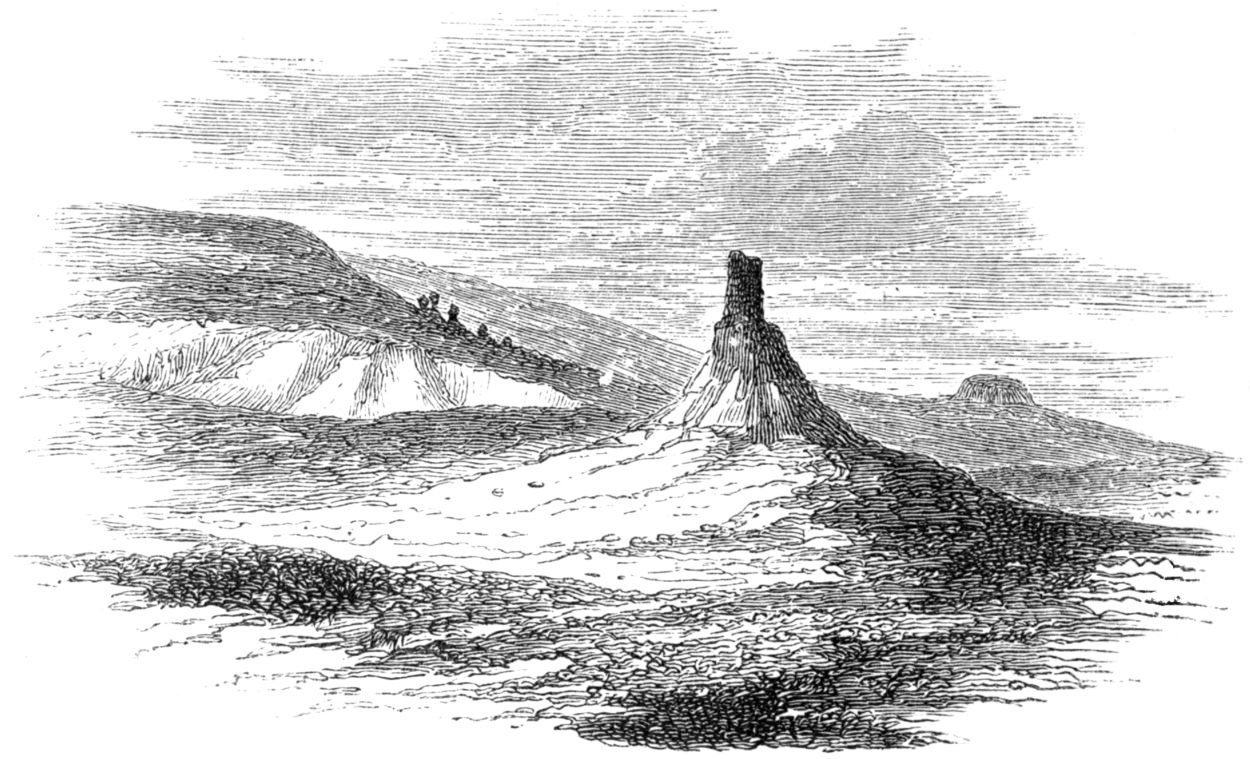
CHIMNEY ROCK.
Shortly after “liquoring up” and shaking hands, we found ourselves
once more in the valley of the Platte, where a lively green
relieved eyes which still retained retina-pictures of the barren,
Sindh-like divide. The road, as usual along the river-side, was
rough and broken, and puffs of simoom raised the sand and dust
in ponderous clouds. At 12 30 P.M. we nooned for an hour at
a little hovel called a ranch, with the normal corral; and I took
occasion to sketch the far-famed Chimney Rock. The name is
not, as is that of the Court-house, a misnomer: one might almost
expect to see smoke or steam jetting from the summit. Like
most of these queer malformations, it was once the knuckle-end
of the main chain which bounded the Platte Valley; the softer
adjacent strata of marl and earthy limestone were disintegrated
by wind and weather, and the harder material, better resisting the
action of air and water, has gradually assumed its present form.
Chimney Rock lies two and a half miles from the south bank of
the Platte. It is composed of a friable yellowish marl, yielding
readily to the knife. The shape is a thin shaft, perpendicular and
quasi conical. Viewed from the southeast it is not unlike a giant
jack-boot based upon a high pyramidal mound, which, disposed
in the natural slope, rests upon the plain. The neck of sandstone
connecting it with the adjacent hills has been distributed by
the floods around the base, leaving an ever-widening gap between.
This “Pharos of the prairie sea” towered in former days 150 to
200 feet above the apex of its foundation,[52]
and was a landmark
visible for 40 to 50 miles: it is now barely 35 feet in height. It
has often been struck by lightning; imber edax has gnawed much
away, and the beginning of the end is already at hand. It is easy
to ascend the pyramid; but, while Pompey’s Pillar, Peter Botte,
and Ararat have all felt the Anglo-Scandinavian foot, no venturous
scion of the race has yet trampled upon the top of Chimney
Rock. Around the waist of the base runs a white band which
sets off its height and relieves the uniform tint. The old sketches
of this curious needle now necessarily appear exaggerated; moreover,
those best known represent it as a column rising from a
confused heap of boulders, thus conveying a completely false idea.
Again the weather served us: nothing could be more picturesque
than this lone pillar of pale rock lying against a huge black cloud,
with the forked lightning playing over its devoted head.
After a frugal dinner of biscuit and cheese we remounted and
pursued our way through airy fire, which presently changed from
our usual pest—a light dust-laden breeze—into a Punjaubian
dust-storm, up the valley of the Platte. We passed a ranch called
ROBIDOUX’ FORT.“Robidoux’ Fort,” from the well-known Indian trader of that
name;[53]
it is now occupied by a Canadian or a French Creole,
who, as usual with his race in these regions, has taken to himself
a wife in the shape of a Sioux squaw, and has garnished his quiver
with a multitude of whitey-reds. The driver pointed out the
grave of a New Yorker who had vainly visited the prairies in
search of a cure for consumption. As we advanced the storm
increased to a tornado of north wind, blinding our cattle till it
drove them off the road. The gale howled through the pass with
all the violence of a khamsin, and it was followed by lightning
and a few heavy drops of rain. The threatening weather caused
a large party of emigrants to “fort themselves” in a corral near
the base of Scott’s Bluffs.
The corral, a Spanish and Portuguese word, which, corrupted
to “kraal,” has found its way through Southern Africa, signifies
primarily a square or circular pen for cattle, which may be made
of tree-trunks, stones, or any other convenient material. The
corral of wagons is thus formed. The two foremost are brought
near and parallel to each other, and are followed by the rest, disposed
aslant, so that the near fore wheel of the hinder touches
the off hind wheel of that preceding it, and vice versâ on the other
side. The “tongues,” or poles, are turned outward, for convenience
of yoking, when an attack is not expected, otherwise they
are made to point inward, and the gaps are closed by ropes and
yoke and spare chains. Thus a large oval is formed with a single
opening fifteen to twenty yards across; some find it more
convenient to leave an exit at both ends. In dangerous places
the passages are secured at night either by cords or by wheeling
round the near wagons; the cattle are driven in before sundown,
especially when the area of the oval is large enough to enable
them to graze, and the men sleep under their vehicles. In safer
travel the tents are pitched outside the corral with their doors
outward, and in front of these the camp-fires are lighted. The
favorite spots with teamsters for corraling are the re-entering angles
of deep streams, especially where these have high and precipitous
banks, or the crests of abrupt hills and bluffs—the position
for nighting usually chosen by the Australian traveler—where
one or more sides of the encampment is safe from attack, and the
others can be protected by a cross fire. As a rule Indians avoid
attacking strong places; this, however, must not always be relied
upon; in 1844 the Utah Indians attacked Uintah Fort, a
trading-post belonging to M. A. Robidoux, then at St. Louis,
slaughtered the men, and carried off the women. The corral is
especially useful for two purposes: it enables the wagoners to
yoke up with ease, and it secures them from the prairie traveler’s
prime dread—the stampede. The Western savages are perfectly
acquainted with the habits of animals, and in their marauding
expeditions they instinctively adopt the system of the Bedouins,
the Gallas, and the Somal. Providing themselves with rattles
and other implements for making startling noises, they ride
stealthily up close to the cattle, and then rush by like the whirlwind
with a volley of horrid whoops and screams. When the
“cavallard” flies in panic fear, the plunderers divide their party;
some drive on the plunder, while the others form a rear-guard to
keep off pursuers. The prairie-men provide for the danger by
keeping their fleetest horses saddled, bridled, and ready to be
mounted at a moment’s notice. When the animals have stampeded,
the owners follow them, scatter the Indians, and drive, if
possible, the madriña, or bell-mare, to the front of the herd, gradually
turning her toward the camp, and slacking speed as the familiar
objects come in sight. Horses and mules appear peculiarly
timorous upon the prairies. A band of buffalo, a wolf, or
even a deer, will sometimes stampede them; they run to great
distances, and not unfrequently their owners fail to recover them.
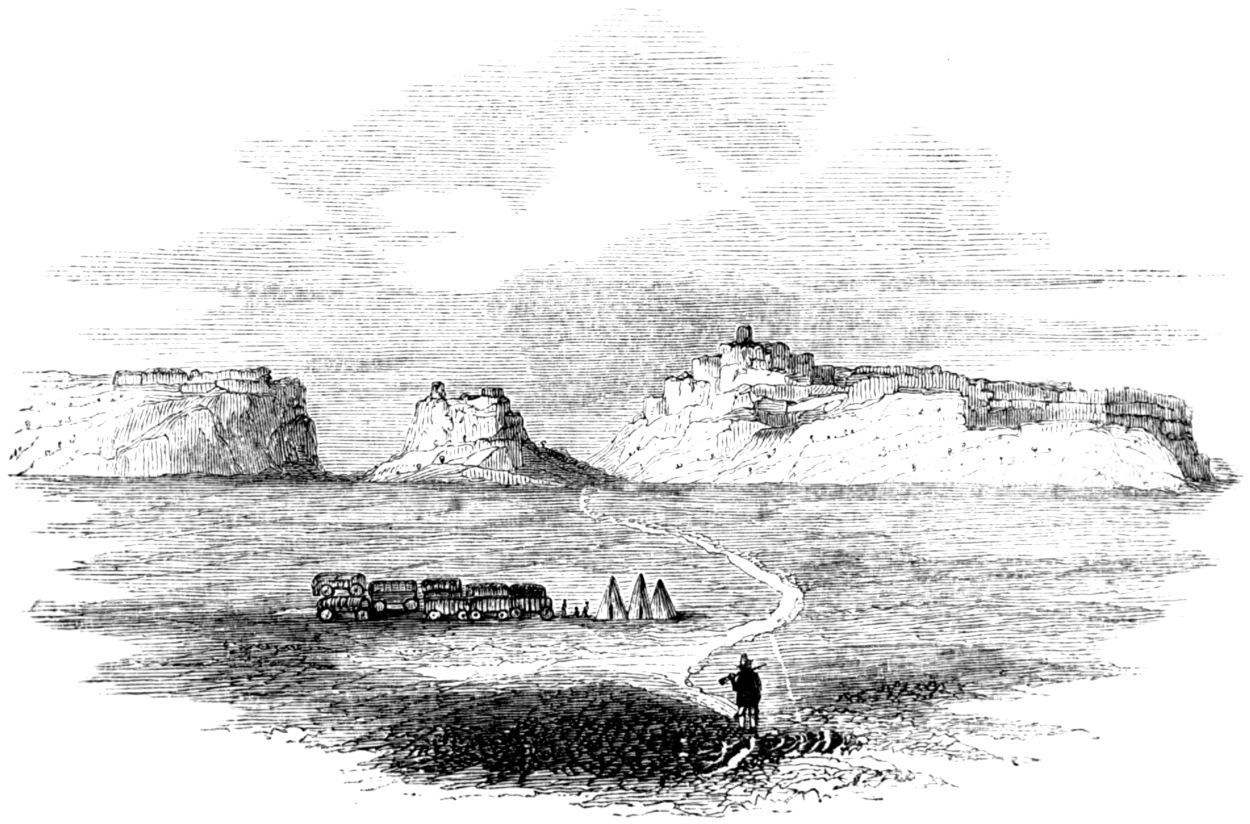
SCOTT’S BLUFFS.
SCOTT’S BLUFFS.“Scott’s Bluffs,” situated 285 miles from Fort Kearney and 51
from Fort Laramie, was the last of the great marl formations
which we saw on this line, and was of all by far the most curious.
In the dull uniformity of the prairies, it is a striking and attractive
object, far excelling the castled crag of Drachenfels or any of
the beauties of romantic Rhine. From a distance of a day’s march
it appears in the shape of a large blue mound, distinguished only
by its dimensions from the detached fragments of hill around.
As you approach within four or five miles, a massive medieval
city gradually defines itself, clustering, with a wonderful fullness
of detail, round a colossal fortress, and crowned with a royal castle.
Buttress and barbican, bastion, demilune, and guard-house,
tower, turret, and donjon-keep, all are there: in one place parapets
and battlements still stand upon the crumbling wall of a
fortalice like the giant ruins of Château Gaillard, the “Beautiful
Castle on the Rock;” and, that nothing may be wanting to the
resemblance, the dashing rains and angry winds have cut the old
line of road at its base into a regular moat with a semicircular
sweep, which the mirage fills with a mimic river. Quaint figures
develop themselves; guards and sentinels in dark armor keep
watch and ward upon the slopes, the lion of Bastia crouches unmistakably
overlooking the road; and as the shades of an artificial
evening, caused by the dust-storm, close in, so weird is its aspect
that one might almost expect to see some spectral horseman,
with lance and pennant, go his rounds about the deserted streets,
ruined buildings, and broken walls. At a nearer aspect again,
the quaint illusion vanishes; the lines of masonry become yellow
layers of boulder and pebble imbedded in a mass of stiff, tamped,
bald marly clay; the curtains and angles change to the gashings of
the rains of ages, and the warriors are metamorphosed into dwarf
cedars and dense shrubs, scattered singly over the surface. Travelers
have compared this glory of the mauvaises terres to Gibraltar,
to the Capitol at Washington, to Stirling Castle. I could
think of nothing in its presence but the Arabs’ “City of Brass,”
that mysterious abode of bewitched infidels, which often appears
at a distance to the wayfarer toiling under the burning sun, but
ever eludes his nearer search.
Scott’s Bluffs derive their name from an unfortunate fur-trader
there put on shore in the olden time by his boat’s crew, who had
a grudge against him: the wretch, in mortal sickness, crawled up
the mound to die. The politer guide-books call them “Capitol
Hills:” methinks the first name, with its dark associations, must
be better pleasing to the genius loci. They are divided into three
distinct masses. The largest, which may be 800 feet high, is on
the right, or nearest the river. To its left lies an outwork, a
huge, detached cylinder whose capping changes aspect from every
direction; and still farther to the left is a second castle, now divided
from, but once connected with the others. The whole affair
is a spur springing from the main range, and closing upon the
Platte so as to leave no room for a road.
After gratifying our curiosity we resumed our way. The route
lay between the right-hand fortress and the outwork, through a
degraded bed of softer marl, once doubtless part of the range.
METEOROLOGICAL PHENONMENON.The sharp, sudden torrents which pour from the heights on both
sides, and the draughty winds—Scott’s Bluffs are the permanent
head-quarters of hurricanes—have cut up the ground into a labyrinth
of jagged gulches steeply walled in. We dashed down the
drains and pitch-holes with a violence which shook the nave-bands
from our sturdy wheels.[54] Ascending, the driver showed a place
where the skeleton of an “elephant” had been lately discovered.
On the summit he pointed out, far over many a treeless hill and
barren plain, the famous Black Hills and Laramie Peak, which
has been compared to Ben Lomond, towering at a distance of
eighty miles. The descent was abrupt, with sudden turns round
the head of earth-cracks deepened to ravines by snow and rain;
and one place showed the remains of a wagon and team which had
lately come to grief. After galloping down a long slope of twelve
miles, with ridgelets of sand and gravel somewhat raised above
the bottom, which they cross on their way to the river, we found
ourselves, at 5 30 P.M., once more in the valley of the Platte. I
had intended to sketch the Bluffs more carefully from the station,
but the western view proved to be disappointingly inferior to the
eastern. After the usual hour’s delay we resumed our drive
through alternate puffs of hot and cold wind, the contrast of which
was not easy to explain. The sensation was as if Indians had been
firing the prairies—an impossibility at this season, when whatever
herbage there is is still green. It may here be mentioned that,
although the meteorology of the earlier savans, namely, that the
peculiar condition of the atmosphere known as the Indian summer[55]
might be produced by the burning of the plain-vegetation,
was not thought worthy of comment, their hypothesis is no longer
considered trivial. The smoky canopy must produce a sensible
effect upon the temperature of the season. “During a still night,
when a cloud of this kind is overhead, no dew is produced; the
heat which is radiated from the earth is reflected or absorbed, and
radiated back again by the particles of soot, and the coating of
the earth necessary to prevent the deposition of water in the form
of dew or hoar-frost is prevented.” According to Professor Henry,
of Washington, “it is highly probable that a portion of the
smoke or fog-cloud produced by the burning of one of the Western
prairies is carried entirely across the eastern portion of the
continent to the ocean.”
Presently we dashed over the Little Kiowa Creek, forded the
Horse Creek, and, enveloped in a cloud of villainous musquetoes,
entered at 8 30 P.M. the station in which we were to pass the
night. It was tenanted by one Reynal, a French Creole—the son
of an old soldier of the Grand Armée, who had settled at St. Louis—a
companionable man, but an extortionate: he charged us a
florin for every “drink” of his well-watered whisky. The house
boasted of the usual squaw, a wrinkled old dame, who at once began
to prepare supper, when we discreetly left the room. These
hard-working but sorely ill-favored beings are accused of various
horrors in cookery, such as grinding their pinole, or parched corn,
in the impurest manner, kneading dough upon the floor, using
their knives for any purpose whatever, and employing the same
pot, unwashed, for boiling tea and tripe. In fact, they are about
as clean as those Eastern pariah servants who make the knowing
Anglo-Indian hold it an abomination to sit at meat with a new
arrival or with an officer of a “home regiment.” The daughter
was an unusually fascinating half-breed, with a pale face and
Franco-American features. How comes it that here, as in Hindostan,
the French half-caste is pretty, graceful, amiable, coquettish,
while the Anglo-Saxon is plain, coarse, gauche, and ill-tempered?
The beauty was married to a long, lean down-Easter,
who appeared most jealously attentive to her, occasionally hinting
at a return to the curtained bed, where she could escape the
admiring glances of strangers. Like her mother, she was able to
speak English, but she could not be persuaded to open her mouth.
This is a truly Indian prejudice, probably arising from the savage,
childish sensitiveness which dreads to excite a laugh; even
a squaw married to a white man, after uttering a few words in a
moment of épanchement, will hide her face under the blanket.
The half-breed has a bad name in the land. Like the negro,
the Indian belongs to a species, sub-species, or variety—whichever
the reader pleases—that has diverged widely enough from the
Indo-European type to cause degeneracy, physical as well as moral,
and often, too, sterility in the offspring. These half-breeds are,
therefore, like the mulatto, quasi-mules. The men combine the
features of both races; the skin soon becomes coarse and wrinkled,
and the eye is black, snaky, and glittering like the Indian’s.
The mongrels are short-lived, peculiarly subject to infectious diseases,
untrustworthy, and disposed to every villainy. The half-breed
women, in early youth, are sometimes attractive enough,
uniting the figure of the mother to the more delicate American
face; a few years, however, deprive them of all litheness, grace,
and agility. They are often married by whites, who hold them
to be more modest and humble, less capricious and less exacting,
than those of the higher type: they make good wives and affectionate
mothers, and, like the Quadroons, they are more “ambitious”—that
is to say, of warmer temperaments—than either of
the races from which they are derived. The so-called red is a
higher ethnic type than the black man; so, in the United States,
where all admixture of African blood is deemed impure, the aboriginal
American entails no disgrace—some of the noblest of the
land are descended from “Indian princesses.” The half-breed
girls resemble their mothers in point of industry, and they barter
their embroidered robes and moccasins, and mats and baskets,
made of bark and bulrush, in exchange for blankets, calicoes,
glass beads—an indispensable article of dress—mirrors, needles,
rings, vermilion, and other luxuries. The children, with their
large black eyes, wide mouths, and glittering teeth, flattened heads,
and remarkable agility of motion, suggest the idea of little serpents.
The day had been fatiguing, and our eyes ached with the wind
and dust. We lost no time in spreading on the floor the buffalo
robes borrowed from the house, and in defying the smaller tenants
of the ranch. Our host, M. Reynal, was a study, but we deferred
the lesson till the next morning.
To Fort Laramie. 14th August.
M. REYNAL.M. Reynal had been an Indian trader in his youth. Of this
race there were in his day two varieties: the regular trader and
the coureur des bois, or unlicensed peddler, who was subject to certain
pains and penalties. The former had some regard for his future;
he had a permanent interest in the Indians, and looked to
the horses, arms, and accoutrements of his protégés, so that hunting
might not flag. The bois brûlé peddler, having—like an English
advertising firm—no hope of dealing twice with the same person,
got all he could for what he could. These men soon sapped the
foundation of the Indian’s discipline. One of them, for instance,
would take protection with the chief, pay presents, and by increasing
the wealth, enhance the importance of his protector. Another
would place himself under the charge of some ambitious aspirant
to power, who was thus raised to a position of direct rivalry.
A split would ensue; the weaker would secede with his
family and friends, and declare independence; a murder or two
would be the result, and a blood-feud would be bequeathed from
generation to generation. The licensed traders have ever strenuously
opposed the introduction of alcohol, a keg of which will
purchase from the Indian every thing that is his, his arms, lodge,
horses, children, and wives. In olden times, however, the Maine
Liquor Law was not, as now, in force through the territories.
The coureur des bois, therefore, entered the country through various
avenues, from the United States and from Mexico, without
other stock in trade but some kegs of whisky, which he retailed
at the modest price of $36 per gallon. He usually mixed one
part of fire with five of pure water, and then sold a pint-canful for
a buffalo robe. “Indian liquor” became a proverbial term. According
to some travelers, a barrel of “pure Cincinnati,” even after
running the gauntlet of railroad and lake travel, has afforded a
hundred barrels of “good Indian liquor.” A small bucketful is
poured into a wash-tub of water; a large quantity of “dog-leg”
tobacco and red pepper is then added, next a bitter root common
in the country is cut up into it, and finally it is colored with
burnt sugar—a nice recipe for a morning’s headache! The only
drawback to this traffic is its danger. The Indian, when intoxicated,
is ready for any outrageous act of violence or cruelty; vinosity
brings out the destructiveness and the utter barbarity of his
character; it makes him thirst tiger-like for blood. The coureur
des bois, therefore, who in those days was highly respected, was
placed in the Trader’s Lodge, a kind of public house, like the
Iwanza of Central Africa, and the village chief took care to station
at the door a guard of sober youths, sometimes habited like
Europeans, ready to check the unauthorized attempts of ambitious
clansmen upon the whisky-vendor’s scalp. The Western men,
who will frequently be alluded to in these pages, may be divided,
like the traders, into two classes. The first is the true mountaineer,
whom the platitude and tame monotony of civilized republican
life has in early youth driven, often from an honored and
wealthy family, to the wilds and wolds, to become the forlorn
hope in the march of civilization. The second is the offscouring
and refuse of the Eastern cities, compelled by want, fatuity, or
crime to exile himself from all he most loves. The former, after
passing through the preliminary stage greenhorn, is a man in every
sense of the term: to more than Indian bravery and fortitude,
he unites the softness of woman, and a child-like simplicity, which
is the very essence of a chivalrous character; you can read his
nature in his clear blue eyes, his sun-tanned countenance, his merry
smile, and his frank, fearless manner. The latter is a knave
or a fool; it would make “bad blood,” as the Frenchman says, to
describe him.
M. Reynal’s history had to be received with many grains of
salt. The Western man has been worked by climate and its consequences,
by the huge magnificence of nature and the violent
contrasts of scenery, into a remarkable resemblance to the wild
Indian. He hates labor—which poet and divine combine to deify
in the settled states—as the dire effect of a primeval curse; “loaf”
he must and will; to him one hour out of the twenty-four spent
in honest industry is satis superque. His imagination is inflamed
by scenery and climate, difficulty and danger; he is as superstitious
as an old man-o’-war’s-man of the olden school; and he is a
transcendental liar, like his prototype the aborigine, who in this
point yields nothing to the African negro. I have heard of a
man riding eighty miles—forty into camp and forty out—in order
to enjoy the sweet delights of a lie. His yarns and stories about
the land he lives in have become a proverbial ridicule; he will
tell you that the sun rises north of what it did se puero; he has
seen mountains of diamonds and gold nuggets scattered like rocks
over the surface of our general mother. I have been gravely told
of a herd of bison which arrested the course of the Platte River,
causing its waters, like those of the Red Sea, to stand up, wall
fashion, while the animals were crossing. Of this Western order
is the well-known account of a ride on a buffalo’s horns, delivered
for the benefit of a gaping world by a popular author of the
yellow-binding category. In this age, however, the Western man
has become sensitive to the operation of “smoking.” A popular
Joe Miller anent him is this: A traveler, informed of what he
might educe by “querying,” asked an old mountaineer, who shall
be nameless, what difference he observed in the country since he
had first settled in it.
“Wal, stranger, not much!” was the reply; “only when I fust
come here, that ’ere mountain,” pointing to the tall Uinta range,
“was a hole!”
Disembarrassing M. Reynal’s recital of its mask of improbabilities
and impossibilities, remained obvious the naked fact that he
had led the life of a confirmed coureur des bois. The French Canadian
and Creole both, like the true Français de France, is loth
to stir beyond the devil-dispelling sound of his chapel-bell; once
torn from his chez lui, he apparently cares little to return, and,
like the Englishman, to die at home in his own land. The adventurous
Canadians—in whom extremes meet—have wandered
through the length and breadth of the continent; they have left
their mark even upon the rocks in Utah Territory. M. Reynal
had quitted St. Louis at an early age as trader, trapper, every
thing in short, provided with a little outfit of powder, ball, and
whisky. At first he was unfortunate. In a war between the
Sioux and the Pawnees, he was taken prisoner by the latter, and
with much ado preserved, by the good aid of his squaw, that useful
article his scalp. Then fickle fortune turned in his favor.
He married several wives, identified himself with the braves, and
became a little brother of the tribe, while his whisky brought him
in an abundance of furs and peltries. After many years, waxing
weary of a wandering life, he settled down into the somewhat
prosaic position in which we had the pleasure of finding him.
He was garrulous as a veteran soldier upon the subject of his old
friends the trappers, that gallant advance guard who, sixty years
ago, unconsciously fought the fight of civilization for the pure
love of fighting; who battled with the Indian in his own way,
surpassing him in tracking, surprising, ambuscading, and shooting,
and never failing to raise the enemy’s hair. They are well-nigh
extinct, those old pioneers, wild, reckless, and brave as the
British tar of a century past; they live but in story; their place
knows them no longer; it is now filled by the “prospector.”
Civilization and the silk hat have exterminated them. How
many deeds of stern fight and heroic endurance have been ignored
by this world, which knows nothing of its greatest men, carent
quia vale sacro! We talk of Thermopylæ and ignore Texas; we
have all thrilled at the account of the Mameluke Bey’s leap; but
how many of us have heard of Major Macculloch’s spring from
the cliff?
Our breakfast was prepared in the usual prairie style. First
the coffee—three parts burnt beans, which had been duly ground
to a fine powder and exposed to the air, lest the aroma should
prove too strong for us—was placed on the stove to simmer till
every noxious principle was duly extracted from it. Then the
rusty bacon, cut into thick slices, was thrown into the fry-pan:
here the gridiron is unknown, and if known would be little appreciated,
because it wastes the “drippings,” which form with
the staff of life a luxurious sop. Thirdly, antelope steak, cut off
a corpse suspended for the benefit of flies outside, was placed to
stew within influence of the bacon’s aroma. Lastly came the
bread, which of course should have been “cooked” first. The
meal is kneaded with water and a pinch of salt; the raising is
done by means of a little sour milk, or more generally by the
deleterious yeast-powders of the trade. The carbonic acid gas
evolved by the addition of water must be corrected, and the
dough must be expanded by saleratus or prepared carbonate of
soda or alkali, and other vile stuff, which communicates to the
food the green-yellow tinge, and suggests many of the properties
of poison. A hundred-fold better, the unpretending chapati, flapjack,
scone, or, as the Mexicans prettily called it, “tortilla!” The
dough, after being sufficiently manipulated upon a long, narrow,
smooth board, is divided into “biscuits” and “dough-nuts,”[56] and
finally it is placed to be half cooked under the immediate influence
of the rusty bacon and graveolent antelope. “Uncle Sam’s
stove,” be it said with every reverence for the honored name it
bears, is a triumph of convenience, cheapness, unwholesomeness,
and nastiness—excuse the word, nice reader. This travelers’ bane
has exterminated the spit and gridiron, and makes every thing
taste like its neighbor: by virtue of it, mutton borrows the flavor
of salmon trout, tomatoes resolve themselves into greens. I
shall lose my temper if the subject is not dropped.
We set out at 6 A.M. over a sandy bottom, from which the
musquetoes rose in swarms. After a twelve-mile stretch the
driver pointed out on the right of the road, which here runs between
high earth-banks, a spot still infamous in local story. At
this place, in 1854, five Indians, concealing themselves in the bed
of a dwarf arroyo, fired upon the mail-wagon, killing two drivers
and one passenger, and then plundered it of 20,000 dollars.
“Long-chin,” the leader, and the other murderers, when given
up by the tribe, were carried to Washington, D. C., where—with
the ultra-philanthropy which has of modern days distinguished
the “Great Father’s” government of his “Poor Children of the
Plains”—the villains were liberally rewarded and restored to their
homes.[57] To cut off a bend of the Platte we once more left the
valley, ascended sundry slopes of sand and clay deeply cut by dry
creeks, and from the summit enjoyed a pretty view. A little to
the left rose the aerial blue cone of that noble landmark, LARAMIE PEAK.Laramie
Peak, based like a mass of solidified air upon a dark wall, the
Black Hills, and lit up with the roseate hues of the morning.
The distance was about sixty miles; you would have guessed
twenty. On the right lay a broad valley, bounded by brown
rocks and a plain-colored distance, with the stream winding
through it like a thread of quicksilver; in places it was hidden
from sight by thickets of red willow, cypress clumps, and dense
cool cotton-woods. All was not still life; close below us rose
the white lodges of the Ogalala tribe.
INDIAN VILLAGES.These Indian villages are very picturesque from afar when
dimly seen dotting the verdure of the valleys, and when their
tall white cones, half hidden by willow clumps, lie against a blue
background. The river side is the savages’ favorite site; next to
it the hill foot, where little groups of three or four tents are often
seen from the road, clustering mysteriously near a spring. Almost
every prairie-band has its own way of constructing lodges,
encamping and building fires, and the experienced mountaineer
easily distinguishes them.
The Osages make their lodges in the shape of a wagon-tilt,
somewhat like our gipsies’ tents, with a frame-work of bent willow
rods planted in the ground, and supporting their blankets,
skins, or tree-basts.
The Kickapoos build dwarf hay-stack huts, like some tribes of
Africans, setting poles in the earth, binding them over and lashing
them together at the top; they are generally covered with
clothes or bark.
The Witchetaws, Wakoes, Towakamis, and Tonkowas are described
by the “Prairie Traveler” as erecting their hunting lodges
of sticks put up in the form of the frustrum of a cone, and bushed
over like “boweries.”
All these tribes leave the frame-work of their lodges standing
when they shift ground, and thus the particular band is readily
recognized.
The Sacs, Foxes, Winnebagoes, and Menomenes build lodges
in the form of an ellipse, some of them 30-40 feet long, by 14-15
wide, and large enough to shelter twenty people permanently,
and sixty temporarily.[58] The covering is of plaited rush-mats
bound to the poles, and a small aperture in the lodge acts as
chimney.
The Delawares and Shawnees, Cherokees and Choctaws, prefer
the Indian pal, a canvas covering thrown like a tente d’abri over
a stick supported by two forked poles.
The Sioux, Arapahoes, Cheyennes, Utahs, Snakes, Blackfeet,
and Kiowas use the Comanche lodge covered with bison skins,
which by dressing become flexible as canvas. They are usually
of a shining white, save where smoke-stained near the top; the
lodges of great chiefs are sometimes decorated with horizontal
stripes of alternate black and white, and ornamented with figures
human and bestial, crosses, circles, and arabesques. The lodge is
made of eight to twenty-four straight peeled poles or saplings of
ash, pine, cedar, or other wood, hard and elastic if possible, about
20 feet long; the largest marquees are 30 feet in diameter by 35
feet high, and are comprised of 26-30 buffalo skins; and they
are sometimes planted round a “basement” or circular excavation
two or three feet deep. When pitching, three poles lashed to one
another with a long line, somewhat below the thinner points, are
raised perpendicularly, and the thicker ends are spread out in a
tripod to the perimeter of the circle which is to form the lodge
floor; the rest of the poles are then propped against the three first,
and disposed regularly and equidistantly to make a steady and secure
conical frame-work. The long line attached to the tripod is
then wound several times round the point where the poles touch,
and the lower end is made fast to the base of the lodge, thus securing
the props in position. The covering of dressed, hairless, and
water-proof cow-buffalo hide—traders prefer osnaburg—cut and
sewn to fit the frame like an envelope, and sometimes pinned together
with skewers, is either raised at first with the tripod, or
afterward hoisted with a perch and spread round the complete
structure. It is pinned to the ground with wooden pegs, and a
narrow space forms a doorway, which may be closed with a blanket
suspended from above and spread out with two small sticks.
The apex is left open with a triangular wing or flap, like a lateen
sail, and is prevented from closing by a pole inserted into a pocket
at the end. The aperture points to windward when ventilation
is required, and, drawing like a wind-sail, it keeps the interior cool
and comfortable; when smoke is to be carried off, it is turned to
leeward, thus giving draught to the fire, and making the abode
warm in the severest weather; while in lodges of other forms,
you must lie down on the ground to prevent being asphyxiated.
By raising the lower part so as freely to admit the breeze, it is
kept perfectly free from musquetoes, which are unable to resist
the strong draught. The squaws are always the tent-pitchers,
and they equal Orientals in dexterity and judgment. Before the
lodge of each warrior stands his light spear, planted Bedouin-fashion
in the ground, near or upon a tripod of thin, cleanly-scraped,
wands, seven to eight feet long, which support his spotless white
buffalo-skin targe, sometimes decorated with his “totem”—we
translate the word “crest”—and guarded by the usual prophylactic,
a buckskin sack containing medicine. Readers of “Ivanhoe”—they
are now more numerous in the New than in the Old
Country—ever feel “a passing impulse to touch one of these spotless
shields with the muzzle of the gun, expecting a grim warrior
to start from the lodge and resent the challenge.” The fire, as in
the old Hebridean huts, is built in the centre of the hard dirt floor;
a strong stick planted at the requisite angle supports the kettle,
and around the walls are berths divided by matted screens; the
extremest uncleanliness, however, is a feature never absent. In
a quiet country these villages have a simple and patriarchal appearance.
The tents, which number from fifteen to fifty, are disposed
round a circular central space, where animals can be tethered.
Some have attached to them corrals of wattled canes, and
a few boast of fields where corn and pumpkins are raised.
The Comanche lodge is the favorite tenement of the Canadian
and Creole voyageurs, on account of its coolness or warmth when
wanted, its security against violent winds, and its freedom from
musquetoes. While traveling in an Indian country they will use
no other. It has been simplified by Major H. H. Sibley, of the
United States Army, who has changed the pole frame-work for a
single central upright, resting upon an iron tripod, with hooks for
suspending cooking utensils over the fire; when folded up, the
tripod admits the upright between its legs, thereby reducing the
length to one half—a portable size. THE “SIBLEY TENT.”The “Sibley tent” was the
only shelter of the United States Army at Fort Scott, in Utah
Territory, during the hard winter of 1857-8, and gave universal
satisfaction. The officers still keep to the old wall-tent. This
will, however, eventually be superseded by the new form, which
can accommodate comfortably twelve, but not seventeen, the usual
number allotted to it. Captain Marcy is of opinion that of the
tents used in the different armies of Europe, “none in point of
convenience, comfort, and economy will compare with the ‘Sibley
tent’ for campaigning in cold weather.” In summer, however, it
has, like all conical tents, many disadvantages: there is always a
loss of room; and for comfortably disposing kit—chair, table, and
camp couch—there is nothing equal to the wall-tent. The price
of a “Sibley,” when made of good material, is from $40 to $50
(£8-£10), and it can be procured from Baltimore, Philadelphia,
and New York.
At 10 20 A.M. we halted to change mules at Badeau’s Ranch,
or, as it is more grandiloquently called, “Laramie City.” The
“city,” like many a Western “town,” still appertains to the category
of things about to be; it is at present represented by a single
large “store,” with out-houses full of small half-breeds. The
principal articles of traffic are liquors and groceries for the whites,
and ornaments for the Indians, which are bartered for stock (i. e.,
animals) and peltries. The prices asked for the skips were from
$1-$1 30 for a fox or a coyote, $3 for wolf, bear, or deer, $6-$7
for an elk, $5 for a common buffalo, and from $8 to $35 for the
same painted, pictographed, and embroidered. Some of the party
purchased moccasins, for which they paid $1-$2; the best articles
are made by the Snakes, and when embroidered by white
women rise as high as $25. I bought, for an old friend who is
insane upon the subject of pipes, one of the fine marble-like sandstone
bowls brought from the celebrated Côteau (slope) des Prairies,
at the head of Sioux River—
“On the mountains of the Prairie,
On the Great Red Pipe-stone Quarry.”
This instrument is originally the gift of Gitchie Manitou, who,
standing on the precipice of the Red Pipe-stone Rock, broke off a
fragment and moulded it into a pipe, which, finished with a reed,
he smoked over his children to the north, south, east, and west.
It is of queer shape, not unlike the clay and steatite articles used
by the Abyssinians and the Turi or Sinaitic Bedouins. The
length of the stick is 23 inches, of the stem 9·50, and of the bowl
5 inches; the latter stands at a right angle upon the former; both
are circular; but the 2·75 inches of stem, which project beyond
the bowl, are beveled off so as to form an edge at the end. The
peculiarity of the form is in the part where the tobacco is inserted;
the hole is not more than half an inch broad, and descends
straight without a bulge, while the aperture in the stem is exactly
similar. The red color soon mottles and the bowl clogs if smoked
with tobacco; in fact, it is fit for nothing but the “kinnikinik” of
the Indians. To prepare this hard material with the rude tools
of a savage must be a work of time and difficulty; also the bowls
are expensive and highly valued: for mine I paid $5, and farther
West I could have exchanged it for an Indian pony.
Having finished our emplettes at M. Badeau’s, we set out at 11 30
P.M. over a barren and reeking bit of sandy soil. Close to the
station, and a little to the right of the road, we passed the barrow
which contains the remains of Lieutenant Grattan and his thirty
men. A young second lieutenant of Irish origin and fiery temper,
he was marching westward with an interpreter, a small body
of men, and two howitzers, when a dispute arose, it is said, about
a cow, between his party and the THE BRULÉS AND GENERAL HARNEY.Brûlés or Burnt-Thigh Indians.
The latter were encamped in a village of 450 to 500 lodges, which,
reckoning five to each, gives a total of 2200 to 2500 souls. A
fight took place; the whites imprudently discharged both their
cannon, overshooting the tents of the enemy; their muskets, however,
did more execution, killing Matriya, “the Scattering Bear,”
who had been made chief of all the Sioux by Colonel Mitchell of
the Indian Bureau. The savages, seeing the fall of Ursa Major,
set to in real earnest; about 1200 charged the soldiers before they
could reload; the little detachment broke, and not a man survived
to tell the tale. The whites in the neighborhood narrowly
preserved their scalps—M. Badeau owned that he owed his to his
Sioux squaw—and among other acts of violence was the murder
and highway robbery which has already been recounted. Both
these events occurred in 1854. As has been said, in 1855, General
W. S. Harney, who, whatever may be his faults as a diplomatist,
is the most dreaded “Minahaska”[59] in the Indian country,
punished the Brûlés severely at Ash Hollow. They were led by
their chosen chief Little Thunder, who, not liking the prospect,
wanted to palaver; the general replied by a charge, which, as
usual, scattered the “chivalry of the prairies” to the four winds.
“Little Thunder” was solemnly deposed, and Mato Chigukesa,
“Bear’s Rib,” was ordered to reign in his stead; moreover, in
1856, a treaty was concluded, giving to whites, among other
things, the privilege of making roads along the Platte and White-Earth
Rivers (Mankisita Wakpa—Smoking-earth Water) to Forts
Pierre and Laramie, and to pass up and down the Missouri in
boats. Since that time, with the exception of plundering an English
sportsman, Sir G—— G——, opposing Lieutenant Warren’s
expedition to the Black Hills, and slaughtering a few traders and
obscure travelers, the Brûlés have behaved tolerably to their pale-face
rivals.
As we advanced the land became more barren; it sadly wanted
rain: it suffers from drought almost every year, and what vegetable
matter the soil will produce the grasshopper will devour.
Dead cattle cumbered the way-side; the flesh had disappeared;
the bones were scattered over the ground; but the skins, mummified,
as it were, by the dry heat, lay life-like and shapeless, as
in the Libyan Desert, upon the ground. This phenomenon will
last till we enter the humid regions between the Sierra Nevada
and the Pacific Ocean, and men tell wonderful tales of the time
during which meat can be kept. The road was a succession of
steep ascents and jumps down sandy ground. A Sioux “buck,”
mounted upon a neat nag, and wrapped up, despite sun and glare,
as if it had been the depth of winter, passed us, sedulously averting
his eyes. The driver declared that he recognized the horse,
and grumbled certain Western facetiæ concerning “hearty-chokes
and caper sauce.”
In these lands the horse-thief is the great enemy of mankind;
for him there is no pity, no mercy; Lynch-law is held almost too
good for him; to shoot him in flagrante delicto is like slaying a
man-eating Bengal royal tiger—it entitles you to the respect and
gratitude of your species. I asked our conductor whether dandiness
was at the bottom of the “buck’s” heavy dress. “’Guess,”
was the reply, “what keeps cold out, keeps heat out tew!”
At 12 15 P.M., crossing Laramie’s Fork, a fine clear stream
about forty yards broad, we reached Fort Laramie—another
“fort” by courtesy, or rather by order—where we hoped to recruit
our exhausted stores.
The straggling cantonment requires no description: it has the
usual big flag, barracks, store-houses, officers’ quarters, guard-houses,
sutlers’ stores, and groceries, which doubtless make a good
thing by selling deleterious “strychnine” to passing trains who
can afford to pay $6 per gallon.
Fort Laramie, called Fort John in the days of the American
Fur Company, was used by them as a store-house for the bear and
buffalo skins, which they collected in thousands. The old adobe
enceinte, sketched and described by Frémont and Stansbury, soon
disappeared after the place was sold to the United States government.
Its former rival was Fort Platte, belonging in 1842—when
the pale face first opened this road—to Messrs. Sybille, Adams,
and Co., and situated immediately on the point of land at the
junction of Laramie Fort with the Platte. The climate here is
arid and parching in summer, but in winter tolerably mild, considering
the altitude—4470 feet—and the proximity of the Black
Hills; yet it has seen hard frost in September. It is also well
defended from the warm, moist, and light winds, which, coming
from the Mexican Gulf, cause “calentures” on the lower course
of the river. The soil around the settlement is gravelly and sterile,
the rocks are sand, lime, and clay, and there is a solitary, desolate
look upon every thing but the bright little stream that bubbles
from the dark heights. The course is from S.W. to N.E.:
about half way it bifurcates, with a right fork to the west and
main fork east, and near Laramie it receives its main affluent, the
Chugwater.
My companion kindly introduced me to the officer commanding
the fort, Colonel B. Alexander, 10th Infantry, and we were
at once made at home. The amiable mistress of the house must
find charitable work enough to do in providing for the wants of
way-worn friends who pass through Laramie from east to west.
We rested and dined in the cool comfortable quarters, with only
one qualm at heart—we were so soon to leave them. On these
occasions the driver seems to know by instinct that you are enjoying
yourself, while he, as an outsider, is not. He becomes,
therefore, unusually impatient to start; perhaps, also, time runs
more rapidly than it is wont. At any rate, after a short two
hours, we were compelled to shake hands with our kind and considerate
hosts, and to return to limbo—the mail-wagon.
From Fort Laramie westward the geological formation changes;
the great limestone deposits disappear, and are succeeded by a great
variety of sandstones, some red, argillaceous, and compact; others
gray or yellow, ferruginous, and coarse. Pudding-stones or conglomerates
also abound, and the main chain of the Laramie Mountains
is supposed to be chiefly composed of this rock.
Beyond the fort there are two roads. The longer leads to the
right, near the Platte River. It was formerly, and perhaps is
still, a favorite with emigrants. We preferred the left, which,
crossing the edges of the Black Hills, is rough and uneven, but is
“some shorter,” as the guide-book says, than the other. The
weather began to be unusually disagreeable with heat and rain-drops
from a heavy nimbus, that forced us to curtain up the rattling
vehicle; perhaps, too, we were a little cross, contrasting the
present with the past—civilized society, a shady bungalow, and
wonderfully good butter. At 4 P.M., following the Platte Valley,
after two hours’ drive we halted to change mules at Ward’s Station,
alias the “Central Star,” where several whites were killed
by the Sioux in 1855, among them M. Montalan, a Parisian.
Again we started for another twenty-five miles at 4 P.M. The
road was rough, and the driver had a curious proclivity for losing
the way. I have often found this to be the case after passing
through a station. There was little to remark, except that the
country was poor and bad, that there was clear water in a ravine
to the right, and that we were very tired and surly. But as sorrow
comes to an end as well as joy, so, at 9 30 P.M., we drove in,
somewhat consoled, to HORSESHOE STATION.Horseshoe
Station—the old Fer à Cheval—where
one of the road agents, Mr. Slade, lived, and where we anticipated
superior comfort.
We were entichés by the aspect of the buildings, which were on
an extensive scale—in fact, got up regardless of expense. An
ominous silence, however, reigned around. At last, by hard
knocking, we were admitted into a house with the Floridian style
of veranda previously described, and by the pretensions of the
room we at once divined our misfortune—we were threatened
with a “lady.” The “lady” will, alas! follow us to the Pacific;
even in hymns we read,
“Now let the Prophet’s heart rejoice,
His noble lady’s too.”
Our mishap was really worse than we expected—we were exposed
to two “LADIES.”“ladies,” and of these one was a Bloomer. It is
only fair to state that it was the only hermaphrodite of the kind
that ever met my eyes in the United States; the great founder of
the order has long since subsided into her original obscurity, and
her acolytes have relapsed into the weakness of petticoats. The
Bloomer was an uncouth being; her hair, cut level with her eyes,
depended with the graceful curl of a drake’s tail around a flat
Turanian countenance, whose only expression was sullen insolence.
The body-dress, glazed brown calico, fitted her somewhat
like a soldier’s tunic, developing haunches which would be admired
only in venison; and—curious inconséquence of woman’s nature!—all
this sacrifice of appearance upon the shrine of comfort
did not prevent her wearing that kind of crinoline depicted by
Mr. Punch upon “our Mary Hanne.” The pantalettes of glazed
brown calico, like the vest, tunic, blouse, shirt, or whatever they
may call it, were in peg-top style, admirably setting off a pair of
thin-soled Frenchified patent-leather bottines, with elastic sides,
which contained feet large, broad, and flat as a negro’s in Unyamwezi.
The dear creature had a husband: it was hardly safe to
look at her, and as for sketching her, I avoided it, as men are bidden
by the poet to avoid the way of Slick of Tennessee. The
other “lady,” though more decently attired, was like women in
this wild part of the world generally—cold and disagreeable in
manner, full of “proper pride,” with a touch-me-not air, which
reminded me of a certain
“Miss Baxter,
Who refused a man before he axed her.”
Her husband was the renowned Slade:
“Of gougers fierce, the eyes that pierce, the fiercest gouger he.”
His was a noted name for “deadly strife;” he had the reputation
of having killed his three men; and a few days afterward the
grave that concealed one of his murders was pointed out to me.
This pleasant individual “for an evening party” wore the revolver
and bowie-knife here, there, and every where. He had
lately, indeed, had a strong hint not to forget his weapon. One
M. Jules, a French trader, after a quarrel which took place at dinner,
walked up to him and fired a pistol, wounding him in the
breast. As he rose to run away Jules discharged a second, which
took effect upon his back, and then, without giving him time to
arm, fetched a gun and favored him with a dose of slugs somewhat
larger than revolver bullets. The fiery Frenchman had two
narrow escapes from Lynch-lawyers: twice he was hung between
wagons, and as often he was cut down. At last he disappeared
in the farther West, and took to lodge and squaw. The avenger
of blood threatens to follow him up, but as yet he has taken no
steps.
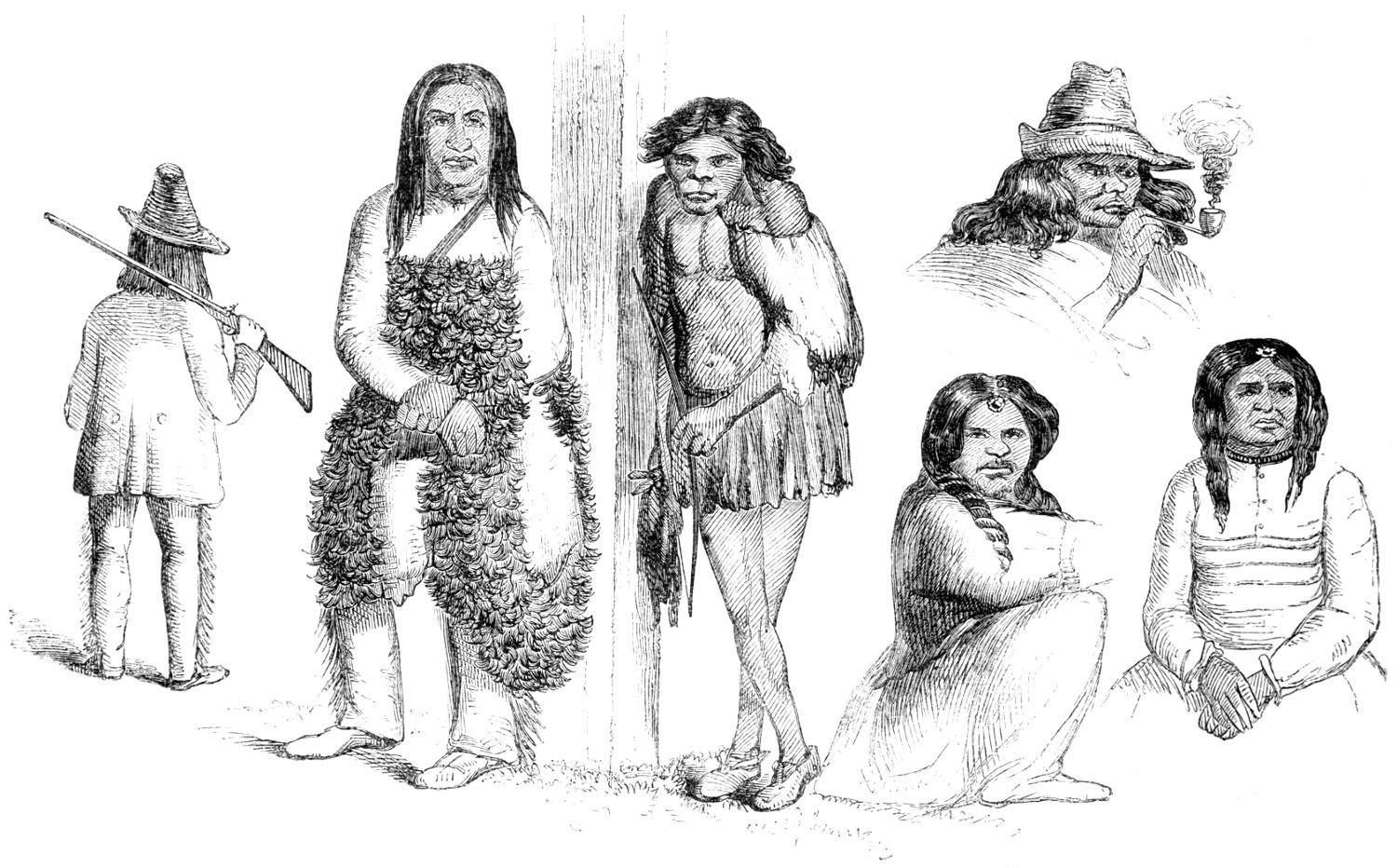
INDIANS.
The Western Swell.
The Sioux.
The old Shoshonee.
The Arapaho.
Jake the Shoshonee.
The Crow.
It at once became evident that the station was conducted upon
the principle of the Western hotel-keeper of the last generation,
and of Continental Europe about A.D. 1500—the innkeeper of
“Anne of Geierstein”—that is to say, for his own convenience;
the public there was the last thing thought of. One of our party
who had ventured into the kitchen was fiercely ejected by the
“ladies.” In asking about dormitories we were informed that
“lady travelers” were admitted into the house, but that the ruder
sex must sleep where it could—or not sleep at all if it preferred.
We found a barn outside: it was hardly fit for a decently brought-up
pig; the floor was damp and knotty; there was not even a
door to keep out the night breeze, now becoming raw, and several
drunken fellows lay in different parts of it. Two were in one
bunk, embracing maudlingly, and freely calling for drinks of water.
Into this disreputable hole we were all thrust for the night:
among us, it must be remembered, was a federal judge, who had
officiated for years as minister at a European court. His position,
poor man! procured him nothing but a broken-down pallet. It
was his first trip to the Far West, and yet, so easily are Americans
satisfied, and so accustomed are they to obey the ridiculous
jack-in-office who claims to be one of the powers that be, he
scarcely uttered a complaint. I, for one, grumbled myself to
sleep. May gracious Heaven keep us safe from all “ladies” in
future! better a hundred times the squaw, with her uncleanliness
and civility.
We are now about to leave the land of that great and dangerous
people, the Sioux, and before bidding adieu to them it will be
advisable to devote a few pages to their ethnology.
CHAPTER III. Concluding the Route to the Great Salt Lake City.
Along the Black Hills to Box-Elder. 15th August.
SUNRISE.I arose “between two days,” a little before 4 A.M., and watched
the dawn, and found in its beauties a soothing influence, which
acted upon stiff limbs and discontented spirit as if it had been a
spell.
The stars of the Great Bear—the prairie night-clock—first began
to pale without any seeming cause, till presently a faint streak
of pale light—dum i gurg, or the wolf’s tail, as it is called by the
Persian—began to shimmer upon the eastern verge of heaven.
It grew and grew through the dark blue air: one unaccustomed
to the study of the “gray-eyed morn” would have expected it to
usher in the day, when, gradually as it had struggled into existence,
it faded, and a deeper darkness than before once more invaded
the infinitude above. But now the unrisen sun is more
rapidly climbing the gloomy walls of Koh i Kaf—the mountain
rim which encircles the world, and through whose lower gap the
false dawn had found its way—preceded by a warm flush of
light, which chases the shades till, though loth to depart, they find
neither on earth nor in the firmament a place where they can linger.
Warmer and warmer waxes the heavenly radiance, gliding
up to the keystone of the vault above; fainter and fainter grows
the darkness, till the last stain disappears behind the Black Hills
to the west, and the stars one by one, like glow-worms, “pale their
ineffectual fires”—the “Pointers” are the longest to resist—retreat
backward, as it were, and fade away into endless space. Slowly,
almost imperceptibly, the marvelous hues of “glorious morn,”
here truly a fresh “birth of heaven and earth,” all gold and sapphire,
acquire depth and distinctness, till at last a fiery flush ushers
from beneath the horizon the source of all these splendors,
“Robed in flames and amber light;”
and another day, with its little life of joys and sorrows, of hopes
and fears, is born to the world.
Though we all rose up early, packed, and were ready to proceed,
there was an unusual vis inertiæ on the part of the driver:
Indians were about; the mules, of course, had bolted; but that
did not suffice as explanation. Presently the “wonder leaked
out:” our companions were transferred from their comfortable
vehicle to a real “shandridan,” a Rocky-Mountain bone-setter.
They were civil enough to the exceedingly drunken youth—a
runaway New Yorker—who did us the honor of driving us; for
quand on a besoin du diable on lui dit, “Monsieur.” One can not
expect, however, the diable to be equally civil: when we asked
him to tidy our vehicle a little, he simply replied that he’d be
darned if he did. Long may be the darning-needle and sharp to
him! But tempers seriously soured must blow up or burst, and
a very pretty little quarrel was the result: it was settled bloodlessly,
because one gentleman, who, to do him justice, showed every
disposition to convert himself into a target, displayed such perfect
unacquaintance with the weapons—revolvers—usually used on
similar occasions, that it would have been mere murder to have
taken pistol in hand against him.
As we sat very disconsolate in the open veranda, five Indians
stalked in, and the biggest and burliest of the party, a middle-aged
man, with the long, straight Indian hair, high, harsh features, and
face bald of eyebrows and beard, after offering his paw to Mrs.
Dana and the rest of the party, sat down with a manner of natural
dignity somewhat trenching upon the impertinent. Presently,
diving his hand into his breast, the old rat pulled out a thick fold
of leather, and, after much manipulation, disclosed a dirty brown,
ragged-edged sheet of paper, certifying him to be “Little Thunder,”
and signed by “General Harney.” This, then, was the chief
who showed the white feather at Ash Hollow, and of whom some
military poet sang:
“We didn’t make a blunder,
We rubbed out Little Thunder,
And we sent him to the other side of Jordan.”
Little Thunder did not look quite rubbed out; but for poesy fiction
is, of course, an element far more appropriate than fact. I
remember a similar effusion of the Anglo-Indian muse, which consigned
“Akbar Khan the Yaghi” to the tune and fate of the King
of the Cannibal Isles, with a contempt of actualities quite as refreshing.
The Western Indians are as fond of these testimonials
as the East Indians: they preserve them with care as guarantees
of their good conduct, and sometimes, as may be expected, carry
about certificates in the style of Bellerophons’ letters. Little
Thunder was en route to Fort Laramie, where he intended to lay
a complaint against the Indian agent, who embezzled, he said,
half the rations and presents intended for his tribe. Even the
whites owned that the “Maje’s” bear got more sugar than all the
Indians put together.
Nothing can be worse, if the vox populi occidentalis be taken as
the vox Dei, than the modern management of the Indian Bureau
at Washington. In former times the agencies were in the hands
of the military authorities, and the officer commanding the department
was responsible for malversation of office. This was found
to work well; the papers signed were signed on honor. But in
the United States, the federal army, though well paid, is never allowed
to keep any appointment that can safely be taken away
from it. THE INDIAN DEPARTMENT.The Indian Department is now divided into six superintendencies,
viz., Northern, Central, Southern, Utah, New Mexico,
Washington and Oregon Territories, who report to the Indian
Office or Bureau of the Commissioners of Indian Affairs at Washington,
under the charge of the Department of the Interior. The
bond varies from $50,000 to $75,000, and the salary from $2000
to $2500 per annum. The northern superintendency contains
four agencies, the central fourteen, the southern five, the Utah
three, New Mexico six, and the miscellaneous, including Washington,
eight. The grand total of agents, including two specials
for Indians in Texas, is forty-two. Their bond is between $5000
and $75,000, and the salary between $1000 and $1550. There
are also various sub-agencies, with pay of $1000 each, and giving
in bonds $2000. There ought to be no perquisites; an unscrupulous
man, however, finds many opportunities of making free
with the presents; and the reflection that his office tenure shall
expire after the fourth year must make him but the more reckless.
As fifty or sixty appointments = 50 or 60 votes, × 20 in
President electioneering, fitness for the task often becomes quite
a subordinate consideration; the result is, necessarily, peculation
producing discontent among the Indians, and the finale, death to
the whites. To become a good Indian agent, a man requires the
variety of qualifications which would fit him for the guardianship
of children, experience and ability, benevolence and philanthropy:
it would be difficult to secure such phœnix for $200 per annum,
and it is found easier not to look for it. The remedy of these
evils is not far from the surface—the restoration of the office into
the hands of the responsible military servant of the state, who
would keep it quamdiu se benè gesserit, and become better capable
of serving his masters, the American people, by the importance
which the office would give him in the eyes of his protégés. This
is the system of the French Bureau Arabe, which, with its faults,
I love still. But the political mind would doubtless determine
the cure to be worse than the disease. After venting his grievances,
Little Thunder arose, and, accompanied by his braves, remounted
and rode off toward the east.
While delayed by the mules and their masters, we may amuse
ourselves and divert our thoughts from the battle, and, perhaps,
murder and sudden death, which may happen this evening, by
studying the geography of the Black Hills. The range forms
nearly a right angle, the larger limb—ninety miles—running east
to west with a little southing along the Platte, the shorter leg—sixty
miles—trending from north to south with a few degrees of
easting and westing. Forming the easternmost part of the great
trans-Mississippian mountain region, in the 44th parallel and between
the 103d and 105th meridians, these masses cover an area
of 6000 square miles. They are supposed to have received their
last violent upheaval at the close of the cretaceous period; their
bases are elevated from 2500 to 3500 feet—the highest peaks attaining
6700 feet—above river level, while their eastern is from
2000 to 3000 feet below the western foundation. Their materials,
as determined by Lieutenant Warren’s exploration, are successively
metamorphosed azoic rock, including granite, lower Silurian
(Potsdam sandstone), Devonian (?), carboniferous, Permian, Jurassic,
and cretaceous. Like Ida, they are abundant in springs and
flowing streams, which shed mainly to the northeast and the
southeast, supplying the Indians with trout and salmon trout, catfish
(Prinelodus), and pickerel. They abound in small rich valleys,
well grown with grass, and wild fruits, choke-cherries (P. Virginiana),
currants, sand-buttes fruit (C. pumila?), and buffalo berries
(Shepherdia argentea, or grains de bœuf). When irrigated,
the bottoms are capable of high cultivation. They excel in fine
timber for fuel and lumber, covering an area of 1500 square miles;
in carboniferous rock of the true coal measures; and in other good
building material. As in most of the hill ranges which are offsets
from the Rocky Mountains, they contain gold in valuable
quantities, and doubtless a minute examination will lead to the
discovery of many other useful minerals. The Black Hills are
appropriately named: a cloak of gloomy forest, pine and juniper,
apparently springing from a rock denuded of less hardy vegetation,
seems to invest them from head to foot. The Laramie
Hills are sub-ranges of the higher ridge, and the well-known peak,
the Pharos of the prairie mariner, rises about 1° due west of Fort
Laramie to the height of 6500 feet above sea level. Beyond the
meridian of Laramie the country totally changes. The broad
prairie lands, unencumbered by timber, and covered with a rich
pasturage, which highly adapts them for grazing, are now left behind.
We are about to enter a dry, sandy, and sterile waste of
sage, and presently of salt, where rare spots are fitted for rearing
stock, and this formation will continue till we reach the shadow
of the Rocky Mountains.
At length, the mules coming about 10 45 A.M., we hitched up,
and, nothing loth, bade adieu to Horseshoe Creek and the “ladies.”
The driver sentimentally informed us that we were to see
no more specimens of ladyhood for many days—gladdest tidings
to one of the party, at least. The road, which ran out of sight of
the river, was broken and jagged; a little labor would have made
it tolerable, but what could the good pastor of Oberlin do with a
folk whose only thought in life is dram-drinking, tobacco-chewing,
trading, and swapping?[80] The country was cut with creeks
and arroyos, which separated the several bulges of ground, and
the earth’s surface was of a dull brick-dust red, thinly scrubbed
over with coarse grass, ragged sage, and shrublets fit only for the
fire. After a desolate drive, we sighted below us the creekLA BONTÉ. La
Bonté—so called from a French voyageur—green and bisected by
a clear mountain stream whose banks were thick with self-planted
trees. In the labyrinth of paths we chose the wrong one:
presently we came to a sheer descent of four or five feet, and after
deliberation as to whether the vehicle would “take it” or not,
we came to the conclusion that we had better turn the restive
mules to the right-about. Then, cheered by the sight of our consort,
the other wagon, which stood temptingly shaded by the grove
of cotton-wood, willows, box elder (Negundo aceroides), and wild
cherry, at the distance of about half a mile, we sought manfully
the right track, and the way in which the driver charged the minor
obstacles was “a caution to mules.” We ought to have arrived
at 2 45 P.M.; we were about an hour later. The station
had yet to be built; the whole road was in a transition state at
the time of our travel; there was, however, a new corral for “forting”
against Indians, and a kind of leafy arbor, which the officials
had converted into a “cottage near a wood.”
A little after 4 P.M. we forded the creek painfully with our
new cattle—three rats and a slug. The latter was pronounced
by our driver, when he condescended to use other language than
anathemata, “the meanest cuss he ever seed.” We were careful,
however, to supply him at the shortest intervals with whisky-drams,
which stimulated him, after breaking his whip, to perform
a tattoo with clods and stones, kicks and stamps, upon the recreant
animals’ haunches, and by virtue of these we accomplished our
twenty-five miles in tolerable time. For want of other pleasantries
to contemplate, we busied ourselves in admiring the regularity
and accuracy with which our consort wagon secured for herself
all the best teams. The land was a THE RED REGION.red waste, such as travelers
find in Eastern Africa, which after rains sheds streams like
blood. The soil was a decomposition of ferruginous rock, here
broken with rugged hills, precipices of ruddy sandstone 200 feet
high, shaded or dotted with black-green cedars, there cumbered
by huge boulders; the ravine-like water-courses which cut the
road showed that after heavy rains a net-work of torrents must
add to the pleasures of traveling, and the vegetation was reduced
to the dull green artemisia, the azalia, and the jaundiced potentilla.
After six miles we saw on the left of the path a huge natural
pile or burrow of primitive boulders, about 200 feet high, and called
“Brigham’s Peak,” because, according to Jehu’s whiskyfied
story, the prophet, revelator, and seer of the Latter-Day Saints had
there, in 1857 (!), pronounced a 4th of July oration in the presence
of 200 or 300 fair devotees.
Presently we emerged from the red region into the normal
brown clay, garnished with sage as moors are with heather, over
a road which might have suggested the nursery rhyme,
“Here we go up, up, up,
There we go down, down, down.”
At last it improved, and once more, as if we never were to
leave it, we fell into the Valley of the Platte. About eight miles
from our destination we crossed the sandy bed of the La Prêle
River, an arroyo of twenty feet wide, which, like its brethren,
brims in spring with its freight of melted snow. In the clear
shade of evening we traversed the “timber,” or well-wooded lands
lying upon Box-Elder Creek—a beautiful little stream some eight
feet broad, and at 9 P.M. arrived at the station. The master, Mr.
Wheeler, was exceptionably civil and communicative; he lent us
buffalo robes for the night, and sent us to bed after the best supper
the house could afford. We were not, however, to be balked
of our proper pleasure, a “good grumble,” so we hooked it on to
another peg. One of the road-agents had just arrived from Great
Salt Lake City in a neat private ambulance after a journey of
three days, while we could hardly expect to make it under treble
that time. It was agreed on all sides that such conduct was outrageous;
that Messrs. Russell and Co. amply deserved to have
their contract taken from them, and—on these occasions your citizen
looks portentous, and deals darkly in threatenings, as if his
single vote could shake the spheres—we came to a mutual understanding
that that firm should never enjoy our countenance or
support. We were unanimous; all, even the mortal quarrel, was
“made up” in the presence of the general foe, the Mail Company.
Briefly we retired to rest, a miserable Public, and, soothed by the
rough lullaby of the coyote, whose shrieks and screams perfectly
reproduced the Indian jackal, we passed into the world of dreams.
To Platte Bridge. August 16th.
At 8 30 A.M. we were once more under way along the valley
of Father Platte, whose physiognomy had now notably changed
for the better. Instead of the dull, dark, silent stream of the lower
course, whose muddy monotonous aspect made it a grievance
to behold, we descried with astonishment a bright little river,
hardly a hundred yards wide—one’s ideas of potamology are enlarged
with a witness by American travel! a mirrory surface, and
waters clear and limpid as the ether above them. The limestones
and marls which destroy the beauty of the Lower Platte do not
extend to the upper course. CLIMATE.The climate now became truly delicious.
The height above sea-level—5000 feet—subjects the land
to the wholesome action of gentle winds, which, about 10-11
A.M., when the earth has had time to air, set in regularly as the
sea-breezes of tropical climes, and temper the keen shine of day.
These higher grounds, where the soil is barren rather for want of
water than from the character of its constituents, are undoubtedly
the healthiest part of the plains: no noxious malaria is evolved
from the sparse growth of tree and shrub upon the banks of the
river; and beyond them the plague of brûlés (sand-flies) and musquetoes
is unknown; the narrowness of the bed also prevents the
shrinking of the stream in autumn, at which season the Lower
Platte exposes two broad margins of black infected mire. The
three great elements of unhealthiness, heavy and clammy dews,
moisture exhaled from the earth’s surface, and the overcrowding
of population—which appears to generate as many artificial diseases
as artificial wants—are here unknown: the soil is never
turned up, and even if it were, it probably would not have the
deleterious effect which climatologists have remarked in the damp
hot regions near the equator. The formation of the land begins
to change from the tertiary and cretaceous to the primary—granites
and porphyries—warning us that we are approaching the
Rocky Mountains.
THE FIRST MORMONS.On the road we saw for the first time a train of Mormon wagons,
twenty-four in number, slowly wending their way toward
the Promised Land. The “Captain”—those who fill the dignified
office of guides are so designated, and once a captain always a
captain is the Far Western rule—was young Brigham Young, a
nephew of the Prophet; a blondin, with yellow hair and beard, an
intelligent countenance, a six-shooter by his right, and a bowie-knife
by his left side. It was impossible to mistake, even through
the veil of freckles and sun-burn with which a two months’ journey
had invested them, the nationality of the emigrants; “British-English”
was written in capital letters upon the white eyelashes
and tow-colored curls of the children, and upon the sandy brown
hair and staring eyes, heavy bodies, and ample extremities of the
adults. One young person concealed her facial attractions under
a manner of mask. I thought that perhaps she might be a sultana,
reserved for the establishment of some very magnificent
Mormon bashaw; but the driver, when appealed to, responded
with contempt, “’Guess old Briggy wont stampede many o’ that
’ere lot!” Though thus homely in appearance, few showed any
symptoms of sickness or starvation; in fact, their condition first
impressed us most favorably with the excellence of the Perpetual
Emigration Funds’ traveling arrangements.
The Mormons who can afford such luxury generally purchase
for the transit of the plains an emigrant’s wagon, which in the
West seldom costs more than $185. They take a full week before
well en route, and endeavor to leave the Mississippi in early
May, when “long forage” is plentiful upon the prairies. Those
prospecting parties who are bound for California set out in March
or April, feeding their animals with grain till the new grass appears;
after November the road over the Sierra Nevada being
almost impassable to way-worn oxen. The ground in the low
parts of the Mississippi Valley becomes heavy and muddy after
the first spring rains, and by starting in good time the worst parts
of the country will be passed before the travel becomes very laborious.
Moreover, grass soon disappears from the higher and less
productive tracts; between Scott’s Bluffs and Great Salt Lake
City we were seldom out of sight of starved cattle, and on one
spot I counted fifteen skeletons. Travelers, however, should not
push forward early, unless their animals are in good condition
and are well supplied with grain; the last year’s grass is not quite
useless, but cattle can not thrive upon it as they will upon the
grammas, festucas, and buffalo clover (Trifolium reflexum) of Utah
and New Mexico. The journey between St. Jo and the Mormon
capital usually occupies from two to three months. The Latter-Day
Saints march with a quasi-military organization. Other emigrants
form companies of fifty to seventy armed men—a single
wagon would be in imminent danger from rascals like the Pawnees,
who, though fonder of bullying than of fighting, are ever
ready to cut off a straggler—elect their “Cap.,” who holds the
office only during good conduct, sign and seal themselves to certain
obligations, and bind themselves to stated penalties in case
of disobedience or defection. The “Prairie Traveler” strongly
recommends this systematic organization, without which, indeed,
no expedition, whether emigrant, commercial, or exploratory,
ought ever or in any part of the world to begin its labors; justly
observing that, without it, discords and dissensions sooner or later
arise which invariably result in breaking up the company.
MORMON OUTFIT.In this train I looked to no purpose for the hand-carts with
which the poorer Saints add to the toils of earthly travel a semi-devotional
work of supererogation expected to win a proportionate
reward in heaven.[81]
After ten miles of the usual number of creeks, “Deep,” “Small,”
“Snow,” “Muddy,” etc., and heavy descents, we reached at 10
A.M. Deer Creek, a stream about thirty feet wide, said to abound
in fish. The station boasts of an Indian agent, Major Twiss, a
post-office, a store, and of course a grog-shop. M. Bissonette, the
owner of the two latter and an old Indian trader, was the usual
Creole, speaking a French not unlike that of the Channel Islands,
and wide awake to the advantages derivable from travelers: the
large straggling establishment seemed to produce in abundance
large squaws and little half-breeds. Fortunately stimulants are
not much required on the plains: I wish my enemy no more terrible
fate than to drink excessively with M. Bissonette of M. Bissonette’s
liquor. The good Creole, when asked to join us, naïvely
refused: he reminded me of certain wine-merchants in more
civilized lands, who, when dining with their pratique, sensibly
prefer small-beer to their own concoctions.
A delay of fifteen minutes, and then we were hurried forward.
The ravines deepened; we were about entering the region of
kanyons.[82] Already we began to descry
BUNCH-GRASS.bunch-grass clothing
the hills. This invaluable and anomalous provision of nature is
first found, I believe, about fifty miles westward of the meridian
of Fort Laramie, and it extends to the eastern slope of the Sierra
Nevada. On the Pacific water-shed it gives way to the wild oats
(Avena fatua), which are supposed to have been introduced into
California by the Spaniards. The festuca is a real boon to the
land, which, without it, could hardly be traversed by cattle. It
grows by clumps, as its name denotes, upon the most unlikely
ground, the thirsty sand, and the stony hills; in fact, it thrives
best upon the poorest soil. In autumn, about September, when
all other grasses turn to hay, and their nutriment is washed out
by the autumnal rains, the bunch-grass, after shedding its seed,
begins to put forth a green shoot within the apparently withered
sheath. It remains juicy and nutritious, like winter wheat in
April, under the snows, and, contrary to the rule of the gramineæ,
it pays the debt of nature, drying and dying about May; yet,
even when in its corpse-like state, a light yellow straw, it contains
abundant and highly-flavored nutriment; it lasts through
the summer, retiring up the mountains, again becomes grass in
January, thus feeding cattle all the year round. The small dark
pyriform seed, about half the size of an oat, is greedily devoured
by stock, and has been found to give an excellent flavor to beef
and mutton. It is curious how little food will fatten animals
upon the elevated portions of the prairies and in the valleys of
the Rocky Mountains. I remarked the same thing in Somaliland,
where, while far as the eye could see the country wore the
semblance of one vast limestone ledge, white with desolation, the
sheep and bullocks were round and plump as stall-fed animals.
The idea forces itself upon one’s mind that the exceeding purity
and limpidity of the air, by perfecting the processes of digestion
and assimilation, must stand in lieu of quantity. I brought back
with me a small packet of the bunch-grass seed, in the hope that
it may be acclimatized: the sandy lands about Aldershott, for
instance, would be admirably fitted for the growth.
We arrived at a station, called the “Little Muddy Creek,”
after a hot drive of twenty miles. It was a wretched place, built
of “dry stones,” viz., slabs without mortar, and the interior was
garnished with certain efforts of pictorial art, which were rather
lestes than otherwise. The furniture was composed of a box and
a trunk, and the negative catalogue of its supplies was extensive—whisky
forming the only positive item.
We were not sorry to resume our journey at 1 15 P.M. After
eight miles we crossed the vile bridge which spans “Snow Creek,”
a deep water, and hardly six feet wide. According to the station-men,
water here was once perennial, though now reduced to
an occasional freshet after rain: this phenomenon, they say, is
common in the country, and they attribute it to the sinking of
the stream in the upper parts of the bed, which have become porous,
or have given way. It is certain that in the Sinaitic regions
many springs, which within a comparatively few years supplied
whole families of Bedouins, have unaccountably dried up; perhaps
the same thing happens in the Rocky Mountains.
After about two hours of hot sun, we debouched upon the bank
of the Platte at a spot where once was the Lower Ferry.[83] The
river bed is here so full of holes and quicksands, and the stream
is so cold and swift, that many have been drowned when bathing,
more when attempting to save time by fording it. A wooden
bridge was built at this point some years ago, at an expense of
$26,000, by one Regshaw, who, if report does not belie him, has
gained and lost more fortunes than a Wall Street professional
“lame duck.” We halted for a few minutes at the indispensable
store—the tête de pont—and drank our whisky with ice, which,
after so long a disuse, felt unenjoyably cold. Remounting, we
passed a deserted camp, where in times gone by two companies
of infantry had been stationed: a few stumps of crumbling wall,
broken floorings, and depressions in the ground, were the only
remnants which the winds and rains had left. The banks of the
Platte were stained with coal: it has been known to exist for
some years, but has only lately been worked. Should the supply
prove sufficient for the wants of the settlers, it will do more
toward the civilization of these regions than the discovery of
gold.
The lignite tertiary of Nebraska extends north and west to the
British line; the beds are found throughout this formation sometimes
six and seven feet thick, and the article would make good
fuel. The true COAL-BEDS.coal-measures
have been discovered in the southeastern
portion of the Nebraska prairies, and several small seams
at different points of the Platte Valley. Dr. F. V. Hayden, who
accompanied Lieutenant Warren as geologist, appears to think
that the limestones which contain the supplies, though belonging
to the true coal-measures, hold a position above the workable
beds of coal, and deems it improbable that mines of any importance
will be found north of the southern line of Nebraska. But,
as his examination of the ground was somewhat hurried, there is
room to hope that this unfavorable verdict will be canceled. The
coal as yet discovered is all, I believe, bituminous. That dug out
of the Platte bank runs in a vein about six feet thick, and is as
hard as cannel coal: the texture of the rock is a white limestone.
The banks of the Deer and other neighboring creeks are said also
to contain the requisites for fuel.
Our station lay near the upper crossing or second bridge, a
short distance from the town. It was also built of timber at an
expense of $40,000, about a year ago, by Louis Guenot, a Quebecquois,
who has passed the last twelve years upon the plains.
He appeared very downcast about his temporal prospects, and
handed us over, with the insouciance of his race, to the tender
mercies of his venerable squaw. TOLL-BRIDGE.The usual toll is 50 cents, but
from trains, especially of Mormons, the owner will claim $5; in
fact, as much as he can get without driving them to the opposition
lower bridge, or to the ferry-boat. It was impossible to
touch the squaw’s supper; the tin cans that contained the coffee
were slippery with grease, and the bacon looked as if it had been
dressed side by side with “boyaux.” I lighted my pipe, and,
air-cane in hand, sallied forth to look at the country.
The heights behind the station were our old friends the Black
Hills, which, according to the Canadian, extend with few breaks
as far as Denver City. They are covered with dark green pine;
at a distance it looks black, and the woods shelter a variety of
wild beasts, the grizzly bear among the number. In the more
grassy spaces mustangs, sure-footed as mountain goats, roam uncaught;
and at the foot of the hills the slopes are well stocked
with antelope, deer, and hares, here called rabbits. The principal
birds are the sage-hen (Tetrao urophasianus) and the prairie-hen
(T. pratensis). The former, also called the cock of the plains, is
a fine, strong-flying grouse, about the size of a full-grown barn-door
fowl, or, when younger, of a European pheasant, which, indeed,
the form of the tail, as the name denotes, greatly resembles,
and the neck is smooth like the partridge of the Old World.[84]
Birds of the year are considered good eating: after their first
winter the flesh is so impregnated with the intolerable odor of
wild sage that none but a starving man can touch it. The prairie-hen,
also called the “heath-hen” and the “pinnated grouse,”
affects the plains of Illinois and Missouri, and is rarely found so
far west as the Black Hills: it is not a migratory bird. The pinnæ
from which it derives its name are little wing-like tufts on
both sides of the neck, small in the female, large in the male.
The cock, moreover, has a stripe of skin running down the neck,
which changes its natural color toward pairing-time, and becomes
of a reddish yellow: it swells like a turkey-cock’s wattles, till
the head seems buried between two monstrous protuberances, the
owner spreading out its tail, sweeping the ground with its wings,
and booming somewhat like a bittern. Both of these birds, which
are strong on the wing, and give good sport, might probably be
naturalized in Europe, and the “Société d’Acclimatisation” would
do well to think of it.
THE WAR-PARTY.Returning to the station, I found that a war-party of Arapahoes
had just alighted in a thin copse hard by. They looked less like
warriors than like a band of horse-stealers; and, though they had
set out with the determination of bringing back some Yuta scalps
and fingers,[85] they had not succeeded. On these occasions the
young braves are generally very sulky—a fact which they take
care to show by short speech and rude gestures, throwing about
and roughly handling, like spoiled children, whatever comes in
their way. At such times one must always be prepared for a
word and a blow; and, indeed, most Indian fighters justify themselves
in taking the initiative, as, of course, it is a great thing to
secure first chance. However we may yearn toward our “poor
black brother,” it is hard not to sympathize with the white in
many aggressions against the ferocious and capricious so-called
Red Man. The war-party consisted of about a dozen warriors,
with a few limber, lither-looking lads. They had sundry lean,
sore-backed nags, which were presently turned out to graze. Dirty
rags formed the dress of the band; their arms were the usual light
lances, garnished with leather at the handles, with two cropped
tufts and a long loose feather dangling from them. They had
bows shaped like the Grecian Cupid’s, strengthened with sinews
and tipped with wire, and arrows of light wood, with three feathers—Captain
Marcy says, two intersecting at right angles; but I
have never seen this arrangement—and small triangular iron piles.
Their shields were plain targes—double folds of raw buffalo hide,
apparently unstuffed, and quite unadorned. They carried mangy
buffalo robes; and scattered upon the ground was a variety of
belts, baldricks, and pouches, with split porcupine quills dyed a
saffron yellow.
The Arapahoes, generally pronounced ’Rapahoes—called by
their Shoshonee neighbors Sháretikeh, or Dog-eaters, and by the
French Gros Ventres—are a tribe of thieves living between the
South Fork of the Platte and the Arkansas Rivers. They are
bounded north by the Sioux, and hunt in the same grounds with
the Cheyennes. This breed is considered fierce, treacherous, and
unfriendly to the whites, who have debauched and diseased them,
while the Cheyennes are comparatively chaste and uninfected.
The Arapaho is distinguished from the Dakotah by the superior
gauntness of his person, and the boldness of his look; there are
also minor points of difference in the moccasins, arrow-marks, and
weapons. His language, like that of the Cheyennes, has never, I
am told, been thoroughly learned by a stranger: it is said to contain
but a few hundred words, and these, being almost all explosive
growls or guttural grants, are with difficulty acquired by the
civilized ear. Like the Cheyennes, the Arapahoes have been
somewhat tamed of late by the transit of the United States army
in 1857.
Among the Prairie Indians, when a war-chief has matured the
plans for an expedition, he habits himself in the garb of battle.
Then, mounting his steed, and carrying a lance adorned with a
flag and eagle’s feathers, he rides about the camp chanting his war-song.
Those disposed to volunteer join the parade, also on horseback,
and, after sufficiently exhibiting themselves to the admiration
of the village, return home. This ceremony continues till
the requisite number is collected. The war-dance, and the rites
of the medicine-man, together with perhaps private penances and
propitiations, are the next step. There are also copious powwows,
in which, as in the African parlance, the chiefs, elders, and warriors
sit for hours in grim debate, solemn as if the fate of empires hung
upon their words, to decide the momentous question whether Jack
shall have half a pound more meat than Jim. Neither the chief
nor the warriors are finally committed by the procession to the
expedition; they are all volunteers, at liberty to retire; and jealousy,
disappointment, and superstition often interpose between
themselves and glory.
The war-party, when gone, is thoroughly gone; once absent,
they love to work in mystery, and look forward mainly to the
pleasure of surprising their friends. After an absence which may
extend for months, a loud, piercing, peculiar cry suddenly announces
the vanguard courier of the returning braves. The camp
is thrown at once from the depths of apathy to the height of excitement,
which is also the acmé of enjoyment for those whose
lives must be spent in forced inaction. The warriors enter with
their faces painted black, and their steeds decorated in the most
fantastic style; the women scream and howl their exultation, and
feasting and merriment follow with the ceremonious scalp-dance.
The braves are received with various degrees of honor according
to their deeds. The highest merit is to ride single-handed into
the enemy’s camp, and to smite a lodge with lance or bow. The
second is to take a warrior prisoner. The third is to strike a dead
or fallen man—an idea somewhat contrary to the Englishman’s
fancies of fair play, but intelligible enough where it is the custom,
as in Hindostan, to lie upon the ground “playing ’possum,” and
waiting the opportunity to hamstring or otherwise disable the opponent.
The least of great achievements is to slay an enemy in
hand-to-hand fight. A Pyrrhic victory, won even at an inconsiderable
loss, is treated as a defeat; the object of the Indian guerrilla
chief is to destroy the foe with as little risk to himself and his
men as possible; this is his highest boast, and in this are all his
hopes of fame. Should any of the party fall in battle, the relatives
mourn by cutting off their hair and the manes and tails of
their horses, and the lugubrious lamentations of the women introduce
an ugly element into the triumphal procession.
In the evening, as Mrs. Dana, her husband, and I were sitting
outside the station, two of the warriors came and placed themselves
without ceremony upon the nearest stones. They were
exceedingly unprepossessing with their small gipsy eyes, high,
rugged cheek-bones, broad flat faces, coarse sensual mouths everted
as to the lips, and long heavy chins; they had removed every
sign of manhood from their faces, and their complexions were a
dull oily red, the result of vermilion, ochre, or some such pigment,
of which they are as fond as Hindoos, grimed in for years. They
watched every gesture, and at times communicated their opinions
to each other in undistinguishable gruntings, with curious attempts
at cachinnation. It is said that the wild dog is unable to bark,
and that the tame variety has acquired the faculty by attempting
to imitate the human voice; it is certain that, as a rule, only the
civilized man can laugh loudly and heartily. I happened to mention
to my fellow-travelers the universal dislike of savages to any
thing like a sketch of their physiognomies; they expressed a doubt
that the Indians were subject to the rule. Pencil and paper were
at hand, so we proceeded to proof. The savage at first seemed
uneasy under the operation, as the Asiatic or African will do,
averting his face at times, and shifting position to defeat my purpose.
When I passed the caricature round it excited some merriment;
the subject, forthwith rising from his seat, made a sign
that he also wished to see it. At the sight, however, he screwed
up his features with an expression of intense disgust, and managing
to “smudge” over the sketch with his dirty thumb, he left us
with a “pooh!” that told all his outraged feelings.
Presently the warriors entered the station to smokeSMOKING. and tacitly
beg for broken victuals. They squatted in a circle, and passed
round the red sandstone calumet with great gravity, puffing like
steam-tugs, inhaling slowly and lingeringly, swallowing the fumes,
and with upturned faces exhaling them through the nostrils.
They made no objection to being joined by us, and always before
handing the pipe to a neighbor, they wiped the reed mouth-piece
with the cushion of the thumb. The contents of their calumet
were kinnikinik, and, though they accepted tobacco, they preferred
replenishing with their own mixture. They received a small
present of provisions, and when the station-people went to supper
they were shut out.
MORMONLAND NEAR.We are now slipping into Mormonland; one of the station-keepers
belonged to the new religion. The “madam,” on entering
the room, had requested him to depose a cigar which tainted
the air with a perfume like that of greens’-water; he took the matter
so coolly that I determined he was not an American, and, true
enough, he proved to be a cabinet-maker from Birmingham. I
spent the evening reading poor Albert Smith’s “Story of Mont
Blanc”—Mont Blanc in sight of the Rocky Mountains!—and admiring
how the prince of entertainers led up the reader to what
he called the crowning glory of his life, the unperilous ascent of
that monarch of the Alps, much in the spirit with which one
would have addressed the free and independent voters of some
well-bribed English borough.
We are now about to quit the region which Nature has prepared,
by ready-made roads and embankments, for a railway; all
beyond this point difficulties are so heaped upon difficulties—as
the sequel will prove—that we must hope against hope to see the
“iron horse” (I believe he is so called) holding his way over the
mountains.
17th August. To the Valley of the Sweetwater.
The morning was bright and clear, cool and pleasant. The
last night’s abstinence had told upon our squeamishness: we managed
to secure a fowl, and with its aid we overcame our repugnance
to the massive slices of eggless bacon. At 6 30 A.M. we
hitched up, crossed the rickety bridge at a slow pace, and proceeded
for the first time to ascend the left bank of the Platte.
The valley was grassy; the eternal sage, however, haunted us;
the grouse ran before us, and the prairie-dogs squatted upon their
house-tops, enjoying the genial morning rays. After ten miles
of severe ups and downs, which, by-the-by, nearly brought our
consort, the official’s wagon, to grief, we halted for a few minutes
at an old-established trading-post called “Red Buttes.”[86] The
feature from which it derives its name lies on the right bank of,
and about five miles distant from the river, which here cuts its
way through a ridge. These bluffs are a fine bold formation,
escarpments of ruddy argillaceous sandstones and shells, which
dip toward the west: they are the eastern wall of the mass that
hems in the stream, and rear high above it their conical heads
and fantastic figures. The ranch was on the margin of a cold,
clear spring, of which we vainly attempted to drink. The banks
were white, as though by hoar-frost, with nitrate and carbonate
of soda efflorescing from the dark mould. Near Red Buttes the
water is said to have a chalybeate flavor, but of that we were unable
to judge.
Having allowed the squaws and half-breeds a few minutes to
gaze, we resumed our way, taking off our caps in token of adieu
to old Father Platte, our companion for many a weary mile. We
had traced his course upward, through its various phases and vicissitudes,
from the dignity and portliness of his later career as a
full-grown river to his small and humble youth as a mountain
rivulet, and—interest, either in man or stream, often results from
the trouble we take about them—I looked upon him for the last
time with a feeling akin to regret. Moreover, we had been warned
that from the crossing of the North Platte to the Sweetwater
all is a dry, and dreary, and desolate waste.
On the way we met a mounted Indian, armed with a rifle, and
habited in the most grotesque costume. “Jack”—he was recognized
by the driver—wore a suit of buckskin, and a fool’s cap
made out of an old blanket, with a pair of ass-ear appendages that
hung backward viciously like a mule’s; his mouth grinned from
ear to ear, and his eyes were protected by glass and wire goggles,
which gave them the appearance of being mounted on stalks like
a crustacean’s. He followed us for some distance, honoring us by
riding close to the carriage, in hopes of a little black-mail; but we
were not generous, and we afterward heard something which made
us glad that we had not been tempted to liberality. He was followed
by an ill-favored squaw, dressed in a kind of cotton gown,
remarkable only for the shoulders being considerably narrower
than the waist. She sat her bare nag cavalierly, and eyed us as
we passed with that peculiarly unpleasant glance which plain
women are so fond of bestowing.
After eighteen miles’ drive we descended a steep hill, and were
shown the THE DEVIL’S BACKBONE.Devil’s Backbone. It is a jagged, broken ridge of huge
sandstone boulders, tilted up edgeways, and running in a line over
the crest of a long roll of land: the tout ensemble looks like the
vertebræ of some great sea-serpent or other long crawling animal;
and, on a nearer view, the several pieces resolve themselves into
sphinxes, veiled nuns, Lot’s pillars, and other freakish objects. I
may here remark that the aut Cæsar aut diabolus of the medieval
European antiquary, when accounting for the architecture of
strange places, is in the Far West consigned without partnership
to the genius loci, the fiend who, here as in Europe, has monopolized
all the finest features of scenery. We shall pass successively
the Devil’s Gate, the Devil’s Post-office, and the Devil’s Hole—in
fact, we shall not be thoroughly rid of his Satanic majesty’s appurtenances
till Monte Diablo, the highest of the Californian coast-range,
dips slowly and unwillingly behind the Pacific’s tepid wave.
We nooned at WILLOW SPRINGS.Willow Springs, a little doggery boasting of a
shed and a bunk, but no corral; and we soothed, with a drink of
our whisky, the excited feelings of the rancheros. The poor fellows
had been plundered of their bread and dried meat by some
petty thief, who had burrowed under the wall, and they sorely
suspected our goggled friend, Jack the Arapaho. Master Jack’s
hair might have found itself suspended near the fireplace if he
had then been within rifle-shot; as it was, the two victims could
only indulge in consolatory threats about wreaking their vengeance
upon the first “doggond red-bellied crittur” whom good
fortune might send in their way. The water was unusually good
at Willow Springs; unfortunately, however, there was nothing
else.
At 2 30 P.M. we resumed our way through the yellow-flowered
rabbit-bush—it not a little resembled wild mustard—and a
thick sage-heath, which was here and there spangled with the
bright blossoms of the wilderness. After about twenty miles we
passed, to the west of the road, a curious feature, to which the
Mormon exodists first, on dit, gave the name of Saleratus Lake.[87]
It lies to the west of the road, and is only one of a chain of alkaline
waters and springs whose fetor, without exaggeration, taints
the land. Cattle drinking of the fluid are nearly sure to die;
even those that eat of the herbe salée, or salt grass growing upon
its borders, and known by its reddish-yellow and sometimes bluish
tinge, will suffer from a disease called the “Alkali,” which not
unfrequently kills them. The appearance of the Saleratus Lake
startles the traveler who, in the full blaze of midday upon this
arid waste, where mirage mocks him at every turn, suddenly sees
outstretched before his eyes a kind of Wenham Lake solidly overfrozen.
The illusion is so perfect that I was completely deceived,
nor could the loud guffaws of the driver bring me at once to the
conclusion that seeing in this case is not believing. On a near
inspection, the icy surface turns out to be a dust of carbonate of
soda, concealing beneath it masses of the same material, washed
out of the adjacent soil, and solidified by evaporation. The Latter-Day
Saints were charmed with their trouvaille, and laid in
stores of the fetid alkaline matter, as though it had been manna,
for their bread and pastry. It is still transported westward, and
declared to be purer than the saleratus of the shops. Near the
lake is a deserted ranch, which once enjoyed the title of “Sweetwater
Station.”
Four miles beyond this “Waterless Lake”—Bahr bila Ma as
the Bedouin would call it—we arrived at Rock Independence,ROCK INDEPENDENCE.
and felt ourselves in a new region, totally distinct from the clay
formation of the mauvaises terres over which we have traveled
for the last five days. Again I was startled by its surprising likeness
to the scenery of Eastern Africa: a sketch of Jiwe la Mkoa,
the Round Rock in eastern Unyamwezi,[88] would be mistaken, even
by those who had seen both, for this grand échantillon of the
Rocky Mountains. It crops out of an open plain, not far from
the river bed, in dome shape wholly isolated, about 1000 feet in
length by 400-500 in breadth; it is 60 to 100 feet in height,[89]
and in circumference 11⁄2 to 2 miles. Except upon the summit,
where it has been weathered into a feldspathic soil, it is bare and
bald; a scanty growth of shrubs protrudes, however, from its poll.
The material of the stern-looking dome is granite, in enormous
slabs and boulders, cracked, flaked, seared, and cloven, as if by
igneous pressure from below. The prevailing tradition in the
West is, that the mass derived its name from the fact that Colonel
Frémont there delivered an Independence-day oration; but read
a little farther. It is easily ascended at the northern side and the
southeastern corner, and many climb its rugged flanks for a peculiarly
Anglo-American purpose—Smith and Brown have held
high jinks here. In Colonel Frémont’s time (1842), every where
within six or eight feet of the ground, where the surface is sufficiently
smooth, and in some places sixty or eighty feet above, the
rock was inscribed with the names of travelers. Hence the Indians
have named it Timpe Nabor, or the Painted Rock, corresponding
with the Sinaitic “Wady Mukattab.” In the present
day, though much of the writing has been washed away by rain,
40,000-50,000 souls are calculated to have left their dates and
marks from the coping of the wall to the loose stones below this
huge sign-post. There is, however, some reason in the proceeding;
it does not in these lands begin and end with the silly purpose,
as among climbers of the Pyramids, and fouilleurs of the
sarcophagi of Apis, to bequeath one’s few poor letters to a little
athanasia. Prairie travelers and emigrants expect to be followed
by their friends, and leave, in their vermilion outfit, or their white
house-paint, or their brownish-black tar—a useful article for wagons—a
homely but hearty word of love or direction upon any
conspicuous object. Even a bull or a buffalo’s skull, which, lying
upon the road, will attract attention, is made to do duty at this
Poste Restante.
I will here take the liberty of digressing a little, with the charitable
purpose of admiring the serious turn with which the United
States explorers perform their explorations.
Colonel Frémont[90] thus calls to mind the earnest deeds of a bygone
day. “One George Weymouth was sent out to Maine by
the Earl of Southampton, Lord Arundel, and others, and in the
narrative of their discoveries he says, ‘The next day we ascended
in our pinnace that part of the river which lies more to the westward,
carrying with us a cross—a thing never omitted by any
Christian traveler—which we erected at the ultimate end of our
route.’ This was in the year 1605, and in 1842 I obeyed the feeling
of early travelers, and left the impressions of the cross deeply
engraved on the vast rock, one thousand miles beyond the Mississippi,
to which discoverers have given the national name of Rock
Independence.”
Captain Stansbury[91] is not less scrupulous upon the subject of
traveling proprieties. One of his entries is couched as follows:
“Sunday, June 10, barometer 28·82, thermometer 70°. The camp
rested: it had been determined, from the commencement of the
expedition, to devote this day, whenever practicable, to its legitimate
purpose, as an interval of rest for man and beast. I here
beg to record, as the result of my experience, derived not only
from the present journey, but from the observations of many years
spent in the performance of similar duties, that, as a mere matter
of pecuniary consideration, apart from all higher obligations, it is
wise to keep the Sabbath.”
Lieutenant W. F. Lynch, United States Navy, who in 1857 commanded
the United States Expedition to the River Jordan and the
Dead Sea,[92] and published a narrative not deficient in interest, thus
describes his proceedings at El Meshra, the bathing-place of the
Christian pilgrims:
“This ground is consecrated by tradition as the place where
the Israelites passed over with the ark of the covenant, and where
the blessed Savior was baptized by John. Feeling that it would
be desecration to moor the boats at a place so sacred, we passed
it, and with some difficulty found a landing below.
“My first act was to bathe in the consecrated stream, thanking
God, first, for the precious favor of being permitted to visit such
a spot; and, secondly, for his protecting care throughout our perilous
passage. For a long time after I sat upon the bank, my mind
oppressed with awe, as I mused upon the great and wondrous
events which had here occurred.” In strange contrast with these
passages stands the characteristic prophecy, “The time is coming—the
beginning is come now—when the whole worthless list of
kings, with all their myrmidons, will be swept from their places,
and made to bear a part in the toils and sufferings of the great
human family,” etc., etc.
I would not willingly make light in others of certain finer sentiments—veneration,
for instance, and conscientiousness—which
Nature has perhaps debarred me from overenjoying; nor is it in
my mind to console myself for the privation by debasing the gift
in those gifted with it. But—the but, I fear, will, unlike “if,” be
any thing rather than a great peacemaker in this case—there are
feelings which, when strongly felt, when they well from the bottom
of the heart, man conceals in the privacy of his own bosom;
and which, if published to the world, are apt to remind the world
that it has heard of a form of speech, as well as of argument, ranking
under the category of ad captandum vulgus.
About a mile beyond Independence Rock we forded the Sweetwater.
We had crossed the divide between this stream and the
Platte, and were now to ascend our fourth river valley, the three
others being the Missouri, the Big Blue, and the Nebraska. The
Canadian voyageurs have translated the name Sweetwater from
the Indian Pina Pa; but the term is here more applicable in a
metaphorical than in a literal point of view. The water of the
lower bed is rather hard than otherwise, and some travelers have
detected brackishness in it, yet the banks are free from the saline
hoar, which deters the thirstiest from touching many streams on
this line. The Sweetwater, in its calmer course, is a perfect Naiad
of the mountains; presently it will be an Undine hurried by that
terrible Anagké, to which Jove himself must bend his omniscient
head, into the grisly marital embrace of the gloomy old Platte.
Passing pleasant, after the surly ungenial silence of the Shallow
River, is the merry prattle with which she answers the whisperings
of those fickle flatterers, the winds, before that wedding-day
when silence shall become her doom. There is a something in the
Sweetwater which appeals to the feelings of rugged men: even
the drivers and the station-keepers speak of “her” with a bearish
affection.
After fording the swift Pina Pa, at that point about seventy feet
wide and deep to the axles, we ran along its valley about six miles,
and reached at 9 15 P.M. the muddy station kept by M. Planté,
the usual Canadian. En route we had passed by the THE DEVIL’S GATE.Devil’s Gate,
one of the great curiosities of this line of travel. It is the beau
ideal of a kanyon, our portal opening upon the threshold of the
Rocky Mountains: I can compare its form from afar only with
the Brêche de Roland in the Pyrenees. The main pass of Aden
magnified twenty fold is something of the same kind, but the simile
is too unsavory. The height of the gorge is from 300 to 400
feet perpendicular, and on the south side threatening to fall: it
has already done so in parts, as the masses which cumber the
stream-bed show. The breadth varies from a minimum of 40 to
a maximum of 105 feet, where the fissure yawns out, and the total
length of the cleft is about 250 yards. The material of the
walls is a gray granite, traversed by dikes of trap; and the rock
in which the deep narrow crevasse has been made runs right
through the extreme southern shoulder of a ridge, which bears
appropriately enough the name of RATTLESNAKE HILLS.“Rattlesnake Hills.” Through
this wild gorge the bright stream frets and forces her way, singing,
unlike Liris, with a feminine untaciturnity, that awakes the
echoes of the pent-up channel—tumbling and gurgling, dashing
and foaming over the snags, blocks, and boulders, which, fallen
from the cliffs above, obstruct the way, and bedewing the cedars
and bright shrubs which fringe the ragged staples of the gate.
Why she should not have promenaded gently and quietly round,
instead of through, this grisly barrier of rock, goodness only knows:
however, willful and womanlike, she has set her heart upon an
apparent impossibility, and, as usual with her sex under the circumstances,
she has had her way. Sermons in stones—I would
humbly suggest to my gender.
Procrastination once more stole my chance; I had reserved
myself for sketching the Devil’s Gate from the southwest, but the
station proved too distant to convey a just idea of it. For the
truest representation of the gate, the curious reader will refer to
the artistic work of Mr. Frederick Piercy;[93] that published in Captain
Marcy’s “List of Itineraries” is like any thing but the Devil’s
Gate; even the rough lithograph in Colonel Frémont’s report
is more truthful.
We supped badly as mankind well could at the cabaret, where
a very plain young person, and no neat-handed Phyllis withal,
supplied us with a cock whose toughness claimed for it the honors
of grandpaternity. Chickens and eggs there were none;
butcher’s meat, of course, was unknown, and our hosts ignored
the name of tea; their salt was a kind of saleratus, and their sugar
at least half Indian-meal. When asked about fish, they said
that the Sweetwater contained nothing but suckers,[94] and that
these, though good eating, can not be caught with a hook. They
are a queer lot, these French Canadians, who have “located”
themselves in the Far West. Travelers who have hunted with
them speak highly of them as a patient, submissive, and obedient
race, inured to privations, and gifted with the reckless abandon—no
despicable quality in prairie traveling—of the old Gascon adventurer;
armed and ever vigilant, hardy, handy, and hearty children
of Nature, combining with the sagacity and the instinctive
qualities all the superstitions of the Indians; enduring as mountain
goats; satisfied with a diet of wild meat, happiest when it
could be followed by a cup of strong milkless coffee, a “chasse
café” and a “brule-gueule;” invariably and contagiously merry;
generous as courageous; handsome, active, and athletic; sashed,
knived, and dressed in buckskin, to the envy of every Indian
“brave,” and the admiration of every Indian belle, upon whom,
if the adventurer’s heart had not fallen into the snares of the more
attractive half-breed, he would spend what remained of his $10 a
month, after coffee, alcohol, and tobacco had been extravagantly
paid for, in presents of the gaudiest trash. Such is the voyageur
of books: I can only speak of him as I found him, a lazy dog,
somewhat shy and proud, much addicted to loafing and to keeping
cabarets, because, as the old phrase is, the cabarets keep him—in
idleness too. Probably his good qualities lie below the surface:
those who hide a farthing rush-light under a bushel can
hardly expect us, in this railway age, to take the trouble of finding
it. I will answer, however, for the fact, that the bad points
are painfully prominent. By virtue of speaking French and
knowing something of Canada, I obtained some buffalo robes,
and after a look at the supper, which had all the effect of a copious
feed, I found a kind of out-house, and smoked till sleep
weighed down my eyelids.
Up the Sweetwater. 19th August.
We arose at 6 A.M., before the rest of the household, who, when
aroused, “hifered” and sauntered about all desœuvrés till their
wool-gathering wits had returned. The breakfast was a little picture
of the supper; for watered milk, half-baked bread, and unrecognizable
butter, we paid the somewhat “steep” sum of 75
cents; we privily had our grumble, and set out at 7 A.M. to ascend
the Valley of the Sweetwater. The river-plain is bounded
by two parallel lines of hills, or rather rocks, running nearly due
east and west. Those to the north are about a hundred miles in
extreme length, and, rising from a great plateau, lie perpendicular
to the direction of the real Rocky Mountains toward which they
lead: half the course of the Pina Pa subtends their southern base.
The Western men know them as the Rattlesnake Hills, while the
southern are called after the river. The former—a continuation
of the ridge in which the Sweetwater has burst a gap—is one of
those long lines of lumpy, misshapen, barren rock, that suggested
to the Canadians for the whole region the name of Les Montagnes
Rocheuses. In parts they are primary, principally syenite and
granite, with a little gneiss, but they have often so regular a line
of cleavage, perpendicular as well as horizontal, that they may
readily be mistaken for stratifications. The stratified are slaty
micaceous shale and red sandstone, dipping northward, and cut
by quartz veins and trap dikes. The remarkable feature in both
formations is the rounding of the ridges or blocks of smooth naked
granite: hardly any angles appeared; the general effect was,
that they had been water-washed immediately after birth. The
upper portions of this range shelter the bighorn, or American
moufflon, and the cougar,[95] the grizzly bear, and the wolf. The
southern or Sweetwater range is vulgarly known as the Green-River
Mountains: seen from the road, their naked, barren, and
sandy flanks appear within cannon shot, but they are distant
seven miles.
After a four-miles’ drive up the pleasant valley of the little
river-nymph, to whom the grisly hills formed an effective foil,
we saw on the south of the road “ALKALI LAKE.”“Alkali Lake,” another of the
Trona formations with which we were about to become familiar;
in the full glare of burning day it was undistinguishable as to the
surface from the round pond in Hyde Park. Presently ascending
a little rise, we were shown for the first time a real bit of the
far-famed Rocky Mountains, which was hardly to be distinguished
from, except by a shade of solidity, the fleecy sunlit clouds resting
upon the horizon: it was Frémont’s Peak, the sharp, snow-clad
apex of the Wind River range. Behind us and afar rose
the distant heads of black hills. The valley was charming with
its bright glad green, a tapestry of flowery grass, willow copses
where the grouse ran in and out, and long lines of aspen, beech,
and cotton-wood, while pine and cedar, cypress and scattered evergreens,
crept up the cranks and crannies of the rocks. In the
midst of this Firdaus—so it appeared to us after the horrid unwithering
artemisia Jehennum of last week—flowed the lovely
little stream, transparent as crystal, and coquettishly changing
from side to side in her bed of golden sand. To see her tamely
submit to being confined within those dwarf earthen cliffs, you
would not have known her to be the same that had made that
terrible breach in the rock-wall below. “Varium et mutabile
semper,” etc.: I will not conclude the quotation, but simply remark
that the voyageurs have called her “She.” And every
where, in contrast with the deep verdure and the bright flowers
of the valley, rose the stern forms of the frowning rocks, some
apparently hanging as though threatening a fall, others balanced
upon the slenderest foundations, all split and broken as though
earthquake-riven, loosely piled into strange figures, the lion couchant,
sugar-loaf, tortoise, and armadillo—not a mile, in fact, was
without its totem.
The road was good, especially when hardened by frost. We
are now in altitudes where, as in Tibet, parts of the country for
long centuries never thaw. After passing a singular stone bluff
on the left of the road, we met a party of discharged soldiers,
who were traveling eastward comfortably enough in government
wagons drawn by six mules. Not a man saluted Lieutenant
Dana, though he was in uniform, and all looked surly as Indians
after a scalpless raid. Speeding merrily along, we were shown
on the right of the road a ranch belonging to a Canadian, a
“mighty mean man,” said the driver, “who onst gin me ole
mare’s meat for b’ar.” We were much shocked by this instance
of the awful depravity of the unregenerate human heart, but our
melancholy musings were presently interrupted by the same
youth, who pointed out on the other side of the path a mass of
clay (conglomerate, I presume), called the Devil’s Post-office. It
has been lately washed with rains so copious that half the edifice
lies at the base of that which is standing. The structure is not
large: it is highly satisfactory—especially to a man who in this
life has suffered severely, as the Anglo-Indian ever must from
endless official and semi-official correspondence—to remark that
the London Post-office is about double its size.
Beyond the Post-office was another ranch belonging to a Portuguese
named Luis Silva, married to an Englishwoman who had
deserted the Salt Lake Saints. We “staid a piece” there, but
found few inducements to waste our time. MISS MOORE AND HER HUSBAND.Moreover, we had
heard from afar of an “ole ’ooman,” an Englishwoman, a Miss
Moore—Miss is still used for Mrs. by Western men and negroes—celebrated
for cleanliness, tidiness, civility, and housewifery in
general, and we were anxious to get rid of the evil flavor of Canadians,
squaws, and “ladies.”
At 11 A.M. we reached “Three Crossings,” when we found the
“miss” a stout, active, middle-aged matron, deserving of all the
praises that had so liberally been bestowed upon her. The little
ranch was neatly swept and garnished, papered and ornamented.
The skull of a full-grown bighorn hanging over the doorway
represented the spoils of a stag of twelve. The table-cloth was
clean, so was the cooking, so were the children; and I was reminded
of Europe by the way in which she insisted upon washing
my shirt, an operation which, after leaving the Missouri, ça
va sans dire, had fallen to my own lot. In fact, this day introduced
me to the third novel sensation experienced on the western
side of the Atlantic. The first is to feel (practically) that all
men are equal; that you are no man’s superior, and that no man
is yours. The second—this is spoken as an African wanderer—to
see one’s quondam acquaintance, the Kaffir, laying by his grass
kilt and coat of grease, invest himself in broadcloth, part his wool
on one side, shave what pile nature has scattered upon his upper
lip, chin, and cheeks below a line drawn from the ear to the
mouth-corner after the fashion of the times when George the
Third was king, and call himself, not Sambo, but Mr. Scott. The
third was my meeting in the Rocky Mountains with this refreshing
specimen of that far Old World, where, on the whole, society
still lies in strata, as originally deposited, distinct, sharply defined,
and rarely displaced, except by some violent upheaval from
below, which, however, never succeeds long in producing total
inversion. Miss Moore’s husband, a decent appendage, had transferred
his belief from the Church of England to the Church of
Utah, and the good wife, as in duty bound, had followed in his
wake whom she was bound to love, honor, and obey. But when
the serpent came and whispered in Miss Moore’s modest, respectable,
one-idea’d ear that the Abrahams of Great Salt Lake City
are mere “sham Abrams”—that, not content with Sarahs, they add
to them an unlimited supply of Hagars, then did our stout Englishwoman’s
power of endurance break down never to rise again.
“Not an inch would she budge;” not a step toward Utah Territory
would she take. She fought pluckily against the impending
misfortune, and—à quelque chose malheur est bon!—she succeeded
in reducing her husband to that state which is typified by
the wife using certain portions of the opposite sex’s wardrobe,
and in making him make a good livelihood as station-master on
the wagon-line.
After a copious breakfast, which broke the fast of the four days
that had dragged on since our civilized refection at Fort Laramie,
we spread our buffalos and water-proofs under the ample
eaves of the ranch, and spent the day in taking time with the
sextant—every watch being wrong—in snoozing, dozing, chatting,
smoking, and contemplating the novel view. Straight before
us rose the Rattlesnake Hills, a nude and grim horizon,
frowning over the soft and placid scene below, while at their feet
flowed the little river—splendidior vitro—purling over its pebbly
bed with graceful meanderings through clover prairillons and
garden-spots full of wild currants, strawberries, gooseberries, and
rattlesnakes; while, contrasting with the green River Valley and
the scorched and tawny rock-wall, patches of sand-hill, raised by
the winds, here and there cumbered the ground. The variety
of the scene was much enhanced by the changeful skies. The
fine breeze which had set in at 8 A.M. had died in the attempt
to thread these heat-refracting ridges, and vapory clouds, sublimated
by the burning sun, floated lazily in the empyrean, casting
fitful shadows that now intercepted, then admitted, a blinding
glare upon the mazy stream and its rough cradle.
In the evening we bathed in the shallow bed of the Sweetwater.
It is vain to caution travelers against this imprudence.
Video meliora proboque—it is doubtless unwise—but it is also mera
stultitia to say to men who have not enjoyed ablutions for a week
or ten days, “If you do take that delicious dip you may possibly
catch fever.” Deteriora sequor—bathed. Miss Moore warned us
strongly against the rattlesnakes, and during our walk we carefully
observed the Indian rule, to tread upon the log and not to
overstep it. The crotalus, I need hardly say, like other snakes,
is fond of lurking under the shade of fallen or felled trunks, and
when a heel or a leg is temptingly set before it, it is not the beast
to refuse a bite. Accidents are very common, despite all precautions,
upon this line, but they seldom, I believe, prove fatal. The
remedies are almost endless: e. g., hartshorn, used externally and
drunk in dilution; scarification and irrumation of the part, preceded,
of course, by a ligature between the limb and the heart;
application of the incised breast of a live fowl or frog to the wound;
the dried and powdered blood of turtle, of this two pinches to be
swallowed and a little dropped upon the place bitten; a plaster
of chewed or washed plantain-leaves—it is cooling enough, but
can do little more—bound upon the puncture, peppered with a
little finely-powdered tobacco; pulverized indigo made into a
poultice with water; cauterization by gunpowder, hot iron, or
lunar caustic; cedron, a nut growing on the Isthmus of Panama—of
this remedy I heard, in loco, the most wonderful accounts,
dying men being restored, as if by magic, after a bit about the
size of a bean had been placed in their mouths. As will be seen
below, the land is rich in snakeroots, but the superstitious snakestone
of Hindostan—which acts, if it does act, as an absorbent of
the virus by capillary attraction—is apparently unknown. The
favorite remedy now in the United States is the “whisky cure,”
which, under the form of arrack, combined in the case of a scorpion-sting
with a poultice of chewed tobacco, was known for the
last fifty years to the British soldier in India. It has the advantage
of being a palatable medicine; it must also be taken in large
quantities, a couple of bottles sometimes producing little effect.
With the lighted end of a cigar applied as moxa to the wound, a
quantum sufficit of ardent spirits, a couple of men to make me
walk about when drowsy by the application of a stick, and, above
all, with the serious resolution not to do any thing so mean as to
“leap the twig,” I should not be afraid of any snake yet created.
The only proviso is that our old enemy must not touch an artery,
and that the remedies must be at hand. Fifteen minutes lost, you
are “down among the dead men.” The history of fatal cases always
shows some delay.[96]
We supped in the evening merrily. It was the best coffee we
had tasted since leaving New Orleans; the cream was excellent,
so was the cheese. But an antelope had unfortunately been
brought in; we had insisted upon a fry of newly-killed flesh,
which was repeated in the morning, and we had bitterly to regret
it. While I was amusing myself by attempting to observe an immersion
of Jupiter’s satellites with a notable failure in the shape
of that snare and delusion, a portable telescope, suddenly there
arose a terrible hubbub.A HUBBUB. For a moment it was believed that the
crotalus horridus had been taking liberties with one of Miss
Moore’s progeny. The seat of pain, however, soon removed the
alarming suspicion, and—the rattlesnake seldom does damage at
night—we soon came to the conclusion that the dear little fellow
who boo-hoo’d for forty had been bitten by a musqueto somewhat
bigger than its fellows. The poor mother soon was restored to
her habits of happiness and hard labor. Not contented with supporting
her own family, she was doing supererogation by feeding
a little rat-eyed, snub-nosed, shark-mouthed half-breed girl, who
was, I believe, in the market as a “chattel.” Mrs. Dana pointed
out to me one sign of demoralization on the part of Miss Moore.“YES, SURR!”
It was so microscopic that only a woman’s acute eye could detect
it. Miss Moore was teaching her children to say “Yes, surr!” to
every driver.
To the Foot of South Pass. 19th August.
With renewed spirit, despite a somewhat hard struggle with
the musquetoes, we set out at the respectable hour of 5 45 A.M.
We had breakfasted comfortably, and an interesting country lay
before us. The mules seemed to share in our gayety. Despite
a long ringing, the amiable animals kicked and bit, bucked and
backed, till their recalcitrances had almost deposited us in the
first ford of the Sweetwater. For this, however, we were amply
consoled by the greater misfortunes of our consort, the official
wagon. After long luxuriating in the pick of the teams, they
were to-day so thoroughly badly “muled” that they were compelled
to apply for our assistance.
We forded the river twice within fifty yards, and we recognized
with sensible pleasure a homely-looking magpie (Pica Hudsonica),
and a rattlesnake, not inappropriately, considering where
we were, crossed the road. Our path lay between two rocky
ridges, which gradually closed inward, forming a regular kanyon,
quite shutting out the view. On both sides white and micaceous
granite towered to the height of 300 or 400 feet, terminating in
jagged and pointed peaks, whose partial disruption covered the
angle at their base. Arrived at Ford No. 5, we began an ascent,
and reaching the summit, halted to enjoy the fine back view of
the split and crevassed mountains.
A waterless and grassless track of fifteen to sixteen miles led
us to a well-known place—the Ice Springs—of which, somewhat
unnecessarily, a marvel is made. The ground, which lies on the
right of the road, is a long and swampy trough between two
waves of land which permit the humidity to drain down, and the
grass is discolored, suggesting the presence of alkali. After digging
about two feet, ice is found in small fragments. Its presence,
even in the hottest seasons, may be readily accounted for by
the fact that hereabouts water will freeze in a tent during July,
and by the depth to which the wintry frost extends. Upon the
same principle, snow gathering in mountain ravines and hollows
long outlasts the shallower deposits. A little beyond Ice Springs,
on the opposite side of, and about a quarter of a mile distant from
the road, lie the Warm Springs, one of the many alkaline pans
which lie scattered over the face of the country. From the road
nothing is to be seen but a deep cunette full of percolated water.
Beyond the Warm Springs lay a hopeless-looking land, a vast
slope, barren and desolate as Nature could well make it. The
loose sands and the granite masses of the valley had disappeared;
the surface was a thin coat of hard gravelly soil. Some mosses,
a scanty yellow grass, and the dark gray artemisia, now stunted
and shrunk, were sparsely scattered about. It had already begun
to give way before an even hardier creation, the rabbit-bush and
the greasewood. The former, which seems to thrive under the
wintry snow, is a favorite food with hares, which abound in this
region; the latter (Obione, or Atriplex canescens, the chamizo of the
Mexicans) derives its name from the oleaginous matter abundant
in its wood, and is always a sign of a poor and sterile soil.
Avoiding a steep descent by a shorter road, called “Landers’ Cut-off,”
we again came upon the Sweetwater, which was here somewhat
broader than below, and lighted upon good grass and underbrush,
willow copses, and a fair halting-place. At Ford No. 6—three
followed one another in rapid succession—we found the
cattle of a traveling trader scattered over the pasture-grounds,
He proved to be an Italian driven from the low country by a
band of Sioux, who had slain his Shoshonee wife, and at one time
had thought of adding his scalp to his squaw’s. After Ford No. 8,
we came upon a camping-ground, usually called in guide-books
“River Bank and Stream.” The Sweetwater is here twenty-five
feet wide. About three miles beyond it lay the “Foot of Ridge
Station,” near a willowy creek, called from its principal inhabitants
the Muskrat.[97] The ridge from which it derives its name is
a band of stone that will cross the road during to-morrow’s ascent.
Being a frontier place, it is a favorite camping-ground with Indians.
To-day a war party of Sioux rode in, en route to provide
themselves with a few Shoshonee scalps.
We made a decided rise to-day, and stood at least 6000 feet
above the level of the sea. The altitude of St. Louis being in
round numbers 500 feet, and reckoning the diminution of temperatureTEMPERATURE.
at 1° F. = 100 yards, we are already 19° to 20° F. colder
than before. The severity of the atmosphere and the rapid evaporation
from the earth cause an increase of frigidity, to which the
salts and nitrates upon the surface of the soil, by absorbing the
hydrogen of the atmosphere—as is shown by the dampness of
the ground and the absence of dust around the Saleratus Lakes—greatly
add. Another remark made by every traveler in these
regions is the marked influence upon the temperature caused by
the presence and the absence of the sun. The day will be sultry
and oppressive, and a fire will be required at night. In the morning,
about 11 A.M., the thermometer showed 80° Fahrenheit; at
4 P.M., the sky being clouded over, it fell 25°; before dawn, affected
by the cold north wind from the snows about the Pass, it
stood at 40°.
The lowering firmament threatened rain, of which, however,
the thirsty land was disappointed. Moreover, all were agreed that
snow was to be expected in another fortnight, if not sooner. Glacial
storms occasionally occur in July and August, so that in some
years the land may be said to have no summer. In winter the
sharpness of the cold is such that it can be kept out only by
clothes of the closest texture; the mountain-men, like the Esquimaux,
prefer to clothe themselves cap-a-piè in the prepared skins
of animals. We were all animated with a nervous desire for
travel, but there was the rub. The station-master declared that
he had no driver, no authority to forward two wagonsful, and no
cattle; consequently, that the last comers must be last served, and
wait patiently at Rocky Ridge till they could be sent on. They
would find antelopes in plenty, perhaps a grizzly, and plenty of
plover, crows, and delicate little ground-squirrels[98] by the burrowful,
to “keep their hands in.” FIRST COME, FIRST SERVED.We being the first comers, a title
to preference rarely disputed in this law-and-rule-abiding land,
prudently held ourselves aloof. The Judiciary, however, was
sorely “exercised.” Being a “professor,” that is, a serious person,
he could not relieve his mind by certain little moyens which
naturally occurred to the rest of the party. Many and protracted
were the powwows that took place on this momentous occasion.
Sometimes our quondam companions—we now looked upon them
as friends lost to us—would mysteriously disappear as though the
earth had opened and swallowed them, and presently they would
return with woe-begone step and the wrinkled brow of care, simulating
an ease which they were far from feeling.
The station rather added to than took from our discomfort: it
was a terrible unclean hole; milk was not procurable within thirty-five
miles; one of the officials was suffering sorely from a stomach-ache;
there was no sugar, and the cooking was atrocious.
With a stray title-pageless volume of some natural history of
America, and another of agricultural reports—in those days, before
reform came, these scientific and highly elaborate compositions,
neatly printed and expensively got up at the public expense, were
apparently distributed to every ranch and station in the line of
road—I worked through the long and tedious afternoon. We
were not sorry when the night came, but then the floor was knobby,
the musquetoes seemed rather to enjoy the cold, and the banks
swarmed with “chinches.”[99] The coyotes and wolves made night
vocal with their choruses, and had nearly caused an accident.
One of the station-men arose, and, having a bone to pick with the
animals for having robbed his beef-barrel, cocked his revolver,
and was upon the point of firing, when the object aimed at started
up and cried out in the nick of time that he was a federal marshal,
not a wolf.
To the South Pass. August 20th.
We rose with the daybreak; we did not start till nearly 8 A.M.,
the interim having been consumed by the tenants of our late consort
in a vain palaver. We bade adieu to them and mounted at
last, loudly pitying their miseries as they disappeared from our
ken. But the driver bade us reserve our sympathy and humane
expressions for a more fitting occasion, and declared—it was probably
a little effort of his own imagination—that those faithless
friends had spent all their spare time in persuading him to take
them on and to leave us behind. I, for one, will never believe
that any thing of the kind had been attempted; a man must be
created with a total absence of the bowels of compassion who
would leave a woman and a young child for days together at the
foot of Ridge Station.
The road at once struck away from the Sweetwater, winding
up and down rugged hills and broken hollows. From Fort Laramie
the land is all a sandy and hilly desert where one can easily
starve, but here it shows its worst features. During a steep descent
a mule fell, and was not made to regain its footing without
difficulty. Signs of wolves, coyotes, and badgers were abundant,
and the coqs de prairie (sage-chickens), still young and toothsome
at this season, were at no pains to get out of shot. After about
five miles we passed by “Three Lakes,” dirty little ponds north
of the road, two near it and one distant, all about a quarter of a
mile apart, and said by those fond of tasting strange things to have
somewhat the flavor, as they certainly have the semblance, of soapsuds.
Beyond this point we crossed a number of influents of the
pretty Sweetwater, some dry, others full: the most interesting was
Strawberry Creek: it supplies plenty of the fragrant wild fruit,
and white and red willows fringe the bed as long as it retains its
individuality. To the north a mass of purple nimbus obscured
the mountains—on Frémont’s Peak it is said always to rain or
snow—and left no visible line between earth and sky. Quaking-Asp
Creek was bone dry. At MacAchran’s Branch of the Sweetwater
we found, pitched upon a sward near a willow copse, a Provençal
Frenchman—by what “hasard que les sceptiques appellent
l’homme d’affaires du bon Dieu” did he come here?—who begged
us to stop and give him the news, especially about the Indians:
we could say little that was reassuring. WILLOW CREEK.Another spell of rough,
steep ground placed us at Willow Creek, a pretty little prairillon,
with verdure, water, and an abundance of the larger vegetation,
upon which our eyes, long accustomed to artemisia and rabbit-bush,
dwelt with a compound sense of surprise and pleasure. In
a well-built ranch at this place of plenty were two Canadian traders,
apparently settled for life; they supplied us, as we found it
necessary to “liquor up,” with a whisky which did not poison us,
and that is about all that I can say for it. At Ford No. 9, we
bade adieu to the Sweetwater with that natural regret which one
feels when losing sight of the only pretty face and pleasant person
in the neighborhood; and we heard with a melancholy satisfaction
the driver’s tribute to departing worth, viz., that its upper
course is the “healthiest water in the world.” SOUTH-PASS CITY.Near this spot,
since my departure, has been founded “South-Pass City,” one of
the many mushroom growths which the presence of gold in the
Rocky Mountains has caused to spring up.
Ten miles beyond Ford No. 9, hilly miles, ending in a long
champaign having some of the characteristics of a rolling prairie,
with scatters of white, rose, and smoky quartz, granite, hornblende,
porphyry, marble-like lime, sandstone, and mica slate—the two
latter cropping out of the ground and forming rocky ridges—led
us to the South Pass, the great Wassersheide between the Atlantic
and the Pacific, and the frontier points between the territory of
Nebraska and the State of Oregon. From the mouth of the Sweetwater,
about 120 miles, we have been rising so gradually, almost
imperceptibly, that now we unexpectedly find ourselves upon the
summit. The distance from Fort Laramie is 320 miles, from St.
Louis 1580, and from the mouth of the Oregon about 1400: it is
therefore nearly midway between the Mississippi and the Pacific.
The dimensions of this memorial spot are 7490 feet above sea-level,
and 20 miles in breadth. The last part of the ascent is so
gentle that it is difficult to distinguish the exact point where the
versant lies: a stony band crossing the road on the ridge of the
table-land is pointed out as the place, and the position has been
fixed at N. lat. 48° 19′, and W. long. 108° 40′.[100] The northern
limit is the noble chain of Les Montagnes Rocheuses, which goes
by the name of the Wind River; the southern is called Table
Mountain, an insignificant mass of low hills.
A pass it is not: it has some of the features of Thermopylæ or
the Gorge of Killiecrankie; of the European St. Bernard or Simplon;
of the Alleghany Passes or of the Mexican Barrancas. It
is not, as it sounds, a ghaut between lofty mountains, or, as the
traveler may expect, a giant gateway, opening through Cyclopean
walls of beetling rocks that rise in forbidding grandeur as he passes
onward to the Western continent. And yet the word “Pass”
has its significancy. In that New World where Nature has worked
upon the largest scale, where every feature of scenery, river
and lake, swamp and forest, prairie and mountain, dwarf their congeners
in the old hemisphere, this majestic level-topped bluff, the
highest steppe of the continent, upon whose iron surface there is
space enough for the armies of the globe to march over, is the
grandest and the most appropriate of avenues.
A water-shed is always exciting to the traveler. What shall I
say of this, where, on the topmost point of American travel, you
drink within a hundred yards of the waters of the Atlantic and
the Pacific Oceans—that divides the “doorways of the west
wind” from the “portals of the sunrise?” On the other side of
yon throne of storms, within sight, did not the Sierra interpose,
lie separated by a trivial space the fountain-heads that give birth
to the noblest rivers of the continent, the Columbia, the Colorado,
and the Yellow Stone, which is to the Missouri what the Missouri
is to the Mississippi, whence the waters trend to four opposite directions:
the Wind River to the northeast; to the southeast the
Sweetwater and the Platte; the various branches of the Snake
River to the northeast; and to the southwest the Green River,
that finds its way into the Californian Gulf.[101] It is a suggestive
spot, this “divortia aquarum:” it compels Memory to revive past
scenes before plunging into the mysterious “Lands of the Hereafter,”
which lie before and beneath the feet. The Great Ferry,
which steam has now bridged, the palisaded banks of the Hudson,
the soft and sunny scenery of the Ohio, and the kingly course of
the Upper Mississippi, the terrible beauty of Niagara, and the
marvels of that chain of inland seas which winds its watery way
from Ontario to Superior; the rich pasture-lands of the North,
the plantations of the semi-tropical South, and the broad corn-fields
of the West; finally, the vast meadow-land and the gloomy
desert-waste of sage and saleratus, of clay and mauvaise terre, of
red butte and tawny rock, all pass before the mind in rapid array
ere they are thrust into oblivion by the excitement of a new departure.
But we have not yet reached our destination, which is two
miles below the South Pass.THE SOUTH PASS. Pacific Springs is our station; it
lies a little down the hill, and we can sight it from the road. The
springs are a pond of pure, hard, and very cold water, surrounded
by a strip of shaking bog, which must be boarded over before it
will bear a man. The hut would be a right melancholy abode
were it not for the wooded ground on one hand, and the glorious
snow-peaks on the other side of the “Pass.” We reached Pacific
Springs at 3 P.M., and dined without delay, the material being
bouilli and potatoes—unusual luxuries. About an hour afterward
the west wind, here almost invariable, brought up a shower
of rain, and swept a vast veil over the forms of the Wind-River
Mountains. Toward sunset it cleared away, and the departing
luminary poured a flood of gold upon the majestic pile—I have
seldom seen a view more beautiful.
From the south, the barren rolling table-land that forms the
Pass trends northward till it sinks apparently below a ridge of
offsets from the main body, black with timber—cedar, cypress, fir,
and balsam pine. The hand of Nature has marked, as though by
line and level, the place where vegetation shall go and no farther.
Below the waist the mountains are robed in evergreens; above
it, to the shoulders, they would be entirely bare but for the atmosphere,
which has thrown a thin veil of light blue over their
tawny gray, while their majestic heads are covered with ice and
snow, or are hidden from sight by thunder-cloud or the morning
mist. From the south, on clear days, the cold and glittering radiance
may be seen at a distance of a hundred miles. The monarch
of these mountains is “Frémont’s Peak;” its height is laid
down at 13,570 feet above sea level; and second to it is a hoary
cone called by the station-people Snowy Peak.
That evening the Wind-River Mountains appeared in marvelous
majesty. The huge purple hangings of rain-cloud in the
northern sky set off their huge proportions, and gave prominence,
as in a stereoscope, to their gigantic forms, and their upper heights,
hoar with the frosts of ages. The mellow radiance of the setting
sun diffused a charming softness over their more rugged features,
defining the folds and ravines with a distinctness which deceived
every idea of distance. And as the light sank behind the far
western horizon, it traveled slowly up the mountain side, till,
reaching the summit, it mingled its splendors with the snow—flashing
and flickering for a few brief moments, then wasting them
in the dark depths of the upper air. Nor was the scene less lovely
in the morning hour, as the first effulgence of day fell upon
the masses of dew-cloud—at this time mist always settles upon
their brows—lit up the peaks, which gleamed like silver, and
poured its streams of light and warmth over the broad skirts reposing
upon the plain.
This unknown region was explored in August, 1842, by Colonel,
then Brevet Captain, J. C. Frémont, of the United States Topographical
Engineers; and his eloquent descriptions of the magnificent
scenery that rewarded his energy and enterprise prove
how easily men write well when they have a great subject to
write upon. The concourse of small green tarns, rushing waters,
and lofty cascades, with the gigantic disorder of enormous masses,
the savage sublimity of the naked rock, broken, jagged cones,
slender minarets, needles, and columns, and serrated walls, 2000
to 3000 feet high, all naked and destitute of vegetable earth; the
vertical precipices, chasms, and fissures, insecure icy passages,
long moraines, and sloping glaciers—which had nearly proved
fatal to some of the party; the stern recesses, shutting out from
the world dells and ravines of exquisite beauty, smoothly carpeted
with soft grass, kept green and fresh by the moisture of the atmosphere,
and sown with gay groups of brilliant flowers, of which
yellow was the predominant color: all this glory and grandeur
seems to be placed like a picture before our eyes. The reader
enjoys, like the explorer, the fragrant odor of the pines, and the
pleasure of breathing, in the bright, clear morning, that “mountain
air which makes a constant theme of the hunter’s praise,” and
which causes man to feel as if he had been inhaling some exhilarating
gas. We sympathize with his joy in having hit upon
“such a beautiful entrance to the mountains,” in his sorrow,
caused by accidents to barometer and thermometer, and in the
honest pride with which, fixing a ramrod in the crevice of “an
unstable and precarious slab, which it seemed a breath would hurl
into the abyss below,” he unfurled the Stars and the Stripes, to
wave in the breeze where flag never waved before—over the topmost
crest of the Rocky Mountains. And every driver upon the
road now can tell how, in the profound silence and terrible stillness
and solitude that affect the mind as the great features of the
scene, while sitting on a rock at the very summit, where the silence
was absolute, unbroken by any sound, and the stillness and solitude
were completest, a solitary “humble-bee”[102] winging through
the black-blue air his flight from the eastern valley, alit upon the
knee of one of the men, and, helas! “found a grave in the leaves
of the large book, among the flowers collected on the way.”
The Wind-River Range has other qualities than mere formal
beauty to recommend it. At Horseshoe Creek I was shown a
quill full of large gold-grainsGOLD. from a new digging. Probably all
the primitive masses of the Rocky Mountains will be found to
contain the precious metal. The wooded heights are said to be a
very paradise of sport, GAME.full of elk and every kind of deer; pumas;
bears, brown[103]
as well as grizzly; the wolverine;[104] in parts the
mountain buffalo—briefly, all the noble game of the Continent.
The Indian tribes, Shoshonees and Blackfeet, are not deadly to
whites. Washiki, the chief of the former, had, during the time
of our visit, retired to hilly ground, about forty miles north of the
Foot of Ridge Station. This chief—a fine, manly fellow, equal in
point of physical strength to the higher race—had been a firm
friend, from the beginning, to emigrant and settler; but he was
complaining, according to the road officials, that the small amount
of inducement prevented his affording good conduct any longer—that
he must rob, like the rest of the tribe. Game, indeed, is
not unfrequently found near the Pacific Springs; they are visited,
later in the year, by swans, geese, and flights of ducks. At
this season they seem principally to attract coyotes—five mules
have lately been worried by the little villains—huge cranes, chicken-hawks,
a large species of trochilus, and clouds of musquetoes,MUSQUETOES.
which neither the altitude, the cold, nor the eternal wind-storm
that howls through the Pass can drive from their favorite breeding-bed.
Near nightfall a flock of wild geese passed over us, audibly
threatening an early winter. We were obliged, before resting,
to insist upon a A “SMUDGE.”smudge,[105]
without which fumigation sleep
would have been impossible.
The shanty was perhaps a trifle more uncomfortable than the
average; our only seat was a kind of trestled plank, which suggested
a certain obsolete military punishment called riding on a
rail. The station-master was a bon enfant; but his help, a Mormon
lad, still in his teens, had been trained to go in a “sorter”
jibbing and somewhat uncomfortable “argufying,” “highfalutin’”
way. He had the furor for fire-arms that characterizes the ingenuous
youth of Great Salt Lake City, and his old rattletrap of a revolver,
which always reposed by his side at night, was as dangerous
to his friends as to himself. His vernacular was peculiar;
like Mr. Boatswain Chucks (Mr. D——s), he could begin a sentence
with polished and elaborate diction, but it always ended,
like the wicked, badly. He described himself, for instance, as
having lately been “slightly inebriated;” but the euphuistic periphrasis
concluded with an asseveration that he would be “Gord
domned” if he did it again.
The night was, like the day, loud and windy, the log hut being
somewhat crannied and creviced, and the door had a porcelain
handle, and a shocking bad fit—a characteristic combination. We
had some trouble to keep ourselves warm. At sunrise the thermometer
showed 35° Fahrenheit.
To Green River. August 21st.
We rose early, despite the cold, to enjoy once more the lovely
aspect of the Wind-River Mountains, upon whose walls of snow
the rays of the unrisen sun broke with a splendid effect; breakfasted,
and found ourselves en route at 8 A.M. The day did not
begin well: Mrs. Dana was suffering severely from fatigue, and
the rapid transitions from heat to cold; Miss May, poor child!
was but little better, and the team was re-enforced by an extra
mule returning to its proper station: this four-footed Xantippe
caused us, without speaking of the dust from her hoofs, an immensity
of trouble.
At the Pacific Creek, two miles below the springs, we began the
descent of the Western water-shed, and the increase of temperature
soon suggested a lower level. We were at once convinced
that those who expect any change for the better on the counterslope
of the mountains labor under a vulgar error. The land was
desolate, a red waste, dotted with sage and greasebush, and in
places pitted with large rain-drops. But, looking backward, we
could admire the Sweetwater’s Gap heading far away, and the glorious
pile of mountains which, disposed in crescent shape, curtained
the horizon; their southern and western bases wanted, however,
one of the principal charms of the upper view: the snow had
well-nigh been melted off. Yet, according to the explorer, they
supply within the space of a few miles the Green River with a
number of tributaries, which are all called the New Forks. We
kept them in sight till they mingled with the upper air like immense
masses of thunder-cloud gathering for a storm.
From Pacific Creek the road is not bad, but at this season the
emigrant parties are sorely tried by drought, and when water is
found it is often fetid or brackish. After seventeen miles we passed
the junction of the Great Salt Lake and Fort Hall roads. Near
Little Sandy Creek—a feeder of its larger namesake—which after
rains is about 2·5 feet deep, we found nothing but sand, caked
clay, sage, thistles, and the scattered fragments of camp-fires, with
large ravens picking at the bleaching skeletons, and other indications
of a halting-ground, an eddy in the great current of mankind,
which, ceaseless as the Gulf Stream, ever courses from east
to west. After a long stage of twenty-nine miles we made Big
Sandy Creek, an important influent of the Green River; the
stream, then shrunken, was in breadth not less than five rods,
each = 16·5 feet, running with a clear, swift current through a
pretty little prairillon, bright with the blue lupine, the delicate
pink malvacea, the golden helianthus, purple aster acting daisy,
the white mountain heath, and the green Asclepias tuberosa,[106] a
weed common throughout Utah Territory. The Indians, in their
picturesque way, term this stream Wágáhongopá, or the THE GLISTENING GRAVEL WATER.Glistening
Gravel Water.[107] We halted for an hour to rest and dine; the
people of the station, man and wife, the latter very young, were
both English, and of course Mormons; they had but lately become
tenants of the ranch, but already they were thinking, as the
Old Country people will, of making their surroundings “nice and
tidy.”
Beyond the Glistening Gravel Water lies a mauvaise terre, sometimes
called the First Desert, and upon the old road water is not
found in the dry season within forty-nine miles—a terrible jornada[108]
for laden wagons with tired cattle. We prepared for drought
by replenishing all our canteens—one of them especially, a tin
flask, covered outside with thick cloth, kept the fluid deliciously
cold—and we amused ourselves by the pleasant prospect of seeing
wild mules taught to bear harness. The tricks of equine viciousness
and asinine obstinacy played by the mongrels were so distinct,
that we had no pains in determining what was inherited from
the father and what from the other side of the house. Before
they could be hitched up they were severally hustled into something
like a parallel line with the pole, and were then forced into
their places by a rope attached to the fore wheel, and hauled at
the other end by two or three men. Each of these pleasant animals
had a bell: it is sure, unless corraled, to run away, and at
night sound is necessary to guide the pursuer. At last, being “all
aboord,” we made a start, dashed over the Big Sandy, charged the
high stiff bank with an impetus that might have carried us up an
otter-slide or a Montagne Russe, and took the right side of the
valley, leaving the stream at some distance.
Rain-clouds appeared from the direction of the hills: apparently
they had many centres, as the distant sheet was rent into a
succession of distinct streamers. A few drops fell upon us as we
advanced. Then the fiery sun “ate up” the clouds, or raised
them so high that they became playthings in the hands of the
strong and steady western gale. The thermometer showed 95°
in the carriage, and 111° exposed to the reflected heat upon the
black leather cushions. It was observable, however, that the
sensation was not what might have been expected from the height
of the mercury, and perspiration was unknown except during severe
exercise; this proves the purity and salubrity of the air. In
St. Jo and New Orleans the effect would have been that of India
or of a Turkish steam-bath. The heat, however, brought with it
one evil—a green-headed horsefly, that stung like a wasp, and
from which cattle must be protected with a coating of grease and
tar. Whenever wind blew, tourbillons of dust coursed over the
different parts of the plain, showing a highly electrical state of
the atmosphere. When the air was unmoved the mirage was
perfect as the sarab in Sindh or Southern Persia; earth and air
were both so dry that the refraction of the sunbeams elevated the
objects acted upon more than I had ever seen before. A sea lay
constantly before our eyes, receding of course as we advanced, but
in all other points a complete lusus naturæ. The color of the water
was a dull cool sky-blue, not white, as the “looming” generally
is; the broad expanse had none of that tremulous upward
motion which is its general concomitant; it lay placid, still, and
perfectly reflecting in its azure depths—here and there broken by
projecting capes and bluff headlands—the forms of the higher
grounds bordering the horizon.
After twelve miles’ driving we passed through a depression
called Simpson’s Hollow, and somewhat celebrated in local story.
Two semicircles of black still charred the ground; on a cursory
view they might have been mistaken for burnt-out lignite. Here,
in 1857, the Mormons fell upon a corraled train of twenty-three
wagons, laden with provisions and other necessaries for the federal
troops, then halted at Camp Scott awaiting orders to advance.
The wagoners, suddenly attacked, and, as usual, unarmed—their
weapons being fastened inside their awnings—could offer no resistance,
and the whole convoy was set on fire except two conveyances,
which were left to carry back supplies for the drivers till
they could reach their homes. On this occasion the dux facti was
Lot Smith, a man of reputation for hard riding and general gallantry.
The old Saint is always spoken of as a good man who
lives by “Mormon rule of wisdom.” As at Fort Sumter, no blood
was spilled. So far the Mormons behaved with temper and prudence;
but this their first open act of rebellion against, or secession
from, the federal authority nearly proved fatal to them; had the
helm of government been held by a firmer hand than poor Mr.
Buchanan’s, the scenes of Nauvoo would have been acted again
at Great Salt Lake City. As it was, all turned out à merveille for
the saints militant. They still boast loudly of the achievement,
and on the marked spot where it was performed the juvenile emigrants
of the creed erect dwarf graves and nameless “wooden”
tomb-“stones” in derision of their enemies.
As sunset drew near we approached the banks of the Big Sandy
River. The bottom through which it flowed was several yards
in breadth, bright green with grass, and thickly feathered with
willows and cotton-wood. It showed no sign of cultivation; the
absence of cereals may be accounted for by its extreme cold; it
freezes there every night, and none but the hardiest grains, oats
and rye, which here are little appreciated, could be made to grow.
We are now approaching the valley of the VALLEY OF THE GREEN RIVER.Green River, which,
like many of the rivers in the Eastern States, appears formerly to
have filled a far larger channel. Flat tables and elevated terraces
of horizontal strata—showing that the deposit was made in still
waters—with layers varying from a few lines to a foot in thickness,
composed of hard clay, green and other sandstones, and agglutinated
conglomerates, rise like islands from barren plains, or
form escarpments that buttress alternately either bank of the winding
stream. Such, according to Captain Stansbury, is the general
formation of the land between the South Pass and the “Rim” of
the Utah Basin.
Advancing over a soil alternately sandy and rocky—an iron
flat that could not boast of a spear of grass—we sighted a number
of coyotes, fittest inhabitants of such a waste, and a long, distant
line of dust, like the smoke of a locomotive, raised by a herd of
mules which were being driven to the corral. We were presently
met by the Pony Express rider; he reined in to exchange news,
which de part et d’autre were simply nil. As he pricked onward
over the plain, the driver informed us, with a portentous rolling
of the head, that Ichabod was an a’mighty fine “shyoot.” Within
five or six miles of Green River we passed the boundary stone
which bears Oregon on one side and Utah on the other. We had
now traversed the southeastern corner of the country of Long-eared
men,[109] and were entering Deserét, the Land of the Honey-bee.
At 6 30 P.M. we debouched upon the bank of the Green River.
The station was the home of Mr. Macarthy, our driver. The son
of a Scotchman who had settled in the United States, he retained
many signs of his origin, especially freckles, and hair which one
might almost venture to describe as sandy; perhaps also, at times,
he was rather o’er fond of draining “a cup o’ kindness yet.” He
had lately taken to himself an English wife, the daughter of a
Birmingham mechanic, who, before the end of her pilgrimage to
“Zion on the tops of the mountains,” had fallen considerably away
from grace, and had incurred the risk of being buffeted by Satan
for a thousand years—a common form of commination in the New
Faith—by marrying a Gentile husband.[110] The station had the
indescribable scent of a Hindoo village, which appears to result
from the burning of bois de vache and the presence of cattle: there
were sheep, horses, mules, and a few cows, the latter so lively that
it was impossible to milk them. The ground about had the effect
of an oasis in the sterile waste, with grass and shrubs, willows and
flowers, wild geraniums, asters, and various cruciferæ. A few trees,
chiefly quaking asp, lingered near the station, but dead stumps
were far more numerous than live trunks. In any other country
their rare and precious shade would have endeared them to the
whole settlement; here they were never safe when a log was
wanted. The Western man is bred and perhaps born—I believe
devoutly in transmitted and hereditary qualities—with an instinctive
dislike to timber in general. He fells a tree naturally as a
bull-terrier worries a cat, and the admirable woodsman’s axe which
he has invented only serves to whet his desire to try conclusions
with every more venerable patriarch of the forest.[111] Civilized
Americans, of course, lament the destructive mania, and the Latter-Day
Saints have learned by hard experience the inveterate
evils that may arise in such a country from disforesting the ground.
We supped comfortably at Green-River Station, the stream supplying
excellent salmon trout. The kichimichi, or buffalo berry,[112]
makes tolerable jelly, and alongside of the station is a store where
Mr. Burton (of Maine) sells “Valley Tan” whisky.[113]
The Green River is the Rio Verde of the Spaniards, who named
it from its timbered shores and grassy islets: it is called by the
Yuta Indians Piya Ogwe, or the Great Water; by the other tribes
Sitskidiágí, or “Prairie-grouse River.” It was nearly at its lowest
when we saw it; the breadth was not more than 330 feet. In
the flood-time it widens to 800 feet, and the depth increases from
three to six. During the inundation season a ferry is necessary,
and when transit is certain the owner sometimes nets $500 a week,
which is not unfrequently squandered in a day. The banks are
in places thirty feet high, and the bottom may average three miles
from side to side. It is a swift-flowing stream, running as if it
had no time to lose, and truly it has a long way to go. Its length,
volume, and direction entitle it to the honor of being called the
head water of the great Rio Colorado, or Colored River, a larger
and more important stream than even the Columbia. EXPLORATION YET TO BE DONE.There is
some grand exploration still to be done upon the line of the Upper
Colorado, especially the divides which lie between it and its
various influents, the Grand River and the Yaquisilla, of which
the wild trapper brings home many a marvelous tale of beauty
and grandeur. Captain T. A. Gove, of the 10th Regiment of Infantry,
then stationed at Camp Floyd, told me that an expedition
had often been projected: a party of twenty-five to thirty men,
well armed and provided with inflatable boats, might pass without
unwarrantable risk through the sparsely populated Indian country:
a true report concerning regions of which there are so many
false reports, all wearing more or less the garb of fable—beautiful
valleys inclosed in inaccessible rocks, Indian cities and golden
treasures—would be equally interesting and important. I can
not recommend the undertaking to the European adventurer:
the United States have long since organized and perfected what
was proposed in England during the Crimean war, and which fell,
as other projects then did, to the ground, namely, a corps of Topographical
Engineers, a body of well-trained and scientific explorers,
to whose hands the task may safely be committed.[114]
We passed a social evening at Green-River Station. It boasted
of no less than three Englishwomen, two married, and one, the
help, still single. Not having the Mormonite retenue, the dames
were by no means sorry to talk about Birmingham and Yorkshire,
their birthplaces. At 9 P.M. arrived one of the road-agents,
Mr. Cloete, from whom I gathered that the mail-wagon
which once ran from Great Salt Lake City had lately been taken
off the road. The intelligence was by no means consolatory, but
a course of meditation upon the saying of the sage, “in for a penny,
in for a pound,” followed by another visit to my namesake’s
grog-shop, induced a highly philosophical turn, which enabled
me—with the aid of a buffalo—to pass a comfortable night in the
store.
22d August. To Ham’s Fork and Millersville.
We were not under way before 8 A.M. Macarthy was again
to take the lines, and a Giovinetto returning after a temporary
absence to a young wife is not usually rejoiced to run his course.
Indeed, he felt the inconveniences of a semi-bachelor life so severely,
that he often threatened in my private ear, chemin faisant,
to throw up the whole concern.
After the preliminary squabble with the mules, we forded the
pebbly and gravelly bed of the river—in parts it looks like a
lake exhausted by drainage—whose swift surging waters wetted
the upper spokes of the wheels, and gurgled pleasantly around
the bags which contained the mail for Great Salt Lake City.[115]
We then ran down the river valley, which was here about one
mile in breadth, in a smooth flooring of clay, sprinkled with water-rolled
pebbles, overgrown in parts with willow, wild cherry,
buffalo berries, and quaking asp. Macarthy pointed out in the
road-side a rough grave, furnished with the normal tomb-stone,
two pieces of wagon-board: it was occupied by one Farren, who
had fallen by the revolver of the redoubtable Slade. MICHAEL MARTIN’S STORE.Presently
we came to the store of Michael Martin, an honest Creole, who
vended the staple of prairie goods, Champagne, bottled cocktail,
“eye-opener,” and other liquors, dry goods—linen drapery—a
few fancy goods, ribbons, and finery; brandied fruits, jams and
jellies, potted provisions, buckskins, moccasins, and so forth.
Hearing that Lieutenant Dana was en route for Camp Floyd, he
requested him to take charge of $500, to be paid to Mr. Livingston,
the sutler, and my companion, with the obligingness that
marked his every action, agreed to deliver the dollars, sauve the
judgment of God in the shape of Indians, or “White Indians.”[116]
At the store we noticed a paralytic man. AN ORIGINAL.This original lived
under the delusion that it was impossible to pass the Devil’s Gate:
his sister had sent for him to St. Louis, and his friends tried to
transport him eastward in chairs; the only result was that he ran
away before reaching the Gate, and after some time was brought
back by Indians.
Resuming our journey, we passed two places where trains of
fifty-one wagons were burned in 1857 by the Mormon Rangers:
the black stains had bitten into the ground like the blood-marks
in the palace of Holyrood—a neat foundation for a structure of
superstition. Not far from it was a deep hole, in which the plunderers
had “cached” the iron-work which they were unable to
carry away. Emerging from the river plain we entered upon another
mauvaise terre, with knobs and elevations of clay and green
gault, striped and banded with lines of stone and pebbles: it was
a barren, desolate spot, the divide between the Green River and
its western influent, the shallow and somewhat sluggish Black’s
Fork. The name is derived from an old trader: it is called by
the Snakes Ongo Ogwe Pa, or “Pine-tree Stream;” it rises in the
Bear-River Mountains, drains the swamps and lakelets on the way,
and bifurcates in its upper bed, forming two principal branches,
Ham’s Fork and Muddy Fork.
Near the Pine-tree Stream we met a horse-thief driving four
bullocks: he was known to Macarthy, and did not look over comfortable.
We had now fallen into the regular track of Mormon
emigration, and saw the wayfarers in their worst plight, near the
end of the journey. We passed several families, and parties of
women and children trudging wearily along: most of the children
were in rags or half nude, and all showed gratitude when we threw
them provisions. The greater part of the men were armed, but
their weapons were far more dangerous to themselves and their
fellows than to the enemy. There is not on earth a race of men
more ignorant of arms as a rule than the lower grades of English;
becoming an emigrant, the mechanic hears that it may be necessary
to beat off Indians, so he buys the first old fire-arm he sees,
and probably does damage with it. Only last night a father
crossed Green River to beg for a piece of cloth; it was intended
to shroud the body of his child, which during the evening had
been accidentally shot, and the station people seemed to think
nothing of the accident, as if it were of daily recurrence. I was
told of three, more or less severe, that happened in the course of
a month. The Western Americans, who are mostly accustomed
to the use of weapons, look upon these awkwardnesses with a profound
contempt. We were now in a region of graves, and their
presence in this wild was not a little suggestive.
Presently we entered a valley in which green grass, low and
dense willows, and small but shady trees, an unusually vigorous
vegetation, refreshed, as though with living water, our eyes,
parched and dazed by the burning glare. Stock strayed over
the pasture, and a few Indian tents rose at the farther side; the
view was probably pas grand’ chose, but we thought it splendidly
beautiful. At midday we reached Ham’s Fork, the northwestern
influent of Green River, and there we found a station. The
pleasant little stream is called by the Indians Turugempa, the
“Blackfoot Water.”
The station was kept by an Irishman and a Scotchman—“Dawvid
Lewis:” it was a disgrace; the squalor and filth were worse
almost than the two—Cold Springs and Rock Creek—which we
called our horrors, and which had always seemed to be the ne
plus ultra of Western discomfort. THE DIRTY HOUSE.The shanty was made of dry
stone piled up against a dwarf cliff to save back wall, and ignored
doors and windows. The flies—unequivocal sign of unclean
living!—darkened the table and covered every thing put upon
it; the furniture, which mainly consisted of the different parts of
wagons, was broken, and all in disorder; the walls were impure,
the floor filthy. The reason was at once apparent. Two Irishwomen,
sisters,[117] were married to Mr. Dawvid, and the house was
full of “childer,” the noisiest and most rampageous of their kind.
I could hardly look upon the scene without disgust. The fair
ones had the porcine Irish face—I need hardly tell the reader that
there are three orders of physiognomy in that branch of the Keltic
family, viz., porcine, equine, and simian—the pig-faced, the
horse-faced, and the monkey-faced. Describing one I describe
both sisters; her nose was “pugged,” apparently by gnawing hard
potatoes before that member had acquired firmness and consistency;
her face was powdered with freckles; her hair, and, indeed,
her general costume, looked, to quote Mr. Dow’s sermon, as though
she had been rammed through a bush fence into a world of wretchedness
and woe. Her dress was unwashed and in tatters, and her
feet were bare; she would not even take the trouble to make for
herself moccasins. Moreover, I could not but notice that, though
the house contained two wives, it boasted only of one cubile, and
had only one cubiculum. Such things would excite no surprise
in London or Naples, or even in many of the country parts of Europe;
but here, where ground is worthless, where building material
is abundant, and where a few hours of daily labor would have
made the house look at least respectable, I could not but wonder
at it. My first impulse was to attribute the evil, uncharitably
enough, to Mormonism; to renew, in fact, the stock-complaint of
nineteen centuries’ standing—
“Fœcunda culpæ secula nuptias
Primùm inquinavere, et genus et domus.”
A more extended acquaintance with the regions west of the
Wasach taught me that the dirt and discomfort were the growth
of the land. To give the poor devils their due, Dawvid was civil
and intelligent, though a noted dawdler, as that rare phenomenon,
a A SCOTCH IDLER.Scotch idler, generally is. Moreover, his wives were not deficient
in charity; several Indians came to the door, and none went
away without a “bit” and a “sup.” During the process of sketching
one of these men, a Snake, distinguished by his vermilion’d
hair-parting, eyes blackened, as if by lines of soot or surma, and
delicate Hindoo-like hands, my eye fell upon the German-silver
handle of a Colt’s revolver, which had been stowed away under
the blankets, and a revolver in the Lamanite’s hands breeds evil
suspicions.
Again we advanced. The air was like the breath of a furnace;
the sun was a blaze of fire—accounting, by-the-by, for the fact
that the human nose in these parts seems invariably to become
cherry-red—all the nullahs were dried up, and the dust-pillars
and mirage were the only moving objects on the plain. Three
times we forded Black’s Fork, and then debouched once more
upon a long flat. The ground was scattered over with pebbles
of granite, obsidian, flint, and white, yellow, and smoky quartz, all
water-rolled. After twelve miles we passed Church Butte, one
of many curious formations lying to the left hand or south of the
road. This isolated mass of stiff clay has been cut and ground by
wind and rain into folds and hollow channels which from a distance
perfectly simulate the pillars, groins, and massive buttresses of a
ruinous Gothic cathedral. The foundation is level, except where
masses have been swept down by the rain, and not a blade of
grass grows upon any part. An architect of genius might profitably
study this work of Nature: upon that subject, however, I
shall presently have more to say. The Butte is highly interesting
in a geological point of view; it shows the elevation of the
adjoining plains in past ages, before partial deluges and the rains
of centuries had effected the great work of degradation.
Again we sighted the pretty valley of Black’s Fork, whose cool
clear stream flowed merrily over its pebbly bed. The road was
now populous with Mormon emigrants; some had good teams,
others hand-carts, which looked like a cross between a wheel-barrow
and a tax-cart. There was nothing repugnant in the demeanor
of the party; they had been civilized by traveling, and the
younger women, who walked together and apart from the men,
were not too surly to exchange a greeting. The excessive barrenness
of the land presently diminished; gentian and other odoriferous
herbs appeared, and the greasewood, which somewhat reminded
me of the Sindhian camel-thorn, was of a lighter green
than elsewhere, and presented a favorable contrast with the dull
glaucous hues of the eternal prairie sage. We passed a dwarf
copse so strewed with the bones of cattle as to excite our astonishment:
Macarthy told us that it was the place where the 2d Dragoons
encamped in 1857, and lost a number of their horses by cold
and starvation. The wolves and coyotes seemed to have retained
a predilection for the spot; we saw troops of them in their favorite
“location”—the crest of some little rise, whence they could
keep a sharp look-out upon any likely addition to their scanty
larder.
After sundry steep inclines we forded another little stream,
with a muddy bed, shallow, and about thirty feet wide: it is called
Smith’s Fork, rises in the “Bridger Range” of the Uinta Hills,
and sheds into Black’s Fork, the main drain of these parts. On
the other side stood Millersville, a large ranch with a whole row
of unused and condemned wagons drawn up on one side. We
arrived at 5 15 P.M., having taken three hours and fifteen minutes
to get over twenty miles. The tenement was made of the
component parts of vehicles, the chairs had backs of yoke-bows,
and the fences which surrounded the corral were of the same material.
The station was kept by one Holmes, an American Mormon,THE UNGENIAL MAN.
and an individual completely the reverse of genial; he dispensed
his words as if shelling out coin, and he was never—by us
at least—seen to smile. His wife was a pretty young Englishwoman,
who had spent the best part of her life between London
and Portsmouth; when alone with me she took the opportunity
of asking some few questions about old places, but this most innocent
tête-à-tête was presently interrupted by the protrusion through
the open door of a tête de mari au naturel, with a truly renfrogné
and vinegarish aspect, which made him look like a calamity.
After supplying us with a supper which was clean and neatly
served, the pair set out for an evening ride, and toward night we
heard the scraping of a violin, which reminded me of Tommaso
Scarafaggio:
“Detto il sega del villagio
Perché suona il violino.”
The “fiddle” was a favorite instrument with Mr. Joseph Smith,
as the harp with David; the Mormons, therefore, at the instance
of their prophet, are not a little addicted to the use of the bow.
We spent a comfortable night at Millersville. After watching
the young moon as she sailed through the depths of a firmament
unstained by the least fleck of mist, we found some scattered volumes
which rendered us independent of our unsocial Yankee
host.
23d August. Fort Bridger.
We breakfasted early the next morning, and gladly settled accounts
with the surly Holmes, who had infected—probably by
following the example of Mr. Caudle in later life—his pretty wife
with his own surliness. Shortly after starting—at 8 30 A.M.—we
saw a little clump of seven Indian lodges, which our experience
soon taught us were the property of a white; the proprietor
met us on the road, and was introduced with due ceremony by
Mr. Macarthy. “UNCLE JACK.”“Uncle Jack” (Robinson, really) is a well-known
name between South Pass and Great Salt Lake City; he has
spent thirty-four years in the mountains, and has saved some
$75,000, which have been properly invested at St. Louis; as
might be expected, he prefers the home of his adoption and his
Indian spouse, who has made him the happy father of I know not
how many children, to good society and bad air farther east.
Our road lay along the valley of Black’s Fork, which here flows
from the southwest to the northeast; the bottom produced in
plenty luxuriant grass, the dandelion, and the purple aster, thickets
of a shrub-like hawthorn (cratægus), black and white currants,
the willow and the cotton-wood. When almost in sight of the
military post we were addressed by two young officers, one of
them an assistant surgeon, who had been engaged in the healthful
and exciting pursuit of a badger, whose markings, by-the-by,
greatly differ from the European; they recognized the uniform,
and accompanied us to the station.
Fort Bridger lies 124 miles from Great Salt Lake City; according
to the drivers, however, the road might be considerably shortened.
The position is a fertile basin cut into a number of bits by
Black’s Fork, which disperses itself into four channels about 1·5
mile above the station, and forms again a single bed about two
miles below. The fort is situated upon the westernmost islet. It
is, as usual, a mere cantonment, without any attempt at fortification,
and at the time of my visit was garrisoned by two companies
of foot, under the command of Captain F. Gardner, of the 10th
Regiment. The material of the houses is pine and cedar brought
from the Uinta Hills, whose black flanks supporting snowy cones
rise at the distance of about thirty-five miles. They are a sanitarium,
except in winter, when under their influence the mercury
sinks to -20° F., not much less rigorous than Minnesota, and
they are said to shelter grizzly bears and an abundance of smaller
game.
The fort was built by Colonel James Bridger, now the oldest
trapper on the Rocky Mountains, of whom Messrs. Frémont and
Stansbury have both spoken in the highest terms. He divides
with Christopher Carson, the Kit Carson of the Wind River and
the Sierra Nevada explorations, the honor of being the best guide
and interpreter in the Indian country: the palm for prudence is
generally given to the former; for dash and hard fighting to the
latter, although, it is said, the mildest mannered of men. Colonel
Bridger, when an Indian trader, placed this post upon a kind of
neutral ground between the Snakes and Crows (Hapsaroke) on
the north, the Ogalalas and other Sioux to the east, the Arapahoes
and Cheyennes on the south, and the various tribes of Yutas
(Utahs) on the southwest. He had some difficulties with the Mormons,
and Mrs. Mary Ettie Smith, in a volume concerning which
something will be said at a future opportunity, veraciously reports
his barbarous murder, some years ago, by the Danite band. He
was at the time of my visit absent on an exploratory expedition
with Captain Raynolds.
Arrived at Fort Bridger, our first thought was to replenish our
whisky-keg: its emptiness was probably due to the “rapid evaporation
in such an elevated region imperfectly protected by timber;”
but, however that may be, I never saw liquor disappear at
such a rate before. Par parenthèse, our late friends the officials
had scarcely been more fortunate: they had watched their whisky
with the eyes of Argus, yet, as the driver facetiously remarked,
though the quantity did not diminish too rapidly, the quality
lost strength every day. We were conducted by Judge Carter to
a building which combined the function of post-office and sutler’s
store, the judge being also sutler, and performing both parts, I
believe, to the satisfaction of every one. After laying in an ample
provision of biscuits for Miss May and korn-schnapps for ourselves,
we called upon the commanding officer, who introduced us
to his officers, and were led by Captain Cumming to his quarters,
where, by means of chat, “solace-tobacco,” and toddy—which in
these regions signifies “cold with”—we soon worked our way
through the short three quarters of an hour allowed us. The officers
complained very naturally of their isolation and unpleasant
duty, which principally consists in keeping the roads open for, and
the Indians from cutting off, parties of unmanageable emigrants,
who look upon the federal army as their humblest servants. A SORE SUBJECT.At
Camp Scott, near Bridger, the army of the federal government
halted under canvas during the severe winter of 1857-1858, and
the subject is still sore to military ears.
We left Bridger at 10 A.M. Macarthy explained away the disregard
for the comfort of the public on the part of the contractors
in not having a station at the fort by declaring that they could
obtain no land in a government reservation; moreover, that forage
there would be scarce and dear, while the continual influx of
Indians would occasion heavy losses in cattle. At Bridger the
road forks: the northern line leads to Soda or
BEER SPRINGS.Beer Springs,[118] the
southern to Great Salt Lake City. Following the latter, we crossed
the rough timber bridges that spanned the net-work of streams,
and entered upon another expanse of degraded ground, covered
as usual with water-rolled pebbles of granite and porphyry, flint
and greenstone. On the left was a butte with steep bluff sides,
called the Race-course: the summit, a perfect mesa, is said to be
quite level, and to measure exactly a mile round—the rule of the
American hippodrome. Like these earth formations generally,
it points out the ancient level of the land before water had washed
away the outer film of earth’s crust. The climate in this part,
as indeed every where between the South Pass and the Great Salt
Lake Valley, was an exaggeration of the Italian, with hot days,
cool nights, and an incomparable purity and tenuity of atmosphere.
We passed on the way a party of emigrants, numbering 359 souls
and driving 39 wagons. They were commanded by the patriarch
of Mormondom, otherwise Captain John Smith, the eldest son of
Hyrum Smith, a brother of Mr. Joseph Smith the Prophet, and
who, being a child at the time of the murderous affair at Carthage,
escaped being coiffe’d with the crown of martyrdom. He rose to
the patriarchate on the 18th of February, 1855; his predecessor
was “old John Smith”—uncle to Mr. Joseph, and successor to
Mr. Hyrum Smith—who died the 23d of May, 1854. He was a
fair-complexioned man, with light hair. His followers accepted
gratefully some provisions with which we could afford to part.
After passing the Mormons we came upon a descent which appeared
little removed from an angle of 35°, and suggested the
propriety of walking down. There was an attempt at a zigzag,
and, for the benefit of wagons, a rough wall of stones had been
run along the sharper corners. At the foot of the hill we remounted,
and, passing through a wooded bottom, reached at 12 15
P.M.—after fording the Big Muddy—Little Muddy Creek, upon
whose banks stood the station. Both these streams are branches
of the Ham’s Fork of Green River; and, according to the well-known
“rule of contrairy,” their waters are clear as crystal, showing
every pebble in their beds.
Little Muddy was kept by a Canadian, a chatty, lively, good-humored
fellow blessed with a sour English wife. Possibly the heat—the
thermometer showed 95° F. in the shade—had turned her
temper; fortunately, it had not similarly affected the milk and
cream, which were both unusually good. Jean-Baptiste, having
mistaken me for a Française de France, a being which he seemed
to regard as little lower than the angels—I was at no pains to disabuse
him—was profuse in his questionings concerning his imperial
majesty, the emperor, carefully confounding him with the
first of the family; and so pleased was he with my responses, that
for the first time on that route I found a man ready to spurn cet
animal féroce qu’on appelle la pièce de cinq francs—in other words,
the “almighty dollar.”
We bade adieu to Little Muddy at noon, and entered a new
country, a broken land of spurs and hollows, in parts absolutely
bare, in others clothed with a thick vegetation. Curiously shaped
hills, and bluffs of red earth capped with a clay which much resembled
snow, bore a thick growth of tall firs and pines whose
sombre uniform contrasted strangely with the brilliant leek-like,
excessive green foliage, and the tall, note-paper-colored trunks of
the ravine-loving quaking asp (Populus tremuloides). The mixture
of colors was bizarre in the extreme, and the lay of the land,
an uncouth system of converging, diverging, and parallel ridges,
with deep divisions—in one of these ravines, which is unusually
broad and grassy, rise the so-called Copperas Springs—was hardly
less striking. We ran winding along a crest of rising ground,
passing rapidly, by way of farther comparison, two wretched Mormons,
man and woman, who were driving, at a snail’s pace, a permanently
lamed ox, and after a long ascent stood upon the summit
of Quaking-Asp Hill.
QUAKING-ASP HILL.Quaking-Asp Hill, according to the drivers, is 1000 feet higher
than the South Pass, which would exalt its station to 8400 feet;
other authorities, however, reduce it to 7900. The descent was
long and rapid—so rapid, indeed, that oftentimes when the block
of wood which formed our brake dropped a bit of the old shoe-sole
nailed upon it to prevent ignition, I felt, as man may be excused
for feeling, that catching of the breath that precedes the
first five-barred gate after a night of “heavy wet.” The sides of
the road were rich in vegetation, stunted oak, black-jack, and box
elder of the stateliest stature; above rose the wild cherry, and the
service-tree formed the bushes below. The descent, besides being
decidedly sharp, was exceedingly devious, and our frequent
“shaves”—a train of Mormon wagons was crawling down at the
same time—made us feel somewhat thankful that we reached the
bottom without broken bones.
The train was commanded by a Captain Murphy, who, as one
might expect from the name, had hoisted the Stars and Stripes—it
was the only instance of such loyalty seen by us on the Plains.
The emigrants had left Council Bluffs on the 20th of June, an
unusually late date, and, though weather-beaten, all looked well.
Inspirited by our success in surmounting the various difficulties
of the way, we “poked fun” at an old Yorkshireman, who was
assumed, by way of mirth, to be a Cœlebs in search of polygamy
at an epoch of life when perhaps the blessing might come too
late; and at an exceedingly plain middle-aged and full-blooded
negro woman, who was fairly warned—the children of Ham are
not admitted to the communion of the Saints, and consequently to
the forgiveness of sins and a free seat in Paradise—that she was
“carrying coals to Newcastle.”
As the rays of the sun began to slant we made Sulphur Creek;SULPHUR CREEK.
it lies at the foot of a mountain called Rim Base, because it is the
eastern wall of the great inland basin; westward of this point the
waters can no longer reach the Atlantic or the Pacific; each is
destined to feed the lakes,
“Nec Oceani pervenit ad undas.”
Beyond Sulphur Creek, too, the face of the country changes; the
sedimentary deposits are no longer seen; the land is broken and
confused, upheaved into huge masses of rock and mountains broken
by deep kanyons, ravines, and water-gaps, and drained by innumerable
streamlets. The exceedingly irregular lay of the land
makes the road devious, and the want of level ground, which is
found only in dwarf parks and prairillons, would greatly add to
the expense of a railway. We crossed the creek, a fetid stagnant
water, about ten feet wide, lying in a bed of black infected mud:
during the spring rains, when flowing, it is said to be wholesome
enough. On the southern side of the valley there are some fine
fountains, and on the eastern are others strongly redolent of sulphur;
broad seams of coal crop out from the northern bluffs, and
about a mile distant in the opposite direction are the Tar Springs,
useful for greasing wagon-wheels and curing galled-backed horses.
Following the valley, which was rough and broken as it well
could be, we crossed a small divide, and came upon the plain of
the Bear River, a translation of the Indian Kuiyápá. It is one
of the most important tributaries of the Great Salt Lake. Heading
in the Uinta Range to the east of Kamas Prairie,[119] it flows
with a tortuous course to the northwest, till, reaching Beer Springs,
it turns sharply round with a horseshoe bend, and sets to the
southwest, falling into the general reservoir at a bight called Bear-River
Bay. According to the mountaineers, it springs not far
from the sources of the Weber River and of the Timpanogos Water.
Coal was found some years ago upon the banks of the Bear
River, and more lately near Weber River and Silver Creek. It
is the easternmost point to which Mormonism can extend main
forte; for fugitives from justice “over Bear River” is like “over
Jordan.” The aspect of the valley, here half a mile broad, was
prepossessing. Beyond a steep terrace, or step which compelled
us all to dismount, the clear stream, about 400 feet in width, flowed
through narrow lines of willows, cotton-wood, and large trees,
which waved in the cool refreshing western wind; grass carpeted
the middle levels, and above all rose red cliffs and buttresses of
frowning rock.
We reached the station at 5 30 P.M. The valley was dotted
with the tents of the Mormon emigrants, and we received sundry
visits of curiosity; the visitors, mostly of the sex conventionally
termed the fair, contented themselves with entering, sitting down,
looking hard, tittering to one another, and departing with Parthian
glances that had little power to hurt. From the men we heard
tidings of “a massacree” of emigrants in the north, and a defeat
of Indians in the west. Mr. Myers, the station-master, was an
English Saint, who had lately taken to himself a fifth wife, after
severally divorcing the others; his last choice was not without
comeliness, but her reserve was extreme; she could hardly be
coaxed out of a “Yes, sir.” I found Mr. Myers diligently perusing
a translation of “Volney’s Ruins of Empire;” we had a chat
about the Old and the New Country, which led us to sleeping-teme.
I had here a curious instance of the effect of the association
of words, in hearing a by-stander apply to the Founder of
Christianity the “Mr.” which is the “Kyrios” of the West, and is
always prefixed to “Joseph Smith:” he stated that the mission
of the latter was “far ahead of” that of the former prophet, which,
by-the-by, is not the strict Mormon doctrine. My companion and
his family preferred as usual the interior of the mail-wagon, and
it was well that they did so; after a couple of hours entered Mr.
Macarthy, very drunk and “fighting mad.” He called for supper,
but supper was past and gone, so he supped upon “fids” of
raw meat. Excited by this lively food, he began a series of caprioles,
which ended, as might be expected, in a rough-and-tumbleROUGH-AND-TUMBLE.—MR. MACARTHY.
with the other three youths who occupied the hard floor of the
ranch. To Mr. Macarthy’s language on that occasion horresco
referens; every word was apparently English, but so perverted,
misused, and mangled, that the home reader would hardly have
distinguished it from High-Dutch: e. g., “I’m intire mad as a meat-axe;
now du don’t, I tell ye; say, you, shut up in a winkin’, or
I’ll be chawed up if I don’t run over you; ’can’t come that ’ere
tarnal carryin’ on over me,” and—O si sic omnia! As no weapons,
revolvers, or bowie-knives were to the fore, I thought the
best thing was to lie still and let the storm blow over, which it
did in a quarter of an hour. Then, all serene, Mr. Macarthy called
for a pipe, excused himself ceremoniously to himself for taking
the liberty with the “Cap’s.” meerschaum solely upon the grounds
that it was the only article of the kind to be found at so late an
hour, and presently fell into a deep slumber upon a sleeping contrivance
composed of a table for the upper and a chair for the
lower portion of his person. I envied him the favors of Morpheus:
the fire soon died out, the cold wind whistled through the
crannies, and the floor was knotty and uneven.
Echo Kanyon. August 24th.
At 8 15 A.M. we were once more en voyage. Mr. Macarthy
was very red-eyed as he sat on the stool of penitence: what seemed
to vex him most was having lost certain newspapers directed
to a friend and committed to his private trust, a mode of insuring
their safe arrival concerning which he had the day before expressed
the highest opinion. After fording Bear River—this part
of the land was quite a grave-yard—we passed over rough ground,
and, descending into a bush, were shown on a ridge to the right
a huge Stonehenge, a crown of broken and somewhat lanceolate
perpendicular conglomerates or cemented pudding-stones called
not inappropriately Needle Rocks. At Egan’s Creek, a tributary
of the Yellow Creek, the wild geraniums and the willows flourished
despite the six feet of snow which sometimes lies in these
bottoms. We then crossed Yellow Creek, a water trending northeastward,
and feeding, like those hitherto forded, Bear River: the
bottom, a fine broad meadow, was a favorite camping-ground, as
the many fire-places proved. Beyond the stream we ascended
Yellow-Creek Hill, a steep chain which divides the versant of the
Bear River eastward from that of Weber River to the west. The
ascent might be avoided, but the view from the summit is a fine
panorama. The horizon behind us is girt by a mob of hills,
Bridger’s Range, silver-veined upon a dark blue ground; nearer,
mountains and rocks, cones and hog-backs, are scattered about in
admirable confusion, divided by shaggy rollers and dark ravines,
each with its own little water-course. In front the eye runs down
the long bright red line of Echo Kanyon, and rests with astonishment
upon its novel and curious features, the sublimity of its
broken and jagged peaks, divided by dark abysses, and based
upon huge piles of disjointed and scattered rock. On the right,
about half a mile north of the road, and near the head of the kanyon,
is a place that adds human interest to the scene. Cache
Cave is a dark, deep, natural tunnel in the rock, which has sheltered
many a hunter and trader from wild weather and wilder
men: the wall is probably of marl and earthy limestone, whose
whiteness is set off by the ochrish brick-red of the ravine below.
ECHO KANYON.Echo Kanyon has a total length of twenty-five to thirty miles,
and runs in a southeasterly direction to the Weber River. Near
the head it is from half to three quarters of a mile wide, but its
irregularity is such that no average breadth can be assigned to it.
The height of the buttresses on the right or northern side varies
from 300 to 500 feet; they are denuded and water-washed by the
storms that break upon them under the influence of southerly
gales; their strata here are almost horizontal; they are inclined
at an angle of 45°, and the strike is northeast and southwest. The
opposite or southern flank, being protected from the dashing and
weathering of rain and wind, is a mass of rounded soil-clad hills,
or sloping slabs of rock, earth-veiled, and growing tussocks of
grass. Between them runs the clear, swift, bubbling stream, in
a pebbly bed now hugging one, then the other side of the chasm:
it has cut its way deeply below the surface; the banks or benches
of stiff alluvium are not unfrequently twenty feet high; in places
it is partially dammed by the hand of Nature, and every where
the watery margin is of the brightest green, and overgrown with
grass, nettles, willow thickets, in which the hop is conspicuous,
quaking asp, and other taller trees. Echo Kanyon has but one
fault: its sublimity will make all similar features look tame.
We entered the kanyon in somewhat a serious frame of mind;
our team was headed by a pair of exceedingly restive mules; we
had remonstrated against the experimental driving being done
upon our vile bodies, but the reply was that the animals must be
harnessed at some time. We could not, however, but remark the
wonderful picturesqueness of a scene—of a nature which in parts
seemed lately to have undergone some grand catastrophe. The
gigantic red wall on our right was divided into distinct blocks or
quarries by a multitude of minor lateral kanyons, which, after
rains, add their tribute to the main artery, and each block was
subdivided by the crumbling of the softer and the resistance of
the harder material—a clay conglomerate. The color varied in
places from white and green to yellow, but for the most part it
was a dull ochrish red, that brightened up almost to a straw tint
where the sunbeams fell slantingly upon it from the strip of
blue above. All served to set off the curious architecture of the
smaller masses. A whole Petra was there, a system of projecting
prisms, pyramids, and pagoda towers, a variety of form that
enabled you to see whatever your peculiar vanity might be—columns,
porticoes, façades, and pedestals. Twin lines of bluffs, a
succession of buttresses all fretted and honeycombed, a double
row of steeples slipped from perpendicularity, frowned at each
other across the gorge. And the wondrous variety was yet more
varied by the kaleidoscopic transformation caused by change of
position: at every different point the same object bore a different
aspect.
And now, while we are dashing over the bouldered crossings;
while our naughty mules, as they tear down the short steep pitches,
swing the wheels of the mail-wagon within half a foot of the
high bank’s crumbling edge; while poor Mrs. Dana closes her
eyes and clasps her husband’s hand, and Miss May, happily unconscious
of all peril, amuses herself by perseveringly perching
upon the last toe that I should have been inclined to offer, the
monotony of the risk may be relieved by diverting our thoughts
to the lessons taught by the scenery around.
ART IN AMERICA.An American artist might extract from such scenery as Church
Butte and Echo Kanyon a system of architecture as original and
national as Egypt ever borrowed from her sandstone ledges, or
the North of Europe from the solemn depths of her fir forests.
But Art does not at present exist in America; as among their
forefathers farther east, of artists they have plenty, of Art nothing.
We can explain the presence of the phenomenon in England,
where that grotesqueness and bizarrerie of taste which is
observable in the uneducated, and which, despite collections and
art-missions, hardly disappears in those who have studied the purest
models, is the natural growth of man’s senses and perceptions
exposed for generation after generation to the unseen, unceasing,
ever-active effect of homely objects, the desolate aspects of the
long and dreary winters, and the humidity which shrouds the visible
world with its dull gray coloring. Should any one question
the fact that Art is not yet English, let him but place himself in
the centre of the noblest site in Europe, Trafalgar Square, and
own that no city in the civilized world ever presented such a perfect
sample of barbarous incongruity, from mast-headed Nelson
with his coil behind him, the work of the Satirist’s “one man and
small boy,” to the two contemptible squirting things that throw
water upon the pavement at his feet. Mildly has the “Thunderer”
described it as the “chosen home of exquisite dullness and
stilted mediocrity.” The cause above assigned to the fact is at
least reasonable. Every traveler, who, after passing through the
fruitful but unpicturesque orchard grounds lying between La
Manche and Paris, and the dull flats, with their melancholy poplar
lines, between Paris and Lyons, arrives at Avignon, and observes
the picturesqueness which every object, natural or artificial,
begins to assume, the grace and beauty which appear even in the
humblest details of scenery, must instinctively feel that he is entering
the land of Art. Not of that Art which depends for development
upon the efforts of a few exceptional individuals, but
the living Art which the constant contemplation of a glorious
nature,
“That holy Virgin of the sage’s creed,”
makes part of a people’s organization and development. Art,
heavenly maid, is not easily seduced to wander far from her place
of birth. Born and cradled upon the all-lovely shores of that inland
sea, so choicely formed by Nature’s hand to become the
source and centre of mankind’s civilization, she loses health and
spirits in the frigid snowy north, while in the tropical regions—Nubia
and India—her mind is vitiated by the rank and luxuriant
scenery around her. A “pretty bit of home scenery,” with
dumpy church tower—battlemented as the house of worship
ought not to be—on the humble hill, red brick cottages, with
straight tiled roofs and parallelogramic casements, and dwelling-houses
all stiff-ruled lines and hard sharp angles, the straight
road and the trimmed hedgerow—such scenery, I assert, never
can make an artistic people; it can only lead, in fact, to a nation’s
last phase of artistic bathos—a Trafalgar Square.
The Anglo-Americans have other excuses, but not this. Their
broad lands teem with varied beauties of the highest order, which
it would be tedious to enumerate. They have used, for instance,
the Indian corn for the acanthus in their details of architecture—why
can not they try a higher flight? Man may not, we readily
grant, expect to be a great poet because Niagara is a great
cataract; yet the presence of such objects must quicken the imagination
of the civilized as of the savage race that preceded him.
It is true that in America the class that can devote itself exclusively
to the cultivation and the study of refinement and art is
still, comparatively speaking, small; that the care of politics, the
culture of science, mechanical and theoretic, and the pursuit of
cash, have at present more hold upon the national mind than
what it is disposed to consider the effeminating influences of the
humanizing studies; that, moreover, the efforts of youthful genius
in the body corporate, as in the individual, are invariably
imitative, leading through the progressive degrees of reflection
and reproduction to originality. But, valid as they are, these
reasons will not long justify such freaks as the Americo-Grecian
capitol at Richmond, a barn with the tritest of all exordiums, a
portico which is original in one point only, viz., that it wants the
portico’s only justification—steps; or the various domes originally
borrowed from that bulb which has been demolished at Washington,
scattered over the country, and suggesting the idea that
the shape has been borrowed from the butt end of a sliced cucumber.
Better far the warehouses of Boston, with their monoliths
and frontages of rough Quincy granite; they, at least, are
unpretending, and of native growth: no bad test of the native
mind.
After a total of eighteen miles we passed ECHO STATION.Echo Station, a half-built
ranch, flanked by well-piled haystacks for future mules.
The ravine narrowed as we advanced to a mere gorge, and the
meanderings of the stream contracted the road and raised the
banks to a more perilous height. A thicker vegetation occupied
the bottom, wild roses and dwarfish oaks contending for the mastery
of the ground. About four miles from the station we were
shown a defile where the Latter-Day Saints, in 1857, headed by
General D. H. Wells, now the third member of the Presidency,
had prepared modern Caudine Forks for the attacking army of
the United States. Little breastworks of loose stones, very like
the “sangahs” of the Affghan Ghauts, had been thrown up where
the precipices commanded the road, and there were four or five
remains of dams intended to raise the water above the height of
the soldiers’ ammunition pouches. The situation did not appear
to me well chosen. Although the fortified side of the bluff could
not be crowned on account of deep chasms that separated the various
blocks, the southern acclivities might have been occupied
by sharpshooters so effectually that the fire from the breastworks
would soon have been silenced; moreover, the defenders would
have risked being taken in rear by a party creeping through the
chapparal[120]
in the sole of the kanyon. AN EXPERIMENT.Mr. Macarthy related a
characteristic trait concerning two warriors of the Nauvoo Legion.
Unaccustomed to perpendicular fire, one proposed that his
comrade should stand upon the crest of the precipice and see if
the bullet reached him or not; the comrade, thinking the request
highly reasonable, complied with it, and received a yäger-ball
through his forehead.
Traces of beaver were frequent in the torrent-bed; the “broad-tailed
animal” is now molested by the Indians rather than by the
whites. On this stage magpies and ravens were unusually numerous;
foxes slunk away from us, and on one of the highest
bluffs a coyote stood as on a pedestal; as near Baffin Sea, these
craggy peaks are their favorite howling-places during the severe
snowy winters. We longed for a thunder-storm: flashing lightnings,
roaring thunders, stormy winds, and dashing rains—in fact,
a tornado—would be the fittest setting for such a picture, so wild,
so sublime as Echo Kanyon. But we longed in vain. The day
was persistently beautiful, calm and mild as a May forenoon in
the Grecian Archipelago. We were also disappointed in our natural
desire to hold some converse with the nymph who had lent
her name to the ravine—the reverberation is said to be remarkably
fine—but the temper of our animals would not have endured
it, and the place was not one that admitted experiments. Rain
had lately fallen, as we saw from the mud-puddles in the upper
course of the kanyon, and the road was in places pitted with drops
which were not frequent enough to allay the choking dust. A
fresh yet familiar feature now appeared. The dews, whose existence
we had forgotten on the prairies, were cold and clammy
in the early mornings; the moist air, condensed by contact with
the cooler substances on the surface of the ground, stood in large
drops upon the leaves and grasses. As we advanced the bed of
the ravine began to open out, the angle of descent became more
obtuse; a stretch of level ground appeared in front, where for
some hours the windings of the kanyon had walled us in, and at
2 30 P.M. we debouched upon the Weber-River Station. It lies
at the very mouth of the ravine, almost under the shadow of lofty
red bluffs, called “The Obelisks;” and the green and sunny landscape,
contrasting with the sterile grandeur behind, is exceedingly
pleasing.
After the emotions of the drive, a little rest was by no means
unpleasant. The station was tolerably comfortable, and the welcome
addition of potatoes and onions to our usual fare was not to
be despised. The tenants of the ranch were Mormons, civil and
communicative. They complained sadly of the furious rain-storms,
which the funnel-like gorge brings down upon them, and the cold
draughts from five feet deep of snow which pour down upon the
milder valley.
At 4 30 we resumed our journey along the plain of the Weber
or Webber River. It is second in importance only to the Bear
River: it heads near the latter, and, flowing in a devious course
toward the northwest, falls into the Great Salt Lake a few miles
south of its sister stream, and nearly opposite Frémont’s Island.
The valley resembles that described in yesterday’s diary; it is,
however, narrower, and the steep borders, which, if water-washed,
would be red like the kanyon rocks, are well clothed with grass
and herbages. In some places the land is defended by snake-fences
in zigzags,[121] to oppose the depredations of emigrants’ cattle
upon the wheat, barley, and stunted straggling corn within. After
fording the river and crossing the bottom, we ascended steep
banks, passed over a spring of salt water five miles from the station,
and halted for a few minutes to exchange news with the mail-wagon
that had left Great Salt Lake City this (Friday) morning.
Followed a rough and rugged tract of land apparently very trying
to the way-worn cattle; many deaths had taken place at this
point, and the dead lay well preserved as the monks of St. Bernard.
After a succession of chuck-holes, rises, and falls, we fell
into the valley of Bauchmin’s Creek.BAUCHMIN’S CREEK. It is a picturesque hollow;
at the head is a gateway of red clay, through which the stream
passes; the sides also are red, and as the glow and glory of the
departing day lingered upon the heights, even artemisia put on
airs of bloom and beauty, blushing in contrast with the sharp metallic
green of the quaking asp and the duller verdure of the elder
(Alnus viridis). As the evening closed in, the bottom-land
became more broken, the path less certain, and the vegetation
thicker: the light of the moon, already diminished by the narrowness
of the valley, seemed almost to be absorbed by the dark
masses of copse and bush. We were not sorry to make, at 7 45
P.M., the CARSON-HOUSE STATION.“Carson-House Station” at Bauchmin’s Fork—the traveling
had been fast, seven miles an hour—where we found a log
hut, a roaring fire, two civil Mormon lads, and some few “fixins”
in the way of food. We sat for a time talking about matters
of local importance, the number of emigrants, and horse-thieves,
the prospects of the road, and the lay of the land. Bauchmin’s
Fork, we learned, is a branch of East Kanyon Creek, itself a tributary
of the Weber River;[122] from the station an Indian trail leads
over the mountains to Provo City. I slept comfortably enough
upon the boards of an inner room, not, however, without some apprehensions
of accidentally offending a certain skunk (Mephitis
mephitica), which was in the habit of making regular nocturnal
visits. I heard its puppy-like bark during the night, but escaped
what otherwise might have happened.
And why, naturally asks the reader, did you not shut the door?
Because there was none.
The End—Hurrah! August 25th.
To-day we are to pass over the Wasach,[123] the last and highest
chain of the mountain mass between Fort Bridger and the Great
Salt Lake Valley, and—by the aid of St. James of Compostella,
who is, I believe, bound over to be the patron of pilgrims in general—to
arrive at our destination, New Hierosolyma, or Jerusalem,
alias Zion on the tops of the mountains, the future city of
Christ, where the Lord is to reign over the Saints, as a temporal
king, in power and great glory.
So we girt our loins, and started, after a cup of tea and a biscuit,
at 7 A.M., under the good guidance of Mr. Macarthy, who,
after a whiskyless night, looked forward not less than ourselves
to the run in. Following the course of Bauchmin’s Creek, we
completed the total number of fordings to thirteen in eight miles.
The next two miles were along the bed of a water-course, a complete
fiumara, through a bush full of tribulus, which accompanied
us to the end of the journey. Presently the ground became rougher
and steeper: we alighted, and set our beasts manfully against
“Big Mountain,” which lies about four miles from the station.
The road bordered upon the wide arroyo, a tumbled bed of block
and boulder, with water in places oozing and trickling from the
clay walls, from the sandy soil, and from beneath the heaps of
rock—living fountains these, most grateful to the parched traveler.
The synclinal slopes of the chasm were grandly wooded with
hemlocks, firs, balsam-pines, and other varieties of abies, some tapering
up to the height of ninety feet, with an admirable regularity
of form, color, and foliage. The varied hues of the quaking
asp were there; the beech, the dwarf oak, and a thicket of elders
and wild roses; while over all the warm autumnal tints already
mingled with the bright green of summer. The ascent became
more and more rugged: this steep pitch, at the end of a thousand
miles of hard work and semi-starvation, causes the death of many
a wretched animal, and we remarked that the bodies are not inodorous
among the mountains as on the prairies. In the most fatiguing
part we saw a hand-cart halted, while the owners, a man,
a woman, and a boy, took breath. We exchanged a few consolatory
words with them and hurried on. The only animal seen on
the line, except the grasshopper, whose creaking wings gave forth
an ominous note, was the pretty little chirping squirrel. The
trees, however, in places bore the marks of huge talons, which were
easily distinguished as the sign of bears. The grizzly does not
climb except when young: this was probably the common brown
variety. At half way the gorge opened out, assuming more the
appearance of a valley; and in places, for a few rods, were dwarf
stretches of almost level ground. Toward the Pass-summit the
rise is sharpest: here we again descended from the wagon, which
the four mules had work enough to draw, and the total length of
its eastern rise was five miles. Big Mountain lies eighteen miles
from the city. The top is a narrow crest, suddenly forming an
acute based upon an obtuse angle.
From that eyrie, 8000 feet above sea level, the weary pilgrim
first sights his shrine, the object of his long wanderings, hardships,
and perils, the Happy Valley of the Great Salt Lake. The western
horizon, when visible, is bounded by a broken wall of light
blue mountain, the Oquirrh, whose northernmost bluff buttresses
the southern end of the lake, and whose eastern flank sinks in steps
and terraces into a river basin, yellow with the sunlit golden corn,
and somewhat pink with its carpeting of heath-like moss. In the
foreground a semicircular sweep of hill-top and an inverted arch
of rocky wall shuts out all but a few spans of the valley. These
heights are rough with a shaggy forest, in some places black-green,
in others of brownish-red, in others of the lightest ash-color, based
upon a ruddy soil; while a few silvery veins of snow still streak
the bare gray rocky flanks of the loftiest peak.
After a few minutes’ delay to stand and gaze, we resumed the
footpath way, while the mail-wagon, with wheels rough-locked,
descended what appeared to be an impracticable slope. The summit
of the Pass was well-nigh cleared of timber; the woodman’s
song informed us that the evil work was still going on, and that
we are nearly approaching a large settlement. Thus stripped of
their protecting fringes, the mountains are exposed to the heat of
summer, that sends forth countless swarms of devastating crickets,
grasshoppers, and blue-worms; and to the wintry cold, that piles
up, four to six feet high—the mountain-men speak of thirty and
forty—the snows drifted by the unbroken force of the winds.
The Pass from November to February can be traversed by nothing
heavier than “sleighs,” and during the snow-storms even these
are stopped. Falling into the gorge of Big Kanyon Creek,BIG KANYON CREEK. after
a total of twelve hard miles from Bauchmin’s Fork, we reached
at 11 30 the station that bears the name of the water near which
it is built. We were received by the wife of the proprietor, who
was absent at the time of our arrival; and half stifled by the thick
dust and the sun, which had raised the glass to 103°, we enjoyed
copious draughts—tant soit peu qualified—of the cool but rather
hard water that trickled down the hill into a trough by the house
side. Presently the station-master, springing from his light
“sulky,” entered, and was formally introduced to us by Mr. Macarthy
as Mr. Ephe Hanks. I had often heard of this individual
as one of the old triumvirate of Mormon desperadoes, the other
two being Orrin Porter Rockwell and Bill Hickman—as the leader
of the dreaded Danite bandTHE DANITE., and, in short, as a model ruffian. The
ear often teaches the eye to form its pictures: I had eliminated a
kind of mental sketch of those assassin faces which one sees on
the Apennines and Pyrenees, and was struck by what met the eye
of sense. The “vile villain,” as he has been called by anti-Mormon
writers, who verily do not try to ménager their epithets, was
a middle-sized, light-haired, good-looking man, with regular features,
a pleasant and humorous countenance, and the manly manner
of his early sailor life, touched with the rough cordiality of
the mountaineer. “Frank as a bear-hunter” is a proverb in these
lands. He had, like the rest of the triumvirate, and like most
men (Anglo-Americans) of desperate courage and fiery, excitable
temper, a clear, pale blue eye, verging upon gray, and looking as
if it wanted nothing better than to light up, together with a cool
and quiet glance that seemed to shun neither friend nor foe.
The terrible Ephe began with a facetious allusion to all our
new dangers under the roof of a Danite, to which, in similar strain,
I made answer that Danite or Damnite was pretty much the same
to me. After dining, we proceeded to make trial of the air-cane,
to which he took, as I could see by the way he handled it, and by
the nod with which he acknowledged the observation, “almighty
convenient sometimes not to make a noise, Mister,” a great fancy.
He asked me whether I had a mind to “have a slap” at his namesake,[124]
an offer which was gratefully accepted, under the promise
that “cuffy” should previously be marked down so as to save a
long ride and a troublesome trudge over the mountains. His
battery of “killb’ars” was heavy and in good order, so that on this
score there would have been no trouble, and the only tool he bade
me bring was a Colt’s revolver, dragoon size. He told me that he
was likely to be in England next year, when he had set the “ole
woman” to her work. I suppose my look was somewhat puzzled,
for Mrs. Dana graciously explained that every Western wife, even
when still, as Mrs. Ephe was, in her teens, commands that venerable
title, venerable, though somehow not generally coveted.
From Big Kanyon Creek Station to the city, the driver “reckoned,”
was a distance of seventeen miles. We waited till the
bright and glaring day had somewhat burned itself out; at noon
heavy clouds came up from the south and southwest, casting a
grateful shade and shedding a few drops of rain. After taking
friendly leave of the “Danite” chief—whose cordiality of manner
had prepossessed me strongly in his favor—we entered the mail-wagon,
and prepared ourselves for the finale over the westernmost
ridge of the stern Wasach.
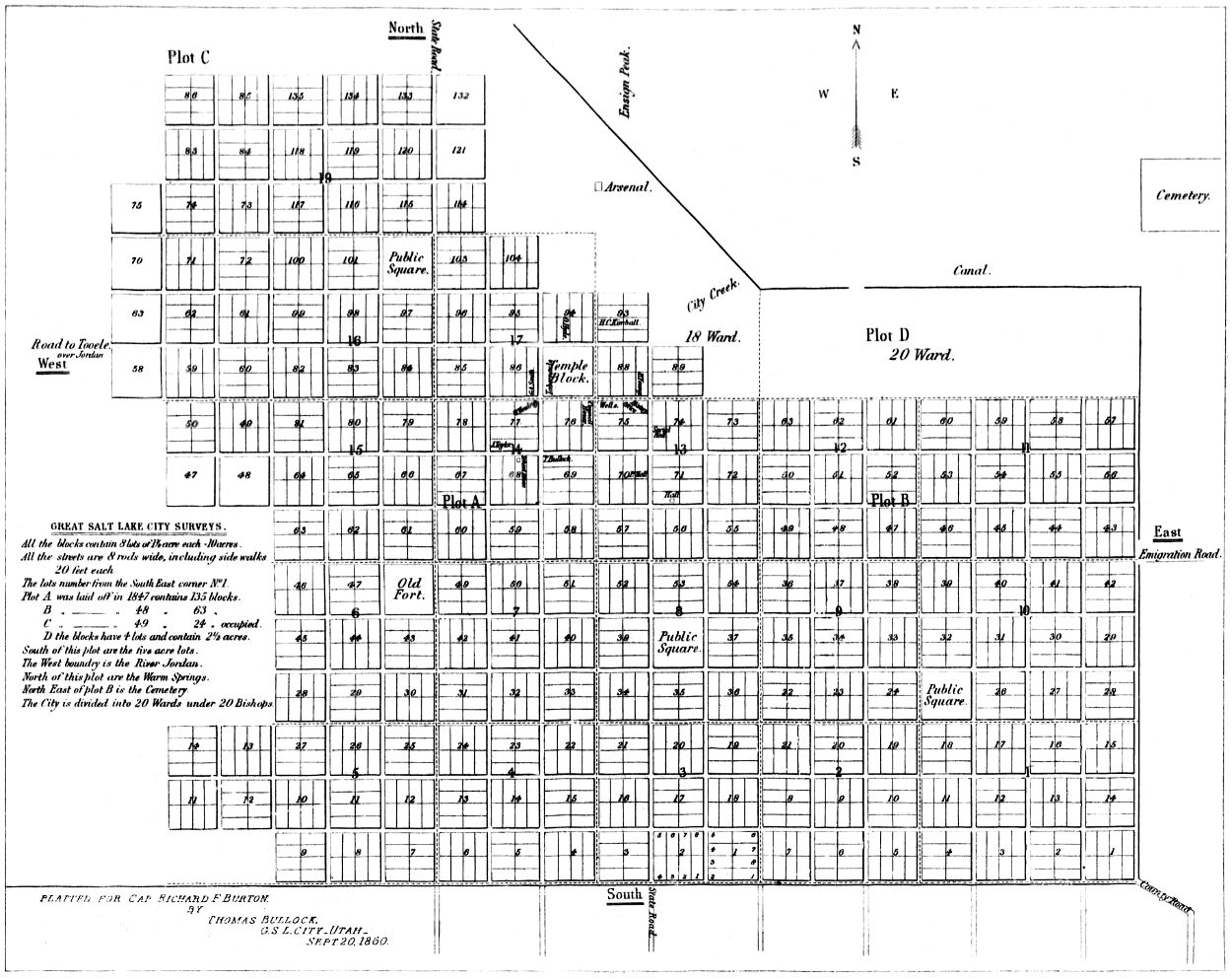
H. Adlard, sc.
London, Longman & Co.
| GREAT SALT LAKE CITY SURVEYS. |
| All the blocks contain 8 lots of 11⁄4 acre each = 10 acres. |
| All the streets are 8 rods wide, including side walks.
20 feet each. |
| The lots number from the South East corner No. 1. |
| Plot |
A |
was |
laid off |
in |
1847 |
contains |
135 |
blocks. |
|
| B |
„ |
——— |
„ |
48 |
„ |
63 |
„ |
|
| C |
„ |
——— |
„ |
49 |
„ |
24 |
„ |
occupied. |
| D |
the lots have 4 blocks and contain 21⁄2 acres. |
| South of this plot are the five acre lots. |
| The West boundry is the River Jordan. |
| North of this plot are the Warm Springs. |
| North East of plot B is the Cemetery. |
| The City is divided into 20 Wards under 20 Bishops. |
PLATTED FOR CAP. RICHARD F. BURTON.
BY
THOMAS BULLOCK.
G. S. L. CITY _UTAH_
SEPT. 20. 1860.
Larger map (1.1 MB)
After two miles of comparatively level ground we came to the
foot of “Little Mountain,” and descended from the wagon to relieve
the poor devils of mules. The near slope was much shorter,
but also it was steeper far than “Big Mountain.” The counterslope
was easier, though by no means pleasant to contemplate
with the chance of an accident to the brake, which in all inconvenient
places would part with the protecting shoe-sole. Beyond
the eastern foot, which was ten miles distant from our destination,
we were miserably bumped and jolted over the broken
ground at the head of Big Kanyon. Down this pass, whose name
is a translation of the Yuta name Obitkokichi, a turbulent little
mountain stream tumbles over its boulder-bed, girt with the usual
sunflower, vines of wild hops, red and white willows, cotton-wood,
quaking asp, and various bushes near its cool watery margin,
and upon the easier slopes of the ravine, with the shin or dwarf
oak (Quercus nana), mountain mahogany, balsam, and other firs,
pines, and cedars. A TICKLISH ROAD.The road was a narrow shelf along the broader
of the two spaces between the stream and the rock, and frequent
fordings were rendered necessary by the capricious wanderings
of the torrent. I could not but think how horrid must
have been its appearance when the stout-hearted Mormon pioneers
first ventured to thread the defile, breaking their way through the
dense bush, creeping and clinging like flies to the sides of the
hills. Even now accidents often occur; here, as in Echo Kanyon,
we saw in more than one place unmistakable signs of upsets in
the shape of broken spokes and yoke-bows. At one of the most
ticklish turns Macarthy kindly pointed out a little precipice where
four of the mail passengers fell and broke their necks, a pure invention
on his part, I believe, which fortunately, at that moment,
did not reach Mrs. Dana’s ears. He also entertained us with many
a tale, of which the hero was the redoubtable Hanks: how he
had slain a buffalo bull single-handed with a bowie-knife; and
how, on one occasion, when refused hospitality by his Lamanite
brethren, he had sworn to have the whole village to himself, and
had redeemed his vow by reappearing in cuerpo, with gestures so
maniacal that the sulky Indians all fled, declaring him to be “bad
medicine.” The stories had at least local coloring.
In due time, emerging from the gates, and portals, and deep
serrations of the upper course, we descended into a lower level:
here Big, now called Emigration Kanyon,EMIGRATION KANYON. gradually bulges out,
and its steep slopes of grass and fern, shrubbery and stunted
brush, fall imperceptibly into the plain. The valley presently lay
full before our sight. At this place the pilgrim emigrants, like
the hajjis of Mecca and Jerusalem, give vent to the emotions long
pent up within their bosoms by sobs and tears, laughter and congratulations,
psalms and hysterics. It is indeed no wonder that
the children dance, that strong men cheer and shout, and that
nervous women, broken with fatigue and hope deferred, scream
and faint; that the ignorant should fondly believe that the “Spirit
of God pervades the very atmosphere,” and that Zion on the
tops of the mountains is nearer heaven than other parts of earth.
In good sooth, though uninfluenced by religious fervor—beyond
the natural satisfaction of seeing a bran-new Holy City—even I
could not, after nineteen days in a mail-wagon, gaze upon the
scene without emotion.
The sublime and the beautiful were in present contrast. Switzerland
and Italy lay side by side. The magnificent scenery of
the past mountains and ravines still floated before the retina, as
emerging from the gloomy depths of the Golden Pass—the mouth
of Emigration Kanyon is more poetically so called—we came suddenly
in view of the Holy Valley of the West.
The hour was about 6 P.M.; the atmosphere was touched with
a dreamy haze, as it generally is in the vicinity of the lake; a little
bank of rose-colored clouds, edged with flames of purple and
gold, floated in the upper air, while the mellow radiance of an
American autumn, that bright interlude between the extremes of
heat and cold, diffused its mild soft lustre over the face of earth.
The sun, whose slanting rays shone full in our eyes, was setting
in a flood of heavenly light behind the bold, jagged outline
of “Antelope Island,” which, though distant twenty miles to the
northwest, hardly appeared to be ten. At its feet, and then
bounding the far horizon, lay, like a band of burnished silver, the
Great Salt Lake, that still innocent Dead Sea. Southwestward
also, and equally deceptive as regards distance, rose the boundary
of the valley plain, the Oquirrh Range, sharply silhouetted by a
sweep of sunshine over its summits, against the depths of an evening
sky, in that direction so pure, so clear, that vision, one might
fancy, could penetrate behind the curtain into regions beyond the
confines of man’s ken. In the brilliant reflected light, which softened
off into a glow of delicate pink, we could distinguish the
lines of Brigham’s, Coon’s, and other kanyons, which water has
traced through the wooded flanks of the Oquirrh down to the
shadows already purpling the misty benches at their base. Three
distinct and several shades, light azure, blue, and brown-blue,
graduated the distances, which extended at least thirty miles.
The undulating valley-plain between us and the Oquirrh Range
is 12·15 miles broad, and markedly concave, dipping in the centre
like the section of a tunnel, and swelling at both edges into bench-lands,
which mark the ancient bed of the lake. In some parts
the valley was green; in others, where the sun shot its oblique
beams, it was of a tawny yellowish-red, like the sands of the Arabian
desert, with scatters of trees, where the Jordan of the West
rolls its opaline wave through pasture-lands of dried grass dotted
with flocks and herds, and fields of ripening yellow corn. Every
thing bears the impress of handiwork, from the bleak benches behind
to what was once a barren valley in front. Truly the Mormon
prophecy had been fulfilled: already the howling wilderness—in
which twelve years ago a few miserable savages, the half-naked
Digger Indians, gathered their grass-seed, grasshoppers, and
black crickets to keep life and soul together, and awoke with their
war-cries the echo of the mountains, and the bear, the wolf, and
the fox prowled over the site of a now populous city—“has blossomed
like the rose.”
This valley—this lovely panorama of green, and azure, and gold—this
land, fresh, as it were, from the hands of God, is apparently
girt on all sides by hills: the highest peaks, raised 7000 to 8000
feet above the plain of their bases, show by gulches veined with
lines of snow that even in this season winter frowns upon the last
smile of summer.
Advancing, we exchanged the rough cahues and the frequent
fords of the ravine for a broad smooth highway, spanning the
easternmost valley-bench—a terrace that drops like a Titanic step
from the midst of the surrounding mountains to the level of the
present valley-plain. From a distance—the mouth of Emigration
Kanyon is about 4·30 miles from the city—Zion, which is not on
a hill, but, on the contrary, lies almost in the lowest part of the
river-plain, is completely hid from sight, as if no such thing existed.
Mr. Macarthy, on application, pointed out the notabilia of the
scene.
Northward, curls of vapor ascending from a gleaming sheet—the
Lake of the Hot Springs—set in a bezel of emerald green,
and bordered by another lake-bench upon which the glooms of
evening were rapidly gathering, hung like a veil of gauze around
the waist of the mountains. Southward for twenty-five miles
stretched the length of the valley, with the little river winding its
way like a silver thread in a brocade of green and gold. The
view in this direction was closed by “Mountain Point,”MOUNTAIN POINT. another
formation of terraced range, which forms the water-gate of Jordan,
and which conceals and separates the fresh water that feeds
the Salt Lake—the Sea of Tiberias from the Dead Sea.
As we descend the Wasach Mountains, we could look back and
enjoy the view of the eastern wall of the Happy Valley.THE HAPPY VALLEY. A little
to the north of Emigration Kanyon, and about one mile nearer
the settlement, is the Red Butte, a deep ravine, whose quarried
sides show mottlings of the light ferruginous sandstone which was
chosen for building the Temple wall.[125] A little beyond it lies
the single City of the Dead, decently removed three miles from
the habitations of the living, and farther to the north is City-Creek
Kanyon, which supplies the Saints with water for drinking and
for irrigation. Southeast of Emigration Kanyon are other ravines,
Parley’s, Mill Creek, Great Cotton-wood, and Little Cotton-wood,
deep lines winding down the timbered flanks of the mountains,
and thrown into relief by the darker and more misty shading
of the farther flank-wall.
The “Twin Peaks,” the highest points of the Wasach Mountains,
are the first to be powdered over with the autumnal snow.
When a black nimbus throws out these piles, with their tilted-up
rock strata, jagged edges, black flanks, rugged brows, and bald
heads gilt by a gleam of sunset, the whole stands boldly out with
that phase of sublimity of which the sense of immensity is the
principal element. Even in the clearest of weather they are rarely
free from a fleecy cloud, the condensation of cold and humid
air rolling up the heights and vanishing only to be renewed.
The bench-land then attracted our attention. The soil is poor,
sprinkled with thin grass, in places showing a suspicious whiteness,
with few flowers, and chiefly producing a salsolaceous plant
like the English samphire. In many places lay long rows of bare
circlets, like deserted tent-floors; they proved to be ant-hills, on
which light ginger-colored swarms were working hard to throw
up the sand and gravel that every where in this valley underlie
the surface. The eastern valley-bench, upon whose western declivity
the city lies, may be traced on a clear day along the base
of the mountains for a distance of twenty miles: its average breadth
is about eight miles.
After advancing about 1·50 mile over the bench ground, the
city by slow degrees broke upon our sight. It showed, one may
readily believe, to special advantage after the succession of Indian
lodges, Canadian ranchos, and log-hut mail-stations of the prairies
and the mountains. The site has been admirably chosen for drainage
and irrigation—so well, indeed, that a “Deus ex machinâ”
must be brought to account for it.[126] About two miles north, and
overlooking the settlements from a height of 400 feet, a detached
cone, called Ensign Peak or Ensign Mount, rises at the end of a
chain which, projected westward from the main range of the
heights, overhangs and shelters the northeastern corner of the
valley. Upon this “big toe of the Wasach range,” as it is called
by a local writer, the spirit of the martyred prophet, Mr. Joseph
Smith, appeared to his successor, Mr. Brigham Young, and pointed
out to him the position of the New Temple, which, after Zion had
“got up into the high mountain,” was to console the Saints for
the loss of Nauvoo the Beautiful. The city—it is about two miles
broad—runs parallel with the right bank of the Jordan, which
forms its western limit. It is twelve to fifteen miles distant from
the western range, ten from the debouchure of the river, and eight
to nine from the nearest point of the lake—a respectful distance,
which is not the least of the position’s merits. It occupies the rolling
brow of a slight decline at the western base of the Wasach—in
fact, the lower, but not the lowest level of the eastern valley-bench;
it has thus a compound slope from north to south, on the
line of its water supplies, and from east to west, thus enabling it
to drain off into the river.
The city revealed itself, as we approached, from behind its
screen, the inclined terraces of the upper table-land, and at last it
lay stretched before us as upon a map. At a little distance the
aspect was somewhat Oriental, and in some points it reminded me
of modern Athens without the Acropolis. None of the buildings,
except the Prophet’s house, were whitewashed. The material—the
thick, sun-dried adobe, common to all parts of the Eastern
world[127]—was of a dull leaden blue, deepened by the atmosphere
to a gray, like the shingles of the roofs. The number of gardens
and compounds—each tenement within the walls originally received
1·50 square acre, and those outside from five to ten acres,
according to their distance—the dark clumps and lines of bitter
cotton-wood, locust, or acacia, poplars and fruit-trees, apples, peaches,
and vines—how lovely they appeared, after the baldness of the
prairies!—and, finally, the fields of long-eared maize and sweet
sorghum strengthened the similarity to an Asiatic rather than to
an American settlement. The differences presently became as
salient. The farm-houses, with their stacks and stock, strongly
suggested the Old Country. Moreover, domes and minarets—even
churches and steeples—were wholly wanting, an omission
that somewhat surprised me. The only building conspicuous
from afar was the block occupied by the present Head of the
Church. The court-house, with its tinned Muscovian dome, at
the west end of the city; the arsenal, a barn-like structure, on a
bench below the Jebel Nur of the valley—Ensign Peak; and a
saw-mill, built beyond the southern boundary, were the next in
importance.
On our way we passed the vestiges of an old moat, from which
was taken the earth for the bulwarks of Zion.BULWARKS OF ZION. A Romulian wall,
of puddle, mud, clay, and pebbles, six miles—others say 2600 acres—in
length, twelve feet high, six feet broad at the base, and two
and three quarters at the top, with embrasures five to six feet
above the ground, and semi-bastions at half musket range, was
decided, in 1853-54, to be necessary, as a defense against the Lamanites,
whose name in the vulgar is Yuta Indians. Gentiles
declare that the bulwarks were erected because the people wanting
work were likely to “strike” faith, and that the amount of
labor expended upon this folly would have irrigated as many
thousand acres. Anti-Mormons have, of course, detected in the
proceeding treacherous and treasonable intentions. Parenthetically,
I must here warn the reader that in Great Salt Lake City
there are three distinct opinions concerning, three several reasons
for, and three diametrically different accounts of, every thing that
happens, viz., that of the Mormons, which is invariably one-sided;
that of the Gentiles, which is sometimes fair and just; and that
of the anti-Mormons, which is always prejudiced and violent. A
glance will show that this much-talked-of fortification is utterly
harmless; it is commanded in half a dozen places; it could not
keep out half a dozen sappers for a quarter of an hour; and now,
as it has done its work, its foundations are allowed to become
salt, and to crumble away.
The road ran through the Big Field, southeast of the city, six
miles square, and laid off in five-acre lots. Presently, passing the
precincts of habitation, we entered, at a slapping pace, the second
ward, called Denmark, from its tenants, who mostly herd together.
The disposition of the settlement is like that of the nineteenth
century New-World cities—from Washington to the future metropolis
of the great Terra Australis—a system of right angles,
the roads, streets, and lanes, if they can be called so, intersecting
one another. The advantages or disadvantages of the rectangular
plan have been exhausted in argument; the new style is best
suited, I believe, for the New, as the old must, perforce, remain
in the Old World. The suburbs are thinly settled; the mass of
habitations lie around and south of Temple Block. The streets
of the suburbs are mere roads, cut by deep ups and downs, and
by gutters on both sides, which, though full of pure water, have
no bridge save a plank at the trottoirs. In summer the thoroughfares
are dusty, in wet weather deep with viscid mud.
The houses are almost all of one pattern—a barn shape, with
wings and lean-tos, generally facing, sometimes turned endways
to the street, which gives a suburban look to the settlement; and
the diminutive casements show that window-glass is not yet made
in the Valley. In the best abodes the adobe rests upon a few
courses of sandstone, which prevent undermining by water or
ground-damp, and it must always be protected by a coping from
the rain and snow. The poorer are small, low, and hut-like; others
are long single-storied buildings, somewhat like stables, with
many entrances. The best houses resemble East Indian bungalows,
with flat roofs, and low, shady verandas, well trellised, and
supported by posts or pillars. All are provided with chimneys,
and substantial doors to keep out the piercing cold. The offices
are always placed, for hygienic reasons, outside; and some have
a story and a half—the latter intended for lumber and other stores.
I looked in vain for the out-house harems, in which certain romancers
concerning things Mormon had informed me that wives
are kept, like any other stock. I presently found this but one of
a multitude of delusions. Upon the whole, the Mormon settlement
was a vast improvement upon its contemporaries in the valleys
of the Mississippi and the Missouri.
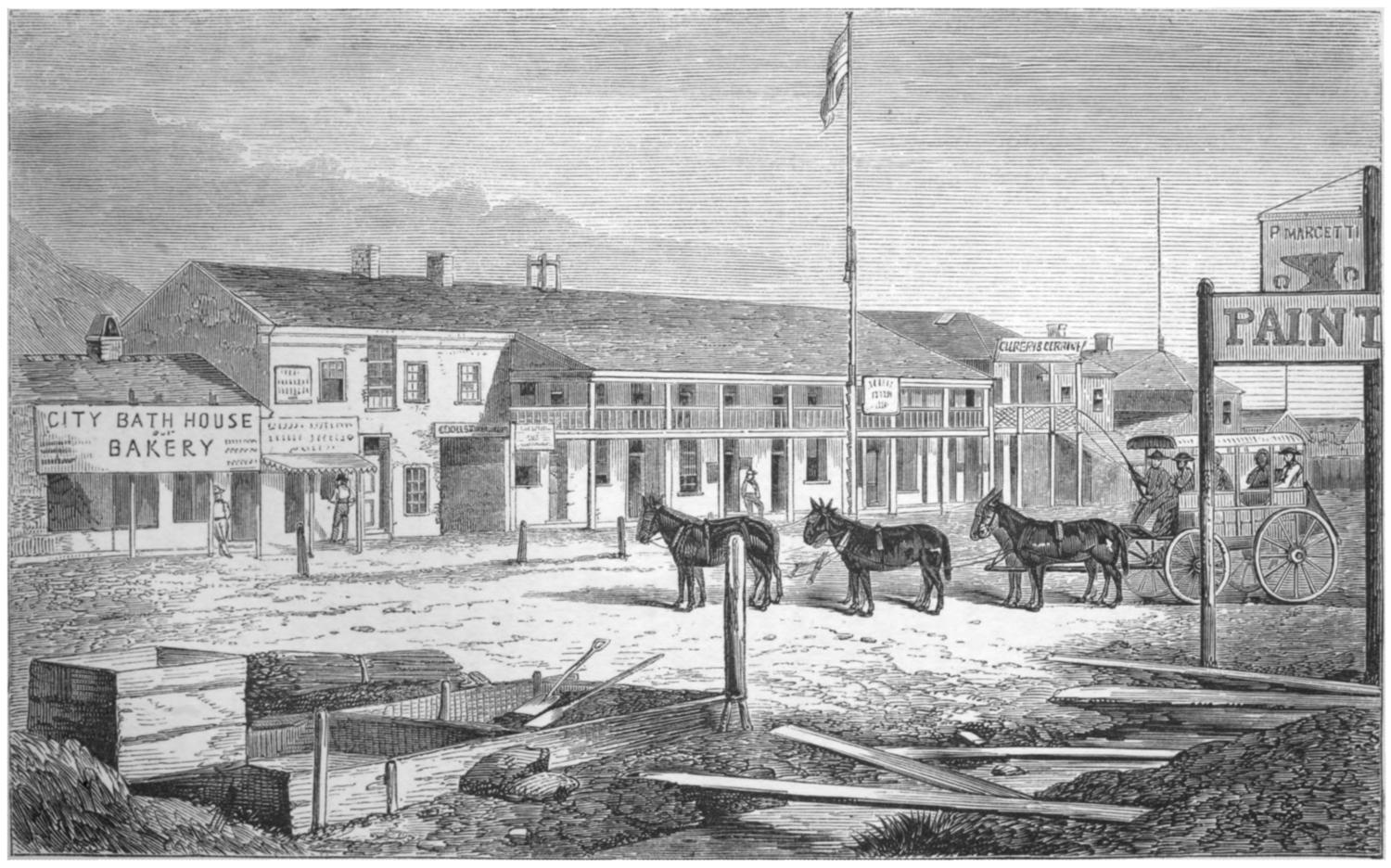
STORES IN MAIN STREET.
The road through the faubourg was marked by posts and rails,
which, as we advanced toward the heart of the city, were replaced
by neat palings. The garden-plots were small,GARDENS. as sweet earth
must be brought down from the mountains; and the flowers were
principally those of the Old Country—the red French bean, the
rose, the geranium, and the single pink; the ground or winter
cherry was common; so were nasturtiums; and we saw tansy,
but
not that plant for which our souls, well-nigh weary of hopes of juleps
long deferred, chiefly lusted—mint. The fields were large
and numerous, but the Saints have too many and various occupations
to keep them, Moravian-like, neat and trim; weeds overspread
the ground; often the wild sunflower-tops outnumbered
the heads of maize. The fruit had suffered from an unusually
nipping frost in May; the peach-trees were barren; the vines
bore no produce; only a few good apples were in Mr. Brigham
Young’s garden, and the watermelons were poor, yellow, and
tasteless, like the African. On the other hand, potatoes, onions,
cabbages, and cucumbers were good and plentiful, the tomato was
ripening every where, fat full-eared wheat rose in stacks, and crops
of excellent hay were scattered about near the houses. The people
came to their doors to see the mail-coach, as if it were the
“Derby dilly” of old, go by. I could not but be struck by the
modified English appearance of the colony, and by the prodigious
numbers of the white-headed children.
Presently we debouched upon the main thoroughfare, the centre
of population and business, where the houses of the principal
Mormon dignitaries and the stores of the Gentile merchants combine
to form the city’s only street which can be properly so called.
It is, indeed, both street and market, for, curious to say, New
Zion has not yet built for herself a bazar or market-place. Nearly
opposite the Post-office, in a block on the eastern side, with a
long veranda, supported by trimmed and painted posts, was a two-storied,
pent-roofed building,THE HOTEL IN NEW ZION. whose sign-board, swinging to a tall,
gibbet-like flag-staff, dressed for the occasion, announced it to be
the Salt Lake House, the principal, if not the only establishment
of the kind in New Zion. In the Far West, one learns not to expect
much of the hostelry;[128] I had not seen aught so grand for
many a day. Its depth is greater than its frontage, and behind
it, secured by a porte cochère, is a large yard for corraling cattle.
A rough-looking crowd of drivers, drivers’ friends, and idlers, almost
every man openly armed with revolver and bowie-knife,
gathered round the doorway to greet Jim, and “prospect” the
“new lot;” and the host came out to assist us in transporting our
scattered effects. We looked vainly for a bar on the ground
floor; a bureau for registering names was there, but (temperance,
in public at least, being the order of the day) the usual tempting
array of bottles and decanters was not forthcoming; up stairs we
found a Gentile ballroom, a tolerably furnished sitting-room, and
bedchambers, apparently made out of a single apartment by partitions
too thin to be strictly agreeable. The household had its
deficiencies; blacking, for instance, had run out, and servants
could not be engaged till the expected arrival of the hand-cart
train. However, the proprietor, Mr. Townsend, a Mormon, from
the State of Maine—when expelled from Nauvoo, he had parted
with land, house, and furniture for $50—who had married an Englishwoman,
was in the highest degree civil and obliging, and he
attended personally to our wants, offered his wife’s services to Mrs.
Dana, and put us all in the best of humors, despite the closeness
of the atmosphere, the sadness ever attending one’s first entrance
into a new place, the swarms of “emigration flies”—so called because
they appear in September with the emigrants, and, after living
for a month, die off with the first snow—and a certain populousness
of bedstead, concerning which the less said the better.
Such, gentle reader, are the results of my first glance at Zion on
the tops of the mountains, in the Holy City of the Far West.
Our journey had occupied nineteen days, from the 7th to the
25th of August, both included; and in that time we had accomplished
not less than 1136 statute miles.
CHAPTER IV. First Week at Great Salt Lake City.—Preliminaries.
Before entering upon the subject of the Mormons I would
fain offer to the reader a few words of warning. During my
twenty-four days at head-quarters, ample opportunities of surface
observation were afforded me. I saw, as will presently appear,
specimens of every class, from the Head of the Church down to
the field-hand, and, being a stranger in the land, could ask questions
and receive replies upon subjects which would have been
forbidden to an American of the States, more especially to an official.
But there is in Mormondom, as in all other exclusive
faiths, whether Jewish, Hindoo, or other, an inner life into which
I can not flatter myself or deceive the reader with the idea of my
having penetrated. At the same time, it is only fair to state that
no Gentile, even the unprejudiced, who are raræ aves, however
long he may live or intimately he may be connected with Mormons,
can expect to see any thing but the superficies. The writings
of the Faithful are necessarily wholly presumed. And, finally,
the accounts of Life in the City of the Saints published by anti-Mormons
and apostates are venomous, and, as their serious discrepancies
prove, thoroughly untrustworthy. I may therefore
still hope, by recounting honestly and truthfully as lies in my
power what I heard, and felt, and saw, and by allowing readers to
draw their own conclusions, to take new ground.
The Mormons have been represented, and are generally believed
to be, an intolerant race; I found the reverse far nearer the fact.
The best proof of this is that there is hardly one anti-Mormon
publication, however untruthful, violent, or scandalous, which I
did not find in Great Salt Lake City.[129]
The extent of the subjoined
bibliographical listBIBLIOLOGY. would deter me from a theme so used
up by friend and foe, were it not for these considerations. In the
first place, I have found, since my return to England, a prodigious
general ignorance of the “Mormon rule;” the mass of the public
has heard of the Saints, but even well-educated men hold theirs
to be a kind of socialistic or communist concern, where, as in the
world to come, there is no marrying nor giving in marriage.
Even where this is not the case, the reader of travels will not
dislike to peruse something more of a theme with which he is already
perhaps familiar; for in this department of literature, as in
history and biography, the more we know of a subject, the more
we want to know. Moreover, since 1857, no book of general interest
has appeared, and the Mormons are a progressive people,
whose “go-a-headitiveness” in social growth is only to be compared
with their obstinate conservatism in adhering to institutions
that date from the days of Abraham. Secondly, the natural history
of the New Faith—for such it is—through the several periods
of conception, birth, and growth to vigorous youth, with fair promise
of stalwart manhood, is a subject of general and no small importance.
It interests the religionist, who looks upon it as the
“scourge of corrupted Christianity,” as much as the skeptic, that
admires how, in these days of steam-traveling, printing, and telegramming,
when “many run to and fro,” and when “knowledge”
has been “increased,” human credulity will display itself in the
same glaring colors which it wore ere the diffusion of knowledge
became a part of social labor. The philosophic observer will detect
in it a notable example of how mens agitat molem, the “powerful
personal influence of personal character,” and the “effect
that may be produced by a single mind inflexibly applied to the
pursuit of a single object;” and another proof that “it is easier
to extend the belief of the multitude than to contract it—a circumstance
which proceeds from the false but prevalent notion
that too much belief is at least an error on the right side.” The
statist will consider it in its aspect as a new system of colonization.
In America the politician will look with curiosity at a
despotism thriving in the centre of a democracy, and perhaps
with apprehension at its future efforts, in case of war or other
troubles, upon the destinies of the whilom Great Republic. In
England, which principally supplies this number of souls, men,
instead of regarding it as one of many safety-valves, will be reminded
of their obligations toward the classes by which Mormonism
is fed, and urged to the improvement of education, religion,
and justice. And I hope to make it appear that the highly-colored
social peculiarities of the New Faith have been used as a
tool by designing men to raise up enmity against a peaceful, industrious,
and law-abiding people, whose whole history has been
a course of cruel persecution, which, if man really believed in his
own improvement, would be a disgrace to a self-styled enlightened
age. The prejudice has naturally enough extended from
America to England. In 1845, when the Mormons petitioned
for permission to retire to Vancouver’s Island, they met with
nothing but discouragement. And even in 1860, I am told, when
a report was raised that Mr. Brigham Young would willingly
have taken refuge with his adherents in the valley of the Saskatchawan,
the British minister was instructed to oppose the useful
emigration to the utmost of his power.
On the evening of our arrival Lieutenant Dana and I proceeded
to the store of Messrs. Livingston, Bell, and Co.—formerly Livingston
and Kinkhead—the sutlers of Camp Floyd, and the most
considerable Gentile merchants in Great Salt Lake City; he to
learn the readiest way of reaching head-quarters, I to make inquiries
about the San Francisco road.SAN FRANCISCO ROAD. We were cordially received
by both these gentlemen, who, during the whole period of my
stay, did all in their power to make the place pleasant. Governor
Bell, as he is generally called, presently introduced me to his wife,
a very charming person, of English descent, whose lively manners
contrasted strongly and agreeably with the almost monastic gloom
which the régime of the “lady-saints” casts over society. Lieutenant
Dana was offered seats in Mr. Livingston’s trotting-wagon
on the ensuing Monday. I was less fortunate. Captain Miller,
of Millersville, the principal agent and director at this end of the
road, informed me that he had lately ceased to run the wagon,
which had cost the company $15,000 a month, returning but
$30,000 per annum, and was sending the mails on mule-back.
However, my informants agreed that a party would probably be
starting soon, and that, all things failing, I could ride the road,
though with some little risk of scalp. We ended with a bottle of
Heidseck, and with cigars which were not unpleasant even after
the excellent “gold-leaf tobacco” of the States.
On the next day, Sunday, we walked up the main street northward,
and doubling three corners of Temple Block, reached the
large adobe house, with its neat garden, the abode of the then
governor, Hon. Alfred Cumming.GOVERNOR CUMMING. This gentleman, a Georgian
by birth, after a long public service as Indian agent in the northern
country, was, after several refusals, persuaded by the then
president, who knew his high honor and tried intrepidity, to assume
the supreme executive authority at Great Salt Lake City.
The conditions were that polygamy should not be interfered with,
nor forcible measures resorted to except in extremest need. Governor
Cumming, accompanied by his wife, and an escort of 600
dragoons, left the Mississippi in the autumn of 1857, at a time
when the Mormons were in arms against the federal authority,
and ended his journey only in April of the ensuing year. By
firmness, prudence, and conciliation, he not only prevented any
collision between the local militia and the United States army,
which was burning to revenge itself for the terrible hardships of
the campaign, but succeeded in restoring order and obedience
throughout the Territory. He had been told before entering that
his life was in danger; he was not, however, a man to be deterred
from a settled purpose, and experiment showed that, so far from
being molested, he was received with a salute and all the honors.
Having been warned that he might share the fate of Governor
Boggs, who in 1843 was shot through the mouth when standing
at the window, he enlarged the casements of his house in order
to give the shooter a fair chance. His determination enabled him
to issue, a few days after his arrival, a proclamation offering protection
to all persons illegally restrained of their liberty in Utah.
The scrupulous and conscientious impartiality which he has
brought to the discharge of his difficult and delicate duties, and,
more still, his resolution to treat the Saints like Gentiles and citizens,
not as Digger Indians or felons, have won him scant favor
from either party. The anti-Mormons use very hard language,
and declare him to be a Mormon in Christian disguise. The Mormons,
though more moderate, can never, by their very organization,
rest contented without the combination of the temporal with
the spiritual power. The governor does not meet his predecessor,
the ex-governor, Mr. Brigham Young, from prudential motives,
except on public duty. Mrs. Cumming visits Mrs. Young, and at
the houses of the principal dignitaries, this being nearly the only
society in the place. As, among Moslems, a Lady M. W. Montague
can learn more of domestic life in a week than a man can
in a year, so it is among the Mormons. I can not but express a
hope that the amiable Mrs. Cumming will favor us with the results
of her observation and experience, and that she will be as
disinterested and unprejudiced as she is talented and accomplished.
The kindness and hospitality which I found at the governor’s,
and, indeed, at every place in New Zion, is “ungrateful to
omit,” and would be “tedious to repeat.”
We dined with his excellency at the usual hour, 2 P.M. On
the way I could dwell more observantly upon the main features
of the city, which, after the free use of the pocket-compass, were
becoming familiar to me. The first remark was, that every meridional
street is traversed on both sides by a streamlet of limpid
water, verdure-fringed, and gurgling with a murmur which would
make a Persian Moollah long for improper drinks. The supplies
are brought in raised and hollowed water-courses from City Creek,
Red Buttes, and other kanyons lying north and east of the settlement.
The few wells are never less than forty-five feet deep;
artesians have been proposed for the benches, but the expense
has hitherto proved an obstacle. Citizens can now draw with
scanty trouble their drinking water in the morning, when it is
purest, from the clear and sparkling streams that flow over the
pebbly beds before their doors. The surplus is reserved for the
purposes of irrigation, without which, as the “distillation from
above” will not suffice, Deserét would still be a desert, and what
is not wanted swells the City Creek, and eventually the waves of
the Jordan. The element, which flows at about the rate of four
miles an hour, is under a chief water-master or commissioner, assisted
by a water-master in each ward, and by a deputy in each
block, all sworn to see the fertilizing fluid fairly distributed. At
the corners of every ward there is a water-gate which controls the
supplies that branch off to the several blocks, and each lot of one
and a quarter acres is allowed about three hours’ irrigation during
the week. For repairs and other expenses a property tax of one
mill per dollar is raised, and the total of the impost in 1860 was
$1163 25. The system works like clock-work. “The Act to Incorporate
the Great Salt Lake City Water-works” was approved
January 21, 1853.
Walking in a northward direction up Main, otherwise called
Whisky Street, we could not but observe the “magnificent distances”
of the settlement, which, containing 9000-12,000 souls,
covers an area of three miles.THE HOLY CITY. This broadway is 132 feet wide,
including the side-walks, which are each twenty, and, like the
rest of the principal avenues, is planted with locust and other
trees. There are twenty or twenty-one wards or cantons, numbered
from the S.E. “boustrophedon” to the N.W. corner. They
have a common fence and a bishop apiece. They are called after
the creeks, trees, people, or positions, as Mill-Creek Ward, Little
Cotton-wood, Denmark, and South Ward. Every ward contains
about nine blocks, each of which is forty rods square. The area
of ten acres is divided into four to eight lots, of two and a half to
one and a quarter acres each, 264 feet by 132. A city ordinance
places the houses twenty feet behind the front line of the lot,
leaving an intermediate place for shrubbery or trees. This rule,
however, is not observed in Main Street.
The streets are named from their direction to the Temple Block.
Thus Main Street is East Temple Street No. 1; that behind it is
State Road, or East Temple Street 2, and so forth, the ward being
also generally specified. Temple Block is also the point to which
latitude and longitude are referred. It lies in N. lat. 40° 45′ 44″,
W. long. (G.) 112° 6′ 8″, and 4300 feet above sea level.
Main Street is rapidly becoming crowded. The western block,
opposite the hotel, contains about twenty houses of irregular shape
and size. The buildings are intended to supply the principal
wants of a far-Western settlement, as bakery, butchery, and blacksmithery,
hardware and crockery, paint and whip warehouse, a
“fashionable tailor”—and “fashionable” in one point, that his
works are more expensive than Poole’s—shoe-stores, tannery
and curriery; the Pantechnicon, on a more pretentious style than
its neighbors, kept by Mr. Gilbert Clements, Irishman and orator;
dry-goods, groceries, liquors, and furniture shops, Walker’s
agency, and a kind of restaurant for ice-cream, a luxury which
costs 25 cents a glass; saddlers, dealers in “food, flour, and provisions,”
hats, shoes, clothing, sash laths, shingles, timber, copper,
tin, crockery-ware, carpenters’ tools, and mouse-traps; a watch-maker
and repairer, a gunsmith, locksmith, and armorer, soap and
candle maker, nail-maker, and venders of “Yankee notions.” On
the eastern side, where the same articles are sold on a larger scale,
live the principal Gentile merchants, Mr. Gilbert and Mr. Nixon,
an English Saint; Mr. R. Gill, a “physiological barber;” Mr.
Godbe’s “apothecary and drug stores;” Goddard’s confectionery;
Messrs. Hockaday and Burr, general dealers, who sell every thing,
from a bag of potatoes to a yard of gold lace; and various establishments,
Mormon and others. Crossing the street that runs
east and west, we pass on the right hand a small block, occupied
by Messrs. Dyer and Co., sutlers to a regiment in Arizona, and
next to it the stores of Messrs. Hooper and Cronyn, with an ambrotype
and daguerrean room behind. The stores, I may remark,
are far superior, in all points, to the shops in an English country
town that is not a regular watering-place. Beyond this lies the
adobe house, with its wooden Ionic stoop or piazza (the portico is
a favorite here), and well-timbered garden, occupied by Bishop
Hunter; and adjoining it the long tenement inhabited by the several
relicts of Mayor Jedediah M. Grant. Farther still, and facing
the Prophet’s Block, is the larger adobe house belonging to
General Wells and his family. Opposite, or on the western side,
is the well-known store of Livingston, Bell, and Co., and beyond
it the establishment now belonging to the nine widows and the
son of the murdered apostle, Parley P. Pratt. Still looking westward,
the Globe bakery and restaurant, and a shaving saloon, lead
to the “Mountaineer Office,” a conspicuous building, forty-five
feet square, two storied, on a foundation of cut stone stuccoed red
to resemble sandstone, and provided with a small green-balconied
belvidere. The cost was $20,000. It was formerly the Council
House, and was used for church purposes. When purchased by
the Territory the Public Library was established in the northern
part; the office of the “Deserét News” on the first story, and that
of the “Mountaineer” on the ground floor. This brings us to the
1st South Temple Street, which divides the “Mountaineer” office
from the consecrated ground. In this vicinity are the houses of
most of the apostles, Messrs. Taylor, Cannon, Woodruff, and O.
Pratt.
Crowds were flocking into Temple Block for afternoon service;
yet I felt disappointed by the scene. I had expected to see traces
of “workmen in abundance, hewers and workers of stone and
timber, and all manner of cunning men for every manner of work,”
reposing from their labors on the Sabbath. I thought, at any
rate, to find
“pars ducere muros
Molirique arcem, et manibus subvolvere saxa.”
It seemed hardly in accordance with the energy and devotedness
of a new faith that a hole in the ground should represent
the House of the Lord, while Mr. Brigham Young, the Prophet,
thinking of his own comfort before the glory of God, is lodged,
like Solomon of old, in what here appears a palace. Nor, reflecting
that without a Temple the dead can not be baptized out of
Purgatory, was I quite satisfied when reminded of the fate of Nauvoo
(according to Gentiles the Mormons believe that they must
build nine temples before they will be suffered to worship in peace),
and informed that the purely provisional works, which had been
interrupted by the arrival of the army in 1858, would shortly be
improved.
The lines of THE TEMPLE BLOCK.Temple Block—which, as usual, is ten acres square
= forty rods each way—run toward the cardinal points. It stands
clear of all other buildings, and the locust-trees, especially those on
the sunny south side, which have now been planted seven years,
will greatly add to its beauties. It is surrounded with a foundation
wall of handsomely dressed red sandstone, raised to the height
of ten feet by adobe stuccoed over to resemble a richer material.
Each facing has thirty flat pilastres, without pedestal or entablature,
but protected, as the adobe always should be, by a sandstone
coping. When finished, the whole will be surmounted by an ornamental
iron fence. There are four gates, one to each side—of
these, two, the northern and western, are temporarily blocked up
with dry stone walls, while the others are left open—which in
time will become carriage entrances, with two side ways for foot
passengers. According to accounts, the wall and the foundations
have already cost one million of dollars, or a larger sum than that
spent upon the entire Nauvoo Temple.
Temple Block—the only place of public and general worship
in the city—was consecrated and a Tabernacle was erected in September,
1847, immediately after the celebrated exodus from “Egypt
on the banks of the Mississippi,” on a spot revealed by the past
to the present Prophet and his adherents. Two sides of the wall
having been completed, ground was broken on the 14th of February,
1853, for the foundation of the building. One part of the
ceremony consisted of planting a post at the central point, the
main “stake for the curtains of Zion:” every successive step in
advance was commemorated by imposing ceremonies, salvos of
guns, bands playing, crowds attending, addresses by the governor,
Mr. Brigham Young, prayers and pious exercises. The foundations
of the Temple, which are sixteen feet deep, and composed
of hard gray granite, in color like that of Aberdeen or Quincy,
are now concealed from view; and the lumber huts erected for
the workmen were, when the Mormons made their minor Hegira
to Provo City, removed to the Sugar-house Ward, three miles
southeast of the city.
The Temple Block is at present a mere waste. A central excavation,
which resembles a large oblong grave, is said by Gentiles
to be the beginning of a baptismal font twenty feet deep. The
southwestern corner is occupied by the Tabernacle, an adobe building
126 feet long from N. to S., and 64 wide from E. to W.: its
interior, ceilinged with an elliptical arch—the width being its span—can
accommodate 2000-3000 souls. It urgently requires enlarging.
Over the entrances at the gable ends, which open to the
N. and S., is a wood-work representing the sun, with his usual
coiffure of yellow beams, like a Somali’s wig, or the symbol of the
Persian empire. The roof is of shingles: it shelters under its projecting
eaves a whole colony of swallows, and there are four chimneys—a
number insufficient for warmth at one season, or for ventilation
at the other. The speaker or preacher stands on the west
side of the building, which is reserved for the three highest dignities,
viz., the First Presidency, the “Twelve” (Apostles), and the
President of the State of Zion: distinguished strangers are also
admitted. Of late, as in the old Quaker meeting-houses at Philadelphia,
the brethren in the Tabernacle have been separated from
the “sistern,” who sit on the side opposite the preacher’s left; and,
according to Gentiles, it is proposed to separate the Christians from
the Faithful, that the “goats” may no longer mingle with the sheep.
Immediately north of the Tabernacle is the Bowery—in early
spring a canopy of green leafy branches, which are left to wither
with the year, supported on wooden posts. The interior will be
described when we attend the house of worship next Sunday.
In the extreme northwest angle of the block is the Endowment,
here pronounced On-dewment House, separated from the Tabernacle
by a high wooden paling. The building, of which I made
a pen and ink sketch from the west, is of adobe, with a pent roof
and four windows, one blocked up: the central and higher portion
is flanked by two wings, smaller erections of the same shape.
The Endowment House is the place of great medicine, and all appertaining
to it is carefully concealed from Gentile eyes and ears:
the result is that human sacrifices are said to be performed within
its walls. Mrs. Smith and Mr. Hyde have described the mysterious
rites performed within these humble walls, but, for reasons
given before, there is reason to doubt the truth of their descriptions;
such orgies as they describe could not coexist with the respectability
which is the law of the land. M. Remy has detailed
the programme with all the exactitude of an eye-witness, which
he was not. The public declare that the ceremonies consist of
some show, which in the Middle Ages would be called a comedy
or mystery—possibly Paradise Lost and Paradise Regained—and
connect it with the working of a mason’s lodge. The respectable
Judge Phelps, because supposed to take the place of the Father of
Sin when tempting Adam and Eve, is popularly known as “the
Devil.” The two small wings are said to contain fonts for the
two sexes, where baptism by total immersion is performed. According
to Gentiles, the ceremony occupies eleven or twelve hours.
The neophyte, after bathing, is anointed with oil, and dressed in
clean white cotton garments, cap and shirt, of which the latter is[222]
[223]
rarely removed—Dr. Richards saved his life at the Carthage massacre
by wearing it—and a small square masonic apron, with
worked or painted fig-leaves: he receives a new name and a distinguishing
grip, and is bound to secrecy by dreadful oaths.
Moreover, it is said that, as in all such societies, there are several
successive degrees, all of which are not laid open to initiation till
the Temple shall be finished. But—as every mason knows—the
“red-hot poker” and other ideas concerning masonic institutions
have prevailed when juster disclosures have been rejected. Similarly
in the Mormonic mystery, it is highly probable that, in consequence
of the conscientious reserve of the people upon a subject
which it would be indelicate to broach, the veriest fancies have
taken the deepest root.
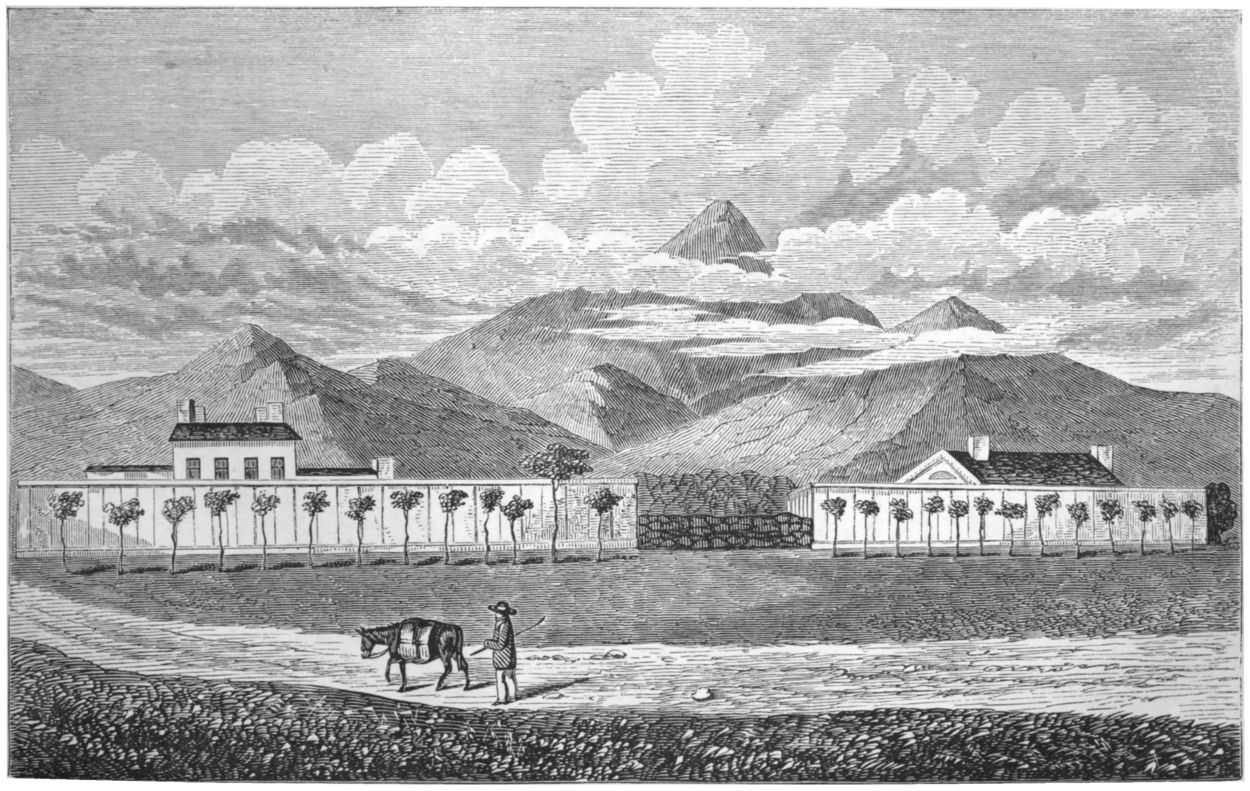
ENDOWMENT HOUSE AND TABERNACLE. (From the West.)
The other features of the inclosure are a well near the Tabernacle,
an arched sewer in the western wall for drainage, and at
the eastern entrance a small habitation for concierge and guards.
THE FUTURE TEMPLE.The future Temple was designed by an Anglo-Mormon architect,
Mr. Truman O. Angell. The plan is described at full length in
the Latter-Day Saints’ “Millennial Star,” December 2, 1854, and
drawings, apparently copied from the original in the historian’s office,
have been published at Liverpool, besides the small sketches
in the works of Mr. Hyde and M. Remy. It is hardly worth
while here to trouble the general reader with a lengthy description
of a huge and complicated pile, a syncretism of Greek and
Roman, Gothic and Moorish, not revealed like that of Nauvoo,
but planned by man, which will probably never be completed. It
has been transferred to the Appendix (No. II.), for the benefit of
students: after briefly saying that the whole is symbolical, and
that it is intended to dazzle, by its ineffable majesty, the beholder’s
sight, I will repeat the architect’s concluding words, which
are somewhat in the style of Parr’s Life Pills advertisements:
“For other particulars, wait till the house is done, then come and
see it.”
After dining with the governor, we sat under the stoop enjoying,
as we might in India, the cool of the evening. Several visitors
dropped in, among them Mr. and Mrs. Stenhouse.MR. STENHOUSE. He—Elder
T. B. H. Stenhouse—is a Scotchman by birth, and has passed
through the usual stages of neophyte (larva), missionary (pupa),
and elder or fully-developed Saint (imago). Madame was from
Jersey, spoke excellent French, talked English without nasalization
or cantalenation, and showed a highly cultivated mind. She
had traveled with her husband on a propagandist tour to Switzerland
and Italy, where, as president of the missions for three
years, he was a “diligent and faithful laborer in the great work
of the last dispensation.” He became a Saint in 1846, at the age
of 21; lived the usual life of poverty and privation, founded the
Southampton Conference, converted a lawyer among other great
achievements, and propagated the Faith successfully in Scotland
as in England. The conversation turned—somehow in Great Salt
Lake City it generally does—upon polygamy, or rather plurality,
which here is the polite word, and for the first time I heard that
phase of the family tie sensibly, nay, learnedly advocated on religious
grounds by fair lips. Mr. Stenhouse kindly offered to accompany
me on the morrow, as the first hand-cart train was expected
to enter, and to point out what might be interesting. I
saw Elder and High-Priest Stenhouse almost every day during
my stay at Great Salt Lake City, and found in his society both
pleasure and profit. We of course avoided those mysterious
points, into which, as an outsider, I had no right to enter; the elder
was communicative enough upon all others, and freely gave
me leave to use his information. The reader, however, will kindly
bear in mind that, being a strict Mormon, Mr. Stenhouse could
enlighten me only upon one side of the subject; his statements
were therefore carefully referred to the “other part;” moreover,
as he could never see any but the perfections of his system, the
blame of having pointed out what I deem its imperfections is not
to be charged upon him. His power of faith struck me much.
I had once asked him what became of the Mormon Tables of the
Law, the Golden Plates which, according to the Gentiles, were removed
by an angel after they had done their work. He replied
that he knew not; that his belief was independent of all such accidents;
that Mormonism is and must be true to the exclusion of
all other systems. I saw before me an instance how the brain or
mind of man can, by mere force of habit and application, imbue
itself with any idea.
Long after dark I walked home alone. There were no lamps
in any but Main Street, yet the city is as safe as at St. James’s
Square, London. There are perhaps not more than twenty-five
or thirty constables or policemen in the whole place, under their
captain, a Scotchman, Mr. Sharp, “by name as well as nature so;”
and the guard on public works is merely nominal. Its excellent
order must be referred to the perfect system of private police, resulting
from the constitution of Mormon society, which in this
point resembles the caste system of Hindooism. There is no secret
from the head of the Church and State; every thing, from
the highest to the lowest detail of private and public life, must be
brought to the ear and submitted to the judgment of the father-confessor-in-chief.
Gentiles often declare that the Prophet is acquainted
with their every word half an hour after it is spoken;
and from certain indices, into which I hardly need enter, my opinion
is that, allowing something for exaggeration, they are not very
far wrong. In London and Paris the foreigner is subjected, though
perhaps he may not know it, to the same surveillance, and till
lately his letters were liable to be opened at the Post-office. We
can not, then, wonder that at Great Salt Lake City, a stranger,
before proving himself at the least to be harmless, should begin
by being an object of suspicion.
On Monday, as the sun was sloping toward the east, Mr. Stenhouse
called to let me know that the train had already issued
from Emigration Kanyon; no time to spare. We set out together
“down town” at once. Near the angle of Main Street I was
shown the place where a short time before my arrival a curious
murderA MURDER. was committed. Two men, named Johnston and Brown,
mauvais sujets, who had notoriously been guilty of forgery and
horse-stealing, were sauntering home one fine evening, when both
fell with a bullet to each, accurately placed under the heart-arm.
The bodies were carried to the court-house, which is here the
morgue or dead-house, to be exposed, as is the custom, for a time:
the citizens, when asked if they suspected who did the deed, invariably
replied, with a philosophical sangfroid, that, in the first
place, they didn’t know, and, secondly, that they didn’t care. Of
course the Gentiles hinted that life had been taken by “counsel”—that
is to say, by the secret orders of Mr. Brigham Young and
his Vehm. But, even had such been the case—of course it was
the merest suspicion—such a process would not have been very
repugnant to that wild huntress, the Themis of the Rocky Mountains.
In a place where, among much that is honest and respectable,
there are notable exceptions, this wild, unflinching, and unerring
justice, secret and sudden, is the rod of iron which protects
the good. SAFETY OF THE CITY.During my residence at the Mormon City not a single
murder was, to the best of my belief, committed: the three days
which I spent at Christian Carson City witnessed three. Moreover,
from the Mississippi to Great Salt Lake City, I noticed that the
crimes were for the most part of violence, openly and unskillfully
committed; the arsenic, strychnine, and other dastardly poisonings
of Europe are apparently unknown, although they might be used
easily and efficiently with scant chance of detection. That white
emigrants have sometimes wiped off the Indian, as the English
settler settled with corrosive sublimate the hapless denizen of the
great Southern Continent, is scarcely to be doubted; at the same
time, it must be owned that they have rarely tried that form of
assassination upon one another.
As we issued from the city, we saw the smoke-like column
which announced that the emigrants were crossing the bench-land;
and people were hurrying from all sides to greet and to get
news of friends. Presently the carts came. All the new arrivals
were in clean clothes, the men washed and shaved, and the girls,
who were singing hymns, habited in Sunday dresses. The company
was sunburned, but looked well and thoroughly happy, and
few, except the very young and the very old, who suffer most on
such journeys, troubled the wains. They marched through clouds
of dust over the sandy road leading up the eastern portion of the
town, accompanied by crowds, some on foot, others on horseback,
and a few in traps and other “locomotive doin’s,” sulkies, and
buckboards. A few youths of rather a rowdyish appearance
were mounted in all the tawdriness of Western trappings—Rocky
Mountain hats, tall and broad, or steeple-crowned felts, covering
their scalp-locks, embroidered buckskin garments, huge leggins,
with caterpillar or millepede fringes, red or rainbow-colored flannel
shirts, gigantic spurs, bright-hilted pistols, and queer-sheathed
knives stuck in red sashes with gracefully depending ends. The
jeunesse dorée of the Valley Tan was easily distinguished from imported
goods by the perfect ease with which they sat and managed
their animals. Around me were all manner of familiar
faces—heavy English mechanics, discharged soldiers, clerks, and
agricultural laborers, a few German students, farmers, husbandmen,
and peasants from Scandinavia and Switzerland, and correspondents
and editors, bishops, apostles, and other dignitaries from
the Eastern States. When the train reached the public square—at
Great Salt Lake City the “squares” are hollow as in England,
not solid as in the States—of the 8th ward, the wagons were
ranged in line for the final ceremony. Before the invasion of the
army the First President made a point of honoring the entrance
of hand-cart trains (but these only) by a greeting in person. Of
late he seldom leaves his house except for the Tabernacle: when
inclined for a picnic, the day and the hour are kept secret. It is
said that Mr. Brigham Young, despite his powerful will and high
moral courage, does not show the remarkable personal intrepidity
of Mr. Joseph Smith: his followers deny this, but it rests on the
best and fairest Gentile evidence. He has guards at his gates,
and he never appears in public unattended by friends and followers,
who are of course armed. That such a mental anomaly often
exists, those familiar with the biographies of the Brahmin officials
at the courts of Poonah, Sattara, and other places in India, well
know: many a “Pant,” whose reckless audacity in intrigue conducted
under imminent danger of life argued the courage of a
Cœur de Lion, was personally fearful as Hobbes, and displayed
at the death the terrors of Robespierre. A moment of fear is recounted
of St. Peter; Erasmus was not the stuff of which martyrs
are made, and even the beau sabreur once ran. However, in the
case of the Prophet there is an absolute necessity for precautions:
as Gentiles have themselves owned to me, many a ruffian, if he
found an opportunity, would, from pure love of notoriety, even
without stronger incentive, try his revolver or his bowie-knife
upon the “Big Mormon.”
On this occasion the place of Mr. Brigham Young was taken
by President Bishop Hunter, a Pennsylvanian, whom even the
most fanatic and intentionally evil-speaking anti-Mormon must
regard with respect. Preceded by a brass band—“this people”
delight in
“Sonorous metal blowing martial sounds”—
and accompanied by the City Marshal, he stood up in his conveyance,
and, calling up the Captains of Companies, shook hands with
them and proceeded forthwith to business. In a short time arrangements
were made to house and employ all who required
work, whether men or women. Having read certain offensive
accounts about “girl-hunting elders,” “gray-headed gallants,” and
“ogling apostles,” I was somewhat surprised to see that every
thing was conducted with the greatest decorum. The Gentiles,
however, declare that Mr. Brigham Young and the high dignitaries
have issued an order against “pre-emption” on the part of
their followers, who escort and accompany the emigrant trains
across the prairies.
Mr. Stenhouse circulated freely among the crowd, and introduced
me to many whose names I do not remember; in almost
every case the introduction was followed by some invitation. He
now exchanged a word with this “brother,” then a few sentences
with that “sister,” carefully suppressing the Mr. and Madam of the
Eastern States. The fraternal address gives a patriarchal and
somewhat Oriental flavor to Mormon converse; like other things,
however, it is apt to run into extremes. SAINTS’ NAMES.If a boy in the streets
be asked, “What’s your name?” he will reply—if he condescends
to do so—“I’m brother such-and-such’s son.” In order to distinguish
children of different mothers, it is usual to prefix the maternal
to the paternal parent’s name, suppressing the given or
Christian name of monogamic lands. Thus, for instance, my sons
by Miss Brown, Miss Jones, and Miss Robinson, would call themselves
Brother Brown Burton, Brother Jones Burton, and so on.
The Saints—even the highest dignitaries—wave the Reverend and
the ridiculous Esquire; that “title much in use among vulgar
people,” which in Old and New England applies to every body,
gentle or simple, has not yet extended to Great Salt Lake City.
The Mormon pontiff and the eminences around him are simply
Brother or Mister—they have the substance, and they disdain the
shadow of power. En revanche, among the crowd there are as
many colonels and majors—about ten being the proportion to one
captain—as in the days when Mrs. Trollope set the Mississippi on
fire. Sister is applied to women of all ages, thus avoiding the
difficulty of addressing a dowager, as in the Eastern States, Madam,
in contradistinction to Mrs., her daughter-in-law, or, what is
worse, of calling her after the English way, old Mrs. A., or, Scotticè,
Mrs. A. senior.
The dress of the fair sex has, I observed, already become peculiar.
The article called in Cornwall a “gowk,”A “GOWK.” in other parts
of England a “cottage bonnet,” and in the United States a “sun-bonnet,”
is here universally used, with the difference, however,
that the Mormons provide it with a long thick veil behind, which
acts like a cape or shawl. A loose jacket and a petticoat, mostly
of calico or of some inexpensive stuff, compose the tout visible.
The wealthier affect silks, especially black. The merchants are
careful to keep on hand a large stock of fancy goods, millinery,
and other feminine adornments. Love of dress is no accident in
the mental organization of that sex which some one called ζωον
φιλοκοσμον; the essential is a pleasing foible, in which the semi-nude
savage and the crinolined “civilizee,” the nun and Quakeress,
the sinner and the saint, the biche, the petite maîtresse, and the
grande dame, all meet for once in their lives pretty much on a par,
and on the same ground. Great Salt Lake City contains three
“millinery stores,” besides thirteen of dry goods and two of fancy
goods, or varieties; and some exchange their merchandise for
grain.
The contrast of physique between the new arrivals and the older
colonists, especially those born in the vicinity of the prairies, was
salient. While the fresh importations were of that solid and
sometimes clumsy form and dimensions that characterize the English
at home—where “beauty is seldom found in cottages or
workshops, even when no real hardships are suffered”—the others
had much of the delicacy of figure and complexion which distinguishes
the American women of the United States. Physiologists
may perhaps doubt so rapid and perceptible an operation of climate,
but India proves clearly enough that a very few years suffice
to deteriorate form and color, especially in the weaker half of humanity;
why, then, should we think it impossible that a climate
of extremes, an air of exceeding purity and tenuity, and an arid
position 4000 feet above sea level, can produce the opposite results
in as short a space of time? But, whether my theory stand or fall,
the fact remains the same. I remarked to my companion the
change from the lymphatic and the sanguine to the bilious-nervous
and the purely nervous temperament, and admired its results, the
fining down of redundancy in wrist, ankle, and waist, the superior
placidness and thoughtfulness of expression, and the general appearance
of higher caste blood. I could not but observe in those
born hereabouts the noble regular features, the lofty, thoughtful
brow, the clear, transparent complexion, the long silky hair, and,
greatest charm of all, the soft smile of the American woman when
she does smile. He appeared surprised, and said that most other
Gentiles had explained the thinness of form and reflective look
by the perpetual fretting of the fair under the starveling régime
of polygamy. The belle of the crowd was Miss Sally A——, the
daughter of a lawyer, and of course a ci devant judge. Strict Mormons,
however, rather wag the head at this pretty person; she is
supposed to prefer Gentile and heathenish society, and it is whispered
against her that she has actually vowed never to marry a
Saint.
I “queried” of my companion how the new arrivals usually
behave at Great Salt Lake City, when the civilization, or rather
the humanization of a voyage, a long journey, and the sense of
helplessness caused by new position, have somewhat mitigated
their British bounce and self-esteem. “Pretty well,” he replied;
“all expect to be at the top of the tree at once, and they find themselves
in the wrong box; no man gets on here by pushing; he
begins at the lowest seat; a new hand is not trusted; he is first
sent on mission, then married, and then allowed to rise higher if
he shows himself useful.” This bore a cachet of truth:
Les sots sont un peuple nombreux,
Trouvant toutes choses faciles;
Il faut le leur passer; souvent ils sont heureux,
Grand motif de se croire habiles.
(L’Ane et la Flûte.)
Many of these English emigrants have passed over the plains
without knowing that they are in the United States, and look
upon Mr. Brigham Young much as Roman Catholics of the last
generation regarded the Pope. The Welsh, Danes, and Swedes
have been seen on the transit to throw away their blankets and
warm clothing, from a conviction that a gay summer reigns
throughout the year in Zion. The mismanagement of the inexperienced
travelers has become a matter of Joe Miller. AN ILLUSTRATION.An old
but favorite illustration, told from the Mississippi to California, is
this: A man rides up to a standing wagon, and seeing a wretched-looking
lad nursing a starving baby, asks him what the matter
may be: “Wal, now,” responds the youth, “guess I’m kinder
streakt—ole dad’s drunk, ole marm’s in hy-sterics, brother Jim
be playing poker with two gamblers, sister Sal’s down yonder a’
courtin’ with an in-tire stranger, this ’ere baby’s got the diaree,
the team’s clean guv out, the wagon’s broke down, it’s twenty
miles to the next water, I don’t care a —— if I never see Californy.”
We returned homeward by the States Road, in which are two
of the principal buildings. On the left is the Council Hall of the
Seventies, an adobe tenement of the usual barn shape, fifty feet
long by thirty internally, used for the various purposes of deliberation,
preaching, and dancing; I looked through the windows,
and saw that it was hung with red. It is a provisional building,
used until a larger can be erected. A little beyond the Seventies’
Hall, and on the other side of the road, was the Social Hall,
the usual scene of Mormon festivities; it resembled the former,
but it was larger—73 × 33 feet—and better furnished. The gay
season had not arrived; I lost, therefore, an opportunity of seeing
the beauty and fashion of Great Salt Lake City in ballroom
toilette, but I heard enough to convince me that the Saints, though
grave and unjovial, are a highly sociable people. THEATRICALS.They delight
in sleighing and in private theatricals, and boast of some good
amateur actors, among whom Messrs. B. Snow, H. B. Clawson,
and W. C. Dunbar are particularly mentioned. Sir E. L. Bulwer
will perhaps be pleased to hear that the “Lady of Lyons” excited
more furore here than even in Europe. It is intended, as
soon as funds can be collected, to build a theatre which will vie
with those of the Old Country. Dancing seems to be considered
an edifying exercise. The Prophet dances, the Apostles dance,
the Bishops dance. A professor of this branch of the fine arts
would thrive in Zion, where the most learned of pedagogues
would require to eke out a living after the fashion of one Aristocles,
surnamed the “broad-shouldered.” The saltation is not in
the languid, done-up style that polite Europe affects; as in the
days of our grandparents, “positions” are maintained, steps are
elaborately executed, and a somewhat severe muscular exercise
is the result. I confess to a prejudice against dancing after the
certain, which we are told is the uncertain, epoch of life, and have
often joined in the merriment excited among French folks by the
aspect of some bald-headed and stiff-jointed “Anglais” mingling
crabbed age with joyful youth in a public ball. Yet there is high
authority for perseverance in the practice: David danced, we are
told, with all his might, and Scipio, according to Seneca, was wont
thus to exercise his heroic limbs.
Besides the grand fêtes at the Social Hall and other subscription
establishments, there are “Ward Parties,” and “Elders’
Weekly Cotillon Parties,” where possibly the seniors dance together,
as the Oxford dons did drill—in private. Polkas, as at
the court of St. James’s, are disapproved of. It is generally asserted
that to the New Faith Terpsichore owes a fresh form of
worship, the Mormon cotillon—alias quadrille—in which the cavalier
leads out, characteristically, two dames. May I not be allowed
to recommend the importation of this decided improvement
into Leamington and other watering-places, where the proportion
of the sexes at “hops” rarely exceeds one to seven?
The balls at the Social Hall are highly select, and are conducted
on an expensive scale; invitations are issued on embossed
bordered and gilt-edged white paper, say to 75-80 of the élite,
including a few of the chief Gentiles. The ticket is in this form
and style:
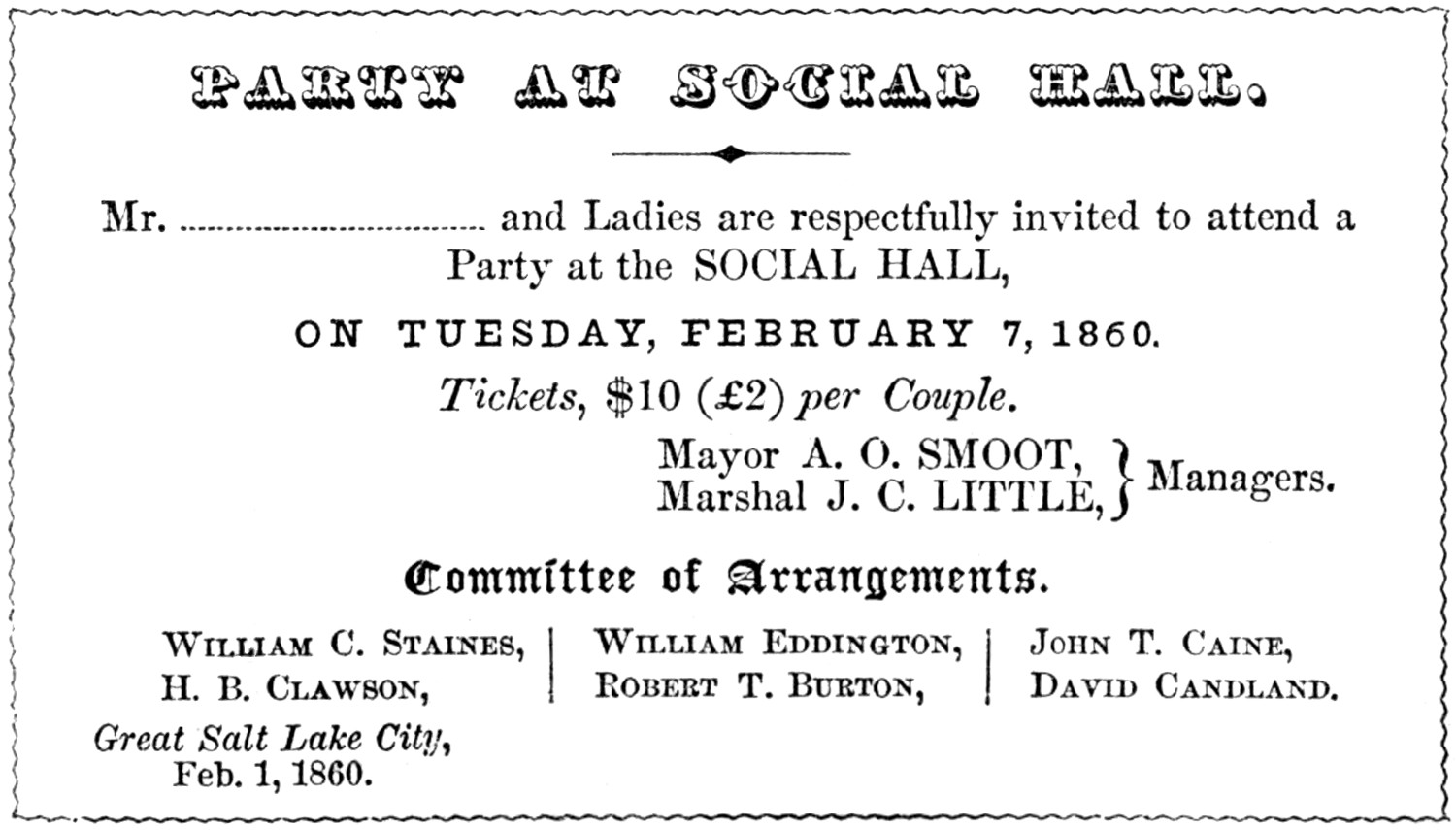
PARTY AT SOCIAL HALL.
Mr. .............................. and Ladies are respectfully invited to attend a
Party at the SOCIAL HALL,
ON TUESDAY, FEBRUARY 7, 1860.
Tickets, $10 (£2) per Couple.
Mayor A. O. SMOOT,
Marshal J. C. LITTLE,
Committee of Arrangements.
William C. Staines,
H. B. Clawson,
William Eddington,
Robert T. Burton,
John T. Caine,
David Candland.
Great Salt Lake City,
Feb. 1, 1860.
The $10 tickets will admit only one lady with the gentleman;
for all extra $2 each must be paid. In the less splendid fêtes
$2 50 would be the total price. Premiums are offered when the
time draws nigh, but space is limited, and many a Jacob is shorn
of his glory by appearing with only Rachel for a follower, and
without his train of Leahs, Zilpahs, and Billahs.
An account of the last ball may be abridged. The hall was
tastefully and elegantly decorated; the affecting motto, “Our
Mountain Home,” conspicuously placed among hangings and evergreens,
was highly effective. At 4 P.M. the Prophet and ex-President
entered, and “order was called.” (N.B.—Might not
this be tried to a purpose in a London ball-room?) Ascending
a kind of platform, with uplifted hands he blessed those present.
Farther East I have heard of the reverse being done, especially by
the maître du logis. He then descended to the boards and led
off the first cotillon. THE SUPPER.At 8 P.M. supper was announced; covers
for 250 persons had been laid by Mr. Candland, “mine host” of
“The Globe.” On the following page will be found the list of
the somewhat substantial goodies that formed the carte.
It will be observed that the cuisine in Utah Territory has some
novelties, such as bear and beaver. The former meat is a favorite
throughout the West, especially when the animal is fresh from
feeding; after hibernation it is hard and lean. In the Himalayas
many a sportsman, after mastering an artificial aversion to eat
bear’s grease, has enjoyed a grill of “cuffy.” The paws, which
not a little resemble the human hand, are excellent—experto crede.
I can not pronounce ex cathedrâ upon beavers’ tails; there is no
reason, however, why they should be inferior to the appendage
of a Cape sheep. “Slaw”—according to my informants—is synonymous
with sauer-kraut. Mountain, Pioneer, and Snowballs
are unknown to me, except by their names, which are certainly
patriotic, if not descriptive.
DANCING.After supper dancing was resumed with spirit, and in its intervals
popular songs and duets were performed by the best musicians.
The “finest party of the season” ended as it began, with
prayer and benediction, at 5 A.M.—thirteen successive mortal
hours—it shows a solid power of enduring enjoyments! And,
probably, the revelers wended their way home chanting some
kind of national hymn like this, to the tune of the “Ole Kentucky
shore:”
“Let the chorus still be sung,
Long live Brother Brigham Young.
And blessed be the Vale of Deserét—rét—rét!
And blessed be the Vale of Deserét.”
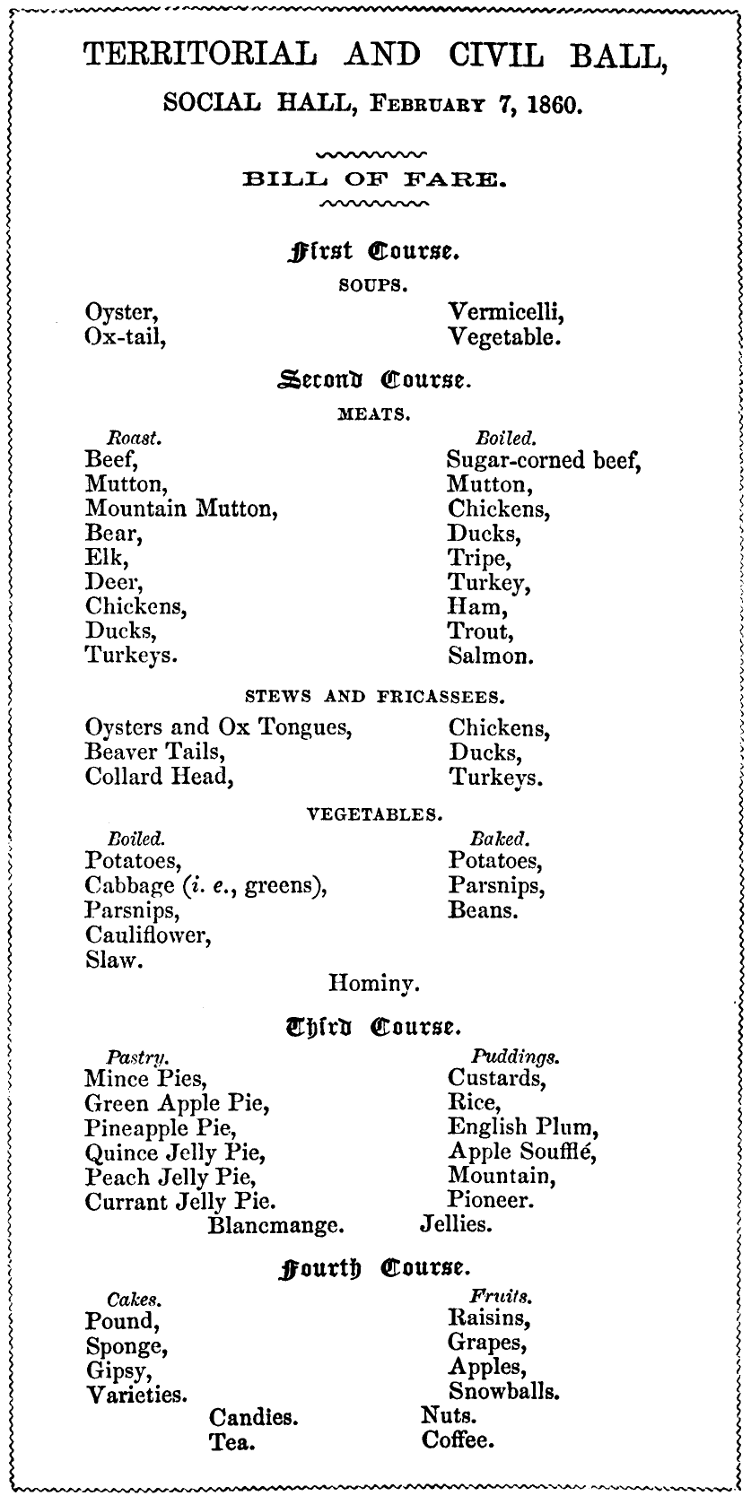
TERRITORIAL AND CIVIL BALL,
SOCIAL HALL, February 7, 1860.
BILL OF FARE.
First Course.
SOUPS.
Second Course.
MEATS.
Roast.
Beef,
Mutton,
Mountain Mutton,
Bear,
Elk,
Deer,
Chickens,
Ducks,
Turkeys.
Boiled.
Sugar-corned beef,
Mutton,
Chickens,
Ducks,
Tripe,
Turkey,
Ham,
Trout,
Salmon.
STEWS AND FRICASSEES.
Oysters and Ox Tongues,
Beaver Tails,
Collard Head,
Chickens,
Ducks,
Turkeys.
VEGETABLES.
Boiled.
Potatoes,
Cabbage (i. e., greens),
Parsnips,
Cauliflower,
Slaw.
Baked.
Potatoes,
Parsnips,
Beans.
Hominy.
Third Course.
Pastry.
Mince Pies,
Green Apple Pie,
Pineapple Pie,
Quince Jelly Pie,
Peach Jelly Pie,
Currant Jelly Pie.
Blancmange.
Puddings.
Custards,
Rice,
English Plum,
Apple Soufflé,
Mountain,
Pioneer.
Jellies.
Fourth Course.
Cakes.
Pound,
Sponge,
Gipsy,
Varieties.
Candies.
Tea.
Fruits.
Raisins,
Grapes,
Apples,
Snowballs.
Nuts.
Coffee.
Returning to the hotel, we found the justiciary and the official
party safely arrived; they had been delayed three days at Foot
of Ridge Station, but they could not complain of the pace at which
they came in. The judge was already in confab with a Pennsylvanian
compatriot, Colonel S. C. Stambaugh, of the Militia, Surveyor
General of Utah Territory. This gentleman is no great
favorite with the Saints: they accuse him of a too great skillfulness
in “mixing”—cocktails, for instance—and a degree of general
joviality that swears (qui jure) with the grave and reverend
seigniory around him. His crime, it appears to me, chiefly consists
in holding a fat appointment. I need hardly say that at
Great Salt Lake City party feeling rises higher, perhaps, than in
any other small place, because RELIGIOUS ACRIMONY.religious acrimony is superadded
to the many conflicting interests. Every man’s concerns are his
neighbor’s; no one, apparently, ever heard of that person who
“became immensely rich”—to quote an Americanism—by “minding
his own business.” As often happens, religion is made, like
slavery in the Eastern States and opium in China, the cheval de
bataille; the root of the quarrel must be sought deeper; in other
words, interest, and interest only, is the Tisiphone that shakes the
brand of war. As Mormonism grows, its frame becomes more
strongly knit. Thus the Gentile merchants, who have made from
120 to 600 per cent. on capital, were, at the time of my visit, preparing
to sell off, because they found the combination against them
overpowering. For the most part they vowed that there is no
people with whom they would rather do business than with the
Mormons; praised their honesty and punctuality in payments,
and compared them advantageously in such matters with those
of the older faith. Yet they had resolved to remove. The total
number of Gentiles in the city is probably not more than 300, a
small proportion to a body of at least 9000.
A stranger, especially an official, is kindly warned, on his first
arrival at Great Salt Lake City, of its inveterate cliquism,CLIQUISM. and is
amicably advised to steer a middle course, without turning to the
right or to the left, between the Scylla and Charybdis of Christianity
and Mormonism. This mezzo-termine may be possible in
official matters; in society it is not. I soon saw that, though a
traveler on the wing might sit alternately in the tents of Shem
and Japhet, a resident would soon be obliged to dwell exclusively
in either one or the other. When Gentile and Mormon meet,
they either maintain a studied or surly silence, or they enter into
a dialogue which, on a closer acquaintance with its formation,
proves to be a conglomerate of “rile” and “knagg”—an unpleasant
predicament for those en tiers. Such, at least, was my short
experience, and I believe that of my companions.
Colonel Stambaugh, a day or two after the introduction, offered
to act cicerone through the settlement, and I was happy to accept
his kindness. One fine evening we drove along the Tooele Road
westward, and drank of the waters of the New Jordan, which, to
the unregenerate palate, tasted, I must say, somewhat brackish
and ill-flavored. The river is at this season about one hundred
feet broad, and not too deep below its banks to be useless for irrigation,
which, as the city increases, will doubtless be extended.
It is spanned by a wooden bridge so rickety that it shakes with
a child’s tread—the governor has urgently but unavailingly represented
the necessity of reconstruction. But, although the true
Western, or rather Keltic recklessness of human life—which contrasts
so strongly with the sanctity attached to it by the old Roman
and the modern Anglo-Scandinavian—here still displays itself,
in some points there is no disregard for improvement. Mr.
Brigham Young has seen the evils of disforesting the land, and
the want of plantations; he has lately contracted for planting,
near Jordan and elsewhere, a million of young trees at the rate
of one cent each. On the way we saw several fine Durhams and
Devons, which are driven out every morning and back every evening
under the charge of a boy, who receives one and a half cent
per mensem a head. The animals have been brought across the
prairies at great trouble and expense: stock-breeding is one of the
Prophet’s useful hobbies, and the difference between the cattle in
Utah Territory and the old Spanish herds still seen in the country
parts of California is remarkable. The land, as will presently
appear, is better calculated for grazing than for agriculture, and a
settlement of 500 souls rarely has less than 500 head of cattle.
Returning from Jordan, we re-entered the city by the western
road, and drove through Mr. Brigham Young’s block toward the
Northern Kanyon. The gateway was surmounted by a plaster
group, consisting of a huge vulturine eagle, perched, with wings
outspread, neck bended as if snuffing the breeze of carrion from
afar, and talons clinging upon a yellow bee-hive—a most uncomfortable
and unnatural position for the poor animal. The device
is doubtless highly symbolical, emblematical, typical—in fact, every
thing but appropriate and commonsensical. The same, however,
may be said of one of the most picturesque ensigns in the
civilized world—what have stars to do with stripes or stripes with
stars? It might be the device of the British or Austrian soldier—only
in their case, unlike the flag of the United States, the
stripes should be many and the stars few. En passant we remarked
a kind of guard-room at the eastern doorway of the White
House—a presidential title which the house of prophecy in New
Zion shares with the house of politication[130] at Washington: my
informants hinted that, in case of an assault upon head-quarters
by roughs, marshals, or other officials, fifty rifles could at once be
brought to bear upon the spot, and 1000 after the first hour. On
the eastern side of the compound were the stables; a lamb in effigy
surmounted the entrance, and meekly reposed under the humane
injunction, “Take care of your flocks.” Beyond this point
lay a number of decrepit emigrant wagons, drawn up to form a
fence, a young plantation of fruitless peaches, and the remnants
of the falling wall.
We then struck into “City,” usually known as “Brigham’s”
Kanyon,BRIGHAM’S KANYON. the Prophet having a saw-mill upon the upper course.
It is the normal deep narrow gorge, with a beautiful little stream,
which is drawn off by raised water-courses at different altitudes
to supply the settlement. The banks are margined with dwarf
oaks and willows; limestone, sandstone, and granite, all of fine
building quality, lie scattered about in profusion, while high above
rise the acclivities of the gash, thinly sprinkled with sage and sunflower.
Artemisia in this part improves like the population in
appearance, nor is it always a sign of sterility; in parts wheat
grows well where the shrub has been uprooted. The road along
the little torrent was excellent; it would have cost $100,000 in
Pennsylvania, but here much is done by tithe-work; moreover,
the respect for the Prophet is such that men would rather work
for him on credit than take pay from others.
Being in want of local literature, after vainly ransacking the
few book-stalls which the city contains, I went to the Public Library,UTAH LIBRARY.
and, by sending in a card, at once obtained admission. As
usual in the Territories of the United States, this institution is
supported by the federal government, which, besides $1500 for
books, gave $5000 for the establishment, and $400 from the treasury
of Utah is paid to the Territorial librarian, Mr. John Lyon,
who is also a poet. The management is under the Secretary of
the Territory, and the public desire to see an extra grant of $500
per annum.[131]
The volumes, about 1000 in number, are placed in
a large room on the north side of the “Mountaineer” office, and
the librarian attends every Thursday, when books are “loaned”
to numerous applicants. The works are principally those of reference,
elementary, and intended for the general reader, such as
travels, popular histories, and novels. The “Woman in White”
had already found her way across the prairies, and she received
the honors and admiration which she deserved.
On the evening of the 30th of August, after dining with the
governor, I accompanied him to the Thermal Springs, one of the
lions of the place. We struck into the north road, and soon issued
from the town. On the right hand we passed a large tumble-down
tenement which has seen many vicissitudes. It began
life as a bath-house and bathing-place, to which the white sulphury
waters of the Warm Springs,[132] issuing from below Ensign
Peak, were brought in pine-log pipes. It contained also a ballroom,
two parlors for clubs and supper-parties, and a double kitchen.
It afterward became a hotel and public house for emigrants
to California and Oregon. These, however, soon learned to prefer
more central quarters, and now it has subsided into a tannery of
low degree. About two and a half miles beyond the northern
suburb are the Hot Springs,[133]
which issue from the western slope
of the hills lying behind Ensign Peak. A generous supply of
water, gushing from the rock into a basin below, drains off and
forms a lakelet, varying according to season from one to three
miles in circumference. Where the water first issues it will boil
an egg; a little below it raises the mercury to 128° F. Even at
a distance from the source it preserves some heat, and, accordingly,
it is frequented throughout the winter by flights of water-fowl
and camping Indians, whose children sit in it to thaw their
half-frozen limbs. These springs, together with the fresh-water
lake and the Jordan, are held to be more purifying than Abana
and Pharphar, rivers of Damascus; and, being of the HarrowgateHARROWGATE WATERS.
species, they will doubtless be useful to the Valley people as soon
as increased luxury requires such appliances. When the wind
sets in from the north, the decided perfume of sulphureted hydrogen
and saleratus is any thing but eau de Cologne. An anti-Mormon
writer, describing these springs and other evidences of
igneous and volcanic action, dwells with complacency upon the
probability that at some no distant time New Zion may find herself
in a quandary, and—like the Cities of the Plain, to which she
is thus insinuatingly compared—fuel for the flames. On our way
home the governor pointed out the remains of building and other
works upon a model farm, which had scarcely fared better than
that of Niger celebrity. The land around is hoar with salt, and
bears nothing but salsolæ and similar hopeless vegetation.
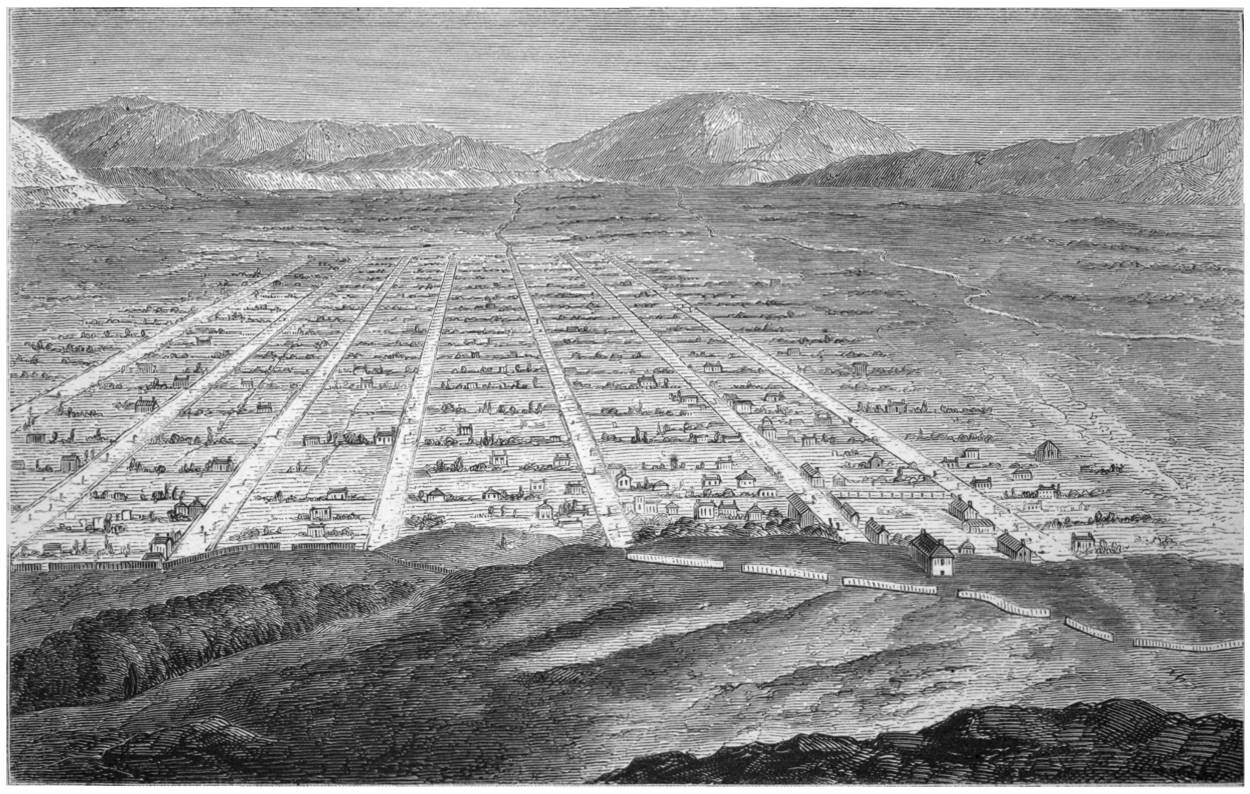
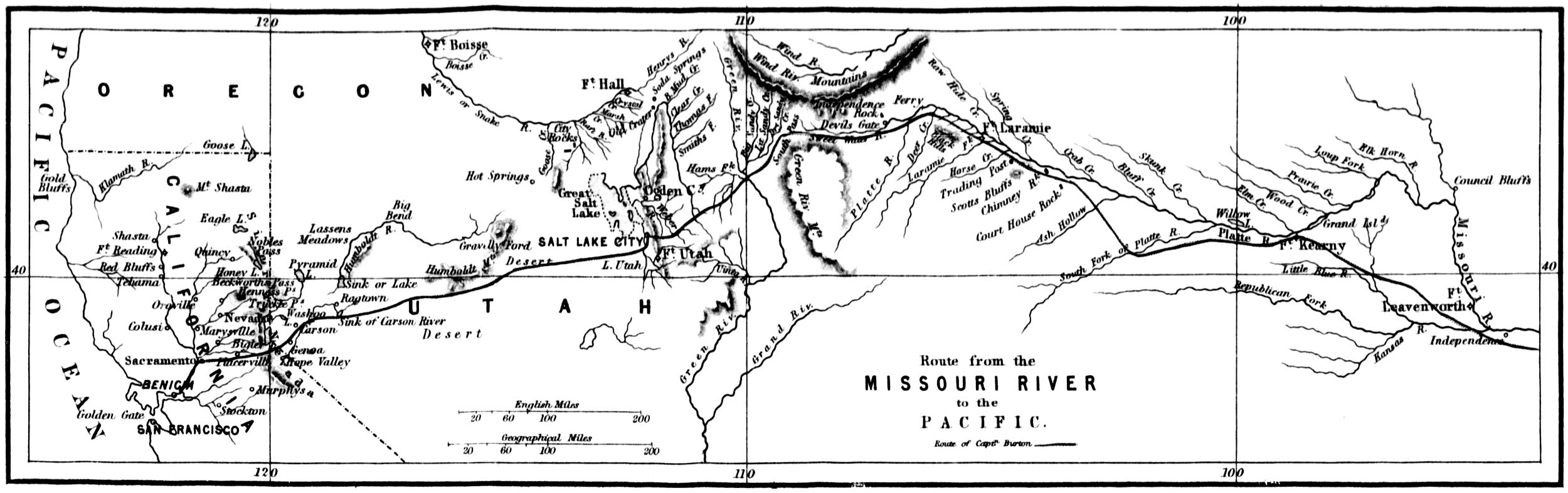
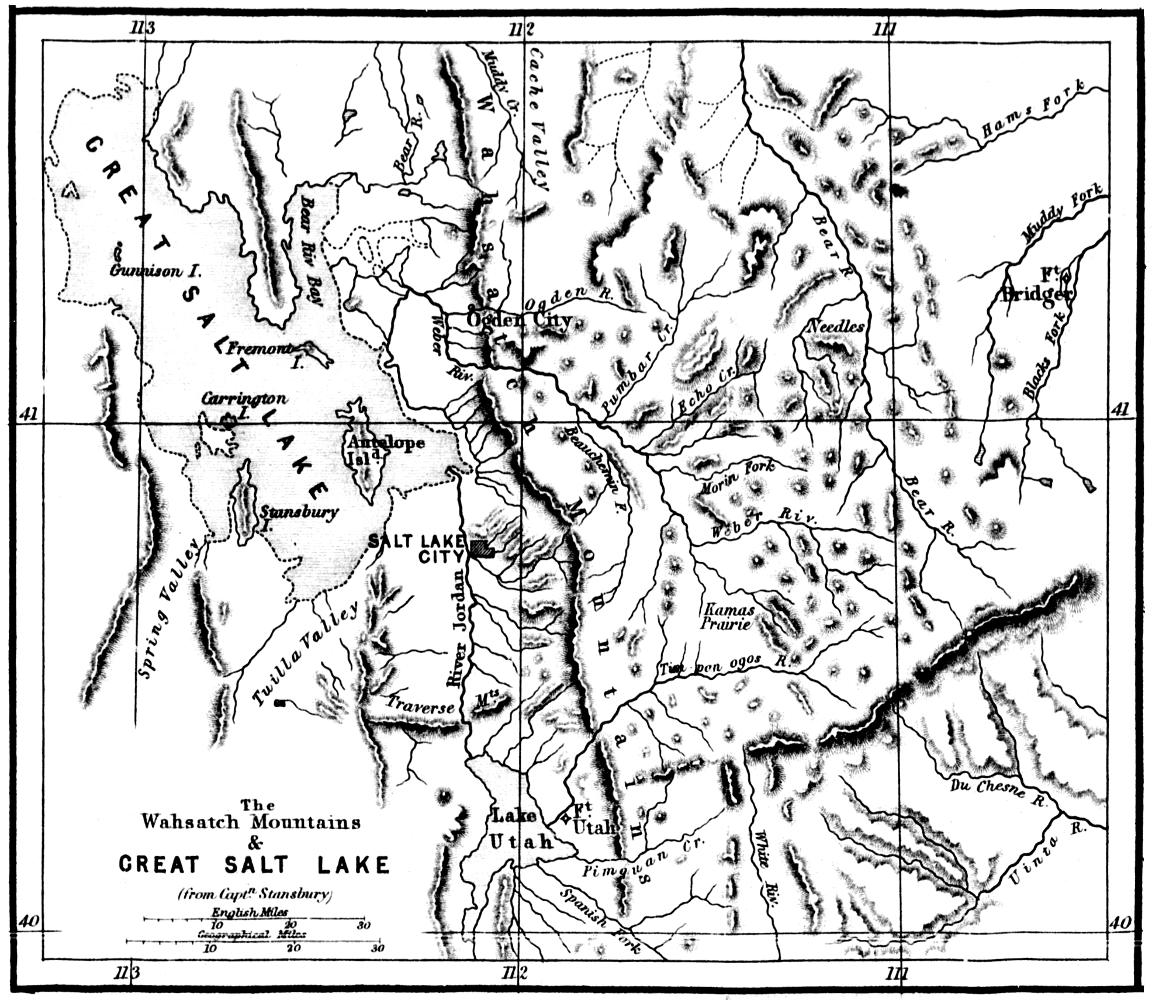
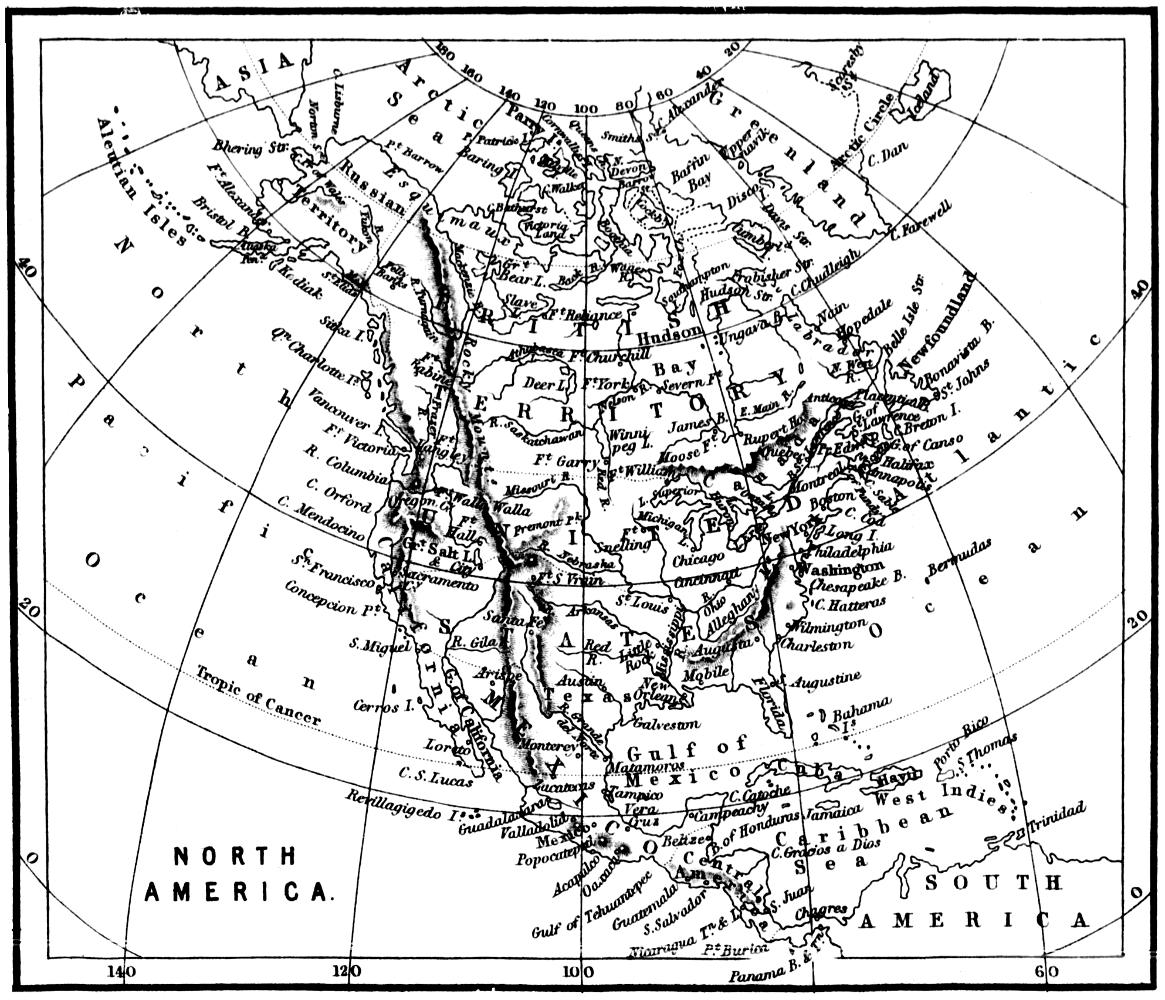
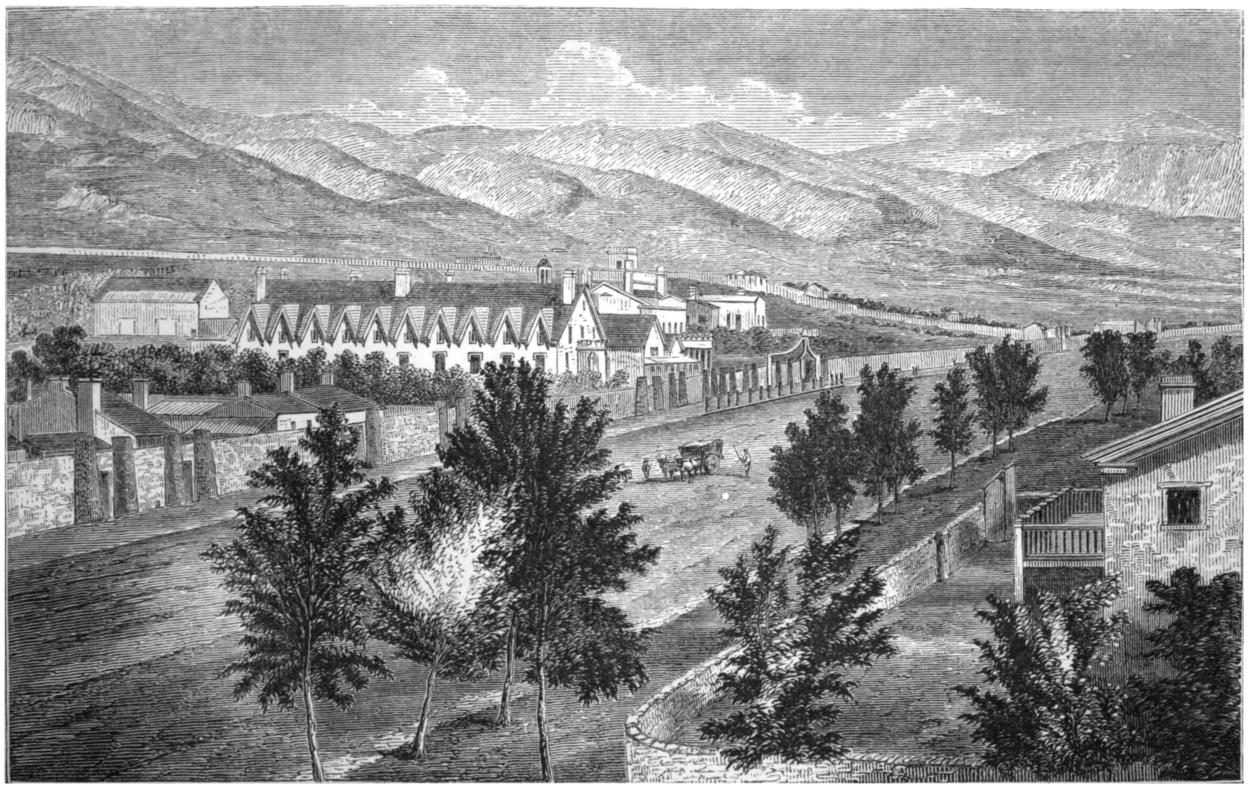
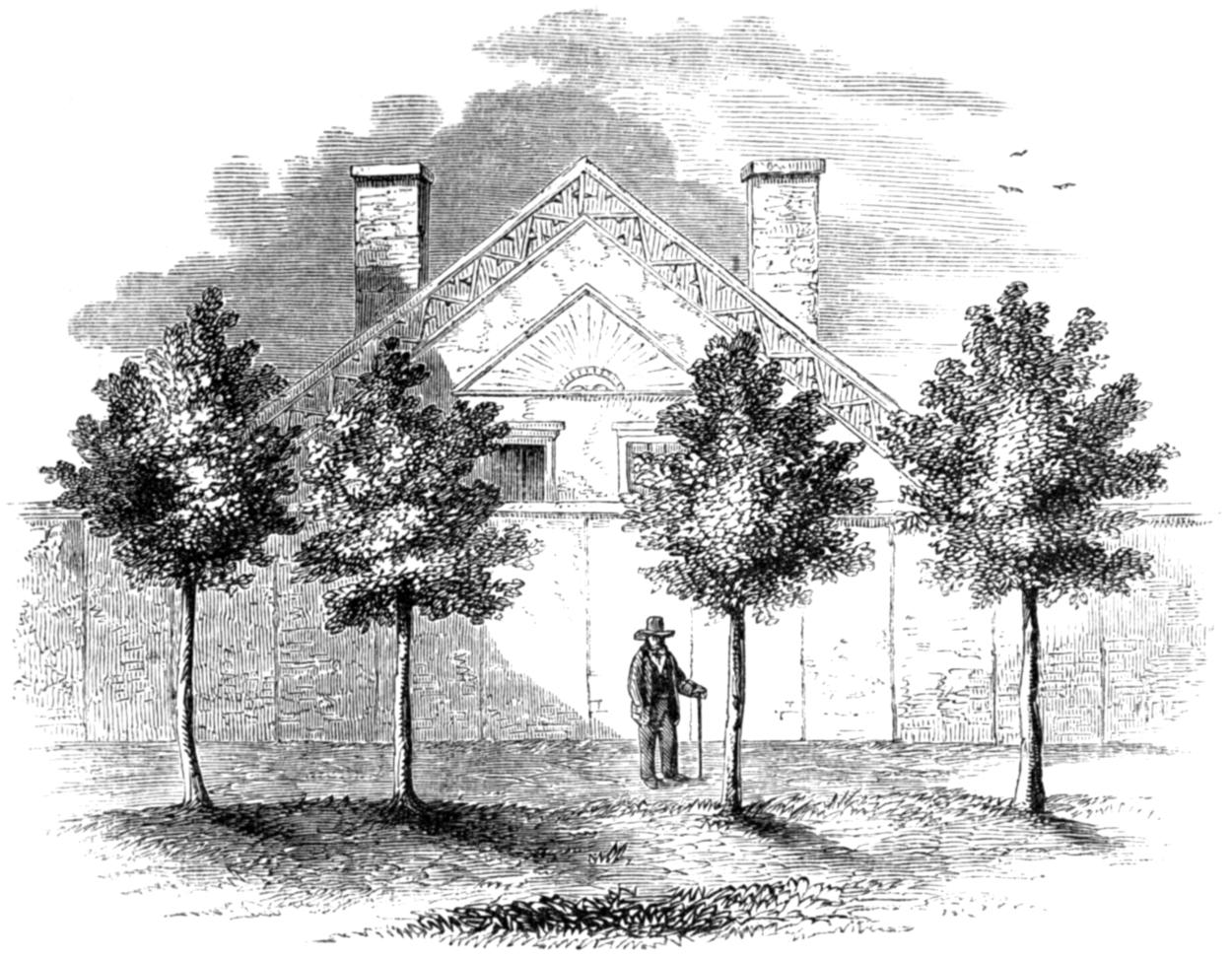
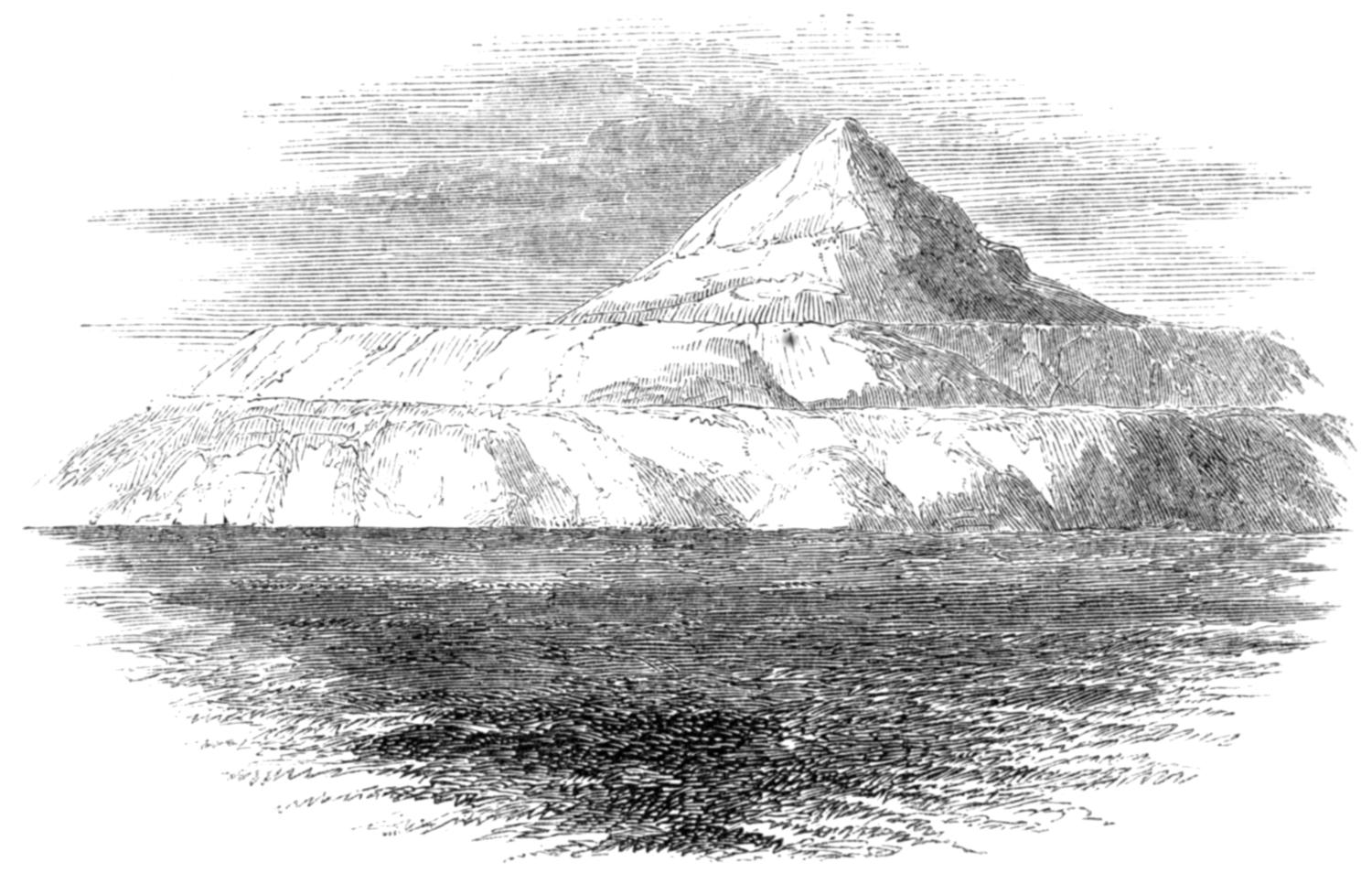
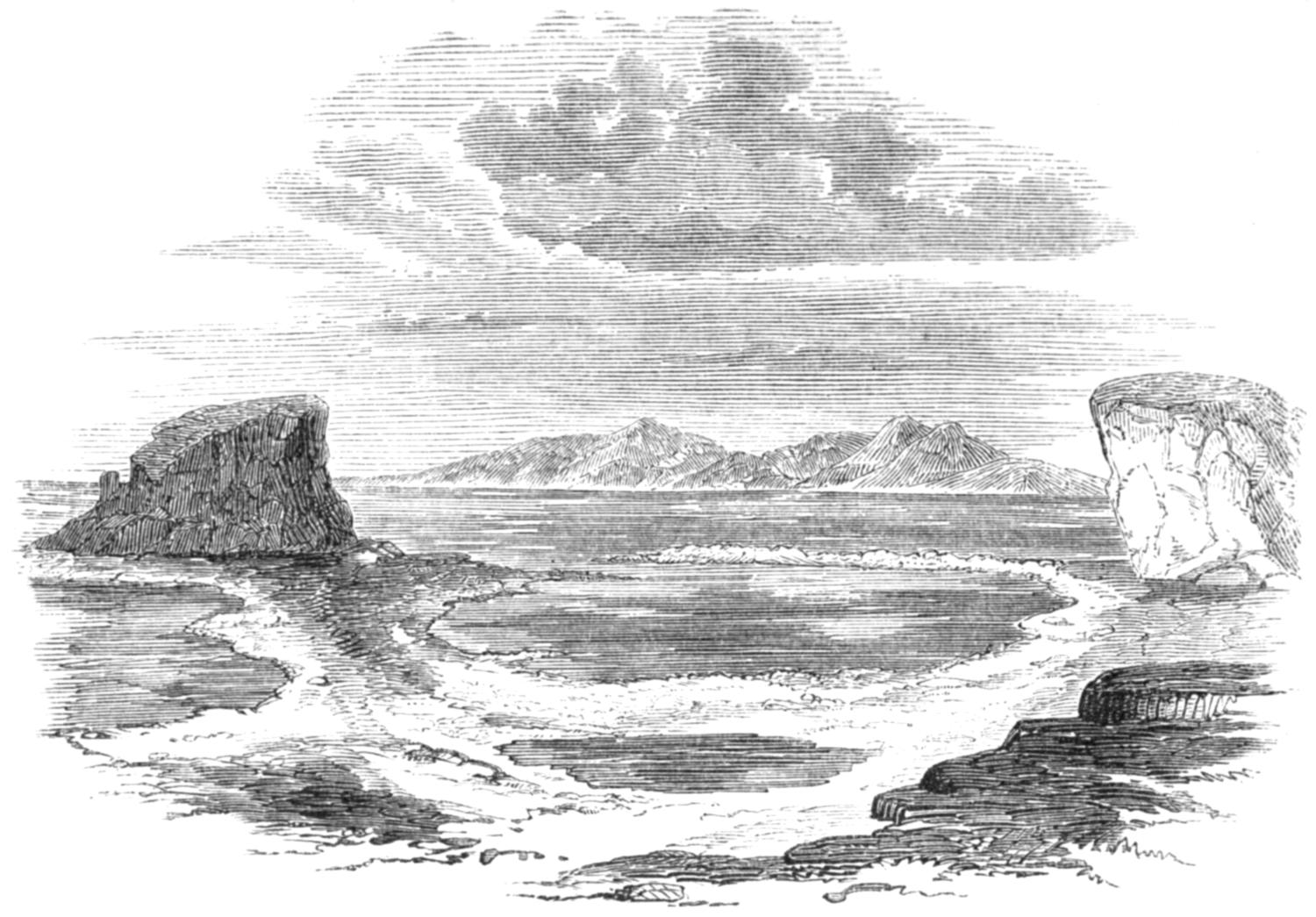
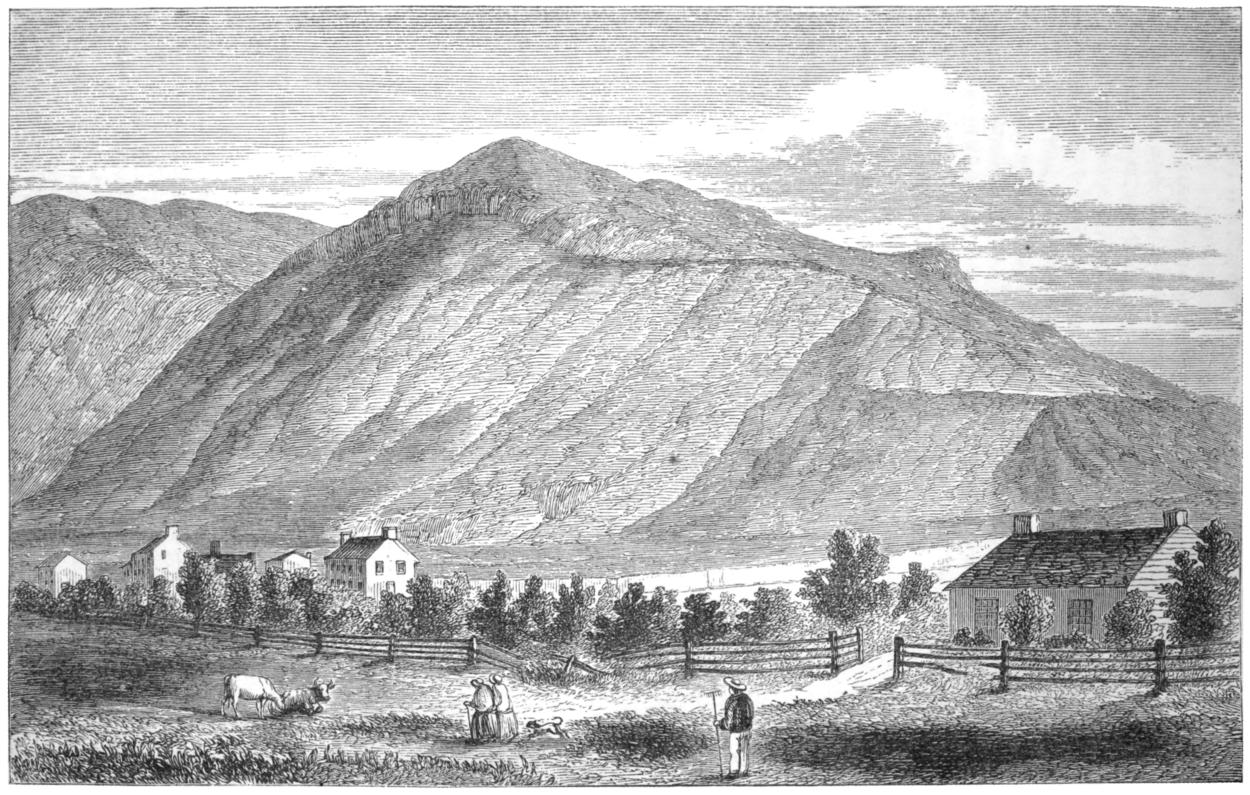
 ,
 ,
 ,
 ,
 ,

 ,
 ,
 ,
 ,

 is like ir in st-ir; are is made by the combination of
 is heard in l-eng-th.