WE had reached the stage where it was very slow work for the dredge to
get even a mouthful of the stiff, almost shale-like bottom of the well,
but, while we brought up fewer treasures than previously, I was not
ready to discard the derrick and dredge as long as the bucket brought
up any finds whatever.
“To facilitate the work at this stage, a plan which I had long
considered was put into effect. We built a big flat-bottomed scow,
crude but serviceable, and capable of holding ten scoopfuls of muck
from the dredge. The scow was constructed, right on the brink of the
well, of logs and such other materials as we had at hand. Then we
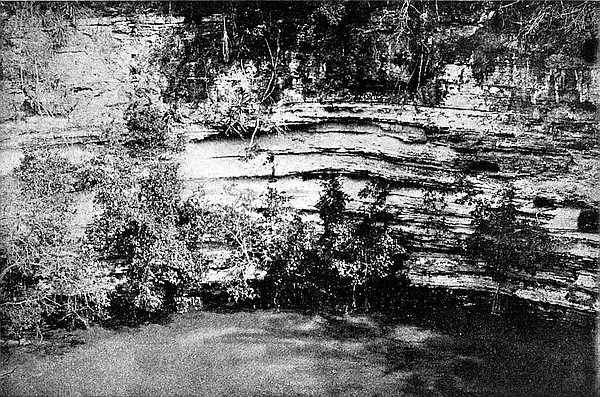
lowered it, by means of the derrick, until it floated easily seventy
feet below, on the still surface of the water.
“I fancy if the grim old Rain God, Noh-och Yum Chac, the Indra of
the Mayas, was enraged when the dredge first began to rob him of his
long-held treasures, the presence of this clumsy craft, as it tipped
and yawed on its slow seventy-foot descent to the water, must surely
have excited him to frenzy. Yet inexorably we continued our quest,
undaunted by the thought of the god’s wrath and determined to strip him
of every secret. We moored the craft, by a long rope, to a projecting
stone knob on the sheer wall of the well, so that it was directly over
the area where the dredge had been working. Our system was to lower
the bucket, raise it, and pour its dripping contents upon the scow, and
this we continued to do until we had heaped upon the boat ten buckets
of bottom mud. Loaded to its capacity, the scow was drawn to a narrow
sandy shelf or beach which had formed at one side of the well. Then we
transferred and examined the load, handling ten buckets from the dredge
in about the same length of time it had taken us previously to dispose
of one. And thus, for a while, the dredge was made to work profitably
even under the increasing scarcity of ‘pay dirt.’
“During this phase of our labor we accumulated a great quantity of
potsherds, copal, and rubber nodules. Each time the filled scow came
to the little beach, the big toads retreated into their rocky cavities
amidst the roots and the myriad eyes that usually shone in these
twilight depths became invisible. Only the iguanas and the lizards in
the branches of the cork-trees that shadowed the tiny beach remained
sleepily undisturbed, while the little painted tortoises on the
half-submerged logs or branches floating near by became so accustomed
to the sight of the scow that they stayed brazenly in their places and
eyed the proceedings without fear.
“As the work went on, the tailing or discard from our dredge began
to spread out and extend our little beach until it became a solid
peninsula jutting out into the well and making our labors easier by
providing much-needed footing and elbow-room.
“Long hours I spent gazing over the side of the scow, waiting for
the dredge to come up with its load, and while I waited I glimpsed
fascinating highlights of a hitherto unknown world—a world with its
tragedies, grotesqueries, and surprises; a world in which humans
took no part; one unseen until then by human eyes. Drifting past on
the turgid waters were curious jelly-like formless creatures and tiny
water-insects, some moving slowly as with effort, others like an arrow
in shape and speed. Here was a plethora of twisting, darting, gyrating
forms of life, all intent on the one object of preserving life—that
bitter jest of Nature who instils in us each, great or small, the
belief that our own particular and individual existence is of amazing
import when she herself values it so lightly.
“Floating on the water were many small red worms no larger round than
a pin and perhaps a quarter of an inch long. As one floated lazily by,
a small red ant, blown or fallen from the land above, struck the water
and instantly was attacked by the worm. The struggle was titanic but
brief and the worm, which was more slender than its victim, simply
swallowed the ant—body, struggling legs, and all. As the swallowing
continued the body of the worm became almost transparent and I could
easily follow the journey of his dinner inside, until diner and dinner
drifted out of sight.
“Close by the cliff-like wall of the pool was a school of tiny
jet-black catfish—pouts, we used to call them in New England when
I was a lad. They were but a few days beyond the egg state and were
carefully herded by a portly, motherly old catfish. Her inclination
evidently was toward dignified, unhurried movement, well tempered with
complete repose, but the erratic and swift excursions of her hundred
or more infants kept her on the qui vive to head off their ceaseless
turnings and dashes, for they seemed possessed to venture into the
outer and unknown world, even as other infants since time began. To add
to her trials, the whole school was more or less surrounded by tadpoles
just as black and even more lively than the baby fishes. They seemed
not to have nor to require any motherly care and, like impudent street
gamins, they delighted in teasing and leading astray the more tenderly
nurtured youngsters. Slyly they tried to swallow the little fishes,
tail first, in their sucker-like mouths, and were dissuaded only by the
wrathful dash of Mother Catfish.
“It was during this time, which I call the intermediate stage of the
work, that many of our specimens of lighter weight were obtained. Among
them are pieces of gourds, copal fragments, parts of wooden objects,
and bones, all wonderfully preserved in this colossal silo—for the
Sacred Well is in many respects like a silo. Some of the potsherds and
wooden objects, and even a few of the gourds, had been covered with a
thick white paint, almost as hard as enamel, and upon the surface of
this the artists of old had worked and drawn figures and hieroglyphs
similar to those found in the Codices. Some of the finest pieces of
ancient fabrics were recovered at this time. The gradual caving in of
the mud about the cavity we had scooped out permitted these fabrics to
slip gently into the hole and to be brought up unharmed by the steel
lips of our dredge. They are all carefully preserved and are the only
authentic specimens of their kind known to archæological science. I
deem them among the most important of my treasures from the well.
“There came up ropes and cords, both of bark and fiber, and curiously
knotted masses of copal; images carved from light wood and covered with
rubber and copal; and always bones and more bones, of maidens and
warriors.
“At last the dredge bit only on rock and boulders, against which the
steel jaws made no headway. Again and again the bucket came up empty
and with its jaws twisted and bent.
“If the first stage—the beginning of the work, when the steel bucket
first plunged into the still water of the pit—was exciting, I found
myself now laboring under a still greater emotion, for the time had
come which I had long foreseen, when the dredge unaided by human hands
could accomplish nothing more. There must be hands at the bottom of the
well—not the dead hands of pitiful maidens, but live hands of sturdy
men to explore every inch of the uneven rocky bottom. From dredging
with windlass and bucket, we must pass to a season of deep-sea diving
with all the paraphernalia of diving-suits and hose and air-pumps.
“What could be more interesting, more romantic than to go down under
sixty feet of water to the very bottom of this grim pit?—to tread
the corridors of the most sacred and abysmal abode of the Rain God?
I might possibly remain at the bottom, myself, a modern sacrifice to
the ancient deity, but I was willing to take that chance; for nothing
could now keep from the world the treasures already recovered from the
well and if I perished in the attempt at further discoveries, my effort
would be, as a whole, not in vain. It was almost like trying to push
aside the veil that separates living man from the nether world. Who
might say but that the ancient people spoke the truth when they said
that the entrance to the habitation of the Rain God was guarded by
huge serpents and that none might pass but those expressly summoned
by the god, to carry out his mandates? Or might there not live in that
deep ooze slimy-bodied monsters of the antediluvian era, to which the
passing of the centuries was but as the passing of hours? This was
no time for speculation. I did not crave to serve as a brontosaurian
breakfast, yet I must know the bottom of this well.
“Long hours and many days must be spent down on the bed-rock, under
high water-pressure, in total darkness and in a temperature but little
above freezing. My hands must explore the cracks and crevices and
corners and pits where the dredge could not enter, and each find must
be carried to the bucket and placed carefully within it, to be raised
later.
“I went over every detail of the plan with great care, for not only
my own life but the lives of others depended upon its practicability.
A hitch, an unforeseen obstacle, a piece of bungling, and one or
more of us would never return alive to the sunlight. I was prepared
for this part of the business, having become an experienced deep-sea
diver back in the United States. But diving under bright skies in open
water spaces bathed to some depth by clear sunlight reflected from the
sandy sea-bottom is not at all the same as descending into turgid,
green, almost opaque water confined by high-cliffed walls overgrown
with mighty trees and festooned with huge vines twisting and turning
like giant serpents. I knew it to be very different from and far
more dangerous than clearing off the barnacles and seaweed from the
clean-lined bodies of United States cruisers and lighthouse tenders.
“Early one bright morning my crew who worked the windlass and managed
the bucket stood grouped about the derrick. The winch which had so
long rattled and clanged as the steel jaws of the dredge opened and
plunged down to their task, was silent and motionless; but its silence,
like that of the men grouped about, seemed to be a sort of watchful
waiting rather than the lazy inertia that comes with a holiday hiatus.
The cogged wheels were hooked introspectively, as it were, but the
jaws of the bucket hung loosely open like those of a school-boy, agape
with interest and wonder. On the refuse-built level space between the
derrick and the examination platforms were strewn strange-looking suits
of armor, canvas-lined and metal-covered, piles of rope and rubber
hose, canvas-covered rope ladders, a small but powerful air-pump, and
divers other things. Yes, even the divers themselves, for he who was
to be my aide in this undertaking had come under contract from the
sponge-banks of Florida with his striker, or pump attendant, and all
the necessary equipment. Both men were Greeks, young, lithe, handsome
as Apollo himself. All that day we spent assembling, testing, and
getting everything ready for actual diving operations early the next
morning. As fast as the apparatus was put in order we placed it on the
scow, which had been scoured and cleaned and was now transformed into
an ideal diver’s craft. Before nightfall the air-pump was securely
fixed on the scow, the air-tubes and life-lines were in place, and the
rope ladder dangled over the side and disappeared into the green water.
From its bottom rung I should, on the morrow, step off into the unknown.
“The morning of the next day was heavy with clouds that soon broke in
a deluge—a three-day norther that kept us all under cover except for
a diurnal excursion when the Greeks and I and my native striker went
to the edge of the well and from there carefully scanned the scow to
make sure our equipment was weathering the storm. Luckily, the entire
apparatus, pump and all, was almost amphibious by nature and habit, and
so far as the eye could see the wetting was doing no damage.
“Dawn of the fourth day was clear and bright and the leaves and grass,
even the sky, seemed to have been washed clean by the long rain. After
a hasty breakfast we hurried to the well and descended via the air
route, in the dredge bucket, to the rain-soaked, water-covered deck
of the scow. We bailed out the water and sponged off the deck, on
which we then laid out with minute care the two rubber-lined canvas
diving-suits, making sure that there were no holes through which
the compressed air could issue in lines of silver bubbles into the
surrounding water. Our wrists were carefully soaped and we stepped
into the clumsy uniforms, forcing our hands through the tight-fitting
rubber wristlets. The neck-bands were adjusted and the copper helmets,
cloth-lined and with glassed goggle eyes, were put over our heads and
securely fastened. Then came a necklace of lead plates and finally
heavy metal-soled boots.
“A trial puff of air from the pump, a touch of the valves in the
helmets, and we were ready to call on Noh-och Yum Chac at the bottom of
the Sacred Well. With a final hand-clasp all around and with my Indians
looking very awed and solemn, I waddled to the edge of the craft and
clambered down the rope ladder about as gracefully as a turtle falling
off a log.
“I must confess that as I loosed my hold of the last rung and went
swirling down into the watery darkness my heart beat far faster than
could be reasonably accounted for by the increasing water-pressure;
and my mind, like that of a drowning person, reviewed at lightning
speed all the errors of commission and omission of my whole life. But
almost automatically I took the precautions of every experienced diver,
making sure that the air-line and life-line were free and clear of
obstacles. Almost at once the weak, greenish light faded into utter
blackness. Once or twice during the descent my lines brushed against
some sunken tree roots or branches and I was instantly alert, for in
such encounters there is always an element of real danger. These woody
projections were, however, quite rotten and with no more strength than
soaked punk, and fortunately always broke off at the mere touch of the
stout rope.
“Meanwhile, as I went down and down, at a distance of every ten feet or
so I felt acute pains in my ears, as though sharp objects were being
thrust into them. By adjusting the valves in the helmet and opening
wide my mouth, I succeeded in equalizing the air-pressure on the ears,
causing a sound like the exhaust of a motorcycle on the ear-drums but
relieving the pain. Once I was at the bottom, the helmet valves alone
required attention; for only by opening them frequently is fresh air
forced down from the pump and the vitiated air expelled.
“I had reached the bottom but a moment before I sensed that the Greek
diver had also descended and was close beside me. He had waited only
long enough, before joining me, to make sure my native pump attendant
was handling my air-supply properly. The darkness was complete, a
perfect blindfold, but I reached out and touched the Greek so that we
might be sure of our relative locations and not get our lines entangled.
“Standing upon the uneven, rocky bottom of the well, I was thrilled
with the knowledge that I stood where no living man had stood since
time began. I think I felt much the same high elation that must have
filled Peary and Shackleton at the end of their respective dashes to
the polar caps.
“I had foreseen the need of light and had provided myself with the
very latest and best submarine electric light obtainable. What any
illuminant could do, this light would do. But what light can force its
beams through a lake of chocolate-colored porridge? Our lights were of
not the slightest use in this grim old water-pit and we had to depend
entirely upon the sense of touch. And this sense served us well, for
under constant use our finger-tips grew highly sensitive. The palpi in
the skin whorls and curves became so responsive that we were frequently
able to distinguish the form and texture of the objects we touched and
even got so far as to guess at colors, although we made many wrong
hazards.
“Another modern invention which we carried at the bottom of the
well was the submarine telephone. It operated satisfactorily, but
we found little use for it, as it was less bothersome merely to
give the required number of tugs on the signal rope when we wanted
to communicate with those above. The Greek and I found also that by
touching the metal fronts of our helmets we could converse easily with
each other. The voice tones were muffled, but with a little practice we
had no trouble in understanding each other. I even recollect hearing
the chattering of the strong white teeth of my Hellenic companion. The
water was very cold and every time we came to the surface after our
daily two hours of immersion our lips were blue and our bodies covered
with goose-flesh and trembling with chill. Coffee, very hot and very
strong, was our first requisite.
“The water-pressure at a depth of sixty feet is considerable, and
both the air-tubes and life-lines were buoyed in several places by
tightly corked quart bottles. When drawn up after the day’s work, the
lower ones were always half full of water, in spite of the fact that
the empty bottles had been corked as tightly as possible before being
lowered into the water. This will give some idea of the tremendous
pressure.
“This pressure, offset by a corresponding pressure of air in the
diving-suit, affects in a peculiar manner the movements of the diver.
In spite of my necklace of leaden plates and my two-inch lead soles,
I seemed to weigh nothing at all. A slight stamp of my foot upon the
bottom would take me soaring upward perhaps ten feet in the water,
and I would then come slowly down to rest two yards from my original
position. It took good judgment to land in any precise spot, because
it was so very easy to overshoot the mark. It seemed as though one
real leap would carry me clear to the surface of the well and perhaps
entirely up the cliff-like sides.
“On one occasion I became so interested in the finds on the bottom
of the well that I quite forgot to let out the accumulated air by
means of the helmet valves. I had been working diligently, feeling
along the silt-filled cracks of the rocky bottom; then, satisfied
with my examination, I gave a stamp of my foot and started upward.
But my diving-suit was so filled with compressed air that I turned in
the water topsyturvy and finally hit the bottom of the scow feet up,
with a resounding thump of my metal soles which almost caused a panic
among the natives on the deck of the craft. Meanwhile I swung around
turtle-wise from under the boat, found the rope ladder, and started to
climb over the side. My henchmen, pallid with fear, were pumping for
dear life, while I, at the side of the boat but below their line of
vision, opened wide the helmet valves to prevent them from blowing me
up like a toy balloon. When I appeared over the side they all crowded
around me and Juan Mis, my faithful old servant, took my helmet-encased
head in both his hands and peered eagerly through the thick glass
insets. ‘God be praised, he is laughing!’ shouted Juan, and they all
chuckled with happy relief, while I sat on the gunwale and was divested
of my cumbersome habiliments.
“Our first task was to discover the nature of the stone objects that
had so often cramped the jaws of our dredge and strained its chains,
costing us hours of hard work in repairs. The fact that the dredge
had never secured a sufficient purchase on any of these stones to
bring them to the surface led me to surmise that the majority were
smooth-faced and probably hieroglyphed. Mere rocks or boulders rarely
were so smooth that the steel bucket could not grip them and bring them
up after a trial or two.
“By feeling over the bottom of the well with my hands, I located the
stones one after another and found my surmise correct. We managed to
fasten chains about them and by means of the derrick raised them from
their watery bed. One by one the heavy, wondrously carved stones were
hauled up through sixty feet of water and up another seventy feet until
they rested upon the brink of the well. One great stone was a perfectly
sculptured statue of a seated god or priest which reminded me of ‘The
Thinker,’ by Rodin.
“The next day we again descended into the well, this time not in search
of large objects such as carved stones, but rather in quest of small
things lying in the silt between the humps and in the crevices at the
bottom.
“I remember distinctly my sensations as my fingers touched upon curious
small objects like coins, small nuts, and rings. I could hardly
contain my curiosity as I tucked them into my pouch, and my eagerness
to get up to light and air to examine them was almost irresistible.
When I had collected perhaps twenty or thirty I gave the signal and
started upward. Before my diving-dress had been more than half removed
I plunged my chilled fingers into the dripping pouch and drew out
beautiful embossed rings, small bells of copper, and several bells
of pure gold. There were bells and ornaments and medallions of gold
repoussé and gold filagree, of exquisite design and craftmanship. There
were lovely carved jade beads and other objects of jade. Just as truly
as any mining prospector, I had struck gold, but gold tremendously
more valuable than his raw nuggets; for, whatever might be the mere
intrinsic value of my golden finds, each bit was in reality beyond
price.
“This was but the beginning. We now had at our command two means of
bringing up the treasure. The big carved stones having been removed
from the well, the dredge could again be used, or we could don the
diving-suits. In many instances the Greek and I directed from the
bottom the work of the dredge. The golden objects brought up, if simply
thrown into the goldsmith’s melting-pot, would net several hundreds
of thousands of dollars in bullion—dividend enough, if one were
sufficiently sordid of mind, to justify all my investment of time,
effort, and money in the undertaking.
“One particularly wet and dreary day the dredge had worked all morning
long, in a monotonous round in which nothing of value was brought
up. Toward lunch-time I had about decided to send the men to their
quarters for the rest of the day, to let them recover from their
half-drowned state. Just then the men at the receiving-platform gave
a shout that brought me running. For several blissful minutes we were
busy picking lovely little copper bells from the black ooze. The rain
was forgotten. Bearers were sent to bring our lunch, and eagerly we
sent the steel bucket down again. And again it came up with a pudding
of mud plentifully plummed with copper bells. All afternoon we plied
the dredge, and nearly every load contained more copper bells, of all
sizes and shapes, none larger than our old-fashioned sleigh-bells and
many much smaller. In fact, they so resembled sleigh-bells that I could
not rid my mind of the idea that they were modern bells used for barter
and exchange, like the hawks’ bells of Spain. At the end of the day
we had piled up over two hundred of these curious specimens of Maya
workmanship, and even the most cursory examination showed them to be of
genuine ancient origin.
“We carried the bells to the plantation house, where all the servants
looked with awe and wonder at los cascabeles de los antiguos,
the bells of the ancient people. From that time on hardly a day
passed that we did not add a handful of copper bells to our growing
collection. The bells are mainly capsule-shaped or spherical. Some
still have a carbon core within, showing clearly the method by which
they were molded. Very rarely did the bells contain clappers or
rattles, and this fact supports the tradition that the ancient people
believed that all things had life and souls. By removal of the clappers
the bells were ‘killed,’ made mute forever, and their souls, thus
released, entered the realm of Ah Puch, the God of Death. Incidentally,
the portraits of Ah Puch show him with anklets of bells.
“Certain of the larger copper bells have rope-like designs embossed
on them, while others are fashioned like animals and birds and the
grinning heads of Cheshire cats. Some represent the heads of foxes or
of the anteater, showing unmistakably the long, tapering snout.
“Intermingled with the bells were copper circlets like finger rings,
and curious flat copper ferrules, from a fourth to three quarters of an
inch thick and about an inch long.
“One day we brought up a handful of small masks, about an inch long
and half an inch wide, made of thin, well-worked copper. By a strange
coincidence they came to us on the very day of a modern native carnival
when every one wears a mask. My Indians commented upon the fact and
seriously debated whether Yum Chac had not sent them up to us in
remembrance of the day. And it is a fact that no other masks of the
kind were found previously, nor have any been found since.
“Specimens of well-modeled hard copper chisels were recovered at
various times. Some are small, others of the customary size and shape
of modern chisels, but with the heads burred, showing much use. All of
the copper chisels, rings, and masks have the reddish color of pure
copper, but many of the bells, particularly the smaller ones of round
sleigh-bell shape, are of a color indicating copper alloyed with silver
or tin. Some of the other bells contain a considerable percentage of
gold, which may be either a natural admixture from the ore itself or an
alloy added by the ancient artisans.
“One of the most prized treasures was brought up one day while visitors
were present—Mr. and Mrs. James of Mérida and Dr. Marston Tozzer, now
professor of American archæology at Harvard University, who knows the
Mayas intimately and has lived among them and shared their huts and
hammocks. We were all standing at the edge of the Great Well when the
dredge bucket heaved itself from the roiling swells of green water. As
it came up toward the level of our eyes we saw dangling precariously
from one of its fangs a gray, nondescript article which some one in the
party facetiously remarked must be a cast-off overshoe of the Rain God.
We all laughed at the witticism and then stopped short as the bucket
swung around, bringing the object into plainer view, and we discovered
it be a large copper disk covered with figures in repoussé and
representing the Sun God. My heart was in my mouth for fear it would
drop off and sink back into the well before my eager hands could reach
it, but grasp it I did after what seemed an age of waiting. It is so
beautifully and intricately worked, so fine in artistry that I deem it
one of the most priceless of all these antiques. What it loses by not
being pure gold is more than compensated for by its mass of exquisite
ornamentation.
“From copper to gold, so John Hays Hammond once told me, is but a short
step and one likely to be bridged at any unexpected moment, and this I
found to be the case in the Sacred Well.
“One fine day I discovered, among the several copper bells brought up
by the dredge, one small round bell of pure gold, shining as bright and
clear as if newly molded. After that every day was literally a golden
day with finds of yellow gold—golden bells of all shapes and sizes,
some as small as a pea, others large and heavy. And these gold bells
were all more or less flattened, as though they had been struck with a
hammer or even mauled with a sledge. Some were so flattened that the
shape of the clapper within was outlined on the outer side of the bell.
The clappers were, like the bells themselves, made of pure gold, but
most of the smaller bells, like our previous finds of copper ones, had
been ‘killed’ by having the clapper removed.
“Many disks of gold were brought up, which are covered with finely
worked figures in repoussé, while around the outer edges are characters
and symbols and sometimes hieroglyphs. Some of these disks were
originally flat and others have curving surfaces like breastplates. A
few are plain or nearly so, but the majority are completely covered
with incised work. One disk, a mask, is two thirds the actual size
of a human face and represents a face with the eyes closed. Upon the
closed eyelid is engraved a symbol of unknown meaning. Another disk of
solid gold is eleven inches in diameter and weighs nearly a pound. It
contains no carving or design and I judge it to have been some sort of
temple basin or standard.
“Among the golden objects are two very handsome tiaras representing
entwined feathered serpents, worked partly in repoussé and partly in
filagree. There are also a number of emblematic figures, dancing frogs
and monkeys, and several queer objects like brooches. They are from one
to three inches high and very thick. There are objects like sandals
and objects similar to candlesticks. Some of the latter are of copper,
gold-plated. I found, too, a considerable amount of gold-leaf nearly as
fine and pure as that of to-day.
“Also among the golden treasures are several specimens that look like
the heads of canes. These I believe to have been the tops of the
official wands or emblems of authority—the caluac pictured many
times upon the walls of the temples.
“I found virtually no silver and no metals other than those mentioned,
except iron pyrites. This substance, backed with hard-baked clay or
stone, was used for mirrors, and I found large fragments of several
such mirrors with the mirror surface of iron pyrites still bright and
shiny. One metal object about three inches in diameter is white like
silver, absolutely uncorroded, and seemingly as hard and refractory as
tin alloy or hard steel. I do not know yet what the metal is, but shall
know as soon as it can be examined by metallurgists. Can it be that
rare, indestructible metal, platinum?
“And with all the precious objects I have taken by force from the Rain
God I am very sure that I have wrested from him not a tenth of his
jealously held treasure. There are many, many more golden ornaments
hid away in the recesses of the uneven floor of the pit, and many, many
things even more priceless than gold to the antiquarian.
“All this I leave to the engineer of a future day—and I say engineer
advisedly, for it is going to be an engineering task to strip the
old well of all it holds. It will first have to be dredged over its
whole area, not with the crude hand-operated device which I have used,
but with more powerful and modern, mechanically operated equipment.
Then a huge, specially designed diving-bell will be required, so that
men may work under it quite protected from the water and with ample
illumination.
“Among the treasures we found are three sacrificial knives. One is
perfect, while the flint blades of the other two are broken close
to the hilt. I am inclined to think that the two broken ones were
purposely broken or ‘killed’ before being thrown into the well and that
the perfect one was not cast into the pit but fell in by accident.
These knives have intricately worked and fluted handles of gold. The
one which is unbroken is especially lovely—a bit of perfect artistry
worthy of a Cellini.
“One golden bowl is nine inches in diameter, and we obtained several
smaller ones about three inches in diameter. These, I think, were
temple dishes used by the high priests. The several gold disks of the
Sun God vary from seven to eleven inches in diameter. And we recovered
forty flat gold washers about an inch and a fourth in diameter, each
with a hole in the center. Regarding the use to which they were put
I have no clue and can only surmise that they were fastened to the
garments of priests or of sacrificial victims.
“The several brooches, as indicated by the designs upon them, were used
for personal adornment. The finger rings are peculiar in that they
have an enlarged face like a signet-ring, but the enlarged portion is
designed to fit at the side of the finger, rather than on top, and this
enlarged part always contains a pictured face.
“There are many golden figures of animals and insects, the most
interesting being frogs with exaggerated flat feet, such as are found
in the graves of Puerto Rico. Among the great quantity of other
articles, too numerous to describe here, are twelve plain disks of gold
which I imagine are blanks, originally intended by the goldsmith for
some craftsman to ornament with designs, but for some reason or other
thrown into the Sacred Well in their uncompleted state.
“Many of the larger golden objects, apparently, were not ‘killed’
before being offered to the Rain God, but nearly all the smaller
articles of gold were crushed. Most of these have since been
painstakingly straightened into their original shapes.
“Of the pottery vessels, very few were recovered unbroken. Some, as I
have said, were containers for copal and rubber incense. Others, I am
led to believe, contained the ancient libation of bal-che or sacred
mead which was thrown into the pool together with the captive warrior
victims. This fermented drink made of rainwater, wild honey, and the
bark of the yax tree, according to tradition, was for men only. Women
were never permitted to taste it nor to be present at the ceremonies
where it was used as a libation to the gods. The narrow-necked vessel
in which it was contained was called a pool and had a flat clay
stopper fastened to the neck with cords of bark. We brought up several
of the necks of such containers with the stoppers still held in the
orifices by the bark binding.
“Several of the open vessels with tripod legs are glazed with red
inside and out; others have a blue lining, and many were red on the
outer surface but left the natural clay color upon the inside. The legs
were either rounded and hollow, containing rattle pellets, or thin and
solid. They are often fashioned as the heads of alligators or as human
grotesques. Many large flat vessels and shallow circular dishes, some
nine inches in diameter, were found, of the same design and finish as
those I have unearthed in ancient graves in Labna and other old Maya
cities.
“The ancient devotees seem to have been especially partial to a certain
cylindrical vessel about six inches in diameter and nine inches high.
These were often of thin structure and covered with designs and
hieroglyphs or bearing the outlined figures of some deity surrounded
with the conventional symbols of his attributes.
“A large circular earthenware pan, seven inches in diameter and with
a long, thick handle which frequently ended in a carved head, was in
common use as an incense-burner. It was rarely made of well-kilned
ware and was evidently intended only for brief service. We found many
broken utensils of this sort, but only one perfect specimen, which
is exceptional in that it is of better-kilned material and of most
artistic workmanship. Its pleasing outline is ornamented with openwork
spaces intended to give needed draft to the burning copal in its
basin. Nearly all the incense-burners of this type have hollow legs
containing burned clay pellets evidently designed to produce a rattling
sound at religious dances and rituals.
“The mortuary urns are large vessels ornamented with the likeness of a
human figure surrounded with a conventional design. The figure usually
bears upon its back a vase-like receptacle doubtless designed to
receive and preserve the ashes of the dead. I do not know whether these
urns were empty when thrown into the well or actually contained human
ashes. I hope this point may be settled by laboratory examination.
“The finding of copal and the intimate association of the copal masses
with the potsherds and unbroken earthenware vessels, leaves no doubt
as to the use and purpose of both. The employment of copal resin as
a medicament and as a sacred offering seems to have occurred almost
simultaneously with the appearance of man upon the peninsula of
Yucatan. In the primitive rock sculptures in the famous cave of Loltum
is shown the burning of copal as a religious rite, while the earthen
vessels found in the cave contain the blackened residue of burnt
copal—a residue that, despite its antiquity and long inhumation, gives
forth, when burned, the characteristic odor of copal resin, a fragrance
not to be mistaken for any other. The copal tree, anciently known as
psom, still grows sparsely in nearly every part of Yucatan and in
ancient times it was carefully cultivated, while the gathering of the
resin partook of the nature of a religious ceremony. One of the early
Spanish chroniclers says:
Psom is the name of a tree from which the natives take out a
certain kind of resin-like incense which they burn before their
idols and in their houses. We Spaniards took advantage of this
resin to cure many diseases and we called it copal, which is a
Mexican word.
“The first piece of copal we found was nearly round and about the size
of a baseball. The resin when fresh is light in weight and almost
transparent, but time and the pressure of water at the bottom of the
well have given our copal specimens the general lack-luster appearance
of the bog-butter found in the lacustrine deposits of Switzerland.
Several hundreds of these copal masses were brought up in round or oval
form and many with the marks on them of wicker containers or baskets.
One of the largest of these copal specimens, weighing several pounds,
was thus incased, some portions of the basket fabric still clinging to
the copal. Evidently the copal was still plastic when placed in the
baskets. A number of the copal nodules had been wrapped in leaves, the
veined imprint of which upon the copal surface is so clear that I doubt
not that any good botanist would be able to identify the tree or vine
from which they were plucked.
“Quantities of bark were brought up which have upon the inner surface
pellets of copal arranged in the conventional symbol or prayer for
rain. Several of the copal masses are molded in the semblance of human
figures or faces, many of them fantastic or grotesque. Many are in the
form of frogs and some of these frogs hold a small ball of rubber in
their mouths.
“Gourds of all kinds we brought up—small tree gourds which broke even
under the most careful handling and which were preserved with the
utmost difficulty; leks or big gourds, some measuring a foot across
and with a two-gallon capacity; gourds cracked and mended with bark
lacing, just as they are still mended and used by the Mayas of to-day;
gourds coated with the same whitish enamel used on terra-cotta vessels
and painted or hieroglyphed. The gourds were undoubtedly used not only
as containers for liquids but for other things such as corn and beans,
as they are used by the modern Mayas. None of these gourds was found
with a top or stopper in it, but we brought up separately many of the
top sections which had been removed to permit the hollowing out of the
gourd. Some still had an inch or two of stem left on them purposely
to provide a handle and were undoubtedly used as covers or stoppers.
Possibly some of these gourds with their contents of food or drink were
originally sealed before being cast into the well.
“Among the wooden objects, the hul-che, which I have previously
described, is the most interesting, and our finds in the well represent
the whole history of the development of this weapon, from its most
primitive bill-hook appearance to its most finished and ornamented
ceremonial form.
“The highest stage in the development of the hul-che is represented
by two specimens from the well. One represents an entwined serpent, its
fangs at the hook; in its now hollow eye-sockets probably were once
glittering eyeballs of jade. The shaft of the second specimen is formed
of human figures and is fronted with a fine mosaic or mask of burnished
gold. The whole weapon is as elaborately and minutely carved and
inlaid as the finest example of Japanese wood-carving. And we found
the stone-headed darts which were used with the hul-che. They are
pictured clearly on the walls of the temples, but an actual dart or any
part of one had never been found before we raised our specimens from
the well. Any one may now view them in the Peabody Museum at Harvard
University—some without the stone heads but showing the cleft in the
wooden shaft into which the head was fitted. There are also several of
the sharp stone dart-heads, made of common chert and flint. A few are
beautifully formed and fashioned of translucent chalcedony, jasper, and
even jade. These specimens represent the highest known development of
ancient stone point-work of the American continents and probably of the
whole world.
“Portions of lance-poles were found, and stone lance-points. Some of
these, like the beautiful dart-points, still carry traces of the hard
black bitumen—possibly hardened copal—that once fastened the stone
point to its wooden shaft.
“Wooden objects shaped like the incisors of a jaguar and bearing
fragments of handsome mosaics encrusted on them are probably parts of
what were once jaguar head-masks. Other similar objects are plated with
gold—portions of golden jaguar-masks. Parts of large trough-shaped
wooden objects are doubtless the remnants of shields. The wood is
Yucatan cedar, light and easily worked, yet resistant to the destroying
effect of weather and insects. All of the wooden objects required quick
and skilful application of preservatives, for, while they had about
the consistency of wet punk when they came from the water, even a few
moments’ exposure to the air would have been sufficient to crumble them
into dust. Happily, I was fully prepared for this contingency, and not
a single important wooden find was lost or injured for lack of proper
treatment.
“Next to the hul-che, the most important of the wooden treasures is
the caluac, the wand, scepter, or symbolic badge of high priesthood
or nobility. Many times upon the temple walls are pictured dignitaries
holding this device, as a king might hold a scepter or a bishop his
crook. The general form is that of a forked rabbit-stick. It may be
significant that the figure portrayed carrying the caluac is never
depicted as carrying also the hul-che, and perhaps the caluac may
be a ceremonial weapon, symbolic substitute for the hul-che. Whatever
its purpose, we have several specimens. Some are nearly perfect and
there are several sizes. The most common of these finds is about half
an inch thick by three inches wide and twenty-four inches long.
“In addition to the wooden dolls and figures I have previously
mentioned, I obtained a curious ritual rattle inlaid with mosaics, and
several spatulas somewhat like Japanese praying-sticks. The spatulas
are thin and about three inches wide by seven in length. Both faces
show traces of the same hard white enamel found on several of the
gourds and potsherds. The faint characters on these spatulate wooden
objects are so precisely like those in the Dresden Codex that one might
readily believe them the work of the same artist.
“That phallic rites were practised in some, if not all, sections of the
peninsula is indicated by a phallus, well carved from hardwood, which
we brought up from the well. It was recovered from the deeper layers
of the well-bottom, and this fact precludes any chance that it is a
later intrusive artifact. Some distance to the south of El Castillo
lies a straggling line of large stone phalli, evidently taken from
some portion of the ruined city by early Spanish settlers and then
abandoned by the roadside. The House of the Phalli in old Chi-chen Itza
further emphasizes the fact that the cult here existed and there are
unmistakable evidences in the ancient ruins of Uxmal.
“The several wooden labrets, or lip- or cheek-plugs, are of some dark,
hard wood, possibly circicote or ebony. The frontal surface is a
sunken panel on which is usually carved in relief the figure of a
plumed warrior. The carving in many cases is as fine as that on the
best cameos and is brought out by red pigment. Slight traces of green
are indicated, also, following the same general scheme as the large
carvings on the temple walls, where green and yellow pigments are used
to indicate respectively jade and golden objects or ornaments. That
these colors have withstood centuries of immersion is truly remarkable;
I doubt much if any of our modern colorings would have the same lasting
qualities.
“Now I come to the last and perhaps most important of our
finds—various objects of jade. We brought up from the very lowest part
of the well seven jade plaques or tablets, broken but later fitted
together with almost no parts missing. They measure, approximately,
three by four inches, and are well carved with cameo-like designs of
Maya deities. Of similar design and length, but only two inches wide,
are nine additional plaques.
“Of jade personal ornaments we recovered a hundred and sixty large,
handsome carved beads and pendants of varying sizes. These are nearly
all perfect. There are seventy carved jade ear, nose, and labret
ornaments, from two inches in diameter down to half an inch. They are
all well cut and polished. Among the loveliest specimens are fourteen
jade globes or balls, an inch and a half in diameter. These are
beautifully polished and several of them are finely carved with human
figures and other designs.
“The most prized of all the jade objects is a figurine four inches wide
and of like height. It represents a seated figure of the Palenquin
type, with an elaborate head-dress, and is probably the finest figurine
of the Maya era which has ever been found. It is of flawless jade,
perfectly carved and polished, and absolutely unharmed by its centuries
at the bottom of the well. It alone is worth, a thousand times over,
the hard years of my life spent in solving the mysteries of the great
green water-pit whence it came.
“I have purposely left the mention of the jade finds to the very last,
for they are the culmination of our discoveries, treasures which,
instead of enlightening our ignorance, only add another unanswerable
riddle, another intriguing enigma.
“These plaques and ornaments, green, gray, or black; this wonderful
figurine—all are of genuine jade, and jade is simply not indigenous
in America. Despite all seeking and all investigation, not one single
outcropping vein of jade has been found on the American continents, not
even an elementary nodule or crystal. Nephrite, or near-jade, and soft
serpentine are common to both North and South America, but the jade
of the ancient Maya cities is real jade, as easily distinguishable
from nephrite as a real diamond from ordinary glass. Furthermore, I
have never found, nor have I seen, any similar objects taken from the
ancient Maya cities which are of nephrite, though the present-day
Indians, particularly in northern Mexico, file out objects of soft
serpentine and sell them to the gullible tourist as chalchuitl.
The Nahuatl word chalchuitl originally meant nephrite or American
jade—near-jade—but even before the coming of the Spaniards the word
had become prostituted to mean almost any greenish stone.
“To the ancient Mayas jade was very precious—immeasurably more
valuable than gold (sun metal), of which they had great store—even
as in China to-day one may pay thousands of dollars for a string of
perfect jade beads. The following authentic tale concerning Cortes
and Montezuma illustrates the point. The story was recorded by one of
Montezuma’s followers and has the ring of truth:
“Although Montezuma was, toward the last, virtually the prisoner of
Cortes, he was for a long time treated not as a prisoner but as an
honored guest. Cortes and Montezuma were accustomed to play each day a
native game which in many ways resembles chess, and both became much
interested. It was their further custom at the close of each day’s game
to present each other with some gift.
“At the close of one day’s game the Aztec monarch presented Cortes with
several large disks of gold and silver handsomely worked. Cortes was
greatly pleased and so expressed himself. Montezuma smiled and said:
‘The gift of to-morrow shall be such that to-day’s gift will seem in
value and preciousness, when compared with it, as no more than a single
stone tile of the roadway.’
“As may be supposed, the mighty Cortes spent a sleepless night in
anticipation of the priceless gift he was to receive. At length the
morrow came and the game was played to a long-drawn finish. The gift
of Cortes to Montezuma does not matter, but the royal treasurer of
Montezuma brought in on a golden salver the royal gift, four small
carved jade beads. The bitter disappointment of Cortes was so great
that he could scarcely conceal it, but Montezuma had acted in good
faith, for jade had throughout the Aztec ages possessed an intrinsic
value far above that of gold and silver.
“So far as I can learn, the ancient Mayas considered silver of slight
value, and they esteemed gold or sun metal more for its adaptability
and malleability and its supposedly sacred origin than for its monetary
value. It was an object of barter simply because of its utility in
adornment and as a temple metal. Possibly copper may have had nearly as
great a value in the eyes of these ancient people.
“Of all the jade objects we recovered, not more than a fifth are
unbroken, and the broken jade ornaments were broken not by chance or
accident but deliberately and by a practised hand. The fractures are
not the result of a casual crushing blow, but of the splitting or
cleaving impact from a sharp-edged instrument guided by a deft hand, so
that the jade was broken but not pulverized or marred. Like so many of
the relics from the well, they had been killed, just as the bottoms of
terra-cotta vessels were punctured and weapons were broken so that the
departing soul of him who died might be accompanied by the souls of the
material objects he had most loved or used during his earthly life. And
when the departed souls completed the long journey and at last stood
before the almighty Hunal Ku, the supreme god in the heavens, each
would wear the souls of his earthly jewels and have at hand the souls
of his earthly implements.
“Although virtually all of the ancient rites and beliefs are unknown to
the modern Mayas, this one belief has persisted in an esoteric fashion.
Many years ago I attended the funeral of a young Maya woman whose
husband had been devoted to her. Her burial attire was of the richest
the family could possibly afford, the huipile and pic wonderfully
embroidered of xoc-bui-chui (embroidery of the counted threads). Her
slippers of pink silk also were elaborately embroidered. Long slits had
been cut in both pic and huipile where they would not be noticed,
and the soles of the slippers each had three longitudinal slits cut
in them. When I asked the old grandfather why this had been done, he
professed ignorance and would only reply that it was the custom among
his people. But when I told the old H’men of Ebtun what I had seen,
and of my conviction regarding it, he admitted that I was right and
that the ancient belief and custom have been handed down through the
generations, although the subject is never discussed with the Catholic
clergy.
“Always since that time and the finding of the jade in the great well
I have thought of these lovely stones as ‘soul jewels,’ although,
according to the Maya belief, their souls are departed.
“Unfortunately, some of the finds from the well were stolen. How many I
do not know—not a great many, I think. But these things are priceless
and it is cause for grief that even the least of them should fail to
reach a safe place of exhibition. One of my natives abstracted some
gold from the finds and had it melted up and made into a chain before
we detected him. Later I found, also, that one of my straw bosses had
been bribed by another archæologist to secrete and hand over for a
price whatever of the finds he could. While I shall never know just
what the sum of these losses was, it could not have been great, because
no finds were brought up except in my presence, and every find that
came under my eye was catalogued and accounted for.”