Kathryn felt hands touching her. She shivered and stood still. She
might have been buried under ten feet of earth, for all the vision she
possessed.
"Now, Miss Bush," said Schaaf placidly in her ear, "if you will stop
shifering, I will bestow upon you der gift of eyesight. Take off der
hat."
Fumbling, with her hands shaking uncontrollably, she tried to obey. She
could not. She heard movements all about her—confident, purposeful
movements. The starter of a car whirred and a motor caught with a roar.
It was throttled down and began to purr comfortably. And Kathryn had
all the sensations of the blind, even the horrible depression which is
enhanced by hearing the movements of those who can see.
Schaaf helped her clumsily.
"Der theory," he observed cheerfully, "is fery simple. To-day at
three o'clock we obserfed that ultra-fiolet rays were not absorbed by
der darkness. They penetrate Breston's dark just as well as daylight.
But they are infisible to our eves. Yet, just as Breston makes der
light we can see turn into heat we cannot see, there are substances
which turn rays we can't see into the light we abbreciate fery much,
just now. Hold der head still."
Kathryn felt a rather clumsy headdress fitted over her hair. Something
hard and uncomfortable covered her nose.
"A football head protector is not designed for ladies," said Schaaf
placidly, "but you can stand it for der story for your paper. Rhodamine
dye, as I haff told you, has der faculty of absorbing ultra-fiolet
light and emitting bright red. So, we took opera-glasses to look
through. We would make der front lens form an infisible image on a
plate coated with rhodamine dye. Der image would become fisible, and
so close to der eye that der darkness would haff no time to absorb it.
You—"
Kathryn uttered a little exclamation of relief.
"I see light!" she panted. "Red light!"
"Precisely," said Schaaf placidly, "but I brag a little anyway. It is
like a camera, making an image on a sheet of film, but in this instance
it is defeloped at once by der fluorescence of der rhodamine dye. Der
only trouble was that ordinary glass is no good for der infisible
ultra-fiolet rays. It is as opaque to them as a brick. Only quartz
glass is good for them. So we bought a quantity of ofen-glass, which is
glass that ladies cook cakes and bake pies in, and broke it in small
pieces, and had all der optical shops in der city busy grinding them
into lenses. Ofen-glass is made of quartz only. Therefore, we haff
put a football headdress on your head to hold a nose protector, and a
nose protector to hold der remade opera-glasses; and if you will turn
around—"
Kathryn turned about. She gasped.
It was almost impossible to believe that she was not looking directly
at the world about her. But what a world! There were monstrous,
flaming, crimson flares overhead. Only after minutes did she associate
them with the blue mercury-vapor lamps she had seen in the street
before the American Electric Building, and before that only in the
windows of photographers.
They were lurid, unearthly glares of scarlet, licking all about the
tubes which were their sources. That same unearthly glow was cast
upon the street and upon the buildings. She seemed, in fact, to be in
a filmy scarlet fog, at once formed and driven back by the monstrous
flames above her.
The people who moved below those lights wore curious, unhuman heads.
The long, hard-rubber nose-guards of the football headgear had the
protruding lenses of binoculars above them. The human beings looked
rather like gigantic insects. She saw a glowing crimson machine move
forward and stop. She saw other machines tested. More unearthly lights
flared.
And curiosity overcame Kathryn. She lifted the nosepiece and the
glasses from before her face. Instantly she gasped. The horrible,
tangible blackness closed upon her the more terribly because she could
still hear the sounds of movement all about.
Hines came out, monstrous to look at with the expressionless,
insect-like seeing apparatus covering his face.
"Hello, Hines," said Schaaf placidly. "Haff you got der bearings from
der other obserfation stations?"
Hines nodded.
"But we don't need them," he said curtly. "I found Preston's slip. One
of my men found his name and address in his own handwriting. A slip,
all right!"
Schaaf's jaw dropped.
"Der deffil!"
"You gave my men a list of book titles he'd need," said Hines. "They
went to every technical library. And they found his trail. He'd used a
dozen of those books, several times each. He was copying, I understand,
a list of—er—dielectric values—"
"Fariations," said Schaaf. "Fariations of der dielectric constant with
Hertzian wafes of different lengths. He wanted it to extrapolate for
his own wafe-length, I bet a nickel. Oh, dammit, why can't I figure out
der wafe-length he uses? I would play der deffil with him!"
"We'll do it anyway," said Hines grimly. "When he asked for books
in the reading-room, he had to give his name and address on the
requisition-slip. My men found those slips. On most of them he'd used a
fake name and address. Just once, he'd been absorbed or absent-minded.
He signed his real name to one slip—and an address!"
"Where," said Schaaf, "we go and pay him a fisit. Good work, Hines!
Where is der address?"
"The same place the observation-stations have bearings on," said Hines.
"When will we be ready?"
"In two minutes more. They are fixing der last flare now."
But a crimson workman dropped a crimson tool and nodded to some one in
a chauffeur's seat. A starter whirred. A motor roared. Two more glaring
crimson flames came into being.
"We're are set," said Schaaf, "we climb in and start."
"Stay with Schaaf, Kathryn," said Hines curtly. "I'm going to be with
the dirty work."
Shouts, orders, a scurrying of men, and the street was empty of all but
machines. Those machines moved on in a purring, compact mass.
Staring about in the extraordinary crimson world, Kathryn saw the
vehicles as flaming, unearthly monsters in a crimson mist, with
expressionless heads as of insects staring out of them. They moved
in a glow of fiery light that died away before and behind them. It
was weird. It was incredible. It was like some peculiar nightmare, or
perhaps a cavalcade upon another planet. It seemed wholly unlike any
scene that could be upon earth.
But when she lifted the extraordinary vision apparatus from her eyes,
it seemed more strange still. Darkness pressed upon her like a solid
substance. She had an almost hysterical impression that something
pressed physically upon her, that if she moved her hand it would be
found to be held fast, held firmly. She felt the unreasoning terror of
nightmare, the unthinkable horror of those who are buried alive.
There were sounds in that darkness all about her. The purring of
motors. The clankings of metal. And once she heard a far-away
hysterical screaming. The motors went grimly on.
She fought off her own panic to try to imagine the feelings of people
in those buildings on either side. If there were people! Somewhere in
the city there were children crying heart-brokenly, and folk stumbling
with wide and straining eyes to answer their cries.
There were curious, rather dreadful little cubbyholes whose four walls
were made of bed-springs, through which the flood of darkness could be
seen. Bright, unshaded electric bulbs were burning in those cubbyholes,
and people would be crowded in them, sweating and staring at the
devouring darkness without, and waiting—waiting without hope.
There were other places, other scenes, on which she dared not dwell.
Men gone hysterical in the singularly complete emotional breakdown of
the manual laborer when he does break down. Men turned into raving
beasts by pure panic, gone into maniacal, destructive rages because
they could not hope to escape the darkness which broke down all thought
of self-control.
In the filmy crimson mist she saw a man upon the sidewalk. A policeman.
He was upon his hands and knees, crawling the length of the curbing.
She saw his head lift up and saw him staring blindly at the machines.
They were invisible to him, but he could hear them passing.
"Hines gafe orders," said Schaaf in her ear, "that all der cops should
go to der beat-telephone and wait. They could crawl along der gutters
for guidance. Some of them will go nutty, but some of them are brafe
men. That one, for example."
They left him behind. They moved on uptown. Things began to appear
parked in serried rows, which it took thought to identify as cars.
Buildings seemed all a vivid scarlet, all the same shade, varying only
in brightness.
Hines's car dropped back, and the monstrous head of Hines—machine-like
and inhuman with its goggles—peered out at them.
"Have you got cross-bearings, Schaaf?" he called above the thunder of
their progress.
"To be sure," said Schaaf placidly. "Of course. Der darkness is coming
from der same place as before. It worries me, Hines. Maybe der deffil
expects us!"
"It's not unlikely," said Hines grimly.
Cars spread out to right and left, vanishing down side streets as
moving specks of vividly crimson light.
"Hines is surrounding der place," said Schaaf. "Der bearings remain der
same. I am badly worried, Miss Bush. Breston is too clefer to let us
take him easily. But he has der darkness on. I wonder if he has remote
control. If he has, he would be using either batteries or der city
current for power. And it would need a hell of a lot of power to make
all der city dark. I haff an idea!"
He began to think busily.
The procession clanked on. Suddenly, the cars stopped. Hines came back.
At an order, all the motors were silent.
"Listen!" said Hines curtly.
Stillness. The queer, unavoidable sounds of bodies moving in their
seats. Muted, nerve-racked noises from the houses about, the houses in
which men and women crouched in tiny cubbyholes of screening, watching
electric bulbs in desperate terror that those lights also would go out
and leave them in utter blackness!
Motor horns began to blare, a long way off. Hines grunted in
satisfaction.
"Bearings the same," he said shortly. "We'll go from here on foot."
"Hines," said Schaaf nervously, "I don't like it! I tell you, I don't
like it! Do you think Breston didn't hear our motors coming? Do you
think he did not hear der horns? There is something defilishly wrong.
He has a great predilection for bombs and gas and poison and such. Haff
you gas-masks."
"We have," said Hines grimly. "We'll go on."
Kathryn lifted the vision apparatus
from her eyes. She was blind, but this
abysmal blackness seemed somehow a
cover for the terror she knew was
showing on her face.
"One minute more," protested Schaaf. "Hines, I haff a hunch. It is a
silly hunch, but I belief it. Go to der nearest police telephone and
say to der headquarters to haff der electric current cut off from this
part of der city."
Hines's goggled face turned to him.
"But the poor devils in those houses, in those screen-coops you told
them how to make—"
"They'll go crazy," said Schaaf irritably. "I know it. They will lose
what little hope they haff left. But it is a hunch, Hines! Do it!"
It was very queer to Kathryn, to be sitting there in utter blackness,
filled as she was with an unnamable terror for Hines and with tears
rolling down her cheeks through sheer anguish—to hear footsteps
go confidently to one side of the street, and to hear the metallic
clanking of a police street-telephone being opened, and to hear the
crisp little ring of the instrument.
"Tell them," said Schaaf nervously, "to try it. Cut off der current for
three seconds. If der darkness lifts, leafe it off. If it does not, put
it back on again."
He moved uncertainly in the seat beside Kathryn.
"It's not natural," he protested miserably. "I know that we should haff
der deffil licked, and because it seems so complete I haff fears."
The man at the street-telephone was
talking curtly.
"If my suspicions are right," Schaaf said, more miserably still,
"Breston has let us come here to be destroyed. He has used der city
current for power so that he can haff remote control of der darkness.
And—"
Kathryn started and cried out. Her eyes were dazed by the glare of
mercury-vapor lamps above her, by the radiance of automobile headlights
ahead.
"It's off!" she cried sharply. "The darkness is off!"
Schaaf tore away his vision apparatus. He thrust it into his pocket
with a shaking hand.
"We are licked," he said miserably. "Hines, I know it. We haff beaten
him in one way, because we haff fixed it so he cannot do this same
thing again. But I know that he has beaten us in some other way. I am
afraid, Hines! I am afraid!"
Hines stared about grimly, his clumsy headgear in his hands.
"I suppose," he said curtly, "he's got his outfit mined, so we can't
examine it; or has it filled with gas. We'll wear gas-masks and go
cautiously."'
He gave orders. Men got out of the cars and began to group themselves
on foot.
"Skirmish order!" snapped Hines impatiently. "Masks adjusted, too! You
know what the man looks like. If you see him, shoot to kill!"
He started forward. Kathryn made a futile gesture after him. She heard
a chattering noise beside her. It was Schaaf's teeth. He swore to
himself in German and climbed clumsily over to the deserted chauffeur's
seat.
"I am a verdammter Esel!" he said bitterly, "and I am scaredt to der
marrow of my bones. But I haff to do it."
He pressed on the starter of the car. The motor whirred and caught. In
a moment more the car was crawling along the street after the men on
foot.
"It is a garage," said Schaaf, through chattering teeth. "A big garage
according to der bearings we haff taken. And der apparatus is inside
it. Ach, mein Gott, how scaredt I am!"
Slowly the men on foot moved down the street. A dilapidated sign
appeared in the headlight glow. A dirty, unpainted, seemingly deserted
building with the monstrous doors of a storage garage.
No lights showed within. No sound of movement. Emptiness. Silence.
Desertion.
Other figures on foot appeared far ahead. They hastened to join Hines.
"In there," said Schaaf in a quavering voice, "is der apparatus that
would make der scientific reputation of der man that first described
it. And I am scaredt!"
With masks adjusted, Hines's men reached the face of the building. A
man tried the door. Hines barked at him and took his place. He tried it
with his shoulder.
Schaaf fairly screamed.
"Hines! Hines! Look! Die Katze!"
An alley-cat had crept shivering to the feet of the uniformed men, in
the instinct of all domestic animals to turn to man in the face of
the inexplicable. The surrounding darkness had been too deep for even
her eyes to penetrate. She was rubbing her side against Hines's legs,
mutely begging to be comforted.
And suddenly she staggered and kicked crazily, and fell!
"Gas!" gasped Schaaf. "From der crack at der bottom of der door!
Hines, der place is full of gas! You haff to get der people out of der
buildings around and about. You know what gas can be!"
Hines snarled. He had drawn himself back to fling his whole weight on
the door, to break it in. But he gave the orders.
With a dozen men he waited before the building while policemen went
shouting through adjoining buildings; flashing their flashlights and
ordering all occupants out. The street, illuminated only by the stars,
became flooded with humanity almost hysterical with joy at the sight
of the stars again, until told that the source of all the darkness was
within the building near by. Then they fled in senseless panic. The
street became empty again.
"Now," growled Hines, "I suppose it'll be all right."
"Please!" begged Schaaf. "I ask you, Hines, to leafe der gas escape.
And when we enter, let us tunnel in through der walls. He will haff
expected doors to be broken down, and he could leafe bombs."
Hines growled again.
"I'll put a cordon around four blocks," he grunted. "The government at
Washington wants to know how the thing was done, for a weapon if we
ever have war again. I ought not to risk ruining it."
The buildings all about were emptied of people now, and those people
were racing toward lighted streets in the distance.
The city is divided into many districts by the electric companies, and
any one of them may be isolated, in case of damage to the wiring. The
street was utterly empty. Hines reached a police telephone. Within
minutes there were wild clangings. Load after load of reserves rolled
up and climbed down to the street. There were a thousand men available
for duty in twenty minutes after the cutting off of the darkness. And
Hines made a cordon about four square blocks that not even a cat could
have broken through.
"We're going to wait," he announced curtly, reluctantly, "for the gas
to dissipate. Meanwhile Washington will be telephoned to, and Army
gas-experts will come by plane. The apparatus is wanted by the national
government."
Schaaf was heart-broken. But then Kathryn said timidly:
"Do you—do you suppose Preston is in the building? That he may have
killed himself when he found he was defeated?"
"We haff no such luck," said Schaaf morbidly. "I am worrying, Miss
Bush, because I haff a hunch that my brain has been dead. There is
something that I haff not thought of, which I should haff thought of."
He sat with his head in his hands, muttering impatiently at intervals.
Kathryn most deplorably forgot even the Star, waiting to see Hines,
for whom she had felt such horrible terror. He was back in the isolated
district, combing the deserted buildings for possibly overlooked human
beings.
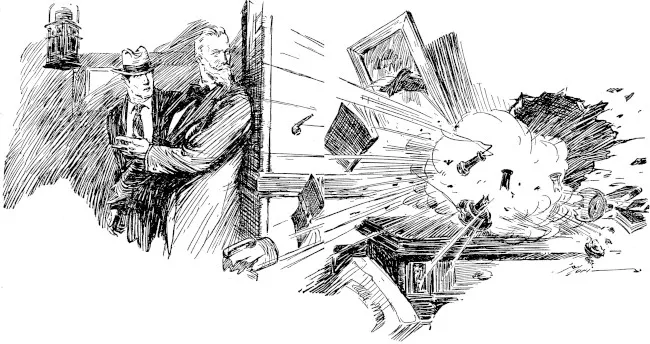
And then, very suddenly, there was a terrific explosion. A sheet of
flame shot upward to the skies. The streets shook. Buildings rocked.
Glass fell in tinkling showers from buildings all over the city. And
then there were crashes—horrible crashes—as shaken and undermined
buildings collapsed.
Kathryn went deathly pale. Her body was rigid. After minutes she
whispered.
"He—he is in there!"
And Schaaf cursed frantically in German because he believed the same.
But a group of men came running, in advance of a thinning, wavering
cloud of smoke. Hines broke out in front of them. He came on, calling
anxiously:
"Kathryn! Kathryn!"
She stood up, sobbing in relief.
"Here I am! I thought you were killed!"
They seemed to melt into each other's arms.
Suddenly Schaaf groaned, and swore more deeply than ever before, and
said bitterly:
"Of course, Hines, der deffil has destroyed his apparatus. But more
important, and much as I hate to interrupt der party, I beg to inform
you that you are one terrible boob, and a guy named Schaaf is another."
Hines flushed deeply and said:
"Why? What's the matter?"
"We did not kill Breston, as you know," said Schaaf disgustedly. "But
der worst of it is that we nefer efen guessed what he was drifing at
all der time! He had no hope of getting ten millions' ransom from der
city of New York. But he has got rich, all der same. Before he started
any of der works he had sold stocks in der stock market, going short
of all der stocks in creation. And when he began to pull his stuff,
der stock market went to hell and gone, and he cofered, and began to
buy. When der world knows, in der morning, that we haff licked der
scoundtrel, and haff fixed it so he cannot do der same thing again, all
der stocks will go up again. Instead of ten millions, der son-of-a-gun
may haff made twenty or thirty of them by der way der stock market
behafed—which he was der only man to know in advance!"
Hines growled:
"Any police force in the world can beat him now, though!"
"If he tries der same stunt again," agreed Schaaf. He eyed the two of
them wrathfully. "Oh, you aren't interested! Go on and hold hands! Make
lofe! Go on! I giff you up!"
And they followed his advice to the letter.
THE END.