In the Yellowstone National Park there is an apparently bottomless pit
which can be instantly transformed into a spouting, roaring Vesuvius of
boiling water by the simple expedient of dropping a bar of soap into it.
The Spot-Light went to press at three o'clock. By the earliest graying
of dawn, and long before the sun had shown itself above the eastern
Timanyonis, Brouillard's bar of soap was melting and the Mirapolitan
under-depths were beginning to heave. Like wild-fire, the news spread
from lip to lip and street to street, and by sunrise the geyser was
retching and vomiting, belching débris of cries and maledictions, and
pouring excited and riotous crowds into Chigringo Avenue.
Most naturally, the Spot-Light office was the first point of attack,
and Harlan suffered loss, though it was inconsiderable. At the battering
down of the doors the angry mob found itself confronting the young
Reclamation Service chief and four members of his staff, all armed.
Brouillard spoke briefly and to the point.
"I am the man who wrote that article you've been reading, and Mr. Harlan
printed it as a matter of news. If you have anything to say to me you
know where to find me. Now, move on and let Mr. Harlan's property alone
or somebody will get hurt."
Nobody stayed to press the argument at the moment. An early-morning mob
is proverbially incoherent and incohesive; and, besides, loaded
Winchesters in the hands of five determined men are apt to have an
eloquence which is more or less convincing.
But with the opening of business the geyser spouted again. The exchanges
were mobbed by eager sellers, each frenzied struggler hoping against
hope that he might find some one simple enough to buy. At ten o'clock
the bank closed—"Temporarily," the placard notice said. But there were
plenty to believe that it would never open again.
By noon the trading panic had exhausted itself a little, though the
lobby and café of the Metropole were crowded, and anxious groups quickly
formed around any nucleus of rumor or gossip in the streets.
Between one and two o'clock, while Brouillard, Leshington, and Anson
were hastily eating a luncheon sent over to the mapping room from
Bongras's, Harlan drifted in.
"Spill your news," commanded Leshington gruffly. "What's doing, and
who's doing it?"
"Nobody, and nothing much," said Harlan, answering the two queries as
one. "The town is falling apart like a bunch of sand and the get-away
has set in. Two full trains went east this forenoon, and two more are
scheduled for this afternoon if the railroad people can get the cars
here."
"'Good-by, little girl, good-by,'" hummed Grislow, entering in time to
hear the report of the flight.
But Leshington was shaking his big head moodily. "Laugh about it if you
can, but it's no joke," he growled. "When the froth is blown away and
the bubbles quit rising, there are going to be some mighty bitter
settlings left in the bottom of the stein."
"You're right, Leshington," said Harlan, gravely. "What we're seeing now
is only the shocked surprise of it—as when a man says 'Ouch!' before he
realizes that the dog which has bitten him has a well-developed case of
rabies. We'll come to the hydrophobic stage later on."
By nightfall of this first day the editor's ominous prophecy seemed
about to reach its fulfilment. The Avenue was crowded again and the din
and clamor was the roar of a mob infuriated. Brouillard and Leshington
had just returned from posting a company of the workmen guard at the
mixers and crushers, when Grislow, who had been scouting on the Avenue,
came in.
"Harmless enough, yet," he reported. "It's only some more of the
get-away that Harlan was describing. Just the same, it's something
awful. People are fairly climbing over one another on the road up the
hill to the station—with no possible hope of getting a train before
some time to-morrow. Teamsters are charging twenty-five dollars a load
for moving stuff that won't find cars for a week, and they're scarce at
the price."
Leshington, who was not normally a profane man, opened his mouth and
said things.
"If the Cortwright crowd had one man in it with a single idea beyond
saving his own miserable stake!" he stormed. "What are the spellbinders
doing, Grizzy?"
The hydrographer grinned. "Cortwright and a chosen few left this
afternoon, hotfoot, for Washington, to get the government to interfere.
That's the story they'd like to have the people believe. But the fact
is, they ran away from Judge Lynch."
"Yes; I think I see 'em coming back—not!" snorted the first assistant.
Then to Brouillard: "That puts it up to us from this out. Is there
anything we can do?"
Brouillard shook his head. "I don't want to stop the retreat. I've heard
from President Ford. The entire Western Division will hustle the
business of emptying the town, and the quicker it is done the sooner it
will be over."
For a tumultuous week the flight from the doomed city went on, and the
overtaxed single-track railroad wrought miracles of transportation. Not
until the second week did the idea of material salvage take root, but,
once started, it grew like Jonah's gourd. Hundreds of wrecking crews
were formed. Plants were emptied, and the machinery was shipped as it
stood. Houses and business blocks were gutted of everything that could
be carried off and crowded into freight-cars. And, most wonderful of
all, cars were found and furnished almost as fast as they could be
loaded.
But the second week was not without incidents of another sort. Twice
Brouillard had been shot at—once in the dark as he was entering the
mapping room, and again in broad day when he was crossing the Avenue to
Bongras's. The second attempt was made by the broker Garner, whom
excitement or loss, or both, had driven crazy. The young engineer did
nothing in either case save to see to it that Garner was sent to his
friends in Kansas City. But when, two nights later, an attempt was made
to dynamite the great dam, he covered the bill-boards with warning
posters. Outsiders found within the Reclamation Service picket-lines
after dark would be held as intentional criminals and dealt with
accordingly.
"It begins to look a little better," said Anson on the day in the third
week when the army of government laborers began to strip the final forms
from the top of the great wall which now united the two mountain
shoulders and completely overshadowed and dominated the dismantled town.
"If the Avenue would only take its hunch and go, the agony would be
over."
But Brouillard was dubious. The Avenue, more particularly the lower
Avenue, constituted the dregs. Bongras, whom Brouillard had promised to
indemnify, stayed; some of the shopkeepers stayed for the chance of
squeezing the final trading dollar out of the government employees; the
saloon-keepers stayed to a man, and the dives were still running full
blast—chiefly now on the wages of the government force.
"It will be worse before it is better," was the young chiefs prediction,
and the foreboding verified itself that night. Looting of a more or less
brazen sort had been going on from the first, and by nine o'clock of the
night of prediction a loosely organized mob of drink-maddened terrorists
was drifting from street to street, and there were violence and
incendiarism to follow.
Though the property destruction mattered little, the anarchy it was
breeding had to be controlled. Brouillard and Leshington got out their
reserve force and did what they could to restore some semblance of
order. It was little enough; and by ten o'clock the amateur policing of
the city had reduced itself to a double guarding of the dam and the
machinery, and a cordoning of the Metropole, the Reclamation Service
buildings, and the Spot-Light office. For Harlan, the dash of sporting
blood in his veins asserting itself, still stayed on and continued to
issue his paper.
"I said I wanted to be in at the death, and for a few minutes to-night I
thought I was going to be," he told Brouillard, when the engineer had
posted his guards and had climbed the stair to the editorial office.
Then he asked a question: "When is this little hell-on-earth going to
be finally extinguished, Victor?"
Instead of answering, Brouillard put a question of his own: "Did you
know that Cortwright and Schermerhorn and Judge Williams came back this
evening, Harlan?"
"I did," said the newspaper man. "They are registered at the Metropole
as large as life. And Miss Genevieve and Lord Falkland and Cortwright's
ugly duckling of a son came with them. What's up?"
"That is what I'd like to know. There's a bunch of strangers at the
Metropole, too, a sheriff's posse, Poodles thinks; at least, there is a
deputy from Red Butte with the crowd."
Harlan tilted back in his chair and scanned the ceiling reflectively.
"This thing is getting on my nerve, old man. I wish we could clean the
slate and all go home."
"It is going to be cleaned. Notices will be posted to-morrow warning
everybody that the waste-gates will be closed promptly on the date
advertised."
"When is it? Things have been revolving too rapidly to let me remember
such a trivial item as a date."
"It is the day after to-morrow, at noon."
The owner of the Spot-Light nodded. "Let her go, Gallagher. I've got
everything on skids, even the presses. Au revoir—or perhaps one
should say, Au reservoir."
Fresh shoutings and a crackling of pistols arose in the direction of the
plaza, and Brouillard got up and went to a window. The red glow of other
house burnings loomed against the sombre background of Jack's Mountain.
"Senseless savages!" he muttered, and then went back to the editor. "I
don't like this Cortwright reappearance, Harlan. I wish I knew what it
means."
"Let's see," said the newsman thoughtfully; "what is there worth taking
that they didn't take in the sauve qui peut? By Jove—say! Did old
David Massingale get out of J. Wesley's clutches before the lightning
struck?"
"I wish I could say 'Yes', and be sure of it," was the sober reply. "You
knew about the thieving stock deal, or what you didn't know I told you.
Well, I had Massingale, as president, call a meeting of directors—which
never met. Afterward, acting under legal advice, he went on working the
mine, and he's been working it ever since, shipping a good bit of ore
now and then, when he could squeeze it in between the get-away trains.
Of course, there is bound to be a future of some sort; but that is the
present condition of affairs."
"How about those notes in the bank? Wasn't Massingale personally
involved in some way?"
Brouillard bounded out of his chair as if the question had been a
point-blank pistol-shot.
"Great Heavens!" he exclaimed. "To-day's the day! In the hustle I had
forgotten it, and I'll bet old David has—if he hasn't simply ignored
it. That accounts for the reunion at the Metropole!"
"Don't worry," said Harlan easily. "The bank has gone, vanished, shut up
shop. At the end of the ends, I suppose, they can make David pay; but
they can't very well cinch him for not meeting his notes on the dot."
"Massingale doesn't really owe them anything that he can't pay,"
Brouillard asserted. "By wiring and writing and digging up figures, we
found that the capitalizing stockholders, otherwise J. Wesley
Cortwright, and possibly Schermerhorn, have actually invested fifty-two
thousand dollars, or, rather, that amount of Massingale's loan has been
expended in equipment and pay-rolls. Three weeks ago the old man got the
smelter superintendent over here from Red Butte, and arranged for an
advance of fifty-two thousand dollars on the ore in stock, the money to
be paid when the first train of ore-cars should be on the way in. It was
paid promptly in New York exchange, and Massingale indorsed the draft
over to me to be used in the directors' meeting, which was never held."
"Well?" said the editor.
Brouillard took a pacing turn up the long, narrow room, and when he came
back he said: "I guess I'm only half reformed, after all, Harlan. I'd
give a year or so out of my natural life if I had a grip on Cortwright
that would enable me to go across to Bongras's and choke a little
justice out of him."
"Go over and flash Massingale's fifty-two thousand dollars at 'em.
They'll turn loose. I'll bet a yellow cur worth fifteen cents that
they're wishing there was a train out of this little section of Sheol
right now. Hear that!"
The crash of an explosion rattled the windows, and the red loom on the
Jack's Mountain side of the town leaped up and became a momentary glare.
The fell spirit of destruction, of objectless wreck and ruin, was
abroad, and Brouillard turned to the stairway door.
"I'll have to be making the rounds again," he said. "The Greeks and
Italians are too excitable to stand much of this. Take care of yourself;
I'll leave Grif and a dozen of the trusties to look after the shop."
When he reached the sidewalk the upper Avenue was practically deserted.
But in the eastern residence district, and well around to the north, new
storm-centres were marked by the increasing number of fires. Brouillard
stopped and faced toward the distant and invisible Timanyonis. A chill
autumn breeze was sweeping down from the heights and the blockading wall
of the great dam turned it into eddies and dust-pillared whirls dancing
in the empty street.
Young Griffith sauntered up with his Winchester in the hollow of his
arm.
"Anything new?" he asked.
"No," said Brouillard. "I was just thinking that a little wind would go
a long way to-night, with these crazy house-burners loose on the town."
Then he turned and walked rapidly to the government headquarters, passed
the sentry at the door of the mapping room; and out of the fire-proof
vault where the drawings and blue-print duplicates were kept took a
small tin despatch-box.
He had opened the box and had transferred a slip of paper from it to
the leather-covered pocket field book which served him for a wallet,
when there was a stir at the door and Castner hurried in, looking less
the clergyman than the hard-working peace-officer.
"More bedlam," he announced. "I want Gassman or Handley and twenty or
thirty good men. The mob has gone from wrecking and burning to
murdering. 'Pegleg' John was beaten to death in front of his saloon a
few minutes ago. It is working this way. There were three fires in the
plaza as I came through."
"See Grislow at the commissary and tell him I sent you," said the chief.
"I'd go with you, but I'm due at the Metropole."
"Good. Then Miss Amy got word to you? I was just about to deliver her
message."
"Miss Massingale? Where is she, and what was the message?" demanded
Brouillard.
"Then you haven't heard? The 'Little Susan' is in the hands of a
sheriff's posse, and David Massingale is under arrest on some trumped-up
charge—selling ore for his individual account, or something of that
sort. Miss Amy didn't go into particulars, but she told me that she had
heard the sheriff say it was a penitentiary offence."
"But where is she now?" stormed Brouillard.
"Over at the hotel. I supposed you knew; you said you were going there."
Brouillard snatched up the despatch-box and flung it into the
fire-proof. While he was locking the door Castner went in search of
Grislow, and when Brouillard faced about, another man stood in the
missionary's place by the mapping table. It was Mr. J. Wesley
Cortwright.
The gray-faced promoter had lost something of his old-time jaunty
assurance, and he was evidently well shaken and unnerved by the sights
and sounds of the night of terror. The sandy-gray eyes advertised it as
well as the fat hands, which would not keep still.
"I didn't think I'd have to ask a favor of you again, Brouillard, but
needs must when the devil drives," he began, with an attempted
assumption of the former manner. "We didn't know—the newspapers didn't
tell us anything about this frightful state of affairs, and——"
Brouillard had suddenly lost his desire to hurry.
"Sit down, Mr. Cortwright," he said. "I was just coming over to see
you—to congratulate you and Mr. Schermerhorn on your return to
Mirapolis. We have certainly missed the mayor, not to mention the
president of the common council."
"Of course—yes," was the hurried rejoinder. "But that's all over. You
said you'd get us, and you did. I don't bear malice. If you had given me
one more day I'd have got you; the stuff that would have broken your
neck with the Washington people was all written and ready to put on the
wires. But that's past and gone, and the next thing is something else.
There is a lot of money and securities locked up in the Niquoia Bank
vault. We've come to clean up, and we brought a few peace officers along
from Red Butte for a guard. The miserable scoundrels are scared stiff;
they won't stir out of the hotel. Bongras tells me you've got your force
organized and armed—can't you lend us fifty or a hundred huskies to
keep the mob off while we open that bank vault?"
Brouillard's black eyes snapped, and the blood danced in his veins. The
opportunity for which he would have bartered Ormus treasure had come to
him—was begging him to use it.
"I certainly can," he admitted, answering the eager question and
emphasizing the potentiality.
"But will you? that's the point. We'll make it worth your while. For
God's sake, don't say no, Brouillard! There's pretty well up to a
million in that vault, counting odds and ends and left-overs.
Schermerhorn oughtn't to have left it. I thought he had sense enough to
stay and see it taken care of. But now——"
"But now the mob is very likely to wreck the building and dynamite the
vault, you were going to say. I think it is more than likely, Mr.
Cortwright, and I wonder that it hasn't been done before this. It would
have been done if the rioters had had any idea that you'd left anything
worth taking. And it would probably wreck you and Mr. Schermerhorn if it
should get hold of you; you've both been burned in effigy half a dozen
times since you ran away."
"Oh, good Lord!" shuddered the magnate. "Make it two hundred of your
men, and let's hurry. You won't turn us down on this, Brouillard?"
"No. It is no part of our duty to go and keep the mob off while you save
your stealings, but we'll do it. And from the noise they are making down
that way, I think you are wise in suggesting haste. But first there is a
question of common justice to be settled. An hour ago, or such a matter,
you sent a part of your sheriff's posse up to seize the 'Little Susan'
and to arrest David Massingale——"
"It's—it's a lie!" stammered Cortwright.
"Somebody has been trying to backcap me to you!"
Brouillard looked up, frowning.
"You are a good bit older man than I am, Mr. Cortwright, and I sha'n't
punch your head. But you'll know why I ought to when I tell you that my
informant is Miss Amy Massingale. What have you done with old David?"
The man who had lost his knack of bluffing came down and stayed down.
"He—he's over at the hotel," he stammered.
"Under guard?"
"Well—y-yes."
Brouillard pointed to the telephone on the wall.
"Go and call up your crowd and get it here. Tell Judge Williams to bring
the stock he is holding, and Schermerhorn to bring the Massingale notes,
and your man Jackson to bring the stock-book. We'll have that directors'
meeting that was called, and wasn't held, three weeks ago."
"Oh, good Heavens!" protested the millionaire, "put it off—for God's
sake, put it off! It will be wasting time that may be worth a thousand
dollars a minute!"
"You are wasting some of the thousand-dollar minutes right now," was the
cool reply, and the engineer turned to his desk and squared himself as
if he were going to work on a bunch of foremen's reports.
It was a crude little expedient, but it sufficed. Cortwright tramped to
the 'phone and cursed and swore at it until he had his man at the other
end of the wire. The man was the lawyer, as it appeared, and Cortwright
abused him spitefully.
"You've balled it—balled it beautifully!" he shouted. "Come over here
to Brouillard's office and bring Schermerhorn and the stock and the
notes and Jackson and the secretary's books and Massingale and your
infernal self! Get a move, and get it quick! We stand to lose the whole
loaf because you had to butt in and sweep up the crumbs first!"
When the procession arrived, as it did in an incredibly short time,
Brouillard laid down the law.
"We don't need these," he said curtly, indicating the two deputies who
came to bring David Massingale. And when they were gone: "Now,
gentlemen, get to work and do business, and the less time you waste the
better chance there will be for your bank salvage. Three requirements I
make: you will turn over the stock, putting Mr. Massingale in possession
of his mine, without encumbrance; you will cancel and surrender his
notes to the bank; and you will give him a document, signed by all of
you, acknowledging the payment in full of all claims, past or pending.
While you are straightening things out, I'll ring up the yards and rally
your guard."
Cortwright turned on the lawyer. "You hear what Brouillard says; fix it,
and do it suddenly."
It was done almost before Brouillard had made Leshington, in charge at
the yards, understand what was wanted.
"Now a note to your man at the mine to make him let go without putting
us to the trouble of throwing him over the dump," said the engineer,
when he had looked over the stock transfers, examined the cancelled
notes, and read and witnessed the signatures on the receipt in full.
Cortwright nodded to the lawyer, and when Williams began to write again
the king of the promoters turned upon Brouillard with a savage sneer.
"Once more you've had your price," he snarled bitterly. "You and the old
man have bilked us out of what we spent on the mine. But we'll call it
an even break if you'll hurry that gang of huskies."
"We'll call it an even break when it is one," retorted Brouillard; and
after he had gathered up the papers he took the New York check from his
pocketbook, indorsed it, and handed it to Cortwright. "That is what was
spent out of the hundred thousand dollars you had Mr. Massingale charged
with, as nearly as we can ascertain. Take it and take care of it; it's
real money."
He had turned again to the telephone to hurry Leshington, had rung the
call, and was chuckling grimly over the collapse of the four men at the
end of the mapping table as they fingered the slip of money paper.
Suddenly it was borne in upon him that there was trouble of some sort at
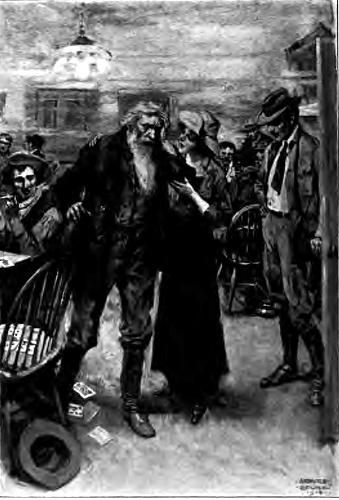
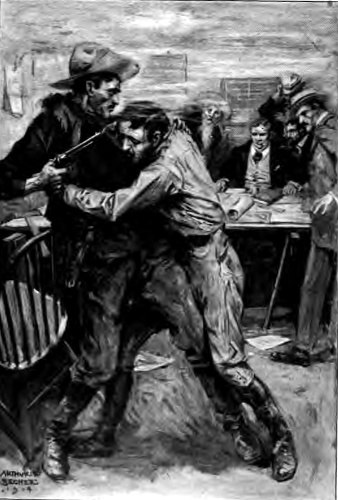
the door—there were curses, a blow, a mad rush; then.... It was Stephen
Massingale who had fought his way past the door-guarding sentry and
stood blinking at the group at the far end of the mapping board.
"You're the houn' dog I'm lookin' for!" he raged, singling out
Cortwright when the dazzle of the electrics permitted him to see.
"You'll rob an old man first, and then call him a thief and set the
sheriff on him, will you——?"
Massingale's pistol was dropping to the firing level when Brouillard
flung away the telephone ear-piece and got between. Afterward there was
a crash like a collision of worlds, a whirling, dancing medley of
colored lights fading to gray and then to darkness, and the engineer
went down with the avenger of wrongs tightly locked in his arms.
After the period of darkness had passed and Brouillard opened his eyes
again upon the world of things as they are, he had a confused idea that
he had overslept shamefully and that the indulgence had given him a bad
headache.
The next thought was that the headache was responsible for a set of
singular hallucinations. His blanket bunk in the sleeping shack seemed
to have transformed itself into a white bed with pillows and snowy
sheets, and the bed was drawn up beside an open window through which he
could look out, or seem to look out, upon a vast sea dimpling in the
breeze and reflecting the sunshine so brightly that it made his headache
a darting agony.
When he turned his face to escape the blinding glare of the sun on the
sea the hallucinations became soothingly comforting, not to say
ecstatic. Some one was sitting on the edge of the bed; a cool hand was
laid on his forehead; and when he could again see straight he found
himself looking up into a pair of violet eyes in which the tears were
trembling.
"You are Amy—and this is that other world you used to talk about, isn't
it?" he asked feebly.
The cool hand slipped from his forehead to his lips, as if to warn him
that he must not talk, and he went through the motions of kissing it.
When it was withdrawn he broke the silent prohibition promptly.
"The way to keep me from talking is to do it all yourself; what happened
to me last night?"
She shook her head sorrowfully.
"The 'last night' you mean was three weeks ago. Stevie was trying to
shoot Mr. Cortwright in your office and you got between them. Do you
remember that?"
"Perfectly," he said. "But it still seems as if it were only last night.
Where am I now?—not that it makes any difference, so long as I'm with
you."
"You are at home—our home; at the 'Little Susan.' Mr. Leshington had
the men carry you up here, and Mr. Ford ran a special train all the way
from Denver with the doctors. Stevie's bullet struck you in the head,
and—and we all thought you were going to die."
"I'm not," he asserted, in feebly desperate determination. "I'm going to
live and get to work and earn a hundred thousand dollars, so I can say:
'Come, little girl——'"
Again the restraining hand was laid upon his lips, and again he went
through the motions of kissing it.
"You mustn't talk!" she insisted. "You said you'd let me." And when he
made the sign of acquiescence, she went on: "At first the doctors
wouldn't give us any hope at all; they said you might live, but
you'd—you'd never—never remember—never have your reason again. But
yesterday——"
"Please!" he pleaded. "That's more than enough about me. I want to know
what happened."
"That night, you mean? All the things that you had planned for. Father
got the mine back, and Mr. Leshington and the others got the riot
quelled after about half of the city was burned."
"But Cortwright and Schermerhorn—I promised them——"
"Mr. Leshington carried out your promise and helped them get the money
out of the bank vault before the mob sacked the Niquoia Building and
dynamited it. But at the hotel they were arrested on the order of the
bank examiner, and everything was taken away from them. We haven't
heard yet what is going to be done with them."
"And Gomorrah?" he asked.
She slipped an arm under his shoulders and raised him so he could look
out upon the mountain-girt sea dimpling under the morning breeze.
"There is where it was," she said soberly, "where it was, and is not,
and never will be again, thank God! Mr. Leshington waited until
everybody had escaped, and then he shut the waste-way gates."
Brouillard sank back upon the pillows of comfort and closed his eyes.
"Then it's all up to me and the hundred thousand," he whispered. "And
I'll get it ... honestly, this time."
The violet eyes were smiling when he looked into them again.
"Is she—the one incomparable she—worth it, Victor?"
"Her price is above rubies, as I told you once a long time ago."
"You wouldn't let pride—a false pride—stand in the way of her
happiness?"
"I haven't any; her love has made me very humble and—and good, Amy,
dear. Don't laugh: it's the only word; I'm just hungering and thirsting
after righteousness enough to be half-way worthy of her."
"Then I'll tell you something else that has happened. Father and Stevie
have reorganized the 'Little Susan' Mining Company, dividing the stock
into four equal parts—one for each of us. You must take your share,
Victor. It will break father's heart if you don't. He says you got it
back for him after it was hopelessly lost, and that is true."
He had closed his eyes again, and what he said seemed totally
irrelevant.
"'And after the man had climbed the fourth mountain through all its
seven stages, he saw a bright light, and it blinded him so that he
stumbled and fell, and a great darkness rose up to make the light seem
far beyond his reach. Then the light came near, and he saw that it was
Love, and that the darkness was in his own soul.' ... Kiss me, Amy,
girl, and then go and tell your father that he is a simple-hearted old
spendthrift, and I love him. And if you could wire Castner, and tell him
to bring a license along——"
"O boy—foolish boy!" she said. "Wait: when you are well and strong
again...."
But she did not make him wait for the first of the askings; and after a
healing silence had fallen to show the needlessness of speech between
those who have come through darkness into light, he fell asleep again,
perhaps to dream that the quieting hand upon his forehead was the touch
of Love, angel of the bright and shining way, summoning him to rise up
and go forward as a soul set free to meet the dawning day of fruition.
Published by CHARLES SCRIBNER'S SONS
The City of Numbered Days. Illus.
The Honorable Senator Sage-brush.
Scientific Sprague. Illus.
The Price.
The Taming of Red Butte Western.
The King of Arcadia. Illus.
A Romance In Transit.