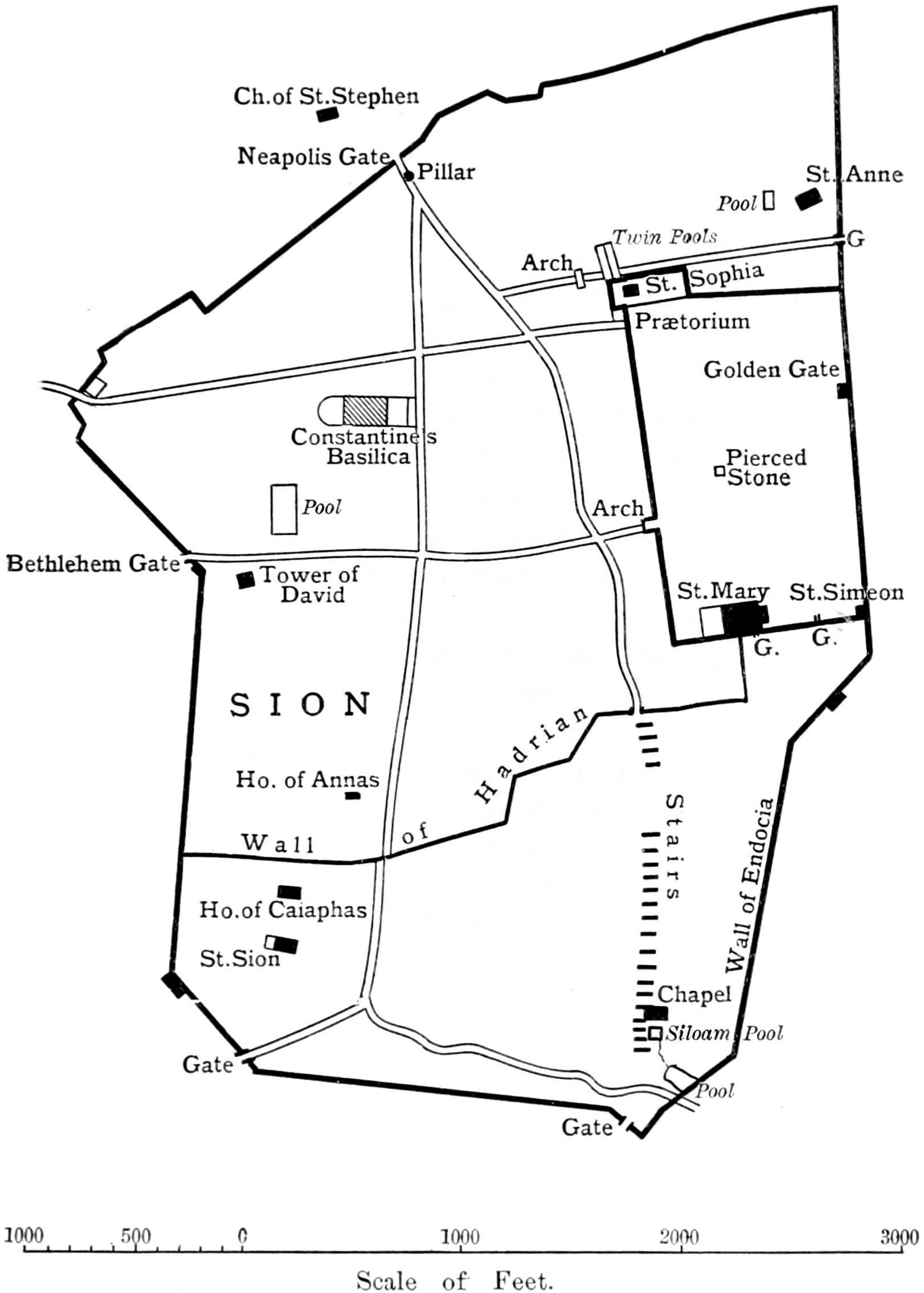
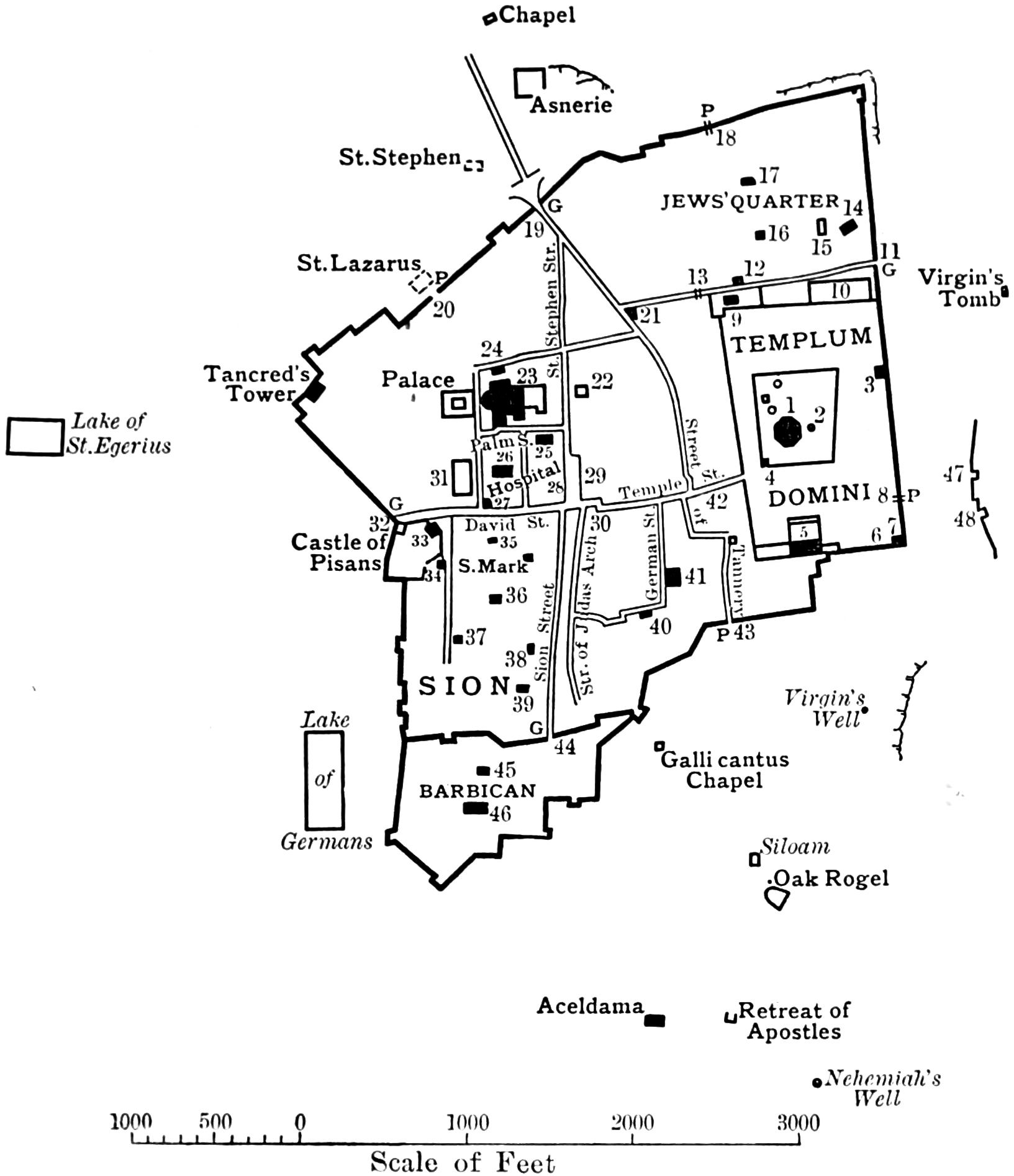
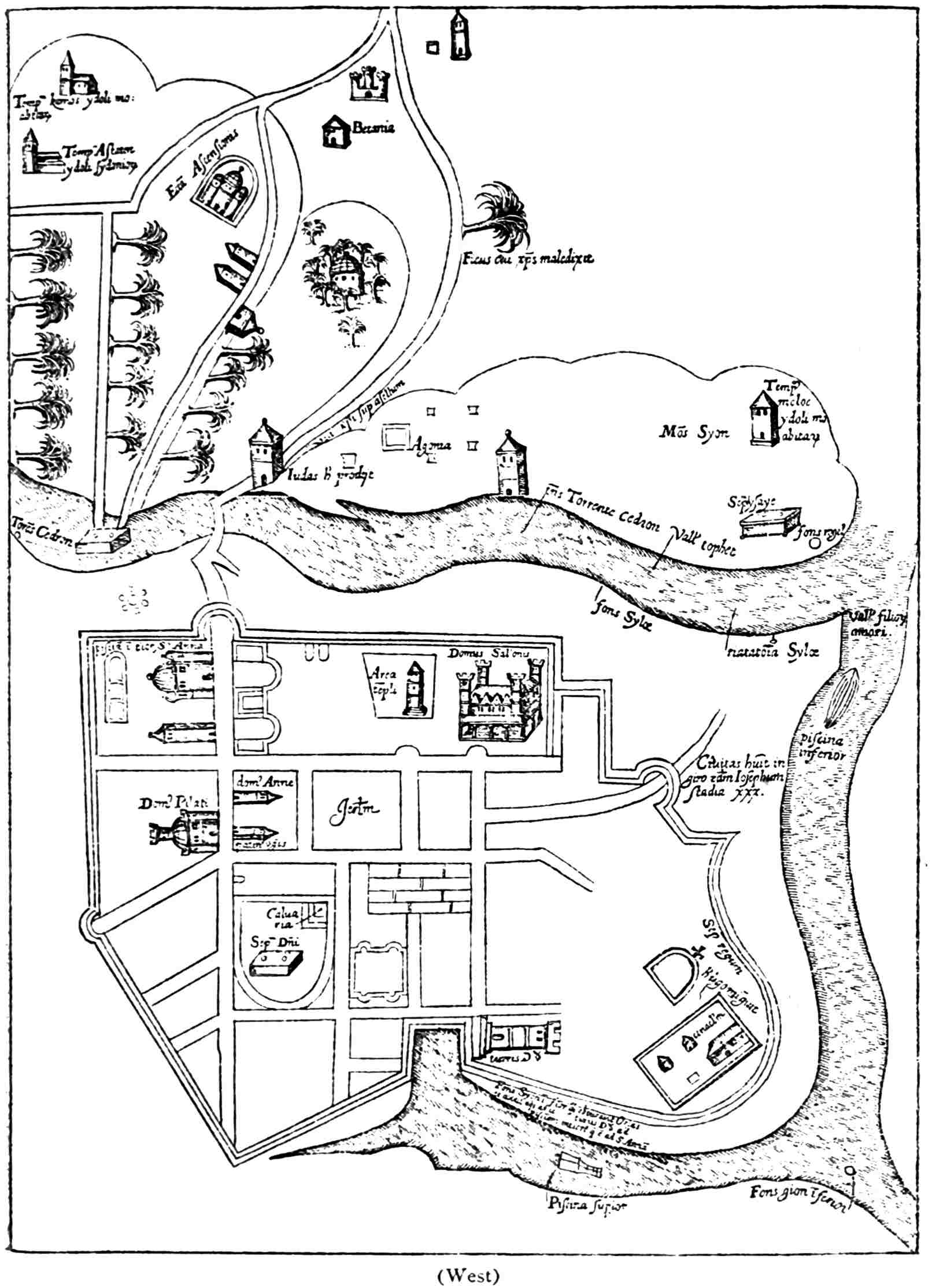
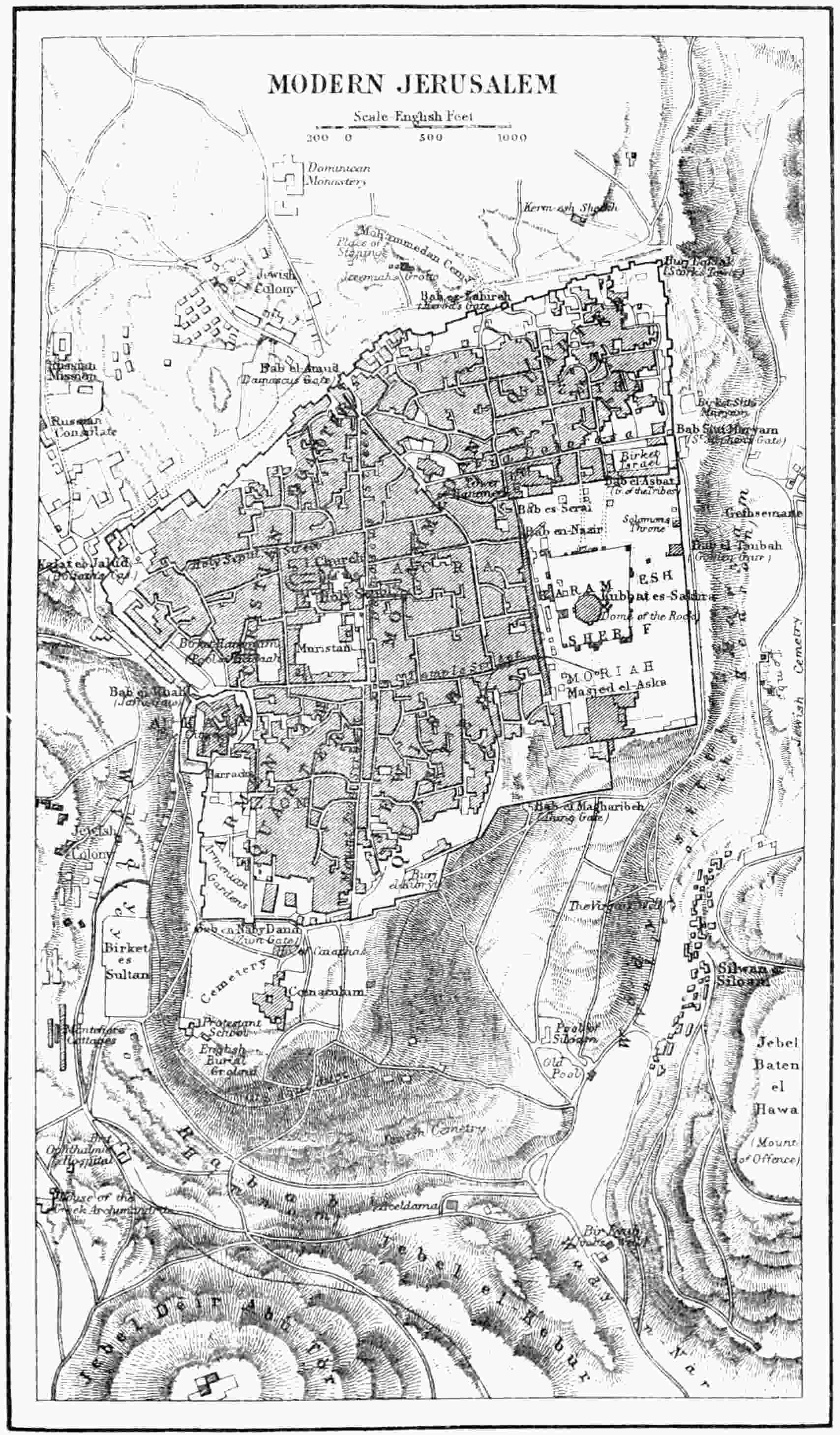
Larger versions of most illustrations may be seen by right-clicking them
and selecting an option to view them separately, or by double-tapping and/or
stretching them.
Cover image created by Transcriber, using an illustration
and the title page from the original book. Result remains in the Public Domain.
BY THE SAME AUTHOR
TENT WORK IN PALESTINE
1878
HANDBOOK TO THE BIBLE
1879
JUDAS MACCABÆUS
1879
HETH AND MOAB
1883
PRIMER OF BIBLE GEOGRAPHY
1883
SYRIAN STONE LORE
1887
ALTAIC HIEROGLYPHS
1887
PALESTINE
1891
TELL AMARNA TABLETS
1893
THE BIBLE AND THE EAST
1896
THE LATIN KINGDOM OF JERUSALEM
1897
THE HITTITES AND THEIR LANGUAGE
1898
THE HEBREW TRAGEDY
1900
THE FIRST BIBLE
1902
CRITICS AND THE LAW
1907
THE RISE OF MAN
1908
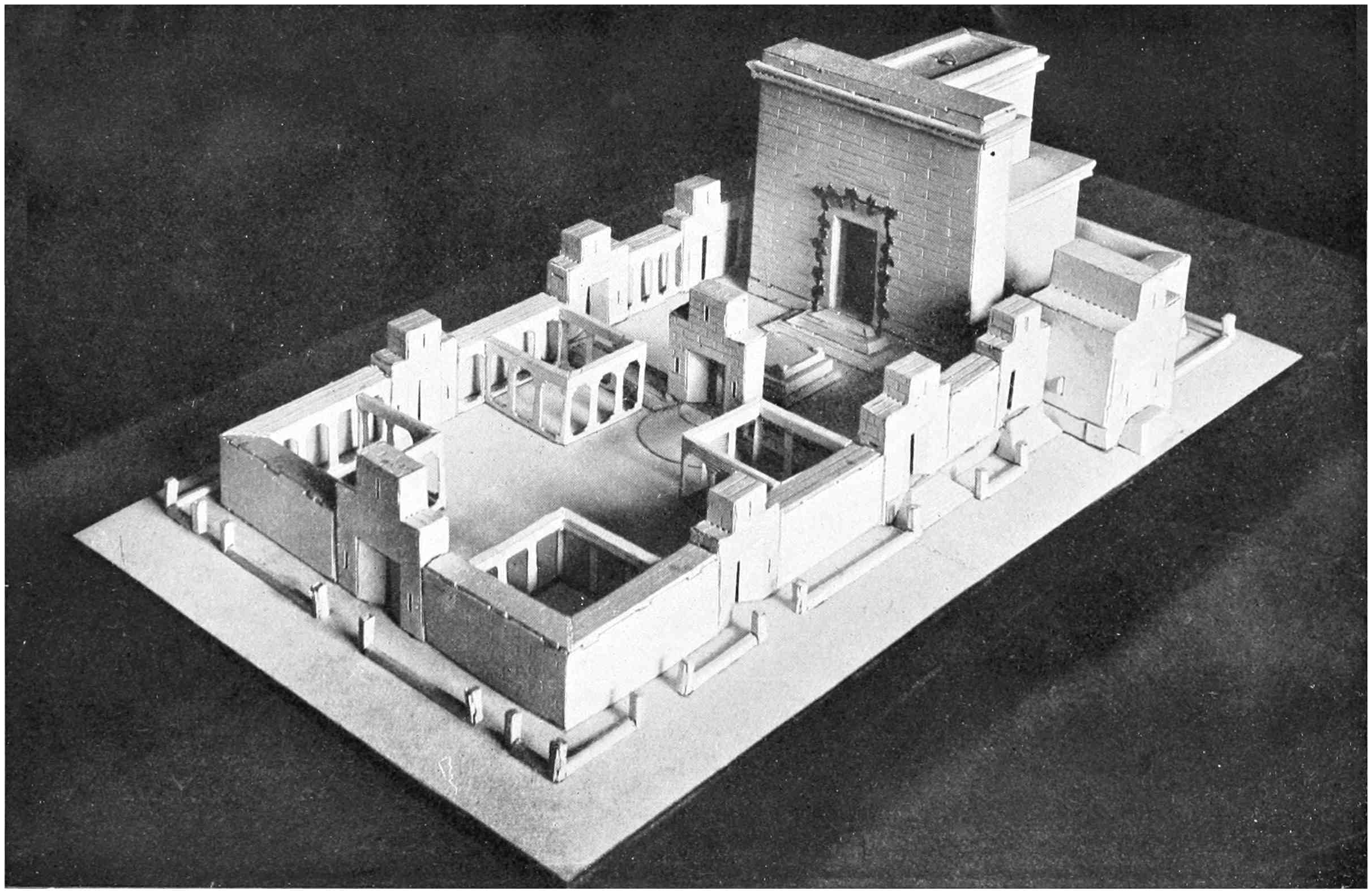
HEROD’S TEMPLE.
From the model by Miss M. A. Duthoit.
Frontispiece]
THE CITY OF JERUSALEM
BY COL. C. R. CONDER
LL.D., M.R.A.S., R.E.
LONDON
JOHN MURRAY, ALBEMARLE STREET, W. 1909
PRINTED BY
HAZELL, WATSON AND VINEY, LD.,
LONDON AND AYLESBURY.
PREFACE
The object of this volume is to present in a convenient
form the results of research and exploration
concerning the history and buildings of the city of
Jerusalem—results which have accumulated during
the last half-century, but which are scattered in
many expensive works not easily accessible for the
general reader. The story of forty centuries is
carried down to the present year, and reliance is
chiefly placed on monumental information.
I first set eyes on Jerusalem one summer morning
in 1872. The view—a mile away—of the long grey
wall, the cypress trees of the Armenian garden, and
the single minaret at the west gate, was not then
obstructed by the row of Jewish cottages since built.
The population was only about a third of what it
now is. The railway station was not thought of, and
only a few villas outside the gate existed, while the
suburbs to north and south had not grown up, and
Olivet was not covered with modern buildings.
I passed two winters (1873–5) in the city, the
second in a house in the Jews’ quarter, and later on
(1881–2) a third winter at the hotel; and during these
visits my time was mainly occupied in wandering
among the less-known corners of the town. It was a
period very favourable for exploration. The survey
by Sir Charles Wilson, the researches of de Vogüé,
and the wonderful excavations of Sir Charles Warren,
were then recent. The German Emperor, William I.,
had just ordered the clearing out of the eastern half of
the great square of St. John’s Hospital, having been
given by the Sultan the site of Charlemagne’s hospice
beside the Church of St. Mary Latin. In 1874 Mr.
Henry Maudeslay was exploring the ancient scarps at
the south-west corner of the Hebrew city; and, by the
Sultan’s order, the Dome of the Rock—deconsecrated
for a time—was being repaired, while other excavations
were in progress outside the city on the
north.
DISCOVERIES
I was thus able to walk in my socks all over the
surface of the sacred Ṣakhrah “rock,” and to ascend
the scaffolding to the dome above, in order to examine
the ancient mosaics of our seventh century, as well as
those on the outside, where the old arcaded battlement
of the ninth century was just laid bare. I penetrated,
by the old rock-cut aqueduct at the north-west corner
of the Ḥaram, to the Herodian wall, and discovered
the buttresses of the Temple rampart still standing,
and just like those at Hebron. In the Jews’ quarter
I found the old hospice of the Teutonic Order, and the
chapel of the Holy Ghost. In 1881 I crawled through
the Siloam tunnel with two comrades, in danger of
our lives, to find the point where the two parties
of Hezekiah’s workmen heard each other calling, and
joined their work by a cross cut east and west. These
were but a few additions to the work of my predecessors,
and since 1882 many other valuable discoveries
have been made by Mr. Bliss, Mr. Stewart
Macalister, and other explorers, which will be described
in due course. We no longer depend on the
writings of Josephus and Tacitus, or on the confused
accounts of mediæval pilgrims. Our ideas are founded
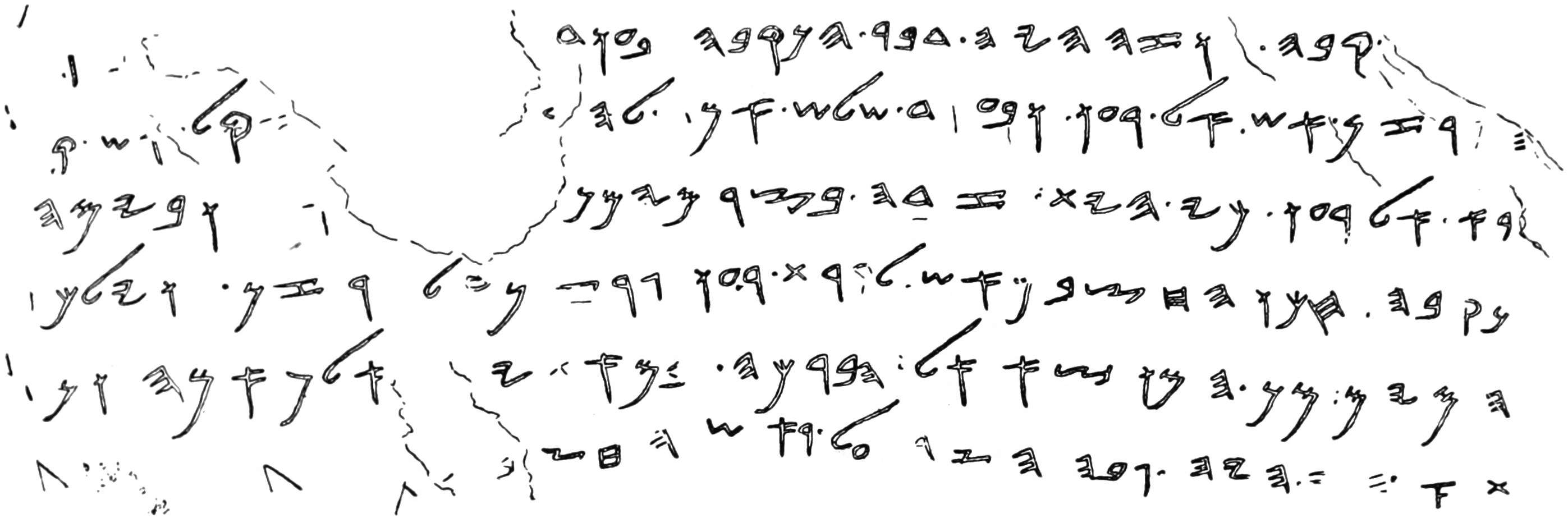
on existing remains. We have Hezekiah’s own inscription
at Siloam; the text (found by M. Clermont-Ganneau)
which forbade Gentiles to enter the court of
Herod’s Temple; the red paint instructions which his
master-masons scrawled on the foundations of the
mighty ramparts; the votive text to Serapis set up
later by Roman soldiers; the Greek inscriptions of
Byzantine monks in tombs on the south side of the
Hinnom Valley, and, yet earlier, those on the
ossuaries, which pious Jews and Jewish Christians
used in gathering the bones of their fathers for burial
in the old tombs east and north of the Holy City.
We have Armenian and Georgian mosaic texts, and
Gothic tombstones of Crusaders. Finally, we have
the great Kufic, Karmathian, and Arabic texts of the
Khalîfahs and Sulṭâns of Islâm, who founded or repaired
the beautiful buildings in the Ḥaram.
But all this information is still scattered in expensive
memoirs, or separate reports of exploring societies;
and it is remarkable that, in spite of the great accumulation
of true information during the last half-century,
no general account of the history of Jerusalem—as a
city—exists, though large volumes of controversial
literature continue to appear. It is hoped that the
present volume will give a clear idea of what is
now actually known, and of the natural deductions
from the facts.
Recent visitors have felt themselves perplexed by
conflicting statements as to the Bible sites—“Two
Zions, two Temple areas, two Bethanys, two Gethsemanes,
two or more Calvarys, three Holy Sepulchres,
several Bethesdas.”1 The statement is perhaps an
exaggeration, and the discrepancies as a whole are
by no means recent, being due to ancient misunderstandings
or conjectures. Tradition is overlaid by
tradition in the long period of at least 3,400 years since
Jerusalem first became a royal city of the Amorite.
Jewish traditions were followed by those of Christians
and Moslems, who were alike ill informed as to
ancient history. The Crusaders brought in new ideas,
and often rejected those of the Eastern Churches.
The Franciscans, after 1300 A. D., were deprived of
some churches, and the Pope sanctioned the transference
of old sites to other places. It is true that
some literary critics have recently tried to prove
that the “city of David” was not a royal city on
the mountain top, but a mere hamlet on the tail
of the Temple ridge. They have unfortunately—as
unconscious heirs of the prejudices of Voltaire—been
misled (as in so many other cases) by fixing
on a single allusion, while ignoring other accounts,
and dismissing the statements of Josephus as merely
“traditional”; but they have not given due consideration
to the results of exploration, and they have shown
but slight acquaintance with the scientific study of
ancient architecture.2 As a rule, however, it is not
the modern theorist but the ancient pilgrim who is
responsible for the confusion; and the agreement
reached already, on the more important questions of
topography, has been the outcome of actual research
and of monumental studies. No one seems now to
doubt that the Temple stood on the top of the
eastern ridge. The positions of Olivet and Siloam
have never been questioned. Herod’s palace is placed
by all in the north-west corner of the upper city,
near the so-called “Tower of David,” and Antonia
on the rock of the present barracks at the north-west
corner of the Temple courts. There was a time
when the differences of opinion were much greater.
One theorist even went so far as to assert that
Hebron was the true site of ancient Jerusalem. But
the topography has hardly been changed since
Nehemiah’s age. The two great citadels are still
held as Turkish strongholds, the Temple is still a
sacred enclosure, the upper and lower markets are
still where they always were, and even the dung-hills
outside the wall are close to the “Dung Gate” of
Hebrew times. We may sweep aside the misconceptions
due to vague literary statements, and found
ourselves not on paper, but on rock and stone, on
contemporary inscriptions and architectural remains.
EXCAVATIONS
Ancient cities, as we now know—whether at Troy,
Lachish, and Gezer, or at Rome and in London—were
constantly rebuilt on the ruins of towns previously
laid waste or burned. They present successive strata,
with buildings that are themselves not all of one
date, and which were sometimes carried down to
rock, sometimes merely founded on the old walls and
roofs. The street pavements and the lintels of city
gates were renewed even within the period of one city,
and more frequently than the walls and other buildings.
The earth was disturbed, so that old objects
were brought up to the surface, and recent objects
fell into the foundation trenches, presenting many
puzzles for the explorer; but, broadly speaking, the
strata are as a rule clearly traceable, giving an historic
sequence for the successive cities. In parts of Jerusalem
the valleys within the walls have gradually
been filled with earth and ruined masonry to a
depth of 40 or 50 feet, and it is only where the bare
rock is on the surface that we can feel we are standing
on the very ground trodden by the feet of our Lord.
There are at least six successive cities to be studied
at Jerusalem, lying one above another where the depth
of the debris is greatest. Within quite recent times
the level of some streets has been raised when they
were repaved. In the twelfth century “Christian
Street,” as it is now called, rose gradually northward,
being about 15 feet higher up hill at the point where
it passed the west door of the Cathedral of the Holy
Sepulchre than at the corner where it joined David
Street, and where was the Chapel of St. John Baptist
belonging to the Knights of St. John. But to-day
Christian Street runs level, and the floor of the
chapel is 25 feet below the street, being on the
same level as that of the floor of the cathedral.
Yet even this chapel floor is 10 feet above the
original level of the rock, as it descends into the
great Tyropœon Valley. When I first visited Jerusalem,
the buildings of the Hospital were covered
with earth for some depth above the vaulted roofs
of the twelfth-century buildings. Soon after, this
earth was removed on donkeys, which passed in
a long procession daily out at the west gate,
where they made a mound on which Jewish shops
now stand. Thus the central valley was filled in,
to a depth of 20 feet, before the Crusaders began
to build, and has been again filled in another
20 feet or more since the thirteenth century; while
on the outside of the Temple, as we stand on the
pavement at the Jews’ Wailing-place and gaze on
the mighty rampart towering above, we must remember
that we only see less than half its present
height, and that it goes down beneath us nearly
40 feet, to the older pavement of Herod’s age, which
was itself 20 feet above the foundation rocks.
The causeway to the north of this is 90 feet above
the rock, but in the sixth century the street was at
least 40 feet lower, and in the time of Herod some
30 feet lower still, yet already 20 feet here also
above rock. Such measurements, accurately ascertained
by Sir Charles Warren, whose mine on the
north-east side of the Temple was sunk through the
shingle to a depth of 125 feet, will serve to show
the gradual growth of the rubbish and the effacement
of the ancient natural outline in the valleys which
ran within the city.
TWO SCENES
Many scenes in modern Jerusalem rise before me
in recalling the times when I lived within the walls,
and passed so many days in the Temple enclosure, or
in that grim church, defiled with blood, which some
among us are glad to think of as not marking the new
sepulchre without the city where the Prince of Peace
was laid. But two scenes especially come back to
mind. The first is that of the sleeping town before
the gates were opened to admit the peasant women
and their donkey-loads of cakes and vegetables. In
the purple gloom the domes are beginning to shine,
wet with the heavy dew, as the light spreads behind
Olivet “as far as Hebron”—to quote the Mishnah.
The silence is broken suddenly by the musical cry
of the Muedhdhin on the minaret of a mosque—a
long, rolling, and tremulous note, echoing all over
Jerusalem, as he “testifies there is no God but God,”
and calls to the faithful that “prayer is better than
sleep.” The simple dignity of Islâm contrasts with
the superstition, the hurried services, the tawdry
magnificence of degraded Eastern churches, and we
understand how it was that the reformed faith of
Muḥammad conquered Asia. The second scene is
that of the summer noon, which presents to us an
epitome of the long history of the Holy City. The
great Herodian tower of the upper city glares with
tawny stone against the blue sky. The rough cobbles
of the slippery market-place are crowded with
chattering peasants. A few pious Moslems, unconscious
of the world, are praying with their faces
towards Mekkah on the steps of the Protestant bishop’s
palace, where the town dogs also lie in summer, but
go down to the covered bazaar when the winter rains
and snow begin. The Armenian patriarch is being
escorted, from St. James on Sion to the Holy Sepulchre,
by a modest procession. A Moslem bier passes by,
and men crowd round it to lend their shoulders for
a few steps as a pious act. The little Pharisee, with
his lovelocks and dirty gaberdine—or resplendent in
his fur cap on the sabbath, just as Rembrandt drew
his fathers—is jostled in the narrow street of David,
yet holds his fingers on the pulses of the city life.
Above the cries of the water-seller and the chinking
of the brass sherbet-cups, the screams of women and
the jangling of the metal plates that serve for bells
in churches, rises one recurrent note from the blind
beggar who wanders through the streets, forever
calling aloud to the “everlasting God.” We might
almost expect to see a Templar ride by, with his
white gown and blood-red cross over the mail coat,
or the page of some Frankish noble in stripes of
yellow and crimson. But instead we witness the
long procession of half-naked Dervish fanatics, with
banners, on their way to the Ḥaram, and then to the
“tomb of Moses” west of Jericho. They bear spears
and swords, and are preceded by jesters with fox-tails
or by a convict who has been tarred and covered
with cotton wool—ancient survivals of pagan Saturnalia.
The Jew, the Greek, the Copt, the Georgian,
the Armenian, the Arab, and the Turk mingle with
the modern European and with the Franciscan monk
from Italy in the narrow lane; and black-veiled ladies
with white cloaks, seated on crimson saddles high up
on the white Damascene asses, are led to the shops,
or to the lower fruit-market which glows with colour,
its green and gold contrasting with the violet or rich
brown robes of the merchants. The whole history
of Jerusalem is represented by its crowd to-day.
RELICS
In endeavouring to follow that history we must no
doubt give due attention to tradition, for tradition
records the sincere beliefs of mankind. In cases
where the Jew, the Christian, and the Moslem all
honour the same site, it generally appears that we
have the actual spot described, or casually noticed, in
the Bible. But there are not many such sites in
Palestine, except the tombs of the Hebrew patriarchs
at Hebron, the grave of Rachel near Bethlehem, Jacob’s
Well east of Shechem, and—in Jerusalem itself—the
sites of Siloam and Olivet, of the Temple itself, and
of Herod’s palace and tower. As to others, there is
not a single existing site in the Holy City that is
mentioned in connection with Christian history before
the year 326 A. D., when Constantine’s mother adored
the two footprints of Christ on Olivet. We may not
charge the priests of the Catholic Church with “pious
fraud,” for they were no doubt as sincere as those who
of late have created a new site for the Sepulchre by
enthusiasm without knowledge. There is something
very pathetic in the story of men who came on foot
from Gaul and Britain in early times, to fortify their
faith by seeing for themselves the very places seen
by their Lord, to be buried near Him, or to kiss the
footprints and finger prints which they were shown
on the rocks of Olivet, or in the Aksa Mosque and
Dome of the Rock, where they are now preserved
and visited by Moslems only. The adoration of relics
is not peculiar to Christianity. It is an outcome of
that intense longing for certainty and finality which
is natural to all mankind. The Moslem and the
Buddhist had from the first their relics as well as the
Christian—nay, we go back to the days of Herodotus,
when the footprints of Herakles was shown in Scythia,
or of Pausanias who saw “Leda’s egg” in a temple.
But however sincere the beliefs of the past may have
been, we cannot but confess, when studying in detail
the traditional topography of Jerusalem, that it has
grown and changed just as the city itself has done,
because of the succession of various ruling races, and
because to Jew, Christian, and Moslem alike there
has always been a Holy City here which they coveted,
and for which they shed their blood.
Some few of the principal sites have remained
always the same; others have been often shifted; and
the number of sites has been increased continually
from century to century. Most of the pilgrims,
whether Christian or Moslem, were illiterate; and
those who were better educated, and whose accounts
were copied and re-copied more or less accurately,
were often strangely ignorant of the Bible and of the
history of Palestine. To the ordinary pilgrim the
relics and the pictures were “books of the ignorant,”
and strange superstitions—such as that of the crypt
where “Solomon tortured demons”3—are mingled
with the statements of the Gospels. The first record
of a pilgrim visit is that of a traveller from Bordeaux
in 333 A. D. He makes the curious mistakes of supposing
the Transfiguration to have occurred on Olivet and
David’s victory over Goliath near Jezreel. St. Silvia
of Aquitaine, half a century later, accepts as genuine
the forged correspondence between Christ and King
Abgarus; and after the fifth century the legends of
the Apocryphal Gospels—especially those concerning
the Virgin Mary—form the foundation of traditional
topography in many cases. In the Middle Ages the
pilgrims are also influenced by the comments on
the Gospels of Tertullian, Origen, and other Christian
fathers, though the works of those fathers who wrote
before 325 A. D. show no acquaintance with any
Jerusalem sites. For these reasons it is evident
that the traditions must be received with caution;
and, as the pilgrim texts are only valuable in showing
contemporary facts and beliefs, their accounts
may be here summed up as far as regards traditional
sites.
THE TRADITIONS
When Helena, the mother of Constantine, visited
Palestine in 326 A. D., she was shown nothing at
Jerusalem except the two footprints of Christ on
Olivet.4 The story of her discovery of the true Cross
is not noticed till about a century later,5 though as
early as 348 A. D. St. Cyril of Jerusalem6 speaks of
fragments of the Cross as being distributed “piecemeal
throughout the world.” The site of the Ascension
is thus the first of all to be mentioned. A church
was built by Constantine before 333 A. D. on the
summit of Olivet, and the two footprints of the
Saviour impressed in the rock continued to be shown
down to the Middle Ages, though in 1342 A. D. only
one was pointed out, just as at present.7 Two other
footprints of Christ were shown after the fifth century:
one in the Church of St. Mary (now in the Aḳṣa
Mosque), which is still shown by Moslems8; the other
on the Ṣakhrah rock, which is now called “the noble
footstep” of Muḥammad9; while the marks now called
finger-prints of the Angel Gabriel, on this rock, were
supposed to have been those of our Lord, as were
others in the Cave of the Agony.10 Yet later, in the
sixteenth century, footmarks of Christ were also
shown on the south-east side of the little bridge over
the Kidron Valley.11
A fragment of the true Cross was adored by St.
Paula and by St. Silvia, near Calvary, sixty years
after the time of Helena’s visit; and St. Silvia was
also shown the “title” once affixed to the same.
About 530 A. D. the discovery of three crosses is
mentioned as due to Helena. The fragment was
taken by Chosroes II. to Persia, but recovered in
628 A. D., and removed to Constantinople with other
relics in 634 A. D. As seen in St. Sophia by Arculphus,
half a century later, there appear to have been three
pieces, each less than 3 feet in length. In 1192 A. D.
another fragment was believed to be in the keeping
of the Syrian bishop of Lydda, besides that one which
Saladin captured in 1187.12 St. Silvia gives an extraordinary
account of the precautions taken when
pilgrims were allowed to kiss the original relic, due
to the fact that a wretch had once bitten off a piece,
which he tried to carry away in his mouth, probably
meaning to sell it in Europe.13
“Solomon’s seal” and the “horn of David” were
apparently the only other relics shown in the fourth
century at the Anastasis Church,14 but in the sixth
we find described the onyx cup of the Last Supper,
the lance and sponge used at the Crucifixion, and
the crown of thorns. These also were removed by
Heraclius to Constantinople with the Cross, and the
crown of thorns was afterwards sent to St. Louis
of France, who built for it the Sainte Chapelle. Yet
in 867 A. D. Bernard the Wise was shown a crown of
thorns hanging up in the Church of St. Sion,15 while
a silver chalice takes the place of the onyx cup in
680 A. D., and appears to have been also regarded as
the original relic. The stone which the angel rolled
away from the sepulchre is noticed even by Cyril
and St. Paula, and is spoken of about 680 A. D. as
broken in two. In the eighth century it had disappeared,
and a square pointed stone was shown
instead; yet a hundred years later the substitute was
accepted as being the original.16
THE HOLY FIRE
Many marvels were reported to occur in the Church
of the Resurrection. Theodorus (or Theodosius, as
he is also called), in 530 A. D., was told that the holy
lance, which had been made into a cross, “shone at
night like the sun by day.” St. Silvia says that at
the early morning service no lights were brought
into the church, but that they were supplied from
an ever-burning lamp within the Cave of the Sepulchre.
This seems to be the germ of the later “holy fire,”
which appeared at Easter, as first clearly described
by Bernard the Wise,17 who tells us that, on the eve
of Easter Day, the “Kyrie eleison” was sung until
the angel came to light the lamps. In the twelfth
century the fire appeared sometimes in the Hospital
of St. John or in the Temple enclosure, sometimes
in the cathedral, and was said to pass by an underground
passage between the two latter. In 1192
Saladin is said to have attended the ceremony, but
the Saracens “asserted that it was a fraudulent
contrivance.”18
The position of the traditional sites of Calvary and
the Holy Sepulchre, in the middle of the north quarter
of Jerusalem, seems to have given rise to suspicions
very early. Eusebius19 speaks of the “new Jerusalem
rising opposite the old,” and appears to think that
the latter included little more than the traditional
Sion and the Temple hill. Later writers20 are careful
to urge that Hadrian was the first to enclose the
sacred sites within the city wall, though there is no
foundation in contemporary accounts for this assertion.
Even the pilgrims were not always satisfied to accept
all the traditions. John of Würzburg, about 1160 A. D.,
knew that the Ṣakhrah rock could not be that of Jacob
at Bethel, though Theodorich a dozen years later
seems to have accepted what was then a recent
tradition, confounding the “House of God”—or
Temple—with the city Bethel. Some of the early
writers were aware that different statements in the
New Testament were “hard to reconcile,” and sites
which were called “Galilee”—on Olivet and on Sion—arose
from apologetic explanations of the different
accounts in the Gospels as to what happened after
the Resurrection.21
PILLARS OF SCOURGING
Next to the relics in the Church of the Holy
Sepulchre, the sites on Mount Sion were venerated
from an early age. A church (now the Mosque of
Nebi Dâûd) already existed in the fourth century, and
was said to mark the sites of the Last Supper and
of the descent of the Holy Ghost at Pentecost. By
440 A. D. it had come to be regarded as the oldest
church in the world, founded by Christ or by the
Apostles. It was regarded by Jews and Christians
in the twelfth century as being close to David’s tomb.
The Franciscans held it from 1313 till the time of
Pope Sixtus IV.22 (1471–84 A. D.), who sanctioned the
transference of the traditions therewith connected to
the so-called “House of Caiaphas”—now the small
Armenian convent outside the south wall—when the
Moslems seized the old church as being the sepulchre
of “the prophet David.” About 1547 the Franciscans
seem to have recovered this Church of the Cœnaculum,
or Last Supper, but had again lost it by 1561. We
do not know the reasons given for approving the
translation of sites, but such transferences were
common even in the end of the thirteenth century,
as the Moslems gradually extended their boundaries
in Palestine, acquiring many of the older traditional
sites which pilgrims were then unable to visit. The
“House of Caiaphas” was shown as early as the
fourth century as being the place where Peter denied
his Lord. It once belonged to the Georgians, whom
the Franciscans succeeded, and it afterwards became
the burial-place of the Armenian patriarchs. Many
traditions clustered round it in the Middle Ages, and
the scene of the Virgin’s death in the house of
St. John was shown close by on the south. In the
church porch was a pillar, noticed by the Bordeaux
Pilgrim as that to which Christ was bound for
scourging; but in the Middle Ages the site where
this pillar stood is often changed, and no less than
three positions are now indicated. The original Sion
pillar was said, in the sixth century, to have been
bidden by Christ to transfer itself from the House
of Caiaphas to the Church of St. Sion,23 and the
impress of the Saviour’s face was then to be seen
upon it. In the sixteenth century it was supposed
to be the pillar on which the cock stood and crowed
when Peter denied Christ. Another flagellation pillar
was taken to Rome; a third was in the Latin chapel
north of the Holy Sepulchre in 1586, and is still
shown by Latins; a fourth, close to Calvary, has been
shown by the Greeks since 1341; and the Franciscans,
since the sixteenth century, have shown the hole where
the pillar of scourging once stood in the chapel just
north of the Ḥaram.
There were also two prisons in which Christ was
placed, according to later accounts; one of them was at
the “House of Annas,” near the south wall and within
the city. This is now the Syrian convent of the
“Olive Tree,” to which tree our Lord was bound.
Here also, in the twelfth century, was the prison in
which St. Peter was confined by Herod; and the
city gate to the south was then supposed to be the
“Iron Gate” which opened of itself.24 The other
prison was a chapel, north-east of the Holy Sepulchre,
which is not noticed earlier than 1102 A. D., but must
be included in the number of chapels found existing
by the Crusaders.25 Finally, another site connected
with St. Peter was shown in the twelfth century
on the east slope of Sion—namely, the cave where
he wept, covered by the chapel of “Gallicantus,”
or “Cock-crowing,” which some confused with
“Galilee.”
BETHESDA
The sites in and round the Temple enclosure, and
that of St. Stephen’s death, with some on Olivet, were
equally liable to change in course of time. Thus the
Pool of Bethesda has been traditionally pointed out
in three separate places. From 333 A. D. down to
440 A. D. the “Sheep Pool,” or Bethesda, is placed at
the “Twin Pools,” which still exist in the Antonia
fosse,26 and which may have been cut out of the rock
in the time of Herod or later. They are vaulted over
with masonry, probably of the sixth century A. D.,
and gradually disappeared from sight as the level
of the street was raised above them; thus already
in the sixth century the “Sheep Pool” is placed at
some distance from the “House of Pilate,” which
immediately adjoined the “Twin Pools.”27 In the
twelfth century Bethesda is always described as being
at the “Piscina Interior,” or “inner pool,” a large
rock tank west of the Church of St. Anne, which
was rediscovered in 1888; but even in the thirteenth
century the Templars were showing another site,
namely, that which appears on the old map of Jerusalem
(about 1308 A. D.), and which is the same now
pointed out—the Birket Isrâîl, or “Pool of Israel.”28
There was considerable difference of opinion also as
to where the Prætorium, or “House of Pilate,” should
be placed. In the sixth century it was at the Antonia
site, where Justinian built a chapel of St. Sophia—now
the “Chapel of the Mocking”—inside the Turkish
barracks. In the seventh and early in the twelfth
centuries it was supposed to be on Mount Sion, but
in the thirteenth it was replaced at the north-west
corner of the Ḥaram.29
The adoration of the Virgin began to be increasingly
important after the great schism of 431 A. D., when
Nestorius was condemned at Ephesus for refusing
to her the title “Mother of God.” In the middle of
the sixth century Justinian built his great Basilica
of St. Mary on the south side of the Temple enclosure,
and the Tomb of the Virgin is not mentioned
by pilgrims before this time, nor are any of the other
churches of St. Mary which existed within the city.
The legend of the “Virgin’s Well,” where she washed
the clothes of the infant Jesus, is much later. The
underground church supposed in 530 A. D. to be the
site of Mary’s tomb was beneath a basilica which
Queen Melisinda replaced by the present church in
1161 A. D. She was buried soon after half-way down
the steps to the crypt, yet in 1385 her tomb is described
as that of “Queen Mary,” while to-day it is
known as that of St. Joseph.30 On Olivet the little
cave-chapel of St. Lazarus in Bethany was built over
in the fourth century,31 but the sites of the Pater
Noster and Credo chapels, and the Cave of Pelagia,
are not noticed before the sixth century. The old
“Cave of the Agony” may have been shown as
“Gethsemane” in the time of Jerome,32 but the Latin
site on the south side of the road to Bethany was
not enclosed by the Franciscans till 1847 A. D. Another
site which is often changed is that of the place where
Judas hanged himself, which is usually connected
with an arch or bridge—no doubt on account of an
apocryphal legend which I have been unable to trace.33
In the sixth century Antony of Piacenza was shown
the fig tree of Judas apparently north of the East
Gate of Jerusalem; but if Adamnan rightly understood
the account of Arculphus, his Gaulish guest in
Iona, the bridge was to the south-west of the city,
and Judas hanged himself on the west side of the
middle arch, where a great fig tree then grew. This
bridge is not otherwise mentioned, and in the fourteenth
century an elder tree was shown, near Absalom’s
tomb, and the little bridge over the Kidron
on the east side of which Judas hung, according to
Zuallardo.34
From the fourth to the sixth century the ancient
temple wall at the south-east angle of the enclosure
stood up like a “pinnacle” above the ruins, and
this was pointed out as the pinnacle on which Christ
was placed by the Devil. Close by was the small
vaulted chamber where Solomon “wrote Wisdom,”
and where (in the “House of Simeon”) was the cradle
of Christ. In the middle of the twelfth century a
wooden cradle was shown, whereas this is now
replaced by a Roman vaulted niche laid flat, which
was once intended to hold a statue.35
In a Church of St. John on Olivet36 our Lord was
believed, in the ninth century, to have met the woman
charged with adultery, and the “writing on the
ground” was here shown. Early in the twelfth century
this site was transferred to the cave under the
Ṣakhrah, where it was still believed to exist in the
fourteenth, though the “writing” of Christ was then
shown on a stone in the Pater Noster Chapel.
SAINT STEPHEN
Among the earlier sites, that of the stoning of
Stephen has also been variously placed at different
times. The worship of saints developed in the fifth
century, and the tomb of St. Stephen was supposed
to have been found, in 415 A. D., at Caphar Gamala,
a village which retains its old name still, about 20
Roman miles south-west of Jerusalem. The empress
Eudocia, returning after her first visit to the Holy
City, brought back to Constantinople the chains of
St. Peter, and the right arm of St. Stephen, with
the portrait of the Virgin said to have been painted
by St. Luke. She retired later to Jerusalem, where
she lived sixteen years and died about 460 A. D. She
is said to have built a church of St. Stephen at the
site of his martyrdom by stoning, outside the North
or “Galilee” Gate; but in 530 A. D. a stone was shown
on Sion with which he was said to have been slain,
and by the twelfth century he was believed to have
been there buried. The Crusaders found the church
of Eudocia (where she was buried) in ruins, and the
North Gate was still called St. Stephen’s down to
about 1200 A. D., though about 1160 A. D. the site of
the martyrdom is shifted to the west side of the town.
It first appears in its present position, outside the
East Gate, in the old map of about 1308 A. D. A
Greek text has recently been found at this site,
bearing the words “This is the gate of the Lord,
the righteous shall (enter in). Holy Stephen pray
for (us).” But this slab may have been transferred
from the ancient site outside the North Gate.37
LATIN SITES
Many new Latin sites were created by the Crusaders
in the twelfth and thirteenth centuries. The chapels
then built have been carefully planned and described
by Dr. Tobler, Comte M. de Vogüé, and Herr Schick,
architect to the German Emperor and the Sultan,
who for so many years was an untiring student of
Jerusalem. In a few cases the churches mentioned—such
of those as St. Agnes and St. Giles—are not
yet identified. On Sion, St. Mark, St. Thomas,
St. George, and St. James the Less, with the Chapel
of the Three Maries, still exist. In the centre of
the town, St. Mary Latin, St. Mary Magna, and—north
of the Holy Sepulchre—St. Chariton, are now
known. On the north-east were St. Anne, St. Mary
Magdalene, and—at the Ecce Homo Arch—the church
of the “Rest” of Mary. The “Stables of Solomon”
are never noticed before the twelfth century, when the
“Oak of Rogel” was pointed out where a sacred tree
still stands at Siloam, being supposed to be the place
where Isaiah was sawn asunder. The “Gate Dolorous”
was then the name of that leading from Antonia, and
the “School of the Virgin” was the title given to the
“Dome of the Roll,” at the south-west corner of the
platform of the Dome of the Rock. The “House of
Uriah” was then supposed to have been near David’s
palace and tower, and the old tank near the Jaffa
Gate still bears the name of “Bathsheba’s Bath”;
but in the sixteenth century this house was shown
at the south-west corner of the Hebrew city, and
the bath was transferred to the Birket es Sulṭân.
The altar of the Temple is said to have been converted
into a sundial by the Saracens,38 and a block
of masonry, south of the Dome of the Rock, was still
pointed out in 1874 as the place where a sundial had
stood. Finally, the fig tree cursed by Christ was
shown at the bend of the road near Bethany; and
the place where He “descended from the ass” near
Bethphage—a site said even by Bernard the Wise
to be marked by a marble slab in 867 A. D.—was to
be found in a small chapel, where a block of stone
has been recovered, with mediæval Latin texts, and
frescoes representing the raising of Lazarus, the
fetching of the ass, and a third subject.39
After the massacre of the Christians in 1244 A. D.,
the Franciscans were allowed by the Sulṭân of Egypt
to return to Jerusalem, and they alone—for about five
centuries—represented Latin Christianity in Palestine.
The Latin churches were in ruins, and were either
appropriated by Greeks and Armenians, or in other
cases were turned into mosques. The Franciscan
monastery of St. Saviour was in the north-west corner
of the city, where the Latin Patriarchate now is. The
friars were the guides of pilgrims after the fall of Acre
in 1291 A. D., but they were only able to show sites
outside the city, or in the streets, with exception of
those in the Holy Sepulchre Cathedral, which, by
treaty, was reserved to Christians. This seems to
have been the reason why the sites in the Via
Dolorosa—which are unnoticed before 1300 A. D.—came
to be established. The capital of a pillar has
been found, on which the legend of St. Veronica and
the “holy handkerchief” is represented,40 which may
be as old as the twelfth century. The Chapel of the
“Spasm” of the Virgin, with its mosaic floor, has
also been recovered at the point where the Via
Dolorosa turns south,41 and this station is mentioned
in the fourteenth century42; but only eight stations
are noticed in the sixteenth century out of fourteen
now shown by the Latins.43 The “Stone of Unction,”
west of Calvary, is first noticed by Ludolph of Suchem,
about 1330 A. D., as a Latin site, and “Herod’s House”—still
extant, near the “red minaret” in the north-east
of the town—is mentioned by Sir John Maundeville
in 1342 A. D. Two footprints of Christ continued to be
here shown down to the present century, and this
place was still known in 1846, but has now ceased
to be reckoned among the sacred sites.44 The place
where Christ wept for Jerusalem on Olivet, and the
ancient tomb in the Hinnom Valley (probably that of
Ananus), which was converted into a chapel with
a frescoed roof and called the “Retreat of the
Apostles,”45 seem to be first noticed by Zuallardo in
1586 A. D., as are also the “House of Dives” and the
“House of the Pharisee,” in the Via Dolorosa.
LATER SITES
Detailed study of the traditional sites, fixed by the
Oriental and Roman Churches, thus serves to show
that none of them go back to the earlier years of the
fourth century saving those of the Ascension, St. Sion,
Calvary, and the Holy Sepulchre. The statements of
the pilgrims prove to us that the remainder, as a whole,
were vague and shifting identifications, on which no
reliance can be placed. We learn from the Gospel
(Luke xxiv. 50) that our Lord led His disciples out
“as far as to Bethany,” and He is not said to have
ascended from the summit of Olivet. The site of
Calvary was considered to require defence even in
the fourth century, because it was within the city.
There is a gap of three hundred years, which is not
bridged by any ancient allusion even, separating the
first notice of these older sites from the time of the
Crucifixion. Pious opinions, sanctioned by Popes and
Patriarchs, became fixed traditions as time went on,
and the number of the sites constantly increased, while
Greeks and Latins showed rival “vestigia” in rival
shrines. Relics were perhaps often meant only to be
regarded as representations of objects connected with
the Passion; but, in the dark age of Gothic ignorance,
the belief in miracles wrought by bones of the saints
infected Christianity with all the superstitions which
the illiterate converts brought in from paganism.
The first Christians were intent on the future rather
than on the past, and the Gospels themselves say
nothing definite as to the position of Calvary or of
the new tomb in the garden. The pilgrims devoutly
believed that they had kissed the true Cross and
the actual footprints of Christ, and knew little of the
earlier history of the sites where they gave alms
and received indulgences. But it is necessary, in
endeavouring to ascertain the truth, to distinguish
between their beliefs and their accounts of existing
buildings, and we must found our study of the history
of Jerusalem on existing monuments and inscriptions,
and as far as possible on contemporary statements—on
science, not on legend—even if such examination
of facts leads us to discard as improbable sites which
have so long been sacred to Christians; while we
must also admit that certainty and finality are still
impossible, in cases where the actual evidence is
meagre. The account here given of the traditions
will serve to show that they have not been disregarded
as an element in the study of various
questions of historical importance.
2 The views of Thrupp were revived in 1880 by Dr. Robertson Smith,
who has been followed by Dr. Sayce and Dr. G. A. Smith. The
untenable character of this theory has, once more, been ably shown
by the Rev. Selah Merrill quite recently.
3 Bordeaux Pilgrim, 333 A. D., “Crypta ubi Salomon dæmones
torquebat.”
5 Rufinus (died 410 A. D.), i. 7; Theodoret (c. 440 A. D.), i. 17; Sozomen
(c. 450 A. D.), ii. 1, quoted by Robinson, “Bib. Res.” i. p. 374.
6 Cyril, “Catech. Lect.” iv. 10, x. 19, xiii. 4, 9. These lectures
were given in the Basilica of the Anastasis to the neophytes preparing
for baptism at Easter, 347–8 A. D.
7 Maundeville, 1342 A. D., “And yet there appears the imprint of
His left foot in the stone.”
8 Antony of Piacenza (c. 570 A. D.); now Ḳadam’Aisa, or “footprint
of Jesus.”
9Ḳadam esh Sherif. John of Würzburg (c. 1160 A. D.), “Pede
domini calcatus et insignatus.”
12 “Paula et Eustochium”; Silvia, “Perigrinatio”; Theodorus; Adamnanus
(c. 680 A. D.); Geoffrey de Vinsauf, v. 53, cf. i. 5.
13 St. Silvia, “Dicitur quidam fixisse morsum ut furasset sancto
ligno.”
14 St. Silvia (385 A. D.), Theodorus (c. 530 A. D.).
15 Theodorus (c. 530 A. D.), Antoninus (c. 570 A. D.), Arculphus
(c. 680 A. D.), Bernard (c. 867 A. D.).
16 Pilgrimage of St. Paula (384 A. D.); St. Willibald (c. 750 A. D.), “In
similitudine prioris lapidis”; Bernard (867 A. D.), “Lapidem ... quem
angelus revolvit.”
17 Bernard (867 A. D.), “Veniente angelo in lampadibus accenditur.”
18 Theodoricus (c. 1172 A. D.); Geof. de Vinsauf, v. 16.
20 Sæwulf (c. 1102 A. D.), John of Würzburg (c. 1160 A. D.), and others.
21 Matt. xxviii. 16; Luke xxiv. 52; John xxi. 1; Acts i. 11, 12.
22 Eucherius (c. 440 A. D.), Theodorus (530 A. D.), Theodoricus (c.
1172 A. D.), Pierre Belon (1553 A. D.), Zuallardo (1586 A. D.). The last
named mentions this remarkable transference of sites (p. 129).
23 Pilgr. of Paula; Bordeaux Pilgrim; St. Silvia; Zuallardo, “Dev.
Viag.”; Theodorus (c. 530 A. D.), “Columna quæ fuit in domo
Caiaphæ, ad quam Dominus Christus flagellatus est, modo in sanctam
Sion jussu Domini ipsa columna secuta est.”
28 The Templar rival site is noticed in an anonymous thirteenth-century
tract. The map of 1308 shows the Piscina (interior) west
of St. Anne, but the Piscina Probatica south of that church. The
pilgrims usually call the pool Bethsaida, as in the Vat. MS. (Sinaitic
Bethzatha), and note its “five cloisters” (John v. 2). Bethesda probably
means “house of the stream,” but Beth-ṣiddei would be “the
house of sides,” or “cloisters.”
29 Theodorus, Armenian account, Antoninus Martyr, Abbot Daniel
(c. 1106 A. D.), John of Würzburg.
30 R. Röhricht, “Die Jerusalemfahrt des Peter Sparnau,” 1385.
33 Acts i. 20. It may be suspected that the idea of the bridge originated
in a confusion between the Greek epaulis, “abode,” and ep-aulou,
“over a pipe” (or “aqueduct”—aulōn), the bridge of Adamnanus
being that of the low-level aqueduct south-west of the city, as Robinson
supposed.
34 Ant. Martyr (c. 570 A. D.); Adamnanus (c. 680 A. D.), “Pons
lapideus occurrit eminus per vallem ad austrum recto tramite
directus arcubus sussaltus”; Sir John Maundeville (1342 A. D.);
Zuallardo (1586 A. D.), “Dev. Viag.,” p. 152. The “Arch of Judas”
was inside the city about 1187 A. D.
35 Bordeaux Pilgrim, Eucherius (c. 440 A. D.), Theodorus (c. 530 A. D.),
Sæwulf (c. 1102 A. D.), John of Würzburg (c. 1160 A. D.).
36 John viii. 3, 6. Bernardus (867 A. D.), Sæwulf, John of Würzburg,
Maundeville.
37 “Mem. West Pal. Survey,” iii. p. 24; Reland, Pal. p. 688; Theodorus
(530 A. D.); Sæwulf (1102 A. D.); Abbot Daniel (c. 1106 A. D.); John of
Würzburg (c. 1160 A. D.); Phocas (c. 1185 A. D.); “Citez de Jhérusalem”
(after 1187 A. D.); Marino Sanudo (c. 1320 A. D.); Regesta Reg.
Hierosol. No. 329 (1157 A. D.). C. K. Spyridonidis, in Pal. Expl. Fund
Quarterly (April 1907, p. 137), gives the inscription.
38 John of Würzburg, “Quod a Sarracenis postea mutatum est in
horologium.” He follows Fetellus (c. 1151–7 A. D.).
39 “Mem. Survey West Pal.,” Jerusalem vol., 1883, pp. 331–40.
40 Canon Dalton and M. Clermont-Ganneau, Pal. Expl. Fund
Quarterly, 1900, pp. 166 seq.
43 Zuallardo, “Dev. Viag.” (1586 A. D.), gives a drawing of the whole
course of the Via Dolorosa.
44 Schick, Pal. Expl. Fund Quarterly, April 1896, p. 122, July 1896;
T. Tobler, “Topogr.,” i. p. 445.
45 “Mem. Survey West Pal.,” Jerusalem vol., 1883, p. 419; Josephus,
“Wars,” V. xii. 2.
CHAPTER II BEFORE DAVID — FOOTNOTES TO CHAPTER II
The mysterious figure of Melchizedek King of Salem
haunted the memory of Hebrew writers in later
times.46 The author of the Epistle to the Hebrews
says, “Now consider how great this man was unto
whom even the patriarch Abraham gave the tenth of
the spoils.” Salem appears to have been Jerusalem,
according to the Psalm47 in which we read, “In Salem
is His dwelling, and His abode in Zion”; and the
“King’s Dale” is placed by Josephus near the city,
where perhaps it is again noticed later.48 The Samaritans,
who grouped so many sacred sites round Gerizim,
seem to have believed that Salem was the Shalem
afterwards visited by Jacob, east of Shechem—the
Salim of the Fourth Gospel, now the village of Sâlim,
which is mentioned in the Paschal Chronicle; while
in the fourth century, according to Jerome, “The
palace of Melchisedec was there shown, its magnificence
witnessed by the size of ruins of ancient
workmanship.”49 We may, however, accept the
Hebrew belief that Salem (“safety”) is the same as
Uru-salimu (“the city of safety”), which we now
know to have been the Amorite name for their royal
city.
Melchizedek appears and disappears suddenly,
without any explanation as to his race or lineage.
Josephus believed him to have been a Canaanite, and
fixes his date as founder of Jerusalem about 2058 B. C.
The chronology of the Hebrew text of Genesis would,
however, make it about a century earlier, in the
“days of Amraphel king of Shinar,” whom Sir Henry
Rawlinson identified with ’Ammurabi, the famous sixth
King of Babylon, who has been shown to have acceded
in 2139 B. C.,50 and who was thus the contemporary of
Abraham. It would seem that this priest-king of
Jerusalem was the suzerain of the petty kings of the
cities in the Jordan Valley; but Abraham’s tithes are
said to have been offered to Jehovah as the “most high
God,” and not to Melchizedek as his over-lord. Jerusalem
thus appears, even in the earliest notice, to have
been a sacred city,51 and we are no longer surprised—in
reading the account in Genesis—at the civilisation
of Abraham’s age, since we know that Canaan then
shared, in some measure at least, the culture of the
two ancient empires of Babylon and of Egypt, which
disputed its possession.
The original population of the city is said to have
been both Amorite and Hittite,52 nor is there any
reason to doubt that an outlying tribe of the latter
race, coming south from Syria, may have then
occupied the mountains of Salem and Hebron, though
early in the sixteenth century B. C. they were driven
out of Palestine by Thothmes III. It is now very
generally agreed that the Amorites were a Semitic
race, and the existing tablets written in and after
the fifteenth century by Amorites are in a Semitic
language like that of the Babylonians. Hittite letters,
on the other hand, show quite as clearly that this
race of pigtailed warriors was Mongoloid, and closely
akin to the Akkadians of Babylonia, whose speech was
very similar to pure Turkish.53
EARLY NAMES
The antiquity of Jerusalem seems to be indicated by
the fact that certain names connected with the city
cannot be explained as ordinary Hebrew words.
Jebus, Zion, Hinnom, and Topheth are terms not
traced to any Hebrew roots, and they have always
puzzled scholars as much as the name Jerusalem itself
did until it was shown to be of Amorite origin. Even
the meaning of Moriah—the name of the Temple
hill—is doubtfully explained as “vision of Jehovah,”
for the Greek translators understood it to mean “the
high.”54 It is, however, connected55 both with Abraham’s
vision of Jehovah, and also perhaps with that
of David when the “Angel of the Presence” sheathed
his sword on the Temple hill. Jebus (Yebûs) is perhaps
Hittite for “strong abode,” equivalent to the
Amorite Uru-Salimu, or “safe city.”56 Zion has been
supposed to mean a “fortress,” but the derivation is
forced; as a Hittite word it would rather seem to
signify a “palace” or “temple.”57 For Hinnom and
Topheth no Hebrew explanations have been found
possible, yet both may perhaps be rendered as of
Canaanite origin: the former would signify “prince”
(En-num), and the latter “flat” or “low” (tuptu),
applying to the lowest part of the valley junction on
the south-east side of the city.58 The “King’s Vale”
may have been the “deep valley of Molech,” or it may
have been equivalent to the older Hinnom (or Ben-Hinnom),
“the valley of the prince” or of the “prince’s
son.” It is remarkable that its modern name (Wâdy
Rabâbeh) appears to mean the “valley of lordship.”
Whatever be thought as to the meaning of these
ancient and obscure words, we know that a Hittite
still lived in Jerusalem in David’s time, and his name
Uriah has no probable meaning in Hebrew. In Hittite
it was no doubt Ur-ia, “the worshipper of Ya,” while
the Jebusite King Araunah—whose name is so
variously spelt—was probably known as Ur-ena, “the
worshipper of Baal.”59 Thus the geographical and
personal names alike seem to indicate the early
presence of both Amorites and Hittites in Jerusalem.
Between the time of Abraham and that of Joshua’s
conquest we hear nothing about the city for six
hundred years. After this we have remarkable
evidence of its existence as a royal city in the extant
tablets of the Tell Amarna collection, written to
the Pharaoh by the Amorite king of Uru-salimu.
Amenophis III. of Egypt was the contemporary of
Rimmon-nirari of Assyria, who reigned about 1500 B. C.,
and Amenophis IV. was the contemporary of Burnaburias
of Babylon, who acceded about 1440 B. C.60
Palestine, having been conquered by Thothmes III.
about 1580 B. C., was peacefully ruled by Egypt when
Amenophis III. acceded to the throne. The population
appears at this time to have been entirely Semitic,
no letters in any but the Babylonian language
occurring among those of its rulers, while the names
of all the cities mentioned, even in the sixteenth
century B. C., are also Semitic. The Philistines, like
the rest of the Canaanites, used the Babylonian
language and script, and they worshipped the Babylonian
sea-god Dagon, whom ’Ammurabi had adored.
Their names are also Semitic, not only in the Bible
but in the Tell Amarna tablets, and in the later
inscriptions of Sennacherib.61 If any Hittites still
remained in the south, they were no longer a ruling
tribe, though in North Syria and Cappadocia they
were then powerful and independent. The Philistines
were loyal to Egypt, but they do not appear
to have had any power in the mountains till four
centuries later, and the loyalty of the Amorite kings
of Jerusalem and Gezer was much suspected by the
Pharaohs.
THE AMORITES
About the middle of the reign of Amenophis III.
a rebellion broke out in Syria.62 Hittites and Amorites
invaded Phœnicia, attacked Damascus, and spread in
Bashan, shortly before the time when Israel appeared
in Moab according to the Bible chronology. Amenophis
was, however, allied with the Kassite ruler of
Babylon, and with the Armenian and Cappadocian
monarchs of the same Mongoloid race. He sent
soldiers to Gebal, and the Cappadocians subdued the
Amorites. Some twenty years later, Amenophis IV.
(son of Amenophis III.) having begun his unfortunate
reign, another more formidable revolt occurred. The
friendly Armenian king Dusratta had died, and Aziru
the Amorite had deserted his obedience, allying himself
with the Hittite suzerain of Cappadocia. The Amorites
conquered Phœnicia, and Egypt was powerless to aid
its Syrian subjects. The hatred of the memory of
Amenophis IV., shown in later times, was perhaps due
to his loss of the empire rather than to his worship of
Asiatic gods, who had been adored in Egypt in the
time of his father also; for,63 like his father, he is
addressed by the Asiatic kings as a worshipper of the
Egyptian god Amen, and texts from the Egyptian
ritual occur on his coffin.
THE ABIRI
The six letters written to Egypt by the King of
Jerusalem do not mention the name of the Pharaoh
addressed, but, judging from those of other personages
concerned, they seem to belong to an early period in
this story of rebellion, though Canaan remained in a
disturbed condition even as late as 1440 A. D., when
Burnaburias of Babylon and Assur-uballid of Assyria—writing
to Amenophis IV.—speak of interrupted
communications and the robbery of caravans. The
name of Jerusalem (Uru-sa-limu or U-ru-sa-limu) has
been read with certainty by Dr. Winckler, but the
name of the Amorite king is variously rendered. It
seems, however, to have probably belonged to the
same class with that of Melchizedek, and of Adonizedek,
the king killed by Joshua.64 Jerusalem was being
attacked by a people called ’Abiri or Ḥabiri, who
destroyed all the Canaanite rulers at Ai, Ajalon,
Lachish, and other places; and, since the period is
that of the Hebrew Conquest under Joshua, according
to the Bible, it is natural to identify these ’Abiri with
the Hebrews, as proposed by Dr. Zimmern in Germany.
It is true that scholars who follow the views of
Lepsius65 and of Brugsch, formed before any notice of
Israel had been discovered in Egyptian monumental
texts, have denied this identification. Lepsius argued
that the city of Rameses, built by the Hebrews,
could not have been so named before the time of
Rameses II.; but as it is noticed even as early as
the time of Jacob,66 he was obliged to regard this
allusion as an anachronism, which might equally
apply to the passage on which he relied. Clearly,
however, the allusion can only serve to date the age in
which the story of Joseph, as we now have it, was
written down together with the narrative of the
Exodus. The conclusions of Lepsius—who preferred
the libels of Tacitus, and those with which Josephus
charges Manetho, to the chronological statements of
the Bible—are quite destructive to Old Testament
dates. Rameses, however, was the later name of
Zoan, the city where the Hebrews dwelt in Egypt,
while the site of Pithom—the other “store city”
which they built for the Pharaoh—is still doubtful,
though supposed by Dr. Naville to be the same as
that of Succoth. Lepsius called Rameses II. the
Pharaoh of the Oppression, and Mineptah, his son,
the Pharaoh of the Exodus, though he ruled two
centuries later than the time of Joshua. As, however,
we now have a text by Mineptah, in which he notices
Israel as being already in Palestine in the fifth year of
his reign, it is impossible that the Exodus and the
forty years in the desert could have coincided with
this period of incipient Egyptian decay. We are left
free to accept the new monumental evidence, which
illustrates in so remarkable a manner the historic
statements of the Book of Joshua.
Jerusalem was not taken by Joshua, though its
Amorite king Adonizedek was slain at Makkedah,
with Japhia, king of Lachish, and three others.67 It
is remarkable that the Amarna correspondence gives
us the name Japhia (yap’aa) as that of the contemporary
king of Gezer, for Gezer came to the aid
of Lachish, according to the Bible account. Joshua
is not named in these tablets, which refer only to a
certain Elimelech (a Hebrew name68) as one of the
invaders, but the letters speak of incidents identical
with those narrated in the story of the Hebrew
Conquest. The more important passages bearing on
the history of Jerusalem may be thus rendered:
JERUSALEM LETTERS
“To the King my Lord thus says ’Abd-ṣadaḳ
thy servant, at the feet of my Lord the King seven
times and seven times I bow. What have I done to
the King my Lord? They urge on thee that an
enemy, a sinner, should be seized, that ’Abd-ṣadaḳ
has rebelled before the King his Lord. Lo! as for
me, no man is my father and none is my friend
supporting me. They rebel in this place, great King,
striving with me for my father’s house. Why should
I sin against the King of Kings? Behold the complaint,
O King my Lord. I say to the governor of
the King my Lord, ‘Why are ye afraid of the
Hebrews?’ and they are afraid to go out, so they
send to the presence of the King my Lord.69 Lo! I
say there is ruin of the lands of the King my Lord,
as they have sent to the King my Lord; and let the
King my Lord know.... The lands of the suzerain70
have revolted, all that Elimelech has wasted, all the
King’s land; and let the King beware as to his land,
which I say pleading, and let the King my Lord
behold the tears, and the warfare that is mighty
against me; and I receive nothing from the King
my Lord, and no order ordered in the presence of
the King ... as to whether he will order men for
a garrison. And let the King my Lord learn, and
regard the tears; and now arise, O King my Lord.
Now they have expelled the [Egyptian] governor. I
say there is ruin of the lands of the King. Will you
not hear me?... They have destroyed all the
rulers: there is not a ruler [left] for the suzerain.70
Let the King give countenance to the people: let him
order soldiers71 of the King my Lord. There is not
one in the lands of the King. The Hebrew has
wasted all the King’s lands, since the King’s soldiers71
were sent away this year: they were sent away from
the lands of the suzerain.70 Since there was not a
soldier [left], there was ruin to the lands of the
King my Lord. O Scribe of the King my Lord, this
is ’Abd-ṣadaḳ’s plea for soldiers. The lands of the
King my Lord are ruined.”
This appeal was repeated more than once, but seems
to have met with no reply, except perhaps a demand
for hostages to be sent to Egypt (as in the case of
the king of Gezer also), though this may refer to a
previous period. Meanwhile, the petty kings allied
to Jerusalem gathered forces in aid of the city.72 The
Hebrews, it may be noted, are not mentioned in any
of the Amarna letters except those from Jerusalem.
“[Behold] what Milkilu [of Gezer] and Suardatu
[of Keilah] have done for me as to the land of the
King my Lord. They have hired soldiers of Gezer,
soldiers of Gimzo: they have taken Rabbah. The
King’s land has rebelled to the Hebrews; and now
as regards the city Jerusalem, the city called Beth
Baalah73 has revolted [sending?] to the city of
Keilah. Let the King listen to ’Abd-ṣadaḳ thy servant,
and order soldiers, and recover the King’s land for
the King: as there were no soldiers the King’s land
has revolted to the Hebrews, who have confounded
me and Suardatu and Milkilu.”
In this connection it should be noted that Baalah,
or (as also called) Kirjath-jearim, was one of the
Hivite cities which did not join the Amorite league,
but submitted with Gibeon to Joshua. The passage74
which seems to refer to hostages is as follows:
“Behold the King my Lord has established his law
from the rising of the sun to the setting of the sun.
It is false what they have falsely said against me.
Behold, as for me, am not I a ruler, a man of the
house of the King my Lord? Behold I myself am a
servant of the King, and I have sent tribute to the
King. As for me, no one helps me, no one is my
friend, rising for the King. I have remained in this
Chiefs city.75... I have given eight slaves to Suta,
the King’s governor, in charge against me: twenty-one
women ... twenty men our prisoners, to remain
in the hands of Suta, obeying the King my Lord.
There is ruin to all the lands of the King that they
have taken fighting me. From the lands of Seir to
the city Hareth Carmel they gathered to the rulers,
and fought me. Now they despise the Commander,
and the King my Lord does not regard tears as they
fight against me. Lo! I remain a ship amid the
waves. Make ready, great King; you will march to
the land of Nahrima and the land of Chezib—and lo!
these are fortresses of the King—you will march on
the Hebrew. There is not a ruler [left] for the King
my Lord, all are destroyed. Lo! they have cut off
Turbazu in the city Beth-zilu, with Zimrida, lo! of
the city of Lachish—slaves wore him out, they did
him to death. The region of Rimmon bewails
slaughter ... in the city Zilu there is destruction.”
HEBREW RAIDS
A later letter,76 referring to four previous messages,
gives further details of the war:
“Lo! the land of Gezer, the land of Ashkelon,
and the land of Lachish have given them corn, wine,
and all else that they have taken away.” “Behold
this land of the city Jerusalem—no man aids me, no
tribe supports me, nor has risen to support me.
Lo! it is done to me as was done to Milkilu, and
to the sons of Labaya, who have given the King’s
land to the Hebrews. Behold the King my Lord
will be just to me, for the men are sorcerers [or
malicious]. Let him ask the governors. Lo! strong
and many and committing sin, very proud, they
demanded property and [threatened] death.... You
will purge the lands in the hands of the city of
Ashkelon. Let the King ask about them—much
corn, much oil, much ... to the command of Pauru
the King’s Governor, as far as Jerusalem.” “The
men taking messages for the King they bound—four
messages sent out by men of the fortress. They
marched to block the roads. Like a bird in a snare
[I remain]: they [spy?] the city Ajalon. Let me tell
the King my Lord, I do not speak rashly sending
about the road for the King my Lord, for it is not
easy. Lo! the King has established his law in the
city Jerusalem for ever, and will not rashly speak of
the desertion of the lands of Jerusalem. To the scribe
of the King my Lord thus says thy servant Abd-ṣadaḳ.
I bow at thy feet, I am thy servant. Render
the news well to the King my Lord. O scribe of the
King, I am afflicted, great is my affliction, and you do
a deed not faithful, against the land of Cush. Hear
us. Is there not slaughter, and you ... him, that
men of the land of Cush are ... in my city? Let
it ... the King to ... salute the King my Lord
seven times and seven times for me.”
Another letter, on a different kind of clay, possibly
refers to a final retreat from Jerusalem,77 but it is a
fragment only.
“And now the city Jerusalem. Since he went away
this land is faithful to the King. Lo! Gaza has remained
to the King. Behold, the city Hareth Carmel
is Tagi’s, and the people in the city ’Aiath78 have
bowed down. He went far away from the fortress;
and have we done this? Lo! Labaya gave gifts to
the Hebrews, as Milkilu sent for tribute and the
young men said, ‘Is not this fortress annexed by us?’
The men of Keilah gave all they asked; and have
we left the city of Jerusalem? The garrisons you
ordered are blockaded by the ravages of this fellow
whom I fear. Addasi has remained in his fortress
at Gaza, [sending] the women ... to Egypt....
To be given to the King.”
The parallelism between the details of this monumental
account and those of the Bible narrative in
the Book of Joshua, which—in its present form—appears
to have been composed in the time of David
or of Solomon, is very remarkable, and it is certain
that Jerusalem was a royal city and a strong fortress,
which at the time when the letters were written had
not fallen to the ’Abiri or Hebrews, though there
were signs already that its further defence was becoming
impossible.
JEBUS
From the Book of Judges we learn that after the
death of Joshua the children of Judah smote Jerusalem,
and set it on fire. The border between Judah and
Benjamin ran on the south side of the city, along the
Valley of Hinnom, and to the head of the Valley of
Rephaim. The town thus lay in the lot of Benjamin,
but the conquest was not complete; for the “children
of Benjamin did not drive out the Jebusites that
inhabited Jerusalem, but the Jebusites dwell with the
children of Benjamin in Jerusalem unto this day”—that
is, till the time of David at least. Josephus
thought that the lower city only—perhaps not yet
protected by a wall—was taken, and that the upper
city was the Jebusite stronghold; nor is this an improbable
explanation, since the lower city seems—as
will appear later—to have already existed in David’s
time. In the time of Phinehas, the grandson of Aaron,
Jebus was regarded as “the city of a stranger that is
not of the children of Israel,” and it even possessed a
Canaanite king in David’s time.79
We may endeavour therefore to form some idea
of the position and extent of Jebusite Jerusalem. It
was a royal city, a sacred place, and a fortress of
great strength, the taking of which was one of David’s
greatest exploits. The site indeed seems to have been
chosen for its strength, which has again and again been
proved by many long and desperate sieges. The city
has always been taken from the north, and the upper
city on the south-west hill has always been the last
quarter to fall. This flat hill, rising 2,500 feet above
the level of the sea, measures about 600 yards east
and west by 800 yards north and south, thus containing
an area of about 100 acres. Since the fourth
century A. D. the name Zion has been applied to this
hill, which is surrounded on all sides by deep valleys
having steep slopes or precipices—that called Hinnom
forming a natural fosse which sinks some 400 feet
below the hill plateau, and defends the hill on the
west and south, while the Tyropœon Valley—about
500 feet wide—sinks on the north to about 150 feet
below the plateau, and turns south, defending it on
the east. The hill of Zion is only joined to the
watershed by a narrow neck, or isthmus, of high
ground at the north-west corner of the upper city,
and it required to be defended by a fortress wall at
this point, which has always been the place attacked
by besiegers. The lower city lay to the north, in
the broad Tyropœon, and was defended by a smaller
summit, now occupied by the Cathedral of the Holy
Sepulchre, which rises 2,497 feet above sea-level, and
bulges out eastwards from the plateau of the Judean
watershed which runs north, west of Jerusalem. Thus,
as Josephus says, the city as a whole lay “over
against the temple in the manner of a theatre”80; for
the horseshoe shape was caused by the head of the
Tyropœon on the north side of the upper city, the
original form of which has been somewhat obliterated
by the accumulation of from 40 to 90 feet of rubbish
under David Street, which leads east to the Temple
ridge. Yet even now there is a sharp descent eastwards
along this street, and steep side streets lead up
southwards thence to Zion.81
OPHEL
Such, then, was the natural fortress which made the
capture of Jerusalem so difficult, and which appears
to have been occupied from the earliest times. The
temple ridge on the east was 60 feet lower than
Zion even at its highest point; and, as this ridge
became narrower and tailed off towards the south,
it sank—on the Ophel spur—to about 200 feet below
the level of the upper city. The Ophel spur was
unfit for a fortress, and the part south of the temple
contained an area of only about 15 acres. It is impossible,
therefore, to regard it as having at any time
been by itself a “city,” for the more important cities
of Palestine were much larger than such a small
hamlet would have been. Tyre covered 100 acres,
Cæsarea and Samaria about 300 acres each, while even
Gezer—a town of less importance—included 40 acres
within the walls. Ophel is not mentioned in history
till three hundred years after David’s time. Nor
are the remains of caves or cellars on this narrow
tongue of land apparently of any remote antiquity,
though some writers have supposed them to be of
Jebusite origin, and have even called them “neolithic”—a
term which has no meaning in Palestine, because
(as in Egypt and in Babylonia) instruments of stone
and of flint are found at all levels in the excavations,
and are contemporary with others of bronze and of
iron. The remains found in connection with these
caves are of Roman origin, and one of the largest
of them was a dyeing establishment, in which Byzantine
objects were discovered. There are similar caves
or cellars on the hill of the upper city, and these
may be equally late.82
The rock strata at Jerusalem fall with an inclination
of about ten degrees south-east from the watershed,
so that the rain-water is carried naturally in this
direction towards the junction (below Siloam) of the
Kidron, the Tyropœon and the Hinnom valleys. The
town indeed has the appearance of sliding downhill
towards the south-east, the Ophel spur being the
lowest of those covered by the city at its time of
greatest magnitude, when Jerusalem—including the
30 acres of the Temple enclosure—covered about
300 acres in all, being half as large again as the
present city within the Turkish walls. The lowest
rock stratum, which appears in the low cliffs on the
east side of the Kidron, is a hard dolomitic limestone,
impervious and forming the bed for streams which
sink through the more porous upper limestone. It
appears again on the watershed to the north-west,
and is known as the Santa Croce marble, being mottled
with red, which—on the hillock of the traditional
Calvary—was regarded as being due to the blood of
Christ. This formation is of the Greensand period
geologically, and the stone is known as mezzeh, or
“superior,” in Arabic. Above it lie beds of fine but
rather soft building stone, belonging to the Lower
Chalk age, and called in Arabic meleki, or “royal”
stone.83 In this white limestone the Temple cisterns
are cut. Another stratum of hard limestone, or mezzeh,
lies over the meleki, and above this on Olivet is
the white Upper Chalk, full of ammonites, hippurites,
and other characteristic shells, with beds of the
Eocene age, including a capping of nummulitic limestone.
These porous strata are known as k’akûli,
or “conglomerate,” and nâri, or “fire stone.”
This description may be sufficient to account for
the natural water-supply, which was always most
abundant on the south-east, where the dolomite
bed is nearest to the surface in the valleys. The
principal spring is in the Kidron, below the steep
eastern slope of the Ophel spur south of the Temple.
It rises under the floor of a cave, where there must
be an underground reservoir in the rock, resembling
many in the Lebanon and in other limestone regions.
Towards the end of winter, when the heavy rains
have fallen, this reservoir overflows frequently through
a fissure which acts as a natural syphon, sucking out
all the water as soon as the reservoir is full. The
sudden gush—like that of the Sabbatic River in
Syria—occurs every few hours in early spring, but
at the interval of several days in autumn. The stream
originally flowed down the rocky bed of the Kidron,
which is now filled in to a depth of 30 feet. But
from early times it would seem that attempts were
made to carry the water to the foot of the east slope
of the upper city hill, in order to bring it nearer
to the fortress. By the time of Hezekiah at least—as
will be detailed later—a rock tunnel carried the
waters of the spring to Siloam, or “westwards to
the city of David.”84 This statement—in consequence
of the English mistranslation—has become the foundation
of a literary theory according to which the
city of David was a mere hamlet of 15 acres on
Ophel, whereas in reality it appears to show that
the stronghold of Jebus lay towards the west. It
is not impossible that a yet earlier rock-cut channel
existed, with the same object of conveying the waters
of this intermittent spring towards the western citadel;
and, as the point has some importance in connection
with the history of the city, the reasons may be
given more fully.
GIHON
Excavations were made in front of the cave in
which the Kidron spring bursts forth, in the year
1902, and it was then discovered that a rock tunnel
leads away towards the south outside the entrance
to the cave.85 The level of its floor is only 5 feet
above the water-level at Siloam, and this aqueduct
unfortunately has not been explored along its whole
length, nor has it furnished any indications of the
age in which it was made. It has been thought to
be part of an old rock channel traced for 600 feet
northwards from the old pool below the Siloam
reservoir. This, however, is doubtful, as the channel
in question rises rapidly, and the levels in consequence
would oblige us to suppose that pipes must have been
used, as water does not run uphill in an open channel.86
This Siloam channel was still connected, in 1874, with
a series of surface channels on the slopes of Ophel,
which have been quarried away since, but which
once carried the surface rain-water to the old pool.
The excavations at the spring showed that a large
tank or pool probably once existed before the cave.
The overflow from the cave was also carried away
by the aqueduct, and perhaps brought round to
tanks still existing below Siloam south-west of the
pool. If this work was really ancient, representing
the “brook that flowed through the midst of the
earth”87 even before Hezekiah’s tunnel was made,
it is an argument in favour of the view that the
upper city of Jerusalem was the original Jebusite
stronghold.
EN-ROGEL
The earliest reference to any feature of Jerusalem
topography is the notice of the spring called En-rogel,
on the boundary between Judah and Benjamin east
of the Valley of Hinnom. The meaning of the
name has been differently conjectured,88 but if the
true rendering be “spring of the water channel,” it
would seem that an aqueduct must have existed at
En-rogel when the Book of Joshua was written; and
the topographical evidence in that book indicates a
date earlier than the time of Isaiah and Hezekiah,
thus favouring the conclusion that the aqueduct in
front of the cave is ancient.
En-rogel has, it is true, been placed in quite another
position. Brocardus, in the thirteenth century, supposed
it to be the well at the junction of the Kidron and
Hinnom valleys which Christians called “Nehemiah’s
Fountain,” in connection with the apocryphal legend
of a fire fountain which was in Persia and not at
Jerusalem at all.89 The Moslems called it the “Well
of Job,” from a legend of the fountain which sprang
up when Job stamped on the ground90—perhaps confounding
Job with Joab, since En-rogel was near
the “Stone Zoheleth” where Joab proclaimed Adonijah
king. But a well is not a spring, and Zoheleth is
supposed by M. Clermont-Ganneau to be the rock
still called Zahweileh (“the slippery”), close to the
village of Silwân, and opposite the cave spring already
described, which is the only spring on this side of
Jerusalem. Neither Josephus nor any ancient pilgrim
speaks of the well in question before 1184 A. D., when
it was cleared out. There is no doubt that this
well is ancient, but how old it is not easy to say.
It is now 125 feet deep, and at 113 feet below the
surface the old well-shaft rises from a rock-cut cave
below. After the rains, in March, when the Kidron
is full of water beneath the surface, a stream here
rises to the surface, and flows down the valley for
some distance. West of the well is a remarkable
aqueduct, with another rock reservoir fed by two
channels. This aqueduct is 90 feet below the rock
surface, and runs south for 600 yards. It was discovered
by Sir Charles Warren in 1869, and he
suggests that this may be the “brook that flowed
through the midst of the earth” which has been
noticed above. These works were evidently intended
for the storage of the winter rain waters; but, on
the other hand, the description of the tunnel, with
its flights of steps leading to the water, recalls the
aqueduct of Cæsarea,91 which is certainly not older
than the time of Herod, and may be considerably
later. Whatever be the age of these remarkable waterworks,
they have no connection with a “spring,” such
as we must suppose En-rogel to have been.
WATER SUPPLY
The fortress of the upper city was not, however,
dependent entirely on the natural supply of water
in the Kidron Valley, or—afterwards—at Siloam.
Even in the time of Nehemiah another spring existed
on the west side of Jerusalem, in the upper part of
the Valley of Hinnom.92 It was called the “Spring
of the Monster,” or, according to the Greek translators
(who regarded the word as Aramaic), the
“Spring of the Figs.” It appears to have been unknown
to Josephus, though he speaks of the “Serpent’s
Pool”—apparently the present Mâmilla reservoir,
which was called the “Upper Pool” in the time of
Hezekiah. The “Spring of the Monster” seems to
have been buried under the rubbish which has partly
filled the Hinnom Valley, but in the Jebusite age
it no doubt formed a supply on the west side of
the upper city. It is also possible that the rock-cut
tank within the city, immediately north of Zion
(now called the “Patriarch’s Bath,” or “Hezekiah’s
Pool”), was already ancient in Hezekiah’s time, when
it was known as the “Lower Pool,”93 and that it also
supplied the original Jebus. There is, in addition to
these supplies, another probably of great antiquity
west of the Temple, outside the north-east corner of
the upper city. This is now known as the Ḥammâm
esh Shefa,94 or “healing bath,” and it is connected
with an ancient rock aqueduct which has been
partly cut across by the Herodian wall of the Temple
enclosure. This channel is now 60 feet under ground
and 20 feet under a pavement which is older than
the destruction of Jerusalem in 70 A. D.; it is apparently
even older than the time of Pompey’s siege in 63 B. C.,
since a voussoir of the bridge then existing has
fallen into the aqueduct. The shaft to the “healing
bath” itself is now 86 feet deep, and—at the bottom—a
vaulted passage of the Roman or Byzantine age
leads to the original cave, which has a conduit opening
out on the south side. The shaft is comparatively
modern throughout, and the cave must have been
on the surface in the Jebusite age. It receives the
drainage of the valley (now filled in by some 40 to
80 feet of rubbish), which has its head outside the
Damascus Gate north of the city. This supply was
carried down the Tyropœon valley, on the east side
of the upper city, apparently to Siloam.
The water-supply has been thus described in detail,
because it is often assumed that the Jebusite city must
have depended entirely on the En-rogel spring in the
Kidron ravine, which was clearly not the case; but,
even if it were so, it would not follow that the Jebusite
town must have stood on Ophel, for cities in Palestine
were built on the highest and strongest sites available,
even if these were not very near the springs. Thus
at Samaria the springs are a mile away from the
nearest point of the city wall on the east, and other
instances might be cited where cities, like Tyre and
Cæsarea, depended on water brought by an aqueduct
from a distance of some miles. Jerusalem, before the
time of Pilate, depended entirely for water on the
rainfall of a comparatively small area east of the Judæan
watershed; but, as we have seen, the storage of this
natural supply in caves and tanks gave a sufficient
amount of water on each side of the upper city, and
the various rock channels served to bring this supply
close under, and within, the city walls. There is therefore
no difficulty in supposing that Josephus is right in
describing the upper city of his own times as having
been the “mountain top of Zion” captured by David.
ZION
The name Zion was older than David’s time. Since
the fourth century A. D. it has always been applied
to the hill of the upper city, and it may have been so
placed in the earliest ages. But in the Bible it is not
restricted to this position, but appears as a poetical
name for Jerusalem at large. Josephus never uses
this name, but speaks of “Jerusalem” instead. Zion
is mentioned 154 times in the Old Testament, but
only four passages95—all referring to early times—are
in the historical narratives, the large majority of the
other notices being in Isaiah, Jeremiah, and the
Psalms. Zion was a city with gates, and a “holy
hill.” It is constantly used as a name equivalent to
Jerusalem. It had walls and towers and “dwelling-places”;
it is “the city of Jehovah, the Zion of the
Holy One of Israel,” a high mountain, and a “city of
solemnities.” It has been thought that, in the Greek
age, the name applies specially to the Temple hill,
but the passages cited do not really necessitate this
conclusion. Ancient names are commonly preserved
in the poetry of a nation, and Zion was a very ancient
word, which—as we have seen—may possibly have
meant a “chief’s abode,” or a “god’s abode,” even
when the Hittites and Amorites still held Jerusalem,
and when it was the sacred city of Melchizedek, long
before the Temple of Jehovah was built on the ridge
outside, at the threshing floor of Araunah the Jebusite.
Hence it is in the poetry of the prophets and psalmists
of Israel that the name Zion occurs; and, though there
is nothing really wrong in the Christian application of
the word to the south-western hill, yet the term is only
vaguely equivalent to the city generally. But there
is one quarter to which it should not be solely
applied—namely, the small spur which is called Ophel
in the Bible.
48 Gen. xiv. 17, 18; 2 Sam. xviii. 18; Josephus, “Ant.,” I. x. 2;
“Ant.,” VII. x. 3.
49 Gen. xxxiii. 18 (A.V. marg.), called Sâlim el Kebîra (“Great
Salem”) in Samaritan Chronicle (Neubauer, Journal Asiatique, Dec.
1869, p. 433). See “Mem. West Pal.,” ii. p. 230; Tal. Jer., Abodah
Zara, v. 4; John iii. 23; Onomasticon, s.v. Jerusalem and Salem;
Chron. Paschale, quoted by Reland, “Pal. Illustr.,” ii. p. 977. Jerome
(“Ep. ad Evang.”), “Salem oppidum est juxta Scythopolim quod
usque hodie appellatur Salem et ostenditur ibi palatium Melchisedec,”
etc.
50 Gen. xiv. 1; Josephus, “Wars,” VI. x. 1. See my article in “Murray’s
Bible Dictionary,” 1908, “Chronology.” The date is now ascertained
from the Babylonian Chronicle’s through-reckoning, and from a text of
Nabu-nahid, while the same result was reached by Dr. Felix Peiser
(Zeitschrift für Assyr. vi. pp. 264–71) in 1891 from the statements of
Berosus.
51 Ariel (Isa. xxix. 1, 2, 7) may stand for Babylonian eri-ilu, “city of
God,” as a name of Jerusalem.
53 See my volume “The Hittites and Their Language,” 1898. Dr.
Sayce (“The Hittites,” 1888) also (p. 14) calls them “Mongoloid.”
54 Gen. xxii. 2 (LXX. hupsēlē); in 2 Chr. iii. 2 it is not translated in
the Greek. In Babylonian mur-iahu would mean “seat of Yahu.”
55 Gen. xxii. 14 (see R.V.); possibly to be rendered “in the mount
Jehovah appears.” The LXX.: “In the mount the Lord was seen”
(see 2 Sam. xxiv. 16).
56 Akkadian ab (or ub), “abode,” us, “strong”; Turkish eb and üs.
Isaiah refers to the meaning of the Semitic name as “a quiet habitation”
(xxxiii. 20).
57 In Akkadian Ṣi-an is “palace” (in the Behistān dialect), and
Zi-una, “chief’s building” or “God’s place.” Gesenius compares the
Arabic ṣahweh, “fortress,” and ṣahyûn.
59Araunah (2 Sam. xxiv. 16, 20); Heb. Aranieh in ver. 18; Ornan
(1 Chr. xxi. 15–28); no doubt originally written with the signs
UR-AN-EN, which would read either Ur-ena or Ur-nun; in LXX.
always Orna.
60 These synchronisms show that the approximate dates given by
Brugsch for Amenophis III. and IV. are correct. The recent discoveries
of Dr. H. Winckler in Cappadocia also prove that Rameses II. was
ruling about 1330 B. C., as Brugsch supposed. The later dates given
by some Egyptologists are based on a fallacious astronomical calculation,
and do not agree with the known Assyrian and Babylonian dates.
61 Taylor cylinder text. See also my “Tell Amarna Tablets,” 2nd
edit. 1898, pp. 117–20, 193.
62 “Tell Amarna Tablets,” pp. 8, 14, 187, 193, 200, 202, 210; Deutschen
Orient Gesellschaft, No. 35, 1908, discoveries of Dr. H. Winckler,
pp. 33–6.
64 The signs used are those for “man,” “good,” and “do,” variously
rendered Arad-Khi-ba and ’Abd-Ṭobba, but perhaps better ’Abd-ṣadaḳ,
“servant of the just.” Cf. Melchi-ṣedeḳ (“my king is just”), Adoni-ṣedeḳ,
“my lord is just.” See “Tell Amarna Tablets,” pp. 139–51.
65 Lepsius, “Letters from Egypt,” 1844, English trans. 1853, pp.
484 seq.
71Pitati, an Egyptian word, either from pet, “bow,” or pet, “foot”—bowmen,
or otherwise infantry, and not a chariot force such as is often
mentioned in the plains, in the Amarna letters.
81 The dome of the rotunda of the Holy Sepulchre Cathedral is fixed
in N. lat. 31° 46´ 45´´, E. long. 35° 13´ 25´´.
82 Bliss, “Excavations at Jerusalem,” 1898, pp. 231–3; Warren,
“Recovery of Jerusalem,” 1871, pp. 306–8; G. A. Smith, “Jerusalem,”
1907, vol. i. p. 284.
83 This is the usual explanation, but I have some doubts whether the
word is not really malaḳeh, meaning “smooth stone.”
84 In 1878 I consulted the late Prof. A. B. Davidson as to this translation
of the sentence in 2 Chron. xxxii. 30, and I retain still his letter
of December 30, 1878, pronouncing that this is “the natural translation
of the words.”
86 The channel starts at the level 2,087 feet above the sea. Bottom
of Pool of Siloam, 2,081 feet. The channel north of the old pool
at Siloam is about 2,120 feet.
88 “Fountain of the fuller,” or “of the spy,” with reference to David’s
spies. See Josh. xviii. 16, 2 Sam. xvii. 17. I suggested many years
ago a comparison with the Arabic rujeileh, “water-channel.” Dr. G. A.
Smith (“Jerusalem,” 1908, i. p. 109) takes the same view, and compares
the Syriac rogûlo, a “water-channel.”
89 2 Macc. i. 18–36; Brocardus, 1283 A. D.; Zuallardo, “Dev. Viag.,”
p. 142; Robinson, “Bib. Res.,” i. p. 332, note 5; Warren, “Recov. of
Jer.,” pp. 256–64; Wilson, “Ord. Survey Notes,” p. 84; “Mem. Survey
West Pal.,” Jerusalem vol., pp. 371–5.
91 See my account, “Mem. Survey West Pal.,” ii. pp. 18–23.
92 Neh. ii. 13; Josephus, “Wars,” V. iii. 2, xii. 2.
93 Isa. xxii. 9. See 2 Kings xviii. 17; Isa. xxxvi. 2.
94 Sir C. Wilson, “Ord. Survey Notes,” p. 85, and Pl. xxii. Explored
October 29, 1864.
95 2 Sam. v. 7; 1 Kings viii. 1; 1 Chron. xi. 5; 2 Chron. v. 2. The
word “Zion” occurs also in poetic passages in 2 Kings xix. 21, 31.
Outside the historic books it is found thirty-eight times in Psalms,
forty-seven times in Isaiah, thirty-nine times in Jeremiah, and in
twenty-four other poetic passages. See especially Ps. ii. 6, ix. 11, 14,
xlviii. 12, lxxvi. 2, lxxxvii. 1, 5; Isa. iv. 5, x. 24, 32, xii. 6, xxx. 19,
xxxiii. 14, 20, lx. 14; Jer. xxvi. 18, xxxi. 12; Lam. v. 11, 18; 1 Macc.
iv. 37, v. 54, vi. 48, 62, vii. 33, x. 11. In 1 Macc. the word Zion means
the Holy City, but is not specially restricted to the Temple hill. It is
mentioned six times only in this book, as cited.
CHAPTER III THE HEBREW KINGS — FOOTNOTES TO CHAPTER III
From the citadel of Zion the Jebusites looked down
on David’s men arrayed beyond the dividing valley.
Like many other defenders of a doomed city, they
mocked their foes, and they set the lame and the
blind on the wall, “saying, Thou wilt not enter here
unless thou removest the blind and the lame: meaning,
David cannot enter here. Nevertheless David
took the hilltop of Zion: it is the city of David. And
David said that day, Every slayer of the Jebusite will
also reach by the ravine both the lame and the blind.
They hate David’s self, wherefore they say, Blind and
lame he will not come into the place. So David
dwelt on the hilltop, and called it the city of David.
And David built round about from the Millo and
inwards.”96
DAVID’S CITY
The city of David is here identified with the hilltop
of Zion; but as Jerusalem grew larger, the term seems
to have been expanded to include all the Jerusalem
of David’s time, and in later days it was applied to
the lower city. This term is used forty times in the
Old Testament, and in four passages it is equivalent
to Zion.97 Josephus never uses it except in relating
David’s capture of the citadel. He always, in other
passages, substitutes the name “Jerusalem.” He
says that David—like all later captors—first took the
lower city, but that the citadel held out till Joab
crossed “one of the underlying ravines” (which
would probably be the Tyropœon), and “ascended”
to the citadel itself. He continues that David afterwards
made buildings in the lower city. He identifies
the citadel with the upper city of his own time, and
places the lower city to the north. He is only
following the Bible account as he understood it,
but there is no reason to doubt that he is right.
He was not merely writing his own fancies, for “the
Millo” had already been long identified, by the Greek
translators of the Bible, with the Akra or “citadel”
which defended the lower city.98 We can, of course,
only conjecture what “the Millo” was, since its
position and character are not explained in the Bible.
It was a “filling” of some kind, whether a valley
filled in with earth or a filling place—perhaps the
old Jebusite pool cut in rock immediately outside
the north wall of the citadel. Jewish writers always
connect it with the lower city, and Solomon “built
up the Millo, and shut up the breach of the city
of David his father,” or, according to the Greek
translators, “founded the Akra closing the fence of
the city of David,” or otherwise “made the Akra
to fence in the fence of the city.” Considering that
the “city of the great king” (or overlord) is described
as being on the “flanks of the north,”99 there seems
to be no improbability in the view taken by Jewish
writers of early date. There was in Jerusalem, somewhat
later, a place called the Maktesh,100 or “hollow,”
apparently a quarter of the city; this was probably
the lower city in the wide Tyropœon Valley north
of the citadel, and it is possible that the Millo was
on that narrow isthmus of land to defend which
the “broad wall,” or “wall of the broad place,” was
built.101 The fact that the lower city was first fortified
by David seems to show that it was only an open
town, beyond the citadel, in Jebusite times.102
In the city of David’s time were his palace, and
the place where the Ark was kept in a tent. Here
also David and many of his successors were buried.
The civilisation of Babylonia, as then extending to
Phœnicia, was the model for the new Hebrew
kingdom, as it had been for the Canaanite even in
Abraham’s time. The “house” of David was built
by Phœnician artisans, and seems to have been in
the lower city, below the Temple ridge and Ophel,
but the great palace of Solomon was outside the
city of David. The Ark, apparently, was established
at the original palace, until the Temple was built.103
The royal tombs were perhaps just inside the north
wall of Jerusalem, as will be explained in speaking
of the later Hebrew kings.
ABSALOM’S HAND
The story of David’s life is told in one of the most
vivid and picturesque books of the Old Testament,
and contains scattered allusions to places at Jerusalem.
The scribe—perhaps the prophet Nathan104—does not
spare his hero in his account of Bathsheba; but, in
spite of his crime of passion, the generosity of David’s
character accorded with that ideal which we find
most admired among free Semitic races, from the
days of Job to those of Muḥammad or of Saladin;
and “whatsoever the king did pleased all the people.”105
His sin met its nemesis when Ahitophel—Bathsheba’s
grandfather106—rose to be a court favourite, and then
deserted to the rebellious Absalom. His schemes
soon failed; but David, looking back to the day when
Uriah was betrayed to death, must have recognised
his punishment, and humbly submitted to the rod.
To save the city, he marched out107 with his faithful
guards—the old band that followed him to Gath
in earlier days—and on crossing the Kidron he sent
back the Ark into the town. By the Anathoth road
he ascended Olivet, praying on its northern summit,
and so took the way to the wilderness and to Gilead.
His faithful spies were hidden in the cave of En-rogel;
and after the defeat and death of Absalom we are
told that this rebel son had erected a “hand,” or
monument, in the “King’s Dale,” which still remained
when the chronicle was written, being—as already
mentioned—perhaps somewhere to the south in the
Valley of Hinnom, though mediæval pilgrims thought
that they had found it at the Greco-Jewish tomb east
of the Kidron, where—ever since the fifteenth century
A. D. at least—the Jews have raised heaps of stones,
each pilgrim casting his pebble at the supposed monument
of the wicked son.
David’s adventurous life drew towards its end. An
old man at the age of seventy years, the king was
nursed by the fair Abishag of Shunem. His fourth son,
Adonijah—the two eldest having met violent deaths,
and the third being perhaps also dead—was supported
by his cousin Joab and by Abiathar the priest. On
the rock Zoheleth,108 beside En-rogel—a precipice
visible from the upper city—he slew sacrifices, and
proclaimed himself king. The old lion was roused by
the news to renew his oath to Bathsheba. Nathan the
prophet, and Benaiah the commander who had superseded
Joab, were sent with the swordsmen and light
troops—two regiments of guards distinguished like
those of Assyrian and Egyptian armies—to escort
Solomon, on the king’s mule, “down to Gihon.”
There he was anointed by Zadok the priest, with oil
brought from the tent in which the Ark still abode;
and apparently the choice of the place was due to the
position of Zoheleth, which was nearly opposite to it
on the east side of the Kidron ravine, Gihon being
thus in sight of Adonijah’s adherents. The piping of
pipes, the shouts of the people, and the sound of the
trumpet were heard by Joab and Adonijah as they
feasted, and they fled to take sanctuary at the altar.109
GIHON
It is here assumed that Gihon was another name of
the spring En-rogel, though this is, of course, not
absolutely certain. The word means “spouting forth,”
and the title is not applicable to a tank, while it recalls
the sudden gush of the Kidron spring as already
described. Gihon lay in a ravine (naḥal), a term which
is applied in many passages to the Kidron Valley, as
contrasted with the gai or gorge of Hinnom. It is
also described as a “source” (moṣa), which word
is used of the Kidron spring in Hezekiah’s inscription
at Siloam. The wall of Ophel, moreover, is said to
have run “westwards to Gihon in the naḥal,” so that
it is clear that this “source” was not on the west side
of Jerusalem.110 In the fourteenth century, it is true,
the old map of the city shows the “Upper Pool of
Gihon” (at the Birket Mâmilla), and the “Lower Pool
of Gihon” (at the Birket es Sulṭân), but such pools are
never mentioned in the Bible, or by Josephus, though
the misunderstanding survives even now. The lower
of these pools was made by the Germans about
1172 A. D., and it is not mentioned by any writer before
that age. Gihon was not a pool or tank, and the term
seems most clearly to apply to a source which
spouted out at intervals in the Kidron ravine, and
which was otherwise named En-rogel because of
a water channel down which the stream was led.
The building of the Temple was Solomon’s first
great work. It stood on the ridge east of the city,
where the threshing-floor of Araunah was consecrated
by David’s altar. There is no doubt that it was placed
on the “top of the mountain,”111 and that the site of the
holy house itself remained unchanged in later times,
when it was rebuilt by Zerubbabel, and again enlarged
by the priests in the time of Herod the Great. The
area of the enclosure was then increased, especially
on the west, by the banking up of earth supported in
places on vaults within the great Herodian walls; but
the natural site was very restricted. The strata are
tilted up towards the north-west, so that the ridge
presents an almost precipitous slope on the west side,
sinking nearly 200 feet from the level of the Ṣakhrah,
or “rock,” to the valley in which the west Ḥaram wall
was built. The eastern slope is less steep, but the
ridge—which was naturally highest on the north-west—is
narrow throughout, except in the neighbourhood
of the Dome of the Rock, which now covers the
Ṣakhrah. In this part there is a small plateau
measuring about 200 yards across, and sinking on the
east and south about 20 feet below the crest of the
Ṣakhrah itself. As to this rock site, which forms
the natural position for a building surrounded by
courts which were at lower levels, there is no doubt
at all. The visitor can see the rock for himself on the
surface to east, south, and north-west of the platform
on which the Dome of the Rock stands, and the levels
of this bare rock have been accurately ascertained.
The Ṣakhrah rises on its west side about 4 feet
above the level of the pavement, and slopes gently
eastwards. On the north-west part of the platform
the rock is flat, and is found just under the pavement.
It is just under the floor east of the Ṣakhrah, within
the walls of the Dome of the Rock. Its level north
of the building has been ascertained in the well mouths
of the two rock tunnels now used as tanks, and also
in that of a similar excavation to the south-east of
the Dome. Rock scarps are visible on the north and
north-east sides of the platform, while on the south-east
and south-west sides there are vaults in which
no rock is found at all. These facts I verified by
descending into the tanks and examining the small
vaulted chambers under the platform. If the platform
itself could be removed, there is little doubt that we
should find beneath it two rocky terraces at two
levels, that to the east being some 10 feet lower
than that to the west.
SOLOMON’S TEMPLE
The Ṣakhrah itself is the controlling feature, because
it rises at its crest 8 feet above the average
level of the surrounding rock terrace. If the Holy
House was built over the Ṣakhrah, then the levels
of the descending courts naturally agree with those
of the rock site. But if the Temple itself is placed
to the south or to the west of the Ṣakhrah, it is
no longer on the top of the mountain; and any
student who draws a section, in accordance with
the ascertained levels of the rock, will find that he
has, in these cases, to suppose foundations of masonry
of at least 30 feet necessary to support the heavy
walls of the building. On the west the rock is found
in a cistern mouth, only 100 feet from the Ṣakhrah,
but already more than 20 feet lower; and it descends
steeply to the foot of the west Ḥaram wall, where
it is found to be nearly 200 feet lower than the
Ṣakhrah crest, which—on these suppositions—would
be the level of the outer court, since it cannot
have been left protruding above that level. Thus,
although to the student who merely considers the
plan of the building it seems allowable to propose
any position he prefers, near the Ṣakhrah, as the
exact site of the Holy House, we are in reality very
strictly confined to the conclusion that this sacred
“rock” was the foundation on which it rose. For
the later Temple was more than 100 feet long, and
it is unnatural to suppose that it would have been
built on the west slope, or on the lower part of the
small plateau, to the south, and raised up by foundations
of such height as would be needed, when there
was just room for the Temple and its inner court
on the higher part of the small plateau. Josephus
appears to be quite right in saying, not only that
the Temple was on the “top of the mountain,” but
yet more definitely that “at first the highest flat
part barely sufficed for the Holy House and the
altar: for the ground about it was very uneven
and precipitous.” He says that Solomon “built a wall
on its eastern side,” but that “on other parts the
Holy House stood naked.” The west enclosure wall
was apparently not erected till much later; and
although when Pompey besieged Jerusalem there was
already a bridge from the upper city to the Temple
ridge, the west side of the hill was even then
“abrupt,”112 and not filled up with earth, within the
rampart, to bring it to a level with the Temple
courts. “New banks”—according to Josephus—were
added in later times, and thus “the hill became a
larger plateau.”
Such practical considerations and historic statements
fully agree with Jewish tradition. No Jerusalem
Jew doubts that the Temple stood over the
Ṣakhrah “rock,” which they identify with that “Stone
[or, Rock] of Foundation” which, even in Herod’s
time, was visible in the Holy of Holies. The
Mishnah was composed in our second century, and
records the statements of rabbis who had witnessed
the great destruction of Jerusalem in 70 A. D., and who
had seen the ruins of the Temple as the Romans
left them. In the Mishnah we read113 the description
of the awful Day of Atonement, when—once a year—the
high-priest, in fear and trembling, entered the
Holy of Holies, where there was no longer any
Ark. “When the Ark was removed, a stone was
there, since the days of the first prophets” (that is,
of David), “and it was called the ‘foundation’: it
was three fingers above the ground, and on it he
put the censer.”
THE PIERCED STONE
The Ṣakhrah is a very remarkable rock cut in
steps on the west, as though to form the base of
a wall, and having a cave beneath on the east, with
a shaft through its roof to the surface. It is also
said to have another excavation below the floor of
the cave,114 and this cave was very probably a granary
originally connected with the threshing-floor, and
resembling an ancient example near Nazareth.115 To
identify the rock with the Altar of the Temple is to
upset the whole section of the building, and the
altar was of stones, and not of rock. In the fourth
century we find the Jews wailing at this “Pierced
Stone,” as the site of their Holy House.116 The
Moslems have adopted their tradition, and speak of
the Ṣakhrah as the foundation of the world, a rock
of Paradise suspended over the abyss where souls
dwell till the judgment. The Christians of the Middle
Ages equally regarded the Dome of the Rock as
the “Temple of the Lord.” The site is one of the
very few as to which there is a general agreement
and an unchanging tradition.
Of the Temple courts we have no full description
in the Old Testament. The Holy House itself is
said to have been double the size of the Tabernacle,
not counting the three tiers of small chambers built
against the walls. In the details of its architecture
it recalls the art of Babylonia or of Phœnicia,
rather than of Egypt, and its masons and artificers
came from Tyre. The combination of large, well-hewn
masonry with cedar roofs, and adornment of
bronze and of gold, carved figures on the wall, and
sacred Ark within, reminds us not only of the
temples in Babylon which Nebuchadnezzar describes
in his inscriptions, but of that famous account, in
the Akkadian language, which Prince Gudea of Zirgul
in Chaldea has left us, on his cylinders and statues,
describing the temple which—perhaps as early as
2800 B. C.—he adorned with precious metals and with
cedar wood from Lebanon. We think of the Cherubim
as many-winged angels, such as Italian artists have
painted; but the word Kirubu is written in Assyria
over a representation of one of those winged bulls
which, as “guardians,” stood in temples, or are
represented flanking the mystic tree of life, just as
Solomon’s cherubs flanked the palm trees. They were
not painted, like the figures in the dark interior
of Egyptian shrines, but carved on the walls in low
relief, and overlaid with gold. They were seen by
none save priests, and even to them they were only
dimly visible in the darkness of a shrine unlighted
from without, by the glimmer of the seven-branched
golden lamp. Yet Solomon—like many later kings
even down to the seventh century B. C.—disregarded
the command written on the ancient “token tablets”
still stored in the Ark, “Thou shalt not make unto
thee any graven image”; for besides these carvings
and the huge olive-wood cherubs which overshadowed
the older golden guardians of the Ark itself, he
also placed his bronze laver on the necks of bronze
bulls, and adorned the steps of his ivory throne
with lions, after the fashion of Babylonian and
Phœnician kings. In his old age the princesses
from Sidon and Moab, and the daughters of the
Hittites, Ammonites, and Edomites, whom he wedded,
“turned away his heart after other gods.” But even
in his youth he followed the ways of the Canaanites,
while seeking to honour Jehovah by a splendid
shrine. The making of images, in his day as in all
times, was the sure sign of superstition creeping
in, to guard against which the commandment of
Moses was written.
THE TEMPLE GATES
The description of the Temple need not be further
detailed,117 as it is clearly understandable in the Bible
narrative. The buildings included an “inner court,”118
and probably, therefore, an outer one as well, but we
are not told what space these covered, though it has
been conjectured that the former was double the size
of that of the Tabernacle, which would mean roughly
about 300 feet east and west by 150 feet north and
south.119 In late accounts we read of a Court of the
Priests and of a great court, and there are passing
allusions to gates, on each side of the enclosure at
different levels, and to a “higher court” by the “new
gate.” It would seem that there was a west gate
called that of “Departure” or “Casting Out,” in various
passages, a north gate called “the High Gate of
Benjamin,” a “Foundation Gate,” perhaps in the lower
court, and—in the outer wall, which was that of the
city itself—a gate where the “guard” or garrison of
the Temple mustered, by the “Court of the Guard”
(or “Prison,” as rendered in the English). The gate
of “Runners” (light troops), on the way to the palace
south of the Temple, was perhaps not the same. The
king held his court of justice at the High Gate, which
was “towards the north”; but another “King’s Gate”
seems to have been on the east side of the outer
court. All these were swept away when the Temple
was enlarged and its courts rebuilt by Herod; but
the general impression is that the Temple courts
were at first confined to the immediate neighbourhood
of the plateau surrounding the holy house, and that
outside them there was only the city wall on the east;
while on the west the natural slope of the hill remained
visible, and no wall divided the Sanctuary from the
city. On the south also the ridge sloped down to
Ophel, where the great court of the palace extended
towards the Horse Gate and the Court of the Guard.120
After the Temple the new palace of Solomon was
built. It was not in the city of David, for “the
daughter of Pharaoh” remained there “until he had
made an end of building his own house,” and then
“came up out of the city of David unto her house
which he had built for her.”121 Thus Josephus is
apparently right in saying that the queen’s house
“adjoined” that of the king, being in fact the ḥarîm
of the palace. This palace resembled those of
Assyrian or of Egyptian kings, as well as that of later
times at Persepolis. It included a main building
measuring 100 cubits by 50 cubits, with cedar pillars
and a cedar roof. There were also separate halls,
each 50 by 30 cubits, and two residences, for the king
and queen, as well as a hall of justice, or throne-room,
in which was the ivory throne. Round and
within these buildings there were open courts, besides
the “Great Court,” which apparently included the
stables for the king’s horses, which came in by the
“Horse Gate” in the city wall, at which gate Queen
Athaliah, fleeing back from the Temple to her palace,
was slain: this gate was to the south of the Temple
courts, as described by Nehemiah. In the latter book
also we find that the “King’s High House” lay on
Ophel, near the “Water Gate,” which was above the
Gihon spring, and which had a rock shaft leading
down to the water. In Nehemiah’s time this palace
was called “the house of David,” meaning, apparently,
that of David’s family, just as certain royal tombs are
called—in the same account—“sepulchres of David,”
because certain kings of Judah were there buried;
for David would himself evidently not need more than
one sepulchre.
THE PALACE
The description is not sufficiently detailed to allow
of any plan of these buildings being drawn,122 but—including
the courts—it is clear from the dimensions
that the palace covered the greater part of the little
Ophel spur, which became the royal quarter, where
also—in later times at least—the high-priest had his
house, and where the Nethinim lived. Moreover, the
“king’s garden” was in the Tyropœon Valley, near
Siloam, and in or near it were the “king’s wine-presses,”
which are noticed as marking the south
limit of the later city. The city of David was no
doubt densely crowded, and there was no room in it
for a new palace. This was, moreover, placed close
to the Temple for convenience in attending the
daily services. In later times Ezekiel denounces the
proximity of the dwelling of idolatrous kings to
the Temple of Jehovah, and the building of a wall
of separation, as well as the burial of the kings inside
the city.123
The latest buildings of Solomon were shrines in
honour of foreign gods, including Ashtoreth, Milcom,
Chemosh, and Molech.124 The three former were on
“the hill facing Jerusalem”; the last named was no
doubt at Topheth, in the valley which was devoted
to the worship of this savage deity. They are again
noticed in the time of Josiah, nearly four centuries
later, and (except Molech) stood on “the Mount of
Corruption” (or, more correctly, of “anointing”),
which was apparently the Mount of Olives. A much-defaced
Phœnician text, found by M. Clermont-Ganneau
at the village of Silwân, contains the words “Beth-Baal,”
and has been supposed to be possibly connected
with one of these shrines.
The prosperity of Jerusalem declined on the death
of Solomon, when the kingdom was divided; and
five years later the city was sacked by Shishak—the
first king of the twenty-second Egyptian dynasty—about
960 B. C. Topographical details are, however,
very scanty, though Jehoash of Israel (about 820 B. C.),
attacking Amaziah of Judah, is said to have broken
down the wall from the Gate of Ephraim (which
would be on the north) to the Corner Gate (which
was pretty clearly at the north-west corner of the
upper city), a distance of 400 cubits. He thus made
his assault, as usual, on the weakest point in the fortifications.125
He again carried off the treasures of the
Temple and of the palace. The next king of Judah,
Azariah (otherwise Uzziah), strengthened this point
by building towers at the Gate of the Corner and at
the Gate of the Gai—a term used exclusively of the
Hinnom Valley. Both these gates—as will appear
later—were near the isthmus which exists inside the
present Jaffa Gate; and the towers were the predecessors
of Herod’s “royal towers,” which defended
the upper city at this neck of high ground. Uzziah
is also said to have placed engines—no doubt like
those of the Assyrian bas-reliefs—on the walls.126
THE OLD POOL
Jotham (about 745 B. C.) is the first Hebrew king
who is said to have built a wall on Ophel,127 though
he may merely have made it stronger, as it possibly
formed part of Solomon’s wall round Jerusalem,
including the Temple and the palace. He was no
doubt alarmed at the progress which was then being
made by the Assyrians in the conquest of Syria. His
successor, Ahaz, was attacked by Pekah of Israel and
Rezin of Damascus some ten years later, though they
failed to take the city.128 We have some details of
interest as to the water-supply of Jerusalem at this
time, before the great works of Hezekiah were carried
out129; for, in connection with this attack, Isaiah notices
the “conduit of the upper pool,” and the “waters of
Shiloah that go secretly”; he speaks also rather later
of the “collection of the waters of the lower pool,”
and of the “place where the waters of the old pool
flowed together between the two walls.” Whether
we are to understand that the Siloam tunnel was
begun as early as the time of Ahaz, or that the older
conduit—already described—was then made, there is
apparently no connection between the secret water-supply
of Shiloah and the other pools noticed by
Isaiah. It is certain that the Upper Pool must have
been on the west side of the city, since it was there
that the Assyrians appeared in 703 B. C., and the site
of the Assyrian camp was still pointed out as late
as 70 A. D. in this direction.130 The conduit from this
pool to the “lower pool” was no doubt that which
also existed in the time of Herod, and which still
carries water to the so-called “Pool of the Bath” or
“of Hezekiah.” The last named may very well be
regarded as the “Old Pool,” being “between the two
walls”—that is to say, inside the wall of the lower
city and outside that of the upper city. This important
reservoir, which was “old” even in the time of Isaiah,
thus seems to have been possibly of the Jebusite age.
The work of Ahaz consisted in forming an upper
reservoir (now called Birket Mâmilla) to supply the
old pool by a conduit leading into the city.
The fall of Damascus to Tiglath-pileser, in 732 B. C.,
caused general consternation in Palestine. Ahaz had
already asked aid of the Assyrian against Israel and
the Syrians, and he now hasted to offer tribute to
the conqueror, whose troops were overrunning
Gilead and Galilee, and raided even to Philistia.
On the occasion of his visit to Damascus, Ahaz is
said to have seen an altar on which he sacrificed, and
a copy of which he introduced into the Temple at
Jerusalem, displacing Solomon’s bronze altar which
he reserved “to inquire by.”131 There appears to have
been a “covered place” in the Temple adorned with
gold or silver, as was also the “king’s entry,” and
these were now stripped to pay Tiglath-pileser.132 Ten
years later Samaria was captured by Sargon, and it
was then perhaps—or in 711 B. C., when Sargon captured
Ashdod—that the Assyrian outposts appeared
at Nob near Mizpeh, where the most distant glimpse
of Jerusalem is caught from the north.133
SILOAM
Ahaz had been succeeded by Hezekiah six years
before the fall—in 722 B. C.—of Samaria. Preparations
for a siege, such as might now be expected, continued
to be made at Jerusalem. The older account merely
tells us that Hezekiah “made a pool and a conduit,
and brought water into the city”; the later independent
statement says that besides adding a new outer wall,
and repairing “the Millo in the city of David,” he
stopped all the fountains and “the brook that flowed
through the midst of the ground,” and moreover
“dammed the source of the waters of the Upper Gihon,
and made it straight below, westwards to [or, for] the
city of David.”134 Whether this was a completion and
improvement of the Siloam tunnel begun by Ahaz, or
a new tunnel to supersede the older one which may
perhaps have already led from the Kidron spring, is
not clear; but the characters in which the Siloam
inscription—recording the making of the tunnel—are
written seem to be nearest to those found on Phœnician
weights, in Assyria, which are rather later than the
time of Ahaz. This inscription is the oldest of
Jerusalem monuments as yet found, and is indeed the
oldest purely Hebrew text known. It is of great
importance as showing the civilisation of Hezekiah’s
age, which, however, is equally attested by the historic
cylinder of Sennacherib.
The present Pool of Siloam has been found (by
Dr. Guthe in 1881) to be much narrower than that
which was probably first cut by Hezekiah in connection
with his tunnel, which perhaps required the
reservoir to be deeper than the older pool there
existing. The pool thus became 30 feet deep and
60 feet square,135 having a flat walk on each side about
7 feet wide. The tunnel from the Gihon spring is a
third of a mile long, and it was begun from both
ends. The spring and the pool lie in a south-west
direction respectively, but the tunnel winds, and the
lower part runs west, either because some soft stratum
of rock was followed, or more probably because,
working in the dark, the direction was lost till a
shaft, 30 feet high, was driven down from the surface,
and the correct direction recovered. At the spring
a short passage was driven in west, from the back
of the cave, and from this the main tunnel (1,707 feet
long) began. Here also it is first cut in the wrong
direction, westwards, and then bends round south;
and here also a great shaft (discovered by Sir Charles
Warren), with a rocky stairway, was carried down
from the surface of Ophel. This no doubt marks the
site of the “Water Gate”; and access to the spring
from within the city wall was so attainable, which
may be what is intended by “brought water into
the city.” Finally, when the two parties of miners
heard each other calling, a short cross-cut was made
east and west. This point I examined in 1881, and
found that each of the tunnels had been abruptly
stopped where this cross-cut (about 4 feet long) occurs.
It seems also to have been then found that the tunnel
was not at a sufficiently low level in its southern
part, and that the water would not flow freely, which
would account for the Siloam end of the tunnel being
much more lofty than the part nearer the spring,
the floor level having been cut down.136
THE SILOAM TEXT
The famous inscription was carved on the east
side of the tunnel near its mouth, in ancient characters
of the alphabet of Hezekiah’s age, presenting some
minor peculiarities which became distinctive of the
script of Israel. It was discovered in 1880 by a
Jewish boy, and was reported by Herr Schick, and
visited by Dr. Sayce. The first correct copy published
was taken from my squeeze, and an excellent
copy was almost simultaneously published by Dr.
Guthe, through whose courtesy I had been enabled
to work with ease in the tunnel. A cast was also
fortunately made, for the text was afterwards cut
out of the rock by a Greek villain, who was duly
punished. Unfortunately, though now preserved in
the Museum of Constantinople, this valuable inscription
has been broken and damaged. When first found,
the letters were full of lime deposit, which Dr. Guthe
removed with hydrochloric acid without injuring
the stone, and a true copy could not be made till
this was done. The text may be thus translated, the
ends of the lines being injured, when first found, by
the scaling off of the rock.
THE SILOAM INSCRIPTION.
From the Author’s squeeze.
(1) “The tunnel, and this is the method of the
tunnel: while (the miners) raised
(2) the pick each towards his fellow, and while
yet three cubits were ... the voice of one
calling
(3) to his fellow, for there was an excess in the
rock to the right ... they struck to the
right
(4) in the tunnel: they hewed this cutting each
towards his fellow, pick to pick, and flowed
(5) the waters from the source to the pool for two
hundred and one thousand cubits,
(6) and ... a cubit was the height of the rock at
the top of this cutting.”
The hewing to the right hand in both the excavations
was what actually occurred. The measurement—in
round numbers—of 1,200 cubits gives us roughly
a cubit of 17 inches, but the “three cubits” gives us
more exactly a cubit of 16 inches, which appears to
have been that used by Hebrew masons.137
This remarkable engineering work had perhaps
not long been finished when, in the third year of
his reign, Sennacherib invaded Philistia in 703 B. C.,
and sent his Tartan or “general,” his Rabsaris or
“chief eunuch,” and his Rabshakeh or “chief headman”
from Lachish “with a great host against
Jerusalem.” The curled and oiled Assyrian mockers
stood beneath the wall, beside the “conduit” at the
west gate, and parleyed in Hebrew with the men
above. The Hebrew politicians were much divided
in opinion, whether to submit to Assyria or to seek
aid from Egypt. Isaiah alone seems to have relied
on the help of Jehovah in that hour of danger, which
passed away when misfortune overtook Sennacherib
on the borders of Egypt. In his own boastful inscription138
the invader gives us no reason why the
city escaped, though it appears from his account, as
well as from the Bible, that Hezekiah had already
offered tribute. “As for this Hezekiah,” says Sennacherib,
“he shut himself up, like a bird in a snare,
in Jerusalem, his royal city. He raised forts for
himself. He was forced to close the gates of his
city.”139 But no siege or capture is recorded, and it
is only claimed that the priests and warriors of the
city subsequently sent tribute, and Hezekiah large
presents, including gems, slaves, and an ivory throne.
Never again, apparently, did Sennacherib attempt
the conquest of Jerusalem: he “went and returned
and dwelt at Nineveh,” and was busy fighting in
Babylonia and Elam till his murder about 681 B. C.
Manasseh succeeded his father Hezekiah in 699 B. C.,
and was also a tributary of Assyrian kings; of him it
is recorded140 that he “built a wall outside the city of
David, westwards to Gihon in the valley, and to the
entrance of the Fish Gate, and surrounded Ophel and
raised it very high.” This apparently refers to the
line of the Ophel wall, which, in later times at least,
ran south-west from the corner by the Horse Gate,
for about 250 yards, to the Water Gate above the
Kidron spring. The Fish Gate, as will appear later,
was on the north side of the city.
TOMBS OF THE KINGS
Manasseh was not buried with his fathers, but in
the palace garden near Siloam, where also, in the
“field of burial,” the leper Uzziah had probably been
buried, and perhaps Ahaz also. This cemetery is
afterwards noticed as the “sepulchres of David,” but
we may now inquire where the seven kings who were
buried, “in” or “at” the city of David, with David
himself and Solomon, were most probably entombed;
for the site was clearly not the same,141 and was either
within or close to the old city of David’s time. The
seven later kings buried “with their fathers” were
Rehoboam, Abijah, Jehoshaphat, Amaziah, Jotham,
Hezekiah, and Josiah, and of these Hezekiah is said to
have been laid in the “upper chamber” (m’aalah) of
the tomb, which was still known in the time of Herod,
and yet later in that of the apostles.142 Josephus gives
a remarkable account of this tomb, which was opened
by John Hyrcanus in 134 B. C., and “another room” by
Herod yet later, in search of treasure. He says that
the latter “did not come to the coffins of the kings
themselves, for their bodies were buried underground
so artfully that they did not appear even to those that
entered into their monument.” The sepulchre was
evidently one of the kind used by the Hebrews, and
by the Phœnicians, with kokîm, or “tunnels”—one
for each body—running in lengthwise from the sides
of the chamber. But it had the peculiarity that some
at least of these were under the floor, as in the earlier
Phœnician examples—an arrangement which is not
usual in Hebrew tombs; while the mention of an
“upper chamber,” in which Hezekiah was buried,
shows that a second tier, on the ground level, was
excavated for later kings thought worthy to rest with
David and Solomon who lay below. There is only
one known ancient sepulchre at Jerusalem, in the city
of David, to which this account applies—namely, the
tomb in the west apse of the Church of the Holy
Sepulchre,143 traditionally containing the graves of
Joseph of Arimathæa and of Nicodemus. A wall has
been built across it, but it appears to have had
originally nine kokîm graves, of which six are on the
ground level, while three (on the south) are under
the floor, together with a pit144 probably used for the
purpose of funereal deposits, such as Josephus says
were taken out by Herod, including “vessels of gold
and precious things.” The mouths of the kokîm
were originally closed by slabs, and, if these were like
others which I have myself removed, it would be
possible to enter the chamber without knowing—till
very closely examined—that there were any kokîm
behind them, while those under the floor would be
even less suspected. The remarkable correspondence
between the statements above noticed—in the Bible
and in the accounts by Josephus—seems to make it
highly probable that we have here, still existing, the
tombs of the more famous kings. Whether they were
just inside or just outside the north wall of the city of
David is perhaps uncertain, but that they were visible
in a low scarp, facing east, even later than Herod’s
time, seems to be clear. This tomb of David was
distinct from the cemetery in the garden of the palace
near Siloam, which has not as yet been found, but to
which the term “field of burial belonging to the
kings” seems to be first applied in speaking of Uzziah,
“for they said, He is a leper.”145 The above suggestion
has met with acceptance by several writers since I
first made it thirty years ago, but it unfortunately
leaves us without hope of recovering either the
treasures which were abstracted by Hyrcanus and
Herod, or the bodies of the kings, which, if they
had not crumbled away, appear to have been
removed by later desecrators of this very ancient
sepulchre.
NEBUCHADNEZZAR
Passing on to the history of the capture of Jerusalem
by Nebuchadnezzar, it may be noted that the empire
of Assyria collapsed suddenly on the death of Assur-bani-pal
in 626 B. C. He was a very remarkable ruler
who imitated ’Ammurabi by concentrating in his own
hands even the most minute details of government.
We possess his political letters, which give us a high
opinion of his justice and courtesy. On his death,
Nabopolassar, governor of Babylon, became independent,
and about 610 B. C. he took Nineveh in
alliance with the Medes. He died apparently in
608 B. C., when his son Nebuchadnezzar became king
of Babylonia in the fourth year of Jehoiakim, king of
Judah. This new race of Babylonian monarchs was
apparently native to the city, for Nabopolassar says in
a recently discovered text: “I and the chief rulers of
the great city have purified Babylon where we dwell—our
land which the oppressor seized—to establish
in its midst the throne of righteousness.”146 He refers
to Nebuchadnezzar as his eldest son, the “delight of
his heart,” “upholding the dominion faithfully and
gloriously with my hosts.” The first attack on Palestine
was made by Nebuchadnezzar as prince, after the
defeat of Necho the Pharaoh at Carchemish. The
latter had aided the attack on Nineveh, but the allies
soon quarrelled. Josiah had been slain by Necho in
612 B. C., and Nebuchadnezzar was obliged to hurry
back from Palestine on his father’s death four years
later; but the respite was short, and Jerusalem fell to
the Babylonians about 590 B. C.
We do not as yet possess any monumental account
of Nebuchadnezzar’s campaigns in Palestine, though
he has left rock texts in Lebanon and near Beirût.
These record his piety in erecting temples, but one
recently found attests his widespread conquests,147
for, speaking of contributions to a temple, he says:
“I gathered revenues from all peoples of mankind,
from the upper sea to the lower sea, from distant lands
of widespread peoples of mankind, kings ruling the
mountains and the sea coast.... Princes of the land
of the Hittites, near the Euphrates on the west—for
by command of Merodach my lord I had swallowed
up their power—were made to bring strong beams
from Mount Lebanon to my city Babylon.”
IDOLATRY
There are many passing allusions in the Book of
Jeremiah to the Jerusalem of this age.148 When the
city fell, in the eleventh year of Zedekiah, the men
of war fled towards Jericho by night, “by the way of
the gate between two walls which is by the king’s
garden.” This gate, as we shall see later, was at the
recess above Siloam where the wall crossed the
Tyropœon Valley at a re-entering angle. The whole
city was then burned, and its treasures carried away,
with its chiefs, priests, and all but the “poor of the
land, vine-dressers and husbandmen.” Jerusalem
had become a pagan city, full of ugly little statues
of Ashtoreth, and of Baal shrines at each street
corner; for “according to the number of the streets
of Jerusalem have ye set up altars to Bosheth, altars
to burn incense to Baal.”149 The ancient human
sacrifices, offered to Molech, continued to be celebrated
in the Valley of Topheth as in Isaiah’s time.
The city in extent was the same which Nehemiah
found in ruins, and its ancient walls were then merely
rebuilt, but a more detailed account of this topography
will be conveniently deferred till the next chapter,
in which the work of Nehemiah’s time is to be
considered.
96 2 Sam. v. 6–9; see LXX. The Greek reads “and his house” for
“and inwards.”
97 2 Sam. v. 7; 1 Kings viii. 1; 1 Chron. xi. 5; 2 Chron v. 2.
Josephus, “Ant.,” VII. iii. 1; “Wars,” V. iv. 1.
98 Septuagint of 2 Sam. v. 9; 1 Kings xi. 27 (1 Chron. xi. 5–8 differs
in the Greek).
102 Some references seem to make the city of David include the lower
town—see 1 Kings viii. 1, ix. 24; 2 Chron. v. 2, viii. 11; 1 Macc. i. 33,
ii. 31, vii. 32—but these are of late date. Stairs ascended from near
Siloam to the city of David (Neh. iii. 15, xii. 37).
103 2 Sam. v. 11; 1 Kings viii. 1, ix. 24; 1 Chron. xv. 29; 2 Chron.
v. 2, viii. 11.
104 Wellhausen’s views as to a double narrative have nothing convincing
to support them.
108 1 Kings i. 5–53. The Hebrew eben means “a rock” as well as “a
stone” (Gesenius, “Lex.”). Gen. xlix. 24; Job xxviii. 3.
109 The learned fancy which makes the Cherethites (“hewers”) and
Pelethites (“swift ones”)—who are otherwise called Kāri (“stabbers”)
and “runners”—to have been mercenary Philistines and Carians, has
no solid foundation in any ancient statement. A “Gittite” was
a dweller in Gath—like David himself—but not of necessity a Philistine.
110 1 Kings i. 33, 38, 45; 2 Chron. xxxiii. 14. The naḥal is noticed in
the latter passage; and, in 2 Sam. xv. 23, the term applies to the
Kidron, as also in 1 Kings ii. 37, xv. 13; 2 Kings xxiii. 6, 12; 2 Chron.
xv. 16, xxix. 16, xxx. 14; Neh. ii. 15; Jer. xxxi. 40; and probably
2 Chron. xxxii. 4. Josephus (“Wars,” V. iv. 2) calls the Kidron spring
“Solomon’s Pool.”
111 Ezek. xliii. 12; Micah iv. i. Josephus, “Ant.,” VIII. iii. 9, XI. iv. 1;
“Wars,” V. v. 1, tô anôtatô khthamalon autou.
115 See my account of the rock granary at Yâfa, near Nazareth
(“Mem. West Pal. Survey,” i. pp. 353, 354). It is a cave with inner
chambers, and two tiers of grain wells under the floor.
116 Bordeaux Pilgrim, 333 A. D., “Sunt ibi et statuæ duæ Hadriani, et
non est longe a statuis lapis pertusus, ad quem veniunt Judæi singulis
annis et unguent eum et lamentant se cum gemitu,” etc.
120 2 Chron. iv. 9; see 2 Kings xxi. 5. The “Higher Gate” (2 Kings
xv. 35) is perhaps the “High Gate of Benjamin” (Jer. xx. 2; see
Ezek. ix. 2); the Gate Sur (“of departure”), 2 Kings xi. 6, may be
Shallecheth (“casting out”), 1 Chron. xxvi. 16, on west; the “Foundation”
or “Middle” Gate (2 Chron. xxiii. 5; Jer. xxxix. 3), the Gate
of the “Muster” (Miphkad, Neh. iii. 31) or “Guard” (Neh. xii. 39;
2 Kings xi. 19, “of Runners”), and the “New Gate of the Higher
Court” (Jer. xxvi. 10, xxxvi. 10) are doubtfully placed. The “King’s
Gate” (1 Chron. ix. 18) was on the east.
121 1 Kings iii. 1, ix. 24 (see vii. 8); 2 Chron. viii. 11; Josephus, “Ant.,”
VIII. v. 2 (see 1 Kings vii. 1–12); Isa. xxii. 8; “Middle Court,”
2 Kings xx. 4; the “throne,” 1 Kings x. 18; “Great Court,” 1 Kings
vii. 9; “Horse Gate,” 2 Kings xi. 16; 2 Chron. xxiii. 15; Neh. iii.
25, 28; “High House,” Neh. iii. 25; “House of David,” Neh. xii. 37.
122 Stade’s plan, given by Dr. G. A. Smith (“Jerusalem,” vol. ii. p. 59),
is purely conjectural, and the Temple is wrongly placed on the west
slope of the hill.
123 2 Kings xxv. 4; Neh. iii. 15; Jer. xxxix. 4; see 2 Kings xxi. 18,
26; Zech. xiv. 10; Ezek. xliii. 8: see LXX., “in the midst,” for “in
high places.”
124 1 Kings xi. 5, 7; 2 Kings xxiii. 10, 13; Isa. xxx. 33.
139 2 Kings, xviii. 14. The Assyrian reads: Sasu kima iṣṣuri kuuppi
kirib ali Urusalimmu alu sarrutisu esir-su: khalsi ilisu urakisma, aṣie
abulli ali-su utirra ikkibus, etc.
141 2 Chron. xvi. 14, xxvi. 23, xxviii. 27, xxxiii. 20; Neh. iii. 16. See
for the suggested tomb of David my “Handbook to the Bible,” 1879
(3rd edit. 1882, p. 341). Rev. Selah Merrill has recently adopted this
suggestion: “Anct. Jer.,” 1908, p. 258.
142 2 Chron. xxxii. 33; Tosiphta, Baba Bathra, ch. i.; Josephus, “Ant.,”
VII. xv. 3, XIII. viii. 4, XVI. vii. 1. The kings elsewhere buried were
Asa, Jehoram, Uzziah, Ahaziah, Joash, Ahaz, and Manasseh. See
Acts ii. 29. The Mishnah (Baba Bathra, ii. 9) says that tombs should
be 50 cubits outside the city, but the Tosiphta says that those of the
family of David were inside it.
143 “Mem. West Pal. Survey,” Jerusalem vol., 1883, pp. 319–31.
149 Jer. xi. 13. It is very doubtful whether Bosheth means “shame.”
Jeremiah refers to Topheth (vii. 32, xix. 6), to the tower Hananeel
and the Corner Gate (xxxi. 38), to Gareb (“the plantation”) and Goath
(ver. 39), to the valley of dead bodies and ashes, and the “enclosures” of
Kidron, with the “corner of the Horse Gate” (ver. 40), to the “East
Gate” or “Pottery Gate” (xix. 2), and to “the graves of the common
people” (xxvi. 23), as well as the “Higher Court” and “New Gate” of
the Temple (xxxvi. 10), and the “Gate of Benjamin” (xxxvii. 13)
already noticed. See also Ezek. viii. 3; Joel iii. 2; Zech. xiv. 10.
There was also a baker’s bazaar in Jerusalem (Jer. xxxvii. 21).
CHAPTER IV EZRA AND NEHEMIAH — FOOTNOTES TO CHAPTER IV
SANBALLAT
The seventy years of Babylonian oppression reckon
from the accession of Nebuchadnezzar to the first
year of Cyrus in 538 B. C., when the cruel policy of
transplanting the population of the empire was
abandoned, and the Jews were permitted to return
to Jerusalem. We do not as yet know what the
religious beliefs of Cyrus may have been. A Babylonian
text represents him to have been a worshipper
of Babylonian gods. The first known monumental
notice of Ahuramazda, the Persian “All-wise Being,”
occurs in the famous texts of Darius I. This deity
was regarded by him as the maker of heaven and
earth, and the Hebrews—speaking to Persian kings—made
use of the title “god of heaven,” which would
be understood by Persians as referring to the deity
they themselves adored.150 The first Persian kings
were famed for their justice and tolerance, and
Darius I. not only permitted the building of the
Jerusalem Temple, but equally permitted the restoration
of the temple of the goddess Neith, which
Cambyses had respected, but which had fallen into
ruin. He sent an Egyptian priest from Persia to
carry out this work, just as his descendant sent Ezra
and Nehemiah to Jerusalem. It has also quite
recently been discovered that Darius II. was memorialised,
by Jewish priests in Egypt, to permit the
restoration of a house of Jehovah at Elephantine,
which was built before Cambyses conquered Egypt
in 529 B. C. In this Aramaic petition the title “god
of heaven” is used as meaning Jehovah, just as in
the Bible, and the ancient spelling of the divine name
as Iahu is preserved just as it occurs in the text of
Sennacherib, and on early Hebrew signet-rings. The
letter, moreover, mentions Delaya and Shelemya, the
sons of Sanballat, “governor of Samaria,” side by
side with the Persian officials Bagohi and Arshama,
thus serving to show that Ezra and Nehemiah lived
in the time of Artaxerxes I.151 We see from such
records that the restoration of the Jews was part of
the settled policy of the Persian kings in dealing with
their foreign subjects.
Zerubbabel began the rebuilding of the Temple in
536 B. C. The old men “that had seen the first house,
when the foundation of this house was laid before
their eyes wept with a loud voice, and many shouted
for joy.” Haggai the prophet, who urged on this
work, says, “Who is left among you that saw this
house in her first glory, and how do ye see it now?
is it not in your eyes in comparison to it as nothing?”152
We may conclude that it was but an humble edifice,
without any of the adornment with precious metals
and carvings that had existed in Solomon’s Temple.
But it stood on the old site, and probably followed
the old dimensions. The building was suspended in
the time of Cambyses, and resumed in 520 B. C., after
the accession of Darius I., being completed four years
later. Ezra arrived in 459 B. C.—the seventh year of
Artaxerxes I.—and brought with him vessels and
treasures granted by the king. But it appears that
the city walls still remained in ruins, till Nehemiah
was made governor of Jerusalem fifteen years later.
On his departure, in 433 B. C., the enemies of the Jews
renewed their activity.153 They had already obstructed
the building of the Temple in the time of Xerxes, and
had given much trouble to the patriotic Nehemiah.
Rehum the “master of edicts” and Shimshai the
scribe complain to Artaxerxes I. that the Jews have
come to Jerusalem, “building the rebellious and bad
city, and have set up the walls and joined the
foundations.” They obtained a decree “that this city
be not builded,” which remained in force for nine
years. All work on the Temple was also suspended
for the same period, or to the second year of Darius II.,
which was 423 B. C. This monarch was apparently a
degenerate descendant of his great ancestors, and his
reign was troubled by many intrigues, assassinations,
and rebellions. But the Persians had by this time
intermarried with the Babylonians and other Semitic
races,154 and he appears to have been regarded as a
friend by the Jews in Palestine and in Egypt alike.
The great satraps of the western provinces were,
however, almost independent rulers, and the letter
of Yedonya—the Jewish priest in Egypt above noticed—was
addressed to “my Lord Bagohi of Judah,” the
Persian governor of Judea a generation later than
Sanballat, the Babylonian “governor of Samaria.”
Darius II. may have desired to control the power of
such Persian satraps by his protection of Semitic
subjects, and the power of the Semitic race in his
age is witnessed by the coins of the satraps in Asia
Minor inscribed in Aramaic.155
NEHEMIAH’S RIDE
The book of Nehemiah contains the fullest account
of Jerusalem topography to be found in the Bible, and
casts light on the condition of the city in earlier times,
since his work consisted in rebuilding the walls which
appear to have stood in ruins, for nearly a century
and a half, since their destruction by Nebuchadnezzar.
On arrival, in 444 B. C., Nehemiah’s abode was established
in the “seat of the governor on this side the
river” (Euphrates),156 which seems to have been a house
on the west side of the lower city. Thence he went
out by night to view the walls157; and, leaving the city
by the “Gate of the Gai,” somewhere near the present
Jaffa Gate, he found the walls of the upper city broken
down as far as the Dung Gate at the south-west
corner, and the gates burned with fire. Thence he
crossed over the hill eastwards,158 and reached the
“Gate of the Spring” near the “King’s Pool.” There
is no doubt that the latter is the Pool of Siloam,
which—though only a tank—is called a “spring” by
Josephus also, because it was fed by spring water
through the aqueduct. The “Gate of the Spring”
appears to have been at the point where the wall
of the upper city formed a re-entering angle, crossing
the Tyropœon Valley above the Siloam Pool. Here
Nehemiah found masses of ruins, among which “the
beast that was under” him could not find footing.
He viewed the east wall by going up the naḥal or
Kidron Valley, and then returned by the same way
to the Gate of the Gai and to his house.
THE WALLS
The whole account of the walls is twice repeated
in describing their building and their consecration.159
For the right understanding of these passages it is
necessary to keep in mind certain practical considerations.
In the first place, the lines of streets in a city
are usually preserved from age to age by the fact that
the ground on each side of the way is private property
which can only be acquired at great cost, or by seizure
in cases when a foreign power attempts the rebuilding
of a town. Thus the modern streets are the same
which we find described in the twelfth century; the
same shown on the old mosaic map of the fifth
century; the same which existed in Hadrian’s city;
and very probably the same as in the days of Nehemiah.
The west road approached Jerusalem at the
point where the narrow neck of high ground was
on the same level with that of this road outside the
town. A street went straight down the Tyropœon,
from the west gate to the Temple. The north road
divided just outside the town of Nehemiah’s time into
two lines. One of these, towards the east, led down
the valley west of the Temple, and descended by
steps to Siloam. These steps seem even to be shown
on the fifth-century map, and the old pavements on
this line—40 feet underground—have already been
noticed. A gate must have existed in the south wall
on this line. The western branch of the north road
formed a street running due south through the middle
of the city; and, ascending the steep slope of the
upper city on the present line, it led probably to
the gate near the south-west angle above the Hinnom
Valley. Another line of street led east from a gate
near the north-west side of the northern quarter, and
passed north of the Temple to a gate in the east wall
of the city. These are still the main streets of Jerusalem,
and they lead us to suppose that the city had
at least six gates, not counting those on Ophel and
on the east wall of the Temple enclosure.
JERUSALEM IN 600 B. C.
REFERENCES
1 The Sheep Gate
2 The Tower Hananeel
3 The Tower Meah
4 The Fish Gate
5 The Old Gate
6 The Ephraim Gate
7 The Tomb of David
8 The Lower Pool
9 The Valley Gate
10 The Corner Gate
11 The Upper Pool
12 The Dung Gate
13 The Spring Gate
14 The Gate between Two Walls
15 The Water Gate
16 The Outlying Tower
17 The Horse Gate
18 The Healing Bath
In the second place, we must remember that the
walls must have run on the highest available ground,
in order to give advantage to the defenders over their
enemies outside. This is invariably the arrangement
of a fortified town in any age, and it is impossible to
suppose that ancient engineers—any more than those
of our own time—would build walls in valleys, leaving
high ground immediately outside, where the towers
and engines of the besiegers could be placed in
positions commanding the town within. At Jerusalem
the wall had to be carried across the head of a narrow
valley on the north side, down which valley ran the
street west of the Temple leading to Siloam. At
Siloam also the wall had to be carried across a wider
valley—the south part of the Tyropœon; but, unless
it was desired to enclose that pool, it would here be
kept as high as possible on the ground above the pool
to the north. It is certain—at all events in the time
of Josephus—that the Pool of Siloam was outside the
wall; but, since it was flanked by scarps within easy
bowshot, it would be sufficiently defended if the wall
was built on these scarps. The same consideration
makes it certain that the wall defending Jerusalem
on the north-west and west must have stood on the
higher ground which defends the lower city on two
sides. It would therefore join the wall of the upper
city near the north-west corner of the latter, and
would run on the narrow saddle, or neck of high land,
which separates the heads of the Tyropœon and
Hinnom Valleys. No other position can be conceived,
since if it began east of this saddle, it would have
stretched through the Tyropœon, leaving the saddle
outside with a command of at least 50 feet above
the base of the wall. Farther to the north-west the
wall must also have enclosed, or run over, the high
knoll of rock which was shown later as the site of
Calvary—a rock which is nearly as high as the level
ground of the upper city, and which formed the
natural defence of the lower city which lay in the
Tyropœon Valley. The wall might have run farther
to the west and north, where the rock is close to
the present surface, but it could not run farther east
or south without leaving high ground immediately
outside the fortress; for the north slope of the broad
Tyropœon hollow sinks very rapidly south of the
knoll now shown as Calvary, while not far to the
east of this knoll it also fell about 50 feet to
the confluent valley coming from the present Damascus
Gate.
THE GATES
The natural lines of defence, and the position of
the streets and gates, have thus been considered
without any reference to literary statements. As to
the upper city there is a general consensus of opinion,
and the scarps on which the ancient walls stood
have been examined, both here and on the Ophel spur
farther east. It is on the north that differences
of opinion arise, according as the writer accepts the
traditional site of Calvary, and endeavours to show
that it might have been outside the city, or, on the
other hand, disregards this hampering condition, and
relies on the ascertained levels of the hills and valleys.
The present writer feels no hesitation in concluding
that rocks on which he has so often set his feet,
whether on the surface or deep down in the great
tanks of the Hospice of St. John, cannot be removed,
nor valleys which—though much shallower than of
old—are still traceable inside the city be exalted,
on account of the mistake which Bishop Macarius
made as to Calvary in the fourth century. If there
were any indication that Christians preserved the
traditional site in earlier times, due respect should
be paid to such indication. But we do not even
know for certain that there were any Christians at
Jerusalem till the third century, or about 170 years
after the great destruction by Titus, and none of
the Christian Fathers before about 330 A. D. show any
acquaintance with Jerusalem topography, or mention
any tradition as to the situation of Calvary. Fortresses
are built on hills, not under them, unless
when a citadel is occupied, with outer walls on the
slopes. Ancient walls do not run in deep ravines,
leaving a commanding ridge just outside. It is on
these principles that we may most safely rest in
considering the walls of Jerusalem.
A fortress (birah) defending the temple is said to
have existed even in the time of Solomon, and it
is incidentally noticed by Nehemiah. It seems to
be the same as the later Baris, which Herod renamed
Antonia.160 To this fortress the tower of
Hananeel and the tower of Meah (perhaps “the
place of observation”) seem to have belonged.161 The
former is noticed as marking the north-east corner
of the city, which did not extend north of the Birah
in Nehemiah’s time. The “Sheep Gate”162 thus seems
to have been a gate, in the north wall of the Temple
enclosure, by which no doubt the sacrifices were
brought in. The description of the walls begins from
this point, and runs west and south, returning to
the same gate by the east and northwards. This
description is easily understood, and agrees with
what has been said above as to the natural sites
for the fortifications. The first gate west of the
Temple fortress was the “Fish Gate,” which we
may place on the east branch of the north road;
the fish were no doubt brought to Jerusalem by
the old Beth-horon road from the seaside plain, and
we learn that the fishermen were Tyrians.163 The
“Old Gate,” or more correctly the “Gate of the Old”
(quarter), may be placed at the point where the
wall crossed the line of the west branch of the north
road. This term seems to show that part at least
of the north quarter belonged to the oldest city,
whereas a “second” district—which the English
version calls “the college”—is noticed with the Fish
Gate.164 The next gate is called “the Gate of Ephraim,”
and it may be placed on the north-west, at the end
of the street that ran east to the north side of the
Temple. This gate was some 400 cubits from the
Corner Gate.165 The measurement brings us to about
the requisite position if the corner was that near
which the wall of the north quarter joined that of
the upper city. Near the Gate of Ephraim, a little
farther south perhaps, was the “Seat of the
Governor.” We thus reach the “Wall of the Broad
Place”166 and the “Tower of the Furnaces”—or perhaps
of the “Cressets.” The “broad place” was no
doubt a square on the flat ground near to where
the rock isthmus, already often noticed, leads to the
hill of the upper city.
THE STAIRS
We thus arrive at the west road, where was the
“Gate of the Gai” at the head of the Hinnom Valley.
Whether this was identical with the “Corner Gate,”
or merely near it, depends on whether we should
read (in 2 Chron. xxvi. 9) “the Corner Gate even the
Valley Gate”; but Jeremiah describes the breadth of
Jerusalem, east and west, by the expression, “from
the Tower of Hananeel to the Gate of the Corner.”
The description next follows the west wall of the
upper city to the Dung Gate, which was 1,000
cubits from the Valley Gate, or more if the whole of
the wall was not in ruins. To the present day the
dung-hills outside the city are found in this direction.
It is generally agreed that the wall extended south to
the great rock scarp by the English school, which was
explored by Mr. Henry Maudeslay in 1874, and which
formed the south-west angle of ancient Jerusalem,
where a square tower projected at the corner.167 From
this angle the scarp runs south-east for about 350 feet,
to where a broad entrance between two lower scarps
cuts the line. There was probably a gate at this
point, which may have been the Dung Gate, though
it is more than 1,000 cubits from the west road, and
thus from the Gate of the Valley. No other ancient
gate is noticed on the south side of the upper city, nor
was one required, as no road led across the deep
Hinnom gorge. The wall ran east—perhaps on the
line of the later Byzantine wall—and the next points
mentioned are “the Gate of the Spring,” “the wall
of the Pool of Siloah by the king’s garden,” and “the
stairs that go down from the city of David,”168 which
were at “the going up of the wall.” An artificial rock
scarp runs northwards on the west side of the Pool of
Siloam, about 20 feet above the level of the flat walk
which existed on each side of the pool; and between
this and the pool is a broad flight of rock-cut steps.
These steps have been traced for 700 feet northwards,
ascending the Tyropœon Valley in the direction of the
south-west angle of the Ḥaram enclosure. They seem
to be indicated also, near this latter point, on the old
fifth-century mosaic map, and are noticed again in
570 A. D., as will appear later. We can hardly doubt
that they represent the “stairs that go down from the
city of David”—that is, from the quarter immediately
west of the Temple. The “Gate of the Spring” is
noticed before the “wall of Siloah,” which would
stand on the scarp to the west of the pool, and it may
best be placed at the angle where the south wall of the
upper city now turned north, and where a path still
exists. The term “going up of the wall” obliges us
to suppose that it crossed the Tyropœon Valley north
of the Siloam Pool, where the level was about 100
feet higher than at the corner; and here, passing the
stairs, it ran east to a scarp visible above the surface,
and about 120 feet higher than the ground round the
pool. The wall passed the “King’s Garden” and the
“sepulchres of David,” already noticed,169 and reached
a tower called “the House of Heroes,” turning again
north along the east side of the Ophel spur, at the
“going up of the Armoury,” or otherwise of the
“junction.” For the wall ran up-hill all the way to
the Temple from this point. The line thus traced is
the same that Josephus describes in later times, excluding,
but yet defending, the Pool of Siloam. As
regards the stairs, it is possible that we have another
allusion to them where the “going down to Silla” (or
“the stairway”) is connected with the “house of Millo,”
probably a building in the lower city. We also read
of a “causeway of going up” (more correctly an
“ascent of steps”) in connection with the west gate of
the Temple, but this may have been a distinct flight.170
THE OPHEL WALL
On the Ophel spur the east wall, south of the
Temple, had another “turning” close to the palace or
“king’s high house,” and a projecting tower near the
“Water Gate” which—as explained already—must
have been above the Kidron spring.171 It ran north-east,
on the line already noticed as fortified by Manasseh,
to the “Horse Gate” which was at a corner.
This part was called especially “the wall of the
Ophel,” a term which does not signify a “tower” but
a “mound,” such as ancient cities were built on, and
a “place,” as Josephus calls it later, where were the
houses of the Nethinim.172 The rest of the course, on
the east side of the Temple, is briefly described from
the “Gate of the Muster” (Miphkad), or “of the
Guard” (the “Prison” Gate), to the “going up of the
corner” at the north-east angle of Jerusalem, and thus
to the “Sheep Gate” where the description begins.173
Jerusalem thus described was a city of about 200
acres—that is, of the same size as the modern town
within the walls, but extending farther south and less
far to the north. The account above given places each
of the main gates on a main road still existing. The
gate on the line of the stairs from the city of David
is not named in the book of Nehemiah, but it is clearly
the “gate between the two walls by the king’s garden,”
which we have already seen to be the one by which
Zedekiah fled down the Kidron Valley to Jericho.
The “two walls” were the two flanks of the city wall,
which defended the Pool of Siloah (lying outside the
city) on the west and on the north-east.
Such was the Jerusalem not only of Nehemiah but
of Nebuchadnezzar’s time, and with this description
we close the account of the Hebrew city: for after the
departure of Nehemiah, in 433 B. C., we have no further
notice of Jerusalem during about two centuries and a
half of Jewish history.
150 This term elah (or elohi) hash-shemim is distinctive of the age
after the return from the captivity (Ezra v. 11, vi. 9, 10, vii. 12, 21,
23; Neh. i. 4, 5, ii. 4, 20; Dan. ii. 18, 19, 28, 37, 44); it never occurs
in any of those passages in the Pentateuch which some critical writers
assign to this later age.
151 Brugsch, “Hist. Egt.,” ii. pp. 294–96; Prof. H. Gunkel, Deutsche
Rundschau, January 1908. Sanballaṭ (“Sinu has given life”), Delaya
(“set free by Ya”), and Shelemya (“friend of Ya”), are Semitic and
apparently Babylonian names.
154 Hilprecht, in his “Nippur Memoirs” (vol. ix. pp. 27, 28), gives
instances of Persians with Babylonian wives as early as the reign of
Artaxerxes I., together with many names of Hebrews who were
residing in Babylonia.
158 The Hebrew ’abar does not of necessity mean “crossing” any
valley. The word is constantly used in the Old Testament with the
more general meaning to “go on,” as in the English of this passage.
The influence of Greece, which afterwards became so
important a feature of Hebrew history, began to be
felt in Palestine after the rough he-goat of Macedon
had smitten the ram with two horns—the Medes and
Persians—“in the fury of his power,” and when the
four “notable” horns had sprung up after Alexander
died. Hitherto we have seen Israel under the power
of Semitic Assyrians and Babylonians, and of
Egyptians. The first Aryan race with which the
Hebrews came in contact was that of the Persians,
but Persian civilisation also was founded on that of
Babylon, and for long ages the Greeks in the West had
been the pupils of Hittites and Semitic Lydians, in
Asia Minor, before they developed an art and culture
of their own superior to that of Asia. It is true that
the enthusiasm of classical scholars has led them to
over-estimate the antiquity and importance of Hellenic
influence,174 but the first appearance of Greeks near
the shores of Syria is in the time of Sargon (about
710 B. C.), when the names of Greek and of Phœnician
kings in Cyprus are noticed. It is of course possible
that Cypriote pottery reached Palestine in this age,
and it is known that wild Aryans attacked North
Syria in the fourteenth century B. C., and even invaded
Egypt about 1265 B. C. These fair-haired and blue-eyed
peoples are represented on an Egyptian picture about
1200 B. C., but they were defeated on each occasion
by the Pharaohs, and were driven back to Asia Minor.
Thus they never formed an element of population in
Palestine, nor is Greek influence discernible in the
monumental remains before about 300 B. C. at earliest.
Alexander won the empire of Western Asia in
three great battles, at Issos, at Arbela, and on the
Indus; battles which are well worth study, on account
of the tactical skill of his arrangements, which—at
Issos especially—nullified the numerical superiority
of the Persians. After he had entrapped them in
the valley east of Tarsus, and after the fall of Tyre
and the capture of Damascus, his march on Egypt
met with resistance only at Gaza. The statesmanship
of Aristotle’s pupil and the generous tolerance of
his character rendered him acceptable to Semitic races
which had long groaned under the tyranny of the
later degenerate Persian monarchs. It is doubtful,
perhaps, whether his visit to Jerusalem can be regarded
as historical,175 though there is nothing very
inconsistent with Alexander’s method in the accounts;
but it is clear that the Hebrews submitted to him
without any struggle, and that he favoured the Jews
in Egypt, who had a quarter in his new city
Alexandria.
TYRUS
Alexander died at Babylon in 324 or 323 B. C., and
Laomedon became ruler of Syria and Phœnicia; but
Palestine became part of the dominions of Ptolemy I.
of Egypt, who took Jerusalem on the sabbath day—the
year, however, not being stated.176 Seleucus,
another of these generals, conquered Babylon in 312 B. C.,
and the “era of the Seleucidæ” dates from October 1
of that year. After the battle of Ipsos in 301 B. C.,
when the number of independent rulers in West Asia
and Greece and Egypt was reduced to four, Seleucus
built Antioch as the new trading capital of Syria.
Ptolemy II.177 was a very cultivated ruler, who caused
the Law of Moses to be translated into Greek at
Alexandria, and sent splendid gifts to the Temple at
Jerusalem. The city remained under the Egyptians
during the wars between Seleucidæ and Ptolemies,
till after the great victory of Antiochus III. (at Baniâs
in 198 B. C.) over Scopas, the general of Ptolemy V.178
Antiochus marched into Gilead, and occupied
Samaria. He brought elephants with him even to
Jerusalem, where he besieged the citadel and expelled
the Egyptian garrison, being apparently received with
favour by the Jews. He presented costly gifts to
the Temple, including salt (for the sacrifices), which
was probably a royal monopoly, and caused the
cloisters to be rebuilt, permitting the inhabitants to
live according to their own law. He afterwards
made a league with Ptolemy V., and Palestine was
surrendered as the dower of Cleopatra—daughter of
this Ptolemy—whom Antiochus married.179
During this period the influence of Greek art begins
to be notable in extant buildings in Palestine, and not
much later a gymnasium was built even at Jerusalem,
introducing ideas which were very repugnant to the
Jews, but natural to the Greeks.180 Onias, the high-priest,
was the son of Simon the Just, and held office
under Ptolemy III. (247–22 B. C.), whom he angered in
the matter of taxes. A Levite named Joseph successfully
settled the dispute—which was no doubt due
to religious scruples. After his death, apparently in
187 B. C., Hyrcanus, a son of this Levite, retired to
Gilead—driven out by his elder brothers—and there
established himself at Tyrus, making war on the
Arabs. His fortress with rocky caves and stables,
and his palace of huge masonry, still exist at the
place called ’Araḳ el Emîr, or “the Prince’s Cavern”;
and the ruins are of great importance as showing that
Greek ideas and Greek architectural style dominated
the work even of Hebrew priests before 175 B. C. For
in that year Hyrcanus, fearing punishment by the new
tyrant, Antiochus IV., committed suicide at his palace,181
which remained apparently unfinished, and is thus
the earliest absolutely dated monument of Jewish art
under Greek influence.182
Josephus mentions the lions that adorned this palace,
in defiance of the law, which Hyrcanus broke as
Solomon had done, and as even the rabbis of our
second century did later, by the representation of
living beasts. But the ruins furnish yet more remarkable
evidence of Greek influence. The cliff has a
gallery excavated more than half-way up its height,
and various chambers run in from it, while below
are the rock stables with their mangers, and the guard-house
with its Aramaic text carved beside the door,
proving that we are not dealing with a Greek site.
These were planned by Lieut. Mantell, R.E., in 1881,
when he also photographed the inscription, which I
studied at the same time. It is in Aramaic characters,
similar to those of other texts, and to those of the
Jewish coins about half a century later. The comparison
with these shows very clearly that the earlier
copyists mistranslated the text, which reads ’Aûryah,
from a root meaning “to be watchful.” It is thus
either a direction to the “watch-house,” or an exhortation
to the guard to be alert. The palace itself, on
the flat ground above the stream, is surrounded on
three sides by a broad court having boundary walls
10 feet high. The building itself measures 70 yards
north and south, by 50 yards east and west, with a
pillared entrance on the north. The unfinished capitals
of huge pillars lie amid the ruins inside. On the east
wall the top course at each angle is carved with lions,
two facing north and two facing south respectively towards
the corners. These also were unfinished. The
total height of the building is 21 feet, and the lowest
course is 8 feet high. The corner-stone is over 17 feet
in length, and this fine masonry thus rivals that of
Herod at Jerusalem and of the Romans at Ba’albek.
DRAFTED STONES
The reason for thus detailing the characteristics of
this building is that it furnishes us with a dated
example of Hebrew architecture in the Greek age,
in a style which continued in fashion till the last days
of ancient Jerusalem. We here find the gigantic
ashlar finished with a sunk draft round each block,
in imitation of the Greek masonry which characterises
the Acropolis at Athens. Earlier explorers, who had
a very imperfect acquaintance with Palestine architecture,
have spoken of this finish as a “Phœnician
bevel,” which is doubly incorrect, since there is no
bevel, but a sunken border or draft, while there is
no evidence that in Palestine—or in Phœnicia either—such
masonry was in use before the Greek age. It
never occurs in the older ruins as yet excavated in
Judæa, though some writers have attributed to
Hebrews and Phœnicians the masonry of later ages,
including that of Herod and of the Romans, which
they have failed to distinguish from inferior Byzantine
imitations found in the walls of churches and
monasteries, and even from the drafted masonry of
the Franks in the twelfth century, which is distinguishable
by the rude projecting bosses, the peculiar
tooling of the smooth drafts, and the mason’s marks
on stones used in interiors. That Solomon or Hiram
ever used drafted masonry there is no evidence at
all to prove.
Not only is this masonry Greek in style, but other
details are equally classic, such as those of the
Corinthian capitals at the north gate, the frieze with
triglyphs, and the details of ornament with conventional
honeysuckles and ovulæ of a cornice. We
have just that combination of Greek and Asiatic ideals
which we find in the Herodian architecture, and in
the rock tombs of the Herodian age at Jerusalem, as
will be noticed later. The palace of Hyrcanus is
evidence of the rapid Hellenising of the Jews, which
might have gone on without a check had not the
intolerance of Antiochus IV. roused the patriotism of
the Hasmonæans, and the puritanism of the Ḥasidim,
or “pious,” whom they led in the great struggle for
civil and religious liberty.
The Romans, who had defeated Antiochus III. at
Magnesia in 190 B. C., forbade Antiochus IV. to make
war on their protégé Ptolemy VII. in Egypt. Whether
in wrath and disappointment he revenged himself on
his Jewish subjects, or whether he regarded the
consolidation of power as best effected by Hellenising
them—as Russian Tsars have regarded the Russianising
of Germans, Finns, and Jews in our own times—may
be doubtful. But whatever the object with which
Antiochus IV. deserted the tolerant policy of his
predecessors, it is recorded that, on his return from
Egypt in 170 B. C., he entered Jerusalem and plundered
the city183; and two years later, on Cisleu 25,
168 B. C., he placed a Greek altar on that of Jehovah,
and offered swine upon it, as also on other altars in
every city and village of the country. Swine were
offered to Aphrodite among Greeks in connection with
the legend of Adonis, and to Osiris in Egypt.184 Their
bones have been found—as sacrifices to Demeter—in
the ruins of the temple at Cnidus; but the pig was
an unclean animal to Semitic peoples, and we can
hardly doubt that the desecration was wilful, especially
as the Semitic custom of circumcision was then also
forbidden.
THE AKRA
At the same time Antiochus IV., having—according
to Josephus—burned the principal buildings and
thrown down the city walls, “built a citadel in the
lower part of the city; for the place was high and
overlooked the Temple, on which account he fortified
it with high walls and towers, and put into it a
garrison of Macedonians.” This was the famous Akra
(or “citadel”) which played so important a part in
the history of the struggle between Judas Maccabæus
and his brothers on the one part, and the Greek kings
of Syria on the other, and concerning which so many
mistaken views survive from pre-scientific days.185 The
statements in the First Book of Maccabees are not very
definite, though it is clear that this Akra was in the
city of David, and that it was “alongside” the “hill
of the Temple.” The Greek translators of the Old
Testament, as already noticed, identified this Akra
with the Millo of Solomon’s time. Josephus is more
definite, and his evidence should not be lightly set
aside because it contradicts the theories of modern
literary critics, who have no hesitation in saying that
the Jewish historian is wrong when his words cannot
be reconciled with their understanding of the topography.
Some writers186 have placed the Akra south
of the Temple, supposing the existence of an intervening
valley (which, it may be said with certainty, never
existed, since the levels of the rock forbid the supposition)
and the existence of a summit on Ophel
which was afterwards cleared away, and which would
have had to be 150 feet high. They crowd all the
nomenclature—city of David, Zion, Akra, Millo, Ophel,
lower city, and the m’ṣudah or “hill-top”—into the
narrow area of 15 acres (including also the supposed
valley), leaving the city generally without any names
for its quarters; and they reject the measurements
and statements of the Bible and Josephus, except
when these are misunderstood as confirming an
unpractical theory. Others, on the contrary, would
have us believe that the Akra destroyed by Simon
the Hasmonæan was the same as the citadel Baris,
which he or one of his family built soon after. They
have been misled by Whiston’s translation “adjoined
the Temple,” where the Greek really reads “lay over
against the Temple.” If the Akra was levelled that
it might not overlook the Holy House, it could not
afterwards have been that rock which defended the
Temple in later times, and which still rises with a
high scarp above the inner courts. Both views are
impracticable, and American scholars187 seem always to
have understood the topography better than some
scholars in England, perhaps because they are not
unconsciously influenced by the desire to save the
traditional site of Calvary, which was the original
cause of these attempts to twist the literary evidence
from its natural explanation. The first school are
involved in the dilemma that the city of David was
first lower than the Temple, then—about 800 years
later—was higher, and then lower again; while the
supposed peak, 150 feet high, is geologically a very
improbable feature, and the supposed valley never
existed. The second school would make the Hasmonæans
first cut down a hill as being a danger to
the Temple, and then—later—build on the same hill
a fortress overlooking and defending the Temple.
Disregarding these dilemmas, we may inquire into
the actual statements of ancient writers concerning
the position of the Akra or “citadel,” though these
have again and again been explained, without any
answer having been given to the argument by those
who are otherwise convinced.
THE AKRA
The word akra is Greek, and means “a citadel.”
Josephus never applies the term to the fortress north
of the Temple, which he calls the phrourion. In the
First Book of Maccabees we read that the Greeks “built
up the city of David with a great and strong wall and
mighty towers, and it became a citadel (akra) for
them.”188 In another passage189 we learn that this “city
of David” was Jerusalem; and again190 that this citadel
was “in Jerusalem.” Jonathan, the brother of Judas
Maccabæus, “piled up a great mound between the
Akra and the city, to separate it from the city”191; and,
as already noted, the “hill of the temple” lay “alongside
the Akra,” which was finally taken by Simon, the
elder brother of Judas.192 The statements of Josephus
are very clear on this subject. He says that this
citadel was in the “lower part of the city,”193 yet was
“high and overlooked the Temple.” It moreover
“lay over against the Temple,” and commanded the
approach to it. Jonathan, he says, “built another
wall to exclude the market from the Akra,” and this
wall was “in the midst of the city.”194 Simon took the
“Akra of Jerusalem” and destroyed it, and the Jews
then “levelled the mountain, and in that work spent
both day and night without intermission, which cost
them three whole years before it was removed, and
brought quite to a level with the plain of the rest
of the city. After which the Temple was the highest
of all the buildings, now that the Akra, as well as the
mountain on which it stood, was demolished.” Again
he says that Simon “demolished the Akra,” and that
the “hill which was called Akra and defended the
lower city was gibbous” in shape; “and over
against this was a third ridge, naturally lower than
the Akra, and at first divided from the other by a flat
valley. But in the times when the Hasmonæans
ruled, they filled up the valley, deciding to join the
Temple to the city; and, having levelled the mound of
the Akra, they made it flatter, so that the Temple
might be above the same.”195
There does not seem to be any difficulty in understanding
these notices when taken together, nor do
they contradict one another. The city lay over
against the Temple “like a theatre,”196 the upper city
being on the south, and the lower city in the broad
Tyropœon to the north; the horseshoe head of the
valley gave the theatre form, and the hill defending
the lower city was that “gibbous” spur—resembling
the moon in the third quarter—which bulges out eastwards
near the Church of the Holy Sepulchre. At its
highest point—the rock of the traditional Calvary—it
is 2,497 feet above sea-level, or more than 60 feet
higher naturally than the rock site of the Temple.
Originally the high ground stretched farther east, not
far from the Temple, but separated from it by a flat
valley 40 feet deep, which is the confluent of the
Tyropœon, having its head near the present Damascus
Gate on the north side of the city. By digging down
this ridge, and filling the valley east of it, the surface
in this part of Jerusalem became much what it now is;
for the rock in the confluent valley—usually known
as the Hasmonæan Valley—is now 40 feet under the
street, and the visitor who follows the Via Dolorosa
from the cathedral to Antonia (the Turkish barracks)
is unaware of the original depth of this valley, though
the street is not quite level throughout. East of this
valley the present street rises towards Antonia,
running over the fosse north of that citadel, which
was filled in in 70 A. D., and over the Byzantine roof
vaults of the Twin Pools, which were cut in that fosse.
It is thus 40 feet higher than it was in the Hasmonæan
age when the fosse was visible, and the road nearly
level. There was plenty of room on the Akra spur
for a citadel with towers, and the keep of the fortress
was probably at the rock of the orthodox Calvary.
The valley has been filled in at some period of history,
and there is no reason to doubt that this was done by
Simon the Hasmonæan. Josephus does not say that
the rock was cut away, but merely that the “mound”
on which the Akra stood was “worked down.”
THE HASMONÆANS
Considering the site to be thus settled, we may
briefly sum up the history of the fortress. It was
built as the Macedonian citadel in 170 B. C., the rest of
the city being more or less destroyed; and—after the
persecution of 168 B. C. and the setting up of “the
abomination that maketh desolate” on the altar—the
Temple itself was deserted. The revolt of the
Hasmonæans (commonly known as “Maccabees”197)
began at Modin, a little village in the low hills, 6
miles east of Lydda and 17 miles from Jerusalem,
overlooking the plains, with a view of the sea.
Here Mattathias the Hasmonæan and his five sons
were successively buried, and their monument perhaps
still awaits excavation under the tell south of
the village of Medyeh. Mattathias died in 166 B. C.,
and the heroic Judas about five years later. The
energy and ability of the brothers brought about final
independence, in spite of occasional checks and misfortunes.
The relief of the Akra garrison was the
objective of the various Greek generals, and the
Macedonian resistance in this citadel continued for
thirty years, until the weakness of the Seleucidæ,
due to internecine disputes in Antioch, rendered
Antiochus VII. willing to accept Simon, the surviving
brother of Judas, as ethnarch of Palestine, under a
suzerainty which soon became nominal.
The first great victory of Judas Maccabæus was won
over the Greeks near Emmaus Nicopolis, not far from
Modin, in 165 B. C.; he subsequently defeated Lysias
at Bethzur, south of Jerusalem, in an attempt to reach
the city by the southern pass. After this second
victory Judas and his men went up to Mount Sion—that
is, to Jerusalem—to cleanse the Temple198: “And
when they saw the sanctuary desolate and the altar
profaned, and the gates burned up, and shrubs
growing in the courts as in a forest or in one of the
mountains, and the chambers pulled down, they rent
their clothes, and made great lamentation, and cast
ashes on their heads.” The defiled stones were
carried out to an unclean place, but those of the Altar
of Jehovah were laid up in the “Mountain of the
Temple,” “until there should come a prophet to show
what should be done with them.” They appear to
have remained in the north-east chamber of the great
gate-house called Moḳed (on the north side of the
priests’ court), until the final destruction of the
city.199 The Temple was rebuilt, with a new altar of
white stones, and was reconsecrated on Cisleu 25,
164 B. C. The Feast of Dedication has been commemorated
ever since on that day. But hardly had
this work been accomplished when Jerusalem was
retaken by Lysias, and the Macedonian garrison
relieved. The year 163 B. C. was a sabbatic year,
and no resistance appears to have been made by
the majority of the nation. Judas was defeated at
Beth-zachariah, south of Jerusalem, and his brother
Eleazar perished under one of the elephants of
the enemy. The Hasmonæans shut themselves
up in the Temple courts, but fortunately—at the
moment of their greatest need—bad news from the
north reached Lysias, and he hastily made peace,
and conceded the main demand that the Jews should
be at liberty to follow the law. The young king
Antiochus V. appears to have been with the army,
and when he entered Sion and saw the strength
of the place, he commanded the destruction of the
walls.200
DEATH OF JUDAS
Judas took occasion of the troubles that arose in
Syria next year to expel the Hellenisers from the
city. Alcimus (the high-priest recognised by this
party) came back with a force sent by Demetrius
Soter201 under the command of Bacchides, and the
Ḥasidim admitted the Greeks because they were
accompanied by “a priest of the seed of Aaron.”202
Bacchides removed his camp to a place called Bezeth,
which has been supposed to be the later Bezetha
north of the Temple, not yet within the city. His
successor, Nicanor, was attacked by Judas at Caphar-salama—perhaps
the modern Selmeh near Jaffa—and
forced to flee back to the “city of David”—that
is, to Jerusalem. The priests came out of the temple
to “Mount Sion,” but were wrathfully received by
the defeated general, and in the cold winter month
of Adar he went forth to meet the advance of Judas,
and was slain at Adasa, north of the city. The new
usurper, Demetrius Soter, had fled from Rome to
Antioch, and to the Romans Judas turned for help,
little foreseeing the future results of this policy, to
which his successors also adhered. But Roman
armies were still far away, and in the year 161 B. C.
Demetrius sent Bacchides once more by the north
road through Samaria, and Judas was outflanked and
slain at Beth-zetho—apparently the present Bîr ez
Zeit, commanding a pass four miles north-west of
Bethel.203 The Akra garrison was thus once more
relieved.204
After this disaster the Hasmonæan party under
Jonathan were hunted to the Jordan marshes, and
the Greeks maintained order for two years, and then
made peace with Jonathan, who took up his residence
at Michmash. In the year 152 B. C. another revolution
in Syria placed Alexander Balas on the throne of
Antioch.205 The new ursurper made Jonathan high-priest,
and the only garrisons maintained by the
Greeks were those of Bethzur, and of the Akra in
Jerusalem. Yet another revolution occurred in
147 B. C., when Demetrius Nicator became king of
Syria.206 Jonathan then struck for freedom once more,
capturing Joppa and Ascalon, and returning to
Jerusalem, where he besieged the Akra. Demetrius
granted to him an extension of Judæa at the expense
of Samaria, and the next usurper, Trypho, confirmed
his position as ruler. In 144 B. C. Jonathan and Simon
built the wall, or mound, in the midst of Jerusalem,
to separate the Akra from the market-place. They
also repaired the city walls, especially at a place
called Caphenatha, on the east near the brook Kidron.
The word “Caphenatha” is Aramaic for a “heap,”
and is thus probably equivalent to the Hebrew ’Ophel,
or “mound.” As regards the wall or mound in the
middle of the city, it should be observed that the
only market-place in Jerusalem mentioned by Josephus
is that in the upper city. It is possible, therefore,
that the wall to which he refers was that which
defended the upper city on the north side, running
through the middle of the town to the Temple. But
in the history which he follows it was called a
“mound,” and not a wall. It may therefore have
been raised as a covered way on the narrow neck
of land near the Jaffa Gate. This would serve to
protect those who came in to the upper market from
any attack by the Akra garrison. No wall on the
Ophel spur nor any north of the Temple could be
described, in this age, as being in the “midst of
the city,” and this allusion serves therefore to confirm
the supposition that the Akra lay north of the upper
city.207
JEWISH COINS
The aim of Jonathan, who combined the offices of
high-priest and civil governor, was to restore Hebrew
freedom not only in Judæa, but throughout Palestine,
and even to restore the empire of Solomon, to
the Eleutherus River or “entering in to Hamath.”
But the usurping general Trypho enticed him into
the city of Accho, and led him prisoner to Gilead,
where he was put to death, in 143 B. C. Thus Simon
alone survived of the five famous brethren. He
fortified Jerusalem, against which Trypho intended
to advance, but the city was saved by a heavy fall of
snow, which blocked the roads.208 The year 142 B. C.
was called—in the commercial contracts of Israel—the
“first year of Simon the high-priest, general and
governor of the Jews.”209 A bronze tablet recording
his treaty with Rome was set up, two years later,
on Mount Sion, in which he was called “high-priest
to the army of God [Ṣaramel],” the great congregation
of the priests, the people, and the chiefs ratifying
his action.210 This term, taken from the Aramaic
original of the First Book of Maccabees, is left untranslated
in our Greek version. Antiochus VII., in
139 B. C., bestowed on Simon the right to strike a
silver coinage,211 and these coins appear to have borne
the name “Simon” on one side, and the legend
“Deliverance of Jerusalem” on the other, in letters of
the old alphabet of Israel, the forms of which were
but slightly modified from those of the Siloam text,
though manifestly later.212 Simon was thus the most
successful of the Hasmonæan brothers, and his
greatest triumph was the final conquest of the Akra
citadel. The garrison was at length withdrawn from
the “city of David in Jerusalem,”213 and the fortress
was at first occupied by Jews, and—as we have
already seen—finally demolished, about 140 B. C.
When Simon was murdered near Jericho in 135 B. C.,
his son John Hyrcanus succeeded him, and manifested
the same courage and ability which distinguished his
father. He was unfortunate, however, at first, for
Antiochus VII. attacked Jerusalem in 134 B. C. Josephus
relates that the Greeks established seven camps
round the city, and raised an hundred siege-towers
(probably an exaggeration) “about the north part of
the wall, where it happened that it was upon a level
with the outer ground.”214 This agrees with the
supposition that the wall ran on the spur north of the
Tyropœon. It was the time of the Feast of Tabernacles—in
autumn—and the granting of a truce for seven
days, that the festival might be held, produced so
favourable an impression on the Jews that peace was
soon made on fair terms. It was on this occasion
that Hyrcanus opened David’s sepulchre, whence—as
rumour said—he took 3,000 talents. Some ten years
later he became more powerful, and destroyed the
Samaritan temple on Gerizim. He died in 106 B. C.,
and the decadence of the race began in the next
generation.
TOMB OF JANNÆUS
Aristobulus, his eldest son, ruled for one year only.
His coins are still inscribed in Hebrew, but on those
of his brother, Alexander Jannæus, the Greek language
for the first time appears on Jewish money. The
more peaceful relations with the later Seleucidæ
apparently led to a revival of Greek influence, and
the grandchildren of Simon followed Greek fashions,
Aristobulus being the first of these rulers to set
a diadem on his head,215 though he retained the old
title “High-priest and Uniter of the Jews,” as is
known from his bronze coins. Alexander Jannæus
went further and called himself in Hebrew “Jehonathan
the King,” while the reverse of the coin bears
in Greek the words “of Alexander the King.”216 His
reign (105 to 78 B. C.) was one of very chequered
fortune, and he appears to have been a very ordinary
tyrant. The events immediately connected with
Jerusalem include the building of a wooden partition
wall round the Temple and Altar; the riot in which—at
the Feast of Tabernacles—he was pelted with the
lemons which were already carried as sacred emblems
by the worshippers; and the crucifixion of eight
hundred Jewish rebels at Jerusalem, which shows us
that he adopted a punishment then in use among
Greeks and Romans, as it had been yet earlier among
Carthaginians.217
In a later passage218 Josephus speaks of the defenders
of the Temple, in 70 A. D., as fighting the Romans
“from the tower Antonia, and from the north cloister
of the Temple, and ... before the monument of King
Alexander”—an allusion which raises a very interesting
question as to existing antiquities: for the attack
on the Temple walls thus met was evidently that of
the tenth legion from Olivet, and the tomb or monument
in question may have been that now called the
“Tomb of Absalom,” belonging to a group of four
conspicuous Greco-Jewish tombs on the east bank of
the Kidron, opposite the south part of the eastern
wall of the Ḥaram. The style of the palace of
Hyrcanus in Gilead shows us that these tombs might
well be as old as 78 B. C. They resemble the rock
sepulchres of Petra, though the latter may be somewhat
later. “Absalom’s Tomb”219 is a chamber with
two loculi, or rock coffins, one in each side. The
block of rock has been cut out from the cliff, and
is 20 feet square. It is adorned with Ionic pillars,
and a Greek frieze, over which is a bold corbelled
cornice, and above the cornice a square masonry
base, and a drum supporting a peculiar dome which
has a finial 55 feet above the ground. The dome is
a feature of Herodian architecture half a century later,
and may well have been known in Palestine in the
time of Alexander Jannæus, for domes are represented
on Assyrian bas-reliefs even in the seventh
century B. C.
South of this monument is the tomb of the Bene
Hezir priests,220 which has kokîm graves in the Hebrew
style, but a porch supported by two Doric pillars cut
out of the rock. The inscription above them, recording
the names of these priests, is in characters which
are practically square Hebrew, but such characters
are found in Aramaic papyri even as early as 200 B. C.
It is evident that a monument to Jewish priests, of
such importance, must have been made in the prosperous
times either of the Hasmonæans or of the
Herodians, and could not have been hewn after the
fall of Jerusalem in 70 A. D. The characters are not
like those of the coinage of Alexander Jannæus,
though the lettering on these is much less antique
than that of Simon’s coinage. But in this age there
were many variations of the old Aramean alphabet
in use, and (according to the Talmud) the square
characters were used for sacred writings in the
Hebrew tongue, side by side with the older script,
which was used for Aramaic texts and civil documents.221
It thus seems possible that the characters
on a priests’ tomb might differ from those of the
contemporary civil coinage. It may, on the other
hand, be thought that this tomb is somewhat later
than 78 B. C.
HEBREW INSCRIPTION.
Tomb of Beni Ḥezir.
THE KIDRON TOMBS
The third monument of this group is yet farther
south, and is now called the “Tomb of Zechariah.”
It is entirely rock cut, and similar to “Absalom’s
Tomb” except in having a pyramidal roof. It has also
the same bold corbelled cornice. The fourth tomb
is north of the village of Silwân, and is rarely noticed
in early accounts. It was called by de Vogüé the
“Egyptian Tomb,” because it has a corbelled cornice—like
the others—which he regarded as Egyptian.
This kind of cornice is not only found with Greek
pillars in the other instances, but it also occurs in the
Ḥaram at Hebron, in connection with Herodian
masonry. The tomb has no other adornment outside;
on the inside it has a ridge ceiling.222 There is no
reason to suppose that it is any older than the other
three. To the left of the door there are two marks
cut in the rock. M. Clermont-Ganneau regards them
as letters, and thinks that the height of the door was
increased, cutting off the rest of the text. The marks
are much weathered, and it is doubtful if they are
letters at all. Nor could I find (after careful examination)
any sign of the door having been altered. They
are certainly not Egyptian signs, and if accepted
would still prove nothing towards the improbable
theory of Egyptian origin.
A brief account of the Roman conquest of the
holy city will close this narrative of the Greek age
in Jerusalem. The power of Rome was constantly
increasing in the north, as she successively defeated
Mithridates of Pontus and Tigranes of Armenia; and
Pompey in 65 B. C. deposed Antiochus Asiaticus, last
of the Seleucidæ, and set up Antiochus of Commagene
in north-eastern Syria—a ruler half Greek, half
Persian, whose remarkable tomb, with its valuable
Greek texts, has been found on the Taurus north of
Samosata.
POMPEY
Judea had been wisely ruled for nearly ten years by
Salome Alexandra, the widow of Alexander Jannæus,
supported by the Pharisees, who are first noticed
as a Jewish sect in the time of Jonathan, but who
now became the leaders of the nation, adding many
traditions—which often seem to be of Persian rather
than of Hebrew origin—to the law of Moses. The
quarrels of the degenerate sons of Alexander Jannæus,
after the death of their mother in 69 B. C., gave a
pretext to Pompey for interference in Jewish affairs.
They at first agreed that Aristobulus the elder should
be high-priest, and Hyrcanus the younger king.
But the latter called to his aid the powerful Arab
king Aretas (or Ḥârith) from Petra, and Aristobulus
offered Pompey a bribe of 400 talents for his support.
So Scaurus was sent by the great conqueror of
Armenia to settle the affairs of the Jews.223
Hyrcanus had been persuaded by Antipater the
Idumæan, whom his father had made commander in
Edom,224 to flee to Petra, and he thence returned with
his Arab allies to besiege his brother in Jerusalem.
Scaurus commanded them to depart, and leaving
Aristobulus in the city, he returned to Damascus.
Pompey, having subdued Tigranes, soon followed
and marched to Jericho.225 Aristobulus was ready to
submit to Pompey’s demand that he should surrender
his strongholds, but the Jerusalem Jews refused to
admit the Roman envoy Gabinius within the walls of
Jerusalem. The city at this time is described as
having strong walls, and was only weak on the north,
where there was no deep outer valley. The patriotic
party and the unhappy Aristobulus held the Temple,
defended on the north by the citadel afterwards
called Antonia, which had a deep ditch dug beneath
great towers, and was also protected by a natural
valley. The ditch still exists, and will be noticed
again. The valley is to the east, and is an affluent of
the Kidron, the existence of which was unknown
before the excavations of Sir Charles Warren on the
north and north-east sides of the Ḥaram enclosure.
The defenders also broke down the bridge leading
from the upper city to the Temple hill, and—though
the natural slopes of the ridge of Moriah were still
visible on the west side—it is possible that there was
already a wall between the city and the Temple. The
voussoirs of this bridge lie jammed in the rock-cut
aqueduct, 20 feet below the later Herodian pavement.
Pompey attacked on the north, and, having broken
in, besieged the Antonia citadel, partly filling in the
fosse. Banks were raised, and battering-rams and
catapults from Tyre battered the wall. On the fatal
day of the fast or 27th of the 3rd month of the year
63 B. C. the Temple fell. But Pompey—unlike the
rapacious Crassus, who plundered its riches in 55 B. C.,
when on his way to meet his fate in Parthia—refrained
from pillaging it, though he entered the Holy of
Holies, and saw in the holy place, the golden table,
golden altar, and seven-branched lamp, with many
other treasures. Jerusalem was made tributary to
Rome; Hyrcanus was set up in the stead of Aristobulus
as high-priest; and five local councils were
established in Palestine under Gabinius, one of these
being in the Holy City.
174 The Keft people, represented in an Egyptian tomb, were Phœnicians,
according to the bilingual “Decree of Canopus,” and not Cretans.
Their art is identical with that of Phœnicians, clearly of Semitic race
in another painting. They were connected with islanders who were
probably the inhabitants of Cyprus. The Pûrstau of a picture of the
time of Rameses III. (about 1200 B. C.) have no connection with the
Philistines, who came from Cappadocia, according to the LXX.
The frescoes and tablets of the palace of Knossos in Crete are
probably not older than about 500 (not 1500) B. C., and the “geometrical”
pottery appears to be Phœnician. The evidence of the Amarna
tablets, and of the Bible alike, shows that the Philistines were a
Semitic race akin to the Babylonians. It is to be preferred to the
fancies of Tacitus, who thought that the Jews must have come from
Crete (“Hist.,” v. ii.), because the words Idæi (people of Mount Ida)
and Ioudaioi (Jews) were similar. The Ionians are not noticed in
any of the Amarna tablets.
175 See Josephus (“Ant.,” XI. viii. 5). The high-priest’s name in
332 B. C. was Jaddua (Neh. xii. 22; “Ant.,” XI. vii. 2). The later rabbis
incorrectly suppose him to have been Simon the Just (Tal. Bab., Yoma,
69, a; Megillah Taanith, ch. ix.).
176 Josephus, “Ant.,” XII. i. 1. Ptolemy I. reigned from 323 to 285 B. C.
177 “Ant.,” XII. ii. 1–15. Ptolemy II., 285–47 B. C.
185 See “Ant.,” XII. v. 4, ix. 3, xi. 1, 2, XIII. v. 11, vi. 7, XV. xi. 4;
“Wars,” I. ii. 2, iii. 2; 1 Macc. i. 33, x. 9, xi. 41, 51, xii. 36, xiii. 52,
xiv. 36, 37.
186 For instance, Dr. G. A. Smith, “Jerusalem,” 1908, i. p. 155, ii. p. 448,
though he only follows earlier writers, with no more than an occasional
passing allusion to the facts due to exploration.
187 Rev. Selah Merrill follows his distinguished countryman Dr. E.
Robinson; see “Later Bib. Researches,” 1852, p. 216.
197 The name Makkabi (“hammerer”), applied to the third brother
Judas. His ancestor Ḥasmon (“Ant.,” XII. vi. 1) was of the priestly
family of Johoiarib, the first of the twenty-four courses (1 Chron.
xxiv. 7).
202 Alcimus, however, is said (1 Macc. ix. 54) to have pulled down
the inner wall of the sanctuary, and the “works of the prophets”—probably
the walls of the courts erected by Zerubbabel in the days
of the prophets Haggai and Zechariah.
CHAPTER VI HEROD THE GREAT — FOOTNOTES TO CHAPTER VI
The headless corpse of Pompey was tossing in the
waves, off the coast of Egypt, fifteen years after his
bloody conquest of Jerusalem, “and there was none to
bury him because he had scorned Him with dishonour:
he remembered not that he was man, and considered
not what was to come. He said, I will be lord of land
and sea, and he knew not that God is great, mighty in
His great power.”226 It is thus that a Jewish psalmist
of Herod’s time draws the moral of vengeance on the
desecrator of the Holy of Holies.
Antipater, the friend of Hyrcanus, helped Julius
Cæsar in his advance on Egypt in the same year,
48 B. C., and was left in charge of Jewish affairs.227 His
son Herod, who dared the Sanhedrin, and who distinguished
himself by subduing brigands near Tiberias,
was set to govern Galilee. The growing power of
this Idumæan family was hateful to the Hasmonæan
party, and when Cæsar was murdered in 44 B. C.,
Antipater was poisoned by the butler of Hyrcanus.228
But they had still to reckon with Herod, who revenged
his father’s death on Malichus, the Jewish general
who had incited the deed. The Idumæans—both
father and son—were singularly astute in taking the
right side during all the troubles that preceded and
followed Cæsar’s death. Herod knew how greedy
of money the Romans were, and he bribed in turn
Cassius and Antony, yet succeeded later in holding
power under Augustus. For peace, and strong
government in Palestine, were needful to the Roman
policy which made the Mediterranean an Italian lake,
and the time was not yet ripe for direct rule.
THE PARTHIANS
The republicans sent Cassius to Syria and Labienus
to Parthia before they met with disaster at Philippi in
42 B. C. The former became the patron of Antigonus—nephew
of Hyrcanus—who thus took the losing side,
while Herod found a friend in Mark Antony. Two
years later Labienus stirred up the Parthians to attack
the new triumvir, and they marched on Palestine
under Pacorus, the son of the Parthian king Orodes I.
Herod had expelled Antigonus from Judea, but the
latter joined the invaders and the Idumæan cause
seemed hopeless. Herod sent his family for safety to
the great fortress of Masada on the shores of the Dead
Sea, and escaped to Egypt and to Rome, seeking aid
from Antony. The Parthians gave over Hyrcanus to
Antigonus as a prisoner, and the nephew cut off his
uncle’s ears, to prevent his ever again officiating as
high-priest, for, when so mutilated, he could not fulfil
priestly offices without breaking the law. Thus for
three years Antigonus reigned in Jerusalem.229
Herod in Rome was recognised as king in 40 B. C. by
Antony and Augustus; and Ventidius was sent to
drive back the Parthians. These were the events
which led, three years later, to the siege of Jerusalem
by Sosius and Herod, when the hated Idumæan, who
was “only a private man” and only “half a Jew,” was
re-established by Roman power.230 It would seem clear
that Josephus dates the thirty-seven years of Herod’s
reign from the time of his capture of the city in the
summer of 37 B. C., his death thus occurring in 1 A. D.
For he says that the battle of Actium—which was
fought on September 2, 31 B. C.—took place in Herod’s
seventh year,231 and that he reigned thirty-four years
after Antony had put Antigonus to death at Antioch.232
The siege began in a sabbatic year233—consequently in
37 B. C.—and from this year the reign of Herod should
be reckoned. Whiston has been followed by most
modern writers in dating the reign from 40 B. C.; yet,
not only does this conflict with the date of the battle of
Actium, but it also supposes that Antony was in Syria,
and about to celebrate his triumph in Egypt, in 37 B. C.,
whereas he was then engaged in naval war off the
Italian coast; and, on the other hand, he was in Syria
in 34 B. C., and held a triumph at Alexandria immediately
after. The point is of great importance because it
affects the date of the Nativity, of which recent writers
have treated without any regard to the Gospel statement
that Jesus was about to enter His thirtieth year
in the fifteenth year of Tiberius, or 29 A. D.234 Matthew
and Luke both make the Nativity precede the death of
Herod; and on the “fifteenth of Tiberius” the Christian
era was based by the Roman abbot, Dionysius
Exiguus, in 532 A. D. He seems to have considered the
evidence more carefully than Whiston did. An eclipse
of the moon happened during the last illness of Herod,
which Whiston identified with a small partial eclipse
of March 13, 4 B. C. More probably it was the total
eclipse of January 9, 1 B. C., that occurred before
Herod’s distemper became serious.235
The great army of Sosius and Herod attacked
Jerusalem in 37 B. C., and as usual from the north.
Three banks were erected, and engines were used
by the besiegers and also by the besieged, who fought
bravely in spite of famine and of the sabbatic year,
mines and countermines being driven to meet. The
north wall fell after forty days, and the wall of the
upper city fifteen days later; but the Temple still held
out till some of the cloisters were set on fire, and the
lower city and outer courts of the sanctuary taken.
Antigonus then came down from the citadel (Antonia),
and the siege ended on the same day on which Pompey
had stormed the Temple twenty-six years earlier—that
is, on Sivan 27, which would be early in June.
HEROD’S BUILDINGS
Herod’s reign was stained by many cruel crimes,
but it cannot be denied that he was a strong and
successful ruler, during whose time Jerusalem enjoyed
prosperity and peace, and was adorned by
many new buildings of great magnificence. His
principal works included the new Temple, and the
royal palace in the upper city, defended by the three
“royal towers,” Hippicus, Phasaelus, and Mariamne.
Antonia also was rebuilt, and a theatre was erected
in the city. In describing these buildings we are
able to check the accounts given in the works of
Josephus and in the Mishnah by actually existing
remains, visible on the surface or unearthed by explorers.
The account of Herod’s Temple in the
Mishnah is so fully detailed as to allow of a plan
being made. The statements were written down at
Tiberias in our second century, and in this form are
later than the “Wars of the Jews” composed about
75 A. D., and than the “Antiquities of the Jews,”
written about 93 A. D., both at Rome; but the Mishnah
quotes the words of rabbis who were youths when
the Temple was destroyed in 70 A. D.236
As regards Josephus, it is best to found a critical
estimate of his writings on actual facts. Not only
have I compared his statements about Jerusalem with
extant remains of the city, but I have measured and
planned other cities and buildings which he describes—at
Samaria and Cæsarea, at the fortress of Masada,
and the round castle of Herodium, and at Jotapata,
which he defended. I have carefully studied his
Galilean topography, and his accounts of the palace
of Tyrus in Gilead, and of the spring of Callirrhoe,
both of which I visited in 1881. The impression
made by such studies is that the Jewish historian
was honest and well informed; that he had seen the
places which he describes, and gives a generally
reliable account. Our present text is often corrupt
in numerals referring to dates and measurements,
and Josephus (writing from memory in Rome, many
years after the events described) is not always
accurate in his estimate of dimensions, heights, and
distances. The accounts of the Temple, by rabbis
at Jamnia who were able to visit the ruins left by
Titus, are to be preferred as more exact, but they
do not conflict with the general account given by
Josephus, and he could have had no object in misrepresenting
the facts, though—like other historians—he
sometimes exaggerates the size of buildings, the
numbers of enemies, and the value of treasures.
These are small and natural blemishes in narratives
which must always remain our chief source for this
history. That he wilfully misrepresented facts to
please the Romans, or to excuse his own nation,
there is no reason at all to suppose. His knowledge
of Jerusalem topography was personal and contemporary,
and he is more likely to have known the
facts than any scholar writing in the west of Europe
or in America to-day.
THE HERODIAN CITY
We may consider, therefore, by the light of exact
surveys of the city and exact plans of its remains,
and under the guidance of the rabbis and of Josephus,
first the city in general, then the Temple and the
fortress of Antonia, and finally the palaces and other
buildings, and the alterations made in the water-supply
in Herod’s time. Our task has already been lightened
by detailed consideration of the earlier topography.
“The city stood on two opposite ridges, divided
from each other by a central valley where the
respective houses ended: of these ridges that which
had the upper city on it was much the highest and
widest. So it was called the citadel by King David, ...
but we call it the Upper Market-place. But the
other, called Akra, and defending the lower city,
was gibbous; and opposite this was a third ridge,
naturally lower than the Akra, and at first divided
from it by a flat valley.... But the valley called
Turopoiôn was that we have mentioned, separating
the upper city and the lower ridge; it reached to
Siloam.... Outside, the two ridges of the city were
girt with deep valleys, and—on account of the precipices
on both sides—access was impossible.”237
It is difficult to see how this description can be
understood in any other way than that described in
the preceding chapter. The upper city was David’s
citadel, and that to the north was the citadel of the
Macedonian garrison. The account goes on238 to tell
us that: “The old wall was hard to be taken, both on
account of the valleys, and of the hill above them on
which it was built. But besides the great advantage
of situation, it was also very strongly built, because
David and Solomon and the succeeding kings were
very zealous about this work. Now this wall began
at the tower called Hippikos, and reached as far as a
place called Xustos, and adjoining the Council-house
ended at the west cloister of the Temple. But if we
go the other way, on the west side, it extended
through a place called Bethso to the Gate of the
Essenes, and then on the south side, it bent above
the fountain of Siloam, and there again bent, facing
east over the Pool of Solomon, and reached as far as
a certain place which they called Ophla, where it was
joined to the east cloister of the Temple. But the
second [wall] had its beginning from a gate which
they called Gennath, being of the first wall, and
encircling the north quarter only, it went on as far
as Antonia.”
THE TWO WALLS
Very few words are necessary to explain this
account, which agrees with that of the city walls
as rebuilt by Nehemiah. Hippicus was the most
western of the three “royal towers,” and stood at
the north-west angle of the upper city. It defended
the narrow neck which separated the broad Tyropœon
from the head of the Gai, or Hinnom gorge. The
Hasmonæan Valley joined the Tyropœon from the
north, on the west of the Temple, and the two
together descended rapidly to Siloam, separating the
upper city from the Ophel. The north face of the old
wall ran on a precipitous rock, and the Xystos lay
north of the great Tyropœon bridge. The name of
the place on the south-west side of the upper city
“called Bethso” is generally supposed to mean
“House of Dung,” being near the old Dung Gate,
which seems here to be called the Gate of the
Essenes. The wall ran “above” Siloam; and “Solomon’s
Pool” was the Kidron spring—the Gihon where
he was anointed. Ophla is the Aramaic form of the
Hebrew Ophel, and the course of the wall here
coincides with the line of fortification discovered by
Sir Charles Warren. As to the second wall, the
description is brief because the wall was short in
extent. The junction with Antonia must have been
at the north-west angle of that fortress, for the great
counterscarp of the fosse which defended it on the
north is known to continue some way west of the
fortress, thus forming the counterscarp of the north
wall as well. No bends or angles are noticed, but,
on the contrary, it is said to “encircle” the north
ridge. The name of the Gate Gennath is usually
thought to mean “the Garden Gate,” but not impossibly
it may stand for the “Gehenna Gate,” and it
answers to the old “Valley Gate.” The second wall—as
already urged—must have crossed the saddle
near Hippicus, but the junction was not exactly at
that tower, where was a smaller postern.239 As the
Gennath Gate was in the first wall, there was evidently
a re-entering angle, and in later times the third wall
started from Hippicus, but was “not joined on” to
the second wall.
It is very doubtful whether any remains of the
masonry of the two walls have as yet been found.
The precipices on which the north wall of the upper
city stood are traceable, in places, as far as that from
which the Tyropœon bridge started. The scarps on
the south-west of the upper city, and on the south,
and at Siloam, have already been described as they
existed in the time of Nehemiah, and earlier. The
Ophel wall discovered by Sir Charles Warren is, in
his opinion, later than the (Herodian) wall of the east
cloister of the Temple, near which it was also found
to be based not on rock but on red earth. The stones,
as he states, appear to have belonged to a former wall,
and the first 20 feet from the foundation are of “rough
rubble of moderate dimensions.” Similar rough rubble
was found by Mr. Bliss at the base of the south wall of
the upper city.240 This might represent early work, on
which the later Byzantine wall was built; but the
drafted masonry shown to me by Dr. Guthe, in 1881,
on Ophel and at Siloam, was certainly not older than
the fourth century A. D., yet appears to be similar in
all respects to that found by Warren and Bliss. It
seems to be certain that the old wall of Jerusalem
has disappeared, and that very little can exist except
the wall that Eudocia built about 450 A. D., which did
not follow the line described in the Book of Nehemiah,
and by Josephus, as crossing the Tyropœon “above”
Siloam.
In the same way it is also doubtful if any remains
of the “second wall” on the north side of the upper
city still exist. The Rev. Selah Merrill241 gives a
drawing of a wall found south of the Holy Sepulchre
Church, and about 20 feet below the surface, which he
thinks to have been that built by Jonathan (as already
noticed) in the middle of the city. He also claims242
to have been the discoverer of another wall which
runs northwards to the west of the “Pool of the
Bath,” and which was uncovered in 1885 and reported
by Herr Konrad Schick. Both these walls
have drafted masonry, but neither has, unfortunately,
been described in detail, or photographed, so that it is
impossible to say what their age may be. The latter
wall runs approximately where we might expect to
find the second wall, but drafted masonry of much
this kind was used both by Romans and by later
Byzantines, and these remains may possibly belong
to the city of Hadrian. There is no doubt that—as at
Rome also—the old masonry was re-used later in other
buildings; and when we consider how entirely the
mighty Temple fane has disappeared, not one stone
being left on another of the Holy House itself, we
must conclude that the destruction of the city in 70 A. D.
was singularly complete, and the effacement of its
remains afterwards increased by local pillage of the
masonry.
THE TEMPLE STONES
There are, however, two buildings in which Herodian
masonry still stands in situ—namely, first in the
great outer walls of the Ḥaram enclosure, and secondly
at the great tower now called “David’s Tower,”
which is probably the Phasaelus tower of Josephus.
The Ḥaram walls claim our special attention.
This magnificent masonry, with stones 3 feet (and
in one course 6 feet) high, and often 20 feet long,243
beautifully finished with the Greek draft, and a
dressing to the stone244 which is nowhere else found
except in the sister sanctuary at Hebron, is familiar
to visitors. The joints are exact, and no mortar was
used. The wall above the level of the inner area was
adorned (just as at Hebron) by buttresses, at intervals
of 10 cubits. Two of these I discovered in 1873, at
the north-west angle, but elsewhere all the upper
rampart was thrown down, though the lower part
resisted all attempts at destruction, and the strong
south-east corner remained—after 70 A. D.—standing up
alone like a “pinnacle.”
There are minor differences in this masonry,
according as it was intended to be visible above
ground or hidden under the earth. The stones have
rough bosses, on the east and west walls, where they
were covered over; and spoilt stones were used up in
the foundations of the east wall (near the south-east
angle), also below the level of the red earth outside
the wall. The stones were not only finished in the
quarry, but were inspected before they were put in
the wall, as Sir Charles Warren proved, by noticing
that the trickle of the red paint used in the texts
written on the stones runs upwards, and not down,
on the stone as it now stands. This masonry is found
in situ on three walls, but not on the north side of the
Ḥaram, where a wall of rougher Roman work runs
west to the rocky scarp of Antonia, which bounds the
court on the north-west. Sir Charles Warren also
discovered that the east wall does not stop at the
present north-east angle, and that there was no corner
there till the Roman north wall was built—a point of
great importance as regards the study of the Temple
area.
HERODIAN GRAFFITI.
From Sir C. Warren’s copies.
THE PAINTED TEXTS
Still more important are the red-paint texts which
he found on the spoilt stones. The two longest of
these are on the third stone of the second course,
and on the tenth stone of the fifth course,245 respectively,
in the east wall, counting from the foundation and
from the south-east angle. They are clearly inscriptions
in a Semitic script, yet they have never been
read, partly because they were supposed to be Phœnician.
They, however, present the characters of the
Aramean alphabets used at Jerusalem and among
Nabatheans. The first of these texts probably reads
“carelessly chiselled,” and the stone has no draft at
the top but one of double width at the bottom. The
second text may be read, “for covering up, removal
of it,” and this stone also is imperfect, the bottom
draft being too narrow. Not only do these translations
agree with the fact that the spoilt stones were
covered over in the foundations, but the characters
attest the fact that they were hewn in the later age
of Herod, and not in the earlier time of Solomon—a
conclusion which agrees with the character of the
masonry. Had these texts been written in the clearer
alphabet of the Siloam Inscription or of the Moabite
Stone, they would no doubt have been read long ago;
but they are rudely scrawled in the more slovenly
script of the Aramean alphabet used in Herod’s
time.246
The evidence of the masonry and of the inscriptions
thus serves to confirm the conclusion of de Vogüé
that these walls were built by Herod the Great.
The south-west angle of the Ḥaram is identified with
that of Herod’s enclosure by the existence of the
Tyropœon bridge, which led to the south cloister of
the Temple in his time. The south wall is fixed by
the existence of the two Ḥuldah (or “Mole”) Gates,
and the south-east corner by the recovery of the line
of the Ophel wall, which joined the east cloister of
the Herodian enclosure. The excavations showed that
no ancient city wall existed farther west. The north-west
angle is, in like manner, fixed by the recovery
of the ancient west wall, with its buttresses built
against the Antonia scarp. Only the north wall of
the Temple thus remains to be fixed, and Sir Charles
Warren discovered the ancient valley which defended
Antonia on the east, and which runs to the Kidron
across the north-east part of the Ḥaram enclosure.
In his recent plan247 he excludes this part from the old
enclosure, and there can be little doubt that some
5 acres were here added later to the original 30 acres
of the outer courts. The present north wall is Roman
or Byzantine, and the cisterns within it are of modern
masonry. Antonia projected as a smaller oblong
quadrangle on the north-west, and thus—as Josephus
relates248—when the Antonia cloisters were destroyed
the “temple became quadrangular,” being roughly
about 1,000 feet either way. The line of its original
north wall249 may be best drawn along the line of the
north side of the platform surrounding the Dome of
the Rock, where an ancient scarp with projecting
buttresses was found by Sir Charles Warren in 1868;
and the rock outside this scarp is at least 20 feet
lower, which makes it about 40 feet below the level
of the Ṣakhrah crest.
DOME AT THE DOUBLE GATE.
From de Vogüé.
Besides these remains of the walls we have those
of the south-west gatehouse, which is now known as
the “Double Gate,” and these are of peculiar interest
as regards the architectural character of Herod’s
Temple; for Fergusson, de Vogüé, and other authorities
regard the interior hall at this gateway as being
of the Herodian age. The original gate was double,
with a central pier supporting two great lintel stones,
to which an arched cornice was added above in the
Byzantine age, on the outside. The hall floor is on
the level of the rock outside, and the gate was underground,
a passage leading up north from the back of
the gatehouse to the surface of the courts within,
under the royal cloister. The present “Triple Gate,”
which was altered later, seems originally to have had
the same plan, and these two gates were called Ḥuldah
(“mole”), because of their subterranean character.
The Double Gate hall has a monolithic pillar in its
centre, of such girth as to agree with the description
by Josephus of columns “such that three men might
with their arms extended measure round”250—a fact
which I verified by experiment. The hall measures
40 feet (30 cubits) east and west, by 54 feet (40 cubits)
north and south. Flat arches spring from the central
pillar on each side, and four flat domes are thus
supported, forming the roof of the hall.251 The capital
of the pillar is remarkable, with acanthus leaves and
lotus leaves in low relief. One of the domes has also
a very interesting ornamentation with geometrical
designs connected by a vine: an outer circle of corn
ears and rosettes, with other details, present just that
style which we find in the Jerusalem tombs of the
Herodian age—half Greek, half Jewish.
THE SI’A TEMPLE
This interesting hall compares also in general style
with another temple built in the time of Herod the
Great. Jehovah was not to him the One God: at
Samaria and Cæsarea he erected shrines to the genius
of the “divine Augustus,” and at Si’a in the east
of Bashan he was honoured in a temple to the
Syrian deity Ba’al-shemîn, which still exists in ruins
planned by de Vogüé, with Greek texts and fragments
of others in Nabathean characters (like those just
considered), which were copied by Waddington. This
building is of such importance for comparison that
a short description may be given.252 This temple was
40 cubits (54 feet) square, with steps on the east
leading down to a court of the same size, having a
single cloister on each side, except where the porch
of the building opened to the court. The temple
gate (24 cubits wide) was adorned by a vine sculptured
above it and on the sides; a dove perches on
the vine, and an eagle spreads its wings under the
soffit of the cornice. The side pillars have semi-Corinthian
capitals with human busts between the
volutes, and the design of the bases is very like
that of the capital at the “Double Gate.” The steps
are guarded by small lions. The head of the heaven
god (Ba’al-shemin), surrounded with rays, was over
the gate, and flanking pilasters of Ionic order are
surmounted by other busts. Gazelles and a saddled
horse are elsewhere carved, and the whole is clearly
a pagan structure, though in many respects it recalls
Herod’s Jerusalem temple. The masonry is well
squared and of good size, but not drafted.
There are here seven Greek texts, the first of
which was on a statue of Herod which has been
entirely destroyed by some one who hated the tyrant.
Only a foot remains, whereas other busts at the
site have not been injured. The inscription is complete:
“I, Malikath, son of Mo’aîru, put up this statue
at my own costs to the Lord Herod the King.” No
other Herod save the son of Antipater reigned in
this part of Bashan, and the text must (from the
word Kurios) have been written during his reign.
The second inscription is later, but hardly less interesting,
referring to Agrippa II. (48–100 A. D.). “To
the great king Agrippa, friend of Cæsar, the pious, the
friend of Rome, born of the great king Agrippa,
the friend of Cæsar, the pious, the friend of Rome,
Aphareus a freedman and Agrippa a son placed this.”
The third text runs: “The people of the Obaisenes
[dwellers in the dry region] in honour of Malikath,
son of Mo’aîru, on account of justice and piety,
placed this on the temple.” The fourth says: “The
people of Si’a in common put this up to Malikath,
son of Ausu, son of Mo’aîru, because he made
the temple and what surrounds it.” The name of
the founder occurs in two other short texts, on a
cornice and above the temple gate.
GREEK TEXT OF HEROD’S TEMPLE.
From the Palestine Exploration Fund Photograph.
THE GREEK TEXT
The extent, the masonry, the inscriptions, and the
architecture of Herod’s Temple at Jerusalem have
thus been considered without reference to literary
statements, on the evidence of existing remains, and
by comparison with the style, the arrangement, and
the Aramaic and Greek texts, of a contemporary
building. That Greek texts also existed in the Jerusalem
Temple is proved by M. Clermont-Ganneau’s
discovery of one of the very stones mentioned by
Josephus.253 It reads, in fine Greek lettering and in
the Greek language:
“No foreigner is to approach within the balustrade
[truphaktos] round the temple and the peribolos.
Whosoever is caught will be guilty of his own
death which will follow.”
The Jewish historian says that “when you went
through these cloisters to the second temple there
was a balustrade [druphaktos], made of stone, all
round, the height of which was 3 cubits. Upon
it stood stelai at equal distances from one another
declaring the law of purity, some in Greek and some
in Roman letters, that ‘no foreigner may go within
the sanctuary.’”253 This comparison serves to increase
our confidence in Josephus. He is also evidently
correct in saying that the pillars of the Royal Cloister
were of the Corinthian order, and the great shafts
(3 feet in diameter) re-used—as will appear later—in
the Aḳṣa Mosque, by the Byzantines, may once have
belonged to this cloister.
Josephus appears to have supposed that the courts
of Solomon’s Temple extended 400 cubits in length.
He says that “Herod took away the old foundations
and laid others,” and that “the cloisters were rebuilt
by Herod from the foundations.” He “encompassed
a piece of land about [the Temple] with a wall, which
land was twice as large as that before enclosed.”
This increase, however, may refer to the flat ground,
which was largely increased by banking up earth
over vaults within the ramparts; for in these later
times “the people added new banks, and the hill
became a larger plain.” The compass of Herod’s
enclosure Josephus estimates at 4 furlongs (or 600
feet each side), and again, including Antonia, at 6
furlongs. The increase on the north side, where was
taken in an area apparently as large as that of the
inner courts of the Temple, must have occurred when
Baris or Antonia was first built.254 If Josephus means
by the “four furlongs” the space inside the dividing
balustrade he is not far out, though the measurement
of 500 cubits square, given in the Mishnah,255 and
representing about 666 feet, may be more exact. The
Temple itself did not stand—according to the rabbis—exactly
in the middle of this space. There was
most distance on the south, secondly on the east,
thirdly on the north, and least naturally on the west,
where the Priests’ Court was narrow behind the Holy
House, and where the rock slope was most abrupt.
A mediæval Talmudic commentary even gives us
the exact measurements, which are quite possibly
correct, but the authority is not stated.256 It is, however,
in accordance with the position of the Ṣakhrah
that the surrounding balustrade should have been
nearest to the Holy House on the west and north,
as it is described in the Mishnah to have been.
HEROD’S TEMPLE
The dimensions of the outer enclosure, corresponding
to the present Haram, are nowhere given
by ancient writers. The part outside the balustrade
was the Court of the Gentiles, and the walls enclosed
a quadrangle about 1,000 feet side,257 roughly speaking.
Including the inner courts of Antonia, the total area
was about 30 acres. The position of the Holy House—already
explained—with the Ṣakhrah as the “foundation
stone” of the Holy of Holies, agrees exactly
with the levels of the Temple courts as represented
by those of the rock; for the number of steps to
various gates is given in the Mishnah, and these steps
were all half a cubit high,258 or about 8 inches each. In
addition to this, the subterranean passage from the
House Moḳed (on the north) comes exactly in the
right place, as does the tank on the south of the
Priests’ Court. These details require special notice,
as confirming the view here advocated as to the exact
site of the Temple.
The measurements given in the tract Middoth
(“measures”) are systematic, and leave no doubt as
to the relative size, position, or levels of the Holy
House and its courts. A cubit of 16 inches not only
accords with rabbinical statements, but seems also
(from the dimensions of the stones, and the space
between buttresses, the size of the “Double Gate”
hall, and the levels of the rock) to have been very
clearly the unit used in the Temple, as well as in
the Siloam aqueduct. The Holy House stood in the
Priests’ Court, with the Altar before it on the east.
Its floor was 8 feet above that of this court, and the
level of the latter was thus 2,432 feet above sea-level,
or 8 feet below that of the crest of the Ṣakhrah.
This is the actual level of the rock east of the
Ṣakhrah where known, and is just under the platform
pavement. The Priests’ Court measured 187 cubits
east and west, and 135 north and south; ten steps led
up to the southern gates, which shows that the surface
outside was here nearly 7 feet lower than the court.
The rock is known to have this level in the mouth
of the tank just outside the court on the south side.
East of the Priests’ Court was a narrow walk at a
lower level which was called the Court of Israel,
but which was only intended for the representative
men of Israel, whose duty it was to attend the daily
services. Beyond this was the Court of the Women
(135 cubits square), where the Jews with their wives
assembled, especially at festivals. It had cloisters on
the north, south, and east, and a gallery for women
over that on the east. The great Gate Nicanor led
to this court from the level of the Priests’ Court. It
had 15 steps, so that the Court of the Women was
10 feet lower than that of the Priests. The level of
the rock is known—east of the modern platform—to
be about 2,420 feet above the sea, or 12 feet below
the Priests’ Court. Thus not more than 2 feet of
foundation and pavement are needed. Beyond this
court the rock is somewhat lower, and the natural
surface was no doubt allowed to remain outside the
court for some distance, and was banked up near
the outer walls, to the present levels of the enclosure
outside the platform.
It appears, however, that on the north-west side of
the Priests’ Court the rock had been cut down to
form the inner court of Antonia. It is everywhere
visible on the surface in this direction, at the level
2,432 feet above the sea, which we have seen to have
been that of the Priests’ Court. The House Moḳed,
therefore, required no outer steps. Josephus seems
to allude to this when he speaks of there being no
steps towards the west, and in his account of the
final siege of the Temple259; for the Romans battered
the wall of the inner court at this point. Moḳed
(“hearth”) was the great north-west gatehouse, projecting
from the wall of the Priests’ Court. From its
north-west chamber a winding staircase (perhaps
wooden) led down to a gallery, which extended to
the Gate Ṭadi (or Ṭari) in the outer wall of the
Temple enclosure, and which communicated with
the “bath-house.” It is described as being under the
bîrah, or “fortress,” and under the ḥíl, or “rampart,”
outside the Priests’ Court.260 If the Temple stood
over the Ṣakhrah, this gallery exactly coincides with
an existing rock passage 24 feet wide (18 cubits),
and now 130 feet long, the bottom being 30 feet
beneath the surface of the present platform. Descending
into this gallery—now converted into a
tank—I found that the south wall, as well as those
at the sides, was of rock, but that the north end
was blocked by a rough masonry wall, so that the
passage does not extend farther south, but may run
north to the line of the old north wall of the outer
rampart. To the west of this gallery is another
curious excavation which probably was the “bath-house.”
Producing the directions of these two
galleries, they meet just where the old north wall
ran, and this must be the position of the Gate Ṭadi.
THE TEMPLE GATES
The Priests’ Court had three gates on the north and
three on the south,261 and near the “Water Gate,” on the
south, was the “Chamber of the Draw-well,” where
apparently a wheel and rope were used to draw water.
There is a great rock-cut tank still in use just outside
the line of the south wall of the Priests’ Court. Taking
these two indications of position with the levels, it
appears to me evident that the exact position of the
Temple is fixed by the existing remains of its subterranean
excavations, as I first suggested in 1878.
The general appearance of the Temple and its
courts is best understood by means of the excellent
model made by Miss M. A. Duthoit.262 The most
striking feature is the manner in which the courts
are dwarfed by the huge square pylon of the Holy
House, the flat roof being 150 feet above the level of
the Priests’ Court. The roof was finished by a simple
cornice, but the effect of the great mass was unbroken
by any other adornment, save the golden vine running
above and at the sides of the high eastern portal with
its heavy veil.
HEROD’S TEMPLE.
Block plan with rock levels.
All the gates were gilded except that of Nicanor,
which stood above the round flight of fifteen steps on
which the “songs of degrees” are said to have been
chanted. This gate was plated with electrum—a
mixture of gold and silver. It was presented by
Nicanor, a Jew, and the ossuary containing the bones
of his family was found, a few years since, by Miss
Gladys Dixon in a tomb on the Mount of Olives.263
It bears a text in Greek: “Bones of those of the
Nicanor Alexandreôs who made the gates,” with
the words “Niḳanor Aleksa” beneath, in Hebrew.
This great gate-house faced the Women’s Court on
the west. The court had four roofless enclosures
40 cubits square, divided off by pillars, one at each
corner. In that to the south-east the Nazirites
assembled, and wood for the altar was stacked in
that opposite on the north-east. In the south-west
enclosure the oil for the Temple lamps was stored,
and into that to the north-west lepers were brought
from outside, in order that they might show themselves
to the priests at the Gate Nicanor.
THE OUTER GATES
The “Mountain of the House,” as the outer rampart
is called in the Mishnah, had five gates—or eight,
according to Josephus. On the south were the two
Ḥuldah Gates already described. On the east was
the Gate Shushan opposite the Temple; it is said to
have been adorned by a representation of “Shushan
the palace.” On the west was Ḳîpunos, which bore
a Greek name signifying “adornment.” This may
have been the “Beautiful Gate,”264 and was the main
entrance—probably at the end of the bridge leading to
the Royal Cloister. Josephus says that besides this
gate two others led to the “suburbs,” and a fourth
to the “other city” (near the Akra) “where the road
descended down the valley by a great number of
steps.”265 These gates are still to be seen, one near
the Tyropœon bridge, now called the “Prophet’s
Gate,” with a subterranean passage like those of the
Ḥuldah Gates; the next to the north at the present
“Gate of the Chain,” where an ancient causeway on
arches was discovered by Sir Charles Warren. The
fourth gate—farthest north—has been converted into
a tank, but the opening through the Herodian wall
still exists. It was immediately west of the Holy
House, for it lies between the Ṣakhrah and the “Pool
of the Bath,” where there is now an accumulation
of 90 feet of rubbish over the rock. The street
must have here descended rapidly southwards, to pass
under the arches of the causeway and of the Tyropœon
bridge—which accounts for the notice of steps in the
roadway.
The gate on the north is called Ṭadi in some texts
of the Mishnah, and Tari in others. The first word
means “secret,” and the other “new.” The secret
passage from Antonia to the East Gate of the Temple266
no doubt started at this gate, and was identical with
that already described as leading to Ṭadi, and to the
bath-house, from Moḳed. The passage between that
gate-house and Nicanor, which would enable Herod
to reach the Court of the Women, is unknown, and
perhaps only led along the north cloister of the Priests’
Court, or outside it. There was also a secret passage
from Herod’s palace in the upper city which has been
traced. This led to the gate at the causeway on the
west.267
The dread of divine displeasure rendered the service
of the Temple one of fear and trembling.268 In the
darkness, before dawn, the “man of the mountain
of the house” went his rounds to visit the priests and
Levites who guarded the sanctuary by night. At
cock-crow the huge altar was first cleansed, by the
priest to whom the lot fell. From the Gate-house
Moḳed he went in the dim light of the three great fires
of fig-tree wood, nut, and pine, which glowed under
the ashes. His brethren listened to hear the creaking
of the wheel of the draw-well, as he sanctified his
hands and feet. Then they came running to aid him,
taking away the unburnt fragments of sacrifices,
heaping up the ashes, and feeding the undying flame.
As the red light spread behind the dark mountains
of Moab, southwards “towards Hebron,” they brought
out and slew the lamb of the “perpetual” sacrifice
each morning, and prepared the incense and the shew-bread.
TEMPLE SERVICES
On the dread Day of Atonement269 the high-priest
was supported to the Holy House by two priests,
while a third laid hold of one of the jewels on his
shoulder. The sound of the golden bells was heard
as he went alone within the inner veil, but priests and
people waited in awe-stricken silence, till he came out
to bless them by the very name of Iahu, and to send
forth the goat bearing the sins of the nation to the
grim precipice of Ṣûḳ—a mountain visible from Olivet—which
rises over the Desert of Judah. Yet more
rarely—perhaps only seven times in the period
between Ezra and Herod—he left the Temple by the
Shushan Gate, and passing over a high wooden
causeway, ascended Olivet to burn the red heifer.
Its ashes were mingled with water from Siloam,
brought to the Temple, it is said, by innocent boys
mounted on oxen, with much fear lest these should
tread on some “grave of the depth,” or hidden tomb,
and so defile the children who rode them, and who
had been born in the outer court of the sanctuary.
Without these ashes there was no purification for
Israel from defilement by the dead. They were stored
partly on Olivet and partly in the Temple.
The Feast of Booths was a time of rejoicing rather
than of fear. It was then that the king, once a year,
read the law to the people from a pulpit in the Court
of the Women, and it is said that Agrippa I. wept at
the words “Thou mayest not set a stranger over thee
which is not of thy brethren,” touching the hearts of
the people, who shouted, “Thou art our brother—thou
art our brother.”270 For did he not yearly bear the
basket of first fruits, when the bull with gilded horns
was brought to the Temple, and “the pipe played
before them till they came to the mountain of the
house”? At “Tabernacles” also the pipes played
at the feast of the “water-drawing,” when four golden
lamps lighted up the Court of the Women, and Levites
stood on the fifteen steps of Nicanor chanting the
fifteen “songs of degrees,” while “pious and prudent
men danced with torches in their hands, singing
psalms and hymns before the people.” Two priests
blew the rams’ horns in the court, and when they
reached the Nicanor Gate they sang:
The paganism of Rome penetrated, however, even
into the temple of Jehovah. The golden eagle—emblem
of the empire—“erected over the great gate
of the Temple,” was not cut down till rumour arose
that Herod was dying.272 It perhaps spread its wings
on the soffit of the lintel, as at Ba’albek and Si’a. The
money-changers who—for a small charge—changed
old half-shekels for the new ones, which alone could
be given for the Temple tax,273 and the sellers of doves,
were established in “shops” in the outer cloisters,
and made the Holy House a “den of thieves.” The
great fortress, built to defend the Temple on the north,
and to guard the sacred robes of the high-priest, was
held under Idumæans and Romans by a foreign garrison
overawing the people. This fortress of Antonia requires
a special description.
ANTONIA
The former citadel, Baris, was rebuilt by Herod,
and renamed Antonia after Mark Antony. The ridge
rose naturally about 30 feet higher than the level of
the Priests’ Court, stretching on the north to the hill
of Bezetha, or the new north-east quarter of the city,
not as yet walled in. The citadel was divided off from
this hill by a trench with vertical scarps cut in the
rock: it was 60 feet deep and 165 feet wide. A great
block of rock was left standing within this fosse; it
measures 140 feet north and south, and 352 feet east
and west, thus covering more than a third of the width
of the outer Temple court, and rising at its highest
30 feet above the Priests’ Court. The block was
scarped on all sides, and thus a flat rock surface exists
south of it, extending on the level of the court as far
as the north wall and cloister of the outer Temple.
Steps led up—as they still do—from this flat courtyard
to the block above it.
This castle is very clearly described by Josephus.274
He applies to it the terms “Acropolis,” “stronghold”
(phrourion), and “fortress” (purgos); but he never
calls it Akra. There were four towers on the rocky
block, one at each corner, that to the south-east being
the highest. The flat space below on the south was
paved, and in it were rooms, courts, bathing-places,
and “broad spaces for parades.” Passages led below
the Temple court—as already described in speaking
of the Gate Ṭadi—but this area was on the level
of the inner Temple court, as we learn from the
exploit of the rash centurion Julian, during the siege
by Titus; for, leaping down from the scarp, he charged
the defenders of the Temple up to the gates, where his
nailed shoes slipped on the Temple pavement, and he
fell with a great clang of armour. Thus, the whole
area of Antonia formed an oblong quadrangle, projecting
on the north, and adjoining the north and west
cloisters of the outer Temple enclosure. It was a
citadel overlooking the whole of the sanctuary, and to
the present day it is a barrack for Turkish troops.
The other Herodian citadel, which is also still a
barrack, was at the north-west side of the upper city,
by the upper market.275 It defended the neck of land
where the upper city was always attacked from the
north, and it adjoined Herod’s palace. The three
“royal towers” here strengthened the old wall.276
Hippicus was farthest west and was only 25 cubits
square. The present north-west tower of the citadel
may be built on its site. Phasaelus was 40 cubits
square, according to Josephus, with a solid base and
a stoa round the tower itself. There can be little
doubt that this refers to the present “Tower of
David,” called the “Castle of the Pisans” in the
Middle Ages. Its masonry is still untouched, being
Herodian in style, with stones about 4 feet high
and often 8 or 9 feet long.277 It measures 56 feet
(about 41 cubits) north and south, but is 70 feet
long east and west. It has a narrow walk or “berm”
outside, on the solid base. A sloping revetment was
added later by the Crusaders, and the upper part of the
tower is modern. The site of the third tower, Mariamne,
is as yet unknown, but its solid base, 20 cubits
high, may exist under the pavement of the present
market-place. It was the smallest of the three, being
20 cubits square. The bases of these towers are
probably of rock, now covered with masonry. The
reason why the original masonry of Phasaelus remains
standing is that Titus left these towers, and a bit of
the west wall, standing to show the strength of the
fortress he had taken, and to form a citadel for the
legion he left at Jerusalem. The palace, adjoining
the towers inwardly, appears to have been large and
magnificent, but its extent is not described. It had
walls which made it a citadel, large bed-chambers,
and wooden roofs. It was adorned with cloisters
and carvings, and had gardens full of trees, canals,
cisterns, and fountains where the water ran from
bronze statues, while the doves fluttered round its
pools as they now flutter in the Ḥaram courts. The
pagan character of its adornment must have been
sorely repugnant to Israel in the holy city. Two
of its chambers were named after Cæsar and Marcus
Agrippa, the pagan patrons of Herod.278
THE PALACES
Other palaces were built later in Jerusalem, and
Agrippa II. rebuilt the palace of the Hasmonæans,279
which was in the north-east part of the upper city,
near the great Tyropœon bridge and the Xystos.
The latter Greek word signifies a covered gymnasium,
and there is no reason to doubt that this building was
the same as the gymnasium built by the high-priest
Jason before 170 B. C., which is described as being
“under the Acropolis” or upper city. It lay north
of the bridge,280 but its remains, and those of the neighbouring
council-house, have not been identified with
certainty. There were gates in the west wall of the
Temple above it; and as these seem clearly to be the
two central gates on that side, it must have been south
of the ancient causeway, and down in the Tyropœon
Valley. An “ancient hall” discovered by Sir Charles
Warren, which he considers to be “one of the oldest
buildings in Jerusalem,” may have some connection
with either the Xystos or the council-house. It lies
partly under the street leading to the Gate of the Chain,
and measured about 23 feet by 20 feet; its floor is
about on the level of the Herodian street pavement;
its roof is less ancient than its walls; at each corner
inside there are rude pilaster capitals of semi-Ionic
character. The outer masonry is drafted and resembles
that of Herod’s age. Herod assembled
wrestlers and other athletes at his games every five
years, but it is doubtful if his “theatre” was the same
as the gymnasium; a “hippodrome” which lay towards
the south of the Temple may, however, have been
connected with the Xystos. It has been sought farther
south by Mr. Bliss, but no remains of such a building
were there found.281
Some alterations seem to have occurred in the water-supply
in consequence of the building of the west
outer wall of Herod’s Temple, and these indicate that
the wall is later than two rock-cut aqueducts which it
cuts across. The southern one of these ran from the
Pool of the Bath to Siloam, and has been traced in
parts by Sir Charles Warren and Mr. Bliss. The
second led from north-west to the Antonia fosse,
where possibly the “Pool Strouthios”282 was made by
Herod when he rebuilt Antonia. This aqueduct
merely served to collect the rain-water north of the
city, and carried it originally to a rock tank which
is included within Herod’s west sanctuary wall. The
supply being thus cut off, the water of the aqueduct
would serve to fill the Antonia fosse, or the Pool
Strouthios in that fosse—known later as the “Twin
Pools”—supposing that these were cut as early as
Herod’s time. The great tunnel of this aqueduct
under the Antonia rock stops dead at the Temple
wall, and the only use that could afterwards be made
of it would be as a secret exit, through the window
which I discovered in this wall just south of the
Antonia scarp.
THE TEMPLE BRIDGE
The description of Herod’s Jerusalem may be concluded
by notice of the Tyropœon bridge. The spring
of the arch from the west wall of the outer Temple
is still visible. The voussoirs are dressed with the
peculiar criss-cross dressing already described as distinguishing
Herodian masonry. The position and the
breadth of the bridge closely agree with the dimensions
given by Josephus (in Greek feet) for the three walks
of the “Royal Cloister,” which ran east and west
inside the south wall of the Temple enclosure283: since
the south wall is about 9 feet thick, and the side aisles
of the cloister were 30 feet wide, the central one 45 feet
wide, and the pillars about 6 feet in diameter. This
bridge replaced the older one, which was broken down
at the time of Pompey’s siege in 63 B. C. The older
voussoirs are under the Herodian pavement. The
fallen voussoirs of Herod’s bridge lie on that pavement.
The bridge, as explored by Sir Charles Warren,
consisted of two great arches (about 42-feet span),
with a pier 12 feet thick rising from a rock foundation
in the Tyropœon Valley. The roadway was 95 feet
above the valley bed, or 75 feet above the pavement.
This is now buried to a depth of no less than 40 feet.
The cloister within was the finest of those surrounding
the Temple, and its pillars were of the Corinthian
order. All other cloisters of the outer Temple were
double, but this was triple. Those of the inner
Temple were single.
Such generally was Jerusalem as Herod built its
Temple and palaces, shortly before the birth of our
Lord. The Temple was probably begun in 22 B. C. and
finished eight years later. The fifteenth of Herod is
preferable to the eighteenth,284 because Herod’s meeting
with Marcus Agrippa appears to have occurred after
the completion of the Holy House, and Agrippa died
at Rome in 12 B. C. But additions continued to be
made to the Temple down to 64 A. D.285 Thus, as we
read in the fourth Gospel, the building had been
continued for “forty-and-six years” before the time
when the Jews were speaking to our Lord.
226 Lucan, “Pharsalia,” viii. 698–9, x. 380–1; “Psalms of Solomon,”
ii. 30–3; see Drummond, “Jewish Messiah,” 1877, pp. 140–1.
236 Eleazar, son of Jacob, died about 130 A. D., and is quoted in
Middoth, i. 9; Rabbi Meier was about the same age (quoted Midd.,
ii. 2); Rabbi Eleazar, son of Zadok (Midd., iii. 8) died about 120 A. D.
See Chiarini, “Talmud de Babylone,” 1831, pp. 105–7. Nothing is
said above of the pretended description by Aristeas, as the work is
well known to be a forgery.
239 “Wars,” V. vi. 5, vii. 3. This postern may have been the Corner
Gate; see back, chap. iv. p. 82. Distinguishing this from the Valley
Gate, the city had twelve gates in all.
240 “Recovery of Jer.,” 1871, pp. 149, 299, 300; Bliss, “Excav. at
Jer.,” 1898, p. 29, and plate iv.
242Ibid., p. 23. The remains of an old wall outside the Damascus Gate
date only from the twelfth century, and will be noticed later.
243 One at south-west angle is 38 feet 9 inches; another at north-east
angle 23 feet 8 inches long.
244 The drafts, and a border 3 inches wide on the block, are worked
with a comb of eight teeth to the inch in two directions, making a criss-cross
pattern. The remainder is finely finished with a point.
245 See Sir C. Warren’s plates accompanying the “Memoir” (Jerusalem
vol.).
246 Text No. 1, K’a ḳ’aḳ’at, “carelessness of brand” (Lev. xix. 28).
Text No. 2, Le-’aṭṭ ṣ’an le-u, “for covering, removal to it.” The other
markings seem to be initials of words—e.g.K twice for K’a (“carelessness”);
Ṣ twice for Ṣ’an (“removal”); and Ḥ twice incised, perhaps
for ḥaṭa (“error”), or for ḥaba (“hide”). Altogether ten out of
twenty-two letters of the alphabet occur in these texts.
247 “Murray’s Bible Dict,” 1908, s.v. “Temple,” p. 876.
252 For plan, elevation, and details, see plates ii. and iii., de Vogüé, “Syrie
Centrale.” For Greek texts, Waddington, “Inscrip. de la Syrie,” 1870,
pp. 540, 541, Nos. 2364–2369. No. 2366 is specially valuable as having a
bilingual in Aramaic on the base. This gives ’Abisheth (“dry region ”)
as the local name—Greek Obeisa—and M’aîru (“God-fearing”) for
the Greek Moairos, with Malikoth (“royal”) for Maleichathos. Waddington
supposes that the temple may have been raised by Idumæans
(“Ant.,” XVI. ix. 2, 3). We have already seen that a Malichus lived
in the time of Herod.
253 “Mem. West Pal. Survey,” Jersualem vol., p. 423; Josephus, “Wars,”
V. v. 2. He means that some of the warnings were in Latin, some in
Greek. The expression in the inscription mêthena allogenê is the
same practically as the médena allophulon (“no foreigner”) of Josephus.
254 “Ant.,” VIII. iii. 9; “Wars,” V. v. 1, 2; “Ant.,” XV. xi. 3; “Wars,” I.
xxi. 1. Josephus exaggerates the height of the walls, unless he means
the command above the Kidron Valley.
255 Mishnah, Middoth, ii. 1. Abarbanel on this passage says, “The
mountain was indeed much larger than 500 cubits would contain either
way, but the sanctity did not extend outside this.”
256 See my “Handbook to Bible,” p. 371. Tosephoth Yom Tob.
257 The exact measures are: south wall of Ḥaram, 922 feet outside;
east wall, 1,530 to the Roman north-east corner; west wall to Antonia,
1,601 feet; north wall, 1,042 feet. The north-east and south-west angles
are right angles; the south-east angle measures 92½°. The old scarp
on north side of the platform is about 1,180 feet north of the south
wall.
258 Mishnah, Middoth, ii. 3: “All steps were half a cubit high.”
259 Josephus, “Wars,” V. ii. 5, VI. i. 8, ii. 7, iv. 1. The south-east part
of the platform of the Dome of the Rock is supported probably by vaults.
The entrance to these, on the east, was visible in 1881, though built up.
261Ibid., i. 4. On north the gates Niṣúṣ (“projecting”), Ḳorban (“gift”),
and Môḳed (“hearth”), enumerated from east to west; on the south
Dalaḳ (“burning”), Ḳorban (“gift”), and Mim (“waters”). The chamber
of the draw-well (gulah) was on south near the last (v. 4). See Tamid, i. 4.
262 For plan and details, see Constantine l’Empereur, Codex Middoth,
1630; and Conder’s “Handbook to the Bible” (3rd edit. 1882), pp.
359–86. For model (Religious Tract Society), see Frontispiece.
263Pal. Expl. Fund Quarterly, April 1903, p. 126, Oct. 1903, p. 326.
265Middoth, i. 3; “Ant.,” XV. xi. 5. The Bible mentions the Parbharîm
or “suburbs” (2 Kings xxiii. 11), close to the Temple. Standard
records of the greater and lesser cubit were kept at the Gate Shushan
(Mishnah, Tohoroth, xvii. 9).
280 1 Macc. i. 14; 2 Macc. iv. 9, 12; “Wars,” II. xvi. 3, VI. iii. 2, vi. 2,
viii. 1, V. iv. 2; “Mem. Survey West Pal.,” pp. 201, 202; “Wars,” VI.
vi. 3.
281 “Ant.,” XV. viii. 1, 2, XVII. x. 2; “Wars,” II. iii. 1.
282 “Wars,” V. xi. 4; “Mem. Survey West Pal.,” Jerusalem vol.,
pp. 263, 264.
283 “Ant.,” XV. xi. 5. For the bridge see “Ant.,” XIV. iv. 2; “Wars,”
I. vii. 2, VI. vi. 2, viii. 1. The bridge was 51 feet wide, and at 38 feet
9 inches from its south side was the outside of the south wall at
south-west angle of the Ḥaram.
285 “Ant.,” XX. ix. 7; John ii. 20. This date would be 24 or 27 A. D.,
reckoning from foundation.
CHAPTER VII THE GOSPEL SITES — FOOTNOTES TO CHAPTER VII
Passover being finished, and the Galileans having set
out in a pilgrim caravan for their homes in the north,
the Temple courts were no longer crowded, and the
rabbis sat in the spring sunshine on the steps of
the great Gate Nicanor, teaching their pupils as
usual.286 But with them sate that wondrous Child “in
the midst of the doctors, both hearing them and
asking them questions.” Across the broad “Court
of the Women” came the anxious mother, to the
gate where twelve years before she had offered “a
sacrifice according to that which is said in the law
of the Lord: a pair of turtle doves or two young
pigeons,” and where the Babe was held in the arms
of Simeon, son of the famous Hillel. The gentle
reproach, “Son, why hast thou thus dealt with us?
Behold, thy father and I have sought thee sorrowing,”
received the gentle answer, “How is it that ye sought
me? Wist ye not that I must be among my father’s
people?”
This scene in the Temple court is one of the very
few as to which we can have no doubt, though the
steps of Nicanor are hidden from us, under the
platform, to-day. Speaking generally, it is notable
that the Gospels do not define the exact position of
places, in and near Jerusalem, to which they refer in
passing. The first Christians turned their eyes up
to heaven, not down to earth. They thought of the
return of their Master, not of the Way of Sorrow,
the Place of the Skull, or the empty tomb. They
knew, and their first readers knew, where these were,
but to us they have left no indication. We do not
know where was the “upper chamber” in which our
Lord ate His last supper of the Passover. We do
not know where was the little “farm” Gethsemane—the
“oil-press”—except that it was a “garden”
beyond the valley of the Kidron. We can only
conjecture the sites of the Prætorium, or of the palaces
where Annas and Caiaphas lived, and where Herod
Antipas lodged as a Galilean visitor at the time of
the Passover. We are uncertain as to where the
Pool of Bethesda may have been, and we dispute
as to the Way of Sorrow, the Mount of Calvary, and
the Sepulchre. It is well that we should not know;
and that we should not localise at any footprint, or
on any rock, that which was meant to be for all the
world. Yet we cannot help guessing and searching,
if by any means we may really find the places where
the feet of Jesus must have trodden the hard, rough
rocks, or the smooth pavement of Antonia. We
experience the same doubts and difficulties which
early pilgrims felt, and we must not forget that they
had no more to guide them than we have when we
study the Gospels. They had indeed less knowledge,
because they did not see, as we do, that the valleys
had been filled by the ruins of the ancient city long
before their day. Some thought that the Prætorium
was Antonia, others thought later that it was on Zion.
They changed the site of Bethesda more than once.
They always thought it necessary to suppose that the
city must have been much increased in size by Hadrian,
because their bishops showed them the holy tomb and
Calvary within the Jerusalem of their own time.
KNOWN SITES
There are some places mentioned in the Gospels as
to which we have roughly some idea of position. We
know that the tables of the money-changers, and the
seats of those that sold doves, were somewhere in
the outer court of the Temple. The “treasury” was
one of those boxes, placed in the Court of the Women,
where offerings of money—even the two mites of the
widow—might be made. “Solomon’s Porch” was
apparently the cloister on the eastern wall, and is not
to be confused with the “Beautiful Gate” (Kîpunos)
on the west.287 We can also picture to ourselves the
view of Jerusalem seen from Olivet when the disciples
pointed to the mighty masonry of the Holy House,
of which not one stone is left standing on another.288
“O Jerusalem, Jerusalem, that killest the prophets,
and stonest them which are sent unto thee....
Behold, your House is left unto you desolate.” But
it is because of the history of that day of sin and
sorrow, when the three crosses were raised in the
cold morning after Passover night, that we now read
and write so much about the Holy City; and our
present inquiry is the most important of all.
The white chalky slopes of Olivet were terraced
and dotted with grey olive trees then as now, with
here and there a fig garden and a solitary palm. But
looking west there was only hard rock under grey
walls—hard and stubborn as the hearts of the people,
and as unlike the purple copses and dove-haunted
oak woods of Galilee as was the sacerdotalism of
priests to the teaching of the Son of Man. Above
the mighty ramparts the great “wing wall” (not a
“pinnacle”) of the House itself towered 150 feet over
the gate towers and cloisters of the inner court. The
black smoke of the fig-tree logs rose high above the
great Altar. The scarps of Antonia frowned down
on the Temple from the north. Beyond these great
buildings were the white-washed domes of the city,
and farther yet the great square towers by Herod’s
palace. Perhaps a glimpse might be caught of the
trees in its gardens, and of the wicked bronze statues
from which its fountains poured; of the great halls,
and cloisters, and fluttering doves. And outside, to
the north, was the precipice and rounded summit of
the Place of a Skull. Below the feet of the disciples
was the Kidron gorge, the sepulchre of King
Alexander cut in its cliff, and perhaps hard by in
the flatter ground to its north the olive-yard of
Gethsemane, and the rocky slope of the Agony to
come; while on the western side was the spring
of Bethesda, with its great reservoir in front, and
its five cloisters, near the “Sheep Place,” where the
flocks were gathered to the watering.
BETHESDA
As regards this last site there is, of course, much
difference of opinion. Bethesda could not be at
Siloam, for that pool is mentioned by its old name
in the same Gospel.289 Bethesda in Hebrew means
“the house of the stream,” and all we know about
it is that it was near the “Sheep Place,” and that it had
“five cloisters.” Here the blind, halt, and withered
lay “waiting for the disturbance of the waters.”
It is remarkable that the text of the three oldest
manuscripts of the fourth Gospel—the Alexandrian,
Vatican, and Sinaitic uncials—here differs in several
respects from that of later copies; and the three differ
from one another. The Alexandrian alone has the
words, “for an angel of the Lord washed at a certain
season in the pool,” instead of the verse as it stands
in our English Bible. The Sinaitic text calls it “a
sheep pool,” and names it Bethzatha. The Vatican
reads Bethsaida; and, strangely enough, all three
uncials omit the words “waiting for the disturbance
of the water,” for it is very unlikely that this remarkable
indication was not given in the original.
It evidently existed in some text as early as 330 A. D.
(that is, earlier than either of the uncials), for the first
pilgrim, who places Bethsaida at the “Twin Pools,”
says that “they have five porches where those who
had been ill for many years were healed, and the
water was perturbed as though boiling.” A fifth-century
writer speaks of the water as being red, and
probably follows Eusebius and Jerome, who say:
“Twin pools are shown, one of which is usually
filled by the winter rains, but the other in wondrous
wise is red, as though the bloody water testified to
the ancient use; for they say that the victims used
to be washed therein by the priests, for which cause
it was named”—that is, “the Sheep Pool.”290
It is beyond dispute that the Twin Pools in the
Antonia fosse—perhaps the Strouthios, or “Bird’s
Pool” of Josephus, already cut by Herod—were those
to which the fourth-century tradition pointed, and
their claims are thus superior to those of the twelfth-century
site farther north, or of the Templars’ site—the
modern Birket Isrâîl—to the east. The latter
pretty certainly did not exist till the time of Hadrian
at earliest. It is also clear that the eastern of the
two pools might depend on the rains, and that the
western, which was fed by the aqueduct that led from
outside the city walls where, on the north-west, the
rain-water of the northern fosse was collected, may
have been red and muddy from the red surface soil
washed down. But this hardly describes the sudden
“disturbance” for which the sick waited. It has
been supposed that the Twin Pools were adorned by
pillars, on four sides and on the central rock wall
which divides them; but no remains of such pillars
exist now on the site, and the central wall is less
than 6 feet wide, and would therefore only serve to
support a single line of columns, which does not
represent a stoa, or “cloister,” such as is mentioned
in the Gospel. Thus even the oldest traditional site
does not fully meet all requirements. There is only
one place which seems to do so—namely, the Kidron
spring, now called by Christians “the Virgin’s Well,”
and by Arabs “the Mother of Steps.” Here, as already
described, occurs an intermittent “disturbance of the
waters,” and the Jews still bathe in the cavern when
the water suddenly surges up to fill it. They say that
it is a cure for rheumatism. Josephus calls this spring
“Solomon’s Pool,” using the same word (Kolumbêthra)
used in the Gospel, and he evidently regarded it as
the Gihon where Solomon was anointed. Till of late
it might have been objected that there was no reservoir
here such as might have been surrounded
by five cloisters above the steps which led to the
“troubled” waters of Bethesda. But the excavations
of 1902—already noticed—showed that a large pool
formerly existed before the cave, under the present
mound with its two modern flights of steps leading
down to the water. The only real objection to this
site thus disappears, and we may regard Bethesda
as having been the later name of the older Gihon,
and as one of the few well-fixed Gospel sites.
THE COUNCIL HOUSE
Careful study also serves to cast some light on the
sites connected with our Lord’s Passion, including
those of the palaces of Annas and Caiaphas, the Prætorium,
the palace of Herod, and the Golgotha. It
should be noted that the Sanhedrin291 assembled first
in the “Chamber of Hewn Stone,” which was near
the south-west corner of the Priests’ Court. But forty
years before the fall of Jerusalem—according to
rabbinical tradition—when the power of life and
death had been taken from this assembly by the
procurators, “the Sanhedrin transferred itself and
established itself in vaulted buildings”292 (or “in a
vaulted building”), by which we may well understand
the “Council House” (boulê or bouleutêrion), which—as
we have seen—was possibly the “ancient hall”
found by Sir Charles Warren outside the West Gate
of the Temple. Josephus also notices the house of
a high-priest (Ananias) apparently as being near
the Hasmonæan palace (rebuilt by Agrippa II. in the
north-east corner of the upper city), or close to the
“Council House.”293 These indications are valuable,
because the time between the first appearance of Jesus
before the procurator and the hour of crucifixion is
limited. If the latter occurred at 9 a.m., and the first
appearance before Pilate “in the morning”—that is
to say, after 6 a.m.—we have only three hours, during
which time the various events of the trial occurred.
These included the first examination by Pilate, the
transference to Herod’s palace, the mocking, the return
to Pilate’s tribunal, the scourging and crowning with
thorns, after a second examination, and Pilate’s interviews
with priests and people; finally, the slow procession
of the cross to Calvary, and the preparations
for crucifixion. When the author of the fourth Gospel
speaks of the “sixth hour” as that when the words
“Behold your King” were uttered, we can only suppose
that some clerical error has arisen, as this contradicts
the older Gospel.294 The time is so short for
the various events that the various places mentioned
should be sought in close proximity to one another.
For this reason we are led to suppose that the
Prætorium was the castle of Antonia.295 The Greek word
(praitôrion) borrowed from Latin means “the house
of a prætor,” or more generally the residence of a
governor. We do not actually know where the
procurators lived when they were in Jerusalem, but
in 65 A. D. we find that the first object of Florus, on
entering the city, was to establish himself in Antonia,
and it was not till he failed to reach this citadel
that he took refuge in the upper city. Peter’s prison
seems also to have been in Antonia, since the gate
opened thence into the city. Paul was certainly taken
to this “castle” (parembolê), up the steps whence he
spoke to the mob. The site of these steps is marked
by a cutting in the middle of the south scarp of
Antonia which is now walled up, and the mob had
thus invaded the broad court of the citadel, extending
from the scarp to the Temple cloisters. Antonia
was the station of an “Italian band” which policed
the excited Temple crowds, and we read that Jesus
was led by the soldiers “to the Praitorian hall.” But
the fourth Gospel gives a yet clearer indication,
for it identifies the “pavement” with the Hebrew
Gabbatha, or “height,” where was the bêma or tribune—the
raised pulpit of the judge. It is not at first
evident what a “pavement” has to do with a “height,”
but the word (lithostrôton) does not mean a tessellated
floor but only something “covered with stones,” and
Josephus tells us that at Antonia “the rock itself
was covered over with smooth pieces of stone from
its foundation, both for ornament, and that any one
who would try either to get up or go down it
might not be able to hold his feet upon it.” Thus
an apparent mistranslation of “Gabbatha” is perhaps
in reality an indication that the Prætorium was in the
citadel of Antonia.
THE PALACES
The “upper palace”—that of Herod the Great, on
the west side of the upper city—seems always to
have been held by the procurators as a fortress,
and when Herod Antipas came to Jerusalem he
probably—like Agrippa II.—lived in the old Hasmonæan
palace close to the bridge, as this enabled him
to go to the Temple without passing through the
city.
These various considerations may perhaps help
us to trace the course of events. In the darkness
before dawn the traitor came, with the servants of the
high-priest, to the garden of Gethsemane somewhere
on Olivet beyond the Kidron. Jesus was led thence
perhaps across Ophel, and under the great bridge,
to the “hall” of the high-priest, which may probably
have adjoined the Council House. He was seen first
by Annas, who ordered that He should be sent bound
to Caiaphas. The latter had hastily summoned “all
the Sanhedrin,”296 probably in the Council House.
This expression no doubt means the full Sanhedrin
of seventy-one members; for Caiaphas inquired of
Jesus concerning “His doctrine,”297 and He was arraigned
as a false prophet and false Messiah. Many
false witnesses were examined, and the examination
may have been long, since, according to the Mishnah,
“every judge who extends examination is to be
commended.” A false prophet, according to the same
authority, could only be judged at Jerusalem and by
the full Sanhedrin, and could be tried and executed
on a holiday, which in other cases was not allowable.298
Jesus could not, according to law, be condemned as
a blasphemer,299 for that crime was defined as being the
utterance of the name Jehovah. Yet the fact that the
Sanhedrin “rent their clothes” shows that He was
condemned unjustly on this accusation also. Peter
stood in the outer court of the building, where a
brazier burned because of the cold. His denial of
his Master probably occurred at the moment when
He was being led from the council chamber to be
taken before Pilate,300 this being at “cock crow,” though
the procurator was not to be approached till the
morning301—that is to say, after sunrise, which took
place about 6 a.m.
The power of life and death had been taken from
the Sanhedrin by the procurators, so that it was not
lawful for them to put any man to death. They no
longer held their meetings in the Temple court,
and though their decisions were obeyed by Israel,
their private assembly, in the precincts of the high-priest’s
“hall,” had no force under Roman rule. It
was necessary to induce the Procurator himself at
least to consent to the punishment of Jesus by
death, but the priests had scruples which forbade
their entering Pilate’s Prætorium at Passover time.
They passed through the Temple, where Judas met
them and cast down the thirty pieces of silver, and
they waited in the open court below the stairs and
scarp of Antonia, with the gathering crowd of
fanatical Jews, just where (more than twenty years
later) another mob assembled and was addressed by
Paul from the same stairs.
Pilate was the favourite of Sejanus, who was the
favourite of Tiberius. The appointment did much to
incense the Jews against Rome; for, judging from the
various riots and massacres of Jews, Galileans, and
Samaritans which occurred during his ten years’ rule,
he was an incompetent governor; and from the
Gospel narrative it appears that he was afraid of
the mob, and anxious to shift all responsibility on
others, while endeavouring to follow the advice of
his wiser wife, who bade him have “nothing to do
with that just man.” He took his seat on the bêma
within the castle, where no doubt the angry roar of
the multitude below the rock could be heard. His
first attempt to evade his duties was made as soon
as he learned that Jesus was a Galilean, and the
trial was interrupted in order that the prisoner
might be sent to Herod Antipas. We may suppose,
therefore, that Jesus was taken by the soldiers of
the governor down the great stairs, and along the
west cloisters, where a guard was only needed on
the left hand, and so across the great Tyropœon
bridge to the neighbouring palace of the Hasmonæans.
But Antipas had no jurisdiction in Jerusalem,
though he was curious to see the prophet of Nazareth,
and “hoped to have seen some miracle done by
Him.” He questioned our Lord with many words,
and the priests and scribes “vehemently accused
Him.” But he took no responsibility, though—with
his men of war—he “set Him at nought, and mocked,
and arrayed Him in a brilliant mantle, and sent Him
again to Pilate”302 by the way whereby He came.
THE PRÆTORIUM
Again Pilate took his seat in the Prætorium, and
questioned our Lord whether He was King of the
Jews. For the priests brought no charge of blasphemy
against Him before the procurator, but endeavoured
to represent Him as a dangerous rebel against Rome,
and as claiming to be “the King Messiah.” Another
mode of escape suggested itself to the vacillating
governor. He “went out” to the stairs, and offered
to the mob the release of their King as a concession
at Passover. Again he failed, for the people began
to understand that he was afraid—afraid of the mob,
afraid of what would be said in Rome, afraid of his
wife’s face, afraid to do his duty. He saw that “he
could prevail nothing but rather that a tumult was
made.” No one listened to his question, “What evil
hath He done?” They demanded that Jesus be
crucified, and Barabbas released. Meanly Pilate
yielded his authority, and vainly he washed his
hands. Barabbas was no doubt in Antonia also, and
was brought out to appease the people. Jesus was
scourged, and the soldiers in the Prætorium clad
Him again in the purple robe of Antipas, crowned
Him with thorns, placed in His hand the reed, and
mocked Him in the hall which afterwards became the
Christian “Chapel of the Mocking,” still existing on
the Antonia rock. He was brought out and shown
to the multitude below, with the words, “Behold
the man.”
Yet again Pilate hesitated, and went in to re-examine
his prisoner, seeking some means of escape
from crime. But the power of which he boasted was
gone, and Jesus answered, “He that delivered me
unto thee hath the greater sin”—no doubt meaning
Caiaphas, who worked on the fears of the procurator
through the mob that cried, “Thou art not Cæsar’s
friend.” For the last time he came forth to appease
the people, saying, “Behold your King,” and “gave
up” Jesus to the Jews, who “had no king but Cæsar,”
conniving at the unlawful death doom (while seeking
not to admit his consent) by providing a guard. The
white-robed figure came down the broad flight of
steps to where the cross was already prepared, and
bearing this He passed through the courts of Antonia
to the most northern of the Temple gates, and so
down to the rough pavement of the street, which ran
northwards west of the sanctuary to the city gate.
This we may regard as the true Way of Sorrow, lying
below the street to-day.
CALVARY
We come therefore to the final question, where we
should look for Golgotha, and for the new tomb in
the garden hard by. No one doubts that these sites
lay outside the city. The first and fourth Gospels
and the Epistle to the Hebrews alike make this
conclusion quite certain.303 The first tells us that
the guard of the sepulchre came “into the city”
afterwards; the second that Calvary was “nigh to
the city”; the third that “Jesus ... suffered without
the gate.” It was near this gate apparently that
Simon the Cyrenian was found “coming out of the
field,” and forced to carry the cross. The only other
indications of the position of Golgotha are, that it
was apparently near a road and visible to those that
“passed by,” and that it was probably on a height
because it was to be seen “afar off.”304 There is no
reason to doubt that it was the usual place of execution,
which was familiar to the Gospel writers, and
the same place outside the city where Stephen and
James were afterwards stoned.305
We must remember that although the punishment
of crucifixion was not one of the four death penalties
of the Jews, yet it was not exclusively a Roman mode
of torture. It was usual among the Greeks in Alexander’s
age, and among Carthaginians a century later.
It had been used by Alexander Jannæus—as already
mentioned—who was a pure Hebrew, and who crucified
eight hundred Jews. It was also customary,
according to the Mishnah, to crucify those who had
been stoned: “They sank a beam into the ground
and a cross beam proceeded from it, and they bound
his hands one over the other, and hung him up.”306
It was thus a Jewish practice; and Pilate, though
he provided the “title” to be borne before the condemned—“The
King of the Jews,” written in Hebrew,
in Greek, and in Latin—did not order the Crucifixion,
but “gave up” the Son of Man to His foes. There
also seems to be no reason why a separate place of
execution, other than that generally used, should
have been peculiar to Roman executions at any
time.
THE SUPPOSED SITE OF CALVARY.
From the Author’s sketch, looking north-west.
THE HOUSE OF STONING
The “House of Stoning” was the Jewish place of
death. It is mentioned in the Mishnah,307 and it was
not at the judgment hall, but some distance from it
and out of sight; for a man was stationed at the
door of the hall, with a cloth in his hand, “and another
man rode a horse at a distance from him, but
so that he might see him.” Thus if any one desired
to bring further evidence at the last moment for the
acquittal of the condemned, the cloth was waved, and
the “horseman galloped” after the prisoner, and
brought him back to be tried again. This description
shows that a considerable distance separated the
“House of Stoning” from the vicinity of the Temple.
At the place of execution there was also apparently
a precipice, for it was “the height of two men,”
or nearly 12 feet, and the two witnesses who cast
the first two stones seem to have stood above the
victim on this cliff. It must also have been outside
the city in accordance with the law,308 but unfortunately
the Rabbis have not told us in which direction.
It was close to a garden, in which was the private
sepulchre of Joseph of Arimathæa, “wherein was
never man yet laid,” and this serves rather to point
to the north, which is the only direction in which we
have any notice of gardens outside Jerusalem309—the
hill of Gareb (or “plantations”) mentioned by Jeremiah
being also on the north. The north was regarded by
the Jews as the unlucky side, and even down to the
sixteenth century the Ṣahrah, or “plateau” north of
the city, is described by an Arab writer as a place
of evil repute,310 while in the fifth century the place of
Stephen’s death by stoning was thought to have been
outside the north gate of Jerusalem. We have thus
a consensus of Jewish, Christian, and Moslem tradition
on this subject.
It is unnecessary to describe the knoll, north of the
Damascus Gate, which is now a Moslem graveyard,
or the cliff on its south side in which is the so-called
“Grotto of Jeremiah”; for the place is familiar to all
who have visited the Holy City, and from many well-known
photographs and drawings. It is called the
Heidhemîyeh (or “cutting”) by Syrians, and it was
very clearly outside the city in the time of our Lord,
and even later, as we shall see in describing the course
of the third wall. It is a site suitable for a public
execution, having round it a flat amphitheatre of
sloping ground. It is visible “afar off” on either
side, and it is immediately east of the great north
road. It is regarded still by the Jews of Jerusalem
as being the ancient “House of Stoning,” and though
this tradition cannot be traced in the scanty notices
of the city to be found in the pilgrim texts of Jewish
travellers, yet it is by no means modern, and it
exists among the Sephardim families from Spain
who have lived for centuries in Jerusalem. The
circumstances thus enumerated give good grounds
for the conclusion that this remarkable hill is not
only the true site of the “House of Stoning,” but
the actual site of Calvary, and as such it has been
long regarded by many who have felt it impossible
to accept the traditional sites shown in the Church
of the Holy Sepulchre.311
This site I advocated in 1878; and it was afterwards
pointed out312 that others, whose works I have never
seen, had fixed on the same spot, including Otto
Thenius in 1849, and Mr. Fisher Rowe in 1871; but
neither of these writers has apparently mentioned
the Jewish tradition. In 1881 Dr. T. Chaplin kindly
arranged for me to go, with a respectable Spanish Jew,
to see the reputed tomb of Simon the Just, and this
guide pointed out the hill in question when we passed
it as the ancient “House of Stoning.” After the publication
of my suggestion in 1878, the idea was adopted,
first by Mr. Laurence Oliphant, and afterwards in
1882 by General Gordon. The very general acceptance
of the site was due no doubt to the great
influence of the last named; but he added theories
of his own, and thought that a tomb in the cliff—now
known as the “Garden Tomb”—must be the true site
of the Holy Sepulchre.
THE GARDEN TOMB
General Gordon had not then been long in Palestine,
and he was not aware that this tomb had been described
already, and had been attributed to a much
later age than that of our Lord. He was not versed
in Palestine archæology, and the arguments brought
forward by the supporters of this opinion are not convincing.
The fourth Gospel313 says that “in [or “at”]
the place where He was crucified there was a garden,
and in the garden a new sepulchre” which was “nigh
at hand,” but not of necessity in the cliff of Calvary,
which would indeed be a very unlikely position for
a private tomb. Others have urged that since the
“deacons of the Church of the Marturion,” named
Nonus and Onesimus,314 were buried near this place,
and one of their texts speaks of a deacon as “buried
near his Lord,” there must have been an early
Christian tradition pointing to this site. But the
church so described was that built by Constantine,
and the texts are not earlier at most than the fourth
century, when the whole Christian world accepted the
present traditional sites of Calvary and the Sepulchre.
The “Garden Tomb” is not a Jewish tomb, and there
is good reason to suppose that it is not older than the
twelfth century A. D. It was first excavated in 1873,
when I visited and described it.315 When opened, it was
found to be filled to the roof with bones, and when
these were cleared away by Herr K. Schick, two Latin
patriarch’s crosses, in red paint, were found on the
east wall of the inner chamber. These could not
have been painted before the twelfth century, since
the Greek cross is always found alone earlier in
Palestine.
East of the tomb there are marks of vaults supported
against the rock. It is well known that the Hospice
of the Templars316 was here built, for pilgrims visiting
Jerusalem, not earlier than the end of the twelfth
century, and it was called the Asnerie, or “place for
asses,” because the asses used by the travellers were
here stabled. The remains of mangers were still
visible in 1881, at the south-west corner of this building,
in the flat ground below the cliff to the south.
The hospice thus appears to have been about 200
feet square, and the tomb in all probability was connected
with it, as a sepulchre for pilgrims or for
Templars. The immense accumulation of corpses,
here hurriedly buried, may have been due to the
Kharezmian massacre in 1244 A. D. The inner chamber
of this tomb, to the east, had three graves on the floor.
It does not in any way answer to the tomb described
in the Gospels, nor is it at all like the Greco-Jewish
tombs of the first century A. D.
TOMB WEST OF CALVARY.
From the Author’s sketch.
THE NEW TOMB
For these reasons, while it is probable that the site
is that of Calvary, we must still say of our Lord as
was said of Moses, “No man knoweth of His sepulchre
unto this day.” This indeed is the general conclusion
of recent writers, and even as regards Calvary we
have only probabilities to consider. It is not desirable
to create new sacred places, by the same enthusiasm
without knowledge which led to the creation of those
of the fourth century. There is, however, a single
tomb, on the west side of the north road, which passes
close to the “House of Stoning” leaving it to the
east; but I should be loath to describe this as being
more than a possible site at most for the “new tomb.”
This sepulchre I examined in 1881, and was led, by
comparing it with the other tombs of about the first
century A. D., to the conclusion that it was a Greco-Jewish
tomb.317 It is cut in the east face of a rock,
and has a chamber for six bodies. Outside, to the
north of its outer court, there is another chamber with
a single loculus, which might conceivably represent
the “new tomb”; for though there are many old
Christian tombs in the vicinity, there is no other
known which is Greco-Jewish.318 A cylindrical rolling
stone (like a cheese set up on its round edge) often
closes the door of this class of tomb—as can still be
seen at the tomb of Helena of Adiabene, north of
Jerusalem, and elsewhere. The Garden Tomb can
never have had such a stone, but at the Greco-Jewish
tomb in question guard stones outside both chambers
exist, which may have kept such stones in place
before the doors.
In Palestine generally there are five kinds of rock
tomb. In the north the Phœnician class has a chamber
with kokîm, or tunnel graves, at the bottom of a deep
shaft—as in Egypt. The usual Hebrew tomb has a
chamber entered from the face of the rock, with kokîm
dug endwise from the walls. The inner, and therefore
later, chambers of such tombs have a different arrangement
in examples which—from the Greek details of
the porches—must belong to the Greek or the
Herodian ages. In such chambers a rock sarcophagus
under an arch is cut parallel to the wall on each side.
The “new tomb” was clearly of this class, since we
read that two angels sat, one at the head, the other
at the foot of the grave, which would be impossible in
a tomb with kokîm graves. The Greco-Jewish class
of tomb was certainly in use in the first century A. D.
The fourth class consists of rock-sunk graves, with a
heavy lid fitted above: this seems to belong to Roman
times. The fifth has two graves, one each side of a
shaft, and this is known from inscriptions to have
been in use in the twelfth century. Leaden coffins
were sometimes used in these later tombs. The
sepulchre west of the “House of Stoning” belongs
to the third class—the Greco-Jewish—but, since
similar arrangements are to be found in some later
Greek tombs of the Byzantine age, it is not here
intended to be understood that this tomb of necessity
existed at the time of the Crucifixion.
The present chapter has been one of conjecture as
to probabilities, rather than of the description of
undoubted monuments. This is rendered inevitable
by the circumstances. The results will not be admitted
by those who are convinced that the traditional sites
are to be accepted; but to those who are not so convinced,
the arguments may appear more suggestive.
The only known patristic allusion to Calvary before
326 A. D. is that of Origen in our third century,319 and he
only refers to a “Hebrew” tradition that Adam was
buried at Golgotha. He must mean Hebrew Christians,
as the Jews never mention Golgotha by name at all,
and held that Adam was buried at Hebron, as Jerome
also supposed—a tradition repeated by the Jewish
traveller Rabbi Jacob in 1258 A. D., and which was
based on the old name of Hebron, Kirjath Arb’a,
“the city of four,” who were supposed to be Adam,
Abraham, Isaac, and Jacob.320 Even if some Hebrews
supposed Adam to have died in Jerusalem, the
tradition is very improbable, and also tells us nothing
as to the position of Calvary.
The events of the Passion have been detailed at
some length, with the object of showing that the
accounts in the four Gospels do not disagree as a
whole with one another, and that the close proximity
of the sites fits with the limited time that elapsed
between the first trial in the Prætorium and the
Crucifixion of our Lord. Like the early Christians,
we must be content with a very general idea of the
localities; and as regards the “new sepulchre,” we
must “let the dead bury their dead.”
286 Neubauer, “Géog. du Talmud,” 1868, p. 142, quotes Tal. Jer.,
Sanhed., ii. 2 (“et dans d’autres passages”), for the doctors seated on
the steps to teach. Luke ii. 46–50.
287 The tables (Sheḳ., vi. 45); the seats (Sukkah, iv. 1); the boxes
(Sheḳ., iii. 2); and the stalls (Tal. Bab., Aboda Zara, 8 b.; Rosh hash-Shanah,
31 a). Matt. xxi. 12; Mark xi. 16; Luke xix. 45, xxi. 1;
John ii. 14, x. 23; Josephus, “Ant.” XX. ix. 7; “Wars,” V. v. 1;
Acts iii. 2.
288 Matt. xxiii. 37, xxiv. 1–2; Mark xiii. 1–2; Luke xxi. 1–5.
289 John v. 2–4, ix. 7. The “tower of Siloam” (Luke xiii. 4) was
probably one of those on the city wall near the pool.
290 Bordeaux Pilgrim (333 A. D.); Eucherius (c. 427–40 A. D.); Onomasticon,
s.v. Bethesda.
291 See Derenbourg, “Palestine,” 1867, p. 465; Mishnah, Middoth,
iv. 7, and Seder Olam, and Tal. Bab., Aboda Zara, 8 b, Rosh hash-Shanah,
31 a, are quoted by Derenbourg.
292Ḥanuioth, see Gesenius, “Lex.,” Jer. xxxvii. 16; Ḥanuth in Tal.
Bab., Rosh hash-Shanah, 31 a, in the singular; Josephus, “Wars,”
V., iv. 2, vi. 3.
317 See “Ord. Survey Notes,” plate xxv., for the tomb of Helena of
Adiabene; “Mem. West Pal. Survey,” Jerusalem vol., p. 433, for plan
of the tomb in question.
318 See Matt. xxvii, 60, 66; Mark xv. 46; Luke xxiv. 2; John xx.
1, 12. Herr K. Schick stated that when this tomb was excavated,
a slab was found in it, on which was a Greek cross, with the words
Thêkê Diapherous(a), or “a private sepulchre.” The tomb is very
roughly cut, and may have been hewn as late as the fifth century A. D.,
unless it was re-used.
319 Origen, “Catena” (see Sir C. Wilson’s article, Pal. Expl. Fund
Quarterly, January, 1902, p. 71): “As regards the Place of a Skull,
Hebrew tradition has come down to us that Adam’s body was buried
there.” Jerome, on Matt. xxvii., says that Adam was buried at Hebron
(Reland, “Pal.,” ii. p. 709).
CHAPTER VIII THE FALL OF JERUSALEM — FOOTNOTES TO CHAPTER VIII
Only forty years after the day of the Crucifixion the
blood of the rejected Messiah came on the heads of
those who had invoked it on themselves and on their
children; and the soldiers of Titus nailed the Jewish
deserters to crosses outside the city to the north, till
“room was wanting for the crosses and crosses for
the bodies.”321 We may briefly examine the course of
events that led to the final catastrophe.
The death of Herod the Great was the signal for
revolt against Rome.322 Archelaus and Antipas sailed
at once for the imperial city, to urge their claims
before Augustus. In their absence Sabinus acted as
Cæsar’s procurator, under Varus the governor of
Syria. He appears to have exacted money, and to
have otherwise oppressed the Jews, and at the Feast
of Pentecost—about the middle of May—the city was
filled with pilgrims from Jericho, Galilee, and beyond
Jordan, and with Idumæans from the south. Their
indignation at injuries inflicted by Sabinus led to
revolt, and while some held the west cloister of the
Temple, and others the “Hippodrome” (perhaps the
Xystos) towards the south, a third band besieged
the Romans in Herod’s palace on the west side of the
Upper City. Sabinus, from the top of the Phasaelus
tower, directed a sally, and drove the rebels back to
the Temple. The west cloister was set on fire, and
the soldiers plundered the Temple treasure; but the
siege closed in again, and the Jews attempted to
undermine the palace walls. Varus hastened to march
on Palestine, which was reduced to anarchy, and he
advanced on Samaria, set fire to Emmaus Nicopolis,
and finally reached Jerusalem, reinforced by Arab
auxiliaries sent by Ḥârith, king of Petra. The Jerusalem
Jews excused themselves before him, and the
strangers abandoned the siege and dispersed. Sabinus,
fearing to meet his superior, stole away to the seaside,
probably to Cæsarea; the revolt was quelled, and two
thousand of the rebels were seized and crucified.
Varus returned to Antioch, leaving a legion at Jerusalem,
and pacified the Jews by allowing them to send
an embassy to Rome, petitioning that they might be
permitted to live according to their own law. Archelaus
was given the government of Judæa and Samaria
by Augustus, but only held it for ten years. Antipas
received Galilee, and Peræa (beyond Jordan), which
he held till 39 A. D., and Herod Philip had Bashan and
Abilene.
The time was, however, now come for direct Roman
rule; and when Archelaus was banished to Vienne,
Coponius became the first procurator,323 and Pontius
Pilatus was the fifth (25 to 35 A. D.). The character
of these governors depended on that of the emperor
under whom they served, and Pilate was a placeman
under Tiberius in the later years of that hated emperor.
But, as Tacitus says, the Jews, as a whole,
“had rest” under Tiberius, and the prosperity of the
country increased. Agrippa was a popular ruler,
though in his last year he persecuted the Christians
at Jerusalem; and in his time the city was fortified
by a new wall on the north. Tacitus again says that
“the Jews had patience till Gessius Florus was made
procurator” (by Nero); “under him it was that the
war began.”
PILATE’S AQUEDUCT
Even when Pilate attempted to benefit the city by
making an aqueduct, he roused bitter wrath by appropriating
the “sacred money” for the purpose. He
also introduced statues of Cæsar secretly into the
Temple, and was soon forced by Jewish opposition
to remove them. He put down a Samaritan outbreak
with cruelty, and Vitellius, governor of Syria, ordered
him to Rome, where he arrived in 37 A. D. to find that
Tiberius was dead. Marcellus was appointed procurator
in his stead, and Vitellius pacified the Jews
by granting to them the custody of the high-priest’s
vestments, which were kept till then under Roman
custody in Antonia.324
There is no mention of any aqueducts at Jerusalem
before the time of Pilate, except the Siloam one, and
the “Conduit of the Upper Pool,” dating from the
reign of Ahaz. Nor do the remains of the great reservoirs
at Etam (near Urṭâs), and of the two aqueducts
from the south, give any indications of construction
earlier than the work of the Romans. The high-level
aqueduct indeed was probably not in existence till
the time of Hadrian, as will appear subsequently. It
was the low-level aqueduct that Pilate made.325 It was
fed by the spring at Etam, south of Bethlehem, by a
reservoir farther south, and by the lowest of the three
great tanks near the spring. When in repair it still
carries water to the Temple enclosure, having a serpentine
course of about thirteen miles, and passing
through two tunnels at Bethlehem and near Jerusalem.
The three pools at Etam are fed by rain water, and
by the spring known as the “Sealed Fountain.” The
channel crossed the Valley of Hinnom (on arches)
above the present Birket es Sulṭân, and ran on the
south slope of the upper city and along its east side,
crossing the Tyropœon, and passing (near the present
Gate of the Chain) through the Herodian west rampart,
and thus to a rock-cut tank south of the inner Temple
court. Josephus does not over-estimate its length, if
he refers to that feeder of the “low-level” aqueduct
which runs from the spring of Kueizîba, far south of
the Etam pool, to feed the three reservoirs. Even the
shorter distance from near the pool makes Pilate’s
aqueduct much longer than any other known in
Palestine. That it should be attributed to Solomon
is due to later traditional conjecture, and there is no
notice in the Bible of any such work as executed by
him. The three reservoirs are now called “Solomon’s
Pools,” but the masonry is Roman. Josephus says
that Solomon had gardens “abounding in rivulets of
water” at Etam, but does not speak of any aqueduct.
The legend of the “Sealed Fountain” may be founded
on his allusion, which Christian writers connected
with a verse in the Song of Songs, “A garden enclosed
is my one bride, A spring shut up, a fountain
sealed.”326
Under Agrippa I. Jerusalem reached the summit of
its prosperity, and as early as ten years after the
Crucifixion the city had so greatly increased in size,
on the north, that a new wall was necessary to defend
the new suburbs. This wall was built by Agrippa
after 41 A. D., but the building was stopped by command
of the Emperor Claudius, whose suspicions were
roused by Marcus, the governor of Syria.327 Josephus
says, “The beginning of the third wall was at the
tower Hippicus, whence it reached as far as the north
quarter of the city and the tower Psephinus. Then
it extended opposite the monuments of Helena, which
Helena was queen of Adiabene, the daughter of Izates,
and being prolonged across the Caverns of the Kings,
it bent at a corner tower called the Monument of the
Fuller, and joined the old wall at the valley called
the Valley of Kedron.” For a fourth hill, north of
Antonia, had become an inhabited quarter beyond
the outer fosse of that citadel, and this was called
“Bezetha” in Aramaic, or in Greek “the New City.”
The word Bezetha comes from a root meaning to
“divide,” and seems to refer to the ridge being here
cut across by the fosse. From other passages we learn
that there was a gate opposite Helena’s monument,
with towers called the “Women’s Towers.” Psephinus
was a great octagonal tower at the north-west corner
of the wall; it was 70 cubits high, and Josephus says
that Arabia, and even the Mediterranean, could be
seen from it. This seems impossible, but at least it
may have had a view of the mountains of Arabia near
Petra, which can be seen from the high ground near
the modern Russian buildings, as I have personally
observed in winter when they were covered with
snow.
AGRIPPA’S WALL
We may consider in detail the positions of the
monuments of Helena and of the Caverns of the Kings,
which are the two fixed points on the line, as well
as the question whether any remains of Agrippa’s wall
can be supposed to exist. Helena’s monument is
perhaps one of the best fixed sites at Jerusalem; and,
if we may believe Josephus, who says that it was
“no more than three furlongs from the city,”328 we have
a measurement which determines the position of the
Women’s Towers as being about due west of the
“House of Stoning,” described in the last chapter.
The tomb was adorned with three pyramids, and held
the bones of Helena, who had become a convert to
Judaism, and of her son Izates, named after his grandfather.
They died about the same time, apparently
not earlier than 50 A. D. Pausanias describes this tomb
as having a rolling stone at its door, and Jerome says
that it lay east of the north road. These indications
point to the great Greco-Jewish rock-sepulchre which
is commonly called the “Tombs of the Kings,” or by
Arabs “Tombs of the Sulṭâns.”
TOMB OF HELENA
This monument has four chambers, reached from
an outer court by a small door with a rolling stone
still before it. There is also a fifth chamber below,
having a secret entrance, and reached by a flight of
steps. The tomb was explored by M. de Saulcy, who
made very remarkable discoveries in it, showing that
it was still in use after 79 A. D., for all the coins were
of the reign of Titus. Izates, however, had a large
family, and some of his children came to Jerusalem
when the throne of Adiabene descended to his brother
Monobasus. Cinerary urns, lamps, glass bottles for
unguents, others of alabaster, gold ornaments, chains,
and fibulæ were found, as well as osteophagi like
those in other tombs near Jerusalem, ornamented with
incised geometrical patterns. But the most important
find was an unopened sarcophagus, with a partly
legible Aramaic text of two lines, having eight letters
in each. When the cover was removed, a skeleton
was seen with the hands crossed in front; it crumbled
away immediately, leaving only the gold threads
which once adorned the winding sheet. But the text
(in Aramaic letters very like the Palmyrene forms)
appears clearly to begin with the name ’Elen malkatha,
for “Helena the queen,” and thus serves to identify
the monument as being actually that of the royal
family of Adiabene.329
The “Caverns of the Kings” seem to be clearly
those which still exist under the cliff east of the
Damascus Gate. They have been used at some time
as a quarry, but the unfinished stones now remaining
in them are not of very great dimensions. M. Clermont-Ganneau,
however, found a rough sketch of a cherub
carved on the wall, and as this appears to be in the
old Phœnician or Babylonian style, it indicates considerable
antiquity for the caverns. There is also a
rock fosse with scarps at and east of this place,
defending the present north wall of the city, which
runs apparently on the line of Agrippa’s wall to a
corner tower, and then turning southwards joins the
east wall of the Ḥaram. It is generally agreed that
this was the line of Agrippa’s wall on the north-east
and east,330 but some writers suppose that the modern
north wall represents the farthest extension of Jerusalem
in Agrippa’s time throughout its course, and
they have placed Psephinus at the mediæval “Tancred’s
Tower,” within the north-west angle of the present
city. This tower, however, does not suit the description
by Josephus, since it is neither octagonal nor has
it an extensive view. The masonry, even of the oldest
part, is of the twelfth century, and the foundations
of an older wall between this tower and the Damascus
Gate have also been proved to be the work of the
Crusaders. If we follow the description of Josephus,
Psephinus must have been farther to the north-west,
and outside the present wall. The Women’s
Towers must also have been about 300 yards farther
north than the Damascus Gate, if they were only 3
furlongs from the tomb of Helena; and the broad
fosse, south of the “House of Stoning,” defines the
approximate line of Agrippa’s wall as running from
a block of rock west of the north road where there
was an angle, and thence south-east, and then east
over the Caverns of the Kings.
As regards any remains of this wall, large stones,
with well-dressed faces and drafts after the Herodian
style, have been found in several places towards the
north-west outside Jerusalem, and these may have
belonged to Agrippa’s wall; but it is very doubtful
if any of them are in their original positions. One
group, excavated by Sir Charles Wilson in 1864,
forms the side of a tank, and the stones have evidently
been re-used—probably farther north than the line of
the wall to which they originally belonged. In 1838
there were remains of a wall, and foundations which
Dr. Robinson describes as those of a “large tower,”
extending north-west, beyond the modern city,
towards the Russian cathedral, which was not then
built. He describes “large hewn blocks of stone,”
and regards this line as having “belonged very distinctly
to the third wall.” This was still to be seen
in 1847, and Herr Konrad Schick, who saw the
remains, speaks of a “strong wall,” but unfortunately
they have now entirely disappeared. Such remains
are not to be found towards the north-east outside the
present north wall, which seems clearly to have been
here built on the old line.331
AGRIPPA
In the time of Agrippa Jerusalem therefore extended
over about 300 acres, and—judging from the density
of population in the modern city—it must have had
about 30,000 inhabitants. The old city, bounded
by the “second wall,” occupied only 200 acres, and
it does not seem likely that the town would have
become half as large again in the short interval of
ten years which elapsed between the Crucifixion and
the accession of Agrippa, especially as these were
not particularly prosperous years. Thus, though the
“second wall” was the northern limit of the fortress
in the time of our Lord, it is probable that Bezetha
had already been built over, and that the houses
extended on the flat ground outside the rampart,
on the north-west, even before the date of the
Crucifixion. This would involve the abandonment
of the traditional site of Calvary as not being outside
the city, but we have already seen that this site in
all probability lay even within the second wall.
The wall of Agrippa appears to have been still
unfinished when its building was stopped by Claudius,
and in 70 A. D. Titus found it incomplete332 towards the
north-west. Josephus says, “The first fortification
was lower, and the second did not join it; the builders
neglecting to build the wall strong where the new city
was not much inhabited.” He is speaking of the west
part of the wall, though on the east as well there seems
to have been no very formidable rampart north of
Antonia. The death of Agrippa I., in 44 A. D., marks
the beginning of Jewish troubles, and no later builder
attempted to strengthen Jerusalem farther on the
north.
Events hurried on to the final catastrophe during
the quarter of a century that now followed,333 and
the narratives of Josephus are full of allusions to
the city and to its topography. The Christians at
Jerusalem were persecuted by Agrippa just before
his death. James the Less was killed by the sword,
and Peter was imprisoned.334 Cuspius Fadus, the
eighth procurator, was then appointed by Claudius,
and he took away again from the priests the custody
of the high-priest’s vestments, which were kept in
Antonia. In 49 A. D., under Ventidius Cumanus,
Roman soldiers insulted the Temple at the Feast of
Passover. A riot followed, and a massacre turned
the feast into mourning and defiled the Holy House
with blood. In 52 A. D. Felix replaced Cumanus, and
the discontent of the Jews increased under his rule
when Nero became emperor two years later. Of
Felix, who married Drusilla, sister of Agrippa II.,
Tacitus says that “he exercised all kind of barbarity
and extravagance, as if he had royal authority with
the disposition of a slave.” “He had been a good
while ago set over Judæa, and thought he might be
guilty of all sorts of wickedness with impunity,”
relying on the power of his brother Pallas at Rome.
Cumanus was then ruling Galilee, and Felix, “by the
use of unseasonable remedies, blew up the coals of
sedition into a flame, and was imitated by his partner
in the government, Ventidius Cumanus.”335
JAMES THE GREAT
A short respite of four years, under Porcius Festus
and Albinus (60 to 64 A. D.), preceded the fatal selection
of Gessius Florus, the last procurator. During this
time the Temple was finished,336 and Agrippa II. rebuilt
the Hasmonæan palace. This gave great offence
to the priests, because it had a view of the inner
Temple; and they built a screen on the cloister wall
which Festus ordered them to remove. Agrippa had
been given authority over the Temple by Claudius,
and refused to expend its treasure on a projected
rebuilding of the eastern cloister, though he did not
object to the paving of the city. Under Albinus,337
James the “brother of Jesus who was called Christ”
was stoned to death by an illegal order of the
Sanhedrin, according to the famous passage in
Josephus, and Agrippa was obliged to depose the
high-priest Ananus, because of the wrath of Albinus,
whose consent had not been given to this third
execution at the “House of Stoning.” It was
probably after this persecution, about 64 A. D., that
the surviving disciples left Jerusalem. James the
Great was alive at Jerusalem in 58 A. D., so that
there is no difficulty as to his martyrdom about
62 A. D. But it is remarkable that, on the occasion
of Paul’s last visit to Jerusalem, Peter is not mentioned,
though he was still one of the “pillars” in
52 A. D. He had perhaps died in the interval, and
the belief in his later martyrdom at Rome is not
supported by any statement in the New Testament.
The diminished band of the Apostles withdrew before
the time of the great revolt, and found peace at
the little village of Pella beyond Jordan, escaping
the miseries of the final siege, the “beginning of
sorrows” when false Messiahs, such as Eleazar and
the Egyptian prophet, appeared, and when there were
“wars and rumours of wars” throughout Palestine.
Within the time of the first generation they saw the
end of their world. “For the days shall come upon
thee that thine enemies shall cast a trench about thee,
and compass thee round, and keep thee in on every
side, and shall lay thee even with the ground and
thy children within thee, and they shall not leave
one stone upon another, because thou knewest not
the time of thy visitation.”338
The Roman world was not likely to prosper under
an emperor like Nero, who would not trouble himself
with its more serious affairs, and Gessius Florus
was a bad procurator under an evil master. Cestius
Gallus, governor of Syria,339 in vain attempted to
restore order when he visited Jerusalem, and received
the appeal of the Jews against their tyrant,
who was accused of appropriating the sacred treasures.
Florus entered Jerusalem in wrath, and allowed his
soldiers to pillage the upper market. He is said
to have crucified many Jews, and to have ordered
a massacre, in spite of the entreaties of Berenice,
while a procession of priests preceded by harpers
and singers strove to pacify the insurgents. The
Romans drove the mob with clubs to the Bezetha
quarter, but failed to gain entry into Antonia, and
Florus withdrew to the citadel of the upper city.
The Jews appear to have barricaded the approach
to the Temple by cutting down the cloisters on the
north. The citizens, supported by Berenice, appealed
to Cestius, and Florus retreated to Cæsarea.
THE REVOLT
Agrippa II. now returned from Egypt to Jamnia,
near Joppa, and to him the Jews also appealed.
Cestius sent his envoy Neapolitanus, who was received
at Siloam, escorted round the walls, and after worshipping
in the Temple returned to Syria. Agrippa
from his palace addressed the crowd, and Berenice
wept before them. But when he attempted to collect
the arrears of taxation he was stoned, and left Jerusalem
in disgust. The fanatical spirit of the rioters
was fanned by Eleazar, son of the high-priest, and
the more moderate and peaceful party were forced
to seek refuge with the Romans in the upper city
fortress. The fierce “siccarii,” or “dagger men,” drove
the soldiers of Agrippa into this citadel. They burned
the house of the high-priest, the palaces of Agrippa
and Berenice, and the place of the “archives” where
the legal contracts were stored: they thus destroyed
any records of their debts or agreements. Some of
the priests were forced to hide in underground vaults,
while others fled to the “upper palace” built by Herod
the Great. The rebels attacked Antonia, which fell
into their hands after two days, and was set on
fire; they then attacked the western citadel, driving
the Romans to the three towers Hippicus, Phasaelus,
and Mariamne. They were led by a certain Menahem,
who for the moment eclipsed Eleazar: he was the
son of Judas the Galilean, and assumed royal state.
The high-priest was found hidden in the aqueduct
tunnel and was killed, which roused his son Eleazar
to attack Menahem, who fled to Ophel. Metellius,
the Roman commander, reduced to extremities when
one of the towers of the western fortress had been
undermined, at length was forced to treat with
Eleazar. The Romans laid down their shields and
swords, but some were then slain, and others compelled
to become Jews. There seems to have been
no more than a single cohort (perhaps 1,000 men)
in the city, which thus fell entirely into the hands
of the fanatical party.
The Roman governors, selected by emperors like
Nero, were no doubt both corrupt and incapable;
but the hatred of Semitic peoples was a survival of
the ancient hatred of Carthage. The Romans despised
a civilisation and a religion which were far
more ancient and more lofty than their own. The
Jews, when governed honestly, were content to remain
under the empire; they only asked for freedom
to follow their own law, as they had asked the
Greeks in earlier days. But Roman prejudices against
them can best be understood by reading Tacitus,
who hated them, or the poets, who knew only the
more degraded class of Jewish hucksters crowded in
the ghetto in Rome. Tacitus says that “the Jews
were the only people who stood out, which increased
the rage” of the Roman race. He supposed that
they came originally from Crete, or from Libya, or
from Assyria, and he repeats the libels which are
attributed to Manetho the Egyptian priest. He had
heard of Moses as a law-giver, but his belief that
the image of an ass was adored in the Temple may
have arisen from some distorted account of the
Cherubim, if these may be regarded as having had
animal forms, as in the vision of Ezekiel. He admits
that “among themselves there is an unalterable fidelity
and kindness always ready at hand,” yet adds, “but
bitter enmity against all others.” “The Jews have
no idea of more than one divine being,” is his comment
on the religion of the race, and he contradicts himself
when he says, “They have no images in their cities,
much less in their temples.” But the enmity felt
against Israel was political rather than religious.
Jerusalem was the last stronghold of a nation which
refused to be absorbed in the cosmopolitan system of
the empire.
ROUT OF CESTIUS
Against this rebellious city Cestius Gallus now
hastened from Syria,340 and with the 12th legion from
Cæsarea he reached Beth-horon and Gibeon, where
Simon, son of Gioras, attacked him in rear on a
sabbath day. This caused three days’ delay, after
which he encamped at Skopos (“the view”), which
was 7 furlongs north of Jerusalem, at the high
ridge where the city first becomes fully visible on
the north road. No attempt was made by the rebels
to defend the unfinished wall of Agrippa, or the
northern suburbs, and the Romans set fire to
Bezetha and to the wood market. Cestius then
attacked the upper city at the high saddle by the
royal towers but desisted after five days. Intrigue
and treachery are the bane of generals, and Florus
desired apparently that Cestius should fail, with
10,000 men, to retake the city which he had deserted,
leaving only 1,000 to guard it. According to Josephus,
Florus intrigued with officers of the auxiliary cavalry;
and a certain Tyrannius Priscus induced Cestius to
attack Antonia and the Temple instead of the upper
city. The commander found his troops unreliable
and his officers untrustworthy. He was also perhaps
ill himself, for he died (according to Tacitus) shortly
after, “whether by fate or that he was weary of life
is uncertain.” He gave up when probably on the eve
of success, and retreated to Gibeon to await reinforcements.
But he was vigorously pursued, and after
two days the retreat became a rout, and he lost half
the legion and all his cavalry. The remnant fled
down the Beth-horon pass to Antipatris and Cæsarea.
This second defeat of Rome occurred in the twelfth
year of Nero, some time in October, so that further
operations became difficult till the next spring.
The disasters thus brought on the empire by Florus
and Nero cost Rome four years of effort to repair, and
entailed the systematic reduction of the whole of
Palestine. On the death of Cestius, Vespasian was
ordered to the east in the year 66 A. D. His ability
had been shown twenty years before, when, at the
age of thirty-seven, he was commanding in Britain,
where he subdued the isle of Vectis. He was now
pro-consul in Africa, and had thus a wide experience
of war in the west and in the east alike. He made
his base in Syria, and gathered a force of four legions,
ordering reinforcements from Egypt to fill the ranks
of the 5th and 10th, or Macedonian and Fretensis,
legions.341 His plan was to conquer the country completely
from the north, in order finally to march on
Jerusalem from all sides except the south. The war
thus began in Galilee, and it was not till February,
68 A. D., that Gadara submitted, and allowed of his
advance to Jericho in May. This success gained him
the confidence of the Romans; and the 5th, 10th, and
15th legions, whom he met in Syria, knew him well,
having served under him before. The 12th legion
was made up to strength by drafts from the 22nd
and 23rd legions stationed at Alexandria. On July 1,
69 A. D., Vespasian was proclaimed emperor, and left
for Italy. The final triumph was thus reserved for
his brave and able son Titus.
A Roman legion, at this period of history, answered
to a division, consisting of 5,000 to 6,000 regular
infantry, with the same number of auxiliaries, and
300 cavalry. In addition to a force of at least 40,000
men, Titus had also a number of native allies. The
Arabs sent 5,000 archers and 1,000 horsemen, and
Agrippa—who joined the army in Galilee—brought
1,000 foot and 1,000 horse. Thus Josephus is probably
right in estimating the total at about 60,000 in all.
This army indeed represented a very moderate force
for the reduction of the whole country and for the
conquest of the difficult mountain region round Jerusalem,
though the Crusaders afterwards took the city
with 40,000 men. It was very important, not only for
the Flavian family, but for the peace of the world, that
there should be no further defeat of Rome, and a
margin of safety was desirable. The fighting force
in Jerusalem did not probably exceed 20,000 in all,
and though a proportion of three to one was barely
sufficient for the besiegers of so strong a fortress, the
Romans were far superior in discipline and in the use
of engines of war.
The final concentration began in the spring of 70 A. D.
The 5th, or Macedonian, legion came up from Emmaus
Nicopolis on the west; the 10th (Fretensis) from
Jericho to the Mount of Olives; the 15th (Apollinaris)
marched on Gophna, north of Bethel; and the
disgraced 12th legion (Fulminata) joined them from
Cæsarea. Thus in the final advance the last named
was in the centre—at Skopos—with the 10th to its
left and the 15th to its right, the 5th and the
auxiliaries forming the reserve in rear. In this
order the forces remained till the later stages of the
siege, when the 5th legion came into the fighting
line against Antonia, and the 10th was transferred
to the right centre, joining the 15th in the attack
on the upper city.
THE FACTIONS
The defenders of the city were divided into three
factions,342 which fought one another within the walls.
The Zealots, under the command of John of Gischala,
and Eleazar son of Simon, sent in 68 A. D. to the
Idumæans for assistance, and these wild warriors
were admitted during a terrible storm by the fanatics,
who sawed the bars of the city gate, closed by order
of the high-priest. They passed through the city to
the Temple, where they surprised the guards; and
the high-priest himself was slain. But after creating
anarchy by the murder of many of the moderate party,
and of Zachariah, son of Baruch, who was accused—like
Jeremiah—of being a friend of the foe, and who
fell in the middle of the Temple, the Idumæans—like
other Arabs—got tired of the war, and desired to
return home with their plunder. The better class of
the inhabitants preferred the Romans to the Zealots,
and many of them also deserted the city. Vespasian,
who had heard of the death of Nero, which occurred
on June 16, 68 A. D., showed no signs of advance on
the town, and John of Gischala was left for a time to
tyrannise over Jerusalem. But, in April of the next
year, Simon, son of Gioras, brought back the Idumæans
in the third year of the war, and drove John into the
Temple, where he erected four towers in the cloisters,
one on the north-west above the lower city, another
on the north-east, a third as a signal tower on the top
of the Pastophoria (or “Chamber of Offerings”343),
where a priest used to stand to announce the sabbath
by blowing a trumpet, and the fourth near the Xystos,
apparently at the east end of the Tyropœon bridge.
Simon made another tower at its west end, to prevent
the faction of John having access to the upper city.
John soon quarrelled with Eleazar, who held the inner
temple, and, when the Romans appeared at Passover
time in 70 A. D., he succeeded in obtaining entrance into
the courts, and treacherously made himself master of
the whole. His forces, including the Zealots, are
reckoned at 8,400 men by Josephus. He defended
the eastern hill from Bezetha to Ophel, while Simon,
with a total force of 15,000 men, including 5,000
Idumæans, held the rest of the city to the west.
JERUSALEM IN 70 A. D.
REFERENCES
1 The Xystos
2 The Council House
3 The Pool Strouthios
4 The Tower Hippicus
5 The Tower Phasaelus
6 The Tower Mariamne
7 The Bridge
8 The Double Gate
9 The Triple Gate
10 The Shushan Gate
11 The Gate Tadi
G = Gate
The Romans were first seen three days before the
Passover, when Titus camped on Skopos; but the
siege is only reckoned by Josephus as beginning
after the feast, on Abib 23. It lasted for 134 days,
or more than four months, and ended in the heat
of summer some time in August.344 The details are
important, as illustrating the topography of the city,
and can be easily understood by the light of our
previous studies: some of the places mentioned
appear, however, to have been built after the time
of Herod the Great. Thus, in addition to the two
palaces of the upper city, we now find in the lower
city two others built by the royal family of Adiabene
during their residence in Jerusalem. The first of these
was the palace of Queen Helena in “the middle of
Akra,” and the other that of her son Monobasus near
Siloam. The sons and brothers of Izates—Helena’s
eldest son—were in Jerusalem during the siege, but
gave themselves up to Titus after the fall of the
Temple.345 We also learn that there was a monument
of John Hyrcanus in the west part of the lower city,
and one of Alexander Jannæus, probably east of the
Temple. We hear for the first time of the pools
Strouthios and Amygdalon, and of the Serpent’s Pool
outside the city, as also of Herod’s monuments and
the tomb of Ananus, with other places that have been
already mentioned. But the fortifications remained
much in the same condition in which they had been
left by Agrippa I. nearly thirty years before the siege.
THE RECONNAISSANCE
The first reconnaissance of the city by Titus nearly
led to disaster, probably because he underestimated
the daring of the defenders. He came down the north
road to the tomb of Helena,346 where he began to
diverge to the right in order to examine the tower
Psephinus. In the neighbourhood of Agrippa’s wall
there were enclosed gardens, with stone walls and
ditches, and the Romans were entangled in the narrow
lanes outside the city. Titus was not even wearing
his armour when the Jews sallied suddenly out of the
Women’s Towers, and, under cover of the garden
walls, cut off the advanced party of horsemen from
their supports on the north road, and showered darts
at Titus, who, however, escaped unwounded. The
legions now began to make their camps at and in rear
of Skopos, and on the Mount of Olives, probably not
very far east of the central or Skopos camp.347 A second
sally348 astonished the 10th legion while so employed,
at a distance of 6 furlongs from the city. The
Romans were here twice thrown into confusion by
the first surprise and by a second daring attack, and
were twice rallied by Titus himself, whose courage
saved a serious defeat on his left flank, and taught
his soldiers confidence and discipline. After this he
began to clear the approaches by levelling the garden
walls and hedges, and cutting down the fig and olive
trees to the very foot of Agrippa’s wall, and on the
west to “Herod’s monuments,” which have now disappeared,
but which were close to the Serpent’s Pool,
which seems to have been that now known as the
Birket Mâmilla. This work was interrupted by another
desperate sally from the Women’s Towers; but after
four days’ labour the besieging force took up its
positions, the intention of Titus being to break in on
the north-west, and thus, as in former sieges, to attack
the upper city at the saddle north of the royal towers,
and the Temple at Antonia. The headquarters were
advanced to within 2 furlongs of the north-west angle
at Psephinus, and by Abib 24 the banks defending the
siege engines were completed.
Cestius Gallus had left his rams and catapults
behind him in his hurried flight, and these were now
used by the defenders, who were instructed by those
legionaries who had been saved by becoming Jews
when the cohort left by Florus laid down its arms.
They were, however, ill-accustomed to the use of the
balistæ, which threw stones and darts; and the engines
of the besiegers (rams, balistæ, and siege towers)
were superior to those of the defence, some engines
of the 10th legion being able to throw a stone of
one and a half hundredweight for a quarter of a mile.
The Jews watched the white stones soaring through
the air, and warned the defenders, crying in Aramaic,
“The stone is coming”349; but the Romans afterwards
discoloured the projectiles to make them less visible.
AGRIPPA’S WALL TAKEN
The description of Jerusalem at the time of its fall,
given by Tacitus,350 is brief, but so like the longer
accounts of Josephus as to have been supposed to be
founded on them; it contains, however, details which
seem original. He says that “there were other walls
beneath the royal palace, besides the tower of Antonia,
with its top particularly conspicuous.... The temple
was like a citadel, having walls of its own.... The
cloisters wherewith the temple was enclosed were an
excellent fortification. They had a fountain of water
that ran perpetually, and the mountains were hollowed
underground; they had, moreover, pools and cisterns
for the preservation of rain water.... Moreover, the
covetous temper that prevailed in the time of Claudius
gave the Jews an opportunity of purchasing with
money leave to fortify Jerusalem. So they built walls
in time of peace.” The estimate of population by
Tacitus is, however, not much less exaggerated than
the incredible calculations of Josephus; but the latter
gives a very fair idea of the proportion between the
actual combatants and of their respective numbers.
On the fifteenth day of the siege, after the corner of
a tower was shaken by the battering ram of the 15th
legion, and a sally from the “secret gate” near Hippicus
had been repulsed, the wall of Agrippa was
taken, in spite of the destruction of three siege towers.
The defenders apparently found the line of defence
too extended for their numbers, and many—grown
weary of fighting and watching—had retired to the
inner city to sleep. The Romans demolished the
rampart, and wasted the north quarter of the town,
which had already been partly destroyed by Cestius
Gallus. The camp of Titus was moved within
Agrippa’s wall to a place on the north-west of the
second wall known as the “Camp of the Assyrians,”
in memory of the attack made on Hezekiah in 703 B. C.,
when the Assyrian leaders stood outside the wall by
the “Conduit of the Upper Pool.” Simon therefore
endeavoured to prevent the building of new banks by
sallies from Hippicus on this side, at the gate by which
“the water was brought in” to that tower by the
ancient conduit of Ahaz, as it is still brought in to
the citadel even now.
On the twentieth day of the siege the second wall was
breached, and the Romans broke in on the north at
“a place where were the merchants of wool, the
braziers, the market for cloth, and where the narrow
streets led obliquely to the wall.” They were, however,
driven out again, and the wall was not finally
taken till three days later, when a truce was called
to see if the Jews would submit. As no overtures
were made by the defenders, the new banks against
the upper city and Antonia were begun on the twenty-eighth
day, and finished on the thirty-seventh day of
the siege, when the struggle again became desperate.351
The bank erected by the 10th legion is described as
being near the Pool Amygdalon, and that of the 15th
legion was 30 cubits from it—evidently on the west—at
the monument of the high-priest John Hyrcanus.
A few words may be spared to discuss these sites.352
Josephus wrote his “Wars of the Jews” in Aramaic,353
but whether he personally translated this work into
Greek may be doubted, as the translator shows signs
of imperfect acquaintance with the language of the
original. Thus it is probable that Amygdalon (“the
almond”) is only a transliteration really for Ha-Migdolon
(“the great tower”). The pool is not noticed
till after the second wall had been taken, at its weakest
point on the north-west, where (as described in 134 B. C.)
the ground was on the same level inside and outside
the rampart.354 It seems clear therefore that this pool
was the tank now known as “Hezekiah’s Pool,” near
the great tower of Phasaelus. The monument of John
Hyrcanus must have been to its west, and is described
as being outside the second wall, though only about
40 feet either from the pool or from the Roman bank,
which must have been on the saddle west of the pool.
This description defines pretty closely the line of
the second wall at this point. The banks raised by
the Romans were for the protection of those who
worked the rams, balistæ, and siege towers, and for
this reason John’s monument could not have been far
north of the wall of the upper city. All the notices
agree in placing it somewhere near the Pool Amygdalon
to the west.
SPEECH BY JOSEPHUS
Titus appears to have been anxious to save his men,
and even to save the besieged; he now endeavoured
to induce them to submit, while afterwards he preferred
the slower method of blockade to the chances
of assault on the two remaining strongholds. Josephus
was commissioned to address the defenders, which he
did at some danger to himself.355 Though he was a
priest, and a Pharisee, he was hated by the Zealots
because he belonged to the moderate party, and to
the liberal school of educated Jews who agreed with
Gamaliel in Jerusalem and Philo in Egypt. He had
fought bravely in Galilee, but was disgusted with
the Zealot leaders, John and Eleazar. He had a wider
knowledge of the world than they had, and his
embassy to Poppea—nearly twenty years before—had
made him favourably known at Rome.356 Vespasian
spared his life when he was captured after the fall
of Jotapata; and from that time, knowing that the
struggle for freedom was hopeless, he endeavoured
to save his country from further misery. His speech
to the besieged was on the familiar lines of which
we have instances in the New Testament, rehearsing
Hebrew history from Abraham down to Herod. Its
most interesting passage, however, is that which
refers to Siloam. He regarded the Romans as being
now in the right, though in the wrong when Sosius
was defeated, and that they were consequently favoured
by God in the supply of water due to the abundant
rain of the season. “As for Titus, those springs which
were formerly almost dried up when they were under
your power, since he has come, run more plentifully
than they did before; accordingly you know that
Siloam, as well as all the other springs that were
without the city, did so far fail that water was strictly
sold by measure, whereas they now have such a great
quantity of water, for your enemies, as is sufficient not
only for drink both for themselves and their beasts,
but even to water their gardens.” This passage agrees
with the accounts of the south wall already mentioned
in placing Siloam outside its line. It is also remarkable
that, while the besieged suffered long agonies
from famine, they are not said to have suffered from
thirst. No doubt the rains also filled their cisterns,
and the great tanks would have been filled up from the
aqueducts before the latter were cut off by the Romans.
The horrors of the siege, famine, rapine, and dissension
within, crucifixion and torture for those who
deserted, are detailed by Josephus. “A deep silence
also and a kind of deadly night had seized on the
city; while yet the robbers were still more terrible
than these miseries were themselves”; yet there
was no thought of submission among those desperate
men who fought on for all that was dear to them—for
faith and freedom as of old. They had been
goaded to rebellion after years of oppression, and
Nero was as guilty of the burning of Jerusalem as
he was of the burning of Rome. Yet without the
miseries of those four months the new world could
not begin. The Christian and the Jew alike were
set free from the shackles of the past when the undying
fire went out for ever on Tammuz 17—thenceforth a
fast-day in Israel.357
THE ROMAN WALL
All through May the struggle for Antonia went on,
from the thirty-eighth day of the siege till the sixty-eighth
day. The Roman banks in the fosse were
undermined—no doubt by use of the rock tunnel
leading to the Pool Strouthios—and the Romans
were forced for a time to abandon their engines.
The banks against the upper city were also destroyed,
and Titus, after these repulses, determined to surround
the city with a blockading wall, and so to starve
out the defenders. The length of 40 furlongs, or
5 miles, given by Josephus for this vallum358 appears
to be fairly correct. It had thirteen small forts along
its line. Its appearance may be judged from the
existing remains of a similar wall, built by Silva
round Masada359 a little later, on which I have looked
down from the heights of that desert fortress near
the Dead Sea. It is a dry-stone rampart, with two
large camps behind it on the north-west and north-east.
Its length is less than 3,000 yards, and in part
of this distance there are six small forts on the line
at intervals of 500 feet on the average. The vallum
of Titus began near his own headquarters at the
“Camp of the Assyrians,” and stretched east through
Bezetha and over the Kidron to Olivet, where it bent
at the “Rock of the Dovecote.” This point seems to
be fixed by the description of an existing rock cutting
noted360 by Sir Charles Wilson in 1864: “Entering
the village of Siloam on the north, there is on the
left a high cliff which bears evident signs of having
been worked as a quarry, and on the summit of
which is a curious place which appears to have
been an old dovecote cut in the rock.” Thence the
wall went to the “other hill” (the south summit of
Olivet), “over the valley which reaches to Siloam.”
It then crossed the “Valley of the Fountain,” by
which perhaps we may understand the present “Well
of Job,” and climbed the south precipice of Hinnom,
near the “monument of Ananus the high-priest,”
which was probably the fine tomb now called the
“Retreat of the Apostles,” which was converted later
into a chapel with a frescoed roof.361 The wall ran
along the cliff to the west side of the city, and turned
north near a hamlet called the “House of Erebinthi,”362
and thus reached Herod’s monuments near the present
Mâmilla pool, and its original starting-place farther
north-east. This work is said to have been completed
in three days.
THE TEMPLE TAKEN
Meanwhile, the banks were repaired, and were ready
by the sixty-sixth day of the siege, when the summer
sun was beating down mercilessly on besiegers and
besieged. Four days later the Syrian soldier Sabinus
attempted to lead a forlorn hope against Antonia.
“His complexion was black, his flesh was lean
and spare and well knit, but there was a certain
heroic soul that dwelt in this small body.” He
perished in the attempt, but two nights later, about
3 a.m., the standard-bearer of the 5th legion, with
two cavalry-men and a trumpeter, surprised the
citadel, clambered up the ruins of the breach, and
slew the sentries. The Romans poured in, and the
“top of the hill”—or scarp of Antonia—being occupied,
the key of the Temple fortress was in their
hands. Yet the inner Temple resisted still for
thirty-five days, till the fatal ninth of Ab,363 the day on
which, according to the rabbis, the Holy House had
been ruined by the Babylonians, and the day also on
which Bêther fell sixty-five years later. The daily
sacrifice had ceased three weeks before, also on a
day of evil memory on which Antiochus Epiphanes
had burned the scroll of the Law. The formal siege
of the inner courts entailed the clearance of the
Antonia courtyard, and the erection of four banks
on the north side, one at the north-west corner of
the Priests’ Court, a second at Moked, and two others
outside the Court of the Women. The outer cloisters
were set on fire, and burned fiercely in the dry
season, especially because the gilding that adorned
the roofs was spread over a wax covering of the
timbers. The great gatehouse was battered, the
golden gates were set on fire. The bodies of
the defenders were piled round the altar, and the
blood—not of bulls or goats, but of men—ran down
the steps. Yet the survivors still fought from the
roof of the Temple itself, hurling the leaden spikes
which kept birds from nesting on the Holy House
upon the Romans below, until the fire reached them,
and a few submitted and were spared, except the
priests, whom Titus ordered to be slain.
The capture of the Temple placed the lower city
at the mercy of the victors, and the soldiers plundered
the Akra, the Council House, and the Ophel, setting
the whole on fire to Siloam. Yet the upper city still
held out under Simon, son of Gioras, the last left of the
rebel leaders. Eleven days after the Temple was fired,
banks were begun against this last citadel, and the
siege dragged on yet for eighteen days more,364 till at
length the rampart was breached on the west, and
the upper city also fell, after a siege of 134 days, on
Elul 8, in August. The few survivors fled to Siloam
and hid in the tunnel. Simon concealed himself in a
“certain subterranean cavern,” and John in another.
The latter was forced by hunger to give himself up,
and was sentenced to imprisonment for life. The whole
city was burned and the walls entirely demolished,
except the three “royal towers” and part of the wall
on the west side of the upper city, where the 10th
legion was left under Terentius Rufus. A little later,
while Titus was still at Cæsarea, “Simon, thinking he
might be able to astonish and delude the Romans—”after
he had failed to mine his way out of the cavern—“put
on a white dress and buttoned on him a purple
robe, and appeared out of the ground in the place
where the Temple had formerly been.” He thus
seems to have been hidden in the cave under the
Ṣakhrah. He was taken alive, and afterwards walked
the Via Sacra at Rome, to meet his death in the
triumph of Titus.
“LET US DEPART”
The captives were condemned to fight wild beasts
at Cæsarea. The golden lamp, the golden table, the
trumpets of Jubilee, and the Temple copy of the law365
(afterwards given to Josephus), were borne in triumph
on that day, as the arch of Titus still bears witness.
Medals were struck recording the great victory,366 with
the head of Vespasian on one side and on the other
Israel mourning under the palm, with the Latin legend
“Judæa Capta.” Well might they remember the prophecies
of Jesus, son of Ananus, who for eight years
had walked the streets, crying, “Woe, woe, to Jerusalem!”
till the stone from an engine slew him; and
the prediction that the temple should perish when
it became a quadrangle; and, above all, that awful
night367 of the last Pentecost ever celebrated in the
sanctuary, to which Tacitus and Josephus alike refer.
“As the priests were going by night to the inner
Temple as their custom was, to perform their sacred
ministrations, they said that first of all they felt a
quaking and heard a great noise”—the sound of the
great doors of Nicanor as they swung suddenly open—“and
after that they heard a sound as of a great
multitude saying, Let us depart hence.”
323 The rulers of Jerusalem were procurators except Agrippa I., who
was king. They were as follows: Coponius, from 10 A. D.; M. Ambivius,
c. 12 A. D.; Annius Rufus, c. 13 A. D.; V. Gratus, 14 A. D.; P. Pilatus,
25 A. D.; Marcellus, 35 A. D.; Marullus, 37 A. D.; Agrippa I., 41 A. D.;
Cuspius Fadus, 44 A. D.; Tib. Alexander, 47 A. D.; V. Cumanus, 49 A. D.;
Felix, 52 A. D.; P. Festus, 60 A. D.; Albinus, 62 A. D.; Gessius Florus,
64 A. D. The final revolt began in 65 A. D.
327 “Wars,” V. iv. 2, 3. See “Ant.,” XIX. vii. 2; and for the Women’s
Towers, “Wars,” V. ii. 2, iii. 3; for Helena’s tomb, “Ant.,” XX. iv. 3;
Pausanias, “Greciæ Descript.,” viii. 16; Jerome (“Epist. Paulæ”).
333 “Ant.,” XX. i. 1, v. 2, vii. 1, viii. 5, 9, 11, ix. 1, 2, xi. 2; “Wars,”
II. xii. 1, xiii. 2, xiv. 1, 2, 6, xv. 1–6, xvi. 1–3, xvii. 1–10, xviii. 1, down
to xix. 9.
342 “Wars,” IV. iv. 1, v. 1, vi. 1, vii. 1, 2, ix. 3–12, V. i. 4.
343 No doubt at the Gate Korban (“of the offering”).
344 See journal of siege, “Mem. West Pal. Survey,” Jerusalem vol.,
p. 4. Canon Williams made the curious mistake of reckoning by solar
months, for the details show that lunar months, of alternately 30 and
29 days, are intended by Josephus.
347 The old camp at Tellilia above a valley west of Skopos is quite
possibly one of those made in 70 A. D. See my description (“Mem.
Survey West Pal.,” iii. p. 161).
361 “Mem. West Pal. Survey,” Jerusalem vol., p. 419.
362 Perhaps the Aramaic really read Beth ha Rababthi (B and N being
much alike), thus connecting the place with the present Valley of
Rabâbeh—the Hinnom gorge.
363 “Wars,” VI. i. 6-iv. 6; Mishnah, Taanith, iv. 6, 7.
367 Tacitus, “Hist.,” V. xiii.; Josephus, “Wars,” VI. v. 3.
CHAPTER IX THE ROMAN CITY — FOOTNOTES TO CHAPTER IX
When the last smouldering fires had burned out
among the ruins, the silence of death came over the
desolate heaps which had once been Jerusalem, nor
does it appear certain that any buildings were erected,
or any native population allowed to dwell on the site,
for sixty-five years after the fall of the city. The camp
of the 10th legion was built on the plateau of the
upper city, and was defended by the three great
towers, which would form a citadel still in case of
need. The demolition of the walls appears otherwise
to have been so complete as to leave no traces of their
lines thereafter, though the huge blocks lay on the
ground, and were used again when the Roman
colonial city, Ælia Capitolina, was built. Every stone
of the Holy House seems to have been deliberately
removed. The outer Temple ramparts were overthrown
into the valleys, down to the level of the
plateau formed by Herod within them. Two buttresses
only were left on the north-west, close to
Antonia, while on the south-east the corner of the wall
stood up alone, as it was seen by the pilgrims down to
the time of Justinian in our sixth century, with the
spring of a huge arch which supported vaults at this
angle. The great bridge was broken down to the
ground, and the stones of its arch still lie on the
Herodian pavement of the street that passed under it.
Zion was a “ploughed field,” and the rabbis who
ventured to visit the desolate sanctuary mourned as
they saw the jackals prowling in its ruins.368
THE EARLY BISHOPS
The Sanhedrin established itself at Bureir, in
Philistia, and afterwards at Jamnia, south of Joppa,
where a famous school of doctors studied the Scriptures
down to the time of the later revolt in 135 A. D.; but it
would seem that the Jews were not allowed to approach
their Holy City, and only visited it by stealth.
Nor have we any certain indication that the Christians
returned till after the Roman city was built. Eusebius369
gives a list of fourteen bishops following James the
Just; but the first of these (St. Simeon) must have left
Jerusalem in 64 A. D. The second is supposed to have
been consecrated in 107 A. D. They all bear Jewish
names, except Seneca (125 A. D.) and his successor
Justus. As to this “line of the circumcision,” which
was supposed to end in 135 A. D., Eusebius himself
says, “The space of time which the bishops of
Jerusalem spent in their see I could in no wise find
preserved in writing ... but this much I have been
informed from records, until the siege of the Jews in
Hadrian’s time there were fifteen bishops.”
The presence of the 10th legion, Fretensis, is, on
the other hand, shown by the recovery of inscribed
objects found by Mr. Bliss,370 namely, three fragments
of Roman tiles bearing the abbreviated title of the
“Legio X Fretensis,” and in one case a representation
of the boar, which was the emblem of this legion. But
at some time before the year 117 A. D. this garrison was
changed and the 3rd legion, Cyrenaica, took its place.
It was also perhaps during this period that the Jews
and Jewish Christians began to adopt a custom which
continued in use down to the Middle Ages. The
“lovers of Zion” desired that their bones might rest
at the Holy City, and it became a pious duty to gather
them, and to rebury them near it. There was also,
in later times at least, a superstitious belief that those
who were not buried in the “Valley of Decision”
(Jehoshaphat) would have to find their way there
through Sheol from their graves371—a survival of the
ancient Egyptian belief in the journey of the soul
through Amenti to the judgment hall of Osiris. It is
said that, to the present day in Russia, Jewish
cemeteries are called “Jehoshaphat,” and that this
ancient superstition still survives. Stone caskets,
adorned by geometrical patterns engraved on the
sides, were prepared to bring the bones from other
regions. Rabbi Benjamin of Tudela (about 1163 A. D.)
speaks of these as existing in the cave of Machpelah at
Hebron: “You there see caskets filled with the bones
of Israelites; for unto this day it is a custom in the
house of Israel to bring thither the bones of their
relicts, and of their forefathers, and to leave them
there.”
THE OSSUARIES
We have already seen that the bones of the family
of Nicanor were so buried on Olivet, and that similar
caskets (or ossuaries) were found in the tomb of
Helena of Adiabene372; these latter may belong to the
first century, as the only coins found with them were
of the reign of Titus. Several other examples were
found buried on the south spur of Olivet in 1873, and
were studied by M. Clermont-Ganneau. Hebrew
names are scratched upon them, and in one instance a
rough cross, as though marking the presence of a
Hebrew Christian from Pella or from Kaukabah in
Bashan, where Ebionite Christians were living down
to our fourth century. The exact age of these
examples is uncertain, and the presence of the cross—an
emblem only used in secret before 326 A. D.—rather
favours the supposition that they are late. In 1900
other Jewish tombs were explored on the north of
Olivet, and similar ossuaries were found; three of
these bore Greek texts, and another was inscribed
in Hebrew. The names Protas and Papos are clearly
written, and that of “Yehoḥanan bar Ṣabia” seems
to be decipherable. Quite recently also Jewish texts
have been found in a tomb near the village of Silwân,
with the names of “Abishalom father of Yehoḥanan,”
and of “Shemra.” They are cut in soft rock and
blacked in, but the last letter of the second name is
painted in red. To the same class belong probably
the graffiti in the so-called “Tombs of the Prophets”
on Olivet, one of which was discovered by de Vogüé
with the words “Phlôrianos Astaros” in Greek, and
the Hebrew broken text “Peace be to ’Ab...” There
are, however, fragments of Greek Christian graffiti
at this site,373 and though the expression “father of
Yehoḥanan” points to burial or re-burial by a son, it
seems probable that these interments of the bones of
ancestors may be supposed to be of very various ages.
The tombs in which they occur are certainly old, for
they contain kokîm tunnels as graves instead of the
loculi of the Greco-Jewish age.
In the reign of Trajan374 the Jews of Mesopotamia
and of Egypt broke out into revolt and were subdued,
but there is no notice of any such rebellion in
Palestine. We have evidence that Jerusalem was
then held by the 3rd legion, which was originally
called Augusta, but afterwards Cyrenaica on account
of its success against the Jewish rebels at Cyrene;
for a Latin text was found in 1895, built into the
Turkish wall near the south or Sion Gate. “To Jove
the best and greatest, Serapis, for the health and
victory of the Emperor Nerva Trajanus Cæsar, the best,
the august, the German, Dacian, Parthian [victor];
and to the Roman people, the standard bearer of the
third Cyrenaic legion made” (this). This text cannot
be earlier than 116 A. D., and Trajan died the next year.
The invocation of Serapis is interesting because
the Jerusalem coins of Hadrian, the next emperor,
represent a temple with a statue which seems clearly
to be that of Serapis as Jove. Serapis, though adored
at Alexandria with Isis, was not an Egyptian god.
He was worshipped by the Romans in the second
century as a supreme deity, but his image was brought
from Pontus by the first Ptolemy, in the third century
B. C., to Alexandria, where was his most famous temple.375
His statues and his busts on coins represent him as
a bearded Jupiter sometimes accompanied by the
infernal dog Cerberus; on his head appears the
modius, or “measure,” which may perhaps mean that
he was the god of measurement and retribution.
The name is probably very ancient and even of
Akkadian origin, Sar-api being “the king of the waves”
or of the “depth.”376 He thus answers to the ancient
sea-god Ea, who was supreme in the depths and who
also resembled Pluto, being the judge of the dead in
the under-world. His original temple at Sinope was
on the shore of the Black Sea. Nothing could more
remarkably illustrate the substitution of pagan worship
at Jerusalem for that of Jehovah than this remarkable
text, and the site of the Temple was soon after
consecrated to this Asiatic Jove.
ÆLIA CAPITOLINA
Much confusion as to the history of Jerusalem under
Hadrian has been caused by following the later
statements of Byzantine historians, and by the
anachronisms of the Talmud, as also by a strange
theory which attributes the stamping of certain coins
to the time of the revolt at Bêther in 135 A. D. Jerome377
says that “remains of the city existed even to the
time of prince Hadrian throughout fifty years”—a
statement which is evidently true since they remain
still, but which does not suggest that any town had
been built over the ruins till the time of this emperor.
It was the policy of Trajan and of Hadrian to break
up the nationality of the Jews, who were recovering
from the catastrophe of the fall of Jerusalem, and
showed signs of determination to revive their ancient
independence in regions where they were numerous,
and had grown rich by trade. Hadrian acceded in
117 A. D., and may possibly have visited Palestine in
130 A. D. It was then probably that he conceived the
idea of refounding Jerusalem as an ordinary Roman
colonial city. Dion Cassius,378 writing less than a
century later, says of Hadrian that he “stirred up
a war ... by founding a city at Jerusalem which he
named Ælia Capitolina, and by setting up another
temple to Jupiter on the site of the Lord’s Temple.”
But it would seem more correct to say that the
intention thus to paganise the Holy City was the
immediate cause of the desperate revolt at Bêther.
Renan379 very truly remarks that “the really historic
texts do not speak of a taking and destruction of
Jerusalem” (at this time), “but by the way they read
exclude such an event.” Eusebius, when following
the contemporary account of the war by Ariston of
Pella, says nothing at all about Jerusalem. Tertullian,
Jerome, and Chrysostom, who believed in a siege of
Jerusalem by Hadrian, are late authorities. References
to the exclusion of the Jews from Jerusalem, to be
found in the writings of Justin Martyr and Eusebius,
may belong to the time after 135 A. D., and the
prohibition of circumcision in 132 A. D. was quite
sufficient to account for Jewish rebellion.
THE BÊTHER REVOLT
The story of this rebellion is overgrown with
legend, and the Rabbinical references seem sometimes
to confuse the events of the great siege by Titus with
those of the war against Hadrian. Bêther was
identified by Canon Williams at the present village
Bittîr, six miles south-west of Jerusalem, and its
proximity to the capital may have led to some
confusion between the siege of this fortress and that
of Jerusalem. The place is still a village380 on a cliff,
with a fine spring, and a Latin inscription, while the
name “ruin of the Jew,” close by, may preserve some
memory of the desperate struggle led by Bar Cocheba
and Rabbi ’Aḳîbah. Jerusalem, on the other hand,
according to Jerome,381 “was razed and burned to the
ground after fifty years, under Ælius Hadrianus, so
that it even lost its former name.” The siege and
capture of Bêther put an end to further attempts of
the Jews to become free from Rome, especially because
an age of toleration and good government followed.
The Cyrenaic legion was probably used against them,
which accounts for the text found in Rome speaking
of the employment of Getulæ from Mauritania in this
Jewish war, which took place when Lucius Quietus
had been murdered, and replaced by Tineius Rufus
as governor of Palestine. During its course the latter
was superseded by Sextus Julius Severus, who was
summoned as legate from Britain to put down this
formidable revolt.382
In the Mishnah we read that on Ab 9 “Bêther
was taken and the city was ploughed up.” Later
commentators refer the latter statement to the
time when “Turannus Rufus ploughed up Sion.”
Jerome says that “the city Bethel [Bêther] being
taken, ... the Temple was ignominiously ploughed,
the people being oppressed by Titus Annius Rufus.”
The Mishnah, again, speaks of the “wars of Vespasian
and of Ḳîṭus” (Quietus), and apparently means by
the latter the war of 135 A. D. There thus seems to
be a confusion between the demolition of Jerusalem
by Terennius (or Terentius) Rufus in 70 A. D., and the
later war which began under Tineius Rufus,383 and
which had nothing to do with any ploughing up
either of the Temple or of Sion. As regards the exclusion
of the Jews from Jerusalem, it appears from
Eusebius that after 135 A. D. they purchased the right
to weep at the ruins of the temple, for “after the
Jewish disturbance the place became inaccessible to
Jews.” Justin Martyr, speaking to a Jew about
Jerusalem, says “that it is guarded from you, that
none should be in it; and it is death” to enter.
Sulpicius Severus relates that a cohort of soldiers
was placed as a guard, to forbid the entry of any
Jew into the city. This edict seems to have fallen
into disuse under the tolerant Antonines and in the
third century, but it was renewed by Constantius II.
after the revolt of the Jews in Galilee in 339 A. D.;
and Jerome says, “Still you may see a sad crowd, a
wretched people, who fail to gain pity, assemble and
draw nigh. Decrepit women, old men in rags ...
all weeping; and while tears drown their cheeks,
while they raise their livid arms and tear their locks,
the soldier comes and demands money to allow them
to weep a little more.”384 This pathetic account reminds
us of scenes which may still be witnessed at
Jerusalem, but none of these passages serve to show
that it was an inhabited place, once more besieged
and ruined by Hadrian, nor that it was ever occupied
by the rebels of 135 A. D.
The leaders of the revolt were Bar Cocheba
(Kôkeba), “the Son of the Star,” and Rabbi ’Aḳîbah,
who believed this pretender to be the true Messiah,
in spite of the warning of Rabbi Jehoḥanan, “’Aḳîbah,
the grass will be growing between thy jaws before the
Son of David comes.”385 The rabbinical accounts of the
Bêther war are late and legendary, and the “Son of
the Star” is called in the Talmudic allusions “the son
of falsehood”—Bar Kôzîba—probably as a term of
contempt. The theory according to which he struck
coins in Jerusalem demands notice, in connection with
the history of the city, but it appears to be one of
those learned fallacies which are very long in dying.386
COINS OF SIMON
Certain silver coins of “Eleazar the Priest,” marked
(by the alphabetic characters used) as being of the
Hasmonæan age, have been rashly attributed to
Eleazar, who defended the Temple in 70 A. D. In at
least one instance the coin is regarded as a forgery
by both de Vogüé and de Saulcy, and this appears
to apply to all the so-called “coins of the revolts.”
The copper ones bear blundered imitations of genuine
inscriptions from coins of Simon the Hasmonæan.
They have been struck on much defaced Roman
coins of Vespasian, Titus, Domitian, and Trajan, but
more probably in the nineteenth century than in the
second century. One such coin bears the name
Simon, and is struck on a silver tetradrachm of
Antioch attributed to Vespasian. It does not seem
to have occurred to the scholars who suppose it to
have been struck by Simon, son of Gioras, in 70 A. D.,
that as Vespasian had then only been emperor a
few months, and as Jerusalem was besieged, it is
quite impossible that an old coin of his reign could
have been found in the city in the year of its fall.
The forgery of Jewish coins is still common in
Palestine, and the forgers did not foresee that the
remains of the original legend on a coin would be
read by the trained eye of some European specialist,
while they thought that the worn surface of the
coin would show its antiquity, but that its value
would be much higher if it was regarded as being
Jewish. The same observation applies to all the
restruck copper coins, which have been variously
attributed to Simon son of Gioras, to Simon son
of Gamaliel, and to Bar Cocheba, who has been
conjectured to have been also named Simon—of which
there is no proof at all. The latter assumption
was necessitated by the fact that some of the coins
used by the forgers were as late as the reigns of
Domitian and Trajan. It may, however, be remarked
that if the Jews, in 135 A. D., struck any coins at all,
the lettering is not likely to have been in the same
characters used about 139 B. C., but would have been
in those used at the time, that is to say, practically
in square Hebrew. We may regard these coins,
therefore, as forged imitations of those of Simon
the Hasmonæan, and they have no bearing on the
question whether Jerusalem had been rebuilt before
135 A. D. Appian387 was a contemporary historian, but
says nothing about any siege of Jerusalem, which
city he tells us was “razed to the ground by Vespasian.”
He adds, “And anew by Hadrian in my
time”—the word “built” having perhaps dropped
out, unless further demolitions were needed to clear
the site for the new city.
FORGED COINS
There is no allusion to any coins of Bar Cocheba in
the Mishnah, and certain passages in the Aramaic
commentaries which are supposed to support this
theory seem to have been ill translated,388 and belong
to later ages. Thus in the Tosiphta (after 500 A. D.)
a passage referring to “second tithes” appears to say
that they are “not to be redeemed by coins of persecution
[marud] not current, or not engraved. How
is this to be understood? When they have false
coins, even coins of Jerusalem, they must not redeem
with them ... yet they might redeem with coins of
former kings.”389 This statement, at most, indicates
the existence of forged Jewish coins in our sixth
century. Again, in the Jerusalem Talmud—a little
earlier—the passage on which the above is a comment
runs: “Coins of persecution, or of a son of falsehood
[Ben Kôzîba, that is, “a forger”], cannot be used for
release. Depreciated coin, according to the decision
of a case by Rabbi Ime, is to be thrown into the Salt
Sea.”390 A third passage, yet later, reads: “They
durst not release with coins not current, as for
instance false coins of Jerusalem, or of former kings.”391
The last passage quoted by scholars is equally indefinite:
“They wanted to retain denarii of Hadriana
Turiyina, coins for Jerusalem.”392 This passage might,
however, have been in the mind of a later Jewish coiner
when he used coins of Trajan. It does not clearly
refer, any more than the other passages, to Bar
Cocheba.
These questions have been noticed in some detail
because they effect our conclusions as to the history
of Jerusalem before the revolt of Bêther. Christian
historians, writing two centuries later, believed in a
second destruction of the city by Hadrian. Eusebius,
though in one passage he speaks of Jerusalem as in
ruins, yet in another says it was half destroyed by
Titus and half by Hadrian. Jerome also says that
Hadrian “threw down the walls.” They regarded this
as a fulfilment of prophecy,393 especially in connection
with that of Daniel, and with the expectation of an
approaching end of the world; but a modern student
of the passages to which they allude would be more
apt to conclude that the history had been misunderstood,
and that the true facts did not accord with such
interpretations of the prophets.
It is at least generally agreed that Hadrian rebuilt
Jerusalem in or after the year 135 A. D. The fear,
mentioned by Dion Cassius as bringing on the war,
that foreigners would dwell in the Holy City, and that
strange gods would be there set up, was then justified.
The emperor, who was very sarcastic about both
Jewish and Christian religions, as we learn from a
letter of his own, seems to have recognised the
strength of the site, and to have regarded a modernised
city as likely to dispel the ancient ideal of Israel,
though that was for ever preserved by the “mourners
of Zion.” Throughout the second century Roman
cities continued to spring up in Palestine and Syria,
each built complete at one time by some imperial
command, as at Gerasa and Philadelphia, or later at
Ba’albek and Palmyra. They were constructed on a
definite plan, with a central street of pillars and surrounding
city walls. The theatre, the civil basilica,
the music hall, and the temples were near the main
street and the forum; and the side-streets ran at right
angles, while an arch of triumph commemorated the
founder. At Jerusalem also this plan was adopted as
far as the site and the huge blocks of Herod’s towers
and Temple allowed, and some of the remains of
Hadrian’s city are still traceable by aid of an ancient
map.
(West)
THE MEDEBA MOSAIC.
Outline from Dr. Guthe’s facsimile.
HADRIAN’S WALLS
The map in question was discovered a few years
ago at Medeba in Moab.394 It is a fragment of a mosaic
which was laid on the floor of the cathedral, representing
Palestine as far north as Shechem, both east
and west of Jordan, with the Sinaitic Desert and the
Nile Delta. It was evidently constructed before the
Moslem Conquest, and is supposed to date earlier
than the building by Eudocia of a new wall at
Jerusalem about 450 A. D. It shows the basilica of
Constantine, which perished in 614 A. D., and all its
inscriptions are in Byzantine Greek characters earlier
than those in use in the Middle Ages. It is the most
remarkable discovery of recent years as affecting the
contemporary history of the Holy City, and, though
many of the buildings shown are not earlier than the
fourth century, it still indicates the plan of the Roman
city as built by Hadrian. A street of pillars runs
through the town from north to south, and of these
two shafts still remain in a vault, west of the bazaar
and east of the Holy Sepulchre Cathedral. A second
pillared street, diverging on the east, represents the
old Herodian street which ran parallel to the western
rampart of the Temple enclosure; and at its south
end steps seem to be represented, descending the
Tyropœon towards Siloam; but the mosaic is unfortunately
broken away in this part, and it is not
very clear whether the south wall is drawn out of
scale, and intended really to enclose the whole of the
upper city hill (as Eudocia built it), or whether it is
intended to run on the line of the present south wall,
excluding the south part of the hill called Sion in and
after the fourth century, and excluding Ophel. It is
certain, however, that this must have been the line of
Hadrian’s wall, since the earliest pilgrim395 found part
of Sion and the Pool of Siloam outside the wall, while
the supposed palace of David on Sion—near the so-called
“Tower of David”—was inside. The map is
also interesting because it shows a great pillar—such
as the Romans erected for a statue to stand on—in
the middle of an open space just inside the North
Gate. The present name of this gate (Bâb el ’Amûd,
“gate of the pillar”) seems to preserve a tradition of
this column, and the wall of Hadrian evidently ran on
the line followed by the present wall on the north,
though on the west it seems not to have included
quite as much ground as at present north of the Jaffa
Gate. This plan must be further considered in dealing
with the Jerusalem of Constantine. Our pilgrim396
seems to agree with the map, placing the Prætorium
to the right of those who went from Sion out of the
city by the Neapolis (or northern) Gate.
HADRIAN’S STATUE
The coins of Hadrian and of his successors, and the
actual remains of the Roman age, including the head
of Hadrian’s statue, the inscription which once belonged
to it, and the arch of triumph which he—or
some later emperor—built, exist in illustration
of the statements made by early Christian writers
as to the erection of pagan shrines in Jerusalem.
The statues set up in Ælia Capitolina were still
standing in the fourth century. Jerome397 tells us
that “where once was the Temple and the religion
of God there stands the statue of Hadrian and the
idol of Jove”; and again: “A statue of Hadrian on
horseback stood, till the present day, in the very
place of the Holy of Holies.” The Bordeaux Pilgrim
(in 333 A. D.) mentions the existence in the temple
court of “two statues of Hadrian, and not far
from the statues is the Pierced Stone.” These two
were perhaps one of Hadrian himself and one of
Jove, and they were clearly erected on the site of
the Holy House near the Ṣakhrah rock. The head
of a statue representing a Roman, crowned with bay
leaves and with the imperial eagle in front, was picked
up by a peasant in 1873 near the tomb of Helena
of Adiabene, lying on its face in the road among
the stones.398 It is believed to represent Hadrian by
comparison with his known portraits, and may have
belonged to his statue in the Temple. In the south
wall of the Ḥaram, at the Double Gate, a Latin
inscription has been built in upside-down, and reads:
“To Titus Ælius Hadrianus Antoninus Augustus
Pius, father of his country, pontif, augur, by decree of
the decurions.”399 This no doubt was the dedicatory
text of the Temple statue of Hadrian. None of these
indications show that any temple of Jupiter was
erected on Mount Moriah, though the so-called
“Cradle of Christ,” in the vault at the south-east
angle of the Ḥaram, is very clearly a Roman niche
to hold a statue. The coins of Hadrian and of his
successors, however, show a shrine of Jupiter Capitolinus
as if existing somewhere at Jerusalem, which
was renamed Ælia Capitolina after Ælius Hadrianus
and Jupiter Capitolinus. There may have been
a small arcaded building near the Ṣakhrah which
had been pulled down before 333 A. D., leaving the
statues standing; or the temple of Jove may have
been elsewhere in the city. Dion Cassius400 says that
Hadrian “called it Ælia Capitolina, and in the place
of the shrine [naos] of God he erected in opposition
another shrine to Zeus”; but this rhetorical sentence
need not perhaps be read in a very literal sense.
The coins of the period appear to show that Serapis,
as Jove, was the deity adored in the new shrine,
wherever it may have been.401 A coin of Hadrian’s,
representing him crowned with bay leaves, bears
on the reverse the words “Æl. Col.,” and represents
a seated Jupiter with two attendant nymphs or
goddesses in a temple. Others of Antoninus Pius,
also struck at Jerusalem, give the head of Serapis,
or represent a deity standing in a temple, or again
with a dog, or have a representation of the city itself
as a tower-crowned female. The Serapis head recurs
later under Marcus Aurelius, Caracalla, and Elagabalus,
and the temple, with an arched nave and two
side cloisters, under a pediment, again contains a deity
standing, with attendants on either side. We can
hardly doubt, therefore, the existence of a Serapis
temple at Jerusalem as early as Hadrian’s time.
Jerome, however, indicates the existence of a temple
built by this emperor in the city itself. He speaks
of a marble statue of Venus on the “rock of the
cross,” and of an image of Jupiter over the “place of
the resurrection.” Later historians do not attribute
these to Hadrian, and Eusebius only says that
“impious men” had founded, above the Holy
Sepulchre, a “dark shrine of the unchaste demon
Aphrodite.”402 But it is very likely that Jerome is
right, for Serapis and Isis (as Jove and Aphrodite)
were adored together in Rome, and the site of
Constantine’s great basilica, where this shrine of
Venus was still standing early in the fourth century,
was one very probable for a temple in a Roman city
such as Ælia Capitolina, facing east towards the
central pillared street of the city. It is this temple,
perhaps, which is represented on the coins above
noticed.
HADRIAN’S CITY
Eusebius speaks of Sion—the hill of the upper
city—as a “ploughed field” in fulfilment of prophecy,
and Cyril of Jerusalem says the same403; but Epiphanius
believed that Hadrian had found seven synagogues and
a small church on Mount Sion; and the Bordeaux Pilgrim—probably
influenced by this tradition—thought
that one synagogue still remained in his own time,
though the rest had disappeared, having been covered
by ploughed and sown lands. The existence of these
synagogues in Hadrian’s time is extremely unlikely.
That his wall ran over the top of the hill is further
confirmed by the fact that this was the line of defence
even in 680 A. D., after the outer wall of Eudocia had
been built to include Siloam. The actual buildings,
inside the city, according to the Paschal Chronicle
(though this is rather a late authority), were pagan.
The passage reads thus: “Pulling down the shrine of
the Jews in Jerusalem, he [Hadrian] established the
two markets, the theatre, the mint, the trikameron [or
“three-roomed” building], the tetranumphon [or “four-nymph”
place], the dodeka-pulon [or “twelve-gate”
place], which was formerly called the steps, and the
quadrant, and he divided the city into seven quarters.”
We cannot, unfortunately, recognise under their
new names these features of Roman Jerusalem, but
the streets were on the old lines, and these give
three quarters west of the central street of pillars,
and two to its east; the sixth would be on Bezetha,
and the seventh was the Temple enclosure.404 The
principal monument of the period, still standing, is
the triumphal arch west of Antonia, now called the
Ecce Homo arch. The central archway spans the
Via Dolorosa, and the smaller one to the north is
seen in the chapel of the Sisters of Zion, while the
corresponding one to the south has been destroyed.
A similar arch is still standing at Gerasa in Gilead—a
city also of the second century A. D. It is possible
that the north wall of the Ḥaram, which is of large
Roman masonry, was built at this time, unless it is
to be regarded as the work of Julian or of Justinian.
Other fragments of Roman times, recently found,405
include a Roman bath near Siloam, with tesseræ of
the 5th legion, and a fresco in a tomb near that of
Queen Helena. We may also attribute to this period
the pagan epitaph in the “Cave of St. Pelagia” on
Olivet406 reading “Courage, Dometila, no one is immortal”—a
sentiment found, in other cases, in texts
of Bashan and Syria of the same age. No doubt there
are many other relics of Hadrian’s city hidden beneath
the surface of the present town, and the wall west of
“Hezekiah’s Pool”407 may have been the west wall
of Ælia Capitolina.
The “high-level” aqueduct, from a well (now dry)
in Wâdy el Bîâr, south of Solomon’s Pool, appears to
be of this period. Its course near the pool is lost, but
it was carried over the hill near Bethlehem on stone
pipes. It disappears a little farther north, but probably
fed the Birket Mâmilla. Inscriptions in Latin along
its course refer to the Centuria of Valerius Æmilianus
and the Centuria Natalis, and show that it was
made, or repaired, at some period later than 70 A. D.408
THE CHRISTIANS
The age of Hadrian was followed by that of the
Antonines (138–80 A. D.), when the Jews lived content
and prospered as traders. The Sanhedrin, leaving
Jamnia after 135 A. D., finally settled at Tiberias, and
synagogues in Roman style—but with Hebrew texts—were
built in Galilee. Under Severus (193–211) the
Jews were granted civil immunities, and they did not
again revolt till 339 A. D. According to Eusebius, a
new line of Christian bishops began to rule the
church at Jerusalem in Hadrian’s time, though more
probably they would not have returned to the city
till somewhat later. Under Marcus Aurelius the
Christians had become numerous in the Roman
world, and in the third century—after the persecution
by Decius—their bishops began to be recognised by
the State, while a congregation under one in Jerusalem
certainly existed in Cyprian’s time. He also mentions
a female pilgrim to the Holy City, and speaks of
Bishop Alexander, who—according to Eusebius—succeeded
Narcissus,409 having previously ruled a
church in Cappadocia. But during this age of prosperity
we hear nothing else about the restored
city, nor have we any account of sacred Christian
sites. For three generations the Christians were
absent from the ruined town, and when they did
return it was entirely altered. There is a break of
at least seventy years in their connection with
Jerusalem, and it is not probable that the new
generation knew anything of the old city or of the
Gospel sites.
369 The list of bishops from Eusebius (“Hist. Eccl.,” iv. 5) is given by
Canon Williams (“Holy City,” 1849, i. p. 487).
370 “Excav. at Jer.,” p. 265. Another text by Sabinus, an officer of the
10th (Fretensis) legion, was supposed by M. Clermont-Ganneau (Pal.
Expl. Fund Quarterly, 1871, p. 103) to be as late as the time of
Caracalla, which now seems doubtful, as the 3rd legion had replaced
the 10th in 117 A. D.
371 See Tal. Bab., Ketuboth, 111 a; Joel iii. 2, 12.
372 See back, pp. 128, 164. Clermont-Ganneau, in Revue Archéologique,
May-June, 1883; “Mem. West Pal. Survey,” Jerusalem vol., p. 404;
Pal. Expl. Fund Quarterly, Jan. 1900, p. 75, report by Mr. C. A. Hornstein;
Oct. 1908, p. 342, report by Mr. R. A. Stewart Macalister.
373 Clermont-Ganneau, in Pal. Expl. Fund Quarterly, 1871, p. 102;
de Vogüé, “Temple de Jérusalem,” pl. xxxviii. fig. 2.
374 Canon Dalton, in Pal. Expl. Fund Quarterly, April 1896, p. 133;
Bliss, “Excav. at Jer.,” pp. 249–53.
375 Tacitus, “Hist.,” iv. 83; see Gibbon, ch. xxviii.
376 Akkadian sar, “king,” and ap, “sea”; Turkish ab. Api is also
“water” in ancient Persian—Sanskrit ap, modern Persian ab.
378 Dion Cassius, lxix. 12; see Robinson, “Bib. Res.,” i. p. 367.
379 “L’Église Chrétienne,” 1879, p. 541; Euseb., “Hist. Eccl.,” iv. 6;
Tertullian, “Contra Jud.,” 13; Chrysostom, “In Judæos Hom.,” v. 11.
380 “Survey West Pal.,” iii. pp. 20, 21, 128; Pal. Expl. Fund
Quarterly, 1900, p. 168. Eusebius, “Hist. Eccl.,” iv. 2, places Bêther
near Jerusalem.
381 On Ezek. v. 1. This passage was perhaps misunderstood by later
writers.
382 See Derenbourg, “Pal.,” p. 117; Renan, “Église Chrétienne,” 1879,
p. 205; Robinson, “Bib. Res.,” i. p. 368; Eusebius, “Hist. Eccl.,” iv 6;
Mishnah, Ḥalah, iv. 10, Taanith, iv. 7, Sotah, viii. 14; Jerome on Zech.
viii. 191, “In Ruf.” ii. 8, Tal. Jer., Taanith, iv.
383 Renan, “Église Chrétienne,” 1879, p. 193, quotes “Corpus Inscript.
Lat.,” iii. 2, to show that Tineius Rufus was not Legate of Judæa
after the war, and gives the various spellings. See Dion Cassius,
lxix. 13.
384 Justin Martyr, “Apol.,” i. 47; Eusebius, “Demonstr. Evang.,” vi.
18; “Hist. Eccl.,” iv. 6; Jerome on Zeph. i., Jer. xviii., xx., xxx.;
Sulpic. Severus, “Hist. Sac.,” ii. 45; Renan, “Église Chrétienne,”
1879, p. 222; Eutychius “Annales,” i. 416.
385 Midrash, Eka, ii. 2; Tal. Jer., Taanith, iv. 7.
386 Munter (“Jüdischen Krieg,” p. 57) quoted by Munk (“Pal.,” 1863,
p. 605). Munk and Renan regard this theory as unsound. It was
advocated by de Saulcy (“Numismatique Judaique,” 1854, pp. 157–70)
and by Madden (“Jewish Coinage,” 1864, pp. 154–210).
387 “De Rebus Syriac.,” 50. He wrote in Rome—though an Alexandrian—in
130–47 A. D.
388 The Aramaic texts are given by Madden, pp. 329–33.
393 “Hist. Eccl.,” iv. 6; “Demonstr. Evang.,” vi. 18; Jerome on Joel
i. 4, on Dan. ix. 27, and on Ezek. xxiv. 14.
394 “Die Mosaikkarte von Madeba,” 1906, by Prof. Dr. Guthe, and the
architect P. Palmer. Count G. T. Rivoira, “Architettura Lombarda,”
1908, p. 328, suggests the time of Justinian for this map.
395 Bordeaux Pilgrim, 333 A. D. “Item exeunti Hierusalem ut ascendas
Sion in parte sinistra et deorsum in valle, juxta murum, est piscina
quæ dicitur Siloa”; “intus autem, intra murum Sion, paret locus ubi
palatium habuit David.”
396 Bordeaux Pilgrim. “Inde ut eas foris murum de Sion euntibus
ad portam Napolitanam ad partem dextram deorsum in valle sunt
parites [sic] ubi domus fuit, sive Prætorium Ponti Pilati.” Napolis
(Nea-polis) was the later Greco-Roman name for Shechem, north of
Jerusalem.
401 They are reproduced by Madden, from de Saulcy, “Numismatique
Judaīque,” plates xv.-xviii.
402 Jerome, “Epist.,” 49, ad Paulin.; Eusebius, “Life of Constantine,”
iii. 25.
403 Eusebius, “Demonstr. Evang.,” viii. 3; Cyril, “Catech. Lect.,” xvi.
18; Mic. iii. 12.
404 The ancient wall south of the Holy Sepulchre Cathedral may be
of this age. It is of large stones, some of which are drafted. It runs
east and west, but is not founded on rock, though the base is 18 feet
below the present surface. Probably the rock is 20 or 30 feet lower
still on this line, and the wall is described as standing on debris. Pal.
Expl. Fund Quarterly, April 1894, p. 146. It is not of necessity a wall
of the city.
406 “Mem. West Pal. Survey,” Jerusalem vol., p. 424; Waddington,
“Inscript.,” Nos. 1829, 1854, 1897, 2032. Another occurs in the Tombs
of the Prophets, “Courage, Eutherius, no one is immortal.” Pal. Expl.
Fund Quarterly, Jan. 1901, p. 22.
408 See back, p. 161, and Pal. Expl. Fund Quarterly, Oct. 1904, p. 296,
Jan. 1905, p. 74.
409 Cypr., “Epist.,” 75; Euseb., “Hist. Eccl.,” vi. 11.
CHAPTER X THE BYZANTINES — FOOTNOTES TO CHAPTER X
The Romans policed the western world for the benefit
of Italy alone. We have made them our model, but
the progress of higher thought in the past was due
to the Hebrew, the Greek, the Norman, and the
Frank, rather than to the Roman, whose only culture
was Greek, or to his Saxon disciples. Before Marcus
Aurelius died, in 180 A. D., the empire had become
cosmopolitan. Signs of decay then appeared under
Commodus, and the heart of Italy withered. Constantine
substituted the hereditary principle for the
elective method dear to the old free republic, but he
only delayed the doom to which Roman supremacy
and centralisation now hastened. An ignorant plutocracy,
corrupted by luxury, destroyed the ancient
yeomanry by absorbing the small holdings of the
“coloni,” and ruined agriculture by laying the land
under grass. They sapped the sources of their own
power, and substituted foreign slaves for native freedmen.
The plebeian settled as a legionary in distant
lands, forming colonies, military and civil, of crossbred
descendants, and the colonial emperors had little
regard to the selfish prejudices of Rome.
The Church was also changing, like the empire.
Under the philosophic Aurelius, Christians were
becoming numerous, and before the end of the second
century Tertullian wrote as follows410: “The cry is
that the State is full of Christians; that they are in
the field, in the citadels, in the islands; men lament,
as if for some calamity, that both sexes, every age and
condition, even high rank, are passing over to the
profession of the Christian faith; and yet, for all this,
their minds are not awakened to the thought of some
good that they have failed to notice in it.” “We are
but of yesterday, but we have filled every place among
you—cities, islands, fortresses, towns, market-places,
the very camp, tribes, companies, palace, senate,
forum: we have left nothing to you but the temples
of your gods.” Yet Truth cannot keep her robe spotless
when she walks the market with the crowd. The
Church was becoming Romanised, the “sacerdos”
began to be distinguished in his “ordo” from the laity
or “people.” Men of high rank, like Cyprian (or like
the later Ambrose), were being elected as bishops in
the third century, and their influence was very
different from that of the humble “overseers” of earlier
days. After the Decian persecution the federated
Churches were strong enough to demand toleration,
and received it from the dying Galerius after 300 A. D.
Sacerdotal organisation was more welcome to Roman
rulers than the teaching of the Master, but it also
rendered the leaders of the Church more willing to
regard worldly expedience.
CONSTANTINE
The adoption of Christianity as the imperial cultus
by Constantine revolutionised Church and Empire.
Eusebius is enthusiastic in praising (or flattering) the
newly converted master of the West, but his hero’s
memory is stained by cruel deeds of tyranny; and,
though his heart may have been touched by the
Gospel, it is more probable that his policy was due
to considerations of worldly state-craft. Flavius
Valerius Aurelius Constantinus was the son of Constantius
Chlorus, the emperor who died at York.
Constantine was born in Mœsia, served in Persia, and
became sole emperor in 323 A. D. at about fifty years of
age. He was a shrewd statesman, with experiences
gained in many lands, and perceived the trend of
his time, which permitted him to convert the Italian
republic into a European monarchy. The change of
capital, which Italy had dreaded even in the days
of Julius Cæsar, recognised the Asiatic conquests as
being the richest and most valuable provinces of the
empire, and broke down the Roman supremacy. Constantine
also cast his eyes on the Christian Churches,
and perceived in them a power which might become
a mighty engine in his hands—a cultus better organised
and more popular than any other, and a society which
he might sway by securing the nomination of its
bishops.
But to the Christian faith this recognition was a
misfortune lamented by all the great men of the fourth
century—by Jerome and Chrysostom, Gregory and
Basil, if not so by the courtly Eusebius. The Council
of Nicæa, called in 325 A. D., produced the great Arian
schism; but the cultus of the “divine emperor” was
eagerly adopted by the masses, and the Catholic
Church was suddenly swamped by the conversion of
innumerable ignorant and superstitious pagans, while,
as State officials, the bishops lost their freedom, and
were selected rather on account of their loyalty to
the emperor than because of the purity of their faith.
Palestine became a holy land, and was filled with
wonder-loving pilgrims. Cyril of Jerusalem was
obliged to exhort his neophytes against “things done
to honour lifeless idols, the lighting of lamps, or burning
incense by fountains or rivers, watching of birds,
divination, omens, amulets, charms on leaves, and
sorceries.”411
THE HOLY SEPULCHRE
It was under such circumstances that Constantine
took steps to show his zeal for the Catholic party,
and—as usual with former emperors—to found a
shrine at the most appropriate place in honour of
his own peculiar cultus. According to Eusebius, after
the Council, the new “bishop of bishops,” who had
then presided, “desired to perform a glorious work
in Palestine by adorning and consecrating the place
of our Lord’s resurrection, not without God, but
moved by the spirit of the Saviour Himself.”412 Crowds
of pilgrims were then visiting Olivet,413 and among
them was the emperor’s mother, Helena. It would
seem from the letter which Constantine wrote to
Macarius,414 who became bishop of Jerusalem in the
year of the edict of Milan (313 A. D.), that the establishment
of the Church had at once been signalised
(perhaps with imperial permission) by the destruction
of the Aphrodite temple in the Holy City, which was
hateful to Jews and Christians alike. It was entirely
removed, and even the earth was carried away and
the rock laid bare. During these operations an ancient
sepulchre—which (as before suggested) was probably
that of the family of David—was found, and was no
doubt recognised at once as being Jewish. Moreover,
a rock grave was discovered 15 yards farther
west, and it was this that Macarius declared to be
the true tomb of Christ. We are not told why he
made this announcement. Eusebius does not speak
of any tradition, nor does it seem possible that the
tomb of Joseph of Arimathæa should have been known
to the Christians who returned to Jerusalem seventy
or a hundred years after the fall of the city, buried
as it was under the foundations of a heathen temple.
We learn nothing except that Constantine was inspired
to seek the site, and that the bishop of Jerusalem
informed him of its discovery.
The announcement was received415 with enthusiasm
by Constantine, who wrote of the discovery as being
miraculous, according to the copy of his letter given
by Eusebius: “Truly that the evidence [gnórisma]
of His most holy Passion, hidden of old under the
earth for so many periods of years, should be anew
manifested to the faithful ... is a prodigy defying
all admiration.” For, as Eusebius says, “the awful
and most holy witness [marturion] of the Saviour’s
resurrection was discovered beyond all hope.” The
letter goes on to declare the confirmation of the
emperor’s belief by “all those supernatural events
which daily occur to demonstrate the truth of the
faith,” and it says that his “first wish now, and after
having by God’s leave freed from the heavy load of
impious idols the place holy from the first by God’s
will, holier yet since it has thrown a vivid light on
the Passion of the Saviour, my wish I say is to adorn
this holy place by the construction of splendid buildings.”
The rest of the letter gives directions for this
purpose. It does not, however, enlighten us as to
the reasons for selecting the site. The emperor, like
his people at large, seems to have been quite satisfied
to rest on the authority of Macarius.
THE SEPULCHRE
We are now more critical than men were in the
fourth century; and besides all the difficulties (already
noticed) in accepting this site as appropriate, there
is another—namely, that the rock grave found by
the bishop cannot apparently have been like that
described in the Gospels. Our only contemporary
witness is Eusebius, and the turgid language of his
eulogy on Constantine gives us little accurate information.
He died in 340 A. D., and Cyril wrote
twenty years after the supposed discovery occurred.416
He says that the stone still lay in his time beside
the Holy Sepulchre, and that “the hollow place which
was then at the door of the salutary tomb, and was
hewn out of the rock itself as is customary here in
the front of sepulchres, now appears not, the outer
cave having been hewn away for the sake of the
present adornment; for before the sepulchre was
decorated by royal zeal there was a cave in the face
of the rock; but where is the rock that has in it this
hollow place?” We may echo these words to-day,
and may well ask, Was there ever any such cave?
Quaresmius (writing in 1616 A. D.) preserves a letter
from Father Boniface of Raguza, who was present in
1555 when the building over the Holy Sepulchre was
repaired. We must accept his statement that, when
the covering (of marble) was taken off, “the sepulchre
of our Lord appeared in its original state hewn in the
rock.” But he does not speak of there being any rock
cave over it. On the contrary, there were walls decorated
by two ancient frescoes of angels, together
with a parchment bearing the name “Helena Magna”
in Latin capitals, which was probably much later than
her time. When the great basilica was first built, the
rock was levelled sufficiently to form a flat floor for
the great apse; but a little to the south-east the cliff
supposed to be Calvary was allowed to stand up
15 feet above this floor, with the cavern of Golgotha
beneath its flat summit. The rock face in which
the door of the Jewish tomb, west of the Sepulchre,
was cut stood up 6 feet above the floor, and it
appears that the rock surface sloped gently eastwards,
so that the existence of a cave at least 7 feet high,
with rock above it, seems to have been impossible
at the spot where the Holy Sepulchre itself was found.
That grave must have been simply a rock-sunk tomb,
covered probably by a large and heavy stone, and
when the floor was levelled it stood up as a trough,
with rock walls, about 2 feet above the pavement
of the apse.
Such graves are not uncommon in Palestine, being
sometimes single, sometimes three or more in a row,
each covered by a hewn stone like the lid of a
sarcophagus. I have described one group which I
found in 1872 at Sepphoris, north of Nazareth; and in
another case at Mithilia—a ruin not far off—a rock
sarcophagus stands up alone on a rock which has
been scarped on each side below it. At Umm el
Buruk, in Gilead, there are other examples which I
described in 1881, and this site is the ruin of a Roman
town, with a Greek inscription stating that “Antonius
Rufus” made something (apparently a tomb) “for
himself at his own cost.”417 There can be little doubt
that graves of this kind belong to the Roman period,
and they are neither Hebrew nor even Greco-Jewish.
The “new tomb” in the garden was of the last-named
class, with a loculus so placed in the cave that the two
angels could be seen from the door sitting at the head
and foot of the grave itself. Macarius cannot apparently
have found such a tomb, but he discovered
a rock-sunk grave which, as it was single and also
near a Hebrew tomb, he rashly assumed to be the
sepulchre which he hoped to find. He was not an
archæologist, nor was he well acquainted with the
topography of the ancient city which Hadrian had
transformed into a modern town. We need not doubt
that he was as honestly convinced about the matter as
General Gordon was convinced about the “Garden
Tomb.” But they both appear to have been misled by
enthusiasm without knowledge, and they both created
sacred sites which were eagerly adopted by those who
accepted their authority.
CONSTANTINE’S CHURCH
The result of fixing the site, which has now become
traditional, was that a Christian church was built
where a heathen temple had stood. This was the case
also at Ba’albek, at Gerasa, possibly at Bethlehem, and
in many other cases, such as the basilica of St. Clement
at Rome. There is no doubt that Constantine’s sites
were the same as now shown. Not only are they
described as lying “north of Sion”—that is, of the
upper city, which is so called by all the pilgrims—and
also as being to the “left hand” of those who went
north to the Nâblus Gate, while the east gates of
the basilica opened on the market,418 but we have
now the mosaic map already described, which shows
the position of Constantine’s great Church of the
Resurrection, and enables us to understand the
rather vague description by Eusebius.419
The sepulchre was first adorned by the chamber
built over it. This stood in a great apse which had in
its wall three smaller apses, one on the west, the
others on the north and south. They still exist,
though the apse has been converted into the rotunda.
De Vogüé remarked that the north and south apses
have their east sides tangential to the diameter of the
great apse, which clearly shows that it was not
originally built as a rotunda. His restoration of the
whole cathedral has been proved to be the best of
several suggestions by the discovery of the mosaic
map. The apse had no roof, and the paved, pillared
court round the sepulchre was open to the sky.
East of this was a roofed basilica, like that still
existing at Bethlehem, which was also founded by
Constantine. The site of Calvary was in the south-west
part of this basilica, which had a nave and aisles—probably
four, as at Bethlehem—with a clerestory
above, and a gilt ceiling. East of the basilica was an
atrium, or entrance hall, and beyond this the pillared
porch, with gates opening on the central pillared
street of the city. To the south of the basilica was
the great tank used as a baptistery, and still traceable.
It was fed from reservoirs, of which the most important—now
called “Helena’s Cistern”—is 66 feet
deep, and measures 60 feet by 30 feet, being immediately
east of Calvary. The total length of these
buildings was 350 feet east and west, and the breadth
120 feet north and south.
One of the most remarkable ceremonies of the
year was connected with the baptistery; and Cyril420
describes how the christenings were carried out
at Eastertide. In the evening before the Day of
Resurrection the neophytes assembled in the dark
porch—apparently by torch-light—and, turning to
the west, renounced Satan and all the practices of
pagan superstition. The women were separately
assembled by deaconesses. Every neophyte was
naked, and was anointed with oil from head to foot.
They were led to the “holy pool,” and thrice descended
its steps into the water, confessing their
belief in Father, Son, and Holy Ghost. They were
then clothed in white, and the bishop confirmed
them by the chrism, marking with the sign of the
cross, in holy oil, the forehead, ears, nostrils, and
breast of each new member of the Church, after
which they partook of the Eucharist at the Easter
Communion. The bishop preached to them, and St.
Silvia says, “So loud are the voices of those applauding
that they are heard outside the church.” This
applause by congregations is also mentioned by Chrysostom.
The other ceremonies—both daily and annual—including
processions to Olivet and to Sion, which
are described in some detail by St. Silvia, with the
exhortations to pilgrims delivered in Greek, Syriac,
and Latin, need not now detain us.
The oldest church in Jerusalem seems to have been
that of “Holy Sion,” which the Crusaders rebuilt, and
which is now the Nebi Dâûd Mosque, outside the
south wall of the city. A small chapel may have been
built here towards the close of the third century, and
by the fifth it had come to be regarded as having
been built by the apostles.421 The Temple enclosure
remained in ruins till the time of Justinian, but a
basilica was also built by Constantine on the summit
of Olivet, and the Pool of Siloam was surrounded by
a cloister. The other traditional sites, including the
Prætorium, the House of Caiaphas, and Bethesda,
have been already sufficiently noticed.422
JULIAN
The accession of Julian, after the death of his uncle
Constantine in 337 A. D., and of his cousin Constantius
in 353 A. D., checked the progress of Christian church
building for ten years, and obliged Catholics and
Arians for the moment to lay aside their differences
in defence of their common faith. The Jews had
rebelled against Constantius in the second year of his
reign, when Sepphoris was razed to the ground. In
the last six months before his death, on the borders
of Persia, the philosophic Julian is said to have
endeavoured to win their loyalty by rebuilding their
Temple. According to a contemporary statement,
the work was abandoned soon after it was begun,
the labourers “fearing globes of flames” which burst
out of the foundations—miraculously, according to
Gregory of Nazianzen.423 The Jews were now allowed
to return to Jerusalem, and are said to have contributed
largely to the funds raised by Alypius,
governor of Palestine.
It is very doubtful whether any remains of this
work are to be recognised, though some writers have
thought that the “Golden Gate,” on the east wall of
the Ḥaram, was built by Julian. It seems to have
taken its name (Porta Aurea) from a misunderstanding
of the Greek hôraia, and to have been thus identified
by later writers with the “Beautiful Gate” of the
Temple. It certainly existed in the sixth century,424
but according to architectural authority the style of
the arched cornices is not as early as the time of
Julian, while the gate-house within is supported on
great columns which seem clearly to be as late as the
sixth century, when the Temple walls appear to have
been still in ruins. It is more probable, therefore,
that the Golden Gate, which is unnoticed by pilgrims
before the time of Justinian, is to be attributed to the
period of his restoration of the Temple enclosure.
EUDOCIA’S WALL
The city remained at peace under the emperors of
the East for three centuries after the Christian religion
had been tolerated at Milan in 313 A. D. The next
great building period was in the time of Eudocia,
widow of Theodosius II. She lived sixteen years in
the Holy City, and died there, at the age of sixty-seven,
about 460 A. D. She built (as already noticed) the
Church of St. Stephen outside the north gate, and
here she was buried; she also built a wall on the
south side of the upper city to include the Church of
St. Sion, and carried it over the Tyropœon Valley
(enclosing for the first time the Pool of Siloam), running
it north, on the ancient line on Ophel, to the south-east
angle of the Temple enclosure. The ruins of
this wall have now been excavated.425
The reasons for supposing that the wall excavated
by Mr. Bliss is not older than the time of Eudocia are
purely antiquarian, and require notice because it has
been assumed, by recent writers, that it represents the
“old wall” described by Josephus, though its course
is not that which he mentions, since—in 70 A. D.—the
rampart crossed the Tyropœon “above Siloam,” and
left the pool outside. The wall was partly rebuilt for
a short distance on the slope of Sion, at some later
period (before 680 A. D.), but it is substantially all of
one character, and fragments of Roman and Byzantine
work have been built into its masonry. A new gate
was made near its south-west angle, the threshold
stones of which were more than once renewed. A
pilaster with Roman letters and numerals was here
used up, and the drain under the lowest pavement of
the street was covered with flat stones. “One of
these,” says Mr. Bliss, “has a large plain Greek cross
carved on its under side,” which clearly indicates that
even the oldest part of the wall is later than the
fourth century.
The style of fortification, with buttresses at intervals,
is also distinctively Byzantine, and the masonry is
“roughly set in coarse lime,” and (near Siloam) is
“covered with plaster.” The masonry does not
resemble that of even Herod’s time, but (as seen by
myself and as shown in the drawings supplied by Mr.
Bliss) it may confidently be ascribed to the fifth
century. Similar masonry is common in the walls of
chapels and monasteries throughout Palestine and
Syria belonging to that age, and it is certain that this
was hewn at the time, and was not merely re-used
material. It was a rude imitation of the older Greek
and Roman style, but the work is very inferior in
execution. The stones are generally less than
2 feet square, the joints are wide, and mortar is used,
while in some cases small fragments of stone are
packed in on the face of the joint. The courses
are irregular, and some stones are rudely drafted, while
others are not. This masonry is constantly associated
with barrel vaults having graduated voussoirs—the
keystone narrow, and the haunch-stones broad—which
is also distinctive of Byzantine architecture.
No one who has examined the Palestine monasteries
of the Byzantine age could doubt that the wall in
question must be of the same period, and it appears
that it was the work of Eudocia, though it was
repaired and strengthened, in the same style, rather
later—probably by Justinian. Soon after his time
Antoninus Martyr says, “The fountain of Siloam is
at the present day within the walls of the city, because
the Empress Eudocia herself added these walls to the
city, and built the basilica and tomb of St. Stephen.”426
Specimens of Masonry, showing the Comparative Size and Finish.
1. Palace of Hyrcanus.
2. Herod’s Temple, Jerusalem.
3. Byzantine wall on Sion, at Jerusalem.
4. Norman wall on Sion, at Jerusalem.
5. From the Templars’ Castle of Tortosa.
6. From the Castle of Krak des Chevaliers.
The chapel which has been found on the north side
of the Pool of Siloam appears to be somewhat later
than this wall. It is not mentioned by any writer
before 570 A. D., and it may have been built under
Justinian. The pool—as described by Antoninus
Martyr—was then converted into a baptistery, and the
chapel was no doubt used in connection with the rites.
The reservoir was divided into two parts by rails.
In one part men were washed, in the other women,
“for a blessing,” and the intermittent flow from the
tunnel was awaited. The waters were said to cure
leprosy—no doubt with reference to the Gospel story.427
As late as the eleventh century428 a Moslem writer
informs us, in speaking of Siloam, “there are at this
spring many buildings for charitable purposes, richly
endowed”; but these were apparently not kept up,
and the chapel is not noticed in the accounts of
the Middle Ages. The institution is mentioned by
Nâṣr-i-Khosrau in connection with the hospice in
the city itself (afterwards that of St. John), which
dated from about 800 A. D. It is, however, possible
that both these charitable institutions originated
with Justinian, who certainly erected others on the
Temple hill.
THE MOSAIC MAP
The mosaic map of Jerusalem, perhaps about 450 A. D.,
has already been noticed.429 It shows very clearly
Constantine’s Church of the Anastasis, with the great
roofless apse on the west, the basilica to its east
having a pitched roof, while the atrium seems also
to be roofless, and the porch gates stand above steps
leading down to the pillared street close by to the
east. The representation of the city is a rude perspective,
and the main buildings are quite out of scale.
The pillared street ascends to Zion by steps at right
angles to its course, which is north and south through
the middle of the city. The walls are strengthened by
towers such as have been actually unearthed on the
south. Three city gates are shown on west, north,
and east. The only building on the Temple site is at
the south-east corner—apparently the “Chapel of St.
Simeon” in the old Herodian vault, where the “Cradle
of Christ” was early shown. The second pillared
street, west of the Temple, descends towards Siloam
by steps, and Antoninus Martyr,430 in the sixth century,
speaks of descending this street under the “arch” of
the causeway, which then led to the central gate of
the west Temple wall, and “by many steps” down
to Siloam. The Church of St. Anne is shown in the
north-east part of the city, and a large church inside
the wall on the south-west is probably St. Sion.431
The House of Annas appears to its north, with three
other buildings—two east of the central street.
At the time when Eudocia retired to Jerusalem the
terror of the Huns had fallen on Europe and on
Asia. Before his death, her husband, Theodosius II.,
was forced to make peace with Attila. Last of the
Spanish emperors of Byzantium, he was succeeded in
457 A. D. by Leo of Thrace. The Roman Empire was
broken up by the Goths, who were driven from their
homes by the Huns, and who invaded the Balkan
peninsula and Asia Minor. Theodoric the Ostrogoth
nearly won Byzantium from Zeno the Isaurian, and
then conquered Italy and sacked Rome. The rude
civilisation of the Goths was fatal to the ancient
culture of Greeks and Latins, and the Arians triumphed
over the Catholics. Asia was Arian at heart,
and the Eastern Churches refused the new definitions
and the Mariolatry of the imperial orthodoxy. After
the Council of Chalcedon (in 451 A. D.), when Jerusalem
became the seat of a patriarch, Syrians, Copts,
Armenians, and Chaldeans alike were separated from
the Greeks and Romans. The superstitions which
Chrysostom denounced at Antioch even in the fourth
century degraded Christianity, and learning hid itself
in remote monasteries, while education was ruined
by Gothic barbarism. From this welter of confusion
rose the new empire of Justinian—himself of Gothic
descent—which restored the glories of Constantine’s
monarchy for forty years after 527 A. D. But the
ancient world was entirely changed, and Byzantine
power lingered only half a century after Justinian’s
death.
JUSTINIAN
Justinian was a great builder, and did much for
Jerusalem. If the architectural style of his work on
the Temple hill is sometimes more classical than that
of his great Cathedral of St. Sophia in his capital, this
may be attributed—in an age of novelty—to the later
selection of Theodorus as his architect.432 The fine,
square, undrafted masonry which stands on the
Herodian work in the outer Temple walls is certainly
later than Hadrian’s time, since his inscription has
been built into it upside-down at the Double Gate.
It is attributed by de Vogüé to Justinian, who was
the first to restore the ramparts destroyed by Titus.
Similar masonry is also found in connection with the
wall of Eudocia, but this is less well hewn than
Justinian’s work. His great building was the Church
of St. Mary on the south side of the Temple enclosure,
and besides this he appears to have founded the
Church of the Virgin’s Tomb, as well as one to St.
Sophia, and two hospitals.
We owe our knowledge of Justinian’s works to
Procopius, but his description of the St. Mary Church
is so vague as to lead some writers to state that its
position cannot be identified. Procopius433 says that the
“temple to the Virgin, ... called by natives the New
Church,” was ordered to be built “on the most prominent
of the hills.” It was begun by the Patriarch
Elias, and completed by Justinian about 532 A. D. It
was found that there was not enough flat ground to
allow of the emperor’s design being carried out, without
raising the foundations on vaults under about
a quarter of the area towards the south-east, so that it
was evidently on the narrower part of the Temple
ridge. Antoninus Martyr tells us that a footprint of
Christ was shown in this church, which later writers
identify with the present Aḳṣa Mosque,434 where the
“footprint of Jesus” is still shown. In the twelfth
century the Templars’ Church occupied the south
part of this mosque, and had an apse on the east,
the wall of which is still visible. It consisted of
a nave and two aisles, and the mosque dome is
still supported on fine columns which appear to be
of the time of Justinian. The building stands partly
on the rock and partly on the vaulted passage from
the Double Gate, which passage is also of masonry
attributable to the age of Justinian, its barrel vault
being Byzantine.
On the south-east the rock is 40 feet lower than
the floor of the mosque, and the surface is banked up
above it, and is partly supported by the west wall
and the vaulted roof of the Triple Gateway. The site
thus answers to that described by Procopius, and
the Templars’ apse very probably marks the site of
that which belonged to Justinian’s church, and which
is described as being on the east. The building had
two side apses—as was usual in this age—and on
the west was a narthex, or narrow porch, with a
square atrium or outer court, and beyond this again
the western gates. The great apse was flanked by
two tall pillars, and the church appears to have had
a clerestory. The atrium, as well as the aisles,
was adorned with large pillars, and it is supposed
that some of the massive columns now used in the
north part of the mosque have been cut down in
height, and originally belonged to the church.
They have Corinthian capitals, but are evidently
not standing in situ,435 and in style they are not
as early as the pillars of Constantine’s basilica at
Bethlehem.436
We may suppose, therefore, that the new Church
of the Virgin occupied what is called the “transept”
of the Aḳṣa, thus including the “footprint of Christ”
in its south-west part. It was thus about 160 feet
long and 100 feet wide, with an atrium 100 feet square
on the west. It resembled in plan the Holy Sepulchre
basilica, except that it had three apses on the east
instead of one large apse on the west. This building
became the first mosque in Jerusalem a century after
it was built.
ST. SOPHIA
Besides building this church and repairing the
outer walls of the Temple, Justinian very probably
enclosed the five acres on the north-east, which (as
already said437) formed no part of Herod’s enclosure.
He adorned the Double Gate with an arched cornice
outside, and probably built the Golden Gate in the
same style, as well as the fine gate-house within.
The Ṣakhrah rock—as the site of the Jewish Temple—was
purposely left desolate, as it was in Constantine’s
time; but a Church of St. Sophia was built, and is
described by Theodorus (who was perhaps the same
person who built the church for Justinian) as being
in the Prætorium. It is thus to be identified with the
“Chapel of the Mocking,” which still exists inside
the Turkish barracks on the Antonia scarp. Antoninus
Martyr also describes it at the same site, and
calls it a basilica.438
It is not clear from the account by Procopius where
the two hospitals built by Justinian stood, nor are
any remains of them known to exist. They flanked
some entry, and may have been near the west
central gate of the enclosure (now the “Gate of
the Chain”), where the ancient causeway was repaired,
and ran on Byzantine arches over the street
leading from the Gate of St. Stephen to Siloam.
Cyril of Scythopolis439 mentions Justinian’s hospital
for sick pilgrims as having one hundred beds, to
which another hundred were added later. Procopius
speaks of one hospice as being a lodging for visitors
coming from a distance, and of the other as being
a resting-place for the sick poor. Antoninus Martyr,
forty years later, says: “From Sion we came to the
Basilica of the Blessed Mary, where is a large company
of monks, and where also are hospices for men and
women. There I was received as a pilgrim: there
were countless tables, and more than three thousand
beds for sick persons.” The hospices may have been
enlarged by his time, but Antoninus is not a very
reliable writer, and is given to exaggeration, besides
being extremely credulous.
To Justinian we may also, perhaps, ascribe the
building of the underground chapel at Gethsemane,
which was supposed to be the site of the Virgin’s
Tomb. It is first mentioned by Theodorus, and
though St. John of Damascus speaks of the Empress
Pulcheria (after 450 A. D.) as desiring relics from this
tomb, he only wrote three centuries later. Yet a
third church in honour of the Virgin first appears in
the accounts of Theodorus and Antoninus. This was
close to the “Sheep Pool,” and its site is perhaps
marked by the present Latin chapel of the “Flagellation.”
JERUSALEM IN 530 A. D.
KHOSRAU II.
After the death of Justinian, whose power held at
bay the Vandals and the Goths, the Persians, and
the Turks of the Volga, and after the peaceful times
of his nephew, Justin II., and of Tiberius II., who
married the widow of Justin, Maurice the Cappadocian—of
Roman origin—was emperor for twenty
years, till he was murdered in 602 A. D. by the centurion
Phocas, elected emperor by the discontented
army, and attacked by Khosrau II., the Sassanian
ruler of Persia. The Byzantine empire had fallen
on evil days, and Heraclius, the exarch of Africa,
refused tribute to Phocas. Khosrau I. had conceived
the ambitious idea of conquering Western Asia;
but he was held in check by Justinian, who was
allied to the Turks on his north and to the Sabean
kings on the south. The grandson (Khosrau II.)
took advantage of the weakness of Phocas, and
attacked Aleppo and Antioch in 610 A. D., while
Heraclius, son of the exarch, was besieging the
upstart centurion in Byzantium. For ten years
Khosrau II. held Chalcedon, and the Persian forces
faced the new Greek emperor at Constantinople.
The victorious Sassanian entered Alexandria, and in
614 A. D. the Persians besieged Jerusalem. Muhammad
at Mekkah watched the war, and predicted that in
spite of the defeat of the Greeks they would triumph
a few years later.440 Meanwhile, the Holy City fell to
the Persians in June441; and, according to a contemporary
account in the Paschal Chronicle, a terrible
massacre of monks and nuns followed. The churches
were laid in ruins; the Holy Sepulchre basilica, built
by Constantine, was burned down; the Patriarch
Zacharias and the True Cross were taken away to
Persia as hostages. Mediæval writers state that the
corpses of the martyrs were buried at the “Charnel
House [or, Cave] of the Lion,” beside the Mâmilla Pool
outside Jerusalem, on the west,442 where a subterranean
chapel still exists.
The prediction of Muḥammad was speedily fulfilled.
Heraclius drove the Persians out of Asia
Minor in 622 A. D.—the year of the Hejirah—and
struck boldly at the heart of their empire. He advanced
nearly to Ispahan, and in five years he so
ruined Sassanian power as to leave Persia a prey to
the Moslems ten years later. His advance forced
Khosrau II. to retreat from Palestine, and early in
628 the latter was murdered by his son Siroes, who
made an ignominious peace with the Byzantines.
Thus, in the following year, Heraclius made a
triumphal entry by the Golden Gate into Jerusalem,
at the Feast of the Exaltation of the Cross on September
14, and bore the sacred relic on his shoulder,
while the patriarch, having died in captivity, was
succeeded by Modestus, his vicar.
MODESTUS
Even before this last triumph of the Byzantine
emperor, steps had been taken to rebuild the ruined
churches, as soon as the Persians had retired. John
Eleemon, Patriarch of Alexandria, raised funds and
sent a thousand workmen from Egypt.443 The monk
Modestus, appointed vicar to the captive Patriarch
Zacharias, superintended the building work.
The churches destroyed by Khosrau II. included
(according to Eutychius, who, however, wrote three
centuries later) the church of Gethsemane (or of the
Virgin’s Tomb), and those of Constantine and Helena,
with Golgotha and the Holy Sepulchre. About sixty
years after these were rebuilt, the Gaulish bishop
Arculphus described the new churches to Adamnan,
bishop of Iona, to which island he had been driven
by a storm. Rough sketch-plans were also made by
Adamnan from his accounts, representing the sites
near the Holy Sepulchre, the square church of Holy
Sion, and the round church on the summit of Olivet.
Before these were in turn destroyed (in 1010 A. D.), they
were also visited by St. Willibald in the eighth century,
and by Bernard, “the wise monk,” in the ninth
century. From these accounts,444 and from existing
remains, we may conclude that the new buildings
were very inferior to those of Constantine’s time,
but that they were on the same sites.
The chapel or chamber over the Holy Sepulchre
was now apparently a round tugurium or “cabin,”
without any ante-chamber. The great apse in which
it stood was converted into a rotunda, and a circular
wall, or fence, was built outside it. The central drum,
supported on pillars, was roofless just as it was later.
Three altars stood in the three small apses of the
rotunda. The “cabin” was covered with marble
slabs, and had a gold cross on its roof. The Calvary
rock was enclosed in a second (square) chapel, which
was separated by a porch from the small “Church of
Constantine,” which in part replaced the old basilica
proper. Under this was a rock-cut crypt reached by
steps—as it still is—and shown as the place where
the three crosses were found hidden by St. Helena.
Besides these three churches there was a fourth to the
south of the rotunda of the Holy Sepulchre. It was
dedicated to St. Mary, and is said to have been large
and square. Its exact position is not very clear, and
no remains survived the second destruction in 1010 A. D.,
unless it was on the site of the chapel afterwards
built, and also dedicated to the Virgin, rather farther
west than the position on the map of Adamnan. The
open court, or “Paradise,” east of the rotunda was
paved with marble, and the walls shone with gold.
It was supposed to represent the garden in which the
“new tomb” had been hewn in the rock.445 In or near
its centre was a pillar said to mark the “middle of
the world,” which was proved by its casting no
shadow at the summer solstice; but this, of course,
was impossible. Four chains hung from this pillar,
connecting the four churches to it (according to
Bernard in 867 A. D.); on the north-east side of the
Paradise was a wooden table on which alms were
received; and south of this (between Calvary and the
basilica) was a chamber where the silver cup of the
Last Supper was shown.
CHURCHES OF MODESTUS
The only remains attributable to these buildings
are those which have recently been found west of the
old pillared street,446 and east of the cave “Chapel of
Helena,” together with the columns supporting the
roof of the latter, and perhaps one capital which
has been built into the wall of the Chapel of the
Virgin south of the rotunda, and which the visitor
passes (on his left) when going from Christian Street
to the south entrance of the present cathedral. The
capitals in the Chapel of Helena, with their heavy
outline and basket-work ornament, are evidently
Byzantine work of about the seventh century, and
the capital of the built-in pillar is in the same style.
The wall and gate recently described by Mr. Dickie
may have belonged to the renovated basilica built
by Modestus, and ancient masonry here appears to
have been re-used, perhaps more than once. As
this wall is not at right angles to the axis of the
original basilica, it probably belonged to the detached
building erected by Modestus, or to that which
superseded it in 1028 A. D. The “Prison of Christ,”
east of the rotunda, is not noticed in any account
of the period when the buildings of Modestus were
standing (622–1010 A. D.), and this with its arcade
seems to have belonged to the third period of building
to be described later.
Other churches which may have been rebuilt by
Modestus include the “double church” of the Virgin’s
Tomb (a subterranean chapel with a round roofless
building over it), and the remarkable round church
on the summit of Olivet. These, like the four
churches above described, were rebuilt by the Franks
in the twelfth century. The Armenian account
(already noticed447) speaks of the Virgin’s Tomb as
reached by two hundred and fifty steps, having
above it a cupola on four marble columns covered
with copper crosses. It also mentions St. Sion
apparently as having a crypt, and a wooden cupola
on which the Last Supper was painted. The
Church of the Ascension was also roofless, and had
apparently a central drum, supported on pillars and
pierced by eight windows on the west side: these
were glazed, and lamps were hung in them which
could be seen shining by night from the city. A
circular double cloister surrounded the drum, and in
the centre was a bronze cylinder,448 with a glazed door
through which could be seen the rock marked by
the two footprints of Christ. The pilgrims used to
be admitted within, and carried away with them the
dust lying on the rock. A strange superstition was
also connected, in the eighth century, with two pillars
which apparently stood in the east gate of the outer
cloister; for St. Willibald says that “the man who
can squeeze between the pillars and the wall becomes
free from his sins.” The same superstition still clung
to two pillars in the Aḳṣa Mosque as late as 1881 A. D.;
for it was said by Moslems that any one who
squeezed between them would go to heaven. In consequence,
perhaps, of my having passed through them,
an iron bar was placed across by order of the pasha
to prevent this old custom being followed any more.
It is a survival of the widespread peasant belief
in the virtue of “passing through” holed stones,
creeping under dolmens, or altars, or arches, which
we find all over the world, from Ireland to China and
Japan.
The works of Modestus had only been completed
about a dozen years before the Moslem Conquest,
and were the last carried out under Christian
domination until the time of the first Crusade,
though other churches were built in 1028 A. D., as
will appear later. The gradual growth of Christian
buildings in Jerusalem, down to the era of the
downfall of Christian power in Palestine, has been
described in the historical sequence of their construction
to the time immediately preceding the
triumph of Islâm.
417 “Mem. West Pal. Survey,” vol. , pp. 316, 330; “Mem. East Pal.
Survey,” p. 244. In the latter instance there are several groups of
rock-sunk graves.
418 Onomasticon, s.v. Golgotha; Bordeaux Pilgrim; St. Silvia (385 A. D.).
419 Eusebius, “Life of Constant.,” iii. 34–9; Willis, “Ch. of Holy Sep.,”
1849; de Vogüé, “Églises de la Terre Sainte,” 1860; Prof. Hayter
Lewis, “Holy Places of Jer.,” 1888.
420 “Catech. Lect.,” xix. 1-xxi. 4. See Tertullian, “In Prax.,” 26, “De
Corona,” 3.
421 “Primitiva et ecclesiarum mater sancta Sion,” “Will. Tyre.,” xv. 4;
Eucherius (c. 427–40 A. D.), “Ut fertur ab apostolis fundata”; Theodorus
(c. 530 A. D.), “Mater omnium ecclesiarum.”
424 Antoninus Martyr (c. 570 A. D.), “The [east] gate of the city which
adjoins what was once the Beautiful Gate of the Temple, the thresholds
and posts of which still stand.” See Prof. Hayter Lewis, “Holy Places
of Jerusalem,” 1888, p. 94. This statement may be explained by the
conclusion reached by de Vogüé (“Temple de Jérusalem,” chap. v.)
that remains of an earlier gate are traceable at the Golden Gate.
425 See back, p. 91; Bliss, “Excav. at Jer.,” 1898, pp. 9–128.
426 Ant. Mart., xxv. Theodorus (530 A. D.) places the site outside the
“Galilee Gate.” He also says that Siloam “is within the wall.”
431 The great corner tower on south-west seems to be that at the
present Protestant Cemetery. The other chapels may be the House of
Caiaphas, the Church of St. Giles (near the Causeway), and that of the
Spasm in the Via Dolorosa.
432 The arched cornices at the Double and Golden Gates are attributed
by de Vogüé to about the sixth century. The different style of the
interior gate-house at the latter gate, and of the Byzantine pillars in the
Aḳṣa, may be explained by the work having been begun by the Patriarch
Elias, and finished by Justinian in a style more like that in use at
Byzantium.
433 “De Ædificiis Justiniani,” v. 6; Antoninus Mart., xxiii.
435 Prof. Hayter Lewis, “Holy Places of Jer.,” 1888, pp. 74–9.
436 The suggestion that the Bethlehem basilica is later than Constantine’s
age seems to be only true in part. Much of the building is
undoubtedly later. The mosaics date only from the twelfth century,
and the roof of the transept from 1482. But the pillars of the basilica
appear to be of Constantine’s age, and to be still in situ (see “Mem.
West Pal. Survey,” 1883, vol. iii. p. 85).
442 Eutychius, “Annales,” ii.; John of Würzburg (c. 1160 A. D.);
“Citez de Jhérusalem”; “Ord. Survey Notes,” p. 68. The pool is perhaps
the Beth Mamil of the Talmud (Tal. Bab., Erubin, 51 b; Sanhed.,
24 a; Bereshith, Rabḅa, ch. li.) though some pilgrims connect it with
St. Babylas. The legend of the pious lion who buried these martyrs
may have arisen from a corruption of the name Mamilla (“filled”)
as M’aun-el-lawi (“den of the lion”). The cemetery near the pool
is now Moslem, but the Ḳubbet el ’Abd, or “slave’s dome,” is an old
Crusader’s tomb in its midst.
444 There is also a short Armenian account, probably of the seventh
century. N. Bain in Pal. Expl. Fund Quarterly, Oct. 1896; “Archives
de l’Orient Latin,” ii. p. 394. The rotunda is here stated to have
had an upper arcade of twelve pillars.
448 So Arculphus in 680 A. D.; but in 754 A. D. Willibald describes
it as being square.
CHAPTER XI THE ARABS — FOOTNOTES TO CHAPTER XI
Among the texts, from the Ḳorân, of the mosaics in the
Dome of the Rock occurs one which reads, “Jesus
the son of Mary is one sent by God, and His Word
whom He sent upon Mary, and His Spirit.”449
Muḥammad did not regard our Lord as being simply
a human being, and Carlyle was not wrong in calling
Islâm a kind of Christianity. But it was the Christianity
of Syrian and Arab Gnostics, not of the
Gospels, just as Muḥammad’s ideas about the faith
of Israel were taken from Talmudic Jews, and not
from the Old Testament. Islâm was a revolt, not only
from the savage superstitions of Arabia but from the
formalism of Jews and Byzantine Christians, who, as
Muḥammad said truly, had corrupted the truth by
teaching the traditions of men. He denied all the
doctrines concerning the Trinity which, in his time,
preoccupied the minds of Christians, and which had
rent the seamless robe into seven pieces, by the schisms
of Latins, Greeks, Armenians, Chaldeans, Maronites,
Syrians, and Copts, who had replaced the Catholic
Church of Constantine. Politically, Islâm set free
the Semitic race from the feeble tyrannies of Greeks
and Persians. History repeated itself, for the Arab
is always eager to swarm from his deserts when the
rulers of the rich lands to the north are weakened by
strife among themselves. About 650 B. C., when the
king of Assyria was fighting Babylon, the Arabs
conquered Eastern Palestine for a few years till driven
back by Assur-bani-pal. In the time of our Lord, the
Arab king of Petra ruled also in Damascus, and
among the earliest Christian converts were the Beni
Ghassan Arabs of Bashan. Thus, when Muḥammad
had united Arabia, there was already a large Semitic
population ready to join the Moslems in the north,
and a large Gnostic and Ebionite school of thought as
weary as were the Jews of oppression by monks and
bishops, weary also of endless disputes among the
churches, and ready to accept a simpler belief in one
God, and in a living prophet who said that there was
but one faith taught by all who came before him, and
common to Christian and Jew. It was not a persecuting
faith, and the tolerance of Islâm, under the
Arab khalifs, was not changed into fanaticism till
later Turks arose to give their captives the stern
choice between the sword and the Ḳorân.
OMAR
It needed, therefore, only one great defeat for the
decayed power of Byzantium to crumble away, and for
the ruined Sassanians to lose their sway over races
mainly Semitic. This victory was won on the precipitous
banks of the Yermûḳ stream in Bashan, four
years after the death of Muḥammad, which took place
in his house at Medînah on June 8, 632 A. D. The
capture of Jerusalem by the forces of Omar, in 637 A. D.,
was merely an incident in that story of wonderful
conquests, which, within three-quarters of a century,
united West Asia, North Africa, and Spain under the
Arab khalîfah of Damascus, as “successor” of the
prophet.
We have, however, no contemporary account of the
siege of Jerusalem, which lasted at least four months.
The Moslem histories were—at earliest—written six
centuries later, though based on older sources. The
earliest Christian account is that of Theophanes, two
hundred years after the event, and the narrative of
Eutychius (about 930 A. D.) is inaccurate: this writer
was chiefly interested in showing that Heraclius was
defeated because he had become a Maronite, deserting
the orthodoxy of the Greek Church.450 There is, however,
a general agreement as to the main features of
the story. When the patriarch Sophronius capitulated
to Abu ’Obeidah, a lean Arab about fifty-five years of
age, clad in a coarse cotton shirt and sheepskin jacket,
was seen approaching on his camel, accompanied by
his victorious general on a little dromedary with a
rude halter of hair, his camel-hair cloak folded on the
wooden saddle. Such was the early simplicity of the
conquerors of Asia—of Abu ’Obeidah, and of his
master Omar the second khalîfah. To the patriarch
it was a sure sign of the end of the world, and
Theophanes says that he exclaimed, “This is of a
truth the abomination of desolation spoken of by
Daniel the prophet, standing in the holy place.”
Eutychius preserves what seems to be the original
written promise to the city, faithfully fulfilled by
Omar: “In the name of God merciful and pitying,
from ’Amr ibn el Khaṭṭâb to the dwellers in the city
Ailia, that they may be safe as to their lives, their
children, their possessions, and their churches, that
these shall neither be pulled down nor occupied.”
Yet a place must be set aside where Moslems should
pray in future, and it was agreed that this should be at
the site of Solomon’s Temple, which still stood desolate
at the Ṣakhrah rock.451
Omar therefore entered the Ḥaram, and—according
to tradition—entered by the “Prophet’s Gate” towards
the south part of the west wall. He prayed in
Justinian’s basilica of the Virgin, and the place now
shown as his “station” (Maḳâm ’Amr) did not then
exist, being the vestry of the later Templar Church
adorned with twisted Gothic pillars.452 He is said to
have visited the Ṣakhrah, which he purified. Eutychius
says that in Constantine’s time “the Rock and the
parts adjacent thereto were ruinous, and were thus
left alone. They cast dirt on the stone, so that a great
dunghill was piled upon it, wherefore the Romans (or
Byzantines) neglected it, and did not pay it the honour
which the Israelites were wont to do, neither did they
build a church over it, for that our Lord Jesus Christ
said in the Gospel, ‘Behold your House shall be left
unto you desolate.’” Omar caused it to be purified,
and “then some one said, ‘Let us build a temple
with the stone for Ḳiblah’ (or direction for ‘fronting’
in prayer); but Omar answered, ‘Not so, but let us
build the shrine so as to place the stone behind
it.’ So Omar built a shrine and set the stone in its
back part.” With this account the later Moslem
historians of the fourteenth and fifteenth centuries A. D.
agree.453
OMAR’S MOSQUE
As regards this Mosque of Omar, which no longer
exists, a very common error is due to the mistakes
of later Christian historians,454 and the Dome of the
Rock—which did not exist till half a century after
Omar’s entry—is called the “Mosque of Omar” in
popular literature. Theophanes says that “Omar
began to restore the Temple at Jerusalem, for indeed
the building no longer then stood firmly founded, but
had fallen into ruin.” William of Tyre, in the twelfth
century, thought that the old Ḳufic texts in the Dome
of the Rock attributed the building to Omar. The
Franks could not read them, or they would have
found out their mistake. This great historian of their
victories speaks of “mosaic work with most ancient
monuments in letters of the Arabic idiom, which are
believed to be of his [Omar’s] time.” But the first
khalifs were warriors and not builders. Muḥammad’s
mosque at Medînah was made of mud and palm-tree
posts, and the real Mosque of Omar, which was still
standing about 680 A. D., before it was replaced by the
Dome of the Rock, was near the east wall of the
Ḥaram. It is described by Arculphus in such a
manner as to agree with the later statement of
Eutychius, leaving no reasonable doubt on the question.
As recorded by Adamnan, his guest (Arculphus)
said: “Also in that famous place where, before, the
temple had been magnificently built, the Saracens
frequent a square house of prayer placed near the
east wall, building it themselves—a poor work with
upright beams and great planks—on certain remains
of ruins; which house is said to hold as many as
three thousand men together.”455 This rude wooden
mosque stood, therefore, east of the Ṣakhrah, amid
the ruins of the Temple courts, of which traces only
were left.
The triumphs of the khalifs of Damascus were
preceded by fierce internal dissensions in Islâm.
When ’Othmân, the third khalîfah, died, in 644 A. D.,
Muawîyah, the son of Abu Ṣofiân—Muḥammad’s old
enemy, head of the elder branch of that Ḳoreish family
to which the prophet belonged—was ruler of Syria.
He refused to recognise ’Aly, the son-in-law of
Muḥammad, as the fourth khalîfah, and war between
the two parties ensued. In 660 ’Aly was assassinated
at Ḳufa by the poisoned sword of an anarchist, and
his son Ḥasan abdicated six months later in favour
of Muawîyah. The Persian legend of Ḥasan and
Ḥosein has no true foundation. Ḥasan was poisoned
by his wife in 667 A. D., at the instigation, it is said,
of Yezîd, son of Muawîyah. The latter was still
khalîfah at Damascus till 680 A. D. Ḥosein, whom
the Persian story represents as being a boy, was
about fifty-four when he fell at the battle of Kerbela
in the same year. Ḥasan is said to have left fifteen
sons and five daughters, and among these were the
children of Fâṭimah, the prophet’s daughter, from
whom the later Khalifs of Egypt claimed descent.
The struggle between the two parties of the Ḳeis and
the Yemini—or Syrians, and Arabs of the Yemen—went
on yet later, and the memory of these factions
is indeed not yet dead456 even to-day in Palestine.
’Abd el Melek was the fifth khalîfah of Damascus
(685–705 A. D.) of the family of Muawîyah, and for eight
years before his accession Islâm was rent by internecine
quarrels. ’Abd-Allah ibn Zobeir led the Yemen
faction, and Arabia and Africa refused to acknowledge
the Omawîyah family as khalifs. It was at this time
that ’Abd el Melek conceived the idea of making
Jerusalem the Ḳiblah for the faithful, and—as he had
no access to the Black Stone at Mekkah—of inducing
them to perambulate the Ṣakhrah rock instead. It
was then probably that Muḥammad was first said
to have been miraculously borne by the lightning
cherub to Jerusalem, and to have ascended from the
holy rock to heaven. The legend grew out of a
single verse in the Ḳorân: “Glory to Him who
carried His servant by night from the Ḥaram place
of prayer to the place of prayer that is more remote.”457
This probably referred to the Medînah mosque, but
was now understood to mean the one at Jerusalem—the
great enclosure where Justinian’s church still
stood, as a Moslem place of prayer; and it thus
received the name Masjid el Aḳṣa, or “the more
distant mosque.” These events preceded, and account
for, the building of a Moslem shrine over the site
of the Temple itself, which had been unoccupied for
six hundred years.
’ABD EL MELEK
In the time of ’Abd el Melek Jerusalem remained
much as it had been under Justinian, except that
Eudocia’s wall seems to have been allowed to fall
into ruins. It was probably found to be indefensible
from catapults on the south cliff of Hinnom, and the
Sion wall, as early at least as 680 A. D., ran on its
present line on the south.458 Perhaps, indeed, Hadrian’s
wall had never been destroyed, and the great re-used
Herodian blocks, which are now visible at the base
of the Turkish wall, may have been there since 135 A. D.
The city was smaller and less prosperous than it had
been under the Christians: the smaller buildings of
Modestus had replaced the great basilica of Constantine;
and, by agreement with Omar, no new churches
were built. ’Abd el Melek now attempted to make
the Holy City the sacred centre of his empire. El
Y’aḳûbi, who wrote two centuries later, says of this
khalîfah that he “built a dome over the Ṣakhrah”;
and Eutychius (in 930 A. D.) says the same.459
We do not, however, depend solely on any literary
statement as to the origin of this building. Round its
octagonal screen, above the arcade, run the original
Ḳufic texts which preserve passages from the Ḳorân
written, in mosaic letters, only about fifty-eight years
after Muḥammad died.460 The passages selected refer
specially to the “unity” of God and to the nature
of Jesus the Messiah, and seem to have been chosen
specially for record in a Christian city. They are
connected together by the ordinary “testimony” to
the oneness of God and to Muḥammad as His
messenger. Amid these texts comes the historic
statement: “Built this dome the servant of God ’Abd
[Allah the Imâm El Mâmûn], emir of the faithful, in
the year seventy-two; may God accept it and be
pleased with him. Amen. The restoration is complete,
and glory be to God.” This text would seem
to be evidence at first that the Dome was built by
the ’Abbaside khalîfah El Mâmûn (808–33 A. D.); but
the letters of his name are on a blue ground of a
different shade to that of the original, and are squeezed
into the space which was once occupied by the name
of ’Abd [el Melek ibn Merwan], as is proved by the
date 72 A. H. (or 690–1 A. D.), which has been left
unchanged. The statement that “the restoration is
complete” refers to El Mâmûn’s restoration of ’Abd el
Melek’s original work. The ancient enmity between
the Omawîyah and ’Abbas dynasties accounts for the
obliteration of the real founder’s name.
THE DOME OF THE ROCK
El Muḳaddasi, in describing the Dome of the Rock
three centuries later, says that he had “never heard
tell of anything built in the times of ignorance that
could rival the grace of this dome,” and it remains
one of the most beautiful buildings in the world.
The original chapel consisted of a great drum with
a gilded dome supported on pillars and piers, with
round arches above them. Round this circle, which
covered the Ṣakhrah, is the octagonal arcade with
similar round arches on similar pillars and piers.
These arches are covered with glass mosaics, and
the Ḳufic texts run above them, with gold letters on
a blue ground, belonging to the original building.
The mosaics of the drum, with their rich arabesque
designs, are probably later, and the enamelled tiles
of the interior bear the date answering to 1027 A. D.
The dome itself fell down in 1016 A. D., and a fine
text in the Ḳarmathian characters of this age records
its restoration in 1022 A. D.461 Another text in more
modern Arabic mentions “renewal of the gilding”
by Ṣalâḥ-ed-Dîn Yûsef (Saladin) in 1190 A. D.462 The
building thus bears witness to its own history, by
dated inscriptions in various characters belonging to
various ages; for the Ḳufic (used in the seventh
century A. D.) is an older script than the Ḳarmathian,
and this again is older than the Neskhi Arabic of
Saladin’s time.
According to tradition, the small Dome of the Chain,
immediately east of the Dome of the Rock, was the
model first erected by ’Abd el Melek for the larger
building.463 This statement is, however, very late. The
Dome of the Chain is in the proportion of 2 to 5
as compared with the Dome of the Rock in its original
state, before the outer octagonal wall was built in
831 A. D.; but it is a decagon and not an octagon, and
no great importance is to be ascribed to the tradition,
though there is a considerable resemblance in general
style between the two buildings. The pillars of the
Dome of the Rock464 are none of them in situ, but
have all been taken from some former building. I
made careful drawings of them in 1872, and found
that of the twelve under the drum no two had similar
capitals. The capitals do not belong, in some cases,
to the shafts, nor do the bases, which are also of
different forms, and their height made up by thick
layers of lead. These pillars, moreover, once belonged
to a Christian building, and the cross is still visible
on one of the capitals. The columns were taken
either from the ruined basilica of Constantine in the
city, or more probably from the cloisters with which
Justinian adorned the vicinity of his Church of
the Virgin, according to Procopius; for the style is
much that of the pillars in the part of the Aḳṣa
which appears to have been originally Justinian’s
basilica.
This robbery of a Christian building has given a
somewhat Byzantine character to the Dome of the
Rock, and the extensive use of glass mosaic work
also recalls Byzantine art. The mosaics of the Dome
of the Rock differ, however, in this respect, that they
are entirely confined to arabesques, and never represent
human (or animal) figures, such as appear in
the Greek mosaics at Bethlehem and elsewhere: this
shows that they were intended for a Moslem, and
not for a Christian building. The Arabs had no native
style of architecture. Muḥammad and Omar built
rude wooden structures, and it is recorded of El Welîd—son
of ’Abd el Melek—that he employed skilled
workmen from Persia and Byzantium to build his
great mosque at Damascus. Thus arose the Saracenic
style, created by Greek and Persian architects,
and using round arches even as late as the ninth
century A. D., instead of those horseshoes which
became distinctive later of Moslem art. The models
for the Dome of the Rock are to be found in the
Sassanian architecture of Persia, in the round churches
built by Justinian and Modestus at Jerusalem, or the
octagonal church of Zeno on Gerizim, and in the
Byzantine decoration of St. Sophia at Constantinople;
but the heavy wooden beams which tie together the
pillars of the arcade, above the capitals, are not a
Byzantine feature, but are found in early mosques at
Cairo and in Spain. They are survivals of the wooden
architecture of Omar’s age, and they are never found
in Roman or Greek buildings.
THE AḲṢA MOSQUE
There is no early statement to the effect that ’Abd
el Melek did any building in the mosque proper, or
“covered part” (mughaṭṭah), of the Aḳṣa. An Arabic
history of the fourteenth century gives what purports
to be the report sent to ’Abd el Melek, at Damascus,
as to the work done at Jerusalem: “God has vouchsafed
completion to what the emîr of the faithful
commanded, concerning the building of the Dome
over the Ṣakhrah of the Holy City, and the Aḳṣa
Mosque also, and not a word can be said to suggest
improvement thereto”465; but the term masjid, or
“mosque,” may refer—as elsewhere—to the Ḥaram
enclosure generally, and the only definite statement
(by the same authority), that “in the days of ’Abd
el Melek all the gates of the mosque were covered
with plates of gold and silver,” may (if true) have
the same extended meaning. It seems probable that
until the accession of the ’Abbas family, as khalifs
at Baghdâd, the mosque proper at Jerusalem continued
to be the ancient Church of the Virgin where
Omar had prayed.
The Omawîyah, or descendants of Muawîyah, retained
the khalifate for less than a century (661–750
A. D.); their strength lay in Syria and Egypt, and
their weakness in Arabia and in the East. The battle
of the Zâb was fatal to Ibrahîm, the thirteenth and
last khalîfah of Damascus, and the white banner of
this great house fell before the black ensign of Abu
el ’Abbas, who was yet more closely connected with
the prophet as a descendant of Muḥammad’s uncle.
Thus the political centre of Islâm was transferred to
Baghdâd, and the influence of Persia and India, under
the ’Abbasides, began to mingle with that of Greek
philosophy, which had been learned from the Syrian
and Chaldean monks who preserved in their monasteries
the works of Plato and Aristotle, which
were lost in Europe. The Ṣûfi bore a Greek name
(sophos, or “wise”), and the term originally denoted
an Arab student of Greek science; but the mysticism
of India attracted the cultivated Moslem, and undermined
gradually the simple faith of the first century,
causing a deep schism between the Sunnî, or
follower of “tradition,” and the Persian Shi’ah, or
“sectarian.” Philosophic scepticism, concealed at
first, developed under the ’Abbasides with the growth
of a culture learned by the Arab from the ancient
Aryan races whom he had conquered, and was only
repressed by the reaction which began when the
Turks superseded the Arabs as masters of Islâm.
The age of the ’Abbasides, for about a century
(750–860 A. D.), was the culminating period of Moslem
civilisation, at a time when Europe was sunk in
Gothic barbarism; and though Spain never acknowledged
the ruler of Baghdâd as suzerain, Egypt and
the whole of Western Asia obeyed these khalifs
till the rise of the Fâṭemite dynasty in 916 A. D. at
Ḳairwân.
THE AḲṢA MOSQUE
The revolution of 750 A. D. was heralded and followed
by earthquakes, which were no doubt regarded as
omens. The Dome of the Rock, standing on sure
foundations, appears to have escaped any serious
damage, but the Aḳṣa Mosque was ruined, the west
wall falling—according to later accounts466—about
746 A. D., and the east wall about 755 A. D. We may
probably understand by these statements that the
great apse and the atrium of Justinian’s church, not
being founded on rock, were overthrown; and the
mosque was still in ruins in 770 A. D. The restoration
was begun by El Manṣûr, the second of the khalifs
of Baghdâd, and was mainly carried out under his
son and successor El Mahdy, after 775 A. D. The
fourteenth-century account of this restoration states
that El Mahdy made the building “shorter and
broader”; and El Muḳaddasi, describing it two centuries
after its restoration, says that “the more
ancient portion remained like a beauty spot in the
midst of the new, and it extends as far as the limit
of the marble columns; for beyond, where the
columns are of concrete (or plaster), the later building
begins.” This account seems clearly to apply
to the present Aḳṣa Mosque, which, as de Vogüé
perceived,467 was “preceded by a Christian church,
of which the ruins were the nucleus for the Arab
constructions.” For there is a marked contrast between
what is called the “transept,” or south part
of the mosque, and the ruder work of the northern
nave and aisles. The building was made shorter
by the disappearance of the great atrium on the
west, and broader by building the nave on the north.
The only subsequent alterations of plan were those
of the Templars in the twelfth century. They
added a great refectory to the west, on the site of
the south part of the original atrium, with a fine
Norman porch still standing on the north, and a long
vestry on the south Ḥaram wall just east of the
church.
The building, as it exists,468 presents a dome supported
by white marble Corinthian pillars, and this
probably replaced the original dome of the Church
of the Virgin. The pillars are of the same character
with those in the Dome of the Rock. The north part
of the mosque consists of a nave and six aisles, the
roof supported by huge Byzantine pillars, which are
certainly not in their original position, but have been
re-used. Sir Charles Wilson remarks that “some of
the building inside is very bad; in several places
rough pieces of masonry have been built up by the
side of the columns, to gain sufficient support for the
piers” of the walls above. One column is enclosed
in a polygonal pier, and some capitals are rude plaster
imitations of the old Corinthian capitals on other
pillars. The shafts of the pillars seem to have been
cut shorter, and they thus present clumsy proportions.
The arches of the arcades above them are pointed,
and the clerestory has two rows of windows one
above the other, but this superstructure may belong
to the later restoration in 1187 A. D., or even to that
recorded in an inscription, on the porch, as effected
by ’Aisa, Saladin’s nephew, in 1236 A. D. The pillars
are very rudely tied together by heavy wooden beams—as
in the Dome of the Rock—and these may have
belonged to the original work of El Mahdy. The
history of this building, which is a patchwork of
various dates, not to be compared for architectural
beauty with the more purely Arab Dome of the Rock,
seems clearly to be indicated by the preceding statements.
The church of Justinian was partly ruined
before 770 A. D., and El Mahdy restored it, using up
the pillars of its atrium and cloisters to build a long
addition to the mosque on the north, which addition
was of very inferior workmanship as compared with
that of the church to which it was annexed. Each
of the six aisles and the nave—running north and
south—had a double gate on the north, and each of
the six bays had a double gate on the east.469
CHRISTIANS AND MOSLEMS
The justice and tolerance of the great khalifs of
Baghdâd is admitted by Bernard, the pilgrim monk
of the ninth century who visited Egypt and Palestine
in the time of El Mut’azz, the thirteenth ’Abbaside
khalîfah, just before the Turks became powerful
in the East. He says that “the Christians and the
pagans have there such peace between them that
if I should go a journey, and in the journey my
camel or ass which carries my baggage should die,
and I should leave everything there without a guard,
and go to the next town to get another, on my return
I should find all my goods untouched. The law of
public safety is there such that if they find in the
city, or on the sea, or on the road, any man journeying
by night or by day without a letter, or some
mark of a king or prince of that land, he is at once
thrown into prison, till such time as he can give
good account whether he be a spy or not.” The
Jerusalem Christians benefited by this peaceful rule
in the East, and we have evidence of their undisturbed
possession of property, in the Greek inscriptions of
the rock tombs on the south precipice of the Hinnom
Valley.
CHRISTIAN TEXTS
In these tombs there are fifteen inscriptions in
Greek uncial characters, which have recently been
copied again with great care by Mr. R. A. Stewart
Macalister.470 Their translation has puzzled many
scholars, and remains still doubtful in some details;
but the following interpretations may perhaps be
found more satisfactory than those as yet proposed.
The texts begin and sometimes end with Greek crosses,
showing their Byzantine character. Five of them
read only “of Holy Sion,” and two more “monument
of Holy Sion.” These seven seem to mark tombs
belonging to priests or monks connected with the
ancient Sion Church. Another text in red paint is
now illegible, but the remaining seven inscriptions
are more important. Pilgrims from the West were
numerous in this age: St. Willibald (about 722 A. D.)
came from Hampshire, and Bernard the Wise (about
867 A. D.) was a Breton monk from Mont St. Michel;
we are therefore not surprised to read over one
tomb, “Private monument of Thekla, daughter of
Mærwulf the German.” She may have been a pilgrim,
or a nun who took this Greek name as her title in
religion, and who died in the hospice about to be
mentioned; or she may have come from Byzantium,
where Teutonic mercenaries were employed, and no
doubt married Greeks. The next text is that of
“The private monument of Ouroros [perhaps for
Auroros] of Holy Sion,” probably a monk, and
possibly also a Teuton. Another, inscribed in red
paint now much defaced by weather, is that of “The
common tomb of the Patriarch’s Hospital,” which
was apparently consecrated for pilgrims dying in
Justinian’s hospital, or in that which was founded
about 800 A. D. by Charlemagne, as will appear
immediately. A fourth text is of great value, as
giving a date: “Pachomios was buried singly in the
year 718” A. D.471 He was thus not consigned to the
“common monument” with other pilgrims. The
fifth inscription is also in red paint, over the door
of a tomb, and is much defaced. It seems, however,
to read, “The private grave of the beloved offspring
of holy Sergius, beneath his own coffin.” The sixth
text, inside the same tomb, refers to this beloved
son, the words “nineteen years” being legible, and
no doubt giving his age. It is probable that “holy
Sergius” was the Greek patriarch of Jerusalem who
died c. 858 A. D., or the second of the name dying
911 A. D. The seventh inscription is boldly cut on
the front of the tomb, round a Greek cross,472 and
appears to run thus: “A private monument holding
Thekla, abbess of the monastery of Job in the city
[or, lot] of George.” De Vogüé (misreading the contracted
word thes as seb) supposed this to be the
tomb of Thekla Sebastê (or Augusta), the eldest
daughter of Theodosius and Theodora, shut up in
a convent by her brother Michael III. of Byzantium,
and still alive under Basil the Macedonian (867–86
A. D.); but this now seems to be uncertain. If the
contracted word As stands for “city,” her monastery
must have been in Lydda, the city of St. George;
but if it stands for Aisa, “lot” (the diphthongs being
often omitted in texts of this age), it is more probable
that the grave was in the property of the Church
of St. George in Jerusalem. There was more than
one Monastery of Job in Palestine, the most famous
being that in Bashan, while another (Deir Aiyûb)
was on the Jaffa road near the foot of the mountains.
There may have been a third at Jerusalem itself,
for in 1129 A. D. the “Casale of St. Job” belonged
to the Church of the Virgin’s Tomb,473 and this might
be near the “well of Job,” not far East of the tomb.
Another possible explanation is that the “Lot of
George” was the property of the patriarch George,
who died about 807 A. D., before the time of Thekla
Augusta. Whatever be the true explanation of this
and of the other texts, we see at least that in the
eighth and ninth centuries the patriarchs of Jerusalem
and the priests and monks of St. Sion held peaceful
possession of their properties under the Moslems,
and that the pilgrims from the Christian hospitals
were buried, not only in a “common tomb” such
as the great excavation at Aceldama, which existed474
for their use at least as early as 680 A. D., but also
in “private monuments” hard by.
CHARLEMAGNE
The “golden prime of good Hârûn er Rashîd”
brought East and West into friendly intercourse.475
Charlemagne sent ambassadors to him, and they
distributed alms in Jerusalem. The khalîfah received
them courteously, and granted their requests in
favour of his Christian subjects, sending them back
with his own envoys, who bore rich presents of
vestments and spices. He made over to the new
Emperor of the West the charge of the Holy
Sepulchre; and the keys of Jerusalem were sent to
him as an emblem of possession of the sacred Christian
sites. Hârûn, at Charlemagne’s request, is said to
have sent to him the only elephant he possessed,
which arrived in Europe in 802 A. D. Alms continued
to be sent to the Holy City by Charlemagne, and
by his son and grandson, and the famous hospital
of Charles the Great was now founded in the centre
of Jerusalem.
Bernard the Wise in 867 A. D. says, “We were
received in the hospital of the most glorious emperor
Charles, where are lodged all those who go to that
place for devout cause and speak the Roman tongue;
near which is a most noble church in honour of St.
Mary, having, by the zeal of the aforesaid emperor,
a library together with twelve mansions, fields, vineyards,
and gardens, in the Valley of Josaphat. Before
the hospital itself is the forum (or market) where
every one who deals there pays two aurei yearly to
him who supplies it.” The hospital therefore faced
the bazaar, and occupied apparently the same site
where the Benedictines of Amalfi were afterwards
found by the Crusaders. It is not clear whether the
Church of St. Mary was that built by Modestus south
of the Holy Sepulchre rotunda, or—as is more
probable—was on the site of St. Mary Latin, built
by Amalfi merchants beside their hospice. This
church has now become the German Cathedral, and
the hospital of the great German emperor was the
original foundation which developed into the famous
home of the Knights of St. John. The historic fact
of this foundation originated the legend according to
which Charles the Great himself visited Jerusalem
to see the monastery, as we read in the “Chanson
du Voyage de Charlemagne,” written in 1075 A. D., of
which there is also an Anglo-Saxon version.476
Mult fu liez Charlemagne
Very glad Charlemagne
De cel grant beltet
Of this great beauty
Vit du clères colurs
Saw in clear colours
Le mustier painturet
The monastery painted
De Martyrs et de Virgenes
With Martyrs and Virgins
Et de Granz Majistez
And the Great Majesty
E les curs de la lune
And the moon’s courses
E les festes anvels
And annual festivals
E les lavacres curre
And running fountains
E les peisons par mer.
And fish at sea.
EL MÂMÛN
The son of Hârûn er Rashîd was the last of the
great ’Abbasides and the same Mâmûn (808–833 A. D.)
whose name is found in the Dome of the Rock, not
only in the Ḳufic text over the arcade, but also on the
four fine bronze gates of the outer octagonal wall,
where it accompanies his true date, answering to
831 A. D. The beams of the roof above this wall bear
a yet later date, answering to 913 A. D., and it seems
probable that El Mâmûn built this wall, and that it
did not form part of ’Abd el Melek’s original design.
It certainly existed in 985 A. D., and is noticed by Ibn
el Fâḳîḥ in 902 A. D., but El Y’aḳûbi says that ’Abd el
Melek “built a dome over the Ṣakhrah and hung it
round with curtains of brocade,” on the occasion
when—according to the letter preserved by later
writers—this khalîfah desired “to build a dome over
the Holy Rock in order to shelter Moslems from the
inclemency of the weather.”477
The outer wall in question is adorned with fine
windows, which were filled with coloured glass in
1528 A. D. It has a parapet with round arches, supported
by coupled dwarf pillars, and with recesses
under the arches, as was discovered in 1873. These,
and the upper part of the wall outside, were covered
with glass mosaics of which traces have been found;
while the lower part, according to various accounts
from the tenth to the twelfth century, was adorned as
now with marble.478 The arcade of the parapet was
still visible in 1486 A. D., when Breidenbach made his
sketch of the building; but the whole of the upper
part of the wall and parapet was covered over later
with the beautiful Kishâni tiles, which bear the date
1561 A. D. In its original condition the octagonal wall
and the arcaded parapet resembled in style the Sassanian
buildings at Ctesiphon and Takht-i-Bostân in
Persia; and an exactly similar arcade with recessed
panels, under round arches on coupled dwarf pillars,
exists in the beautiful kiosque at ’Ammân in Gilead,
which—in plan—is similar to the Persian buildings
above mentioned. This kiosque is probably Moslem
work, and an early mosque exists close by.479 Thus
while the original work of ’Abd el Melek shows the
influence of Byzantine art, the additions made by the
Baghdâd khalîfah El Mâmûn, in 831 A. D., very naturally
show Persian style.
The same Mâmûn also restored the Aḳṣa Mosque
and the Ḥaram generally at the same time. Nâṣr-i-Khosrau
(in 1047) says480 that this khalîfah sent from
Baghdâd, for the Aḳṣa, a beautiful bronze gate looking
like gold, set in “fired silver,” and chased. It thus
resembled those which still bear his name in the
four porches of the Dome of the Rock. The Ḥaram
contained several other small domes which still exist
on the platform, and which date back to this great
age of Moslem civilisation and prosperity. These
include the “Dome of the Prophet” and the “Dome
of Gabriel,” to the north-west of the Ṣakhrah chapel;
but the “Dome of Spirits,” farther north, is not noticed
in early accounts, for the “Dome of Solomon” is
probably the building on the east wall of the Ḥaram
north of the Golden Gate, now called the “Throne
of Solomon,” to which a legend attaches (borrowed
from the Talmud) concerning Solomon’s power over
demons, and his burial on the spot seated on his
throne, so that his death was not perceived by the
genii, whom he ruled by aid of his ring, until a worm
gnawed the wood of his staff and the corpse fell to
the ground. The “Dome of the Roll” in the south-west
corner of the platform seems to have disappeared,
unless the reference is to the underground chamber
at this corner, which in 1873 was inhabited by a
Moslem hermit.
MOSLEM LEGENDS
Many legends had grown up during the two
centuries since Omar visited the Ḥaram. The Holy
Rock was believed—no doubt because of the Talmudic
legend which made it the foundation of the Temple
and of the world—to be a rock of Paradise, wondrously
suspended over the abyss. Upon its surface was
shown the footprint of Muḥammad, and in the cave
beneath he was said to have prayed with all the
prophets who preceded him from Abraham downwards.
Through the pierced shaft in the roof of
the cave he ascended to Heaven. The rock would
fain have followed him back to Paradise, but the
finger-marks of Gabriel show how it was held down.
In the last days the Black Stone of Mekkah—according
to Syrian Moslems—is to fly to Jerusalem to
greet the Ṣakhrah, and the “tongue of the rock” is
that which it will use to salute its sister of Paradise.
North of the rock itself are still shown the tomb of
Solomon, and the nails in a slab (perhaps once covering
a Templar’s grave) which fall through into the
abyss, and mark the lapse of centuries preceding the
last day. Beneath the cave there was said to be
a well descending to Hades, called the “Well of
Souls” (Bîr el Arwâḥ) to the present day. The
“Well of the Leaf” (Bîr el Waraḳah), a tank under
the Aḳṣa, was so called because—according to a
tradition mentioned by Mejîr ed Dîn—a certain Arab,
descending to find his bucket in Omar’s time, found
here also an entrance to Paradise, and brought back
with him a leaf from the “Tree of the Limit” on
which the fates of men are written. In the gatehouse
towards the south part of the west Ḥaram
wall was shown—as now—the ring to which, in the
“Gate of the Prophet,” the wondrous cherub horse
with wings was haltered, to await the return of
Muḥammad from Heaven, and to carry him back to
Mekkah. This steed (El Boraḳ, “the glittering”) had
the wings and tail of a peacock, and a shining face.
The “Dome of the Chain” was named from a legend
of the chain that David hung in it, which none but
those who told the truth could grasp. Nâṣr-i-Khosrau
speaks of the “print on stone of the great shield of
Ḥamzah,” which was not apparently the Persian
mirror shown in the Dome of the Rock down to
1886, and said to be now at Constantinople, which
used to be called “Ḥamzah’s Buckler.”
Such was Jerusalem—Christian and Moslem—in the
peaceful days of Islâm under El Mâmûn. But many
troubles were to come before the pilgrims, who now
began to be more numerous, could find security once
more under Latin rulers; and to the history of their
oppression by Turks and Egyptians we must now
turn.
449 De Vogüé, “Temple de Jérusalem,” 1863, p. 84; see Ḳorân iv. 169,
xix. 34–7.
450 Extracts from Eutychius, “Annales,” bk. ii., in the series of Pal.
Pilgrims’ Texts Society, 1895.
451 Besant and Palmer, “Jerusalem,” 1871, p. 71; Theophanes,
“Chronographia” (see Robinson, “Bib. Res.,” i. p. 389); Eutychius
“Annales,” ii.
452 See Suyûti, as quoted by Guy le Strange, “Pal. under Moslems,”
1890, p. 112.
453 Guy le Strange, “Palestine under the Moslems,” 1890, pp. 138–44.
454Ibid., p. 91; Theophanes, “Chronographia”; William of Tyre,
I. ii., “Ex opere musaico Arabici idiomatis, literarum vetustissime
monumenta quæ illius (Omar) tempore esse credentur.”
455 “Ceterum in illo famoso loco ubi quondam templum magnifice
constructum fuerat, in vicinia muri ab oriente locatum, nunc Saraceni
quadrangulam orationis domum quam subrectis tabulis et magnis
trabibus super quasdam ruinarum reliquias construentes, vili fabricati
sunt opere, ipsi frequentant, que utique domus tria hominum millia
simul ut fertur capere potest.”
456 See my volume, “Heth and Moab,” 1st edit., p. 377; Besant
and Palmer, “Jer.,” p. 78; El Y’aḳûbi (c. 874 A. D.).
458 Arculphus, “Situs quippe ipsius urbis a supercilio aquilonali montis
Sion incipiens.”
459 Prof. Hayter Lewis, “Holy Places of Jer.,” 1888, p. 64. Eutychius
is there quoted as saying, “Abdil Maleci Ebn Mervan mittens hic
Hierosolyma, templum auxit donec petram in ipsum inferet, hominesque
Hierosolyma peregrinari jussit.” Before this the “templum” was
the Aḳṣa only.
460 Ḳorân, cxii., lvii. 2, iv. 169, xix. 34–7, xvii. in. See de Vogüé,
“Temple de Jérusalem,” p. 84; Besant and Palmer, “Jerusalem,”
pp. 86–8.
468 Prof. Hayter Lewis, “Holy Places of Jer.,” 1888, p. 78; Sir C.
Wilson, “Ord. Survey Notes,” 1865, p. 40; El Muḳaddasi (c. 985 A. D.).
The account by Nâṣr-i-Khosrau, in 1047 A. D., is unreliable, or at least
confused. He makes the length 420 arsh (about 630 feet), and the
breadth 150 arsh (about 225 feet), which is quite impossible if referring
to the maḳṣurah or roofed building, which measures about
250 feet north and south by 180 feet east and west. He also speaks
of 280 marble columns in the masjid, but the Aḳṣa itself has only
76 columns. No traces of any larger building exist.
469 The present mosque has 3 doors on north, 3 on east, and 3 on
west, but El Muḳaddasi speaks of 11 on east and 15 on north—perhaps
including double doors, i. e. 6 on east, and 7 on north (for the nave and
6 aisles). Nâṣr-i-Khosrau says 17 gates in all, 7 on north and 10 on
east.
470Pal. Expl. Fund Quarterly, July 1900, p. 225, seq. My own
copies were imperfect, and de Vogüé’s appear to be wrong as to a
few letters.
471Tou ekostou is probably a mistaken spelling for tou ekastou.
472 De Vogüé, “Temple de Jérusalem,” p. 134. The words are abbreviated:
Thes is for Theisa, and As for Astu or for Aisa.
474 Arculphus says that pilgrims were buried in Aceldama.
475 Robinson, “Bib. Res.,” 1838, p. 392; Eginhard, “Vita Car. Magni.,” v.
476 “Publications de la Société de l’Orient Latin,” Serie Géographique,
1882.
477 Prof. Hayter Lewis, “Holy Places of Jerusalem,” p. 33; “Mem.
West Pal. Survey,” 1883, Jerusalem vol., pp. 248, 249, 307–17; Pal.
Expl. Fund Quarterly, 1873, p. 155. The beam with the date answering
to 913–14 A. D. was found in 1873, on removal of the wooden ceiling
put up in 1776 A. D.
478 Carved slabs from some other building have been used up in this
marble casing. One of them bears, in Greek uncial characters, the
words “Huper Sotêrias Marias” being evidently Christian. “Ord.
Survey Notes,” p. 33, and plates xiii., xiv. A Byzantine tombstone is
also re-used in the paving of the floor of the Dome of the Rock.
“Mem. West Pal. Survey,” Jerusalem vol., p. 426.
479 See my volume, “Syrian Stone Lore,” 1st edit. 1886, pp. 352–62.
In “Mem. East Pal. Survey,” 1889, pp. 57–63, I have given a full
account, with the plans and drawings which I made of the kiosque
and mosque in 1881.
480 Guy le Strange, “Pal. under the Moslems,” 1890, p. 107.
CHAPTER XII THE TURKS — FOOTNOTES TO CHAPTER XII
THE EARLY TURKS
The Turks,481 or “settlers,” were a branch of that
strong Mongol race which first created civilisation in
Mesopotamia, and which, through the courage and
masterfulness that have always characterised this
sturdy people, ruled Western Asia at least a thousand
years before Abraham, as Akkadians and Hittites,
who, though dominated by the Aryan and Semitic
races after 1500 B. C., still clung, under their “tarkhans,”
to North Syria as late as the time of
Nebuchadnezzar. The Turks proper had penetrated,
or had been driven, into Central Asia at some early
period, and the home of the tribes—Huns, Uigurs,
Khitai, and others—was beyond the Oxus. They
were long held at bay by the Byzantines and the
Persians, but broke out east into China, and west into
Hungary as Huns in the fifth century. Justinian
was allied with the Turks, called Khozars, on the
Volga. In Turkestan they protected the silk caravans,
and about 580 A. D. Dizavul (“the orderer”) sent his
ambassadors to Justin II. of Byzantium. The civilisation
of the Turks was primitive until they came under
the influence of Buddhists from India, of Jews (who
established a great trade in Central Asia), and of
Chaldean Christians who had churches at Samarkand
about 900 A. D. The old Uigur alphabet is evidence of
the wide range of the race, which drove a wedge of
Yakuts into Siberia. Their letters were those of the
Aramean alphabet of Persia, and Uigur texts are
found on the banks of the Yenissei; while farther
east this alphabet reached Manchuria and China.
Farther west the Khozars were converted to Judaism
about 750 A. D., and are even said to have been ruled
by Jewish kings. More than one empress of Byzantium
was a Turkish princess, and the blood of the
race thus ran in the veins of the Isaurian dynasty,
Constantine VI. being the son of a Khozar mother.
After the death of El Mâmûn, the seventh of the
’Abbaside khalifs, the Arab empire began to crumble
away. In his reign Crete and Sicily were conquered,
and the power of Islâm extended to the borders of
India. But the simple creed of Muḥammad was
undermined by philosophy, scepticism, and mysticism
in the East, while the Turkish mercenaries who
guarded the khalîfah at Baghdâd soon became his
masters. To the Turk the civilisation and philosophy
of the age were of little value. He understood the
Ḳorân, and became a fanatical Moslem on conversion;
his influence was reactionary, and where he ruled,
civilisation made little progress. Revolts in the
provinces were frequent, and the khalifs became mere
religious figure-heads. One of the first secret sects
in Islâm appeared near Merv in 767 A. D., where El
Moḳann’a, the “veiled” prophet, was joined by the
Turks. A yet more formidable society was that of
El Ḳarmat of Ḳûfa, appearing in 890 A. D. The Ḳarmathians
pillaged Mekkah in 929 A. D., and their secret
scepticism with exoteric mysticism was the origin of
later Druze heresies which affected the history of
Jerusalem. For two centuries the power of the Turks
continued to increase in the East till Togrul entered
Baghdâd in 1055 A. D.
In the West also the employment of Turks as
governors led to the disruption of the Arab empire.
Ibn Tulûn in Egypt renounced fealty to the khalîfah
in 868 A. D., and his family reigned in Syria till 905 A. D.
Again in 934 A. D. Ikshîd—also a Turk—revolted, and
his successors held Egypt and Palestine till they were
conquered by Mu’ezz-li-Dîn-Allah, the fourth of the
Fâṭemites of Ḳairwân and the founder of Cairo. Thus
in the last year of his reign (969 A. D.) Jerusalem came
under the rule of this Egyptian Arab khalîfah, who
claimed descent from the prophet’s daughter.
The city, and especially the Ḥaram, are described
in this age by El Muḳaddasi (“the man of the very
holy city”), who was a native Moslem, and a great
admirer of his home. He wrote under El ’Azîz, the
fifth Fâṭemite, in 985 A. D. He says that the Syrians
lived in fear of the Greeks; for the new Armenian
emperor of Byzantium also took advantage of the
weakness of Islâm. Nicephorus Phocas had been
murdered by Zemisces, who reigned as John I.
Nicephorus had recovered Tarsus, Antioch, and
Aleppo; and Zemisces took Damascus, and marched
nearly to Baghdâd. Antioch, Cilicia, and Cyprus
were retained by the Greeks till just before the first
Crusade. El Muḳaddasi, as a devout Moslem, was
much troubled by the independent manners of Jews
and Christians in Jerusalem, but bears witness to the
prosperity of the town. The city was celebrated for
enormous grapes and incomparable peaches, for
excellent apples, bananas, raisins, cheeses, and cotton,
almonds, oranges, figs, dates, and nuts, “besides milk
in plenty and honey and sugar.” “In Jerusalem there
are all manner of learned men and doctors,” yet he
adds, “you will not find baths more filthy than those
of the Holy City, nor in any town are provisions
dearer. Learned men [of Islâm] are few, and the
Christians numerous, and the same are unmannerly in
public places.... Everywhere the Christians and
the Jews have the upper hand, and the mosque is
void of either congregation or assembly of learned
men.” He refers to El Mâmûn’s work on the Aḳṣa
Mosque, and to a “colonnade supported on marble
pillars lately erected by ’Abdallah, son of Ṭahir” (that
is to say, nephew of El Mâmûn), as also to the fine
dome and pitched roof. Cedar doors, covered with
bronze, had been sent by the mother of Muḳtadir-bi-Allah—the
eighteenth ’Abbaside khalîfah—shortly
before the Egyptian conquest, for he reigned (at
intervals) till 932 A. D. This writer gives a correct
account of the Ḥaram buildings, and of the measurements
of the surrounding walls.
EL ḤÂKIM
It was perhaps on account of the growing power
and independence of the Christians that the successor
of El ’Azîz determined to destroy the Holy Sepulchre
Church; but the excuse was that the “holy fire” was
a scandalous imposture. El Ḥakim-bi-amr-Allah was
the sixth Fâṭemite khalîfah, and acceded in Cairo
in 996 A. D. There seems to be no doubt that he was
insane—driven mad probably by mysticism—and about
1005 A. D. his eccentricities disgusted all his subjects.
He was finally strangled by order of his sister in
1021 A. D., and was succeeded by his son Ed Ḍâher-li-’azaz-Dîn-Allah,
who was followed by his son El
Mostanṣir-bi-Allah; both these khalifs are connected
with Jerusalem history.
The Fâṭemites were not orthodox Moslems, but
belonged to the secret sect of the Ism’ailîyeh—one of
the heresies which sprang up in Persia under the
influence of Indian mysticism; and they held the
doctrine of successive Imâms who were incarnations
of God in various ages, accompanied by successive
incarnations of the Word of God in the persons of
successive prophets. The sect was closely connected
with that of the Ḳarmathians, and recognised all the
Fâṭemites as Imâms or divine incarnations, the founder
of the dynasty being the eighth of these mystic
personages. Ḥâkim accordingly proclaimed himself
divine, but the strangest feature of these systems was
that they were not the real beliefs of the higher
initiates. ’Abdallah, the founder of the Ism’ailîyeh
sect, was a sceptic, and while—like the leaders of
many such secret societies back to Ḥasan of Baṣrah,
who was hanged by ’Abd el Melek in 704 A. D.—he
endeavoured to unite Jews, Christians, and Moslems
by teaching the doctrine of successive revelations,
which Muḥammad had proclaimed, he in reality
renounced all creeds, and sought to rule men by what
he regarded as their superstitions. Like all secret
societies, these mystics failed in the end, but under
the Fâṭemites they had real power, though the Sunnî
subjects of Ḥâkim were deeply offended by his
blasphemous heresies. He sought to propitiate them
by concessions to their orthodoxy, but he did not extend
his toleration to Christians, who were persecuted
for several years. Finally, in 1010 A. D., as stated by
Moslem and Christian accounts alike, the churches of
Modestus were burned to the ground.482
THE DRUZES
The memory of Ḥâkim is kept alive to the present
day in Palestine among the Druzes, who still regard
him as having been an incarnation of God, and as
destined to appear again in the last days.483 Neshtakîn
ed Derazi, from whom this remarkable sect are
named, was a disciple of Ḥamzah Ibn ’Aly, one of the
Ism’ailîyeh of Khorasan. He went to Egypt and
preached the divinity of Ḥâkim, but being expelled by
the orthodox, retired to Hermon, where he gathered
disciples, most of whom seem to have been Persians.
Ḥamzah himself remained in Cairo till the murder of
Ḥâkim, after which he disappeared; for the khalîfah’s
son was an orthodox Moslem. It is still the belief of
some 100,000 Druzes that Ḥâkim and Ḥamzah, as
incarnations of God and of the Word, will return in
triumph from China at the end of the world; and this
strange idea shows the connection of the Druzes with
the Mongol mystics of Central Asia, and with the
later school of Buddhism. Yet Ḥamzah himself and
his higher initiates had no such belief, and their
secret teaching substituted seven laws for the seven
taught to the lower grade, including “economy of
truth,” mutual aid, the denial of all creeds, separation
from others, the unity of God, submission to His
will, and resignation to the appointed ḳismah or
“lot.”
When this strange episode in Moslem history ended
in 1021 A. D., the relations between Christians and
Fâṭemites improved. Palestine had been torn by civil
wars under Ḥâkim; by riots at Damascus; and by
rebellion at Tyre, where a Greek fleet appeared to
aid the oppressed Sunnîs, but suffered defeat from
the Ḳarmathian governor. The Greek emperor
Romanus III. obtained, in 1028 A. D., the consent of
Ed Ḍâher, son of Ḥâkim, to the rebuilding of the
churches.484 The news of the destruction of the Holy
Sepulchre had spread with returning pilgrims to
Europe, and had excited great indignation. Funds
were no doubt easily collected for the restoration,
but it seems that the new buildings were small and
poor, as compared with those that preceded them.
They were still standing in 1099 A. D., when the
Crusaders arrived, and were included in the new
cathedral later. They were complete by 1048 A. D.
under El Mustanṣir, but William of Tyre485 speaks of
the Golgotha Chapel as “a very small oratory”; and
the Russian abbot Daniel (about 1106 A. D.) says,
“This was once a large church, but is now only a
small one.”
From these accounts, and that of Sæwulf, we find
that several additions were made to the four churches
of Modestus. The sepulchre still stood in a rotunda,
and south of this were three chapels, while to the
north was a fourth, all of which now exist, with
apses to the east. The northern one is now the
Latin Chapel of Mary Magdalene. The chapel nearest
the rotunda on the south, over which the Norman
belfry—built later—still rises, was then consecrated
to the Trinity, and became the Latin baptistery. South
of this was the Chapel of St. John, and the fourth,
at the extreme south end of the buildings, was the
Chapel of St. Mary, having a great fresco of the
Virgin painted outside on its west wall. East of
the north side of the rotunda was an arcade of pillars,
which may have belonged to the “Paradise” of the
seventh-century church. It does not run quite
parallel to the axis of the Norman cathedral, and
the later piers can still be seen added on the line
of the Norman choir. At the end of this arcade, on
the east, was the small chapel of the “Prison,” which
is now mentioned for the first time. Calvary was
a separate chapel on the old site, and another square
building stood over the crypt, where the crosses were
said to have been found by Helena.
THE ROTUNDA MOSAICS
The rotunda was decorated by the munificence of
the Byzantine emperor, Romanus III. The Russian
abbot Daniel says that the dome—supported on
twelve pillars and six piers—was open to the sky
above, as before, and as it continued to be in the
Norman cathedral. There were galleries round the
building, and the walls of the rotunda were adorned
with mosaics, as were those of the Golgotha Chapel.
The tomb itself was surmounted by a cupola, on
which the Franks afterwards placed a silver statue
of Christ, which must have been a grievance to the
Greeks. The mosaic design on the east wall of
the Golgotha Chapel represented the Crucifixion, the
figures being larger than life. But the most remarkable
mosaics seem to have been those on the
drum just below the dome of the round church.486
These were still visible as late as 1586, as described
by Zuallardo. On the east was a figure of Christ
as a child, with the Virgin on one side and the
Angel Gabriel on the other (the Annunciation); on
the left was Saint Helena, with six prophets holding
scrolls on either side, the thirteenth prophet (probably
Isaiah) thus facing the Christ, side by side with the
archangel Michael, next the apostles. On the right
was Constantine enthroned, and flanked by six
apostles on either hand. The names were written
to these pictures in Greek and in Latin. The new
buildings were completed just before the Turks took
possession of Jerusalem.
The earthquake of 1016 A. D., which caused the fall
of the wooden dome over the Rock, was no doubt
regarded by Christians as the revenge of Heaven
on those who had destroyed the Holy Sepulchre.
But six years later it was restored by Ed Ḍâher,
and still stands with its fine Ḳarmathian text
beginning, “In the name of God merciful and
pitying: truly he who believes in God restores God’s
places of prayer.” Another earthquake did damage
to the mosque and to the walls of Jerusalem in 1034,
and in 1060 the great lantern, hung from the dome
and lighting the building with five hundred lamps,
fell with a crash on the Ṣakhrah—an omen of new
troubles falling on Islâm.487
Under El Mustanṣir, in 1047, Jerusalem was visited
by the Persian pilgrim Nâṣr-i-Khosrau, who mentions
the inscription still extant, giving actual measurements
of the length and breadth of the Ḥaram enclosure.
He says that there were no buildings along the south
wall east of the Aḳṣa. In the city he found “an
excellent hospital, which is provided for by considerable
sums which were given for the purpose:
great numbers of people are here served with
draughts and lotions; for there are physicians who
receive a fixed stipend to attend at this place for the
sick.” This probably was Charlemagne’s Hospice.
This Moslem pilgrim also says, “From all the
countries of the Greeks, and also from other lands,
the Christians and the Jews come up to Jerusalem
in great numbers, in order to visit the church and
the synagogue that is there.” The Jews prospered
under Moslem rule, and the trade of the East was
now to a great extent in their hands. In the twelfth
century they deserted a Palestine under Christian
rulers, but were found farther east in great numbers,
wherever the Moslems remained dominant.
THE SELJUKS
In 1077 A. D. Jerusalem fell into the hands of the
Seljuk Turks, and was pillaged by Atsiz. The
history of this fateful change of masters, which,
within a generation, gave cause for the first Crusade,
demands a brief notice. The history of Persia and
Baktria, since 874 A. D., had been one of constantly
reinforced Turkish aggression. The Saman family
was said to be descended from the Sassanians, but
their forces were Turkish Moslems. Bokhara, under
Ism’aîl, in 895 A. D., was the capital of a kingdom
stretching from the Tien-shan Mountains to the
Persian Gulf, and from ’Irâḳ to the borders of India.
It was said to be “the seat of all the sciences.” A
century later (in 976) the Samanides were attacked
by the Uigurs, and Ilik Khan entered the city in
999 A. D. Ilik (“the prince”) ruled from China to
the Caspian in Central Asia, while the great Ghuznî
dynasty was founded by Sebuktekin, who sought to
aid the Samanides. Ilik, in turn, was attacked by
an outlawed general of Bogu Khan (“the stag”),
who was named Seljuk, son of Tokmak. It would
seem that this family had been converted by the
Jews of Central Asia, for among the names of early
Seljuks we find those of Moses, Jonah, Israel, and
Michael. But they now appeared as devout Moslems.
Their tribesmen were still nomads when Togrul
(“the slayer”) and Tchakar (“the brilliant”), grandsons
of Seljuk, fought Ilik in Bokhara and Boghra
Khan in Kashgar. On the death of the great
Maḥmûd of Ghuznî in 1030 A. D. they attacked his
heir, Mas’aûd, and Tchakar—ruling in Merv—totally
defeated him nine years later. The united brothers
then conquered Kharezm, and finally defeated the
Buyîds, who had ruled in Azerbijân (or South Media)
since 935 A. D., and who were all-powerful in Baghdâd.
Thus in 1055 A. D. Togrul entered the Moslem capital,
and was made “Emîr of Emîrs” as the protector of
Kaîm, the twenty-sixth of the Abbaside khalifs. The
ambition of the Seljuks aimed at establishing their
empire over the whole of West Asia, and they thus
at once came into collision with Byzantium.
MELEK SHAH
The great family of the Comneni, who were to play
an important part in future history, came from
Castamona, on the Euxine, but claimed Roman
descent. They were the successors of the Macedonian
emperors, Isaac Comnenos being elected by the army
in 1057. On his death his brother John declined the
throne, and it was given to his friend Constantine XI.,
Ducas, in 1059. The latter died eight years later, and
his widow, Eudocia—left guardian of three sons—married
Romanus Diogenes, who became emperor in
1068 A. D. Togrul had already sent an embassy to
Byzantium demanding tribute. He died in 1063 at the
age of seventy, his brother Tchakar having died five
years before. In 1071 A. D. Alp-Arslân (“the brave
lion”), the next sultân, son of Tchakar, crossed
the Euphrates; and Diogenes, who had just taken
Malazkerd, between Erzerûm and Van, was obliged
to retreat to Cæsarea in Cappodocia. His army
included Frank and Norman mercenaries, and the
Byzantines were deserted by these.488 The Byzantine
phalanx was broken by the Turkish archers, and
Diogenes was defeated and taken prisoner. He was
well treated by Alp-Arslân, and released on promising
an annual tribute of 60,000 aurei. But he never
regained his throne at Constantinople, and his son
Michael was deposed by Nicephorus III., who usurped
power in 1078, but who was superseded by Alexius I.
(Comnenos) in 1081. Alp-Arslân was fighting in
Kharezm as early as 1065, and seven years later,
while attacking Bokhara, he was stabbed by a certain
Yûsef, whom he had ordered to be crucified. He died
when only forty-four years old, and was succeeded by
his famous son Melek Shah. This greatest of the
Seljuks was at first involved in war with his father-in-law
at Samarkand; after 1077 his empire extended
from the Oxus to Yemen, and he bestowed Syria and
Palestine as a fief on his brother Tutush, having organised
eight great provinces under his relations. In
1075 Melek Shah had sent Atsiz, a Kharezmian, against
the Fâṭemite khalîfah. He took Damascus, but was
defeated near Cairo, and in his retreat he reached
Jerusalem, which his mutinous soldiers pillaged.
Tutush besieged Aleppo in 1078, gained Damascus
by treachery, and—having conquered from Antioch to
the borders of Egypt—was humbly received by Atsiz
at the gate of the Holy City, but immediately ordered
him to be beheaded. In 1083 Jerusalem was given by
Tutush to his general Ortok, son of Eksek, and on
the death of the latter, in 1091, his sons Elghâzi and
Sukmân became rulers, Tutush himself being assassinated
at Damascus in 1095. The Turks thus held
Jerusalem for about twenty years, during which they
greatly oppressed the native Christians and the
pilgrims. About 1096, or rather later, when the
advance of the Crusaders engaged all the Turkish
forces in the north, while Radhwân and Dekak, sons
of Tutush, disputed the succession, the Fâṭemite
khalîfah El Must’aîla-bi-Allah took advantage of their
weakness to seize Jerusalem and Damascus; the Holy
City was thus in possession of the Egyptians when
the Crusaders appeared before its walls in 1099 A. D.,
and the Seljuk princes and generals were at discord
among themselves.
The great Melek Shah had then been dead seven
years, and his kingdom split up—though his son at
Baghdâd (Borḳiyaruk, “the very brilliant”) was
nominal suzerain of the eight kingdoms, or provinces,
which were practically independent. Melek Shah
also fell a victim to an assassin, and such a fate
appears to have been common in Turkish history.
The sect of the Assassins (Ḥashshâshîn, or “hemp
smokers”) was, indeed, founded in this reign by
Ḥasan el Ḥomeiri, who was a friend of the celebrated
poet ’Omar el Khâyyâm (“the tent maker”), and of
Nizâm el Mulk, the prime minister of Melek Shah.
These three were of the Ism’ailîyeh sect, and the
scepticism of that school finds expression in the well-known
quatrains of Omar.
“There was a door to which I found no key,
There was a veil past which I could not see,
Some little talk awhile of me and Thee
There seemed—and then no more of Thee and me.”
The friendship of the three sceptics did not long
endure. The vizier found out that Ḥasan was bent on
supplanting him, and the latter was exiled to Ḳasbîn,
near which was the castle of the “Eagle’s Nest,” where—according
to Marco Polo—Ḥasan’s earthly Paradise
was established, to lure the youths who vowed implicit
obedience to his commands. The first victims of the
new order were Nizâm el Mulk (who fell into disgrace),
and Melek Shah himself. The Assassins
organised a huge secret society which, in the twelfth
century, spread from Khorasan to Syria, and was
feared by Moslem and Christian alike. It was suppressed
in 1254 A. D. by Mengku Khan, but yet later
the “Sheikh of the Mountain” was powerful in the
Lebanon. Saladin and Edward I. alike were marked
as victims, and to the present day the Nuṣeirîyeh of
Syria retain the mystic beliefs of the order founded by
Ḥasan in 1090 A. D.
ITALIAN TRADE
Although we have no pilgrim diaries of the century
during which the Turks became rulers of Western
Asia, we know that the Latins were visiting the Holy
City in ever-increasing numbers. Trade with Asia
was carried on by French and Italian merchants.489 A
fair was held annually at Jerusalem on September 15,
and the traders of Pisa, Venice, Genoa, and Marseilles
bought cloves, nutmeg, and mace brought from India,
pepper, ginger, and frankincense from Aden, silk from
China—whether by overland caravan or by the
Chinese junks490 which appeared in the Red Sea during
the Middle Ages—sugar from Syria, flax from Egypt,
with quicksilver, coral, and metals, glass from Tyre,
almonds, mastic, saffron, with rich stuffs and weapons,
from Damascus. The Jews paid a heavy tax to
secure the monopoly as dyers, and Jewish dyers still
lived near the Tower of David in 1163 A. D., as
mentioned by Benjamin of Tudela. The sugar-cane
of Tripoli is noticed by Albert of Aix, and sugar-mills,
set up by Moslems and afterwards used by the
Franks, still remain in ruins at Jericho. Jerusalem
was famous for its sugar as early, indeed, as the
tenth century.
Among these traders were the merchants of Amalfi.
The little town in the Bay of Salerno, south of
Naples, had a port sheltered by the hills from the
mighty tramontana—the north wind which blows
with almost hurricane force in winter. They kept up
the ancient hospital in Jerusalem founded by Charlemagne.
They apparently built beside it a monastery
for Benedictines in 1048 A. D., and a Benedictine
nunnery was added later. These were close to the
Church of St. Mary Latin, for the hospice was intended
for Latin pilgrims. The patron saint was
originally the Egyptian patriarch of the seventh
century, St. John Eleemon, but afterwards St. John
Baptist when the order of the Hospitallers grew out
of the Benedictines as Knights of St. John. They
retained the black Benedictine robe, with a white
cross. Geraud of Amalfi, the first master of the
order, was found presiding at the hospice when the
Crusaders arrived.491 Pope Paschal II. took this institution
under his protection on February 15, 1113 A. D.,
and it is described as “the Hospice of Geraud in the
city of Jerusalem, near the Church of St. John Baptist,
instituted with all the properties which do or shall
belong to the said hospice this side or beyond the
sea.” It remained independent of the Latin patriarch
down to 1120 A. D., and the order was always specially
under the Popes.492
It was perhaps on account of the increased facilities
for transit, afforded by the Italian fleets, that the
numbers of the Latin pilgrims began now to increase
so greatly. Europe was still plunged in Gothic
ignorance, but the traders brought home tales which
fired the imagination of artistic peoples such as the
Provençals, the Normans, and the Kelts were by
nature. They heard, as they sat in their grim castles
frowning down on some walled village, of great cities
in the East full of treasure, and brightened with
glorious works of art. They contrasted the splendours
of the sunny South, in Italy and in Syria, with the
gloom of the North. They learned from the palmer,
or the Jewish trader, wonderful legends of Indian and
Arab origin, and heard of sacred places and miraculous
relics. Palestine was a fairy-land to them; Damascus
was a city to sack. They learned also that Christians
in the East were persecuted, and trade obstructed, by
savage Tartars who demanded endless taxes, who
danced on the altar of the Holy Sepulchre, and pulled
the patriarch by the beard. Their wrath was roused,
and they desired to aid the emperor of Byzantium,
who was appealing to them for help.
POPE HILDEBRAND
The Church also was recovering from the utter
degradation into which it had fallen after the time of
Charlemagne. Hildebrand appeared as a great Pope
in 1073 A. D.—an Italian probably of Gothic origin,
who reformed the Latin episcopacy, and freed himself,
by aid of Normans, from the German emperor (whom
he brought to his knees at Canossa), yet who died in
exile at Salerno in 1085 A. D. The dreamers of dreams
are the makers of history. Hildebrand dreamed of an
united feudal Europe, under the Pope of Rome as its
head. He saw the danger to Christendom of the great
Moslem empire under Melek Shah which threatened
Byzantium. He was the first to urge on princes the
necessity of union, and of a “general passage” beyond
the sea for the support of the Greek empire, and for
the rescue of the holy places. Appeal had been made
to Pope Sylvester II. as early as 1000 A. D., and he had
written a letter493 in favour of the Eastern Christians,
but nothing could then be done. The dream of
Hildebrand was fulfilled within a generation.
The Latin nations were still half savage, and
the masses lived in fear of Hell, of the Last Day,
and of the Pope—fears which were alike inculcated
by their priests. It was expected that the world
would come to an end in the year 1000 after the
Nativity,494 and wills and legal documents of the tenth
century begin with the words “Appropinquante
etenim mundi termino, et ruinis crescentibus jam
certa signa manifestantur, pertimescens tremendi
judicii diem.” Though the year passed without fulfilment
of these fears, the idea of immediate ending
of earthly history continued to be a real motive of
action even at the close of the twelfth century, when
Geoffrey de Vinsauf says that the world “waxes old.”
The pilgrim received remission of his sins at the
holy places, and if he died at Jerusalem he was
ready to appear in the “Valley of Decision” on the
day of doom.
Jerusalem, which then measured nearly a third of
a square mile in area, seems a small town to us, but
to the pilgrims from the West it must have appeared
large and magnificent, though Damascus and Constantinople
were much larger. In the middle of the
twelfth century Winchester, as the capital of England,
under king Stephen, was only a third of the size
of the Holy City; and though the beauties of the
Ḥaram buildings could not be seen, the Church of
the Holy Sepulchre, with its mosaics, its lamps of
gold and silver, and many other gifts of princes,
must have impressed the wild Normans with a sense
of Oriental wealth. The Norsemen who accompanied
Sigurd, soon after Jerusalem was taken by Godfrey,
scorned to show their astonishment at the civilisation
of Asia, yet even the smaller town of Sidon was a
prize, as Halldor Skualldre sang.
“He who for wolves provides a feast
Seized on the city of the East,
The heathen’s nest; and honour drew,
And gold for gifts, from those he slew.”
LATIN PILGRIMS
After the completion of the new churches, in
1048 A. D., crowds of pilgrims came rejoicing to see
them, as Roderick Glaber (“the bald”) relates: “And
then from all the world an incredible multitude of
men entered Jerusalem, with exultation, bringing
gifts for the restoration of the house of God.” Yet
earlier, in 1033, he says, “An innumerable multitude
began to flow together to the Saviour’s tomb at
Jerusalem, whom none might hope to number.
First the class of the lower people, then the middle
class, afterwards the greatest—kings, counts, and
nobles—lastly, which had never happened before,
many women, noble and poor, arrived there. Many,
indeed, desired at heart to die before they went
home.”
Among these pilgrims of high rank was Fulk the
Black, Count of Anjou, ancestor of a future king
of Jerusalem, who came to expiate many deeds of
violence. When he returned he built a church at
Loche in imitation of the Sepulchre at Jerusalem.
He made two more pilgrimages to the Holy City,
and died in 1040 at Metz, returning from the last.
Robert of Normandy, father of the Conqueror, also
went by the land route to Palestine in 1035 A. D. In
Asia Minor he met a Norman pilgrim returning home.
Robert was sick, and was carried in a litter by
Saracens. He bade his subject tell his barons “that
you saw me where I was being borne by devils to
Paradise.” Before the gate of Jerusalem he found
a crowd of poor pilgrims, denied admission by the
Egyptian guard because they could not pay the
tax of one aureus each. He paid the gold bezant
demanded for every one of them. This munificence
of the Norman was well appreciated by the Moslem
governor, who sent back the money which Robert
distributed among the poor. The duke died on
his return journey at Nicæa before reaching Byzantium.
The conversion of the Hungarian Mongols to Latin
Christianity, in the end of the tenth century, opened
a new safe route to Constantinople. Richard, abbot
of St. Vitou in Normandy, led a band of seven
hundred pilgrims to Jerusalem; and in 1054 the
bishop of Cambray was attended by a great host,
who were called “the army of the Lord,” but they
only got to Laodicæa in Syria, and then returned
home. Four other German bishops were accompanied
by seven thousand pilgrims, and Ingulphus, the
secretary of William the Conqueror, was among the
leaders. They are said to have been served on
vessels of gold and silver, and the tents of the
bishops were hung with costly tapestry. They were
attacked by an Arab sheikh at Ramleh, and were
for a time in danger of their lives. But bishop
Gunther of Bamburg felled the insolent brigand
with one blow, and he was seized and bound. The
Egyptian governor hurried to their assistance, and
declared the sheikh to be an outlaw of whom the
settled population were afraid. The bishops presented
the governor with 500 gold bezants (or
about £250), and were safely escorted to Jerusalem.
They saw the holy places, and Ingulphus went back
by sea to Italy. Bishop Gunther died in Hungary,
and only two thousand out of seven thousand ever
saw their homes again. Of his own comrades Ingulphus
says “that they sallied from Normandy
thirty stout and well-appointed horsemen, but that
they repassed the Alps twenty wretched palmers, with
staff in hand and wallet on back.”
Such were the pilgrims who explored the way
for the Crusaders half a century before Peter the
Hermit. Whether they continued to come in equal
numbers after the Turks took Jerusalem in 1077 A. D.
is not known, but, as we shall now see, the dangers
and difficulties of pilgrimage then became far greater,
and a cry of wrath and misery echoed from the
Holy City over all the Latin world.
481 See Gibbon, ch. lii.; Vámbéry, “Hist. of Bokhara,” 2nd edit. 1873;
Yule, “Marco Polo,” 1871, p. 172; Carmoly, “Itinéraires de la Terre
Sainte,” 1847, “Des Khozars au Xe Siècle,” pp. 1–104. For the name
“Turk,” see Vámbéry, “Turko-Tatarischen Sprachen,” 1878, pp. 184,
185.
482 Will. of Tyre, i. 4, 5; Makrizi, etc.; see Guy le Strange, “Pal.
under the Moslems,” p. 204.
483 See Churchill, “Mt. Lebanon,” 1853, with an account of Druze
beliefs abstracted from Silvestre de Sacy, “Exposé de la Religion des
Druzes.”
484 Will. of Tyre, i. 6; Robinson, “Bib. Res.,” 1838, pp. 394–6;
“Chron. Adhemari.”
486 Abbot Daniel (c. 1106 A. D.); John of Würzburg (c. 1160 A. D.);
Theodorich (c. 1172 A. D.).
487 Besant and Palmer, “Jerusalem,” p. 108; Guy le Strange, “Pal.
under the Moslems,” p. 130. Another Ḳarmathian text, forbidding
the “protected” (Jews and Christians) to enter a mosque in the city,
probably belongs to this period, but it is not clear under which of the
Fâṭemites it was set up. Pal. Expl. Fund Quarterly, Oct. 1897, p. 302,
April 1898, p. 86.
488 El Makîn says that Alp-Arslân had 40,000 horsemen. The
Byzantines numbered 100,000, including Phrygians, Cappadocians,
Macedonians, Bulgarians, Uzi of Moldavia (who mutinied, and who
were Turks), Franks, and Normans, commanded by Ursel of Baliol,
ancestor of the Scottish king John Baliol; the family came to Durham
from Normandy.
489 “Mémoires de l’Académie des Inscriptions,” de Guignes, “Sur
l’état du commerce des François dans le Levant avant les Croisades,”
quoted in Besant and Palmer’s “Jerusalem,” 1871, p. 127.
491 Foucher of Chartres, “Hic fuit repertus ibidem quando Godefridus
... ceperunt eandem.” He died on September 3, 1120 A. D. The
Xenodochium of Geraud (“Regesta,” No. 71) was “prope ecclesiam S.
Johannis Baptistæ.” In 1118 A. D. (“Regesta,” No. 86) Roger of Antioch
gave houses in Jerusalem and three villages to the hospital: “sitam
quam Hierosolymis moratus Guiraldo dederat.”
492 See Röhricht, “Regesta Regni Hierosolymitani,” 1893, Nos. 71,
86; Albert of Aix, vi. 25; William of Tyre, xviii. 4, 5.
493 “Acta Sanctorum,” iv. p. 39; see Robinson, “Bib. Res.,” 1838, i.
p. 394.
494 Roderick Glaber, iii. 7, iv. 6; “Bib. Res.,” i. pp. 396–400; Besant
and Palmer, “Jerusalem,” 1871, p. 133; Geof. de Vinsauf, “Itin. Ric.,”
II. v.
CHAPTER XIII THE LATIN KINGDOM — FOOTNOTES TO CHAPTER XIII
Peter the Hermit was a knight of gentle birth from
Picardy: “dwarfish, of mean figure, quick-witted, and
with a sharp but kindly eye, he was free spoken, and
not wanting in eloquence”495—a man better fitted for
the cloister, in which the shy and sensitive found
refuge in those rough times, than for the shock of
battle. At the age of forty-four he left his monastery
at Huy, near Liége, in the year 1094 A. D., and went
as a pilgrim to Jerusalem, which was then in the
power of the Turk. The misery which Eastern
Christians and Western pilgrims had suffered for
seventeen years from the wild Tartars and Kharezmians
who formed the Seljuk garrison was approaching
its culmination. It is said that the Turks often
invaded the churches, dancing on the altars, treading
under foot the sacred chalices, wrecking their fury
on the marble of the sepulchre, and dragging the
patriarch from his throne by the beard.496 The only
hope for Christians lay in help from Europe. “When
the cup of tribulation is full,” said the patriarch
Simeon to Peter, “God will send the Christians of
the West to help the Holy City.” The time and the
man were at hand; and as the little hermit knelt
before the sepulchre there came to him a voice that
said, “Arise, Peter; the time is come. Go forth and
tell the tribulations of My people. The time is come
that My servants should be succoured, and that My
holy places should be free.”
We all know what was the effect on the history
of the world that followed Peter’s determination to
obey the Voice: how his passionate faith and
“eloquence” set Western Europe on fire; how at
the Council of Clermont, in November 1095, the
“truce of God” was proclaimed among princes; how
the letters from the Eastern Christians were read;
how Peter testified to their wrongs; how Pope
Urban II. sanctioned his mission; and how the
assembly rang with the shout of “Diex el volt.” I
have devoted another volume to the story of the
Latin kingdom of Jerusalem, and it is here proposed
to treat only the history of the city itself under its
Latin kings.497 A few words are, however, needed
to give the thread of events preceding the conquest.
Like all great popular movements, the Crusade was
due to many motives affecting various classes of men.
Faith, and sympathy with the wronged, roused the
enthusiasm of those who listened to the passionate
appeals of Peter, who was known to have served
bravely in 1071 under the Count of Boulogne in
Flanders. He was a selfless man; for after his day
of triumph, when he was acclaimed as the saviour
of Jerusalem by five years of suffering, he returned
to his cell at Huy, where he died on July 7, 1115 A. D.
But besides outraging Christianity, the Turks had
endangered the trade of Italy, which, as we have
seen, had prospered under the Egyptian Moslems;
and the merchant class had a vital interest in the
pacification of the East. To the statesmen of Europe
it was also known that the time was favourable for
an attempt to crush Turkish power, which threatened
the West, because the Seljuk princes were engaged
in internecine quarrels, and were the enemies of the
Arab and Egyptian Moslems. Pope Urban II. saw
also in this popular excitement the means of uniting
all Catholic princes under himself, and of extending
the power of the Roman Church over the whole of
Christendom by reuniting the various Churches of
the East. He had been made a cardinal by the
great Hildebrand, and was elected Pope on March 12,
1088, but in the struggle with the empire he had
been driven out of Rome, in 1091, by Guibert the
Anti-pope who was called Celestin III., and he had
only regained possession of the sacred city in
December 1093, after crowning Conrad, the rebel son
of the emperor Henry IV., at Milan. He lived to
carry out, in part, the dream of Hildebrand, and died
in the year that saw the conquest of Jerusalem.
THE NORMANS
The ambition of the Normans in Italy was not
satisfied with the capture of the south from the Greeks,
or of Sicily from the Moslems. They aimed at conquest
of far lands, where the younger sons of their
princes might carve out kingdoms. Robert Guiscard
(“the wily”), a valvassour (or gentleman) of Hauteville
in Normandy, had crossed the Alps in 1053, with
five knights and thirty men, to join his brothers who
were among the mercenaries invited (as early as 1017)
by the Pope to conquer Apulia. He became the
feudal overlord of the barons of Calabria and Apulia,
as duke, in 1058 A. D. He became also the Pope’s
master, but the champion of Hildebrand against the
German emperor. His brother Roger reigned in
Sicily till 1090, and he himself died warring in Greece
five years earlier. His eldest son Bœmund was now
fighting for possession of Amalfi, when the opportunity
arose for winning a new kingdom in Asia.
He and his cousin Tancred agreed to lead a force
of 10,000 knights and 20,000 foot soldiers to the East.
Bœmund became Prince of Antioch, which he left in
1104, and died in Italy seven years later. Tancred
became Prince of Galilee, and died at Antioch a year
after his cousin.
THE FIRST CRUSADE
Godfrey of Bouillon (in the Ardennes) was descended
on his mother’s side from Charlemagne. He
was the eldest son of Count Eustace II. of Boulogne,
and nephew of the duke of Lorraine. He was about
thirty-five years old, and had distinguished himself
fighting for the emperor Henry IV. against the Pope,
but now vowed as penance to aid the Christian cause.
Like Bœmund, he was taller than most men, strong
and ruddy bearded, loved and respected by all—a
true knight, faithful and pure of life, brave and just,
courteous to all, and humble of heart. With him
came his brother Baldwin, who was the first to
establish a Latin province in Asia as Count of Edessa,
and who succeeded him as King of Jerusalem. The
Lorrainers whom they led numbered 10,000 knights
and 24,000 foot. Raymond of Toulouse, who had
fought in Spain beside the Cid, led 100,000 men by
land to Byzantium with Godfrey. He became Count
of Tripoli, and died fighting there on February 28,
1105. Besides these future princes, Robert of Flanders
and Robert of Normandy took part in the conquest,
and the total force of trained fighting men, assembled
at Constantinople in the winter of 1096 A. D., numbered
about 200,000 in all. To them fell all the honour and
profit, and the wild mobs of 100,000 pilgrims who
preceded them, under Peter the Hermit and Walter
Lackland, with 20,000 Germans besides, never reached
Palestine at all, being massacred by the Turks near
Nicæa.
Such were the great actors and such their motives.
They knew not what they did, and the results of
enthusiasm and of ambition alike were far different
from what they hoped. The masses may have found
consolation in absolution from their sins, but no
priestly blessing could alter the nemesis of conduct
that came on them and on their children. The traders
who hoped to dominate the commerce of Asia found it
necessary, in the end, to make treaties with Moslem
rulers. The proud princes of the Latin kingdom of
Jerusalem were, within a century, to become outcasts
dependent on their kinsmen at home. The emperors
of Byzantium found, not allies, but masters, in the
Franks. The Eastern Churches were dispossessed of
their chapels and property by Latin bishops. The
power of the Papacy was not in the end secured, nor
was the union of Christendom, under the bishop of
Rome as its feudal head, established more than a
hundred years. Pride led to the fall of the Roman
Church; and education gained in Asia led to the
Renaissance and to the Reformation. The Eternal
Purpose which works for the rise of man guided these
unwitting agents by ways which they followed with
unwilling feet, and a half-savage Europe became a
new centre of civilisation in consequence mainly of
the Crusades.
It is remarkable, also, that the success of the Latins
was not due solely to hard fighting, but was also
brought about by the policy of their leaders. Melek el
Afḍal, the vizier of the Fâṭemite khalîfah El Must’aîla,
was eager to ally himself with the Latins against the
Turks, but was dissuaded by the emperor Alexius
Comnenos.498 El Ghâzi, son of Ortok, sought aid of
the Crusaders, at Mardîn, against Radhwân, son of
Tutush, his rightful lord at Aleppo. Tancred took the
side of Radhwân, but Baldwin I. (in 1110 A. D.) accepted
the aid of El Ghâzi against the Seljuks of Môsul; and
Roger of Antioch was allied, in 1115, to this same
son of Ortok, whose misgovernment of Jerusalem had
been the immediate cause of the Crusade. Treaties
with Moslems were made by Godfrey and by his
successors, and after the fall of the county of Edessa,
in 1146 A. D., the Latins were often in peaceful relations
with the sulṭân of Aleppo and Damascus. In 1127
’Imâd ed Dîn Zanghi, the atabek (or “father chief”)
who had become Emîr of Emîrs, as protector of the
’Abbaside khalîfah, was a formidable foe of the Latins,499
and under his son Nûr ed Dîn (1146–74 A. D.), who
ruled the West, while his elder brother Ḳutb ed Dîn
ruled in Môsul, it became evident that there was no
prospect of enlarging the borders of the kingdom of
Jerusalem. There was a tacit understanding that the
Afrîn, the Orontes, and the Jordan, were to mark the
boundaries of the Franks, who never occupied Aleppo
or Damascus, but held a precarious sway in Gilead
and Moab.
THE CITY STORMED
The Crusaders took Nicæa from the Seljuk prince
Ḳilij-Arslân on May 5, 1097; and, when Antioch was
betrayed on June 2 of the next year, they defeated
the Turks of Môsul under Kerbogha, the general of
Borḳiyaruk, after which they set out for Jerusalem,
and reached it unopposed in June 1099 A. D. The
force sent south did not exceed 1,500 knights and
20,000 foot-soldiers; but, including camp-followers
and irregulars, it amounted to about 40,000 men in all.
Jerusalem was protected by a single wall, apparently
on the lines of Hadrian’s fortification, and it was
attacked as usual from the north.500 The forces of
Godfrey were arrayed towards the east, and were
separated by those of Count Robert of Flanders and
Duke Robert of Normandy from Tancred’s Italians,
with whom the men of Lorraine had quarrelled at
Tarsus. Tancred attacked on the north-west, at the
tower which afterwards bore his name. Raymond of
Toulouse was opposite the west wall; and part of his
force afterwards took up a position on Sion, opposite
the south wall of the city. Tancred’s mad attempt to
take Jerusalem by assault, using only a single ladder,
failed, and regular siege works became necessary for
the reduction of the Egyptian garrison. Wood for
siege machines was brought from a valley six miles
away, but was found small and useless. In the heat
of summer the Franks suffered terribly from want of
water: for the wells were choked, and some said were
poisoned; the Siloam stream was insufficient and
difficult of access; and the foraging parties, sent to
Bethlehem and Tekoa, were often cut off by the
Saracens, who sallied southwards till they were
invested on Sion. The cattle and horses died in great
numbers, and a pestilence was caused by their unburied
corpses. At length the Genoese fleet reached
Jaffa, and sent wood and artificers to aid the exhausted
besiegers. Storming towers were made, and were
covered with the hides of the dead beasts. After four
weeks all was ready for the assault, and on July 12
(the Feast of the Visitation) a solemn procession was
made to the ruined church on the summit of Olivet,
where Peter the Hermit and Arnold, the ambitious
chaplain of Robert of Normandy, preached to the
army. The first assault, on July 14, was repelled; for
the heavy towers stuck fast, and three witches, weaving
spells on the ramparts, were believed to have succeeded,
though they were slain, while an apparition of St.
George, seen by Godfrey and his brother Eustace,
failed to excite the valour of their men. But during
the night Godfrey took down his tower, and moved it
farther west to the postern of the Magdalen (now
called “Herod’s Gate”) where the ditch was less deep.
Here it was re-erected, and at 3 p.m. in the afternoon
of Friday, July 15 (the Moslem day of rest), the bridge
fell on the rampart, and Godfrey stood on the wall—the
first to enter the captured city, which, by the
custom of the age, he could claim for his own, as
Baldwin claimed Edessa and Bœmund claimed
Antioch.
A terrible scene of carnage followed when the gates
were opened, and the wild Franks, Normans, and
Italians poured into the town. lt is said that—in
strange contrast to the clemency of Omar and (afterwards)
of Saladin—10,000 Moslems were slain in the
Ḥaram, when the knights rode in on a pavement
soaked with blood. The massacre went on for seven
days. Tancred in vain promised security to fugitives
in the Aḳṣa, for all were slain by the lawless soldiers.
Only those who took refuge in the Tower of David
were saved by Raymond of Toulouse, and sent with
their families and baggage to Ascalon, which long
remained an outpost of the Egyptians in Palestine.
After this conquest the success of the Latins was so
complete that no Moslem foe appeared before the walls
of Jerusalem for eighty-eight years; and when Saladin
began to become formidable in 1178 A. D., nine years
before the fall of the kingdom, it was found that the
ramparts had fallen into ruins through age, and they
were hastily repaired.501 The Frank rule in Palestine,
from 1099 to 1187 A. D., was strong and prosperous, and
gaps of many years occur in the chronicles, during
which we read of no wars, even on the frontiers, which
were secured by a line of mighty castles. Notices of
Jerusalem, in chronicles and legal documents and
letters, thus refer mainly to gifts of land made to the
churches and to the military orders, or to internal
disputes between the regulars and the patriarchs.
THE FRANK KINGS
Godfrey, being elected, refused to take the title of
king in a city where his Master had only worn a
crown of thorns. Within a year he died of fever at
the early age of forty on July 18, 1100, and was
succeeded by his brother Baldwin, the first Latin
king, who ruled successfully till 1117 A. D.502 The third
king was Baldwin II. (de Burg), a cousin of Godfrey,
who married an Armenian princess. He was captive
from May 30, 1123, to August 24, 1124, at Ḥarrân,
having been seized by Balak, nephew of El Ghâzi, the
lord of Mardîn, and was only delivered after Balak
had been slain by Jocelyn of Edessa. But this event
did not affect Jerusalem. He left four half Armenian
daughters, the eldest (Melisinda or Milicent) being a
famous queen, married to Fulk of Anjou, under whom
Palestine reached the summit of its prosperity as a
Christian kingdom. Fulk503 reigned from 1131 to 1144,
and left two sons, of whom the elder, Baldwin III.,
was a gallant youth, long held in ward by his crowned
mother Melisinda. She founded the Benedictine nunnery
at Bethany—of which the tower still dominates
the hamlet—in 1147, and rebuilt the Church of the
Virgin’s Tomb in the last year of her life; for she
died at Nâblus on September 11, 1161, and was buried
on the stairs leading down to the cave-chapel of this
restored church. Her son survived her only five
months, and died on February 10, 1162. He was
succeeded by his gloomy brother Amaury, who
weakened the kingdom by making war on Egypt.
His son Baldwin IV. was only eleven when Amaury
died in 1173, and had already been found to be afflicted
with leprosy. His reign was rendered miserable by
the quarrels and intrigues of the decadent Latins, and
he died in 1185, leaving no child. His elder sister
Sibyl504 married William of Montferrat, and afterwards
Guy of Lusignan, the unfortunate last king of
Jerusalem, whom Saladin defeated at Ḥaṭṭîn on
July 3, 1187. The victorious sulṭân hastened to Jerusalem,
which thus after eight days of siege fell again
into Moslem hands, on Friday, October 2, 1187 A. D.
The old French account, called the “Citez de
Jhérusalem,” gives us a very full description of the
Holy City “au jor que li Sarrazin et Salahadinz la
conquistrent sur les Chrestienz”—in the “day when
the Saracens and Saladin conquered it from the
Christians”; and, taken with other contemporary
documents, and with the earlier accounts by Sæwulf,
John of Würzburg, Theodorich, and several more,
it enables us to recover the names of every main
street, every gate and important building that existed
in Jerusalem in the latter part of the twelfth century.
Further information as to the churches of the Greeks
within the town is also afforded by the accounts of
the Russian abbot Daniel, and of the Greek pilgrim
John Phocas. To the description of the city we may
thus now turn.
JERUSALEM IN 1187 A. D.
REFERENCES
1 The Templum
2 St. James
3 The Golden Gate
4 The School of the Virgin
5 The Templar’s Church
6 The Templar’s Stables
7 St. Simeon
8 Postern
9 Chapel of the Mocking
10 Bethesda
11 Josaphat Gate
12 Chapel of the Flagellation
13 The Repose (Arch)
14 St. Anne
15 The Inner Pool
16 The House of Herod
17 St. Mary Magdalene
18 Postern of the Magdalen
19 St. Stephen’s Gate
20 The Lazarus Postern
21 Chapel of the Spasm
22 The Syrian Exchange
23 Holy Sepulchre Cathedral
24 St. Chariton
25 St. Mary Latin
26 St. Mary Magna
27 St. John Baptist
28 Herb Street
29 The Covered Street
30 The Latin Exchange
31 Pool of the Baths
32 Bethlehem Gate
33 The Tower of David
34 Chapel of the Three Maries
35 St. James (Latin)
36 St. Thomas
37 St. James (Armenian)
38 St. George (Greek)
39 The House of Annas
40 St. Thomas of the Germans
41 The German Hospice
42 Bridge (Causeway)
43 The Postern of the Tannery
44 The Sion Gate
45 The House of Caiaphas
46 The Cœnaculum
47 The Tomb of Absalom
48 The Tomb of St. James
P = Postern G = Gate
THE POPULATION
The pilgrim could enter the Bethlehem Gate (now
called the Jaffa Gate) freely; for the grievous toll was
taken off by Baldwin II., at the request of the Latin
patriarch Guarmund.505 He saw on his right the
“Tower of David,” or as it was called later the
“Castle of the Pisans,” and in the market square, to
its east, he mingled with a crowd such as had never
before been seen in the Holy City.506 Knights of four
orders rode by on hardy Armenian or Cyprian steeds,
clad in long hauberks of chain mail, with iron caps
and shoes, and mail leggings, wielding the long
Norman sword and the lance, their shields painted
with simple blazons. Over the hauberk the Templars
wore a long belted white dress with red cross, the
Hospitallers wore black with a white eight-pointed
cross, the Teutonic order white with black cross; and
the Knights of St. Lazarus—who tended the lepers at
their hospital outside the city—had black and white
robes with a green cross. The tall noble from
Normandy was dressed in silk and miniver (the skin
of the grey Siberian squirrel); he wore his hair and
beard long under his furred cap. The tall, slim
Norman ladies were robed in white samite and cloth-of-gold.
The pages with them had slashed doublets
of yellow and crimson. The men-at-arms wore the
quilted gambison which, when steeped in vinegar, was
said to resist iron weapons; with them marched the
Turcopoles—a mixed race, Turko-Greek, in origin—who
made excellent light horsemen, not despised like
the “Poulains,” or half-bred Syro-Greeks, who had an
evil reputation as extortionate inn-keepers and cowards.
The Europeans were mainly Franks and Italians, with
a smaller proportion of Germans, but you might also
see Hungarians, Navarese, Bretons, Scots, Englishmen,
Ruthenians, Bohemians, Greeks, and Bulgarians,507
mingling with the red-sashed Armenian in camlet cloth,
the Georgian, the Nestorian, and the Syrian Christian,
the Moslem Fellâḥ and the Arab from the desert
who were contented serfs, the scowling Mullah, the
Egyptian in his blue gown, the Persian and Hindu,
with ruddy Maronites from Lebanon, and dark Copts
from the Delta. All these were ruled, according to
the feudal laws of the kingdom, in fiefs held by the
Norman, Italian, Frank, and Provençal knights from
Lorraine, Auvergne, Burgundy, Apulia, and Sicily.
The peasant market was inspected by the mutaḥaseb
or “accountant”; the traders from Venice, Genoa,
Pisa, Amalfi, and Marseilles had their privileges and
agreements with the king. The Church established in
the kingdom was that of Rome, and its rites and
vestments were Latin. The Oriental bishops were
only at most recognised as suffragans, and bitterly
resented the dominance of the “intruding” hierarchy
from the West. But they too were under the protection
of the king, like the Jewish dyer in his yellow
turban, his hands stained blue with indigo, who still
clung to his sacred city; “two hundred,” says Rabbi
Benjamin of Tudela (in 1163 A. D.), “dwell in one
corner of the city under the Tower of David.” But
there must have been others, for the north-east quarter
(the ancient Bezetha) was called the “Juiverie”—a
ghetto transferred later to the present Jews’ quarter
on the south-east.508 The Jews were both Sephardim
from Spain and Africa and also probably Ashkenazim
from Eastern Europe. They were ranked lower than
the Moslems, but the nobles were often in debt to
Jewish bankers.
The new rulers brought with them a new and
beautiful style of architecture from Italy and Sicily.
It was distinguished by its lightness and its boldly
carved ornamentation, with a finish to the hewn
ashlar more perfect than any other. It was based on
the Lombard Romanesque, but was influenced by
Saracen art. The clustering pillars, groined roofs,
and ribbed arches, the coupled dwarf columns, and
even the “dog-tooth” moulding, of which a bold
example remains in the west window of the cloister
south of St. Mary Latin, had appeared earlier among
Saracens, and—as we have seen—in some cases these
were features of Arab art as early as the ninth century.509
Fine examples of this Italian-Norman style—which
we find also at Palermo in 1185 A. D.—are still
to be seen at the south entrance of the Holy Sepulchre
Cathedral, or in the Hospital close by, in the Templar’s
porch added to the Aḳṣa Mosque, as well as at Gaza,
Ramleh, Nâblus, Tortosa, and elsewhere in Palestine
and in Syria. The arches at first were round, but
after 1130 A. D. the pointed Saracenic arch was used.
The general appearance was lighter than that of our
Norman architecture in England: for the glories of the
style wrongly called “Gothic” in France and Britain
and Germany, developed (from this earlier art of
Italians and Normans) in the fourteenth and fifteenth
centuries. The “mason’s marks,” or lucky signs on
the stones, which distinguish Norman work in Palestine,
are the same that we find in French and English
cathedrals, after the return of Templars and others to
the West, when Acre fell in 1291, and the orders were
expelled from Syria.
THE STREETS
From the Bethlehem Gate, David Street descended
east, leaving on its left Patriarch Street (now called
“Christian Street”), named from the Patriarch’s house
farther north; and farther east there were three
roofed streets to the left, which are the present
bazaars: they were called “Herb Street,” “Covered
Street,” and “Malquisinat.”510 In the latter cooked
food was sold to pilgrims. The groined and ribbed
vaulting over the bazaar is Norman work here still
standing, and the short Latin text, “Sca Anna,”
carved on a wall, shows that one of the shops once
belonged to the Church of St. Anne.
Beyond these cross streets, after a short sharp turn
to the right, David Street became Temple Street, and
ran to the “bridge”—Justinian’s old causeway then
rebuilt, leading to the “Beautiful Gate” of the Temple,
now called the Gate of the Chain. The streets to the
right, leading south, were—first, Sion Street, which
was the old pillared street, a continuation of the line of
Herb Street, leading to the Sion Gate; secondly, the
Street of Judas’ Arch (where Judas hanged himself);
and, thirdly, farther east, German Street, leading to
the German (or Teutonic) Hospice in the east part of
the upper city. Herb Street continued north as St.
Stephen Street, passing east of the cathedral to the
north gate of St. Stephen. On the south side of the
cathedral a street ran east from Patriarch Street to
Herb Street, passing north of St. Mary Latin. This
was called Palmers’ Street, where the pilgrims bought
palms. The parallel street north of the cathedral was
the Street of the Holy Sepulchre. The name Via
Dolorosa was as yet unknown, and the east part of
this line was called “Street of the Repose”—from the
legend of the Virgin’s rest under the arch of Hadrian—leading
to the Gate of Jehosaphat in the east wall of
the city, and passing on its right the “Gate Dolorous,”
which was that of the Antonia citadel. The old street
running south, on the west side of the Temple area,
was that of the Tannery, leading to the gate now
called (wrongly) the “Dung Gate,” but then known
as the “Postern of the Tannery.” Besides these main
streets, and that which led south past David’s Tower
to St. Sion, there were others called “Marshal’s
Street” (or that of St. Anastasia), Tresmailles, Gerard,
and Cocatrice Street, the positions of which are not
very clear.511
The main gates of the city512 were four, including
the Bethlehem Gate on the west, and the “Gate of
St. Stephen of the Column” on the north, the latter
bearing a name which shows that the pillar marked
on the fifth-century mosaic map was still known: this
gate is called “the Gate of the Pillar” to the present
day.513 On the east was the “Gate of Jehosaphat,” now
called St. Stephen’s Gate, and on the south the Sion
Gate in its present position. Between these there
were posterns, that of St. Lazarus being west of the
north gate and no longer existing. It led to the
Lepers’ Hospital, close to the city outside. East of
the north gate was the Postern of the Magdalen, so
called from the church of the same name inside the
walls in this quarter: it is now called “Herod’s
Gate,” or by Moslems, Bâb ez Zahirah (“Flower
Gate”), a corruption of the old Bâb es Ṣahrah, or
“Gate of the Plateau,” which in the fifteenth century
was the title for the flat ground north of the city
towards the east. The Golden Gate was closed, but
to its south was a little postern in the east wall which
still exists.514 The fourth postern was that of the
Tannery already mentioned.
THE WALLS
The walls of the city ran practically on the present
line—Tancred’s Tower515 (now called “Goliath’s
Castle”) on the north-west being inside the Turkish
line, while farther east the foundations of the
Crusader’s wall appear just outside the present one.
They show that kind of rubble set in hard cement
which was used in the twelfth century as the core of
a wall, and which was faced with cut stones drafted
with a bold rough boss. At the north gate Sir
Charles Warren excavated the remains of the older
entrance just outside the modern one, and concluded
that it represented the work of Crusaders who used
older materials; a stone was found with a Templar’s
cross cut upon it, which belonged to this older wall.516
This is important, because the remains in question
have been rashly assumed to be those of the “second
wall” described by Josephus.
We have seen that, on the south, part of Sion was
outside the city (as in 680 A. D. also), when the
Crusaders beleaguered Jerusalem. Mr. Bliss,517 however,
discovered a wall which, starting from that of
Eudocia on Sion, was carried north on the east side
of the hill to the present wall, thus enclosing the
Cœnaculum Church and the “House of Caiaphas.”
He supposes this to have been built by Frederic II.
in 1229 A. D. There is no doubt that it is mediæval
work of the twelfth or thirteenth century, but it might
be as late as 1243. A Norman moulding has been
built in among the stones, and they have the
characteristic diagonal dressing of Norman work.
This wall is shown on the old map of 1308 A. D., and
its ruins seem to have been still traceable in 1586,
according to Zuallardo’s picture. It may, however,
have existed even in the twelfth century, for Theodorich
clearly describes a “barbican,” or fortified out-work,
on Sion, added to the main wall, with a ditch and
towers, which account answers well to the remains
of this extra wall.518
THE CATHEDRAL
The pilgrim naturally first went to visit the Holy
Sepulchre. The fullest account of the cathedral,
which was probably built in the time of Baldwin II.
to include all the eleventh-century chapels described
in the preceding chapter, is that of Theodorich. The
main entrance was, as now, on the south, where the
fine double gate, with two windows above, led into
the church. Under the pointed arches, supported
by clustered pillars, we still see the two carved
lintels, one representing the entry into Jerusalem,
the raising of Lazarus, and the Last Supper, to the
left, and the other with a centaur and various figures
surrounded by elaborate arabesques, being an allegorical
subject, as explained by de Vogüé. The
later pilgrim custom, which dates back to the fourteenth
century, of carving names on these pillars, was
probably not permitted in the twelfth century. The
later visitors used to sketch their coats-of-arms on
the walls (as can still be seen at Bethlehem), but
this was regarded as an objectionable practice by
the better educated.519 The courtyard in front of the
gate, having on its west the three chapels built in
1048, and on its east the Coptic and Armenian chapels,
and that supposed to mark the site of Abraham’s
sacrifice, was entered through a screen, formed by
arches on six pillars, of which only the bases now
remain. It did not yet contain the tomb of Philip
d’Aubigny (before the gate), over which so many
feet have trodden, for he only died in 1236 A. D.520 The
belfry tower was, however, built early in the twelfth
century, and the domed Chapel of St. Mary of Egypt,
with its large window and outside steps, is of the
same age with the façade of the cathedral.
The cathedral included the old “Paradise” under
its roof. A fine “choir of canons” east of the
rotunda occupied part of the site of Constantine’s
basilica. It had an apse to the east, and part of
the rotunda wall was removed, and an arch, called
“Arch of the Emperors,” built to give free passage
to this choir, which had a semi-circular walk behind
the apse; three apses, forming small chapels, were
made in the outer wall of this walk, and the “pillar
of derision” was shown, as it still is by Greeks,
in the southern of the three apses close to Calvary:
between this and the central apse the steps led down
to the crypt, where the three crosses were said to
have been found. This was now under the cloisters
of the canons’ houses, and a dome in the middle of
these cloisters lighted the cave-chapel below. The
groined roof of the choir still shows remains of fresco
painting, representing the vine of David, which are
probably ancient.
THE PALACE
The building over the sepulchre itself remained
till 1808, and was very different in style from the
neo-Byzantine chapel now standing.521 The often-copied
picture by Zuallardo, taken with his description,
shows that the building was pentagonal, the walls,
adorned by ten pillars, forming five recessed panels
under round arches. On the flat lead roof rose an
open cupola, with clustered columns at the four
corners, supporting a copper dome, which was first
covered with silver, but in later years with gold.522
According to Abbot Daniel, the silver statue of Christ
was on this cupola. It was no doubt taken down
by the Greeks after 1187 A. D., and it does not appear
in Zuallardo’s picture. The ante-chapel of the Angel,
to the east, had also a flat roof, supported on groined
arches, the stone on which the angel sat being shown
in the centre. The whole building was Romanesque
in style, and remarkable for its severe beauty. It
was probably as old as 1048 A. D. There was an altar
on the west side of the pentagon, surrounded by
painted iron rails and reticulated screens of cypress
wood, where now the Coptic altar stands within its iron
grille. The dome of the rotunda above was funnel-shaped
and open to the air, being also made of cypress
wood. The rain thus fell on the sepulchre chapel,
and gutters on the roof carried it off below. On the
inside there was an ancient fresco of the Resurrection.
The high altar of the choir, on the east, had behind
it the throne of the patriarch—according to the
Greek and ancient Latin custom. Images of the
Virgin, the Baptist, and the angel Gabriel stood
under the arches which opened into the ambulatorium,
or walk; and above the altar, on the ceiling, was
the great picture of the exaltation of Adam: “Our
Lord Jesus Christ Himself, bearing the cross in His
left hand, holding Adam with His right, leading
majestically to heaven with a giant’s stride, His left
foot raised, His right still planted on earth.”523 Beneath
this picture were verses in Latin. The rotunda had
a gallery, with a door on the west leading to the
palace.524 Godfrey and Baldwin I. had lived in the Aḳṣa
Mosque, but after the establishment of the Templars
the Latin kings held their court where the Greek
patriarch now lives, west of the cathedral. An arch
over Patriarch Street seems to have led to the gallery
door (still visible, though now blocked up), and
through a window the kings could look down on
the sepulchre. The palace had many vaulted rooms,
and a courtyard filled with orange trees and pomegranates.
It could contain a household of an hundred
persons.
The present groined roof of the Calvary Chapel,
supported on heavy piers, is also probably Crusaders’
work. Two pictures in this chapel represented the
Crucifixion and the Descent from the Cross. The
ante-chapel of Golgotha beneath (built in 1808) did
not exist, nor apparently did the flights of steps now
leading up on the west from the floor of the church.
For, facing Calvary, the first two rulers of the Latin
kingdom were buried, and the monuments of their
six successors were against the south wall of the
choir. Godfrey’s tomb was to the right, and that
of his brother Baldwin I. to the left, in front of the
Golgotha Cave. The former was marked by a plain
block on which stood a stone roof or pediment,
supported by four twisted dwarf pillars at the corners,
according to Zuallardo’s picture. It bore the simple
Latin text, in “Lombard” letters, “Hic jacet inclitus
Dux Godefridus de Bullion, qui totam istam terram
acquisivit cultui divino. Cujus anima requiescat in
pace. Amen.” The tomb of Baldwin I. was probably
much like Godfrey’s, with the inscription:
Rex Balduinus, Judas alter Maccabæus
Spes patriæ: vigor ecclesiæ: virtus utriusque
Quem formidabant, cui dona tributa ferebant
Cedar, Ægypti, Dan, ac homicida Damascus
Proh dolor, in modicó clauditur hoc tumulo.
These tombs apparently escaped the fury of the
Kharezmians, and were only removed by the Greeks
in 1808, but they were ransacked in 1244 A. D. There
is some doubt as to the exact position of the six
later tombs, but the description by Theodorich (about
1172 A. D.) seems to show that Baldwin II. lay immediately
north of Baldwin I., in the same line with
Godfrey, and the remaining five kings were to the
west, in line with Baldwin II., in proper order, Fulk
next to him, followed by Baldwin III., Amaury,
Baldwin IV., and Baldwin V., the latter being a child,
and placed farthest from Calvary. Their graves are
distinctly stated to have been “contiguous to the
choir.” The same writer says that the vaulted roof
of Calvary was painted with representations of David,
Solomon, Isaiah, and other prophets, and that the
pilgrims laid wooden crosses on the rock, where
the holes for the three crosses were shown (as now);
these votive offerings were removed and burned in
a great bonfire at Easter-time.
THE HOLY FIRE
The Easter ceremony of the Holy Fire is described
by the Russian abbot Daniel in the reign of Baldwin
I. On Good Friday the church was cleansed,
and all the lamps put out and filled with fresh oil.
Every candle in Jerusalem was extinguished, and on
Easter Eve the rotunda was crowded with pilgrims
holding unlighted tapers. The cathedral rang with
their cry, “Lord, have mercy upon us,” and the
Syrians perhaps already sang as they still do:
“The eve of fire’s our feast-day;
This is the tomb of the Saviour.
O thou Jew, O thou Jew,
A feast of apes is the feast for you.”
The abbot of St. Saba stood before the sepulchre,
while services in Greek and in Latin went on. The
Fire was sometimes delayed three days, or appeared
in the Temple or in the Hospital. It was believed
to fall from heaven through the open roof. On the
occasion described a fine rain was falling on the
densely packed crowd round the tomb. They sang
the Song of Moses, and at length “a small cloud
coming suddenly from the East rested over the open
dome of the church.... It was at that moment that
the Holy Light illuminated the Holy Sepulchre,
shining with an awful and splendid brightness. The
bishop and four deacons then opened the doors of
the tomb, and entered with the taper of Prince
Baldwin.”
The canons of the Holy Sepulchre were of the
Augustinian order. They received from Godfrey
twenty-one villages lying near Jerusalem on the
north in the royal domain, but other kings and barons
added many other lands “for the saving of their
souls” till they numbered seventy “casales” in all,
besides fishing rights on the Sea of Galilee, and
churches at Bari, Brindisi, and in Sicily.525 Five of
the villages were in Lower Galilee, and all the other
Palestine property of this church was lost for ever
in 1187 A. D.
THE HOSPITAL
South of the cathedral was the large block of
buildings belonging to the Knights of St. John. It
occupied an area of 500 feet side, or nearly 55 acres.
It was bounded by Patriarch Street on the west,
Herb Street on the east, Palmer Street on the
north, and David Street on the south, while a narrow
lane (in which the Latin goldsmiths had shops) ran
north and south in the middle of the area. The east
half was excavated by the German Government in
1872, and the west half by the Greek patriarch some
thirty years later. Thus the whole of the remaining
buildings are now visible. In the north wall the fine
Norman gateway, with an arch carved with the signs
of the twelve months, still remains, and in the north-east
corner is the Church of St. Mary Latin, now
rebuilt and consecrated as the German cathedral.
Under its foundations, rock was found at a level
60 feet lower than that of the Calvary rock, showing
how steeply the north bank of the Tyropœon Valley
here falls south. The cloisters of the Benedictine
monastery, with their fine west window, are to the
south of this church, and in the south-east part of
the area was the Benedictine nunnery, under which
is a great tank, the rock floor in the bed of the valley
being more than 70 feet lower than Calvary. In the
west half of the area the remains of a larger church—St.
Mary Magna—exist, with buildings belonging to
the Hospital proper. The Chapel of St. John Baptist526
is in the south-west part of the block, close to Patriarch
Street and David Street. It is a basilica, with a
narthex on the west, an apse on the east, and two
other apses facing north and south respectively. The
stone altar is still in situ, and the building forms the
crypt of the later Greek church of St. John the Forerunner.
The floor of this chapel of the knights is
on the same level as that of the cathedral, and 10 feet
above the rock; but the rubbish of later demolitions
has now raised the street 25 feet higher, and the
mediæval buildings were, till recently, quite covered
over above their roofs.
Such was the home of the most popular of the
military orders.527 It was first supported by tithes
granted by the Church in the diocese of Cæsarea,
in Tripoli, Nazareth, and Acre. Baldwin I., in 1110,
made a large grant of lands, and the master owned
villages in the plains, and bought property in Nâblus.
The knights were even given “tents of Beduins” by
Baldwin III., and one of the results of the distribution
of their lands was, that while the canons of the
Holy Sepulchre lost all their villages in the mountains,
the Hospitallers retained their property in the
plains for nearly another century, and were not
greatly concerned in imperilling this, in 1192, for the
recovery of the Holy City by the Church. Even as
early as 1155 they were at feud with the patriarch,
and rang all their bells to annoy him when he preached
in the cathedral.
Near the hospital were the two exchanges: that
of the Latins (called Khân es Ṣerf—“inn of exchange”—by
Mejîr ed Dîn in the sixteenth century)
at the turn where David Street joined Temple Street;
and that of the Syrians (now Khân ez Zeit, “the oil
inn”), east of the Street of St. Stephen.528 Other
churches in the north part of the city included St.
Chariton, north of the cathedral, the Chapel of the
Spasm farther east, with St. Mary Magdalen and
St. Anne in the Jews’ quarter. All these still remain,
showing Norman origin by their style. The tank
west of St. Anne, in which traces of frescoes on the
walls are still visible, was, as already said, shown
as the Pool of Bethesda. The Chapel of the Flagellation,
opposite Antonia, already existed, and a Chapel
of St. Gilles was at the causeway near the “Beautiful
Gate” of the Temple.
The order of the Templars529 grew out of the
Augustinians. The canons of this order were
established in the Temple by Godfrey; and in the
reign of Baldwin II., in 1118 A. D., eight Burgundian
knights, under Hugh de Payen, vowed to poverty,
obedience, and chastity as tonsured monks, were
established in the Aḳṣa Mosque as their hospice.
A rule was given them by Pope Honorius in 1128.
The Templars were the richest and proudest of the
four orders, and it is curious that they were always
unpopular, and constantly suspected of treachery.
They seem to have been willing to establish good
relations with Moslems in time of peace, and to
have studied Oriental philosophy; and for such
reasons, as also because they were independent of
the patriarch, they were coldly regarded by the
Church. Their records were destroyed when the
order was suppressed in 1312 A. D., but their possessions
in Europe were yet more numerous than in
Palestine or Syria. They held castles near the
coast, and escorted pilgrims. They had also a
castle on the Jericho road, and built ’Athlit under
Carmel in 1218, or seventy-three years before the
fall of Acre. They acted as bankers, and they
were given, or bought, many properties in the later
times when the barons of Palestine and Syria were
eager to get rid of their lands.
THE STABLES
The Templars carried out considerable works in
the Ḥaram area. They added a Norman porch to
the Aḳṣa Mosque, and a refectory, on the west of
that building which was converted into a church
with three apses on the east; and a long hall south
of them was perhaps the vestry, with windows on
the south Ḥaram wall, and pillars with braided
shafts and elaborate capitals. John of Würzburg,
about 1160 A. D., says that “the new and large church
is not yet finished.” Their hospice was called “the
Palace of Solomon,” and the same writer says, “There
is the wonderful stable, of such size as to be able to
hold two thousand horses, or five hundred camels.”
He evidently means the vaults now called “Solomon’s
Stables,” near the south-east part of the Ḥaram, for
he says, “Near the Templar buildings, on the city
wall, was the house of Simeon the Just.... In this
house [converted into a church] blessed Simeon lies
buried. In the same church, in the crypt below, ...
is the wooden Cradle of Christ.” The crypt in
question still exists at the south-east angle of the
Ḥaram, and a cradle (a Roman statue niche) is still
shown. The stables were formed by setting on
end the great Herodian stones (drafted on one side)
which formed stout piers with barrel vaults for
roof. The holes made for the halters of the horses
can still be seen, and the so-called “Single Gate,” in
the south wall east of the Triple Gate, now walled
up, shows its late date by its pointed arch. This
was one entry to the Templars’ stables, and a larger
one was made by altering the Triple Gateway itself,
at the west end of the vaults. Theodorich says that
the stables would hold ten thousand horses, and
that the Templar Hospice included “gardens, halls,
vestibules, consistories, rain-water tanks, splendid
cisterns hewn beneath, baths, barns, granaries, wood-houses, ...
and on the west the new house of the
Templars with cells and refectories.... The roof,
contrary to the custom of the country, has a high-pitched
ridge.” There was a garden near the Chapel
of the Cradle, and the city wall outside the Aḳṣa
formed an “out-work” as it does now. The church
itself had a dome—probably the Arab dome of the
mosque.
The Dome of the Rock was not altered, but the
octagonal wall was painted inside in fresco; and
remains of this work were still visible when the
marble facing was removed in part in 1873. The
holy rock was covered with marble flags, and an
altar erected on it. The footprint of Muhammad
was shown as that of Christ. Ibn el Athîr, writing
of 1187, says that Saladin ordered this marble pavement
to be removed. He also covered up the
frescoes, which represented Jacob’s Vision at Bethel
and the Presentation in the Temple, with Latin
verses inscribed beneath or around. The beautiful
grille of French hammered iron-work, with lily
heads between the spikes, was also now carried
round the circle of the drum, between the piers and
pillars. The cave under the rock was called “Confessio,”
and was said to be the place where our
Lord met the woman taken in adultery. It still
contains a Norman altar with twisted pillars. Above
this was an image of Christ, and a picture of Zacharias
and the Angel.530 The Templar churches in Europe
were built round or polygonal in imitation of the
Templum Domini, or “Temple of the Lord,” which
was the new name for the Dome of the Rock now
surmounted by a cross. The “Cloisters of the
Canons” (now removed) appear to have occupied
the north part of the platform. The Dome of the
Chain was called the “Chapel of St. James,” and
the “Dome of the Roll” became the “School of the
Virgin”; for the legends of the apocryphal gospels
created several new sites in the Ḥaram. Another
image of Christ also stood over the porch of the west
door, built, in 831 A. D., by El Mâmûn.
THE GERMAN HOSPICE
The upper city and the environs of Jerusalem
remain to be described as they were in the latter part
of the twelfth century. The Hospice of St. Mary of
the Germans stood on the east side of German Street,
just about where Agrippa’s palace had been, in the
north-east corner of the upper city. The Chapel of
St. Thomas of the Germans was probably the small
one to be found in a Jew’s house west of the same
street. I explored these sites in 1881, and found
remains of a large mediæval building531 which was
newly built about 1160 A. D., according to John of
Würzburg, who complains that before that date “no
part of the city even in the smallest street had been
given to the Germans,” and that the “new” St. Mary of
the Germans “received hardly any benefactions from
other nations.” The constant struggle between the
emperor and the Pope discouraged German colonisation;
for the kings of Jerusalem were vassals of the
Pope alone. The Teutonic order was at first only
a branch of that of the Hospital, and it is not known
when they became independent.532 On December 9,
1143, Celestin II.—who was Pope for only six months—wrote
to Raymund the master of the Hospital of
St. John as to “the new Hospital for Germans in
Jerusalem,” placing it under him and all future
masters, but directing that the prior and attendants
should be of Teutonic race. The order did not
become important till 1229, when the knights took
the side of Frederic II. against the commands of Pope
Gregory IX.; and they had little property of their
own till John of Brienne (in 1220) gave them lands
in Galilee. But there were Germans in Jerusalem
of the sub-order before the city fell to Saladin, as
will appear immediately.
To the left (or west) of the Street of Judas’ Arch
was St. Martin. This may have been where the
name “House of the Holy Ghost” still applies to
a Jewish house, as it is noticed next to “St. Peter
of the Chains,” which was the name then given to
the House of Annas near the Sion Gate—now the
Armenian nunnery, or “Convent of the Olive Tree,”
as already noticed533 with St. Thomas, at the Syrian
monastery, which has a fine Norman gateway on the
north side. St. James the Less—east of the present
Protestant Church—is also of this age. St. George,
north of the House of Annas, now belongs to the
Greeks, and apparently belonged to them in 1167 A. D.534
The “Church of the Three Maries” also still exists,
east of David’s Tower, as does St. Mark north of
St. George. In the barbican were the House of
Caiaphas (or St. Saviour) and the Cœnaculum (now
Nebi Dâûd), which latter was a large church built
on the site of the ancient St. Sion. The upper
storey was the supposed site of the “upper chamber”
of the Last Supper, and in the lower storey, or crypt,
the Holy Ghost was believed to have descended on
the Apostles at Pentecost. The home of St. John,
where the Virgin died, was just south of the House
of Caiaphas.
ST. JAMES
The Latin descriptions never mention the churches
of the Greeks, Syrians, Georgians, Armenians, or
Copts in the Holy City. The Latins had appropriated
all the principal holy places. The abbot Daniel
speaks of a monastery of St. Saba, apparently near
the Tower of David; and John Phocas (in 1185 A. D.)
mentions the Georgian hermits who lived in the
tombs and caves on the east side of the Kidron Valley.
The crosses that these and other recluses535 cut on
the walls can still be seen. The large Armenian
Church of St. James on Sion probably existed in the
twelfth century. The interior is now cased with
porcelain tiles, and the floor is covered with fine
carpets. The shrine on the north, supposed to
contain the head of James the Less, is adorned with
tortoise-shell, and in the great hall to the south is
a remarkable fresco which may be of the twelfth or
thirteenth century, representing Hell (as was then
customary) as a monster with a huge mouth, into
which naked souls are driven by the pitchforks of
devils.
We hear very little about the water-supply of the
city, except that there were large tanks in the Ḥaram.
The “Lake of Baths,” mentioned in 1137,536 is probably
the present “Patriarch’s Bath,” or Pool of Hezekiah,
and the Piscina Interior—or supposed Bethesda—near
St. Anne has been already mentioned. Outside
the city the Mâmilla Pool was called the Lake of St.
Egerius; and, about 1172, the Germans (that is to
say, probably the Teutonic Order) constructed the
present Birket es Sulṭân under the west wall of
the upper city.537 It was for “the common use of the
town,” and was called the German Lake. On the
old map of 1308 these two reservoirs already bear
the titles “Upper” and “Lower Gihon.” The Well
of Job, as already explained,538 was reopened in 1184
by the Franks. Pilate’s aqueduct does not appear
to be ever mentioned.
ST. STEPHEN
It is necessary to distinguish Queen Melisinda’s
nunnery of St. Lazarus, founded in 1147, at Bethany,
from another St. Lazarus—the Lepers’ Hospital,
served by the Order of St. Lazarus—which was
established outside the north wall, near the postern
of the same name. No traces of this building are
known as yet to exist. It is mentioned as early as
1130 A. D., and in 1144 Baldwin III.—whose nephew
was a leper—confirmed the grant of a vineyard made
by King Fulk to “the lepers of St. Lazarus.” In 1150
he gave another to the same establishment, “situated
on the plains of Bethlehem”; and Humphrey of Toron
settled upon it thirty bezants annually, from the tithes
of Toron, in the next year. It existed down to 1186,
and it is always described as being “near,” or even
“touching,” the wall.539 East of this, but still west of
the great north road, was the old Church of St.
Stephen, founded by Eudocia; and under the cliff
of “Jeremiah’s Grotto” was the Templars’ Hospice
already noticed. The chapel north of the cliff, though
evidently Norman work, does not appear to be ever
mentioned. I have described the fresco of Christ and
the twelve Apostles which it contained.540 Many
Crusaders’ tombs occur on this side of the city,
especially east of the Gate of St. Stephen, and near
the Postern of the Magdalen.541 Outside the gate,
south of the Templars’ Hospice, there was also an
important cemetery, about 500 feet from the wall and
east of the main road.542 It was evidently for laymen,
because the bodies are laid with the head to the west,
whereas priests were buried with head to the east.
Thus at the resurrection the congregation was supposed
to stand up facing the clergy, who accompanied
the hosts of heaven. Under a pavement at this site
were found lamps, crosses, and coins, and on the flagstones
were coins of Justinian, Maurice, Justin, and
Justinian II., with a fine pectoral cross having an
evangelist represented on each arm. These remains
bring us down to the seventh century, but above them
were found Saracen coins, and others of the Latin
kingdom. This graveyard may have belonged to the
Church of St. Stephen, like the tomb farther west
(about 120 yards from the wall) which I described in
1881. A very remarkable mosaic pavement also occurs,
some 700 feet north-west of the same Gate of St.
Stephen, and may have belonged to the church. In
design it so closely resembles pictures in the Roman
catacombs that it might be supposed to be as old as
the third or fourth century. It represents an Orpheus
harping to beasts, with figures of a satyr and a centaur.
But two smaller figures of Theodosia and Georgia are
introduced, with their names, and are clearly Byzantine
in style. The property of the Church of St.
Stephen (according to a deed dated 1163 A. D.) adjoined
that of the Hospital—probably to its west—and, as
we have seen, had the Templar Hospice to its east.543
Another tomb close by544 is inscribed in Greek with
words from the first verse of the 91st Psalm, according
to the Septuagint version: “He that dwelleth in
the help of the Most High.”
Leaving this group of buildings north of the wall,
we may now pass east to the “Church of the Virgin’s
Tomb,” or “Our Lady of Josaphat,” as it was called
in the twelfth century, close to Gethsemane. The
fine Norman arch of its facade, on the south side,
is that of the church as restored by Queen Melisinda
in 1161 A. D.545 This church, wherein she was buried
the same year, was perhaps the most richly endowed
of any except the cathedral. A bull of Pope Alexander
IV., dated January 30, 1255, recapitulates the
names of forty-eight villages belonging to St. Mary of
Jehosaphat, and the church had lands also in Calabria,
Apulia, and Sicily, on which to rely when all the
Palestine revenues ceased. It was, however, deserted
in 1254 A. D., and lapsed once more into the power of
the Greek patriarch. John of Würzburg states that
the cave chapel, at the bottom of the steps, was
adorned by a cenotaph of the Virgin, having beautiful
marble casing, a many-coloured picture, and a dome
above it covered with silver and gold, and Latin
verses. An image of St. Basil stood to the right of
the entrance, with other verses in honour of Mary.
The history of the Church of the Ascension is less
easily followed.546 The abbot Daniel, about 1106 A. D.,
found only a small church here, but says that it had
formerly been a large one. Probably a chapel was
erected after the destruction of the seventh-century
church in 1010 A. D., but this was afterwards replaced
by a “large church,” according to John of Würzburg,
having a dome open to the sky in the middle, like the
rotunda of the Holy Sepulchre, and like the old
Church of Ascension described in 680 A. D., which
replaced the original basilica of Constantine. The
existing remains of Norman pillars in the irregular
boundary wall show that the site was surrounded
by a circular building 95 feet in diameter. Probably
in plan it was not unlike the Dome of the Rock,
but this mediæval church has been entirely destroyed.
The little domed building in the centre, covering the
footprint of Christ, was erected in 1617 by the
Moslems, who still are in possession, and was restored
in 1834. A minaret not more than three centuries old
rises on the west side of the enclosure, and beneath
is the Cave of St. Pelagia, also now in the hands of
the Moslems. The church itself belonged to the
Augustinian order.
ACELDAMA
Our pilgrimage round mediæval Jerusalem thus
ends at the appropriate site of Chaudemar (Aceldama),
where the powdered dust of the bones of countless
pilgrims still covers the floor of the great pit, on the
south precipice of Hinnom. The rock fosse measured
30 feet by 20 feet, and the vaulted roof, supported
on two stout piers of masonry—drafted and with
rustic bosses—is 34 feet above the floor. The rock
to the west is carved with endless rows of crosses.
Zuallardo, in 1586, pictures this building as covered
with four small domes which do not now exist.
As early as 1143, William, patriarch of Jerusalem,
took charge of the “church in the field Acheldamach,
where the bodies of pilgrims are buried, with all the
land of the field, granted facing it by ancient Syrians.”547
It continued to be used for pilgrim burials even two
centuries later.
Such was the Holy City in the day when Saladin
won it from the Christians, and destroyed the Latin
kingdom of Jerusalem.
495 Will. of Tyre, “Hist. Bel. Sacr.,” i. 11. “Pusillus, persona
contemptilis, vivacis ingenii, et occulum habens perspicuum, gratumque,
et sponte fluens ei non deerat eloquentia.”
508 “Citez de Jhérusalem,” “e ces rues apeloit un la juerie”; see
Röhricht (1130 A. D.), “Regesta,” No. 133, “in parte Hierosolymorum
quæ specialiter Judæaria vocatur.”
509 Count Rivoira, “Arch. Lomb.,” 1908, p. 630, remarks: “Sospetto
che gli artefici di Sicilia lo sfoggiassero direttamente per influenza
moresca.”
510 Apparently a lingua Franca term, Umm-el-Kuzinât, “mother of
kitchens,” otherwise Coquinati; “Citez de Jhér.,” and “Regesta,”
No. 431.
518 Zuallardo, “Devot. Viag.,” p. 131; Theodorich (c. 1172 A. D.),
“Vallum quoque sive fossatum extrinsecum, muro appositum, et propugnaculis
atque minis munitum existit, quod barbicanam vocant.”
519 For coats-of-arms on pillars at Bethlehem see “Mem. West Pal.
Survey,” iii. p. 84. By an unfortunate error the graffiti which I copied
on pillars of south door of the cathedral have been printed (together
with a tombstone from the Hospital) in the wrong place (“Mem.,”
iii. p. 137); they include the names “Isaak,” “David,” “Anton Pico
1636,” and “Piero Vandam 1384.”
520 Rev. J. Hamlet in Pal. Expl. Fund Quarterly, April 1887, p. 76.
526Pal. Expl. Fund Quarterly, Jan. 1899, p. 43, Jan. 1902, pp. 42–56;
Robinson, “Later Bib. Res.,” 1852, p. 184, quoting Tobler, who
examined this church in 1840.
529 See “Latin Kingdom of Jerusalem,” pp. 202–3; “Regesta,” Nos.
347, 447, 462, 568, 572, 630.
530 John of Würzburg; Theodorich; Ibn el Athîr, quoted by Guy le
Strange, “Pal. under the Moslems,” 1890, p. 134.
531 “Mem. West Pal. Survey,” Jerusalem vol., 1883, p. 272.
532 Röhricht, “Regesta,” No. 214 note, p. 55. The German hospice is
noticed in 1173 (No. 496) and 1177 (No. 548).
533 See back, p. 15; Pal. Expl. Fund Quarterly, July 1895, p. 251.
534 “Regesta,” No. 461. Besides this, and the Coptic St. George
north-west of Hezekiah’s Pool, there was another St. George north-west
of the cathedral, north of the Greek Convent of St. Demetrius
(Herr Schick, Pal. Expl. Fund Quarterly, July 1900, p. 253).
535 Such as Eugenius, Elpidius, and Euphratas, mentioned in a
mosaic text as “hermits” on the Mount of Olives. Pal. Expl. Fund
Quarterly, Jan. 1895.
539 “Regesta,” Nos. 136, 227, 259, 266, 397, 487, 628, 656. The convent
is noticed as endowed by King Amaury in 1155 (Nos. 284, 303, 308)
before his accession: see Nos. 327, 338.
540 See back, p. 155; “Mem. West Pal. Survey,” Jerusalem vol., pp.
388–91.
541 “Mem. West Pal. Survey,” Jerusalem vol., pp. 297–301; Pal. Expl.
Fund Quarterly, April 1902, p. 120.
542 “Mem. West Pal. Survey,” Jerusalem vol., p. 385; Pal. Expl.
Fund Quarterly, April 1897, p. 105, Oct. 1902, p. 404.
543Pal. Expl. Fund Quarterly, July 1901, p. 233; “Regesta,” No. 391.
CHAPTER XIV FRANKS AND MOSLEMS — FOOTNOTES TO CHAPTER XIV
There is no more charming character in Moslem
history than Saladin, the brave and generous sulṭân
who settled the Eastern question with Richard Lion-heart
of England, and whose life was lovingly written
by his faithful follower Beha-ed-Dîn, the ḳâḍdî of
Jerusalem.548Ṣalâḥ-ed-Dîn Yûsef el Aiyûbi, “the benefactor
of the Faith, Joseph, son of Job,” was born in
1137, and was therefore about fifty years old when
he took the Holy City. His father, Aiyûb, son of
Shâdi, was a Kurd in the service of the Atabek
dynasty, being first governor of Tekrît and afterwards
of Ba’albek. Nûr-ed-Dîn of Damascus sent
Shirkoh, Saladin’s uncle, to assist Egypt in 1163, and
Saladin accompanied him. A series of remarkable
events placed him at the head of Islâm in 1174 A. D.;
for his uncle died in 1169, and was followed by the
Fâṭemite khalîfah El ’Adid, and by Nûr-ed-Dîn himself,549
whose widow Saladin married. Thus, at a time
when Europe was torn by the great quarrel between
the emperor Frederick Barbarossa and Pope Alexander
III., Islâm was at length united under Saladin
as the protector of the ’Abbaside khalîfah.
THE BATTLE OF ḤAṬṬÎN
The raids which Saladin made on the Latin kingdom
met at first with little success. He was defeated at
Gezer in 1177, and his incursions to Jezreel in 1183
and to Nâblus in 1184 had no permanent effect, nor was
he able to take the strong fortress of Kerak, east of
the Dead Sea. He was involved in a struggle with
the Atabeks at Môsul, and not until he had signed
peace with them, on March 3, 1186, was he free to
turn his whole force against the Franks. They were
well aware of his intentions, and early in the following
year King Guy summoned his feudatories to assemble
at the great springs a mile west of Sepphoris in
Lower Galilee. In March, Renaud of Chatillon broke
the truce by capturing a Moslem caravan from
Mekkah, and leading his prisoners to Kerak. Saladin
marched against him, and meantime an advanced
guard of his army, under his son Melek el Afḍal,
raided the neighbourhood of Nazareth. On May 1
they encountered near Kefr Kenna the masters of
the Temple and Hospital, who had only an hundred
and forty knights with them. The knights were
defeated, and the master of the Hospital with the
marshal of the Temple Order were slain. Saladin
at once joined his son, and 50,000 fighting men
gathered at the Fountain of Sepphoris to oppose
him. The fatal battle of Ḥaṭṭîn was lost by King
Guy through a strategical mistake. He was warned
by Raymond of Tripoli not to advance, because there
was no water on the route. But the Templars were
burning with rage at their recent defeat, and the master
over-persuaded the king to attack the position which
Saladin held covering the springs on the plateau west
of Tiberias. The Christians perished from heat and
thirst; and, excepting Raymond of Tripoli and Balian
of Ibelin, who cut their way out, all the Frank leaders
were taken prisoners. They were all well treated
except Renaud, whom Saladin slew, as the cause of
the war and the most dangerous of the enemies of
Islâm. Like Titus, he also considered that priests
must die when conquered, and he therefore commanded
the execution of all the Templars (except
the master) and the Hospitallers. Thus two hundred
of the most dreaded defenders of the Latin kingdom,
all the surviving knights of both orders, were beheaded
as being under religious vows.
So rapid were Saladin’s marches after this victory
that all Palestine and Syria—except the seaboard
cities of Tyre and Tripoli, and the northern capital of
Antioch—fell into his hands before any help could
come from Europe.550
SALADIN’S SIEGE
On December 20, 1187, the Moslems appeared on
the west side of Jerusalem, but the sulṭân afterwards
shifted his camp to the north. We have two accounts
of the siege, one by Bernard the Treasurer, the other
by Beha-ed-Dîn. Balian of Ibelin had thrown himself
into the city, where he found not a single knight.
He made fifty new ones, and stripped off the silver
ornaments of the Holy Sepulchre, coining them to
pay his troops. Saladin offered terms, which were
refused. The chronicler records an extraordinary
incident, which casts a strange light on the superstitions
of the age. “The ladies of Jerusalem took
cauldrons, and placed them before Mount Calvary,
and having filled them with cold water, put their
daughters in them up to the neck, and cut off their
tresses and threw them away.”551 This hair-offering
to an offended Deity was a survival of that ancient
sacrifice of the first-born which, among Canaanites
and Phœnicians, was common in seasons of dire
distress, as when the king of Moab slew his son on
the wall. On the eighth day of the siege Saladin
camped opposite St. Stephen’s Gate, and thus
attacked the north wall of the city with mangonels
and mines. A breach was effected at the north-east
angle of the rampart, but the storming party was
repulsed, and at length Balian yielded, and Saladin
was only too willing to grant favourable terms. The
city was full of starving women and children, and of
priests who made processions in vain. On Friday,
October 2—the day on which Muḥammad was believed
to have ascended to heaven—Jerusalem was
given up, and all the lives of the inhabitants were
spared. They numbered 7,000 men, besides women
and children—probably at least 30,000 in all. The
ransom agreed upon is variously stated552 at 30 and
at 70 shillings for each man, payable within 50 days.
Meanwhile, all gates were closed except that on
the west, where Saracens were admitted to buy what
Christians wished to sell. Balian and the patriarch
seized the treasure of the Hospital to pay the ransom
of the poor; but, as this did not suffice, Seif-ed-Dîn
(Saladin’s brother) begged for 1,000 captives, who
would remain as slaves, and released them all.
Saladin gave 700 others as a present to the patriarch,
and 500 to Balian; the remainder of the poor he
allowed to depart by the Postern of St. Lazarus
without payment. He restored many prisoners to
their wives, and “gave largely, from his own private
purse, to all the ladies and noble maidens, so that
they gave thanks to God for the honour and wealth
that Saladin bestowed upon them.” This is the
statement of the Christian chronicler. The Moslem
account says that—after the ancient manner of Arab
princes—the sulṭân bestowed all the treasure he
received, amounting to over £100,000, on his emîrs
and soldiers, and on the ’Ulema, and dervishes who
accompanied the army, keeping nothing for himself.
The Christians were safely escorted to Tyre, and 3,000
Moslems who were captives in the city were set free.
The first act of Saladin, entering the city on Friday—the
Moslem day of rest—was to attend public
prayer in the Aḳṣa Mosque, and to hear a sermon
from the khâṭib. He caused the great cross above
the Dome of the Rock to be pulled down, and afterwards
removed the altar and the marble flagstones
from the Ṣakhrah, with the images of Christ already
described. He caused a beautiful mimbâr, or pulpit of
wood inlaid with ebony and ivory, to be brought from
Aleppo. It still stands in the Aḳṣa Mosque, with an
inscription giving the name of Nûr-ed-Dîn, and a
date answering to 1168 A. D. The mihrâb, or prayer
recess, was found covered over by a wall in the
Templar Church, and was now again brought to light
and cased with marble. The frescoes in the Dome of
the Rock were effaced, and covered also with marble
veneering on the inside of the outer wall. According
to a later account, the Ḥaram was not only swept and
purified, but was even washed with rose-water. Two
extant inscriptions refer to Saladin’s restorations, and,
being very characteristic of Moslem style, may be here
given. The first553 is over the chief mihrâb of the Aḳṣa
Mosque, dating from 1188 A. D.: “In the name of God
merciful and pitying. Has ordered the repair of this
holy mihrâb, and the restoration of the Aḳṣa Mosque—piously
founded—the servant of God, and His regent,
Yûsef, son of Aiyûb, the father of victory, the conquering
king, Ṣalâḥ-ed-dunya-wa-ed-Dîn [benefactor
of the world and of the faith], after God had conquered
by his hand during the [seventh] month of the year
583. And he asks God to inspire him with thankfulness
for this favour, and to make him a partaker
of pardon through His mercy and forgiveness.”
TEXTS OF SALADIN
The other text, two years later,554 is on the tiles
inside the drum of the Dome of the Rock: “In the
name of God merciful and pitying. Has commanded
the renewal of the gilding of this noble dome our lord
the sultan, the conquering king, the wise, the just,
Ṣalâḥ-ed-Dîn Yûsef. In the name of God the merciful
the pitying ... in the latter third of the month Rejeb,555
in the year 585, by the hand of God’s poor servant
Ṣalâḥ-ed-Dîn Yûsef, son of Aiyûb, son of Shâdi, may
God enfold him in His mercy.”
The disappearance of the Franks was regarded with
satisfaction by the Eastern Churches: for Saladin
followed the commands of the prophet in tolerating
their presence; and the sites of which they had been
robbed by the Latins fell again into their power. It
is said that St. Anne was now converted into a
college for ’Ulema (or learned men), of the Shaf’ii
sect of orthodox Moslems, and it remained in their
hands until 1856, when the site was given to the
emperor Napoleon III., who caused the church to be
rebuilt, in Norman style, a few years later. The
Church of St. Chariton, north of the Holy Sepulchre,
was also taken and (according to Mejîr ed Dîn) was
endowed by Saladin as a khanḳah or “cloister.”
Yâkût (in 1225) says that it was the place of prayer
of the Kerrâmi sect.556 It still bears the name of
“Saladin’s Cloister,” and remains in Moslem possession,
being on the south side of the old “Street of the
Sepulchre,” north of the Latin Chapel of the Apparition,
not far from the corner where the street crosses
the north end of Patriarch Street. But the great
churches remained undisturbed; and such was the
bitterness of feeling against the Latin hierarchy that
the Armenian Catholicus of Ani wrote to Saladin to
report the advance of Frederick Barbarossa, while
the emperor Isaac Angelus also allied himself with the
sultan, and wrote to say that the Germans would never
reach Syria, and could do no harm even if they did.557
The sudden collapse of the kingdom of Jerusalem
was announced to Europe, and was received with
consternation. It was due in great measure to the
degeneracy of the third generation of Frank colonists,
and to the decay of the ancient just rule which, at
first, made native Christians and Moslems alike
willing to live under the feudal laws. The third
Crusade558 was at once undertaken as being necessary
for the peace of Europe. The hero of this campaign
was Richard Lion-heart, and the treaty which he
finally made with Saladin, being often renewed later,
formed the basis of agreements between Franks and
Moslems for nearly a century. Frederick Barbarossa
was the first in the field, but he died of a chill in
Asia Minor in 1189 A. D., and only some 5,000 Germans
reached Acre, out of 200,000 who left Germany, having
been much harassed by the Turks on their way by
land to Antioch. The French king Philip Augustus
brought perhaps 60,000 men to aid King Guy at the
siege of Acre in the spring of 1191 A. D., but after the
capture of the city he went home, and the French
were never very cordial supporters of the English,
who, for the first time, appeared in force in Palestine
under Richard.559 After the great battle of Arsûf
(between Cæsarea and Jaffa), in which Saladin was
badly beaten by Richard, the sulṭân retired with
his disheartened army to Jerusalem, where he passed
the winter of 1191–2 A. D. On April 13 of the next
year the Christian army again advanced to Beit Nûba,
at the foot of the Jerusalem hills, and the French were
eager to undertake the re-conquest of the Holy City.
But Richard knew that Saladin had stopped up all
the wells and springs outside, and he remembered the
cause of disaster at Ḥaṭṭîn, as did the Templars and
Hospitallers, who advised him to march on Egypt.
They were only 12 miles from Jerusalem, but the discordant
counsels of the leaders led to a final breach
with the French, who refused to serve any longer under
Richard. Had he known the despondency of the
defeated Moslems, the result might have been different;
but the lands of the two great Orders were now secured,
and the seaports contented the great trading republics
of Italy. Richard and Saladin—both exhausted
by the conflict—were both anxious to arrive at a
settlement, and negotiations went on during the whole
winter preceding the final advance now interrupted.
SALADIN’S PRAYER
Beha-ed-Dîn tells a remarkable story connected
with this episode.560 Saladin, in Jerusalem, was in
deep anxiety as to the future of his empire, when
this faithful friend advised him to, visit the Aḳṣa
Mosque, and to pray humbly for aid, which he did
“in a low voice, his tears rolling down on the prayer-carpet.”
“In the evening of the same day (a Friday),
we were on duty with him as usual, when behold,
he received a despatch from Jurdîk, who was then
commanding the advanced guard. It was in the
following words: ‘The whole of the enemy’s force
came out on horseback, and took up their position
on the top of a tell, after which they returned to their
camp. We have sent spies to see what is going on.’
On Saturday morning another despatch came, which
ran thus: ‘Our spy has returned, and brings news
that discord is rife among the enemy. One party is
anxious to push on to the Holy City; the others
wish to return to their own territory. The French
insist on advancing on Jerusalem.’” This was the
great debate already mentioned, and “on the following
day ... they broke up their camp.” It was thus
not the Christians only who believed that Providence
was on their side. King Richard was ill and discouraged,
and in his absence at Acre Saladin captured
Jaffa, but was soon driven back on return of the
great champion of Christendom. At length the two
leaders agreed to a truce, to last for three years and
eight months from September 2, 1192. The plains
were to remain in undisturbed possession of the
Christians—that is, of the two Orders, and of the
Italian republics, which had their quarters in each
seaside town—and two Latin priests, with two deacons,
were to be allowed to remain in Jerusalem, with a
like number in Bethlehem. All those of the Christian
army who desired were allowed to visit the Holy City
as pilgrims before returning home, that in this manner
their vows might be fulfilled.
Thus King Richard left Palestine for ever, but his
name is even now not forgotten in villages along the
line of his great flank march from Acre to Jaffa. His
words, as he gazed on the half-reconquered land
from his ship, are said to have been, “O Holy Land,
I commend thy people to God. May He permit me
to visit thee again, and to aid thee.” But only once
again was any Christian king to be crowned in
Jerusalem, and only one other interesting historic
episode remains to be described. Saladin died, worn
out, at the age of fifty-six, on February 21, 1193, and
Richard, after two years of captivity in Austria, died
before the fortress of Chalus in Normandy in 1199 A. D.
The next champion of Christendom was of a very
different stamp, and the heroic age had now passed
away. Saladin’s dying advice to his son gives us
the secret of his success, which had enduring results.
“I commend you,” he said, “to the Most High, the
giver of all good. Do thou His will, for that is the
way of peace. Beware of blood: trust not in that, for
spilt blood never sleeps; and seek the hearts of thy
people, and care for them.... I have become great
because I won men’s hearts by gentleness and kindness.
Nourish no hatred of any, for death spares none. Deal
prudently with men, for God will not pardon if they
do not forgive. Yet, as between Him and thee, He will
pardon if thou dost repent, for He is most gracious.”
FREDERICK II.
Jerusalem plays no part in the history of the
Frankish occupation of the Palestine plains during
the thirteenth century, except in the time of the
emperor Frederick II. Saladin had repaired the
walls of the city in 1192, but his nephew Melek el
Mu’aẓẓam, ruling in Damascus, feared that the Franks
fighting in Egypt would succeed in capturing the
Holy City, and would hold it as a fortress in future.
In 1219 he ordered all the walls and towers to be
demolished, except those of the Ḥaram and of the
citadel.561 Jerusalem thus remained defenceless for
ten years, till the arrival of Frederick II. This
brilliant emperor was a type of the most advanced
culture of his age—a culture which Europe owed
to nearly a century and a half of contact with the
ancient civilisation of Byzantium and Syria. On
November 9, 1225, he married Yolande, daughter of
John of Brienne, who, as husband of Mary the rightful
heiress, claimed to be king of Jerusalem. Yolande
died within three years, but Frederick II. disputed
with John the right to the kingdom. The emperor
was a good Arabic scholar, and was in communication
with Melek el Kâmil (Saladin’s nephew), the sultan
of Egypt, on questions of science and philosophy.
The successors of Saladin were at strife, and the
rulers of Cairo and Damascus were equally anxious
to secure alliance with the Christians. As early as
1226 we find the emperor encouraging the Teutonic
Order in Germany.562 They had acquired a large
property in Upper Galilee six years before, and were
now given “free use of waters, grazing, and wood,”
throughout the empire. In spite of papal excommunications,
constantly renewed, Frederick II. reached
Acre on September 7, 1228; and on February 18 next
year he made a treaty, near Jaffa, with his friend
Melek el Kâmil, which was to last till 1240 A. D.
Jerusalem and Bethlehem were given up to the
Christians, with all the lands of the three Orders,
in the plains and in Galilee; but it was stipulated that
the walls of Jerusalem should not be rebuilt, and that
the mosque should remain in Moslem possession.563
On March 17, 1229, Frederick entered Jerusalem, and
crowned himself king of the Latin kingdom, thus
peacefully regained, on the following day. In April
of the same year he sealed a deed, at Acre, which
gave to the Teutonic Order “the house, in the city of
Jerusalem, that is in the quarter of the Armenians,
near the Church of St. Thomas [of the Germans],
which was formerly the garden of King Baldwin;
six acres of land and a house, which the brothers of
the Order possessed in the said city before the loss of
the Holy Land.” This clearly applies to the German
Hospice already described in the preceding chapter.
Frederick II. was obliged to hurry home to Europe
on May 1, having been in Palestine less than eight
months; for John of Brienne resented this usurpation of
his throne, and as the vassal of the Pope invaded the
emperor’s possessions in Apulia. The emperor did
nothing for the Templars nor the Hospitallers, because
they had obeyed Pope Gregory IX., and had refused
to help him. Thus the ancient Templars’ Hospice
remained a mosque in Jerusalem, and a text dating
1236 A. D. speaks of the restoration of part of the Aḳṣa
by Melek el Mu’aẓẓam ’Aisa of Damascus, during the
ten years of Christian occupation of the Holy City.
THE KHAREZMIANS
In the last year of the peace thus established, the
Templars began to arrange for alliance with Damascus
against Egypt, thus reversing the policy of Frederick
II. Hermann, the grand master, explained564
to the lord of Cæsarea that, the Saracen princes being
engaged in civil war, one of them was ready even to
become a Christian; and he broke the treaty, which
he regarded as having expired with the death of Melek
el Kâmil the year before, in favour of the new alliance.
The Christians began to rebuild the walls of Jerusalem,
but Dâûd Emîr of Kerak fell upon them,565 and
a massacre followed; all that had been erected was
overthrown, and the Tower of David was dismantled.
In 1240 Count Thibaud of Champagne came to the
rescue of the Orders, though forbidden to go by both
Pope and emperor. He was entirely defeated at
Gaza, but Hermann succeeded in making his treaty
with Ṣâleḥ ’Imâd-ed-Dîn of Damascus.566 The Egyptians
then called to their aid the wild Kharezmian Turks,
who were being pressed west by the Mongols, and
thus wrought a terrible vengeance on their Syrian
kinsmen. In 1244 these hordes advanced through
Syria pillaging and slaying. Templars, Hospitallers,
and all other Christians fled before them from Jerusalem,
leaving only the poor and the sick. The city
had been given up to them without conditions under
the new treaty, and the walls appear to have been
hastily rebuilt; but they were easily stormed, and
not only were all the remaining Christians murdered,
but it is said that, by ringing the bells, the Kharezmians
lured back others, who, seeing banners with
crosses displayed on the walls, supposed that some
unexpected rescue had come, but who, thus deceived,
were also massacred.567 The tombs of the Latin kings
were desecrated, probably in search of treasure; but
they were not—as is often stated—destroyed, for they
were still visible in the sixteenth century, and were
only removed after the great fire of 1808.
The Kharezmians joined their Egyptian allies at
Gaza, where a great battle was fought against the
Christians and the Syrian Moslems, who met with
a crushing defeat. The victors proceeded to take
Damascus, but here the Turks and Egyptians fell out,
and after two pitched battles the Kharezmians fled
north, and dispersed in Asia Minor. Jerusalem was
not restored to the Christians, but was occupied by
Melek es Ṣâleḥ Nejm ed Dîn, the sulṭân of Egypt.
Frederick II. was indignant with the Templars, and
laid all the blame on them for not having accepted
the treaty which Richard, Count of Cornwall (who
afterwards became titular emperor in 1257), had made
with Melek es Ṣâleḥ of Egypt in 1241,568 instead of that
which Hermann the grand master contracted in 1244
with Melek es Ṣâleḥ Ism’aîl of Damascus. Frederick
had already protested against the conduct of the Order
because “they took away from the dominion of the
Emperor the Temple of the Lord in Jerusalem, intending
to build in it a fortress contrary to the emperor’s
honour”; for he considered himself still bound
by his agreement not to fortify the Holy City, and he
therefore commanded the Templars to desist from the
work. After the Gaza defeat they never had any
further opportunity of disobeying his orders; and, in
1146, Melek es Ṣâleḥ of Egypt wrote to Pope Innocent
IV. to say “that he was sorry the Holy
Sepulchre had been destroyed, and promised to
punish the malefactors, and would give the keys of
the said sepulchre to his faithful ones, who would
never open it except to pilgrims, and that he desired
to contribute to its restoration and adornment.”569
THE FALL OF ACRE
Jerusalem was never again in the hands of the
Christians, and is little noticed in the latter half of
the thirteenth century. St. Louis never even attempted
its conquest, during the four years that he
spent in the East from 1250 A. D. Ten years later
Bibars usurped the throne of Saladin’s family, and
proceeded victoriously to drive the Franks out of
Syria. He was arrested in his designs by Prince
Edward, afterwards Edward I. of England,570 with whom
he made a truce for ten years and ten months, which
secured what remained of their possessions in Palestine
to the Christians; but it did not include the
recession of Jerusalem. Bibars was succeeded in
Egypt by Ḳalâ’un, who had been a slave, but who
became sulṭân about 1279 A. D. With him other truces
were made, but the lands held by Templars and
Hospitallers dwindled gradually, and the county of
Tripoli met the same fate that had overtaken Antioch
in the reign of Bibars. On the death of Ḳalâ’un the
various agreements lapsed; and a massacre of Moslems,
in March 1291, led to the siege of Acre by his son
Melek el Ashraf, and to the fall of this last city held
by the Franks on May 18 in the same year.
The old Crusader spirit had quite died out after the
departure of Prince Edward in 1272. The Popes continued
to oppose the policy of permanent agreements
with the Moslems of Syria and Egypt. They fixed
their hopes on the Mongols, who were popularly
supposed to be ruled by Christians. For the Mongol
khâns were educated as Confucians, and tolerated
every religion of their subjects. They never succeeded
in overcoming the power of the sulṭâns of Egypt, and
the policy of Frederick II. would have been more
favourable to the Christian cause in the East than that
of the Popes proved to be. The failure of Nicholas IV.
to arouse enthusiasm when Acre was about to fall
was due partly to the increased education of Europe
which had undermined the ancient zeal for the Church,
partly to the fact that when money for a Crusade was
raised, it was used for other purposes than the recovery
of Jerusalem, and spent in wars against Constantinople
and Egypt, and partly to its being found practically
simpler for the three great Orders and the Italian
republics to make their own separate treaties with
Moslem rulers. It had become a recognised custom to
permit the presence of priests and Franciscans in
Jerusalem, and the pilgrims were a source of revenue
to the Moslems, who allowed them to visit the holy
places lying beyond the lands held by the Templars.
There was also great discontent already, roused by the
pride and tyranny of the Church of Rome. At the
time when Acre fell, Pope Nicholas IV. was refusing
to recognise the heir of the reigning emperor,
Rudolph of Hapsburg, while Edward I. of England
and Philip IV. of France were about to declare war
on one another. Melek el Ashraf thus reaped the
advantage of the great struggles which were preparing
the way in Europe for the Reformation.
(West)
MAP OF JERUSALEM.
About 1308 A. D.
Jerusalem was disappearing from history, being now
regarded as a city chiefly precious to the pilgrims and
the devout Moslems. The only new buildings to be
described are additions made to the mosque. Either
Ḳalâ’un or his son built the north-west minaret of the
Ḥaram; and the latter, whose name was Muḥammad,
rebuilt the south wall, and added the existing cloisters
on the west side of the enclosure. He has left a text
in the Dome of the Rock, dating about 1319 A. D.,
recording further restorations of Saladin’s work; while
the dome of the Aḳṣa also bears one of his inscriptions
dating 1327 A. D. The north-east minaret was not added
till thirty years later, according to an extant text.571
MARINO SANUDO
The ancient map of the city in the early years of
the fourteenth century, which is to be found in the
elaborate work of Marino Sanudo, has been already
mentioned. This writer presented his book to the
Pope, and was zealous in endeavouring to revive the
enthusiasm of Europe for the recovery of Palestine,
but his efforts met with no success. His map represents
the Holy City much as it was in Saladin’s time.
The House of Caiaphas and the Cœnaculum appear
surrounded by the wall of the barbican. The Pool of
Bethesda is shown in its present site at the Birket
Isrâïl, and St. Stephen’s Gate is on the east instead of
on the north; but the mediæval pool west of St. Anne
is also marked as a “piscina.” The apocryphal
“Upper and Lower Gihon” are shown on the west;
the Church of the “Spasm” is at the corner where the
Via Dolorosa bends south, just where its remains have
now been found. These are the chief features of the
map demanding notice.
The later history of Jerusalem may be very briefly
summed up.572 Immediately after the loss of Acre, the
Turks of Asia Minor began to become powerful. The
Osmanli sulṭâns of Iconium were descended from
’Othmân, a Kharezmian vassal of the Seljuk family,
which, down to 1288, retained power in Asia Minor.
The new dynasty made their capital at Broussa, and
already threatened Constantinople before they were
crushed by Timur at Angora in 1402. The Osmanlis
soon recovered, and when they at length conquered
Byzantium, in 1453, the terror of the Turk fell on
Europe, and led incidentally to the toleration of the
Protestants in Germany. In 1516 the sulṭân Selîm
invaded Syria, and in the next year he entered Cairo.
He thus attained a practical right to the title of
Khalîfah of the Prophet, because that office was always
purely elective, and was bestowed on the “guardian
of the two shrines” (Ḥâmi el Ḥaramein) of Mekkah
and Jerusalem, which the present sulṭân still is.
Besides this claim, Selîm was acknowledged by El
Mutawakkil, son of ’Amr el Ḥakîm, a descendant of
the ’Abbaside khalifs found living, as titular khalîfah,
in the Egyptian capital, as well as by the sherîf of
Mekkah. The walls of Jerusalem were rebuilt, in
1542, by Sulṭân Suleimân, and are noticed by Pierre
Belon, the naturalist, in the following year, as being
“new.” They are those which still exist, and
Suleimân’s name is recorded in an inscription upon
them at the Jaffa Gate, as also in another which shows
that he restored the Birket es Sulṭân, or old “Pool of
the Germans,” in the upper Hinnom Valley. His
gift of beautiful windows, and his other work, in the
Dome of the Rock have already been noted. In 1555
the Franciscans were allowed to place a new roof on
the Holy Sepulchre, and to execute repairs in the
interior of the chapel, as already mentioned.
ZUALLARDO
The most interesting description of the Holy City
under the early Turkish sulṭâns is that of Zuallardo573
in 1586. He was a Fleming, long resident at Rome,
and was made a knight of the papal Order of the
Holy Sepulchre in the Church itself, by means of
the sword and gilt spurs supposed to have belonged
to Godfrey of Bouillon, which are still shown in the
Latin Chapel. His work is remarkable for its illustrations,
which, though very rough, are of considerable
value, as has already been shown. His sketch of the
south façade of the cathedral is, however, very inaccurate,
as it does not show the windows over the
double entrance gates, while the view of the rotunda,
showing the mosaics of the eleventh century still remaining
on the drum, above the gallery, has been
considerably touched up by the engraver. Zuallardo
represents the present minaret at the Jaffa Gate, which
was probably erected in 1542, but does not show
any minaret at the mosque on the summit of Olivet,
which had replaced the Church of the Ascension. He
speaks of the “House of Herod,” which (as noticed in
the first chapter of this book) is not now one of the holy
places. His drawings of the House of Caiaphas and
House of Annas suggest that they have been altered
since his time. The Church of St. John—now called
the “Dormition of the Virgin”—which was recently
granted to Catholics by the present German emperor,
is mentioned. It was not a very early sacred site,
though noticed about 1321 A. D. by Marino Sanudo.
Zuallardo also speaks of the “Retreat of the
Apostles”—the tomb probably of Ananus—and of
anchorites in the Kidron Valley. The Jews were in
the habit of throwing stones at Absalom’s tomb, and
he shows the stone-heaps there, which still remain.
The carved lions at the east gate were already there—no
doubt since 1542; the old Church of the Spasm
was still visible, and the “Chapel of the Mocking”
(St. Sophia) in the Antonia citadel is noticed, as well
as the extant “Chapel of the Flagellation.” Several
other sites, as described or pictured in this account,
have been already mentioned, such as the tombs of
the Crusader kings, and the Sepulchre itself. The
remains of the chapel at Siloam were not yet covered
with earth, and are described as those of a church of
the Salvatore Illuminatore.
In 1808 occurred the disastrous fire in the cathedral
which destroyed much of the twelfth-century work.
The dome was again restored about 1860 by the
emperor of the French. In 1831 Jerusalem submitted
to ’Aly Pasha of Egypt, and a revolt of the Bedawîn
against him was quelled in 1834. Six years later the
Holy City reverted to the Turkish sulṭân ’Abd el
Mejîd. Since that time the most remarkable event has
been the large increase of 40,000 Jews to its population,
due mainly to the Russian persecutions of 1881.
We have thus traversed the long ages during which
Jerusalem has been, for four thousand years, a holy
city. It can never be anything else. Whatever be
the outcome of the regeneration of the Turkish empire,
Jerusalem can never be a very great centre of trade.
It will remain what it has been for so many centuries—the
Holy City. To the Jew it is the city of David
and Solomon, to the Christian the city where our
Lord was crucified, to the Moslem also a city sanctified
by many traditions, and by the memory of the
proud days when it was won for Islâm by Omar and
by Saladin. Perhaps, in the distant future, we may
learn more of the ancient remains now hidden under
the platform of the Ḥaram, or of those beneath the
houses of the present town; in these pages all that
has been so far discovered of importance has, in the
author’s belief, been described, and the very sanctity of
the place makes it as yet impossible to explore some
of its most interesting remains. But the Holy City
may still be described in the words of the Psalmist:
“Jerusalem is builded as a city of gathering together
to itself; for thither the tribes go up” (Psalm cxxii. 3).
548 Schultens’s edition, 1735, in Arabic and Latin, was used by me in
annotating the English translation for Pal. Pil. Texts Society in 1897.
549 Shirkoh died early in Jan., 1169; El ’Adid, Sept. 13, 1171; and
Nûr-ed-Dîn on May 15, 1174.
551 Quoted in Besant and Palmer’s “Jerusalem,” 1871, p. 356.
552 The Christian account makes it about 4¼ bezants (30 shillings)
and the Moslem account 10 dinars (70 shillings) for a man. They
agree that two women or ten children paid the same as one man.
Perhaps the 30 shillings was the ransom for a poor man, and 70
shillings for the rich.
555 The seventh month of the Moslem lunar year, answering to
October about this time.
556 Guy le Strange, “Palestine under the Moslems,” p. 484.
557 “Regesta,” Nos. 681, 685, 688; Beha-ed-Dîn, II. lxxi. pp. 185–9,
English translation.
558 The second Crusade was an armed pilgrimage of King Louis VII.
of France in 1147 A. D., with a futile attack on Damascus (“Latin Kingdom
of Jer.,” pp. 108–12).
571 The roof of the Dome of the Rock was destroyed by fire in 1448
(Mejîr ed Dîn), but this does not mean the Dome. Later texts refer to
the work of Turkish sulṭâns. Suleimân in 1520 cased the bases and
upper blocks of the pillars in the Dome of the Rock with marble, and
gave the beautiful coloured windows in 1528. The doors were restored
in 1564, and the wooden ceiling of the outer arcade was renewed in
1776. The latest restorations were those of Sulṭân Maḥmûd in 1830,
and of ’Abd el ’Azîz in 1873–5. The Kishâni tiles of the exterior bear
the date 1561 A. D. (see back, p. 253).
572 For minor events, see Besant and Palmer, “Jerusalem,” 1871,
pp. 434–42.
573 “Il Devotissimo Viaggio di Gerusalemme,” published in Rome in
1587, with editions in 1595 and 1597; an enlarged French edition
dates 1608.
AUTHORITIES CONSULTED — CONTROVERSIAL WORKS — MODERN SURVEYS OF JERUSALEM
F. Oberthür, “Flavii Josephi Hebraei Opera Omnia,” 3 vols., 1782.
W. Surenhuse, “Mischna,” 6 vols., 1698.
Constantine l’Empereur, “Codex Middoth,” 1630.
John Buxtorf, “Lexicon Chaldaicum,” 1639.
A. Neubauer, “La Géographie du Talmud,” 1868.
F. Larstow and G. Parthey, “Eusebii Pamphili Onomasticon,” 1862.
Printed by Hazell, Watson & Viney, Ld., London and Aylesbury.
BY THE SAME AUTHOR
THE RISE OF MAN
By Colonel C. R. CONDER, LL.D., M.R.A.S. Demy 8vo. 12s. net.
“‘The Rise of Man’ is the best book on its subject for the general reader
that has appeared for many a long day, and ought to be studied by all who
make pretensions to archæology of any kind whatever.... He has devoted
particular attention to the beginnings of history, and in no other book can the
story of early Asia be read so accurately and agreeably; the account of the
rise of the three great races from their Armenian home is wholly admirable,
and so is the story of the replacement of the Turanian civilization by Semitic
Assyrian Empire. Colonel Conder has the whole of the world’s history up to
500 B. C. at his fingers’ ends.”—Cambridge Review.
“Wise, scholarly, and full of liberal thought.”—Globe.
“Embracing as it does all the fruits of recent research plainly set forth and
in concise form, will be hailed with gladness by the busy man and with
enthusiasm by the scholar.”—Evening Standard.
THE SECOND TEMPLE IN JERUSALEM,
its History and Structure. By the Rev. W. Shaw Caldecott,
Member of the Royal Asiatic Society; Author of
“The Tabernacle,” etc. With Plans and Illustrations.
Demy 8vo. 10s. 6d. net.
“The book, alike in its historical and architectural portions, reveals profound
research and deep thoughtfulness, and is written throughout with
lucidity and judiciousness. It will be a standard work of reference for
students of Jewish history.”—Sheffield Independent.
“Will prove a valuable treatise for those who wish to understand and
appreciate the history of Israel after the captivity.”—Aberdeen Free Press.
RESEARCHES IN SINAI. By Professor W. M.
Flinders Petrie, D.C.L., LL.D., F.R.S., Edwards Professor
of Egyptology, University College, London. With
Chapters by C. T. Currelly, M.A., Officer of the Imperial
Order of the Medjidie. With 186 Illustrations and 4 Maps.
Demy 8vo. 21s. net.
“Necessity, as well as inclination, drew Mr. Flinders Petrie’s party last
winter into the wilderness of Sinai.... That he has been richly rewarded,
not merely by the more accurate examination of old finds, but by new and
unexpected discoveries, is clearly attested by the present handsome volume.”—Scotsman.
A New Bible Dictionary written by Leading Scholars of to-day,
and including the Results of Modern Research.
MURRAY’S NEW ILLUSTRATED BIBLE
DICTIONARY. Edited by the Rev. William C. Piercy, Chaplain
at the Whitelands Training College, Chelsea. With Illustrations, Plans,
and Coloured Maps. Medium 8vo. 21s. net.
“This worthy volume is a compilation of most interesting and informing material.
It is one that any person with serious claims to be called a reader might take up at
odd moments and find therein an endless source of pleasure and profit. To the
student of theology and Biblical lore it is a desideratum revealed, and no candidate
for, or qualified member of, the Christian ministry should pursue his course a day
longer without it.... So it is a good book, because you can take its word for
granted; because you can tuck it under your arm if you are going out to some debate
or lecture; because you can get solid food and even diversion for the mind by its
pages—and good books, of such a kind, are not too plentiful.”—Daily Chronicle.
SIR WM. SMITH’S DICTIONARIES.
DICTIONARY OF CHRISTIAN ANTIQUITIES.
The History, Institutions, and Antiquities of the Christian Church.
Edited by Sir Wm. Smith, D.C.L., and Archdeacon Cheetham, D.D.
With Illustrations. 2 Vols. Medium 8vo. £3 13s. 6d.
DICTIONARY OF CHRISTIAN BIOGRAPHY,
LITERATURE, SECTS, AND DOCTRINES. Edited by Sir Wm.
Smith, D.C.L., and Henry Wace, D.D. 4 Vols. Medium 8vo.
£6 16s. 6d.
DICTIONARY OF GREEK AND ROMAN
ANTIQUITIES. Including the Laws, Institutions, Domestic Usages,
Painting, Sculpture, Music, the Drama, etc. Edited by Sir Wm. Smith,
William Wayte, M.A., G. E. Marindin, M.A. Third revised and
enlarged Edition. With 900 Illustrations. 2 Vols. Medium 8vo.
31s. 6d. each.
CONCISE DICTIONARY OF GREEK AND
ROMAN ANTIQUITIES. Edited by F. Warre Cornish, M.A.
With over 1,100 Illustrations taken from the best examples of Ancient
Art. Medium 8vo. 21s.
SMALLER DICTIONARY OF GREEK AND
ROMAN ANTIQUITIES. With 200 Woodcuts. Crown 8vo. 7s. 6d.
DICTIONARY OF GREEK AND ROMAN
BIOGRAPHY AND MYTHOLOGY. Illustrated by 564 Engravings
on Wood. In 3 Vols. Medium 8vo. £4 4s.
CLASSICAL DICTIONARY OF BIOGRAPHY,
MYTHOLOGY, AND GEOGRAPHY. Thoroughly revised Edition
by G. E. Marindin, M.A. With over 800 Woodcuts. 8vo. 18s.
SMALLER CLASSICAL DICTIONARY OF
BIOGRAPHY, MYTHOLOGY, AND GEOGRAPHY. With 200
Woodcuts. In great part rewritten by G. E. Marindin, M.A. Crown
8vo. 7s. 6d.
DICTIONARY OF GREEK AND ROMAN
GEOGRAPHY. Illustrated by 534 Engravings on Wood. 2 Vols.
Medium 8vo. 56s.
London: JOHN MURRAY, Albemarle Street, W.
Transcriber’s Notes
Punctuation, hyphenation, and spelling were made
consistent when a predominant preference was found
in the original book; otherwise they were not changed.
Text contains many diacritical marks, some of which
were hard to read. It is likely that some
transcription errors remain in this ebook text.
Simple typographical errors were corrected; unbalanced
quotation marks were remedied when the change was
obvious, and otherwise left unbalanced.
Illustrations in this eBook have been positioned
between paragraphs and outside quotations. In versions
of this eBook that support hyperlinks, the page
references in the List of Illustrations lead to the
corresponding illustrations.
Sidenotes originally were the running titles at
the tops of odd-numbered pages. Here, they have
been positioned between or next to paragraphs, close to
the pages on which they originally appeared.
Footnotes, originally at the bottoms of pages,
have been sequentially renumbered and placed at the
ends of the chapters that reference them.
The index was not checked for proper alphabetization
or correct page references.
Text uses both “Siloah” and “Siloam”.
Footnote 417, originally footnote 1 on page 214:
text is missing the volume number.