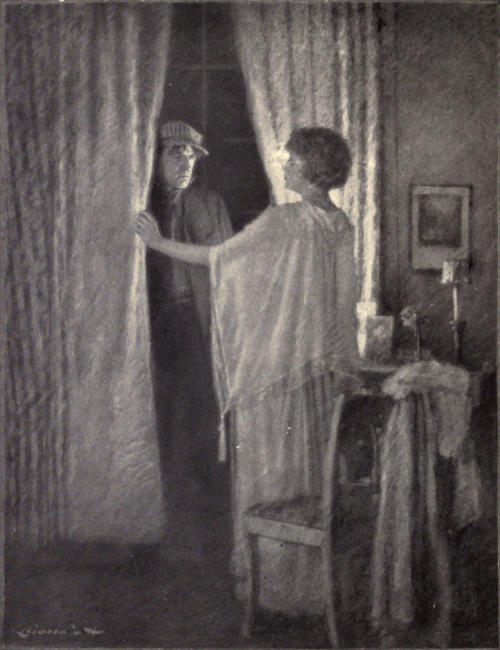
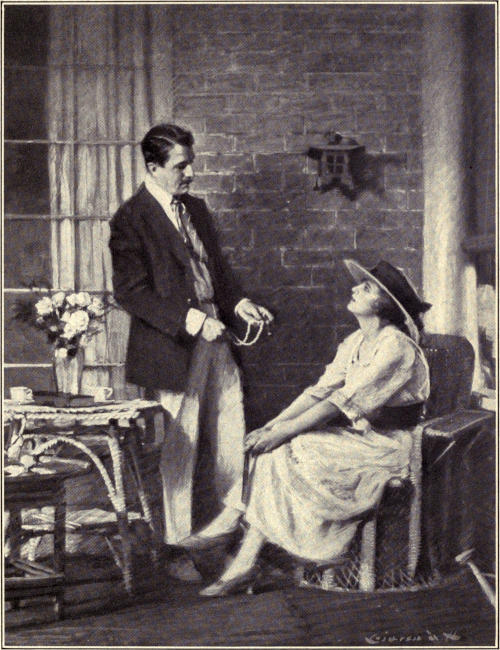
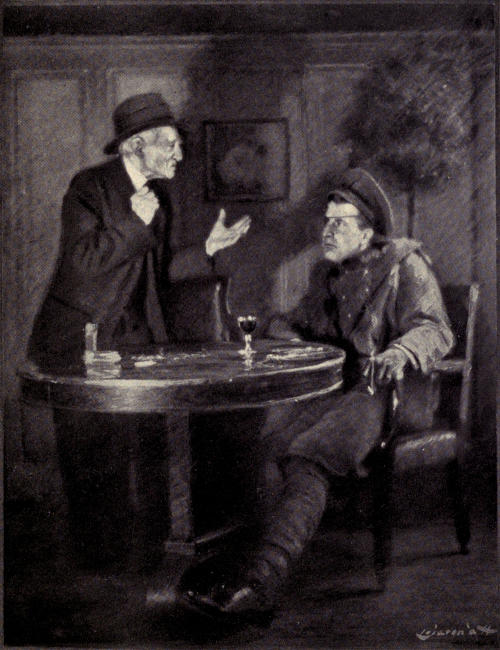
“You’re going home to marry me.” “How can I be going home to
marry you, when—when I never knew till within half an hour that
you—that you cared anything about me?”
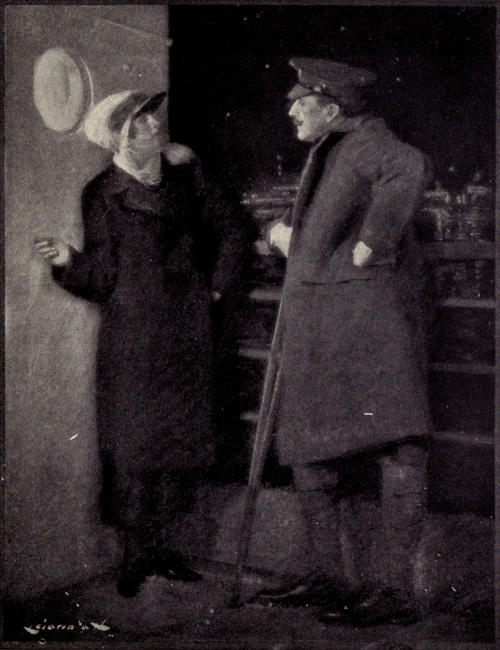
“That you should ’ave come back to this—and me believin’ the war
’ad done ye good—lifted you up, like. Not but what you was the best
man ever lived before the war—”
In the slow swirl of Columbus Circle, at the southwest
corner of Central Park, two seedy, sinister individuals
could hold an exceedingly private conversation without
drawing attention to themselves. There were others like
us on the scene, in that month of June, 1913, cast up from
the obscurest depths of New York. We could revolve
there for five or ten minutes, in company with other elements
of the city’s life, to be eliminated by degrees, sucked
into other currents, forming new combinations or reacting
to the old ones.
In silence we shuffled along a few paces, though not
exactly side by side. Lovey was just sufficiently behind
me to be able to talk confidentially into my ear. My own
manner was probably that of a man anxious to throw off a
dogging inferior. Even among us there are social degrees.
“Yer’ll be sorry,” Lovey warned me, reproachfully.
“Very well, then,” I jerked back at him over my shoulder;
“I shall be sorry.”
“If I didn’t know it was a good thing I wouldn’t ’a’
wanted to take ye in on it—not you, I wouldn’t; and
dead easy.”
“I don’t care for it.”
“Ye’re only a beginner—”
“I’m not even that.”
“No, ye’re not even that; and this’d larn ye. Just two
old ladies—lots of money always in the ’ouse—no resistance—no
weepons nor nothink o’ that kind; and me
knowin’ every hinch of the ground through workin’ for
’em two years ago—”
“And suppose they recognized you?”
“That’s it. That’s why I must have a pal. If they’d
git a look at any one it’d have to be at you. But you
don’t need to be afraid, never pinched before nor nothink.
Once yer picter’s in the rogues’ they’ll run ye in if ye so
much as blow yer nose. You’d just get by as an unknown
man.”
“And if I didn’t get by?”
“Oh, but you would, sonny. Ye’re the kind. Just look
at ye! Slim and easy-movin’ as a snake, y’are. Ye’d go
through a man’s clothes while he’s got ’em on, and he
wouldn’t notice ye no more’n a puff of wind. Look at
yer ’and.”
I held it up and looked at it. A year ago, a month ago,
I should have studied it with remorse. Now I did it
stupidly, without emotions or regrets.
It was a long, slim hand, resembling the rest of my person.
It was strong, however, with big, loosely articulated
knuckles and muscular thumbs—again resembling the
rest of my person. At the Beaux Arts, and in an occasional
architect’s office, it had been spoken of as a “drawing”
hand; and Lovey was now pointing out its advantages
for other purposes. I laughed to myself.
“Ye’re too tall,” Lovey went on, in his appraisement.
“That’s ag’in’ ye. Ye must be a good six foot. But lots
o’ men are too tall. They gits over it by stoopin’ a bit;
and when ye stoops it frightens people, especially women.
They ain’t near as scared of a man that stands straight
up as they’ll be of one that crouches and wiggles away.
Kind o’ suggests evil to ’em, like, it does. And these
two old ladies—”
As we reached the corner of the Park I rounded slowly
on my tempter. Not that he thought of his offer as
temptation, any more than I did; it was rather on his
part a touch of solicitude. He was doing his best for me,
in return for what he was pleased to take as my kindness
to him during the past ten days.
He was a small, wizened man, pathetically neat in spite
of cruel shabbiness. It was the kind of neatness that in
our world so often differentiates the man who has dropped
from him who has always been down. The gray suit,
which was little more than a warp with no woof on it at
all, was brushed and smoothed and mended. The flannel
shirt, with turned-down collar, must have been chosen for
its resistance to the show of dirt. The sky-blue tie might
have been a more useful selection, but even that had had
freshness steamed and pressed into it whenever Lovey
had got the opportunity. Over what didn’t so directly
meet the eye the coat was tightly buttoned up.
The boots were the weakest point, as they are with all
of us. They were not noticeably broken, but they were
wrinkled and squashed and down at the heel. They
looked as if they had been worn by other men before having
come to the present possessor; and mine looked the
same. When I went into offices to apply for work it was
always my boots that I tried to keep out of sight; but it
was precisely what the eye of the fellow in command
seemed determined to search out and judge me by.
You must not think of Lovey as a criminal. He had
committed petty crimes and he had gone to jail for them;
but it had only been from the instinct of self-preservation.
He worked when he got a job; but he never kept a job,
because his habits always fired him. Then he lived as he
could, lifting whatever small object came his way—an
apple from a fruit-stall, a purse a lady had inadvertently
laid down, a bag in a station, an umbrella forgotten in a
corner—anything! The pawnshops knew him so well that
he was afraid to go into them any more—except when he
was so tired that he wanted to be sent to the Island for a
month’s rest. In general, he disposed of his booty for a
few pennies to children, to poverty-stricken mothers of
families, to pals in the saloons. As long as a few dollars
lasted he lived, as he himself would have said, honestly.
When he was driven to it he filched again; but only
when he was driven to it.
It was ten days now since he had begun following me
about, somewhat as a stray dog will follow you when you
have given him a bone and a drink of water. For a year
and more I had seen him in one or another of the dives I
hung about. The same faces always turn up there, and
we get to have the kind of acquaintance, silent, haunted,
tolerant, that binds together souls in the Inferno. In
general, it is a great fraternity; but now and then—often
for reasons no one could fathom—some one is excluded.
He comes and goes, and the others follow him with resentful
looks and curses. Occasionally he is kicked out,
which was what happened to Lovey whenever his weakness
afforded the excuse.
It was when he was kicked out of Stinson’s that I had
picked him up. It was after midnight. It was cold.
The sight of the abject face was too much for me.
“Come along home with me, Lovey,” I had said,
casually; and he came.
Home was no more than a stifling garret, and Lovey
slept on the floor like a dog. But in the morning I found
my shoes cleaned as well as he could clean them without
brush or blacking, my clothes folded, and the whole
beastly place in such order as a friendly hand could bring
to it. Lovey himself was gone.
Twice during the interval he had stolen in in the same
way and stolen out. He asked no more than a refuge
and the privilege of sidling timidly up to me with a beseeching
look in his sodden eyes when we met in bars.
Once, when by hook or by crook he had got possession of
a dollar, he insisted on the honor of “buying me a drink.”
On this particular afternoon I had met him by chance
in the region of Broadway between Forty-second Street
and Columbus Circle. I can still recall the shy, half-frightened
pleasure in his face as he saw me advancing
toward him. He might have been a young girl.
“Got somethin’ awful good, sonny, to let ye in on,”
were the words with which he stopped me.
I turned round and walked back with him to the Circle,
and round it.
“No, Lovey,” I said decidedly, when we had got to the
corner of the Park, “it’s not good enough. I’ve other fish
to fry.”
A hectic flush stole into the cheeks, which kept a marvelous
youth and freshness. The thin, delicate features,
ascetic rather than degraded, sharpened with a frosty
look of disappointment.
“Well, just as you think best, sonny,” he said, resignedly.
He asked, abruptly, however, “When did ye
have yer last meal?”
“The day before yesterday.”
“And when d’ye expect to have yer next?”
“Oh, I don’t know. Sometime; possibly to-night.”
“Possibly to-night— ’Ow?”
“I tell you I don’t know. Something will happen. If
it doesn’t—well, I’ll manage.”
He had found an opening.
“Don’t ye see ye carn’t go on like that? Ye’ve got to
live.”
“Oh no, I haven’t.”
“Don’t say that, sonny,” he burst out, tenderly.
“Ye’ve got to live! Ye must do it—for my sake—now.
I suppose it’s because we’re—we’re Britishers together.”
He looked round on the circling crowd of Slavs, Mongolians,
Greeks, Italians, aliens of all sorts. “We’re different
from these Yankees, ain’t we?”
Admitting our Anglo-Saxon superiority, I was about to
say, “Well, so long, Lovey,” and shake him off, when he
put in, piteously, “I suppose I can come up and lay down
on yer floor again to-night?”
“I wish you could, Lovey,” I responded. “But—but
the fact is I—I haven’t got that place any more.”
“Fired?”
I nodded.
“Where’ve ye gone?”
“Nowhere.”
“Where did ye sleep last night?”
I described the exact spot in the lumber-yard near
Greeley’s Slip. He knew it. He had made use of its
hospitality himself on warm summer nights such as we
were having.
“Goin’ there again to-night?”
I said I didn’t know.
He gazed at me with a kind of timid daring. “You
wouldn’t be—you wouldn’t be goin’ to the Down and Out
Club?”
I smiled.
“Why should you ask me that?”
“Oh, I don’t know. See you talkin’ to one of those
fellas oncet. Chap named Pyncheon. Worse than missions
and ’vangelists, they are.”
“Did you ever think of going there yourself?”
“Oh, Lord love ye! I’ve thought of it, yes. But I’ve
fought it off. Once ye do that ye’re done for.”
“Well, I don’t believe I’m done for—” I began; but
he interrupted me coaxingly.
“I say, sonny. I’ll go to Greeley’s Slip. Then if
you’ve nothin’ else on ’and, you come there, too—and
we’ll be fellas together. But don’t—don’t—go to the
Down and Out!”
As I walked away from him I had his “fellas together”
amusingly, and also pathetically, in my heart. Lovey
was little better than an outcast. I knew him by no name
but that which some pothouse wag had fixed on him
derisively. From hints he had dropped I gathered that
he had had a wife and daughters somewhere in the world,
and intuitively I got the impression that without being
a criminal he had been connected with a crime. As to
his personal history he had never confided to me any of
the details beyond the fact that in his palmy days he had
been in a ’at-shop in the Edgware Road. I fancied that
at some time or another in his career his relatives in London—like
my own in Canada—had made up a lump sum
and bidden him begone to the land of reconstruction.
There he had become what he was—an outcast. There I
was becoming an outcast likewise. We were “fellas together.”
I was thirty-one and he was fifty-two. My
comparative youth helped me, in that I didn’t look older
than my age; but he might easily have been seventy.
Having got rid of him, I drifted diagonally across the
Park, but with a certain method in the seeming lack of
method in taking my direction. Though I had an objective
point, I didn’t dare to approach it otherwise than by
a roundabout route. It is probable that no gaze but
that of the angels was upon me; but to me it seemed
as if every glance that roved up and down the Park must
spot my aim.
For this reason I assumed a manner meant to throw
observation off the scent. I loitered to look at young
people on horseback or to stare at some specially dashing
motor-car. I strolled into by-paths and out of them. I
passed under the noses of policemen in gray-blue uniforms
and tried to infuse my carriage with the fact which Lovey
had emphasized, that I had never yet been pinched. I
had never yet, so far as I knew, done anything to warrant
pinching; and that I had no intentions beyond those of
the ordinary law-abiding citizen was what I hoped my
swagger would convey.
Though I was shabby, I was not sufficiently so to be
unworthy to take the air. The worst that could be said
of me was that I was not shabby as the working-man is at
liberty to be. Mine was the suspicious, telltale shabbiness
of the gentleman—far more damning than the grime
and sweat of a chimney-sweep.
Now that I was alone again, I had a return of the sensation
that had been on me since waking in the morning—that
I was walking in the air. I felt that I bounced like
a bubble every time I stepped. The day before I had
been giddy; now I was only light. It was as if at any
minute I might go up. Unconsciously I ground my footsteps
into the gravel or the grass to keep myself on the
solid earth.
It was not the first time I had gone without food for
twenty-four hours, but it was the first time I had done it
for forty-eight. Moreover, it was the first time I had ever
been without some prospect of food ahead of me. With a
meal surely in sight on the following day I could have
waited for it. More easily I could have waited for a
drink or two. Drink kept me going longer than food, for
in spite of the reaction after it the need of it had grown
more insistent. Had I been offered my choice between
food and life, on the one hand, and drink and death, on
the other, I think I should have chosen drink and death.
But now there was no likelihood of either. I had husbanded
my last pennies after my last meal, to make them
spin out to as many drinks as possible. I had begged a
few more drinks, and cadged a few more. But I had come
to my limit in all these directions. Before I sought the
shelter of Greeley’s Slip a hint had been given me at
Stinson’s that I might come in for the compliments showered
on Lovey ten days previously. Now as I walked in
the Park the craving inside me was not because I hadn’t
eaten, but because I hadn’t drunk that day.
Two or three bitter temptations assailed me before I
reached Fifth Avenue. One was in the form of a pretty
girl of eight or ten, who came mincing down a flowery
path, holding a quarter between the thumb and forefinger
of her left hand. Satan must have sent her. I could
have snatched the quarter and made my escape, only
that I lacked the nerve. Then there was a newsboy counting
his gains on a bench. They were laid out in rows before
him—pennies, nickels, and dimes. I stood for a
minute and looked down at him, estimating the ease with
which I could have stooped and swept them all into my
palm. He looked up and smiled. The smile didn’t disarm
me; I was beyond the reach of any such appeal. It
was again that I didn’t have the nerve. Lastly an old
woman, a nurse, was dealing out coins to three small children
that they might make purchases of a blind man selling
bootlaces and pencils. I could have swiped them all
as neatly as a croupier pulls in louis d’or with his rake—but
I was afraid.
These were real temptations, as fierce as any I ever
faced. By the time I had reached the Avenue I was in a
cold perspiration, as much from a sense of failure as from
the effort at resistance. I wondered how I should ever
carry out the plans I had in mind if I was to balk at such
little things as this.
The plans I had in mind still kept me from making
headway as the crow flies. I went far up the Avenue;
I crossed into Madison Avenue; I went up that again;
I crossed into Park Avenue. I crossed and recrossed and
crisscrossed and descended, and at last found myself
strolling by a house toward which I scarcely dared to
turn my eyes, feeling that even for looking at it I might
be arrested.
I slackened my pace so as to verify all the points which
experts had underscored in my hearing. There was the
vacant lot which the surrounding buildings rendered so
dark at night. There was the low, red-brown fence inclosing
the back premises, over which a limber, long-legged
fellow like me could leap in a second. There were the
usual numerous windows—to kitchen, scullery, pantry,
laundry—of any good-sized American house, some one
of which was pretty sure to be left unguarded on a summer
night. There were the neighboring yards, with more
low fences, offering excellent cover in a get-away, with
another vacant lot leading out on another street a little
farther down.
I had so many times strolled by the house as I was doing
now, and had so many times rehearsed its characteristics,
that I made the final review with some exactitude before
passing on my way.
My way was not far. There was nothing to do but to
go back into the Park. As it was nearly six o’clock, it
was too late to search for a job that day, and I should
have had no heart for doing so in any case. I had found
a job that morning—that of handling big packing-cases in
a warehouse—but I was too exhausted for the work.
When in the effort to lift one onto a truck I collapsed and
nearly fainted, I was told in a choice selection of oaths
to beat it as no good.
I sat on a bench, therefore, waiting for the dark and
thinking of the house of which I had just inspected the
outside. It was not a house picked at random. It was
one that had possessed an interest for me during all the
three years I had been in New York. I had, in fact,
brought a letter of introduction to its owner from the
man under whom I had worked in Montreal. Chiefly
through my own carelessness, nothing came of that, but
I never failed, when I passed this way, to stare at the
dwelling as one in which I might have had a footing.
The occupant was also a well-known architect in New
York. In the architects’ offices in which I found employment
I heard him praised, criticized, condemned. His
work was good or bad according to the speaker’s point of
view. I thought it tolerably good, with an over-emphasis
on ornament.
It was an odd fact that, in starting out on what was
clear in my mind as a new phase in my career, no other
house suggested itself as a field of operations. As to this
one I felt documented, and that was all. I had no sense
of horror at what I was about to do; no remorse from the
position from which I had fallen. I suppose my mind
was too sick for that, and my body too imperatively clamorous.
I had said to Lovey that I didn’t have to live—but
I did. I had seen that very morning that I did.
I had stood at the edge of Greeley’s Slip and watched the
swirling of the brown-green water with a view to making
an end of it. One step and I should be out of all this
misery and disgrace! The world would be rid of me; my
family would be rid of me; I should be rid of myself,
which would be best of all. Had I been quite sure as
to the last point, I think I could have done it. But I
wasn’t quite sure. I was far from quite sure. I could
imagine the step over the edge of Greeley’s Slip as a step
into conditions worse than those I was enduring now;
and so I had drawn back. I had drawn back and wandered
up-town, in the hope of securing a job that would
give me a breakfast.
I wonder if you have ever done that? I wonder if you
have ever gone from dock to station and from station to
shop and from shop to warehouse, wherever heavy, unskilled
labor may be in demand, and extra hands are
treated with a brutality that slaves would kick against,
in the hope of earning fifty cents? I wonder if in your
grown-up life you have ever known a minute when fifty
cents stood for your salvation? I wonder if with fifty
cents standing for your salvation you ever saw the day
when you couldn’t get it? No? Then you will hardly
understand how natural, how much a matter of course,
the thing had become which I was resolved to do.
It was no sudden idea. I had been living in the company
of men who took such feats for granted. Their talk
had amazed me at first, but I had grown used to it. I
had grown used to the thing. I had come to find a
piquancy in the thought of it.
Then Lovey’s suggestions had not been thrown away
on me. True, he was out for small game, while I, if I
went in for it, would want something bigger and more
exciting; but the basic idea was the same. Lovey could
make a haul and live for weeks on the fruit of it; I might
do the same and live for months. And if I didn’t pull it off
successfully, if I was nabbed and sent away—why, then
there would be some let-up in the struggle which had become
so infernal. Even if I got a shot through the heart—and
the tales I heard were full of such accidents—the
tragedy would not lack its element of relief. It might
be out of one hell into another—but it would at least
be out of one.
Not that I hadn’t found a bitter pleasure in the life! I
had. I found it still. In one of Dostoyevsky’s novels
an old rake talks of the joys of being in the gutter. Well,
there are such joys. They are not joys that civilization
knows or that aspiration would find legitimate; but one
reaches a point at which it is a satisfaction to be oneself
at one’s worst. Where all the pretenses with which poor
human nature covers itself up are cast aside the soul
can stalk forth nakedly, hideously, and be unashamed.
In the presence of each other we were always unashamed.
We could kick over all standards, we could drop all poses,
we could flout all duties, we could own to all crimes, and
be “fellas together.” As I went lower and lower down it
became to me a kind of acrid delight, of positively intellectual
delight, to know that I was herding with the most
degraded, and that there was no baseness or bestiality
to which I was not at liberty to submit myself.
If there had never been any reactions from this state
of mind!—but God!
It was a disadvantage to me that I was not like my
cronies. I couldn’t open my lips without betraying the
fact that I belonged to another sphere. Though the
broken-down man of education is not unknown in the
underworld, he is comparatively rare. He is comparatively
rare and under suspicion, like a white swan in a
flock of black ones. I might be open-handed, ingratiating,
and absurdly fellow-well-met, but I was always an outsider.
They would take my drinks, they would return
me drinks, we would swap stories and experiences with
all outward show of equality; but no one knew better
than myself that I was not on a footing with the rest of
them. Women took to me readily enough, but men were
always on their guard. Try as I would I never found a
mate among them, I never made a friend. Therefore,
now that I was down and out, I had no one of whom to
ask a good turn, no one who would have done me a good
turn, but poor, useless old Lovey sneaking in the shade.
I was in a measure between two worlds. I had been
ejected from one without having forced a way into the
other. When I say ejected I mean the word. The bitterest
moment in my life was on that night when my eldest
brother came to his door in Montreal and gave me fifty
dollars, with the words:
“And now get out! Don’t let any of us ever see your
face or hear your name again.”
As I stumbled down the steps he gave me a kick that
didn’t reach me and which I had lost the right to resent.
He himself went back to the dinner-party his wife was
entertaining inside, and of which the talk and laughter
reached me as I stood humbly on the door-step. From the
other side of the street I looked back at the lighted windows.
It was the last touch of connection with my
family.
But it had been a kindly, patient family. My father
was one of the best known and most highly honored among
Canadian public men. As he had married an American, I
had a good many cousins in New York, though I had not
made myself known to any of them since coming there to
live. I didn’t want them. Had I met one of them in the
street, I should have passed without speaking; but, as it
happened, I never met one. I saw their names in the
papers, and that was all.
My father and mother had had five children, of whom I
was the fourth. My two brothers were married, prosperous
and respected—one a lawyer in Montreal, the other
a banker in Toronto. My elder sister was married to a
colonel in the British army; the younger one—the only
member of the family younger than myself—still lived
at home.
We three sons were all graduates of McGill, in addition
to which I had been sent to the Beaux Arts in Paris. Out
of that I had come with some degree of credit; and there
had been a year in which I was in sight—oh, very distant
sight!—of the beginning of the fulfilment of my childhood’s
ambition to revolutionize the art of architecture
in Canada. But in the second year that vision went
out; and in the third came the night on my brother
Jerry’s door-step.
I had nothing to complain of. The family had borne
with me—and borne with me. When we reached the
time when I was supposed to be earning my own living
and my father’s allowance came to an end, my mother,
who had some money of her own, kept it up. She would be
keeping it up still if she knew where I was—but she didn’t
know. From the moment of leaving Montreal I decided
to carry out Jerry’s injunction. They should neither see
my face nor hear my name again. I didn’t stop to consider
how cruel this would be to the best mother a man
ever had—to say nothing of the best father—or rather,
when I did stop to consider it it seemed to me that I was
taking the kindest course. I had no confidence in myself
or in the future. New surroundings and associations
would not give me a new heart, whatever hopes those who
wished me well might be building on the change. For a
new heart I needed something which I hadn’t got and saw
no means of getting.
CHAPTER II
Somewhere about dusk I fell asleep. It was dark
when I woke up. It was dark and still and sultry, as
it often is in New York in the middle of June.
The lamps were lit in the Park, and in their glow
shadowy forms moved stealthily. When they went in
twos I took them to be lovers; when they went alone I
put them down as prowlers of the night. I didn’t know
what they were after, but whatever it might be I was sure
it was no good.
Not that that mattered to me! I had long been in a
situation where I couldn’t be particular. When I had
risen and stretched myself I, too, moved stealthily, dogged
by a crime I hadn’t yet committed, but of which the guilt
was already in the air.
As I had nothing by which to tell the time, I was obliged
to wait till a clock struck. I hoped it was eleven at least,
but when the sound came over the trees it was only nine.
Only nine, and I could do nothing before one! Nothing
before one, and nowhere to go! Nowhere to go, and no
food to eat, and not a drop to drink! Doubtless I could
have found water; but water made me sick. With four
hours to wait, I thought again of the dark river with its
velvety current, running below Greeley’s Slip.
Aimlessly I drifted toward it—that is, I drifted toward
Columbus Circle, whence I could drift farther still through
squalid, fetid, dimly lighted streets down to the water’s
edge. The night was so hot that the thought of the
plunge began to appeal to me. After all, it would be an
easy, pleasant way of stepping out.
But I didn’t do it. The unknown beyond the river once
more drove me back. Besides, the adventure I had
planned was not without its fascination. I wanted to
see what it held in store. If it held nothing—well, then,
Greeley’s Slip would still be accessible in the morning.
So I skulked back into the depths of the Park again.
Those who went as twos began to disappear, and the lonely
shadows to steal along more furtively. Now and then one
of them approached me or hung in the distance suggestively.
It was not like any of the encounters that take
place in daylight. It was more as if these dark ghosts
had floated up from some evil spirit land, into which
before morning they would float down again.
But twelve o’clock struck at last, and I took midnight
as a call. It was a call to leave the great human division
in which I had hitherto been classed, and become a criminal.
Once I had done this thing, I should never be able
to go back. The angel with the flaming sword would
guard that way, and I could never regain even such status
as that which I was abandoning.
If my head had not been swimming I might at the last
minute have felt a qualm at that, but my mind had lost
the faculty of deconcentration. It was fixed on the thing
before me in such a way that I couldn’t get it off. For
this reason I went, on leaving the Park, directly to the
street and number where my thoughts were.
I was surprised by the emptiness and silence of the
thoroughfares. Not till then had I remembered that at
this season of the year most of the houses would be closed.
Closed they were, looking dark and blank and forbidding.
I happened to know that the house to which I was bound
was not closed; and though the fact that there were so
few to pass in the streets rendered me more conspicuous,
it also made me the less subject to observation.
Indeed, there were no observers at all when I approached
the black spot made by the vacant lot. There was nothing
but myself and the blackness. Not a light in the house!
Hardly a light in any of the houses roundabout! Not
a footfall on the pavements! If ever there was a good
opportunity to do what I had come for, it was mine.
But I passed. The black spot frightened me. It was
like a black gulf into which I might sink down. I re-passed.
I went farther up the street and took myself to task.
It was a repetition of my recoil from the children in the
afternoon. I must have the nerve—or I must own to myself
that I hadn’t. If I hadn’t it, then I had no alternative
but Greeley’s Slip.
I turned in my steps and passed the house again. If
from the blank windows any one had been looking out
my actions would have been suspicious. I went far down
the street, and came back again far up it. Then when I
had no more power of arguing with myself I suddenly
found my footsteps crushing the dusty, sun-dried shoots
of nettle and blue succory. I was in the vacant lot.
All at once fear left me. As well as any old hand in
the business I seemed to know what lay before me. At
every second some low-down prompting, sprung from
nameless depths in my nature, told me what to do.
I noted in the first place how accurate the experts had
been as to light and shade. The house stood so far up
on one of the long avenues that the buildings were thinning
out. So, too, the street lamps. They were no more
than in the proportion of two to three as compared to
their numbers half a mile lower down. Just here they
were so placed that not a ray fell into the three or four
thousand square feet which had probably never been built
upon since Manhattan was inhabited. Even the wall of
the house was windowless on this side, for the reason
that within a few months some new building would probably
block the outlook.
Once I had crept close to the wall, I knew I presented
neither silhouette nor shade to any chance passer-by. I
could feel my way at leisure, cautiously treading burdock
and fireweed underfoot. I came to the low wooden fence,
in which there was a gate for tradesmen, which was possibly
unlocked; but I didn’t run the risk of a click. With
my long legs a stride took me over into a small brick-paved
court.
I paused to reconnoiter. The obscurity here was so
dense that only my architect’s instincts told me where the
doors and windows would probably be. I located them
by degrees. The doors I let alone. The windows I tried,
first one and then another, but with no success. There
was probably some simple fastening that I could have
dealt with had I had a pocket-knife, but the one I had
carried for years had long since been lying in a pawnshop.
To reflect I sat down on the cover of a bin that was doubtless
used for refuse.
A footstep alarmed me. It was heavy, measured, slow.
With the ease of a snake I was down on my belly, crawling
toward cover. Cover offered itself in the form of the
single shrub that the court contained—lilac or syringa—growing
close against the kitchen wall. Lovey would have
commended the silence and swiftness with which I slipped
behind it.
The footstep receded, slow, measured, heavy. Coming
to the conclusion that it was a policeman in the Avenue,
I raised my head. I had no sense of queerness in my
situation. It seemed as much a matter of course as if
I had been doing the same sort of thing ever since I was
born.
There was apparently a providence in all this, for, looking
up, I spied a window I had not seen before, because it
was hidden by the shrub. This, if any, would have been
neglected by the servants when they went to bed.
With scarcely the stirring of a leaf I got on my feet
again—and, lo! the miracle. The window was actually
open. I had nothing to do but push it a few inches
higher, drag myself up and wriggle in. I accomplished
this without a sound that could be detected twenty feet
away.
Coming down on my hands and knees, I found myself
amid the odor of eatables, chiefly that of fruit. I rested a
minute to get my bearings, which I did by the sense of
smell. I knew I must be in a sort of pantry. By putting
out my hands carefully, so as to knock nothing over, I
perceived that it was little more than a closet with shelves.
A thrill of excitement passed through me from head to
foot when my hand rested on an apple.
I ate the apple there and then, kneeling upright, my
toes bent under me. I ate another and another. Feeling
cautiously, I discovered a tin box in which there were
bread and cake. I ate of both. Getting softly on my
feet, I groped for other things, which proved in the main
to be no more than tea, coffee, spices, and starch. Then
my fingers ran over a strawlike surface, and I knew I had
hold of a demijohn.
Smell told me that it contained sherry, and such knowledge
of housekeeping as I possessed suggested that it was
cooking-sherry. I took a long swig of it. Two long
swigs were enough. It burnt me, and yet it braced me.
With the food I had eaten I felt literally like a giant
refreshed with wine.
It occurred to me that this was a point at which I
might draw back. But the spell of the unknown was upon
me, and I determined to go at least a little farther. Very,
very stealthily I opened the door.
I was not in a kitchen, as I expected to find myself,
but in a servants’ dining-room. I got the dim outlines
of chairs and what I took to be a dresser or a bookcase.
Another open door led into a hall.
My knowledge of the planning of houses aided me at
each step I took. From the hallway I could place the
kitchen, the laundry, and the back staircase. I knew the
front hall lay beyond a door which was closed. At the
foot of the back staircase I stood for some minutes and
listened. Not a sound came from anywhere in the
house. The kitchen clock ticked loudly, and presently
startled me with a gurgle and a chuckle before it struck
one. After this manifestation I had to wait till my heart
stopped thumping and my nerves were quieted before
venturing on the stairs. As the first step creaked, I kept
close to the wall to get a firmer support for my tread.
On reaching a landing I could see up into another hall.
Here I perceived the glimmer or reflection of a light. It
was a very dim or distant light—but it was a light.
I stood on the landing and waited. If there were people
moving about I should hear them soon. But all I did
hear was the heavy breathing of the servants, who were
sleeping on the topmost floor.
Creeping a little farther up, I discovered that the light
was in a bedroom—the first to open from the front hall
up-stairs. Between the front hall and the back hall the
door was ajar. That would make things easier for me,
and I dragged myself noiselessly to the top. I was now
at the head of the first flight of back stairs, and looking
into the master’s section of the house. Except for that
one dim light the house was dark. It was not, however,
so dark that my architect’s eye couldn’t make a mental
map quite sufficient for my guidance.
It was clearly a dwelling that had been added to, with
some rambling characteristics. The first few feet of the
front hall were on a level with the back hall, after which
came a flight of three or four steps to a higher plane,
which ran the rest of the depth of the building to the window
over the front door. In the faint radiance through
this window I could discern a high-boy, a bureau, and
some chairs against the wall. I could see, too, that from
this higher level one staircase ran down to the front door
and another up to a third story. What was chiefly of
moment to me was the fact that the bedroom with the
light was lower than the rest of this part of the house,
and somewhat cut off from it.
With movements as quiet as a cat’s I got myself where
I could peep into the bedroom where the lamp burned.
It proved to be a small electric lamp with a rose-colored
shade, standing beside a bed. It was a rose-colored
room, evidently that of a young lady. But there was no
young lady there. There was no one.
The fact that surprises me as I record all this is that I
was so extraordinarily cool. I was cooler in the act than
I am in the memory of it. I walked into that bedroom
as calmly as if it had been my own.
It was a pretty room, with the usual notes of photographs,
bibelots, and flowered cretonne which young
women like. The walls were in a light, cool green set off
by a few colored reproductions of old Italian masters.
Over the small white virginal bed was a copy of Fra
Angelico’s “Annunciation.” Two windows, one of which
was a bay, were shaded by loosely hanging rose-colored
silk, and before the bay window the curtains were drawn.
Diagonally across the corner of this window, but within
the actual room, stood a simple white writing-desk, with
a white dressing-table near it, but against the wall. On
the table lay a gold-mesh purse, in which there was
money. I slipped it into my pocket, with some satisfaction
in securing the first fruits of my adventure.
With such booty as this it again occurred to me to be
on the safe side and to go back by the way I came. I
was, in fact, looking round me to see if there was any
other small valuable object I could lift before departing
when I heard a door open in some distant part of the
house—and voices.
They were women’s voices, or, rather, as I speedily
inferred, girls’ voices. By listening intently I drew the
conclusion that two girls had come out of a room on the
third floor and were coming down the stairs.
It was the minute to make off, and I tried to do so.
I might have effected my escape had I not been checked
by the figure of a man looming up suddenly before me.
He sprang out of nowhere—a tall, slender man, in a dark-blue
suit, with trousers baggy at the knees, and wearing
an old golfing-cap. I jumped back from him in terror,
only to find that it was my own reflection in the pier-glass.
But the few seconds’ delay lost me my chance to get
away.
By the time I had tiptoed to the door the voices were
on the same floor as myself. Two girls were advancing
along the hall, evidently making their way to this chamber.
My retreat being cut off, I looked wildly about
for a place in which to hide myself. In the instants at
my disposal I could discover nothing more remote than
the bay window, screened by its loose rose-colored hangings.
By the time the young ladies were on the threshold
I was established there, with the silk sections pulled
together and held tightly in my hand.
The first words I heard were: “But it will seem so
like a habit. Men will be afraid of you.”
This voice was light, silvery, and staccato. That which
replied had a deep mezzo quality, without being quite
contralto.
“They won’t be nearly so much afraid of me,” it said,
fretfully, “as I am of them. I wish—I wish they’d let
me alone!”
“Oh, well, they won’t do that—not yet awhile; unless,
as I say, they see you’re hopeless. Really, dear, when a
girl breaks a third engagement—”
“They must see that she wouldn’t do it if she didn’t
have to. Here—this is the hook that always bothers me.”
There were tears in the mezzo voice now, with a hint
of exasperation that might have been due to the lover
or the hook, I couldn’t be sure which.
“But that’s what I don’t see—”
“You don’t see it because you don’t know Stephen—that
is, you don’t know him well.”
“But from what I do know of him—”
“He seems very nice. Yes, of course! But, good
Heavens! Elsie, I want a husband who’s something more
than very nice!”
“And yet that’s pretty good, as husbands go.”
“If I can’t reach a higher standard than as husbands
go I sha’n’t marry any one.”
“Which seems to me what’s very likely to happen.”
“So it seems to me.”
The silence that followed was full of soft, swishing
sounds, which I judged to come from the taking off of
a dress and the putting on of some sort of negligée. From
my experience of the habits of girls, as illustrated by my
sisters and their friends, I supposed that they were lending
each other services in the processes of undoing. The
girl with the mezzo voice had gone up to Elsie’s room to
undo her; Elsie had come down to render similar assistance.
There is probably a psychological connection between
this intimate act and confidence, since girls most
truly bare their hearts to each other when they ought
to be going to bed.
The mezzo young lady was moving about the room
when the conversation was taken up again.
“I don’t understand,” Elsie complained, “why you
should have got engaged to Stephen in the first place.”
“I don’t, either”—she was quite near me now, and
threw something that might have been a brooch or a chain
on the little white desk—“except on the ground that I
wanted to try him.”
“Try him? What do you mean?”
“Well, what’s an engagement? Isn’t it a kind of experiment?
You get as near to marriage as you can,
while still keeping free to draw back. To me it’s been
like going down to the edge of the water in which you
can commit suicide, and finding it so cold that you go
home again.”
“Don’t you ever mean to be married at all?” Elsie demanded,
impatiently.
“I don’t mean to be married till I’m sure.”
Elsie burst out indignantly: “Regina Barry, that’s the
most pusillanimous thing I ever heard. You might as
well say you’d never cross the Atlantic unless you were
sure the ship would reach the other side.”
“My trouble about crossing the Atlantic is in making
up my mind whether or not I want to go on board. One
might be willing to risk the second step, but one can’t
risk the first. Even the hymn that says ‘One step enough
for me’ implies that at least you know what that’s to be.”
“You mean that you balk at marriage in any case.”
“I mean that I balk at marriage with any of the men
I’ve been engaged to. I must say that; and I can’t say
more.”
During another brief silence I surmised that Regina
Barry had seated herself before the dressing-table and was
probably doing something to her hair. I wish I could
say here that in my eavesdropping I experienced a sense
of shame; but I can’t. Whatever creates a sense of
shame had been warped in me. The moral transitions
that had turned me into a burglar had been gradual but
sure. With the gold-mesh purse in my pocket a burglar
I had become, and I felt no more repugnance to the business
than I did to that of the architect. Notwithstanding
the natural masculine interest these young ladies stirred
in me, I meant to wait till they had separated—gone to
bed—and fallen asleep. Then I would slip out from my
hiding-place, swipe the brooch or the chain that had been
thrown on the desk, and go.
“What was the matter with the first man?” Elsie began
again.
“I don’t know whether it was the matter with him or
with me. I didn’t trust him.”
“I should say that was the matter with him. And the
next man?”
“Nothing. I simply couldn’t have lived with him.”
“And what’s wrong with Stephen is that he’s no more
than very nice. I see.”
“Oh no, you don’t see, dear! There’s a lot more to
it than all that, only I can’t explain it.” I fancied that
she wheeled round in her chair and faced her companion.
“The long and short of it is that I’ve never met the
man with whom I could keep house. I can fall in love
with them for a while—I can have them going and coming—I
can welcome them and say good-by to them—but
when it’s a question of all welcome and no good-by—well,
the man’s got to be different from any I’ve
seen yet.”
“You’ll end by not getting any one at all.”
“Which, from my point of view, don’t you see, won’t
be an unmixed evil. Having lived happily for twenty-three
years without a husband, I don’t see why I should
throw away a perfectly good bone for the most enticing
shadow that ever was.”
“I don’t believe you’re human.” Before there could
be a retort to this Elsie went on to ask, “How did poor
Stephen take it?”
“Well, he didn’t go into fits of laughter. He took it
more or less lying down. If he hadn’t—”
“If he hadn’t—what?”
“Oh, I don’t know. The least little bit of fight on his
part—or even contempt—”
As this sentence remained unfinished I could hear
Elsie rise.
“Well, I’m off to bed,” she yawned. “What time do
you have breakfast?”
There was some little discussion of household arrangements,
after which they said their good nights.
With Elsie’s departure I began for the first time to
be uncomfortable. I can’t express myself otherwise than
to say that as long as she was there I felt I had a chaperon.
In spite of the fact that I had become a professional
burglar the idea of being left alone with an innocent young
lady in her bedroom filled me with dismay.
I was almost on the point of making a bolt for it when
I heard Elsie call out from the hallway: “Ugh! How dark
and poky! For mercy’s sake, come up with me!”
Miss Barry lingered at the dressing-table long enough
to ask: “Wouldn’t you rather sleep in mother’s room?
That communicates with this, with only a little passage
in between. The bed is made up.”
“Oh no,” Elsie’s staccato came back. “I don’t mind
being up there, and my things are spread out; only it
seems so creepy to climb all those stairs.”
“Wait a minute.”
She sprang up. I breathed freely. My sense of propriety
was saved. The voices were receding along the
front hall. Once the young ladies had begun to mount
the stairs I would slip out by the back hall and get off.
Relaxing my hold on the silk hangings I stepped out cautiously.
My first thought was for the objects I had heard
thrown down with a rattle on the writing-desk. They
proved to be a string of small pearls, a diamond pin, and
some rings of which I made no inspection before sweeping
them all into my pocket.
I was ready now to steal away, but, to my vexation,
the incorrigible maidens had begun to talk love-affairs
again at the foot of the staircase leading up to the third
floor. They had also turned on the hall light, so that
my chances were diminished for getting away unseen.
Knowing, however, that sooner or later they would
have to go up the next flight, I stood by the writing-desk
and waited. I was not nervous; I was not alarmed.
As a matter of fact the success of my undertaking up to
the present point, together with the action of food and
wine, combined to make me excited and hilarious. I
chuckled in advance over the mystification of Miss
Regina Barry, who would find on returning to her room
that her rings, her necklet, and her gold-mesh purse had
melted into the atmosphere.
In sheer recklessness I was now guilty of a bit of deviltry
before which I would have hesitated had I had time to
give it a second thought. On the desk there was a scrap
of blank paper and a pen. Stooping, I printed in the neat
block letters I had once been accustomed to inscribe
below a plan:
There are men different from those you have seen hitherto. Wait.
This I pinned to the pincushion on the dressing-table,
beginning at once to creep toward the door, so as to seize
the first opportunity of slipping down the back stairs.
But again I was frustrated.
“I’m all right now,” I heard Elsie say, reassuringly.
“Don’t come up. Go back and go to bed.”
Miss Barry spoke as she returned along the hall toward
her room: “The cook sleeps in the next room to you,
so that if you’re afraid in the night you’ve only to hammer
on the wall. But you needn’t be. This house is as safe
as a prison.”
I had barely time to get into the bay window again
and pull the curtains to.
Some five minutes followed, during which I heard the
opening and shutting of drawers and closets and the swish
and frou-frou of skirts. I began to curse my idiocy
in fastening that silly bit of writing to the pincushion.
My only hope lay in the possibility that she would go
to bed and to sleep without seeing it.
With hearing grown extraordinarily acute I could trace
every movement she made about the room. Presently I
knew she had come back to the dressing-table again.
Pulling up a chair, she sat down before it, to finish, I suppose,
the arranging of her hair.
For a few seconds there was a silence, during which
I could hear the thumping of my heart. Then came the
faint rattling of paper. I knew when she read the thing
by the slight catch in her breath. I expected more than
that. I thought she would call out to her friend or
otherwise give an alarm. If she went to a telephone to
summon the police I decided to make a dash for it.
Indeed, I meant to make a dash for it as it was, as soon
as I knew her next move.
But of all the next moves, the one she made was the
one I had least counted on. With a sudden tug at the
hangings she pulled them apart—and I was before her.
I was before her and she was before me. It is this
latter detail of which I have the most vivid recollection.
In the matter of time all other recollections of the
moment seem to come after that and to be subsidiary
to it.
My immediate impression was of two enormous, wonderful,
burning eyes, full of amazement. Apart from the
eyes I hardly saw anything. It was as if the light of a
dark lantern had been suddenly turned on me and I was
blinded by the blaze. I was blinded by the blaze and
shriveled up in it. No words can do justice to my sudden
sense of being a contemptible, loathsome reptile.
“’Sh!” was the first sound that came from her. She
raised her hand. “Don’t make a noise or you’ll frighten
my friend. She’s nervous already.”
Instinctively I pulled off my cap, stepping out of my
hiding-place into the middle of the room. As I did so
she recoiled, supporting herself by a hand on the writing-desk.
Now that the discovery was made, I could see
her grow pale, while the hand on the desk trembled.
“You mustn’t be afraid,” I began to whisper.
“I’m not afraid,” she whispered back; “but—but
what are you doing here?”
“I’ll show you,” I returned, with shamefaced quietness.
“I shall also show you that if you’ll let me go
without giving an alarm you won’t be sorry.”
Pulling all the things I had stolen out of my pocket,
I showered them on the dressing-table.
“Oh!”
The smothered exclamation made it plain to me that
she hadn’t missed the articles.
“May I ask you to verify them?” I went on. “If
you should find later that something had disappeared,
I shouldn’t like you to think that I had carried it
away.”
She made a feint at examining the jewelry, but I could
see that she was incapable of making anything like a
count. It was I who insisted on going over the objects
one by one.
“There’s this,” I said, touching the gold-mesh purse,
but not picking it up. “I see there’s money in it; but
it has not been opened. Then there’s this,” I added,
indicating the pearl necklet; “and this,” which was the
brooch. “The rings,” I continued, “I don’t know anything
about. There are three here. That’s all I remember
seeing; but I didn’t notice in particular.”
She said, in a breathless whisper, “That’s all there
were.”
“Then may I ask if you mean to let me go?”
“How can I stop you?”
“Oh, in two or three ways. You could call your servants,
or you could ring up the police—”
Her big, burning eyes were fixed on me hypnotically.
The color began to come back to her cheeks, but she
trembled still.
“How—how did you get in?”
I explained to her.
“And the only thing I’ve taken,” I went on, “is the
food I ate and the wine I drank; but if you knew how
much I needed them—”
“Were you hungry?”
“I hadn’t eaten anything for two days, and very little
for two days before that.”
“Then you’re not—you’re not one of those gentleman
burglars who do this sort of thing out of bravado?”
“As we see in novels or plays. I don’t think you’ll find
many of them about. I’m a burglar,” I pursued, “or I—I
meant to be one—but I’m not a gentleman.”
“You speak like a gentleman.”
“Unfortunately, a gentleman is not made by speech.
A gentleman could never be in the predicament in which
you’ve caught me.”
“Well, then, you were a gentleman once.”
“My father was a gentleman—and is.”
“English?”
“I’d rather not tell you. Now that I’ve restored the
things, if you’ll give me your word that I sha’n’t be
molested I shall—”
“You sha’n’t be molested, only—”
As she hesitated I insisted, “Only what, may I ask?”
Her manner was a mixture of embarrassment and pity.
She had not hitherto taken her eyes from me since we
had begun to speak. Now she let them wander away;
or, rather, she let them shift away, to return to me swiftly,
as if she couldn’t trust me without watching me. By
this time she was trembling so violently, too, that she
was obliged to grasp the back of a chair to steady herself.
She was too little to be tall, and yet too tall to
be considered little. The filmy thing she wore, with its
long, loose sleeves, gave her some of the appearance
of an angel, only that no angel ever had this bright,
almost hectic color in the cheeks, and these scarlet
lips.
“Was it,” she asked, speaking, as we both did, in low
tones, and rapidly—“was it because you—you had no
money that you did this?”
I smiled faintly. “That was it exactly; but now—”
“Then won’t you let me give you some?”
I still had enough of the man about me to straighten
myself up and say: “Thanks, no. It’s very kind of you;
but—but the reasons which make it impossible for me
to—to steal it make it equally impossible for me to take
it as a gift.”
“But why—why was it impossible for you to steal it,
when you had come here to do it?”
“I suppose it was seeing the owner of it face to face.
I’d sunk low enough to steal from some one I couldn’t
visualize—but what’s the use? It’s mere hair-splitting.
Just let me say that this is my first attempt, and it hasn’t
succeeded. I may do better next time if I can get up
the nerve.”
“Oh, but there won’t be a next time.”
“That we shall have to see.”
“Suppose”—the mixture of embarrassment and pity
made it hard for her to speak—“suppose I said I was
sorry for you.”
“You don’t have to say it. I see it. It’s something
I shall never forget as long as I live.”
“Well, since I’m sorry for you, won’t you let
me—?”
“No,” I interrupted, firmly. “I’m grateful for your
pity; I’ll accept that; but I won’t take anything else.”
I began moving toward the door. “Since you’re good
enough to let me go, I had better be off; but I can’t do
it without thanking you.”
For the first time she smiled a little. Even in that dim
light I could see it was what in normal conditions would
be commonly called a generous smile, full, frank, and
kindly. Just now it was little more than a quivering of
the long scarlet lips. She glanced toward the little heap
of things on the desk.
“If it comes to that, I have to thank you.”
I raised my hand deprecatingly.
“Don’t.”
I had almost reached the threshold when her words
made me turn.
“Do you know who I am?”
“I think I do,” was all I could reply.
“Well, then, why shouldn’t you come back later—in
some more usual manner—and let me see if there isn’t
something I could do for you?”
“Do for me in what way?”
“In the way of getting you work—or something.”
My heart had leaped up for a minute, but now it fell.
Why it should have done either I cannot say, since I
could be nothing to her but a fool who had tried to be a
thief, and couldn’t, as we say in our common idiom, get
away with it.
I thanked her again.
“But you’ve done a great deal for me as it is,” I added.
“I couldn’t ask for more.” Somewhat disconnectedly I
continued, “I think you’re the pluckiest girl I ever saw
not to have been afraid of me.”
“Oh, it wasn’t pluck. I saw at once that you wouldn’t
do me any harm.”
“How?”
“In general. I was surprised. I was excited. In a
way I was overcome. But I wasn’t afraid of you. If
you’d been a tramp or a colored man or anything like
that it would have been different. But one isn’t afraid
of a—of a gentleman.”
“But I’m not a—”
“Well then, a man who has a gentleman’s traditions.
You’d better go now,” she whispered, suddenly. “If
you want to come back as I’ve suggested—any time to-morrow
forenoon—I’d speak to my father—”
“Not about this?” I whispered, hurriedly.
“No, not about this. This had better be just between
ourselves. I shall never say anything to any one about
it, and I advise you to do the same.” I had made a low
bow, preparatory to getting out, when she held up the
scrap of paper she had crumpled in her hand. “Why
did you write this?”
But I got out of the room without giving a reply.
I was descending the back stairs when I heard a door
open on the third floor and Elsie’s voice call out, “Regina,
are you talking to anybody down there?”
There was a tremor in the mezzo as it replied: “N-no.
I’m just—I’m just moving about.”
“Well, for Heaven’s sake go to bed! It’s after two
o’clock. I never was in a house like this in all my life
before. It seems to be full of people crawling round
everywhere. I think I’ll come down to your mother’s
bed, after all.”
“Do,” was the only word I heard as I stole into the
servants’ dining-room, then into the closet with shelves,
where I shut the door softly. A few seconds later I was
out on the cool ground, in the dark, behind the shrub.
I lay there almost breathlessly, not because I was
unable to get up, but because I couldn’t drag myself away.
I wanted to go over the happenings of the last hour and
seal them in my memory. They were both terrible to
me and beautiful.
I had been there some fifteen minutes when I heard
the open window above me closed gently and the fastening
snapped. I knew that again she was near me, though,
as before, she didn’t suspect my presence. I wondered
if the chances of life would ever bring us so close to each
other again.
Above me, where the shrub detached itself a little
from the wall of the house, I could see the stars. Lying
on my back, with my head pillowed on the crook of my
arm, I watched them till it seemed to me they began to
pale. At the same time I caught a thinning in the texture
of the darkness. I got up with the silence in which I had
lain down. Crossing the brick-paved yard and striding
over the low wall, I was again in the vacant lot.
It was not yet dawn, but it was the dark-gray hour
which tells that dawn is coming. I was obliged to take
more accurate precautions than before, as, crushing the
tangle of nettle, burdock, fireweed, and blue succory, I
crept along in the shadow of the house wall to regain the
empty street.
CHAPTER III
The city was beginning to wake. Mysterious carts
and wagons rumbled along the neighboring avenues.
From a parallel street came the buzz and clang of a lonely
early-morning electric car. Running footsteps would
have startled one if they had not been followed by the
clinking of peaceful milk-bottles in back yards. Clanking
off into the distance one heard the tread of solitary
pedestrians bent on errands that stirred the curiosity.
Here and there the lurid flames of torches lit up companies
of gnomelike men digging in the roadways.
Going toward Greeley’s Slip, I skirted the Park, though
it made the walk longer. Under the dark trees men were
lying on benches and on the grass, but for reasons I
couldn’t yet analyze I refused to thrust myself among
them. A few hours earlier I would have done this without
thinking, as without fear; but something had happened
to me that now made any such course impossible.
My immediate need was to get back to poor old Lovey
and lie down by his side. That again was beyond my
power to analyze. I suppose it was something like a
homing instinct, and Lovey was all there was to welcome
me.
“Is that you, sonny?” he asked, sleepily, as I stooped
to creep into the cubby-hole which a chance arrangement
of planks made in a pile of lumber.
“Yes, Lovey.”
“Glad ye’ve come.”
When I had stretched myself out I felt him snuggle a
little nearer me.
“You don’t mind, sonny, do you?”
“No, Lovey. It’s all right. Go to sleep again.”
For myself, I could do nothing but lie and watch the
coming of the dawn. I could see it beating itself into the
darkness long before there was anything to which one
could give the name of light. It was like a succession of
great cosmic throbs, after each of which the veil was a
little more translucent.
In my nostrils was the sweet, penetrating smell of lumber,
subtly laden with the memories of the days when I
was a boy. The Canadian differs from the American
largely, I think, in the closeness of his forest-and-farm
associations. Not that the American hasn’t the farm and
the forest, too, but he has moved farther away from them.
The mill, the factory, and the office have supplanted them—in
imagination when not in fact, and in fact when not
in imagination. If the woods call him he has to go to
them—for a week, or two, or three at a time; but he comes
back inevitably to a life in which the woods play little
part. The Canadian never leaves that life. The primeval
still enters into his cities and his thoughts. Some day it
may be different; but as yet he is the son of rivers, lakes,
and forests. There is always in him a strain of the
voyageur. The true Canadian never ceases to smell balsam
or to hear the lapping of water on wild shores.
It was balsam that I smelled now. The lapping of
water soothed me as the river, too, began to wake. It
woke with a faint noise of paddle-wheels, followed by a
bellow like the call of some sea monster to its mate.
Right below me and close to the slip I heard the measured
dip of oars. Hoarse calls of men, from deck to deck or
from deck to dock, had a weird, watchful sound, as though
the darkness were peopled with Flying Dutchmen. Lights
glided up and down the river—which itself remained unseen—mostly
gold lights, but now and then a colored
one. Chains of lights fringed the New Jersey shore,
where, far away, sleepless factories threw up dim red
flares. A rising southeast wind not only hid the stars
under banks of clouds, but went whistling eerily round
the corners of the lumber-piles. The scent of pine, and
all the pungent, nameless odors of the riverside, began to
be infused with the smell—if it is a smell—of coming rain.
I can best describe myself as in a kind of trance in
which past and present were merged into one, and in
which there seemed to be no period when two wonderful,
burning eyes had not been watching me in pity and amazement.
As long as I lived I knew they would watch me
still. In their light I got my life’s significance. In their
light I saw myself as a boy again, with a boy’s vision of
the future. The smell of lumber carried me back to our
old summer home on the banks of the Ottawa, where I
had had my dreams of what I should do when I was big.
All boys being patriotic, they were dreams not merely
of myself, but of my country. It worried me that it was
not sufficiently on the great world map, that apart from
its lakes and prairies and cataracts it had no wonders
to show mankind. As we were a traveling family, I was
accustomed to wonders in other countries, and easily
annoyed when one set of cousins in New York and another
in England took it for granted that we lived in an
Ultima Thule of snow. I meant to show them the
contrary.
From the beginning my ardors and indignations translated
themselves into stone. I had seen St. Peter’s in
one country, St. Paul’s in another, and Chartres and
châteaux in a third. I had seen New York transforming
itself under my very eyes—the change began when I was
in my teens—into a town of prodigious towers which in
themselves were symbolical. Then I would go home to
a red-gray city, marvelously placed between river and
mountain, where any departure from its original French
austerity was likely to be in the direction of the exuberant,
the unchastened, the fantastic. All new buildings in
Canada, as in most of the States, lacked “school.”
“School” was, more or less in secret, the preoccupation
of my youth—“school” with some such variation from
traditional classic lines as would create or stimulate the
indigenous. I had not yet learned what New York was
to teach me later—that necessity was the mother of art,
and that pure new styles were formed not by any one’s
ingenuity or by the caprice of changing taste, but because
human needs demanded them. Rejecting the art nouveau,
which later made its permanent home in Germany,
I combined all the lines in which great buildings had ever
been designed, from the Doric to the Georgian, in the
hope of evolving a type which the world would recognize
as distinctively Canadian, and to which I should give
my name. In imagination I built castles, cathedrals
and theaters, homes, hotels and offices. They were
in the style to be known as Melburyesque, and would
draw students from all parts of the architectural earth
to Montreal.
It was not an unworthy dream, and even if I could
never have worked it out I might have made of it something
of which not wholly to be ashamed. But as early
as before I went to the Beaux Arts the curse of Canada—the
curse, more or less, of all northern peoples—began
to be laid upon me. In Paris I had some respite from it,
but almost as soon as I had hung out my shingle at home
I was suffering again from its cravings. I will not say
that I put up no fight, but I put up no fight commensurate
with the evil I had to face. The result was what
I have told you, and for which I now had to suffer in my
soul the most scorching form of recompense.
The point I found it difficult to decide was as to whether
or not I ever wanted to see Regina Barry again—or
whether I had it in me to go back and show myself to her
in the state from which I had fallen more than three years
before. In the end it was that possibility alone which
enabled me to endure the real coming of the dawn.
For it came—this new day which out of darkness might
be bringing me a new life.
As I lay with my face turned toward the west I got
none of its first glories. Even on a cloudy morning, with
a spattering of rain, I knew there must be splendors in
the east, if no more than gray and lusterless splendors.
Light to a gray world is as magical as hope to a gray
heart; and as I watched the lamps on the New Jersey
heights grow wan, while the river unbared its bosom to
the day, that thing came to me which makes disgrace
and shame and humiliation and every other ingredient
of remorse a remedy rather than a poison.
I myself was hardly aware of the fact till Lovey and I
had crept out of our cubby-hole, because all round us men
were going to work. Sleepers in the open generally rise
with daylight, but we had kept longer than usual to our
refuge because we didn’t want to fare forth into the rain.
As sooner or later it would come to a choice between
going out and being kicked out, we decided to move of
our own accord.
I must leave to your imagination the curious sensation
of the down and out in having nothing to do but to get
up, shake themselves, and walk away. On waking after
each of these homeless nights it had seemed to me that
the necessity for undressing to go to bed and dressing
when one got up in the morning was the primary distinction
between being a man and being a mere animal.
Not to have to undress just to dress again reduced one
to the level of the horse. Stray dogs got up and went
off to their vague leisure just as Lovey and I were doing.
Not to wash, not to go to breakfast, not to have a duty
when washing and breakfasting were done—knocked out
from under one all the props that civilization had built
up and deprived one of the right to call oneself a man.
I think it was this last consideration that had most
weight with me as Lovey and I stood gazing at the multifarious
activities of the scene. There were men in sight,
busy with all kinds of occupations. They were like ants;
they were like bees. They came and went and pulled
and hauled and hammered and climbed and dug, and
every man’s eyes seemed bent on his task as if it were
the only one in the world.
“It means two or three dollars a day to ’em if they
ain’t,” Lovey grunted, when I had pointed this fact out
to him. “Don’t suppose they’d work if they didn’t
’ave to, do ye?”
“I dare say they wouldn’t. But my point is that they
do work. It’s Emerson who says that every man is as
lazy as he dares to be, isn’t it?”
“Oh, anybody could say that.”
“And in spite of the fact that they’d rather be lazy,
they’re all doing something. Look at them. Look at
them in every direction to which your eyes can turn—droves
of them, swarms of them, armies of them—every
one bent on something into which he is putting a piece
of himself!”
“Well, they’ve got ’omes or boardin’-’ouses. It’s easy
enough to git a job when ye can give an address. But
when ye carn’t—”
We were to test that within a minute or two. Fifteen
or twenty brownies were digging in a ditch. Of all the
forms of work in sight it seemed that which demanded the
least in the way of special training.
Approaching a fiercely mustachioed man of clearly defined
nationality, I said, “Say, boss, could you give my
buddy and me a job?”
Rolling toward me a pair of eyes that would have done
credit to a bandit in an opera, he emitted sounds which
I can best transcribe as, “Where d’live?”
“That’s the trouble,” I answered, truthfully. “We
don’t live anywhere and we should like to.”
He looked us over. “Beat it,” he commanded, nodding
toward the central quarters of the city.
“But, boss,” I pleaded, “my buddy and I haven’t got
a quarter between us.”
He pointed with his thumb over his left shoulder.
“Getta out.”
“We haven’t got a nickel,” I insisted; “we haven’t got
a cent.”
“Cristoforo, ca’ da cop.”
As Cristoforo sprang from the ditch to look for a policeman,
Lovey and I shuffled off again into the rain.
We stood for a minute at the edge of one of the long,
sordid avenues where a sordid life was surging up and
down. Men, women, and children of all races and nearly
all ranks were hurrying to and fro, each bent on an errand.
It was the fact that life provided an errand for each of
them that suddenly struck me as the most wonderful
thing in creation. There was no one so young or so old,
no one so ignorant or so alien, that he was not going from
point to point with a special purpose in view. Among the
thousands and the tens of thousands who would in the
course of the morning pass the spot on which we stood,
there would probably not be one who hadn’t dressed,
washed, and breakfasted as a return for his daily contribution
to the common good. Never before and hardly
ever since did I have such a sense of life’s infinite and
useful complexity. There was no height to which it
didn’t go up; there was no depth to which it didn’t go
down. No one was left out but the absolute wastrel like
myself, who couldn’t be taken in.
Though it was not a cold day, the steadiness of the
drizzle chilled me. The dampness of the pavements got
through the worn soles of my boots, and I suppose it did
the same with Lovey’s. The lack of food made the old
man white, and that of drink set him to trembling. The
fact that he hadn’t shaved for the past day or two gave
his sodden face a grisly look that was truly appalling.
Though the pale-blue eyes were extinct, as if the spirit
in them had been quenched, they were turned toward me
with the piteous appeal I had sometimes seen in those of
a blind dog.
It was for me to take the lead, and yet I couldn’t wholly
see in what direction to take it. While I was pondering,
Lovey made a variety of suggestions.
“There doesn’t seem to be nothink for it, sonny, but
to go and repent for a day or two. I ’ate to do it; kind
o’ deceivin’ like, it is; but they’ll let us dry ourselves and
give us a feed if we ’ave a sense of sin.”
I wondered if he had in mind anything better than
what I had myself.
“Where?”
He took the negative side first.
“We couldn’t go to the Saviour, because I’ve put it
over on ’em twice this year already. And the ’Omeless
Men won’t do nothink for ye onless you make it up in
menial work.”
“I won’t try either of them,” I said, briefly.
“Don’t blame you, sonny, not a bit. Kind o’ makes
a hypercrite of a man, it does. I ’ate to be a hypercrite,
only when I carn’t ’elp it.”
He went on to enumerate other agencies for the raising
of the fallen, of most of which he had tested the hospitality
during the past few years. I rejected them as
he named them, one by one. To this rejection Lovey
subscribed with the unreasoning dislike all outcast men
feel for the hand stretched down to them from higher up.
Nothing but starvation would have forced him to any of
these thresholds; and for me even starvation would not
work the miracle.
“What’s the matter with the Down and Out?” I sprang
on him, suddenly.
He groaned. “Oh, sonny! It’s just—just what I was
afeared of.”
I turned and looked down into his poor, bleared, suffering
old face.
“Why?”
“Because—because—oncet ye try that they’ll—they’ll
never let ye go.”
“But suppose you don’t want them to let you go?”
He backed away from me. If the dead eyes could
waken to expression, they did it then.
“Oh, sonny!” He shook as if palsied. “Ye don’t
know ’em, my boy. I’ve summered and wintered ’em—by
lookin’ on. I’ve had pals of my own—”
“And what are they doing now, those pals of your
own?”
“God knows; I don’t. Yes, I do; some of ’em. I see
’em round, goin’ to work as reg’lar as reg’lar, and no
more spunk in ’em than in a goldfish when ye shakes yer
finger at their bowl.”
Afraid of exciting suspicion by standing still, we began
drifting with the crowd.
“Is there much that you can call spunk in you and me?”
Again he lifted those piteous, drunken eyes. “We’re
fellas together, ain’t we? We’re buddies. I ’ear ye say
so yerself when you was speakin’ to that Eyetalian.”
I have to confess that with his inflection something
warm crept into my cold heart. You have to be as I
was to know what the merest crumbs of trust and affection
mean. A dog as stray and homeless as myself might
have been more to me; but since I had no dog....
“Yes, Lovey,” I answered, “we’re buddies, all right.
But for that very reason don’t you think we ought to try
to help each other up?”
He stopped, to turn to me with hands crossed on his
breast in a spirit of petition.
“But, sonny, you don’t mean—you carn’t mean—on—on
the wagon?”
“I mean on anything that’ll get us out of this hell of
a hole.”
“Oh, well, if it’s only that, I’ve—I’ve been in tighter
places than this before—and—and look at me now.
There’s ways. Ye don’t have to jump at nothink onnat’rel.
If ye’d only ’ave listened to me yesterday—but
it ain’t too late even now. What about to-night? Just
two old ladies—no violence—nothink that’d let you in
for nothink dishonorable.”
“No, Lovey.”
We drifted on again. He spoke in a tone of bitter
reproach.
“Ye’d rather go to the Down and Out! It’ll be the
down, all right, sonny; but there’ll be no out to it. Ye’ll
be a prisoner. They’ll keep at ye and at ye till yer soul
won’t be yer own. Now all these other places ye can put
it over on ’em. They’re mostly ladies and parsons and
greenhorns that never ’ad no experience. A little repentance
and they’ll fall for it every time. Besides”—he
turned to me with another form of appeal—“ye’re a
Christian, ain’t ye? A little repentance now and then’ll
do ye good. It’s like something laid by for a rainy day.
I’ve tried it, so I know. Ye’re young, sonny. Ye don’t
understand. And when it’ll tide ye over a time like
this—they’ll git ye a job, very likely—and ye can backslide
by and by when it’s safe. Why, it’s all as easy as
easy.”
“It isn’t as easy as easy, Lovey, because you say you
don’t like it yourself.”
“I like it better than the Down and Out, where they
won’t let ye backslide no more. Why, I was in at Stinson’s
one day and there was a chap there—Rollins was his
name, a plumber—just enj’yin’ of himself like—nothink
wrong—and come to find out he’d been one of their men.
Well, what do ye think, sonny? A fellow named Pyncheon
blew in—awful ’ard drinker for a young ’and, he used to
be—and he sat down beside Rollins and pled with ’im
and plod with ’im, and—well, ye don’t see Rollins round
Stinson’s no more. I tell ye, sonny, ye carn’t put nothing
over on ’em. They knows all the tricks and all the
trade. Give me kind-’earted ladies; give me ministers
of the gospel; give me the stool o’ repentance two or three
times a month; but don’t give me fellas that because
they’ve knocked off the booze theirselves wants every one
else to knock it off, too, and don’t let it be a free country.”
We came to the corner to which I had been directing
our seemingly aimless steps. It was a corner where the
big red and green jars that had once been the symbols
for medicines within now stood as a sign for soda-water
and ice-cream.
“Let’s go in here.”
Lovey hung back. “What’s the use of that? That
ain’t no saloon.”
“Come on and let us try.”
Pushing open the screen door, I made him pass in before
me. We found ourselves in front of a white counter
fitted up like a kind of bar. As a bar of any sort was
better than none, Lovey’s face took on a leaden shade
of brightness.
In the way of a guardian all we could see at first was
a white-coated back bent behind the counter. When it
straightened up it was topped by a friendly, boyish face.
Lovey leaped back, pulling me by the arm.
“That’s that very young Pyncheon I was a-tellin’ you
of,” he whispered, tragically; “him what got Rollins, the
plumber, out of Stinson’s. Let’s ’ook it, sonny! He
won’t do us no good.”
But the boyish face had already begun to beam.
“Hel-lo, old sport! Haven’t seen you in a pair of blue
moons. Put it there!”
The welcome was the more disconcerting because in the
mirror behind Pyncheon I could see myself in contrast to
his clean, young, manly figure. I have said I was shabby
without being hideously so, but that was before I had
slept a fourth night on the bare boards of a lumber-yard,
to be drenched with rain in the morning. It was also
before I had gone a fourth morning without shaving, and
with nothing more thorough in the way of a wash than
I could steal in a station lavatory. The want of food,
the want of drink, to say nothing of the unspeakable anguish
within, had stamped me, moreover, with something
woebegone and spectral which, now that I saw it reflected
in the daylight, shook me to the soul.
I never was so timid, apologetic, or shamefaced in my
life as when I grasped the friendly hand stretched out to
me across the counter. I had no smile to return to Pyncheon’s.
I had no courtesies to exchange. Not till that
minute had I realized that I was outside the system of
fellowship and manhood, and that even a handshake was
a condescension.
“Pyn,” I faltered, hoarsely, “I want you to take me to
the Down and Out. Will you?”
“Sure I will!” He glanced at Lovey. “And I’ll take
old Lovikins, too.”
“Don’t you be so fresh with your names, young man!”
Lovey spoke up, tartly. “’Tain’t the first time I’ve seen
you—”
“And I hope it won’t be the last,” Pyn laughed.
“That’ll depend on how polite ye’re able to make yerself.”
“Oh, you can count me in on politeness, old sport, so
long as you come to the Down and Out.”
“I’ll go to the Down and Out when I see fit. I ain’t
goin’ to be dragged there by the ’air of the ’ead, as I see
you drag poor Rollins, the plumber, a month or two
ago.”
“Quit your kiddin’, Lovey. How am I going to drag
you by the ’air of the ’ead when you’re as bald as a door-knob?
Say, you fellows,” he went on, pulling one of the
levers before him, “I’m going to start you off right now
with a glass of this hot chocolate. The treat’s on me.
By the time you’ve swallowed it Milligan will be here,
and I can get off long enough to take you over to Vandiver
Street.” He dashed in a blob of whipped cream. “Here,
old son, this is for you; and there’s more where it came
from.”
“I didn’t come in ’ere for nothink of the kind,” Lovey
protested. “I didn’t know we was comin’ in ’ere at all.
You take it, sonny.”
“Go ahead, Lovikins,” Mr. Pyncheon insisted. “’E’s
to ’ave a bigger one,” he mimicked. “Awful good for
the ’air of the ’ead. ’Ll make it sprout like an apple-tree—I
beg your pardon, happle-tree—in May.”
Before Pyncheon had finished, the primitive in poor
Lovey had overcome both pride and reluctance, and the
glass of chocolate was pretty well drained. The sight of
his sheer animal avidity warned me not to betray myself.
While Pyncheon explained to Milligan and made his preparations
for conducting us, I carried my chocolate to the
less important part of the shop, given up to the sale of
tooth-brushes and patent medicines, to consume it at ease
and with dignity.
Pyncheon having changed to a coat, in the buttonhole
of which I noticed a little silver star, and a straw hat
with a faint silver line in the hatband, we were ready to
depart.
“I’ll go with ye, sonny,” Lovey explained; “but I
ain’t a-goin’ to stay. No Down and Out for mine.”
“You wouldn’t leave me, Lovey?” I begged, as I replaced
the empty glass on the counter. “I’m looking to
you to help me to keep straight.”
He edged up to me, laying a shaking hand on my arm.
“Oh, if it’s that— But,” he added more cheerfully,
“we don’t have to stay no longer than we don’t want
to. There’s no law by which they can keep us ag’in’
our will, there ain’t.”
“No, Lovey. If we want to go we’ll go—but we’re
buddies, aren’t we? And we’ll stick by each other.”
“Say, you fellows! Quick march! I’ve only got half
an hour to get there and back.”
Out in the street, Lovey and I hung behind our guide.
He was too brisk and smart and clean for us to keep step
with. Alone we could, as we phrased it, get by. With
him the contrast called attention to the fact that we
were broken and homeless men.
“You go ahead, Pyn—” I began.
“Aw, cut that out!” he returned, scornfully. “Wasn’t
I a worse looker than you, two and a half years ago?
Old Colonel Straight picked me up from a bench in Madison
Square—the very bench from which he’d been picked
up himself—and dragged me down to Vandiver Street
like a nurse’ll drag a boy that kicks like blazes every
step of the way.”
As we were now walking three abreast, with Pyn in the
middle, I asked the question that was most on my mind:
“Was it hard, Pyn—cutting the booze out?”
“Sure it was hard! What do you think? You’re not
on the way to a picnic. For the first two weeks I fought
like hell. If the other guys hadn’t sat on my head—well,
you and old Lovey wouldn’t have had no glass of hot
chocolate this morning.”
“I suppose the first two weeks are the worst.”
“And the best. If you’re really out to put the job
through you find yourself toughening to it every day.”
“And you mean by being out to put the job through?”
“Wanting to get the durned thing under you so as you
can stand on it and stamp it down. Booze’ll make two
kinds of repenters, and I guess you guys stand for both.
Old Lovey here”—he pinched my companion’s arm—“he’ll
forsake his bad habits just long enough to get well
fed up, a clean shirt on his back, and his nerves a bit
quieted down. But he’ll always be looking forward to the
day when he’ll be tempted again, and thinking of the good
time he’ll have when he falls.”
“If you’ll mind yer own business, young Pyn—”
Lovey began, irritably.
“Then there’s another kind,” this experienced reformer
went on, imperturbably, “what’ll have a reason for cutting
the blasted thing out, like he’d cut out a cancer or
anything else that’ll kill him. I’ve always known you
was that kind, Slim, and I told you so nearly a year
ago.”
“I seen ye,” Lovey put in. “Was speakin’ about it
only yesterday. Knew you was after no good. I warned
ye, didn’t I, Slim?”
Curiosity prompted me to say, “What made you think
I had a motive for getting over it?”
“Looks. You can always tell what a man’s made for
by the kind of looker he is. As a looker you’re some
swell. Lovikins here, now—”
“If I can’t do as well as the likes o’ you, ye poor little
snipe of a bartender for babies—”
“What’ll you bet you can’t?” Pyn asked, good-naturedly.
“I ain’t a bettin’ man, but I can show!”
“Well, you show, and I’ll lay fifty cents against you.
You’ll be umpire, Slim, and hold the stakes. Is that a
go?”
“I don’t ’ave no truck o’ that kind,” Lovey declared,
loftily. “I’m a doer, I am—when I get a-goin’. I don’t
brag beforehand—not like some.”
I was still curious, however, about myself.
“And what did you make out of my looks, Pyn?”
He stopped, stood off, and eyed me.
“Do you know what you’re like now?”
“I know I’m not like anything human.”
“You’re like a twenty-dollar bill that’s been in every
pawnshop, and every bar, and every old woman’s stocking,
and every old bum’s pocket, and is covered with dirt and
grease and microbes till you wouldn’t hardly hold it in
your hand; but it’s still a twenty-dollar bill—that’ll buy
twenty dollars’ worth every time—and whenever you like
you can get gold for it.”
“Thank you, Pyn,” I returned, humbly, as we went on
our way again. “That’s the whitest thing that has ever
been said to me.”
Before we reached Vandiver Street, Pyn had given us
two bits of information, both of which I was glad to
receive.
One was entirely personal, being a brief survey of his
fall and rise. The son of a barber in one of the small
towns near New York, he had gone to work with a druggist
on leaving the high school. His type, as he described
it, had been from the beginning that of the cheap sport.
Cheap sports had been his companions, and before he
was twenty-one he had married a pretty manicure girl
from his father’s establishment. He had married her
while on a spree, and after the spree had repented. Repenting
chiefly because he wasn’t earning enough to keep
a wife, he threw the blame for his mistake on her. When
a baby came he was annoyed; when a second baby came
he was desperate; when a third baby promised to appear
he was overwhelmed. Since the expenses of being a cheap
sport couldn’t be reduced, he saw no resource but flight
to New York, leaving his wife to fend for herself and her
children.
Folly having made of him a hard drinker, remorse made
of him a harder one. And since no young fellow of twenty-four
is callous enough to take wife-desertion with an easy
conscience, my own first talks with him had been filled
with maudlin references to a kind of guilt I hadn’t at the
time understood. All I knew was that from bad he had
gone to worse, and from worse he was on the way to the
worst of all, when old Colonel Straight rescued him.
The tale of that rescue unfolded some of the history of
the Down and Out. As to that, Pyn laid the emphasis
on the fact that the club was not a mission—that is, it
was not the effort of the safe to help those who are in
danger; it was the effort of those who are in danger to
help themselves. Built up on unassisted effort, it was self-respecting.
No bribes had ever been offered it, and no
persuasions but such as a man who has got out of hell
can bring to bear on another who is still frying in the fire.
Its action being not from the top downward, but from the
bottom upward, it had a native impulse to expansion.
Its inception had been an accident. Two men who
had first met as Pyncheon and I had first met had lost
sight of each other for several years. At a time when each
had worked his salvation out they had come together by
accident on Broadway, and later had by another accident
become responsible for a third. Finding him one night
lying on the pavement of a lonely street, they had seemingly
had no choice but to pick him up and carry him to
a cheap but friendly hostelry which they knew would not
refuse him. Here they had kept him till he had sobered
up and taken the job they found for him. Watching over
him for months, they finally had the pleasure of restoring
him to his wife and seeing a broken home put on its feet
again. This third man, in gratitude for what had been
done for him, went after a fourth, and the fourth after a
fifth, and so the chain was flung out. By the time their
number had increased to some twenty-five or thirty
Providence offered them a dwelling-place.
The dwelling-place, with the few apparently worthless
articles it contained, was all the club had ever accepted
as a gift. Even that might have been declined had it
not been for the fact that it was going begging. When old
Miss Smedley died it was found that she had left her
residence in Vandiver Place as a legacy to St. David’s
Church, across the way. She had left it, however, as an
empty residence. As an empty residence it was in a measure
a white elephant on the hands of a legatee that had
no immediate use for it.
St. David’s Church, you will remember, was not now
the fashionable house of prayer it had been in its early
days. Time was when Vandiver Place was the heart of
exclusive New York. In the ’forties and ’fifties no section
of the city had been more select. In the ’sixties and
’seventies, when Doctor Grace was rector of St. David’s,
it had become time-honored. In the ’eighties and ’nineties
the old families began to move up-town and the boarding-houses
to creep in; and in the early years of the twentieth
century the residents ceded the ground entirely to the
manufacturer of artificial flowers and the tailor of the
ready-to-wear. In 1911 the line of houses that made it
a cul-de-sac was torn down and a broad thoroughfare cut
through a congeries of slums, the whole being named
Vandiver Street. Vandiver Place was gone; and with it
went Miss Smedley.
Rufus Legrand, who succeeded Doctor Grace as rector
of St. David’s, offered Miss Smedley’s house as a home
for the Down and Out; but it was Beady Lamont, a
husky furniture-mover and ardent member of the club,
who suggested this philanthropic opportunity to Rufus
Legrand.
“Say, reverent, my buddy’s give in at last, on’y I
haven’t got no place to put him. But, say, reverent,
there’s that old house I helped to move the sticks out of
two or three months ago. There’s three beds left in it,
and a couple of chairs. Me and him could bunk there for
a few nights, while he got straightened out, and—”
“But you’d have no bedclothes.”
“Say, reverent, we don’t want no bedclothes. Sleepin’
in the Park’ll learn you how to do without sheets.”
“My daughter, Mrs. Ralph Coningsby, could undoubtedly
supply you with some.”
“Say, reverent, that ain’t our way. We don’t pass the
buck on no one. What we haven’t got we do without
till we can pay for it ourselves. But that old house ain’t
doin’ nothing but sit on its haunches; and if I could just
get Tiger into the next bed to mine at night—we don’t
want no bedclothes nor nothing but what we lay down
in—and take him along with me when I go to work by
day, so as to keep my search-lights on him, like—”
Rufus Legrand had already sufficiently weighed the
proposal.
“I’m sure I don’t see why you shouldn’t sleep in the
old place as long as you like, Beady, if you can only
make yourselves comfortable.”
“Say, reverent, now you’re shouting.”
So another accident settled the fate of Miss Smedley’s
lifelong home; and before many weeks the Down and
Out was in full possession.
It was in full possession of the house with the refuse
the heirs had not considered good enough to take away—three
iron bedsteads that the servants had used; an equal
number of humble worn-out mattresses; two tolerably
solid wooden chairs, three that needed repairs, which
were speedily given them; some crockery more or less
chipped and cracked; and a stained steel-engraving of
Franklin in the salon of Marie Antoinette.
True to its principles, the club accepted neither gifts
of money nor contributions in kind. Its members were
all graduates of the school of doing without. To those who
came there a roof over the head was a luxury, while to
have a friend to stand by them and care whether they
went to the devil or not was little short of a miracle.
But by the time Billy Pyncheon had been brought in
by old Colonel Straight, gratitude, sacrifice, and enthusiasm
on the part of one or another of the members had
adequately fitted up this house to which Lovey and I
were on the way. It had become, too, the one institution
of which the saloon-keepers of my acquaintance were
afraid. We were all afraid of it. It had worked so many
wonders among our pals that we had come to look on it
as a home of the necromantic. Missions of any kind we
knew how to cope with; but in the Down and Out there
was a sort of wizardry that tamed the wildest hearts
among us, cast out devils, and raised the nearly dead.
I myself for a year or more—ever since I had seen the
spell it had wrought on Pyn, for whom from the first
I had felt a sympathy—had been haunted by the dread
of it; and here I was at the door.
The door when we got to it was something of a disappointment.
It was at the head of a flight of old-time
brownstone steps, and was just like any other door.
About it was nothing of the magical or cabalistic Lovey
and I had been half expecting.
More impressive was the neat little man who opened
to our ring. He was a wan, wistful, smiling little figure
of sixty-odd, on whom all the ends of the world seemed
to have come. He was like a man who has been dead
and buried and has come to life again—but who shows
he has been dead. If I had to look like that....
But I took comfort in the thought of Pyn. Pyn showed
nothing. He was like one of the three holy men who
went through Nebuchadnezzar’s furnace—the smell of
fire had not passed on him. A heartier, healthier, merrier
fellow it would have been difficult to find.
He entered now with the air of authority which belongs
to the member of a club.
“Fellows had their breakfast, Spender?”
Spender was all welcome, of the wistful, yearning kind.
“The men at work is gone; but the guys under restraint
is still at table.”
“Mr. Christian not here yet?”
“Never gets here before nine; and it’s not half past
seven yet.”
Pyn turned to me. “Say, do you want to go in and
feed, or will you wash up first, or go to bed, or what?”
With this large liberty of choice I asked if we could do
whatever we liked. It was Spender who explained.
“That’s the rule for new arrivals, unless they’ve got
to be put under restraint at once.”
“I don’t want to be put under no restraint,” Lovey
declared, indignantly.
“That’ll be all right,” Spender replied, kindly, “unless
there’s vermin—”
Lovey jumped.
“See here, now! Don’t you begin no such immodest
talk to me.”
“There, there, Lovikins,” Pyn broke in. “Spender
don’t mean no harm. All sorts have to come to a place
like this. But when we see a gentleman we treat him like
a gentleman. All Spender wants to know is this, Is it
eats for you first, or a bath?”
“And I don’t want no bath,” Lovey declared, proudly.
“Then it’ll be eats. Quick march! I’ve got to beat
it back to my job.”
Pyn’s introduction of us to those already in the dining-room
was simple.
“This is Lovey. This is Slim. You guys’ll make ’em
feel at home.”
Making us feel at home consisted in moving along the
table so as to give us room. In words there was no response
to Pyn, who withdrew at once, nor was there more
than a cursory inspection of us with the eyes. Whatever
was kindly was in the atmosphere, and that was perceptible.
As we sat before two empty places, one of our new
companions rose, went to the dresser behind us, and
brought us each a plate, a spoon, a knife, and a cup and
saucer. A big man went to the kitchen door and in a
voice like thunder called out, “Mouse!”
By the time he had returned to his place a stumpy
individual with a big red mustache and a limp appeared
on the threshold. An explanation of the summons was
given him when a third of our friends pointed at us with a
spoonful of oatmeal porridge before he put it in his mouth.
Mouse withdrew into the kitchen, coming back with
two basins of porridge, which he placed, steaming hot,
before us. Presently, too, he filled our cups with coffee.
Bread and butter, sugar and milk, were all on the table.
The meal went on in silence, except for the smacking of
lips and the clinking of spoons on the crockeryware.
Of our fellow-guests I can only say that they presented
different phases of the forlorn. The man next to me was
sallow, hatchet-faced, narrow-breasted, weak of physique,
and looked as if he might have been a tailor. His hair
was a shock of unkempt black curls, and his dark eyes
the largest and longest and most luminous I ever saw
in a man. In their nervous glance they made me think
of a horse’s eyes, especially when he rolled them toward
me timidly.
Opposite was a sandy, freckled-face type, whom I
easily diagnosed as a Scotchman. Light hair, light eyebrows,
and a heavy reddish mustache set off a face scored
with a few deep wrinkles, and savage like that of a beast
fretted with a sense of helplessness. The shaking hand
that passed the bread to me was muscular, freckled, and
covered with coarse, reddish hairs. I put him down as
a gardener.
At the head of the table was a huge, unwieldy fellow
who looked as if he had all run to fat, but who, as I afterward
learned, was a mass of muscle and sinew, like a
Japanese wrestler. He had bloated cheeks and bloated
hands, and a voice so big and bass that when he spoke,
as he did on going to the door to summon Mouse, he almost
shook the dishes on the dresser. He proved to be,
too, a pal of Beady Lamont’s, and as a piano-mover by
profession he frequented Beady’s spheres.
At the big man’s right was a poor little whippersnapper,
not more than five foot two, who looked as if a puff would
blow him away; and opposite him a tall, spare, fine-looking
Irishman, a hospital attendant, whose face would
have been full of humor had it not been convulsed for
the time being with a sense of mortal anguish. It was
he who had brought us our dishes and took pains to see
that our needs were supplied.
No more than any of the others were we eager for conversation.
The fact that we were having good warm
food served in a more or less regular way was enough
to occupy all that was uppermost in our thoughts. Poor
Lovey ate as he had drunk the chocolate half an hour
before, with a greed that was almost terrible. Once
more I might have done the same had I not taken his
example as a warning. Not that anything I did would
have attracted attention in that particular gathering.
Each man’s gaze was turned inward. His soul’s tragedy
absorbed him to the exclusion of everything else. Reaction
from the stupor of excess brought nothing but a
sense of woe. There was woe on all faces. There would
have been woe in all thoughts if conscious thought had
not been outside the range of these drugged and stultified
faculties.
What was more active than anything else was a blind
fellow-feeling. They did little things for one another.
They did little watchful things for Lovey and me. They
even quarreled over their kindnesses like children eager
to make themselves useful.
“You’ll want to know where the barth-room is,” the
timid tailor said to me as we rose from the table. “I’ll
show you.”
There was a snarl from the whippersnapper across the
way.
“Aw, put your lid on, Headlights. How long have
you been showin’ barth-rooms in this here shebang?”
He beckoned to me. “You come along o’ me, Slim—”
It was the Irishman who intervened to keep the peace.
“Listen to Daisy now, will you? He’s like a fox-terrier
that owns the house and grounds and barks at
every wan who goes by. Look now, Daisy! You take
this ould gent up to the bath-room on the top floor; and
you, Headlights, show Slim to the one on the second floor,
and every wan o’ you’ll have a bite at the cake.”
With this peaceable division of the honors we started
off.
I must describe the club as very humble. The rooms
themselves, as was natural with an old New York residence,
did not lack dignity. Though too narrow for their
height, they had admirable cornices and some exquisite
ceiling medallions. It is probable, too, that in days when
there were no skyscrapers in the neighborhood the house
was light enough, but now it wore a general air of dimness.
The furnishings were just what you might have
expected from the efforts of very poor men in giving of
their small superfluity. There were plenty of plain
wooden chairs, and a sufficiency of tables to match them.
In the two down-stairs sitting-rooms, which must once
have been Miss Smedley’s front and back drawing-rooms,
there were benches against the wall. A roll-top desk,
which I learned was the official seat of Mr. Christian, was
so placed as to catch the light from Vandiver Street. A
plain, black, wooden cross between the two front windows,
and Franklin in the salon of Marie Antoinette in
the place of honor over a fine old white marble mantelpiece,
completed the two reception-rooms.
The floor above was given over to the dormitories
for outsiders, and contained little more than beds. They
were small iron beds, made up without counterpanes. As
every man made his own, the result would not have
passed the inspection of a high-class chambermaid, but
they satisfied those who lay down in them. Since outsiders
came in, like Lovey and me, with little or nothing
in the way of belongings, it was unnecessary to make
further provision for their wardrobes than could be found
in the existing closets and shelves. In the front bedroom,
which I suppose must have been Miss Smedley’s, there
were nine small beds; in the room back of that there were
seven; and in a small room over the kitchen, given up
to the men positively under restraint, there were five.
Twenty-one outsiders could thus be cared for at a time.
On the third floor were the dormitories for club members—men
who had kept sober for three months and more,
and who wore a star of a color denoting the variety of
their achievements. On this floor, too, was a billiard,
card, and smoking room, accessible to any one, even to
outsiders, who had kept sober for three weeks. On the
top floor of all were a few bedrooms, formerly those of
Miss Smedley’s servants, reserved for the occasional occupancy
of such grandees as had preserved their integrity
for three years and more; and here, too, was the sacred
place known as “the lounge,” to which none were admitted
who didn’t wear the gold or silver star representing
sobriety for at least a year.
The whole was, therefore, a carefully arranged hierarchy
in which one mounted according to one’s merit.
Little Spender wore the gold star, indicating a five years’
fight with the devil; and Mouse, the cook, a blue one,
which meant that he had been victorious for three months.
All others in the club when Lovey and I arrived were
outsiders like ourselves. Outsiders gave their word to
stay a week, generally for the purpose of sobering up, but
beyond that nothing was asked of them. At the beginning
of the second week they could either continue their
novitiate or go.
This information was given me by Spender as we stood
on the threshold of the bath-room before I passed in.
When the tale was ended, however, the Scotchman, who
had taken little or no part in our reception, pushed by
me and entered.
“You’ll be wanting a shave,” he said, in explanation of
his rudeness. “There are my things”—he got down on
all-fours to show me a safety razor and a broken cup
containing a brush and shaving-soap, hidden behind one
of the legs of the bath-tub—“and you’ll oblige me by putting
them back. Daisy, the wee bye you saw at the
table, is doing the same by your chum. I make no doubt
your own things have been held in your last rooming-house.”
When I had admitted that this was exactly the case
and had thanked my friends for their courtesies, they
withdrew, leaving me to my toilet.
After the good meal the bath was a genuine luxury.
It was a decent bath-room, kept by the men, as all the
house was kept, in a kind of dingy cleanliness. Cleanliness,
I found, was not only a principle of the club; it
was one of the first indications that those who came in
for shelter gave of a survival of self-respect. Some of
their efforts in that way were amusing or pathetic, as the
case might be, but they were always human and touching.
While shaving I had an inspiration that was to have
some effect on what happened to me afterward. I decided
to let my mustache grow. As it grew strongly in
any case, a four days’ absence of the razor had given my
upper lip a deep walnut tinge, and, should I leave the
club after the week to which I had tacitly pledged myself
by coming there at all, I should look different from
when I entered. To look different was the first of the
obscure and violent longings of which my heart was full.
It would be the nearest possible thing to getting away from
my old self. Not to be the same man at all as the one
who had exchanged those few strange sentences with
Regina Barry seemed to be the goal toward which I was
willing to struggle at any cost of sacrifice.
Having bathed and shaved, I was not an ill-looking
fellow till it came to putting on my shirt again. Any
man who has worn a shirt for forty-eight hours in a city
or on a train knows what a horror it becomes in the exposed
spots on the chest and about the wrists. I had
had but one shirt for a week and more—and but the one
soft collar. You can see already, then, that in spite of
some success in smartening up my damp and threadbare
suit I left the bath-room looking abject.
I was not, however, so abject as Lovey when I found
him again in the front sitting-room down-stairs.
In the back sitting-room our table companions were all
arranged in a row against the wall. In spite of the fact
that there were plenty of chairs, they sat huddled together
on one bench; and though there was tobacco, as there
were books, papers, and magazines, they sought no occupation.
When I say that they could have smoked and
didn’t, the wrench that had been given to their normal
state of mind will be apparent. Close up to one another
they pressed, the Scotchman against the piano-mover,
and the piano-mover against the wee bye Daisy, like
lovebirds on the perch of a cage or newly captured animals
too terrified even to snap.
Without comment on any one’s part, Lovey roamed
the front sitting-room alone.
“I say, sonny,” he began, fretfully, as I entered, “this
ain’t no place for you and me.”
I tried to buck him up.
“Oh, well, it’s only for a week. We can stand it for
that long. They’re very civil to us.”
“But they’re watchin’ of us already like so many
cats.”
“Oh no, they’re not. They’re only kind.”
“I don’t want none o’ that sort of kindness. What
do ye think that two-foot-four of a Daisy says to me
when ’e offered me the loan of ’is razor? ‘Lovey,’ says
’e, ‘I’m goin’ to ’elp ye to knock off the booze. It’ll
be terr’ble hard work for an old man like you.’ ‘To ’ell
with you!’ says I. ‘Ye ain’t goin’ to ’elp me to do no
such thing, because knock it off is somethink I don’t
mean.’ ‘Well, what did you come in ’ere for?’ says ’e.
‘I come in ’ere,’ I says to ’im, ‘because my buddy come
in ’ere; and wherever ’e goes I’ll foller ’im.’”
“Then that’s understood, Lovey,” I said, cheerfully.
“If I go at the end of the week, you go; and if I stay, you
stay. We’ll be fellas together.”
He shook his head mournfully.
“If you go at the end of the week, sonny, I go, too;
but if you stay—well, I don’t know. I’ve been in jails,
but I ’ain’t never been in no such place as this—nobody
with no spunk. Look at ’em in there now—nothink but
a bunch of simps.”
“You won’t leave me, Lovey?”
The extinct-blue eyes were raised to mine.
“No, sonny; I won’t leave ye—not for ’ardly nothink.”
CHAPTER IV
I don’t know how we got the idea that before we went
any farther we should be interviewed by Andy Christian,
but I suppose somebody must have told us. We
had heard of him, of course. He was, in fact, the master
wizard whose incantations were wrecking our institutions.
It was a surprise to us, therefore, to see, about nine
o’clock, a brisk little elderly man blow in and blow past
us—the metaphor is the most expressive I can use—with
hardly more recognition than a nod.
“Hello, fellows!” he called out, as he passed through
the hall and glanced in at Lovey and me in the sitting-room.
“Hello, boys!” he said, casually, through the
second door, to the other group, after which he went on
his way to talk domestic matters with Mouse in the
kitchen.
He seemed a mild-mannered man to have done all the
diabolical work we had laid at his door. Neatly dressed
in a summery black-and-white check, with a panama
hat, he was like any other of the million business men
who were on their way to New York offices that morning.
It was only when he came back from the kitchen and was
in conference with some of the men in the back parlor
that I caught in him that look of dead and buried tragedy
with which I was to grow so familiar in other members
of the club. Superficially he was clean-shaven, round-featured,
rubicund, and kindly, with a quirk about the
lips and a smile in his twinkling gray eyes that seemed
always about to tell you the newest joke. His manner
toward Lovey and me, when he came into the front
sitting-room, was that of having known us all our lives
and of resuming a conversation that only a few minutes
before had been broken off.
“Let me see! Your name is—?”
He looked at Lovey as though he knew his name
perfectly well, only that for the second it had slipped his
memory.
Lovey went forward to the roll-top desk at which Mr.
Christian had seated himself, and whispered, confidentially,
“My name is Lovey, Your Honor.”
The quirk about the lips seemed to execute a little caper.
“Is that your first name or your second?”
“It’s my only name.”
“You mean that you have another name, but you don’t
want to tell it?”
“I mean that if I ’ave another name it ain’t nobody’s
business but mine.”
The head of the club was now writing in a ledger, his
eye following the movement of his pen.
“I see that you’re a man of decided opinions.”
“I am—begging Your Honor’s parding,” Lovey declared,
with dignity.
“That’ll help you in the fight you’re going to put
up.” Before Lovey could protest that he wasn’t going
to put up no fight the gentle voice went on, “And you
seem like a respectable man, too.”
“I’m as respectable as anybody else—at ’eart. I
don’t use bad langwidge, nor keep bad company, nor
chew, nor spit tobacco juice over nothink, and I keeps
myself to myself.”
“All that’ll be a great help to you. What’s been your
occupation?”
“’atter.”
As our host was less used to the silent “h” than I,
it became necessary for me to say, “Hatter, sir.”
I suppose it was my voice. Christian looked up quickly,
studying me with a long, kind, deep regard. Had I
been walking two thousand years ago on the hills of
Palestine and met Some One on the road, he might have
looked at me like that.
The glance fell. Lovey’s interrogation continued.
“And would you like that kind of job again—if we
could get it for you—ultimately?”
“I don’t want no job, Your Honor. I can look after
myself. I didn’t come in ’ere of my own free will—nor
to pass the buck—nor nothink.”
There was an inflection of surprise, perhaps of disapproval
in the tone.
“You didn’t come in here of your own free will? I
think it’s the first time that’s been said in the history of
the club. May I ask how it happened?”
I couldn’t help thinking that I ought to intervene.
“He came in on my account, sir,” I said, getting up
and going forward to the desk. “He’s trying to keep me
straight.”
“That is, he’ll keep straight if you do?”
“That’s it, sir, exactly.”
He continued to write, speaking without looking up
at us.
“Then I can’t think of anything more to your credit,
Mr.—Mr. Lovey—is that it?”
“I don’t want no mister, Your Honor—not now I
don’t.”
“When a man takes so fine a stand as you’re taking
toward this young fellow he’s a mister to me. I respect
him and treat him with respect. I see that we’re meant
to understand each other and get on together.”
Poor Lovey had nothing to say. The prospect of
temptation and fall being removed by his own heroism
rendered him both proud and miserable at once.
When the writing was finished the kind eyes were
again lifted toward me. Though the inspection was
so mild, it pierced me through and through. It still
seemed to cover me as he said: “You needn’t tell me
your real name if you don’t want to—but in general we
prefer it.”
“I’ll tell anything you ask me, sir. My name is Frank
Melbury.” In order to conceal nothing, I added, “As
a matter of fact, it’s Francis Worsley Melbury Melbury;
but I use it in the shortened form I’ve given you.”
“Thanks. You’re English?”
“I’m a Canadian. My father is Sir Edward Melbury,
of Montreal.”
“Married?”
“No, sir. Single.”
“And you have a profession?”
“Architect.”
“Have you worked at that profession here in New
York?”
I gave him the names of the offices in which from time
to time I had found employment.
“And would you like to work at it again?”
“I should, sir.”
“As a matter of fact, we have a number of architects,
not exactly in the club, but friendly toward it, and on
intimate terms with us. I’ll introduce you to some of
them when—when you get on your feet. How old are
you? Thirty?”
“Thirty-one.”
For some two minutes he went on writing.
“How long since you’ve been drinking?”
“My last drink was three days ago.”
“And how long since you’ve been actually drunk?”
“About a week.”
“And before that?”
“It was pretty nearly all the time.”
“It’s a great advantage to you to come to us sober.
It means that you know what you’re doing and are to
some extent counting the cost. Men will take any kind
of vow when they’re”—his glance traveled involuntarily
to the back room—“when they’re coming off a spree.
The difficulty is to make them keep their promises when
they’ve got over the worst of it. In your case—”
“I’ve got a motive, sir.”
“Then so much the better.”
I turned to Lovey.
“Lovey, would you mind stepping into the next room?
There’s something I want to speak about privately.”
“If it’s to let me in for worse, sonny—”
“No, it won’t let you in for anything. It’s only got
to do with me.”
“Then I don’t pry into no secrets,” he said, as he
moved away reluctantly; “only, when fellas is buddies
together—”
“I’ve a confession to make,” I continued, when Lovey
was out of earshot. “Last night I—”
“Hold on! Is it necessary for you to tell me this or
not?”
I had to reflect.
“It’s only necessary in that I want you to know the
worst of me.”
“But I’m not sure that we need to know that. It
often happens that a man does better in keeping his
secrets in his own soul and shouldering the full weight
of their responsibility. Isn’t it enough for us to know
of you what we see?”
“I don’t know that I can judge of that.”
“Then tell me this: What you were going to say—is
it anything for which you could be arrested?”
“It’s nothing for which I shall be arrested.”
“But it’s an offense against the law?”
I nodded.
“And what renders you immune?”
“The fact that—that the person most concerned has—has
forgiven it.”
“Man or woman?”
“Woman.”
His eyes wandered along the cornice as he thought the
matter out. I saw then that they were wonderfully
clear gray eyes, not so much beautiful as perfect—perfect
in their finish as to edge and eyelash, but perfect most
of all because of their expression of benignity.
“I don’t believe I should give that away,” he said, at
last; “not now, at any rate. If you want to tell me
later—” He changed the subject abruptly by saying,
“Is that the only shirt you’ve got?”
I told him I had two or three clean ones in my trunk,
but that that was held by my last landlord.
“How much did you owe him?”
I produced a soiled and crumpled bill. He looked it
over.
“We’ll send and pay the bill, and get your trunk.”
The generosity almost took my breath away.
“Oh, but—”
“We should be only advancing the money,” he explained;
“and we should look to you to pay us back
when you can. It’s quite a usual procedure with us, because
it happens in perhaps six of our cases out of ten.
I don’t have to point out to you,” he continued, with a
smile, “what I’m always obliged to underscore with
chaps like those in there, that if you don’t make good
what we spend on your account the loss comes not on
well-disposed charitable people who give of their abundance,
but on poor men who steal from their own penury.
The very breakfast you ate this morning was paid for
in the main by fellows who are earning from twelve to
twenty-five dollars a week, and have families to support
besides.”
I hung my head, trying to stammer out a promise of
making good.
“You see those boys in there? There are five of them,
and two will probably stick to us. That’s about the proportion
we keep permanently of all who come in. I
don’t know which two they will be—you never can tell.
Perhaps it will be the piano-mover and the Scotchman;
perhaps the man they call Headlights and the Irishman;
perhaps the little chap and some other one of them.
But whichever they are they’ll chip in for the sake of
the new ones we shall reclaim, and take on themselves
the burden of the work.”
The thought that for the comforts I had enjoyed that
morning I was dependent on the sacrifice of men who
had hardly enough for their own children made me redden
with a shame I think he understood.
“Their generosity is wonderful,” he went on, quietly;
“and I tell it to a man like you only because you can
appreciate how wonderful it is. It’s the fact that so
much heart’s blood goes into this work that makes it so
living. These fellows love to give. They love to have
you take the little they can offer. You never had a meal
at your own father’s table that was laid before you more
ungrudgingly than the one you ate this morning. The
men who provide it are doing humble work all over the
city, all over the country—because we’re scattered pretty
far and wide. And every stroke of a hammer, and every
stitch of a needle, and every tap on a typewriter, and
every thrust of a shovel, and every dig of a pick, and every
minute of the time by which they scrape together the
pennies and the quarters and the dollars they send in
to us is a prayer for you. I suppose you know what
prayer really is?”
His glance was now that of inquiry.
“I’d like to have you tell me, sir,” I answered, humbly.
He smiled again.
“Well, it isn’t giving information to a wise and loving
Father as to what He had better do for us. It’s in trying
to carry out the law of His being in doing things for
others. That isn’t all of it, by any means; but it’s a
starting-point. Spender tells me that that nice fellow
Pyncheon brought you in. Well, then, every glass of
soda-water Pyncheon draws is in its way a prayer for
you, because the boy’s heart is full of you. Prayer is
action—only it’s kind action.”
“Thank you, sir,” I said, with an effort to control the
tremor of my voice; “I think I understand you.”
“You yourself will be praying all through this week,
in your very effort to buck up. You’ll be praying in
helping that poor man Lovey to do the same. In his
own purblind way—of course I understand his type and
what you’re trying to do for him—he’ll be praying, too.
Prayer is living—only, living in the right way.” He said,
suddenly, “I suppose you rather dread the week.”
“Well, I do—rather—sir.”
“Then I’ll tell you what will make it easier—what
will make it pass quickly and turn it into a splendid
memory.” He nodded again toward the back room.
“Chum up with these fellows. You wouldn’t, of course,
be condescending to them—”
“It’s for them to be condescending to me.”
He surprised me by saying: “Perhaps it is. You
know best. But here we try to get on a broad, simple,
human footing in which we don’t make comparisons.
But you get what I mean. The simplest, kindliest approach
is the best approach. Just make it a point to be
white with them, as I’m sure they’ve been white with
you.”
I said I had never been more touched in my life than
by the small kindnesses of the past two hours.
“That’s the idea. If you keep on the watch to show
the same sort of thing it will not only make the time
pass, but it will brace you up mentally and spiritually.
You see, they’re only children. Fundamentally you’re
only a child yourself. We’re all only children, Frank.
Some one says that women grow up, but that men never
do. Well, I don’t know about women, but I’ve had a
good deal to do with men—and I’ve never found anything
but boys. Now you can spoil boys by too much
indulgence, but you can’t spoil them by too much
love.”
He stopped abruptly, because he saw what was happening
to me.
The next thing I knew was his arm across my shoulders,
which were shaking as if I was in convulsions.
“That’s all right, old boy,” I heard him whisper in
my ear. “Just go up to the bath-room and lock the door
and have it out. It’ll do you good. The fellows in
there won’t notice you, because lots of them go through
the same thing themselves.” Still with his arm across
my shoulders he steered me toward the hall. “There
you are! You’ll be better when you come down. We’re
just boys together, and there’s nothing to be ashamed of.
Only, when you see other fellows come in through the
week—we have two or three new ones every day—you’ll
bear with them, won’t you? And help them to
take a brace.”
He was still patting me tenderly on the back as with
head bowed and shoulders heaving I began to stumble
up-stairs.
CHAPTER V
My acquaintance with Ralph Coningsby was the
hinge on which my destiny turned. A hinge is
a small thing as compared with a door, and so was my
friendship with Coningsby in proportion to the rest of
my life; but it became its cardinal point.
I met him first at the meeting of the club at which the
Scotchman and the piano-mover presented themselves for
membership. As to the five outsiders whom Lovey and I
had found on arriving, Christian’s prediction was verified.
Three went out when their week was over and they had
got sobered up. Two stayed behind to go on with the
work of reform. At the end of another week each stood
up with his next friend, as a bridegroom with his best
man, and asked to be taken into fellowship.
That was at the great weekly gathering, which took
place every Saturday night. Among the hundred and
fifty-odd men who had assembled in the two down-stairs
sitting-rooms it was not difficult to single out Coningsby,
since he was the only man I could see in whom there was
nothing blasted or scorched or tragic. There was another
there of whom this was true, but I didn’t meet him
till toward the end of the evening.
I had now been some ten days within the four walls
of the club, not sobering up, as you know, but trying to
find myself. The figure of speech is a good one, for the
real Frank Melbury seemed to have been lost. This other
self, this self I was anxious to get rid of, had left him in
some bright and relatively innocent world, while it went
roaming through a land of sand and thorns. I had distinctly
the feeling of being in search of my genuine
identity.
For this I sat through long hours of every day doing
absolutely nothing—that is, it was absolutely nothing
so far as the eye could see; but inwardly the spirit was
busy. I came, too, to understand that that was the
secret of the long, stupefied forenoons and afternoons on
the part of my companions. They were stupefied only
because sight couldn’t follow the activity of their occupation.
Beyond the senses so easily staggered by strong
drink there was a man endeavoring to come forth and
claim his own. In far, subliminal, unexplored regions of
the personality that man was forever at work. I could
see him at work. He was at work when the flesh had
reached the end of its short tether, and reeled back from
its brief and helpless efforts to enjoy. He was at work
when the sore and sodden body could do nothing but sit
in lumbering idleness. He was at work when the glazed
eye could hardly lift its stare from a spot on the floor.
That was why tobacco no longer afforded solace, nor
reading distraction, nor an exchange of anecdotes mental
relaxation. I don’t mean to say that we indulged in none
of these pastimes, but we indulged in them slightly. On
the one hand, they were pale in comparison with the
raw excitement our appetites craved; and on the other,
they offered nothing to the spirit which was, so to speak,
aching and clamorous. Apart from the satisfaction we
got from sure and regular food and sleep, our nearest approach
to comfort was in a kind of silent, tactual clinging
together. None of us wanted to be really alone. We
could sit for hours without exchanging more than a casual
word or two, when it frightened us to have no one else
in the room. The sheer promiscuity of bed against bed
enabled us to sleep without nightmares.
The task of chumming up had, therefore, been an easy
one. So little was demanded. When a new-comer had
been shown the ropes of the house there was not much
more to do for him. One could only silently help him to
find his lost identity as one was finding one’s own.
“That’s about all there is to it,” Andrew Christian
observed when I had said something of the sort to him.
“You can’t push a man into the kingdom of heaven; he’s
got to climb up to it of his own accord. There’s no salvation
except what one works out through one’s own sweat
and blood.” He gave me one of his quick, semi-humorous
glances. “I suppose you know what salvation is?”
I replied that I had heard a great deal about it all my
life, but I was far from sure of what it entailed in either
effort or accomplishment.
“Salvation is being normal. The intuitive old guys who
coined language saw that plainly enough when they connected
the idea with health. Fundamentally health is
salvation and salvation is health—only perfect health,
health not only of the body, but of the mind. Did it
ever strike you that health and holiness and wholeness
are all one word?”
I said it never had.
“Well, it’s worth thinking about. There’s a lot in it.
You’ll get a lot out of it. The holy man is not the hermit
on his knees in the desert, or the saint in colored glass, or
anything that we make to correspond to them. He’s the
fellow who’s whole—who’s sound in wind and limb and
intelligence and sympathy and everything that makes
power. When we say, ‘O worship the Lord in the beauty
of holiness,’ we mean, O worship the Lord in the beauty
of the all-round man, who’s developed in every direction,
and whose degree of holiness is just in proportion to that
development.”
“That’s a big thought, sir,” I said. “I don’t believe
many people who speak the English language ever get
hold of it. But how does it happen that one of the two
words is spelt with a ‘w,’ while the other—”
He laughed, showing two rows of small, regular white
teeth, as pretty as a girl’s.
“That was another lot of intuitive guys; and a very
neat trick they played on us. They saw that once the
Anglo-Saxon, with his fine, big sporting instinct, got hold
of the idea that holiness meant spreading out and living
out in all manly directions—and by that I don’t mean
giving free rein to one’s appetites, of course—but they
saw that once the idea became plain to us the triumph of
lust would be lost. So they inserted that little bluffing,
blinding ‘w,’ which doesn’t belong there at all, to put us
off the scent; and off the scent we went. Church and
state and human society have all combined to make holiness
one of the most anemic, flat-chested words in the
language, when it’s really a synonym of normality.”
We exchanged these thoughts in the narrow hall of the
club, as he happened to be passing, and stopped for a few
words. It was always his way. He never treated us to
long and formal interviews. From a handclasp and a few
chance sentences we got the secret of a personality which
gave out its light and heat like radium, without effort and
without exhaustion.
“What do yer think ’e says to me?” Lovey demanded
of me one day. “‘Lovey,’ says ’e, ‘yer’ve got a terr’ble
responsibility on ye with that young fella, Slim. If you
go under ’e goes under, and if you keep straight ’e keeps
straight.’ What do yer think of that?”
“I think you’re doing an awful lot for me, Lovey.”
He slapped his leg.
“Ye got that number right, old son. There’s nobody
else in the world I’d ’a’ done it for. If you ’adn’t taken
a fancy to me, like, that night, and arsked me to go ’ome
with you—But, say, Slim,” he went on, confidentially,
“wouldn’t you like to ’ave a drink?”
Wouldn’t I like to have a drink? There was thirst in
the very rustle of Lovey’s throat. There was the same
thirst in my own. It was more than a thirst of the appetite—it
was a thirst of the being, of whatever had become
myself. It was one of the moments at which the
lost identity seemed farther away than ever, and the
Frank Melbury of the last three years the man in possession.
I couldn’t, however, let Lovey see that.
“Oh, one gets used to going without drinks.”
“Do ye? I don’t. I’d take a drink of ’air-oil if anybody’d
give me one. I’d take a drink of ink. Anything
that comes out of a bottle’d be better’n nothink, after
all this water from a jug.”
During the first few days at the club this was my usual
state, not of mind, but of sensation. During the next few
days I passed into a condition that I can best express as
one of physical resignation. The craving for drink was
not less insistent, but it was more easily denied. Since I
couldn’t get it I could do without it, and not want to
dash my head against a stone. But after the words with
Andrew Christian I have just recorded I began to feel—oh,
ever so slightly!—that Nature had a realm of freedom
and vigor in which there was no need of extraordinary
stimulants, and of which sunshine, air, and water might
be taken as the symbols. With the resting of my overexcited
nerves and the response of a body radically
healthy to regular sleep and simple food, I began to feel,
at least at intervals, that water, air, and sunshine were
the natural elements to thrive on.
My first glance at Ralph Coningsby showed me a man
who had thriven on them. He was the type to whom
most of us take at sight—the clean, fresh, Anglo-Saxon
type, blue-eyed and fair, whom you couldn’t do anything
but trust.
“God! how I should like to look like that!” I said to
myself the minute I saw him come in.
I knew by this time that at the big weekly meetings
there were sometimes friendly visitors whose touch with
the club was more or less accidental. I had no difficulty
in putting this man down as one. He entered as if he
were at any ordinary gathering of friends, with a nod here,
a handshake there, and a few words with some one else.
Then for a minute he stood, letting his eyes search the
room till they rested on me, where I stood in a corner of
the front sitting-room.
There was at once that livening of the glance that
showed he had found what he was looking for. Making
his way through the groups that were standing about, he
came up and offered his hand.
“Your name’s Melbury, isn’t it? Mine’s Coningsby.
I think you must be the same Melbury who went to the
Beaux Arts in the fall of the year in which I left in the
spring.”
“Oh, you’re that Coningsby? You used to know Bully
Harris?”
“Rather! He and I lived together for a year in the
Rue de Seine.”
“And he and I spent a year in the same house in the
Rue Bonaparte.”
“And now he’s out in Red Wing, Minnesota, doing very
well, I hear.”
“The last time I saw him was in London. We dined
together at the Piccadilly and did a theater.”
“And Tommy Runt? Do you ever hear of him?”
“Not since he went back to Melbourne; but that chap
he was always about with—Saunderson, wasn’t it?—he
was killed in a motor accident near Glasgow.”
“So I heard. Some one told me—Pickman, I think it
was—an Englishman—but you didn’t know Pickman,
did you? He left the year I came, which must have been
three or four years before your time. By the way, why
don’t we sit down?”
In the process of sitting down I remembered my
manners.
“Mr. Coningsby, won’t you let me introduce you to
my friend, Mr. Lovey?”
Lovey was seated, nursing a knee and looking as
wretched as a dog to whom no one is paying the customary
attention. He resented Coningsby’s appearance;
he resented a kind of talk which put me beyond his reach.
When Coningsby, who seated himself between us, had
shaken hands and made some kindly observation, Lovey
replied, peevishly:
“I ain’t in ’ere for nothink but to save Slim.”
“That’s what the boys call me,” I laughed, in explanation.
Coningsby having duly commended this piece of self-sacrifice,
we went on with the reminiscences with which
we had begun. It was the most ordinary kind of breaking
the ice between one man and another; but for me
the wonder of it was precisely in that fact. You have
to be down and out to know what it means when some
one treats you as if you had never been anything but up
and in. There was not a shade in Coningsby’s manner,
nor an inflection in his tone, to hint at the fact that we
hadn’t met at the New Netherlands or any other first-class
club. It was nothing, you will say, but what any
gentleman would be impelled to. Quite true! But again
let me say it, you would have to be in my place to know
what it means to be face to face with the man who is
impelled to it.
We stopped talking, of course, when business began,
Coningsby giving me any necessary explanations in an
undertone, and pointing out the notables whom I didn’t
already know by sight.
One of these was Colonel Straight, who with Andrew
Christian had founded the club. I don’t believe that he
had ever been a colonel, but he looked like one; neither
can I swear that his real name was Straight, though it
suited him. In our world the sobriquet often clings
closer to us, and fits us more exactly, than anything given
by inheritance or baptism. Here was a man with a
figure as straight as an arrow and a glance as straight as
a sunbeam. What else could his name have been? With
one leg slightly shorter than the other, as if he had been
wounded in battle, a magnificent white mustache, a magnificent
fleece of white hair—he had all the air not only
of an old soldier, but of an old soldier in high command.
“You wouldn’t think, to look at him,” Coningsby whispered,
“that he’s only an old salesman for ready-made
clothes.”
“No; he ought to be at the head of a regiment.”
“But the odd thing I notice about this club is that a
man’s status and occupation in the world outside seem to
fall away from him as soon as he passes the door. They
become irrelevant. The only thing that counts is what he
is as a man; and even that doesn’t count for everything.”
“What does count for everything?” I asked, in some
curiosity.
“That he’s a man at all.”
“That’s it exactly,” I agreed, heartily. “I hadn’t put
it to myself in that way; but I see that it’s what I’ve
been conscious of.”
“As an instance of that you can take the friendship
between Straight and Christian. From the point of view
of the outside world they’re of types so diverse that
you’d say that the difference precluded friendship of any
kind. You know what Christian is; but the colonel is
hardly what you’d call a man of education. Without
being illiterate, he makes elementary grammatical mistakes,
and unusual ideas floor him. But to say that he
and Christian are like brothers hardly expresses it.”
I pondered on this as the meeting, with Christian in the
chair, came to order and the routine of business began.
When it grew uninteresting to people with no share in
the management of the club I got an opportunity to whisper,
“You settled in New York?”
“I’m with Sterling Barry; the junior of the four partners.”
The reply seemed to strip from me the few rags of
respectability with which I had been trying to cover
myself up. Had he gone on to say, “And I saw you
break into his house and steal his daughter’s trinkets,” I
should scarcely have felt myself more pitilessly exposed.
It was perhaps a proof of what the club had done for
me that I no longer regarded this crime with the same
sang-froid as when I entered. Even on the morning of
my first talk with Andrew Christian I could have confessed
it more or less as I should have owned to a solecism
in etiquette. During the intervening ten days, however,
I had so far reverted to my former better self that the
knowledge that I was the man who had crept into a house
and begun to rob it filled me with dismay.
I had to pretend that I didn’t want to interrupt the
conducting of business to conceal the fact that I was
unable to reply.
“You’ve worked in New York, too?” he began again,
when there was a chance of speaking.
I had by this time so far recovered myself as to be able
to tell him the names of my various employers. I didn’t
add that they had fired me one after another because of
my drinking-spells, since I supposed he would take that
for granted.
“Ever thought of Barry’s?”
“I brought a letter of introduction to him from McArdle,
of Montreal; but I never presented it.”
“Pity.”
“Yes, perhaps it was. But you see I didn’t like
McArdle’s work, though I studied under him. As I was
afraid of getting into the same old rut, I went to Pritchard.”
“What do you think of Barry’s things now?”
“Oh, I like them—though they’re not so severe as I
should go in for myself. The modern French is a little
too florid, and he goes them one better.”
“Just my feeling. I should like you to see a bit of
work I’ve been doing on my own; rather a big order—for
me, that is—in which I’ve had to be as American as
the deuce, and yet keep to the best lines.”
“Like to,” I managed to whisper back as we heard
Christian announce that two new men were now to be
admitted to the club.
I was interested in the ceremony, having by this time
got on friendly terms with both the piano-mover and the
Scotchman, and learned something of their history. With
necessary divergences the general trend of these tales
was the same. Both were married men, both had children,
in both cases “the home was broken up”—the
phrase had become classic in the club; though in the one
instance the wife had taken the children to her own people,
and in the other she was doing her best to support
them herself.
Their names being called, there was a scraping of chairs,
after which the two men lumbered forward, each accompanied
by his next friend. The office of next friend, as I
came to learn, was one of such responsibility as to put a
strain on anything like next friendship. The Scotchman’s
next friend was a barber, who, as part of his return
for the club’s benefits to himself, had that afternoon cut
the hair of all of us inmates—nineteen in number; while
the piano-mover had as his sponsor the famous Beady
Lamont. The latter pair moved forward like two elephants,
their tread shaking the floor.
I shall not describe this initiation further than to say
that everything about it was simple, direct, and impressive.
The four men being lined in front of Mr.
Christian’s desk, the spokesman for the authorities was
old Colonel Straight.
“The difference between this club and every other
club,” he said, in substance, “is that men goes to other
clubs to amuse theirselves, and here they come to fight.
This club is an army. Any one who joins it joins a corps.
You two men who wants to come in with us ’ave got to
remember that up to now you’ve been on your own and
independent; and now you’ll be entering a company.
Up to now, if you worked you worked for yourself; if
you loafed you loafed for yourself; if you was lounge
lizards you was lounge lizards on your own account and
no one else’s; and if you got drunk no one but you—leaving
out your wife and children; though why I leave
them out God alone knows!—but if you got drunk no
one but you had to suffer. Now it’s going to be all different.
You can’t get drunk without hurting us, and
we can’t get drunk without hurting you. T’other way
round—every bit of fight we put up helps you, and every
bit of fight you put up helps us.
“Now there’s lots of things I could say to you this evening;
but the only one I want to jam right home is this:
You and us look at this thing from different points of
view. You come here hoping that we’re going to help
you to keep straight. That’s all right. So we are; and
we’ll all be on the job from this night forward. You
won’t find us taking no vacation, and your next friends
here’ll worry you like your own consciences. They’ll
never leave you alone the minute you ain’t safe. You’ll
hear ’em promise to hunt for you if you go astray, and go
down into the ditch with you and pull you out. There’ll
be no dive so deep that they won’t go after you, and no
kicks and curses that you can give ’em that they won’t
stand in order to haul you back. That’s all gospel true,
as you’re going to find out if you go back on your promises.
But that ain’t the way the rest of us—the hundred and
fifty of us that you see here to-night—looks at it at all.
What we see ain’t two men we’re tumbling over each other
to help; we see two men that’s coming to help us. And,
oh, men, you’d better believe that we need your help!
You look round and you see this elegant house—and the
beds—and the grub—and everything decent and reg’lar—and
you think how swell we’ve got ourselves fixed. But
I tell you, men, we’re fighting for our life—the whole hundred
and fifty of us! And another hundred and fifty that
ain’t here! And another hundred and fifty that’s scattered
to the four winds of the earth; we’re fighting for
our life; we’re fighting with our back against the wall.
We ain’t out of danger because we’ve been a year or two
years or five years in the club. We’re never out of danger.
We need every ounce of support that any one can
bring to us; and here you fellows come bringing it!
You’re bringing it, Colin MacPherson, and you’re bringing
it, Tapley Toms; and there ain’t a guy among us that
isn’t glad and grateful. If you go back on your own
better selves you go back on us first of all; and if either
of you falls, you leave each one of us so much the
weaker.”
That, with a funny story or two, was the gist of it; but
delivered in a low, richly vibrating voice, audible in every
corner of the room and addressed directly and earnestly
to the two candidates, its effect was not unlike that of
Whitfield’s dying man preaching to dying men. All the
scarred, haunted faces, behind each of which there lurked
memories blacker than those of the madhouse, were
turned toward the speaker raptly. Knowledge of their
own hearts and knowledge of his gave the words a power
and a value beyond anything they carried on the surface.
The red-hot experience of a hundred and fifty men was
poured molten into the minute, to give to the promises
the two postulants were presently called on to make a
kind of iron vigor.
Those promises were simple. Colin MacPherson and
Tapley Toms took the total-abstinence pledge for a week,
after which they would be asked to renew it for similar
periods till they felt strong enough to take it for a month.
They would remain as residents of the club till morally
re-established, but they would look for work, in which the
club would assist them, and send at least three-quarters
of their earnings to their wives. As soon as they were
strong enough they would set up homes for their families
again, and try to atone for their failure in the mean time.
They would do their best to strengthen other members of
the club, and to live in peace with them. The religious
question was shelved by asking each man to give his word
to reconnect himself with the church in which he had
been brought up.
The promises exacted of the next friends were, as became
veterans, more severe. They were to be guardians
of the most zealous activity, and shrink from no insult or
injury in the exercise of their functions. If their charges
fell irretrievably away, their brothers in the club would
be sorry for them, even though the guilt would not be
laid at their door.
When some twenty or thirty members had renewed
their vows for a third or fourth or fifth week, as the case
happened to be, the meeting broke up for refreshments.
It was during this finale to the evening that Coningsby
brought up a man somewhat of his own type, and yet different.
He was different in that, though of the same rank
and age, he was tall and dark, and carried himself with a
slight stoop of the shoulders. An olive complexion
touched off with well-rounded black eyebrows and a neat
black mustache made one take him at first for a foreigner,
while the dreaminess of the dark eyes was melancholy
and introspective, if not quite despondent.
“Melbury, I want you to know Doctor Cantyre, who
holds the honorable office of physician in ordinary to the
club.”
Once more I was in conversation with a man of antecedents
similar to my own, and once more the breaking
of the ice was that between men accustomed to the same
order of associations. In this case we found them in
Cantyre’s tourist recollections of Montreal and Quebec,
and his enjoyment of winter sports.
CHAPTER VI
There was nothing more than this to the meeting
that night, but early the next afternoon I was called
to the telephone. As such a summons was rare in the
club, I went to the instrument in some trepidation.
“Hello! This is Frank Melbury.”
“This is Doctor Cantyre. You remember that we met
last evening?”
“Oh, rather!”
“I’m motoring out in my runabout to see a patient who
lives a few miles up the river, and I want you to come
along.”
The invitation, which would mean nothing to you but
a yes or a no, struck me almost speechless. There was
first the pleasure of it. I have not laid stress on the fact
that the weather was sickeningly hot, because it didn’t
enter into our considerations. We were too deeply concerned
with other things to care much that the house was
stifling; and yet stifling it was. But more important than
that was the fact that any one in the world should want
to show me this courtesy. Remember that I had been beyond
the reach of courtesies. A drink from some one who
would expect me to give him a drink in return was the
utmost I had known in this direction for months, and I
might say for years.
Is it any wonder that in my reply I stammered and
stuttered and nearly sobbed?
“Oh, but, I say, I—I look too beastly for an expedition
of—of that sort. I’m awfully sorry, but—but I—well,
you know how it is.”
“Oh, get out! You’ve got to have the air. I’m your
doctor. I’m not going to see you cooped up there day
after day in weather like this. Besides, I’m bringing
along a couple of dust-coats—the roads will be dusty part
of the way—and we shall both be covered up. Expect
me by half past two.”
As he put up the receiver without waiting for further
protests, there was nothing for me but submission.
“I’ve been ’ere as long as you ’ave,” Lovey complained
when I told him of my invitation, “and nobody don’t ask
me to go hout in no automobiles.”
“Oh, but they will.”
He shook his head.
“Them swells’ll take you away, sonny. See if they
don’t.”
“Not from you, Lovey.”
He grabbed me by the arm.
“Will you promise me that, Slim?”
“Yes, Lovey; I promise you.”
“And we’ll go on being buddies, even when the rich
guys talks to you about all them swell things?”
“Yes, Lovey. We’re buddies for life.”
With this Mizpah between us he released my arm and
I was able to go and make my preparations.
In spite of the heat and the fact that on a windless day
there was no dust to speak of, Cantyre was buttoned up
in a dust-coat. It would have seemed the last word in
tact if he hadn’t gone further by pretending to be occupied
in doing something to the steering-wheel while I
hid my seedy blue serge in the long linen garment he
handed me out. As even an old golf-cap can look pretty
decent, I was really like anybody else by the time I had
snuggled myself in by his side.
During the first mile or two of the way I could hardly
listen to Cantyre, to say nothing of making conversation.
In spasmodic sentences between his spells of attention to
the traffic he told me of his patient and where she lived;
but as it was nothing I was obliged to register in my
mind, I could give myself to the wonder of the occasion,
in awe at the miracle which had restored me to something
like my old place in the world at the very moment when
I seemed farthest away from it. Here I was, with not a
penny to my name and not two coats to my back, tooling
along like a gentleman with a gentleman, and as a man
with his friend. Moreover, here I was with a new revelation,
a convincing revelation, of something I had long
since ceased to believe—that in this world there was
such a thing as active brotherly kindness.
I came out of these thoughts to find that we were following
the avenue with part of which I had made myself
so familiar ten days before. I began to ask myself if
Cantyre had a motive in bringing me this way. The
houses were thinning out. Vacant lots became frequent.
I noted the southern limit of my pacings up and down
on that strange midnight. Cantyre slowed the pace
perceptibly. My heart thumped. If he accused me of
anything, I was resolved to confess all.
As we passed one particular vacant lot, a tangle of
nettle, fireweed, and blue succory, I noticed that Cantyre’s
gaze roamed round about it, to the neglect of the
machine. We had slowed down to perhaps ten miles
an hour.
“Do you know whose house that is?” he asked, suddenly.
But I refused to betray myself before it was necessary.
“Whose?” I riposted.
“Sterling Barry, the architect’s.”
The machine almost stopped. He looked the façade
up and down, saying, as he did so: “It’s closed for the
season. They left town a few days ago. Barry’s bought
the old Hornblower place at Rosyth, Long Island.”
To my relief, we sped on again; but I was not long
in learning the motive behind his interest.
Chiefly for the sake of not seeming dumb, I said, as
we got into the country, “You and Ralph Coningsby are
by way of being great friends, aren’t you?”
“No,” he replied, promptly. “I see him when I go
to the club; not very often elsewhere. I know his
sister, Elsie Coningsby, better. Not that I know her
very well. She happens to be a great friend of—of a—of
a great friend—or, rather, some one who was a great
friend—of mine. That’s all.”
So that was it!
I said, after we had spun along some few miles more,
“Your name is Stephen, isn’t it?”
“Yes. How did you know?”
I hedged. “Oh, I must have heard some one call you
that.”
“That’s funny. Hardly any one does. They mostly
say Cantyre—or just doctor.” He added, after a minute
or two, “You call me Stephen, and I’ll call you Frank.”
Once more the swift march of happenings gave me a
slight shock.
“Oh, but we hardly know each other.”
“That would be true if there weren’t friendships that
outdistance acquaintanceships.”
“Oh, if you look at it that way—”
“That’s the way it strikes me.”
“But, good Heavens! man, think of what—of what
I am!”
His gaze was fixed on the stretch of road ahead of
him.
“What’s that got to do with it? It wouldn’t make
any difference to me if you were a murderer or a
thief.”
“How do you know I’m not?” I couldn’t help asking.
“I don’t know that you’re not; but I say it wouldn’t
make any difference to me if you were.”
The word I am tempted to use of myself at this unexpected
offer of good-will is flabbergasted. I am not
emotional; still less am I sentimental; both in sentiment
and emotion my tendency is to go slow.
After a brief silence I said: “Look here! Do you go
round making friends among the riffraff of mankind?”
“I don’t go round making friends among people of any
sort. I’m not the friendly type. I know lots of people,
of course; but—but I don’t get beyond just knowing
them.”
“Is that because you don’t want to?”
“Not altogether. I’m a—I’m a lonesome sort of bloke.
I never was a good mixer; and when you’re not that,
other fellows instinctively close up their ranks against
you and shut you out. Not that that matters to me. I
hardly ever see a lot with whom I should want to get in.
You’re—you’re an exception.”
“And for Heaven’s sake, why?”
“Oh, for two or three reasons—which I’m not going
to tell you. One of these days you may find out.”
We left the subject there and sped along in silence.
This, then, was the man Regina Barry had turned
down; and, notwithstanding his kindness to myself, I
could understand her doing it. For a high-spirited girl
such as she evidently was he would have been too melancholy.
“Very nice” was what she had called him, and
very nice he was; but he lacked the something thoroughly
masculine that means more to women than to men.
Men are used to the eternal-feminine streak in themselves
and one another; but women put up with it only when
it is like a flaw in an emerald, noticeable to the expert,
but to no one else.
I asked him how he came to be what Coningsby called
physician in ordinary to the club.
“By accident. Rufus Legrand asked me to go over
and see what I could do for a bad case of D. T.”
“He’s the rector of the church opposite, isn’t he?”
“Yes, and an awfully good sort. Only parson I know
who thinks more of God than he does of a church. I
shouldn’t be surprised if one of these days he got the true
spirit of religion.”
“What’s that?”
“What they’re doing at the Down and Out.”
“Oh, but they skip religion there altogether.”
“They don’t skip religion; they only skip the word—and
for a reason.”
“What reason?”
“The reason that it’s been so misapplied as to have
become nearly unintelligible. If you told the men at
the club that such and such a thing was religion they’d
most of ’em kick like the deuce; but when they get the
thing without explanation they take to it every time.
But you were asking me about my connection with the
club. It began four years ago, when they first got into
Miss Smedley’s house. Fellow had the old-fashioned
horrors—bad. As I’d been making dipsomania a specialty
Legrand railroaded me in, and there I’ve stayed.”
When we drew up at the gate of an old yellow mansion
standing in large grounds Cantyre left me in the
machine while he went in to visit his patient. The blue-green
hills were just beginning to veil themselves in the
diaphanous mauve of afternoon, and between them the
river with its varied life flowed silently and rapidly. It
was strange to me to remember that a short time ago I
had been wishing myself under it, and that this very
water would be washing the oozy, moss-grown piles of
Greeley’s Slip.
CHAPTER VII
No later than that evening my life took still another
step.
A little before nine, just as I was about to go to bed—our
hours at the club were early—Ralph Coningsby
dropped in for a word with me. I happened to be at
the foot of the stairs in the hall when Spender admitted
him, and he refused to come farther inside.
“Been dining with my wife’s father and mother over
the way,” he said, in explanation of his dinner jacket and
black tie, “and just ran across to say something while
I was in the neighborhood. You said last night you’d
come and see the Grace Memorial with me.”
“If you say so,” I smiled, “I suppose I must have;
but it’s the first time to my knowledge that I ever heard
of it.”
“Oh, that’s the bit of work I told you about—the
thing I’m doing on my own. It’s over here at St. David’s.
You see, when Charlie Grace died he left a sum of money
to build and endow this institution in memory of his
father.”
I smiled again.
“I know I must have heard the name of Charlie Grace,
but it seems to have slipped my memory. All the same—”
“I’ll tell you about him to-morrow. I merely want to
say now that I’ll look in about ten in the morning, and
take you across the street—”
The difficulty I had had to confront in the afternoon
was before me again.
“I don’t know about that, Coningsby. The fact is
I’m not—Well, hang it all! Can’t you see? I haven’t
a rag in the world but what I stand up in, and I can’t go
where I’m likely to run into decent people.”
“You won’t run into any one but carpenters and
painters. I’m not going to take no for an answer, old
chap. Besides, there’s method in this madness, for—now
don’t buck!—for I’m going to put you on a job.”
I could only stare vacantly.
“On a job?”
“Mrs. Grace wants some measurements and specifications
which she thinks I haven’t given her exactly enough;
and the first thing to be done is to go over the whole
blooming place with a foot-rule and a tape-measure; but
I’ll tell you about that to-morrow, too. For a chap with
your training it will be office-boy’s work; but as you’re
doing nothing else for the moment—”
It is needless to say that I hardly slept that night. It
was not the prospect of work alone that excited me; it
was that of being gradually drawn into the sphere in
which I might meet Regina Barry. I was still uncertain
as to whether I wanted to do that or not. There was no
hour of the day when I didn’t think of her, and yet it was
always with a sense of thankfulness that she couldn’t
know where I was or guess at what had become of me.
If I could have been granted the privilege of seeing her
without having her see me I should have jumped at it;
but the ordeal of her recognition was beyond my strength
to face. Rather than have her say with her eyes, “You
were the man who came into my room and tried to rob
me,” I would have shot myself.
And yet I had to admit the fact that this danger was
in the air. Ralph Coningsby’s sister was the Elsie of
that tragic night; Cantyre was the Stephen. I was being
offered work by Sterling Barry’s partner, and might soon
be doing it for Sterling Barry himself. The fatality that
brought about these unfoldings might go farther still,
and before I knew it I might find myself in the precise
situation that filled me with terror—and yet made me
shiver with a kind of harsh delight. Before I could sleep
I had to make a compromise with my courage. I would
not shoot myself rather than meet her. I would meet
her first, if it had to be. I would take that one draft of
the joy I had put forever out of reach—and shoot myself
afterward.
But in the morning I was more self-confident. Having
examined myself carefully in the cracked mirror in the
bath-room, I found that my mustache, which had grown
tolerably long and thick, changed my appearance not a
little. Moreover, food, rest, and sobriety had smoothed
away the unspeakable haggardness that had creased my
forehead, hardened my mouth, and burnt into my eyes
that woebegone desolation which I had noticed among
my companions when I arrived at the club. It is no exaggeration
to say that I was not only younger by ten
years, but that I was changed in looks, as a landscape
is changed when, after being swept by rains, it is bathed
in sunshine. The one hope I built on all this was that,
were I to meet Regina Barry face to face, she would not
recognize me at a first glance, while I could keep her
from getting a second.
On the way across the street Coningsby told me something
of Charlie Grace and his memorial. He had been
the son of a former rector of St. David’s—an important
man in the New York of his day, who had outlived his
usefulness and been asked to resign his parish. The son
had never forgiven this slight, and the William Grace
Memorial was intended to avenge it. It had been the
express desire of the widow, Mrs. Charlie Grace, that he,
Ralph Coningsby, should have sole charge of the building,
and the work had been going on since the previous
autumn. In the coming autumn the house would be
ready for furnishing. It was for this purpose that Mrs.
Grace required the exact measurements of each room,
with the disposition of the wall spaces. During the summer
she could thus consider what she would have to do
when the time came in October.
Only a corner of the new building was visible from
Vandiver Street, the main entrance being on Blankney
Place, which was a parallel thoroughfare. Standing in
the middle of the grass-plot in front of the dumpy, spurious
1840 Gothic rectory, we had the length of the dumpy,
spurious 1840 Gothic church in front of us. The memorial
had to be fitted in behind the chancel, on the
space formerly occupied by a Sunday-school room.
This space had been enlarged by the purchase of the lot
in Blankney Place, giving an entry from a more populous
neighborhood. The purpose of the memorial had
been more or less dictated by Mrs. Ralph Coningsby,
who, as Esther Legrand, the rector’s daughter, had from
her childhood upward worked among the people round
about and knew their needs. As far as I could gather,
it was to be a sort of neighborhood club, with parlors,
reading-rooms, playing-rooms, a dancing-room, a smoking-room,
a billiard-room, a lecture-room, a gymnasium, baths,
and so on, and open to those who were properly enrolled,
of both sexes and all ages. Of the committee in charge
Mrs. Coningsby was apparently the moving spirit, though
Mrs. Grace was reserving to herself the pleasure of fitting
the house up.
Before going inside we discussed the difficulties of harmonizing
a modern building with the efforts of the early
nineteenth century, and I had an opportunity to commend
Coningsby’s judgment. He had kept to the
brownstone of the church and rectory, and had suggested
their spirit while working on sober, well-proportioned
lines.
In the middle of this I broke off to say: “Look here,
old chap! I hope you’re not inventing this job of yours
just for the sake of giving me something to do.”
His frank gaze convinced me.
“Honest, I’m not. Mrs. Grace is particularly anxious
to have the measurements sent down to her at Rosyth,
and we’re so short-handed—”
“Then that’s all right. Let’s go in, and you can
show me what I’m to do.”
As Coningsby had said, it was office-boy’s work, but
it suited me. It was a matter of getting broken in
again, and—whether it came by accident or my friend’s
good-heartedness—an easy job in which there was no
thinking or responsibility was the most effective means
that could have been found of nursing me along. At
the end of a week I was treated to the well-nigh incredible
wonder of a check.
Early on a Sunday morning I took it to Christian,
asking that it should be turned in toward my expenses
at the club.
Having read its amount, he held it in his fingers, twisting
it and turning it.
“You see, Frank,” he said, after thinking for a minute,
“the primary object of the club is not to be paid for
what it spends—though that is an object—it’s to help
fellows to get on their feet. Of you nineteen chaps who
are in the house at present twelve are regularly paying
for their board and lodging, and that pretty well carries
us along. If there’s a deficit it’s covered by the back
payments of men who’ve gone out and who are making
up. So that this isn’t pressing for the minute—”
“But I should like to pay it, sir.”
“Yes, of course; but it’s a question of what is most
urgent. Now this isn’t urgent; we can extend your
credit; whereas, the first bit of bluff we’ve all got to put
up when we’re pulling ourselves together is in clothes.”
He asked me how long my present job would go on.
I said for about three weeks.
“Then keep this check,” he pursued, handing it back
to me, “till you get as much again. That will be enough
to turn you out quite smart. Go to Straight, at Bruch
Brothers—all our fellows go to him—and he’ll advise
you to the best advantage.”
The words were accompanied by such a smile that I,
who am not emotional, felt my eyes smart.
CHAPTER VIII
The summer passed with no more than two or three
other incidents worth the jotting down.
In the first place, the day arrived when I had to make
up my mind either to leave the club or to join it.
Expecting some opposition from Lovey as to joining it,
I was surprised to find him take the suggestion complacently.
“I’ve found out,” he whispered to me, “that yer can
jine this club—and fall. Yer can fall three times before
they’ll turn ye out.”
“Oh, but you wouldn’t want to fall in cold blood.”
“Well,” he muttered, doubtfully, “I ain’t partic’lar
about the blood. Now my hadvice’d be this: ’Ere we
are in July. That’s all right; we can jine. Then in
Haugust we can ’ave a wee little bit of a fall—just two
or three days like. We can do the same in September;
and the same in Hoctober. That’ll use up our three times,
and we can come back under cover for the worst months
of the winter. We can’t fall no more after that; but in
the spring we can try somethink else. There’s always
things.”
“And suppose I don’t mean to fall?”
He looked hurt.
“Oh, if you can keep straight without me—”
“But if I can’t, Lovey? If I must keep straight and
need you to help me?”
He clasped his hands against his stomach and drew a
dismal face.
“That’d be a tight place for me.”
“And isn’t there,” I continued, “another point of view?
Suppose we did what you suggest, do you think it would
be treating all these nice fellows decently?”
“Oh, if you’re going to start out treatin’ people decent—”
“Well, why shouldn’t we? We can do it—you and I
together.”
He drew a deep sigh.
“I must say, Slim, yer do beat everythink for puttin’
things on me.”
But in the end we were both admitted at one of the
Saturday-evening meetings with, as usual, a large gathering
of friends, and some bracing words from Straight. Pyn
stood up with me as next friend, and little Spender did
the same by Lovey. I have not said that during the ten
days before I went to work Pyn blew in at the club during
some minutes of every lunch hour to watch my progress.
It was he, too, who found Lovey the job of washing windows,
by which that worthy also had a chance of returning
to honest ways. Indeed, though I cannot repeat it
frequently enough, of the many hands stretched out to
help me upward none was stronger in its grasp than
that of the kindly keeper of the soda-water fountain to
whom the club had given a veritable new birth.
Our admission as members had taken place while I
was still doing the measurements at the memorial. By
the time they were finished Coningsby had a new proposal.
As it was the middle of July, he was anxious to take his
wife and two little children to the country for a month.
Carpenters, plasterers, painters, and plumbers were still at
work on the building, and they couldn’t be left without
oversight. Would I undertake to give that—at a reasonable
salary?
I had grown familiar with the work by this time, and
had been able to throw into the furtherance of Coningsby’s
plans an enthusiasm largely sprung of gratitude.
In addition I was getting back my self-confidence in proportion
as I got back my self-respect. The fact, too,
that in the new summer suit and straw hat to which the
colonel’s advice had helped me I could go about the
streets without being ashamed of myself did something
to restore my natural poise.
I could see that by taking this work I should really be
helping Coningsby. He needed the rest; his wife and
babies undoubtedly needed the change. It was not
easy for a man with so important a piece of work as this
on hand to get any one satisfactorily to take his place.
I could accept the offer, then, without the suspicion—which
any man would hate—that it was being made to
me from motives of philanthropy. I was really being
useful—more useful than in taking the measurements for
Mrs. Grace, which any novice could have done—and
making a creditable living for the first time in years.
Then, too, I had a great deal of Cantyre’s company.
He spent most of the summer in town; chiefly because
of his patients, but partly from a lack of incentive in
going away. He explained that lack of incentive to me
during one of the spins in his runabout to which he
treated me on three or four evenings a week. Now and
then I worked Lovey off on him for an outing, but he,
Cantyre, was generally a little peevish after such occasions.
It was not that he objected to giving Lovey or
any one else the air; it was that he suspected me of not
really caring to go out with him. There are always
men—very good fellows, too—in whom there is this
strain of the jealousy of school-girls.
On this particular evening I had been kidding him
about his depression, doing my best to rouse him out of it.
“Oh, I’ll pull round in time,” he said, in his resigned,
lifeless tone. “If you knew the reason—”
I did know the reason, of course. My conscience never
ceased to plague me with the fact that, though I could
return Regina Barry’s trinkets, Cantyre’s secret was a
theft I couldn’t get rid of. It was, indeed, partly to lead
him on to confiding it to me of his own accord, so that
I might know it legitimately, so to speak, that I brought
the subject up.
“I suppose it’s about a girl.”
So long a time passed that I thought he was not going
to respond to this challenge, when he said, “Yes.”
“Wouldn’t she have you?” I asked, bluntly.
“She said she would—and changed her mind.”
“So that you were actually engaged?”
“For about a month.”
“Did she— You don’t mind my asking questions,
do you?”
“Not if you won’t mind if I don’t answer.”
“Then with that proviso I’ll go on. Did she tell why
she—why she broke it off?”
“Not—not exactly.”
“And haven’t you found out?”
“Elsie Coningsby, she’s her great friend, told me something
of it. She said there were two kinds of women.
Some liked to be wooed, and others weren’t satisfied unless
they were conquered.”
“And you took the wrong method?”
“So it seems.”
“Well, why don’t you turn round now and take the
right one?”
His dreamy, melancholy eyes slid toward me.
“Do you see me doing that? I’m the kind of bloke
that would like a woman to conquer him. If it comes
to that, there are two kinds of men.”
He had told me so much that I felt it right to give
him a warning.
“Since you say she’s a friend of Elsie Coningsby’s, I
mayn’t be able to help finding out who she is.”
“Oh, I shouldn’t mind that—not with you. As a
matter of fact, I should like to introduce you to her
one of these days.”
I broke in more hastily than I intended, “No, no;
don’t do that—for God’s sake!”
He swung round in amazement. “Why—why, what’s
the matter?”
I tried to recover myself. “Oh, nothing! Only, you
must see for yourself that—that after what I’ve been
through I’m not—not a lady’s man.”
“Oh, get out!” was his only observation.
We lapsed into one of our long silences, which was
broken when we turned back toward town.
“Look here, Frank,” he said, suddenly, “you can’t
go on living down there in Vandiver Street. Besides, the
club will be needing your bed for some one else.”
“I know,” I said. “I’ve been thinking about it. I
simply don’t want to move.”
“You’ll have to, though.”
“Yes, I suppose so.”
He went on to suggest a small apartment in the bachelor
house he was living in himself. Now was the time to
rent, before men began coming back to town. He knew
of a little suite of three rooms and a bath which ought
to be within my means. As we passed the house we
stopped and looked at it. I liked it and promised to
turn the matter over in my mind.
Next day I broached it to Lovey. The effect was
what I expected. He grasped me by the arm, looking
up at me with eyes the more eloquent from the fact that
they were dead.
“Y’ain’t goin’ to leave me, Slim?”
“It wouldn’t be leaving you, Lovey.”
“Y’ain’t goin’ to live in another ’ouse, where I sha’n’t
be seein’ ye every day?”
“You could get a room near.”
“’Twouldn’t be the same thing—not noway, it wouldn’t
be. Oh, Slim!”
With a gesture really dramatic he smote his chest with
his two clenched fists, and drew a long, grating sigh.
We were sitting on our beds, which were side by side
in one of the dormitories. It was the nearest thing to
privacy the club-house ever allowed us.
“This’ll be the hend of me; and it’ll be the hend of
you, Slim, if I ain’t there to watch over you. You’ll
never keep straight without me, sonny.” He was struck
with a new idea, and, indeed, I had thought of it myself.
“Didn’t ye say,” he went on, as he leaned forward
and tapped my knee, “that in them rooms there was one
little dark room?”
“Very little and very dark.”
“But it wouldn’t be too little or too dark for me, Slim,
not if I could be your valet, like. I could do everythink
for you, just like a gentleman. My father was a valet,
and he larned me before he couldn’t larn me nothink
else. I could keep your clothes so as you’d never need
new ones, and I could mend and darn and cook your
breakfasts—I’m a swell cook—I can bile tea and coffee
and heggs—many’s the time I’ve done it—”
“All right, Lovey,” I interrupted. “It’s a bargain.
We’re buddies.”
“No, Slim; we won’t be buddies no more. We’ll call
that off. We’ll just be master and man. I’ll know my
place and I’ll keep it. I sha’n’t call you Slim, nor sonny—”
“Oh yes, you must.”
He shook his head.
“No; not after we’ve moved from the club. I’ll call
you Mr. Melbury and say sir to you; and you must call
me Lovey, just as if it was my real name.” He added,
unexpectedly to me: “I suppose ye know it ain’t my
real name?”
“Oh, what does it matter?”
“It only matters like this: I ain’t—I ain’t—” He
got up in some agitation and went to one of the windows.
After looking out for a second or two he turned half round
toward me. “Ye ain’t thinking me any better than I
am, Slim, are you?”
“I’m not thinking whether you’re better or worse,
Lovey. I just like you.”
“And I’ve took an awful fancy to you, Slim. Seems
as if you was my whole family. But—but you’re not,
sonny. I’ve—I’ve got a family. They’re dead to me
and I’m dead to them; but they’re my family. Did ye
know that, Slim?”
“I didn’t know it, and you needn’t tell me.”
“But if I was awful bad, sonny? If I was wuss than
anythink that’d ever come into your ’ead?”
“We won’t talk about that. Perhaps there are things
that I could tell you which would show that there’s not
much difference between us.”
“I ’ope there is, Slim. And she was terr’ble aggravatin’;
a drinkin’ woman, besides. I didn’t drink then—’ardly
not at all. It was after I was acquitted I begun
that. And my two gells—well, bein’ acquitted didn’t
make no difference to them; they’d seen. Only, they
didn’t swear that way in their hevidence. They swore
she fell down the stairs she was found at the bottom of,
her neck broken; and, bein’ a drinkin’ woman, the jury
thought—But the two gells knew. And when I was
let off they didn’t ’ave no more to do with me—so I come
over ’ere—”
I rose and went to him, laying my hand on his shoulder.
“Don’t, Lovey. That’s enough. I don’t care who
you are or what you’ve done, we’ll stick it out together.
The only thing is that we’ll have to give up the booze.”
“For good and all, Slim?”
“Yes; for good and all.”
“It’ll be awful ’ard.”
“Yes, it will be; but the worst of that is over.”
He seized one of my hands in both of his.
“Slim, if it’s got to be a ch’ice between you and liquor—well,
I’m danged if—if I won’t”—he made a great resolution—“give
up the liquor—and so ’elp me!”
So when I moved Lovey moved with me. Washing
windows having become a lucrative profession, he insisted
on taking no wages from me and on paying for his
own food. In the matter of names we agreed on a compromise.
“Before company,” as he expressed it, I was
Mr. Melbury and sir; when we were alone together we
reverted to the habits of Greeley’s Slip and the Down
and Out, and I became Slim and sonny.
I was truly sorry to leave the club, for its simple,
brotherly ways, wholesome and masculine, if never the
most refined, had become curiously a part of me. I had
liked the fellowship with rough men who were perhaps
all the more human for being rough. For the first time
in my life I had known something of genuine fraternity.
I do not affirm that we lived together without disagreements
or misunderstandings or that there were no minutes
electric with the tension that makes for an all-round fight.
But there was always some “wise guy,” as we called him,
to make peace among us; and on the whole we lived together
with a mutual courtesy that proved to me once
for all that it is nothing external which makes a gentleman.
Finer gentlemen in the essentials of the word I
never met than some of those who were just struggling
up from the seemingly bottomless pit.
Thus the summer of 1913 became for me a very happy
one. There were reserves to that happiness, and there
were fears; but the optimism most of us bring to the
day’s work enabled me to face them. Of Regina Barry
I heard much from my friend Cantyre, and I made what
I heard suffice me. He was always willing to talk of this
girl, whom he never named; and little by little I formed
an image in my heart, which would never be anywhere
but in my heart as long as I could help it. As long as
I could help it I should not see her, nor should she see me.
As to that I was now quite positive. Nothing could be
gained by my seeing her, while by her seeing me everything
might be lost.
If everything was lost in one way I was sure it would
be lost in another. Because I have said little or nothing
of the fight I was making you must not suppose that I
was free from the necessity of making it. I was making
it every day and hour. There were times when, if I
hadn’t had Lovey to think of, I should have yielded to
that suggestion which had come to me as neatly as it
had come to him of having a little fall. Falls were far
from unknown among us. They were accepted as an
unhappy matter of course. Some of our steadiest members
had made full use of the three times the law of
the club allowed them before finally settling down. I
believed that I could exercise this privilege—and come
back. But not so with Lovey! Once he failed in this
attempt, I knew he would be gone. As a matter of fact,
he would have failed at any time after the first week if
it hadn’t been on my account; so I couldn’t fail on his.
When I would have done it eagerly, wildly, I was withheld
by the old-fashioned motto of noblesse oblige.
And yet in proportion as I grew stronger I realized
more clearly that my future was, as it were, balanced on
the point of a pin. Once I had met Regina Barry, and her
eyes had said, “You are the man who stole my gold-mesh
purse,” I knew it would be all up with me. She
wouldn’t have to say a word. Her look would bring the
accusation. Then, if I was weak I should go off and get
drunk; I should drink till I drank myself to death. If
I was strong I should shoot myself. There was just one
thing of which I was sure—I should never face that silent
charge a second time.
But as the weeks went by and nothing happened I
began to be confident that nothing would. We reached
the end of September and I never heard Regina Barry’s
name. Even Cantyre hadn’t told me that, and didn’t
suppose that I knew it. I calculated the chances against
our ever meeting. I built something, too, on the possibility
that were we to meet she wouldn’t know me again.
In this I got encouragement from the fact that one
day in Fifth Avenue I met my uncle Van Elstine. He
didn’t know me. He wouldn’t have cut me for anything
in the world; he was too good-natured and kind; but
he let his wandering gaze rest on me as on any passing
stranger, and went on his way. I argued then that time,
vicissitude, a hard life, and a mustache had worked an
effective disguise. If my own uncle, who had known me
all my life, could go by like that, how much more one to
whom I could be nothing but a sinister shadow seen for
three or four minutes in a rose-colored gloom.
So I reasoned and became a little comforted. And
then one day my arguments were put to the test.
It was quite at the end of September. The memorial
was now so nearly completed that Coningsby, who had
returned to town, left it almost entirely to my charge.
A new bit of work at Atlantic City having come his way,
he was closely absorbed in it. Mrs. Grace had motored
up once or twice to consult me as to papers, rugs, and
other details of interior decoration. I found her a grave,
beautiful woman who gave the impression of nourishing
something that lasts longer than grief—a deep regret.
Our intercourse was friendly but impersonal.
Once she was accompanied by a young lady whose
voice I recognized as they approached the room in which
I was at work. It was a clear, bell-like, staccato voice,
whose tones would have made my heart stop still had I
heard it in heaven. Mrs. Grace entered the room, followed
by a girl as Anglo-Saxon in type as her brother,
only with a decision and precision in the manner which
he had not.
In my confusion I was uncertain as to whether or not
there was an introduction, but I remember her saying:
“Oh, Mr. Melbury, Ralph is so indebted to you for all
the help you’ve given him. He says if it hadn’t been for
you he wouldn’t have been able to get away from New
York this summer.”
She, too, regarded me impersonally, as her brother’s
assistant, and no more. I mean by that that she showed
none of the interest good people generally display in a
brand that has been plucked from the burning.
“Is it possible she doesn’t know it?” I asked Cantyre
the next time I saw him.
“Of course she doesn’t. That would be the last
thing Coningsby would tell her. We never speak of
these things outside the club. If a fellow likes to do it
himself—well, that’s his own affair.”
But early in October I came face to face with it all.
I was standing at one of the upper windows, looking
down into Blankney Place, when I saw a motor drive up
to the door. I knew it was Mrs. Grace’s motor, having
seen it a number of times already. When the footman
held open the door Mrs. Grace herself stepped out, to
be followed by Miss Coningsby, who in turn was followed
by....
I strolled away from the window into the interior of
the house. I was not so much calm as numb. There were
details about which I had to speak to Mrs. Grace, but
they all went out of my mind. They went out of my
mind as matters with which I had no more concern. A
dying man might feel that way about the earthly things
he is leaving behind. I was, in fact, not so much like
a dying man as like a man who in the full flush of vigor
is told that he must in a few minutes face the firing-squad.
So I stood doing nothing, thinking nothing, while I
listened to the three voices as they floated up, first from
the lower floor, then from the stairway, then from the
floor on which I was waiting in this seeming nervelessness.
They drifted nearer—Mrs. Grace’s gentle tones, Elsie
Coningsby’s silvery tinkle, and then the rich mezzo,
which by association of ideas seemed to shed round me a
rose-colored light.
Mrs. Grace and Miss Coningsby came in together, the
one in black, the other in white. Both bade me a friendly,
impersonal good morning, while Mrs. Grace proceeded
at once to the question of rugs. Didn’t I think that good
serviceable American rugs, with some of those nice Oriental
druggets people used in summer cottages, would be
better than anything more fragile and expensive?
I made such answers as I could, keeping my eyes on
the door. Presently she appeared on the threshold, looking
about with interest and curiosity in her great, dark
eyes. Of the minute I retain no more than a vision in
rough green English tweed, with a goldish-greenish motoring-veil
round the head like a nimbus. She impressed
me as at once more delicate and more strong than I remembered
her—eager, alert, independent.
“This is to be the men’s smoking-room,” Miss Coningsby
explained.
“Wouldn’t you know it?” Miss Barry said, lightly.
“One of the nicest rooms in the house—I think the very
nicest. It’s wonderful how well men do themselves,
isn’t it?”
“Oh, but in this case it’s Hilda.”
“It’s your brother first of all. You’ll see. It will be
the snuggest corner of the whole place, and they won’t
let a woman look into it.”
She glanced at me—but casually. She glanced again—but
casually again. As no one introduced me, a greeting
between us was not called for. But when Mrs.
Grace finished her questions about the rugs and they
were passing into the next room, Regina Barry turned
and looked at me a third time. It was now an inquiring
look, and significant.
“Elsie, who’s that man?” I heard her say, after she
had joined her companions.
The reply gave my name.
“Oh!”
“He’s been helping Ralph all summer. That’s how he
and Esther were able to get away.”
“Oh!”
“Now we’re going on to the day nursery—”
But Regina Barry said: “Wait a minute! No; go
on. I’ll overtake you. I’m—I’m perfectly sure that
that’s the very man who—” She added, as if forcing
herself to a determination: “I’m going back to speak to
him. Tell Hilda I’ll be with her in an instant.”
So I waited, repeating to myself the formula agreed
on two or three months before, that I would see her first—and
shoot myself afterward.
CHAPTER IX
“Haven’t we met before?”
Regina Barry said this as she came into the
room with her rapid, easy movement and took two or
three paces toward me, stopping as abruptly as she entered.
I hung my head, crimsoning slowly.
“Yes.”
“I thought so, though I didn’t recognize you at first.
I knew I had some association with you, but it was so
vague—”
“Of course.”
“Then I had no idea you were an architect.”
“How could you?”
“You see, meeting you for so short a time—”
“And practically in the dark—”
“I don’t remember that. But I had no chance to ask
anything about you. I only hoped you’d come back.”
“Oh, I couldn’t have done that.”
“Why not?”
“I should think you’d understand.”
“I don’t—considering that I asked you particularly.”
“I know you asked me particularly, but anything in
life—or death—would have been easier than to obey
you.”
“What did I do to frighten you so?”
“Nothing but show me too much mercy.”
“Oh, I didn’t think anything of that.”
“Of what? Of the crime—or of the forgiveness?”
“Of the crime, of course.”
I stepped back from her in amazement.
“You didn’t think anything of—”
“Why, no! I’ve often done the same myself.”
“You? You’ve often done—”
“Of course! Everybody has—at one time or another
in their lives. Naturally it doesn’t happen every day—and
one wouldn’t want it to. One wouldn’t have anything
left in the house if it did; but once in a way—it’s
nothing. What astonishes me is that you should have
thought of it.”
“But—but you’ve thought of it.”
“Oh, well—that’s different. But please don’t suppose
that I’ve thought of it seriously. It simply happened
that that evening—” The only sign of embarrassment
she gave was in grasping the greenish-goldish veil with
her left hand and pulling it round over her bosom. The
great eyes, of which the light made one doubtful as to
the color, glowed feverishly, and the long scarlet lips
threw at me one of their daring, challenging smiles. “Do
you want me to be absolutely frank?”
“We began with frankness, didn’t we? Why shouldn’t
we keep it up?”
“Well, it happened that that evening I’d broken off
my engagement.”
Not to betray all I had learned by my eavesdropping
behind the rose-colored hangings, I merely said, “Indeed?”
“Yes; and so I was a little—well, perhaps a little excited.
And anything that happened impressed me more
than it would have done ordinarily. If I’ve thought of
the way you appeared—and what happened when you
did—it’s only been because it was part of the hours right
after—” There was another of those smiles that were
amusingly apologetic as well as amusingly provocative.
“You’re—you’re not married, are you?”
“No.”
“Nor engaged?”
“No.”
“Ever been?”
“No.”
“Then you can’t imagine what it is to have been engaged
and nearly married—and then to find yourself free
again. Everything associated with the minute comes to
be imprinted on your memory. That’s why I’ve thought
of it, though I didn’t for the minute recognize you as the
man.”
“And now that you have recognized me—”
“I hope you’ll do as I asked you before, and come and
see us again.” She added, as she was about to turn
away, “How’s Annette?”
I had been puzzled hitherto; I was now bewildered.
“You mean Annette Van Elstine? Did you know she
was my cousin?”
“Of course! Didn’t she bring you?”
“Bring me?” I stammered. “Bring me—where?”
“Why, to our house!”
“When?”
“The time we’re talking about—when you upset Mrs.
Sillinger’s coffee and broke the cup.”
It is difficult to say whether I was relieved or not. I
could only falter, “I—I don’t believe I’m the man.”
She came back two or three steps toward me.
“Why, of course you’re the man! Isn’t your name
Melbury?”
“Yes—but—but I’m not the only Melbury. Could it
have been my—my brother, Jack?”
“What’s your name?”
“Frank.”
She gazed at me a minute before saying: “Then—then I
think it must have been—your brother. I remember
now that Annette did call him Jack.” She continued,
“But what did you mean when—when you said it was
you?”
“Don’t you know?”
“I haven’t the remotest idea.”
“Look at me again.”
“I can’t look at you again, because I’m looking at you
all the time. You’re most wonderfully like your brother.”
“I don’t think I am. I met my uncle Van Elstine in
the street the other day and he didn’t know me.”
“Oh, well, strangers often see resemblances that escape
members of a family. All I get by looking at you
is that I see your brother. He was awfully nice. We
so—we so wished he’d come back. He—he wasn’t like
everybody else.”
“He’s married now.”
I wonder if I am right in thinking that a slight shadow
crossed her face. There may have been, too, a forced
jauntiness in her tone as she said, “Oh, is he?”
I nodded.
She turned away again, but again wheeled half round
to face me.
“Well, now we know what I meant; but what on earth
did you mean?”
I drew myself up for real inspection.
“Can’t you think?”
She shook her head.
“I must say you seemed inordinately penitent over a
broken cup, even if Mrs. Sillinger was so cross. She
said you spilled the coffee all over her dress; but you
didn’t.”
“You mean Jack.”
“Oh yes! What a bother! I shall always get you
mixed up in the future.”
“I hope not—for his sake.”
“Now don’t tease me. Tell me where we met.”
“If I do—”
She brightened, the smile of the scarlet lips growing
vividly brilliant.
“I know. It was at the Millings’, at Tarrytown.”
“I’m afraid not.”
“Then it was at the Wynfords’, at Old Westbury?
They always have so many people there—”
“Think again.”
“What’s the good of thinking when, if I could remember
you, I should do it right away?”
“It seems extraordinary to me that you can have
forgotten.”
“You seem very sure of the impression you made on
me.”
“I am.”
“And I’ve forgotten all about it!”
“You haven’t forgotten the impression; you’ve only
forgotten me.”
“Oh, Mr. Melbury, tell me! Please! I’ve got to run
off and overtake Mrs. Grace; and I can’t do it unless I
know.”
You will admit that my duty at this juncture required
some considering. In the end I said: “I sha’n’t tell you
to-day. I may do it later. In any case, I’ve given you
so many tips that you can’t fail to see for yourself what
they lead to. You’ll probably have recalled by to-night.”
“Then I shall ring you up to-morrow and tell you.”
“No, please don’t do that; and yet, on second thoughts,
I know that when you’ve remembered you won’t want to.”
She said, while withdrawing again toward the adjoining
room, “You certainly know how to make a thing
mysterious.”
“I’m not making anything mysterious. You’ll see
that, after it’s all come back to you.”
But, having passed into the next room, she returned
to the threshold to say: “I know you’re only making fun
of me. I never met you, because I couldn’t have forgotten
you. And I couldn’t have forgotten you, because
you’re so like your brother. But we’ll talk about it all
some other time.”
The first thing I did was to go to a room where there
was a full-length mirror fixed to the wall and examine
myself in the glass. Was it possible that I had changed
so much in the brief space of four months? The reflection
told me nothing. In the tall, slim figure in the neat
gray check I could still see the sinister fellow who had
slept at Greeley’s Slip and skulked about the Park and
crept into a house at midnight. The transformation had
come so imperceptibly that the one image was no more
vital to me than the other. Inwardly, too, I felt no great
assurance against a relapse. I was like an insect toiling
up a slippery perpendicular. Not only was each step
difficult, but it might in the end land me at the bottom
where I began. In other words, I had still within me
the potentialities of the drunkard; and to the drunkard
all aberrations are possible.
That night I put the question up to Lovey.
“Lovey, do I look the same as I did four or five months
ago?”
“You looks just as good to me, sonny.”
“Yes, but suppose you hadn’t seen me in the mean
while, and had come on me all of a sudden, would you
know right off that it was me?”
“Slim, if I was blind and deaf and dumb, and couldn’t
see nothink nor ’ear nothink nor feel nothink, I’d know
it was you if you come ’arf a mile from where I was.”
Since this intuitiveness was of no help to me, I worked
round to the subject when, later in the evening, I had gone
in to smoke a good-night pipe with Cantyre.
He had a neat little corner suite which gave one a
cheery view of the traffic in Madison Avenue north and
south by a mere shifting of the eyes. I sat in the projecting
semicircle that commanded this because, after
my own outlook into an airshaft, I enjoyed the twinkling
of the lights. To me the real Ville Lumière is New York.
It scatters lights with the prodigal richness with which
the heaven scatters stars. It strings them in long lines;
it banks them in towering façades; it flings them in handfuls
up into the darkness; it writes them on the sky.
Twilight offers you a special beauty because, wherever
you are in the city, it brings out for you in one window
or another that first wan, primrose-colored beacon—in
some ways more beautiful than the evening star. Behind
the star you don’t know what there is, while behind
the light there is a palpitating history. Then as
you look down from some high perch other histories light
their lamps, till within half an hour the whole town is
ablaze with them—a light for every life-tale—as in pious
places there is one for every shrine.
Those who were looking at ours saw nothing but a
green-shaded lamp, and yet it lit up such bits of drama
as Cantyre’s and mine. So behind every other shining
star, in tower or tenement, dwelling-house or hotel, there
was tragedy, comedy, adventure, farce, or romance, all
in multifold complexity, while before each human story
there glowed this tranquil fire.
If I had not been an architect, with a knowledge of
interior decoration as part of my profession, I might not
have been worried by the sybaritic note in Cantyre’s
rooms. Being fond of flowers, he had sheaves of gladioluses
and chrysanthemums wherever he could stack
them. Over the tables he threw bits of beautiful old
brocades, ineffable in color. Framed and glazed, a seventeenth-century
chasuble embroidered in carnations did
duty as a fire-screen. Japanese pottery grotesques and
Barye bronzes jostled one another on the mantelpiece
and low bookcases, while the latter housed rows of handsome
volumes bound to suit Cantyre’s special taste and
stamped with his initials. He himself, stretched in a
long chair, wore a dressing-gown of an indescribable
shade of plum faced with an equally indescribable shade
of blue. The plum socks and blue leather slippers couldn’t
have been an accident; and as I had dropped in on him
unexpectedly I knew that all this recherche was not to
dazzle any one—I could have forgiven that—but for his
own enjoyment.
No one could have been kinder to me than he was—and
I liked him. I reminded myself that it was none
of my business if his tastes were fastidious, and that to
spend his money this way was better than in lounging
about bar-rooms, as I had done; and yet I could understand
that a girl like Regina Barry should be impatient
of these traits in a husband.
I sat, however, with my back to it all, astride of a
small chair, my pipe in my mouth, looking down on the
lights and traffic.
Breaking a long silence, I said, as casually as I could
do it: “I met Sterling Barry’s daughter the other day—Miss
Regina Barry, her name is, isn’t it?”
Vague, restless movements preceded the laconic response,
“Where?”
“She came to the memorial with Mrs. Grace.”
Hearing him strike a match, I knew he was making
an effort at sang-froid by lighting a cigarette.
“Did you—did you—think her—pretty?”
“Pretty wouldn’t be the word.”
“Beautiful?”
“Nor beautiful.”
“What then?”
“No word that I know would be adequate. You might
say fascinating if it hadn’t been vulgarized; and chic
would be worse.”
“She’s tremendously animated—and vivid.”
“She has the most living eyes and mouth I’ve ever
seen in a human being. I’ve never seen a face so aglow
with mind, emotion, and color. She’s all flame, but a
flame like that of the burning bush, afire from a force
within.”
He spoke bitterly. “And people talk about that being
conquered!”
To lead him further I said, “Has any one talked
of it?”
“Didn’t you know?”
“How should I know? You—you’ve never told me.”
“Well, I’m—I’m telling you now.”
My sympathy was quite genuine.
“Thanks, old boy. I can see—I can see how hard it
must have gone with you.”
“How hard it’s going, Frank. There’s a difference in
tense. If you knew her better—”
“I’m not sure that I care to know her better; and
that, old man, isn’t said out of rudeness. I don’t belong
to her world any more; and I’d rather not try to get
back into it.”
“Oh, get out! As a matter of fact I’m going to take
you to see her.”
“You needn’t do that, because she asked me to come.”
“Right off the bat like that? The first time she’d ever
seen you?”
“It wasn’t exactly that. She knew my brother Jack;
and my cousin, Annette van Elstine, is a friend of hers.”
“Annette van Elstine is your cousin? Why didn’t you
tell me that before?”
“Oh, for reasons. I should think you’d see. Why
should I claim Annette as a cousin? One of the smartest
women in New York, I’m told she is.”
“One of the very smartest. She could do anything for
you.”
“So there you are! When you think of what I was
when you first met me—what I am still, really—” It
seemed to me, however, that I had found my opening,
so I went on in another vein. “I met Annette’s father
in the street one day, not long ago, and he went by without
recognizing me. Have I changed very much—since
the spring?”
“I should know you anywhere, Frank; but Coningsby
and Christian were saying last week that they wouldn’t
take you to be the same man any more.”
“Did they mean morally—or physically?”
“Oh, they meant in looks. They said they’d never
seen any one in whom good clothes and a straight life
had so thoroughly created a new man.”
“So that you think my uncle might reasonably—”
“Pass you without recognition? Oh, Lord, yes! Besides,
your mustache changes you a lot. I’d shave that
off again if I were you; and you want to get back to your
old self.”
To end the subject I said merely: “I’m glad to hear
that I don’t look as I did; because—because I shouldn’t
like to think that the good old fellow had cut me.”
CHAPTER X
My problem was now as to how to tell Regina Barry
who I was; and it would have been more urgent
had I not felt sure that sooner or later she must guess.
Indeed, she might have guessed already. I had no
means of knowing. During the four or five days since
her visit to the memorial no echo of our meeting had come
back to me.
But I was not left long in doubt.
The William Grace Memorial was now practically ready
for furnishing. Mrs. Grace was about to move back to
town in order to undertake the task. Coningsby and
I were going through the rooms one day with an eye
to details that might have been overlooked when he said,
“Well, there doesn’t seem much more for you to do here,
does there?”
I replied that as far as any further need of my services
was concerned I might knock off work there and then—thanking
him for all his help through the summer.
“And now,” he went on, “I should like you to come
in on this job at Atlantic City if you’d care to. You see,
you and I understand each other; we speak the same
language both professionally and socially; and it’s not
so easy as you might think to pick up a chap of whom
you can say that. Why not come up to our little place—say
to-morrow night—and dine with us, and we could
talk it over? My wife told me to ask you.”
Knowing that Coningsby had been aware of the state
of my wardrobe a few months earlier, I blushed to the
roots of my hair as I put the question: “What shall I
wear? Tails—or a dinner jacket and black tie?”
“Oh, a dinner jacket. There’ll be just ourselves.”
But when I went I found not only my host and hostess,
but Regina Barry to make the party square.
The Coningsbys lived on the top floor of an apartment-house
on the summit of the ridge between the west side
of the Park and the Hudson. Below them lay a picturesque
tumble of roofs running down to the river, beyond
which the abrupt New Jersey heights drew a long
straight line against the horizon. Sunset and moonset
were the special beauties of the site, with the swift and
ceaseless current to add life and mystery to the outlook.
The apartment differed from Cantyre’s in that its
simplicity would have been bare had it not produced an
impression of containing just enough. The walls of the
drawing-room were of a pale-gold ocher against which
every spot of color told for its full value. On this background
the green of chairs, the rose of lamp-shades, the
mahogany of tables, and the satinwood of cabinets pleased
and rested the eye. There were no pictures in the room
but a portrait of Mrs. Coningsby, which one of the great
artists of the day had painted for her as a gift. In its
richness of copper-colored hair and diaphanous jade-green
draperies the room got all the decoration it required.
I had heard Regina Barry’s voice on entering, and knew
that I was up against my fate. That is to say, the revolver
lay ready in my desk. Knowing that such a meeting
as this must occur some time, I was in earnest as to
using the weapon on the day when her eyes accused me.
As I took off my overcoat and hat and laid them on a
settle in the hall, I said I should probably do it when I
went home that night. It would depend on how she
looked at me.
Meeting me at the door of the drawing-room, Mrs.
Coningsby was sweet and kindly in her welcome without
being over-demonstrative. I had heard of her beauty,
but was not prepared for anything so magnificent. Her
height, her complexion, her hair, her free movements—were
those of a goddess. I liked and admired Coningsby;
but I wondered how even he had caught this Atalanta
and imprisoned her in a flat on the west side of New York.
“You know Miss Barry, don’t you?” were the words
with which she directed me toward the end of the room,
where the other guest was seated in a low arm-chair by
a corner of the fireplace.
So the supreme moment came. I went the length of
the room knowing that I was facing it.
I suppose it is instinct that tells women how to avoid
comparisons with each other by creating contrasts.
Knowing that in competition with her hostess she would
have everything to lose, Miss Barry used Mrs. Coningsby
as a foil. In other words, she had divined the fact that
her friend would be in black with a spangling of blue-green
sequins, and so had enhanced her own vividness
by dressing in a bright rose-red. What she lacked in
beauty, therefore, she made up in a brilliancy that stood
out against the pale-gold ocher background with the
force of a flaming flower.
As I stooped to take the hand she held up languidly
I tried to search her eyes. They told me nothing. The
fire in them seemed not exactly to have gone out, but to
have been hidden behind some veil of film through which
one could get nothing but a glow. Had she meant to
baffle me she couldn’t have done it more effectively; but,
as I learned later, she meant nothing of the kind. Her
greeting, as far as I could judge of it, was precisely that
which she would have accorded to any other diner-out.
During the exchange of commonplaces that ensued
there were two things I noticed with curiosity and uneasiness.
She wore the string of pearls I had seen once
before—had had in my pocket, as a matter of fact—and
the long diamond bar-pin. As to her rings I could not
be sure, having on the night when I meant to steal them
noticed nothing but their number. But the pearls and
the diamonds arrested my attention—and my questionings.
Was she wearing them on purpose? Was she holding
them up as silent reminders between her and me?
Was I to understand from merely looking at them the
charge her eyes refused to convey?
I had no means of seeking an answer to these questions,
because Coningsby came in and the process of being welcomed
had to be gone through again. Moreover, the
commonplaces which, when carried on à deux, might have
led to something more personal remained as commonplaces
and no more when tossed about à quatre.
On our going in to dinner the same tone was maintained,
and I learned nothing from any interchange of
looks. There was, in fact, no interchange of looks. Miss
Barry talked to her right and to her left, but rarely across
the table. When it became necessary to speak a word
directly to me she did it with so hasty a glance that it
might easily not have been a glance at all. The burning
eyes that had watched me so intently on our first meeting,
and studied me with so much laughing curiosity on our
second, kept themselves hidden. Since it was on them
that I had reckoned to tell me what I was so eager to
be sure of, I was like a man who hopes to look through a
window and finds it darkened by curtains.
After dinner, however, I got an opportunity. Coningsby
and his wife were summoned to the nursery to discuss
the manifestations of some childish ailment. Miss Barry
and I being left alone before the fire, I was able to say,
“Well, have you thought of it?”
Some of the customary vivacity returned to her lips
and eyes. She had at no time seemed unkindly—only
absent and rather dreamy. She was rather dreamy still,
but more on the spot mentally.
“Thought of what?”
“Of—of where we first met.”
“Oh, that! I’m sorry to say I’ve been too busy to
do any searching in my memory. But one of these days
I must.”
There was no mistaking the sincerity of her tone. She
had not searched in her memory; she had not considered
it worth while. Her interest in our meeting at the
memorial had probably passed before she had driven
away.
I must plead guilty to feeling piqued. That she should
be so much in my mind and that I should occupy so small
a place in hers not only disappointed but annoyed me.
I said to myself, “Oh, well, if she cares so little there is
no reason why I should care more.” Aloud I made it:
“Please don’t bother about it. One of these days the
recollection will come back to you of its own accord.”
“Yes; I dare say.” She went on without transition,
“Whom did your brother marry?”
I told her.
“He wasn’t like everybody else,” she pursued. “I
wonder—I wonder if you are?”
“Wouldn’t that depend on what you mean by being
like everybody else? I don’t know that I get your
standard.”
“Oh, men are so much alike. There’s no more difference
between them than between so many beans in a
bottle.”
“I don’t see that. To my mind they’re all distinct from
one another.”
“In little ways, yes. But when it comes to the big
ways—”
“What are the big ways?”
She weighed this, a forefinger against a cheek.
“The big ways are those which indicate character,
aren’t they? While the little ones only make for habits.
Men differ as to their habits, but in character they’re
all cut on the same pattern—two or three patterns at
most.”
“But can’t you say the same of women?”
“Very likely; only I don’t have to marry a woman.”
Since she had become personal, I ventured to do the
same.
“Oh, so it’s a question of marriage!”
“What other question is there when a girl like me is
twenty-three? One has to decide that tiresome bit of
business before one can tackle anything else.”
I grew bolder.
“Decide as to whom to marry—or whether or not to
marry at all?”
“Suppose I said as to whether or not to marry at all?”
“You mean that you’d like advice?”
“I’d listen to advice—if you’ve any to give.”
I gathered all my strength together for the most tremendous
effort of my life.
“Then, I should say this: That there are men in the
world different from any you’ve ever seen yet. Wait!”
She laughed—an intelligent laugh, full of music, mirth,
and comprehension.
“Do you know, that reminds me of something awfully
strange that happened to me a few months ago? Some
one else said just those words to me—or, rather, wrote
them down.”
I pulled my chair so that her eyes rested on me more
directly.
“How?”
“Oh, I can’t tell you. I said I never would—so I
mustn’t. I should love to—though I never shall.”
“Was it—interesting?”
“Thrilling! But there! I’m not going to tell you. I
shouldn’t have mentioned it if what you say hadn’t
been so oddly like—”
But Coningsby came back into the room to ask if Miss
Barry wouldn’t join his wife in the nursery to see little
Rufus while he was awake. In the mean time he and I
would retire to his own snuggery and talk business.
While I followed his account of the hotel he was building
sufficiently to get his ideas and to know what he
expected of me, I was saying to myself: “She doesn’t
know me. She doesn’t know me at all. It never occurs
to her as a possibility that the man who wrote those
words is the one she is now asked to meet at dinner.
How am I ever to get the nerve to let her know?”
When I found the opportunity I put the question,
“Have your wife and Miss Barry any idea about me?”
“About you? You mean about—”
“The Down and Out.”
“Lord, no! What would be the good of that?”
“The only good would be that—that I shouldn’t be
sailing under false colors.”
“False colors be hanged! We’ve all got a right to the
privacy of our private lives. You don’t go nosing into
any one else’s soul; why should any one else go nosing
into yours? Why, if I were to tell my wife all I could
tell her about myself I should be ashamed to come home.”
I knew this argument, and yet when I came to apply
it to my attitude toward Regina Barry I was not satisfied.
CHAPTER XI
A few days later I was surprised to receive a note
from Annette van Elstine. It ran:
Dear Frank,—I have just heard that you are in New York—that
you have been here some time. Why did you never
come to see me? It was not kind. And didn’t you know that
your mother has been heartbroken over your disappearance?
Jerry and Jack knew you were somewhere in this country, but
they’ve kept your mother in the dark. What does it all mean?
Come to tea with me—just me—on Friday afternoon at five,
and tell me all about it.
Your affectionate
Annette.
As this was the first bit of connection with my own
family since Jerry had practically kicked me down his
steps, I was deeply perturbed by it. I am not without
natural affection, and yet I seemed to have died to the
old life as completely as Lovey to that with his daughters.
I had never forgotten Jerry’s words: “And now get out.
Don’t let any of us ever see your face or hear your name
again.”
The very fact that he was justified had roused the foolish
remnant of my pride.
I had loved my mother; I had reverenced my father;
though my brothers were indifferent to me, I had felt a
genuine tenderness for my sisters. But since that night
on Jerry’s steps it had been to me as if I had put myself
on one side of a flood and left them on the other, and
that there was no magic skiff that would carry me back
whence I came. I cannot say that I grieved for them;
and it was the last of my thoughts that they would
grieve for me. I accepted the condition that we were
dead to each other, and tried to bury memory.
And now came this first stirring of resurrection. It
hurt me. I didn’t want it. It was like the return of life
to a frozen limb. Numbness was preferable to anguish.
“Lovey,” I said, as the old man hung about me when
I was undressing that night, “how would you feel if one
of your daughters—”
He raised himself from the task of pulling off my
boots, which to humor him I allowed him to perform,
and looked at me in terror.
“They ain’t—they ain’t after me?”
“No, no! But suppose they were—wouldn’t you like
to see them?”
He dropped the boot he held in his hand.
“Y’ain’t goin’ to ’ave them ’unted up for me, Slim?”
“I don’t know anything about them, Lovey. That
isn’t my point at all. But suppose—just suppose—you
could see them again; would you do it?”
He shook his bald head.
“They’re dead to me. I’m dead to them. If we was
to see each other now ’twouldn’t be nothink but diggin’
up a corpse.”
“Nothink but diggin’ up a corpse,” I repeated to myself
as I turned east from Fifth Avenue, leaving the brown
trees of the Park behind me, and took the few steps
necessary to reach my uncle Van Elstine’s door. He had
married my mother’s sister, and during the lifetime of
my aunt the families had been fairly intimate. Of late
years they had drifted apart, as families will, though
touch-and-go relations were still maintained.
I have to admit that while waiting for Annette in the
library up-stairs I was nervous. I was coming back to
that family life in which I should have interests, affections,
cares, responsibilities. For the past three years I
had had no one to think of but myself; and if in that
freedom there were heartaches, there were no complexities.
Though it was not yet dark, the curtains were drawn
and the room was lighted not only by a shaded lamp, but
by the flicker of a fire. When Annette, wearing a tea-gown,
appeared at last in the doorway she stood for a
second to examine me.
“Why, Jack!” she exclaimed, then. “I didn’t know
you were in New York. Have you brought Frank with
you?”
“I am Frank,” I laughed, going forward to offer my
hand. “I didn’t know Jack and I were so much alike.
But you’re the second person who has said it within a few
days.”
“It’s your mustache, I think,” she explained as we
shook hands. “I never saw you wear one before.”
“I never did.”
“Do sit down. They’ll bring tea in a minute. I’m
so glad to see you. But if it’s not a rude question, tell
me why you’ve been here all this time and never let me
know.”
It would be difficult to define the conditions which
made Annette at the age of thirty-three what Cantyre
styled one of the smartest women in New York, but the
minute you saw her you felt that it was so. My uncle
Van Elstine was only comfortably off; their house was
not large; though they entertained a good deal, their
manner of living was not showy. But my aunt Van
Elstine had established the tradition—some women have
the art of doing it—that whatever she had and did and
said was “the thing,” and Annette, as her only child and
heiress, had kept it up.
As far as I could understand the matter, which had
been explained to me once or twice, my aunt was exclusive.
In the rush of the newly come and the rise of
the newly rich, which marked the last quarter of the
nineteenth century in New York, she and a few like-minded
friends had made it their business to pick and
choose and form what might literally be called an élite.
By 1913, however, the élite was not only formed but
founded on a rock as firm as the granite of Manhattan,
and Annette’s picking and choosing could be on another
principle. Hers was that more civilized American tendency
to know every one worth knowing, which is still
largely confined, so they tell me, to Washington and New
York. Where her mother had withdrawn Annette went
forward. Her flair for the important or the soon to be
important was unerring. Hers was one of the few drawing-rooms
through which every one interesting, both
domestic and foreign, was bound at some time to pass.
Being frankly and unrestrainedly curious, she kept in
touch with the small as well as with the great, with the
young as well as with the old, maintaining an enormous
correspondence, and getting out of her correspondents
every ounce of entertainment they could yield her. On
her side she repaid them by often lending them a helping
hand.
The warmth of her greeting now was due not to the
fact that I was her cousin, but to her belief that I had
been up to something. It was always those who had
been up to something with whom she was most eager to
come heart to heart. Without temptations of her own,
as far as I could ever see, she got from the indiscretions
of others the same sort of pleasure that a scientist finds
in studying the wrigglings of microbes under a microscope.
Having some inkling of this, I answered her questions
not untruthfully, but with reservations, saying that I
had not come to see her because I had been down on my
luck.
“And how did you come to be down on your luck?”
“Can’t you guess?”
“You don’t look it now.”
“I’ve been doing better lately. I’ve made two or
three friends who’ve given me a hand.” Carrying the
attack in her direction, I asked, “How did you hear that
I was in New York?”
“Hilda Grace told me. She said you’d been working
on that memorial of hers. She thought it awfully strange—you
won’t think me rude in repeating it?—that a man
like you should be only in a secondary position.”
“If she knew how glad I was to get that—”
She changed the subject abruptly.
“When did you last hear from home?”
I thought it sufficient to say: “Not for a long time. I
may as well admit that nowadays I never hear from
home at all.”
“And, if it’s not a rude question, why don’t you?”
“Partly, I suppose, because I don’t write.”
“So I understood from Jack. But, Frank dear, do you
think it kind?”
I broke in with the question, the answer to which I
had really come to get, “When did you last see Jack?”
“About eighteen months ago; just before he was
married. He knew you were somewhere about, but he
wasn’t confidential on the subject.”
“No; he wouldn’t be. Did he seem all right?”
“Quite; and awfully in love with Mary Sweet. What’s
she like, really?”
I described my new sister-in-law as I remembered her,
going on to say: “I suppose you gave Jack a good time.
Did you—did you take him about anywhere?”
“Let me see. I took him to—where was it? I took
him to the Wynfords’—and—and—oh, yes!—to the
Barrys’. And it’s too funny! I really think Regina fell
in love with him at first sight. For a month or two she
questioned me about him every time we met. Then all
of a sudden she stopped. If she was struck by the
thunderbolt, as the French put it—well, all I can say
is that it serves her right.”
“Serves her right—what for?”
“Oh, the way she’s carried on. It’s disgraceful. Do
you know her? Her father is an architect, like you.”
Annette’s round, dusky face, which had no beauty but
a quick, dimpling play of expression, was one that easily
betrayed her ruling passion of curiosity. It was now so
alight with anticipation that I tried to be more than ever
casual.
“I’ve—I’ve just met her.”
“Where?”
“Once at the memorial, when she came with Mrs.
Grace; and a few nights ago I dined with her at the
Coningsbys’.”
“I wonder she didn’t take you for Jack.”
To this I was not obliged to make a response for the
reason that, the man having arrived with the tea, Annette
had to give her attention to the placing of the tray.
When I had taken a cup of tea from her hand I created
a diversion with the question, “What did you mean by
saying the way she carried on was disgraceful?”
“Why, the way she gets engaged and disengaged. It’s
been three times in as many years, and goodness knows
how many more experiments—”
“I suppose she’s trying to find the right man.”
“It’s pretty hard on those she takes up and puts down
in the process. She’ll get left in the end, you’ll see if
she doesn’t.”
“Isn’t it better to get left than to marry the wrong
man?”
“The very day I took Jack to see her she’d broken off
her engagement to Jim Hunter. I didn’t know it at the
time. It was two or three days later before it came out.
If I had known it and told Jack—”
“Well, what then?”
“Oh, I don’t say anything. They were awfully taken
with each other. But I’m glad he was saved. If he
hadn’t gone straight back to Montreal he might now be
in the place of poor Stephen Cantyre.”
“I see a good deal of Cantyre.”
“So I understand.”
“Who told you?”
“Elsie Coningsby.”
“You seem to have got a good deal of information
about me all of a sudden.”
“Because you’ve dropped right into the little circle
in which we all know one another with a kind of
village-like intimacy. New York is really a congeries
of villages.”
“But any one could see that Cantyre would never
make a husband for a high-spirited girl like Miss Barry.”
“How do you know she’s high-spirited, if it’s not a
rude question?”
“Oh, one can tell.”
“You’ve seen her only twice. You must have noticed
her very particularly.”
“I’ve noticed Cantyre very particularly; and just as
he wouldn’t make her the right kind of husband she
wouldn’t make him the right kind of wife.”
When Annette said anything in which there was a
special motive a series of concentric shadows fled over
her face like ripples from the spot where a stone is thrown
into a pool.
“Well, I’m glad you don’t like her, if it isn’t a rude
thing to say.”
“What has my liking her or not liking her got to do
with it?”
“Nothing but the question of your own safety. If
she notices how much you’re like Jack—”
“If she was going to notice that,” I said, boldly, “she
would have done it already.”
“And so much the worse for you if she has—unless
you’re put on your guard.”
“If you mean put on my guard against the danger of
being Cantyre’s successor in a similar experience—”
“That was my idea.”
“Well, I can give you all the reassurance you need,
Annette. In the first place, I’ve got no money—”
The relevance of her interruption did not come to me
till nearly a year later.
“Frank dear, I must ask you, while I think of it,
didn’t you know that your mother was very, very ill?”
All the blood in my body seemed to rush back to my
heart and to stay there. We talked no more of Regina
Barry, nor of anything but stark fundamental realities.
In an instant they became as much the essentials of my
life as if Regina Barry had never existed. Annette
showed herself much better informed as to my career than
she pretended to be, giving me to understand that the
day on which I disappeared my mother had received a
kind of death-blow. She was of the type to leave the
ninety and nine in the wilderness to go after that which
was lost; and in her inability to do so she had been seized,
so Annette told me, with a mortal pining away. With
her decline my father was declining also, and all because
of me.
“I’ve been the most awful rotter, Annette,” I groaned,
as I staggered to my feet. “You know that, don’t you?”
“Yes, Frank, I do know it. That’s why I’ve been so
glad to get hold of you at last, and ask you to—to redeem
yourself.”
“Redeem myself by going back?”
She looked up at me and nodded.
“Oh, but how can I?”
CHAPTER XII
My question was answered next evening by Beady
Lamont.
Greatly to Lovey’s disgust, I made it a point to attend
every Saturday meeting at the club.
“Them low fellas ain’t fit company for you, Slim,”
he would protest. “What’s the use of cuttin’ out the
booze and bein’ rich if you don’t ’old yer ’ead above the
likes o’ that?”
“They’ve been awfully white with us, Lovey.”
“They wasn’t no whiter with us than they’d be with
anybody else; and don’t three out o’ every five give ’em
the blue Peter?”
But though we had this discussion once a week, he
always accompanied me to Vandiver Street, showing his
disapproval when he got there in sitting by himself and
refusing to respond to advances.
I have to confess that I needed the fellowship of men
who had been through the same mill as myself, in order
to keep up the fight. Again let me repeat it, I am giving
you but a faint idea of the struggle I had to make. No
evil habit relinquishes its hold easily, and the one to
which I had given myself over is perhaps the most tenacious
of all. It would be wearisome if I were to keep
telling you how near I came at times to courting the
old disaster, and how close the shave by which I sheered
away; but I never felt safer than a blind man walking
along the edge of a cliff. More than once I tore the blue
star from my buttonhole, though on each occasion I
juggled myself into putting it back again. I juggled
myself as I did on the morning when I gazed at the brown-green
water flowing beneath Greeley’s Slip. I said that
what I didn’t do to-day I would still be free to do to-morrow,
thus tiding myself over the worst minutes, if
only by a process of postponement.
But among my brothers at the club I heard so many
tales of heroic resistance that I grew ashamed of my
periods of weakness. What Pyn and Mouse and the
Scotchman and the piano-mover and Beady Lamont
could do, I told myself, I also could do. Moreover, new
men came in, and more than one of the educated type
turned to me for help. To a journalist named Edmonds,
and to an actor named Prince, I stood as next friend,
and only declined to officiate in the same capacity for
Headlights, the big-eyed tailor, and the wee bye Daisy,
when they returned, penitent, on the ground that I
couldn’t watch over more than two men efficiently.
With the actor I had no trouble, but twice I had to go
down to Stinson’s and pull Edmonds out of a drunken
spell. To keep him out was putting me on all my mettle;
and in order to maintain my mettle I had to stay out
myself. My courage was no whit nobler than that of
the man who would turn tail in the battle if it weren’t
for shame before his comrades; but there is something
to be got out of even such valor as that.
And in the club I got it. Perhaps we were all putting
up a bluff. Perhaps those whom I looked upon as heroes
were inwardly no more glorious than I. But when the
fellows whom I patted on the back patted me in their
turn, I was obliged to live up to their commendation.
There came, indeed, a time when I couldn’t help seeing
that in the eyes of new-comers especially I was taken as
a pillar of the club, and knew that I couldn’t fall without
bringing down some of the living walls along with
me. To be strong enough to hold up my portion of the
weight became once more with me then a question of
noblesse oblige.
The Saturday evening after my talk with Annette
was a special one. After the actor, the journalist, Headlights,
and Daisy had renewed their pledge for a week,
Lovey and I stood up with the Scotchman, the piano-mover,
and three or four others, and repeated ours for
a month. It probably seems a simple thing to you;
but for us who knew what had been our perils during the
preceding month and the months preceding that, it was
a solemn undertaking. The first vow of all had been
relatively easy, since new resolutions have an attraction
in themselves. The weekly vows that came afterward
were not so fiercely hard, because they were but weekly.
When it came to promising for a month—well, I can only
say that to us a month had the length which it has to a
child. It seemed to stretch on indefinitely ahead of one.
The foe, retreating as we pressed forward, was always
keeping up a rear-guard fight, and we never woke in the
morning without being aware that we might strike an
ambush before nightfall. We got so tired of the struggle
that we often thought of the relief it would be to be
captured; and many a time the resolution was made that
when this month was up....
And just at these minutes the chaps who seemed
stronger would close in about us, or those who seemed
weaker would make some appeal, and when the critical
Saturday evening came round we would walk up again,
impelled by forces beyond our control, and repledge ourselves.
On such occasions there was always some word spoken
to us by men who had fought longer than we had and
seen the enemy routed more effectively. That night the
speaker to the blue-star men was that club benefactor and
favorite, Beady Lamont. He was a huge mass of muscle,
turning the scale at three hundred and more. Strength
was in every movement when he walked and every pose
when he stood still. To my architect’s eye he planted his
legs as though they were ancient Egyptian monoliths.
Comparatively small round the abdomen, his chest was
like a great drum. His arms—but why give a description?
Hercules must have been like him, and Goliath
of Gath, and Charlemagne, and the Giants that were in
Those Days. They said that in drink he used to be terrible;
but now his big, jolly face was all a quiver of good-will.
His voice was one of those husky chuckles of which
the very gurgles make you laugh. To make you laugh
was his principle function in the club. On this evening
he began his talk with a string of those amusing, disconnected
anecdotes which used to be a feature of after-dinner
speeches, somewhat as a boy will splash about
in the water before he begins to swim. But when he
swam it was with vigor.
“And now some of you blue-star guys is probably hittin’
a question that sooner or later knocks at the nuts
of most of us chaps that’s trying to make good all over
again. That’s families. Say, ain’t families the deuce?
You may run like a hare, or climb like a squirrel, or light
away like a skeeter—and your family’ll be at your heels.
It’s somethin’ fierce. You can never get away from
them; they’ll never let you get away from them. Because”—his
voice fell to a tone of solemnity—“because
no matter how fast you sprint, or how high you climb, or
how graceful you can dodge—you carries your family
with you. You can no more turn your back on it than
you can on your own stummick. You may refuse to
pervide for it, you may treat it cruel, you may leave it
to look out for itself; but you can never git away from
knowin’ in your heart that if you’re a bum husband or
father or son you’re considerable more bum as a man.
That’s why the family is after us. Can’t shake ’em off!
Got ’em where they won’t be shook off. God A’mighty
Hisself put ’em there, and, oh, boys, listen to me and I’ll
tell you why.”
He made dabs at his wrists as though to turn up his
sleeves, like a man warming to his work. Taking a step
or two forward he braced his left hand on his barrel-shaped
hip, while his gigantic forefinger was pointed
dramatically toward his audience.
“Say, did any of you married guys ever wish to God
you was single again? Sure you did! Was any of you
chaps with two or three little kids to feed ever sorry for
the day when he heard the first of his young ones cry?
Surest thing you know! Did any of us with a father and
a mother, with brothers and sisters, too, very likely, ever
kick because we hadn’t been born an orphan and an only
child? You bet your sweet life we did! The drinkin’
man don’t want no hangers-on. He wants to be free.
Life ain’t worth a burnt match to him when he’s got other
people to think of, and a home to keep up, and can’t
spend every penny on hisself. Some of us here to-night
has cursed our wives; some of us has beat our children;
some of us has cut out father and mother as if they’d
never done nothin’ for us, and we could cast off from
’em with no more conscience than a tug’ll cast off from
a liner.
“But, boys, when God A’mighty put us into this world
He put us into a family first of all. He gives us kindness
there, and care, and eddication, and the great big thing
that fills the whole universe and that we ain’t got no
other name for only love. As soon as we’d got pretty
well grown He give us another feeling—one that druv us
by and by to go and start a family for ourselves. Most
of us went and started one, and them that haven’t done
it yet’ll do it before the next few years is out. But,
boys, what’s it all for? Everything’s got to be for somethin’
or else it’s just lumberin’ up the ground; and this
here matter of families is either the worst or the best
thing you’ll find anywhere on earth. If it’s not the best
it’s the worst, and it has to be one or t’other.
“Now I stand before you as one who used to think it
was the worst. I won’t say nothin’ of my father and
mother. Them things is too sacred to be trotted out.
But I’ll speak of my wife, because she’s that grateful for
what’s been done for me—and everything done for me
has been done twice as much, ten times as much, for her—that
she’d like me to bring her into whatever I’ve got
to say. I’ve known the time when I was as crazy to be
quit of my family as a dog to be rid of the tin can tied to
his tail. I had a wife, then, and three children; and, O
my God! but I thought they was a drag! I couldn’t go
nowhere without thinkin’ I ought to be with ’em, and I
couldn’t take a drink without knowin’ I had to steal it
from my little boy and my two little girls. They was the
p’ison of my life. There was nights when I was reelin’
home and I used to hope that the house had been burnt
down durin’ the day and they buried in the ashes. That’d
leave me free again. Not to have no home—not to
have to ante up for no one but myself—was the only thing
I ever prayed for. And by gum, but my prayer was
answered! One night I come home and found the house
empty. My wife had decamped, and left a note that run
somethin’ like this: ‘Dear Beady,’ says she, ‘I can’t
stand this life no more,’ says she. ‘If it was only me I
wouldn’t mind; but I can’t see my children kicked and
beat and starved and hated, not by no one.’ And then
she signed her name.
“Well, say, boys, most of you has heard what happened
to me after that. I sure had one grand time while
it lasted—and it lasted just about six months. I saw a
man oncet—we was movin’ a party from Harlem to the
Bronx—fall down a flight of stairs with a sofa on his back,
and he sure did get some pace on. Well, my pace was
just about as quick—and as dead easy as he struck the
landin’ at the bottom I struck the gutter. Now you
know the rest of my story, because some of you guys
has had a hand in it.
“But what I want to tell you is this: That when I begun
to come to again, as you might say, the first thing I
wondered about was the wife and the kids. I couldn’t
get ’em out of my mind, nohow. What did I ever have
’em for? I asked myself. Why in hell did I ever get married?
Nobody never druv me into it. I did it of my
own accord. I went hangin’ after the girl, who had a
good place in the kitchen department of a big store, and
I never let her have no peace till she said she’d marry
me, and did it. Why had I been such a crazy fool?
There was days and days, sittin’ right in there in that
back room, when I asked myself that; and at last I got
the answer. I’m goin’ to tell it to you now, because
there’s a lot of you shysters that’s only been a few weeks
in the club that’s askin’ yourselves that very same thing.
You’ve got wives and kids, the Lord knows where—scattered
to the four winds of heaven, for anything you
know—and you wish you hadn’t. But, say, don’t you
go on wishin’ no such thing; for I’m goin’ to tell you what
God A’mighty said to me right there in that back settin’-room.”
He squared himself now, planting his Egyptian monoliths
with a force which in itself was a kind of eloquence.
His hands were thrust deep into his trousers pockets
and his big chest expanded.
“‘Beady,’ God A’mighty says to me, and it was just
as if I’d heard His voice, ‘if a man don’t have no one
to think about but hisself he becomes the selfishest of all
things under the sun. I’m God,’ says He, ‘with nothin’
to do but enj’y myself; and yet if I didn’t have you and
the other things I make to care for and think about I
wouldn’t have nothin’. I’ve just got to have ’em, for
if I didn’t I’d go crazy. So I make beautiful worlds, and
grand men, and noble women, and pretty kids, and strong
animals, and sweet birds to sing, and nice flowers to bloom,
and everything like that. I don’t make nothin’ ugly nor
nothin’ bad, nor no sickness nor sufferin’ nor poverty.
You guys does all that for yourselves, and I don’t take
no rest day nor night tryin’ to show you how not to.
Listen to me, Beady,’ says He. ‘Stop thinkin’ about
yourself and that awful hulk of a body, and what it wants
to eat and especially to drink. Don’t pay no more attention
to it than you can help. Say, you’re my son, and
you’re just like me. What you want is not the booze;
it’s somethin’ outside yourself to think about. I’ve given
you a wife and three fine youngsters. Now get out and
get after them. Cut out livin’ for yourself and live for
them. You must lose your life to find it; and the quickest
way to lose your life is not to think about your beastly
cravings at all.’
“Well, by gum! boys, if I didn’t take God A’mighty
at His word. I says to myself, I’ll prove this thing or
bust—and if I was to bust there’d be some explosion.
When you fellows had kept me here long enough to let
me be pretty nigh sure of myself I went and looked up
the wife, and—well, there! I needn’t say no more. Some
of you dubs has been up to my little place and you know
that Whatever spoke to me that day in that back room
is in my little tenement in the Bronx if He ever was anywhere—and
that brings me at last to my p’int.
“I’m speakin’ to you blue-star men because you’ve
showed pretty well by this time the stuff you’re made of.
As long as you was in danger of slippin’ back I wouldn’t
say this to you at all. But, say, you’ve weathered the
worst of it, so it’s time for me to speak.
“Has any of you a wife? Then go back to her. Have
you kids? Then go back to ’em. Have you a father
or a mother? Then for God’s sake let them know that
you’re doin’ well. Go to ’em—write to ’em—call ’em
up on the ’phone—send ’em a telegraph—but don’t let
’em be without the peace o’ mind that’ll come from
knowin’ that you’re on your two feet. One of the most
mysterious things in this awful mysterious life is the way
somebody is always lovin’ somebody. Here in these two
rooms is a hundred and sixty-three by actual count of the
seediest and most gol-darned boobs that the country can
turn out. As we look at each other we can’t help askin’
if any one in their tarnation senses could care for the
likes of us. And yet for every bloomin’ one of us you can
foot up to eight or ten that’ll have us in their hearts as
if we was gold-headed cherubs.
“Say, boys, I’ll tell you somethin’ confidential like,
and don’t think I’m braggin’. The furniture-movin’ business
is the grandest one there is. For a man that’s mastered
it there don’t seem anything in the world left for
him to learn. He’s ready to command a army or to
run a ocean liner. But there’s one thing I’ll be hanged
if even a furniture-mover knows anything about—and
that’s love. I’ve thought about it and thought about
it—and it gets me every time. I don’t know what it is,
or where it comes from, or how they brew the durned
thing in hearts like yours and mine. All I know is that
it’s there—and that this old world goes round in it. I’m
buttin’ into it all the time, and it kind o’ turns me shy
like. My own little home is so full of it that sometimes
it makes me choke. If I try to get away from it and
come down here—well, I’m blest if some bloke don’t
begin ladlin’ it out to me when he don’t hardly know
what he’s doin’. The furniture-movin’ business is that
shiny with it when you know how to see it— But I’ll
not say no more. You’d laff. You’re laffin’ at me now,
and I don’t blame you. All I’ve wanted to do is to put
some of you boys wise. If there’s a blue-star man who
knows any one in the world that’s fond of him—then
for Christ’s sake get after ’em! And do it not later
than to-night.”
And so I did it. Before going to bed I wrote a long
letter to my father, giving him such details of my history
during the past three years as I thought he would like
to know. I hinted that if he or my mother would care
for a visit from me I could go home for a few days.
Then I waited.
In a week I got my reply. It read:
My dear Frank,—I am glad to receive your letter, but
sorry that it should ever have been necessary for you to write
it. That you should be doing well no one could be more thankful
for than I. I have given your messages to your mother,
and she wishes me to send you her love. I consider it my duty
to add, however, that no messages can withdraw the sword
you have thrust into her heart—and mine.
Your affectionate father,
Edward Melbury.
CHAPTER XIII
After that my work took me to Atlantic City,
though not before I had had a number of meetings
with Regina Barry, each of which, with one exception,
took me by surprise.
The exception was the first. Cantyre urged me so
strongly to come with him to call on Mrs. Barry and her
daughter that in the end I yielded.
I found Mrs. Barry a charming invalid lady, keeping
to the background and allowing her daughter to take all
the initiative. From her as well as from Regina I got
the reflex action of their liking for Jack. Mrs. Barry
had seen him only once, but had preserved the memory
of the pleasure which the meeting had given her. She
repeated the statement, which had already grown familiar,
that she thought Jack different from other men. Perhaps
he was, though I could never see it. Perhaps she
thought I was, myself, though she didn’t say so in words.
In any case, the call was followed by an invitation to
dinner, and not long after that Annette placed me next
to Miss Barry at lunch. Mrs. Grace did the same, and
so did Cantyre when he insisted on my joining a party
he gave at a theater. Two or three other meetings were
accidental, and if I say that in all of them Miss Barry
herself made the advances it is only to emphasize my
nervousness. I had no right to be meeting her; I had
no business to be allowing her to talk to me and show
that—well, that she didn’t dislike me. The revolver
was still in my desk and I began to ask myself if it wasn’t
my duty to make use of it. True, she had not accused
me with her eyes, but she was in some ways doing worse.
What was to be the end of it?
I welcomed the work at Atlantic City, then, for more
reasons than one. It took me away from New York;
it kept me out of danger. Cantyre having confided to
me the fact that his hopes were not dead, it left the field
free to him. Never for a moment did he suspect that in
my heart there was anything that could interfere with
him; nor did he so much as dream that in hers....
It is curious that in proportion as the craving for drink
diminished its place was taken by another craving for
what I knew I couldn’t have. There was every reason
why I couldn’t have it, why I could never have it. Atlantic
City offered me, therefore, the readiest means of flight.
When that should be over I was planning a still further
retirement. Sterling Barry was in California, directing
the first stages of the erection of a block of university
buildings in which he took great pride. Coningsby himself
had suggested that when the Atlantic City job was
finished there would be an opening for me there if I
cared to make a bid for it. I did so care, and he promised
to speak for me. Once I reached the Pacific, I was
resolved not to come back for years, and perhaps never
to come back at all.
It is lucky for me that I am temperamentally inclined
to look forward. The retrospective view in my case
would very soon have led me back to Greeley’s Slip, but
I was rarely inclined to dwell on it. Once when I was
crossing the Atlantic as a small boy our steamer had
run on the rocks at Cape Clear. To enable us to get off
her before she slipped back into the water and went down,
long rope ladders were lowered to us from the top of the
cliff, and up them we had to climb. This we did in a
foggy Irish dawn, seeing just the rope rung ahead of us.
Had we been able to look farther up the face of the cliff
my mother and sisters would hardly have had the nerve
for the ascent. As it was, they could see that single
rung and no more, and so could keep their gaze upward
without fear.
In the same way I kept my own gaze forward. I tried
not to look ahead of the day, and at Atlantic City the
days, even in November, were bearable enough. The
booming of the long miles of breakers acted on me as a
sedative. They dulled memory; they dulled pain; at
the same time they incited me to work as the piercing
wail of the bagpipes incites the Highlander to fight. I
got companionship from them and a sense of timelessness.
In their roll and tumble and crash I could hear the
poluphoisboio thalasses in which Homer put the sound of
breakers forever into speech.
So November went by, and a great part of December.
Christmas was approaching, and I was eager to have it
over. Not that it mattered to me; but the sense that
there was a gay companionship in the world from which
I was excluded got slightly on my nerves. Cantyre, who
came down to spend a week-end with me whenever he
could, having to go for that season to his relatives in
Ohio, I looked for nothing more festal than a merry meal
with Lovey.
The late afternoon on the day before Christmas Eve
was both windy and foggy, with a dash of drizzle in the
air. The men had knocked off working, and as I left
the half-finished building I stood for a minute to get the
puffs of wet wind in my face. The lights along the Board
Walk were reflected on the wet planks as in a blurred
mirror. Here and there a pedestrian beat his way against
the wind, and an occasional rolling-chair—the jinrikisha
of Atlantic City—disappeared into the aureole of the
sea-front.
As I came down our rickety temporary steps I became
aware that a woman’s figure darted out of the shelter
of a pavilion on the shore edge and walked rapidly across
toward me. She wore an ulster and a tam-o’-shanter cap,
and made a gallant little figure in the wind. More than
that I did not take time to notice, as I had no suspicion
that she could have anything to do with me.
I was, in fact, turning southward toward the house
where I was staying when she managed to beat her way
in front of me.
“Don’t you know me?”
I stopped in astonishment.
“Why—why, what are you doing here?”
“I was waiting for you.”
I could think of nothing better to say than, “On an
evening like this?”
“Oh, I don’t mind that. We arrived only this afternoon.
You see, my father can’t get back from California,
and mother wouldn’t spend Christmas in town.
We’re not going to have any Christmas, and so—”
We struggled across the walk to the pavilion, which,
though open on all sides, afforded at least an overhead
protection.
“How did you know where to find me?” I asked,
stupidly.
“Ralph Coningsby told me—and the time you would
be coming out. I—I’ve something—something rather
special to—to say to you.”
I stood looking down at her. In the wooden ceiling
above our heads there was an electric light that shed
its beams through the whirl of mist right into her upturned
face. There was a piteous quiver in the scarlet lips, and
to the eyes had returned that mingling of compassion
and amazement with which she had watched me when I
pulled out her trinkets and threw them on the desk. It
was the first time I had seen it since that night.
As I look back we seem to have gazed at each other
in this way for an immeasurably long while, but I suppose
it was only for some seconds. I knew why she was
there. The truth had dawned on her at last, and she had
come to tell me it wouldn’t make any difference.
But it would.
I had left the revolver in my desk in town; but I reminded
myself that there was a train between eight and
nine and that I should have plenty of time to catch it.
CHAPTER XIV
For my own sake, rather than for Regina Barry’s, I
made an effort to escape from the pitiless pavilion
light overhead.
“You’ll need to go back to your hotel. Sha’n’t we
walk along? Then you can tell me as we go.”
The tramp through the gale and spray would have
been exhilarating were it not that confidential things had
to be thrown out into the tempest. As we left the
pavilion, however, a voice floated toward me from the
semi-darkness.
“Chair, boss?”
Another minute and we were seated side by side in the
odd little vehicle—something between a baby’s perambulator
and a touring-car—with the leather curtains buttoned
to protect us, and a view through the wind-shield
of a long line of lights shining into fog. There was a
minute of surprise in the fact that, involuntarily expecting
to go at a heightened speed, we found ourselves literally
creeping at the snail’s pace which was the customary gait
of our pusher.
But that was only subconscious. I took note of it without
taking note of it, to remember it when I pieced the
circumstances together on returning home. The one thing
of which I was really aware was that in this curious conveyance
I was seated at her side, and able, as she sat
half turned toward me, to look her in the eyes.
Now that we were there, she lost some of her self-possession.
After the months in which I had been afraid
of her she seemed suddenly to have become afraid of me.
Crouching back into her corner of the chair, she grew
small and apologetic.
“Mother made me come. She said some one ought to
tell you.”
It was like a little cry—the cry of a child confessing
before it is accused. I could follow her mental action.
She wanted me to understand that nothing but force
majeure would have induced her to waylay a man as he
was coming home from work and take him in a kind
of ambush.
Having once already talked with her at cross-purposes,
I was careful to let her state her message before betraying
my conviction of what it was to be.
“It’s very kind of Mrs. Barry,” I began, vaguely.
“You see, she likes you,” she broke in, impulsively.
“If you had any one belonging to you in this country
I dare say she—But she’s awfully maternal, mother is;
and when Annette told her—”
“What did Annette tell her?”
“That’s it. Oh, Mr. Melbury, I’m so sorry that I
should be the one to bring the news.”
“If it’s bad news,” I said, encouragingly, “I’d rather
have you to share it with me than any one else in the
world.”
She asked, abruptly, “Have you heard anything from
home—lately?”
I had once more the sensation of the blood rushing
back to my heart and staying there. All I could do was
to shake my head.
“That’s what Annette thought. We told her she ought
to write to you.”
In my excitement I clutched her by the hand, but I
think she was hardly aware of the act any more than I.
“But what is it?”
“It’s—it’s about your father.”
“He’s not—he’s not—dead?”
She fell back again into her corner of the chair, withdrawing
her hand. I, too, fell back into my corner, staring
out through the wind-shield. Knowing that by not saying
no she was really saying yes, I was obliged not only
to get possession of the fact, but to control my sense
of it.
I may say at once that it was the first sudden shock
of my life. Every other trial had come to me by degrees—I
had more or less seen it on the way and had been
ready to meet it. This was something I had hardly ever
thought of. That it might happen some time had been
vaguely in the back of my mind, of course; but I had
never considered it as an event of the day and hour.
Now that it had occurred, my mental heavens seemed to
fall.
I have told you so little of my family life that you hardly
realize the degree to which my father was its center
and support. My memory cannot go back to the time
when he was not an important man, not only in the estimation
of his children, but in that of the entire country.
One of the youngest of that group of men who in the
’sixties and ’seventies took the scattered colonies of Great
Britain lying north of the border of the United States
and welded them into a gigantic, prosperous whole, he
had outlived all but the sturdiest of his contemporaries.
With Macdonald, Mount Stephen, Strathcona and a few
others he had had the vision of a new white man’s empire
stretching from the Atlantic to the Pacific and from the
Great Lakes to the Arctic, and through good times and
evil he had never let it go. That there were evil times as
well as good ones is a matter of history; but however dark
the moment, my father was one of those who never lost
for a fraction of an instant his belief in ultimate success.
In helping to build up the vast financial system of the
Canadian Pacific Railway there was no door, in Europe
or America, where money could be borrowed at which
he did not knock. There were days when the prospect
was so hopeless and the treasury so empty that he was
obliged to pledge everything he possessed, and after
that to use nothing but his honor and his name. The
winning out is one of the fairy-tales of the modern
world. He had begun to reap his reward just as
my memory of him opens. Of his days of struggle I
knew only by hearsay. By the time I was five he was
already a man of considerable wealth, honored throughout
the Dominion, honored in Great Britain, and one of
the eight or ten Canadian baronets created by the Queen.
I see him as tall, spare, and vigorous, with thin, clear-cut,
clean-shaven features, a piercing eye, and a mouth
that sagged at the corners not from dejection, but from
determination. Spartan in his own life, he required his
children to be Spartan in theirs. Though with our added
means our manner of living increased in dignity, it gained
little in the way of luxury; and many were the shifts to
which my brothers and I were pushed to indulge the follies
of young men.
My brothers did this no more than experimentally, covering
their tracks and returning to right ways before their
digressions could be noticed. I was invariably caught,
coming in for some dramatic moments with my father,
which increased in tension with the years. I have often
wondered what his own youth could have been that he
had so little mercy on what was at first not much worse
than high spirits and boisterousness. Though I am far
from blaming any one but myself for my ultimately
going wrong, I have sometimes thought that a gentler
handling might have led me aright when sheer repression
only made me obstinate. That gentler handling my
mother would have given me had not my father felt that
it was weak. This knowledge only added to my perversity,
the result being a state of continuous rebellion
on my part and permanent displeasure on his.
“You’re getting in worse and worse with the old man,”
my brother Jack warned me a few months before I left
Montreal for good. “I heard him telling mother that if
you didn’t turn over a new leaf he’d cut you out of his
will.”
The information that he had so cut me out was the last
form of appeal he ever made to me. I didn’t believe
he meant it otherwise than as a bluff—a stroke of the
pen could have reinstated me; but merely as a bluff it
angered me. It implied that I might be induced to do
for money what I hadn’t done for love or duty, and I
was foolish enough to consider it part of my manhood
to prove that any one who so judged me was mistaken.
In that phase of my misguided life there was a kind of
crazy, Cordelia-like attempt to show my father that it
was not because of his money that I cared for him—or
didn’t care for him; but all I succeeded in doing was to
rouse the resentment of a man who had hardly ever been
defied.
But I had repented of that kind of bravado long
before I had repented of anything else. My letter
to him in October had been quite sincere. To be
cut out of his will had never meant anything to me
but the loss of his affection. I was sorry for that loss,
sorrier than any words I have could tell you. But when
he wrote to me, in answer to my October letter, I knew
from his tone that I had definitely killed whatever had
once existed between him and me, and that all that was
left for me was to bury it. I had been trying to bury it
for the past eight weeks, and I do not deny that the effort
was a bitter one.
You must understand that I had now come in for a
set of emotions that had not belonged to me before I
went to the Down and Out. I can explain it only on the
ground that months of abstinence from anything that
could inflame the senses or disturb the poise of the mind
had induced a sanity of judgment to which I had been
a stranger. In this new light I was really a prodigal
son—not from any hope of a ring on my hand or the fatted
calf, but genuinely from affection for the parents I had
wronged.
To have this impulse to arise and go to my father
thrown back on itself was the hardest thing in my experience.
Somehow I had kept the conviction that if
ever I repented that door would be open to my return.
It had not really occurred to me that they wouldn’t say
at home, “It is meet that we should make merry and be
glad.” That my brothers might refuse to join in the
chorus was a possibility. That my sister might not be
over-enthusiastic in doing so I should be able to understand.
But that my father and mother.... Throughout
my stay in Atlantic City I had been saying to myself,
“Well, if I’ve thrust a sword into your hearts, old
dears, you’ve jolly well thrust one into mine; and so
we’re quits.”
“When did it happen?” was the first question I was
sufficiently master of myself to ask.
“Annette heard yesterday. I think it was the day
before.”
“Do you know if—if he’d been ill?”
“He hasn’t been well for a long time, Annette says—not
for two or three years; but the end was—well, it
was heart failure. He was in his motor—going home.
When the car drove up to the door they found him—”
It was the picture thus presented that made me put
my hand to my forehead and bow my head. I was thinking
of him seated in his corner of the car, stately, unbending,
unpardoning, dead. I was thinking of the plight of
my poor little mother when the man she had for so
many years worshiped and obeyed was no longer there to
give her his commands. I was thinking of the commotion
in the family, of the stir of interest throughout
the community. A prince and a great man would have
fallen in Israel, and all our Canadian centers would be
aquiver with the news. Jerry and Jack would cable to
my sister in England, as well as to our uncles and aunts
in that country and in the United States. There were
cousins and friends who wouldn’t be forgotten. I alone
was left out.
That was, however, more than I could believe. It
was more, too, than I was willing to allow Regina Barry
to suppose.
“There must be a telegram for me at my rooms in New
York,” I managed to stammer, though I fear my tone
lacked conviction.
To this she said nothing. She had, in fact, as Cantyre
informed me later, already ascertained that up to the
hour of her departure from New York there was none.
I talked to Cantyre on the telephone immediately on
returning to my hotel. He said that, though in my
rooms there were some odds and ends of mail matter
which he hadn’t yet forwarded, there was no telegram or
Canadian letter. Having called up Annette, I got a
repetition of the meager information Miss Barry had
given me, though I learned in addition that the funeral
was to take place on the following day, which would be
Christmas Eve. Her father had already gone to Montreal
to take part in the ceremony. The embarrassment
of her tone in saying she was surprised that I had received
no announcement told me that she was not surprised.
It was the last touch to the certainty that I had
been omitted with intention.
After that, for a time, my grief gave place to rage.
The punishment was so much greater than the crime that
my heart cried out against its injustice. Had I stayed
down in the depths where I was I should have accepted
it phlegmatically; but having made the effort to rise,
and made it with some success....
I acquitted my mother and my sister of any share in
the injury done to me. My mother was the tenderest
little creature God ever made, but she had always been
under the domination of my father, and had now come
under that of her sons. Never having asserted herself,
she would hardly begin to do it at this date, though she
might weep her heart out in secret. I knew my sister
would put in a good word for me, but as the youngest of
the family and a girl she would easily be overruled.
Jack might be mercifully inclined, but he would do as
Jerry insisted. Jerry—who as Sir Gerald Melbury would
now cut a great swath as head of the family—Jerry would
be my father over again. He would be my father over
again, only on a smaller scale. My father was tyrannical
by instinct; Jerry would be so by imitation. My father
believed his word to be law because he didn’t know how
to do anything else; Jerry would believe his word to be
law in order to be like my father. My father wouldn’t
forgive me because I had outraged his affections; Jerry
wouldn’t forgive me because my father hadn’t done it
first. As far as he could bring it about, my future would
be locked and sealed with my father’s death, not because
he, Jerry, would be so shocked at my way of life, but
because the laws of the Medes and Persians alter not.
Nothing remained for me, then, but to grin and bear
it, and bide my time. That I had friends of my own was
to me a source of that kind of consolation which is largely
pride. Cantyre and the Coningsbys, Regina Barry and
her mother—came closer to me now than any one with
whom I had ties of blood. “Our relatives,” George Sand
writes somewhere, “are the friends given us by Nature;
our friends are the relatives given us by God.”
As relatives given me by God I regarded Lovey and
Christian and Colonel Straight and Pyn and Beady
Lamont and all that band of humble, helpful pals to
whom I was knit in the bonds of the “robust love” which
was the atmosphere of brave old Walt Whitman’s City
of Friends. There was no pose among them, nor condemnation,
nor severity. Forgiveness was exercised
there till seventy times seven. They forbore one another
in love, and endeavored to keep the unity of the spirit in
the bond of peace to a degree of which Some One would
have said that He had not found the like, no, not in
Israel.
My family were all of Israel, and of the strictest sect.
They fasted twice in the week, so to speak; in theory, if
not in practice, they gave tithes of all that they possessed;
they could sincerely thank God that they were not as
such men as composed the Down and Out; and yet it was
precisely among those who smote their breasts and didn’t
dare so much as to lift up their eyes unto heaven that I
found the sympathy that raised me to my feet and bade
me be a man. No wonder, then, that that evening I
kept poor old Lovey near me, that I took him down to
the café, where there were only men, and made him dine
with me, and told him of my bereavement.
“Is he, now?” he said, drawing a melancholy face.
“No one can’t live forever, can they? He’d have been an
old, aged man, I expect.”
I told him my father’s age.
“Ah, well, at that time of life they gits carried off.
Too bad you didn’t know in time for the funeral. Ye’d
’ave liked to see him laid away safe underground, wouldn’t
ye, Slim? I ’ope he was in some good benefit club, like,
that’ll take care of the expenses of burial. Awful dear,
coffins is; but I suppose your family has a plot in some
churchyard.”
When I had assured him that this was the case he continued:
“And as for goin’ off sudden—well, it’s awful
’ard on relations when a old, ancient man’ll lay round
sick and don’t know when ’is time’s come. I’ve knowed
’em when you’d swear they hung on a-purpose, just to
spite them as ’ad to take care of ’em. I ’ad a grandfather
o’ me own—well, you’d think that old man just
couldn’t die. Ninety, I believe he was, and a wicked
old thing when he got silly, like. Take the pepper, he
would, and pour it into the molasses-jug, and everything
like that. Terr’ble fun he was for us young ones, especially
one day when he dressed all up in ’is Sunday
clothes and went out in the street without ’is pants. I
don’t suppose yer guv’nor ever did the like o’ that,
Slim. Don’t seem as if old people on this side ’ad them
playful ways.”
In this sort of reminiscence the evening went by, and
in the morning I received a note that did much to comfort
me. It was no more than the conventional letter
of condolence from Mrs. Barry, but it was tactfully
couched.
“A loss like yours,” she wrote, “painful as it is at all
times, becomes tragically so when the support one finds
in family ties is too far away to sustain one. I have
often found in my own experience that loneliness added
a more poignant element to grief. I wish you would
remember, dear Mr. Melbury, that you have friends at
this Christmas-time quite near you. Run in and see us
whenever you feel the need of a friendly word. We are
leading a life here absolutely without engagements, and
you will cheer us up more than we can cheer you. If
on Christmas Eve you would care to look in between four
and five you would find us here, and we could give you a
cup of tea.”
Needless to say all through the day of Christmas Eve
my thoughts were with the gathering in our house on the
slopes of Mount Royal. I saw in fancy every detail of
the lugubrious pomp through which Christians contradict
their Saviour in his affirmation that there is no death.
Solemnity, blackness, muffled drums, and long lines of
men throwing awe into their faces—would smite the heart
with a sense of the final, the irreparable, the gone and lost.
Flowers would lend a timid touch of brightness, but they
would bloom in little more than irony. The roll of many
wheels, the tramp of many feet, and a funeral service in
which the triumphant note itself would be turned into a
dirge, these would be the massive accompaniment to the
few sobs welling up from hearts in which they would be
irrepressible. Though shut out in person, in spirit I was
there, standing in the shrouded room, witnessing my
mother’s farewell kiss, watching the lid placed on the
coffin, marching with my brothers, kneeling in the church,
hearing the clods fall in the grave. At the very moment
when Mrs. Barry handed me a cup of tea I was saying to
myself, “Now it is all over, and they are coming back to
the darkened, empty house.”
I was not cheerful as a companion, and apparently no
one expected me to be so. We can scarcely be said to
have talked; we merely kept each other company. It
was Miss Barry herself who suggested, when we had
finished tea, that she and I should take a walk.
The weather had grown clear, bright, and windless.
All along the promenade there was Christmas in the shops
and in the air. It was not like any Christmas I had ever
known before, with the blare, the lights, the gay, homeless
people, and the thundering of breakers under starlight;
but some essential of the ancient festival was present
there, and it reached me. It reached me with a yearning
to have something belonging to me that I could claim
as my own—something to which I should belong and
that wouldn’t cast me off—something that would love
me, something that I should love, with a love different
from that with which even the City of Friends could supply
me.
But out on the crowded, starry sea-front we neither
walked nor talked. We sauntered and kept silent. On
my side, I had the feeling that there was so much to say
that I could say nothing; on hers, I divined that there
was the same. I will not affirm that in view of all the
circumstances I could be anything but uneasy; and yet
I was ecstatic. This wonderful creature was beside me,
comforting me, liking to be with me! But if she knew
exactly who I was....
I was swept by an intense longing that she should be
told. It was a longing I was never free from, though
it didn’t often seize me so imperiously as to-night. It
seized me the more imperiously owing to the fact that I
could see her moving farther and farther away from any
recollection and realization coming through herself. I
had hoped that both would occur to her without my being
obliged to say in so many words, “I am the man who
tried a few months ago to steal your jewelry.”
But if ever the shadow of this suggestion crossed her
mind, it didn’t cross it now. From the beginning the
face and figure of that man had been blurred behind the
memory of my brother Jack. Recent events had fixed
me, just as she saw me, definitely in conditions in which
sneak-thieving is unimaginable. I was the son of Sir
Edward Melbury, Baronet, of Montreal and Ottawa, a
man who would rank among the notables of the continent.
Though a son in disfavor, I was still a son, and moreover
I was exercising an honorable craft with some credit. I
might propose to her, I might marry her, I might live
my whole life with her, and the chances were that she
would never connect me with the man she had seen for
a few hurried minutes on pulling the rose-colored hangings
aside.
For this very reason it seemed to me I must tell her
before our friendship went any further. It was an additional
reason that I began to think that the information
would be a shock to her. How I got that impression
I can scarcely tell you; the ways in which it was conveyed
to me were so trifling, so infinitesimal.
For example, I asked her one day what she meant
by her oft-repeated statement that I was different from
other men.
“Our men,” she explained, promptly, “have no life
apart from their businesses and professions. Business
and profession are stamped all over them. They are in
their clothes, their faces, the tones of their voices. You’d
know Ralph Coningsby was an architect, and Stephen
Cantyre a doctor, and Rufus Legrand a clergyman, the
minute you heard them speak. Now you wouldn’t know
what you were. You might be anything—anything a
gentleman can be, that is. I’ve heard some one say
that Oxford is a town in a university, and Cambridge a
university in a town. In just the same way my father,
for instance, is a man in an architect. You’re an architect
in a man. With you the man is the bigger. With
us he’s the smaller. It isn’t merely business before
pleasure; it’s business before human nature; and somehow
I’ve a preference for seeing human nature put
first.”
There was little in this to say what I have just hinted
at. There was barely sufficient to let me see that she was
putting me above most of her men acquaintances, in a
place in which I had no right to be. Though it was as
far as she ever went, it was far enough to create my
suspicion and to make me feel that the earliest confession
would not come too soon.
When we got down to the less frequented end of the
Board Walk the moment seemed to have arrived. The
crowd had thinned out to occasional groups of stragglers
or lovers going two and two. Only here and there one
came on a shop; only here and there on a hotel. One
got an opportunity to see the stars, and to hear the ocean
as something more than a drumbeat to the blare.
By a simultaneous movement we paused by the rail,
to look down on the dim, white, moving line of breakers.
It was one of those instants when between two people
drawn closely to each other something leaps. Had there
been nothing imperative to keep us apart I should have
seized her in my arms; she would have nestled there. I
had distinctly the knowledge that she would have responded
to anything—and that the initiative was mine.
As a rocket that bursts into cascades of fire suddenly
goes out, so suddenly the moment passed, leaving us with
a sense of coldness, primarily due to me.
Somewhat desperately I began: “Do you know what
has made the difficulties between me and my family?”
She was gazing off toward the dark horizon.
“Vaguely.”
“Do you know that for years I gave them a great deal
of trouble?”
“Vaguely.”
“Do you know that—”
“Do you know,” she interrupted, quietly, “that I used
to have a brother?”
The question so took me by surprise that I answered,
blankly, “No.”
“Yes, I had. He was nearly ten years older than I,
which would make him about your age. He was—he
was wild.”
“And is he—is he dead?”
“He shot himself—about five years ago. It was a terrible
story, and I don’t want to tell it to you. I only
want to say that my mother feels that if—if father hadn’t
been so hard on him—if he’d played him along gently—he
might easily have been saved. It’s what Mr. Christian—he’s
had great experience in that sort of thing—he
does a wonderful work among men that have gone under—but
it’s what he used to tell father; only father hadn’t
nearly so much patience with his own son as he would
have had with some one else’s, and so— I wonder if
you can understand that when mother heard that you
had been—had been—well, a little like my brother—”
“Who told her?”
“Oh, I don’t know. These things get about. It might
have been Annette.”
“And assuming that I was what you call wild, have
you any idea how wild I was?”
Her response to this was to say: “I like a man to have
spirit. The men who always keep on the safe side—”
She left this sentiment there, to add, less irrelevantly than
it sounded: “Mother wants you to come and dine with
us to-morrow evening. It will be Christmas Day, but we
sha’n’t keep it as Christmas. We don’t have any Christmases
since—since Tony died. We simply—we simply
sha’n’t be alone.”
In the turn our talk had taken there was so much
human need that I found my efforts at confession paralyzed.
That a family whom I had regarded as enviably
care-free should be living in the shadow of a great tragedy,
and nursing a sorrow in which there was this element of
remorse, was curiously illuminating as a discovery. It
seemed to cast into other people’s lives the sort of sharp
revealing ray that a flash of lightning throws on a dark
road. Here was a girl whom I had thought of hitherto
as immune from the more sordid varieties of trial; and
yet she had at least tasted of their cup. It gave me a
new conception of her. I began to see her not as a flat
surface or as static like a portrait, but as a living, palpitating
human being with duties round her and a vista
of experiences as background.
The immediate inference was that I must assist them
over Christmas, as they would assist me; and to do that
I must put off telling Regina Barry where she had seen
me first.
To be quite free, however, I had to get a kind of permission
from Lovey. My relations with him had grown
to be peculiar. He seemed to develop two personalities,
from the one to the other of which he glided more or less
unconsciously. Though even in our privacy he refused
any longer to speak of us as buddies and fellas together,
he called me Slim and sonny, and referred without hesitation
to our fraternal past. On my part I found it
almost consoling, in view of the bluff I was putting up,
to have some one near me who knew me at my worst.
Where I had to pretend before others there was no pretense
at all with him; and so I got the relief that comes
at any time when one can drop one’s mask.
Here in Atlantic City I was paying all his expenses,
but no wages. In New York I offered him nothing but
his room. How he lived I didn’t always know, beyond
the fact that it was honestly. As to this he was so frank
that I could have little doubt about it.
“There’s many a good thing I lets go by, Slim, all on
account o’ you. Washin’ windows ain’t nothink but old
woman’s work when a man’s been a ’atter. If it wasn’t
to save you, sonny—”
“Yes, I know, Lovey. One of these days I may get
a chance to make it up to you.”
“Oh, well, as for makin’ it up, so long as you goes on
with the fancy you took to me that night at Stinson’s,
like—”
“Oh, I do. You see that, don’t you?”
“Yes; I see it right enough, Slim. It kind o’ passes
the buck on me, as you might say. But there! Lord
love ye, I don’t complain! Ye’re a fine young fella, and
what I does for you—self-denial ye might call it—I don’t
grudge. When I sees ye goin’ round like a swell with
other swells I just says to myself, ‘Lovey, that’s your
work, old top’; and I feels kind o’ satisfied.”
It was kind o’ satisfied that he showed himself when I
told him I had been asked to eat my Christmas dinner
with Mrs. and Miss Barry.
“Ain’t that grand!” he commented, exultingly. “Ye’ll
put on them swell togs—”
“But it will leave you alone, Lovey,” I reminded him.
“Lord love ye, Slim, I don’t mind that! What’s
Christmas to me? I don’t pay no attention to all that
foolishness—except the plum puddin’.”
I felt it right to throw out a warning.
“In your dining-room, Lovey, with all the chauffeurs,
there’ll be things to drink, very likely.”
He put on his melancholy face.
“It won’t make no difference to me, Slim. The Down
and Out has got me bound by so many promises, like,
that I can’t take a sip o’ nothink, not no more than a dead
man that’s got a bottle in ’is coffin. I’m one that can
take it or leave it, as I feel inclined.”
“If you’re going to try taking it or leaving it to-morrow
I sha’n’t accept Mrs. Barry’s invitation to dinner.”
The effect was what I had expected.
“You go to the dinner, Slim, my boy, and I’ll let you
see me ’ittin’ the ’ay before you starts.”
“But you could hit the hay and get out of bed again.”
“No; because I’ll make you lock the door. I ain’t
a-goin’ to ’ave ye ’ave no hanxiety on my account.”
So we settled it—not that I was to lock him in, but
that he was to guarantee me against being anxious; and
I suppose Christian would say that another bit of victory
was scored.
CHAPTER XV
A few days later I learned that my father had established
a small trust fund for my benefit, and that
the income was to be paid to me quarterly. He had
thus, after all, recognized me as his son, though not on
the footing of his other sons. Each of his other sons
would have— But I won’t go into that. It is enough
to say that for every dollar I should receive Jerry and
Jack would have twenty or thirty, and so would my
sisters. Even in my mother’s life interest I was not
to have a share when she no longer needed it.
Among the many sins I have to confess, that of being
specially mercenary is not one. I make this affirmation
in order that you may not condemn me too severely when
I say that for days I labored under a sense of outrage.
Mine was the state of mind common among evil-doers
who object to paying the penalty of which they have had
fair warning. My father had told me with his own
mouth that on account of certain indulgences which I
had refused to give up he had cut me off altogether. I
had chosen to take my own way and to brave the consequences;
and now when the latter proved to be not so
bad as I had been bidden to expect I was indignant.
When I informed Andrew Christian of the bequest I
added that I had practically made up my mind to refuse
it. He gave me that look which always seemed about to
tell you a good joke.
“Why do you think he left you anything?”
“I suppose he wanted to feel that if the worse came
to the worst I shouldn’t be quite penniless.”
“But why should he want to feel that?”
“Well, hang it all, sir, when everything is said and
done I was his son!”
“You were his son, and he—he cared for you.”
“He cared for me to—to that extent.”
“And considering your attitude toward him, could
you expect him to care for you more?”
I said, unwillingly, “No, I suppose not.”
“Could you expect him to care for you as much?”
“I—I’d given up thinking he cared for me at all.”
“And this shows he did. In spite of all you made him
suffer—and, what was probably worse in his eyes, made
your mother suffer—he loved you still. I know you’re
not thinking of the money, Frank.”
“No, I’m not; and that’s perfectly sincere.”
“You’re thinking of his affection for you; and now
you’re assured of it. The amount of money he left you
is secondary. That, and the way in which he left it to
you, were determined by something else.”
I looked at him hard as I said, “And what was that?”
His look as he answered me was frank, straight, and
fearless.
“The fact that he didn’t trust you.” I suppose he
must have seen how I winced, for he went on at once:
“That’s about the bitterest pill fellows like us have to
swallow. In addition to everything else that we bring
on ourselves we forfeit other people’s confidence. There’s
the nigger in the woodpile, even when we buck up. Your
father was fond of you, Frank; but he was afraid that
if he did for you all he would have done if you’d gone
straight it would only send you to the devil. Don’t you
see that?”
With some relief as well as some reluctance I admitted
that I did.
“It takes years, Frank, old boy, for men who’ve been
where you and I have been to build up a life which gives
a reasonable promise of making good. In seven or eight
months you’ve done splendidly. I don’t know that we’ve
ever had a fellow in the club whose been more game—”
“It’s the club that’s been game.”
“True; but you’ve got out of it the best that it can
give. I’ll say that for you. Only don’t imagine for a
moment that your fight is over.”
“Oh no, sir; I don’t.”
“It’s perfectly true that if you resist the devil he will
flee from you; but he can show a marvelous power of
coming back. Some of your toughest tussles lie ahead.
Now I’m only reminding you of that to show you that
your father has perhaps done the very wisest thing for
you. A large part of your safety lies in the necessity
for your working. If you weren’t absolutely obliged to
do it in order to live like a respectable man there’s no
telling what tide of suppressed temptations might rush
in and engulf you.”
I nodded slowly.
“I see that. Thank you for pointing it out to me.”
“But, Frank, old fellow, that’s not the chief thing I
want you to see. What will give you more satisfaction
than anything else is the knowledge that what has been
done for you has been done in love. Your father has
shown his love for you; you show your love for him.
Accept this gift graciously. Enjoy it and make the best
of it. Your life with him isn’t over.”
My expression must have been one of inquiry, because
he went on:
“One of the sublimest and truest things that ever fell
from a pen is this, ‘Love is of God; and every one that
love is born of God, and knoweth God.’ It’s almost a
startling thing to realize that by the sheer act of love
we’re sons of God and know Him.”
“Ah, but what kind of love?” I asked, with some
incredulity.
“Are there more kinds than one? The kingdom of
love is like that of minerals or that of vegetation—one in
essence, though multiform in manifestation. Just as one
will give us coal and diamonds with much the same ingredients,
and another the strawberry, the rose, and the
apple-tree, all closely akin, so love shows itself in a
million ways, and yet remains always love.”
“And would you say that the love of parents and children,
the love of husbands and wives, the love of sweethearts,
and the love of God—”
“—are all fundamentally related? Yes, I would. I
can’t understand love in any other sense, if it’s to be real
love. Do you remember how often we’ve talked of the
spirit there is in the world that throws dust into our
eyes by creating distinctions and confusions where neither
confusion nor distinction exists? Well, the same evil imp
is forever at work to stultify love by trying to take the
meaning from the word. And when it has stultified love
it has stultified God, since the one is identical with the
other.”
I became argumentative.
“But if all love is identical with God, how do you
account for what would commonly be called a wrong
love?”
“There’s no such thing as a wrong love. Men are
wrong and women are wrong, and they treat love wrongly;
but love itself is always right. There a distinction
must be made between love and passion; but it’s easy
enough to make it. One of these days we’ll take the
time to talk that over. At present my point is simply
this—that there’s only one love as there’s only one God,
and it’s only by understanding the unity of both that we
get the significance of either. Moreover, the same pen
that wrote, ‘Every one that loveth is born of God,’ wrote,
‘He that dwelleth in love dwelleth in God.’ You see
then how magical a thing love is, and why any kind of
love—remember I’m speaking of love, not of physical
passion, which is another thing—but you can see how
any kind of love should work wonders.” He asked, suddenly,
“Have you written to your mother since your
father died?”
I said I had not, that I hadn’t supposed a letter from
me would be welcome.
“Don’t ask whether it would be welcome or not. Do
your duty—and let other people take care of theirs. Let
your mother see that, so far from feeling sore over the
provision in your father’s will, you take it in the way
I’ve tried to indicate. It will be an amazing comfort
to her; and if you want to give your brothers and sisters
the surprise of their young lives you’ll be doing it.” He
took my hand and pressed it. “Good-by now, old chap.
I’ve got to go and see Momma about the meals for to-morrow.”
He passed on to the kitchen, where a Greek named
Pappa—nicknamed Momma by the boys—had taken the
place of Mouse; but he left me with a new outlook.
Following his instructions, I began almost immediately
to get some of the reward he promised me. My mother
wrote to me within a week, timidly but tenderly, and with
joy at being in touch with me again. A few weeks later
my sister wrote, affectionately, if with reserve. When my
birthday came in March, and I was thirty-two, I had
small presents from them both, and from my two sisters-in-law
as well. I noticed that all letters, even from my
mother, were hesitatingly expressed, and in something
like an undertone of awe. My family, too, felt apparently
that I had put an abyss between myself and them, and
that in the effort to recross it there was a suggestion of
the supernatural. It was as if my father were saying to
them, “This, thy brother, was dead, and is alive again”—and
they were experiencing some of the strangeness that
Mary and Martha must have known when Lazarus came
back to the house at Bethany.
But that was not my only reward, though of what I
received in addition I find it difficult to tell you. Indeed,
I should make no attempt to tell you at all were it not
so essential to this small record of a human life. All I
want to say is that that thing came to me as a new revelation
which is probably an every-day fact to you—that
by the simple process of loving I could dwell in God, I
could be aware that God was all round me.
I mean that once I understood that love was God the
great mystery that had tantalized me all my life was
solved. All my life I had been tortured by the questions:
Who is God? What is God? What is my relation
to Him—or have I any? And now I seemed to have
found the answer. When I got back to love—the common,
natural love for my father and mother and sisters—when
I got back to feeling more gently toward my brothers—I
began to see—you must forgive me if I seem blatant,
but that is not my intention—I began to see faintly and
very inadequately that I was actually in touch with God.
I am far from saying that all my difficulties were overcome.
Of course they were not. I mean only that that
divine force of which I had been told the universe was
full, but which had always seemed apart from me, remote
from my needs, actually came, in some measure at
least, within my possession. Just as Beady Lamont found
the furniture-moving business shiny with it, once he knew
where to look for it, so I began to see my work as an
architect. It was as if a golden key had been put into
my hand which unlocked the richest of life’s secrets.
All at once people whom I had known to be well disposed
toward me, and whom I had dismissed at that,
began to translate God to me. Ralph Coningsby, Cantyre,
Lovey, Christian, Pyn, not to speak of others, were
like reflectors that threw the rays of the great Central
Sun straight into my soul. I am not declaring that there
was no tarnish on the surfaces that caught those beams
and transmitted them to me—probably there was—but
light and warmth were poured into me for all that. Not
that there was a change in their attitude toward me;
the change was in my point of view, in my capacity for
seeing. What I had thought of only as human aid I
now perceived to be the celestial bread and wine; and
where I had supposed I was living only with men, I
knew I was walking with God.
And yet there was a love with regard to which I could
not have this peace of mind. Christian would perhaps
have ascribed that defect to the fact that there was
passion in it. My own fear was that, having had its
inception in a moment of crime, it could never free itself
from the conditions that gave it birth.
After the Christmas dinner there was a change toward
me in the bearing of Regina Barry and her mother.
Without growing colder, they became slightly more formal;
and that I understood. As they had come so far
in my direction, it was for me to go some of the distance
in theirs, and I didn’t.
I didn’t because I couldn’t. I was like a man who
would have been glad to walk if paralysis hadn’t nailed
him to his seat. As, however, it was emotional paralysis
and not physical, there was no means by which they could
become aware of it; nor could I make up my mind to tell
them.
For quite apart from my damnable secret was the common,
every-day fact that I had no income sufficient to
maintain a wife in anything like the comfort to which
Regina Barry had been accustomed. Though she might
have accepted what I had to offer, I felt the usual masculine
scruples as to offering it. This, too, was something
that couldn’t be explained unless there was some
urgent need of the explanation; and so when I was mad
to go forward I had, to my shame and confusion, to hang
back.
Their retreat was managed with tact and dignity.
During the week after Christmas I saw them on a number
of occasions, always by invitation, though I had no
further talk with Regina Barry alone. Two or three
times I guessed she would have been willing to go out to
walk with me, but I didn’t suggest it. As she had proposed
it once, she could hardly do so a second time,
and so we sat tamely in a sitting-room. Like that minute
on Christmas Eve when she would have flown into my
arms had I opened them, other minutes came and went;
and I saw my coldness reacting on her visibly.
At the end of ten days a note told me that they had
returned to New York, apologizing for the fact that they
had not had time to bid me good-by. Though seeing
plainly enough the folly of a correspondence, I wrote in
response to that note, hoping that a correspondence might
ensue. But I got no answer. I got nothing. Not so
much as a message was sent to me on the days when
Ralph Coningsby came down.
I did not resent this; I only suffered. I suffered the
more because of supposing that she suffered too. And
yet when I next saw her I found nothing to support that
theory.
When I went to New York for a few days in February
I called, but they were not at home. Having left my
card, I waited for a message that would name an hour
when I should find them; but I waited in vain. During
the four days my visit lasted I heard nothing kindlier
than what Cantyre repeated, that they were sorry to
have been out when I came.
As I sent them flowers before leaving the city, a note
from Mrs. Barry thanked me for them cordially; but
there was not a syllable in it that gave me an excuse for
writing in response. Reason told me that it was better
that it should be so, but reason had ceased to be sufficient
as a guide.
In March I made an errand that took me to town for
a week-end, and on the Sunday afternoon I called again
at the house which had so curiously become the focusing-point
of my destiny. Miss Barry was at home and receiving.
I found her with two or three other people,
and she welcomed me as doubtless she had welcomed
them. Even when I had outstayed them she betrayed
none of that matter-of-course intimacy which had marked
her attitude toward me in December. She seemed to
have retired behind all sorts of mental fortifications over
which I couldn’t at first make my way.
When we were seated in the style of Darby and Joan
at the opposite corners of a slumbering fire she told me
her father had made one hurried visit from California,
and that, now that he had returned to the Pacific coast,
she and her mother were thinking of joining him there.
Should they do so, they would probably remain till it
was time to go to Long Island in June. Two or three
protestations against this absence came to my lips, but
of course I couldn’t utter them.
I could have sworn that she was saying to herself,
“You don’t seem to care!” though aloud it became,
“We’ve never been in California, and we want to see what
it’s like.”
I seized the opportunity to rejoin, “You’ve a fancy for
seeing what things are like, haven’t you?”
She took up the challenge instantly. “Why do you
say that?”
“Only because of what you’ve said at different times
yourself.”
“Such as?”
“I don’t want to quote. I was thinking of the taste
you’ve frequently acknowledged for making experiments.”
“Experiments in things—or people?”
“I was thinking of people.”
She marched right into my camp by saying, boldly,
“Oh, you mean the number of times I’ve—I’ve broken
engagements?”
“Perhaps I mean rather the number of times you’ve
formed them.”
“Did you ever buy a house?”
I replied with some wonder that I had not.
“Well, we’ve bought two—this one and the one at
Rosyth. But before buying either we rented each for
a season to see whether or not we liked it.”
“And you did.”
“But we’ve rented others which we didn’t. So you
see.”
“I see that experiments are justified. Is that what
you mean?”
“If one is satisfied with anything that comes along, by all
means take it. But if one only wants what one wants—”
“And you know what you want?”
Her eyes were all fire; her lips had the daring scarlet
of a poppy.
“I’ve never got beyond knowing what I don’t want.”
“That is, you’ve never taken anything up except in
the long run to throw it down?”
“Your expressions are too harsh. One doesn’t throw
down everything one doesn’t want. One sets it aside.”
“And would it be discreet to ask why you—why you
set certain things—and people—aside?”
She looked at the fire as if considering.
“Do you mean—men?”
“To narrow the inquiry down, suppose I say I do.”
“And”—she threw me a swift, daring glance—“and
marriage?”
“That defines the question still further.”
Her words came as the utterance of long, long thoughts.
“One couldn’t marry a man one didn’t trust.”
“No; of course not.”
“Nor a milksop.”
“You couldn’t.”
“Nor a man who wasn’t a thoroughbred.”
“Just what do you mean by that?”
“Oh, don’t you know? If not I can’t explain. All I can
say is that there are things a thoroughbred couldn’t do.”
“What sort of things?”
“Why should you want me to tell you? You know as
well as I do. The things that make a man impossible—mean
things—ignoble things.”
“Criminal things?”
“Criminal things, too, I suppose. I don’t know so
much about them; but I do see a lot of meanness and
pettiness and— Oh, well, the sort of lack of the fastidious
in honor that—that puts a man out of the question.”
“Aren’t you very hard to please?”
“Possibly.”
“And if you don’t find what—what you’re looking for?”
“I shall do without it, I suppose.”
“And if you think you find it—and then discover that,
after all—”
She shrugged her shoulders.
“I don’t know. I’ve never been absolutely disillusioned
so far. When disillusion has come to me—as
it has—I could see it on the way. But if I—I cared for
some one and found I was deceived in him— But what’s
the use in talking of it?” she laughed. “Please don’t think
I’m putting forth a claim to be treated better than the
average. It’s only when I see the average—”
“The average of men?”
“No, the average of women. When I see what they’re
willing to take—and marry—and live with—I can only
say that I find myself very well off as I am.”
This conversation did not make it easier for me to go
back to the starting-point of our acquaintance; but the
moment came when I did it.
CHAPTER XVI
I did not, however, do it that spring, since the event
that compelled me at last to the step took up all my
attention.
It was toward the end of April that I received a telegram
signed by my sister’s name:
“Mother seriously ill. Wants to see you. Come at
once.”
In spite of my alarm at this summons I saw the opportunity
of putting up a good front before my relatives.
Taking Lovey with me as valet, and stopping at the best
hotel, I presented the appearance of a successful man.
Though anxiety on my mother’s account made my return
a matter of secondary interest, I could see the surprise
and relief my apparent prosperity created. My
brothers had been expecting one of whom they would
have to be ashamed. Furthermore, they had not been
too confident as to my attitude with regard to my father’s
will. Looking for me to contest it, they had suspected
that behind my acquiescence lay a ruse. When they saw
that there was none, that I made no complaint, that I
seemed to have plenty of money, that I traveled with a
servant, that I had the air of a man of means—a curious
note of wonder and respect stole into their manner toward
me. I know that in private they were saying to each
other that they couldn’t make me out; and I gave them
no help in doing so.
I gave them no help during all the month I remained
in Montreal. I arranged with Coningsby to take that
time, and my little stock of savings was sufficient to finance
me. Though I was once more putting up a bluff, it was
a bluff that I felt to be justified; and in the end it found
its justification.
I have no intention of giving you the details of those
four weeks of watching beside a bed where the end was
apparent from the first. Now that I look back upon them,
I can see that they were not without their element of
happiness, since to my mother at least it was happiness
to know that I was beside her. The joy in heaven over
one sinner that repenteth was on her face from the day
I appeared, and never left it up to that moment when
we took our last look at her dear smiling features.
When the lawyer came to read us her will I found,
to my amazement, that she had left me everything she
possessed.
It was then that I reaped that which I had sown at
Andy Christian’s suggestion. Since with a good grace I
had accepted my father’s will, the rest of the family could
hardly do otherwise with regard to my mother’s. She
left a note saying that, had my father lived a few months
longer, he would have seen that I had re-established myself
sufficiently to be allowed to share equally with the
rest of the family in what he had to leave; but, as it was
too late for that, she was endeavoring to right the seeming
injustice—which he had not meant as an injustice—as
far as lay in her power. These words from her pen
being much more emphatic than any I could remember
from her lips, my brothers and sisters, whatever they felt
inwardly, could only give their assent to them.
What my mother possessed included not only the personal
estate she had inherited from her father, considerably
augmented by her husband’s careful management,
but books, furniture, and jewelry. The books and
furniture I made over to my sister to remain in the two
houses, the one in Montreal, the other on the Ottawa.
Some of the jewelry I gave to her, to my sister in England,
and to my two sisters-in-law, though keeping the
bulk for my wife—when I got one.
For I was now in a position to marry. Though my
mother had had no great wealth, what she left me, together
with the trust fund established by my father and
what I earned, would assure me enough to live in at least
as much comfort as Ralph Coningsby. I could, therefore,
propose to Regina Barry and feel I could make a
home for her.
I had again come to the conclusion that if I asked
her she would accept me. I make no attempt to analyze
this feeling on her part, because I saw plainly enough
that it was founded on mistake. That is to say, having
developed an ideal of the man whom she could marry,
she had nursed herself into the belief that I came up to
it, when, as a matter of fact, I did not.
Now I had seen enough of husbands and wives to know
that in most marriages there is some such illusion as this,
and that it can be successfully maintained for years.
When the illusion itself has faded it can live on as the
illusion of an illusion. By the time there is no illusion
or shadow of illusion left at all it has ceased in the majority
of cases to matter. Time has welded what mutual
distaste might have put asunder, and the married state
remains undisturbed.
I was, therefore, obliged to face the consideration that
if I married the woman I loved she would probably never
discover what I felt it my duty to confess. Was it really,
then, my duty to confess it? Since no one knew it but
myself, was it not rather my duty to keep it concealed?
Other men had secrets from their wives—especially those
that concerned the days when they were unmarried—and
all were probably the happier for the secrecy. Even
Ralph Coningsby, who was the most model husband I
could think of, had said that if he were to tell his wife
all he could tell her about himself he would be ashamed
to go home. There were weeks when I debated these
questions every day and night, arriving at one conclusion
by what I may call my rough horse sense, and at another
by my instinct. Horse sense said, “Marry her and keep
mum.” Instinct warned, “You can never marry her
and be safe and happy with such a secret as this to come
between you.”
Throughout this wavering of opinion I knew that when
the time came I should act from instinct. It wasn’t merely
that I wanted to be safe; it was also that, all pros and
cons apart, there was such a thing as honor. Not even
to be happy—not even to make the woman I cared for
happy—could I ignore that.
I am not sure how much Andrew Christian understood
of the circumstances when, without giving him the facts
or mentioning a name, I asked his advice. He only said:
“You’ve had some experience, Frank, of the potency
of love, haven’t you? Well, love has a twin sister—truth.
In love and truth together there’s a power which, if we
have the patience to wait for its working out, will solve
all difficulties and meet all needs.”
My experiences during the past few months having
given me some reason to believe this, I decided, so far
as I came actively to a decision, to let it rule my course;
but in the end the critical moment came by what you
would probably call an accident.
It was the last Sunday in June. My work in Atlantic
City being over, Mrs. Grace had asked me to come down
for the week-end to her little place in Long Island. It
was not exactly a party, though there were two or three
other people staying in the house. My chief reason for
accepting the invitation—as I think it was the chief
reason for its being given—was that the Barry family
were in residence on the old Hornblower estate, which
was the adjoining property.
As a matter of fact, Mrs. Grace and her guests were
all asked to Idlewild, as the late Mrs. Hornblower had
named her house, to Sunday lunch.
The path from the one dwelling to the other was down
the gentle slope of Mrs. Grace’s gardens, across a meadow,
at the other side of which it joined the Idlewild avenue,
and then up a steep hill to the rambling red-and-yellow
house. Here one dominated the Sound for a great part
of the hundred and twenty miles between Montauk Point
and Brooklyn.
Sauntering idly through the hot summer noon, I found
myself beside Mrs. Grace, while the rest of the party
straggled on ahead. As my hostess was not more free
than other women from the match-making instinct, it
was natural that she should give to the conversation a
turn that she knew would not be distasteful to me.
“She’s a wonderful girl,” she observed, “with just that
danger to threaten her that comes from being over-fastidious.”
“I know what you mean by her being over-fastidious;
but why is it a danger?”
“In the first place, because people misunderstand her.
They’ve ascribed to light-mindedness what has only
been the thing that literary people call the divine searching
for perfection.”
“And do you know the kind of thing she’d consider
perfect?”
It was so stupid a question that I couldn’t be surprised
to see a gleam of quiet mischief in her glance as she replied,
“From little hints she’s dropped to me, quite confidentially,
I rather think I do.”
Fair men blush easily, but I tried to ignore the fact
that I was doing it as I said, “That’s quite a common
delusion at one stage of the game; but suppose she were
to find that she was mistaken?”
The answer shelved the question, though she did it
disconcertingly: “Oh, well, in the case she’s thinking
of I don’t believe she will.”
I was so eager for data that I pushed the inquiry
indiscreetly.
“What makes you so sure?”
“One can tell. It isn’t a thing one can put into words.
You know by a kind of intuition.”
“Know what?”
“That a certain kind of person can never have had any
but a certain kind of standard.” She gave me another
of those quietly mischievous glances. “I’ll tell you what
she said to me one day not long ago. She said she’d only
known one man in her life—known him well, that is—of
whom she was sure that he was a thoroughbred to the
core.”
“But you admitted at the beginning that that kind
of conviction is a danger.”
“It would be a danger if her friends couldn’t bear her
out in believing it to be justified.”
Unable to face any more of this subtle flattery, I was
obliged to let the subject drop.
The lunch was like any other lunch. As an unimportant
person at a gathering where every one knew every
one else more or less intimately, I was to some extent at
liberty to follow my own thoughts, which were not altogether
happy ones. For telling what I had to tell, the
necessity had grown urgent. What was lacking, what had
always seemed to be lacking, was the positive opportunity.
This I resolved to seek; but suddenly I found it before
me.
This was toward the middle of the afternoon, when the
party had broken up. It had broken up imperceptibly
by dissolving into groups that strolled about the lawns
and descended the long flights of steps leading to the
beach below. As I had not been seated near Miss Barry
at table, it was no more than civil for me to approach
her when the party was on the veranda and the lawn.
Our right to privacy was recognized at once by a withdrawal
of the rest of the company. It was probably assumed
that I was to be the fourth in the series of experiments
of which Jim Hunter and Stephen Cantyre had
been the second and the third; and, though my fellow-guests
might be sorry for me, they would not intervene
to protect me.
Considering it sufficient to make their adieux to Mrs.
Barry, they left us undisturbed in a nook of one of the
verandas. Here we were out of sight of any of the
avenues and pathways to the house, and Mrs. Barry
was sufficiently in sympathy with our desire to be alone
not to send any one in search of us. On the lawn robins
were hopping, and along the edge of shorn grass the last
foxgloves made upright lines of color against the olive-green
scrub-oak. Far down through the trees one caught
the silvery glinting of water.
The sounds of voices and motor wheels having died
away, Miss Barry said, languidly: “I think they must be
all gone. They’ll say I’m terribly rude to keep myself
out of sight. But it’s lovely here, isn’t it? And this
is such a cozy spot in which to smoke and have coffee.
I read here, too, and— Oh, dear, what’s happening?”
It was then that the little accident which was to play
so large a part in my life occurred. She had leaned forward
from her wicker chair to set her empty coffee-cup
on the table. As she did so the string of pearls which
she wore at the opening of her simple white dress loosened
itself and slipped like a tiny snake to the floor of the
veranda. From a corresponding chair on the other side
of the table I sprang up and stooped. When I raised myself
with the pearls in my right hand I slipped them into
my pocket.
Between the fingers of my left hand I held a lighted
cigar. Bareheaded, I was wearing white flannels and
tennis shoes. Now that the moment had come, I felt
extraordinarily cool—as cool as on the night when I had
slipped this string of pearls into my pocket before. I
looked down and smiled at her. Leaning back in her
chair, she looked up and smiled at me.
I shall always see her like that—in white with a slash
of silk of the red of her lips somewhere about her waist,
and a ribbon of the same round her dashing Panama hat.
Her feet in little brown shoes were crossed. With an
elbow on the arm of her chair, she held a small red
fan out from her person, though she wasn’t actively
using it.
“What does that mean?” she asked, idly, at last.
“Didn’t you ever see any one put these pearls into his
pocket before?”
“Doesn’t it remind you of anything?”
“No—of nothing.”
“Didn’t you ever see any one put these pearls into his
pocket before?”
“Why, no!” She added, as if an idea had begun to
dawn in the back of her memory, “Not in that way.”
“Oh, I remember. You didn’t see him put them in
at all. You only saw him take them out.”
The smile remained on her features, but something
puzzled gave it faint new curves.
“Why—”
“It was like this, wasn’t it?”
I drew out the pearls and threw them on the table.
She bent forward slightly, still smiling, like a person
watching with bewildered intensity a conjurer’s trick.
“Why—”
“Only your gold-mesh purse was with them—and your
diamond bar-pin—and your rings.”
“Why—who, who on earth could have told you?”
I, too, continued to smile, consciously wondering if I
should be as calm as this in the hour of death.
“Who do you think?”
“It wasn’t Elsie Coningsby?”
“No. She was in the house, but—”
“How did you know that?” She uttered a mystified
laugh. “She was there! It was one of the nights she
stayed with me when papa and mamma were down here
superintending some changes before we could move in.
But I never told her anything about it.”
“Why didn’t you—when she was right on the spot?”
“Oh, because.”
The smile disappeared. She stopped looking up at me
to turn her eyes toward the foxgloves and scrub-oak.
“Yes? Because—what?”
“Because I promised—that man—I wouldn’t.”
“Why should you have made him such a promise?”
“Oh, I don’t know. Just at the time I was—I was
sorry for him.”
“And aren’t you sorry for him still?”
She looked up at me again with one of her bright
challenges.
“Look here! Do you know him?”
“Tell me first what I asked you. Aren’t you sorry
for him still?”
“I dare say I am. I don’t know.”
“What did you—what did you—think of him at the
time?”
“I thought he was—terrible.”
“Terrible—in what way?”
“I don’t know that I can tell you in what way. It
was so awful to think that a man who had had some
advantages should have sunk to that. If he’d been a real
burglar—I mean a professional criminal—I should have
been afraid of him; but I shouldn’t have had that sensation
of something meant for better things that had been
debased.”
“Didn’t he tell you he was hungry?”
The smile came back—faintly.
“You seem to know all about it, don’t you? It’s
the strangest thing I ever knew. No one in this world
could have told you but himself. Yes, he did say he
was hungry; but then, a man who’d been what he must
have been shouldn’t have got into that condition. He’d
stolen into our pantry, poor creature, and drunk the
cooking-wine. He told me that—” Without rising, her
figure became alert with a new impulse. “Oh, I see!
You do know him. He was an Englishman. I remember
that.”
I placed myself fully before her. “No, he wasn’t an
Englishman.”
“He spoke like one.”
“So do I, for the matter of that.”
“Then he was a Canadian. Was he?”
“He was a Canadian.”
“Oh, then that accounts for it. But you did puzzle
me at first. But how did you come to meet him?
Was it at that Down and Out Club that papa and
Mr. Christian are so interested in? You go to it,
too, don’t you? I think Stephen Cantyre said you
did.”
“Yes, I go to it, too.”
She grew pensive, resting her chin on a hand, with
her elbow on the arm of the chair.
“I suppose it’s all right; but I never can understand
how men can be so merciful to one other’s vices. It
looks as if they recognized the seed of them within themselves.”
“Probably that’s the reason.”
“Women don’t feel like that about one another.”
“They haven’t the same cause.”
“I hope he’s doing better—that man—and picking up
again.”
“He is.”
She asked, in quite another tone, “You’re not going
back to New York to-morrow, are you?”
“I’m not sure—yet.”
“Hilda said she was going to try to persuade you and
the Grahams to stay till Tuesday. If you can stay,
mamma and I were planning—”
I put myself directly in front of her, no more than a few
feet away, my hands in the pockets of my jacket.
“Look at me again. Look at me well. Try to recall—”
Slowly, very slowly, she struggled to her feet. The
color went out of her lips and the light from her eyes
as she backed away from me in a kind of terror.
“What—what—are you trying to make me—to make
me understand?”
“Think! How should I know all that I’ve been
saying if—”
“If the man himself didn’t tell you. But he did.”
“No, he didn’t. No one had to tell me.”
She reached the veranda rail, which she clutched with
one hand, while the other, clenched, was pressed against
her breast.
“You don’t mean—”
“Yes, I do mean—”
“Oh, you can’t?”
“Why can’t I.”
“Because—because it isn’t—it isn’t possible! You”—she
seemed to be shivering—“you could never have—”
“But I did.”
She gasped brokenly. “You? You?”
I nodded. “Yes—I.”
I tried to tell her, but I suppose I did it badly. Put
into a few bald words the tale was not merely sordid,
it was low. I could give it no softening touch, no saving
grace. It was more beastly than I had ever imagined it.
Fortunately she didn’t listen with attention. The
means were indifferent to her when she knew the end.
For the minute, at any rate, she saw me not as I stood
there, clean and in white, but as I had been a year before,
dirty and in rags. But she saw more than that.
With every word I uttered she saw the ideal she had
formed broken into shivers, like a shattered looking-glass.
She interrupted my preposterous story to gasp, “I
can’t believe it!”
“But it’s true.”
“Then you mustn’t mind if—if I put you to a test.
Did you—did you write anything while you were
there?”
“I printed something—in the same kind of letters
you’ve seen at the bottom of architects’ plans.”
“And how did you come to do it?”
I recounted the circumstance, at which she nodded
her head in verification.
“So that was how you knew the words you repeated
to me a few months ago?”
“That was how. I said there were men in the world
different from any you’d seen yet; and I told you to
wait.”
She made a tremendous effort to become again the
daring mistress of herself which she generally was. She
smiled, too, nervously, and with a kind of sickening,
ghastly whiteness.
“Funny, isn’t it? There are men in the world different
from any I’d seen before that time. I’ve—I’ve
waited—and found out.”
Before I could utter a rejoinder to this she said, quite
courteously, “Will you excuse me?”
I bowed.
With no further explanation she marched down the
length of the veranda—carrying herself proudly, placing
her dainty feet daintily, walking with that care which
people show when they are not certain of their ability
to walk straight—and entered the house.
I didn’t know why she had gone; but I knew the worst
was over. Though I felt humiliation to the core of the
heart’s core, I also felt relief.
With a foot dangling, I sat sidewise on the veranda
rail and waited. Glancing at my watch, I saw it was
not yet four, and I had lived through years since I had
climbed the hill at one. My sensations were comparable
only to those of the man who has been on trial for his
life and is waiting for the verdict.
I waited nervously, and yet humbly. Now that it
was all over, it seemed to me that the bitterness of
death was past. Whatever else I should have to go
through in life, nothing could equal the past quarter of
an hour.
The sensations I hadn’t had while making my confession
began to come to me by degrees. Looking back
over the chasm I had crossed, I was amazed to think I
had had the nerve for it. I trembled reminiscently; the
cold sweat broke out on my forehead. It was terrible
to think that at that very minute she was in there weighing
the evidence, against me and in my favor.
Mechanically I relighted the cigar that had gone out.
Against me and in my favor! I was not blind to the fact
that in my favor there was something. I had gone down,
but I had also struggled up again; and you can make
an appeal for the man who has done that.
She was long in coming back. I glanced at my watch,
and it was nearly half past four. Her weighing of the
evidence had taken her half an hour, and it was evidently
not over yet. Well, juries were often slow in coming to
a verdict; and doubtless she was balancing the extenuating
circumstance that I had struggled up against the main
fact that I had gone down.
What she considered her ideal had during the past few
weeks been gradually transferring itself from her mind
to my own. She wouldn’t marry a man she couldn’t
trust; she wouldn’t marry a man who hadn’t what she
called spirit; she wouldn’t marry a milksop. But she had
well-defined—and yet indefinable—conceptions as to how
far in spirit a man should go, and of the difference between
being a milksop and a man of honor. She might find it
hard to admit that the pendulum of human impulse that
swung far in one direction might swing equally far in the
other; and therein would lie my danger.
But I must soon know. It was ten minutes of five.
The jury had been out more than three-quarters of an
hour.
A new quality was being transmuted into the atmosphere.
It was as if the lightest, flimsiest veil had
been flung across the sun. In the distant glinting of the
sea, which had been silver, there came a tremulous shade
of gold. The foxgloves bowed themselves like men at
prayer. The robins betook themselves to the branches.
From unseen depths of the scrub-oak there was an occasional
luscious trill, as the time for the singing of birds
wasn’t over yet.
Round me there was silence. I might have been sitting
at the door of an empty house. I listened intently for
the sound of returning footsteps, but none came.
At a quarter past five a chill about the heart began
to strike me. I had been waiting more than an hour.
Could it be possible that...?
It would be the last degree of insult. Whatever she
did, she wouldn’t subject me to that. It would be worse
than her glove across the face. It was out of the question.
I couldn’t bear to think of it. Rather than think of it,
I went over the probabilities that she would come back
with the smile of forgiveness. It would doubtless be a
tearful smile, for tears were surely the cause of her delay.
When she had controlled them, when she was able to
speak and bid me be of good comfort, I should hear the
tap of her high heels coming down the uncarpeted stairway.
No red Indian ever listened for the tread of a
maid’s moccasins on forest moss so intently as I for that
staccato click.
But only the birds rewarded me, and the cries of boys
who had come to bathe on the beach below. There was
more gold in the light; more trilling in the branches; a
more pungent scent from the trees, the flowers, and the
grass; and that was all.
It was half past five; it was a quarter to six; it was six.
At six o’clock I knew.
My hat was lying on a chair near by. I picked it up—and
went.
I went, not by the avenue and the path, but down the
queer, rickety flights of steps that led from one jutting
rock to another over the face of the cliff, till I reached the
beach. It was a broad, whitish, sandy beach, with a
quietly lapping tide almost at the full. Full tide was
marked a few feet farther up by a long, wavy line of seaweed
and other jetsam.
It was the delicious hour for bathing. As far as one
could see in either direction there were heads bobbing
in the water and people scrambling in and out. Shrill
cries of women and children, hoarse shouts of men,
mingled with the piping of birds overhead. Farther out
than the bathers there were rowboats, and beyond the
rowboats sails. In the middle of the Sound a steamer
or two trailed a lazy flag of smoke. Far, far to the south
and the west a haze like that round a volcano hung
over New York. I should return there next day to face
new conditions. I only wished to God that it could be
that night.
The new conditions were, briefly, three: I could use the
revolver still lying in my desk; or I could begin to drink
again; or, like the bull wounded in the ring, I could seek
shelter in the dumb sympathy of the Down and Out.
The last seemed to me the least attractive. I had
climbed that hill, and found it led only to a precipice that
I had fallen over.
Neither did the first possibility charm me especially.
Apart from the horror of it, it was too brief, too sudden,
too conclusive. I wanted the gradual, the prolonged.
It was the second course to which my mind turned
with the nearest approach to satisfaction. Christian had
told me that some of my severest tussles lay ahead; and
now I had come to the one in which I should go under.
In that the flesh at least would get its hour of compensation,
when all was said and done.
At the foot of Mrs. Grace’s steps I paused to recall
Christian’s words of a few days previously:
“In love and truth together there’s a power which, if
we have the patience to wait for its working out, will
solve all difficulties and meet all needs.”
I had tried that—love and truth together!—and at the
result I could only laugh.
My immediate fear was lest Mrs. Grace and the Grahams
would be on the veranda, vaguely expecting to offer
me their congratulations. When half-way up the steps
I heard voices and knew that they were there. So be it!
I had faced worse things in my life; and now I could
face that.
But as I advanced up the lawn I saw them moving
about and talking with animation. As soon as Mrs.
Grace caught sight of me she hurried down the steps,
meeting me as I passed among the flower-beds. She
held a newspaper marked Extra in her hand, and seemed
to have forgotten that I had love-affairs.
“Have you seen this? Colt, the chauffeur, was at the
station and brought it back. It’s just come down from
New York.”
Glad of anything that would distract attention from
myself, I took the paper in my hand and pretended to be
reading it. All I got was the vague information that
some one had been assassinated—some man and his morganatic
wife. What did it matter to me? What did it
matter to any one? Of all that was printed there, only
five syllables took possession of my memory—and that
because they were meaningless, “Gavrilo Prinzip!”
I was repeating them to myself as I handed the paper
back, and we exchanged comments of which I have no
recollection. More comments were passed with the
Grahams, and then, blindly, drunkenly, I made my way
to my room.
There I found nothing to do less classic than to sit at
the open window, to look over at the red-and-yellow
house on the opposite hill. It was my intention to think
the matter out, but my brain seemed to have stopped working.
Nothing came to me but those barbaric sounds,
that kept repeating themselves with a kind of hiss:
“Gavrilo Prinzip! Gavrilo Prinzip!”
From my stupefied scanning of the paper I hadn’t
grasped the fact that a name utterly unknown that morning
was being flashed round the world at a speed more
rapid than that of the earth round the sun. Still less did
I suspect that it was to become in its way the most
sinister name in history. I kept repeating it only as you
repeat senseless things in the minutes before you go to
sleep.
I came back as Major Melbury, of one of the Canadian
regiments.
It was in November, 1916, that I was invalided home
to Canada, lamed and wearing a disfiguring black patch
over what had been my left eye.
There were other differences of which I can hardly tell
you in so many words, but which must transpire as I go
on. Briefly, they summed themselves up in the fact
that I had gone away one man and I was coming back
another. My old self had not only been melted down in
the crucible, but it had been stamped with a new image
and superscription. It was of a new value and a new
currency, and, I think I may venture to add, of that
new coinage minted in the civil strife of mankind.
The day of my sailing from Liverpool was exactly two
years four months and three weeks from that on which I
had last seen Regina Barry; and because it was so I must
tell you at once of an incident that occurred at the minute
when I stepped on board.
Having come up the long gangway easily enough, I
found that at the top, where passengers and their friends
congregate, my difficulties began.
When my left eye had been shot out the right had suffered
in sympathy, and also from shock to the retina.
For a while I had been blind. Rest and care in the hospital
my sister, Mabel Rideover, maintained at Taplow
had, however, restored the sight of my right eye; and now
my trouble was only with perspective. People and things
crowded on one another as they do in the vision of a baby.
I would dodge that which was far away, and allow myself
to bump into objects quite near me.
As I stepped on deck I had a minute or two of bewilderment.
There were so many men more helpless than I
that whatever care there was to give was naturally bestowed
on them. Moreover, most of those who thronged
the top of the gangway had too many anxieties of their
own to notice that a man who at worst was only half
blind didn’t know which way to turn.
But I did turn—at a venture. The venture took me
straight into a woman holding a baby in her arms, whom
I crushed against the nearest cabin wall. The woman
protested; the baby screamed. I was about, in the rebound,
to crash into some other victim when I felt from
behind me a hand take me by the arm. An almost invisible
guide began to pilot me through the crowd. All
I caught sight of was a Canadian nurse’s uniform.
It is one of the results of the war that men, who are
often reduced to the mere shreds of human nature, grow
accustomed to being taken care of by women, who remain
the able-bodied ones.
“Thanks,” I laughed, as the light touch pushed me
along, slightly in advance. “You caught me right in the
nick of time. I can see pretty well with my good eye,
only I can’t measure distances. They tell me that will
come by degrees.”
Even though occupied with other thoughts, I was surprised
that my rescuer didn’t respond to my civility, for
another result of the war is the ease with which the men
and women who have been engaged in it get on terms of
natural acquaintanceship. When artificial barriers are
removed, it is extraordinary how quickly we go back to
primitive human simplicity. Social and sex considerations
have thus been minimized to a degree which, it
seems to me, will make it difficult ever to re-establish
them in their old first place. They say it was an advance
in civilization when we ceased to see each other as primarily
males and females and knew we were men and
women. Possibly the war will lead us a step farther
still and reveal us as children of one family.
That a nurse shouldn’t have a friendly word for a partly
incapacitated man struck me, therefore, as odd, though
my mind would not have dwelt on the circumstance if
she hadn’t released my arm as abruptly as she had taken
it. Having helped me to reach a comparatively empty
quarter of the deck, she had counted, apparently, on the
slowness and awkwardness of my movements to slip
away before I could turn round.
When I managed this feat she was already some yards
down the length of the deck, hurrying back toward the
crowd from which we had emerged. I saw then that she
was too little to be tall and too tall to be considered little.
Moreover, she carried herself proudly, placing her dainty
feet daintily, and walking with that care which people
display when they are not certain of their ability to walk
straight. Reaching one of the entrances, she went in,
exactly as I had seen a woman pass through a doorway
two years four months and three weeks before.
I was sure it was she—and yet I told myself it couldn’t
be. I told myself it couldn’t be, for the reason that I
had been deceived so frequently before that I had grown
distrustful of my senses. All through the intervening
time I had been getting glimpses of a slight figure here,
of an alert movement there, of the poise of a head, of
the wave of a hand—that for an instant would make my
heart stop beating; but in the end it had meant nothing
but the stirring of old memories. In this case I could
have been convinced if the coincidence had not put too
great a strain on all the probabilities.
I was to learn later that there was no coincidence; but
I must tell my story in its right order.
The right order takes me back to my return to New
York, after my week-end at Mrs. Grace’s, on the morning
of June 29, 1914.
During the two or three hours of jogging down the
length of Long Island in the train I tried to keep out of
my mind all thoughts but one; having deposited my bags
at my rooms, I should go to Stinson’s.
With regard to this intention I was clearly aware of
a threefold blend of reaction.
First, there was the pity of it. I could take a detached
view of this downfall, just as if I had heard of it in connection
with Beady Lamont or old Colonel Straight.
Though I should be only a man dropped in the ranks,
while they would have been leaders, the grief of my comrades
over my collapse would be no less sincere.
But by tearing my mind away from that aspect of the
case I reverted to the satisfaction at being in the gutter,
of which the memories had never ceased to haunt me. I
cannot expect to make you, who have always lived on
the upper levels, understand this temptation; I can only
tell you that for men who have once been outside the
moral law there is a recurrent tugging at the senses to
get there again. I once knew an Englishman who had
lived in the interior of Australia and had “gone black.”
On his return to make his home in England he was seized
with so consuming a nostalgia for his black wives and
black children that in the end he went back to them.
Something like this was the call I was always hearing—the
call of Circe to go down.
But I knew, too, that there was method in this madness.
I was deliberately starting out to earn the wages
of sin; and the wages of sin would be death. I must
repeat that going to Stinson’s would be no more than
a slow, convenient process of committing suicide. It
would be committing suicide in a way for which Regina
Barry would not have to feel herself responsible, as she
would were I to use the revolver. Having brought so
much on her, I was unwilling to bring more, even though
my heart was hot against her.
My heart was hot against her—and yet I had to admit
that she had been within her rights. When all was
said that could be said in my favor, I had deceived her.
I had let her go on for the best part of a year believing
me to be what I was not, when during much of the time
I could see that such a belief was growing perilous to her
happiness. I had been a coward. I should have said
from the first moment—the moment when she took me
for my brother Jack—“I am a crook.” Then all would
have been open and aboveboard between us; but as it
was there was only one way out. Any other way—any
way that would have allowed me to go on living longer
than the time it would take drink to kill me—would have
been unbearable.
The checkmate to these musings came when my eyes
fell upon Lovey. He was at the door of the apartment,
not only to welcome me, but to give me ocular demonstration
that he had kept the faith while I had been away.
It was the first time since the beginning of our association
that I had left him for forty-eight hours; and that
he was on his honor during those two days was no secret
between us. The radiant triumph of his greeting struck
into me like a stab.
For Lovey now was almost as completely reconstructed
as I. I use the qualifying “almost” only because the
longer standing of his habits and the harder conditions
of his life had burnt the past more indelibly into him.
Of either of us one could say, as the Florentines are reported
to have said of Dante, “There goes a man who has
been in hell”; but the marks of the experience had been
laid more brutally on my companion than on me.
Otherwise he showed cheering signs of resuscitation.
Neat, even at the worst of times, he was now habitually
scrubbed and shaved, and as elegant as Colonel Straight’s
establishment could turn him out. He had, in fact, for
the hours he had free from washing windows, metamorphosed
himself into the typical, self-respecting English
valet, with a pride in his work sprung chiefly of devotion.
And for me he made a home. I mean by that that he
was always there—something living to greet me, to move
about in the dingy little apartment. As I am too gregarious,
I may say too affectionate, to live contentedly
alone, it meant much to me to have some one else within
the walls I called mine, even if actual companionship
was limited.
But whatever it was, I was about to destroy it. I could
scarcely look him in the eyes; I could hardly say a word
to him.
While unpacking my suit-case he said, timorously,
“Y’ain’t sick, Slim?”
I began to change the suit I had been wearing for one
that would attract less attention at Stinson’s.
“No, Lovey; I’m all right. I’m just—I’m just going
out.”
And I went out. I went out without bidding the poor
old fellow good-by, though I knew it was the last the
anxious pale-blue eyes would see of me in that phase of
comradeship. When next we met I should probably be
drunk, and he would have come to get drunk in my
company. It would then be a question as to which of
us would hold out the longer.
And that was the thought that after an hour or two
turned me back. I could throw my own life away, but I
couldn’t throw away his. However reckless I might be
on my own account, I couldn’t be so when I held another
man’s fate in my hand.
Even so, I didn’t go back at once. Half-way to Stinson’s—I
was on foot—I came to a sudden halt. It
was as if the sense of responsibility toward Lovey
wouldn’t allow me to go any farther. I said to myself
that I must think the matter out—that I must
find and would find additional justification for my
course before going on.
To do that I turned into a chance hotel.
I like the wide hospitality of American hotels, where
any tired or lonesome wayfarer can enter and sit down.
I have never been a clubman. Clubs are too elective
and selective for my affinities; they are too threshed
and winnowed and refined. I have never in spirit had
any desire to belong to a chosen few, since not only in
heart, but in tastes and temperament, I belong to the
unchosen many. I enjoy, therefore, the freedom and
promiscuity of the lobby, where every Tom, Dick, and
Harry has the same right as I.
Annoyed by the fact that a halt had been called in my
errand of self-destruction, I began to ask myself why.
The only answer that came to me was that this old man,
this old reprobate, if one chose to call him so, cared for
me. He had been giving me an affection that prompted
him to the most vital sacrifice, to the most difficult kind
of self-control.
Then suddenly that truth came back to me which
Andrew Christian had pointed out a few months earlier,
and which in the mean time had grown dim, that any
true love is of God.
I was startled. I was awed. In saying these things I
am trying only to tell you what happened in my inner
self; and possibly when a man’s inner self has plumbed
the depths like mine it means more to him to get a bit
of insight than it does to you who have always been on
the level. In any case this question rose within me:
Was it possible that out of this old man, this drunkard,
this murderer, cast off by his children, cast out by men,
some feeble stream was welling up toward me from that
pure and holy fountain that is God? Was it possible that
this strayed creature had, through what he was giving
me—me!—been finding his way back to the universal
heart? If ever a human being had been dwelling in love
he had been dwelling in it for a year and more; and
there were the words, distilled out of the consciousness
of the ages, and written for all time, “He that dwelleth
in love dwelleth in God.” Was it God that this poor,
purblind old fellow had all unconsciously been bringing
me, shedding round us, keeping us straight, making us
strong, making us prosperous, helping us to fight our
way upward?
I went back.
But on the way I had another prompting—one that
took me into the office of a tourist company to consult
time-tables and buy tickets.
“Lovey,” I said, when I got home, “we must both
begin packing for all we’re worth. We’re leaving for
Montreal to-night.”
“Goin’ to see your people, Slim, and stay in that swell
hotel?”
“Not just now, Lovey. Later, perhaps. First of all
we’re going for a month into the woods north of the
Ottawa.”
His jaw dropped. “Into the woods?”
“Yes, old sport. You’ll like it.”
“Oh no, I won’t, Slim. I never was in no woods in
my life—except London and New York. There’s one
thing I never could abide, and that’s trees.”
“You won’t say that when you’ve seen real trees.
We’ll shoot and fish and camp out—”
“Camp out? In a tent, like? Oh, I couldn’t, sonny!
I’d ketch me death!”
“Then if you do we’ll come back; only, we’ve got to
go now.”
“Why have we? It’s awful nice here in New York;
and I don’t pay no attention to people that says it’s
too hot.”
I made the appeal which I knew he would not resist.
Laying my hand on his shoulder, I said: “Because, old
man, I’m—I’m in trouble. I want to get away where—where
I sha’n’t see—some one—again—and I need you.”
“It ain’t that girl, Slim? She—she haven’t turned
you down?”
The words took me so much by surprise that I hadn’t
time to get angry. All I could feel was a foolish, nervous
kind of coolness.
“Lovey, what I want you to know I’ll tell you; and at
present I’m telling you this: I’ve got to get out; I’ve
got to get out quick; and I need you to buck me up.
No one can buck me up like you.”
“Oh, if it’s that!” He would have followed me then
to places more dreadful than the Canadian woods. “Will
you take all your suits—or only just them new summer
things?”
CHAPTER XVIII
Thus it happened that when war broke out I was
deep in the wilderness. For more than a month I
had had no contact with the outside world, not a letter,
not a newspaper. I had escaped from New York without
leaving an address, since Cantyre was absent. I had
meant to write to him to have my letters forwarded,
but I never had. Could I have guessed that war was to
begin and to last so long I might have acted differently;
but the name of Gavrilo Prinzip was still meaningless.
All sportsmen in my part of Canada know Jack Hiller’s,
just as frequenters of the Adirondacks know Paul Smith’s.
From Jack Hiller’s we struck farther in, to the rude camp
where I had spent many a happy holiday when I was a
lad. Two guides, an Indian and a half-breed, did the
heavy work; and some long-forgotten, atavistic sporting
strain in Lovey allowed him, groaningly and discontentedly,
to enjoy himself.
But if I expected to find peace I saw I was mistaken.
The distance I had put between myself and the house
dominating Long Island Sound was only geographical.
In spirit I was always back on that veranda, living
through again the minutes of the long waiting. So the
solitude was no solitude for me. And then one day the
half-breed’s canoe shot over the waters of the lake, bringing
supplies from Jack Hiller’s, with the news that the
world had gone to war.
I wonder how many hundreds of thousands of men
and women there are to whom the war came as a blessed
opportunity to get away from uselessness or heartache.
Stranded, purposeless, spiritless, futile, tired, empty, with
something broken in the life or seemingly at an end, they
suddenly found themselves called on to put forth energies
they never knew they had, to meet needs they had never
heard of.
“Son of man, can these dry bones live?” one might
have been asking oneself a few years previously; and all
at once there were multitudes, multitudes in the valley
of decision, energized into newness of being. Among
them I was only one humble, stupid individual; but the
summons was like that which came to the dust when it
was bidden to be Adam and a man.
I have no intention of telling you in detail what happened
to me between that August morning in 1914 and the
day I stepped on board the boat at Liverpool more than
two years later. There is no need. You know the outlines
of that tale already. My case hardly differed externally
from any other of the millions of cases you have
heard about. The machine of war does not vary in its
working much more than any other machine, except for
the drama played in each man’s soul.
And of that I can say nothing. I don’t know why—but
I cannot. Day and night I think of what I saw and
heard and did in those two years, but some other language
must be coined before I can begin to speak of it.
In this I am not singular; it is a rule to which I know
few, if any, exceptions. I have heard returned soldiers
on the lecture platform, telling part of the truth, and
nothing but the truth, but never the whole truth nor
the most vital truth. I have talked with some of them
when the lectures were over, and a flare in the eye has
said, “This is for public consumption; but you and I
know that the realities are not to be put into words.”
One little incident I must give you, however, before I
revert to what happened on the boat.
Having in that early August made my way to Ottawa
with Lovey, and decided that I must respond at once to
the country’s call, I expected a struggle with him, or
something bitter in the way of protest. But in this I was
mistaken. He, too, had been thinking the matter over,
and, hard as it would be for him to see me do it, that quiet
valor which practically no Englishman is without raised
him at once to the level of his part.
“All right, Slim. It’s yer dooty to go, and mine to
give ye up. We won’t say no more about that.”
“Thanks, Lovey, for making it so easy for me. I’ll
never forget it as long as I live. Now there’s only one
thing—”
“If it’s about me goin’ straight, sonny, while ye’re
away, I’ll swear to God not to look so much as on the
same side o’ the street as a drop o’ liquor till He brings
ye back to me.”
“Then I believe He will bring me back, old fellow.”
“Sure He’ll bring ye back. Ye’ll be ’ome before Christmas;
and, Slim, if it isn’t goin’ to cost ye too much
money, won’t ye ’old on to them rooms so as I can keep
our little place together, like, and ’ave it all clean and
nice for you—?”
Having consented to this, I was able to make further
provision for the old man when Cantyre joined me for a
day or two in Montreal to bid me good-by. Lovey’s heroism
was the sort of thing to draw out Cantyre’s sentimental
vein of approval.
“I’ll take him and look after him, Frank. He’ll valet
me till you come back. I’ve always wanted a man to do
that sort of thing, and only haven’t had one because I
thought it would look like putting on side. But now that
he drops down to me out of heaven, as you might say,
I’ll take him as a souvenir of you.”
CHAPTER XIX
All these interests had seemed far away from me
during the two and a half years over there; but in
proportion as I drew near Liverpool that morning they
reformed themselves in the mists of the near future, as
old memories come back with certain scents and scenes.
Not till the damp, smoky haze of the great port was closing
in round me did I realize that my more active part
in the vast cosmic episode was at an end, and that I
had come to the hour I had so often longed for—and was
going home.
I was going home; and yet, for the minute, at any
rate, I was not glad. There is always something painful
in the taking up again of forsaken ties, however much we
once loved them. It was like a repetition of the effort
with which I had renewed my relations with my people.
The actual has a way of seizing us in its tentacles and
making us feel that it is the only life we ever truly led.
There was a time when I seemed to forget that I had ever
been anywhere but in the trenches. During the month
or two that I was blind I got so used to the condition as
to find it strange that I had ever seen. And always, in
face of the fierce intensity of the present, the life in New
York was remote, shadowy, and dim, as they say the
life in prison becomes from its very monotony to those
who look back on it after their release.
What it really amounted to was that during those two
years I seemed to have grown in the size of my mental
conceptions. Having been hurled into an existence gigantic,
monstrous, in which there were no limits to either the
devotion or the cruelty of human beings toward one
another, all other ways of living had grown pale and
small. If you can imagine yourself swirling through
space, riding both zephyrs and tempests equally as a
matter of course, you can understand how tame it would
seem to be tied down to earth again, to go at nothing
more stimulating than a walking pace. Otherwise typified,
a lion that has been in a cage, and after two and a
half years of free roving in the jungle finds itself returned
to the cage again, would probably have the same sinking
of the heart as I when I saw the hulk of the Assiniboia
loom up before me in the dock.
And then came that odd little incident of the nurse
to connect me with the past by a new form of excitement.
I have to confess that it was excitement largely compounded
of wonder and distress. A dull ache told me
that sensation was returning to a deadened nerve, and
that where I had supposed there was paralysis at least
there was going to be reaction and perhaps a pang.
For by this time I had passed through that process
which is commonly known as “getting over it.” That
is, a new self was living a new life on a new plane of
existence. All that belonged to the period before I went
to enlist at Ottawa was on the other side of a flood. I
had not precisely forgotten; I had only died and become
a transmigrated soul. Whatever was past was past. I
might suffer from it; I might feel its consequences; but
I couldn’t live it again. On the other hand, I was living
vividly in the present. Not so much consciously or by
word as because I couldn’t help it, I had merged everything
I was into one dominating purpose with which, as
far as I was aware, Regina Barry had nothing to do.
The aims for which the war was being fought were my
aims; I had no others. When these objectives were won
my life, it seemed to me, would be over. It would melt
away in that victory as dawn into sunrise. It would
not be lost; it would only be absorbed—a spark in the
blaze of noonday.
So mentally I was pressing forward. Though I could
do no more fighting, I had been told that there was still
work by which I could contribute to the object beside
which no other object could be taken into consideration.
I was being sent back for that reason. Not much had
been told me as yet about what I was to do, but I understood
that it was to be in connection with American public
opinion. It will be remembered that at the end of
1916 the United States was not only not in the war, but
it was still doubtful as to whether or not she ever would
be. The hand of a cautious listener being on the pulse
of a patient people, it was on the beat of that pulse that
the issue turned.
I understood that, with my acquaintance ranging among
high and low, I was to do what I could to make the pulse
a little quicker. I might not be able to do much, but
we had all learned the value of small individual contributions.
It was argued that in proportion as the American
people began to see on which side the balance of righteousness
dipped, my game leg and my black patch,
and the haggardness and gauntness and batteredness of
my whole appearance, would have some appeal. The
appeal would be the stronger for the fact that I was not
an Englishman, but a Canadian—blood-brother to the
man of his own continent, blood-brother to the Briton,
blood-brother to the Frenchman, blood-son of the great
ideals fathered by the Anglo-Saxon race, and in which all
free peoples in the course of two hundred years had been
made participants—and quick to spring to their defense.
I was to be, therefore, a kind of unobtrusive, unaccredited
ambassador to the man in the office and the street, with
instructions to be inoffensive but persuasive.
And on this mission all my conscious thought was set.
No hermit in the desert was ever more entirely self-dedicated
to the saving of his soul than I to the quiet
preaching of this new crusade among men like Ralph
Coningsby and Stephen Cantyre and Beady Lamont and
Headlights and Daisy and Momma and Mouse, and any
others with whom I should come in contact. In fulfilling
this task I wanted no one to disturb or distract me; and
here at the very outset was some one who might do both.
CHAPTER XX
After having found my cabin and seen to my belongings
I hobbled up on deck once more, to verify
my vision of the Canadian nurse’s uniform. I discovered
the uniform in two or three instances, but in none that
corresponded to the figure too little to be tall and too tall
to be considered little I had watched receding down the
deck.
As for the costume itself, it was not difficult to find
myself beside one of the ladies who wore it—a beautiful,
grave woman, of the type of Bouguereau’s Consolatrice,
who, with hands resting on the deck rail, was looking down
at the movement on the dock.
“There seem to be a number of nurses going back,” I
observed, after an introductory word or two.
“There are three in our party—myself and the two
over there.”
The two over there were two I had already seen,
neither of them being my pilot of a half-hour previously.
“I thought I saw another,” I threw off, casually.
“I believe there is one—an American girl from Lady
Rideover’s hospital at Taplow.”
As I had just come from Lady Rideover’s hospital at
Taplow, and Lady Rideover herself was my sister, I suggested,
without mentioning the relationship, that in this
speculation there was some mistake.
“She may not have come directly from there,” the
Consolatrice admitted; “but I know she was with Lady
Rideover six months ago.”
“But six months ago I was with Lady Rideover
myself.”
“Well, she was there then.”
“But I should have seen her if she had been.”
She turned slowly round on me, with deep, kind eyes.
“Would you? You could see all the time?”
I had forgotten that. There had been two months
when I hadn’t seen at all. Any one might have come
and gone during that time.
Remarking on the inconvenience of having no list of
passengers, I asked my companion if she knew the young
lady’s name.
“No; but I can inquire of my friends. They may
know.”
Having crossed to speak to the nurses on the other
side of the deck, she came back without the information.
“But Miss Prynne,” she added, “that’s the short one,
says that the young lady came over about two years ago
with Lady Rideover’s sister, Miss Melbury, of Montreal.”
I withdrew to ponder. I had been in continuous if
desultory communication with my sisters during all my
time abroad, and no mention of Regina Barry had ever
escaped either. I had not supposed that they knew one
another. I couldn’t bring myself to believe that I had
been under the same roof with her at Taplow and had
not been aware of it. And here she was on board the ship
on which I was returning home, and able to come to my
aid at a minute when I wanted help.
I had often wished that some of my New York correspondents
would speak of her, but no one ever had. Except
in the case of Cantyre this was hardly strange, for—apart
from Hilda Grace, who never wrote to me—no
one knew that Regina Barry and I had meant anything
to each other. If Cantyre had spoken of her, it would
have been on his own account; but confidential as he
was in private talk, his letters were never more than a
few terse lines. So I had rather bitterly imagined her as
going on with the testing of other men, as she had tested
Jim Hunter, Cantyre, and me—trying them and finding
them wanting. In ungenerous moments I went so far as
to hope that Nemesis might overtake her in some tremendous
passion in which she herself would be tried and
tossed aside.
It was, however, the second day out before I actually
came face to face with her. Her absence from the deck
had been part of the mystery. Having swung into the
Mersey, we remained there all Sunday night—it was a
Sunday we had gone on board—and much of Monday.
Accepting as necessary the secrecy which in war-time
enshrouds an Atlantic voyage, the passengers had made
themselves as comfortable as the conditions permitted,
and taken air and exercise by promenading the decks.
There could have been no better opportunity for finding
familiar faces, but, apart from one or two distant acquaintances,
I saw none. The three nurses’ uniforms I
had noted already were continually about; but I never
found the fourth.
And then on Tuesday, after we had lost sight of the
Irish coast, there was another queer little incident. As I
could walk but little, I had been reading in the music-room.
Tired of doing that and eager to continue my
search for the missing uniform, I had limped to the doorway,
screened by a heavy portière, leading out toward
the companionway. But while I stood turning up the
collar of my overcoat the portière was suddenly pulled
aside, and we were before each other, with a suggestion
of a similar occurrence three and a half years before.
The very differences in my appearance—the mustache,
the patch over my left eye, the military coat—must have
helped to recall the earlier occasion by the indirect means
of contrast. As for her, she was what she had seemed to
me then—two great flaming eyes. They were tired eyes
now, haunted, tragic perhaps, and I saw later that when
you caught them off their guard they were pensive, if
not mournful. They were, indeed, all I could see of her,
for the rest of her features were hidden by the veil over
the lower part of the face which women occasionally copy
from the Turkish lady’s yashmak. A small black cap,
held by a jade-green pin, and a long, shapeless black
ulster or coat completed a costume quite unlike the uniform
for which I had been looking.
I can only describe that encounter as the meeting of
two transmigrated souls. She had gone as far in her
direction as I in mine; but I couldn’t tell at a glance in
what direction she had gone. It was what struck me
dumb. When Paolo and Francesca met in space they
had nothing to say to each other except with the eyes.
In some such case as that we found ourselves. The
pressure of topics was too great to allow of immediate
selection. She seemed to wait for me to utter the first
word, and as I was at a loss she dropped the portière
behind her, inclined her head, and passed on into the
saloon.
Though it was my place to follow her, I couldn’t, for
the minute, take so obvious a course. I was not only
too mystified by what I had heard of her, but too confused
as to our standing toward each other. I couldn’t
begin with a “How do you do?” as if we had parted on
the ordinary social terms, while anything more dramatic
would have been absurd. Hobbling along the deck, I
took refuge in the smoking-room in order to reflect.
Reflection was not easy. Over its calm fields emotion
spread like water through a broken dike. For two and a
half years the emotional had been so stemmed and
banked and dammed in me that I had thought it under
control forever. I had had enough to do in giving orders
or carrying them out. But, now that the repressed had
broken its bounds again, the tide swept everything away
with it.
Not that I knew just what I was experiencing; on the
contrary, I couldn’t have disentangled the element of
anger from that of curiosity, nor that of curiosity from
that of joy. All I could say for certain was that never
in my life had I been so anxious to keep free; never had
I so much needed concentration and single-mindedness.
The task to which I had vowed my undivided energy
and heart demanded a genuine celibacy of the will; and
now of all the women in the world....
I was working on this train of thought when I became
aware that people were running along the deck. Glancing
about me at the same moment, I saw I was alone in
the smoking-room. A whistle blew, piercingly, alarmingly.
By the time I had struggled to my feet the ship
changed her course so sharply as to throw me against
a chair.
I knew what it was, of course. We had been talking
of the possibility ever since we left the Mersey. However
much we tried to keep the mind away from the subject,
it came back to it, as a mischievous boy makes
straight for the thing forbidden him.
My first thought was for the girl in the yashmak. I
must find her, see she had a life-belt, and take her to her
boat. Before I had scrambled to the door, however, it
flew open, apparently of its own accord, while a wild
nor’wester positively blew the young lady in.
It also blew away anything like Paolo-and-Francesca
sentiment.
“Oh, here you are!” she exclaimed, breathlessly.
“I’ve been hunting for you everywhere. They say we’ve
sighted a periscope. Take this and put it on.”
Of the two life-belts she carried she flung one to me,
beginning to fasten the other about herself.
“But the one you’ve brought me must belong to some
one else,” I objected, as I aided her. “I’ve got one of my
own in my cabin. I’ll just run down—”
She brushed this aside. “No; this is yours. I went
and got it.”
“You—” I began in astonishment.
“I’m a nurse—or a kind of one,” she said, hastily.
“That’s what I’m here for.”
“But you knew where my cabin was?”
“I found out. Oh, hurry—please!”
She helped me as a medieval lady might have helped
her lord to buckle on his sword; and presently we were
out on deck.
As we had twice already drilled in the unsightly things,
we had lost the sense of the grotesque appearance presented
by ourselves and our fellow-travelers. Besides,
we were too eager to descry the periscope to have any
more thought of ourselves than a wild duck of how it
looks when skimming away from a sniper. Indeed, it
was chiefly of a hunted wild duck that our zigzagging
boat reminded me.
It was a sullen day, with that scudding of low, gray
clouds which looks as if the heavens were hastening to some
Armageddon of their own. The sea had hardly got over
the swell left by one gale when it was being lashed into
fury by another. The Assiniboia pitched and rolled and
tore through the waters like a monster goaded by innumerable
stings. I should have found it next to impossible
to struggle along the deck had my protectress
not stood by and steadied me.
There was a kind of foolish pretense at the chivalrous
in my tone as I said, “I’ll just see you to your boat
before going over to mine.”
“We’re in the same boat,” she answered, briefly. “Do
come along.”
I thought of my forty-eight hours of unfruitful search
for her.
“But I didn’t see you at Number Seven when we drilled
yesterday.”
“I’m there now,” she said, with the same brevity.
Feeling, apparently, that some explanation was needed,
she went on: “I’ve—I mean they—they’ve changed
me. Miss Prynne has let me have—or rather she’s
taken— That is,” she finished, in confusion, “we’re
all nurses together—and we’ve—we’ve exchanged.”
In spite of some inward observations, I spared her any
other comment than to say, “How jolly!” as if the exchange
had been the most matter-of-course thing in the
world.
I spoke just now of riding tempests and zephyrs, and
something like that it was to plow along at every ounce
of steam, with cross seas, head seas, seas abeam, and
seas abaft, as each new zigzag caught them. On the
roaring of the wind and the plunge and thunder of the
waves one rose into regions of tumultuous play where life
and death were the stakes. I saw no signs of fear, and
still less of panic; nor, so far as the eye could read, anything
more than a sporting excitement. One would have
said that our peril was accepted as being all in the game,
part of the day’s work. By the end of 1916 Atlantic
travelers had come to take the submarine for granted,
just as the statesmen of Plantagenet and Tudor times
took the headsman’s block as one of the natural risks
of going into politics.
But we looked instinctively for a periscope. It is not
an easy thing for any one to see, and for me it was more
difficult than for most. I saw none; or I saw a hundred.
With the imperfect vision of my one eye the crests of the
billows bristled with moving four-inch pipes; and then
suddenly all would disappear and I saw nothing but the
waves curling upward into coronets of foam with veils
of trailing lace.
Not that I was worse off in this respect than my fellow-travelers.
As they ran for their boats they would pause,
take a hurried look at the seas, exclaiming, “There it is!”
and then, more doubtfully, “No, no!” all in one breath.
The “No, no!” was generally uttered in a tone of disappointment,
since to cross the ocean and sight no submarine
would have been like journeying through Egypt
and missing the pyramids.
And yet our danger was apparent. Only a fortnight
before the Kamouraska, sister ship to the Assiniboia, had
been sent to the bottom in these very waters, with great
loss of life. Of the tragedy the papers had given us
realistic pictures that were fresh in all our minds. There
was a preliminary scene on board not unlike the one we
were enacting. We saw later a shell bursting on the
deck, somewhere amidships. We saw the passengers and
crew taking to the boats with shells kicking up geysers
among them as they tried to get away. We saw the great
ship sticking as straight up out of the water as a Cleopatra’s
Needle, before going slowly down. We saw the
U-boat herself lying on the water like a crocodile, some
four thousand yards away; we saw Queenstown as a
morgue. All this was as vividly in our minds as a rehearsal
to the actors of a play; and yet we were probably
no more nervous than the company on a first night when
the curtain is going up.
The word went round that it was the fate of the Kamouraska,
with the futility of her surrender as a means
of saving the passengers’ lives, that prompted our captain
to flight and fight. Our wireless calls were undoubtedly
going up and down the Irish coast and out into the
ocean. Within an hour or two, if we could hold out so
long, destroyers would be rushing to our rescue. We
had nothing to be terribly afraid of with more than an
imaginative fear.
That imaginative fear was quickened by the seemingly
maddened action of our ship. I can best describe her as
a leviathan gone insane. If insanity were to overtake a
whale it would probably splash the deep in some such
frenzy as this—so many angles out of the course one way—then
a violent heeling over—so many angles out of the
course another way—anyway, anywhere, anything—to
get out of that straight, staid line from port to port which
makes an ocean-going ship a liner. I admit that in this
wild, erratic dashing there was something that alarmed
us, and something, too, that made us laugh. It was the
comic side of madness, in which you can hardly see the
terrible because of the grotesque.
By the time we reached life-boat No. 7 there were
many signs that neither officers nor passengers were going
to take more chances than they were obliged to. At
No. 5 on one side of us a young officer was on top, peeling
off the tarpaulin covering. At No. 9 on the other side
some of the crew were already mounted, examining supplies
and oars. At our own boat, cranks were being
fitted to the davits to swing the boat outward. All along
the line similar preparations were in progress, while men
and women—luckily we had no children on board—carrying
such wraps and hand-bags as they might reasonably
take, stood in groups, waiting for what was to happen
next.
Our view of the sea was largely cut off here by the
bulk of the life-boats, though wherever there was a chink
there was also a cluster of heads. So many saw periscopes—and
so many didn’t see them—that it became
a mild joke. In general we surmised that if a U-boat
was cruising round us at all she had only been porpoising—sticking
up her periscope for a second or two to get a
look round, and withdrawing it before it could be seen by
any eye not on that very spot.
The girl in the yashmak and I arrived so late on the
scene that there were no places left by the rail, and we
were obliged to content ourselves with second-hand information
as to what was taking place. Our excitement
had, therefore, a lack of point, like that of the small boy
behind the line of grown-up people watching a procession.
We fell back in the end into a kind of alcove, where, being
partially protected from wind and tumult, we could speak
to each other without shouting.
I took the opportunity to thank her for her kindness to
me when I came on board on Sunday; but with my opening
words the air of Francesca meeting Paolo in space came
over her again. I understood her to say that her help
on Sunday was a little thing, that she would have given
it to any one.
“Of course,” I agreed, “you would have given it to
any one; but in this case you gave it to me. You must
allow me to thank you before anything happens that
might—that might make gratitude too late.”
As I think of her now I can see that she was mistress
of herself in the way that a letter-perfect actress is mistress
of herself, repeating words that have been learned
to fit a certain situation. She had foreseen that I would
say something of the kind; she had foreseen that when I
did she might be a prey to troublesome emotions; and
so had fortified herself in advance by a studied set
of phrases.
“I’m so little of a nurse that I should be ashamed not
to do for a soldier the few small things in my power.”
If she had never made me suffer anything, and if the
moment had not been one that might conceivably end
our relations forever, I should probably not have uttered
the words that came to me next.
“Was it only because I’m a soldier—?”
She interrupted skilfully. “Only because you’re a soldier?
Isn’t a soldier the most splendid man in the world—especially
at a time like this?”
Bang!
It was one of our two guns. As a merchantman, not
built to withstand the concussion of cannon, the Assiniboia
shuddered.
With an involuntary start my companion caught me
by the sleeve. The impulse to seize her hand and draw
it gently within my arm was irresistible. Had I reflected,
I might not have done this, since my dominant desire
was to keep stripped and unencumbered for the race.
She allowed me to retain her hand just long enough
to show that she was not mortally offended, after which
she gently disengaged herself. To cover the constraint
that both of us felt I went on to wonder if our shot had
taken effect. A young man who had gone to find out
came back with the news that the lookout, having spied
the pin furrow of the periscope, the shot had been fired
at a venture. As far as could be observed it had done
nothing but send up a waterspout.
On receiving this information I went on with our
interrupted personalities.
“Ever since Sunday I’ve wondered what had become
of you; but then I’ve been looking for the uniform.”
“I always intended taking that off when I got on board.
You see, I never was a nurse in any but an amateur sense,
and so—”
It was my opportunity to spring the surprise I had been
holding in reserve ever since my talk with the Consolatrice
in the dock at Liverpool.
“When did you last see Mabel?”
She spoke with a sharp, sudden mezzo cry that might
have been caused by pain.
“Who told you that?”
“Who told me what?”
Bang!
It was our second gun, and though the girl in the yashmak
started again, she did not seize my arm. To hold
the drama at its instant of suspense, I pretended to be
more interested in the effect of the shot than in anything
else in the world, as in other circumstances I should have
been. I turned to this one and that one, inviting their
guesses, noting all the while that over Regina Barry’s
eyes there spread the surface fire that a flaming sunset
casts on troubled water.
She harked back to the subject as soon as it was clear
that we had missed our aim again.
“Lady Rideover promised me she’d never tell you.”
Her tone having become accusatory, I broke in on it
with studied nonchalance.
“And she never did. To the best of my recollection
she never mentioned your name to me. But is there anything
wrong in my knowing that you and she are friends?”
Color mounted to her brows where the yashmak
couldn’t conceal it, though she ignored the question.
“And I’m sure it wasn’t your sister Evelyn.”
“Why shouldn’t it have been?”
“Because she promised me, too. I should be frightfully
hurt if I thought she—”
“Then I’ll relieve your mind by assuring you that
she didn’t. But to me the curious thing is that you
shouldn’t have wanted me to know.”
She ignored this, too, a furrow of perplexity deepening
between her brows.
“It isn’t possible that Lady Rideover or Evelyn, without
telling you in words, should have allowed you to suspect—”
“Not any more than they allowed me to suspect that
I was being nursed by a houri out of paradise.”
She hastened to make a correction. “Oh, I never acted
as nurse to you! It was that Miss Farley.”
“But you were at Taplow when I was there, and in
and out of my room.”
The peculiar light in her eyes, partly of amazement,
partly of incredulity, reminded me of a poor trapped
lady I had once seen in the prisoner’s dock while a witness
recounted the secrets of her life with remarkable exactness
of detail.
“But you couldn’t see me!” she began, helplessly.
“No, but I could hear.”
“And you didn’t hear me. If I went into your room,
which I didn’t often do—”
I launched a theory that was purely inspiration.
“Oh, I know. If you came into my room you didn’t
make a sound. You arranged that with Mabel. But
haven’t you heard that the blind develop an extra
sense?”
“Not as quickly as that—or with that precision.”
She brightened with a new thought. “If your extra sense
told you I was there, why didn’t you speak to me?”
“Suppose I said that I respected your incognita? If
you didn’t want to speak to me it must have been for a
reason. I couldn’t ignore that.”
Whir-r-r! Z-z-z! P-ff!
A shell from the submarine struck the water somewhere
near us, though all we saw was a column of white spume
on the port side of the ship, while we were on the starboard.
She ignored even this. Standing erect, with her hands
in the pockets of her ulster, with no feature to betray her
but her eyes, she surmised, calmly, “Some of the other
nurses or one of the patients must have given you a hint.”
“None of them ever pronounced your name in my
hearing.”
“Then I give up guessing!” she said, with a touch of
impatience.
“Which is what I can’t do.”
“But what have you to guess at?”
“At what you’ve done it—at what you’re doing it—for.”
She may have smiled behind the yashmak as she said,
“What difference does it make to you?”
“I dare say it doesn’t make any—except that I seem
to be the person benefited.”
“In time of war the soldier—the man who does the
thing—is the person benefited.”
“Oh no; there’s the cause.”
“But surely, if we’ve learned anything during the past
two years, it’s that what the soldier does for the cause
can’t compare with what the cause does for the soldier.”
I saw my opportunity and was quick to use it. “So
that out of what you’ve been doing for me even you have
got something.”
She turned this neatly. “I’ve got a great deal—out
of what I’ve been doing for every one. Not that it’s been
much. I merely mean that, whatever it’s been, it’s
brought me in far more than I’ve ever given out.”
The swing of the boat was so abrupt as almost to make
her heel over. Up and down the deck such passengers
as were clinging to nothing were flung this way and that,
with some laughing and a few involuntary cries. Miss
Barry having braced me in a corner of the alcove because
of my game leg, I kept my footing steadily, but the girl
herself was thrown square into my arms.
Not more than a second later another Whir-r-r! Z-z-z!
warned us that another shell was on the way; but before
we had time to be afraid a soft P-ff! told us that this,
too, had struck the water. The waterspout, this time on
the starboard side, not only spattered us with spray, but
made it clear that only the sharp shifting of the course
had saved us from a hole in our bow. That within the
next few minutes our enemy would get us somewhere was
a little more than probable.
Then from every cluster of heads came the cry, “Oh,
look!”
There she was—a blue-gray streak, only a little darker
than the blue-gray waters. The change in our course
revealed her as she lay on the surface to shell us, since she
was too far away to send us a torpedo. We forgot everything—Regina
Barry and I forgot each other—to gaze.
My arms relaxed their hold on the girl because there was
no longer a mind to direct them; the girl took command
of herself because it was only thus that she could observe
the most baleful and fascinating monster in the world.
For it was as a monster, baleful and fascinating, that
we regarded her. She was not a thing planned by men’s
brains and built in a shipyard. She was an abnormal,
unscrupulous, venomous water beast, with a special enmity
toward man. She had about her the horror of the
trackless, the deep, the solitary, the lonesome, the devilish.
Few of us had ever got a glimpse of her before. It
was like Saint George’s first sight of the dragon that
wasted men and cities, and called forth his hatred and
his sword.
I think that sheer hatred was the cause of our banging
away at her with our two guns. We could hardly expect
to hit her. She must have been out of our range, and our
only hope was in getting out of hers.
As far as we could judge she was lying still and shelling
us at her ease. Splash! Splash! Splash! The screeching
things went all round us; but by some miracle they
were only spectacular.
Viewed as a spectacle, there was a terrific beauty in it
all. Nature and man were raging together, ferociously,
magnificently, without conscience, without quarter, without
remorse. Hell had unsealed its springs even in us
who stood watchful and inactive. There was a sense of
abhorrent glory in the knowledge that there were no
limits to which we would not go. That there were no
limits to which our enemy would not go with us was stimulating,
quickening, like the flicker of the whip to the
racer. About and above us were all the elements of which
man is most accustomed to be afraid, but which, now that
we were among them, inspired an appalling glee.
It was amazing how quickly we got used to it, just as,
I am told, a man after a night or two gets used to being in
the death-house. To be shelled on a stormy, lonely ocean
came within a few minutes to being a matter of course.
Had we had time to reflect and look backward, it would
have seemed strange to think that we had made voyages
across the Atlantic in which we had not been shelled.
Then all of a sudden there was a noise like that in a
house when it is struck by lightning. It was as if all
creation had burst into sound, as if there were nothing
anywhere that was not a concomitant of an ear-splitting,
soul-splitting crash. It was over us; it was round us;
it was everywhere; it might have been within us. In
our own persons we seemed to be rent by it.
From the port side a blast of smoke rose and poisoned
the dark air. A few shrieks, half suppressed by the
shriekers, ran the length of the deck, and a few male
exclamations of astonishment and awe. For the most
part, however, we stood still and soundless, as I believe
we should have held ourselves had it proved to be the
Judgment Day.
Our immediate impression was that all the aft of the
ship had been carried away. Had she begun to settle
stern foremost on the instant we should not have been
surprised. We could hardly believe that the long, narrow
perspective of the deck, with its groups dotting the
length of it, could remain unshattered and afloat. We
were sure the decks below must have been blown into
air and water.
For the hundredth part of a second the Assiniboia appeared
to stop still in her course, like a creature with its
death-wound. She seemed stricken, stunned. But she
gave another lurch, another swing to her huge person;
and when the second shell came on, taking the range of
that which had struck her, it plowed the waves astern.
All seemed to be over in the space of between two breaths.
By the time we could get our wits together sufficiently to
ask what had happened she was once more driving
onward.
It was splendid. It was sublime. It thrilled one with
pride in pluck and seamanship. One could have hugged
the brave old leviathan by the neck.
A British seaman, running down the deck on some errand,
cried, as he passed us: “Got the old bucket aft,
just above the water-line. But, Lor’! she don’t mind it!
Didn’t do no ’arm. On’y killed Sammy Smelt, a steerage
cabin-boy.”
But it was a beginning. Nothing could save us now
but speed and the captain’s skill. The young officer who
had helped to strip the covering off No. 5 strolled by us,
smoking a cigarette.
“We’re showing her a pretty clean pair of heels,” he
said, coolly, by way of dealing out encouragement.
“Ship’s carpenter’s begun plugging up the hole. That
won’t hurt us so long as we don’t get another.”
“What about the cabin-boy?” some one called out.
He shrugged his shoulders, saying, merely, “Doctor
attending to the wounded.”
It was strange to be tearing through the seas, with
that erratic course of the crazed leviathan, when at any
second death might strike us from the air. I had often
been under shell-fire, of course; but on land there was
generally some dugout, some abri, in which one could
seek shelter. What impressed me here was the vast
exposure of it all. We could only stand with the heaven
over us, ready to take to the boats, if need be, or equally
ready to be blown into bits like little Sammy Smelt.
Among the people on the deck the quiet waiting which
the traditions of the race have made second nature continued.
We might have been passengers gathered at the
entrance to a railway track. If a scared look haunted
some faces, it was not more than might have been occasioned
by the extreme lateness of a train.
The shells were still splashing, the ship was still driving
onward under every pound of steam, when I looked
again at the girl in the yashmak. It must not be understood
that I had looked away from her for long. The
period of our extreme peril did not in reality cover more
than a few minutes. Like the crisis of a fever, it was slow
in coming, but it passed quickly, though we needed some
time to realize the fact.
But when I looked again at Regina Barry I found her
as little disturbed as a woman could possibly have been
in that special situation. Not to be hurled again into
my arms, she held now to the hand-rail that runs along
cabin walls; but she watched me rather than the ocean.
I was her charge and the ocean was not. The blue-gray
streak that had held her attention for a while was visible
only when the turnings of the ship threw it into view;
otherwise we had nothing to see on the starboard side
except an infinitude of billows with curling white crests.
To resume something like the customary attitude of
human beings toward each other I said, as casually as I
could manage, “You came over here just after I did,
didn’t you?”
Having purposely framed my sentence in just those
words, it was some satisfaction to get the result I was
playing for. It took all the aplomb—a rather shy aplomb—of
which she was mistress to answer in a way that
wouldn’t underscore my meaning.
“Possibly; but I don’t remember when you came
over.”
Having given the date of my sailing, I added, “And
you left with Evelyn a little more than three weeks
later?”
“Since you know everything, you naturally know
that.” She took on the old air of being at once smiling
and defiant as she asked, “And has the fact any special
significance?”
“That’s what I want to find out.” Before she could
protest that there was no such significance I put the
question, “How did you come to know her?”
“Is she so terribly difficult to know?”
“Not in the least; only, you’d never seen her in your
life at the time when”—I gathered all my innermost
strength together to bring the words out—“at the time
when I talked to you last.”
She, too, gathered her innermost strength together,
rising to the reference gallantly.
“Oh, well, a good many things have happened since
then.”
Before going further I was obliged to pause and reckon
how much I dared. Of the many sensitive points in my
history, we were touching on the most sensitive. I was
fully aware that since the sleeping dog was sleeping it
might be better to let him lie. Once he was roused, there
might be a new set of perils to deal with, perils we could
avoid by softly stepping round them. That Paolo
should go one way in space and Francesca another seemed
to be decreed by inevitable fate; so why interfere with
the process?
I should probably not have interfered with it had the
circumstances not raised us above the sphere of our ordinary
interests. The roar of the wind, the tumult of
the sea, the plunging of the ship, the indescribable whining
of shells, the knowledge of danger—were as the orchestra
which lifts the duet to emotional planes that
dialogue alone could never attain to. Though our words
might be commonplace, every syllable was charged with
tones and overtones and undertones of meaning to be
seized by something more subtle than intelligence. Prudence
might have said, “Let everything alone,” but that
urging of the being which escapes the leash of prudence
drove me on to speak.
“Do you remember when I talked to you last?”
She answered with the detachment of a witness under
compulsion to tell the truth. The personal was as far
as possible eliminated from her voice.
“Perfectly.”
“We—we seemed to—to break off in the middle of
a conversation.”
“Which you never gave me any further opportunity
of going on with.”
The statement took my breath away. For some seconds
I could only stare at her as a truthful man stares when he
hears himself given the lie direct.
“Did you—did you—want to go on with it?” I managed
to stammer at last.
“What do you think?”
“I—I didn’t think that. I waited nearly two hours.”
“And if you’d only waited a few minutes more—”
I leaned down toward her, breaking in on her words
with a sense of what I might have lost: “Everything
would have been different? You were going to say that?”
She took time to raise her hands and adjust the yashmak,
giving me the clue to her reason for wearing it.
It was putting on a vizor before going into battle. Knowing
that she would be thrown into some difficult situations,
she had taken this method of being as far as possible
screened against embarrassment.
She was successful in that. Apart from the shifting
surface fire of her eyes and the slightest possible tremor
in her voice I saw no rift in the barricade of her composure.
“No; that isn’t what I was going to say. I don’t
know how things would have been. I suppose they
would have been as—as they are now.”
“But we could have talked them over.”
“If you’d waited.”
“I should have waited forever if I’d known.”
“Or if,” she went on, with the same serenity, “you
hadn’t disappeared next day without leaving an address.
I tried to find you—as well as I could, that is—without
seeming to hunt you down.”
I explained that when I left New York on that last
Monday in June, 1914, I had not expected to be gone for
more than a few weeks—just the time to recover from
the first effects of the blow I thought her scorn had dealt
to me.
“It was curious, though,” I went on, “that that name,
Gavrilo Prinzip, should have hammered itself in on my
brain. I recall it now as about the only thing I could
think of. I didn’t know what it meant, and I was far
from supposing it the touchstone of human destinies that
it afterward proved to be; but in some unreasoning way
it held me. It was like the meaningless catch of a tune
with which you can’t go on, till all at once you see it
finishes in—”
“In a trumpet-call. Yes, I know. You had to follow
it. So had I. I don’t think there’s much more than
that to be said.”
The blue-gray streak was again on the starboard
side, but comfortingly far astern. Though we were still
within her range, we were getting the benefit of distance.
At the same time some one called our attention to a
blotch of black smoke, far down on the eastern horizon.
A destroyer was coming to our aid.
I went back to the point we had partially forsaken.
“How long did you expect me to wait that afternoon?”
She looked down at the deck, answering with a perceptible
infusion of the bitter in her tone.
“I didn’t fix a time. I wasn’t sitting with my watch
in my hand.”
“But I was.”
“Evidently.”
“Why didn’t you come down?”
“I came down as soon as I could.”
“What kept you?”
She raised her eyes for a fleeting glance—lowering
them again. At the same time her voice sank, too,
so that in the fury of sound about us she was no more
than audible.
“The thing you told me.”
“And that kept you—in what way?”
“In the way of making everything—different.”
“How much does that mean—different?”
“It means a good deal.”
“Can’t you tell me exactly?”
“I can’t tell you exactly; but it was something like
this.” She fixed her eyes on me steadily. “When they
first opened the Subway in New York I came up out of
a station one winter afternoon just as the lights were
lit, and instead of going to the right, as I should have
done, I turned to the left. When I had walked about
fifteen minutes I was dazed. Though I was in a part of
New York I knew perfectly well, I couldn’t recognize
anything. It was all a confusion of lights. I couldn’t
tell which of the streets ran north and south, or which
were east and west, or what the buildings were that I’d
been used to seeing all my life. In the end some one took
me into a drug-store and made me sit down till I had time
to reorientate myself.”
“But you did it in the end?”
“That time—yes.”
“And this time? The time we’re talking about?”
Whir-r-r! Z-z-z! P-ff!
Bang!
Whir-r-r! Z-z-z! P-ff!
Bang!
From the port side there came something like a feeble
cheer—a chorus of rough male voices and high female
screams, timid and yet glad.
A new swing of our crazed leviathan disclosed the reason
for this wavering, victorious cry. There were two more
blobs of smoke on the horizon, and from different points
on the Irish coast three huge birds were flying like messengers
from some god. Moreover, the blob of smoke
we had first seen now had a considerable stretch of the
ocean behind her, and in front a parting of the spray
like two white plumes as she tore in our direction.
“She sure is some little ripper!” came a dry Yankee
voice in the group about life-boat No. 5.
“Thirty-five knots if it’s one.”
“Them ’planes’ll overtake her, though, and be on the
spot as soon as she is.”
“Gosh! I’d like to see Fritzie then!”
“J’ever see a kingfisher sweep down on a gudgeon?”
“Gee-whiz! Look at Fritzie! Goin’ to submerge!”
And sure enough, as we stared, the blue-gray streak
began to sink behind the waves, becoming to the imagination
even more a giant deep-sea reptile after it had
gone.
Almost simultaneously our leviathan calmed down,
resuming her straight course. It was done apparently
with the wordless, unexplained inconsequence with which
a runaway horse will suddenly fall into a peaceful trot.
There was no stopping to salute the destroyers and ’planes
that were hastening to our help or to exchange confidences
with them as to our common enemy. There was
neither hail nor farewell as we forged again toward the
open sea.
Danger being considered past, the groups broke up,
intermingling with sighs of relief. The Consolatrice and
her friend came to exchange a few words with us, and
Miss Prynne returned from the boat to which she had
good-naturedly exchanged. While I thanked her for
this kindness, as if it had been done for myself, I saw
Miss Barry trying to slip off.
By stepping out of my corner and assuming a limp
lamer than my actual disability warranted I was able to
intercept her.
“I wonder,” I made bold to ask, “if you could give
me a hand back to the music-room?”
The yashmak was not so impervious but that I could
detect behind it the scarlet glimmer of her smile.
“Oh, I think you could get there by yourself. Try.”
“I can manage the deck,” I said, in the tones of a boy
feigning an indisposition to stay away from school, “but
I’m afraid of the steps of the companionway.”
“How would you have managed if I hadn’t been here?”
she asked, as she allowed me to lean ever so lightly on her
arm.
The steps of the companionway presenting a more real
difficulty than I had expected, I could say nothing till
with her aid I had lowered myself safely down.
Postponing the pleasure of thanking her, I reverted to
the topic the last attack had interrupted.
“I want to hear about your reorientation. You were
able to put the streets in their proper place again, and to
see New York as it was; but in my case—”
She put out her hand with that air which there is no
gainsaying.
“I’m rather tired. I think I must go to my cabin and
have a rest.” She added, however, not very coherently:
“The way things happen is in general the best way—if
we know how to use it.”
Somewhat desperately, because of her determination
to go, I burst out, “And do you think all this has been
the best way?”
“You must see for yourself that it’s been a very good
way. We’ve been able to do—to do the things we’ve
both done.” But the admission in the use of the first
personal plural pronoun seemed suddenly to alarm her.
She took refuge again in her need of rest. “I really
must be off. If we don’t meet again before we leave the
boat—”
“Oh, but we shall!”
“I’m very often confined to my cabin.”
“Not when you want to be out of it.”
“Very well, then; I very often don’t leave my cabin.”
I was holding the hand she had extended to say good-by,
but she slipped it away and was going.
“Then tell me this—just this,” I begged. “How is it
that we’re both on the same ship? That didn’t happen
by accident?”
Whether she refused to answer my question or whether
it didn’t reach her I couldn’t tell. All I got in response
was a long, oblique regard—the fleeing farewell look of
Beatrice Cenci—as she carried her secrets and mysteries
away with her.
CHAPTER XXI
So my celibacy of the will was threatened. I mean
by that that I found myself with two main objects
of thought instead of one. Having vowed myself to a
cause, a woman had supervened with that pervasiveness
of presence with which a perfume fills a room. I might
still vow myself to the cause, but I shouldn’t serve it as
I had meant to, with heart and senses free.
Or should I?
The question fundamentally was that. Could I at a
time like this divide my allegiance as I should be obliged
to divide it by falling in love and being married? Or
ought I, in deference to the work I was to do, suppress
this old passion and smother the problems and curiosities
it had begun to rouse in me?
If, in view of the many men who have been good soldiers
and equally good husbands, this hesitation seems
far-fetched to you, I must beg you to remember what I
have told you already, that my mission, such as it was,
had become my life. For this the inspiration sprang
from what I had seen for myself. What I had seen for
myself compelled me to believe that the world was divided
into just two camps—those who fought the Germans
and those who did not. “He that is not with me
is against me,” I was prepared to say; except that for the
small bordering nations, whom the arch-enemy could have
crushed as he had crushed Belgium and Serbia before any
one else could save them, I was ready to make long allowances.
I couldn’t make these allowances for the United
States; and to win the friends I valued so highly to
joining in the task that seemed to me the most pressing
before mankind was the work to which I longed to give
myself every minute of the day.
No consecrated soldier of a holy war had ever been
moved by a purer singleness of purpose than I when I
came on board the Assiniboia; and now I was already
thinking most of something else. As violently—I choose
the adverb—as if I had never seen this woman’s image
grow fainter and fainter in my memory I craved to know
certain things about her.
I might state those things in this way: Why, in the
summer in which I joined the army and went across with
the first Canadian contingent, did she seek the acquaintance
of my sister Evelyn and undertake nursing in her
company? Why did she join my sister Mabel and steal
in and out of my room when I was blind? Why, since
I was blind, did she keep her presence unknown to me
and swear my sisters to secrecy? Why was she coming
back on board this boat? Did she really care for me?
And if she really cared for me, why this air of ever so
courteous, ever so gentle constraint the minute we were
alone and I broached any subject that was personal?
Was she angry? Was she contrite? Was she wounded?
Was she scornful? Was she proud? Or was she simply
subjecting me to one more test, which might end again
in her being disappointed?
I have to confess that these inquiries already absorbed
my soul in such a way that I forgot that on which I had
been accustomed to meditate every hour of my time—the
approach I was to make to American citizens like Beady
Lamont and Ralph Coningsby. Against this weaning
away of my heart some essential loyalty cried, “Treason!”
I was the man who had put his hand to the plow and was
looking back. If I continued to look back I might easily
prove unfit for the kingdom of heaven as I conceived
of it.
Throughout the next day I was eager to test the effect
of these counter-inclinations on myself. That I could
only do by meeting her. If I met her, would she be to
me simply what the Consolatrice was to a more intimate
degree? Or should I find her the brave, aspiring, provocative
spirit that had led me up the path that had begun
to mount from the moment when I first saw her—only in
the end to let me fall over the edge of a precipice? I
wanted to see; I wanted to be sure.
But she kept me waiting. She didn’t appear that day.
It was a fine day for the ocean in November, with a
tolerably smooth sea. It was not weather, therefore,
that confined her to her cabin; it was something else.
She knew I would be on the watch for her, and she let
me have my labor for my pains.
It was the kind of advance and recession with which I
had least patience. On Thursday morning I kept no
watch for her. Swearing that she meant no more to me
than Miss Prynne and that my work in life was too serious
to allow any woman to interfere with it, I gave myself to
the reading of books on the war situation as it affected
America. If she was playing a game, she would learn
that it was not one of solitaire. Two could take a hand
at it, and with equal skill. I prided myself on that skill
when sometime in the latter part of Thursday afternoon
she passed my chair in the music-room—the sixth sense
told me it was she—and I did not look up from Sheering’s
Oxford lectures on “The War and World Repentance.”
Though my eye followed the passage, I got little or no
sense from it.
“Human effort after human welfare is never drastic
enough,” I read. “It is never sufficiently radical to accomplish
the purpose it tries to carry out. Instead of
laying its ax at the root of the tree of its ills it is content
to hack off a few branches. It never gets beyond pruning-work;
and the most one can say of the results it
achieves is that they are better than nothing.
“So much, then, one can affirm of the dreams that are
now being dreamed, in all probability to vanish with
waking. They are better than nothing. Better than
nothing are the aims held up before the Allied nations as
the citadels they are to capture. The crushing of military
despotism is better than nothing; the elimination
of war is better than nothing; the establishment of universal
democracy, the founding of a league of nations, the
formation of a league to enforce peace, the dissemination
of a world-wide entente, these are all of them better than
nothing, even though they end in being no more productive
of permanent blessing than the Hague Conference,
which was better than nothing in itself. They are probably
as effective as anything that man, with his reason,
his wisdom, his science, his degree of self-control, and his
pathetic persistence in believing in himself when that
belief has so unfailingly been blasted, can ever attain
to. But, oh, gentlemen, as the prophet said thirty centuries
ago, ‘This is not the way, neither is this the city.’
You are pouring out blood; you are pouring out money;
you are giving your sons and your daughters to pass
through the fire to Moloch; through the fire to Moloch
unflinchingly they pass; you are tearing the hearts out
of your own bodies, and you are doing it with a heroism
that cannot fail of some reward. But this is not the way,
neither is this the city. It is better than nothing, but it
is not the best. You could do it all so much more thoroughly,
so much more easily. You will accomplish something;
there is no question about that; but till you take
the right way, and attack the city of which you must
become masters, that great good thing for which you are
fighting will still be a vision of the future.”
But with the knowledge that this woman had simply
passed and let her shadow fall upon me I had no heart
for Sheering’s impassioned words. I got up and followed
her.
I found her on deck, far forward, leaning on the rail
and watching a fiery, angry sunset that inflamed all the
western horizon. As she looked round and saw me advancing
along the deck I detected in her telltale eyes the
first scared impulse to run away.
But what was she afraid of?
It was the question I asked as soon as I was near
enough to speak.
“What makes you think I’m afraid of anything?”
“The way you looked. You see, this queer sort of veil
doesn’t protect you; it gives you away by throwing all
your expression into your eyes. There’s an essence that
eludes one till it’s concentrated and distilled.”
“I’m sure I didn’t mean—”
“To look like an animal trying to escape? Well, you
did.”
“Oh, as to that, I could easily have walked round the
deck-house to the other side of the ship.”
“If the discourtesy wouldn’t have been too obvious—of
course!” But I didn’t press the point. There were
other admissions to which I had an unchivalrous craving
to bring her if I could; and so I went on, artfully, “It was
clever of you to find my state-room on Tuesday—all on
the spur of the moment like that.”
She contented herself with murmuring, “Yes, wasn’t
it?”
“And your own cabin is on another deck.”
“I’m on this deck.”
“So that you hadn’t even seen me going in and out.”
“I’m a nurse—in a way. Nurses have to know more
than other passengers or they’d be no good on board ship.”
“And do you know every one’s cabin?”
“I know every one’s cabin to whom I can be useful.”
“Is that many?”
“No; not many, unfortunately.” She diverted the
attack by saying, “What are you asking for?”
“Oh, for nothing,” I answered, carelessly. I added,
however, with some slight show of intention, “I’ve called
it your cleverness, but I really mean it as your kindness.”
She decided to take the bull by the horns, shifting her
position and standing with her back to the rail.
“If you call it kindness that I should have learned the
number and location of your cabin before we left Liverpool—”
“Oh, you did it then?”
“Yes, I did it then. But if you call it kindness, of
course I can’t prevent you. I can only assure you it
isn’t. I knew you couldn’t get about easily—”
“How did you know that?”
“I saw you come on board. Wasn’t that enough?”
“Then let me go farther back and ask how you happened
to see me come on board. Wasn’t it an extraordinary
coincidence that you should have been there,
right at the head of the gangway?”
“Well, life is full of extraordinary coincidences, isn’t
it? And when a woman who can do so little sees a
wounded man—”
There were other wounded men scattered about the
deck. I glanced at them as I said, “And have you done
that for all the wounded men on board?”
“I’ve done it for all I know.”
“And how many do you know?”
She averted her profile, with an air of having had
enough of the subject.
“I wanted you to tell me a minute ago why you were
asking me these questions, and you said for nothing.” I
could see her smile behind the chiffon of the yashmak as
she went on, “Since that’s your only reason, perhaps you
won’t mind if I don’t answer you.”
“But if I had a reason for asking, would you tell me
then?”
“Wouldn’t it have to depend on the reason?”
“You’re very careful.”
She shot a daring, smiling glance at me as she riposted,
“Well, aren’t you?” Before I had time to recover from
the slight shock that these words dealt me she pointed
to the horizon. “See, there’s smoke over there. I do
hope it’s not another U-boat.”
I accepted the diversion—for more reasons than one.
Of these the first was the shock to which I have alluded.
She saw through me. That is, she saw I didn’t place her
first. How she saw it I could no more tell than she
could tell how I knew her history of the past two years.
But the tables were turned and turned in such a way as
to make me feel ridiculous. A man who is careful with
regard to a woman is always slightly grotesque.
As my most skilful defense lay in feigning a lack of perception
I talked about U-boats and the experience of two
days before; but I came away from her with a feeling of
discomfort.
I analyzed the feeling of discomfort as due to the repetition
of our mutual attitude more than two years previously.
Where she came forward I drew back. I had
always drawn back. I used to suppose that nothing but
one motive could have driven me to this humiliating
course, and now I was taking it from another. I was
taking it from another, and she knew it. The essence
of the humiliation lay in that.
Each time I met her on deck she betrayed a hesitation
that I found harder to bear than contempt. Her very
effort to preserve a tone of friendliness was a reproach
to me. It seemed to say: “You see all I’ve done for
you. You accept it and give me nothing in return.”
And yet I was obliged to consider that which, were I
to let myself be nothing but myself, might lie before me
in the next few weeks and months. I should arrive in
New York as a man engaged to be married. As a man
engaged to be married I should be at once enveloped in
that silken net of formalities with which women with
their consecration to the future of the race have invested
all that pertains to the preliminaries of mating. I had
seen for myself that in America that silken net is more
elaborate than it is elsewhere. In any British community
it is spun of tissue, fragile, light, easily swept aside should
the need arise. In America it is solidly constructed of gold
cord, and is as often as not adorned with gems. In America
an engagement leads to something of an anti-climax in
that, from the human point of view, it is more important
than a marriage. It is sung by a chorus of matrons and
maidens and social correspondents of the press in a
volume far more resounding than that of the nuptial
hymn. That a man should marry after he has become
engaged is considered as much a matter of course as that
he should fight after he has enlisted; but that he should
become engaged is like taking that first oath which denotes
his willingness to give himself up, to make the
great renunciation for the sake of something else. More
than any single or signal act of bravery that comes later,
it is the thing that counts. I am not quarreling with
American social custom; I am only saying that I had
reasons for being afraid of it.
I should arrive in New York as a man engaged to be
married, and as a man engaged to be married I should be
put through paces as strict and as stately as those of the
minuet. There would be no escape from it. I might be
promised in advance an escape from it, but the promise
would not be kept. I might be promised simplicity,
privacy, secrecy, a mere process of handfasting before the
least noticeable of legal authorities; but all would go by
the board.
Whatever my future wife and I might say—and my
future wife would say it only half-heartedly, if as earnestly
as that—I should be seized in the soft, tender, irresistible
embrace of the feminine in American life, the element
that is far more powerful than any other, and I
should have no more fight to put up than a new-born infant
against a nurse. There would be a whole array of
mothers and potential mothers to see that I had not.
There would be Mrs. Barry and Annette van Elstine and
Hilda Grace and Esther Coningsby and Elsie Coningsby
and Mrs. Legrand, not to speak of a vast social army
behind them, all supported and urged on by the unanimous
power of the press.
No one of them would allow me to slip from their
kindly, overwhelming attentions any more than bees
would allow a queen. Like a queen bee is any man who
is engaged to an American girl—or at least he was in the
days, now so extraordinarily long ago, before America
went into the war. Since then marriage has become
casual, incidental, one of those hasty touches given to
human life, which, like the possession of money or the
pursuit of happiness or the leisure to earn a living, are
pleasant but not vital. But in the America of the end
of 1916, the mentally far-away America to which I was
going back, matrimony was the most momentous happening
in a life history. From the minute a man became engaged
to that when he turned away from the altar, he
had to give himself up to his condition. He was no
longer his own. Dinners, lunches, parties, theaters, publicity,
and the approval of women claimed him; and
shrinking was of no avail.
To the life after marriage, from this point of view, my
mind hardly worked forward. I have spoken of men
who were good soldiers and equally good husbands. Undoubtedly
there are hundreds of thousands in the class.
But I had seen not a little of men who, because they were
husbands, would gladly not have been soldiers at all.
Theirs was not a divided allegiance, for they had only one.
The body was in the fight, and it did wondrously; but
the heart and soul and mind and craving were with the
wife and little ones; and who could blame them?
But all my personal desire was not to be of their number.
Had I been married before the war I should have
been as they; but since I was free to espouse the cause
which had become mistress of everything I was I wanted
to espouse it.
I thought I had espoused it. I had considered myself
bone of its bone and flesh of its flesh. During my months
of fighting it had been a satisfaction to think of myself
as at liberty to make any sacrifice of limb or life, and leave
no heart to bewail me, no eye to shed a tear, and no care
to spring up behind me. My family would be content
to say, “Poor old Frank, he did his duty!” Further than
that, I should bring no regret to any heart but Lovey’s;
and of him I was persuaded that if I went he wouldn’t
wait long after me. Moreover, I had guarded against
any too great misfortune overtaking him by providing for
him in my will.
I must own, furthermore, to another misgiving: I was
not too sure of myself from the point of view of the old
failing.
Things had happened in the trenches—they had dosed
me with brandy, whisky, rum, any restorative that came
handy, on a number of occasions—and there had been
something within me as ready to be waked as a tiger to
the taste of blood. I can say truthfully enough that I
had never yielded to the desire of my own deliberate act;
but I must also say truthfully that I was by no means
sure that one day I might not do so. We had talked
often enough, as men with men, of what we called a moral
moratorium—and the talk haunted me with all manner
of suggestions. The ban on what is commonly called sin
was to be lifted for the period of the war; and we who
had to deny ourselves so much were not to deny ourselves
anything that came easily within our grasp. It seemed
an alluring condition, and one which, without waiting for
the license of supreme war councils or the permission of the
Church, each of us was tempted to inaugurate for himself.
In a situation in which that which is born of the flesh is
flauntingly before one’s eyes, and millions of men are
thrown together as flesh and little more, appetite has its
mouth wide open. That man was strong indeed who
could ignore this yearning of the body; and that man
was not I.
So again the consciousness of freedom was like a reserve
fund to a corporation. It was something on which to fall
back if everything else was swept away. I didn’t want
to go to the devil; but if I went no one would suffer but
myself, as no one would suffer but myself if a German
sniper were to blow the top off my head. Mind you, I
am not saying that I came back morally weakened from
the war; I only came back with a sense that one man’s
life or death—one man’s ruin or salvation—was of no
more account than the fate of a roadside bit of jewel-weed
amid the infinite seed-time and harvest of the year. I
was inured to loss of all kinds on a stupendous scale. I
had seen thousands blown to pieces beside me, and my
mind had not turned aside to regret them; thousands
would see me blown to pieces with the same indifference
as to whether I lived or died. Callousness as to the life
and death of others induces callousness as to one’s own;
and compared to life and death, what is the control of
a mere appetite? No; I was not morally weakened; but
I was morally benumbed. There was a kind of moral
moratorium in my consciousness. I repeat that I wasn’t
practically making use of it; but I was in a period of suspense
in which I admitted to myself that it might depend
on circumstances whether I made use of it or not.
And if I did, and if I was married....
From the sheer possibility my mind turned in dismay.
To the celibacy made urgent by a purpose I added the
celibacy necessitated by a curse. As the one counseled
me not to involve myself with anybody else, so the other
warned me not to involve anybody else with me. Through
warning and counsel I had kept myself in something like
a state of serenity till now.
It was a state of serenity with just one dominating impulse—to
get back among the comrades with whom I
had already found shelter. Whatever I had that could
be called a homing instinct was bound for the house in
Vandiver Street. There had been times when I thought
I had outlived that phase, times when what seemed like
a new and higher companionship, with a new and higher
place in the world and in men’s esteem, half persuaded
me that I was so little the waster in fact and the criminal
in possibility that the Down and Out was no more to me
than a sloughed skin to the creature that has thrown it
off. But I always waked from this pleasant fancy to see
myself as in essentials the same gaunt, tattered, hungry
fellow who had come with his buddy to beg a meal and a
bed of the Poor Brothers of the Order of Pity, who never
refused any homeless, besotted man. No matter what
battles I fought, what medals I won, what banquets I
was asked to sit down at, my place was among them;
and among them I hoped to do my work. They were all
American citizens, with as much weight, when it came to
the franchise, as the moneyed potentates of Wall Street.
As being not only my brethren, but a nucleus of public
opinion as well, I had had no other vision before me for
my return than that of sharing their humble refreshments
and talk, together with that blind, desperate, devoted
fraternity which made a city of refuge of the home that
had once been Miss Smedley’s.
And since coming on board that vision was threatened
by another—one in which I saw myself moving amid compliments
and flowers and polite conventions, in all the
entangling convolutions of the silken net. Whether it
would be with or without love was, in my state of mind,
beside the mark. Love had ceased to be, for the time
being, at any rate, the ruling factor in a man’s decisions
about himself. There was a moratorium of love, let there
be one of morals or not. “I’ve got to,” had been the
reply to love made by twenty millions of men all over the
world, either under compulsion or of their own free will;
and women had accepted the answer valiantly.
The difficulty in my case sprang of choice. “I’ve got
to” wasn’t imperative enough. Or if imperative, it was
imperative on both sides equally.
CHAPTER XXII
And then a word was said which, though solving no
problems, opened up a new line of suggestion.
I have spoken of Regina Barry as another transmigrated
soul. I have said that I could not tell at a glance in
what direction her spirit had traveled; nor could I after
some days of intercourse. As much as she had been frank
and open in the other period of our acquaintance, she had
now become mystery to me—elusive, tantalizing, sealed.
By the end of a few days I began to perceive that she
came near me only, as I might say, officially. If there
was danger or storm or darkness—we sailed without lights—she
was within reach of me. She was within reach of
me many a time if I wanted no more than a book that had
fallen or a rug that had been left elsewhere on the deck.
It was strange how hovering and protective her presence
could be for the moment of need, and how far withdrawn
the minute I could get along alone.
And far withdrawn the transmigrated spirit seemed to
me at all times. Do what I would to traverse the distance,
I found her as remote as ever. Do what I would
to break down her defenses or transcend them, they still
rose between us, impalpable, impregnable, and all but
indiscernible. She had traveled away from me as I had
traveled away from her; and yet now that we met in
space there was some indefinable bond between us.
It was in right of that bond that I asked her one day
why she was going home.
“Oh, for all sorts of reasons.” She added, “One of
them is on account of father.”
“Isn’t he well?”
“Yes, he’s well enough. That isn’t it.”
As she did not explain, I refrained from asking further,
not because I didn’t want to know, but because I knew
she would tell me.
It was our usual trysting-place, the deck rail, though
not now that which ran along the side of the ship, but the
one across the portion of the upper deck toward the bow,
allowing us to look down on the pit in which the few
steerage passengers took the air. They were standing
about in helpless, idle groups, some ten or twelve oddly
clad, oddly hatted men, with three or four of their women,
and a white staring baby, whose fingers, as it hung over
its mother’s shoulder, dangled like bits of string.
We were in the Gulf Stream, so that the day was comparatively
mild. A north wind not too violent blew away
the possibility of fog and sent an occasional shaft of sunshine
through the rifts in the great gray clouds. The
swell left over from the gale of the past few days tossed
the ship’s nose into the air with a long, slow, rhythmic
heave, slightly to port, and gave to good sailors like ourselves
that pleasant sensation of swinging which a bird
must get on a tree.
Wind and water were fraught with the nameless peaceful
intimations of the New World after the turmoil of the
Old one. It is difficult to say how one seizes them, but
they come with the Gulf Stream. I have always noticed
that half-way over there is a change in the aura, the
atmosphere. It throws a breath of balsam on the wind,
and flashes on the waves that gleam which Cabot, Jacques
Cartier, and the Pilgrims saw when they sighted land.
It is that wonderful sense of going westward which, I
suppose, is primal to the instinct. Going eastward, one
is going back to beginnings, to things lived, to things
over and done with. Going westward, all is hope. It is
the onward reach, the upward grasp, the endless striving.
It is the lifting of the hands, the straining of the power
to achieve, the yearning of the inner man. The thing
that is finished is left behind, and the thing to be wrestled
with and done is in front of one. The very sun goes
before one with a splendid gesture of beckoning—on to
work, on to self-denial, on to triumph and success—and
when it sets it sets with a promise of a morrow.
We had already begun to feel that; and on my part
in a spirit of compunction. I was going, as far as lay
within my small powers, to turn the west back upon the
east again, to reverse nature by making the stream flow
toward its source. I was far from insensible to the pity
of it, for I had seen the effect on my own country.
I had seen my own country—that baby giant, whose
very existence as a country antedated but little the year
when I was born—I had seen it pause in its work, in its
play, in its task of self-development—listen—shiver—thrill—throw
down the ax, the spade, the hammer, the
pick—go up from the field, the factory, and the mine—and
offer itself willingly. It was to me as if that was
fulfilled which was spoken by the prophet:
“I heard the voice of the Lord, saying, Whom shall I
send, and who will go for us? Then said I, Here am I;
send me.”
I had seen that first flotilla of thirty-one ships sail down
the St. Lawrence, out into the ocean, and over to the
shores of England, as the first great gift of men which
the New World had ever made to the Old, as some return
for all the Old had poured out upon the New. I had
seen it, for I was on it. We went gaily, as hop-pickers go
to a bean-feast. We knew it was war, but the word had
no meaning for us. What it meant we found out at Ypres,
at Vimy, at Lens. But when I think of my country now
I think of her no longer as a baby giant. She has become
a girl widow—valiant, dry-eyed, high-souled, ready to go
on with the interrupted work and do bigger work—but
a widow all the same.
And the sword that had pierced one heart I was bringing
to pierce another. I was sorry; but sorrow didn’t keep
me, couldn’t keep me from being terribly in earnest.
And in on these thoughts Regina Barry broke as if she
had been following them.
“Look at the waves where the sun catches them.
Aren’t they like flashing steel? It’s just as if all the
drowned hands at the bottom of the sea were holding up
swords to the people of America, begging them to go and
fight.”
I looked at her, startled. “You feel that way?”
She looked at me, indignant. “Certainly. How else
could I feel?”
“Oh, I didn’t know. Americans feel so many different
ways.”
“Because they don’t know. I’m going back”—she gave
a light, deprecating laugh—“I’m going back to tell
them.”
I was still more startled. “Tell whom?”
“Any one I know. Every one knows some one. I
don’t mean to say that I’m a Joan of Arc; but I shall do
what I can.”
“And how shall you begin?”
“I’ll begin with father and with—”
She stopped at the second name, though to me the fact
did not become significant till afterward.
“That’s what I meant,” she resumed, “when I said I
was going back on his account.”
“You mean?”
“He doesn’t see why we should be in it. He’s like so
many Americans; he hasn’t emerged from the eighteen-hundreds.
He still thinks of the New World as if it was
a new creation that had nothing to do with the Old. He
doesn’t see that there’s only one world and one race of
men, wherever they are and whatever they do. To him
Americans are like souls that get over to paradise. They’re
safe and can afford to dwell safely. They’re no longer
concerned with the sorrows and struggles of the people
left on earth.”
It was to get light on my own way that I asked, “And
what are you going to say to convince him?”
“I don’t know yet. I shall say what the moment
suggests.”
“And you’re sure it will suggest something?”
Her great eyes burned like coals as she turned them on
me in protest at the question.
“Suggest something? You might as well ask if the
air suggests something. It suggests that I breathe it;
but I don’t have to think of it beforehand, when the
whole world is full of it.”
“Full of what?”
She considered the question, finding in it all I meant
to put there.
“I don’t know,” she answered at last. “That is, I
don’t know in any sense that would go into a few words.
There’s so much of it. The minute you try to express
it from any one point of view you find you’re inadequate.”
I was still seeking light.
“But when you try to do it from several points of view—correlating
them?”
“Even then—” She paused, reflecting, shaking her
head as she went on again, as if to shake away a consciousness
of the impossible. “I don’t try. There’s no
use in trying. It’s so immense—so far beyond me. It’s
grown so, too. When it first began I could more or less
compass it—or, I thought I could. Now it’s become like
nature—or God—or any of the colossal infinite conceptions—it
means different things to different minds.”
“That is, we can only take of it what we take of the
ocean—each a few drops—no one able to take all?”
“Something like that. And we can only give a few
drops—just what we’ve got the measure to take up—some
a little more, some a little less—but no one more
than a little as compared to the whole. That’s why I’m
not going to try to explain.”
“Then how are you going to make them understand?”
“I’ll tell them—I’ll do what I can to show them—that
the greatest movement of all time is going on—and
America is taking no national part in it. I’ll try to make
them see that it isn’t just to avenge the few American
lives lost through the U-boats, or to free Belgium, or to
put down autocracy, or to do any one or two or three of
the things that have been set before us. It isn’t even
the whole of them, just taken as so many human motives.”
“But you’ll have to tell them what it is, won’t you?
It won’t do just to put before them what it isn’t.”
“But how can I? How can any one? It would be
like trying to tell them what nature is. It’s a universal
composite, made up of everything; but you couldn’t go
about the country explaining it in lectures. The nearest
I could come to it would be in saying that it’s the great
dramatic conflict between good and evil to which human
nature has been working up ever since it committed its
first sin; but the words in which to do that have been so
hard worked and are so terribly worn that they’ve become
a kind of ditty. It seems to me best just to talk
to them simply—and let them construct the monster out
of the bones I lay before them. They’ll do it. The public
is not very quick, but when it gets going it’s pretty
instinctive.”
“Oh, then you’re going to tackle the public?”
“I’m going to tackle any one to whom I can get access.”
“You spoke just now of lectures.”
“I’ll speak of anything that will help me to get the
message across. That’s why I mention father and—”
Again she hesitated at a name, going on with an elision:—“first
of all. They are simply the first I shall be able to
talk to. As a matter of fact, not many as yet have been
over there and come back to America—so that there’s a
good deal of curiosity still unsatisfied—and so one will
get a chance. You must have noticed already how dearly
Americans, especially the women, like to be talked to.
We’re talked to so much by experts on all subjects that
we should burst with knowledge if our minds weren’t like
those swimming-tanks with fresh water running in and
out of them all the time.”
“So you’re really going to make it a kind of business?”
She spread her hands apart, palms outward.
“What else can I do? I assure you it isn’t any desire
for publicity or that sort of thing. I’m just—I’m just
driven on. It’s like what some one says in the Bible—I’ve
taken to reading the Bible lately—it seems the only
thing big enough in spirit to go with the big times—but
some one says there: ‘Woe unto me, if I preach not the
gospel!’ Well, it’s the same way with me. Woe unto
me if I don’t do this thing! It’s taken possession of me;
I can’t do anything else; and so I’m going back—”
I was expressing but one of the host of thoughts that
crowded on me as I said: “You’ve got the tremendous
advantage of being an American. You can say what
you like. If I were—”
She stood off and surveyed me. “You don’t need to
say anything. You speak for yourself. One has only
to look at you.”
I smiled ruefully. “I know I’m pretty well battered
up.”
“Oh, it isn’t that.”
“What is it, then?”
“Oh, I don’t know. It’s just—it’s just everything.
You’re a type. I’m not speaking of you personally, but
of a lot—hundreds—thousands—I’ve seen—young fellows
who make me think of some other words in the Bible.”
“What are they?”
“They’re in Isaiah, I think. Everybody knows them.”
She recited in a smooth, rich voice that gave new beauty
to the familiar passage: “‘Surely he hath borne our griefs,
and carried our sorrows: ... He was wounded for our
transgressions, he was bruised for our iniquities: the
chastisement of our peace was upon him; and with his
stripes we are healed. All we like sheep have gone astray;
we have turned every one to his own way; and the Lord
hath laid on him the iniquity of us all.’” Her voice rose—and
fell again. “‘He was oppressed, and he was
afflicted, yet he opened not his mouth: he is brought as
a lamb to the slaughter, and as a sheep before her shearers
is dumb, so he openeth not his mouth.’” She resumed in
a colloquial tone: “I’ve seen so much of that, haven’t
you? The lamb led dumb to the slaughter, and the
quiet, wounded man hardly opening his mouth for a
moan. It’s heartbreaking.”
“And yet you’d bring your own people into it.”
“Because it’s sublime. Because I’ve seen for myself
that the people who take part in it are raised to levels
they never knew it was possible to reach. Haven’t you
found the same thing for yourself?”
“Oh, I? I’m only—”
“You’re a man—and a young man. You’re a young
man who’s been—I can’t express it. It’s all in that fact.
The people at home will only have to look at you to see
what language could never put before them. Language
isn’t equal to it. Imagination isn’t equal to it when the
thing is over. Don’t you find that? Doesn’t it often
seem to you, now that you’re out of it, as if it was a dream
that had half escaped you? You try to tell it—and you
can’t. That’s why the people who’ve been there and
come back so often have nothing to say. That’s why so
many of the books—except those that contain diaries
jotted down on the minute—that are written afterward
are so often disappointing. It’s like a great secret in
every man’s soul that he knows and thinks about, and
can never get out of him. So I shall make no attempt
to do more than to tell the little things, the small human
details—”
You will see that I was following my own train of
thought as I broke in, “But New York life will get hold
of you again.”
“It can’t get hold of me again, because there will be
nothing for it to catch on by. That’s all over for me.
It could no more seize anything I am now than you or
I”—she pointed to a flock of little birds riding up and
down on a long, smooth billow—“from the deck of this
ship could catch one of those Mother Carey’s chickens.”
My sensations were those of a man who has received
an extraordinary bit of good news, like that of a great
artistic triumph or the inheritance of a fortune. It was
something that went to the foundations of life, bathing
them in security and peace. As we continued to talk
the swing of the boat became the lulling of strong arms.
The conflict of which for the past few days my mind
had been the battle-ground was suddenly appeased.
Woman, love, marriage, the more comforting elements in
life—were no longer in opposition to what had become
a man’s pressing and sacred duties. There could be a love
which asked for no moratorium; or rather, there could
be a woman with the courage of a soldier.
I began to see her as comparable to that crusader’s
wife who, disguised as a page, followed her lord on his
journeys, to share his perils and minister to his needs.
In a modern girl it was not only romantic; it was adorable.
That it should have been done for me was beyond
my power to believe. None but the bravest and most
daring spirit would have attempted it—none but the
heart capable of climbing higher and more adventurously
still. I had known her for a gallant soul from that midnight
minute when she pulled aside her hangings and found
me lurking in her chamber; but I had never made a forecast
of the heroisms and fidelities expanding here like the
beauty from the heart of a rose.
CHAPTER XXIII
So we came to that last evening on board, of which
I must now tell you. It had taken me the intervening
time to get used to the new outlook. The habit of
seeing myself surrounded by a whole stockade of prohibitions
was too strong to overcome in a flash. I had
to let my mind emerge into freedom gently, telling myself
each day that with a wife like this I could serve the cause
more devotedly than ever, since she would be serving it
too.
Of that dedication to a cause I was possibly too much
aware. My uniform made me aware of it. My game leg
and my sightless eye made me aware of it. The need of
whole peoples, like the French and British and Italian,
of every man who could fire a gun or ram home a bayonet
or speak a rousing word—that more than anything else
seemed to put a consecration upon me of which I was
as foolishly and yet as loftily conscious as a modern king,
accustomed to a bowler hat, when he rides through the
streets with his crown on.
And on the last evening there was enough of the
ecstatic in the air to justify this sense of a mission.
The voyage, which had not been without the exciting
stimulus of danger, was successfully over. The west
was actually reached, and the things done left behind us.
The things to be done were making our pulses beat faster
and our energies yearn forward. To-morrow with its
summons to activity was more keenly in our consciousness
than to-day. Doctors, nurses, returning soldiers,
the sparse handful of business men—we were already in
heart ashore, walking in streets, riding in tram-cars,
eating in dining-rooms, sleeping in beds, taking part in
hard work, and deeming these things a privilege. Voices
and laughter in the clear, still night, and the clicking of
heels on the deck, were part of the relief and joyousness.
Late in the afternoon we had picked up the Nantucket
light-ship, which rested like a star on the water. Now
the horizon was being strung with beads of light, one, two,
three, or little clusters at a time, behind which we knew
that advancing night was lighting myriads of lamps all
the way to the Pacific. On the Atlantic coast it was already
dark, with cities and towns ablaze, and villages
and farm-houses lit by kindly, shimmering windows. In
the Middle West it was twilight, with electrics spangling
the office-buildings here and there, and pale-gold flowers
strewn over the prairie floors. Beyond the Mississippi it
would still be day, but day dissolving gorgeously, softly,
into sunset and moonrise and the everlasting magic of the
stars.
As she and I hung over the deck rail side by side we
felt ourselves on the edge of wonders. The Old World was
in need of us, and we were in need of the New. To us
who were New World born, and who were coming back
to generous, easy-going welcome after the unspeakable
things we had seen, the craving for New World brotherhood
and vigor was like that of hunger or thirst. This
much we admitted in so many words—even she.
She was still elusive; she was still mysterious. Though
during the past few days she had not resisted a certain
habit as to the place and hour at which we should find
ourselves together and had been willing to talk freely
on any theme connected with the cause, she took flight
from a hint of the personal, like a bird at an approaching
footstep.
Nevertheless, she was so far responsive as to say in
answer to some question of mine, “My immediate plans—”
I broke in abruptly, “Let me tell you about your immediate
plans.”
As the deck was faintly illuminated, since we were
again sailing with lights, I saw that change in her eyes
which comes when a fire on a hearth bursts into a conflagration.
Probably my tone and the change in my manner had
startled her.
“You? What?” she began, confusedly.
“I’ll tell you what your plans are; but before that let
me tell you something else.”
She put up her hand. “Wait! Don’t—”
But it was too late to stop me. I couldn’t have stopped
myself. I was carried on by the impetus that came from
my having been so many years held back. I was no
longer the consecrated servant of a cause. As for having
been a drunkard and a thief, no shadow of remembrance
stayed with me. I was simply a man head over heels in
love with a woman, and in all sorts of stupid, stumbling
phrases saying so.
She listened because she couldn’t do anything else
without walking away; but she listened with a kind of
aloofness. With her clasped hands resting on the rail and
her little, black silhouette held quietly erect, she gazed off
toward a great white star, which I suppose must have
been Capella, and heard my tale because she couldn’t
stop it.
“Listen,” I went on, leaning on an arm extended along
the rail. “I’ll tell you your story. I’ve pieced it together
and I know what it is. I didn’t know it when
I came on board. It puzzled me.”
Her lips moved, but there was no turn of her head or
stir of her person.
“Please don’t. I’m—I’m not sure that I could bear
it.”
“Why shouldn’t I? You’ve done certain things. Let
me give you their interpretation.”
“If I do—” she began, weakly.
I couldn’t allow her to continue.
“I see now the explanation of so many things that bewildered
me at first—that made me suffer. That day at
Rosyth, for instance, when you went in and left me, you
didn’t despise or hate me. You may have been disillusioned—”
“It isn’t the word,” she murmured, still motionless,
and looking off at the big white star. “I’d been thinking
of you as the kind of man I’d—I’d been looking for so
long.”
“And you saw I was less so than any of the others.”
“I’m not saying that. But if you think it was easy
to tear up all one’s conceptions by the roots and plant
in new ones—however kindly—all at once—”
“Oh no, I don’t! not now. But at that time I didn’t
know you. It’s only been since coming on board and
finding out what you’ve done—”
Curiosity prompted her to glance round at me.
“Then it was only since coming on board?”
“Oh, it was simple enough. It’s silly to keep up the
secret. I was talking, while we were still in the dock
at Liverpool, with that handsome Canadian nurse.”
“Miss Ogden. She was matron of the hospital at—”
“She knew who you were. She couldn’t tell me your
name, but she said—or Miss Prynne said—that you’d come
over with Evelyn—that you’d been at Taplow with
Mabel—”
“I know; the sort of thing that goes round among
nurses.”
“And so I put two and two together and formed a
theory.”
“You needn’t tell me what it is. Please don’t.”
“But I want to.” I hurried on before she could protest
further. “When you saw that you’d—you’d hurt
me—that day at Rosyth—and that I had disappeared—and
gone into the army—and away to England—you got
into touch with Evelyn—”
“I wanted to do something,” she declared, in a tone
of self-defense. “I couldn’t help it when I knew the need
was going to be so great. We didn’t see that all at once,
because we thought the war was going to be over in a very
little while. But when we began to realize it wasn’t—”
“Oh, I don’t say you did it all on my account.”
Though this was meant to provoke either admission
or denial, she glided over it.
“It wasn’t easy to do anything in New York, because
we hadn’t got that far as yet; and so I naturally went to
Canada. When I did so Annette gave me a line of
introduction to Evelyn.”
“And you told her about me.”
She fell into my trap so far as to say: “I didn’t tell her.
I simply let her guess.”
“Guess what?”
“All I ever said to her in words was to ask her never
to mention my name to you.”
“But why?”
“I did the same with Lady Rideover when she took
me on at Taplow.”
“Why—again?”
“For the reason that—that if you ever came to find
out what I was doing you’d misunderstand it; just as I
see you—you do.”
“But I don’t. I don’t misunderstand it when I say
that in going to my sisters you wanted to be—you mustn’t
be offended!—you wanted to be near me—to watch over
me as much as possible.”
“You were the only man I knew at that time who’d
taken the actual step of going to the war. If there’d been
any others—”
“It wouldn’t have mattered if there’d been a hundred.
I don’t misunderstand it when I say that as
soon as you knew I was going home by this boat you
arranged—”
“To go home by it too,” she forestalled, quickly, “so
that you should have somebody near you who could get
about in the normal way in case there was danger. I
admit that. It’s perfectly true.” She turned round on
me with fire in her manner as well as in her eyes. “But
what do you think I’m going home for?”
I repeated what she had said a few days before:
“You’re going home on account of your father—and
to interest him and other Americans in American duty
as to the war.”
“That’s a reason; it’s the reason I find it easiest to
give. But I mustn’t hide it from you now that—that
I’ve—I’ve another.”
“You’re going home to marry me.”
“How can I be going home to marry you, when—when
I never knew till within half an hour that you—that
you cared anything about me?”
I made one of my long mental leaps. I made it as a
man might take the one chance of life in leaping a crevasse,
knowing that there are more chances that he will be dashed
to pieces in the chasm.
“You’re going home to be married.”
There was a kind of awe in the way she drew off from
me.
“You’re extraordinary,” she breathed, faintly. “Miss
Ogden didn’t tell you that.”
I had not cleared the crevasse. I was struggling desperately
on the edge of it, while beneath me was the
abyss.
“You’re going home to marry me.”
I think she gave a little bitter laugh. At any rate,
there was the echo of it in her tone, as she said, with sardonic
promptness: “How can I be going home to marry
you, when—when I never knew till within half an hour
that you—that you cared anything about me?”
I, too, must have laughed, the statement struck me
as so absurd.
“What? You never knew—?”
She shook her head with an emphasis almost violent.
“You may have known,” she said, in that voice which,
after all, could not be called bitter, for the reason that
it was reproachful, “but I’d come to the conclusion that”—she
tried to carry the situation off with a second laugh,
a laugh that ended as something like a sob—“that you
didn’t.”
I leaned down toward her, speaking the words right
into her face.
“Didn’t care?”
She nodded silently.
“For God’s sake, what made you think that?”
“Oh—everything!”
“Everything? When? How?”
She was doing her best to convey the impression that
it didn’t matter.
“Everything—always—in New York—at Atlantic City—there
especially! And lately—”
“Yes? Lately?”
“Lately—at Taplow.”
“But at Taplow—how? In Heaven’s name—how?”
“Oh, I was in and out of your room.”
“So I understand; but what of that?”
“Nothing; nothing; only—only what I saw.”
“Well, what did you see?”
Instead of answering this question at once she shifted
her ground.
“If you cared—as you say—why didn’t you tell some
one?”
“Tell some one? Who could I tell?”
“Oh, any one. Lady Rideover, for one. She’d made
a promise not to mention me; but you hadn’t.”
“But why should I have mentioned you when I never
supposed she had any notion—”
“But you see that’s it. If you’d cared—so much—you’d
have done it—to one of your sisters or the other.
But you didn’t—not to either; and so they got the idea—”
“Yes? What idea did they get? Go on. Tell me.”
I noticed that she was twisting and untwisting her
fingers, and that she had begun throwing me quick,
nervous glances through the half-light.
“It’s no use telling you, because it doesn’t matter.
That is, it doesn’t matter now. Everything’s—arranged.”
“We’ll talk about that later. I want to know what
idea Mabel and Evelyn got.”
“They didn’t get it exactly. They were only beginning
to get it when I made them understand that I was going
back to be—Oh, why do you make me talk about it?
Why do you bring it all up now, when it can’t do any
good?”
To get at the facts I was obliged to speak with the
severity one uses toward a difficult child.
“I want you to tell me what idea Mabel and Evelyn
got.”
“Isn’t it perfectly evident what idea they’d get? Any
one would get it when you—when you never said a word—not
the least, little, confidential word—and you so ill!—and
blind!—and to your own sisters!—and that Miss
Farley there!”
I passed over the reference to Miss Farley because I
couldn’t see what it meant. I had enough to do in
seizing the new suggestion that had come to me.
“They didn’t think—they couldn’t have thought—that
there was nothing on my side.”
“And everything on mine. That’s precisely the inference
they drew. Girls do go about, you know, giving
people to understand that men—”
“But not girls like you.”
“Yes, girls like me; or sufficiently like me. And so I
had—in sheer self-respect—to let Lady Rideover see that
there was nothing in it of the kind of thing she thought,
and that I was actually going home to be—”
“But didn’t she see? Didn’t she know? Didn’t everybody
see? Didn’t everybody know?”
In the two brief sentences that came out with something
like a groan she threw tremendous emphasis on the first
word.
“Nobody knew! Nobody saw!”
There was a similar emphasis on the penultimate word
in my response.
“Did you ask them?”
She flashed back at me: “I did—almost. At times like
that—if it’s so—some one generally knows it from—from
the person who’s expecting to be brimming over with
his secret.” She laughed again, lightly, nervously. “But
in this instance nobody did.”
“You asked them?”
“Practically. I forgot everything I used to consider
pride and—and I sounded them.”
“You sounded whom?”
“Oh, the people who knew you best—and who knew
me—Annette, Esther Coningsby, Ralph—any one to
whom I thought you might have betrayed yourself by a
word. But it was just as with Evelyn and Lady Rideover.
You had practically not mentioned my name.
Hilda Grace told me she tried to sound you—that Sunday
at Rosyth.”
“Well?”
“I’m only quoting her, mind you. She said she didn’t
get”—there was a repetition of that nervous laugh—“she
said she didn’t get—any satisfaction. And so—”
I tried to take a reasonable tone. “But how could I
tell you or anybody else before I’d confessed to you who
I was and where you’d first seen me?”
“Exactly. I quite understand that—now that you’ve
said what you’ve said to-night. It’s where the past makes
us pay—”
“For what I used to be.”
“Oh, you’re not the only one,” she declared, in a
curious, offhand tone. “It’s for what I used to be,
too.”
I found it difficult to follow her. “What you used to
be? I don’t understand you.”
“You know about me—how I’ve been engaged to one
man after another—and broken the engagements.”
“Because you were trying to find the right one.”
“It wasn’t only that. I thought of myself; I didn’t
think of them. I let them offer me everything they had
to give—and pretended to accept it—just to experiment—to
play with—and now—now I’m—I’m caught!”
“Caught—in what way?”
She tossed her hands outward in a little, exasperated
gesture.
“I can’t do the same thing again. It wouldn’t be right.
It wouldn’t be sane.”
“The same thing? Do tell me what you mean.”
“It’s—it’s one of the same men. I’m—I’m caught.
It’s what mother—and Elsie Coningsby—and other people
who could talk to me plainly—told me would happen
some day. I’m—I’m punished. And I can’t do the
same thing the second time.”
It was still to escape from the yawning hell into which
I felt myself going down that I said, stupidly, “Why can’t
you?”
“Because I can’t. It’s what I said just now. It
wouldn’t be sane. I’ve made a kind of history for myself.
If I were to do the same thing again it wouldn’t
merely seem cruel, it would seem crazy.”
“But if you don’t care for him?”
“I do—in a way. He’s been so good and kind and
patient and everything! And even if I didn’t care for
him at all it would be just the same—after what I’ve let
him think—the second time.”
I could see her reasoning, if reasoning it was, though it
was not the uppermost thought in my mind. As a
matter of fact, I was repeating her statement as to “one
of the same men.” Which one of them was it? There
had been three—the one she didn’t trust—the one she
couldn’t have lived with—and the one who was only
very nice. It would make such a difference which one
it proved to be that I was afraid to ask her.
I burst out, desperately: “Oh, but why did you—let
him think it—the second time?”
“I don’t know. It happened by degrees—by writing—in
letters—and I didn’t see how far I was going. It
was a kind of reaction.”
“Reaction from what?”
She looked at me wildly. “From you, I think. As far
as I remember it became definite at Taplow.”
“When you were actually seeing me every day?”
“That was the reason. It was seeing you so cheerful
and full of jokes—and not missing—not missing any one—nor
ever mentioning them—not to a soul. It just convinced
me of what I’d been sure of before—ever since the
time at Atlantic City—that you didn’t—that you never
had.... And so when he suggested it in one of his letters—I
don’t know what made me!—but I didn’t say it was
impossible.”
“What did you say?”
“I said, who knows?—or something like that. And
then he cabled—but I didn’t cable back—I only wrote—trying
to say no—but not saying it decidedly enough....
And so it’s gone on—he writing and cabling both—and
I only writing, but letting him think—just little by little—and
not seeing how far I was being swept along.”
I wanted to be clear as to the facts.
“Then do I understand that you’re engaged to him?”
“I told him I wouldn’t be engaged again—that engagements
for me had come to be grotesque. I said that if
we did it we’d—we’d just go somewhere and be married.”
“If you did it? Then it’s possible—”
“No; because he’s expecting it. I’ve allowed him to
expect it—just little by little, you understand—and not
seeing how far I was letting myself in.... And now he’s
told some people who used to know about it when I was
engaged to him before—and that binds me because it
will get about—so that if I were to break it off with him
the second time I should be a laughing-stock—and quite
rightly.”
“Oh, Regina, how could you?”
Taking no note of the fact that for the first time in
my life I had called her Regina, she answered, simply:
“I tell you I don’t know. If I do know it was because
I was so lonely—and I’m over twenty-six—and feel older
still—and nobody seemed to care about me but him—and
I couldn’t bear the idea of going on and never marrying
any one at all—which is what Elsie Coningsby said
would happen to me—and what I’d been half wishing for
myself—and yet half afraid of.... And you—”
“Yes? What about me?”
“There was a nurse at Taplow, that Miss Farley—”
“Miss Farley! Oh, good God!”
“Well, how did I know? She was very pretty.”
“Could I see whether she was pretty or not?”
“And you were always joking with her and thanking
her.”
“Of course I thanked her. What else could I do?”
“You needn’t have kissed her hand. I caught you
doing that one day when I was tidying up in your room.”
“Did you? Very likely. When a man is as helpless
as I was his gratitude often becomes maudlin.”
“I don’t know that you need call it that. He simply
falls in love with the pretty nurse who takes care of him.
It was happening all the time in the hospitals. But for
me—right there in your room—and shut out from everything—”
“But that wasn’t my fault. If I’d known you were
there—”
“It was your fault at Atlantic City—and afterward—when
I’d let you see—far more than a girl should ever
let any man see.”
“But you know how impossible it was for me then—till
I’d told you who I was.”
“I know it now. I didn’t know it before half an hour
ago. And the time when you told me that—that thing—at
Rosyth—I had no idea whether or not you meant....
And when you blame me for not coming down-stairs
quicker than I did—”
“I haven’t blamed you, Regina.”
“You can’t imagine what it was to be all at sea not
merely as to what you felt, but actually as to what you
were—and had been. When you pulled the pearls out
of your pocket—and said you were that man—”
There were two or three minutes during which she
stood with face averted, and I had to give her time to
regain her self-control.
“You see,” she went on, her rich mezzo just noticeably
tremulous—“you see, I’d always thought about him—a
girl naturally would, finding him in her room like that—but
I’d thought of him as.... And I’d been thinking of
you, too. I’d been thinking of you as the very opposite
of him. He was so terrible—so gaunt—so stricken—I
see just a little of him in you now, after all you’ve suffered....
But you—I don’t know what it was you had
about you—your brother had it, too—I saw it again
when I met him at Evelyn’s in Montreal, something a little
more than distinguished, something faithful and good.”
“Those things are often hang-overs of inheritance that
have no counterpart in the nature.”
“Well, whatever it was I saw it—and all that year those
two types had been before my mind. Then when I was
told that there were not two—that there was only one—it
was like asking me to understand that the earth had
only one pole, and that the North and the South Poles
were identical.” She surprised me with the question,
“Did you ever read La Dame aux Camélias?”
I said I had, wondering at the connection.
“Don’t you remember how it begins with the exhumation
of the body of that poor woman six months
after she was buried?”
I recalled the fact.
“So that all through the rest of the book, when Marguerite
Gautier is at the height of her triumphs, if you
call them triumphs, you see her as she was first shown
to you. Well— Oh, don’t you understand? That’s the
way I had to see—I had to see you!”
I hung my head. “I understand perfectly, Regina—now.”
“There’s so much we’re only beginning to understand
now, both on your side and on mine.”
“When it’s almost too late—if it isn’t quite.”
Her manner, her voice, both of which had been a little
piteous, took on a sudden energy.
“Oh, as to that, I’ve been thinking it over—I’ve had
to think over so much—and I don’t believe the word
applies.”
“Doesn’t apply?” I asked, in astonishment. “Why
not—when it’s as late as it is? It’s just as if Fate had
been making us a plaything.”
“I don’t believe that. Life can’t be the sport of disorganized
chance. If Romeo takes poison ten minutes
before Juliet wakes it’s because the years behind them
led up to the mistake.”
“You mean that we reap only what we sow?”
“And that life is as much a matter of development in
a logical sequence as the growth of certain plants from
certain seeds. It isn’t—it can’t be—a mere frenzy of
haphazards. Things happen to us in a certain way because
what we’ve done leaves them no other way.”
“And was there no other way in which this could happen
to you and me?”
“Think! Isn’t it the very outcome that might have
been expected from what we’ve been in the past?”
I stared at her without comprehension.
“Because of your past life,” she went on, “there was
something you couldn’t tell me; and because I didn’t
know it I’ve taken a step which my past life doesn’t allow
me to retrace. Could anything be neater?”
“And yet you’re fond of saying that the way things
happen is the best way.”
“It’s the best way if it’s the only way, isn’t it? I
should go mad if I thought that my life hung on nothing
but caprice—whether of luck or fate or anything you call
God. I can stand my deserts, however hard, if I know
they’re my deserts.”
“You can stand this?”
“This is not a question of standing; it’s one of working
out. Life isn’t static; it’s dynamic—those are the right
words, aren’t they? It’s always unfolding. One thing
leads to the next thing; and then there must be times
when a lot of things that seemed separate are gathered
up in one immense result. Don’t you think it must be
that way?”
I said, stupidly, that I didn’t know.
“Of course you don’t know if you don’t think; but try
to think!”
“What good will thinking do when we see how things
are?”
“It’ll show us how to make the best of them, won’t
it?”
“Is there any best to be made of your marrying anybody
else than me? The way things happen isn’t necessarily
the best way.”
After her hesitating syncopated sentences in dealing
with what was more directly personal to her life and mine
she talked now not so much calmly as surely, as of subjects
she had long thought out.
“I don’t say the best way absolutely; but the best in
view of what we’ve made for ourselves. For ourselves you
and I have made things hard. There’s no question about
that. But isn’t it for both of us now to live this minute
so that the next won’t be any harder?”
There was no argument in this; there was only appeal.
“What,” I asked, “do you mean by that?”
“I suppose I mean that the best way to live this minute
is to accept what it contains—till it develops into something
else—as it will. This isn’t final. It’s only a step
on the way to—”
“It’s a step on the way to your marrying a man you’re
not in love with, and my not marrying at all.”
“And as the world is at present, aren’t there worse
tragedies than that?”
Irony of which she must have been unaware pricked
my dreams of celibate consecration to a cause as a pin
pricks a bubble.
“So that if I stand still and let you go on—”
She threw me a quick glance. “And aren’t you going
to?”
The answer to that question was what in the back of
my mind I had been trying to work out.
“Wouldn’t it depend,” I said, picking the right words,
“on which of the three it is? There’s one I couldn’t interfere
with—not without disregarding gratitude and honor.”
“Do you want me to tell you which?”
But I didn’t—not then. Too much hung on what the
knowledge would bring me. There were decisions to
which I couldn’t force myself at once. In saying this I
added, “But though I can’t interfere with him without
disregarding gratitude and honor, I don’t say that I
sha’n’t disregard them.”
In the clear starlight her eyes had a veiled metallic
brightness.
“No?”
“And if I don’t,” I persisted, “what shall you do?”
“What would you expect me to do?”
“I should expect you to back me up.”
“So that we should both be disregarding gratitude and
honor?”
“We’ve a right to our happiness.”
“That’s a very old argument, isn’t it?”
“It’s not the less true for being old.”
“Oh no; if it’s true it’s true—anyhow.”
“And it is true. Don’t you know it is?”
She surprised me by saying, as if quite casually, “I
don’t suppose that in the end it’s the truth or the untruth
of the argument that would weigh with me.”
My heart gave a thump.
“Then what would weigh with you?”
She was standing with her back to the rail, the
great white star behind her. As if to emphasize the
minute of suspense the engines gradually stopped, while
the ship rocked gently on the tide. The lights on shore
were more complex now, lights above lights, lights back
of lights, with the profusion of seaboard towns even in
November. The murmur of voices and the click of heels
grew expectant as well as joyous.
When she spoke at last it was with breast heaving and
eyes downcast. Her words came out staccatowise, as
if each made its separate effort to keep itself back.
“What would weigh with me? I—I don’t know.”
“Does that mean,” I demanded, sharply, “that you
might back me up?”
I could barely catch her words.
“It means first of all that—that I’m awfully weak.”
“It isn’t weak, Regina, to—to love.”
“It’s weak for a soldier to make love an excuse for not
fighting.”
“But you’re not a soldier.”
“Oh yes, I am; and so are you. We’re all soldiers
now—every one in the world. We keep telling ourselves—we
keep telling one another—that we’re fighting for
right. It’s our great justification. But what’s the use
of fighting for public right if we go and do wrong privately?”
“But it isn’t right for you to throw yourself away on
a man you don’t care for.”
“It’s right for me to stand by my word—what is practically
my word—till something relieves me from the
necessity.”
“And do you think anything ever will?”
“That’s not what I have to consider. If I do what
I know I ought to do I’ve only to wait—and let the next
thing come.”
“And what you know you ought to do—are you going
to do it?”
She looked up at me pleadingly, quiveringly, with
clasped hands.
“I don’t want to do—to do anything else. Oh, Frank,
I hope you won’t make me!”
It was not this unexpected collapse that made me
tremble; it was not this confession; it was the knowledge
that I had her in my power. She had seemed so far above
me—ever since I knew her; she had seemed so far beyond
me, so strong, so aloof, so ice pure, so inflexibly
and inaccessibly right! And now she was ready to come
to me if I insisted on taking her.
But the hungry beast in me was not yet satisfied with
her avowals.
“Could I, Regina—could I—make you?”
I once saw in the eyes of a spaniel that knew it was
going to be shot the beseeching, submissive, helpless look
I saw here.
“You know what I’ve been doing, Frank—the last two
years—just to be where I—where I could—hear about
you—occasionally—and see you perhaps—when you
couldn’t see me.”
I bent down toward her, close, closer, till I almost enveloped
her.
“Yes, I know that—now—and—and I’m—I’m going
to make you.”
She didn’t answer, but she didn’t withdraw. Perhaps
she crept nearer me. Certainly she shivered.
The look in her eyes was still helpless, submissive, beseeching;
but because it grew mortally frightened as well
I repeated what I had said as softly but as firmly as I
could make the words:
“I’m—I’m going to make you.”
There was nothing but the strip of black veiling between
her lips and mine when a sudden flash that might have
come out of heaven threw me back with a start.
It was there above us—the great beacon—landlike—homelike—the
New World—the new work—the new
problems to be solved—the new duties toward mankind
to be hammered home—while thankful voices were murmuring
round us:
“Sandy Hook!”
CHAPTER XXIV
I never knew the compulsion exercised by organized
life till I found it settling round me, with an even distribution
like that of the weight of the atmosphere on
the body, paralyzing my will and making it impotent.
No more than I could throw off the atmosphere could I
be free from this force for a second.
It began with my arrival on the dock, where Sterling
Barry had come to meet his daughter. I had seen him
often enough before, though I had never known him
otherwise than in the way called touch-and-go. A ruddy,
portly, handsome fellow of sixty-odd, with eyes that had
passed on their torch to his daughter’s, he must in early
life have been retiring and diffident, for his general approach
now had that forced jovial note that verges on
the boisterous.
“Hello! Hello!” he cried, as he lilted up to where I
stood with Lovey in the Custom House Section M.
“Alive and kicking, what? Couldn’t kill you. Tried,
didn’t they?” he went on, looking me over. “Not but
what it might have been worse, of course. Billy Townsend’s
son’ll never come back at all, poor chap. Fine
young fellow, with a bee in his bonnet about aviation.
Would go—and now you see! Well, we’ve got you back
and we’re going to keep you. What do you know about
that?”
I replied that as things were I was afraid I had no choice
but to stay.
“And if you want a job come to me. Some big things
doing. Country never so prosperous. Lots of business
for every one—even for poor old nuts like us. Well, so
long! Come and see us. Mrs. Barry will want to hear
you talk. Awfully keen on the war, she is, and that sort
of thing. Bit down in the mouth now over this Rumania
business. Sad slump that, very.”
I said that it only left the more for us to do.
“Got your hands full, what? They do seem to put it
over on you, don’t they? Ah, well, we won’t see you
licked. We’ll keep out of the war as war; but you’ve
got our sympathy. Watchful waiting—that’s the new
ticket, you know. Can do a lot with that.”
With his light, dancing step he was waltzing away again
when he suddenly returned.
“Mrs. Barry’ll have something to tell you,” he said,
with a gleam in his eye curiously like that in Regina’s.
“Perhaps you know it already. Regina may have given
you the tip, what? People get confidential on board
ship. Nothing else to do. No fuss and feathers about
it. They don’t want that. War-time spirit, you know.
Just telling a few of our friends. Don’t mind saying that
Mrs. Barry and I are mighty delighted. Been like our
own son for years. Sorry when it came to nothing last
time; but look at ’em now!” He pointed to Section B,
where Cantyre was bending over Regina as I had bent
over her last night. “Can see from here what it means.
Get your congratulations by and by.”
Of all this the point is that I couldn’t say a word. I
couldn’t tell him there on the dock that I didn’t mean to
let it go any farther, nor did he suspect for a second that
I had more than an outsider’s interest in the romance. I
felt awkward and cowardly at remaining dumb, but
neither time nor place admitted of a protest.
So, too, when a few minutes later Cantyre came over
to give me his welcome. It was the welcome of old, with
a shocked pity in it.
“Didn’t expect to see you so badly mauled,” was his
sorrowful comment after the first demonstrations. “I
knew you were wounded, of course, and that you had
been blind. Regina wrote me that from Taplow. But
I didn’t look for your being so—”
“Oh, it’s nothing,” I interposed, in the effort to shut
off his sympathy.
Having asked me a few professional questions in reference
to the ways in which I had been wounded, he said:
“Well, now that we’ve got hold of you again we mean to
feed you up and take care of you. You’re going to be
my patient, Frank. For the present, at any rate, we’ll
be living in the same old house, and I shall be able
to keep a daily eye on you. Lovey here has your
apartment as clean as an operating-room. See you
there later. Just now I’ve got to go back to—to
Regina. And by the way”—his habitually mournful
expression brightened as a lowering day lights up when
the sun bursts through the masses of drifting cloud—“by
the way, I shall have something to tell you by and
by. The most wonderful thing has happened, Frank—something
you and I used to talk about before you went
abroad.”
He wrung my hand with that way he had of pulling
it downward and pulling it hard, which betrayed all sorts
of raptures breaking in on a spirit that had never known
common, every-day happiness. His whole face asked me
to rejoice with him, and, though I couldn’t do that, I
couldn’t do the other thing.
It was on my lips to say, “You can’t have her because
I’m going to take her away from you.” But the words
died before they were formed. The very thought died in
my mind. Whatever I did, I shouldn’t be able to do it
that way; and so I let him go.
“Do you know what he meant, Slim—when he said
them things—the doctor?”
This was Lovey’s question as he sat beside me in the
taxicab and we drove up-town.
As I made no answer, he mumbled, mysteriously: “I
do. I ’aven’t valeted ’im for nothink.”
I still made no answer, and the mumble ceased.
As yet I had noticed him only as the returned traveler
notices the faithful old dog that greets him by lifting his
eyes adoringly and wagging his tail. I saw now that the
intervening two and a half years had aged him. He had
grown white and waxy; his thin gray hair was thinner.
A trembling, like that of a delicately poised leaf on a day
when there is little wind, shook his hands, and the left
corner of his lower lip had the pathetic quiver of a child’s
when it is about to sag in a great weeping.
As I had paid him so little attention on the dock, I
picked up the hand resting on his knee and pressed it.
He responded with a long, harsh breath which, starting
as a sigh of comfort, became something inarticulately
emotional.
“Oh, Slim! I’ve got ye back, ’aven’t I?”
“Seems like it, Lovey.” I laughed without feeling
mirthful.
“Ye look awful, don’t ye?”
“I suppose I do.”
“But it don’t make no difference to me, it don’t. I’d
rather ’ave ye all chawed up like this than not ’ave ye
at all.”
“Thank you, Lovey.”
“Them wars is awful things. Why don’t they stop
’em?” He continued, without waiting for an explanation:
“It’s all along o’ them blamed Germans. The
cheek o’ them—to go and fight Englishmen! There was
a German in the ’at-shop in the Edgware Road used to
’ang round me somethin’ fierce; and now I believe he
wasn’t nothink but a-spyin’ on me. Don’t you think he
was, Slim?”
“I think very likely.”
“Makes my blood run cold, it does, the times I’ve took
’im into a little tea-shop in Great Hatfield Street—and
me a-treatin’ on ’im, like. If I ’adn’t ’ad luck I might
be lookin’ like you by this time. Ain’t it awful to be one-eyed,
sonny?”
“Oh, I’m getting used to it.”
“Used to it till you looks in the glass, I expect. Get
a fright when ye do that, don’t you? But it’s all right,
Slim. It wouldn’t matter to me if you was a worse looker
than y’are. I wouldn’t turn ye down, neither, not if it
was for all the doctors in the world. Not but what he’s
been very attentive to me while you was away. I don’t
make no complaint about that. Bit finicky about socks
and ’andkerchiefs always the same color—and ye couldn’t
see ’is socks most o’ the time—only when he pulled up
his trouser leg a-purpose—but a good spender and not
pokin’ ’is nose into my affairs. I’ll say all that for ’im;
but if he was to ask my ’and in marriage, like, and I could
get you, Slim—all bunged up as y’are now and everything!—well,
I know what I’d say.”
Too miserable to reject this bit of sympathy, I said,
merely, “Unfortunately, Lovey, every one may not be
of your opinion.”
“I d’n’ know about that,” he protested. “Seems to
me everybody would be if you could make ’em understand,
like.”
There was nothing offensive in this, coming as it did
from a deep affection, but, as it had gone far enough, I
turned my attention to the streets.
There was a quality in them not to be apprehended by
the sense of sight. It defied at first my limited powers
of analysis. Something to which I was accustomed was
not there; and something was there to which I was not
accustomed.
That to which I was not accustomed struck me soon
as shimmering, shining, radiant. That it was not an
outward radiance goes without saying. New York on
that November day was as dreary and bleak a port as
one could easily land at. A leaden sky cloaked the streets
in a leaden, lifeless atmosphere. The tops of steeples and
the roofs of the tall buildings were wreathed in a leaden
mist. Patches of befouled snow on the ground, with the
drifts of paper, rags, and refuse to which the New York
eye is so inured that it doesn’t see them, lent to the side-streets
through which we clattered an air of being so hopelessly
sunk in dirt that it is no use trying to be any other
way. Drays rumbled, motor-trucks honked, ferry-boats
shrieked, tram-cars clanked, trains overhead crashed with
a noise like that of the shell that had struck the Assiniboia,
while our taxicab creaked and squeaked and spluttered
like an old man putting on a speed he has long outlived.
On the pavements a strange, strange motley of men and
women—Hebrew, Slavic, Mongolian, negro, negroid—carried
on trades as outlandish as themselves. Here and
there an outlandish child shivered its way to an outlandish
school. Only now and then one saw a Caucasian
face, either clean, alert, superior, or brutalized and repulsive
beyond anything to be seen among the yearning,
industrious aliens.
And yet to me all was lit by an inner light of which I
couldn’t at first see the lamp. I caught the rays without
detecting the source that emitted them. In and through
and above this squalid New York, with its tumult, its
filth, its seeming indifference to the individual, there was
a celestial property born of the kingdom of heaven. It
shone in the sky; it quivered in the air; it lay restfully
on the hoary graveyards nestling at the feet of prodigious
cubes, like eld at the base of Time. All faces glowed with
it; all tasks translated it; all the clamor of feet and
wheels and whistles sang it like a song.
The name of it came to me with a cry of joy and a
pang of grief simultaneously. It was peace. I was in a
country that was not at war.
I had forgotten the experience. I had forgotten the
sensation it produces. I had forgotten that there was
a world in which men and women were free to go
and come without let or hindrance. And here were
people doing it. The day’s work claimed them, and
nothing beyond the day’s work. To earn a living was
an end in itself. The living earned, a man could
enjoy it. The money he made he could spend; the
house he built he could occupy; the motor he bought
he could ride in; the wife he married he could abide
with; the children he begot he could bring up. He
could go on in this routine till he sickened and died
and was buried in it. There was no terrific overruling
motive to which all other motives had become subsidiary,
and into which they merged.
In the countries I had been living in war was the sky
overhead and the ground beneath the feet. One dreamed
it at night, and one woke to it in the morning. It made
everything its adjunct, every one its slave. Duty,
wealth, love, devotion, had no other object on which to
pour themselves out. It commanded, absorbed, monopolized.
There was no home it didn’t visit, no pocket
it didn’t rifle, no face it didn’t haunt, no heart it didn’t
search and sift and strengthen and wrench upward—the
process was always a hard, dragging, compulsive one—till
the most wilful had become submissive and the most
selfish had given all. Prayer was war; worship was
war; art, science, philosophy, sport were war. Nothing
else walked in the streets or labored in the fields or
bought and sold in the shops. It was the next Universal
after God.
And here, after God, a man was his own Universal.
With no standard to which everything had to be referred
he seemed unutterably care-free. Care-free was not a
term I should have used of New York, of America, in the
old days; but it was now the only one that applied. The
people I saw going by on the sidewalks had nothing but
themselves and their families to think of. Their only
struggle was the struggle for food and shelter. Safe people,
happy people, dwelling in an Eden out of the reach
of cannon and gas and bomb!
“I came not to bring peace, but a sword!”
Sacrilegiously, perhaps, I was applying those words to
myself as we jolted homeward. But I was applying them
with a query. I was asking if it could possibly be worth
while. All at once my mission became unreal, fantastic.
To begin with, it was beyond my powers. Among these
hundreds of thousands of strangers I knew but a handful.
Even on that handful I should make no impression. I
could see at a glance, from the few words I had exchanged
with people on the dock, that each man’s cup was full.
You couldn’t pour another drop into it. I had subconsciously
taken it for granted that my friends would be,
as it were, waiting for me; and already it was evident
that in their minds there would not be a vacant spot. I
had not the will-power to force myself in on so much hurry
and preoccupation.
Then I wasn’t interested in it any more. I had pretentiously
thought of myself as dedicated to a cause, and now
the cause had dissolved into nothing on this leaden, overcharged
air. It would be ridiculous to wean these people
away from their work, even if I could play like the Pied
Piper and have them follow me. I didn’t want to do it.
I wanted to marry the woman I loved, and settle down
quietly, industriously, to spend my days in an office and
my nights at home, like the countless human ants that
were running to and fro. My celibacy of the will was
gone. My consecration was gone. Where these austerities
had been there was now only that yearning of whatever
it is that draws a man toward a woman, and I asked
nothing but the freedom to enjoy. I was determined to
enjoy. The resolve came over me with this first glimpse
of New York. It came over me in a tide of desire which
was all the fiercer for its long repression. It may have
been the demand of the flesh for compensation. That
which had not merely been denied, but brutalized and
broken, rose with the appetite of a starving beast.
So, thirdly, I was not fit for any high undertaking. It
was not my real self that had made these vows; it was
a phantasm self evoked by the vast emotions of a strife
in which the passions raged on a scale that lifted the
human temporarily out of itself. But now that the strife
had been left behind, the human fell back into the same
old rut.
In the same old rut I found myself. I had reverted to
what I had been before there was a war at all. My carnal
instincts were as strong as ever; as strong as ever was
my longing for Regina Barry as my wife. It was stronger
than ever, since I meant to get her by hook or by crook,
if I couldn’t do it by the methods which colloquially we
call straight.
It was, however, the difficulties of hook and crook that
oppressed me. The straight line was in this case that of
least resistance. I grew more convinced of it as the day
advanced.
There was everything to make my return to the old
quarters a moment of depression. The quarters themselves,
which had seemed palatial after the Down and
Out, were modest to the point of being squalid. As
Cantyre had said, Lovey had kept them as clean as an
operating-room, but cleanliness couldn’t relieve their dingy
shabbiness or make up for the absence of daylight.
Moreover, Cantyre’s own proximity was trying to me.
There was only the elbow of a corridor between his rooms
and mine. He would resume the old chumming habits
of running in and out, while I was sharpening a knife to
stab him in the back.
And in the processes of unpacking Lovey got on my
nerves. He got on my nerves as a sweet, old, fussy
mother gets on those of a wayward son during the hours
he is compelled to stay at home. Dogging me about
from one room to another, his affection was like a draught
of milk held out to a man whose lips are parched for
brandy.
It was a relief, therefore, when the telephone rang and
Annette van Elstine asked me to come and have tea with
her. I knew that Annette was not craving to see me
merely as her cousin; and as my cousin I could have
waited patiently for the pleasure of seeing her; but with
her scent for drama and her insatiable curiosity she
would raise the issues of which I wanted to talk even if
I got no good from it.
I found her as little changed as if Time had not passed
nor War dropped his bomb on the world.
Annette’s smartness, as I have already told you, was
difficult to define. It was not in looks or dress or manner
of living or gifts of intellect. If I could ascribe it to a
cause I should put it down as authority of position combined
with the possession of a great many personal secrets.
She knew your intimate history for the reason that she
asked you intimate questions. Authority of position
enabled her to do this—or at least she acted as if it did—with
the right of a cross-examiner to probe the truth in
court. She could convey the impression that her interest
in your affairs was an honor—as if a queen were to
put her royal finger in your family pie—so that quite
artlessly you unlocked your heart to her. Other people’s
unlocked hearts were her kingdom, since, as far as I could
see, she had nothing in her own.
Also, as far as I could see, she wore the same tea-gown
I had always seen her in; she sat in the same chair in
front of the same fire; she had before her the same tea
equipage; she might have been pouring the same tea.
The transition from the necessary questions as to my
personal experiences and wounds to that of the exact
relations between Mrs. Hartlepool and Gen. Lord Birkenhead
was an easy one. Disappointed that I had spent
two years at the front and had heard nothing of the
delicate situation between these distinguished persons,
of which an amazing mass of contradictory detail had
reached certain circles in New York, she turned the conversation
on what was really the matter in hand.
“So you came over on the same boat as Regina?”
Unable to deny this statement, I admitted its truth.
The dusky ripples played over Annette’s round features,
giving them a somber vivacity.
“Did she tell you anything?”
“Yes; a good many things.”
“Anything special, I mean?”
“Everything she said was special, as far as I can remember.”
She tried another avenue.
“You’ve gone back to your old quarters, haven’t you?”
“Yes; I kept them all the time I was away. Stupid,
I suppose; but when I left New York I didn’t expect to
be gone for more than a few weeks.”
“Stephen Cantyre is in that house, isn’t he?”
“On the same floor with me.”
“You’ll see a great deal of him, won’t you?”
“I did when I was there before.”
“Was he on the dock to meet Regina?”
“He was on the dock, either to meet her or to meet me.
As a matter of fact, he met us both.”
“Did he say anything about her?”
“Yes; he said he had to go and speak to her.”
“Only to speak to her?”
“What more could he do—right there on the dock?”
“Oh, then you do know?”
“Know what?”
“What do you suppose? Can’t you guess?”
“I didn’t know you wanted me to guess. I thought
you meant to tell me.”
“I can’t tell you what I don’t know myself—officially.”
“Do you know it in any other way?”
“I know it by signs and tokens.”
“One can infer a lot from them.”
“That’s just what I’ve done. It wasn’t till I heard
that you’d come over in the same boat with her—”
The rest of the sentence was conveyed by a look which
invited me to go on.
“You thought I might be able to corroborate the signs
and tokens?”
“Or contradict them—if it’s not a rude thing to
say.”
I wriggled away from the frontal attack. “Why should
it be rude?”
“Oh, well, I’m the last person in the world to go poking
into other people’s business.”
“Exactly.”
“Only people do like to tell me things.”
“I can quite understand that—when they’ve anything
to tell.”
“Which is what I thought you might have.”
“How could I have anything to tell when I’ve just
spent two years in trenches and hospitals?”
“You haven’t been in trenches and hospitals during
the last ten days. Oh, don’t say anything if you don’t
want to. I’m not in the least curious.”
“Of course you’re not. No one would ever think so.”
“I’ve only been—well, just a little afraid.”
“What were you afraid of?”
“Of the situation. I suppose it wasn’t an accident
that you took the boat that she was on?”
“No, it wasn’t an accident. But what has that to
do with it?”
“Just that much—that you did it on purpose.”
“So that you were afraid on my account?”
“No; on hers. You see, she’s been so terribly talked
about that now that it’s beginning again—”
“Oh, it’s beginning again, is it?”
She said, mysteriously, “Stephen Cantyre is rather a
goose, you know.”
“In what way?”
“In the way of dropping hints when he’d much better
keep still. He’s so crazy about her—”
“It’s a pity for him to be dropping hints if he isn’t sure.”
“Oh, he must be sure enough! After the way she
treated him before, he’d never expose himself to the
same thing the second time. It isn’t that he’s not sure.
It’s just the way he does it—confiding in every one, but
only saying that he hopes.”
“If he only hopes, it doesn’t bind any one but himself.”
“It isn’t a question of binding; it’s one of the situation.
If she’s let him hope—the second time—she’s
bound. If it was only the first time—or if she hadn’t
made such an insane reputation for herself—don’t you
see?—the whole thing is in that.”
“I should think the whole thing was in whether or not
she was in love with him.”
“Well, it isn’t. If she was as much in love with somebody
else as Juliet she couldn’t throw over Stephen
Cantyre now. She’d have to be put under restraint if
she did—shut up in some sort of ward. The community
wouldn’t stand for it.”
“It might be a nine days’ wonder, of course.”
“It would be one of those nine days’ wonders that last
all your life. She’d be done for.” She went on in another
key. “But, of course, her father and mother wouldn’t
let her. They’re delighted. He’s very well off—and a
good fellow, who’ll give her everything she wants.”
“But what good will that do if she doesn’t care for
him?”
Her animation went into the eclipse that always came
over her when she touched the heart of things.
“What makes you think she doesn’t—if it’s not a rude
question?”
“The fact that she turned him down before.”
She broke in with that directness which she never
hesitated to make use of when the time came.
“You don’t think she cares anything about you?”
I considered two or three ways of meeting this, the
one I adopted being to put on a rather inane smile.
“What if she did?”
“She’d just have to get over it, that’s all. You, too!”
“Why?”
“I needn’t tell you why. You must see for yourself.
Or, rather, I’ve told you already. There are ways in
which an engagement is more important than a marriage—any
engagement; and when it’s a second engagement
to the same man—If she’d been married to him, and
couldn’t get along, why, no one would think the worse
of her if she got a divorce and married some one else.
She would have given him a try; she would have done
her best. But just to take him up and put him down, and
take him up and put him down again, without trying
him at all—my dear Frank, it isn’t done!”
“But suppose we did it?”
“In that case it might be the world well lost for love—but
the world would be lost; and you needn’t be under
any misconception about it. Personally I’d stand by
any one through almost anything; I have stood by
Regina in the past when lots of other women have given
her the cold shoulder because of her—”
“Call it anything you like. Most of us have other
names for it. All I want to say now is that I wouldn’t
stand by her in this; nor by you, either. If you had come
to me when you were in your other troubles—three or
four years ago—you’d have found me just the same as
if you’d been keeping straight. Any one can go to the
bad. There isn’t a family that hasn’t some one who’s
done it. But this would be the kind of thing— Frank,
old boy, I’m telling you right now, so that you’ll know
where you stand with me. I’d have to be the first to
cut you both.”
To this there were several retorts I could have made,
any of them quite crushing to Annette; but I was thinking
of the practical difficulties before us. The rôle of
unscrupulous coquette was the last in which Regina
would care to appear; that of cad was equally distasteful
to me. Had it been possible to make one plunge and be
over with it, it would have been different; as it was, the
preliminaries—the facing of all the people who would
have to be faced—the explaining all the things that would
have to be explained—couldn’t but be devilish.
I was just beginning, “Why should you assume that
we are thinking of any such thing—?”
But before I could finish the sentence the door opened
gently and a maid’s voice announced, “Mrs. Barry.”
Of all the people in the world, this lady was the last
I wanted to meet at that moment. Knowing how I
must have figured in her eyes in the past, I was planning
for the future to figure in a worse light still. I had
thrown her kindness back in her face and never given her
an explanation. She must have known that my seeming
flight from Long Island after that last Sunday in June,
1914, had left her daughter unhappy; and the reason had
remained a mystery.
She gave me the first glance as she entered, and only
the second to our hostess. The awful severity of those
who are temperamentally gentle and unjudging was in
the very coldness of her eye.
She was a charming, delicate, semi-invalid woman who
seemed to have been spun, like the clothes she wore, out
of the least durable materials in life. Regina had the
same traits, but harder, stronger, and more lasting. It
was difficult to think of the latter as an invalid; while
you couldn’t see the mother as anything else.
Prettily old-fashioned, she seemed not to have changed
her style of dressing since the eighteen-seventies. The
small bonnet might have dated from the epoch of professional
beauties when Mrs. Langtry was a girl. The
long fur pelisse with loose hanging sleeves was of no
period at all. I think she wore a train. In her own
house she habitually did, and she seemed to have just
flung on the pelisse and driven down the Avenue in her
motor.
She greeted me politely, without enthusiasm, but with
due regard to the fact that I was a wounded hero home
from the wars. Talking of the invasion of Rumania, she
showed herself much more alive to America’s international
duty than any of the few men I had met since my landing.
“I wish we could get my husband and Stephen to see
things that way,” she continued, sweetly, over her tea-cup.
“They’re so pacifist, both of them. My husband
feels that we’ve nothing to do with it, and Stephen is
opposed to war on any ground. You must talk to him,
Mr.—or captain, isn’t it? Oh, major? You must talk
to him, Major Melbury. He’ll listen to you.” She
turned to Annette. “You know, Annette, I just ran in to
share our good news with you. Regina and Stephen—they’ve
made it up again—and they’re so happy!” An
oblique glance included me. She was getting the satisfaction
that women receive from a certain kind of revenge.
“Poor darling! You don’t know how hard she’s tried,
Annette. People haven’t understood her. All she’s
wanted was to be sure of herself—and now she is. She’s
really been in love with Stephen all these years, only she
didn’t know it. That is, she knew it; and yet—But
I’m sure you see it. You’re one of the few who’ve never
been unkind to her. She wanted me to tell you. She’ll
be so glad to have you know it, too, Major Melbury.
Perhaps she told you on the boat. I think she said she
did. I don’t quite remember. There’s been so much to
say in the last few hours. There always is at such a
time, don’t you think?... No; they’re not going to announce
an engagement. It would only make more talk,
after all the talk there’s been. One of these days they’ll be
married—without saying anything about it. And, oh!—I
know you’ll be interested, Annette, though it may bore
Major Melbury—Stephen has bought that very nice
house—the Endsleigh Jarrotts lived in it for a little while—on
Park Avenue near Sixty-sixth Street. Ralph Coningsby
is going to remodel it for them, and I’m sure it
will be awfully attractive. That’s where they’ll live.”
It was my opportunity. I could have shouted out
there and then and made a scene.
Do you think me a coward for not doing it? Do you
think me a fool?
All kinds of speeches were hot within me—and I kept
them back. More correctly, I didn’t keep them back;
I simply couldn’t utter them. I couldn’t give pain to
this sweet lady sipping her tea so contentedly; I couldn’t
give pain to Annette. Annette was enjoying the situation
in which we found ourselves; the sweet lady had
got compensation for months, for years, of wondering and
unhappiness in those seemingly artless words, “She’s
really been in love with Stephen all these years, only she
didn’t know it.” I knew they were spoken for my benefit.
Between the lines, between the syllables, they said,
“And if you think she was ever in love with you you’re
wrong.” Whether the sweet lady believed her own
statements or not made little difference. It would
gratify her all her life to remember that she had had the
chance of making them.
So I came away, following the line of least resistance,
because I didn’t see what else I could do.
I didn’t see what else I could do when Cantyre came
into my bedroom late that night.
I knew he would be dining at the Barrys’, and that he
would come looking me up after his return. To avoid
him I had the choice between staying out and going to
bed. My physical condition kept me from staying out
very late, and so I took the other alternative. It made
no difference, however, since he waked Lovey by pounding
on the door, and insisted on coming in.
Dropping into the arm-chair beside my bed, with no
light but that which streamed in behind him from the
sitting-room, he took me on my weak side by beginning
to talk about the war.
I have said that my mission had become unreal and
fantastic, but that was only in relation to my personal
fitness for the task. That the war was a holy war, to be
fought to a holy end, remained the alpha and omega of
my convictions. And to Cantyre war of any kind was
plainly unholy war, productive of unholy reactions.
What I felt as he talked may best be expressed by Lovey’s
words next morning when he betrayed the fact that he
had been listening.
“Didn’t it get yer goat, Slim, the way the doctor
went on last night?”
It did get my goat, and I restrained myself only because
I had been warned in London to be patient with Americans.
“You must treat them as wise parents treat their
sons,” I had been told. “Help them to see for themselves—and
when they do that you can trust them.” So the
best I could do was to help Cantyre to see for himself;
and to make any headway in that I had to pretend to be
tolerant.
“No one contends that war is the ideal method for
settling human difficulties,” I admitted; “but as long as
human society stands on certain planks in its platform
there’ll be no other way.”
“Then isn’t this the time to take another way?”
“No; because you’ve got to change your bases of
existence first. You can’t change your effects without
first changing your causes, any more than you can graft
an apple on an oak.”
“But even without removing the cause you can still
sometimes nip the effect.”
“Which is what in the present instance we tried to
do, and didn’t succeed in. All the trend of education
during thirty years has been in the direction of eliminating
war, while still keeping the principle that makes for
war as part of the foundation of our life. We created a
system of international law; we set up a Hague Tribunal;
many of us had come to the conclusion that no great
war could ever again take place; but the law by which
human beings prefer as yet to live outwitted us and
brought war upon us whether we would or not. So long
as you keep the causes you must have the effects.”
“Then let us do away with the causes.”
“Yes! Let us. Only, to do that in time for the present
situation we should have begun five hundred years ago.
You can’t put out the fire the ages have kindled as you’d
blow out a candle. When you’ve spent centuries in preparing
your mine, and fixed a time fuse to make it explode,
you’ve nothing to do but to let it go off. This
war wasn’t made overnight. The world has been getting
ready for it as long as there have been human beings to
look askance at one another. Now we’ve got it—with
all its horrors, but also with all its compensations.”
“Compensations for the lives it has ruined?”
“In the lives it has saved—yes. You’ll never get its
meaning unless you see it as a great regenerative process.”
“Do you mean to tell me that we can only be regenerated
by fire and sword and rapine?”
“Not at all! We’re regenerated by courage and honor
and sacrifice and the sense that every man gets—every
Tommy, every poilu, every bluejacket—that he personally
is essential to man’s big fight in his struggle upward. It’s
one of the queer things of the whole business that out of
the greatest wrong human beings can inflict on one another—to
go to war with them—there can come the highest
benefits to every individual who gets himself ready to
receive them. It makes one believe in an intelligence
compelling the race toward good, however much we may
be determined to go the other way.”
He tuned his voice to a new key.
“Oh, I’ve never doubted that; and now, old chap,
now I—I see it.”
I knew what was coming. It was the great subject
that could eclipse even that of the war. I had just force
to pull the bedclothes up about my mouth and mutter
a suffocated, “How?”
“What I hinted this morning. It’s all—it’s all come
right. I used to think it never would, sometimes. And
then—don’t laugh, old boy!—but then I’d say to myself
that God would never have made me feel as I did unless
He meant something to come of it. Religion keeps telling
you to trust; and I did trust—on and off.”
Again I had an opportunity; but again such words as
rose in me choked themselves back in my throat. I
could have told him that she was ready to come to me
if I lifted a finger. I knew I should have to tell him
sometime, and it occurred to me that it might as well
be now. It was the words that failed me, not the intention;
or if it was the intention, it was the intention
in any degree that made it compulsory.
I don’t think he noticed that I said nothing, for he went
falteringly on:
“It’s a wonderful thing to be happy, Frank. I’ve
never been happy before in my life. I’m a pusillanimous
sort of bloke, and there’s the truth. I wasn’t happy at
home, or at school, or at college, or in any of the hospitals
where I worked; and I never made any friends.
You must know I’ve been queer when I say that women
have always looked at me as if I was outside of their
range. They’ve never made up to me in the way they
do to most fellows with a bit of money and not deformed.
Regina—there! I’ve said her name—she was the very
first who ever took the trouble to be more than just
decently civil.”
I managed to stammer the words, “What did she do?”
“Oh, nothing very much—not at first. She seemed
to think—she used to say it—that I was different from
most men. That’s what she appeared to be on the lookout
for. All the other chaps she knew were so much alike,
and I—Well, that’s how it began. She wanted the
unusual—and I turned up. After a while she thought
I wasn’t unusual enough—said it in so many words—But
you know that story. I’ve told you too many times
already.”
“And now?”
“She thinks she’ll marry me.”
He brought out the statement in a voice all awe and
amazement.
“She only thinks?”
“Oh, she will. She wouldn’t say anything about it if
she didn’t mean—”
“And—and you’re going to—to let her?”
“Let her? Why, man, you might as well ask me if
I’d let God forgive my sins if He said He’d do it.”
“God could forgive your sins and not be any the worse
off Himself.”
He sprang forward in his chair, grabbing at the bedclothes.
“Frank, I swear to you it will be the same with her.
She’ll never be sorry. I’ll never let her. She’ll be like
God to me. I’ll make my whole life worship and service.”
“If that’s what she wants.”
“It’s what every woman wants, so they say. They
just ask to be loved; and when you love them enough—”
He uttered a little shrill laugh, in which there was a
touch of the hysterical that was always somewhere about
him. “God! Frank, it’s wonderful! Even you who
know her can’t imagine what it means to a lonely bloke
like me.”
I pumped myself up to a great effort.
“Suppose”—I had to moisten my lips before going on—“suppose
she was to play you the same trick she played
you before?”
“She wouldn’t.”
In spite of his evident conviction, I pressed the question.
“But if she did?”
He threw off in a tone that seemed careless: “In that
case there’d be just one thing for me to do. I’d leave
her everything I possess—I’m doing that as it is—and,
well, you can guess the rest. I—I couldn’t go through all
that again. The first time—well, I just pulled it off;
but the second—”
It was the old story. They all seemed to have the
second time on the brain. I, too, was getting it on the
brain. It was like a trip-hammer pounding in my head.
I forced myself, however, to make some foolish, semi-jovial
speech in which there was no congratulation, begging
him, then, for the love of Heaven, to clear out, as I
wanted to go to sleep.
CHAPTER XXV
No record of the next few weeks exists for me. I
suppose I must have done things—little things. I
must have gone in and out, and eaten my meals, and fulfilled
Lovey’s orders—for, lacking volition of my own,
I was entirely at his command. But the recollection of
it all has passed from me. I remember reading in some
one’s reminiscences of prison life that the weeks of solitary
confinement went by; but the released prisoner
could not say how. Nothing remained with him, apparently,
but a big, black blur; and of these first weeks
in New York it was all that stayed with me.
I know that Christmas came and went, and that I
spent the festival at Atlantic City. I did this in a wild
hope, which I knew was idiotic when I formed it. I told
Lovey what I was about to do; I knew he, in the course
of his valeting, which he still kept up, would tell Cantyre;
I guessed that Cantyre would tell Regina; and I hoped—it
never really amounted to hoping, I only dreamed—that
Regina might find the moment a favorable one for
slipping away and joining me. Then we should actually
do the thing so impossible to plan.
But, of course, nothing came of it; and I returned to
New York more unsatisfied than I had gone away. The
sense of being unsatisfied sent me at last to Sterling
Barry’s door.
You will observe that I had not talked with Regina
since our last night on board ship. On the morning of
landing her quick movements, as compared with my slow,
lumbering ones, enabled her to elude me. Since our
landing my will had been positively paralyzed. Those
words of hers, “Oh, Frank, I hope you won’t make me!”
were always in my memory; but the very sense that I
could use the power held me back from doing it. I meant
to use it; but as each minute came round when I might
have taken a step toward that end I seemed to fall backward,
like the men who went out with swords and staves
to take the Christ.
But two days after my return from Atlantic City I came
to the conclusion that I could wait no longer. I could go
and call on her at least. For the family it would mean
no more than that I had come to offer my congratulations.
For her—but I could tell that only by being face
to face with her.
The old manservant recognized me on coming to the
door. He was sorry that Miss Barry had gone to tea
with Miss van Elstine, and was sure his mistress would
be sorry, too. Moreover, they had all heard of my
prowess in battle, and were proud of me.
So I drove round in my taxi to Annette’s.
The maid would have ushered me straight up to the
library, but I preferred to send in my card. As I was
being conducted up-stairs a minute later I had the privilege
of hearing a few words which I am sure Annette intended
for my ear.
“Well, I don’t mind this once, Regina; but I can’t
have it going on.... Yes, I know it’s an accident; but
it’s an accident that mustn’t continue to happen. The
very fact that he’s my cousin obliges me to be the more
careful. It wouldn’t be fair to your father and mother
if I were to let you come here—”
“But, Annette, this once is all I’m asking for.”
“And all I mean to grant.”
I could tell by Annette’s voice that she was retreating
to another room, so that by the time I entered Regina
stood there alone. Before I knew what I was doing I
held both her hands in mine and was kissing them.
It is an odd fact that on raising my eyes I saw her
features for the first time since that summer afternoon
at Rosyth. On board ship she had always worn the yashmak;
and on the dock she had been too far away to allow
of my seeing more than that she was there.
The face I saw now was not like Annette’s, untouched
by the passage of time and suffering and world agony.
You might have said that in its shadows and lines and
intensities the whole history of the epoch was expressed.
It was one of those twentieth-century faces—they are
women’s faces, as a rule—on which the heroic in our
time has stamped itself in lineaments which neither paint
nor marble could reproduce. It flashed on me that the
transmigrated soul had traveled farther than I had suspected.
I don’t know what we said to each other at first. They
were no more than broken things, not to be set down by
the pen. When I came to the consciousness of my
actual words I was saying, “I’m going to make you,
Regina; I’m going to make you.”
She responded like a child who recognizes power, but
has no questionings as to right and wrong.
“Are you, Frank? How?”
“In any way that suggests itself.” I added, helplessly,
“I don’t know how.”
“I’ll do whatever you tell me,” she said, simply and
submissively.
“Then will you just walk away with me some afternoon—and
be married—without saying anything to any
one?”
“If you say so.”
“When shall we do it?”
“Whenever you like.”
“Next week?”
“If that suits you.”
“Would it suit you?”
She bent her head and was silent. I repeated the
question with more insistence.
“Would it suit you, Regina?”
“There’s no question of suiting me. I’ve got myself
where I can’t be”—she smiled, a twitching, nervous smile—“where
I can’t be suited.”
“Do you mean that you’d come with me—when you
wouldn’t want to?”
“Something like that.”
“Why should you?”
“I’ve told you that. I’ve—I’ve let you see it—in
what I’ve been doing for the past two years.”
“So that I’m absolutely master?”
“That’s it.”
I turned away from her, walking to the other end of
the long room. When I came back she was standing as
I had left her, humbly, with eyes downcast, like a slave-girl
put up for sale.
I paused in front of her.
“Do you know that your abandonment of will puts us
both in an extraordinary position?”
“Yes.” She went on presently, “But I know, too,
that where you’re concerned my will-power has left me.”
“But that isn’t like you.”
She shook her head.
“No, it isn’t. Generally my will is rather strong.
But in this case— You see—I’d—I’d waited so long—and
I’d never believed that you—that you cared anything—and
now that I know you do—well, it’s simply made me
helpless. I’ve—I’ve no will at all.”
“So that I must have enough for two?”
“I suppose so.”
“And if I—if I carry you off—and make every one unhappy—and
put you in a position where you’d be—where
you’d be done for—that’s what Annette calls it—the
responsibility would be all mine?”
“I should never reproach you.”
“In words.”
“Nor in thought—if I could help it.”
“But you mightn’t be able to help it.”
To this there was no reply. I took another turn to
the end of the room. My freedom of action was terrifying.
Since I could do with her what I liked, I was afraid to do
anything. I came back and said so.
The old Regina woke as she murmured, “If you’re
afraid to do anything—do nothing.”
“And what would you do?”
“I should let things take their course.”
“Let things take their course—and marry him?”
“If things took their course that way.”
“Do you mean that they mightn’t take their course
that way?”
“I’m not married to him yet. There are—there are
difficulties.”
I caught her by the arm. “Of what kind?”
“Of opinion chiefly—but of very vital opinion.”
“Do you mean about the war?”
She said with a force like that of a suppressed cry:
“He wants me not to have anything more to do with it!
And I—I can’t stop—not while it’s going on. I—I must
be doing something. It’s one of the reasons why I could
marry him—that he’s a doctor—and I could take him
over there—where they need him so much.”
“And he won’t go?”
“He doesn’t say that exactly; but he doesn’t want to.
He thinks it’s all wrong—that when it comes to brutality,
one side is as bad as the other.”
“Oh, he’ll get over that—if you insist; and then you’ll
marry him.”
“Perhaps so—if I haven’t already married you.”
“What makes you think you may have married me?”
“You said you’d make me.”
And in the end, when Annette came back, we left it
at that, with everything up in the air.
CHAPTER XXVI
More weeks followed, of which my record is chiefly
in the drama of public events.
Vast as these were at the time, they seem even vaster
in the retrospect. As my memory goes back to them
they are like prodigious portents in the sky, awful to
look at and still more awful to think about. A time
will come when we shall find it amazing merely to have
lived through such happenings.
Before the invaders the Rumanian towns were going
down like houses built of blocks. In her attitude to
Rumania, Russia was a mystery—a husband who sees his
wife fighting for her life and doing hardly anything to
help her. The rumors, true or false, that reached us
might have been torn from some stupendous, improbable
romance—a feeble Czar, a beautiful and traitorous Czarina,
a corrupt nobility, an army betrayed, a people seething
in dreams and furies and ignorance. Washington,
having gone so far as to ask the Allied nations their peace
conditions, had received them—restitution, reparation,
and future security. Then late in that month of January,
1917, there came to people like me an unexpected shock.
Before the Senate President Wilson delivered the speech
of which the tag that ran electrically round the world
was peace without victory.
I mention these things because they are the only waymarks
of a time during which my private life seemed
to be drearily and hopelessly at a standstill. The deadlock
of the nations reacted on myself. Mentally I was
at grips with destiny, but nothing made any progress. I
was exactly where I had started, as regards Regina, as
regards Cantyre, as regards Annette, as regards the
father and mother Barry. Outwardly I was on friendly
terms with them all, and on no more than friendly terms
with any one.
The Barrys invited me to dinner, and I went. Cantyre
made up a theater party—he was fond of this form of
recreation—and I went to that. Annette asked me to a
Sunday lunch at which Cantyre and Regina were guests.
The force of organized life held us together as a cohesive
group; the operation of conventional good manners kept
us to courtesies. That any one was happy I do not believe;
but life threw its mask even on unhappiness.
I got in, of course, an occasional word with Regina,
which, nevertheless, didn’t help me. As far as I could
observe, she lived and moved in a kind of hypnotic state,
from which nothing I knew how to say could wake her.
She was always waiting for me to give the word, and
I was afraid to give it. If there was hypnotism, it affected
us both, since I was as deeply in the trance as she.
Now and then, however, she came out of it with some
brief remark which gave me a lead and perhaps made me
hope. One such occasion was at the theater. Cantyre
had not put me next to her, but there was an entr’acte
when I found his place empty and slipped into it.
“And how are events taking their course?” I asked,
with a semblance of speaking cheerily.
“I’m waiting to see.”
“Still?”
“Still.”
“And how long is that to go on?”
“Till events have shaped their course in a way that
will tell me what to do.”
“How shall you know that?”
“How does the twig know when the current takes it
from the spot where it has been caught and carries it
down-stream?”
“Oh, but you’ve got intelligence.”
“Any intelligence I’ve got implores me to keep on
waiting.”
“So that you’re not going to be married right away?”
“I shall not be married till I see it’s the obvious thing
to do.”
“Not even to me?”
“That’s different. I’ve already told you—”
“That if I give the word— But don’t you see I
can’t give it?”
“Exactly. You’re waiting for the sign as much as I
am.”
“What sign?”
“We shall recognize it when the time comes.”
“Where will it come from?”
“Right up out of life; I don’t know where, nor how.”
“Who’ll give it to us?”
She had only time, as Cantyre returned to his seat,
to send me a long, slantwise look, with the underscored
words, “You know!”
Another time was in the regrouping of guests, after
Annette’s luncheon. Finding myself beside her at a window,
I asked the plain question, “Are you engaged to
Cantyre?”
“I’m just where I was when I told you about it on
board ship. He hasn’t asked me to be more definite.”
“Is he just where he was?”
“I think he is, in that—in that he expects me to marry
him.”
“And you leave him under that impression?”
“I don’t know what else to do—till I get the sign.”
“You’re still looking for that?”
“Yes. Aren’t you?”
“Not that I’m aware of.”
“Oh, but you are, whether you’re aware of it or not.”
“And suppose he urges you before the sign comes?”
“I shall still wait.”
“And suppose I urged you?”
“I’d take that as the sign.”
And after the guests went I stayed behind and told
the whole story to Annette. So long as there were no
clandestine meetings under her roof, she was as detached
and sympathetic and non-committal as a chorus in a
Greek play.
“Why don’t you give her the sign, if it’s not a rude
question?” she asked, while a marvelous succession of
ripples circled over her duskiness.
“Because I’m afraid to. Think what it would mean to
Cantyre, who’s been so white with me all these years.”
“As well as to every one concerned, including herself
and you. I’m glad you’ve enough common sense to feel
that. See here, Frank,” she went on, kindly, “you’ve
got to pull yourself out of this state of mind. It’s doing
you no good. When you ought to be at work for your
country, which needs you desperately, you’re sulking over
a love-affair. Buck up! Be a sport! Be a man! There
are lots of nice girls in New York. I’ll find you some
one.”
But at that I ran away.
CHAPTER XXVII
Within a few days I saw the correctness of
Annette’s summing up.
A medieval legend tells of an angel being sent to Satan
with the message that God meant to take from the devil
all the temptations with which he had seduced mankind.
To this Satan resigned himself because he couldn’t
help it, begging of the angel that he should be left with
just one—and that the least important. “Which?” asked
the angel. “Depression,” said Satan. The angel considered
the request, found that depression cut but slight
figure as a sin, and went back to heaven, leaving it behind
him. “Good!” laughed Satan, as the celestial vision
faded out. “In this one gift I’ve secured the whole bag
of tricks.”
And that is what I was to find.
I was depressed on leaving Europe. I grew more depressed
because of the experience on board ship. In
New York I was still more depressed. There was a
month in which all things worked together for evil; and
then I came to the place at which Satan had desired to
have me.
I have not said that during all this time I made no
attempt to look up my old friends at the Down and Out
or, beyond an occasional argument with Cantyre, to fulfil
the mission with which I had been intrusted. Ralph
Coningsby had come and offered me work, and I had
refused it. Even the march of public events, with the
introduction of lawless submarine warfare and the breaking
off of diplomatic relations between Germany and the
United States, hadn’t roused me. I marked the slow
rise of the impulse toward war in the breasts of the American
people, as passionless and as irresistible as an incoming
tide, but it seemed to have nothing to do with me. I was
out of it, flung aside by a fate that had made sport of me.
I was so far from the current of whatever could be called
life that I grew apathetic. Though I hadn’t seen Regina
for weeks, I sat down under the impalpable obstacles between
us, making no effort to overcome them. I ate
and drank and slept and brooded on the futility of living,
and let the doing so fill my time. Lovey was worried,
and dogged me round till there were minutes when I
could have sprung on him and choked him.
Then came the afternoon when I decided that Satan
must have his way.
There is a hotel in New York of which I had many
recollections because I had frequented its barroom in the
days before I went altogether down. It is a somewhat
expensive-looking barroom, with heavy mahogany, gilded
cornices, and frescoes of hunting-scenes on the wall.
Hanging over the bar at any time during the day or night
can be seen all the types that are commonly known as
sporting, from the dashing to the cheap.
They might have been the same as on that day when I
turned my back upon the place five years previously.
They hung in the same attitudes; they called for the
same drinks; they used the same profanities, though
with some novelty in the slang. With my limp, my black
patch, and my general haggardness, I felt like a ghost
returning among them.
Timidly I approached a barman at leisure and asked
for a cocktail of a brand for which I used to have a liking.
I carried it off to a table placed inconspicuously behind
the door leading to and from the hotel. Putting it on
the table, I stared at its amber reflections.
I had come back to the same old place at last. It was
curious; but there I was. All my struggling, all my wandering,
all my up-hill work, all my days and nights in
the trenches, all my suffering, all my love—everything
had combined together to land me just here, where, so
to speak, I had begun. It was the old story of dragging
up the cliff, only to fall over the precipice. It seemed
to be my fate. There was no escaping it.
I might not take more than that one drink during that
afternoon; but I knew it would be a beginning. I should
come back again; and I should come back again after
that. Another type of man would do nothing of the kind;
but I was my own type.
Very deliberately I said good-by to the world I had
known for the past three years and more. I said good-by
to work, to ambition, to salvation, to country, to love.
Back, far back in my mind I was saying the same deliberate
good-by to God. I shouldn’t rest now till everything
was gone.
The glass was still untasted on the table. I was taking
my time. The farewells on which I was engaged couldn’t
be hurried. The fate in store for me would wait.
Then the door behind which I sat began to open. It
opened slowly, timidly, stealthily, as if the person entering
was afraid to come in. The action stirred the curiosity,
and I watched.
Before I saw a face I saw a hand. Rather, I saw four
fingers from the knuckles to the nails, as if some one was
steadying himself by the sheer force of holding on. They
were old, thin, twisted fingers, and I knew at a glance
I had seen them before.
The door continued to open, stealthily, timidly, slowly;
and then, looking like a spirit rather than a man—a
neat, respectable spirit wearing a silver star in his buttonhole,
with trembling hands and a woeful quiver to
the corner of his lower lip—Lovey stood in the barroom.
He stood as if he had never been in any such place
before. He was like a visitant from some other sphere—dazed,
diaphanous, unearthly.
He didn’t look at the table behind the door. His gaze
was far off. I could see it scanning the backs of the
hangers across the bar. Then it went over the tables one
by one, traveling nearer and nearer.
Just before the dim eyes reached me I said: “Hello,
Lovey! Come and sit down. What’ll you have to
drink?”
There seemed to be an interval between hearing my
voice and actually seeing me—an interval during which
a frosty, unnatural color, as if snow were suddenly to
take fire, flared in his waxlike cheek. But he came to the
table and dropped into a round-backed chair.
“Oh, Slim!”
Leaning on the table, he covered his face with his
hand.
I tried putting up a bluff. “What’s the matter,
Lovey? Haven’t got a headache, have you?”
He raised those pitiful, dead blue eyes. “No, but I’ve
got a ’eartache, Slim—a ’eartache I won’t never get over.”
“Why, why—” I began to rally him.
“It’s just what I was afeared of—for days and days
I’ve been afeared of it. Been a-watchin’ of you, I ’ave.”
Here was another transmigrated soul that had traveled
farther than I knew. It was in pure curiosity as to the
changes wrought in him that I said: “I should think you
would have been glad, Lovey. When I was here before
you used to want to have us both go back.”
The extinct eyes were raised on me.
“These times ain’t them times. Everything different.
I ’aven’t stayed where I was in them days, not any
more nor you. Oh, to think, to think!”
“To think what?”
“That you should ’ave come back to this—and me
believin’ the war ’ad done ye good—lifted you up, like.
Not but what you was the best man ever lived before the
war—”
“Oh no, Lovey. No one knows what I was better than
yourself.”
“You was good even then, sonny—even in them awful
old days. Goodness ain’t just in doin’ certain things;
it’s in being certain things. I don’t ’ardly know what
it is; but I can tell it when I see it. And I seen it in
you, Slim—right from the first. Me and God A’mighty
seen it together. That’s why He pulled you up out o’
what you was—and made you rich—and dressed you in
swell clo’es—and sent you to the war—and made you a
’ero—and stuck you all over with medals—and brought
you ’ome again to me. And if you’d only waited—”
“That you should ’ave come back to this—and me believin’
the war ’ad done ye good—lifted you up, like.
Not but what you was the best man ever lived before the
war—”
“I ain’t a-goin’ to tell ye. If you’d come ’ome with
me you’d see.” Before I could follow up this dark hint
he continued: “God A’mighty don’t play no tricks on
His children. Look at me! All He’s give me. Kep’ me
well while you was away—and ’elped me to knock off
the booze when it was mortal ’ard to do it—and pervided
me with a good ’ome, thanks to you, Slim!—and work—and
wages—and a very nice man to work for, all except
bein’ a bit stuck on ’isself—and let me off washin’ windows,
which was never a trade for an eddicated man like me—and
brought you back to me, which was the best thing
of all—and just because I waited.”
“What do you mean by waiting?”
“I mean waitin’ for Him. That’s somethink I’ve found
out since you went away, sonny. It’s a tip as Beady
Lamont give me. You’ve got to wait patient-like for
Him; and if you do He’ll come to you.”
“I don’t know what you’re talking about.”
“Of course you don’t. That’s why I’m a-tellin’ of
you. It was like this: When you went away it was somethink
fierce for me—nothink but that empty flat—and
everythin’ speakin’ to me o’ you, like—yer clo’es and yer
boots and yer books and yer pipes, and the chairs you
used to sit on, and the bed you used to sleep in—and
everythink like that—till I thought I was goin’ crazy.
Many’s the time I wanted to come and do just what
you’re a-doin’ of now—but I’d think o’ the promise I
give you before ye went—and I’d ’ang on a bit more.
And then God A’mighty Hisself come and spoke to me,
just as He did to Beady Lamont that time he told us
about when we was in the blue stars.”
“And what did God Almighty say?”
“He come in the middle o’ the night, and woke me up
out of a sound sleep—”
“How did you know it was He?”
“Oh, I knowed. Ye couldn’t ’elp knowin’.”
“Did you hear His voice?”
“Ye didn’t ’ave to ’ear. It just went all over ye, like.
I sits up in bed, and everything was dark and light at the
same time, and something awful comfortin’ like sweepin’
through and through me. Ye couldn’t ’ardly say it was
’earin’ or seein’ or feelin’ or nothink. It was just understandin’,
like—but you knowed it was there.”
“But you haven’t told me what He said.”
“That’s what I’m a-comin’ to. He says: ‘Lovey,’ says
He, ‘you’ve put up a good fight, and now ye’re over the
worst of it. But I’m with ye all the time,’ says He;
‘only I can’t give ye everythin’ to oncet. All ye can take
is what ye’ve made yerself fit to receive,’ says He; ‘because
there was a good many years in yer life when ye
wasn’t fit to receive nothink. But just you wait, and
you’ll see ’ow good I’ll be to you by degrees,’ says He.
‘You go on fightin’ in your way, just as that young fella,
Slim, is fightin’ in his way, and I’ll do you both good,
and bring you back to each other,’ says He. And, oh,
sonny, He’s kep’ His word—all but right up till now, when
you’ve been goin’ about that sad-like—and not wantin’
to be ’ome. And now this!”
“But that’s not God, Lovey; that’s me.”
“I don’t see much difference. The most ways I gets
a’old o’ God, as you might say, is through the nice things
people does for me—and the nice people theirselves—especially
men—I don’t ’old with women—and more
particular you, Slim—you that was more to me than my
own children ever was—than my own life—yes, sonny, than
my own life. I ain’t a-goin’ to live very long now—”
“What makes you think so?”
“I ’appen to know,” he replied, briefly. “There’s ways
you can tell.”
“What ways?”
“Smellin’, for one thing. Ye can smell death just as
easy as ye can smell flowers, or the fryin’ o’ fish, or any
other smell; and it’s a sign ye’ll never be mistook in.”
His ascetic profile was thrown up, with a long sniff through
his delicate, quivering nostrils. “I can smell it now—just
like the smell o’ liquor.” The profile came down,
and he went on, eagerly: “But what I’m tellin’ you is
that if I could die to save you from what ye’re beginnin’
to do this day, Slim, I’d do it cheerful. I knowed you
was bent on it before ye knowed it yerself. I’ve been
a-watchin’ on ye, and follerin’ you about when ye didn’t
see me.”
“How did you know?”
“I can’t tell ye ’ow—not no more than I could tell you
I knowed it was God. It don’t matter ’ow you know
things as long as you know them, does it?”
“Perhaps not.”
“I’ve just been a-livin’ in yer skin ever since ye come
’ome, sonny. It was as if all yer thoughts passed through
my mind, and all yer feelin’s through my ’eart. I ain’t
much of a ’and at love—that kind of female love, I mean—not
now, I ain’t; but I know that when ye’re young it
kind o’ ketches you—”
“Stop, Lovey,” I said, warningly.
“All right, Slim, I’ll stop. I don’t need to go on. All
I want to say is that you don’t know—you couldn’t know—the
fancy I’ve took to you—and I used to think that
you kind o’ ’ad a fancy for me, like.”
“So I have.”
The mild eyes searched me. There was a violent trembling
of the lower lip.
“Do you mean that, Slim?” Before I could answer he
added, proudly: “I don’t need to ’ave no one sayin’
they’ve got a fancy for me when they ’aven’t.”
“Oh, but it’s true!”
Two shivering hands were stretched out toward me
in dramatic appeal.
“Oh, then leave that there drink alone and come
’ome along o’ me.” His eyes fell on the glass. “’Ow
many o’ them things ’ave ye ’ad?”
“None yet; this is the first; and I haven’t tasted it.”
He straightened himself up, speaking with what I can
only call a kind of exaltation.
“Then God A’mighty has sent me to you in time.
It’s Him—and except Him ’tain’t no one nor nothink.
Slim, if you puts yer lips to that glass now ye’ll be sinnin’
in His face just as much as if it was Him and not me as
was a-pleadin’ with ye.”
“It isn’t a sin to take a cocktail.”
“Not for every one, I don’t suppose. It wouldn’t be
for the doctor; and it wouldn’t be for Mr. Coningsby;
but ’tis for me, and ’tis for you. There’s take-it-and-leave-it
people in the world, and there’s take-it-and-be-damned;
and you and me belongs to the last. Oh, Slim,
don’t be mad wi’ me! Ain’t ye a silver-star man in the
Down and Out? Ain’t I yer next friend—yer real next
friend, that is—a great deal more than that young Pyn,
with ’is impotent tongue, what stood up with you?
Come ’ome along o’ me, and I’ll show you somethin’
good.”
It was the dark hint again.
“What are you driving at, Lovey? What is there at
home?”
His reply might have been paraphrased from a writing
he had never heard of.
“There’s things ahead of you, Slim, different from what
you’re expectin’ of. Wait.”
I confess to being startled. You must see me as in an
overwrought condition, reacting from the tremendous
strain, first of fighting, then of blindness, and thirdly of
emotional stress. I do not pretend that more than any
other man who comes back from the jaws of the infernal
brazier in Flanders I was my normal self. I was easily
up and easily down, easily excited and easily impressed.
The mere cast of Lovey’s two brief sentences impressed
me.
“What things?” I asked, with that mixture of credulity
and rejection with which one puts questions to a trance
medium.
“I’ll not tell ye; I’ll show ye; only ye must come
’ome.” As if in illustration of his words, he added,
“Ye must begin to wait right now.”
“But why wait?”
“Because God A’mighty can’t give us everything to
oncet. Didn’t I say He told me that Hisself? We ain’t
fit to receive more’n a little at a time, just like babies.
That’s another tip as Beady give me. And Mr. Christian
he p’inted out to me oncet that wait is one of the frequentest
words in the Bible. See here! Beady writ this for
me.” Fumbling in an inside pocket, he drew forth a
carefully folded bit of paper, saying, as he did so: “It
was one of the times when I was awful low in my mind
because you was away. I don’t ’old with them low fellas
at the Down and Out—not as a reg’lar thing, I don’t—but
now and then when I just couldn’t seem to get along
without you I’d go down to one of the meetin’s. Then
oncet Beady sits beside me and begins a-kiddin’ o’ me,
callin’ me old son and everything like that. But by ’n’
by he sees I wasn’t in no such humor, and we starts in
to talk serious-like. And then—well, I don’t ’ardly know
’ow I come to let it out—but Beady he sees just ’ow it was
with me, and he bucks me up and writes me this. He
ain’t as bad as you’d think he’d be, that Beady. It’s
good words out of the Bible, and there’s a reg’lar tip in
’em.”
The shaky hands unfolded the bit of foolscap on which
was scrawled in a laborious script:
“Wait on the Lord; wait, I say, on the Lord.”
Beneath this counsel from one psalm were the verses
from another:
“I waited patiently for the Lord; and he inclined unto
me, and heard my cry. He brought me up also out of
an horrible pit, out of the miry clay, and set my feet upon
a rock, and established my goings.”
I suppose you will call my impulse by some modern
psychological name, and for aught I know you may be
right. But the words were not without their effect on
me. They came to me with the mystery of a message
emanating from the days before Time, and from spheres
which have no need of the sun to rise or of the moon to
give brightness or of the light of any candle. That it
was carried to me by this tottering old man whom I had
known in such different conditions only added to the awe.
I struggled to feet that were as shaky as Lovey’s hands,
carried my little white ticket to the bookkeeper, paid for
my drink, which I had left untouched, and flinging an
“All right, Lovey; I’m your man!” to him, hobbled out
into the lobby of the hotel.
My immediate sensation was that which you have
known when the black cloud of troubles that enveloped
you on waking has been instantly dispelled on your getting
out of bed. The troubles may still be there; but
you know your competence to live and work and deal
with them.
What I felt chiefly, I think, was that the old temptation
would never master me again. I had been face to face
with it, and hadn’t submitted to its spell. Something
had been healed in me; something had been outgrown.
A simple old man with no eloquence but that of his
affection had led me as another might be led by a
child.
With this sense of release came a sense of energy. I
was given back to my mission; my mission was given
back to me. That which for lack of a more humble term
I can only call the spirit of consecration took hold of me
again and made me its own. The aims for which the war
was being fought were my aims; I had no others. When
these objectives were won my life, it seemed to me, would
be over. It would melt away in that victory as dawn
into sunrise. It would not be lost; it would only be
absorbed—a spark in the blaze of noonday.
And as for love—well, after all, there was the moratorium
of love. My lot in this respect—if it was to be
my lot—would be no harder than that of millions of other
men the wide world over. Love was no longer the first
of a man’s considerations, not any more than the earning
of a living could be the first. It might be a higher
thing for her—a higher thing for me—to give it up.
Turning these things over in my mind and wondering
vaguely what might be awaiting me at the apartment,
I said nothing to Lovey as we trundled homeward in a
taxicab; nor did Lovey say anything to me.
It was only when we got out of the lift and he had
turned the key in our own door that he said, with sudden
energy: “Slim, I’ll be yer servant right down to the
very ground.”
“Oh no, you won’t be, Lovey,” I returned, deprecatingly.
“We’re fellas together. We’re buddies. We’ll
be buddies as long as we live.”
He slapped his leg with a cackle that was, as nearly
as his old lungs could make it, a heartfelt, mirthful laugh.
“There! Didn’t I tell you? That’s what I’ve been
a-waitin’ for; and the Lord has give it to me at last.
He can’t do much more for me now—not till He takes
me ’ome, like.” He raised his sharp profile and sniffed.
“I smell it, Slim—a kind o’ stuffy smell it is now—but I
ain’t mistook in it. And now, Slim,” he went on, triumphantly,
as he threw the door open and entered before
me to turn on the lights—“and now, Slim, what you’re
a-waitin’ for is—is waitin’ ’ere for you.”
I knew it couldn’t be Regina that Lovey was caging in
these overheated rooms, since she wouldn’t be sitting in
the dark.
CHAPTER XXVIII
It was not Regina Barry who was waiting for me, but
it was the next best thing.
Lovey stood off and pointed to it as it lay, white and
oblong, on the sitting-room table.
“Give it to me with ’er own ’and,” he said, mysteriously.
“Druv up to the door and asked the janitor to call me
down. Told me to tell you that it wouldn’t be at ’alf
past four, as she says in the note, but at five, and ’oped
you wouldn’t keep ’er waitin’.”
I held it in my hand, turning it over. I felt sure of
what was in it, but I didn’t know whether I was sorry or
glad. Of course I should be glad from one point of view;
but the points of view were so many. It would be all
over now with the mission, for which my enthusiasm had
so suddenly revived. When we had done this thing we
should be discredited and ostracized by the people we
knew best, and for some time to come.
I stood fingering the thing, feeling as I had felt now
and then when we had given up a trench or a vantage-point
we had been holding against odds. Wise as it
might be to yield, it was, nevertheless, a pity, and only
left ground that would have to be regained. There was
moral strength, too, in the mere fact of holding. Not
to hold any longer was a sign of weakness, however good
the reason.
I broke the seal slowly, saying, as I did so, “Did she
say where?”
“No, Slim; she didn’t say nowhere.”
“Only that I was not to keep her waiting.”
He thought again. “Punctual was ’er word.”
She needn’t, however, have said that. Of course I
should be punctual. All might depend on my being on
the spot at the moment when the clock struck. I still
hesitated at drawing out the sheet. As a matter of fact
I was wondering if she had received the sign she had talked
about, and if so, what it was.
After all, it was an unimportant note.
Dear Frank,—Mother has allowed me to ask Doctor
Feltring—a lady—who retreated with the Serbian Army into
Albania, to speak at our house at half-past four to-morrow
afternoon. Will you come? We shall all be glad to see you.
Yours,
Regina.
That was all. I should have felt a certain relief that
nothing was irrevocably settled had there not been in the
envelope another page. On it were written the words:
“Are you trying the indirect method? If so, I think
you will find it unwise.”
If I read this once I must have read it twenty times,
trying to fathom its meaning.
I could only think that she was gently charging me
with my apathy. The indirect method was the inactive
method. I had let weeks go by not only without saying
the word which she had told me she would obey, but
without making any attempt to get speech with her.
And yet it seemed to me that any other woman in the
world might have resented this but Regina. It was a
kind of resentment unlike her. She was too proud, too
intense. Even in the hypnotic state induced by the
knowledge, after years of doubt, that we cared for each
other, she had kept her power of resistance. She would
come with me if I made her, but she hoped I wouldn’t
make her. That hope made it difficult for me to impose
myself on any one at once so willing and so reluctant.
Of what, from different angles, each of us owed to Cantyre—not
to mention any one else—she was as sensitively
aware as I was.
I could hardly believe, therefore, that she was reproaching
me; and yet what else did she mean?
I tried to learn that on the following day, but found
access to her difficult. Since she was hostess to the
speaker of the afternoon as well as to some sixty or
eighty guests, mostly ladies, this was scarcely strange.
I was limited, therefore, to the two or three seconds
during which I was placing in her hands a cup of tea.
Even then there was a subject as to which I more pressingly
desired information.
“I see Stephen isn’t here.”
She couldn’t keep out of her eyes what I read as a kind
of crossfire, expressive of contradictory emotions.
“He wouldn’t come.”
“Why not?”
“He didn’t like the subject.”
“Because it was medicine?”
“Because it was war.”
“But if this country goes in?”
“He doesn’t believe it will. He thinks the breaking off
of our relations with Germany will do all for which we
can be called on. We’ll never fight, he says. Even if we
declare war he’s sure it will only be in name.”
I was not so much interested in Cantyre’s opinions as
in the way in which she would take them.
“And you?”
“Oh, I think he’s only kicking against the pricks. He
can’t think like that.”
I gave her a look which I tried to make significant.
“You mean that he’s taking the indirect method?”
She gazed off to the other side of the room. “Oh,
that isn’t the indirect method.”
“What does the indirect method involve?”
But here Mrs. Endsleigh Jarrott butted in—I have no
other term for it—with a question, which she asked as
if her life depended on the answer, “Regina, didn’t you
think the action of that English nurse in going over the
mountains with the band of little Serbian boys the most
heroic thing you ever heard of?”
So I came away without having learned what it was I
was doing, but not less determined to find out.
I resolved to try Cantyre. My meetings with him had
become not exactly rare, but certainly infrequent. I
had hardly noticed the decline of our intimacy while it
was going on; I only came to a sudden realization of it
when I said to myself I would look in on him that night.
It occurred to me in the first place that I had not
looked in on him of my own accord since I had come
home. I had gone round the elbow of the corridor once
or twice when he had invited me, but never of my own
initiative. Then it struck me that it was some time
since he himself had come knocking at my door.
“Lovey, when was the doctor last in here?”
He was in the “kitchingette” and came to the threshold
slowly. When he did so there was that scared look
on his face I had seen on the previous afternoon.
“I don’t rightly know, Slim.”
“Isn’t it more than a week ago?”
He considered. “It might be.”
“Do you know any reason why he doesn’t come?”
He seemed to be defending himself against an accusation.
“Why, Slim! ’Ow sh’d I know?”
“Well, you see him every day—in and out of his room
with his boots and things.”
“He don’t ’ardly ever speak to me.”
“And don’t you ever speak to him?”
He fidgeted nervously. “Oh, I passes the time o’ day,
like, and tells him if his pants need pressin’ and little
things like that.”
“Does he ever say anything about me?”
“Not lately he don’t.”
“Have you any idea why not?”
“I might ’ave a hidea, Slim; but what’s servants’
gossip, after all?”
As he had me there I dropped the subject, stealing
round to Cantyre’s quarters about eleven that night.
To my knock, which was timid and self-conscious, he
responded with a low “Come in” that lacked the heartiness
to which he had accustomed me. As usual at this
hour, he was in an elaborate dressing-gown, and also as
usual the room was heavy with the scent of flowers. He
was not lounging in an arm-chair, but sitting at his desk
with his back to me, writing checks.
“Oh, it’s you!” he said, without turning his head.
“Thought I’d drop in on you.”
He went on writing. “Do you want to sit down?”
“Not if you’re busy.”
“Got some bills to pay.”
“Oh, then I’ll come another time.”
Having gone in for one bit of information, I went out
with another. Cantyre knew.
I was not only sorry for his knowing, I was surprised
at it. During the two months we had been in New York
both Regina and I had been notably discreet. We had
been discreet for the reasons that all the strings were in
our own hands, and it depended solely on ourselves as
to which we pulled. We alone were the responsible
parties. That poor Cantyre shouldn’t have to suffer
before we knew whether we meant to make him suffer
or not had been a matter of concern to us both.
If he knew, it was, therefore, not from me; and neither
was it from Regina. There remained Annette, but she
was as safe as ourselves. Further than Annette I couldn’t
think of any one.
I should have been more absorbed by this question
had I not waked to new elements in the world drama, as
one wakes to a sudden change in the weather. My surprise
came not from any knowledge of new facts, but from
the revival of my own faculty for putting two and two
together. There had been a month in which depression
had produced a kind of mental hibernation. When at
the end of February I emerged from it the New World in
particular had moved immeasurably far forward.
Now that I came to notice it, I saw a change as perceptible
as that in the wind in the whole American
national position. As silently as the wind shifts to a new
point of the compass a hundred millions of people had
shifted their point of view. They were moving it onward
day by day, with a rapidity of which they themselves
were unconscious.
The titanic facts were to the undercurrent of events
but as the volcano to the fire at the heart of the earth.
The heart of all human life being now ablaze, there was
here and there a stupendous outburst which was but a
symptom of the raging flame beneath. There was the
U-boat blockade of Great Britain, endangering all the
maritime nations of the world. There was the American
diplomatic break with Germany. There was the guarding
of the German ships interned in American ports.
There was the torpedoing of an American steamer off
the Scilly Isles. There was Mr. Wilson’s invitation to
the neutral nations to join him in the breach with the
German Emperor. And then on the 26th the President
went in person before Congress to ask authority to use
armed force to protect American rights.
These, I say, were but volcanic incidents. The impressive
thing to me was the transformation of a people
by a process as subtle as enchantment.
Two months earlier they had been neutral, and sitting
tight on their neutrality. The war was three thousand
miles away. It had been brewed in the cursed vendettas
of nations of some of which the every-day American
hardly knew the names. It was tragic for those peoples;
but they whose lives were poisoned by no hereditary
venom were not called on to take part. Zebulun and
Naphtali from sheer geographical position might be obliged
to hazard their lives to the death; but Asher could
abide in his ports, and Gilead beyond Jordan. That had
been the kind of reasoning I heard as late as the time of
my arrival.
On my return to New York in November, I found a
nation holding its judgments and energies in suspense.
What by the end of February interested me most was
the spectacle of this same people urging forward, surging
upward, striving, straining toward a goal which every
one knew it would take strength and sacrifice to reach.
Between this approach to war and that of any of the
other great powers there was this difference: They had
taken the inevitable step while in the grip of a great
stress. They sprang to their arms overnight. They had
no more choice than a man whose house is on fire as to
whether or not he will extinguish it. Out of the bed of
their luxurious existence they were called as if by conflagration.
Whether they would lose their lives or escape
with them was a question they had no time to
consider. They went up to the top notch of the heroic
in an instant, not knowing the danger they were facing
or the courage they displayed.
Here, on the other hand, was a people who saw everything
from a long way off. For nearly three years their
souls had been sickened with the tale of blood. Gilead
might abide beyond Jordan and Asher in his ports, but
no atrocious detail had been spared them. They knew,
therefore, just what they were doing, exactly what was
before them. I can hardly say that they made their
choice; they grew toward it. They grew toward it calmly,
deliberately, clear-sightedly; and for this very reason
with an incomparable bravery. If I were an American
citizen instead of the American citizen’s blood-brother,
I might not say this; I might not have been aware of it.
In any family the outsider can see that which escapes
the observation of the daughter or the son. I heard no
born American comment on this splendid, tranquil, leisurely
readjustment of the spirit to a new, herculean
task; perhaps no born American noticed it; but to me
as an onlooker, interested and yet detached, it was one
of the most grandiose movements of an epoch in which
the repetition of the grandiose bewilders the sense of
proportion, as on the first days in the Selkirks or the
Alps.
It was at this time I heard that Regina was addressing
meetings. They were women’s club meetings, and I
learned from Annette that she was speaking with success.
“She seems to have come out of a sort of trance,”
Annette observed of her, using the word I had used myself.
“Ever since she came home she’s been like a girl
walking in her sleep. Now she’s waked and is like her
old self.”
Since Annette knew my story, or part of it, I thought
it no harm to ask, “To what do you attribute it?”
But Annette refused to lend herself to my game.
“I attribute it to her getting over the long strain. It’s
natural that you people who’ve been over there should
be dazed or jumpy or something. She’s been dazed.”
“And what do you think I’ve been?”
“Oh, you’ve been the same,” she laughed; “but then,
you’re always queer.”
CHAPTER XXIX
The news with regard to Regina acted on me as a
twofold stimulus.
In the first place, it sent me back at last to the Down
and Out. If she had waked, I, too, would wake; and
since she was actively pleading the great cause, I would
do the same. I didn’t go to a meeting, but dropped in
during a forenoon. The house was even humbler and
dingier than I remembered it, but as scrupulously neat
and clean. In the back sitting-room were half a dozen
men, all of the type to which I had once belonged and
with whom I felt a sympathy so overwhelming as to surprise
myself. Perhaps because I had seen so much of
what could be made of human material even when it was
destined to be no more than cannon fodder in the end,
I was sorry to see this waste.
With one exception I placed them as all under thirty.
They were good-looking fellows in the main, who would
respond amazingly to drill. After that impetus to the
inner self, of which the Down and Out had the secret,
plenty of work, a regular life, food, water, and sleep
would renew them as the earth is renewed by spring.
No missionary ever longed to bring a half-dozen promising
pagans into the Christian fold more ardently than I to
see these five or six poor wastrels transformed into fighting-men.
For the minute there was no official there but little
Spender, whose bliss in life was in opening the Down and
Out door. Having led me across the empty front sitting-room,
he said, as I stood in the gap of the folding-doors:
“Say, brothers! This is Slim. Come in here four or
five years ago, just as low down as any of you, and look
at him now!”
I did feel enormously tall, in spite of the high studding
of the room, as well as enormously big in my ample military
overcoat. To the six who sat in that woeful outward
idleness, of which I knew the inner secret preoccupation,
I must have been an astonishing apparition. Only
a very commanding presence could summon these men
from the desolate land into which their spirits were wandering;
but for once in my life I did it. All eyes were
fixed on me; every jaw dropped in a kind of awe.
Knowing the habits and needs of such a stupor, I merely
threw off my overcoat, entered, and sat down. Any
greeting I made was general and offhand. Apart from
that I sat and said nothing.
I sat and said nothing because I knew it was what they
liked. They liked the companionship, as babies and
dogs like companionship, though their aching minds could
not have responded to talk. There was no embarrassment
in this silence, no expectation. It was a stupefied
pleasure to them to stare at the uniform, to speculate
inchoately as to the patch on my eye; and that little was
enough.
Nobody read; nobody smoked. I neither smoked nor
read; I only sat as in a Quaker meeting, waiting for the
first movement of the spirit.
It came when a husky voice, that seemed to travel
from across a gulf, said, without any particular reason,
“I’m Spud.”
I turned to my right, to see a good-looking, brown-eyed
fellow, of perhaps twenty-eight, trying to reach me,
as it were, with his pathetic, despairing gaze.
I knew what was behind this self-introduction. The
lost identity was trying to find itself; the man who was
worthy of something was doing his utmost to get out of
the abyss by reaching up his hands to the man who had
got out.
“All right, Spud,” I said, heartily. “Put it there!
We’re going to be friends.”
Silence for another five minutes was broken when a high
voice recited in a sort of litany, “I’m Jimmy McKeever,
traveler for Grubbe & Oates, gents’ furnishers.”
Sharp-faced, wiry, catlike, agile, tough as wire, I could
see this fellow creeping out into the darkness of No Man’s
Land, and creeping back with information of the enemy.
I broke in on the litany to say: “Good for you, Jimmy,
old boy! Glad to know you. Let’s shake hands.”
He sprang from his seat on the outskirts of the group,
but before he could reach me a great, brawny paw was
stretched forward by a blue-eyed young Hercules sitting
nearer me, which grasped my fingers as if in a vise. There
was then a scramble of handshaking, each of the bunch
asserting his claim for recognition, like very small children.
The older man alone held aloof, sitting by himself,
scowling, hard-faced, cross-legged, kicking out a big foot
with a rapid, nervous rhythm.
It was he who, when the handshaking was over, snarled
out the question, “What’s the matter with your eye?”
I told them the story of how I lost it.
I told it as simply as I could, while working in a fair
share of the strong color which I hoped would arrest their
attention.
It did. In all my experience of men coming back into
life from the state which is so expressively known as dead
drunk it was the first time I ever saw them listen with
avidity to any voice but that of the inner man.
What is there about war which speaks with this authority?
Where did it get its power to go to the hidden
man of the heart, that subliminal self with which modern
speculation has been so busy, and shift him from off his
age-long base? It is commonly said that, whatever our
personal vicissitudes, human nature remains the same;
but though that may be true of the past, I doubt if it will
be true of the future. War on the scale on which we are
waging it has already changed human nature. It has
changed it as the years change a baby to a boy and a boy
to a man. It has lifted human nature up, drawn out of
it what we never supposed to be there, freed it from its
slavery to time. It has to a large degree reversed the
processes of time as it has reversed the usages of sex.
We have seen youth doing the work of maturity, maturity
that of youth, women that of men, men that of women.
We have seen cowards transformed into heroes, rotters
into saints, stupid, idiotic ne’er-do-wells into saviors of
mankind.
We shall never go back again to the helpless conviction
that youth must grow slowly into age, only to have age
decay into ugliness and senility. This kind of foolish,
useless progress may still go on for an indefinite time to
come, but we shall work against it as against something
contrary to the highest possibilities of nature. Since we
have thrown off our mental shackles in great moments,
we shall see that we can do the same in small, and, having
emerged on a higher plane, we shall stay there.
Staying there, we shall doubtless go on in time to a higher
plane still—a plane on which the mighty works that are
now wrought in war will become feasible in peace. We
are not on that plane yet; but if the advance of the
human race means anything we shall get there. It may
take a thousand years; it may take more; it may take
less; but in the mean time we must seize our blessings as
we may.
So these fellows listened to my tale as raptly as if a
trumpet were sounding in their ears. It was like a summons
to them to come out of stupefaction. They asked
questions not only as to my own experiences, but as to
the causes and purposes of the war in general. I do not
affirm that they were the most intelligent questions that
could be asked; but for men in their condition they were
astonishing.
That they were not of necessity to be easy converts I
could see when the old chap sitting apart asked again, in
his bitter voice, “Did you ever kill a fellow-creetur that
had the same right to live as yourself?”
As we discussed that aspect of the subject, too, I found
it difficult to restrain my audience from the free fight for
which at the Down and Out there was always an inclination.
I accomplished this, however, and as I rose to go the
brawny Hercules sidled shyly up to me with the words:
“Say! I’m a Canuck. Peterfield, Ontario, is where I
hail from. Why ain’t I in this here war?”
He was my first recruit. A few weeks later he was in
uniform in Montreal. My object in telling you about
him is to point out the fact that I made a beginning, and
that from the beginning the sympathy of the City of
Comrades upheld me. Little by little that movement
by which the whole of America was being shaken out of its
materialism, its provincialism, and its mental isolation
reached us in Vandiver Street, and we began to see that
there were subjects of conversation more commanding
than that of drink. What I may call a war party rose
among us, and the sentiment that we ought to be in it
was expressed.
“We shall be in it when the time comes,” Andrew
Christian said to me when we were alone for a few minutes
after I had been talking with the men one day. “One of
the great mistakes human impatience makes is in trying
to hurry the methods by which the divine mind counteracts
human errors. We forget that it is not for us to
know the times or the seasons that the Father hath put
into His own power. Things that take place in their
own way generally take place in His. And the overruling
force of His way, when we let it alone, working
simply, naturally, and as a matter of course, is one of the
extraordinary features of history.”
I was the more impressed by these quiet words for the
reason that I saw that he, too, was one of the Americans
chafing under the long holding back of his country. No
one I had seen since my return was more changed in this
respect than he. I had left a man who had but one object
in his life, the salvation of other men from drink. I
found a man marvelously broadened, heightened, illumined,
almost transfigured by a larger set of purposes.
But he spoke so calmly!
“We shall go into this thing the more thoroughly when
our people as a whole are convinced of its necessity.
And for a hundred millions of people to be convinced is
a matter that takes time. But even there you can see
how a great purpose is changing them almost against
their own will. It isn’t many months ago that they
elected a President on the slogan, ‘He kept us out of
war.’ Had it not been for that slogan it’s doubtful
whether or not he would have been elected. All politics
apart, we can say that, had he not been elected, it’s
doubtful whether any other candidate could carry with
him a united Congress when we come to the moment of
decision. Were the President not to have a united Congress,
behind him, there would be no united people. As
it is we’re all forging forward together, President, Congress,
and people, as surely as winter forges forward into
spring; and when the minute arrives—”
He broke off with a smile I can only call exalted. With
a hasty pressure of my hand he was off to some other fellow
with some other needful word.
CHAPTER XXX
My purpose in telling you all this is to show you why
I reacted so slightly to Regina’s charge of the indirect
method. Though my curiosity as to what she
meant was keen enough, the pressure of other interests
allowed it no time to work. This is to say, as soon as I
got back into the current of great events personal concerns
became relatively unimportant. They had to wait.
One developed the capacity to keep them waiting.
But toward the middle of March I met her one day in
Fifth Avenue. Even from a distance I could see that her
step was vigor and her look animation. The haunting
sadness had fled from her eyes, while the generous smile,
spontaneous and flashing, had returned to her scarlet
lips. It was a new Regina because it was the old one.
To me her first exclamation was: “How well you look!
You’re almost as you were before the war.”
Though I was conscious of a pang at seeing her so far
from pining away, I endeavored to play up.
“Mayn’t I say the same of you? What’s done it?”
She laughed. “Oh, I don’t know. Work, I suppose—and
the knowledge that things are marching.”
“I hear you’re very busy.”
“I hear you’re busy, too.”
“People do seem to want to be told things at first
hand.”
“I find the same.”
“And so one has to be on the job.”
“There’s nothing like it, is there? It”—she flung me
one of her old, quick, daring glances—“it fills all the
needs. Nothing else becomes urgent.”
“You mean that one’s personal affairs—”
“Oh, one has no personal affairs. I remember a man
who was in the San Francisco earthquake telling me
that for forty-eight hours he hardly needed to eat or
sleep.”
“I’ve seen that doubled and trebled.”
“Of course you have. It simply means that when we
get out of ourselves we can make supermen of the commonest
material.”
I ventured to say: “You look happy, Regina. Are
you?”
“Are you?”
I weighed this in order to answer her truthfully.
“If I’m not happy I’m—I’m content—content to be
doing something—the least little bit—to urge things forward.”
“And I can say the same. If I look well, as you put
it, that’s the reason. And so long as that’s the reason
other things can—wait.” She added, quickly: “I must
go now or I shall be late. I’m speaking to the women at
the Mary Chilton Club, and I’m overdue.”
She had actually passed on when I stopped her to say,
“What do you mean by the indirect method?”
She called back over her shoulder, “Ask Stephen.”
And I asked him that night. Having heard him come
into his room between eight and nine o’clock, I marched
in boldly, bearding him without beating about the bush.
“I say, old Stephen, what have you been saying to
Regina about me?”
His hat had been thrown on the table; his arms were
outstretched in the act of taking off his overcoat.
He repeated my question as if he didn’t understand it.
“What have I been saying to Regina about you? Why,
nothing—much.”
“Nothing much; that means something. What the
deuce do you mean by the indirect method?”
“I haven’t spoken of an indirect method.”
“No; but she has!”
“Oh, I see.”
“Then if you see, tell me what it is.”
He finished the arrested act of taking off his coat,
after which he hung it up in a closet, doing the same
with his hat. The minute’s delay allowed time for the
storm-clouds to gather on his face, and all the passions
of a gloomy-hearted nature to concentrate in a hot, thundery
silence.
“Is this a bit of bluff, Frank?”
“Bluff be hanged! I’m ready to speak out frankly.”
The storm-clouds were torn with a flash like a streak
of lightning.
“Then why didn’t you come to me like a man instead
of sending that sneaking old beast—”
“Hold on, Stephen. What sneaking old beast have I
sent?”
“He wouldn’t have come unless you had set him on
me. You needn’t tell me that.”
“What the deuce are you talking about?”
“You know what I’m talking about. There hasn’t
been a day since you came back that I haven’t had a
hint.” He was not a man to whom anger came easily;
he began to choke, to strangle with the effort to get his
indignation out. “I’d have given him the toe of my
boot long ago if—if—if—if”—the words positively shivered
on his lips—“if—if—if I hadn’t wanted to see how
far you’d go; and, by God! I’ve—I’ve had enough of it!”
“Enough of what, Stephen?” I endeavored to ask,
quietly.
He knocked his knuckles on the table with a force that
almost made them bleed.
“My name is Cantyre—do you understand?”
“Yes, I understand. But tell me, what is it you’ve
had enough of?”
“I’ve had enough of your damned diplomatic slyness in
setting that old reptile on me!”
I am not quick tempered. The tolerance born of a
too painful knowledge of my own shortcomings obliges
me to be slow to wrath. But when anger does get hold
of me it works a change like that of a powerful chemical
agent suddenly infused into the blood.
I turned and strode out. A few times in the trenches
I had been the victim of this rage to kill—and I had
killed. How many I killed at one time or another I now
couldn’t tell you. I saw too red to keep the count. All
I know is that I have stuck my bayonet into heart after
heart, and have dashed out brains with the butt end of
my rifle. It is all red before me still—a great splash of
blood on the memory.
But I had got the habit. In a rage like this to kill
some one had become an instinct. I could not have believed
that the impulse would have pursued me into civil
life; but there it was.
Having flung open the door of my apartment, I marched
straight for the “kitchingette.” Lovey was seated on a
stool beside the tiny gas-range, polishing one of my boots.
The boot was like a boxing-glove on his left hand, while
he held the brush suspended in his right, looking up at
me with the piteous appeal of a rabbit pleading for its
life.
His weakness held me back from striking him, but it
didn’t stem my words.
“Who the devil, you old snake, gave you the right to
interfere in my affairs?”
He simply looked up at me, the boot on one hand,
the brush suspended in the other. His lower lip trembled—his
arms began to tremble—but he made no attempt
to defend himself.
“What have you been saying?” I demanded. “Speak,
can’t you?”
But he couldn’t. I caught him by the collar and
dragged him to his feet.
He had just the strength to stand on them, though his
limp hands continued to hold the boot and the brush.
“Now are you going to speak? Or shall I kick you
out?”
“You’d kick me out, Slim?”
The mildness of his voice maddened me.
“By God, I would!”
The brush and the boot fell with a dull clatter to the
floor.
“Then I’d better go.”
He looked about him helplessly till his eyes fell on the
old felt hat hanging on a peg. I watched him as he took
it down and crammed it on his head. There was another
helpless searching as if he didn’t know what he was looking
for before he spied an old gnarled stick in a corner.
Taking that in his hand, he fumbled his way into the
living-room.
By the time I had followed him I was beginning to relent.
I had not really meant to have him go, but I was
not ready as yet to call him back. What Cantyre must
have thought of me, what Regina must have thought of
me, in egging so poor a creature on to say what I wouldn’t
say myself, roused me as to a more intense degree I used
to be roused on hearing of Belgian women treated with
the last indignities, and Canadian soldiers crucified. Had
I stopped to consider I would have seen that Regina didn’t
believe it, and that Cantyre believed it only as far as
it gave an outlet to his complicated inward sufferings;
but I didn’t stop to consider. Perhaps I, too, was seeking
an outlet for something repressed. At any rate, I
let the poor old fellow go.
“What about your things?” I asked, before he had
reached the door.
He turned with a certain dignity. “I sha’n’t want no
things.” He added, however, “Ye do mean me to get out,
Slim?”
I didn’t—but I didn’t want to tell him so. Fury had
cooled down without leaving me ready to retract what
I had said. I meant to go after him—when he had got
as far as the lift—but I meant, too, that he should take
those few bleeding steps of anguish.
He took them—not to the lift, but out into the vestibule.
Then I heard a faint moan; then a sound as if
something broke; and then a soft tumbling to the
floor.
When I got out he was lying all in a little huddled,
senseless heap, with a cut on his forehead where he had
struck the key or the door-knob as he fell.
It was more than an hour before Cantyre got him back
to consciousness; but it was early morning before he
spoke. We had stayed with him through the night, as
he had shown all the signs of passing out. His recovery
of speech somewhere about dawn came as a
surprise to us.
To Cantyre I had given but the slightest explanation
of the accident, being sure, however, that he guessed at
what I didn’t say.
“Told him to get to the dickens out of this, and he
was taking me at my word. Never meant to let him get
farther than the lift. Just wanted to scare him. Sorry
now.”
But Lovey’s account was different.
About seven in the morning there came a streak of
wan light down the shaft into which the window of his
room looked out. Cantyre murmured something about
going back to his own place for a bath.
“All right,” I agreed, “and you’d better get your breakfast.
When you come back I can do the same. You will
come back, won’t you?”
“Oh, of course! I sha’n’t be gone more than an hour.
When he wakes again give him another teaspoonful of
this; but don’t worry him unless he wakes.”
And just then Lovey woke. He woke with a dim smile,
as a young child wakes. He smiled at Cantyre first, and
then, rolling his soft blue eyes to the other side of the
bed, he smiled at me.
“What’s up, Slim?” he asked, feebly. “I ain’t sick,
am I?”
“No, Lovey, old son, you’re not sick; you’ve only had
a bit of a fall.”
And then it came back to him.
“Oh yes. I know. Served me right, didn’t it?”
Rolling his eyes now toward Cantyre, he continued: “I
was just a-frightenin’ of Slim, like. Kind o’ foolish, I
was. Said I was goin’ to leave him. Didn’t mean to go
no farther nor the lift.”
“I didn’t mean to let you go, Lovey,” I groaned,
humbly.
“Of course you didn’t! ’Ow ’uld ye get along without
me, I’d like to know? Didn’t I keep ye straight all them
weeks at the Down and Out?”
“You did, Lovey.”
“And ’aven’t I saved ye lots o’ times since?”
“You have, old man.”
“I wouldn’t leave ye, not for nothink, Slim. We’re
buddies as long as we live, ain’t we? Didn’t ye say that
to me yerself?”
“I did, and I’ll say it again.”
“Well then, what’s the use o’ talkin’? You mustn’t
mind me, sonny. I may get into a bad temper and speak
’arsh to you; but I don’t mean nothink by it. I wouldn’t
leave ye, not for—”
The voice trailed away, and presently he was asleep
or unconscious again, I couldn’t be sure which.
Neither could I be sure whether he believed this version
of the tale or whether he concocted it to comfort
me. At any rate, it served its purpose in that it eased
the situation outwardly, enabling Cantyre and me to
face each other without too much self-consciousness.
As a matter of fact, self-consciousness had hardly embarrassed
us through the night. There had been too
much to think about and to do. The minute I had got
Lovey into the living-room and on the couch I had run
for Cantyre, and he had run back with me. In the stress
of watching the old man’s struggle between life and death
we felt toward our personal relations what one feels of
an exciting play after returning to realities. We were
back on the old terms; we called each other Stephen and
Frank. Only now and then, when for a half-hour there
was nothing to do but to sit by the bed and watch, did
our minds revert to the actual between us.
That is, mine reverted to it, and I suppose his did the
same. How he thought of it I cannot tell you; but to
me it seemed infinitely trifling. Here was a dying man
whose half-lighted spirit was standing on the threshold
of a fully lighted world. One might have said that the
radiance of the life on which he was entering already
shone in the tenderness that began to dawn in the delicate
old face. It was a face growing younger, as for two or
three years it had grown more spiritual. I saw that now
and did justice to it as something big. It was on the
level of big things; and love-affairs between men and
women were only on the level of the small.
And all over the world big things of the same sort
were taking place, some in the sharp flash of an instant,
and some as the slow result of years. I had seen so much
of it with my own eyes that I could call up vision after
vision as I sat alone in the gray morning, watching the
soft, sweet pall settle on the old man’s countenance, while
Cantyre took his bath.
Queerly, out of the unrecorded, or out of what I didn’t
suppose I had recorded, there flashed a succession of pictures,
all of them of the big, the splendid, the worth while.
They came inconsequently, without connection with each
other, without connection that I could see with the moment
I was living through, beyond the fact that they were
all on the scale of the big.
There was the recollection of a khaki-clad figure lying
face downward on a hillside. I approached him from below,
catching sight first of the soles of the huge boots
on which he would never walk again. Coming nearer, I
saw his arms outstretched above his head and his nails
dug into the earth. He was bleeding from the ears. But
when I bent over him to see if he was still alive he said,
almost roughly:
“Leave me alone! I can get along all right. Jephson’s
over there.”
I left him alone because there was nothing I could do
for him, but when I went to Jephson he was lying on his
back, his knees drawn up, and his face twisted into the
strangest, most agonized, most heavenly and ecstatic
smile you can imagine on a human face.
Then there was a young fellow running at the head of
his platoon, a slim young fellow with flaxen hair and a
face like a bright angel’s, who had been a crack sprinter
at McGill. He was long after my time, of course; but
I had known his family, and since being in the neighborhood
of Ypres I had seen him from time to time. He
was not made for a soldier, but a brave young soldier he
had become, surmounting fear, repulsion, and all that was
hideous to a sensitive soul like his, and establishing those
relations with his men that are dearer in many ways than
ties of blood. The picture I retain, and which came back
to me now, is of his running while his men followed him.
It was so common a sight that I would hardly have
watched it if it had been any one but him. And then,
for no reason evident to me, just as if it was part of the
order of the day, he threw up his arms, tottered on a few
steps, and went tumbling in the mud, face downward.
With the rapidity of a cinema the scene changed to
something else I had witnessed. It was the day I got
my dose of shrapnel in the foot. Lying near me was a
colonel named Blenkins. Farther off there lay a sergeant
in his regiment named Day. Day had for Blenkins
the kind of admiration that often exists between man
and officer for which there is no other name than worship.
Slowly, painfully, dying, the non-com. dragged
himself over the scarred ground and laid his head on the
dying colonel’s heart. Painfully, slowly, the dying colonel’s
hand stole across the dying non-com.’s breast; and
in this embrace they slept.
Other memories of the same sort came back to me,
disconnected, having no reference to Lovey, or Cantyre,
or Regina, or the present, beyond the fact that they
came out of the great life of which comradeship was a
token and the watchwords rang with generosity.
It was the world of the moment. Such things as I
had been recalling had happened that very night; they
had happened that very morning; they would happen
through that day, and through the next day and the
next—till their purpose was accomplished. What that
purpose was to be—But that I was to learn a little
later.
That is to say, a little later I got a light on the outlook
which has been sufficient for me to walk by; but of
it I will tell you when the time comes.
For in the mean time the tide was rising. As Lovey
lay smiling himself into heaven the national spirit was
mounting and mounting, quietly, tensely, with excitement
held in leash till the day of the Lord was very near
at hand.
All through March events had developed rapidly. On
the first day of that month the government had revealed
Germany’s attempt to stir up Mexico and Japan against
the United States. A few days later Germany herself
had admitted the instigation. A few days later still
Austria had given her approval to unlimited submarine
warfare. A few days later still Nicholas was deposed
in Petrograd. The country was marching; the world
was marching; the heart was marching. It was difficult
for the mind to keep up with the immensity of such happenings
or to appraise them at their value. I do not
assert that I so appraised them; I only beg you to understand
that what I wanted and Cantyre wanted and
Regina wanted, each of us for himself and herself, became
curiously insignificant.
Not that we were working with the same ends in view.
By no means! Cantyre was still opposed to war as war,
and bitterly opposed to war if it involved the United
States. That he was kicking against the pricks, as
Regina asserted, I couldn’t see; but that he was feeling
the whole situation intensely was quite evident.
The result, however, was the same when it came to
balancing personal interests against the public weal.
The public weal might mean one thing to him and another
thing to me, but to us both it overrode private
resentment. There was a moratorium of resentment.
We might revive it again; but for the moment it vanished
out of sight.
CHAPTER XXXI
So we came to that determining moment when we
held our famous patriotic meeting at the Down and
Out.
I call it famous because it was a new point of departure.
In all the club’s history there had never been a
meeting for any other purpose than to screw the courage
up to the cutting out of drink. Other subjects had been
suggested from time to time; but we had stuck to our
last as specialists. We had not been turned aside for
philanthropy, for education, for financial benefit, or even
for religion in the commonly accepted meaning of that
word; and the results had been our justification. But
now the flame at the heart of the earth had caught us,
and we were all afire.
I mean that we were afire with interest, though the
interest was against war as well as for it. But for it or
against it, it was the one theme of our discussion; and
with cause.
The tide was rising higher, and the spirit of the nation
floating on the top. On one of the first days of April the
President had asked Congress to declare a state of war
with the German Empire. Two days later the Senate
voted that declaration. A few nights after that we got
together to talk things over at the Down and Out.
It was a crowded meeting, but as you looked round
you in advance you would have prophesised a dull one.
Our fellows came from all over New York and the suburbs,
washed up, brushed up, and in their Sunday clothes.
A few were men of education, but mostly we were of the
type generally classed as hard-working. In age we ran
from the seventies down to the twenties, with a preponderance
of chaps between twenty-five and forty.
What I gathered from remarks before the meeting
came to order was a dogged submission to leadership.
“If you was to put it up to us guys to decide the whole
thing by ourselves,” Beady Lamont said to me as we stood
together, “we’d vote ag’in’ it. Why? Because we’re
over here—mindin’ our own business—with our kids to
take care of—and our business to keep up—and we ain’t
got no call to interfere in what’s no concern of ours.
Them fellows over in Europe never could keep still, and
they dunno how. But”—he made one of his oratorical
gestures with his big left hand—“but if the President
says the word—well, we’re behind him. He’s the country,
and when the country speaks there’s no Amur’can
who ain’t ready to give all.”
Perhaps he had said something similar to Andrew
Christian, because it was that point of being ready to
give all which, when he spoke, Christian took as his
text.
I am not giving you an account of the whole meeting;
I mean only to report a little of what Christian said, and
its effect upon Cantyre. Cantyre had come because Regina
had insisted; but he sat with the atmosphere of
hot, thundery silence wrapping him round.
“To be ready to give all is what the world is summoned
to,” Christian declared, when he had been asked
to say a few words, “and, oh, boys, I beg you to believe
that it’s time! The call hasn’t come a minute too soon,
and we sha’n’t be a minute too soon in getting ready to
obey it.”
“Some of us ’ain’t got much to give,” a voice came
from the back sitting-room.
“We’ve all got everything there is, if we only understood
it,” Christian answered, promptly; “but whatever
we have, it’s something we hold dear.”
“If we hold it dear,” another voice objected, “why
should we be asked to give it up?”
“Because we haven’t known how to use it. Think of
all you’ve had in your own life, Tom, and what you’ve
done with it.”
I didn’t know what Tom had had in his life, but the
retort evidently gave him something to turn over in his
mind.
“There never was a time in the history of the world,”
Christian went on, “when the abundance of blessing
was more lavishly poured out upon mankind. In every
country in both hemispheres we’ve had the treasures of
the earth, the sea, and the air positively heaped upon us.
Food, clothing, comfort, security, speed—have become
the commonplaces of existence. The children of to-day
grow up to a use of trains and motors and telephones and
airplanes that would have seemed miraculous as short a
time ago as when I was a lad. The standard of living
has been so quickly raised that the poor have been living
in a luxury unknown to the rich of two or three generations
ago. The Atlantic has got to be so narrow that we
count the time of our crossing it by hours. The globe
has become so small that young people go round it for
a honeymoon. People whose parents found it difficult
to keep one house have two or three, and even more.
There is money everywhere—private fortunes that
would have staggered the imagination of Solomon and
the Queen of Sheba and Augustus and Charlemagne all
combined. Amusements are so numerous that they pall
on us. In lots of the restaurants of New York you can
order a meal for yourself alone, and feel that neither
Napoleon nor Queen Victoria nor the Czar could possibly
have sat down to a better one.”
“Some could,” one of our objectors declared, with all
sorts of implications in his tone.
“Oh, I’m not saying there are no inequalities or that
there is just distribution of all this blessing. In fact,
my point is that there is not. All I’m asserting is that
the blessing is there, and that the very windows of
heaven have been opened on the world in order to pour
it out.”
“I never saw none of it,” a thin, sour fellow put in,
laconically.
“But, Juleps, that’s what I’m coming to. The blessing
was there, and some of us wouldn’t try to get what
belonged to us, and others of us collared too much, and
we treated it very much as children treat pennies in a
scramble. We did far worse than that. We rifled, we
stole, we gobbled, we guzzled, we strutted, we bragged;
the fellow that was up kicked the fellow that was down to
keep him down; the fellow that had plenty sneaked and
twisted and cringed and cadged in order to get more;
and we’ve all worked together to create the world that’s
been hardly fit to live in, that every one of us has known.
Now, boys, isn’t that so? Speak out frankly.”
Since in that crowd there could not be two opinions as
to the world being hardly fit to live in, there was a general
murmur of assent.
“Now wealth is a great good thing; and what I mean
by wealth is the general storehouse, free to us all, which
we call the earth and the atmosphere round it. I don’t
have to tell you that it’s a storehouse crammed in every
crack and cranny with the things you and I need for our
enjoyment. And it isn’t a storehouse such as you and I
would fill, which has got only what we could put into it;
it’s always producing more. Production is its law. It’s
never idle. It’s incessantly working. The more we
take out of it the more it yields. I don’t say that we
can’t exhaust it in spots by taxing it too much; of course
we can. Greed will exhaust anything, just as it’s exhausting,
under our very eyes, our forests, our fisheries, and
our farms. But in general there’s nothing that will respond
to good treatment more surely than the earth, nor
give us back a bigger interest on the labor we put into it.”
“That’s so,” came from some one who had perhaps
been a farmer.
“And so,” Christian went on, “we’ve had a world
that’s given us everything in even greater abundance than
we could use. We’ve had food to waste; we’ve had
clothes for every shade of temperature; we’ve had coal
for our furnaces, and iron for our buildings, and steel for
our ships, and gasolene for our automobiles. We’ve had
every invention that could help us to save time, to save
worry, to save labor, to save life. Childhood has been
made more healthy; old age more vigorous. That a race
of young men and young women has been growing up
among us of whom we can say without much exaggeration
that humanity is becoming godlike, any one can see who
goes round our schools and colleges.”
He took a step forward, throwing open his palms in a
gesture of demand.
“But, fellows, what good has all this prodigious plenty
been doing us? Has it made us any better? Have we
become any more thankful that we all had enough and
to spare? Have we been any more eager to see that when
we had too much the next man had a sufficiency? Have
we rejoiced in this plenitude as the common delight of
every one? Have we seen it as the manifestation of the
God who expresses Himself in all good things, and Who
has given us, as one of the apostles says, all things richly
to enjoy? Has it brought us any nearer Him? Has it
given us any increased sympathy with Him? Or have
we made it minister to our very lowest qualities, to our
appetites, to our insolence, to our extravagance, to our
sheer pride that all this was ours, to wallow in, to waste,
and to despise?
“You know we have done the last. There isn’t a man
among us who hasn’t done it to a greater or less degree.
There is hardly a man in New York who hasn’t lived in
the lust of the purely material. You may go through
the world and only find a rarefied creature here and there
who hasn’t reveled and rioted and been silly and vain
and arrogant to the fullest extent that he dared.”
The wee bye Daisy was sitting in the front row, looking
up at the speaker raptly.
“I haven’t, Mr. Christian,” he declared, virtuously.
“Then, Daisy, you’re the rarefied creature I said was
an exception. Most of us have,” he went on when the
roar of laughter subsided. “If we haven’t in one way
we have in another. And what has been the result?
Covetousness, hatred, class rivalry, capital and labor bitternesses,
war. And now we’ve come to a place where
by a queer and ironical judgment upon us the struggle
for possession is going to take from us all that we possess.”
He thrust his hands into his trousers pockets and
spoke casually, confidentially.
“For, boys, that’s what I’m coming to. All the good
things we have are going to be taken away from us. Since
we don’t know how to use them, and won’t learn, we’ve
got to give them back.”
“Oh, I don’t believe that, Mr. Christian,” a common-sense
voice cried out in a tone of expostulation.
“Peter, you’ll see. You’ll only have to live a few
months longer to find yourself like every one else in
America, lacking the simple essentials you’ve always
taken as a matter of course. It isn’t luxuries alone that
you’ll be called on to give up; it will be the common
necessaries of every-day life. The great summons is coming
to us, not merely from our government, not merely
from the terrified and stricken nations of mankind, but
from God above—to give everything back to Him. I don’t
say that we shall starve or that we shall freeze; but we
may easily be cold and hungry and driven to a cheese-paring
economy we never expected to practise. The
light will be taken from our lamps, the work from our
fingers, the money from our pockets. We shall be searched
to the very soul. There’s nothing we sha’n’t have to
surrender. At the very least we must give tithes of all
that we possess, signifying our willingness to give more.”
“Some of us ’ain’t got nothing.”
It was the bitter cry of the dispossessed.
“Yes, Billy; we’ve all got life; and life, too, we shall
have to offer up. There are some of you chaps sitting
here that in all human probability will be called on to
do it.”
“You won’t, Mr. Christian. You’re too old.”
“I’m too old, Spud, but my two boys are not; and
they’re getting ready now. Whether it’s harder or easier
to let them go rather than for me to go myself I leave to
any of you guys that have kids.”
“Perhaps it won’t be as bad as what you think.”
“Jimmy, I’m only reasoning from what I see in the
world already. When the human race is being trodden
in the wine-press we in America can’t expect to be spared.
If any of you want to know what’s happening to the kind
of world we’ve made for ourselves let him read the eighteenth
chapter of the book of the Revelation. That chapter
might be written of Europe as it is at this minute.
Babylon the great is fallen, is fallen. The kings of the
earth stand off from her, crying, Alas! alas! that great
city Babylon, for in one hour is her judgment come!
The merchants of the earth weep and mourn over her,
for no man buyeth their merchandise any more, saying,
Alas! alas! that great city, which was clothed in fine
linen and purple and scarlet, and decked with gold and
precious stones and pearls, for in one hour so great riches
is come to naught. And every shipmaster, and all the
company in ships, and sailors, and as many as trade by
sea, cast dust on their heads and cry over her, Alas! alas!
that great city wherein were made rich all that had ships
in the sea by reason of her costliness! for in one hour
she is made desolate.”
“But that ain’t us.”
“No, Headlights, that’s not us. I agree with you
that there’s a difference. America is not in the same
boat with Europe—not quite—but very nearly. Perhaps
because our crimes are not so black we’ve been given
the chance to do what we have to do more of our own
free act. From Europe what she had has been taken
away violently, whether she would or no. We have the
chance to come before the throne of God and offer it back
of our own free will. You see the difference! And, oh,
boys, I want you to do it—”
“It ain’t for us, Mr. Christian, to decide that.”
“Oh yes, it is, Beady! It’s for each of us to offer willingly
in his own heart. Not just to the government—not
just to the country—not just to France or Belgium
or any other nation that’s in a tight place—but to that
blessed and heavenly Father Who’s giving us this wonderful
chance to put everything into His hands again,
and get it all back for redistribution. Don’t you see?
That’s it—the redistribution! A better world has to
come out of this—a juster world—a happier world—a
cleaner world. And in that reconstruction we Americans
have the chance to take the lead because we’re doing it
of our own accord. Every other country has some ax to
grind; but we have none. We’ve none except just to be
in the big movement of all mankind upward and forward.
But the difference between us and every other country—unless
it’s the British Empire—is that we do it man by
man, each stepping out of the ranks in his turn as if
he was the only one and everything depended on his act.
It’s up to you, Beady; it’s up to me; it’s up to each
American singly.”
“Why ain’t it up to every European singly?”
“It is. They’re just beginning to understand that it
is. The Englishman, the Frenchman, the Italian, they’re
beginning to see that the democracy we talk so much
about isn’t merely a question of the vote—that it isn’t
primarily a question of the vote at all—it’s one of self-government
in the widest and yet the most personal sense.
The great summons is not to mankind in nations; it’s to
mankind as individuals. It’s to Tom and Jimmy and
Peter and Headlights and Daisy and every one who has
a name. It’s the individual who makes the country, who
forms the army, who becomes the redemptive element.
In proportion as the individual cleanses himself from the
national sin the national sin is wiped out. So it’s by
Englishmen and Englishwomen that England will renew
itself—”
I think it was my old friend, the Irish hospital attendant,
who called out, “What’s England’s national sin?”
The question brought the speaker to a halt. He seemed
to reflect.
“What’s England’s national sin?” he repeated. “I
should say—mind you, I’m not sitting in judgment on
any one or any people—but we’ve all got to clean our
stables, even if it takes the labors of Hercules to accomplish
it—I should say England’s national vice—the vice
that’s been eating the heart out of her body, and the
spirit out of her heart—is sensuality.”
“What’s the matter with France?”
“I’m not an international physician with a specialty
for diagnosis,” Christian laughed; “but in my opinion
France has been corroded through and through with
sordidness. She’s been too petty, too narrow, too mean,
too selfish—”
“Say, boss, tell us about my country.”
“You mean, Italy, Tony? Haven’t you got to get rid
of your superstition, and all the degrading things superstition
brings with it? I want you to understand that
we’re talking of national errors, not of national virtues.”
“Have we got a national error in the United States?”
“What do you think, Tapley? Isn’t it as plain as the
nose on your face? Isn’t it written all over the country,
on every page of every newspaper you pick up?”
“What? What is it?” came from several voices at
once.
“Dishonesty!” he cried, loudly. “We Americans have
got our good points, but of them honesty is the very
smallest. If any one called us a nation of sharpers he
wouldn’t be very far wrong. Our notion of competition
is to get the better of the other fellow, by foul means if
it can’t be done by fair. That’s the case in private life,
and when it comes to public—well, did you ever hear of
anything that we ever undertook as a people that didn’t
have to be investigated before very long? You can
hardly read a daily paper in which the investigation of
some public trust isn’t going on. Dishonesty is stamped
deep, deep into the American character as it is to-day;
and for that very reason, if for no other, we’ve got to give
everything back. If we don’t it will be taken from us
by main force; and we’re not of the type to wait for that.”
He seemed to gather himself together. His face, always
benignant, began to glow with an inward light.
“But, boys, what I want you to understand is that we
can make this act of offering as a great act of faith.
Every good gift and every perfect gift cometh down!
We can take our good gifts and our perfect gifts and hand
them up! We can anticipate their being taken from us
by giving them. We can give them as men who know
whence they have been received, and where they will be
held in trust for us—not grudgingly nor of necessity, as
the Bible tells us, for God loveth a cheerful giver. Now
is the time for us to test that love—every man for himself.
The appeal is to the individual. Give, and it shall
be given unto you; good measure, pressed down, shaken
together, and running over, shall men give into your
bosom, according to the measure that ye mete. For this
giving isn’t to men, it’s to God; it isn’t a portion, it’s
all; it isn’t limited to material things, it includes our
love and our life. It’s the great summons; it’s the great
surrender. And—boys—my dear old boys who’ve been
saved from other things—we’ve all been saved for this—for
something we never expected, but which isn’t hard
to do when you look at it in the right way—to hand ourselves
back, in body, mind, and possessions, to Him from
whom we came, that He may make a new use of us and
begin all over again.”
And the first thing I saw when he stopped was Cantyre
springing forward to grasp him by the hand.
CHAPTER XXXII
When I got out the streets were already buzzing
with a rumor that no extra had as yet proclaimed.
The House of Representatives had followed the Senate
in voting for war, and the President was about to sign
the declaration.
But I forgot this on arriving at the flat, for Lovey was
propped up in bed, with his thin nose in the air, making
little sniffs.
“I smell it, Slim,” he smiled, as I entered. “Kind of
a coffee smell it is now, with a dash o’ bacon and heggs.”
“That smell is always round this flat, Lovey,” I said,
trying to be casual. “It’s all the breakfasts you and I
have eaten—”
“Oh no, Slim. You can’t be mistook in this; and besides—” He
made a sign to the man nurse who for the
past week or two Cantyre had sent in from one of his
hospitals. “You clear out, d’ye ’ear? I want to talk
to my buddy, private-like.”
The man strolled out to the living-room, whispering
to me as he passed: “There’s a change in him. I don’t
think he’ll last through the night.”
“Come and sit ’ere, sonny,” Lovey commanded as
soon as we were alone. “I’ve got somethin’ special-like
to tell ye. Did ye know,” he went on, when I was
seated beside the bed, “as I’d seen Lizzy—and she ’adn’t
her neck broke at all. She was lovely.”
“Where?” I asked, to humor him.
“Right ’ere—right beside that there chair that you’re
a-sittin’ in.”
“When?”
“Oh, on and off—pretty near all the time now.”
“You mean that she comes and goes?”
“No; not just comin’ and goin’. She’s—she’s kind o’
’ere all the time, only sometimes I ain’t lookin’.” His
face became alight. “There she is now—and a great
long street be’ind ’er. No, it ain’t a street; it’s just all
lovely-like, and Lizzy with ’er neck as straight as a
walkin’-stick—and not a drinkin’-woman no more she
don’t look—it’s kind o’ beautiful like, Slim, only—only I
can’t make ye understand.”
Sighing fretfully over his inability to explain, he lapsed
into that state of which I never was sure whether it was
sleep or unconsciousness.
The coma lasted for a great part of the night. Sending
the nurse to lie down, I sat and watched, chiefly because
I had too much on my mind and in my heart to want
to go to bed. Every two or three hours Cantyre stole
in, in his dressing-gown, finding nothing he could do.
Once or twice I was tempted to ask him what he thought
of Christian’s talk, but, fearing to break the spell it
might have wrought in him, I refrained. He himself
didn’t mention it, nor did he seem to know that I had
observed his impulsive, shaking hands.
On one of the occasions when he was with me Lovey
opened his eyes suddenly, beginning to murmur something
we couldn’t understand.
“What is it, old chap?” Cantyre questioned, bending
over him and listening.
But Lovey was already articulating brokenly. It took
two or three repetitions, or attempts at repetition, for
Cantyre to be in a position to interpret.
“What’s he trying to say?” I inquired.
Cantyre pretended to arrange the bottles on the table
beside the bed so as not to have to look at me.
“He says, or he’s doing his best to say, ‘I didn’t say
nothink but what was for everybody’s good.’”
It was on my lips to retort, “Perhaps he didn’t.”
I left that, however, for Cantyre, who went back to
his rooms without comment.
He returned in the small hours of the morning, and
once more we sat, one on one side of the bed and the
other on the other, in what was practically silence. All
I could say of it was that it had become a sympathetic
silence. Why it was sympathetic I didn’t know: but the
unclassified perceptions told me that it was.
When Lovey opened his eyes again it was with the
air of not having been asleep or otherwise away from us.
“I saved ye, Slim, didn’t I?”
“Yes, Lovey, old man, you did.”
“Kep’ straight so as you would keep straight too?”
“Yes, Lovey.”
“Ye’d never ’a’ done it if it ’adn’t been for me?”
“No, Lovey.”
“And I’d never ’a’ gone away from ye, Slim. I was
just a—a-frightenin’ of you. I didn’t mean no ’arm at
all, I didn’t.”
“I know, Lovey.”
He fixed his glazing eyes upon me as he said, “I told
ye my name wasn’t Lovey, didn’t I?”
“No, but that doesn’t matter.”
“No, that doesn’t matter now. We’re fellas together,
so what’s the diff?... I don’t care where we sleeps to-night,
so long as you’re there, sonny.... Greeley’s Slip
is good enough for mine, if I can snuggle up to you,
like.... Ye don’t mind, do ye?”
I put my arm round his shoulder, raising him.
“No, Lovey, I don’t mind. Just snuggle up.”
“’Old me ’and, sonny.”
I took his hand in mine as his head rested on my
shoulder.
He gave a long, restful sigh.
“Lizzy says it’s an awful nice place where she is, and—”
I felt him slipping down in bed; but Cantyre, who
knew more of such cases than I did, caught him gently
round the loins and lowered him.
CHAPTER XXXIII
On coming back the next afternoon from selecting
the spot for Lovey’s grave there was a man in khaki
on the train. When I got out at the Grand Central I saw
another. In Fifth Avenue I saw another and another.
They seemed to spring out of the ground, giving a new
aspect to the streets. In the streets that shining thing
I had noticed on landing was no longer to be seen. Silver
peace had faded out, while in its place there was coming—coming
by degrees—but coming—that spirit of strong
resolve which is iron and gold.
Or perhaps I had better say that peace had taken
refuge in my dingy little flat, where Lovey was lying on
his bed in his Sunday clothes, with hands folded on his
breast. Peace was in every line of the fragile figure; in
the face there was peace satisfied—peace content—gentle,
abiding, eternal.
Two days later a little company of us stood by his
grave while Rufus Legrand read the ever-stirring words
of the earth to earth. It was the old comradeship which
Lovey himself would have liked—the fellowship of men
who had fought the same fight as he, and were hoping
to be faithful unto death like him—Christian, Straight,
little Spender, Beady, Pyn, the wee bye Daisy, and one
or two others. Cantyre alone had none of the dark
memories—and yet the bright and blessed memories—that
held the rest of us together; but Cantyre had his
place.
We had driven out side by side in the same motor,
as what the undertaker called chief mourners. I don’t
remember that we uttered a word to each other till we
got out at the grave.
It was Cantyre who said, then: “I want you to drive
back with me, Frank. There’s somewhere I should like
to take you.”
Reassured by his use of my name, I merely nodded,
wondering what he meant.
I didn’t ask, however; nor did I ask when we were
back in the motor again and on our way to town. I got
my first hint as we began to descend the long avenue in
which Sterling Barry had his house.
As I expected, we stopped at the door. The vacant
lot was still vacant, and among its dead stalks of burdock
and succory April was bringing the first shades of soft
green. I thought of Lovey, of course; of our tramp round
Columbus Circle; of my midnight adventure right on this
spot. It was like going back to another life; it was as
this life must have seemed to Lovey and his Lizzy reunited
in that world where her neck was as straight as a walking-stick,
and everything was lovely-like.
Cantyre spoke low, as if he could hardly speak at all.
“I asked Regina to be in. She’ll be expecting us.”
And she was. She was expecting us in that kind of
agitation which hides itself under a pretense of being
more than usually cool. In sympathy with Lovey’s
memory, I suppose, she was dressed in black, which made
a foil for her vivid lips and eyes. Out of the latter she
was unable to keep a shade of feverish brightness that
belied the nonchalance of her greeting.
She talked about Lovey, about the funeral, about the
weather, about the declaration of war, about the men in
khaki who with such surprising promptness had begun
to appear in the streets. She talked rapidly, anxiously,
against time, as it were, and busied herself pouring tea.
Suspecting, doubtless, that Cantyre had something special
to say, she was trying to fight him off from it as long
as possible.
I had taken a seat; he remained standing, his back
to the fire. His look was abstracted, thundery, morose.
Right in the middle of what Regina was saying about
the seizure of the German ships he dropped with the remark,
“You two know what Lovey told me—what he’s
been telling me ever since you both came home.”
Neither of us had a word to say. We could only stare.
You could hear the mantelpiece clock ticking before
he went on again.
“Well, I’m not going to give you up, Regina,” he declared,
aggressively, then.
One of her hands was on the handle of the teapot;
one was in the act of taking up a cup. If coloring was
ever transmuted into flame, her coloring was at that
moment. There was a dramatic intensity in her quietness.
“Have I asked you to, Stephen?”
“No; but—”
“Have I?” I demanded.
“No; but—”
“If Lovey did it it was without any knowledge of
mine,” I continued. “I practically killed him, God forgive
me, for doing it!”
“You’re both off the track,” Cantyre broke in. “You
don’t know what I—what I want to say.”
“Very well, then, Stephen. Tell us,” Regina said,
tranquilly.
He spoke stammeringly. “It’s—it’s—just this: This
is no time—for—for—love.”
We stared again, waiting for him to go on.
“It’s what—what Christian told us two or three nights
ago. We’re in a world where—where love and marriage
are no longer the burning questions. They’re too small.
Don’t you see?”
We continued to stare, but we agreed with him.
“So—so,” he faltered, “I want you—I want you both—to—to
put it all off.”
“The moratorium of love?” I suggested.
“The moratorium of everything,” he took up, “but
what—what Christian put before us. I see that now
more plainly than I ever saw anything in my life. We’ve
got to give everything up—and get it back—different.
We shall be different, too—and things that we’re struggling
over now will be settled for us, I suppose, without
our taking them into our own hands at all. That’s how
I look at it, if you two will agree.”
“I agree, Stephen,” Regina said, with the same tranquillity.
“And I, too, old chap.”
“I’m—I’m going over,” he stumbled on, “with the
first medical unit from Columbia—”
“Oh, Stephen! How splendid!”
He contradicted her. “No, it isn’t. I’m not doing it
from any splendid motives whatever. I’m going just to—to
try and get out of myself. Don’t you see—you
two? You must see. I’m—I’m sunk in myself; I’ve
never been anything else. That’s what’s been the matter
with me. That’s why I never made any friends. That’s
why you, Frank, have never really cared a straw about
me—in spite of all the ways I’ve made up to you; and why
you, Regina, can hardly stand me. But, by God! you’re
both going to!”
With this flash of excitement I sprang up, laying my
hand on his arm.
“We care for you already, old man.”
“That’s not the point. I’ve—I’ve got to care for myself.
I’ve got to find some sort of self-respect.”
But Regina, too, sprang up, joining us where we stood
on the hearth-rug. She didn’t touch him; she only stood
before him with hands clasped in front of her.
“Stephen dear, you’re not doing any more heart-searching
than Frank and I are doing; or than every true
American is doing all through the country. What you
say Mr. Christian told you the other night is more or
less consciously in everybody’s soul. We know we’re
called to the judgment seat; and at the judgment seat
we stand. That’s all there is to it. Marriage and giving
in marriage for people like us must wait. It’s become unimportant.
There are people—younger than we are for
the most part—to whom it comes first. But for us, with
our experience—each of us—you with yours, Frank with
his, I with mine—well, we have other work to do. We
must see this great thing through before we can give our
attention to ourselves. And we shall see it through,
sha’n’t we, by doing as you say? We must give everything
up—and wait. Then we shall probably find our
difficulties solved for us. I often think that patience—the
power to wait and be confident—is the most stupendous
force in the world.”
And with few more words than this we left her. I
went first, giving them a little time alone together. But
I hadn’t gone very far before, on accidentally turning
round, I saw Cantyre coming down the steps.
CHAPTER XXXIV
It was just a year later that a secret but profound misgiving
in my heart began to be dispelled.
I call it secret because it was unacknowledged by myself.
It would never, I believe, have come to me of its
own accord; it was suggested from without, and even so
I didn’t harbor it consciously. It was only with the news
of Seicheprey, of which the details began to come in toward
the end of April, 1918, that I knew that in the wheat
of my hopes and confidences there had been tares of
anxiety and fear.
I had seen too many of those strapping, splendid fellows
not to be confident and hopeful. But I had also
read too much of the folly of pitting green boys, however
magnificently built, against the seasoned troops of
long campaigns, not to have a lurking dread as to the
test. I never voiced the question, not even to my own
heart; yet Satan, the manufacturer of fear, had not failed
to formulate it to my subconsciousness. What if this
noble America, so strong, so generous, so ready to respond
to that call which Christian had uttered, so eager to pour
out its all, with both hands, gladly, gaily—what if now,
before the guns of a ruthless and unconquerable foe, she
should meet the disaster that would bring her to the dust?
What if those beloved boys, all sinew and muscle as they
were, should go down as I had seen my fellow-countrymen
go down, in heaps that showed the impotence of
valor? I had witnessed so much sacrifice—sacrifice by
mistake, sacrifice by lack of skill, sacrifice by lack of
knowledge that could have been obtained—that when I
looked at these lads my heart sank at moments when it
should have been most buoyant.
Then came Seicheprey, and I knew.
Then came the Marne, the Ourcq, the Vesle; and I
was satisfied.
For the cause had absorbed me again, heart and soul
and mind. I was being sent all over the country, and
sometimes into Canada, to speak for it. In this way I
came to be in a small town in the Middle West—Mendoza
happened to be its name—when, picking up a paper, I
saw that a hospital had been bombed. The next edition
reported that two doctors and three or four nurses had
been killed. The next told us their names. Among the
names was....
And so he did give his all.
I didn’t write to Regina; Regina didn’t write to me.
She was busy, as I was busy; but somewhere in the distance
and the silence between us there was a place where
our spirits met.
And when we met in person we still didn’t speak of it.
It was too deep, too sacred, too complicated and strange
to go readily into words. It was easier and more natural
to talk of something else.
That was at Rosyth, on Long Island, at the end of
June. Hearing that I had returned to New York for a
rest, Hilda Grace asked me down for the week-end, just
as she had asked me exactly four years before.
On this occasion she made no attempt to sound me;
she mentioned Regina only to say that she was at the
red-and-yellow house on the opposite hill for a little rest
on her part. By disappearing after lunch on Sunday she
gave me to understand that I was free.
I went to the old Hornblower house by the way I had
taken when I had last come away from it—down Mrs.
Grace’s steps to the beach—along the shore—and up the
steps to the lawn where the foxgloves bordered the scrub-oak.
I went back to the veranda where I had waited and
sat down in one of the same chairs. Taking out a cigarette,
I lighted it and began to smoke.
Perhaps some one had seen me from a window, for in
a little while there was the click of high heels on the bare
steps of the stairway. Then out on the veranda came a
figure too little to be tall and too tall to be considered
little, carrying herself proudly, placing her dainty feet
daintily, but advancing toward me instead of going away.
She was dressed in white, with a scarlet band about her
waist and another about her dashing Panama, of the
same shade as her lips. In the opening at the neck she
wore a string of pearls. Lower down, the opening was
fastened by a diamond bar-pin. In her hand she carried
a gold-mesh purse, which she threw carelessly on a table
as she passed.
She met me as any hostess meets a man who comes
to make a call. We talked of the topics of the day,
beginning with the weather. From the weather we passed
to the war, and to all our anxieties and humiliations
through the spring. We could do this, however, with a
ray of cheerfulness, because the Château-Thierry salient
was beginning to be wiped out.
“But why do things have to happen the way they do?”
I asked her. “If we’re going to win, why couldn’t we
have won from the first? What’s the use of all this backing
and filling, this losing and taking, and relosing and
retaking, the same old ground? Oh, I know there are the
usual explanations as to our not being up to the mark
in munitions and man power; but I mean what is the
explanation from the point of view of an All-Powerful
and All-Intelligent—?”
“Isn’t it the same explanation that applies to every
human life?”
“Well, what’s that?”
“I don’t know that I can tell you,” she smiled, thoughtfully;
“but I do feel sure that we need our experiences.
With minds and natures like ours we’re not fitted to go
straight and simply from point to point. The long way
round has to be our short way home, and—and—the
way things happen is the best way.... Oh, dear, what’s
happening?”
It was admirably staged. The slipping of the string of
pearls to the floor could hardly have been another accident.
For me there was but one thing to do.
Springing to my feet I stooped and picked the necklet
up. Having picked it up, I put it in my pocket.
I stood smiling down at her. She sat smiling up at
me. There was more in that smile than a lifetime of
words could have uttered.
But when I was about to pull the pearls out of my
pocket again she leaned forward and said, huskily: “Don’t,
Frank. Keep them.”
I looked at her, puzzled. “Why, Regina?”
“Because some day you—you’ll give them back to
me. Till then they’ll be yours. They’ll be a symbol—a
pledge.”
“Will it be—some day—some day—soon?”
“Not so very soon, Frank. I must still have time
to—to think of Stephen. I cared for him—in my
way.”
“I think of him, too,” I said, shakily. “It seems hard
that he should have had to give everything, when I’m—I’m
getting everything.”
“Oh, death isn’t so terrible—or so significant. There
wouldn’t be so much of it if it was. I only mean—but
I can’t explain to you. We must get a little farther on—not
only you and I—but our country—our countries—we
must give still more—we must at least offer all even
if it isn’t all taken away from us—before it’s given back
to us—renewed—purified.”