The last twenty years of Auckland’s history have
continued the prosperity which commenced in the
late ’nineties, with the recovery from the slump.
The rise in the population illustrates this clearly.
The increase was slow, but steady, in the first decade;
in the next it reached almost a record rate.
At the 1901 census the population of the city was
34,213, a small increase of 2789 over the figures
of 1896. Ten years later the numbers had risen
to 40,536, and in 1916 to 64,951. At the recent
enumeration, taken at the opening of the present
year (1921), the city’s population totalled 83,467,
an increase in the last ten years exceeding 100
per cent. The recent increase is partly attributable
to the amalgamation of contiguous local bodies
with the city, the details of which are given on
p. 239, but the main cause of the city’s prosperity
is due to the position which Auckland holds as the
principal city of the large and wealthy pastoral
districts which surround it. The agricultural industry
has made wonderful progress in these years,
and the city, being the natural medium of exchange
between the producer and the oversea markets,
advanced rapidly as an important commercial
centre. Auckland’s prosperity has been built upon
its advantageous commercial position, and the
present ratio of progress is a happy augury of the
future.
The Twentieth Century opened auspiciously with
the visit of the Duke and Duchess of Cornwall and
York, who arrived in Auckland—their first port of
call in New Zealand—on the 10th of June, and
remained here until the 12th. The heir to the
throne and his princess were welcomed to the Dominion
and the city by the Governor, the Earl of
Ranfurly, the Rt. Hon. R. J. Seddon, Prime
Minister, other ministers and members of Parliament,
Dr. (afterwards Sir) John Logan Campbell,
Mayor, and members of the City Council, the
Chairman (Mr. Alfred Kidd) and members of the
Harbour Board. The city was lavishly decorated,
the illuminations at night being a feature. On
their journey from the wharf to Government House
Their Royal Highnesses received a welcome, characterised
by unparalleled enthusiasm, from the
citizens, which included some 2500 school children,
who formed a living Union Jack in Wellesley
Street East. During his stay in Auckland the Duke
was present at a military review at Potter’s Paddock,
where he distributed medals to men who had
served in the Boer War.
Two interesting events were associated with the
Royal visit, the principal one being the presentation
by Dr. John Logan Campbell of a park of
230 acres, which the donor invited His Royal
Highness to accept on behalf of the people of New
Zealand, and requested him to name it Cornwall
Park, in commemoration of the visit; the other was
the laying of the foundation stone of the Queen
Victoria School for Maori Girls, Parnell, which
the Duke performed on behalf of the Duchess.
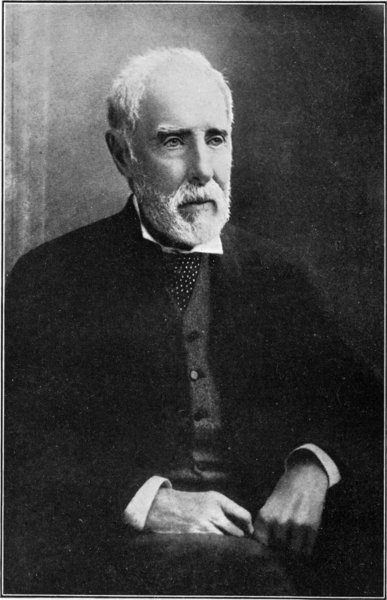
The gift of Cornwall Park by the venerable
doctor was the “crowning glory of his life,” as the
donor himself said. Logan Campbell arrived in
New Zealand in 1839, and, pending the choice of
the capital on the Waitemata, he settled temporarily
on Motu Korea (Brown’s Island). As soon
as the site had been fixed he moved over to the
mainland, and was amongst the original buyers of
land at the first Auckland land sale. He became
Superintendent of the Auckland Provincial Council,
1855-56, and at different times represented
Auckland and Parnell in the House of Representatives.
He was associated with practically every
movement to develop Auckland’s commercial interests,
and every organisation which had for its
object the social advancement of the city obtained
his willing assistance. In 1901, prior to the Royal
visit, he was appointed Mayor of Auckland, and
no more suitable person could have been found
than this pioneer, who had helped to build the city
from its inception. The following year he was
knighted. He died June 22nd, 1912, and was
buried on the summit of Maungakiekie (One Tree
Hill), the funeral being the most largely attended
in the history of the city. Business was suspended,
and thousands of persons lined the route as the
funeral cortége passed, bearing the mortal remains
of the aged pioneer to its last resting place.
His benefactions during his life included the
Kindergarten, the Crèche and the Nursery, all of
which bear his name, and at his death he bequeathed
to public institutions a total of £76,000.
Cornwall Park was formally opened on August
26th, 1903, the donor leading a procession of carriages,
containing the public men and women of
the city and district, through the new drive from
Manukau road to the Huia Lodge. The Drive to
the hilltop was completed and opened on January
29th, 1907, and the park was vested in a domain
board. With a view to commemorating the gift of
Cornwall Park and Sir John Logan Campbell’s
other services to the community, it was decided to
erect a statue of him at the entrance to the park.
The work was entrusted to Mr. Fred Pegram, an
English sculptor. The unveiling was performed by
the Governor, Lord Plunket, on May 24th, 1906,
Sir John himself taking part in the ceremony.
Later in the same year (1901) the distinguished
Scottish general, Sir Hector Macdonald, who had
risen from the ranks, visited Auckland on November
8th, and remained in the city until the 11th.
He was welcomed by the Mayor, Mr. Alfred Kidd,
and citizens, the Scottish community in particular
showering hospitality upon him. He spent a busy
time in Auckland, and, amongst other things, inspected
the cadets at the Domain. As a memorial
of his visit, the Scotsmen of the city endowed a cot
at the Hospital, which bears the name of this
famous soldier, whose career closed a few years
later under tragic circumstances.
Eleven years later two other famous generals,
Earl Kitchener and Lieutenant-General Sir Robert
S. S. Baden-Powell, visited Auckland. The former
reached the city on March 1st, 1912. The object
of his visit was of a military character, as he
had been invited by the Government to prepare a
scheme of defence for the Dominion. Lord Kitchener
was received with enthusiasm, and during his
brief sojourn he inspected the harbour defences,
and reviewed 4000 cadets in the Domain.
Sir Robert Baden-Powell, founder and Chief of
the Boy Scouts, came to Auckland in connection
with this movement. He arrived on May 28th, 1912,
and received a civic welcome from the citizens, the
Mayor, Mr. C. J. Parr, presiding. The hero of
Mafeking spent a busy day, which included a review
of 2500 cadets and 500 boy scouts at the
Domain, the Governor, Baron Islington, taking the
salute. In the evening Sir Robert delivered a lecture
at the Town Hall.
Two years later Sir Ian Hamilton, Inspector-General
of the Overseas Forces, came to New Zealand
in an official capacity. He arrived in Auckland
on May 12th, 1914, for the purpose of
inspecting the military stations in the district, and
the day following reviewed 4000 senior cadets at
the Domain. He was accorded a civic reception,
Mr. A. J. Entrican, Acting-Mayor, officiating.
During the same year two Australian statesmen
visited the Dominion on official business. Mr.
W. A. Holman, Premier of New South Wales,
arrived in Auckland on February 9th, and Mr.
Andrew Fisher, Premier of the Commonwealth of
Australia, on December 28th, 1914.
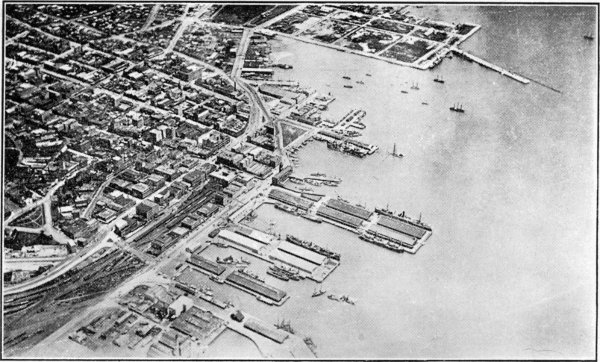
View of Auckland’s Harbour Frontage taken from a sea-plane, showing the wharves
In the last twenty years the Waitemata has received
a number of visits from various navies, the
first of which was made by the Australian Squadron,
which arrived in the harbour on February
28th, 1903, under the command of Vice-Admiral
Arthur Dalrymple Fanshawe. The warships comprising
the squadron were the Royal Arthur (flagship),
Ringarooma, Wallaroo, Phoebe, Archer,
Karrakatta, Sparrow, Lizard and Penguin. The
fleet remained for a week in the harbour, and
during its stay the annual fleet regatta took place.
While on this visit, Admiral Fanshawe declined
the offer of the use of Admiralty House, which had
been erected by the Harbour Board at a cost of
over £8500, including land.
The visit of the United States Navy, in 1908, was
one of the gayest and most spectacular events in
the history of Auckland. The fleet reached Auckland
on Sunday morning, August 9th, and the
Admiral and his men were welcomed by crowds
estimated at 100,000 persons, who utilised every
vantage point on the harbour front. The city and
harbour were decorated in a most extensive manner,
the illuminations, in which electricity was used
for the first time, being particularly elaborate. The
official landing of Rear-Admiral Sperry and his
officers took place on Monday, when they were
received by the Prime Minister, the Rt. Hon. J. G.
Ward; members of the Legislature; the Mayor
(Mr. Arthur M. Myers), and members of the City
Council; the chairman (Hon. E. Mitchelson), and
members of the Harbour Board, and others.
Thereafter a week of festivities, the like of which
the city had never previously indulged in, took
place, including banquets, receptions on land and
aboard the ships of the fleet, reviews, race meetings
and sports, both general and aquatic. Public
and private organisations vied with each other in
the entertainment of both officers and men. The
population joined in all these proceedings, and
made the occasion memorable for the visitors and
a pleasure to themselves. “Fleet Week,” the name
by which the event is now generally referred to,
ended on August 15th, on which date the fleet
steamed out of the harbour.
H.M.S. New Zealand, a battle cruiser of 18,800
tons, which was presented by the Government of
New Zealand to the Home Government, arrived, on
a visit, in Auckland Harbour on April 29th, 1913,
with Captain Lionel Halsey in command. The
vessel and its crew received a great welcome from
the citizens, and while in port she was visited by
94,616 persons. In the Great War the ship took
part in the sea fights of Heligoland, Dogger Bank
and Jutland. After the close of the war the battle
cruiser revisited Auckland, on September 23rd,
1919, with Admiral Lord Jellicoe, who was engaged
upon a report on Empire defence, in command.
Another great welcome was accorded both
ship and the distinguished sailor, who the year
following returned to New Zealand as Governor-General.
He made his first visit to Auckland
in a gubernatorial capacity on October 30th,
1920.
During the war period two Japanese warships,
Iwate and Azuma visited New Zealand, arriving
here on July 9th, 1916. Admiral Matsumura, his
officers, and the cadets who manned the ships, were
received by the civic authorities, and were entertained
during their stay in port. Both ships had
seen service in the Great War, but were now being
used as training ships.
Fires are the commonplace events of a city’s
history, and every city’s records are full of these
occurrences. During the twenty years under review
large fires alone, i.e., those causing damage to the
extent of £10,000, destroyed property to the value
of over half a million sterling. The first of these
took place on January 13th, 1901, and completely
destroyed three large buildings in Commerce and
Customs Streets, and damaged two others. The
principal losers by the fire were Messrs. Bond and
Bell, L. D. Nathan and Co. (bond store), and G.
W. Owen and Co. The origin of the fire was unknown,
but owing to the inflammable nature of the
goods in stock, the flames soon obtained a firm
hold of the buildings, and in three hours had entirely
consumed them. The loss sustained in the
fire amounted to £90,000 (estimated). The Fire
Brigades were unfit to cope with so large a conflagration,
on account of the inadequacy of their
appliances, although the water pressure was all that
was required.
A characteristic of the fires which had occurred
in Auckland up to this time was that, with one
exception, no lives had been lost. The Grand
Hotel fire of May 31st, 1901, was unfortunately
responsible for the death of five persons—three
children and two adults. The building was burned
out, only the walls remaining. The damage was
approximately £12,000.
A disastrous outbreak of fire took place on 4th
May, 1904, in the warehouse belonging to Messrs.
T. and S. Morrin, High Street, practically gutting
the building and destroying a valuable stock of
ironmongery. The damage was estimated to be in
excess of £50,000. A number of firemen were injured
by the collapse of a wall. After this fire
had been brought under control, another outbreak
in the retail premises of the same firm, which stood
on the other side of High Street. Fortunately, it
was confined to the roof.
The City Chambers, situated at the corner of
Queen and Victoria Streets, was destroyed by fire
in the early part of the evening of June 21st, 1906.
All the storeys except the first were destroyed. The
damage to the building amounted to considerably
over £10,000, and the loss on stock was also considerable,
but difficult to ascertain, as the Chambers
were rented as offices and occupied by many people.
Another serious fire, causing damage estimated
at £100,000, destroyed the four-storeyed building
in Queen Street, known as the Strand Arcade, on
August 16th, 1909. So intense were the flames
that in two hours the building, which had only been
erected eight years, was reduced to a heap of ruins.
It was due to the energies of the Fire Brigades that
the hotels on either side of the Arcade were not
involved in the conflagration.
One of the biggest fires ever experienced in
Auckland broke out a few minutes before eleven
o’clock on November 16th, 1911, in the premises
of Messrs. Macky, Logan, Caldwell and Co., Elliott
Street. The outbreak was first observed at the
Darby Street end of the building, but in a very
short time the whole front, from Darby Street to
Victoria Street, was in flames. As a spectacle, it
was one of the grandest fires seen in the city. It
burned so fiercely that fears were entertained that
the whole block, which is bounded by Queen Street,
would be involved. A right-of-way in Darby Street,
combined with the efforts of the firemen, however,
stayed the course of the fire, and in less than three
hours the outbreak was under control, but not
before damage estimated at £150,000 had been
caused.
On 29th March, 1913, Endean’s Buildings, at
the corner of Queen and Quay Streets, were
destroyed by fire. The damage was estimated at
£35,000.
A fire which took place on October 23rd, 1915,
at the stables of Messrs. J. J. Craig Ltd., Parnell,
totally destroyed the building, and caused the death
of more than two hundred horses. So speedily did
the fire spread that only two animals escaped alive.
The fire on February 6th, 1917, which occurred
in Gleeson’s Buildings, High Street, was peculiar
in respect of the amount of damage to goods in
relation to the damage which the building sustained.
Cinematograph films, stated to be worth £28,000,
belonging to the Amalgamated Film Exchange
of Australia (whose representatives occupied floors
in this building), were destroyed. The damage to
the building did not exceed £1000.
Two outbreaks of fire took place at Messrs. Bycroft
Ltd., Shortland Street within a month of one
another. The first occurred on February 6th, 1919,
gutting the part of the building fronting Shortland
Street, and causing damage estimated at £15,000.
The second fire broke out on March 8th in the rear
portion of the building, destroying it and causing
injury to the machinery. The damage on this occasion
was about £12,000.
Another fire, which had fatal results, was the
Thames Hotel blaze of February 19th, 1919. Two
storeys were gutted, and one of the guests was
burned to death. Others received injuries while
escaping from the burning building.
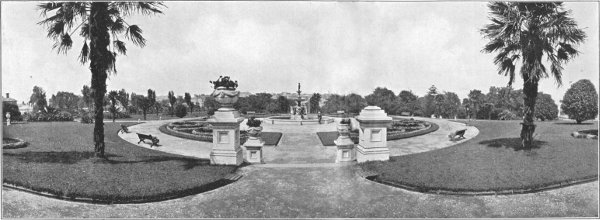
Albert Park, formerly the site of Albert Barracks
J. H. Kinnear, Photo.
The most serious wreck of this period connected
with the Port of Auckland was the disaster which
overtook the Huddart-Parker steamer Elingamite
(2585 tons), which was totally wrecked on the
Three Kings, while on a voyage from Sydney to
Auckland, on November 9th, 1902. The vessel,
which was travelling slowly on account of a very
thick fog, had no warning of her danger, and when
she struck, the engines were reversed without delay,
but she had stuck fast. The boats and rafts were
immediately launched, and all aboard, except the
captain and chief steward, were taken off. Only
one boat, however, reached the mainland, while
others managed to make the Big King and the
Middle King. The survivors on these islands underwent
some hardships, until rescued by the steamer
Zealandia, which had been intercepted by the
master of a whaling boat, who conveyed the news
of the disaster to the captain of that vessel. Later
a raft was picked up by H.M.S. Penguin, but only
eight out of sixteen found on it were alive. The
survivors had undergone four days of terrible sufferings.
One boat load of passengers was completely
lost without trace. The total number of
lives lost through the wreck was forty-nine.
A shipwreck of a more local character was the
disaster which overtook the Kapanui inside the
Heads on December 23rd, 1905. About nine
o’clock in the evening the coastal steamer Kapanui,
on its homeward voyage from Waiwera, was
rammed by another coaster, the Claymore, outward
bound, between Devonport wharf and North Head.
The Kapanui sunk in a few minutes, five persons
being drowned. The collision was due primarily
to the Kapanui’s port light becoming extinguished,
but the Court of Inquiry also found fault with the
captain’s handling of the vessel.
Another coastal steamer, the Kia-Ora, while voyaging
to Onehunga, was wrecked at Kawhia, on
June 13th, 1907. Captain J. C. Blacklock and two
passengers were drowned.
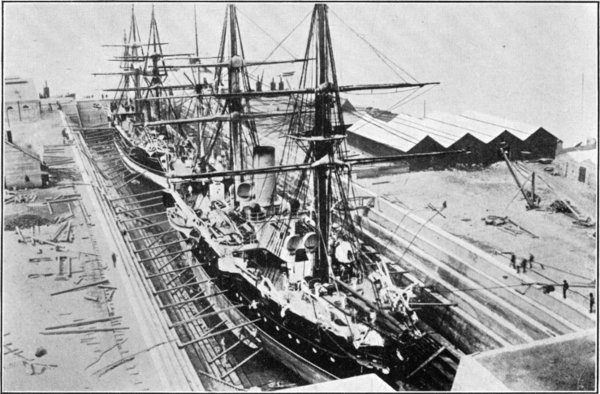
An unusual shipping accident occurred in the
Calliope Dock on November 27th, 1906, during
the docking of the Shaw, Savill and Albion
Company’s steamer Mamari (7062 tons), which
resulted in the death of two men by drowning,
and the injuring of thirty others. The accident
was caused by the vessel lurching suddenly while
there was still six feet of water in the dock.
This unexpected movement of the ship sent the
water swirling in the dock, taking men and loose
timber with it, and causing the casualties stated.
The ship had to be refloated without delay, as the
position she had got into was extremely dangerous.
Another Huddart-Parker liner, the Wimmera
(3021 tons), was sunk on June 26th, 1918, off
North Cape, after striking a submerged mine. At
the time of the disaster she was on a voyage from
Auckland to Sydney. After the explosion the life-boats
were lowered, and five of them got safely
away. One of the boats (No. 4) was stoved in against
the ship, and most of its complement perished.
Altogether, ten passengers and sixteen of the crew,
including Captain R. J. Kell, were drowned.
The city’s municipal progress in the last twenty
years has been most marked. The Corporation’s
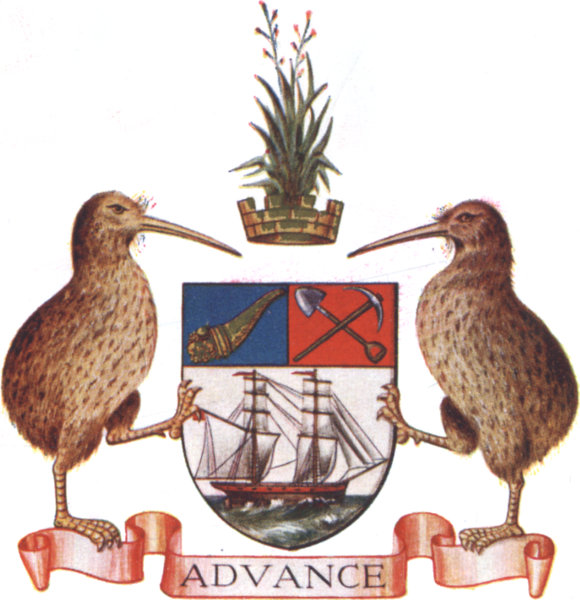
motto, “Advance,” appears to have been kept in
mind and lived up to, and in no direction was
this activity more noticeable than in the city’s
streets. In 1902 Auckland possessed only one
paved street; there are now thirty-three streets laid
in either asphalt, wood blocks, or concrete, as well
as a large number of macadamised roads. The
failure of a supply of good road metal retarded
Auckland’s progress in road making, but the substitution
of concrete has had successful results, and
the Council has given authority for a large number
of streets to be laid in this material, and the work
is now being proceeded with. Another project which
has engaged the attention of the Corporation was
the widening of narrow streets, in order to carry
the increased traffic which now passes over them.
The improvements are most apparent on the waterfront,
where the co-operation of the Harbour Board
was obtained, and the largest and most costly undertaking
of this class of work was the scheme known
as the eastern outlet. This work necessitated the
purchase of all properties between Beach Road and
Jermyn Street, the widening of the first named
from 66 feet to 110 feet, and the laying down of
a new thoroughfare, named Anzac Avenue, 84 feet
wide, from Beach Road to Lower Symonds Street.
The making of this new highway was commenced
in 1915, and the trams commenced running on it
in February, 1921.
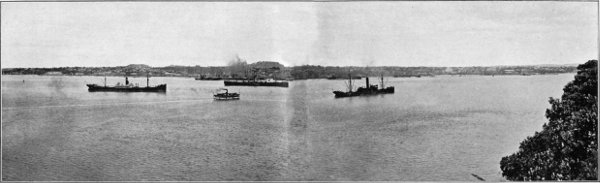
Auckland, from the North Shore
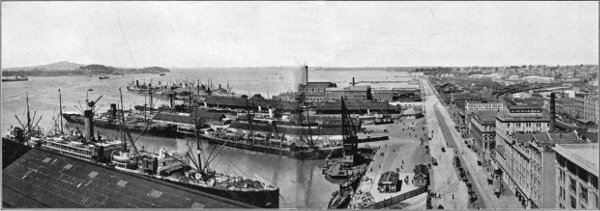
Auckland from the Ferry Buildings looking Eastward
Showing the wharves, Quay Street and Kings Drive (recently reclaimed). Devonport and Rangitoto on the left
The opening, in 1910, of the Grafton Bridge,
which is constructed in ferro-concrete, and is
notable as having the longest three-hinged arch in
the world, was another important undertaking,
which provided easy access to the Hospital and
Domain, and linked up Parnell and Newmarket
with the western districts of the city.
The provision of parks in, and adjacent to, the
city was another feature of this time. At the
beginning of the period the only parks in the city
were the Domain (194 acres), Albert Park (14
acres), and Western Park (6 acres). In 1901, on
completion of the reclamations, Victoria Park (18
acres) was leased from the Harbour Board, and
has been formed into an excellent sports and recreation
ground, containing a children’s playing area,
which has recently been equipped by Mr. John
Court. Point Erin Park, Ponsonby (12 acres) was
acquired ten years later, and soon after the amalgamation
of Parnell with the city, the Corporation
acquired the Gillies property and “Kilbryde,” formerly
the residence of the late Sir John Logan
Campbell, which adjoined. These two properties
united were opened in 1915 and named Parnell
Park (9 acres). In the same year Myers Park (6
acres) was opened. This park, which was presented
by Mr. (afterwards the Hon.) A. M. Myers
in 1913, was originally an unsightly gully, overgrown
with weeds; it has been transformed into a
delightful and useful reserve, where one was much
needed. At a later date Mr. Myers erected in the
park (which has been equipped especially for
children’s play) a free kindergarten. The building,
which was designed by Messrs. Chilwell and
Trevithick, and built by Messrs. Johns and Sons,
was formally opened by the Governor, Lord Liverpool,
on November 15th, 1916. Its cost, exclusive
of equipment, was £5666. Three other parks,
which lie outside the city boundary, on the shores
of the Manukau Harbour, were also added to the
city’s reserves by the generosity of various donors.
Cornwallis Park (1927 acres) was bequeathed
under the will of the late J. Mitchell McLachlan
in 1911; Atkinson Park (30 acres) was the gift
of the late H. W. Atkinson, two years later;
and Kaiterakihe Park (761 acres) was presented
by Mr. Wesley Spragg in 1918. Waiatarua Park
(156 acres) is another large reserve, undeveloped
at present, which the Council acquired by purchase,
with a view to the future needs of the city.
Another form of recreation which the city has
made provision for is swimming, and up-to-date
outdoor baths have been erected at Shelly Beach
(150ft. × 60ft.), and at Point Resolution, Parnell
(194ft. × 149ft.). The former was opened in 1912
and the latter in 1914. The Hobson Street Tepid
Baths, which are indoor baths, were constructed at
a cost of £10,673 by Messrs. J. T. Julian and Sons,
and were opened on December 17th, 1914. There
are two ponds (100ft. × 50ft. and 60ft. × 30ft.), as
well as private baths, dressing rooms, laundry, etc.
Some large engineering works have also been
carried out during these years. The Waitakere
dam, which stores 220,000,000 gallons of water,
was finished in 1906. Two other reservoirs are
under construction at Nihotupu, the upper designed
to contain 69,000,000 gallons of water, and the
main dam 540,000,000 gallons. The smaller dam
is expected to be completed shortly, and the
large one in 1923. A comprehensive scheme of
drainage and sewerage for the city and suburbs
was started on 25th October, 1909, and the main
outfall works were opened on March 25th, 1914.
The work of linking up other districts has proceeded
during the following years. Electrical
supply for power and lighting was taken in hand
by the Corporation in 1906, and the first supply
was given from Freeman’s Bay in 1908. Since
that date the department has grown considerably,
although the war interfered with the supply of material
and delayed the development of the scheme.
An idea of the present extent of the undertaking
may be formed from the fact that for the year
ending 31st March, 1921, 10,496,060 units were
sold, the revenue being £108,734. The electric
tramway system was inaugurated on 24th November,
1902, powers having been given to a company
for this purpose. The City Council took over the
concern on July 1st, 1919. There are at present
twenty-seven miles of lines and 154 cars in commission.
For the year ending 31st March, 1921,
the cars carried 45,820,939 persons.
Other activities which engaged the attention of
the Council were the erection of new abattoirs at
Westfield (opened in 1909), and large new city
markets, which were completed in 1917 and 1918.
The Corporation also entered the fish trade, opening
markets and providing trawlers to catch fish,
and, besides supplying the trade, it retails this food
at its own shop. The figures of last year’s working
indicate the extent of this business. The total weight
of fish received from all sources was 1040 tons,
the sales amounting to £49,758.
The provision of houses by the municipality was
commenced in 1915, when six houses were erected
in Ponsonby. A larger scheme of dwellings, to be
erected on the old abattoir site at Grey Lynn, was
proposed in 1918, but, owing to financial difficulties,
it could not be carried out. As an instalment
of the proposal, ten cottages have been built on
this site up to the present.
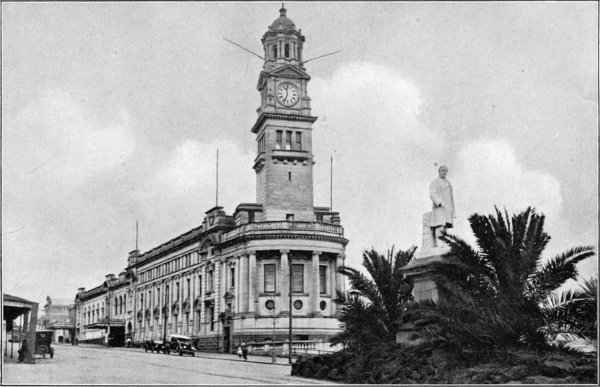
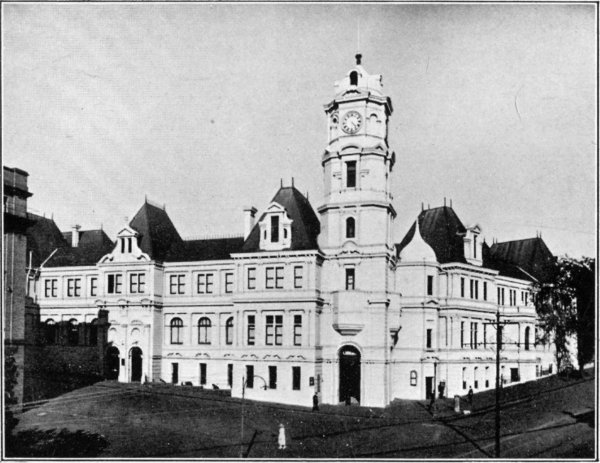
The Town Hall, with the Sir George Grey Statue
The erection of the Town Hall, which commenced
in 1908, was significant of the position
which the municipality had now attained. The
question of a Town Hall had been under consideration
from 1880, but until this time the Council had
not been in a position to do anything. Prior to the
opening of the Town Hall, the Council’s staff had
no settled headquarters, the first Council offices
under the present constitution being located in
rooms over Messrs. Upton and Co.’s book shop,
Queen Street. As the Council’s affairs increased,
further accommodation was found necessary, and
the old Magistrate’s Court, at the corner of High
and Chancery Streets, was obtained to meet the
requirements. After the opening of the Public
Library and Art Gallery, the Council utilised some
of the rooms in this building as municipal chambers,
and here the Council’s work was carried on
until the Town Hall was ready for occupation.
The foundation stone of the Town Hall was laid
by the Mayor, Mr. A. M. Myers, on the 24th February,
1909, and the building was opened by the
Governor, Baron Islington, on the 14th December,
1911, Mr. C. J. Parr, Mayor, presiding at the ceremony
which took place in the large hall. The festivities
connected with the opening continued for
a week, concerts, organ recitals, oratorios, and the
annual reunion of the Old Colonists’ Association
being held in the new hall. The building was designed
by Messrs. J. J. and E. J. Clark, of Melbourne,
and the contractors were Messrs. Ferguson
and Malcolm, of Auckland, whose contract for the
work was £87,565.
The building is divided into two portions, one
being devoted to administrative purposes, including
the Council Chamber, and the other comprising the
halls, of which there are two, with a supper room
and ante-rooms. The large hall has seating accommodation
for 2700, and the orchestral platform and
chorus galleries can seat 350 performers. The Concert
Chamber has seating capacity for 880 persons.
At the opening ceremony the Mayor formally
acknowledged two splendid gifts, which had been
made to the citizens and erected in the Town Hall.
These were the pipe organ, the gift of Mr. Henry
Brett, and the clock, which was presented by Mr.
A. M. Myers.
The finances of the city show clearly the present
position of municipal affairs, and the development
which has been made in the last two decades. The
city’s annual valuation in 1901 was £349,765;
to-day it stands at £1,497,095. The Council’s
revenue at the same date was £1,077,047, compared
with £82,657 twenty years ago.
The spirit of civic progress was not confined to
the municipal authority for the Harbour Board
also embarked upon a huge programme of work,
which is still going on, and which has completely
transformed the waterfront, making it one of the
most up-to-date ports in Australasia. It even permeated
to individuals, as the record of benefactions
amply demonstrates. Some of these benefactions
have already been mentioned, but others remain to
be described.
Mrs. E. A. Mackechnie, who died on November
7th, 1902, bequeathed by direction of her deceased
husband, to the Auckland Institute and Museum
the sum of £2500, of which £2000 was to endow
a library and £500 to purchase cases of animals.
A similar amount, £2500 was left to the Auckland
Society of Arts to erect a gallery. The Institute
received also by this bequest the late Mr. Mackechnie’s
library.
The Leys Institute was founded by the will of
the late William Leys, who died on the 5th October,
1899. The funds available being inadequate
for the early realisation of the testator’s benevolent
purpose, Mr. Thomson W. Leys, a brother of the
deceased, and one of his trustees, offered to defray
one-half of the entire cost of erecting and equipping
a building, and to furnish the institution with
a library, on condition that the Corporation provided
a suitable site. This condition was readily
agreed to by the City Council, and on the 29th
March, 1905, the institution was officially opened
by the Mayor, the Hon. E. Mitchelson. Mr. R. M.
Watts was the architect, and the cost of erecting
and equipping the building, exclusive of books,
was £3234. The Leys Institute consists of a reference
library and reading room, a lending department,
boys’ room and recreation rooms. The course
of winter lectures and entertainments has been a
feature of its work since the commencement. The
gymnasium has recently been converted into a large
boys’ hall, probably the largest boys’ institute in
the Dominion. Mr. T. W. Leys has been president
of the institute since its inception, and its success
is due mainly to his personal interest and benefactions.
Charitable institutions were also fortunate in the
assistance they received from benefactors. By the
will of the late William Arrowsmith, who died in
1902, a sum of about £23,000 was bequeathed, in
equal parts, to the Orphans’ Home and Mrs. Cowie’s
Women’s Home.
Mr. and Mrs. W. H. Smith presented in March,
1907 to the Hospital Board a property at Russell
Crescent, Ellerslie, containing over three acres and
a two-storey dwelling, formerly the home of the
donors, for the purpose of founding a convalescent
home for women and children, which was named
the Alexandra Convalescent Home. At the time
the gift was made the estate was valued at about
£5000.
A number of Auckland institutions benefited by
the will of Mrs. Knox, widow of the late Charles
Knox, both pioneers, who arrived in New Zealand
in the ’forties. Mrs. Knox died on the 19th October,
1908, bequeathing £70,000 to charities, including
£20,000 for the erection of a building for
the treatment of poor people suffering from incurable
diseases. This institution, which bears the
donor’s name, is situated at Tamaki.
The Leslie Presbyterian Orphanage was opened
on the 21st October, 1911, although the bequest of
£3485 of Mr. James Leslie, the founder of the institution,
was made known at his death on 15th
November, 1888. For some years after the date of
the bequest the trustees did not feel justified in
erecting a building, on account of the small sum
at their disposal, but with the addition of £1000
bequeathed by Mrs. Birrell, and the bequest of
Mrs. Knox of £500, they decided to carry out the
original testator’s will. The home, which is situated
on the harbour at Meadow Bank, was designed
by the late E. Bartley, the builder being
Mr. O. E. Farrow.
The Auckland Exhibition of 1913, which was
officially opened on 1st December, 1913, by the
Governor, the Earl of Liverpool, was a striking
proof of the commercial and industrial advancement
of the city and province. The opening ceremony
was attended by a most representative
gathering, including the Prime Minister (Rt. Hon.
W. F. Massey), members of Parliament, and
mayors and municipal representatives from the
whole Dominion. On the Governor’s arrival at the
Exhibition grounds, he was received by Mr. George
Elliot, chairman, and members of the Exhibition
Executive, the Mayor of Auckland (Mr. C. J.
Parr), and others. In the evening the Corporation
gave a banquet to the distinguished visitors, at
which the Mayor presided. In this manner the exhibition
was inaugurated. The exhibition grounds
occupied an area of 48 acres of the Domain, and
the cost of erecting the buildings and laying out
the grounds was £30,000.
Generally, the exhibition was run on conventional
lines, being principally of an industrial and
commercial character. Special features were introduced
as far as Auckland was concerned, the
principal one being the engagement of the Band
of the Royal Regiment of Artillery of 45 performers,
under the command of Captain N. P. R.
Preston, with Mr. C. E. Stretton, musical director,
this being the first occasion on which one of the
great regimental bands of the British Army had
visited New Zealand. The enterprise shown in
bringing out the Royal Artillery Band was repaid
by the financial success which resulted, due in
great measure to this attraction. The amusements
provided in the exhibition, while not new to Auckland,
were on a larger scale than had hitherto been
attempted, and occupied 15 acres, named Wonderland
Park. The art section contained a collection
of 600 paintings, etc., collected and brought out
to New Zealand from London by Mr. John Baillie,
formerly of Wellington. The illumination by electricity
of the buildings and grounds by night was
another interesting and beautiful feature.
The exhibition remained open till April 18th,
1914, and during the four and a half months of
its life it was estimated that 870,000 people visited
it. From the social and business aspects the exhibition
was a great success, and after expenses
had been met a sum of £21,758 remained as profit.
It had previously been decided that any surplus
accruing from the exhibition should be used in
beautifying the Domain, and this sum of money
has since been expended on improvements carried
out on the outer Domain, including the laying-out
of paths, flower beds, playing areas, and the erection
of the winter-garden, which stands on the site
of one of the exhibition buildings. The tea kiosk
and the bandstand, near the main drive, are permanent
survivals of the exhibition.
The principal officials were: Mr. George Elliot,
chairman of executive; Messrs. Bamford and
Pierce, architects; Mr. E. A. Pearce, supervisor of
buildings, etc.; and Mr. W. R. Holmes, manager.
Mr. Holmes, it is interesting to note, had filled
the same position in the exhibition of 1898-9.
Another banking establishment was added to the
number of these institutions in 1913, the Commercial
Bank of Australia opening a branch in Shortland
Street in October of that year, but later the
business was removed to premises in Queen Street.
The principal overseas shipping of the port was
brought up to 1909 in the previous section. For
the two following years Auckland did not receive
much consideration as a port of call for the trans-Pacific
steamers, but in 1911 the Union Company
reinstated Auckland as the way port in the Sydney-Vancouver
service, the Marama (6437 tons) taking
up the run, and arriving at Auckland on August
5th. The Makura (8200 tons) and the Zealandia
(now the Paloona, 2771 tons) were also commissioned
for this service. In April, 1913 the Niagara
(13,415 tons) replaced the Zealandia, and the
Marama was withdrawn in July, 1914, since when
the Niagara and Makura have maintained the running
between Australia and Canada.
The P. & O. Company established a service to
New Zealand via Suez Canal in 1910, the Mongolia
arriving in Auckland on November 23rd. With the
sailing of the Macedonia, on April 12th, 1913, the
service was discontinued.
The latest line of steamers to inaugurate a New
Zealand service is the Canadian Government Merchant
Marine, Ltd., the first steamer of this line to
reach Auckland being the Canadian Raider, which
arrived on 3rd April, 1920. The undertaking is
interesting, having been created by the Canadian
Government with the purpose of extending the commerce
of that dominion. The steamers, which are
designed to carry general and refrigerated cargo,
number seventy, and trade to all parts of the world
via the Atlantic and Pacific oceans, monthly calls
being made at Auckland, where the head office for
Australasia is situated. The marine service is
worked in conjunction with the Canadian National
and Grand Trunk railway systems.
The inter-colonial service has been carried on
regularly by the Huddart-Parker and the Union
lines, while the latter has practically gained a
monopoly of the inter-provincial and the Island
services.
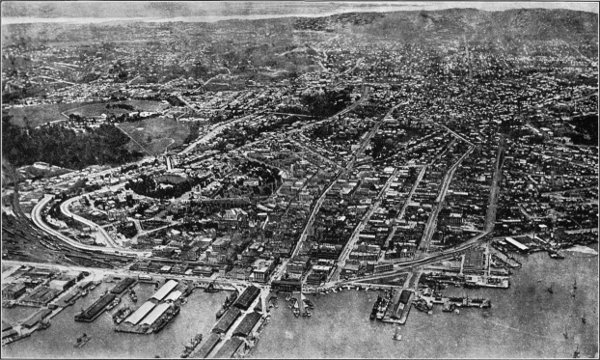
Photograph of Auckland taken from a seaplane, showing the City’s position between the two harbours, the Waitemata
in the front and the Manukau in the background
W. A. Waters, Photo.
An industrial disturbance, which ended in a
general strike, paralysing the trade of the Dominion,
occurred at the end of 1913. The trouble
began with the miners in 1912, but the strikes of
the Wellington shipwrights and the Huntly miners,
which took place simultaneously in October, 1913,
brought out other trades, including the waterside
workers, and for some weeks the commerce and
industry of the Dominion were at a standstill. Even
the city trams ceased running. After a fortnight,
free labour became available and rapidly grew in
extent. Within a month the city became normal.
One of the features of the strike was the introduction
of special police, who were enlisted to protect
the free labourers. The Auckland special police
included over 800 mounted men, who camped in
the Domain. Although feeling between the unionists
and the strike-breakers ran high, there was no
conflict at any time.
During the following years there were a number
of industrial disputes, but in the war period
strikes were not resorted to. The “go-slow” policy
was, however, introduced during the later stages
of the war, and caused considerable inconvenience.
In 1919 the strike reappeared and coal supplies
became so short that public conveniences, such as
gas and electricity, were affected, and their curtailment
became frequent. The railway services
were also affected, only the briefest time-tables
being carried out. In 1920 complete suspension
of both trams and gas supplies occurred, owing to
lack of fuel. On two occasions the trams ceased
running—from January 31st to February 13th, and
from September 25th to October 11th. Almost simultaneously
with the second suspension of the trams
the gas supply was entirely stopped, the period
being from September 30th until October 14th.
Another strike, which was not appreciated by
the public, was the butchers’ strike, which lasted
from November 15th to December 6th, 1919.
The jockeys’ strike, which took place at the
Avondale races on April 10th, 1920, was a small
affair in itself, and would not merit mention if it
were not for the events which followed it. On
June 3rd the tramwaymen detailed for duty on the
race cars refused to run the “race specials” and
were suspended. The other tramwaymen, out of
sympathy with these men, ran their cars into the
depôts. The City Council, which had taken over
the system from the Auckland Tramway Company,
considered that the men had struck, and the service
was not resumed until June 8th, when the dispute
was settled.
Between the jockeys’ strike and its sequel—the
tramways dispute—the railwaymen came out, on
account of dissatisfaction with their conditions.
The strike commenced on April 27th, and the dispute
threatened to be a most serious affair. It
lasted for less than a week, the men returning to
duty on May 2nd. If the dispute had not been thus
speedily settled, the results, both economic and
commercial, would have been disastrous to the
community. This event took place when the Prince
of Wales had just commenced his tour of New Zealand.
He was then at Rotorua, but the men on the
train agreed to bring the Royal visitor back to
Auckland. This unscheduled hold-up of the tour
was taken in a philosophic spirit by His Royal
Highness.
The European War, which fell on the world with
such suddenness, soon became felt on this side of
the globe. The report at first brought consternation
to New Zealanders, with which was mingled the
usual display of patriotic ardour. Bands of youths
and young men paraded Queen Street, singing
patriotic songs and demonstrating. To many business
people the idea of war spelt ruin, and many
of them immediately curtailed their staffs. Within
a very short time—a fortnight at most—these extreme
expressions of the public mind settled down,
and the true feelings of the community found vent.
The New Zealand Government at once offered
Great Britain its assistance, which was as speedily
accepted. On August 10th the first portion of
Auckland volunteers for overseas service left for
Wellington, to join the other units which formed
the advance party of the N.Z.E.F. for the Samoan
expedition. From this onwards there were regular
concentrations of men for the forces, and at intervals
the troops left for the seat of war.
The embarkations were usually made from Wellington,
but in the earlier days of the war the
troops sometimes left from other ports, including
Auckland. One of the most memorable send-offs
to outgoing troops took place on September
23rd, 1914, when 2000 soldiers paraded at
the Auckland Domain, and were ceremonially
farewelled by the citizens, the Prime Minister
(the Rt. Hon. W. F. Massey) and the Mayor
(Mr. C. J. Parr, C.M.G.) addressing the men.
A similar event took place on the occasion of
the embarkation of the Second Maori Reinforcements,
on 17th September, 1915. This departure
was an impressive spectacle, as the older
Maoris and their women-folk carried out the
ceremony in traditional manner. The Mayor (Mr.
J. H. Gunson) presided at the ceremony, which
took place outside the Town Hall.
In the first months of the war a training camp
for local recruits was located at Epsom, but as the
Dominion’s military organisation developed, this
camp was abandoned, and the Auckland recruits
went direct to Trentham or one of the other concentration
camps. The only permanent camp in the
Auckland district was at Narrow Neck, Devonport,
where the Maoris and recruits from the South Seas
underwent their course of training.
Apart from the unusual number of men in khaki,
and the economic conditions brought into being by
the war, New Zealand was scarcely disturbed. The
economic factors have been mentioned in another
part of this narrative, and, although serious while
they lasted, they could not be described as hardships,
such as were experienced by people living
nearer the war zones.
The most exciting event which occurred near
Auckland during the war was the escape of Commander
von Luckner and ten other German prisoners
of war on December 13th, 1917, from internment
at Motuihi. They seized the motor launch
belonging to the camp commandant, and then commandeered
the scow Moa at sea. They were recaptured
near the Kermadec Islands on December
21st and brought back to Auckland on Boxing
Day, on board the cable ship Iris.
The discovery of a submarine minefield between
North Cape and Cape Maria van Diemen was
another incident, which was followed by fatal
results. Shipping was notified on June 11th, 1918,
to avoid the locality. Unfortunately, the steamer
Wimmera neglected to observe the instructions, and
became a victim, as related elsewhere in this section.
Apart from the number of soldiers which New
Zealand sent to the war, the people of the Dominion
entered with enthusiasm into the work arising out
of the war and the relief of the sufferers thereby.
Associations, in which both young and old laboured
with good results, were formed. The dull days of
war were enlivened from time to time by carnivals
and special days for the Red Cross, Blue Cross,
the Servian and Belgian relief funds, and other
patriotic purposes. In connection with the Belgian
fund, Mr. H. E. Partridge presented, in March
1915, the collection of Maori paintings by Mr. G.
Lindauer, to the Auckland Art Gallery, on condition
that the people of Auckland district subscribed
£10,000. The condition was fulfilled within a very
short period. On October 14th of the same year
the Auckland Queen Carnival, organised by the
Auckland Patriotic and War Relief Association,
was started. The respective supporters of the twelve
queens worked with great assiduity, and by November
29th, when the coronation of Mrs. Bollard
(Queen of the South), the winner, took place, the
proceeds from this effort totalled £264,547.
The Auckland Patriotic League, which afterwards
became the Auckland Provincial Patriotic
and War Relief Association, was formed in the
first month of the war, the Mayor of Auckland
being chairman ex officio. Mr. C. J. Parr was the
first chairman, occupying the position from August,
1914, to April, 1915, when he was succeeded by
Mr. J. H. Gunson, who has held the position up
to the present. In recognition of his services to
this and other patriotic endeavours, including
the work which he did on the National Efficiency
Board[29] he was made an officer of the Order
of the British Empire (O.B.E.) in 1918, and
in the following year was elevated to the commandership
of the Order (C.B.E.). The Mayoress
(Mrs. Gunson) was also made an officer of the
same Order, in acknowledgement of her patriotic
work.
The total funds collected by the Patriotic and
War Relief Association from the 10th August,
1914, until the end of September, 1921, including
interest, amounted to over half a million sterling.
The official peace celebrations were held on July
19th, 1919. A universal holiday was observed,
and the city wore a gala appearance, bunting and
decorations being everywhere in evidence. The
official part of the proceedings commenced with a
procession, which formed at the foot of Queen
Street, and travelled to the Domain. In the procession
the men who had served in the war took
pride of place. The official, consular and civil life
of the city was also represented. Next to the soldiers,
in point of interest, were the various local
organisations which had taken part in the work
connected with the war and patriotic endeavour.
Many of these associations were represented by
members who wore symbolic costumes and were
conveyed in tastefully decorated vehicles, adding
a picturesque touch to the procession.
At the Domain the troops, of which some 5500
were on parade, marched past the saluting base,
Colonel H. R. Potter, C.M.G., officer commanding
the district, taking the salute. At the conclusion of
the military function the Deputy-Mayor (Mr. A. J.
Entrican) read the King’s message, after which a
salute of twenty-one guns was fired. The returned
soldiers were then entertained to lunch by the Peace
Celebrations Committee.
At night the city was transformed into a carnival.
Bonfires were lit, and the spirit of revelry
was abroad, but owing to the coal shortage only
limited illuminations were permitted.
The welcome accorded to the soldiers returning
to New Zealand after hostilities had ceased was
usually of a private character, being confined to
relatives. The civic heads and other officials were
present, and on behalf of the citizens welcomed the
soldiers home. An exception to this, however, was
made on the return of the Maori Battalion, numbering
1000 strong, on April 6th, 1919. The occasion
was made a great festival by the natives, and
representatives from every tribe in New Zealand
were congregated at Auckland to take part in the
welcome, which was conducted in accordance with
Maori custom. The gathering was held in the
Auckland Domain, and the day being a Sunday
a great assemblage of the public collected there to
take part in the welcome home. It was the greatest
Maori ceremonial gathering which had been held
in New Zealand since the Maori ceremonies attending
the visit to Rotorua of the Duke and Duchess
of York, in 1901. Native dances were performed,
and speeches of welcome made by the chiefs of the
various tribes. On behalf of the white people of
New Zealand, the Maori soldiers were welcomed
home by Sir James Allen, Minister for Defence,
Mr. J. H. Gunson, Mayor of Auckland, Hon. Sir James
Carroll, K.C.M.G., M.P., and others. After the formal reception,
the Maoris partook of a feast in native
fashion.
Shortly after the conclusion of hostilities a
French mission, representative of the national,
economic and commercial interests of France, with
General Pau, the famous soldier, who had served
in the war, at its head, visited New Zealand, and
arrived at Auckland on December 27th, 1918. The
object of the visit was to thank the Government
and people for the services rendered by New Zealand
in the war, and to study how inter-commercial
relations could be extended. On the mission’s
return to Auckland from the South, the members
were accorded a civic reception on January 24th,
the Mayor (Mr. J. H. Gunson) presiding.
During 1919 and 1920 two distinguished soldiers,
who were intimately connected with the New
Zealand forces which had served overseas, were
given cordial welcome to Auckland. The first to
arrive in the city was Brigadier-General G. S.
Richardson, who had held the position of Commandant
of the New Zealand Forces in England,
during the period that the New Zealanders served
in France. He reached Auckland on May 5th,
1919, and his reception was in the nature of a
welcome home, as he had been connected with the
New Zealand Forces for many years before the
outbreak of hostilities.
General Sir William Riddell Birdwood, who
commanded the Australian and New Zealand Division
on Gallipoli, and gained a great reputation
among the troops under his care, arrived in Auckland
on July 6th, 1920. He was given an enthusiastic
reception by returned soldiers and the general
public. The city tendered him a reception at the
Town Hall, at which the Mayor (Mr. J. H. Gunson)
again presided.
The Soldiers’ Club was opened on September
13th, 1915, in rooms of the Y.M.C.A., which were
loaned by the directors. As larger numbers of
repatriated soldiers came back to Auckland, the
accommodation at the Y.M.C.A. became insufficient,
and new premises for the club were found in Albert
Street, which were opened on 20th October, 1920.
The most serious epidemic of disease ever experienced
in Auckland was the outbreak of influenza,
which occurred in October, 1918. The
account of the epidemic given in the “Auckland
and Charitable Aid Board: a History” is the best
account the writer has seen, and he therefore makes
no apology for quoting from it. “Influenza in a
somewhat unusual form was prevalent in the city
from the early part of October ... but the worst
phases dated from a fortnight after the arrival of
the R.M.S. Niagara from Vancouver, on the 12th
of the month.... On the berthing of the vessel
in Auckland, twenty-eight men were removed to
the Hospital and placed in an isolation ward.
Within a few days the disease was communicated
to members of the Hospital staff. Simultaneously
it spread to the community.... The insufficiency
of the ordinary hospital accommodation to meet
the demands of such an extraordinary emergency
were early apparent. Temporary hospitals were
accordingly established at the Seddon Memorial
Technical College, “Kilbryde” (Point Resolution),
the Sailors’ Home, the Avondale racecourse buildings,
Myers Kindergarten, the Y.W.C.A. hostel,
Vermont Street schools, and St. Joseph’s schoolroom,
Grey Lynn. The Auckland Racing Club’s
buildings at Ellerslie were converted into a temporary
convalescent home.... Rigorous measures
were taken at the beginning of November to limit
the spread of the disease. Business in the city was
brought almost to a standstill. Places of amusement
and worship, banks, schools, hotel bars, and
many warehouses were closed; public meetings
... were forbidden; such facilities as the telegraphic,
telephonic, railway and shipping services
were curtailed, and all classes of the community
united in the supreme work of meeting [combating]
the scourge.... The visitation was at its
height in the first two weeks of November....
By the middle of November it was evident that the
progress of the disease had been stayed, and from
that time onward it gradually diminished in severity
until by the end of the month only isolated
cases remained.”
The official statistics of the deaths for the Auckland
registration district during the period of the
epidemic was 1013, or 7.57 per thousand of the
population. The largest number of deaths recorded
in one day was 56.
On November 8th an announcement of the signing
of the Armistice was received in Auckland,
which later proved to have been premature. Despite
the epidemic, which was then at its height, the city
went wild with joy, and never were such scenes
enacted as on that morning. When the official intimation
was received, four days later, there was no
demonstration.
Sporting events have not found much space in
these pages, as it would have been difficult to know
where to draw a line on such a subject. Such an
international event as the Davis Cup Challenge
Round, which commenced on December 30th, 1920,
is of such an exceptional nature as to justify its
mention. The choice of New Zealand as the scene
of the final round was in the nature of a compliment
to the brilliant New Zealand exponent of the game,
Anthony Wilding, who lost his life in the Great
War. The games were contested on special courts
prepared in the Auckland Domain.
The year 1918 was remarkable for the weather.
There were three severe gales, the first occurring
on February 14th, the next on March 18th, and the
last on June 20th. In the latter the wind blew at
the rate of 440 miles in 24 hours; in the two former
the velocity reached 520 miles. The temperature
during July was extremely low, and in the last
week of the month it dropped to 30 degrees, which
was the lowest temperature recorded for over thirty
years. The severe frost which covered the ground
was an unusual sight for Aucklanders. June, 1920,
was another cold month, and on July 1st the thermometer
at Albert Park registered 29 degrees.
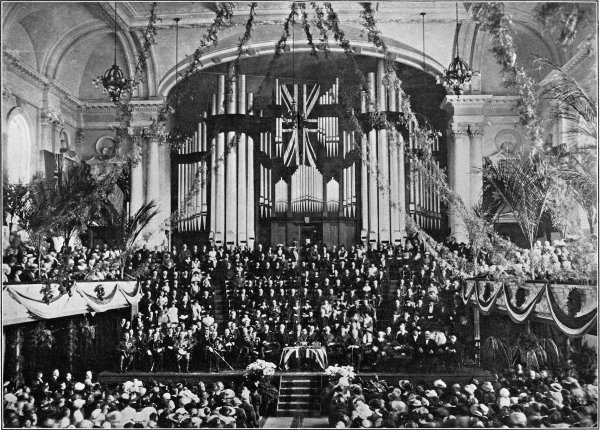
Reception of H.R.H. The Prince of Wales at the Town Hall, April 24th, 1920
The event which opened this section of Auckland’s
annals was the visit of the Duke and Duchess
of Cornwall and York, who are now the reigning
sovereigns. It is fitting, therefore, to close it with
the visit of their son and heir, H.R.H. the Prince
of Wales, in 1920. The visit was the outcome of
a promise made by His Majesty the King that the
Prince would visit the Dominions as a token of
appreciation of the spirit of loyalty and unity
displayed by the whole Empire during the war.
H.M.S. Renown (26,500 tons) conveyed the Royal
visitor on his tour, and arrived in the Waitemata
Harbour on April 24th. The voyage from North
Head was a wonderful water pageant, craft of
every sort and size taking part in it. The Prince
first set foot on New Zealand at Auckland, and
was welcomed by the Governor-General (Admiral
Lord Jellicoe), the Prime Minister (the Rt. Hon.
W. F. Massey, P.C.), the Mayor (Mr. J. H.
Gunson), and the Chairman of the Harbour Board
(Mr. H. D. Heather). He then paid an official
call on the Governor-General, and later made a
triumphal journey along Queen Street to the Town
Hall, where the Mayor and citizens formally welcomed
His Royal Highness to the city and delivered
to him a loyal address. In the afternoon a military
review was held in the Domain in the presence of
the Prince. The following day was Anzac Day,
and the 1920 commemoration will be long remembered
on account of the Prince joining in the
service to honour the heroes of the Gallipoli
expedition.
On Monday His Royal Highness attended the
Auckland Domain, where the school children of
the city were marshalled into groups, forming the
word “Welcome” and a living Union Jack, and as
the Prince passed among the children the enthusiasm
was unprecedented. In the afternoon the
Royal visitor attended a race meeting at Ellerslie,
specially arranged in honour of his visit, and at
night he was present at an “At Home” in the Town
Hall, where he was again received with enthusiasm.
Thus ended the official part of the Prince’s visit,
but owing to the railwaymen’s strike he spent a few
days privately in the city.