On September 1, 1894, shortly after the return of the company
from its campaign at Sacramento, a committee of four
was appointed, to be known as the history committee, to gather
as much material concerning that campaign as possible, and
to put it in a readable and concise form. The following were
appointed: Lieutenant George Filmer, Corporal A. McCulloch,
Privates W. J. Hayes and Wm. D. O’Brien.
The committee began its work enthusiastically and at once,
as they believed that the most beneficial results could be
attained by “striking while the iron is hot.” Their progress
was necessarily slow; but when taken in connection with the
circumstances, that the committee were engaged in earning
their livelihood during the day, and thus limited in their work
upon the history to their spare moments, and further, that
they also took great care to prevent inaccuracies from creeping
into their labors, the progress made, when viewed in this
light, cannot be said to be unusually slow.
The idea of publishing a history was not an original idea,
but rather it is the result of the gradual development of an
incipient idea by a process of evolution containing three distinct
steps. First it was only intended to have a short account
written of the campaign and pasted in the company’s scrapbook;
then, with this as a basis, the idea developed into the
form of a printed pamphlet, and finally blossomed into the
shape in which it now appears.
It was the intention of the committee to have the entire
book set up by members of the company who were compositors
by trade, and who had kindly volunteered their services.
But, on account of the limited time that the volunteer compositors
could bestow upon the work, it was found necessary,
after about one-half the book had been thus set up, to give the
work to an outside publishing house, in order to present to
the company a complete history of the campaign before the
memory of this memorable event would be beyond the “time
of which the mind of man doth not run.” And even though
the members of the company were unable, through no fault
of their own, to set up the entire work, the committee desires
to acknowledge its appreciation of the kindness and the valuable
assistance given by these members, viz: George Claussenius,
W. L. Overstreet, Wm. McKaig, J. Brien, and R. E.
Wilson.
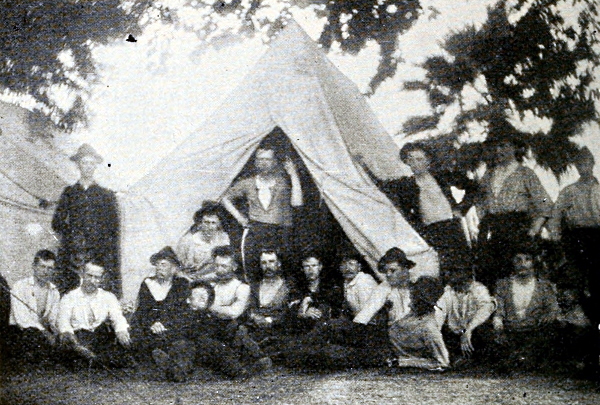
The committee further desires to thank Lieutenant Hosmer,
Adjutant First Battalion, First Regiment Infantry, N. G. C.,
and Sergeant H. B. Sullivan, “of ours,” for the kind assistance
they rendered the committee in making negatives of each
tent crowd of the company.
It may be well here to mention the fact that at the request
of the committee, Captain I. B. Cook consented to write the
brief history of the Company. For this work and the thoroughness
with which it is done, the committee extend to him
its sincere thanks.
The committee do not pretend to uphold the book as a
work of any great literary merit; and, while they do not propose
to offer any excuses for the book, still they hope at least
that it is free from any obvious signs of crudity or provincialism:
it stands upon its own merits.
The work is largely of a personal nature, and, as such, has
made the introduction of personalities unavoidable; but while
this is so, the committee have tried to eliminate every thing
of such a character which, in their judgment, would offend
the most sensitive nature. In case, however, their judgment
has erred at times, and things do appear which wound the
feelings of some, the committee trust that the attempted witticism,
for it is nothing more, will be received in the same
spirit that it is offered, namely “peace, goodwill to all.”
In judging the results of their labor the committee beg
that those judging will say, in the words of Miss Muloch:
“Not that they did ill or well,
But only that they did their best.”
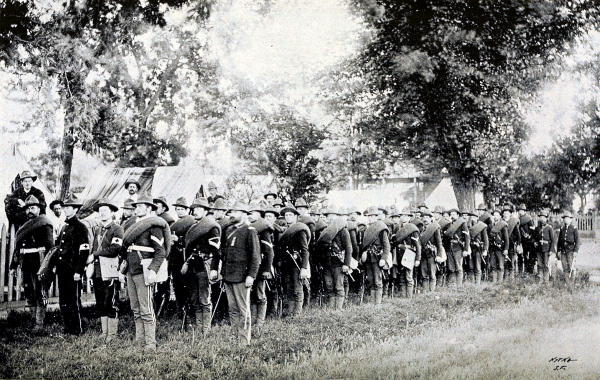
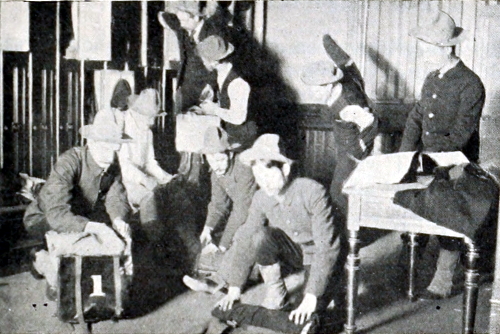
B COMPANY IN HEAVY MARCHING ORDER, SACRAMENTO, JULY, 1894.
CHAPTER I.
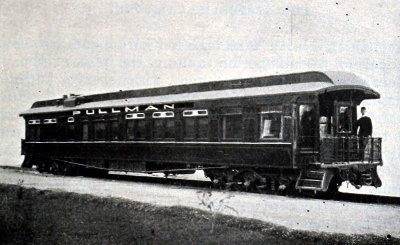
THE CAUSE (?)
THE STRIKE AND ITS EFFECT.

AS the tiny stream that wends its course down the
mountain slope on the way to the sea grows gradually
larger and deeper by the successive uniting with
it of similar streams until at last it becomes the mighty
river in which its identity is completely lost, so a small
labor movement springing up in a little town named
Pullman in the vicinity of Chicago, and spreading out westward
and southward, became larger and greater at each successive
juncture with it of the employees of the railroad until
at last, when its progress was stopped by the cool waves of the
Pacific, it had grown to be a movement of gigantic proportions,
stupendous in its effects, in which the primal cause of
the movement was lost. California was particularly affected.
Never before in the history of the State had she experienced
such a movement as this. Traffic was completely stopped.
Business was paralyzed. Goods could neither be received nor
sent away. Merchants were laying off their employees and
getting ready to close up their houses. Not a wheel of the
Southern Pacific Company was turning in the State.
This movement had its source in a disagreement between
the managers and the employees of the Pullman Car Manufacturing
Company. By successive reductions the wages of
the employees had become greatly reduced, far below that
which the existing condition of affairs would seem to justify.
This, considered with certain other circumstances, caused a
great deal of dissatisfaction among the men of the works.
The accompanying circumstances, which served to intensify
the dissatisfaction, were of a nature peculiar to the town of
Pullman itself. A fair estimate would place the inhabitants
of this town at about four thousand, all of whom are directly
or indirectly dependent for subsistence upon the Pullman Car
Manufacturing Company. Not only are they connected with
the company by bond of employer and employee, but also are
they related as landlord and tenant, and as creditor and debtor.
Pullman has been nicknamed “the model town.” But there
is more than one way of looking at this model town, just as
there is more than one way of looking at a model jail. To a
man like Carlyle, who had no sympathy for transgressors of
the law, a jail like the famous Cherry Hill prison of Pennsylvania
would be a model jail; for here a prisoner is confined
in a single cell for the entire term of his confinement, with
no other occupation than that of picking jute. But to the
prisoner himself who is incarcerated there, it is a model jail,
where he “who once enters leaves all hope behind.” So
with the town of Pullman. To the stockholders of the Pullman
Car Manufacturing Company, who see in its organization
innumerable opportunities for enriching themselves at the
expense of the workman, it is a model town. But to the poor
employees, who encounter at every turn the grasping hand of
the monopoly, it is a model town symbolical of all that characterizes
slavery. In the hands of the Pullman Car Manufacturing
Company resides the entire property of the town.
They not only own the water and gas works, and the houses,
but also sell to their employees the very necessities of life.
All the inhabitants of the town are tenants; none are freeholders.
From this it is easy to imagine the situation when
a large cut was made in the wages. The corporation, you
may be sure, never thought of making a corresponding reduction
in the rent of the houses, or in the water and gas rates,
or in the price of food. With greatly reduced wages, reduced
to considerably less than what the artisans engaged in similar
crafts were getting in the adjacent municipality of Chicago,
and with rents and water, and gas rates correspondingly
higher, the Pullman Car Manufacturing Company expected
its employees to adjust themselves to the new condition of
affairs. The chasm, however, was altogether too wide to be
bridged. The men were compelled by the force of necessity
to resist the reduction.
About the beginning of May, 1894, a committee of thirty-nine,
representing every department in the works, waited
upon Mr. Pullman, president of the company, and laid the
case before him. They asked that the old rates, which were
one-third higher than the present rates, be re-established.
In spite of the fact, that at about the time the committee
waited upon Mr. Pullman the company was paying large
dividends, and had an enormous reserve fund, and further
still, in spite of the fact, that Mr. Pullman had enough of
spare cash to donate one hundred thousand dollars to a
church, the petition was denied. The plea given was, that
the state of business would not stand the increase of wages.
The matter did not stop here. The car company was very
indignant at the apparent intrusion of the workmen into the
affairs of their business. How dare employees suggest to
them how they shall conduct their business. The outcome
of it was, that the men who formed the committee were individually
discharged from their service. This was the straw
that broke the camel’s back. The entire body of workmen
struck. This was the direct strike.
A new element now enters into the strike. The employees
of the Pullman Car Manufacturing Company, as a body, were
affiliated with an organization known as the American Railway
Union. The constitution of this latter organization was
of such an elastic character as to be capable of being stretched
so far as to include not only those who worked for the railroad
proper, but also all who were employed upon any kind
of railroad work whatsoever. The strike was referred by the
workmen of Pullman to this higher body for settlement. The
American Railway Union investigated the grievances of the
men, and concluded that the strike was a just one; one worthy
of their support. On June 23d, after having tried for a
period of six weeks to adjust the difficulties between the men
and their employers without success, the Executive Board of
the Union gave notice to the Pullman Car Manufacturing
Company, that, unless they agreed to the terms of settlement
by the 27th of June, a boycott would be placed upon
all Pullman cars. In other words the members of the union
would refuse to handle any trains to which were attached
Pullman cars. The 27th of June coming around with no
signs of compliance on the part of the Pullman Company
the threat of the union was put into execution. The entire
Santa Fé System, comprising about seventeen different lines
and operating throughout that part of the country southward
of Chicago to the Gulf and westward to the Pacific, was
affected. This new phase of the strike, known as the sympathetic
strike, was destined to be the greatest labor movement
that America had ever experienced.
This is the method by which the American Railway Union
undertook to bring the Pullman corporation to terms. In
their letter to the public they stated that it was not their
intention to tie up the railroads. They were willing to handle
trains, provided Pullman cars were left off. This was, they
said, the only means they had of striking the Pullman Car
Manufacturing Company. In case a quarrel arose between
them and the railroad companies it would be a quarrel that
was forced upon them, and not one of their choosing. The
railroad companies, on the other hand, were unable to separate
their interests from the interests of the Pullman Car
Manufacturing Company, so they took the quarrel upon their
own shoulders. They were determined to send trains out
with Pullman cars attached, or else they would not send
any at all. On the 27th of June, the day that the boycott
was placed upon Pullman cars, traffic over the entire Santa
Fé system came to a standstill. The railroad employees, that
is, those employees who were engaged in the strike—the firemen,
switchtenders and switchmen—refused to move trains
with Pullman cars attached, and the railroad companies
refused to send out trains without them. And so began the
sympathetic strike.
Every State, in which the lines of the above-mentioned system
operated, was severely affected. In the East the unique
position held by Chicago with regard to the different lines of
railroads made it the hotbed of the strike. Seventeen different
lines meet in Chicago. These being tied up, Chicago
became the congregating point for many thousand strikers,
some of whom were exceedingly desperate characters. Chicago,
in the course of the strike, was the scene of many aggressive
operations, and numerous were the conflicts between
the troops and strikers, of which some resulted in fatalities.
In the West the strike presented some features which were
not manifested in the East. No State suffered more severely
from the strike than did California. That the effect was so
severe on California was due probably to its isolation; to its
entire dependence upon railroad transportation, and to the fact
that a great part of its produce consisted of fruit, which has
to find a ready market in the East. These facts, coupled with
the fact that the tie-up came at that time in the year when
the fruit was ripe and ready for shipping, and thus dependant
upon rapid transportation for its value, are evidence
enough of the injurious effects of the strike upon California.
And yet, in spite of the ruinous consequences, it is strange to
say that the sympathy of the people was almost unanimously
with the strikers. The press of California has been severely
criticised by the Eastern press for the manner in which it
espoused the cause of the strikers. Yet the California press
was only reflecting the opinions of the people.
The first scene of act one of the strike in California took
place on the 27th of June. The overland trains, which are
the only trains that carry Pullman cars with the exception of
the Yosemite, did not leave the Oakland mole that day as
usual. Throughout the 27th and part of the 28th all other
trains ran as usual. But on the 28th President Debs of the
American Railway Union telegraphed from Chicago to the
heads of the local unions to tie up the entire Southern Pacific
Company. The strike now began to operate in California
with full force.
In such railroad centers of California as Los Angeles, Oakland,
and Sacramento the strike assumed threatening aspects.
In Sacramento the aspect was particularly alarming. Los
Angeles and Sacramento are the two controlling centers for
all lines that leave the State. The strike in neither Los
Angeles nor Oakland reached the importance or received the
attention that it did in Sacramento. This was due to the fact
that in Los Angeles it was brought under control before it
gained much headway. While in Oakland, though Oakland
was invested by a large number of strikers who managed to
do a good deal of mischief and damage, such as cutting the
air-brakes on freight trains, and even going so far as to stop
the entire local system, thus compelling the residents of the
bay towns to resort to a provisional ferry; yet even while
they did all this, it made little practical difference to the outcome
of the strike whether the strikers reigned there or not
as long as Sacramento or Los Angeles remained under their
control. Sacramento and Los Angeles therefore were the
backbone of the strike in California.
As the time wore on a peaceful settlement of the strike
seemed to grow less. The railroad company, on the one
hand, was determined not to yield. The strikers, on the
other hand, were getting impatient and angry at the rigidness
of the railroad officials, and with this, growing more conscious
of their power, seemed ready to set aside all legal
restraints and resort to violent deeds to force an acquiescence to
their will. Sacramento, where the strikers held forth in full
sway, was the point toward which the attention of the people
was directed. Speculation became rife as to what would be
the outcome. That things could not continue in such a state
much longer was universally conceded. The seriousness of
the affair, however, kept rolling on. Complaints of people
tied up at the different places in the State were increasing
every day. Baggage and freight was accumulating with
wondrous rapidity. Delayed mail—and here is where the
strikers came in conflict with Uncle Sam—was piling up on
every hand. It was only a question of time when the dam
would break.
It was on June 29th that the first rumors were heard
about calling out the State troops. A situation like this
cannot fail to be other than closely related to the life of the
National Guard. While California had been hitherto practically
free from movements of this kind the Eastern States
had not been so fortunate. It seems next to an impossibility
for a railroad strike of any size to occur without its being
accompanied by violence and crime. Time after time had
the Eastern National Guard been called out to suppress
strikers, who had finally deteriorated into rioters. The one
seemed to follow the other as effect follows cause. As soon as
a strike was inaugurated the people of the East looked for
the effect, namely the calling out of the National Guard.
This mode of thinking influenced the thought of California.
The people now began to look to the State troops. The members
of the National Guard were especially interested in the
situation, for when they joined they little thought that they
would be called upon to face any real danger. A sham battle
at camp was about as near as they ever expected to get to
an actual engagement. But as things began to look serious,
their interest in affairs grew in intensity. “Great Heavens!
we might be called out.” So they anxiously awaited further
developments.
CHAPTER II.
THE NATIONAL GUARD CALLED OUT.

ON July 1st Uncle Sam took a hand in the game.
Attorney General Olney sent instruction to the United
States district marshals, whose jurisdiction was over
that territory affected by the strike, to execute the process
of the court, and prevent any hinderance to the free
circulation of the mails. In accordance with these orders
the United States marshal of the Southern District of California
called upon General Ruger, commander of the western division
of the Regular Army to furnish assistance at Los Angeles. Six
companies, three hundred and twenty men, under the command
of Colonel Shafter, were dispatched on July 2d for this
place. They left San Francisco on the 10:30 P. M. train. To
act in conjunction with the Regular Troops, Barry Baldwin,
United States Marshal for the Northern District of California
was at Sacramento with a large number of deputy United
States marshals, sworn in for the occasion. The plan was
to break, almost simultaneously, the blockade at these two
places. The regulars experienced but little difficulty at Los
Angeles. Not so, however, with the United States marshal
and his deputies at Sacramento. The mob of strikers here
was larger, more desperate, and better organized than at
any other place in the State. On the afternoon of the
3d of July Baldwin attempted to open up the blockade. The
operation of making-up the trains was calmly watched by the
strikers. Everything seemed to be going smoothly, when all
of a sudden at a given signal the strikers rushed forward, and
in a few minutes demolished what had been the result of several
hours labor. At this the wrath of Marshal Baldwin
knew no bounds. He attempted to force his way through
the strikers, but was thrown several times to the ground.
Regaining his feet after one of these falls he drew a revolver;
but, before he could use it, he was seized and disarmed, and,
were it not for the presence there of some cool heads, would
have been severely handled. The marshal seeing the hopelessness
of the situation withdrew, leaving the depot in possession
of the strikers. That very afternoon, however, he
called upon Governor Markham for military assistance to aid
him in forcing and maintaining a free passage for the mails.
In response to this call Major General Dimond of the National
Guard of California was ordered to furnish the necessary
assistance, using his discretion as to the number of men required.
It was deemed advisable to call out a large force, as
the experience of the Eastern militia in strike troubles showed
that the display of a large force had a salutary effect. The
following troops were ordered out: Of the Second Brigade,
commanded by Brigadier General Dickinson, the First Regiment
Infantry, under the command of Colonel Sullivan, the
Third Regiment Infantry, Colonel Barry commanding; one-half
of the Signal Corps, under the command of Captain
Hanks, and a section of the Light Battery, consisting of Lieutenant
Holcombe, twelve men and a Gatling gun; of the Third
Brigade, Companies A and B of the Sixth Regiment, under
the command of Colonel Nunan; of the Fourth Brigade,
commanded by Brigadier General Sheehan, Companies A, E,
and G; of the Second Infantry Regiment, Colonel Guthrie
commanding, the Signal Corps and Light Battery B. In all
about one thousand men. The following troops were ordered
to hold themselves in readiness: The Fifth Regiment Infantry,
Colonel Fairbanks commanding, consisting of two companies
in Oakland, one in Alameda, one in San Rafael, one in
Petaluma, one in Santa Rosa, and one in San Jose; the Second
Artillery Regiment, Colonel Macdonald commanding, and
the First Troop Cavalry, commanded by Captain Blumenberg.
The San Francisco troops were ordered to be ready to leave
that evening. Companies A and B of Stockton, under command
of Colonel Nunan, were ordered to be ready to join the
San Francisco troops as they passed through Stockton the
following morning. The Sacramento troops were to join the
main body upon their arrival at the Capital City.
Colonel Sullivan received orders to assemble his troops
at about 5:35 P. M. Colonel Barry was notified a little later.
Both proceeded immediately to carry out their orders. The
calling out of the troops had been anticipated by the officers
of the National Guard. On Monday evening, July 2d, Colonel
Sullivan called a meeting of the company commanding officers
and arranged with them a plan that would insure the effective
and rapid massing of the troops. The plan was this: The roll
of each company was to be divided up into squads and a non-commissioned
officer assigned to each squad, whose duty it
would be, in case it became necessary, to see that the members
of that squad were notified. Experience proved that
the plan was exceedingly effective. Captain Cook lost no time
in applying it to Company B. On the very same night he
assembled the non-commissioned officers of the company, and
assigned a squad of the company to each. Further, each
non-commissioned officer, for the purpose of expediency, was
given the following pre-emptory order:
“San Francisco, July 3d, 1894.
“Company Orders No. 8.
“You are hereby commanded to report at
your armory immediately in service uniform upon reading
this order. Bring your blankets, suit of underclothing, and
two days’ rations to pack in your knapsack. Report without
fail. Let B Company be the first in line for suppressing riot.
Irving B. Cook, Commanding Company.”
This was the plan by which the company was to be massed
at short notice When the time came to test its effectiveness
it had been so well applied to the company that it was like
pressing the button and the entire machinery started in
motion. Within an incredible short space of time after Captain
Cook received orders to assemble his company, non-commissioned
officers in charge of squads were speeding on
their respective missions of notification. Many members,
hearing that the militia were called out, reported without
receiving any official notice. Company B was not the only
company, nor was the First Regiment the only regiment, that
had taken time by the forelock and laid plans for the rapid
massing of their men. Subsequent developments showed that
arrangements had been made beforehand in all the companies
of both regiments and that these arrangements had well fulfilled
their end.
Thus far we have but considered one end of the action.
Let us therefore transfer ourselves to the other end, namely
the thresholds of the homes of the members. Here scenes
occurred the memory and influence of which will never be forgotten.
What a feeling of gloom and of sadness settled upon that
household after the notifying officer had hurried up the steps,
rang violently the door-bell and notified him, who was both a
member of the family and a member of the National Guard,
to report for duty at the armory. We may now talk lightly
of the things we have done. We may now laugh heartily
over the experiences of those campaigns. The public may
sneer at the results which we have accomplished, but who could
say on the night we were called out that the duty which we were
ordered to perform was not such that we had no assurance
of ever returning again to the bosom of our families. Is
there a man who would speak lightly of the tear that glistened
in the mother’s eye or the quivering of her lips? Who is
there that would ridicule the sobbing of the sisters and of
the wives, or sneer at the deep, heartfelt emotion of the
father hidden beneath a gruff voice. Shame on him who
has for these no thought but scorn! “Parting is such sweet
sorrow,” the poet sings. Until the night of the 3d few of
us however recognized this truth. Parting is sorrow, but ah!
how sweet it is to know something of that great affection with
which we are held. Thank God there come such times as these
when the mist of humdrum life is lifted and we behold our
position in the hearts of our family.
Many of us still remember how, while in our boyhood
days, our souls used to thrill and how inspired we were when
we read that after the battle of Lexington, old Israel Putnam
left his plow yoked in the fields, mounted his fastest horse,
hurried to Boston and offered his services to his country.
But when we left those happy days behind us and went out
into the cold, prosaic, and selfish world, and thought of Putnam’s
noble and inspiring patriotism, a feeling of regret
would arise within us to feel that there were no more Putnams.
But during the late excitement we were undeceived.
Right here among us we have such patriots. Patriots whose
example ought to inspire and thrill every citizen. Like Old
Putnam, they also paused in the midst of their toil and,
without waiting to be notified, hastened to offer their services
to their State. Would that the grave could open up, so that
Old Putnam might rest contented in the belief that the
destinies of this Republic are presided over by young
patriots worthy of their revolutionary sires.
To come back to the First Regiment Armory again.
Throughout the evening it presented both inside and out an
animated appearance. Fully five hundred people were gathered
in front of the armory watching the course of developments.
Inside of the armory men were hastening to
and fro. Others were gathered into groups talking in an
excited tone over the unusual event. In Company B’s rooms
members were busily packing their knapsacks, rolling their
blankets, and getting into their uniforms. Every now and
again some member who was notified late in the evening
would come running in and endeavor to make up for lost
time. The experience of being called out was to them a
novel one. Whoever thought that they—the National Guard,
the “tin soldiers”—would ever be called upon to do anything
more arduous or dangerous than to parade the streets on a
holiday for the sake of eliciting admiration from the fair
sex. Here was an opportunity for them of a lifetime to dissolve
forever the charge of the contemptuous wretch, who
stands upon the edge of the sidewalk during a parade of the
National Guard and sneeringly remarks: “If they only smelt
powder, how they would run.” Every member of the Guard
determined that they would on this occasion establish a reputation
far beyond the possibility of ever being open to the
charge of being “sidewalk soldiers” again. They would—and
many a noble resolve was made that night. To those
standing upon the street watching the preparations of the
militia to depart and who derisively jeered, the men said
nothing, but to themselves said: “You just wait a few days my
fine fellows and we will show you what we can do.” But alas,
who can ever tell what the wheels of time will bring forth.
At the same time everyone was more or less excited. Some
were gay, others were thoughtful, and again some probably
felt a peculiar sadness, feeling perhaps as though they were
taking their last leave of those persons and things which
were closely associated with their lives. Even the turning of
the key of their locker was done with tenderness. For who
knew that this would not be the last time. All, however,
were ready for orders.
At 9:40 P. M. the command was given to “fall in.” Company
B proceeded to the drill-hall, where they were formed
by First Sergeant A. F. Ramm. On roll-call the following
men answered to their names:
| Captain |
I. B. Cook. |
Private |
Hayes, |
| 1st Lieut. |
E. C. Lundquist |
“ |
Heeth, A., |
| 2d Lieut. |
Geo. Filmer. |
“ |
Heizman, |
| 1st Sergt. |
A. F. Ramm. |
“ |
Kennedy, |
| Sergt. |
B. B. Sturdivant, |
“ |
Keane, |
| “ |
A. H. Clifford, |
“ |
Lang, |
| “ |
W. N. Kelly. |
“ |
Monahan, |
| Corp. |
J. N. Wilson, |
“ |
McKaig, |
| “ |
B. E. Burdick, |
“ |
O’Brien, |
| “ |
E. R. Burtis, |
“ |
Overstreet, |
| “ |
A. McCulloch. |
“ |
Perry, |
| Musician |
Gilkyson, |
“ |
Powleson, |
| “ |
Murphy, |
“ |
Radke, R., |
| “ |
Rupp, |
“ |
Radke, G., |
| “ |
Wilson. |
“ |
Sullivan, H. B. |
|
|
“ |
Stealy, |
| Private |
Adams, |
“ |
Sieberst, V. |
| “ |
Bannan, |
“ |
Shula, F., |
| “ |
Baumgartner, |
“ |
Sindler, |
| “ |
Claussenius, G., |
“ |
Tooker, |
| “ |
Claussenius, M., |
“ |
Unger, |
| “ |
Crowley, |
“ |
Wise, |
| “ |
Flanagan, |
“ |
Wilson, R. E., |
| “ |
Frech, |
“ |
Williams, |
| “ |
Fetz, A., |
“ |
Warren, |
| “ |
Gille, |
“ |
Wear, |
| “ |
Gehret, A. C, |
“ |
Zimmerman. |
Upon the completion of the roll-call the company was
turned over to the command of Captain Cook. In five minutes
the entire regiment was mustered and formed in a hollow
square. The size of the companies spoke volumes for the
reputation of the regiment. It was now a little over three
hours since the non-commissioned officers started on their
tours of notification, and probably not more than an hour
since some of the members were notified; still, here was
almost the full regiment, thirty officers and three hundred
and forty-six men, prepared to march. The zeal and alacrity
with which the orders were obeyed is worthy of commendation.
The men as they stood in ranks, attired in their
campaign uniforms, their knapsacks and blankets strapped
to their backs, presented a striking appearance. May their
appearance that night never fade from our memories. Colonel
Sullivan stepped into the center of the square and made
the following remarks:
“Men, we have been ordered to Sacramento to preserve the
peace and dignity of the State. This is not a picnic trip; it
is a serious duty. I have confidence that every man will do
his full duty. I hope that our members will impress the
enemy with the fact that we mean business, and I hope that
no other recourse will be necessary. But if it becomes necessary
to give orders to use ball and cartridge you must do it.
You must remember that your own lives are at stake, and you
will fire low, and fire to kill. These are hard words, but they
are necessary words. I hope that we will return with the
full number assembled here, and with honor and credit to the
regiment. Fours right!”
Each company executed the necessary movement, and
marched out of the armory. The march was continued uninterrupted
down Market street until Spear street was reached.
Here a halt was made, and ammunition served out to the
troops—twenty rounds to each man. The ammunition being
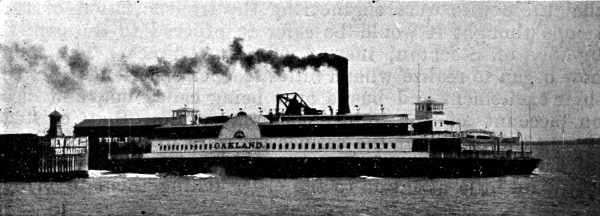
distributed, the regiment marched upon the steamer Oakland,
where they were joined shortly by the Third Regiment Infantry
of twenty-six officers and two hundred and fifty-one men,
and at ten minutes past eleven o’clock the troops bade farewell
to San Francisco, and started for their destination.
The farewell reception the troops received from the public
on their way down Market street, and while at the ferry, was
one of a very mixed nature. Among the persons gathered to
see us take our departure were a large number of men endowed
with socialistic tendencies, whose view of the situation
was so narrow that they viewed the calling out of the militia
as an act of the Government’s to abet the railroad company in
oppressing its employees, and not as an act necessary to
maintain the laws of the land which guarantee to all equal
rights in the protection of their property. These men jeered
and cast all sorts of slurs at the men as they marched along.
They sincerely wished that the strikers would give the troops
their quietus. This was one extreme. The other extreme
was made up of men of equally as narrow a view. These
seemed to think that the workman had no rights whatever,
and above all things, not even a shadow of a right to strike.
They believed, or, if they did not believe it, they certainly
acted as if such were their belief, that the workingman should
submit to all restrictions placed upon him, and that, if he
attempted to rise above his conditions, then the Government
should force him back again. These are the men who called
upon us to blow the scoundrels to pieces. Between these two
extremes there was a third element, made up of men who had
a true insight into the condition of affairs: men who fully
recognized the place that strikes hold in the development of
the human race; men who detect in these visible presentations
of discontent the conscious awakening of the workingman
to a noble conception of his place in the history of
civilization. It was from this stamp of men that the militia
received its real encouragement; for they saw plainly that the
ends of the workingman could not be attained through the
disregard of the laws, but it was only by his developing with
them and through them that he could even reach his true
plane. Therefore, above all things, they desired to see the
supremacy of the laws maintained. Viewing the calling forth
of the militia as an instrument by which this was to be
accomplished, they cheered and urged the troops to do that
duty they had sworn to fulfill.
Upon the steamer Oakland reaching the other side the
troops disembarked and marched up the mole. They were
wheeled into line and halted. The command “Rest” was
then given. Here the first of a series of provoking delays
took place. The trains, which were to bear the troops to their
destination were not fully made up; consequently the troops
had to remain standing, at the time they most needed rest,
upon the cold asphaltum for fully an hour. This does not
speak well for those who were managing the transportation
of the troops. It was extremely aggravating to the men,
fatigued as they were after their march down Market street
laden with baggage, to feel that, had a little foresight been
exercised, they, instead of being compelled to stand upon the
pavement for over an hour, might have passed that time in
resting. A soldier, even though he is of the rank and file, is
a human being, and needs as much rest as any other human
being. At 1 A. M., July 4th, the troops were ordered aboard
the train, and a start was made for Sacramento. The train
was divided into two sections. The First Regiment was on
board the first section, while the Third Regiment, together
with the section of the Light Battery, occupied the second,
and which followed after the first at about an interval of ten
minutes. Major General Dimond and staff accompanied the
troops, and took passage on the second section. Brigadier
General Dickinson and staff journeyed on the first section.
Each company had a separate car assigned to them. The
members of Company B lost no time in relieving themselves
of their knapsacks and blankets. Some of the men made up
berths at once with the intention of getting as much rest
and under as favorable conditions as possible. Others however
thought it a waste of time to go to all this trouble for
what they supposed would be but a few hours rest; so they
simply stretched their legs upon the opposite seat and thus
went to sleep. Here was another mistake. How much better
it would have been had the men been informed that instead
of a three hours’ journey before them they would be on the
road eight or nine hours. The men then would have made
due preparations for a good night’s rest. The Keeley Club,
of which more will be related hereafter, appropriated a section
of the sleeper to themselves, and, not knowing but what
the days of some of them were numbered, proceeded to
have a good time while they yet lived, for they knew that
if any of their number did fall in the conflict with the
strikers, that they would be a long time dead. All the
early hours of the morning sounds of revelry could be heard
coming from their apartment. Every now and again some
tired individual, whose repose was broken by these revelers,
would impatiently demand in language more forcible and
expressive than can be represented here why it was they
could not keep still. Ever and anon Captain Cook’s voice
would be distinguished above the dim. “That will do now,
let us have more quiet.” The effect of these commands was
but temporary. A moment later they were at it again. And
so passed the morning.
Precautions were taken to attract the least amount of attention
possible. The window-shades were drawn so as to prevent
the gleam of lights from tempting missiles from the strikers.
In spite of these precautions, just after the train passed Sixteenth
Street Station, a rock was hurled through the window
of the cab of the second section narrowly missing the head of
the engineer. Before the First Regiment left the armory,
details were selected from each company to act as train
guards, and placed under the command of Lieut. Thompson
of Company G. Their special duty was to guard the
engine. Company B, Third Infantry, Captain Kennedy commanding,
was detailed as train guard for the second section.
Besides these guards sentinels were posted by the First Sergeants
of each company at both ends of the cars. These men
were stationed upon the platforms and relieved every hour.
Their orders were of a twofold nature: First, they were to
prevent anyone from leaving the car; Secondly, they were
to alight whenever the train stopped and see that no one
interfered in any way with it. Any person they saw
approaching the train they were to call upon to “halt.”
If the order was not obeyed they were to warn him, and
finally if this proved ineffectual they were to fire upon him.
Each sentinel loaded his piece as he went on duty. No
sentinel had occasion to carry out literally his orders as the
journey to Sacramento was practically uneventual. At Sixteenth
street, Oakland, the train was delayed for a short
time. Here it was found that the Block switch system would
not work, the pipes containing the wires having been cut,
thus rendering the entire system useless. The nature of the
damage having been ascertained, the train proceeded on its
way.
When the train stopped at Sixteenth Street Station the
sentinels alighted in pursuance of their orders. There
were a considerable number of people gathered at this place.
Here it was that an unknown person, who was evidently a
striker bent on mischief, but who claimed to be a deputy
marshal, was given an opportunity of measuring the caliber
of the men of the “City Guard” and of the National Guard
in general. This person emerged from the crowd and was
approaching the train, when Private George Claussenius,
noticing him, called upon him to halt. The fellow, not a
bit disturbed merely said: “Oh, that’s all right, I’m a
deputy marshal.” This explanation might have been
accepted in some quarters, but this time he knocked upon
the wrong door. Claussenius quickly threw up his rifle,
and forcibly said, “I don’t care who you are; Halt!” The
man paused, undecided whether to advance or retreat. Lieut.
Lundquist, who was standing upon the platform, took in
the situation. “Claussenius,” he quietly said, “if that man
advances a step further shoot him.” In an instant the man’s
indecision vanished. He turned and slunk back into the
crowd. The man’s identity was never ascertained. If he
was a striker the reception he received was a proper one;
and if he was a deputy marshal he can thank his stars that
his departure was not accelerated by the prod of a bayonet.
These men, recruited in many instances from the scum of
mankind gave themselves the airs of a Lucifer. But before
the campaign was over more than one of them was taken
down a peg or two by the different members of the National
Guard.
At Tracy Private O’Brien had an amusing experience with
a rustic. It was early in the morning. The sun had just begun
to trace his westward course in the heavens. The fields,
with one exception, seemed deserted, as far as the eye could
stretch. The air held a deep stillness which was broken only
by the sweet singing of the birds and disagreeable snoring of
the soldiers. It was a beautiful opening of a Fourth of July
morning. Crossing one of the fields at this time was a country
rustic who, upon seeing the train, had his curiosity
aroused; so, changing his direction, he advanced toward it.
It so happened he approached the car that O’Brien was guarding.
What a queer specimen! He was attired as the rustic
is generally represented upon the stage. His trousers were
drawn up almost to his neck by an abbreviated pair of suspenders.
His head was covered by a well-battered straw hat,
and his feet incased—O’Brien swears that they were number
14—in a cowhide pair of boots. O’Brien amusingly sized him
up until he arrived within about four feet from the car, then
suddenly stepping forward he brought his piece with a snap
to the “charge bayonet,” and cried out sharply “halt.” Astonished
at the unexpected sally, the rustic started involuntarily
backward and exclaimed, “Why the gol darn thing’s got
stickers on ’em.” A visible representation of the stickers was
enough for the countryman. He did not approach closer.
The men as they awoke into consciousness that morning,
but little refreshed by their short repose, were surprised to find
that Sacramento was still a considerable distance off. It seems
that those who were engineering the transportation of the
troops thought it would be safer to proceed to the capital
by way of Stockton, instead of going direct. The men
now began to realize what a bitter teacher experience is. In
their excitement and bustle over being called out, and also
on account of the pretty general opinion that existed
among the men that the service we were to perform would
not last more than a day or two at the most, many of the
men paid little attention to the order telling them to bring
rations and underclothing. As the morning gradually advanced
unto noon their stomachs began to remind them
that it was time to eat. They were ready to eat; but what?
That was what troubled them. Fortunately the company is
possessed of some far-sighted minds when the subject under
consideration is the stomach. These men had brought with
them a good supply of food. But even when these divided
their supply in true Samaritan style, the quantity given to
those that did not bring food was so small that it alleviated
but slightly the pangs of hunger. Company B suffered less in
this respect than did the other companies. A large number
of B’s men love their stomach too well to run the smallest
chance of having it suffer. Future developments will disclose
what dreadful effects the misusing of their beloved organ
had upon the men. The hungry mortals looked forward
longingly for their arrival at Sacramento. For here surely
they would be adequately supplied. But they were doomed
to disappointment. Adjutant General Allen worked upon
this hypothesis, that if the men did not bring the rations he
ordered them to, they themselves were to blame and must
therefore suffer the consequences. But how foolish is such
reasoning. What if the men are to blame? Is it not the
duty of a general to see that his men receive the proper subsistence.
It is indeed a poor commander who hopes for success
and at the same time allows his men to suffer hunger in
the midst of plenty. Happily the men did not know what
awaited them, they were content to live in hopes.
The train passed through Stockton at about 6:30 A. M.
Here Companies A and B of the Sixth Regiment were standing
in line ready to join the San Francisco regiments and
proceed to the capital. They were taken on board the second
section. The journey from Stockton was soon finished, and
at 8:30 A. M. the first section arrived in Sacramento, and
stopped at Twenty-first street.
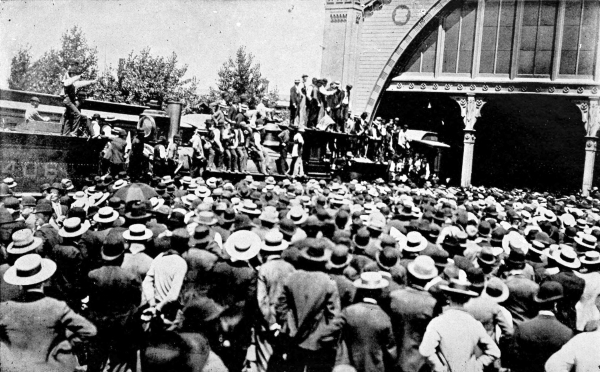
THE MOB IN FRONT OF THE DEPOT AT SACRAMENTO, JULY 4TH, 1894.
(BARRY BALDWIN HARANGUING THE STRIKERS FROM
THE TOP OF A PULLMAN CAR.)
CHAPTER III.
FOURTH OF JULY AT SACRAMENTO.
“In war take all the time for thinking that the circumstances
allow, but when the time for action comes, stop thinking.”
Andrew Jackson.
SACRAMENTO at last! Ah, boys, little did we think
when our section pulled in at Twenty-first street,
that we were now on the future field of the great
and glorious, but bloodless battle of “The Depot.” The
battle of strategic “co-operations” and still existing
“truces,” in which we were destined to take such a
prominent “standing” part.
Sacramento! The scene of our future troubles and joys
(much of the former but how very few of the latter). Our
troubles began when the order came to sling knapsacks and
form in the street. That never to be forgotten 4th of July
was a banner day for heat, even in the annals of sultry Sacramento;
and as we stepped from our car, tired, hungry, and
oh, my! how hot, we were inhumanely confronted by a large
sign on the side of a brewery, “Ice Cold Buffalo 5cts.” The
eye of many a brave comrade grew watery and his mouth
dry as we stood there in the burning rays of the sun with our
knapsacks and blankets on our backs facing that sign like a
little band of modern Spartans and waiting patiently for the
order to march. Soon the “glittering staff,” armed to the
teeth, passed “gorgeously” by; the order “forward” echoed
along the line, and the “army of occupation” was in motion.
We had arrived and formed at 8:00 and marched at about
8:30. The train stopped at Twenty-first and R streets, and our
line of march to the armory was as follows: North along
Twenty-first to P, along P to Eleventh, along Eleventh to N,
along N to Tenth, along Tenth to L and along L to the armory
on the corner of Sixth, in all fully three miles.
Never before did the Old City Guard participate in such a
4th of July “parade.” After a long night of unrest, trudging
along block after block through the sweltering heat, without
the enlivening sounds of drums or fife, our heavy packs growing
heavier at every step, the salt perspiration blinding our
eyes, and looking up only to see the heat dancing along the
road in front of us, we felt little inclination to joke or notice
the open-mouthed wonder of many of the onlookers. Still
we could hear the remarks of the bystanders, that they
“guessed the strikers felt sick this morning,” or of the
apparently less impressed small boy who “reckoned de strikers
would pop off dat fatty fust.” The betting was even as to
whether he meant Kennedy or Sieberst, but the rival claimants
“co-operated” by rendering a decision.
Worn, weary, and hungry we arrived at the Armory at 9:15,
and found the Sacramento troops, Companies E and G of the
Second Infantry, already under arms. Stacking arms on L
street, and a strong guard being left at the stacks, we were
marched in column of twos into the armory drill-hall where
the now world-renowned “ample breakfast” supplied by
Adjutant General Allen, late Second Lieutenant Commissary
Department Missouri State Volunteers, awaited us. This,
according to General Allen, “ample breakfast,” consisted of
coffee strong enough “to run for Congress,” and bread. Certainly
a very “ample” breakfast for men who had been awake
and traveling all night, many without dinner the evening
before, and executed such a trying march that morning.
Ample, too, when it is considered that this was intended to
serve both as breakfast and lunch, and, it might be dinner.
Thus is a lesson in economy given by the military heads
of this great State to the civil heads who may wish to profit
thereby.
Thus is the frugality of our forefathers, in their great battle
for home and freedom on the shores of the Atlantic, exemplified
on the distant shores of the calm Pacific by our ever to
be remembered Adjutant General, late Second Lieutenant
Commissary Department Missouri State Volunteers.
However, despite our foolish doubts as to the amplitude and
quality of our meal, the shade of the hall and the relaxation
from the fatigue of the march were very welcome.
While we were regaling ourselves a shot was heard fired
in the street in front of the armory; and the report quickly
spread that the shot had been fired by a striker in the crowd,
wounding a soldier on guard at the stacks. This, however,
proved untrue, as it was found that a private of the Sixth,
in loading, accidentally discharged his piece, the firing-pin of
which seems to have been rusty, the cartridge exploding when
he tried to force it home. The bullet struck the front rank
man in the calf of the leg, wounding him severely. Passing
through the guardsman’s leg, it struck on a rock in
the street and split, both pieces glancing into the crowd of
sightseers. In the crowd four persons in all were injured,
more or less severely; one of them, Mr. O. H. Wing, a citizen
of Sacramento, being struck in the abdomen and killed. His
death was deeply regretted by the soldiers; especially so as
Mrs. Wing, his gentle, high-minded widow, wrote to the
soldier, the unfortunate cause of her bereavement, exonerating
him from all blame and assuring him of her deepest
sympathy.
Having finished our ample breakfast the City Guard was
marched from the armory in column of twos, and allowed to
rest in the shade of an awning on the corner of Sixth and M
streets.
Now and all during the campaign which followed the
absurdly childish way in which the press and many of the
people looked on the citizen soldiery, and on the work which
they were doing at the call of their country, was both surprising
and irritating to the men who had left their homes and
business to protect the lives and property of their fellow-citizens.
It is true this was no wild unled mob. It was
worse; as was proven later by the most cold-blooded train
wreck and murder ever perpetrated in the West, that of the
12th of July. A murder far beyond the abilities of our
ignorant Eastern mobs, planned by the leaders and executed
by some of the most important members of the A. R. U.
The absurd position of antagonism to the soldiers taken by
the people was instanced on this first morning in what now
seems a rather amusing incident, though it needed but little
more to make it very serious at the time.
When arms were stacked in the street in front of the
armory guards were posted round the building; L street at
its crossing with Sixth and for a short distance towards Fifth
and Seventh streets being most heavily guarded. This of
course stopped the passage of all teams over this street for
about the distance of a block. As “B” was leaving the
armory to make room for the less fortunate companies which
had not yet been introduced to General Allen’s breakfast, by
this time reduced to bread and water, we saw an infuriated
fool driving a wagon in which were seated two women and a
child, lashing his horse at a furious pace through the line of
sentries. He had passed several, but just at the crossing of
Sixth street met men of sterner stuff. Two sentries, members
of a Sacramento company, who happened to be close together
and in the center of the street, decided to stop his mad
career. One brought his piece to the “charge bayonets” while
the other prepared to grasp the horse by the bridle. This he
did, and did well, just as the horse reared at the pointed
bayonet, carrying the soldier with him. Had he missed his
leap for the bridle the horse would most undoubtedly have
been impaled on the bayonet. The beast in the wagon
became laughably furious when the beast in the shafts was
stopped. He wasted his breath shouting out the usual jargon
about “being a taxpayer,” etc., but it was of no avail; he
was led ignominiously back over the route over which he had
made his glorious charge for principle, greeted by the laughing
jeers of the crowd that cheered him but a moment
before as he made his mad rush to get through. Such is the
uncertainty of public favor.
Here in the shade we waited, amusing ourselves as best we
could, our guards at the company stacks being relieved every
half hour until at 11:15 A. M., we received the order to fall in,
preparatory, it seemed to the unconsulted enlisted man, to
moving on the depot. This was confirmed in our minds
when, having formed at the stacks, we were relieved of the
heavy burden of our knapsacks; these being placed on
wagons impressed for the purpose.
The division formation was made on Sixth street, the boys
of “B” feeling greatly chagrined when they saw Brigadier
General Sheehan’s four companies, “E” and “G,” of the
Second Infantry, and “A” and “B,” of the Sixth Infantry of
Stockton take the van; and surprise, too, thinking, as we did,
that the lack of faith in the Sacramento companies at least
was the real cause of our call for service. Later on that trying
day our misgivings were justified.
The First Regiment under Colonel W. P. Sullivan fell in
behind General Sheehan’s command. The First Battalion,
under Major Geo. R. Burdick, consisting of companies “A,”
Captain Marshall, “H,” Captain Eisen, “G,” Captain Sutliff,
and “B,” Captain Cook; and the Second Battalion under
Major Jansen, consisting of companies “F,” Captain Margo,
“D,” Captain Baker, and “C” under Lieutenant Ruddick.
The Third Regiment of Infantry, Colonel Barry commanding,
brought up the rear, and acted as guard to the baggage.
General Dimond and staff, and the Second Brigade Signal
Corps, Captain Hanks, marched in rear of the First Regiment.
The movement toward the depot commenced at about
11:45 A. M., the companies of General Sheehan’s command
marching in close column of company, and the San Francisco
regiments falling almost immediately into street column formation;
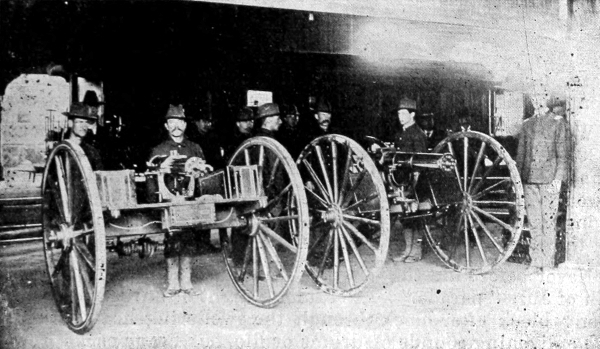
the Gatling gun section of Light Battery “A,” under
1st Lieutenant Holcombe, taking position in the hollow of the
First Battalion of the First Regiment.
To those in the ranks it seemed as though the large crowds
of gayly dressed sightseers which followed us, looked upon
our march as a Fourth of July celebration. This, without
doubt, was the cause of the remarkable sight which greeted us,
as the Sacramento and Stockton companies fell away from
our front later in the day, and exposed to our view a motley
crowd of men, women, and children. It seemed more like a
Saturday afternoon crowd on Market street than a mob
resisting the authority of a United States marshal. Still it
took but a second glance to tell us that the great majority
were strikers.
What interesting studies were our comrades as we marched
quietly along toward the depot; how truly were the feelings
of each depicted on his face. Here and there fear was to
be seen, plainly mingled however, with a determination not
to yield to the feelings. Some, too, seemed to feel an elation
at the approaching conflict, while by far the greater number
marched along with an indifference surprising in men who
were answering their first call for actual service, and that, too,
against men as well armed as they, angry and determined not
to yield a foot. The militia well knew that this was no beer-drinking,
stone-throwing, leaderless mob, to which the East
is so well accustomed; but, on the contrary, that it was a well-organized
and coolly led mob, holding the advantage of position
and determined to fight rather than yield.
As the column debouched from Second street into the
open ground before the depot, men wearing the A. R. U.
badge could be seen rushing in from all directions, summoned,
by furious blasts on a steam whistle, a preconcerted signal
used by the strikers as soon as the intention of our officers
became apparent.
When the head of our column had almost reached the open
west end of the depot the command was halted, our battalion
still keeping its street column formation. Then commenced
a trial far more trying in the minds of most of us than even
the hot fight we had so surely expected, would have been. It
was now high noon and the sun had reached its zenith, the
heat being remarkable even for Sacramento; the road was
covered with a fine dust, which, stirred by the restless feet of
the waiting soldiers, hung in clouds in the warm air, making
breathing almost impossible.
As the column halted, the crowd which had been following
us and which gathered at the blast of the steam whistle rushed
in around the four foremost companies, completely shutting
them off from our view, except for the line of bayonets which
glistened above the heads of the mob. Then commenced a
scene of confusion almost indescribable. Shouts, cheers and
hoarse commands mingling in an uproar that at times was
deafening. The strain on the San Francisco troops now
became intense; the lack of sleep and food, combined with the
terrific heat and the excitement and anxiety of the occasion,
began to have its effect; many of the men tottered and fell.
They were quickly borne off by their comrades in the ranks
or by men of the fife and drum corps, who did efficient service
on that trying day, to the hospital, established temporarily
in the pipe house of the water company, where the Hospital
Corps of the First did heroic work; gaining, as of course, no
recognition thereof by the press.
The uproar in front continued. Suddenly the glittering
line of bayonets fell and shouts from the mob of “Fall in
there!” “Get in front!” “Don’t give a step!” resounded over
the tumult. Anxiously we waited to hear the next order,
which might ring the deathknell of many of our comrades,
when shout after shout pealed out from the excited mob. A
thrill ran along our ranks. “They had thrown down their
arms.” We gritted our teeth and waited breathlessly for the
order to charge. But that order was not to come during that
whole trying day. Three times did the report run along the
line that the Sacramento men had thrown down their arms
and then taken them up again at the entreaty of their officers.
The men in our ranks began to feel disgusted. Was this to be
the performance gone through by each company in turn?
Were they to be cheered and argued with, coddled and cajoled
out of the ranks? Standing there in the dust, burning with
thirst for water we dare not touch, with the thermometer
above one hundred and five degrees in the shade, watching
the farce in front, and looking off toward the vacant unprotected
south front of the depot, knowing well that a corporal’s
squad, if thrown in from the rear, could clear it, and yet
powerless to move, it would have been little wonder if the
best trained regular troops became disgusted. “Why do we
not take the strikers in the rear while they palaver with the
men in front?” “Where are our Generals, not a sign of whom
have we seen since our arrival, and their staffs, numbering
enough in themselves to clear the depot?” However,
“Their’s not to reason why.”
We must stand there and await developments. They were
certainly improving our tempers to fight, for we would have
fought an European host for the chance to get into that shady
depot and escape the burning heat of the dusty road. The
men continued to fall on all sides exhausted, and it seemed as
if the laurels of victory would deck the brow of a third party—Old
Father Sol. The uproar of shouts, cheers, and yells
continued in front. Suddenly a wave of surprise, then of satisfaction,
passed over us. The Sacramento troops were marching
off the ground, followed by a frantic mob of men and
boys. Our chance would come soon. Speculation now became
rife. Would the Stockton men do the same, or would
they press forward against the mob? A few minutes of
tumult, mingled yells and cheers for “Stock” settled the
question for us. We saw the flash of the bayonets as the
pieces were brought to the right shoulder; fours right, column
right, and the Stockton companies marched by, cheered to
the echo by the strikers.
Our turn at last! A yell of “Three cheers for the San
Francisco boys” was answered lustily by the mob. But we
had gone beyond that; we wanted that depot, and meant to
have it if the officers would only give the order. We grasped
our pieces ready for the order, “Forward,” those who were
growing sick and dizzy bracing themselves for a final rush.
But the order never came. Cries for quiet and of “Baldwin”
came from the mob nearest the Depot, and looking over the
heads of the crowd we could see Marshal Baldwin mounting
to the roof of the cab of one of a string of dead locomotives
which stretched along the main line west. He was quickly
followed by three or four leaders of the mob, who succeeded
in quieting the crowd by assurances of “keep quiet”; “one at
a time”; “you’re next”; etc. Now began a novel scene indeed.
Imagine a United States marshal, with six hundred
soldiers at his back, pleading with a mob with, as it seemed to
us, tears in his eyes, to disperse, to surrender the Depot, to
return to their homes. From that moment the strikers knew
that the day was won, that no troops, no matter how willing,
would enter that building while commanded by Marshal Baldwin,
without the strikers’ own kind permission. How that
mob enjoyed our humiliation and the scene of a United States
marshal pleading with them like a child. We had been called
from our homes for active service, and now stood, in all our
useless bravery, the audience of a farce in real life.
The farce proceeded. The men on the cab draped the marshal’s
head with small American flags, exchanged hats with
him, and indulged in a few other pleasantries for the edification
of their friends below.
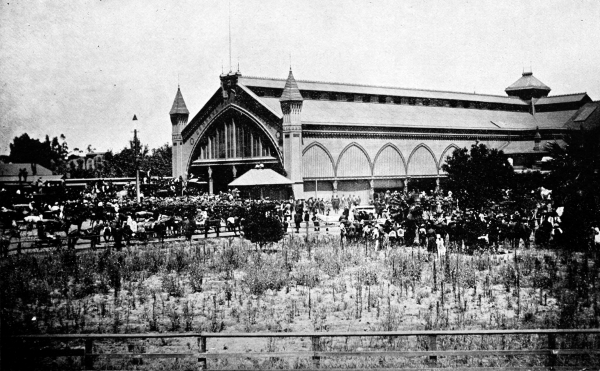
THE DEPOT AT SACRAMENTO, JULY 4TH, 1894.
Failing in his first purpose the marshal now began to plead
for time that he might meet Mr. Knox or Mr. Compton and
talk it over with them; methods which were supposed to have
been tried before the call for military aid. He begged for a
truce until 3 o’clock. Oh, the irony of it! He, the aggressor,
begging for a truce at the hands of a mob until then plainly
on the defensive. They refused the truce, the time was too
short, they said. “Then 5, 6 o’clock,” appealingly spoke the
marshal. Seeing plainly that the day was lost and that any
greater delay would now only be injurious to his own men,
Col. Sullivan of the First, who, by the way, appeared to be the
ranking officer present, though there had been at least four
general officers with us in the morning, stepped upon the cab
and told the mob, not in tones of pleading, but decidedly,
that this truce must be entered into; that his men were not
used to such extreme heat, and that he intended to move them
into the shade. Suddenly Knox, the leader of the strikers,
escorted by a large American flag, emerged from the depot,
cheered loudly by the mob. Now, it appears a truce until 6
o’clock was quickly entered into, and the men who had
marched confidently through the town that morning were,
amid the hoots and jeers of the people, led away, sullen and
dispirited, to a vacant lot by the side of the depot. Here the
men of the First were allowed to rest and take advantage of
such shade as they could find. B and the section of Light
Battery A took possession of an old shed; C and G found
another in rear of the first, which they appropriated to their
own use; D was stretched on the ground a short distance
farther on, and the other companies mingled together in the
shade of some trees some distance to the right of B’s position.
It could now be seen that, among the men, the disgust at the
failure to accomplish what we had come such a distance to
do, was very great. In B, at least, it was deep and genuine.
All during that long sultry day the unprotected front entrance
of that cool, shady building had stared us in the face,
and yet, for some unaccountable reason, we did not get the
order to enter. We felt that the strikers would retire if a
company were thrown quietly in through that end, and were
justified in our opinion, when, some days later, a corporal’s
squad of regulars cleared the place in a few moments.
Under the influence of the rest and shade our excited feelings
gradually became relieved. Talk as we might we could
not improve our situation, so we soon resigned ourselves to
circumstances, and waited as quietly as possible for 6 o’clock.
The men of the Hospital Corps, under whose care 150 men
had been placed during those three hours, now gradually
drew ahead with their work, and soon had all their patients
relieved. Out of the 150 soldiers prostrated we are glad to be
able to say that only three were from B, and even these, after
a few minutes’ rest, were able to lend their assistance to the
Hospital Corps themselves.
Delegates from the strikers now made their appearance, with
the evident intention of getting the soldiers drunk before six
o’clock. Captain Cook, however, ordered his men to accept no
invitations to drink. Not to be baffled, the strikers soon reappeared,
carrying cases of bottled beer, which the captain
quickly refused to allow his men to receive. Still persistent,
a striker stepped into the shade of our shed carrying two quart
bottles of whiskey, which he proceeded to toss amongst the
men. The captain was still on the alert, however, and ordered
the bottles returned, telling the overgenerous striker that he
would not allow his men to receive liquor.
Lieutenant Filmer and Sergeant Kelly were then sent into
town, with orders to purchase two cases of soda water, which,
on its arrival, was quickly disposed of. Quartermaster Sergeant
Clifford, ever watchful, procured at a coffee house close
by a supply of buns, which he quickly manufactured into
sandwiches, and distributed amongst his famished comrades.
The scene had by this time become exceedingly picturesque.
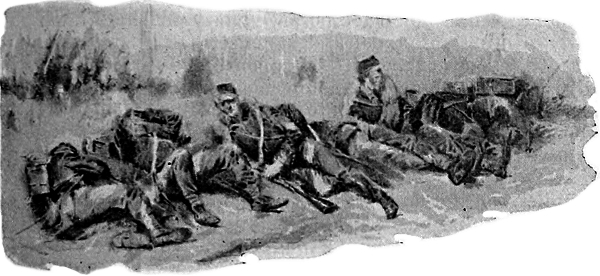
The tired, wearied men had quieted down, some stretched on
the ground sleeping heavily, their heads pillowed on rolled
blankets or on knapsacks; others resting in the same way,
though chatting quietly, and still others were busily writing
letters, using the head of a drum or the back of a knapsack
placed on the knees as they sat on the ground as a desk.
It has been commonly reported that the soldiers became
boisterously drunk, and fraternized freely with the very men
they had come there to fight. If this be so, it was confined
almost entirely to the other commands, no man of the First,
to our knowledge, and most decidedly none of “B,” being
even slightly intoxicated. The afternoon passed slowly by,
no apparent preparations being made to resume hostilities at
the expiration of the truce. Six o’clock came, but with it no
change of position. Now we began to wonder whether or not
our “ample breakfast” of the morning was intended to serve
as supper, too. If that were so, we decided that man’s nature
had changed since General Allen was young, for we certainly
began to feel the pangs of hunger.
Our fears were allayed, however, when, at 6:30, the order
“Fall in for supper” was given. Taking our arms with us,
we were marched, under command of Lieutenant Filmer, to
the State House Hotel, where our display of gastronomic
powers completely dismayed the scurrying waiters.
Returning from supper our pace was an evidence of the
good use we had made of this chance to appease our appetites.
Returned to our shed near the depot, it was evident the
position remained unchanged. The different companies were
either going to or returning from supper at the various hotels.
The evening passed quietly; many of the men sleeping on
the ground where they had thrown their knapsacks.
At about 9:30 P. M. Captain Cook formed the company, and
told us that the First would be removed to the Horticultural
Hall, on the main floor of which we would be allowed to bivouac
that night. The companies were already moving, and
“B,” getting possession of an electric car, was the last company
to leave. The car, as of course, proved to be the wrong one,
and carried us less than half the desired distance. The rest
of the way was covered on foot, the company arriving at the
hall some little time after the other companies had settled
down for the night. What a scene we would have presented
to the eyes of a stranger! Every available foot of floor was
covered with sleeping forms. The band stand and stage were
utilized; even the steps, a very precarious bed indeed, were in
demand; and every corner that appeared to offer security from
draughts had its quota of men.
Thus ended that great and glorious Fourth of July, in the
year of our Lord, 1894. Glorious, indeed, in the annals of
this great Empire State of the West.
Thus, too, does history repeat itself. The Fourth of July!
The anniversary of the Declaration of Independence, and of
that greatest struggle of the Civil War of the Rebellion, the
battle of Gettysburg; and now, for all future ages, to be trebly
honored as the anniversary of the bloodless battle of the Sacramento
Depot.
CHAPTER IV.
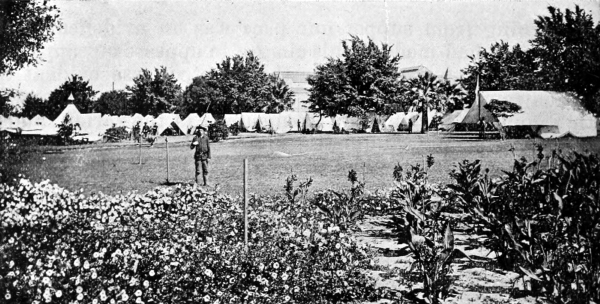
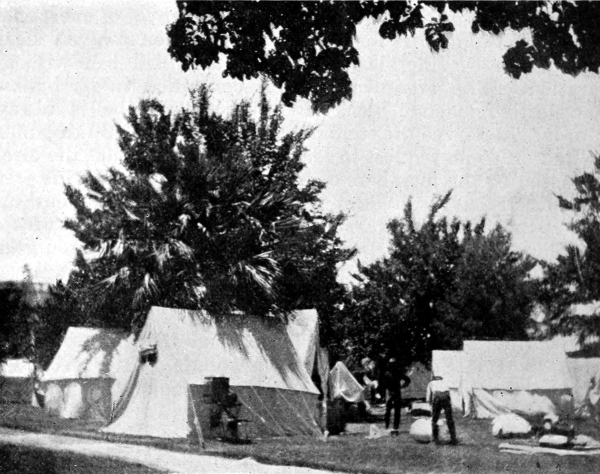
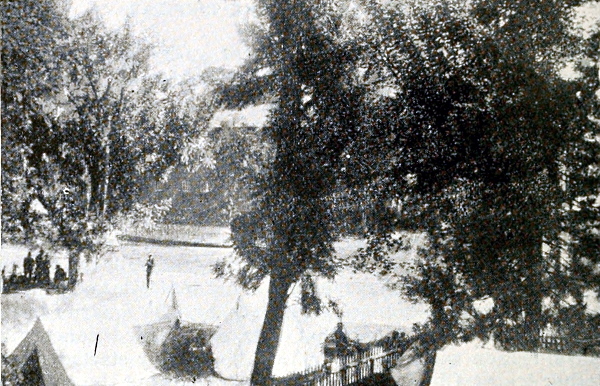
FIRST REGIMENT CAMP, CAPITOL GROUNDS.
CAMP ON THE CAPITOL GROUNDS.

THURSDAY morning, July 5th, the weary members
of the First Regiment were awakened from a comfortless
sleep on the hard floor by the catcalls and
shrieks of the early birds. Company F was quartered
on the band-stand, and, from this point of vantage, sent
up yells that would wake the dead; and clear and loud
above all were heard the strident tones of Tommy Eggert.
Sleep was out of the question, not to say dangerous, for soon
bands of practical jokers were roaming around, like lions,
seeking whom they might devour. Private Hayes discovered
Sergeant Sturdivant in slumber sweet, his lengthy form
enveloped in an immaculate and frilled nightgown, his tiny
pink feet (he wears 10’s) incased in dainty worsted slippers
fastened with pink ribbons; this was too much. Did he
think he was at the Palace Hotel? If he even dreamed of
such a thing he was soon to receive a rude awakening.
Willing hands seized the blanket on which he lay, and he
was yanked out into the middle of the floor. He awoke to
find himself surrounded by a howling mob of men, while
shouts of laughter filled the hall. What became of the
nighty-nighty and those slippers is a mystery; for a number
of the souvenir fiends of the company went on a still hunt
for those articles, but all in vain, they were never seen afterwards.
Ben soon learned to sleep with his clothes on like the
rest of the crowd.
Renewed confidence and security filled the rank and
file when it was learned that we had received a strong reinforcement
in the person of the old (young) Veteran Corporal
Lew Townsend.[1]
Soon the question of breakfast became of vital interest, and
the faces of the boys grew very serious at the thought of a
repetition of the heavy breakfast of the day before. But there
were better things in store for us. The company received
the order to “fall in,” and was marched to one of the downtown
hotels, where a good meal was served. Thus fortified,
we were ready for any thing, from playing marbles to killing
a man. At this meal a nice large size linen napkin was
placed at the plate of each man. Hereby hangs a tale.
Handkerchiefs and towels were scarce. The boys had already
been so well imbued with the principle of “taking,” by the
illustrious and industrious example of Quartermaster Arthur
Clifford, the great exponent of the art “of acquiring,” that
seldom was a napkin seen again by any of the company on a
Sacramento hotel dining-table. The honesty and rectitude of
Van Sieberst must here receive special mention, his response
to the call to serve his country was so hurried that he failed
to supply himself with the necessary handkerchiefs and towels;
but his fertile brain soon found a way out of this difficulty.
He took a napkin, or, when such was not available, a roller
towel from the hotel in the morning, used it all day as
handkerchief and towel, but—here is where honesty became
the best policy—returned the soiled article at supper, appropriated
a clean one, and then, at night, slept that calm and
peaceful sleep which the just alone enjoy.
After breakfast we were marched back to the hall, and there,
for a few delightful hours, disported ourselves in its cool area.
This hall and the depot were the only cool spots in
Sacramento. Scientists may rave about the spots on the
sun, but a cool spot was the only spot that interested the
’Frisco boys while at Sacramento. The hope that we might
continue to be quartered in this hall, was soon to be dispelled.
The order came to fall in, and, after the usual ceremonies, the
regiment was turned over to Colonel Sullivan, who made
a short speech, in which he praised the conduct of the men
the day before. The failure of the National Guard to accomplish
its purpose could not, he said, be attributed to the lack
of loyalty on the part of the First Regiment. He further
stated that we would at once march over to the lawn of the
Capitol where tents would be pitched, and camp established.
During the campaign the men were inflicted with all kinds
of oratory. The number of speeches made would do credit to
a political campaign, both as to quantity and quality. Colonel
Sullivan started the flow of oratory at the armory with his
dramatic and forcible “shoot to kill” speech. We had many
speeches from him afterwards that ranged from the sublime
to the pathetic. Who of us will ever forget the 4th of July,
when we stood like Spartans under a blazing sun, listening to
the oratory of Marshal Barry Baldwin and the strikers, who
held forth from the top of an engine-cab. Major Burdick,
many think, came next; but our boys say Captain Cook. We
think they stand about even. Major Burdick’s speeches were
longer; but, though Captain Cook spoke oftener (he gave us a
rattle every morning before breakfast) and his speeches were
just as long in point of time—he said less. A number
expressed the opinion that these gentlemen were just practicing
the art of spouting, to be in good condition to take an
active part in the political campaign which would be inaugurated
a few months later.
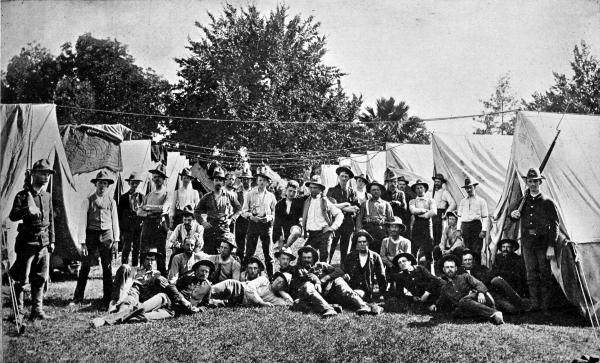
CO. “B” STREET, CAPITOL GROUNDS, SACRAMENTO, CAL.
The regiment was then marched to the Capitol grounds,
where tents were pitched on the nice, smooth, green lawn. It
was afterwards rumored throughout the camp that this was
done despite the objections of General Allen, who wanted the
camp pitched on the plowed and broken ground just beyond
the lawn. Our good General would not entertain the proposition;
considering the comfort and welfare of his men of far
more importance than the lawn. Hearing this rumor, the
poet laureate of the company, after three days of close application,
hard study, and great mental exertion produced the
following poetic gem:
Then up spoke General Allen; his voice was fierce and loud,
“Your men must leave this grassy lawn, there is a field just plowed.
It is more meet to send them there; why should the rank and file
Have access around the Capitol, or its green lawns defile?”
Thus spoke the doughty warrior from Missouri’s classic plains;
But a peal of scornful laughter he got for all his pains.
For General Dickinson uprose, and raised on high his hand,
And said: “The gallant soldiers I am honored to command
Shall fare as is befitting our boys so brave and true,
Despite of martinets, whose forte is dress parade review.”
We hailed our dashing General with a hearty three times three,
And Allen of Pike county merged into obscurity.
It was at this juncture that the disciples of Mickey Free, made
famous by Charles Lever, made themselves conspicuous, led
by William Tooker, the quietest man that ever sold a brogan,
they nestled down amid the blankets and comforters that were
piled beneath the trees, and gazed with dreamy eyes, through
the curling smoke of the ever present cigarette, at their toiling
companions erecting the tents under the hot sun. During
the day, between the heat and flies, these tents were practically
uninhabitable.
While the men were thus busily engaged the busy mind
of Quartermaster Clifford was filled with thoughts of the
noonday meal; where was it to come from? The regimental
commissary department was established in rather
a condensed form under a large tent about one hundred
feet to the right of the regiment. The men had worked up
quite an appetite, and if there is any thing a Guardsman likes
to do it is to eat. Clifford’s experience had taught him this,
and he resolved that the boys should get what was coming to
them, and as much more as he could take. Their confidence
in him must not be misplaced. He carelessly strolled over to
the commissary’s tent and inquired of the assistant commissary,
what time he would call for Company B’s rations; he
was informed that as soon as enough sandwiches were made
for the regiment each company would get its portion. As
soon as they had made enough sandwiches to feed the regiment!
This remark set Clifford thinking. It was now 11:30 A. M.
and one man making sandwiches for about four hundred half-starved
soldiers. Let us see when a “City Guard” man is
not hungry; it is quite an easy matter for him to put away
four family size sandwiches; then, there are Dick Radke, Frech,
Overstreet, Townsend, and a few others who are good for
about nine each. That man making sandwiches was likely
to be about two thousand years old when he would have his
job finished. How to give the boys their lunch at 12 o’clock
under these circumstances was a problem that puzzled him
deeply; there were several knives lying around, he could take
one; but what good would be a knife without the stuff to cut?
There was plenty of bread and beef, but should he commit
the larceny of them, what would it avail him without a knife
to cut and carve with?—
“And thoughts on thoughts, a countless throng,
Rushed, chasing countless thoughts along.”
Thus ruminating he was disturbed by a sentry who told him
that only those connected with the regimental commissary
department were allowed there; he must therefore go. Clifford
went—about three feet—and stood with his eyes resting on a
pile of tinware, which was also to be issued proportionately
with the rations. Something must be done; he must get on the
inside track some way. His experience told him that some company
was going to get left when the distribution took place,
and never should it go down in history that Company B would
be that company. No; not while he was quartermaster. His
reputation was at stake, he must now, if ever, display the
great power, spirit, and desire for “taking” that surged and
swelled within his manly breast, only awaiting the opportunity
to burst its bounds, and acquire every thing in sight.
But how to get on the inside—ah! an idea strikes him, and
he immediately busies himself helping the lonely sandwich-maker.
Commissary Sergeant Fitzgerald appears upon the
scene and asks Clifford who gave him a position in his
sandwich manufactory. Clifford evaded the question by humbly
venturing his opinion that it would take all day to make
sandwiches for the whole regiment; and why not issue the
rations in bulk to each company and let them make their
own sandwiches. “A good idea” said the commissary sergeant;
and for the suggestion Clifford was allowed to take his
company’s rations, which consisted of 10 ℔ corned beef,
5 ℔ cheese, 1 large bologna sausage, 1 roll butter, 12 loaves
bread, and last, but not least, the apple of every good soldier’s
eye, a keg of hop juice. The stores issued were 2 tin buckets
and 20 tin cups.
Clifford began to take the rations, and when he finished
taking an inventory of the contents of the capacious chest in
his tent, it was as follows: 15 ℔ corned beef, 10 ℔ cheese, 2 large
bologna sausages, 2 rolls butter, 18 loaves bread, 8 buckets, 40
tin cups, 2 coffee-pots, 3 dozen each tin plates, knives and
forks, 2 large knives, 1 bucket sugar, and 1 bucket coffee. It
was a glorious take, a splendid beginning, and well might our
quartermaster gaze on the results of his industry and activity
with pride, feeling that he had done his whole duty.
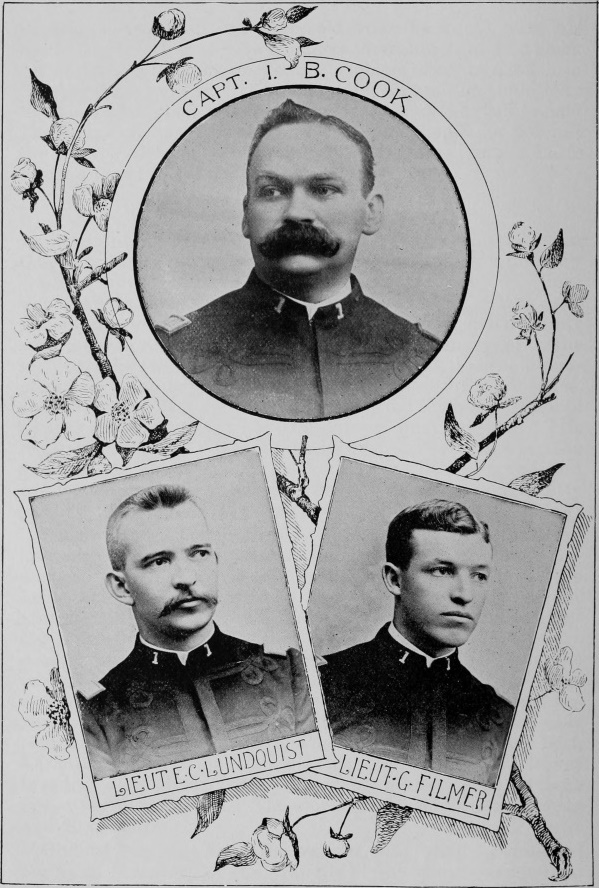
LIEUT E. C. LUNDQUIST CAPT. I. B. COOK LIEUT. G. FILMER
For a while Clifford had clear sailing; he was on the inside
track; was admitted to the ground floor, so to speak; but on a
fatal day the regimental commissary ran short of butter, and
the different company quartermasters were notified to that
effect. This did not phase Clifford; from the cavernous depths
of his chest he produced a roll of rich golden butter; and the
gastronomical wheels of the boys’ insides were as liberally
greased as if the regimental commissary had tons of butter.
Not so with the members of the other companies, the sandwiches
that were wont to slip down their throats when well buttered
now rasped tissues and membranes in a most painful
manner; a great howl was sent up thereat, and a still greater
howl when it was discovered that B’s men had butter. The
other company quartermasters thinking the regimental commissary
was unjustly discriminating in favor of Company B
made a great kick to Fitzgerald. Company B have butter, impossible!
They received no butter from him, this mystery must
be solved, he straightway swooped down on Clifford, and taking
him unawares discovered the well-filled condition of his larder,
there he saw many things whose disappearance from his
quarters puzzled him not a little, he had discovered the leak in
his stores, and ever afterwards Clifford was looked upon with a
suspicious eye. Whenever he was seen approaching the commissary
department, Fitzgerald immediately made a hasty inventory
of everything in sight, and when anything disappeared
he was off like a flash to see if Clifford had it. From
this on Clifford had an uphill fight—a fight in which he was
invariably victorious.
Our regiment was camped about two hundred yards in the
rear of the Capitol, on the line of L street, the Third Regiment
was camped the other side of the park, about one
hundred yards from the First. General Dickinson declared
the camp closed, sentries were posted, and no one was allowed
to leave or enter the camp without a special permit.
The Captain’s tent was at the head of B street, and he
shared its occupancy with First Lieutenant E. C. Lundquist,
better known as “easy” and Lieutenant George (Chesterfield)
Filmer, famed for his shapely form and the cut of his
Prince Albert coat. All three officers were loved by every
man in the company, and the same feeling of confidence that
was felt by the men in their officers was felt by the officers
in the men.
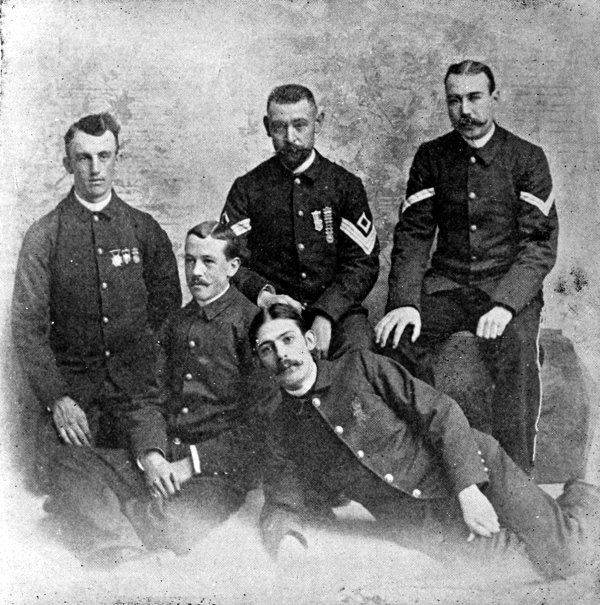
CHAS. PERRY FIRST SERGT. A. F. RAMM CORP. J. N. WILSON
H. F. POWLESON WM. OVERSTREET
Tent crowds were now formed, and the leaders drew lots for
the tents to which they were to be assigned.
The first tent was occupied by First Sergeant A. F. Ramm.
He never sleeps, sometimes they think he is asleep, but he has
always one eye open, handsome Corporal J. N. Wilson, W. L.
Overstreet, with his hair parted at the equator, Charles Perry,
hot soldier, straight and strong, and keeper of the key.[2] H. F.
Powelson, happy-go-lucky, never worried, William Tooker,
with a pronounced aversion for work and William Unger, the
veteran. Later on this tent crowd was joined by the alleged
Dutch comedian, Dr. W. H. Sieberst.
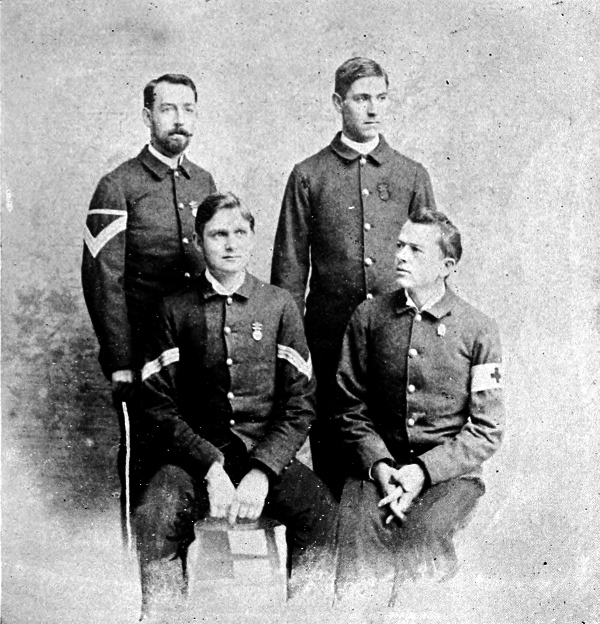
SERGT. A. H. CLIFFORD MUSICIAN, WM. DE LOS MURPHY
MUSICIAN, SERGT. WM. H. SIEBERST WM. H. O’MALLEY
Tent No. 2 contained a homogenous mixture of mankind.
Quartermaster Sergeant A. H. Clifford heads the list, with his
taking ways, a man who took for the sake of taking, who
considered the right of taking a sacred one, and exercised that
right at all times much to the benefit of the company’s larder;
it is said of him that he would rather take than receive;
William De Los Murphy, musician, “my name is my fortune,
sir,” he said; W. W. Wilson, another musician who has the
honor of having his name on the City Guard’s muster-roll;
R. E. Wilson, with his bosom friend H. Gille, known in the
Keeley Club as Antonelli, the irresponsible, with a holy and
righteous dread of water, and always on guard; Van Sieberst,
always out for fun and fond of his tea, a very busy man
around a keg of beer. This tent crowd received considerable
tone from its association with F. J. Monahan, the society
leader familiarly known as “lengthy.”
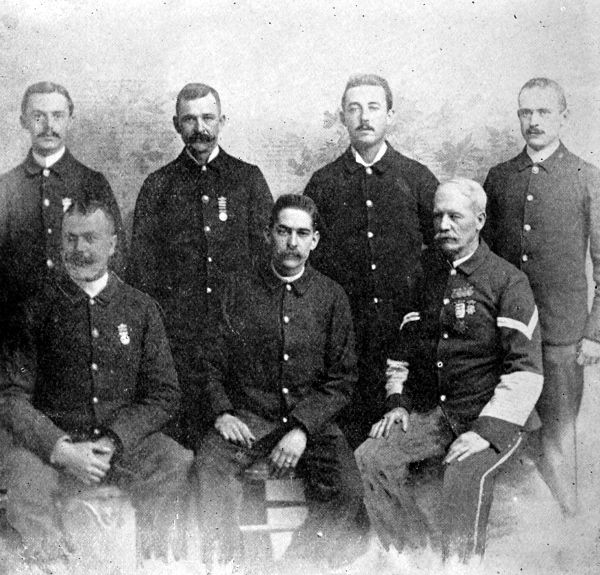
H. FRECH JAS. WEAR F. SHULA WM. J. HAYES
MUSICIAN PAUL RUPP GEO. HEIZMAN CORP. LEW TOWNSEND
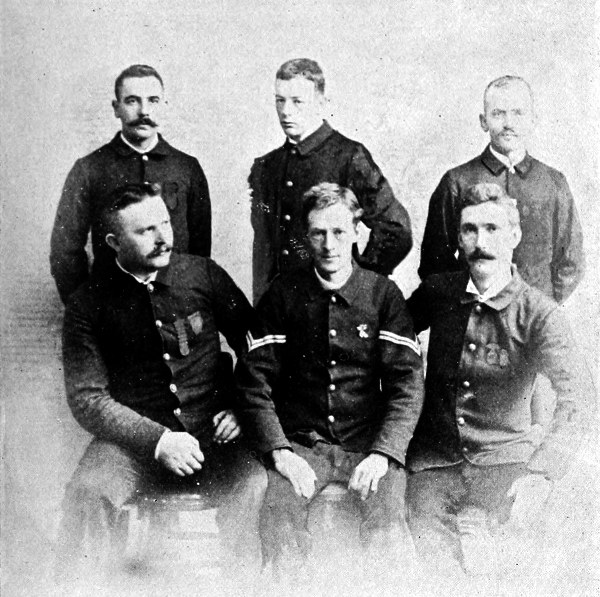
SAM. WISE JOS. KEANE ROBT. WILLIAMS
P. J. KENNEDY CORP. B. E. BURDICK HENRY LANG
There were only six married men among the privates of the
company. Three of them were in No. 3 tent. This alone
would be enough to distinguish this tent from the others without
making mention of the gallant soldiers it contained.
Corporal Burtis, always strictly business, and a bad man to
try to bluff, when he has a gun in his hand. W. H. Hayes,
Secretary of the Keeley Club, who grew a very red whisker
and wanted to look real hard, and he did; A. H. Frech, as
model a little soldier as ever the Vaterland produced, awfully
particular, cleaning and polishing all the time; Frank Shula,
who laughs to grow fat, has been very successful in doing so; his
snore is a thing that has to be heard in order to be appreciated,
he laughs all day and snores all night; Paul Rupp, full of yarns
in connection with his service in Kaiser Wilhelm’s army,
is one of our married men. He is a musician, but later on
rises to the position of chief cook. Jimmy Wear and George
Heizman, fitting comrades for Paul Rupp are also married
men. The way these poor wifeless men clung together
during the campaign was pathetic, there seemed to be a bond
of sympathy between them, and in a quiet sort of way they
consoled each other; they slept together on the same blanket,
and partook together their humble meals. Each day they
dispatched a tender missive to the loved one far away. Last,
but not least of all, there was Lew Townsend, and between him
and the three married men the rest of the crowd in this tent
narrowly escaped demoralization.
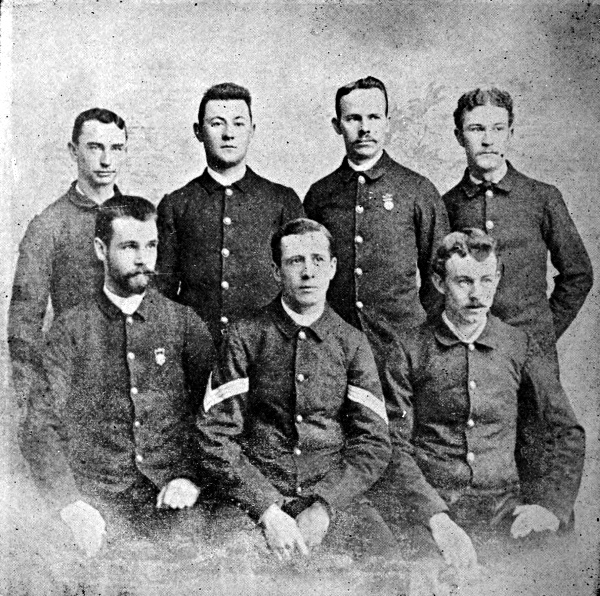
WM. FLANAGAN MUSICIAN J. GILKYSON WM. CROWLEY
W. S. MCKAIG
WM. MCM. D. O’BRIEN SERGT. W. N. KELLY P. BANNAN
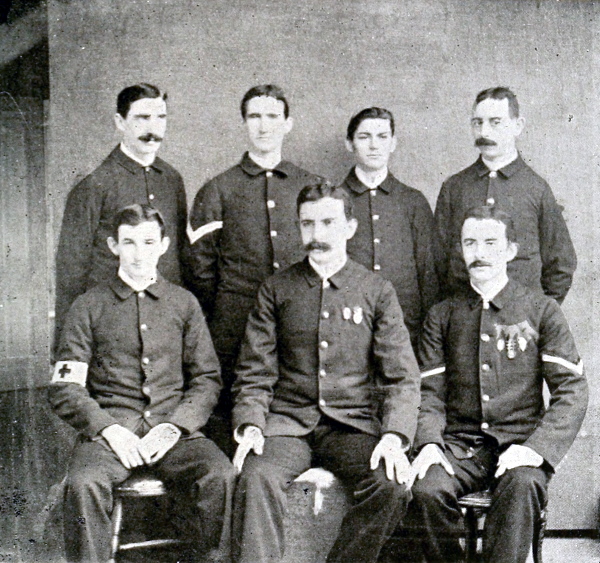
F. J. SINDLER CORP. AL. MCCULLOCH G. RADKE
H. ADAMS
THOS. MCCULLOCH M. CLAUSSENIUS GEO. CLAUSSENIUS
The fourth tent was known as the Keeley tent. Under the
canvas covering of this tent the great leaders of the Keeley Club
held forth. The high priest of the inner circle of the flowing
bowl was Harry J. Lang and his assistant was P. J. Kennedy.
The tent leader was none other than the well-known celebrity,
Corporal Benjamin Burdick; during the silent watches of the
night his still small voice would be heard telling of hairbreadth
escapes in far away India and lion hunts in the wilds
of Africa. Kennedy was dubbed the Yolo Farmer the second
day at camp, and he looked like one. The two Bohemians,
Lang and Kennedy, were the life of the company, Lang never
knew a quiet moment; a most sunny disposition, and as brave
as a lion; he was well paired with his comrade Kennedy.
Sam Wise, an honorary member of the company was in this
tent. At the call to arms he offered his services to the company
commander, and they were gladly accepted. It is
entrancing to sit and hear him tell about the first thing he did
when he went to work. Sam’s working periods are so few and
far apart that he has occasion to remember every little detail
concerning them. Joe Keane, the basso barrello, with a faraway
look in his eye; the little hero, Bob Williams, and E. M.
Stealey, who sang “A Soldier’s Life’s the Life for Me—Not,”
made up the balance of the crowd.
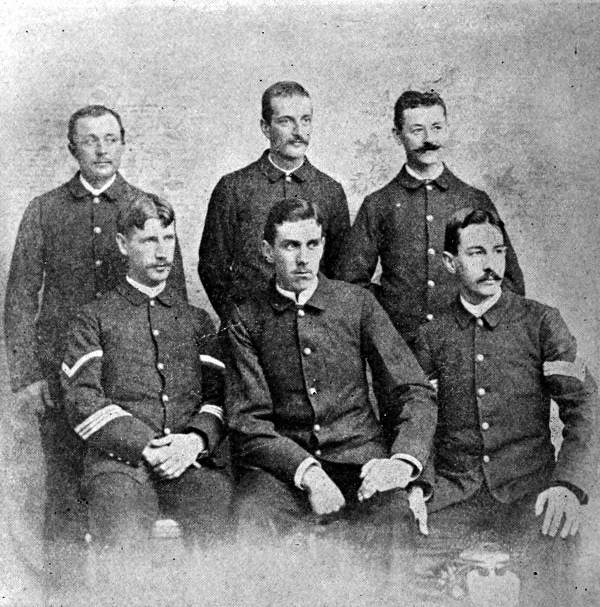
L. ZIMMERMAN A. C. GEHRET WM. BAUMGARTNER
H. B. SULLIVAN A. FETZ SERGT. B. B. STURDIVANT

T. HAMMERSON. G. UNGERMAN.
W. A. BESEMAN. SERGT. H. B. TAYLOR.
J. BRIEN.
The fifth tent was called the Irish tent, headed by the Irish
Sergeant Walter Kelly, a splendid soldier and officer. Wm.
Flanagan, good old nine, we called him; a very active man
when our daily keg of beer was on tap. He claimed descent
from one of Ireland’s famous kings. W. S. McKaig, dubbed
kinky on account of his curly hair, was always writing letters
when there would be any work to do. W. W. Crowley, the
most desperate looking character in the camp and as desperate
as he looked. Johnny Gilkyson, drummer and willing
worker, had no use for a drum when there was sterner work
to do, and soon attached himself to a gun. Phil Bannan,
always quiet and passive, a disciple of Wm. Tooker’s and quite
a society man; Flanagan called him piano Irish and sneered
at his social aspirations. Wm. O’Brien, always ready to
volunteer for dangerous work, was the last, but not the least
of this crowd. Upon the hearts of the members of this tent
was emblazoned the motto, “We Love Our Sarg.”[3]
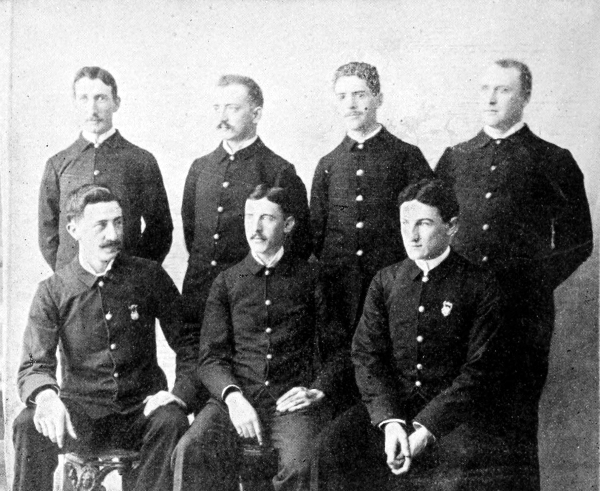
R. E. WILSON AL. HEETH H. C. CASEBOLT
GEO. BOWNE.
J. MONAHAN W. W. WILSON E. M. STEALY
Corporal A. McCulloch was the leader of tent No. six. This
was the intellectual tent. Beneath its classic folds weighty
questions of state were argued and settled. The crowd in
this tent claim that nightly they were lulled to rest by the
voice of their learned corporal in the throes of some mighty
argument; through the long stretches of the night when they
would occasionally awaken they would still hear his voice;
as if he were engaged in some great controversy. Morning
found him awake, physically, but the restless brain had
not slept, and now, with freshened physical senses, he still
continued his interminable argument. But he had aids and
abettors in the persons of Henry Adams and R. L. Radke (all
will recall the soldierly appearance of the last-named gentleman).
Radke the younger, Max and George Claussenius,
F. J. Sindler and H. C. Warren were the unfortunate and
paralyzed listeners.
The seventh tent was called the German tent. Sergeant
Sturdivant, the leader of this crowd, is so tall and thin, that
it is a surprise to him when he casts a shadow. He is quite a
society man, and a favorite among the ladies. Another social
favorite, Humphrey Sullivan, is also in this tent. He sings
so sweetly that we enjoy it very much, more so if he were
accompanied by a brass band. In this tent we have two other
stars in the vocal line, Al Gehret, a basso, and William
Baumgartner, a tenor, who can reach high “C” without an
effort. In this crowd was Fetz the long, Zimmerman the short,
also called Punch for short, and A. Heeth, Jr., with whose
kindly aid we kept our rags together. This concludes the
description of the tents of the enlisted men and their occupants.
Only a week previous these men won the Dimond
trophy, at the yearly encampment of the regiment, for being
the best drilled and best disciplined company in the camp.
After our return from supper at one of the hotels, on this
first evening, those who were weary sought the seclusion of
their tents; the rest gathered beneath the trees and sang of
love, but not of glory. Private Tooker sang “Sweet Marie”
with such pathos and expression, that a tear was seen to
tremble on the eyelid of Overstreet, and then silently wend
its way down to the point of his nose, where it hung suspended
for a while as if reluctant to part from him and then
fell to the earth with a loud splash. Thus we whiled away
the hours, till the bugle’s mellow notes swelling on the midnight
air and thrilling the hearts of all with its sweet, solemn
music, sang the call to rest, and then all was still.
Thirty minutes had passed and gone; the brave and true
were dreaming of home and mother, when a wild yell rang
out on the stilly air, and sounds of conflict were heard coming
from tents Nos. 3 and 4, occupied by the Keeleys. Soon
Corporal Townsend was seen beating a hasty retreat in great
disorder from No. 3 tent, in the direction of the captain’s
abode, where he reported that a well-planned effort was being
made by the Keeleys to kidnap Private Hayes of tent No. 3.
Meanwhile exciting scenes were being enacted in these tents.
The kidnappers, headed by the Yolo Farmer and the High
Priest of the Keeleys, were endeavoring to drag the person of
Private Hayes into their tent, but Corporal Burtis, assisted by
Privates Frech, Shula, and the married men, Paul Rupp,
Jimmy Wear and George Heizman, did Trojan work. After
a well-delivered blow from Hayes that connected with the
head of the High Priest, who sent up a howl of pain, they
were beaten off. The Yolo Farmer, however, returned to the
charge, bayonet in hand, but the voice of the Captain, threatening
a sojourn in the guard-tent, acted like oil upon troubled
waters, and soon the warring factions were at rest.
During the night Fetz of ours, who was doing sentry duty,
by the ominous click of his gun’s hammer and a threat to
fire, resurrected two festive soldiers out of the brush in which
they were hiding, preparatory to an attempt to get into camp
unobserved. They were gathered in and taken to the guard-tent,
where for two days they sweltered and sweltered. The
spectacle these two young gentlemen presented as, bucket in
hand, they went through the streets gathering up the refuse,
under the vigilant eye of a sentinel, was a source of great
amusement to their comrades.
While camped on the Capitol grounds we had breakfast
and supper at the hotels, and luncheon at camp. Arrangements
were made so that no more than three companies
would be away at any one time. As usual a number found
fault with the hotel fare, but a week later, when the regiment
had to do its own cooking, they would have been very glad
to return to it. At lunch we had all the fruit we wanted;
corned beef was always on the bill of fare; but the keg of
beer, that accompanied it, reconciled us. Then there was
bread, bologna sausage, sometimes crackers, and always
cheese; altogether we fared very well during the week.
Friday morning, on our return from breakfast, Sergeant
Kelly made a motion, that the rule be established, whereby
any who shaved during the campaign would be fined a dollar.
The motion was seconded and carried unanimously. Sergeant
Kelly was one of the first to avail himself of the expensive
luxury.
The City Guard boys had now settled upon a unique style
of wearing their hats, which distinguished them from the rest
of the companies. The hat was dented four times perpendicularly,
bringing the crown to a point; this, with the
unshaven faces, and the long swinging stride and step we
kept while marching to and from town, made us particularly
noticeable, and many comments were passed on our
appearance. We were getting well seasoned for the hard
work, which we were shortly to be called upon to do, and
which we hope we did well.
The newspaper reports about this time were giving the
boys “that tired feeling.”
In a previous chapter it has been told how disgusted the
men were at the failure to take the depot. Therefore you may
judge their surprise, on reading the accounts published in the
newspapers of the same, to see that the failure to accomplish
good results was laid at the door of the rank and file of the
National Guard. The press was not the only accuser of the
men, but from another source in which the men expected to
find their vindication they received the “unkindest cut
of all.” Their general officers it was who said they could not
take the depot, because the men were demoralized and could
not be trusted. Oh! what a subterfuge! On the surface what
is to be conveyed by such a statement? Two alternatives
present themselves. First, either the statement is true, or,
second, the position of the officers themselves was weak and
they desired to strengthen it by shifting the responsibility
for the failure from their shoulders to those of the rank and
file. If this latter course was the one pursued then they
might have known, mighty though they be in the National
Guard, that the consequences of such a course would be sure
sooner or later, to redound with greater force upon themselves,
and that instead of their position being strengthened,
they would stand exposed in all their iniquity, stripped of the
last shred of defense.
Investigation proves that the latter alternative is the correct
one. The men, despite what comes from the press or
by other sources, were not demoralized or untrustworthy.
Being demoralized is meant, we should judge, that the troops
were not under the strict control of their officers, and that
confusion and lack of discipline reigned in ranks. At no
time in the day did such a state of affairs prevail. It is true
that a number of the men were prostrated by the heat, but the
prostration extended only to a comparative few and not to the
entire body of men as given out in the reports of certain
officers. Besides this, the prostration came after the troops
had stood in line under the hot sun for something like three
hours. The men were willing and ready at any time that
afternoon to attempt to force the strikers from the depot.
Never were they called upon to do a harder thing, or one in
which they felt more disposed to rebel against their officers,
than when they were ordered to withdraw from the scene and
leave the depot in charge of the strikers. There was not a
squad of men in Company B, and when I mention Company
B, I mean also every company with one possible exception, who
would not willingly, even gladly have charged the mob of
strikers. Curses, not loud but deep, were uttered in each
company as they withdrew. In one of the companies under
the command of Colonel Nunan the men cried out to advance,
but no order came. Tears of vexation rolled down the
cheeks of some of the men. To travel over a hundred miles
and then suffer defeat—oh! how humiliating—not at the hands
of the strikers, but from their own officers. And yet, in the
face of all this, the failure to take the depot was laid at their
doors.
Who was to blame for the failure of the operations on the
Fourth? It remained for a court of inquiry to finally fix
the blame upon the shoulders it belonged. This court was
appointed by Governor Markham, September 8, 1894, to
inquire into the conduct of those troops of the National Guard
participating in the strike campaign, from its commencement
to its close. The work of the court was to be performed without
regard to rank prejudices or preconceived ideas. The
court sat in session for a period of twenty days, and made a
minute examination into the operations on the Fourth. Its
work was well done. In the columns of one of our large
dailies the following appeared:
“The court of inquiry has done its duty well—truthful,
fearless, unmoved by considerations of friendships. Our Californian
experience with investigating bodies had given us
no right to expect this high and honorable result, and it is
entitled to a swift, signal, and memorable approval by executive
action.”
The court of inquiry showed plainly that the reports made
by the commanding officers of the National Guard, and the
charges appearing in the press concerning the demoralization
and untrustworthiness of the troops were utterly false; that
the rank and file, with the exception of two companies mentioned
elsewhere,[4] “were at all times under good discipline,
and behaved with becoming courage and loyalty.” The court
further found that certain officers greatly magnified the reports
concerning the physical debility of the men. The court, in
summing up, says: “There were men in the ranks, plenty and
willing to retrieve the day, when at three o’clock, after standing
patiently in the sun for three hours, they received their first
orders, which were to move off and abandon the attempt to
take the depot.” Thus the rank and file were finally vindicated
after being for some time the object for obloquy by the
public and press.
The question, who was to blame for the failure on the
Fourth, we would gladly leave at this place unanswered were
it not for the fact that an implication is worse than an assertion.
So we again refer to the report of the court of inquiry.
Here it is shown that, on that memorable occasion, “General
Sheehan refused to obey orders, directly communicated
to him by Major General Dimond, to effect an entrance
into the depot by force, and to fire upon the mob if they
refused to give way”; it was further shown, that when the
officer, upon whom the command of the Second Brigade had
devolved, received distinct orders from Major General Dimond
to clear the depot, by force if necessary, he left his command
and urged the commanding General not to compel him to
obey the order, as his men were demoralized and could not
be relied upon. It was upon this representation that
an armistice was entered into between the United States
marshal and the strikers. Here we have the case in a nutshell.
No orders were given to the troops to advance at any time
that afternoon against the strikers. A spirit of hesitation prevailed
amongst the commanding officers. When decisive
action should have been taken questions of constitutional law
were debated by them at length. Instead of an officer
executing the commands transmitted to him by a superior
officer he would desire to know where his superior officer
received authority to give such an order. Just think of
it, men who have been occupying high places in the National
Guard for years, questioning at the time for action the
authority of their superior officers and preventing decisive
action by misrepresenting the condition and maligning the
characters of their men. This then was the cause of the
failure of the operations on the Fourth, and well has it been
called the “Battle of Sheehan & Co’s Bluff.”
The garbled manner in which the occurrences of the Fourth
were presented to the public by the press was disgusting to the
last degree. From their accounts one would think that the
men could fire or use the bayonet at will, instead of being a
disciplined body under superior officers, subject to their commands
in the minutest particular, and had no option but to
obey orders, when they received them. The inefficiency of the
National Guard was the subject of editorials; and it seemed
to be a great disappointment to the press that the depot on
the Fourth was not a scene of frightful carnage. Had the
order come to fire the men would most certainly have fired,
the result would have been a slaughter, and then in the columns
of every newspaper in the country we would be branded
as red-handed, bloodthirsty murderers. The newspapers even
went so far as to cast reflections on the loyalty of the Guard;
this to men who left their peaceful callings at the call to arms,
left their homes, severed every attachment, every business
connection, left weeping parents, wives, brothers and sisters,
traveled by night, marched by day, and stood under a broiling
sun for hours, ready to do the bidding of their superiors, and
then to have their loyalty brought into question, this was too
much. One enterprising Sacramento paper came out with the
disquieting information “That it was rumored the strikers
were going to use dynamite, but, with discretion,” that was
comforting, they would use dynamite “with discretion.” The
brainy reporter then, to seek a confirmation or denial of the
rumor, called upon Mr. Knox, the leader of the strikers, and
asked him if they were going to use dynamite, with discretion;
of course he said yes. This is a fair sample of some of the
ridiculous stuff published by the papers. The general tone
of what did seem reliable and probable brought us to the conclusion
that we had come to stay awhile, and that we would
soon have plenty of work.
We had now settled down to the regular routine of military
camp life. The mornings were devoted to guard mount, company
drills, and battalion drills in the extended order.[5] The
men in these drills acquitted themselves with a dash and
celerity of movement that would do credit to regular
troops. The face of grim-visaged war was partly shown
to the people of Sacramento as the battalions of the First
Regiment charged across the Capitol grounds, amid wild
yells and the rapid reports of the Gatling gun from the far
off corner of the grounds. They tore through the plowed
ground, through water, down deep gulleys, up again on the
other side, and under the blazing sun, continued the charge
through the brush, until recalled by the whistle of the commander.
In the afternoon we had dress parade. Crowds
were drawn to the camp to witness these imposing ceremonies.
A line of sentries, with loaded pieces, was posted round the
entire camp day and night. Each day the company furnished
a detail for guard duty. The personnel of these details were
as follows: Thursday, July 5th, Lieutenant E. C. Lundquist,
Corporal J. N. Wilson, privates J. Gilkyson, W. J. Flanagan,
A. H. Frech, A. Fetz, H. G. Gille, A. C. Gehret, P. J. Kennedy.
Friday, July 6th, Sergeant B. B. Sturdivant, privates Wm. De
Los Murphy, A. Heeth, Jr., G. H. Heizman, J. S. Keane, H. J.
Lang, S. Wise, W. S. McKaig. Saturday, July 7th, Captain
I. B. Cook, Corporal B. E. Burdick, Corporal E. R. Burtis, W.
D. O’Brien, W. L. Overstreet, C. Perry, H. F. Powelson, R. L.
Radke. Sunday, July 8th, privates G. H. Radke, H. Sullivan,
E. M. Stealey, F. Shula, F. J. Sindler, W. H. Tooker. Monday,
July 9th, Lieutenant George Filmer, privates Wm. Unger, R.
E. Wilson, R. J. Williams, H. C. Warren, J. R. Wear, L. Zimmerman.
Tuesday, July 10th, privates H. H. Adams, P. L.
Bannan, F. Baumgartner, G. L. Claussenius, M. Claussenius.
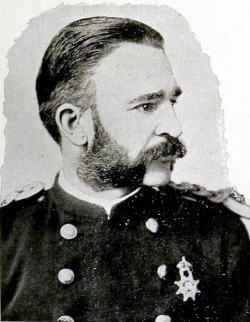
WILLIAM UNGER,
AS HE APPEARED WHILE IN THE HAWAIIAN GUARD.
CORPORAL EDWIN BURTIS.
CHAPTER V.
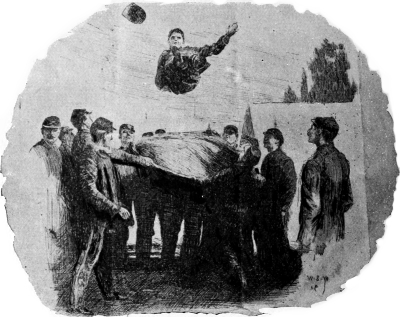
THE VIGILANTES AT WORK.
THE VIGILANTES AT THE CAPITOL GROUNDS.
THOUGH our time was considerably taken up with
camp duties there was plenty of time for amusement
during the long day. Friday, July 6th, saw the birth
of the Vigilantes. This crowd, made up from the different
companies, created any amount of fun. Any one
seen by a Vigilante doing any thing out of the ordinary
(shaving and hair-cutting were capital offenses) was
immediately reported; his person was apprehended, and
brought before the Chief of the Vigilantes, to whom both sides
of the case were presented, he judging whether the defendant
was guilty or not. The scales of justice were badly balanced in
this court, for the unfortunate one was always found guilty.
Then the joy began, willing hands stripped the victim to the
waist, he was blacked all over, balanced on his head and the
State hose turned on him. The Yolo Farmer fell into the
clutches of these worthies, but not without a heroic struggle;
pursued by the ruthless mob, he rushed into his tent and,
on emerging, gun in hand and bayonet fixed, presented a
formidable appearance, as, thus armed, he defied his enemies.
But their numbers were too much for him, he was taken from
the rear, and borne in triumph to the place of execution.
After a trial of great brevity, he was stripped to the waist and,
while suspended by the ankles, plentifully watered by the hose.
His Keeley brothers, Lang and Hayes, fearing the same fate,
made a hurried departure across the park and enjoyed his
discomfiture at a safe distance.
Van Sieberst was the next unfortunate; poor Van wasn’t
doing any thing either; but that was just the trouble; he had
stretched his huge form upon the earth and was indulging in
the creations of fancy, when a savage tribe of Vigilantes rushed
upon him, tore him from out his ethereal world and bore him
to the place of execution. The shriek that Van gave on being
torn from his world of fancy, was heart-rending. He was
arraigned before the all-powerful chief of the Vigilantes, who
inquired, “Why comest this man here? Speak.” Thereupon
a great silence fell upon the assembly and forthwith there
leapt from out of the throng Tooker, the favorite son of the
most renowned god of all Work, and thus he spake: “Most
noble Vigilantes, this man doth never work; to the corporals
of the all-powerful ‘City Guard’ he is a constant bane; he
is ever quick, most noble chief, to lie down, but slow to arise;
he was never known to shake the blankets of the tents of his
people. Oh, noble and great-hearted brothers, I bow my head
with humiliation; he is the laziest man in camp.” Thereupon,
throughout that great multitude there arose a loud cry,
“Him we honor.” “Him we make our chief.” “Him we
obey.”
There was much rejoicing among the Vigilantes. And,
thus it came to pass, that after passing many days and nights
in lowliness, Van Sieberst, the heaven-descended son of
Bacchus, became chief ruler of the Vigilante Tribe. Verily,
I say unto you, that many strange things have come to pass.
One afternoon, as “Easy” Lundquist was telling an interesting
story to a number of the boys grouped about him
and stretched upon the ground in the shade of the spreading
branches of a tree directly facing B street, Jack Wilson,
breaking through the circle and dropping heavily upon the
ground, interrupted him with the startling announcement
that the Vigilantes had just finished with Kelly. A long
drawn “What, Sergeant Kelly?” centered the attention of the
crowd upon Herr Frech. “How did it happen?” he continued,
in surprise. “Why, it was only yesterday that he defied
a dozen of the company, who wanted to amuse themselves
at his expense, to touch him. He did not feel just then
like fooling, he said; when he felt that way, why he would tell
them so, but until then they had better leave him alone.” “Did
the Vigilantes send a committee,” further inquired Frech, “to
wait upon him and learn his pleasure as to whether it would
be convenient for him to submit himself to the decrees
of the Vigilant court? And did they go down on their knees
and do homage to him as if he were one of the gods? Did
they inquire if his hair was combed or his face washed or his
blouse dusted; or, did they ask him to tell them in case it was
not convenient for him then to submit to the court, when
they might come for him and escort him in royal style to the
place of trial? Did they—?” “No,” yelled Jack, “they did not
care for his pleasure, they seized him unawares, hurried him
to the place of execution, sentenced him, and immediately
fulfilled it by giving him, as he stood upon his head, four
buckets of water and a box of blacking.” And so, mighty
is the fall of them that walk on high places.
The question of bathing now became very important. The
extreme heat and the general conditions were such that, for
the preservation of health, some arrangement for bathing was
necessary. It was not long, however, before the brainy young
men from Frisco solved the problem. Wire screens, which
had been used to protect shrubbery, were placed in position
and fastened together, so as to form a square apartment.
They were then covered with sheeting to the height of about
six feet. One end of a government hose was attached to the
water-pipe; the other was carried over the top of the enclosure.
The green sod was used for a floor, and the sky for a ceiling.
A more enjoyable shower bath could not be desired. Two
strings led from this bath to the pipe about twenty-five feet
away. To turn the water on, you pulled one string, to turn
it off, you pulled the other. This bath was always well
patronized. Necessity is indeed the mother of invention.
The small annoyances of this life are sometimes the most
aggravating. The little whiskers on Dick Radke’s chin had
worried us for some time. On this day we caught him stroking
them. There is a limit to all patience. We rose in our
might and removed them, after an ineffectual struggle on his
part. Private Frech’s well-dyed, tiny mustache came near
meeting the same fate, but he would make no resistance and
only begged for the privilege of removing it himself, so we
spared the mustache.
A number of guns were accidentally discharged while we
were in camp on the Capitol grounds. None of the accidents,
however, were attended with such frightful results as that
of the Fourth of July, though there were several narrow
escapes. Corporal Burtis gave the order to load while standing
in front of his squad (he should have been in the rear).
One of the pieces accidentally discharged, the ball entering the
ground about twelve inches in front of him. He will never
stand in front of a squad again and give the order to load.
Private Hayes, also had a close “shave” one night when on
picket duty, the rifle of the man next to him being discharged
very close to his head. This is one of the great dangers to be
guarded against. A man cannot be too careful when he has a
loaded gun in his hands. The gun should be always carried
with the muzzle up, but, when loading, the muzzle should be
pointed to the ground. Do not stand in front of a man when
he is loading his gun; watch yourself and those around you.
Every man should be well grounded in these principles by
his instructor.
About this time the sick and dying telegrams came pouring
in from anxious parents. The mail was too slow for
messages like these:
“Dear Charlie:
Mother dying, come home at once.
Father.”
or
“Dear Willie:
Father very sick, not expected to live, come home at once.
Sister.”
“Come home at once” was the largest part of telegrams
whose brevity made the hair curl. The wires were kept hot
with these missives. It looked very much as if there was
going to be a boom in the undertaking business in San
Francisco, and that many of the National Guard would soon
be orphans. The letters received by the boys from their
mothers were generally very tearful, each fond mother praying
for the speedy and safe return of her darling boy. There
were a few exceptions, however, one of our boys receiving a
letter that was worthy the Spartan mother. She called upon
him to do his duty manfully and courageously; she hoped
that his conduct in time of danger would reflect credit upon
himself and company. We are happy to say of him that he
is a worthy son of such a mother, for he performed his duties,
at all times fearlessly and well.
Clifford, Al Ramm and Jack Wilson were standing in front
of No. 1 tent, having a little argument as to which of the
favorite resorts along the San Francisco route made the best
cocktails, when they heard strange sounds coming as if it
were from the ground beneath their feet. They got down on
their hands and knees, and, with ears pressed to the earth,
listened. They had about come to the conclusion that the
noise came from the water-pipe, which ran along the front of
the tents about four inches underground, when Perry, keeper
of the key, and Willie Overstreet, who had been sitting beneath
the tree at the head of the street discussing the dynamite
rumors, approached attracted by the strange actions of
their comrades. An idea, Clifford, he has them on tap. In a
stage whisper, of which Henry Irving would be proud,
he said, “keep quiet boys, I hear them talking.” This gave
Al and Jack the cue, and with grave faces they held their
ears to the ground. “What’s the matter”? asked Overstreet,
while Perry looked on with staring eyes and open mouth.
“They are undermining the camp,” said Ramm in a sepulchral
tone. “We’ll all be blown up by dynamite,” wailed Jack
Wilson. “Hush,” said Clifford, with upraised hand, “I just
heard one of them ask the other for a match to light his
pipe.” In a trice Perry and Overstreet had their ears glued
to the ground. What Perry heard confirmed his worst fears.
He was in the act of dashing off to the General’s tent to give
the alarm, when they caught and held him. They reasoned
with him. “Any premature action,” they said, “might be
the death of them all. They must be very circumspect, as
the strikers might be watching their every movement, and,
should their suspicions be aroused, the earth might open up
at any moment and the whole camp be blown skyward.” It
was finally decided that a committee be appointed to wait
upon the General after dark and break the dreadful news to
him, as gently as possible, for he was hardly over the effects
of his late illness, poor man, and nervous prostration might
be the result. All that afternoon the new danger which
menaced the camp, was the subject of discussion. The relative
powers of giant powder and dynamite were debated;
Clifford declaring that enough dynamite could be put into the
mine to blow the camp, and even the Capitol itself, off the face
of the earth. The nervous strain Perry and Overstreet were
under all the afternoon was comical to see, particularly Perry,
who tugged excitedly at a mustache that wouldn’t make a
decent pair of eyebrows. Night came on. It was growing
late. Quiet had settled o’er the camp. All lights were out,
save the candle that burned dimly in Jack Wilson’s tent.
Wilson had retired to his blankets, but Perry and Overstreet
still sat up, talking over the events of the day. For them
there was no sleep. The silence of the camp was now oppressive
and deathlike, when suddenly Billy O’Brien burst into
the tent, breathless and wild eyed, saying, that the Colonel
had ordered him to get twelve men to dig into the mine, and,
as they were awake they should at once report to Lieutenant
Lundquist, in the Captain’s tent, and be supplied with pick
and shovel. Counseling them to make no noise for their
lives and to hurry, he dashed off again. Poor Overstreet,
gave a deep groan and nearly fainted, while Jack Wilson
said, he did not like the job a bit, springing dynamite mines
was not in his line; he wished that he was at home, but,
as he was ordered, he supposed he’d have to go. Perry said
nothing, but was doing some powerful thinking. Jack left
them and proceeded to the Captain’s tent, where a crowd
of choice spirits were collected, awaiting the coming of
Charley. And he came buttoned and belted, with a bayonet
at his side, ready to do or die. He saluted the Lieutenant,
with nervous rapidity, no less than seventeen times. The
Lieutenant, who had his head hidden behind a newspaper,
was doing his best to control his feelings; but when Charley
asked for a shovel he could stand it no longer, and burst
into a roar of hearty laughter, which was joined in by the
rest of the merry crowd. Charley, seeing it was a joke, beat
a hasty retreat to his tent, and was soon locked in the arms
of Morpheus.
As, during the campaign, we had to do our own washing
we utilized our buckets at first, but soon found them too
small for the ever-increasing wash. At the suggestion of
Jack Gilkyson, a collection was taken up and a fine washtub
and board were soon in operation. The washing, which was
spread upon the tents and hung upon the guy ropes to dry,
gave the street the appearance of a Chinese wash-house in full
blast. On one occasion Sam Wise had just washed his socks;
a little to the rear of his tent where the operation was performed
Lang, Hayes, and a few others were stretched upon
the grass. One and all thanked Sam for what he had done.
Lang, to vary the monotony, threw a very soft peach at Hayes,
which struck him in the ear and spread in all directions.
Hayes seized Lang, and, in the struggle which followed, they
neared the bucket which contained the soapy water in which
Sam had just washed his socks. At this opportune moment,
Hayes had Lang in a very advantageous position; reaching
out he upset the contents of the bucket over Lang’s head,
and then did some very pretty sprinting, with Lang in hot
pursuit. In their path stood another bucket of water, which
Lang picked up and threw with a wild swish at the fleeing
Hayes; but the bucket turned in his hands and he received
the contents in the neck. Dripping with water he picked
up a scantling, the size of himself, and continued the pursuit;
but the fleet Hayes had by this time reached a place of safety.
Lang, when on sentry duty, was the admiration of all the
boys, he looked so much like a regular, straight and stiff as a
pikestaff, and about as stout. The way be brought people to
a halt was enough to bring on heart trouble. When he saluted
an officer he brought his piece to the carry with a snap that
startled the horses in the street. His great ambition was to
become an orderly for General Ruger.
This brings us to the great indignity which was put upon
the Keeley Club, an indignity that will be remembered by its
members as long as the memory of it lasts. Their High
Priest Lang and P. J. Kennedy, another prominent officer in
the organization, were summoned to Quartermaster Cluff’s
tent. From this tent all good things flowed, particularly
the beer. Visions of oceans of it, enough to satisfy even
their thirsty souls floated before their sight. With light
hearts and willing steps, they sped towards the tent. Yes,
there was the keg, clothed in a bag of ice, just discernible
within its shade. Its bright brass faucet shining in the distance
like a star of hope. See! the quartermaster is slowly
drawing a bowl of the amber fluid; ah! how refreshing it
looks. The feet that would rather run than walk on such
occasions soon brought them to their destination. They
saluted in their best style; the quartermaster saluted. Lang’s
face broke into its most insinuating smile, while the Yolo
Farmer mopped the perspiration from his classic brow with a
linen napkin, and remarked that it was very warm. All this
time the quartermaster was sipping his beer with exasperating
leisure; between sips making very commonplace queries. He
remarked that Lang looked very thin, but that Kennedy
seems to be getting stouter if anything. Great God! their
tongues were cracking. Would he never get through, and
invite them to slake their burning thirst? But everything
has an end. Finally with a sigh of satisfaction he put down
his glass, and disappeared from before the wondering eyes of
Lang and Kennedy into his tent, from which he soon emerged,
pick in one hand and shovel in the other, and placing them
in the passive hands of our now paralyzed comrades, bade
them follow him. Some fifty feet away he halted, pointed
to the ground and commanded, “Dig,” and they dug. For
hours these gentlemen, strangers to hard work, delved into
the earth, under a broiling sun, like common laborers.

THE YOLO FARMER AND HIGH PRIEST AT WORK.
The boys’ funds were getting low about this time; in fact a
great many left town without any funds, at all. Clifford was
known to be in a chronic state of financial debility. When he
marched down the street jingling in his pocket a bunch of
keys which sounded like many silver dollars crying forth,
“spend me”; he was questioned on all sides as to where he
made the raise. “Oh”! said he, “I’ve just been up to
Adjutant Williams’ tent, and got a little advance.” “What”!
they exclaimed, and waiting for no more they immediately
made a bee line for the adjutant’s tent. The adjutant loves
a joke as much as any one, and, though puzzled at first, soon
understood and put the boys off with various excuses. He told
Billy O’Brien, who was a most earnest applicant, that the paymaster
had a breakdown on his way to camp, and would not
arrive for some time. Billy went away, and when surrounded
by his tent-mates, who anxiously inquired as to his success,
quoted the following lines from Charles O’Malley, the Irish
Dragoon, for their delectation:
“And though up late an’airly
Our pay comes so rarely
That divil a farthing we’ve ever to spare.
They say some disaster
Befell the paymaster
’Pon me conscience I think the money’s not there.”
Very late Saturday night we were joined by the great
artist on the tin whistle, and star Dutch comedian, Doc
Sieberst, and private William O’Malley, attached to the
hospital corps. Doc was besieged for news from all sides.
Hayes did his best to lure him into the Keeley tent, where a
small riot was in progress; but the providence that is said
to watch over children and drunken men had the Doc in mind
that night. We saw the famous tin whistle gleaming in the
moonlight through the lacings of his leggings, and ever after
our marches, to and from town, were enlivened by its music.
The boys were all delighted next morning to see the honest,
open-work Irish face of O’Malley amongst them. Up to this
time we had no wires attached to the hospital tent. Now
things were different. A lot of us got taken very badly with
malaria, and every morning we went to the hospital tent to
get our quinine.
Among the members of the City Guard it is a case of one
for all, and all for one; and Doc O’Malley’s connection with the
hospital tent brought joy to B street in more ways than one.
Beer was plentiful in the hospital tent; the doctors not only
drank it themselves, but required an extra allowance for the
patients. Under these conditions, however, patients increased
at such an alarming rate that the Doctors decreed that beer
was bad for the sick, and consequently they had to drink the
extra allowance themselves. Though men of great capacity
they were unable to get away with two barrels daily. This
fact was known to O’Malley, who imparted it to the good-natured
and burly Teuton Rupp. In the dead of night Rupp
stole forth, bucket in hand, and, after a careful reconnoissance,
invaded the hospital quarters. He soon returned to the street
with the bucket full of the foaming beverage; then beneath
the folds of the Keeley tent followed a scene of subdued but
exquisite enjoyment. The bucket empty, Rupp and High
Priest Lang sallied forth again, with a parting request from
Corporal Burdick to bring the keg along this time. Lang, with
fine sarcasm, asked him if the contents of the keg wouldn’t
do him? This time the keg was emptied, and the return of
Rupp and Lang was the occasion of renewed enjoyment.
Monday, July 8th, we went swimming in a body. Arrangements
had been made with the bath-house keepers the day
previous by Lieutenant Filmer, every thing was lovely. The
boys had a great time plunging and diving in the tank, and
playing tricks on one another. It was here discovered that
the brave and fearless Gille was the greatest of cowards in the
water. Antonelli has dallied so long with other liquids that
water is an unknown quantity to him, particularly a tank of
it; and any attempt to duck him completely stampeded him.
His frantic efforts to get away from his pursuers were the
cause of much hilarity. This aversion to water is strictly
Democratic in its character.
This night we were reinforced by Tommy McCulloch,
another young man with pill-rolling aspirations. We have
taken time by the forelock and already call him and his side
partner, O’Malley, Doc.
Monday morning the following proclamation was issued by
President Cleveland:
Whereas, by reason of unlawful obstructions, combinations, and assemblages of
persons it has become impracticable, in the judgment of the President, to enforce by the
ordinary course of judicial proceedings the laws of the United States within the
State of Illinois, and the city of Chicago, within said State; and
Whereas, that for the purpose of enforcing the faithful execution of the laws of
the United States in the State and city aforesaid the President has employed a part
of the military force of the United States,
Now, therefore, I, Grover Cleveland, President of United States, do hereby admonish
all good citizens and persons who may be or may come within the city and
State aforesaid against aiding, countenancing, encouraging, or taking part in such
unlawful obstructions, combinations, and assemblages; and I hereby warn all persons
engaged in or in any way connected with such unlawful obstructions, combinations,
and assemblages to disperse and retire peaceably to their respective abodes, on or
before twelve o’clock noon of the ninth day July, inst.
Those who disregard this warning and persist in taking part with a riotous mob in
forcibly resisting and obstructing the execution of the laws of the United States, or
interfering with the functions of the Government, or destroying and attempting to
destroy the property belonging to the United States, or under its protection cannot
be regarded otherwise than as public enemies. Troops employed against such riotous
mobs will act with all moderation and forbearance consistent with the accomplishment
of the desired end, but the necessities that confront them will not with
certainty permit discrimination between guilty participants and those who are
mingled with them from curiosity and without intent. The only safe course, therefore,
for those not actually and lawfully participating is to abide at their homes or at
least not to be found in the neighborhood of riotous assemblages.
While there will be no hesitation or vacillation in a decisive treatment of the
guilty this warning is especially intended to protect and save the innocent.
In Testimony Whereof, I hereunto set my hand and cause the seal of the United
States to be hereto affixed. Done at the City of Washington this eighth day of
July, in the year of our Lord eighteen hundred and ninety-four, and of the Independence
of the United States of America the one-hundred and eighteenth.
By the President, GROVER CLEVELAND.
W. Q. Gresham, Secretary.
All day, Monday and Tuesday, the President’s proclamation
was the absorbing topic of conversation. We felt, that it was
no more nor less than a declaration of war against the existing
state of lawlessness, and that the long-threatened storm was
soon to break. That we were to be reinforced by the regulars
was now an assured fact, and their arrival was looked
for daily. The flame from the torch of the strikers, that had
laid property, worth millions of dollars, in ashes at Chicago
leaped to the telegraph wires and swept across the country,
firing the Sacramento strikers with a reckless spirit of lawlessness
and a resolution to sustain their position at any cost and
by any means. We felt that our present inaction would soon
give way to more stirring scenes, the serious nature of which
would admit of little joking.
During all this excitement the leaders of the Keeley Club
were very busy spreading the principles of their doctrine; and
were so successful that numbers of applications for admission
to the charmed circle of the flowing bowl were daily received.
Tuesday morning, after receiving their usual doses of malaria-killing
quinine from the hands of Dr. O’Malley, High Priest
Lang, Drs. Kennedy, Hayes and Burdick had a short consultation,
and decided to take immediate action with reference to
the applications that had been received. Secretary Hayes
was instructed to inform all the applicants that an open
meeting of the Keeley Club would be held that afternoon at
two P. M. in the German tent.
The occupants of the German tent at once began to make
preparations for the reception and entertainment of their
distinguished guests. A collection was taken up and William
Baumgartner intrusted with the perilous task of buying a
keg of beer, and transporting it to the tent. This he did with
much boldness and address. The meeting of the Keeley Club
was now an assured success. Two o’clock found an overflow
gathering at the German tent. With the diplomatic view of
getting those present in the proper state of mind for what
was to follow, to prepare the soil, as it were, for the seed, Dr.
Burdick suggested, that as the heat was very great, and every
one in a chronic state of thirst, it would be well to serve some
liquid refreshments. This suggestion met with approval from
all sides and “Punch” Zimmerman did Trojan work for the
next ten minutes at the tap. With a few well-chosen remarks
Al Heeth presented the Hon. Dr. Lang, High Priest of the
Inner Circle of the Flowing Bowl, whose appearance was
greeted with a hearty round of applause. The learned doctor,
in an eloquent address, punctured by applause, and
numerous invitations to imbibe, which he did not let the
dignity of his office prevent him from accepting, dwelt on the
history of the Keeley Club, past and present, comparing the
present gathering to the Bacchic meetings and revels of the
dim and classic past, and growing poetic quoted from “Alexander’s
Feast,” by Dryden:
“The praise of Bacchus, then the sweet musician sung,
Of Bacchus ever fair, and ever young.
The jolly god in triumph comes,
Sound the trumpets, beat the drums;
Flushed with a purple grace
He shows his honest face;
Now give the hautboys breath; he comes, he comes,
Bacchus, ever fair and young,
Drinking joys did first ordain;
Bacchus’ blessings are a treasure,
Drinking is the soldiers’ pleasure;
Rich the treasure
Sweet the pleasure
Sweet is pleasure after pain.”
Returning to the living present he spoke of the many
enduring benefits derived from being a member of the Keeley
Club. He said that it filled him with great pleasure to see
that the efforts of himself and associates were not in vain, the
attendance showed the sympathy and interest that was taken
in the movement by the applicants. Furthermore, he
thought it would be well, on account of the number of applications,
to form the club into branches, and that the first
branch be called the German branch in honor of the tent in
which it was formed. This suggestion met with hearty
approval, and the work of organization was immediately
begun. At the expiration of the solemn ceremonies connected
therewith Private Flanagan of the Irish tent arose,
and, after congratulating the learned doctors of the Keeley
Club on the success of the meeting, invited all present to
attend a pink tea that would be held in his tent that evening
at eight P. M. Dr. Lang arose, and, with a breast heaving
with suppressed emotion, said that he felt gratified and
honored that his efforts and the efforts of his comrades had
met with the distinguished approval of a gentleman who
could boast of such royal lineage as Mr. Flanagan. The liberal
invitation extended to all betrayed the true prince’s heart,
and, on behalf of the members of the Keeley Club, he accepted
the invitation with great pleasure.
The members of the Irish tent for the rest of the day were
actively engaged making preparations for the evening’s entertainment,
and not until a certain dark object was rolled beneath
the flap of their tent did they cease their labors. Soon
after supper those desirous of getting front seats began to
arrive, among them being Van Sieberst, Gillie, Dick Radke,
Sam Wise, and Jimmy Wear. By eight o’clock the tent was
crowded to suffocation; the flaps were then raised, so that
those who could not get in could hear and see. In the middle
of the tent, resting on a cracker-box, was a mysterious object,
draped in a flaming red comforter, a color dear to the heart
of every true Keeley. Upon this object the eyes of all were
centered, and many and varied were the comments concerning
it. Henry Adams said that it was so short and broad it
might be a statue of Grover Cleveland. “That’s about the
size of him,” said Doc O’Malley, who had seen Grover from a
distance during his short stay in Washington a year previous.
“Mentally or physically”? inquired Max Claussenius,
who likes to delve in the abstract. But the way some of the
boys cuddled up to it was sufficient proof that it was not a cold
and lifeless statue, and the general conclusion was that it
must be the pink tea. Mr. Bannon made the address of
welcome, and, amid wild applause, unveiled that which had
been the object of so much curiosity, revealing a nice, plump
keg of hop juice. Jimmy Wear, by acclamation, was placed
in charge of the liquid refreshments, and spent a very busy
fifteen minutes. After a few variations on the whistle by
Doc Sieberst, Dr. Kennedy arose and stated that on account
of the extreme hoarseness of Dr. Lang, occasioned by his
oratorical efforts during the day, he had been requested to say
something in reply to the graceful remarks of Mr. Bannon.
After speaking in complimentary terms of the nature of the
entertainment, and the large audience present, he referred to
the absence of Sergeant Kelley, Privates Crowley and Hayes,
who were called away to do extra picket duty, and who were
at that moment, with sleepless and vigilant eye, guarding the
camp. He said, that greatly pleased as he was with the
result of the afternoon’s work, it would be a crowning joy
could he this evening create the nucleus of another branch
of the beloved order, and advanced the idea that had been
put into effect with so much enthusiasm in the afternoon by
the members of the German tent, and call the new branch,
the Irish branch. (Prolonged applause.) Continuing, he
dwelt upon the happy results obtained by belonging to the
organization, and the great benefits from an intellectual point
of view; to breathe the same air, imbibe the same liquids
with such intellectual giants as Dr. Burdick, Antonelli
Gille, Sam Wise, and Joe Keene would result in permeating
them with all the knowledge of the ancients
and moderns, books could be thrown to the wind while
sitting at the base of such monuments of learning. Amid
the wildest applause Mr. Flanagan gravely arose, like a knight
of old, and thus addressed the assembly. He said he was
satisfied that the forming of the branch suggested by Mr.
Kennedy, would meet with the hearty approval of every man
in the Irish tent. As for himself he had been always a Keeley
at heart, their principles had at all times filled him with admiration.
The organization that contained in its by-laws
that shining legend, “An invitation to imbibe is always
in order,” deserved the commendation of every thinking man.
He had only one request to make, and that was, that the circle
composed by the members of his tent be called after his great
ancestor, Ireland’s greatest king, Brian Boru. The enthusiasm
at this point beggars description; the stirring words of
Mr. Flanagan brought every man to his feet, and, amid great
cheering, a bumper was drank to the welfare of the Brian
Boru Lodge, of the Irish Branch of the Keeley Club. Through
the storm of cheering the inspiring air, of “The Harp that
Once Through Tara’s Halls,” burst upon the gathering rendered
by Doc Sieberst on the tin whistle. After order was
restored the initiating ceremonies were gone through, and
the rest of the evening given up to song and recitation.
Taps put an end to their revelries, and, after many congratulations
on all sides, each man went to his tent and soon the
stillness of the night settled o’er the camp.
This silence was suddenly broken in upon by an uproar
created by Sam Wise. Sam had gotten a little mixed when
he retired, and, instead of disposing his body inside the tent,
had become turned about and the most part of him was
sticking out through the rear of the tent into G’s street. A
guard passing down the street stumbled and fell on him. Sam,
thinking he was being assaulted by the enemy made such a
violent effort to beat off the imaginary foe, that he nearly
dragged the tent down upon his comrades, at the same time
yelling lustily for help. It was some time before he was
quieted, and finally fell asleep.
Thus did this day come to a close, a day that will shine
forever in the annals of the Keeley Club, a day crowded with
pleasant memories, a day on which two lusty branches had
put forth from the parent trunk, to grow, to blossom, and to
bear fruit.
CHAPTER VI.
GENERAL EFFECTS OF THE STRIKE.
IN the previous chapters we have treated of the situation
and the movements as confined to Sacramento.
It is now our purpose to declare an intermission and
treat of the situation as represented in other parts of
the country as well as in other parts of California,
thus bringing the different threads of the same movement
to an equal level, before taking up the thread of
the narrative again in Sacramento.
The strike involved three-fourths of the United States, and
it was not long before it passed the bounds of legality. No
unprejudiced person will ever deny to the workingman the
right to strike; and, as long as he confines his labor troubles
within the strict letter of this right, positive advancement
can not fail to attend his efforts; but, when he adds to
this acknowledged right the right to indulge in acts of
incendiarism, robbery and even murder, then defeat will
surely be his goal. Never before, in the history of the country,
with the exception of the Civil War, was the United
States ever menaced by a movement so fraught with danger
and terror as this. It had become something of far greater
importance than a mere quarrel between railroad corporations
and their employees over a matter of wages; it amounted
to an armed rebellion against the laws of the United States.
Good men shuddered as they caught glimpses in the struggle
of a future condition of affairs in which anarchy would reign
supreme, and in which the stability of our government would
be shaken to its foundation. Let us hope that this will never
be; but rather, that the workingman will see that this form of
government, which is essentially for the people and by the
people, and his own development depend upon the adaptation
of his growth to the growth of the laws. All over the country
the lawlessness of the strikers was something fearful. The
extent to which desperate men will go and the violent deeds
they will resort to when their evil passions are aroused passeth
all understanding. They lose all respect for the laws;
and the dread consequences which attend their infringement
have no terrors for them. They are inspired with a hatred
for the troops. A National Guardsman is an object of especial
aversion to them. When defeat stares them in the face
they will work out their disappointment upon innocent persons,
and the torch of incendiarism applied almost indiscriminately
to property, with pillage and carnage, illuminate the
last scenes of the conflict.
The state of affairs in the other affected cities of the East
was but a reflection of the situation in Chicago, and, as it
would be utterly impossible to give within the present limits
of this work a separate account of the strike and its effects in
each of these places, and further, as there is a universal resemblance
in the effects of the strike throughout every affected
section of the country, it will be sufficient for an intelligent
understanding of the situation in the East to give in outline
the situation in Chicago.
On the same day that the regulars were ordered to Los
Angeles the Federal troops stationed at Fort Sheridan were
ordered into Chicago. This force was steadily increased until
it amounted to a thousand men under the command of General
Miles. Concerning the occupancy of Chicago by the
regulars a wordy dispute arose between the Governor of Illinois
and the President of the United States. Governor
Altgeld, in protesting against the presence of the troops in
Chicago, stated that it was an invasion of State rights. Illinois,
he said, had enough troops of her own to quell any disturbance
that might arise within her borders. President
Cleveland, however, maintained in his position, by Attorney
General Olney, refused to withdraw the troops, as he deemed
their presence necessary for the execution of the laws. The
National Guard of Illinois was not really called out until later
in the struggle. The regulars found little difficulty in dispersing
the strikers; but the dispersions only had a tendency
to drive the strikers to other points where they continued
their depredations. Beside the regulars there was a small
body of militia in the field. But, in spite of this force, the
strikers seemed all powerful and masters of the situation;
for when the city’s health was threatened by the stench that
arose from the dead carcasses remaining uncarted away at
the stockyards, the Mayor of Chicago, in order to have them
removed by rail, was forced to appeal to Debs for permission
to do so. Rioting also went on apparently unchecked. In
the suburbs of Chicago numerous fires were seen blazing.
The yard of the Panhandle Railroad Company was put to
flames and a million dollars’ worth of property destroyed.
The situation in Chicago, on July 6th was heralded by the
San Francisco Daily Examiner thus:
FIRE AND PILLAGE
Wild Work of Destruction by
Thousands of Rioters
in Chicago
From Daylight to Midnight Mobs Hold
Possession of the Railroad Yards
The Torch Applied to Hundreds of Cars and Untold
Quantities of Merchandise Destroyed
Six Persons Killed and Innumerable Wounds From
Clubs, Bayonets, and Rocks The Day’s Record
A WILD CARNIVAL OF CRIME
On account of the troops in the field being insufficient to
hold the strikers and prevent them from destroying property
Mayor Hopkins called upon Governor Altgeld for further
military assistance. So, on July 6th, two brigades of the
National Guard, Illinois, were ordered into Chicago.
On July 7th the strikers had their first conflict with the
National Guard, and the streets of Chicago became moistened
with blood. A mob of strikers, 8,000 strong, bent on mischief
was gathered around the Grand Trunk round-house with the
intention of burning the same. Company F, of the Second
Infantry, National Guard Illinois, commanded by Captain
Kelly, was ordered to the spot, and succeeded for a time in
forcing the crowd back. The mob becoming larger and more
aggressive the troops began to withdraw and in a corresponding
degree as the troops withdrew the strikers became
more abusive, and finally commenced to throw bricks, stones,
chunks of coal and coupling-pins at the troops. Under this
heterogeneous fire the men behaved nobly and remained under
the strict control of their officers. Several times the advance
of the mob was stopped by being steadily met with elevated
rifles. But patience is an exhaustible quantity, so, when the
second lieutenant of the company was struck upon the head
by several stones and felled to the ground, the men were immediately
given the command to charge. One of the strikers
with his hand in the air, in the very act of throwing a chunk
of coal, had a bayonet plunged through his body. The mob
gave away before the charge, but quickly rallied and discharged
a number of shots at the troops. No further orders were
needed by the men. Rifles were leveled and a sheet of lead
mowed down the front rank of the strikers. The mob then
fled in the wildest confusion. Too much credit cannot be
bestowed upon this company for the manner in which it
behaved. No company of regular troops ever acquitted themselves
with greater honor, and none showed more loyalty and
courage. May their example be ever imitated by the rest of
the National Guard.
On July 8th the President’s proclamation was issued, the
text of which has been set forth in the previous chapter.
From this time on the strike in Chicago and in the East
moved gradually toward the catastrophe, while on the surface
it appeared all the time to be getting greater in magnitude.
A new element which resembles somewhat the last kick of
the mule was now about to enter upon the stage. President
Sovereign of the Knight’s of Labor threatened to inaugurate
a general strike. A sympathetic strike, to be
a factor in the settlement of a direct strike, must be so related
to it as to directly influence the person against whom
the direct strike is waged, either by preventing him from
manufacturing his goods or else from disposing of them. But
when workmen threaten to inaugurate sympathetic strikes of
the third, fourth, or fifth degree, which can only affect the
person against whom the direct strike is waged in an indirect
way, if it affects him at all, they threaten to inaugurate movements
which contain within themselves the germs of suicide.
How absurd it is to inaugurate a strike among the journeymen
tailors, because their employer furnishes clothes to the
man who sells groceries to the person who operates mines
which supply coal to the railroad companies that use Pullman
cars. This string might run back in ad infinitum.
The arrest of President Debs on July 10th added another
force to increase the downward impetus of the movement
towards the end. This, together with the failure to make
good the threat to order a general strike and especially the
proposal made by Debs to the railroad companies, and which
was not accepted, to declare the strike off provided the men
were allowed to return to their old positions, gave evidence of
an early dissolution of the strike. And though the strike was
not settled until sometime later, and while rioting did not cease
though it became lesser in degree, until the very end of the
strike, still the ranks of the strikers from this time on became
gradually thinned out and the men showed a strong inclination
to return to work. It might be said that the climax of
the strike in the East was passed on July 10th.
And now for the situation in California other than in Sacramento.
The news of the success of the strikers in Sacramento
was received enthusiastically by the public all over the
State. So great was the hatred of the public for the Southern
Pacific Company and so warm was their sympathy for the
strikers that when the Examiner, a San Francisco daily, placed
upon their bulletin-board a notice of the fact that the first
train that left Sacramento since the commencement of the strike
had been derailed and a number of soldiers killed, the crowd
standing in front of the bulletin-board actually cheered for
what was one of the most heinous crimes ever perpetrated.
The public seemed to be lost to every sense of right and
wrong. Upon the great body of strikers the retaining
possession of the depot against the attempts of a large body
of the National Guard to dislodge them had a very marked
effect. It made them very confident and defiant. They
evidently believed that the possession of the depot was of the
very greatest importance, and since the first attempt to dislodge
them had resulted so successfully for them, they were
determined to hold that advantage even though they had to
meet a further advance of the troops with their own weapons.
These sentiments were expressed by most of the strikers but
it was extremely doubtful, whether when the time came, they
would put them into practice. It is certain that none but the
most desperate would.
Dunsmuir and Truckee are conceded to be the hardest railroad
towns in California. The situation at both these places
was very one sided, as none but strikers or their sympathizers
were allowed to have anything to say. The striking railroad
employees at these places were of the most desperate kind and
ready to go to any extreme that they thought would help the
cause. These are the kind of men Leader Knox of the Sacramento
Branch of the American Railway Union turned to
when it became known that the National Guard had been
ordered to Sacramento. In response to his call for assistance
a train bearing 125 strikers fully armed, left Dunsmuir at
12:20 P. M. on July 4th, while another train with 100 strikers
equally well armed, left Truckee at 4:20 P. M. on the same
day. The destination of these trains was Sacramento. Their
journey was attended by the wildest demonstrations. Through
every town they passed they were loudly cheered; bonfires
blazed forth in honor to them and brass bands greeted them
with the tune “See the Conquering Hero Comes.” To show
the sentiment of the public toward and the encouragement it
gave to the strikers to perform lawless deeds, the following
extracts taken from the daily papers are given.
Redding.—“Two thousand people greeted the arrival of the train and
gave the committee assurance of their support with men and money if
needed.”
“At Red Bluff, Company G of the Eigth Regiment Infantry, stationed at
Willows, was ordered to stop the train containing the strikers coming from
Dunsmuir. Half the company on receipt of orders proceeded to arm
themselves and prepared to intercept the train. This action so incensed the
citizens that they repaired to the station to the number of two hundred, and
got in readiness to oppose the militia and see that the strikers’ train went
on its way unmolested. A conflict seemed imminent, when the company
received orders to return to their armory and disband. When the train
arrived, many people of the town and country surrounded it, and amid
bonfires, firing of cannon, and the playing of a brass band, the A. R. U. men
were given an oration.”
Cottonwood.—“Thousands of tons of fruit are spoiling here, yet all the
people in Cottonwood valley sympathize with the A. R. U.”
The military authorities learned of this movement on the
part of the strikers, and Colonel Park Henshaw was ordered,
at one o’clock P. M., July 4th, by Major General Dimond, to
call out the troops of his command and “to intercept and
arrest the strikers en route from Dunsmuir to Sacramento.”
Colonel Henshaw immediately, upon the receipt of these
orders, called out Companies A, B, F and G of the Eighth
Regiment, Infantry, N. G. C. The men responded promptly.
Two companies were ordered to deploy along the line of Chico
Creek; one on the east side and the other on the west of the
road. A twelve pound Parrott gun, loaded “with eight and
one-half pounds of blasting-powder, the only kind that could
be procured, and twenty-five pounds of one ounce lead bullets
and other projectiles,” was posted in the middle of the track
to sweep the strikers’ train if it failed to come to a standstill
at command. Just as they were in a position to achieve a
notable victory Marshal Baldwin, at Sacramento, fearful that
a movement like this would precipitate things to such an
extent that the strikers would retaliate by burning snowsheds
and destroying bridges, asked that the order, calling upon the
National Guard to arrest the strikers, be rescinded. This was
done, and the four companies were ordered back to their
armories and disbanded. The strikers arrived in Sacramento
on the fifth of July.
The strikers began aggressive operations in Oakland on
July 3d. On this day two trains were seized at Sixteenth
street and the air-brakes cut. The regular running of the
local trains was stopped; and throughout the day there was
but a spasmodic service. On July 4th the strikers determined
to prevent the moving of any trains on the local system. In
large numbers they invaded the railroad yards at West Oakland,
overran them, took possession of the shops, entered the
offices of the yards and chased out the clerks engaged therein.
The self-sacrifice of these strikers was worthy of the noblest
struggle. Like martyrs they were willing to lay down their
lives for their cause. To prevent the running of the trains
they threw themselves, a living barricade, upon the track,
their heads resting upon one rail, their feet upon the other,
and opposed to the iron front of the locomotive their bodies,
unmoved by the fact that their lives depended upon the simple
pressure of a hand upon the throttle of the engine. This
was a very dangerous but still an effective method of bringing
trains to a standstill. Engineers and firemen were torn
from their posts with no gentle hand. The Fourth of July
saw things settled, until July 13th, as far as the running of
the local system was concerned.
On the same day, July 4th, a company of regular soldiers,
stationed at Benicia, was ordered to Oakland, while Colonel
Fairbanks, commanding the Fifth Regiment, Infantry, was
ordered to assemble his regiment at the same place. Owing
to the fact that no request had been made by the sheriff for
troops, the six companies of the Fifth Regiment were bivouacked
at the armory of Companies A and F of Oakland.
When the troops arrived in Oakland on the evening of the
Fourth the situation had become somewhat quieted, and on
July 5th Colonel Fairbanks was ordered to dismiss Companies
A, F and G, “until further orders.” On July 10th Companies
C and E—D having been ordered to San Jose—pitched camp
at Piedmont.
During this interval, from July 4th to July 13th, the
strikers remained masters of the situation in Oakland. It
was not until July 12th, that any signs became evident of a
movement to contest their position. On this day about two
hundred sailors and about fifty marines of the United States
Navy arrived at the Oakland Pier, while on the following
day the Second Regiment Artillery, N. G. C., Lieutenant Colonel
Geary commanding, arrived from San Francisco.
On July 6th the sheriff of Santa Clara county made a call
for military assistance, as he had “exhausted all the powers
of the county and was unable to disperse the mob stationed
at the depot and yards of the Southern Pacific Company.”
Company D, Captain Elliott, Fifth Regiment, Infantry, then
at Oakland was ordered to reinforce Company B of the Fifth
stationed at San Jose. These troops were placed under the
command of Lieutenant-Colonel Whitton. Owing to the
hesitancy of the sheriff of the county to give an order calling
for aggressive movements against the strikers, in spite of the
fact that he was continually urged to do so by Lieutenant
Colonel Whitton, the troops remained inactive until July 10th,
bivouacked part of the time at the armory of Company B, and
part of the time at the fair grounds. During this time Lieutenant
Colonel Whitton received instructions from Major
General Dimond telling him how to act in case he was called
upon to do so, which showed that those officers of the National
Guard who conducted the operations on the Fourth at Sacramento
were not beyond redemption, there was one redeeming
feature, they were not too old to learn. Lieutenant Colonel
Whitton’s instructions advised him, that in case he was ordered
to go to the depot, to get the necessary order empowering
him to use force to clear it, “for,” the instruction continued,
“if you should go to that place and then have to go for an
order, it might cause a delay that might be disastrous to yourself
and men.”
On July 10th the troops reinforced by Company C of the
Naval Reserve, under command of Lieutenant Douglass, were
ordered to the depot and guards were posted about the round-house
and a portion of the yards of the Southern Pacific Company.
The strikers were evidently overawed by the presence
of the troops, as they made no demonstrations of hostility and,
though the militia came to no actual conflict with the strikers,
their presence there was of untold value in keep the riotous
element in check. Both the railroad officials and the sheriff
were of the opinion that were the troops dismissed there was
great danger of a new outbreak.
San Francisco was not troubled directly to any extent by
the strikers. Still precautions were taken to prevent them
from doing any harm. To avert the possibility of the strikers
securing arms by raiding the different armories of the
National Guard in the city the arms were either removed to
a safe place, or else the armory was guarded by a strong
force, both night and day. And further it was deemed advisable
to keep the Second Artillery Regiment in the city, to
guard against the possible massing of the strikers. So it was
not until later in the campaign—July 13th, that they were
ordered into the field.
The southern part of the state now demanded attention.
So on July 12th Brigadier General Muller, commanding the
Third Brigade was ordered to proceed with Companies E, F,
and G of his command to Sumner, and from thence to guard
the disputed points on the Southern Pacific Railroad, between
Sumner and Tehachipi, and also to furnish train guards
for trains running north. Brigadier General Muller arrived
with his command at Sumner on the 13th. In preparing his
men for active service he met with the same annoyances, but
in a far greater degree than did the other commands of the
National Guard. Many rifles were unfit for use, firing pins
and ejectors being broken, a few old canteens and knapsacks
were all they could boast off. As for blankets and shoes the
brigade was poverty stricken. The men were compelled to fit
themselves the best they could.
To sum up, the following troops were in active service July
12th: At Sacramento, the First and Third Regiments, Infantry;
part of the Signal Corp and a section of Light Battery
A of the Second Brigade; Companies A, E, G, Second
Infantry Regiment; Light Battery B; Signal Corp of the
Fourth Brigade and Companies A and B of the Third Brigade.
At Oakland, Companies C and E, Fifth Infantry Regiment,
Second Brigade. At San Jose, Companies B and D, Fifth
Infantry Regiment, Second Brigade and Company C of the
Naval Battalion. At Sumner, Companies C, F, G, Sixth
Regiment, Infantry, Third Brigade. Besides these there were
six companies of regulars at Los Angeles, one company at
Oakland, together with two hundred sailors and fifty marines,
while at Sacramento there were four companies of artillery,
two companies of cavalry and one of infantry.
CHAPTER VII.
THE APPEARANCE OF THE REGULARS AND ITS EFFECT UPON
THE SITUATION.
THE second week, that opened up at the Capitol, found
the men somewhat discontented. There is no rest for
the wicked; if the reverse of this be true, that one
who does not rest is wicked, then all the members of
Company B are wicked. The conditions were perfect
for resting; lying awake during the daytime and
lying asleep during the night-time made up practically
the twenty-four hours of each day, of most of the members
of the company. And still they were weary. There was
no rest for them; amidst this almost perfect inactivity they
yearned to be again at their daily and peaceful callings:
“The counter and the desk.”
(I. B. Cook.)
Any thing to break the stagnation of doing nothing. Besides
this the men were disgusted with the situation. The strikers
held the depot while they, who had traveled eighty miles to
dislodge them from that place, held down the Capitol grounds.
Every day, since the Fourth, saw the men expectant of marching
upon the depot; every night saw the men disappointed and
more disgusted. Is it any wonder that the men were discontented
and strongly desirous of leaving the field of strife?
Inside of the camp of the strikers harmonious relations
did not prevail. Their temporary victory on the Fourth was
slowly turning into a defeat. Its effect had been contrary to
what they had expected. The continued presence of the
militia at the Capitol, the announcement that the regulars had
been ordered to Sacramento, the growing stronger of the
opposition of the railroad, all tended to show them the hopelessness
of expecting to coerce the Southern Pacific Company
into submission. Beside this, Poverty, the great ally of the
capitalist, was forcing breaches in their hitherto determined
front. A number of the strikers counting upon a swift victory
were ill-prepared to stand a long siege. Many were now secretly
prepared to desert the cause at the first opportunity.
Compromise by arbitration was talked about, but nothing
came of it. With some of the strikers, however, the hopelessness
of success only tended to make them more desperate.
Reinforced by the crowd of armed ruffians from Dunsmuir
they were preparing themselves to resist every advance
the troops made against them, even though that resistance
amounted to bloodshed. Such actions as these could have
but one result. Instead of bolstering up the cause of the
strikers it was in reality weakening it. The peaceably inclined
were repelled from such associates and disavowed their relationship
with them. How well these desperate individuals
kept their resolutions will be seen hereafter.
That things were approaching a crisis was evident by the
increased precautions taken to guard the camp. It had been reported
that the strikers were preparing to sweep down upon
the camp and capture the Gatling guns. In order to prevent
the camp from being surprised by any such movement men
were selected from each company and detailed to act as
pickets. They were posted a block beyond the line of sentinels
of the camp guard and in such a way that the camp was
now guarded by a double line of sentinels. By this plan
it was almost an impossibility for any body of the strikers
to approach within three hundred feet of the camp without
being detected. Sergeant Kelly, Privates Hayes and
Crowley were selected from Company B to act in this
capacity. The strikers on the other hand were also exercising
the greatest vigilance. Every movement made by
the militia was carefully watched by the strikers’ pickets,
who were always present in the vicinity of the camp,
and who transmitted any suspicious movement on the part
of the troops to their leaders. And, if the movement was
of sufficient importance, three shrill blasts of a steam whistle
could be heard; and down all the streets leading to the depot
strikers could be seen hurrying along to gather there in a
body. This great vigilance on the part of the strikers seemed
to give the affair a much more serious aspect than it really
deserved. The establishing of pickets on both sides added to
the reality and picturesqueness of the scene.
All during the week different rumors had been flying around
camp. First it was, that the militia were going to do this,
then that; until finally, on account of their proverbial unreliableness,
not much faith was placed in them. So, on July
10th, when it was rumored about camp that the regulars
would arrive the following day, and that the militia would
be ordered to co-operate with them in securing the depot,
not much dependence was placed upon its authenticity.
When, however, later in the evening each member of the
company was notified to hold himself in readiness to be
called at an early hour in the morning, and to sleep with his
rifle at his side, it began to look that after all there was something
in this rumor. It is safe to say that the men retired
that night praying—that is, those who knew how—that the
rumor would become a fact. At three A. M. the men of Company
B were awakened by 1st Sergt. A. F. Ramm, and told to
dress as quietly and as quickly as possible. This they did.
Save now and again of the murmur of subdued conversation
no one would know but what the camp was wrapped in sound
slumber. On emerging from the tents, an air of mystery
seemed to be hovering around. The day was just beginning
to break. The gray dawn almost isolated us from the world
without. Not a wreath of smoke, that would betoken life
stirring in the adjacent closely barred houses was visible.
Now and again could be heard coming along the stone
pavement, breaking the peculiar stillness of the air, the
tramp of feet, and some poor unfortunate would emerge
out of the gray gloom and pass the camp on his way
to his daily toil. Here and there could be discerned the dim
form of some vigilant picket. Within the camp men were
moving noiselessly to and fro. Few lights were discernible.
Every one seemed to be awake to the necessities of the hour.
They were preparing themselves for a rapid and noiseless
movement; so that they would be well on their way towards
the prospective scene of action before their absence from the
camp was made known to the strikers. As one now thinks
of the events of that morning it seems as if the men were
preparing
“To fold their tents like the Arabs;
And as silently steal away.”
The men were awakened at this early hour, so, that when
the order for marching did come no time would be lost.
During the hours of the night while the men slept the
gods were busy. A load of haversacks and canteens had
been brought into camp during the night. These haversacks
and canteens, which are the same as are used in the regular
army, were distributed among the men, every man receiving
one of each. Provisions, consisting of canned corned beef.
O! blessed Corned Beef would that thou wert never made, and
crackers, were then packed in the haversack for future use,
while the canteens were filled with coffee. The usual march
up town for breakfast was omitted this morning and a rough
and ready meal of sandwiches and coffee was substituted in
its place.
While busy with the preparations for marching, the members
of the company had failed to notice how silently and
unperceived the day had crept into existence. The sun was
now slowly rising. The apparent dead and silent world by
which the camp had been surrounded was awakening into life.
The windows of the adjacent houses were being thrown back.
Chimneys were emitting their smoke. Workmen were passing
by. Up in the dome of the Capitol could be seen a
human form waving a hat to and fro; first, several times on
this side, then on that, then he would poise it for a few seconds
directly in front of him, and then he would commence
again. Inquiry elicited the fact that he was a member of
the Signal Corps, and that from his position of vantage he was
transmitting signals, made by other signalmen stationed at
the river, to one stationed below on the ground. These messages
were then carried to headquarters.
In the mean time preparations had been made to guard the
camp during the absence of the troops. The various details,
that composed the camp guard, were relieved and sent back to
their respective companies. Company H was detailed to take
their place.
At 5:30 A. M. the command “Fall in” was given. With the
haversack and canteen slung over the shoulders, the haversack
on the left side, the canteen on the right, and the
cartridge belt strapped over both to keep them from interfering
with the movements of marching by swinging, the company
presented a picturesque appearance. On the night of our
departure from the city we were compared to the regulars in
the morning papers thus:
“There was a marked contrast between the 675 sunny faced expectant scrambling
young fellows and the 300 bronzed regulars that swung along the Oakland mole
with clocklike precision.... They moved like a machine, passionless, steady,
with their eyes fixed on one man, the captain. The militia ... went off in a
happy fashion as if they were starting on an annual summer camping trip. They
laughed and called to each other as they marched along.”
Had the reporter who wrote the above seen the Company on
this morning he would have recognized that a transformation
had taken place. He would not have found the contrast so
obvious. Instead of sunny-faced, expectant, scrambling young
fellows, he would have found bearded youths, bronzed with
heat from the sun, determination written on their faces, and
ready to obey explicitly the orders, be what they may, of their
Captain. Added to all this, he would discover that the places
of the holiday and neatly fitting uniforms were taken by worn
and tattered ones covered with innumerable grease spots and
dust. The leggings he would see had ceased to be new, while
the hats he would not have recognized.
The regiment was formed into two battalions. The first
battalion was under the command of Major Burdick, the
second under the command of Major Jansen. Company B
was the left company of the first battalion. The ambulance
corps were divided into two sections. One section, under
the command of Major Galwey, regimental surgeon, was attached
to the first battalion. The other section, under command
of Captain O’Brien, assistant regimental surgeon, was
attached to the second battalion. The field music was detailed
as litter bearers. The first battalion marched out of
the Capitol grounds down L street and took up a position at
the end of L street, which runs perpendicular to the river.
The march to the levee showed the week passed at the Capitol
grounds had not been profitless. Its good effects were seen on
both officers and men. Instead of doing as they did on the
Fourth, using their aftersight, the officers on this occasion
used a good deal of foresight. On that memorable day, it will
be remembered, that no attempt was made to keep the masses
that obstructed the passage of the troops into the depot from
being augmented by constantly arriving forces. This time,
however, whenever a halt was made, sentinels were immediately
posted, and no one was allowed to pass through who
would impede the progress of the troops.
While the battalion was on the march, and somewhere
near to the place it was to occupy, men were selected from
each company and sent forward to act as scouts. Privates A.
Fetz and Unger were selected from Company B; Fetz was
sent to the left, while Unger was sent to the right. Both
were told to patrol along the next streets parallel with the
march of the battalion, halting whenever the battalion halted.
Any commotion they observed they were to report to the
commanding officer of the battalion. The battalion, arriving
at the point of occupation, was wheeled to the left by fours,
formed into line, and halted. “Rest” was given, and the
men, making themselves at ease, proceeded to view their
surroundings. The ambulance corps, it was discovered, had
taken up a position in a small alley running at right angles
to the street of occupation. Here they erected a temporary
hospital in anticipation of a large number of wounded. The
young doctors attached to the corps, and especially Drs.
O’Malley and McCulloch, were anxious to try their instruments
and skill upon some one. On the southeast corner of
Front and L streets is a large two-story building occupied by a
hide and pelt establishment. Upon the roof of this building part
of the signal corps, it was found, had established themselves and
were busy at work transmitting signals to the captain of the corps
standing below on the opposite side of the street. To the south
of the battalion’s position, at the intersection of L and First
streets, Corporal Burdick with a squad of braves (?), consisting
of Privates Wise, R. Radke, and Sindler, could be seen on duty
guarding the rear of the position by refusing to allow any one to
pass without proper authority. Directly in front of the battalion
on Front street, which runs parallel to the river, were
several trains of freight-cars. Beginning at L street, and running
to the left towards K street, on Front street, was a long,
low platform, which was used for handling freight. Upon a
parallel street, a block to our right, the second battalion was
posted. The Third Regiment was a block farther up still.
It was while the company was thus taking in its surroundings
that an incident occurred which attracted their attention
and in which the captain of the Signal Corps and an employee
of the hide and pelt establishment figured. It was an
incident which tended to impress upon the members the
reality and the seriousness of their position. An employee of
the hide and pelt establishment was seen by the captain of
the signal corps in the act of ascending to the roof of the
building. Feeling that every thing depended upon prompt
and decisive action, he drew a Colt’s revolver, and, pointing it
at the man on the ladder, cried out sharply, “Come down
from there.” The man turned, looked at the threatening
revolver, then at the one behind it, grew pale, muttered something
about pointing a pistol at a man, descended the ladder
and disappeared within the building. There was no parleying
here about coming down. It was a command that could
only be disobeyed at the risk of life. The moment between
the giving of the command and its being obeyed was a
moment of dead silence; the man’s life depended upon the
twitching of a finger. As the man disappeared the members
of the company almost unanimously cried out, “That’s the way
to do it.” A valuable lesson was inculcated into the members
which proved of value later in the day. The “boys” saw that
if they were to accomplish any thing they must be prompt
and determined.
Hardly had the undue excitement of the above-mentioned
incident subsided when attention was attracted to a sort of
commotion taking place at a point where Corporal Burdick
was stationed. It seems, from what could be gathered afterwards,
that a hack drawn by a spirited pair of horses came
dashing up L street and attempted to pass through the lines.
Corporal Burdick, assisted by Private Wise, was not to be
denied. The horses were brought to a standstill, and Sam
Wise informed the driver that he couldn’t go through. The
Jehu explained that his business was imperative, his fare
being none other than the Fourth of July famous United
States Marshal Barry Baldwin. The marshal had to introduce
himself, however, before he was allowed to go through
the lines.
Private O’Brien of Company B, together with several members
from Company G, were now ordered by Major Burdick to
force the crowd that was gathering down Front street until
they connected with the scouts who had been sent along K
street. This was done, and a line of sentinels was formed
diagonally across the intersection of Front and K streets, and
a busy time they had of it.
The strange things that some men will do when they haven’t
a gun are beyond all comprehension; but even beyond this is
the strange thing that O’Malley did this morning without his
gun. A line of sentinels was established across M street, holding
at bay a large crowd. Inside of this line our friend, the
Doctor, with a red cross pinned upon his arm to show his
superior breed, was pacing impatiently up and down with the
restlessness of a caged lion, his fierce and terrible mien exciting
terror in the crowd. Occasionally he would pause in his
wild march and take a few steps towards the panic-stricken
mob; then, changing his mind, he would turn and continue
pacing his beat. A dread silence fell upon the multitude.
Who is this man, this supernatural being? Woe unto me,
they cried inwardly. Take him away! Their terror was further
increased by O’Malley, after casting several dark glances
from under his heavy, lowering eyebrows, suddenly springing
forward and grasping one of their number, a big, burly ruffian,
by the throat. Dragging him forward O’Malley fiercely
shouted:
“Give me your gun.”
“I haven’t any,” screamingly replied the fellow, falling
upon his knees and beseeching mercy with uplifted hands.
“You lie, darn you”! And jerking the fellow to his feet
O’Malley put his hand into the man’s pocket and drew out a
small-sized Gatling gun.
“Now vamoose,” he said, emphasizing the words with a
kick that hastened the departure.
The crowd, on seeing what had happened, cried out, “A
devil!” and fled in the wildest confusion.[6]
The signalmen, by rolling up their paraphernalia and descending
from the roof, indicated that the regulars had landed.
This was verified by a low rumbling noise coming from Front
street. The battalion was called to “attention” just as the
regulars, headed by Colonel Graham, turned into L street.
The battalion was brought to “present arms.” As the regulars
marched past on the way to the depot each man involuntarily
made a comparison between the National Guardsman
and the regular. And it is safe to say that the result was not
overwhelmingly in favor of the regular. True, the regular
on the average, is a larger and an older man, and walks
with a more deliberate and measured stride. But what of
this? The militia has a quicker and a more sprightly step.
Besides this, the National Guardsman lacks the dull passiveness
which characterizes the face of the regular, and which
is so often taken by the public for determination. But this
is not determination. Determination is measured by the
strength of the will. The militiaman may not move like a
passionless machine, but that very life which shines forth
from his eyes is the thing that in the hour of danger is going
to generate such an amount of determination that the regular
can never possess.
The regulars this morning presented a very dirty appearance,
both men and uniforms being covered with dust. The
National Guardsmen had considered that their uniforms were
about as dirty as it was possible for a uniform to become, but
when they compared them to the uniforms of the regulars
they were compelled to say that their uniforms were not half
dirty. The condition of the National Guard uniforms was
between their condition on the night of the Guard’s departure
from the city and the condition presented by the uniforms of the
regulars this morning. The only difference in equipments of
the two bodies of troops was that the regulars carried the Webb
belt, while the National Guard wore the cartridge-box. In
this comparison the result is vastly in favor of the Webb belt.
It is capable of carrying more ammunition; it is more easily
accessible, and interferes less with the movement of marching,
especially running. There was one thing about the regulars
that the members of Company B thought worthy of
being imitated, and that is the long, slow, swinging stride.
This has been found from experience to be particularly serviceable
for long marches. Concerning the regular army
officers, the transformation was something wonderful. In the
dirty and dusty looking officer no one would have recognized
the “petted darling” of society.
The regulars having marched past, the command “rest”
was again given. The members of the company were soon
at ease upon the sidewalks communicating with each other
what they thought about the appearance of the regulars, and
what would be the effect upon the strike of their entrance
on the stage of action. While thus resting, with an easy
state of mind, believing now that as the regulars had landed,
that the climax in the morning’s operations had been reached,
and that as the strikers had not shown themselves by attempting
to interfere with the landing of the troops, that they
would not now indulge in any violent demonstrations in our
vicinity, the “boys” were ill-prepared for what followed a
moment later. For scarcely had the tail end of the regulars
disappeared when the members of the company were very
much startled at hearing a shot ring out. As if an electric
current had passed through the entire company and battalion,
every man sprang to his feet and his place in ranks. As
the first shot was followed by a second, and that by another
and another, until the firing became a regular fusillade, the
excitement of the men arose correspondingly with the increase
of the fire to a higher and higher pitch. A strange
feeling crept over the men. At last they were going to be
tried by fire, and each resolved to himself that he would not
be found wanting. About this time Captain Cook received
instructions to select five good shots from his company and
have them report to Major Burdick. Sergt. A. F. Ramm,
Privates G. Claussenius, Frech, Perry, and Bannan were the
fortunate ones chosen. These, with an equal number of men
from the other companies, were posted by Major Burdick
along the line of the freight-cars as skirmishers, and instructed
to fire upon any one who showed himself upon the
opposite bank of the river. The rest of the company was
ordered to the opposite side of the street, and told to stand
close into the side of the building, where they remained until
the skirmish was completely over.
The firing ceased almost as suddenly as it began. The strikers
on the opposite bank of the river had received such a warm
reception that they concluded to withdraw from the game;
and it was when one or two of these worthies would make
their way across the opening, with the intention of making
their exit, that the reports of several rifles would be heard.
It would be a task indeed to attempt to analyze the feelings
of the members of the company. The excitement was very
great. To shoot at and be shot at was certainly a novel
experience, but one that was not an unmixed pleasure. To
shoot at was all right; but being shot at is a questionable
enjoyment. The former, however, so outweighs the latter, that
all the members of the company were anxious to be called to
the skirmish line, willing to be shot at for the sake of the
pleasure of shooting.
The effect of the first shot was more violent upon some than
it was upon others. Upon Private Gille the effect was
especially marked. He was repairing the hammer of his gun
when the first shot went off. The thought that in case of a conflict
he would be without a gun with which to defend himself
played havoc with his brain cells. It liberated a vast amount
of motor energy, and this running down the outgoing nerves
caused them to vibrate rapidly. His knees knocked against
each other, his fingers trembled violently, his teeth chattered,
and his tongue could only frame, “Somebody fix my gun; I’ll
be killed! I’ll be killed.” Thrusting the gun into the hands of
Lieutenant Filmer standing near by, he excitingly beseeched
half the members of the company to fix his gun. Lieutenant
Filmer was all this time breaking his thumbnail turning the
screw of the gun hammer to the tune of “Fix my gun; I’ll be
killed.” Fortunately the gun was repaired, or there is no
knowing what might have happened to Private Gille. The
way Gille grabbed the now useful gun boded ill to the man
who invited its contents.
How the world was going with those on the skirmish line
was a matter of speculation. Was it possible that after all the
firing no one was killed or even wounded? Anxiously the
company waited for news. Private Bannan was seen presently
coming from the skirmish line, and on nearer approach it
was discovered that his thumb was covered with blood, and
that he was bound for the hospital. Ha! a man wounded?
How did it happen? Private Bannan did not know; he only
knew that he was wounded when he saw the blood. The probabilities
are that the wound was received from the hammer of
his gun, though most of the company would not surrender
the idea that it was caused by a bullet. Even when convinced
otherwise they would exclaim, “Well, we say it was done
by a bullet.” For the company to possess a man wounded by
a bullet was a special honor; it was something that could be
pointed out to scoffers with great gratification.
The details of the skirmish were learned from Private
Bannan. It seemed that, just after the regulars had landed,
Colonel Barry of the Third Regiment, stationed two blocks
above L street, was fired upon by a striker from the Yolo side
of the river. A part of one of the companies of the Third
Regiment was ordered immediately out upon the skirmish
line and returned the fire. The line was then reinforced by
skirmishers from the first and second battalions of the First
Regiment. About sixty shots were fired. From what Private
Bannan could gather, four or five strikers at least were killed.
Later reports proved that this number was incorrect and that a
solitary Jap was the only victim. The reason why more execution
was not done is due to the fact that the strikers were
hidden behind the levee, and, on account of the distance across
the river not being properly gauged, sights were set all the
way from 250 to 600 yards.
When we first took up our position, owing to the earliness of
the hour, there was a comparatively small number of people
abroad. But as the time went on the crowd gathered
around the lines became larger, many strikers being gathered
there in response to the three blasts of a steam-whistle. While
the firing was going on the crowd became excited, and looked
as though they might attempt to break through the lines.
The sentinels, however, proved themselves equal to the occasion.
Our friend Dr. O’Malley, who was attached to second battalion
station on K street, at which point the firing was undoubtedly
the warmest, describes the situation as one, while
being of liveliest excitement, was rather uncomfortable for a
man who follows the peaceful calling of prescribing pills.
Especially, he says, was his position one of discomfort when,
at the very time the fire was the warmest, some one called out,
“Ambulance Corps this way.” Now, Billy is quite a doctor,
and thought it would be for the benefit of the regiment for
him not to go forward and risk his life together with his
skill. He thought, however, that he would leave it for Doctor
O’Brien to decide. So he inquired, “Shall I go, Doctor?”
He did not have to go, Doctor O’Brien saying “No, Billy, we
need you here. Send the field music.”
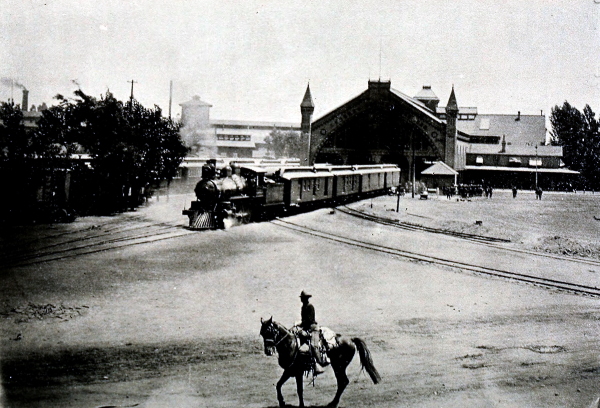
THE FIRST TRAIN LEAVING SACRAMENTO DEPOT, JULY 11, 1891; FRIGHTFULLY WRECKED 15 MINUTES LATER.
How did the field music feel? At first it was a struggle
between love and duty, and duty triumphed. Seizing hold
of the litter with nervous determination, they made their way
forward by slow degrees, each step taken being taken only
after they had overcome the strong, glue-like cohesion between
the earth and their feet. At last they arrived upon the skirmish
line in safety, and had just emitted a sigh of relief when
Tommy Eckert, lying behind a car-wheel, cried out, “Down
on your knees”! The four dropped like a shot, and like the
ostrich of the desert, which, when hotly pursued, will bury
its head in the sand, and thus think itself safe from detection,
these unfortunate litter-bearers huddled themselves
together on the ground, and crawled under the litter for protection.
Breathlessly, half dead with terror, they lay there,
expecting every moment to hear the reports of musketry.
Gaining a little confidence from the continued quietness, and
feeling desirous of finding out how the situation stood, one of
their number, A. Rupp by name and a German by birth,
remembering the story of how a man deluded a tiger, suggested
that they raise a hat on the end of a fife over the
edge of the litter, and thus draw the fire of any striker who
should happen to be laying in wait to pop them. This suggestion,
which was at once followed, resulted in the hat, after
being held aloft for some time, remaining intact, untouched
by bullets. Then gaining still further confidence from this,
one of their number quickly raised his head and glanced over
the edge of the litter, but, as if astonished and startled by his
own boldness and rashness, he as quickly dropped it behind
the litter again. No disastrous consequences following from
his hasty and courageous action, he took more courage and
raised his head again above the litter, this time, however,
glancing around with nervous rapidity. Seeing no signs of
danger, he excitedly whispered to his comrades, “quickly
fellows, now’s our chance.” At this they grasped the litter
again and made their way hurriedly across the opening on
their hands and knees to the freight-cars, and there, safe
from bullets, behind the protecting wheels of the cars, they
sank down exhausted and helpless. Recovering, they were
informed that their assistance was needed at the other end of
the line. They groaned, and then started courageously down
the track on all fours, dragging the litter after them. By
dodging from one car-wheel to another they finally reached
their destination, only to find that the man who needed their
aid was dead, buried, and forgotten.
Hostilities having completely ceased, and not being likely to
be renewed after the prompt action exhibited by the National
Guard, the skirmishers and sentinels were withdrawn. The
battalion was then re-formed and marched back to the Capitol
grounds.
The effect of the exciting events of the morning upon the
company was electrifying. The discontented brightened up.
Those who had hitherto prayed for something to occur, which
would compel them to return now could not be driven away.
Even the intense longing of Lieutenant Filmer for one fond
kiss from his baby girl was smothered for at least one week.
The men had tasted of the excitement of battle and were eager
for the fray. Their activities had at last found vent. Material
had been gathered that morning which would serve as food
for thought for many a day. Each man on his return from
the skirmish had something to say concerning the novel
experience of being for the first time in his life under fire;
something to say of the feelings that ran through him as the
first shot rang out. Men had to relate again and again some
special incident of interest in which they played a large part.
Billy O’Malley was compelled to tell how he, being unarmed,
courageously or in other words by his immaculate gall, took a
pistol away from a burly striker; also how he felt, when the
call rang out “Ambulance Corps this way.” Phil Bannan
was obliged to tell how he got his finger cut or shot as some
of the members would have it. Private Gille was given the
opportunity to explain how he took the chill that caused him
to nearly drop his rifle to the pavement. Private O’Brien
had to entertain a select audience with an account of how
he relieved an ugly looking customer of his weapon. Corporal
Benny Burdick discoursed to another gathering how
he boldly challenged the United States Marshal Barry Baldwin.
First Sergt. A. F. Ramm had to tell about the men he did
not shoot and the number of shots he fired while on the
skirmish line. Others would relate how, when the first
shot was fired, they tightened their grip upon their rifles
and started involuntarily forward. And still others were
discussing the number killed. None, however, were considering
the possibility of being called out again that day for
active duty. But such was the case.
The regulars, on landing, had proceeded direct to the depot.
They found it practically deserted, and entered without opposition.
The troops, once in possession of the depot, the
railroad officials proceeded almost immediately to open up the
blockade. A train was made up and placed under the guard
of a detail of regular troops. And at 12:06 P. M. the first
train since July 3d pulled out of the depot. Its destination was
Oakland.
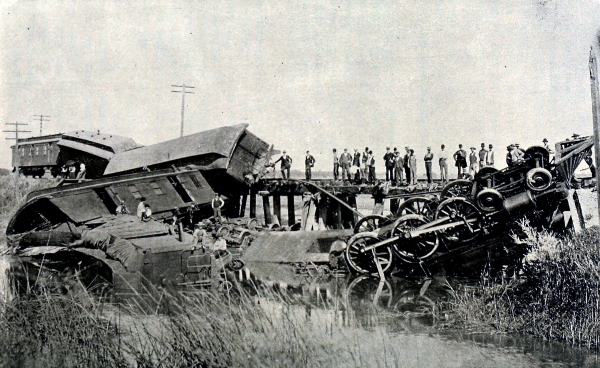
THE DITCHED TRAIN, 1 HOUR AFTERWARDS, 3 MILES WEST OF SACRAMENTO, CAL., JULY 11, 1894.
The first attempt to break the blockade was destined to result
in fatality. About two miles outside of Sacramento, at
Davisville, the bolts had been withdrawn from the rails of a
small trestlework and the train, trying to cross, was ditched,
and four soldiers were killed. The news of the disaster was
immediately sent to Colonel Graham, commanding the regular
troops at Sacramento, and thence spread rapidly. The
cavalry were ordered to hasten to the scene and capture any
suspicious looking characters in the vicinity. By this outrageous
crime the strikers lost more than they ever could hope
to regain. Public opinion and press, which had largely supported
them, now, when they saw what such support resulted
in, turned against them. The public recognized that a strike
that carried with it destruction of property and life must not
be tolerated. Even the regular had sympathized with them
in their struggle against the thieving monopoly—the railroad.
But now, woe to the striker who would rub up against
a regular. Every man’s hand seemed to be turned against
them.
Colonel Graham was much affected by the news, and resolved
to show the strikers no mercy. Hearing that they had secreted
arms in various parts of the city, he ordered four companies
of the National Guard, under the command of Colonel
Nunan of the Sixth Regiment, to search the various headquarters
of the strikers. The companies chosen to perform
this dangerous duty were Companies A and B of the Sixth
Regiment, Company B of the Third, and, as luck will have it,
Company B of the First.
It was at 3:30 P. M. when First Sergeant Ramm gave the command,
“Fall in.” As Company B marched out of camp,
much envied by the rest of the regiment, a scene took place
in front of the guard tent the memory of which the “boys”
will never forget. Shortly after we had returned in the morning
from the river Company H was relieved from guard duty,
and details were taken from each company to make up the
new guard. Those taken from Company B were Lieutenant
Lundquist, who acted as officer of the guard, Sergeant Kelly,
who acted as sergeant of the guard, and four privates, Gilkyson,
Murphy, Flanagan, and Sieberst. Lieutenant Lundquist
and Sergeant Kelly were standing on the right as
the company passed by. Privates Sieberst and Gilkyson
were on the left, having been just relieved from a tour of
guard duty. The beseeching look of Van Sieberst’s face was
painful to behold. His wail of “Captain, take me with you,”
was hard to refuse. But it had to be done. Private Gilkyson,
at the thought of being left behind, became perfectly wild
and threatened to whip the first man who addressed him.
This happened to be Murphy, who came up after the company
had marched off and wanted to know what was the matter.
It is needless to say that his escape was of a hairbreadth nature.
Sergeant Kelly was another study. He may not have cursed
loud, but he did deep. There was gnashing of teeth as all
hope vanished with the disappearance of the company. Lieutenant
Lundquist, what of him? He too felt the strong desire
to be with the boys. But it is hard to kick against
the pricks. So he had to content himself with guarding the
camp. The leaving of these behind was the only thing
the men regretted.
The company halted on the street just outside of camp.
Here Captain Cook, according to instructions ordered Sergeant
Clifford to report to Colonel Nunan. Upon reporting, Colonel
Nunan said, “Sergeant, you are to select from your company
four men whom you have the greatest confidence in, men who
you can trust to stay with you in any danger. We will proceed
into town and halt in front of a certain building; at a given
signal from me you are to enter the building with your squad,
and search the house from top to bottom. If you meet with
resistance use force. Seize every firearm or weapon likely
to do bodily harm. The company will remain on the outside,
and will respond to any call you may give for assistance.”
Sergeant Clifford selected as his squad Corporal J. N. Wilson,
Privates Unger, Hayes, and Crowley.
The four companies, two from the sixth, one from the third,
and one from the first, were formed into a battalion, and the
command “March,” was given. The companies proceeded to a
building in which was situated the headquarters of the A. R. U.
Company B of the Sixth was detached from the column and
sent to search the building. The other three companies continued
the march. The next halt was made in front of the
Fremont building. Company A of the Sixth was detailed to
search this building. B of the First and B of the third then
proceeded to the corner of Front and I streets. Here the
companies were wheeled into line and halted.
The building to be searched was a two-story dwelling, the
ground floor of which, being one large room, was used for a
meeting place by the strikers. It was removed from the corner
of the street by a three-story building, the first floor being
occupied by a saloon, while, on the left of it, was another two-story
building. Owing to the intimate relation between
these three buildings it was deemed advisable to search all
three. Consequently, on account of the increased magnitude of
the search, the original searching squad was increased by the
addition of Privates O’Brien and Bannan and placed under
the command of Lieutenant Filmer. On receiving the signal
agreed upon from Colonel Nunan, Lieutenant Filmer led the
way into the building. The outer door was opened, on demand,
by the proprietor of the place, who invited the squad to step
in, assuring them that they would encounter no resistance.
Entering the building, the squad found themselves in a large
room where some fifty men were seated round. Sizing up the
the place, Lieutenant Filmer gave the command, “Search the
house.” The squad immediately spread out, part passing upstairs,
while the others searched the ground floor and basement.
The company was now, for the first time in the campaign,
really face to face with danger. A man’s castle was being
invaded. Would he submit peacefully, or would he resist?
This was a question that time alone could answer.
After the searching squad had been some minutes at work
Private Unger appeared at the door and asked for assistance.
Reenforcements were sent in, and in a few minutes they reappeared,
bearing a large number of Italian swords and sheaths,
which they piled upon the street.
In the mean time the crowd began to assemble and press up
toward the building in which the search was going on. Seeing
the necessity of keeping the crowd back, Captain Cook
ordered Corporal Burtis and Private M. Claussenius to clear
the sidewalk as far as the corner.
Fixing their bayonets, they advanced upon the crowd and
commanded, “Get back!” at the same time pressing the crowd
back with their rifles. “I live here,” was the response, “Get
back!” “Don’t you force me, I won’t get back, I have a right
here.” “Get back or I’ll put this through you,” emphasizing
the commands by giving the refractory ones several sharp
prods in the back with the bayonet, which overcame their
resistance and accelerated their motion towards the corner,
where they stood and relieved their wounded feelings by
taunting and jeering the men. “You people think you’re
great, but we’ll fix you yet, coming up here to down us, eh?
By God, we hope you scrubs will get it in the neck,” and etc.
Beneath this shower of abuse Claussenius and Burtis stood
impervious. Whatever satisfaction the crowd might have
derived from jeering, and thus giving vent to their injured
feelings, they certainly derived none, if such satisfaction
depended upon their irritating the objects of their displeasure,
from the men themselves.
Corporal Burtis’ work was much admired by Lieutenant
McIver of the regular army and inspector of the National
Guard of California. He was heard to remark to one of the
officers that “that man is a fine corporal.” Corporal Burtis
did not display a single sign of weakness. His work was
characterized by firmness and determination, the essential
elements of a good soldier.
The crowd, seeing it was impossible to get past the sentinels
at the corner, made a wide detour and attempted to gain
a position upon a freight platform on the opposite side of the
street. A few succeeded in doing so, only, however, to be
scared into a hasty flight a moment later. Corporal J. N.
Wilson and a private from Company B of the Third were
guarding this platform. The man from the Third had a voice
that would awaken the dead. When he shouted, “Get off
there,” it had almost the opposite effect, it bound them to
their seats. But, when the ominous click of Corporal Wilson’s
rifle struck their ears, the spell was broken, and a rapid
retreat ensued.
A line of sentinels, consisting of Corporals Burtis and McCulloch,
Privates M. Claussenius, G. Radke, and W. Crowley,
were posted across the street to the right of the building facing
east, while Company B of the Third was posted similarly
across the street to the left and facing west, both lines holding
in check a large crowd.
It might be mentioned here that Company B of the Third
did excellent work on this occasion, and showed that they
could be relied upon in any emergency. They presented a
very formidable appearance—big, brawny fellows. Whatever
else might be said, this fact remains, they are fighters,
every inch of them.
Captain Cook, in making a tour of investigation, made the
discovery that in the rear of the buildings being searched
was an alleyway leading out onto a side street. Instantly it
flashed through his strategic brain that the sentinels were not
posted to the best advantage. What was to prevent the strikers
from making their exit with arms and ammunition through
this passageway, or what was to hinder them from receiving
reinforcements through it? He lost no time in reaching the
street and remedying this defect. He ordered the sentinels
posted at the corner to force the crowd down I street for about
one hundred feet. The sentinels fulfilled the orders in short
notice; a few sharp commands, a prod with the bayonet here
and there, did the work, and our position was safe. Fortunately
the weakness of our position was discovered before the
strikers had the opportunity of making use of it; if this were
not so, there is no telling how the day might have resulted.
What if a crowd of desperate strikers had rushed through
this entrance, overpowered the searching squad, taken away
their guns, and then fired down upon the company in the
street, perhaps massacring the whole body. One shudders to
think of what might have happened. But let it be said that
as long as we have at the head of our company a man whose
brain in the time of battle is so clear, so far reaching, and at
the same time so quick, there is no need to be alarmed that
such disastrous results will flow from any neglect to guard
our position well.
Private Tooker, while acting as a sentinel, by his firmness
and unrelentless severity in forcing the crowd back, incurred
the dislike of several of the strikers. On a high-boarded fence
near by was a lithographic poster of Mephistopheles. Pointing
to this lithograph, one of the strikers remarked that Tooker’s
face looked very much like the face of the devil on the fence.
This was not at all complimentary, I can assure you. Tooker
is conceded to be one of the best looking, and at the same time
one of the most unassuming, young men in the company; and
the beauty of it all is, that he is unconscious of the fact. During
the late excursion of the company to Stockton an insane
man actually said that he would like to have Tooker’s face, as
it was such a handsome one, and this, let me tell you, with all
due earnestness, is no sign of the man’s insanity. So you can
see that the transformation must have been wonderful for it
even to be possible to conceive of making a comparison between
Tooker’s face and that of the devil’s.
It was just after the sentinels had forced the crowd down I
street that the cavalry, which had been ordered to the scene
of the wreck, with instructions to arrest all suspicious characters
in the vicinity, came up I street with a number of prisoners
they had rounded up. The prisoners were on foot in
the center of the troop, while behind them, also on foot, was a
line of soldiers urging them along at the point of the bayonet.
Following in the trail of the cavalry was a large crowd, curious
to see and find out what was going to be done with the
prisoners. In their anxiety to satisfy their curiosity, they
were oblivious of every thing else. As the commander of the
cavalry rode through the lines he told the sentinels to keep
back the crowd, which was consequently very much astonished
when their attention was attracted, by a sudden and unexpected
challenge, “Halt,” to the points of the bayonets held
by the sentinels those in front came to such an abrupt stop that
those in the rear almost piled on top of them before they realized
what had happened. The crowd then remained stationary
at a respectable distance from the points of the bayonets,
until the cavalry, retracing their steps, passed through the
lines again, when they once more attached themselves to the
rear of the troop and moved away.
While the sentinels were dealing with the crowd on the
outside the searching party, now augmented by Privates G.
Claussenius, R. Radke, Stealy, F. Shula, and Sindler, were having,
on the inside of the building, an exciting time carrying
out their instructions. Of the original searching squad, Sergeant
Clifford made the first discovery. Going directly to the
rear of the house, and putting his hand into the corner of a
closet, he pulled out a jar containing several pistols, a few
knives, and some ammunition. Private Hayes was the next
successful explorer. In one of the rooms on the upper floor
he ran across a pile of about seventy Italian swords and sheaths.
These were carried to the street and deposited upon a truck.
The “crust” broken, the searching squad entered into the
spirit of the duty. Every room in the house was thoroughly
searched. Doors that were locked and were not opened on
demand were burst open, either with a swinging blow of the
canteen, or else one of the squad would take a short run and
launch the whole weight of his body against it. No nook in
the room was left unsearched. Trunks were opened and their
contents inspected, beds were turned completely over and the
clothes well explored, closets were ransacked and the miscellaneous
articles in them minutely examined. No ceremony
was used. And while the search was thorough, we are glad to
say that the searching party, under the careful eye of Lieutenant
Filmer, was particular to replace everything they inspected
in the same condition it was before the search began.
On the rear porch Sergeant Clifford discovered ten sacks
filled with hard material. When he went to examine them
carefully a bystander remarked to him, “It’s only coal.” On
examination they were found to contain a species of coal
known as boiler punchings. Sergeant Clifford called Colonel
Nunan’s attention to the sacks, who immediately ordered them
to be taken out.
On the roof of the building were found a number of Winchester
rifles and a quantity of ammunition.
Captain Cook, on examining one of these rifles, noticed that
a quantity of sand was adhering to the barrel, and that there
were signs of the rifle having been recently used. From this
he naturally inferred that it was one of the weapons used by
the strikers during the morning skirmish, but which had been
deposited in the building after the skirmish was over.
Private Bannan, hunting around, stumbled across, in one of
the rooms, a basket of lint, which seemed to indicate that the
strikers were prepared for the worst.
Several times in the course of the search critical moments
were experienced. Some of the lodgers objected to having
their rooms searched, and it was only by a determined front,
aided materially by the click of the rifle, that they unwillingly
submitted.
The first building having been completely searched, the
squad passed into the other buildings. Private Hayes discovered
a lot of cartridges on a shelf in the rear of the saloon.
He was about to confiscate them on the behalf of the state,
when an outsider interfered, saying that the property belonged
to him, at the same time putting his hands upon the ammunition.
The cocking of Sergeant Clifford’s rifle reminded the
man that his hands were needed some place else.
Private G. Claussenius taught one striker a lesson not to
lay his hands on a National Guardsman with impunity. As
Claussenius was passing through one of the rooms in the rear
of the saloon, he was astonished to receive a shove and a
command to get out of here. Turning, he was confronted by a
fierce looking individual who reiterated the command to get
out and made another attempt to put his command into execution.
The attempt was about as far as he got. Claussenius
cocked his piece, and jabbing it up against the fellow’s breast,
with his finger on the trigger ready to fire instantly on
the least further provocation, he ordered the man to get out
of the room. The fellow never hesitated, but in a weakened
voice said, “All right, don’t shoot!” and passed out of the room.
The action of this individual reminds one of the following
lines:
“How many cowards wear yet upon their chins
The beards of Hercules and frowning Mars,
Who, inward searched, have livers white as milk.”
In the natural course of events Private Stealey had a somewhat
similar experience. Meeting one who he took to be a
striker, he ordered the man to throw up his hands, which command
was obeyed with great alacrity. The man, on being
searched, justified suspicion, as he was found to be armed
with an ugly looking revolver. It is needless to say that he
was relieved of it.
While the squad was searching the basement of the building,
they were startled to hear from above the report of a gun.
For awhile their position was a peculiar one; hearing, however,
no further reports, they concluded that it was an accidental
discharge—which it really was. It seems that while
Lieutenant McIver was unloading one of the captured Winchesters,
a shell was jammed and exploded, the bullet striking
the bottom of the truck, and glancing upward entered one of
the sacks of boiler slugs.
The buildings having been thoroughly searched, the searching
parties and sentinels were called in and the companies re-formed.
Just as we were about to move, an incident occurred which
showed how far a sympathetic strike can be carried. The
driver of the truck upon which the confiscated articles were
placed, when told to drive on, refused to do so and dismounted
from the seat. Here was a man connected in no way with the
strikers, except in the larger conception of the universal
brotherhood of man, placing himself in jeopardy merely to
show his sympathy for the strikers. This did not, however,
cause any delay, for the sergeant major of the Sixth Regiment
mounted the seat and manipulated the reins.
The two companies then marched to the corner of Second
and J streets, at which point Lieutenant Filmer again led
his merry squad of searchers out and proceeded to search
the Pioneer Bakery. Corporals Burtis, McCulloch and Burdick,
Privates M. Claussenius, Keane, Wise, and others, assisted
by part of Company B of the Third, guarded the crossing of
the streets below the bakery, while Privates O’Brien, Flanagan,
Overstreet, with others of the Third Regiment, formed a
line of sentinels across the street above the building. The
searching squad was made up of very nearly the same men
who composed it on the previous search.
In the bakery, the searching party was met by the proprietor,
who informed them with great solemnity that there were
no weapons of any kind on his premises. In spite of this assurance,
the place was searched, and the results did not harmonize
with the proprietor’s statement. The inside of the
building was found to be a perfect labyrinth. Winding stairways
and dark passages in such profusion that it was extremely
difficult to make a thorough search. Besides this, the dirt and
filth of the place was something frightful. It seemed to be
more fit for a pigsty than a dwelling-place of men. Sergeant
Clifford, by feeling his way, managed to reach the roof. On
looking around he saw that the roof of the adjacent building
was about twelve feet higher than that of the bakery. Against
the wall of this building a ladder was leaning; so, thinking
that the roof might be worthy of investigation, he was about
to ascend, when he met a lieutenant of the Third coming
down, and who mentioned that there was nothing up there.
The sergeant, knowing that it was impossible for the lieutenant
to make a careful search in the time he was upon the roof,
proceeded up, and was well rewarded for his pains; for there,
lying side by side, were five Winchester rifles, with a pile of
ammunition stacked alongside of each gun. Sergeant Clifford
also noticed that brickbats were piled around the edge of the
roof, with the evident intention of throwing them down upon
the militia on the streets. In descending to the ground floor,
Clifford encountered in one of the small rooms a hard-looking
citizen, who he promptly ordered to throw up his hands. On
being searched, the man was found armed with an old powder-and-ball
revolver, of 38-caliber, which was taken away.
This Sergeant Clifford still retains as a memento. In addition,
twelve pistols were also found in the different rooms.
While the search was going on inside, Private O’Brien
had a thrilling experience on the outside. Just above the
bakery is a small alley running perpendicular to Second street,
and as far as K. Here a number of strikers were gathered.
These, Private O’Brien, assisted by a private from the Third,
ordered back into the alley, and told them to keep moving
until they reached the street a block above. The strikers
moved back. But when they were about seventy-five yards
from the corner, and near to the street above, they halted and
faced about. Then, drawing revolvers and leveling them at
O’Brien and the man from the Third, they yelled for them to
get out of the alley.
The bluff didn’t work worth a cent. O’Brien merely seized
a chair, and, placing it in the middle of the alley with its back
toward the strikers, straddled it, and then, resting his arm
upon the back of it, he drew a bead upon the strikers. The
situation remained unchanged for a minute or so, when the
strain proving too great for the strikers, they turned, fled up
the alley and disappeared around the corner, shaking their
fists and hurling imprecations at O’Brien as they did so.
The crowd that thronged around the lines of the sentinels
at this place was much larger than it had been at the former
place of search. The blockaded streets were the principal thoroughfares
of the city, and many persons in the crowd were
prevented by the blockade from transacting their regular
business. Some of these became extremely angry at being
stopped. One old, irascible gent, wearing a silk tile, which
gave him a sort of a professional appearance, on being told
that he could not go through the lines, but that if he had any
business to transact he would have to go back and pass around
the block, became very indignant at the thought that he, an
important personage, should be treated like a common, everyday
individual. He had to go around the block, just the same.
The bakery having been thoroughly searched, and the
“spoils of war” deposited upon the truck, the sentinels were
withdrawn and companies again re-formed. The march was
then taken up and continued down L street. Soon, Company
B detached itself from the column, and, turning to the left,
marched to the Golden Eagle Hotel, where an excellent dinner
awaited them.
The search, judged from every point of view, was a complete
success. That it was a surprise is evidenced by the fact
that no attempt was made to remove the weapons from any
of the buildings. The probabilities are that the strikers had
no idea that a search would be instituted, and further, that
they did not become cognizant of the movement until the
searching party stood before their door. One thing, above
all others, did the result of the search tend to show, and that
is this, that the strikers, if not as a body, still to a considerable
number, were prepared and really intended to engage in
an actual conflict with the troops.
The scene of a truck loaded with weapons of war being
driven through the streets in broad daylight, guarded on all
sides by glittering bayonets, is one that will not be forgotten
by the Sacramento citizens for some time to come. It brought
facts home to the people and showed them that the strike was
no peaceful affair, but some thing of a very serious nature.
It revealed the true position of the strikers.
The events of the morning were exciting, but these were
even more so. For on this occasion the men did not have to
share the honors with any one. In the dining-room the noise
of the conversation was almost deafening. To an outsider it
would appear as if a Bedlam has broken loose. Each man
had some thing more important than the other to relate, and
consequently each bid against the other for the attention of
the table he was at. Either a man was eating, or else he was
talking, and between the two, his jaw was kept busy. Some
were handicapped on account of not having so many personal
experiences as others; but they made up for it, the one experience
they had, they
One interesting subject was the manner in which the members
of the company impressed the strikers. Their duty had
been performed in such a way, with such snap and at the
same time with such firmness, that the strikers were kept
guessing as to whether they were regulars or the militia.
Surely, the strikers argued, that man, pointing to Crowley,
does not belong to the militia, or that one, pointing to Burtis,
or that one, etc., pointing to Wilson, Keane, Heeth, Zimmerman,
R. Radke in succession, and, above all, that one with the
white diamond on his arm, meaning First Sergeant A. F. Ramm.
Surely, he cannot belong to the militia! Their conception
of the National Guard was altogether different from the
appearance of the men. Weak-kneed, narrow-chested, goose-necked,
pale-faced striplings were, with them, synonymous
to the members of the National Guard. These men did not
agree with their conception, so, consequently, they must be
regulars. One of the women in the crowd, that Burtis forced
back with no gentle hand, excused him to the strikers by saying
that he could not help it, as he was a regular.
As soon as the meal was finished the company marched
back to the Capitol grounds. As they passed into camp it was
loudly cheered by the other companies. Company F especially
showed its unselfishness by giving, as a company, three
cheers and a tiger for Company B. Upon reaching the
company’s street the men were dismissed, and for the rest of
the evening until taps were besieged, at different times, by
nearly the whole regiment, all anxious to hear about what took
place during the raid.
This night pickets were again sent out. Gilkyson, Hayes,
and O’Brien were sent from Company B. The strikers
were as much excited over the events of the day as were the
militia. Just as in the case of any undue excitement, those
people who live out of town will proceed into town in order to
hear the latest news, so the strikers gathered into town that
night in order to discuss the latest phase in the course of the
strike. All the hours of the night and the early hours of the
the morning they passed and repassed the camp in groups.
The pickets kept on the alert for any suspicious move on their
part, and had plans formed for repulsing any advance that
they might make. The strikers, however, were not looking
for trouble, as they had enough for one day.
The following morning the company again omitted to take
its accustomed walk for breakfast—it was served on the
grounds. From this time on meals were prepared within the
camp. The rapidity with which cooks sprang up on every
hand passeth all understanding. Some were but an ephemeral
growth—they blossomed but to die. Others, however, displayed
a real native gift for cooking, which they themselves
hitherto had never dreamt they possessed. This exhibition
of latent genius reminds one of the lines in Gray’s Elegy:
“Full many a gem of purest ray serene
The dark unfathomed caves of ocean bear;
Full many a flower is born to blush unseen,
And waste its sweetness on the desert air.”
Had the opportunity of developing their genius never presented
itself to them the world would have never known the
power that lay within their mold of clay, and Company B
would have been the loser, but perhaps not the sadder.
About nine o’clock in the morning the regiment was assembled
and marched to the depot. At last we were to enter the
long-desired building. But under what disgraceful conditions!
Only after the regulars had driven out the strikers.
How humiliating it was for the men of the National Guard to
walk into the depot under the protection, as it were, of three
hundred and fifty regulars. It should have been the opposite.
Ay, and it would have been so had the rank and file had their
way. But the Fates decided it otherwise, and the militia had
to be content with what “pie” the regulars did not use.
Arms were stacked in the depot and the men given liberty
to move about the building. Observation showed that the
regulars had the place well guarded. Two Gatling guns were
placed at one of the outlets, pointing threateningly towards
the crowd gathered around. The building was also surrounded
by a line of sentinels. One of these, a marine,
attracted especial attention by his activity and particularly on
account of an encounter he had with a burly striker who was
evidently not very much impressed with his appearance;
for, when told to stand back, he doggedly refused and made
an attempt to draw a weapon. No movement ever resulted
more disastrously to the mover. The marine quickly threw
up his piece, and, catching it by the barrel, struck the fellow
a terrific blow with the stock between the neck and shoulder,
placing him “hors de combat.” Had the blow struck him
fairly upon the neck it would have killed him. As it was, it
broke the stock of the gun. The striker was made a prisoner,
and a sorry time he had of it too. The case being reported,
the officer of the day coolly remarked that the next time, in
case of trouble, to use powder and ball, as it was cheaper than
breaking guns.
To be a prisoner in the ordinary sense of the term and to
be a prisoner under the surveillance of the regular army,
especially during the Sacramento campaign, are two entirely
different things. One who has ever undergone the experience
of being a prisoner for twenty-four hours under the charge
of the regulars would most emphatically object to its repetition.
The prisoners whom the regulars had rounded up the
day previous to the militia reporting at the depot presented
this day a pitiful appearance. They had been handcuffed
together and incarcerated in one of the small rooms of the
depot. Here they stood for twenty-four hours without being
permitted to sit or lie down. The sentinels placed over them
received orders to shoot them if they persisted in doing so.
These were harsh orders, but the occasion demanded them.
The poor wretches were certainly in a dilemma. To sit down
was death; to stand up was almost as bad. This way of dealing
with the prisoners had undoubtedly a salutory effect. The
striker, by the time he was released, learned sufficient to make
him extremely cautious in the future about drawing a revolver,
especially upon a marine.
In the depot there was a small dining-room where coffee
and buns could be had for fifteen cents. This dining-room
had a fascination for certain of the “boys”; partly because
it had a familiar look, and partly because the meal that morning
was unusually scanty. At any rate, the place was soon
doing a thriving business. Those members of the guard who
did not possess the necessary fifteen per, gazed wistfully at
their more fortunate brethren performing the magical operation
of turning eatables into men. Now, here was a problem
for solution; how were they, without money and without
friends, going to participate in the performance. Dr. O’Malley
was the first to solve the problem. Nor did he find any
difficulty in doing so. Seeing no reason why a man in the
service of the state should be denied anything that would
contribute to the comfort of his stomach, he walked boldly
into the place and sat himself down at the counter. He
gave the necessary order, and in such a way that one would
think he was loaded down with wealth. No doubt the proprietor
of the place thought of him in this light. But if
he did, how sadly he must have been disappointed; for when
O’Malley had sufficiently satisfied his wants, he called the
proprietor to him, and in a matter of fact way told him that
he was sorry but he had no money to pay for what he had
eaten. The man was astounded; but what could he do? His
property was gone and could never be recalled. Grin and
bear it was all that was left for him.
O’Malley never waited to see the effect of his words, but
slowly walked away, as though what he had done was perfectly
proper. Not satisfied with this, he made others acquainted
with his solution. Running across two of the members of
the company, who were loudly bemoaning their sad fate of
being without money in a strange land, and thus barred, as
they thought, from disposing of a large cup of extra fine
coffee, he offered to aid them in securing what they wished.
Telling them to follow him, he made his way to the counter
again. The proprietor had hardly recovered from the previous
shock, when O’Malley, addressing him again, saying, “Now,
here is an opportunity for you to do an act of charity. These
two men left their homes in such a hurry that they neglected
to take with them any money. Give them something to eat,
and you will be rewarded for it at some future day.” The
man collapsed. It was impossible to refuse such a request,
when backed by such a powerful battery of gall. The men
received what they wished for. And O’Malley was twice
blessed. First, he was blessed by the proprietor of the place.
This blessing, however, was of a negative nature. Secondly, he
was blessed—and this was a positive blessing—by his two
comrades. The way being once known, many worked out the
problem. It is safe to say that about half of the business that
that coffee establishment did that day was charged to profit
and loss.
At about three o’clock in the afternoon the regiment was
formed and marched to Ninth and D streets. Here it was
decided that the First Regiment should pitch its tents. A
lot of work was planned out by Col. Graham for the militia,
and in order that this work be done well, it was necessary to
break camp at the Capitol grounds, and pitch camp near the
field of action. From this time on the men could not complain
of not having something to do.
While we were at the depot orders had been given to each
company to detail six men, one from each tent, to assist in breaking
camp at the Capitol grounds. These details were placed
under the command of Captain Marshall, of Company A, and
Lieutenant Filmer of Company B, and marched back to the
camp. The reason why one man was selected from each tent
was that the man selected would see that the property of his
tent crowd was packed together and rolled inside of the tent,
so that when it came to pitching camp at Ninth and D streets
each tent crowd would have no trouble in finding their
property. Quartermaster Sergeant Clifford, Privates Hayes,
Overstreet, Baumgartner, Gilkyson and Warren were detailed
from Company B.
Arriving at the camp about noon the detail of Company B
decided to lunch before starting to work. Baumgartner, who
is quite partial to the frothed liquid, and who, at the same time,
knew his comrades’ fondness for the beverage, suggested that a
magic wand in the shape of a tin pail and about fifty cents be
employed to make the liquid materialize. Lieutenant Filmer
generously contributed the fifty, while the rest of the detail
contributed the pail. Baumgartner was then passed through
the lines, magic wand in hand, in search of a rock to smite.
While waiting, Quartermaster Sergeant Clifford went
about preparing lunch. It was the same old menu that had
been served for seven days—corned beef, cheese, and bread.
The men were used to it now, and looked for it as they would
for the coming of the night. Being a little short of butter,
the Quartermaster hastened to the officers’ mess tent to see if
a slice happened to remain from the morning meal. There
was, “Praise Jehovah,” more than a slice of butter. Boxes,
containing canned oysters, corn, tongue, lobster, prepared
beans, and deviled ham, carelessly left open, met his gaze.
His thoughts, as his eyes lingered fondly upon these delicacies,
seemed to say, “You’ll be mine, by and by.” Hastily
opening his shirt, he placed, in a lovable way, can after can
next to his breast. (Anyone who has ever seen Clifford on an
expedition of this kind knows the expansive qualities of his
shirt.) Then, laden with spoils, or rather luxuries, he darted
like a flash down the company’s street into his tent, where
that noble box, could it but speak, would tell of many such
takings, was waiting to receive the treasure. Private Hayes,
noticing the hasty move, followed the Quartermaster, and
desired to know where such things could be had. Learning
their whereabouts, he lost no time in also relieving the mess
tent of a fair shirtfull, and then returning to have them stowed
away in the Quartermaster’s box. Sergeant Clifford, not
wishing to do any thing by halves, innocently inquired,
“Billy, did you leave any thing?” Hayes, in surprise, answered,
“Why, yes, I think there is a couple of cans left.”
“Well, now, that’s too bad,” says Clifford, and away he hastened,
thinking of the remorse he would have to endure
should he fail to secure those remaining cans. Quickly securing
these, he made another grand bolt for the noble box.
Scarcely had he reached his tent, when Commissary Sergeant
Fitzgerald entered the officers’ mess tent; he wasn’t in that
tent a second when he staggered backward out again, his eyes
bulging out of his head. Throwing his arms convulsively
in the air, he exclaimed in heartrending tones, “Oh, God!
what is this?” The shock he received was a terrible one.
Recovering himself, the agonizing look on his face gave place
to one of fierceness. A bloodthirsty look came into his eyes.
Suddenly realizing Clifford’s taking propensities, he made a
bee line for the company’s street. Woe to the man upon
whom Fitz laid his heavy hand. Hayes, however, was on
the lookout. Seeing Fitz charging for the street, he immediately
warned the quartermaster sergeant that Fitz was on
the warpath. Quick as a flash the box was closed and locked.
It was none too soon, for immediately after Fitz appeared
upon the scene perfectly wild. “Clifford,” he yelled, “did you
take any thing out of that tent?” “What tent?” asked Clifford.
The apparent innocence displayed by the quartermaster
seemed to lift any doubt that Fitz entertained concerning
his connection with the affair. So he quickly started off on
another trail. Clifford came very near to owing the company
a dollar, for it nearly terminated in being a complete shave
for him instead of a close one.
Baumgartner having returned from his mission, all hands
made ready for lunch. A couple of cans of oysters and
tongue were opened in honor of the raid on the commissary
stores. It is needless to say that the meal was relished.
Right after lunch the men started to take down the tents.
Owing to limited number of trucks the work of removal was
very slow.
In the course of the afternoon the brigade commissary sent
over for a few men to carry the commissary stores to the sidewalk,
and thence be loaded upon the trucks. Quartermaster
Clifford and Private Overstreet volunteered their assistance,
not, however, from entirely selfish motives. In the natural
run of events they succeeded in relieving the brigade larder
of a number of useful things, such as canned beans, sugar,
potted ham, and soap.
At about five o’clock the work of demolishing was completed.
The details were united and marched to Ninth and
D streets, where the opposite process, of erecting tents, was
going on.
CHAPTER VIII.
THE FIRST REGIMENT AT NINTH AND D STREETS.
ON receiving the order to go into camp the regiment
was formed at the east end of the depot and marched
down the tracks to Ninth and D streets, where we
were met by the baggage wagons conveying our camp
outfit, tents, knapsacks, etc., from the Capitol grounds,
which were henceforth occupied only by the 6th and 8th
regiments.
Headquarters were quickly established on the grounds of a
vacant house occupying the northwest corner of Ninth and
D streets, and the order to establish camp given. Now every
thing became a scene of confusion. Willing hands soon
unloaded the baggage-wagons and men from each company
carried the rolled tents to the ground they were to respectively
occupy. Now did the rule of “taking” as established by that
king of vandals, Clifford, again come into use. Far-seeing
men of the Jack Wilson and Sam Wise type, scenting a
chance for plunder, generously offered their services to that
greatly worried individual Commissary Sergeant Fitzgerald.
Thankfully accepting the extraordinary offer, he set them to
work carrying the commissary stores, including a great many
boxes of pears and plums, into the vacant building in rear of
the headquarters. On this fruit, it soon appeared, had Wilson
and Wise and their cohorts cast an evil eye. Thus does it
now appear, though, in justice to these skillful foragers, it
should be admitted that they offered very plausible excuses
when, a few hours later, a dozen or so boxes of fruit were
found carefully stowed away in their tents. It was now plain
that “Every man for himself and the devil take the hindmost”
had become a well-established rule.
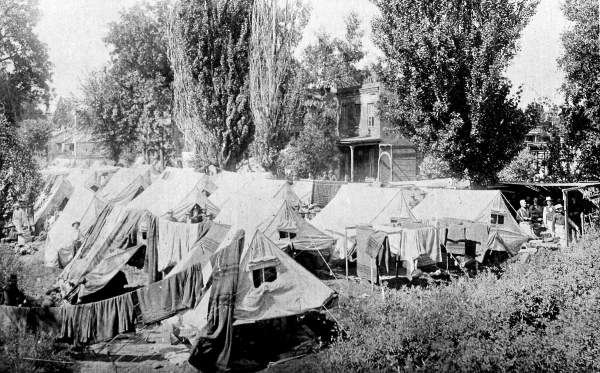
BIRD’S EYE VIEW OF FIRST REGIMENT CAMP, NINTH AND D STREETS, SACRAMENTO, CAL.
The work of raising the tents went busily forward. On
account of the narrowness of the road company street formation
was used, giving each company a separate street of four
tents on each side; the first tents on the left of the street being
occupied by the captain and lieutenants. By this means
simply the road was used, the sidewalk being left open.
True it is that campaigning sharpens the wits. On every
occasion that one man thought to gain an advantage over his
fellows he was sure to find others carefully watching the same
opportunity. Thus it was on the Capitol grounds when one
tent crowd thought to carry off an old torn tent to use as a
floor cloth, but found it necessary to have a rough and tumble
fight with every other tent crowd on the street before they
secured the coveted prize. And so it was at our new camp.
We had no sooner seen the ground on which we were to camp
than we knew hay would arrive to be used as beds, four bales
for each company. Men from B began to lay in wait for the
hay, with the laudable object in view of capturing an extra
bale or so. They found men of the other companies equally
alert, however. The hay soon arrived, and in spite of the
efforts of Major Jansen, who tried to see even-handed justice
done, the bales first from one side and then from the other
walked off in the most mysterious manner. On taking stock
after the scramble, it was found that B, through the agency of
Flanagan, McCulloch, Murphy, and O’Brien, had become the
proud possessors of six life-sized bales, which were quickly cut
up and distributed in order to avoid discovery. Suspicion
was also averted by sending the meek and lowly Bannan
down toward the now empty wagon to “raise a kick” for
more hay.
The work of building the canvas city on Ninth street was
soon completed. At this place Ninth street had but one open
end, at its crossing with D the railroad track built upon
the levee, which is here about twelve feet above the street,
cutting off the block at about C street. The tents of C company,
having the left of the second battalion, were pitched
close to this embankment, the others running out towards D
street in the order of their positions in the battalions.
The large building mentioned before, on the grounds of
which the headquarters tents had been pitched was taken
possession of the hospital corps in front and the commissary
department in the rear.
This house, though large and apparently well built, appeared
to have been vacant for a year or two at the least; and it was
not long before the irrepressible Doc Sieberst, in the course of
his wanderings after adventure, learned (it is alleged from the
members of the Japanese mission across the street who sang so
sweetly night and morning), that this self-same house was
haunted. This set his fertile brain at work, and he appeared
on B street a few minutes later with the light of genius shining
from his eyes, such as beams out upon us when he holds
us spellbound by his wonderful rendition of that classic German
poem “Schneider’s Ride.” Gathering his “heelers,”
musical and otherwise, around him, he explained his discovery
and the use to which it was to be put. As the dusk of evening
fell o’er our quiet canvas city, marshalled forward to the
fence in full view of headquarters, with outstretched arms
and pointing fingers, we roared as in the Bells of Corneville,
“That house is haunt-ed,
“That house is haunt-ed,
“That house is haunt-ed, ted, ted, ted, ted, ted.
“That house is haunt-ed,
“That house is haunt-ed,
“That house is haunt-ed, ted, ted, ted.”
The effect was said to have been beautiful, tho’ it must be
confessed we did not wait to investigate; we had pressing
business elsewhere.
We knew, when the brigade was placed under the command
of Colonel Graham at the railroad yards, that our longed-for
chance for active service had come. Colonel Graham was
too well known for us to imagine for a moment that our idle
days would continue. And he proved us right; for on this first
day at the new camp he called for a detail from the First to
relieve that of the regulars at the American river bridge, about
four miles northeast of our camp. Later on, on account of the
large number of men from the regiment on duty each day as
track and train and bridge guards, our colonel found it best to
send to each place details composed entirely of men from one
company. On this occasion, however, the guard was made up
of details from the different companies. B’s detail was composed
of Corporal McCulloch, Privates Heeth, Heizman, McKaig,
O’Brien, and Keane, and detailed from the hospital
corps, as medical assistant, Dr. Tom McCulloch. A great deal
of interest centered round this guard, as, in heavy marching
order, it formed in front of headquarters under charge of First
Lieutenant Eggert of F. Amongst the enlisted men it was
not known what duty was to be assigned to it. The men on
the guard joshed the unlucky ones, who gathered round watching
the preparations and trying to catch an idea of its destination.
Supper had not yet been served, so, standing in line,
while Quartermaster Cluff and Commissary Sergeant Fitzgerald
filled their canteens with black coffee and their haversacks
with crackers, the men munched greedily on canned
corned beef sandwiches, by calling the which “ham,” they
succeeded in swallowing.
While this hasty meal was going on, much advice, good and
bad, though generous, was offered by the facetious private,
who stood with his hands deep in his pockets, his head cocked
on the side, and his campaign hat hanging on by a few stiff
hairs in back, as he viewed his comrades with the critical eye
he intended to use when he became colonel. He kept a close
watch on Adjutant Williams, however, as he shouted out
his advice to “Shoot first, and then challenge.” “Keep ’im
covered ’till you can find out what the papers will say, Bill.”
“Gimme a lock of yer hair, Tommy”? or “If you get a
chance, give ’em one for us, boys.” The men on the guard
simply grinned in answer as they ate their scanty supper,
feeling the superiority of their position. The guard, having
finished the meal, was marched to the tracks on the levee
above the camp, where they were placed on a train composed
of a flat-car in front and a day-coach in rear of an engine,
and were whirled off down the track toward the American
River.
This guard having been dispatched, another detail was
called for from each company, and a guard formed and placed
on duty at the lower end of the yards.
The detail from B for this guard consisted of Corporal
Wilson and Privates Overstreet, Perry, Powleson, Radke R.,
Radke G., Sindler, Shula, and Sieberst.
The work demanded of this guard was decidedly onerous.
They had several hundred yards of track to guard, all closely
crowded with fruit-cars. The beats of the sentries, too, were
none of the safest. These, with but one or two exceptions,
lay between the crowded lines of cars, dark as a pocket at night,
and very little better during the day.
The practice firing of the Eighth Regiment, which so aroused
the American river bridge guard, startled these men as well,
Privates Perry and Shula, ever ready in an emergency, mounting
to the top of a box-car, and threatening to shoot the first
man who showed his head above the bushes in the marsh
which stretched away for a mile north to the river. Luckily,
however, they were not called upon for an exhibition of their
prowess.
The work of pitching camp being finished, and the excitement
over the departure of their comrades having subsided,
our hungry soldiers, as is ever the case when at a loss for
other amusement, turned their attention to their appetites,
which, on investigation, they found to be quite keen. It
was generally known on leaving the Capitol grounds that
company mess was to be established, and soon eager voices
were heard inquiring about supper. The meal served that
night was one long to be remembered. A meal prepared under
a combination of disadvantages rarely brought together
on one occasion. Everything was confusion, and kicking,
growling, and general dissatisfaction reigned supreme. The
aching void felt by each lusty trencher-man urged him to
lend his individual presence, and the aid of his voice in adding
to the confusion, and causing greater delay. Our quartermaster
was heard to remark that he received enough punishment
that night to counterbalance all the “snaps he ever had.”
The commissary department was not yet ready to issue
rations and would not be until 7 o’clock. Some of the companies
had bought food, prepared a meal, and were eating
before B had a sign of supper in sight. This was soon discovered
by our hungry warriors, and the wail of anguish that
went up in B street was heartrending. Captain Cook was, of
course, immediately notified, and getting on one of his proverbial
moves, he went to the quartermaster to learn why the
other companies were eating and B. still waiting. The
quartermaster explained; and then, resolving to make another
effort to save the lives of his starving comrades, who had
not even yet ceased to make inquiries about that supper that
was not, started for the commissary department to see if it
were possible to get any thing to appease the appetites of
those hungry mortals of Company B. Presently loud words
in the direction of the commissary department, accompanied
by a rattle of tinware, attracted the attention of every one.
Inquiry as to the cause elicited the fact that B’s quartermaster
was trying to “take” a ham, and, being caught, tried to
argue the point with Commissary Fitz, but was finally forcibly
ejected.
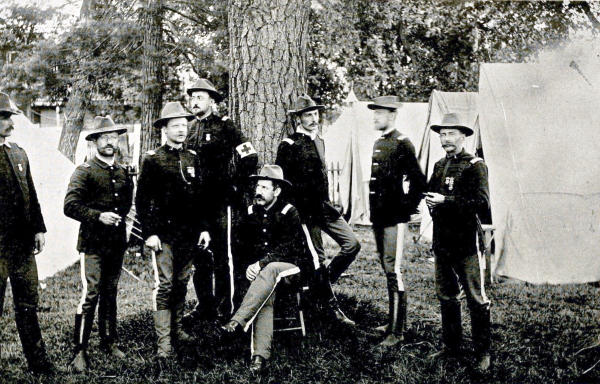
A GROUP OF FIELD AND STAFF OFFICERS OF THE FIRST REGIMENT INFANTRY.
Seven o’clock came and went, and still no rations. Some
thing must be done immediately; and it was now that the
little “takings” of the quartermaster showed their value. A
fire was quickly started, and three scantlings lashed together
at one end forming a tripod, were placed over it; from the
center a wire was suspended and the coffee-pot (captured and
held for ransom) placed thereon. In a short time water was
boiling and coffee made. The coffee and pot having played
their part, the prepared beans, which simply needed heating
to be very palatable, so neatly added to the company larder
that afternoon by the quartermaster, and that very apt pupil
in the art of “taking,” Private Hayes, were then brought into
service. Emptying five cans of them into a tin bucket they
were placed over the fire to warm. About the time the regimental
commissary department issued one boiled ham, twelve
loaves bread, one roll of butter, and six dozen eggs. Willing
hands and hungry mouths set to work making and marring
sandwiches. Prominent among the mouth contingent was
Sergeant Sieberst who was noticed to eat more than he made,
and after a heated argument with the Emperor’s finest, Paul
Rupp, was told to amuse himself keeping the fire up. He was
nothing loath, the beans being already very palatable. But Private
Hayes, who had noticed the facility with which the worthy
Sergeant could “turn a sandwich into a man,” told him not
to bother about the fire. Hayes was not a man to lend a hand
to acquire anything and then get left himself. Quartermaster
Clifford has learned this to be a fact, as since the campaign,
he has discovered the cause of certain mysterious disappearings
of canned oysters and a few other articles of
more or less gastronomic value.
The sandwiches were finally all made; and after the beans
were thoroughly warmed, the eggs were put on and in a short
time boiled hard. Imagine the inconvenience of cooking one
article at a time, with a lot of hungry men waiting, like
vultures, to devour it. It was fully 8 o’clock when supper was
ready to be served. Each man stepped up and received two
sandwiches, one egg, a small quantity of beans, and a cup of
coffee. Another great disadvantage was the lack of tin plates,
cups, forks, and spoons. There had been enough for about one-half
the company served out to us, and when one man
finished with a cup or plate, it was passed to another who had
not yet been served. This, it was rumored among the boys,
was another stroke of economic genius on a par with that
“ample” breakfast and dinner of the 4th of July, by our
brilliant minded Adjutant General Allen, late 2d Lieutenant
Commissary Department Missouri State Volunteers. Nobody,
on this occasion, waited for fork or spoon, but used a piece of
wood or any thing else that might answer the purpose.
Occasionally the quartermaster’s voice could be heard denouncing
some hungry man for “repeating.” After all had “scored,”
some being still hungry, sent to a neighboring store and purchased
canned stuffs and crackers. Some took the entire
situation good naturedly, but all seemed to think it necessary
to stand round and echo the appeals of their inner man.
Had we been camped in a strange country, with no base of
supplies, we could hardly have been thrown more on our own
resources than we were, camped in the city of Sacramento,
the very town in which our adjutant general, who is quartermaster
and commissary general also of the National Guard of
California has his headquarters.
Here was a commissary department under the direct eye of
its chief thrown into such confusion by a simple change of camp
that in a regiment of seven companies, six were forced to buy
their own provisions, and the Seventh, waiting to be served, finally
received enough to satisfy about one-half their number,
the coffee and beans, be it remembered, not being issued by the
commissary department. And as if this alone were not bad
enough, the men were obliged, on account of the scarcity of
tin cups and plates, on which valuable articles some military
wiseacre had thought well to economise, to wait in squads for
their meal, which some did not taste until after 9 o’clock.
Tattoo, at 9:15, found the men of B still airing their grievances;
yet, having at least partially appeased their appetites,
they willingly retired to their tents, where, of course, the
orator of each tent crowd continued to hold forth. Taps came,
and still the flow of oratory continued. On all such occasions
as this, our watchful captain would wander down one side of
the street and up the other, pull back the fly of each tent as
he passed, poke his head slowly in and make his usual request
to “Let’s have a little quiet.” It was on this occasion, we
believe, that Johnny Gilkyson, of the wild Irish tent, the
fighting drummer, stunned our worthy captain and nearly
convulsed his tentmates by replying “How much worth,
Captain?” Surprised at his own audacity, Johnny dived
under the blanket of his bunky, who was nearly choked in his
efforts to smother his laughter.
Breakfast the next morning, that of Friday the 13th, served
at 6 o’clock, found the men waiting and willing. This meal,
prepared in the same manner as that of the previous evening,
consisted of boiled eggs, bread, and coffee. This was, really,
our first day at this new camp, work having been begun so
late the day before that little more had been done than pitch
the tents. After breakfast had been disposed of, the men of
B, as of the other companies too, set to work with a will to
put the street, their future home for nobody knew how long,
into a habitable condition. Few shirked the work, and all
seemed anxious to show that they had recovered from last
night’s ordeal. Some secured planks from a neighboring sidewalk
and stretched them across their tents at about the center
to keep the hay used for beds from spreading; others made
gun-racks of stray pieces of lumber to keep their rifles from
the dust; while others took a hand-car, made a trip up the
line some three or four hundred yards to the lumber-yard and
secured material, out of which Monahan was soon busy manufacturing
tables and benches. But by far the most important
work undertaken was the improvision of a fireplace over
which all future meals must be prepared. During the morning
the captain issued orders giving full charge of the kitchen
to Quartermaster Clifford and appointing Musician Paul Rupp
company cook. Having been given charge of the kitchen, Clifford,
aided by Sergeant Sturdivant, set to work at the
fireplace. Taking the hand-car previously used that morning
to carry lumber, Ramm, Clifford, Kelly, Monahan, and Flanagan
went on a foraging expedition to the railroad shops to
secure the necessary material. Needless to say, they took
every thing in sight light enough to carry. They overhauled
a “dead” engine, securing wrenches, shovel, pick, pokers,
and several other more or less handy articles. Longing eyes
they cast on a pile of lanterns locked up in a caboose, but
house-breaking, at least, was beyond them. In the yard they
discovered a piece of sheet-iron to be used as a top for the
stove, which was made of bricks, a short stovepipe, and a
piece of iron pipe about twelve feet long, by bending which,
at about four feet from each end, and driving the ends into
the ground, a very serviceable substitute for fork and spit was
made and used thenceforth to hang pots and kettles over an
open fire. Thus, in a comparatively short time, our company
kitchen was created and in operation. The railroad tracks,
with the exception of the main line, were blocked at this
place by hundreds of fruit-cars, loaded before the strike for
Eastern shipment. During the day some skillful operator or
break-beam artist managed to open one of these, and a general
raid was made on the fruit by the regiment. It seems needless
to add that B secured a few boxes of pears; only a few,
thirty or forty or so. Pears, raw or stewed, appeared on the
menu at each meal from now until we left for Truckee.
On the first day or two of this system of company mess,
affairs did not seem to run as smoothly as was anticipated.
The cooks were forced to chop their own wood and wash the
dishes; and though there was food thrown away after each
meal, many of the men were growling about not getting
enough to eat. This was finally remedied by having the
first sergeant detail squads each day to do the necessary
kitchen work. This system proved an entire success and a
great improvement, the meals being prepared more quickly,
served better, and less food wasted. As a sample of the detail
made each morning, we insert that for Wednesday, July the
18th, the last day of our stay in this camp at Ninth and D
streets.
DETAIL FOR CAMP WORK JULY 18, 1894.
Keane, Wise, McKaig, dishwashers; T. McCulloch, O’Brien,
woodchoppers; Monahan, Overstreet, O’Malley, cook helpers;
Perry, Powlesen, R. Radke, G. Radke, Stealey, Sieberst,
waiters.
Later on, when enough plates, cups, knives, and forks had
been issued by the commissary department to furnish each
man with a separate kit, the necessity for appointing dishwashers
was done away with, as each man was supposed to
use and keep clean his own kit.
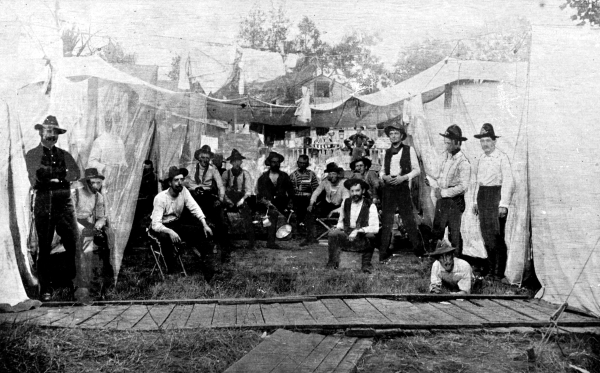
CO. B STREET WHILE CAMPED AT NINTH AND D STREETS, SACRAMENTO, CAL.
During the day several trips were made from the camp
down the line to the American river bridge. One in the
forenoon by Major Burdick, escorted by some of B’s best
marksmen, another under Corporal Jack Wilson, who was
looking for adventure, but found only hard work; and still
another in the afternoon by Kelly, Unger, and Monahan, who
were out on a foraging expedition. These latter went armed
with revolvers, pumping with one hand and holding their instruments
of destruction in the other. On returning from
their successful expedition they noticed an empty car just
outside the lines of the lower track guard crowded with a
dozen or more disreputable looking characters, tramps in all
probability. On arriving at the guard-house of the track
guard they informed the officer in charge, who sent a detail
down on their car to make the arrest. We have received information
from a reliable source that a most determined
resistance, a fight to the death, would have been made had
not the opposing forces caught sight of Van Sieberst, thirsting
for gore, whose face with its hirsute adornment of curly
black whiskers, one “Wandering Willie” was heard to remark,
would get up steam in a dead engine. So the arrest was made
and the prisoners, a dozen or more, were marched up the line
to general headquarters.
At 6 P. M. the guards for the succeeding twenty-four hours
were formed and sent out, Company G, as a whole, relieving
the American river bridge guard, and guards, formed of details
from the different companies, relieving the lower and upper
track guards; that relieving the lower having no men from
B, though commanded by Lieutenant Filmer, and that relieving
the upper, under charge of Lieutenant Lundquist, having
with them Sergeant Kelly, Corporal Burdick, and privates
Bannan, Williams, Gilkyson, Frech, Flanagan, Crowley, Zimmerman,
and Baumgartner, detailed from B.
The work required of this, as of the lower track guard, was
most decidedly none of the easiest. Many narrow, dark streets
and alleys ran into the tracks along which the sentries of this
guard were posted, the tracks running within a few feet of the
corners of these streets, necessitating extreme watchfulness on
the part of the men. An unwary sentinel could be knocked
senseless at any of these dark corners without the least difficulty
or chance of exposing the assailant to the view of the
other sentries.
We in camp passed the evening quietly. This splitting up
of the company seemed to act as a damper on the spirits of
the men. Little of such hilarity as was indulged in on the
Capitol grounds being even thought of here. Doubtless one
of the main reasons for this could be found in the fact that
it was more the rule than the exception that out of a tent
crowd of six or seven there would be but three or two, or
sometimes only one, left in camp to occupy the tent.
“The shades of night were falling fast”
o’er our little city of white, tattoo had sounded, and those who
had not already retired were sleepily preparing to do so, when
bang! bang! bang! went several shots down the line in the
direction of the lower track guard over whose destinies Lieutenant
Filmer, of “Ours,” presided. Not waiting for the long
roll, which was quickly sounded, nor for the calls of our first
sergeant to “Fall in!” “Fall in!” those of us who were awake
and dressed quickly buckled on our belts, snatched our rifles
from the racks, and “Fell in” in the company street. The
excitement was intense, and increasing every moment. Excitable
men were dodging in and out of their tents, forgetting
their belts, forgetting their rifles, forgetting every thing,
it would seem, but the fact that some one either was or had
been “blazing away” down the line. One, almost delirious,
was racing back and forth, shouting to our busy first sergeant,
high above the noise created by the others: “Al, will I get my
leggins?” “Al, will I get my belt?” “Al, will I get my gun?”
“Al, will I——.” “Shut up, and fall in,” almost yelled
our harassed sergeant, as he wheeled round on the luckless
wanderer, who jumped into his tent, and appeared the next
moment, shouting: “Al, will I get——,” but “Al” was not
to be seen, and the anxious questioner who “was not scared,
far from it,” he only wanted to be told what regalia to appear
in on such an august occasion, was compelled to fall in with
the less punctilious members of the company.
At the other end of the street an equally amusing scene was
enacting. Charlie Perry, who had just finished a long twenty-four
hours of guard duty, had gone soundly to sleep, but at the
first note of alarm, dimly realizing that long roll had sounded,
jumped from his blankets, dressed like a flash, grasped his
rifle, and sprang forth from his tent. Still half asleep, he
arrived in the middle of the street, brandishing his rifle, and
threatening to “blow the head off” of every striker in Sacramento.
It took all of the muchly-overworked “Al’s” persuasive
powers to get the redoubtable Charlie into the ranks,
where he undoubtedly would have done much to make his
promise good had the opportunity offered.
The opportunity did not offer, however. At the first note of
the long roll the captain dispatched two men down a narrow
alley, which appeared to afford a short cut in the direction of
the firing, to investigate how far the alley was open. They
reported it open for at least a block, affording a chance for a
quick passage to the street below, which led directly to the
tracks at the point where the track guard was posted.
By this time the cause of the firing had been discovered.
A sentry, posted near the crossing of Tenth street and the
tracks close to the point at which Tenth street becomes simply
a road through the marsh between the levee and the river,
was the primary cause of the excitement. He had been one of
our later arrivals. Coming up the river on the boat he had come
in contact with two disreputable looking characters, who made
it their business to advertise the fact that they were ex-convicts,
and boasted loudly of what they intended to do, on their
arrival, to the “blue coats.”
While pacing his beat he noticed these same two strolling
round, just outside the lines, in a most suspicious manner.
Finally, making up his mind to question them, he challenged.
Not waiting for a second call, the supposed ex-convicts rushed
across the road, and over a low fence into a barnyard. The
sentry opened fire in the direction in which they had run,
and kept it up lustily, though the night was so dark he could
not see objects clearly thirty feet from his beat. Great was
the excitement of the guard, as, led by Lieutenant Filmer, the
reliefs not on duty rushed down to the scene of the firing.
But by this time the rattle of musketry had ceased, and the
only sound to be heard was the groan of some wounded creature
in the barnyard. On investigation it proved to be a horse,
so badly hurt as to make it necessary, next morning, to put
the poor animal beyond reach of pain.
This, indeed, proved a rather tame ending to all the excitement
at camp, but thus it was.
To go back to the American river bridge guard. After a
cautious run of about fifteen minutes the train arrived at the
bridge. Most of the railroads in this county are built on the
levees. At this point on the American the levees on either
side are about one-half a mile from the banks of the river.
Consequently, while the bridge over the river proper is of no
great length, the approaches of trestle-work on each side from
the levee to the bridge form a very extensive work to guard,
in all fully a mile and a quarter in length. There were two
bridge-tender’s houses raised on piles, and connected with the
track by a small platform large enough to hold a hand-car for
the use of the tender. These houses were built one at each
end of the bridge proper, or just over the banks of the river.
On account of the nature of the ground, the guard was divided
into three sections, the first of about twenty-five men, under
Lieutenant Dumbrell of C, relieving the regulars on guard at
the nearer end of the trestle; the second of about ten men,
under First Sergeant McNally of G, relieving those who, stationed
at the first tender’s house, guarded about one hundred
yards of trestle and the bridge; and the third, composed of
the remainder of the guard, under Lieutenant Eggert of F,
relieving those who guarded the half-mile of trestle on the
farther side of the river. With this latter guard went the
squad from B, under Corporal McCulloch. His brother,
the doctor, expecting this to be the point at which his services
would be most liable to be called for, was also stationed here.
This bridge duty proved to be what the boys called a “snap.”
The third division of the guard bivouacked on the bank of the
river, a little to the rear of the bridge-tender’s house. A
camp fire was lighted, details for guard made, and the sentries
for the succeeding two hours posted at intervals in the shadow
of the trestle, along its half-mile of length. The men, tired
with their day’s work at pitching camp, and one at least of
B’s men, having served night and day on the two just preceding
days, rolled in their blankets, stretched themselves on the
windward side of the fire, with their feet as close to it as the
combustibility of leather would allow, and composed themselves
to sleep. This sleeping, however, quickly proved a
most difficult undertaking. They thought that their Sacramento
experience had made them “skeeter proof”; but the
present experience surpassed their wildest imagination. They
heard not the hum, but the flapping of the wings, of countless
swarms. One facetious young man claimed he had killed a
bat; but it was found to be only an innocent mosquito, who
had intended relieving the soldier of one of his brass buttons.
Now the smoke of the fire came into use; but these did not
seem to be the kind of mosquitoes you read about; they were
impervious to smoke, much to the disgust of the men. Lying
there, the lucky ones with handkerchiefs over their faces,
the poor harassed soldiers would hear, first, a song of
“cousin-n-n,” as a thirsty skeeter hovered over his prey,
and then a vindictive “ping-ng-ng” as he swooped down on
some exposed spot. The victim’s turn would now come, however,
and a vigorous slap would be heard, then a grunt of
satisfaction, or a growling voice inviting the escaped marauder
to take a pleasant journey to unknown regions. However,
sleep will come under almost any circumstances to the
really tired, and the men gradually fell asleep in spite of their
winged tormentors. They had rested less than half an hour
when they were sharply wakened by four or five shots fired
in quick succession, followed by yells for the “Corporal of
the guard.” In a flash a dozen or more had thrown off their
blankets, grasped their rifles, and were running along over
the uneven ground, led by Lieutenant Eggert, in the direction
of the shots. This run proved how ineffective was this
method of posting the sentries on the ground. At places a
sentry who had to patrol one hundred yards of bridge could
not see ten paces from him, and had to pick his way carefully
over the uneven ground, and, in one place, around the edge
of a swamp. Calling as they went, the guard continued to
run in the direction in which the shots had been heard, and
came upon the sentry, after having run a full half-mile. He
was stationed at the extreme end of the trestle, at the point
where it meets the levee on which the remainder of the road
is built. He had fired, he said, on two men coming along the
levee toward the trestle, and who had run down the embankment
and across the field on being challenged. The commander
of the guard, after questioning the sentry closely,
decided to double the number of sentries, and consequently
the length of time to serve, and stationed them on instead of
under the bridge, warning the men to avoid, as far as possible,
exposing themselves against the sky-line. The new
sentries were posted in squads of two at about every third
water barrel along the bridge. B’s men, all of whom had
joined in the run toward the firing, were placed on this new
detail. Nothing further of an exciting nature happened during
the night; but some thing of a most disgraceful nature did
happen during the four hours, from 10 P. M. till 2 A. M., this
same detail were on guard. Private O’Brien of B, who, with
Private McKaig of the same company, was stationed at posts
6 and 7, growing cramped and cold in his crouching position,
decided, at about 1 A. M., to warm himself by patroling
in the direction of posts 8 and 9. He was promptly challenged
by the sentries at these posts, and, on his coming
back, McKaig decided to patrol in the direction of Nos. 4 and
5. Moving carefully along over the ties, and keeping a sharp
lookout, he expected each moment to be challenged. He was
not, however, and, wondering whether he had miscalculated
the distance, kept on. Soon a most surprising sight met his
eyes. The two sentries, not men of B company, we are
most heartily glad to say, were stretched across the ties,
sound asleep, with their loaded rifles lying by their sides.
No punishment is too severe for such a crime. Little account
need be taken of such an occurrence were the worthless lives
of the culprits the only ones in jeopardy; but a sentry on
duty at a camp, where the lives of his comrades depend on his
watchfulness, or when on any other important guard duty,
who deliberately lies down and sleeps at his post, as these
two had evidently done, merits any punishment, no matter
how severe. In the case of these two worthies it would seem
to be a common practice, for they were again found asleep
under the bridge while on duty next day.
At 2 A. M. the first detail, which had now served four hours,
was relieved, use being made for that purpose of a hand-car
on which Major Burdick, accompanied by his Adjutant, Lieutenant
Hosmer, had come down the track on a tour of inspection
a few moments before, bringing with him a most welcome
pot of coffee and can of sandwiches. Of the latter, however,
the detail just relieved saw little, each man getting about half
a sandwich, the other men of the guard, who had been refreshed
by four hours of sleep, having thought it their duty
to see that the sandwiches were properly disposed of before
these really tired men arrived at the campfire.
The men on this guard were a most voracious set, as B’s
detail found out to its sorrow next morning. The rest of the
night passed quietly, and daybreak found our men, with the
exception of George Heizman, again on guard. On being relieved
these men found that breakfast had been already
cooked, served, and eaten, great care being taken, as during
the night, that nothing should be left for the men who were
yet to be relieved. All this, too, in spite of the fact that a B
man, Heizman, of whose comrades the present detail was
mainly formed, had kindly acted as cook. The tired and
hungry men of course “raised a kick,” but as usual each individual
warmly denied having “doubled up” on his allowance.
It was in a heated argument with one of these lusty
eaters, whom he had found seated near the fire letting out a
hole or two in his belt, that a B man held that he of the
belt was not singly a hog but one of a drove close at hand.
However, the breakfast, which had been a fine one, consisting
of coffee, green corn, potatoes (secured at a Chinese ranch
some distance up the American), and corned beef hash, in
which form alone would the boys now consent to eat that
awful canned corned beef, had vanished; and the first detail
had still to be fed. Realizing this, George Heizman, who is a
real chef, set to work making more coffee and hash, and
explained the locality of the ranch from which the corn had
been secured. Resolved not to feed less highly than the gourmands
of the guard, Kinky McKaig, Billy O’Brien, and a
private of A started up the river toward the ranch, which
they found after a tramp of about two miles and a half.
Here, by means of promises to have the trains running inside
of a few days, they secured a sack of corn, half a sack of potatoes,
and enough garlic, which they thought were onions, to
have sent an Italian army into paroxysms of glee. Returned
to camp, they found that Doc Tom McCulloch, had, by using
moral suasion, secured a five-gallon can of milk from a
rancher on the other side of the river. After such a scramble
we may well imagine the meal was enjoyed; and so it might,
as it was the best consolation to be obtained, sarcasm making
not the slightest impression on their well-fed comrades. The
rest of the morning passed quietly, some of the men taking
a plunge in the river, and the others stretched lazily about the
remains of the previous night’s fire “swapping lies.” A visit
was paid the guard by Corporal Jack Wilson, that worker—of
other men—who came down the line on a hand-car, which,
however, he kindly allowed others to pump. Not much information
was derived from him as to the condition of affairs
in town, the amount of pumping he had done on the way
down, and who would have to do the work going back, being
his sole topic of conversation.
Shortly before noon the guard was startled by a few shots
heard in the direction of town, then a volley, and soon round
after round was fired as from a gatling gun. The excitement
soon became intense, and as the firing continued, the excited
men climbed up the bridge at a point from which the white
clouds of powder smoke could be seen rising, apparently, just
to the left of the Capitol dome which could be plainly seen
high above the trees which hid the rest of the town from
view. Many were the explanations offered, tho’ none seemed
to doubt it was a battle, and seemingly a very serious one.
Some thought the strikers had attacked the depot; others
that they had attacked the Third Regiment camp; but far
the most popular explanation was that the attack was on the
camp of the First at Ninth and D streets. Some stormed
furiously at the luck which kept them all this distance from
the place where the “fun was going on,” while others were
perfectly contented thus far out of bullet range, and seemed
to think this bridge guard a greater snap than ever. Soon a
hand-car bearing Major Burdick came rushing down the line
pumped furiously by an excited squad of soldiers. Seeing
the car coming, the men rushed down, rolled their blankets,
slung their haversacks and canteens, and were starting to
climb up onto the bridge, the whole excited guard of about
twenty or more expecting to be carried off on a hand-car
large enough to hold six.
The major, however, blasted their hopes by telling them
that he knew as little about the firing as themselves. He
thought, he said, that the regulars were breaking up a camp
of strikers farther down toward the Sacramento, and explaining
that the strikers would retreat in this direction, ordered
out a squad of skirmishers under a corporal to check their
advance toward the bridge. Now, as usual, the volunteers
were importunate, but the detail was taken by roster and the
majority of the volunteers left disconsolate. They were comforted,
however, when, shortly after the departure of our
anxious major up the line, and of the squad through the
bushes down the river, the firing ceased as suddenly as it had
begun. It gradually dawned on those left behind that this
could not have been a battle, could, in fact, be none other
than practice by the batteries still on the Capitol grounds; and
then the realization of the work before that now unlucky
squad made them smile in quiet contentment. Two hours
later, worn, weary, and bedraggled, the luckless men straggled
into camp, paying no attention to the sarcastic grins of
their heartless comrades, but stretching themselves on the
ground where they were dismissed, were soon sound asleep.
Never a word of thrilling adventure did they offer. The
subject was tabooed.
So the day passed. The bridge guards now numbered only
four and were posted every hour. Posted by telling the next
man for duty to go out and relieve the man who had been on
an hour.
Later in the day Tom McCulloch and Billy O’Brien, who
had gone to the south side of the bridge to get more milk,
provided they had the persuasive powers, met Sergeant Kelly
of the Irish gang, Billy Unger the “regular from Arizona,”
and Lengthy Monahan, who had come down on a hand-car on
a foraging expedition, having heard of the green corn. They
had bravely ventured down the line armed only with revolvers,
scorning the escort of Springfields. Every resident or
harmless tramp met on the way was instantly covered by two
open mouthed bull-dog revolvers, while the other of the trio
of heroes calmly pumped the car out of range. Hearing about
the milk McCulloch and O’Brien had come for, Kelly accompanied
them to the dairy, where another five-gallon can of milk
was secured for the company. Crossing to the other side,
O’Brien volunteered to lead them to the Chinese ranch from
which the corn had been secured. The distance surprised
them greatly, as they had been told the ranch was just outside
our lines. This time the Chinaman was very reluctant, but
finally picked two sacks of corn, when, in addition to the
arguments used by our foragers, he was shown the mechanism
of O’Brien’s Springfield and the size of a cartridge. In addition
to the corn a quantity of potatoes was secured, and, slinging
the sacks over their shoulders, the tramp back began.
Their surprise at the distance now soon gave place to disgust,
and resolutions to quit work for the rest of the campaign were
quickly made and broken by these hardy warriors.
As the day advanced Tommy Eggert, of negro minstrel fame,
struck up an acquaintance with the bridge-tender’s family, and
learning they had a banjo, quickly possessed himself of it,
promising, with the aid of the guard, to furnish an entertainment
unrivaled in history. This he did, to the satisfaction of
the guard and his new-made friends, at least. No one acquainted
with the versatile Tommy, who has, since the “war,”
made a record as the nominator of unsuccessful candidates at
the late municipal convention, can doubt for a moment the
success of his impromptu entertainment. All the musically
inclined of the guard stretched themselves on the ground in
the deepening shadows and chorused to Tommy’s negro ditties.
Shortly before sunset the train bearing the guard for the next
twenty-four hours arrived, and the men reluctantly boarded the
train which was to carry them back to Sacramento, away from
the only pleasant duty they had yet been called upon to perform,
already looking anxiously forward to the time when they
would again be detailed to guard the American river bridge.
The next day, Saturday, the 16th, little of any importance
occurred. B street was comparatively deserted, at least half
of the company being on guard. Those not on duty were to
be found either reclining in the shades of the trees on the
grounds of the “Haunted House,” or assisting at the few
things still necessary to be done about the company street.
Monahan, aided by a corps of amateurs, was manufacturing
benches. Rupp and his assistant cooks were busy improving
the store and preparing for the noon meal. McKaig and
O’Brien were taking turns at the washtub, while O’Malley
and half a dozen others were stretching a large hospital
tent fly, which this same O’Malley, the pill-roller, had purloined
from the regimental baggage, over the street from tent
to tent, making a most welcome shade. This fly was the envy
of all the companies, as the sultry heat of the sun had not
abated in the least since our move from the soft grass of the
capitol grounds to the hot, dusty street at the railroad yards.
Bearing in mind the grand success achieved by the patent
shower bath at our last camp, and longing for the delights
of cold water on a warm day, the boys of the regiment
soon improvised in a deserted stable in the rear of headquarters
another bath quite as successful, tho’ not as fancy as the
last. This, in fact, needed two to operate—one man “playing
the hose,” while the other, between gasps, scrubbed himself.
During the morning old “Lou the Vet” had his picture
taken. Come, now, don’t laugh! Of course, we know Lou
never yet missed an opportunity to pose, but in connection
with this picture an incident occurred which showed the
effect of Lou’s forty years of discipline. He had arranged this
morning with Lieutenant Hosmer to have himself “kodaked,”
and was proceeding toward the battalion adjutant’s tent,
carrying his rifle with him (“parade rest” is Lou’s only pose),
when he met the colonel and promptly saluted.
“Corporal Townsend,” said the colonel, “what is the first
duty of a soldier?”
“To obey,” answered the corporal, again saluting.
Just at this critical moment, when the extent of Lou’s knowledge
of “tictacs,” as the new recruit once called it, was about
to be thoroughly investigated Lieutenant Hosmer appeared,
bearing the kodak.
“Ready?” he asked.
“Ready!” answered Lou.
The kodak was about to snap, when the colonel ordered
“About, face!”
Promptly obeying the order, Lou “came about,” and the
picture became, not a front, but a rear view.
Lou had shown that he could act as well as answer, and as
a reward had his much desired “parade rest” taken.
Later in the day, Lou having occasion to drop in at the
hospital, he discovered that there were four unused hair mattresses,
neatly covered with bedclothes, stretched on the floor
of one of the rooms. What a shock the sight gave him, poor
man. He began to feel “symptoms,” and soon “had ’em
bad.” He wandered round the grounds, casting longing looks
upward at the windows of the room in which those unused
luxuries lay.
“Was he sick enough yet?” he wondered, “or would Doc
O’Brien give him pills, not a bed?”
He finally settled the question to his own satisfaction, and
seeing Private Hayes standing by the fire, Lou, with a face
twice its natural length, slowly approached, and, leaning
weakly on the shoulder of the stalwart private, began, in a
voice, “hoarse with suffering”:
“Hayes—I really—must go to the hospital. This is no—place
for—me. It’s a great mistake—I feel it now,” pressing
his hand to his side. “And Hayes, like a good fellow—they’re
cooking something—here, will you see—that I’m not forgotten—that
I get some thing—to eat—when I go to the—hospital?”
“Most certainly I will, Lou,” answered Hayes, feeling a
great wave of sympathy welling up in his heart of hearts for
his poor, stricken comrade.
“Thank you—Hayes,” answered poor Lou, in a pain-stricken
voice, as he wandered slowly and feebly off toward the hospital
and those four neat beds, where, by the practice of his
arts, he succeeded in establishing himself as an occupant of
one. He now regained his voice and spirits miraculously.
Meantime Hayes, with whom pity was but fleeting, went assiduously
on with his work as scullery maid, and it was not
long before Lou and his sufferings were entirely forgotten.
The dinner was cooked and served, and the tired cooks and
waiters had seated themselves down to enjoy their own meal.
They, too, had almost finished, when O’Malley rushed across
from the hospital and demanded of Hayes the meal he had
promised to send Lou. Consternation! What were they to
do? Rupp, the careful, never would cook too much; it took
the united efforts of all to persuade him to cook enough.
However, making a virtue of necessity, and well knowing
Lou’s capacity, sick or well, they gathered together a plateful
of untouched pieces of stew-meat and potatoes, heaping it to
the full with the remainder of their own meal, persuading
Clifford, much against his will, to contribute a plate of stewed
pears he was then eating, and O’Malley, himself, donating a
plate of ice cream, so called, bought at the Japanese mission.
Lou’s dinner was sent to him, with many kind inquiries as to
his health. Later in the day Hayes made a party call on Lou,
who, thanking him profusely, declared that day’s meal the
best he had eaten in Sacramento. Future cooks on future
campaigns many, many years hence remember, when cooking
for Lou, that quantity, not quality, is the test.
Lou was so well pleased with himself and the world in general
on this occasion that he became very facetious, telling a
certain visitor that he had discovered, since his incarceration
(?) in the hospital, “that the house really was haunted;
the spirits were in the closet; have a drink.”
All this day the yard engines were busily steaming back and
forth, making up trains, and, in the fore part of the afternoon,
the first train for the East, carrying with it several Pullman
cars, pulled out of the yards. As it passed our camp, at Ninth
and D streets, it was cheered long and lustily by the soldiers,
who felt that the leaving of many more such trains would be
the signal for their return home.
This day undoubtedly saw the breaking of the backbone of
the strike. Never was the Sacramento railroad yard so busy
as now. Switch engines were dashing back and forth, clearing
the tracks and making up long trains of freight and passenger
coaches. Many of the firemen and brakemen, who had
been forced out against their will and better judgment, were
glad of the opportunity to return to work.
Little or no sympathy was felt by the soldiers for the strikers.
The majority of them wage-earners themselves, they felt
that the great cause of labor against capital was injured, not
benefited, by such strikes as these. Never in the history of
the world has a strike, great or small, been won by violence;
and this was pre-eminently a strike of violence. While professing
to act peaceably, they had made all possible preparations
for even a revolution against the authority of the government.
They had sent to all parts of the state, gathering
together men the most lawless, and armed them with Winchesters
and stolen rifles. They had loaded a car with giant
powder and dynamite and rolled it into the station, ready for
use—an awful engine of destruction, which, had they succeeded
in exploding at the right time, as they most undoubtedly intended
to attempt, would have shaken the very city to its foundations,
and sacrificed the lives of all, soldier and civilian
alike, within hundreds of feet of the depot. They had loaded
an old cannon to the muzzle with scrap iron and bullets and
planted it in the marsh within two hundred yards of the station,
but seemingly lacked the courage, not the desire, to discharge
it. And last, though by no means least, they had made
the devilish preparations for slaughter described in a former
chapter.
Add to this terrible list of at least intended crime that most
cold-blooded, red-handed murder of their own comrade, Sam
Clark, the engineer, and of the four United States soldiers,
who were doing a duty they had taken a most solemn oath to
perform when they swore to uphold their country and its
laws against all transgressors, and not only the lack of sympathy,
but the great and all-absorbing desire to mete out deserving
punishment for such a fearful crime, which possessed
the citizen soldiery, cannot seem strange. Who or what but
a scurrilous daily sheet, cringing and toadying even to such
bloodthirsty murderers as these, for the sake of an added subscription
or a vote for its owner, should he run for office, could
feel kindly toward a cause supported by such methods as these?
We are most heartily, profoundly glad to add here that at least
one of the assassins (Worden) who planned and executed the
wreck of that train and the murder of their fellow-beings has
been sentenced to pay the penalty with his life, and that over
the lives of six others the same fate hangs. May full justice
be meted out to them.
CHAPTER IX.
AT THE AMERICAN RIVER BRIDGE.
TOWARD evening B Company received orders to be in
readiness to relieve the company on guard at the
bridge over the American river. This was hailed as
glorious news both by those who had already been there
and those who had lived in anticipation of this trip to
that paradise of posts. Even to a stranger the eagerness
of the men, as they rolled their blankets or packed their haversacks,
would plainly indicate some pleasant duty about to be
performed. Now, in the minds of many, a grave question arose,
prompting those, at least, who had already served at the bridge
to avoid all collisions with the captain, namely, “Who should
remain behind, in charge of the street and tents?”
Deep was the thought on this vexing subject, when the
astounding news spread through the street that Max Claussenius
had volunteered to remain in charge. Wonderful self-sacrifice!
Of all deeds the most heroic of the campaign!
At six o’clock the upper and lower track guards were relieved,
our boys from the upper guard joining the company
as it fell in in heavy marching order, preparatory to boarding
the train for the bridge. Having received his orders, the Captain
led the company to the train, on which we were quickly
hurried off toward the bridge.
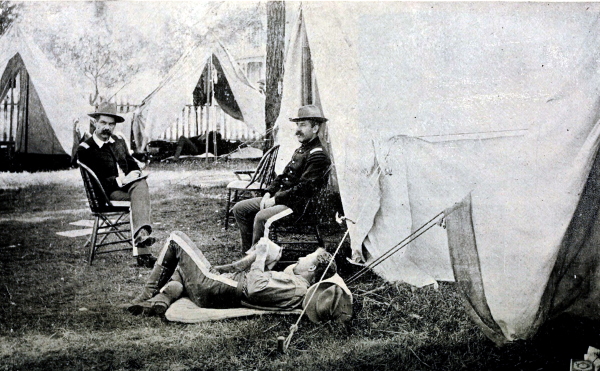
LIEUT. MCIVER, U. S. A., MAJ. GEO. R. BURDICK,
COL. W. P. SULLIVAN.
As the train sped down the line many and great were the
efforts of the boys to “fix it with First Sergeant Ramm,” so
that they might be posted at the most desirable end of the
bridge. All seemed to want the same place, the farther end,
which Dame Rumor had declared to be the better of the three
posts. However, despite the most Trojan efforts, no “fixing”
could be done, it having been decided by the powers that be
to make no details until we had reached the bridge, and relieved
the old guard. This having been done, the following
details were made up and announced:
Officer of the day, Captain I. B. Cook.
DETAIL FOR SOUTH SIDE.
Officer of the guard, Lieutenant Filmer; Sergeant W. N.
Kelly; Corporals B. E. Burdick and A. McCulloch.
Privates of the guard, Baumgartner, Frech, Fetz, Heath,
Heizman, Gehret, Overstreet, Perry, Radke, R., Radke, G.,
Sieberst, V., Williams, and Wise.
DETAIL FOR CENTER GUARD.
First Sergeant A. F. Ramm; Lance Corporal W. Unger.
Privates Bannan, Gilkyson, Monahan, O’Brien, and Sindler.
DETAIL FOR NORTH SIDE.
Officer of the guard, Lieutenant Lundquist; Sergeants B. B.
Sturdivant and W. H. Sieberst; Corporals Wilson and Burtis.
Privates of the guard, Adams, Claussenius, Crowley, Flanagan,
Gille, Hayes, Keane, McKaig, Powleson, Stealey, Shula,
Tooker, Wear, Wilson, and Warren.
Sergeant Clifford and Musician Rupp looked after the cuisine,
intending to do the cooking for all three at the camp of
the last detail.
The different details having been made, they were sent each
to their respective posts, there to await the arrival of their
supper, which was then in course of preparation. The process
was slow, extremely slow, the trouble with the dishes still
continuing. Finally, the cooks, who had in their hurry entirely
lost sight of the center squad, declared enough to feed
the guard at the other end had been cooked. Placing the
rations for seventeen on a handcar, it was dispatched in all
haste to its destination. But when it reached the waiting and
watching seventeen it was reduced to rations for ten. The
seven doughty warriors posted in the center of the bridge had
found themselves “between the devil and the deep blue sea,”
and, calling a hasty council, had decided to make a fight for
life. Well knowing the advantage to be on the side of the
party which strikes the first blow, they solemnly agreed to
halt that handcar if it ever came by, demand their rations,
and, if none were forthcoming, help themselves, and send the
messengers on; on, it would seem, to sudden death, could
speech of man kill, when the now extremely slim meal reached
those hungry seventeen? Returning, the car came at a furious
pace. It was easy to see that a fire-eating delegation had
been sent down to inquire into the whys and wherefores.
But the center squad cared not. They had dined, and dined
sumptuously; and now let “the devil and the deep blue sea”
fight it out between them. A compromise was finally made
between these two by cooking more, and meantime declaring
that “that center squad” had caused all the trouble by not
consenting to be starved, as gentlemen should under such
circumstances. However, to the center squad this did not
seem to give full consolation to the belligerents, as they, the
center squad, were most roundly abused each time a handcar
passed.
In the mean time sentries had been posted in reliefs of five
men each at the north end of the bridge, in reliefs of two in
the center, and of four at the south end. The night, cold, a
chilly wind blowing steadily down the river, and whistling
through the timbers of the bridge, passed quietly at each post.
On the north side the watches were extended to three hours,
but on the south side and in the center the regulation two
hours on and four off was observed. At about midnight the
company commander made a tour of the guard on a hand-car,
signaling with a lantern as he approached each sentry,
whose challenges those on the car could not hear, and whose
very presence those pumping seemed to ignore, several of the
sentries having to spring onto the farthest projecting tie as
the car dashed by, grazing their clothes as it passed.
The usual early morning mistakes were made. On the
guard at the north side Private Joe Keane mistook the morning
star, shining, large and bright, amongst the tops of the
swaying trees, for a signal lantern and was proceeding to shoot
the “signaler,” when the man on the next post assured him
of the unfortunate star’s identity.
Much amusement was caused on the south side by Private
Perry’s call, in the early morning, for the corporal of the
guard, asking whether he should shoot a rabbit then in the
road, to have, as he expressed it, “something good for breakfast.”
This guard, indeed, seemed to be a guard of strong
sporting propensities. Private Frech of the next relief was
seen, a short while after, crawling along the road, almost on
hands and knees. His observer stood breathless; surely a
dynamiting striker had been discovered. But no; Frech, too,
was thinking of that morning’s breakfast, and, unlike Perry,
intended to “shoot first and challenge afterward.” However,
his stalking proved a failure, and, returning to his more onerous
duties, was content, on being relieved, with his breakfast
of bacon, mush, and coffee.
As day broke, the heavy, sultry atmosphere gave promise
of a day whose heat we, camped on the banks of a cool, quiet
river, felt we need not fear. Few, if any, could resist the
temptation of a plunge. Every spare moment was devoted to
the river, swimming, wading, plunging, wrestling, ducking,
and racing along the stretches of sandy beach, no schoolboys
could have enjoyed their holiday more.
The heat in Sacramento must have been terrific. Handcar
after handcar, pumped by perspiring humans, who gazed
with enraptured eyes on the river as they drew near, came
down the line in a long procession.
As far as food was concerned open warfare had now been
declared between the three guards. Triangular hostilities, in
which the small center squad, but for its extraordinary exertions,
appeared sadly in danger of being worsted. However,
they avoided further strife by gaining possession of their “raw
materials,” and then, through Lance Corporal Unger, doing
their own cooking. The squad on the south side did the
same, Private Heizman acting as chef. This did not entirely
settle the question, however. There was our noontide keg of
beer; which guard should send to Sacramento for it? Strife
had opened anew between the center squad and the guard on
the south side. Handcars had come down in such numbers
that had a train under escort come through, all could not be
removed from the track in time to avoid a collision. Seeing
the danger, First Sergeant Ramm ordered his sentries to
halt all handcars and call for the corporal of the guard.
Shortly after these orders were issued Private Monahan challenged
a carload of men from the south guard. Not heeding
his call, those in front fixed bayonets, and the others, increasing
the speed of their car, rushed at the sentry, who jumped
from the track to the platform to avoid being spitted on the
bayonets. This angered the center squad, who then refused
to let any more from that guard pass without an order from
the officer of the guard. Seeing challenges to be of no avail,
the sentry would sit on a box between the tracks, with his
back toward the oncoming car, which then invariably stopped
before striking him. This, then, was the state of affairs between
these two guards when the beer subject was broached.
Each guard declared that they, and none other, should send
to town for the keg, the more violent men from the south side
declaring that, should they send, the center squad need expect
but the dregs.
Thus the dispute went on till finally a car from the south
guard was sent for the coveted prize.
This beer was ordered to be given to the men at the beginning
of the campaign by Major Galwey, medical attendant and
commander of the hospital corps of the regiment. He held
that more sickness was caused on July 4th by drinking Sacramento
water than by heat, and consequently, when camp
was established, ordered the men to drink nothing but black
coffee, and the beer issued to them at noon each day. To set
the fears of our temperance friends at rest, we will explain
that this was issued in a small five-gallon keg—enough, when
carefully measured, to furnish each man with an ordinary
glassful per day. Later a keg of barley water was kept standing
in each camp, and, though not very palatable, was well
patronized during the heat of the day.
Not having sent for the beer our center squad resolved to
stop their rivals as they passed on toward the north guard at
all costs. Shortly before the noon meal was over the sentry
on guard called “Here comes the beer!” Grasping a can in
one hand and a log of wood in the other, Monahan rushed up
the track, threw the wood across the rails, and awaited developments.
Rushing along without any apparent slackening
of speed the car struck the log, rose in the air and came
down again on the tracks with the wood jammed between the
front and rear wheels, the car immovable until lifted from the
track and the log removed. Having halted them Monahan
had no trouble drawing the beer, paying no attention to the
abuse heaped upon him. Having drawn more than the
proper allowance, we are afraid, he helped them remove the
log and sent them on their way warning them to treat the
center squad with more courtesy in future.
So the day passed. Swimming, disputing, guarding, and
sleeping in turns, we made the most of this our first company
“picnic.” No such opportunity for the perfect enjoyment of
camp life had before presented itself, nor did we expect such
another. Our reluctance to leave them may be imagined
when about dusk the usual combination flat-car and day coach
train arrived, bearing our relieving company and ready to
carry us back to our camp in town. Slowly and sadly we
climbed on board, the engine whistled, and, casting longing
eyes toward the quickly disappearing bridge, we were rushed
on toward town.
Some time before the company left the bridge our cooks
went to camp on a handcar with the praiseworthy object in
view of having the company meal ready on its arrival. Despite
the fact that a member of the company had been detailed,
at his own request, to take charge of the company street while
we were away, no preparation for the company’s arrival had
been made. The street was unclean, the table and benches
were thrown together in a heap, and not even a stick of wood
chopped. What our worthy private could have been doing
with himself for the last twenty-four hours was a mystery to
our thoroughly disgusted cooks. We must be careful to mention,
though, that one thing had been done. The rations had
been drawn, and were now tossed in a heap in the quartermaster’s
tent.
Despite the unsatisfactory appearance of things, however,
our cooks managed to have a hot supper ready by the time
their hungry comrades appeared at camp.
Monday, the 16th, was for us of B Company essentially a
day of rest. No guard details were called for, some of our men
having already served forty-eight consecutive hours.
An event of this day, however, served to open our eyes to
the awful depths to which we had fallen; how, as members of
society, we had deteriorated during our short campaign. At
dinner on this day Doc Sieberst, who was acting as waiter,
carrying round a pot of stew in one hand and a ladle in the
other, noticed Frank Sindler narrowly scanning a very doubtful
looking plate, before calling for his rations. Stepping
over and looking at the plate, Doc carelessly remarked: “It’s
only dirt.”
“Oh, is that all,” answered Sindler. “Give me some stew,”
he resumed, as he held out the plate, and busily assaulted the
meat and potatoes which Doc ladled out for him.
The evening of this day saw our turn for guard duty come
round again. A guard of thirty privates, three corporals, and
a sergeant under Lieutenant Filmer relieved that on duty at
the upper yards. The ground to be covered by this guard
extended from the crossing of Seventh, D, and the tracks,
along the tracks to Sixth and E streets, and thence along the
spur tracks on Sixth street, running in front of the Southern
Pacific foundry, to H street, at the point where the latter street
runs into the China slough or Sutter lake, in all a distance of
about one-third of a mile. Ten sentries were posted at equal
distances along this line, their orders being to allow no person
without a written permit to cross the tracks towards the
Southern Pacific buildings, but not to interfere with any person
passing along the open highway on the opposite side of the
tracks. The sentries whose beat brought them near the corner
of any street also received orders to disburse any crowd
gathering on the cross streets.
The night, both in camp and on guard, passed quietly. The
men had by this time become veterans to a certain extent,
and each night now saw them quietly retire to their tents,
even before tattoo, all thought of skylarking and “horse play”
apparently left behind at the old camp on the Capitol grounds.
The onerous guard duty they were now called upon to perform
had perforce caused a change in their spirits since our
new camp was established. Each man was called upon to do
forty-eight consecutive hours of guard duty out of seventy-two.
Thus for two days he would be constantly on duty,
managing to snatch in all about four hours’ sleep each night,
rolled up in his blanket with his rifle constantly by his side,
not daring to remove even his leggings. The third day, from
six o’clock one evening till six o’clock the next, very naturally
became a day of laziness. Having had only eight hours’ sleep
during the preceding forty-eight, and knowing that the
succeeding forty-eight hours would be but a repetition, it is
little wonder that the men in camp each night, only about one-fourth
of the regiment, retired willingly to their tents at the
first beat of the tattoo.
B Company received an accession this evening of three of
its members who had reported at the armory on the night
of the third too late to leave with the regiment, or who failed
to receive their orders, namely, Privates George Bowne, A. B.
Snell, and Fred Pariser. On Tuesday evening Sergeant
Taylor and Privates Beseman, Casebolt, and Ungerman
arrived. These were the last arrivals before Companies A
and B left for Truckee.
One arrest was made by this guard. The event occurred
in the “wee sma’ hours,” the principal actors being Frech, a
featherweight, and one of Uncle Sam’s children, a giant marine.
Frech, catching the marine trying to sneak across the
line after a night’s carouse, facetiously ordered him to throw
up his hands, and then bawled lustily for the “Corporal of
the Guard, No. 6!” The corporal found Frech and his captive
holding quite a heated argument as to the propriety of
the rather Black Bart style in which the marine had been
halted, the captive still pointing to the clouds, under the persuasive
powers of the little German’s Springfield, though
threatening dire vengeance, and Frech promising to “fix it”
with the corporal if the marine “would be good.”
At about 6 A. M. the strikers who had returned to work began
to arrive, coming across posts 9 and 10, especially, in
such numbers as to require the assistance of a corporal in
examining the passes. The increase in the number of men
who came across each morning seemed to indicate an approaching
stampede in the ranks of the strikers. It could
not come too soon to please us.
The trouble with the subsistence department still continued.
Despite the most frantic efforts of our quartermaster sergeant,
we could neither steal, borrow, nor persuade the commissary
department to give us enough kitchen and table utensils with
which to properly feed the men. Surely, it would seem, sufficient
time had elapsed since company mess was talked of and
inaugurated to secure dishes enough to supply even Emperor
William’s army. But doubtless we, the great uninitiated,
cannot appreciate the stupendous amount of work necessary
to be done to supply such an immense army as we, a few hundred
men, camped in the very heart of a large city, constituted.
Probably it still continued to be a “holiday, and the
stores closed,” as they told us on the Fourth, for which weighty
reason we had taken in an extra hole or two in our belts, and
consoled ourselves with the knowledge that if we were hungry,
we at least knew the patriotic motives which caused us to
be so. What! Ask a man to open his store on the Fourth of July,
that greatest of all days in the history of our country! Never!
Rather let our patriotic rank and file hunger (we may eat at an
hotel) than desecrate that glorious day by common barter.
“And we praised the little General
And we spoke in better cheer.”
And so the trouble continued. On such days as this, when
the company was divided, no separate rations were issued to
the guard; of what use would it have been? The guard had
no means of cooking it. But full rations for the company
were issued at the camp. Though in other companies we
have known this to have been cooked and eaten entirely by
those in camp, no account being taken of their tired and hungry
comrades on duty, in B Company, the best possible,
though still very unsatisfactory, system was in use. Having
received the rations the cooks prepared the meal, if possible,
enough for all; if not, enough for the guard. This, at least,
having been prepared, all the available tin plates, forks, knives,
and cups were gathered, and, with the pots of food, were placed
upon a handcar and pumped up the line to the place at which
the guard was located. Here, those not on actual duty finished
their share as quickly as possible, and then went out to relieve
the sentries. These, too, having finished, the now empty
utensils were returned to the handcar and brought back to
camp. Here, of course, the men were by this time rampant,
and another scurry would have to be made to appease their
inner man, who seemed to find such loud expression of his
woes.
The afternoon of this day, Tuesday, became so hot that the
men on guard at the tracks felt constrained to organize and
set in operation another shower-bath company; this they succeeded
in doing, utilizing a shady and quiet spot amongst the
lumber-piles in the yard, fortunately very close to a faucet, to
which they attached a hose, purloined from, Heaven and the
“taker” only know where.
At 6 o’clock Tuesday evening our guard was relieved, very
tired, and glad to return to camp; though the dust did cover
every thing, tents included, an inch thick, every incautious
step raising a cloud which obscured even the sun.
Now the members of the relieved guard heard for the first
time that Billy Tooker, that prince of hard workers, had that
day received a furlough, and had already gone home. After
his departure the work about camp languished, no man in
the company being found who could take his place and do
full justice to the position, as could the former incumbent.
Billy returned to us, though not in time, we are sorry to say,
to accompany us to Truckee.
Tuesday night gave our new arrivals their first experience
of a sudden call for duty. Tattoo had sounded and all the
camp was quietly preparing to retire. Many had already
wrapped themselves up in their blankets and gone to sleep,
when suddenly several shots were fired by a sentry of the
camp guard, who was posted just above the camp on the line
of the tracks. Instantly the long roll played by the musicians
of the guard echoed over the camp. Not waiting for orders,
the men tumbled out of their tents, grasping their rifles in one
hand and cartridge belts in the other, and formed in the company
streets. Considerations of dress were put aside, each
man thinking himself fully equipped for fighting if he had on
his trousers and belt and his rifle in his hand.
On this, as on the former occasion, the cause of alarm
proved but trivial. Some skulker amongst the fruit-cars had
approached the line of camp sentries too closely, had been
seen and promptly challenged. He escaped by darting round
the end of a car and making off down the tracks. His escape,
however, proved on investigation to have been very narrow.
The bullet was found to have passed through the corner of
the car, only half an inch from the open space above the
trucks. The succeeding shots were fired by the sentries down
the line, who had probably caught a fleeting glimpse of the
now flying form as he dashed from one car to another. Others
of the shots were doubtlessly fired by men whose fingers
seemed to itch to pull the trigger whenever their rifle was
loaded with ball cartridge.
No more skulkers or probable “angels of destruction” intent
on using “dynamite with discretion” being found, the
companies were dismissed, the men returning to their tents to
seek the “arms of Morpheus” until awakened by the reveille
next morning.
This recall from the land of dreams was sounded earlier
next morning than usual. On the day before circulars had
been issued by the management of the railroad company offering
work to all who had not taken an aggressive part in the
strike, and as a consequence many were expected to return to
work, while serious trouble was looked for from the malcontents.
The principal entrance to the shops and yards is from the
southeast, at about Sixth and H streets, to which point the
first battalion of the First Regiment had been ordered to proceed
and prevent any violence while the men were returning
to work.
While we all knew what duty we were about to perform,
the usual “joshing” went on in the ranks at the expense of
the timid ones. Some joker professed to have heard that the
strikers were going to make an effort, at last, to try their
strength with us, and decide the question of supremacy for
good. This form of joke soon wore out, and we turned our
attention once more to dynamite, that most fruitful theme.
We pretended to have heard that our company alone was about
to be ordered to Reno, where we had heard the strikers were
using dynamite “with and without” discretion—in fact, regulating
the amount applied to each individual soldier in the
most careless manner. We decided in the course of our debate
on dynamite and its uses, to which those for whose benefit the
long harangues were given listened with bulging eyes and
chattering teeth, speaking only to ask questions, that death
being the object, dismemberment, thus far an incident, was
really unnecessary; a judicious use of that most costly explosive
would fully express their displeasure at our principles
and accomplish the desired result physically, without unnecessarily
mangling our persons, and leave at least a small
chance of collecting a respectable portion of our anatomy to
which to give Christian burial.
Our rather gruesome fun was cut short, however, by the
order to march. We proceeded along the tracks to the point
at Sixth and H streets at which trouble was most likely to
occur. None, however, did occur, and after having made a
sufficient display of our strength to those who gave us a glance
in passing, we were quietly returned to our camp and to our
waiting breakfast, a far more important subject of discussion
than strikes, or even dynamite.
During the day a rumor gradually spread that A and B were
to be sent to Truckee, taking ten days’ rations. Here, indeed,
was a prospect of change. How we canvassed the question,
and listened to each new rumor as it was brought in from
goodness only knows where!
Three B men left for home on furlough during the afternoon.
They were Private Max Claussenius, who had received
his furlough some days before, Dr. Tom McCulloch, of the hospital
corps, and Private Warren, who had received a telegram
from his employers ordering his immediate return.
We passed the afternoon in a fever of expectancy, hoping
against hope that the rumor would prove true. How anxiously
we watched headquarters, where there did seem to be
an unwonted stir. Soon our suspense was relieved; we received
the order to strike camp and have our outfits packed,
ready to board a train for Truckee at six that evening. We
received the order with cheers, and set to work with a will,
rolling blankets, packing knapsacks, lowering tents, and carrying
our baggage and rations to the track. It is safe to say
that A and B were most heartily envied by the members of
the less fortunate companies, and many were the hopes expressed
by the members of other companies that theirs, too,
might be sent. But no such good fortune was in store for them;
A and B alone had been ordered to prepare, and there was little
chance of a change. Never did National Guardsmen work
more willingly or respond more promptly to the order, “Fall
in!” as when, under the command of Major Burdick, our little
battalion was formed in front of regimental headquarters.
Here Colonel Sullivan spoke to us feelingly, wishing us
godspeed and exhorting us to do our full duty as patriotic
soldiers and citizens under every trying circumstance which
the future might have in store for us.
Giving three rousing cheers for our colonel, we were marched
to the tracks in the rear of our camp, there to await the arrival
of the train which was to bear us some two hundred and fifty
miles away over the high Sierras to the scene of our future
operations.
Shortly after six the train arrived, and, with a rush, we
boarded our sleepers, threw down our knapsacks, and turned
for a last look and wave of the hand at the camp and comrades
we were leaving, for none could tell how long.
As here in Sacramento, so in the other parts of the state
and in Chicago the great strike was on the decline. Since
the train wreck and murder of the eleventh the chance of success
had vanished, and public sympathy, to a great extent, had
turned from the strikers. Worden, since sentenced to hang,
was arrested for this crime on the fourteenth, and Harry Knox,
the leader of the A. R. U. in California, was arrested on the
day following as an accomplice.
Through the middle and southern part of the state, San
Jose, Stockton, Fresno, Los Angeles, and San Diego, business
remained at a standstill. The portion of the First Infantry,
U. S. A., ordered to Los Angeles on July 2d still had charge
of the depot and saw that no disturbances occurred. Affairs
had quieted so in San Jose, that Company D of the Fifth Infantry,
N. G. C, Captain Elliott, was recalled and ordered to
report to Colonel Fairbanks at Alameda. The work of the
National Guard under General Muller had been thoroughly
done from the start, in the San Joaquin valley, and now their
work of guarding trains and bridges went quietly on.
In Sacramento and Oakland the deadlock was now thoroughly
broken. On the fourteenth the first train in two
weeks arrived in Sacramento from Oakland by way of Benicia
and Davisville. Four trains, including an overland, left Sacramento,
the overland being the first train to pull out with a
Pullman car attached.
On the fifteenth and seventeenth, detachments from A and
B of the Sixth Infantry, N. G. C, were sent to Dunsmuir from
Sacramento under Colonel Nunan. Here they remained until
the twenty-fifth guarding trains and bridges when they were
relieved by Companies A and F of the Second.
In Chicago, President Debs of the A. R. U. now seemed to
despair. Arrested for conspiracy and thrown into jail, his
followers from one end of the land to the other seemed to
desert him. In vain did he send out telegrams beseeching
them to stand firm. Vain were his announcements that business
in Chicago was paralyzed. He realized the strike was
lost, and knew the loss could be ascribed to no other cause
than the strikers’ violence.
Throughout California the strike was admittedly lost. On the
twenty-third General Dimond issued orders for the Fifth Infantry
at Oakland to withdraw from camp, for Sheehan’s
command to be dismissed, and at San Jose for the men to return
home. At a conference held in the governor’s office, it
was decided to withdraw the different regiments of the National
Guard as soon as practicable. The San Francisco regiments,
the First and Third, would be soon ordered home, and
their work taken up by Colonel Park Henshaw and the Eighth
Infantry.
On the same day on which this conference was held eight
hundred and twenty men returned to work in the railroad
shops, and one thousand applications for work were received.
Still with the tenacity of despair the different leaders were
sending “success” and “stand fast” telegrams to all parts of
the country.
Arrests of leaders on charges of obstructing the mails, conspiracy,
and insurrection now became common. Marshal
Baldwin was busily arresting all the active spirits of the strike,
and the trial of Worden, Hatch, Knox, and others for murder
was progressing at Woodland.
Two different attempts at train wreck, now that the strike
was lost, undoubtedly made for revenge, were frustrated, the
second only after a lively exchange of shots between a detachment
of regulars and the wreckers.
So toward the end of July the strike slowly resolved itself
into a legal fight in the courts of the country. Every leader
of prominence was arrested, and the minds of all were fully
occupied in their various attempts to escape their threatened
punishment.
This, then, a thousand criminal suits throughout the land,
was the end of the greatest railway strike in the history of
our country. A strange end indeed.
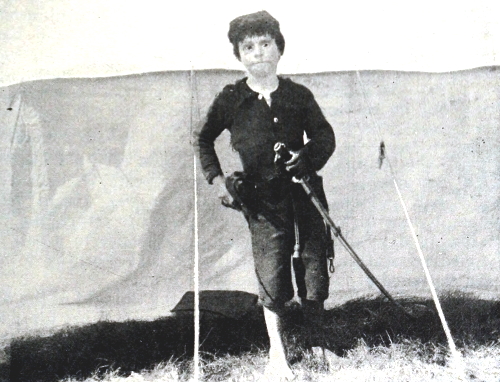
A NATIVE PATRIOT.
CHAPTER X.
OFF FOR TRUCKEE.
“No matter what the journey be,
Adventurous, dangerous, far;
To the wild deep, or black frontier;
To solitude, or war—
Still something cheers the heart that dares
In all of human kind,
And they who go are happier
Than those they leave behind.”
Edward Pollock.
AS the train started off, our thoughts reverted to those
left behind. There were two, private William Tooker,
and Doc. O’Malley. Tooker was absent from
camp on a furlough, and was expected to return the following
day; while the doctor, in response to a call for
medical assistance, had been sent that morning to the
guard stationed at the American river bridge.
Concerning Tooker, we felt sorry at the thought of the disappointment
and suffering our absence would cause him; for
who would care for William now? It pained us to think that
he would be ordered about by rude and thoughtless officers,
and made to do that which is so distasteful to his gentle nature—work.
We anticipated the effect that our departure would
have upon O’Malley. As the train rushed over the bridge
and past the station where the guard was posted, we saw him
sitting listlessly upon a camp-stool, dreaming his life away,
and living, perhaps, only in the hopes that the night was
drawing nigh, when once again he would be united to his
dear comrades. But, alas! So perfect was his listlessness
that even the rattling of the train over the bridge failed to
produce the slightest signs of life. He sat, like a lifeless
mass; and it was only when our cries of “O’Malley, O’Malley,
good-bye; we’re off to Truckee!” echoed through the air, that
he sprang to his feet and gazed around in a bewildered manner,
as if doubtful what he heard or saw was real or fanciful.
His face “grew sad by fits, by starts—was wild.” Then,
realizing only that he was being left behind, he started after
the train at his topmost speed, crying, frantically: “Stop that
train! Sto—p!” The last thing the company saw of O’Malley,
on its upward journey, was a small, indistinct figure, waving
its arms madly, as if it were trying to fly.
Tooker came back the next day and joined O’Malley in his
grief and lamentations. They tried to console each other,
not by making the best of a bad job, but by cursing and
denouncing every one for miles around. Tooker couldn’t
see why the Colonel wouldn’t send him up to Truckee to join
his company, and took every opportunity of arguing with
those he came in contact with, why he should be sent,
and how foolish it was to keep him at Sacramento. He
convinced every one, to his own satisfaction, that such was
the case. O’Malley made life unbearable at the hospital, refusing
to do any thing but nurse his own grief.
These two unhappy mortals met one day on the deserted
and tentless street of the company, and, with clasped hands
and bowed heads, silently contemplated the deserted spot, and,
as they thought of their dear comrades far away, great
tears rolled down their cheeks. “Billy,” sobbed Doc., “we’re
the only ones left.” Then they threw their arms around
each other, and with their heads resting on each other’s
shoulders, their whole frames vibrating with convulsive
sobs, stood for hours. It was while in one of these attitudes
that Dr. Galwey came along, and, with his Kodak, took the
picture which adorns the head of the chapter.
During our ride to Truckee, a guard was kept continually
on the platform of the cars, with orders to drop off at each
stop and prevent any one from interfering with the air-brakes.
A guard also rode on the engine. We found, as we proceeded,
that each bridge and trestle was guarded by United States
soldiers, and it was then that the nature of the work intended
for us became apparent.
As we advanced into the Sierras, we were entranced with
the beautiful scenery that surrounded us. Nature was in all
its summer glory—not a cloud in the sky to diminish the
radiance of the sun. On all sides the mighty and everlasting
mountains reared themselves, height upon height, until their
snow-topped summits seemed to join the earth and sky; and
far beyond we caught glimpses of glistening, snow-clad tops,
which looked like the foaming crests of mighty waves. Deep
in the wooded canyons, seen through a maze of green,
streams, like silver threads, pursued their tortuous and
winding course.
The mighty effects of water caused in hydraulic mining
were everywhere discernible, huge mountains having been
worked away to get at the gold. The water used for this purpose
was carried to the miner through miles of sluices. These
sluices now, on account of the cessation of hydraulic mining,
are neglected. Where they bridge a gully the water leaks out
and falls in rainbow-tinted sheets into the depths below.
We arrived at Blue Canyon, where we had supper, about
dusk. Here a great number of the “boys” were taken in by
their curiosity to see the red bat (brick-bat) that this mountain
town has on public exhibition.
Night brought with it a glorious moon and the snowsheds.
Oh! how we did anathematize those snowsheds! What panorama
of mountain, vale, and lake, bathed in moonlight, their
rough boards shut out from our view! The little glimpses
caught here and there at breaks in the sheds were only an
aggravation.
Shortly before our arrival at Truckee, Major Burdick
stepped into the car and made a little speech, the substance
of which was as follows: He said he had been given to understand
that the situation in Truckee had assumed a very
serious aspect; that he would expect us to meet this condition
bravely and with becoming gravity, and, by showing a serious
and determined front to the strikers, impress them with the
fact that we meant business. Furthermore, we would be
under the eye of Col. Gunther of the regular army; and he
hoped that, by our soldierly conduct, we would favorably impress
the colonel with the worth of the National Guard in
general and the First Regiment in particular.
This speech had its desired effect, for, during our stay in
Truckee, not a striker approached the camp. No doubt, when
they saw our fierce and warlike appearance, they fled to their
mountain fastnesses, not to return “till the flying of the snow.”
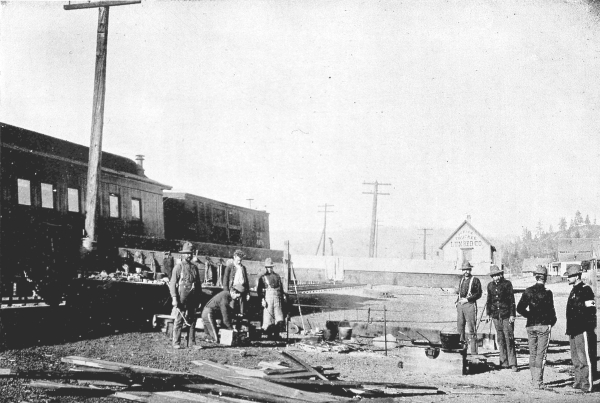
COMPANY B’S KITCHEN AT TRUCKEE, CAL., JULY, 1894.
We arrived in Truckee at 10:15 P. M. Our cars, with two
freight-cars, were side-tracked and became our home while
there. The cars were tourist cars, and we were therefore able
to make ourselves very comfortable. It was a luxury to sleep
on a mattress once more.
Thursday morning, July 19th, was ushered in with the
regular camp routine, roll-call, Captain’s speech, and breakfast.
Clifford, with the aid of our head cook, Paul Rupp, had
a breakfast prepared for us, consisting of fried ham and bacon,
bread and butter, and coffee. We dined standing. Each
man, before leaving Sacramento, was provided with a tin cup,
knife, fork, spoon, and plate, and, of course, was supposed to
see to the cleaning thereof himself, the result being that the
dishwashing detail was done away with altogether—a great
improvement indeed. The cleaning of pots and pans was
looked after by the culinary department.
It may be just as well here to preface the history of our
week at Truckee with a short account of the trials and tribulations
of those who presided over the culinary department,
together with the trials and tribulations of those who looked
to it for three meals a day. For the first three days, Thursday,
Friday,and Saturday, all meals were cooked at camp. A kitchen
was improvised in the road by the side of the cars, a wind-break
erected, and a fireplace built. Sergeant Sturdivant was appointed
commissary for the company, and in a short time was
able to quote prices on canned goods and other kinds of provisions.
He tried to do his best, poor man, but overlooked
the fact that life was a howling wilderness to the dudes of the
company without milk and sugar for their coffee and butter
for their bread. There always seemed to be a great shortage
in these articles. The tall sergeant explained this matter by
stating that the lack of railroad communication was the cause
in one case, and a scarcity of cows the cause in the other.
Sergeant Clifford, Musician Paul Rupp, and an able assistant
developed in the person of Gus Ungerman, an old-time
cook, who went about the pots and pans in a very professional
way, presided over the kitchen. The great waves of disgust
caused by internal strife and outward “kicking” occasioned
the tendering of daily, or we might say “mealy,” resignations
of some one of the cooks. It is needless to say that the resignations
were not accepted. Heated arguments with any of
our cooks was out of the question; they were all able-bodied
men, and were invariably armed with a stout ladle or long
cooking-fork, which they flourished in a most threatening
manner.
At meal hours, or at times when the cooks started to prepare
the meal, the adjustable tables in the cars were lowered,
tin cups, tin plates, knives, forks, and spoons were put in
place, and each man jack sat with a wolfish appetite and impatiently
waited for an hour or more the arrival of the food.
The waiters’ lives were not happy ones; fortunately they
were relieved every day, or the chances are we would have
developed a number of raving maniacs.
The following is a pretty fair illustration of the service
that prevailed: A man with a pot of mush dashes into the car
yelling, “Who wants mush?” and, with a flourish of his ladle,
goes down the aisle filling the outstretched plates. Close on
his heels comes another man with a pot of potatoes bawling,
“Who wants murphies?” Another meanders through with
fried meats of some kind.
All this time the men are shrieking for milk and sugar for
their mush. The coffee now makes its appearance, and men,
whose cups had mysteriously disappeared, have been known
to offer their plates as a receptacle for this dark colored fluid.
The bread puts in its appearance now, but no butter. Meanwhile,
from the car windows, the hungry soldiery are hurling
anathemas at the bewildered waiters, or beseeching them for
an extra allowance of stew or a little more hash, a conglomeration
that would give an ostrich the dyspepsia. Finally, after
the men in despair have waded through their mush, potatoes,
coffee, and meat, the sugar and butter, with a very limited allowance
of milk, put in their appearance. Men with foresight
and taking ways committed the wholesale larceny of butter
and sugar and took their chances as to the milk. Much butter
and sugar seemed to stick to the long slender fingers of
the learned McCulloch, who only let the replenishment of the
inner man interfere with his study and discussion of recondite
subjects. The strong military instinct of Burtis and Hayes
impelled them to keep a good reserve of these dainties always
on hand. Frequent battles took place upon the platforms,
between rival waiters of each car, for the possession of some
coveted pot of beans or stew, while the onlookers held their
breath expecting every moment to see the contents of the pot
dashed to the ground.
By Sunday the officers came to the conclusion that it would
be more economical and convenient to eat in town, and were
successful in making arrangements for board at the Truckee
hotel for the balance of our stay. This was a change that was
hailed with joy by all, particularly Beseman, who developed
a fearful and wonderful appetite while at this place. He was
the first to sit down and the last to reluctantly leave the table.
Before proceeding further, we feel it our duty to gratefully
recognize the efforts of our patriotic cook, Paul Rupp. His
was a thankless job; and only a man of an extremely good
natured disposition could have put up with the trials he was
subjected to. Cooking for 50 or 60 men three times a day
with the most primitive appliances, good Lord deliver us!
Paul, a crown of glory awaits thee in heaven, for nothing
mortal man could do would, in our estimation, sufficiently reward
you for all you put up with while holding the position
of head cook to the City Guard.
After breakfast the bedding was spread out on the road to
air, with orders that it should be taken in at 12 o’clock; the
boys cleaned out the cars, and got every thing in readiness
for inspection of quarters. During the forenoon, as no restrictions
had been placed on the men as yet, a number of
them went into Truckee to make needed purchases, and incidentally
to inspect the town. This last did not take up much
time, as Truckee, though a railway center of some importance,
is a very small place. The Truckee river runs through the
town, its banks lined with the humble homes of the native
American. As it is considered the finest trout stream in the
state, it yearly attracts a large number of sportsmen. It is
indeed an ideal stream, full of depths and shallows; dashing,
whirling, foaming over rocks, to find rest in quiet stilly pools,
or to move along with grandly irresistible force. Long
stretches of its banks are devoid of brush, giving the angler
ample opportunity to utilize his skill in casting. The fish
caught is the gamest of the game, and any one who has ever
had the pleasure of dining on Truckee trout will attest to its
eating qualities.
Truckee is a great lumber district. A number of sawmills,
driven both by water and steam power, border the river’s
banks. Apart from its lumber interests, Truckee derives a
great deal of its importance from the handling of ice. Above
Truckee there are a number of large ponds of smooth water
which produce annually two or three crops of ice from twenty
to forty feet thick. These two industries give employment to
large numbers of men.
Some of the boys, anticipating an opportunity to try their
luck fishing in the river, bought fish-hooks and lines. They
met with very little success, however. The noble game in
these waters are not to be caught by the primitive hook and
line of the farmer boy.
Early in the afternoon five details were formed to guard
bridges. The commissary issued provisions for each detail,
sufficient for twenty-four hours, taking as a guide as to quantity
the following list, furnished by a regular army officer.
For seven men—one day—three meals.
7 lbs. of fresh meat or 5 lbs. of salt meat; 10 qts. of coffee;
7 lbs. of potatoes; 3½ lbs. of beans; 11 lbs. of bread.
For four men—1 day—three meals.
4 lbs. fresh meat or 2¾ lbs. of salt meat; 6 qts. of coffee; 4
lbs. of potatoes; 2 lbs. of beans; 6 lbs. of bread.
Thus supplied we were soon speeding to our destinations.
On the way it was discovered that one of the bridges to be
guarded was beyond the state line, therefore no detail was
posted there, as it is against the law to take the militia outside
of the state for active duty. As we arrived at each post,
Major Burdick and a few of his officers left the train to see
what arrangements could be made for boarding the men; the
desire being, if possible, to do away with the necessity of having
the men do their own cooking. Their efforts were crowned
with success at Prosser Creek, Boca, and Cuba, but the last
station, No. 24, a bridge about three miles from the state line,
was too isolated for any arrangement of the kind. The men
at this post, therefore, had to do their own cooking. At the
first station, Prosser Creek, a detail consisting of a corporal
and three privates of Company A, were posted. They slept in
the bridge-tender’s house, and had their meals at an eating-house
about half a mile up the cañon. The rose-colored reports
brought back by these men about the goodly table set at
this place made every man anxious to go there. It was the
duty of the guard to watch the bridge vigilantly night and
day, and allow no one to loiter on it, or in its vicinity; to
challenge all persons approaching the bridge after dark, escort
them across, and make sure that they continued on their
way. Private Sullivan of ours, a few nights later, had the
pleasure of doing the honors for a “Wandering Willie,” bent
on crossing the bridge. This character informed Mr. Sullivan
that if he had known he was to receive such distinguished
consideration at the hands of so courtly a gentleman (Mr.
Sullivan was at one time the Ward McAllister of Los Angeles
society), he would have had a magnificent load aboard, many
opportunities having presented themselves to him during
that day for absorbing liquids that not only stimulate but intoxicate.
The dread, however, of crossing the bridge in an
inebriated condition had prevented him from embracing them.
And as “Willie” shambled off, he heaved a heart-breaking
sigh for the delights that might have been, resolving in his
mind that should the tide of affairs ever be so favorable to
him again he would take advantage of them, despite the
dangers of a bridge or flood.
Prosser creek bridge is located almost nine miles east of
Truckee. The Union Ice Co. has made this one of its largest
supply stations. The company has built a dam across the
cañon, imprisoning the waters of Prosser creek so successfully
that the average crop of ice each season is sixty thousand
tons. This immense crop necessitates the employment of a
large force of men. Substantial quarters have been built on
the lake shore for their accommodation. It was at this place
the guard did its most effective work, punishing good food
three times a day.
Boca was the next post. Here Major Burdick made arrangements
with the Boca Hotel to provide the men with
food. They bivouacked in a box-car. The duties and instructions
were the same as those in force at Prosser Creek.
Corporal J. N. Wilson, privates Frech, Fetz, and Gehret of our
company were dropped off here. From this place, also, the
men returned with expanded girths, in evidence of their
sumptuous fare.
The next post proved to be a place called Cuba, distant
about fifteen miles west of the Nevada state line. The detail
posted here were men from our company, and consisted of
Sergeant Walter Kelly, privates Adams, Bowne, Bannan, Baumgartner,
Beseman and Claussenius. The property at Cuba to
be guarded consisted of two trestle-bridges, one of them of considerable
length and covered, a culvert, switches, and an ice-house.
The men were quite comfortably situated. The superintendent
of the National Ice Company placed a small store-house
near the track at their disposal, and furnished them
with large, thick, strong mattresses. They had their meals
at the superintendent’s house; but after the second day he
refused to feed the men any longer, giving as his reason that
he feared the strikers would wreak vengeance on him for
harboring them, by destroying the property under his charge
when the troops were removed. It is believed, however, that
the appetites of the men had more to do with his change of
heart than any fear of the strikers. He had not calculated to
satisfy the cravings of men who had for two weeks been living
on bacon, ham, canned corn-beef, and leather steaks, and
whose appetites were sharpened by the bracing air of the
mountains.
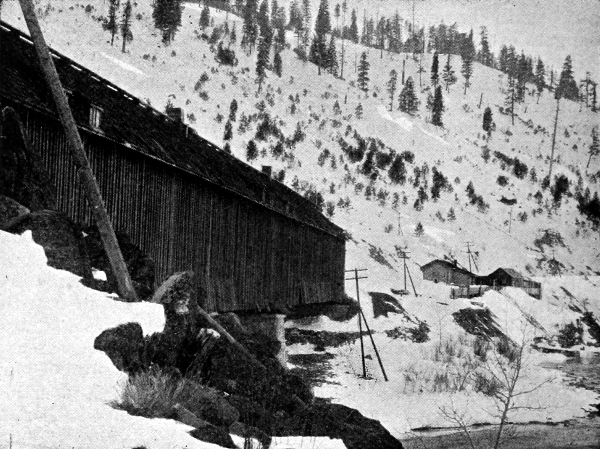
THE COVERED BRIDGE AT CUBA.
Negotiations were then opened with the superintendent of
the People’s Ice Co., and very satisfactory arrangements
made for boarding the men.
The guard duty here was not arduous. The day watches
were of one hour each, and only one sentinel was necessary.
The night watches were two hours in duration, and
during that period two sentinels were constantly on guard,
one being posted at the west end of the long bridge, and the
other patrolling the balance of the line, alternating hourly
with his comrade.
During that night two men presented themselves, claiming
to be section-hands sent there for the purpose of guarding the
bridges. The sergeant informed them that he and his men
were there for that purpose, and did not need their assistance.
It was with difficulty that the sergeant restrained the belligerent
Bowne and Adams from falling on these men and
doing them great bodily harm. With a baleful gleam in his
bloodshot eye Bowne watched them until they disappeared
in the darkness to return no more.
The antiquated bridge-tender indulged in a fairy tale at
the expense of our “boys.” He told them that two wildcats
came down to the clearing on the mountain side every morning
at 6 o’clock to bask in the sunlight. The “boys” bit
with avidity, and the bridge-tender had the pleasure of seeing
them take positions commanding a view of the spot, and
with loaded rifles watch and wait for the cats that never
came.
The train containing the last detail continued in an easterly
direction, following the course of the Truckee, the scenery
becoming wilder and grander as we progressed. The mountains
seemed to be closing in around us; the waters of the
stream, in keeping with its surroundings, raced with maddening
speed through narrowing channels, foaming, whirling,
tumbling over miniature falls, until, gliding into broader space,
it swept along with stately silent dignity, to be again transformed
into a roaring torrent between confining walls of rock.
Now and then the sides of the gamey trout flashed in the
sunlight, as if the exultant spirit of life and strength within
it, disdaining the confines of its watery home, longed to soar
in the bright sunshine. At last the train stopped at what
seemed to be the most delightful spot of all, the last railway
bridge in the state of California, and within three miles of
its boundary lines. This is a solidly constructed steel bridge,
and spans the Truckee. To the left of the railroad, a short
distance from the bridge, was a small cabin; it was beautifully
situated, overhanging the stream, with a flight of steps leading
down to its waters. The most fastidious disciple of Isaac
Walton could not desire a more perfect spot for a camp.
Corporal Burtis, privates Hayes, Heizman, and Keane, with
their rations, were put off here. A more delighted quartet
could not be found; the surroundings suited their sensitive,
æsthetic natures. They did not care if they were stationed
there for a month. Major Burdick, with Colonel Gunther,
United States Army, standing by his side, gave his instructions,
to the effect that stranded theatrical companies, “hobos,”
etc., crossing the bridge should be watched closely until they
were out of sight. He cautioned the men to be very careful
about using their weapons, delivering himself of a sentiment
that should go down in history as a shining illustration of
the gallant major’s humanity, a sentiment that no doubt will
be found written in letters of gold upon the great judgment
book, “that he would rather have them not shoot at all, than
kill an innocent person.” Think of it, ye beetle-browed
sons of Mars, in whose breast the desire for martial strife is
rampant, and whose fiercest delight is found in the shedding
of human ber-lud! Think of the example set you by our
dashing major; profit thereby, and let not your thirst for
gore steel your hearts to the cry of the innocent. “And, corporal,”
he continued, “I do not think it advisable to let your
men go in swimming.” As the men gazed down into the
raging waters, they wondered if the major thought them
lunatics. No sane man surely would risk his life by attempting
to bathe in that swiftly flowing current. From the burden
and tenor of his closing remarks, it was quite plain that the
major felt sorry at leaving the men in this lonely spot,
and would no doubt have continued for some time longer
with cautions and fear-allaying words, had he not been interrupted
by Corporal Burtis, who respectfully saluted and told
him “he need not be in any hurry to relieve them.” This
was too much for Colonel Gunther, who placed his plump
little hand over his face and chuckled audibly. “Oh! you’re
in no hurry to get back then, eh?” replied the major; then
bidding them good-bye, he clambered back into the car, the
engine whistled, the train rolled away and left them alone in
their glory. The opening of the cabin door revealed a very
clean interior, and the men were therefore nothing loth to
drop their blankets and equipments on the floor. One man
was immediately detailed for guard duty, and the rest placed
their arms where they could instantly put their hands on
them and went out doors to inspect their surroundings.
While wandering up a small canyon to the right, one of them
called the attention of the others to a grave that he discovered;
it was rudely fenced in and had a gate that was
padlocked. The loneliness of this last resting place touched
them deeply. Upon the humble mound were branches of
withered flowers in various stages of decay, showing that
some one, to whom the departed one was dear, had at different
times made a pilgrimage to offer sweet flowers on memory’s
altar. After vain conjecture as to the identity of the
occupant of this isolated grave, they returned to camp.
The afternoon was now drawing to a close, and they began to
make preparations for the evening meal. A fireplace was
built, and George Heizman elected cook. Corporal Burtis
took a can and went down the road to get some milk. A
hatchet was part of their allowance, and with it Hayes chopped
the wood; Keane was on guard. The flight of steps before
mentioned placed a large supply of water conveniently at
their disposal. By some men this convenience would not
meet with the appreciation it deserves; water might be useful
to float ships or bathe in once in a while, but for drinking
purposes it failed to meet the requirements. Rather would
they be camped in the shade cast by some brewery of vast
proportions, and be lulled to rest with the hum of its machinery,
than rest beneath the overhanging cliffs of giant mountains,
and have their slumbers disturbed, their dreams of
revelry by night broken in upon, by the varied sounds of
water—water—water.
In due course of time Burtis returned with butter and milk.
He and Hayes then went to their haversacks and each drew
forth a can of oysters. Now some foolish people will wonder
how they came to have these oysters. In accounting for their
possession we will have to take our readers back to the day
when camp was broken at the Capitol grounds. As related,
Hayes took part in the raid made on the commissary’s stores
on that occasion. The spoils of this raid were placed in the
safe-keeping of Quartermaster Clifford. Hayes heard nothing
further of them. Not a cracker, not even a spoonful of deviled
ham, something he dotes on, no, not even an empty
oyster can did he get as a reward for his dash and daring.
This ingratitude on the part of Clifford caused Hayes much
inward grief and loss of sleep, and when, a few evenings later,
through the flaps of Number One tent, he caught a glimpse of
Clifford and a small coterie of his friends banqueting on the
proceeds of his iniquity, a moan of anguish escaped his lips,
and in that night of sleepless sorrow he resolved to be revenged.
Into the ear of Corporal Burtis he poured his tale of
woe, and enlisted his sympathies. Next day with unwearying
eyes they watched the movements of the wary Clifford.
Towards evening, in an unguarded moment, he left his chest
wide open in his tent, in answer to a call from the kitchen at
the end of the street. Like eagles Hayes and Burtis swooped
down upon this chest, and, with the aid of Doc. Sieberst, got
away with a goodly store of dainties. The wailing of “the
widows of Ashur” was nothing compared to the howl that
went up from Clifford on discovering his loss. His suspicions
fixed on poor Al Ramm, who vainly pleaded his innocence.
When ordered to Truckee, four cans of oysters were
left; they were divided between Burtis, Frech, Shula, and
Hayes for transportation. Two of them helped to garnish the
meal about to be described. Shula, tired of carrying his
around, returned it to Hayes while at Truckee, but Frech retained
his, and while he was away on train guard, Hayes took
it from his haversack; these two remaining cans of oysters
were carried all the way back to San Francisco.
The repast now prepared by Geo. Heizman at this secluded
spot was the best cooked and the most enjoyable had by the
boys since they left the city. George certainly missed his vocation;
the stew he made with those two cans of oysters, milk,
butter, and the rest, would have tickled the palate of the most
blasé gourmand. Then they had some nice chops that in
some mysterious manner got mixed in with their rations, a
little fried bacon, bread and butter, and coffee. They feasted
until they were black in the face. About dusk they received
a visit from the section boss, who was accompanied by several
of his men. In the course of conversation he was questioned
as to the occupant of the grave on the side of the
mountain. He informed them that it was a woman who had
died a couple of winters back, and who, with her husband, had
lived in the humble cabin in which they were bivouacked.
At the departure of the section hands the first watch of the
night was posted. Beneath the careless and reckless demeanor
of this little band was a stern realization of the responsibilities
of their position, and they were prepared to protect and
defend the property under their charge to the bitter end.
With this idea in view, beside the sentinel on duty, the corporal
remained awake and on the alert the greater part of the
night, and those who slept had their loaded weapons lying by
their sides. The queen of night now rose with regal splendor
above the mountain tops and sailed slowly and serenely
through the starry realms of heaven, shedding her beauteous
and mysterious rays on mountain and cañon, stream and
bridge, and on waving trees, giving life to shadows that ever
and anon startled the sleepy guardsman. The beauty of the
scene and the mysterious influences of the night throw a
subtle spell around him; dreamily his thoughts turn with a
sweet pleasure to the dear ones at home.
Who has not felt how sadly sweet,
The dream of home, the dream of home,
Steals o’er the heart, too soon to fleet,
When far o’er sea or land we roam?
He recalls them all, one by one. Never before did they
seem so dear to him. In fond contemplation he lingers on
each little characteristic; the sweet voice and the merry laugh
rings in his ears; and he wonders if, at this hour, while
bound in slumber’s chain, some loving spirit, winging its
flight across the land, mounts higher and higher, and looks
down on him with dreamful eye, as he paces his lonely beat.
Ha! What’s that? He cocks his piece—it has gone. No,
there it is again, moving around yonder rock; it disappears.
There it is again, and then the straining look relaxes; a feeling
of relief comes over him. It is but a shadow cast by a
tree whose boughs are tossing in the wind that sweeps up the
cañon with the river, chilling him to the bone. He shakes
himself, increases his pace, and wonders what time it is.
Surely, his two hours are up. The relief at last comes, and he
gladly surrenders his lonely beat for a comfortable blanket.
After a hearty breakfast next morning, Hayes shouldered
his gun and started for a walk. The others staid around
camp, and tried a little fishing, with no success. In the
course of a couple of hours Hayes returned and reported interviewing
a number of tramps in the course of his peregrinations
and, further, that he had extended his walk into the
confines of the state of Nevada. He seemed to be greatly
put out that the governor of the state and a brass band were
not there to receive him.
“This life is made up of disappointments,” soothingly said
Joe Keane.
While the noon meal was in course of preparation, the
relief train rolled in upon the sylvan scene. The detail was
relieved by acting Corporal Pariser and privates Heeth, Powleson,
and Stealy.
The ride back to Truckee was a long and wearisome one,
not so much as to distance, but as to time. Endless stopping,
bumping, and jerking, the result of making up a long train of
cars containing ice, tortured the weary men beyond endurance.
Almost worn out, but thankful, they finally arrived at
Truckee at about dark.
Every morning the relief train went out with its quota of
men, dropping them off at the different posts and on the
return picking up those relieved, while at 8 o’clock every
morning the camp guard was relieved. This morning Corporal
Burdick, Privates Flanagan, Crowley, Gille, Wise, Overstreet,
and Sullivan were relieved from camp guard.
The trains (both passenger and freight) now began to go
through. We supplied guards for every west-bound train.
These guards ate at Blue Cañon and at Colfax, and were
relieved at the latter place by soldiers of the regular army.
They returned to Truckee guarding east-bound trains. For
the first two or three days part of the guard had to ride on
the tender and engine. This was any thing but pleasant.
From exposure to the heat of the sun, the flying cinders and
smoke, the men, on their arrival at Colfax, looked like blackamoors.
Finding there was no necessity for this, the practice
was discontinued, the men riding in the cars, and
dropping off at stations, to prevent any interference with the
air-brakes or the running of the train.
The men were now kept constantly on the go; very few, if
any, could boast of a continuous night’s sleep. Those who
were not away on post duty, or on camp guard, were liable to
be awakened at any hour of the night, and ordered out as
train guards. A list of the men who from this time on did
various guard duties will illustrate the manner in which they
were shuffled about. Friday, July 20th, privates Heeth, Powleson,
Pariser, and Stealy went to post 24, Pariser acting as
corporal. On the same day private Perry went to Boca, private
Van Sieberst to Prosser Creek, and private Monahan on
camp guard. Lieutenant Filmer was officer of the day. Sergeant
H. B. Taylor, Corporal McCulloch, privates Flanagan,
Frech, Gille, McKaig, O’Brien, and Radke went west with trains.
Saturday, July 21st, Sergeant Sieberst, privates Crowley, Casebolt,
Wise, Radke, Snell, and Unger went to Cuba. Privates
Bannan, Beseman, Baumgartner, and G. Claussenius were on
camp guard, and Captain Cook was officer of the day. Sergeant
A. H. Clifford, who had thrown up his job in the
kitchen, privates Adams, Bowne, and Gilkyson went out with
trains. Sunday, July 22d, privates R. E. Wilson and Williams
went to Prosser; Corporal Burdick, privates McKaig,
Monahan, and O’Brien to Boca; Corporal McCulloch, privates
Fetz, Gehret, and Sindler, to Post 24; Corporal Burtis,
privates Hayes, Heeth, and Keane were on camp guard, and
Sergeant Kelly, Corporal Wilson, privates Pariser and Perry
went out with trains. Monday, July 23, privates Bannan,
Claussenius, Flanagan, and Gille went to Prosser Creek,
Claussenius acting as corporal. Sergeant H. B. Taylor, privates
F. Shula, Gilkyson, Frech, Heizman, R. Radke, and
our late cook, musician Rupp, whose occupation gone, now
shouldered a gun, and who, while pacing his beat during the
witching hours of the night, communed with the moon on the
smallness of human greatness, went to Cuba. 1st Lieutenant
E. C. Lundquist was officer of the day, and privates Bowne,
Beseman, Baumgartner, and Overstreet were on camp guard,
while privates Casebolt, Crowley, Powleson, Stealy, and Van
Sieberst took a trip to Colfax. Tuesday, July 24th, the last
day at Truckee, privates G. Radke, Sullivan, and Ungerman
went to Prosser Creek, Sullivan acting as corporal, Sergeant
Clifford, privates Heeth, Keane, Wise, Wear, and Zimmerman
went to Cuba. Privates Adams, Monahan, McKaig, and
Snell were on camp guard, and privates Fetz, Gehret, Hayes,
and Sindler guarded an early morning train to Colfax.
In spite of our activity life became very monotonous towards
the last of our stay in Truckee, so much so that it occasioned
a very apt scriptural quotation from Corporal Burtis:—“Jesus
Christ, the same yesterday, to-day, and forever.”
The men now began to shave right and left, particularly
the older ones, privates Wear and Unger. Their beards
grew out in patches of gray and black, giving them an old
and grizzled appearance. A supreme disgust overcame private
Hayes when he heard some one call him Red Mike, and
his razor separated him from his whiskers forever. No man
would blame Corporal Burdick for shaving, but he clung to
the very end to an atrocious whisker of vermillion hue that
adorned his face in patches, the hair bristling forth like
copper wires. His brother, the major, would look at him with
wonder and amaze, and say: “Well! if your mother could
only see you now.” (A tidy sum will be realized from that list
of fines when the men get their money from the state.)
While around camp the men put in their time throwing
quoits and reading. Horseshoes were used as quoits, while
the reading matter consisted of a large number of magazines
and papers, which were presented to the companies by kindly
disposed people in the vicinity.
About three-quarters of a mile from camp, we located a very
good place for bathing, which, despite the icy coldness of the
water, received a number of visitors daily. The orders were
that no one was to leave camp without permission, but the
man who asked permission made a fatal mistake. To ask
permission to do any thing was a great mistake, for one invariably
met with a refusal. Now, when a sensible man discovers
that he has made a mistake, he is not likely to repeat
it. The result was, that a number of luminous minds, when
they yearned to go into town, or explore the surroundings, or
breathe the purer air from some hilly height, and view Donner
lake from afar, naturally took French leave.
An object of particular interest to us all since our arrival
at Truckee, and the subject of much conjecture when we saw
it for the first time, on the night of our arrival, ablaze with
electric lights, was a small, circular building, on the crest of
the hill to our left. We soon found it was a museum, containing
a large number of interesting curios, relics of the
Donner party, and the famous rocking stone. Admission on
Saturday to the museum being free, a number of us were
piloted up there by Lieutenant Filmer. The center of interest,
situated in the center of the building, and resting exactly
in the center of a huge, flat-topped boulder, was the rocking
stone. This stone weighs in the neighborhood of sixteen
tons, and is so balanced that with a very slight pressure of
the hand it can be rocked to and fro. Our attention was
drawn by the exhibitor to its peculiar shape and significant
position, and, in order that these peculiarities might be more
easily discerned, we mounted a ladder that led to a little gallery
that overlooked the rocking stone. From this position
the stone appeared heart-shaped and pointed north. The exhibitor
told us the boulder upon which the stone and building
rested was in shape a fac simile of the smaller stone, only
that it was flat on the top. Before this building was put up,
and while the stones were exposed to the elements, it was the
subject of much comment why the snow which falls to a
great depth in these parts, never collected on the top of
these stones. This was due to their situation. The wind
had a constant sweep over them, and carried off the snow
before it collected.
The peculiar position of these rocks is attributed by scientists
to the action of glaciers, or floods.
After giving some time to an examination of the numerous
interesting curios with which this little building was
stocked, we proceeded up the mountain side, until we came to a
circular fence, that aroused our curiosity, and, on looking over
it, we found a froggery in full operation. Myriads of frogs.
More frogs than the boys, collectively, had seen in all their
lives. It was a frog Elysium. In the center of the inclosure
was a small pond fed with fresh mountain water that was
borne to the spot by a miniature V-shaped flume made of two
planks. In the center of the pond a little fountain gently
murmured, soothing, no doubt, the poetic soul of Mr. Frog
who sat on a convenient plank, blinking at the sun and all
creation. A stone cast among them created a small panic;
frogs hopped in all directions.
Still further up the side of the hill we climbed until, reaching
its crest, there, far away in the distance, we beheld Donner
lake. A desire to go to the lake filled the breast of every man
present. The lieutenant was also of the same mind, but in a
moment of weakness, as we were making for the road that led to
the lake, he dispatched private O’Brien with his compliments
to Major Burdick, asking permission to go to Donner lake. We
waited on the road for O’Brien’s return. Though William
has no wings attached to his feet, his shoulders, or his cap,
he is very speedy, and soon returned bearing to Lieut. Filmer
the compliments of Major Burdick, and a message to the
effect that he did not think it advisable to take the men such
a great distance from camp, as they might be called upon at
any time for train guard or other duties. We then reluctantly
retraced our steps along the road towards camp. No
further compliments were sent to Major Burdick that day,
though under the guidance of our gallant lieutenant we cut
across the country and visited the sawmill on the banks of
the Truckee, and wound up the trip with a swim.
Shortly after our return to camp, the redoubtable Bowne and
Adams were seen coming from the direction of town. They
had just arrived from Colfax, as train guards, where they had
been sent the day previous on a similar mission. A peculiar
characteristic of these two gentlemen is, that once they don
the uniform of a soldier their whole nature seems to change,
and a more desperate looking, or bloodthirsty pair it would
be hard to find. On this occasion, when they returned begrimed
with soot and dirt, glaring at us through bloodshot
eyes, with sunburnt, perspiring unshaven faces, their ferocious
appearance was enough to strike terror into the heart of
any one. Private Adams, when asked to explain the reason
of this wondrous transformation, answered with the following
lines from the immortal Shakespeare:
“In peace there’s nothing so becomes a man
As mild behavior and humility;
But when the blast of war blows in our ears,
Let us be tigers in our fierce deportment.”
The train they took out the day previous consisted of about
twenty ice cars. The trip was uneventful until they reached
Blue Cañon, where they satisfied the yearnings of the inner
man, Bowne scaring the female who waited on the table half
to death by asking her for a cup of hot blood. At this place
five prisoners were placed in their charge by the sergeant of
the guard located there, with instructions to carry them safely
through to Colfax. It is needless to remark that the duty,
having been committed to members of the City Guard, was
duly performed. Without deviating from the strict rule of
military discipline, they were considerate, and accommodated
their prisoners with berths in a refrigerator car, bringing them
into Colfax literally on ice. They were subsequently passed
through to Sacramento.
The guard at Blue Cañon were very anxious to have these
individuals, whom they regarded with great suspicion, well
out of their district, which included miles of snowsheds.
The great danger feared was incendiary fires; so all characters
who could not give a satisfactory account of themselves
were promptly transported to other regions.
While the train stopped at Alta station, strains of music,
mingled with happy laughter, were wafted to their ears from a
school-house near by, where a dance was in progress. They
longed to trip the light fantastic too for a few blissful moments
with the comely country lasses. But “some must work,
while others play”; so from afar, with envious eyes, they viewed
the merry throng, seeking doubtful consolation in the thought
that it was just possible that distance lent enchantment to the
scene. They arrived at Colfax about 10:30 P. M., and at 1
P. M. the following day boarded the train that bore them back
to Truckee.
The marvelous way in which such articles as soap, towels,
and washing laid out to dry disappeared was astonishing.
George Claussenius late one night was heard bemoaning to
his bunkmate Adams the loss of a pair of socks, expressing
it as his opinion, that it was a shame that a man could not
put out a pair of socks to dry without some one taking them.
(It will no doubt be noticed that we always used the word
take during that three weeks campaign; the harsh word steal
was dropped from our vocabulary altogether.) Hayes, hearing
the sad little tale of woe, whispered in the ear of Corporal Burtis
the question, “Did he have those socks”? a chuckle, and
“I don’t know,” was the answer received.
As trophies of the war, Rupp bore away with him from Sacramento
a nice pair of russet shoes which had found their
way into his tent, and Corporal Burtis, a navy blue flannel
shirt. Shortly after his arrival at Truckee the handsome little
corporal bought a dark blue cotton handkerchief with white
polka dots for ten cents, and thus added ten dollars’ worth of
improvement to his appearance, by the coquettish manner in
which he arranged it about his neck.
Our gallant major also seemed to give more attention to
his personal appearance than usual, blossoming forth in a
very becoming light blue and white striped negligee shirt,
with a very deep collar which he wore turned over on the collar
of his blouse, producing a charming effect, and giving him a
most debonair and youthful appearance. So much so in fact,
that one of the wags of the company dubbed him “Little
Lord Fauntleroy Burdick.”
The example, set by our handsome Major, stirred up a spirit
of emulation among the rest of our officers, all of whom have
more than the average share of good looks. Captain Dr.
O’Brien, the scientist and bonesetter of the expedition, is tall,
and of athletic build, and a handsome man under all conditions,
and so is Adjutant Hosmer, photographer-in-chief;
but when these two valiant warriors returned from town, after
a seance with the village barber, with a few cents worth of
handkerchief arranged with studied negligence about their
shapely throats, they were a vision of loveliness. What lent
their personality an additional charm was their utterly utter
seeming unconsciousness of their good looks; they appeared
to be totally oblivious of the unfeigned admiration of us poor
privates, who felt like tramps in the splendor of their presence.
Our handsome captain, who disdains the petty details of
the toilet, was most of the time wrapt in meditation, or lost
in the contemplation of his astral form. Not so our first
lieutenant (easy), Lundquist; he slicked up perceptibly; the
hair of his head, from constant brushing, rose in all the glory
of the bristling pompadour from off his classic forehead, like
the feathers of an Indian chief. While the graceful form of
our second Lieutenant, with sloping waist and curving hips,
seemed to take on added charms daily. Time or space will
not permit any further digression or dilation on the personal
attributes of the officers connected with the Truckee contingent.
Suffice it is to say that the proximity of the young
and beautiful femininity, for which this town is noted, caused
these gallant men to spend much time before the small looking-glass
that hung in the toilet compartment of the car.
Sunday afternoon, July 22d, another party, under the
leadership of Lieutenant Lundquist, received permission to
go and see the rocking stone. The party was composed of
Sergeants Ramm and Clifford, privates George Claussenius,
R. Radke, Frech, Baumgartner, Murphy, Gilkyson, Flanagan,
McKaig, and Beseman. On arriving at the tower they
found it closed, and, being unable to find the proprietor,
concluded to take a tramp over the hills. The frog farm
before mentioned first attracted their attention, and soon
the curious city boys were deep in the study of the domestic
life of frogdom. But just as the debate concerning the
habits of frogs had reached its most interesting phase, the
stone was thrown that caused an unfortunate remark by Al
Ramm, that linked hops and beer together, causing the immediate
desertion of King Flanagan, McKaig, and Gilkyson
to some symposium where hops already brewed could be obtained.
The rest, in line of skirmishers, continued the tramp,
with eyes wide open and ears laid back, constantly on the
alert for any thing that would be of interest, the fresh, bracing
air making Lundquist, Ramm, and Clifford feel real young
again. Suddenly they were startled by a yell from Dick Radke,
and, on rushing to the rescue, found him in a great state of
excitement: he had discovered a gold mine, and wanted every
one to know it. George Claussenius, the mining expert of
the party, after a cursory examination, declared it to be a
worked-out claim, much to the disappointment of Dick, who
thought he had struck a bonanza.
Hardly had Radke resumed his normal state, when Frech
caused another sensation by announcing that he had found
an ax. He placed it in evidence, and his active brain began
immediately to cast a halo of romance about it. He asserted
with much earnestness (and Frech can be very earnest) that
it was his belief that the ax was a relic of the Donner party,
who perished in the neighborhood many years ago. Noticing
how serious he was, they all concluded, after a very grave and
critical examination, that it was a real curio. He clung to
the ax lovingly, saying he would take it back to Frisco, and
have some razors made out of the blade. Becoming enthusiastic
over his find, he at once developed into a confirmed
curio fiend, and was constantly finding other articles which
he declared were relics of the “days of ’49.” With right good
will his comrades aided and abetted him in his search.
Things that had long since been cast away as worn out or
useless, and, having fulfilled their humble offices to mankind,
lay upon the face of mother earth, calmly awaiting the end of
all things, suddenly leaped into a new and transitory value,
and soon Frech was laden with an assorted collection of oyster
cans, old shoes, bottles, etc. As each new find was made he
discarded one of the old ones, insisting that the last find was
always the best. When he reached camp, all that he had left
was his ax, and the skeleton of an old pack-saddle found on
the banks of the Truckee.
Lieutenant Lundquist suggested that they continue their
tramp till a view of Donner lake could be obtained; so, like a
bevy of seminary girls out with their chaperone, the lieutenant
and his men went merrily on their way. They were traveling
through what was once, apparently, the pathless forest,
for all around them were the charred stumps of trees. The
strong and relentless hand of man had spread destruction and
death among the giants of the forest. But even here, where
the nymph of the wood might well weep for the leafy shades
that were no more, contrasting with the gruesome spectacle of
destruction, the eye was gladdened with the sight of new, lusty,
glorious life. In the intervening spaces young trees were
putting forth their slender branches, the green foliage rustling
and waving in the gentle summer breezes.
George Claussenius remarked that the majority of the trees
were firs, and that the balsam extracted was worth $20.00 a
quart. At this Dick Radke pricked up his ears, and looked
at the trees with renewed interest. Clifford took exception
to the conclusions of Claussenius as to the identity of the
trees, and insisted they were spruce. Every once in a while
they would stop before some young sapling, and argue in a
most learned manner as to its variety. One listening to them
would imagine they were members of the State Board of Forestry.
The others, not wishing to display their ignorance,
never ventured an opinion till Lundquist, realizing that these
gentry were as much at sea as to the identity of the trees as
the rest were, put up a job on them. He got the others to
promise they would coincide with him, and then, with all the
confidence of one able to judge, he proclaimed them apple
trees. True to their promise they all agreed with the lieutenant.
Clifford and Claussenius wasted much breath in trying
to show them that they erred in their conclusions.
Meanwhile Radke had wandered away by himself. As he
progressed he gave every tree he met the closest scrutiny.
“Twenty dollars a quart! twenty dollars a quart! if I could
only run across a fir tree that was spouting balsam, why it
would be better than a gold mine; my fortune would be made.”
A yell of joy apprised the boys that Radke had surely struck
a bonanza this time. When they reached his side they found
him with his hands full of a sticky substance, and, with a look
of triumph on his face, he invited all hands to help themselves
to balsam. “Balsam!” said Clifford, “Balsam! why, what are
you talking about? that’s pitch.” And so it proved to be.
They resumed their journey, and in due course of time
reached an eminence, from which they beheld Donner lake.
The scene was a beautiful one, and well repaid them for their
journey. The lovely body of water lay calm and serene, reflecting
the sun’s rays like a sheet of silver. Precipitous
mountains rose on all sides of it; to the left, for miles along
the sides of the mountains, the eye could trace the snowsheds.
Considerable time was spent in contemplating the beauties of
nature, and it was with reluctance that they finally turned
their faces toward the camp. They descended the hill on the
side leading down to the Truckee river, and, when they
reached its banks, discovered Bob Williams making his way
down the river on the logs that covered its surface to the sawmill
about a mile away; this easy and direct way of reaching
camp appealed to the eye of our easy lieutenant at once, and
soon they were all hopping from log to log, and in a short time
reached the mill without accident of any kind, then slowly
retraced their steps to camp, all agreeing that they had a most
enjoyable tramp.
The relieved squads that daily returned from the different
posts brought with them moving tales of flood and field.
The squad, composed of Corporal McCulloch, and privates
A. Fetz, A. Gehret, and F. Sindler, had relieved a similar
number of Company A’s men at Post 24. No sooner had the
train left, than the learned corporal pounced upon the rations
that were to keep the wolf from the door for the next twenty-four
hours. A wail of anguish arose from him as the provender
was exposed to view; no sugar, no milk, no butter, three
“measly” steaks, a small quantity of beans, a smaller quantity
of rice, about a pound of coffee, a small piece of bacon,
and two loaves of bread. Ye gods! what had he done? He
called upon all the great divinities of heaven to bear witness
to his just and honorable career, a life spent in gathering a
mass of learning, that, rarified by the fires of his poetic soul,
was in the future to cast its electrical and beneficent rays
upon the sons of men. How could they expect him to continue
on the long and wearisome road to glory, the uncertain
and treacherous pathways that lead to fame, to efficiently fill
the exalted position for which he was ordained, if the springs
of his young life were to be warped and dried up by the lack
of sufficient nourishment.
While thus bewailing his sad fate, and comparing their unhappy
lot with that of the men at the other posts, who were
living on the fat of the land, they entered the lowly cabin
that was to afford them shelter, when lo! and behold! there
before his wondering eyes were sugar, pepper and salt, two
potatoes, the gods be praised, one carrot, and a piece of bacon.
Here, indeed, was a miracle; the gods were not unmindful;
their faithful servant was not to be left to starve in the wilderness;
these edibles were surely placed there by divine hands,
for had not A’s men just left, and were they ever known to
leave any thing behind them? Overcome by this revelation of
the justice and goodness of an all-seeing Providence, the
learned corporal reverently removed his cap, and with upraised
eyes, that seemed, from the glad and holy light that
shone from them, to be contemplating heavenly scenes,
silently gave thanks to his Creator.
The men, like others stationed there before them, were enchanted
with their surroundings. The corporal, however,
did not enchant until he had inquired into the cooking abilities
of his command. He, after a careful consideration of
their qualifications, appointed Al Gehret cook. This momentous
subject off his mind, he went forth into the sunshine
and began to rave about the mountains that reared their solid
bastions to the sky, declaring that a being must be indeed callous,
who, when cut off from the rest of the world, and alone in
nature’s mighty solitude, did not feel the omnipotence of the
Creator.
In appointing Al Gehret cook, the learned Corporal had
made no mistake, (how could he) for Al proved himself to
be very capable; he so ably manipulated the provisions placed
in his charge that one and all sang his praises. But the look
of contentment and pleasure that came over the faces of his
boarders as each delicious morsel disappeared through their
lips into the cavernous depths below brought more joy to Al
than all the encomiums which could be heaped upon him. So
intent was he in watching their joyous emotions that he forgot
to eat himself, and the others were so absorbed in the
enjoyment of the fare, that they failed to take notice of his
forgetfulness. No high salaried chef contemplated with more
pride the results of his skill than Al the results of his labors.
The potato soup he concocted made the corporal, whose weakness
is soup, his lifelong friend.
McCulloch, Fetz, and Sindler now vied with each other to
perform some special feat that would render them envied by
the rest. McCulloch, while wandering along the bank of the
river, with the intention of baiting the wary trout, on springing
from one rock to another, lost his footing and was precipitated
head first into the cold stream. Withdrawing
himself hurriedly out of the water, he hastened back to the
cabin, where the others were gathered, and, showing them his
dripping clothes, dared them to do some thing that would
rival his adventure. The wet clothes were discarded and laid
out in the sun to dry, while the corporal, picturesquely draped
in an army blanket, squatted all the afternoon in the sun, like
a Digger Indian. Both Sindler and Fetz took up the challenge.
Sindler started out with line and hook, determined to
catch a string of trout, that would lie for itself, and forever
make him famous. He fished and fished until the gathering
twilight warned him it was time to return. He quietly stole
back into camp, with but three fish to show for his efforts, a
humbled and heartbroken man. Not so with Fetz, who after
a long absence returned to camp, proclaimed his name to be
Fetz, and that he was the only man in the crowd that had
stood in Nevada. For this he claimed the honor of having
performed the greatest feat. This was the subject of a prolonged
and undecided argument between himself and McCulloch,
which is renewed whenever they meet. The relations
of the boys had become so harmonious, and their environment
so pleasing to them, that Fetz, the following morning,
declared that he would be satisfied to stop where they were
another twenty-four hours; but McCulloch, casting a side glance
at their depleted larder, said that, under the circumstances, he
thought he would rather return. Not that he appreciated
their company less, they were all good fellows, or their beautiful
surroundings, but there were other claims more strong
that made him yearn once more to return to Truckee, and the
bosom of the company. So they packed their little belongings,
and awaited the train which was to bear them back to
camp.
The squad composed of Corporal Burdick, privates Monahan,
McKaig, and O’Brien, relieved the guard at Boca, Sunday
afternoon, July 22d, at 3 P. M. Not having had any
thing to eat since breakfast, and being anxious to try the
fare of the Boca Hotel, which their comrades had praised so
enthusiastically, Monahan, McKaig, and O’Brien, not content
to wait until 6 o’clock, decided to try and get some thing to
eat, though of course the noonday meal at the hotel had long
since passed into history.
Burdick stood guard, saying that he would save his appetite,
and endeavor to do justice to his dinner at 6 o’clock. By
dint of tales of starvation that would do credit to Baron
Munchausen, our three worthies prevailed on the hotel clerk,
whose face, O’Brien said, seemed very familiar, to give them
what he could get in the kitchen. A very good lunch was
improvised, and during the course of its disappearance it
flashed across the mind of O’Brien that this same clerk so
strangely met with in a small town high up in the rocky passes
of the Sierra Nevada’s was none other than Jimmy Madden,
an old schoolmate, and resident of the Mission. Mutual
recognition was in order, and the future well feeding of this
detail, at least, was assured. Even at midnight a fine meal of
hot coffee, boiled eggs, tongue sandwiches, and (hold your
breath) cream puffs! was furnished them by their kindly
host. In regard to these same cream puffs “Kinky” Mac
claimed, to use the common parlance, to “have a kick coming.”
Monahan and Burdick had gone up to the hotel at
twelve to get the midnight repast, leaving O’Brien on guard,
and “Kinky” asleep on the lee side of a clump of sage brush
with his hat for a pillow. On their return, the can holding
the solids was quickly opened, and O’Brien, holding the lantern
above it, saw before his wondering eyes three cream puffs.
The sight of such luxuries made him gasp and press his hand
to his palpitating heart. But three cream puffs for four men,
what could it mean? He glanced quickly at lengthy Monahan
and the little corporal who has read Gulliver’s Travels, and
saw a guilty look flit across their faces, half shown by the
feeble light of the lantern which he still held above the precious
can. He discreetly held his peace, however, and busied
himself disposing of his share, which, of course, included one
cream puff. They did the same and then wakened Kinky.
He was enchanted with his eggs, sandwiches, and coffee. All
would still have been lovely, but Monahan, intoxicated with
good fortune, asked Ben how he liked the cream puffs!
“Cream puffs!” shouted Kinky, “Where’s mine?”
Consternation in the enemy’s camp. Explanations were
useless. He wanted his cream puff and on its nonproduction
branded all three as land pirates and highwaymen. The
punishment of the guilty had overtaken them. “Kinky”
talked, and when he talks “stand from under,” for tho’ he says
little and rambles much, he keeps it up incessantly. All that
night were the hapless men punished for yielding to the
temptation which had been too great; and in the morning
promises to reform were eagerly made if “Kinky” would only
drop the cream-puff subject.
On leaving the hotel after their impromptu repast our three
boys saw that, this being Sunday, the veranda was crowded
with mountaineers of all descriptions. They were passing
down the steps, when they were accosted by one, who wanted
to know “Who the fourteen-year-old kid was you had on there
last night, and waked the town crying for his mamma?” Answering
him, not sharply, but decidedly, that “they didn’t
know who was on there last night, but they did know who
would be on to-night, and would guarantee them,” they passed
on down the steps feeling that such a performance last night
must be offset by a very decided tone to-day. This was a Sunday
crowd and liable to be all drunk by night. Later in the
evening one drunken lumberman informed Corporal Burdick
that he intended to go up on the bluff above the bridge and
fire off blank cartridges at the sentry; but no notice was taken
of him by the corporal, and he was finally persuaded by a
very sensible friend that “he’d better not try it. This was
not the same crowd that was on last night.”
Another approached private O’Brien while on guard, and
wanted to know what four soldiers could do against all the
men in town if they wanted to take the bridge and burn it.
He was promptly answered that the four soldiers considered
themselves enough to hold the bridge until relieved, and proposed
to do it, too. All this questioning seemed to indicate,
at least, a desire to try to take the bridge, and to provide against
surprise, the guard vacated the empty box-car, which was
used as a guard-house, and carried their blankets, etc., across
the bridge and onto a bluff which overhung it and held a
commanding view of its entire length and all the approaches
to it. Here they felt well able to hold their ground until relieved
next day. No disturbance occurred, however, the night passing
quietly, with the exception of the noise created by McKaig’s
tirade against criminals in general and cream-puff
thieves in particular. The night was divided into watches of
two hours each, one man standing guard on the edge of the
bluff overhanging the bridge, while his comrades slept in the
sage brush, rolled in their blankets, within reach of his hand.
The next morning, Monday, was spent by those off guard
fishing in the Truckee or in Boca creek, half a dozen fish
being secured, or in wandering over the ruins of the famous
Boca Brewery, which had been burned the year previous. On
account of the purity of the water used, this beer had the reputation
of being the best made.
The belligerent spirits of the night before had all gone off to
work, and no more excitement was furnished the squad.
At about 10 o’clock the relieving train passed through,
dropping off the squad for the next day. Our squad did not
have to wait for the return of the train, however, the details
at Boca and Prosser being ordered to ride in on a freight train
just arrived at Boca, and now, having taken on some extra ice-cars
was ready to leave.
The ride in was uneventful, the two details arriving in
Truckee at noon, just in time for dinner at the Truckee
hotel.
The evenings, at the Truckee camp, were passed around a
huge fire, singing songs and spinning yarns. One night Doc.
Sieberst produced a huge roll of paper, and, with a voice containing
as much music as the screech of a jackass, sang a
parody on the song “Two little girls in blue,” entitled: “Few
little boys in blue.” It contained thirty-two verses; but, ere
he had waded through half of it, his audience had stolen
away, and, deep in the seclusion of their bunks, with heads
buried beneath blankets, tried to shut out the sounds of his
voice, at last falling into a sleep, visited by frightful dreams
and distorted visions.
The Doc. was the originator of our famous Truckee war
cry, which commends itself for its brevity.
“Hoopla! Hooplo! Hooplee!
We were lucky,
We went to Truckee.
Not! what! A and B; don’t you see?”
The tide of travel east and west was daily becoming greater—huge
freight trains slowly rolled in, and rolled away again.
Their favorite stopping-place was the sidetrack adjoining the
one on which our cars stood. They were a nuisance by night
and by day—by night disturbing our slumbers, by the never-ending
sounds of escaping steam and throbbing machinery;
and by day a great annoyance to both officers and privates,
particularly to the officers, who, on the approach of a passenger
train, were compelled to climb through the vulgar
freight train in order to see, and more especially to be seen,
by the fair sex traveling in the Pullman cars.
We were now out nearly three weeks, and the majority of
us were longing to get back to ’Frisco; particularly as now all
danger seemed to be passed, the report that the strike was
off being verified by the employees of the railroad company
who had returned to work. The men began to worry about
the security of their positions in town, and the business and
professional men connected with the company, feeling that
their business interests were receiving serious injury by their
prolonged absence, were impatient to return.
Time hung heavily on the hands of all, and, as no one had
yet been to Donner lake, Monday afternoon, of July 23d, Corporal
Burtis and private Hayes decided to take to themselves
the distinction of being the only members of the company to
visit that beautiful sheet of water. Forgetting to ask permission,
they quietly meandered out of camp unobserved, and
made for the high road that led to the lake.
This lake, glimpses of which were caught from the many
bends of the road, the beautiful little stretch of country approaching
it, now green with luxuriant verdure, in which
mild-eyed cattle cropped the plentiful fodder, and the hills to
the right upon which sheep are now feeding, were, one winter
many years ago, the natural theater of a sickening tragedy, the
horror of which thrilled all the country at the time. It was here
that, after many wanderings, a party of emigrants, who had left
their eastern homes early in the spring of ’46, and, taking a
new route which led through the Great Basin—lying between
the Rocky mountains and the Sierra Nevadas—found themselves
stalled in the impassable snows of these mountains
which reared themselves like a white wall on all sides. Out
of the party of eighty, thirty-six perished. A cross now marks
the last resting-place of the unfortunate ones.
Squads of men were constantly going and coming. And
now that so many trains were getting through at all hours of
the night and day, the first sergeant was busy making up
squads to accompany them. The novelty of post duty had
not yet worn off, the men being so much changed about,
that hardly one of them went to the same post twice; and, as
each squad went out, the members of it felt like men going to
an undiscovered country. The men detailed to Prosser Creek,
Boca, and Cuba, went there with light hearts, because the
men who returned from these posts were never tired of praising
the food with which they were supplied. The men,
when not on guard, divided the time between eating and
fishing. Degeneration had already set in—they seemed not
to have a soul above their stomachs—meal time was hungrily
looked forward to, and the bill of fare considered the only subject
worthy of discussion. So when the squad, composed of
privates George Claussenius, Bannan, King Flanagan, and
Gille—Claussenius acting as corporal—arrived at Prosser Creek
near noontime, on Monday, July 23d, Gille wanted immediately
to locate the rotisserie that had earned such a reputation
for itself. This he was not long in doing, and soon returned
reporting that dinner would be ready for them at 1 o’clock.
As it was near that time Bannan and Flanagan, with many
misgivings, watched Claussenius and Gille depart for the eating-place.
Both of these young men are long and thin, and,
as is usually the case with young people so constructed, have
enormous appetites. For over an hour and a half they dallied
with the good things placed before them, and, after casting a
last fond, lingering look at the table, reluctantly tore themselves
away, and with difficulty waddled back to their companions.
They were received with all kinds of reproaches
by the hungry and disgruntled Flanagan and Bannan. “Why
didn’t they spend the afternoon?” or “Were they at a summer
resort?” were some of the sarcastic questions that greeted
them. The heel and toe pace that Flanagan and Bannan set,
as they departed for their dinner, would have surprised the
veteran pedestrian O’Leary.
At Cuba Sergeant Taylor, musician Rupp, and private
Frech opened the eyes of some of the residents with astonishment
by some wonderfully accurate shooting, at 800, 400, and
200 yards. An old mountaineer, who was watching them,
remarked: “Waal, they may say youse fellows ain’t much
good; but, I be gol darned, if I’d like to have any of ye shooting
at me.”
While at this place, Rupp, our ex-cook, assisted the cook of
the eating-place to get up their meal. One of the principal
features of the menu was pie. If there is one thing they can
do better than another in the country, it is to make pie, and
this place was no exception. It was looked forward to as a fitting
climax, a delicious top-off to the meals that will ever be
borne in mind with pleasant remembrance.
This guard found Frank Shula a very heavy sleeper—that
beautiful and enlivening German song, entitled: “Oh! the
little Augustine!” sung and danced by “the entire strength
of the company,” with all the force of their lungs and power
of their legs and feet, hardly aroused him. The only thing
that will awaken Frank is the sound of his own snore. This
sounds so blood-curdling at times that it even startles himself,
and with a gasp and grunt he sits bolt upright in his
blankets, and stares around, panting with affright.
Late Monday afternoon the rumor reached us that we were
to be relieved, and that part of the regiment had been sent
home already. This was, indeed, joyful news, uncertain as it
was.
At 3 o’clock Tuesday morning July 24th, a squad consisting
of privates Fetz, Gehret, and Hayes were ordered out, and
together with a similar squad from Company A, formed the
guard of a passenger train, that finally pulled out of Truckee
between 5 and 6 A. M. While stopping at one of the stations,
in the snowsheds, a train pulled in from the opposite direction
laden with militia. The men soon found out that they
were companies from Grass Valley, and that they had been
ordered to relieve the Companies A and B stationed at
Truckee. The country boys were as fresh as new mown hay,
their uniforms were spotless, and even at that early hour in
the morning, think of it, had on immaculate white gloves.
It was with light hearts that our boys continued their journey.
A sumptuous breakfast was served at Blue Cañon. Colfax
was reached about 10 A. M. They found Casebolt, Crowley,
Powleson, and Stealy there. They also were birds of passage,
and were taking things very easy, as the new arrivals proceeded
likewise to do.
It was rumored that morning in Colfax, that the night
previous an armed body of strikers had captured the gatling
guns from the regulars at Truckee. This made the boys
smile, when they remembered that one of the last scenes their
eyes rested on that morning before leaving Truckee was the
peaceful camp of the regulars, the two gatling guns safely
anchored on a flatcar, with the sleeping forms of soldiers on
each side of them, and the alert sentinel pacing his beat by
the side of the cars. So much for the rumors of war.
Captain O’Connor was the officer in command at Colfax.
He is quite a martinet, and as exclusive as an “Indian king.”
The captain is quite an elderly man, and for hours he would
sit on the veranda of the hotel with chair tilted back, and feet
elevated above his head, his chin resting on his chest and his
clasped hands lying in his lap. In this position, he seemed
to be thinking mighty thoughts, or gazing down the vale of
untold years, contemplating his glorious military achievements.
His first sergeant, a tall, red-haired, quick, intelligent
fellow and thorough soldier, was his charge d’affaires, and the
only man who dared approach him. Our friend Stealy had
the temerity the night previous to ask him for permission to
attend a dance or fandango that was to take place in the town
that night. The frowns that gathered o’er his wrinkled visage
portended dreadful things for the then trembling Stealy,
but he was ordered back to where he belonged, and told to
kick up his heels there if he must.
It was here that poor Al Gehret lost his heart forever and
a day. She was not fair to look upon, this copper-colored
mountain maid, who won him at first sight, neither would
you care to press her cheek. Her once lissome form had long
since developed and filled out until the extent of her broadness
was equivalent to her height. Those ebon locks were
strangers to both comb and curling tongs. Hands had she
like feet, and feet like flatirons. We are not prepared to say
but that she might be able to make up in affection what she
lacked in appearance. Some men are won by a pair of witching
eyes. A wave of golden hair has often captured the
hearts of others. Some succumb to a shapely form, some go
in raptures over the classic curve of some fair girl’s neck. A
refined intellectuality often appeals to others. But Al loved
her for her arm alone, her brawny arm, part of which was
exposed to view.
During the afternoon Casebolt, Crowley, Powleson, and
Stealy left on different trains for Truckee.
The news of the arrival in Truckee of the Grass Valley contingent
was hailed with joy by the members of both companies,
and the delights of “pitching horseshoes” were given
over for the pleasure of discussing the chances of an early return
home. The arrival of the two companies made no difference
in the regular routine of our camp duties, and the
relieving squads were taken out to the different posts as usual.
Our high hopes were blasted later on that morning by the report,
that Colonel Gunther was unable to issue any orders
with regard to the new companies, as he had not received any
concerning them himself. The boys, however, put their little
belongings together, and in various ways made ready for an
early departure. With sleeves tucked up to the elbows
Corporal Burtis presided over the washtub, and after a few
hours hard work spread his own clean clothes and those of
his absent comrade Hayes out to dry, and then with loaded
gun stood watch over them.
Early in the afternoon orders were received relieving A and
B, with instructions to be prepared to leave town at 7 P. M.
Now the men began to hustle in real earnest; knapsacks were
packed and blankets strapped to them; all hands were ordered
out to scour pots innumerable. Doc. Sieberst secured a corner
on the water-carrying job, and then would only work when
his life was threatened. Corporal McCulloch, who was deeply
interested in a yellow-covered book entitled “All for Her,”
treated the request of his comrades to join them in the wild
hilarious occupation of scouring pots and pans, with fine
scorn. Was he not a noncommissioned officer? How could
they expect him to degrade the standard of his rank by
mingling with rude uncouth privates? and as for scouring
pots and pans, Ugh! every fiber of his æsthetic nature revolted
at the idea. The boys in despair appealed to the
captain. The wily McCulloch soon had him entangled in the
meshes of an argument, the subtleties of which being too deep
for the captain, he peremptorily put an end to it by ordering
the corporal to join his comrades mid the pots and pans.
This he did under protest, but showed by the dexterity with
which he brought forth the shining qualities of tin and copper,
through a mass of black, much familiarity with that branch
of kitchen work.
Later on Adjutant Hosmer, Lieutenant Filmer, Doc. Sieberst,
Gilkyson, and O’Brien went for their last swim in the cool
waters of the Truckee. Jack Wilson, Pariser, and Gille’s boon
companion, Wilson, left camp ostensibly for the same purpose,
but slipped off to a dancehall from which they returned just
in time to catch the train.
About 6 o’clock the men were ordered to remove their belongings
from the cars, guns were stacked, and the knapsacks
and blankets piled around them. Great was the dissatisfaction
when it was found out that instead of going back in our
tourist cars, to which we had become attached, and in which
we had managed to make ourselves very comfortable, we were
to return in ordinary day coaches. In consideration of the
faithful way in which we had guarded the property of the railroad
company, the least they might have done to show some
degree of appreciation was to make our home-going as
agreeable as possible; instead we were piled into ordinary
coaches, the seats of which, with malicious intent, were locked,
so that it was impossible to even derive the small comfort obtained
by reversing them. But it will require the destruction
of some millions of property before the upholders of law and
order and protectors of life and property receive the recognition
due them.
Lieutenant Lundquist, with a detail from the new arrivals,
was sent out to relieve our boys at the various posts, and
bring them back. His appearance at that time of day caused
much surprise, and the object of his visit much satisfaction.
The detail under Sergeant Clifford stationed at Cuba had settled
down to the quiet and peaceful enjoyment of country life; the
Sergeant had just started off in quest of a fishing-pole when
the relief train arrived. He was hastily recalled, and the new
detail turned over to him for instructions. Clifford found
them “as green as they make ’em.” They were all big, strapping
country boys, clad in brand new uniforms, and were a
marked contrast to the smaller men from the city, whose service
in the field had given them and their uniforms—to use
a most expressive slang term—a “dead hard” appearance.
The new sergeant of the guard posted three of his men at
once, but on Clifford’s representation that only one was necessary
during the daytime, withdrew two of them. As Clifford
never lost an occasion to indulge in his little joke, he
made the situation appear very serious, and showed the place
to be a very dangerous locality. He told them that a band of
desperate strikers were expected about 6 o’clock. On hearing
this one of the new guards turned very pale, grabbed a
fishing-pole, and, saying that he would try a little fishing,
made tracks for the river. The sentry, slowly pacing his beat,
was told to increase his gait, to prevent his being shot by
strikers hiding in the brush. The poor fellow almost ran.
The returning relief train now rolled in, the boys climbed
on board, and, as they moved away, waved a last adieu to the
new guard, leaving them in a very unenviable frame of mind.
The train arrived in Truckee in time to give the boys a
chance to hastily eat a half cold dinner, and join their comrades
on the train that at 7 o’clock, started westward, amid much
heartfelt rejoicing among the members of Company B. While
on the way the different members of the company met with
on trains bound for Truckee were taken off. All were now
accounted for but Fetz, the lovelorn Gehret, and Hayes. As
night had settled down upon them, and being fearful that they
would pass the missing ones in the darkness, the long snowsheds
echoed with the cries of “Michael Hayes come into
court!” Each train and station passed was greeted with the
same yell for the absent Hayes and his companions. The
train finally pulled into Colfax, and the missing ones were
found peacefully sleeping on the floor of the baggage-room.
After getting “Michael Hayes into court,” together with Fetz
and Gehret, our journey homeward was continued, amid continued
rejoicing.
As the night advanced some sang songs, while the majority,
tired and worn out with the hardships and trials of three weeks’
campaigning, had fallen into merciful sleep, a happy sleep,
pervaded with the pleasant sensation of being borne swiftly
home.
There they lay, in all positions, on the floor, across seats,
doubled up, some with their heads thrown back and mouths
open, snoring lustily, some with their heads hung forward—not
one in a comfortable position. But comfort by this time
had become of secondary importance to the members of the
City Guard. The habit of sleeping any and every where had
inured them to all discomforts. And now the irrepressible
Doc. Sieberst again broke out. Small pieces of paper were
put into the hands or mouths of the insensible sleepers; a
match was then applied to the paper. The awakening of the
unfortunate victim was watched with fiendish glee by the onlookers.
Some of the victims would toss the burning paper
from them and fall back, dead to the world again; others
would start up in a dazed sort of way, claw the air a bit, a
piece of paper stuck in the victim’s open mouth making him
look laughably ridiculous, and stare around at their tormentors
with comical gravity. This is what sleep amounted to that
night. To feel that before another twenty-four hours we could
rest in a nice, warm, soft bed, was a comfort and a joy. Through
the long night’s journey sentinels were posted on the platforms,
allowing no one to go in or out.
About 7:30 in the morning we reached the Sacramento
depot. Here a great disappointment awaited us. Instead of
going through to the city as we expected, the cars containing
the two companies were sidetracked, we were ordered out,
and amid some of the most fearful, though low-toned, “kicking,”
shouldered our knapsacks and blankets, and were marched back
along the tracks to the camp of our regiment. As we approached
the camp we made the echoes ring with our Truckee
battle cry: “Hoop-la! Hoop-lo! Hoop-lee! We were lucky, we
went to Truckee! Not! What! A and B; don’t you see?”—and
were soon answering hundreds of questions all at once.
We took possession of our tentless street and there piled our
blankets and equipments. The weary ones spread their blankets
and were soon asleep. The dreadful rumor then spread
that we should not have left the train, and had not some mistake
been made we would now be whirling on our way to the
city. The question then arose, Who dared make such a mistake?
The subject was quickly canvassed, and soon upon the
luckless head of P. J. Conly, acting battalion sergeant-major,
was poured the wrath of the whole company.
While in our tentless street, awaiting orders, the Irish crowd,
headed by Flanagan, became involved in a little fracas with
another crowd, composed of Jack Wilson, Gille, Wilson, and a
few others. The neutral bystanders, in the heat of the battle,
managed, unobserved, to occasionally get in an upper cut, and
some one threw a brick. Through all the best of humor prevailed.
About ten men were struggling for the possession of
a barrel stave, with which Jack Wilson had been doing some
great execution, when the appearance of Colonel Sullivan put
an end to the enjoyable proceedings. The Colonel shook
hands with the boys, and expressed himself as being glad to
see them all back safe. From beneath the flap of an adjoining
tent appeared the head of Brien, who had arrived in Sacramento
while we were at Truckee. Tooker now put in his appearance,
a sadder but wiser man, but with the aversion to
work as strong within him as ever. Later on we were joined
by Sergeant Sturdivant; he was compelled to leave us the Monday
previous to attend to some important business in the city,
and had just returned.
Lieutenant Filmer obtained permission to take the men
down town to breakfast, and the majority went. On our return
we were greeted with the good news that the regiment
would leave for home that day at 3 P. M. We got our equipments
and blankets together, and were ready to leave at a
moment’s notice. Volunteers were called for to take down
the officers’ tents, and the hardy and experienced men of
Company B became at once very scarce. We were the lions
of the hour, and swaggered around like heroes, giving exaggerated
accounts of our wonderful adventures to a crowd of
open-mouthed listeners.
The week spent at Truckee had enabled our boys to overcome
the prostrating effects of their stay in Sacramento, and
was of incalculable benefit to them physically. There were a
few, however, on whom the malaria contracted in Sacramento
had taken such a firm hold that it was not to be so easily
shaken off, and who only reached home to take to a bed of
sickness. Notably Al Gehret; nature supported him until he
reached home and received the welcoming embraces of friends
and relations; he then succumbed, and for two months was
confined to bed, his life at times being despaired of. George
Claussenius and Frank Monahan were both laid up with severe
sick spells.
At noon we had a very sensible and appetizing lunch, ham
sandwiches and beer. Clifford, as usual, with an eye to the
future, managed to get away with half a ham, and a few other
sundries which were duly appreciated during our long ride
to the city. Thus did Clifford to the very end remain faithful
to his charge, and in a blaze of glory bring his official
career to a close.
Why we refer to the lunch of that day as a sensible one is
because we were in the habit, when doing our own cooking,
of preparing a hot lunch; this entails a lot of work, without
satisfactory results. Cooking three meals a day is unnecessary.
Men are satisfied with a light repast at the noon hour,
when they have a good breakfast and supper. A lunch of
sandwiches and beer (when you can get it), or coffee, answers
every purpose, and is thoroughly enjoyed. During hot weather
the man who abstains from cold drinks at meal time, and satisfies
his thirst with warm tea or coffee, will find he is better
able to stand the heat. Lengthy Monahan presided over the
liquid refreshments on this occasion, and his administration
was far from being satisfactory; it lacked the impartiality
that characterized the regime of Jimmy Wear and Van Sieberst.
William Flanagan sat at the right hand of Monahan,
and his little tin cup was always kept full, with the result that
William soon began to boast of his royal lineage, and to cast
reflections on the “stuck-up, piano parlor Irish” at the same
time looking very hard at their champion, Phil Bannan. On
occasions of this kind the captain always had a big advantage
over us, for he drank from a tin cup, which had the holding
capacity of a dipper. This cup he became the proud possessor
of in the early part of the campaign, and he clung to it to
the last. It is believed by the members of the company that
he bought it himself; others claim he had it made to order.
At last we received the order, “B Company fall in.” We
were marched to the cars, and after considerable confusion, in
which we were changed from one car to another while the
train was in motion, thereby endangering life and limb, finally
got settled, in an uncomfortable cushionless day coach.
At the Sacramento depot the train was boarded by the Third
Regiment, and amid howls and yells of joy the train pulled out
for ’Frisco. It is with pleasure we can say that on this occasion
the members of the company comported themselves with the
dignity of tried soldiers, and preserved a silent passiveness
that was a marked contrast to the demoniac yells that proceeded
from the other companies. Passing over the bridge
which was the scene of the wreck two weeks previous, we
could not help but feel genuine regret for the brave fellows
that met death beneath the cars, that still lay tossed about
below the bridge. Such, indeed, might have been the fate of
some of us, had events taken a different course. While the
train was swiftly flying towards the city, Clifford doled out
sandwiches for the last time; and a box of cakes and some
bottles of wine that Fetz and Gehret found waiting for them
at Sacramento were distributed among the boys with their
compliments. At last the shores of the bay were reached, and
across its shining waters we discerned the mansion-crowned
hills of dear old ’Frisco. Long before it was necessary, the
boys began to get their belongings together, and when we
arrived at the end of the mole, every man was ready to step
off the cars. On the other side of the bay we were received
by a band, the Boys’ High School Cadets, and the members
of our regiment who had returned home before us. Under
their escort we marched up Market street. The appearance
of these men formed such a contrast to our own, with their
white gloves, white collars, jaunty caps, and clean-shaven
faces, that we began to wonder if we ever looked like them,
or would we ever look like them again. These, indeed, must
be the tin soldiers we had heard people speak of. And yet
not one of us would change places with any of them, though
we were unshaven, begrimed with dust and dirt from our
leggings to the crowns of our much-dented campaign hats, and
laden with guns, knapsacks, haversacks, canteens, and blankets;
we were proud of every grease spot, every stain, our
bursted shoes, our worn leggings, our torn and dirty blouses,
our campaign hats. Even our little tin cups had a new value
for us. Around all these, dirty and worn, were clustered
the memories and associations of our three weeks’ campaign.
By the readiness with which we donned the uniforms
that proclaimed us soldiers beneath the stars and
stripes, and upholders of free institutions, did we prove
ourselves not unworthy of the land we live in. And years
hence, when the future members of this company are
gathered around the festive board, the memory of the
deeds of the City Guard during the Sacramento campaign
will awake and fire the eloquence of the orator, and inspire
the muse of the poet. Along San Francisco’s highways
we marched to martial strains, the endless amount and variety
of whiskers among the men affording much amusement to, and
calling forth innumerable comments from, the small boy.
At length we reached the armory, where we were greeted
by an immense crowd. After a short speech by Col. Sullivan,
wherein he dwelt on the efficient services rendered by the
First Regiment, we were dismissed, and were immediately
surrounded by friends and relatives congratulating us on our
safe return home. And thus ended the great Sacramento
Campaign.
SONG OF THE SOLDIERS.
Comrades known in marches many,
Comrades tried in dangers many,
Comrades bound by memories many,
Brothers ever let us be.
Wounds or sickness may divide us,
Marching orders may divide us,
But whatever fate betide us,
Brothers of the heart are we.
Comrades known by faith the clearest,
Tried when death was near and nearest,
Bound we are by ties the dearest,
Brothers evermore to be;
And if spared and growing older,
Shoulder still in line with shoulder,
And with hearts no thrill the colder,
Brothers ever we shall be.
By communion of the banner,
Crimson, white, and starry banner,
By baptism of our banner
Children of one church are we.
Creed nor faction can divide us,
Race nor language can divide us,
Still whatever fate betide us,
Children of that flag we’ll be!
Chas. G. Halpine.
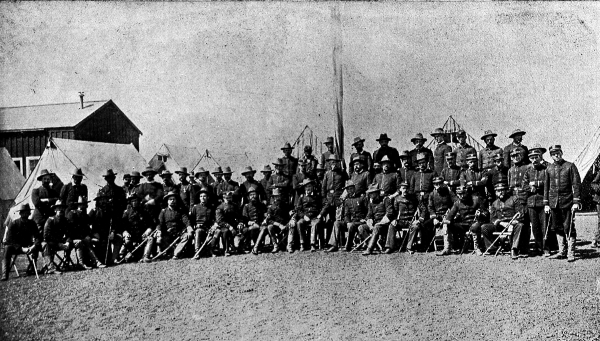
OFFICERS OF THE SECOND REGIMENT ARTILLERY AND NAVAL BATTALION, N. G. C.,
WHILE STATIONED AT OAKLAND, CAL. DURING THE STRIKE, JULY, 1894.
A HISTORY
OF THE
“CITY GUARD”
“B” Company, First Regiment Infantry
Second Brigade, N. G. C.
IN A CONCISE FORM
Embodying the Principal Features from its Original Organization
to the Railroad Strike of 1894
BY
CAPTAIN IRVING B. COOK
Commanding Company
“SALUS PATRIAE ME EXCITAT.”
CHAPTER I.
“SAN FRANCISCO CITY GUARD.”
“Build me straight, O, worthy master!
Staunch and strong—a goodly vessel,
That shall laugh at all disaster,
And with wave and whirlwind wrestle!”
Longfellow.
APPEARING upon the charter-roll of the First California
Guard, under date of organization, namely,
July 27, 1849, will be found the name of J. Russel
Gerry, M. D., company surgeon. Upon looking further
along the roll we find the names of John A.
Clark and George F. Watson, first and second lieutenants,
respectively, of the company, both having joined
on May 21, 1852. Second Sergt. R. M. Stephenson and
Corporal John W. Conner also joined at the same time with
the lieutenants. Third Sergt. E. W. Crowell, together with
R. S. La Motte, H. D. La Motte, and Charles S. Simpson, date
from July 13, 1852; and Thomas B. Parker from October 5th
same year. Fourth Sergt. H. F. Wadsworth and Joseph Henriques
joined in 1852, but the exact dates cannot be given at
this writing. H. D. La Motte and E. G. Hilton, two of the
three now living, who were among the organizers of the “City
Guard,” furnish evidence between them to show that the following
named gentlemen were also among those who belonged
to the California Guard just prior to March 31, 1854—the
great day—but are unable to give the dates of their first joining
same: Asa L. Loring, Charles Le Gay, John Ames, John
McQuade, E. G. Hilton (who speaks for himself), John C.
Briggs, P. R. Moore, Samuel C. Loring, E. R Dimmock, and
J. H. Pierce.
The records of the California Guard are very incomplete for
the early years, particularly so for 1853, that year only showing
two enlistments. This is the reason why the writer is
unable to furnish the dates above left vacant.
The First California Guard was originally organized as a
train of artillery, and exercised in the standing gun drill, besides
drilling with muskets. Early in 1854, however, they
changed into a horse battery, receiving from the state two
six-pound brass guns with carriages and all appliances.
This change did not meet with favor from all the members
of the battery, some particularly desiring to retain the old
form of organization, as they did not care for the mounted
work; nor did they relish the manner in which their captain,
Woodworth, conducted the drills and affairs of the battery,
he being absent therefrom, and very inattentive to the duties
required of a company commander.
These members, therefore, turned their attention to the accomplishment
of a new organization in accordance with their
desires, the proceedings being entirely harmonious between
all parties concerned.
With this object in view, they held a preliminary meeting
pursuant to the following notice:
“You are requested to attend a meeting of the second company
California Guard at the armory this evening, at 7 o’clock.
Dated Monday, March 13, 1854.”
At this meeting, or at one held perhaps a few days later, the
name of the new organization must have been agreed upon,
for in the columns of the Daily Alta California under date of
March 21, 1854, the following notice and order appears:
“By virtue of the authority in me vested, I hereby appoint
R. S. La Motte to superintend the election for officers of the
‘San Francisco City Guard’ as required by law. Dated, San
Francisco, March 21, 1854.
“J. H. Creigh, County Judge.
“In accordance with the above, an election for officers of
the ‘San Francisco City Guard’ will be held at Armory Hall,
on Friday evening, March 31, 1854, at 7:30 o’clock.
“R. S. La Motte.”
Pursuant to the above order, the twenty-two gentlemen
previously mentioned in this chapter met, and duly accomplished
the organization of the “San Francisco City Guard,”
electing the following officers and noncommissioned officers for
the term of one year: Captain, John A. Clark; 1st Lieutenant,
George F. Watson; 2nd Lieutenant, R. McLean Stephenson;
Jr. 2nd Lieutenant, R. S. La Motte; Orderly Sergeant, Thomas
B. Parker; and Sergeants, in order of rank, E. W. Crowell,
James C. Briggs, who was also treasurer, John W. Conner;
Q. M. Sergeant, H. Frank Wadsworth; the corporals, in order
of rank, were, Asa L. Loring, P. R. Moore, Samuel C. Loring,
and Charles Le Gay; Surgeon, J. Russel Gerry, M. D.; Secretary,
John Ames.
Of these charter members there are now living, H. D. La
Motte, Lake county, California; E. G. Hilton, New York;
Charles Le Gay, Paris, France. Doubtful, H. Frank Wadsworth
and R. McLean Stephenson.
By-laws for this new company were adopted, and the drill
night set for Friday of each week.
Captain Clark spent a great deal of time and money in perfecting
the organization of his command. His donations
were used principally in purchasing the first uniform, which
consisted of a close-fitting jacket of a very light fawn color,
all trimmings and pipings being of red; the men wore any
dark colored trousers. The uniform cap was a high affair of
blue material, trimmed with red. This is the only uniform
worn by the company for perhaps six or seven months, when a
full dress was adopted.
The company, being organized as artillery, drilled as such
with a large wooden bronzed model to represent a heavy gun.
The drill, however, was mostly as infantry, and all parades
were made with the musket.
Upon a proper requisition from the captain upon the state
authorities, the quartermaster and adjutant general, the corps
received the following arms and accoutrements: 60 percussion
muskets; 60 ammunition and cap boxes, belts, and plates; 60
waist belts and plates; 60 musket appendages; 60 artillery
sabers, belts, and plates; the company furnishing its own
uniforms.
The organization thus becoming complete, the “San Francisco
City Guard” sailed bravely forth to buffet and battle
with the vast unknown.
“Like a stately ship,
With all her bravery on, and tackle trim,
Sails filled and streamers waving.”
The original company commander is described as being
neither light nor very dark complexioned, but with black hair,
5 feet 6 inches in height, weighing in the neighborhood of
115 to 120 pounds—a small man. He was full of life, however,
quick-witted, and a noble-hearted fellow. His father,
Aran Clark, was at one time mayor of New York city. Coming
to California, Capt. Clark was for a long time deputy
county recorder of San Francisco. He died on November 22,
1877, at the age of 53 years, while in the employ of the treasurer’s
department at Washington.
Armory Hall, the first home of the “San Francisco City
Guard,” was situated on the northeast corner of Sacramento
and Montgomery streets, in Sam Brannan’s new building,
having a frontage of 60 feet on both thoroughfares. Four
other companies also occupied this building, each having separate
company rooms in the third story, with the use of the
drill hall on the fourth for its allotted evening of the week.
Nothing that was particularly startling occurred during the
balance of this, to the “City Guard,” the most eventful year
of 1854, nor during the next for that matter, to mar the calm
serenity of ordinary military life. Drills, parades, outings,
banquets, and social events vied with each other to fill the
interim; all of which served to interest, not only the members
themselves, but others as well, in the welfare of this organization.
Many prominent men joined the ranks of the
“City Guard,” and the high standing thus early attained
served to place the company on a firm and permanent basis,
assuring to it a long, prosperous, and most honorable existence.
To chronicle all the different incidents and happenings of
this early period, and those too of more recent dates, would
be out of the question at this present writing; prominent
among them, however, we find the following interesting items:
It was on the afternoon of the 3d of July, 1854, that the
“San Francisco City Guard” journeyed by water to the town
of Martinez for its initial excursion and outing, and, after celebrating
the Fourth by a parade, drill, and prize shoot, the
corps returned homeward, being received and escorted to the
armory by the California Guard.
The 17th day of August following, found the company on
the Oakland side of the bay for the regular target practice
and medal shoot. It was upon this occasion that the company
commander presented the now famous “Clark Medal”
to the corps, the conditions being that it remain a permanent
annual prize in the company. This medal is still the valued
property of the “City Guard,” and is placed in competition
as provided for in the original deed of gift. On one side of
the large quartz medal is inscribed: “‘City Guard,’organized
March 31, 1854,” and on the reverse side we have “Company
medal, presented by Capt. John A. Clark, August, 1854.”
It may be of general interest to the active guardsman of
the present day to learn that on April 25, 1855, the legislature
of California duly enrolled upon the statute books the
law exempting active militiamen from jury duty.
Armory Hall remained the home of the “City Guard” until
the 1st of June, 1855, when, during the following fifteen or
sixteen months, the company occupied three different armories,
namely: No. 95 Battery street, corner of Clay; northeast
corner of Kearny and Clay, this being the place where the reorganization
took place as the “I.C.G.”; thence to an armory,
for a very short time, on the northeast corner of Halleck and
Sansome streets, over the American Theatre.
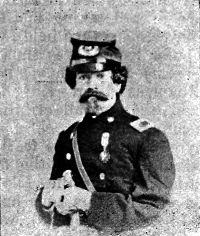
CAPTAIN JOHN A. CLARK.
CHAPTER II.
“INDEPENDENT CITY GUARD.”
THE political corruptions, ballot-box stuffing, and the
great number of homicides committed with impunity,
were the causes leading up to the Vigilance
Committee of 1856. These criminals depended upon
their fellows, some of the worst then being themselves
officials, to shield them from prosecution and to again
set them free. The opinion steadily gained ground with
the better element of society that it would be utterly impossible
to correct these evils by due process of law; still none
would make a move toward taking matters into their own
hands, and the worse element thus held full sway.
It was while popular feeling was thus strained to a high
tension that the Evening Bulletin made its appearance, with
James King, of William, as editor. King devoted his energies
in denouncing the crimes and all criminals who had given
most offense to the community.
The crisis finally came when this fearless editor, on May
14, 1856, published in his journal the fact that James P.
Casey, who had but lately stuffed the ballot-box with his own
name while inspector of election, and had declared himself
elected supervisor of the Twelfth Ward, was a graduate of the
New York state prison at Sing Sing, which statement was
true. Casey thereupon, within two hours, mortally wounded
King. The news of this fresh homicide spread like wildfire,
and Casey’s friends hurried him to jail, deeming it the safest
place.
An immense congregation of excited citizens assembled on
the Plaza, closing upon and threatening to storm the jail in
order to execute dire vengeance upon the murderer. This
crowd grew to wonderful proportions.
In the mean time the authorities were not idle; the military
were called upon to preserve order, and, in obedience to its
sworn duty, the “City Guard,” within an hour thereafter, left
the armory (corner Kearny and Clay) for the scene of trouble.
Although the company had but a short distance to go, it was
a march to be long remembered, for upon appearing on the
street, the members met with a warm reception. The
crowd jeered, they stormed, they threatened, they threw all
sorts of missiles (no one was seriously injured however), did
every thing possible to impede their progress toward the jail,
but with no avail. These soldiers, putting all their personal
feelings aside, were doing but their duty, and they did that
duty well.
Lieutenant Watson, who was in command during the absence
of Captain Clark in the East, had the muskets loaded
with ball, and it became necessary, not only to use the bayonet
occasionally, but two or three times was the command
“aim” given, and the men silently and with determination
waited for the word “fire,” so were their tempers worked
upon by this time: it was a hot crowd. Fortunately for some
one, however, the mob gave way under this pressure, and the
“Guard” finally entered the jail, taking position best adapted
for its proper protection. Here the company remained all
night and until 10:30 o’clock the next day, when the excitement
becoming somewhat abated, they returned to the armory
and were dismissed, with orders to report again immediately
upon hearing the alarm sounded.
This summons never came. But, on the other hand, notwithstanding
the prompt response and constant readiness of
the boys to perform their duty, Lieutenant Colonel West and
Sheriff D. Scannell mistrusted them, and quietly removed the
arms and accoutrements from the armory that day, thus leaving
the organization without the means of effective service.
This high-handed proceeding upon their part was resented by
the “City Guard,” as will be shown by the following proceedings
of a meeting held at the armory at 2 o’clock P. M. of the
following day, the 16th (it being duly advertised in the papers
of that time), to take into consideration the removal of arras
and accoutrements from their armory on the 15th instant:
“Lieutenant Watson in the chair.
“Lieutenant Colonel West appeared to explain his action in
relation to the removal of said arms and accoutrements, stating
that said arms were removed by order of Major General
Sherman,[7] and that he held himself personally responsible
therefor.
“After which the following resolutions were unanimously
adopted:
“Resolved, that in the opinion of this corps we have been
unjustly and improperly deprived of our arms without the
consent or knowledge of our commandant.
“Resolved, therefore, that a committee be appointed to wait
on Colonel J. R. West and request the return of the arms, and,
in the event of said request not being complied with, the ‘City
Guard’ do immediately disband.
“Meeting adjourned to 7:30 o’clock P. M.
“Pursuant to adjournment, the corps assembled at the
armory, when the following preamble and resolutions were
unanimously adopted upon the call of the roll:
“Whereas, the request for the return of our arms and accoutrements
has been refused, we find ourselves wholly unable
to equip our members, and deprived of the power to respond,
as ever heretofore, to the call of duty that may be made upon
us, therefore,
“Resolved, That the ‘City Guard’ do hereby disband.
“Resolved, That the events of the past few days prove that we
have ever held ourselves ready for the prompt discharge of a
soldier’s duty.”
These resolutions were signed by the sixty-one members.
On Tuesday evening, May 27, 1856, the members again
met and organized the “Independent City Guard,” and elected
the following officers and non coms.: Captain, John A. Clark;
First Lieutenant, George F. Watson; Second Lieutenant,
Asa L. Loring; Bvt. Second Lieutenant, Peter Van Pelt; Orderly
Sergeant, E. M. Crowell; Sergeants, Wm. H. Watson, H.
Van Pelt, Nathaniel M. Ford; Corporals, H. H. Thrall, Luke
Wilder, John Ames, and Chas. E. Rand; Quartermaster
Sergeant, Ephram B. Clement; Treasurer, W. H. Watson; Secretary,
John Ames. By-laws were adopted on June 25th following.
Through the generosity of the citizens who fully indorsed
the action of the company, the “Independent City Guard”
was fully equipped with a full set of arms and accoutrements
similar to those taken away. The donations thus furnished
for the equipment amounted close on to $2,000. The corps
retained, of course, the uniforms previously adopted, they
being the personal property of its members.
Immediately following the shooting of King, and of the
events above described, many prominent business men and
citizens determined upon decisive action, and, without further
delay, the Vigilance Committee was formed, many companies
armed and equipped. Within a comparatively short time
three thousand men were enrolled into the companies and
regiments thus raised. Although the “Independent City
Guard” took no part as an organization, the members individually
did, and they played a very prominent part in this
array. Chas. Doane, afterwards captain of the company, was
Grand Marshal over all the troops, Watson and many others
being officers therein, while the balance went into the ranks.
On Tuesday, May 21st, Casey, together with Cora, who had
killed United States Marshal Richardson, were taken from
jail, there being no resistance, and hurried to the headquarters
of the committee. There they were tried, convicted, and both
hanged on the 22d, the day that King was buried.
The Law and Order Party were also well organized, and
many conflicts were narrowly averted. The committee’s
troops, however, succeeded in disarming the others, making
them practically powerless.
Both the California Guard and the National Guard followed
the example of the “City Guard,” and formed independent
organizations.
It may be well to here add that, in all, four persons were
executed, and a great many others were banished. On August
18th following, all these troops, 5,137 in number, after a grand
review and parade, were mustered out, the object of the Vigilance
Committee having been accomplished.
The three years following this important epoch in the history
of the company were uneventful as to military requirements.
The company drilled regularly, besides parading on
both stated and public occasions.
During the month of July, 1856, or perhaps a little earlier,
the “I. C. G.” moved from the armory then occupied to one
at 112 Sacramento street, between Montgomery and Sansome,
where they remained until the first month of 1860.
Captain Clark resigned on April 15, 1857, and 1st Lieutenant
George F. Watson was advanced to the captaincy on
May 14th following, with Asa L. Loring as 1st Lieutenant;
Nat M. Ford 2nd Lieutenant; Benjamin H. Freeman being
Junior 2nd Lieutenant, and William C. Little Brevet 2nd
Lieutenant.
The company’s fancy uniform, modeled after the uniform of
the City Guard of New York, was adopted during either April
or May of 1858, nearly all having been made in the East; the
first parade with them took place on July 4th of the same
year. The cost to each individual member, including the high
bearskin shako, was one hundred dollars.
May, 1858, found Lieutenant Freeman in command of the
company, Watson, Loring, and Ford having previously resigned.
On June 6th following, Charles Doane was elected
captain, and John W. McKenzie 1st Lieutenant, Freeman and
and Little 2nd and Junior 2nd Lieutenants respectively. H.
H. Thrall being advanced to Brevet 2nd Lieutenant.
Here ends the career of the company as the “Independent
City Guard,” for on March 11th, 1859, the organization was
again admitted into the service of the state as the “City
Guard,” being attached to the 2nd Brigade, 2nd Div., C. S. M.
Witness the following order:
“Whereas, certain petitioners, citizens of the county of San
Francisco, have presented to me, the undersigned, county judge
of the county aforesaid, a memorial praying that they, the said
citizens, being eligible to military duty, may be duly enrolled
as a volunteer corps, attached to the Second Brigade, Second
Division C. S. M., under the name of ‘City Guard,’
“Now, therefore, in pursuance of authority vested in me, I
do hereby nominate and appoint Captain Thomas D. Johns to
superintend an election to be held by the subscribers aforesaid,
on the 11th day of March, 1859, at No. 112 Sacramento
street, for commissioned officers, in manner prescribed by
law, between the hours of 7 and 10 P. M.
“Witness the Honorable M. C. Blake, county judge of the
county of San Francisco, this first day of March, one thousand
eight hundred and fifty-nine.”
[SIGNED] “M. C. Blake, County Judge.
“Attest: Wm. Dun, Clerk.
“By D. P. Belknap, Deputy.”
In compliance with the above, the company met and duly
organized the “City Guard,” electing the same officers as on
June 6, 1858, with the exception that the position of brevet
second lieutenant was left vacant.
CHAPTER III.
“CITY GUARD” FROM 1860 TO 1870.
JANUARY 1, 1860, found the “City Guard” just
located in their new armory, in an iron building,
situated on the north side of California street,
a few doors above Montgomery street, over Wells, Fargo
& Co’s Express. The Union Club occupied the corner
over the bank. Many of the “City Guard” members
belonged to this club, and both headquarters were connected
by a doorway. Here the corps remained until November
20, 1865—nearly six years.
The re-election of Doane, McKenzie, Freeman, and Little
occurred on April 14th following, John Hill being raised to
the dignity of brevet second lieutenant.
Following close upon this election of officers, the First Battalion
was organized, which consisted of all three arms of the
service, namely, infantry, artillery, and cavalry. This organization
was completed on June 15, 1860, the companies
comprising same being the “City Guard,” “California
Guard,” “Black Hussars,” “Light Guard,” “Fusileers,” and
“French Guard.” All of the members comprising these six
companies participated in the election for field officers, which
was by ballot, there being over two hundred votes cast. Captain
Doane was duly elected lieutenant colonel, commanding
the battalion, and First Lieutenant McKenzie was raised to
the rank of major. The result of this election gives to the
“City Guard” the honor of furnishing the only two field officers
of an organization which afterwards became the nucleus
for our present First Regiment; the “National Guard”
and “California Rifles” being added later, in order to make
the eight-company regiment.
In consequence of the above, another company election was
necessarily held for officers to fill vacancies. John A. Clark
was again made captain, vice Doane; Asa L. Loring, first
lieutenant, vice McKenzie; Little and Freeman retaining
their former positions, while George J. Griffing was advanced
to brevet second lieutenant, vice Hill resigned.
We now come upon the eve of the War of the Rebellion.
Fort Sumter had been fired upon, and opportunities became
numerous for able generals, and brave men to show their
mettle and loyalty to preserve our glorious Union. In California,
although far removed from the seat of conflict, everyone
took a lively interest in the progress of hostilities. This
state furnished many thousands of volunteers for the strife,
the proportion being very large for the then population; in
fact, California furnished many soldiers who were accredited
to other states, as history will plainly show. The “City
Guard” furnished a long list of fighters, among whom were
the following: J. M. McNulty, M. D., brigadier surgeon, California
Volunteers; John Hill, lieutenant with Colonel Baker,
California Volunteers; J. P. Hackett, captain Sixth Infantry,
California Volunteers; Nat M. Ford quartermaster’s department;
Asa L. Loring; Robert S. La Motte, captain Thirteenth
New York, afterwards lieutenant-colonel United States Army;
H. B. Mellon, now retired, major United States army; William
Bryan, Seventh New York; George F. Watson, captain 180th
New York Volunteers; W. C. Allen, captain 101st New York
Volunteers; Joseph Hilton, captain Twelfth New York Volunteers;
Joseph Henriques, captain Fourth New York Volunteers;
William Barstow, assistant adjutant general, General
Dix’s staff; E. G. Hilton, quartermaster’s department, and
L. Parks, with California Hundred. There are others, but
the writer is unable at the present time to name them.
Many of these gentlemen rose to higher rank in the service
during the progress of the war.
The vast majority of people on this coast elected to maintain
these United States one and inseparable, still there
were those who warmly supported the secession, and conditions
threatened at times to become more serious in California
than would have been agreeable to peace-loving people.
This would be particularly the case when any news came of
the defeat of the northern arms.
The provost marshal, who was on duty at all times, made
many arrests of those who were too outspoken, and the militia
were constantly on the alert, although they were but occasionally
under arms. Armories had to be guarded, however,
and the “City Guard” did full well its share of duty.
Throughout the period covered by this chapter the members
of the “City Guard” continued with their regular
routine duties as required, with occasional battalion drills
and military ceremonies, parades and escort duties, the latter
being quite numerous. This company had no difficulty
whatever in keeping its ranks full of enthusiastic members,
who made the corps a truly crack organization.
The writer can give no better evidence or proof of the condition
of the “City Guard” than that offered in the adjutant
general’s report for the year 1861. In this report, speaking
of the company, he says:
“This is one of the oldest and best drilled companies of the
state, is well officered and equipped, and composed of men
who take much pride in the military art—numbering eighty-eight
men. Has had upon its roll this year one hundred and
forty-three members; has furnished from its ranks during this
year one brigadier general,[8] one surgeon, and one captain of
volunteers in the United States service, and three general
staff officers. Much praise is due the members of this company
for the military enterprise at all times displayed, and
authorities of the state can rely upon its efficiency for active
service.”
The “First Regiment of Infantry, California Militia,” was
organized on May 28, 1861, with the previously named companies
composing same. John S. Ellis was elected colonel,
J. W. McKenzie as lieutenant colonel and Robert Pollock
major. The companies taking the letters in accordance with
the dates of their original organization, as follows: “California
Guard, Company A,” “City Guard, Company B,” “National
Guard, Company C,” “Black Hussars, Company D,” “California
Fusileers, Company E,” “Light Guard, Company F,” “French
Guard, Company G,” and “California Rifles, Company H.”
Many changes have since taken place in the regimental organization,
and now, July, 1894, of the original companies
there remain but three, namely, “City Guard, Company B,”
“National Guard, Company C,” and “Light Guard, Company
F.”
At the annual election for officers of the company in 1861
the same ones were continued in office, with the exception
that the position of brevet second lieutenant was left vacant,
vice Griffing.
Up to June 28, 1861, the “City Guard” drilled with,
and used for the purposes of the state, the same arms and
accoutrements so kindly furnished them by the citizens in
1856; at this time, however, the state authorities issued the
following to the company, all being of the same pattern as
previously owned by the corps: sixty muskets, gun-slings,
bayonets, and scabbards; sixty cartridge-boxes, belts and
plates; sixty waist-belts and plates, with the same number of
cap pouches; four sergeant’s swords and scabbards, belts and
plates.
The several companies of the regiment wore different style
uniforms, representing, as has been said, all colors of the
rainbow. The board of officers determined upon adopting
one for the entire regiment, one that would be serviceable in
case they were called upon for active duty. They therefore
addressed themselves to the citizens of San Francisco, who
soon came forward with the requisite amount to purchase
same, and along toward the middle of the year 1861 the
regiment was finally fitted out with a gray regimental uniform,
the cost of which was twelve dollars.
All the troops in the Second Brigade, Second Division,
C. S. M., during the month of November, 1861, were required
to take the oath of allegiance before Judge Blake, in
substance as follows: “To support the constitution of the
United States and of the state of California, solemnly agreeing
to defend both against all enemies, both foreign and
domestic.” The “City Guard” came forward with a larger
membership than any of the other companies.
The company was well received by the best society in the
city of San Francisco. This fact is abundantly evident from
the many events that transpired during its early history. It
will be impossible, however, to detail all the interesting social
festivities of these days, but in order that the writer’s assertions
may carry conviction with it, the following historical
fact is recited: A military and civic subscription ball was
given at Platt’s Hall, on the evening of Friday, December 27,
1861, complimentary to the officers of the Russian steam
corvette Calevala, by the citizens of San Francisco, as a
token of the public appreciation of the friendly spirit manifested
by the Emperor of all the Russias toward our federal
government. All arrangements for this ball were confided to
the members of the “City Guard” by a committee of the most
prominent people. Lieutenant Wm. C. Little was floor manager,
assisted by four noncommissioned officers of the company.
Captain Clark, chairman of the reception committee,
was assisted by all the other members of the company, every
one being in the full fancy uniform of the corps. The
“press,” in describing the affair, spoke thus of the “City
Guard”: “One of the most spirited and efficient of our local
uniform militia companies, whose proverbial good taste was
fully sustained in the admirable manner in which the ball
was conducted.”
In May, 1862, Little was advanced to Second Lieutenant,
vice Freeman, Fred W. Macondry, Jr., was made junior second
lieutenant, vice Little promoted. The result of the election
for officers of the company with rank, from August 8th, following
was: Captain, Wm. C. Little, vice Clark, promoted
lieutenant colonel First Regiment; Fred W. Macondry, Jr.,
first lieutenant, vice Loring; R. M. Noyes, second lieutenant,
vice Little promoted; John Hoyt as junior second lieutenant,
vice Macondry promoted. This quartet of officers remained
thus until September 4, 1865.
The first camp of the state militia was held in May, 1863,
in pursuance to orders from general headquarters. This
camp was named “Stanford” after the commander in chief,
and the expense was borne by the state.
The legislature of California opened its heart to help the
militia financially, on April 25, 1863, the first time on record.
Appropriations were made for its maintenance, three hundred
dollars per year for each company of infantry, besides
requiring the counties to furnish twenty-five dollars per
month for armory rents. It also provided for two encampments,
the above being one of them, and for full-dress uniforms
for the entire force. These, made of blue, were issued
during same year. It also passed the clause to exempt militiamen
from jury duty after serving faithfully for a period of
seven years.
Company B, “City Guard,” First Regiment of Infantry, participated
as a company in its first camp, a Second Brigade
affair, from the 6th to the 16th of October, 1863. Camp
Allen, named after the commander of the Second Division,
was held near San Antonio, Alameda county, the state defraying
the expense.
The company received its first improved arms on February
20, 1865. These were the “rifle muskets” of 58 caliber,
model 1861. Sixty of these, together with a full set of accoutrements,
the same kind as before used, were issued to the
Company, and those previously carried were returned to general
headquarters during the following month. Twenty extra
muskets came to the company during October following.
In April of the same year, when the news of the assassination
of our martyred President, Abraham Lincoln, was received,
San Francisco became wild with excitement; mobs
quickly gathered, and endeavored to wreck the printing-offices
of those who had advocated secession, and of those who had
been so rabid in their utterances that they had really done
the next thing but actually advocate the killing of the President.
The feeling against these people can well be imagined.
Some considerable damage was done before the authorities
were able to act; finally, when the militia was called upon, the
“City Guard” was the first company to report at the rendevous,
and it was the only company whose every member was
in complete uniform. Guards were kept on the other offices
that had escaped the fury of the mob up to this time. Guards
were also kept over loyal newspapers, for fear that the rioters
would so far forget themselves as to wreck them too. Considerable
trouble was experienced, and many broken heads
was the result. As soon as matters quieted down the troops
were dismissed.
Little was again re-elected September 4, 1865, with William
M. Noyes as first lieutenant, vice Macondry; George W.
Granniss, second lieutenant, vice Noyes promoted; T. Van Tassel,
junior second lieutenant, date from October 3, 1865, vice
Hoyt. The latter remained in his position but a short time,
going again into the ranks, presumed to be upon the reorganization
as the National Guard of California.
On November 20, 1865, the company moved from California
street to an armory situated on the top floor of a three-story
building on the south side of Market street, opposite Dupont.
Remaining there until April following.
April 2, 1868, saw the last of the “California State Militia,”
for upon this date the Legislature passed the law creating
the “National Guard of California,” together with a general
revision of the codes governing the state forces. Among
the principal features of this bill we find: A limit to the
number of companies; allowing but three officers to each
infantry company, same to hold office for two years; field
officers to be elected for four years.
Soon after this bill became a law a complete reorganization
took place, and many companies were necessarily mustered
out of the service. Orders were issued from general headquarters
on July 12, 1866 (see S. O. No. 3 series of 1866),
directing the immediate organization of the Second Brigade,
in accordance with this law. This was accomplished the next
month.
The “City Guard” Company B, retained its position in the
First Regiment, and sixty-seven members of the company
took the following oath on the twenty-first day of August,
1866, before the mustering-in officer, Major George W. Smiley,
Asst. Adj. Gen., 2nd Brig., N. G. C.
“Company “B,” First Regiment Infantry; Second Brigade,
N. G. C.
“State of California, }
“City and County of San Francisco. } ss.
“You do solemnly swear and pledge your honor that you
“will support the constitution of the United States, and the
“constitution of the state of California, and that you will
“maintain and defend the laws and all officers lawfully employed
“in administering the same.”
Little, Noyes, and Granniss were retained as the three company
officers, Van Tassel taking the oath as a private.
April 24, 1866, again found the “City Guard” located in a
new armory, this time at No. 617 Howard street, opposite New
Montgomery, in the second story, the California Guard being
on the ground floor. This was its home until February, 1871.
During October, 1866, the company received eighty new
full-dress uniforms from the state. They were of the same
pattern as those of 1863, but without the piping of white cord.
George W. Granniss was elected captain during October
also, vice Little, promoted major; Stephen H. Smith, first
lieutenant, vice Noyes; and David Wilder, second lieutenant,
vice Granniss promoted.
Two years after, October 19, 1868, found another change
in officers. Granniss having been elected major, Douglass
Gunn was elected captain, and Chalmers Scott first lieutenant,
vice Smith. Wilder was re-elected second lieutenant. Gunn
resigned, and Chalmers Scott was raised to the captaincy on
November 1, 1869. At the same time Wilder was made first
lieutenant, and Horace D. Ranlett, second lieutenant.
During the latter part of 1869 the company readopted the
“fancy uniform,” which lasted, as near as the writer can determine,
until 1874 or 1875. It was not worn much, however,
during the latter part of the period named.
During the month of November, 1869, a fire occurred,
which did considerable damage to the arms and accoutrements
of the company. These arms and accoutrements were
condemned by a Board of Survey, and new ones issued on
December 21st following, those damaged having been returned
to the state authorities.
CHAPTER IV.
FROM 1870 TO 1880.
WITH July, 1870, came another change in the officers
of the company, Thomas J. Johnson being elected
captain, to rank from April 15th, vice Scott, resigned
on account of his removal to the southern
portion of the state, the other officers retaining their
former positions.
Following close upon this election of officers, the company
received a full fatigue uniform through the exertions
of Colonel Barnes. The description of this uniform is not at
hand at the present time, but it is presumed that the only
addition was a blue single-breasted blouse of about the pattern
now (1894) worn, together with the regulation cap.
The building on the northwest corner of Howard and New
Montgomery streets became the armory of the “City Guard,”
in February, 1871. The company occupied rooms on the second
floor, together with other companies of the regiment, the
first drill being held on the 7th of that month. This place
was retained as headquarters until November, 1875.
1st Lieutenant David Wilder was elected captain, to rank
from March 14, 1871, vice Johnson, resigned on account of
sickness. Ranlett was promoted to the 1st lieutenancy, and
J. Henry P. Gedge to fill the position left vacant by Ranlett,
both to rank from March 23d.
An organization in Amador county, this state, known as
the Laborers’ League, was formed for the protection of white
labor, and not only miners, but many others, belonged to it.
They assumed to fix the wages to suit themselves, and any
one who refused to accept their terms was not allowed to work.
Trouble, therefore, ensued between them and the mine-owners,
as the latter would not recognize the right of the league to
interfere in their business arrangements. A strike was ordered
in consequence. The mines were shut down, for the
league would not allow any one to work, not even at the
pumps, in order to keep the mines free from water. Damages
to the extent of about $75,000 having been accomplished by
the strikers, the owners of these mines called upon the governor
for protection.
This was the condition of affairs on June 22, 1871, when
Colonel W. H. L. Barnes, commanding the First Infantry,
received orders from general headquarters at Sacramento to
immediately detail a battalion of two companies for service
in the field. The entire regiment was assembled, “B”
reporting with forty-eight rank and file, but companies “C”
and “E” were selected for this campaign. As more men
were necessary than were available in the companies named,
details from the balance of the regiment were made to fill up
the ranks of the battalion. Although the “B” boys were all
anxious to go, Captain Wilder was only allowed to detail one
sergeant, two corporals, and ten privates, namely: Sergeant
T. N. Weightman, Corporals James J. E. Hawkins and Arthur
A. Palmer, Privates George G. Bergstrom, Charles W. Bryant,
James M. Guerin, August G. Jenny, John Martin, William V.
McConnell, Harry F. Middleton, William M. Noyes, E. E.
Stacy, and H. Nelson Wright. The battalion was under the
command of Major J. F. Bronson.
The detailed battalion left the same day that the order was
received, and was gone twenty-seven days. Their duty was
performed so well that they experienced no trouble from the
miners.
Major Bronson died soon after his arrival home, caused by
the exposure during the campaign. C. Poindexter gives evidence
to the fact that James Guerin of “B” also died from the
same causes after arriving at his home.
In the latter part of the year 1871, another fire occurred in
the armory of the “City Guard,” this time destroying the
records of the company, and doing great damage to the arms
and other property of the organization. S. O., No. 34, series
of 1871, from general headquarters at Sacramento, and dated
December 20th, condemns the arms and accoutrements of
the “City Guard,” Company B, First Regiment of Infantry,
N. G. C., which were damaged by fire, and a requisition for
new approved.
Lieutenant Gedge resigned on December 28, 1872, and
Sidney M. Smith was elected second lieutenant to fill this
vacancy, with rank from January 2, 1873. June 5th following
found Wilder re-elected to the captaincy, while Smith was
advanced to first lieutenant, vice Ranlett; Henry A. Plate,
second lieutenant, vice Smith promoted.
In 1873 the First Regiment received new arms and equipments,
and the new regulation uniform. General Order No.
1, from headquarters of the National Guard of California,
dated January 30, 1873, adopts the United States regulation
uniform for the forces of this state. These arms and equipments,
together with the uniforms, were paid for through the
efforts of Colonel W. H. L. Barnes, who raised upwards of
$30,000 to pay for same. These rifles were the first of the
breech-loaders to be received by any organization on the
coast, and it was because of the energetic leaders that the regiment
was so fitted out. On June 22d the “City Guard” received
its quota of the new arms, duplicate receipts being
given to Colonel Barnes, Lieutenant Colonel George W. Granniss,
and Major Oscar Woodhams, as trustees for said property,
the same to be returned upon demand, viz., sixty each
of the following: Sharp’s metallic cartridge army rifles,
caliber fifty and model new, bayonets, cartridge boxes and
plates, cartridge-box belts, waist-belts and plates, uniform
hats. The company returned the old ones to Sacramento on
the 25th, three days later.
The uniform adopted was of the same general description
as that of 1866, with perhaps a few minor changes.
The following officers were elected with rank from April 1,
1875: Henry A. Plate, captain, vice Wilder promoted major;
Thomas J. O’Keeffe, first lieutenant, vice Smith; Edward F.
Sellick, second lieutenant, vice Plate promoted.
COMPANY BADGE.
The first mention of a badge for the company was made
on October 9, 1873, a number of designs being offered, but
no immediate action was taken. Between this date and
the New Year discussions were had upon the subject, and
in February, 1874, an attempt was made to abandon the
idea, but this was voted down. Matters rested until the early
months of the following year, when about fifteen designs
were again offered, and from these, five or six of the best ones
selected, and given into the hands of a committee. This committee
made up one design, adopting the best features of those
in hand, and presented the result to the company for final
action. This badge was accepted, as near as the writer can
determine, some time during June, 1875. A facsimile of this
badge can be seen on the cover of this book.
The “City Guard,” together with the entire regiment,
participated in the 2nd brigade encampment held at San
Rafael on the 20th, 21st, and 22d of May, 1875, Brevet Major
General W. L. Elliott, U. S. A., being in command. Quite a
number of United States troops were also present.
One of the most pleasing episodes in the history of the company
occurred on August 7, 1875, when Captain Plate, on
behalf of himself and sister, Miss Josie Plate, presented to
the organization a beautiful silk national flag, which has ever
been prized most highly by the members of the “City Guard,”
and many are the times that they have paraded beneath its
classic folds.
Upon this same evening the captain also presented to the
company what is known as the Plate Badge. This badge is
the permanent property of the “City Guard,” and it is annually
placed in competition as a shooting decoration. This
badge is described as a massive scroll shield, weighing almost
two ounces in gold. In the center of this shield is the monogram
“C. G.” in large lettering, surmounted by a bear, over
which stands in bold relief the name “Plate Badge,” all of
which is enameled in black, the groundwork being beautifully
hand chased. On the reverse side is the following
inscription: Presented to the “City Guard” by Captain
H. A. Plate, August 7, 1875. Miss Josie Plate was elected an
honorary member of the company on the 19th of August.
She is the only lady who has that distinction.
Some time previous to September, 1875, this company
received the breech-loading Springfield rifle from the state
authorities. These are the 45-70 now in use. Sixty were
allotted to “B.”
The second week of November of this year found the company
located in a new home. This time the move was made
to No. 318 Post street, opposite the square, between Stockton
and Powell streets, on the north side. This armory was
owned and occupied by Company C, the “National Guard”
of the First. Here the “City Guard” remained until the
last of July, 1879.
Another beautiful annual shooting prize was presented to
the company by Miss May C. Bourn, on the evening of May
4, 1876. This handsome affair is in the shape of a heavy
solid silver cup or vase, and is known generally as the “Bourn
Cup.” The winner of this cup holds it for one year, when it
is then again competed for.
Not to be outdone by others in this era of beautiful gifts,
Color Corporal Louis R. Townsend, the old-old veteran, came
gallantly forward on July 4th with another very appropriate
gift to the company of a flag-case. This flag-case is built of
oak and ebony woods, with the entire front of glass. It is
sufficiently large to hold the full spread of the “City Guard”
flag so kindly presented during the previous year. The case,
with the flag therein, now adorns the wall of “B’s” headquarters.
With the true characteristic feeling of a “City
Guard” veteran, and a true soldier, the corporal caused the
following inscription to be carved upon the base of this gift:
Beneath thy folds we march at duty’s call,
With thee we’ll conquer, or with thee we’ll fall.
On October 20, 1876, the company was under arms in anticipation
of a riot and threats of attack upon the Chinese
quarter of San Francisco. November 7th following found the
organization again under arms, and this, too, for the same
reason. The National Guard was held in readiness during
this period for active duty, there being considerable excitement
in the city over the troubles caused by unscrupulous
agitators.
December 28th found the “City Guard Rifle Range” completed
at San Bruno. This range was the gift of Captain
Plate, who with William Unger, Charles Slocum, and the old
veteran Lou Townsend, devoted their labor to its construction.
This range was used for a good many years; but,
finally, on account of the time lost in traveling to and fro,
and to the lack of interest in shooting, it was finally given up.
At the election for officers in 1877 John H. Dickinson was
elected Captain, vice Plate; E. F. Selleck, First Lieutenant,
vice O’Keeffe; and Louis R. Townsend, Second Lieutenant,
vice Selleck promoted; all to rank from April 5th.
The excitement of the previous year continued well into
1877 and 1878, and things began to get warmer and warmer
for the Chinese as time rolled on. Kearney and his crowd of
agitators were at work, endeavoring, as they claimed, to drive
the hated race from our shores. Matters got beyond the control
of the local authorities, and they called upon the governor
for aid. That part of the National Guard located in San
Francisco was ordered under arms on July 23, 1877, and were
held in its armories for a period of seven days. The Safety
Committee, having been organized into pick-handle brigades,
patrolled the streets of the city, while the organized and well-disciplined
troops were cooped up in their armories, and were
not allowed to do the duty which they had taken an oath to
perform. Was this not strange? Perhaps the following will
serve to explain matters somewhat.
The chief of police, together with the other civil authorities,
was jealous of his powers, and feared to put matters
into the hands of the military. Why? Because they feared
that some one else would reap a little benefit besides themselves,
and that they might lose a vote or two, perhaps. ’Tis
the same old story, which is told and retold so many times
over, jealousy and the narrow-minded policy of self-interest.
In the absence of martial law the civil authorities were, of
course, in full control, and the military were subservient unto
them. They saw fit to keep disciplined organizations in their
armories, while the undisciplined citizens were parading the
streets with their bits of wood. Time and again have the
National Guards of our different states been placed in just
such a predicament, and when politics are thrust into the
background, and civil offices are occupied by fair-minded men
whose sole aim is the welfare of the state, and not till then,
will the National Guard occupy the place designed for it in
the government of our country.
But we’re outflanking our story. Therefore to resume.
These much abused civil authorities must have become
ashamed of themselves, for, upon the night of July 29th, they
detailed the military to the water-front in order that they
might protect the piles of potatoes that were strewn around
on the wharves. From what? It must have been from the
wharf-rats, as all trouble had ceased to exist in the city, as
is evidenced by the fact that next morning, the 30th, all
were dismissed to their homes, military, pick-handle brigades,
and all.
On November 10th, the troops were again called out for
duty for a period of nine days, the cause being the same as
above stated. Again, on January 16, 1878, the troops were
called upon for aid in quelling rioters. This time their tour
of duty lasted for eleven days. It is needless to say that the
“City Guard” was prominent among the city’s defenders, even
to the guarding of the potato-sacks.
The “City Guard” participated in the regimental encampment
held at Sacramento from September 18th to the 22d,
1878, inclusive. This camp was named after the Commander-in-chief,
Governor Irwin. It was at this camp that the State
Agricultural Society gave two prizes for a competitive drill.
Each competing company was to drill for an hour, three regular
army officers being judges. Company “D” of the First
took the first prize of $300, and the “City Guard” the second
of $200. The first prize was won by but a very few points
indeed.
April 5, 1879, found Captain Dickinson and First Lieutenant
Selleck re-elected, and Henry A. Plate as 2d Lieutenant
to rank from the same date, vice Townsend.
The company was on duty again during the Kalloch-De
Young troubles of 1879. The members, with few exceptions,
placed their pay direct into the treasury of the company.
On August 1st of this year the company removed from the
armory then occupied to No. 428 Post street, north side, between
Powell and Mason streets. The building was once
known as Mrs. Mirasole’s dancing academy. Many a good
time was had there, too. Here the company remained until
June 1, 1881.
Camp Walsh was the camp pitched by the First Regiment
at Sacramento, from September 10th to the 14th, 1879, inclusive.
The members of the “City Guard” enjoyed themselves
very much indeed at this camp.
During the ten years covered by this chapter the “City
Guard” of course paid considerable attention to the social
features that necessarily take place in an organization of this
kind. Parties, picnics, target excursions, out-of-town trips,
camps, and rackets claimed their proper attention. It became
hard, however, for company commanders to keep their companies
up to a proper military standard, and the attention to
these duties was of a lukewarm nature. A great many things
worked against the making of prosperous commands. The
“City Guard” felt the influences of these conditions, and continued
to feel them, too, away along toward the middle of the
eighties, when new life was gradually let into the organization,
and conditions became more encouraging and satisfactory to
those who took the deepest interest in company affairs.
CHAPTER V.
FROM 1880 TO 1894.
EARLY in the year 1880 the company experienced
quite a boom in membership, the roll reaching to
considerable proportions, prizes having been offered
to the two members who would do the most recruiting
within a given time. The company had in view the new
uniforms to be presented by a committee of citizens, and
it was the general desire that the roll be increased. The
“City Guard” duly received its proportion of these uniforms,
which were the regulation as previously worn.
First Sergeant Paul E. Scott was, on April 5th, elected
second lieutenant, vice H. A. Plate resigned. On July 26th,
following, Selleck was made captain, vice Dickinson promoted
Colonel First Infantry, and J. C. B. Hebbard, first lieutenant,
vice Selleck promoted.
That part of the Second Brigade located in San Francisco
was on duty at the county jail, and in their armories, during
the troubles of April, 1880, when Chas. de Young was shot
by young Kalloch. The companies were hastily summoned,
but again dismissed in a few days, when the excitement had
subsided.
Camp Barnes, regimental, in which this company participated,
was held at Sacramento from the 18th to the 26th
of September, 1880. While returning to San Francisco, the
train bearing the regiment, ran into an open switch on the
Oakland Mole. Engineer Wm. C. Browne, by his presence
of mind and heroic action in sticking to his post of duty,
saved the members of the regiment from a fearful death, he
being the only one who lost his life. The engine went through
the wharf into the bay, and, when afterwards found, Browne
was still standing upright, with his hand on the throttle, dead.
Proper action was taken by the board of officers, in an elaborate
set of resolutions, and substantial aid was given to
his mother and sister, who were dependent upon him for support.
The next camp, Camp Upton, was held at Santa Cruz from
the 2d to the 10th of July, 1881.
On June 1, 1881, the “City Guard” took possession of its
new quarters on the N. W. corner of Howard and New Montgomery
streets, this being the second time that the company
had had its armory upon that corner. This was also regimental
headquarters; remained there until early in 1888.
Samuel J. Taylor was elected first lieutenant, vice Hebbard
resigned, on June 27, 1881, and, on the 15th of September
following, August F. Plate was made second lieutenant, vice
Scott resigned. March 2, 1882, found Taylor captain, vice
Selleck retired; Plate, first lieutenant, vice Taylor promoted,
and J. C. Conrad, second lieutenant, vice Plate promoted.
The regimental camps of the two following years, 1882 and
1883, were held at San Jose, from July 1st to the 9th of each
year. In both cases a return trip was made to San Francisco
for the Fourth of July parade, the regiment reaching San Jose
again in time for the parade there in the evening. The camp
of 1882 was named Camp Sheehan, and that of 1883 Camp
San Jose.
Second Lieutenant Conrad resigned on July 11, 1883.
Francis J. Kremple was elected first lieutenant, vice Plate
resigned, to rank from December 12, 1883, the second lieutenancy
being left vacant.
In 1884 the regimental camp was held at Santa Rosa from
the 6th to the 14th of September.
The first division camp held by the State troops was at
Santa Cruz, from August 15th to the 23d, 1885, the camp being
named after the Commander in Chief, Governor Stoneman.
Company “B” was comfortably situated in its quarters
with the regiment, and cheerfully performed all duties required.
The First Regiment, through its own commissary,
furnished the meals to its members; other regiments, however,
were not so fortunate, they depending upon a caterer for
their subsistence. This caterer furnished any thing but what
was satisfactory to the men, the principal “kick” being
against so much “tripe,” which was served out too frequently
for their tastes. After the sham battle of Saturday the hill
upon which it took place was christened “Tripe Hill,” and is
known as such to this day.
Frank J. Warren succeeded Kremple as first lieutenant on
May 28, 1885, the latter having resigned; the second lieutenancy
being left vacant. Ex-First Sergeant George R. Burdick
was elected to the captaincy of the company on October 22,
1885, vice Taylor promoted major of the regiment. There
was no second lieutenant.
Major Taylor, upon leaving the “City Guard,” presented
the company with what is known as the “Taylor Badge.”
The inscription on the back of this handsome gift is as follows:
First prize, Thanksgiving Day Shoot. Taylor. November
26, 1885.
The so-called Sutter street riots, including both the Sutter
and Geary cable roads, received the attention of the forces of
the Second Brigade, although they were not sent out against
the rioters, the police being ample for that purpose. Heavy
guards were kept at the armories, however, for nearly two
months. Dynamite and coercion were used by small parties
of the strikers and individuals, but as a body they made no
riotous demonstrations. The armory guards were posted on
December 13, 1886, and were continued until February, 1887.
Many of the members who then belonged to the “City Guard”
will perhaps remember the pay received, and will undoubtedly
remember the “one dollar and sixty cents” chalked all
over the city’s walls and fences, with the accompanying witticisms
of would be wags. The pay of the enlisted man was as
follows: Allowance for meals, seventy-five cents; for quarters,
forty cents; for pay proper, forty-five cents; a grand total of
one dollar and sixty cents for a day of twenty-four hours.
Officers received nothing whatsoever.
“Soldier, will you work”?
Irving B. Cook was elected first lieutenant, to rank from
May 19, 1887, vice Warren appointed signal officer, regimental
staff.
The first brigade camp held for quite a number of years
was at Healdsburg for eight days, from the 2d to the 10th of
July, 1887. Camp Bartlett was named after the governor,
and commander in chief. Company “B” made its accustomed
showing at this school of instruction, occupying the
street allotted to it by the regimental commander.
This camp was styled the “Jonah camp” by the boys, as
three deaths occurred, two by drowning, and one, Sergeant
Major William Mitchell, appointed from this company, died
from the effects of exposure.
The “City Guard” moved into its present quarters, at
1327 Market street, on April 4, 1888. The company expended
a great deal of money in fitting its rooms up appropriately.
“B,” with companies “A,” “D,” “F,” and “H,”
leased this armory, which had been built expressly for them,
for a period of ten years, each having two rooms for the use of
its members.
San Jose, for the third time, received the regimental camp,
for the year 1888, on July 21st, for eight days.
The company received new uniforms during the year 1888.
These were the United States regulation as previously worn.
The state furnished this lot of uniforms, and the general fit
of them was some thing terrible to look upon, being the fault
of the contractors. Ten new Springfield rifles, model of
1883, came to the headquarters of company “B,” these rifles
being an improvement over those of 1873, in that the safety
notch was added, with the Burlington rear and front sights.
At different times subsequent to 1888 two more issues were
made of ten and nine respectively.
At a social reunion of the “City Guard,” on Monday
evening, October 22, 1888, L. D. Stone, Esq., an honorary
member of the company, presented the organization with a
magnificent bearskin screen.
Camp Orton, named after the Adjutant General of this
State, was a regimental camp held at Santa Rosa, from the
20th to the 28th of July, 1889. The next two were Second
Brigade affairs, both being held at Santa Cruz—that of 1890,
Camp Waterman, from the 16th to the 24th of August, and
that of 1891, Camp Markham, from the 4th, after parade,
to the 12th of July. In all three of these camps the “City
Guard” participated.
On October 28, 1889, F. A. Baldwin was elected 2nd Lieutenant,
vice self, resigned October 5, 1888, the vacancy not
having been filled in the mean time.
By an amendment to the codes governing the National
Guard of California the Legislature authorized the issuance
of service medals for ten years and upward, the material being
of bronze with a bronze bar for ten years, silver bar for
fifteen, and a gold bar for twenty years’ service.
On January 10, 1891, First Lieutenant Irving B. Cook was
elected captain, vice Burdick promoted major. Upon the
same date, First Sergeant Charles J. Wesson was raised to the
dignity of first lieutenant, vice Cook promoted. On June
22d, same year, Edward C. Lundquist took Baldwin’s position
as second lieutenant, he having resigned, and, on April 25,
1892, Lundquist was promoted to first lieutenant, vice Wesson
resigned, George Filmer taking the second lieutenancy upon
the same evening, vice Lundquist promoted.
The second division camp, Camp Columbus, was held at
Santa Cruz, from the 5th to the 13th of August, 1892, Major
General W. H. Dimond commanding.
Perhaps the most enjoyable and most satisfactory camp
participated in by the members of “B” was “Camp City
Guard,” a company affair held for five days at Stockton in
1893, from July 1st to the morning of the 6th. The river
steamer Mary Garratt was chartered for the transportation of
the men both ways. Companies “A” and “B” of the Sixth
Infantry, located at Stockton, headed by their band, escorted
the “City Guard,” upon their arrival, to Goodwater Grove,
where the advance guard had already pitched the tents.
Regular routine duty was immediately inaugurated. Fifty-nine
officers and men participated in Camp “City Guard,”
and all regretted the time for leaving, the reception accorded
them by the boys and citizens of Stockton having been most
pleasing indeed. The expense of this camp was paid out of
the company treasury, and amounted to a little less than
$4 per man, including transportation, entertaining, and
every thing.
Early in the year 1894 new fatigue uniforms were issued to
the guard. The Legislature, in 1893, practically did away with
the regulation full dress, giving to regimental organizations
the privilege of adopting a distinct uniform, to be purchased
at their own expense. (None have thus far availed themselves
of said privilege.)
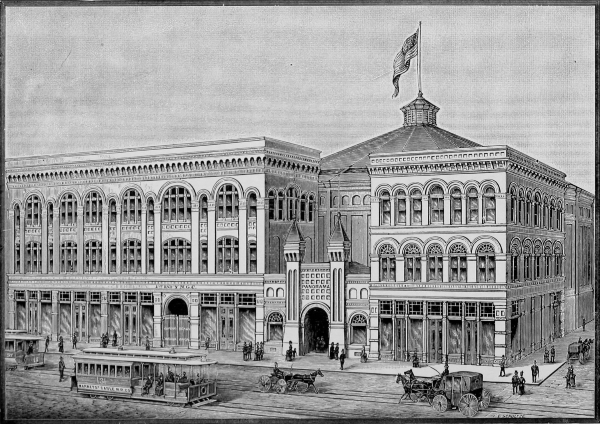
ARMORY OF THE FIRST REGIMENT INFANTRY, N. G. C., COR. TENTH AND MARKET STS., SAN FRANCISCO, CAL.
One of the crowning glories of the “City Guard,” “B”
Company, First Infantry, N. G. C., was when the company
received the elegant Silver Loving Cup, a trophy presented
by Major General W. H. Dimond to the regiment for competition
by the seven companies, and cadets composing same,
while at Camp Dimond, Santa Cruz, covering the eight
days from June 16th to the 24th, 1894. The judges for this
competition were First Lieutenant George W. McIver,
Seventh Infantry, U. S. A.; First Lieutenant E. C. Holly,
Fourth Infantry, U. S. A.; and Captain T. J. Cunningham,
Second Artillery, N. G. C.
This trial for supremacy was to continue for the entire
week at camp, the conditions being the best general discipline,
deportment, promptness in performing all military duties,
knowledge of said duties, general appearance of the men, both
in camp and in town, best general condition of tents and
company streets, soldierly bearing of the men, general efficiency
in drill for the entire week, and the manner of conducting
same, and any other military details that the judges
may notice. All to end with a competitive drill at the end
of the week.
On the Sunday that the regiment returned from camp
General Dickinson presented the cup to the company, the
judges having unanimously decided that the City Guard had
fairly won it.
The writer has given in chapter 6 of this history a narrative
of the company in musket and rifle practice, together with
the improvements made in arms and shooting conditions,
since its organization in 1854. It will be noted that “B”
company is not only well up in drill, but the members know
how to shoot also, as the following chapter will amply demonstrate.
It is certainly unfortunate that lack of both time and space
will not allow of detailed descriptions of the “City Guard’s”
many social and pleasurable events of the past forty years;
it would indeed fill volumes to enumerate them all. For the
same reasons the long list of members cannot be given at
this writing. Notwithstanding these conditions, every one
who has ever been actively connected with the old “City
Guard” will assuredly recall the different events that transpired
during his time as though it were but yesterday. Think
of the many parties, musicales, rackets, two-day outings you
have enjoyed; banquets, smokers, and many, many other celebrations
of the past, and recall the many happy days spent
with comrades in the ranks of your old love, the “City
Guard.”
CHAPTER VI.
FORTY-ONE YEARS’ TARGET PRACTICE.
THE first experience of the “City Guard” in rifle, or
rather musket, practice, was on July 4, 1854, at Martinez.
Upon that occasion the members shot for an
elegant gold watch, which had been donated by a
friend of the organization. One shot only was allowed
each man at a target placed sixty yards distant. The firearm
used was the one then carried by the corps. This
shoot was not the regular one as required by law.
The company journeyed to the Oakland side of the bay on
the 18th of August following, for its regular medal and prize
competition. This is where the “Clark” medal first made its
appearance, and constituted the chief prize.
The gun used in the early days of target practice, and as
issued by our State to the company, was the old style muzzle
loading, smooth bore percussion musket, model of 1842, with
a very long barrel, one upon the muzzle of which an average
size man could easily rest his chin while standing, the butt of
the piece being on the ground. The caliber of this firearm
was .69 of an inch. Members were allowed to use any charge
powder they wished, the bullet being round. This musket
superseded the old “flint lock.” No dependence could be
placed upon it for close shooting, however, even at the short
range of those days. It continued to be the principal arm of
the California service until 1865, when an improved musket
was issued.
The regulation target consisted of a one-inch board painted
white, 22 inches wide by 6 feet long in the clear, to represent
the size of a man, without taking the outline of one. The
bull’s-eye was black and round, 4 inches in diameter, and
placed equidistant from each edge of the target, and two feet
from the top. Three shots were allowed each man, their
value being determined by “string measure,” that is, the distance
from center of bullet hole to center of bull’s-eye. The
aggregate of each man’s three shots was taken, and the one with
the shortest “string” took first prize, the next shortest the
second, and so on. All misses, and there were many of them,
counted forty-nine and one-half inches, this being the distance
from the bull’s-eye to the extreme lower corners of the target.
Many times did the average number of hits fall below 40 per
cent of the shots fired.
Other styles of targets were sometimes used by the company,
but when this was done it was an exception to the general
rule. A round target, two feet in diameter, occasionally met
with favor, and upon one or two days of that period the company
put up a target which represented the figure of an Indian
warrior, nicely painted, bearing the usual bull’s-eye. The
guests, as a general thing, fired away at a round target about
thirty inches in diameter.
Three judges, usually officers of other military organizations,
and selected from the guests of the company, and who
were generally stationed at a safe distance from one flank of
the target, did the marking and scoring. A shot having been
fired, they hastened to investigate the result, and, finding a
hit, would duly measure it, plug up the hole with a wooden
or cork plug furnished for the purpose, and number it to correspond
with the man shooting, also numbering the target
alongside the shot. Before retiring they would indicate the
shot to the firing point by pointing at it, and if a miss by
waving a white handkerchief. The judges kept the score by
recording the value of each shot in a book kept for that purpose
against the man’s number. After the close of the competition,
then would the winners be declared, and prizes
distributed at once. It took a long time for a company of say
forty or forty-five men to shoot under these conditions. This
is why only three shots were allowed.
An elegant lunch was always provided by the members of
the “City Guard” upon the shooting days, and the commissary
wagon was loaded down with all good things that money
could buy. In the evening it was the usual thing for them
to entertain their guests at a banquet given at some well-known
hotel of the city. These excursions cost a great deal
of money, which was generally provided for by assessing the
members. This custom remained in vogue for quite a number
of years. In 1861, when the “City Guard” became Company
“B” of the First Infantry.
1860 brought with it the first change in the regulation
target, by the addition of a vertical and a horizontal black
stripe, four inches in width, each passing through the bull’s-eye,
thus dividing the target into four parts. The writer notes
that upon one or two occasions this black stripe, of only one
and one-half inches in width, divided the target into four
equal parts. The United States targets were twenty-two
inches wide by six feet high, for distances, from one hundred
and fifty yards up to two hundred and twenty-five, the material
being of white cloth, or canvas, stretched upon a frame, generally
made of iron, sometimes of wood; the width of the target,
as did the width of the black stripes, increased at the
longer ranges, one thousand yards being the extreme. Our
range remained as it was previously, sixty yards, as the
regular army already had the rifle that was not issued to us
until 1865.
The United States Government, in 1855, after satisfactory
tests made at the Springfield arsenal, adopted the Springfield
percussion muzzle-loading rifle, caliber fifty-eight, with the
length of barrel at forty inches, rifled with three grooves, making
a half turn in its length. The bullet was of lead and
cylindro-conical in shape, with expanding base, and weighed
five hundred grains. Sixty grains of powder was the regulation
charge. This rifle, together with the bayonet, weighed
about ten pounds. Ten years after its adoption, or in other
words, on February 20, 1865, the “City Guard” received its
quota. The shooting distance was then increased to one
hundred and fifty yards. In 1866, the following year, the
rifles remaining in the arsenal were changed to breech-loaders,
and the regular army furnished with them, but California
did not receive any.
The first competition for prizes between teams from the
different companies composing the First Regiment took place
on September 12, 1865. These teams were of three men each,
with three shots per man. The “City Guard” carried away
the second prize, with a score of 92.02 inches, not counting
one miss. Company “C” took first prize, also making one
miss.
Ladies attended the State shoot of the company for the first
time, by invitation, on November 12, 1866, also the shoots of
1867 and 1868, the latter being a regimental affair, held May
8th, at Schuetzen Park, Alameda. Upon this occasion the
targets were, on account of limited space, close together, and
it became necessary that pits be dug at their base for the
accommodation of the judges; it was so arranged that the
targets slid down into these pits to be marked and plugged.
All marking and scoring was done on the same principles as
before described. The width of the target was increased at
this shoot to twenty-four inches.
1869 found somewhat of a change, in so much that the
company held its prize competition, the sixteenth annual,
alone, dispensing with the usual accompaniments of brass
band, cold collations, etc., and issuing no invitations to guests,
the parade being solely to comply with the requirements of
law. Thus the old custom was abandoned. The company
continued to shoot each year regularly in accordance with
regulations, sometimes by itself, but generally with the entire
regiment as an organization.
The National Guard was given the option to use either of
the following described targets for the state shoot of 1873:
First, that which was previously provided for, the black stripes
being but one and one-half inches wide instead of four; or,
second, the same size target painted black, with a four-inch
white stripe the full length down the center, black four-inch
bull’s-eye, two feet from the top, surrounded by a white circle,
the outside diameter of which was eighteen inches.
The “City Guard” received its first breech-loading rifles,
the Sharp’s, 50 caliber, on June 22, 1873, which were purchased
and paid for by the regiment, and was not the U. S. A.
regulation. This rifle was shorter than the Springfield muzzle-loader,
the caliber, however, being the same. It was rifled
with twice as many grooves, 6 in number, these grooves having
a much heavier twist than that contained in the old barrel.
The square-butt bullet weighed about 400 grains, while
the charge of powder was heavier, from 65 to 70 grains. It is
said that the Sharp’s rifle did not give the satisfaction for
target practice that was expected from it. The reader will not
confound the model just referred to with the Sharp’s Buchard,
caliber 45, that many individual shooters used quite extensively
in later years, and which gave ample satisfaction.
When the National Rifle Association of America was organized
in 1871, it adopted the “Hythe” system of targets,
then used by the English. These targets were made of iron,
painted white, the bull’s-eye being square and black, and with
a value of four points; the next larger square counted 3, the
balance of target, 2 points. These were classed as follows:
Class “A,” for distances up to and including 300 yards, 4 feet
wide by 6 feet high; class “B,” from 300 up to and including
600, 6 x 6 feet; class “C,” including all distances above 600
yards, 12 feet wide by 6 high. The bull’s-eyes were 8, 22, and
36 inches square, respectively. These targets were used,
unofficially, in California as early as 1873, and Interstate
matches were shot upon them, as well as other local competitions
between companies and individuals; but they never
became the regulation targets for the National Guard of this
State. Annual shoots continued to be fired at the old style
2 x 6 target.
About the time that the California Rifle Association was
incorporated, in June, 1875, a change was made from the
“Hythe” target to the “Wimbleton” or “Creedmoor” system,
as it is known in the United States, taking the name from the
famous rifle ranges at Creedmoor, Long Island. These targets
were of the same size as the others, but the bull’s-eyes and
rings became round instead of square, also adding one extra
ring, thus giving the bull’s-eye the value of 5 points, the center,
4, the inner, 3, and the outer, 2 points. These targets,
instead of being made of iron, were of canvas for a backing,
stretched upon a frame of proper size. The “Creedmoor”
target was the first one adopted by the California Association,
none other being in use by them. Sizes of bull’s-eyes and
rings as follows: Class “A” target, bull’s-eye, 8 inches in diameter;
center, 26 inches; inner, 46 inches; outer, balance of target.
Class “B,” bull’s-eye, 22 inches in diameter; center, 38
inches; inner, 54 inches; outer, 70 inches diameter; this ring
was subsequently dropped, thus giving balance of target for
the outer. Class “C,” bull’s-eye, 36 inches in diameter; center,
54 inches in diameter; inner was square, being 6 x 6 feet;
outer, balance of target. The Creedmoor rules of the National
Association were taken, which soon became generally recognized
throughout California, the State adopting them later for
the government of the N. G. C.
The Springfield breech-loading rifle, caliber 45, was adopted
by the Government in 1873, after the Small Arms Board had
tested 99 samples of different designs. The “City Guard”
received their quota during 1875. This rifle is described as
follows: Made of low steel, caliber 45, and rifled with 3 concentric
grooves of equal width, with 3 lands; uniform
twist of one complete turn in 22 inches; length of barrel,
including receiver, 36 inches; weight, without bayonet, 8.38
pounds: trigger adjusted to 6 and up to 8 pounds pull.
General orders No. 8, Adjutant General’s Office, Sacramento,
April 24, 1876, adopts the class “A” target for our
State troops, and the distance for the Springfield, model 1873,
was placed at 200 yards. Men were prohibited from changing
the sights, or to put the minimum pull of trigger at less
than the regulation 6 pound pull. The number of shots was
increased to 5, possible 25 points.
Some shooting was done at 1,000 yards, but not with the
Springfield. The 500 yard target was considerably used, but
the bulk of the shooting was at the 200 yard range. The
“City Guard” opened up its San Bruno range in 1875 with
targets at both 200 and 500 yards, possibly the 1,000 yard
also. This continued to be the shooting headquarters of the
company for quite a number of years. Monthly competitions
were held, and many of the members participated in the regular
“meets” of the California Rifle Association, the company
once in a while entering a team to compete for prizes; but
they won nothing. The interest in rifle practice in the
“City Guard” was not particularly strong at any time during
the early periods, and it was not until later years that their
interest improved to any great extent. The time consumed
in going to and from San Bruno, together with the expense,
finally closed that range some time during the early eighties.
The company sent one man East with the famous California
Creedmoor team that won the great International Military
Match in 1877. This team consisted of 12 men and 3 alternates.
No particular change was made in the shooting conditions
for a number of years. Company and individual matches
continued to be held, contestants firing from five, seven, and
ten shots to the string, occasionally shooting fifty shot
matches, and even up to one hundred shots consecutively, in
order to test the endurance of the men. Five shots, however,
continued to be the number allowed at the State shoots, with
no sighters. The one thousand yard range, as also the five
hundred, was discontinued some time in the eighties, the two
hundred yard target, because this shorter range could be obtained
more conveniently, receiving all the attention. In
1885 the “City Guard” inaugurated its annual Thanksgiving
day competitions for prizes, and it was so arranged that every
one firing, including both life and honorary members, received
a prize, all of which were presented at an entertainment
held subsequently thereto.
The Legislature, during its session of 1887, provided that
decorations be awarded members of the National Guard for
rifle practice, and that they parade for same at least once each
year. In accordance with this law, General Order No. 8,
Adjutant General’s office, Sacramento, dated September 6,
1887, promulgated the following conditions to govern the
issuance of these medals: That the score (for the first time)
consist of ten shots, with no sighters. Attendance at drills,
in order to receive a decoration, must not be less than fifty
per cent. That each guardsman in first class, those making
ninety per cent or more, receive a bronze medal, with the gold
sharpshooter’s clasp pendent therefrom; for the second class,
eighty per cent and up to ninety per cent, the same style
medal, but with the silver rifleman’s clasp; for the third class,
not less than fifty per cent and up to eighty per cent, the
bronze marksman’s clasp attached to the bronze medal.
Members winning decorations in subsequent years, after once
receiving the medal, were presented with the clasp or bar
only. The law was amended in 1889, making it compulsory
for two parades to be held for the State shoot, and that both
count in awarding medals. In 1891 general orders raised the
minimum percentage of the third class to sixty per cent, at
the same time making the drill requirements sixty per cent
also, and giving a silver medal instead of the bronze. By this
order Blunt’s Manual for Small Arms Practice was adopted.
These are the conditions under which the National Guard of
California shoot at the present day.
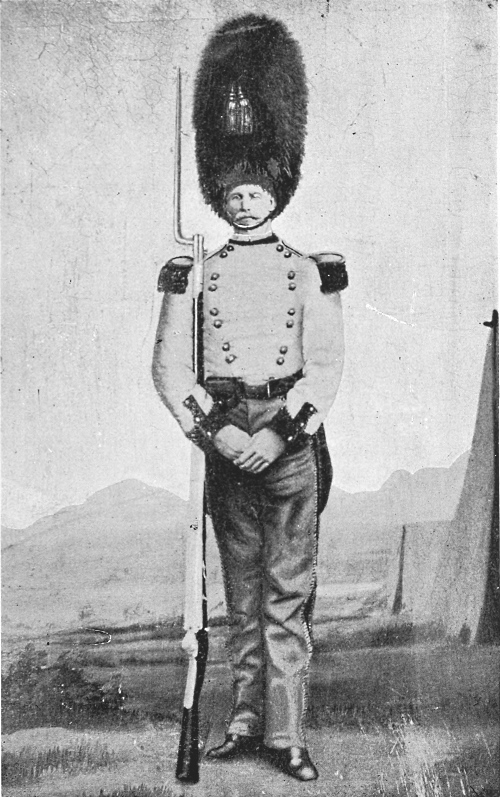
CORPORAL LOU. R. TOWNSEND IN HIS OLD CITY GUARD UNIFORM. REPRODUCED FROM
OIL PAINTING, BY MRS. MC HENRY, JUNE, 1859.
Blunt’s regulation targets, as to size, material, number of
rings, and mode of counting, are the same as those of the
Creedmoor system, otherwise they are not alike, the bull’s-eyes
and rings of the new being ellipses set vertically, also of
different dimensions, viz: Class “A” target, bull’s-eye, 8 x 10
inches; center, 24 x 30; inner, 40 x 50; outer, balance of target.
Class “B,” bull’s-eye, 18 x 24; center, 36 x 48; inner, 54 x 72;
outer, balance of target. Class “C,” bull’s-eye, 32 x 50; center,
51 x 72; inner, square of 72 x 72 inches; outer, balance of
target.
The company has participated in a great many matches,
particularly within the last two or three years. As a general
thing, these matches were for glory, with a trophy occasionally
thrown in. Some of these matches the company lost, while
on other occasions the rooster crowed very loudly for “B.”
Here are a few of the principal events:
On March 11, 1893, the company entered a team in the
Midwinter Fair prize shoot for trophies. Entrance fee,
twenty-five dollars; ten men to each team, and ten shots per
man. The “City Guard” took third prize, an elegant one,
with a score of four hundred and twenty-five points out of
five hundred, an average of eighty-five per cent.
Perhaps the greatest and most satisfactory achievement of
“B” Company was at Sacramento, on December 17, 1893.
Company “C” of the First Regiment shot against “F” of the
Eighth, located at Oroville, and this company shot against
“C” of the Eighth, of Marysville. All four organizations
shot on the same ground, and at the same time, the targets
adjoining. This match was for thirty men on each team, ten
shots per man, and to be shot upon neutral ground in the
open, man for man. To accomplish this it was necessary
that “B” and “C” of the First, and the other two companies
meet half way at Sacramento, which they did. “C” beat
Oroville, scores, 1225 to 1195. “B” beat Marysville, score
1233 to 1143, the “City Guard” coming out with the best
score of the day, making an average of 41.1 points per man, a
very large average for thirty men.
As a result of the Sacramento match the company received
a match from the famous “Carson City Guard,” of Nevada.
This interstate match was for thirty men a side, ten shots
per man, the watch being held on each shooter for the time
limit. The shoot was what is termed telegraphic, and targets
were to be exchanged by express after the firing ceased.
Each company had its representative at the other’s range.
“B” was again victorious, beating their opponents by ten
points, scores 1223 to 1213. This was on May 6, 1894.
The following three matches were undoubtedly the largest
ever shot by military companies anywhere in the United
States or elsewhere. They were shot man for man, under the
existing rules, at two hundred yards, with ten shots for each
competitor, making the possible number of points 2,500. It
will be noted that two of these matches were shot upon B
company’s opponents’ ranges, both of which being strange to
the members of this company.
On December 2, 1894, at Schuetzen Park, San Rafael, with
D Company, Fifth Infantry, N. G. C., B wins by five points.
Scores: B, 1,846, or an average per man of 36.92 points. D
making 1,841, an average of 36.82.
Both companies having strengthened their teams, a return
match was made for May 5, 1895, this time at B’s headquarters,
Shell Mound Rifle Range. B again wins by fifty-three
points. Scores: B, 1,951 points, an average per man of 39.02
points, D making 1,898, an average of 37.96. Each company
made a marked improvement over the previous match.
On May 19, 1895, this company shot another fifty-man
match this time with C company, Eighth Infantry, N. G. C.,
upon their own range at Marysville, Cal., B journeying there
for that purpose. This time B lost. Scores: B, 1,907 points,
an average of 38.14 per man; their opponents making 1,982,
an average of 39.64. The score made by C company was an
elegant one, and the members are deserving of a great deal
of praise for their splendid shooting.
The “Tobin Trophy” was presented to the First Regiment
by the relatives of Colonel Robert Tobin, of the Third, in
1890, after his death, the regiment having performed the
escort duty at the funeral. This trophy is a permanent affair
for competition every year by teams selected from each company.
For the first five years these teams consisted of twenty
men each; but in 1895 they were increased to twenty-five
men. B’s record is as follows: Possible points, 1,000. In
1890, the company made 784, average, per man, 39.20. In
1891, 707; average, 35.35. In 1892, 766; average 38.3.
In 1893, 787; average, 39.35. In 1894, 824; average, 41.20.
In 1895, for twenty-five men, possible number of points 1,250,
the company made 1,032, an average of 41.30 points to the
man. In these shoots for the trophy the City Guard took
second place, with the exception of the years 1891 and 1892,
then falling to third place. The trophy competition was at
the 200 yard range.
The members of B company have received the following
State decorations since the system was adopted, as previously
noted, in 1887. For the year 1887: gold bars, 0; silver, 3;
bronze, 11. Total, 14. In 1888: gold, 0; silver, 7; bronze, 9.
Total, 16. In 1889: gold, 1; silver, 6; bronze, 19. Total, 26.
In 1890: gold, 1; silver, 11; bronze, 14. Total, 26. In 1891:
gold, 0; silver, 5; bronze, 14. Total, 19. In 1892: gold, 0;
silver, 4; bronze, 16. Total, 20. In 1893: gold, 1; silver, 11;
bronze, 20. Total, 32. In 1894: gold, 1; silver, 16; bronze,
23. Total, 40.
The City Guard originally set the pace in the matter of
shooting rifle matches with teams composed of fifty men from
a company. It is a recognized fact that a soldier should know
how to shoot, and, in order to encourage the members, some
inducements must be given. What is better than placing them
in a large shooting team? Any member of a company
will strive very hard indeed to win a place on such a team,
especially if he thinks there is any possible show for him,
while otherwise he would be rather lukewarm if simply competing
for a personal decoration. Hence the desirability of
large team shooting. The better shots will always take care
of themselves; foster the poorer ones by interesting them in
their art, and they will, in their turn, take care of themselves.
It has been, particularly for the past two or three years,
the determined policy of this company to steadily increase the
shooting efficiency of its members. Not only have the better
shots received their proper attention, but the poorer ones have
been encouraged, and, under the fostering care and instruction
freely given them, they have gradually improved in their
marksmanship; many of them now rank among the best shots
of the company. In closing this chapter the writer predicts
a brilliant future for the City Guard in rifle practice, and with
proper care, attention, and enthusiasm, the “old company”
will yet be the peer of them all.
Transcriber’s Notes:
Variations in spelling and hyphenation are retained.
Perceived typographical errors have been changed.