At the moment of our writing, St.
Mary Abbotts, Kensington, is, in a literal sense, without a
parish church. The old one has passed away, and the new one
is in course of erection. There is, however, the
church, with its long, chequered, and interesting history and
associations of the past, and, we trust, its equally interesting
and still more glorious future. The Venerable Archdeacon
Sinclair, the present vicar, his churchwardens and friends must
feel themselves the subjects of peculiar and pleasurable feelings
as being the chief actors in the great change now coming over the
site lately occupied by the old church, and thus placing
themselves on a line with a long and eventful history. We
must go back far into the middle ages for the origin of the
parish church of Kensington, and to the days of dark Papal rule
in the land. In the time of Henry I. we read of this church
being bequeathed, on his deathbed, by Godfrey de Vere, Lord of
the Manor, to the Monastery of Abingdon. It was, however,
shortly after claimed by and restored to the Diocese of London,
in which it has ever since remained. This was in the
thirteenth century. The first endowment of the Vicarage was
in 1260, and from time to time it received consideration from
various monarchs. In 1520 Queen Mary accorded to it a
portion of the 7,000l. granted by Henry VIII. in
augmentation of the living of incumbents and scholars in
England. The history of the old Saxon church is bound up
with that of the manor, which was bestowed, inclusive of the
rectory, upon various noblemen by royal grants under several
reigns. The collation of the vicarage has belonged to the
Bishops of London, pleno jure, about 390 years.
While the Reformation was yet struggling against Papal tyranny,
as though we were to have a forecast of the Evangelical type and
freedom which have marked this church in after times, it
possessed a martyr. Not one, indeed, led, as far as we
know, to the stake, but cruelly driven from his position and
living, and possibly to temporal ruin. In 1527 Sebastian
Harris, the curate, was proceeded against for having in his
possession a translation of the New Testament and a book entitled
Unio Dissidentium, containing the doctrines of
Luther. He was, for this criminal offence, cited to
appear before the Vicar-General in the long chapel, St.
Paul’s Cathedral, and required there to make oath that he
would not retain these books in possession any longer, nor sell
them, nor lend them, nor make any acquaintance with any person
suspected of heresy, and finally adjudged to quit London within
twenty-four hours, and not to come within four miles of it for
two years!
The late church began to supersede the first in 1683.
The population even then was said to increase, and the
inhabitants, to provide for the increase, built a new aisle on
the south side. In the beginning of 1695 the north aisle
and chancel were supplanted by others of larger dimensions; and
in 1696 it was resolved to take down and rebuild the whole
church, excepting the tower at the west end. The cost of
this was met by subscription. King William gave
300l.; the Princess Anne 100l.; Earl Craven
100l.; the Bishop of London 50l.; and the Earl of
Warwick 40l.; the entire expense amounting to no more than
1,800l. Bowack, who visited the church in 1705, thus
describes the rebuilt church in his “Antiquities of
Middlesex”: “In form quadrangular, somewhat broader
than long, 80 feet from north to south, and hardly 70 from east
to west. Paved handsomely with Purbeck stone. The
pewing and galleries very neat and convenient. The pulpit
and chancel handsomely adorned with carving and
painting.” It might be added that the pulpit and desk
were the gifts of King William the Third and Queen Mary, in
addition to their contributions to the building fund. The
pulpit has a crown inlaid with the initials, “W. & M.
R.,” and the date, “1697.”
In 1704, the defects of the recent work evincing itself so
clearly by the cracking of the building, it was found necessary
to take off the old roof, pull down the north and south walls,
and rebuild them; which was done at a further outlay of
1,800l.
Again in 1772 the church underwent a thorough repair, and the
old Gothic tower was taken down and the later one erected.
Once more in the year 1811 the church showed signs of decay,
and it was necessary to underpin the walls, rebuild the vaults,
and entirely renovate and adorn the interior. This was done
at an expense of 5,000l., which was met by a church-rate
of sixpence in the pound, spreading over three years. This
church, now spoken of as the “old church,” was a
plain brick structure, with no pretensions to architectural
display. The interior was composed of nave, chancel, and
two aisles, separated by wooden pillars supporting the
galleries. It was spanned from the entablature of six
wooden columns over the nave, and three large brass chandeliers
wore suspended from the ceiling. There was the royal pew
curtained round in ancient style, which long continued to be used
by high personages from the Palace. Here the Duke and
Duchess of Kent and the late Duke of Cambridge worshipped; and from
this very pew the Duchess returned thanks after the birth of our
present gracious and beloved Queen Victoria. The brows of
other distinguished persons have been seen within the old
walls. Sir Isaac Newton, Addison (after his marriage with
the Countess of Warwick, of Holland House), Lady Margaret
Macdonald, “Lady of the Isles,” Wilberforce, George
Canning, Sir David Wilkie, Lord Macaulay, Thackeray,
&c.—all of whom were residents in Kensington, were
attendants at the parish church. Such were the minor
glories of the former house.
In 1866 it was seen that its fate was sealed. Competent
architects pronounced that it would not be safe to use it for
public worship more than two or three years beyond. The
closing services were held on Whit-Sunday, May 16, 1869, when
sermons were preached by the Bishop of London in the morning and
by the Vicar in the evening. The church was
crowded—said, indeed, to be “packed to the
ceiling.” Collections made on the occasion towards
the new building fund amounted to 265l. The church
contained no less than 114 monuments and tablets, among which one
in white marble was most conspicuous, dated 1759, in memory of
the Earl of Warwick, the Countess, and their daughter, Lady
Charlotte Rich. The Earl is represented sitting, resting
his arm on an urn and clothed in a Roman habit. All the
monuments were carefully removed before the church was pulled
down, and some, it is expected, will be reinstalled in the new
edifice.
At first it was thought that the entire enterprise of the new
parish church could not be undertaken at once, for want of funds,
and it was resolved to proceed by degrees, laying the foundation
and building vestry and chancel, with a temporary nave. But
the funds shortly realised and promised encouraged the deacon and
churchwardens to build the whole of the fabric at once, with the
exception of tower and spire. The estimated cost of the
work when completed is 35,000l., the tower and spire alone
being estimated to cost 10,000l. of the amount. The
fine old ring of bells—eight in number—which have
quickened and delighted the ears of Kensingtonians for many a
long year, will find a place in the new tower and be heard again,
and probably their joyous music be listened to by generations to
come. The spire, when completed, will be 240 feet from the
base to the vane. The estimated cost of the interior
fittings, pews, pulpit, screen, and altar is 4,460l.
The church will be brilliantly lit with gas, and warmed with hot
water on the most improved principle. The length of the
interior is 155 feet, and its greatest breadth 100 feet, and is
capable of accommodating 1,600 persons on one floor. There
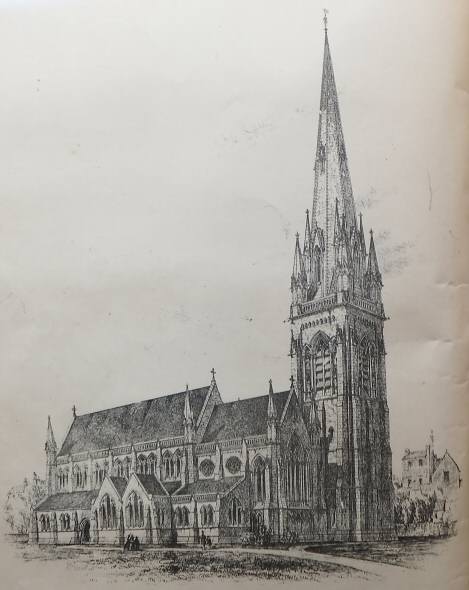
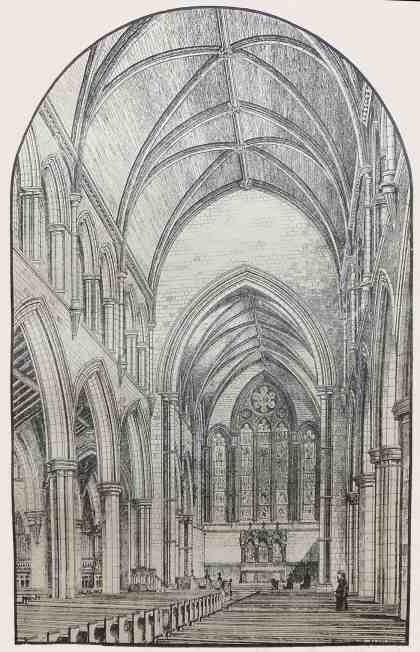
will be no galleries. The style of the building is Gothic,
a specimen of the transitional period from the early English to
the decorated, and the architect is Mr. Gilbert Scott R.A., of
Spring-gardens; the contractors Messrs. Dove Brothers, of
Islington; and the grotesque and other carving with which the
church is ornamented is executed by Messrs. Farmer and
Brindly. The external material of the building is Kentish
rag, with selected Bath-stone dressings. From what can be
seen of the work in progress, the ample Bath-stone turrets and
mouldings will add much to the effect of the building. In
the interior there is no plaster, but the whole of the church is
faced with solid Bath ashlar. There are on plan, nave, side
aisles, and transepts. The nave will be 107 ft. and the
chancel 48 ft. long, and 27 ft. wide; the aisles are 14 ft. 6 in.
wide. There are also chancel aisles, and on the north side
of the chancel an organ chamber, and the tower—the tower
space being occupied with a vestry, from which the clergy will
pass to the chancel by a vestibule. The font is on the
north side of the west door; it is intended to be a very handsome
marble one, with a conical cover, the cost being
400l. Several ladies in Kensington are exerting
themselves to raise funds for this particular work. The
principal entrance to the church is on the west side, and the
door has a sumptuous carving in Bath stone over it. The
next principal entrance will be on the south side, through a
porch, and another on the north side. A scheme is projected
by the ladies of the congregation, and a plan is now preparing by
Messrs. Clayton and Bell, to fill the whole church with painted
windows. Should this be accomplished, and the eminent firm
mentioned be employed to carry it out, it will doubtless add
vastly to the effect of the interior.
It is hoped and expected by the Vicar that the church will be
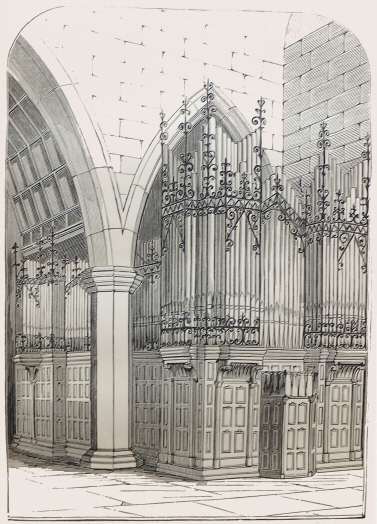
opened by Easter next (1872). A very fine organ is now
being built for this handsome fabric, by Messrs. Hill and Son, of
the Euston-road, at a cost of about 1,200l., to be
provided by a separate fund. This instrument has three
manuals and a pedal organ. Great
Organ—containing double open diapason and bourdon, 16
feet; open diapason, 8 feet; ditto, No. 2, 8 feet; gamba, 8 feet;
stopped diapason, 8 feet; principal, 4 feet; harmonic flute, 4
feet; 12th, 3 feet; 15th, 2 feet; mixture, 4 ranks; Posaund, 8
feet; clarion, 4 feet. Choir Organ—open
diapason, 8 feet; dulciana, 8 feet; Gedact, 8 feet; Gamshorn, 4
feet; Wald flute, 4 feet; flautina, 2 feet; clarionet, 8
feet. Swell Organ—Bourdon, 16 feet; open
diapason, 8 feet; salcional, 8 feet; stopped diapason, 8 feet;
principal, 4 feet; Suabe flute, 4 feet; 12th, 3 feet: 15th, 2
feet; mixture, 3 ranks; horn, 8 feet; oboe, 8 feet; clarion, 4
feet. Pedal Organ—CCC to F, 30 notes;
sub-Bourdon, 32 feet; open diapason, 16 feet; violone, 15 feet;
Bourdon, 16 feet; principal, 8 feet; 15th, 4 ft.; trombone, 16
ft.; 5 couplers. Up to the present time about
24,000l. has been received and promised to the Building
Fund, to which Her Majesty the Queen subscribes
200l. It will be seen, therefore, that a large
proportion of the money has yet to be raised, although no doubt
is felt that public spirit will display itself in connection with
this great public object, so as to relieve the promoters of all
anxiety as to the speedy and successful termination of their
work. Archdeacon Sinclair is the treasurer of the fund, and
the Rev. W. Wright, of 2, Bath-place, the secretary. The
present churchwardens are Charles Greenway, Esq., of 3,
Bath-place, who has filled the office for sixteen years, and
Robert Harvey, Esq., of 92, High-street, Notting-hill, who has
been in office for two years. Attached to the parish church
there are national schools, with 200 boys and 130 girls; an
infant school with 200; and a ragged-school in
Jennings’-buildings—a notoriously low part of the
town—with 60 or 70. There is also an industrial
school for young girls, where 35 or 40 are taught various useful
domestic works. There are Sunday-schools answering to the
day-schools; also a district visiting society, composed of ladies
and clergymen who visit the poor and distribute alms; and annual
collections are made for missionary and other religious and
charitable purposes.
The venerable Archdeacon Sinclair has been Vicar for the last
twenty-nine years, and was appointed Archdeacon soon after his
accession to the Vicarage. It is known to be a wealthy
living, but its exact value cannot be precisely stated. The
net value, however, is estimated at 912l. per annum.
The Vicar is well known and admired both for the elevation of his
personal character and his able and truly Evangelical
ministry. He is now well stricken in years—being
seventy-four years of age—but retains a notable degree
vigour, and preaches regularly twice every Sunday, at present to
the congregation of St. Paul’s, Palace-gardens, one of the
chapels of ease to the parish church. Christ Church,
Victoria-road, is the other. Associated with the Vicar in
the spiritual work of the parish are at present four curates, the
Rev. W. Wright, M.A., the Rev. E. T. Carey, M.A., the Rev. G.
Averill, M.A., and the Rev. J. J. T. Wilmot, M.A.
The principal congregation of the old church are, during the
re-building, worshipping in the vestry-hall adjoining. Here
we had the pleasure of uniting with them on the morning of
Sunday, Oct. 15, 1871. The service is a reflection of what
it was in the old temple, and what, under the venerable vicar, it
is intended to be in the new. It was plain devout Church of
England service, earnest and as inspiring as it could be in a
plain hall. The officiating clergyman was the Rev. J. J. T.
Wilmot, M.A., who took the whole of the service and preached the
sermon. The latter was a faithful exposition and
application of 1 Tim. i. 16—“Godliness with
contentment is great gain.” Some very pointed remarks
on the evils of the lust of riches, and the value of the gain of
godliness, were delivered in a clear and sonorous voice, and
pointed with familiar illustrations. The impression on our
minds was that such a method of conducting worship, and such a
style of pulpit or platform discourse, cannot but be the means of
doing great good.
(See Notes.)
This church is a recent instance of
the modern forward movement to overtake the spreading population
of the suburbs. It is situated at the extreme north of the
parish, in the midst of a vast mass of new property, which is
very properly called New-town, or Kensal New-town.
The parish, which was formed out of the extensive one of All
Saints’, Notting-hill, has a population of 9,000; and up to
the present has been very ill-provided with means of religious
worship. Indeed, it seems as if no effort can be abreast of
the fast-growing needs of the metropolis. But here is, at
least, a large and handsome church situate in a locality in which
primâ facie it would appear a very
God-send. Alighting at the Westbourne-park Station,
and passing over the bridge, a sign-board directs the inquirer
along the main Newtown-street, and after four or five
minutes’ walk another board points out the site of the
church. Or an equally ready way of access may now be found
from the Notting-hill Station, by the Ladbroke and
recently-opened Golborne-road. This edifice is the fruit of
private and public zeal combined. A Christian lady in
Bayswater devoted 5,000l. of her abundance, and the Bishop
of London’s Fund, together with some local donations,
supplied the remainder of 7,000l., which was the cost of
the building. It is therefore unencumbered with debt, and
has a free and open course before it for Christian
usefulness. The ceremony of consecration took place on
Saturday, the 8th of January, 1870, when our reporter in
attendance wrote that, “Notwithstanding the furious gale
over the parish, upwards of 700 ladies and gentlemen were
present.” The then new Bishop of London (Dr. Jackson)
officiated, and was assisted in the service by the Venerable
Archdeacon Sinclair, Vicar of St. Mary Abbotts, Kensington; the
Rev. A. G. Pemberton, of Kensal-green; the Rev. A. Campe; and the
Rev. R. Towers, the incumbent. A number of other clergymen
were also present, amongst whom were the Rev. R. W. Forest, the
Rev. Daniel Moore, the Rev. Bryan Hodge, the Rev. W. A. Newton,
the Rev. W. A. Bathurst, &c.
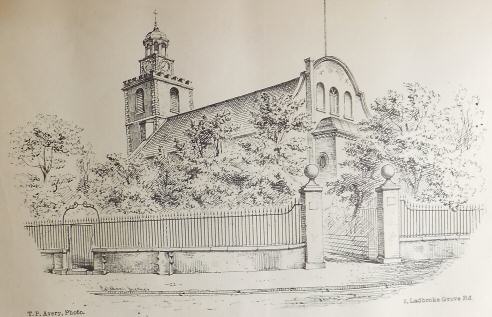
The building is of red brick with Bath-stone mouldings,
covered with the best Welsh slates, and surrounded on all sides
with a strong iron railing. In the exterior there is no
other particular feature, except a prettily-shaped belfry, which
is an ornament to the east front. The interior does credit
to the architect, Mr. Keeling, of Gray’s-inn; who,
forbidden the versatility of device he has displayed in St.
Mark’s, Notting-hill, St. George’s, Campden-hill, and
elsewhere, has given a free adaptation of early French
Gothic. There are a nave and aisles, separated on either
side by five handsome columns of Devonshire marble, with
carved-stone capitals, and supporting an entablature of
six arches on each side, from which a lofty groined roof spans
the nave. The arches are of variegated brick, with
Bath-stone dressings; and the higher part of the side walls in
the same, the lower part being faced with Bath-stone
ashlar. The choir and chancel are ample in dimensions, the
former being furnished with high cathedral-backed stalls, and the
former ornamented with neatly-illuminated texts, the Ten
commandments, &c., and over the communion-table the
words—which it may be hoped, will be a faithful index to
the ministry ever to be exercised in the church, “Christ is
the end of the law for righteousness to him that
believeth.” The organ is a borrowed instrument of
very inferior quality, and which is shortly to be supplanted by
one more adapted to the beautiful and spacious edifice.
Towards this most desirable improvement 40l. only has yet
been raised, towards 250l., the estimated cost. As
the congregation and immediate neighbourhood are mainly poor, it
would be a real boon if some wealthier person or persons beyond
the district could devise the means to present to the church a
suitable instrument. The church is admirably adapted for
the free passage both of light and sound, and the plain but
variously-stained windows, without Scripture or canonical
characters, add to the beautiful effect of the whole
structure. There are no galleries; but the ground floor,
well laid out with substantial open pews, supplies accommodation
for 950, but is capable of taking 1,000 without
overcrowding. We regretted to observe that the congregation
present at the morning service were not anything like half the
number. The audience in the evening, however, is said to be
much larger, a feature very characteristic of poor localities,
where many week-day working people are seldom prepared for church
before evening on the Sabbath. The place is well warmed by
a large stove, which sent a comforting glow of heat through the
entire space; and is lit at night from ornamental pillars, each
having four branches, and each branch three jets, specially
designed by Messrs. Johnson Brothers, of High Holborn. The
floors of the aisles, choir, and chancel are inlaid with
tessellated tiles.
The first builder was unable to fulfil his contract, which
occasioned considerable delay; but ultimately it was taken in
hand by Messrs. Scriven and White, of Camden-town, who carried
out their engagement to perfect satisfaction.
Church work, in this case, is yet in its infancy, and seems to
ask for assistance. There are, however, the seeds of what,
let us hope, may prove a future moral and spiritual
harvest. The population requires to be wrought upon outside
the walls, that they may be brought more fully to comprehend
their privileges. It appears quite certain that within
there are all the means of good to them. The service is
devoutly and earnestly performed in its Evangelical
interpretation, the prayers, psalms, and creeds being read, and
responded to by the congregation. The musical part is
Gregorian plain-song; but sufficiently varied to prevent the
sense of severe monotony. The choir is at present a mixture
of male and female voices; and there is some room for
improvement, which will doubtless come when it is assisted by a
better organ. The hymn-hook is the “Church and Home
Metrical Psalter and Hymnal.” The Rev. Robert Towers,
B.A., the Vicar, was without assistance in the clerical portion
of the service. He reads in a distinct and feeling manner;
and preaches extempore, purely and properly so. His text
was taken from Matthew ix. 12: “They that be whole need not
a physician, but they that are sick,” &c. In this
discourse in simple language and illustration, we verily believe
was preached the truth as it is in the Gospel. We
could not but wish that the place had been crowded to hear
it. The disease of sin was scripturally set forth as
inherent in man’s nature, hereditary,
loathsome, contagious, and by all human means
incurable. Mr. Towers is a preacher who is not
afraid to speak of sin in appropriate terms, telling his audience
plainly that “it damns the soul and fills hell”; and
that in the world wherever it is found, “the blast of the
devil passes over, and carries its accursed infection
beyond.” As to its human incurability, “Not
even religious ceremonies in themselves could avail.
Baptism was not regeneration.” Sin would still reign
and increase “its deadly and damnable effects in the
soul,” for there was “no getting through or living it
down. It was very death itself.”
“But thanks be unto God that though the wages of sin be
death, the gift of God is eternal life, through our Lord Jesus
Christ.” The character and ability of the great
Physician, and the Divine mode of cure, through the application
of “the precious blood” by “the Holy
Ghost” to the repentant sinner, were impressively and
unmistakeably set forth, together with the delightful effects in
the experience of men. In short, we have never listened to
more real Gospel within thirty minutes of time than on the
morning of Sunday, November 12, 1871. We sincerely hope the
church will soon be filled, from the chancel to the
baptistry. There is a Sunday-school with about 150
scholars, and an excellent staff of teachers. A Church of
England Young Men’s Society has been established about six
months, and supplies a number of very competent male teachers to
the school, which at present meets in the church in the
afternoon. A near site, however, for a school is already
purchased, and will be built upon as soon as funds are secured
for the purpose. Mission-rooms attached, capable of holding
about 100 persons, are at 15, Appleford-road, where a missionary
is employed and holds service Sunday afternoons and Monday
evenings; three Bible-women are also doing their useful work in
the parish. There would appear, therefore, to be much of
the machinery requisite for carrying on the work in this new
locality; but the church is entirely dependent on voluntary
support, and, the people being poor, that support is as yet but
feeble. The weekly offertory was at first adopted; but soon
discontinued, being considered unpopular, and boxes were placed
at the doors. The financial result, however, is most
insignificant; and it is evident that something more is
necessary, if this fine church and zealous few are not to be
crippled in their energies. An earnest appeal is therefore
being made by the Vicar and the Churchwardens, Mr. W. J. Murlis
and T. Horsman, for help to meet the expenses. One thing
should not be unnoticed; a provident fund is established for the
poor, from which the sick, aged, and persons suffering from want
of work, are aided in time of need. The society adds
two-pence to every shilling deposited by the members when able,
and already between 60l. and 70l. stands to the
credit of the fund.
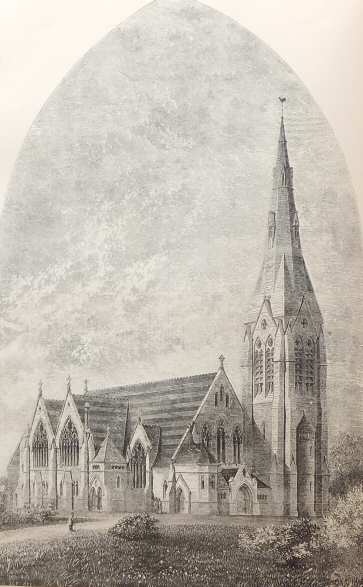
The new Church of St. Jude’s,
South Kensington, is situate close to the Cromwell and
Gloucester-roads, and stands out boldly, tree-less, and alone, a
striking object in the surrounding plain, looming largely in the
distance. Nor is it less striking on a closer view.
It is in the early Gothic style, some fair detail of which it
possesses, especially in the character of the west front, which
is a happy composition; but its most remarkable features consist
in the number of gables, gable-crosses, terminations, and
chimneys, the great size of some of its windows, and a certain
stilted appearance that the structure has, altogether a whole not
perfectly pleasing or picturesque. The view from the
north-west is perhaps the most telling in point of effect, but
this would be greatly improved by the addition of the tower and
spire, which we hope will soon appear, but there is a certain
comfortable-looking bell-turret which seems to say, “I
answer all purposes required.”
The church is built of Kentish rag and Bath stone dressings,
and the roofs are covered with slate in bands of colour.
The gates and approaches when finished will add greatly to the
general appearance.
If the outside is peculiar, the inside, perhaps, is more
so. The building, which is slightly cruciform on plan,
covers a large area, about 135 feet long by 87 feet wide.
These dimensions are sufficient to give a great idea of space,
and this effect is increased from the fact of the floor being
nearly free from the usual obstructing columns; for although
there is the general arrangement of nave and aisles, yet the
slight iron columns, that support the arcades offer but very
little impediment either to sight or sound. The acoustic
properties are exceedingly good, and the preacher can be seen and
heard to advantage from all points; whilst the large north and
south windows admit such volumes of light that there is an entire
absence of that “dim religious light” favoured by a
section of the English Church.
Architecturally the iron columns are suggestive of having too
much to do—looking weak and unequal to the task of
supporting the pretty nave roof and coloured-brick arches; this
is especially the case with the columns at the transepts.
The iron, as we have said, from its lightness, assists sight and
sound, but then beauty is sacrificed to utility, which to some
extent we think unfortunate; but the church has evidently been
designed to assist the preacher’s voice, and therefore we
must congratulate the architect, Mr. J. H. Godwin, of Brompton,
on his complete success. The prevailing buff colour of the
bricks, being imitated in the painting of the columns, is not
pleasing, and we think may be altered with advantage. The
church will hold 1,700 persons, and the galleries add to the
auditorium, but are no assistance to effect, and compel the use
of a stilted and old-fashioned pulpit.
The organ-chamber and a capital vestry are at the north-east
angle of the church, and the baptistry, at the west end, is well
arranged and contains a handsomely-designed early font. The
east window is of stained glass, illustrating the life of
Christ. The doors are ample and admit of good entrance and
exit. The pewing is comfortable and compact. The
school class rooms and offices below account for the stilted
appearance before referred to.
St. Jude’s is one of the latest and most noticeable
instances of aggressive effort on the part of the Established
Church. It was originated by the Rev. J. A. Aston, late
Vicar of St. Stephen’s, Kensington, to provide for the
spreading suburban population in that part, and has cost, as it
now stands, 10,000l., which is entirely the munificent
gift to the district of Mr. J. D. Allcroft, of 55,
Porchester-terrace, and Wood-street, E.C. When all
complete, including the site and the vicarage shortly to be
erected, the cost will be about 19,000l., the additional
9,000l. being jointly guaranteed by Mr. Allcroft, the Rev.
J. A. Aston, and the present Vicar. There is a capital
organ, ably presided at by Mr. M. Lochner, having four manuals,
and favoured on the choir organ with that very rare stop, the
Vox Humana, and capable of enlargement. This fine
instrument was built by Mr. H. Wedlake, of Fitzroy-square, at a
cost of 700l., and is another of the grand offerings in
connexion with the St. Jude enterprise—being the sole gift
of Mrs. Walter Powell of Notting-hill. The largest of the
three rooms underneath the east end of the church is forthwith to
be fitted up. It is capable of holding 400 people, and to
be used for the purpose of meetings, Sunday-schools,
&c. It is not intended at present to have
day-schools.
Although opened for Divine Service so recently as the 23rd of
Dec., 1870, it has within three months collected within its walls
one of the largest congregations to be met with around
London. It is estimated to accommodate 1,700
worshippers—and on a special occasion it might very well
contain 2,000. On Sunday morning, February 26, there were
from 1,500 to 1,600 present, and the church did not present a
crowded appearance. A glance over the large assembly showed
that it contained scarcely a sprinkling of the lower or labouring
classes. It was composed almost entirely of the aristocracy
and gentle people of the district, together with the middle and
trading classes. The sittings are let at 2l.
2s., 35s., 30s., and 20s. per year; but as one-third of the
entire number are to be free, it may be hoped that the
“rich and the poor” will here also meet together
before Him “who is the Maker of them all.”
The service is a vigorous rendering of the plain Church
Service, cautiously guarded against Ritualistic signs. The
members of the choir are not robed in white, nor have they
anything to distinguish them but the place they occupy. The
clergy wear a simple surplice at prayers, and appear in the
pulpit in a black gown. The Rev. R. W. Forrest, M.A., of
Trin. Col., Dublin, the first vicar of this new church, was
transferred to it from the Lock Chapel, Paddington, having been
previously incumbent of St. Andrew’s, Liverpool. In
Paddington he enjoyed a well-deserved popularity, which appears
still to attend him in his new sphere of duty. In
appearance he is about forty years of age, tall and commanding in
presence, and possessing a strong pleasant voice, used with ease
and heard without effort in the remotest corner of the spacious
edifice. His reading of the Holy Scriptures is specially
distinct, natural, and impressive. The pulpit discourse was
founded on Heb. iv., and part of the 16th verse, “But was
in all points tempted, like as we are, yet without
sin.” It was a practical and touching illustration of
our Lord’s temptations in their bearing upon the experience
and present comfort of his people, and, being delivered
extempore, brought the preacher into direct sympathy with
his audience. The Rev. F. Moran (curate) assisted in
reading the prayers—a clergyman who also possesses a clear
and distinct enunciation—suitable to the place and the
congregation. Among Mr. Forrest’s hearers on the
occasion of our visit were Bishop Barker, of Sydney, Metropolitan
of Australia, and the Dean of Ripon.
The Church of St. Matthias,
Warwick-road, Earl’s-court, Kensington, is within sight of
St. Jude’s, and, like it, stands almost alone in the open
fields. It has no boundary walls or fences, unless a
broken-down hedge on the east side can be called a fence.
Externally, as a structure, there are no very pleasing features;
the permanent and temporary portions do not harmonise, and,
indeed, the chancel and aisles, the only parts finished, have not
in point of detail and design much to recommend their brick walls
with bath stone dressings and window tracery of simple
character. Of course the temporary portions as such cannot
fairly be criticised; yet if we must have temporary churches and
of corrugated iron, we see no reason why they should not be
picturesque, or at any rate sightly.
Internally the temporary nave has no attempt at appearance or
effect, a remarkable fact seeing that the Anglican school
generally pride themselves upon effects. A matched-boarded
lining to walls and roof is simply varnished, the glazing of the
windows is rendered shocking to taste by masses of blue and red
colour, and a box pulpit is too much like a box. The
excessively plain chancel, arch, and arcades, and general detail
of the windows, have evidently been designed with a view to
economy; and if, when the nave is built, the same quiet spirit is
adopted, we shall be anxious to learn the cost of the structure,
which will certainly be a minimum sum, and valuable to note in
these church-building days. The style is early
English. The dwarf stone parapet and ornamental iron screen
across the chancel arch form rather a nice feature, and the
stall-seats are of good design.
The east window is partly filled with effective stained glass,
and as the predominant colour is blue, it is vexatious that the
side-lights, not yet completed, are screened with green
blinds.
Two figures of saints over the altar-table are not clearly
seen—one might be St. Matthias; and the reredos might as
well have English written on it—the unlearned could then
understand and appreciate.
St. Matthias stands in the midst of a poor district, which was
originally cut off from St. Philip’s, Kensington. A
temporary iron church was first opened on April 17, 1869, and the
permanent chancel was consecrated and opened on the following
10th of July. Nave and chancel together accommodate from
700 to 750 persons. The cost of the whole structure has
been 4,800l.; and it is intended if possible to build the
nave this year 1871, which will cost about 4,000l. or
5,000l. more. The architect is Mr. J. H. Hatrevile,
5, Southmolton-street. There are no appropriated sittings;
all are free, and the church is always open for public or private
prayer. It is supported by the offertory alone, which in
1869–70 amounted to the sum of 1,100l., and in
1870–71 it will amount, we are informed, to
1,600l. Out of this all the expenses of the church
and the charities and the clergy are met. There are three
priests attached—the Rev. S. C. Haines, M.A., the
Vicar; the Revs. H. Westall, A.K.C., and S. Martin. There
is a superb organ built by Jones, of the Fulham-road, with three
manuals, forty stops, and 2,255 pipes, at a cost of
700l. The choir is large—about fifty in
number—under the precentorship of Mr. J. Elwin, of 21,
Coleherne-road, Brompton, professor of musical elocution.
During Lent there is daily Communion at eight a.m., four services every day, and five on
Friday, when there is an extra Communion at eleven a.m.
The service is Gregorian plain song, and on the morning of
March 5, the second Sunday in Lent, the ceremonial is described
as being extremely ornate and symbolical. Our
representative says: The chancel is unusually deep, the space
between the altar and the railing being apparently designed with a view to
Ritualistic development. In fact, it is a large stage on
which a numerous company can play their parts. The
choristers wear surplices, and the clergy, over the surplice, a
stole, which is at the present season of the true Lenten
violet—according to the practice of Ritualists—who
use the symbolic colours of violet for Lent, black for Good
Friday, red for Martyrs, yellow for Confessors, and so on.
The altar-cloth and pulpit-cover, and even the offering-bags, are
also of the same tinge, the latter being embossed with a white
cross. The prayers were intoned by Mr. Westall, a young
gentleman whose voice is in some danger of collapsing from sheer
tension of monotone. The Ritualists have attained
perfection in denying to nature its own freedom and flexibility
of voice. The lessons were read by the second curate, Mr.
Martin, who, we learn, is new to the church, and whose voice,
trained in the true Anglican style—rises always where it
ought to fall, and vice versâ. The bowings,
curtseys, and genuflexions of this service are so numerous and
complicate, we almost despair of tracing them. Not only in
the Creed, but in every other part where the name of the Saviour
occurred and on every repetition of the Gloria Patri,
there was a low curtsey as long as the body could be conveniently
bent, which had a most singular effect in the general aspect of
the congregation. In the Nicene Creed, in the part
“Light of light” and up to “rose again,”
there was a sudden drop of voice to a mere whisper—which,
being quite unprepared for at the moment, might startle one into
the idea that the congregation and choir had simultaneously lost
their vocal power. But all this was merely dramatic.
On entering the Communion Service the processional hymn is
sung, during which the clergy three abreast commence their
pilgrimage to the altar. They approach it by three stages,
pausing at every one, and on arrival bow and cross themselves,
and then dispose themselves on the left, in line with their backs
to the congregation—one a step above the other—the
highest reading the Commandments, turning meanwhile to the
people. They then break line again, and one reads the
Epistle for the day; they form inline again, and the centre
figure, the Vicar, reads the Gospel, during which the curate at
his feet turns towards him obliquely, bending in a worshipping
attitude. After the Creed—and so as to chime in with
the close—the Vicar passes with a sharp step to the pulpit,
which is as close to the chancel as it can be; and on entering
it, whilst the people are still standing, crosses himself,
fronting them, and repeats quickly, “To God, the Father,
Son, and Holy Ghost, Amen,” and at once announces his
text. The short prayer before sermon is dispensed
with. The motion with the finger to the two shoulders and
the forehead is the great feature at this point.
The sermon was founded on 1 Cor. i. 20—“Where is
the wise? Where is the scribe? Where is the disputer
of this world? Hath not God made foolish the wisdom of this
world?” Having on the previous Sunday treated of
bodily mortification and fasting, the preacher would now speak of
the subjugation of human imagination, intellect and reason to the
dominion of truth—of the folly of the “wise,”
the “scribe,” the “disputer of this
world,” in view of the “wisdom of God.”
In what was mainly an extempore address, aided only by
copious notes, and accompanied by much declamation and earnest
action, Mr. Haines denounced the intellect and literature of the
day as extremely sordid, timeserving, and egotistic. It was
“a day of advertisements,” when intellect was
“bought and sold over the counter,” when one might
“buy all the intellect of England for gold, and for so many
guineas have so many pages;” and if in any case pride
prevented this degradation, literature was then “but the
expression of an extreme egotism.” Periodicals and
books were “pretentious and misleading;” the novels
of the age embodied its “sensualistic intellect;” our
art in its exhibitions handed down pictures and ideas of
depravity. “It would be well if the scientific world
would send forth no more theories.” In short the
preacher held in the profoundest contempt all the ordinary
exercises of the human mind and reason. Perverted intellect
had produced anarchy in America, revolution and bloodshed in
Europe; and in the history of Christianity there had been nothing
but contention and division since the intellect of the church
first departed from the “holy Catholic religion,” and
so rendered government impossible. The preacher eulogised,
indeed, intellect sitting at the feet of Christ; but this
was so explained as to mean, in fact, sitting at the feet of
“Holy Catholic Church.” This part of the sermon
was, to our minds, a virtual denouncement of the Protestant
Reformation. In speaking of the mysteries of religion
against which the world’s intellect revolted, the preacher
adverted to that one, “the sacrifice of the altar,”
which they were then daily celebrating. “Christ was
in Heaven, but he was also there, yea,” glancing round to
the spot, “on that altar was the real body and the real
blood of our Lord.” Would they deny these mysteries
because they could not understand them? Were there not
mysteries in all nature? and did not the saint see all around him
the great sacrifice of nature—the outward and visible sign
of the inward, present, and omnipotent God? After sermon
the preacher returns to the altar, when a fourth functionary
appears, whom we suppose must be termed an acolyte. He
carries in his hand a taper, with which he proceeds to light the
candles in the candelabra at either end of the altar, each having
seven lights. A hymn is being sung and the collection made
at the same time, and when ended the offertory bags are borne to
the altar, and, being solemnly placed upon it, one of the
priests, prostrating himself before it, raises the offering high
towards the cross, and there holds it for some moments in the act
of consecration, after which the Benediction is pronounced.
The church in the morning is filled with a congregation chiefly
composed of the higher middle classes of the people, and in the
evening principally of the poor of the immediate locality.
A pleasant walk on a Sunday morning
from westward, through that fashionable part of Kensington known
as the Addison-road and Warwick-gardens, brings us to the Church
of St. Philip, which stands at the corner where the
Earl’s-court and Pembroke-roads join. It is a brick
structure in the perpendicular decorated style belonging to the
fifteenth century; and as, with its modest spire, it comes into
view, and the worshippers slowly moving up every main approach,
in response to the “church-going bell,” the whole
produces a very pleasing effect. As one silently views the
interior a somewhat mystical impression imperceptibly steals upon
him. The architect, Mr. Thomas Johnson, of Lichfield, would
appear to have studied and followed out the ideal of a former
period in the details generally. This is especially seen in
the windows, the arcades, &c. The nave has a lofty
aspect, much more so than would be expected from the exterior
view.
This church was built in 1858, and its district taken
principally out of St. Barnabas, with a small portion from the
old Kensington parish. It originally had accommodation for
1,000, but, in consequence of the increasing demand, it was
enlarged in 1862 to 1,400 sittings, 500 of which are free.
The cost of both the original building and the subsequent
enlargement has been almost entirely borne by the Vicar, the Rev.
J. Dickson Claxton, M.A., of Trinity College, Cambridge, he
having been aided only to the amount of 1,400l. or
1,500l. in subscriptions, which were towards the first
erection. The enlargement was carried out at his own sole
cost. The great need of this was manifest from the magic
rapidity with which population increased in the neighbourhood of
the church. It stood at 8,000 until recently—the
spring of 1869—when the formation of the sub-district of
St. Matthias reduced it to 5,000. But so rapid is the
growth that it has already again risen to fully 6,000.
There is at present but one curate, the Rev. J. C. Sykes, B.A.,
of Queen’s College, Cambridge.
Three schools are in part connected with the church, being
maintained in conjunction with St. Barnabas, and containing
altogether upwards of 600 children.
The other charities maintained alone by St. Philip’s are
several. There are “A Provident Fund and District
Visiting Charity,” a “Maternity Charity,”
“Work Charity,” “Soup Charity,”
“Blanket Charity,” and “Old Clothing
Charity.” Taking the year round it would seem that a
large amount of temporal comfort most be distributed over the
poorer parts of the district by these benevolent
operations. The church itself contains several objects of
interest worthy of note. There is a splendid reredos of
Caen stone and alabaster, and a peculiarly handsome altar-rail of
vert antique and alabaster. Over the altar is a beautiful
stained window by Heaton and Butler, at the west end an immense
and magnificent one to the memory of the late Lord Holland, also
two other small memorial windows, all by the same firm. The
organ is a superior instrument by Walker, of the Tottenham-court
road, and cost upwards of 600l. It is played by Mrs.
Higgins—whose husband holds the post of master over a choir
without surplices, chiefly voluntary, aided by a few paid
voices. Under the same direction there a large choral
association connected with church. The services are
principally, through not exclusively, Anglican. In the
morning the responses are intoned, and at night the choral is
adopted. Daily prayer at 9.30 a.m. and 5 p.m. On Sundays there is a
children’s service at 9.30 a.m.,
and full service at 11 a.m., 3.30
p.m., and at 7 p.m. The weekly offertory, and
proceeds of the Communion Service twice a month, are solely
relied upon for the maintenance of the charities and church
expenses, in lieu of church rates.
The vestments of the clergy are of the simplest and most
irreproachable kind, and the performance of the service according
to the order of the Common Prayer. There is certainly no
trifling with rubrics, and no need for dexterous evasion of
ecclesiastical injunctions. Yet the service we attended was
earnest and solemn. The curate read audibly, and the
preacher, who happened not to be the Vicar, was scholarly and
Evangelical. But, on the whole, the service might be deemed
a little too quiet to be a perfect model of what a service in our
English Church should be. As to the general ministry under
the Rev. J. D. Claxton, whom we had not the pleasure of hearing
in propria persona, its effects must be taken as proofs of
its acceptableness and usefulness. Commencing, as we
understand, with an original congregation of ninety, he has had
the gratification of seeing it increase to 1,400, and that, too,
whilst so many other churches and chapels have risen all
around. The congregation appeared to our eye to bear that
settled and orderly aspect which is one of the readiest proofs of
ministerial success and pastoral fidelity; and not the least
pleasing feature was the large number of the poorer people who
filled the free seats, and regarded with attention and reverence
every part of the service. An official kept the door, who
cannot be termed a verger, scarcely a beadle, but who, if he had
no rod or robe, or staff, had a coat with bright buttons fixed
upon a brown cloth. He handed the stranger over to the care
of a matronly-looking female inside, with a white cap, who very
courteously led the way to a seat. When there, the general
effect upon us undoubtedly was that we were in a church of the
people—one where the people were to be found
quite at home in their worship of the Creator, and free from the
stiffness and restraint of more tinselled and conventional
forms.
St. Stephen’s, close to the
Queen’s-gate-gardens in the Gloucester-road, South
Kensington, is a very handsome and well-proportioned church, and
is a pretty object seen from the Cromwell-road. The
composition of its west front is remarkably good, and indeed
there exists an agreeable harmony in the design and in the quiet
general tone of colour in the stone of which it is built that is
pleasing to the eye. There is a refined look about the
building, and perhaps it would not be too much to say that it
seems accustomed to good society. To the architect there
are some portions of the detail rather interesting. The
cloistered doorways beneath the buttresses, the triplet and
rose-windows of the east front, and the north porch and back
turret are all worthy of remark. The interior is
exceedingly effective and elegant. Again the harmony
strikes one as perfect; there is a peaceful influence produced by
the quiet colouring and grey columns and excellent proportions of
the church, such as ought to belong to the house of God.
There is nothing glaring, nothing particular to arrest or attract
the eye, yet every part is worthy of inspection, and the parts
taken together produce one of the best and most exquisitely
charming interiors with which we are acquainted in this
neighbourhood. The plan of the church may be said to be
cruciform, and is divided into a nave and aisles, north and south
transepts, and chancel and aisles. The grey columns of the
nave support the arcades and clerestory, and the light nave roof
springs from angel-corbelled columns. The chancel arch is
well-proportioned, and the dog-tooth enrichments harmonise with
the caps of the columns. The chancel is parted from the
aisles by light screens supported by alabaster columns, and on
the north side above the screen is the organ loft, and the south
side is occupied by a gallery. The chancel itself is simply
decorated, the Communion-table space without any colouring other
than of the softest kind. Three figures of saints occupy
the triplet—St. Stephen filling the centre, and St. John
and St. Paul the side lights; the rose window over has the
Saviour in His Ascension scene. The stone pulpit on the
north side of the chancel arch is well designed, and its little
alabaster and coloured marble columns relieve the still colour of
the stone. The font, of similar design, occupies a slight
recess in the baptistry, close to the north porch door. An
octagonal vestry is at the south east angle of the church.
A new west gallery is not exactly an improvement to the
effect. The pewing and stall seats are of good
design. The passages are floored with tiles of simple
pattern. The architecture is early English.
The one drawback to the external appearance of this church is
its want of relative elevation. Its base appears to drop
about two feet below the level of the roads and ways which form
its approaches. The fault was that of the architect, who
did not calculate on the effect of making-up roads where they had
not previously existed. In 1866, when the church was built,
that part of South Kensington was only beginning to open
up. The base of the edifice should, therefore, have been
raised. But instead of this the architect appears to have
proceeded in utter disregard of the near and certain future of
the locality. The result is that whereas originally steps
upward were required to enter by the gates, it is now necessary
to descend in reaching the interior; and a flat and depressed
aspect is thus given to a building which would otherwise have
been a most prominent and pleasing object in the view. We
understand it is intended to add a spire to the edifice very
shortly, and this will probably somewhat relieve to the eye the
defect of which we have spoken.
The church was built under the ministry of the Rev. J. A.
Aston, M.A., to replace an iron church which for some time he
occupied on the opposite side of the road. The same
continued minister until the autumn of 1870, when he was
succeeded by the present officiating minister, the Rev. J. P.
Waldo, M.A. The progress made under Mr. Aston’s
pastorate is seen from the circumstance that it was found
necessary in two or three years to increase the accommodation by
the building of galleries on the west and south sides. This
work was completed in March, 1870, at a cost of 600l., by
Mr. Aldin, of Queen’s-gate-place. The cost of the
whole, when completed, we are told will not be less than
20,000l., a very high figure when it is considered that
the church has no more land than that on which it stands, and the
narrow bare paths around it. There are about 1,150
sittings, which let at an average of 2l. 2s. per annum
each, leaving about 150 sittings free—1,300 in all, which
appear to be well occupied by a congregation of a superior
class. Out of the pew-rents and collections the clergy and
the church are supported. There are temporary day and
Sunday schools attached, situated in the Queen’s-gardens,
near the site, where from one to two hundred children are
instructed. The organ is very ably played by Mr.
Lowe. The choir is composed of both males in plain dress
and females.
The prayers were read and also the psalms, with the exception
of the first, which was chanted. There is no variance from
the accepted English and Evangelical mode of conducting
worship. The hymn book is the “Church and Home
Metrical Psalter and Hymnal,” selections from various
authors. The congregation did not join with so much zest
and animation in the service as could be desired, except in one
hymn—“Lord of the Worlds above,” &c., the
peculiarly lively words and music of which appeared to evoke
devotional feeling and dispel restraint. We are sorry,
however, to see this hymn, which in its original dress, as it
stands in another hymn-book, is one of the finest in the
language, so sadly mutilated by the simple act of transference
from one collection to another. We deplore the liberty
which editors of our numerous collections sometimes take with the
productions of even our best hymn-writers. Why should this
be so? We have never seen an alteration of this kind which
has not been for the worse as it regards both thought and
expression. The curate reads well and agreeably to the ear,
in a voice more remarkable for clearness than strength. The
vicar, the Rev. Mr. Waldo, is still new to the audience, having
been at St. Stephen’s about four months. His vocal
powers and reading are good; the former have not that compass
which enables them to meet the requirements of the large
congregation with the greatest ease. The sermon, founded on
Gen. xlv. 5, was an elegant piece of composition, not only
read, but delivered in the reading, which is not
always the case. The thoughts presented on the
general and special providence of God, as unfolded
in the history of Joseph, were those of a devout, thoughtful, and
cultivated mind, and most comforting to the troubled and
disconsolate. From what we saw and heard, we have much
pleasure in recording our belief that good Christian work is
being done at St. Stephen’s.
This church, which stands at the
foot of the Victoria road, might have been much better placed, so
as to be seen in perspective, which indeed its near appearance
would warrant. Its fair and well-proportioned tower and
spire would then have formed a striking object, and might have
been visible even from Kensington-gardens. Could it be
lifted out of the pit in which it seems to nestle at the dark end
of a road which is no thoroughfare, and out of its unsightly
surroundings in Cornwall-gardens, it would be an immense benefit
to the mere appearance of the building. The building in
itself is generally very simple, but not without effect. It
is built of ragstone with bath-stone dressings, and covered with
slate. The enclosure is nicely planted, neatly kept, and
fenced with dwarf walls. Internally the church is
unimposing. The nave and aisles are surmounted by a
heavy-looking but plain roof—without clerestory
lights. The tower space on the north side of the chancel,
is occupied as an organ chamber. The chancel is quite plain
and without aisles. In the windows, which are of good
design and filled with glass of geometrical patterns, there is an
absence of stained glass and decoration; which in reality the
church requires, to relieve that tame and cold look, which some
day might be slightly altered with advantage. A large
gallery at the west end does not tend to lighten the interior
aspect of the church; nor do the exposed heating pipes, which it
would be better to conceal from view. The font, pulpit, and
pewing are of plain design, and the passages are paved with red
and black tiles, laid diagonally. Christ Church is a
chapelry of ease to the parish church of St. Mary Abbotts,
Kensington, or rather a trust chapel, served by the Venerable
Archdeacon Sinclair, Vicar of Kensington. It was opened and
consecrated July 23, 1851, by Bishop Blomfield. The present
officiating ministers are the Rev. W. Wright, the morning and
evening preacher, who has been curate since 1855, and is now
termed the “senior curate.” The Rev. E. T.
Carey is the second curate and afternoon preacher, and entered
upon his duty in 1869. Both ministers are much esteemed;
and from the impressions of our visit the estimation in which
they are held is well founded. Mr. Carey read the prayers
and lessens in good voice, and with an evident mental
appreciation of their religious sense and application. Mr.
Wright officiated in the Communion Service and preached the
sermon. His voice is penetrating, if not full, and leaves
the most dull-eared without excuse. His sermon was an able
and faithful exposition of Psalms 142 and 4th
verse—“Refuge failed me; no man cared for my
soul.” The distinction between the circumstances of
the Psalmist and his times and our own was finely drawn. In
the former case every incident of temporal life—adverse or
favourable—was interpreted as a certain indication of the
Divine favour or displeasure. With us it was not so much
so. We had in general every spiritual advantage; although
there were yet some, as at the East-end of London, who, from the
scarcity of religious provision, might still say, “No man
careth for my soul.” In short we quite thought we
were listening to a charity sermon; and after so touching an
appeal on behalf of the spiritually destitute, prepared ourselves
for a collection. Mr. Wright, however, has our best thanks
for touching in so delicate a manner a very sensitive chord in
our moral nature.
The chapel is capable of holding 700 persons, and there are
less than 100 free sittings; but although it was supposed to have
not only its own, but also many of the congregation of the parish
church—which is closed for re-erection—it was by no
means full. It is hoped, when the central church is
completed and reopened, it will have a good effect in the
locality, and help to supply the dependent church with an
adequate congregation. We have known churches and chapels
in the worst situations, under special influence, to be filled
with devout worshippers; but they are occasions too rare.
Would that we could see them more frequently! One remark
made by the preacher in speaking of the need of churches at the
East-end was much to the point. It was to the effect that
it would be useless to build churches unless there were efficient
ministers to carry on the service and occupy the pulpit.
Mr. Wright appears to have reflected long enough to learn that the greatest
problem of the day is, after all not how churches may be built,
but rather how, when built, they may be suitably and successfully
served. Here is a good organ under the care of Mr. Brain,
of the Eldon-road, but no choir. It is, therefore, purely
congregational singing assisted by the organ.
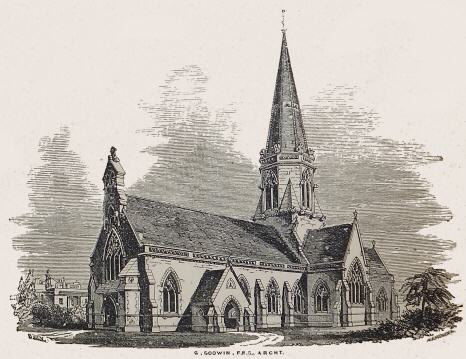
The Church of St. Mary, West
Brompton, from its position in the centre of the Boltons, can be
seen from many points of view to great advantage. It is in
the decorated Gothic style, and is an exceedingly good specimen
of the Revival of Gothic architecture, having been built some
fifteen years ago. Built in the shape of a cross, its tower
and spire rise at the intersection of the nave, chancel, and
transepts, and are in excellent proportion. The spire is
octagonal, and is terminated at its junction with the tower by a
pierced parapet with angels at the angles. The octagonal
portion of the tower is continued downwards below the tower
lights, when it becomes square, with corbelled angels at the four
corners. The west front is well designed, and surmounted by
a corbelled bell turret, in which hang the only two bells the
church possesses, though there would appear to be ample room in
the empty tower for a chime. The ragstone of which the
church is built, with Bath stone tracing and dressings, has now
enough of age to give a softened look to the exterior generally,
and the young spring foliage and well-kept surrounding gardens
lend their aid to make a rather pretty picture. Internally
the church is effective, especially the view from the west end;
but the absence of the usual nave arcades and aisle give a long,
narrow look to the church, and take from the idea of its size, as
at this point the transepts cannot in any way be seen. The
nave roof is heavy, and the apostle corbels that support it too
large and too near the eye to be in good taste. The choir
stalls have lately been extended westwards under the tower space,
and the pulpit, of very peculiar design, being more properly a
rostrum, though by no means unsightly, stands at the north side
of the nave arch, and a recently-erected gallery across the north
transept contains the organ. The small vestry is at the
north-east angle of the church. The chancel has lately been
redecorated and made to agree with the usual arrangements of the
Anglican school of worship. The stained glass in the east
windows is poor, representing the Ascension some geometrical
patterns fill some of the other windows, likewise of a very poor
character. The pewing is very plain, and the passages are
paved with tiles. The stone font is large and very well
executed. The church, as we before said, is a Revival
church, and as such it would be unfair to criticise it too much;
but, on the contrary, much praise is due to the architect, Mr.
Godwin, for giving so fair a specimen of Gothic work when the art
was at so low an ebb.
The performance of Divine worship at St. Mary’s is
decidedly of the High Church order, with a Ritualistic
tendency. In this it differs from what it was under Mr.
Swaile, the first minister of the church, and even under Mr.
Pearson the second. The present vicar, the Rev. W. T. Du
Boulay, M.A., has been there about two years, and during his time
a constant Higher tendency has been observed. This has been
traceable in the large increase of public services and
Eucharistic celebrations. The latter takes place every
Sunday morning at eight, and on every alternate Sunday at the
eleven o’clock service as well. After Lent we
understand a still further increase was intended in the number of
these in ordinary. During Lent and other great festivals
there is a celebration every morning at the early service, on
Good Friday two, and on Easter Sunday three. Apart from
this, the whole aspect of things in the chancel looks towards
Ritualism. Thus, for instance, the Communion-table, or what
High Churchmen call the “Altar” or
“Altar-table,” is surmounted by a large gilt cross,
which from its exceeding brightness forms a most conspicuous
figure—also two large candlesticks, and other lustrous
objects. The cover is of deep violet, trimmed with white,
and all the moveable furniture, even to the cushions of the
chancel, desks, and pulpit, are of the same—this being the
colour used by the High Church party during Lent. The
choristers number over thirty, and are led in procession to the
choir, the people all rising as they and the clergy enter.
The vestments are a surplice with the cassock underneath, and
visible below the knees; and in addition, the clergy themselves
wear the usual sign of degree. No change of dress is made
for the pulpit. The Curate—the Rev. Arthur
Veysey—intones the prayers, in, we may say, the most
perfect style we have yet heard out of a cathedral. His
voice is sonorous, and he has cultivated the manner of intoning
to a high degree. He has certain little varieties, too, of
his own, which render such a method of performing worship as
pleasant as it can be. Thus the note is altered in the
absolution, and the voice dropped to the lowest tenor, and at the
same time quickened; and then again at the Lord’s Prayer a
strong bass is put on in a low key. In like manner the
Collects were sung quickly in an undertone. At every
mention of the Saviour’s name, whether in the prayers, the
Gloria Patri, creeds, epistle, or gospel, the reader
bowed. And as in the latter it was often named, the
frequent bowing of the head must have been a great task; for in
this case the Curate read the gospel as well as the epistle,
passing in the act from one side of the chancel to the
other. The Vicar read the lessons well and distinctly, and
preached
the sermon. On entering the pulpit the customary invocation
was not used; but, standing erect and glancing eastward, the
preacher simply uttered the words, “The Father, Son, and
Holy Ghost,” and at once proceeded. Too little, to
our minds, was made of the sermon; it was a short homily in the
midst of the service, very good in its way. It consisted
largely of exhortation, found on Phil. ii. 3, in which the
Saviour was presented as an example of passive and active
obedience, and some very practical remarks were made.
Quietly useful this style of preaching may be when based on pure
Gospel doctrine and view; but it is one from which the old power
and higher effect of the pulpit are absent. A novelty, at
least to us, occurred in this service. Instead of the usual
hymn on the minister entering within the Communion rail, another
form is adopted, called the “Introit,” which is a
selection of Scripture adapted as much as possible to the day,
and sung as an anthem by the choir. To our modern ears the
Introit is new; but it is in reality an old thing, in this and
some other instances revived. In the first Prayer-book of
Edward VI. there is a psalm, containing something proper to the
day, printed before every collect, epistle, and gospel.
This, from being sung or said whilst the minister made his
entrance within the rails, was called introitus or
introit. There is, therefore, an ancient reference
in the adoption of this form; and by adoption of the name as well
as the form, the Vicar of St. Mary’s betrays a certain
mediæval direction in church matters. It is, in our
opinion, far from an improvement. The “Introit”
is a poor substitute for the devotional hymn, in which all the
congregation can join, and which has no particular reference to
the minister’s bodily movements.
There are connected with this church, a National School,
situated in the Chelsea-grove, Fulham-road, and a Sunday-school,
containing about one hundred scholars; and it is a pleasing
circumstance that the ordinary afternoon service on Sunday is
given to the children, and is called the “Children’s
Service,” consisting of the Litany and catechising.
There is also a lending library in the schoolroom, where books
are given out and exchanged every Monday between twelve and one
o’clock, the subscription being only one penny per
month. There are District Visitors, and a
“Mother’s Meeting” is held at the Vicarage on
Mondays from 3 to 5 p.m. There
are also a Maternal Charity, Coal, Clothing, Shoe, and Blanket
Clubs, and even a “Guild” or association for
servants. It is clear that the Rev. Mr. Du Boulay has laid
himself out for extensive influence and usefulness, and, there is
no reason to doubt, in all Christian sincerity. But there
are certain forms and ecclesiastical signs about his church
arrangements which in many minds cause fear, lest his zeal should
not in its effects prove to be of the purest Evangelical
character. We regret this very much, as the impression on
our own minds of his personal spirit was most favourable.
It is of course within his power to remove anything from before
his congregation that tends to impair his usefulness.
Experience will, no doubt, suggest to him that the Ritualistic
line, or, what is really the same, the High Church, is not that
in which a clergyman can now be so religiously useful as we are
convinced Mr. Du Boulay desires to be. He has daily matins
at 8 a.m. and evening song at 5 p.m., choral celebrations at great festivals
and on the third Sunday in every month; and the Litany on
Wednesdays and Fridays at 11 a.m. The musical arrangements for
Easter Sunday, were very extensive and elaborate, and the music
entirely Anglican. Less singing, more genuine prayer, with
able and earnest preaching, would, as many think and feel, be a
vast improvement in the services of this church. The choir
is a partly paid one; and the organist, Mr. Buttery, of 173,
Piccadilly, is highly esteemed both by the clergy and
congregation, and no less so by the choir over which he
presides. There are 720 sittings, 220 of which are
free. There are no endowments; the church and services are
supported by pew rents, valued at about 350l. per annum,
and by the offertory, which raises about 440l. per
annum. The numerous charities and the schools, together
with the Water-side Mission Association, and one in aid of the
Society for the Propagation of the Gospel, all have their
distinct funds and resources; not at present to any large extent,
but all capable of extension. There is a strong band of
district visitors—consisting of fourteen or sixteen,
chiefly ladies, with a few gentlemen, to whose care as many
districts are allotted.
One of the most remarkable things connected with St.
Mary’s is what the vicar has called the “Guild of St.
Michael,” an association for female domestic servants, the
object of which is stated to be to help and comfort “those
who are striving to get their own living and to do their
duty.” Among the terms of admission are: A
year’s good character from last employer; that they be
monthly communicants; that they engage to add to their morning
and evening prayers a short prayer which will be given on
admission; that they regularly deposit in a savings bank; that on
the feast of St. Michael and All Angels they send back their
cards of admission and receive fresh ones, and promise not to
attend fairs, races, dancing, or music-halls. The
privileges held out to secure obedience to this unique code are
that at an annual meeting “refreshments will be
provided,” a monthly paper to be sent to each, the benefit
of a registry and the society’s recommendation for
situations; a temporary home when out of place for a small weekly
payment and a small added interest to their yearly savings.
The intrinsic idea of all this is excellent; but why revert to
the antiquated name of “Guild,” and why connect it
with the feast of “St. Michael?” This
veneration for saints’ days and festivals, of which the
Vicar of St. Mary’s appears enamoured, is a mere relic of
Popery, nay, very much a relic of old heathenism. It is
this bent towards the obsolete and discarded, with the general
tendency to ornament and formality in worship, that we fear will
damage, if it does not entirely destroy the real good that might
otherwise result from the multifarious labours undertaken by Mr.
Du Boulay and his colleagues. The sooner these matters are
looked carefully at in the light of Protestant sentiment and
feeling, the better will it be for the church in the Boltons, and
all the interests circling around it.
The Roman Catholic Church of Our
Lady of Victories, commonly called the Pro-Cathedral, situate
in Newland-terrace, Kensington, is a very fine, yet simple
structure in early English style of Gothic architecture; but is
so hidden by the houses behind which it has been placed that the
real effect of the building is lost, and one can therefore only
make a guess at the probable general appearance. The
building is sufficiently lofty, however, to be easily seen from a
distance, and its high-pitched and crested roof, with miniature
angled and decorated spire, breaks up the sky line somewhat
pleasingly. Upon closer inspection the north front (the
church is built N. and S.) possesses some very excellent
detail. The centre doorway is double, recessed and
handsomely treated with polished granite shafts, and the doors
are surmounted by a seated figure of the Saviour. The
buttresses with ancient pinnacles are effective, and the general
treatment of this front, though executed in simple brick and
stone, is very bold. The architecture of the interior is
also very boldly treated, and even more than the outside is
strikingly plain—one might say white. This is
accounted for by the absence of stained glass and coloured
decorations of any kind, a defect which we understand is now
about to be remedied. There are six altars besides the high
altar. Looking up the nave towards the latter, the effect
is certainly very good, and the polished granite columns and
carved stone caps surmounted by the lofty arcade and clerestory
and simple roof together make up a very excellent interior.
The chancel is apsidal and has a groined ceiling, and is lighted
by a very plain window on each side of the apse. The aisles
are interspersed with the altars and confessionals, and the altar
to the Virgin has an elaborate reredos, over which are various
figures, the centre one being, as the Roman Catholics say,
“Our Lady.” The organ, a very fine one, is
mounted on granite columns at the north end of the nave, and is
approached by a rather awkward open and spiral staircase, and the
columns are confusing, which we do not think adds to the good
effect of the church. The font is very nice indeed and
carved in relief; on the four sides are the emblems of the
Evangelists; it has a handsome oak cover, but, like the building
itself, is lost in a corner. The benches are very plain,
and the aisles are intended to be filled with chairs. The
pulpit is enormous, and we must say unsightly; and the gas
standards, like the pulpit, strike one as being too large, and
appear to offer great obstruction to sight and sound.
The movement for a new Roman Catholic Church in Kensington
began about six years ago, on account of the small dimensions of
the former chapel in Upper Holland-street. The area of the
latter was 71 ft. by 21 ft., that of the new church 144 ft. by 58
ft., making a difference of 6,861 square feet area; and the
architect, J. Goldie, Esq., has made good use of the space at his
disposal. There are 820 seats, of which 180 are free.
The pews in the centre have 470 seats; the sides are occupied by
chairs, and those on the right are free. By an extension of
the same system, the church can accommodate about 1,100
persons. The works were commenced in 1867, and the church
opened on July 2nd, 1869. The total cost, including the
organ, is about 27,000l. Of this a considerable
portion remains as a debt; which circumstance will prevent a most
desirable improvement in the entry from the main road for some
time to come. At the opening Dr. Manning made it his
Pro-Cathedral—i.e., the church which he would
use instead of a cathedral, until his own should be
finished. The enterprise has been much assisted by the Very
Rev. Mgr. Capel, the Travelling Chaplain of the Marquis of Bute,
and the present principal priest of the church. The other
clergy attached are the Rev. R. F. Clarke and the Rev. James
O’Connell.
Intending to visit the church on Easter Sunday morning, we
made a preliminary visit on Saturday afternoon. Although
busy preparations were going on for the great ceremonial to
follow, it was open for worship; and during our stay, from five
to half-past six p.m., a considerable
number came and went for prayer and confession, sprinkling
themselves with the holy water from the vases both on
entering and retiring, and bowing the knee towards the high
altar. The majority of the comers were females, many of
them young; but not a few older women, and some both young and
old of the other sex. Those who intended confession
gathered near the “confession boxes,” of which there
are two. The one most in request was that on the east side,
occupied, as confessor, by the Rev. Monseigneur Capel. The
other, on the north side, was held by the Rev. Mr.
O’Connell. A number of young persons on their knees
awaited opportunity near the former and some near the
latter. The box or cell known as the Confessional is a
small wooden structure, fixed against the wall, having three
niches concealed by curtains. In the centre one sits the
confessor, his surplice being just visible where the curtains
should join over the dwarf door; and on either side a niche into which
the penitent enters, communicated with by the priest through a
grated aperture. The visitor gently taps at this, and the
confessor listens to hear the whispered complaint, and whispers
back his reply, his queries, his comfort or admonition.
Most that entered within the curtain were young women, apparently
of the servant class, but to this there were a few exceptions,
and in one instance a young man entered. As we tarried a
great lady came, closely followed by her footman in powdered
wig. It was the Countess of —, known in West-end
circles during the London season. She has a handsome
presence, and entered the church with a cheerful, beaming
countenance. Addressing an instruction to her servant, he
went to a small side chapel near the chancel, and soon returned
with a young dark official in a dingy cassock, who might have
been taken for an ardent Carmelite under all the depression of
protracted fasting and bodily neglect. To him the Countess
gave a note or a card, which he deposited with Mgr. Capel at the
Confessional. Shortly both priests left their boxes and
walked up the centre aisle to the side chapel, the Countess
following. In about fifteen minutes they returned, and the
lady took her departure. She was much altered in
countenance, looking sad and discomposed.
On Easter Sunday—the great day of all the days in the
year with the Catholics—at eleven a.m., commenced the performance of High
Mass, and Archbishop Manning, as announced, was present, and
preached the sermon. The church was well attended, but not
crowded. There was no rush to obtain the
“shilling” or “six-penny” seats, and a
large number remained unlet to the end. This charge for the
seats probably kept many out; but it is understood to be a
necessary measure, in consequence of the heavy debt on the place,
the large current expenses of the services, and the general
poverty of the people. In the congregation were several
notabilities; and far up towards the chancel the white hair and
expressive features of Mr. Bellew, the well-known dramatic
reader, were visible. He was until recently a clergyman in
the Church of England, and is now a layman in the Romish Church
at this place. It was impossible to repress a reflection on
the score that the public reader in the pew and the principal
actor in the scene were both during the better half of their days
ministers in the Protestant Establishment. The first view
of the ceremony revealed a crowd of priests and mass attendants
variously arrayed and employed. One faced the altar at a
little distance, swinging a censer vessel, to the time and motion
of the pendulum of a clock. During the ceremony he appeared
several times in the same position and act. A number,
grouped round the Archbishop on his throne, having a gorgeous
canopy and draped in scarlet and amber, were very busy in
adjusting their vestments. The movements, to the
uninitiated, might seem a simple toilette operation, but were
really part and parcel of the ceremony, every one having a
symbolical allusion to the events of the commemoration.
Even the style and colour of the dresses were charmed by occult
references, not traceable to the outsider. Taking off the
Archbishop’s mitre and replacing the tall cloven covering
on his head, which occurred several times, was a great formality,
performed by a priest with the most tender and reverent care, all
the others devoutly witnessing. The rising and stepping
forth of the Archbishop, with his huge silver crook, to bow or
prostrate himself before the altar, and to adore the
sacrifice, were luminous points of interest, and brought
into view a tout ensemble and tinsel of ornate worship
never to be witnessed, except at High Mass in a Romish
Church. To describe all the acts of this most intricate and
complicate ceremonial would not be possible in this
article. The flitting of acolytes with candles, the
processions, the swinging of censers filled with incense, until
the altar and chancel were enveloped in a cloud; the wafting of
the perfume to the congregation till it reached the very limits
of the church; kissing the altar, and all the mysterious
movements thereat; the changes of books, the brief Latin
recitations, the tinkling of bells, the elevation of the Host,
all allied with perpetual animation, make up a whole which it is
difficult, indeed, either to describe or understand. To
witness it lays very large demands both upon the patience and
gravity of ordinary mortals, and is liable to trouble even the
conscience of a genuine Protestant.
The choir accompanied the performance with the grand music of
Mozart’s 7th Mass, Herr Carl Stepan singing the principal
bass with admirable effect, and the treble being well sustained
by the boys. The organist is R. Sutton Swaby, Esq., of
Gordon-cottages, Hammersmith. This instrument, built by
Messrs. Bryceson Bros., is classed among the finest of the
day. It has four manuals and a powerful pedal organ.
In all there are fifty-four stops, and the solo stops, including
the voix celeste and the voix humaine, are
considered particularly fine. Mr. Swaby is master of a very
superior instrument, and feels pleasure on Sunday evenings after
service in giving the people an opportunity of hearing its
different effects by playing a short selection of music in varied
styles. On Sunday morning the offertory was accompanied
with the Hæc Dies, and the Hallelujah Chorus formed
a grand voluntary at the end. During the execution of this
the Archbishop, crook in hand, the priests, and altar servants
formed and walked in procession down the centre aisle and round
the church to the side chapel, preceded by the acolytes with
candles. The prelate waved his hand as he went in token of
blessing the people, and the chief priests bore his train.
Dr. Manning appeared in the closing scene to move feebly and to
be well-nigh exhausted.
The sermon came in the midst of the service, a procession
escorting the Archbishop to the pulpit. On reaching it,
turning to the priests in the rear, he delivered to one his
crook, and bowing his head another took off his mitre, and,
wishing to be free from all impediments, he handed to
them the book-rest and book, and, advancing to the front
bareheaded and without book or paper, commenced an extempore
discourse on John xi. 25: “I am the Resurrection and the
Life.” Although somewhat aged of late, the Doctor
retains remarkable strength and clearness of voice. As to
the doctrine of the sermon, it was in the main in unison with the
requirements of the Christian pulpit, being a review of the
Saviour’s humanity in his incarnation, suffering, death,
and resurrection. This latter event was most graphically
portrayed in its various circumstances, and in the
Christian’s hopes and interests which centre in it, in that
chaste and elegant language for which the Archbishop is
noted. The course of remark offered an opportunity for
putting forward some of the distinguishing dogmas of Popery, but
the preacher did not seem to avail himself of it. Having,
however, done with the text and its doctrines, he launched into
political questions connected with the Papacy. An article
had appeared on the previous day in the Times treating of
their services on Good Friday; and admonishing the Catholics to
fall in with the course of “modern
civilisation.” This the Archbishop called a
“petulant, senseless, and clamorous” article; and
stigmatised “modern civilisation” as the “world
going its own course, without God, Christ, or
religion.” He inveighed keenly upon this point,
referring to the present and past condition of Paris as the
“centre of so-called modern civilisation,” and
confidently predicted that the temporal power of the Pope, which
had been so wickedly assailed, could never be
shaken. By that he meant not the mere possession of
“a bit of land,” but “that independence of all
earthly power and control with which the Vicar of Christ was
invested.”
The Roman Catholic population of Kensington is from 1,800 to
2,000, a large proportion being of the poorer classes and
principally the Irish residents. Three poor schools are
supported—a boys’ school in Upper Holland-street,
educating about 70 or 80; a girls’ and infant school in
Earl’s-court, educating about 50; of which more than half
are reported to be Protestants; the third school (girls’
and infants’) is by Kensington-square, with about 150
children. There are no district churches attached; but the
clergy supply the convent in Kensington-square.
The congregation at the Pro-Cathedral is said to have
greatly increased since the opening; and the collections now
reach an average of 30l. per Sunday.
Holy Trinity, Brompton, is a church beautiful for
situation. One cannot fail to be struck by the sudden
change from town to country experienced on entering the long and
pretty avenue by which it is approached, and in the perspective
of which the vestry-door overgrown with ivy is seen. We
know of no other church in the metropolitan suburbs thus entered,
and which has all disturbing sights and sounds so effectually
shut out. The church cannot be said to be beautiful as a
Gothic structure, being of plain brick and stone, but in these
days we are so spoilt that nothing seems to satisfy us; yet we
must not forget that the church was built when Gothic
architecture was not much studied and but little appreciated, so
that, added to its woodland effect, it is only a wonder that it
is Gothic at all. Then, too, Professor Donaldson was the
architect, who is now almost the father of his profession, and as
such revered and respected by all. The church has undergone
very considerable alteration with regard to the interior.
The old high pewing has been substituted by low oak pewing of
good design. A very handsome font has been added, and three
sides of the bowl are ornamented with well-cut diaper and the
side towards the nave is occupied by a panel in relief,
containing the appropriate figure of Jesus receiving little
children. The stem is formed of stout shafts of polished
marble, and the foliated caps are freely executed. A rose
window in the east wall of the south gallery is a good feature
added a few years since. Some of the windows have been
filled with stained glass; the font and rose windows are from
designs by Mr. E. C. Hakewill. The interior effect is very
heavy, owing to the flatness of the nave ceiling and the
galleries which surround three sides of the church; but much
evidently has been done to relieve this, especially with the
exposed timbers of the aisle roofs. The plan of the church
consists of a nave and aisles and a recess for the chancel at the
east end, with a vestry. The tower is at the west end, the
space of which is occupied by the organ.
Holy Trinity was consecrated on June 6, 1829, being a district
church in that part of the old parish of Kensington known as
Brompton. Since then great changes have come over the
district of South Kensington, which includes, Brompton.
Those who knew it only then would scarcely recognise it
now. Wide open space has been converted into long streets
and roads, nay, a city of palaces, under the magic touch of
capitalists and builders like Mr. Freake and others. The
former gentleman still lives, and happily continues his labours
and enterprise in the neighbourhood; and, as though it were to
remind us of the fact, as we approached the church on Sunday
morning, the first thing that caught our eye was a handbill upon
the board at the entrance convening a meeting for Thursday
evening, to consider a generous offer of that gentleman to build
an infant-school at his own cost on a piece of vacant ground in
the churchyard, and present it to the district. The consent of
the parishioners was needed to the use of this land for such a
purpose, and of course it was readily given. As we are upon
the subject of schools, it may at once be stated that there are
connected with the church, national schools, which were
established in 1842 in the Brompton-road, a school library, and
evening classes for young men. There are, also, infant
schools, and a Sunday-school, held only in the afternoon from
2.30. The church will accommodate about 1,500 persons, and
from 300 to 400 sittings are free. In proportion as the
external appearance of that now fashionable suburb has changed,
the interior has been transformed. When the late vicar, Dr.
Irons, was appointed to it thirty years ago he found, as above
intimated, the old style of pew and the old style of
everything. There was no organ-loft or stained window, or
noticeable pulpit or chancel. But under his energetic and
active measures—at a cost of upwards of
3,000l.—the interior became entirely
modernised. During the greater part of his time his
ministry was popular, and the church filled; so that he had only
to ask and to have. But there was this peculiarity about
his character and relations with the district—he was in
himself, by training and connexion with Oxford, essentially
High Church, but experience taught him that the principal
elements composing his congregation would not admit of the
development of his sympathies with Ritualism. He was wise
enough to regard this circumstance, and aimed at establishing a
medium—a modified form of High Churchism—as a
compromise between himself and the people. As all half-done
things are sure to create misunderstanding and ultimately to
alienate some of both sides, the case of Dr. Irons was no
exception to the rule. Despite his great pulpit talent and
distinguished learning, the congregations declined; and about two
years ago he retired to a quiet country living in
Lincolnshire.
The present Vicar, the Rev. Thomas Fraser Stooks, M.A.
(Cambridge), Prebendary of St. Paul’s, and Chaplain to the
Lord Bishop of London, has not, to the present time, succeeded in
refilling the church. On Sunday morning last it was thinly
attended, but we remembered it was a wet morning. We are,
however, informed by a constant attendant that it was quite an
average congregation. In that case the church is
considerably behind the general run of suburban churches as to
the numbers attending it. But since this statement appeared
in the Suburban Press it is but right to say that the
editor has received the following from the Rev. W Conybeare
Bruce: “While fully admitting that, owing to a variety of
causes, into which it is not our place to enter here, our church
is at present ‘considerably behind the general run of
suburban churches as to the numbers attending it,’ I must,
with the leave of a ‘Constant Attendant,’ distinctly
state that the congregation on that particular Sunday was
decidedly and evidently below the average. This is a
point on which I cannot be mistaken as it is my habit to take
special notice of the numbers of each congregation. You
may, Sir, also accept it as a fact, on which I am sure you will
congratulate us, that our congregations have increased, slowly
but perceptibly, since the present Vicar’s
accession.”
The Rev. Mr. Stooks has, it appears, taken his stand upon the
question of the services. He will have no intoning,
increase of singing, or excessive ritual. With High
Churchism he has no compromise; and in so far is still wiser than
his predecessor. The prayers are read and the responses
said, and the only touches of formality are on entering the
Communion, when an Introit is sung, and in the passage to the
pulpit, which is illuminated by the following of a gold-laced
church beadle, bearing a massive silver-mounted staff on his
shoulder. The clergy, too, in addition to the surplice,
wear rather a showy collegiate hood. It is in one of a
bright violet colour, and in another a rich crimson, and in a
third black silk trimmed with fur. The violet hood marks an
Associate of King’s College, the crimson is the Oxford M.A.
hood, and the black silk trimmed with white fur is the Oxford
B.A. hood. The organist, H. Lahee, Esq., did his work well,
but was unassisted by anything in the shape of an effective
choir. There are three curates—among whom the Vicar
himself did not appear on the occasion of our visit (April
16th). The Rev. Nathaniel Liberty read the prayers, the
Litany, and the Epistle very devoutly, but a little more power of
voice would have made it still more impressive. The Rev. W.
Conybeare Bruce, B.A., read the first lesson, and the Rev. John
Bliss, M.A., Senior Curate, read and preached the sermon.
The text was John xx. and 20th verse: “Then were the
disciples glad when they saw the Lord.” A beautiful
text and seasonable, and commented upon with piety and Christian
feeling.
At this church there are three general services on Sunday, at
11 a.m., 4 and 7 p.m., and Holy Communion is celebrated every
Sunday at 8 a.m., and at midday.
On week-days—morning and evening prayer daily at 8 and
5. Litany on Wednesdays and Fridays at 12. On holy
days celebration of Holy Communion and an address, at 12.
The hymn-book used is “Hymns for Public Worship,”
published under the direction of a Committee of the Religious
Tract Society. The church, since the abolition of
church-rates, is supported entirely by the pew rents, offertory,
collections, and subscriptions. The first source of income
is appropriated for the clergy exclusively; one reason,
assuredly, why the pews should be well occupied. The income
from other sources is applied for the maintenance of the church,
its services and accessories. Brompton is a fine field for
Christian labour; and situated as Holy Trinity is, in the midst
of a vast population composed of all classes, from the higher to
the lower, and at the very next door to the Roman Catholic
Oratory and the South Kensington Museum, it may—we
hope it will—revive to an extent which will make it a
centre of light and true religion influence to all around.
St. Paul’s, Onslow-square,
South Kensington, is a specimen of one of those churches built
not so much for effect as for utility. A church was wanted
in this locality at the time it was erected, and hence the idea
it gives one of having been built in a hurry. The plan of
the church is reversed, the Communion table being at the west
end; but the architecture is tame and poor. It may be said
to be a perpendicular Gothic,—certainly not an excellent
example. The tower and spire have a stunted appearance, and
would have looked better a few feet higher. The inside is
in the fashion of a past age. Roofed in one space, there is
no arcade; large galleries run round three sides of the church,
and to enable the reader and preacher to be seen from these, a
large and very tall pulpit and desk are used, which quite shut
out the west, or Communion end. There is an entire absence
of decoration, the church being almost Quakerlike in its
simplicity, and, to the searcher after the picturesque, contains
but little to interest. There is some coloured glass of
geometrical patterns, but not pleasant in tone.
For this church the district is largely indebted to the
Christian liberality of Charles J. Freake, Esq., of Cromwell
House, a near resident, and owner of large properties in the
locality. The site and two-thirds of the building fund,
which amounted to about 14,000l., were entirely from this
source. Mr. Freake is also the patron.
On Sunday morning, the 23rd of April, some disappointment was
felt at this church through the absence of the esteemed Vicar, on
rather a prolonged after-Easter holiday. The Rev. Capel
Molyneux—formerly of the Lock Chapel, Paddington—is
favourably known as a very popular and attractive preacher.
He is, also, distinctly Evangelical in his ministry, and
anti-Ritualistic in all his services, which are conducted in the
plainest style of outward devotion. Yet, out of one of the
most aristocratic centres to be met with around London, he has
succeeded in building up a very large congregation, upon whom he
appears to have impressed that form as the very ideal of
Christian worship. And we cannot refrain from saying that,
as far as we could judge, a more lively and earnestly devout
congregation is rarely to be met with. The church, which
accommodates in all 1,600 persons—inclusive of 600 free
sittings—was well filled, to our eye, except in the
galleries; but we were informed the congregation was by no means
equal to what it is when the Vicar himself is present. His
place, however, was very ably and profitably supplied by the Rev.
J. F. Sargeant, of St. Luke’s, Marylebone, who performed
the entire service, and discoursed extempore with much pathos and
power on the 23rd Psalm. There is no intoning in the
prayers, and no chanting or singing but in the Jubilate,
the Te Deum, the Gloria Patri, and the hymns; the
latter being Psalms and Hymns based on “The Christian
Psalmody” of the late Rev. G. Bickersteth, as compiled by
his son, and sold by Dean and Son, Ludgate-hill—one of the
very best of all the collections extant. The organist, Mr.
Carter, uses an instrument by Bishop to good effect, and is
accompanied in the vocal parts of the music by a rather numerous
and full-voiced choir in, of course, plain dress. There is
one assistant clergyman—the Rev. T. Burrows—who was
not present on the occasion. On Sundays there are three
services—at 11 a.m., 3.30, and 7
p.m.; Holy Communion on the first
Sunday in the month after the morning, and on the third after the
evening, service, and on the last Tuesday evening in the
month. There is a usual week-day service on Thursday
evening at seven, and on the first Monday evening in the month,
at eight, there is a special service for working men, when all
the seats are thrown open. This, we understand, is a most
interesting and important service, and usually well attended.
Although St. Paul’s was opened by Bishop Blomfield on
Christmas Eve, in the year of our Lord 1860, there are no day or
Sunday-schools identified with it,—a fact in part resulting
from the almost total absence of poor people in the
district. The circumstance is remarkable; but may find some
explanation also in the general character of Mr. Molyneux’s
congregation, and in the direction of its zeal and resources to
other Christian objects. We do not know whether, in London
or out, any church can be found so distinguished for Christian
benevolence, in all its social branches, as St. Paul’s,
Onslow square. We have been familiar with many grand doings
of Christian people, but we have not in our recollection any
congregation which, as a whole, must feel it “more blessed
to give than to receive” than this one. It is no
small pleasure to us to record it as a matter of local Church
history. Sometimes it has been said that Church people do
not understand the art of giving. If there were any truth
in this as a rule, we may point to St. Paul’s as a noble
exception. The clergy and the church are maintained solely
out of the pew-rents, and the offertory taken at the doors is for
other purposes; and the latter, commonly thought not the most
effective mode of making collections, yields an average of nearly
100l. per Sunday. The offertory at the Communion is
in full proportion. In addition to this, the congregation
supports a “Church Home for Destitute Girls,” for
which about 500l. a-year is contributed at sermons
preached by the Vicar, and in donations and subscriptions.
An annual effort for the Church Missionary Society results in
little short of 300l. The Irish Church Mission and
Church Pastoral Aid Society are yearly united together in an
appeal, and the response to the last was taken at the doors, in
the morning, 53l. 10s. 9d.; and in the evening,
23l. 4s. 10d. The London City Mission, we hope,
recognizes in St. Paul’s one of its strongest
supports. The collection after sermon for this object amounted on
the last occasion to 108l. 18s. 4d., and the regular
subscriptions swelled the amount to over 450l. The
“Jews’ Society” has also an annual
benefit. The “Consumption Hospital,” which is
situated within the parish bounds, has its funds replenished
every year to a very important and gratifying extent. At
the last preaching of sermons on its behalf, there was taken at
the doors in the morning 70l. 10s., and in the evening
92l. 9s. 7d.—162l. 19s. 7d. All this is
done in a general way; but there are special occasions on which
the distinguished charity of this Church has shone forth with
even greater lustre. We all remember what national sympathy
was evoked by the Lancashire Famine in 1862. The Rev. Capel
Molyneux made a collection for thirteen weeks in succession for
this object. On the first day—November 9,
1862—there was taken at the doors in the morning
780l., and in the evening 299l. 9s. 9d., making for
the day 1,079l. 9s. 9d. In the twelve following
weeks the gross amount collected in the same way was
1,363l. 5s., making a grand total for that patriotic
object of 2,442l. 14s. 9d., which was duly remitted to the
Lord Mayor’s Committee. So recently as the 26th of
February last, a collection was taken up in relief of the Paris
distress which reached the figure of 229l. 16s. 8d.
In the midst of all this we have further to record that for the
past five years this congregation and people have contributed
600l. a-year towards poor and distressed churches in the
east of London. We repeat, we do not know where, with an
average congregation of 1,500, or where with any congregation,
such figures as these can be paralleled. We confess to a
profound admiration of such results. The persons who have
contributed to them are known to Omniscience; it is not necessary
that they should be known to the world. Although our
architectural correspondent, from a professional point of view,
does not appear to think highly of the church, as a material
structure, it forms, to our eye, a very pleasing feature in
Onslow-square. Even outwardly, it breaks up the monotony of
palatial secular dwellings very agreeably; but religiously,
morally, and socially, it is a bright and beautiful spot, which
we trust will shine and flourish more and more unto the perfect
day.
The Church of St. Peter, situate in
Onslow-gardens, South Kensington, is a much more important
church, on close examination, than a distant view leads the
observer to believe. There are not many good points from
which the church is seen, and the view from the north is cut up
by the vicarage recently erected, which we suppose is to form
part of a terrace, but which does not improve the general
appearance. The west front, by no means a fine composition,
possesses some good details, and the tower and spire, which form
a portion of this elevation, do much to assist in lending a
picturesque effect. The spire is of very good design, but
the tower is too stunted, and, like St. Paul’s, would be
improved by an additional ten feet in height. The spire
wears the appearance of having been placed on too soon.
Entering the church by the west door, the perspective view is
very effective and telling; this is mainly attributable to the
arcades, which, though of very simple Early English character,
are very well-proportioned; and the pointed triplet arcades at
the transept form a pleasing variety from the usual monotony of
ordinary church nave arrangements. The transverse arch at
the transepts rather takes from the perspective, and might with
advantage have been less depressed. A very peculiarly
corbelled chancel arch—in shape like a bishop’s
mitre—is, we should think, unique. The arch, as
originally built, was too contracted; the chancel pieces have
been cut away, and large corbels introduced, suggesting the shape
before referred to. Indeed, if it had been possible to open
the apsidal chancel a little more, it would have been an
improvement. The good general appearance of the eastern
windows, with their excellent stained glass, by Messrs. Ward and
Hughes, of Frith-street, Soho, is still very much obscured and
lost. The nave roof is light and well-designed, but not
quite agreeable, being somewhat too late in character. The
details of the windows and clerestory are all very simply
designed, to accord with the style of the church; the stalls,
prayer-desk, and lectern, being somewhat in advance of the
chancel arch, are enclosed by a dwarf-stone screen, which
separates them from the body of the church. The font is
very plain indeed—indicative of the simplicity of baptism,
we suppose—possessing no ornamentation on the octagonal
bowl save the monogram well cut in relief. But it is in
contemplation further to embellish it. The stone pulpit is
octagonal also, and has well-carved figures in relief of the four
Evangelists. The floor of the church is well covered with
some rather pretty benches, which, together with transept
galleries, will contain a congregation of about 1,500. The
vestry is on the north-east angle of the church, and the organ,
quietly decorated, is placed in the south chancel aisle.
This instrument, which is a very superior one, was built by
Messrs. Hill and Sons, at a cost of 800l. It has
three rows of keys and 29 stops.
St. Peter’s was consecrated on St. Peter’s Day,
June 29, 1867, by the Bishop of London, Dr. Tait, now Archbishop
of Canterbury. It was build and presented to the district
by Chas. J. Freake, Esq., of Cromwell House, who is its patron,
and the pulpit was the special gift of Mrs. Freake. The parsonage is
also built on ground given by Mr. Freake. The district is
composed of the area between the Fulham and the Brompton-roads,
including Elm-place, and in about the centre of which the church
stands, being at present only very sparsely populated. This
church, like many others in the suburbs, was built in
anticipation of future population, and meanwhile draws its
congregation mainly from beyond. It is, however, a large
one, there being present at the ordinary Sunday morning service
over a thousand persons; but, almost without exception, of the
upper class. Strictly speaking, there is not a poor person
to be seen in it. There are few free sittings to mention;
and such as go by that name at the remote end from the chancel
appear ready to let as occasion may offer. Not that all the
other sittings are taken; for although the body of the church
appears tolerably full, there are not 700 sittings really
let—scarcely one-half the number provided. We cannot,
therefore, understand why the verger guards all that part of the
church so jealously, and when a stranger asks for a seat higher
up tells him with some peremptoriness that he cannot go.
If, however, the Vicar has no poor people within his church
walls, the Rev. Gerald Blunt, Vicar of Chelsea, has lately made
him a present of 2,300, who border on his district, to care
for. This sacred trust the rev. gentleman is setting
himself to fulfil with zeal and diligence.
We must confess to some surprise, considering the evident
social character of the congregation, that the collections and
offertory yield comparatively so little. There are boxes at
the doors for offerings towards church expenses, and the highest
sum received from this source in one day, in 1870, was 4l.
19s. 5d., and that was on Easter-day. But, taking the year
through, it does not average one pound per week. There is
something in this more than ordinarily sad, for the people that
go in and out at those doors count their income not by hundreds,
but by thousands. The offertory is a more direct appeal,
but it only yielded in the year 184l. 16s. 9s.
Altogether, including subscriptions (less commission for
collecting them), there was only 357l. 16s. 6d. raised for
church expenses. For the poor of the district, by
offertories and private donations, there was raised 144l.
1s. 6d. This sum was disbursed in various outlays for the
relief and comfort of the needy poor. But how small the
amount compared with the ability to do! There is a
day-school in Arthur street, connected with the church, for the
support of which from all sources, private subscriptions,
collection after sermon, &c., there was raised 305l.
19s. 11½d. Collections in church for other than
local purposes amounted to 121l. 6s., including
60l. 13s. for the Bishop of London’s Fund, and for
the Chelsea Dispensary and Victoria Hospital for sick children
60l. 13s. The whole, therefore, of the visible
liberality of this wealthy congregation is at present summed up
in the figures 985l. 1s. 2½d. per annum. We
trust that an era of larger heartedness will speedily dawn.
Congregations, as well as individuals, require to learn the art
and luxury of giving. It should not be passed without
notice that Mrs. Byng, assisted by a few young ladies of the
congregation, has established a Sunday-school and mothers’
meetings, which are in good working, although as yet in their
infancy. There are also an evening sewing class,
night-school and a clothing club, superintended and directed by
Mrs. Byng.
The Hon. and Rev. Francis E. C. Byng, M.A. (Oxford), was
formerly of Twickenham, from whence he was introduced to the new
church of St. Peter’s by its patron, Mr. Freake. He
is a minister unquestionably Evangelical in doctrine, and the
ceremonial he has established in his church is a medium
one, being at equal distance from excessive plainness on the one
hand, and High Church Ritual on the other. The service is
earnest and lively without over much singing; but what there is
of the latter is excellently done by a choir in surplices, under
the able direction of Mr. Arthur Sullivan, the organist; who, as
a composer and conductor in other than church music, has just
earned himself no small praise at the opening concert of the
International Exhibition. Mr. Sullivan has conducted the
musical part of the service from the first and it is owing to his
zeal and talent that it has attained such efficiency. The
prayers and lessons were well read in a clear voice by the Rev.
C. Scholefield, M.A. (Cambridge), curate, the Litany being taken
by the Vicar. Both as reader and preacher, the Hon. and
Rev. Mr. Byng, gifted with a good voice and having a suitably
animated manner, fixes and retains the attention of his
audience. His sermon on April 30 was from Deut xxxiii.,
25th verse, “And as thy days so shall thy strength
be.” It was the effusion of a devout mind,
intelligently comprehending the trials and experiences of our
common life, and fully aware of the sole secret of human hope and
consolation. Though read there was nothing perfunctory in
the delivery, the preacher being sufficiently free from his
manuscript to put himself on a line with the eye, and we cannot
but think with the heart of all his hearers in every part of the
church; occasionally even turning to look into the galleries and
into the chancel, that the occupants of those parts may not think
themselves forgotten. If all preachers used their MSS. in
the manner of Mr. Byng, and always made them speak such excellent
things, much of the current objection to their use in public
would vanish. In taking leave for the present of St.
Peter’s, we cannot but congratulate the people there on
their beautiful church, and the religious advantages they
enjoy.
As another interesting example of
how churches spring up in our midst, following or hastening
before the population, we have now to notice another new
enterprise in South Kensington. St. Luke’s is at
present a temporary iron church, put up to await the erection of
a more enduring one, on what is known as the Redcliffe Estate, in
South Kensington, now being covered with dwellings of a superior
order, by Messrs. Corbett and M‘Clymont. These
gentlemen have presented the site for the new church, which is a
most eligible one, situate in the yet uncompleted
Redcliffe-square. Plans for the new-church are in
preparation by Messrs. G. and D. Godwin, of the Fulham-road, and
it is intended to be built in the course of 1872. By the
time it is erected, it will show itself to be in one of the
best-selected positions to be met with around London. The
structure will be in the early decorated style, and is to cost
about 10,000l., and it is a circumstance to place the
promoters beyond the reach of much anxiety on the subject, that
7,000l. of the amount is already deposited.
Meanwhile the iron church on the other side of the way is doing
good service. It was put up in July last, and opened on the
23rd of that month, just six months ago, by the Rev. Wm. Fraser
Handcock, M.A. (of Oxford) the vicar (designate), and previously
vicar of St. Luke’s, Cheltenham. To this latter
church South Kensington has recently given a new minister, in the
person of the Rev. J. A. Aston, late vicar of St.
Stephen’s, and has received in return the Rev. W. F.
Handcock, but to open entirely new ground. Mr. Handcock not
only came from Cheltenham, but he brought the material of the
church in which he now preaches with him from thence. It
was a wooden structure, and consequently before he could commence
work in it, occasion was given for some correspondence and
trouble with the Metropolitan Board of Works. He
unwittingly incurred the Board’s disapproval by violating
one of its bye-laws, and they compelled him to case it in iron of
certain dimensions before it was opened. This caused a
further outlay of 400l., which was a matter of some
consequence to the rev. gentleman, as he had personally
undertaken the whole responsibility of the temporary
church. The district assigned to St. Luke’s is taken
out of that of St. Mary’s in the Boltons, and includes at
present about 3,000 population; but may have double that number
four or five years hence. The present building has sittings
for 700, and between 100 and 200 are free; the remainder let in
the nave at 2l. per annum and in aisles at
1l. Considering the time it has been opened, the
church is very well attended. At the morning service we
found about 300 present, a full choir of youths in surplices; who
rendered the chants, psalms, and hymns in a creditable manner to
Anglican strains. The organ—well played by Mr. Henry
P. Keens—is small; but, like the church itself,
temporary. The prayers were read, and the whole tone of the
service was Evangelical. Hymns in use, “Ancient and
Modern.” There is a weekly offertory for the church
expenses, which is taken before the sermon.
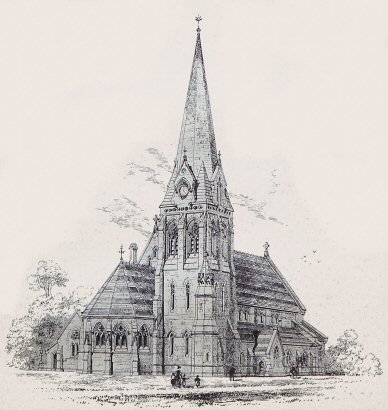
The Rev. W. Fraser Handcock is a minister apparently about
forty years of age. He begins his service in rather a low
tone of voice, but immediately rises to the compass of the
auditorium, and thoroughly maintains it to the end. The
emphasis in his reading is placed with almost faultless accuracy;
so that the true sense is never lost to the hearer. The
sermon was read, but delivered with very considerable
effect. In matter it was most intelligent, instructive, and
Evangelical. Discoursing from John xviii. 38: “Pilate
saith unto him, what is truth?” the preacher considered
Pilate as the representative sceptic of his age; and drew a
striking parallel between him and modern sceptics, in their
affected uncertainty and unbelieving inquiries, as to how the
truth was to be determined; and, like Pilate, they found vain
excuses for their infidelity in the divided state of
Christendom. In France religion was suffering through the
recoil from that “sham” of Christianity set up there
by Popery; and in England, silently but too certainly, the evil
leaven had been at work; in the Universities, in schools, and in
literature. When a convert from Rome, as had often
happened, first landed on our shores, it was not to be wondered
at if, on a superficial survey of the Church as it was, he
inquired, doubting, “What is truth?” When he
glanced at the various tenets taught within even their own
Church, could any other result be expected! We heard, for
instance, from some that a species of magical spiritual power was
vested in the ministers of religion, so that the sprinkling of a
little water in baptism, or the uttering of a few words over the
elements used in celebrating the Lord’s Supper, produced
necessarily divine effects—teaching against which our finer
sense revolted. He went to another extreme, and found
others objecting to everything in the world not purely spiritual;
even to all kinds of music not sacred in its character and
use. Then, perhaps, he took up a book written by some
plausible, philosophising author, the fallacies of which he was
not able to detect; and it was easy enough for him in all these
phases of our intellectual and religious life to find an excuse,
and inquire, “What, then, is truth?” But after
all, it was out a mere excuse, a vain pretence; for there were
the great cardinal truths of Revelation plain enough to be
understood: about God, about eternity, the soul, and God’s
way of winning it. But men rejected or quibbled about these
Bible truths and things raised upon them, because, in fact,
Christianity was not merely a creed, but it was a
life—a life that men must live both inwardly and
outwardly. And this was the grand reason why men evaded it:
the Master said, if any man would do God’s will,
they should know of the doctrine that it was of him. But it
was because they were not inclined humbly to do it, that
men remained in such ignorance and confusion about it. This
witness is faithful and true, for there can be no doubt that the
chief difficulties in the way of the reception of the religion of
the Bible are to be sought in the moral rather than the
intellectual condition of men. This was the great point
clearly and forcibly brought out by the preacher, and if this is
an average sermon in purport and aim, we cannot but congratulate
the neighbourhood on the advent of Mr. Handcock, and on the
building of the new church. As yet, as a matter of course,
the usual church adjuncts are only in contemplation. A
Sunday-school, however, will be opened immediately, and before
the permanent edifice is consecrated, all the usual parochial
machinery will be at work. The assistant minister is the
Rev. E. J. Haddock, B.A., Dublin. The churchwardens are
Capt. A. Waldy, of 9, Stanhope-gardens, and Dr. Daniell, of
Cathcart road, South Kensington.
There is a very old lady still
living in Young-street, Kensington, whose recollections of early
Methodism in that town are still with her, and who is fond of the
opportunity of quietly recounting them. Among her remotest
remembrances is a visit of Mr. Wesley, the incidents of whose
advent were the talk of the neighbourhood when she first began to
notice anything she heard. She tells how the great
evangelist preached in a smithy, somewhere in the vicinity of the
present Jenning’s-buildings, “amidst great
opposition.” [21] Subsequently preaching services
were held in a house—which has long since been taken
down—but which stood upon the site 17, Young-street.
This was the property of her husband’s father—who was
one of the earliest Methodists in Kensington—and who
suffered much persecution. It was, it appears, the object
of his opponents to make him stop the Methodist service
altogether; but his devotion to the cause enabled him to brave
the taunts and injury to which he was subjected; and to afford
larger accommodation he built up a temporary chapel in his own
yard, which answered for the service of the Methodists many
years. Methodism, however, has never flourished in the
Court suburb to the extent to which the self-sacrifice and
devotion of its few first members might have seemed to
promise. To the first temporary building succeeded another;
then followed the present chapel in Clarence-place in the year
1838. A ninety-nine years’ lease of the land was
obtained at a ground-rent of 10l. per annum in 1836, and
the foundation-stone was laid by the late Mr. Farmer, of
Gunnersbury House, in 1836, and in June, 1838, the Rev. Dr.
Bunting and the Rev. Dr. Beaumont conducted the opening services,
when the collections amounted to 42l. 5s. 2d., the whole
cost being 600l. It is a very plain edifice, almost
completely hidden from view by the surrounding dwellings, and
having no architectural expression. It has no gallery, and
will accommodate on the ground-floor 200 persons, the
congregation as a rule reaching to about half the number.
About twenty sittings only are held as free, although many more
must generally be so used. There are between fifty and
sixty Church members meeting in class. Prior to 1861, when
the Bayswater Wesleyan Circuit was formed, this chapel was
ministerially supplied from Hammersmith circuit, and from the
Theological Institution, Richmond. But since that date the
services have been attended by the regular ministry of the
Bayswater station, to which the chapel was at that period
attached. The form of service is that belonging to the
Wesleyan Body, which consists of 1, a hymn; 2, a prayer; 3, a
lesson; 4, a hymn; 5, sermon; closing with another hymn and
benediction. The hymns of the Wesleys are those mainly
used; although there are bound up with them some select
productions from other well-known hymn-writers, the whole
forming, without any controversy, by a long way the best
collection of hymns that Christendom has yet produced. Its
excellence is attested by the fact that into whatever church or
chapel we enter, the collections there in use, under all sorts of
titles and editorships, are much indebted to its pages. In
the present instance the singing is aided by a harmonium, which
might very well give place to the more suitable
instrument—the organ. Behind the chapel there is a
very capital schoolroom, where about sixty children are taught on
the Sabbath; and adjoining this a large vestry, both built in
1857, and forming a good reserve for meetings of all kinds
connected with the church and congregation. In the Wesleyan
circle in Kensington the following names appear to be much
revered and honoured as having contributed at successive stages
of the work, time, talent and money towards its building up,
names for the most part well known in the town—Messrs.
Rowland, Tomlinson, Maunder, Pocock, Bridgnell, Jarvis, Eyles,
Bond, Gush, Rigg, Haine, Trownsan, Farmer, &c. The
building of the larger and more beautiful Wesleyan chapel in
Warwick-gardens has, however, tended to weaken the society at
Clarence-place, by drawing away some of its principal members and
supporters, and a small portion of its general congregation.
St. Augustine’s Church, close
to Hereford-Square, South Kensington, is a temporary iron
erection, and, like most such buildings, possesses no
architectural features or details worthy of notice. The
Incumbent, the Rev. R. R. Chope, B.A., five or six years ago
conceived a necessity for a church in that place, and, means
failing him to obtain a substantial structure, or to procure a
separate site, he made use of a corner of his own private garden,
put up the iron building, and called it the “Church of St.
Augustine.” It is a low, dull, dingy-looking object
outside, and as a stranger approaches it—with its roof only
just visible above the garden-wall, it is in danger of being
passed without notice, except one should suppose it a rather
large conservatory or garden shed. It must have required
some courage in a minister to attempt a church for himself in
such a position; and we are not surprised after this that Mr.
Chope is now going on to a larger and more promising
enterprise. In the Queen’s-gate, a new and permanent
church is rising, under the same energy which originated the
first.
The present “St. Augustine’s,” in the
interior, is a long narrow space fitted with very plain benches,
all being free to all-comers, and capable of containing 700 or
800 persons. They were well filled on Sunday morning, the
7th of May, with a congregation remarkable for its preponderance
in the female element. One whole side of the church is
reserved entirely for females, and no intrusion of the other sex
is allowed. On the other side both sexes are compelled to
mingle, and even there two-thirds are of the feminine
gender. To say that the service here is High Church is not
saying all the truth; it is Ritualistic, and highly so, in its
whole spirit and ceremonial. It is, in fact, the nearest
approach to Romanism that we have yet witnessed in an Anglican
Church in the course of these visitations, if indeed it be not
very Popery itself under the thinnest guise of the Protestant
name. The communion-table is called an altar, and
regarded as such in fact, and decorated accordingly. It is
covered with a white cloth embroidered with yellow and red
flowers and fringe. It has a large gilt cross upon it, two
huge gilt candlesticks, and several vases of flowers.
Branching candelabra also on its right and left. The
ministers are called priests, and look very priestly in
their garments, with short surplice and long cassock, and stole
of yellowish silk with rich embroidery and fringe. In the
absence of the Incumbent, the Curate, the Rev. A. J. Foster
officiated.
Prior to the beginning of the service, an official in long
cassock with tassels was busy in arranging the chancel furniture,
and adjusting a silk embroidered covering upon the altar over the
elements to be used in the celebration of the Eucharist.
This work he performed with the minutest punctilio, moving
backward and forward and on one side to see its effect, and never
failing to bow on passing the Cross, and on leaving off moving
backward and bowing.
On entering church, the people, before taking their seats, bow
one knee in the aisle towards the altar, and some cross
themselves precisely in the manner of Roman Catholics. The
time of service arrived, the organist takes his seat, having on a
surplice and purple hood with white fur trimming, and, sending
out a few solemn strains, the choir is heard in the vestry at the
remote end of the church singing “Amen.” It
sounds like a distant echo among the mountains. Immediately
the people rise, and choristers and clergy walk in procession
through the centre aisle to the chancel.
Except the lessons, which were read in a serious and rational
manner by a stranger, an aged clergyman, who did not seem quite
at home in his priestly apparel, and appeared, amidst all the
circumstances, somewhat to dislike himself, the whole service was
intoned and sung. The music was Gregorian, and performed in
its most sombre mood. The congregation appeared perfectly
trained to bowings and genuflexions. At every mention of
the Saviour’s name they bent lowly, and during the whole of
the first part of the Gloria Patri. In one of the
hymns, the sacred name occurred in every verse, and in some
verses almost every line, and there was a constant bending and
rising. It appeared merely a mechanical process, and quite
inconsistent with that mental gravity which is essential to true
devotion. Amidst all this mechanism of outward worship, we
regret to say there was small visible evidence of spiritual
concern. It was the coldest piece of formalism it has been
our lot to witness in an English church.
In intoning the Litany, the clergyman came out of his desk,
crossed himself, and knelt with both knees on the lowest step of
the chancel in front of the altar, with his back to the
people. This motion is quite advanced in Ritualistic
practice; and, taken together with the peculiar strain of the
intoner’s voice, and its rising at the end of every verse
of that sublime and all-comprehending prayer, gave the service
the stamp of parody rather than of sincere and enlightened
Christian devotion. We can only express ourselves in this
form, for nothing else will indicate our real sense and
conscience of this mode of religious service. The
puerilities of Romanism Englishmen we thought had learnt to
despise, and yet here are some untalented young gentlemen in the
Church of England whose habits would deprave our Protestant
religious instincts and lead the young and weaker intellects of
our race back into the thraldom of Popish superstition.
After the Litany there was a hymn, and then followed the sermon,
differing in this respect from the usual church order, which
places the sermon after the Creed in the Communion Service.
After ascending the pulpit and crossing himself, pronouncing
“To God the Father, the Son and the Holy Ghost,” whilst
standing erect, the text was taken from John xvi. 7,
“Nevertheless, I tell you the truth; it is expedient for
you that I go away,” &c. As in most cases where
excessive attention is lavished on the mere ceremonial, the
sermon failed to fulfil the most modest ideal of pulpit
work. There appeared to be no intention or effort to give
it effect either as an exposition or application of
Scripture. In this case, too, it was evident the preacher
could not shake off the intoning habit of voice, but carried it
in great measure with him from the desk to the pulpit. The
principal point of doctrine in the sermon was on the important
subject of God dwelling in believers, and was stated in
this way: “As St. Paul said we were the temples of God by
the Holy Ghost dwelling in us; so God the Son dwelt in us by
means of his holy sacraments”.
“For,” it was further explained, “by the holy
sacraments he gives us spiritual life; for, except we eat the
flesh of the Son of God and drink his blood, we have no part in
him,”—a strange confusion of ideas between the
outward and visible, and inward and spiritual. Baptismal
regeneration, sacramental efficacy, were clearly articles in the
preacher’s creed. We always thought the teaching of
Scripture to be that both God the Father and God the Son dwelt in
the true believer by one and the same inhabitation of the Holy
Ghost. In connection with this sublime principle of
spiritual life, there is no place in the Bible where such words
as “by means of the holy sacraments” are to be
found. Feeble preaching can diffuse error if it cannot do
justice to the truth. After the sermon, during the singing
of the hymn, the offertory is taken every Sunday, by which the
church is wholly supported, and the minister passes to the
Communion Service. The collectors bow towards the altar on
presenting the offertory bags in the chancel, or on leaving; and
in preparing for the celebration the priest—with his
back to the people—is long engaged, and on one occasion
kneels and rises quickly twice or thrice in succession before the
consecrated bread. The Rev. R. R. Chope has studied to make
his service as ornamental, high, and formalistic as can be under
the Anglican name. He says he believes that “the
meanness and costliness of worship reflects the spirit of the
worshippers,” a fundamental error if it be attempted to
apply it as a general rule. We take it that there is a
medium to be observed, and in all cases the costliness
must be regulated by circumstances.
Every Sunday at 8 a.m. there is
Communion, Prayer (choral), with sermon, at 11; second
celebration at 12 30. Evening prayer (choral) and sermon at
7 p.m. Thursday, at 8. a.m., Communion. 11 a.m., morning prayer.
Saints’ days: Two celebrations and daily prayer, at 8
a.m. and 5 p.m.
There are several small charities, a day-school, and
Sunday-school, both in their infancy.
The Roman Catholic Oratory stands
within an enclosure of high brick walls and gates, above which
its plain brick, warehouse-looking south gable is visible, and if
it were not that the said gable is surmounted by a plain Latin
cross, there is nothing to indicate an ecclesiastical
structure. The interior (in effect reminding one of a large
music-hall) is Italian in its style of the simplest kind, painted
and gilded. The nave or body of the church is very long,
roofed in one span, and covered with a plain panelled
ceiling. The northern end is occupied by the high altar,
richly decorated with artificial flowers and burdened with
candles. The altar stands considerably elevated and
enclosed by dwarf balustrades, and flanked by rather ornate
benches or sedilia. The nave floor is entirely occupied by
mean wooden benches, intersected by a centre and two side
passages, the latter giving entrance and exit also to numerous
recesses or bays, which serve as chapels, in which are erected
altars to saints; and also to a number of confessionals, by which
last we infer that the practice of confession is carried on to a
great extent by Oratorians. As to the saints, those
represented at the Oratory have their altars all duly supplied
with pictures, candles, and flowers, and have their particular
admirers and devotees. A large platform kind of pulpit is
on the west side, in which the preacher is accommodated with a
chair. The font is very plain, close to the main entrance
doors in the bay called the Baptistry.
The “Oratory of St. Philip Neri,” situate next to
the South Kensington Museum on the one side and Holy Trinity
Church, Brompton, on the other, was dedicated to the
“Immaculate Heart of Mary” in the year 1854. It
had previously been established in King William-street,
Charing-cross, since 1849, in the building now known as the
Charing-cross Theatre. But the more eligible site in
Brompton offering, it was embraced; and this centre of Roman
Catholic propgandism in West London was transferred from amidst
the shops, warehouses, and cafés of the Strand, to
a scene of retirement, wealth, and fashion. The interior of
this church is laid out in the most elaborate style of Roman
Catholic art. On entering, the high altar in the
distance—north—strikes the eye irresistibly. It
has upon it a high cross and six tall candlesticks with candles
lit. There are also other candles and suspended burning
lamps through the entire vista. The æsthetic effect
of the first glance is not soon forgotten. The details are
not less effective, considered as mere imagery addressing the
outward sense. Including the Baptistry, there are eight
side chapels, or altar-recesses, four on each side, all richly
and artistically furnished. On the left, or what is
termed the “Gospel side,” the first is the
“Chapel of the Sacred Heart;” second, the Chapel of
St. Eutropius; then that of St. Joseph, and that of St.
Philip. On the right, the first recess is the Baptistry;
second, “Calvary Chapel,” where there are life-size
figures of the crucified Saviour with the malefactors, and the
mother of Jesus and his brother sitting at the foot of the cross;
third, the Chapel of “Our Lady of Dolours” (sorrows);
and forth, the Chapel of “Our Lady.” The altar
here, with a large image of the Virgin and her infant Son upon
it, is now profusely decorated with flowers. It is the
month of May; and the following notice is attached to the doors
of the church: “Offerings of flowers and candles will be
thankfully received for the month of Mary.” The
former part of the appeal appears to have been already liberally
responded to. The bouquets are piled up to the very feet of
the image, and decorating her brow in all their radiant
freshness. The whole reminds one of a certain wax-figure
display in Baker-street: only in this instance the kneeling
worshippers around the rails of the chancels suggest that
something more is involved. We saw many of them, especially
in front of “Our Lady’s Altar.”
But they were distributed all through in smaller numbers or in
ones. The “Calvary Chapel” is intended as a
most literal rendering of the crucifixion. It is a shocking
scene to look upon—those carved images of bleeding and
mangled forms. To any one who has really in imagination
conceived something of what the actual crucifixion was, and dwelt
upon its moral import, it is likely to seem an impious
mockery. But some appeared to approach it with reverence;
and a little girl, who had been kneeling by her mother’s
side, crossed over the rail, crept up to and kissed the wooden
cross on which the central image hung! These scenes are to
be witnessed after every public service, matins or vespers, or
whenever the church is open, which in fact is at all times when
people can attend either by rule or chance.
The usual services at the Oratory are numerous and
continuous. On Sunday there is Mass at 6.30 a.m., at 7, 8, 9, and 10; and at 11 High
Mass and sermon; at half past 2 p.m. “Exposition of the
Sacraments,” and “Vespers” at half-past 3;
occasional courses of lectures at 4 p.m., and service with sermon and the
benediction at 7 p.m. At this
latter the meetings of the confraternities of “The Precious
Blood” and of “St. Patrick” are held, and the
“Intentions of members given out.” This
means that each member confesses to some dominant desire or
purpose then in his mind. It may be for the comfort of a
sick friend, the repose of a dead one, the conversion of sinners
or heretics, or any other matter that may engage his thoughts at
the moment. There is also the “Little Oratory,”
where there is a separate service for “Meditation and
Mass,” for brothers only, at 7.30 a.m. and 4.15 p.m. On week-days there is Mass at
6.30, 7, 7.30, 8, 8.30, 9, 10. Sermon every evening at 8,
except Saturday; and on Thursday and Saturday a benediction at
4.30. On holy days, High Mass, with sermon, at 11 a.m., and vespers at 4.40 p.m. The work of the confessionals
appears to be interspersed at all times between these numerous
services. The wonder is how such a machinery can be kept
always going, how it does not wear out in interest and effect
from sheer continuity of motion. We must assume that it has
its flagging moments, and sleepy rests, by which its motive
energies are recruited, and that at certain seasons and services
the priests have it pretty much to themselves.
The Fathers.—At the present
time there are fourteen attached to the Oratory, the majority, we
are informed, having been previously clergymen in the Church of
England. Their names are as follows: The Very Rev. W. T.
Gordon (superior); the Rev. John B. Dalgairns, the Rev. Richard
M. Stanton, Thomas F. Knox, John G. Bowden, Edward G. Bagshaw,
James B. Rowe, Felix Philpin, Edward S. Keogh, W. B. Morris,
Chas. H. Bowden, Kenelm Digby Beste, Thomas Graves Law (nephew of
the Earl of Ellenborough), James Arthur V. Maude, Francis A. O.
Carroll, Henry G. S. Bowden. There is a large library
belonging to the Fathers in common, which occupies an entire
quadrangle, about one-third the length of the church itself
westward, where the clergy spend such spare moments as they can
snatch from their other engagements. Little is known of
these gentlemen by the outside world. They act their parts
from day to day within the sombre enclosure of their high brick
walls, and continue to be content to move in their appointed
spheres amidst the gaudy but wearisome formalism within. On
Sunday morning, May 14, it was High Mass at the eleven
o’clock service. The magnificent organ, played by Mr.
Pitts, sent forth its thrilling peals precisely at the
moment. The organ itself is considered one of the very best
in London, and cost 2,000l. Meanwhile four principal
priests appeared at the altar, and after bowing several times
turned to face the congregation. They proceed to the front
of the chancel, the centre one waving a rod, and one on each side
bearing his train and exhibiting the rich scarlet lining of his
robe. He bows lowly, and stretches out the rod waving it
right and left over the people, and they retire again to the
altar. This action in glittering vestments, heralded and
followed by bursting music, is in all respects like the opening
scene of an opera, and ostensibly not a whit more solemn or
religious. It is difficult to realise that you are in a
house of prayer. It is useless here to give a description
of the whole performance. Barring a few brief intonings of
the priests in Latin it consisted entirely of the sundry dumb and
complicated bodily movements peculiar to the Mass. If we
were to criticise them it could only be to say, as we should say
of any other performing company, that this performer was more
graceful and striking in his action, et cetera, than the
other. The plentiful smoke of incense and the music made up
the rest. This latter accompanied the whole with the
briefest intervals. There were solos and choruses
innumerable, and the art-pretension of the performance was its
great feature. The choir is railed in effectually from the
congregation around the organ, and consists of male singers only
in plain dress, under the conduct of M. Wilhelm Schulthes, a
composer of some note. It is but just to say that the
singing was in itself excellent, if one could forget the main
object for which a church is erected. The voices were
unexceptionally good, and the parts brilliantly executed; but the
whole was operatic in effect—too secular, and too
much of it, to assist devotion. But the Mass music of the
day is employed with a special regard to popularity; which,
however, as a matter of fact, and as a part of religious service,
it does not succeed in acquiring. There is, after all, an
idea, however vague, in the popular mind of the moral
“fitness of things,” and if people find themselves in
a place ostensibly for Christian worship, and yet chiefly
entertained with an artistic and elaborate display of music not
distinctively devotional, it does not commend itself to their
better judgment. The congregation at the Oratory on Sunday
morning appears to bear out this remark. Had the same
musical skill been announced for an ordinary evening concert in
any London music-hall it would have commanded plenty of patronage
at 5s. and 2s. 6d.; but in this case (although the charge was
only 3d., and 1s. for the best seats) they were far from fully
occupied. Undoubtedly, the most rational and appropriate
part of the service was the sermon, which was preached
extempore by Father Law, who is the morning preacher for
the “Month of Mary”—a somewhat youthful-looking
Father, but he discovers considerable maturity of mind; and
somewhat pleasingly surprised us at the Protestant colour of some
parts of his teaching. Grounding his remarks upon Luke xix.
5: “Zaccheus make haste and come down, for to-day I must
abide at thy house,” the preacher explained how it was that
Jesus dwelt with his people. In passing, the preacher
observed that Christ dwelt with us in his Church, sacraments, and
through the “Blessed Lady,” who ruled over them that
day, in allusion to the peculiar homage paid to the Virgin at
this time. But this was only in passing, and as though to
keep his Catholicism in countenance. He enlarged chiefly
and with much feeling upon what was, he said, “most
important of all,” “Christ dwelling in us by the Holy
Ghost, and so abiding with us,” in our inner life.
The Rev. Father seemed for the moment to rise above the trammels
of peculiar Popish dogmas, and to conceive the fundamentals of
religious life as practicable without them. Certainly he
did not say as much in as many words, but if he did not intend
it, his discourse was without meaning or aim. It is
remarkable that on the previous Sunday we listened to an Anglican
divine discoursing on the same subject, and were boldly told
without any qualification that Christ dwelt in his people
“by means of the Holy Sacraments.”
There are attached to the Oratory day-schools for boys and
girls, which are carried on in Pont-place, near to St.
Luke’s Church, and are rather numerously attended.
There is also what is termed “The Nursery of our Lady and
St. Philip Creche,” at 56, Walton-street, where infants of
working people, from three weeks to five years old, are taken
charge of whilst their parents are at work in the day-time.
References must be given as to honesty and engagements before the
child is admitted, and 3d. per day is charged for each
child. The church itself will accommodate about 1,200
persons.
Kensington Chapel, on the east side
of Allen-street, is worthy of notice. It is substantially
built of stone, and commands a foremost place amongst the best
examples of classic architecture in the neighbourhood. The
portico is the most noticeable portion. Its Corinthian
columns and pilasters are in good proportion and well-executed,
and assure even the most unpractised eye of their capability to
support the massive entablature and pediments that surmount
them. The present minister, Dr. Stoughton, laid the chief
corner-stone in June, 1864. The interior is well and
handsomely treated, and is light, commodious, and adapted for
sound. The large British School recently erected is
certainly not an improvement to the architectural appearance of
the chapel. There is a want of truthfulness about the
design, which one must regret, seeing that the chapel itself is
in such good taste.
The church connected with this place traces its origin so far
back as the year 1795, and owns a very interesting history.
The first Congregational Chapel was in Hornton-street, and was
founded in 1793; and in October, 1794, the Rev. Dr. Lake was
chosen first pastor. In March of the following year he
gathered into religious communion about forty persons, and on the
9th of April following was solemnly ordained to the pastorate by
Dr. Hunter, author of “Scripture Biography,” who was
assisted in the service by other ministers. The church and
congregation gradually increased under Dr. Lake’s ministry,
and also under his successors. These were men of no less
eminence than the Revs. John Clayton, Dr. Liefchild, and Dr.
Vaughan. For a church to have held such pastoral relations
in unbroken succession, and for these to be followed and crowned
by the worthy name of the present esteemed minister, Dr.
Stoughton, is a remarkable fact, and prepares us for chronicles
of superior influence and success. In this we are not
disappointed. In the year 1845 the jubilee of the church
was celebrated. Dr. Stoughton had commenced his ministry in
1843, and on the 50th anniversary preached a commemorative
sermon. From this, which is in print, it would appear that
the first half-century witnessed a gradual but certain growth of
Congregationalism in the town, the number of church members
having increased from the foundation number of 40 to 251.
These were the figures when Dr. Stoughton began his work.
The labour of those earlier times had been well and patiently
done, and the basis firmly laid for a larger edifice of success
to come. The Rev. John Stoughton appears to have been the
well-chosen minister for the opening era of its later
history. On Monday, October 4, 1868, the church and its
friends rejoiced together over the fruits of the pastor’s
labours through a quarter of a century. At that time, which
may be allowed to speak for the present, 1,200 members had been
added, and there was a fixed membership of 500, having just
doubled itself since 1843. The Hornton-street Chapel had
been enlarged in 1845 at a cost of 1,400l.; a branch
chapel—now known as the Horbury Chapel,
Notting-hill—had been built in 1849, and a church, of 40
members and 100 seat-holders, given it from the parent
congregation to begin with. This new cause was largely
aided and supported by Mr. Stoughton and his people.
Notwithstanding this separation, the places of those who had
retired to the north of the parish were soon filled, and the
chapel became overcrowded, so that it became a necessity to
provide new and enlarged accommodation. Hence the present
commodious chapel in Allen-street, which was opened for Divine
worship on the 30th of May, 1855, the foundation-stone having
been laid in June, 1854. The entire cost, including the
freehold site and organ, was 8,748l. 9s. 6d., the whole of
which was defrayed by the end of January, 1860; 600l. more
was laid out on repairs and embellishments in 1863. There
is accommodation for 1,000, including about 250 free
sittings. More recently British schools have been built,
adjoining the chapel, at an outlay of 5,000l., which now
have from 300 to 400 children in attendance. Here, also,
large and important Sunday-schools are conducted, having about
700 children under religious instruction. These were
established in the year 1809. We understand that every
available sitting is at present let; and the congregation
contains several persons of literary eminence and professional
distinction. It is generally of that character which a
minister of Dr. Stoughton’s ability may be expected to draw
and keep around him. For Christian liberality it is justly
entitled to a record; and is, undoubtedly, one of the best
instances to be found of what can be achieved on the voluntary
principle when intelligently and powerfully directed.
During the first twenty-five years of Dr. Stoughton’s
ministry—independently of the amounts raised by pew rents,
&c., for support of the ministry—there was raised for
various objects the noble sum of 32,821l., being an
average of 1,313l. per annum. 12,800l. was for
chapel and school building purposes; 8,870l. for
missionary societies at home and abroad; 5,630l. for
support of educational institutions; and 5,480l. for
relief of the poor and distressed, both in a general way and in
various cases of public need. This scale of giving is
maintained and even enlarged upon, the church raising
500l. for the London Missionary Society last year;
and—which may be considered an expression of genuine
catholicity of spirit—contributing 100l. towards the
building fund of the new parish church now in course of
re-erection. Annual collections are made for St.
Mary’s Hospital, Paddington, the West London Hospital, for
a Christmas Poor Fund, Chapel Building Society, London City
Mission, and various other Christian objects. There is no
endowment, and the ministry is entirely supported from seat
rents. As a proof of the esteem in which the minister is
held, the church voted him 400l. in 1868, to enable him to
visit Palestine, which he did; and it may be added that at the
present time a co-pastor is being arranged for to assist him in
his labours.
The Rev. Dr. Stoughton has the good fortune—attending
but few settled pastors in the same degree—to enjoy the
continued confidence and good opinion of his people; and through
the effect of a prolonged ministry he has acquired an amount of
influence over them seldom realised. That influence has
been for good. It has lifted them out of the narrowness
which, rightly or wrongly, is generally considered an attribute
of close churches; it has moulded them into a catholic temper,
and imbued them with social sympathies which render them a fact
and a power in the town and district. “Like priest,
like people,” is an old adage; and probably it has never
found a better illustration than in the present instance.
And where the former has strength and goodness combined, the
likeness to himself he impresses upon his congregation over a
long ministry, at any rate, ought to be traceable. Dr.
Stoughton himself cultivates the most friendly relations with
ministers and Christian people of all denominations.
Occasionally at his house may be witnessed a little Evangelical
Alliance, in the presence of a bishop, or a dean, or an
archdeacon, with clergymen Episcopal, Baptist, Methodist, and
Congregational; and the same genuine fraternal feeling he carries
into public meetings and committees of all kinds where general
Christian or social interests are concerned. On the rev.
gentleman’s pulpit characteristics it is scarcely necessary
to enlarge. In these sketches it is our plan only to say
enough on this point to indicate the general standard of
preaching, talent, or aptitude, together with the doctrinal
teaching and mode of conducting service. As to the latter,
the minister appears in the pulpit in a gown; and in the singing
part of the service the usual Congregational Hymn-book is
supplemented by a collection of church music, consisting of
chants, anthems, Te Deum and Sanctuses. After the
second prayer the Te Deum is sung; and the music, both for
hymns and chants, inclines pretty much to the Gregorian
strain. We may describe this congregation, in its general
tone and style of worship, as occupying that part of the
Dissenting territory which lies nearest the Church of
England. In the minister’s personal part there is a
brief opening prayer, a lesson, a second prayer, a second lesson,
and a third prayer; and in these several extempore petitions, in
the present instance, were included almost every conceivable
object of supplication hardly exceeded in variety of matter by
the Book of Common Prayer itself. The discourse was founded
on 2nd Corinthians x, 5: “Bringing into captivity every
thought to the obedience of Christ,” and was delivered
extempore, with the aid only of a manuscript skeleton. The
perfect ease and quiet of the preacher is apt at first to tempt
the stranger to think him slightly indifferent to his hearers;
but he has only to be heard a while to convince one that the
feature arises from complete self-control and command of his own
thoughts; and that, so far from indifference, it arises from
deliberate anxiety to clear himself with the intellect and
conscience of his audience. It is certain that this is
achieved with great success. The clearness of the
preacher’s thoughts, and equal clearness and felicity of
his language, make one feel as though sitting in the calm light
of intellect, reflected from every point of the compass.
Starting with the assertion that the words of the text were
directly “against the grain” of the “most
fashionable thinking of the day,” which was on the side of
what was called “freedom of thought,” he entered the
lists with the free-thinkers of the period. Demonstrating
with a masterly hand that the true liberty of our nature is only
found in the captivity of thought to the obedience of Christ, he
showed, on the other, with convincing power, that the boasted
“freedom” of the day was slavery itself. It was
slavishness to prejudice, to some human irresponsible authority,
to the most “fantastic ideas,” without any basis in
reason, to an idea of novelty and change, where, however, there
was no originality; for, the preacher remarked, amidst all this,
“originality was a very rare thing in our
time.” The freedom contended for was one which bound
our whole nature up in the bonds of fixed and rigid laws of
development, which extinguished the very possibility of
freedom. After so withering an exposure of the boasted free
thought of the age, there was peculiar force and beauty in
pressing home the great Gospel truth, “But if the Son shall
make you free, then are ye free indeed.” Christ
carries us away captive; but He does it as a conqueror of our
foes, who tyrannised over us; and following in His train is our
deliverance, our “freedom.”
On Sunday, service is held at 11 a.m. and 6.30 p.m., and at 3.15 p.m. a prayer-meeting in the
Lecture-room. The Lord’s Supper the first Sunday in
the month after morning service; baptism every three months, both
to adults and children, or more frequently if desired.
Communion tickets are distributed to members in December, which
they are expected to put into the plate after each
celebration. Members are accepted after private
conversation with the minister, and approval by the church in its
ensuing monthly meeting. The time when the minister may be
consulted on this solemn subject is from six to seven on Thursday
evenings weekly.
The Wesleyan Chapel, situate at the
corner of Warwick-gardens, Kensington, is a specimen of one of
those buildings by which we may say that Nonconformists have made
a step in the right direction. It is architectural, and,
though of simple character as regards material, being of brick
and stone and covered with slate, yet the brick and stone have
been treated very successfully in the design of the west
front. It claims to be an example of Early English work,
and, with its spire and pinnacles, forms a good feature, seen
from the entrance of the gardens from the Kensington main
road. Enclosed by iron gates and rails, and dwarf walls,
the chapel is approached by a flight of steps and entered by a
vestibule or lobby, which also gives access, to the right and
left, to the gallery stairs. Inside, considering the large
galleries, which at all times are an objection, the effect is
exceedingly good. The light ribbed roof over the body of
the chapel is supported by a timber arcade of very good design,
and if, instead of iron, the columns that receive the arcade had
been of wood, we should, in spite of the galleries, have been
able to report some very successfully effective work. The
organ is recessed, and appears just above a somewhat tall and
bulky pulpit. Beyond this there is very little to remark
save the quiet neatness that prevails generally. The
basement is occupied by school and class rooms and offices, with
separate entrances and approaches. The chapel is from the
designs of Messrs. Lockwood and Mawson, of London and Bradford;
and the building contract carried out by Mr. Nevill Simonds, of
London. The warming was executed by Messrs. Stuart and
Smith, of Sheffield; and the standard gas-lights by Messrs.
Thomasson and Co., of Birmingham.
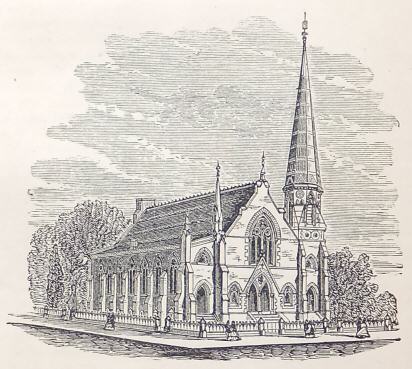
This chapel was opened for worship on Thursday, the 10th
December, 1863, and is partly the fruit of a general effort among
the Wesleyan Methodists for chapel extension in London and its
suburbs. The first metropolitan chapel building fund was
started in 1861, and zealously promoted by the Rev. W. Arthur,
M.A., and the late Rev. John Scott, in connexion with several of
the wealthier laymen. The spirit of church and chapel erection
which has recently taken hold of other leading religious bodies,
and notably of the Establishment, has been largely participated
in by the Wesleyan body; so that the chapel business which
centres in a Chapel Committee has become a very large and
imposing department. It superintends the erection of
chapels in every part of the Connexion, and has its rules upon
which these works are to be carried out. Every chapel built
without compliance with its regulations and primary sanction is
jealously viewed, and reported to Conference as irregular, with
profound “regrets” at the Methodistic insubordination
implied in it. No matter though a chapel be made really a
good property of and handed over, it cannot condone the offence
against the spirit of red-tapeism centreing in the
Conference Committee. It will only be officially recognised
after a good scolding has been administered to the offenders for
the pains they have taken to erect a chapel for Methodism.
This is one of the points at which the Central Conference rule is
liable to collision with local voluntary efforts, and often
produces great irritation. The Committee administers the
chapel erection fund and makes grants in aid. It also
controls a large sum of money—raised some years ago to
assist in clearing chapels from debt. This money is lent
out to trustees upon application, to be returned in so many
annual instalments, free of interest. Probably no fund has
been more useful to the material interests of Methodism.
Chapels formerly burdened with debt have been set free by yearly
payments similar to what they were before paying for interest;
and thus their resources have been left available for extension
purposes. There is also a special fund for chapel building
in Watering-places, commenced by the Rev. W. M. Punshon in 1861,
which succeeded very well as far as it went, but did not attain
large dimensions. The “Metropolitan Chapel Building
Fund” is a more important and progressive affair. It
started with a subscribed fund of 20,000l., to be kept up
by annual appeals; and an effort is now being made to raise a
very much larger sum—Sir Francis Lycett having made the
generous offer of 50,000l., to be distributed in sums of
1,000l. each to fifty new chapels, that shall be erected
in the metropolis with a specified accommodation, within a given
time. For this offer to be utilised to the full extent, at
least 200,000l. will have to be raised.
The Warwick gardens Chapel benefited from the first fund to
the extent of 1,000l., the whole estimated cost being
4,700l. In default of a freehold, 32l. per
annum is paid as ground-rent, which was to be covered by a yearly
investment. 1,175l. was left as a temporary debt, to
be paid off within one year. We believe, however, that this
was found to be impossible, and the debt in whole or part, still
remains. The estimated income from seat-rents was fixed at
200l. per annum, a very small estimate indeed, had the
project succeeded. But in this there has been grievous
disappointment. The chapel will accommodate 1,000 persons,
but after more than seven years it hardly commands an average
congregation, in all, of 200, and a number of these are from a
distance, and properly belonging to other Methodist
congregations. We fear, therefore, this is a case to be
recorded as so far a failure.
A degree, perhaps, of laudable ambition has led some leading
Methodist ministers and laymen of late years to desire to place
chapels in neighbourhoods different from those usually
occupied. In short, there has been a movement to plant
chapels in more respectable localities, such as that of
Warwick-gardens. But if the experiment is to be judged by
its results in this instance, it would appear a lamentable
mistake; and it may after all be worth considering whether John
Wesley’s own rule will not yet serve Methodism for all
time—“To preach the Gospel to the poor, and to go not
only to those who need us, but to those who need us
most.” There are Sunday-schools, where about 100
children of both sexes attend; and four or five small classes,
which include all the society at present attached to the
chapel. It is united in what is called the Bayswater
Circuit, the headquarters of which are in the Denbigh-road,
Bayswater, and which has three ministers appointed to it by the
Conference. These are assisted in the occupation of the
pulpits by ministers belonging to Connexional departments in
London, or students from the college at Richmond. The
chapel, therefore, has the best ministerial provision that the
system of Methodism can supply, but there appears to be no public
effect. On Sunday evening, 21st of May, the pulpit was
occupied by the Rev. W. B. Boyce, one of the secretaries at the
Mission-house in Bishopsgate-street. He holds a high
position in the body, and on many accounts is deservedly
respected. He has seen much service in the Mission-field;
and to this it may be in part attributable that he retains in
speech the broad provincialisms of his early life. He also
holds fast to the old Methodist style of putting the doctrine of
“Conversion,” which was the subject of his
discourse. According to his teaching on this occasion, a
man may be everything Christian to the outward eye—and even
be a martyr for the truth—and yet be unconverted, unsaved,
and perish eternally. If such a case be possible, we
must remark it is so rare in experience that it may well cause a
minister to pause before he gives it prominent and unqualified
application in a sermon. There are certain to be a number
of weak consciences and doubting minds in every congregation, who
must be very much troubled and perplexed with such teaching,
whereas there may not be a single individual to whom it really
applies. It is a mode of preaching, in our idea, not based
upon sufficiently large views of human experiences and
circumstances; yet Mr. Boyce exhibits great sincerity and
earnestness.
The Scotch Presbyterian Chapel
stands at the corner of the Foxley-road and Allen-street, and is
a fair specimen of geometric gothic. Of course it requires
the tower to be finished to make it the good architectural object
that it should be in the long perspective of Allen-street; yet it
is even now fairly prominent, and is substantially built of
Kentish rag with Bath stone dressings, and roofed with
slate. The principal entrance is on the north side, over
which is a large and rather noticeable window, and the rose
window in the west gable, too, seems to invite the visitor to an
inspection of the interior. Passing through a very plain
corridor or vestibule, the body of the chapel is immediately
entered to the right and left hand. A feeling of
disappointment it is impossible to repress ensues. The
interior in no way accords with the idea conveyed by the outside
inspection. It is roofed in one span, and heavily ceiled
and panelled, producing a sense of depression. The walls
are simply bare plaster, the pulpit very large and heavy, the
pewing poor and plain. A northern gallery, evidently
intended for an organ, is organless, and not much improved by
large curtains. The Presbyterian movement in Kensington
began in 1861, under the present pastor, the Rev. Gavin Carlyle,
in a hall in Holland-street. After about a year’s
labour in this place some forty or fifty members had collected,
and it was then resolved to build a church. A site was
first sought in Campden-hill, but was not to be found
there. Ultimately the present site was scoured, the
building commenced in July 1862, finished in May 1863, and opened
on the 24th of that month, and the Rev. Mr. Carlyle, was formally
ordained to the charge on June 2nd following. Since then
the progress has been steady; and the membership has increased to
between one and two hundred. The church is connected with
the English Presbyterian Church, and the late Dr. Hamilton, of
the latter, took great interest in it, and did much to originate
it. It will contain 500 persons, and cost to build
5,280l.; by the addition of galleries, it would be capable
of accommodating 700 or 800. There is no endowment, and the
minister is dependent upon pew-rents and voluntary
offerings. A Dorcas Society is kept up by a few ladies; and
collections are made annually for foreign missions and other
objects. The Duke of Argyll is a seatholder and frequent
communicant; and other persons of general and literary
distinction. At a meeting a few weeks since, at which the
Duke of Argyll presided, several Indian and other notabilities
were present, including Dr. Macleod, Sir Bartle Frere, Sir Wm.
Hill, &c., who had assembled to hear a lecture on India, by
Dr. Wilson, of Bombay. The Rev. Gavin Carlyle is an M.A. of
the Edinburgh University, and studied theology in the Free Church
College, Edinburgh, followed by a year’s study in
Germany. He is a nephew of the famous Edward Irving; and
editor of his uncle’s “Collected Writings,”
published by Strahan and Co. He is also editor of the
Weekly Review, the weekly organ of Presbyterianism in
England; also of Christian Work, a monthly journal of
religious and missionary intelligence. Mr. Carlyle’s
congregation is at present a small one compared with many; but on
the occasion of our visit his sermon was certainly such as to
justify a larger attendance. It was the first of a series
of discourses on the Ten Commandments, and founded on the first
“I am the Lord thy God,” &c. The distinct
existence and all-pervading presence and control of the Almighty
was the subject. It was well and clearly treated, in a
manner to meet the principal intellectual quibbles or
difficulties of the times; and the preacher proved to the
satisfaction of every thoughtful mind—to use his own
words—that “all reason speaks to us of God; and that
it is nothing but unreason and mystical cloudiness that
attributes the effects of Nature to any other cause or
operation,” and that science when rightly conceived is
“the handmaid of religion.”
The Brompton Episcopal Chapel,
situate close to the Brompton-road, in Montpelier-street, is a
structure strictly Georgian in its character, Georgian indeed to
the back-bone, if one may be allowed to use such an expression
ecclesiastically. It has no beauties to make it worthy a
visit in the search after the picturesque. It is simply
ugly outside, and very little more may be said of it
inside. It rather reminded us of old Kensington Church,
without its historical interest. Like all buildings of the
kind, it has its painted columns supporting a flat ceiling, and
high-back gallery. It has its high pulpit and prayer-desk,
each duly draped in hot velvet, its high-backed pews comfortably
shut up and cushioned, in fact, everything belonging to it is
high, only that it would be too much to call it High Church.
This chapel attained its centenary in 1869, being opened on
Easter Sunday, 1769, as a chapel of ease to the parish church of
Kensington. The Rev. Richard Harrison was the first
minister, who was a preacher of some note, and continued his
labours to the end of life, which occurred in 1793. A
tablet to his memory may now be seen on the south side of the
Communion-table. Since then the course of the ministry has
been somewhat chequered, and not always connected with the
happiest reminiscences. Although so ancient a chapel, it
appears to
have been generally poor, and the only relic it contains of
bygone days is a set of old pewter collecting-plates,
having the original engraving, “The Parish of
Kensington.” The building is now seen in every
respect as it was at the beginning. It has successfully
resisted all modern innovations; no alterations of any kind have
taken place, excepting that a coating of stucco has been bestowed
upon the front. The same is true of the character of the
public service. It has rigidly preserved its own unadorned
plainness, against all the ecclesiastical refinements of later
years. The clergy are ordained ministers in the Church of
England, and licensed by the Bishop of London, and the present
are the Rev. W. Dunford, who is also the private owner of the
property, and the Rev. W. Crofts Bullen, assistant
minister. The latter was doing duty at the time of our
visit, with rather a thin congregation, but showed considerable
earnestness, read distinctly and audibly, and preached in his
black gown an extempore discourse on Rev. iv. 3. The
sublime passage was expounded by references to other parts of
Scripture, connected with some plain, out-spoken utterances
applied to the audience in a fearless and faithful manner.
Regarding the text as symbolical of the Holy Trinity—it
being Trinity Sunday—the preacher knew nothing about
“the liberality of faith in the nineteenth
century.” There was “a severe and hard line to
be drawn between the believer and unbeliever, the saved and the
unsaved.”
The Episcopal Chapel will hold about 800 persons, and the
congregation averages from 400 to 500. Having no endowment,
the clergy rely only on seat-rents and quarterly collections for
church expenses, which are made by passing the pewter-plates
round to the assembly in the pews. There is a good
Sunday-school carried on in the chapel, morning and afternoon,
with about 130 scholars, a number which it is said might be
greatly added to but that the Churchwardens will not allow more
space. This unfavourable condition, however, the zealous
superintendent, Mr. Warder and teachers, assisted by the
children, are seeking to remedy, having opened among themselves a
weekly subscription towards a separate and commodious
schoolroom. The weekly pence already contributed amounts to
50l. This is a most worthy example; and it may be
hoped that some large-hearted persons outside the school, may
some day or other feel inclined to encourage by large gifts so
laudable an attempt at self-help. The school is also
provided with a library by subscriptions of the teachers and
churchwardens, from which books are lent free of charge.
The Sunday-school is an interesting feature at this chapel, and
is said in the neighbourhood to be highly prized by the children
themselves, who are reported to be most regular in
attendance. The services are—Sunday, morning at 11,
evening at 6.30; Wednesday at 7 p.m.;
the Lord’s Supper on the last Sunday in the month.
The hymn-book used is a selection of psalms and hymns arranged by
the Rev. Charles Kemble, M.A.—the 1853 edition.
Onslow Chapel, situate in Neville
terrace, Brompton, has many pretensions to Gothic architectural
effect. It is slightly decorated in design, and somewhat
early. Long before the two churches were thought of,
between which it now stands, St. Pauls and St. Peters, its two
little spires could be seen like landmarks in the surrounding
plain. It is one of those early attempts of the
Nonconformists to establish a better style of architecture in
their buildings for public worship. The west front is,
however, all of which it can boast, the inside being of true
chapel type, consisting, one may almost say, of a large hall,
ribbed and vaulted in plaster. The western gallery adds to
the accommodation for sittings, and the body of the chapel is
well filled with simple pewing. The pulpit is tall, and
backed up by the organ. In the usual way the Vestry is at
the east end. The foundation-stone was laid by that great
and good man, the Hon. Arthur Kinnaird, in 1856.
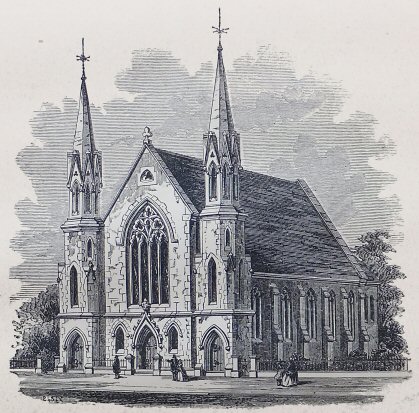
This chapel was built fifteen years ago, for the church then
meeting in Alfred-place, under the pastorate of the Rev. G.
Bigwood. It seats 650 persons, and cost
6,000l. But this outlay included, besides the
chapel-proper, convenient class-rooms, and a spacious schoolroom
which runs back on a line with the chapel into Neville-street,
and is now mentioned as Onslow Hall, a suitable place for
meetings and lectures. The Rev. G. Bigwood’s ministry
lasted about eighteen years, and he was succeeded in 1870 by the
Rev. Joseph Upton Davis, B.A., the present pastor. The
minister is a Baptist, but the membership is open to Christians
of other Evangelical communions. As a preacher, Mr. Davis
has considerable gifts. To a pleasing manner and voice
there is a goodly share of refinement, general evidence of
culture, and preaching ardour, which are essential to the modern
pulpit. “He that hath an ear let him hear what the
spirit saith unto the churches” was solemnly enforced, and
the dwellers in Laodicean ease—the “neither cold nor
hot”—were keenly rebuked, although affectionately
dealt with. The congregation was not a full one; but it was
pleasing to note that with very few exceptions all remained to
the Communion service, which immediately followed the first
service. The hymn after the sermon was followed only by the
benediction, briefly rendered, which, as a rule, is somewhat
unlike Nonconforming services, in which the preacher generally
offers a short prayer, having some reference in spirit to the
matter of the discourse. A Sunday-school is conducted in
the schoolroom, where, under management, 400 scholars assemble
morning and afternoon, superintended by Mr. Mayers. The
general services are—Sunday morning at 11, evening at 6.30,
Thursday evenings at 7, and communion the first Sunday in the
month.
The Church of St. Barnabas is
situated in the Addison-road, and can be seen with pleasing
effect from the main road. In the distance the brickwork
has a nice grey tone about it, and harmonises well with the stone
dressings and tracery and the contrast of the mounting ivy round
the pinnacled buttresses gives a picturesque appearance which is
much assisted by pretty surrounding foliage. A nearer view,
however, is somewhat disappointing as to architectural detail, in
which it resembles the chapel of King’s College, Cambridge,
which is generally considered the best example of perpendicular
Gothic. The west elevation is worthy of description.
The gable and pierced parapet partially conceal a low-pitched
roof, which is flanked by open bell turrets. The centre of
the gable is occupied by a large perpendicular window above the
western entrance to the church. This consists of a centre
and two side doors opening into a corridor or vestibule, giving
access to the body of the building and to the galleries right and
left. Flights of steps lead up to the several entrances,
which are enclosed by rather lofty railings and gates. The
interior, roofed in one span with sub-arcades or columns, is
finished with a flat ceiling, relieved and pannelled by
horizontal bands and kerbed ribs. Large galleries surround
three sides of the church, and at the west end a double
tier. At first sight these galleries look almost
unsupported, the iron columns are so slender as well-nigh to
escape observation. The body or ground floor is fitted with
simple square pewing, divided by a centre and two side
passages. Close to the western doors stands a bold font, a
fair specimen of perpendicular work. The pulpit is tall and
plain. The prayer-desk, lower and more ornate, is placed on
the north side of a very simple chancel arch, before which the
very handsome bronze eagle lectern stands slightly
elevated. The chancel is a simple recess, and its entrance
is occupied by stall benches. The front of the altar is
pierced with tracery, which has a good effect. The east
window is filled with stained glass of Georgian school design,
strongly reminding us of the Church of St. Dunstan, Fleet-street,
where there is a similar window.
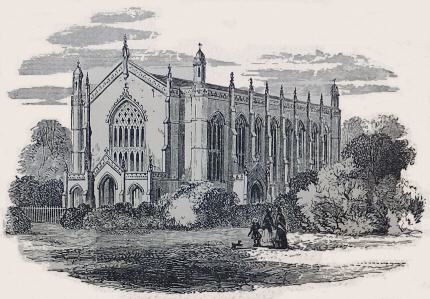
Three windows on the north side and four on others are also
filled with stained and quarried glass, with designs of a better
school.
The organ, a fine instrument by Walker, is at the west end in
the gallery, and well decorated.
It is now forty-three years since this church was consecrated,
and during the last eighteen years it has been under the same
incumbent, who has been one of the Kensington Clergy for nearly
thirty years. It occupies a large district in the west of
Kensington, and has itself, in progress of time, become a parent
church to several others which have risen within its
bounds. St. Philip’s and St. Matthias are districts
formed out of it; and the more recent erection of St. John the
Baptist’s Church in the Holland-road marks a still further
development. It has also a separate appendage to itself in
the “Church House” in the Warwick-gardens, which has
been built to accommodate the surplus of its regular
congregation, sanctioned by the Bishop, and served by its own
clergy. Here invalids who cannot conveniently attend the
larger congregation, and such as cannot for the present obtain
accommodation there, are invited to attend. In point of
fact it is altogether a separate church served by the Vicar of
St. Barnabas and his curates. As, however, it is treated
simply as an out-building of St. Barnabas—and is used for
the transaction of its various parochial business—we must
consider it as included with it.
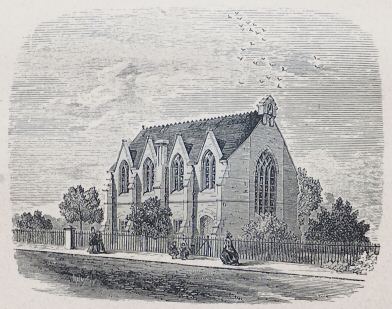
St. Barnabas’ Church has accommodation for about 1,500,
and its morning congregation averages from 1,200 to 1,400,
looking well filled. The evening congregation, however, is
much smaller, as a rule, as is the case with most West London
churches. But we may attribute this partly to the existence
of an afternoon service, at which there is public catechising,
which is very fully attended. The church is daily open, and
the Holy Communion is celebrated every Sunday. There is no
High Church costume, or parade of surpliced choristers, but there
is a most efficient choir, who fill the space in front of the
organ in the end gallery. On the occasion of our visit,
which was St. Barnabas’ day, June 11, the church’s
annual Feast of Dedication, the performance consisted in a
Gregorian and other much more pleasing chants in D and A, with
hymns special to the occasion. The Gregorian strain never
pleases; and seems to us adapted mainly to break up and destroy
the natural form, music, and sense of the English tongue.
There are three curates, who perform their subordinate parts in
the service with great propriety and credit. Such only who
could accomplish this would be at all in keeping with the
character of the chief pastor. Dr. Hessey has a matured,
well-cultured Christian mind, in addition to learning, and
natural talent and taste for the duties of the pulpit.
There is also a gravity and kindliness in his general manner and
utterance which leaves one in no doubt as to the secret of his
power. The sermon on the occasion of our visit
was an anniversary one, and as being confined to a portion of
appropriate historical Scripture (Acts xi, 26), did not offer
scope for the full exercise of the preacher’s powers.
Yet the evidence of their existence was there.
The clergy are supported chiefly by pew-rents, and there are
offertories and collections for various charities, missions, and
other objects. For the poor, for schools, missions, choir,
incidental church expenses, the Bishop of London’s Fund, in
aid of hospitals and other charities, there was raised altogether
in 1870 704l. 11s. 10¼d. Out of this it is
found impossible to provide for the heavier church
expenses. A church-rate is also levied, to which it does
not appear what response is made. We have reason, however,
to believe that no large sum is thus collected, or the
churchwardens would have been able to spend more on the
decoration of the church. There is clearly room for
considerable improvement here, and we hope there will be no great
difficulty in providing means to carry out the church repairs
which are so much needed. The whitewasher, painter, and
grainer might in the interior be employed with good effect.
A building set on a hill cannot be
hid, and it is literally true of St. John’s Church; it is
just on the crest, of Notting-hill, and may be seen from a great
distance in the perspective of the long road, to the west of
which it stands. Its effect is at first sight very good;
the spire, however, rising at the intersection of the nave and
transepts, appears too stunted, as if it had been drawn down
several feet into the tower, a fault to be deplored in many
instances. Built of stone and covered with slate, the early
English detail, generally very good, the character of the style
very truthfully retained, as shown by the chancel windows, the
well-executed caps and bosses, and in the eastern triplet, make
up a very excellent attractive whole. The plan of the
church is cruciform, and is divided into a nave and aisles, north
and south transepts, chancel and aisles, with a vestry at the
N.E. angle. There are several large galleries, one at the
west end, one in each of the transept and chancel aisles, which
add very considerably to the accommodation for sittings.
The organ is placed in the west gallery, and rather takes from a
good perspective, as seen looking westward, the stone columns and
plaster-moulded arcade giving a very poor effect; and the church
generally supports some well-designed work in the clerestory,
where oddly enough we find stone used again, though we cannot
help feeling glad to see it, instead of the plaster work before
referred to. The roof is high-pitched and open, of good
design, but, owing to so little of the light of heaven
illuminating the interior, we are unable to say much about
it. The lancet windows are not enough to admit the cheering
rays, and this is certainly a drawback; it gives to the church a
gloomy appearance which it ought not really to have. Most
of the windows are filled with stained glass, but of no good
type, except the eastern subject, representing the Lord’s
Supper. The font, close to the west door, is of simple
design, and has the emblems of the Evangelists sculptured in
relief on the bowl. The pulpit, too much like a large
wineglass, is lofty, and blocks out the view, looking east.
The pewing is very mean, and on a level with the pewing of the
passages, which is not improving. Some simple wooden
screens shut out the chancel from the aisles, and the table is
plain and railed off. The diaper work painted on the
chancel wall is well done and effective.
Early in 1845 the Church of St. John was consecrated for
divine service in the northern division of Kensington.
Misgivings were expressed at the time that the site, one of the
most attractive in London, had been chosen too far out in the
fields; but the population of the district has since risen from
less than 3,000 to more than 60,000, and has been partitioned
among six new parish churches, all built from voluntary
contributions, and maintained without endowments. The
church, parsonage, and schools of St. John’s represent an
expenditure of nearly 20,000l., almost entirely raised
within the parish; and the subscriptions and collections for 1870
amounted to 996l. collected in the church, besides
850l. pew-rents, and 2,390l. collected in other
ways for local and missionary purposes. Between 500 and 600
children are in attendance at the schools, and nearly 400 of them
belong to the Parochial Provident Society, which consists in the
aggregate of 731 members. The congregation appear much in
need of the additional comfort and accommodation which would be
derived from removing the organ out of the west gallery, and
letting in the light from the handsome window behind it.
The design of the architect might then be carried out, and the
organ and pulpit be placed as originally intended, throwing back
the fronts of the north and south transept galleries. This
church has suffered a good deal at different times from
well-meant efforts to provide additional accommodation for the
vast population which has grown up round it; but nothing has been
done which might not be easily set right at a small
expenditure. The present incumbent has been seventeen years
in residence, and was appointed by the late Bishop Blomfield, of
London, the see to which the patronage belongs. The east
window is an adaptation in coloured glass of the “Last
Supper” of Leonardo da Vinci, and was offered by the
parishioners as a memorial of their sorrow for the early loss of
Eleanor Isabella, only child of Sir John Franklin, and wife of
the incumbent, who was cut off in the midst of a career of
singular activity and Christian usefulness about ten years
ago. A mural monument close by records the decease of the
previous incumbent, the Rev. E. Denniss, who fell a victim to
cholera in 1854. This likewise was placed there by the
parishioners as a monument of their affectionate regret; and it
is very observable that our new churches derive increased
solemnity and repose from the gradual increase of such mementoes
as these.
Out of 1,400 sittings, this church has about 400 free; all the
others let at rates varying from 4s. to 15s. per quarter.
The congregation is composed mainly of the well-to-do people of
that part, and the collections which are made for various objects
through the year average from 50l. to 60l. a
Sunday, whether it be for home or foreign objects. The
organist, Mr. Cooper, is surrounded in the orchestra by a
selection of the male Sunday scholars—who are evidently
well-trained, and make up an effective choir—without
surplices. The service is completely on the Evangelical
model, animated and thoroughly devotional, and the congregation
join in it earnestly. The prayers and lessons were well
read by a substitute for one of the curates, who are two, the
Rev. Messrs. Leicester and Newton. The sermon was preached
by the incumbent, the Rev. J. P. Gell, from Psalm iii. 4,
“He hath made his wonderful works to be
remembered.” The rev. gentleman’s preaching is
careful, practical, and devout; and appears to come directly home
to his hearers, over whom, through a long series of years he has
maintained a very manifest influence for good. The ordinary
services are on Sundays at 11 a.m.,
and 7 p.m., and lecture on Wednesday
evening. At 12.30 there is full Communion Service every
first Sunday in the month, after the morning service; and an
early celebration at 9 a.m. on every
third Sunday in the month.
St. George’s, Campden-hill,
the spire of which, in the distance, is so closely allied to the
Kensington Water-tower and that other familiar object of West
London distance, Tower Cressy, that we suppose there are few who
are unacquainted with the rather odd-looking trio. Either
of them taken alone would form a good distance object, but as it
sometimes happens they all three lump together in the landscape,
the effect is not only odd, but certainly striking, the
water-tower always looking like the big brother of the other
two. St. George’s, however, must now be taken alone,
and really it deserves to be especially noticed. The church
stands N. and S., the south elevation being worthy of remark for
much excellent and effective detail. The tower and spire,
of fair proportion at the S.E. angle of the building, form an
important feature of this view. The spire is broached and
covered with slate in bands, and relieved with wooden spire
lights with iron finials, giving a picturesque appearance.
The tower is without buttresses, and, like all other portions of
this south elevation, is faced with stone in random courses, with
Bath stone quoins and dressings, and clean-cut bands of stone of
warmer colour. It is lighted by deeply-recessed lancet
windows, with columns and foliated caps, and bands on all
sides. The staircase within is clearly marked by raking
lines of windows, simple and effective. The centre of the
gable of this elevation is occupied by a large and boldly-treated
window, with geometric rose and four lancet lights, deeply
recessed with label mould, encircling three well-carved heads in
relief; this window is flanked by side two-light windows, partly
concealed by the tile roof of the large cloistered porch.
Being the principal entrance to the church, this roof is
supported by dwarf and massive columns, with carved caps and
cusped arcade. The whole forms a picturesque feature in
perspective. The side and north elevations are very plainly
treated in brickwork, with coloured bands or strings continued
round the buttresses. The windows are executed in stone,
plain-cut, unsplayed tracery; the reason for this change in
design is evident—these elevations will shortly be hidden
by the houses that are hourly springing up round the
church. The usual stone finials and crosses are replaced by
iron of like character.
The plan of the church is slightly cruciform, and consists of
a nave and aisles, east and west transept, a doubly-recessed
apsidal chancel, and aisles. Large galleries run round
nearly three sides of the body of the church, and at the south
end there is a double tier for school-children. Galleries,
as we have often observed before, do not improve the good effect
of a building; however, these galleries have a novel treatment:
the balcony—if such an expression may be used—is
suggestive of a conventional ship’s side with the ports
complete. We by no means wish to convey a false impression
by these remarks, for the lines of these galleries are very
graceful, and yet sufficiently angular to be quite in keeping
with the style of the church. The corbelled principals of
the galleries, too, are effectively cut; they take a bearing on
the iron columns of the arcades, from which, in every other
respect, they run clear. We never remember to have seen
iron better treated in church-arcade columns. The detail is
sharp and clean, and the columns are not so slender as to appear
unequal to their task of supporting the brick arches and
clerestory, and the light nave and other roofs with saw-tooth cut
and intersecting ribs. Generally the interior effect is
exceeding good, especially the arcade of the east transept.
There is evidence of great originality of thought on the part of the
architect, which we cannot fail to notice and admire, and the
colouring is harmonious and quiet in the corbels, bands, and
courses, which are of stone, nearly all ornamented with flowing
Gothic scrolls, painted black and incised. The font is an
excellent example of early work jewelled with coloured bosses
round the circular bowl, with the inscription “One Lord,
one Faith, one Baptism.” It stands near to the
southern doors. The oak pulpit is elevated to suit the
galleries, stilted on stone clustered columns, with foliated
caps, and butts upon the chancel west pier. The oak-eagle
lectern is also at the entrance of the chancel, and is very well
executed. The pewing, perhaps the least attractive portion
of the fittings, is, however, well cut, but too dark to our
mind. The organ occupies the west chancel aisle, and is
placed over the vestries and quite undecorated. The chancel
windows in the apse are well filled with stained glass, by
Messrs. Lavers and Barraud. In the rose is represented the
Crucifixion; the four lancets, the Evangelists and their
emblems. The passages are paved with plain tiling.
Mr. Bassett Keeling, of Gray’s-inn, was the architect, and
we must congratulate him upon having produced an exceedingly
beautiful and original type of church. The first stone was
laid by the Ven. Archdeacon Sinclair, in Feb., 1864, and by
Trinity Sunday in the following year the church was opened for
Divine Service.
This church is situated partly in the Ward of St. Mary Abbotts
and partly in that of St. John’s, Notting-hill, having in
both departments a little over 8,000 inhabitants. It
provides 1,400 sittings in all, 413 of which are free. But
these in cases of emergency can be added to by about 150,
provided by a system of telescopic seats, which can be
drawn upon occasions from under the fixed pews, across the main
aisles, filling up the entire area of the church. Six or
seven years ago the site of St. George’s was a
cabbage-garden; but a private Christian gentleman conceived the
happy idea of converting it to its present purpose, built this
beautiful edifice at his own cost, and presented it to the
district. The congregation has grown up almost as rapidly
as the building itself. All the sittings not free are let
at from 1l. 1s. to 2l. 2s. per annum, and the
congregation is usually full and of a superior class at the
morning and evening services. The Duke of Argyll and the
Earl of Airlie and families hold sittings, and usually attend
here, with other families and persons of note and character
located in and about this aristocratic neighbourhood. On
Sunday morning, the 25th of June, 1871 the church was crowded, a
rumour having gone abroad that the Princess Louise, the
daughter-in-law of the Duke of Argyll, was expected to be
present. If this were the cause, however, there must have
been considerable disappointment, as the Princess was certainly
not there. The Vicar, the Rev. George Bennett, who is
usually the morning preacher, preached a useful and
discriminating sermon on John xvii. 16, pointing out in what
sense Christ was not of the world, and in what sense his true
people are not of the world. Some seasonable remarks were
made about the temptation under which Christians now lie to
succumb to what is called “public opinion,” until
there is danger of their placing the voice of
“society” above the voice of conscience and the word
of God. Yet this was the only standard of right and wrong;
whilst the standard set up by the world was an unreal one,
and not sincerely believed even by those who, from the force of
fashion, practised it. The prayers were read by the Rev.
Mr. Becker, and the Litany by the Rev. Mr. Frampton, the
Curates. In this instance there is also a lay reader, Mr.
Gordon Cleather, who, in a surplice, read the lessons well and
distinctly. The Rev. Dr. Davis is the evening preacher, who
is known as a clergyman of distinguished talent. The church
has no endowment, and the clergy are maintained and the expenses
met out of the pew-rents and offertories. There are several
religious and benevolent institutions, also, supported by the
congregation or receiving aid from it. In St.
George’s Schools there are boys about 100 and girls the
same number, with infants about 130. These received
voluntary aid to the amount of 160l. in 1870. There
is a District Visiting Society account, for which, including a
Maternity, Provident, and Work Society, there was received
from various sources and disbursed the sum of 360l. in the
year. The offertories, apart from subscriptions—and
from which all objects are aided in proportion—brought
181l. 0s. 6d.; and there are lists of subscribers to all
the funds—as, for instance, to the Church Service Fund, the
offertories for which amounted only to 39l. 16s. 9d., but
which was raised by two collections in the year and subscriptions
to 108l. 11s. 4d. The worship is plain Church of
England, barring the intoning of portions of the prayers.
The choir is not surpliced, and the singing, for the most part,
lively, accompanied by a good organ, well played by Herr Sowerby,
Professor. The hymns are “Ancient and Modern,”
published at the Sacred Music Warehouse, Novello and Co.,
Dean-street. The order of services are—Sunday:
morning at 11, afternoon 3.30, evening at 7; Wednesdays, Fridays,
and holidays. Holy Communion on the first and third Sunday
in the month at 9 a.m., and on the
second Sunday after the morning service.
St. Peter’s, Notting-hill, in
the Kensington-park-road, is an Italian edifice, looking of some
importance as regards its west elevation, the only portion of the
church seen from the road. On close inspection it is
disappointing to find stucco in place of stone facing the
work. The elevation consists of a large enclosed portico
with engaged columns, supporting an entablature and pediment,
which is surmounted by a square tower with engaged columns and
tower lights, and terminating with a sort of pepper box
top. Although not so prominently or so beautifully placed
as St. John’s, it has a pleasing appearance from the road;
the effect, however, is somewhat diminished by a dwarfed
cupola. A more lofty, tapering campanile would have added
much to its importance. The façade is not seen to
advantage, from its close proximity to the road. A large
vestibule gives access to the main body of the church and the
gallery staircases. The plan of the church consists of a
nave and aisles, a portion of the east end being railed off to
form a chancel. Three large galleries partly enclose the
church, and entirely cover the space of the aisles. Large
Corinthian columns and entablature support the roof; just above
the cornice are semicircular clerestory lights, glazed in a
fan-like manner. The roof is enclosed by a flat ceiling in
panels, ornamented with centre flowers, and the aisles are ceiled
at a lower level below the clerestory.
The church has had everything done for it that can be in the
way of decoration, which has been very beautifully executed, and
in perfect keeping with the style of the building. The
Greek ornament and colouring are at once harmonious and
agreeable, and should prove a good lesson to all, showing what
may be done to beautify even a heavy building, and how very
efficient church decorators have hitherto been in the adornment
of our churches. One can only hope that some whitewash
advocates may be induced from these remarks to visit St.
Peter’s. We are quite sure they will change their
minds—and some churchwardens may well blush for their own
doings, and set about an improved state of things in their own
churches. The east end is more ornately decorated than
other portions; the caps and bases of the columns are guilded,
the panels are fitted with diaper and lily ornaments. Some
rather happy stained glass, illustrating incidents in the life of
St. Peter, assists in producing an exceedingly well-conceived
whole. Two of the windows are of superior workmanship, by
Clayton and Bell, but the centre large one is slightly
pretentions, somewhat faulty in drawing, and not equal to the
general features of the decorations, though the appearance of the
chancel on entering the church is singularly fine. The
Gothic furniture and stalls of the chancel we dislike, being out
of place. The pulpit is cleverly contrived to be as light
and unobstructive as possible, yet necessarily high, on account
of the galleries, and, moreover, so gossamer-like with regard to
its enclosing railing, that any near-sighted strangers may be
forgiven for a feeling of nervousness for the safety of the
preacher.
The vase font is near the western entrance. The organ is
in the west gallery. Some stained glass of good design
fills some of the aisle-windows. The passages are paved,
with ornamental tiles, the pewing has been cut down, and would be
greatly improved raised four or five inches above the level of
the passage-paving. The church is thoroughly and
expensively heated with warm air, and lighted at night by a
sun-burner from the roof, containing 120 jets. Every
attention appears to have been paid to ensure the comfort of the
congregation. The most marked feature of St. Peter’s
Church is its interior, which, as a whole, is very
beautiful. The style is worked out in Pompeian red, and,
although florid in development, is by no means obtrusive; and
from the general harmonies of colour and subdued blendings, it is
thought to conduce to a feeling of devotional repose. The
galleries, however, constitute a great drawback to this otherwise
very pleasing interior. They are too flat in construction,
and too ponderous for the limited space between the roof and the
floor of the side aisles.
This church is one of six now gathered round the original
church of St. John’s, Notting-hill, and is allocated to one
of the six new parishes into which the old parish has been
subdivided. It was built in the year 1856, with funds
furnished partly by the incumbent and partly by donations from
the immediate neighbourhood. It has sittings for 1,400
persons, out of which 400 are free. There are, in connexion
with it, large and exceedingly well appointed schools, numbering
150 boys, 150 girls and 220 infants. The efficiency of
these schools has been authoritatively commended.
The present vicar, the Rev. J. Robbins, D.D., of Christ
Church, Oxford, was appointed in the year 1862. We had not
the opportunity of hearing the rev. gentleman preach, but he read
the first lesson, and we consider him quite a model reader.
From a firm, distinct, and flexible utterance, and as from a
ready appreciation of its sense, Scripture is made to speak its
meaning, and to convey real effect in the reading. The
general order of service he has adopted is semi-choral. The
prayers are monotoned, the chants and responses are
Gregorian. The choir is mostly composed of boys, with
surplices, educated in the schools attached to the church, and
who sing the music about as well as such music can be done.
The Creed is, also, in reality, sung and accompanied with the
organ. We must confess to a disappointment in the effect
produced by the organ, the tones of which did not seem to
harmonise with the flow of voices; but we hear this is about to
be remedied. To many there would doubtless seem in this
service an excess of singing, and that, monotonous in a large
degree. But it is the High Church order of things; and St.
Peter’s is confessedly High Church. There are various
societies attached for the visitation of the poor and the
distribution of several charities.
The sermon on Sunday morning, July 2, 1871, was preached by
the Rev. C. R. Robinson, M.A., Canon of Rochester, for the
Gravesend (or St. Andrew’s) Waterside Mission.
Notwithstanding the inclement weather, the church was fully
attended by a congregation in the midst of which it was hard to
discern a single poor person. The preacher discoursed
pleasantly on 1 Peter v. 10, 11—“But the God of all
grace,” &c. His account of the origin of St.
Andrew’s Mission, of which he himself was the founder about
ten years ago, and of his personal interviews with seamen in
going to sea and returning, distribution of books, &c.,
riveted the attention of the audience, and appeared to excite
intense feeling in favour of the noble objects of the
society. The usual preliminary part of the Communion
Service, including the Commandments, the Nicene Creed, Epistle
and Gospel, was not read; but the sermon followed the Litany and
hymn. The hymn-book used is “Hymns Ancient and
Modern” (Novello, Ewer, and Co., Berners-street).
Usual services—Sundays: 8 a.m.,
Holy Communion; 11, Morning Prayer, Litany, and sermon; 12.30
p.m., Communion (choral); 3.30 p.m., Evening Prayer and catechising the
children; 7 p.m., Evening Prayer and
sermon. Week-days: 8 a.m.,
morning prayer; 5.30 p.m., Evening
Prayer (choral); Wednesday and Friday, Litany, 12.30 p.m.; Thursday, Communion at 7 a.m., and also on saints’ days and
holidays. The church is open all day for prayer and
meditation, and a public notice at the doors requests “all
persons to observe silence.”
St. Paul’s, Campden-hill, is
a large iron structure, standing at one corner of
Vicarage-garden. As an iron building there is very little
to say about it; it is not beautiful—iron buildings never
are—but the situation is so very charming, that, plain as
the features are of the church, the pleasant nook in which it is
placed seems quite to take from its ugliness and lend some of its
cheerful pastoral happiness to its iron tenant. One thing
strikes us as worthy of notice—the very large open porch at
the western entrance offers ample shelter and accommodation to a
large dispersing congregation in wet weather, and it has the
advantage of offering protection from heat as well as wet, and
keeps the west end of the building cool; it is like an open
vestibule or lobby.
St. Paul’s was erected as a chapel of ease to the parish
church, St. Mary Abbots, Kensington, in the year 1854, so that it
was one of the earliest of this temporary method of providing for
public worship; and it may be added that, from the present firm
and substantial appearance of the structure, it is evident this
comparatively inexpensive way of dealing with the
question—where larger funds are not at command—may be
made to do good service through at least a generation. It
affords accommodation for 1,200 people, and but few of the
sittings are free, not, we believe, amounting to more than
fifty. The church is served by the curates of Archdeacon
Sinclair, Vicar of Kensington, and at present, during the
re-erection of the new parish church, has double service
performed in it every Sunday. The early service at a
quarter to ten, and afternoon at half-past three, at which the
Archdeacon’s curates officiate, are for the congregation of
the Old Church, who, pro tem., are without accommodation,
and the services at half-past eleven and seven are given to the
congregation of St. Paul’s, when the Archdeacon himself
usually preaches. This is of a high-class character, and
remarkable for a very large preponderance of gaily-dressed
ladies, quite in keeping with our established ideas of a court
suburb. The service is Evangelical, the clerical robes of
the simplest character, and the chancel without conspicuous
ornament of any kind, but that which is the greatest adorning of
a church, a reverent and rational performance of Divine worship,
without formalism or Ritualistic affectation of voice and
manner. We were favoured to hear the venerable Bishop of
Bangor, who delivered an impressive sermon, full of Evangelical
sentiment, from 1st Epistle of John, c. iii., v. 2:
“Beloved now are we the sons of God; and it doth not yet
appear what we shall be,” &c. A young
clergyman—a stranger to the congregation—read the
prayers, Psalms, lessons, and Litany.
The congregation is of course interested in the schools and
charities belonging to the parent church, and contribute in a
liberal degree to their efficiency and support. These will
be fully described in their proper place, when we treat of the
beautiful new parish church now in course of erection.
St. James’s, Notting-hill, is
situated in the Addison-Road North, and is seen to some advantage
at the entrance to the road. From its central position, its
square tower and sharp pinnacles look grey and old, an appearance
which the church loses upon closer inspection. It is built
of grey brick, with moulded angle bricks and slight stone
dressings, and the low-pitched roofs are covered with slate.
The plan of the church consists of a nave and aisles, with an
apsidal chancel, the tower forming an excrescent on the south
side, about the middle of the nave. This tower acts as a
porch on the lower story, and has a ringing floor on the gallery
level; these galleries surround the church on three sides,
extending to the arcades. In style the church is a revival
of the early English, and, like all churches of the period, is
full of mistakes, though as a specimen of that age it is perhaps
a very fair example. But the efforts of revivalists must
not be forgotten; much of our perfection, if it can yet be
called so, is due to their endeavours. The iron columns
of the nave are worthy of remark, showing how very well iron
could be treated even in those days. The roofs are open,
and though rather heavy possess some fair effect. The
windows are chiefly without tracery, and the stained glass is
poor. The pewing is very simple; the pulpit high. The
prayer-desk and oak-eagle lectern speak of a desire for better
things. The font is poor and too perpendicular. The
organ is in the western gallery. The decoration of the nave
is not well done; it is evidently the work of an unskilful
hand. There is no need for Greek ornament in a Gothic
building; surely there is scope enough for the ornamentalist in
Gothic work without going to the Greeks for examples.
St. James’s, Notting-hill, is one of the older modern
suburban churches, having been built more than a quarter of a
century ago, which is a great deal to say as compared with a
number of the churches we are now reviewing. It
accommodates 1,100 persons, and 500 of the sittings are free,
which is in larger proportion than general. It has national
schools attached to it, where 135 boys, 100 girls, and 150
infants are instructed according to the principles of the Church
of England. These schools are kept up at a cost of about
500l. per annum, about 170l. of which is obtained
by Government grant, about 140l. from the children’s
fees, and the remainder from subscriptions and offertories.
There are Mothers’ Meetings and a District visiting
Society, with which is connected a mission woman and a
mission-house in Crescent-street, where extra services are
held. Also a Maternity Charity, and the “St.
James’s Norland and Potteries Benevolent Society,”
and an “Auxiliary Church Missionary Society.”
Help is also given to the Additional Curates Society and the
Bishop of London’s Fund. All these charities and
works were well inaugurated in the time of the former Vicar, the
Rev. T. P. Holdich, and have been well sustained since his
removal—three years ago—by the Rev. George T. Palmer,
M.A., his successor, and the present Vicar. An important
alteration, however, has been made in the mode of providing the
necessary funds. Formerly it was done by special annual
charity sermons; but for this method Mr. Palmer has substituted,
we are informed with some advantage to the interests concerned, a
weekly offertory, or collection taken at every Sunday morning
service, which is apportioned among all the charities and calls,
according to their relative claims. This covers everything,
and beyond it there is nothing but a church-rate, voluntarily
given, amounting to about 25l. per annum. From these
sources and the pew-rents the clergy are maintained, the church
expenses met, and the charities supported. The Curate, up
to Michaelmas-day last, was the Rev. P. E. Monkhouse, M.A., which
appointment he resigned on accepting the head-mastership of the
Notting-hill Proprietary School, in order to devote the whole of
his time to the education of the boys entrusted to his
charge. Mr. Monkhouse, however, still gives his services to
Mr. Palmer, and preaches frequently. His successor is the
Rev. I. Cammack. On the occasion of our visit the latter
read, or rather monotoned the prayers with a clear voice, and Mr.
Monkhouse read the two lessons with good taste and effect.
Mr. Palmer himself read in the Communion Service and preached the
sermon. In giving notice of the Communion for the following
Sunday morning, the rev. gentleman dispensed with the usual form,
and simply made the announcement that it would take place at nine
a.m. The sermon was founded on 1
Peter iii. 13: “And who is he that will harm you if ye be
followers of that which is good!”
The sermon was extempore, expository, and instructive.
What it was to follow good was well expounded; and the
limitations with which the implied promise was to be understood
clearly set forth. Although the Christian’s lot was
not to be represented too darkly, it was not to be supposed that
he had no trials or suffered no evils. Yet, after all, many
of his trials did not arise from his following good, but rather
from his not doing so in some particulars in connexion with which
his trials arose. Mr. Palmer has thoroughly entered into
the labours of his predecessors. He has, however,
instituted a few changes as to which some members of the
congregation, who could bear no variation from the order of
things under their old pastor, took offence and betook themselves
elsewhere—not in any great numbers, but it was sufficient
to draw from the rev. gentleman a justification in his first
pastoral. Therein he shows that some of the changes,
especially in regard to the offertory, were contemplated by Mr.
Holdich; and as to the conduct of the service, he had done
nothing but what was in accordance with the Rubric. To
allay all suspicions of a Ritualistic tendency which had, he
says, “unjustly, though not unnaturally risen,” he
declares to his flock his belief that “the practices
commonly known as Ritualistic are as much opposed to the spirit
and structure of the Prayer-book as they were for the most part
unknown in the worship of the Church in the apostolic age, and
that every decision in the ecclesiastical courts had made this
conclusion more plain.” There is no pretence for
styling Mr. Palmer a Ritualist nor a High Churchman. His
service occupies a position between the latter and what is known
as extreme Low Church. His prayers are not intoned, but
monotoned; his music is Anglican; his chancel is freshened up
with modest ornament; the choir, although not surpliced, is
very efficient; the hymns used are “Hymns Ancient and
Modern.” He considers that “a dislike to
Ritualism had in many cases produced tediously dreary services,
and painfully indecorous conduct in church,” and has been
influenced by a desire to give “heartiness” and
“reverence” to the service. The words are
probably a little too strong to convey the true meaning.
Tedium and indecorum are, alas, things incidental to High service
as well as Low, and must by no means be connected essentially
with a plain and simple performance of worship. Mr. Palmer
has an interesting, well-conducted congregation of a very
respectable class, with a fair intermixture of the humbler
classes, especially in the evening. It struck us that the
assembly was heartily devout; but was not yet thoroughly
congregational in the singing. The last published pastoral
bears evidence to the energy with which the minister follows out
his plans for usefulness; but he has occasion still to notice a
degree of unpunctuality in attendance at the service, many
not being in their places at the reading of the general
confession. It is gratifying to see a clergyman dealing
faithfully with his people and entering into the details of their
practice, not shrinking from pointing out their failings as
occasion offers, but in an anxious and kindly spirit. For
this Mr. Palmer is to be admired, and his people will love him
all the more. Shortcomers have no objection to be
faithfully dealt with, if done in a genial temper; and it is a
mistake to suppose that winking at irregularities of this kind
pleases anybody.
Beyond the church and church work there are few things to be
noticed in St. James’s. We have only been able to
ascertain one very special matter of interest, which was found in
the book of the register of marriages. The marriage of a
certain Edward Walker and Ann Whinfield Williams, which took
place on Sept. 30, 1847, was attested by no less a personage than
the present ex-Emperor Napoleon—then as now an exile in
this country. As we read the handwriting, “Napoleon
Louis B.,” followed by another, “Count de
Montauban,” a crowd of reflections rushed to our minds such
as probably our own age alone could supply.
Services on Sunday are at 11 a.m.,
3.30, and 7 p.m. Holy Communion
is celebrated on the first, third, and fifth Sunday in the month
after “Morning Prayer,” and on other Sundays at 9
a.m.
St. Mark’s, Notting-hill,
takes one by surprise, it being almost hidden from view until the
visitor turns the corner of the St. Mark’s-road. The
west elevation possesses some good composition, and is boldly
treated. The tower stands at the south-west angle of the
building, and is surmounted by a broached spire, covered with
slate in coloured bands, and terminating in a weathercock, with
the cardinal points indicated, relieved by spire lights.
The spire dies into a square brick tower, banded in colour with
stone dressing. The belfry windows are deeply recessed with
marble shafts and foliated caps, with sharp-pointed
lancets. The tower also contains one of the western
entrances to church, which forms an excellent feature. It
is treated as a square-headed double door, with the tympanum
enclosed by a large hood mould, encircling well-carved panels in
relief, containing the emblems of the Evangelists. The
principal gable contains a three-light, simply-designed west
window, with a series of lancets, and small buttresses
below. A porch also at the north-west angle, in harmony
with the rest of the front is plainly and boldly designed, and is
flanked by a stone pinnacle, the use of which we do not quite
understand. One of the most striking portions of the
outside, however, are a series of flying buttresses, which are,
unfortunately, nearly hidden from view by the closely-surrounding
houses. These buttresses spring from square piers, standing
perfectly free from the church, and in perspective giving the
effect of a north and south cloister arcade. The finials
are of iron.
Entering the church by either of the before-mentioned porches,
they lead into large lobbies, containing the gallery stairs,
separated by screen walls one from the other; in the northwest
porch is a large and handsome stone bench, the elbows well cut,
and each ornamented with a Maltese cross.
The interior may really be said to be grand, owing very much
to the imposing height of the nave and the fearless nature of the
detail of roof and clerestory; the bold ribs, the bold sustaining
caps and corbels, all with sharply-defined and clean cut foliage,
indicating a skilled hand in design. We confess not to be
very fond of many bands of brick and stone, they give to an
interior a sliced appearance and take away from the effect of
space; yet, notwithstanding this defect, there can be no question
of a fine effect of heights.
The detail of galleries—the arrangement of the arcade
and iron columns, with the clustered angle columns at the
transepts—resembles St. George’s, Campden-hill, which
was planned from the pattern of St. Mark’s. The
transept and chancel aisle arcade is also similarly
treated. The church is cruciform in plan, with the
galleries free of the transepts. The north transept
contains the organ in a sort of high-legged loft, which rather
looks like putting the organ out of the way. A fine
chancel-arch shows nearly the whole of the apsidal chancel, the
walls of which are well-covered with a tessalace of tiles.
Seven steps lead up to the Communion space, the pulpit is raised
on four clustered shafts of red Mansfield stone, with
richly-carved caps, and handsomely enclosed with good ironwork,
instead of the usual stone box. The choir-stalls and
prayer-desk are complete and of good design, and the brass
lectern is well-raised. The pewing and bench-ends strike us
as being too heavy. The font is peculiarly elegant and
graceful, and is a good specimen of early work. The
passages are all paved with tile of dark colour. The style
of the church is early English ornately treated, if anything
perhaps a little too much so, the charm and beauty of early work
being its extreme simplicity.
St. Mark’s was consecrated on Nov. 27, 1863, by Bishop
Tait, the foundation-stone having been laid Nov. 1 in the
previous year. E. B. Keeling, Esq., was the architect, and
Messrs. Dove, Bros., the builders, and the cost in all
7,720l. A debt of about 1,000l. on the
building account was discharged by the contributions of the
congregation within the first three years. The site was
given by Mr. Blake, a freeholder in Notting-hill, and the sum of
5,000l. presented towards the building by the present
patron—a great gift and benefit to the locality. The
church is furnished with a good organ, built originally by Hunter
and Webb at a cost of 450l., but which has been
considerably improved since by Bryceson, by the addition of
several stops, including the vox humana, at the moderate
further outlay of 65l. The instrument is skilfully
employed in the service by Mr. Tamplin, professor of music, who
has associated with him rather a numerous choir, which has,
within the last twelve months only, taken to surplices. In
the first instance the service at this church was Evangelically
plain; but within the last three years, monotoning the prayers
and chanting the psalms have been introduced, as well as a large
increase of Eucharistic celebrations, and now more recently the
surpliced choir. These changes have occurred under the same
pastorate—that of the Rev. Edward Kaye Kendall—who
has been Vicar of St. Mark’s from its foundation. Mr.
Kendall is an enlightened and able minister, as is evident from
his pastoral circulars and the good reputation he has among his
people; and we presume is fully satisfied in his own mind as to
these changes, although some others have not approved them.
His congregation is good. The church, including the
accommodation of telescopic seats, will hold 1,500, 1,000
of the sittings being rentable, and 500 free. The average
congregation is about a thousand or over; and, together with a
large proportion of the higher middle class, there are many
poor. Earnest parochial work is being done. Quite
recently capital school buildings have been erected in St.
Mark’s road, where there is an average attendance on
week-days of near 400 children of both sexes, including infants,
and on Sundays 350. At the first a house close to the site
was rented and used as a school, but soon it was so crowded in
every room, and even on the stairs, that to obtain better
accommodation became a necessity, and it is gratifying to note
that the liberality of Mr. Kendall’s friends and
congregation has enabled him to accomplish this work with so much
expedition and success. A separate service is held for the
children on Sunday mornings in the schoolrooms, conducted
principally by lay-helpers, whose church-work the Vicar is very
anxious to utilise. Once a-month the children are also
taken to a service in the church in the afternoon. There is
a “Lay-helpers’ Association,” the members of
which, with the district visitors, have done much towards filling
the church with people, and in extending parochial work in
general. There is also a “Mothers’
Meeting,” a “Clothing Repository,” a Provident
and a Maternity and Sick Funds, a Needlewomen’s
Institution, a Lending Library, and a Soup-kitchen in
winter. For these various objects, as well as for several
foreign Christian enterprises, the offertory account amounted
last year to 663l. 2s. 6d. There is no endowment,
and the clergy are supported and all expenditure provided for by
the pew-rents and other voluntary means. The usual services
are: Sundays, at 11, 3.30 p.m., and 7
p.m. Weekdays, on Wednesday,
prayers at 11 a.m., and Fridays
prayers at 11 a.m., and prayers and
sermon at 7.30 p.m. Communion
every Sunday at 8.30 a.m., and after
morning service, and on every holy day falling on a weekday at 8
a.m.
We had not the opportunity of hearing the Rev. Vicar on
Sunday, July 23, 1871, his place being supplied by the Right Rev.
the Bishop of Honolulu (Dr. Staley). The prayers were
monotoned by the Rev. F. F. Kelly, LL.M., who succeeded to the
curacy at Christmas last, upon the removal of the Rev. A. H. Dunn
to Acton, where we understand the latter is very usefully
employed as a missionary in originating a new church, of which he
is to be the future vicar.
All Saints, Notting-hill, once looked desolate and
forsaken. It was like a church in a desert, and for a long
time remained so; but now the houses and pleasant squares have
grown up around it, and we can say it is situated in
Colville-gardens. It is early English in style, built of
stone in regular course, and covered with slate. At a
distance it is cathedral-like in miniature, and it is not too
much to say so, for upon a closer inspection the beautiful detail
of all its parts quite satisfies the mind of the artist, and he
leaves it without a feeling of disappointment. The roofs are peculiar
in the rise of their ridges at the gables. This gives a
somewhat broken look to them. The tower is very handsome,
but unfinished. It requires the lantern to be completed,
and marble shafts are required at the belfry windows. The
church has three entrances—one in the tower to the west, by
a handsome south porch, and by a north door. Slightly
cruciform in plan, without nave aisles, transepts, chancel, and
aisles, the nave arcade is peculiarly good, clustered marble
shafts, and well-designed caps and bases, with full moulding to
the arches. The clerestory is excellent in detail, and the
ring-post and ribbed roof is a change from the usual style of
church roof. The aisle corridors, too, are treated as a
light arcade with clustered marble columns. The church is
light, and the windows are filled with tinted and figured glass,
also some good stained glass in the aisles. The pulpit and
font are of alabaster; the pewing is light and of good design;
the flooring is tiled. The organ in south transept is
raised in a gallery of its own. The eastern wall of the
Sacrarium is decorated with fresco, rather floridly
painted—the angel saluting Mary and the birth of
Christ. These frescoes have been universally recommended by
art judges.
All Saints was consecrated in 1851, and represented an outlay
of 20,000l. The tower alone cost
10,000l.—a very large sum, when we consider the
incomplete character of the object on which it was spent.
One chief thing about it worth notice is its bell; which tolls
for church, and which has a deep and rich tone, reminding the
ear, more than any other in the vicinity, of a cathedral
“Tom.” The church is furnished with a very fine
organ, by Messrs. Gray and Davidson, and cost
1,500l. It has forty stops, including the vox
humana, and is, at present, under the management of Mr.
Walker, a pupil of Dr. Steggall. There is sitting
accommodation for between 1,100 and 1,200, 300 sittings being
free, and the remainder letting at from one to two guineas per
annum. The congregation is of a highly respectable class,
and apparently matured and settled. The clergy consisting
of the Rev. John Light, M.A., and three curates, the Revs.
Messrs. Bathurst Coults, and Griffiths, are supported entirely
from pew-rents, and a weekly offertory, which produces between
500l. and 600l. a-year, meets all other
expenses. With regard to the service at All Saints it is
moderately High Church; in every part of it there is an imitation
of cathedral effects. There is a good choir, with surplices
of course. Twelve of the boys have a free literary and
musical education under one of the curates in what is termed the
Choir School, the efficiency of the choir being thus continuously
provided for. The singing is of a superior
order—lively and spirited—and sufficiently wide of
the Gregorian monotone. The Te Deum and Jubilate
Deo are sung as anthems with good effect. The Prayers
and Psalms are intoned, and the responses sung by the choir and
congregation. And in excess of what is sometimes witnessed
in High churches, the General Confession was intoned by the
priest, and responded by the choir and people in song; and the
Commandments were intoned by the Vicar himself. It may be
observed that the assistant curate knelt with his back to the
congregation, whilst the Vicar intoned the Commandments. At
the name of Jesus in every place the minister and people
bow. A more striking illustration of the inconvenience of
this carried to excess could not be witnessed than in the singing
of one of the hymns. It was Hymn 314 in the Appendix to
“Hymns Ancient and Modern,” “When morning gilds
the sky,” &c. There are eight verses of six short
lines each, and in every third line the sacred name
occurs—that is sixteen times in the course of the
hymn. And the hymn being quickly sung, the head was kept in
almost constant motion. The Nicene Creed was also
sung. Then followed the sermon. The Vicar, ascending
the pulpit and facing the congregation, whilst yet standing,
pronounces, “To God the Father, Son, and Holy Ghost;”
and at once gives out his text. It was a brief address of
fifteen minutes, delivered without book or note. High
Churchism pretty much sets on one side the old-established Gospel
and Apostolic institution of “preaching the
Word.” In the present instance, here was a minister
of very considerable natural and acquired ability, which all who
know him must allow places him far above mediocrity; there was a
magnificent text of Scripture to discourse upon, “For our
conversation is in heaven; from whence also we look for the
Saviour, the Lord Jesus Christ.” (3 Phil. xx. 1.) It
would have been refreshing had there been time for this Scripture
to have received a more adequate illustration from the lips of
Mr. Light. But there are two full services every day, four
on every Sunday and on festivals. Two administrations of
the Holy Communion on Song Sunday and Festival; three sermons
every Sunday, the brevity of which is justified at All Saints
upon the principle, “That as God’s house is a house
of prayer, and not merely a house of preaching, the service
should be put before sermons.” But may not this
notion be carried too far? What is the relation between
preaching the Gospel and a proper devout performance of
general Christian service, implied in true conversion and
progress in spiritual life? We are not advocates for long
sermons, but it appears to us to abbreviate them as some are
doing is calculated to impair or defeat the higher spiritual
objects of public worship.
The Church of St. John the Baptist
is a temporary iron structure, and, like most other buildings of
the sort, offers no point for architectural notice. It is,
however, very good of its kind, and is, externally—as seen
in the comparatively vacant part of the new Holland-road in which
its stands—more picturesque than some others we have had to
review. But the approaches to it are at present quite
unformed, and when autumn and winter returns—unless
something be done—the state of the road can scarcely be
expected to help the congregation. We are glad, however, to
hear that road improvement is in immediate contemplation.
The interior is fitted with plain benches, and the temporary
chancel neatly arranged, with a slight tendency to
ornament. The church was at first rented from the builder,
but has since been purchased. It has sittings for about 900
persons, of which one half from east to west are free. Of
the other half a proportion only are at present let, at rentals
varying from 1l. 1s. 0d. to 30s. per annum; so that a
great majority of the congregation appear to avail themselves of
the free seats. The church was opened in February, 1869,
being planted in and intended to form a sub division in the
ecclesiastical division of St. Barnabas, Kensington. The
Rev. George Booker is incumbent and vicar designate. The
rev. gentleman is at present without assistance in the services,
except on Sunday evenings, when the Rev. Dr. Cosmo R. Gordon,
minister of St. Mary’s, Park-street, Grosvenor-square, and
head-master of the Notting-hill Collegiate School, is
lecturer. In consequence of this arrangement, the Sunday
evening lectures at this church are highly appreciated, Dr.
Gordon being a talented and an esteemed preacher. The Rev.
G. Booker, we believe, has set before him in the
services—“To realise the spirit of the Prayer-book
as it is, and not as any extreme party, High or Low, would
wish it to be.” There is, however, nothing in the
general service but what is reconcilable with High Churchism,
although it does not appear to be intended. Unisonal
chanting has been introduced within the last few weeks, on
account of its greater volume of sound, the acoustic qualities of
the church being very indifferent; but partly, also, from the
difficulty felt in this as other churches in keeping together a
complete double choir for antiphonal singing, where the services
of the lay-clerks are voluntary. There is, however, a great
preponderance of chanting in monotone, and this, whilst the
minister intones his parts in the service, gives to the whole the
impress of High Church service. There is a four-part
surpliced choir of considerable efficiency, and one is apt to
think it might appear to greater advantage in another style of
singing. But the Rev. Mr. Booker is personally a minister
of an earnest, evangelical type. His reading of the
Scriptures is deliberate and most appropriate in tone and manner,
and his sermon is by no means stultified in deference to the
other parts of the service. This is a great merit.
The sermon we had the privilege of hearing was founded on Luke
xvi. 9: “And I say unto you make to yourselves friends of
the mammon of unrighteousness; that when ye fail they may receive
you into everlasting habitations.” There was a very
clear exposition of the parable of the unjust steward, and the
right use as against the abuse of riches was cogently put, with a
due amount of illustration and enforcement. We do not
remember to have listened to a more instructive, practical, and
useful treatment of this somewhat delicate subject.
The maintenance of the clergy, church expenses, interest on
purchase money, &c., are objects to which the proceeds of the
pew-rents and weekly offertory are devoted. The former
source of income is at present limited and undeveloped. The
offertory, up to this time, averages about 330l. per
annum.
There is a very excellent middle-class school in connection
with this church, conducted by Mr. Studdy, a B.A. of the London
University. In this school the boys of the choir are
amongst the pupils and have their education free.
The Carmelite Church in Church
street, Kensington, is built of plain brick and stone and covered
with slate, and though plainly treated and of simple and almost
severe design, is nevertheless a good specimen of modern early
English church-building. The east front (the church stands
east and west) is the principal feature externally. It
contains a fine rose window and double entrance doors; those
doors open into a lobby to the right and left. The inside
is certainly very good, and reminds one a great deal of the style
of the Pro-Cathedral, but slightly more decorated and ornate,
though not so large. It has a fine effect of height, and
the roofs are handsomely decorated—between the rafters
having gold stars on a blue ground. The plan of the church
is simple; a nave and aisles, and the west end is treated as an
apse, in which stands the high altar, very fine and richly
decorated, with crocheted canopy, pinnacles, and niches.
The nave arcade requires to be finished, and the plaster arches
present a very poor effect. It is to be regretted that such a
substitute has been employed. The church has a number of
chapels, altars, confessional boxes, &c., usually found in
Roman Catholic churches. The floors of passages are paved
with tiles, and the nave is occupied with simple pewing.
The pulpit is very plain, almost ugly. Some good stained
glass fills the windows of the apse and some of the aisle
windows, but we do not admire the red glass of the
clerestory.
The Church of the Carmelite Fathers was opened six years ago,
having been erected at a cost of 5,000l., after the design
of Mr. Pugin, architect, of Ramsgate, by Mr. Smith, builder, of
the same town. The organ, which is a very splendid
instrument, built by Cavaille and Co., of Paris, and which is
equally remarkable for its soft and powerful tones, cost
2,000l. The altars, furniture, confessionals,
&c., cost about 3,000l. more, so that there is here
represented an outlay of at least 10,000l.
The fathers, who occupy the monastery adjoining, and serve the
church only—having no parish work—are at present five
in number. The prior is the Rev. Stanislaus Viney; and the
second and following priests are, Signors Lignori, Eschewiria,
Felix Rizzo, Hillarion Berger, and Edmund Sharples—four
Italians and one Englishman. There are services every hour
from seven a.m. to eleven; and on
Sundays vespers at half past three p.m. Sermon and benediction, high-mass
at eleven a.m. There are two
confraternities—that of St. Peter and the
Arch-confraternity of Thanksgiving. In connexion with the
first was established in 1863, at the invitation of Cardinal
Wiseman, “nocturnal adoration” of the
sacrament. Each active member—who can only be a male
person—has to watch once a-month one hour at night—a
bed being provided for him in the monastery the remainder of the
night. Fourteen members of this confraternity are summoned
for every Wednesday, and attend at ten p.m., the “Service of
Exposition” and prayers, after which all but two retire to
the dormitory. These two then commence the “Adoration
of the Sacrament.” Ladies are admitted as honorary
members only, and their privileges are to partake with the others
of the “merit of the adoration,” to be allowed to
“forward their intentions to be prayed for,” and to
pay a subscription of 2s. 6d. annually.
“The Arch-confraternity of Thanksgiving” has for
its special objects to render thanks for gifts, and above all for
the “gift of God—the Eucharist.”
“To make up for the frightful ingratitude of the greater
number of men.” For all benefits, but especially for
Jesus, “Who is really present on our altars in the Divine
Eucharist as pontiff and victim. For the Eucharist is not
only the gift of God to men, but the sacrifice of men offered to
God.” The sole obligation of the brothers and sisters
is to “recite every day as a thanksgiving for all men,
three Our Fathers, three Hail Marys, and three
Glorias.” The rewards promised to this
confraternity are special plenary indulgences—
1. On the “usual conditions, on
the day aggregation.”
2. At the point of death.
3. On the second Thursday of each month.
4. On the Thursday of Corpus Christi.
5. On the 8th of September, the feast of the
“Immaculate Conception.”
6. One of seven years and seven quarantains; whenever an
hour of adoration is made before the sacrament.
7. One of 300 days attaching to the reciting of three
“Our Fathers,” three “Hail Marys,” and
three “Glorias.” All these indulgences are
further declared to be “applicable to souls in
Purgatory,” and subjects of them are exhorted to use prayer
especially for this object. All this is enforced by the
following reflection: “Association tends rather to pay our
debts to heaven than to acquire new personal gifts. Would
not this end be sooner attained by placing in the merciful hands
of the Virgin the suffrages obtained by the exercise of our
gratitude, so that she may dispose of them as she pleases in
favour of the poor suffering souls who are still waiting for
their deliverance from the expiatory flames? Heaven
would thus be opened for the souls whom Mary loves
best.”
Such is Popery, in the very heart of West London! The
church is capable of holding about 800 people; but the
congregation is usually not full. There is no preacher of
any note, but the English priest, E. Sharples, is represented to
be the best and most acceptable. There are three side
altars on each side of the church, besides the High Altar, and an
equal number of confessionals, and the church is open all the
day. A quiet midweek afternoon was the occasion of our
visit. It was very warm; and here, at this confessional or
altar and the other, was a lady or a girl, bending in
silence.
Kensington Tabernacle, in
Horton-street, close to the High-street, is a very neat-looking
modernised building, so far at least as its west front goes; all
has been done for it that stucco can do, and its entrance arcade
gives to it an uncommon appearance, unlike the usual arrangements
applied to chapels.
The interior, with its large encircling gallery, good pulpit,
harmonium, nice pewing, make up a very satisfactory whole; but
the great charm of the interior consists in the quiet, excellent
taste displayed in the coloured decoration and painting, very
much to be admired, and worthy of imitation, and seeming to tell
its own tale of the simplicity and the faith of the congregation that
worship there.
The history of Hornton street Chapel has been various and
chequered. The church connected with it has been
successively Presbyterian, Congregational, and Baptist. The
old Presbyterian cause in Kensington began to shape itself about
the year 1790, when the few united together met in a plain
barn-like building at a place called South-end, at the end of St.
James’s-street, leading out of Kensington-square. The
most remarkable part of the church’s history here was that
it was right in the teeth of the noted local infidel of that day,
Tom Taylor, who held near the same spot what he called his
“Hell-fire Club,” in which, with his rough disciples,
he used to meet, and rave against religion and society.
From hence, we believe, the corner is vulgarly known by the awful
nomenclature of “Hell-fire-corner.” From this
scene the church removed to Hornton-street in 1793. Three
of the members had joined their means and influence to procure
this more eligible meeting-house. They were a Mr. Gray, a
nurseryman, Mr. Broadwood, the founder of the great pianoforte
firm, and Mr. Foreacre, the then coachman of King George
III. Of these three worthies it is told that they built the
chapel by bond-deeds, the amount of responsibility being equally
divided among them. Some time after the opening there
remained still due to each of them 600l., 1,800l.
in all; and at a certain meeting of the deacons, one of them took
up the poker from the grate and, winding his bond round the end
of it, thrust it into the fire, the other two immediately
following his example. By this noble act the chapel was
freed from debt, there remaining only a ground-rent of 8l.
8s. per annum. It is also related that the royal coachman
about this time dropped a handful of tracts into the coach one
day, when about to take out his royal master, and the King, who
it appears perused the tracts diligently, afterwards commanded
his devout servant to get him a further supply. The Rev.
Dr. Lake was the first minister, in whose time members of the
Royal Family from Kensington Palace rented a pew in the
chapel. He was succeeded in the pastorate by the Revs. John
Clayton, Dr. Liefchild, Dr. Vaughn, and Dr. Stoughton, now of
Allen-street Chapel, our account of which we should recommend to
be read in connexion with this. In the time of the latter
pastorate, Hornton-street Tabernacle became the parent of two
other chapels—viz., Horbury and Allen-street, to the latter
of which Dr. Stoughton attached himself with his church.
The chapel was then closed for a considerable time, and used only
as an appendage to Allen-street for school accommodation,
&c. There was, however, a division of opinion in the
matter, a few of the old members, contending that the chapel
should still have been used for its original purpose, and that
there was in the town abundant room for a second cause. To
this Dr. Stoughton himself was decidedly opposed, and
consequently it remained closed until it had been purchased by
the Metropolitan Railway Company, who, needing the schools in the
rear for the progress of their works, were compelled to take the
whole property. 4,000l. was thus obtained, with
which Dr. Stoughton was enabled to build his present superior
schools in Allen-street. In the meantime, Mr. Orchard and a
few others of the Baptist persuasion, had met in an office, now
an auction and estate agency, adjoining the old chapel, and
engaged the Rev. R. J. Mesquitta, of Mr. Spurgeon’s
College, as pastor. That minister’s success was so
great that they were shortly obliged to adjourn to the Avenue
Assembly Rooms. Whilst here, the railway company put the
old chapel into the market to be let. The church availed
itself of the opportunity and returned to it, undertaking it at
an annual rental of 115l. This was about a year and
a half ago. 600l. was required to put it in order,
build galleries, &c., which was promptly promised by members
of the congregation. One would have thought that this was
the beginning of better days; but, alas! through some evil
fortune, it was the beginning of a new and distressing
decline. In the settlement of the property now acquired in
the chapel, the four persons who had transacted the business, it
appears, did it all in their own names, without any legal
reference to the church for which they were the intended
trustees. This certainly was an error, from which one
subsequently, when he discovered the effect, was honourably
anxious to disentangle himself. The other three, however,
held out against the remonstrances of the minister, Mr. Orchard,
and others, who had made themselves responsible for the money to
those whom they had looked upon as trustees. The natural
ultimate consequence was, that the minister left in the midst of
his usefulness, the members and congregation quitted their seats,
and the church became again a wreck. To this state of
things the present pastor, the Rev. Mr. Hawes, succeeded a short
time since. He appears to be a minister of great
earnestness of purpose. He is a good Evangelical preacher,
and delivers himself mainly extempore, with considerable power
and unction, and it can only be hoped that he will succeed in
repairing the breaches of Zion, and building up this church
anew. There are about 700 seats, 300 of which—all the
galleries—are free. There is a small Sunday-school,
having about 60 scholars of both sexes.
Close to the Mall and the
High-street, Notting-hill, is a large, gloomy-looking structure
of the Classical School, not that it is by any means a good
example of classical work; it is heavy and badly proportioned as
regards its stucco-pediment cornice and columns, the latter
engaged, and the spaces bricked in and filled with window and
doors with stucco dressings. The interior we are not able
to report upon, the chapel being without a congregation.
This chapel was built nine years ago by Mr. Robert Offord, of
Kensington, for his brother, the Rev. John Offord, then of
Plymouth. It appears to have been originally designed for a
Baptist Chapel, being provided with a baptistry; but the Rev. Mr.
Offord from the first gathered around him Christian people of all
denominations, and formed what may be termed an open union
church. Of this he was the minister about seven years, and
won himself high esteem with all who could appreciate Christian
learning and excellence of character. He was not in the
general sense popular as a preacher, but drew around him a goodly
number of admiring friends, and the congregation prospered.
The chapel contains accommodation for 1,000 persons, and the
average congregation in his time was between 600 and 700.
The chapel, however, was the private property of Mr. Robert
Offord, and it had never been settled upon trust for the benefit
of the church, but had, in fact, been hired by the congregation
of the owner, at a rental of 200l. a-year. The
consequence was that, when the owner died, about two years ago,
some confusion ensued in the affairs of the church. The
minister and his friends, not feeling equal to the task of
undertaking a chapel in no degree their own, were inaugurating
arrangements to remove to some other place, when, in the
providence of God, the minister himself—surviving his
brother but by a little time—was called away by
death. The chapel was then put into the market for sale,
and was bought for 5,500l. by the late Dr. Schwartz, of
well-known German Jewish origin, but converted to the Protestant
faith and ultimately a Presbyterian minister. As a
condition of concluding the purchase, the property was made
freehold, which must be a great advantage to all subsequent
owners. This was all in last year, and Dr. Schwartz entered
upon his labours, but only for a short time. Six months
after his commencement, and only six weeks after his formal
induction by the presbytery to the pastorate, he, too, was called
to his rest. And now, the chapel still having remained
private property, the prospects of the church became as clouded
and uncertain as ever. It was put again into the market by
the executors of Dr. Schwartz, in the interests of his widow and
family, and was brought to the hammer at the Mart, in
Tokenhouse-yard, on the 14th of June last. The matter had
now been taken in hand by the presbytery on behalf of the church,
and they instructed their solicitor, Mr. Lewis, to attend the
auction and bid for the church to the extent of
5,000l. He, however, found himself at the Mart, in
presence of a powerful competitor unknown to him, but who seemed
resolved to outbid him. He was induced to exceed his limit
by 225l., but, being still pressed, declined to follow on
his own responsibility, and, accordingly, the chapel was knocked
down to the highest bidder, who turned out to be purchasing for
the Swedenborgians. Mr. Finney, a wealthy merchant of
Manchester, had made this body a present of 10,000l. for
the purpose of establishing a cause in Kensington. Hence
the sharp competition into which they entered for the edifice,
which was obtained by them for the sum of 5,000 guineas. It
is intended to build an organ, and make other improvements, and
in four or five weeks to open it as the place of assembling for
the “New Jerusalem Church,” or, in other words, the
Swedenborgians. None appear to regret more than the friends
of the Presbyterian cause themselves the passing entirely away
from them, and from the use of Orthodox Protestant Christianity,
of this well-situated and commodious structure. They would
have given, and on the next day one of them offered a very
considerable premium to the purchasers to relinquish their
bargain; but, although remarking that had they known it was the
congregation of the chapel itself bidding against them they would
not have persevered, they nevertheless held to their
purchase. The Congregational Church is at present meeting
in the Mall Hall, where they hold Divine Service every Sunday,
and are making inquiry for an eligible site, on which, as soon as
secured, they are prepared at once to build.
St. Clement’s, Notting-hill,
situated close to the Lancaster-road and the Potteries, is a very
noticeable structure—as simple, indeed, as it is possible
to be, yet treated with much good feeling and power. The
style is early English in a rather modest form, plain lancets and
gables, without decoration or carving. As a faithful
example of the style, however, it is worthy of notice; and it may
be observed that a permanent structure, plainly and simply, and
therefore
cheaply treated, is at all times preferable to temporary iron
buildings, often unworthy to be called churches, but which far
too often are allowed to be anything but temporary. The
nave and chancel and aisles have an unbroken line of roof and
ridge, save that at their intersection a small spire or
bell-turret rises square on plan, and like the roof is covered
with slate. The gables and facials add importance to the
structure.
The building is of yellow brick with red bands and stone
dressings, and the construction of the roof might be noted as
being peculiarly light and elegant in appearance. Mr. St.
Aubyn was the architect, and was certainly successful in
producing a building well adapted for hearing and seeing the
officiating clergy. The ventilation is excellent. The
nave and aisles are separated by wooden posts or iron columns
supporting the roofs, taking the place of the ordinary
arcades. The furniture of the church is in keeping with its
general character, and the floors are paved with tiles. The
cost of the whole was 5,500l. There is a very
sweet-toned organ by Holdich, but we are sorry to learn it is not
the property of the church, but hired. As, however, it can
be acquired for the sum of 300l., or probably something
less, we hope it will not be long before the congregation will
own it. It is ably played by Mr. F. K. Blanch, who is
assisted in the musical parts of the service by a very efficient
surpliced choir. The cast of the service generally is
semi-Anglican; the prayers are read and nothing is intoned
by the clergy; but all the responses are sung by the choir and
the congregation. The worship appears carefully guarded
against the peculiarities of High Churchism, without falling into
the other extreme, and we must confess the performance struck us
as being hearty and devout, as it regarded both the clergy and
the congregation. The present ministers are the Rev. Arthur
Dalgarno Robinson, M.A., of Trinity Hall, Cambridge, vicar, the
Rev. E. J. Venning, M.A., of Worcester College, Oxford, and the
Rev. Herbert Rowsell, M.A., of St. John’s College,
Cambridge, curates. We had the pleasure of hearing the Rev.
Vicar himself, who, in the absence of his curates taking their
holiday, had all the duty to himself. Mr. Robinson has a
clear and pleasant voice, distinctly heard in every part of the
church. He reads with remarkable propriety and effect, a
matter of first importance in a clergyman. In the sermon,
which was read, and founded on Deut. iv. 22, referring to the
last words of the great Jewish lawgiver, and to his not being
permitted to cross over into the land of promise, but to die in
that land, the preacher gave evidence of careful study,
imaginative powers, and deep feeling. The remarks were
highly instructive, and specially consolatory to the Christian
chastened in tribulation and disappointed of his earthly
hopes. The Rev. A. D. Robinson has been incumbent from the
foundation of the church, which was opened for Divine Service and
consecrated by the Lord Archbishop of Armagh on Tuesday, the 7th
May, 1867. It was erected for a district, perhaps the
poorest in all the Western districts, and containing a population
according to the recent census of 20,000. It supplies 900
sittings, the whole of which are free, and has an average
congregation of from 600 to 700. It is noteworthy that,
though in the midst of so poor a neighbourhood as the Potteries
and vicinity, the congregation in the morning does not by any
means appear of the poorer order, but in the evening many of the
poor are to be seen enjoying the services. The Argyle
family, and others from the wealthier parts of the parish of
Kensington, have taken a warm interest in the St. Clement’s
cause with regard to the peculiar population around. But
that people have not yet shown great appreciation of these
Christian efforts. Yet a good work is doing. There is
the church, in which we are glad to believe the Gospel is
preached, and into which any poor man can freely enter.
There is a mission-woman working about among the poorest, both in
body and soul; but she sadly needs a co-labourer in this useful
department of Christian work. There are, too, we are
pleased to add, very capital day and Sunday-schools, where about
700 of the children of the poor are receiving a sound religious
and elementary education for the modest fees of 3d. and 2d. per
week. There is, therefore, the hope that St.
Clement’s will be, more and more, the centre of Christian
civilisation and religious influence to that needy neighbourhood
which it was originally intended to be. We heartily wish
that the Rev. Mr. Robinson could obtain what the particular work
in which he has embarked really deserves and demands—viz.,
a larger amount of general recognition and support from the
outside public. As the case now stands, he must often look
around him and say, “Truly the harvest is great, but the
labourers are few.” There is a small endowment on the
church, to which the proceeds of a weekly offertory are
added. As both sources of income, however, are at present
small, they can barely suffice to keep up the work even to its
present standard. We are assured that a little more
material support would be highly acceptable and useful, well
bestowed, and gratefully felt and acknowledged at St.
Clement’s.
Stands at the fork of two
roads—the Kensington-park-road and Ladbroke-road—and
looks effective and well, which is partly owing to its open
position, and partly to the grey and sombre appearance of the
stone of which it is built, and rendered darker, too, by the
effect of London atmosphere and a little age. The detail is
not very good. The south front is the principal feature,
composed of a high-pitched gable and two square flanking towers
and dwarf tile spires. The towers are relieved with
windows, simple arcade work, weather bands and strings, and
oversailing and corbelled courses, and each has a gallery
entrance. The gable has a terminal with a large window of
fair design, and divided into four lights. The chief
entrance to the chapel is also in this front, approached by
steps. The interior is simple—roofed in one span with
light open timbers, and ribs on stone corbels. Galleries on
iron columns surround three sides of the chapel, parts of which
in the transepts are set apart for the schools, a large pulpit
and railed platform, with table and stalls, is at the north end,
and the body of the chapel is filled with close pews.
The Horbury Chapel and congregation date from the year 1849;
and the 21st year of their existence was celebrated in 1870 by
the erection of side galleries and by other improvements, at a
cost of about 950l. Horbury Chapel enterprise was an
off-shoot from Hornton-street Congregational Church, under the
care of the Rev. Dr. Stoughton. The Rev. W. Roberts, B.A.,
is the minister, and enjoys the reputation of an able and
judicious pastor of his flock. There is accommodation for
nearly 1,000 worshippers, and the congregation averages from 550
to 650. The pew-rents yield about 500l. per annum,
and the weekly offerings 120l. There are excellent
day-schools attached, with 400 children on the books, and an
attendance of 300; also a Sunday-school, with an attendance of
about 200. There is an out-school, too, in Notting-dale,
with 115 under instruction and a ragged-school in Ernest-street,
which is eminently useful in collecting together a class of
children who would not otherwise be cared for. 100 are in
attendance at the infant day-school, and 50 at the night school,
and there are 50 in a Sunday-night school. There is a penny
bank established in connection with the ragged-school, and last
year there were deposits to the amount of 278l. 8s.
10d. At a mothers’ meeting there are usually in
attendance thirty persons. Following the example of the
parent congregational church in Hornton-street, the Horbury is
aggressive in its labours. The increasing population about
Acton has attracted its attention. A new chapel is built
there, and it is hoped that a large congregation will shortly be
gathered into it. There is a tract society—the useful
labours of which deserve notice; besides which and its other home
enterprises the Horbury congregation contributes sums of various
amount to the London City Mission, the British Missions, the
Foreign Sailors’ Society, the London Missionary Society,
and the Evangelisation of the Jews Society. There is much
that is gratifying about the unobtrusive Christian character and
efforts of this church, for which every Christian mind must pray
them “God speed.”
The services are: Lord’s-day, 11 a.m., 3 p.m.
(Young Women’s Bible-class), and 6.30 p.m. Holy Communion, first Sunday in
the month, after the morning service, and on the third Sunday,
after the evening service. Wednesday evening at 7, an
expository lecture, followed by a Psalmody-class, to practise
anthems and tunes. Prayer and church meetings at stated
times. There are six deacons, Messrs. Coats, Cullingford,
Holt, E. Nash, Starkey (Mrs. S.), and Walton.
The Wesleyan Chapel situate in the
Denbigh-road, Notting-hill, is the principal chapel of what is
marked on the Methodist Conference plan as the Bayswater
Circuit. It was built in the year 1858, after the
designs of W. W. Pocock, Esq., architect, and is a fair specimen
of the Grecian style. In no religious body do tastes as to
ecclesiastical architecture vary more than among the
Wesleyans. Some prefer the Gothic of the thirteenth
century, others the decorated Gothic of the fourteenth.
Some adopt the perpendicular of a still later date, whilst others
hold to the Grecian, which was the style in which Mr. Wesley
himself built. The Wesleyans of Bayswater have followed the
original Connexional pattern, but have erected a very neat
edifice, which would be more effective as an ornament to the
neighbourhood but that its front falls slightly behind the line
of houses amidst which it stands, and cannot be seen except in
close proximity. The interior arrangement is noticeable for
its combined utility and elegance. The seats on the
ground-floor are arranged in the amphitheatre style, and all made
to converge to the pulpit, so that every hearer directly faces
the preacher, and the latter has the most perfect command of all
his audience. There are galleries on three sides, and in
the west gallery is a good organ with ornamental pipes, played by
Mr. Brocklehurst, and a numerous choir of young persons of
both sexes, whose singing is lively and animating, the tunes
being such as the congregation can join in, and which it does
with remarkable freedom and spirit. The chapel has recently
been repainted, and decorated very tastefully by Mr. Hearne of
London, at a cost of 450l. The occasion of our
visit, Sunday, September 10, 1871, was also the occasion of the
re-opening after a closing of five weeks for this purpose.
The work is done in white and gold, and the gilt on the columns,
gallery fronts, and pulpit, which is a wide platform structure,
is ample, and, together with the light blue and white and buff of
the ceiling, contributes to make up one of the prettiest and most
effective interiors we have yet seen. The original cost of
the chapel was 4,500l., and it affords accommodation for
950 persons, 300 of the sittings being free. After retiring
from their former chapel in Queen’s-road, and securing the
present site, the Wesleyans, resolved not to build until secure
of funds to complete the work undertaken, first worshipped in a
large room. Next, proceeding by degrees, they erected their
walls and put the roof on, and used the body of the chapel in an
unfinished state, and finally they built their galleries, and
completed the furniture, both of the chapel and schoolroom; and,
what is most gratifying to add, possessed themselves of their
beautiful sanctuary in its completeness entirely free from
debt. The Rev. W. M. Punshon, M.A., now President of the
Canadian Conference, was the first resident minister appointed to
take charge of this new and important enterprise. Under his
popular ministry the congregation rapidly increased and reached
its full dimensions, which it retained to the end of the three
years itinerant term, every sitting being let and occupied, and
the aisles also generally being crowded. The Revs. J.
Rattenbury, George Maunder, J. D. Brocklehurst, who followed Mr.
Punshon in succession, were also highly popular and useful
ministers, so that the Denbigh-road congregation has enjoyed all
the influence and advantage that Methodism could supply, for
raising up and consolidating a prosperous church.
The able ministry with which it has been uniformly supplied is
well maintained in the present appointments, if we may judge from
our own hearing. The Rev. T. M. Albrighton, the
superintendent minister of the circuit, and especially attached
by residence to that chapel, occupied the pulpit; and after an
impressive reading of the Church prayers, as used by the
Wesleyans at the morning service, preached an eloquent and
powerful discourse founded on Zech. vi. 12 and 13, “And
speak unto him saying, Thus speaketh the Lord of Hosts saying,
Behold the man whose name is the Branch; and he shall grow up out
of his place, and he shall build the temple of the Lord; even he
shall build the temple of the Lord; and he shall bear the glory
and shall sit and rule upon his throne, and he shall be a priest
upon his throne, and the counsel of truth shall be between them
both.” This fine text of Scripture was treated in a
manner indicative of its importance. The sermon was
delivered extempore, but well studied, and, we should say,
previously thought out to the last sentence. The discourse
was replete with theological intelligence, and threw much
Evangelical light upon the text with which it had to do. It
was delivered too, with feeling, and evident intention of doing
good; but this paramount purpose, kept steadily in view, did not,
as is too often the case, disturb in any degree the order,
method, and effect of the sermon as such. If a sermon to be
really good should have method, then this sermon was quite an
example. There was a suitable introduction, the divisions
naturally rose out of the words of the text, and the peroration,
delivered with deep feeling, brought it to a close, the whole
occupying three-quarters of an hour. The colleagues of Mr.
Albrighton upon the Bayswater Circuit are the Revs. J. S. Banks
and Nehemiah Curnock, who interchange pulpits with him and each
other, but are more particularly attached respectively to the
congregations worshipping in the Warwick-gardens and Bassin-park
Chapels.
There is a present membership of 430—i.e.,
recognised members of the Wesleyan body, by virtue of meeting in
class—attached to the Denbigh-road Chapel. Every
department of Christian work appears to be in fair
activity. There is a good Sunday-school, having 450
children under religious instruction. This school has an
important feature in a young men’s Bible-class, numbering
about 100, under the conductorship of Mr. Walter Heal. From
this fact it is not difficult to conjecture the cause of the
presence of so many young men in the congregation as are to be
seen on the Sunday. There is also a Young Men’s
Mutual Improvement Society in full operation during the winter
months. Associations for visiting the sick, ministering to
the destitute, distributing tracts, &c., afford occupation to
all willing to work; and these, we are informed, are not few at
Denbigh-road. The general efforts through the year in aid
of foreign missions are supplemented by the activity of a
“Juvenile Missionary Association,” who use their
youthful influence as occasion offers to advance the great work
of the world’s conversion with pleasing results.
A somewhat heavy-looking, but
substantial structure in the main-thoroughfare attracts the
attention of every passer-by at the west-end of Westbourne-grove,
occupying also the corner of the Ledbury-road, where it
intersects the Grove. It was intended to be in early
English style, and so we presume it must be considered, although
it does not strike one as realising the ideal in a very
impressive degree. It is, however, slightly decorated, and
has something of the details of early work. It is solidly
built of Kentish rag, with Bath-stone facings, having two
flanking towers, surmounted with stone spires. In addition
to the principal entrance, over a flight of steps in the front,
these towers afford access to the galleries, to which, also,
there are two other approaches from without, at the north end of
the chapel, one on each side. This is the largest chapel we
have yet seen in West London; and the space within is economised
to the utmost extent by gallery accommodation, there being double
galleries on three sides, two having nine rows of seats.
These, with the pewing completely covering the ground floor, give
accommodation for 2,000 persons. The great feature of the
interior is massiveness, which is only slightly relieved by an
ornamental panelling on the gallery fronts, and a modern platform
pulpit. When pretty well filled, as we saw it on the
morning of Sunday, the 17th of September, 1871, the place has an
imposing effect. On the north side, behind the pulpit,
there is an apse, with an organ and a few singers, answering well
the purpose of leading the large congregation, which joins
heartily in the musical parts of the service. There are
also behind the chapel proper, six spacious rooms for
Bible-classes, committees, &c., which is a noticeable
feature, affording great facility to the several societies
attached.
The Baptist Church now worshipping at this chapel was
originally formed at a small chapel or meeting-place in
Silver-street, Kensington Gravel-pits, in the year 1823.
Its first settled pastor was the Rev. W. Southwood, who laboured
with it from 1826 to 1830. The Rev. John Broad succeeded in
1831, who occupied the post for ten years; and was followed by
the Rev. John Berg in 1841, the Rev. F. Wills in 1843, and by the
Rev. W. G. Lewis, the present pastor, in 1847. Mr. Lewis
preached his first sermon April 11 in that year, and was formally
ordained in the following September. The progress made
through these years—and especially under the latter
pastorate—is sufficiently told by the fact that the first
list of members appearing in the church book in 1826 included
only seventeen names, whilst the list in December of last year
(1870), numbered as many as 725. The small chapel in
Silver-street becoming too strait for the growing
cause—after considerable research—the prominent and
important site of the present chapel was obtained and built upon
in 1853, at an entire original cost of 5,500l. Since
then galleries were added in 1859, at a cost of 579l., and
in 1866 a considerable enlargement took place, at a further grand
outlay of 5,895l., so that the chapel as it now stands
represents an expenditure of about 12,000l. Thus,
apparently by a course of uninterrupted progress, within the last
quarter of a century has grown up a very large and powerful
church, which takes rank with the first of West London churches
for numbers, for wealth, for influence, and for its multifarious
Christian labours. There are few finer instances of the
effect of the Voluntary principle in religion to be found,
whether we look for them in the Established Church or in
Nonconformity. In the year 1870, 668l. 5s. 6d. was
received for pew-rents, and the weekly offerings amounted to
198l. 16s.; collections at the Lord’s Supper,
106l. 2s. 8d. There are large Sunday-schools, with
632 scholars of both sexes and all ages, and a capital school
library of 500 volumes, to which 371 of the scholars
subscribe. Towards the expenses of the school the church
contributed 32l. 2s. 5d., and from this and its other
sources of income, after paying its expenses, the school
contributed 53l. 6s. 7d. to the Baptist Missionary
Society, in addition to 100 dresses which were made and sent to a
mission station in Western Africa. An “Evangelical
Mission,” the object being tract distribution, sick
visitation, &c., obtained from the congregation to assist its
work 24l. 3s.; the London City Mission, 88l.;
Baptist Missionary Society, 165l. 8s. 2d.; a Soup Kitchen,
coals and bread, 23l. 10s.; Children’s Friend
Society, 10l. 5s. 4d.; Maternity Society, 4l. 1s.
10d.; a “Ladies’ Working Society” produced
27l. 9s. 7d.; a “Mother’s Meeting,” by
which nearly 200 poor women were assisted in providing clothes
for themselves and families, 115l.; and a “Young
Men’s Mutual Improvement Society” raised 84l.
2s. 7d. Besides all these, and independently of them, the
congregation contributed 524l. 5s. 1d. towards the
reduction of a debt still remaining upon the chapel, the whole
representing an income and an appropriation of 2,469l.
19s. 11d. In connexion with the Children’s Friend
Society there is a penny-bank, which received in the year
224l. 3s. 8d. deposits. It must be evident to all,
that great and sustained effort, and some self-denial in the
moving spirits of these various operations, can alone account for
such results. The Rev. W. G. Lewis might well be
congratulated upon the health and energy he has been enabled to
bring to bear on this work, and upon the most efficient aid he
has found ready to his hands in the numerous and zealous church
and congregation over which he presides. As to the general
character of his pastorate and ministry, their abundant
acceptableness and usefulness are sufficiently manifest from
their duration, and from the present aspect of affairs at
Westbourne-grove. Twenty-five years’ continuous
ministry to the same church, and things all round still healthy,
vigorous, and flourishing, places a minister almost beyond
criticism, if any were disposed to indulge it. Mr. Lewis
appears to be an earnest and affectionate pastor, and calculated
to govern a church without destroying it, and to its building up
in the unity of faith and love. He is undoubtedly an able
and gifted minister of the New Testament, discerning the
spiritual requirements of his charge, and skilful in meeting them
by bringing out of the treasury “things new and
old.” Speaking from our own observations and
information, the whole of his service, from beginning to end, is
religiously profitable and instructive in a very high
degree. Having a good voice, capable of elocutionary
effect, under the control of a well-furnished mind, his sermons
are refreshing in their originality of conception and their
terseness, yet completeness of expression and illustration, so
that the hearer, at the close, feels that he has neither had too
much or too little, but has been fed with intellectual and
spiritual food “convenient for him.” Mr. Lewis
is well known as Editor of the Baptist Magazine, which has
been for twelve years under his management. The subject of
discourse was Mary of Bethany and the alabaster box of ointment
(Matt. xxvi. 13). The force of the Divine love working in
the human heart, and illustrating the effects of the
Saviour’s love to the world, was appropriately set
forth. Its power, its freedom, its breadth, inventiveness
and self-sacrifice in devotion and doing good, were set out in
vivid contrast to the narrow bonds of worldly conventionality and
of a cold-hearted time serving religious profession. The
good work which Mary did against the Saviour’s burial was
symbolical of his own “good work” which he did by
giving himself for us. “Very costly, and embodying
all that he could give.” The hours and order of
service at this chapel are: Sundays, 7 a.m., prayer-meeting; 11 a.m., public worship; afternoon: 3 p.m., Bible classes; 6½ p.m., public worship; 8 p.m., prayer-meeting. Monday evening
at 6, prayer-meeting for females only; 7, general
prayer-meeting. Baptism by immersion administered as
occasion arises. The Lord’s Supper on the evening of
the first Sabbath in each month at 8. Church meetings on
the Friday before the first Sunday in the month, at 7 p.m.
The deacons are Messrs. Fenn, W. B. Head, Rabbeth, W. Dearle,
J. R. Philips, G. Lindup. The city missionary attached is
Mr. J. Browne.
The name of the “Free
Tabernacle” and Mr. Varley are indissolubly united in
Notting-hill. The Tabernacle is a very plain brick
structure, in Norland-square, or rather in St.
John’s-place, leading out of the square. It admits of
no architectural description; but on entering one is impressed
with the idea that it has been built with an object. It has
the appearance of a large hall, with a platform pulpit at one
end, and a choir gallery behind it. There is no other
gallery at present; but the ground floor is thoroughly pewed, and
the whole is capable of accommodating 1,000 persons, and, if
necessary, 1,200 could find a place. The original cost of
the building was 2,200l., the responsibility of which was
entirely borne by the present minister and his father-in-law, Mr.
Pickworth, who undertook the work solely in the interests of the
spiritually destitute poor of the neighbourhood. Mr.
Varley, who was at the time and has ever since been engaged in
business, first began to preach nine years ago in the Potteries,
in the Notting-dale Schoolroom, where he speedily collected a
congregation from the poor people of that district, so large and
overcrowded that he was compelled to find another place.
This led to the building of the Tabernacle, and to one of the
most valuable voluntary religious efforts that we have yet had
the pleasure of recording. Upon this basis, at the present
time, an average congregation of 800 in the morning, and 1,000 in
the evening, assemble for public worship. Upon special
occasions the number is increased to 1,100 and 1,200, and it is
interesting to note the respect and affection with which Mr.
Varley is regarded by all this people. He has succeeded in
establishing an influence undoubtedly for good over a class not
to be founds in many of the congregations we have yet had under
review. It is notorious that, as a rule, our poor do not
attend our churches and chapels, but the “Tabernacle”
supplies an exception to the rule. In this case the
minister himself is an active tradesman, and appears to possess
that kind of talent which adapts him to the mind and
circumstances of the class to whom he ministers. Without
even the shadow of lowness or vulgarity Mr. Varley has a certain
colloquial style and manner which impart both pleasure and profit
to his hearers, while it wins and retains their respect.
His preaching is to a large extent expository, as on the morning
of Sunday, the 23rd of September, the text (Heb. viii. 6) was
illustrated by frequent references to other portions of
Scripture. There was a peculiarity which we have not
observed so fully carried out anywhere as here, a great
proportion of the congregation had their Bibles in their hands,
and regularly followed the preacher in his references with
manifest interest, very much after the manner of a Bible-class
following the teacher. They had evidently been well trained
to this, and did it as from established habit. Mr.
Varley also expounds in the reading of the lessons, and in so
doing on this occasion denounced all assumption of a
priesthood by men, and the pretended sacrifice of the
Mass, as a sin against God and a complete contravention of the
Scriptures. The hymns used are entitled “Hymns of
Grace and Glory,” arranged especially for the service of
this congregation, and are sung to simple melodies in which all
can join. The singing is universal, lively, and devotional,
and appears to realise the great object of music in public
worship. The harmonium, however, it may be observed, is a
little too much heard. It is, perhaps, what some would term
noisy, and is too apt to drown instead of assist the
congregational voice. The church, which now numbers about
550 members, is Baptist by profession, but what maybe termed an
“open” Baptist Church, freely admitting Christian
people of all denominations to its communion. Amongst other
peculiarities at the Tabernacle there is a communion every Sunday
morning after the public service, except on the first Sunday in
the month, when it is after the evening service. It is the
only case in a Nonconforming place we have yet had to notice in
which there is a weekly celebration. Mr. Varley believes
this to be the Scriptural order; and from the large number that
tarry to that service it would appear that his people are one
with him in this belief. The public services are on Sundays
at eleven and half-past six; Monday evening prayer-meeting at
seven, and on Wednesday evening a sermon at seven. There is
a good Sunday-school attached, with about 500 children and a
staff of 30 teachers. The church derives all its financial
support from voluntary effort. Weekly offerings are taken
at the doors, and all the sittings are free. Up to the
present time, Mr. Varley’s labour has been gratuitously
bestowed. It is with some surprise we learn that he has
never yet received any earthly reward or testimonial whatever for
his valuable services. We do not know whether it would be
approved by Mr. Varley himself, but we would suggest that it is
one of the first duties of the church at the Tabernacle to set
their minister free from the concerns of worldly business, that
he might devote all his time to study and the discharge of his
pastoral duties. Having, under God, raised the church, he
surely is its natural and fitting pastor; and one cannot but
think that his separation to the work would prove a blessing to
that people. At present, his Sunday labour is supplemented
by that of a missionary (Mr. Ashdown), supported by the
congregation, who does much pastoral work through the week,
visiting the people and striving to keep alive their interest in
public worship. Although the present building is a large
place, it is thought not to be adequate in space to the demands;
and is, therefore, now about to be closed for some weeks, pending
important alterations. After these are effected there will
be an area of 74 ft. by 94, and galleries all around, affording
accommodation for over 2,000 people; and in addition to this
there will be several class-rooms, and one large room for general
service, calculated to hold 500 persons. It will easily be
conceived that in “Mr. Varley’s Tabernacle” (as
it is now commonly called) there must be a centre of powerful
influence in dealing with a great mass of people not reached by
other agencies, and which circumstances have caused to congregate
around it. The exterior will be greatly beautified by the
alterations—a view of which, by favour of the architects,
Messrs. Habershon and Pite, we are enabled to produce.
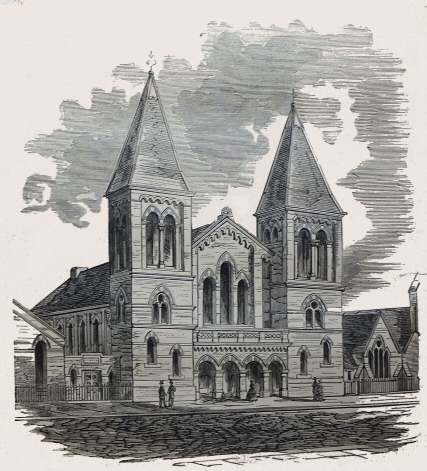
This is situated near the point
where the Cornwall-road crosses the Ladbroke-grove-road, with a
low, single-arched looking front, approached by a flight of steps
from the footway, and inclining towards the latter road. It
is a wooden structure, but protected by a coating of lath, with
an outside covering of Portland cement; and when on the other
side the whole building is in view, it looks a long, dark, narrow
object, which would not be readily taken for a place of worship,
reminding one of a huge ironclad lying at anchor in a quiet
harbour. It may be explained that the shell was formerly a
part of an annexe belonging to the Exhibition building of
1862; and having been made a present, by the contractors, Messrs.
Lucas and Co., to Sir Morton Peto, was presented by that
gentleman for its present good purpose in the
Cornwall-road. It was set up in 1863, including a large,
commodious schoolroom, deacons’ and minister’s
vestries all included. The chapel itself is a spacious
oblong, fitted with an organ gallery behind the pulpit, and
another gallery of similar dimensions at the opposite end, but
having no side galleries. The organ was also the gift of
Sir M. Peto, and built by Willis, of the Albany-road,
Regent’s-park, at a cost of 300l. There is a
plain pulpit, sufficiently elevated, and the floor is plainly
pewed; but the woodwork in the roof is tastefully coloured in
light blue and white, which gives a light and pleasing aspect to
the interior. The place will accommodate about 800
persons.
The Rev. J. A. Spurgeon, brother of the Rev. C. H. Spurgeon,
of the Metropolitan Tabernacle, was the first minister of the
chapel. He laboured very successfully for four
years—collecting an excellent congregation and a goodly
body of church members. He was, however, unfortunately for
his people, removed to assist his brother in the duties of
the college which he had founded in connexion with his South
London enterprise. Previously to his departure, however,
the church gave substantial proof of the esteem in which it held
him, by presenting him with a purse containing 50l., and a
handsome gold watch and key, by Bennett, of Cheapside, which cost
24l.
The successor was the Rev. Charles White a minister who can
scarcely be said to have settled in the church. At his
inauguration the Rev. C. H. Spurgeon preached an appropriate
sermon, at the close of which he hoped, and in fact predicted,
that the Rev. Mr. White would prove the “right man”
for the congregation. It, however, almost immediately after
transpired that a serious feeling of estrangement, and of
something beyond, sprung up between several of the principal
members and deacons and the new minister. It need not be
surmised which side was most to blame. Probably it is safe
to omit all conjectures on the subject. This “letting
out” of the waters of strife became painful in its
consequences. The church was completely rent; and in about
nine months after his appointment Mr. White left the chapel, and
betook himself, with a large number of the congregation, to the
Ladbroke Hall near, where he continued to minister for another
year. In the meantime the chapel was well nigh forsaken and
the church severely tried. It was at this juncture that the
present minister, the Rev. R. H. Roberts, B.A. (of London
University), was invited, and undertook the charge. Under
the difficult circumstances he appears to have acted the part of
a wise man, resolving and avowing his resolution not in any way
to interfere with Mr. White, or harbour any feeling of hostility
towards him or his friends, but, on the contrary, to evince
towards them an amicable disposition. There was, however,
not long the need for this display of Christian temper in that
direction, as very soon Mr. White removed from the
neighbourhood. From that time the church has been gradually
revived and the congregation visibly increased, many of the old
members returning, and some new being added; and at present it
looks as though it must shortly recover its former
strength. Mr. Roberts, who has now been two years with the
church, is an intelligent and thoughtful preacher, and from the
discourse to which we listened, founded on the parable of the
pounds, we should think he is aiming at inspiring his people with
a high sense of their responsibility. There were some
pointed and pregnant utterances in the sermon which are apt to
fix themselves in the memory. As for instance, in regard to
the constancy of Christian service: “Let not this be a work
for ‘saints’ days,’ for all days are, or ought
to be, saints’ days in the calendar of the kingdom
of heaven.” As to the Saviour’s second advent:
“The best way of waiting for Christ is to continue
working for him. With the nearness or distance of
his coming we have nothing to do; the word says ‘Occupy
till I come.’” As to the proper use of
our talents: “Some men prosper and come into the front
by accident; but the outward seeming will be
pierced through in the day of account, and the very heart
of whatever reality there is about us will be got
at.” Then, again, as to human attainments: “All
human attainments are only divine endowments developed and
magnified.” These and similar terse remarks, thrown
out in passing, added effect to various parts of the subject.
The service of song is well provided for here.
“Psalms and Hymns” for use in Baptist congregations
is the book used, in which it is satisfactory to observe the name
of every author drawn upon appended to his composition. The
Bristol Tune-book is distributed, and the name of the tune is
given out with the hymn. There is also Allen’s Book
of Congregational Chants and Anthems; and that grand and
universal hymn Te Deum Laudamus was not omitted, but was
sung in the midst of the service with much propriety and spirit
by the whole congregation.
In the Sunday-school there are a little over 300 children on
the books, and an average attendance of about 100 in the morning
and 220 in the afternoon. There is a “Home Missionary
Society,” which employs twelve tract distributors; a
“Maternal Society,” a regular “Mothers’
Meeting,” and a “Dorcas Society.” In its
late troubles, as a matter of course, the finances of the church
became deranged and fell into arrears. Although surely
improving, a rather heavy balance is still due to the
treasurer. Yet, notwithstanding, we observe that the
congregation contributed last year 43l. 18s. 7d. to
foreign missions. The church draws its home support from
pew-rents, which last year amounted to 185l. 11s., and a
weekly offertory, a special fund, incidental sources, and
collections, yielding in all, from July 1869 to July 1870,
497l. 1s. 11d.
The order of services is: Sunday—Prayer-meeting at
10.15, public worship at 11 a.m. and 7
p.m.; Monday, prayer-meeting at 7.30;
Wednesday, “Congregational Bible-class,” a service
intended for the simple exposition of any passage of Scripture
upon which any person present might wish comment offered;
alternating with singing classes, teachers’ meetings,
church meetings, &c. Inquirers’ meetings are held
on Monday evenings by the pastor in the Vestry, from 7 to
7.30. Communion on the first Sabbath in each month after
the evening service, and on the third Sabbath after the morning
service.
The Deacons are eight in number—viz., Messrs. W. Baynes,
W. Knight, Charles Chambers, Dr. Pennell, Dr. Manning; Messrs.
Catchpole, Hunt, and Healy.
This church is situated in Pottery
lane, near the north end of Portland-road, bordering on the
Potteries, from the poor population of which—more
particularly the Irish portion—it draws its
congregation. The building and the school attached occupy
one side of the road, and a row of stables the other; and, as
though not to be desecrated by looking on the latter, there is
not a noticeable window in the road side of the church;
consequently no architectural attraction in the exterior, which
is about as uninviting as the site on which it stands. It
is not until one has passed through a small enclosed courtyard,
thence by an unexpected turn into a half-hidden portico, and
again through a cloistered doorway—all impressing with a
strong idea of seclusion—that he becomes really conscious
of the presence of an ecclesiastical edifice. Everything to
this point is plain as plainness itself—there being nothing
to be seen but a heavy, bulky pile of common brickwork, wearing
something of the aspect of a very poor monastic enclosure.
But on reaching the interior a different impression is awakened,
although still heaviness and gloom prevail. The principal
nave is short, and that, with the side called “Our
Lady’s Chapel,” are together not capable of holding
more than about 500 persons. At the same time it looks
overcrowded with pillars, which darken and intercept an otherwise
limited view. The effect of the whole is that of strength,
but dimness and lowness. The architecture is of a mixed
kind, in which the Italian is prominent, with a slight blending
of Gothic. The diminished effect of space and light are,
however, of course relieved by the illuminations and ornaments
peculiar to a Roman Catholic church—the numerous candles,
the images, the high altar, its bright furniture, drapery, and
ministrant priests, standing out conspicuously, and lit by
daylight from the chancel-windows. Moreover, a strip of the
walls through the full length on both sides is ornamented with
some effective painting on slate, representing various passages
in our Lord’s sufferings, by Westlake, who also executed a
couple of frescoes at the back of the side altars, and the
subjects of three or four stained windows. The decorations
of the large side-altars to the Virgin and St. Francis are
partially seen through the commingling columns. The body of
the church is filled with plain benches and cane-bottomed chairs,
all of which are much the worse for wear, and in their present
state looking quite in keeping with the voluntary austerity and
poverty of the famous mendicant friar of the thirteenth century
from whom the church derives its name, and whom it regards as its
patron saint, St. Francis D’Assisi. A charge
is made for entering the seats, and be it noted that not one was
observed to enter without dropping his coin, larger or smaller,
in the plate. The fee appears to be considered in the light
of a weekly offering. One of the most notable
objects in the church is the baptistry, where there is a handsome
marble font, with a large conical lid and fixed pulley machinery
for raising it.
This church was built ten years ago, by Mr. Clutton, as a
chapel of case to the larger Roman Catholic cause—St.
Mary’s, Bayswater—which establishment was the first
outcome of the late Cardinal Wiseman’s Ultramontane mission
in London. The Rev. Father H. A. Rawse, M.A., then of the
Oratory, Brompton, and previously an Anglican priest of Oxford,
illustrated his zeal as a convert to Rome by the donation of
7,000l. to the St. Francis enterprise, and became its
first resident priest. The Rev. Father Lescher is the
present minister, who is occasionally assisted by priests from
the parent church at Bayswater, or from the Oratory, and had
present, on the morning of our visit, Father Robertson, from the
former place. Father Lescher himself has lately given proof
of his zeal by the handsome gift of 500l. towards
1,400l. for the purchase of the Silchester Hall, recently
occupied by the Methodists, and being acquired by the Catholics
for a school. Their present day-school, in Pottery-lane,
has about 160 pupils, who pay, as a rule, a penny per week, the
necessary balance being made up by other funds.
Father Lescher was the preacher for the morning, and prefaced
his homily by several announcements, one of which had reference
to looking after their pauper children who were taken to the
Kensington Workhouse. On any child being taken there,
notice was to be given to the priest, who would cause inquiry to
be made as to the spiritual oversight of such children; and the
congregation were earnestly exhorted to attend to this, as he
said it would “prevent the proselytism of the
poor.” He congratulated them that they had
succeeded in sending some Roman Catholics to the Board at the
last election, and so had fared better of late. But he
urged them to endeavour to return more at the next election, in
order that their prospects in regard to the children might be
still more improved!
The rev. father took for his text Ephesians iv. 23, 24,
“And be renewed in the spirit of your mind; and that ye put
on the new man; which after God is created in righteousness and
true holiness.” The discourse was a simple, pointed
extempore address on regeneration, or, as the preacher sometimes
called it, “conversion,” occupying about thirty
minutes. There was “a great difference between the
Christian and the heathen.” “We were not born
Christians, but sinners; and sin would master us unless a change
be wrought in us.” “Heresy always had some
truth in it; but it was truth carried out without being duly limited by
other truths.” Thus as to regeneration, which was
wrought by the grace of God in the soul—no doubt that grace
began to work in baptism. But a man was not regenerate or
converted because he had been baptized, for he might be living in
sin. Conversion was a thing to go on continually through a
man’s life. Europe was covered all over with a race
of baptized, but really unregenerate men. Sin should be
completely taken out of our heart. From beginning to end
regeneration was God’s work. He made us new
creatures. Christ was a new man in this world, and was a
pattern to which we were to be conformed; we must be like him,
setting aside all worldly-vain, foolish, and vicious
thoughts. St. Francis was an example, whose feast they had
just celebrated, who, by the grace of God, was enabled to live a
life of devotion and self-denial. “Let them pray to
St. Francis, that he might help them to follow in his
steps.” Apart from the exhortation to pray to St.
Francis, many will take the essence, form, and language of this
outline as thoroughly Evangelical. There appears to be a
departure from the strict doctrine of essential sacramental
efficacy, and a distinct insistence on the necessity of a change
of heart and of a holy life. It was high mass, and one of
Mozart’s formed the musical part. The organ is a
small one, but sweet in tone, and played by a new
organist—a pupil from the Pro-Cathedral. The choir
did not contain any distinguished voice, but the singing, though
less florid, was more appropriate than the extreme artistic
affectations of the Oratory and Pro Cathedral. On the
previous Wednesday—which was the Roman Catholic Feast Day
of St. Francis D’Assisi—Archbishop Manning had
preached in the church.
The meeting-place of this
peculiar people is in an upper room, Clarendon-place,
Clarendon-road, Notting-hill. It appears filled with 150
persons, and as far as we could incidentally learn they have
about eighty acknowledged brethren and sisters. This
society is the result of a division in the one formerly united in
Bayswater, and is composed of what are termed the “Darbyite
party” in that schism. The “Brethren”
have been in West London over twenty years, but this part of
their small body has been at Clarendon-place five or six
years. They form the only congregation of that persuasion
in the parish of Kensington. We found them on visit to be
an extremely close and uncommunicative people, with the single
exception of an amiable sister, next whom we happened to sit, and
who politely tendered more information than we could subsequently
extract from all the brethren. It was the usual Sunday
morning service of “breaking of bread.” The
loaf, which was a plain baker’s loaf, was in the centre of
a table; in the coarse of the “breaking” the middle
of it disappeared, and little but the shell remained. There
were also two plain glasses upon the table. As a rule these
services of bread-breaking are conducted in silence; but on this
occasion some speaking was allowed, and two of the leading
brethren in succession read and commented in a familiar way upon
portions of Scripture. Some of the remarks we are obliged
to notice were extremely simple, quite spontaneous, and were
delivered under what the speakers appeared to think spiritual
impulses. There was, however, nothing very instructive
or useful in what was said. The speaking done, a brother
engaged in prayer, and after another brother had read a list of
names of persons who wished, on the next Sabbath, to break bread
with them, one marriage of a brother and sister to take place on
the following Saturday, and two burials for that day, the meeting
terminated. In separating the amount of hand-shaking
and friendly, and doubtless cordial, recognition of each other,
was so protracted that we could not get from our extra
saint seat for a considerable time. When at length we
got near the table and encountered a few of the leading brethren,
being invited thereto by our observant and kindly sister, we
endeavoured with all humility to make acquaintance with the case
as it stood; but, we are sorry to say, found ourselves impeded at
every step. Our object was keenly and suspiciously
canvassed. On being simply told that our design was in
general to furnish through the Press a connective view of the
Christian influences and operations at work upon this vast
population, and by so doing to interest the public more fully on
the subject, we were met with indescribable scorn at the mention
of the “Press.” They would consider it “a
sin” to give any information to the
“Press.” It was the curse of the world, was the
“Press.” On being asked if there was not a
Christian side to the “Press,” they emphatically
answered “No.” There was no such thing as a
“religious Press.” It was “all
worldly” from beginning to end. The magazines even of
the religious bodies were only trying to unite religion and the
world. With amusing simplicity one brother asked if by the
“Press” we meant “that machine by which
tracts, &c., were printed;” and we had to explain that
by the “Press” in this connection we meant “a
Christian literature as opposed to what was worldly, secular, or
infidel.” With one voice they exclaimed there was
“no such thing.” We asked if they did not hope
to make some use of Christian literature in striving to effect
the world’s conversion. The reply to this
important question given by the principal brother very gravely
was, “No; we have nothing to do with the world; our
work is to gather God’s saints out of the
world.” “But,” we rejoined, “is
not the Gospel sent to the world? And did not the Son of
God come to save the world?” The answer was
unhesitatingly given by the same gentleman, “No; it was to
collect his saints out of the earth.” After this we
could not prolong the conversation and took our leave; but before
we had left the landing to descend the stairs we were followed by
a young man commissioned to ask us this question, “Have you
eternal life?” In answer, we affirmed our belief and
hope that we had, and asserted our experience of conversion many
years ago. On this we were reminded that there “was
but one way.” We replied that the “one
way” was found in every Christian Church and in the Church
Catholic; but, strange to say, this declaration was met with
evident disbelief. “God,” it was said,
“did not make sects.” We left, asking ourselves
the question, How upon these principles could the great purpose
of the Son of God in this world be answered?
After the above appeared in the Suburban Press a letter
of explanation was received by the Editor from one of the
brethren, which will be found among the supplementary
notes. The latter appears to have been written upon
reflection, whilst the preceding conversation was doubtless
conducted upon the feeling of the moment. Yet, it
faithfully reflected the peculiarities of the members, who appear
to have no faith in anything but what is strictly identified with
their own belief and practice; altogether too narrow for the
expanding evangelistic tendencies of the age.
This is one of the plainest of
buildings for religious purposes, low and uncommanding, and
almost lost even among the humble dwellings amidst which it
stands—a simple meeting-house, with a stuccoed front, but
looking neat and clean, having been recently repaired and
painted, and the walls newly coloured within, giving it a fresh
and healthy look. The pewing is of a humble character and
unvarnished, and the pulpit plain and high. There is a
gallery in the west end, which, added to the accommodation on the
ground-floor, gives about 250 sittings, the ordinary congregation
being at present about 100. The church and people are
Strict Baptist in persuasion. Upon the corner-stone we find
the following inscription: “This stone was laid by Messrs.
Foreman and Wells, Oct. 13, 1851. The chapel is for the use
of the Particular Baptists. P. W. Williamson,
Pastor. J. Cook and T. Rowley, Deacons.” The
chapel has thus been in existence twenty years. The
church—never very vigorous or flourishing—has had a
chequered history, disputes having arisen among its members from
time to time upon subjects relating to its internal affairs, and
which resulted six years ago in a division, further weakening its
situation and diminishing its few members. From this blow
it appears never to have recovered, there being now no more than
between fifty and sixty acknowledged members. The present
minister is the Rev. C. W. Banks, who has been there one year,
and the cause is supported by pew-rents and voluntary weekly
offerings. A “Free-will Offering” box is fixed
on the inside of each entrance to the aisles, and on every
succeeding Sunday the amount so collected is placed in large
figures against the side walls. On the occasion of our
visit, the account for the previous Sabbath stood thus:
“Loose money, 3s. 8d.; in thirteen envelopes, 10s.
3d.” The preacher had a strong voice, and exerted it
even beyond the natural requirements of his small audience; but
at times it would be almost impossible to hear him if he did not,
in consequence of the noisy costermongers, who shout one against
the other in the narrow street and immediately in front of the
chapel, without any regard to its presence or the service
proceeding within. This is certainly a crying evil, and
should attract the attention of the police. We had no idea
that vegetable and other carts (hand and donkey drawn) were so
numerous and noisy during the hours of Divine Service, as we
witnessed them in Johnson-street, and other adjacent back streets
and ways in the rear of High-street, Notting-hill. Surely
there is yet need for a “Suppression of Sunday Trading
Society.” There is a small Sunday-school, attended by
a few self-denying teachers, and the public services
are—Sunday at eleven and half-past six; prayer meeting at
three p.m. Wednesdays, preaching
at half-past seven; and on Monday evenings, prayer-meeting; and a
special monthly prayer-meeting every first Friday evening in the
month. There is manifest care under difficulties for the
Christian work.
The place known by this name is
situated in Kensington-place, near its junction with
Silver-street, a poor unsightly edifice, within two or three
minutes’ walk of the Johnson-street Chapel, and is the
meeting-place of the separated portion of its former
congregation. The building is in a dilapidated state, the plaster
broken away, and the woodwork the worse for lack of paint.
The congregation was celebrating its sixth anniversary, and from
all appearances there was great need of replenishing the
exchequer. However, the event did not seem to have aroused
much enthusiasm, for scattered over a rather larger area there
was even a smaller congregation than in the former place.
The chapel will apparently hold about 350, and there must have
been less than 100 present. There is a gallery at one end,
and all the other sittings are on the ground floor. The
present minister is the Rev. D. Crumpton, whose voice, in its
general tone, was indicative of discouragement, assuredly with
every apparent reason. The two congregations together might
make up an appearance in the smaller of the two chapels; but
separately they appear weak and helpless in the extreme, a sight
to make a good man mourn over strife and division. It will
be next to a miracle if ever these churches rise to a position of
influence and power in the neighbourhood. The locality is
low and in great need of evangelistic efforts; and if anything
could be done to bring the noisy, idle people who fill those
narrow streets, or stand at their wretched little open
shop-doors, waiting for stray customers, who steal out to market
in the hours of Divine Worship, it would be a great boon.
There is a Sunday-school attached to the chapel, in which some of
the poor children around are collected together, and in this
circumstance there may linger hope. The order of services
is: Sunday, prayer-meeting at 7 a.m.;
preaching at 11.0 a.m. and 6.30 p.m., and prayer-meeting at 3.0 p.m. The school is held at 9.30 a.m. and 3.0 p.m. On week-days there is
prayer-meeting on Monday evening at 7.30, and preaching on
Thursday evening. The prayer-meeting at 7.0 a.m. on Sunday morning may be noted as a
rarity in these days, and if tolerably well attended, shows that
there is life, amidst all existing discouragements.
This is the smallest place of
worship we have yet had to notice, being apparently intended for
the sole use of the occupants of that obscure court in
North-street, called Sloane-place. North-street branches
out of Sloane-street, and runs through a very low neighbourhood;
and in about the lowest part of it, densely populated, is the
court down which one passes to reach the chapel. It is at
the extreme end of the parish eastward. The chapel has an
aspect in every way in keeping with the humble class of tenements
among which it stands, and of course has nothing architecturally
to notice. It has a lamp over the low front door, which may
serve in the stead of a parish lamp, to illumine the gloomy alley
on dark evenings. The building has a dwarfed and dingy
appearance; was from the first, is, and perhaps ever will be
private property, lent for its present purpose by the
proprietor. It will hold at the utmost only 100
persons. There is no settled pastorate; but it is supplied
with preaching on the Sunday evening only, under the direction of
the Rev. Dr. Alexander, of the Belgrave-square Presbyterian
Church. The preacher is usually Dr. Stewart, of
Grosvenor-street, a medical gentleman belonging to Dr.
Alexander’s church. This Christian doctor is
regularly at his post on Sunday evenings, except an extraordinary
professional engagement hinder, holding forth the Word of Life to
the few poor people who assemble beneath the humble roof.
There are no regular ordinances and no other public services,
except a prayer-meeting on Sunday morning and on Thursday
evening. All the sittings are free. A Sunday-school
is a notable feature. Sixty or seventy poor children come
together in the chapel from 3 to 4.30 on Sunday afternoons, and
are attended to by a few zealous teachers who enter heartily into
this work. Poor and humble as the building is in itself and
all its surroundings, it is thus undoubtedly a light shining in a
dark place. The self-denial and devotion of those kind
persons who attend to Christian work in this place is quite
exemplary, and will certainly meet with its reward.
The new Church of “St.
Michael and All Angels” embraces the northern part of the
District of All Saints’, Notting-hill, in its new extension
towards Kensal-green, in the Ladbroke-grove-road. No doubt,
just at this spot, there will, in time, be a middle-class
population sufficient to fill the church. But at present
the property is new, and, therefore, it would seem St.
Michael’s must for some time to come draw from a
distance. The Vicar Designate, the Rev. Edward Ker Gray,
was formerly curate to Dr. Robbins, of St. Peter’s,
Kensington-park, and has family connexions in the neighbourhood,
who have largely contributed to his present enterprise; and the
plot of land on which the edifice stands, and that on which a
parsonage is yet to be built, are the gift of Messrs. Blake and
Parsons, who are freeholders in that part. The style of
architecture adopted differs from that of most churches, being
what is professionally known as the “Romanesque of the
Rhine,” and is executed chiefly in terra cotta and
ornamental bricks, by Mr. Cowland, of Notting-hill, under a
contract (exclusive of tower and fittings) for
4,300l. The architects are Messrs. Edmeston of
Crown-court, Old Broad-street; and the plan consists of a nave
ninety-nine feet long, exclusive of chancel and western apse, by
forty-three feet wide, roofed in one span, with an eastern,
western, and southern apse, leaving a northern apse to be added
at some future time. On the north side the church is hidden
by houses, and it is seen to best advantage at the south-west
angle, where it will form rather a picturesque object, when the
grouping of tower, turret, apse, and gable are added to the
view. The interior is yet unfurnished, and only
sufficiently fitted up for the performance of worship. The
pulpit, desk, organ, and chancel furniture are all
temporary. The contract for the decoration is given to
Messrs. Howland and Fisher, who decorated St. Peter’s,
Bayswater, which is considered one of the handsomest church
interiors in London. About 1,000 sittings are provided,
applications for which are requested. The occasion of our
visit was the service of consecration, in May, 1871, conducted by
the Right Hon. and Right Rev. the Lord Bishop of London.
There was a good congregation present; and immediately after the
entrance of the Bishop, Mr. Shephard, the Registrar of his
Lordship’s diocese, read the petition of the Vicar,
Churchwardens and parishioners praying for the consecration of
the church. The Bishop having replied, “I am ready to
consecrate this church, according to the prayer of the
petition,” a procession was as once formed, headed by the
parish beadles with their staves, followed by the churchwardens,
Bishop, and clergy, who slowly walked round the church, the
Bishop repeating the usual service. On returning to the
Communion Table, the deed of conveyance was formally received and
laid upon the table by the Bishop. The prayers for the
ordinary morning service were read by the Rev. Mr. Gray, the
Psalms, Te Deum, and hymns being chanted by a choir of good
voices, male and female, blending well together, under the
direction of Mr. Sydney Naylor, organist. On ascending the
pulpit the Bishop took for his text, John xvii. 6, “I have
manifested thy name to the men which thou gavest me out of the
world,” &c. The subject was divided into three
parts: 1. What name he manifested. 2. How he manifested
it. 3. The character of the persons to whom he manifested
the name of his Father. These topics were worked out with
great clearness of thought and felicity of utterance; the Bishop
steering delicately through the difficult problem of Divine
predestination and human free will, and rendering the point as
satisfactory as it ever can become to mortal reflection. A
very feeling individual application of the subject to the
congregation concluded the discourse. It is about twelve
years since we had the pleasure of listening to Dr. Jackson at a
confirmation service in a small town in Lincolnshire, and it is
gratifying to observe the same doctrinal safety and thorough
practical bearing in his ministry which struck us at that
time. He also bears his increased years well, displaying a
freshness in his appearance and a vigour equal to if not superior
to himself more than a decade since. A collection was made
after sermon from pew to pew towards the organ and church
expenses, and the remainder of the Communion Service and the
benediction concluded the whole. It ought to be noticed
that a number of the local clergy were present, and that the Rev.
Dr. Robbins read the first lesson—the consecration of the
Temple by Solomon—in a most impressive manner, and the Rev.
J. S. Gell the few verses which compose the second lesson.
The Bishop’s chaplain, the Rev. Mr. Fisher, also assisted
in the service within the chancel rail.
Mr. Gray’s ministry is reported Evangelical in its
character, and his service lively and devotional, without
Ritualistic features. The congregation gradually increases,
and it is hoped that ere long the furnishing will be completed,
and that the church will answer all the purposes for which it was
built in that rising population. The Churchwardens are
Captain N. W. Boyce and J. D. Cowland, Esq., and the services
are: Sundays at 11 a.m. and 3 and 7
p.m. Weekdays, Wednesday and
Friday at 11 a.m., the Litany, Holy
Communion, at 9 a.m. every Sunday, and
after the 11 a.m. service the last
Sunday in every month. Baptisms at 2.30 first Sunday in the
month, and at 10.30 a.m. on Wednesday
and Friday.
Norland Chapel is situate in the
Queen’s-road, Notting-hill, and on the extreme western
boundary of the Parish of Kensington. The boundary stone of
the parish is fixed in the wall which surrounds the chapel, and
the iron pillar which marks the line of the Hammersmith Parish
stands near to it about half a foot further west. It was
built in the year 1859, the foundation-stone being laid in May of
that year by the late Robert Hanbury, Esq., M.P., for
Middlesex. The architect was Mr. Stent, of Warminster, and
builders, Messrs. Hill and Robinson, of Whitechapel. Mr.
Hill was the builder of the new Holborn-viaduct, and is now
building the streets connected with the Holborn-valley
improvement. In architecture it is of a very various order,
but may be defined as “mixed Italian.” The
front, which is towards the south, is somewhat picturesque.
The porch is reached by a wide flight of steps, and is adorned
with four neat columns of Portland stone, with carved capitals of
Bath stone; and surmounted with a large circular window; the
whole front having Bath-stone dressing upon coloured brick.
There are two side doors, which lead to the gallery in the south
end. The building, as a whole, is of plain brick and has a
substantial appearance. The west front corner was intended
to receive a spire; which, however, has not yet been built.
Its erection would certainly be a great improvement to the
edifice. In the interior, the space is well
economised. Beneath the floor of the chapel, there is a
spacious school-room; which serves also as a week-night lecture,
preaching, and anniversary tea-meeting room. It is well
furnished, and has a harmonium to assist in the services held
there. The space behind is laid out in class-rooms,
minister’s vestries, and offices. A more compact and
commodious suite of rooms for the space at disposal we have
seldom met with. The chapel proper provides sittings for
650 people—500 on the ground-floor and 150 in the end
gallery. The sittings are let at from 2s. 6d. to 5s. per
quarter, and the congregation averages from 300 to 400. A
modern raised platform pulpit is an ornament, flanked with two
handsome gas pillars; and the pewing is in stained wood, and
looks as good as new, after a dozen years’ wear. In
lieu of columns to support the roof the ribs which span it rest
on ornamental Bath-stone corbels inserted in the walls at about
12 feet high, which are really stronger than they look, and are
adopted to prevent the obscurity of the view, and the absorption
of space by columns. The chapel is lit by gas pendants from
the roof, and is warmed in winter by the same, being lit over
night. By this means a comfortable heat is diffused through
the building, reaching, if required, to seventy degrees.
This method of warming will, of course, be greatly improved, if
the gas companies will adopt the patent gas offered them by the
“Patent Gas Company,” which professes to reduce the
amount of sulphur in every hundred feet of gas from forty-four
degrees to about four. In that case, warming by gas would
no doubt soon supersede some other methods. Red baize with
brass mouldings faces the side walls all round to a certain
height above the pews, which gives a comfortable and cheerful
appearance to the whole interior. The original cost of the
building, including the freehold site, was 3,000l.
The church and congregation at this place are Baptist; but
open their communion to all who “profess and give evidence
of the New Birth;” and are sufficiently open occasionally
to receive any Christian person at the Lord’s Supper who
may desire it, and who has previously sent a note or card to the
vestry. The basis of its membership is thus expressed in
its articles: “We enter this fellowship as Christians, each
one holding that the other is united to the Lord Jesus Christ by
faith in him according to the Scriptures.” Prior to
the present chapel, the congregation met temporarily in an old
building facing Shepherd’s-bush-green; but removed to the
new and more commodious edifice, with their first minister, the
Rev. John Stent, as soon as it was ready. Mr. Stent
continued the pastor until he had completed eight years. He
was then succeeded by the Rev. W. H. Tredray, who after two years
was in turn superseded by the Rev. W. P. Balfern. After two
years also of ministerial labour, Mr. Balfern has just been
compelled to retire in consequence of ill-health. The
church has thus for some little time been deprived of a stated
ministry; but we understand, that a minister is upon the point of
being formally invited, and will, in all probability, be settled
for a period. We heard a plain, earnest sermon from an
occasional supply on the morning of our visit. The service
was conducted in the way ordinary to Baptist chapels; but we were
particularly struck with the excellence of the congregational
singing, to which we believe the late pastor devoted much
attention. The people appeared very well trained to the
perception of harmony, and had in use the Bristol Tune-book,
which is well known to be one of the best extant. They
were, moreover, effectually sustained by the organ, which is a
capital 250l. instrument, by Jones, of Brompton, and well
played by the son of the senior deacon of the church.
The support of the ministry is from pew-rents and the proceeds
of a weekly offering. The other active institutions are a
Sunday-school, with over 300 scholars; a home missionary,
supported by the late minister, Mr. Balfern; a Dorcas meeting,
maternal society, tract society, and a mothers’
meeting. There is in addition a penny bank, in which a
number of poor people and children store their little
savings. The order of services is—Sunday, at 11 a.m. and 6.30 p.m., Sunday-school in the afternoon; prayer
and preaching on Friday evening at 7.30; a psalmody class meets
every Thursday evening for the practice of singing.
The foundation-stone of this chapel
was laid by Samuel Morley, Esq., M.P., in July, 1865, when,
although so recent, the whole of that part of North Kensington in
which it is situated was open field, with here and there a
dotting of new buildings commenced, and new streets laid
out. At the present time the occupied suburbs extend quite
a mile beyond it either North or West. The congregation
worshipping here first assembled in smaller numbers in
Westbourne-hall, where they kept together for between two and
three years, always with a view to a separate building as
opportunity offered. The present freehold site was
ultimately obtained for 1,350l., and the cost of the
building raised upon it, including the schoolrooms, was
3,500l. It is a substantial structure with a Gothic
expression, although totally devoid of ornament. It was,
however, originally designed, and is yet intended to have a
spire, which certainly will be a vast improvement to the
exterior. The interior is light and pleasant, without
galleries, with a plain pulpit and pewing, affording
accommodation for 500 persons, 100 of the sittings being free,
all the remainder let at prices ranging from 5s. to 1l.
1s. per annum. The chapel was opened in January, 1866, by
inauguratory services conducted by the Hon. and Rev. Baptist Noel
and the Rev. Samuel Martin, of Westminster. From the first
the stated minister has been the Rev. Jas. Stuart Russell, whose
ministry is highly appreciated as pious, scriptural, able, and
earnest. During its continuance there has been gradual
prosperity, the church now numbering about 120 communicants, and
the congregation reaching an average of between three and four
hundred. There is a large Sunday-school, with, including
infants, 250 scholars, attended by a goodly staff of teachers:
morning and afternoon, under the superintendence of Mr. S.
Hicks. The form of service is what is understood as
Congregational, and the Congregational Hymn-book is used.
An organ well suited to the dimensions of the building is
efficiently employed by Mr. Charles Wetton, Jun., in aid of the
devotional singing, which seems to lose nothing of its
congregational life and character by the presence of the
instrument. Divine Service is held on the Sabbath at 11
a.m. and 7 p.m., and in the schoolroom during the week,
on Monday and Wednesday evenings, at 7.30. A Communion
service on the first Sunday in every month. There are at
present four deacons, Messrs. Hicks, Ellerton, W. Knowles, and
Wetton, Sen. The locality of this chapel is one which
furnishes ample scope for Christian labour and extension on every
side. The district in the heart of which it stands, that of
All Saints’, has a population of 20,747, according to the
figures of the recent census, and it is the only Congregational
place of worship within the bounds.
This is an iron church, situate in
the Talbot-road, Notting-hill, and a few steps only from and on
the same side of the road as “All Saints’”
Church. It has the same general features as all the iron
buildings, but is larger than most of them, having an end
gallery, and affording ample accommodation for one thousand
persons. The north end or chancel is occupied with a
platform, which serves as a pulpit, and the benches of the
auditorium come close to it. It is well warmed with a
stove, and lit with plain gas pendants; and altogether has a very
comfortable appearance. The history of this building must
be traced in connexion with the career of Mr. Gordon Forlong, a
name now well known in and beyond the immediate scene of his
labours. This gentleman is a Scotch barrister, who, a few
years ago (in 1856), felt moved to give up the pursuit of his
profession for the work of an evangelist. His endeavours to
make known the Gospel appear to have been highly appreciated in
his native Aberdeenshire; and were soon sought for in different
parts of Scotland and in Edinburgh, where Mr. Forlong spent some
time. After a trial, however, he found that the condition
of an itinerant preacher, with a family, became impracticable,
and resolved on seeking a settled charge in London. Here
his first appearance was in the Victoria-hall, Archer-street, in
October, 1867. The hall, which he hired on his own
responsibility, was generally well attended at his services, and
continued to be used by him until 1869. In the latter half
of that year, the present building was secured at a cost in all
of 2,000l., to be liquidated by instalments, there being
also a ground-rent of 96l. per annum. Apart from a
little aid which Mr. Forlong has drawn from his friends in the
North and elsewhere, the whole financial obligation of this
enterprise has rested with himself and the friends who have been
inclined to assist him on the spot. That it has been a
great struggle is not surprising. At the end of the first
year there was a balance on the wrong side of the sheet to the
amount of 476l. 1s. 9d., which, being paid by the
minister, left the total amount advanced by him for the church
714l. 9s. 6d. This, it may be hoped, has been ere
now discharged by the congregation; more especially as up to the
present time, the minister’s services, both at the Hall and
in the new church, have received no remuneration. There are
about 150 sittings, let at from 4s. to 30s. per seat per annum;
and there are church-boxes for weekly offerings and various
collections through the year. This together may be
considered a sufficient financial basis to work upon, in order to
place the concern, not long hence, in a free and prosperous
condition.
Mr. Gordon Forlong rejects the title of Reverend. Having
never obtained or sought ordination in any church, he looks upon
himself as a lay preacher of the Gospel, called and set apart by
God only; and treats with indifference and even contemns all
ministerial titles and peculiar functions, as looking in the
direction of priestcraft, which he abhors. He has, from the
first, taken his special mission in the neighbourhood to be to
oppose Ritualism, which he found developing itself on his
arrival, and to call together a people to exemplify spiritual
religion. To these objects he has certainly confined
himself with great steadiness, and not without success. A
number of persons, it is said, find refuge at the
“Tabernacle” who have been alienated from their
mother Church hard by through Ritualistic practices; and the
truth of this statement, it appears, cannot be challenged.
The character of the church and congregation which Mr. Forlong
has formed is non sectarian, and does not allow itself to
be called either Baptist, Congregational, or Wesleyan, or
anything else but the Church of Christ; although the mode of
conducting the service may be described as a free adaptation of
any and all of these. Along with the reading of the
Scriptures there is exposition. The hymns used are
gathered from all the Nonconformist collections, under the title
of “Psalms and Hymns,” published by Elliott, of
Tichborne-street. It contains selections from the principal
writers—Watts, Doddridge, Toplady, Wesley, &c.
One we heard sung was one of the finest and most impassioned of
the latter author, commencing—
O Love Divine, how sweet thou art!
When shall I find my willing heart
All taken up by thee?
I thirst, I faint, I die to prove
The greatness of redeeming love,
The love of Christ to me!
This was sung by the congregation to a lively tune and with
good devotional effect. At the close of this, the preacher
read a number of requests for special prayer from members of the
congregation for specific objects stated on the paper, connected
with their personal or family experience, and some of
thanksgiving for former prayers answered. This took
considerable time, and was followed by a brief petition, giving a
general utterance to these supplications. The sermon was
extempore, and founded upon Psalm xxiii. Probably it should
be termed a free address, intended to bring out, by scriptural
illustration, the character of the Redeemer as the “Great
Shepherd.” Mr. Forlong does not appear to believe in
the ordinary style of sermonising, or
“philosophising” on distinct portions or mottoes of
Scripture; and has adopted the plan of turning his audience into
a great Bible class. They follow him systematically through
chapter and verse from beginning to end, and the preacher simply
connects the sense of the passages, and pauses here and there to
enforce a passing thought. The expositor, however, is
animated (as most Scotchmen are), and familiar in his
illustrations; and as to Scripture itself his system is highly
instructive. The sermon lasts about forty minutes.
There were about 400 present, on a very inclement morning.
There is a Sunday-school attached, with a good voluntary staff of
teachers, conducted morning and afternoon in the Golborne-Hall,
having 200 children of both sexes. The public services are,
Sunday morning at eleven; evening at seven; and prayer-meeting on
Thursday evening. Communion service on the first Sunday in
the month at the morning service, and the second Sunday at the
evening service. This service is administered without
written form, and by handing round the bread and wine to the
communicants in their seats. All religious persons are
admitted to it by introduction to the minister.
A small plain brick edifice, built
in the old, familiar Grecian style, and situated in
Fowell-street, in the Potteries, Notting-hill. The building
is a square; and has in the interior on three sides a gallery,
the other being occupied with a platform for the preacher.
In all, ground floor and galleries, there is accommodation for
about 200 people. On a memorial stone outside is the
following: “This stone was laid August 2, 1864, by J.
Fowell, Esq., who kindly gave the land, Rev. J. Phillips,
Superintendent Minister. J. Carrud, Architect and
Builder.” The chapel is connected with what is called
the “Second London” Primitive Methodist Circuit, in
which there are about a dozen different localities associated,
and of which the Rev. Mr. Toulson is the present superintendent
minister, having with him four colleagues. As one of the
earlier branches from the old Wesleyan body—dating as far
back as 1812—the “Primitives,” as their adopted
name implies, conceive that they follow more closely in the steps
of Mr. Wesley than the parent body. Nevertheless their
doctrines and their practices are precisely the same, except in a
few minor matters, which it would seem impossible to trace to a
Wesley origin. Camp-meetings was the question upon which
they first separated from the conference, which disallowed them;
but this peculiarity has much declined of late years.
Female preaching was another peculiarity, and at one time female
preachers were frequently found upon their plans; but this, too,
may be said to have well nigh passed away. In general
church arrangements and working they assimilate to the old body
in everything, except in the constitution of their Conference, in
which there is a considerable difference. The Conference
proper of Wesleyanism is composed entirely of ministers, but
preceded by “General Committees,” where the laity are
admitted. In the Primitive Methodist Connexion, the
Conference itself is composed of both ministers and laymen, and
the latter are in the proportion of two to one of the
former. The two bodies, however, work side by side without
antagonism, but it may be said also without much
fraternising. The social status and monetary power of the
two communities are widely different. The Primitives are
poor, their chapels are of the least costly kind, and their
ministers have barely a subsistence, yet are they highly
respectable in their order, and exert themselves with vigour and
enthusiasm in their calling. One of the junior ministers,
the Rev. Mr. Knipe, was officiating in Fowell-street, and offered
extempore prayer with an ardour, read with a homely emphasis, and
preached with a demonstration of manner that can seldom be heard
except in a Primitive Methodist chapel. His congregation
consisted of about 70 or 80 of the adult population,
respectable-looking poor people, by no means the lowest class to
be found in the Potteries. The latter is not the class that attend
either church or chapel. The society, or the church
proper, consists of from 50 to 70 persons, recognised as members
of class. There is a Sunday-school with about 80 children,
held in the morning and afternoon. The services are on
Sunday at 11 a.m. and 6.30 p.m.; Wednesday, 7 p.m.; prayer-meetings, Sunday morning at 7,
and on Monday, Tuesday, and Thursday evenings at 7. The
society, according to Methodist custom, contributes its quota
towards the support of the ministry by the weekly pence of the
members, quarterly contributions, and collections.
The place of worship known by this
name is situated in the Bosworth-road, Upper Westbourne-park, or,
more properly, in Kensal New Town. It is in the midst of a
mass of new houses, either completed or in progress. It was
opened for worship in June, 1870. The Rev. H. W. Meadows, a
minister from Mr. Spurgeon’s College, first instituted
services in a room in the neighbourhood, from which he progressed
to the building of this chapel, at an entire cost of
360l. The place is far larger and more commodious
than this sum would seem to indicate; and it impresses one with
how much can be done for 360l. Of course, the
structure is not imposing, but of a plain and useful type, having
more the appearance of a public hall, but the interior is solidly
fitted with benches. There is a good platform pulpit, with
a gallery behind it, flanked on one side with a minister’s
vestry. It is comfortably warmed by a stove in the centre,
and well lit by a set of neat gas-pendants from the beams of the
roof. A debt of 200l. remains, which it is hoped
will shortly be liquidated. Accommodation is given for 400
persons; but the attendance, when largest (in the evening), does
not as yet generally exceed 150; and there are about thirty
members in church fellowship. Mr. Meadows and his friends
have had difficulties to contend with on the spot, as one or two
small preaching-rooms near conducted by persons of the same
persuasion would seem to show. He has evidently had uphill
work; and it was not until the 18th of January, 1872, that a
church was finally formed and a settlement of his pastorate
arrived at; and on January 28 in the evening he held his first
ordinance of baptism by immersion. The cause is regarded as
a branch from Westbourne-grove Baptist Church, and as under the
particular notice and care of the Rev. W. G. Lewis. The
financial support is from pew-rents and weekly offerings, with
occasional aid; but the minister has never yet derived the
benefit of a salary. The services are, on Sundays:
Prayer-meeting, 7.30 a.m.; preaching
at 11 and at 6.30 p.m. A
Sabbath-school is held, in which there are about eighty scholars,
at 9.30 a.m. and 2.30 p.m. There is a service also on
Wednesday evening at 7.30. The deacons are Mr. W. S. Hook
and Mr. C. Heard. This is not a Strict Baptist church, but
adopts the open communion.
The memorial stone of this edifice
was laid on June 23, 1868, by James Harvey, Esq., Treasurer of
the London Baptist Association; when an address was delivered by
the Rev. W. Brock, D.D., of Bloomsbury Chapel. A meeting
followed in the evening, presided over by J. H. Tritton, Esq.,
when most of the principal ministers representing Nonconformity
in West London were present; and among them the Rev. J. A. Aston,
M.A., the then catholic-spirited Incumbent of St. Stephen’s
Church, which is situated close to the chapel. The
immediate site is in the Cornwall-gardens, Gloucester-road, and
near the Gloucester-road Railway-station, one of the most
eligible sites that could be selected, in the midst of one of the
newest and choicest suburbs of the metropolis. The
neighbourhood included between the Brompton-road and
Queen’s-gate in one direction, and the Cornwall and
Fulham-roads in the other, has few rivals in or around
London. It includes the vicinity of South Kensington
Museum, Cromwell-road, Onslow-square, Onslow-gardens;
Gloucester-road, Queen’s-gate, Victoria-road, &c.
It was here that the Rev. Samuel Bird, after having laboured for
some time at the Hornton-street Tabernacle, and subsequently at
the Avenue-place Room, Kensington, conceived the idea of erecting
a chapel. Having taken a lease of the land, with a right of
pre-emption after a specified period, he proceeded to
build. Messrs. Searle and Sons were the architects, and Mr.
W. Higgs the builder, and in due course it was opened for Divine
worship. At first it seemed as though Nonconformity in
South Kensington was about to make an onward movement; but
whether from any social peculiarity in the locality, or personal
peculiarity in the minister, or from the circumstance of the
opening and enterprising of two or three more new churches in the
same part, we cannot pretend to say; but certain it is that the
new Baptist church, ere yet it was scarcely formed, suddenly
collapsed. After about two years’ effort, the
minister departed and the chapel was closed. It has
remained closed to the present time (Feb., 1872); and is now
announced to be sold by auction at the City Mart, by Messrs. Fox
and Bousfield, on the 14th inst. Its future history
therefore cannot for the moment be predicted. It is an affecting
sight to see so handsome a building deserted; and on visiting it
for the purpose of a survey, an aged person, formerly, as we
learned from himself, a member of the congregation, and who now
seemed not far from the better world, was pensively whiling away
the quiet morning in the fresh air around the silent
temple. He was sadly deploring the desolation and
abandonment of his Zion; and seemed to have his own theory as to
the cause of the failure, of which he made no secret. The
building is one of the completest, most commodious and effective
chapels to be met with around London. It is in brick with
Bath-stone dressings, and designed generally in the early
geometrical Gothic style of architecture; and has been greatly
beautified by the mortgagee, since it was closed to the public,
by the erection of a handsome tower and spire; and the facilities
of the interior have been also increased by the erection of a
gallery. It now affords accommodation for 1,000
persons. It is substantially fitted with modern pewing and
pulpit, and has an excellent baptistry, vestry, large schoolroom,
and apparatus for warming and lighting. There are three
front entrances with lobbies, two communicating by staircases
with the gallery, and the centre one with the body of the
building. There are also two side entrances; and three
handsome lamp-posts adorn the frontage. It must have been
heart-breaking to be the instrument of rearing such an edifice,
and so soon to be compelled to relinquish it. For some time
past the Incumbent of St. Stephen’s has been using the
spacious schoolroom underneath the ground-floor of the chapel for
a day-school.
Divine Service is held at the
Kensington Workhouse, for the inmates, on Sundays, at 9.30 a.m. and 3 p.m. At present there are no other
services; but a new code is now being introduced which will
effect a very desirable change in this respect. At a recent
meeting of the Guardians, the “Visiting Committee”
made the following report and recommendation to the Board:
“The Visiting Committee having in consideration the
resolutions passed by the Board on the 1st of February inst., and
having also considered the letter from the present Chaplain of
the 14th inst., in which he states his inability to devote a much
larger portion of his time than he has done for the last twenty
five years, resolve that it is desirable that the Chaplain of the
Workhouse and Infirmary give his whole time to the spiritual care
of the inmates in the same way as the clergyman of a parish, and
that, considering the numbers of this house and the work to be
done, the least salary should be 150l. per
annum.” This resolution is adopted by the Board, and
will henceforth be acted upon—an urgently necessary
improvement, although it may come to involve a further change in
the chaplaincy. The Rev. Dr. Frost, formerly of the
Kensington Grammar School, has held the appointment for a quarter
of a century. When he first began he had the spiritual care
of less than 150 inmates. The number gradually rose until
two years ago they amounted to 800. At the present time,
March, 1872, the house contains 760. It will be seen,
therefore, that the religious requirements of this large number
are quite beyond the provision made under the old system; and the
Guardians have acted under a strong sense of duty in bringing
about a thorough reformation. It was not until two years
ago, when the inmates were 800, that any increase of salary was
asked for on behalf of the Chaplain. Previous to that it
stood at 50l. per annum; since then it has reached
65l. Double this sum will enable a chaplain to give
a principal part of his working time to the objects of his
calling in the house, and to bring a more decisive moral
influence to bear upon the inmates. The paucity of
religious service in this workhouse up to this time can be looked
upon in no other light than a calamity; and may serve in some
measure to explain the fact that there are so many refractory and
misbehaved paupers taken hence to the magistrate at Hammersmith
for correction. We cannot but think there might have been,
there ought to have been, at least one week-night service
instituted long ago; and if the Guardians were not in a position
to pay for this, among the numerous clergy in Kensington some one
might have been found who would occasionally have taken duty
gratuitously. But we fear that up to the present time it
has occurred to few to reflect that the souls of inmates
required a fair amount of attention as well as their bodies.
Little Charles-street Primitive Methodist
Rooms.—Here, in a narrow street leading out of
Kensington-square southward, is a very humble
building—apparently a former dwelling house—converted
into what are termed “Little Charles-street Day and
Sunday-schools.” In the upper room the preachers of
the Primitive Methodist Connexion hold services on
Sundays—morning and evening—at eleven and half-past
six. The congregation averages about 40, and the
Sunday-school children number about 60.
Palace-avenue Room.—This is a
large room sometimes used for other public purposes, at the rear
of the King’s Arms Hotel, High-street, Kensington. It
has lately been engaged on Sundays for religions worship and
preaching, on a professedly unsectarian principle.
Hours of service, eleven a.m. and
half-past six.
Shaftesbury Hall.—At this
hall, situated at the end of the Portland-road, Notting-hill, a
mission preaching service is conducted on Sunday evenings at
seven, by Mr. William Winton, attached to the City Mission in
that district. Mr. Winton is an earnest man, and addresses
himself to the working classes of the Potteries and vicinity, and
generally has the hall, which will hold about 100, well filled at
his services.
Blechynden-street
Mission-school.—Here are day and Sunday-schools for
the poor children of the Potteries, situated in the lowest part
of that poor district. It is a separate building, and
answers well its purpose. On Sundays, morning and
afternoon, there is school, with an average of 30 to 40 in
attendance, including infants. In the evening, at seven,
there is preaching by Mr. Norris, a missionary in that part, who
gathers a congregation of from 60 to 80. In the day-school,
there are about 120 scholars, boys and girls.
Golborne Hall, Golborne-road.—This hall, situated in
the new Golborne-road, Upper Westbourne-park, is capable of
seating 200 people, and has been opened on Sundays for some
twelve months past for Divine Service. It was first engaged
for mission services by a clergyman of the Church of England, but
is now held by the Rev. Mr. Davis, a Nonconforming preacher,
formerly of the Kilburn-park Chapel. Here is something like
the nucleus of a society or church, professing to be
unsectarian. There is preaching at 11 a.m. and 6.30 p.m. on Sundays, and at 7 on Tuesday
evenings, and the Sacrament is administered every first Sunday
evening in the month. All the seats are free, and the cause
is supported by voluntary weekly offerings. In the morning
the congregation contains but few adults; but in the evening it
reaches an average of 80 or 90. There is a Sunday-school,
with about forty scholars of both sexes in attendance.
Wesleyan Preaching-rooms, Silchester road.—The Wesleyans
formerly carried on service in the Silchester-hall, which they
hired, but about six months ago adjourned to the present rooms,
upon the occasion of the purchase of the hall by the Roman
Catholics. Thus excluded from a very commodious place, the
present rooms, adjoining Silchester-villas, which are not
convenient, are only held temporarily, until a chapel or a better
place can be obtained, for funds to provide which an appeal is
now being made. There is a good Sunday-school attached,
with 300 children on the books, and an average attendance of 100
in the morning and 200 in the afternoon. Between 30 and 40
members compose the society, and the adult public services are
attended by numbers varying from 30 to 50 in the morning, and 50
to 80 in the evenings. The “rooms” are included
in the Bayswater Wesleyan “Circuit,” and the
preaching is arranged for on the plan of that circuit, and
principally done by the “local,” with an occasional
visit from the itinerant preachers.
The Convent of the Order of St.
Clare.—A convent of this order of nuns, sometimes
termed Clarisses, but more commonly spoken of as the
“Poor Clares,” is planted on a fine site, near two
acres in extent, in Notting-hill. It comprises two blocks
of buildings, one more in the interior of the grounds, and the
other abutting upon the main, opposite to Edmund-terrace in the
Cornwall-road. Excepting this part, by which communication
with the outside world is kept up, through a low, strong,
cloistered doorway, the whole premises are enclosed within high
brick walls, and along the Ladbroke-grove-road the whole length,
from its junction with Cornwall road to that of
Blenheim-crescent. Entering by the low door in the
Cornwall-road, the visitor finds himself in a shaded vestibule or
hall, and having directly on his left the entrance of the convent
chapel. This chapel occupies only a small space, being
capable of containing, if filled, about fifty worshippers.
It is profusely decorated on all sides with images of the Virgin
and saints. It has a small altar, and on the right a
darkened sacristry. The most noticeable thing—the
thing mostly felt—is the profound silence reigning, which
the hushed movement of the priest, whose white surplice was just
visible in the gloom, only served to make more manifest.
The religious offices are performed by priests from the Catholic
Church of St. Mary’s, Bayswater. This order of nuns
was founded in 1212, by St. Clara—from whom it derives its
name—a native of Assisi, in Italy. She adopted the
rule of St. Francis in all its rigour, and her followers are
absolutely forbidden to have any possessions. There are
also other peculiarities in their rules, habit of dress,
&c. Those who enter by this door surrender all
ownership of earthly treasure, and doom themselves to perpetual
poverty; and in the end, on attaining the higher degree of
devotion, sever themselves from all contact with and even from
the sight of the outer world. In this convent at
Notting-hill there are at present about twenty nuns, who are
pretty equally divided into the two classes of
“Externals” and “Internals,” or, in other
words, into those who maintain subdued communications with beyond
the walls, and those who are strictly and unchangeably confined
within. Very little farther is or can be known of
them. The sisters work with their own hands, and, under the
direction of the Lady Superior, do all their domestic service
according to a prescribed order. Great strictness of
discipline is understood to prevail. On ringing at the low
door, which is darkened from its depth in the wall, the blind of
a small grated window was withdrawn, and a pair of lustrous dark
eyes peered through. Anon the door is softly opened; and,
in answer to a deferential inquiry as to whether it might be
practicable for an outsider to come and look within, the gentle
portress—then acting as such in her turn—promptly and
with a cheerful air gave permission to enter and see the
chapel. This nun carried herself so pleasantly, and
answered our queries so readily and agreeably, as almost to
ignore the impression so common on these occasions, of secret
restraint.
The Convent of the
Franciscans.—This has been established in the
northern part of the Portobello-road, Notting-hill, about ten
years. It is a substantial brick structure, entered by
strong conventual doors, and sufficiently enclosed from the
profane world. We were politely admitted by the kind sister
who attended as portress, to whom we made known our object.
“Are you a Catholic?” she asked; “Yes,”
was the reply. But the quick-witted sister at once detected
the expression of countenance with which the answer was given,
and said, smilingly, “Ah, a Protestant
Catholic.” We readily accepted this position, and
were ushered into a neat waiting-room, pending consultation by
our guide with the “rev. mother,” apparently with the
view of clearing herself from all responsibility in the
matter. In about five minutes she returned with permission
for us to see the chapel. This we entered by what is termed
the door and chapel of the “Externals.” The
compartment is divided into three parts, the outer court, a small
chapel in itself appropriated for “Externals,” which
in this case means visitors, or such as may occasionally be
tarrying in the convent, but who are not really entered in the
order. The other part, which resembles the choir in an
ordinary church, is sacred to the sisters themselves. The
chancel divides the two, which has the altar and the usual
furniture, and in the background an effective fresco by Westlake,
portraying the “Annunciation” and
“Coronation” of the Virgin. This we were
allowed to approach; but when we made for the “Nuns’
Choir” below, we were impulsively caught back, and told
that none “ever entered there” but the
“sisters” themselves. We apologised and
retired. There are now between twenty and thirty nuns at
this establishment, who appear to enjoy slightly more life than
their sisters the “Poor St. Clares.” In a
remote room a piano was being played, accompanying a clear,
strong voice; and the corridors and apartments through the
silence of which it rang were light and cheerful. The order
established here is not the strictest sect of St.
Francis. The “Poor Clares” are supposed to be
that; but the “Franciscans” correspond more with the
“Brethren of the Community,” who in the 14th century
insisted on mitigating the more austere rules of the
founder. Although the recluse life and the vow of
poverty are upon them, in practice the severity of these rules is
relaxed to meet, in some sort, the varying temperament of human
nature. Attached to the convent, at the next door, is a
school for poor children, called the “Saint
Elizabeth’s Home.” This is entirely managed by
the sisters, and contains at present 66 girls, ranging in age
from four to fourteen years. The religious ceremonies are
here also performed by priests from St. Mary’s,
Bayswater.
St. Joseph’s Home of the Little
Sisters.—Of all the conventual establishments of the
Roman Catholics in West London this is in some respects the most
remarkable. It is situated exactly opposite the former
building in Portobello-road, a large brick edifice, giving one
the impression of a workhouse or hospital, and in fact not unlike
them in its objects. It has been founded about four years,
and subsists entirely upon voluntary charity. It is a home
for the aged and infirm poor of both sexes, and has at the
present time no less than 210 inmates. It is under the
management of the nuns of the place, known as the “Little
Sisters,” which may also be considered as a sect of the
order of St. Francis. The Franciscans were first called by
the saint Fraterculi, “Little Brethren,” in
token of their humility. For a like reason the
corresponding order of nuns take the appellation “Little
Sisters.” At this place they are foreigners, and of a
humble grade. In the former cases the sisters we saw were
English, and refined in their deportment and speech; in the
present they appeared of another class, but adapted to the work
they have to do. The “Rev. Mother,” who is the
“matron” of the place, came, with a meek young nun in
attendance, to converse with us. She was extremely
reticent, and inquisitive as to our motive, concerning which we
found it difficult to satisfy her. She, however, readily
conducted us through the place, the attendant nun following
closely. The chapel is large for a private one, and great
care and some expense have been bestowed upon the chancel, altar,
and little side chapels—devoted respectively to the Virgin
and St. Joseph. Several of the old people were sitting
about, saying their Ave Marias, and counting their beads,
and a young foreign priest knelt at the railings enclosing the
main altar. Perceiving us about to leave without bowing to
the altar, the “Rev. Mother,” who had already bowed,
turned and bowed again several times, as though in atonement for
our omission. The dormitories are large and airy, and
closely fitted up with beds down each side, having plain
patchwork counterpanes, made with charitable hands, all after the
same pattern. In a large room below many of the old men
were sitting about at leisure, reading books and newspapers, with
which charity accommodates them. In another large compartment
the old women were at tea, served up to them in good-sized
basins, with plain bread, and butter, if any, invisible.
They seemed to be thoroughly enjoying themselves, and rose
politely as we passed through. The wards of the infirmary
presented the most affecting sight of all. The inmates here
were not numerous, and all—with one or two
exceptions—very old bedridden people, who appeared to be
dying from natural exhaustion in the ordinary course, and, as
some of them tearfully and hopefully said, in answer to our few
words of encouragement, “Waiting their change.”
There were more men than women; and two or three of the males
were about in middle life. One of these, the Matron told
us, had been in bed for twenty-five years. The
“Little Sisters” provide homes for the aged poor,
professedly “without distinction of religion;”
although, of course, all the internal arrangements are Roman
Catholic. They appeal for help to the public, and say they
accept “any contributions in money, food, clothing,
&c.” They have no funds for the maintenance of
the home but what is thus regularly supplied.
St. Peter’s, Notting-hi ll.—A second visit to this
church enabled us to hear a sermon preached by the respected
Vicar himself, the Rev. John Robbins, D.D. The text was
taken from 2 Tim. i. 12: ‘For I know whom I have
believed.’ The subject of the discourse was
Faith; and after a brief exordium, illustrating
that faith was man’s own act under the influence of Divine
grace, and improved by the exercise of a man’s own
faculties, the preacher proceeded to show that when God commands
us to believe, and when he is pleased to make our faith a
condition of salvation, it would seem that faith cannot be
“some magical and arbitrary something which suddenly falls
into the soul,” but a thing which in some measure depends
on ourselves. Faith, in all its stages and degrees,
“always” depended on the will. The
principle was illustrated by the experience of two persons
starting in life, each having a certain faith in justice and
honesty derived from early education—the one yields to the
temptations of evil, and the other resists, the result being that
the first loses all faith, whilst the other grows in it to
perfection—retaining “the moral ideal and will”
to a “high and happy development.” Each of
these characters is responsible for the degree of his faith, that
“depending on the action of his own will.”
Faith, then, was strengthened by fidelity; and he would say to
them, “Live for holiness, truth, justice, the good, the
beautiful, the true, and then they would surely believe that they
were not mere cold abstractions of theology, but the most real of
all things! Let them now go to the very core of religious
faith. If the Gospel told them to believe in Jesus Christ,
was it not that Jesus Christ is truth, was holiness, love, living
and incarnate? The more they followed him the more they
would believe in him. For instance, there is one who as yet
sees in Jesus a mere man, but his doctrine attracts and seems of
a beauty incomparable. He would not like to pass for a man
without faith, yet when he analysed his faith he found that it
reduced itself to a mere belief in Christ’s moral
teaching. That was very little, said some of them.
But he was not one to despise little beginnings. Let him
act up to his faith, and strive to conform his own life to the
sublimity of Christ’s morality, and keep that object
courageously and unflinchingly in view, and he would not need to
continue this long before he would be forced to admit that he was
very far from his end, and that the holiness of Christ’s
life completely and utterly transcends the natural strength of
mere humanity. It would not then require a great effort in
him to believe that the Scripture speaks truly when it speaks of
the fall of man and the slavery of sin. He would defy him
to examine his state long before a voice from the depths of his
own heart told him that he too needed pardon. Following
this it would bring him to the foot of the cross, and then,
casting a glance of holy self-abnegation (which was faith in her
truest aspect), he would gratefully adore the divine wisdom which
was able to reconcile on the cross, justice and mercy; and,
ravished by a pardon which alone could satisfy the conscience, he
would rise the redeemed of the Lord, and able to say with St.
Paul, ‘I know in whom I have believed.’”
After some further discriminating views as to the possible
variations in human experience in the attainment of saving faith,
the preacher concluded with a pointed application of the truth to
his hearers, the sermon lasting about forty minutes. As a
preacher, Dr. Robbins is earnest and intelligent. He uses
his MS., but does so freely, without apparently being trammelled
by it. As we before remarked upon his excellent reading of
the Scriptures, we can now record a similar view of his pulpit
work. His manner is natural and impressive, and his style
fresh; whilst there is evident painstaking to think out a subject
for his audience, and to enable them to follow him along the
course of his argument. His congregation is large, and, in
appearance, of the more wealthy and educated classes; and his
mode of teaching the experience of true faith as above was
probably an adaptation to the mental habitude and circumstances
of his hearers. We can conceive a different class of
audience whom Dr. Robbins would soon discover to require quite
another way of putting the process of religious experience.
But it is surely a great part of the wisdom of the Christian
teacher to find out the readiest line by which those to whom he
is ministering can be led to Christ. Yet, the impression is
probably correct that the Rev. Doctor is in theology of the
“Broad Church School.”
The Pro-Cathedral, Kensington.—At the time of our former
sketch of this place, the principal preacher did not occupy the
pulpit, and we therefore now append a note on Monsignor Capel,
who is unquestionably a leading attraction at the
Pro-Cathedral. This rev. father appears about forty years
of age, and may be said to be very superior in everything as a
preacher, except that in which, after all, we must conclude it is
of the highest moment that a preacher should attain
perfection—viz., the Gospel. To say that he does not
preach the Gospel would not be quite correct; but there is just
so much that is not the Gospel intermingling in his discourses,
that we much fear that in many the good wheat must be choked by
the tares. As a divine, he is, of course, framed upon the
Roman Catholic system of theology—and all that can be said
is that his preaching does not illustrate the peculiarities of
Popery more strongly than the fundamental truths of the Christian
religion. To a cultivated theological ear the latter will
form the staple of his discourses, and the former the colouring
incidents. And they are there in sufficient degree to show
that Monsignor Capel studiously identifies all the errors of
Romanism with the Gospel—enough to a decided Protestant ear
to mar the better effect of his eloquence. To hear him
makes one grieve that such elocutionary powers as he manifestly
possesses are not confined altogether to the illustration of
those great verities of the Gospel upon which he often descants
with feeling and power. But he is trammelled by Romish
dogma and tradition. It is impossible to deny that
Monsignor Capel is an orator of no mean order. We have
heard greater pulpit orators certainly, but seldom one who, upon
the whole, has been more pleasing in his own style. He has
not only the natural gift of voice and manner, but he has
culture, which together, if he were in any other than the Roman
Catholic Church, would probably open his way to extensive
influence. He is now, however, ministering to a
congregation of four or five hundred in the morning, and six or
seven in the evening, in great measure of a very miscellaneous
and unsettled character. He preaches quite extempore; but
such is the order maintained throughout his discourse, and such
the flow of appropriate language, that an idea of the most
careful preparation is conveyed to the hearer. We are
creditably informed by those who know the habits of the rev.
gentleman that he is a very hard worker; that, in fact, he works
“night and day” at sermonising; hence no doubt the
freshness and general excellence of his pulpit orations.
Such harmonious arrangement of thought, with such general
felicity of diction, continued, as a rule, for from forty-five
minutes to an hour, can only come of mental labour in the
study. The discourse we heard was from the words “The
Prince of Peace,” being the morning of Christmas-eve.
After an appropriate introduction, the preacher proceeded to
enlarge on the following topics: I. Christ was the only source of
that principle on which peace could be obtained by man.
Under this head the enmity between God and man, by reason of
original sin, and reconciliation by the atoning death of Christ
were topics fully brought out; and an affecting appeal was made
to the congregation on the “vanity” of seeking peace
in earthly or conventional sources without coming to the
cross. II. Christ was the sole undivided object of our
affections, and as such was the centre of, the Prince of Peace to
his people. Here the ways in which the Saviour seeks to win
the affections of his people were treated—even, the
preacher said, to the “multiplying himself upon our
altars.” In view of such tokens of condescending
love, the uncharitableness of Christians, and their frequent
cynical criticisms on their fellow-Christians, “even from
the Pope down to the peasant,” were sharply rebuked, and
the habitual imitation of Christ’s own love and tenderness
enforced: for thus were all men to know that they were his
disciples—that they “loved one another.”
III. Christ was the Prince of Peace in that he prescribes the
rule by which we are to follow peace. We must submit to his
authority in this; and this authority he had placed in his
Church. Many sought it outside the Church, in pursuing
their own fancies, or the opinions of other men; but to them
there was no peace. And even within the Church, although
“the great body of Catholics held the truth,” yet
there was a vast amount of perverseness with some, and a sad
tendency to follow their private judgment, or the teaching of
some preacher or order, rather than the directions of the
Church. But the Church alone had authority to teach, and if
we would have peace of soul we must be ruled by those fundamental
laws of authority reposed in her. She taught that the royal
road to peace was by the Cross. The crown of thorns must be
upon our heads. “There must be bodily mortification
as well as interior mortification.” He advised them
to try a week of mortification—willingly to take up their
cross—they would then see if peace would not follow.
With this they were to connect prayer; prayer, and not
vain repetitions. They were to struggle as earnestly
for this divine peace as they had often done for some earthly
object. These views were expanded and applied with great
force of language and facility of illustration, together with a
pathos in appeal which led one to lament that it had not a
sounder basis of biblical teaching to rest upon. But Romish
dogmas and discipline were often put in the place of the free and
open word of God, and bodily exercise in the place of penitent
faith unto salvation. Then as to all the eloquence, the
fine, flowing sentences, the vocal modulations, we were inclined
to ask, “Cui bono?” It seemed after all
but beating the air—a strange confusion of Bible truth and
man’s inventions and conceits; as distinct from sound
reason as from sound doctrine.
St. Mark’s, Notting-hill.—Since our first article
on this church we have availed ourselves of a second visit.
The Rev. E. K. Kendall, the vicar, of whose usual ministry we had
heard very favourable accounts, preached the sermon. Being
the first
Sunday after Epiphany, the rev. gentleman took his text from Luke
ii. and 51st, “And he went down with them and came to
Nazareth, and was subject unto them.” The preacher
had on the previous day discoursed on the visit of the Magi to
the infant Saviour, and remarked upon the humility of
these learned men in the presence of the Babe of Bethlehem.
He now passed to the still greater example of humility, presented
in the life and conduct of the Redeemer himself, who dwelt at
Nazareth in humble subjection to his parents, and visibly grew in
wisdom and stature, and in favour with God and man. His
mother, the lowliest of saints, might well think of these things,
and wonder at the strange dealings of Providence which led her to
exaltation by such a way of humility. The present season
was full of the same teaching—viz., that “Before
honour is humility.” There was not only the lowly
mother called “Blessed” because the Most High had
done great things for her; not only the humble wise men, laying
aside the pride of human learning before the great mystery of
Godliness, but there was the still more wonderful abasement of
Him who is the Son of God, but still emptied himself of his glory
and took on him the form of a servant, made in the likeness of
man, and prepared for his Divine work by the life of simple
obedience in the carpenter’s home in despised
Nazareth. Strange it may seem to us—strange in this
nineteenth century, that humility should be thus set before us as
pre-eminently a Christian grace, and that the title and admission
to the blessings of the Christian covenant should be still
declared, “Except ye be converted and become as little
children, ye shall in no case enter the kingdom of
heaven.” “Be ye clothed with
humility.” The saints in all ages had learned as a
first lesson on entering the Divine Presence, that the only
seemly attitude of a sinner is one of self-abasement. He
would not have them to think that the religion of Christ was one
suitable only for a world in its infancy and not in its manhood,
as some in their pride taught; and therefore he would enforce the
absolute necessity of all being clothed in the same humble
garment. The language of Scripture was undeniable in its
inculcation of a teachable and childlike spirit. The Old
Testament was as clear upon this point as the New, both alike
insisting on the duty of obedience not only in a child, but in a
man, and this not only to the ordinance and revelation of God,
but even for the Lord’s sake to the ordinance of man.
Ambition as such was in every one condemned. It is the duty
of man to use and not abuse the powers and gifts which come from
God; and if he thus becomes great as the world reckons greatness,
it is only because God has given him the power, and the
responsibility of using that power well. But those who
measure themselves by themselves, and compare themselves among
themselves were not wise. Christianity may be summed up in
three words, Repentance, Faith, Obedience, and each of those
implies that the man is humble—humble for his own faults,
which abase him in dust and ashes; humble as to his own
understanding, submitting to believe that which he cannot see;
humble as to his own judgment—even in practical matters
content to obey rather than behave as may best suit his own
notions or convenience. Was it not so, that this humility
many would consider somewhat out of date. True a man of
extreme self-assertion was apt to wound the pride of his
neighbours, and so come to be despised, especially if his
pretence were without solid qualities to back it. But did
we on the whole esteem and admire those who are humble-minded;
were we not too apt to judge as if such a quality were a sign of
weakness in its possessor? Or that, however lovely it might
appear, it is not one of those virtues which ordinary men can
afford to cultivate, but rather as a hothouse plant or tender
exotic; too frail to stand the rough blasts of the world?
Were there not tendencies ahead which seem to show that humility
is thought by some a virtue which might beseem the babyhood of
civilisation; but that it is ours to practice a mode of thinking
and acting natural to its manhood? Repentance well enough
if it only meant living by experience of the past; faith well
enough for those devoid of critical faculties, but certainly not
to be exacted for any dogmas or doctrines even from the
unlearned, who should be left free to their own opinions;
obedience well enough as a thing to be claimed so far as society
may agree to lay down certain rules for its own protection or
benefit, to which all citizens must submit as a matter simply of
mutual convenience, not at all as a matter of duty. He (the
preacher) did not exaggerate when he said that such were the evil
tendencies which seemed to him to be at work among us, contrary
alike to the principles of true religion and true wisdom,
repeating in a form suited to our own day the first temptation of
our first parents in Eden. Were they not reminded of the
saying of Scripture—that in the last days “perilous
times should come; for men shall be lovers of their own selves,
covetous, boasters, proud, blasphemers, disobedient to parents,
unthankful, unholy, without natural affection, truce-breakers,
false accusers, incontinent, fierce, despisers of those that are
good, traitors, heady, high-minded, lovers of pleasure more than
lovers of God, having the form of Godliness, but denying the
power thereof.” He thought the lessons of the
Nativity and Epiphany came as a very wholesome corrective to
these tendencies. The preacher went on to show that the
causes of this want of humility were that God was forgotten, and
self-abasing views of his holiness were, therefore, not obtained;
and that men lost sight of the fact that this humility was a
Divine grace, and insisted that it was not to be looked on as
littleness, want of enterprise or subtle resource, and certainly
not a want of power, and that the greatest of men have been most
noted for humility. A very effective sermon on the
subject was brought to a close by a pointed and affectionate
application of the truth, that this humility can alone lead us to
true dignity and peace. As a preacher, Mr. Kendall
possesses a style of simple and engaging eloquence, with a clear
utterance, one under which it is next to impossible to be
inattentive. Though advantage is taken of the M.S., the
sermon is nevertheless preached, and that with
considerable expression of manner. Indeed, we are glad to
observe the old style of simply reading over sermons in a
perfunctory manner passing out of sight; and Mr. Kendall is a
good example of the happy change. The sermon was not too
long or too short but struck the medium well, at the point of
thirty-five minutes. We were pleased in this case with the
fine effect of a good pulpit to preach from. St.
Mark’s is one of the best pulpits we have seen, being of
noble proportions and commanding, and is a good setting for any
preacher who may occupy it. This is no small matter in
church architecture.
St. Augustine’s, South Kensington.—The church of this
name, since our former notice, has removed from the temporary
iron building then used, to the permanent structure in
Queen’s gate. This was opened in an incomplete
condition in September last, the works of the exterior not being
finished and the chancel not built. In consequence of these
circumstances the Bishop of London declined to consecrate it, and
service is carried on in the nave. The edifice, when all
complete, will have cost about 18,000l., more than
one-half of which has yet to be raised. The building of the
chancel is therefore delayed, upon which we understand the Vicar,
Mr. Chope, is intending to expend a large sum. Meanwhile, a
space is appropriated for a chancel and choir out of the nave,
and under what is to be the chancel-arch. The architect,
Mr. Butterfield, has produced thus far an elegant interior,
combined with strength. Six beautiful columns of alternate
blocks of Bath stone and Portland divide the nave on each side
from the aisles, and support an equal number of imposing Gothic
arcades in Bath-stone, and clerestory of variegated
brickwork. The windows of the clerestory are numerous, and
form the only medium of light and ventilation. The west
front exterior is in the Decorated style, built of red and
straw-coloured brick, with Bath-stone dressings. A
principal feature is the window tracery, which is
elaborately carried out. The style of the worship is
precisely as in the former place, only we do not observe the same
punctilio in separating the male and female portion of the
audience. At every repeat of the Gloria Patri, the
clergy and choristers turn their backs to the people; the
intoning was done, in the purest Gregorian tone, by the Vicar
himself, and the Litany was chanted by one of the curates,
kneeling in front of the altar with his back to the
congregation. As an instance of the effect of the
Ritualistic style on the minds of persons brought up in the plain
Christian worship of the Church of England, we may mention that
at one part of the service, a gentleman, evidently a stranger
from the country, turned and observed to us inquiringly, “I
suppose this is a Church of England Church, is it not,
Sir?” He was clearly in perplexity upon the subject,
and after he received our answer he looked on with growing
astonishment through the whole service. The sermon was
preached by a visiting clergyman; who possessed a very good
voice, but which, from some unfortunate peculiarity in its use,
did not succeed in conveying to us at the other end of the church
one single intelligible sentence. Apart from sundry not
unmusical modulations—alternating with whispers—the
whole was a blank even to our somewhat practised ear. The
church has very grave acoustic defects, or the preacher equally
grave defects in the management of his vocal organ.
Accommodation is here provided for 1,000 persons. At the
opening service it is recounted by persons present that the
celebrant at the communion, at the close of the service, in
presence of the people, drank up all the wine that remained,
completely turning the chalice bottom upwards, and ate all the
bread with scrupulous care. There is a large metal crucifix
fixed upon a block on the altar. What is the real
difference between this and its standing on the altar
itself? It is in “apparent connection with the
altar,” and the vicar must know that this is a
contravention of the law. Two huge candle-sticks with
candles are upon the altar, and occasionally lit at times
“when not wanted for the purpose of giving
light.” This also is a thing not allowed. Mr.
Willis is building an organ for this church at a cost of
1,000l., towards which not 300l. has yet been
promised. Services—Sunday, Communion at 8 a.m.; matins, Litany, and sermon at 11 a.m.; second celebration at 12.30 p.m.; evensong and sermon at 7 p.m. Week-day matins at 10 a.m.; evensong at 3 p.m. Saints’ days and Thursdays,
at 8 a.m., Holy Communion. Full
choral service on Sundays and the greater holy days.
Christmas-day, choral a.m., and carols
at midnight.
St. Matthias, West Brompton.—The nave of this church
is now being built, apparently in the same style as that of St.
Augustine. Meanwhile, the temporary structure is used
within the outer building shell. Mr. Haines, since our
former notice, has not failed to refine Romewards upon his even
then notorious Ritualism. Some of his immediate neighbours,
who occasionally attend his place, have expressed astonishment at
his progress. At the celebration of the Eucharist after a
Sunday morning service we ourselves observed that it was
difficult in reality to distinguish it from High Mass at the
Pro-Cathedral or the Oratory. There were three priests at
the altar, with their backs to the audience, mysteriously
manipulating the elements, crossing and recrossing each other, in
frequent change of place, bowing each time to the centre,
alternately kneeling and rising together, breaking the dumb
motions with an occasional priestly murmur, given in exact
imitation of the Low Latin monotone of a Romish priest, all
varied now and then with a few stains in solo or chorus from the choir,
which was in full force, apparently emulating the Mass music of
other places. All this in the dim light of a shaded
chancel, with three sevens of candles burning on altar, flanked
by two tall ones on the right and left—twenty-three candles
in all—with sundry other movements of symbolical design,
and we have the St. Matthias representation of the Mass.
The congregation was a full one for a Communion Service; but in
the main composed of young persons, many of whom appeared to be
present from curiosity or in the capacity of catechumens.
St. Paul’s
Onslow-square.—On a second visit we had the
opportunity of hearing the Rev. C. Molyneaux, vicar. Having
heard of his fame as an eloquent and Evangelical minister, we
were anxious that the “Index” should not go forth in
its separate form without a note which seemed necessary to
complete our former account. Our impression on hearing Mr.
Molyneaux was that public report concerning him, had
“nothing exaggerated,” nor “set down aught in
malice.” And, indeed, it is noteworthy that the
general impression created concerning a minister is seldom far
from the truth as to prevailing characteristics, although it may
often be amenable to correction on those finer points which
require experience and trained appreciation to estimate.
Mr. Molyneaux’s voice is moderately strong only, but his
utterance is distinct, and therefore he can be well heard in
every part of the church. He preaches extempore; but
has so well prepared his theme, that his thoughts and language
flow evenly and briskly on without hindrance or incumbrance to
the end. We can truly say that we have never listened to a
minister without a MS. with more of that pleasureable sense which
arises from the feeling that he who is addressing us is perfectly
free from embarrassment. Nothing troubles a hearer more
than to feel that the preacher has not thoroughly mastered his
subject, and therefore is liable at every step to mental
perturbation. We can safely promise any who go to worship
at St. Paul’s and to hear the Rev. Capel Molyneaux the most
complete immunity from any such infliction. The address is
intelligible to every one, the eloquence is of that home-speaking
kind which is most likely to find its way to the heart, and,
doubtless, it does reach to the hearts of many; whilst the
teaching is in the main of that unmistakable Gospel kind which
enlightens without mystifying. Mr. Molyneaux is at the
antipodes from those “priests” who are oft in
preaching up the “Church,” the “Clergy,”
the “Altar,” much as though they were afraid people
would forget their own professional importance. In the
ministry at St. Paul’s all this essential emptiness is
scattered to the winds. The great themes are Christ
himself, his redemption for man, his glory, and the future of his
faithful people. On the latter subject the rev. gentleman
discoursed on the day in question—“And I John saw the
holy city, new Jerusalem, coming down from God out of Heaven,
prepared as a bride adorned for her husband.” (Rev. xxi.
2.) The preacher opened with expressions of gratitude that
the new Lectionary had enabled them that day, for the first time
in the history of their Church, to read under authority from the
book of Revelation. It was to him (the preacher) a
remarkable and somewhat discreditable fact that the use of a book
of Scripture into which the Holy Spirit had introduced words of
special blessing had been, though not intentionally, yet
virtually ignored and proscribed in the public service of the
Church. He intended to take advantage of the happy change
now brought about to expound to the congregation the heavenly
teaching of that important book. In everything that Mr.
Molyneaux said about the general blissful prospects of the
faithful every mind would gratefully concur; but even this
excellent minister is not without his peculiarities. If men
will have peculiarities of doctrinal views, we had rather
far that they refer to the future than to the past, because here
men can indulge their fancy with an innocence which they cannot
when they take liberty with the accomplished and recorded facts
of Bible history. Prophecy offers a wide scope for the
imagination to play in; and Mr. Molyneaux has lively imagination,
and gives it a bold flight in dealing with the mystical
book. It was apparent enough that the preacher was a
Millennarian; no doubt conscientiously so. First, he
considered the City itself; secondly, its relations to this
earth; and thirdly, the general religious purpose and utility of
such a revelation. The preacher declaimed warmly against
the “Spiritualists,” who explain everything in a
spiritual sense only. This city was “no
shadow,” “no myth,” but “a real
city,” “a locality,” “a glorious
habitation.” True there were figurative expressions
in describing its “foundations, walls of precious stones,
gates,” &c., but all this must represent
something. It indicated a reality, or else we were led
astray from beginning to end. This was evident
enough. But it was not quite so plain to our understanding
when speaking of the relations of this city to earth, the
preacher represented it as coming literally down to a position
“contiguous” to earth, and there being situated with
Christ the King and Ruler in it; and, by excessive glory, giving
light to the saved nations of the earth, which (the earth) it was
emphatically declared would “never be destroyed,” but
would continue “for ever and ever.” This
descent of the city was to be the salvation of “the
nations” then living; and Israel occupying the foremost
place. It was an error to suppose that the nations of the
earth would ever be converted by the preaching of the Gospel, or
that there would be anything different to what we witness now,
before that great event. No nation ever had been, no nation
as such ever would be, converted until then. The conversion
of individuals would go on, and many now in sin may be and would
be converted. But nothing beyond this. We confess to
feeling a great deal of prophetic confusion under this teaching,
because whilst the rev. gentleman was rapidly, and with some
appearance of appositeness, quoting passages in proof his
opinions, our mind instinctively reverted to other portions of
Scripture which he did not refer to or attempt to explain.
But this, perhaps, he will do on some future occasion. Thus
one could not but think of the 11th verse of the 20th chapter, on
the subject of the earth’s abiding—“And I saw a
great white Throne and Him that sat upon it: from whose face the
earth and the heaven fled away; and there was found no place for
them”—and in the very verse preceding the
preacher’s text—“And I saw a new heaven and a
new earth; for the first heaven and the first earth were passed
away; and there was no more sea.” It seemed to us a
very heavy draw upon the imagination to ask us to believe that
the descent of the city was to be a literal fact, without
believing the context entitled to a literal accomplishment.
But as our object is not polemical we cannot pursue, if we
sometimes permit ourselves to suggest controversy. In
conclusion we may say, notwithstanding some divergence of view in
minor matters, how much we esteem the Rev. C. Molyneux as an able
and earnest minister on all essential themes of the New
Testament, and admire him for his sharply-defined Evangelical
type; and as to vestment, declining to change the colour of his
pulpit garb from black to white, although advised by the
bishops. If men think there is anything of principle at the
bottom of the vestment controversy, they ought certainly to be
decided and unflinching on the side they conscientiously
take. But Mr. Molyneux as a Premillennialist is quite
another question; and we may be excused for expressing a serious
doubt as to the possibility of maintaining the Chiliast theories
on Scriptural grounds.
Kensington Palace Chapel.—The
palace is always associated with Kensington, being in the very
heart of the parish, although strictly speaking not belonging to
the parish. It is this which gives to Kensington the
distinction of the “Court suburbs,” although by some
ancient eccentricity of events it is really situated in the
parish of St. Margaret, Westminster. Yet it comes properly
within our province to notice it here, as far as the
“Chapel Royal” is concerned, included in the familiar
red brick pile spoken of as Kensington Palace. It will
probably be known to most readers that William III. was the first
Royal proprietor and resident of the palace. In the various
alterations that monarch effected, he took care to impress upon
the building the plain Dutch style; so that if we may attribute
to him the existing chapel before it was used as such first in
1834, there is no ground for surprise at its extremely primitive
and unpretending character. It was the character of the man
who breathed his last within those walls. William was not
one with a passion for magnificent palaces; but was as happy and
content as his nature would allow in this place in society with
his beloved Mary, whose death he lamented with the modest remark,
“I cannot but grieve, since I have lost a wife
who, during my marriage, has never been guilty of a
single indiscretion.” Queen Anne, both beloved
and adored by her subjects, Prince George of Denmark, were much
at this palace; also the two first Georges and Queen Caroline,
who herself effected most of the improvements in the Royal
residence. It is impossible that we should forget to note
in our day, that here her present Majesty passed her early days,
and here too she held her first council on acceding to the
throne. In taking a seat in this little chapel, it is
difficult to repress, even for higher considerations, a multitude
of thoughts which gather around our modern English history.
It has nothing of architectural beauty to boast of, being nothing
more nor less than a loft apartment in the palace set apart for
Divine service. The ceiling is heavily ribbed and panelled,
the walls simply distempered, and the three arched openings to
the west answer, without the slightest ornament, the sole useful
purpose of admitting the light. A dado all round forms a
back to the high square pewing, and the communion table, which is
fixed, without any ecclesiastical reference, at the south
end. There is a simple prayer-desk on the east, and a high
pulpit on the west side, in which, in consequence of
disproportion to the entire space, the preacher is well nigh lost
to view. The north end is occupied by the Royal pew,
elevated considerably above the rest, and screened by crimson
curtains. The body of the chapel is filled with about forty
chairs. Any strangers, or people from without, are here
accommodated, whilst the servants and other members of the
household occupy the tall pews which run parallel with the
walls—there being in all 71 seats. The singing is
assisted by a harmonium, the young lady performer on which is not
cheered with much vocal companionship. The instrument was
presented by Queen Victoria. The communion plate is marked
with the initials and arms of William III., Queen Anne, and
George II. Worship is here conducted in a simple, homely
manner; and the Rev. W. T. Bullock, the Chaplain, is a minister
that has to content himself with that, and appears to have no
disposition to go beyond. His sermon, however, struck us as
being more elaborate than necessary to the audience then present;
but it must be remembered that he often has to address royal
personages from that high pulpit. The Princess Mary
Adelaide of Teck, her circle and royal visitors, sometimes step
into the high pew, and the minister is put upon his best efforts,
and to be always ready is to be on the safe side. On Sunday
there is a short household service at 8.30 a.m.; full service, with sermon, at 11.15;
evening prayer, without sermon, at 3.30; singing practice at 4
p.m. Family prayer every morning
at 8.30. Holy communion first Sunday in the month.
St. Matthias, Warwick Road, West Brompton.—This church is now near
completion. The nave and aisles are built, and the flooring
laid down. It is Early English in style, the arcades and
columns and lofty roof, with the distant stained window of the
chancel, producing a pleasing, though quiet, effect. The
interior is everything here, the exterior is very plain, the
lancet windows alone defining the structure. There is no
entrance from the west and principal front, and the public
approach to the church is only by two doors—one on the
north, and the other on the south side; an arrangement approved
of by the Incumbent as one to prevent the gathering of idle
persons around the entrance from the main road, and so securing
greater quiet in the services. The building is calculated
to accommodate, on one floor, 1000 persons, and upon special
occasions 1200 might find place in it. It is built after
the designs of Mr. J. H. Hakewill, of South Molton Street, by
Messrs. R. Avis and Co., of Baltic Wharf, Putney. In our
former account we referred to the very superior organ with which
this church is furnished, built by Mr. Henry Jones, of the Fulham
Road. We are pleased now to be able to give a complete
description of this fine instrument.
Description of the Organ in St.
Matthias’ Church, Warwick
Road, Kensington.—This
Organ has 3 Manuals, compass of each CC to C, 61 notes, and an
independent Pedal Organ, compass CCC to F, 30 notes. The
Stops are arranged as under:—
Great Organ, CC to C, 61 notes.
|
|
|
Compass.
|
Pitch.
(Feet)
|
Pipes.
|
1.
|
Bourdon
|
CC
|
16
|
wood 61
|
2.
|
Open Diapason
|
CC
|
8
|
metal 61
|
3.
|
Rohe Flöte
|
CC
|
8
|
wood 61
|
4.
|
Gamba
|
C
|
8
|
metal 49
|
5.
|
Flute Harmonique
|
CC
|
8
|
,, 61
|
6.
|
Octave
|
CC
|
4
|
„ 61
|
7.
|
Flute Harmonique
|
CC
|
4
|
,, 61
|
8.
|
Octave Quint
|
CC
|
2⅔
|
„ 61
|
9.
|
Super octave
|
CC
|
2
|
„ 61
|
10.
|
Great Mixture (4 ranks)
|
CC
|
various
|
„ 214
|
11.
|
Trumpet
|
CC
|
8
|
„ 61
|
12.
|
Clarion
|
CC
|
4
|
„ 61
|
|
Total
|
903
|
Swell Organ, CC to C, 61 notes.
|
13.
|
Bourdon
|
CC
|
16
|
wood 61
|
14.
|
Open Diapason
|
CC
|
8
|
metal 61
|
15.
|
Salicional
|
C
|
8
|
,, 49
|
16.
|
Lieblich Gedact
|
CC
|
8
|
wood 61
|
17.
|
Octave
|
CC
|
4
|
metal 61
|
18.
|
Flute Harmonique
|
CC
|
4
|
„ 61
|
19.
|
Super octave
|
CC
|
2
|
,, 61
|
20.
|
Mixture (3 ranks)
|
CC
|
various
|
,, 183
|
21.
|
Horn
|
CC
|
8
|
„ 61
|
22.
|
Oboe
|
C
|
8
|
,, 49
|
23.
|
Clarion
|
CC
|
4
|
,, 61
|
|
Total
|
769
|
Choir Organ, CC to C, 61 notes.
|
24.
|
Geigen Principal
|
CC
|
8
|
metal 61
|
25.
|
Dulciana
|
CC
|
8
|
,, 61
|
26.
|
Lieblich Gedact
|
CC
|
8
|
,, 61
|
27.
|
Flauto Traverso
|
CC
|
4
|
wood 61
|
28.
|
Flautina
|
CC
|
2
|
,, 61
|
29.
|
Keranlophon
|
C
|
4
|
metal 49
|
30.
|
Clarionet
|
C
|
8
|
,, 49
|
|
Total
|
403
|
Pedal Organ, CCC to F, 30 notes.
|
31.
|
Great Bass
|
CCC
|
16
|
wood 30
|
32.
|
Sub-Bass
|
CCC
|
16
|
wood 30
|
33.
|
Violoncello
|
CCC
|
8
|
,, 30
|
34.
|
Trombone
|
CCC
|
16
|
[wood and metal] 30
|
|
Total
|
120
|
Accessories.
|
35.
|
Coupler.—Swell to Great Organ.
|
36.
|
,, Swell to Choir Organ.
|
37.
|
,, Swell to Pedals.
|
38.
|
,, Great Organ to Pedals.
|
39.
|
,, Choir to Pedals
|
40.
|
,, Choir to Great Organ.
|
Summary.
|
Stops.
|
Pipes.
|
Great Organ
|
12
|
903
|
Swell ,,
|
11
|
769
|
Choir ,,
|
7
|
403
|
Pedal ,,
|
4
|
120
|
Couplers
|
6
|
|
Total
|
40
|
2195
|
Composition
Pedals, &c. &c.
1st, 2nd, 3rd, and 4th
|
Act upon the Great Organ.
|
5th, 6th, and 7th
|
Act upon the Swell Organ.
|
8th
|
Ventil to Great Organ.
|
9th
|
Tremulant to Swell.
|
10th
|
Swell Pedal.
|
11th
|
Great Organ to Pedals.
|
St. Jude’s, South Kensington.—Since our earlier
article on this church was printed, some slight changes have
taken place in the service,—the most conspicuous of which
is the adoption by the Vicar in deference to the view taken of
the question by the Bishops, of the surplice in the pulpit.
The Rev. R. W. Forrest, however, has not changed the tone of his
preaching, if he has seen fit to change in the matter of
vestment. He is still evangelically effective, and does not
appear to have diminished the number of his friends by the
incident. Not, however, that it has passed without remark;
but no one suspects Mr. Forrest of general Ritualistic
designs. By the kindness of the Architects, the Messrs.
Godwin, of Brompton, we are enabled to produce an excellent view
of the interior of this fine church, and also a view of the
exterior, as it will be when, as we hope, not long hence, the
tower and the spire will be completed.
The Swedenborgian Church at
Kensington.—The chapel in the Mall, Kensington,
which had been successively a sphere for the ministration of the
Rev. Mr. Offord, and the Rev. Dr. Schwartz, but purchased by a
gentleman in the North of England, redecorated, and endowed with
an income of 300l. a year, for the use of the
Swedenborgian or New Jerusalem Church. The pastor is the
Rev. Dr. Bayley, of Argyle Square, and the dedication festival
took place on Thursday afternoon, the 21st of March, 1872.
The ceremonies consisted of a service in the church, conducted by
the Rev. Dr. Bayley, Rev. Dr. Tafel, and Rev. W. Bruce, a
tea-meeting, and the annual gathering of the New Church
Association, when an excellent selection of vocal music was
performed. Large numbers were present on each
occasion. The chapel has been entirely refitted at
considerable cost, and is now seated for nine hundred.
There are two handsome octagon pulpits, one on each side of the
communion, and built of a mixture of very rare South American
wood and Japanese elm, the panels being elaborately and
tastefully carved. The communion-table is of the same
material, and also the font, which is octagon, and has a basin of
solid silver. The chapel has a good organ, by Wadsworth, of
Manchester. The whole of the improvements have been most
tastefully executed by the Messrs. Dove Brothers, of
Islington.
The Presbyterian Church.—This
congregation, formerly meeting in the above chapel, still carry
on service in the Mall Hall very near to it, but the Presbytery
are assisting it to acquire a new and commodious church, and delay is
mainly occasioned by the great difficulty experienced in
procuring a suitable site for the building. It is, however,
not improbable that a site will open in the Kensington Park Road,
northward, than which a more important one could scarcely be
selected.
The Surplice in the Pulpit.—A
conference of clergy and laity was held on Wednesday, January 24,
1872, at Exeter Hall, to consider the Bishop of London’s
recommendation in his recent charge, that clergymen should wear
the surplice in the pulpit. The points to be discussed had
previously been submitted by circular to 1,250 Evangelical
Churchmen. On the motion of the Rev. J. C. Ryle, the
following resolutions were adopted, with four dissentients: 1.
“That the general adoption of the surplice as the pulpit
dress, before the legality of such dress is duly established by
law, is highly inexpedient, inasmuch as it is a departure from
long established usage, is contrary to the recommendation of the
Ritual Commissioners, and is not desired by the laity; and
furthermore is likely to give grave offence to many
congregations, and to disturb the peace of the
church.” 2. “That this resolution be signed by
the chairman, and embodied in a memorial, on behalf of the
conference and the bodies represented in it, to be forwarded to
the Archbishops of Canterbury and York, and made public in any
way the Council of the Church Association and the Committee of
the Clerical and Lay Union may think best.” In the
course of the discussion, the Rev. Capel Molyneux, Vicar of St.
Paul’s, Onslow-square, South Kensington, said that he would
never consent to be inveigled by the bishops into giving up first
one thing and then another merely to please the Ritualistic
Romanisers in the Church. The surplice was the badge of
priestcraft, and he thanked God he was not a priest. (A
Voice: What are you, then?) He had always preached in his
gown, and he would continue to do so until the end. He
would urge all Evangelicals never to preach in a surplice, but to
let the black gown be a badge of those who faithfully preach
Christ. The Rev. J. C. Ryle, the Rev. Mr. Money, &c.,
spoke in a similar strain, and expressed determination to resist
the suggested change of vestment to the end.


