Newgate refronted in 1638—Destroyed in Great Fire of 1666—How
rebuilt—Façade described—Account of interior by B. L. of
Twickenham—Various parts or sides—The lodge and condemned
hold—The master debtors’ side—The master felons’ side—The common
debtors’ side—The common felons’ side—The press-yard and
castle—The chapel—Miserable condition of inmates—Some few
pleaded unhealthiness as an excuse for release—Suicides
frequent—Mr. Norton—Newgate called by Recorder a nursery of
rogues—Negligence of keepers—The gaoler Fells indicted for
permitting escapes—Crimes of the period—Clipping and coining
greatly increased—Enormous profits of the fraud—Coining within
the gaol itself deemed high treason—Heavy penalties—Highway
robbery very prevalent—Instances—Officers and paymasters with the
king’s gold robbed—Stage coaches stopped—All manner of men took
to the road, including persons of good position—Their
effrontery—Whitney—His capture, and attempts to escape—His
execution—Efforts to check highway robbery—A few types of
notorious highwaymen—“Mulled sack”—Claude
Duval—Nevison—Abduction of heiresses—Mrs. Synderfin—Miss
Rawlins—Miss Wharton—Count Konigsmark—The German princess—Other
criminal names—Titus Oates—Dangerfield—The Fifth Monarchy
men—William Penn—The two Bishops, Ellis and Leyburn.
NEWGATE was refronted and refaced in 1638 in the manner already
described.[63] No further change or improvement was made in the
building until a total re-edification became inevitable, after the great
fire in 1666. Of the exact effect of that conflagration upon the prison
gate-house I can discover no authentic records. Knight, in his ‘London,’
gives a woodcut of the burning of Newgate, designed by Fussel, which
many dismissed as imaginative rather than historically accurate. The
gate as represented is altogether larger than it could possibly have
been, and the aspect of the structure is very much what a nineteenth
century artist would conceive a mediæval prison would be. According to a
writer in the ‘Gentleman’s Magazine’ for April, 1764, Newgate was only
damaged, not destroyed, in the great fire. He goes on to speak of the
“present beautiful structure,” an edifice so inadequate for prison
purposes, it may be remarked that it had already been condemned at this
date, and schemes for its entire reconstruction propounded. This
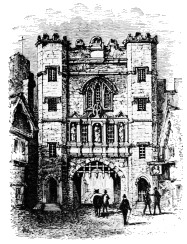
beautiful structure as represented in the woodcut is thus described by
the above-mentioned writer:—
“The west side is adorned with three ranges of Tuscan pilasters with
their entablatures, and in the inter columniations are four niches, in
one of which is a figure representing Liberty; the word ‘libertas’ is
inscribed on her cap, and at her feet lies a cat in allusion to Sir
Richard Whittington, a benefactor to the prison, who is said to have
made the first step to his advancement and good fortune by a cat. The
inside of the gate is also adorned with a range of pilasters, with their
entablatures, and in their niches

The Gate
are the figures of Justice, Mercy, and Truth.... Newgate,” he continues,
“considered as a prison is a structure of more cost and beauty than was
necessary, because the sumptuousness of the outside but aggravates the
misery of the wretches within; but as a gate to such a city as London,
it might have received considerable additions both of design and
execution, and abundantly answered the cost in the reputation of the
building. The gate of a city, erected rather for ornament than use,
ought to be in the style of the triumphal arches.... If Newgate be
considered as a prison, it is indeed a very dismal one. It is the
county gaol for Middlesex both for debtors and malefactors, as well as
the city prison for criminals. The debtor, rendered unfortunate by the
vicissitudes of trade or unforeseen losses, has the reproach of being
confined in the same prison with the greatest villains, and too often
his being in Newgate is imputed by the ignorant to crimes which he
abhors. On the other hand, those confined as criminals are, even before
they are found guilty by the laws of their country, packed so close
together that the air being corrupted, ... occasions a dismal,
contagious disease called the gaol distemper, which has frequently
carried off great numbers, and even spread its contagion to the Court of
Justice, where they take their trials. But to prevent these dreadful
effects the city has introduced a ventilator on the top of Newgate to
expel the foul air, and make room for the admission of such as is fresh;
and during the sessions herbs are also spread in the Justice Hall and
the passages to it to prevent infection. However, as these precautions,
with some others, have often proved ineffectual, and as the prison in
its present state is far from being commodious, it was lately resolved
by the Common Council of the city of London to petition Parliament for
leave to build a new prison in a more commodious place.”
An accurate and detailed account of the interior of the 1667 prison has
been preserved in a small work published in 1724, and written by “B. L.
of Twickenham.” This book purports to be “an accurate description of
Newgate, with the rights, privileges, allowances, fees, dues, and
customs thereof, together with a parallel between the master debtors’
side and the several spunging houses in the county of Middlesex, 1724.”
The author’s short historical preface contains no new facts. It is when
he proceeds to describe the inside of the building, such as he evidently
knew it from personal inspection, that his account becomes interesting.
He gives no illustrations, but I have constructed plans of each floor
from the descriptions in the letter-press, which may assist the reader
in understanding the text.
Newgate, as is plain from the woodcut, spanned the roadway, which passed
beneath by the arch, and seemingly, as in Temple Bar in our time,
without gate or obstruction. This roadway outside the gate, or to the
westward, was Holborn; within, or to the eastward, it was Newgate
Street. The prison proper seems to have consisted of all the upper
stories of the gatehouse; but so far as I can deduce from “B. L.,” only
the rooms or apartments to the south of the arch or gateway, upon the
ground-floor. Behind the gate front the prison building extended some
way back parallel with Newgate Street, an increase of accommodation
dating from the time of the Commonwealth, when “our very churches were
made prisons, so great was the demand for room.” This extension was
accomplished by taking in the buildings belonging to the Phœnix Inn
in Newgate Street.
Before proceeding to a detailed description of the various chambers and
cellars into which the interior was divided, it will be well to recount
briefly the general divisions to be found within Newgate. These were—
PARTS OR SIDES.
| I. | The Master Debtors’ Side. |
| II. | The Master Felons’ Side. |
| III. | The Common Side for Debtors. |
| IV. | The Common Side for Felons. |
| V. | The Press-Yard and Castle. |
I. The Master Debtors’ Side comprised—
| | NUMBER IN PLAN. |
| The Hall ward | 1 |
| The King’s Bench ward | 2 |
| The Stone ward | 3 |
II. The Master Felons’ Side comprised—
| The Drinking-cellar and Hall | 4 |
| The Gigger, or Visiting-room | 5 |
| First Ward | 6 |
| Second and Third wards— | 7 |
| 8 |
III. The Common Side for Debtors comprised—
| The Stone hall | 9 |
| High hall | 10 |
| Tangier | 11 |
| Debtors’ hall | 12 |
| Women’s ward | 13 |
IV. The Common Side for Felons comprised—
| The Stone hold | 14 |
| Lower ward | 15 |
| Middle ward | 16 |
| Waterman’s hall (for women) | 17 |
| Women’s second ward | 18 |
V. The Press-Yard and Castle comprised several rooms on ground and three
upper floors, as well as an exercising ground.
Besides the foregoing there was a chapel at the topmost story and a
number of independent rooms, such as the Bilbows, Press-room, Condemned
holds, and Jack Ketch’s kitchen.
At the entrance, on the threshold of the prison, was the lodge, “where
prisoners were first received, and where they were generally fettered if
the cause of their imprisonment require it.” Other writers less
favourably disposed than B. L. affirm that almost all prisoners without
exception were in those days ironed upon reception, whatever their
condition. This, in effect, was one of the many acts of extortion
practised without let or hindrance by the gaolers of the past. Debtors
and unconvicted persons were clapped into manacles for a time, and until
they were terrified into purchasing release; the most heinous offenders
were also heavily weighted until they chose to purchase “easement,” and
choice of a lighter set of chains. There was no reception ward in
Newgate such as we understand it, but hard by the lodge was a chamber
which served as a first resting-place for most male prisoners, as well
as the last for not a few. The condemned hold for males, says B. L., is
situated “adjacent to the lodge.” Another writer, the author of ‘The
History of the Press-Yard,’ states more precisely that the men’s
condemned hold, “falsely supposed a noisome vault underground, lies
between the top and bottom of the arch under Newgate.” It was only
imperfectly lighted, a “dark opace wild room,” entered by a hatch, about
twenty feet in length and fifteen in breadth. The floor was of stone,
but on it was a wooden barrack bed raised, “whereon you may repose
yourself if your nose suffers you to rest.” Along and above this
bed-place are “divers ring bolts, wherein such prisoners are locked as
are disorderly. There is only one window, which is so very small that
very little light comes thereby, so that the room is very dark. It is
customary,” adds B. L., “when any felons are brought to the lodge in
Newgate, to put them first in this condemned hold, where they remain
till they have paid two-and-sixpence, after which they are admitted to
the masters’ or common felons’ side.” This is a mild way of describing
the custom already referred to.
I. From the lodge admission was gained at once to the Master Debtors’
Side. The principal room, in dimensions twenty-five feet by fifteen, was
the Hall Ward (1), which lay to the southern side of the prison, and
owned one window, five feet by six, with two casements for air. In the
midst of the west side of this ward was a fire-place and good chimney,
in which burnt constantly a fire of sea-coal for the general benefit. It
had also wooden benches and a good common table; and in the north-west
corner was a bench and shelf of wood, on which scullery work was
performed. Six and a half feet above the floor, on the north and east
sides, was a gallery, supported by fir-posts, wherein were five
partitions for beds, one at the end of the other. These beds were made
of flock, and were “of their kind very good;” the charge was
half-a-crown per week per bed, and for sheets two shillings per month,
“paid at the time of receiving them.” Doors on the debtors’ side were
locked at 9 P.M. and opened at 8 A.M. The last arrival had to keep all
clean, or pay two pence daily to have it done. “Underneath the gallery
in this Hall ward is a very good place for the prisoners therein to walk
at their pleasure, which advantage the other wards are deficient of.”
The King’s Bench Ward (2) lay over the Hall Ward. Its dimensions were
twenty-one feet by fifteen, and it was ten feet high. It had one window
six feet by four, with a southern aspect probably like that of the Hall
ward. The bed partitions were the same, but on the floor, which was of
oak plank. The fees too were similar. The Stone Ward (3), alongside, is
described as the very best, and pleasantly situated over the gateway
towards Holborn, and therefore facing west. But the beds were all on the
floor, which was of stone, with fire-place fees and so forth, as in the
other rooms. At the head of the stairs, between the King’s Bench Ward
and the Stone Ward, was a small apartment called “my Lady’s Hold,” in
which were only two beds, for the accommodation of any female debtors
who came to the master’s side. “This small apartment,” says one author
(B. L.), “is the very worst part of the master’s side.”
II. The lowermost apartment in the Master Felons’ Side was a large
cellar (4), some four feet below the level of the street, comprising a
central drinking-room or hall, with three wards alongside, two of which
were appropriated to men and one to women. Prices ruled as follows in
this underground tavern: wine was sold at 2s. a bottle, strong drink
at 4d. per quart, and brandy at 4d. per quartern. A “cellar-man,” so
called, was selected by the turnkeys from among the prisoners for the
regulation and government of his fellows, who was allowed to make what
profit he could on the sale of candles, as well as a penny upon every
quart of beer or bottle of wine sold, “with other advantages.”
Immediately over the drinking vaults was “a spacious hall,” named the
“Gigger” (5), after the small grate or gigger in the door, at which
prisoners in the various wards on this side were permitted to have
interviews with their friends from outside. The privilege of entrance to
this hall, or to the cellar below, was conceded only on payment of a fee
of 1s. 6d. per diem. The same sum was charged to any felon’s friend
who was admitted to the gigger, and desired to see his friends in the
tap-room; besides which they paid the cellar-man for a candle to light
them down, and the price of a quart of beer, or 5d. Above the gigger
again stairs led to the first ward (6), in which was “a good light, a
good fire-place, and convenient lodging-rooms, as also very good flock
beds, for the use of which each felon pays 3s. 6d. per week. Over
this ward are the other two (7 and 8), which are both of the same
magnitude and light, with the like appurtenances belonging thereto.” B.
L. further tells us that the prisoners were generally utilized for all
prison services. Not only did they perform all menial offices, and
distribute the allowance of food, such as it was, but they were also
employed to rivet on and remove the irons of their fellows. Discipline
even was entrusted to them; and B. L. speaks of certain prisoners who
maintained order “with a flexible weapon, to the great terror and smart
of those who dispute their authority. Every felon at his coming in pays
14s. 10d. for fees and garnish money only, 1s. 6d. for coals,
and 1s. to be spent amongst the prisoners of the ward.”
III. The Common Side for Debtors comprised four apartments, all situate
towards Newgate Street, in other words, facing north. The ground-floor
apartment was named the “Stone Hall” (9); its dimensions are not given,
but it owned a cistern for water, and on the north side a chimney, “in
which no fires are made except at Christmas, when there is a quantity of
beef boiled there to be given to the felons.” This Stone Hall led to
some subordinate chambers; in the north-east angle was the iron hold for
fetters, and in the south-east a chamber for the confinement of
refractory prisoners, styled “the Partner’s room,” where four men could
lie at a time. In the south-west of the room was a large place called
the “tap-house,” in which were sold beer, ale, brandy, wine, tobacco,
and pipes, at the customary prices, “which of their kind are absolutely
good.” Of the tap-house itself B. L. speaks in less complimentary terms.
“It is great pity,” he says, “that greater decorum is not maintained
among the prisoners of the common side, especially in the tap-house, for
therein, by connivance, the felons are permitted to converse and drink
with the debtors; by which means such wretchedness abounds therein, that
the place has the exact aspect of hell itself, and by this means ’tis
much to be questioned whether one debtor in ten who enters therein an
honest man comes out the same, the wickedness of the place is so great.”
At the west side of the Stone Hall was a staircase, leading to a large
room called “High Hall” (10), wherein felons alone were admitted to
walk. I have placed this High Hall in the plan on that part of the
gate-house which lay to the north side of Holborn. There is no precise
evidence that it was exactly so situated, but as all other rooms on this
first floor can be pretty accurately placed, I think the conclusion is
just that High Hall was approximately where I have put it. High Hall was
large, being thirty-three feet by twenty-eight, and in altitude twelve.
In the midst of the place was a stone anvil, whereon the irons were
knocked off the unhappy persons sentenced to death, when they came down
from the chapel (on the third floor), on their way to the cart which was
to carry them to Tyburn.
Opposite the entrance to the tap-house was a passage leading to a second
common-side debtors room. This came to be called “Tangier” (11) in due
course, no doubt from the stifling atmosphere. “The air in this ward is
very bad,” says B. L., “occasioned by the multitude of the prisoners in
it, and the filthiness of their lodging.” The room was large, but “dark
and stinking,” and it only contained “divers barracks for the prisoners
to lie on.” Debtors’ Hall (12), a third room for common-side debtors,
was on the floor above. It also faced Newgate Street, and being higher
up, enjoyed very good air and light. It had a very large window, which
was, however, unglazed, and subjected the prisoners not only to the
weather, but also to all kinds of rain, snow, sleet, &c., which the
north-eastern winds produce. Unlike those in Tangier, the prisoners in
Debtors’ Hall had no barrack-beds to lie on, and were obliged therefore
to sleep upon the boarded floor. Close by Debtors’ Hall was a kind of
kitchen, containing a large fire-place and grate, and known in B. L.’s
time as the Hangman’s, or Jack Ketch’s kitchen, “because it is the place
in which that honest fellow boils the quarters of such men as have been
executed for treason.”[64] Over this kitchen again, on the third floor,
that is to say, was “an indifferent good ward,” called the Women’s Ward
(13), and devoted to common debtors of that sex.
These poor debtors were but ill lodged and provided for. They had no
firing save what they themselves found. They had to provide their own
beds or sleep on the boards supplied by the sheriffs. But every debtor
on the common side was allowed “each day one coarse household wheaten
loaf, almost the bigness of a common penny white loaf; and there is also
given a certain quantity of beef every week, in proportion to the number
of debtors. Every debtor at his entrance paid 11s. 6d. garnish
money, which was expended among the prisoners of the ward, and on
discharge or removal a further fee of 7s. 10d. as on the master’s
side. ‘The conversation of these debtors,’ says B. L., ‘was generally
very profligate, being, as before mentioned, perpetually drinking and
conversing with the felons.’”
IV. The Common Felons’ Side, which was adjacent to that for the common
debtors, was evidently a foul disgrace to the prison and to those
charged with the administration of the law. B. L. describes it as “a
most terrible, wicked, and dreadful place.” In this side were five
wards. The first, known as the Stone Hold (14), was an underground
dungeon lying beneath the “middle ward,” which I fix somewhere near the
Tangier Ward of the debtors’ common side. “The Stone Hold,” says the
authority already quoted, “was a terrible, stinking, dark, and dismal
place, situate underground, into which no daylight can come. It was
paved with stone; the prisoners had no beds, and lay on the pavement,
whereby they endured great misery and hardship. The unhappy persons
imprisoned therein are such as at their unfortunate entrance cannot pay
the customary fees of the gaol.” Alongside the Stone Hold was the “Lower
Ward” (15), another large dungeon, in which were confined felons for
non-payment of fines. The Middle Ward (16), on the floor above, was for
those who had paid their bare fees, no more. Here also they had no beds,
but the floor on which they lay was of oak, not stone. There were two
wards for common female felons. The first, on this second floor, was
called “Waterman’s Hall” (17), a very dark and stinking place; the floor
is of oaken planks, which is all the bed allotted to its miserable
inhabitants. Water was, however, well supplied to this ward. Close by it
were other rooms applied to ghastly uses. One was the “press-room,”
still used in the writer’s time for the execution of the frightful
sentence of pressing to death culprits arraigned who refused to plead;
another the Bilbows,[65] adjacent to the press room, also very dark,
“and used as a refractory cell for such as occasioned quarrel or
disturbance.” Near this again was the women’s condemned hold, “a small,
dark, dismal dungeon, wherein is a barrack for the prisoners to lie on,
but no fire-place, and it is therefore cold at all times. A second ward
(18) for common side females existed on the third, or floor above all,
“the highest part of the whole gaol in the north part thereof, and is of
large extent, in which is one window only, and that very small.”
Barracks were fixed on the walls on each side, but without any kind of
bed whatsoever. “The persons imprisoned therein were generally those
that lie for transportation, and they, knowing their time to be short
here, rather than bestow one minute towards cleaning the same, suffer
themselves to live far worse than swine, and, to speak the truth, the
Augean Stable would bear no comparison to it, for they are almost
poisoned by their own filth, and their conversation is nothing but one
Newgate (1700).
Ground Floor.
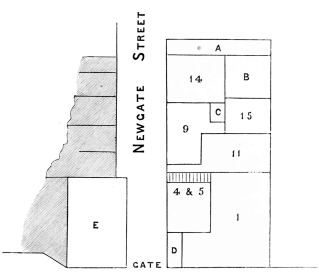 Holborn
A. Press Yard. (Exercising Ground.)
B. Part of Press Yard.
C. Partner’s Room.
D. Lodge.
E. Part of Keeper’s House.
(Under which was the Condemned Hold.) |
1. Hall Ward. (Master Debtors.)
4. Drinking Cellar, below.
5. Gigger.
9. Stone Hall. (Common Side Debtors.)
11. Tangier. (Common Side Debtors.)
14. Stone Hold. (Common Side Felons.)
15. Lower Ward. (Common Side Felons.) |
continued course of swearing, cursing, and debauchery, insomuch that it
passes all description and belief.... It is with no small concern,” he
adds, “that I am obliged to observe that the women in every ward of this
prison are exceedingly worse than the worst of the men, not only in
respect to nastiness and indecency of living, but more especially as to
their conversation, which, to their great shame, is as profane and
wicked as hell itself can be.”
These remarks, unhappily, are fully borne out by more modern experience.
Female prisoners are, as a rule, far worse than the male.
V. The one division remaining, and commonly called the Press-Yard and
Castle, was quite the best part of the prison. The entrance was at the
base of the stairs between the common debtors’ and the common felons’
sides. It was composed of “divers large spacious rooms,” on all three
floors: those on the ground and first floor faced towards east and
south; those on the second—the Castle so called—to the west. These
rooms were all well supplied with light and air, free from all ill
smells, and possessed all necessary appurtenances. A yard or place for
walking in the open air was attached to this side, and was situate
between the door or postern which entered from Newgate Street and the
fabric itself. This yard, which was fifty-four feet long by seven feet
wide, and was handsomely paved with Purbeck stone, could have been
little better than a narrow passage running the whole north side of the
prison between the building and its boundary wall. The Press-Yard was
for State prisoners, or great and opulent criminals who could afford to
pay such high premium at entrance as they and the gaoler might agree
upon, and also the weekly rent of their wards. This premium was fixed
according to the quality of the individual, and ranged from £20 to £500.
The weekly rent of tenancy of the rooms was 11s. 6d. per head, 1s.
of which was paid to a woman called the laundress, who made the fires
and cleaned the rooms; the remainder went into the gaoler’s pocket. The
prisoners themselves provided their fires and candles, as also all other
necessaries, “save the beds, which were very good of their kind, and
which the gaoler found, sheets being always excepted.” A less
aristocratic section of this very select part of the prison was the
Castle, which comprised two wards above the Stone ward and King’s Bench
ward of the master debtors’ sides, and of the same dimensions, with the
same air and light, as the wards immediately beneath. In the Castle
wards were divers partitions for beds, for each of which a prisoner paid
2s. 6d. per week.
The remainder of this top floor, with the exception of the high hall,
and the second ward for common female felons, was taken up by the prison
chapel, which looked towards the south-east. The chapel was partitioned
on the north side into large apartments called pens, which were all
strongly built, as they contained every Sunday the common debtors and
the felons of both kinds. The pulpit stood in the
Newgate (1700).
1st Floor.
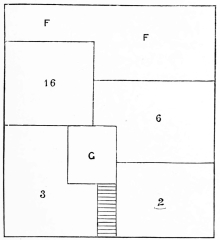
F. Part of Press Yard.
G. My Lady’s Hold. |
2. King’s Bench Ward (Master Debtors).
3. Stone Ward. (Master Debtors).
6. 1st Ward (Master Felons).
16. Middle Ward (Common Side Felons). |
north-west angle of the chapel, against it were the pens of the male
common debtors, next to them those of the male and female felons, but in
separate divisions, and in the pens were gratings through which the
occupants could be observed from the chapel pews. On the south side,
opposite the felons’ pens, were two very handsome enclosures for the
master debtors; adjoining the pulpit was another large pew, wherein were
placed such prisoners as were under sentence of death, and here in this
same apartment “the blessed sacrament was administered to them at proper
times, more particularly on the morning before execution.” Besides these
were a number of other handsome open pews, free to all persons who
choose to come and sit in them. They were generally well filled on the
Sundays when the condemned sermon was preached to prisoners about to
die.[66]
A few corroborative facts may be quoted from other authorities as to the
horrors of Newgate, the mismanagement, tyranny, and lax discipline which
prevailed. Its insanitary condition was chronic, which at times, but
only for influential inmates, was pleaded as an excuse for release. Lord
Montgomery, a prisoner there in 1697, was brought, Luttrell tells, out
of Newgate to the King’s Bench Court, there to be bailed, upon two
affidavits, which showed that there was an infectious fever in Newgate,
of which several were sick and some dead. He was accordingly admitted to
bail, himself in £10,000, and four sureties—the Duke of Norfolk, the
Earl of Yarmouth, Lord Carington, and Lord Jeffereys—in £5000 each. An
effort to secure release was made some years later in regard to Jacobite
prisoners of note, less successfully, although the grounds alleged were
the same and equally valid.
If a prisoner was hopelessly despondent, he could generally compass the
means of committing suicide. A Mr. Norton, natural son of Sir George
Norton, condemned for killing a dancing-master (because the latter would
not suffer him to take his wife away from him in the street), poisoned
himself the night before his reprieve expired. The drug was conveyed to
him by his aunt without difficulty, “who participated in the same dose,
but she is likely to recover.” Nor were prisoners driven to this last
desperate extremity to escape from durance. Pepys tells us in 1667,
August 1, that the gates of the city were shut, “and at Newgate we find
them in trouble, some thieves having this night broken open prison.”
Within the gaol all manner of evil communication went forward unchecked
among the prisoners. That same year Sir Richard Ford, the recorder,
states that it has been made appear to the court of aldermen “that the
keeper of Newgate hath at this day made his house the only nursery of
rogues, prostitutes, pickpockets, and thieves in the world, where they
were held and entertained and the whole society met, and that for the
sake of the sheriffs[67] they durst not this
Newgate (1700).
2nd Floor.
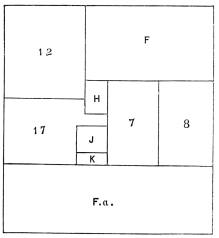
F. Part of Press Yard.
F.a. The Castle.
H. Jack Ketch’s Kitchen.
J. Press Room.
K. Bilbows. |
7. 2nd Ward (Master Felons).
8. 3rd Ward (Master Felons).
12. Debtors’ Ward (Common Side).
17. Waterman’s Hall (for Women). |
day commit him for fear of making him let out the prisoners, but are
fain to go by artifice to deal with him.” The keeper at this time was
one Walter Cowday, as appears from a State pardon “for seven prisoners
ordered to be transported by their own consent,” which he endorses.
Sharper measure was dealt out to his successor, Mr. Fells, the keeper in
1696, who was summoned to appear before the Lords Justices for conniving
at the escape of Birkenhead, alias Fish, alias South, East, West, &c.,
one of the conspirators in Sir John Fenwick’s business, and who lay in
prison “to be speedily tried.” On examination of Fells, it was stated
that Birkenhead’s escape had been effected by a bribe, whereupon the
sheriffs were instructed to find out the truth in order to displace
Fells. Fells was furthermore charged with showing favour to Sir John
Fenwick by suffering him to have pens, ink, and paper alone; a little
later he was convicted on two indictments before Lord Chief Justice Holt
at Guildhall, viz. for the escape of Birkenhead already mentioned, and
of another prisoner imprisoned for non-payment of fine. Fell’s sentence
was postponed till the next term at the King’s Bench Bar; but he moved
the court in arrest of judgment, a motion which the King’s Bench took
time to consider, but which must have been ultimately decided in his
favour, as two years later Fells still held the office of gaoler of
Newgate.
The crimes of the latter half of the seventeenth century are of the same
character as those of previous epochs. Many had, however, developed in
degree, and were more widely practised. The offence of clipping and
coining had greatly increased. The extent to which it was carried seems
almost astounding. The culprits were often of high standing. A clipper,
by name White, under sentence of death, was reprieved by the king upon
the petition of the House of Commons in order that a committee of the
House might examine him in Newgate as to his accomplices and their
proceedings. Accordingly, White made “a large discovery” to the
committee, both of clippers and coiners, and particularly of Esquire
Strode, who had been a witness at the trial of the Earl of Bath (1697).
Luttrell says (1696), among twenty persons convicted of coining was
Atkinson, the beau “that made such a figure in town about eight years
before, and spent an estate of £500 per annum in Yorkshire.” In the
lodgings of a parson, by name Salisbury, who was arrested for
counterfeiting stamped paper, several instruments for clipping and
coining were found. University men were beguiled into the crime of
clipping; so were seemingly respectable London tradesmen. Goldsmiths and
refiners were repeatedly taken up for these malpractices. “A goldsmith
in Leicester Fields and his servants committed to Newgate for receiving
large quantities of broad money from Exeter to clip it.”[68] “A
refiner’s wife and two servants committed to Newgate for clipping; the
husband escaped.” Bird, a laceman, in custody for coining, escaped; but
Newgate (1700).
3rd Floor.
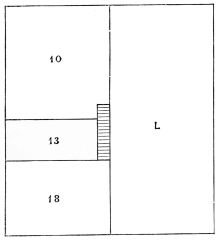
| L. The Chapel. |
10. High Hall.
13. Women’s Ward. (Debtors.)
18. Women’s 2nd Ward. (Felons.) |
surrendered and impeached others. Certain gilders committed to Newgate
petitioned therefrom, that if released they would merit the same by a
discovery of a hundred persons concerned in the trade. Such are the
entries which appear time after time in contemporary chronicles.
The numbers engaged in these nefarious practices were very great. In
1692 information was given of three hundred coiners and clippers
dispersed in various parts of the city, for several of whom warrants
were issued, some by the Treasury, others by the Lord Chief Justice. The
profits were enormous. Of three clippers executed at Tyburn in 1696,
one, John Moore, the tripeman, was said to have got a good estate by
clipping, and to have offered £6000 for his pardon. Three other clippers
arrested in St. James’ St., and committed to Newgate, were found to be
in possession of £400 in clippings, with a pair of shears and other
implements. The information of one Gregory, a butcher, who “discovered”
near a hundred persons concerned in the trade, went to prove that they
made as much as £6000 a month in counterfeit money. “All their utensils
and moulds were shown in court, the latter being in very fine clay,
which performed with great dexterity.” The extent of the practice is
shown by the ingenuity of the machinery used. “All sort of material for
coining was found in a house in Kentish town, with stamps for all coins
from James I.” The work was performed “with that exactness no banker
could detect the counterfeit.” So bold were the coiners, that the
manufacture went forward even within the walls of Newgate. Three
prisoners were taken in the very act of coining in that prison. One of
the medals or tokens struck in Newgate as a monetary medium among the
prisoners is still to be seen in the Beaufoy Collection at Guildhall.
Upon the obverse of the coin the legend is inscribed: “Belonging to the
cellar on the master’s side, 1669;” on the reverse side is a view of
Newgate and the debtors’ prison.
The heaviest penalties did not check this crime. The offence was high
treason; men sentenced for it were handed, drawn, and quartered, and
women were burnt. In 1683 Elizabeth Hare was burnt alive for coining in
Bunhill Fields. Special legislation could not cope with this crime, and
to hinder it the Lords of the Treasury petitioned the Queen (Mary in the
absence of William III.) to grant no pardon to any sentenced for
clipping unless before their conviction they discovered their
accomplices.
Highway robbery had greatly increased. The roads were infested with
banditti. Innkeepers harboured and assisted the highwaymen, sympathizing
with them, and frequently sharing in the plunder. None of the great
roads were safe: the mails, high officials, foreigners of distinction,
noblemen, merchants, all alike were stopped and laid under contribution.
The following are a few of the cases which were of constant occurrence.
“His Majesty’s mails from Holland robbed near Ilford in Essex, and
£5000 taken, belonging to some Jews in London.” The Worcester waggon,
wherein was £4000 of the king’s money, was set upon and robbed at
Gerard’s Gross, near Uxbridge, by sixteen highwaymen. The convoy, being
near their inn, went on ahead, thinking all secure, and leaving only two
persons on foot to guard it, who, having laid their blunderbusses in the
waggon, were on a sudden surprised by the sixteen highwaymen, who took
away £2,500. and left the rest for want of conveniences to carry it.”
Two French officers (on their way to the coast) were robbed by nine
highwaymen of one hundred and ten guineas, and bidden to go home to
their own country. Another batch of French officers was similarly dealt
with on the Portsmouth road. Fifteen butchers going to market were
robbed by highwaymen, who carried them over a hedge and made them drink
King James’ health. The Portsmouth mail was robbed, but only of private
letters; and the same men robbed a captain going to Portsmouth with
£5000 to pay his regiment with. Three highwaymen robbed the
Receiver-General of Bucks of a thousand guineas, which he was sending up
by the carrier in a pack; the thieves acted on excellent information,
for although there were seventeen packhorses, they went directly to that
which was laden with the gold. Seven on the St. Alban’s Road near Pinner
robbed the Manchester carrier of £15,000 king’s money, and killed and
wounded eighteen horses to prevent pursuit. The purser of a ship landed
at Plymouth and rode to London on horseback, with £6000 worth of rough
diamonds belonging to some London merchants which had been saved out of
a shipwreck. Crossing Hounslow Heath, the purser was robbed by
highwaymen. “Oath was thereupon made before a justice of the peace,”
says Luttrell, in “order to sue the Hundred for the same.” The Bath
coach was stopped in Maidenhead thicket, and a footman who had fired at
them was shot through the head. The Dover stage coach, with foreign
passengers, was robbed near Shooter’s Hill, but making resistance, one
was killed. The western mail was robbed by the two Arthurs, who were
captured and committed to Newgate. They soon escaped therefrom, but were
again arrested at a tavern by Doctors’ Commons, being betrayed by a
companion. They confessed that they had gone publicly about the streets
disguised in Grecian habits, and that one Ellis, a tobacconist, assisted
them in their escape, for which he was himself committed to Newgate.
John Arthur was soon afterwards condemned and executed. Henry Arthur was
acquitted, but soon after quarrelling about a tavern bill in Covent
Garden, he was killed in the mêlée.
All manner of men took To the road. Some of the Royal guards were
apprehended for robbing on the highway. Lifeguardsmen followed the same
gentlemanly occupation when on duty. “Thompson, a lifeguardsman,
committed on suspicion of robbing Welsh drovers, is refused bail, there
being fresh evidence against him.”[69] Captain Beau, or Bew, formerly of
the Guards, was seized at Knightsbridge as a highwayman, and afterwards
poisoned himself. Seven of his gang were committed to Newgate. Harris,
‘the lifeguardsman’ tried at the Old Bailey for robbing on the black
mare and acquitted, was again tried a month later, and condemned. He was
then reprieved, and Sir William Penn obtained the Queen’s pardon for
him, and a commission as lieutenant in the Pennsylvania Militia, to
which colony he was to transport himself. Persons of good social status
engaged in the perilous trade. One Smith, a parson and a lecturer at
Chelsea, when brought up at Westminster for perjury, was found to be a
confederate with two highwaymen, with whom he had shared a gold watch,
and planned to rob Chelsea Church of its plate. Smith when arraigned
appeared in Court in his gown, but he was “sent to Newgate, and is like
to be hanged.” Disguised highwaymen were often found in reputable
citizens and quiet tradesmen, who upon the surface seemed honest folk. A
mercer of Lombard Street was taken out of his bed and charged by a
cheesemonger as being the man that rubbed him two years previously.
Another mercer was taken up near Ludgate on suspicion of being a
highwayman, and committed. Saunders, a butcher of St. James’ market, was
charged with robbing the Hampton coach, and discovered three
confederates, who were captured on Sunday at Westminster Abbey. “Two
highwaymen taken near Highgate, one of whom was said to be a broken
mercer, the other a fishmonger.” Two of Whitney’s gang were said to be
tradesmen in the Strand—one a goldsmith and one a milliner.
Nothing could exceed the cool impudence with which reputed robbers
showed themselves in public places. They did not always escape capture,
however. “A noted highwayman in a scarlet cloak,” says Luttrell, “and
coat laced with gold taken in Covent Garden.” Another was taken in the
Strand and sent to Newgate. Five more were captured at the Rummer,
Charing Cross; three others, notorious highwaymen, taken at the
‘Cheshire Cheeze.’ At times they fought hard for liberty. “One Wake, a
highwayman, pursued to Red Lion Fields, set his back against the wall
and faced the constables and mob. He shot the former, and wounded
others, but was at last taken and sent to Newgate.” Whitney, the famous
highwayman, was taken without Bishopsgate, being “discovered by one
Hill, as he (Whitney) walked the street. Hill observed where the robber
‘housed’ and calling for assistance, went to the door.” Whitney defended
himself for about an hour, but the people increasing, and the officers
of Newgate being sent for, he surrendered himself, but not before he had
stabbed Hill with a bayonet, “not mortal.” He was cuffed and shackled
with irons, and committed to Newgate.
Whitney had done business on a large scale. He had been arrested before
by a party of horse despatched by William III., which had come up with
him lurking between St. Alban’s and Barnet. He was attacked, but made a
stout defence, killing some and wounding others before he was secured.
He must have got free again very soon afterwards. His second arrest,
which has just been detailed, was followed by that of many others of his
gang. “Three were seized near Chelsea College by some soldiers; two more
were in company, but escaped.” On Sunday two others were taken; one kept
a livery stable at Moorfield’s. Soon after his committal there was a
strong rumour that he had escaped from Newgate, but “he continues
closely confined there, and has forty pounds weight of irons on his
legs. He had his tailor to make him a rich embroidered suit with peruke
and hat, worth £100; but the keeper refused to let him wear them,
because they would disguise him from being known.”[70] Whitney made many
attempts to purchase pardon. He offered to discover his associates, and
those that give notice when and where the money is conveyed on the roads
in coaches and waggons. He was, however, put upon his trial, and
eventually convicted and sentenced to death. He went in the cart to the
place of execution, but was reprieved and brought back to Newgate with a
rope round his neck, followed by a “vast” crowd. Next night he was
carried to Whitehall and examined as to the persons who hired the
highwaymen to rob the mails. But he was again ordered for execution, and
once more sought to gain a reprieve by writing a letter in which he
offered, if he might have his pardon, to betray a conspiracy to kill
the king. His last appeal was refused, and he suffered at Porter’s
Block, near Cow Cross, Smithfield.
Determined efforts were made from time to time to put down these
robberies, which were often so disgracefully prevalent that people
hardly dared to travel along the roads. Parties of horse were quartered
in most of the towns along the great highways. Handsome rewards were
offered for the apprehension of offenders. A proclamation promised £10
for every highwayman taken, and this was ere long increased to £40, to
be given to any who might supply information leading to an arrest.
Horses standing at livery in and about London, whose ownership was at
all doubtful, were seized on suspicion, and often never claimed. It was
customary to parade before Newgate persons in custody who were thought
to be highwaymen. They were shown in their riding-dresses with their
horses, and all gentlemen who had been robbed were invited to inspect
this singular exhibition.[71] But the practice flourished in spite of
all attempts at repression.
One or two types of the highwaymen of the seventeenth century may here
be fitly introduced. One of the earliest and most celebrated was Jack
Cottington, alias Mulled Sack, who had been a depredator throughout the
Commonwealth epoch, and who enjoyed the credit of having robbed Oliver
Cromwell himself on Hounslow Heath. His confederate in this, Horne,
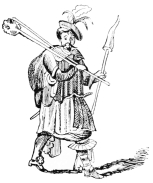 “Mulled Sack.”
once a captain in Downe’s foot regiment, was overtaken, captured, and
hanged, but Cottington escaped. Jack Cottington began as a
chimney-sweep, first as an apprentice, then on his own account, when he
gained his soubriquet from his powers in drinking mulled sack. From this
he graduated, and soon gained a high reputation as a pickpocket, his
chief hunting-ground being churches and puritan meeting-houses, which he
frequented demurely dressed in black with a black roquelaire. He
succeeded in robbing Lady Fairfax of a gold watch set with diamonds and
a gold chain as she was on her way to Dr. Jacomb’s lecture at Ludgate;
and a second time by removing the lynch-pin from her Ladyship’s carriage
when on her way to the same church, he upset the coach, and giving her
his arm, relieved her of another gold watch and seals. After this he
became the captain of a gang of thieves and night prowlers, whom he
organized and led to so much purpose that they alarmed the whole town.
His impudence was so great that he was always ready to show off his
skill as a thief in any public-house if he was paid for it, in a
performance he styled “moving the bung.” He was not content to operate
in the city, but visited the Parliament House and Courts of Law at
Westminster, and was actually caught in the act of picking the
Protector’s pocket. He narrowly escaped hanging for this, and on coming
out of gaol took permanently to the highway, where he soon achieved a
still greater notoriety. With half-a-dozen comrades he robbed a
government waggon conveying money to the army, and dispersed the twenty
troopers who escorted it, by attacking them as they were watering their
horses. The waggon contained £4000, intended to pay the troops quartered
at Oxford and Gloucester. Another account states that near Wheatley,
Cottington put a pistol to the carrier’s head and bade him stand, at
which both carter and guard rode off for their lives, fearing an
ambuscade. The town of Reading he laid under frequent contribution,
breaking into a jeweller’s shop in that town and carrying off the
contents, which he sported on his person in London. Again at Reading,
hearing that the Receiver-General was about to send £6000 to London in
an ammunition waggon, he entered the receiver’s house, bound the family,
and decamped with the money. Being by this time so notorious a
character, he was arrested on suspicion, and committed for trial at
Abingdon Assizes. There, however, being flush of cash, he found means to
corrupt the jury and secure acquittal, although Judge Jermyn exerted all
his skill to hang him. His fame was now at its zenith. He became the
burthen of street songs—a criminal hero who laughed the gallows to
scorn. But about this time he was compelled to fly the country for the
murder of Sir John Bridges, with whose wife he had had an intrigue. He
made his way to Cologne, to the Court of Charles II., whom he robbed of
plate worth £1500. Then he returned to England, after making overtures
to Cromwell, to whom he offered certain secret papers if he might be
allowed to go scot free. But he was brought to the gallows, and nobly
deserved his fate.
Claude Duval is another hero whose name is familiar to all readers of
criminal chronology. A certain halo of romance surrounds this notorious
and most successful highwayman. Gallant and chivalrous in his bearing
towards the fair sex, he would spare a victim’s pockets for the pleasure
of dancing a “corranto” with the gentleman’s wife. The money he levied
so recklessly he lavished as freely in intrigue. His success with the
sex is said to have been extraordinary, both in London and in Paris.
“Maids, widows, and wives,” says a contemporary account, “the rich, the
poor, the noble, the vulgar, all submitted to the powerful Duval.” When
justice at length overtook him, and he was cast for death, crowds of
ladies visited him in the condemned hold; many more in masks were
present at his execution. After hanging he lay in state in the Tangier
Tavern at St. Giles, in a room draped with black and covered with
escutcheons; eight wax tapers surrounded his bier, and “as many tall
gentlemen in long cloaks.” Duval was a Frenchman by birth—a native of
Domfront in Normandy, once a village of evil reputation. Its curé was
greatly surprised, it is said, at finding that he baptized as many as a
hundred children and yet buried nobody. At first he congratulated
himself in residing in an air producing such longevity; but on closer
inquiry he found that all who were born at Domfront were hanged at
Rouen.
Duval did not long honour his native country with his presence. On the
restoration of Charles II. he came to London as footman to a person of
quality; but soon took to the road. Numerous stories are told of his
boldness, his address, and fertility of resource. One of the most
amusing is that in which he got an accomplice to dress up a mastiff in a
cow’s-hide, put horns on his head, and let him down a chimney into a
room where a bridal merry-making was in progress. Duval, who was one of
the guests, dexterously profited by the general dismay to lighten the
pockets of an old farmer whom he had seen secreting a hundred pounds.
When the money was missed it was supposed that the devil had flown away
with it. On another occasion, having revisited France, he ingratiated
himself with a wealthy priest by pretending to possess the secret of the
philosopher’s stone. This he effected by stirring up a potful of molten
inferior metal with a stick, within which were enclosed a number of
sprigs of pure gold, as black lead is in a pencil. When the baser metals
were consumed by the fire, the pure gold remained at the bottom of the
pot. Overjoyed at Duval’s skill as an alchemist, the priest made him his
confidant and bosom friend, revealing him his secret hoards, and how
they were bestowed. One day, when the priest was asleep after dinner,
Duval gagged and bound him, removed his keys, unlocked his strong boxes,
and went off with all the valuables he could carry. Duval was also an
adroit card-sharper, and won considerable sums at play by “slipping a
card”; and he was most astute in laying and winning wagers on matters he
had previously fully mastered. His career was abruptly terminated by his
capture when drunk at a tavern in Chandos St., and he was executed,
after ten years of triumph, at the early age of twenty-seven.
William Nevison, a native-born member of the same fraternity, may be
called, says Raine, “the Claude Duval of the north. The chroniclers of
his deeds have told us of his daring and his charities, for he gave away
to the poor much of the money he took from the rich.” Nevison was born
at Pontefract in 1639, and began as a boy by stealing his father’s
spoons. When chastised by the schoolmaster for this offence, he bolted
with his master’s horse, having first robbed his father’s strong box.
After spending some time in London thieving, he went to Flanders and
served, not without distinction, in a regiment of English volunteers
commanded by the Duke of York. He returned presently to England, and
took to the road. Stories are told of him similar to those which made
Duval famous. Nevison was on the king’s side, and never robbed
Royalists. He was especially hard on usurers. On one occasion he eased a
Jew of his ready money, then made him sign a note of hand for five
hundred pounds, which by hard riding he cashed before the usurer could
stop payment. Again, he robbed a bailiff who had just distrained a poor
farmer for rent. The proceeds of the sale, which the bailiff thus lost,
Nevison restored to the farmer. In the midst of his career, having made
one grand coup, he retired from business and spent eight years
virtuously with his father. At the old man’s death he resumed his evil
courses, and was presently arrested and thrown into Leicester Gaol. From
this he escaped by a clever stratagem. A friendly doctor having declared
he had the plague, gave him a sleeping draught, and saw him consigned to
a coffin as dead. His friend demanded the body, and Nevison passed the
gates in the coffin. Once outside, he was speedily restored to life, and
resumed his old ways. He now extended his operations to the capital, and
it was soon after this that he gained the soubriquet, given by Charles
II., it is said, of “Swift Nick.” There seems to be very little doubt
that Nevison was actually the hero of the great ride to York, commonly
credited to Turpin. The story goes that he robbed a gentleman at
Gadshill, then riding to Gravesend, crossed the Thames and galloped
across Essex to Chelmsford. After baiting he rode on to Cambridge, and
Godmanchester, thence to Huntingdon, where he baited his mare and slept
for an hour; after that, holding to the north road, and not galloping
his horse all the way, reached York the same afternoon. Having changed
his clothes, he went to the bowling-green, where he made himself
noticeable to the Lord Mayor. By and by, when recognized and charged
with the robbery at Gadshill, Nevison called upon the mayor to prove
that he had seen him at York; whereupon he was acquitted, “on the bare
supposition that it was impossible for a man to be at two places so
remote on one and the same day.”
Nevison appears to have been arrested and in custody in 1676. He was
tried for his life, but reprieved and drafted into a regiment at
Tangier. He soon deserted, and returning to England, again took to the
road. He was next captured at Wakefield, tried, and sentenced to death;
but escaped from prison, to be finally taken up for a trifling robbery,
for which he suffered at York. The depositions preserved by the Surtees’
Society show that he was the life and centre of a gang of highway
robbers who worked in association. They levied black mail upon the whole
country side; attended fairs, race meetings, and public gatherings, and
had spies and accomplices, inn-keepers and ostlers, who kept them
informed of the movements of travellers, and put them in the way of
“likely jobs” to be done. Drovers and farmers who paid a tax to them
escaped spoliation; but all others were very roughly handled. The gang
had its head-quarters at the Talbot Inn, Newark, where they kept a room
by the year, and met at regular intervals to divide the proceeds of
their robberies.
Many instances are recorded of another crime somewhat akin to highway
robbery. The forcible abduction of heiresses was nothing new; but it was
now prosecuted with more impudence and daring than heretofore. Luttrell
tells us, under date 1st June, 1683, that one Mrs. Synderfin, a rich
widow, was taken out of her carriage on Hounslow Heath, by a Captain
Clifford and his comrades. They carried her into France to “Calice”
against her will, and with much barbarous ill-usage made her marry
Clifford. Mrs. Synderfin or Clifford was, however, rescued, and brought
back to England. Clifford escaped, but presently returning to London was
seized and committed to custody. He pleaded in defence his great passion
for the lady, and his “seeing no other way to win her.” It was not mere
fortune-hunting, he declared, as he possessed a better estate than hers.
But the Lord Chief Justice charged the jury that they must find the
prisoners guilty, which they did, and all were sentenced to imprisonment
in Newgate for one year. Captain Clifford was also to pay a fine of
£1000, two of his confederates £500 each, and two more £100. In the same
authority is an account how—“Yesterday a gentleman was committed to
Newgate for stealing a young lady worth £10,000, by the help of
bailiffs, who arrested her and her maid in a false action, and had got
them into a coach, but they were rescued.” Again, a year or two later,
“one Swanson, a Dane, who pretends to be a Deal merchant, is committed
to Newgate for stealing one Miss Rawlins, a young lady of
Leicestershire, with a fortune of £4000. Three bailiff’s and a woman,
Swanson’s pretended sister, who assisted, are also committed, they
having forced her to marry him. Swanson and Mrs. Bainton were convicted
of this felony at the King’s Bench Bar; but the bailiffs who arrested
her on a sham action were acquitted, with which the court was not well
pleased. Swanson was sentenced to death, and executed. As also the
woman; but she being found with child, her execution was respited.” A
more flagrant case was the abduction of Miss Mary Wharton in 1690, the
daughter and heiress of Sir George Wharton, by Captain James Campbell,
brother to the Earl of Argyll, assisted by Sir John Johnson. Miss
Wharton, who was only thirteen years of age, had a fortune of £50,000.
She was carried away from her relations in Great Queen Street, on the
14th Nov., 1690, and married against her will. A royal proclamation was
forthwith issued for the apprehension of Captain Campbell and his
abettors. Sir John Johnson was taken, committed to Newgate, and
presently tried and cast for death. “Great application was made to the
king and to the relations of the bride to save his life,” but to no
purpose, “which was thought the harder, as it appeared upon his trial
that Miss Wharton had given evident proof that the violence Captain
Campbell used was not so much against her will as her lawyers
endeavoured to make it.” Luttrell says, “Sir John refused pardon unless
requested by the friends of Mrs. Wharton. On the 23rd December he went
in a mourning coach to Tyburn, and there was hanged.” No mention is made
of the arrest of Captain Campbell, whom we may conclude got off to the
continent. But he benefited little by his violence, for a bill was
brought into the House of Commons within three weeks of the abduction to
render the marriage void, and this, although the Earl of Argyll on
behalf of his brother petitioned against it, speedily passed both
Houses.
The affair of Count Konigsmark may be classed with the foregoing, as
another notorious instance of an attempt to bring about marriage with an
heiress by violent means. The lady in this case was the last of the
Percies, the only child and heiress to the vast fortune of Jocelyn, the
Earl of Northumberland. Married when still of tender years to the Earl
of Ogle, eldest son of the Duke of Newcastle, she was a virgin widow at
fifteen, and again married against her consent, it was said, to Thomas
Thynne, Esq., of Longleat;[72] “Tom of Ten Thousand,” as he was called
on account of his income. This second marriage was not consummated; Lady
Ogle either “repented herself of the match and fled into Holland,”[73]
or her relatives wished to postpone her entry into the matrimonial
state, and she was sent to live abroad. Previous to her second
marriage, a young Swedish nobleman, Count Konigsmark, when on a visit to
England, had paid his addresses to her, but he had failed in his suit.
After his rejection he had conceived a violent hatred against Mr.
Thynne. The Count was “a fine person of a man, with the longest hair I
ever saw,[74] and very quick of parts. He was also possessed of great
wealth and influence;” “one of the greatest men,” Sir John Reresby tells
us, “in the kingdom of Sweden; his uncle being at that time governor of
Pomerania, and near upon marrying the King’s (of Sweden) aunt.”
Konigsmark could command the devoted service of reckless men, and among
his followers he counted one Captain Vratz, to whom he seems to have
entrusted the task of dealing with Mr. Thynne. Vratz, although a brave
soldier, who had won his promotion at the siege of Mons, under the
Prince of Orange, and to whom the King of Sweden had given a troop of
horse, was willing to act as an assassin. The Count came to London,
living secretly in various lodgings, as he declared to hide a distemper
from which he suffered, but no doubt to direct privately the operations
of his bravoes. Vratz associated with himself one Stern, a Swedish
lieutenant, and Boroski, “a Polander,” who had arrived in England
destitute, and whom, it was subsequently proved, the Count had furnished
with clothes and arms. The murderers, having set a watch for their
victim, attacked him at the corner of Pall Mall, about the spot where
Her Majesty’s Theatre now stands, as he was riding on Sunday night the
21st February, 1681, in his carriage from the Countess of
Northumberland’s house. One of them cried to the coachman, “Stop, you
dog!” and a second, Boroski, immediately fired a blunderbuss charged
with bullets into the carriage. Four bullets entered Mr. Thynne’s body,
each of which inflicted a mortal wound. The murderers then made off.
The unfortunate gentleman was carried dying to his own house, where he
was presently joined by the Duke of Monmouth, his intimate friend, Lord
Mordaunt, and Sir John Reresby, specially sent by King Charles, who
feared that some political construction would be put upon the
transaction, and was anxious that the perpetrators of the crime should
be apprehended. Reresby, who was an active magistrate, granted warrants
at once against several suspected persons, and he himself, accompanied
by the Duke of Monmouth and others, made a close search, which ended in
the arrest of Vratz in the house of a Swedish doctor, in Leicester
Fields. His accomplices were also soon taken, and all three were
examined by the King in Council, when they confessed that they had done
the deed at the instigation of Count Konigsmark, “who was lately in
England.”[75] At the same time a Monsieur Foubert, who kept an “Academy”
in London, which a younger brother of Count Konigsmark attended, was
arrested as being privy to the murder, admitted that the elder brother
had “arrived incognito ten days before the said murder, and lay
disguised till it was committed, which gave great cause to suspect that
the Count was at the bottom of the whole bloody affair.”[76] The King
despatched Sir John Reresby to seize Konigsmark, “but the bird had
flown; he went away betimes, on the morning of the day after the deed
was perpetrated.”[77] He went down the river to Deptford, then to
Greenwich, and the day after to Gravesend, where he was taken by two
King’s messengers, accompanied by “Mr. Gibbons, servant to the Duke of
Monmouth, and Mr. Kidd, gentleman to Mr. Thynne.” He was dressed “in a
very mean habit, under which he carried a naked sword.” When seized he
gave a sudden start, so that his wig fell off, and the fact that he wore
a wig, instead of his own hair as usual, was remembered against him at
his trial, as an attempt at disguise. The Count was carried to an inn in
Gravesend, where he expressed very great concern when he heard that his
men had confessed; declaring that it (the murder) was a stain upon his
blood, “although one good action in the wars, or lodging on a
counterscarp, would wash all that away.” His captors received the £200
reward, promised in the Gazette, and in addition the £500 offered by
Sir Thomas Thynne, Mr. Thynne’s heir.
They carried him at once to London, before the King in Council, where he
was examined, but the Council being unwilling to meddle on account of
his quality, as connected with the kingdom of Sweden, he was then taken
before Chief Justice Pemberton, who could, if he thought fit, send him
to gaol. He was examined again till eleven at night, and at last, “much
against the Count’s desire,” committed him to Newgate. He stood upon his
innocency, and confessed nothing, yet “people are well satisfied that he
is taken.”[78] While in Newgate, Count Konigsmark was lodged in the
governor’s house, and was daily visited by persons of quality. Great
efforts were now made to obtain his release. The M. Foubert, already
mentioned, came to Sir John Reresby, and offered him any money to
withdraw from the prosecution, but the overtures were stoutly rejected,
and his emissary was warned to be cautious “how he made any offers to
pervert justice.” A more effectual attempt at bribery was probably made
on the jury, of whom the prisoner challenged eighteen. He had their
names on a list, and knew beforehand whom he could or could not trust.
The Judge, Lord Chief Justice Pemberton, was also clearly in his favour.
The defence set up was that Vratz had taken upon himself to avenge an
affront offered by Mr. Thynne to his master, and Count Konigsmark denied
all knowledge of his follower’s action. The Count tried to explain the
privacy in which he lived, and his sudden flight. But the counsel for
the prosecution laid great stress on the intimacy between him and the
murderers; the absence of any object on the part of the latter, unless
instigated by the former. The Chief Justice, however, summed up for the
Count, assuring the jury that a master could not be held responsible for
the acts of his servants, if ignorant of them, and that if they thought
the Count knew nothing of the murder till after it was done, they must
acquit him. Which they did, “to the no small wonder of the auditory,” as
Luttrell says, “as more than probable good store of guineas went amongst
them.” Konigsmark was set at liberty at the end of the trial, but before
his discharge he was bound in heavy securities, in £2000 himself, and
£2000 from two friends, to appear at the King’s Bench bar the first day
of the following term. “Yet notwithstanding, the Count is gone into
France, and it is much doubted whether he will return to save his
bail.”[79] After his departure he was challenged by Lord Cavendish and
Lord Mordaunt, but no duel came off, Konigsmark declaring that he never
received the cartel till too late. His agents or accomplices, or
whatever they may be called, were convicted and executed.[80]
Count Konigsmark did not long survive Mr. Thynne, nor did he succeed in
winning Lady Ogle’s hand. That doubly widowed yet virgin wife presently
married the Duke of Somerset, by whom she had two sons. As for
Konigsmark, according to the ‘Amsterdam Historical Dictionary,’ quoted
in Chambers’ ‘Book of Days,’ he resumed the career of arms, and was
wounded at Cambray in 1683. He afterwards went to Spain with his
regiment, and distinguished himself on several occasions; after that he
accompanied an uncle Otto William to the Morea, where he was present at
the battle of Argas. In this action he so overheated himself that he was
seized with pleurisy, and died at the early age of twenty-seven, within
little more than four years of the murder of Mr. Thynne. It was another
Count Konigsmark, near relative of this, Count Philip, whose guilty
intrigue with Sophia Dorothea, wife of George I., when Elector of
Hanover, led to his assassination in the Electoral palace.
In the foregoing the softer sex were either victims or the innocent
incentives to crime. In the case of that clever and unscrupulous
impostor Mary Moders, otherwise Carelton, commonly called the German
Princess, it was exactly the opposite. The daughter of a chorister in
Canterbury Cathedral, she married first a shoemaker; then, dissatisfied
with her lot, ran off to Dover and committed bigamy with a doctor. She
was apprehended for this, tried, and acquitted for want of evidence. She
next passed over into Holland, and went the round of the German spas, at
one of which she encountered a foolish old gentleman of large estate,
who fell in love with her and offered marriage. She accepted his
proposals and presents; but having cajoled him into intrusting her with
a large sum to make preparations for the wedding, she absconded to
Amsterdam and Rotterdam, where she took ship and came over to London.
Alighting at the Exchange Tavern, kept by a Mr. King, she assumed the
state and title of a princess, giving herself out as the ill-used child
of Count Henry Van Wolway, a sovereign prince of the empire. John
Carelton, a brother-in-law of her landlord’s, at once, “in the most
dutiful and submissive manner,” paid his addresses to her, and she at
last condescended to marry him. Carelton was presently undeceived by an
anonymous letter, which proved his wife to be a cheat and impostor. The
princess was arrested, committed to Newgate, and tried for polygamy at
the Old Bailey, but was a second time acquitted. On her release,
deserted by Carelton, she took to the stage, and gained some reputation,
especially in a piece written for her entitled the ‘German Princess.’
Her fame spread through the town, and she was courted by numberless
admirers, two of whom she played off against each other; and having
fleeced both of several hundred pounds, flouted them for presuming to
make love to a princess. Another victim to her wiles was an elderly man,
“worth about £400 per annum,” who loaded her with gifts; he was
“continually gratifying her with some costly present or another, which
she took care to receive with an appearance of being ashamed he should
heap so many obligations on her, telling him she was not worthy of so
many favours.”[81] One night when her lover came home in liquor, she got
him to bed, and when he was asleep rifled his pockets, securing his
keys and a bill on a goldsmith for a hundred pounds. Opening all his
escritoires and drawers, she stole everything, gold pieces, watches,
seals, and several pieces of plate, and then made off. After this she
led a life of vagabondage, moving her lodgings constantly, and laying
her hands on all she could steal. She was adroit in deceiving tradesmen,
and swindled first one and then another out of goods. At last she was
arrested for stealing a silver tankard in Covent Garden, and committed
again to Newgate. This time she was found guilty and cast for death, but
the sentence was commuted to transportation. She was sent in due course
to Jamaica, but within a couple of years escaped from the plantations,
and reappeared in England. By some means she managed to pass off as a
rich heiress, and inveigled a rich apothecary into marriage, but
presently robbed him of above £300 and left him. Her next trick was to
take a lodging in the same house with a watchmaker. One night she
invited the landlady and the watchmaker to go to the play, leaving her
maid, who was a confederate, alone in the house. The maid lost no time
in breaking open the watchmaker’s coffers, and stole therefrom thirty
watches, with about two hundred pounds in cash, which she carried off to
a secure place in another part of the town. Meanwhile the “princess” had
invited her dupes to supper at the Green Dragon Tavern in Fleet Street,
where she managed to give them the slip and joined her maid. This was
one of the last of her robberies. Soon afterwards fate overtook her
quite by accident. The keeper of the Marshalsea, in search of some
stolen property, came to the house where she lodged, in New Spring
Gardens, and saw her “walking in the two-pair-of-stairs room in a
night-gown.” He went in, and continuing his search, came upon three
letters, which he proceeded to examine. “Madam seemed offended with him,
and their dispute caused him to look at her so steadfastly that he knew
her, called her by her name, and carried away both her and her
letters.”[82] She was committed and kept a prisoner till 16th January,
1673, when she was arraigned at the Old Bailey, as the woman Mary
Carelton, for returning from transportation. On the last day of the
sessions she received sentence of death, “which she received with a
great deal of intrepidity.”
She appeared more gay and brisk than ever on the day of her execution.
When the irons were removed from her on her starting for Tyburn, she
pinned the picture of her husband Carelton to her sleeve, and carried it
with her to the gallows. She discovered herself to a gentleman in the
crowd as a Roman Catholic, and having conversed with him for some time
in French, on parting said, Mon ami, le bon Dieu vous benisse. At the
gallows she harangued the crowd at some length, and died as she had
lived, a reckless although undoubtedly gifted and intelligent woman.
Prominent among the criminal names of this epoch is that of the
informer, Titus Oates, no less on account of the infamy of his conduct
than from the severe retribution which overtook him in the reign of
James II. The arraignment of Green, Berry, and Laurence Hill for the
trial of Sir Edmundbury Godfrey, who were brought for the purpose “from
Newgate to the King’s Bench Bar,” is a well-known judicial episode of
the year 1678. Oates was the principal witness against them; but he was
followed by Praunce, an approver, and others. After much evidence for
and against, and much equivocation, the Lord Chief Justice Scroggs
summed up the evidence strongly for conviction. When the jury soon
returned a verdict of guilty, the Lord Chief Justice commended them, and
said if it were the last word he had to speak he would have pronounced
them guilty. Sentence was then given, and within a fortnight they were
executed. These victims of the so-called Popish Plot were, however,
amply and ruthlessly avenged. Macaulay tells the story. Oates had been
arrested before Charles II.’s death for defamatory words, and cast in
damages of £100,000. He was then, after the accession of James II.,
tried on two indictments of perjury, and it was proved beyond doubt that
he had by false testimony deliberately murdered several guiltless
persons. “His offence, though in a moral light murder of the most
aggravated kind, was in the eye of the law merely a misdemeanour.” But
the tribunal which convicted made its punishment
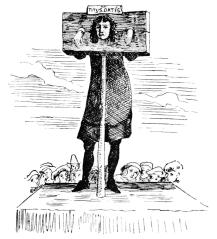
Oates in the pillory.
proportionate to the real offence. Brutal Judge Jeffries was its
mouthpiece, and he sentenced him to be unfrocked and pilloried in Palace
yard, to be led round Westminster Hall, with an inscription declaring
his infamy over his head; to be pilloried in front of the Royal
Exchange, to be whipped from Aldgate to Newgate, and after an interval
of two days to be whipped from Newgate to Tyburn. He was to be
imprisoned for life, and every year to be brought from his dungeon and
exposed in different parts of the capital. When on the pillory he was
mercilessly pelted, and nearly torn to pieces. His first flogging was
executed rigorously in the presence of a vast crowd, and Oates, a man
of strong frame, long stood the lash without a murmur. “But at last his
stubborn fortitude gave way. His bellowings were frightful to hear. He
swooned several times; but the scourge still continued to descend. When
he was unbound it seemed he had borne as much as the human frame could
bear without dissolution.... After an interval of forty-eight hours
Oates was again brought out from his dungeon. He seemed unable to stand,
and it was necessary to drag him to Tyburn on a sledge.” He was again
flogged, although insensible, and a person present counted the stripes
as seventeen hundred. “The doors of the prison closed upon him. During
many months he remained ironed in the darkest hole in Newgate.” A
contemporary account written by one of his own side declares he received
“upwards of two thousand lashes—such a thing was never inflicted by any
Jew, Turk, or heathen but Jeffries.... Had they hanged him they had been
more merciful; had they flayed him alive it is a question whether it
would have been so much torture.”[83]
Dangerfield, another informer of the Oates type, but of lesser guilt,
was also convicted and sentenced to be similarly flogged from Aldgate to
Newgate, and from Newgate to Tyburn. “When he heard his doom he went
into agonies of despair, gave himself up for dead, and chose a text for
his funeral. His forebodings were just. He was not indeed scourged quite
so severely as Oates had been; but he had not Oates’s iron strength of
body and mind.” On his way back to prison he was assaulted by Mr.
Francis, a Tory gentleman of Gray’s Inn, who struck him across the face
with a cane and injured his eye. “Dangerfield was carried dying into
Newgate. This dastardly outrage roused the indignation of the
bystanders. They seized Francis, and were with difficulty restrained
from tearing him in pieces. The appearance of Dangerfield’s body, which
had been frightfully lacerated by the whip, inclined many to believe
that his death was chiefly if not wholly caused by the stripes which he
had received.” The Government laid all the blame on Francis, who was
tried and executed for murder.
Religion and politics still continued to supply their quota of inmates.
The law was still cruelly harsh to Roman Catholics, Quakers, and all
Nonconformists.
The Fifth Monarchy men in 1661, when discomfited and captured, were
lodged in Newgate, to the number of twenty or more. Venner, the
ringleader, was amongst them. The State Trials give the trial of one
John James, who was arraigned at the King’s Bench for high treason. He
was found guilty of compassing the death of the king, and suffered the
cruel sentence then in force for the crime. James has left some details
of the usage he received in Newgate, especially in the matter of
extortion. Fees to a large amount were exacted of him, although a poor
and needy wretch, “originally a small coal-man.” In the press-yard he
paid 16s. to the keeper Hicks for the use of his chamber, although he
only remained there three or four days. The hangman also came to demand
money, that “he might be favourable to him at his death,” demanding
twenty pounds, then falling to ten, at last threatening, unless he got
five, “to torture him exceedingly. To which James said he must leave
himself to his mercy, for he had nothing to give him.” Yet at the
execution, the report says the sheriff and the hangman were so civil to
him as to suffer him to be dead before he was cut down. After that he
was dismembered; some of them were burnt, the head and quarters brought
back to Newgate in a basket, and exposed upon the gates of the city.
Venner and several others suffered in the same way.
Many Quakers were kept in Newgate, imprisoned during the king’s pleasure
for refusing to take the oaths of allegiance and supremacy. Thus John
Crook, Isaac Grey, and John Bolton were so confined, and incurred a
præmunire or forfeiture of their estates. But the must notable of the
Quakers were Penn and Mead. In its way this is a most remarkable trial,
on account of the overbearing conduct of the Bench towards the
prisoners. In 1670 these two, the first described as gentleman, the
second as linen-draper, were indicted at the Old Bailey for having
caused a tumultuous assembly in Gracechurch Street. The people
collected, it was charged, to hear Penn preach. The demeanour of the
prisoners in the court was so bold, that it drew down on them the anger
of the recorder, who called Penn troublesome, saucy, and so forth. The
jury were clearly in their favour, and brought in a verdict of not
guilty, but the court tried to menace them. The Lord Mayor, Sir Samuel
Stirling, was especially furious with Penn, crying, “Stop his mouth;
gaoler, bring fetters and stake him to the ground.” At last the jury,
having refused to reconsider their verdict, were locked up; while Penn
and Mead were remanded to Newgate. Next day the jury came up, and
adhered to their verdict. Whereupon the recorder fined them forty marks
apiece for not following his “good and wholesome advice,” adding, “God
keep my life out of your hands.”[84] The prisoners demanded their
liberty, “being freed by the jury,” but were detained for their fines
imposed by the judge for alleged contempt of court. Penn protested
violently, but the recorder cried, “Take him away!” and the prisoners
were once more haled to Newgate. Edward Bushell, one of the
above-mentioned jurors, who was committed to Newgate in default of
payment of fine, subsequently sued out a Habeas Corpus, and was brought
before Lord Chief Justice Vaughan, who decided in his favour, whereon he
and the other jurymen were discharged from gaol.
There were Roman Catholics too in Newgate, convicted of participation in
the Popish plot. Samuel Smith the ordinary publishes in 1679 an account
of the behaviour of fourteen of them, “late Popish malefactors, whilst
in Newgate.” Among them were Whitehead, provincial, and Fenwick,
procurator, of the Jesuits in England, and William Harcourt, pretended
rector of London. The account contains a description of Mr. Smith’s
efforts at conversion and ghostly comfort, which were better meant than
successful.
After the revolution of 1688 there was an active search after Romish
priests, and many were arrested; among them two bishops, Ellis and
Leyburn, were sent to Newgate. They were visited in gaol by Bishop
Burnet, who found them in a wretched plight, and humanely ordered their
situation to be improved. Other inmates of Newgate at this troublous
period were the Ex-Lord Chief Justice Wright and several judges. It was
Wright who had tried the seven bishops. Jeffries had had him made a
judge, although the Lord Keeper styled him the most unfit person in the
kingdom for that office. Macaulay says very few lawyers of the time
surpassed him in turpitude and effrontery. He died miserably in Newgate
about 1690, where he remained under a charge of attempting to subvert
the Government.