THE insidious arts practised by this woman rendered her a pest to the
neighbourhood in which she resided, and she richly deserved that fate
which eventually befel her.
She was indicted at York on the 18th of March 1809, for the wilful
murder of Rebecca Perigo, of Bramley, in the same county, in the month
of May in the previous year.
The examination of the witnesses, who were called to support the case
for the prosecution, showed, that Mrs. Bateman resided at Leeds, and was
well known at that place, as well as in the surrounding districts, as a
“witch,” in which capacity she had been frequently employed to work
cures of “evil wishes,” and all the other customary imaginary illnesses,
to which the credulous lower orders at that time supposed themselves
liable. Her name had become much celebrated in the neighbourhood for her
successes in the arts of divining and witchcraft, and it may be readily
concluded that her efforts in her own behalf were no less profitable. In
the spring of 1806 Mrs. Perigo, who lived with her husband, at Bramley,
a village at a short distance from Leeds, was seized with a “flacking,”
or fluttering in her breast, whenever she lay down, and applying to a
quack doctor of the place, he assured her that it was beyond his cure,
for that an “evil wish” had been laid upon her, and that the arts of
sorcery must be resorted to in order to effect her relief. While in this
dilemma, she was visited by her niece, a girl named Stead, who at that
time filled a situation as a household servant at Leeds, and who had
taken advantage of the Whitsuntide holidays to go round to see her
friends. Stead expressed her sorrow to find her aunt in so terrible a
situation, and recommended an immediate appeal to the prisoner, whose
powers she described as fully equal to get rid of any affection of the
kind, whether produced by mortal or diabolical charms. An application
was at once determined on to her, and Stead was employed to broach the
subject to the diviner. She, in consequence, paid the prisoner a visit
at her house in Black Dog Yard, near the bank, at Leeds, and having
acquainted her with the nature of the malady by which her aunt was
affected, was informed by her, that she knew a lady, who lived at
Scarborough, and that if a flannel petticoat or some article of dress,
which was worn next the skin of the patient, was sent to her, she would
at once communicate with her upon the subject. On the following Tuesday
William Perigo, the husband of the deceased, proceeded to her house, and
having handed over his wife’s flannel petticoat, the prisoner said that
she would write to Miss Blythe, who was the lady to whom she had
alluded, at Scarborough, by the same night’s post, and that an answer
would doubtless be returned by that day week, when he was to call again.
On the day mentioned, Perigo was true to his appointment, and the
prisoner produced to him a letter, saying that it had arrived from Miss
Blythe, and that it contained directions as to what was to be done.
After a great deal of circumlocution and mystery the letter was opened,
and was read by the prisoner, and it was found that it contained an
order “that Mary Bateman should go to Perigo’s house, at Bramley, and
should take with her four guinea notes, which were enclosed, and that
she should sew them into the four corners of the bed, in which the
diseased woman slept, where they were to remain for eighteen months;
that Perigo was to give her four other notes of like value, to be
returned to Scarborough; and that unless all these directions were
strictly attended to, the charm would be useless and would not work.” On
the fourth of August the prisoner went over to Bramley, and having shown
the four notes, proceeded apparently to sew them up in silken bags,
which she delivered over to Mrs. Perigo to be placed in the bed. The
four notes desired to be returned were then handed to her by Perigo, and
she retired, directing her dupes frequently to send to her house, as
letters might be expected from Miss Blythe. In about a fortnight,
another letter was produced; and it contained directions, that two
pieces of iron in the form of horse-shoes should be nailed up at
Perigo’s door, by the prisoner, but that the nails should not be driven
in with a hammer, but with the back of a pair of pincers, and that the
pincers were to be sent to Scarborough, to remain in the custody of Miss
Blythe for the eighteen months already mentioned in the charm. The
prisoner accordingly again visited Bramley, and having nailed up the
horse-shoes received and carried off the pincers. In October the
following letter was received by Perigo, bearing the signature of the
supposed Miss Blythe.
“My dear Friend.—You must go down to Mary Bateman’s, at Leeds, on
Tuesday next, and carry two guinea notes with you and give her them, and
she will give you other two that I have sent to her from Scarborough;
and you must buy me a small cheese about six or eight pound weight, and
it must be of your buying, for it is for a particular use, and it is to
be carried down to Mary Bateman’s, and she will send it to me by the
coach.—This letter is to be burned when you have done reading it.”
From this time to the month of March 1807, a great number of letters
were received, demanding the transmission of various articles, to Miss
Blythe, through the medium of the prisoner, the whole of which were to
be preserved by her until the expiration of the eighteen months; and in
the course of the same period money to the amount of near seventy pounds
was paid over, Perigo, upon each occasion of payment, receiving silk
bags containing what were pretended to be coins or notes of
corresponding value, which were to be sewn up in the bed as before. In
March 1807, the following letter arrived.
“My dear Friends.—I will be obliged to you if you will let me have
half-a-dozen of your china, three silver spoons, half-a-pound of tea,
two pounds of loaf sugar, and a tea canister to put the tea in, or else
it will not do—I durst not drink out of my own china. You must burn
this with a candle.”
The china, &c., not having been sent, in the month of April Miss Blythe
wrote as follows:—
“My dear Friends.—I will be obliged to you if you will buy me a camp
bedstead, bed and bedding, a blanket, a pair of sheets, and a long
bolster must come from your house.—You need not buy the best feathers,
common ones will do. I have laid on the floor for three nights, and I
cannot lay on my own bed owing to the planets being so bad concerning
your wife, and I must have one of your buying or it will not do.—You
must bring down the china, the sugar, the caddy, the three silver
spoons, and the tea at the same time when you buy the bed, and pack them
up altogether.—My brother’s boat will be up in a day or two, and I will
order my brother’s boatman to call for them all at Mary Bateman’s, and
you must give Mary Bateman one shilling for the boatman, and I will
place it to your account. Your wife must burn this as soon as it is read
or it will not do.”
This had the desired effect; and the prisoner having called upon the
Perigos, she accompanied them to the shops of a Mr. Dobbin, and a Mr.
Musgrave, at Leeds, to purchase the various articles named, which were
eventually bought at a cost of sixteen pounds, and sent to Mr. Sutton’s,
at the Lion and Lamb Inn, Kirkgate, there to await the arrival of the
supposed messenger.
At the end of April, the following letter arrived:—“My dear Friends.—I
am sorry to tell you you will take an illness in the month of May next,
one or both of you, but I think both, but the works of God must have its
course.—You will escape the chambers of the grave; though you seem to
be dead, yet you will live. Your wife must take half-a-pound of honey
down from Bramley to Mary Bateman’s at Leeds, and it must remain there
till you go down yourself, and she will put in such like stuff as I have
sent from Scarbro’ to her, and she will put it in when you come down,
and see her yourself, or it will not do. You must eat pudding for six
days, and you must put in such like stuff as I have sent to Mary Bateman
from Scarbro’, and she will give your wife it, but you must not begin to
eat of this pudding while I let you know. If ever you find yourself
sickly at any time, you must take each of you a teaspoonful of this
honey; I will remit twenty pounds to you on the 20th day of May, and it
will pay a little of what you owe. You must bring this down to Mary
Bateman’s, and burn it at her house, when you come down next time.”
The instructions contained in this letter were complied with, and the
prisoner having first mixed a white powder in the honey, handed over six
others of the same colour and description to Mrs. Perigo, saying that
they must be used in the precise manner mentioned upon them, or they
would all be killed. On the 5th of May, another letter arrived in the
following terms:—
“My dear Friends.—You must begin to eat pudding on the 11th of May, and
you must put one of the powders in every day as they are marked, for six
days—and you must see it put in yourself every day or else it will not
do. If you find yourself sickly at any time you must not have no doctor,
for it will not do, and you must not let the boy that used to eat with
you eat of that pudding for six days; and you must make only just as
much as you can eat yourselves, if there is any left it will not do. You
must keep the door fast as much as possible or you will be overcome by
some enemy. Now think on and take my directions or else it will kill us
all. About the 25th of May I will come to Leeds and send for your wife
to Mary Bateman’s; your wife will take me by the hand and say, ‘God
bless you that I ever found you out.’ It has pleased God to send me into
the world that I might destroy the works of darkness; I call them the
works of darkness because they are dark to you—now mind what I say
whatever you do. This letter must be burned in straw on the hearth by
your wife.”
The absurd credulity of Mr. and Mrs. Perigo even yet favoured the horrid
designs of the prisoner; and, in obedience to the directions which they
received, they began to eat the puddings on the day named. For five
days, they had no particular flavour, but upon the sixth powder being
mixed, the pudding was found so nauseous, that the former could only eat
one or two mouthfuls, while his wife managed to swallow three or four.
They were both directly seized with violent vomiting, and Mrs. Perigo,
whose faith appears to have been greater than that of her husband, at
once had recourse to the honey. Their sickness continued during the
whole day, but although Mrs. Perigo suffered the most intense torments,
she positively refused to hear of a doctor’s being sent for, lest, as
she said, the charm should be broken, by Miss Blythe’s directions being
opposed. The recovery of the husband from the illness, by which he was
affected, slowly progressed; but the wife, who persisted in eating the
honey, continued daily to lose strength, and at length expired on the
24th of May, her last words being a request to her husband not to be
“rash” with Mary Bateman, but to await the coming of the appointed time.
Mr. Chorley, a surgeon, was subsequently called in to see her body; but
although he expressed his firm belief that the death of the deceased was
caused by her having taken poison, and although that impression was
confirmed by the circumstance of a cat dying immediately after it had
eaten some of the pudding, no further steps were taken to ascertain the
real cause of death, and Perigo even subsequently continued in
communication with the prisoner.
Upon his informing her of the death of his wife, she at once declared
that it was attributable to her having eaten all the honey at once, and
then in the beginning of June, he received the following letter from
Miss Blythe:—
“My dear Friend.—I am sorry to tell you that your wife should touch of
those things which I ordered her not, and for that reason it has caused
her death; it had likened to have killed me at Scarborough, and Mary
Bateman at Leeds, and you and all, and for this reason, she will rise
from the grave, she will stroke your face with her right hand, and you
will lose the use of one side, but I will pray for you.—I would not
have you to go to no doctor, for it will not do. I would have you to eat
and drink what you like, and you will be better. Now, my dear friend,
take my directions, do and it will be better for you.—Pray God bless
you. Amen. Amen. You must burn this letter immediately after it is
read.”
Letters were also subsequently received by him, purporting to be from
the same person, in which new demands for clothing, coals, and other
articles were made, but at length, in the month of October 1808, two
years having elapsed since the commencement of the charm, he thought
that, the time had fully arrived, when, if any good effects were to be
produced from it, they would have been apparent, and that therefore he
was entitled to look for his money in the bed. He, in consequence,
commenced a search for the little silk bags, in which his notes and
money had been, as he supposed, sewn up; but although the bags indeed
were in precisely the same positions in which they had been placed by
his deceased wife, by some unaccountable conjuration, the notes and gold
had turned to rotten cabbage-leaves and bad farthings. The darkness, by
which the truth had been so long obscured, now passed away, and having
communicated with the prisoner, by a stratagem, meeting her under
pretence of receiving from her a bottle of medicine, which was to cure
him from the effects of the puddings which still remained, he caused her
to be apprehended. Upon her house being searched, nearly all the
property sent to the supposed Miss Blythe was found in her possession,
and a bottle containing a liquid mixed with two powders, one of which
proved to be oatmeal, and the other arsenic, was taken from her pocket
when she was taken into custody.
The rest of the evidence against the prisoner went to show that there
was no such person as Miss Blythe living at Scarborough, and that all
the letters which had been received by Perigo were in her own
handwriting, and had been sent by her to Scarborough to be transmitted
back again. An attempt was also proved to have been made by her to
purchase some arsenic, at the shop of a Mr. Clough, in Kirkgate, in the
month of April 1807, but the most important testimony was that of Mr.
Chorley, the surgeon, who distinctly proved that he had analysed what
remained of the pudding, and of the contents of the honey pot, and that
he found them both to contain a deadly poison, called corrosive
sublimate of mercury, and that the symptoms exhibited by the deceased
and her husband were such as would have arisen from the administration
of such a drug.
The prisoner’s defence consisted of a simple denial of the charge, and
the learned judge then proceeded to address the jury. Having stated the
nature of the allegations made in the indictment, he said that in order
to come to a conclusion as to the guilt of the prisoner, it was
necessary that three points should be clearly made out. 1st. That the
deceased died of poison. 2nd. That that poison was administered by the
contrivance and knowledge of the prisoner. And 3rd. That it was so done
for the purpose of occasioning the death of the deceased. A large body
of evidence had been laid before them, to prove that the prisoner had
engaged in schemes of fraud against the deceased and her husband, which
was proved not merely by the evidence of Wm. Perigo, but by the
testimony of other witnesses; and the inference the prosecutors drew
from this fraud was the existence of a powerful motive or temptation to
commit a still greater crime, for the purpose of escaping the shame and
punishment which must have attended the detection of the fraud; a fraud
so gross, that it excited his surprise that any individual in that age
and nation could be the dupe of it. But the jury should not go beyond
this inference, and presume that, because the prisoner had been guilty
of fraud, she was of course likely to have committed the crime of
murder; that, if proved, must be shown by other evidence. His Lordship
then proceeded to recapitulate the whole of the evidence, as detailed in
the preceding pages, and concluded with the following observations. “It
is impossible not to be struck with wonder at the extraordinary
credulity of Wm. Perigo, which neither the loss of his property, the
death of his wife, and his own severe sufferings, could dispel; and it
was not until the month of October in the following year, that he
ventured to open his hid treasure, and found there what every one in
court must have anticipated that he would find, not a single vestige of
his property; and his evidence is laid before the jury with the
observation which arises from this uncommon want of judgment. His memory
however appears to be very retentive, and his evidence is confirmed, and
that in different parts of the narrative, by other witnesses; and many
parts of the case do not rest upon his evidence at all. The illness, and
peculiar symptoms, which preceded the death of his wife; his own severe
sickness; and a variety of other circumstances attending the experiments
made upon the pudding, were proved by separate and independent
testimony; and it is most strange, that, in a case of so much suspicion
as it appeared to have excited at the time, the interment of the body
should have taken place without any inquiry as to the cause of death, an
inquiry which then would have been much less difficult; though the fact
of the deceased having died of poison is now well established. The main
question is, did the prisoner contrive the means to induce the deceased
to take it?—if she did so contrive the means, the intent could only be
to destroy.—Poison so deadly could not be administered with any other
view. The jury will lay all the facts and circumstances together; and if
they feel them press so strongly against the prisoner, as to induce a
conviction of the prisoner’s having procured the deceased to take
poison, with an intent to occasion her death, they will find her guilty;
if they do not think the evidence conclusive, they will, in that case,
find the prisoner not guilty.”
The jury, after conferring for a moment, found the prisoner guilty;—and
the judge proceeded to pass sentence of death upon her, in nearly the
following words:—
“Mary Bateman, you have been convicted of wilful murder by a jury, who,
after having examined your case with caution, have, constrained by the
force of evidence, pronounced you guilty; and it only remains for me to
fulfil my painful duty by passing upon you the awful sentence of the
law. After you have been so long in the situation in which you now
stand, and harassed as your mind must be by the long detail of your
crimes, and by listening to the sufferings you have occasioned, I do not
wish to add to your distress by saying more than my duty renders
necessary. Of your guilt, there cannot remain a particle of doubt in the
breast of any one who has heard your case.—You entered into a long and
premeditated system of fraud, which you carried on for a length of time,
which is most astonishing, and by means which one would have supposed
could not, in this age and nation, have been practised with success. To
prevent a discovery of your complicated fraud, and the punishment which
must have resulted therefrom, you deliberately contrived the death of
the persons you had so grossly injured, and that by means of poison, a
mode of destruction against which there is no sure protection; but your
guilty design was not fully accomplished.—And, after so extraordinary a
lapse of time, you are reserved as a signal example of the justice of
that mysterious Providence, which, sooner or later, overtakes guilt like
yours; and at the very time when you were apprehended, there is the
greatest reason to suppose, that if your surviving victim had met you
alone, as you wished him to do, you would have administered to him a
more deadly dose, which would have completed the diabolical project you
had long before formed, but which at that time only partially succeeded;
for upon your person, at that moment, was found a phial containing a
most deadly poison. For crimes like yours, in this world, the gates of
mercy are closed. You afforded your victim no time for preparation; but
the law, while it dooms you to death, has, in its mercy, afforded you
time for repentance, and the assistance of pious and devout men, whose
admonitions, and prayers, and counsels, may assist to prepare you for
another world, where even your crimes, if sincerely repented of, may
find mercy.
“The sentence of the law is, and the court doth award it. That you be
taken to the place from whence you came, and from thence, on Monday
next, to the place of execution, there to be hanged by the neck until
you are dead; and that your body be given to the surgeons to be
dissected and anatomised; and may Almighty God have mercy upon your
soul.”
The prisoner having intimated that she was pregnant, the clerk of the
arraigns said, “Mary Bateman, what have you to say, why immediate
execution should not be awarded against you?” On which the prisoner
pleaded that she was twenty-two weeks gone with child. On this plea the
judge ordered the sheriff to impannel a jury of matrons; this order
created a general consternation among the ladies, who hastened to quit
the court, to prevent the execution of so painful an office being
imposed upon them. His lordship, in consequence, ordered the doors to be
closed, and in about half-an-hour, twelve married women being
impannelled, they were sworn in court, and charged to inquire “whether
the prisoner was with quick child?” The jury of matrons then retired
with the prisoner, and on their return into court delivered their
verdict, which was, that Mary Bateman is not with quick child. The
execution of course was not respited, and she was remanded back to
prison.
During the brief interval between her receiving sentence of death and
her execution, the ordinary, the Rev. George Brown, took great pains to
prevail upon her ingenuously to acknowledge and confess her crimes.
Though the prisoner behaved with decorum, during the few hours that
remained of her existence, and readily joined in the customary offices
of devotion, no traits of that deep compunction of mind, which, for
crimes like hers, must be felt where repentance is sincere, could be
observed; but she maintained her caution and mystery to the last. On the
day preceding her execution, she wrote a letter to her husband, in which
she enclosed her wedding-ring, with a request that it might be given to
her daughter. She admitted that she had been guilty of many frauds, but
still denied that she had had any intention to produce the death of Mr.
or Mrs. Perigo.
Upon the Monday morning at five o’clock she was called from her cell, to
undergo the last sentence of the law. She received the communion with
some other prisoners, who were about to be executed on the same day, but
all attempts to induce her to acknowledge the justice of her sentence,
or the crime of which she had been found guilty, proved vain. She
maintained the greatest firmness in her demeanour to the last, which was
in no wise interrupted even upon her taking leave of her infant child,
which lay sleeping in her cell, at the moment of her being called out to
the scaffold.
Upon the appearance of the convict upon the platform, the deepest
silence prevailed amongst the immense assemblage of persons, which had
been collected to witness the execution. As a final duty, the Rev. Mr.
Brown, immediately before the drop fell, again exhorted the unhappy
woman to confession, but her only reply was a repetition of the
declaration of her innocence, and the next moment terminated her
existence.
Her body having remained suspended during the usual time, was cut down,
and sent to the General Infirmary at Leeds to be anatomised. Immense
crowds of persons assembled to meet the hearse, in which it was carried;
and so great was the desire of the people to see her remains, that
30l. were collected for the use of the infirmary, by the payment of
3d. for each person admitted to the apartment in which they were
exposed.
A short sketch of the life of this remarkable woman, and a few anecdotes
of her proceedings, shall conclude this article. Mary Bateman, it
appears, was born of reputable parents at Aisenby, near Thirsk, in the
North-riding of Yorkshire, in the year 1768: her father, whose name was
Harker, carrying on business as a small farmer. As early as at the age
of five years, she exhibited much of that sly knavery, which
subsequently so extraordinarily distinguished her character; and many
were the frauds and falsehoods, of which she was guilty, and for which
she was punished. In the year 1780, she first quitted her father’s
house, to undertake the duties of a servant in Thirsk, but having been
guilty of some peccadilloes, she proceeded to York in 1787; but before
she had been in that city more than twelve months, she was detected in
pilfering some trifling articles of property belonging to her mistress,
and was compelled to run off to Leeds, without waiting either for her
wages or her clothes. For a considerable time she remained without
employment or friends, but at length upon the recommendation of an
acquaintance of her father, she obtained an engagement in the shop of a
mantua-maker, in whose service she remained for more than three years.
She then became acquainted with John Bateman, to whom after a three
weeks’ courtship she was married in the year 1792.
Within two months after her marriage, she was found to have been guilty
of many frauds, and she only escaped prosecution by inducing her husband
to move frequently from place to place, so as to escape apprehension;
and at length poor Bateman, driven almost wild by the tricks of his
wife, entered the supplementary militia. Mrs. Bateman was now entirely
thrown upon her own resources, and unable to follow any reputable trade,
she in the year 1799 took up her residence in Marsh Lane, near Timble
Bridge, Leeds, and proceeded to deal in fortune-telling and the sale of
charms. From a long course of iniquity, carried on chiefly through the
medium of the most wily arts, she had acquired a manner, and a mode of
speech peculiarly adapted to her new profession; and abundance of
credulous victims, upon whom she was able to prosecute her schemes,
daily presented themselves to her.
Her first daring attempt was upon a Mrs. Greenwood, whom she persuaded
that her husband was in a situation of the greatest peril, which would
be aggravated by the circumstance being mentioned to him; that he was in
danger of being accused of a crime, for which he would be instantly
sacrificed, and that so relentless and determined were his prosecutors,
that unless four pieces of gold, four pieces of leather, four pieces of
blotting-paper, and four brass screws were given to her, to “screw them
down,” he would be dead before the morning. Mrs. Greenwood,
unfortunately for the trick, was not possessed of even one piece of
gold, and the proposition of the “witch,” that she should steal what she
wanted, so startled her, that she had fortitude enough to emancipate
herself from the trammels which had been thrown round her.
Her next attempt was upon a poor woman named Stead, upon whose jealous
fears she worked so far, as to obtain from her nearly the whole of her
furniture, under pretence of “screwing down,” a woman, with whom she
represented that her husband was intimate. Stead was about to enter the
army; and Mrs. Bateman next easily found means to persuade him, as she
had persuaded his wife, of her powers, and she obtained from him all the
little money, which he had obtained as his bounty, under the pretence of
“screwing down” his officers to give him promotion. The fascinating and
all powerful Miss Blythe had not yet been discovered, but all her
operations were now performed through the medium of a Mrs. Moore, whose
existence, it may readily be supposed, was as doubtful as that of her
subsequent coadjutor.
Terror was the great engine by which this woman carried on her frauds,
and as the wife of Stead had still a few articles of furniture and
clothing—the last sad wreck of their property, she persuaded her if
something was not done to prevent it, her daughter who was then only
about eight years of age, would, when she attained the age of fourteen,
become pregnant of an illegitimate child, and that either she would
murder herself, or would be murdered by her seducer, to prevent which,
17s. was to be placed in Mary Bateman’s hands. This money she was to
hand over to the invisible Mrs. Moore, who was to reduce the coin to a
“silver charm,” which charm was to be worn round the girl’s arm till the
period of danger was past, but which, when the bubble burst three months
after, was cut from the child’s arm, when by a strange transmutation of
metal, the silver had turned to pewter.
In the midst of these scenes of fraud in one party, and weakness in the
other, a relation of Stead’s came over to Leeds in a state of pregnancy,
and forsaken by her lover. This young woman was a fine subject for the
artful Mary Bateman, who soon learned her misfortune, and undertook, on
condition that a guinea was given to her, for Mrs. Moore, to make the
lover marry her. The money was paid, but no lover appeared. It was then
found out that he was too strong for the first charm, and that more
money and more screws would be necessary to screw him down to the altar
of Hymen. Still he came not; and the girl finding the money she had fast
diminishing, procured a service in a respectable family in Leeds, the
master of which being a bachelor, Mary soon contrived to persuade the
silly girl that she could by her arts oblige him to marry her. Here a
difficulty arose—the unborn child was in the way; but Mary, ever ready
to undertake any business, however desperate, engaged to remove the
impediment, and for that purpose administered certain medicines to the
ill-fated young woman, which produced the desired effect, and abortion
ensued. The master after all was not to be caught; but the girl’s former
sweetheart coming over to Leeds married her, though she was, at that
time, owing as is supposed to the medicine given to her by Mary Bateman,
in a very emaciated state. In speaking of her connexion with this vile
woman, she used the following remarkable expression:—“Had I never known
Mary Bateman, my child would now have been in my arms, and I should have
been a healthy woman—but it is in eternity, and I am going after it as
fast as time and a ruined constitution can carry me.” The unhappy girl
died soon after, a melancholy instance of the direful effects which too
great credulity and weakness of mind may produce.
The artifices and frauds of which she had been hitherto guilty, however,
shrink into comparative obscurity, when opposed with the offences which
Mrs. Bateman subsequently committed. The case of the unhappy Mrs. Perigo
has been already mentioned, and its circumstances detailed, but there is
too much reason to believe that she was concerned in producing the death
of three persons, a crime of still greater and more cold-blooded
cruelty. The Misses Kitchen were quaker ladies, who carried on the
business of linen-drapers, near St. Peter’s Square, Leeds, and Mrs.
Bateman, by representations of her skill in divination, and reading the
stars, managed so far to ingratiate herself into their good graces as to
become their confidant and most intimate adviser. She attended their
shop, was a constant visitor at their house, and her interference
extended even to the domestic concerns of the family. In the month of
September, 1803, the younger Miss Kitchen was attacked with a severe and
painful illness, and Bateman possessing the full confidence of the
family procured medicines from a person whom she described as a country
doctor, but instead of their producing any improvement in the condition
of the unhappy patient, in less than a week she died. Her mother arrived
from Wakefield, where she lived, in time only to receive the last breath
of her daughter, but in two days, she, as well as the surviving sister,
died, and they were all three placed in the same grave. Throughout the
whole of these distressing illnesses Mary Bateman was the sole attendant
upon the unhappy women, and after their death she took upon herself the
task of rendering them those last melancholy offices, which are usually
the duty of the near relations of the deceased. No person was permitted
by her to enter the house, under pretence that the deceased persons had
been affected by the plague, except those, whose presence was rendered
necessary in order to the performance of the rites of sepulture; and for
many weeks the neighbourhood was shunned, lest the supposed infection
might spread. Mrs. Bateman, however, in the midst of all, exhibited the
most praiseworthy and disinterested affection for the poor ladies, and
in the face of all danger, hesitated not to minister to their wants, and
even after death to take those precautions, in fumigating the house,
which were supposed to be necessary. She prepared their meals, and by
her hands alone were the medicines administered, which she professed to
have been prescribed. Several months had elapsed before any inquiries
were made as to the condition in which the deceased persons had died,
and then some of their creditors having determined to ascertain what
property they had left behind them, entered the house. To their surprise
they discovered that of the furniture and stock, of which the deceased
had been known to be possessed, scarce a vestige remained; and the
discovery of some articles of property in the house of Bateman, which
were known to have belonged to the deceased ladies, but which the former
declared had been given to her by them, afforded grounds for a
well-founded suspicion that poison was the “plague” of which they had
died, although under the circumstances of the case, and after the lapse
of so long a time, evidence could not be obtained which could be deemed
conclusive upon the subject. The determined cruelty exercised in the
case of the Perigos appeared to sanction the suspicions which were
entertained, and after conviction Mrs. Bateman was minutely questioned
upon the subject, but all efforts to induce a confession of this crime,
or of that of which she was found guilty, proved unavailing.
It would be useless to follow this wretched woman through the subsequent
scenes of her miserable life. Fraud and deceit were the only means, by
which she was able to carry on the war, and numerous were the impudent
and heartless schemes which she put into operation to dupe the unhappy
objects of her attacks. Her character was such as to prevent her long
pursuing her occupation in one position, and she was repeatedly
compelled to change her abode until she at length took up her residence
in Black Dog Lane, where she was apprehended. Her husband at this time
had returned from the militia several years, and although he followed
the trade to which he had been brought up, there can be little doubt
that he shared the proceeds of his wife’s villanies.
Mary Bateman was neat in her person and dress, and though there was
nothing ingenuous in her countenance, it had an air of placidity and
composure, not ill adapted to make a favourable impression on those who
visited her. Her manner of address was soft and insinuating, with the
affectation of sanctity. In her domestic arrangements she was regular,
and was mistress of such qualifications in housewifery as, with an
honest heart, would have enabled her to fill her station with
respectability and usefulness.
A few anecdotes upon the subject of the belief in witchcraft, in former
days, we trust will not prove uninteresting to our readers.
The reign of James the Sixth of Scotland, and First of England, may be
said to have been the witchcraft age of Great Britain. Scotland had
always been a sort of fairy land; but it remained for that sagacious
prince, at a time when knowledge was beginning to dispel the mists of
superstition, to contribute, by his authority and writings, to resolve a
prejudice of education into an article of religious belief amongst the
Scottish people. He wrote and published a “Treatise on Dæmonologie;” the
purpose of which was, to “resolve the doubting hearts of many, as to the
fearful abounding of those detestable slaves of the Devil, witches, or
enchanters.” The authority of Scripture was perverted, to show, not only
the possibility, but certainty, that such “detestable scenes” do exist;
and many most ridiculous stories of evil enchantment were added, to
establish their “fearful abounding.” The treatise, which is in the form
of a dialogue, treats also of the punishment which such crimes deserve;
concluding, that

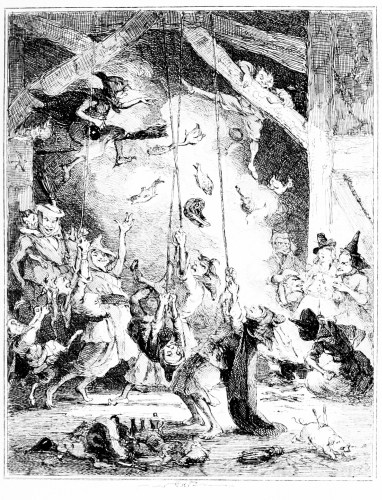
Meeting of Witches.
P. 468.
“no sex, age, nor rank, should be excused from the punishment of death,
according to the law of God, the civil and imperial law, and the
municipal law of all Christian nations.” In answer to the question,
“What to judge of deathe, I pray you?” The answer is, “It is commonlie
used by fyre, but there is an indifferent thing to be used in every
country, according to the law or custume thereof.”
Such, in fact, was the cruel and barbarous law of James’s native
country; and such became the law also of England, when he succeeded to
the sceptre of Elizabeth. Many hundreds of unfortunate creatures, in
both countries, became its victims, suffering death ignominiously, for
an impossible offence: neither sex, nor age, nor rank, as James had
sternly enjoined, was spared; and it was the most helpless and
inoffensive, such as aged and lone women, who were most exposed to its
malignant operation.
There were persons regularly employed in hunting out, and bringing to
punishment, those unfortunate beings suspected of witchcraft.
Matthew Hopkins resided at Manningtree, in Essex, and was witch-finder
for the associated counties of Essex, Suffolk, Norfolk, and
Huntingdonshire. In the years 1644, 1645, and 1646, accompanied by one
John Stern, he brought many to the fatal tree as reputed witches. He
hanged, in one year, no less than sixty reputed witches of his own
county of Essex. The old, the ignorant, and the indigent, such as could
neither plead their own cause nor hire an advocate, were the miserable
victims of this wretch’s credulity, spleen, and avarice. He pretended to
be a great critic in special marks, which were only moles, scorbutic
spots, or warts, that frequently grow large and pendulous in old age;
but were absurdly supposed to be teats to suckle imps. His ultimate
method of proof was by tying together the thumbs and toes of the
suspected person, about whose waist was fastened a cord, the ends of
which were held on the banks of the river by two men, in whose power it
was to strain or slacken it. Swimming, upon this experiment, was deemed
a sufficient proof of guilt; for which king James (who is said to have
recommended, if he did not invent it) assigned a ridiculous reason,
that, “as some persons had renounced their baptism by water, so the
water refuses to receive them.” Sometimes those who were accused of
diabolical practices, were tied neck and heels, and tossed into a pond:
if they floated or swam, they were consequently guilty, and were
therefore taken out and burned; but if they were innocent, they were
only drowned. The experiment of swimming was at length tried upon
Hopkins himself, in his own way, and he was upon the event condemned,
and, as it seems, executed as a wizard. In a letter from Serjeant
Widrinton to Lord Whitelocke, mention is made of another fellow of the
same profession as Hopkins. This fellow received twenty shillings a-head
for every witch he discovered, and thereby obtained rewards amounting to
thirty pounds.
In an old print of this execrable character, he is represented with two
witches. One of them, named Holt, is supposed to say, “My Impes are, 1.
Ilemauzyr; 2. Pyewackett; 3. Pecke in the Crown; 4. Griezell
Griediegutt.” Four animals attend: Jarmara, a black dog; Sacke and
Sugar, a hare; Newes, a ferret; Vinegar Tom, a bull-headed greyhound.
This print is in the Pepysian library.
Amongst a number of women (as many as sixteen) whom Hopkins, in the year
1644, accused at Yarmouth, was one, of whom the following account is
given. It appears that she used to work for Mr. Moulton (a stocking
merchant, and alderman of the town), and upon a certain day went to his
house for work; but he being from home, his man refused to let her have
any till his master returned; whereupon, being exasperated against the
man, she applied herself to the maid, and desired some knitting-work of
her; and when she returned the like answer, she went home in great
discontent against them both. That night, when she was in bed, she heard
a knock at her door, and going to her window, she saw (it being
moon-light) a tall black man there: and asked what he would have? He
told her that she was discontented, because she could not get work; and
that he would put her into a way that she should never want anything. On
this, she let him in, and asked him what he had to say to her? He told
her he must first see her hands; and taking out something like a
penknife, he gave it a little scratch, so that a little blood followed,
a scar being still visible when she told the story; then he took some of
the blood in a pen, and pulling a book out of his pocket, bid her write
her name; and when she said she could not, he said he would guide her
hand. When this was done, he bid her now ask what she would have. And
when she desired first to be revenged on the man, he promised to give
her an account of it next night, and so leaving her some money went
away. The next night he came to her again, and told her he could do
nothing against the man, for he went constantly to church, and said his
prayers morning and evening. Then she desired him to revenge her on the
maid; and he again promised her an account thereof the next night: but
he said the same of the maid, and that therefore he could not hurt her.
But she said that there was a young child in the house, which was more
easy to be dealt with. Whereupon she desired him to do what he could
against it. The next night he came again, and brought with him an image
of wax, and told her they must go and bury that in the church-yard, and
then the child, which he had put in great pain already, should waste
away as that image wasted. Whereupon they went together and buried it.
The child having laid in a languishing condition for about eighteen
months, and being very near death, the minister sent this woman with
this account to the magistrates, who thereupon sent her to Mr.
Moulton’s, where, in the same room that the child lay, almost dead, she
was examined concerning the particulars aforesaid; all which she
confessed, and had no sooner done, but the child, who was three years
old, and was thought to be dead or dying, laughed, and began to stir and
raise up itself: and from that instant began to recover. The woman was
convicted upon her own confession, and was executed accordingly.
A more melancholy tale does not occur in the annals of necromancy, than
that of the Lancashire Witches, in 1612. The scene of the story is in
Penderbury Forest, four or five miles from Manchester, remarkable for
its picturesque and gloomy situation. It had long been of ill repute, as
a consecrated haunt of diabolical intercourse, when a country
magistrate, Roger Nowel by name, took it into his head that he should
perform a great public service by routing out a nest of witches, who had
rendered the place a terror to all the neighbouring vulgar. The first
persons he seized on, were Elizabeth Demdike and Ann Chattox. The former
was eighty years of age, and had for some years been blind, and
principally subsisted by begging, though she had a miserable hovel on
the spot, which she called her own. Anne Chattox was of the same age,
and had for some time been threatened with the calamity of blindness.
Demdike was held to be so hardened a witch that she had trained all her
family to the mystery: namely, Elizabeth Device, her daughter, and James
and Alison Device, her great-grandchildren. These, together with John
Balcock, and Jane his mother, Alice Natter, Catherine Hewitt, and Isabel
Roby, were successively apprehended by the diligence of Nowel, and one
or two neighbouring magistrates, and were all of them by some means
induced, some to make a more liberal, and others a more restricted
confession of their misdeeds in witchcraft, and were afterwards hurried
away to Lancaster Castle, fifty miles off, to prison. Their crimes were
said to have universally proceeded from malignity and resentment; and it
was reported to have repeatedly happened for poor old Demdike to be led
by night from her habitation into the open air, by some member of her
family, where she was left alone for an hour to curse her victim, and
pursue her unholy incantations, and was then sought and brought back
again to her hovel, her curses never failing to produce the desired
effect.
The poor wretches had been but a short time in prison, when information
was given that a meeting of witches was held on Good-Friday, at Malkin’s
Tower, the habitation of Elizabeth Device, to the number of twenty
persons, to consult how, by infernal machinations, to kill one Lovel, an
officer, to blow up Lancaster Castle, deliver the prisoners, and to kill
another man, of the name of Lister. The last object was effected; the
other plans, by some means, which are not related, were prevented.
The prisoners were kept in jail till the summer assizes; but in the mean
time, the poor blind Demdike died in confinement.
The other prisoners were severally indicted for killing by witchcraft
certain persons who were named, and were all found guilty. The principal
witnesses against Elizabeth Device were James Device and Jennet Device,
her grandchildren, the latter only nine years of age. When this girl was
put into the witness-box, the grandmother, on seeing her, set up so
dreadful a yell, intermixed with dreadful curses, that the child
declared that she could not go on with her evidence, unless the prisoner
was removed. This was agreed to, and both brother and sister swore that
they had been present, when the Devil came to their grandmother, in the
shape of a black dog, and asked her what she desired. She said the death
of John Robinson; when the dog told her to make an image of Robinson in
clay, and after crumble it into dust, and as fast as the image perished,
the life of the victim should waste away, and in conclusion the man
should die. This testimony was received; and upon the conviction, which
followed, ten persons were led to the gallows, on the twentieth of
August, Anne Chattox, of eighty years of age, among the rest, the day
after the trials, which lasted two days, were finished.
The judges who presided on these trials were Sir James Altham and Sir
Edward Bromley, barons of the exchequer.
Guluim, who gives the most simple and interesting account of this
melancholy case, conjectures, with much reason, that the old women had
played at the game of commerce with the Devil, in order to make their
simpler neighbours afraid of them; and that they played the game so
long, that in an imperfect degree they deceived themselves. But when one
of them actually saw her grandchild of nine years old placed in the
witness-box, with the intention of consigning her to a public and
ignominious death, then the reveries of the imagination vanished, and
she deeply felt the reality, that, when she had been somewhat imposing
on the child, in devilish sport, she had been whetting the dagger that
was to take her own life. It was then no wonder that she uttered a
supernatural yell, and poured curses from her heart.
Such was the first case of the Lancashire Witches. In that which
follows, the accusation was clearly traced to be founded on a most
villanous conspiracy.
About the year 1634, a boy named Edmund Robinson, whose father, a very
poor man, dwelt in Pendle Forest, the scene of the alleged witching,
declared that, while gathering wild-flowers in one of the glades of the
forest, he saw two greyhounds, which he supposed to belong to a
gentleman in the neighbourhood. Seeing nobody following them, the boy
alleged that he proposed to have a course; but, though a hare was
started, the dogs refused to run. Young Robinson was about to punish
them with a switch, when one Dame Dickenson, a neighbour’s wife, started
up instead of the one greyhound; and a little boy instead of the other.
The witness averred that Mother Dickenson offered him money to conceal
what he had seen, which he refused, saying, ‘Nay; thou art a witch!’
Apparently, she was determined he should have full evidence of the truth
of what he said, for she pulled out of her pocket a bridle, and shot it
over the head of the boy, who had so lately represented the other
greyhound. He was then directly changed into a horse; Mother Dickenson
mounted, and took Robinson before her. They made to a large house or
barn, called Hours town, into which the boy entered with the others. He
there saw six or seven persons pulling at halters, from which, as they
pulled them, meat ready-dressed came flying in quantities, together with
lumps of butter, porringers of milk, and whatever else might, in his
fancy, complete a rustic feast. He declared that, while engaged in the
charm, they made such ugly faces and looked so fiendish, that he was
frightened.
This story succeeded so well, that the father of the boy took him round
to the neighbouring churches, where he placed him standing on a bench
after service, and bade him look round and see what he could observe.
The device, however clumsy, succeeded; and no less than seventeen
persons were apprehended at the boy’s election, and conducted, as
witches, to Lancaster Castle. These seventeen persons were tried at the
assizes and found guilty; but the judge, whose name has unfortunately
been lost, unlike Sir James Altham and Sir Edward Bromley, saw something
in the case that excited his suspicion, and, though the juries had not
hesitated in any one instance, respited the convicts, and sent up a
report of the affair to the government. Twenty-two years had not elapsed
since the former case, in vain. Four of the prisoners were, by the
judge’s recommendation, sent for to the metropolis, and were examined,
first by the king’s physician, and then by Charles the First, in person.
The boy’s story was strictly scrutinised, and in the end, he confessed
that it was all an imposture, in which he had been instructed by his
father; and the whole seventeen prisoners received the royal pardon.
So late as the year 1679, several unfortunate persons were tried and
executed at Borrostowness in Scotland, for witchcraft, four of them
being poor widows. The following is a literal copy of the indictment
upon which they were arraigned--
“Annaple Thomsone, widow in Borrostowness, Margaret Pringle, relect of
the deceast John Campbell, seivewright there, &c. &c.
“Aye, and ilk ane of you, are indigtted and accused, that, whereas,
notwithstanding the law of God particulurlie sett down in the 20th
chapter of Leveticus and the 18th chapter of Deuteronomy, and be the
lawes and actes of parliament of this kingdome and constant practis
thereof, particularlie to the 27 act, 29 parliament Q. Marie, the cryme
of witchcraft is declaired to be one horreid, abominable, and capitall
cryme, punishable with the pains of death and confiscatiown of
moveables:—nevertheless it is of veritie, that you have comitted and
are gwyltie of the said crime of witchcraft, in awa far ye have entered
in practicion with the devile, the enemie of your salvatiown, and have
renownced our blessed Lord and Savior, and your baptizme, and have given
yoursellfes, both soulles and bodies, to the devile, and swyndrie wyth
witches, in divers places. And particularlie ye, the said Annaple
Thompsone, had a metting with the devile the time of your weidowhood,
before you were married to your last husband, in your coming betwixt
Linlithgow and Borrostowness, where the devile, in the lykeness of one
black man, told you, that you was one poor puddled bodie, and had one
lyiff and difficulties to win throu the world; and promesed iff ye wald
followe him, and go alongst with him, you should never want, but have
one better lyiff; and about fyve wekes thereafter the devile appeared to
you, when you was going to the coal-hill, abowt sevin a-clock in the
morning. Having renewed his former temtatiown, you did condeshend
thereto and declared yourselff content to follow him and become his
servant; whereupon the devile * * * and ye and each persone of you wis
at several metting with the devile, in the linkes of Borrostowness, and
in the house of you, Bessie Vicker; and ye did eate and drink with the
devile, and with one another, and with witches in her howss in the night
tyme; and the said Wm. Crow brought the ale, which ye drank, extending
about sevin gallons, from the howss of Elizabeth Hamilton; and you, the
said Annaple, had another metting about fyve wekes ago, when you wis
goeing to the coal-hill of Grange, and he inveitted you to go alongst
and drink with him in the Grange farmes; and you, the said Margaret
Pringle, have bein one witch this many yeeres by gone, hath renownced
your baptizme and becum the devile’s servant, and promeis to follow him;
and the devile took you by the right hand, whereby it was for eight days
greivowslie pained, but, having it twitched new again, it immedeatelie
became haill; and you, the said Margaret Hamilton has bein the devile’s
servant these eight or nine years by gone, and he appeared and conversed
with you at the town well of Borrostowness, and several times at your
owin howss, and drank several choppens of ale with you. * * and the
devile gane you ane fyne merk piece of gold, which a lyttle after becam
are skleite stone; and you, the said Margaret Hamilton, relict of James
Pullevart, has been ane witch, and the devile’s servant, thertie yeres
since, hath renounced your baptisme, as said is
. . . . .
. . . . .
. . . . .
. . . . .
. . . . .
. . . . .
. . . . .
And ye, and ilk of you, was at a meeting with the devile and other
witches, at the croce of Murestain, above Renneil, upon the threttein of
October last, where you all danced, and the devile acted the piper, and
where you endevored to have destroyed Androw Mitchell, sone to John
Mitchell, elder in dean of Kenneil.”
The charges thus made against the “poor puddled bodies,” Annaple
Thomsone and her associates, however ludicrous they may seem, were
substantiated to the satisfaction of a jury; and for so meeting, and
dancing, and drinking, and frolicking with his satanic majesty (who
condescended to act the piper), the unfortunate defendants were solemnly
condemned, “to be taken to the west end of Borrostowness, the ordinary
place of execution there, upon Tuesday, the 23rd day of December
current, betwixt two and four in the afternoon, and then to be wirried
at a steack [that is, like a bull or a badger, by dogs in human shape]
till they be dead, and thereafter to have their bodies burned to ashes.”
The strange and eventful history of the Witches of New England is,
perhaps, generally known to the educated and informed; still there must
be many who are not aware of all its melancholy details. As a story of
witchcraft, without any poetry in it, without anything to amuse the
imagination, or interest the fancy, it, perhaps, surpasses everything
upon record. The prosecutions for witchcraft in New England were
numerous, and they continued, with little intermission, principally at
Salem, during the greater part of the year 1692. The accusations were of
the most vulgar and contemptible sort—invisible pinchings and blows,
fits, with the blastings and mortality of cattle, and wains stuck fast
in the ground, or losing their wheels. A conspicuous feature in nearly
the whole of these stories, was what they named “the spectral sight,”
or, in other words, that the profligate accusers first feigned, for the
most part, the injuries they received, and next saw the figures and
action of the persons who inflicted them, when they were invisible to
every one else. Hence the miserable prosecutors gained the power of
gratifying the wantonness of their malice, by pretending that they
suffered by the hand of any one against whom they had an ill will. The
persons so charged, though unseen by any one but the accuser, and who in
their corporal presence were at a distance of miles, and were doubtless
wholly unconscious of the mischief that was hatching against them, were
immediately taken up, and cast into prison. And what was more monstrous
and incredible, there stood the prisoner on trial for his life, while
the witnesses were permitted to swear that his spectre had haunted them,
and afflicted them with all manner of injuries!
The first specimen of this sort of accusation was given by one Paris, a
minister of a church at Salem, in the end of the year 1691, who had two
daughters, one nine years old, the other eleven, who were afflicted with
fits and convulsions. The first person fixed on as the mysterious author
of these evils, was Tituba, a female slave in the family, and she was
harassed by her master into a confession of unlawful practices and
spells. The girls then fixed on Sarah Good, a female, known to be the
victim of a morbid melancholy, and Osborne, a poor man who had for a
considerable time been bed-ridden, as persons whose spectres had
perpetually haunted and tormented them, and Good was, twelve months
afterwards, hanged on this accusation.
A person, who was one of the first to fall under the imputation, was one
George Burroughs, also a minister of Salem. He had, it seems, buried two
wives, both of whom the busy gossips said he had used ill in their
life-time, and, consequently, it was whispered he had murdered them. He
was accustomed, foolishly, to vaunt that he knew what people said of him
in his absence, and this was brought as a proof that he dealt with the
devil. Two women, who were witnesses against him, interrupted their
testimony with exclaiming that they saw the ghosts of the murdered wives
present (who had promised them they would come), though no one else in
the court saw them; and this was taken in evidence. Burroughs conducted
himself in a very injudicious way on his trial; but, when he came to be
hanged, made so impressive a speech on the ladder, with fervent
protestations of innocence, as melted many of the spectators into tears.
The accusations, founded upon such stories as these, spread, with
wonderful rapidity. In Salem, many were seized with fits, exhibited
frightful contortions of their limbs and features, and became a fearful
spectacle to the bystanders. They were asked to assign the cause of all
this; and pretended to suppose, that they saw some neighbour, already
solitary and afflicted, and on that account in ill odour with the
townspeople, scowling upon, threatening, and tormenting them. Presently
persons, specially gifted with the ‘spectral sight,’ formed a class by
themselves, and were sent about at the public expense from place to
place, that they might see what no one else could see. The prisons were
filled with the persons accused, and the utmost horror was entertained,
as of a calamity which in such a degree had never before visited that
part of the world. It happened, most unfortunately, that Baxter’s
“Certainty of the World of Spirits” had been published but the year
before, and a number of copies had been sent out to New England. There
seemed a strange coincidence and sympathy between vital christianity in
its most honourable sense, and the fear of the devil, who appeared to be
“come down unto them, with great wrath.” Mr. Increase Mather, and Mr.
Cotton Mather, his son, two clergymen of the highest reputation in the
neighbourhood, by the solemnity and awe with which they treated the
subject, and the earnestness and zeal which they displayed, gave a
sanction to the lowest superstition and virulence of the ignorant. All
the forms of justice were brought forward on this occasion. There was no
lack of judges, and grand juries, and petty juries, and executioners,
and still less of prosecutors and witnesses. The first person that was
hanged was on the 10th of June, five more on the 19th of July, five on
the 19th of August, and eight on the 22nd of September. Multitudes
confessed that they were witches; for this appeared the only way for the
accused to save their lives. Husbands and children fell down on their
knees, and implored their wives and mothers to own their guilt. Many
were tortured by being tied neck and heels together, till they confessed
whatever was suggested to them. It is remarkable, however, that not one
persisted in her confession at the place of execution.
The most interesting story that occurred in this affair, was of Giles
Cory, and Martha, his wife. The woman was tried on the 9th of September,
and hanged on the 22nd. In the interval, on the 16th, the husband was
brought up for trial. He said he was not guilty; but being asked how he
would be tried, he refused to go through the customary form, and say,
“By God, and my country.” He observed that, of all that had been tried,
not one had as yet been pronounced not guilty; and he resolutely refused
in that mode to undergo a trial. The judge directed, therefore, that
according to the barbarous mode prescribed in the mother country, he
should be laid on his back, and pressed to death with weights gradually
accumulated on the upper surface of his body, a proceeding which had
never yet been resorted to by the English in North America. The man
persisted in his resolution, and remained mute till he expired.
The whole of this dreadful tragedy, says Mr. Godwin, in his “Lives of
the Necromancers,” was kept together by a thread. The spectre-seers, for
a considerable time, prudently restricted their accusations to persons
of ill repute, or otherwise of no consequence in the community.
By-and-bye, however, they lost sight of this caution, and pretended they
saw the figures of some persons well connected, and of unquestioned
honour and reputation, engaged in acts of witchcraft. Immediately the
whole fell through in a moment. The leading inhabitants presently saw
how unsafe it would be to trust their reputations and their lives to the
mercy of these profligate accusers. Of fifty-six bills of indictment
that were offered to the grand jury on the 3rd of January, 1693,
twenty-six only were found true bills, and thirty thrown out. On the
twenty-six bills that were found, three persons only were pronounced
guilty by the petty jury, and these three received their pardon from the
government. The prisons were thrown open; fifty confessed witches,
together with two hundred persons imprisoned on suspicion, were set at
liberty, and no more accusations were heard of. The “afflicted,” as they
were technically termed, recovered their health; the “spectral sight”
was universally scouted; and men began to wonder how they could ever
have been the victims of so horrible a delusion.
Dr. Cook, in his General and Historical Review of Christianity, gives a
melancholy description of the condemnation of a woman for witchcraft, by
a tribunal at Geneva, about the middle of the seventeenth century. An
enumeration of some of the particulars of this case will afford a
tolerably correct notion of the horrible cruelty, which, in almost all
proceedings against witchcraft, was practised in different parts of
Europe. The woman was accused of having sent devils into two young
women, and of having brought distempers upon several others,—a charge
sufficiently vague. To substantiate the accusation, the members of the
tribunal availed themselves of an opinion, that the devil imprinted
certain marks upon his chosen disciples, the effect of which was, that
no pain could be produced by any application to the parts of the body
where these marks were. They sent two surgeons to examine whether such
marks could be discovered in the accused; who reported, not much to the
credit of their medical skill and philosophy, that they had found a
mark, and that, having thrust a needle into it, the length of a finger,
she had felt no pain, and that no blood had issued from the wound. Being
brought to the bar, the prisoner denied the statement of the surgeons;
upon which she was examined by three more, with whom were joined two
physicians. It might have been expected that a body of men, who had
received a liberal education, and who must have had some acquaintance
with the nature and construction of the human frame, would have
presented a report, showing the absurdity of the examination upon which
they were employed. This, however, did not occur to them; for they
gravely proceeded to thrust sharp instruments into the mark already
mentioned, and into others which they thought they had found out; but,
as the miserable patient gave plain indication that she suffered from
their operations, they were staggered, and satisfied themselves with
declaring, that there was something extraordinary in the marks, and that
they were not perfectly like those commonly to be seen in witches. She
was, notwithstanding, doomed to another investigation, the result of
which was, that after some barbarous experiments, she felt no pain, and
hence it was inferred that the marks were satanical. She had previously
to this last inquiry, been actually put to the rack; but she retained
her fortitude and presence of mind, firmly maintaining that she had sent
no devils into the persons whom it was alleged she had thus injured. She
was again threatened with the torture; and, from dread of undergoing it,
made a confession, which it is painful to think was not at once
discerned to be the raving of insanity. Similar proceedings were
continued; and the conclusion of the whole was, that she was condemned
to be hanged and burned, for giving up herself to the devil, and for
bewitching two girls!
We conclude this article by the well-known case of the trial and
acquittal of Lady Fowlis.
Catherine Ross, Lady Fowlis, was the daughter of Ross of Balnagown, and
second wife of the fifteenth Baron of Fowlis. The object of her crimes
was to destroy her step-sons, Robert and Hector Monro, with about thirty
of their principal kinsmen, in order that her own children might succeed
to the possessions of their father, which were considerable, and lay in
the counties of Ross, Sutherland, and Inverness. Her brother, George
Ross, seems to have been in league with her for the accomplishment of
this diabolical purpose, and his wife, the young Lady Balnagown, was
marked out as a victim, whose removal, with that of the rest of the
family, might pave the way for his marriage with the wife of Robert
Monro, the young laird. Their schemes were brought into active operation
in the summer of 1577. Towards the end of that year, four of their
accomplices, Agnes Roy, Christian Ross, of Canorth, William
M‘Gillievoricdam, and Thomas M‘Kane More M‘Allan M‘Evoch, were arraigned
in a justice court, held in the Cathedral Kirk of Ross, convicted, and
burnt. One of the judges who presided at this trial, was Robert Monro,
the husband of the principal instigator of the crimes, and father of the
family whose lives were practised against. Lady Fowlis, upon the
discovery of her wickedness, fled into the county of Caithness, and,
after remaining there for the space of three quarters of a year, her
husband was persuaded to receive her home again; and she seems to have
lived unmolested during the rest of the life of the old baron; and even
the young laird, for whose destruction she had perseveringly laboured,
made no exertion to bring her to justice. His brother Hector, however,
on succeeding him in 1590, procured a commission for the punishment of
certain witches and sorcerers, which was understood to be aimed at his
step-mother; but before he had time to act upon the power thus granted,
she had influence enough to obtain a suspension of the commission; and
it was not till July 1591 that she was brought to trial. The evidence
mainly rested upon, was that of the notoriety of the facts, and the
confession of the accomplices; each count of the indictment closed with
a reference to the record of the process before the provincial court,
with the occasional addition of “as is notour,” “as is manifest be the
haill countie of Roiss,” or words to that effect. The verdict was
favourable to the accused; but Mr. Pitcairn is of opinion, that her
escape was owing to her powerful influence. “The inquest,” he says,
“bears all the appearance of a selected or packed jury, being very
inferior in rank and station of life, contrary to the usual custom.” The
dittory or indictment is the only part of the proceedings that is
preserved; indeed, the reading of it seems to have constituted the whole
case of the prosecutor, and the simple denial of the “samin and the
haill poyntis thereof,” the whole case for the accused; after which the
jury retired to consider their verdict.
The first method adopted to compass the deaths of the persons who stood
in the way of her ambition, was to form figures to represent the young
Laird of Fowlis and the young Lady Balnagown, which were to be shot at
with elf-arrows, in conformity with the belief, that, if these charmed
weapons struck the typical bodies, the wounds would be felt in the real
bodies, and produce invisibly the desired effect. For the performance of
the necessary rites, a meeting of three witches took place in the house
of Christian Ross, at Canorth, Christian herself being one of them, Lady
Fowlis another, and Marjory M‘Allester, a hag of peculiar eminence,
distinguished also by the name of Loskie Loncart, the third. Having
constructed two images of clay, they placed them on the north side of
the western chamber, and Loskie, producing two elf-arrows, delivered one
to Christian Ross, who stood by with it in her hand, while, with the
other, Lady Fowlis shot twice at the figure of Lady Balnagown, and
Loskie three times at that of Robert Monro, without success. In the mean
time, the images not having been properly compacted, crumbled to pieces;
and their purpose being thus thwarted for the present, the unhallowed
convocation broke up, Loskie having engaged, at the command of Lady
Fowlis, to make two other figures. M‘Gillievoricdam seems now to have
been taken into their counsels; and by his advice, an image in butter of
the young Laird of Fowlis was placed by the side of the wall in the same
western chamber of Canorth, and shot at eight times with an elf-arrow by
Loskie, without effect. This was on the 2nd of July, 1577; and nothing
discouraged by repeated failures, a clay figure of the same person was
constructed on the 6th, when the indefatigable Loskie discharged the
elf-arrow twelve times, sometimes reaching the image, but never wounding
it. The other two hags stood by, anxiously watching for a successful
shot, Christian Ross having provided three quarters of fine linen cloth,
to be bound about the typical corpse, which was to be interred opposite
the gate of the Stank of Fowlis, in order to complete the enactment by a
full representation of every circumstance which they were desirous of
producing as its consequence. The main part of the rite, however,
consisted in the infliction of a wound; and this not having been
accomplished, they desisted from the vain labour.
The more secret arts of witchcraft having failed to effect the desired
ends, Lady Fowlis next had recourse to poison; and numerous were the
consultations held to concoct drugs and devise means for administering
them. The same assistants figured as the chief agents in this equally
abominable work. A stoup full of poisoned ale was first mixed in the
barn of Drumnyer, but opportunity not serving for its immediate use, it
was kept three nights in the kiln, and the stoup being leaky, the liquor
was lost, all but a very small quantity; to prove the strength of which,
Lady Fowlis caused her servant lad, Donald Mackay, to swallow it. The
three confederates were assembled on this occasion, and as the draught
did not kill the boy, but only threw him into a state of stupor, Loskie
Loncart was dismissed, with an injunction to make “ane pig-full of
ranker poysoune.” The obedient hag prepared the potion, and sent it to
her patroness, by whom it was delivered to her nurse, Mary More, to be
conveyed to Angus Leith’s house, where the young laird then was, that
it might be employed for his destruction. Night was the time chosen for
despatching her on this errand: she broke the vessel by the way, spilt
the liquor, and, wishing probably to ascertain the nature of what had
been intrusted to her under such circumstances of mystery, tasted it,
and paid the forfeit of her curiosity with her life; and what helps to
show the deadly qualities of their preparation, the indictment adds,
that “the place quhair the said pig brak, the gers that grew upon the
samin wes so hirch by (beyond) the natur of other gers, that nather cow
nor scheip evir preavit (tasted) thairof.” It were endless to detail all
the traffickings and messengers kept scouring the country to collect the
required quantity of poison. Loskie Loncart was lodged and maintained a
whole summer in Christian Ross’s house, for the greater convenience of
assisting to drug drinks, and devise means of administering them.
M‘Gillievoricdam was sent to consult the gipsies about the most
effectual way of poisoning the young laird. He also purchased a quantity
of the powder used to destroy rats, of a merchant in Elgin, and another
portion in Tain, and was strictly questioned by Lady Fowlis, whether it
would suit best to mix the ingredient with egg, brose, or kail. No
fitting opportunity seems to have occurred for administering any of the
portions to Robert Monro; but, after three interviews, John M‘Farquhar,
Lady Balnagown’s cook, was prevailed upon by the present of two ells of
grey cloth, a shirt, and twelve and fourpence (Scots), to lend them his
aid in accomplishing their purpose on his mistress. That young lady
being to entertain a party of friends one night at her house at Ardmore,
a witch, named Catherine Mynday, carried poison thither to M‘Farquhar,
who poured it on the principal dish, which was kidneys. This woman
remained to witness the effects, and afterwards declared that she
“skunnerit,” or revolted at the sight, which was “the sarest and maist
cruell that evir scho saw, seeing the vomit and vexacioun that was on
the young Lady Balnagown and her company.” The victim of these horrible
practices did not die immediately, but contracted a deadly sickness,
“quhairin,” says the indictment, “scho remains yet (that is twelve years
after taking the poison) incurable.”
The persons named as privy to the designs of Lady Fowlis were numerous,
and included the daughter of a baronet of her own name, whose interest
in the matter seems to have been merely that of a connexion, or, at
most, a clanswoman; and the bribes with which she purchased assistance
and secrecy were of the paltriest kind. She provided lodgings in the
houses of her adherents, for some whom she wished to have near her, for
the better maturing of her schemes. The cook of young Lady Balnagown was
bribed, as we have seen, with little more than a shirt and a shilling
sterling! The fidelity of Christian Ross was bespoken, by reminding her
that she ought not to reveal anything against one who was her lady and
mistress. Another of the gang was paid with ‘ane-half furlett of meill.’
M‘Gillievoricdam got four ells of linen for his trouble, but, besides,
appropriated six and eightpence (Scots) of the money given to him to be
expended for poison; at other times, however, this person was
conciliated with 20s., a firlot of meal, five ells of linen, and 16s.
The brother of Lady Fowlis is also said to have promised to Thomas
M‘Kane More M‘Allan M‘Evoch ‘ane garmounthe of clais’ (suit of clothes)
for his services in the same base plot.
From a review of this whole case, with others of the same date, it will
appear that the crimes of former times were distinguished from those of
the present day, not so much by the greater atrocity of any single act,
as by the length of time for which they were meditated, and the number
of persons admitted to a knowledge of them, without any fear of
disclosure. They were the offspring of habitual thought rather than the
effect of sudden starts of passion.
Immediately after the acquittal of Lady Fowlis, her step-son and
prosecutor, the seventeenth Baron of Fowlis, was presented at the bar on
an accusation in some respects similar, of which he also was found not
guilty, by a jury, the majority of whom had sat on the preceding trial.
In January, 1588-9, this gentleman being taken ill, sent a servant with
his own horse, to bring to his assistance Marion M‘Ingarach, who is
characterised as being ‘ane of the maist notorious and rank wichis in
all this realme,’ and who, as soon as she entered the house where he lay
sick, gave him three drinks of water from three stones (probably rude
stone cups). After a long consultation, she declared there was no hope
of recovery, unless the principal man of the patient’s house should
suffer death for him; and it was determined, after some discussion, that
this substitute should be George Monro, eldest son of Catharine Monro,
Lady Fowlis. A plan was next devised for transferring the onus
moriendi, for the present, to George; according to which, in the first
place, no person was to have admittance to the house in which Hector
lay, until his half-brother came; and on his arrival, the sick man, with
his left hand, was to take his visitor by the right, and not to speak
until spoken to by him. In conformity with these injunctions, several
friends, who called to inquire for the patient, were excluded, and
messengers were despatched, both to George Monro’s house and to other
parts of the country, where he was thought to be engaged in the sports
of the chase. Before he could be found, seven expresses had been sent
after him, and five days expired. On the intelligence that his brother
desired earnestly to see him, he repaired to the place, and was received
in the form prescribed by the witch, Hector with his hand grasping
George’s right, and abstaining from speaking until asked “how he did,”
to which he replied, “the better that you have come to visit me,” and he
uttered not a word more, notwithstanding his urgency to obtain an
interview. The younger Monro having, in this manner, been brought fairly
within the compass of the witch’s spells, she that night mustered
certain of her accomplices, and having provided spades, repaired to a
spot where two lairds’ lands met, and, at ‘ane after midnycht,’ digged a
grave of the exact length of Hector Monro, and laid the turf of it
carefully aside. They then came home, and M‘Ingarach gave her assistants
instructions concerning the part that each was to perform in the
remaining ceremonies. The object—namely, the preservation of Hector’s
life and the death of George in his stead—being now openly stated, some
of those present objected, that if the latter should be cut off
suddenly, the hue and cry would be raised, and all their lives would be
in danger. They therefore pressed the presiding witch not to make the
sacrifice immediately, but to cause it to follow after such an interval
as might obviate suspicion, which she accordingly engaged to accomplish,
and warranted him to live till the 17th day of the ensuing April, at
least. This being arranged to the satisfaction of the persons assembled,
the sick man was laid in a pair of blankets, and carried out to the
place where the grave had been prepared. The party were strictly
enjoined to be silent, and only M‘Ingarrach, and Christian Neill,
Hector’s foster-mother, were to utter the necessary incantations. Being
come to the spot, their living burden was deposited in the grave, the
turf being spread over him, and held down with staves. M‘Ingarrach stood
by the side of the grave, and Neill, holding a boy, a son of Hector
Leith, by the hand, ran the breadth of nine rings, then returned, and
demanded, ‘which is your choice?’ Thereupon the other replied, ‘Mr.
Hector, I choose you to live, and your brother George to die for you.’
This form of conjuration was twice gone through that night; and, on its
completion, the sick man was lifted, carried home—not one of the
company uttering a word further—and replaced in bed.
To the efficacy of this spell was attributed not only the recovery of
Hector, but the death of George Monro, though the latter continued in
perfect health not only for the time warranted by the witch, but for a
year longer. He was taken ill in April, 1590, and died on the 3rd of
June following. M‘Ingarrach was highly favoured by the gentleman who
supposed he owed to her his life. As soon as his health was restored,
‘be the dewilisch moyan foirsaid,’ he carried her to the house of his
uncle at Kilurmmody, where she was entertained with as much obsequious
attention as if she had been his spouse, and obtained such pre-eminence
in the country that no one durst offend her, though her ostensible
character was only that of keeper to his sheep. Upon the information of
Lady Fowlis, the protector of M‘Ingarrach was compelled to present her
at Aberdeen, where she was examined before the king, and produced the
stones out of which she had made the baron drink. These enchanted cups
were delivered to the keeping of the justice clerk; but we are not
informed as to the fate of the witch herself.
The indictment charged the prisoner that ‘ye gat yowr health be the
develisch means foirsaid.’ And further, it said, ‘ye are indicted for
art and part of the cruel, odious, and shameful slaughter of the said
George Monro, your brother, by the enchantments and witchcrafts used
upon him by you and of your devise, by speaking to him within youre bed,
taking of him by the right hand, conform to the injunctions given to you
by the said Marian Ingarrach, in the said month of January, 1589 years;
throw the which inchantmentis he tuke ane deidlie seiknets in the
moneth of Apryle, 1590 yetris, and continew and thairin until Junii
thairafter, diceissit in the said moneth of Junii, being the third day
of that instant!’