[The full titles of the works of reference quoted
in the pages of this Appendix as "Arnold," "Battely," "James,"
"Rokewode," will be found on pages 276 and 277 of Appendix
III].
1, 4. The year when the Flemings were
taken captive. On the 17th October, 1173, Richard de Lucy, the
chief justiciary of King Henry II., defeated at Fornham St. Genevieve,
near Bury St. Edmunds, the rebel Robert de Beaumont, Earl of
Leicester, who had landed from Flanders at Walton in Suffolk on the
29th September, 1173, at the head of a force of Flemings. The
chroniclers speak of large numbers of the foreign mercenaries as being
killed at the battle of Fornham. The Earl and Countess of Leicester
were captured, and imprisoned at Falaise till 1174. For an interesting
description of the battle, with many references to the chronicles, see
Miss Kate Norgate's England under the Angevin Kings, II.
150-1.
1, 10. Hugh the Abbot. Hugh, Prior of
Westminster, succeeded Ording as 9th Abbot of St. Edmundsbury in 1157.
Gervase records his being blessed by Archbishop Theobald at
Colchester, and his vowing to him canonical obedience. But a bull
obtained at great cost from Pope Alexander III. in 1172 (see p. 7)
made the abbey immediately subject to Rome. Some details of the
occurrences during his abbacy are given in Battely, pp. 78-82.
1, 11. Genesis xxvii. 1.
2, 21. Debt ... to Jews. Whilst the
Jews were legally simply chattels of the king, they were at this time
"practically masters of the worldly interests of a large number of his
Christian subjects, and of a large portion of the wealth of his realm"
(Norgate's Angevin Kings, II. 487). There are many instances
besides that of St. Edmundsbury of ecclesiastical property and
furniture being pledged to the Jews, e.g. the sacred vessels
and jewels of Lincoln Minster were in pledge to Aaron, a rich Jew of
that city, for seven years or more before Geoffrey, bishop-elect,
redeemed them in 1173.
3, 6. Benedict the Jew. In 1171
"Benedict the Jew, son of Deodate, was fined xxli for
taking certain sacred vestments in pawn." (Pipe Rolls, Norf. and Suff.
17 Hen. II.) Other fines on Jews are recorded by Rokewode (pp.
106-7).
3, 9. William the sacrist. From the
Gesta Sacristarum (Arnold II. 291) we learn of this officer,
who was once Samson's superior, afterwards a rival candidate for the
abbacy, and finally Samson's subordinate, "Huic [Schuch] successit
Willelmus cognomento Wiardel; qui non sine causa a domino Samsone
abbate amotus fuit ab administratione." His evil deeds recorded by
Jocelin appear therefore to have been remembered.
6, 1. Richard the Archbishop. Richard
was a Norman by birth and of humble parentage; and was prior of Dover
when the question of filling up the primacy was discussed 2½ years
after Becket's murder on 29th December, 1170. There was a disputed
election, but Robert, by the Court influence, won the day over Odo,
Prior of Canterbury; and eventually his election was confirmed by Pope
Alexander III. on 2nd April, 1174. Immediately after his
enthronisation (5th October, 1174) Richard held a legatine visitation
of his province; and as he rode with a great train, his visits were
specially grievous to the religious houses that had to receive
him.
6, 19. Sent to Acre. Castleacre,
Westacre, and Southacre, in Norfolk, are all described in Domesday
book as "Acra." There were two Priories, one at Castleacre, the other
at Westacre; but the former was the more famous of the two. As it was
a Cluniac institution, and as the Cluniacs were a kind of stricter
Benedictines, it seems most probable that it was to Castleacre that
Samson was sent as a punishment. Apparently this was his second
banishment there; for he speaks here to Jocelin (then a novice, and
who joined the monastery in 1173) as though of recent events. (As to
his first imprisonment after his return from Rome about 1161, see page
74 and note on p. 237.) The Priory of Castleacre was founded about
1084 by William de Warrenne, created by the Conqueror Earl of Surrey,
and the progenitor of that famous sixth Earl who fought Baliol and
Wallace in Scotland, and who, when called upon by the King's
Commissioners to produce the title by which he held his possessions,
drew his sword and laid it on the table. Some remarkably beautiful
ruins of the Priory, particularly of its west front and the Prior's
Lodge, have happily escaped the ravages of the village builders, who
for centuries used the ruins as a stone quarry.
6, 24. Exodus v. 21.
7, 4. authority as legate. Mr.
Rokewode goes at length (pp. 107-8) into the documents relative to the
claim of the monks of St. Edmund to exemption under Royal authority
from ordinary episcopal jurisdiction. The Bull of 1172 which they
obtained from Pope Alexander III. exempted them from the jurisdiction
of any other ecclesiastical authority than the Pontiff or his
legatus a latere. Shortly afterwards the Monastery was exempted
from the personal interference of Archbishop Richard as legate a
latere.
8, 5. Jurnet the Jew. Rokewode quotes
(pp. 108-9) from the Pipe Rolls of Henry II. the following: In 23
Henry II., Jurnet the Jew of Norwich was amerced in mm marcs; and he stood amerced, in the 31st year
of the same king, in mmmmmdxxv marcs and a
half, for which debt the whole body of Jews were chargeable: and they
were to have Jurnet's effects and chattels to
enable them to pay it. He gave King Richard mdccc marcs that he might reside in England with
the King's good will.
10, 23. morrow of St. Brice. November
15, 1180. Hugh was buried in the Chapter House nearest the door, sixth
and last of the six abbots buried there, as recorded in a MS. at Douai
circa 1425. The other five were:—Ording (1146-1156), Samson
(1182-1211), Richard of Insula (1229-1234), Henry of Rushbrook
(1234-1248), Edmund of Walpole (1248-1257). The lidless coffins of
these five, with skeletons within, were discovered January 1, 1903.
The coffin of Hugh had disappeared, but bones which may have been his
were found buried at the spot.
12, 3. Ranulf de Glanville. The
famous author of the oldest of our legal classics, the "Treatise on
the Laws and Customs of England," was of Suffolk stock, and was born
at Stratford St. Andrew, Saxmundham. He succeeded Richard Lucy as
chief justiciary of England, and thenceforward he was the king's
right-hand man (Richard of Devizes called him the "King's eye"). At
the moment of Abbot Hugh's death Henry II. was in France (he kept that
Christmas at Le Mans), so the monks appreciated the importance of
letting Glanville as justiciary know at once the fact of the vacancy.
Glanville took the cross, and died at the siege of Acre in 1180.
12, 11. wardship of the Abbey. The
accounts rendered by the wardens during the abbatial vacancy have been
fortunately preserved in the returns which Wimer, the Sheriff of
Norfolk and Suffolk, made to the Exchequer for the 27 and 28 Henry II.
Mr. Rokewode gives the actual text of them (pp. 110-1). The rental of
the Abbot from Michaelmas, 1180, to Michaelmas, 1181, was £326
12s. 4d.: out of which £56 13s. 4d. was
paid for corrodies, including £21 for Abbot Hugh's expenses for the six
weeks before his death, and £35 for the Archbishop of Trontheim.
14, 2. Deuteronomy xvi. 19.
14, 9. paintings. For an interesting
discussion as to these paintings, and the subjects of them, see
James, pp. 130 et seq.
14, 11. building the great tower.
Samson's work as subsacrist in connection with this tower is thus
described by James, page 119: "Samson finished one storey in the great
tower at the west end. This was a western tower occupying a position
similar to that of the western tower at Ely, immediately over the
central western door." It was not this tower (as stated by
Rokewode, page 111) that fell down on 23 Sept., 1210, but the central
tower (see James, pp. 121-203).
16, 7. Judges xvi. 19.
16, 11. Judges xvi. 29.
16, 18. Matthew xxv. 21.
17, 7. Quot homines tot sententiæ. Terence,
Phormio, Act. 2, Sc. 3, 14.
17, 12. Abbot Ording. In the
dedication to Abbot Ording of the Liber de Infantia Sancti
Eadmundi by Galfridus de Fontibus, Ording is said (Arnold, i. 93)
to have been "watchful in attendance on the King from his boyhood."
Apparently this King was Stephen (born about 1097), as Henry II., his
successor, was not born until 1133. At that time Ording would have
been on duty at Bury: for he was already Prior in 1136, when Anselm,
then Abbot, was nominated for the Bishopric of London. Ording was
appointed in 1138 Abbot in Anselm's place; but as the latter failed to
get his nomination to the See of London confirmed by the Pope, he came
back to Bury. Ording therefore, "sive volens sive nolens" had to
return to his duties as Prior; but when Anselm died in 1148, Ording
was re-elected Abbot, and held office till he died in 1156. As to his
place of burial, see note to p. 152, l. 5, on p. 247.
17, 23. Matthew xvi. 19.
18, 9. Barrators of Norfolk.
Barrator==an incitor to lawsuits (from O. Fr. bareter, to deceive,
cheat). The men of Norfolk were noted for their litigious propensities
(cf. Tusser's rhyming autobiography: "Norfolk wiles, so full of
guiles"). Fuller in his Worthies says: "Whereas pedibus
ambulando is accounted but a vexatious suit in other countries,
here (where men are said to study law as following the plough-tail)
some would persuade us that they will enter an action for their
neighbour's horse but looking over their hedge." An Act was passed in
1455 (33 Hen. VI. cap. 7) to check the litigiousness of "the City of
Norwich, and the counties of Norfolk and Suffolk."
18, 17. Acts xxvi. 24, 25.
20, 13. 1 Corinthians xiii. 11.
21, 4. Romans xvi. 5.
21, 6. Blood-letting season (tempore
minutionis). At stated times of the year there was a general
blood-letting among the monks; and in the same Liber Albus in
which Jocelin's chronicle appears is a set of Regulations De
Minutis Sanguine (fol. 193). Amongst the servants in the infirmary
of Bury Monastery was Minutor, cum garcione (id. fol.
44). The effects of the minutio were supposed to last three days,
during which the monk did not go to matins.
21, 17. Nihil est ab omni parte beatum.
Horace, Od. i. 16.
22, 8. John xix. 22.
22, 9. Et semel emissum volat irrevocable
verbum. Horace i. Ep. 18. 71.
22, 23. Medio tutissimus ibis. Ovid,
Metamorphoses ii. 137.
23, 1. Matthew xix. 12.
23, 3. Archbishop of Norway. In 1180
Eystein (Augustinus) Archbishop of Trontheim, refusing to crown
Sverrir, a successful rebel, who had defeated Magnus, King of Norway,
was driven into exile and came to England. (William de Newburgh, iii.
16.) Rokewode (p. 113) shows from the accounts of the Wardens of the
Abbey during the vacancy, that the corrodies allowed to the Archbishop
amounted in all to £94 10s.
23, 11. Holy child Robert. Nothing is
known of the circumstances of this boy's death at the hands of the
Jews, on 10th June, 1181, or of Jocelin's account of it (line 16),
beyond the reference made by Bale in his list of Jocelin's writings to
Vita Roberti Martyris.
23, 13. Acts v. 12.
25, 12. Jeremiah xxiii. 40.
25, 21. Cf. 1 Corinthians xii. 3.
26, 23. Verba Mea. The 5th Psalm in
the Vulgate begins with these words.
31, 9. Waltham. The interview with
Henry II. took place at Bishop's Waltham, in Hampshire, on the 21st
February, 1182.
31, 15. Geoffrey the Chancellor.
Geoffrey was a natural son of Henry II.—it is generally stated as by
Fair Rosamond, though this is now discredited by the facts adduced in
the Dict. Nat. Biog. He was successively Bishop of Lincoln
(1173), Chancellor (1182), Archbishop of York (1191), and after a
violent quarrel with King John, fled the country in 1207, dying in
Normandy in 1212.
32, 5. Matthew xix. 30; Mark x. 31.
34, 23. By the very eyes of God: "per
veros oculos Dei!" This was a favourite oath of Henry II. In a
contemporary metrical life of St. Thomas of Canterbury, the King is
more than once made to exclaim "Par les oilz Dieu" (Rokewode, p. 115).
William II. used to swear by "the holy Face of Lucca"; John by "the
teeth of God" (Ramsay, Angevin Empire (1903), p. 414).
35, 7. Miserere mei Deus. Psalm
li.
37, 24. Threshold of the gate. Samson
alighted at what is now known as the "Norman Tower."
38, 4. Martyri adhuc. Rokewode gives
on page 115 the text (with the musical notes) of this
response, the words of which are: "Martyri adhuc palpitanti, sed
Christum confitenti, jussit Inguar caput auferri: sicque Edmundus
martyrium consummavit, et ad Deum exultans vadit." In a MS. (Digby
109) now at the Bodleian Library (which contains also a copy of Abbo's
Passio) this response comes after the 5th lesson of the office
of St. Edmund.
39, 23. John vi. 6.
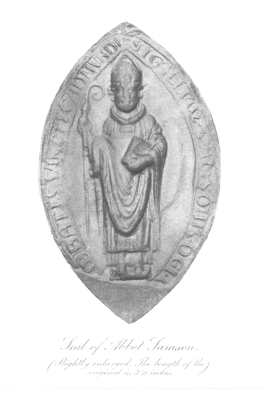
39, 24. New seal. A representation of
this seal is given as the Frontispiece. It is taken from an instrument
in the Archives of Canterbury Cathedral, dated 6 November, 1200, being
an award in a dispute between the Archbishop of Canterbury and the
Canons of Lambeth, referred by Pope Innocent III. to Hugh, Bishop of
Lincoln (for whom Roger, Dean of Lincoln, was substituted), Eustace,
Bishop of Ely, and Abbot Samson.
The seal represents Abbot Samson, vested in amice, alb, tunic,
dalmatic, chasuble, rationale, and mitre. He holds a crozier in his
right hand and a closed book in his left. The mitre is unusually large
for the date. The inscription is broken, but in full reads thus:
"Sigillum Samsonis Dei Gratia Abbatis Sancti Eadmundi." The
counterseal (much smaller) displays the lamb bearing a cross, with the
words round the circumference, "Secretum Samsonis Abbatis."
41, 9. Thomas of Hastings. Apparently
the object of Thomas in introducing thus early his nephew, Henry of
Hastings, to the notice of Samson, was to secure a recognition by the
new Abbot of the claims of his family to the hereditary stewardship of
the Liberty of St. Edmund. By Charter of William I., Lidgate in
Suffolk, and Blunham in Bedfordshire (where the church is dedicated to
St. Edmund), were given to one Ralph to hold in fee of the Abbot of
St. Edmund by the service of Dapifer or Steward. Later, between 1115
and 1119, Abbot Albold granted the lands, with the office held by
Ralph, to Maurice of Windsor and his heirs, and this grant was
confirmed by King Stephen. Maurice was succeeded by Ralph of Hastings,
his nephew, and Ralph by William of Hastings, his nephew; and Henry,
on
whose behalf the claim of the stewardship was made to Samson, was
William's son and heir. The Abbot admitted that his right was
indisputable (the original Charters of William I., Abbot Albold,
Stephen, and Henry II. [two] are quoted by Rokewode, pp. 118-120). But
Samson's point seems to have been that Henry was too young to give
personal service as Steward, and therefore "the business was
deferred." Rokewode observes (p. 117): "Henry continued a minor in
1188, his office being then filled by Robert of Flamville, who held it
at the time of his being one of the Wardens of the Abbey during the
vacancy" (see p. 12). In Reece's Breviary of Suffolk (1902) John
of Hastings is given as Lord of the Manor of Lidgate in 1315.
43, 11. Enclosed many parks. At the
Abbot's manor at Melford was an old deer park of very ancient
foundation. It was called Elmsett or Aelmsethe, or the Great Park, and
consisted chiefly of open wood. It was in olden times termed "Magnus
Boscus Domini," and in the surveys of Edward I. and Henry VI. it is
reckoned both as park and wood, the wood part being in the latter
survey 217a. 2r. 34p. The whole was impaled round and stored with
deer. (Parker's Melford, pp. 310-11).
43, 12. beasts of chase. The "Beasts
of the Chase" in Angevin days were the buck, doe and fox: the "Beasts
of the Forest" were the hart, hind and hare: and the "Beasts and Fowls
of the Warren" were the hare, rabbit ("coney"), pheasant and
partridge. The fox was coupled with the wolf in Canute's Forest Law,
No. 27, as "neither forest beasts nor game." When the fox was made a
Beast of the Chase cannot be ascertained with any precision. The same
Law No. 27, protected "hares, rabbits and roedeer"; the last are not
mentioned in later times. In addition to the animals above named, the
otter was hunted—vide Patent Rolls of Henry III. of 1221. The
badger, polecat or wild cat (catus) and marten are specified as
beasts which receivers of royal licences might hunt "with their own
hounds" in the twelfth and thirteenth centuries. There appears to be
no such charter or licence granting leave to hunt "the King's great
game" (deer): on the contrary, deer are often specially reserved.
43, 12. Keeping a huntsman with dogs.
The St. Edmund breed of dogs seems to have been celebrated, as Richard
I., when there was a difference between him and Samson as to the
wardship of Nesta of Cockfield, wrote to the Abbot in a friendly way,
and asked him for some of his dogs (page 148). The hunting dog of old
times was probably a light sort of mastiff. Sometimes a breed was more
celebrated for speed or for strength or for courage, as in the case of
the hounds bred by the abbots of Bury. In the course of time the
slighter varieties developed into the greyhound, and the thicker into
the mastiff of modern times. Canute's Forest Law 31 forbade possession
of "the dog which the English call greihounds" to the lower classes.
Henry II.'s Assize of the Forest, given at Woodstock 1184, forbids
(Clause 2) any one entering a royal forest with bow, arrows, dogs or
greyhounds, save with special warrant. Clause 14 requires the lawing
of mastiffs.
The Wardrobe Account of Edward I. for 1299-1300, records payment
for maintenance of twelve "fox dogs." These were used to kill
foxes in coverts previously netted round, so were not, probably,
"running hounds." On April 11, 1279, Edward I. wrote to Charles of
Salerno promising to send the harriers asked for by the latter: which
seems to indicate that the English harrier had a high reputation at
that period.
43, 16. take part in the sport.
Strutt, in his Sports and Pastimes, observes:—"By the game
laws of Canute, the dignified clergy were permitted to hunt in the
forests belonging to the Crown; and their prerogatives were not
abrogated by the Normans. Henry II., displeased at the power and
ambition of the ecclesiastics, endeavoured to render these grants of
none effect by putting in force (1157) the canon law, which strictly
forbade the clergy to spend their time in hunting and hawking." Henry
III.'s First Charter of 1217 gave leave to an archbishop, bishop, earl
or baron to take two deer while passing through a forest "by view of
the forester"; or in the absence of that official the sportsman was to
blow a horn on killing.
44, 14. The Eight Hundreds. These
eight hundreds of Thingoe, Thedwastre, Blackbourn, Bradbourn,
Bradmere, Lackford, Risbridge and Babergh, with the half hundred of
Cosford (see line 18) constituted the Liberty of St. Edmund, as to
which see note on page 238.
44, 15. Robert of Cockfield. See note
to pp. 86, l. 18, on page 241, and cf. pages 254-6.
44, 24. Hidages, foddercorn,
hen-rents. Hidage was a tax upon every hide of land; foddercorn an
ancient feudal right that the lord should be provided with fodder for
his horses; hen-rents were a common reservation upon inferior
tenures.
45, 11. Kalendar. A transcript of
this kalendar, which, as stated in the text (p. 45, l. 2) was completed
by 1186, is now in the possession of Prince Frederick Dhuleep Singh.
In the History of the Hundred of Thingoe (1838) an extract from
it relating to that Hundred is given on pp. xii.-xvii.
46, 1. Hugh the subsacrist. Jocelin
says that Samson appointed Hugh subsacrist to William Wiardel, and
shortly after (p. 47) made Samson the precentor sacrist. But this
arrangement was probably short-lived, for the Gesta Sacristarum
(Arnold, ii. 290) says Hugh succeeded William as sacrist, and gives a
lengthy list of the works he carried out in the church. In 1198, when
the body of St. Edmund was examined, Hugh was present, and is
described as sacrist (see p. 172).
50, 16. Omnia Cæsar erat. Lucan,
Pharsalia, iii. 108.
52, 5. Summa petit livor. Ovid, Remedia
Amoris, 369.
52, 8. 1 John iv. 1.
52, 18. James ii. 13.
54, 9. School of Melun
(Meludinensium). John of Salisbury calls a scholar of Melun
"Meludensis." Peter Abelard opened there, early in the twelfth
century, a celebrated school for teaching Dialectic.
54, 23. Ecclesiasticus vii. 24.
57, 14. Strangulat inclusus dolor atque
exæstuat intus. Ovid, Tristia, v. i. 63.
62, 7. Pulpit. This pulpit, from
which Samson preached in his native dialect of Norfolk, was one of the
works of Hugo the sacrist (Arnold, ii. 291).
65, 3. Norfolk Barrator. See note to
p. 18, line 9 (pages 226-7).
66, 21. Sale of holy water. Ducange
cites the acts of a synod of Exeter in 1287, that from ancient times
the profits arising from the distribution of holy water had been set
apart to maintain poor clerks in schools.
68, 23. Schools. Samson is usually
credited with having founded a town school in connection with the
monastery. This may very likely have been the case, but I have found
no direct evidence of it. It seems from this passage that at any rate
he provided free lodgings for poor scholars, and from p. 144 that he
endowed the mastership of the schools with half the tithes of
Wetherden. There is a street at Bury St. Edmunds, just outside the
precincts of the monastery, known as School Hall Street.
69, 3. Manor of Mildenhall. Edward
the Confessor gave Mildenhall to St. Edmund's, but when Domesday Book
was compiled it was in the hands of the Crown, being then worth £70.
Amongst the Crown lands sold by Richard I. immediately after his
accession was this manor, purchased, according to Jocelin, for 1,100
marks, of which 1,000 marks apparently went to the King, and 100 marks
to Queen Eleanor (see p. 71, l. 3). See also note to p. 72, l. 4, on
page 235.
69, 5. Expulsion of the Jews. Arnold
(i. 249) expresses the opinion that, "under the circumstances, this
must have been the most humane course in the interests of the Jews
themselves. All large English towns at this time were imperfectly
policed, and the temper of the populace savage and uncertain. A riot
having once been set on foot, the only hope of safety for the Jews was
in taking refuge in some royal castle. There was no castle at
Bury; to the Abbot alone could the survivors [from the massacre in
1190] look for protection; and Samson knew that he had not sufficient
force at his command to ensure it to them."
69, 6. New hospital at Babwell. The
ruins of this hospital, dedicated to the Saviour, still exist in
Northgate, beyond the railway arch. It was originally founded for a
warden, twelve chaplains, six clerks, twelve poor gentlemen, and
twelve poor women, and was the subject of numerous Charters, which
will be found fully described in Chapter II. of the late Sir Wm.
Parker's History of Long Melford (1873). In the Feet of Fines
for Suffolk, 1 John (1199), there are references to two deeds entered
into by "Walter, Master of the Hospital of the Blessed Saviour outside
the northern gate of St. Edmund's." The Master of the Hospital had his
manor at Melford and held his courts: which manor remains to the
present day, as the Manor of the Monks in Melford. It was at
St. Saviour's Hospital that Humphrey, Duke of Gloucester, put up when
he was arrested, in February, 1447, by Henry VI., who was in the town
for the Parliament which met in the refectory of Bury Abbey.
70, 9. Great roll of Winchester.
Domesday Book: the returns forming the basis of which were transmitted
to a board sitting at Winchester, by whom they were arranged in order
and placed upon record (Lingard, i. 249).
70, 19. Custom of the realm. This
custom is described by Blackstone (Commentaries [1844 ed.] i.
229) as an ancient perquisite called queen-gold or aurum reginæ, due,
in the proportion of 10 per cent., from every person making a
voluntary offering to the King.
71, 1. Ransom of King Richard.
Richard wrote to his mother from Haguenau on the 19th April, 1193, a
letter notifying the 70,000 marks demanded for his ransom by the
German Emperor Henry VI. To meet this, the monasteries of England
handed over all their gold and silver to royal commissioners, and
amongst the treasure delivered up by St. Edmund's was the golden
chalice given to the Abbey by Henry II. Queen Eleanor's release of it is
printed in the Monasticon (1821 ed.), iii. 154 (see also p. 146
of the Chronicle).
71, 19. Icklingham. This appears to
be the transaction referred to in a Charter of 1200, granted by Samson
(confirmed by King John 15th March, 1200):—"We further give and grant
to the said Hospital of St. Saviour, for the maintenance of the poor
folk, £12 in money from our town of Icklingham, to be annually
received through our sacrist." The signatures to this Charter (given
in Parker's Melford, p. 9) are interesting. They include
"Herbert, the prior," "Hermer, the sub-prior" (see chapter xvi. of
this book), and "Jocelin, the almoner" (our Chronicler).
72, 4. confirmed by the King's
Charter. Richard I. signed at Chateau Galliard on 18th July, 1198,
two charters (1) confirming to Abbot Samson the manor and advowson of
Mildenhall; (2) placing the manor, except Icklingham, at the disposal
of the sacrist on certain conditions. At the accession of King John,
Samson gave the King £200 for a confirmation of the first Charter, and
especially of Mildenhall (cf. Rokewode, pp. 124-5).
72, 15. Walter of Coutances. The
Church at Woolpit was the first piece of preferment of this famous
Archbishop. Walter apparently succeeded, at Woolpit, Geoffrey Ridel,
made Bishop of Ely in 1173 (see note on page 237). Rokewode says (p.
126): "Henry II. obtained from Hugh, Abbot of St. Edmund's, in free
alms, the Church of Woolpit for his clerk, Walter de Coutances, and in
consideration thereof, by charter dated at Winchester, granted that
after the decease of Walter or his resignation, the Church should be
appropriated to the use of the sick monks" (Reg. Nigr. fol. 104
v.). Walter obtained several other appointments, but seems from the
text to have retained the Church at Woolpit till 1183, when he was
consecrated Bishop of Lincoln. Next year (1184) he was elected
Archbishop of Rouen. He took a prominent part in the troubles of the
reigns of Richard I. and John, and died at Rouen on 16th November,
1207.
72, 22. Pope Alexander and Octavian.
Alexander III., elected Pope on 7 September, 1159, was obliged to
leave Italy in 1162, on account of the power of the Anti-Pope
Octavian, and did not return until the decease of the latter in 1164.
Samson's journey to Rome was, therefore, between 1159 and 1162, before
he became a professed monk.
73, 3. Pretended to be Scotch. Mr.
Arnold gives as the reason for this that "the Scottish kingdom at this
time naturally sided with Octavian, England being in favour of
Alexander" (I. xliii.). It has been suggested that "simulavi me esse
Scottum" in the text means that Samson pretended to be an
Irishman, the name Scotus having originally signified Irish,
only acquiring its present meaning with the immigration of the Scots
from the North of Ireland into Argyll, and their growth into a
powerful nation. Bromton, speaking of Ireland, says:—"Dicta est eciam
aliquando Scotia a Scotis eam inhabitantibus, priusquam ad aliam
Scotiam Britannicam devenerunt; unde in Martirologio legitur: Tali die
apud Scotiam natalis Sanctæ Brigidæ: quod est, apud Hiberniam" (see
Twysden, Historiæ Anglicanæ Scriptores X, London 1652: vol. I.,
col. 1072, l. 11). When therefore this passage was written (the
fourteenth century) it is clear that the usage of Scot as meaning
Irishman was not understood, and was regarded as needing explanation.
Samson's contemporary, Ralph de Diceto, following the account of Henry
of Huntingdon, twice explains that the Scots came from Ireland (ed.
Stubbs 1876, I. 10; II. 34). This explanation again implies that by
the middle and end of the twelfth century the word had come to mean
exclusively "Scotsman." The same opinion is expressed by Burton: "It
is not safe to count that the word Scot must mean a native of present
Scotland, when the period dealt with is earlier than the middle of the
twelfth century" (History of Scotland, 1873, I. 207). In that
part of the Anglo-Saxon Chronicle which was compiled during the reign
of King Alfred, Scot regularly means Irishman. In a.d. 903 the death is noted of Virgil, abbot of
the Scots, i.e. Irish: but this appears to be the last instance of the
use of the word in the Chronicle in that sense. Between the years 924
and 1138 the word Scot occurs fourteen and Scotland twenty-six times
in the Chronicle, always with the modern significance.
73, 6. Gaveloc. Javelin, a word of
Celtic origin, but not specifically Scotch. Matthew Paris speaks of it
in 1256 as a Frisian weapon: "Frisiones cum jaculis quæ vulgariter
gavelocos appellant." (Chr. Maj. ed. Luard. v. 550.) In the Romance of
Percival by Chrestien de Troyes, is the couplet, "Et il, qui bien
lancier savoit, De gaverlos que il avoit." (Ed. Potvin, Tome I. lines
1309-10. Mons, 1866).
73, 10. Ride, Ride Rome, turn
Cantwereberi, This is written in English by Jocelin; and its
meaning seems to be "I am riding towards Rome, turning from
Canterbury." Arnold (I. xliii.) says, "If he had meant to say
'returning to Canterbury,' he would at once have been taken for an
English adherent of Alexander."
74, 12. Geoffrey Ridel. This
presentation appears to have been made (c. 1161) by Henry II., perhaps
during Samson's journey abroad. In 1163 Geoffrey became Archdeacon of
Canterbury in succession to Thomas à Becket, appointed Archbishop, and
for the next eight years was in violent opposition to his primate, who
called him "our arch-devil," and excommunicated him. On May 1, 1173,
Geoffrey was chosen Bishop of Ely, and died at Winchester, 27 July,
1189. As Geoffrey from the chronicles seems to have been of a
masterful and contumacious spirit, it must have given Abbot Samson
peculiar satisfaction to have got the better of him over the timber
referred to on page 106.
74, 19. Acre. This was Samson's first
imprisonment at Castleacre (circ. 1161, before he became a monk). His
second imprisonment probably took place about 1173, as on page 6 he
speaks of it to Jocelin, then a novice, as something quite recent. As
to Castleacre, see note on pages 223-4.
77, 23. Charters of the King. This
dispute with the monks of Canterbury, heard before King Henry II. on
the 11th February, 1187, raised the whole question of the Liberty of
St. Edmund, a matter respecting which the Bury monastery was extremely
tenacious. A marginal note in the original MS. of the Chronicle,
against the puzzled phrase of the King (see page 78, lines 1-3), says:
"Our Charter speaks of the time of King Edward, and of the time of his
mother, Queen Emma, who had eight and a half hundreds as a marriage
portion before the time of King Edward, besides Mildenhall." According
to the Anglo-Saxon Chronicle, the Confessor, after his
coronation in 1043, seized the possessions of his mother, "because she
was formerly very hard on the King her son, and did less for him than
he wished before he was King, and also since." The Franchise having
thus come into the Confessor's hands, was granted to the Abbots and
Monks of Bury shortly after his accession. Under a Charter of King
Edmund granted about 945, and Charters of Canute and Hardicanute, the
jurisdiction of Bury Abbey had been restricted to the town, and the
circuit indicated by the four crosses placed at the distance of a mile
from the extremities of the town: but by the Confessor's Charter, it
was enlarged to a district extending over about two-fifths of the
whole county of Suffolk. (For names of the 8½ hundreds included in the
Liberty see note on page 232, 14.)
Edward the Confessor paid a visit to the shrine of St. Edmund in
1044, and when he had come within a mile of it, dismounted from his
horse and accomplished the rest of the journey on foot. Herman the
archdeacon, who wrote about half a century later, is the first to
relate this fact, and also the grant by the King to the abbey of the
8½ hundreds: "Qua tunc suffragatorem reditibus imperialibus honorat,
centurias quas Anglice hundrez vocant, octo et semis sibi circum-circa
se donat, regiamque mansionem nomine Mildenhall his adauget" (Arnold,
I. 48). The original grant of Edward the Confessor gave the abbey jura
regalia in wide loose general terms. Later, Charters became gradually
more explicit as to the extent of jurisdiction (civil and criminal)
conferred. Later still, the Royal justices in eyre supervened. The
institution of the circuits and assizes had to be fitted into the
exempt jurisdiction: so the Liberty had its own assizes, etc., but
outside the interior special and inviolable circuit of the bannaleuca
or limits of St. Edmundsbury itself.
Lord Francis Hervey, who has made a special study of the subject,
gives hope on page 250 of his notes to the Breviary of Suffolk
(1902), of his undertaking "a detailed examination of the history and
incidents of the great Liberty of St. Edmund, which remained in the
hands of its monastic rulers till the day when Abbot Reeve surrendered
his Abbey to Henry VIII., November 4, 1539."
78, 15. Matthew xix. 12.
78, 16. the matter was put off. This
dispute between Bury and Canterbury was not, as a matter of fact,
ultimately composed till over 200 years later. Amongst Dr. Yates'
manuscript materials for the never completed Part II. of his
History of Bury is a memorandum (now amongst the Egerton MSS.
in the British Museum) in the following words:—
"The Letters Patent of King Henry 4th the 25th Nov. 1408 confirm
and ratify an Indenture of three parts between the Archbishop of
Canterbury, the Prior of Christ Church, Canterbury, and the Abbot of
Bury St. Edmund's, by which it is determined that the parishes of
Hadleygh et Illeygh being within the eight hundreds and an half called
the Liberty or Franchise of St. Edmund should be subject to the
Abbot's Seneschallus, or High Steward of the Franchise, and that the
return of the writs of the Seneschal's Great Court with the rolls
fines and other rights and privileges should be regarded in those
parishes in the same manner as in the other parts of the Liberty. An
exemption on the part of the Archbishop having been claimed, this
indenture terminated a dispute that had been above 160 years [cf.
Arnold, III. 188] in agitation. During this dispute it was agreed that
the Sheriff of Suffolk should act till its termination as
Seneschal of these Parishes. A patent was addressed to the Sheriff of
Suffolk dated 27th November in the same year, commanding him no longer
to intromit within the Franchise of St. Edmund, but to preserve
inviolate the Liberties and immunities of the Abbot and
Monastery.—Registrum Rubrum in Collect, Burien.: 317 to
328 inclusive."
78, 16. Et adhuc sub judice lis est. Horace,
Arte Poet., 78.
79, 6. Bishop of Ely. This was
William of Longchamp (d. 1197), once described by Henry II. as a "son
of two traitors." He fled the kingdom in 1191 on his fall from power,
came to England in 1192, but was not permitted to proceed further than
Canterbury, and crossed the seas again. In 1193 he returned, bearing
letters from the Emperor, and met the Regency at St. Albans. It was on
this occasion that he passed through St. Edmundsbury, as recorded on
page 80. In Normandy, at the instigation of the Archbishop of Rouen,
he had been everywhere received as an excommunicated person (cf.
Rokewode, page 127).
79, 10. Archbishopric vacant.
Archbishop Baldwin died at Acre, in November, 1190; his successor
Reginald, Bishop of Bath, was elected in December, 1191, and died
after a few days. Hubert Walter, with whom Samson afterwards came into
conflict, was elected Archbishop in May, 1192 (see note on page
245).
80, 12. Archbishop of York. This was
Geoffrey, the half-brother of Richard I., to whom he had sworn that he
would not return to England without the King's leave. Having returned,
he was, on his landing at Dover in September, 1191, arrested by
Longchamp's orders, and thrown into prison.
80, 24. King Henry had taken the
Cross. At the interview of Henry II. with Philip of France,
between Trie and Gisors, the two Kings took the cross upon the Feast
of St Agnes, 21 January, 1188.
82, 8. War throughout England. After
John's return from France in 1193, the country was in a state of
general warfare; and Windsor was besieged by the Regency
with the King's other castles.
82, 16. His own standard. See note to
p. 85, l. 25, below.
83, 1. Licence for holding
tournaments. This was little more than a device for raising money.
In 1194 Richard ordered tournaments to be held, in order to practise
the knights in warfare. No one could joust at a tournament without a
licence; and the price of the licence varied with the rank of the
holder.
85, 12. Withgar. This great thane,
who is styled in the Cartulary of Abbot John of Northwold "the famous
Earl," had the custody for Queen Emma, mother of Edward the Confessor,
of the franchise of the eight hundreds and a half which subsequently
constituted the Liberty of St. Edmund (see notes on pages 232 and
238). Mr. Rokewode says (p. 129): "The honour of Clare was composed
chiefly of the great possessions in Suffolk and Essex of Alfric, son
of Withgar or Wisgar (Liber Domesday)."
85, 25. Standard of St. Edmund. In
the famous Harleian MS. 2278, the original book containing the
metrical life of St. Edmund by John Lydgate, presented to Henry VI. by
Bury Abbey after his visit to the monastery in 1433, there is a
pictorial representation of this Standard. It depicts Adam and Eve on
either side of the Tree of Knowledge, and the devil with a human face
and a serpent's body curled round the tree. Above the tree is a lamb
and a cross, with crescents in the background. The counterseal of
Abbot Samson also has the lamb and cross (see page 229).
86, 6. Earl Roger Bigot. This Earl
was son of Hugh, the rebellious baron. It appears from the text that
the Standard of St. Edmund was carried by him into the fight at the
battle of Fornham, in October, 1173 (see p. 1).
86, 18. Robert of Cockfield.
References to members of this family of Cockfield, or Cokefield,
appear often in the Chronicle. The dispute as to rights which
arose on Robert's death is told again in greater detail at the end of
the Chronicle, by William of Diss (see pp. 254-6), and the
dispute as to the wardship of the daughter of Adam, son of Robert, on
pages 187-8. Nothing here arises except Samson's denial of Adam's
right of hereditary tenure, in which he was successful.
87, 16. Eight and a half hundreds.
See notes to p. 44, l. 14, and p. 77, l. 23, on the Liberty of St.
Edmund (pp. 232, 238).
88, 16. Haberdon. This is a field
(still called by the same name) in the south-east corner of the town,
with remains of earthworks. It was held in monastic times of the
sacrist by the singular tenure, that the tenant should find a white
bull as often as a gentlewoman should visit the shrine of St. Edmund
"to make the oblation of the said white bull," with a view to secure a
favourable answer to her prayers for offspring. On these occasions the
bull was led from his pasture on the Haberdon through the principal
streets of the town in procession to the Church of St. Edmund.
101-105. The whole of this Chapter is
obviously an interpolation in the Chronicle by some monk other than
Jocelin himself. The story of Henry of Essex is included in the long
and elaborate "vita et passio cum miraculis Sancti Edmundi" prepared
in the fourteenth century in the monastery at Bury, and now preserved
in the Bodleian Library (MS. 240); and at the end of this transcript
the compiler adds, "Cuius narracionem Jocelinus audiens, in scriptis
redegit" (Nova Legenda Anglie, ed. Horstman, 1901, II. 637). It
is apparent from the opening phrase of the text (p. 105) that Jocelin,
who most probably went to Reading in the train of the Abbot, commenced
to set down the story at the bidding of Samson, but left its
completion to some other monk of inferior degree. Perhaps this was
William of Diss, who added at the end of the Chronicle (see pages
254-6) a declaration as to the lands of Robert of Cockfield.
101, 10. precept of Seneca. Mr.
Arnold says: "Many things resembling this sentiment occur in the 109th
Epistle of Seneca; but probably the passage is somewhere else in his
works."
103, 18. thrown down the standard. Henry
of Essex's act of cowardice took place in 1157, during an expedition
into Flintshire, when the Welsh made a sudden attack. His dropping the
standard brought King Henry II. and the Royal army into great peril
(Gervase, i. 165, Rolls ed.).
104, 1. Roger Earl of Clare. There
seems to be an attempt at punning, at this point, by the monk who
wrote the original story in Latin: "Rogerus comes Clarensis, clarus
genere et militari clarior exercitis, cum suis Clarensibus maturius
occurrisset."
104, 9. trial of battle. This fight
between Henry of Essex and Robert de Montfort took place in 1163
(Ralph de Diceto, Ymag. Hist. i. 310, Rolls ed.), on an eyot in
the Thames, and is still traditionally remembered at Reading.
106, 6. stay at Melford. The manor
of Melford was given to the monastery in the time of Leofstan (second
Abbot) by Earl Alfric, the son of Withgar (Parker's History of Long
Melford, p. 1). At Long Melford, 13 miles south of Bury, was a
country house belonging to the Abbots of Bury; and at the present
Melford Hall there are said to be still some relics of this occupancy.
After Samson died, in 1211, there was a dispute that lasted a
considerable time as to the validity of the election of Hugo, his
successor; and the Papal Legate, Nicholas, Bishop of Tusculum, who
tried vainly to compose it, stayed for some time at Melford (Arnold,
ii. 46). Abbot Simon of Luton died at his manor of Melford in April,
1279.
108, 8, 13. forty pounds a year from the
town. Battely prints (App. xvii. 149) a letter from Pope
Eugenius III. (no date) addressed to Helyas, the sacrist (Ording's
nephew), confirming Ording's instructions as to the rents of the town
being applied to the service of the Altar.
112, 8. Charter from King Henry the
Second. "All the men of London shall be quit and free, and all
their goods throughout England, and the ports of the sea, of and from
all toll and passage and lestage and all other customs"
(Charter Henry I.). "All the citizens of London shall be quit from
toll and lastage throughout all England and the ports of the sea"
(Charter of Henry II.—confirmed by Charter of Richard I., 23 April,
1194, and by Charter of John, 17 June, 1199). (Birch's Historical
Charters of the City of London, 1887, pp. 3, 5.)
112, 15. theam (Lat. themus, team).
The right of compelling a person in whose hands stolen property was
found to say from whom he received it (Glossary in Stubbs's Select
Charters).
113, 10. Judges xvi. 9.
116, 15. A charter was made. The
text of this Charter of 1194, granted by Samson to the Burgesses, will
be found in Battely (App. xxii. 155-6) and in the
Monasticon, iii. 153. It confirms to the town all the customs
and liberties which it had in the times of Henry II. and his
predecessors; and it declares that with regard to watch and ward and
the custody of the gates, the ancient custom is that the town shall
furnish eight watchmen night by night, all the year round, two for
each ward, and a larger number at Christmas and on St. Edmund's Day
[20 November]; also that the town should find four gatekeepers for the
four gates, the fifth or eastern gate being in the custody of the
Abbot. Nothing is said in the Charter about the appointment of the
portreeves; but the right of burgesses to sue and be sued in their own
borough-court (portmanne-mot), instead of going outside the borough to
the hundred-mot or the shire-mot, is insisted upon. "What is evidently
assumed is that the portreeve is the Abbot's servant, and administers
justice in the Abbot's name" (Arnold, II. xxxix.).
119, 10. Lamentations iv. i.
121, 12. Abbot Robert. This was
Robert II. (fourth Abbot), a monk of Westminster, elected by the
convent in 1102, but not confirmed by Henry I. until 1107. He died
shortly afterwards, on the 16th September, 1107, and, after an
interregnum of seven years, Albold, Prior of St.
Nicasius, at Meaux, succeeded him in the abbacy. Robert was buried in
the Infirmary Chapel (Douai MS.). For his character and labours, see
MS. quoted in Arnold, i. 356.
121, 20. Hubert Walter. Hubert's
father, Harvey Walter, was descended from Hubert, the first Norman
settler, who received at the Conquest grants of land in Norfolk and
Suffolk. Hubert is said to have been born at West Dereham, in Norfolk
(Tanner, Not. Monast. Norfolk, xxi.), where lived, as will be
seen from the text (p. 121, l. 25), his mother Matilda de Valognes
(whose sister Bertha married Ranulf de Glanville). He was brought up
in Glanville's household, and was so much in his confidence that he
was afterwards said to have "shared with him in the government of
England." In 1186 he became Dean of York, and in 1189 Bishop of
Salisbury. In 1190 he went to the Holy Land, returning in 1193, in
which year he was elected Archbishop of Canterbury and appointed
justiciary. Richard's departure over sea in 1194 left him virtual
ruler of England for the next few years. He died in 1205; and in
March, 1890, a tomb opened in Canterbury Cathedral was found to
contain his remains.
124, 6. The Pope wrote. This letter
of Innocent III. was dated 1st December, 1198, and was addressed (not
to the Archbishop but) to the Abbot and convent of St. Edmund
(Migne's Patrologia, vol. ccxiv., No. 457 of the Regesta).
134, 13. Tendens ad sidera palmas. Virgil,
Æn. i. 93.
135, 18. Anniversary obit of the Abbot
Robert. According to the Liber Albus, fol. 35, the
anniversary of Abbot Robert was "xvi Kal. Octobris" (16th September).
The anniversaries of Ording and Hugh, mentioned in line 20, were 31st
January and the 16th November.
139, 20. Chapel of St. Denis. This
chapel was at the west end of the church, probably north of the great
western tower, with a chapel dedicated to St. Faith above it. Abbot
Baldwin, who commenced the erection of the basilica,
was a monk of St. Denis; hence, no doubt, the dedication of a chapel
to that saint.
142, 5. Church of Coventry. Hugh de
Nonant (d. 1198), Bishop of Lichfield and Coventry, had a violent
dislike to all monks, and, whenever he could, put secular canons in
their place. He had turned out the monks at Coventry, and Pope
Celestine III. appointed in 1197 a Commission, on which Samson sat,
for restoring these expelled monks. The monks were re-inducted by
Archbishop Hubert Walter on 18th January, 1198.
144, 1. Church of Wetherden. This
deed is recorded in the Feet of Fines for Suffolk, 9 Richard I., No.
49.
144, 9. master of the schools. A
perpetual pension of three marcs, payable from the tithes of Wetherden
to "the master of the school at St. Edmund," was granted in 1198 by
John, Bishop of Norwich, at the request of Samson (Curtey's
Register, Brit. Mus. fol. 119).
145, 24. Chapel of St. Andrew.
According to the Gesta Sacristarum (Arnold, ii. 291) the Chapel
of St. Andrew was for the most part built and finished by the sacrist
Hugo under Samson, and seems to have been then connected with the
infirmary (iii. 87). Later on it was removed into the cemetery of the
monks (iii. 187).
145, 25. Chapels of St. Katherine and
St. Faith. Two chapels at the west end; St. Katherine to the
south, over the chapel of St. John, St. Faith to the north, over the
chapel of St. Denis.
147, 19. Tractant fabrilia fabri. Horace,
Ep. ii. i. 116.
147, 20. Adam of Cockfield. This was
the claimant whose case is reported on pp. 86-8, and again (by William
of Diss) on pp. 254-6. An elaborate pedigree of the Cockfield family
is given by Rokewode on pp. 140-8 of his book. His daughter's name was
Nesta, and, as stated at p. 187, l. 24, she became, on her father's
death in 1198, the ward and wife of Thomas de Burgh, brother of Hubert
the chamberlain, who was afterwards justiciary and Earl of Kent. Nesta
married three times, and died about 1248.
149, 3. Munera (crede mihi) capiunt
hominesque deosque; Placatur donis Jupiter ipse datis. Ovid, Arte
Amandi, iii. 653.
151, 13. Portman-moot. Borough
court. Written in English in the original Chronicle
("portmane-mot.")
151, 18. Sorpeni. Payment for grass
for a cow.
152, 5. Ording who lies there.
Ording (d. 1156) was one of six abbots who were buried in the Chapter
House, and whose names are recorded in the MS., circa 1425, discovered
by Dr. Montagu James at Douai (James, p. 180). The original
chapter house of the monastery was built by Godefridus, the sacrist,
about 1107. There was a fire which destroyed all the convent
buildings, and Helyas, the sacrist, Ording's nephew, "reformavit ad
plenum" the chapter house. His uncle was the first Abbot buried there.
Ording's place of sepulture was nearest to the east end or dais. Hugo
and Samson, Ording's successors, were also buried in Helyas's chapter
house: Samson being, according to the Douai MS. "sepultus in capitulo
sedus ad pedes Ric. Abb. sub lapidibus marmoreis ut suprascriptum est
de Abb. Ordingo." About 1220 Richard of Newport, then sacrist, "vetus
capitulum destruxit, et novum a fundamentis construxit." (Arnold, II.
293.) Afterwards Richard of Insula (1229-34), Henry of Rushbrook
(1234-46), and Edmund of Walpole (1248-56) were also buried in the
chapter house. Its dimensions, according to William of Worcester's
measurements in 1479, were 60 paces by 20. In the course of some
recent excavations (1902-3) the coffins of five of the above Abbots,
and much worked stone and marble, have been found on the site of this
chapter house.
152, 19. tenant of the cellarer, by name
Ketel. As Ketel dwelt "without the gate," he was, being "of the
cellarer's fee," subject to the "judicial duel" which William I. had
introduced; whereas the argument of his
fellow-burgesses seems to have been that if he had dwelt within the
borough he would have been tried and acquitted or condemned by the
"oaths of his neighbours"—the compurgators out of whom our jury
system grew. The monks recognized that the time had come when the
franchise of the town should be extended to the rural possessions of
the Abbey, and all brought under a common jurisdiction.
153, 6. within the jurisdiction.
"Infra bannamleucam," defined by Ducange as a certain territory by the
boundaries of which the jurisdiction and immunities of any place,
whether a town or monastery, were limited. Bannum is here used
in the sense of jurisdiction; and the amount of territory so
enfranchised was usually reckoned as a league either way, hence banna
leuca or banlieue. The exempt jurisdiction of Bury Abbey was limited
to the circuit of a mile within four crosses.
153, 6. Villeins of Hardwick. The
Latin word is lancettos, serfs holding by base services. In one
of the cartularies of St. Edmund, the "Lancetti de Hardwick" were to
cleanse the latrines of the monastery.
154, 23. Beodricsworth. This is the
ancient name of Bury St. Edmunds. Mr. Arnold says (I. iv.) the name of
Beodric "seems to mean 'a table chieftain,' comp. beod. geneat,
a table companion. But there is some countenance in the MSS. for
Beadricsworth, which would come from beadu-rica, one mighty in war."
Seynt Edmunds Biri is first substituted for Beodricsworth in Charters
from Edward the Confessor to the Monastery (cf. page 260 and Battely,
App. ix. 134).
155, 14. Aver-peni. The money paid
by the tenant in commutation of the service (avera) of performing any
work for his lord by horse or ox, or by carriage with either.
155, 20. Eels from Southrey. Ælgiva,
Queen of Canute, gave to the Monastery yearly four thousand eels, with
her gifts which pertained thereto at Lakenheath. The manor of
Southrey, in Norfolk, with three fisheries, was appropriated to the
cellarer (Rokewode, p. 151).
157, 2. haggovele. Probably head-tax or
hearth-tax.
159, 2. Romans xii. 10.
159, 9. Summa petit livor. Ovid, Rem.
Amoris, 369.
163, 8. Habakkuk iii. 2.
164, 11. Chest with the shirt of St.
Edmund. Archdeacon Herman, in his treatise De Miraculis Sancto
Eadmundi (Arnold, i. 26 et seq.), describes how Leofstan
(2nd Abbot) decided to open the coffin containing St. Edmund's body
and examine the remains. The body was found covered with a vestment
stained with blood and pierced with arrows. This was taken off and the
body wrapped in a linen sheet. In the continuation of Herman's work,
ascribed to Samson himself, there is an account of another Herman, a
monk of Bury, and a popular preacher, who displayed irreverently
certain relics of St. Edmund. He took the shirt out of its casket, and
unfolded it for the people to kiss. Tolinus the sacrist commented
severely on the occurrence, and on the third day at sunset Herman
died. The "feretrum cum camisia S. Edmundi" was amongst the relics
carried in procession round the Church on Christmas Day, Palm Sunday,
Easter Day, and probably other high festivals (Rituale, Harl. MS. 297,
cent, xiv., quoted by James, p. 183).
165, 1. Cup of St. Edmund. To
drinking from this cup various miracles are ascribed: a rich lady
cured after long suffering from fever; a Dunwich man with dropsy; a
girl afflicted with a great swelling, who drinks from the cup thrice
in the name of the Trinity; a Cluniac monk of St. Saviour's,
Southwark, named Gervasius, whose story is told in great detail in
Samson's De Miraculis (Arnold, i. 202-3). It is said that an
indulgence toties quoties was granted to pilgrims who drank
from this cup "in the worshippe of God and Saint Edmund," hence its
name of "Pardon Bowl"; but I have not found the original authority for
this.
165, 19. Luke xii. 2.
166, 9. Psalm lxiii. 11.
170, 4. Isaiah i. 2.
171, 18. verse inscribed. In the
Cronica Burienis (Arnold, iii. 8) this verse is given in a
slightly different form—"Martyris ecce zoma Michaelis servet agalma,"
the writer adding, "Agalma, id est, sacra receptacula divinitatis."
"Zoma" is probably the Greek word "soma," body. But it has also been
translated "garment," and Carlyle's version of the inscription
(Past and Present, ch. xvi.) is, "This is the Martyr's garment,
which Michael's Image guards." Lord Francis Hervey, in his edition
(1902) of Recce's Breviary of Suffolk, says, "Having regard to
the fondness of the mediæval versifiers for rhyme, I feel tempted to
suggest that the word may have been 'salma,' a word of unknown origin,
which in Italian means corpse.... The verse in question was most
probably not home made, and was not clearly intelligible to the monks
themselves."
171, 21. iron rings. This phrase is
somewhat obscure: "annuli ferrei sicut solebat fieri in cista
Norensi." Ducange gives "Norrensis" as an occasional equivalent for
Northmannus, hence Mr. Arnold suggests for cista Norensis "a Norwegian
chest" (i. 311).
175, 10. Ailwin the monk. Ailwin,
also written Egelwin, was keeper of the shrine of St. Edmund before
the foundation of the Abbey. In view of the invasion of England by the
Danish chief Turchil, Ailwin fled, in 1010, from Beodricsworth to
London with the body of St. Edmund, returning 1014. In 1050 Ailwin,
then a very aged man, was invited by Abbot Leofstan to come from Hulme
to Bury to identify the body of the Saint.
176, 18. Keeper of St. Botolph.
There was a chapel (probably on the south side of the presbytery)
dedicated to St. Botolph, in which was the shrine with the relics of
that Saint.
177, 3. Felix, quem faciunt aliena pericula
cautum. Erasmus, Adagia.
178, 6. King John ... came down to St.
Edmund. John paid several visits to Bury Abbey during Samson's
abbacy: once in 1199, immediately after his coronation, when he made
the miserable offering described by Jocelin on p. 178; a second time
in 1201, when returning from Northumberland; a third time in 1203,
when, according to Rokewode (p. 154), "he made a pilgrimage to St.
Edmund's, at the feast of St. Thomas the Apostle, and gave the convent
ten marcs annually, payable from the exchequer, for the repairs of the
shrine of St. Edmund, in consideration of the monks giving back to the
King, for his life, a sapphire and ruby, which he had offered to the
Saint, and which were to revert to the convent." In connection with
the disputed question of the nomination of Samson's successor (which
lasted for over two years), John came to Bury on November 4, 1114, and
meeting the monks in the chapter house, made them a speech as to his
own rights in the matter, which is recorded in Arnold, II. xv. and
95-6.
180, 7. Isaiah i. 2.
182, 3. Matthew xii. 25.
183, 9. In te vindicassem nisi iratus
fuissem. Cic. Tusc. iv. 36.
183, 14. Mark iv. 39.
187, 20. seisin of the damsel. There
was another claimant for the wardship of Nesta of Cockfield, not here
mentioned, viz., King Richard I., who (see pp. 148-9) was defied by
Samson, but was appeased by a present of some horses, dogs, and other
valuable gifts. "Here you may see what misery followeth the tenure by
Knight's service: if the tenant dieth, leaving his heir within age,
how the poor child may be tossed and tumbled, chopped and changed,
bought and sold like a jade in Smithfield, and what is more, married
to whom it pleaseth his guardian, whereof ensue many evils" (Rastell:
Terms of the Lawes of this Realm, ed. 1579, fol. 98).
189, 6. Decipi quadam specie recti. Horace,
De Arte Poetica, 25.
189, 8. Isaiah xlii. 8.
189, 9. Abbot of Cluny. This was
Hugh, Abbot of Reading from 1180 to 1199, when he was appointed Abbot
of Cluny. Much information about him may be found in Dr. J. B. Hurry's
admirable History of Reading Abbey, 1901, whence the following
note as to precedence is taken: "Sir Henry Englefield
(Archaeologia, vol. vi. p. 61) states that the Abbot of Reading
took precedence after the Abbots of Glastonbury and St. Albans. But it
is probable that no such definite order was observed.... In the
Articles of Faith under Convocation, 28 Henry VIII., the following is
the order of signatures—St. Albans, Westminster, St. Edmunds Bury,
Glastonbury, Reading."
190, 6. Numbers xi. 26.
191, 1. When the Prior died. Mr.
Rokewode assigns Robert's death to 1200, perhaps because the narrative
of the election of his successor follows in the Chronicle the account
of the visit to the monastery of Hugh, Abbot of Cluny.
192, 9. Proverbs xix. 11.
193, 19. Deut. xvii. 8.
196, 19. [Herbert] the new prior.
This election seems to have taken place in 1200. After Samson's death
in 1211, Herbert had a great deal of anxiety arising out of King
John's refusal to accept the choice of Hugh II. (then Prior of
Westminster and afterwards Bishop of Ely) as Abbot; and the narrative
of the Electio Hugonis takes up 102 pages of Mr. Arnold's vol.
ii. Herbert died in September, 1220, and was succeeded as Prior by
Richard of Insula (afterwards 12th Abbot).
197, 20. Acts xxvi. 24.
197, 23. Nihil omne parte beatum. Hor.
Odes, i. 16.
198, 7. Exitus acta probabit. Ovid,
Heroides, ii. 85.
198, 11. Psalm lxiv. 3.
199, 5. Fallitur augurio spes bona sæpe
suo. Ovid, Heroides, xvii. 234.
200, 8. Deut. xvi. 19.
200, 16. Galatians v. 9.
201, 20. Dean of London. This
quotation from the Ymagines Historiarum of Ralph de Diceto,
Dean of St. Paul's, who died about 1202, is interesting, as showing
that apparently a manuscript copy of that work was in the possession
of Bury Abbey shortly after its compilation. Diceto has often been
identified with Diss in Norfolk: and there are evidences that William
of Diss had a good deal to do with Jocelin's Chronicle (cf. pages 242,
254). Bishop Stubbs thinks that Diceto is "an artificial name, adopted
by its bearer as the Latin name of a place with which he was
associated," and this he suggests may be one of three places in
Maine.
202, 16. Mutans quadrata rotundis. Hor.
Ep. i. 1, 100.
203, 16. Pila minantia pilis. Lucan,
1, 7.
204, 13. By his writ. The same
difficulty as to jurisdiction that arose in the case of Monk's Eleigh
with Christ Church, Canterbury (see chapter vii. and notes to p. 77,
l. 23, and p. 78, l. 16) occurred with the Bishop of Ely; and it
lasted an equally long time. In the Excerpta Cantabrigiensia
(Arnold, III. 188) is a long account of a "Contentio inter monasterium
S. Edmundi et episcopum Eliensum" (Univ. Lib. Ff. 2, 29) respecting the
return to writs affecting places within the Liberty of St. Edmund. The
Bishop claimed that when a writ came down to the Sheriff of Suffolk
referring to a place which, though within the liberty of St. Edmund,
belonged to the see of Ely, it was the duty of the sheriff to send
that writ for execution, not to the abbot, but to the bishop; and the
abbot claimed that the ancient jurisdiction of St. Edmund would thus
be infringed. Since the liberty of St. Edmund comprised eight and a
half hundreds in the county of Suffolk, within which hundreds the see
of Ely possessed many manors, it is obvious that if the charge and
execution of writs affecting these manors were withheld from the abbot
and given to the bishop, the jurisdiction of St. Edmund would be to
that extent impaired and restricted. The Contentio begins with a
reference to the King's decision just given (1408) in favour of Bury
against the Canterbury monks (see note on page 239), and goes on to
describe the efforts made by Abbot Cratfield to stop the encroachments
of Bishop Fordham of Ely, with whom he proposes a meeting, from which
the bishop excuses himself. The controversy dragged on, with many
adjournments and delays, all of which the (Bury) writer lays to the
charge of the other side: nor was it concluded at the date (1426 or
1427) when the tract was written (Arnold, III. xviii.-xix.).
205, 20. Psalm viii. 8.
207, 7. Geoffrey Fitz-Peter and William
de Stutville. These were important officials, whom John could ill
spare. Geoffrey Fitz-Peter, Earl of Essex (died 1213) was justiciar,
having been appointed by Richard I. to this high office in 1198, on
the resignation of Archbishop Hubert Walter. He was confirmed in his
appointment by John, who disliked him, but used him for his own ends.
William de Stutville had been appointed sheriff of the county of York
in 1201, and died in 1203.
209, 20. made his will just as if he was
now to die. The Royal summons to Court was dated 1203, as the
brief of Innocent III. is printed in Migne's Patrologia, vol.
214, and is dated 21 January, 1203. Samson lived nearly nine years
afterwards; but as to the facts of his latest years we know
practically nothing. As to his death and burial, see Preface, pages
xl.-xlii.
211, 9. Pollicitis dives quilibet esse
potest. Ovid., De Arte Amandi, 1. 444.
211. At the foot of fol. 163 of the
Liber Albus, from which Jocelin's Chronicle is taken, is a
memorandum by William of Diss, which, as it has been printed both by
Rokewode and Arnold, is translated below, though it is not by Jocelin.
It is merely an expansion of the story told by Jocelin himself on pp.
86-8. Adam of Cockfield wanted to claim his father's lands by
hereditary right; but William of Diss gives the evidence against this claim.
The succession was: Lenmere, Adam the first (married Adeliza), Robert
(died 1191), Adam the claimant (died 1198), who married Rohesia, and
had a daughter Nesta, over whose wardship there was the dispute
recorded on page 187.
"Robert of Cockfield acknowledged to my lord abbot Samson, in the
presence of many persons—Master W. of Banham, brother W. of Diss,
chaplains, William of Breiton, and many others—that he had no
hereditary right in the vills of Groton and Semere. For in the days of
King Stephen, when the peace was disturbed, the monks of St. Edmund,
with the consent of the abbot, granted the aforesaid two vills to Adam
of Cockfield, his father, to be held all the days of his life: Semere
for the annual payment of one hundred shillings, and Groton by the
payment of an annual rent, because Adam could defend the aforesaid
towns against the holders of the neighbouring castles, W. of Milden
and W. of Ambli, in that he had a castle of his own near to the
aforesaid manors, namely, the castle of Lelesey.
"After the death of the aforesaid Adam, they granted the said
manors to Robert of Cockfield, son of Adam, at a double rate for
Semere, that is an annual rent of ten pounds, so long as the lords
abbots and the convent wish. But he never had a charter for it, not
even to the end of his life. He had good charters for all the
tenements which he held of St. Edmund by hereditary right, which
charters I, William, known as William of Diss, at that time chaplain,
read, in the hearing of many, in the presence of the aforesaid abbot:
that is for the lands of Lelesey, which Ulfric of Lelesey held of St.
Edmund in the same township; the charter of the abbot and convent
concerning the socages of Rougham, which Mistress Rohesia of
Cockfield, once wife of Adam the younger, brought as her dowry; for
the lands also which Lenmere, his ancestor, held in the town of
Cockfield by hereditary right, and which in the time of King Stephen,
with the consent of Anselm, abbot of St. Edmund, were changed into half a
knight's fee, although at first they had been socages of St.
Edmund.
"He had also charters of the abbot and convent of St. Edmund, for
the lands which are in the town of St. Edmund; for the land, that is
to say, of Hemfrid Criketot, where the houses of Mistress Adeliza were
once situated. They have also a hereditary charter for a great
messuage, under a payment of twelve pence, where the hall of Adam the
first, of Cockfield, was of old situate, with a wooden tower seven
times twenty feet in height. It was confirmed to them as hereditary
right by the charter of the abbot and convent, in which charter are
specified the length and breadth of that place and messuage, to be
held by a payment of two shillings. They also hold a hereditary
charter for the lands which Robert of Cockfield, son of Odo of
Cockfield, now holds in Barton. But they have no charter for the
township of Cockfield, that is, for the portion which pertains to the
food of the monks of St. Edmund.
"Then there was one brief of King Henry I., in which he commands
Abbot Anselm to allow Adam of Cockfield the first to hold in peace the
farm of Cockfield, and others, as long as he pays rents in full; and
that brief was sealed only of one part, representing the royal
form—against the form of all royal briefs.
"But Robert of Cockfield claimed, in the presence of the lord abbot
and the aforesaid, that he believed Cockfield to be his hereditary
right on account of his long tenure: because his grandfather, Lenmere,
held that manor for a long time before his death, and Adam the first,
his son, for the term of his life, and he, Robert, all his
life—well-nigh sixty years; but they never had a charter of the abbot
or the convent of St. Edmund for the aforesaid land."