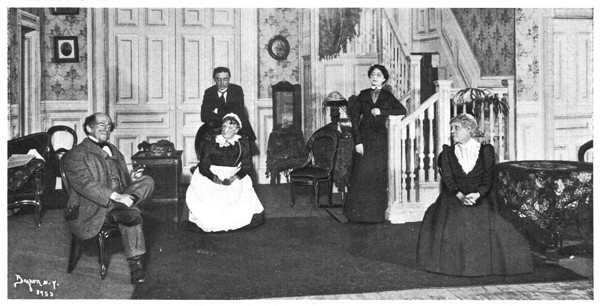
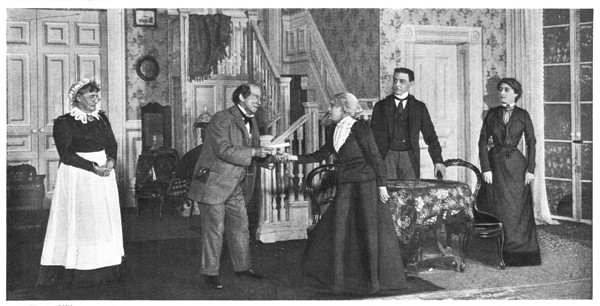
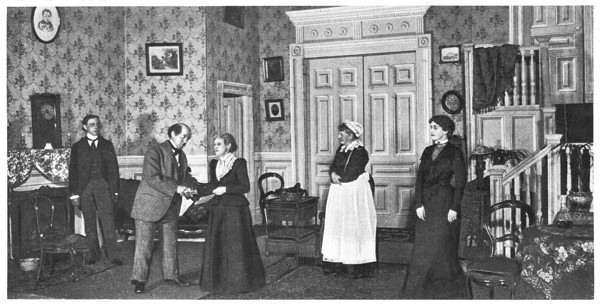
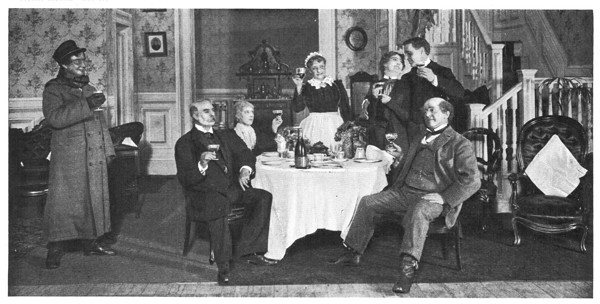
The meal proceeded in silence for a few
minutes. Mrs. Cullom had said but little, but
John noticed that her diction was more conventional
than in her talk with David and
himself in the morning, and that her manner
at the table was distinctly refined, although she
ate with apparent appetite, not to say hunger.
Presently she said, with an air of making conversation,
"I suppose you've always lived in
the city, Mr. Lenox?"
"It has always been my home," he replied,
"but I have been away a good
deal."
"I suppose folks in the city go to theaters
a good deal," she remarked.
"They have a great many opportunities,"
said John, wondering what she was leading
up to. But he was not to discover, for David
broke in with a chuckle.
"Ask Polly, Mis' Cullom," he said. "She
c'n tell ye all about the theater, Polly kin."
Mrs. Cullom looked from David to Mrs. Bixbee,
whose face was suffused.
"Tell her," said David, with a grin.
"I wish you'd shet up," she exclaimed.
"I sha'n't do nothin' of the sort."
"Ne' mind," said David cheerfully. "I'll
tell ye, Mis' Cullom."
"Dave Harum!" expostulated Mrs. Bixbee,
but he proceeded without heed of her
protest.
"Polly an' I," he said, "went down to
New York one spring some years ago. Her
nerves was some wore out 'long of diff'rences
with Sairy about clearin' up the woodshed,
an' bread risin's, an' not bein' able to suit herself
up to Purse's in the qual'ty of silk velvit
she wanted fer a Sunday-go-to-meetin' gown,
an' I thought a spell off 'd do her good.
Wa'al, the day after we got there I says to
her while we was havin' breakfust—it was
picked-up el'phant on toast, near 's I c'n
remember, wa'n't it, Polly?"
"That's as near the truth as most o' the
rest on't so fur," said Polly with a sniff.
"Wa'al, I says to her," he proceeded, untouched
by her scorn, "'How'd you like to
go t' the theater? You hain't never ben,' I
says, 'an' now you're down here you may
jes' as well see somethin' while you got a
chanst,' I says. Up to that time," he remarked,
as it were in passing, "she'd ben
somewhat prejuced 'ginst theaters, an'——"
"Wa'al," Mrs. Bixbee broke in, "I guess
what we see that night was cal'lated——"
"You hold on," he interposed. "I'm
tellin' this story. You had a chanst to an'
wouldn't. Anyway," he resumed, "she
allowed she'd try it once, an' we agreed we'd
go somewheres that night. But somethin'
happened to put it out o' my mind, an' I
didn't think on't agin till I got back to the
hotel fer supper. So I went to the feller at the
news-stand an' says, 'Got any show-tickits
fer to-night?'
"'Theater?' he says.
"'I reckon so,' I says.
"'Wa'al,' he says, 'I hain't got nothin'
now but two seats fer "Clyanthy."'
"'Is it a good show?' I says—'moral, an'
so on? I'm goin' to take my sister, an' she's
a little pertic'ler about some things,' I says.
He kind o' grinned, the feller did. 'I've took
my wife twice, an' she's putty pertic'ler herself,'
he says, laughin'."
"She must 'a' ben," remarked Mrs. Bixbee
with a sniff that spoke volumes of her opinion
of "the feller's wife." David emitted a
chuckle.
"Wa'al," he continued, "I took the tickits
on the feller's recommend, an' the fact of his
wife's bein' so pertic'ler, an' after supper we
went. It was a mighty handsome place
inside, gilded an' carved all over like the outside
of a cirkis wagin, an' when we went in
the orchestry was playin' an' the people was
comin' in, an' after we'd set a few minutes I
says to Polly, 'What do you think on't?' I
says.
"'I don't see anythin' very unbecomin' so
fur, an' the people looks respectable enough,'
she says.
"'No jail birds in sight fur 's ye c'n see so
fur, be they?' I says. He, he, he, he!"
"You needn't make me out more of a
gump 'n I was," protested Mrs. Bixbee.
"An' you was jest as——" David held up
his finger at her.
"Don't you sp'ile the story by discountin'
the sequil. Wa'al, putty soon the band struck
up some kind of a dancin' tune, an' the curt'in
went up, an' a girl come prancin' down to
the footlights an' begun singin' an' dancin',
an', scat my——! to all human appearances
you c'd 'a' covered ev'ry dum thing she had
on with a postage stamp." John stole a
glance at Mrs. Cullom. She was staring at
the speaker with wide-open eyes of horror
and amazement.
"I guess I wouldn't go very fur into pertic'lers,"
said Mrs. Bixbee in a warning tone.
David bent his head down over his plate
and shook from head to foot, and it was
nearly a minute before he was able to go on.
"Wa'al," he said, "I heard Polly give a kind
of a gasp an' a snort, 's if some one 'd throwed
water 'n her face. But she didn't say nothin',
an', I swan! I didn't dast to look at her fer a
spell; an' putty soon in come a hull crowd
more girls that had left their clo'es in their
trunks or somewhere, singin', an' dancin', an'
weavin' 'round on the stage, an' after a few
minutes I turned an' looked at Polly. He, he,
he, he!"
"David Harum," cried Mrs. Bixbee, "ef
you're goin' to discribe any more o' them
scand'lous goin's on I sh'll take my victuals
into the kitchen. I didn't see no more of
'em," she added to Mrs. Cullom and John,
"after that fust trollop appeared."
"I don't believe she did," said David, "fer
when I turned she set there with her eyes
shut tighter 'n a drum, an' her mouth shut
too so's her nose an' chin most come
together, an' her face was red enough so 't a
streak o' red paint 'd 'a' made a white mark
on it. 'Polly,' I says, 'I'm afraid you ain't
gettin' the wuth o' your money.'
"'David Harum,' she says, with her
mouth shut all but a little place in the corner
toward me, 'if you don't take me out
o' this place, I'll go without ye,' she says.
"'Don't you think you c'd stan' it a little
longer?' I says. 'Mebbe they've sent home
fer their clo'es,' I says. He, he, he, he! But
with that she jes' give a hump to start, an' I
see she meant bus'nis. When Polly Bixbee,"
said David impressively, "puts that foot
o' her'n down somethin's got to sqush, an'
don't you fergit it." Mrs. Bixbee made
no acknowledgment of this tribute to
her strength of character. John looked at
David.
"Yes," he said, with a solemn bend of
the head, as if in answer to a question, "I
squshed. I says to her, 'All right. Don't
make no disturbance more'n you c'n help, an'
jes' put your hank'chif up to your nose 's if
you had the nosebleed,' an' we squeezed out
of the seats, an' sneaked up the aisle, an' by
the time we got out into the entry I guess my
face was as red as Polly's. It couldn't 'a' ben
no redder," he added.
"You got a putty fair color as a gen'ral
thing," remarked Mrs. Bixbee dryly.
"Yes, ma'am; yes, ma'am, I expect that's
so," he assented, "but I got an extra coat o'
tan follerin' you out o' that theater. When
we got out into the entry one o' them fellers
that stands 'round steps up to me an' says,
'Ain't your ma feelin' well?' he says. 'Her
feelin's has ben a trifle rumpled up,' I says,
'an' that gen'ally brings on the nosebleed,'
an' then," said David, looking over Mrs. Bixbee's
head, "the feller went an' leaned up
agin the wall."
"David Harum!" exclaimed Mrs. Bixbee,
"that's a downright lie. You never spoke to
a soul, an'—an'—ev'rybody knows 't I ain't
more 'n four years older 'n you be."
"Wa'al, you see, Polly," her brother replied
in a smooth tone of measureless aggravation,
"the feller wa'n't acquainted with us,
an' he only went by appearances."
Aunt Polly appealed to John: "Ain't he
enough to—to—I d' know what?"
"I really don't see how you live with
him," said John, laughing.
Mrs. Cullom's face wore a faint smile, as
if she were conscious that something amusing
was going on, but was not quite sure what.
The widow took things seriously for the most
part, poor soul.
"I reckon you haven't followed theater-goin'
much after that," she said to her
hostess.
"No, ma'am," Mrs. Bixbee replied with
emphasis, "you better believe I hain't. I
hain't never thought of it sence without tinglin'
all over. I believe," she asserted, "that
David 'd 'a' stayed the thing out if it hadn't
ben fer me; but as true 's you live, Cynthy
Cullom, I was so 'shamed at the little 't I did
see that when I come to go to bed I took my
clo'es off in the dark."
David threw back his head and roared
with laughter. Mrs. Bixbee looked at him
with unmixed scorn. "If I couldn't help
makin' a——" she began, "I'd——"
"Oh, Lord! Polly," David broke in, "be
sure 'n wrap up when you go out. If you
sh'd ketch cold an' your sense o' the ridic'lous
sh'd strike in you'd be a dead-'n'-goner sure."
This was treated with the silent contempt
which it deserved, and David fell upon his
dinner with the remark that "he guessed
he'd better make up fer lost time," though as
a matter of fact while he had done most of
the talking he had by no means suspended
another function of his mouth while so
engaged.
For a time nothing more was said which
did not relate to the replenishment of plates,
glasses, and cups. Finally David cleaned up
his plate with his knife blade and a piece of
bread, and pushed it away with a sigh of fullness,
mentally echoed by John.
"I feel 's if a child could play with
me," he remarked. "What's comin' now,
Polly?"
"The's a mince pie, an' Injun puddin'
with maple sugar an' cream, an' ice cream,"
she replied.
"Mercy on us!" he exclaimed. "I guess
I'll have to go an' jump up an' down on the
verandy. How do you feel, John? I s'pose
you got so used to them things at the Eagle 't
you won't have no stomech fer 'em, eh?
Wa'al, fetch 'em along. May 's well die fer
the ole sheep 's the lamb; but, Polly Bixbee,
if you've got designs on my life, I may 's well
tell ye right now 't I've left all my prop'ty
to the Institution fer Disappinted Hoss
Swappers."
"That's putty near next o' kin, ain't it?"
was the unexpected rejoinder of the injured
Polly.
"Wa'al, scat my——!" exclaimed David,
hugely amused, "if Polly Bixbee hain't made
a joke! You'll git yourself into the almanic,
Polly, fust thing you know." Sairy brought
in the pie and then the pudding.
"John," said David, "if you've got a
pencil an' a piece o' paper handy I'd like to
have ye take down a few of my last words
'fore we proceed to the pie an' puddin' bus'nis.
Any more 'hossredish' in that bottle?"
holding out his glass. "Hi, hi! that's enough.
You take the rest on't," which John did,
nothing loath.
David ate his pie in silence, but before he
made up his mind to attack the pudding,
which was his favorite confection, he gave an
audible chuckle, which elicited Mrs. Bixbee's
notice.
"What you gigglin' 'bout now?" she
asked.
David laughed. "I was thinkin' of somethin'
I heard up to Purse's last night," he
said as he covered his pudding with the thick
cream sauce. "Amri Shapless has ben gittin'
married."
"Wa'al, I declare!" she exclaimed.
"That ole shack! Who in creation could
he git to take him?"
"Lize Annis is the lucky woman," replied
David with a grin.
"Wa'al, if that don't beat all!" said Mrs.
Bixbee, throwing up her hands, and even
from Mrs. Cullom was drawn a "Well, I
never!"
"Fact," said David, "they was married
yestidy forenoon. Squire Parker done the
job. Dominie White wouldn't have nothin'
to do with it!"
"Squire Parker 'd ortter be 'shamed of
himself," said Mrs. Bixbee indignantly.
"Don't you think that trew love had
ought to be allowed to take its course?"
asked David with an air of sentiment.
"I think the squire 'd ortter be 'shamed
of himself," she reiterated. "S'pose them
two old skinamulinks was to go an' have
children?"
"Polly, you make me blush," protested
her brother. "Hain't you got no respect fer
the holy institution of matrimuny?—and—at
cet'ry?" he added, wiping his whole face
with his napkin.
"Much as you hev, I reckon," she retorted.
"Of all the amazin' things in this
world, the amazinist to me is the kind of
people that gits married to each other in gen'ral;
but this here performence beats ev'rything
holler."
"Amri give a very good reason for't," said
David with an air of conviction, and then he
broke into a laugh.
"Ef you got anythin' to tell, tell it," said
Mrs. Bixbee impatiently.
"Wa'al," said David, taking the last of
his pudding into his mouth, "if you insist
on't, painful as 't is. I heard Dick Larrabee
tellin' 'bout it. Amri told Dick day before
yestiday that he was thinkin' of gettin' married,
an' ast him to go along with him to Parson
White's an' be a witniss, an' I reckon a
kind of moral support. When it comes to
moral supportin'," remarked David in passing,
"Dick's as good 's a professional, an' he'd go
an' see his gran'mother hung sooner 'n miss
anythin', an' never let his cigar go out durin'
the performence. Dick said he congratilated
Am on his choice, an' said he reckoned they'd
be putty ekally yoked together, if nothin' else."
Here David leaned over toward Aunt Polly
and said, protestingly, "Don't gi' me but jest
a teasp'nful o' that ice cream. I'm so full now
't I can't hardly reach the table." He took a
taste of the cream and resumed: "I can't give
it jest as Dick did," he went on, "but this is
about the gist on't. Him, an' Lize, an' Am
went to Parson White's about half after seven
o'clock an' was showed into the parler, an' in
a minute he come in, an' after sayin' 'Good
evenin'' all 'round, he says, 'Well, what c'n
I do fer ye?' lookin' at Am an' Lize, an' then
at Dick.
"'Wa'al,' says Am, 'me an' Mis' Annis
here has ben thinkin' fer some time as how
we'd ought to git married.'
"'Ought to git married?' says Parson
White, scowlin' fust at one an' then at t'other.
"'Wa'al,' says Am, givin' a kind o' shuffle
with his feet, 'I didn't mean ortter exac'ly,
but jest as well—kinder comp'ny,' he says.
'We hain't neither on us got nobody, an' we
thought we might 's well.'
"'What have you got to git married on?'
says the dominie after a minute. 'Anythin'?'
he says.
"'Wa'al,' says Am, droppin' his head
sideways an' borin' into his ear 'ith his middle
finger, 'I got the promise mebbe of a job
o' work fer a couple o' days next week.'
'H'm'm'm,' says the dominie, lookin' at him.
'Have you got anythin' to git married on?'
the dominie says, turnin' to Lize. 'I've got
ninety cents comin' to me fer some work I
done last week,' she says, wiltin' down on to
the sofy an' beginnin' to snivvle. Dick says
that at that the dominie turned round an'
walked to the other end of the room, an'
he c'd see he was dyin' to laugh, but he come
back with a straight face.
"'How old air you, Shapless?' he says
to Am. 'I'll be fifty-eight or mebbe fifty-nine
come next spring,' says Am.
"'How old air you?' the dominie says,
turnin' to Lize. She wriggled a minute an'
says, 'Wa'al, I reckon I'm all o' thirty,' she
says."
"All o' thirty!" exclaimed Aunt Polly.
"The woman 's most 's old 's I be."
David laughed and went on with, "Wa'al,
Dick said at that the dominie give a kind of a
choke, an' Dick he bust right out, an' Lize
looked at him as if she c'd eat him. Dick
said the dominie didn't say anythin' fer a
minute or two, an' then he says to Am, 'I
suppose you c'n find somebody that'll marry
you, but I cert'inly won't, an' what possesses
you to commit such a piece o' folly,' he says,
'passes my understandin'. What earthly reason
have you fer wantin' to marry? On your
own showin',' he says, 'neither one on you 's
got a cent o' money or any settled way o' gettin'
any.'
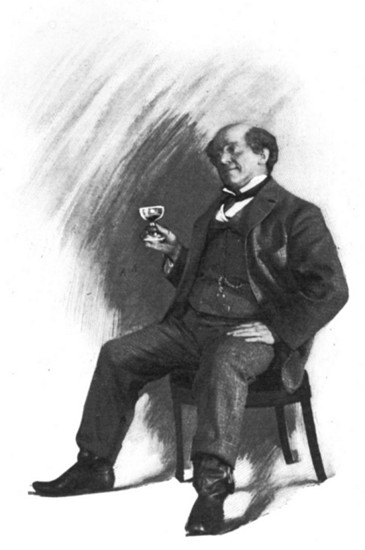
"'That's jes' the very reason,' says Am,
'that's jes' the very reason. I hain't got
nothin', an' Mis' Annis hain't got nothin', an'
we figured that we'd jes' better git married an'
settle down, an' make a good home fer us
both,' an' if that ain't good reasonin'," David
concluded, "I don't know what is."
"An' be they actially married?" asked
Mrs. Bixbee, still incredulous of anything so
preposterous.
"So Dick says," was the reply. "He says
Am an' Lize come away f'm the dominie's
putty down in the mouth, but 'fore long Amri
braced up an' allowed that if he had half a
dollar he'd try the squire in the mornin', an'
Dick let him have it. I says to Dick, 'You're
out fifty cents on that deal,' an' he says, slappin'
his leg, 'I don't give a dum,' he says; 'I
wouldn't 'a' missed it fer double the money.'"
Here David folded his napkin and put it in
the ring, and John finished the cup of clear
coffee which Aunt Polly, rather under protest,
had given him. Coffee without cream and
sugar was incomprehensible to Mrs. Bixbee.
THE END
Transcriber's Note:
Inconsistencies in spelling, punctuation and hyphenation in the original book have been retained.