I
Fancy you've journeyed down the Rhône,
Fancy you've passed Vienne, Valence,
Fancy you've skirted Avignon—
And so are come en pleine Provence.
Fancy a mistral cutting keen
Across the sunlit wintry fields,
Fancy brown vines, and olives green,
And blustered, swaying, cypress shields.
Fancy a widely opened door,
Fancy an eager outstretched hand,
Fancy—nor need you ask for more—
A heart-sped welcome to our land.
Fancy the peal of Christmas chimes,
Fancy that some long-buried year
Is born again of ancient times—
And in Provence take Christmas cheer!
In my own case, this journey and this welcome
were not fancies but realities. I had
come to keep Christmas with my old friend
Monsieur de Vièlmur according to the
traditional
Provençal rites and ceremonies in his
own entirely Provençal home: an ancient
dwelling which stands high up on the westward
slope of the Alpilles, overlooking Arles
and Tarascon and within sight of Avignon,
near the Rhône margin of Provence.
The Vidame—such is Monsieur de Vièlmur's
ancient title: dating from the vigorous
days when every proper bishop, himself not
averse to taking a breather with sword and
battle-axe should fighting matters become
serious, had his vice dominus to lead his
forces in the field—is an old-school country
gentleman who is amiably at odds with
modern times. While tolerant of those who
have yielded to the new order, he himself
is a great stickler for the preservation
of antique forms and ceremonies: sometimes,
indeed, pushing his fancies to lengths that
fairly would lay him open to the charge of
whimsicality, were not even the most extravagant
of his crotchets touched and
mellowed by his natural goodness of heart.
In the earlier stages of our acquaintance
I was disposed to regard him as an eccentric;
but a wider knowledge of Provençal
matters
has convinced me that he is a type. Under
his genial guidance it has been my privilege
to see much of the inner life of the Provençaux,
and his explanations have enabled me to
understand what I have seen: the Vidame
being of an antiquarian and bookish temper,
and never better pleased than when I set
him to rummaging in his memory or his
library for the information which I require
to make clear to me some curious phase of
Provençal manners or ways.
The Château de Vièlmur has remained so
intimately a part of the Middle Ages that
the subtle essence of that romantic period
still pervades it, and gives to all that goes
on there a quaintly archaic tone. The donjon,
a prodigiously strong square tower dating
from the twelfth century, partly is surrounded
by a dwelling in the florid style
of two hundred years back—the architectural
flippancies of which have been so
tousled by time and weather as to give it
the look of an old beau caught unawares by
age and grizzled in the midst of his affected
youth.
In the rear of these oddly coupled
structures
is a farm-house with a dependent rambling
collection of farm-buildings; the whole
enclosing a large open court to which access
is had by a vaulted passage-way, that on
occasion may be closed by a double set of
ancient iron-clamped doors. As the few exterior
windows of the farm-house are grated
heavily, and as from each of the rear corners
of the square there projects a crusty tourelle
from which a raking fire could be kept up
along the walls, the place has quite the air of
a testy little fortress—and a fortress it was
meant to be when it was built three hundred
years and more ago (the date, 1561, is carved
on the keystone of the arched entrance) in
the time of the religious wars.
But now the iron-clamped doors stand open
on rusty hinges, and the court-yard has that
look of placid cheerfulness which goes with
the varied peaceful activities of farm labour
and farm life. Chickens and ducks wander
about it chattering complacently, an aged
goat of a melancholy humour stands usually
in one corner lost in misanthropic thought,
and a great flock of extraordinarily tame
pigeons flutters back and forth between
the
stone dove-cote rising in a square tower above
the farm-house and the farm well.
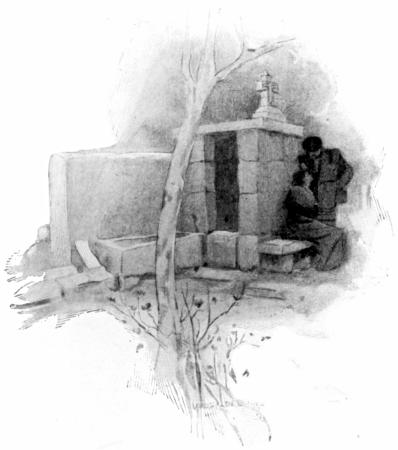 AT THE WELL
This well—enclosed in a stone well-house
surmounted by a very ancient crucifix—is
in the centre of the court-yard, and it also is
the centre of a little domestic world. To its
kerb come the farm animals three times daily;
while as frequently, though less regularly,
most of the members of the two households
come there too; and there do the humans—notably,
I have observed, if they be of different
sexes—find it convenient to rest for a
while together and take a dish of friendly
talk. From the low-toned chattering and the
soft laughter that I have heard now and then
of an evening I have inferred that these
nominally chance encounters are not confined
wholly to the day.
By simple machinery (of which the motive-power
is an aged patient horse, who is started
and left then to his own devices; and who
works quite honestly, save that now and
then he stops in his round and indulges himself
in a little doze) the well-water is raised
continuously into a long stone trough. Thence
the overflow is led away to irrigate the
garden
of the Château: an old-fashioned garden, on
a slope declining southward and westward,
abounding in balustraded terraces and stone
benches stiffly ornate, and having here and
there stone nymphs and goddesses over which
in summer climbing roses kindly (and discreetly)
throw a blushing veil.
The dependent estate is a large one: lying
partly on the flanks of the Alpilles, and extending
far outward from the base of the
range over the level region where the Rhône
valley widens and merges into the valley of
the Durance. On its highest slopes are straggling
rows of almond trees, which in the early
spring time belt the grey mountains with
a broad girdle of delicate pink blossoms;
a little lower are terraced olive-orchards,
a pale shimmering green the year round—the
olive continuously casting and renewing
its leaves; and the lowest level, the wide
fertile plain, is given over to vineyards and
wheat-fields and fields of vegetables (grown
for the Paris market), broken by plantations
of fruit-trees and by the long lines of green-black
cypress which run due east and west
across the landscape and shield the
tender
growing things from the north wind, the
mistral.
The Château stands, as I have said, well up
on the mountain-side; and on the very spot
(I must observe that I am here quoting its
owner) where was the camp in which Marius
lay with his legions until the time was ripe
for him to strike the blow that secured Southern
Gaul to Rome. This matter of Marius
is a ticklish subject to touch on with the Vidame:
since the fact must be admitted that
other antiquaries are not less firm in their
convictions, nor less hot in presenting them,
that the camp of the Roman general was
variously elsewhere—and all of them, I regret
to add, display a lamentable acerbity of
temper in scouting each other's views. Indeed,
the subject is of so irritating a complexion
that the mere mention of it almost
surely will throw my old friend—who in
matters not antiquarian has a sweetness of
nature rarely equalled—into a veritable fuming
rage.
But even the antiquaries are agreed that,
long before the coming of the Romans, many
earlier races successively made on this
mountain
promontory overlooking the Rhône delta
their fortified home: for here, as on scores
of other defensible heights throughout Provence,
the merest scratching of the soil brings
to light flints and potshards which tell of
varied human occupancy in very far back
times. And the antiquaries still farther are
agreed that precisely as these material relics
(only a little hidden beneath the present surface
of the soil) tell of diverse ancient dwellers
here, so do the surviving fragments of
creeds and customs (only a little hidden beneath
the surface of Provençal daily life) tell
in a more sublimate fashion of those same
vanished races which marched on into Eternity
in the shadowy morning of Time.
For this is an old land, where many peoples
have lived their spans out and gone onward—yet
have not passed utterly away.
Far down in the popular heart remnants of
the beliefs and of the habits of those ancients
survive, entranced: yet not so numbed but
that, on occasion, they may be aroused into a
life that still in part is real. Even now, when
the touch-stone is applied—when the thrilling
of some nerve of memory or of instinct
brings
the present into close association with the
past—there will flash into view still quick
particles of seemingly long-dead creeds or
customs rooted in a deep antiquity: the faiths
and usages which of old were cherished by
the Kelto-Ligurians, Phœnicians, Grecians,
Romans, Goths, Saracens, whose blood and
whose beliefs are blended in the Christian
race which inhabits Provence to-day.
II
In the dominion of Vièlmur there is an
inner empire. Nominally, the Vidame is the
reigning sovereign; but the power behind his
throne is Misè Fougueiroun. The term
"Misè" is an old-fashioned Provençal title of
respect for women of the little bourgeoisie—tradesmen's
and shopkeepers' wives and the
like—that has become obsolescent since the
Revolution and very generally has given
place to the fine-ladyish "Madamo." With
a little stretching, it may be rendered by our
English old-fashioned title of "mistress";
and Misè Fougueiroun, who is the
Vidame's
housekeeper, is mistress over his household
in a truly masterful way.
This personage is a little round woman,
still plumply pleasing although she is rising
sixty, who is arrayed always with an exquisite
neatness in the dress—the sober black-and-white
of the elder women, not the gay
colours worn by the young girls—of the
Pays d'Arles; and—although shortness and
plumpness are at odds with majesty of deportment—she
has, at least, the peremptory
manner of one long accustomed to command.
As is apt to be the way with little round women,
her temper is of a brittle cast and her hasty
rulings sometimes smack of injustice; but
her nature (and this also is characteristic of
her type) is so warmly generous that her heart
easily can be caught into kindness on the
rebound. The Vidame, who in spite of his
antiquarian testiness is something of a philosopher,
takes advantage of her peculiarities
to compass such of his wishes as happen to
run counter to her laws. His Machiavellian
policy is to draw her fire by a demand of an extravagant
nature; and then, when her lively
refusal has set her a little in the wrong,
handsomely
to ask of her as a favour what he really
requires—a method that never fails of success.
By my obviously sincere admiration of
the Château and its surroundings, and by a
discreet word or two implying a more personal
admiration—a tribute which no woman
of the Pays d'Arles ever is too old to accept
graciously—I was so fortunate as to win
Misè Fougueiroun's favour at the outset; a
fact of which I was apprised on the evening
of my arrival—it was at dinner, and the housekeeper
herself had brought in a bottle of precious
Châteauneuf-du-Pape—by the cordiality
with which she joined forces with the Vidame
in reprobating my belated coming to the
Château. Actually, I was near a fortnight
behind the time named in my invitation:
which had stated expressly that Christmas
began in Provence on the Feast of Saint
Barbara, and that I was expected not later
than that day—December 4th.
"Monsieur should have been here," said
the housekeeper with decision, "when we
planted the blessed Saint Barbara's grain.
And now it is grown a full span. Monsieur
will not see Christmas at
all!"
But my apologetic explanation that I never
even had heard of Saint Barbara's grain
only made my case the more deplorable.
"Mai!" exclaimed Misè Fougueiroun, in
the tone of one who faces suddenly a real
calamity. "Can it be that there are no Christians
in monsieur's America? Is it possible
that down there they do not keep the Christmas
feast at all?"
To cover my confusion, the Vidame intervened
with an explanation which made America
appear in a light less heathenish. "The
planting of Saint Barbara's grain," he said,
"is a custom that I think is peculiar to the
South of France. In almost every household
in Provence, and over in Languedoc too, on
Saint Barbara's day the women fill two,
sometimes three, plates with wheat or lentils
which they set afloat in water and then stand
in the warm ashes of the fire-place or on a
sunny window ledge to germinate. This is
done in order to foretell the harvest of the
coming year, for as Saint Barbara's grain
grows well or ill so will the harvest of the
coming year be good or bad; and also that
there may be on the table when the
Great
Supper is served on Christmas Eve—that is
to say, on the feast of the Winter Solstice—green
growing grain in symbol or in earnest
of the harvest of the new year that then begins.
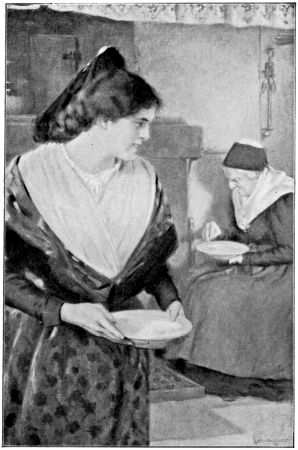 PLANTING SAINT BARBARA'S GRAIN
"The association of the Trinitarian Saint
Barbara with this custom," the Vidame
continued, "I fear is a bit of a makeshift.
Were three plates of grain the rule, something
of a case would be made out in her
favour. But the rule, so far as one can be
found, is for only two. The custom must be
of Pagan origin, and therefore dates from
far back of the time when Saint Barbara
lived in her three-windowed tower at Heliopolis.
Probably her name was tagged to it
because of old these votive and prophetic
grain-fields were sown on what in Christian
times became her dedicated day. But whatever
light-mannered goddess may have been
their patroness then, she is their patroness
now; and from their sowing we date the beginning
of our Christmas feast."
It was obvious that this explanation of the
custom went much too far for Misè Fougueiroun.
At the mention of its foundation in
Paganism she sniffed audibly, and upon
the
Vidame's reference to the light-mannered
goddess she drew her ample skirts primly
about her and left the room.
The Vidame smiled. "I have scandalized
Misè, and to-morrow I shall have to listen to a
lecture," he said; and in a moment continued:
"It is not easy to make our Provençaux realize
how closely we are linked to older peoples and
to older times. The very name for Christmas
in Provençal, Calèndo, tells how this
Christian festival lives on from the Roman
festival of the Winter Solstice, the January
Kalends; and the beliefs and customs which
go with its celebration still more plainly
mark its origin. Our farmers believe, for instance,
that these days which now are passing—the
twelve days, called coumtié, immediately
preceding Christmas—are foretellers of
the weather for the new twelve months to
come; each in its turn, by rain or sunshine or
by heat or cold, showing the character of the
correspondingly numbered month of the new
year. That the twelve prophetic days are
those which immediately precede the solstice
puts their endowment with prophetic power
very far back into antiquity. Our
farmers,
too, have the saying, 'When Christmas falls
on a Friday you may sow in ashes'—meaning
that the harvest of the ensuing year surely
will be so bountiful that seed sown anywhere
will grow; and in this saying there is a strong
trace of Venus worship, for Friday—Divèndre
in Provençal—is the day sacred to the goddess
of fertility and bears her name. That belief
comes to us from the time when the statue of
Aphrodite, dug up not long since at Marseille,
was worshipped here. Our Pater de Calèndo—our
curious Christmas prayer for abundance
during the coming year—clearly is a Pagan
supplication that in part has been diverted
into Christian ways; and in like manner
comes to us from Paganism the whole of our
yule-log ceremonial."
The Vidame rose from the table. "Our coffee
will be served in the library," he said. He
spoke with a perceptible hesitation, and there
was anxiety in his tone as he added: "Misè
makes superb coffee; but sometimes, when I
have offended her, it is not good at all." And
he visibly fidgeted until the coffee arrived,
and proved by its excellence that the housekeeper
had been too noble to take
revenge.
III
In the early morning a lively clatter
rising from the farm-yard came through
my open window, along with the sunshine
and the crisp freshness of the morning air.
My apartment was in the southeast angle of
the Château, and my bedroom windows—overlooking
the inner court—commanded the
view along the range of the Alpilles to the
Luberoun and Mont-Ventour, a pale great
opal afloat in waves of clouds; while from
the windows of my sitting-room I saw over
Mont-Majour and Arles far across the level
Camargue to the hazy horizon below which
lay the Mediterrænean.
In the court-yard there was more than
the ordinary morning commotion of farm
life, and the buzz of talk going on at the well
and the racing and shouting of a parcel of
children all had in it a touch of eagerness
and expectancy. While I still was drinking
my coffee—in the excellence and delicate service
of which I recognized the friendly
hand
of Misè Fougueiroun—there came a knock at
my door; and, upon my answer, the Vidame
entered—looking so elate and wearing so
blithe an air that he easily might have been
mistaken for a frolicsome middle-aged sunbeam.
"Hurry! Hurry!" he cried, while still
shaking both my hands. "This is a day of
days—we are going now to bring home the
cacho-fiò, the yule-log! Put on a pair of
heavy shoes—the walking is rough on the
mountain-side. But be quick, and come
down the moment that you are ready. Now
I must be off. There is a world for me to do!"
And the old gentleman bustled out of the
room while he still was speaking, and in a
few moments I heard him giving orders to
some one with great animation on the terrace
below.
When I went down stairs, five minutes
later, I found him standing in the hall by the
open doorway: through which I saw, bright
in the morning light across the level landscape,
King René's castle and the church of Sainte-Marthe
in Tarascon; and over beyond Tarascon,
high on the farther bank of the
Rhône,
Count Raymond's castle of Beaucaire; and
in the far distance, faintly, the jagged peaks
of the Cévennes.
But that was no time for looking at landscapes.
"Come along!" he cried. "They
all are waiting for us at the Mazet," and he
hurried me down the steps to the terrace and
so around to the rear of the Château, talking
away eagerly as we walked.
"It is a most important matter," he said,
"this bringing home of the cacho-fiò. The
whole family must take part in it. The head
of the family—the grandfather, the father, or
the eldest son—must cut the tree; all the others
must share in carrying home the log that is to
make the Christmas fire. And the tree must
be a fruit-bearing tree. With us it usually is
an almond or an olive. The olive especially
is sacred. Our people, getting their faith
from their Greek ancestors, believe that lightning
never strikes it. But an apple-tree or a
pear-tree will serve the purpose, and up in
the Alp region they burn the acorn-bearing
oak. What we shall do to-day is an echo of
Druidical ceremonial—of the time when the
Druid priests cut the yule-oak and with
their
golden sickles reaped the sacred mistletoe;
but old Jan here, who is so stiff for preserving
ancient customs, does not know that this
custom, like many others that he stands for,
is the survival of a rite."
While the Vidame was speaking we had
turned from the terrace and were nearing the
Mazet—which diminutive of the Provençal
word mas, meaning farm-house, is applied
to the farm establishment at Vièlmur partly
in friendliness and partly in indication of its
dependence upon the great house, the Château.
At the arched entrance we found the
farm family awaiting us: Old Jan, the steward
of the estate, and his wife Elizo; Marius,
their elder son, a man over forty, who is the
active manager of affairs; their younger son,
Esperit, and their daughter Nanoun; and
the wife of Marius, Janetoun, to whose skirts
a small child was clinging while three or
four larger children scampered about her in
a whir of excitement over the imminent
event by which Christmas really would be
ushered in.
When my presentation had been accomplished—a
matter a little complicated in
the
case of old Jan, who, in common with most of
the old men hereabouts, speaks only Provençal—we
set off across the home vineyard,
and thence went upward through the olive-orchards,
to the high region on the mountain-side
where grew the almond-tree which the
Vidame and his steward in counsel together
had selected for the Christmas sacrifice.
Nanoun, a strapping red-cheeked black-haired
bounce of twenty, ran back into the
Mazet as we started; and joined us again,
while we were crossing the vineyard, bringing
with her a gentle-faced fair girl of her
own age who came shyly. The Vidame,
calling her Magali, had a cordial word for
this new-comer; and nudged me to bid me
mark how promptly Esperit was by her side.
"It is as good as settled," he whispered.
"They have been lovers since they were
children. Magali is the daughter of Elizo's
foster-sister, who died when the child was
born. Then Elizo brought her home to the
Mazet, and there she has lived her whole lifelong.
Esperit is waiting only until he shall
be established in the world to speak the word.
And the scamp is in a hurry. Actually,
he
is pestering me to put him at the head of the
Lower Farm!"
The Vidame gave this last piece of information
in a tone of severity; but there was a
twinkle in his kind old eyes as he spoke which
led me to infer that Master Esperit's chances
for the stewardship of the Lower Farm were
anything but desperate, and I noticed that
from time to time he cast very friendly
glances toward these young lovers—as our
little procession, mounting the successive
terraces, went through the olive-orchards
along the hill-side upward.
Presently we were grouped around the devoted
almond-tree: a gnarled old personage,
of a great age and girth, having that pathetic
look of sorrowful dignity which I find always
in superannuated trees—and now and then
in humans of gentle natures who are conscious
that their days of usefulness are gone. Esperit,
who was beside me, felt called upon to
explain that the old tree was almost past
bearing and so was worthless. His explanation
seemed to me a bit of needless cruelty;
and I was glad when Magali, evidently moved
by the same feeling, intervened softly
with:
"Hush, the poor tree may understand!"
And then added, aloud: "The old almond
must know that it is a very great honour for
any tree to be chosen for the Christmas fire!"
This little touch of pure poetry charmed
me. But I was not surprised by it—for pure
poetry, both in thought and in expression, is
found often among the peasants of Provence.
Even the children were quiet as old Jan
took his place beside the tree, and there was a
touch of solemnity in his manner as he swung
his heavy axe and gave the first strong blow—that
sent a shiver through all the branches,
as though the tree realized that death had
overtaken it at last. When he had slashed
a dozen times into the trunk, making a deep
gash in the pale red wood beneath the brown
bark, he handed the axe to Marius; and stood
watching silently with the rest of us while
his son finished the work that he had begun.
In a few minutes the tree tottered; and then
fell with a growling death-cry, as its brittle
old branches crashed upon the ground.
Whatever there had been of unconscious
reverence in the silence that attended the
felling was at an end. As the tree came
down
everybody shouted. Instantly the children
were swarming all over it. In a moment our
little company burst into the flood of loud
and lively talk that is inseparable in Provence
from gay occasions—and that is ill held
in check even at funerals and in church.
They are the merriest people in the world,
the Provençaux.
IV
Marius completed his work by cutting
through the trunk again, making a noble
cacho-fiò near five feet long—big enough
to burn, according to the Provençal rule, from
Christmas Eve until the evening of New
Year's Day.
It is not expected, of course, that the log
shall burn continuously. Each night it is
smothered in ashes and is not set a-blazing
again until the following evening. But even
when thus husbanded the log must be a big
one to last the week out, and it is only in rich
households that the rule can be observed.
Persons of modest means are satisfied if
they
can keep burning the sacred fire over Christmas
Day; and as to the very poor, their cacho-fiò
is no more than a bit of a fruit-tree's branch—that
barely, by cautious guarding, will burn
until the midnight of Christmas Eve. Yet
this suffices: and it seems to me that there
is something very tenderly touching about
these thin yule-twigs which make, with all
the loving ceremonial and rejoicing that
might go with a whole tree-trunk, the poor
man's Christmas fire. In the country, the
poorest man is sure of his cacho-fiò. The
Provençaux are a kindly race, and the well-to-do
farmers are not forgetful of their poorer
neighbors at Christmas time. An almond-branch
always may be had for the asking;
and often, along with other friendly gifts
toward the feast, without any asking at all.
Indeed, as I understood from the Vidame's
orders, the remainder of our old almond was
to be cut up and distributed over the estate
and about the neighborhood—and so the life
went out from it finally in a Christmas blaze
that brightened many homes. In the cities,
of course, the case is different; and, no doubt,
on many a chill hearth no yule-fire
burns.
But even in the cities this kindly usage is
not unknown. Among the boat-builders and
ship-wrights of the coast towns the custom
long has obtained—being in force even in the
Government dock-yard at Toulon—of permitting
each workman to carry away a cacho-fiò
from the refuse oak timber; and an equivalent
present frequently is given at Christmas
time to the labourers in other trades.
While the Vidame talked to me of these
genial matters we were returning homeward,
moving in a mildly triumphal procession
that I felt to be a little tinctured with ceremonial
practices come down from forgotten
times. Old Jan and Marius marching in
front, Esperit and the sturdy Nanoun marching
behind, carried between them the yule-log
slung to shoulder-poles. Immediately in
their wake, as chief rejoicers, the Vidame and
I walked arm in arm. Behind us came Elizo
and Janetoun and Magali—save that the
last (manifesting a most needless solicitude
for Nanoun, who almost could have carried
the log alone on her own strapping shoulders)
managed to be frequently near Esperit's side.
The children, waving olive-branches,
careered
about us; now and then going through
the form of helping to carry the cacho-fiò, and
all the while shouting and singing and dancing—after
the fashion of small dryads who
also were partly imps of joy. So we came
down through the sun-swept, terraced olive-orchards
in a spirit of rejoicing that had its
beginning very far back in the world's history
and yet was freshly new that day.
Our procession took on grand proportions,
I should explain, because our yule-log was of
extraordinary size. But always the yule-log
is brought home in triumph. If it is small,
it is carried on the shoulder of the father or
the eldest son; if it is a goodly size, those two
carry it together; or a young husband and
wife may bear it between them—as we actually
saw a thick branch of our almond borne away
that afternoon—while the children caracole
around them or lend little helping hands.
Being come to the Mazet, the log was stood
on end in the court-yard in readiness to be
taken thence to the fire-place on Christmas
Eve. I fancied that the men handled it with
a certain reverence; and the Vidame assured
me that such actually was the case.
Already,
being dedicate to the Christmas rite, it had
become in a way sacred; and along with its
sanctity, according to the popular belief, it
had acquired a power which enabled it sharply
to resent anything that smacked of sacrilegious
affront. The belief was well rooted,
he added by way of instance, that any one
who sat on a yule-log would pay in his person
for his temerity either with a dreadful stomach-ache
that would not permit him to eat his
Christmas dinner, or would suffer a pest of
boils. He confessed that he always had
wished to test practically this superstition,
but that his faith in it had been too strong to
suffer him to make the trial!
On the other hand, when treated reverently
and burned with fitting rites, the yule-log
brings upon all the household a blessing;
and when it has been consumed even its ashes
are potent for good. Infused into a much-esteemed
country-side medicine, the yule-log
ashes add to its efficacy; sprinkled in the
chicken-house and cow-stable, they ward off
disease; and, being set in the linen-closet, they
are an infallible protection against fire. Probably
this last property has its genesis in
the
belief that live-coals from the yule-log may be
placed on the linen cloth spread for the Great
Supper without setting it on fire—a belief
which prudent housewives always are shy of
putting to a practical test.
The home-bringing ceremony being thus
ended, we walked back to the Château together—startling
Esperit and Magali standing
hand in hand, lover-like, in the archway;
and when we were come to the terrace,
and were seated snugly in a sunny
corner, the Vidame told me of a very stately
yule-log gift that was made anciently in Aix—and
very likely elsewhere also—in feudal
times.
In Aix it was the custom, when the Counts
of Provence still lived and ruled there, for the
magistrates of the city each year at Christmas-tide
to carry in solemn procession a huge
cacho-fiò to the palace of their sovereign; and
there formally to present to him—or, in his
absence, to the Grand Seneschal on his behalf—this
their free-will and good-will offering.
And when the ceremony of presentation
was ended the city fathers were served
with a collation at the Count's charges,
and
were given the opportunity to pledge him
loyally in his own good wine.
Knowing Aix well, I was able to fill in the
outlines of the Vidame's bare statement of
fact and also to give it a background. What
a joy the procession must have been to see!
The grey-bearded magistrates, in their velvet
caps and robes, wearing their golden
chains of office; the great log, swung to shoulder-poles
and borne by leathern-jerkined
henchmen; surely drummers and fifers, for
such a ceremonial would have been impossibly
incomplete in Provence without a tambourin
and galoubet; doubtless a brace of
ceremonial trumpeters; and a seemly guard
in front and rear of steel-capped and steel-jacketed
halbardiers. All these marching gallantly
through the narrow, yet stately, Aix
streets; with comfortable burghers and well-rounded
matrons in the doorways looking
on, and pretty faces peeping from upper windows
and going all a-blushing because of the
over-bold glances of the men-at-arms! And
then fancy the presentation in the great hall
of the castle; and the gay feasting; and the
merry wagging of grey-bearded chins as
the
magistrates cried all together, "To the health
of the Count!"—and tossed their wine!
I protest that I grew quite melancholy as I
thought how delightful it all was—and how
utterly impossible it all is in these our own
dull times! In truth I never can dwell upon
such genially picturesque doings of the past
without feeling that Fate treated me very
shabbily in not making me one of my own
ancestors—and so setting me back in that
hard-fighting, gay-going, and eminently
light-opera age.
V
As Christmas Day drew near I observed
that Misè Fougueiroun walked thoughtfully
and seemed to be oppressed by heavy
cares. When I met her on the stairs or about
the passages her eyes had the far-off look of
eyes prying into a portentous future; and
when I spoke to her she recovered her wandering
wits with a start. At first I feared
that some grave misfortune had overtaken
her; but I was reassured, upon
applying
myself to the Vidame, by finding that her
seeming melancholy distraction was due
solely to the concentration of all her faculties
upon the preparation of the Christmas feast.
Her case, he added, was not singular. It
was the same just then with all the housewives
of the region: for the chief ceremonial
event of Christmas in Provence is the Gros
Soupa that is eaten upon Christmas Eve,
and of even greater culinary importance is
the dinner that is eaten upon Christmas Day—wherefore
does every woman brood and
labour that her achievement of those meals
may realize her high ideal! Especially does
the preparation of the Great Supper compel
exhaustive thought. Being of a vigil, the
supper necessarily is "lean"; and custom
has fixed unalterably the principal dishes of
which it must be composed. Thus limited
straitly, the making of it becomes a struggle
of genius against material conditions; and
its successful accomplishment is comparable
with the perfect presentment by a great poet
of some well-worn elemental truth in a sonnet—of
which the triumphant beauty comes less
from the integral concept than from the
exquisite
felicity of expression that gives freshness
to a hackneyed subject treated in accordance
with severely constraining rules.
It is no wonder, therefore, that the Provençal
housewives give the shortest of the
December days to soulful creation in the
kitchen, and the longest of the December
nights to searching for inspired culinary
guidance in dreams. They take such things
very seriously, those good women: nor is
their seriousness to be wondered at when we
reflect that Saint Martha, of blessed memory,
ended her days here in Provence; and that
this notable saint, after delivering the country
from the ravaging Tarasque, no doubt set
up in her own house at Tarascon an ideal
standard of housekeeping that still is in force.
Certainly, the women of this region pattern
themselves so closely upon their sainted
model as to be even more cumbered with
much serving than are womenkind elsewhere.
Because of the Vidame's desolate bachelorhood,
the kindly custom long ago was established
that he and all his household every
year should eat their Great Supper with
the
farm family at the Mazet; an arrangement
that did not work well until Misè Fougueiroun
and Elizo (after some years of spirited squabbling)
came to the agreement that the former
should be permitted to prepare the delicate
sweets served for dessert at that repast. Of
these the most important is nougat, without
which Christmas would be as barren in Provence
as Christmas would be in England
without plum-pudding or in America without
mince-pies. Besides being sold in great quantities
by town confectioners, nougat is made
in most country homes. Even the dwellers
on the poor up-land farms—which, being
above the reach of irrigation, yield uncertain
harvests—have their own almond-trees and
their own bees to make them honey, and so
possess the raw materials of this necessary
luxury. As for the other sweets, they may
be anything that fancy and skill together
can achieve; and it is in this ornate department
of the Great Supper that genius has its
largest chance.
But it was the making of the Christmas
dinner that mainly occupied Misè Fougueiroun's
mind—a feast pure and simple,
governed
by the one jolly law that it shall be the
very best dinner of the whole year! What
may be termed its by-laws are that the principal
dish shall be a roast turkey, and that
nougat and poumpo shall figure at the dessert.
Why poumpo is held in high esteem by the
Provençaux I am not prepared to say. It
seemed to me a cake of only a humdrum
quality; but even Misè Fougueiroun—to
whom I am indebted for the appended
recipe[1]—spoke
of it in a sincerely admiring and
chop-smacking way.
Anciently the Christmas bird was a goose—who
was roasted and eaten ('twas a backhanded
compliment!) in honour of her ancestral
good deeds. For legend tells that
when the Kings, led by the star, arrived at
the inn-stable in Bethlehem it was the goose,
alone of all the animals assembled there,
who came forward politely to make them
her
compliments; yet failed to express clearly
her good intentions because she had caught a
cold, in the chill and windy weather, and her
voice was unintelligibly creaky and harsh.
The same voice ever since has remained to
her, and as a farther commemoration of her
hospitable and courteous conduct it became
the custom to spit her piously on Christmas
Day.
I have come across the record of another
Christmas roast that now and then was served
at the tables of the rich in Provence in mediæval
times. This was a huge cock, stuffed
with chicken-livers and sausage-meat and
garnished with twelve roasted partridges,
thirty eggs, and thirty truffles: the whole
making an alimentary allegory in which the
cock represented the year, the partridges the
months, the eggs the days, and the truffles
the nights. But this never was a common
dish, and not until the turkey appeared was
the goose rescued from her annual martyrdom.
The date of the coming of the turkey to
Provence is uncertain. Popular tradition declares
that the crusaders brought him
home
with them from the Indies! Certainly, he
came a long while ago; probably very soon
after Europe received him from America as a
noble and perpetual Christmas present—and
that occurred, I think, about thirty years after
Columbus, with an admirable gastronomic
perception, discovered his primitive home.
Ordinarily the Provençal Christmas turkey
is roasted with a stuffing of chestnuts, or of
sausage-meat and black olives: but the high
cooks of Provence also roast him stuffed with
truffles—making so superb a dish that Brillat-Savarin
has singled it out for praise. Misè
Fougueiroun's method, still more exquisite,
was to make a stuffing of veal and fillet of
pork (one-third of the former and two-thirds
of the latter) minced and brayed in a mortar
with a seasoning of salt and pepper and herbs,
to which truffles cut in quarters were added
with a lavish hand. For the basting she
used a piece of salt-pork fat stuck on a long
fork and set on fire. From this the flaming
juice was dripped judiciously over the roast,
with resulting little puffings of brown skin
which permitted the savour of the salt to penetrate
the flesh and so gave to it a
delicious
crispness and succulence. As to the flavour
of a turkey thus cooked, no tongue can tell
what any tongue blessed to taste of it may
know! Of the minor dishes served at the
Christmas dinner it is needless to speak.
There is nothing ceremonial about them;
nothing remarkable except their excellence
and their profusion. Save that they are
daintier, they are much the same as Christmas
dishes in other lands.
While the preparation of all these things
was forward, a veritable culinary tornado
raged in the lower regions of the Château.
Both Magali and the buxom Nanoun were
summoned to serve under the housekeeper's
banners, and I was told that they esteemed
as a high privilege their opportunity thus to
penetrate into the very arcana of high culinary
art. The Vidame even said that Nanoun's
matrimonial chances—already good, for the
baggage had set half the lads of the country-side
at loggerheads about her—would be decidedly
bettered by this discipline under Misè
Fougueiroun: whose name long has been
one to conjure with in all the kitchens between
Saint-Remy and the Rhône. For
the
Provençaux are famous trencher-men, and
the way that leads through their gullets is
not the longest way to their hearts.
VI
But in spite of their eager natural love
for all good things eatable, the Provençaux
also are poets; and, along with the cooking,
another matter was in train that was wholly
of a poetic cast. This was the making of the
crèche: a representation with odd little figures
and accessories of the personages and
scene of the Nativity—the whole at once so
naïve and so tender as to be possible only
among a people blessed with rare sweetness
and rare simplicity of soul.
The making of the crèche is especially the
children's part of the festival—though the
elders always take a most lively interest in
it—and a couple of days before Christmas, as
we were returning from one of our walks, we
fell in with all the farm children coming homeward
from the mountains laden with crèche-making
material: mosses, lichens, laurel,
and
holly; this last of smaller growth than our
holly, but bearing fine red berries, which in
Provençal are called li poumeto de Sant-Jan—"the
little apples of Saint John."
Our expedition had been one of the many
that the Vidame took me upon in order that
he might expound his geographical reasons
for believing in his beloved Roman Camp;
and this diversion enabled me to escape from
Marius—I fear with a somewhat unseemly
precipitation—by pressing him for information
in regard to the matter which the children
had in hand. As to openly checking
the Vidame, when once he fairly is astride of
his hobby, the case is hopeless. To cast a
doubt upon even the least of his declarations
touching the doings of the Roman General is
the signal for a blaze of arguments down all
his battle front; and I really do not like even
to speculate upon what might happen were I
to meet one of his major propositions with a
flat denial! But an attack in flank, I find—the
sudden posing of a question upon some
minor antiquarian theme—usually can be
counted upon, as in this instance, to draw
him outside the Roman lines. Yet that
he
left them with a pained reluctance was so
evident that I could not but feel some twinges
of remorse—until my interest in what he told
me made me forget my heartlessness in shunting
to a side track the subject on which he so
loves to talk.
In a way, the crèche takes in Provence the
place of the Christmas-tree, of which Northern
institution nothing is known here; but it is
closer to the heart of Christmas than the tree,
being touched with a little of the tender beauty
of the event which it represents in so quaint
a guise. Its invention is ascribed to Saint
Francis of Assisi. The chronicle of his
Order tells that this seraphic man, having
first obtained the permission of the Holy See,
represented the principal scenes of the Nativity
in a stable; and that in the stable so transformed
he celebrated mass and preached to
the people. All this is wholly in keeping with
the character of Saint Francis; and, certainly,
the crèche had its origin in Italy in his period,
and in the same conditions which formed his
graciously fanciful soul. Its introduction
into Provence is said to have been in the time
of John XXII.—the second of the
Avignon
Popes, who came to the Pontificate in the
year 1316—and by the Fathers of the Oratory
of Marseille: from which centre it rapidly
spread abroad through the land until it became
a necessary feature of the Christmas
festival both in churches and in homes.
Obviously, the crèche is an offshoot from
the miracle plays and mysteries which had
their beginning a full two centuries earlier.
These also survive vigorously in Provence in
the "Pastouralo": an acted representation
of the Nativity that is given each year during
the Christmas season by amateurs or professionals
in every city and town, and in almost
every village. Indeed, the Pastouralo
is so large a subject, and so curious and so
interesting, that I venture here only to allude
to it. Nor has it, properly—although so intensely
a part of the Provençal Christmas—a
place in this paper, which especially deals
with the Christmas of the home.
In the farm-houses, and in the dwellings
of the middle-class, the crèche is placed always
in the living-room, and so becomes an
intimate part of the family life. On a table
set in a corner is represented a rocky
hill-side—dusted
with flour to represent snow—rising
in terraces tufted with moss and grass and
little trees and broken by foot-paths and a
winding road. This structure is very like a
Provençal hill-side, but it is supposed to represent
the rocky region around Bethlehem.
At its base, on the left, embowered in laurel
or in holly, is a wooden or pasteboard representation
of the inn; and beside the inn is
the stable: an open shed in which are grouped
little figures representing the several personages
of the Nativity. In the centre is the
Christ-Child, either in a cradle or lying on a
truss of straw; seated beside him is the Virgin;
Saint Joseph stands near, holding in
his hand the mystic lily; with their heads
bent down over the Child are the ox and the
ass—for those good animals helped with
their breath through that cold night to keep
him warm. In the foreground are the two
ravi—a man and a woman in awed ecstasy,
with upraised arms—and the adoring shepherds.
To these are added on Epiphany
the figures of the Magi—the Kings, as they
are called always in French and in Provençal—with
their train of attendants, and the
camels
on which they have brought their gifts.
Angels (pendent from the farm-house ceiling)
float in the air above the stable. Higher is the
Star, from which a ray (a golden thread) descends
to the Christ-Child's hand. Over all,
in a glory of clouds, hangs the figure of Jehovah
attended by a white dove.
These are the essentials of the crèche; and
in the beginning, no doubt, these made the
whole of it. But for nearly six centuries the
delicate imagination of the Provençal poets
and the cruder, but still poetic, fancy of the
Provençal people have been enlarging upon
the simple original: with the result that twoscore
or more figures often are found in the
crèche of to-day.
Either drawing from the quaintly beautiful
mediæval legends of the birth and childhood
of Jesus, or directly from their own quaintly
simple souls, the poets from early times have
been making Christmas songs—noëls, or
nouvé as they are called in Provençal—in
which new subordinate characters have been
created in a spirit of frank realism, and these
have materialized in new figures surrounding
the crèche. At the same time the fancy
of
the people, working with a still more naïve
directness along the lines of associated ideas,
has been making the most curiously incongruous
and anachronistic additions to the
group.
To the first order belong such creations as
the blind man, led by a child, coming to be
healed of his blindness by the Infant's touch;
or that of the young mother hurrying to offer
her breast to the new-born (in accordance
with the beautiful custom still in force in
Provence) that its own mother may rest a
little before she begins to suckle it; or that of
the other mother bringing the cradle of which
her own baby has been dispossessed, because
of her compassion for the poor woman at the
inn whose child is lying on a truss of straw.
But the popular additions, begotten of association
of ideas, are far more numerous
and also are far more curious. The hill-top,
close under the floating figure of Jehovah,
has been crowned with a wind-mill—because
wind-mills abounded anciently on the hill-tops
of Provence. To the mill, naturally, has
been added a miller—who is riding down the
road on an ass, with a sack of flour across
his
saddle-bow that he is carrying as a gift to the
Holy Family. The adoring shepherds have
been given flocks of sheep, and on the hill-side
more shepherds and more sheep have
been put for company. The sheep, in association
with the ox and the ass, have brought
in their train a whole troop of domestic animals—including
geese and turkeys and chickens
and a cock on the roof of the stable; and
in the train of the camels has come the extraordinary
addition of lions, bears, leopards,
elephants, ostriches, and even crocodiles! The
Provençaux being from of old mighty hunters
(the tradition has found its classic embodiment
in Tartarin), and hill-sides being
appropriate to hunting, a figure of a fowler
with a gun at his shoulder has been introduced;
and as it is well, even in the case of a
Provençal sportsman, to point a gun at a definite
object, the fowler usually is so placed as
to aim at the cock on the stable roof. He
is a modern, yet not very recent addition, the
fowler, as is shown by the fact that he carries
a flint-lock fowling-piece. Drumming and
fifing being absolute essentials to every sort
of Provençal festivity, a conspicuous
figure
always is found playing on a tambourin and
galoubet. Itinerant knife-grinders are an old
institution here, and in some obscure way—possibly
because of their thievish propensities—are
associated intimately with the devil;
and so there is either a knife-grinder simple,
or a devil with a knife-grinder's wheel. Of
old it was the custom for the women to carry
distaffs and to spin out thread as they went
to and from the fields or along the roads (just
as the women nowadays knit as they walk),
and therefore a spinning-woman always is of
the company. Because child-stealing was
not uncommon here formerly, and because
gypsies still are plentiful, there are three
gypsies lurking about the inn all ready to
steal the Christ-Child away. As the inn-keeper
naturally would come out to investigate
the cause of the commotion in his stable-yard,
he is found, with the others, lantern in
hand. And, finally, there is a group of women
bearing as gifts to the Christ-Child the essentials
of the Christmas feast: codfish, chickens,
carde, ropes of garlic, eggs, and the great
Christmas cakes, poumpo and fougasso.
Many other figures may be, and often
are,
added to the group—of which one of the most
delightful is the Turk who makes a solacing
present of his pipe to Saint Joseph; but all of
these which I have named have come to be
now quite as necessary to a properly made
crèche as are the few which are taken direct
from the Bible narrative: and the congregation
surely is one of the quaintest that ever
poetry and simplicity together devised!
In Provençal the diminutive of saint is
santoun; and it is as santouns that all the
personages of the crèche—including the whole
of the purely human and animal contingent,
and even the knife-grinding devil—are known.
They are of various sizes—the largest, used
in churches, being from two to three feet high—and
in quality of all degrees: ranging
downward from real magnificence (such as
may be seen in the seventeenth-century Neapolitan
crèche in Room V. of the Musée de
Cluny) to the rough little clay figures two
or three inches high in common household
use throughout Provence. These last, sold
by thousands at Christmas time, are as crude
as they well can be: pressed in rude moulds,
dried (not baked), and painted with
glaring
colours, with a little gilding added in the case
of Jehovah and the angels and the Kings.
For two centuries or more the making of
clay santouns has been a notable industry in
Marseille. It is largely a hereditary trade carried
on by certain families inhabiting that ancient
part of the city, the Quarter of Saint-Jean,
which lies to the south of the Vieux Port. The
figures sell for the merest trifle, the cheapest for
one or two sous, yet the Santoun Fair—held
annually in December in booths set up in the
Cour-du-Chapitre and in the Allée-des-Capucins—is
of a real commercial importance; and
is also—what with the oddly whimsical nature
of its merchandise, and the vast enjoyment
of the children under parental or grand-parental
convoy who are its patrons—the very gayest
sight in that city of which gayety is the
dominant characteristic the whole year round.
VII
Not until "the day of the Kings," the
Feast of the Epiphany, is the crèche
completed. Then are added to the
group
the figures of the three Kings—the Magi, as
we call them in English: along with their
gallant train of servitors, and the hump-backed
camels on which they have ridden
westward to Bethlehem guided by the Star.
The Provençal children believe that they
come at sunset, in pomp and splendour, riding
in from the outer country, and on through
the street of the village, and in through the
church door, to do homage before the manger
in the transept where the Christ-Child
lies. And the children believe that it may
be seen, this noble procession, if only they
may have the good fortune to hit upon the road
along which the royal progress to their village
is to be made. But Mistral has told about all
this far better than I can tell about it, and I
shall quote here, by his permission, a page
or two from the "Memoirs" which he is writing,
slowly and lovingly, in the between-whiles
of the making of his songs:
"To-morrow's the festival of the Kings.
This evening they arrive. If you want to
see them, little ones, go quickly to meet them—and
take presents for them, and for
their
pages, and for the poor camels who have
come so far!"
That was what, in my time, the mothers
used to say on the eve of Epiphany—and,
zòu! all the children of the village would be
off together to meet "les Rois Mages," who
were coming with their pages and their camels
and the whole of their glittering royal
suite to adore the Christ-Child in our church
in Maillane! All of us together, little chaps
with curly hair, pretty little girls, our sabots
clacking, off we would go along the Arles
road, our hearts thrilling with joy, our eyes
full of visions. In our hands we would carry,
as we had been bidden, our presents: fougasso
for the Kings, figs for the pages, sweet
hay for the tired camels who had come so far.
On we would go through the cold of dying
day, the sun, over beyond the Rhône, dipping
toward the Cévennes; leafless trees,
red in low sun-rays; black lines of cypress;
in the fields an old woman with a fagot on her
head; beside the road an old man scratching
under the hedge for snails.
"Where are you going, little ones?"
"We are going to meet the Kings!"
And
on we would run proudly along the white
road, while the shrewd north wind blew sharp
behind us, until our old church tower would
drop away and be hidden behind the trees.
We could see far, far down the wide straight
road, but it would be bare! In the cold of
the winter evening all would be dumb. Then
we would meet a shepherd, wrapped in his
long brown cloak and leaning on his staff, a
silhouette against the western sky.
"Where are you going, little ones?"
"We are going to meet the Kings! Can
you tell us if they are far off?"
"Ah, the Kings. Certainly. They are over
there behind the cypresses. They are coming.
You will see them soon."
On we would run to meet the Kings so
near, with our fougasso and our figs and our
hay for the hungry camels. The day would
be waning rapidly, the sun dropping down
into a great cloud-bank above the mountains,
the wind nipping us more shrewdly as it grew
still more chill. Our hearts also would be
chilling. Even the bravest of us would be
doubting a little this adventure upon which
we were bound.
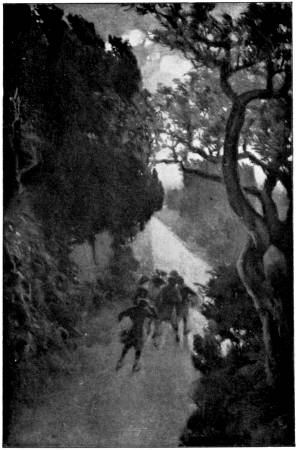 THE PASSING OF THE KINGS
Then, of a sudden, a flood of radiant glory
would be about us, and from the dark cloud
above the mountains would burst forth a
splendour of glowing crimson and of royal
purple and of glittering gold!
"Les Rois Mages! Les Rois Mages!" we
would cry. "They are coming! They are
here at last!"
But it would be only the last rich dazzle of
the sunset. Presently it would vanish. The
owls would be hooting. The chill night
would be settling down upon us, out there
in the bleak country, sorrowful, alone. Fear
would take hold of us. To keep up our courage
a little, we would nibble at the figs which
we had hoped to give to the pages, at the
fougasso which we had hoped to present to
the Kings. As for the hay for the hungry
camels, we would throw it away. Shivering
in the wintry dusk, we would return sadly to
our homes.
And when we reached our homes again
our mothers would ask: "Well, did you see
them, the Kings?"
"No; they passed by on the other side of
the Rhône, behind the
mountains."
"But what road did you take?"
"The road to Arles."
"Ah, my poor child! The Kings don't
come that way. They come from the East.
You should have gone out to meet them on
the road to Saint-Remy. And what a sight
you have missed! Oh, how beautiful it was
when they came marching into Maillane—the
drums, the trumpets, the pages, the camels!
Mon Dieu, what a commotion! What
a sight it was! And now they are in the
church, making their homage before the
manger in which the little Christ-Child lies.
But never mind; after supper you shall see
them all."
Then we would sup quickly, and so be off
to the church, crowded with all Maillane.
Barely would we be entered there when the
organ would begin, at first softly and then
bursting forth formidably, all our people singing
with it, with the superb noël:
In the early morning
I met a train
Of three great Kings who were going on a journey!
High up before the altar, directly above
the manger in which the Christ-Child
was
lying, would be the glittering bello estello;
and making their homage before the manger
would be the Kings whom it had guided
thither from the East: old white-bearded
King Melchior with his gift of incense; gallant
young King Gaspard with his gift of
treasure; black King Balthazar the Moor
with his gift of myrrh. How reverently we
would gaze on them, and how we would admire
the brave pages who carried the trains
of their long mantles, and the hump-backed
camels whose heads towered high above Saint
Mary and Saint Joseph and the ox and the
ass.
Yes, there they were at last—the Kings!
Many and many a time in the after years
have I gone a-walking on the Arles road at
nightfall on the Eve of the Kings. It is the
same—but not the same. The sun, over
beyond the Rhône, is dipping toward the
Cévennes; the leafless trees are red in the
low sun-rays; across the fields stretch the
black lines of cypress; even the old man, as
long ago, is scratching in the hedge by the
roadside for snails. And when
darkness
comes quickly, with the sun's setting, the
owls hoot as of old.
But in the radiant glory of the sunset I
no longer see the dazzle and the splendour of
the Kings!
"Which way went they, the Kings?"
"Behind the mountains!"
VIII
In the morning of the day preceding
Christmas a lurking, yet ill-repressed, excitement
pervaded the Château and all its
dependencies. In the case of the Vidame
and Misè Fougueiroun the excitement did
not even lurk: it blazed forth so openly that
they were as a brace of comets—bustling
violently through our universe and dragging
into their erratic wakes, away from
normal orbits, the whole planetary system
of the household and all the haply intrusive
stars.
With my morning coffee came the explanation
of a quite impossible smell of frying
dough-nuts which had puzzled me on the
preceding
day: a magnificent golden-brown
fougasso, so perfect of its kind that any Provençal
of that region—though he had come
upon it in the sandy wastes of Sahara—would
have known that its creator was Misè
Fougueiroun. To compare the fougasso with
our homely dough-nut does it injustice. It is
a large flat open-work cake—a grating
wrought in dough—an inch or so in thickness,
either plain or sweetened or salted, fried
delicately in the best olive-oil of Aix or Maussane.
It is made throughout the winter,
but its making at Christmas time is of obligation;
and the custom obtains among the
women—though less now than of old—of
sending a fougasso as a Christmas gift to
each of their intimates. As this custom
had in it something more than a touch of
vainglorious emulation, I well can understand
why it has fallen into desuetude in
the vicinity of Vièlmur—where Misè Fougueiroun's
inspired kitchening throws all
other cook-work hopelessly into the shade.
As I ate the "horns" (as its fragments
are called) of my fougasso that morning,
dipping them in my coffee according to
the
prescribed custom, I was satisfied that it
deserved its high place in the popular esteem.
When I joined the Vidame below stairs I
found him under such stress of Christmas
excitement that he actually forgot his usual
morning suggestion—made always with an
off-hand freshness, as though the matter were
entirely new—that we should take a turn
along the lines of the Roman Camp. He
was fidgeting back and forth between the
hall (our usual place of morning meeting)
and the kitchen: torn by his conflicting desires
to attend upon me, his guest, and to
take his accustomed part in the friendly ceremony
that was going on below. Presently
he compromised the divergencies of the situation,
though with some hesitation, by
taking me down with him into Misè Fougueiroun's
domain—where he became frankly
cheerful when he found that I was well received.
Although the morning still was young,
work on the estate had been ended for the
day, and about the door of the kitchen more
than a score of labourers were gathered:
all
with such gay looks as to show that something
of a more than ordinarily joyous nature
was in train. Among them I recognized the
young fellow whom we had met with his wife
carrying away the yule-log; and found that
all of them were workmen upon the estate
who—either being married or having homes
within walking distance—were to be furloughed
for the day. This was according to
the Provençal custom that Christmas must
be spent by one's own fire-side; and it also
was according to Provençal custom that they
were not suffered to go away with empty
hands.
Misè Fougueiroun—a plump embodiment
of Benevolence—stood beside a table on which
was a great heap of her own fougasso, and
big baskets filled with dried figs and almonds
and celery, and a genial battalion of bottles
standing guard over all. One by one the
vassals were called up—there was a strong
flavour of feudalism in it all—and to each,
while the Vidame wished him a "Bòni fèsto!"
the housekeeper gave his Christmas portion:
a fougasso, a double-handful each of figs and
almonds, a stalk of celery, and a bottle
of
vin cue[2]—the
cordial that is used for the libation
of the yule-log and for the solemn yule-cup;
and each, as he received his portion,
made his little speech of friendly thanks—in
several cases most gracefully turned—and
then was off in a hurry for his home.
Most of them were dwellers in the immediate
neighbourhood; but four or five had before
them walks of more than twenty miles, with
the same distance to cover in returning the
next day. But great must be the difficulty
or the distance that will keep a
Provençal
from his own people and his own hearth-stone
at Christmas-tide!
In illustration of this home-seeking trait,
I have from my friend Mistral the story that
his own grandfather used to tell regularly
every year when all the family was gathered
about the yule-fire on Christmas Eve:
It was back in the Revolutionary times,
and Mistral the grandfather—only he was
not a grandfather then, but a mettlesome
young soldier of two-and-twenty—was serving
with the Army of the Pyrénées, down on
the borders of Spain. December was well on,
but the season was open—so open that he
found one day a tree still bearing oranges.
He filled a basket with the fruit and carried
it to the Captain of his company. It was a
gift for a king, down there in those hard
times, and the Captain's eyes sparkled. "Ask
what thou wilt, mon brave," he said, "and if
I can give it to thee it shall be thine."
Quick as a flash the young fellow answered:
"Before a cannon-ball cuts me in two, Commandant,
I should like to go to Provence and
help once more to lay the yule-log in my own
home. Let me do
that!"
Now that was a serious matter. But the
Captain had given his word, and the word of
a soldier of the Republic was better than the
oath of a king. Therefore he sat down at
his camp-table and wrote:
Army of the Eastern
Pyrénées, December 12, 1793.
We, Perrin, Captain of Military Transport, give
leave to the citizen François Mistral, a brave Republican
soldier, twenty-two years old, five feet six inches
high, chestnut hair and eyebrows, ordinary nose,
mouth the same, round chin, medium forehead, oval
face, to go back into his province, to go all over the
Republic, and, if he wants to, to go to the devil!
"With an order like that in his pocket,"
said Mistral, "you can fancy how my grandfather
put the leagues behind him; and how
joyfully he reached Maillane on the lovely
Christmas Eve, and how there was danger
of rib-cracking from the hugging that went
on. But the next day it was another matter.
News of his coming had flown about the
town, and the Mayor sent for him.
"'In the name of the law, citizen,' the Mayor
demanded, 'why hast thou left the army?'
"Now my grandfather was a bit of a wag,
and so—with never a word about his
famous
pass—he answered: 'Well, you see I took a
fancy to come and spend my Christmas here
in Maillane.'
"At that the Mayor was in a towering
passion. 'Very good, citizen,' he cried. 'Other
people also may take fancies—and mine is
that thou shalt explain this fancy of thine
before the Military Tribunal at Tarascon.
Off with him there!'
"And then away went my grandfather
between a brace of gendarmes, who brought
him in no time before the District Judge: a
savage old fellow in a red cap, with a beard
up to his eyes, who glared at him as he asked:
'Citizen, how is it that thou hast deserted thy
flag?'
"Now my grandfather, who was a sensible
man, knew that a joke might be carried too
far; therefore he whipped out his pass and
presented it, and so in a moment set everything
right.
"'Good, very good, citizen!' said old Redcap.
'This is as it should be. Thy Captain
says that thou art a brave soldier of the Republic,
and that is the best that the best of us
can be. With a pass like that in thy
pocket
thou canst snap thy fingers at all the mayors
in Provence; and the devil himself had best
be careful—shouldst thou go down that way,
as thy pass permits thee—how he trifles with
a brave soldier of France!'
"But my grandfather did not try the devil's
temper," Mistral concluded. "He was satisfied
to stay in his own dear home until the
Day of the Kings was over, and then he went
back to his command."
IX
The day dragged a little when we had
finished in the kitchen with the giving
of Christmas portions and the last of the
farm-hands, calling back "Bòni fèsto!," had
gone away. For the womenkind, of course,
there was a world to do; and Misè Fougueiroun
whisked us out of her dominions with
a pretty plain statement that our company
was less desirable than our room. But for
the men there was only idle waiting until
night should come.
As for the Vidame—who is a fiery fume
of
a little old gentleman, never happy unless in
some way busily employed—this period of
stagnation was so galling that in sheer pity
I mounted him upon his hobby and set him
to galloping away. 'Twas an easy matter,
and the stimulant that I administered was
rather dangerously strong: for I brought up
the blackest beast in the whole herd of his
abominations by asking him if there were
not some colour of reason in the belief that
Marius lay not at Vièlmur but at Glanum—now
Saint-Remy-de-Provence—behind the
lines of Roman wall which exist there to this
day.
So far as relieving the strain of the situation
was concerned, my expedient was a complete
success; but the storm that I raised
was like to have given the Vidame such an
attack of bilious indigestion begotten of anger
as would have spoiled the Great Supper for
him; and as for myself, I was overwhelmed
for some hours by his avalanche of words.
But the long walk that we took in the afternoon,
that he might give me convincing
proof of the soundness of his archæological
theories, fortunately set matters right
again;
and when we returned in the late day to the
Château my old friend had recovered his
normal serenity of soul.
As we passed the Mazet in our afternoon
walk, we stopped to greet the new arrivals
there, come to make the family gathering
complete: two more married children, with a
flock of their own little ones, and Elizo's
father and mother—a bowed little rosy-cheeked
old woman and a bowed lean old man, both
well above eighty years. There was a lively
passage of friendly greetings between them
all and the Vidame; and it was quite delightful
to see how the bowed little old woman
kindled and bridled when the Vidame gallantly
protested that she grew younger and handsomer
every year.
A tall ladder stood against the Mazet, and
the children were engaged in hanging tiny
wheat-sheaves along the eaves: the Christmas
portion of the birds. In old times, the
Vidame explained, it was the general custom
for children to make this pretty offering—that
the birds of heaven, finding themselves
so served, might descend in clouds to
the feast prepared for them by
Christian
bounty. But nowadays, he added, sighing,
the custom rarely was observed.
Other charitable usages of Christmas had
vanished, he continued, because the need for
them had passed away with the coming of
better times. Save in the large cities, there
are very few really poor people in Provence
now. It is a rich land, and it gives to its
hard-working inhabitants a good living;
with only a pinch now and then when a cold
winter or a dry summer or a wet harvest
puts things out of gear. But of old the conditions
were sadly different and there was
need for all that charity could give.
In those times, when in comfortable homes
the Christmas feast was set, there would be
heard outside a plaintive voice calling: "Give
something from your yule-log to the sorrowful
poor!" And then the children quickly,
would carry out to the calling poor one good
portions of food. Pious families, also, were
wont to ask some poor friend or acquaintance,
or even a poor passing stranger, to eat
the Great Supper with them; and of the fragments
a part would be sent to the poor brethren
in the Hostel de Dieu: which
offerings
were called always "the share of the good
God."
In many towns and villages the offerings
of Christian bounty were collected in a curious
way. A gigantic figure of wicker-work—called
Melchior, after one of the three Kings
of the Epiphany—clothed in a grotesque
fashion and with a huge pannier strapped to
his back, was mounted upon an ass and so
was taken from door to door to gather for the
poor whatever the generous would give of
food. Into the big basket charitable hands
threw figs, almonds, bread, cheese, olives,
sausages: and when the brave Melchior had
finished his round his basket was emptied
upon a table at the church door, and then all
the poor people of the parish were free to come
there and receive portions of those good things—while
the church bells rang, and while
there blazed beside the table a torch in representation
of the Star which guided Melchior
and his fellow kings to Bethlehem.
A reminiscence of this general charity still
survives in the little town of Solliès, tucked
away in the mountains not far from Toulon.
There, at Christmas time, thirteen poor
people
known as "the Apostles" (though there
is one to spare) receive at the town-house a
dole of two pounds of meat, two loaves of
bread, some figs and almonds, and a few
sous. And throughout Provence the custom
still is general that each well-to-do family
shall send a portion of its Christmas loaf—the
pan calendau—to some friend or neighbour
to whom Fortune has been less kind.
But, happily, this gift nowadays often is a
mere friendly compliment, like the gift of
fougasso; for the times are past when weak-kneed
and spasmodic charity dealt with real
poverty in Provence.
X
'Twas with such kindly reminiscences of
old-time benevolence, rather than with explosive
archæological matters, that I kept the
Vidame from falling again a-fuming—while
we waited through the dusk for the coming
of seven o'clock, at which hour the festivities
at the Mazet were to begin. Our waiting
place was the candle-lit salon: a stately
old
apartment floored formally with squares of
black and white marble, furnished in the
formal style of the eighteenth century, and
hung around with formal family portraits
and curious old prints in which rather lax
classical subjects were treated with a formal
severity. The library being our usual habitat,
I inferred that our change of quarters
was in honour of the day. It was much to
my liking; for in that antiquely ordered
room—and the presence of the Vidame helped
the illusion—I felt always as though I had
stepped backward into the thick of eighteenth
century romance. But for the Vidame, although
he also loves its old time flavour, the
salon had no charms just then; and when
the glass-covered clock on the mantle chimed
from among its gilded cupids the three-quarters
he arose with a brisk alacrity and said
that it was time for us to be off.
Our march—out through the rear door of
the Château and across the court-yard to the
Mazet—was processional. All the household
went with us. The Vidame gallantly gave
his arm to Misè Fougueiroun; I followed
with her first officer—a sauce-box
named
Mouneto, so plumply provoking and charming
in her Arlesian dress that I will not say
what did or did not happen in the darkness
as we passed the well! A little in our rear
followed the house-servants, even to the least;
and in the Mazet already were gathered,
with the family, the few work-people of the
estate who had not gone to their own homes.
For the Great Supper is a patriarchal feast,
to which in Christian fellowship come the
master and the master's family and all of
their servitors and dependants on equal terms.
A broad stream of light came out through
the open doorway of the farm-house, and
with it a great clatter and buzz of talk—that
increased tenfold as we entered, and a cry of
"Bòni fèsto!" came from the whole company
at once. As for the Vidame, he so
radiated cordiality that he seemed to be the
veritable Spirit of Christmas (incarnate at the
age of sixty, and at that period of the nineteenth
century when stocks and frilled shirts
were worn), and his joyful old legs were near
to dancing as he went among the company
with warm-hearted greetings and outstretched
hands.
All told, we numbered above forty; but
the great living-room of the Mazet, notwithstanding
the space taken by the supper-table
ranged down the middle of it, easily
could have held another score. Save in its
size, and in the completeness of its appointments,
this room was thoroughly typical of
the main apartment found in farm-houses
throughout Provence. The floor was laid
with stone slabs and the ceiling was supported
upon very large smoke-browned beams—from
which hung hams, and strings of
sausages, and ropes of garlic, and a half-dozen
bladders filled with lard. More than
a third of the rear wall was taken up by the
huge fire-place, that measured ten feet across
and seven feet from the stone mantle-shelf to
the floor. In its centre, with room on each
side in the chimney-corners for a chair (a
space often occupied by large lockers for flour
and salt), was the fire-bed—crossed by a
pair of tall andirons, which flared out at the
top into little iron baskets (often used, with
a filling of live coals, as plate-warmers)
and which were furnished with hooks at
different heights to support the
roasting-spits.
Hanging from the mantle-shelf was
a short curtain to hold the smoke in
check; and on the shelf were various utilitarian
ornaments: a row of six covered jars,
of old faience, ranging in holding capacity
from a gill to three pints, each lettered with
the name of its contents—saffron, pepper,
tea, salt, sugar, flour; and with these some
burnished copper vessels, and a coffee-pot,
and a half-dozen of the tall brass or pewter
lamps for burning olive-oil—which long ago
superseded the primitive calèu, dating from
Roman or from still earlier times, and which
now themselves practically have been superseded
by lamps burning petroleum.
To the right of the fire-place was the stone
sink, with shelves above it on which was a
brilliant array of polished copper and tin
pots and pans. To the left was the covered
bread-trough, above which hung the large
salt and flour boxes and the grated bread-closet—this
last looking like a child's crib
gone wrong—all of dark wood ornamented
with carving and with locks and hinges of
polished iron. On the opposite side of the
room, matching these pieces in colour
and
carving and polished iron-work, were a tall
buffet and a tall clock—the clock of so insistent
a temperament that it struck in duplicate,
at an interval of a minute, the number of each
hour. A small table stood in a corner, and
in ordinary times the big dining-table
was ranged along one of the walls, with
benches on each side of it supplemented by
rush-bottomed chairs. Near the bread-trough
was hung a long-armed steel-balance with a
brass dish suspended by brass chains, all
brilliant from scouring with soap and sand;
an ancient fowling-piece rested in wooden
crutches driven between the stones on one
side of the clock, and on the other side was
hung a glittering copper warming-pan—a
necessary comfort here of cold nights in fireless
rooms. By way of ornament, three or
four violently-colored lithographs were tacked
against the walls, together with a severely
formal array—a pyramidal trophy—of family
photographs.
Excepting the warming-pan and the two
arm-chairs ordinarily in the chimney-corners,
there was no provision in the room for
bodily ease or comfort: a lack
unperceived
by its occupants, but which an American
house-wife—missing her many small luxuries
and conveniences—would have found
sharply marked.
XI
The crèche, around which the children
were gathered in a swarm, was built up in
one corner; and our coming was the signal
for the first of the ceremonies, the lighting of
the crèche candles, to begin. In this all the
children had a part—making rather a scramble
of it, for there was rivalry as to which of
them should light the most—and in a moment
a constellation of little flames covered the
Bethlehem hill-side and brought into bright
prominence the Holy Family and its strange
attendant host of quite impossible people and
beasts and birds.
The laying of the yule-log followed; a
ceremony so grave that it has all the dignity
of, and really is, a religious rite. The buzz
of talk died away into silence as Elizo's father,
the oldest man, took by the hand and led
out
into the court-yard where the log was lying
his great-grandson, the little Tounin, the
youngest child: it being the rule that the
nominal bearers of the cacho-fiò to the hearth
shall be the oldest and the youngest of the
family—the one personifying the year that
is dying, the other the year new-born. Sometimes,
and this is the prettiest rendering of
the custom, the two are an old, old man and
a baby carried in its mother's arms—while
between them the real bearers of the burden
walk.
In our case the log actually was carried by
Marius and Esperit; but the tottering old
man clasped its forward end with his thin
feeble hands, and its hinder end was clasped
by the plump feeble hands of the tottering
child. Thus, the four together, they brought
it in through the doorway and carried it thrice
around the room, circling the supper-table and
the lighted candles; and then, reverently, it
was laid before the fire-place—that still sometimes
is called in Provençal the lar.
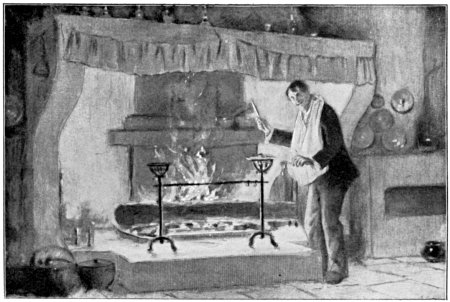 ELIZO'S OLD FATHER
There was a pause, while the old man filled
out a cup of vin cue; and a solemn hush fell
upon the company, and all heads were
bowed,
as he poured three libations upon the log,
saying with the last: "In the name of the
Father, and of the Son, and of the Holy
Ghost!"—and then cried with all the vigor
that he could infuse into his thin and quavering
old voice:
Cacho-fiò,
Bouto-fiò!
Alègre! Alègre!
Diéu nous alègre!
Calèndo vèn! Tout bèn vèn!
Diéu nous fague la gràci de vèire l'an que vèn,
E se noun sian pas mai, que noun fuguen pas mens!
Yule-log,
Catch fire!
Joy! Joy!
God gives us joy!
Christmas comes! All good comes!
May God give us grace to see the coming year,
And if we are not more, may we not be less!
As he ended his invocation he crossed himself,
as did all the rest; and a great glad shout
was raised of "Alègre! Alègre!" as Marius
and Esperit—first casting some fagots of
vine-branches on the bed of glowing coals—placed
the yule-log upon the fire.
Instantly
the vines blazed up, flooding the room with
brightness; and as the yule-log glowed and
reddened everybody cried
Cacho-fiò,
Bouto-fiò!
Alègre! Alègre!
again and again—as though the whole of
them together of a sudden had gone merry-mad!
In the midst of this triumphant rejoicing
the bowl from which the libation had been
poured was filled afresh with vin cue and was
passed from hand to hand and lip to lip—beginning
with the little Tounin, and so upward
in order of seniority until it came last of
all to the old man—and from it each drank to
the new fire of the new year.
Anciently, this ceremony of the yule-log
lighting was universal in Provence, and it is
almost universal still; sometimes with a less
elaborate ritual than I have described, but
yet substantially the same: always with the
libation, always with an invocation, always
with the rejoicing toast to the new fire.
But
in modern times—within the last century or
so—another custom in part has supplanted
it in Marseille and Aix and in some few other
towns. This is the lighting of candles at
midnight in front of the crèche; a ceremony,
it will be observed, in which new fire still
bears the most important part.
One of my Aix friends, the poet Joachim
Gasquet, has described to me the Christmas
Eve customs which were observed in his own
home: the Gasquet bakery, in the Rue de la
Cepède, that has been handed down from
father to son through so many hundreds of
years that even its owners cannot tell certainly
whether it was in the fourteenth or
the fifteenth century that their family legend
of good baking had its rise. As Monsieur
Auguste, the contre-maître of the bakery,
opened the great stone door of the oven that
I might peer into its hot depths, an historical
cross-reference came into my mind that made
me realize its high antiquity. Allowing for
difference of longitude, the contre-maître who
was Monsieur Auguste's remote predecessor
was lifting the morning's baking out of that
oven at the very moment when
Columbus
saw through the darkness westward the
lights of a new world!
In the Gasquet family it was the custom to
eat the Great Supper in the oven room: because
that was the heart, the sanctuary, of
the house; the place consecrated by the toil
which gave the family its livelihood. On
the supper-table there was always a wax
figure of the Infant Christ, and this was carried
just before midnight to the living-room,
off from the shop, in one corner of which the
crèche was set up. It was the little Joachim
whose right it was, because he was the youngest,
the purest, to carry the figure. A formal
procession was made. He walked at its
head, a little chap with long curling golden
hair, between his two grandfathers; the rest
followed in the order of their age and rank:
his two grandmothers, his father and mother,
Monsieur Auguste (a dashing blade of a
young baker then) with the maid-servant,
and the apprentices last of all. A single
candle was carried by one of his grandfathers
into the dark room—the illumination of which,
that night, could come only from the new
fire kindled before the crèche. Precisely
at
midnight—at the moment when all the clocks
of Aix striking together let loose the Christmas
chimes—the child laid the holy figure in
the manger, and then the candles instantly
were set ablaze.
Sometimes there would be a thrilling pause
of half a minute or more while they waited for
the bells: the child, with the image in his
hands, standing before the crèche in the little
circle of light; the others grouped behind
him, and for the most part lost in dark shadow
cast by the single candle held low down;
those nearest to the crèche holding matches
ready to strike so that all the candles might
be lighted at once when the moment came.
And then all the bells together would send
their voices out over the city heavenward;
and his mother would say softly, "Now, my
little son!"; and the room would flash into
brightness suddenly—as though a glory
radiated from the Christ-Child lying there in
the manger between the ox and the ass.
Every evening throughout the Christmas
season the candles were relighted before this
Christmas shrine, and there the members of
the family said in common their
evening
prayer; and when the time came for taking
down the crèche those parts of it which were
not preserved for the ensuing year—the refuse
scraps of wood and pasteboard and
moss and laurel—were burned (this is the
orthodox general custom) with something of
the flavour of a rite; not cast into the household
fire nor the bakery oven, but saved from
falling into base places by being consumed
in a pure fire of its own.
XII
While our own more orthodox yule-log
ceremonial was in progress, the good Elizo
and Janetoun—upon whom the responsibility
of the supper rested—evidently were a
prey to anxious thoughts. They whispered
together and cast uneasy glances toward the
chimney, into the broad corners of which
the various cooking vessels had been moved
to make way for the cacho-fiò; and the
moment that the cup of benediction had
passed their lips they precipitated themselves
upon the fire-place and replaced
the
pots and pans for a final heating upon the
coals.
The long table had been set before our arrival
and was in perfect readiness—covered
with a fine white linen cloth, sacredly reserved
for use at high festivals, that fairly sparkled
in the blaze of light cast by the overhanging
petroleum lamp. Yet the two ceremonial
candles, one at each end of the table, also
were lighted; and were watched anxiously
as the supper went on: for should the wick of
one of the Christmas candles fall before the
supper is ended, the person toward whom it
points in falling will pass from earth before
the Christmas feast is set again. But Misè
Fougueiroun, to guard against this ominous
catastrophe, had played a trick on Fate by
providing wax candles with wicks so fine
that they wasted away imperceptibly in their
own flame.
Beside those fateless candles were the harvest
harbingers, the plates on which was
growing Saint Barbara's grain—so vigorous
and so freshly green that old Jan rubbed his
hands together comfortably as he said to the
Vidame: "Ah, we need have no fears for
the
harvest that is coming in this blessed year!"
In the centre of the table, its browned crust
slashed with a cross, was the great loaf of
Christmas bread, pan Calendau; on which
was a bunch of holly tied with the white pith
of rushes—the "marrow" of the rush, that is
held to be an emblem of strength. Old Jan,
the master of the house, cut the loaf into as
many portions as there were persons present;
with one double-portion over to be given to
some poor one in charity—"the portion of the
good God." It is of a miraculous nature,
this blessed bread: the sailors of Provence
carry morsels of it with them on their voyages,
and by strewing its crumbs upon the
troubled waters stay the tempests of the sea.
For the rest, the table had down its middle
a line of dishes—many of them old faience of
Moustiers, the mere sight of which would
have thrilled a collector's heart—heaped with
the nougat and the other sweets over the
making of which our housekeeper and her
lieutenants so soulfully had toiled. And on
the table in the corner were fruits and nuts
and wines.
Grace always is said before the Great
Supper—a
simple formula ending with the prayer
of the yule-log that if another year there are
no more, there may be no less. It is the custom
that this blessing shall be asked by the
youngest child of the family who can speak
the words: a pretty usage which sometimes
makes the blessing go very queerly indeed.
Our little Tounin came to the front again
in this matter, exhibiting an air of grave responsibility
which showed that he had been
well drilled; and it was with quite a saintly
look on his little face that he folded his hands
together and said very earnestly: "God bless
all that we are going to eat, and if we are
no less next year may we be no more!"
At which everybody looked at Janetoun and
laughed.
In our seating a due order of precedence
was observed. Old Jan, the head of the
family, presided, with the Vidame and myself
on his right and with Elizo's father and
mother on his left; and thence the company
went downward by age and station to the foot
of the table, where were grouped the servants
from the Château and the workmen on the
farm. But no other distinction was
made.
All were served alike and all drank together
as equals when the toasts were called. The
servers were Elizo and Janetoun, with Nanoun
and Magali for assistants; and those
four, although they took their places at the
table when each course had been brought on,
had rather a Passover time of it: for they ate
as it were with their loins girded and with full
or empty dishes imminent to their hands.
The stout Nanoun—whose robust body
thrills easily to superstitious fears—was still
farther handicapped in her own eating by
her zealous effort so to stuff the family cat
as to give that animal no excuse for uttering
evil-portending miaus. For it is well known
that should the family cat fall to miauing on
Christmas Eve, and especially while the supper
is in progress, very dreadful things surely
will happen to the family during the ensuing
year. Fortunately Nanoun's preventive
measures averted this calamity; yet were
they like to have overshot their mark. Only
the cat's natural abstemiousness saved her
that night from dying of a surfeit—and in
agony surely provocative of the very cries
which Nanoun sought to
restrain!
As I have said, the Great Supper must
be "lean," and is restricted to certain
dishes which in no wise can be changed;
but a rich leanness is possible in a country
where olive-oil takes the place of animal
fat in cooking, and where the accumulated
skill of ages presides over the kitchen
fire. The principal dish is the raïto—a ragout
made of delicately fried fish served in a
sauce flavoured with wine and capers—whereof
the tradition goes back a round twenty-five
hundred years: to the time when the Phokæan
housewives brought with them to Massalia
(the Marseille of to-day) the happy mystery
of its making from their Grecian homes.
But this excellent dish was not lost to Greece
because it was gained to Gaul: bearing the
same name and made in the same fashion it
is eaten by the Greeks of the present day.
It usually is made of dried codfish in Provence,
where the cod is held in high esteem;
but is most delicately toothsome when made
of eels.
The second course of the Great Supper also
is fish, which may be of any sort and served
in any way—in our case it was a
perch-like
variety of dainty pan-fish, fresh from the
Rhône. A third course of fish sometimes is
served, but the third course usually is snails
cooked in a rich brown sauce strongly flavoured
with garlic. The Provençal snails, which
feed in a gourmet fashion upon vine-leaves,
are peculiarly delicious—and there was a
murmur of delight from our company as the
four women brought to the table four big
dishes full of them; and for a while there was
only the sound of eager munching, mixed
with the clatter on china of the empty shells.
To extract them, we had the strong thorns,
three or four inches long, of the wild acacia;
and on these the little brown morsels were
carried to the avid mouths and eaten with a
bit of bread sopped in the sauce—and then the
shell was subjected to a vigorous sucking,
that not a drop of the sauce lingering within
it should be lost.
To the snails succeeded another dish essentially
Provençal, carde. The carde is a
giant thistle that grows to a height of five
or six feet, and is so luxuriantly magnificent
both in leaf and in flower that it deserves a
place among ornamental plants. The
edible
portion is the stem—blanched like celery,
which it much resembles, by being earthed-up—cooked
with a white sauce flavoured with
garlic. The garlic, however, is a mistake,
since it overpowers the delicate taste of the
carde—but garlic is the overlord of all things
eatable in Provence. I was glad when we
passed on to the celery, with which the first
section of the supper came to an end.
The second section was such an explosion
of sweets as might fly into space should a
comet collide with a confectioner's shop—nougat,
fougasso, a great poumpo, compotes,
candied-fruits, and a whole nightmare herd of
rich cakes on which persons not blessed with
the most powerful organs of digestion surely
would go galloping to the country of dreadful
dreams. This was prodigality; but even the
bare requirements of the case were lavish,
the traditional law of the Great Supper ordaining
that not fewer than seven different
sweets shall be served. Misè Fougueiroun,
however, was not the person to stand upon the
parsimonious letter of any eating law. Here
had been her opportunity, and she had run
amuck through all the range of sugary
things!
Of the dessert of nuts and fruit the notable
features were grapes and winter-melons. Possibly
because they are an obscure survival
of some Bacchic custom connected with the
celebration of the winter solstice, the grapes
are considered a very necessary part of the
Great Supper; but as Provençal grapes are
of a soft substance and soon wither, though
a world of care is taken to preserve a few
bunches until Christmas, this part of the feast
usually is a ceremony rather than a satisfaction.
But our melons were a pure vegetable delight.
These winter-melons are a species of
cantaloupe, but of a firmer texture than the
summer fruit, sowed late in the season and
laid away a little green on beds of straw in
cool and dark and well-aired rooms. Thus
cared for, they will keep until the end of January;
but they are preserved especially for
Christmas, and few survive beyond that day.
They are of American origin: as I discovered
quite by chance while reading a collection of
delightful letters, but lately published, written
near three hundred years ago by Dr.
Antoine Novel; that Provençal
naturalist,
whom Buffon quotes under the wrongly Latinized
name of Natalis, sometime physician to
the Duke of Medina-Sidonia in Spain. He
was a rolling stone of a naturalist, the excellent
Novel; but his gatherings were many,
and most of them were for the benefit of
his beloved Provence. It was from "Sainct
Luquar," under date of March 24, 1625, that
he wrote to his friend Peiresc in Aix: "I send
you by the Patron Armand a little box in
which are two specimens of ore ... and ten
sorts of seeds of the most exquisite fruits and
flowers of the Indies; and to fill the chinks I
have put in the seeds of winter-melons."
And in a letter of June 12th, following, he
wrote: "I hope that you have received my
letter sent by the Patron Armand of Martigues,
who sailed in Holy Week for that town,
by whom I sent you some seeds of exquisite
fruits and flowers of the Indies, together with
two specimens of ore, the one from Potosí
and the other from Terra-Firma, and also a
box of seven winter-melons of that country."
And so the winter-melons came into Provence
from somewhere on the Spanish Main.
I could wish that my gentleman had been
a
bit more definite in his geography. As he
leaves the matter, his melons may have come
from anywhere between the Orinoco and
Florida; and down in that region somewhere,
no doubt, they still are to be found.
With the serious part of the supper we
drank the ordinary small wine diluted with
water; but with the dessert was paraded a
gallant company of dusty bottles containing
ancient vintages which through many ripening
years had been growing richer by feeding
upon their own excellence in the wine-room
of the Mazet or the cellar of the Château. All
were wines of the country, it being a point of
honour in Provençal households of all degrees
that only from Provençal vineyards—or from
the near-by vineyards of Languedoc—shall
come the Christmas wines. Therefore we
drank rich and strong Tavel, and delicate
Ledenon, and heavy Frontignan—the cloyingly-sweet
Mouscat de Maroussa—and home-made
champagne (the clairette, with a superabundance
of pop and fizz but undeniably
cider-like), and at last, for a climax, old
Châteauneuf-du-Pape: the dean of the Provençal
vinous faculty, rich, smooth,
delicate,
with a slightly aromatic after-taste that the
dallying bees bring to the vine-blossoms from
the blossoms of the wild-thyme. Anciently it
filled the cups over which chirped the sprightly
Popes of Avignon; and in later times, only
forty years back, it was the drink of the
young Félibrien
poets—Mistral, Roumanille,
Aubanel, Mathieu and the rest—while they
tuned and set a-going their lyres. But it is
passing into a tradition now. The old vines,
the primitive stock, were slain by the phylloxera,
and the new vines planted to replace
them do not produce a wine like that over
which Popes and poets once were gay. Only
in rich old cellars, such as that of Vièlmur,
may still be found a bin or two of dust-grey
Papal veterans: survivors of the brave army
that has gurgled its life out in a happy past!
XIII
But the material element of the Great
Supper is its least part. What entitles it
to the augmenting adjective is its soul: that
subtle essence of peace and amity for
which
the word Christmas is a synonym in all Christian
lands. It is the rule of these family
gatherings at Christmas time in Provence
that all heartburnings and rancours, which
may have sprung up during the year, then
shall be cut down; and even if sometimes
they quickly grow again, as no doubt they
do now and then, it makes for happiness
that they shall be thus banished from the
peace-feast of the year.
Janetoun and one of her sisters-in-law
were the only members of our party who had
a hatchet to bury; and the burial was over so
quickly—being but an extra hug and an explosion
of kisses—that I should have known
nothing about it but for the over-long tongue
of Misè Fougueiroun: who, in a kindly way,
is as thorough-going a gossip as ever lived.
Of all things in the world to quarrel about,
this quarrel had grown out of a spirited difference
of opinion as to how the heel of a
knitted stocking should be turned! But
the matter had come to be quite of a seriousness,
and all the family breathed freer when
those resounding peace-kisses were given and
received. Actually, as I happened to
learn
later, the reconciliation was pushed to such
an extreme that each of them incontinently
adopted the other's knitting creed—with the
curious result that they now are in a fair
way to have a fresh quarrel for next Christmas
out of the same matter on inverted lines!
It was before the lighting of the yule-log
that the feud of the stocking heels thus happily
(even though only temporarily) was pacified,
and the family festival was cloudless
from first to last.
When the serious part of the supper had
been disposed of and the mere palate-tickling
period of the dessert had come, I was much
interested in observing that the talk—mainly
carried on by the elders—was turned with
an obviously deliberate purpose upon family
history; and especially upon the doings of
those who in the past had brought honour
upon the family name. And I was still more
interested when, later, the Vidame informed
me that it is the Provençal custom at the
Christmas festival for the old thus to instruct
the young and so to keep family tradition alive.
No doubt there is in this a dim survival of
ancestor-worship; but I should be glad to
see
so excellent a relic of paganism preserved in
the Christmas ritual of my own land.
The chief ancestral glory of the family of
the Mazet is its close blood-relationship with
the gallant André Étienne: that drummer of
the Fifty-first Demi-brigade of the Army of
Italy who is commemorated on the frieze of
the Panthéon, and who is known and honoured
as the "Tambour d'Arcole" all over
France. It was delightful to listen to old
Jan's telling of the brave story: how this
André, their own kinsman, swam the stream
under the enemy's fire at Arcolo with his
drum on his back and then drummed his
fellow-soldiers on to victory; how the First
Consul awarded him the drum-sticks of honour,
and later—when the Legion of Honour was
founded—gave him the cross; how they
carved him in stone, drumming the charge,
up there on the front of the Panthéon in Paris
itself; how Mistral, the great poet of Provence,
had made a poem about him that had been
printed in a book; and how, crowning glory,
they had set up his marble statue in Cadenet—the
little town, not far from Avignon, where
he was born!
Old Jan was not content with merely telling
this story—like a true Provençal he acted it:
swinging a supposititious drum upon his back,
jumping into an imaginary river and swimming
it with his head in the air, swinging his
drum back into place again, and then—Zóu!—starting
off at the head of the Fifty-first
Demi-brigade with such a rousing play of
drum-sticks that I protest we fairly heard
the rattle of them, along with the spatter of
Italian musketry in the face of which André
Étienne beat that gallant pas-de-charge!
It set me all a-thrilling; and still more did
it thrill those other listeners who were of the
Arcolo hero's very blood and bone. They
clapped their hands and they shouted. They
laughed with delight. And the fighting spirit
of Gaul was so stirred within them that
at a word—the relations between France and
Italy being a little strained just then—I verily
believe they would have been for marching in
a body across the south-eastern frontier!
Elizo's old father was rather out of the
running in this matter. It was not by any
relative of his that the drum-sticks of honour
had been won; and his thoughts, after
wandering
a little, evidently settled down upon the
strictly personal fact that his thin old legs
were cold. Rising slowly from the table, he
carried his plate to the fire-place; and when
he had arranged some live coals in one of
the baskets of the waist-high andirons he
rested the plate above them on the iron rim:
and so stood there, eating contentedly, while
the warmth from the glowing yule-log entered
gratefully into his lean old body and
stirred to a brisker pulsing the blood in his
meagre veins. But his interest in what was
going forward revived again—his legs being,
also, by that time well warmed—when his
own praises were sounded by his daughter:
in the story of how he stopped the runaway
horse on the very brink of the precipice at
Les Baux; and how his wife all the while sat
calmly beside him in the cart, cool and silent,
and showing no sign of fear.
When Elizo had finished this story she
whispered a word to Magali and Nanoun
that sent them laughing out of the room;
and presently Magali came back again arrayed
in the identical dress which had been
worn by the heroine of the
adventure—who
had perked and plumed herself not a little
while her daughter told about it—when the
runaway horse so nearly had galloped her
off the Baux rock into Eternity. It was the
Provençal costume—with full sleeves and
flaring cap—of sixty years back; but a little
gayer than the strict Arles dress of that period,
because her mother was not of Arles but of
Beaucaire. It was not so graceful, especially
in the head-dress, as the costume of the present
day; nor nearly so becoming—as Magali
showed by looking a dozen years older after
putting it on. But Magali, even with a dozen
years added, could not but be charming; and
I think that the little old bowed grandmother—who
still was a bit of a coquette at eighty—would
have been better pleased had she been
spared this encounter with what must have
seemed to her very like a meeting with her
own young ghost, raised suddenly from the
depths of the distant past.
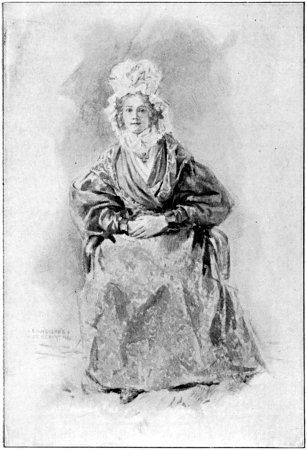 MAGALI
By long experience, gained on many such
occasions, the Vidame knew that the culminating
point of the supper would be reached
when the family drummer swam the river
and headed the French charge at
Arcolo.
Therefore had he reserved until a later period,
when the excitement incident to the revival
of that honourable bit of family history should
have subsided, a joy-giving bomb-shell of his
own that he had all ready to explode. An
American or an Englishman never could
have fired it without something in the way of
speech-making; but the Vidame was of a shy
temper, and speech-making was not in his
line. When the chatter caused by Magali's
costuming had lulled a little, and there came
a momentary pause in the talk, he merely
reached diagonally across the table and
touched glasses with Esperit and said simply:
"To your good health, Monsieur the Superintendent
of the Lower Farm!"
It was done so quietly that for some seconds
no one realized that the Vidame's toast
brought happiness to all the household, and
to two of its members a life-long joy. Esperit,
even, had his glass almost to his lips
before he understood to what he was drinking;
and then his understanding came through
the finer nature of Magali—who gave a quick
deep sob as she buried her face in the buxom
Nanoun's bosom and encircled that
astonished
young person's neck with her arms.
Esperit went pale at that; but the hand did
not tremble in which he held his still-raised
glass, nor did his voice quaver as he said
with a deep earnestness: "To the good health
of Monsieur le Vidame, with the thanks of two
very happy hearts!"—and so drained his wine.
A great danger puts no more strain upon
the nerves of a man of good fibre than does a
great joy; and it seemed to me that Esperit's
absolute steadiness, under this sudden fire of
happiness, showed him to be made of as fine
and as manly stuff as went to the making of
his kinsman who beat the pas-de-charge up
the slope at Arcolo at the head of the Fifty-first
Demi-brigade.
But nothing less than the turbulence of the
whole battle of Arcolo—not to say of that
whole triumphant campaign in Italy—will
suffice for a comparison with the tumult
that arose about our supper-table when the
meaning of the Vidame's toast fairly was
grasped by the company at large! I do not
think that I could express in words—nor by
any less elaborate method of illustration than
a kinetoscope—the state of excitement
into
which a Provençal will fly over a matter of
absolutely no importance at all; how he will
burst forth into a very whirlwind of words
and gestures about some trifle that an ordinary
human being would dispose of without the
quiver of an eye. And as our matter was
one so truly moving that a very Dutchman
through all his phlegm would have been
stirred by it, such a tornado was set a-going
as would have put a mere hurricane of the
tropics to open shame!
Naturally, the disturbance was central
over Esperit and Magali and the Vidame.
The latter—his kind old face shining like
the sun of an Easter morning—gave back
with a good will on Magali's cheeks her kisses
of gratitude; and exchanged embraces and
kisses with the elder women; and went
through such an ordeal of violent hand-shaking
that I trembled for the integrity of his
arms. But as for the young people, whom
everybody embraced over and over again with
a terrible energy, that they came through it
all with whole ribs is as near to being a
miracle as anything that has happened in
modern times!
Gradually the storm subsided—though not
without some fierce after-gusts—and at last
worked itself off harmlessly in song: as we returned
to the ritual of the evening and took
to the singing of noëls—the Christmas canticles
which are sung between the ending of
the Great Supper and the beginning of the
midnight mass.
XIV
The Provençal noëls—being some real,
or some imagined, incident of the Nativity
told in verse set to a gay or tender air—are
the crèche translated into song. The
simplest of them are direct renderings of the
Bible narrative. Our own Christmas hymn,
"While shepherds watched their flocks by
night," is precisely of this order; and, indeed,
is of the very period when flourished
the greatest of the Provençal noël writers:
for the Poet Laureate Nahum Tate, whose
laurel this hymn keeps green, was born in
the year 1652 and had begun his mildly poetic
career while Saboly still was
alive.
But most of the noëls—nouvè, they are
called in Provençal—are purely imaginative:
quaintly innocent stories created by the poets,
or taken from those apocryphal scriptures
in which the simple-minded faithful of Patristic
times built up a warmly coloured legend
of the Virgin's life and of the birth and
childhood of her Son. Sometimes, even, the
writers stray away entirely from a religious
base and produce mere roistering catches or
topical songs. Such are those Marseille
noëls which are nothing more than Pantagruelian
lists of succulent dishes proper to
Christmas time—frankly ending, in one case,
with the materialistic query: "What do I
care for the future, now that my belly is well
lined?" It was against such "bacchanals of
noël" that the worthy Father Cotton preached
in Marseille in the year 1602: but the flesh
and the devil always have had things pretty
much their own way in that gay city, and he
preached in vain. And at Aix-en-Provence
the most popular noël of all that were sung
in the cathedral was a satirical review of the
events of the year: that as time went on grew
to be more and more of a scandal, until
at
last the Bishop had to put a stop to it in the
year 1653.
The Provençaux have been writing noëls
for more than four hundred years. One of
the oldest belongs to the first half of the fifteenth
century and is ascribed to Raimond
Féraud; the latest are of our own day—by
Roumanille, Crousillat, Mistral, Girard, Gras,
and a score more. But only a few have been
written to live. The memory of many once-famous
noël-writers is preserved now either
mainly or wholly by a single song. Thus
the Chanoine Puech, who died at Aix almost
two hundred and fifty years ago, lives in the
noël of the Christ-Child and the three gypsy
fortune-tellers—which he stole, I am sorry to
say, from Lope de Vega. The Abbé Doumergue,
of Aramon, who flourished at about
the same period, is alive because of his "March
of the Kings": that has come ringing down
through the ages set to Lulli's magnificent
"March of Turenne"; and it is interesting to
note that Lulli is said to have found his noble
motive in a Provençal air. Antoine Peyrol,
who lived only a little more than a century
ago, and who "in our good city of
Avignon
was a carpenter and wood-seller and a simple-hearted
singer of Bethlehem" (as Roumanille
puts it) has fared better, more than a dozen
of his noëls surviving to be sung each year
when "the nougat bells" (as they call the
Christmas chimes in Avignon) are ringing
in his native town. And, on the other hand,
as though to strike a balance between fame
and forgottenness, there are some widely
popular noëls—as "C'est le bon lever"—of
which the authorship absolutely is unknown;
while there are still others—as the charming
"Wild Nightingale"—which belong to no
one author, but have been built up by unknown
farm-house poets who have added
fresh verses and so have passed on the amended
song.
The one assured immortal among these
musical mortalities is Nicolas Saboly: who
was born in Monteux, close by Avignon, in
the year 1614; who for the greater part of
his life was chapel-master and organist of
the Avignon church of St. Pierre; who died
in the year 1675; and who lies buried in the
choir of the church which for so long he
filled with his own heaven-sweet
harmonies.
Of his beautiful life-work, Roumanille has
written: "As organist of the church of St.
Pierre, Saboly soon won a great and beautiful
renown as a musician; but his fame and
his glory have come to him because of the
blessed thought that he had of composing
his marvellous noëls. Yet it was not until
the year 1658, when he himself was fifty-four
years old, that he decided to tie together
and to publish his first sheaf of them. From
that time onward, every year until his end, a
fresh sheaf of from six to a dozen appeared;
and, although no name went with them, all
of his townsfolk knew that it was their own
Troubadour of the Nativity who made them
so excellent a gift just as the nougat bells
began to ring. The organ of St. Pierre,
touched by his master hand, taught the gay
airs to which the new noëls were cast.
And all Avignon presently would be singing
them, and soon the chorus would swell
throughout the Comtat and Provence. The
inimitable Troubadour of Bethlehem died
just as he had tied together the eighth of
his little sheaves.... His noëls have been
reprinted many times; and, thanks be
to
God, they will be printed again and again
forever!"[3]
In addition to being a genius, Saboly had
the good fortune to live in one of the periods
of fusing and recasting which give to genius
its opportunity. He was born at the very
time when Claude Monteverde was taking
those audacious liberties with harmony which
cleared the way for the transition from the
old tonality to the new; and he died before
the great modern masters had set up those
standards which composers of our time must
either accept or defy. He certainly was influenced
by the then new Italian school;
indeed, from the fourteenth century, when
music began to be cultivated in Avignon, the
relations between that city and Italy were so
close that the first echoes of Italian musical
innovators naturally would be heard there.
Everywhere his work shows, as theirs does,
a searching for new methods in the
domain
of modulation, and a defiance of the laws of
transformation reverenced by the formal composers
of his time. Yet he did his searching
always on his own lines and in his own way.
Nor was his original genius lessened by
his willingness at times to lay hands on the desirable
property of other people—since his unlawful
acquisitions received always a subtle
touch which really made them his own. He
knew well how to take the popular airs of
the moment—the gavotte or minuet or vaudeville
which every one was singing: the good
old airs, as we call them now, which then
were the newest of the new—and how to infuse
into them his own personality and so to
fit them like a glove to his own noëls. Thus,
his Twelfth noël is set to an air composed by
Lulli for the drinking song, "Qu'ils sont
doux, bouteille jolie," in Molière's "Médecin
malgré lui"; and those who are familiar
with the music of his time will be both scandalized
and set a-laughing by finding the
uses to which he has put airs which began
life in far from seemly company. But his
forays were made from choice, not from necessity,
and the best of his noëls are his
own.
Saboly's music has a "go" and a melodic
quality suggestive of the work of Sir Arthur
Sullivan; but it has a more tender, a fresher,
a purer note, even more sparkle, than ever
Sullivan has achieved. In his gay airs the
attack is instant, brilliant, overpowering—like
a glad outburst of sweet bells, like the
joyous laughter of a child—and everything
goes with a dash and a swing. But while he
thus loved to harmonize a laugh, he also
could strike a note of infinite tenderness. In
his pathetic noëls he drops into thrillingly
plaintive minors which fairly drag one's
heart out—echoes or survivals, possibly (for
this poignant melody is not uncommon in old
Provençal music), of the passionately longing
love-songs with which Saracen knights once
went a-serenading beneath castle windows
here in Provence.
Nor is his verse, of its curious kind, less
excellent than his music. By turns, as the
humour takes him, his noëls are sermons, or
delicate religious fancies, or sharp-pointed
satires, or whimsical studies of country-side
life. One whole series of seven is a history
of the Nativity (surely the quaintest and
the
gayest and the tenderest oratorio that ever
was written!) in which, in music and in words,
he is at his very best. Above all, his noëls
are local. His background always is his
own country; his characters—Micolau the
big shepherd, gossip Guihaumeto, Tòni,
Christòu, and the rest—always are Provençaux:
wearing Provençaux pink-bordered
jackets, and white hats bedizened with ribbons,
and marching to Bethlehem to the
sound of the galoubet and tambourin. It
is from Avignon, out by the Porte Saint
Lazare, that the start for Bethlehem is made
by his pilgrim company; the Provençal music
plays to cheer them; they stamp their feet
and swing their arms about, because the
mistral is blowing and they are desperately
cold. It is a simplicity half laughable, half
pathetic—such as is found in those Mediæval
pictures which represent the Apostles or the
Holy Family in the garb of the artist's own
time and country, and above the walls of
Bethlehem the church spire of his own town.
This naïve local twist is not peculiar to
Saboly. With very few exceptions all Provençal
noëls are packed full of the same
delightful
anachronisms. It is to Provençal
shepherds that the Herald Angel appears; it
is Provençaux who compose the bregado,
the pilgrim company, that starts for Bethlehem;
and Bethlehem is a village, always
within easy walking distance, here in Provence.
Yet it is not wholly simplicity that
has brought about this shifting of the scene
of the Nativity from the hill country of Judæa
to the hill country of Southeastern France.
The life and the look of the two lands have
much in common; and most impressively will
their common character be felt by one who
walks here by night beneath the stars.
Here, as in the Holy Land, winding ways
pass out from olive-orchards, and on across
dry reaches of upland broken by outcropping
rocks and scattered trees and bushes
and sparsely thatched with short dry grass.
Through the silence will come now and then
the tinkle of sheep-bells. Sometimes a flock
will be seen, dimly in the starlight, feeding
beside the road; and watching, from an overlooking
standpoint on a rock or little upswelling
hill-top, will be its shepherd: a tall
muffled figure showing black against
the
loom of the sky. And it all is touched, in the
star-haze of those sombre solitudes, with the
poetic realism of unreality; while its deeper
meaning is aroused by the stone crosses, telling
of Calvary, which are found at every parting
of the ways. Told to simple dwellers in
such a land the Bible story was neither vague
nor remote. They knew its setting because
their own surroundings were the same. They
practised the shepherd customs; the ass was
their own beast of burden; the tending of
vines and fig-trees and olive-orchards was a
part of their daily lives. And so, naturally,
the older noël writers without any thought
of anachronism, and the modern writers by
poetic instinct made complete their translation
of the story of the Nativity into their
vernacular by transferring its scene to their
own land.
XV
It was with Saboly's "Hòu, de l'houstau!"
that our singing began. It is one
of the series in his history of the Nativity
and is the most popular of all his noëls:
a
dialogue between Saint Joseph and the Bethlehem
inn-keeper, that opens with a sweet and
plaintive long-drawn note of supplication as
Saint Joseph timorously calls:
"O-o-oh, there, the house! Master! Mistress!
Varlet! Maid! Is no one there?"
And then it continues with humble entreaties
for shelter for himself and his wife, who is
very near her time; to which the host replies
with rough refusals for a while, but in the end
grants grudgingly a corner of his stable in
which the wayfarers may lie for the night.
Esperit and Magali sang this responsively;
Magali taking Saint Joseph's part—in which,
in all the noëls, is a strain of feminine sweetness
and gentleness. Then Marius and Esperit,
in the same fashion, sang the famous
"C'est le bon lever": a dialogue between an
Angel and a Shepherd, in which the Angel—as
becomes so exalted a personage—speaks
French, while the Shepherd speaks Provençal.
"It's high time to get up, sweet shepherd,"
the Angel begins; and goes on to tell that "in
Bethlehem, quite near this place," the Saviour of
the world has been born of a
Virgin.
"Perhaps you take me for a common peasant,"
the Shepherd answers, "talking to me
like that! I am poor, but I'd have you to
know that I come of good stock. In old times
my great-great-grandfather was mayor of
our village! And who are you, anyway,
fine sir? Are you a Jew or a Dutchman?
Your jargon makes me laugh. A virgin
mother! A child god! No, never were such
things heard!"
But when the Angel reiterates his strange
statement the Shepherd's interest is aroused.
He declares that he will go at once and steal
this miraculous child; and he quite takes the
Angel into his confidence—as though standing
close to his elbow and speaking as friend
to friend. In the end, of course, he is convinced
of the miracle, and says that he "will
get the ass and set forth" to join the worshippers
about the manger at Bethlehem.
There are many of these noëls in dialogue;
and most of them are touched with this same
quality of easy familiarity with sacred subjects,
and abound in turns of broad humour
which render them not a little startling from
our nicer point of view. But they never
are
coarse, and their simplicity saves them from
being irreverent; nor is there, I am sure, the
least thought of irreverence on the part of
those by whom they are sung. I noticed,
though, that these lively numbers were the
ones which most hit the fancy of the men;
while the women as plainly showed their
liking for those of a finer spirit in which the
dominant qualities were pathos and grace.
Of this latter class is Roumanille's rarely
beautiful noël "The Blind Girl" ("La Chato
Avuglo")—that Magali sang with a tenderness
which set the women to crying openly,
and which made the older men cough a little
and look suspiciously red about the eyes.
Of all the modern noëls it has come closest to
and has taken the strongest hold upon the
popular heart: this pathetic story of the child
"blind from her birth" who pleads with her
mother that she also may go with the rest to
Bethlehem, urging that though she cannot
see "the lovely golden face" she still may
touch the Christ-Child's hand.
And when, all thrilling, to the stable she was come
She placed the little hand of Jesus on her heart—
And saw him whom she touched!
 "THE BLIND GIRL"—NOËL
But without the music, and with only these
crude translations in which is lost also the
music of the words, I feel that I am giving
very much less than the true effect of these
Provençal Christmas songs. To be appreciated,
to be understood, they must be heard
as I heard them: sung by that Christmas
company, with Magali's tenderly vibrant
voice leading the chorus in which every one
of those singing Provençaux joined. Even
the old grandfather—still standing at the
fire-place—marked the time of the music with
the knife that he held in his hand; and his
thin old voice piped in with the others, and
had a gay or a tender ring in it with the
changing melody, for all that it was so
cracked and shrill.
I am persuaded, so thoroughly did they
all enjoy their own carolling, that the singing
of noëls would have gone on until broad
daylight had it not been for the intervention
of the midnight mass. But the mass of
Christmas Eve—or, rather, of Christmas
morning—is a matter not only of pleasure
but of obligation. Even those upon whom
churchly requirements at other times
rest
lightly rarely fail to attend it; and to the
faithful it is the most touchingly beautiful—as
Easter is the most joyous—church festival
of the year.
By eleven o'clock, therefore, we were under
way for our walk of a mile or so down the
long slope of the hill side to the village: a
little clump of houses threaded by narrow
crooked streets and still in part surrounded
by the crusty remnant of a battlemented
wall—that had its uses in the days when robber
barons took their airings and when pillaging
Saracens came sailing up the slack-water
lower reaches of the Rhône. Down the
white road in the moonlight we went in a
straggling company, while more and more
loudly came to us through the crisp night
air the sound of the Christmas bells.
Presently some one started a very sweet
and plaintive noël: fairly heart-wringing in
its tender beseeching and soft lament, yet
with a consoling under-note to which it constantly
returned. I think, but I am not sure,
that it was Roumanille's noël telling of the
widowed mother who carried the cradle of
her own baby to the Virgin, that the
Christ-Child
might not lie on straw. One by one the
other voices took up the strain, until in a full
chorus the sorrowingly compassionate melody
went thrilling through the moonlit silence of
the night.
And so, singing, we walked by the white
way onward; hearing as we neared the town
the songs of other companies coming up, as
ours was, from outlying farms. And when
they and we had passed in through the gateways—where
the townsfolk of old lashed out
against their robber Infidel and robber Christian
enemies—all the black little narrow
streets were filled with an undertone of murmuring
voices and an overtone of clear sweet
song.
XVI
On the little Grande Place the crowd
was packed densely. There the several
streams of humanity pouring into the town
met and mingled; and thence in a strong
current flowed onward into the church. Coming
from the blackness without—for the tall
houses surrounding the Grande Place cut
off
the moonlight and made it a little pocket of
darkness—it was with a shock of splendour
that we encountered the brightness within.
All the side-altars were blazing with candles;
and as the service went on, and the high-altar
also flamed up, the whole building was filled
with a soft radiance—save that strange luminous
shadows lingered in the lofty vaulting
of the nave.
After the high-altar, the most brilliant spot
was the altar of Saint Joseph, in the west
transept; beside which was a magnificent
crèche—the figures half life-size, beautifully
modelled, and richly clothed. But there was
nothing whimsical about this crèche: the
group might have been, and very possibly
had been, composed after a well-painted
"Nativity" by some artist of the late Renaissance.
The mass was the customary office; but at
the Offertory it was interrupted by a ceremony
that gave it suddenly an entirely Mediæval
cast: of which I felt more fully the beauty,
and the strangeness in our time, because the
Vidame sedulously had guarded against my
having knowledge of it in advance.
This
was nothing less than a living rendering of
the Adoration of the Shepherds: done with a
simplicity to make one fancy the figures in
Ghirlandojo's picture were alive again and
stirred by the very spirit that animated them
when they were set on canvas four hundred
years ago.
By some means only a little short of a miracle,
a way was opened through the dense
crowd along the centre of the nave from the
door to the altar, and up this way with their
offerings real shepherds came—the quaintest
procession that anywhere I have ever seen.
In the lead were four musicians—playing
upon the tambourin, the galoubet, the very
small cymbals called palets, and the bagpipe-like
carlamuso—and then, two by two, came
ten shepherds: wearing the long brown full
cloaks, weather-stained and patched and
mended, which seem always to have come
down through many generations and which
never by any chance are new; carrying tucked
beneath their arms their battered felt hats
browned, like their cloaks, by long warfare
with sun and rain; holding in one hand a
lighted candle and in the other a staff.
The
two leaders dispensing with staves and candles,
bore garlanded baskets; one filled with
fruit—melons, pears, apples, and grapes—and
in the other a pair of doves: which with
sharp quick motions turned their heads from
side to side as they gazed wonderingly on
their strange surroundings with their bright
beautiful eyes.
Following came the main offering: a spotless
lamb. Most originally, and in a way
poetically, was this offering made. Drawn
by a mild-faced ewe, whose fleece had been
washed to a wonder of whiteness and who
was decked out with bright-coloured ribbons
in a way to unhinge with vanity her sheepish
mind, was a little two-wheeled cart—all garlanded
with laurel and holly, and bedizened
with knots of ribbon and pink paper roses
and glittering little objects such as are hung
on Christmas-trees in other lands. Lying in
the cart placidly, not bound and not in the
least frightened, was the dazzlingly-white
lamb, decked like the ewe with knots of ribbon
and wearing about its neck a red collar
brilliant to behold. Now and then the ewe
would turn to look at it, and in response
to
one of those wistful maternal glances the little
creature stood up shakily on its unduly
long legs and gave an anxious baa! But
when a shepherd bent over and stroked it
gently, it was reassured; lying down contentedly
again in its queer little car of triumph,
and thereafter through the ceremony
remaining still. Behind the car came ten
more shepherds; and in their wake a long
double line of country-folk, each with a
lighted candle in hand. There is difficulty,
indeed, in keeping that part of the demonstration
within bounds, because it is esteemed
an honour and a privilege to walk in the
procession of the offered lamb.
Slowly that strange company moved toward
the altar, where the ministering priest awaited
its coming; and at the altar steps the bearers
of the fruit and the doves separated, so that
the little cart might come between them and
their offering be made complete, while the
other shepherds formed a semi-circle in the
rear. The music was stilled, and the priest
accepted and set upon the altar the baskets;
and then extended the paten that the shepherds,
kneeling, might kiss it in token of
their
offering of the lamb. This completed the
ceremony. The tambourin and galoubet and
palets and carlamuso all together struck up
again; and the shepherds and the lamb's
car passed down the nave between the files of
candle-bearers and so out through the door.
Within the past sixty years or so this naïve
ceremony has fallen more and more into disuse.
But it still occasionally is revived—as
at Barbentane in 1868, and Rognonas in
1894, and repeatedly within the past decade
in the sheep-raising parish of Maussane—by
a curé who is at one with his flock in a love
for the customs of ancient times. Its origin
assuredly goes back far into antiquity; so
very far, indeed, that the airs played by the
musicians in the procession seem by comparison
quite of our own time: yet tradition
ascribes the composition of those airs to the
good King René, whose happy rule over
Provence ended more than four centuries
ago.
Another custom of a somewhat similar
character, observed formerly in many of the
Provençal churches, was the grouping before
the altar at the mass on Christmas
Day
of a young girl, a choir-boy, and a dove: in
allegorical representation of the Virgin Mary,
the Angel Gabriel, and the Holy Ghost. But
the assembly of this quaint little company
long since ceased to be a part of the Christmas
rite.
XVII
When the stir caused by the coming and
the going of the shepherds had subsided, the
mass went on; with no change from the usual
observance, until the Sacrament was administered,
save that there was a vigorous singing
of noëls. It was congregational singing
of a very enthusiastic sort—indeed, nothing
short of gagging every one of them could have
kept those song-loving Provençaux still—but
it was led by the choir, and choristers
took the solo parts. The most notable number
was the famous noël in which the crowing
of a cock alternates with the note of a
nightingale; each verse beginning with a
prodigious cock-a-doodle-d-o-o! and then rattling
along to the gayest of gay airs. The
nightingale was not a brilliant success;
but
the cock-crowing was so realistic that at its
first outburst I thought that a genuine barn-yard
gallant was up in the organ-loft. I
learned later that this was a musical tour-de-force
for which the organist was famed. A
buzz of delight filled the church after each
cock-crowing volley; and I fancy that I was
alone in finding anything odd in so jaunty a
performance within church walls. The viewpoint
in regard to such matters is of race and
education. The Provençaux, who are born
laughing, are not necessarily irreverent because
even in sacred places they sometimes
are frankly gay.
Assuredly, there was no lack of seemly
decorum when the moment came for the administration
of the Sacrament; which rite on
Christmas Eve is reserved to the women, the
men communing on Christmas Day. The
women who were to partake—nearly all who
were present—wore the Provençal costume,
but of dark colour. Most of them were in
black, save for the white chapelle, or kerchief,
and the scrap of white which shows above the
ribbon confining the knotted hair. But before
going up to the altar each placed
upon
her head a white gauze veil, so long and so
ample that her whole person was enveloped
in its soft folds; and the women were so
many, and their action was with such sudden
unanimity, that in a moment a delicate
mist seemed to have fallen and spread its
silvery whiteness over all the throng.
Singly and by twos and threes those palely
gleaming figures moved toward the altar, until
more than a hundred of them were crowded
together before the sanctuary rail. Nearest
to the rail, being privileged to partake before
the rest, stood a row of black-robed Sisters—teachers
in the parish school—whose
sombre habits made a vigorous line of black
against the dazzle of the altar, everywhere
aflame with candles, and by contrast gave
to all that sweep of lustrous misty whiteness
a splendour still softer and more strange.
And within the rail the rich vestments of the
ministering priests, and the rich cloths of
the altar, all in a flood of light, added a warm
colour-note of gorgeous tones.
Slowly the rite went on. Twenty at a time
the women, kneeling, ranged themselves at
the rail; rising to give room to others
when
they had partaken, and so returning to their
seats. For a full half hour those pale lambent
figures were moving ghost-like about the
church, while the white-veiled throng before
the altar gradually diminished until at last
it disappeared: fading from sight a little at
a time, softly—as dream-visions of things
beautiful melt away.
Presently came the benediction: and all
together we streamed out from the brightness
of the church into the wintry darkness—being
by that time well into Christmas morning,
and the moon gone down. But when
we had left behind us the black streets of the
little town, and were come out into the open
country, the star-haze sufficed to light us as
we went onward by the windings of the spectral
white road: for the stars shine very gloriously
in Provence.
We elders kept together staidly, as became
the gravity of our years; but the young people—save
two of them—frolicked on ahead
and took again with a will to singing noëls;
and from afar we heard through the night-stillness,
sweetly, other home-going
companies
singing these glad Christmas songs.
Lingering behind us, following slowly, came
Esperit and Magali—to whom that Christmas-tide
had brought a life-time's happiness.
They did not join in the joy-songs, nor did I
hear them talking. The fullest love is still.
And peace and good-will were with us as
we went along the white way homeward beneath
the Christmas morning stars.
Saint-Remy-de-Provence,
September, 1896.