DO not approve of lady lecturers, as a general thing,” I remarked
meditatively, a while since, to a gentleman, in whose presence I am
somewhat prone to think aloud.
“You allude to public lectures?” said he, interrogatively, with
unnecessary emphasis.
“Of course!”
“Oh!” and he resumed the study of a very dry-looking volume.
Affecting not to observe the mischievous gleam of his eye, I resumed:—
“But I am sometimes tempted to ask the use of your lecture-room for one
evening, to call together an audience from which all persons of the
masculine gender shall be excluded, and, then and there, harangue my own
sex upon a subject that has engrossed much of my time and thoughts for
eight years past.”
“What is it—cookery or dry goods? Either topic would be popular.”
“Something more important than both put together!” I retorted. My theme
would be—
“‘The Rights of Babies and the Responsibilities of Mothers!’”
My auditor raised his eyebrows and pursed his lips very slightly—just
enough to give one the impression that he would have whistled, had not
politeness restrained him. Seeing that I was in nowise abashed by these
discouraging manifestations, he offered an amendment to my resolution.
“Better write your discourse, instead, and have it printed.”
“But,” I objected, “what I would say would be addressed to women alone.
We don’t care to let men know how unmercifully we can handle one
another. Moreover, I should use great plainness of speech”—
“I think I can set your mind at rest on that point,” interrupted my
companion, drily. “I don’t believe many men would read your treatise.”
Whereupon he picked up his treatise and withdrew to his sanctum,
leaving me to arrange the heads of my “discourse,” or to ponder the
meaning of his last equivocal observation.
And thus it came to pass, that, sitting lonely here, and arranging plans
for the coming festival—the jubilee that, throughout Christendom,
commemorates the birth of a little Child in the grotto of far-off
Bethlehem; musing of that Child and his mother, while from the wall, the
Mater Dolorosa, wondrous in beauty and in sorrow, looked down upon
me—thought followed thought, and memories—sweet, tender, and full of
joy, others sad, yet precious, and mingled with wistful yearning, flowed
in upon me, and I have taken up my pen, not to indite a lecture or an
essay, but a simple, homely, heartfelt Christmas letter to my
fellow-workers in the great mission to which God has called us.
“And first, let me remark, by way of ‘beginning at the beginning,’ as
old-time teachers were wont to exhort their scholars to do—that Babies
have a right to be.”
This is not the page whereon to record a frank and full opinion upon
such a subject, nor is mine the will or ability to treat of the
mysteries of iniquity, the violence done to conscience, humanity, and
natural affection, that have come to be talked of in the so-called
higher circles as familiar things, convenient and expedient measures for
leaving fashionable mothers—(does not the holy word look like a bitter
sarcasm, written in this connection?)—for leaving frivolous, heartless
mothers, I say, at liberty to follow the devices of their own foolish
brains, and delivering sordid fathers from what I have heard professing
Christians style—“the curse of a large family.” I know that such
abominations do exist, and so does the fair reader, who is ready to
ostracize me for daring to hint thus publicly at what she privately
approves and advocates. I can see that our pleasure-loving neighbors
over the water are in a fair way to be rivaled, if not eclipsed, in
certain respects, by their American cousins. Further than this I will
not go. I only refer to this, to me revolting subject, to substantiate a
conclusion at which I have arrived in the course of my serious and often
sadly troubled lucubrations with regard to this matter. It is my
conviction that the real root of the evil lies back of this, its most
reprehensible offshoot. I have no means of settling the date at which
the opinion or prejudice was implanted on this continent, but certain it
is, that a vast proportion—I fear, a large majority—of American
mothers, would secretly, if not openly, controvert my first proposition.
There is among us, if not a woeful deficiency of genuine maternal
instinct, a style—a fashion, if you choose to call it, and a very vile
fashion it is—of deprecating as a grievous affliction the repeated
visits of what a higher authority than “the noted Dr. ——, from Paris,”
or the autocrat of neighborhood gossips, has declared to be among
Heaven’s best gifts to human kind.
“Poor Mrs. A., with her eight children, like a flight of stairs—just
two years between them”—is, by her friends’ very pity, made to feel
that she is, in some sense, the inferior of Mrs. B., who “manages so
beautifully!” She has but three, and they are seven years apart.
It matters not that Mrs. A.’s household resembles a snug nest of
chirping birdlings, who lie all the warmer for being obliged to stow a
little closely; who learn patience and loving-kindness and generosity by
hourly practice of these graces upon one another, without being aware
that any lessons are set for them—they come so naturally; who never
lack company or sympathy, by reason of the abundance of home companions
and home love; who bid fair to keep their parents’ name long alive upon
the earth, and, in their own maturity, to transmit to an extended
circle—to a large community—it may be to a whole nation, the
principles taught them at their mother’s knees and from their father’s
lips. It signifies little to the feminine cabal that each one of the
little B.’s has been, for seven long weary years, that most forlorn and
pitiable of juvenile specimens—an only baby; has become dwarfed in
affections; narrowed as to ability to love and to enter into the
feelings of other children; thoroughly, and often incorrigibly selfish;
and when, at last, the lustrum being accomplished, the newer infant is
ushered into the world, the older regards it with dire distrust and
lurking jealousy, if not avowed dislike, as the usurper of his or her
hitherto undisputed rights.
“My children will never be companions for one another; they are so far
apart!” sighs Mrs. B., as the pert Miss of fourteen pronounces the tiny
sister, who has not numbered as many hours of existence, “a regular
bore!” and “wonders why she came. Nobody wants her; and it is too
provoking to have a baby in the house just as one is beginning to go
into society, and wants a good deal of gay company.”
But Mrs. Grundy—an American Mrs. Grundy, you may be sure, with a dash
of Parisian philosophy—has declared the one matron to be a broken-down
druge, a domestic slave—“quite behind the times, in fact!” while “Mrs.
B. is a truly fortunate and”—here Mrs. Grundy whispers—“a very
enlightened and judicious lady!”
What an odious savor in Mrs. G.’s delicate nostrils would be the
antiquated but pious friend who should, out of the plenitude of his love
and good will for Mr. Grundy, pray, in the words of the Psalmist, that
his wife might be a fruitful vine, and his children olive plants round
about his table!
No! we do not, as a class, appreciate the dignity—I use the word
advisedly—the dignity and privilege of maternity! In this respect,
our English sisters are far ahead of us. The Hebrew women, under the
Theocracy, understood it better still, when Rachel pined in her quiet
tent for the murmur of baby-voices and the touch of baby-fingers, and
Hannah knelt in the court of the temple, to supplicate, with strong
crying and tears, that the holy fountains of motherly love within her
heart might flow out upon offspring of her own. In those days it was the
childless wife, and not she who had borne many sons and daughters, who
besought that her reproach might be taken away; that she might be
accounted worthy to be intrusted with the high duty of rearing children
to swell the ranks of the Lord’s chosen people.
“If I felt as you do,” said a lady, sneeringly, to a friend of mine;
“if I considered the gift of children a blessing, and the care of them a
delightful task, I would not wait for the slow process by which Nature
creates families, but adopt a dozen at a time from an asylum.”
“They would not be mine!” was the quiet reply.
I do not envy that mother her heart, who does not enter into the meaning
of this rejoinder; who has not felt the delicious thrill of ownership in
an object so lovely and precious as the helpless babe she has braved
death itself to win; the awed delight of contemplating the new
creation—living, intelligent, immortal—given to be hers! It may
be—I have seen it somewhere asserted—that there is, after all, a
species of sublimated selfishness in the ecstatic sweetness of the
thought so well expressed by Emily Judson:—
“The pulse first caught its tiny stroke,
The blood its crimson hue from mine!
The life which I have dared invoke
Henceforth is parallel with Thine!”
The candid reader who has known the depth and strength of a mother’s
love, her patience, constancy, and self-sacrifice, will, I fancy, agree
with me in pronouncing the selfishness to be very “sublimated.”
Said Mr. Toots, upon the occasion of the birth of his fourth
daughter—“The oftener we can repeat that extraordinary woman the
better!” Everybody laughs at the proud husband’s praise of his spouse,
but—ask your heart, loving mother, if there is not a strange fullness
of joy in watching the reproduction of your traits, physical, mental,
and moral, in your child? How many times a day does she bring back some
half-forgotten scene of your own childhood? How frequently, at the
expression of her fancies, or opinions, or desires, do you say, with a
smile, a sigh—perchance a tear—“I felt, or thought, or longed the same
at her years; it is her inheritance?” Is there not a joy yet greater, an
inexpressible swelling of love and pride, as you see in the lineaments
and gesture of your boy, the faithful portraiture of one dearer to you
than your own soul? I am not talking now to those who have felt nothing
of all this; from whom the knowledge of these sacred mysteries has been
withheld, and who are incapable, from the barrenness and shallowness of
their own spiritual natures, of ever entering fully into them. It is
useless to say to these that motherhood is a holy thing, and offspring
the boon of Heaven; that, amidst the wild clamor of woman’s rights and
woman’s sphere, she best enacts the rôle appointed her by the wise
Parent of all, does most to elevate her race, who rears strong, good
men, and gentle, noble daughters to serve God and the generation to
come. To the gross, all things are gross, and these truths are pearls,
too clear in their purity to be trampled by such. I appeal to
mothers—to brave, pious women who fear God and love their husbands—but
who have yet never arisen to the perfect realization of the grandeur of
the work assigned them; never thought of themselves as the architects of
the nation’s fortunes, the sculptors, whose fair or foul handiwork is to
outlast their age, to outlive Time, to remain through all Eternity. I
would awaken those whom the prejudices of education or the plausible
sophistries of the modern fashionable school have blinded to the deep
significance of those words—“Behold, children are an heritage from the
Lord, and the fruit of the womb is His reward!”
Women! sisters! be assured there is something tearfully and radically
wrong in a system that teaches us to despise or refuse our rightful
share in our Father’s riches! Look to it, lest haply ye be found to sin
against God!
My second assertion is that it is a right of babies to have mothers.
“I have never desired children; have always been bitterly opposed to the
coming of each new claimant upon my time and labor,” I once heard a lady
say. “Two of mine never breathed, and I experienced a sensation of
joyful relief when I found that my cares were not then to be increased.
Yet I love my children very much as they grow older, and my conscience
assures me that I have discharged my duty to them faithfully. I accept
them as inevitable evils which religion and philosophy require me to
endure as well and gracefully as possible.”
Yet the speaker was not a “strong-minded woman,” in the popular
acceptation of the term. She believed in St. Paul, and had never read a
word of Malthus in her life, if indeed she were aware of the existence
of that author. She reprobated women’s colleges and learned ladies;
stayed at home and kept her husband’s house with all diligence, and was
generally regarded as a pattern wife and estimable member of society. I
declare, nevertheless, that if she spoke the truth in this instance, her
babies were motherless. They had a capable nurse; one who discharged the
external duties of her position with conscientious fidelity, and who, in
the course of time, as any tolerably warm-hearted nursery-maid could not
but have done, grew into a more lively degree of interest in the
winsome beings committed to her charge. But of true mother-love—the
beautiful instinct, and sacred as beauful—the blending of hope and
longing and solicitude that, not content with receiving the dear trust
with eager embrace at the threshold of what we call life, goes forth to
meet it in that mysterious, imperfect existence which even she does not
wholly comprehend, and from the moment the revelation of the coming
advent is known to herself, studies the comfort and well-being of the
one whose name may perhaps never be written among the living upon the
earth; watching and regulating the workings of her physical nature;
keeping her mind calm and free; hushing every wild heart-beat, lest the
irregular throb should disturb the exquisitely susceptible organization
of that which lies so near it—that always marvelous, yet ever-renewed
miracle of human devotion, which Deity does not shun to name in
connection with His own boundless, perfect love; of this, the decent
matron in question knew about as much as I do of Sanscrit, or the
dialect spoken by the natives among the coffee groves of
Borrioboola-Gha.
I am happy to believe that the maternal care which antedates the birth
of its object is becoming daily a subject of deeper thought and more
enlightened comprehension, with those whose duty it is to be instructed
in this regard. It is only among the ignorant or the reckless that we
find total disbelief and utter neglect of the laws which treat of the
intimate and subtle relation existing between mother and child. It is no
longer customary to scout as old wives’ fables the tales of horrible
wrong done by passionate or imprudent women to the bodies and intellects
of their unborn babes. But we have still much to learn, and more to heed
upon this vital point.
Passing thus briefly over the earliest phase of motherly duty, we come
to the education of the living, breathing, “necessary evil,” or
cherished blessing, as the parent’s taste or principles may determine
the little stranger to be. The pink, plump, piping bantling has been
exhibited to the usual round of ceremonious visitors, and passed muster
with all—in the mother’s hearing—having been praised by one as the
image of his papa, and by another, no less discerning, as his mother’s
miniature, and, content with having acted well its part, in voting him
to be a “remarkably fine child,” the “finest of the season,” Society
dismisses the subject and remands baby to his curtained crib in the
darkest corner of the nursery. For all that Society cares or thinks, he
may, in that convenient retreat, slumber away the seasons of infancy and
adolescence in a sort of Rip Van Winkle torpor, until his long clothes
drop from his growing frame like the husk from a ripe nut. Society does
not regard a “human boy”—as Mr. Chadband has it—as having arrived at
the “interesting age” until he attains the age of discretion. Young lady
cousins, enthusiastic school-girls, or matrons, incited to the
examination by thoughts of their own little ones, occasionally lift the
lace curtain and turn down the coverlet; call him an “angel,” and remark
in rapturous whispers upon his increasing size and comeliness, and
forget all about him by the time they reach the foot of the stairs. Or,
an old friend of the family who “dotes upon babies,” begs that the
“cherub” may be brought down to the parlor, saying, in pathetic
reproach, “To think, my love, how seldom I see the darling!” Really
deceived into a belief of the sincerity of her visitor’s desire, mamma
sends off an order to nurse; baby is caught up from his crib of ease,
thrust into a clean slip, his tender scalp brushed to the right and left
of the line—more or less imaginary—where the down—alias hair—ought
to part, until the soft, throbbing spot on the top of his head pulsates
faster and harder with pain and fright. Duly prepared for inspection,
he performs the journey to the lower floor, where he undergoes a
vigorous kissing from the baby-lover, who “must hold him” herself. The
blinds are opened, that his budding beauties may be clearly seen, and
while the connoisseur goes into a transport of admiration, Master Baby,
alarmed, fluttered, and uncomfortable, first looks long and piteously
into the strange visage above him, and proceeds to express his
sentiments by wrinkling up his cherubic nose and opening his cherry
mouth for a squall.
“There! take him, nurse!” says the visitor, hastily. “He does not fancy
new acquaintances. In a year or two, he will be just at the interesting
age, and we shall be capital friends. Not a word, my dear!”—to Mamma,
who stammers an apology. “All young children behave worst when we want
them to show off their prettiest ways.”
This may be true, but for my part I don’t blame the babies.
Most Papas are shy or negligent of their heirs or heiresses at this
epoch. It is quite common to hear ladies relate, as a proof, I suppose,
of their spouses’ superiority to small matters, that they are utterly
careless of their babies while they are in arms.
“Mr. C. never notices one of his until it is two years of age,” remarks
Mrs. C. “Then, when he sees that it is a pretty plaything, he becomes
quite fond of it, enjoys frolicking with it.”
As he would with a puppy, which, frisking about his feet, should attract
his lordship’s attention to its graceful shape and winning ways!
“Mr. D. thinks young babies disgusting little animals,” laughs Mrs. D.,
in reply. “He says that he would not kiss one under eighteen months old,
for five hundred dollars!”
My private opinion, which, of course, I do not divulge to Mrs. D., is
that her husband is a Yahoo, and ought to be banished to Gulliver’s
famous island, in order that he might consort with his fellows.
Even good, right-minded, affectionate Papas—like your stronger half and
mine, dear reader!—do not overwhelm his very littleness with
demonstrations of esteem.
“Say good-by to Baby!” you plead, as his paternal progenitor enters the
nursery to take leave of you until dinner-time.
If he does not smoke, and is very amiable, he stoops and touches the
little forehead with his lips—a very different salute from that
bestowed upon yourself. If he has lighted a cigar, he replies: “I won’t
kiss him. The tobacco might sicken him. Good-by, monkey!” tapping the
velvet cheek with one finger.
Baby blinks and throws his fat arms about in a blind, senseless fashion,
which you think very cunning.
“Did you ever see a child grow and improve as he does!” you ask,
delightedly.
“Oh, very!” is the good-natured, but not very pertinent response. “The
fact is, wifie, I am not much of a judge of the article in its present
state. Wait until he reaches the interesting age, and you will have no
cause to complain of my lukewarm praise.”
Bridget, also, “is very fond of children, when they get to be knowing
and wise, and full of pretty tricks, but she finds the care of a young
baby very confining,” and but for the tip-top wages she gets, would
probably look out for another place.
No, fond mother—and proud as fond! your blessed baby is, during the
first months of helpless, dumb infancy, “interesting” to nobody except
yourself. But there are weighty reasons besides the indifference of
others that should make him, now, the object of your especial care, and
this period one of continual watchfulness and affectionate solicitude.
Intrust to no nurse, however experienced, the task of bathing and
feeding, dressing and undressing, the tender little body. It will never
need your gentle handling, your quick eye, more than at present. A pin
misplaced, a sudden wrench of a joint; the twist of the upholding hand,
bringing the head or a limb into contact with table or chair, may lay
the foundation of years of pain and disease, if not of incurable
deformity.
We hear much talk about good and bad babies; how Mrs. Such-an-one always
has model children, that give her no trouble at all; but sleep and eat
at regular seasons, and never cry when awake, unless they are in pain,
while Mrs. So-and-so’s existence is a woeful burden with her restless,
fretful progeny, who turn day into night, and night into day, and
sometimes decline having any night at all in the course of the
twenty-four hours; who are continually crying to be fed at all manner of
inconvenient times; who are, in short, as wrong-headed and peevish brats
as one can find in a day’s ride. Yet, Mrs. So-and-so says that they are
healthy and hearty, and suffer no pain. “It is just her luck to have
cross children. All hers are born crabbed.”
In behalf of the infant tribe I enter a protest against this calumny.
Well-bred, healthy, comfortable babies are never cross until they are
rendered so, in spite of themselves, by mismanagement. If Mrs.
So-and-so puts her Bobby to sleep where he is liable to be awakened by
the ordinary noises of the household machinery, and, furthermore, when
these, or some untoward accident has started him from the slumber that
should have lasted two hours, before one-half of this time has elapsed,
if she makes matters worse by taking him up, instead of quieting all
external disturbance and lulling him again to rest before he knows where
he is, or what has happened; if he is fed just when it suits Mrs. S.’s
or Bridget’s convenience or Bobby’s whim, at intervals of varying
lengths; the probability, I may say, the certainty is, that Bobby will
become an unreasonable, discontented tyrant, a nuisance to himself and
to all around him. And if Susy, and Jenny, and Dicky are all trained
after the like manner, there is an equal certainty that Mrs. So-and-so
will have, among her acquaintances, the deserved reputation of being the
worn-out, irritable mother of a brood of cross, spoiled, “hateful”
children. But, again I say, I don’t blame the babies! First of all, make
the darlings welcome; that is half the battle! Then, make them
comfortable. A celebrated medical man gives three capital rules for
securing this desirable end: “Plenty of milk, plenty of sleep, and
plenty of flannel.” I would add a cardinal principle, governing every
other—begin from the outset—from the day of birth, if possible, a
gentle, firm system of punctuality in feeding, dressing, and putting to
sleep the wee things that lie, like breathing automata, upon the hands
that foster them. Like their fellows of a larger growth, they are
creatures of habit.
I wish—how fervently and how frequently, I dare not pretend to
say—that method, a wise and just system of duty and recreation, could
be made the chief earthly law of every household. Let there not only be
“a place for every thing and every thing in its place,” but a time for
every thing, and let every thing be done in its season. When I see the
mistress of a family toiling and worried from morning until night,
pulled a dozen different ways at once, by as many duties, all of
apparently equal importance, driving herself and servants, wearying her
husband by incessant complaints, and dragging, rather than bringing up
her children, I wonder not that American women break down so early, but
at the tenacity of life that enables them to endure their load for a
single year. The clever writer of an article, entitled “A Spasm of
Sense,” published not long since, in one of our most clever monthlies,
finds the cause of the lamentable condition of so many a domestic
establishment in the superabundance of olive-plants that crowd American
nurseries. From my different standpoint, I am inclined to believe the
trouble to be, not that there are too many babies, but that there are
not more wise and capable mothers.
I know a lady who was, when she married, a delicate, beautiful girl, the
petted favorite of a large circle of admiring friends. The seventh
anniversary of her wedding-day saw her the mother of five children.
Acquaintances, who only heard of this rapid increase of cares, shook
mournful heads and drew pitying sighs, between contemptuous smiles.
“What a change!”
It was a change, than which my eyes have rarely beheld a fairer. Her
babies were not pattern, spiritless dolls, but hearty, roguish
youngsters, who frolicked, and shouted, and disputed, as all sound,
sprightly children will do, and as they should not be hindered from
doing. But Mamma was at once the motive-power and centre of attraction
of the system, wherein these lively planets revolved. She was more
lovely, with a chastened, matronly beauty, than in her girlhood, and
discontent had ploughed no furrows in her smooth brow. To each of the
fast-coming troop she gave a motherly greeting, and, as by magic,
brought it, with its wishes and needs, under the influence of the
judicious law of order that extended over the rest of her band. She
nourished them from her bosom; bathed, dressed, and undressed them, and
herself laid them down for the nightly and midday slumber; made most of
their clothing with her own hands; as they grew older, directed their
studies—she “could not bear to send them from her to school!” Yet she
was the ever-patient, ever-cheerful referee in their sports and
quarrels; looked well to the other ways of her household; was a faithful
mistress, a good housekeeper, and a kind neighbor, and, withal, managed
to keep up with the best literature of the day; and when her husband’s
business hours were over, became his companion, at home and abroad, with
more ease and frequency than any other wife I ever saw.
This is no fancy sketch, nor have I done the original justice. It is not
surprising that the offspring of such a woman should rise up and call
her blessed; the marvel and disgrace are, that there are not hundreds
and thousands like her, throughout the country. I do not ask that our
daughters should be brought up in the belief that matrimony is the chief
end of woman’s existence. I do hold, in consideration of the fact that
an immense majority of our sex do marry and have the cares of a family
laid upon them, that girls ought to receive a training which shall fit
them, in some degree, for a position involving responsibilities so
solemn and onerous.
I know the popular outcry against the slavishness of maternal duties.
“As well bury me alive after the first year of married life!” cries Mrs.
A-la-mode. “I, with my education and accomplishments, may surely aspire
to a higher position than that of nursery-maid! I consider that I serve
my children more effectually by reserving my strength and cultivating my
talents against such time as their maturer minds shall require my
companionship.”
In other words, Mrs. A-la-mode leaves it to hired menials to work,
irrigate, and plant the virgin soil, and expects, in the ripening of the
harvest, to put in her patent sickle—latest style—and gather such
grain as she shall then decree. I am acquainted with but one way in
which a woman can conscientiously and surely evade the fulfilment of a
mother’s obligations. In this day and country, there are no forced
marriages. If Miss Faintheart and Miss Easy abhor the prospect of
directing and fostering a young family, they can remain single; and, to
be frank, I think the next generation will be the gainers by their
celibacy.
Again, and strictly apropos to this division of my subject—Babies have
a right to be heard.
“My dear children,” said a Sabbath-school lecturer; “when I say ‘boys’ I
mean girls, and when I say ‘girls’ I mean boys.”
He designed to be entirely comprehensive in his address, and engage the
attention of both sexes; but his juvenile auditors were evidently in a
state of terrible confusion after this lucid preamble, most of them
imagining that he meditated some game of cross-purposes; as when “Rise,
No. 2” means that No. 2 must do quite the opposite thing and not budge,
upon penalty of a forfeit. But when I say “babies,” I mean children of
tender years—legal infants—and do not confine myself altogether to
those in arms.
Especially has a baby a right to a hearing from Mamma. Unless you have
been so foolish as to let him form a habit of crying—and this should be
carefully avoided—his wail or scream always means that something is
amiss, and it is your business to find out what it is. If you choose to
send Bridget to see “what ails that child, now!” at least let him be
brought to you for inquiry and for judgment. Take the convulsed,
struggling little fellow in your arms; draw his head to your bosom; pat
the wet cheeks and kiss the mouth quivering in distress, that is more
than he can bear, slight and ridiculous as it may be to you. Soothe and
quiet, before you chide, should there seem to be need for reproof.
Remember—and it is a sadly solemn thought—that your arms form the only
refuge outside the bosom of Infinite Compassion, to which he can, as man
and boy, flee alike in sin and woe, in innocence and joy. Don’t hush his
sobbed confession or complaint, however strangled and unintelligible. It
does him good to utter it, whether you understand it or not. Don’t call
him “a silly boy” for crying because he has broken the whip Papa gave
him only this morning, or because the pretty kitty Auntie sent him has
proved ungrateful and deserted her doting master. It is doubtful if you
ever had what was to you a greater loss than either of these is to him.
If his are tears of bereavement, kiss them away and hold up some promise
of future delight that shall cast a rainbow athwart the cloud of grief.
If he weeps in childish anger, be loving, while you rebuke. He loses
much—how much, Eternity can only tell—who has not learned, from
experience, the fullness and sweetness of that simple line—“As one
whom his mother comforteth.”
Never let your child have his cry out alone. If he is old enough to
observe that yours is studied neglect, he has also sense sufficient to
enable him to put his own construction upon what is, to him, your cruel
indifference to his suffering; and just in proportion as he recognizes
and resents this, your influence over him is weakened; his faith in your
love shaken. If he is too young to guess why you disregard his outcry,
terror and pain lay hold of his spirit, as is evinced by the changed
tone of his lamentation. Shall I tell you a little story, just here, one
which is unfortunately drawn from life?
A mother—a good woman, but a trifle too strong of will, and wedded to a
pet theory of family government, according to which, children were but
machines, to be subject in every particular to the authority of the
chief engineer—one evening laid her babe, about ten months old, in his
crib, for the night. The child manifested great unwillingness to lie
still, and presently began to cry. The mother seated herself quietly to
work upon the other side of the room, and took no outward notice of his
screams. An elderly gentleman, a relative, was present, and
remonstrated with her upon her silence.
“He will certainly injure himself, if you do not stop his crying!”
“That is the old-fashioned doctrine,” replied the parent, with a smile
of conscious superiority. “I always expect one grand struggle for
supremacy with each of my children. He is in revolt now, and must be
treated as a rebel. If I yield, and take him up, the lesson is lost.”
“I don’t ask you to take him up! Only speak to him. He is well-nigh
heart-broken. He will rupture a blood-vessel.”
“No danger! It strengthens his lungs to cry in that uproarious manner. I
have known babies to scream for two or three hours, without sustaining
the least injury.”
“You will excuse me, at any rate, from staying here to see the battle
out!” and the uncle left the room.
Returning, at the end of an hour, he found the child still
screaming—now, in an anguished shriek that rent the man’s heart. The
woman and mother sat still and sewed steadily—it seemed calmly.
“I can not and will not bear this!” ejaculated the old gentleman. “If
you don’t take pity on that poor little thing, I will!”
“Uncle!” the niece lifted her stern eyes. “I permit no one—not even my
husband—to interfere in my management of my child. His passion is at
its height. It will soon subside.”
The cries were, indeed, growing less vehement. Too anxious to retire
again until the scene was over, the uncle walked the room, hearkening,
with tortured nerves, to the feebler and still feebler wail; sinking, by
and by, into fitful sobbings; then, into pants like those of a tired,
hunted-down animal. These came at longer and longer intervals—and all
was still. The uncle approached the crib, and bent over it.
“An hour and three-quarters!” said the mother, triumphantly, looking at
the clock. “You will find, uncle, that, having gained this victory, I
shall never have another contest with him.”
“You never will, madam!” was the awful rejoinder. “Your child is dead!”
I wish I could say that this incident was of doubtful authenticity, but
it is true, from beginning to end. I grant you that it is an extreme
case, but the like might occur with any young child. Ask yourself how
you would endure a fit of violent hysterical weeping, for the space of
an hour, or an hour and three-quarters! Days would elapse ere you
recovered from the effects of the shock to nerves and heart; but “it
never hurts an infant to cry.” That which would exhaust and irritate
your lungs, “strengthens” his!
If your older child has any thing to divulge which he deems important,
contrive to give him a patient hearing; encourage him to full
confidence. Many a life has been embittered by fears or fancies, that
could have been removed as soon as they were formed, by five minutes’
free conversation with a kind, sensible parent. To this day, I own to
feeling an unpleasant sensation at the sight of any singularly-shaped or
colored cloud in the heavens. This I attribute directly to a terrible
fright I had when but four and a half years old.
My nurse, a young colored girl—a genuine Topsey, by the way—had early
instructed me in the popular belief concerning the personal appearance
of His Satanic Majesty, and I had swallowed every word, until his horns,
cloven hoof, forked tail, fiery breath, and worst of all, a certain
three-pronged fork he was in the habit of carrying about with him, that
he might impale unwary sinners, as Indians spear salmon—were articles
of as firm faith with me as was the fact of my own existence. He had an
inconvenient practice of careering through mid-air—Topsey had
added—with this trident already poised, on the lookout for bad little
girls, who were supposed to be dainty tidbits in his estimation. One
day, I was walking in the garden, unconscious of coming ill, when,
chancing to look up, I saw, right above me, a small, dark cloud,
irregular in outline, and moving swiftly before a strong wind. My first
glance caught only this; my second traced, with the rapidity of
lightning, the head, the tail, the lower limbs, and, brandishing wildly
in air, the right arm, holding the fatal flesh-fork!
St. Dunstan or Luther would have stood his ground, as did Christian
against Apollyon, but I had not the pluck of these worthies, and had I
been endowed with the spirit of all three, there were neither tongs,
ink-stand, nor two-edged sword handy. So I chose the wiser part of
valor, and ran, in frenzied haste, for the house, never stopping until I
was safely ensconced under my mother’s bed. Here I lay for a long time,
quaking with fear, queer shivers running down my spine at thought of the
sharp points I had so narrowly escaped. Then the supper-bell rang, and I
crept out, unperceived. I had no appetite, and must have worn a
strange, scared look, for my mother asked if I were sick. I answered,
“No,” very shame-facedly, and she did not press her inquiries. Children
are not apt to be very communicative as to any great fright, except in
the excitement of the first alarm. They fear to live it over in the
recital.
That night, for the first time in my life, I cried to have the lamp left
burning in the chamber where I slept. My mother reasoned with me, for a
while, telling me that the angels watched over good children, etc. This
I did not doubt, but I was by no means sure that I was a good child.
The apparition of the afternoon was frightful circumstantial evidence to
the contrary. At last she scolded me for my cowardice and went away,
taking the precious light with her. I wonder that my hair did not turn
white during the ensuing hours of thick darkness. I pity myself now, as
I remember the poor, frightened baby, lying trembling on her little bed,
and staring into the gloom, peopled by her imagination with horrors.
Driven to desperation, I once awoke my older sister, who shared my
couch, and, in an awe-stricken whisper, imparted my fears and their
origin. She was not credulous or imaginative, and, perhaps, did not
quite understand what I said, for her only answer was—“pshaw!” and she
was sound asleep again in a second. How and when slumber came to me I
know not, but my mother reproved me, next morning, for wrapping the
coverlet so tightly about my head, saying that I would be smothered some
night, if I continued the practice.
Three sentences from either of my parents would have laid the hobgoblin
to rest forever, and I recollect that I did, several times, essay to
broach the subject to my mother, very unskillfully, I dare say, for she
did not encourage my preliminary remarks, and resolution failed me
before I reached the point. I was a tall girl of fourteen when I
confessed to her that, for five or six years, I believed that I had
really seen the devil!
Lastly—for my rambling “talk” has already transcended the limits I at
first assigned to it—Babies have a right to be babies.
That precocious and unnatural growth of prudence, propriety, and
learning in young children, which is variously described as
“old-fashioned,” “smart,” and “wearing a gray head upon green
shoulders,” is sometimes an offensive, always a pitiable sight. A life
without childhood is like an arid summer day, to which the dew of
morning has been denied. There are blossoms which the heat of incipient
decay has forced into premature expansion. We all understand this law
of Divine husbandry. Happy is she who has never had reason to tremble at
sight of this early and brilliant bloom; who has not wept unavailing
tears over the pale blossom, as it lay, crushed and faded, at the
grave’s mouth! Well is it then for the bereaved mother’s peace of mind
if she can, in the review of the brief years during which the gifted one
was lent to her, comfort herself with the thought that she strove, in
patient, far-seeing love, to repress, rather than stimulate, the
unhealthy growth of intellectual powers that were in danger of
outstripping physical vigor; that she rose superior to the vulgar
ambition to have her child excel all others of his age in scholarship
and showy accomplishments. Ah! it is not until the golden locks are
hidden by the green sod, and the busy brain forever still, that,
recalling the deep sayings and vivid thought-flashes that made us look
upon our noble boy with such triumphant affection, we measure the short
mound with tear-blinded eyes, and say: “We should have known, from the
first, that all our bright dreams for him were to suffer rude, terrible
awakening here! When we should have looked for the blade only, the
bud appeared and the flowers. The fruit could only ripen in heaven!”
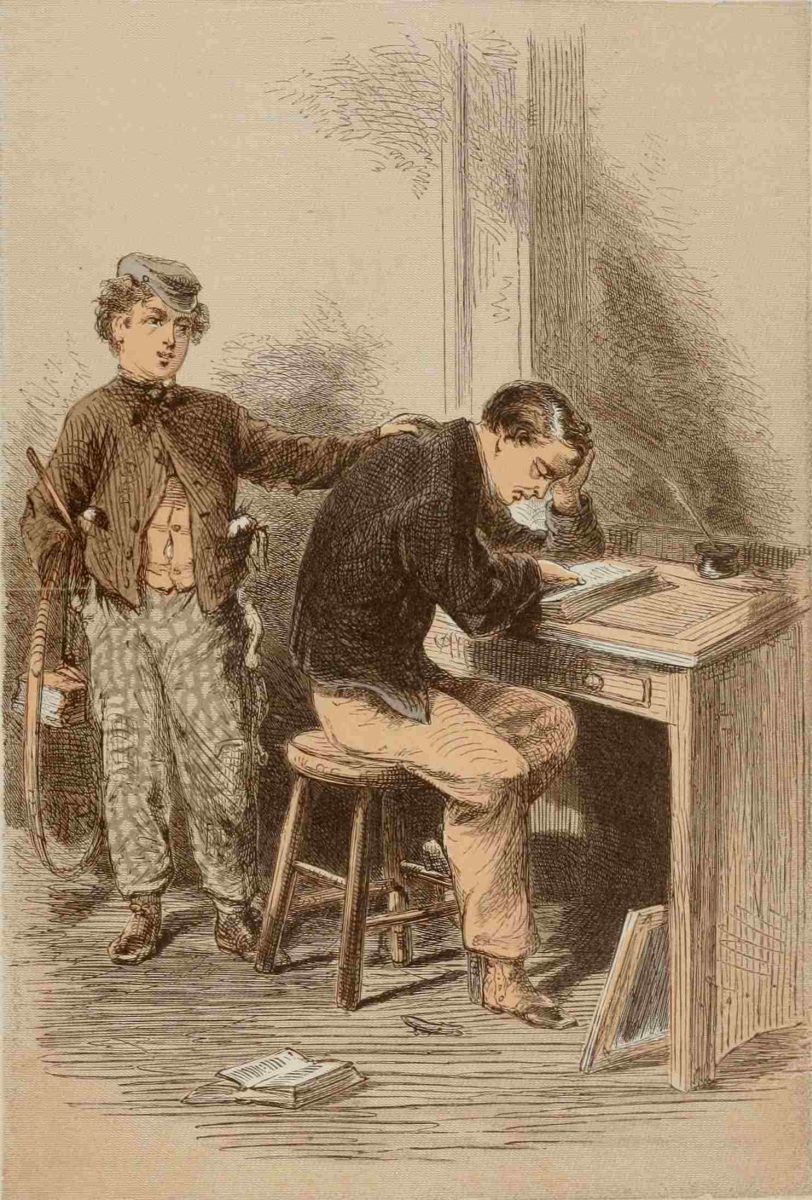
Do not seek to make of your children monstrous, uncomely, infant
phenomena. If, by some special interposition of preserving mercy, their
lives and health do not fall a sacrifice to your weak vanity, you will
discover, when your prodigy has completed his course of book-study, that
he is not one whit better fitted for the actual fight with life and
labor than is the fellow-student who used to ran wild, with torn hat,
trousers out at the knees, rough fists, chapped by wind and weather, and
pockets frightfully distended by a miscellaneous collection of unripe
apples, jack-stones, peanuts, top-cord, “taffey,” whistles, gingerbread,
pocket-knife, hard-boiled eggs, iron nails, of assorted sizes, and,
perhaps, a living specimen or two, in the shape of a spotted terrapin or
a June-bug, with a string tied to its leg; the while your Pindar
Augustus, in white linen pants and cheeks to match, sat in learned
abstraction from all mean and common things, his spine curved, and his
baby-brows knit over his Homer or Euclid. It is distressing, yet
instructive, to see how the mill of every-day life grinds down college
geniuses into very ordinary men; how the oft-quoted logic of events
proves the “bright particular star” of
the family circle and the school-room to be, after all, a luminary of,
at best, the fourth or fifth magnitude. You gain nothing except
mortification and disappointment, by cheating your wonderful scion out
of his childhood.
I am afraid that most of us, even those who have not fallen into the
gravely absurd error just referred to, are yet apt to expect too much of
our bairns. They may be marvels of sweetness, and sprightliness, and
filial devotion, but they are only babies after all. “Children should be
seen—not heard!” is often repeated by us in thoughtlessness or
ignorance of the real character of the maxim. It is illiberal and cruel,
and belongs to the age when a father held almost unlimited power over
the very life of his child; when the younger members of the household
never dared to sit down in the presence of their parents, without their
express and gracious permission. I agree that a pert, loud-tongued child
is an offence, at all times, but do not let us, on this account, condemn
to silence the bird-like voices that make sweetest music in our hearts
and homes. Even birds sing sometimes when we would rather they should
refrain; so let us be forbearing with the clamor of the babies. Do not
pretend to judge them by the rules you would apply to grown people.
“Father!” says a bright-eyed boy, as his parent enters the house at
evening, “did you remember to get me the ball you promised?”
“I did not, Tom. You shall certainly have it to-morrow.”
Tom goes off, in apparent content. In reality, he is sorely
disappointed; but he is a good child, and does not wish to make his
father unhappy. The promise for to-morrow helps him to bear the trial
tolerably well. The next evening, he is more backward about asking. He
hangs around his parent’s chair for some time, in hopeful suspense, but
as the longed-for plaything does not appear, he ventures timidly upon a
diplomatic “feeler”—
“Father, maybe you’ve forgot your promise, again?”
The father has had a harassing day—filled with carking care—and the
smouldering temper needs but a spark to influence it.
“Boy!” he says, hastily, “if you ever say ‘ball’ to me again, you shall
not have it at all! I will not be teased out of my life about your
jimcracks!”
Tom shrinks back, as if he had been struck in the face; creeps silently
off to his little room, and there, in solitude, cries as if his heart
would break. He has had a blow. It is not so much the loss of the toy,
but his is a sensitive nature, and his father’s words were sharp swords.
He meant to be very good, very patient. Nothing was further from his
thoughts than to annoy his usually kind parent. Mingling with, and
embittering his grief, is a burning sense of injustice. He knows that
the injury was undeserved.
“Father wouldn’t have talked so to a grown man! It’s just because I’m a
poor little boy, and can’t help myself!”
I fear there is too much truth in this shrewd conclusion of Tom’s. We
would not dare insult those of our own age, as we do our children.
“That boy is growing sulky!” growls the father. “Did you see how glum he
looked because I forgot a paltry plaything? I must take him in hand!”
Then is the time for you, the mother of the wronged child, to speak up
boldly in his behalf. Represent kindly, but candidly, to your irritated
lord, the true value of the promised gift to the boy, and the greatness
of the disappointment.
“And after all, Papa, we can not expect Tom to exercise much
self-control or self-denial yet. Remember, he is just five years old,
and babies will be babies, you know!”
If he is the husband so good a wife and mother deserves to have, he will
not only acknowledge his fault to you, but seek out little Tom in his
lonely chamber, and with a fond kiss tell him that “Papa spoke shortly
awhile ago, because he was very tired and had had a great deal to
trouble him to-day, but that he will surely remember to bring him a
famous great ball to-morrow night.”
There are times and circumstances in which it is very hard to remember
that “babies will be babies.” Bessy, and Kitty, and Freddy are playing
in the nursery adjoining your bedroom, where you lie in the agonies of
“one of your headaches.” Every not-very-strong mother knows just what
that means. You have told the little ones that you are in great pain,
and having provided them with books, blocks, slates, and the like
“sitting-still plays,” as Bessie calls them, and begging them to try and
be quiet for half an hour, have withdrawn to your darkened retreat. They
are loving, well-meaning children, and, for almost ten minutes, there is
a refreshing season of calm. You are just forgetting torture in a
soothing slumber, when, thump! bang! down comes the castle, the
erection of which has kept Freddy still thus long. He would not be a boy
if he did not hurrah at the crash; the girls laugh and clap their hands;
and uproar is shortly the order of the hour. Don’t spring from your bed,
and, confronting them with your pale face and bloodshot eyes, accuse
them of disobedience and want of affection for you. They love you very
dearly, and they “did mean to mind,” they will tell you penitently, “but
they just forgot!”
It is baby-nature to be forgetful, and I am glad that it is. The
injuries, and slights, and wounded feeling of maturer years are enough
to make of memory a whip of scorpions. I am thankful that, with the
child, a kiss, a smile, a kind word will efface the recollection of the
hasty reproof, the cross look, or—I blush for human nature as
illustrated in some women while I write it!—the impatient blow that has
wrung blood from the tender little heart. Thank Heaven that babies have
short memories! so short that the suffering of cutting one tooth is
clean forgotten before the next saws its jagged edge through the swollen
gum.
Furthermore, keep them babies so long as you can without making yourself
and them ridiculous, and interfering with the graver duty of preparing
them for their place in the working-world. The dew-drop must exhale by
and by, but it lingers longest in the bosom of the flower that folds its
petals most jealously and fondly above it. The virgin purity of the snow
must change, with dust and melting, into the hue of the earth beneath;
but it is a woeful sight. We would fain delay the process by every means
in our power. Above all, let us make it our prayer that we may never
forget that we were once children, and how we felt, reasoned, and acted
then.
Who of us does not treasure in her casket of remembrance certain golden
days or hours that we would not lose for the wealth of a kingdom? Your
daughter leans against your knee, as my little five-year-old does on
mine, with “Mamma, please tell me a story about when you were a little
girl; how glad you were when your Papa brought you home a new doll, with
blue eyes and curling hair, in place of the one the dogs tore up; or
about the grand holidays you used to have in the woods; or how your Papa
once took you to slide on the ice-pond—and O, Mamma! do tell me about
all the Christmases you ever had!”
All the Christmases I ever had! I wish I could remember them, every
one—for those I do recall are strung upon my memory like pearls upon a
silken cord, and each is a joy forever. There is but one against which
I have set a black cross—the dreadful morning when the first thing I
drew from my stocking was a switch! I seem to see the lithe, keen,
wicked-looking rod now, and hear the shout of laughter that greeted its
appearance—mirth, that quickly subsided before my torrent of grief and
shame. I was soon told that the obnoxious article was placed there “in
fun,” by a visitor in the family.
I should like to see the visitor who should dare to practice such a
piece of “fun” upon one of my children!
Never deny the babies their Christmas! It is the shining seal set upon a
year of happiness. If the preparations for it—the delicious mystery
with which these are invested; the solemn parade of clean, whole
stockings in the chimney corner; or the tree, decked in secret, to be
revealed in glad pomp upon the festal day—if these and many other
features of the anniversary are tedious or contemptible in your sight,
you are an object of pity; but do not defraud your children of joys
which are their right, merely because you have never tasted them. Let
them believe in Santa Claus, or St. Nicholas, or Kriss Kringle, or
whatever name the jolly Dutch saint bears in your region. Some
latter-day zealots, more puritanical than wise, have felt themselves
called upon, in schools, and before other juvenile audiences, to deny
the claims of the patron of merry Christmas to popular love and
gratitude. Theirs is a thankless office; both parents and children
feeling themselves to be aggrieved by the gratuitous disclosure, and
this is as it should be. If it be wicked to encourage such a delusion in
infant minds, it must be a transgression that leans very far indeed to
virtue’s side.
All honor and love to dear old Santa Claus! May his stay in our land be
long, and his pack grow every year more plethoric! And when, throughout
the broad earth, he shall find, on Christmas night, an entrance into
every home, and every heart throbbing with joyful gratitude at the
return of the blessed day that gave the Christ-child to a sinful world,
the reign of the Prince of Peace shall have begun below; everywhere
there shall be rendered, “Glory to God in the highest,” and “Good-will
to men” shall be the universal law—we shall all have become as little
children.
C. S. WESTCOTT & CO.,
Printers,
No. 79 John Street, N. Y.