MISCELLANIES.
We have the highest respect for the arts and for artists;
we are perfectly aware of the numerous qualifications requisite
for a painter—we know and feel the difficulty, and
duly consider the quantity of talent necessary to the painting
even of a bad picture. The years of probationary labour
expended before even the palette comes into use, the days
and nights of watching, and toil after it is assumed, and the
variety of chemical, mechanical, and scientific knowledge
which must be brought to bear upon a subject before the idea
of the painter can be transferred to the canvas.
These feelings, and this respect for the art, and professors
of painting, make us slow to censure; and, although we have
long had our eyes upon some of the public exhibitions of the
season, we have refrained from commenting upon them till
the common curiosity of the town had repaid, in some measure,
the care and anxiety of those in whose studies they had their
origin.
Mr. Haydon, a sonnet-writing Cockney, ranking high in
the administration of the smoky kingdom of Cockaigne,
distinguished himself last year, by exhibiting a picture of the
"Entry into Jerusalem," which, like Tom Thumb's Cow,
was "larger than the largest size." Elated with the success
of this immense performance, (of which one group only was
at all finished,) Mr. Haydon, this year, put forth a work
representing "the Agony in the Garden:" the divine subject
saved the silly artist, and we were upon that account
silent; else, for Mr. Haydon, who wears his shirt collars
open, and curls his hair in long ringlets, because Rafaele
did so, and who, if it did not provokingly turn down over
his mouth, would turn up his nose at the Royal Academy,
indeed we should have felt very little tenderness.
But with respect to Mr. Ward's allegorical picture of
Waterloo, we had different feelings—the picture had good
principle about it, and the weeks, months, and years which
have been bestowed upon it demanded some recompense; the
idlers of Piccadilly did not feel the occasional disbursement
of a shilling. In pleasant society Ward's exhibition-room
was as good a place wherein to "laugh a sultry hour away"
as any other; and anxious that Mr. Ward, after having expended
so much time, canvas, and colour, should get something
by it, we have patiently let him draw his reward from
the pockets of those good easy folks, who read newspaper
puffs and believe them; and who go and vow all over London
that a picture is wonderful and sublime, merely because the
painter, at the trifling charge of seven shillings and sixpence,
has thought proper to tell them that it is so, in the public
journals.
But when we find that this picture was painted for the
directors of the British Institution, founded "for the express
purpose of encouraging the Fine Arts," and is about to be
engraved and disseminated throughout the country, as a
specimen of the works taken under the especial care of that
Institution; it really becomes a duty to save the nation from
a charge of bad taste so heavy as must arise out of the
patronage of such a ludicrous daub.
This may be a picture painted for the Institution at their
desire, and the execution of it is no proof of their want of
judgment, because they desired to have such a picture, and
they have got it, and we have thereby no proof of their
approbation; but since they have got themselves into a
scrape, they certainly should not allow a print to be made
from it, even if they suffer the painting to remain in
existence.
If it be possible to imagine one thing upon earth more
irresistibly ridiculous than another, it is the composition of
this enormous thing—the size of it is thirty-five feet by
twenty-one—in the centre appears the Duke of Wellington in
a pearl car—under his feet are legs and arms, and heads in
glorious confusion—before him rides a pretty little naked boy
upon a lion—over him in the clouds are a group of young
gentlemen with wings, representing the Duke's victories,
who look like Mrs. Wilkinson's Preparatory Academy turned
out for a bathe; and amongst these pretty little dears are
Peace and Plenty, and a great angel overshadowing the
whole party.
But this very absurd jumble (at which, through a little hole,
Blucher and Platoff are looking with some surprise,) is by
no means the most ludicrous part of the affair—in the clouds
are two persons, called by Mr. Ward, Ignorance and Error,
(one of whom has a dirty handkerchief tied over his eyes,)
beneath whom are dogs' heads with wings—a tipsy-looking
cock-eyed owl trampling a heavy stone Osiris into the earth—a
little calf without a head—a red night-cap—a watchman's
rattle—an old crow—Paine's "Rights of Man"—Voltaire's
works, a sick harpy—a devil sucking his fingers—a hobby-horse's
head, and a heap of chains—here is the allegory—all
of which we shall attempt to explain in Mr. Ward's own
words, for he is an author as well as a painter, and, absurd
as are the productions of his pencil, the nonsense of his pen
is, of the two, the most exquisite.
In the foreground of the picture is a skeleton evidently
afflicted with the head-ache, before whom runs a little wide-mouthed
waddling frog with a long tail, and beyond these a
group which defies description.
The horses (particularly the near wheeler) have a very
droll and cunning expression about the eye; but the four
persons leading them, whether considered as to their drawing
or colouring, are beneath all criticism: a pupil of six
months' standing ought to have been flogged for doing anything
so bad.
In short, the whole thing in its kind closely resembles the
overgrown transparencies painted to be stuck up at Vauxhall,
or the Cumberland Gardens, or for public rejoicings, and
ought, as soon as it has answered its purpose like those, be
obliterated, and the stuff worked up for something else.
In a book published upon this performance, Mr. Ward
modestly says, that he is not ambitious to be considered an
author, and adds, that there exists some insuperable objection
to his ever being one; but still, he professes to attempt in
his own simple style an explanation of his own ideas. He
feels quite confident of public favour and indulgence, and
then gives us his view of the thing:—as a specimen of this
said style, we shall quote his notions about envy—its beauty,
we confess, is evident—its simplicity we are afraid is somewhat
questionable.
"Where shall we find a safe retreat for envied greatness, from the
miry breath or slander's feverish tongue; dark in the bosom of the
ocean's fathomless abyss, on the cloud-cleaving Atlas, or at the extremity
of east or west. High on the gilded dome, or palace pinnacle,
should merit's fairest hard-earned honours shine, once seated there, the
sickly eye of speckled Jealousy, or Envy's snaky tribe, with iron nerve,
and cold in blood, well scan the mark, and the envenomed javelin cast,
with secret but unerring aim, and what is to screen him from the foul
attack? The shield of Worth intrinsic, bound about with truth, and
conscious innocence, and where that lives, all other covering only tends
to hide its blushing beauties from the rising sun, and dim the face of
day.
"So the firm oak's deep roots, eccentric, winding through the
heaving earth, fast bound and chasmed deep, with many a widening
gap, by blazing Sol's mid ray, at summer's sultry noon, opposes strength
to strength; or round the impervious rocks, in weighty balance to its
broad branch, and highly-lifted head, up to the mountain's summit,
shrinks not from the prospect of the blackening storm, and while it
sends its sweeping arms around over the circling numerous acres,
shadowing under its expanded greatness, fears not the threatening blast,
nor for protection looks to man. Too great to need a screen; it were
children's play to throw a mantle over its full broad majesty, to try to
save its foliage luxuriant from the rude element. The attempt would
be as weedy muslin's cobweb insipidity; its flimsy partial covering would
only hide its full matured richness; and the first breeze of whirlwind's
opening rising tempest, tear from the disdainful surface to streaming
raggedness the feeble effort, and open to the eye the golden fruit,
freshening by the tempest, and glittering in the storm."
We know very little of human nature, if Mr. Ward, in
spite of his disclaiming any wish to be considered as an
author, does not think all this very fine. By way of simply
explaining his allegory, it is particularly useful;—of Mr.
Ward's view of the necessity of such explanation we may
assure ourselves by his very apposite allusion to Milton,
Walter Scott, Homer, and Burn (as he calls him). This
paragraph we must quote:—
"It is contended by some, that a picture should be made up only of
such materials as are capable of telling its own story; such confinement
would shut out the human mind from a depth of pursuit in every
branch of art. Poetry requires prose fully to explain its meaning, and
to create an interest; for who would be without the notes in Walter
Scott's 'Lay of the Last Minstrel,' or a glossary to the poems of
Burn, the argument to Milton or Homer? If then it be necessary to
make use of language to explain poetry, should not the same medium be
used to explain personification? It has been thought necessary on the
stage to send a person between the acts as a comment on the past, and
a preface to the future, and can we, I ask, understand what is going on
even in nature, by dumb show? If we see a crowd of people assembled
in the streets, do we expect that the action and expression should inform
us the cause of their congregating in an unusual manner? Experience
proves more than volumes of argument. We ask 'what does all this
mean?'"
To which we most candidly reply, we really do not
know.
Mr. Ward then proceeds in the following manner:—
"Wellington has his hand upon the tri-coloured cross, on the shield
of Britannia, expressive of the Christian's emblem, and the three
colours of which it is composed are the colours answerable to the three
principles in Trinity!!!
Red is the first fiery principle in the Godhead;
Blue the second in the Saviour, or Mediator;
White the third in the Dove of Peace."
This ingenious explanation of the mysteries of the Union
Jack must be highly satisfactory to every thinking Englishman:
there is, indeed, but one drawback to the holy
pleasure we feel at Mr. Ward's sublime discovery, which
is, that the Revolutionary flag of France was composed of
the same three colours.
The enlightened artist then informs us—speaking of
Britannia, "that the twisted lock of hair laying in front
upon her bosom, and over the right arm, is emblematic
of"—what do you suppose, reader?—"of the spirit of
justice."
"Justice, stern and unrelenting, whose sword is forward, and whose
plaited hair is answerable to that sword, and makes in the person of
Justice the number three, as expressive of the Trinity, or the whole of
Godhead manifested in the awful administration of justice. That
sword is serpentine, as expressive of flame, Deity in its principle of
fire."
This is "finely confused, and very alarming;" but
observe:—
"With the other hand she points through the medium of the Trident
to the Trinity in Unity, commanding him to look up to Providence as
alone able to give success to his efforts."
This puzzles us; pointing through the medium of "the
Trident" appears to us to be something like looking at
the Sun through the medium of a toasting-fork; but we
may be wrong.
Mr. Ward then continues:—
"The cat and broken spear are emblems of rebellion and anarchy."—P. 11.
"The British Lion is majestically observing the effects of his own
operations; his countenance shows no symptom of the reign of passion—anger
is alone signified by the movement of his tail."
For this illustration of natural history Mr. Ward appears
to be indebted to Mathews, who, in his "At Home,"
told a capital story of a showman and one of the noble
beasts in question, in which, while his head is in the
lion's mouth, he anxiously inquires of a by-stander, "Doth
he wag his tail?" That bit of waggery being indicative
(as Mr. Ward has comically painted it) of the ire of lions
generally.
Mr. Ward, as matter of information, tells us, page 19,
that "the palm-tree grows to the height of five hundred
feet, and bears the date and cocoa-nut." What date the
trees Mr. Ward alludes to might have borne we cannot
say; but certain it is, that modern palms have left off
growing to the height of five hundred feet; which, considering
it to be about three times the height of the Monument,
and one hundred feet more than the height of St.
Paul's, is not so very surprising.
The following information, conveyed in page 20, is likely
to be very interesting from its importance:—
"Juvenile antagonists in the streets dare not strike an unfair blow,
take the other by the hair, or maltreat him when fallen upon the
ground. In such case, he not only loses his battle, but also—his
character!!!"
At page 22 we have, perhaps, the most finished description
of docking a horse that ever was put to paper; it is somewhat
lengthy, but it will repay the lover of the sublime for
his trouble in reading it:—
"Can any thing be so far from true taste, as to round the ears of
a dog, or to cut them off; whatever may be the beauty, breed, or character,
to cut off the thumb, or fifth toe, and call it a Dew claw, and
consider it of no use! To chop off the tail of a waggon-horse, so necessary
and useful to that class of creature; above all, to separate every
joint of the tail, with all the misery attending upon it, in order to
reverse the order of Nature, and make that turn up which ought to
turn down, all equally show the want of taste, as the want of humanity?
Who has ever witnessed the operation last alluded to, if not, pause; and
in your imagination, behold a nobly-formed, and finely-tempered creature,
led from the stable in all the pride of health, and all the playful
confidence of being led out, and held by his master and his friend, view
the hobbles fastened to his legs, his feet drawn to a point, and himself
cast to the earth, so contrary to his expectations and his hopes; observe
the commencement, and the lingering process; behold the wreathing of
the lovely and as useful animal; how does his heaving breast manifest
his astonishment, while his greatly oppressed and labouring heart beats
high with resentment, at being thus tampered. His quivering flesh
sends through every pore streams of sweat; his open nostrils are bursting
with agony of body and spirit, while his strained eye-balls flash as
with the fixed glare of expiring nature. Heard you that groan? poor
animal. They have began the deed of barbarism! he faintly shrieks,
'tis as the piteous cry of the timid hare, when sinking under the deadly
gripe of the fierce, agile, and ravenous greyhound. How he grinds his
teeth, and bores his tightly-twitched and twisted lip, and smoking
nostril, into the thick litter, or grovelling, rubs his aching forehead into
the loose sand; now the sudden and convulsive effort! what a struggle!
every nerve, sinew, tendon, stretched to its full bearing, with fearful
energy! Oh! that he could now disencumber his fettered limbs, and
spring from his tormentors. Those limbs, that would joyfully bound
over the broad plain, or patient bear the cumbrous load, nor utter one
complaint in the deep toil; or drag with unwearied submission, harnessed,
galled, and parched with thirst, the lumbering machine to the
very borders of his opening tomb. He groans again, the struggle's over,
and he again lays down; while the hoarse breathing and his panting
sides, prove that all his energies, his mighty energies, have failed: and
the work goes on, still continues, and now another and another gash,
and now the iron hook, to tear out from among the separated complicated
bones, the tenacious ligament that binds the strong vertebræ; and lastly
the burning steel to staunch the streaming blood. Tedious process!—but
at length it ceases, and the noble, towering, majestic steed is led
back, tottering, trembling, reeling, and dejected, to repose apparently in
peace; but ah! another torment, the cord, the weight, the pulley, day o'er
day, and week after week, to keep the lips of the gaping, throbbing,
aching wounds asunder, to close no more for ever. Enough! enough!
our country's shame, for cruelty is not our natural character, our country's
vice."
We by no means intend to ridicule Mr. Ward's humanity;
but, we confess, as throwing lights upon an allegorical
picture of the Duke of Wellington's triumphs, we do not
consider the passage quite as much to the purpose as it
might be.
At page 29, Mr. Ward states (and with every appearance
of believing it) that "Cicero was once a lisping infant, and
Sampson, at one period, could not go alone;"—to which
assertions we must beg to add, for Mr. Ward's satisfaction,
that "Rome was not built in a day."
In his simple style, at page 30, Mr. Ward, speaking of
ignorance, says,—
"Loose veins of thought, imaginative intellects, evaporation. As the
school-boy's frothy bubble, rising from the turbid elements" soap and
water, "its inflated globule exhibits in proud mimicry the Rainbow's
gaily painted hues, and calls rude mirth to dance upon its glittering
surface, when suddenly it bursts, and all is gone!"
We shall conclude our extracts from this explanatory
pamphlet with the following:—
"Shapeless Forms of Death.—Perhaps no part of picturesque representation
is so difficult as this. The poet here has much the advantage.
Ossian may, by a language all understand, throw the imagination into a
delirium, and there leave it bewildered and wandering, in all the confusion
of material immateriality; but in painting it is necessary to give
a substantial shape to a shapeless form, and substance to a vision. It
is not for him to give the ghost of my father as a misty cloud covering
a whole mountain, or enlarging itself to the broad expanse of the capacious
plain, like the flaky layers of a thick fog, on the opening dawn of
a mist-dispersing sunbeam. But the painter must embody disembodied
beings, and give 'to airy nothingness a local habitation and a name.'
Here the various shapes of blood and carnage are to be contemplated,
in the imagery depicted, as cannon-balls, bomb-shells, fiery rockets,
swords, spears, and bayonets, with all the horrible effects of their operations;
as moving in the conflicted elements; from the head of death's
gloomy tribes, the large death-bat, under the arm of the fell monster
Death, who is grinning with savage pleasure at the havoc he is making.
The monsters are breathing fire, and from their pestiferous dugs dropping
streams of blood, as the milk of their nourishment."
Having given some of Mr. Ward's ideas as they were
written, we leave those who have not seen his picture to
judge what such ideas must be, upon canvas, with a clumsy
hand, and the worst possible taste.
To say that Mr. Ward is mad, is not what we would
pretend to say; but coupling his painting with the articles
which we have caught and preserved, from his pen, we
must believe that there are many very worthy persons at
present in Bedlam, who could paint allegories full as well,
and describe their meaning afterwards with infinitely more
perspicuity.
All we have to do in this affair is to call upon the Directors
of the British Institution, if they mean to patronise real
merit, or to make their rewards honourable and of value,
to disclaim all approbation of the most illustrious and full-sized
specimen of pictorial Humbug that ever drew shillings
out of the pockets of John Bull.
We have indeed been told that the Institution have (somewhat
too late) discovered that they employed an animal
painter, to paint them an allegorical picture—they were not
aware of their mistake in the outset; but in order to rectify
it and induce Mr. Ward to rub out his allegory, they have
resolved, it is said, to give him an opportunity of showing his
talents in his own line, by sitting to him for their likenesses,—it
is added that the portrait of Mr. Richard Payne Knight
is already in a high state of forwardness.
To John Bull.
Farm Yard, Claremont, Friday, Sept. 27, 1822.
Sir,—These are the last words I shall ever have an opportunity
of addressing to you; my doom, alas! is fixed. I am
sentenced to die this evening; neither Alderman Waithman,
nor Mr. Ex-Sheriff Parkins, can save me; I am waiting in
the condemned coop, the coup-de-grace of my illustrious
master's chicken-butcher.
Probably you anticipate the cause of my death: Sunday is
the feast of St. Michael, my blood is required in the mysterious
celebration of the ceremonies observed in all well-regulated
families on that anniversary. This very day twelve-months
my excellent and amiable mother, and my respectable
father, perished on the same account.
At this critical juncture, I pick a quill from one of my
wings to assure you of that resignation to my fate, which I
truly feel:—that it is not unalloyed, Mr. Bull, I must, however,
confess. Those who know our family know that we are
patriots, that we have souls; and I cannot quit the world
without regretting my future destiny. Brought up, sir, as I
have been; educated upon the English system in the farm-yard
of a Foreign Prince; fattened as I have been at the
public expense; I did expect (as all patriots say they do) that
the sacrifice of my life might have been of some utility to the
country;—but, alas! no: pampered, fed, stuffed as it were
by anticipation. What is my doom? Am I to be yielded as
a tribute to the nation, whence I have derived my weight and
flavour? Am I to gratify the palate of the illustrious Prince,
my nominal patron? No; I am to be sold and eaten by some
base venal hind in this neighbourhood, who, in these times of
wretchedness, cannot dine on Michaelmas-day without me.
What my sensations are at the treatment I have met with
you may, perhaps, comprehend. Will you believe it, sir, I
have never seen the illustrious Personage in whose service I
have wasted my days. I have never beheld the amiable
Prince, to whom, for many reasons, I am warmly attached:
first, because I am a goose; secondly, because, thanks to the
generosity of the nation, I am his Royal Highness's goose;
and, thirdly, because I am a goose of high feeling, honour,
and, above all, of gratitude.
What a consolation it would have been to have seen his
Royal countenance!—what a disgrace to my family to quit
the world without having attained to such a favour! It is
true I have received a great deal of pleasure in the occasional
society of Sir Robert Gardiner, whose attentions have been
very much devoted to our comfort and accommodation in our
Royal Master's absence. I certainly found him in pens;
which, as you know Sir Robert is fond of writing, was no
small return for his civilities—civilities, which I begin
shrewdly to suspect were, after all, interested, and more insidious
than I apprehend at the moment.
I ought to apologise for trespassing at such length upon
your patience; but, having been for a considerable time a
constant correspondent of the Morning Chronicle, I am
habituated to what are vulgarly called long-winded letters;
and when a goose prints his own grievances he is generally
somewhat diffuse. My wrongs are now strongest in my recollection,
and I am anxious that my family reputation should
not suffer in my person, and therefore devote my last moments—my
last words to you.
If you were a goose, Mr. Editor, how would you bear with
indignities like those I have suffered? Sir, the Heralds' College
could prove, and would prove, if they were sufficiently
well paid for it, that I am lineally descended from the noble
bird who saved the Roman Capitol; and it is in consequence
a common observation amongst the poulterers at Kingston,
that "there are Capitol geese at Claremont;" which classical
saying of that erudite body has been garbled into the more
vulgar observation, that "there are capital geese at Prince
Leopold's;" inferring thereby that part of his Royal Highness's
capital consists of geese!
It is needless to tell you, that the branch of my family
which has settled itself in Norfolk is in the most flourishing
state, and that at Holkham, at this present moment, there is
an old Goose held in high estimation amongst the Whigs. At
Woburn Abbey, another set of my connexions are in high
force, and admirably calculated for cutting up and roasting;
while in the North, the Grey Geese are reckoned invaluable
as a cross breed, the head of that coop being the identical bird
celebrated in the Fable of the Fox and Goose, to which the
Tories have subjoined a very salutary if not pleasant moral.
To the notice of these most honourable birds I may add one
of the younger scions of our stock, the Goslings—who, as
everybody knows, are a most excellent and respectable firm
in the City of London.
These things disturb me. I have contributed to the funds
of my Master, I am about to lay down my life for his advantage,
and, I repeat, he has never seen me. There are thousands
of geese, I am ready to grant, labouring under the
same disadvantage, and thousands of human beings too, but
to them the disappointment is not of the same nature as to
us: none but geese would contribute to support an absentee
as we do; and yet, supporting him, none but a goose would
care about ever seeing him again.
I must cease—the poulterer's cart and my end approach.
I have heard that the only modification of my sentence which
I ventured to request—the change of strangling into decapitation—is
refused me; His Royal Highness's ministers here
declaring that I cannot be sent off the premises without a
bill. It matters little, Mr. Bull, but I must say, it is not what
I expected. Publish my letter, that my Prince may see how
he is beloved and respected, and by whom;—he has been at
Rome, but never thought of me or mine; perhaps he never
heard of the story which connects us with that once mighty
city. Adieu!—One of my sisters has already suffered: would
I were a swan, I would sing my own elegy—they come nearer—they
have seized my pens—I can only give—what we occasionally
have here—a great quack, and subscribe myself,
Your affectionate Gander,
Billy.
P.S.—No anser will reach me; but in making any further
inquiries about me, be cautious, as there is a much greater
Goose than myself of my name, living at Bagshot, which,
being in this neighbourhood, might cause some confusion.
The first general meeting of this excellent society took
place on Thursday, at the residence of one of its most powerful
supporters; and, considering the skeleton state of the
metropolis, was satisfactorily attended. We have received
an account of the proceedings, under a promise not to mention
the names of the committee; and the word "confidential"
written diagonally in one corner of our correspondent's letter,
prevents our giving the report as fully and satisfactorily as
we could wish.
The great Gamboogee himself, however, was present, and
explained the nature and intention of the society very
succinctly. It may perhaps be necessary to quote for our
readers this account of their general views, as detailed by his
Lordship.
In the first place, it appears to the excessively correct
persons who compose this grave body, that a Christian should
never be merry—that it is the bounden duty of all well-disposed
persons to groan and sigh, and make themselves as
uncomfortable as possible during their stay upon earth; and
in order to render themselves apparently subservient to the
regulations which they propose to lay down for others, the
members have their seats provided on the hardest possible
benches, the president being compelled to sit in very thin silk
breeches, upon a horse-hair bottomed stool, without either
arms or back, i.e., while they are in public!
Every member is bound, on similar occasions, to wear
large worsted stockings, with the tightest possible shoes, stiff
stocks, and hats considerably too small for their heads. Thus
accoutred, it is their intention to effect, under the authority
they very frequently have on their tongues, a total reformation
in society.
They intend to begin with Brookes's and Boodle's, which
are to be consigned forthwith to the superintendence of
four respectable Dowagers; and the direction of Almack's
is to be vested in the hands of six able ministers, to be
selected by the great Gamboogee himself for that purpose,
next May, previously to the commencement of the ensuing
winter season.
In order to prevent the shameful impositions practised
upon the credulity of minors of fashion and fortune, by
unprincipled women of no property, the Hum-Fum Gamboogees
have opened establishments for the reception of young
gentlemen of worldly propensities, which are to be placed
under the surveillance of most active and pious men.
Similar receptacles for young ladies, whose flagrant desires
lead them into the abominable vices of dancing or singing,
will be prepared, where, in rooms hung with black, and from
which the much too comfortable glare of day will be excluded,
they will be taught to see, in their proper colours, the enormity
of those crimes of which they have been guilty, and
which their sinful mothers, grandmothers, and great grandmothers,
have been rash and vile enough to commit in a
similar way.
It appearing to the Hum-Fum Gamboogees that the sun
is by far too great a blessing for such wretched creatures as
we are, they recommend a careful seclusion during the day,
and suggest that wet or windy nights are the most suitable
occasions for taking exercise.
A total abstinence from wine is earnestly desired to be
observed by the young gentlemen of London, whose interests
the Hum-Fums have very near their hearts; and they mention
weak black tea as a substitute, or a proportion of that
excellent succadaneum for Hyson, chopped hay, which was
seriously recommended to the attention of the world, a short
time since, through the columns of the Morning Post.
Several well-dressed and respectable elderly gentlemen,
with umbrellas, will attend in Hyde Park every day, until
the abomination of frequenting such places be utterly
abolished, to escort young men to pious ordinaries, where it
is recommended they should dine, in order to prevent those
unnatural sins, flirting, dangling, and making the amiable.
A vast many devout minor agents of the society will be
employed to divest the pockets of persons of snuff-boxes, it
never having been required by nature to feed one's nose.
It is strongly recommended that every one should abstain
from frequenting play-houses, and in order to effect this great
object, or at all events to render the performances sufficiently
disagreeable to be quite correct, it is suggested that the
company of performers, who acted at the Haymarket Theatre
last season, be the only persons licensed to exhibit in the
metropolis.
The Hum-Fums will visit the houses of their neighbours,
after the fashion of that most excellent brother corporation,
the Bible Society, and will make it their business to enquire
into the state of every man's domestic affairs; in order, if
possible, to rescue from degradation the servants of London,
whose subordination (although, by the active endeavours of
similar unions, they are getting gradually independent of
their masters and mistresses,) is derogatory to the dignity of
the human character.
The Hum-Fums will distribute amongst the domestics
such works as may tend to elevate their minds, open their
intellects, make them dissatisfied with debasement, and
enable them, by the blessing of Providence, to rise superior to
that oppression by which the sinful luxuries of society have
humiliated them. Several Hum-Fums of the highest character
for dulness and gravity will attend in the kitchens and
servants'-halls of each parish, to edify their tenants every
evening from eight till twelve.
It will be the study of the Hum-Fums to impress upon
the soldiers of this kingdom the sin and shame of carrying
muskets and bayonets for pay, and of slaughtering their
fellow-creatures for no cause whatever; and by the way in
which they expect to be enabled to make their light shine,
they hope to convince their brethren in arms that officers are
but men, and that obedience from one man to another is by
no means necessary to salvation.
The sailors they intend to leave entirely to the pious
society called the Bethel Union, convinced that nothing the
Hum-Fums can do will more effectually emasculate and
sanctify at the same time the sea service, and purge it of its
worldly power to do mischief, than the blessed exertions of
that inestimable institution.
Riding in carriages, especially on Sundays, they most
energetically denounce; and it is proposed to solicit the
several lessees of the turnpike trusts round London to allow
ministers, selected by a council of Hum-Fums, to be
placed at the different toll-gates, to dissuade the infatuated
people from enjoying the sun and air of heaven on the only
day which they have to themselves, and on which, in obedience
to the Decalogue, they do no manner of work.
Night agents of the society will be regularly posted at the
doors of all public-houses within the bills of mortality, to
check the ingress of sinners to such places; and in order
more effectually to promote the devout intentions of the
society, Messrs. Whitbread (whose very name inspires
respect), Mr. Calvert, and Mr. Buxton have intimated a
zealous desire to leave off brewing the liquor which the
wretched sinners are so depraved as to swallow in those
receptacles for vice.
No rank of society will be free from the surveillance of
this pious body. At the Opera, a superior class of agents
will be always in attendance to superintend the friendly
intercourse of the best families, and by an assiduous watchfulness
over the manners and conversations of the various
parties, many of those heartrending divisions in society
which shock morality will be doubtless prevented.
The Hum-Fums earnestly recommend frequent physicking
and bleeding, with a view to the moderation of worldly
appetites; and suggest, in the hope of keeping up an incessant
feeling of the wretched state to which we are reduced,
that all persons between the ages of fifteen and sixty should
wear perpetual blisters.
The Hum-Fums earnestly request subscriptions to carry
their spiritual benefits into effect, and they would impress
upon the minds of those who are hastening to perdition in
the same abominable and destructive road, which every one
of their ancestors and relations have taken, that all things are
subservient to the principles which the Hum-Fums teach,
and that without money the Hum-Fums cannot exist.
After the proceedings in which this development of their
views was made, the Hum-Fums nominated thirty-five
treasurers and sixty-eight secretaries at respectable salaries.
Most of the Hum-Fums being decidedly hostile to the establishment
in State as well as Church, this was considered the
only virtuous mode whereby to provide for those persons,
who, though in humbler life had always relied upon the
Hum-Fums for support, and whose laudable exertions in
exciting a proper melancholy, and a substantial discontent,
deserve the highest praise.
The Hum-Fums, after this part of the ceremony, proceeded
to sing psalms and hymns, the productions of the Rev. Mr.
Smith, of Penzance, whose meritorious conduct under his
call, from the station of boatswain in His Majesty's service,
to the ministry, demanded their warmest admiration.
Miss Rebecca Engleheart presented the society with a small
pasteboard windmill, in the hopper of which were three
shillings and ninepence halfpenny, which she had collected by
the exhibition of her little toy.
The great Hum-Fum Gamboogee was extremely gratified
by this specimen of pious ingenuity, and put the sails of the
model into rapid motion, which excited great gratitude and
applause.
Two Otaheitean watermen and a New Zealand coppersmith
were elected Hum-Fums: they spoke at length of the
benefits which their respective nations had received from the
exertions of the society, and the latter presented to the
society the heads of his elder brother and his sister-in-law,
which he had cut off since his notions of property had been
matured under its benign influence.
At this period of the proceedings an interruption took place
which threatened the unanimity of the society; this, considering
the society, as we do, to be one, of which all the
members ought to hang together, created a very unpleasant
feeling.
One of the members, more lukewarm than the rest, inquired
by what authority the Hum-Fums were to take upon
themselves the charge of correcting their neighbours, and
setting the world in general to rights; adding a doubt as to
the obedience of a nation like England, famed for its independence,
and envied for the blessings of religious toleration,
to the dicta of a committee of Hum-Fums. "For," said the
pious member, "although I speak under correction, and with
all due deference to the great Hum-Fum Gamboogee and my
sanctified brethren, I do not see the right by which we,
being only men like themselves, are, in a country of liberty,
to control our fellow-creatures in their recreations and amusements;
seeing, that if they are to go to perdition for doing
that, which has been ordinarily done in Great Britain for the
last four or five centuries, we are to conclude that all our
forefathers have forfeited their hopes of happiness hereafter,
because the system of Hum-Fumism did not exist; which
reflection is not only melancholy, but, as I am bound to trust,
not founded in fact. Moreover, sir," added the brother,
addressing himself to the most venerable Gamboogee, "your
Lordship must know, that in Roman Catholic countries the
Sunday is universally a day of gaiety; that dances, and even
plays, are performed on that day; and since, I believe, many
of the great Hum-Fums who now hear me, voted in another
place in favour of the Roman Catholics, they should be
cautious, while they cry for the admission of such levities
with one breath, not to condemn, with another, to eternal
punishment the Protestants, who, although it must be confessed
they contrive, even in these times of distress, to enjoy
themselves on Sundays, confine themselves to a walk or
drive into the country, with their wives and children, and a
harmless regale of their pipes and their pots, their buggies
and their bottles, or their carriages and their claret, as the
case may be——"
"Harmless!" said the great Hum-Fum, the buckles of his
wig standing on end!
"And I doubt much," continued the former speaker,
"whether the very proceedings we are about to adopt will
not sicken those of moderately pious lives, and——"
"Sicken, sir!" interrupted the great Hum-Fum—"look
at the navy, sir! Do you not perceive that the blessed
institution, the Bethel Union, of which Master Phillips and
myself are the main props, has taken the navy under its
care—that we are to control the pleasures of the sailors—to
correct their propensities—dock them of their girls and their
grog—and allowance them even in pig-tail? If this experiment
succeed—if the navy submit to this most proper control
and purification, why should not the army and the laity
generally submit to it too? What did Oliver Cromwell do,
sir? Had not he a preaching army?——"
Here a considerable noise of coughing took place; for
though the ultra Hum-Fums were too much involved in zeal
to think of analogies, the designing and radical Hums, who
had merely joined the society for political purposes, felt that
the mention of old Noll might throw the more moderate
into a train of thoughts for which they had not as yet been
sufficiently prepared.
The confusion caused the great Gamboogee to cease; when
a servant entered and whispered his Lordship. What the
communication was we were unable to learn, as an adjournment
was immediately moved and carried. The fact is—dinner
was ready.
We have once or twice alluded to a scheme (forwarded to
us by the Author) for rendering theatrical entertainments
strictly moral; and, it appears to us, that no season can be
better suited to its development than the present.
The gentleman, to whose exertions in the behalf of virtue
and decency, the public are even now greatly indebted, and
whose plan, if carried into effect, will entitle him to the gratitude
of the nation at large, is the Rev. Mr. Plumptree,
who has published a volume of dramatic pieces illustrative of
his purpose, which blend with deep interest a purity of
thought and propriety of language rarely to be met with in
the theatrical works of the day.
The first of the dramas is called "Royal Beneficence, or
the Emperor Alexander," and is founded on an event which
occurred to his Russian Majesty, on the banks of the Wilna,
where he restored a drowning young man by the means
prescribed by the Humane Society, which means of restoration
are published with the play—evidently with the best
intentions. Mr. Plumptree offered this piece to Covent
Garden and to Drury Lane, but it was by both rejected;
then Mr. Hindes, the manager of the Norwich playhouse,
had the refusal of it; but he, like the London proprietors,
objected to its appearance because a living character was
introduced.
Mr. Plumptree reasons very fairly upon the futility of
this excuse, and prints the detail of the Emperor's indefatigable
exertions, upon which his play is founded, together
with many other interesting documents concerning the valuable
charity to which the piece is dedicated.
The drama is full of interest and good feeling; and although,
in the present state of the stage, there is, perhaps, a
want of bustle, still the affecting incident at the end of the
first act, where the dead body of the hero is dragged out of
the water, and stripped upon the stage, under the immediate
inspection of the Emperor, who says,—
"Lose no time in fruitless ceremony: this is our duty now; strip
off his clothes; wipe him dry, and rub about his heart, his temples,
wrists, and everywhere,"—
appears to us likely to have produced a great sensation in a
British audience.
We must say, that the rejection of such a piece by the
London managers reflects equally upon their taste and
delicacy.
The next drama is called "Winter," and is founded upon
the story of Elizabeth Woodcock, who was buried in the
snow for upwards of a week, and is extremely pretty. "The
Force of Conscience," a tragedy, follows, which ends with
the execution of Mr. Morris, a blacksmith, on the new
drop, during which awful ceremony he is assisted in prayer
by the Rev. Mr. Jones; the spectators make comments,
and the culprit his last dying speech, when the drop, or
rather the curtain, falls, which ends "the strange eventful
history."
The next play is called "Mrs. Jordan and the Methodist,"
and is founded upon a benevolent action (one of many)
performed by that incomparable actress. We have too
much affection for her memory to make a single comment
upon Mr. Plumptree's delicate attempt to commemorate
her good qualities.
The next is a comedy, called "The Salutary Reproof, or
the Butcher!" from which we intend to make a few extracts,
in order to give a fair specimen of Mr. Plumptree's dramatic
talent and virtuous intentions; and we certainly do hope
that one of the London theatres will afford the town an
opportunity of judging for themselves the benefits likely to
arise to their morals by such representations, without any
curtailment of their amusement.
The play opens with a view of a country village; a public-house—sign
the Salutation, on one side; on the other side,
a baker's house and shop, and next door a butcher's house
and shop; trees and a seat before it.
Enter the Rev. Mr. Shepherd—goes to the inn, and is
shut out—he tries the baker, who will not give him a lodging—whereupon
he proceeds to the butcher's. As he advances,
he hears a hymn sung by the butcher's family, accompanied
on the oboe. He is shortly after received by the butcher,
and the scene changes to the inside of the butcher's house,
where, as it is described, there is "everything remarkably
neat, and even elegant in a plain way."
Enter Mrs. Goodman, George, and Ruth—then Goodman
and the Rev. Mr. Shepherd.
The following conversation occurs:—
Goodman. Mary, here is a gentleman will lodge here to-night.
Muggins is in one of his surly fits, and has denied him. Put clean
sheets on the bed, and you shall sleep with Ruth, and I with—George!
Mrs. G. What will the gentleman be pleased to have? Pray, be
seated, sir—take this great chair. Shall I do you a mutton chop, sir?
Goodman. Bring the ease-and-comfort, George.
In a long note Mr. Plumptree elaborately describes this
machine, and benevolently observes, that no house should be
without at least one of them.
Mr. Shepherd. I thank you—if it will not be giving you too much
trouble, I should prefer tea before everything—nothing refreshes me
after fatigue like tea.
Mrs. G. By all means, sir; the fire is not out in the back-house.
Ruth, put on the kettle; it is hot; and get the tea-things.
George. (Bringing the ease-and-comfort.) Here, father.
Goodman. Will you rest your legs on this, sir? we call it ease and
comfort.
Mr. Shepherd. 'Tis ease and comfort, indeed. I know it by the
name of rest-and-be-thankful. I will beg, if you please, when I go to
bed, the patriarchal hospitality of water for my feet, and that warm.
This conversation, which is quite refreshing from its
naturalness, continues till it takes a turn in this manner:—
It will be observed that Goodman is a butcher.
Goodman. It is said that our laws do not allow a butcher to serve
upon a jury in a case of life and death—supposing, from his business,
that he must have less humanity than others.
Mr. Shepherd. But that, I believe, is not the case; and within my
own confined experience I have known several truly respectable and
humane butchers. Our laws themselves are sanguinary; and they do
not make the same exception to the military or naval characters, both
which professions have too much to do with the effusion of blood.
Goodman. What do you think, sir, of the post-boy who cuts and
over-drives his horses?
Mr. Shepherd. What do I think of the gentleman who sits behind
him, and permits it—nay, encourages him, and pays him extra for distressing
them, merely to bring him a few minutes sooner to the end of
his stage?
Goodman. Sir, I had rather be what I am.
Mr. Shepherd. And so had I—it is a consolation to me often, in my
journeys on foot, that no beast suffers for my accommodation.
The vein of morality which runs through the dialogue is
exquisitely touching, and in the hands of Terry or Macready
we think Goodman might be made highly effective—Young
would be excellent in the "Rev." Mr. Shepherd, and in the
latter part of the act, where Goodman discovers in the
clergyman a friend who "put up at the Wheat Sheaf, at
Blessbury, twenty-five years before," would make a decided
hit—when pushing away his ease and comfort, the Reverend
Gentleman returns thanks for having made the butcher what
he finds him.
The conclusion of the first act is happily imagined, and
highly theatrical:—
Mr. Shepherd. If you please, I will retire to rest—I heard your
evening hymn, and interrupted your prayer in the hope of joining in it.
Of whose devotions do you make use?
Goodman. Bishop Wilson's, sir—but you will be so good as to lead
for us.
Mr. Shepherd. If you please—but in general I know not that you
can do better than make use of the pious bishop.
Goodman. George, bring the book.
Mr. Shepherd. I will have it in my hand, if you please, but our own
peculiar circumstances require our own peculiar thanks and petitions.
[George brings the book, and gives it to Mr. S., and whilst they are
looking at him, as if waiting for his kneeling first, the curtain drops.]
It is impossible not to feel such a scene deeply—its dramatic
quality and the powerful effect that such a style of
representation could not fail to have upon a thinking audience.
In the second act Goodman dispatches a leg of mutton to
Lord Orwell's, and puts up a prayer—Mrs. Goodman inquires
if the gentleman's shoes are cleaned, and mentions that she
must go and look at the rolls in the camp oven: subsequently
to which we are presented with a scene at his Lordship's,
who desires the butcher to sit down, and enters into conversation
about "Fiorin grass," which Goodman says will produce
six ton per acre. His Lordship then recommends a work
called "The Experienced Butcher," published by Darton and
Harvey, Gracechurch Street, price 6s.—in return for which
Goodman mentions the arrival of Mr. Shepherd, and recommends
him for the curacy of Gladford, the new rector having
refused to countenance him. Whereupon Lord Orwell says
to the butcher (taking his hand), "Mr. Goodman, this, like
every part of your conduct, raises you in my esteem; depend
upon my services wherever they can be useful."
Goodman. Your Lordship is too condescending—too good—to me too.
[Exit, putting his hand to his eyes, to wipe away the tears.
Lord Orwell. No profession, I see, however rude, can prevent the
growth of humanity, where religion affords its kindly influence. Even
conversation with this butcher I perceive to improve my humanity!
Enter Sir William Rightly.
Good morning to you, Sir William; you rested well, I hope?
Sir W. Quite so, I thank you; your Lordship is well this morning,
I hope? You have been sending your butcher away in tears, I see. I
passed him in the hall; he gave me a look that spoke I know not what;
I felt it at my heart.
Lord Orwell. I think you must have heard me mention this butcher
before; he is not only the best butcher for many miles round, but one
of the best men!
His Lordship then characterises Goodman thus:—
I have a great regard for him. In addition to all I have said, there
is a civility and gentleness in his manner—an ease and frankness—civil
without servility—ease without familiarity, and gentle, with much
animation!
Sir William. It seems, then, that the butcher, if not a gentleman
has much of the gentleman about him.
Lord Orwell. Exactly so. But let us join the breakfast party.
[Exeunt.
There is so much genuine nature in all this, that we certainly
should have no hesitation in foretelling the reception it would
meet with on the stage, if acted. The dénoûment may easily
be anticipated; Mr. Shepherd, instead of being continued as
curate, gets the rectory at Gladford; and Lord Orwell and
Sir William Rightly having walked down to the butcher's,
there conclude the play thus:
[Lord Orwell and Sir William alternately shake hands with Mrs.
Shepherd and Mrs. Goodman; Mr. Shepherd and Goodman then take
each other cordially by the hand, in the centre, while Lord Orwell takes
Goodman's hand and Mrs. Goodman's; Sir William takes Mrs. Shepherd's
and Ruth's; Mrs. Goodman takes Muggins's, and Muggins
George's; Ruth takes Crusty's, and Crusty his wife's. The curtain drops.]
As we have already said, the great charm of these pieces
is the perfect representation which they give of real life.
The intimate knowledge of human nature, and of society,
which shines throughout all of them; and, above all, that
consummate skill which, while it affords the richest dramatic
treat, conveys the purest moral lesson.
It certainly is not for us to prescribe to Mr. Elliston; but
we do think that if the play, whence we have made the
above extracts, were acted at Drury Lane, the effect produced
would be extraordinary. To Mr. Plumptree we return our
thanks for his volume, which having read with admiration,
we lay down with infinite satisfaction; and if every author
were to pursue his plan and publish the piece, which managers
have refused, it would very soon put an end to all doubts as
to the cabals and intrigues which agitate, divide, and govern
theatrical cabinets.
With considerable exertion, and at a great expense of
capital and research, we have been fortunately enabled to
gratify the prevalent taste for diaries and correspondence; a
gentleman of the highest literary character, moving in the
first circles as well of the political as fashionable world, has
been kind enough to furnish us with no less than twenty-four
volumes of MS. letters and memoranda, the production of all
the leading personages of the last and present century.
It is from the unreserved communication of their thoughts
and feelings that the characters of great men are to be justly
appreciated; and with the addition of the notes, explanatory
and critical, of our highly-gifted friend, we think we shall do
the world a service, and our readers a pleasure, by submitting
portions of the great collection entrusted to our care.
It must be observed that the whole of the correspondence
of which we are possessed is strictly of a private nature, and
certainly has never appeared in print before. We give a few
specimens:—
No. I.
"From the Right Hon. William Pitt to Mr. Smith.
"Mr. Pitt will be glad to see Mr. Smith to-morrow at twelve.
"Downing-street, April 4, 1800."
I have not been able to ascertain precisely who this Mr.
Smith was, and the envelope, which possibly might have
shewn the address, has been unfortunately lost—the name of
Smith is by no means an uncommon one; it is possible that
this note might have been written to a relation of Lord
Carrington, who was created a Baron on the 15th of July,
1796. His Lordship married a Miss Bernard, by whom he
has had one son and eleven daughters.—Ed.
No. II.
"From David Garrick, Esq., to Dr. Goldsmith.
"Southampton-street, April 9, 1775.
"Dear Goldsmith,—Mrs. Garrick will be glad to see you here at
dinner to-day, at three o'clock.
"Yours, D. G."
The authenticity of this short letter is unquestionable; for
although the initials of this British Roscius only are affixed
to it, the date, and the known intimacy which existed
between Garrick and Goldsmith, put all doubt at rest as to
the real writer. It is a curious transcript of the times, as it
marks the hour of dining in the year 1775, in what may be
considered the best authority. Garrick retired from the stage
in 1777, and died in 1779; his widow survived him nearly
half a century. The house at Hampton was purchased by a
Mr. Carr, Solicitor, as I believe, to the Excise, one of whose
daughters was married to Dr. Lushington.—Ed.
No. III.
"From Mrs. Letitia Barbauld to Miss Higginbotham.
"Mrs. Barbauld will thank Miss Higginbotham to let her have the
silk gown home by Saturday night at latest.
"Thursday evening."
This interesting remain is without date, but it bears the
evidence of truth on its face. Mrs. Barbauld, who was
the daughter of Dr. Aikin, was a highly-talented lady; her
"Beggar's Petition" itself is enough to immortalize her.
The desire to have home a new gown on Saturday night, in
order that she might wear it at church the next day, has a
naturalness in it which is quite refreshing—a feminine anxiety
operating upon a masculine mind.
I have endeavoured by every possible means to ascertain
who the Miss Higginbotham was, to whom the letter is
addressed, but hitherto in vain. By reference to the files of
newspapers kept at the Chapter Coffee House, in St. Paul's
Churchyard, I see that in the year 1870, a Mrs. Hickenbotham
kept a milliner's shop in Hanway-yard, as it was then called.
But I can hardly fancy it the same person, because in the
first place Mrs. Barbauld distinctly calls her Miss, whereas
the person in question was married; and secondly, because
the name of the milliner to whom the newspaper refers,
is spelt Hickenbotham, whereas Mrs. Barbauld makes the
Hick, Hig, and spells her bottom, botham, after the manner
of the landlord of the Windmill Inn, at Salt-hill, near Eton
in Buckinghamshire.
No. IV.
"From the Right Hon. Edmund Burke to Mr. Burns.
"Burns,—Get something for dinner by four o'clock to-morrow, and
tell Simmons to have a fire lighted in my bed-room early in the day."
"E. B."
The Right Hon. Edmund Burke, one of the most distinguished
of our British worthies, was born at Limerick on
New Year's Day, 1730; he was educated by a Quaker, got
into Parliament in 1765, and died at Beaconsfield, July 8,
1797. Burns I imagine to have been a servant of his, but
I have no particular reason for believing it, beyond the
evidence of the letter before us. The direction to get dinner
ready, comes evidently in the way of a command; and the
unadorned style of address quite justifies my suspicions.
Simmons is unquestionably a domestic servant, and a female.
In the registry of marriages in Beaconsfield church, I find an
entry of a marriage between Thomas Hopkins and Mary
Anne Simmons, spinster; which Mary Anne I take to be
the individual referred to by Burke. The date of that
marriage is June 15, 1792. Now, although this letter is
without date, it is fair to infer from the reference to "making
a fire in his bed-room," that it was written much earlier
in the year than the month of June; so that even if we
were able to fix the date of the letter in the same year,
it is quite within the range of possibility that the marriage
did not take place till several months after the servant was
spoken of, by her maiden name of Simmons. I took occasion
to visit Beaconsfield twice, concerning this little doubt, and
I think it but justice to make my acknowledgments to
Mr. Thomas Fagg, the deputy-sexton of the parish, for his
urbane attention to me, and the readiness with which he
afforded me all the information of which he was possessed.—Ed.
No. V.
"From Sir Philip Francis to Mr. Perkins.
"My dear Sir,—The weather is so hot, and town so dull, that I
intend flying from all its ills and inconveniences to-morrow; I shall be
happy, therefore, to join your pleasant party.—Yours,
"P. F."
This very curious letter is not more valuable on account
of the matter it contains, than as conducing to throw
additional light upon the mystery of Junius—it would occupy
too much space in a note to enter into a disquisition concerning
the various conflicting opinions upon this subject, but
as far as a comparison of hand-writing with some portions
of the MS. of Junius's Letters, which I had an opportunity
of seeing, and a strong similarity of style in the writing,
go, I have no hesitation in settling the authorship upon Sir
Philip—there is such vigorous imagination displayed in the
description, in nine words, of the state of the weather and
the metropolis, and such a masculine resolution evinced in
the declared determination to "fly from all its ills and
inconveniences" the very next day, that one cannot but
pause to admire the firmness which could plan such a
measure, and the taste which could give such a determination
in such language. The cautious concealment of the place to
which the supposed party of pleasure was to go, is another
evidence of the force of habit—I have reason to believe it to
have been Twickenham, or as Pope spells it, Twitnam, but
I have no particular datum whereon to found this suspicion,
except, indeed, that I think it quite as probable to have been
Twickenham, or Twitnam, as any other of the agreeable
villages round London.—Ed.
No. VI.
"From Sir Joshua Reynolds to Caleb Whitefoord, Esq.
"Leicester Fields, Saturday.
"My dear Sir,—I have received your witty note, and am extremely
obliged to you for your present of venison. I trust you will favour me
with your company on Tuesday, to meet some of your friends, to join
them in discussing it.—Yours, very truly,
"J. Reynolds."
There can be little doubt that the note referred to by Sir
Joshua was full of those quibbles and quaintnesses for which
Whitefoord was so well known. Whitefoord was a man
of considerable attainments, and was distinguished by the
peculiarity of his dress; a French grey coat with black frogs,
a small cocked hat and an umbrella—he was the constant
frequenter of auctions, and has the credit of being the
inventor of the now hacknied concit called "Cross readings."
It is certain, that in his note sent with the venison,
he called Sir Joshua his deer friend, hoped it would suit his
pallate, recommended him to take some cuts from it and
transfer them to plates, spoke of the current sauce being
jelly, and perhaps signed himself his Buck friend (for at
that period the words Buck and Maccaroni were the distinctive
appellations of two classes of persons in London). I surmise
this, because he was a confirmed punster, a character somewhat
prized in those days. Goldsmith said it was impossible
to keep company with him without being infected with the
itch of punning. He is celebrated in the postscript to
"Retaliation:"—
"Merry Whitefoord, farewell! for thy sake I admit
That a Scot may have humour, I'd almost said, wit.
This debt to thy memory I cannot refuse,
Thou best-temper'd man, with the worst-temper'd muse."—Ed.
It is impossible for us to spare more room to-day, but we
think we have offered a specimen of a work which will be
found at least equal to many others whose pretensions are
much more formidable, and which, after all, do not exhibit
so faithfully the peculiar characteristics of the private lives
of public men.
The following letter has been transmitted to us, as written
by a Cockney gentleman late in the train of Lord Byron,[50] but
now discarded—we are not sufficiently acquainted with the
style of the writer to vouch for its genuineness, but we give
it as we have received it:—
My dear ——, —I am astonished at what you write me. So then,
notwithstanding all the strong articles in our last Liberal Magazine,
neither Government nor people has made a stir; England is still
a monarchy, England is still a monarchy, and not even a single change
in the ministry has been effected! Jeffrey, (Byron's new friend,)
who is always sanguine, thinks the next Number must do it, but I
begin to despair; and the worry-one's soul-out, as it were, effect of the
disappointment on my health is very visible. I pine, and grow thinner
and paler every day. My appearance, by the way, is very interesting
and Tasso-like, and I think an engraving of me would sell well in
England, where a "how-does-he-look" sort of inquiry must be in
everybody's mouth just now. But let that pass for the present, I have
matter of still greater moment for you.
The only subject of conversation now in England, and indeed in all
those parts of Europe where tyrants are not as yet allowed to send in
fellows with bayonets to stop people's mouths whenever they mention
my name, must be the coolness between me and Byron, and it is
proper the rights of it should be known, which is better than folks
going about with a he-said-this—and then-he-said-t'other sort of
report of it. The fact is, that Byron is the aggressor, for he began
first, as the children say, and all about a piece of patrician pride, very
unbecoming among us radicals. Some time ago, seeing him in conversation
with the Earl of——, at the end of the Strada di——, I
hopped down the street, and, just to shew the intimacy which subsisted
between us, slapped him on the back with a "Ha! Byron, my
boy!" He darted at me one of his look-you-through sort of glances,
and turned from me without speaking; and it was not till after
a decided cut of eight or ten days that, wanting something done, he
sent for me. I went; he began by a tread-you to-dirtish, as it were
taking of me to task, said something about the "coarse familiarity of your
radicals;" and then told me that I might stop and dine with him that
day, which I did. You will gather from this that these lords are not
to be depended upon, they are but a half and half sort of radicals—the
cloven foot of nobility is perpetually peeping out, they won't give
altogether into that hail-fellow-well-metishness, which we expect
from them. Again: at dinner that day, happening to say to him, "I
and you, Byron, who are called the Satanic School:" he cut me short
unceremoniously, and said, "Who the h—ll ever called you Satanic?—Cockney,
if you please and reminded me of the fable of the apples
swimming. Now, putting radicalism out of the question, this was
very ungenteel from one great poet to another—then he is jealous of
me. We have had a disagreement about which of us should have
the most room to write in the Liberal Magazine. He wanted all;
which (though I never contradict him, or he'd have cut me long ago.)
I almost remonstrated against, so he allowed me a corner here and there,
as it were. Thus he flatly attributes our slow sale to my poetry—then
to my prose—and in short, he was lately so insulting that I had "ever
such a mind" (as we used to say at school) to tell him the fault was
all his own; for between ourselves he has grown as stupid and as
vulgar as the best of us. But worst of all, I find he has been making
a mere tool of me, and he quizzes me to my very face. Some weeks
ago I told him I had thoughts of writing his life, to which he replied
with a smile, "Do;" but when I added that he ought in return to write
mine, he exclaimed with a sneer "Pooh!" and went away in a turn-on-the-heel
sort of fashion. But this is of a piece with his refusing to
call me Tasso and Ariosto in exchange for my calling him Dante in our
next poems.
Doubtless you have heard of the verses I addressed to him; I suppose
there is an I-wish-I-could-get-'em sort of anxiety about them in England,
so I send you a copy:—
"LINES TO MY FRIEND BYRON.
"Dear Byron, while you're out walking, I'll just say
Something about ourselves in my off-hand way,
Easy and Chaucer-like; in that free rhyme
They used to warble in the olden time,
And which you so chucklingly listen to when I
Pour out a strain of it, as 'twere, chirpingly;
Full of all sorts of lovely, graceful things,
Smacking of fancy, pretty imaginings,
Which I trick out with a Titian-like sort of air,
And a touch of Michael Angelo here and there;
For though the graceful's wherein I excel,
I dash off the sublime, too, pretty well.
"Now, let me see—I have it—I'll suppose,
(Though you're there in the garden plucking a rose,)
That, after travelling many and many a day,
You are wandering in some country far away,
When, being tired, you stretch beneath a tree,
And take from your pocket my Rimini,
And read it through and through, and think of me;
And then you take some other work of mine,
And con it daintily, tasting it line by line,
Pausing 'tween whiles, as one does drinking port,
And smack your lips, saying, 'This is your right sort.'
And when it has grown too dark for you to see,
You close the book and wish for your dear Leigh:
Then comes a little bird, fluttering near,
And perches, fairy like, on the tip of your ear;
Then up you jump and would hunch it away;
But, spite of all, the little bird will stay,
And then——(But what I'm writing all this while
Is a fancy in my wild Ariosto style)—
And thus this little bird turns into me,
And you rush forward to me in ecstasy,
And grasp my hand, as it were, clutchingly,
And call me your 'dear Leigh;' while I, e'en bolder,
Cry, 'Ah, my dear Byron!' clapping you on the shoulder,
E'en just as I might be supposed to do,
If this were not a Poet's dream, but true."
Now, I expected this would have procured me a sonnet at least in
return, but he did not even deign ever once to notice it, spite of all my
attempts to draw him out about it. You, who know what an excessively
sensitive creature I am, will easily conceive the heart-in-one's-mouthishness
of my sensations, when I found out his real opinion of me. It
happened one day that he left me alone in his study. He had no sooner
turned his back than I began to fumble among his books and papers.
What I most earnestly sought was the copy I gave him of my "Story
of Rimini," thinking to find it full of notes in his own hand-writing. It
was not even half cut open! A proof he had not half read it. Against
"my dear Byron," in the dedication (for you know I dedicated it to
him) I found written "Familiar Cockney," and in the last leaf cut—that
is as far as I presume he had read,—was written the following
critique:—
"O! Crimini, Crimini!
What a mimini, pimini,
Story of Rimini!"
This you will say was sufficiently cut-one-to-the-heartish, but this
was little compared with what follows. Among other things, I found
the MS. of the Twelfth Canto of Don Juan, which will shortly appear.
By the way, it is rather unfair in him, to say no less of it, to throw
"Cockney" in my teeth at every turn, considering that I have now quite
given up talking of Highgate and Primrose Hill, ever since I have seen
the Apennines—and to a friend, too! But it is my friend Byron's
way; he calls and uncalls all his friends round, once in every four or five
years, or so. But to my extract from his next canto:—
"Filthy scum!
These Hunts, Hones, Despards, Thistlewoods, and Ings!
These worms with which we politicians angle,
We leave at last on Ketch's line to dangle.
Poor drivelling dupes! and can they think that we
By birth ennobled, and no little proud
Of our nobility, would stoop to be
Companion'd with the base, plebeian crowd;
Or that the crack-brain'd Bysshe, or Cockney Leigh,
Or Gentle Johnny[51] e'er had been allow'd
To sicken us with their familiarity,
Forgetful of their distance and disparity,
But that we turn'd them to our dirty uses?
My tool I've lately placed upon the shelf,
So patronize my Cockney now who chooses;
I've ta'en to do my dirty work myself.
I find, too, that in fashion my abuse is,
And brings—not that I value it—the pelf;
But, let me hint, there's need of cash to victual ye
E'en in this cheapest of all countries—Italy.
I've turn'd him off! He's gone! I've made the ninny stir
His stumps! For on my stomach his pathetic,
His Cockney rurals, drivellings, phrases sinister,
And affectations act as an emetic.
Besides, he thinks he's fit to be prime minister!
The whimpering, simpering, Horsemonger ascetic![52]
And there, he's grown so horribly familiar,
And paws and 'dears' one so—I vow 'twould kill you."
There, my dear friend—and this is from one radical to another!—the
root of all this is, that I did once hint to him that I thought myself
a better poet than he; more antique and to-the-heartish, giving my
verses an Italian twang, and so forth. As to his allusion to my thinking
myself fit to be prime minister, I merely threw out an idea that way,
once when we were re-modelling. No. V. of our Liberal Magazine shortly.
Let tyrants tremble!—Yours ever.
By favour of a friend just arrived from the Mediterranean
we have received exclusively some most interesting papers
relative to Lord Byron; they consist of anecdotes, which have
never been known, and some original letters, which have never
been out of the hands of the individual by whom we are
favoured. Some of his Lordship's more recent conversations
are detailed, which will be found highly amusing and characteristic.
We submit a few extracts, which we trust will prove
acceptable to our readers.
"Lord Byron," says our correspondent, "had several
peculiarities; he reduced himself from corpulency to the
contrary extreme, by eating raisins, and occasionally sipping
brandy. He used frequently to observe that brandy was a
very ardent spirit, and remarked that to persons anxious to
conceal the strength of their potations, hollands was better
adapted, inasmuch as being of a similar colour with the water,
the quantity mixed with that liquid was less easily detectable
by the eye.
"Lord Byron was perhaps more sensible of approaching
changes in the weather than any other man living. One day,
on a voyage to Athens to eat beef-steaks, a dark cloud appeared
to windward of the vessel; his Lordship regarded it
steadily for some time, until at length, feeling a few drops of
rain fall, he called to Fletcher to bring his cloak, so certain
he was of an approaching shower. Byron always slept with
his eyes closed, and if by any accident he lay on his back,
snored remarkably loud; he was very particular in his toothpicks,
and generally used those of a peculiar kind of wood,
in preference to quills.
"In writing letters of an ordinary cast, his style was plain,
clear, and perspicuous; a specimen follows, it is addressed to
a friend:—
Tuesday.
'Dear ——,
Will you dine with me to-morrow?—
Yours truly,
Noel Byron.'
The next is to a person who had been recommended to his
notice, and whom he felt it necessary to invite. We suppress
the name of the party, lest Mr. Hobhouse should get an
injunction.
'Lord Byron's compliments to Mr. ——, requests the pleasure of his
company at dinner on Wednesday next.'
"These sort of notes he would secure indiscriminately
with wafers or wax, as the case might be.
"One day conversing with him upon the state of Greece,
and the great struggle in which we were all engaged, he observed
to me, 'that a very small proportion of the population
of London had been in the Archipelago.' When I assented,
he said—with a sigh which went to my heart, and in a tone
which I shall never forget—'It would be very strange if they
had.'
"He had a strong antipathy to pork when underdone or
stale, and nothing could induce him to partake of fish which
had been caught more than ten days—indeed, he had a singular
dislike even to the smell of it; some of his observations
upon this subject will be given in a new quarto work
about to be published by a very eminent bookseller.
"He spoke of Harrow with strong feelings of affection, and
of the lovely neighbours of Dr. Bowen—(who they were he
carefully concealed from us)—they were tenants of the same
house with the late Duke of Dorset, who was Byron's fag.
To a lady of the name of Enoch, who lived in a cottage at
Roxeth, he had addressed some of his early productions, but
had destroyed them. He used to ask me why Mr. Procter
called himself Cornwall? 'he might as well call himself
Cumberland,' said Byron, with his accustomed acumen.
"It has been remarked that Byron spoke of his own child
with affection. Strange and unnatural as this may appear, it
is literally the fact. It seems, however, to have excited so
much surprise, that it is absolutely necessary to be particular
in impressing the truth upon the British nation, who are so
deeply interested in everything which relates to the immortal
poet departed.
"The poem which he wrote upon the close of his thirty-sixth
year has been published and republished so often, that we do
not think it worth printing here. But the observation made by
its great author to our correspondent is curious and striking:—
"'I have written these verses on closing my thirty-sixth
year,' said Byron. 'I was always superstitious—thirty-six
is an ominous number—four times nine are thirty-six;
three times twelve are thirty-six; the figures thirty-six are
three and six—six and three make nine, so do five and four'—he
paused and said—'Mrs. Williams, the old lady who told
my fortune, is right. The chances are, I shall not live six
and thirty years more.' The fact has proved that he was not
ungifted with the power of divination.
"Byron died, as I have just said, in his thirty-sixth year.
What makes this coincidence the more curious is, that if he
had lived till January, 1844, he would have completed his
fifty-sixth, a circumstance which, curious as it is, we believe
has not been noticed by any of his biographers.
"I once proposed to him to take a companion on a tour he
was about to make; he answered me snappishly—'No;
Hobhouse once went with me on a tour—I had enough
of him. No more travelling companions for me.'
"He used frequently to compare himself to Buonaparte—so
did we, to please him. Buonaparte had a head, so had
Byron, so has Mr. Hayne of Burderop Park, Wilts, so has a
pin; he was tickled with the comparison, and we lived with
him, and swallowed toads at discretion.
"Moore, the author of the 'Fudge Family,' was a great
favourite of Byron's; he had not discovered that it was Moore
who persuaded Hunt—the man who made Rimini—that he
was a mighty clever fellow, and that if he set up a periodical
work, he (Moore) would contribute to it: Moore constantly
abused Hunt to Byron at the same time—called him a stupid
Cockney, and swore that Byron was ruining himself by associating
with him. This was kind and liberal, and justifies
what Douglas Kinnaird and everybody else indeed say of
Moore just now—Byron would not have liked Moore the
better for this—poor Hunt had a wife and children, and was
in needy circumstances, and Byron did them great service—and
what harm could Hunt do Byron, or anybody else?
"The Greeks think Byron will come to life again after a
while, and one poet in the Chronicle, probably Moore, talks
of having seen his manes in George-street, Westminster, and
of the possibility of his yet wandering about Greece, in a white
dressing-gown, singing 'Liberty Hall;' but I, who know
Byron well, and all his expectations, doubt the fact. I was
surprised to find, considering how right and fashionable it is
to praise my departed friend, that his wife declined seeing his
body, and all his family declined attending his funeral.
"He told me one night that —— told —— that if —— would
only —— him ——. She would —— without any
compunction; for her ——, who though an excellent man,
was no ——, and that she never ——, and this she told
—— and —— as well as Lady —— herself. Byron told
me this in confidence, and I may be blamed for repeating it;
but —— can corroborate it if he happens not to be gone to
——."
To those who are in the habit of recurring with a feeling of
devotion to the golden gone-by times of our forefathers,
and who "track back" upon antiquity to hunt out subjects
for admiration, it must be in some degree consolatory to
discover, that even in these degenerate days there still exist
amongst us men capable of recording the noble deeds of the
"mighty living;" and that one of the most important occurrences
of modern date has found an historian worthy of the
subject which it has been made his duty to transmit to posterity.
To such of our readers as are generally conversant with
the history, political or statistical, of the City of London,
it may perhaps be needless to observe, that it affords, by
virtue of its charter and constitution, power and authority,
might and majesty, for one year at a time, to one illustrious
individual (made, indeed, illustrious by his office), and that
this illustrious individual is pre-eminently distinguished
above all others of God's creatures (within his special
jurisdiction) by the title of Lord Mayor. Having been a
Liveryman, he proceeds to Sheriff and Alderman, and in
time, being an Alderman, he becomes Mayor, and being
Mayor of London, becomes a Lord!—that he is not a Peer,
arises only from the difficulty of finding any to compare with
him.
Thus, then, it being conceded that there is, and always
will be, a Lord Mayor of London, so long as London stands—for
the constitution of Cornhill and the majesty of the
Mansion House remain unshaken by the storms of treason or
the efforts of rebellion, and shine in all their native excellence
with equal purity and brightness, whether under the gentle
sway of an amiable Mary, the gloomy troubles of a martyred
Charles, the plain dominion of a protecting Oliver, or the
glorious sway of a liberating William—it being then, we say,
conceded that the Lord Mayor, officially, never dies, we
seek to show the imperative necessity which presses upon
every Lord Mayor while in office, personally so to distinguish
himself from the long line of his predecessors and those who
are to follow him, by some striking deed, either bodily or
mental, political or financial, literary or scientific, so that
when he shall have returned from the pinnacle of earthly
splendour at the corner of Walbrook into the softer retirement
of his patrimonial shop in Pudding-lane or Fish-street-hill,
children yet unborn may learn to lisp the name of their
great ancestor mingled with their prayers, never forgetting
to singularise him especially from all the other Figginses,
Wigginses, Bumpuses, and Snodgrasses of their respective
houses, by prefixing in their minds to the patronymic, the
deed, or work, or act, or book, as it may be, by which that
particular branch of their family has so flourished into virid
immortality.
By observing this system, an association is formed in the
mind of men and deeds highly refreshing, at once useful and
agreeable. Who ever hears of Walworth without thinking of
Wat Tyler?—who ever reads of Whittington without having
a Cat in his eye?—who speaks of Wood without thinking
of Whittington?—who of Waithman without recollecting
Knightsbridge foot-path? Thus it is that these illustrious
men are distinguished, not only from all other Lord Mayors,
but from all other Whittingtons, Walworths, Woods, and
Waithmans, in the world.
With such examples before him, was it unnatural, or not
to be expected, that the late Lord Mayor, Venables, should
be contented to sink back into the shades of Queenhithe
from the Civic throne without leaving something behind him
which might entitle him to fill a niche in the Temple of
Fame? We think not; and we have no hesitation in saying
that his Lordship's well-directed ambition, blending as it has
done the eminently-useful with the strikingly-agreeable, has
produced results which will hand him down to future ages
with as much grace, certainty, and propriety as his Lordship
ever exhibited in his late great life-time in handing down an
Alderman's lady to dinner.
When we say, "late life-time," we mean official life—Venables
the man, is alive and merry—but, alas! Venables
the mayor, is dead.
It now becomes our duty to explain what it is that has so
decidedly stamped the greatness of Lord Wenables—so he
was called by the majority of his subjects—and in doing so,
we have to divide (although not in equal parts) the fame and
glory of the enterprise between his Lordship and his Lordship's
Chaplain, who, upon this special occasion, and at his
Lordship's special desire, was the historian of his Lordship's
exploits.
It seems, that in the course of last summer, the Lord
Wenables having over-eaten himself, brought upon himself a
fever and rash, and during his confinement to the house the
disorder took an ambitious turn, and his Lordship's organ
of locomotiveness having been considerably enlarged and
inflamed by his Lordship's having accidentally bumped his
noble head against the corner of the bedstead, his Lordship
was seized with a desire to glorify and immortalise himself by
foreign travel the moment he got better of his green-fat fever—and
having sent for his Chaplain to consult upon some sort
of expedition which might answer his purpose, his Lordship
and the Divine deliberated accordingly.
At one time he suggested going down the shaft of Brunel's
tunnel at Rotherhithe, but the work was not far enough
advanced to render it even commonly hazardous—that was
abandoned. Going up in a balloon was suggested, but there
was no utility blended with the risk. The dreadful dangers
of Chelsea reach had already been encountered, and a colony
established by his Lordship on the east end of Stephenson's
Island, beyond Teddington—something even more daring
must be tried; and, as it happened that a first cousin of my
Lady Wenables had been reading to his Lordship, who was
not able to read himself (from illness, not from want of
learning), "Travels undertaken in order to discover the
Source of the Nile," his Lordship at once resolved to signalise
himself by undertaking a journey to discover, if possible, the
"Source of the Thames." His Lordship was greatly excited
to the undertaking upon being told that Mungo Park had
been carried into Africa by a similar desire—and he observed
with wonderful readiness, that if it were possible to remove a
whole Park into Africa, there could be no insurmountable obstacle
to transporting Lady Wenables to the source of the
Thames.
When Lord Wenables was first put upon the project,
he was rather of opinion that the source of the Thames was
at its mouth—"a part which," as his Lordship observed,
"is in man the source of all pleasure;" and he suggested
going by land to Gravesend, to look out for the desired
object. But the Chaplain informed his Lordship that rivers
began at the other end—upon which his Lordship, not having
gone so far into the study of geography as to ascertain the
exact course of the river beyond Stephenson's Island, hinted
his intention of going with Lady Wenables by land as far
as Dunstable, and then proceeding in the search.
The Chaplain, it seems, although not quite sure enough of
his experience to give Lord Wenables a downright negative
to his suggestion, deemed it necessary forthwith to consult
a map of Europe, in which the relative courses of the River
Thames and the Dunstable turnpike-road are laid down
in different degrees of latitude, and having ascertained that
Dunstable was an inland town, proceeded to examine his
charts until he discovered Oxford to be a more likely point
to start from with any reasonable hopes of success; this he
mentioned to Lord Wenables, and when his Lordship arose
convalescent from his calipash fever, he mentioned his design
to the Court of Aldermen on Midsummer Day, and the last
week of July was ultimately and unanimously fixed upon
for the expedition.
"Instructions," says the author of the history of the expedition,
"were, accordingly, agreed to be given to the Town Clerk, to secure
such accommodation at an inn in Oxford, Reading, and Windsor, as
might be adequate for the civic party; and to make every other necessary
arrangement."
And here, before we go any further, it may be necessary
to state, that the work of which we are about to speak has
actually been written by command of Lord Wenables, by
his ci-devant Lordship's ci-devant Chaplain, and published
by Messieurs Longman, Rees, Orme, Brown, and Green,
embellished with two beautiful engravings; all we should
add is, that the author is perfectly serious in his details,
and that our extracts are made from his work, correctly
verbatim et literatim.
Scarce had the Lord Wenables and his Council decided
upon going to Oxford, when the Corporation of that City
sent them a letter inviting them to dinner on the 26th.
This unexpected and welcome letter puzzled the Lord and
his Council, inasmuch as they had fixed only to stay one
day at Oxford—that day the 26th, and on that day to entertain
(as no doubt they would) the heads of houses at dinner.
That the Lord Wenables and his Aldermen could have
arranged the matter satisfactorily to all parties by eating
two dinners in one day is evident, but not at the same time,
and upon this dilemma the reverend author makes this
communication:—
"From this difficulty," says he, "they were happily released by the
question, 'Could not your Lordship go a day sooner to Oxford?' It
was immediately seen that this slight alteration of the plan first intended
would obviate every difficulty: it would allow them the opportunity of
showing their respect to the Mayor and Magistrates of Oxford by dining
with them on the Tuesday; and would also give them the honour of
having the University and City to dinner on the Wednesday."
The quickness of perception in the Lord Wenables and
his Aldermen, which gave them the advantage of "immediately
seeing" that by going to Oxford on the 25th, they
could dine there on the 26th, and by staying till the 28th
they might also dine there on the 27th, if they liked, is well
worthy of praise; and the liberality of inviting the University
and City to dine at the Star Inn, cannot fail to impress upon
the reader the magnificence of Lord Wenables' mind. Suffice
it to say, the Mayor of Oxford accepted the Mayor of
London's invitation, and that the Mayor of London adopted
the Mayor of Oxford's proposition.
The reverend author then says:—
"Every preliminary arrangement being completed, and ample accommodation
having been secured at the Star Inn, Oxford, for his Lordship
and suite, to the number of about thirty persons, the civic party began
to lay their plans for the journey!
"It had been previously understood that while his Lordship and
friends should return together, in the City state barge, they should yet
go to Oxford in such a way, and at such a time, as best comported with
their own convenience. Mr. Alderman Atkins, accompanied by two of
his daughters, Miss Atkins and Miss Sarah Jane, left his seat, Halstead
Place, in Kent, on Monday, the 24th of July, and set out from London
for Oxford in the cool of the following morning. On the same day, Mr.
Alderman and Mrs. Lucas, with their daughters, Miss Charlotte and
Miss Catharine, left their house, at Lee, in Kent, and went by land as
far as Boulter's Lock, near Maidenhead, where they embarked on board
the Navigation shallop, and proceeded by water to Reading; thus selecting
some of the finest views on the river."
Lord Wenables himself was, however, not so rash; for
having satisfied himself of the actual existence of Oxford by
receiving a letter from one of the natives, he resolved to
proceed thither by land. See we then from his reverend
chaplain's history the mode of his Lordship's setting forth:—
"On the morning of the 25th, the Lord Mayor, accompanied by the
Lady Mayoress, and attended by the Chaplain, left the Mansion House,
soon after eight o'clock.
"The private state-carriage, drawn by four beautiful bays, had driven
to the door at half-past seven. The coachman's countenance was reserved
and thoughtful, indicating full consciousness of the test by which
his equestrian skill would this day be tried, in having the undivided
charge of four high-spirited and stately horses—a circumstance somewhat
unusual; for, in the Lord Mayor's carriage, a postillion usually
guides the first pair of horses. These fine animals were in admirable
condition for the journey. Having been allowed a previous day of unbroken
rest, they were quite impatient of delay, and chafed and champed
exceedingly on the bits, by which their impetuosity was restrained.
"The murmur of expectation, which had lasted for more than half
an hour, amongst the crowd who had gathered around the carriage, was
at length hushed by the opening of the hall-door. The Lord Mayor had
been filling up this interval with instructions to the femme de menage!
and other household officers, who were to be left in residence, to attend,
with their wonted fidelity and diligence, to their respective departments
of service during his absence, and now appeared at the door. His
Lordship was accompanied by the Lady Mayoress, and followed by the
Chaplain.
"As soon as the female attendant of the Lady Mayoress had taken
her seat, dressed with becoming neatness, at the side of the well-looking
coachman, the carriage drove away; not, however, with that violent
and extreme rapidity which rather astounds than gratifies the beholders;
but at that steady and majestic pace, which is always an indication of
REAL GREATNESS!
"Passing along Cheapside and Fleet Street—those arteries, as Dr.
Johnson somewhere styles them, through which pours the full tide of
London population—and then along the Strand and Piccadilly, the
carriage took the Henley-road to Oxford.
"The weather was delightful; the sun, as though it had been
refreshed by the copious and seasonable showers that had fallen very
recently, seemed to rise more bright and clear than usual, and streamed
in full glory all around. The dust of almost a whole summer had been
laid by the rain; the roads were, of consequence, in excellent order, and
the whole face of creation gleamed with joy!"
In fact, creation was so delighted with the appearance of
Lord Wenables, that "Nature wore an universal grin."
The reverend gentleman then describes the blowing up of
a powder-mill as they reached Hounslow, which at first
startled Lord Wenables, who imagined fondly that he had
accidentally set fire to the great river whose source he was
seeking; but Lady Wenables concurred with the reverend
writer in assuring his Lordship that he might make himself
perfectly easy upon that particular point.
"At Cranford-bridge," says the reverend author, "which is about
thirteen miles from Hyde Park Corner, the Lord Mayor staid only long
enough to change horses. For, his Lordship intending to travel post
from Cranford-bridge to Oxford, his own fine horses were, after a proper
interval of rest, to return to town under the coachman's care.
"These noble animals, however, seemed scarcely to need the rest
which their master's kindness now allotted them. For though they
had drawn a somewhat heavy carriage a distance of nearly seventeen
miles, they yet appeared as full of life as ever; arching their stately
necks, and dashing in all directions the white foam from their mouths,
as if they were displeased that they were to go no farther!
"Just as the carriage was about to drive away, Mr. Alderman Magnay,
accompanied by his lady and daughter, arrived in a post-chaise!
After an interchange of salutations, the Lady Mayoress—observing that
they must be somewhat crowded in the chaise—invited Miss Magnay to
take the fourth seat, which had as yet been vacant in the carriage. As
the day was beginning to be warm, this courteous offer of her Ladyship
was readily accepted."
Here we have, in one short page, a striking instance of the
"true instinct" of Lord Wenables' fine horses, who were
quite displeased that they were not allowed to drag him any
farther—a delightful picture of a worthy Alderman and his
family—three in a chay—a splendid specimen of Lady
Wenables' sagacity and urbanity, and a fair estimate of the
value of the latter upon the mind of the young invitée, who
accepted her Ladyship's offer of a seat in the state coach
because the day was beginning to get warm!
In safety, however, did Lord Wenables get to Oxford, of
which, the reverend author says—"There is something peculiarly
imposing in the entrance, particularly in the eastern
entrance, to this city." Now this, which is ably twisted into
the beginning of a flourishing description of towers and
colleges, evidently refers to the toll at the Bridge-gate, and
which Lord Wenables, who paid the turnpikes himself and
kept the halfpence in the coach pockets, declared to be one
of the greatest impositions at the entrance of a city that
he had ever met with.
We are unable to give our readers the account of the
highly honourable reception which Lord Wenables met with
at Oxford, or the description of the dinner of which he
partook—but we must, let what may happen, extract the
whole account of the dinner given by his Lordship to the
Oxfordians—a dinner which took place after a somewhat
protracted lecture on comparative anatomy, which, if it
failed in the delivery of establishing a likeness between a
"bat" and a "whale," most certainly bears evidence, in its
transmission to paper, of the great similitude between a
Lord Mayor's Chaplain and a donkey.
It will be needless for us to make an observation upon
what follows:—
"The hour of six had scarcely arrived, when the company, invited by
the Lord Mayor to dine with him at the Star, began to assemble. The
City watermen, in their new scarlet state liveries, were stationed in the
entrance hall; and a band of music was in attendance to play on the
arrival of the visitors."
The reverend author, by blending the band and the
watermen (who are also firemen), leaves it somewhat doubtful
to which corps the duty of playing on the arrival of the
visitors was confided. He proceeds:—
"In a large drawing-room, on the first floor, fronting the street, on a
sofa at the upper end, sat the Lady Mayoress, accompanied by Mr.
Charles Venables, and surrounded by the other ladies of the party.
The City Marshal of London, Mr. Cope, dressed in full uniform, and
carrying his staff of office in his hand, took his station at the door, and
announced the names of the guests as they severally arrived. Near the
entrance of the room also stood Mr. Beddome, in a richly-wrought
black silk gown, carrying the sword downwards. The Lord Mayor, who
was in full dress, and attended by the Chaplain in clerical robes, wore
on this occasion the brilliant collar of S.S. (quære A.SS.) The Worshipful
the Mayor, and the other Magistrates of Oxford; Richard Cox, Esq.,
Thomas Fox Bricknell, Esq., Aldermen; William Folker, Esq., Thomas
Robinson, Esq., Richard Ferdinand Cox, Esq., Assistants; Mr. Deodatus
Eaton, and Mr. Crews Dudley, Bailiffs; together with Mr. Percival
Walsh, the City Solicitor, attended by the Town Clerk, in his robe of
office, which resembled in some degree the undress black silk gown worn
by Gentlemen Commoners of the University—were all severally introduced,
and received by the Lord Mayor with a warmth and cordiality
adequate to that which they had so kindly manifested on the preceding
day.
"The Vice-Chancellor of Oxford, the Rev. Dr. Richard Jenkyns,
Master of Baliol, preceded, as usual, by one of the Yeomen Bedels,
carrying a large mace, and the Rev. Dr. Thomas Edward Bridges,
President of Corpus Christi College, the Rev. Dr. George William Hall,
Master of Pembroke; the Rev. Dr. Nicholas Philip Shuttleworth,
Warden of New College; the Rev. Dr. John Dean, Principal of St.
Mary's Hall, and Lord Almoner's Prælector in Arabic; together with the
two Proctors, the Rev. George Cumming Rashleigh, M.A., and the Rev.
Wadham Harbin, M.A.; the Rev. Mr. Woodgate, to whom allusion has
before been made, and other Members of the University, all of whom
were dressed in full academicals, were severally introduced to the Lady
Mayoress. To this distinguished list of visitors must be added the
names of John Fane, Esq., one of the Members of Parliament for the
county of Oxford; and James Haughton Langston, Esq., and John
Ingram Lockhart, Esq., Members for the City of Oxford.
"When dinner was announced, the party, amounting to nearly
sixty persons, each gentleman taking charge of a fair partner, descended
to a long room on the ground floor.
"Every attention had been given by the proprietor of the Star to
render the dinner as excellent as the occasion required, and to fit up
the dining-room with as much taste as its extent would admit of;
and no means had been left untried to keep the apartment as cool
as possible. Wreaths of flowers were hung thickly round it, and the
windows, which opened on a garden, were overspread with branches
of trees, to exclude, as much as possible, the warm beams of a
western summer sun. The band of musicians now removed their
station from the entrance hall to the garden under the windows, where
they played, at proper intervals, with excellent effect, the whole evening.
The Lord Mayor and Lady Mayoress took their seats at the
head of the table, the Vice-Chancellor of the University sitting on the
right hand of his Lordship, and the Chief Magistrate of Oxford on
the left of her Ladyship. The heads of the Houses then took their
seats, according to the priority of their admission to the degree of
Doctor, alternating with the ladies and daughters of Aldermen Atkins,
Magnay, Heygate, and Lucas. The Aldermen of London and of
Oxford then filled the remainder of the table.
"Amidst much elegance and beauty, the Lady Mayoress attracted
particular observation. Her Ladyship was arrayed in the most
splendid manner, wore a towering plume of ostrich feathers, and blazed
with jewels!
"When the Chaplain, by craving a blessing on the feast, had set the
guests at liberty to address themselves to the dainties before them, and
the room was illuminated throughout by a profusion of delicate wax
candles, which cast a light as of broad day over the apartment, it
would not have been easy for any eye, however accustomed to look on
splendour, not to have been delighted, in no common manner, with the
elegance of the classic and civic scene now exhibited in the dining-parlour
of the first inn in Oxford.
"The accompaniments, indeed, fell short of that splendour which
they would have had in the Egyptian Hall of the Mansion House in
London, but still the general effect was peculiarly striking; and when
the rank of the company is considered, may with truth be called
brilliant!
"The conversation naturally assumed that tone best qualified for the
discovery of those talents and learning, of which the evening had drawn
together so select and bright a constellation.
"After dinner, as soon as the health of the King, the welfare of the
Church, the prosperity of the University and City, and other toasts of
loyalty, literature, and religion, had been honoured, the Lord Mayor
proposed the health of the Vice-Chancellor of Oxford. This was followed
by toasts to the health of the other Heads of Houses, the Professors,
and Proctors; the Worshipful the Mayor and other Magistrates
of Oxford, and the Right Hon. the Lord Mayor of London; each toast
giving rise to such acknowledgments as the individuals, to whom they
referred, considered appropriate and adequate. The health of the Lady
Mayoress, and the other ladies of the company, was proposed by one of
the Heads of the Houses; the toast was hailed with warm demonstrations
of respect, and the honour was acknowledged with considerable
point and taste by Mr. Lockhart, the Member, at her Ladyship's
request.
"The Ladies, who, to the great gratification of the Company, had sat
longer than is usual at most tables, at length obeyed the signal of the
Lady Mayoress, and retired to the drawing room,
'With grace,
Which won who saw, to wish their stay.'
"The conversation was, however, in no degree changed in their absence.
The Lady Mayoress and her fair friends had taken their share in it with
much good sense and delicacy; and their departure, so far from being succeeded
by that obstreperous and vulgar merriment, or anything like
that gross profligacy of conversation, which indicates rejoicing at being
emancipated from the restraint of female presence, only gave occasion to
the Magistrates of Oxford to express their wish, that, in the invitations
to their Corporation dinners, arrangements could be made that would
include the ladies."
After such a dinner and such an evening, it may easily be
imagined that Lord Wenables and his Court slept like tops—not
but that his Lordship had "requested his friends not to
devote too many hours to repose." In obedience to a wish,
which when breathed by a Lord Mayor becomes a command,
everybody was up and busy "while the morning was
early:" the yeoman of his Lordship's household, half
covered with an awning, was occupied with the cook, who
was busied on this lovely day in making a fire to boil the
tea-kettle, in a grate in the bow of the boat.
"About seven o'clock," says the reverend historian, "signals of the
approach of his Lordship's party were descried and heard. The populace,
thickly stationed on the road through which the carriages were to pass,
caught up the acclamation; and announced to all who thronged the
margin of the river, that——the Lord Mayor was coming! His
Lordship and the Lady Mayoress alighted from the carriage at the
bridge, and walked through the respectful crowd, which divided to give
them passage; and were at once conveyed to the state barge——in the
Water Bailiff's boat!"
The shouts of delight which rent the air were music to the
ears of greatness—it was quite a genial morning, and one of
those days "when we seem to draw in delight with the very
air we breathe, and to feel happy we can scarcely tell why."
So writes the reverend author, with more taste than judgment;
for a man, placed as he was in the society of Lord
Wenables and his Court, not to know why he felt happy,
shows, we fear, a want of perception equally lamentable with
the want of tact displayed in confessing it.
The reverend author laments that the eagerness of the
party to do honour to the delicacies of the Lord Mayor's
breakfast-table, prevented their seeing the beauties of
Nuneham.
At ten o'clock they made Abingdon—and at Clifton the
water shoaled suddenly from eighteen inches to fourteen and
a half, so that his Lordship's yacht, which drew nearly two
feet, could be drawn no farther, and they remained hard and
fast till a fresh supply of the element could be procured.
The following passage is in the author's happiest style:—
"The crowds of people—men, women, and children—who had accompanied
the barge from Oxford, were continually succeeded by fresh
reinforcements from every town and village that is skirted by the river.
Distant shouts of acclamation perpetually re-echoed from field to field, as
the various rustic parties, with their fresh and blooming faces, were seen
hurrying forth from their cottages and gardens; climbing trees, struggling
through copses, and traversing thickets, to make their shortest way to
the water-side. Handfuls of halfpence were scattered to the children as
they kept pace in running along the banks with the City Barge; and Mr.
Alderman Atkins, who assisted the Lord Mayor in the distribution,
seemed to enter with more than common pleasure into the enjoyment
of the little children. It was gratifying to see the absence of selfish
feeling manifested by some of the elder boys, who, forgetful of themselves,
collected for the younger girls."
It will be remembered that the voyage now under detail
was undertaken in the dreadful year of panic—but we confess
we had no idea of the desperate state of affairs in the country
which could induce so severe a run on the banks for a few
halfpence, such as is here described. It may not be uninteresting
to trace the source of the Lord Wenables's munificence.
The halfpence in question were those which we mentioned his
Lordship to have taken in change at the turnpike-gates during
his Lordship's over-land journey to Oxford, and were now
distributed with that liberality and grace for which his Lordship
and Mr. Alderman Atkins will never cease to be remembered.
The reverend writer, indeed, says:—
"There is, unquestionably, something genuine and affectionate in the
cheerfulness of the common people, when it springs from the bounty
and familiarity of those above them: the warm glow of gratitude
spreads over their mirth; and a kind word or look, or a little pleasantry,
frankly said or done—and which calls in no degree for any sacrifice of
personal dignity—always gladdens the heart of a dependant a thousand
times more than oil and wine. It is wonderful, too, how much life and
joy even one intelligent and good-humoured member of a pleasure-party
will diffuse around him. The fountain of indwelling light, which
animates his own bosom, overflows to others; and every thing around
quickly freshens into smiles."
It is, we fear, too evident that this passage comes direct
from the reverend writer's heart: it seems clear to the
meanest capacity, that he speaks from experience—perhaps
of himself—when he expresses the delight which even one
intelligent person can convey to a party. It is quite clear,
that in the party now assembled there either was no intelligent
person, or only one—at least, the observation of the
author leaves little room to doubt the disagreeable fact.
At page 80, the following account of the natives of Caversham
and the neighbouring districts is given, which is at once
romantic and picturesque:—
"Among the equestrians, two are deserving that their looks and
equipments should be alluded to in more than general terms. The
animals they bestrode were a couple of broken-down ponies, gaunt and
rusty, who had possibly once seen better days. The men themselves
were not unsuitable figures for such a pair of steeds. They rode with
short stirrups, that brought their knees almost under cover of the
shaggy mane that overspread the ewe necks of the poor creatures; and
carried their short thick sticks perpendicularly in their hands. Such was
the appearance of these country wights as they shambled along the road
that gave them so good a view of the City State Barge. And so
mightily pleased was the Lord Mayor with their uncouth and ludicrous
appearance, that he hailed one of them, and asked him to be the bearer
of a message to Reading, touching his Lordship's carriage. The fellow
seemed to feel as he never felt before! An honour was about to be
conferred upon him alone—to be the avant-courrier of the Lord Mayor
of London!—above and beyond all other riders, drivers, and walkers
of whatever quality and degree, who had thronged to the view of the
civic party. And no sooner had his Lordship flung him a piece of
money, and told him to 'make haste to the Bear Inn, Reading, and order
the Lord Mayor's carriage to meet the barge at Caversham Bridge,' than
the fellow instantly belaboured the starveling ribs of the poor animal
that carried him, with kicks and cudgel; who, in a moment, dashed
briskly forward, snuffling and snorting across the fields. In the eagerness
of his flight, the doughty messenger had much ado to maintain his
seat: he sometimes slipped on one side of the saddle, and sometimes on
the other; while the skirts of his unbuttoned coat fluttered out far behind
him. He executed his commission, however, with fidelity equalled only
by the dispatch which he had used; for when the barge arrived at
Caversham Bridge, the carriage was waiting the Lord Mayor's arrival.
Other carriages were also in attendance. It was now nearly nine
o'clock; and as the evening shadows were beginning to shroud the surrounding
scenery, the Lady Mayoress, and the other ladies of the party,
except the Misses Atkins, fearful of too long exposure to the night air,
landed at the bridge, amidst the firing of guns and other demonstrations
of respectful salutation, and proceeded in their carriages to Reading."
That a Lord Mayor should devote much time to Reading,
Mr. Rogers would declare highly improbable—but his Lordship
and party partook of a sumptuous supper and went to
bed. That we cannot devote much more space to Lord
Wenables is equally mortifying—suffice it to say, that on the
following day, after a hearty breakfast, an eleven o'clock
snack, and a one o'clock luncheon, Lord Wenables and his
court partook of a cold collation at Cliefden, at which were
present Mrs. Fromow and her son, Broom Witts, Esq.; the
Mayors of Maidenhead, Windsor, and Reading, the brothers
and sisters of Lord Wenables, and sixty or seventy other
persons.
"The gardens and grounds were thronged with spectators, either
strolling about or seated on the grass; and on the opposite banks,
several tents were erected for general convenience; around which the
children shouted and threw up their hats!"
What particular occurrences excited the mirth and activity
of the children round this particular spot, the reverend gentleman
omits to mention; the following, however, must not
be overlooked:—
"The increasing pressure of the surrounding people now rendered
the adoption of some plan necessary by which their curiosity could be
better gratified. Arrangements were accordingly made to admit the
female part of the spectators, in small successive parties, to walk
round the tables as the company were seated at dinner; and it was
curious to see how many eager eyes were strained, and fingers pointed,
to distinguish the individuals of the party. But it was something
more than a mere idle feeling of curiosity that prompted this anxiety
in the honest peasantry to see the Lord Mayor of London."
It seems, in fact, that Lord Wenables was born in those
parts, so that his anxiety about the source of the Thames
was in fact instinctive and intuitive, and as natural as it was
laudable.
The next thirty or forty pages of the work consist of a
character of his late Majesty, an account of Mr. Wenables's
paper-mill, and a description of the royal Castle at Windsor,
copied, we presume, from the Guide to that building, which
has been long since published for the benefit of Lions, at the
small charge of sixpence.
The details of breaking a bottle over the stone at Staines
we cannot give, although the anxiety of Lord Wenables to
discover the London water-mark appears to have been professionally
natural. At Richmond the barge remained—like
the great Lord's stock in trade—stationary, and his Lordship's
fine foaming horses having been delighted once more with the
sight of his Lordship, dashed from Richmond to the Mansion
House with a celerity which, although somewhat inconsistent
with "true dignity," brought the illustrious personage, his
wife, his chaplain, and his sword-bearer, to the end of the
Poultry in "no time;" having safely achieved an adventure
which will hand down to posterity the great names of Wenables
and Fromow, and the unrivalled powers of an historian,
who (though modesty may induce him to keep himself snug)
will live in his works till time shall be no more.
The editor of these memoirs, anxious to do justice to Mr.
Firkins's feelings, and to Mr. Gurney's accuracy in recording
them, considers that he cannot do more for the establishment
of the sincerity of one party, and the correctness of the
other, than may be done by submitting a few extracts from
an authentic work, published many years subsequent to the
period to which Mr. Gurney refers, giving an account of the
journey of Lord Mayor Wenables to Oxford, written and published
at the desire of his lordship, and his companions in
that enterprise, by his lordship's chaplain. As the romance
of real life is said to be infinitely more romantic than that of
fiction, so the details of dignity, splendour, and magnificence,
ably and carefully written by the rev. gentleman, by which
the expedition of Alderman Wenables was distinguished, very
much transcend the description given by our respected
acquaintance Firkins, to my much-regretted friend Gurney.
The extracts must be brief—but I am convinced they will be
highly satisfactory.
The first quotation I shall make from the reverend author's
book, is the description of the departure of the Lord Mayor
from the Mansion House. It is headed "Tuesday," and
begins at page 11:—
"On the morning of the 25th (July), the lord mayor accompanied
by the lady mayoress, and attended by the chaplain, left the Mansion
House soon after eight o'clock.
"The private state carriage" (I ought to observe, the italics are
mine) "had driven to the door at half-past seven" (which, by the
way, as an act of volition upon the part of the private state coach,
was extremely attentive). "The coachman's countenance was reserved
and thoughtful; indicating full consciousness of the test by which his
equestrian skill would this day be tried, in having the undivided
charge of four high spirited and stately horses, a circumstance somewhat
unusual: for in the lord mayor's carriage, a postilion usually
guides the first pair of horses,"—i.e. the postilion in the carriage guides
the leaders, which are the farthest removed from it.
"These fine animals," says the reverend author, "were in admirable
condition for the journey—having been allowed a previous day of
unbroken rest; they were quite impatient of delay, and chafed and
champed exceedingly on the bits, by which their impetuosity was
restrained.
"The murmur of expectation, which had lasted for more than half
an hour amongst the crowd who had gathered around the carriage,
was at length hushed, by—the opening of the hall door. The lord
mayor had been filling up this interval" (the door?) "with instructions
to the femme de ménage and other household officers who were to be
left in residence, to attend with their wonted fidelity and diligence to
their respective departments of service during his absence, and now
appeared at the door. His lordship was accompanied by the lady
mayoress, and followed by the chaplain.
"As soon as the female attendant of the lady mayoress had taken
her seat, dressed with becoming neatness, at the side of the well-looking
coachman, the carriage drove away; not, however, with that violent
and extreme rapidity which rather astounds than gratifies the
beholders; but at that steady and majestic pace which is always an
indication of real greatness."—P. 12.
The reverend gentleman describes this majestic progress
through London to Cranford Bridge; a powder-mill at
Hounslow is blown up on the way; but at Cranford Bridge,
"just thirteen miles from London," the lord mayor staid
only long enough to change horses—"for his lordship intending
to travel post from Cranford Bridge to Oxford, his own
fine horses were, after a proper interval of rest, to return to
town under the coachman's care."
"These noble animals, however, seemed scarcely to need the rest
which their master's"—job—"kindness now allotted them, for though
they had drawn a somewhat heavy carriage a distance of nearly
seventeen miles, yet they appeared as full of life as ever; arching their
stately necks, and dashing in all directions the white foam from
their mouths, as if they were displeased that they were to go no
farther."—P. 16.
"Just as the carriage was about to drive away" (more volition),
"Mr. Alderman Magnay, accompanied by his lady and daughter,
arrived in a post-chaise. After an interchange of salutations, the
lady mayoress, observing that they must be somewhat crowded in
the chaise, invited Miss Magnay to take the fourth seat, which had yet
been vacant in the carriage; as the day was beginning to be warm,
this courteous offer of her ladyship was readily accepted."
Here is a perfect justification of Firkins's regrets at his
fall—the unhappy trio, jammed in the po chay, had been the
year before in precisely the same elevated position which
their illustrious friends then occupied; and if the courteous
lady mayoress the year before that, had been screwed up
with her husband and daughter in a po chay also, then Mrs.
Magnay would have been the courteous lady mayoress,
to have relieved the Wenableses. I must, however, think
that the reverend gentleman's reason for Miss Magnay's
ready acceptance of the courteous offer does her an injustice.
By his account, she readily got out of the family jam, not
because she duly appreciated the grace and favour of the
lady mayoress, but because "the day was beginning to
be warm."
The journey to Oxford was all safely completed, and after
seventy-six pages of matter, equally illustrative of Firkins's
feelings, we come, at p. 77, to this description of the rapture
and delight of the people of Oxfordshire, under the exciting
circumstances of the lord mayor's return down the river
towards London:—
"The crowds of people—men, women, and children—who had
accompanied the barge from Oxford, were continually succeeded by
fresh reinforcements from every town and village that is skirted by
the river. Distant shouts and acclamations perpetually re-echoed
from field to field, as the various rustic parties, with their fresh and
blooming faces, were seen hurrying forth from their cottages and
gardens, climbing trees, struggling through copses, and traversing
thickets to make their shortest way to the water side. Handfuls of
halfpence were scattered to the children as they kept pace with the
city barge, and Mr. Alderman Atkins, who assisted the lord mayor
in the distribution, seemed to enter with more than common pleasure
into the enjoyment of the little children. It was gratifying to see
the absence of selfish feeling manifested by some of the elder boys,
who, forgetful of themselves, collected for the younger girls."—Pp.
77, 78.
The last bit for which I have room, is of the more convincing
and powerfully descriptive cast, than anything I
have yet advanced in favour of my poor friend Gurney's
estimation of Firkins's dismay at his fall. The scene is near
Caversham, where crowds of "spectators, some on foot,
some on horseback, and some in equipages of every kind,"
were collected to see the barges pass.
"Among the equestrians," says the author, "two are deserving
that their looks and equipments should be alluded to in more than
general terms. The animals they bestrode were a couple of broken-down
ponies, gaunt and rusty, who had possibly once seen better
days. The men themselves were not unsuitable figures to such a
pair of steeds. They rode with short stirrups, that brought their
knees almost under cover of the shaggy manes that overspread the
ewe necks of the poor creatures; and carried their short thick sticks
perpendicular in their hands."
This sounds like an account in one of the innumerable
books of travels in the interior of Africa, rather than a
description of a couple of natives of Berkshire, within five-and-thirty
miles of Hyde Park Corner; however, "so
mightily pleased was the lord mayor with their uncouth and
ludicrous appearance, that he hailed one of them, and asked
him to be the bearer of a message to Reading, touching his
lordship's carriage. The fellow seemed to feel as he never
felt before. An honour was about to be conferred upon him
alone, to be the avant courier of—'the Lord Mayor of
London,' above and beyond all the other riders, drivers, and
walkers, of whatever quality and degree, who had thronged
in view of the civic party; and no sooner had his lordship
flung him a piece of money, and told him to 'make haste to
the Bear Inn at Reading, and order the lord mayor's carriage
to meet the barge at Caversham Bridge,' than the fellow
instantly belaboured the starveling ribs of the poor animal
that carried him with kicks and cudgel, who in a moment
dashed briskly forward, snuffling and snorting, across the
fields. In the eagerness of his flight, the doughty messenger
had much ado to keep his seat; he sometimes slipped on one
side of the saddle, and sometimes on the other, while the
skirts of his unbuttoned coat fluttered far out behind him."—Pp.
81, 82.
All this evidence from the pen of a worthy divine, will, I
am sure, convince the most sceptical reader of the fidelity
with which my late friend repeated the regrets and lamentations
of our friends in Budge Row, after their involuntary
abdication. Every page of the account of that memorable
journey and voyage teems with gem-like illustrations of a
similar character; and I regret that my duty, as editor of
the Gurney Papers, does not permit me to draw more largely
on its stores.
To John Bull.
Sir,—I am not one of those who snarl at modern improvements,
but I admit my incapacity to find out the improvements,
at which other people snarl—I consider gas and steam
to be two of the most odious and abominable nuisances ever
tolerated in a Christian country: I only ask the best-natured
critic—the most impartial judge in Christendom—whether
anything can smell more abominably than the vapour which
thousands of pounds are hourly spent to produce? If ruining
oil-men, and beggaring wax-chandlers, is sport, well and
good—in Heaven's name stew down the wholesome coals
and make smoke, and set fire to it: but don't call that an
improvement.
I love the sight of a lamp-lighter—a "jolly Dick" in a
greasy jacket flaring his link along the pavement, rubbing
against one's sleeve, or besprinkling one's shirt with oil—I
seldom see one of them now; the race is superseded by a
parcel of dandies, with dark lanthorns in their hands, prowling
about like so many Guy Fawkes's: up they go, and without
taking off the green lamp-tops and putting them on their
heads, as the jolly Dicks did, they open a door, turn a cock,
introduce their lanthorn—piff, paff, poff,—out comes the
light, and down goes the ladder—this is innovation, not
improvement.
Then steam—what's the improvement of steam? There
was an interest in a short sea voyage when I was young—contrary
winds—tides against one—nature had fair play—but
now Mr. This-thing or Mr. T'other-thing makes a great copper
pot, and fills it with water—more coals; poking and stoking,
and shovelling and raking—Nature is thrown overboard;
and the pacquet-boat, uninfluenced either by her smiles or
frowns, ploughs up the waves, and marches along, like a
couple of wandering water-mills. There is no interest in
this, sir—any fool can make a copper pot—any fool can fill
a copper pot with water—any fool can make a fire, and poke
it, and make water boil—there's no pleasure in this life
when events are thus provided for, and that, which had all
the interest of doubt and difficulty, is reduced to a certainty.
The same in land carriage—formerly, a stage coach journey
was an affair—a thing to be thought about—a man took
leave of his relations, left his home, in the expectation of
never seeing his wife again; then there was an interest, a
pleasure in the speculation, and a hope, and a fear, and a
doubt, and something to keep the faculties awake. Now, sir,
if you want to go sixty or seventy miles, you have hardly settled
yourself comfortably in your corner, before you are at
your journey's end. Why, sir, before these jigamaree things
were invented, I have lived two-and-twenty days on board a
Leith smack, for three pounds three shillings, and enjoyed
a pleasant five days' excursion on the road to Plymouth;
whereas at present I am whirled from Edinburgh to London
in forty hours, and taken from Piccadilly to Dock—Devonport
I mean—in about half that time. Now this, to my
mind, is no improvement.
Then, sir, look at London—look what the improvers have
done—pulled up the pavements, the pride of the land, and
turned the streets into roads. This Muckadamizing is no
improvement. Puddles for purbecks is a bad exchange—the
granite grinding is no wonder—the rattle and clatter of
London is at an end. One might as well be at Slough or
Southall, or any of the environs, as be in the heart of the
town. They have taken away Swallow-street—scene of my
youthful pleasures; and, to crown all, they are pulling St.
James's Park to pieces, planting trees, and twisting the water.
Why did not they leave the canal straight, as the Serpentine
is? Are we to come back to the days of Duck Island, with
a Whig governor for it? Why are the horses and cows
disturbed to make way for the people? I love to see horses
and cows happy. I like to see the barracks and hospitals. I
don't want to look at great big rows of high houses, filled
with people who can afford to live in them, while I cannot.
This is no improvement.
Then for manners and customs: in my time we dined
early and sat late, and the jolliest part of our lives was that
which we passed with our legs under the mahogany. Now,
we see no mahogany—we dine at supper-time and the cloth
stops and the wine never moves; away go our women—no
healths—no toasts—no gentleman to cover a lady—no good
wishes—nothing convivial—one anonymous half glass, sipped
silently, and the coffee is ready. Out we go, turned adrift at
eleven, with nothing on earth to do for the rest of the evening,
unless one goes to a Club, where, if a man asks for anything
stronger than soda water, he is looked at as a monster.
Hock and Seltzer water, perhaps, if it's hot weather—wimbly
wambly stuff, enough to make a cat sick, and after that,
home. Why, in my time, sir, I should have laughed at a fellow
who flinched before his fourth bottle, or who submitted to the
degrading circumstance of finding his way to bed of his own
proper discretion. But those days are past—one thing I do
thank the stars for—we are getting back to the tobacco—not
indeed the beautiful lily pipe, tipped rosily with sealing wax,
and pure as the driven snow, but a happy succedaneum—a
cigar. I do love a cigar, sir; it reminds me of the olden
time, and I like the smell of my clothes in the morning,
which I congratulate myself none of our modern improvements,
as they are called, can ever eradicate.
Perhaps you have been lately in the Regent's Park—I will
tell you what is doing there—a Mr. Somebody—I forget his
name, but it is somehow connected in my mind upon Von
Feinagle's principle with a Christmas pie—Horner, by Jove,
that's it—he has sunk twenty thousand pounds, and raised a
splendid building—a temple—a pantheon—a feature in the
town—and what do you think for?—to exhibit a panorama
of London from the top of St. Paul's, just within a couple of
miles of St. Paul's itself—but then we are to be saved all the
trouble—to be screwed up to the eminence without labour:
to my mind, the whole point of a fine prospect is the trouble
of getting to it—far-fetched and dear-bought are the great
attractions, and all the interest is destroyed if things are
made too easy of attainment. I don't like this plan.
The same struggle against nature seems to be going on
everywhere—see the theatres—even at that band-box the
Adelphi—there was a difficulty in getting in, and a difficulty
in getting a seat when one did get in; now it is all made easy
and comfortable, and for what? To see a schooner so like
what any one can see any day in the river, that it is no sight
at all; like Lawrence's pictures—I hate that President—his
things are like life, the likenesses are identity, and so like
nature that there is no merit in the painting—I like a little
doubt—I love to show my quickness by guessing a portrait—the
interest is destroyed if there is no question about the
thing—the same with shooting—I used to hit my bird and
miss my bird, and walk and walk over the furrows, and climb
over the hedges and ditches, and bang away with a gun of
my poor father's, which, when it did go off, was not over-certain
in its performance—I liked the pursuit—now, with
your Mantons and percussions, your Nocks without flints,
and all that sort of thing—wet or dry, off they go—slap
bang, down tumbles the bird for each barrel, and the thing is
over—I never shoot now—a thing reduced to a certainty
loses all interest.
Before Palmer's time I used to keep up a constant correspondence
with a numerous circle of friends and acquaintance;
there was no certainty about the delivery of one's letters—mail
carts were robbed—post-boys were murdered—bags
found in a pond all soaked to rags; then, there was an
interest in it; now, a letter never miscarries; all like clockwork.
I hate that Freeling—his activity and vigilance have
destroyed the interest. I haven't written to a friend for the
last fifteen years, nor should I write to you now, only
that I send my letter by a servant lad, who is a member of
an Intellectual Institution, and so stupid, that I think it is at
least ten to one that you ever receive it.—Perhaps you will
just acknowledge it, if it comes to hand—the expectation
will, at least, serve to keep up the interest.
Yours truly,
Stephen Brown.
Baker Street, Oct. 17, 1828.
To John Bull.
Sir,—I perceived the other day in your columns a letter
from a gentleman of the name of Brown, who, in the most
cynical, sneering manner, thought fit, unjustly as I think, to
run down all our modern improvements—I know you are
impartial, and love to give upright adversaries fair play in
your paper; I differ with Mr. Brown, and perhaps you will
give me the opportunity of showing how and why.
In the first place, the ridicule, which not only he, but, I
am sorry to say, yourself and many others, think fit to cast
upon the advancement of learning, and which you have nick-named
the march of intellect, is entirely misplaced—you look
at things politically, because politicians of a peculiar class
have adopted the institution of societies, seminaries, and
universities—this is wrong—considering the matter thus, and
associating men and manners, you teach us to believe the
march of intellect the "rogues' march," to which all the well-disposed
middling classes are to go to destruction; but you
should consider the matter differently; you should recollect
that almost all the political supporters of these Mechanics'
Institutes and London Universities have imbibed their political
principles merely because they have had little or no education
themselves, and that as for instilling pride or arrogance into
the minds of the lower and middling classes of the people,
by sending them to the London University, the very converse
must be the fact, because there is nothing that I see to be
derived from the institution at all likely to induce pride or self-satisfaction
in any of its members.
In the Times of Tuesday, I perceive an advertisement
from Mr. Dufief, stating that nearly 300 members of a class
in the London Mechanics' Institute are learning French
rapidly and critically. This, I conceive, so far from being an
absurdity, to be one of the most beneficial events ever
announced: consider what an improvement it will be for the
common run of people who frequent public places of amusement,
to find the lower order well grounded in French—in
that language they will, for elegance sake, carry on their
future conversations, and the ears of our wives and daughters
be no longer disgusted with the coarseness to which they are
now subject—for you are of course aware, that as the progress
of learning exhibits itself amongst the canaille, the
aristocracy will abandon the ground they assume, and our
belles and beaux, in less than a dozen years, will whisper
their soft nonsense in Hebrew, Sanscrit, Cingalese, or
Malabar.
But Mr. Brown seems not only to find fault with mental
improvement, but also with mechanical and scientific discoveries—he
sneers at steam and growls at gas. I contend
that the utility of constructing a coach which shall go by
hot water nearly as fast as two horses can draw it, at a
trifling additional expense, promises to be wonderfully useful.
We go too fast, sir, with horses—besides, horses eat oats,
and farmers live by selling oats; if, therefore, by inconveniencing
ourselves and occasionally risking our lives, we
can, however imperfectly, accomplish by steam what is now
done by horses, we get rid of the whole race of oat-sowers,
oat-sellers, oat-eaters, and oat-stealers, vulgarly called ostlers.
Gas too—what a splendid invention—we gain a magnificent
light, and ruin the oil-merchants, the whale-fisheries,
and the wax-chandlers—it is as economical as it is brilliant;—to
be sure we use more coals, but the coal-merchants are
all worthy men, and never take advantage of a frost to
advance the price of their commodity; coals are evidently,
however, not so essentially necessary to the poor as wax
candles; therefore, even supposing the price of coals to be
raised, and their value enhanced, we light our streets more
splendidly, and our houses more economically.
Mr. Brown seems to dislike the over-brilliancy of the gas
in the public ways, as tending to destroy the legitimate
distinction between day and night. I admit this innovation—but
let me beg to say, that until gas was brought to the
perfection it now is, for external illumination, we never
could see the unhappy women who are driven to walk the
streets at night, so plainly following their avocations, or ever
were indulged with the pleasing prospect of our watchmen
slumbering in their wooden sanctums, at the corners of the
streets.
Mr. Brown appears to dislike Mr. Mac Adam's improvements;
these I defend upon several principles; one which I
conceive to be extremely important, is, the constant employment
they afford to the sweepers of crossings, without whose
active exertions no man could ever pass from one side of the
street to the other; and another which I firmly believe to be
conducive to the improvement of the mind—I mean the
activity with which the eye, and the ear, and the understanding
must be constantly kept, in order that the individual
walking may escape being run over; superadded to which,
there is the admirable manure which the sweepings provide
for the land.
In short, most of the objects of Mr. Brown's vituperation
are objects of my respect, and I take the liberty of writing
this, in order that he may, if he chooses, enter into a public
disputation upon the several points at issue; for which
purpose, if he will direct a letter to me under cover to you,
I will appoint a time and place where the merits and demerits
of the present age may be temperately, calmly, and dispassionately
discussed between us.
I am, Sir,
Your obedient servant,
Richard White.
It would be vain, at this time of the world's age, to enter
upon a serious disquisition into the "art or mystery" of
punning: it would be useless to argue upon its utility, the
genius and talent required for carrying it on, or the pleasure
or amusement derivable from it. The fact is self-evident,
that puns are an acknowledged ingredient of the English
language amongst the middling classes, and are, in their
societies, the very plums in the pudding of conversation.
It may be said that punning is a vice, and we are quite
ready to admit the charge; but still it exists and flourishes
amongst dapper clerks in public offices, hangers-on of the
theatres; amongst very young persons at the universities; in
military messes amongst the subalterns; in the City amongst
apprentices; and, in some instances, with old wits razee,
who are driven to extravagant quibbles to furnish their quota
of entertainment to the society in which they are endured.
A punster (that is, a regular hard-going thick and thin
punster) is the dullest and stupidest companion alive, if he
could but be made to think so. He sits gaping for an opportunity
to jingle his nonsense with whatever happens to be
going on, and, catching at some detached bit of a rational
conversation, perverts its sense to his favourite sound, so
that, instead of anything like a continuous intellectual intercourse,
which one might hope to enjoy in pleasant society,
one is perpetually interrupted by his absurd distortions and
unseasonable ribaldry, as ill-timed and as ill-placed as songs in
an opera sung by persons in the depth of despair, or on the
point of death.
Admitting, however, the viciousness, the felonious sinfulness
of punning, it is to be apprehended that the liberty of
the pun is like the liberty of the press, which, says the
patriot, is like the air, and if we have it not we cannot
breathe. Therefore, seeing that it is quite impossible to
put down punning, the next best thing we can do is to regulate
it, in the way they regulate peccadilloes in Paris, and
teach men to commit punnery as Cæsar died and Frenchmen
dissipate—with decency.
The proverb says, "wits jump," so may punsters, and two
bright geniuses may hit upon the same idea at different
periods quite unconsciously. To avoid any unnecessary repetition
or apparent plagiarisms, therefore, by these coincidences,
we venture to address this paper to young beginners
in the craft, to the rising generation of witlings; and we are
led to do this more particularly, from feeling that the tyro in
punning, as well as in everything else, firmly believes that
which he for the first time has heard or read, to be as novel
and entertaining to his older friends, who have heard it or
read it before he was born, as to himself, who never met with
it till the day upon which he so liberally and joyously retails
it to the first hearers he can fall in with.
For these reasons we propose, in order to save time and
trouble, to enumerate a few puns which, for the better regulation
of jesting, are positively prohibited in all decent societies
where punnery is practised; and first, since the great
(indeed the only) merit of a pun is its undoubted originality,
its unequivocal novelty, its extemporaneous construction and
instantaneous explosion, all puns by recurrence, all puns by
repetition, and all puns by anticipation, are prohibited.
Secondly, all words spelt differently, having a similar sound,
which are carefully collated and arranged in a catalogue prefixed,
for the use of little punnikins at schools, to Entick's
small dictionary, of whatever sort, kind, or nature they may
be, are prohibited. Take for example:
| Augur | a soothsayer. |
| Auger | a carpenter's tool. |
| All | every one. |
| Awl | a shoemaker's gimblet. |
| Haul | (for the Cockneys) to pull. |
| Hall | a vulgar proper name. |
| Boar | a male pig. |
|
Bore | Mr. Creevy. |
| Wax | the produce of Bees. |
| Whacks | thumps on the head or body |
and so on.
In the next place, all the following travelling puns are
strictly prohibited:—
All allusions upon entering a town to the pound and the
stocks—knowing a man by his gait and not liking his style—calling
a tall turnpike-keeper a colossus of roads—paying the
post-boys charges of ways and means—seeing no sign of an
inn—or, replying, "Sir, you are out," to your friend who says
he does—talking of a hedger having a stake in the bank—all
allusions to sun and air to a new-married couple—all stuff
about village belles—calling the belfry a court of a peal—saying,
upon two carpenters putting up paling, that they are
very peaceable men to be fencing in a field—all trash about
"manors make the man," in the shooting season—and all
such stuff about trees, after this fashion—"that's a pop'lar
tree—I'll turn over a new leaf, and make my bough," etc. etc.
Puns upon field sports, such as racing being a matter of
course—horses starting without being shy—a good shot being
fond of his but and his barrel—or saying that a man fishing
deserves a rod for taking such a line; if he is sitting under a
bridge calling him an arch fellow—or supposing him a nobleman
because he takes his place among the piers—or that he
will catch nothing but cold, and no fish by hook or by crook.
All these are prohibited.
To talk of yellow pickles at dinner, and say the way to
Turn 'em Green is through Hammersmith—all allusions to
eating men, for Eton men, or Staines on the table-cloth—or
Egg-ham, are all exploded—as are all stuff about Maids and
Thornbacks, and Plaice—or saying to a lady who asks you to
help her to the wing of a chicken, that it is a mere matter of
a pinion—all quibbles about dressing hare and cutting it—all
stuff about a merry fellow being given to wine—or upon helping
yourself to say you have a platonic affection for roast
beef—or when fried fish runs short, singing to the mistress of
the house, with Tom Moore,—
"Your sole, though a very sweet sole, love,
Will ne'er be sufficient for me,"
are entirely banished.
At the play-house never talk of being a Pittite because you
happen not to be in the boxes—never observe what a Kean
eye one actor has, or that another can never grow old because
he must always be Young—never talk of the uncertainty of
Mundane affairs in a farce, or observe how Terrybly well a
man plays Mr. Simpson—banish from your mind the possibility
of saying the Covent Garden manager has put his best
Foot forward, or that you should like to go to Chester for a
day or two—or that you would give the world to be tied to
a Tree—or that Mr. Make ready is a presentable actor—all
such stuff is interdicted.
In speaking of Parliament, forget Broom and Birch, Wood
and Cole, Scarlett and White, Lamb and the Leakes, the
Hares and the Herons, the Cootes and the Cruins—such
jumbles will lead into great difficulties, and invariably end,
without infinite caution, in an observation, that the conduct
of that House is always regulated by the best possible
Manners.
There are some temptations very difficult to avoid—for
instance, last Saturday we saw gazetted, as a bankrupt, "Sir
John Lade, Cornhill, watchmaker!" Now this, we confess,
was a provocation hard of resistance—when one sees a lad of
sixty-four set up only to break down, and perceives that whatever
he may do with watches, he could not make a case before
the Insolvent Debtors' Court; and moreover, since his taking
to watchmaking arose from his having, in the spring of life,
gone upon tick, and that the circumstance may be considered
as a striking instance of a bad wind-up—we admit that in the
hands of a young beginner such a thing is quite irresistible,
but such temptations should be avoided as much as possible.
We have not room to set down all the prohibited puns extant;
but we have just shown that the things which one hears,
when one dines in the City (where men eat peas with a two-pronged
fork, and bet hats with each other), as novelties, and
the perfection of good fun, are all flat, stale, and unprofitable
to those who have lived a little longer and seen a little more
of the world, and have heard puns when it was the fashion
to commit them at the west end of the town.
These hints are thrown out for the particular use of some
sprightly persons, with whose facetiousness we have been of
late extremely pestered—we apologise to our rational readers
for the insertion of such stuff, even by way of surfeit to our
quibbling patients.
CAUTIONARY VERSES TO YOUTH OF BOTH SEXES.[56]
My readers may know that to all the editions of Entick's
Dictionary, commonly used in schools, there is prefixed "A
table of words that are alike, or nearly alike, in sound, but
different in spelling and signification." It must be evident
that this table is neither more nor less than an early provocation
to punning; the whole mystery of which vain art
consists in the use of words, the sound and sense of which
are at variance. In order, if possible, to check any disposition
to punning in youth, which may be fostered by this
manual, I have thrown together the following adaptation of
Entick's hints to young beginners, hoping thereby to afford a
warning, and exhibit a deformity to be avoided, rather than
an example to be followed; and at the same time showing
the caution children should observe in using words which
have more than one meaning.
"My little dears, who learn to read, pray early learn to shun
That very silly thing indeed which people call a pun:
Read Entick's rules, and 'twill be found how simple an offence
It is, to make the self-same sound afford a double sense.
"For instance, ale may make you ail, your aunt an ant may kill,
You in a vale may buy a veil, and Bill may pay the bill.
Or if to France your bark you steer, at Dover, it may be,
A peer appears upon the pier, who, blind, still goes to sea.
"Thus one might say, when to a treat good friends accept our greeting,
'Tis meet that men who meet to eat should eat their meat when meeting.
Brawn on the board's no bore indeed, although from boar prepared;
Nor can the fowl, on which we feed, foul feeding be declared.
"Thus one ripe fruit may be a pear, and yet be pared again,
And still be one, which seemeth rare until we do explain.
It therefore should be all your aim to speak with ample care:
For who, however fond of game, would choose to swallow hair?
"A fat man's gait may make us smile, who has no gate to close:
The farmer sitting on his style no stylish person knows:
Perfumers men of scents must be; some Scilly men are bright;
A brown man oft deep read we see, a black a wicked wight.
"Most wealthy men good manors have, however vulgar they;
And actors still the harder slave, the oftener they play:
So poets can't the baize obtain, unless their tailors choose;
While grooms and coachmen, not in vain, each evening seek the Mews.
"The dyer who by dying lives, a dire life maintains;
The glazier, it is known, receives—his profits from his panes:
By gardeners thyme is tied, 'tis true, when spring is in its prime;
But time or tide won't wait for you, if you are tied for time.
"Then now you see, my little dears, the way to make a pun;
A trick which you, through coming years, should sedulously shun.
The fault admits of no defence; for wheresoe'er 'tis found,
You sacrifice the sound for sense: the sense is never sound.
"So let your words and actions too, one single meaning prove,
And, just in all you say or do, you'll gain esteem and love:
In mirth and play no harm you'll know, when duty's task is done;
But parents ne'er should let ye go unpunish'd for a pun!"
The season of festivities is arrived—the balmy breath of
Spring has called the dormant vegetation into life—the
flowers are bursting from their buds, the blossoms hang on
every tree—the birds sing melodiously, and the sun shines
brightly over the fresh foliage; in consequence of the completion
of which arrangements, everybody is coming to
London, in order to take the dust in the Parks, or pace the
burning pavement in the streets. Such is the order of things,
and shady groves and cooling grots are abandoned for drawing
rooms at ninety-six, and half-a-score sickly orange-trees
tubbed on the top of a staircase.
Thursday last was a fruitful day in the annals of our town.
Lord Dudley had a grand dinner—so had the Bishop of
London—so had Lady Sykes—so had Mrs. Bethel, and
so had half a score of the leaders of Ton. The Society for
the Relief of Foreigners in Distress (to which his Royal
Highness Don Miguel borrowed fifty pounds of Lord Dudley
to subscribe) had their anniversary feast at the City of
London Tavern; and the Chimney Sweepers of the metropolis
held theirs—contrast is every thing—at the White
Conduit House!
This last was amongst the most elegant affairs of the
season—every thing which could possibly have reference to
the profession was interdicted; black puddings and black
strap were banished; and when the amiable and excellent
Mr. Duck, after doing what few Ducks can do (we mean
stuffing himself with sage and onions), called attention to
Non nobis Domine—sung, the newspapers say, "by some
professional vocalists"—the grace was received by the fraternity
with sootable attention; that they did not exactly
understand it, Mr. Duck said was a misfortune, not a fault;
but as he could almost see from the windows the chimneys—(loud
cries of Order interrupted the speaker)—the roof, he
meant, of that noble pile, the London University, he did
hope that before many years had gone over their heads, he
should find the younger branches of the profession to which
he had the honour to belong, bringing the dead languages to
life, and conversing flue-ntly—(Order, order!)—he meant
easily, in Latin and Greek."
"The immortal memory of Marshal Saxe and Sir
Cloudesly Shovel," were then given by Mr. Figgins, and
were shortly followed by the health of Mr. Brougham, who
was expected to have favoured the party with his presence,
but he was unable to get away from the House of Commons.
Mr. Duck felt it necessary to rise, in order to endeavour to
do away with an impression which had got abroad, that the
gentlemen of the profession disliked the introduction of
machines to supersede the necessity of climbing-boys—he
repelled the insinuation, although, added the Honourable
Gentleman, "if machines had been invented in my time, I,
perhaps, should not have had the honour of being here, for
I began at the bottom of the chimney and climbed my way
to the very top"—(loud cheers). "I dare say, gentlemen,"
said Mr. Duck, "you have heard the story of the humane
man who proposed to supersede the necessity of climbing-boys
by letting a goose down the chimney by a string, which
would, by the fluttering of its wings, effectually clean the
whole flue—the lady to whom he proposed this plan replied
that she thought it would be very cruel treatment of the
goose. 'Lord love your eyes, Ma'am,' said the professor,
'if so be as you are particular about the goose, a couple of
ducks will do as well!'—and, gentlemen, I never hear that
professional anecdote but I think of myself when I was but
a duckling, as I may say, and the laudable ambition into
which I climbed and climbed, and rose, as I may say,
like a phonix out of the hashes, until I reached my grand
climacteric."
Mr. Duck sat down amidst shouts of applause.
In the Old Times of yesterday we find the following
report of some part of the entertainment, which we were
unfortunate enough to miss—we take the liberty of borrowing
it:
"Mr. Watson said that he was present, a few evenings since, at a
Lecture delivered by Dr. Birkbeck, on the utility of the machine to
supersede the necessity of the climbing-boy. The Doctor, he admitted,
argued candidly and fairly on the subject, and produced an improvement
in Glass's machine, which was unquestionably the best invention
of the kind; yet, with all its perfections, he (Mr. Watson) was convinced
that it would never answer the expectations of those who entertained
such a favourable opinion of its efficacy in cleansing chimnies. In the
course of the lecture the Doctor said that the machine must succeed in
all cases where it is used, if the prejudices of the master chimney-sweepers
did not interfere with the trial. It was true that the machine
so eloquently eulogized by the Doctor would answer in cleansing perpendicular
chimnies, but where there were impediments from various
causes, no machine, however pliable, would overcome them.
"Several master chimney-sweepers addressed the chair in the course
of the afternoon. One of them commenced 'I'm blowed, but if we had
Dr. Bucbuck, or whatever you may call him, here at our dinner, I
think we should soon make a conwert of him to our opinions. Gemmen,
I say it is impossible that ere chimney (pointing to the chimney in the
room) can be swept unless one of us goes up it; and I'll give you a
proof of it now.' The speaker here began to doff his long coat, and
would have run up the chimney in earnest, had he not been prevented
by some of his brother tradesmen, who caught hold of him by the legs
just as his body was about disappearing from the company. When he
alighted on the floor, he said that he did not mind a fig getting a sooty
shirt, so that he succeeded in showing the strangers present, how little
danger was to be apprehended in doing the work as it should be done,
and that was by encouraging climbing-boys. He had ascended upwards
of 5,000 chimnies in his life, of all sorts and sizes, and never yet met
with an accident."
"Archdeacon Pott and the Clargy of Middlesex," were
then given.
Mr. Duck then rose and said, "Gentlemen—we all of us
have known what it is to climb; and as my honourable
friend on the left says—I may say I have been up five
thousand chimnies, long and short, and never failed in doing
my duty to my employers—but what was it repaid me for
my toil—what was it that cheered me in my labour—the
sixpence as I got when I kimm'd down?—or the bread and
cheese the kitchen-maid would give me afore I went out?—No,
sir; it was not that—no—neither the one nor the other;—it
was the smile of ooman—lovely ooman, which rules us
all;—in her favour there is indeed a sweeping-clause; and I
have the pleasure to tell you, that there is a splendid
assembly of the dear creechurs a waiting in the next room,
ready to trip it on their fantastic toeses—so, if you please,
gemmen, we'll wind up the arternoon, by drinking—'Success
to the brush and shovel all over the world'—and
then join the fair."
To this proposal no possible objection could be made; and
the doors being thrown open, a most splendid collection
of the dear creechurs appeared ready for the quadrilles,
which commenced about five. The principal dancers
were—
| Mr. | William Duck, | Miss | Grigson, |
| Mr. | Watson, | Miss | Hawkins, |
| Mr. | Robert Tottie, | Mrs. | Tom Ducks, |
| Mr. | Wilkinson. | Miss | Anne Smith. |
The refreshments were of the first quality, and the whole
day passed off with the greatest hilarity.
IMPERIAL PARLIAMENT,
Anno ——.
House of Commons, Thursday, Feb. 28.
Several new Members took the oaths and their seats;
amongst them we observed the Hon. Member for the District
of Field Lane and Saffron Hill, whose entrance was greeted
with huzzas, clapping of hands, and other demonstrations
of joy.
PRAYERS.
Mr. Snob rose and said as how he thought it were a
great waste of time to okipy the Ouse with a lot of praying—he
thought that it would be quite as well and ample
sufficient that every member, on entering the Ouse, should
poke his face in his at and mutter a short jackerlation, sich
as was done in his parish church.—(Hear.)—He never did
no more when he was a churchwarden—(hear, hear)—and
he always found that it answered the purpose; and he gave
notice that, on Monday next, he intended to move that the
present practice be done away with—(cheers).
Mr. Ketch said he would sartinly second the motion
whenever it came before the Ouse.
WAYS AND MEANS.
The Chancellor of the Exchequer intimated that on the
22nd of next month he should be prepared to submit his
plan of Ways and Means for the year. He could not then,
with propriety, enter into details—he would merely state
that it was in contemplation to repeal most of the existing
taxes (cheers from all sides), and this object would be easily
attained by suspending for the present the payment of the
interest on the funded debt—(immense cheering)—by the
sale of several supernumerary ships of war, and the materials
of some of the dockyards.—(Hear, hear.)—He anticipated
also a considerable sum from the disposal of superfluous
military equipments, cannon, &c., which it would be the
height of folly to retain in these "piping times of peace;"
it would follow of course that very extensive reductions
would take place in the military establishments—(cheers)—all
pensions will forthwith be abolished—(Long-continued
cheering).—He laid particular stress upon the word all,
in order that there might be "no mistake"—(a laugh)—and,
although there might be an apparent hardship in some few
cases, yet his Majesty's ministers had wisely resolved not
to incur censure from any person or party by using even
the semblance of partiality.—(Cheering, which lasted several
minutes.)
A Member, whose name we could not learn, rose, and
in the exuberance of his joy exclaimed, "Blow my wig if
ever I heard such a speech in all my life."—("Order!
Order!")
The Speaker begged to remind the Hon. Gentleman that
such expressions were not strictly in accordance with the
dignity of the House.
The Member apologized for having been led away by his
feelings, but this he would say, that whoever should now
venture to assert that His Majesty's Ministers had any other
than the benefit of their country in view, told a thundering
lie.—(Loud laughter.)
Mr. Gubbins said that he wholly and totally agreed with
the G'elman what spoke last—he thought that the thanks
of the community and the country at large are due to the
Right Hon. G'elman (the Chanciller) for his expozee; and
in order that their ancestors might see—(a laugh)—he
begged pardon, their posteriors—(roars of laughter)—well
then, their children's children and them as comes arter them,
might see the estimation in which that House had held him,
he would move that its freedom be presented to him in a
snuff-box of the value of five sovs., and he would subscribe
his bob.—(Cheers, and some laughter.)
The Speaker interposed, and endeavoured to explain to
the Hon. Member that there was no such thing as freedom
in that House, consequently his motion could not be put.
Mr. Gubbins said he supposed it would be unreglar to
argufy that pint with the Right Hon. Speaker, he would
therefore bow to the Cheer; he would not however be done
out of doing nothing, and with reference to the place represented
by the Right Hon. G'elman the Chanciller, he would
propose to bestow upon him the title of "The Bermondsey
Screw."—(Laughter.)
(As all our readers may not understand the point of this
pun, we should explain that in the Clink liberty, represented
by the Right Hon. G'elman the Game of Skittles is a
favourite amusement, and some of the Amateurs have a
particular mode of delivering the Bowl, which amongst the
cognoscenti is termed "A Bermondsey Screw.")
NEW SOUTH WALES.
Mr. Cobbett having given notice, that on Thursday next
he should bring forward his motion (postponed on a previous
occasion) for a Committee of that House being appointed,
with instructions to proceed to New South Wales, for the
purpose of enquiring into the Administration of Religion
in that Colony,—
Mr. Lagg rose, apparently under great excitement, and
said that he could never consent that such a preposterous
motion should be entertained by that House even for a
moment. Was the Honourable Gentleman aware of the
privations and hardships which the Members of such a
Committee would have to undergo? He thought not—for
himself, he would say, that he had been a resident in the
neighbourhood of Sidney during the greater part of Fourteen
Years—(hear, hear)—"and," said the Hon. Gentleman, with
much emotion, "I will never willingly consent to go there
again, or recommend such a voyage to any of my friends."
He said he saw several Honourable Gentlemen around him,
whom he knew had been there as well as himself, and,
judging from his own feelings, he was quite assured they
would bear him out in his opposition.
Mr. Cobbett said, that under these circumstances he
should ask leave to withdraw his motion. (Leave given
instanter.)
NEW POLICE.
Petitions were presented from several parishes in the
outskirts, against the system of Police introduced by a late
Administration.
Several Members having risen at the same time to recommend
the attention of the House to these petitions, and all
asserting, with much vociferation, their right of priority, the
Speaker was obliged to interpose and call on Mr. Bumpus.
Mr. Bumpus said he thought there could be but one
opinion on the subject of this system, and that was, the
sooner it was abolished the better—(hear, hear,)—he said
that it required no oration to shew its baneful and unconstitutional
character; he thought he could not better exemplify
its true character than in using the words of a very intelligent
and interesting youth, the son of a tailor-chandler, who was
one of the officers of the parish in which he (Mr. Bumpus)
resided. "Addressing me" (said the Honourable Gentleman)
"you must understand, Gentlemen, this youth lisps very
much, these were his very words, says he, Thir, says he,
it is a miltuthy thythtem to thupport a arbituthy Government."—(Tumultuous
cheering.)
During the Hon. Gentleman's speech much mirth was
excited by the waggery of one of the members whom the
Hon. Gentleman had superseded. At every pause, the
Hon. Member exclaimed, "What a shocking bad hat!" &c., &c.
NEW WRIT.
On the motion of an Honourable Member a new writ was
ordered for the district of Golden-lane, in the room of
Nicholas Briggs, Esq., deceased—(see our Execution Report
of Thursday last). The same Member also followed up his
motion by a notice that previously to the next Old Bailey
Sessions he should move that the laws affecting life in cases
of burglary should be revised with a view to their repeal.
POST-OFFICE.—FRANKS.
Mr. Pott said he had a motion to submit to the House, to
which, from previous communication with many Honourable
Gentlemen, he did not expect any opposition. Every
Honourable Member, he was assured, had already found the
advantage arising from the privilege of franking letters, and,
he was quite certain, had often experienced considerable
annoyance from the very limited number to which they were
at present restricted—(Hear, hear)—as well as the great
bore of being obliged to write the whole direction. He could
not conceive for a moment why they should be limited to
sending and receiving in the whole, the paltry number of
twenty-five letters each day—(Hear)—and that the weight
of each of such letters should be restricted to a particle
under an ounce. Some of the public officers, and, be it
observed, men virtually appointed by that House, were
privileged to send letters free of postage, without limitation
as to weight or number "and yet we, who, as I said
before, appointed those officers, are trammelled!—monstrous
anomaly!" He would not attempt to conceal that in bringing
forward the motion he would presently submit to the
House, he thought it probable that its adoption might be
attended with individual benefit to some of the Members,
and himself amongst the rest—he would deal candidly with
the House—he fully expected it would—(Bravo!)—and he
thought it but reasonable that men who were obliged to
sacrifice their time and their health for the good of the
country ought to have some ostensible means of repaying
themselves—(Hear, hear)—besides those bye-blows which
occasionally more or less occurred: this, he had every reason
to believe, would prove a positive benefit; and still better—it
would not depend on contingencies.—(Cheers.)—He would
not further detain the House, but would move, "That the
law or rule of the House (he did not care which it was)
which at present allowed Members of Parliament to send a
limited number of letters free of postage, should forthwith be
rescinded, and that hereafter they should have the privilege
of sending as many as they may choose, without restriction
as to weight or number; and further, that it shall be sufficient
that members thus privileged should only be required
to affix their signatures to the address,"—(Much cheering.)
Mr. Bowditch said he should certainly oppose the motion,
even though he should stand alone. He, as principal officer
of the Post-office, had devoted the greater part of a long
life in endeavouring to perfect the details of the business of
that establishment, and at the same time to increase its
productiveness, and he viewed with dismay the attempt now
about to be made to render his exertions a nullity; independent
of the loss which the revenue would sustain, the
mail coaches were even now almost insufficient to convey the
bags, and the increased weight and bulk which the measure
now proposed would give, would render the thing perfectly
impracticable. He said he would not venture to characterize
the system at present practised by many of the Members of
that House in this particular, but when he saw the immediate
and eager use which certain newly-elected, reforming,
patriotic Members, made of this privilege for filthy lucre—(groans)—he
was filled with disgust.—(Great uproar.)
The Honourable Gentleman proceeded with much earnestness
for a considerable time, but the noise and confusion
was such, that we could only here and there catch a solitary
word—we understood him, however, to make some allusion
to "pattern cards," "samples of grocery," &c. but could not
catch the context. Order being at length restored, the
Honourable Gentleman concluded by moving, as an amendment,
"That in future, Members of Parliament should only
be allowed to send five letters, and receive the same number
each day, free of postage, and that the weight of each of
such letters should not exceed half an ounce."—(Yells of
disapprobation.)
Mr. Van said that the objection of the Honourable Secretary
of the Post-office was perfectly ridiculous, as regarded the
probable insufficiency of the mail coaches; he would ask,
Would it not be an easy matter to alter the system of
coaches, and in their place adopt that of steam conveyance?
The number of railways with which the whole country was
now about to be intersected would render such alteration
a matter of the greatest ease, and one steam carriage would
be able to perform the work of a dozen mail coaches. (Hear,
hear, hear.)
The Chancellor of the Exchequer was quite taken by surprise,
and said, that although he could not sanction the
proposed measure, he clearly saw that in the present temper
of the House, opposition would be fruitless; he could, however,
have wished the hon. gentleman had communicated
his intentions to him before bringing his motion before the
House—the very lucrative situation of Receiver-General of
the Post-office Revenue had within these few days become
vacant, and he thought that had he been consulted, he could
have placed this subject in so feeling a point of view to the
hon. gentleman, as might have caused the present motion to
have been withheld.
Mr. Pott rose immediately, and said he thought it very
probable that he had taken an erroneous view of the subject,
and, with the leave of the House, would withdraw his
motion. (Cries of "No, no! divide, divide!") The gallery
was then cleared, and on a division the numbers appeared—
For the amendment, 3; against it, 296—
minority, 293.
For the original motion, 296; against it, 3—
majority, 293.
This announcement was received with loud cheers, and
evidently to the great discomposure of the hon. mover.
On our re-admission, symptoms of a desire to adjourn
having manifested themselves,
Mr. Spriggins rose and said that, although there was an
evident inclination to toddle, he could not allow the House
to mizzle without putting in his spoke. He would stick to
the present Ministry like bricks and mortar. The Chancellor
of the Exchequer had proved himself a reg'lar out-and-outer;
he and his colleagues had shown they were down as a hammer,
and he had no doubt, in a short time, everything would be
right as a trivet.
The House rose at an early hour, it being understood that
one of the members had some heavy bets depending on a
match of bumble-puppy, in which he had backed his apprentice,
and which came off that afternoon in the neighbourhood
of Bethnal Green.
There have recently been published several very edifying
works upon "Etiquette," and the mode of behaving well in
company. As no book touching the conduct of Club society
has yet appeared, and this is the season of the year at which
those admirable institutions are making weekly acquisitions
in the shape of new members, we have thought it might be
neither superfluous nor disagreeable to give the recently
admitted candidates a few leading rules for their behaviour,
in the way of directions—Thus,
In the first place, find fault with everything, and bully the
waiters. What do you pay your subscriptions for, but to
secure that privilege? Abuse the Committee for mismanagement,
until you get into it yourself—then abuse everybody
else.
Never shut the door of any room into which you may go,
or out of which you may come.
When the evening papers arrive, pounce upon three; keep
one in your hand reading, another under your arm, ready to
relieve that; and sit down upon a third. By this means you
possess yourself of the opinions of all parties, without being
influenced by any one.
If you wish to dine early and cheap, order some cold meat
just before three o'clock—it will then be charged as luncheon;
bread, pickles, &c., gratis. Drink table-beer, because, as
the Scotch gentleman said of something very different, "It is
vary pleasant, and costs nothing."
If you dine on the joint, get it first, and cut all the best
parts off, and help yourself to twice as much as you want,
for fear you should never see it again.
If you are inclined to read the newspaper when you have
finished your meat, make use of the cheese as a reading-desk;
it is very convenient, and, moreover, makes the paper
smell of the cheese, and the cheese taste of the paper.
If you come in, and see a man whom you know dining
quietly by himself, or two men dining sociably together,
draw your chair to their table and volunteer to join them.
This they cannot well refuse, although they may wish you
at Old Scratch. Then call for the bill of fare and order your
dinner, which, as the others had half done before your
arrival, will not be served till they have quite finished theirs.
This will enable them to enjoy the gratification of seeing you
proceed through the whole of your meal, from soup to cheese
inclusive, while they are eating their fruit and sipping their
wine.
If you drink tea, call for a "cup" of tea; when the waiter
has brought it, abuse him for its being too strong, and
desire him to fetch an empty cup and a small jug of boiling
water; then divide the tea into the two cups and fill up both
with the water. By this method you get two cups of tea for
the price of one. N.B.—The milk and sugar not charged for.
If you are a literary man, always write your books at
the club—pen, ink, and paper, gratis; a circumstance which
of itself is likely to make your productions profitable.
When there is a ballot, blackball everybody you do not
happen to know. If a candidate is not one of your own personal
acquaintance, he cannot be fit to come there.
If you are interested about a friend, post yourself directly
in front of his balloting box, and pester everybody, whether
you know them or not, to give him a vote; this, if pertinaciously
adhered to, will invariably settle his fate, one way
or the other.
Always walk about the coffee-room with your hat on, to
show your own independence, and your respect for the
numerous noblemen and gentlemen who are sitting at dinner
without theirs.
When you are alone in any of the rooms where writing
materials are deposited, help yourself to covers, note-paper,
sealing-wax, and black-lead pencils at discretion; they are
as much yours as any other member's, and as you contribute
to pay for them, what difference can it make whether you
use them at the club or at home?
When you go away, if it is a wet night, and you are without
a cloak or great-coat, take the first that fits you; you can
send it back in the morning when it is fine: remember you
do. This rule applies equally to umbrellas.
Never pay your subscription till the very last day fixed by
the regulations; why should the trustees get the interest of
your money for two or three months? Besides, when
strangers come in to see the house, they will find your
name over the fire-place, which will show that you belong
to the Club.
An observance of these general rules, with a little attention
to a few minor points, which it is scarcely possible to allude
to more particularly here, will render you a most agreeable
member of the Society to which you belong, and which it
will be right to denounce everywhere else as the most
execrable hole in London, in which you can get nothing
fit either to eat or drink, but in which you, yourself, nevertheless,
breakfast, dine, and sup every day, when you are
not otherwise engaged.
Sadrgov, April 3, 18—.
Deer Richud,—I receved yewer kind leather on Fryday,
wich fond me in good helth, but not spirts,—for sins yew
went a whay i have encresed my sise hand teers. Yew was
kindust off the kind, and i cud have wukked has kitching-mad
frum marwn to nite if yew had note gon; but sins yew
want away iviry think sims to go rong. Muster Fishir, wich
is, ginrilly speking, has gemmunly a Cock as is, scalds me
iviry day for nott beasting the jints; hand Missus Stoak
says I pays no manor of respict to her for nott gitting their
diners better dun, wich I bleve, Richud, his owen to yewer
habsence. If I thote all wot yew sed was sinsear hand yew
ment it, i wud give wharning hand go hat my munt; but
praps, deer Richud, yew whas only roging me, wich wud be
onkind and crule. Tommus Wite is halways laffing hat me
about yew, hand says I ham a grate fowl hif I wait for yew,
for yew ment nuthink, and says it is eye tim i was marred,
wich he wood willinly do imself; but I says, no, Tommus, i
likes yew well enuff, but as long has Richud Turner sticks to
is bargin, i ham is, hand is aloan.
Wat i rites now for, his to hask yew wat yew wood lick
me two do. My muther, i know, cud meerly furnish a rome
for hus, and pot in a Tabbel and chares and a chest of drarers,
hand a Bedd, wich is the most hessensheal hof hall; hand
wood be quite haggreable to the mach; hand hif we cood
bitter hourselfs buy aving a frunt where we cood sell Hoysters
hand srimps, hand red Earrings, and sich lick, hin winter;
hand Soddy wattur, hand Pop, hand them kind of harticles,
hin summer; i might tunn a peny wile yew wos hin playse,
hif yew Kontinewd hin survice, hand hif not, do togither in
bisness; wich wud save me from brileing my fayse hin the
rosting hand beasting, wich i most do till I leave, or get a
cocks playse in a smal famly. I know that Martha, the fot
kitching-mad hat Sur Kristuffer Kaddingtuns, kept cumpny
halong with won of the futmun; hand she was marred, hand
they sot up a Tomhandjery shop, hand is reelizing a furtun;
but i shud object to a Tomhandjery shop because of the low
confersation wich gose hon hin sich playses, has well has the
smel of the Pips, wych makes me sike.
HOOK'S PLAY WITH MULREADY'S ENVELOPE.
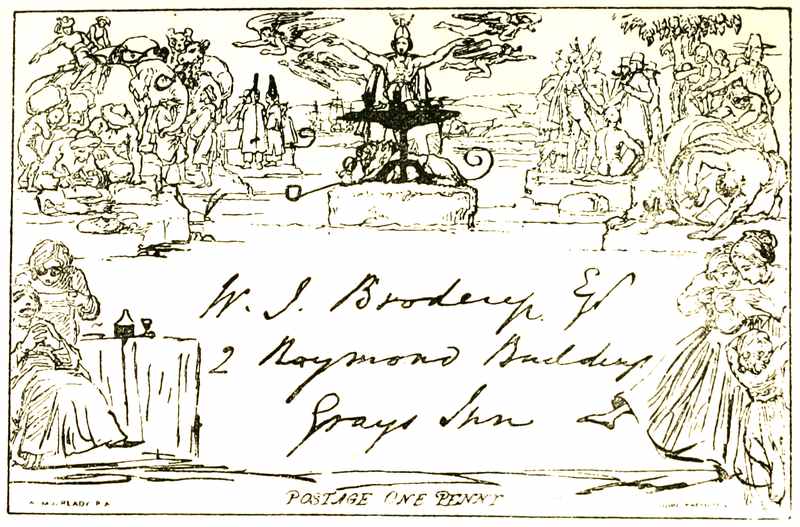
The envelope is addressed by Hook to his good friend Mr. Broderip,
the magistrate. The reader will observe the liberties taken with the
artist's design upon comparing it with a similar envelope in another
part of this work.
Deer Richud, i ham wiling to do hany thing for yew, hand
wuk day and night upon my ands hand neese to make yew
comfurtable, hand i think we cud be very appy, but do not
make a fowl hof me now, hand i will truss yew half my life;
hand my Muther his a woman well to doo, hand wen it pleses
Purvidence to tack her up hout of this wuld will leve us
sumthing for a raney day, which wud be a grate cumfut to
me, appen wen it may.
i pot this hin a buskett, hand have sent yew three fools
and a small Sammon cott this mawning, for yewer Sister
Lizy, wich altho i never seed hur i ham very fond hof from
yewer subscription on her,—hif she will haxcept the triffles
i shal be plesed, hand my love; hand wen yew are a heating
the fools, do nott forget her wich sent them.
Hif yew lick, yew can call on muther, wich is the darey
at the korner of Jon street, and tawk maters over with hur.
i am tird hof life down here without yew. i hope yew will
get this safe. I have got Tommus Wite to rite the redress,
not honely because he rites a good and, but to show im thatt
we hare frends.
do let me here from yew; and with true love and french-ship,
in wich yewer sister his inklewded, beleve me, deer
Richud,
Yewers internally,
Rachael Stubbs.
i ave pade the Courage hand Bucking.
(Births, Deaths, and Marriages, 1839.)
The poetry of Mr. Minus could be compared to nothing
but the dropping of honey upon rose leaves, or the fluttering
of moths round the smoke of cinnamon;—it was so flippant,
so sweet, and so trifling. He had a round of set rhymes and
ideas, which, like the man who walked out in the morning in
a dress of crimson and gold, because he had no other, he
perpetually was using; such as
"Coral lips and rolling eyes,
Roguish leers and heaving sighs,
Lily bosoms, seeking kisses,
Silent sighs for secret blisses;"
which species of versification having displayed al fresco after
dinner in lines "To a Mole upon Fanny's left knee;" "A
sonnet to half a jasamine flower;" "An ode to the wing of a
butterfly," and "An Epithalamium on the marriage of two
humming birds," (all of which were written, sung, composed,
and recited by himself) he obligingly sat down to the piano-forte
on their return, and gave the following air with infinite
effect:
Fanny's Bower.[60]
"Come, Fanny, I've raised a sweet bower,
With roses and lilies entwin'd;
Before it grows every flower,
A bedroom I've built you behind.
"Our couch is a cluster of roses,
And while we lay lost in the sweet,
The leaves will so tickle our noses,
The thorns shall lie under our feet.
"The sheets, both the lower and upper,
Are made from a pair of bees' wings,
Whose honey I've stole for your supper,
And carved with their sharp-cutting stings.
"To save us the trouble of thinking,
In dew-drops I'll pledge you, my best,
And when I am tired of drinking,
I'll sink on your bosom to rest.
"I'll study your taste to a tittle,
In torrents our pleasures shall pour,
For the girl once indulged with a little,
Will very soon languish for more!"
This Mr. Minus considered a chef-d'œuvre, and if he was
mistaken there was such a softness, a condescension and
pleasantry in his manners, as would have excused a more
serious error; as a companion, he was delightful; as a
man, honourable; and as a poet, fashionable.
In a late number[61] we somewhat unfeelingly (it is hinted
by a correspondent) doubted, and even sneered at, the
universal topic, the national distress, with which we are,
it seems, overwhelmed; and when any suggestions of our
friends (backed by truth and reason) can be attended to,
we are always delighted to avail ourselves of them, and
recant our errors.
We have reconsidered the subject, and, during the last
fortnight, have visited the most diversified scenes of life,
and we feel bound to retract the "flippant doubts"
(those are our communicant's words), which we expressed
as to the existence of general calamity, and are ready to
confess that we had no idea of its extent, particularly in and
about the metropolis.
The first object which tended to convert us from our
original prejudiced opinion on the subject, was the sight of
that most melancholy assemblage of people called "Epsom
Races." Upwards of fifty thousand of the most unhappy
of our fellow-countrymen, victims of tyranny and taxation,
no longer ago than the week before last, dragged
their wretched limbs to this sad and deplorable spectacle;
and the vast sums of money taken from some of them,
and the immense quantity of provisions and liquor which
the poorer part of the slaves were compelled to devour,
were unparalleled, we believe, on any former similar occasion.
It made our hearts bleed to behold our excellent and free-born
tailor driving, with great labour and danger, a tandem,
with two blood-horses; and we nearly wept when we found
that our bootmaker and his unhappy family could only afford
a barouche and four, hired for the day.
But we had, also, an eye to the agricultural part of the
question; and we were struck with horror and amazement
at the pale, emaciated, and threadbare appearance of the
broken-down farmers of Surrey, Berks, and Bucks, who
crawled out to the mournful scene upon their starving
ponies, for which some, in their despair for money, were
wild enough to ask seventy, eighty, and a hundred guineas
each.
At the inns on the road, the expenses the tax-ridden slaves
incurred were abominable. A hatter in Bond Street was
charged seventeen shillings a bottle for champagne; and a
wretched party of landholders in the neighbourhood of
Leatherhead, who have threatened to abandon their farms,
were driven by their grief to drink two dozen and four
bottles of that shameful imposition upon British credulity
called Chateau Margaux.
On our return from Epsom (having to cross the country)
we passed through Kingston. Woe, grief, and mendicity
there had established their tribunal. Petitions and remonstrances
were all in array; and, in order to give the
mourning victims of that devoted parish an opportunity of
assembling occasionally to grieve in unison, some sympathetic
philanthropists in the vicinity have built a theatre or
circus, wherein a Miss Hengler endeavours nightly to solace
their incurable woes, by dancing on wires, balancing
tobacco-pipes, and swallowing live cockchafers. Such an
expedient was never hit upon at this distance from town, till
the melancholy aspect of things in general pointed out the
absolute necessity of it in this wretched year.
During the week we thought we would go to some of the
London playhouses. We essayed Covent Garden. It was
Miss Stephens' benefit: "boxes full" stared us in the face;
the pit, too, was crowded with the more unfortunate classes
of society; and upon inquiring if we could make our way
into the gallery, we were told that both galleries had been
crowded with squalid wretches, in a state of actual starvation,
who had spent their last five shillings each that night
in paying for admission, for oranges, apples and nuts, which,
as everybody knows, is not the sort of food the noble and
free-born Briton is accustomed to. We sighed and crossed
the river, having been refused admission at Mathews's,
because the crowd of deplorable beggars who had sought
refuge in the Lyceum would admit of no increase.
At Astley's, a house we thought remote from woe, we
again applied. "There's standing-room at the back of the
boxes, sir," said a little round-shouldered man in black,
"but not a place in the pit or gallery." "Good heavens!"
we exclaimed, "and is there so general a calamity pervading
even the suburbs?" We turned into the road, where we
were stopped by a string of horsemen, and of gigs, carts,
and coaches, filled, inside and out, with the lowest and most
unhappy persons among the people, who had not chosen to
assuage their sorrows in the theatres, but had preferred to
indulge their tender sympathies in a fight, some twenty or
thirty miles from town, to which the circumstance of the
times had induced them to transport themselves at the
nefarious expense, perhaps, of two or three pounds each.
But what made us shudder still more, was seeing that they
were, for the greatest part, in a state of intoxication, to which
they had no doubt been urged by the disastrous acts of that
empty pretender to politics, Pitt,—that weak man, Lord
Londonderry,—or that misguided bigot, Peel,—or some
others of those who are, or have been, at the helm of the State.
Having got clear of these, we crossed the bridge, and
turned down to the House of Commons: the doors were
fast—no house. Tried at the Lords: their lordships had
adjourned at seven. "Ah!" said we, "this is a new proof
of the truth of our friend's suggestions: these are noble and
wealthy men; there is no distress here—no crowds—no
misery—no assemblage."
We were baffled in our attempt to get up the Haymarket,
several thousand unhappy persons having dressed themselves
in diamonds, and lace, and gold, and pearls, and feathers,
and flounces, to weep away the night, in the body of the
Opera House. And at the Duke of Devonshire's wall, we
were obliged to abandon our hackney-coach, into which we
had stepped at the corner of St. James's Street, to avoid the
crowd of carriages, which had brought an innumerable host
of distressed families to his Grace's hospitable roof, in order
that their immediate necessities might be alleviated by some
Italian singing and Ponche à la Romaine.
Some of the females of these wretched groups we happened
to encounter, and a more truly pitiable sight we never
saw; in the middle of the night were they straggling out of
the court-yard to look for their carriages, with clothes hardly
sufficient to cover them from cold, or answer the purposes of
common decency. To such straits our women are driven by
necessity.
Here our doctrine that even the highest were exempt from
sorrow fell to the ground, and we went to bed to dream of
woe.
Pursuing, the next day, our course through the town, we
dropped into the Somerset House Exhibition, where there
could not have been less than two thousand of our unhappy
fellow-creatures, who had paid, all of them, one shilling,
most of them two shillings, mewed up in close hot rooms,
with hardly space to move or breathe, and without the
smallest refreshment; nay, not even a crust of bread—not
even a drop of water to relieve them in their lamentable
condition.
At Belzoni's Tomb the mourners were in myriads; at the
Cosmorama several wretched-looking people were endeavouring
to pass their lingering hours by peeping through little
holes at coloured prints stuck against a wall. At the
Panorama—at the British Gallery, the same horrid scenes
were acting—the same deception was carrying on; and at
the Soho Bazaar it was quite moving to see the hundreds of
well-dressed suffering innocents who have been driven from
the best mercantile parts of the town to this secondary
quarter, merely because they are enabled, by this painful
humiliation, to purchase gauze, and coloured paper, and
bugles, and knitting-needles, and card-racks, and shuttlecocks,
and fiz-gigs, and the other necessaries of life, nearly one
hundred per cent. cheaper there than anywhere else in the
metropolis.
We passed from the neutral ground of Soho Square into
St. Giles's, where we saw an Irishwoman, somewhat elevated
with the private consolation of the afternoon, thumping her
husband about the head with a shoulder of mutton, because
he had bought it in preference to a leg, which she wished
for, while her four little starveling children (who had neither
beaver hats on their heads, nor red morocco shoes to their
feet), were playing with the motley tails of three full-sized
mackerel, upon which the famishing labourer had expended a
portion of his hard-earned wages, by way of supper, which
the poor creature had told his spouse he intended to take,
that it might give him an appetite for his next day's dinner.
Just above these, in a room, the windows of which were
open, were a set of unfortunate creatures, who had, in
happier days, named themselves the "Sons of Frolic;"
these wretched persons were suffering under the dreadful
effects of civil dissension, which always creeps in with
domestic distress. That type of kings, the parish beadle,
had been sent for by the overbearing landlord, to secure the
most active of three of the members, who had just kicked
the waiter down stairs for having brought them up a corked
bottle of port wine. These distressed tradesmen, however,
were so far imposed upon as to be induced to make up the
affair by a present of three guineas to the waiter, and a pound
to the beadle. Still, exclaimed we, accumulation upon
accumulation.
We found in all the dingy streets about those rural and
unfrequented parts of London, Bedford, Russell, Red Lion,
Bloomsbury, Tavistock, and Brunswick squares, the same
congregation of carriages standing (and lights were on the
tables in the eating-rooms of the houses) at different doors,
which proved to us that the most respectable families, at this
period of distress, are driven to club together to get food
upon a principle of economy.
This remote passage led us towards Islington. At a
melancholy place, quite on the outskirts of the town, called
White Conduit House, many thousands of our fellow-mourners
were congregated in the open fields; night, too,
was coming on, and the poor children were drinking milk
just as it came from the cow, while their parents, equally
wretched, but more experienced in sorrow, were swallowing
the same succedaneum, made into a mixture called syllabub.
At Sadler's Wells the grief was raving—we heard the
lamentations at the distance of half a mile—crowds filled
even the lobbies; and such is the pressure of national misfortune
at the moment, that a corn-factor was obliged the
night we were there to give fourteen shillings and sixpence,
hackney-coach-hire, to get his poor shivering wife and
daughters to their miserable cottage ornée, with a four-stall
stable, conservatory, and coach-house in the Kent-road.
We rested in our researches from that evening pretty well
till Whitsuntide, and then, indeed, conviction took full
possession of us.
To us who remember Greenwich park in the year 1792,
what a reverse!—then there were gaiety and sunshine, and
fun and amusement. In the first place, Whit-Sunday this
year was a wet Sunday,—a circumstance which, we are bold
to say, never occurred before the late Mr. Pitt's accession to
office, and very rarely even during his ruinous administration.
The conduct of the "talents" in this particular cannot be
cited, as only one Whitsuntide occurred during their splendid
career.
Our readers may conceive the gloom this oppressive mismanagement,
and evident disregard for the comforts of the
poor, threw over the quondam scene of gaiety; the people
surely might have been allowed to meet, and weep in comfort
in one of the Royal parks!
But if Sunday filled us with this feeling, what must
Monday have done, when nature interfering, to triumph over
the tyrants, gave the people a fine day? Then did we see
them loading every sort of vehicle, on the inner and outer
sides, driving horses, and donkeys, and ponies, and riding
them with all their speed and energy, to reach the once-loved
spot they had known in former days, and grieve all together
at our deplorable state.
When arrived there, how did they conduct themselves?
They threw themselves into the most extravagant postures,
rolling down hills, and running up again, throwing sticks
even at oranges and cakes, in hopes of getting something to
allay their hunger and thirst—some indeed we saw, decent-looking
persons, devouring with avidity fish, called eels,
who themselves (poor victims!) are driven to wallow in mud
for their food, and first skinned alive, are next cut to pieces,
and finally exterminated by the hands of cooks as men are
by ministers.—What a striking resemblance there is between
an Eel and an Englishman!
At Richmond sorrow put on her deepest sables—hundreds
of devoted persons were crammed into vessels, encouraged by
Government as packets at our outports, in which the danger
of being scalded to death, burnt alive, or blown to atoms, are
added to all the other little désagréments of the deep.
Steam-boats are what they call improvements. They may
be in this age of redundant population: but what Government
is there on earth, except ours, who, for the chance of thinning
an overstocked nation, could have had the barbarity to
allow these craft to ply on the seas and the rivers, which
must wound the feelings and invade the rights of those
established captains of colliers and owners of coal-barges,
who, for centuries before, used to make their voyages satisfactorily
to themselves, but whose pride is now destroyed,
and whose vessels are treated like petitioners when applying
for relief to the great and mighty. Away puffs the nobleman
and the steamer, and all the suffering coal-bargemen or the
needy applicant gets for his manual labour, is a sight of the
stern of either, and a tremulous sensation, caused by the
swell of their passing power.
But to return to the more immediate effects of misrule.
The commons and heaths round the metropolis were sought
out, to change the wretched scene; and Blackheath, Hampstead-heath,
Hornsey-wood, and Norwood, were covered with
flocks of the populace, who had quitted their houses in
despair, and in one-horse chaises.
They, and indeed all those particularly around London,
seemed to join in a determined manifestation of the crisis of
affairs, which might, if anything could, we should think,
show Ministers the destruction, to the brink of which they
have brought desponding England. The same threat, it is
true, has been held out to all preceding Ministers by sensible
Reformers for the last century and a half; and they, heartlessly
and senselessly, have, without feeling, disbelieved the
cry; but when, to all the calamities of peace, are added that
curse of nations, plenty, the blow naturally received by an
increasing revenue, and a decreasing expenditure; and, above
all, the heartrending proofs of popular misery, which we
have here selected; we think the present administration,
which has reduced us to this debased, degraded, and unhappy
state, will take warning in time. We give them fair notice—we
have done our duty in bringing the matter before them—we
shall say no more—if they are not wise enough to take a
hint, why "there's an end on't," and we give them up.
Dilworth's instructions to little boys and girls direct them
"never to be greedy, or swallow large pieces of meat, or eat
hot pudding." He, moreover, cautions them against many
little improprieties which shall be nameless; and concludes
with this impressive admonition—"never pick your nose in
company."
We have not room for all the instructions in the Scots
paper, which occupy more than three columns; but we shall
quote one or two, which appear the most important.
"Directions for going to a Levee.—Full suit, bag, sword—hair
powder is not held to be indispensable.
"Each individual will have two cards, one of which will
be taken care of by the pages in the ante-chamber, who will
have the care of the 'Court Record.' The stranger will then
walk through the suite of departments till he finds himself in
that immediately joining the presence chamber."
This, it will be perceived, is quite in the Dilworth style,
excepting that, instead of "not picking his nose," the pupil
is here directed to follow it; which, if he did, he would
arrive at the room he wanted, without such an elaborate
description.
The account of the reception the stranger is to expect is
not prepossessing, although correct enough in point of
fact:—
"The person on coming up to his Majesty drops one knee
to the King—the crowd being great he is immediately pushed
forward."
This our readers will perceive (as it is expressed), must
immediately upset him at his Majesty's feet; and the great
difficulty, instead of not picking his nose, will be "not to
break his nose in company." A consolation is offered to the
patient hereabouts, which is soothing enough:—
"He may pay his respects en passant to any of the Cabinet
Ministers with whom he is acquainted."
A privilege not confined, we conclude, to the place or
occasion. The truth is, that when the patient is up and off
his knees, he may expect to be pushed forward. At least,
we suppose, it is not intended, as the Star expresses it,
that he is to be pushed forward while on them, because a
more inconvenient opportunity of changing the form of presentation
could not have been selected, than when so many
gentlemen are likely to appear in the Highland costume.
The mode of preventing a crowd at a Levee, which the
Star mentions, is new and ingenious:—
"Every gentleman may appear in the dress of his regiment,
but it must be full dress, viz., a coat with skirts, etc.: any
person may easily see that unless some regulation of this
sort were enforced, the King's Levees would, on all occasions,
be crowded to an extent altogether destructive of comfort."
We do not see the force of this regulation, we confess.
Farther on we perceive this:—
"It is understood that Glengarry, Breadalbane, Huntley,
and several others, mean to attend the Levee 'with their tails
on.'"
This, to a Southron, sounds very odd; and the omission
of the Duke of Hamilton's name, on such an occasion, would
appear still more strange, if we did not explain that it is a
mere phrase, and indicates the proposed attendance of
dependants upon their chieftains.
We are fearful, however, that if these nobles bring their
tails with them, the regulation about wearing skirts will be
rendered unavailing, and that the skirts without tails, and the
tails without skirts, will have a good tough squeeze of it after
all.
The directions for the conduct of the ladies, upon the
present occasion, are clearer and more defined:—
"Ladies are introduced to the King either by Ladies who
have already been at Court, or by the Lord in Waiting. The
Lady drops her train (about four yards in length) when she
enters the circle of the King. It is held up by the Lord in
Waiting till she is close to his Majesty. She curtsies. The
King raises her up, and salutes her on the cheek. She then
retires, always facing the Sovereign till she is beyond the
circle. A considerable difficulty is presented to the inexperienced
by the necessity of retiring (without assistance)
backwards. The ladies must exert their skill to move their
trains quietly and neatly from behind them as they retire;
and those who have never worn such dresses should lose no
time in beginning to practise this. Most painful must the
situation be of a young female who is so unfortunate as to
make a faux-pas on such an occasion. It was by no means
so difficult when hoops were in fashion; but now that these
have been discarded there is nothing to assist in keeping the
train off the ground. The ladies cannot require to be
informed that they must all appear in Court plumes and fans.
At least nine feathers must be in each head-dress."
It will be observed, that the ladies are literally to come
with their tails on, as the gentlemen are metaphorically; and
the instructions how to "enter the circle of the King" are all
plain enough; but subsequently we are involved in a dilemma,
from the fact that part of the instructions appear to have
been borrowed from a section of Dilworth, which we should
not have ventured to quote.
"A considerable difficulty is presented to the inexperienced
by the necessity (without assistance) of retiring backwards."
Now, retiring forwards, at any time, is a difficulty, and
better suited to the Irish than the Scottish Court; and therefore,
as all retiring must be going back, we are so dull as not
to see why "retiring backwards" (the very phrase used in
Dilworth) has anything to do with the "necessities" of the
moment.
The ladies are warned, it will be perceived, when the
necessity of retiring backwards comes upon them, to "move
their trains quietly from behind them," and they are desired
to practise this manœuvre. This is careful and decent, and
highly worthy of commendation, but the caution which
follows seems outrageous:—
"Most painful must be the situation of a young female
who is so unfortunate as to make a faux-pas on such an
occasion."
Dear heart! what could the Star have been dreaming of?
We have heard, in private letters from Edinburgh, that the
King's visit has turned the heads of everybody in that city;
and, therefore, we think the Star worthy of much praise
for endeavouring to teach them which way to turn their tails:
a lesson which, we trust, will be as profitable to them as it
has been amusing to us.
AN ILLUSTRATIVE HISTORY OF ONE DAY.
In order to carry herself gracefully, and turn out her toes
in after times, the young pupil of the dancing-master is
placed diurnally upon a board, so contrived as to keep her
delicate feet extended at right angles with its sides; and,
with her chest expanded, and her head erect, the dear little
creature is made to stand for a certain period of every morning,
Sundays excepted. This is all very well in early youth,
and the pains endured in those days are amply repaid by the
admiration she afterwards excites at Almack's by the gracefulness
of her air and manner, the carriage of her body, and
the symmetry of her figure. Wretched, indeed, would be
the fair sufferer's case were she doomed from her teens
to her death to stand in the same little stocks, and
never enjoy the more liberal pleasures of her dancing days.
Such is the melancholy state of a considerate "saint,"—and
consider he must; for, if he considereth not, he sins.
But to my history.
A gentleman, plain, pious, and excessively virtuous (such
has ever been our aversion from mentioning proper names,
that we decline saying who), resident, however, in a suburban
villa, with a well-mown lawn in front, and charmingly-clipped
evergreens standing thereupon, a bright-yellow gravel
sweep to the door, a shining weathercock on the coach-house,
a large dog in the yard, an old peacock on a rail, and
a couple of enormous shells on either side of the entrance
steps,—a gentleman, we say, resident in such a house,
having descanted upon the horrors of slavery, lighted, last
Tuesday evening, his bedroom candle, and betook himself to
rest, his exemplary partner having preceded him thither after
family prayers. To doubt the quiescence of such a couple,
to imagine that anything could ruffle their serenity, or disturb
their slumbers, would be to libel the fraternity to which
our excellent friend belongs.
In the morning the exemplary man arose; and the first
thing he did when he went down stairs, was to look into his
hot-house, where he carefully examined a specimen of sugar-cane
which he had planted some months previously, with a
view to the cultivation of free sugar upon Dartmoor. He
then sat down to breakfast with his lady.
"Dear Rachel," said the exemplary man, "how excellent
this free sugar is. You get this, I presume, of William
Heywood?"
"To be sure, my dear," replied the partner of his joys.
"It is gratifying to think," said the husband, "that no
slave has been flogged to produce this."
Saying which, the mild and humane gentleman dropped a
lump of it into a cup of chocolate, upon which excellent
beverage, or the slave-labour required to cultivate it, he made
no observation.
"I have but one fault to find with free sugar," said the
lady, sighing.
"Name it," said the saint.
"It is fourteen-pence a pound, my love," said his spouse,
"and we can get better anywhere else for ten-pence."
"That signifies little, my dear," said the saint, "provided
we use nothing that has cost the slave torture." And then
he blew his nose with a cotton pocket-handkerchief. "Confinement
and slavery," continued the pious man, "are incompatible
with humanity and feeling." Saying which, he
walked up to the cage which held his lady's Jamaica parrot,
and indulged the moping captive with a lump of Heywood's
"free and easy."
At this moment his dennett was announced, and, rising
from his bamboo-chair, he proceeded to leave ten guineas
with his lady for a charitable donation;—he put on his hat
and gloves, and his amiable partner having attended him to
the door, as he stepped into the vehicle, expressed her tender
fears lest the slightness of the shafts should endanger her
exemplary husband's neck.
"They look very slight, dearest," said the "saint;"
"but they are perfectly secure, they are made of lance-wood!"
Consoled by this intelligence, she waved her lily hand, and
our pious friend went to attend a meeting of shareholders of
the Anglo-Mexican Mining Company, where he paid up his
instalments, without taking the precaution of considering
what class of labourers must necessarily be employed in
working the mines. He proceeded thence to the sale of
East India produce, where he made several purchases, not
troubling himself to inquire how indigo flourished, or rice
grew; and, meeting on his way a director of the opulent
Leadenhall monopoly, accepted an invitation to dine with him
at the City of London Tavern.
Here he of course found an excellent dinner spread upon a
table of mahogany; his chair was of the same material. He
was helped to turtle and ate it with a silver spoon. To
gratify his palate he drank ever and anon iced punch, sweetened
he asked not how, and strengthened with rum. Over
his turbot he sprinkled Cayenne pepper, and flavoured his
cucumber with Chili vinegar. With a curry he called for hot
pickles, and having in the dessert refreshed himself with
some excellent preserved ginger, took a cup of coffee, and
concluding with a small glass of noyeau, stepped again into
his dennett, and reached his villa in safety, blessing the
names of Buxton, Wilberforce, and Macaulay, and receiving
the tender compliments of his affectionate wife upon the
virtue of drinking nothing but free sugar.
And this is what five hundred persons do, under the
guidance of the Liverpool speculators, and the leaders of
apes and asses in this metropolis. Let us merely point out
to such of our readers who like the followers of cant, and
will not take the trouble of thinking for themselves, those
inconsistencies which one day's adventures of our pious
"saint" develop.
Had he acted upon principle instead of policy, this
exemplary old body would have remembered that rum
and coffee, as well as sugar, are the produce of slave-labour,—that
his morning's chocolate and his afternoon's
liqueur have the same origin; he would neither have ventured
to trust to his lance-wood springs, nor have dared to
blow his nose with his cotton handkerchief; neither would
he in the morning after his hearty dinner, have been prevailed
upon to take a little tamarind drink to cool his
constitution, nor have allowed his apothecary to suggest an
exhibition of castor-oil if his indigestion continued; but even
if he had overcome these scruples, how would he have
summoned sufficient fortitude to put into circulation his
sovereigns and shillings, which, although our only circulating
medium, are furnished by the labour of slaves, chained to
their horrid work, lest they should risk the punishment of
death by endeavouring to escape the toil and climate to
which they are consigned.
It is with the slavery question as it is with the over-refinement
of all other feelings,—it only requires to be
looked into and analysed to be detected in all its flagrant
folly and absurdity. Had our pious "free and easy" sugar
friend followed up his own doctrine, he would long before
this have quitted his villa, disposed of his dennett, and retired
to some cave, where neither eating nor drinking, nor
furniture dyed with fustic and logwood, were required, and
have shown himself a sincere saint, an abjurer of all the
good things of this world, and a man of ten thousand; but
until we see the whole life of a man in the same keeping,
and find him equally scrupulous upon all points, and not
exhibiting his piety only where his mercantile prospects are
implicated, we must beg to avow our opinion that the "free
and easy" sugar system at fourteen-pence per pound, however
profitable to the grocer, and gratifying to the East India
proprietor, is neither more nor less than a contemptible
absurdity, and a most unqualified humbug.
It would appear that the German publishers are before
even our own in the arts of the puff; at least we have not
yet seen a "fashionable novel" of the Burlington Street
manufactory ushered into public life with the trumpetings
of a first-rate English author. This "celebrated tour," as
the advertisements style it, has, however, the advantage of a
preliminary flourish from no less a person than Meinherr
von Goethe, who, among other things, extols the tourist
for the accuracy of his descriptions of English scenery and
society, particularly "the hunting-parties and drinking-bouts,
which succeed each other in an unbroken series," and which
"are made tolerable to us" (i. e. M. Goethe) "only because
he can tolerate them." "The peculiarities of English manners,"
continues the puff, "are drawn vividly and distinctly,
without exaggeration;" but how the sage of Weimar should
have fancied himself qualified to form so decided an opinion
upon the accuracy of his protegé, we do not presume exactly
to understand; inasmuch as we have reason to believe that
he has suffered eighty-three years of his youth to slip away
without availing himself of an opportunity of judging of our
peculiarities from personal experience.
"Like other unprejudiced travellers of modern times, (he proceeds)
our author is not very much enchanted with the English form of
existence—his cordial and sincere admiration is often accompanied by
unsparing censure.... He is by no means inclined to favour
the faults and weaknesses of the English; and in these cases—(what
cases?)—he has the greatest and best among them,—those whose reputation
is universal,—on his side.
"The great charm, however, which attaches us to his side, consists
in the moral manifestations of his nature, which run through the book:
his clear understanding, and simple natural manner, render him highly
interesting. We are agreeably affected by the sight of a right-minded
and kind-hearted man, who describes with charming frankness the
conflict between will and accomplishment!" (What does the Patriarch
mean?)
"We represent him to ourselves as of dignified and prepossessing
exterior. He knows how instantly to place himself on an equality with
high and low, and to be welcome to all;—that he excites the attention
of women is natural enough—he attracts and is attracted; but his
experience of the world enables him to terminate any little affaires du
cœur without violence or indecorum."
We shall presently enable the reader to judge for himself
as to some points of this eulogy. Meantime, we turn the
leaf, and find a second flourish from—the translator of these
wonderful letters.
"A rumour," says this cautious and disinterested critic, "has ascribed
them to Prince Puckler-Muskau, a subject of Prussia, who is known to
have travelled in England and Ireland about the period at which they
were written. He has even been mentioned as the author in the Berlin
newspapers: as, however, he has not thought fit to accept the authorship,
we have no right to fix it upon him, though the voice of Germany
has perhaps sufficiently established his claim to it. At all events, the
Letters contain allusions to his rank which fully justify us in ascribing
them to a German Prince."
After Goethe and the translator, or, in German phrase,
oversetter, comes the editor!—who, in the midst of some
would-be-pathetic cant, drops two bits of information, both
entirely false; namely, that "the letters, with very few and
unimportant exceptions, were written at the moment;" and,
secondly, that "the author is dead!" The editor adds that
there actually exist four volumes of this correspondence, but
from "various circumstances, which cannot be explained, it
has been found necessary to publish the two last volumes
first;"—the pair, as yet unprinted, containing his highness's
opinions and illustrations of London society, as these, now
before us, exhibit the "manners and customs" of the provinces,
and of Ireland.
As to the alleged demise of the author—Shakspeare
mentions a certain class of persons who "die many times
before their deaths;" and perhaps his highness may have
thought it as well to feel his ground with our provinces
before venturing upon what he calls "the grand foyer of
European aristocracy." However—unless the whole affair
is an impudent juggle—we are justified in fixing this performance
upon the Prince Puckler-Muskau; and we only
wonder how any English reviewer of the book could have
hesitated about doing so, provided he had read as far as
page 284 of the first volume, where we find our "German
prince" at Limerick, in company with Mr. O'Connell, a
relation of the great agitator.
"We quitted the church, and were proceeding to visit the rock near
the Shannon, upon which the English signed the treaty after the battle
of the Boyne—a treaty which they have not been remarkably scrupulous
in observing. I remarked that we were followed by an immense
crowd of people, which increased like an avalanche, and testified equal
respect and enthusiasm. All on a sudden they shouted, 'Long life to
Napoleon and Marshal ——.' 'Good God,' said I, 'for whom do
the people take me? As a perfectly unpretending stranger I cannot in
the least degree understand why they seem disposed to do me so much
honour.' 'Was not your father the Prince of ——?' said O'Connell.
'Oh no,' replied I; 'my father was indeed a nobleman of rather an
older date, but very far from being so celebrated.' 'You must forgive us
then,' said O'Connell, incredulously; 'for, to tell you the truth, you
are believed to be a natural son of Napoleon, whose partiality to your
supposed mother was well known.' 'You joke,' said I, laughing: 'I am
at least ten years too old to be the son of the great emperor and the
beautiful princess.' He shook his head, however, and I reached my inn
amid reiterated shouts. Here I shut myself up, and I shall not quit
my retreat to-day. The people, however, patiently posted themselves
under my windows, and did not disperse until it was nearly dark."
We make no apology for anticipating here the arrival
of his highness at Limerick, because, by showing in the
outset the mistake that Mr. O'Connell made between the
titles of Prince de la Moscowa and Prince Muskau, we
establish at once the identity of Goethe's "unprejudiced
traveller," and a "right-minded" and "decorous" terminater
of affaires de cœur—of whom many of our readers have had
some personal knowledge—and whose imposing mustachios
are still fresh in our own recollection. The cold nights of
November do not more surely portend to the anxious sportsman
in the country the approach of woodcocks, than do the
balmy zephyrs of May foretell the arrival of illustrious
foreigners in London; each succeeding season brings its
flock of princes, counts, and barons, who go the ordinary
round of dinners, assemblies, concerts and balls; yawn each
of them one night under the gallery of the House of Commons;
one day take their position on the bench at the Old
Bailey; visit the Court of Chancery; snatch a glimpse of
the House of Peers; mount St. Paul's; dive into the
Tunnel; see Windsor; breakfast at Sandhurst; attend a
review on a wet morning in Hyde Park; dance at Almack's;
try for an heiress—fail; make a tour of the provinces;
enjoy a battue in Norfolk; sink into a coal-pit in Northumberland;
admire grouse and pibrochs in Scotland; fly along
a rail-road; tread the plank of a steam-packet, and so
depart,—"and then are heard no more."
Such was this Prince Puckler-Muskau; and such were
his qualifications and opportunities for depicting that
"strange insular life which" (according to the clear and consistent summary
of M. Goethe) "is based in boundless wealth and civil freedom, in
universal monotony and manifold diversity—formal and capricious,
active and torpid, energetic and dull, comfortable and tedious, the envy
and the derision of the world!"
His first letter, addressed, as all his letters are, to his
"dear Julia,"—(that is to say, no doubt, his highness's
consort, Princess Puckler, to his alliance with whom, we
believe, he owed his princeship)—is dated Cheltenham,
July 12, 1828; and the first observation which his highness
is pleased to make upon his arrival at that popular watering-place
is one of a mixed character, political, statistical, and
philosophical, whence may be derived a tolerably fair estimate
of his highness's accuracy and knowledge of "things in
general." He is describing to his "dear Julia" the nature
and character of the distress amongst the lower orders in
England, and its causes and origin.
"The distress," says his highness, "in truth, consisted in this: that
the people, instead of having three or four meals a day, with tea, cold
meat, bread and butter, beefsteaks, or roast meat, were now obliged to
content themselves with two, consisting only of meat and potatoes. It
was, however, just harvest time, and the want of labourers in the fields
so great, that the farmers gave almost any wages. Nevertheless, I was
assured that the mechanics would rather destroy all the machinery and
actually starve, than bring themselves to take a sickle in their hands, or
bind a sheaf, so intractable and obstinate are the English common people
rendered by their universal comfort, and the certainty of obtaining employment
if they vigorously seek it. From what I have now told you,
you may imagine what deductions you ought to make from newspaper
articles."
This valuable information is followed by an anecdote:—
"Yesterday, 'entre le poire et le fromage,'"—(at what period of a
Cheltenham dinner that might be, his highness does not condescend to
explain)—"I received the twice-declined visit of the master of the
ceremonies, a gentleman who does the honour of the baths, and exercises
a considerable authority over the company of an English watering-place,
in virtue of which he welcomes strangers with most anti-English
officiousness and pomposity, and manifests great care and zeal for their
entertainment. An Englishman invested with such a character has
mauvais jeu, and vividly recalls the ass in the fable, who tried to imitate
the caresses of the lap-dog. I could not get rid of my visitor till he had
swallowed some bottles of claret with me, and devoured all the dessert
the house afforded. At length he took his leave, first extorting from me
a promise that I would honour the ball of the following evening with my
presence. However, I had so little inclination for company and new
acquaintances, that I made faux bond, and left Cheltenham early in the
morning."
Who the master of the ceremonies at Cheltenham, thus
uncourteously likened by his highness unto an ass, may be,
we have not the advantage of knowing; but certain it is
that, however derogatory such an office might at first sight
appear, the characters and profession of some of the individuals
filling it prove that it is not so considered; and it is,
at all events, highly improbable that a gentleman, paying
an official visit to a foreign prince, would force his society
upon his illustrious host for a sufficient length of time to
drink several bottles of claret; and still more improbable
is it that any man—gentleman or not—could contrive to
"devour all the dessert the Plough at Cheltenham afforded,"
at a sitting. If, however, the arbiter elegantiarum of
Cheltenham did really conduct himself in the manner
described, he followed the example of Hamlet with the
daggers,—he spoke of ceremony, but used none.
At page 14, we reach Llangollen, where his highness
is pleased to make an observation, which, coming from a
prince, sounds strange. He tells his Julia that "where he
pays well, he is always the first person!" "We represent
him to ourselves (quoth Goethe) as of a dignified appearance;"
but the landlords and waiters seem to have wanted
such discrimination. He then informs us—
"that his appetite, enormously sharpened by the mountain air, was most
agreeably invited by the aspect of the smoking coffee, fresh guinea-fowls'
eggs, deep yellow mountain butter, thick cream, 'toasted muffins' (a
delicate sort of cake eaten hot with butter), and lastly, two red spotted
trout just caught; all placed on a snow-white table-cloth of Irish
damask;—a breakfast which Walter Scott's heroes in 'the highlands'
might have been thankful to receive at the hands of that great painter
of human necessities. 'Je dévore déjà un œuf.'—Adieu!"
It is laid down by Hannah, in "Hamilton's Bawn," that a
captain of a horse
"has never a hand that is idle;
For the right holds the sword, and the left holds the bridle;"
and we infer, from the animated account given by his
highness of his own activity, that he must have been either
a dragoon or a hussar, for, while with one hand he is
describing to the sentimental Julia the delights of his breakfast,
he is, by his own showing, actually eating an egg with
the other.—His notion of being served with guinea-fowls'
eggs we presume to have arisen from the price which the
innkeeper charged for them, for although eggs are plenty
in Wales, princes are scarce; but what his highness means
by describing Sir Walter Scott as a great painter of human
necessities, is quite beyond us.—After breakfast, he impudently
intrudes himself on Lady Eleanor Butler and Miss
Ponsonby, and quizzes them and their pretty cottage in
a style which, all the circumstances considered, one might
almost be tempted to call brutal. Those amiable spinsters
are, however, no more—and we may pass on.
By a reference to page 27, we find that his highness slept
"admirably," on the night of the 15th of August, at his inn
in Wales, where he describes himself sitting at the window,
looking at the sea, and the ships thereon. "On the landward"—whatever
that means—he says, "rises a castle of
black marble, surrounded by ancient oaks." And in this retirement
he finds, "very unexpectedly,"—we should think so,—a
"thin" friend of his, with "magnificent calves, elegantly
dressed;" a gentleman who is "so good-natured and yet so
sarcastic, so English and yet so German," etc., etc.; and this
so delightful personage tells him a story, which, in order
to fill up a certain number of pages, his highness is good
enough to repeat, though it contains nothing worthy of
notice, except an ill-natured slap at the poor Duke of
St. Albans, who treated him with every mark of civility
when he was in England.
His highness is tempted to visit the marble castle which
he has seen from his window, and is "remarkably well
received there."
"The bells of the various rooms," says his highness, "are suspended
in a row on the wall, numbered, so that it is immediately seen in what
room any one has rung; the sort of pendulum which is attached to each
wire continues to vibrate for ten minutes after the sound has ceased, to
remind the sluggish of their duty."
"The females of the establishment," continues his highness, "have
also a large common room, in which, when they have nothing else to do,
they sew, knit, and spin; close to this is a closet for washing the glass
and china, which comes within their province. Each of them, as well as
of the man-servants, has her separate bed-chamber in the highest story.
Only the housekeeper and the butler have distinct apartments below.
Immediately adjoining that of the housekeeper, is a room where coffee is
made, and the store-room, containing everything requisite for breakfast,
which important meal, in England, belongs specially to her department....
Near the butler's room is his pantry, a spacious fire-proof room
with closets on every side for the reception of the plate, which he cleans
here, and the glass and china used at dinner, which must be delivered
back into his custody as soon as it is washed by the women. All these
arrangements are executed with the greatest punctuality. A locked
staircase leads from the pantry into the beer and wine cellar, which is
likewise under the butler's jurisdiction."
Of the cordiality of his highness's reception at the marble
castle we have no doubt; but he leaves us in the dark
as to whether he had been the guest of the housekeeper
or the butler, though we confess we rather incline to the
former, not only because, according to his guarantee, the
author of the "Sorrows of Werter," he attracted women and
was attracted by them, because he refers, with something of
a regretful feeling, to the "locked staircase" of the wine-cellar:
had the butler been at home, there is every reason
to hope that his highness would not have found it closed
against him, but, like another Archer, would have been
kindly welcomed by the Cambrian Scrub.
His highness next visits a slate-quarry, over which he tells
us it "took him a considerable time to take even a hasty
glance." He then gives us the average of casualties which
happen annually, and breaks off into a profane medley of
nonsense, impiously entitled "Reflections of a Pious Soul,"
upon which we decline commenting, lest we should be
compelled to extract even the smallest portion of it.
In his highness's account of Carnarvon Castle we are
favoured with an historical fact so interesting and so new
withal, that we must extract it bodily, from page 77; which
page is moreover ostentatiously headed, "Origin of the Prince
of Wales's Motto."
"On descending, my guide showed me the remains of a vaulted
chamber, in which, according to tradition, Edward II., the first Prince
of Wales, was born. The Welsh, in consequence of the oppressions of
English governors in the earlier times of partial and momentary conquest,
had declared to the king that they would obey none but a prince of their
own nation. Edward therefore sent for his wife Eleanor in the depth of
winter, that she might lie-in in Caernarvon Castle. She bore a prince;
upon which the king summoned the nobles and chiefs of the land, and
asked them solemnly whether they would submit to the rule of a prince
who was born in Wales, and could not speak a word of English. On
their giving a joyful and surprised assent, he presented to them his newborn
son, exclaiming in broken Welsh, Eich dyn! i.e., 'This is your
man!' which has been corrupted into the present motto of the English
arms, Ich Dien."
It seems hardly worth while detailing the true history
of this motto, since every child knows it—yet to prove,
on the spot, the deplorable ignorance of this pretender,
every child does know that the distinguishing device of
the Prince of Wales (having nothing to do with the English
arms), viz., the plume of three ostrich feathers, with the
motto Ich Dien, which, in Prince Puckler's own mother-tongue,
signifies 'I serve,' was assumed by Edward the
Second's grandson, the Black Prince, in memory of the
death of John, king of Bohemia, the lawful owner of the
said device, in the battle of Cressy. One might have
expected a little heraldry at least from the Château of
Thonderdentronck.
Ten pages of stupid blasphemy bring us to page 88, where
the baser propensities of his mind give place to its overweening
passion—personal vanity. The hero of "moral manifestations"
thus confides to his dear princess the conquest
he has made of a bar-maid at Bangor:—
"I had read thus far when the little Eliza appeared with my breakfast,
and with an arch good-nature bid me good morning 'after my
long sleep.' She had just been to church, had all the consciousness of
being well dressed, and was waiting upon a foreigner; three things
which greatly incline women to be tender-hearted. She accordingly
seemed almost embarrassed when I inquired about my departure early
the following morning.... After dinner I went, under her guidance,
to visit the walks round the town. One of these is most romantically
placed on a large rock. We saw from hence Snowdon, in almost transparent
clearness, undimmed by a single cloud.... After this
pastoral walk, tender mutton closed the day."
Who is not inclined to exclaim with the Welsh, according
to his highness's version, "Eich dyn!" This is your man!
Skipping some more blasphemies, we find ourselves at
Kennell Park, the seat of Colonel Hughes.
"Towards evening," says his highness, "I arrived at the house of my
worthy colonel—a true Englishman in the best sense of the word"
(from being a Welshman, we presume). "He and his amiable family
received me in the friendliest manner. Country gentlemen of his class,
who are in easy circumstances, (with us they would be thought rich,)
and fill a respectable station in society; who are not eager and anxious
pursuers of fashion in London, but seek to win the affection of their
neighbours and tenants; whose hospitality is not mere ostentation;
whose manners are neither 'exclusive' nor outlandish, but who find
their dignity in a domestic life polished by education and adorned by
affluence, and in the observance of the strictest integrity; such form the
most truly respectable class of Englishmen. In the great world of
London, indeed, they play an obscure part; but on the wide stage of
humanity, one of the most noble and elevated that can be allotted to
man. Unfortunately, however, the predominance and the arrogance of
the English aristocracy is so great, and that of fashion yet so much more
absolute and tyrannous, that such families, if my tribute of praise and
admiration were ever to fall under their eye, would probably feel less
flattered by it, than they would be if I enumerated them among the
leaders of ton."—Pp. 137, 138.
Little did his highness think that a few short months only
would elapse before the brow of his "worthy colonel, filling
a respectable station in society," would be encircled with
a baronial coronet; little did he imagine that his "country
gentleman," who "played an obscure part" in London, was so
soon to be converted into one of the "leaders of ton," from
amongst whom he had so flatteringly excluded him; little
did he think that his hospitable friend was destined so soon
to adorn the British peerage as Lord Dinorben.
On the 5th of August he walked, while all the rest of the
family were yet in bed, "with the charming little Fanny, the
youngest daughter of the house, who is not yet out."—"She
took me," says his highness, "round the park and garden,
and showed me her dairy and aviary." His highness then
describes the dairy, which, we presume, from a laudable
desire of the "worthy colonel" to bring the article into fashion,
is surrounded with lumps of copper, forming "a gorgeous bed
for rare and curious plants." His highness enumerates the
comforts of the colonel's cocks and hens, and the ducks and
the pigeons—he feels at the sight thereof a fit of "pastoral
sensibility" come over him, and "turns homewards to get
rid of his fit of romance before breakfast:"—"Miss Fanny,"
he adds, "exclaimed, with true English pathos,
'We do but row,
And we are steered by fate.'"
"Yes, indeed, thought I," says the prince, "the little philosopher
is right—things always turn out differently from what
one intends, even in such small events as these." What "the
little philosopher" meant by her pathetic exclamation, we
cannot, of course, divine; nor what his highness alludes to
as an event; but the story, as his highness has here printed
and published it, may serve as a caution to Lord Dinorben
how he suffers the familiar visits of princes, and subjects
himself to the jokes of such illustrious personages as feel
themselves privileged, in return for the honour they confer
upon him by their presence, to laugh at his "want of ton,"
and ridicule the kindnesses which "people of his class"
are so apt to bestow.
After dinner the prince tells us that he mounted the
colonel's horse—"unwearied as a machine of steel,"—(copper
would have been as fair a simile):—he gallops over the
stones, up hill and down,—
"leaps with undisturbed composure over the gates which continually
intercept my way across the fields and tires me long before he feels
the least fatigue himself. This, to me, is the true pleasure of riding—[a
friend's horse]—I love to traverse mile after mile of country which I
had never seen before, where I know not whither I am going, and must
find out my way back as I can."
But will it be believed, notwithstanding the comfort, the
good cheer, the aviary, the dairy, the untireable horse, etc.,
etc.,—the prince, although he had promised to stay with
the "worthy colonel" for some weeks, gets amazingly bored,
and "therefore took leave;" and had been, as he intimates, so
genêd by Kennell Park, that, proceeding from it to the house
of "another gentleman who had invited him," he makes his
visit "of some hours instead of days."
This grateful recipient of Cambrian hospitality is presently
discovered at the seat of Mr. Owen Williams, where he is
obliged to amuse himself "after dinner with reading the
newspaper." This slur upon the gaiety and conviviality of
Mr. Williams's table must be as groundless as is an assertion
which he also hazards, that there was nothing for dinner but
fish—and that after dinner oysters formed the dessert. But
whether it be true that his highness felt dull and was driven
to the newspaper, or not, glad we are that he has said he
was; for he favours us with an extract from the journal,
whatever it might have been, which affords a new and convincing
proof of the universal correctness of his highness's
information and remarks:—
"In this vast desert [the newspaper] I met with only one thing which
I think worth quoting to you. The article treated of the speech from
the throne, in which were the words 'The Speaker is commanded to
congratulate the people on their universal prosperity.' 'This,' says
the writer, 'is too insolent; openly to make a jest of the miseries
of the people.' It is indeed a settled point, that truth is never
to be expected in a speech from the throne; and if ever a king were
mad enough to wish to speak the real truth on such an occasion, he
must begin his speech, 'My knaves and dupes,' instead of the wonted
exordium, 'My lords and gentlemen.'"
That no such words appeared in any king's speech as
those which his highness is pleased to comment upon, we need
not take the trouble to say; but it is rather strange, since
we have already recorded his highness's view of the real
causes of popular distress in this country, that he should so
entirely coincide in the vindictiveness of the supposed newspaper
upon the fictitious expression.
We next find the prince visiting Colonel Hughes's copper-mines;
and, while he is standing by the furnace, he receives
an invitation from the colonel's brother, the major-commandant
of the loyal Chester local militia, to dine with him.
His highness not only declines the invitation, which he was
quite at liberty to do, but sneers at the hospitality which
was offered him; and forthwith starts from Lord Dinorben's
copper pots for Holyhead, to embark for Dublin; where,
after a dose of sea-sickness, he arrives in good preservation.
He says—"As I knew not what else to do—(for all the
notables who inhabit the town are in the country)—I visited
a number of show-places; and among the first was the
theatre,—a very pretty house, with a somewhat less rough
and obstreperous audience than in London!" Eich dyn!
The descriptions which the "attracting and attracted"
prince gives to "Julia" of his little adventures during his
rides upon the horses of his friends are edifying. In Wales
he discovers a sylph weeding in a field, half naked, but "shy
as a roe, and chaste as a vestal." In Ireland he meets with
another interesting female, whose personal and mental
qualities he thus details to his "beloved soul:"—
"The scene was yet further animated by a sweet-looking young
woman, whom I discovered in this wild solitude, busied in the humble
employment of straw-plaiting. The natural grace of the Irish peasant-women,
who are often truly beautiful, is as surprising as their dress, or
rather the want of dress; for though it was very cold on these hills,
the whole clothing of the young woman before me consisted of a large
very coarse straw hat, and literally two or three rags of the coarsest
sackcloth, suspended under the breast by a piece of cord, and more than
half disclosing her handsome person. Her conversation was cheerful,
sportive, and witty; perfectly unembarrassed, and, in a certain sense,
free; but you would fall into a great error if you inferred from that
any levity or looseness of conduct. The women of this class in Ireland
are, almost universally, extremely chaste, and still more disinterested."
Truly, indeed, does the illustrious Goethe say, that this
prince knew how to put himself on a level with the highest
and lowest. We are, however, compelled to quit this rustic,
half-clad Venus for brighter scenes and more intellectual
pleasures. On his return from his ride, his highness proceeds
to call on Lady Morgan, who receives him with much grace
and urbanity.
"I was very eager (says the distinguished stranger) to make the acquaintance
of a woman whom I rate so highly as an authoress. I found
her, however, very different from what I had pictured her to myself.
She is a little, frivolous, lively woman, apparently between thirty and
forty, neither pretty nor ugly, but by no means disposed to resign all
claim to the former, and with really fine and expressive eyes. She has
no idea of 'mauvaise honte' or embarrassment; her manners are not
the most refined, and affect the 'aisance' and levity of the fashionable
world, which, however, do not sit calmly or naturally upon her. She
has the English weakness, that of talking incessantly of fashionable
acquaintances, and trying to pass for very 'recherchée,' to a degree quite
unworthy of a woman of such distinguished talents; she is not at all
aware how she thus underrates herself.
"She is not difficult to know, for, with more vivacity than good taste,
she instantly professes perfect openness, and especially sets forth on
every occasion her liberalism and her infidelity; the latter of the somewhat
obsolete school of Helvetius and Condillac. In her writings she
is far more guarded and dignified than in her conversation. The satire
of the latter is, however, not less biting and dexterous than that of her
pen, and just as little remarkable for a conscientious regard to truth."
Now is this fair?—is this gallant?—is it princely?—is it
gentlemanlike?—hunted, followed, worshipped, and besought
as his highness was by Lady Morgan; dogged, baited,
ferreted out, and fêted as he had been, was it to be expected
that he would denounce his kind hostess as frivolous, affected,
a liberal and an infidel,—(and he too, of all men in the
world)—with more vivacity than taste, and no regard for
truth!—and, worst of all, "neither pretty nor ugly!"
He does, indeed, slily drop one lump of sugar into his
bowl of gall, and thinking he knows her ladyship's mind to
a nicety, no doubt believes that the one sweet drop will
"property the whole." "She is apparently between thirty
and forty." Miss Owenson, however, was an established
authoress six-and-twenty years ago; and if any lady, player's
daughter or not, knew what she knew when she wrote and
published her first novels, at eight or nine years' of age,
(which Miss Owenson must have been at that time, according
to the prince's calculation,) she was undoubtedly such a
juvenile prodigy as would be quite worthy to make a "case"
for the Gentleman's Magazine, and as fit to fill a show-waggon
at Bartholomew Fair, as her ladyship's namesake who was
born with double joints, and could lift a sack of corn with
her teeth when she was only six years old.
His highness now determines to explore County Wicklow,
and starts for Bray,—"a town twenty miles from Dublin!"—having
"left his carriage and people in town."—Of this
carriage and people we are often told much, and they seem
to give him no more trouble or inconvenience in the management
of them than his hat or his gloves,—when he wants
them he has them,—when he does not, they vanish into thin
air. What did he do with his "carriage and people" while
he was flirting with the barmaid at Bangor? When did
they cross the water to Ireland? for we have seen he came
quite alone through Wales; and we shall see presently that
he made all his excursions in Ireland in noddies, jingles,
jaunting cars, and went back quite alone through England
upon the tops of coaches. But, not to dwell on such trifles—for
we suppose one might, without much injury, say, both
of "principality" and of "people," de minimis non curat
Prætor—let us attend his highness (or, to give him the exact
title which the Germans bestow on princes of this calibre,
"his thorough-illustriousness,") to his supper-table at Bray.
"I supped with a young parson of good family, who made me laugh
heartily at his orthodoxy in matters of religion, interspersed with talk,
which was by no means remarkable for severe decorum of virtue. But
such is the piety of Englishmen (qu. ?)—it is to them at once a party
matter and an affair of good manners; and as in politics they follow
their party implicitly, through thick and thin, reasonable and unreasonable,
because it is their party;—as they submit to a custom for ever
because it is a custom; so they regard their religion, (without the least
tincture of poetry,) in exactly the same point of view: they go to
church on Sundays, just as regularly as they dress every day for
dinner; and regard a man who neglects church, just in the same light
as one who eats fish with a knife."
We may afford to despise this infidel's sneer at English
piety. As for his ideas of English manners, the secret of his
"thorough-lustre" on that head now begins to peep out.
He had evidently been studying the poor puppyisms of what
has been well enough called "the silver-fork school of
novelists." In the genuine spirit of the doctors of this
precious "sapientia," he says,—
"The common people in England put the knife as well as the fork to
their mouths. The higher classes, on the contrary, regard this as the
true sin against the Holy Ghost, and cross themselves internally when
they see a foreign ambassador now and then eat so;—it is an affront to
the whole nation."
This specimen of his highness's "decorum" is sufficient.
With reference to his highness's horsemanship, we leave the
following exploit of the succeeding morning to the consideration
of the reader:—
"About a mile and a half farther on, the path suddenly ends in a
ha-ha, over which my horse utterly refused to leap. As the wall was
on my side, and the turf below very soft, I hit upon a new expedient;
I tied my handkerchief over the eyes of the refractory beast, and pushed
him down backwards over the wall. He was very little frightened, and
not at all hurt by the fall, as I had expected, and grazed peaceably
blindfold till I rejoined him. This manœuvre saved me at least five
miles." (No doubt German miles.)
We presume this experiment was performed upon a friend's
horse. In the execution, however, of his "new expedient,"
he had, it appears, dropped his purse: and we give the
account of its restoration to its owner in his highness's own
words, in order to show the opinion his highness entertains
of the numerous fools who were civil enough to make "feasts
for him" while he was in this country.
"Scarcely had I rested myself at table (at Avoca), when I was told
that some one wished to speak to me. A young man, whom I had
never seen, was shown in, and presented to me a pocket-book, which, to
my no small astonishment, I recognized as my own; containing,
besides other important papers which I always carry about me, all the
money I had taken for my journey. I had, Lord knows how, dropped
it out of my breast-pocket; and had, therefore, no small reason to congratulate
myself on so honourable and obliging a finder. In England
I should hardly have had the good fortune to see my pocket-book
again, even if a 'gentleman' had found it; he would probably have let
it lie in peace,—or kept it."
Whatever we might have been likely to do by his
pocket-book, we may, on this particular occasion, allow his
highness's tour-book to "lie in peace."—He proceeds to
exhibit his intimate knowledge of the "insular life:"—
"A really poor man, who is not in a situation to contract debts,
can on no terms be a 'gentleman.' On the contrary, a rich scamp, who
has had what is called a good education, so long as he preserves his
'character' (reputation) dexterously, passes for a 'perfect gentleman.'
In the exclusive society of London there are yet finer 'nuances.' A
man, for instance, who were to manifest any timidity or courtesy
towards women, instead of treating them in a familiar and 'nonchalant'
manner, would awaken the suspicion that he was 'no gentleman;' but
should the luckless man ask twice for soup at dinner, or appear in
evening dress at a breakfast which begins at three in the afternoon and
ends at midnight, he may be a prince and a 'millionaire,' but he is 'no
gentleman.'"
Had his highness named none of his English (and Welsh)
associates, one might have found a charitable apology for
the above: as it is, we are bound to express our cordial
agreement with one of his observations—viz., that a man
"may be a prince" without being a gentleman. His highness
now threads the Dargle; a coarse attack, full of blasphemous
allusions, upon Lord Powerscourt, follows; and we
then are carried to Donnybrook fair. A description of the
bestialities of that festival is given, which concludes with an
account of a flirtation, to call it by the gentlest name, between
a pair of lovers "excessively drunk,"—the whole of which
is introduced merely to usher in this remark:—"My reverence
for truth compels me to add, that not the slightest trace of
English brutality was to be perceived." We hope the Lady
Janes and Lady Marys, who waltzed and gallopaded with
this "thoroughly illustrious" prince—their fathers, whose
wines he drank—and their brothers, whose horses he rode,—will
not forget this passage, in case his "noble and prepossessing
aspect" should again chance to enlighten our
"insular gloom."
Once more safe in his quarters at Dublin, our Prince lays
down as an axiom that "nobody eats soup in England."
"This," says his highness, "is the reason, by-the-bye, for
which my old Saxon left me; he declared that he could not
exist any longer in a state of barbarism—without soup."
Now, that his highness's "Saxon" should have quitted "his
ground" on this score seems odd,—inasmuch as his highness
himself has just before told us, that "the luckless
man who asked for soup twice at dinner" could be "no
gentleman;" in other words, that such is an usual mark
of what our superfine novelists call "vulgarity!" For the
rest, his highness appears to have lived much more in coffee-houses
than anywhere else; and, as everybody knows,
whole seas of soup—black, grey, red, and green—are daily
and hourly bubbling and smoking in all such quarters. Of
one of these same coffee-houses, after denying the existence
of soup, and explaining that the Irish boil their potatoes
"in water," his highness thus continues his description:—
"But now follows the second stage:—the table-cloth is removed;
clean plate, and knife and fork laid, wine and wine-glass, and a few
miserable apples or pears, with stony ship biscuits are brought: and
now the dinner seems to begin to enjoy tranquillity and comfort. His
countenance assumes an expression of satisfaction; apparently sunk in
profound meditation, leaning back in his chair, and looking fixedly
straight before him, he suffers a sip of wine to glide down his throat from
time to time, only breaking the death-like silence by now and then
laboriously craunching his rocky biscuits.
"When the wine is finished, follows stage the third—that of digestion.
All motion now ceases; his appetite being satiated, he falls into
a sort of magnetic sleep, only distinguishable from the natural by the
open eyes. After this has lasted for half an hour or an hour, all at once
it ceases; he cries out, as if under the influence of some sudden possession,
'Waiter, my slippers;' and seizing a candle, walks off gravely to
his chamber to meet his slippers and repose."
It appears to us very odd that the gallant prince should
have, in this luculent sketch of "insular life," suppressed
all mention of his "attracted" friends the chambermaids.
He proceeds,—
"Englishmen who do not belong to the aristocracy, and are not very
rich, usually travel without a servant by the mail or stage-coach, which
deposits them at the inn. The man who waits on strangers to the
coach, cleans their boots, etc., has the universal appellation of 'Boots.'
It is, accordingly, 'Boots' who brings your slippers, helps you to pull
off your boots, and then departs, first asking at what time you will have,
not, as in Germany, your coffee, but your hot water to shave. He
appears with it punctually at the appointed hour, and brings your
clothes cleanly brushed. The traveller then hastens to dress himself
and to return to his beloved coffee-room, where the ingredients of breakfast
are richly spread upon his table. To this meal he seems to bring
more animation than to any other, and indeed I think more appetite;
for the number of cups of tea, the masses of bread and butter, eggs and
cold meat, which he devours, awaken silent envy in the breast, or rather
in the stomach, of the less capable foreigner. He is now not only permitted,
but enjoined (by custom his gospel) to read. At every cup of
tea he unfolds a newspaper of the size of a table-cloth. Not a single
speech, crim. con., murder, or other catastrophe, invented by the 'accident
maker' in London, escapes him.
"Like one who would rather die of a surfeit than leave anything
uneaten which he had paid for, the systematic Englishman thinks that,
having called for a newspaper, he ought not to leave a letter of it unread.
By this means his breakfast lasts several hours, and the sixth or seventh
cup is drunk cold. I have seen this glorious meal protracted so long that
it blended with dinner; and you will hardly believe me when I assure
you, that a light supper followed at midnight without the company
quitting the table."—Pp. 209-212.
The correctness of this picture is striking; but we do not
exactly trace the sequence of thought within his highness's
illustrious breast which conducts him from this analysis of
coffee-house breakfasts, through a few more uncalled-for
insinuations of contempt for the individuals at whose houses
he had been visiting, to the grand reflection with which it
pleases him to close, p. 234, viz., "Nevertheless, the English
nobleman, even the least of the lords, in the bottom of his
heart, thinks himself a better man than the king of France."
This, written A.D. 1828, appears to be gratuitous malice;
though, as to being a better man than the king of France, if
there be truth in Hennequin, we certainly hope there is
hardly an Englishman, whether great lord or little gentleman,
amongst us—liable as we are to the charge of stealing
pocket-books from living princes,—who would, in January,
1832, be ambitious to change characters with the actual
occupant of the Tuileries.
At page 218, this exemplary advocate of Popish emancipation
in Ireland, lets slip the following simple and natural
observations:—
"I returned to Dublin just at the moment of a meeting of the 'Catholic
Association,' and alighted at the door of their house: unfortunately,
however, neither Shiel nor O'Connell was present, so that there was no
great attraction. Heat and bad smells ('car l'humanité Catholique pûe
autant qu'une autre') drove me out in a few minutes.
"In the evening I was better amused by the performances of
some other charlatans—a company of English horse-riders who are
here."
This is complimentary, and quite consistent with what will
be found in the sequel.
The prince now starts for the south of Ireland—visiting
and ridiculing a variety of families on his route. On one
particular household he is especially jocose, and instances, in
illustration of the state of their domestic information, a "long
and patient" search which was made "in a map of Europe,
for the United States!" (p. 221.) He adds,—
"The occasion of the search was, that the old gentleman wanted to
show me Halifax and B—— town, which latter takes its name from
him."
For one moment we must beg leave to stop his highness;
no Englishman, or Irishman, ever talks of the United
States; we always speak of America; and as, unfortunately
for his highness, America is the distinctive appellation of
one quarter of the globe, no Englishman, or even Irishman,
would ever expect to find America in a map of Europe. If,
indeed, it had been a question about Puckler-Muskau, or any
such place, if place it be, we should, in common with all the
rest of the world, the prince himself perhaps excepted, have
hunted with the greatest alacrity to find it. But why was
this old "country squire" so anxious to find the two American
towns, which, by his anxiety, it is clear he thought his
illustrious visitor knew nothing about? Why? Why, because
he "laid the first stone of both during the American
war, in which he commanded seven hundred men, and loves
to recall those days of his youth and importance." In the
preceding page he tells us that his host "is seventy-two
years old, and hale and vigorous as a man of fifty." Now,
mark:—Halifax, the capital of the province of Nova Scotia,
was founded in May, 1749, being exactly seventy-nine years
before the year 1828, in which his highness had the good
fortune to meet with its "hale" founder, anno ætatis seventy-two,
in Ireland, he having, according to his highness's
account and calculation, commanded seven hundred men,
and laid the first stone of a city, exactly seven years and
four months before he was born. Whether this "vigorous"
personage waited for the accouchement of his respectable
mother to begin operations at B——, we cannot determine—the
initial (so delicate!) baffles us; but we ought to be
contented with his early exertions in the public service at
Halifax.
These innocent, or rather imbecile, blunders or fictions are
followed by another blasphemous satire upon our Church
service—coupled with the remark, that Ireland is "debased
by the stupid intolerance of the English priesthood," and that,
therefore, out of a party of twenty persons, nobody knew
where Carlsbad or Prague was; they did not even know
where Bohemia was; in short, "everything out of Great
Britain and Paris was a country in the moon." All this is at
Limerick,—where the sexton of one of the "Catholic
churches" told him they had rung the bells as soon as they
heard of his arrival, and begged ten shillings as a gratuity;
though we strongly suspect, that in 1828, the "Catholic
churches" had no bells; where his highness is offered the
order of the Liberators, which he declines, and compounds
for dining with the Agitators; and where also occurs that
scene of his being mistaken for young Ney, which we took
leave to transpose to the earlier part of our observations, in
order to identify the author.
The great object, however, of his highness's Irish excursion
was, as might have been anticipated, to visit Mr.
O'Connell; and accordingly he gets a horse (a friend's, of
course) to ride to Derrinane, by a route which man on
horseback never went before. On the journey a "soft rain
began to fall," and his delicate highness (who, be it remembered,
always prefers, or, at least, adopts the fashion of
"travelling outside") writes thus:—"As I am seldom in the
way of enjoying such a bath in the open air, I waded with a
great feeling of satisfaction and pleasure through the streams,
throwing myself in some degree into the pleasurable state of
mind of a duck. Nothing of that kind is, as you know,
impossible to my mobile fancy." What are we to make of
this? His "thorough-lustre," the Prince Puckler-Muskau—the
"dignified," "prepossessing," all-accomplished, admired of
Goethe, the frank and favoured correspondent of Julia, and
the personal friend of Lady Morgan,—to be able to throw
himself into the pleasurable state of mind of a duck! and
then appealing to his "beloved soul" to bear public testimony
that he is capable of such an exertion. But
perhaps the translator is in fault, and "duck" is not the
right word.
In his progress to Derrinane, a series of Munchausen adventures
await his highness:—he contrives to keep his seat
in the saddle six miles after having broken his saddle-girths—he
subsequently saddles himself, and leads his horse, (his
carriage and people not being there)—and at length, after
fording bottomless torrents, ascending inaccessible hills, and
avoiding various inevitable accidents, the least of which
would have been mortal, he reaches "the Abbey," and, after
much thumping and ringing, obtains admission. As many
of our readers may never have had the honour of inspecting
this distinguished interieur, we must let his highness speak:—
"The tower clock was striking eleven, and I was, I confess, somewhat
anxious as to my dinner, especially as I saw no living being, except
a man in a dressing-gown at an upper window. Soon, however, I heard
sounds in the house; a handsomely dressed servant appeared, bearing
silver candlesticks, and opened the door of a room, in which I saw with
astonishment a company of from fifteen to twenty persons sitting at a
long table, on which were placed wine and dessert. A tall, handsome
man, of cheerful and agreeable aspect, rose to receive me, and apologized
for having given me up in consequence of the lateness of the hour,
regretted that I had made such a journey in such terrible weather,
presented me in a cursory manner to his family, who formed the
majority of the company, and then conducted me to my bedroom.
This was the great O'Connell!
"On the whole, he exceeded my expectations. His exterior is
attractive; and the expression of intelligent good-nature, united with
determination and prudence, which marks his countenance, is extremely
winning. He has, perhaps, more of persuasiveness than of genuine,
large, and lofty eloquence; and one frequently perceives too much
design and manner in his words. Nevertheless, it is impossible not to
follow his powerful arguments with interest, to view the martial dignity
of his carriage without pleasure, or to refrain from laughing at his wit.
It is very certain that he looks much more like a general of Napoleon's
than a Dublin advocate. This resemblance is rendered much more
striking by the perfection with which he speaks French, having been
educated at the Jesuits' College at Doual and St. Omer. His family
is old, and was probably one of the great families of the land. His
friends, indeed, maintain that he springs from the ancient kings of
Kerry,—an opinion which no doubt adds to the reverence with which
he is regarded by the people. He himself told me—and not without a
certain pretension—that one of his cousins was Comte O'Connell, and
'cordon rouge' in France; and another a baron, general and chamberlain
to the Emperor of Austria; but that he was the head of the family.
He is about fifty years old, and in excellent preservation, though his
youth was rather wild and riotous....
"If he should succeed in obtaining emancipation, of which I have no
doubt, his career, so far from being closed, will, I think, only then properly
begin. The evils of Ireland, and of the constitution of Great Britain
generally, lie too deep to be removed by emancipation. His understanding
is sharp and quick, and manners, as I have said, winning and
popular; although somewhat of the actor is perceivable in them, they
do not conceal his very high opinion of himself, and are occasionally
tinged by what an Englishman would call 'vulgarity.' Where is there
a picture entirely without a shade?
"Another interesting man, the real, though not ostensible, head of
the Catholics, was present, Father L'Estrange, a friar, and O'Connell's
confessor. He may be regarded as the real founder of that Catholic
Association so often derided in England, but which by merely negative
powers, by dexterous activity in secret, and by universally organizing
and training the people to one determinate end, attained a power over
them as boundless as that of the hierarchy in the middle ages; with
this difference, that the former strove for light and liberty, the latter
for darkness and slavery. This is another outbreak of that second great
revolution, which solely by intellectual means, without any admixture
of physical force, is advancing to its accomplishment; and whose simple
but resistless weapons are public discussion and the press. L'Estrange
is a man of philosophical mind and unalterable calmness. His manners
are those of an accomplished gentleman who has traversed Europe in
various capacities, has a thorough knowledge of mankind, and with all
his mildness cannot always conceal the sharp traces of great astuteness.
I should call him the ideal of a well-intentioned Jesuit. As O'Connell
was busy, I took an early walk with the friar to a desert island, to
which we crossed dry-footed over the smooth sand now left by the ebb.
Here stand the genuine ruins of Derrinane Abbey, to which O'Connell's
house is only an appendix. It is to be repaired by the family, probably
when some of their hopes are fulfilled....
"I wondered when I afterwards found both O'Connell and L'Estrange
entirely free from religious bigotry, and even remarked in them very
tolerant and philosophical views, though they persisted in choosing to
continue true Catholics. I wished I had been able to conjure hither
some of those furious imbeciles among the English Protestants, who
cry out at those Catholics as irrational and bigoted; while they themselves
alone, in the true sense of the word, cling to the fanatical faith
of their politico-religious party, and are firmly predetermined to keep
their long ears for ever closed to reason and humanity."—Vol. i.,
pp. 334-338.
Tearing himself from "the Man of the People," Father
L'Estrange, and the rest of "the court of Derrinane," our
prince transports himself to Killarney; inspects Mucruss,
rows about the lakes, repeats some of Mr. Crofton Croker's
stories of the great O'Donoghue, and again falls into one of
those affaires du cœur, his clever management of which has
so moved the admiration of the venerable Goethe.
"The Irish naïveté of the innkeeper's daughter made such an agreeable
impression on me, that on my return to her father's inn I scarcely
talked to anybody else, and thus won her good graces. She had never
quitted her native mountains, and was as ignorant of the world as it is
possible to conceive. I asked her, in jest, if she would go with me to
Cork. 'Oh no,' said she, 'I should be afraid to go so far with you.
Do tell me now who you really are: You are a Jew—that I know
already.' 'Why, are you mad?' said I; 'what makes you think I must
be a Jew?' 'Ah, you can't deny it; haven't you a black beard all round
your chin, and five or six gold rings on your fingers?' My disclaimer
was of no use. At last, however, she said good-humouredly, that if I
positively would not allow that I was one, she wished at least that I
might 'become as rich as a Jew,' (an English phrase.) I confirmed this
with a Christian 'Amen!'"
Barring the last bit of blasphemy, this is a laughable page.
We only ask, whether any prince, who had not the mind
of a duck, would record such an adventure as this? Another
bar-maid—another pot-girl—and she to whom he exclusively
devoted his attentions, to set him down for a Jew, and not
to be convinced to the contrary! Where were his "people"—where
the evidence to counteract this calumny? The mere
nastiness of encouraging a tuft of unseemly hair under his
chin could hardly have led the girl to this conclusion.
The second volume presents us with a series of visits to
Protestant country gentlemen, whose manners and dinners
he derides, and whose wives and daughters are talked of as
"imbecile bigots," because they "remember the Sabbath-day,
and keep it holy,"—interspersed with scenes on which his
highness dwells with more satisfaction, but of which we
regret to find we can afford but few specimens. At Cashel
he passes several of his white days, chiefly, of course, in
the company of persons unconnected with the "stupid, dull,
Anglican system." Inter alia, he is invited by "the Catholic
dean to meet the archbishop and sixteen other clergymen at
dinner."
"The table did honour to a chaplain of the Holy Father.... The
conversation then turned on religious subjects, and was in a perfectly
free and partial spirit: never did I perceive the least trace of bigotry,
or of the disgusting affectation of puritanical rigour. At the dessert,
several sang their national songs, some of which had no pretension to
sanctity. As the one who sat next me remarked some little surprise on
my countenance, he said in my ear, 'Here we forget the foreign * * * *
the archbishop, and the priest,—at table we are only gentlemen, and
to enjoy ourselves.'"—Vol. ii., pp. 47, 48.
"Before the archbishop retired," says his highness, "he said to me,
in a most obliging manner, 'You are as you tell us! a bishop! consequently,
you owe obedience to the archbishop. I employ this, my
authority, to command you to dine here to-morrow with your colleague
the Bishop of Limerick, whom we expect to-day;—I must hear of no
excuse.' I answered, taking up the jest, 'I readily confess that it does
not beseem me to withstand the discipline of the Church, and your
grace and the dean know so well how to sweeten obedience, that I
submit the more willingly.'"
"I passed the evening in the society of the * * * * I have seldom
found Protestant clergymen so frank and sincere as these Catholics.
We came to the conclusion, that we must either receive blindly the
hereditary faith the Church prescribes; or, if this be not in our power,
form our own religious system as the result of individual thoughts and
individual feelings, which may rightly be called the religion of philosophers.
The * * * * spoke French most fluently, I therefore quote his own
words: 'Heureusement on peut en quelque sorte combiner l'un et
l'autre; car, au bout du compte, il faut une religion positive au peuple.'
'Et dites surtout,' replied I, 'qu'il en faut une aux rois et aux prêtres;
car aux uns elle fournit le par la grâce de Dieu, et aux autres, de la
puissance, des honneurs, et des richesses; le peuple se contenterait,
peut-être, de bonnes lois et d'un gouvernement libre.' 'Ah,' interrupted
he, 'you think like Voltaire,
"Les prêtres ne sont pas ce qu'un vain peuple pense,
Et sa crédulité fait toute notre science."'
'Ma foi,' said I, 'si tous les prêtres vous ressemblaient je penserais
bien autrement.'"
"I was, unfortunately, unable to keep my word with my friendly
Amphitryon. A 'megrim' confined me all day to my bed. The archbishop
sent me word that he would cure me; and, if I would but bring
firm faith, would be sure to drive away the headache-fiend by a well-applied
exorcism. I was, however, obliged to reply, that this devil was
not one of the most tractable, and that he respected no one but Nature,
who sends and recalls him at her pleasure, which, alas! is seldom in
less than four-and-twenty hours. I must, therefore, cut off even you,
dearest Julia, with a few words."
This is a pleasant specimen of communication between a
"frank and sincere" Irish * * * *, and a Lutheran liberal,
who, in order to quiz the very idea of a Protestant episcopacy,
announces himself at a drinking, singing party of
papists, of which an archbishop makes one, to be a bishop
himself.
When the prince has done with the popish archbishop, he
takes to the pipers, and is safely delivered of this sapient
remark:—"These pipers, who are almost all blind, derive
their origin from remote antiquity. They are gradually
fading away, for all that is old must vanish from the earth."
This is a truism:—but, as pipers, like other men, to whatever
age they may attain, are all born young—even in
Ireland—his highness may still encourage the hope, that
when the old ones die off, others will succeed them. The
chapter of pipers is succeeded by a not very delicate one
on game-cocks; but we must pass over this, and accompany
the prince to the Phœnix Park, where he is in his proper
sphere.
"Lord Anglesea invited me to dinner," says his highness, "and the
party was brilliant. He is beloved in Ireland for his impartiality, and
for the favour he has always shown to the cause of emancipation. His
exploits as a general officer are well known—no man has a more graceful
and polished address in society. A more perfect work of art than
his false leg I never saw."
This climax of compliment will, no doubt, be felt and
appreciated by his Excellency: he adds—
"The power and dignity of a Lord Lieutenant are considerable as
representative of the king; but he holds them only at the pleasure of
the ministry. Among other privileges, he has that of creating Baronets;
and in former times inn-keepers, and men even less qualified, have
received that dignity."
Baronets, as everybody knows, the Lord Lieutenant never
could create, and the knighthoods the prince refers to most
ungracefully, considering the "free and easy" manner in
which, as we shall presently see, he treated Sir Charles
Morgan and Sir Arthur Clarke—the individuals to whom he
obviously points—and their "womankind." But, indeed,
his malignity towards unfortunate Lady Morgan is worthy
of severer reprehension. The following passage appears to
us entirely indefensible:—
"I spent a very pleasant evening to-day at Lady M——'s. The
company was small, but amusing, and enlivened by the presence of two
very pretty friends of our hostess, who sang in the best Italian style.
I talked a great deal with Lady M—— on various subjects, and she has
talent and feeling enough always to excite a lively interest in her conversation.
On the whole, I think I did not say enough in her favour
in my former letter; at any rate, I did not then know one of her most
charming qualities,—that of possessing two such pretty relatives.
"The conversation fell upon her works, and she asked me how I
liked her Salvator Rosa? 'I have not read it,' replied I, 'because' (I
added by way of excusing myself, 'tant bien que mal') 'I like your
fictions so much, that I did not choose to read anything historical from
the pen of the most imaginative of romance writers.' 'O, that is only
a romance,' said she; 'you may read it without any qualms of conscience.'
'Very well,' thought I; 'probably that will apply to your
travels too,'—but this I kept to myself. 'Ah,' said she, 'believe me, it
is only ennui that sets my pen in motion; our destiny in this world is
such a wretched one that I try to forget it in writing.' Probably the
Lord Lieutenant had not invited her, or some other great personage had
failed in 'his engagement to her, for she was quite out of spirits."—Vol.
ii., p. 103.
At page 108 we are introduced to Lady Clarke, Lady
Morgan's sister—for they are both "Ladies"—and Sir Arthur
Clarke, and the Misses Clarke, who turn out to be the two
"pretty relatives." Lady Clarke, we are told, "is very
superior to her celebrated relation in accurate taste and
judgment." Of the young ladies, whom his highness calls his
"little nightingales," the prince says much; but it would be
unfair to criticise his criticisms upon them, which are only
distinguished by vanity, puppyism, conceit, bad taste, and
bad feeling. He takes these poor girls to see "the fine
artist," M. Ducrow, ("an admirable model for sculptors, in
an elastic dress, which fits exquisitely,") ride nine horses at
once, and "finally go to bed with a pony dressed as an old
woman;" and the "little one" trembled with delight, with
anxiety and eagerness, and kept her hands clenched all the
time; and then comes a history of his fetching out a girl,
who had acted Napoleon, from a dressing-room, where she
stood naked as "a little Cupid before the glass," (we should
have said a little Venus!)—but there is no end to his
malice.
"I rested myself (he says) this evening in the accustomed place.
'Tableaux' were again the order of the day. I had to appear successively
as Brutus, an Asiatic Jew, Francis the First, and Saladin. Miss
J—— was a captivating little fellow as a student of Alcala; and her
eldest sister, as a fair slave, a welcome companion to Saladin. As the
beautiful Rebecca, she also assorted not ill with the oriental Jew. All
these metamorphoses were accomplished with the help only of four
candles, two looking-glasses, a few shawls and coloured handkerchiefs, a
burnt cork, a pot of rouge, and different heads of hair."
Even the mysteries of her ladyship's dressing-room, and the
articles which compose her ladyship's toilette, are not sacred
in the eyes of this "right-minded observer!"
Our readers have probably had enough of the prince.
On the political portion of his highness's book we cannot
enter, because his politics are universally mixed up with
impiety. As to personal adventure, his closing chapters on
Ireland contain little of that, except his being invited to
drink wine at a radical meeting, and a visit to the Catholic
Association. The rest is a mere tissue of commonplaces,
evidently gleaned from the female attendants of the small
inns which his highness was in the habit of frequenting,
while his "carriage and people" were absent. He quits
Ireland, and starts from Holyhead by the mail; he arrives
at Shrewsbury, and, although the mail very rarely stops for
anybody, perambulates the whole town,—sketches the
horses,—examines the castle, and the tread-mill,—and yet
is in time to pursue his journey, which he does on the
outside of the mail, with four outside passengers! At Monmouth
he pauses,—goes into a bookseller's shop to "buy a
Guide,"—and "unexpectedly" makes the acquaintance of the
bookseller's "very amiable family," particularly two "pretty
daughters,"—of whom his highness observes, as a Lyell or
Murchison would of lumps of nickel or tungsten, "they were
the most perfect specimens of innocent country girls I ever
met with." They were at tea when his highness dropped
in; and the father, "unusually loquacious for an Englishman,
took him absolutely and formally prisoner, and began
to ask him the strangest questions about the Continent and
about politics."
"The daughters," said his highness, "obviously pitied me—probably
from experience—and tried to restrain him; but I let him go on, and
surrendered myself for half an hour de bonne grace, by which I won the
good-will of the whole family to such a degree, that they all pressed me
most warmly to stay some days in this beautiful country, and to take
up my abode with them. When I rose at length to go, they positively
refused to take anything for the book; 'bongré, malgré,' I was forced
to keep it as a present. Such conquests please me; because their manifestations
can come only from the heart."
The reader will presently find the sequel to this double
shot, by which two perfect specimens of innocence were
killed dead; but he must first be told that his highness,
the next morning, charges the landlord of his inn, the waiters,
or the chambermaids, or somebody, with stealing his purse
and pocket-book. They indignantly deny the charge, and
repel the imputation, which his highness appears to have
been anxious to cast equally upon gentlemen and innkeepers,
and offer to submit to instant search, adding, however, that
his highness must undergo a similar operation. This his
highness declines; he thinks it best to put up with the
loss of ten pounds, and depart; and what will the reader
think he therefore did? "Why," says the prince, "I therefore
took some more bank-notes out of my travelling-bag, paid
the reckoning, and so departed."
From this splendid detail we discern that his highness
travelled with a sac de nuit stuffed with bank-notes; nevertheless—
"The Prince, unable to conceal his pain"
at the loss of his ten pounds, runs to his amiable friends at
the bookshop, and imparts to them the disaster:—
"The surprise and concern of all were equal. In a few minutes the
daughters began to whisper to their mother, made signs to one another,
then took their father on one side; and after a short deliberation, the
youngest came up to me and asked me, blushing and embarrassed,
'Whether this loss might not have caused me a temporary embarrassment,
and whether I would accept a loan of five pounds, which I could
restore whenever I returned that way:' at the same time trying to push
the note into my hand. Such genuine kindness touched me to the
heart: it had something so affectionate and disinterested, that the
greatest benefit conferred under other circumstances would perhaps
have inspired me with less gratitude than this mark of unaffected goodwill.
You may imagine how cordially I thanked them. 'Certainly,'
said I, 'were I in the slightest difficulty, I should not be too proud to
accept so kind an offer; but as this is not in the least degree the case, I
shall lay claim to your generosity in another way, and beg permission to
be allowed to carry back to the Continent a kiss from each of the fair
girls of Monmouth.' This was granted, amid much laughter and good-natured
resignation. Thus freighted, I went back to my carriage!"—(N.B.—He
had come by the mail.)
The end of all this interesting story is, that two or three
days after, his highness (whom, like Goethe, and unlike the
barmaids, and the bookseller's daughters, we always "figure
to ourselves as of a dignified aspect") finds his purse and his
book in his dressing-gown pocket, so that the whole episode
is given to show his Julia what a fine man he is, and how
ready his "specimens of innocence" are to fall vanquished at
his feet.—"Eich dyn!"
But we must cut his highness short. At Bristol he enters
Radcliffe Church while the organ is playing, and stations
himself in a corner, whence he could catch a glimpse at the
interior:—
"The illiberality of the English Church would not allow me this
satisfaction, and the preacher sent an old woman to tell me that I must
sit down. As it is not the custom in Catholic churches to interrupt the
devotions of a congregation on such light grounds, even if strangers go
in without any caution to view whatever is worth seeing in the church,
I might justly wonder that English Protestant piety should have so
little confidence in its own strength, as to be thus blown about by the
slightest breath. The riddle was explained to me afterwards: I should
have to pay for my seat, and the truly pious motive was the sixpence.
However, I had had enough, and left their mummery without paying."
The substantial veracity of this narrative who can doubt?
but that no preacher at Radcliffe Church ever took the
slightest notice of his highness we will venture to affirm;
the pew-opener might have thought that such a fine man as
his highness would like to sit down, or the beadle might
have thought it civil to an Israelite—for which he seems to
have generally been mistaken—to show him a little Christian
charity.
Passing over his highness's account of Bath, and Mr.
Beckford, "a sort of Lord Byron in prose, who pays fifty
guineas a week for leave to walk in a nursery garden and
pick what flowers he chooses;"—of Salisbury, where the
prince meets another specimen—"a very pretty young girl,"
a dress-maker,—and of course takes an opportunity of libelling
the bishop, the venerable and excellent Dr. Burgess,—who
"never preaches, and draws 15,000l. a-year from his
see!"—of Wilton, to which house he obtains admission by
a story, and under an assumed name, which he rejoices to
hear the housekeeper could neither pronounce nor write;—and
some other seats and towns,—we reach London,—his
highness's description of which is to occupy the two first,
but as yet unpublished, volumes of this work. When he
has sufficiently reinspected the "grand foyer," he again
mounts the box for Canterbury, criticises the cathedral, the
peculiar beauty of which he considers to arise from its not
having a screen! and satirizes the archbishop, who enjoys
"the rank of a prince" within his jurisdiction, "but not in
London,"—as if London were not in the heart of his Grace's
jurisdiction,—"moreover, he has sixty thousand a-year!
and may marry!" (in the teeth, we presume, of the statute
against bigamy.) The "illustrious stranger" proceeds to
Dover—thence to Calais—dines with, and of course abuses,
Mr. Brummel,—having, by-the-bye, gained admission to his
table, as he had done to Lord Pembroke's gallery, under a
feigned name! The "thorough lustre" of his principality is
then enshrined in the cabriolet of a diligence; he eats
smoking hot plinzen with the coachman, and arrives in
Paris, where for the present we shall leave him,—and that
"sweltering venom" which is luckily neutralized by an unfailing
effusion of dulness.
We are sorry that the first Prussian castigator of our manners
should have been a prince! We had, at one time, been led
to expect the notice of a personage, who, though of not quite
princely rank, could have told a much more amusing story,—described
"specimens" of a higher order than bar-maids—pecuniary
incidents more important than the loss of a ten-pound
note out of a sac-de-nuit,—and even wound up his
"picture of insular existence" with an interesting appendix
to the "Mémoires d'un Homme d'Etat."
Capital, £500,000. Shares, £50.
The immediate object of this institution is to rob death
of its terrors, and, by following the example of our Parisian
friends, blend the graceful with the grave, and mingle the
picturesque with the pathetic:—in short, the directors feel
confident, that when their scheme is fully developed, the
whole system of inhumation will be changed, and the feelings
and associations connected with interments in general,
assume so novel a character, that it will be rather pleasant
than otherwise to follow our friends and relations to the
tomb.
It is proposed to purchase an extensive domain in the
neighbourhood of Primrose Hill and Caen Wood, where
the diversified undulations of ground, and the soothing
commixture of trees and water, afford the most flattering
promise of success in the undertaking. No difficulty is
anticipated in the purchase of the property, since the will
of the late noble owner distinctly points out that it shall
remain "grass land" to all eternity; and, "since all flesh
is grass," no reasonable objection can be raised to its appropriation
as a public cemetery.
The public cemetery, like the Daily Advertiser, will
be open to all parties—dead or alive, of all religions, or,
indeed, of none; and it does not need the practical knowledge
attainable by a visit to the French metropolis to
convince the world that by laying out the ground in a parklike
manner, with umbrageous walks, alcoves, bowers, and
fish-ponds, a link will be created between the past and
present generation, and the horrid idea of having deposited
a parent, a husband, or a sister, in a cold, damp grave,
or a gloomy vault, refined into the agreeable recollection
that they repose in a picturesque garden or a shady grove,
at an easy distance from the most fashionable part of the
town.
The directors intend opening a convenient hotel and tavern
on the spot, at which persons visiting the cemetery, either
as mourners or in search of quiet retreats for themselves,
may procure every sort of refreshment. A table-d'hôte will
be constantly prepared at five shillings a-head, for which
cold meat and vin de grave will be furnished; and on
Tuesdays, Thursdays, and Saturdays, during the summer,
after burying-hours, Collinet's band will be regularly engaged
for quadrilles, and the grounds illuminated with variegated
lamps.
A committee of taste will be appointed to regulate the
designs of tombs; and the directors think it may save
trouble to state in the outset that no allusions to death,
nor any representations of skulls, cross-bones, skeletons,
or other disagreeable objects, will be permitted. The Royal
Society of Literature will be solicited to revise the inscriptions,
epitaphs, and elegies, and twelve ladies belonging to
the different corps-de-ballet of the King's Theatre, and the
Theatres Royal Covent Garden and Drury Lane, are engaged
to enliven the ground as mourners at newly-erected tombs.
These young ladies may be engaged by the day or hour,
at a moderate price, and find their own garlands.
Mr. Samuel Rogers is appointed master of the ceremonies,
and will appear dressed in the uniform of the establishment.
The directors have appointed Mr. Botibol, of Soho-square,
their artificial florist, who will provide all sorts of flowers
for strewing graves; but ladies and gentlemen are requested
not to leave the decorations on the tombs at night, but to
return them to the directress at the bar of the tavern: and,
it may be necessary to add, that no ladies will be allowed to
appear at the dances with the same ornaments which have
been previously used in the grounds funereally.
Lord Graves has been solicited to accept the office of
president, and Sir Isaac Coffin that of vice-president. The
College of Surgeons will be constant visitors of the Institution,
and under such patronage ultimate success appears to be a
dead certainty. Ladies and gentlemen wishing to be buried
in romantic situations are requested to make early application
to Mr. Ebers, of Bond-street, where the grave-book, with a
plan of the cemetery, may be seen.
Persons subscribing for family mausoleums are entitled
to free admission to all the balls of the season.
Gloves, hatbands, white pocket-handkerchiefs, cephalic
snuff, and fragrant essence of onions, for producing tears,
to be had of the waiters.
N.B. No objection to burying persons in fancy dresses.
Postscript.—The prospectus says that "an eligible site
having offered itself"—this must have been a very curious
site indeed—the temptation is too great to be resisted, and
the public are invited to unite in a joint stock, "Capital
£200,000, in shares of £25 each," to contrive something
more agreeable for our resting-places than mere vaults and
churchyards, and prepare a retreat, after the fashion of the
cemetery of Père la Chaise, in the neighbourhood of that
ever gay and lively city—Paris.
"Within this area," continues the prospectus, "public
bodies and individuals may obtain ground for interment, and
liberty to erect mausoleums and monuments after their own
designs; and vaults and catacombs will also be constructed
for general use."
This is giving great latitude—mausoleums and monuments
erected promiscuously, after the designs of their future inhabitants,
will no doubt present a beautiful variety of tastes
and elevations. It should seem, however, that the vaults
and catacombs are not to be used exclusively for burying,
for, in contradistinction to the interments to which the
mausoleums and monuments are to be appropriated, the
prospectus states that the vaults and catacombs are for
general use. Déjeuners à la fourchette, or petits soupers by
moonlight, perhaps. We say by moonlight, because illuminating
the gardens in the evening does not yet appear
to form part of the design.
The following condition we have no doubt will be highly
advantageous in a pecuniary point of view to the proprietary,
but it sounds disagreeable:—
"Subscribers on or before the 30th day of June, 1830,
will be entitled to tickets of precedence, after the rate of
one ticket for every five shares; which ticket will entitle
the holder to a preference, according to the numerical order
of the shares, in the choice of a situation for a grave or a
monument. These tickets to be transferable without the
shares upon which they shall have been granted, and capable
of being held by persons who may not be subscribers or
proprietors."
Now, however seriously captious sticklers for rank and
pre-eminence may regard the article of precedence, we must
say that the case of going out of the world differs a good
deal from that of going out of a drawing-room; and we
suspect, if the committee of this deadly-lively society could
contrive to invert the order of departure, they would dispose
of a much greater number of shares than are likely to go
off under "existing circumstances." To the pleasure of
walking about a burying-ground, with a plan in one's hand,
like the Opera House box-book, to select a good place, we
confess ourselves somewhat insensible; but we have no
doubt that if this job takes, in less than five years we shall
see "Graves in a good situation to let," posted at Sams'
and Ebers', and "a transferable admission to a catacomb,"
to be sold for the season, just as a ticket for the pit is at
present.
Sir,—I feel great diffidence in addressing you, and should
hesitate a long time before I ventured to throw myself upon
your consideration, and through you upon that of the public;
but the state of my case is desperate, and since it has recently
been decided that beggary is a crime, and that those
who dare to relieve distress with their own money are
punishable by law, I prefer at once appealing to you.
The fact is, sir, that I am a superannuated lady's footman,
my present situation is unbearable—I began the world in
the service of the Margravine of Anspach, and was then
accounted—I say it with all possible modesty—a remarkably
fine young man. Her highness never admitted low persons
(I mean in stature) to the honour of her livery; and many a
time, until the present Sir Lumley Skeffington chose a cream-coloured
coach for her highness instead of a yellow, have I,
under favour of the foreign scarlet, been taken for one of the
élite of Carlton House.
The Margravine went away, and I became the hanger-on
of a duchess's carriage, who shall be nameless, since she is
no more. The black breeches and gold bands did not quite
suit my taste, and I rejoice to find that they are now out to
all intents and purposes. However, speaking figuratively, as
well as literally, I hung on until her grace dropped off, then
me voilà! I had an offer from the Lord Mayor's household.
The livery was handsome, and one changes one's master
there, like an almanack, every year; but the Lord Mayors
have an unpleasant smell about them, and they go to the
Old Bailey and the Blue-coat School, and all those horrible
places, where one might catch unpleasant disorders, so I
declined, and made a push for Pall Mall—but it would not
do.
I then, sir, thought of Mr. Coutts,—the late very respectable
banker,—but just as I expected a character from the
late Mr. Raymond, of Drury-lane Theatre, he was taken ill
and died, and when I was about to renew my negotiations, a
melancholy circumstance occurred which determined me not
to engage in a place where I might, perhaps, be kicked out
at a moment's warning.
There was a house, which shall be nameless, in Surrey,
where an opening presented itself, but tallow-candles were
whispered to me, and I fell back. I had at that time a fancy
for Sir H—— W—— W——'s service, for I thought the sugar-loaf
buttons were becoming; but the story about the sister and
the annuity disgusted me, and I cut that. So I went on,
sipping and smelling and never coming to the point, like
Macheath, in the operative mendicant's opera; for I was
made for a lady's footman, and I will even now back myself
against any other two yards and an eighth of humanity
behind a carriage, or at candle-light in that capacity. However,
to my distress.
I embarked in the service of a nouveau riche (not Hayne,
upon my honour), one of the mushrooms who blazed for a
season, and then not only went out, but went off, me voilà!!
again I looked round me. I was then nearly fifty, called
myself young, bought Tyrian dye, which turned my hair
blue, and rubbed the bald place on the crown of my head
with Russia oil, which smelt unpleasantly. Still no place;
the ladies all voted me too old, too fat, too this thing and too
that thing, until at last, dear Mr. Bull, I got a situation in a
place where I daresay you have never been, but which I
know you have heard of, called Montagu-place, Bedford-square,
next door but one to your excellent friend, Mrs.
Ramsbottom.
And now hear me. In this dreadful solitude, all one sees
is the new painted house of Old Cavendish (what a place for
a Cavendish!) at the corner a mews, where a man lets glass-coaches
(I heard Mr. Raikes make a joke at my master's about
a singer in a glass-coach, he called him Veluti in Speculum;
Mr. Raikes dines with us on off days, and always makes this
joke everywhere), and a gothic window out of a modern
house in Russell-square. Well, sir, in this infernal place I
am obliged to be up every morning before nine (the butler
has been in the family twenty years, wears cotton stockings,
and never washes his feet); they allow no eggs, only cold
meat for breakfast; there is no regular housekeeper; my
mistress's own maid is a dowdy, with fingers like radishes
unwashed, with squat nails, not nice; the two housemaids
absolute gorgons, and the coachman, who is admitted to the
privilege of our servants' hall, a dreadful person, smelling of
the stable worse even than Mrs. Hopkins' batch. Oh, Giovi
Omnipotente! as the Dutch say, what am I to do?
A particularly ill-done dinner is put down about one;
sometimes coarse shoulders of mutton (a joint for which my
cousin John left the service of a noble lord in the Cabinet
some years since), or cold meat, or hashes, or perhaps that
workhouse turbot, a brill, or some skate, with very secondary
butter for sauce. However, this I could bear; but the
carriage, built by some man nobody ever heard of, is called
to the door, the steps are so hard and stiff there is hardly
any pulling them down; my mistress having thick legs and
no daughters, makes things worse, and after having rammed
and jammed an infernal brass fist with a stick in it, which
my master considers elegant, by way of handle to his coach,
till I get it fast, up I mount and away we go, and anybody
may see my calves in cotton (no silk in the morning) shaking
like elongated moulds of blancmange all the way we rattle
along,—all the fault of the builder, no Leader, no Goddal,
Baxter and Macklew, no Houlditch, but some goth in Whitechapel.
This I could bear; but will you believe it, sir? my
master drinks port wine at and after dinner, and enforces my
attendance in the room—what can I do?—no claret, no
flirtations, no look-out, sniffing the drift air of St. Giles's,
and seeing nothing but hackney-coaches. I cannot give up
the place, although I don't get more than a half-pay lieutenant
in the navy after all; but I am an oppressed man, I feel myself
injured, and am, I confess, discontented: if you would
take me in hand, and recommend me to some person of taste
and judgment, I would go for half the money; but till I am
sure of another berth, I should be foolish to risk the bird in
hand. Will you say one word in your correspondence, or
put in my letter altogether? It may excite inquiry and
compassion, and if anybody wishes to communicate with me,
any of the Highgate or Kentish Town stages will bring the
letter; for, upon my word, I hardly know whether this district
is within the range of the regular twopenny post.
I am, Sir, yours in affliction,
John Trot.
To John Bull, Esq.
It happened on the 31st of March, 1926, that the then
Duke and Duchess of Bedford were sitting in their good but
old house, No. 17, Liberality-place (the corner of Riego-street),
near to where old Hammersmith stood before the
great improvements, and, although it was past two o'clock,
the breakfast equipage still remained upon the table.
It may be necessary to state that the illustrious family in
question, having embraced the Roman Catholic faith (which
at that period was the established religion of the country),
had been allowed to retain their titles and honourable distinctions,
although Woburn Abbey had been long before
restored to the Church, and was, at the time of which we
treat, occupied by a worshipful community of holy friars.
The duke's family estates in Old London had been, of course,
divided by the Equitable Convention amongst the numerous
persons whose distressed situation gave them the strongest
claims, and his grace and his family had been for a long
time receiving the compensation annuity allotted to his
ancestors.
"Where is Lady Elizabeth?" said his grace to the
duchess.
"She is making the beds, duke," replied her grace.
"What, again to-day?" said his grace. "Where are
Stubbs, Hogsflesh, and Figgins, the females whom, were it
not contrary to law, I should call the housemaids?"
"They are gone," said her grace, "on a sketching tour
with the manciple, Mr. Nicholson, and his nephew."
"Why are not these things removed?" said his grace,
eyeing the breakfast-table, upon which (the piece of furniture
being of oak without covering) stood a huge jar of honey,
several saucers of beet-root, a large pot of half cold decoction
of sassafrage, and an urn full of bean-juice, the use of cotton,
sugar, tea, and coffee, having been utterly abolished by law
in the year 1888.
"I have rung several times," said the duchess, "and
sent Lady Maria up-stairs into the assistants' drawing-room
to get some of them to remove the things, but they have
kept her, I believe, to sing to them; I know they are very
fond of hearing her, and often do so."
His grace, whose appetite seemed renewed by the sight
of the still lingering viands which graced the board, seemed
determined to make the best of a bad bargain, and sat down
to commence an attack upon some potted seal and pickled
fish from Baffin's Bay and Behring's Straits, which some of
their friends who had gone over there to pass the summer
(as was the fashion of those times) in the East India steamships
(which always touched there) had given them; and
having consumed a pretty fair portion of the remnants,
his favourite daughter, Lady Maria, made her appearance.
"Well, Maria," said his grace, "where have you been
all this time?"
"Mr. Curry," said her ladyship, "the young person who
is good enough to look after our horses, had a dispute with
the lady who assists Mr. Biggs in dressing the dinner for
us, whether it was necessary at chess to say check to the
queen when the queen was in danger or not. I was unable
to decide the question, and I assure you I got so terribly
laughed at, that I ran away as fast as I could."
"Was Duggins in the assistants' drawing-room, my love?"
said the duke.
"No," said Lady Maria.
"I wanted him to take a message for me," said his grace,
in a sort of demi-soliloquy.
"I'm sure he cannot go, then," said Lady Maria, "because
I know he is gone to the House of Parliament (there was but
one at that time), for he told the other gentleman who cleans
the plate, that he could not be back to attend at dinner,
however consonant with his wishes, because he had promised
to wait for the division."
"Ah," sighed the duke, "this comes of his having been
elected for Westminster."
At this moment Lord William Cobbett Russell made his
appearance, extremely hot and evidently tired, having under
his arm a largish parcel.
"What have you there, Willy?" said her grace.
"My new breeches," said his lordship;—"I have called
upon the worthy citizen who made them, over and over
again, and never could get them, for of course I could not
expect him to send them, and he is always either at the
academy or the gymnasium: however, to-day I caught him
just as he was in a hot debate with a gentleman who was
cleaning his windows, as to whether the solidity of a prism
is equal to the product of its base by its altitude. I confess
I was pleased to catch him at home; but unluckily the
question was referred to me, and not comprehending it, I
was deucedly glad to get off, which I did as fast as I could,
both parties calling after me—'There is a lord for you—look
at my lord!'—and hooting me in a manner which,
however constitutional, I cannot help thinking deucedly
disagreeable."
At this period, what in former times was called a footman,
named Dowbiggin, made his appearance, who entered the
room, as the duke hoped, to remove the breakfast-things—but
it was, in fact, to ask Lady Maria to sketch in a tree in
a landscape, which he was in the course of painting.
"Dowbiggin," said his grace in despair, "I wish you
would take away these breakfast-things."
"Indeed!" said Dowbiggin, looking at the duke with
the most ineffable contempt—"you do—that's capital—what
right have you to ask me to do any such thing?"
"Why, Mr. Dowbiggin," said the duchess, who was a
bit of a tartar in her way—"his grace pays you, and feeds
you, and clothes you, to——"
"Well, duchess," said Dowbiggin, "and what then?
Let his grace show me his superiority. I am ready to do
anything for him—but please to recollect I asked him
yesterday, when I did remove the coffee, to tell me what
the Altaic chain is called, when, after having united all
the rivers which supply the Jenisei, it stretches as far as
the Baikal lake—and what did he answer? he made a
French pun, and said 'Je ne sais pas, Dobiggin'—now, if
it can be shown by any statute that I, who am perfectly
competent to answer any question I propose, am first to
be put off with a quibble by way of reply; and secondly,
to be required to work for a man who does not know as much
as I do myself, merely because he is a duke, why, I'll do
it; but if not, I will resist in a constitutional manner such
illiberal oppression, and such ridiculous control, even though
I am transported to Scotland for it. Now, Lady Maria, go
on with the tree."
"Willy," said the duke to his son, "when you have
put away your small-clothes, go and ask Mr. Martingale
if he will be kind enough to let the horses be put to our
carriage, since the duchess and I wish to go to mass."
"You need not send to Martingale," said Dowbiggin;
"he is gone to the Society of Arts to hear a lecture on
astronomy."
"Then, Willy, go and endeavour to harness the horses
yourself," said the duke to his son, who instantly obeyed.
"You had better mind about those horses, sir," said
Dowbiggin, still watching the progress of his tree; "the
two German philosophers and Father O'Flynn have been
with them to-day, and there appears little doubt that the
great system will spread, and that even these animals which
we have been taught to despise, will express their sentiments
before long."
"The sentiments of a coach-horse!" sighed the duchess.
"Thanks, Lady Maria," said Dowbiggin; "now I'll go
to work merrily; and, duke, whenever you can fudge up
an answer to my question about the Altaic chain, send one
of the girls, and I'll take away the things."
Dowbiggin disappeared, and the duke, who was anxious
to get the parlour cleared (for the house, except two rooms,
was all appropriated to the assistants), resolved to inquire
of his priest, when he was out, what the proper answer
would be to Dowbiggin's question, which he had tried to
evade by the offensive quibble, when Lord William Cobbett
Russell re-appeared, as white as a sheet.
"My dear father," cried his lordship, "it's all over now.
The philosophers have carried the thing too far; the chestnut
mare swears she'll be d—d if she goes out to-day."
"What," said the duke, "has their liberality gone to
this—do horses talk? My dear William, you and I know
that asses have written before this; but for horses to
speak!"
"Perhaps, Willy," said the duchess, "it is merely yea
and nay, or probably only the female horses who talk
at all."
"Yes, mother, yes," said her son, "both of them spoke;
and not only that, but Nap, the dog you were once so fond
of, called after me to say, that we had no right to keep him
tied up in that dismal yard, and that he would appeal to
Parliament if we did not let him out.
"My dear duchess," said the duke, who was even more
alarmed at the spread of intelligence than her grace, "there
is but one thing for us to do—let us pack up all we can, and
if we can get a few well-disposed post-horses, before they
get too much enlightened, to take us towards the coast, let
us be off."
What happened further, this historical fragment does
not explain; but it is believed that the family escaped with
their clothes and a few valuables, leaving their property in
the possession of their assistants, who, by extending, with
a liberal anxiety (natural in men who have become learned
and great by similar means themselves), the benefits of
enlightenment, in turn gave way to the superior claims of
inferior animals, and were themselves compelled eventually
to relinquish happiness, power, and tranquillity in favour
of monkeys, horses, jackasses, dogs, and all manner of
beasts.
We regret to see that a well-meaning gentleman of the
name of Peter, is trying to get up a second edition of the
exploded Agnew absurdity. Whatever the object of these
efforts may be, it is clear that nothing can more effectually
tend to array the country in two classes against each other,—the
one of Atheists and Liberals, and the other of Puritans
and Fanatics.
How can a gentleman of honour, like Sir Andrew Agnew,
prevail upon himself—we are quite sure he is too independent
to permit any other person to prevail upon him—to declare
in the House of Commons that all classes of operatives are
anxious for the closest restrictions on the Sabbath which the
House can enforce? It is not the case. As far as working
goes, the operatives are at this moment entirely protected;
no master can compel his journeymen to work on Sunday;
and as for menial servants, they are excepted out of the bill.
MULREADY ENVELOPE.
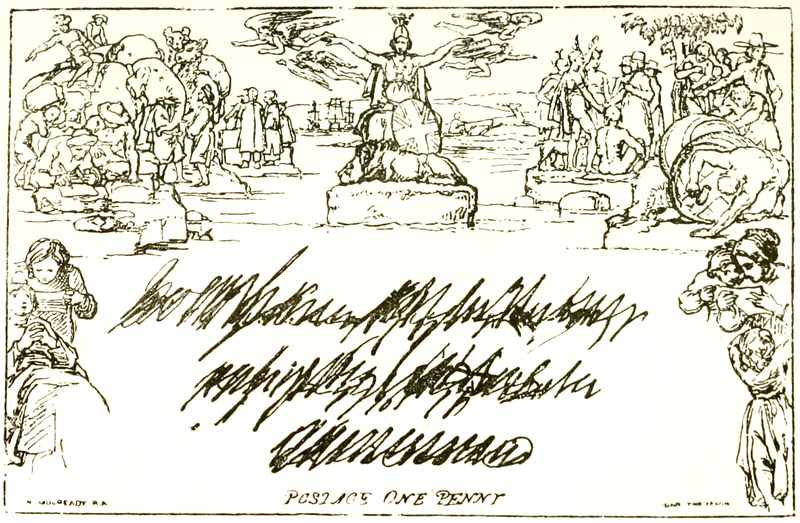
Does Sir Andrew Agnew believe, or wish anybody else to
believe, that the operatives want to be "cribbed, cabined,
and confined" on a Sunday, debarred from their excursions
to tea-gardens, their little voyages upon the river, their social
pipes and ale, or to have their wives and sweethearts mulcted
of their cakes and tea upon the only day in the week in which
they can enjoy them? Does he really mean seriously to say
that hard-working people, who for six consecutive days have
been shut up to labour and toil, in heated rooms, in factories,
or in gas-lit workshops, desire that they may be hindered
from breathing the pure air on the seventh?
And what to the poor—or, indeed, to the rich—is an
excursion without refreshment—without the enjoyment of
the Sunday's dinner, the weekly festival at which his family
enjoy his society, and in his society the treat of something
"good to eat?" Why may not these relations, if they
prefer good air to bad, go to those "Ordinaries on Sundays
at two o'clock," which may be seen announced on every
sign-board round London? or why, if they prefer it, may
they not travel thither in chaises or other carriages, if they
can afford it? Whether this is sinful or not, Messrs. Agnew
and Peter may perhaps decide; but of this we are sure,
that the operatives, except the already benighted Puritan
Radicals, must be, and are opposed, heart and soul, to the
monstrous restrictions which a couple of very small men are
endeavouring to bring them under, because they think it
right, and good, and wise.
The beneficial effects of the measure upon society may
be guessed from the following dialogue between Snip, a
tailor, and Snob, a shoemaker, living in the same house,
each having a wife—one having a child.—(Time, Sunday
morning.)
Snip. Vell, Snob, arn't you shaved? Vy, the bells is
a-going for Church—ye von't be ready in time.
Snob. Church—bless your heart, I can't go to church
to-day—the bill's come into play.
Snip. Ah! I know that to my cost.
Snob. How can I go to church? Ve used to send our bit
of wittels to the bakus, and then I and Sal used to go to
church, and so give Jenny Walker sixpence to mind the
babby till we come back; then arter dinner Sal and I and
the babby used to go to Chalk Farm, as reglar as clockwork,
every blessed Sunday. She had a cup of the best bohea,
with milk hot from the cow—I smoked my pipe and had a
pint of ale. Little Jenny used to go to church in the arternoon,
and come and jine us, and so help bring babby
back. Now we marn't get the things baked at the bakus,
and Jenny marn't come and earn sixpence by looking arter
the babby—so Sal has to cook the wittels, and I have to
mind the child—so there's no church for us.
Snip. My missus says she won't do no work Sundays,
cause she's afeard of her life of Bill Byers—so we avn't got
a morsel of grub for dinner, and neither of us knows where
to get none—I won't go to church with this here beard on,
six days long; and Jim, him as is the barber over the way,
won't shave me for fear of the five pound penalty, so I shall
stop where I is.
Snob. Come along into our place—my Sal isn't so partic'lar—she's
read the hact itself, and swears she's a hexception—we
got a line of mutton, vith the kidney in it, and a peck of
tatys—come along wi' your old woman, and let's be jolly.
Snip. Jolly! Hark, Mr. S——, there's one on 'em over
the way—don't ye know 'em?—that's one o' Byers's boys—if
he hears you laugh to-day, two-pun-ten for you.
Snob. Peter's pence—eh?—well, if we maint speak of a
Sunday in the street, let's come in—ours, you know, is a
back room, up two pair—they can't hear us there—come
along—I say, what shall we have to drink?
Snip. There's nothing but vater for us as can't afford vine—public-houses
is shut—no sarving Sabbath-day.
Snob. Vell, never mind—ve'll try and cheat the old un.
There are cunninger dogs than the law-makers, and them is
the law-breakers. Go and ask missus to come and join
us.
Snip. Oh, she'll come, and jump too; and I tells ye what—as
we know'd we could not have no heavy wet to-day, she
got a couple of bottles of Jacky, as will nourish us through
the arternoon.
Snob. So it will, Bill; and we won't stir out at all. If
we can't have a drop o' short, or a swig o' heavy among the
rurals in the harbours—what's the country to us, we can't
live upon hair?
Snip. No, not by no means. If I could but get my chin
scraped, I'd try and make myself comfortable.
Snob. Is barber Jem at home?
Snip. Yes, shut up in his back parlour a-making wigs,
where nobody can see him.
Snob. I tell ye vot, let's ax him to eat a bit of our
mutton. He han't got nobody to cook for him, poor buffer,
so we'll ax him over; and then if he brings his soap and a
kipple of razors in his vestcoat pockets, he can shave us two,
just by way of amusement, while Sal's getting the line
ready.
Snip. Amusement!—that's quite gone out,—there's my
poor missus, who used to get from eighteen to four-and-twenty
shillings a-week a-manty making in Crambo Alley,
can't get a stitch o' work to do—nobody wears nothing now—they
used only to put on their bits of things onest a-week,
to show 'em like, and now they marnt go out a-pleasuring o'
Sundays, they buys nothing.
Snob. Vell, come along up stairs, we'll have a day on it.
please the pigs; your two bottles of Jacky will last us till
bed-time, and I'll toss you up who pays for both—I'm not
going to swelter out in the sun to walk.
Snip. Nor I—I'll be with you in a twinkling, and when
we have got my missus and barber Jem, we'll just lock the
door, and drink confusion to the reformers.
For the sequel we have not room in detail. Snip, Snob,
and barber Jem, ensconced in their fast-hold, pass the
Sabbath with the females, in hidden intoxication and carefully-concealed
profligacy—drunkenness progresses. Barber
Jem contributes from his store over the way to the replenishment
of the gin-bottle. Jealousy grows out of familiarity:
the women tear each other's caps, and scratch each other's
faces. Snob knocks Snip over the balusters, and barber Jem
is taken to the station-house dead-drunk.
In better society things will grow even worse. The mind
restricted to drudgery through the week must have relaxation
at the end of it; and the tradesmen and clerks, and their
ladies, sweethearts, and wives, have a right, in this Christian
and civilized country, to share the innocent pleasures of the
male part of the creation on the only day upon which they
can properly enjoy them. What can be more innocent than
going to Richmond, walking upon the hill, or paddling about
by the water? What more agreeable or healthy than
steaming to Gravesend (where the animosity of the people
towards the aristocracy has recently been evinced by their
conduct towards the Pier)? What more natural than to eat
and drink when arrived there?—No; that is contrary to the
law. What! of nature or nations!—No; of Agnew and of
Peter. Surely if young ladies are satisfied with soles and
eels, and ducks and peas, and sage and onions, and port wine
and punch, and such things as these, all eaten fairly and
above-board at open windows or in the open air, such persons
as Peter and Agnew should rejoice thereat. Confine them in
London, deny them harmless gaiety, pen them up with their
lovers and friends, tell them they must not stir out, and, like
the Snips and Snobs of inferior life, they will turn their
thoughts into other channels, and soles and eels, and ducks
and peas, will shortly sink in their estimation, only, however,
to give place to a catalogue of other things too numerous to
mention in the short space of an advertisement.
Oh, if these Agnews and Peters would but be content to
take man as God has been pleased to make him, and allow
him the free agency with which the Divinity has invested
him, how much more wisely would they act! If they themselves
believe that piety consists in eating cold meat on
Sundays, in avoiding carriages, in eschewing all sorts of
social conversation; if they see perdition in a plum-bun, and
utter destruction in a glass of mild ale, let them henceforth
live on frigid sheep, moan, mump, and be miserable, and
fast, and grieve, in direct opposition to the spirit and
character of Christians, observing the Protestant Sunday;
but do not let them meddle with matters which cannot
concern them, and by their success in which they would
infallibly corrupt the body of the people, and endanger the
safety of the commonwealth.
At 15.—Dimpled cheeks, sparkling eyes, coral lips, and
ivory teeth—a sylph in figure. All anxiety for coming out—looks
about her with an arch yet timid expression, and
blushes amazingly upon the slightest provocation.
16.—Bolder and plumper—draws, sings, plays the harp,
dines at table when there are small parties—gets fond of
plays, to which she goes in a private box—dreams of a
hero—hates her governess—is devoted to poetry.
17.—Having no mother who values herself on her youth,
is presented by an aunt—first terrified, then charmed.
Comes out—Almack's—Opera—begins to flirt—selects the
most agreeable but most objectionable man in the room as
the object of her affections—he, eminently pleasant, but
dreadfully poor—talks of love in a cottage, and a casement
window all over woodbine.
18.—Discards the sighing swain, and fancies herself
desperately devoted to a Lancer, who has amused himself
by praising her perfections. Delights in fêtes and déjeuners—dances
herself into half a consumption. Becomes an intimate
friend of Henry's sister.
19.—Votes Henry stupid—too fond of himself to care for
her—talks a little louder than the year before—takes care
to show that she understands the best-concealed bon-mots
of the French plays—shows off her bright eyes, and becomes
the centre of four satellites who flicker round her.
20.—Begins to wonder why none of the sighers propose—gets
a little peevish—becomes a politician—rallies the Whigs—avows
Toryism—all women are Tories, except two or
three who may be anything—gets praised beyond measure
by her party—discards Italian music, and sings party songs—called
charming, delightful, and "so natural."
21.—Enraptured with her new system—pursues it with
redoubled ardour—takes to riding constantly on horseback—canters
every day half-way to the House of Lords with the
dear Earl, through St. James's Park, by the side of her
uncle—makes up parties and excursions—becomes a comet
instead of a star, and changes her satellites for a Tail, by
which she is followed as regularly as the great Agitator is.
Sees her name in the papers as the proposer of pic-nics, and
the patroness of fancy fairs.
22.—Pursues the same course—autumn comes—country-house—large
party of shooting men—juxtaposition—constant
association—sociability in the evening—sportive gambols—snug
suppers—an offer—which, being made by the only
dandy she did not care about in the mêlée, she refuses.
23.—Regrets it—tries to get him back—he won't come,
but marries a rich grocer's widow for her money. Takes
to flirting desperately—dresses fantastically—tries a new
style of singing—affects a taste—lives with the Italians,
calls them divine and charming—gets her uncle to give
suppers.
24.—Thinks she has been too forward—retires, and
becomes melancholy—affects sentiment, and writes verses
in an Annual—makes acquaintances with the savans, and
the authors and authoresses—wonders she is not married.
25.—Goes abroad with her uncle and a delightful family—so
kind and so charming—stays the year there.
26.—Comes home full of new airs and graces—more surprised
than ever that she is still single, and begins to fancy
she could live very comfortably, if not in a cottage, at least
upon a very moderate scale.
27.—Thinks the conversation of rational men infinitely
preferable to flirting.
28.—Looks at matrimony as desirable in the way of an
establishment, in case of the death of her uncle—leaves off
dancing generally—talks of getting old.
29.—Same system—still ineffective—still talks of getting
aged—surprised that men do not laugh as they did, when
she said so a year or two before.
30.—Begins to inquire when a spinster becomes an old maid.
31.—Dresses more fantastically than ever—rouges a little—country-house
not so agreeable as it used to be—goes
everywhere in town—becomes good-natured to young girls,
and joins in acting charades and dumb proverbs.
32.—Hates balls, or, if she goes to them, likes to sit still
and talk to clever middle-aged gentlemen.
33.—Wonders why men of sense prefer flirting with girls
to the enjoyment of rational conversation with sensible
women.
34.—Uncle dies—break-up of establishment—remains
with her aunt—feels old enough to go about without a
chaperon.
35.—Takes to cards, where they are played—gives up
harp, pianoforte, and singing—beaten out of the field by
her juniors.
36.—Quarrels with her cousin, who is just married to the
prize Marquess of the season—goes into Wales on a visit
to a distant relation.
37.—Returns to London—tries society—fancies herself
neglected, and "never goes out"—makes up little tea-parties
at her aunt's—very pleasant to everybody else, but never
satisfactory to herself.
38.—Feels delight in recounting all the unhappy marriages
she can recollect—takes a boy out of an orphan-school,
dresses him up in a green jacket, with three rows of sugar-loaf
buttons, and calls him a page—patronizes a poet.
39.—Gets fractious—resolves upon making the best of
it—turns gourmand—goes to every dinner to which she
either is or is not invited—relishes port wine; laughs at it
as a good joke—stays in London all the year.
40.—Spasmodic—camphor-julep—a little more rouge—fancies
herself in love with a Captain in the Guards—lets
him know it—he not susceptible—she uncommonly angry—makes
up a horrid story about him and some poor innocent
girl of her acquaintance—they are eternally separated by
her means—she happy.
41.—Takes to wearing "a front"—port wine gets more
popular—avows a resolution never to marry—who would
sacrifice her liberty?—quite sure she has seen enough of
that sort of thing—Umph!
42.—Turns moralist—is shocked at the vices of the world—establishes
a school out of the produce of a fancy fair—subscribes—consults
with the rector—excellent man—he
endeavours to dissuade her from an extravagant course of
proceeding which she has adopted—her regard turns to hate,
and she puts herself under the spiritual guidance of a Ranter.
43.—Learns the Unknown Tongues, and likes them—sees
none of her old friends—continues during the whole season
enveloped in her new devotions.—Her page, having outgrown
his green inexpressibles, is dismissed at the desire of her new
pastor.
44.—Renounces the Oly Oly Bom school of piety, and gets a
pug and a poodle—meets the man she refused when she was
two-and-twenty—he grown plump and jolly, driving his wife
and two great healthy-looking boys, nearly men, and two
lovely girls, nearly women—recollects him—he does not
remember her—wishes the family at Old Nick—comes home
and pinches her poodle's ears.
45.—Returns to cards at the Dowager's parties, and smells
to snuff if offered her.
46.—Her aunt dies.
47.—Lives upon her relations; but by the end of the
season feels assured that she must do something else next
year.
48.—Goes into the country and selects a cousin, plain and
poor—proposes they should live together—scheme succeeds.
49.—Retires to Cheltenham—house in a row near the
promenade—subscribes to everything—takes snuff and carries
a box—all in fun—goes out to tea in a fly—plays whist—loses—comes
back at eleven—camphor julep, and to bed—but
not to sleep.
50.—Finds all efforts to be comfortable unavailing—vents
all her spleen upon her unhappy cousin, and lavishes all her
affections upon a tabby cat, a great, fat, useless Tommy, with
a blue riband and a bell round its neck. And there, so far as
I have traced it, ends my Spinster's progress up to fifty.
Sir,—We hear a great deal of the licentiousness of the
press, and I am not disposed to say that there may not be
some good grounds for the complaint; but I beg to assert that,
to my own knowledge, much is charged to the account of the
licentiousness which is, in truth, only attributable to the
errors of the press; and I have had the mortification to see
articles of the most innocent information, from my own pen,
conveyed to the public with all the colour of libels, by the
mere mistake of a single letter.
For instance, I had occasion to report that a certain "noble
lord was confined to his house with a violent cold;" next
morning, I found that this innocuous piece of intelligence was
metamorphosed into a direct inroad on the peace of a noble
family, by representing his lordship as being "confined with
a violent scold." In the same way, on the occasion of a
recent entertainment given by a noble leader of fashion, I had
said, very truly, "that, amidst the festivities, the first point
of attraction and admiration were her ladyship's looks:" this
deserved compliment was changed by the printer into a satire
on the whole company, as if the chief point of attraction had
been "her ladyship's cooks." In a description of the regatta
at Cowes, I was made to represent a lady of fashion as
having formed a hasty and ill-assorted match "with a boy,"
when, in fact, I had only said that the Lady Louisa had,
indeed, broken adrift, but had "luckily, before any mischief
was done, been made fast to a buoy."
When I reported that "Lord A. had entertained Colonel
B., Major C., the Hon. Mr. D., and a few other fashionable
friends at dinner," I little expected to find these gentlemen
represented as a company of "fashionable fiends." At the
particular request of an eminent coachmaker, I mentioned
that a noble person, well known for his good taste in equipages,
and who happens to have a large and fine family, had
launched "a new green cab;" but judge of my horror at
seeing it stated, that "his lordship had, this season, brought
out another green cub." And I have lately had the misfortune
of being the involuntary cause of what is called a
hoax upon the public: having announced that Lord K. had
made a bet that he would "trot a mile" on the Harrow Road
in three minutes, an immense crowd assembled, and was
ready to proceed to outrage because his lordship did not
"trot a mule," as the printer's error had led them to expect.
Of a more serious kind are the injuries done to private
individuals, which no one deplores more than I—the innocent
cause of them. I was once employed to recommend to
public attention the astonishing talents and performances of
that musical wonder "The infant Lyra." I did my best;
but the printer gave the whole a most unhappy and malicious
appearance by making me, by the transposition of a letter,
attribute all these prodigies to "the Infant Lyar." On a late
occasion, one of the papers talked of "the general satisfaction
given by the royal lump." This looked like a brutal allusion
to the temporary illness of an illustrious duke. The truth
was, Mr. Editor, that I myself penned that paragraph for an
ingenious artist in Bond Street, in order to recommend an
improved kind of argand, which he denominated the "Royal
Lamp;" and I never can sufficiently regret the injustice done
to the gallant General Saldanha, who, in an account of his
conduct at Oporto, which I drew up under his own eye, was
stated to have "behaved like a hero;" but when it came to
be printed, it unhappily appeared as if the general had
"behaved like a hare."
What I wrote of "the Horticultural fête" was altered into
"the Horticultural fate," as if there was a destiny affecting
all the entertainments of that society. When the late Mr.
Canning offered Lord F. the office of "Secretary of State,"
the public were led by a mere transposition of the letters, to
believe that a new office was to be instituted under the title
of "Secretary of Taste;" and what gave the more effect to
this mistake was the noble lord's admitted fitness for the latter
office. I once ventured to bear my humble testimony to the
assiduous attendance of a certain reverend dean on the
"Minster," but had the mortification to find myself insinuating
blame against the worthy divine, for his assiduous
attendance on the "Minister;" and what was still worse,
having to communicate the deserved elevation of "Doctor
Jebb" to an Irish mitre, I was made to announce that
"Doctor Jobb" was to be the new Irish Bishop. I remember
reporting the case of a poor French lady, who "appeared at
Bow Street with her pug-dog in her arms," but the printer
most ungallantly stated the fair stranger to have appeared
"with a pig in her arms;" and on the next day of her
attendance a vast crowd had assembled to look at this extraordinary
pet, and the poor Frenchwoman narrowly escaped
being pelted for disappointing their expectations. In something
the same way, a respectable tradesman in Oxford Street
has had his shop-windows broken, to the loss of near ten
pounds, because, having invited the public to inspect his
extensive assortment of a fine manufacture called "linos,"
the printer chose "to invite the public to inspect a large
assortment of the finest lions."
I am, sir, a warm friend of his Majesty's Government (for
the time being), and cannot but deeply feel that even my
political views are sometimes distorted. Amongst the benefits
to be expected from recent measures in Ireland, I had
enumerated the "increase of tillage,"—this was changed
into increase of "pillage," and copied into all the ultra-Tory
papers; and when I said that these same measures of conciliation
would induce every loyal and well-disposed subject
to unite "in quieting Ireland," it was perverted into a sneer,
as if all loyal and well-disposed subjects should unite "in
quitting Ireland."
Pray, sir, do me the justice to lay this explanatory letter
before the public; above all, let it be correctly printed.
I am, sir, your humble servant,
A Court Reporter.
We very often suffer in a similar manner. About two
years since, we represented Mr. Peel as having joined a party
of "fiends" in Hampshire for the purpose of shooting
"peasants;" and only last week, in a Scotch paper, we saw
it gravely stated that a "surgeon" was taken alive in the
river, and sold to the inhabitants at 6d. and 10d. per lb.
It is said that a certain place not mentionable to "ears
polite" is paved with "good intentions." Whether it will
ever be macadamized (for that, I believe, is the term for
"unstoning," now fast gaining ground, as I am looking over
my paper, which, in all probability, everybody else will overlook)
I cannot pretend to say; but certain it is, that although
I was beyond measure mortified by the results of the Twickenham
prank, my exclusion from the society of the Miss
Dods, and my absolutely necessary escape from an association
with them, I was very soon reconciled to my fate after the
arrival of Devil Daly (as I used subsequently to call him) at
my lodgings in Suffolk Street.
The instant he had been dislodged from the cottage by the
appearance of the young ladies whose family he had so seriously
outraged on the previous evening, instead of walking
his horse back to Smart's, at the Toy, at Hampton Court, he
cantered up to visit me in London; not so much from any
particular affection for me, but because, although himself the
victim, there was something so exciting and delightful to him
in a joke, that he could not deny himself the pleasure of
narrating to me the history of the arrival of the sylphs, and
his extraordinary ruse of the bleeding nose. I never saw him
in higher spirits, and, quoad my resolutions, I could not, for
the life of me, refuse to join him in a stroll about town, which,
although the season was somewhat advanced, was yet agreeably
full, with a pledge to dine with him somewhere afterwards.
In those days clubs were scarce, although then hearts were
plenty; there were no clubs of note at that period but
White's, Brookes's, and Boodle's. To be sure, there was the
Cocoa Tree, and there was Graham's, but the number of
members was small, the system confined, and therefore, although
Daly and I were as proud as Lucifer, and as "fine as
fine could be," men had no resource when they wished to
enjoy the "feast of reason and the flow of soul"—the one
in the shape of a cutlet, and the other in the tapering form of
a bottle of claret—but to repair to a coffee-house, a place
which, I find, is now (I speak while I am arranging my
papers) obsolete—a dear, nice, uncomfortable room, with a
bar opening into it, a sanded floor, an argand lamp smoking a
tin tray in the middle of its ceiling, boxes along its sides, with
hard carpet-covered benches, schoolboy tables, and partitions,
with rods, and rings, and curtains, like those of a churchwarden's
pew in a country church.
I selected Dejex's, at the corner of Leicester Place. Attention
and civility, a good cuisine, and good wine, formed its
particular attractions, and the courteous attention of "mine
host" gave a new zest to his cookery and his claret. I own
I love attention and civility—not that which seems to be
extracted by dint of money, or by force of the relative situations
of guest and landlord, but that anxious desire to please,
that consideration of one's little peculiarities, and that cheerfulness
of greeting which, even if it be assumed, is always
satisfactory. To Dejex's we resolved to go, and having
"secured our box" and taken our stroll, we found ourselves
seated and served by a little after six o'clock.
There was something irresistibly, practically, engaging
about Daly, and I never felt more completely assured of the
influence over me of a man with whom I had been so short a
time acquainted, than I was when I found myself again—in
the course of eight and forty hours—associated with him in
a place which, of all others, was the most likely to afford him
some opportunity of exhibiting his eccentricities; for the
company consisted in a great degree of emigrés of the ancient
régime, who, until the master-hand of Wellington was raised
to cut the Gordion knot of their difficulties, which negotiation
had for years in vain attempted to untwist, "had made England
the asylum for their persecuted race." Yet, however much
their misfortunes—the natural results of anarchy and revolution—might
excite our sympathies and demand our assistance, some
of them, it must be admitted, were, to our then unaccustomed
eyes, extremely strange specimens of humanity; they were
what Mr. Daly, in his peculiar phraseology, called "uncommon
gigs;" and one very venerable ci-devant marquis, who
wore spectacles, the said Daly, as he advanced up the room,
somewhat too loudly, I thought, pronounced to be "a gig
with lamps."
However, we got through dinner, and had safely demolished
our admirable omelette soufflée without any outbreaking on the
part of my mercurial companion; the coffee-room began to
thin, and I began to be more at my ease than before, when
Daly proceeded to recount some of his adventures, which
proved to me that, however deeply the scene of the preceding
day at Twickenham might have impressed itself on me, it
was to him a "trifle light as air."
"But how," said I, "shall I ever reconcile the Dods? I
am destined to meet those people; you are not."
"I was destined to meet them this morning," replied Daly,
"and, if it had not been for this 'bleeding piece of earth,'"
laying hold of his nose, "I could not well have escaped; but
for you, rely upon it, it will all turn out right. In a week
they will have utterly forgotten you."
"What," said I, "will Fanny so soon lose all recollection
of me?"
"To be sure she will," said Daly. "As somebody says,
'Fancy's visions, like the sand,
Every idle mark receive;
Lines are traced by every hand,
Which no lasting impress leave.'"
"But her hand," said I.
"You took and shook," replied he, "and very wisely too;
but recollect it was nearly dark when we made our exit."
"And you insulted the father——"
"——who first affronted me," said Daly; "and even if
the girls did know me this morning, and recognise me as
assistant clerk to the deputy-assistant surveyor of the Paddington
Canal Company, the deuce is in it if the whole family
must not respect me as a high-minded, honourable, and
conscientious assistant clerk."
"Yes, but it was quite light enough when we arrived,"
said I, "to see them and their beauties; why not light enough
for them to see our deformities?"
"Deformities!" said Daly; "speak for yourself, Mr.
Gurney; women don't care so much for men's beauty as you
may suppose. Here am I—plain, but genteel, like a Wedgwood
teapot—I make my way, and whatever you may think
of yourself and Miss Fanny, I flatter myself Gussy, as her
ma' called her, was equally well pleased with your humble
servant."
"And yet we may never see either of them again," said I.
"I am not so sure of that," said Daly; "I have done
worse to a father than I did to Dod in the course of my life,
and yet have come to be domesticated in the family afterwards."
"As how?" said I.
"Some three years since," said Daly, "I was down at my
friend's Sir Marmaduke Wrigglesworth's, in Surrey—charming
place—nice wife—excellent shooting—capital cook—and
inexhaustible cellars. 'Marmaduke,' said I, 'I hate battues;
here you have a party staying for the wholesale slaughter of
pheasants—eleven double barrels all of a row—more chance
of homicide than sport; do me the kindness to let me off,
and permit me to "range the fields" by myself, and I will
consent to be laughed at for my small gains when the card
comes in before dinner.' 'Do as you like,' said Wrigglesworth;
'this is Liberty Hall; shoot alone or in company—with
dogs or without—have the keeper or not—comme il vous
plaira.' Accordingly, away I went, more eager for the sport,
as having to render an account of my single exploits, young
enough to do my day's work well, and strong enough to bring
my day's work home. I admit I was not quite so well pleased
with what I saw, or rather what I did not see, as I went on:
birds were scarce, wild, and shy, and I did not get a shot for
the first hour, except at a venerable rabbit, who had retired
from public life, but who had somewhat incautiously left his
tail out of the burrow which he had selected for his final
retreat; at him I went, and he died—first tenant of my bag."
"A tenant in tail," said I, punning professionally.
"Well, sir," continued Daly, who never stopped for anybody,
"on I went, until at last, after three hours' ploughing
and plodding, I fell in with one of the nicest little snug copses
you ever set your eyes on. In I went—whurr went the
pheasants—bang went the barrels—down came the birds—and,
by the time I had crossed the copse, three cocks and—heu
mihi!—two hens graced my store."
"Pretty sport for the time," said I.
"No sooner, however," said Daly, "had I emerged from
the thicket, than I found myself upon a sort of parkish-looking
lawn, on the rise of which stood a very respectable
house, at the door of which I could distinguish a group of
persons standing, and from the court-yard of which I saw
some sort of servant leading forth a stout short-legged pony,
with a thick neck and a stumpy tail—evidently master's
favourite—equal to fourteen stone, warranted never to shy,
trip, or stumble. Upon its back did I see a portly gentleman
bestride himself, and forthwith begin to canter towards me,
followed at a somewhat splitting pace by two keepers on
foot, each armed either with guns or sticks, which I could
not easily distinguish."
"I foresee," said I.
"So did I," said Daly; "the moment I saw the governor
coming full tilt, I knew I had been trespassing, and the
moment I stepped upon his infernal lawn, felt that I had
put my foot into it."
"Well," said I, "what happened?"
"Why," continued Daly, "I standing still, and he moving
somewhat rapidly, the elder of the two had the best of it,
and I was very soon within six inches of his cob's nose, and
within about half a yard of his own. 'You are a pretty
fellow, sir,' said the irate gentleman, 'to come poaching and
killing the birds in my preserves, close to my house—why,
what the devil are you thinking of, you rascal? Here,
Stephens—Thomson——'
"'Sir,' said I, 'I am extremely sorry——'
"'Sorry,' interrupted Mr. Bagswash—(for such was the
gentleman's name)—'sorry, yes, and well you may be sorry;
Botany Bay is too good for a fellow like you, sir. Lay
hands on him.'
"'One moment, sir,' said I, 'I am a gentleman.' Whereupon
Squire Bagswash and his keepers burst into an unseemly
fit of laughing.
"'A pretty gentleman too,' said Bagswash.
"'I thank you, sir,' said I, 'I don't want compliments,
I only want a hearing. I am staying on a visit at Sir
Marmaduke Wrigglesworth's, and here is my card.' Saying
which I produced—from what I happened by the merest but
luckiest accident in the world to have about me, my card-case—my
visiting ticket.
"'Young man,' said my opponent, having read it, 'is
this genuine? My name, sir, is Bagswash; I am personally
known to Sir Marmaduke. Is what you are saying true?'
"'Sir,' said I, 'I am not accustomed to have my word
doubted. I admit, that not being perfectly acquainted with
the boundaries of the Wrigglesworth property, I have transgressed
and trespassed. I am sorry for it; and sorry that
you should have so far forgotten yourself as to use language
which, I am quite sure, in a more temperate mood you
would regret.'
"'Sir,' said Bagswash, half doubting, and certainly more
than half fearing me, 'I don't know that I have used any
strong expressions, I—'
"'Rascal, I think,' said I, bowing profoundly.
"'If I did, I—really,' said Bagswash, 'I—might—but
I was irritated—sir, this is my manor.'
"'Why, sir,' said I, 'as to your manner, I do think it
might have been a little more courteous—I——'
"'Yes, sir,' said my antagonist, who evidently was
anxious to justify his coarseness and vulgarity, 'but—the
manor, I mean—for I can't pun, sir, and I hate puns, sir; the
manor, I mean, costs me a very large sum annually—a very
large sum indeed, sir, to preserve; and therefore when I see
what I conceive to be a poacher immediately under my nose,
actually in my homestead—upon my lawn, I may say—shooting
right and left, it does put me in a passion, and
I own I was warm, and perhaps hasty; but it is a provocation,
and I should like to know, under all the circumstances,
what you yourself would say if you were me at this moment?'
"'Say, sir!' said I; 'I haven't the smallest hesitation
about that, sir. If I were you at this moment, I should say,—"Mr.
Daly, I beg your pardon for the hasty way in
which I spoke when I thought you a poacher; and, in order
to show that although passionate I am not vindictive, I hope,
as it is just luncheon-time, and you must have walked a long
way and haven't had very good sport, that you will do me
and Mrs. Bagswash the favour to come in and take a cutlet,
or a little cold meat, as the case may be, and make up our
differences with a glass or two of wine."
"'By Jove,' cried Bagswash, 'you are a queer fellow—the
very spit of your father, whom I knew before I retired
to these parts.'
"'Oh,' whispered one of the keepers to the other, 'master
does know him—he had a father.'
"'Oh,' said the other; and they both immediately lowered
their sticks to the ground.
"'And,' continued the squire, 'you have only just anticipated
me in an invitation, except that I apprehended some
more serious requisition on your part.'
"'Not a bit, sir,' said I; 'there are a vast many gentlemen
in the world who don't look like gentlemen, and the
shooting jacket and gaiters equalise appearances so much,
that Nature must have done a vast deal to give a man an
aristocratic appearance under so rough a husk—but as to
any meeting, except at your hospitable table, I have not the
slightest wish for it. In my opinion, sir, one luncheon is
preferable to two balls.'
"'Ah!' said Bagswash, 'I am glad o' that, in spite of
your pun. Run up, Stephens, and tell them to get luncheon
as soon as possible. Mr. Daly, a friend of Sir Marmaduke
Wrigglesworth, is coming to join our family party.'"
"Well, Daly," said I, "there your presence of mind
served you well."
"Hear the sequel," said Daly. "Encouraged by the
acquiescence of Bagswash, as I was yesterday by the
invitation of Dod, I proceeded towards the house, placing,
ever and anon, my hand on the neck of his cob, or the
pommel of the saddle, in order to mark to the distant group
the familiar nature of our acquaintance; and in this fashion
we reached the mansion, upon the steps of which a bevy of
graces, in number more like the Muses, welcomed us. I had
a reputation even then, and the moment the girls had heard
who was coming, they made up their minds to mirth—even
the big Mrs. Bagswash rolled herself into the hall, like a
fillet of veal upon castors, to do me honour.
"Bating the parents," continued Daly, "I never saw a
more prepossessing family. I forget all their names; but one
was slim and sylph-like, another plump and pleasant, a third
a wicked-looking brunette, a fourth a demure and bashful
blonde: all I felt as I entered the house was, that if I had
brought eight friends with me, I might, by giving each his
choice, have had some one of the 'tuneful nine' left entirely
to myself."
"And," said I, "were you the only man?"
"No," replied Daly, "there were two yahoos, in white
cord breeches and leather gaiters, and a boy with a frill and
a frock, upon which a favourable eruption of brass sugar-loaf
buttons had taken place; a Dr. Somebody, who turned
out to be the nearest apothecary; and a very pale, long-legged
youth, the curate of the parish."
"A largeish luncheon-party," said I.
"Well," said Daly, "I sat down, having first very much
ingratiated myself with old Bagswash, who was as chary of
his pheasants as if they had been of the golden breed, by
insisting upon it that his man Stephens should disencumber
my bag of the birds which I had shot on his land, retaining
my solitary rabbit, in order to grace my tale when I reached
Wrigglesworth; and there I found myself placed between
mine hostess, and number one of the daughters—a very nice,
pretty thing—not what one should call well set up, but
Nature, as I said about gentlemen to her papa, had done a
great deal for her; poor thing, how I pitied her!—and pity
is akin to love. So, after luncheon, and some wine, do you
know, Gurney, I almost began to subside into a tenderer
feeling. But then, one of nine!"
"Well, and how did it end?" said I.
"Why," replied Daly, "it would have ended, I have no
doubt, as prosperously as it begun, had not my new friend,
Bagswash, committed himself by begging me to drink some
London Particular Madeira—Duff, Murphy, Gordon, or
something of that sort. The moment I tasted it I knew
what it was, and, rather elated by circumstances, and my
other previous libations, I had the temerity to address the
dear, interesting, white-necked creature next me, and, in
a tone of confidential condolence, begged her not to be
deceived, for that although her amiable papa might be a judge
of other things, he evidently knew nothing of wine, and that
the stuff he called 'London Particular' was neither more
nor less than infernally bad Teneriffe.
"The male Bagswash was unconscious of the imputation,
but the queen B. overheard me, and, looking towards what
might literally be called her open countenance, I saw
symptoms of fire breaking out, and in less than a minute
afterwards the domestic Proserpine exclaimed 'Come, girls,
let us go—too much of your pa's Tenreefe will do you a
mischief.' Up she got, and out she wheeled herself, and
the moment she set the example, away went the nine she
Bagswashes, like so many goslings after the maternal goose.
"I," continued Daly, "regretted the retreat, for I had
had an opportunity to insinuate myself, and never saw
an audience more thoroughly prepared to be gratified;
indeed, so convinced were they, from what they had heard
of me, that I was a vastly agreeable person, and talked
epigrams, that when, while they were all sitting with their
ears open to catch my facetiæ, I happened to observe (the
first observation I had made, too, and that, in reply to a
question of the big Bagswash) that I thought mustard went
remarkably well with cold boiled beef, they all burst out
into an immoderate fit of laughter; and the doctor, who had
been tutored into a belief in my superlative wit, exclaimed,
'Oh, oh, that's too bad!' which every fool cries out, either
when he thinks a thing remarkably good, or does not comprehend
it in the least, which last was the case—as indeed
it was with all the rest of the party—with my new-found
medical friend."
"Did you contrive," said I, "to affront the rest of the
company before you quitted it?"
"Not all of them," said Daly; "no; I believe I got off
pretty well, but evidently the worse for wear; for, Teneriffe
or not Teneriffe, it is my maxim to stick to the wreck as
long as she floats, and as long as I could get anybody to sit,
I staid; the curate and the boy with the frill went with the
ladies, but Bagswash and the parish Paracelsus remained.
However, at last, seeing all the bottles empty, and no disposition
on the part of Baggy to replenish, I made a move,
and never did I see a man more happy at having got out of
a scrape than mine host. He sent his kindest regards to
the Wrigglesworths—hoped to see me soon again—did I
know my road home? In short, I cannot enumerate the
civilities he heaped upon me, which, considering his respect
for my friend Sir Marmaduke, and the fact of his having
nine unmarried daughters, I duly appreciated, and forthwith
bent my way homewards."
"Glad, I should think," said I, "to be safe out."
"On the contrary," said Daly, "I should like to have
remained where I was; if it had not been for the anger of
the respectable cat-of-nine-tails about the Teneriffe, it would
have been a very agreeable domicile. However, once started,
onwards I went, rejecting, indignantly, the offer of Bagswash
to send a man to show me the way;—nothing I hate so
much; as if a man who had followed his nose into a place
could not follow his nose out of it."
"I trust," said I, "that your intrepidity was crowned
with success?"
"Rather crippled," replied Daly, "as you shall hear;
however, there are two ends to my story, or, rather, a story
and a sequel."
"Pray go on," said I, knowing that so long as his breath
lasted, his tongue would wag, as a cherry-clapper does while
the wind blows.
"Gad, sir," said he, "I walked off—I admit the Teneriffe
to have been potent—and I thought of one thing, and
another thing, and I believe I thought of all the things in
the world, except the way which I was going. They say,
you know, some men have every sense but common sense—my
case to a hair. Common sense is like flour; the other
sort of sense is like sugar and gilding, and all the rest of
those things—beautiful to adorn a cake and embellish the
pâtisserie, but, without the flour, mere ornaments; now,
without the ornaments, the flour will make bread. I never
had the flour—never shall have. So you perceive that the
sugar and the flummery being my staple, on I went and went,
until I began to think I had missed my way, and just then I
found myself stopped by a gate opening into—or, rather,
shutting me out of—a remarkably well-stocked farm-yard—ricks,
stacks, stables, barns—everything comfortable and convenient;
with half a million cocks and hens, walking about
like ladies and gentlemen, all as happy as happy could be.
Over the gate I stepped, waded my way through the straw,
and, leaning over the hatch of one of his outhouses, who
should I see but the farmer himself. As I advanced, he touched
his hat, and civilly asked whether I had had much sport?
"'Not much,' said I, recollecting that the whole contents
of my bag now amounted to one elderly rabbit, with a Cape
tail; 'I am on my way to Wrigglesworth, and out of it, too,
as I think. How far have I to go?'
"'Seven miles, I count,' said the farmer. 'You are
coming right away from it, sir. Wrigglesworth lies over
there, on your left.'
"'Thank you,' said I, 'thank you. If you will just give
me a sort of concise direction,—I am a dab at topography.
Merely give me the points, and I'll go across a country I
never saw in my life before.'
"'Well, sir,' said the kind fellow, 'if so be as that is the
case, I'll tell you. When you get out of the gate down
there, turn to your left, and keep on straight till you come
to Pussy's Nob; then away to the right, over Sumpter's
Green, and you'll soon see the Crooked Billet. Don't go
near that, but turn short round by Wheatley's Copse; keep
on, till you come to the stile on your left; go over that,
through Timsbury's Lane, and that will bring you out by
the Three Mackerel, and there they'll be sure to put you
in the right road.'
"'Thank you,' said I to the farmer, 'I will follow your
instructions most implicitly; but I suppose I shall have no
chance of getting a shot, now, in that direction—even at a
pheasant-roosting—eh?'
"'No, sir,' said the farmer, 'can't say as how I think
you will get many more shots this evening.'
"'Well,' said I, 'now both my barrels are loaded. I've
got nothing in my bag but an old buck rabbit with a nob
tail; and as I hate going home with no proofs of my sport,
and the one head—or tail—that I have bagged takes the
domestic character, what shall I give you to have a shot
with both barrels at all those ducks in the pond, and the
fowls on the side of it, standing here, and to carry away
what I kill?'
"'You'll kill a woundy sight on 'em, I think, at that
distance,' said the considerate farmer.
"'Perhaps yes—perhaps no,' said I.
"'And to have all you kill?' said he, doubtingly.
"'Yes; all I kill fairly out-and-out,' said I.
"'Why, you shall give me half-a-guinea,' said the
man.
"'Half-a-guinea!' echoed I. 'No, no; if I kill three or
four of them it will be the outside. No; I'll tell you what
I'll do. I'll stand here—won't move an inch; and you
shall have a seven-shilling piece for the slaughter.'
"'Well, sir,' said the farmer, hitching up his lower
garments, 'a bargain's a bargain. Hand over the twine.'
"Whereupon," said Daly, "I tipped him that beautiful
miniature portrait of half-a-guinea, and told him I was ready
to take my shots. He nodded assent; and, having pocketed
the money, bade me proceed. I did so. Crack went one
barrel—bang! slap went the other—bang!—and such a
fluttering, and cackling, and squashing, and squabbling you
never heard. I ran forward, and secured, as my spoil, four
hens in high condition, a very respectable cock, fit companion
for my rabbit; and from the pond fished, with the butt-end
of my Manton, two extremely corpulent ducks, who had paid
the debt of nature in the most decided manner; these I got
out, the others I got up, and stuffed them all incontinently
into my bag, delighted to think what a display I should make
at Wrigglesworth, where it was quite clear I could, by no
possibility, arrive in time for dinner. However, that was
my joke, and it seemed to be the farmer's; he laughed quite
as much as I did."
"Inherent good humour, I suppose," said I.
"Why, as for that," said Daly, "you shall judge. I
bagged my birds in the first instance; and then, having
secured my booty, began to rally my victim; and having
acknowledged his civility in giving me my travelling directions,
said to him, with a low bow, 'Thank you for the
game, sir.'
"'Yes, sir,' said the farmer, 'you are a deuced sight
better shot than I counted upon, considering what you had
in your bag afore.'
"'Yes,' said I, 'I think you are what you may call
"done." Seven shillings won't pay for the poultry in my
pouch, I guess.'
"'No,' said the farmer, 'nor three times the money, I count.'
"'Well, then,' replied I, 'I think I have the best of the
bargain.'
"'Not much,' said the man.
"'Not much!' cried I; 'why, a guinea's worth of fowls
for a seven-shilling piece——'
"'Yees, sir, that's true,' said the fellow, turning slowly
away from the hatch, and grinning as he turned; 'but they
are none on 'em mine.'
"I could have killed him for his roguery; but there was
so much fun in it——"
"——So much in your own way," cried I.
"Exactly so," said Daly; "that, instead of breaking his
head, which he most righteously deserved, I joined in his
infernal horse-laugh, and made the best of my way out of
the farm-yard, lest I should be immediately apprehended
by the right owner as a robber of hen-roosts."
"And," said I, "you carried home your spoils."
"Not I," exclaimed my unstoppable companion. "Take
some wine—help yourself—and listen; for the sequel is
most terrible. I had such a night of it!"
"How?" said I.
"Why," said Daly, "out of the gate I went, turned to
my left, and got to Pussy's Nob; but it began to get dusk,
and very soon afterwards dark; and when I began veering
away over Sumpter's Green, I found myself on a wide
common, without path, guide, or guide-post. As the darkness
increased, so did the declivity; and when I had lost all
power of seeing, I was gratified by feeling myself in a sort of
quagmire, which, for all I knew, might get softer and thicker
every step I took. I looked out for the stars, and saw
a few: but they were of no kind of use to me; for I had
not the slightest idea what direction, even under their
guidance, I ought to take. I resolved to avoid the bogs;
and kept edging away, until I at length reached a gap,
which, as it led off the infernal common, I hoped might
lead me to some habitation."
"Where spring-guns and steel-traps were set every night,"
said I.
"Not a bit of it," said Daly. "I went on, following my
nose, until I found myself at the edge of a copse, which I
began to think looked extremely like Squire Bagswash's preserve.
However, it was not that; but I heard people talking
at no great distance, and a call of 'Halloo!' How to act I
did not exactly know, with a gun and a bagfull of cocks and
hens, and a venerable rabbit to boot. What could I do?
To have answered the call would have been to be detected
as a poacher in the dark. I resolved, at all events, on
getting rid of my poultry in the first instance, and accordingly
emptied my store, rabbit, tail, and all, and proceeded
somewhat more gaily after having thrown out my ballast;
yet not without some apprehension, either of being shot by
the keepers for a poacher, or by the poachers for a keeper;
I so got clear of the whistling firs and moaning larches as
fast as I could, still utterly ignorant of my course."
"And getting late," said I.
"It must then have been past eight," said Daly. "On I
trudged; scrambled over the furrows of one field, and
through the turnips in another; and so on and on, until at
last I was forced to sit myself down on a gate and rest; and,
I give you my word, although I have known a great deal of
the world, I never was so dead beat in my life as I was then.
Not a house could I see. The glimmering of a rushlight in
a cottage window would, in my eyes, have been thrice more
brilliant than the whole regalia of England collected. But no:
there were no cottages—no rushlights; and I do believe I
went the length of swearing at my own stupidity in undertaking
my solitary excursion. Only one set-off was there to
the whole thing;—I had seen the Bagswashes, male and
female, and laid in materials for an historiette for the next
evening—that is, if I really survived the present one; but I
began to feel cold, and hungry, and thirsty. However, it
appeared pretty certain that out of the fields I must get, if I
went straight on end, and could not well fail of fetching up
in a road somewhere at last."
"Which, as you are here alive to tell the tale," said I,
"of course you did."
"Why, yes," said Daly, "I did; but it was not for a
long time; and then I had come to a full stop; and, striking
the butt of my Manton on the ground, I swore, by stock and
barrel, that I would not budge from under a huge tree which
overshadowed me till daylight came to my aid. I was
ravenous—I was chilled—I was wretched—I was tired to
death; but why tire myself more?—and accordingly, feeling,
and I daresay looking, very like the dear Don of La Mancha,
I sat myself down with my back against the trunk, and, if
you'll believe me, fell fast asleep."
"Asleep!" said I.
"Fast as a church," said Daly, "and dreamt—dreamt,
first, that I was starving,—that, I think, must have been a
sort of waking vision; then, that I was at a ball; and then I
dreamt of being safe back at mine host's hospitable mansion;
and then I had a confused, hurly-burly kind of a dream,
either that I was Sir Marmaduke Wrigglesworth, or that
Lady Wrigglesworth was Mrs. Daly, or something of that
sort, and that I tumbled out of bed, which tumble was to
me a 'dying fall;' for I rolled over on my side, and woke—in
no bed—in no house, but where I had lain me down,
under the tree before-mentioned."
"You must have caught your death of cold?" said I.
"No, Dalys and cats are very tenacious," said my jocular
friend; "I roused myself—sat up and listened—recollected
where I was, and heard at the same moment what was really
'sweet music to mine ear,' the sound of a bell-team. Ho!
ho! says I—you are there, are you?—where there are bells
there are horses—where there's a team there's a waggon—where
there's a waggon there's a road—up I jumped, and as
fast as I could, just roused from my slumbers, scrambled
over brambles and clambered over fences, until I caught
sight of the waggoner's lantern waggling on the side of the
tilt like a bright pendulum to regulate the wheels; the
moment I saw that I knew I was landed, and, after encountering
a few of those thumps and bumps which 'flesh is
heir to,' found myself on a high road. Waggons, even those
called 'flies,' may be overtaken, and although dead beat,
and sore of foot, I soon came up with the eight plaited-tailed
animals which were dragging the mountain, second only in
size to the Juggernaut idol.
"My first object was to ascertain where I was, and what
the direction of the vast pile before me. I found, to my particular
satisfaction, that I was within two miles of Ripley,
and that the edifice was moving towards London—the result
was, an involuntary spring upon the shafts of the vehicle,
and a look at the waggoner, which, by the light of his
revolver, was perfectly intelligible. The gun, the gaiters,
the grace, and the gentility, spoke the gentleman, and he
gave me leave to assume the post which he himself was
prevented by Act of Parliament from occupying. All my
sorrows fled the moment I felt myself moved along without
any personal exertion, and the smiles which had nearly been
exhausted during my toil and trouble, returned, as Moore
sings, to 'gild my brow.' 'I have had walking enough,'
said I to myself, 'and grieving enough—nunc est ridendum.'"
"Excellent wag!" said I.
"Excellent waggon, rather," said Daly, "for so it proved;
and after three-quarters of an hour's hard tugging by the
'bell assemblée' before me, I was dropped, gun, gaiters, bag,
and all, at the door of the Talbot—facing the Green. I
tipped my driver—bade adieu to the tilt—and began knocking
loudly at the door of mine ostlery."
"And a nice enough inn it is," said I.
"It turned out to be past midnight," said Daly; "and,
by the merest luck in the world, the exemplary widow who
then occupied it had not gone to her rest, or roost. She
personally answered my call, and replied to my knock.
After a few preliminary 'Who's there's?' she opened the
door; and the moment she recognised me—for I was well
known upon the road—her delight, as you may conceive,
was unspeakable.
"'Bless my heart, Mr. Daly,' said the widow, 'what a
time o' night to be strolling about with your gun! Why,
where do you come from?'
"'That,' said I, 'is about the last question in the world
I can answer satisfactorily. I have been wandering across a
country with which I am not particularly well acquainted—have
tired myself to death, and fallen asleep.'
"'Fallen indeed,' said mine hostess, 'into a ditch, Mr.
Daly, I should think. Why, dear me, what a condition you
are in!'
"'Exactly,' said I; 'recumbent repose in October under
an oak, is not particularly delicate; however, my darling,
give me some supper, some hot brandy and water, and
order me the most comfortable bed in the house, for I am
a-tired.'
"'Why, sir,' asked the dear woman, 'where is your
servant with your clothes—you cannot think of sleeping
here in that condition?'
"'Not exactly,' said I; 'I shall take off my clothes when
I go to bed—and as for my servant, he is snug and happy
at Sir Marmaduke Wrigglesworth's (where I ought to be
too), unless they have sent him out with a rake and a lantern
to search for me and drag all the horse-ponds in the neighbourhood.
I tell you I am hungry—and tired—and shall be
very sleepy;—out with your tit-bits and delicacies—something
piquant—nice—savoury, eh—and after that, a comfortable
nest.'
"'You shall have something to eat,' said the widow, 'and
something to drink, for those I can give you myself; but as
for a bed, I haven't one in the house—crammed full from top
to bottom.'
"'I'm very tired,' said I; I can sleep compact like a
dog on a hearth-rug—half a bed will do for me.'
"'Come, Mr. Daly,' said the landlady, 'none of your
nonsense—I have no bed whatever to-night, and here it is
almost one o'clock—you had better let me ring up the next
turn-out, and get back to Wrigglesworth.'
"'Thank you, Fanny,' said I; 'I used to call her Fanny
in her husband's time, and he was killed, switching a rasper,
three years before; 'not I—I should not get there till nearly
four—all the family "in a deep sleep buried,"—no, no—none
of your nonsense—where am I to rest?'
"'I told you the truth,' said the widow; 'there's not a
bed disengaged.'
"'Not one?' said I—looking, as I fancied, most insinuatingly,
and helping myself to a glass of brandy from a bottle
covered with a gilt bunch of grapes, at the same time gently
pressing the tip of mine hostess's little finger.
"'Not one, upon my life, Mr. Daly,' replied she; 'indeed,
we are so full, that my sister Jane, who is here, is obliged to
sleep with me.'
"'That's very unfortunate indeed,' said I; 'however, I
rejoice that you have so much custom—all's good for trade—at
all events, let me eat—let me warm myself—both in the
sunshine of those bright eyes, and in the blaze of the parlour
fire.'
"Mine hostess proceeded to make me exceedingly comfortable—I
ate cold fowl and ham, and drank hot brandy
and water, and eventually punch. Mine hostess sipped
shrub—a liquor which, if it were liqueur, would rank fathoms
above either Curaçao or Maraschino—till at last the clock
striking two, reminded her it was time to go to bed.
"'Ah,' said I, 'that is extremely just and proper. But,
alas! I am like my melancholy little friend who was "very
gentil, but whose hair came a leetle through the top of his
hat,"—I have no bed to go to.'
"'It's very provoking,' said the landlady, 'so tired as
you are, too.'
"'It is, indeed,' replied I—seeing a proposition of some
sort or other on the tip of her tongue.
"'Now,' said she, looking remarkably serious, 'can I trust
you—will you promise me, if I give you a bed, to do as I
bid you, Mr. Daly?'
"'Your commands,' said I, 'shall be obeyed to the letter—only
let me rest myself quietly and comfortably—it is all
I ask—for never was poor devil so tired in his life as I.'
"'Take a drop more punch, Mr. Daly,' said my landlady,
'it will make you sleep the sounder.'
"'No fear of that,' said I; 'but what do you propose?'
"'Why,' said mine hostess, 'I have one bed unoccupied.'
"'Why didn't you say so before?' cried I.
"'I'll tell you why,' said my fair friend; 'it's a double-bedded
room, and the other bed is occupied by a——'
"'——snoring farmer, from Farnham,' said I; 'or perhaps
a tight-skinned sailor, walking his way to town from
Portsmouth.'
"'No,' said she, looking very pathetic—and very pretty
by the way—'by a lady.'
"'A lady,' said I, 'oh, charming thought!——'
"'There it is,' interrupted the lady, 'that's just what I
expected, you are all fire and tow—alight in a moment—now
I shall not say another word, and you must sleep, if you
will sleep here, in the arm-chair by the fire.'
"'No,' said I, 'no—don't be angry—I didn't know—I
thought——'
"'Yes, Mr. Daly, that's what you are always thinking, I
believe,' said mine hostess, 'but that won't do—the lady
who occupies the other bed in the double-bedded room is a
sad invalid; she has been stopping here for some time, and
the only rest she gets is by dint of laudanum, which the
doctor gives her in large doses, and she sleeps soundly
during the night, which makes up for the sufferings she
endures by day. If you choose to behave well—and, tired
as you are, I don't like to turn you out or leave you here—you
shall have the other bed. You must go gently into the
room, and when you are in bed I will come and take away
your candle; and as I sleep in the next room, if you don't
remain perfectly quiet I shall insist upon your getting up
and coming down again here into the bar.'
"'Agreed,' said I, 'I only ask for a bed—all I want is
rest—I am scarcely able to walk or stand, therefore I agree
to your condition; let me finish my punch, and marshal me
the way I should go.'
"After looking at me suspiciously and hesitatingly for a
minute or two, my dear landlady agreed to trust me; and
accordingly having seen that my bed was properly prepared
she returned, and, lighting a candle, preceded me upstairs,
and opening the door of the room put her finger to her lips to
enforce silence, whispering me, that when I was in bed I
should knock against the wainscot which separated her room
from that in which I was to repose, and that she would come
and fetch my candle.
"I promised to obey all her injunctions. The curtains of
the other bed were closely drawn—I never felt so awkward
in my life—but I had promised; yet one peep before the
light vanished—no—perhaps the lady would wake and
scream, and I should be forthwith ejected. I resolved to
keep my faith, at all events till mine hostess was herself
asleep, and then see—as far as utter darkness would permit—how
the affair would terminate.
"Accordingly, I hurried off my clothes—washed my face,
hands, and mouth as gently and quietly as possible, and
having concluded my brief preparations for depositing myself
on my much longed-for couch, gave the concerted signal, and
scarcely was well in my place before my dear landlady
entered the room on tip-toe, and, coming up close to the bedside
and having whispered 'Now, remember your promise,'
took the glimmering light away, and left me in the dark with
my fair and slumbering companion.
"There was something very strange in my position;
I was tired to death, but somehow I could not sleep. I lay
and listened to hear whether my fair incognita would sneeze—or
cough—or cry 'hem'—or play off any little coquettish trick
which, under the circumstances, I thought probable enough.
I durst not move, for I knew I was watched; however, I sat
up in the bed and began to wonder. Is it, thought I, an old
woman or a young woman?—an invalid is interesting, and,
bless her, she must be uncommonly genteel, for she does not
snore in the least—a few minutes served to convince me that
my landlady did—and I rather rejoiced in the sound of her
slumbers, since I thought I might perhaps succeed in attracting
the attention of my sleeping partner; and the fact that
a gentleman of my very respectable pretensions was so
whimsically associated with her—knowing mine hostess's
archness—induced me to attribute her readiness to quarter
me upon the slumbering beauty, to a foreknowledge on her
part that my introduction would not be considered altogether
an intrusion.
"After I had satisfied myself that my landlady was really
safe, I had recourse to some slight coughs, which do occasionally
infest one; but no, my signals were not answered:
the dose of laudanum had been particularly strong that night.
At last I thought I heard a slight movement. I began to
listen till I heard the beating of my own heart, and felt a sort
of drumming palpitation in my ears. I held my breath: pshaw,
thought I, this woman has been cheating me, the other bed
is tenantless,—a trick to try me,—and for what a stupid dolt
she will set me down if I don't convince her that I had at
least curiosity enough in my composition to ascertain what
was in it.
"My feelings fired at the thought. Up I got,—groped my
way across the room,—the white dimity drapery being just
visible amidst the 'palpable obscure.' I reached the bed,—I
paused,—I heard nothing;—I partly opened the curtains
at the side, and said in a soft, very soft voice, 'Hem!' No
answer. 'Ma'am,—ma'am,' still silent;—'are you there?'
said I;—and, placing my hand on the pillow, found she was.
Dear, unconscious creature, there she lay, comfortably
cuddled up in the clothes, and sleeping, or seeming to sleep,
soundly. I was, I admit, on the point of proceeding to
awaken her, in order to announce my presence, when, in
stepping towards the head of the bed, my foot came in
contact with a chair which stood on its right-hand side,
which was overthrown with a crash that, in an instant,
roused—not my dear opium-drinker—but my lynx-like landlady.
I heard her jump out of bed. I jumped into mine,
but, in less than two minutes, there she was, like Margaret's
'grimly ghost,' standing before me, loading me with reproaches,
and ordering me, in the most peremptory terms, to
take the candle, descend the stairs, and dress myself in the
parlour behind the bar, and wait until she came down to
eject me from the house; seeing that she could have no kind
of confidence in a gentleman who had so much confidence in
himself.
"Vain were my pantomimic supplications: she would
listen to nothing but immediate abdication; and I could not
well be angry with her, for she had put faith in me, and
perhaps run the risk of losing a valuable customer by
indulging me with the luxuries of ease and rest which, under
no other circumstances, she could have afforded me. I
implicitly obeyed her commands; and, as soon as she had
retired to dress herself, collected my wearing apparel, and
slunk downstairs to prepare for my departure, which seemed
inevitable. As I passed along the passages, I heard multifarious
snorings in all directions, which convinced me of the
truth of my landlady's assertions as to the influx of company,
and made me repent more sorely than before, that I could
not for once in my life act with discretion and decorum.
"I had scarcely finished dressing myself when my landlady
made her appearance in the parlour.
"'I really am surprised, sir,' said she, 'at your conduct.
I thought, as a gentleman, you might have been trusted, considering
the circumstances under which I ventured to put
you into that room.'
"'Really,' said I, 'I thought you were playing me a trick,
and I could not bear your having the laugh against me, and
so I certainly did venture just to ascertain——'
"'Ascertain!' cried the landlady; 'that's just the very
thing you ought upon no consideration whatever to have
done. Did I not tell you the lady was an invalid? Oh!
Mr. Daly, Mr. Daly! I believe you are the d——'
"'——evil be, ma'am,' said I, interrupting her, 'to him
who evil thinks. I meant no harm, and——'
"'You might have ruined me, sir,' said mine hostess.
"'Might I?' said I; 'when?'
"'This very night, sir,' said she; 'this very hour. Why,
what would have been thought of me and my house, if it had
been known that I had allowed you to sleep in that room?
Nobody would have believed that I did it out of pure regard
for your comfort, tired and knocked up as you were, and
because I had not a hole or corner besides into which you
could have poked yourself: however, it will be a lesson for
me another time; and now, Mr. Daly, if you will take my
advice,—the lads are getting up in the yard,—you will let me
order out a chaise and pair, and go on to Guildford, where, I
have no doubt, they have plenty of beds, and where you may
get some comfortable rest; and as the brother of the lady in
No. 3 is sleeping here to-night, something unpleasant to all
parties might happen in the morning, and you would do me
a very great favour if you would go.'
"I felt considerably inclined, for many reasons, to accede
to what appeared the very reasonable desire of mine hostess:
first of all, I might do her a mischief by staying; in the
second place, the lady might complain to her brother; in the
third place, the White Hart at Guildford was a remarkably
good inn; and a well-made bed, and a well-warmed bed-room,
would be extremely comfortable by comparison with the
chilly atmosphere and the chair-slumber of the parlour
behind the bar at Ripley. To Guildford I must eventually
proceed,—and why not now? So, with the best possible
grace, I told mine hostess that I was at her command, and
begged of her to dispose of me as she thought fit.
"I paid her liberally for the horses, the repast, and the
portion of my night's rest which I ought to have had; and
when I stepped into the 'yellow and two,' I shook hands
with her, and she gave me a look as much as to say,
again and again, 'Daly, Daly! you are not to be
trusted.'
"Well, sir, away I went, glasses rattling, and wind
whistling (a short stage, you know); and, before four, we
reached the White Hart. I had forestalled my Guildford
sleep in the chaise; however, we soon made them hear at
the inn, and in less than three quarters of an hour I was
again rolled up in the sheets, having before I went to
bed written a note to my servant at Wrigglesworth, which
I desired might be sent off early in the morning, directing
him, after leaving word with Sir Marmaduke's man that I was
alive, if not merry, to come to me with my clothes and other
requisites for dressing by ten o'clock; and certainly, I must
say, I never did enjoy my rest and quietness so entirely and
completely as upon that particular occasion. Instead of ten
o'clock—having desired that I might not be disturbed—I did
not awake until past noon, and then regretted that my balmy
comfort had been broken in upon.
"From my servant, when I saw him, I learned that my
friends at Wrigglesworth had really expressed great anxiety
on my account, which did not displease me,—I rather like
to create an effect,—but I did not hear that my dear Lady
Wrigglesworth had either absented herself from dinner or
disappeared for the evening in consequence of my absence,
which I confess mortified my vanity a little. I dressed, and
having ensconced myself in the drawing-room of the White
Hart, the walls of which apartment were most constitutionally
decorated with loyal and orthodox prints, and which immediately
faces the Gothic House, I delighted myself by watching
the movements of two uncommonly pretty girls in the
said antiquated edifice, who appeared to be in full possession,
in the absence, as I surmised, of some greater, and probably
graver, personages.
"After breakfast I strolled out. I like Guildford: it is a
nice, clean, handsome, healthy town; the hill in the street I
admit to be a nuisance; the alternation between climbing up
and sliding down is tiresome, and even dangerous. These
little objections did not affect me—nothing affects me when
I am on the hunt for subjects—so away I went—smack
bang into a Quaker's shop to buy myself a pair of gloves—and
there—there I saw what I had never before seen—two
Quaker children playing about the place, thee'ing and thou'ing
each other with perfect French familiarity. Now, do you
know," continued Daly, "it is quite worthy of remark,—that
nobody—always, I presume, excepting Quakers themselves—has
ever seen a Quaker baby in arms, a Quaker lady
enceinte, or a Quaker gentleman with a wooden leg—eh? I
like these statistical speculations. So, having bought my
gloves, I returned to 'mine inn,' about one, intending forthwith
to proceed to Wrigglesworth.
"Just as I reached the door of the White Hart, and just
as my man was bringing out my horses, my eye was attracted
by a funeral procession, consisting merely of a hearse, one
mourning coach, and a private carriage, which had halted
before the door; two persons who had occupied the coach
having entered the house while fresh horses were put to the
three vehicles. A natural and not very blameable curiosity
prompted me to ask a jolly, merry-looking undertaker, whose
funeral it was, whither they were going, and whence they
had come?
"'Why, sir,' said the man, 'what you see here isn't
the regular job as I hopes to turn it out at Chichester next
Tuesday, which is the day fixed for the interment of the
corpse. Short notice, you see, sir; could not do everything
in a minute, sir.'
"'What is the name of the——?' I hesitatingly asked.
"'Miss Barmingfield, sir,' said the man, 'is the name of
the corpse. Poor young lady, it was as well as you and me
three days ago, and was a coming down to Chichester to
spend a month with its mother; when, just in a minute, it
was taken ill at Ripley, and out it went for all the world like
the snuff of a candle.'
"'At Ripley!' said I; 'did she live at Ripley?'
"'No, sir, she didn't,' said the undertaker; 'you'll excuse
me—she died there.'
"'But she must have lived there first, I presume,' said I,
rather angrily; for a joker hates to be joked upon.
"'A very short time indeed,' said the jolly undertaker.
'She arrived at the Talbot the day before yesterday, about
twelve o'clock, in high health, and by six at night, as I said
afore, she was a corpse.'
"'At the Talbot!' said I. 'And are you bringing the
body from the Talbot now?'
"'Yes, sir,' said the man; 'on our way to Chichester.
We could not move her, poor dear young lady, afore, because
I couldn't get things ready till this morning.'
"'Pray,' said I, with a degree of agitation which evidently
astonished my companion in the crape, 'where—in what
part of the Talbot at Ripley did the young lady die?'
"'In Number 3; that 'ere double-bedded room right over
the gateway,' said the man. 'We only packed her up this
morning.'
"My dear Gurney, you may easily imagine what my feelings
were. Only conceive the idea of having been turned
into a double-bedded room in the dark with a dead woman!
It was lucky that the horses were pronounced ready, and
that Major Barmingfield, whose residence at Ripley mine
hostess had so truly announced, made his appearance just
at the moment that the undertaker had enlightened me on
the subject. I felt a mingled sensation of horror at the
event, of joy at my escape from the place where it occurred,
and of repentance for my misconduct towards my landlady,
who had so good-naturedly strained a point for my accommodation,
which nearly overset me; and I have not a notion
what I should have done, had it not been that the coldness
of the weather afforded me an excuse for drinking off a glass
of brandy, and the lateness of the hour forced me to mount
my nag and begin my canter to Wrigglesworth forthwith."
As I entered the Court, a case of some importance had
terminated, and the judge just concluded his summing up,
when the clerk of the arraigns put the customary question to
the jury, "How say ye, gentlemen—is the prisoner at the
bar guilty or not guilty?" Upon which the jurymen laid
their heads together, and I heard something in a whisper from
their foreman, who immediately pronounced the agreeable
verdict, "Not guilty." The prisoner bowed gracefully—he
was a pickpocket—and retired.
The prompt decision of the jury convinced me that it must
have been a clear case; and I rejoiced at the departure of the
now exonerated sufferer.
"That's a reg'lar rascal," said the sheriff to me in a whisper;
"never was such a case heard on, to be sure—seventeen
watches, thirty-two pocket handkerchiefs, four pair of spectacles,
and five snuff-boxes, all found upon his person!"
"Yet," said I, "the evidence could not have been very
strong against him—the jury acquitted him after a minute's
consultation."
"Evidence, Mr. Gurney!" said the sheriff, "how little do
you know of the Old Bailey!—why, if these London juries were
to wait to consider evidence, we never should get through the
business—the way we do here is to make a zig-zag of it."
I did not exactly comprehend the term as it was now applied,
although Daly had often used it in my society with
reference to a pin and a card universally employed at the
interesting game of rouge et noir; and I therefore made no
scruple of expressing my ignorance.
"Don't you understand, sir?" said the sheriff—"why, the
next prisoner will be found guilty—the last was acquitted—the
one after the next will be acquitted too—it comes alternate
like—save half, convict half—that's what we call a zig-zag;
and taking the haggregate, it comes to the same pint,
and I think justice is done as fair here as in any court in
Christendom."
This explanation rendered the next prisoner who made his
appearance an object of considerable interest to me. He was
a little dirty boy, who stood charged with having stolen a
pound of bacon and a peg-top from a boy somewhat his junior.
The young prosecutor produced a witness, who, as far as appearances
went, might, without any great injustice, have taken
the place of the prisoner, and who gave his evidence with considerable
fluency and flippancy. His manner attracted the
notice of one of the leading barristers of the court, Mr. Flappertrap,
who, in cross-examining him, inquired whether he
knew the nature of an oath.
"Yes, I does," said the boy.
"Explain it," said Flappertrap.
"You may be d——d," replied the lad; "that's a hoath,
arn't it?"
"What does he say?" said the judge—who, as I about
this period discovered, was as deaf as a post.
"He says, 'You may be d——d,' my lord," said Flappertrap,
who appeared particularly glad of an opportunity to
borrow a phrase, which he might use for the occasion.
"What does he mean by that?" said the judge.
That is the way, my lord, he exhibits his knowledge of
the nature of an oath."
"Pah! pah!" said the judge—"Boy, d'ye hear me?"
"Yes," said the boy, "I hears."
"Have you ever been to school?"
"Yes," said the boy, "in St. Giles's parish for three
years."
"Do you know your catechism?"
The boy muttered something which was not audible to the
court generally, and was utterly lost upon the judge personally.
"What does he say?" said his lordship.
"Speak up, sir," said Mr. Flappertrap.
The boy muttered again, looking down and seeming embarrassed.
"Speak louder, sir," said another barrister, whose name I
did not know, but who was remarkable for a most unequivocal
obliquity of vision—"speak to his lordship—look at him—look
as I do, sir."
"I can't," said the boy, "you squints!"
A laugh followed this bit of naïvete, which greatly abashed
the counsellor, and somewhat puzzled the judge.
"What does he say?" said his lordship.
"He says he knows his catechism, my lord."
"Oh—does not know his catechism—why then, what—"
"Does know, my lord," whispered the lord mayor, who
was in the chair.
"Oh—ah—does know—I know—here, boy," said his
lordship, "you know your catechism, do you?"
"Yes," replied he, sullenly.
"We'll see, then—what is your name?" said his lordship.
"My name," said the intelligent lad—"what, in the catechism?"
"Yes, what is your name?"
"M. or N. as the case may be," said the boy.
"Go down, go down," said the judge, angrily, and down
he went.
"Gentlemen of the jury," said his lordship, "this case
will require very little of your attention—the only evidence
against the prisoner at the bar which goes to fasten the crime
upon him, is that which has been offered by the last witness,
who evidently is ignorant of the nature and obligation of an
oath. With respect to the pig's toes which the prisoner
stands charged with stealing——"
"A peg-top, my lord!" said Flappertrap, standing up,
turning round, and speaking over the bench into the judge's
ears.
"Peg-top," said his lordship—"oh—ah—I see—very bad
pen—it looks in my notes like pig's toes. Well—peg-top—of
the peg-top which it is alleged he took from the prosecutor,
there has not been one syllable mentioned by the
prosecutor himself; nor do I see that the charge of taking
the bacon is by any means proved. There is no point for me
to direct your attention to, and you will say whether the prisoner
at the bar is guilty or not; and a very trumpery case
it is altogether, that I must admit."
His lordship ceased, and the jury again laid their heads
together; again the foreman gave the little "hem" of conscious
readiness for decision; again did the clerk of the
arraigns ask the important question, "How say ye, gentlemen,
is the prisoner at the bar guilty or not guilty?" "Guilty,"
said the foreman to the clerk of the arraigns; and "I told
you so," said the sheriff to me.
The next case was a short one. The prisoner a woman,
the evidence clear and straightforward; but no great interest
was excited, because it was known that the case, for the
trial of which in point of fact the learned judge had, for
particular reasons, given his attendance, and which accounted
for his lordship's presence at the close of the session, was
very speedily to come on. This extraordinary combination
of circumstances afforded me the most favourable opportunity
of seeing all the sights of this half awful, half amusing scene,
even to the discharge of the grand jury, who had been
specially kept together for the purpose of finding or ignoring
the bill preferred against the eminent culprit, who was
evidently the great attraction of the day—having found
which, they had but three more to decide upon.
It was in the middle of the defence of the female prisoner,
now "coram nobis," and just as she was making a beautiful
but useless appeal to the "gentlemen of the jury," that a
bustle in the court announced some coming event.
"I am," said the weeping prisoner, "an orphan—I lost
my mother while I was yet a child—my father married
again, and I was driven from what had been before a happy
home—I have only to pray——"
Bang went a door—the scuffle of feet were heard—down
went some benches—"Make way—make way!" cried some
of the officers. "Stand back, sir, stand back—the gentlemen
of the grand jury are coming into court." To what the
moaning prisoner at the bar might have limited her supplications,
I never had an opportunity of ascertaining, for the
noise I have mentioned was succeeded by the appearance of
eighteen or nineteen men, dressed up in something like the
shabbiest dominoes I had seen at Lady Wolverhampton's
masquerade, trimmed with very dirty fur—the leader, or
foreman, carrying in his hand three bits of parchment. As
these gentlemen advanced to a space reserved for them in
the centre of the court, the judge kept exchanging bows
with them until they had all reached their destination—the
foreman then delivered to the clerk of arraigns the three
bits of parchment, who, putting his glasses on his nose,
read—James Hickson, larceny—not found.—John Hogg,
felony—true bill.—Mary Ann Hodges, felony—not found.
The clerk then informed his lordship, partly by words, and
partly by signs, the result of the deliberations of the grand
jury, and the fact that there were no more bills to set before
them. Having thus far proceeded, that officer inquired if
the gentlemen of the grand jury had any presentment to
make; whereupon the foreman, one of the largest and
dirtiest-looking persons imaginable, but whose countenance
was indicative of love of power and command, and who
appeared, at the moment he prepared himself to unburthen
his great soul of a grievance, to feel as if the whole world
were a football, made for him to play with,—
"My lord," said he, drawing himself up into an attitude,
"I am sure I need not, at this time of day, enter into any
discussion with your lordship on the vast importance of the
rights and privileges of Englishmen—of the original establishment
of the trial by jury in this country. It would be
worse than idle to occupy your valuable time and that of this
court, by dilating upon the merits of our constitution—the
chiefest of which has, I may say—been always—and I will
say—wisely, considerately, and prudently held to be that
peculiar mode of administering justice between man and
man. But, my lord, if in civil cases the deliberation and
decision of a jury are considered adequate safeguards to
the rights and property of the people, the law, still more
careful of their lives and liberties, has interposed in criminal
cases another and a higher tribunal, in the nature of a
grand jury." [Hereabouts the judge, having bowed his head
graciously, omitted to raise it again, having dropped into
a sound slumber.]
"That tribunal of mediation in the first instance, is full of
importance; and whatever subsequent proceedings may be
taken in a case, I do say, for myself and my fellows, that
the decision upon ex-parte evidence requires more circumspection,
more care, and more consideration than a verdict
delivered after a case had been argued, and after witnesses
have been heard on both sides.
"If, my lord, your lordship concedes this point, I will
merely say, generally, that when the mind is occupied by
any important object, more especially in matters of jurisprudence,
it is absolutely necessary that nothing, if possible,
should occur to irritate or exacerbate the feelings—all should
be calm, and at rest."
Several people turned their eyes towards his lordship,
and some smiled.
"No incidental annoyance should be permitted to interpose
itself; nothing which could divert the judge from the
point to which his intellectual faculties ought to be directed,
and to which, my lord, under suitable circumstances, they
would as they should naturally converge. But, my lord, we
are finite beings—creatures of habit—subject to all the
weaknesses of our nature, and liable to be acted upon by
impulses almost unaccountable to ourselves. For myself
and my fellows, I may, perhaps, hope for a favourable interpretation
of our intentions, and a lenient judgment of our
conduct. We have, my lord, struggled hard to do our duty,
and I hope we have done it serviceably and effectually—conscientiously
and faithfully, I am sure we have. But, my
lord, we do think it necessary to call your lordship's most
serious attention to a fact which is embodied in the presentment
I hold in my hand. It is one which occurs to us to
be of paramount importance, as far as the tempering of
justice with mercy is involved: we have suffered grievously
from the existence of the evil to which we point; and although
at this time of the year its effects are of course
not so heavily felt as in the winter season, we have
considered it a duty we owe to this court, to our fellow-countrymen,
and, we may say, to every man intimately
or remotely connected with the administration of criminal
justice, spread as they may be over the whole surface of
the globe, to state that the chimney in the grand jury-room
smokes so much and so continually, that it is impossible
to endure its effects calmly or patiently; and we
therefore think it right to bring the matter thus formally
before your lordship, and to desire that measures may be
taken to abate a nuisance which, by its effects, is calculated
to thwart, impede, and even distort the course of justice,
and produce evils, the magnitude of which it is scarcely
possible to imagine, and certainly not to express."
A buzz of approbation from the gentlemen of the grand
jury, who had been undergoing the process of smoke-drying
for several days, created a stir in the court, in the
midst of which the learned judge awoke; and the lord
mayor having whispered into his lordship's wig, his lordship
bowed, and the clerk took the parchment.
"Mr. Foreman, and gentlemen of the grand jury," said
his lordship, "I am happy to say that your labours for the
present are concluded; there are no more bills for your consideration.
Your presentment shall be attended to, and I
have to acknowledge your great zeal and attention, and to
give you thanks for your services:—gentlemen, you are now
discharged."
The bows, and scufflings, and cries of "Make way there
for the gentlemen of the grand jury, who are coming out of
court," were resumed, and the orator and his peers retired,
leaving the poor girl at the bar, wondering what had happened,
and what could be the reason that the worshipful
community with the cat-skin tippets should have interposed
themselves in the middle of her pathetic defence, in
order to discuss the irritating characteristic of a smoky
chimney.
I admit that the pompous oratory of the foreman, the
"mons parturiens"—a splendid exhibition, and the "ridiculus
mus," which eventually presented itself, were to me
treats of no common order, and I regretted that Daly was
not with me to participate with me in devouring the grave
absurdities which we should have had before us.
The trial of the girl was concluded, and I had no doubt
as to her fate, now that I became acquainted with the principle,—she
was acquitted, and never shall I forget the effect
which this result of her trial produced upon her manners and
features. The moment my friend Zig-zag had pronounced
the words, "Not guilty," the pathetic expression which had
characterised her countenance turned into the most humorous,
and having winked her eye at the learned judge, who, poor
man, had summed up decidedly against her, she proceeded
to place her two hands extended in a right line from the tip
of her nose, in the direction of his lordship's seat, after the
fashion of what is called "taking a double sight," and then,
making a noise which, if not indescribable by imitation, is
certainly irreducible to writing, something between that which
a hackney-coachman utters to encourage his tired horses,
and that which a duck makes when it sees either a ditch or
a drake in dry weather, she turned herself suddenly round
with the least graceful pirouette I ever saw, leaving one of
the hands which she had previously elevated for observation
the last part of her person visible.
A short case of pot-stealing followed—the prisoner was
found guilty in ten minutes; and then came the case. It was
a curious and intricate one, and I felt quite assured, when I
saw the prisoner, a genteel-looking young man, take his place
under the inverted mirror, contrived with an almost diabolical
ingenuity, so as to refract and reflect the light upon
his face from the huge window at his back; I said to myself,
having got both hardened and hungry during my
short probation in court, "We shall not dine at six
to-day."
It might, perhaps, injure the feelings of the individual
himself, or, if he is dead, those of his friends and relations, to
detail the particular case, the more especially as nothing could
be clearer than that the crime laid to his charge was amply
and satisfactorily—to everybody except himself—proved and
substantiated.
Just as the last witness for the defence was under cross-examination,
I saw one of the lord mayor's servants put his
powdered head in a little hole, and whisper something to the
ordinary of Newgate, a remarkably pious-looking man, in full
canonicals, with a bag-wig, which, to use Foote's phraseology,
speaking of Dr. Simony (by whom, as of course everybody
knows, he meant the unfortunate Dr. Dodd), "looked as
white as a curd, and as close as a cauliflower." It struck me
that either the pretty wanton who had just been acquitted
desired some serious conversation with the clergyman, or
that the last convicted pot-stealer felt some qualms of conscience,
and had sent for spiritual assistance; but no,—my
friend Mr. Sheriff Bucklesbury relieved my mind from any
such apprehensions, by inviting me to a whisper, with an
expression of countenance which convinced me that it was
nothing of so serious a character which had suddenly summoned
the reverend divine from the court.
"Good news!" said the sheriff; "land is in sight."
"What?" said I, not exactly catching the idea.
"Dinner is not far distant," said the sheriff, "the ordinary
has been sent for to dress the salad."
Well, thought I, that ever a man so dressed, and so addressed,
as the reverend divine opposite, should quit the seat
of justice tempered with mercy, to mix oil and vinegar in a
salad-bowl, does seem strange. It was evident to me, from
the manner in which my friend spoke of the chaplain's secular
vocations, that his respect for the table was infinitely greater
than that which he entertained for the cloth, and never from
that day have I seen painted over suburban inns, "an ordinary
on Sundays at two o'clock," without thinking of
the reverend functionary so styled in the Old Bailey,
and the probable duties he would be called upon to
perform.
The evidence having terminated, and the clock pointing to
fifteen minutes after six, his lordship began summing up. I
have already mentioned that his lordship was deaf, and the
strange blunders which I noticed in his early charges will perhaps
serve to inform the reader of these papers, whoever he
may be, that his lordship's handwriting was utterly unintelligible,
even to himself; indeed, so completely illegible were his
notes, that the only resource his lordship had, if ever they
were called for upon motions for new trials (which perhaps
I need not here add, was in his lordship's case by no means
an unfrequent occurrence), was to send them to be printed—printers
being proverbially the best decypherers in the
world.
His lordship's charge—barring the inevitable blunders and
hesitations, rendered absolutely necessary by this almost
hopeless illegibility—was exceedingly minute and elaborated.
He recapitulated the evidence of the three first witnesses
verbatim, and continued thus of the fourth:—
"Now, gentlemen of the jury, here is Amos Hardy—Handy—no,
not Handy—Harding—Amos Harding tells
you, that on Tuesday—no, not Tuesday—I see—Friday
the 14th—that is, the 24th—he was going along Liverpool—no—Liquorpond
Street—near Gug's Island—Guy's—no—Gray's
Inn Lane—yes—going along Liquorpond
Street, Gray's Inn Lane—at about eight o'clock in the
morning—and saw the fire break out of Mr. Stephenson's
windows. This, gentlemen of the jury, is a very remarkable
fact—and in connection with some other circumstances to
which we shall presently come, is quite worthy of your particular
attention—you perceive that he swears to eight o'clock
in the morning."
"Evening, my lord," said Mr. Flappertrap, standing up
and whispering his lordship audibly.
"Evening is it?" said his lordship—"ay, so it is—evening—no
matter—he swears to the time at which he
saw the fire break out—and hence will naturally arise in
your minds a chain of circumstances which it will be my duty
to endeavour to unravel. In the first place——"
Hereabouts one of the servants of the court put his head in
at one of the doors at the back of the bench, and whispered
the lord mayor much after the same manner in which Mr.
Flappertrap had just before whispered the judge. His lordship
immediately pulled out his watch—then looked at the
clock—and then wrote a few words upon a slip of paper, and
laid that slip of paper upon his lordship's notes. The judge
took up the memorandum, and tore it in pieces—as I thought
indignantly.
"You know what that means?" said my friend, the
sheriff.
"No," said I.
"Dinner's waiting," replied my friend—an announcement
which startled me, as it seemed impossible but that it would
be kept waiting for some time. This little scene, however,
was followed by the arrival of the recorder, who, after bowing
to the lord mayor, took his seat on the bench.
"I told you so," said the sheriff; "Mr. Recorder is come
to try the remaining cases——" A cry of "Silence—pray,
silence," indicated that Mr. Sheriff Bucklesbury and I were
speaking somewhat too loudly.
"The circumstances to which I allude," continued his
lordship, after he had torn up the note, "are in fact so clearly
detailed in the evidence you have heard, that to men of intelligence
and experience, like those I am now addressing, any
attempt at explanation on my part would be superfluous.
The case appears a very clear one—you have to decide upon
the value of the evidence, and return your verdict accordingly,
giving the prisoner the benefit of any doubts you may entertain
on the question."
Never was I more surprised than at finding the promised
explanations and comparisons of fact and testimony so suddenly
cut short, after the manner of "the story of the Bear
and Fiddle," and I could not help, while the clerk of the
arraigns was putting his accustomed question to the jury,
noticing the circumstance to my worshipful friend.
"To be sure," said the sheriff, "don't you see—the time
is up—he smells the marrow puddings."
The jury, emulating the expedition of the judge, in one
minute, according to the zig-zag system, acquitted the
prisoner; whereupon, his lordship rising to depart, addressed
that individual in words to this effect:—
"Prisoner at the bar, you have been tried by an able,
patient, and conscientious jury of your countrymen, who,
convinced like myself of the enormity of your crime, and of
the wicked intentions by which you were actuated in its
commission, have returned the only verdict which they could
justly and honestly return—they have well discharged their
duty. And although it is not my province in this place to
pronounce the awful sentence of the law upon you, I shall
take care——"
Here Mr. Flappertrap whispered his lordship that the jury
had acquitted the prisoner.
"By-and-by, sir," said his lordship, angry at being
interrupted—"I shall take care, young man, that an example
shall be made in your person of the——"
The lord mayor here ventured to suggest that the "young
man" was found not guilty.
"Very well, my lord—presently, presently," said his
lordship—"even-handedness of justice; and that an enormous
offender of your class may not be suffered to escape
the just vengeance of the laws which he has outraged."
Here Mr. Flappertrap whipped a bit of paper over the
desk of the bench into the very place which the announcement
of dinner had so recently occupied. His lordship
looked at it, and exclaimed, unconsciously—"Oh! ah!—umph!"
and then continued—"It is true that upon the
present occasion the mercy and forbearance of the jury
have been exercised in a signal manner; and I trust their
benevolence and indulgence will not be thrown away upon
you. I maintain my own opinion still—yet they have
decided, and I have only to receive that decision—you are
discharged, sir, and may go about your business; but I can
tell you this, young man, you have had a very narrow
escape indeed."
There was not a man in court who did not tacitly admit
the truth and justice of at least the concluding passage of his
lordship's address to the acquitted prisoner; nor was that
individual himself the least astonished of his lordship's
auditors. The incident, however, was worthy of its place in
the day's proceedings, as producing a climax to the judicial
operations of the learned lord, and leaving upon the minds
of all his majesty's liege subjects then and there present, a
conviction, that however classical it maybe to picture Justice
blind, it is not, as a matter of convenience and utility, at all
desirable that she should also be deaf.
The day was extremely fine; the windows of the rooms
opening to the water, the house smelling of fried fish and
mud, and the little boys with naked legs screaming, "please
to make a scramble," we having attained this enviable
position in the building which looked like a race-stand, by
treading a labyrinth of the dirtiest alleys and stable-yards
that ever pauper or pony inhabited. It was, however, a
joyous scene; and Hull, who was good enough to be my
Mentor on the occasion, pooh-poohed the waiters into
allowing us to look at the dinner-room, all laid out for the
company; more than a hundred were expected, partitions
had been pulled down, holes cut out here, and props poked
in there, to afford the required accommodation; in short,
everything gave token of a goodly day.
Hull, who was at home everywhere, and everywhere
popular, appeared, as soon as he arrived, to supersede
everybody else.
"My dear friend," said he, "I happen to know these
people—the Toothpick Makers are one of the most ancient
corporations of the city. My dear sir, the Mercers were
incorporated in the 17th of Richard the Second—I have a
tract that will prove it—1393 they were embodied—I know
the clerk of the company at this day—so do you."
"No, I do not," said I.
"Pooh, pooh," said Hull, "don't tell me—Jemmy Hobbs—everybody
knows Jemmy Hobbs—married Miss Ball of
Blackheath—'Splendid fellow, Jemmy. Well! these Mercers
are a fine company, so are the Grocers,—St. Anthony is
their patron. My dear sir, I am forced to know all these
things. Then there are the Drapers, and the Fishmongers—pooh,
pooh—Doctors, and Proctors, and Princes of the
Blood, are all fishmongers—Walworth was a fishmonger—eh—my
dear friend, you should see their paintings—splendid
things—Spiridiona Roma—fish in all seasons. Then there
are the Goldsmiths and the Skinners, and the Merchant
Tailors—Linen Armourers—eh—queer fellows, some of
them; but I do assure you—" (this was said in a whisper,)
"you will see some men here to-day worth seeing."
"I suppose," said I, "the Toothpick Makers' Company
was founded by Curius Dentatus—whence comes the French
cure-dent."
"Pooh, pooh," said Hull, "no such thing—much older
than Curius Dentatus—I happen to know—founded in the
reign of Edward the Fifth, my dear friend."
About this period the company began to arrive "thicker
and faster," and certainly I had never seen any one of them
before, which gave, at least, an air of novelty to the scene.
Generally speaking, they ran fat, and wore white waistcoats,
such as that to which I had likened the bow window of 77,
St. James's Street: they looked all very hot, and puffed a
good deal;—however, they kept coming and coming, until
the drawing-room, as a sort of thing like a bad conservatory,
well placed to the south-west, was called, was so full that I
began to be as hot as my companions. Six o'clock arrived,
but no dinner; the master of the house (who, from wearing
a similar sort of uniform waistcoat, I took to be a Toothpick
Maker,) came in and spoke to some of the fattest persons of
the community, evidently intimating that the banquet was
ready—nevertheless no move was made, because it appeared
that Mr. Hicks had not arrived.
"You had better," said one of the more important persons
in the room, "let men be placed ready to see when Mr.
Hicks arrives at the end of the lane by the stables."
"Yes, sir," was the answer; and from that time I heard
nothing but Hicks and Mr. Hicks talked of, until I was
driven by extreme curiosity to inquire of my omniscient
friend Hull, who Mr. Hicks was.
"Hicks!" exclaimed Hull—"why, my dear friend, you
know Mr. Hicks—the great Mr. Hicks—everybody knows
Hicks."
"I for one," said I, "do not—" and it turned out that at
the moment I was not likely to be enlightened, for, just as
Hull was about to give me an account of this important
personage, a hubbub and bustle near the door, which speedily
pervaded the whole assembly, proclaimed his arrival. In a
moment the buzz of conversation ceased, a sort of circle was
made round Mr. Hicks, and several of the most distinguished
members of the community hurried up to take their places
near him. Hull dragged me towards this sanctum, this
magic ring, and, with a look of the greatest importance,
assured me, that it was right that I should immediately be
presented to Mr. Hicks. The presentation accordingly took
place, and no sooner was it over, than one of the grandees
came up to me, and, in a confidential whisper, informed me
that my place at dinner was on the left of Mr. Hicks, as
being a friend of the master. I concluded that the arrangement
was attributable to Hull, who, I found, was to be my
neighbour on the left, and, although I could have dispensed
with the honour of so close an approximation to the hero
of the day, I rejoiced mightily that I was placed so near my
friend Hull, who would be as useful to me upon such an
occasion as is a catalogue of the pictures at an exhibition
anywhere else.
In a very short time dinner was announced, and Mr.
Hicks, having the master on his right hand, led the way to
the large room upstairs, round the whole of which the table
ran, exhibiting, as I entered the apartment, a lengthened line
of tin covers, looking like a collection of cuirasses, glittering
on the board;—the heat was tremendous, and the air redolent
with fried flounders. A few minutes sufficed to
arrange us, grace was said by the chaplain, and we fell to.
As in all similar cases, the exercise of eating and drinking
superseded conversation or remark, and I, who did but little
in that way myself, and having therefore an opportunity of
seeing the modus operandi at my leisure, became suddenly
enlightened as to the extent to which such pleasures may be
carried. Of each and every dish did each and every man
partake, from turtle to white-bait, both inclusive; by comparison
with the individuals now before and around me, my
friend Bucklesbury, whom I had a week before considered a
prodigy in the way of feeding, sank into insignificance; to
the elaborated course of fish succeeded a host of fowls,
cutlets, hashes, stews, and other things of that nature,
accompanied by sundry haunches of venison, and succeeded
again by ducks innumerable, and peas immeasurable. The
destruction of all these articles was, however, effected with
ease in less than an hour and a half, during which the
attentions paid to Mr. Hicks were most marked and gratifying:
if the sun shone in upon the tip of his nose, the
waiters were ordered to pull down the blinds before him; if
the gentlest breeze wantoned about the back of his neck, the
master of the house was called to shut the window behind
him; for him the chairman culled the choicest bits; to him
the landlord tendered his most particular wines: every eye
was fixed on his actions, every ear seemed open to his words;
he had, however, as yet spoken little, but had "eaten the
more."
All sublunary pleasures must have an end, so had this
dinner; and a call of silence, and the thumping of the president's
hammer upon the table, announced that some professional
gentlemen were about to sing Non nobis, Domine.
They began—we all standing up—I with the sun full in my
eyes, setting over London in all its glory. The voices harmonised
beautifully; but fine and melodious as they were, I
felt that the canon, or whatever it is called, very much
resembled a fire which, smouldering and smouldering in the
low notes, kept perpetually bursting out in a fresh place,
when one fancied it out. As far as the religious feeling of
the thing goes, it was misplaced; and as for its duration, it
seemed to be more like three graces than one.
This over, the wine began to pass, and "beards to wag;"
Hicks grew condescending, and the day began to mend; the
King's health was given—song, God save the King—chorus
by the company, all standing—The Queen—The Prince of
Wales—then the Duke of York and the Army—the Duke of
Clarence and the Navy—the Memory of St. Ursula, the
mother of all Toothpick Makers, with an appropriate glee,
received with loud cheers.
The Master then rose and begged to propose a toast. No
sooner had he uttered these words, than the whole room rang
with applause, the wine-glasses danced hornpipes upon the
table to the music of the forks and spoons, and the noise was
tremendous. "I see," continued the worthy president,
"that you anticipate my intentions; gentlemen, there could
be no doubt upon your minds what the toast would be"
(more cheering). "I will not occupy your time, nor hinder
you from the gratification of your feelings upon this topic by
dilating upon the merits of the illustrious individual whose
health I am about to propose; whether we regard him in
public life, guiding by his zeal and energy the community
which he fosters and protects by his influence, or view him
in private society, the ornament of the circle of which he is
the centre, our gratitude and admiration are equally excited.
Gentlemen, I will not trespass upon your time, or wound,
what I know to be the delicacy of his feelings, by recapitulating
the deeds which gild his name, and which have, during
the last year, added so much to his honour and reputation,
and to the welfare and comfort of his colleagues and associates:—I
beg to propose the health of Benjamin Spooner
Hicks, Esq.,—a name dear to every Englishman—with all
the honours."
Then came a storm of applause unparalleled, at least in
my experience. A band of music, which had hitherto been
silent, struck up "See the Conquering Hero comes," and
nine times nine cheers were given in a style the most overwhelming.
During this storm of rapture, I seized the
opportunity of once again asking Hull who Hicks was, and
what he had done, to deserve and receive all these extraordinary
marks of approbation and applause, but all I could
extract from my rubicund friend was, "Pooh, pooh,—don't
tell me—you know Hicks—my dear friend, everybody knows
Hicks—there isn't a man better known in the universe."
There was no time amidst the din of glory to assure him once
more that I had by no possible accident ever heard his name
before, so I resumed my seat, as the object of our enthusiasm
quitted his, to return thanks. His up-rising was hailed by
the company with an almost Persic adoration:—silence at
length having been obtained, he spake—
"Sir, and Gentlemen,—There are certain periods in our
existence which entirely defy description—this, as far as I
am concerned, is one of them. I have been placed in many
trying situations, and I think I may say, without fear of
contradiction, I have behaved as became a man (loud cheers);
I am aware that some of my efforts for the benefit of my
fellow-creatures have been crowned with success (hear, hear,
hear); and I am thankful to Providence that I am possessed
of the means to do good to them as is not so well off as myself
(loud cheers). I say, sir, it would be the height of
baseness for a man who has been born with a silver spoon in
his mouth, not now and then to take it out, and feed them as
has not been so fortunate (great cheering). My political
feelings and principles I need not touch upon (immense
cheering); they are known to all the world (tumultuous
applause); I shall steadily maintain the course I have heretofore
followed, and observe the straight line, neither swerving
to the right, nor to the left, as little awed by the frown of
power as flattered by its smiles (hear, hear, hear).
"Gentlemen, I sincerely thank you for the honour you
have done me, and beg to drink all your good healths in
return."
The shoutings were here renewed, but to an extent far
beyond the former exhibition. Mr. Hicks sat down, but
still the thunder continued; and scarcely had it subsided,
even for a moment, when Mr. Hicks, upon his legs again,
caused a relapse which nearly drove me mad.
Hicks waved his hand, and it was a calm—you might
have heard a pin drop—he had to propose the health of the
worshipful chairman, the Master of the Toothpick Makers'
Company.
After expressing in almost the same words that Hicks had
just before used, his conviction that this was the "proudest
moment of his life," the chairman continued to observe, that
if anything could possibly add to the gratification of having
his health drunk by such an assembly, it was the fact of its
having been proposed by such an individual. He then proceeded
to say, that he was quite sure in that society, composed
as it was of men of all parties, all professions, and all
politics, he need not expatiate upon the merits of the honourable
gentleman to whom he had previously alluded—they
were known all over the world. He, like Hicks, returned
the most heartfelt acknowledgments for the favour he had
received at their hands, and sat down amidst very loud
acclamations.
Still I was left in ignorance of all the great deeds which
"gilt" my friend Hicks's "humble name;" and I found,
being so near him, that it was quite impossible to get enlightenment.
At length, however, I was destined to hear something
of the character of his achievements; for shortly after
the worshipful master had sat down, and just before the
healths of the wardens of the Toothpicks, or some such
functionaries, were about to be toasted, a tall, thin, pale man—a
rare specimen in the Museum—rose and said, as nearly
as I can recollect, what follows:—
"Sir, I am sure you will forgive me for the intrusion I
now venture upon; but I cannot permit this opportunity to
pass without expressing, on my own part and on the behalf
of several of my worthy neighbours, a sense of our obligation—and,
indeed, the sense of obligation under which, like us,
the rest of civilised Europe, are laid, by the manly, courageous,
zealous, and indefatigable exertions of the honourable gentleman
on the right of the chair, to whom you have so justly
referred (loud cheers). It may, perhaps, be thought superfluous
in me to enlarge upon a subject so familiar to your
hearts; but I cannot avoid mentioning a trait which at once
displays the greatness of that honourable gentleman's mind,
the prowess of his courage, and his immutable determination
to do justice to all men"—(still louder cheers followed this
point).
"I think," continued the pale man, "I need not speak
more distinctly upon the subject to which I allude." (Here
shouts rent the room, and glasses began to dance again.)
"But, lest there should be any gentleman present, who
might by accident be unacquainted with the circumstance
to which I refer"—(cries of "no, no! impossible! hear,
hear! order, order!") "I say, if—for it may be so—if
such a thing should be, I think it best at once to explain,
that the conduct to which I now specifically refer, but which
I may truly say is of a piece with every action of his honoured
life, is that which our great benefactor—and friend—if he
will allow me so to call him"—(Hicks nodded, and said
"hear!")—"observed upon the occasion of removing the
lamp from the corner of Black Lion Street to the head of
Spittle Court." (Immense cheering.) "Sir, I do not wish
to go into the question of the eleven yards of pavement from
the Swan Inn to the bootmaker's"—(roars of laughter burst
from part of the company, as the evident severity of this
remark upon the conduct of some other eminent individual,
murmurs from others, "hear, hear!" from many, and "oh,
oh!" from a few!) "I strictly confine myself to the lamp;
and I do say, without fear of contradiction, that the benefit
conferred on society by that change, and the manly way in
which it was effected, without truckling to the higher powers,
or compromising the character and dignity of the Company,
has shed immortal lustre upon the name and fame of the
honourable gentleman to whom I have alluded. (Immense
cheers.) I have to apologize for this effusion"—("no, no!
bravo") "but it is involuntary. I have for several months
laboured under emotions of no ordinary nature; I have now
unburdened my mind, and have done my duty to myself, my
honourable friend, and my country."
The ogre sat down amidst the loudest possible applause,
and more shouts were sent forth in honour of Hicks.
The healths of the Wardens of the Company were then
drunk—they returned thanks:—then came alternately songs
and glees by the professional gentlemen:—then they drank
Mrs. Hicks and family;—and then—for be it observed, the
fervour of the applause increased as the night grew older—the
uproar was tremendous. Nine times nine seemed infinitely
too small a complement of cheers to compliment the Hickses,
and I had become dead tired of the whole affair, when Mr.
Hicks—the great Mr. Hicks—rose to return thanks for
that honour. He talked of connubial felicity, and spoke of
the peculiar merits and charms of his daughters with all the
eloquence of a tuft-hunting mother. Having done which,
he fell to moralising upon the lateness of the hour, and the
necessity of recollecting that Greenwich was nearly five
miles from town; that, happy as we were, prudence pointed
to a period at which such enchantments should terminate.
"Gentlemen," said he, "in conclusion, I have obtained
permission to propose one parting bumper. I believe we
are all agreed that the constitution of England is a blessing
envied by every country in the world—(loud cheers). We
have drank the king, the queen, the royal family, the army,
the navy, the ministers, and indeed everything that we
could be well supposed to drink constitutionally. Gentlemen,
the place in which we are now assembled suggests to me
the best, the most loyal, the most appropriate, and the most
constitutional toast possible as a conclusion. I give it you
with feelings of mingled loyalty and piety—I propose to
you, 'The Crown and Sceptre,' and may they never be
separated."
This unqualified piece of nonsense, delivered seriously by
Hicks (rather overcome) to about fifty or sixty survivors of
the original dinner, nearly killed me with laughing: not so
the company—at it they went—cheered like mad—up-standing
nine times nine—rattle went the forks—jingle and smash
went the glasses—and, in the midst of the uproar, Hicks
rose, the Master did the same, and, of course, we followed
the example.
Then came all the worry and confusion about carriages—the
little alley was crowded with people seeking for conveyances—it
had just begun to rain. Hull looked at me,
and inquired what vehicle I had?—I had none—I was
annihilated—when, judge my delight and surprise at finding
the illustrious Hicks himself at my side, offering Hull and
myself places in his coach. I could scarcely believe it;
however, so it was, and an advantage was derivable from it
for which I was scarcely prepared.
"Come down with me," said Hicks, "directly:—this way—they
are preparing a deputation to light me through the
alley to the carriage—I want to avoid it. My boy tells me
it is all ready—if we can but get round the corner, we shall
be off without being observed—they will do these things, but
incog. for me—I hate state and finery—eh, Mr. Hull?"
"Pooh, pooh!" said Hull, "you need no new honours—to
be sure—what a day—eh—never was any thing so
splendid!"
And so Hicks's boy, or, as Hull called him, "b'y," preceding,
we made our escape into the patriot's carriage;
and never did I more rejoice in my life. The quiet of
the calm which aeronauts experience when they rise in a
few minutes from the tumultuous shoutings of the populace
into the dead stillness of the vast expanse above, cannot
be more surprising than was the tranquillity of the coach
compared with the boisterousness of the company.
Mr. Hicks carried us as far as he could, without inconveniencing
himself, and set us down at the corner of a small
street in Cheapside, having, just before we parted, mentioned
to me that if at any time I should be in need of any article
in the hardware line, I should find every thing he had at
wholesale prices and of the very best quality.
Hull and I walked westward, but whether it arose from
the length of the way or its width, I cannot exactly state, I
was uncommonly tired when I reached home. When I fell
asleep, which I did as soon as I got into bed, I dreamed of
the extraordinary infatuation which possesses men in all
classes of life to believe themselves eminently important,
and their affairs seriously interesting to all the rest of the
world; and became perfectly satisfied that every sphere
and circle of society possesses its Hicks, and that my friend
the hardwareman was not one bit a greater fool than his
neighbours.
Murrel Green, Thursday.
"Dear Sarah,—I should not wonder if you wasn't a little
surprised at neither seeing nor hearing from me before this,
as I calculate you also will be at reading the date of this
hepistol. The truth is, that the Captain, whose stay in
England will be very short, says to me, just as I was
coming off to you the night after I wrote, 'Lazenby,'
says he, 'where do you go when you leave me?' So I
contumaciously expressed myself in these identical words,
'Why, sir,' says I in a masculine manner, 'I am going to
Blissford.' Whereupon he observed to me that he supposed
I had got what the French calls a chair ah me there, and
that I was likely to settle myself in the neighbourhood—so
then I expostulated with him and mentioned my notion of
setting up in the general line, and he laughed and said that
he hoped to do that himself some day, and was quite
factious upon the toepick, which after his manner the night
before, rather constaminated me, as Goldfinch says in Ben
Jonson's 'Beggars' Opera;' whereupon he; says, looking
at me in his droll way, 'Tom,' says he, 'I shan't be
long in London; hadn't you better go up with me and
Mrs. M. when we are married, and stop with us till we
go?'—for, mind you, he is going to take her out with
him to share the toils of the champaign; and this was the
very first of his directly insinuating that the thing was all
settled: so I hesitates a little; and thinking of you, my dear
Sarah, I says, says I, 'Sir, will you give me an hour to
preponderate?'—'To be sure I will,' says the Captain.
Well, I begins to think; and I calculated I might make a
few pounds by stopping and paying his bills and managing
his luggage, and all that, before he went. So I says to
Susan—she as I wrote about in my last—'If you was me,'
says I, 'what would you do in this conundrum?'—'Why,'
says Susan, 'if you ask me my advice, if I was you I'd
stay and go with the Captain.' So I considers a bit more;
and I says to her, 'I don't much like missus as is to be.'—'Nor
I,' said Susan, 'although I have knowed her longer
than you; but for all that, I'm going as her maid; only to
stay till they leave England for good.'—'Why,' says I,
having heard her opinion of the future Mrs. Merman, and
how Mrs. Gibson had gone away entirely excavated by the
levity of her mistresse's behaviour, 'I had no notion you
would do such a thing.'
"So Susan says to me, 'Lazenby,' says she—she calls
me Lazenby, for we are quite like brother and sister now—'my
old missus wishes it; and she hints something about
remembering me hereafter; and so what is it?' says Susan;
'in these days, folks don't stick at trifles; and sure if Miss
Millicent is good enough to be Captain Merman's wife, she
is good enough to be my missus.' That seemed remarkably
judicial to my comprension; and so, thinking what was
good for Susan could not be interogatory to me, up I goes
to the Captain, and agrees to stay with him, as I tell you,
till he bids a Jew to his native land, at which perriod, dear
Sarah, I hope to return to you, like the good bee who, as
Pope says in 'The Deserted Village'—
'Behaves in bee-hives as behoves him,'
and bring you an affectionate art, and I should say upwards
of seven pounds fourteen shillings in hard cash by way of
hunney. Susan says she should like to know you, she is so
much indisposed towards you by my inscription of you; and
I should like you to be friends, which perhaps may be some
of these days, if she comes back to that part of the country.
She would be uncommon nice company for both of us, she
is so candied and filantropical, and it is a great thing for
a married couple to have such a friend.
"I don't know whether you have ever been in this quarter
of the world, although, as I don't think you could well
have got to Blissford by any other road from London,
pr'aps you have; it is very wild and romantic, with a bit
of a green before the door, upon which there are geese,
ducks, enseterar; and Susan and I am going to take a walk,
and we shall carry this letter ourselves to Artley Row, where
is the Post-office, because, as I have promised the Captain
not to say anything one way or the other, I thought if he
saw a letter redressed to the Passonage, he might inspect
something; so Susan and I agreed it would be better to
go out in the dusk as if miscellaneously, and slip it in
unbeknown to any body, while master and missus is enjoying
their teat a teat after dinner. We go on to the
meterpolis in the morning, and Susan and I go outside in the
rumble-tumble, for Miss Pennefather has lent us the charriot,
which I suppose I shall have to bring back, which, as I
cannot do without horses, will be a very pretty incursion.
I don't in course know how long the Captain will be before
he goes, so do not fret. I have got your wach, which
does not keep tim well, but I never look at it without
thinking of you. Susan says it wants to have new hands
put to it, and I shall give it to a watchmaker in town to
riggle at it spontaneously on my arrival. The Captain and
his mate seem very happy, which also makes me think of
you, Sarah dear; she certainly is no beauty to my taste;
she is a good deal in the Ottomy line, and I should say
not easily pleased; but in course as yet it all goes uncommon
comfortable; for, as O'Keefe says in his comical
farce of 'Love for Love:'—
To fools a curse, to those a lasting boon,
What wisely spends the hunney moon.
"I hope poor Miss Fanny don't take on about the loss
of master; I'm sure if I was she, and knew that he left me
for the sake of Malooney's money, I should care no more
about him than nothing at all—true love loves for itself
a loan—don't it, dear Sarah? Oh, Sarah! Susan and I had
some hot sassages and mashed potatoes for dinner to-day,
and I did so think of you, and I said so; and Susan says
to me, says she, 'Does your Sarah love sassages?' so I
said, says I, 'Yes, where's the girl of taste as doesn't?'—and
so she says again, 'Then I wish she was here'—and
we both laughed like bogies. So that shows we don't
forget you.
"As to Miss Fanny, there is one thing—which, if you
have an opportunity upon the sly, you may incoherently
hint—which may be p'rhaps a considerable revelation of her
despondency, if she still cares for master; which is this—the
officer which is to have the recruiting party in place of
him, as Rattan told me before I came away, is taller and
better-looking than master, and quite the gentleman: p'raps,
if you tell Miss Fanny that, it will controvert her regret,
and make her easy—I know enough of the seck, Sarah, to
know that it is with females as it is with fighters—to use the
words of Young in his 'Abelard and Eloisa,'—
One down, t'other come on.
"And so perhaps Miss Fanny may make up her mind to
the gentleman which will relieve my master—I am sure I
hope she may, for she is I am sure constipated to make any
man happy in that way. Well, Sarah dear, I must now
say good-bye—or else, Tim flies so fast, Susan and I may
be mist. I haven't room to tell you all about Master's wedding,
which was all done with as little ceremony as possible,
and as Susan says there was not a minnit to be lost, but I
will explain all particulars when I come back to you, which
will not be long first. So squeeze my keeping you in expence
for these few days, for I was so busy I could not write
before, but Susan says she is sure you will forgive me, and
so I think you will.
"I say, dear Sarah, in exclusion, I hope that you have not
been speaking to William Waggle, the baker's young youth,
because, as I am absent, it might give some grounds for
calomel—Mrs. Hodgson and those two Spinkeses her sisters
is always a-watching—I'm not a bit jellies myself—no, I
scorn the 'green hided malster,' as Morton says in his
'New Way to pay old Debts'—but I know the world—I
know what the old Tabbies say, and how they skirtinize
every individil thing which relates to us—as I says to Susan—the
eyes of the hole world is on us two—you and me—and
therefore, Sarah dear, mind what you do, and do not
encourage any of them to walk with you in an evening—specially
Bill, inasmuch as the whiteness of his jacket would
make the round-counter the more evident to the Hargooses
of the place.
"A jew Sarah—the next you will hear from me will be in
London—most probably at the Whiteoss Cellar in Pickadilly,
or the Golden Cross, Charing Cross, which the Captain
thinks the quietest spots to fix upon—rely upon my righting
you the minute I have time—I told Rattan that I was going
back to Blissford, so he will have had no message for you;
besides, I don't want you to have any miliary connexions
during my abstinence—therefore please to remember me in
your art, as I do you in mine, and if you will, do me the
fever to pay Mrs. Jukes three and ninepence which I owe
her for washing my things, which I will repay you when
we meet—best love, in which Susan, though she does not
know you, joins with equal sincerity—take care of yourself,
dear Sarah, and mind about the baker.
"Yours always true till death,
"Thomas Lazenby."
"Here," said he, drawing from one of his pockets a very
small dirty black-letter book, "this is all I shall do to-day—my
pursuit, you know—eh—old books—rare books—I don't
care what I give so as I can secure them—this is a tract
of 1486—seventeen pages originally—five only wanting—two
damaged—got it for seventy-two pounds ten shillings—Caxton—only
one other copy extant—that in the British
Museum."
"Seventy-two pounds for that!" said I.
"To be sure," replied Hull; "why, my dear sir, it is not
worth my while to come out of the city unless I spend
seventy or eighty pounds in the morning—I cannot afford
the time for less."
"And what is it about?" said I, innocently.
"Why, I do not happen to know that," said Hull; "it is
an essay, I believe, to prove that Edward the Fourth never
had the toothache; but it is, as you see, in Latin, and I
don't read Latin."
"Then why buy it?" said I.
"Buy!" exclaimed he, looking at me through his glass
with an expression of astonishment—"I buy thousands of
books!—pooh, pooh! millions, my dear sir, in the course of
a year, but I never think of reading them—my dear friend, I
have no time to read."
I confess I did not exactly comprehend the character of
the bibliomania, which appeared to engross my friend, nor
the particular gratification which the purchase of the unreadable
works seemed to afford him. But he only curled
up his mouth, as much as to say that I was a dunce, and
that there was a sort of delight—felt in common with
magpies, I presume—of picking up objects and hiding them
away in dark holes and corners.—Gilbert Gurney.
Absence of mind may be defined to be a slowness of mind,
in speaking or in action. The absent man is one who, when
he is reckoning up a bill, and hath collected the particulars,
will ask a by-stander what the amount is. When he is
engaged in a law-suit, and the day of trial comes, he forgets
it, and goes into the country. He goes to the theatre to
see the play, and is left behind, asleep upon the benches.
He takes any article, and puts it away securely; then he
begins to look for it, and is never able to find it. If a
man comes and tells him of the death of a friend, and asks
him to the funeral, he says, with a melancholy countenance,
and tears in his eyes, "What uncommon good luck!"
When he receives money, he calls men to witness the
transaction; when he pays a debt, he does not. He
quarrels with his servant for not bringing him cucumbers
in winter; and forces his children to run and wrestle for
their health, till they are ready to die of fatigue. When
in the country, he dresses his dinner of herbs, he salts
them until they are unfit to eat. And if anybody ask him,
"How many dead have been carried through the sacred
gate, to be buried?" he answers, "I wish to my heart you
and I had half as many."
Lady Cramly was, or rather had been during her husband's
lifetime, the authoress of a solitary work, upon the
memory of which she still lived and revelled. She had
published two volumes of travels. In some of the countries
which she described she really had been, but in others
certainly not; but wherever the scene was laid, Lady
Cramly and Seraphine were at the top of the tree. Princes
were proud to hand them to their carriage—crowned heads
opened their palaces to receive them—Lady Cramly received
medals, orders, and decorations, which never before had
been conferred upon females. Seraphine—with a pug nose,
low forehead, and high shoulders—had been painted by all
the first artists, and modelled by all the first sculptors on
the Continent. The book of travels had gone through eleven
editions—Mr. Liberal, the eminent publisher, had made six
thousand pounds by it, and would have made more, only
that he had foolishly insisted, out of respect to the character
of her particular friend the Pope, upon expunging the
authoress's account of her having waltzed with his Holiness
at a masquerade during the carnival, to which he went only
to have the pleasure of being her partner. Upon this
circumstance, and her having been made a Burgher (or
rather Burgheress) at Bruges (the only instance of the honour
ever having been bestowed upon a lady), she not unfrequently
descanted, and so often had she told the histories amongst
others, that all who heard them, including Seraphine herself,
felt certain, that if nobody else believed them, Lady Cramly
did.
It was of Lady Cramly the wag said that her authority
ought never to be doubted, for she must always be re-lied
upon. Nevertheless, her poetical prose was very amusing,
and upon Waller's principle (we presume) she was certainly
an extremely eloquent and entertaining companion.
Among the group was a man whose name was Daly—who,
of all the people accounted sane and permitted to range the
world keeperless, I hold to have been the most decidedly
mad. His conversation was full of droll conceits, mixed
with a considerable degree of superior talent, and the
strongest evidence of general acquirements and accomplishments.
He appeared to be on terms of familiar intimacy
with all the members of our little community, and, by his
observations and anecdotes, equally well known to persons of
much higher consideration; but his description of himself to
me, shortly after our introduction, savoured so very strongly
of insanity—peculiar in its character, I admit—that I almost
repented having, previously to hearing his autobiography, consented
to send on my horses to Teddington, in order to
accompany him to that village after the departure of the rest
of the party to London, in a boat in which he proposed to
row himself up to Hampton Court, where, it appeared, he
had, a few days before, fixed his temporary residence.
"I hope," said he, "that we shall be better acquainted.
I daresay you think me an odd fish—I know I am one. My
father, who is no more, was a most respectable man in his
way—a sugar-baker in St. Mary Axe. I was destined to
follow in his wake and succeed to the business; however, I
cut the treacle tubs at an early age—I saw no fun in firkins,
and could not manage conviviality in canvas sleeves. D'ye
ever read the London Gazette?"
"Sometimes," said I.
"In that interesting paper," said Daly, "I used to look
twice a week to see the price of Muscovados. One hapless
Saturday I saw my father's name along with the crush: the
affair was done—settled; dad went through the usual ceremony,
and came out of Guildhall as white as one of his
own superfine lumps. Refreshed by his ruin, my exemplary
parent soon afterwards bought a house in Berkeley Square,
stood a contest for a county, and died rather richer than he
started."
"And you, I suppose, his heir?" said I.
"He had not much to leave," replied my new friend.
"He ran it rather fine towards the close of his career. My
two sisters got their fortunes paid, but I came off with what
we technically called the scrapings—four hundred a year,
sir, is the whole of my income; all my personal property I
carry under my hat. Timber I have none—save my walking-stick;
and as to land, except the mould in three geranium
pots, which stand in my sitting-room window, I haven't an
inch. Still, Mr. Gurney, although I have not a ducat in my
purse,
'Yet I'm in love, and pleased with ruin.'"
"I envy your philosophy and spirits," said I.
"You are right," replied Daly; "fun is to me what ale
was to Boniface; I sleep upon fun—I drink for fun—I talk
for fun—I live for fun; hence my addiction to our dear funny
friends of to-day. They just suit me—they do nothing but
laugh; they laugh with one when present, and at one when
absent—but to me that is the fun."
I immediately thought of the "funny" observations upon
myself, which I had overheard earlier in the day, pretty well
assured that the voice of my new laughter-loving acquaintance
had not been the least loud in the debate.
"I admit myself fond of practical joking," continued my
friend. "I don't mean in one's own particular circle—there
it is dangerous; people are not always in the same humour—what
they think uncommonly good fun one day, they will
seriously resent as an insult the next. There's no judging
with certainty a man's temper of mind, and it is not easy to
ascertain how much melted butter a gentleman would like to
have poured into his coat-pocket without kicking; I avoid
that sort of thing, but on the great scale I confess my addiction.
Coming here yesterday evening, I stopped the chaise
at the corner of Egham, to turn the finger-post at the corner
half round—sent all the people bound for London to Chertsey,
all the people destined for Egham to Windsor, and all the
people destined for Windsor to London—that's my way."
"Probably," said I, "but not theirs. And do you often
indulge yourself in these freaks?"
"Perpetually," replied Daly; "I've whipped off every
knocker in Sloane-street three nights running—a hundred and
ninety-four, exclusive of shops; and if ever the project of
lighting London with smoke should be brought to bear, I
flatter myself you will hear of my darkening the whole parish
of Pancras, by grinding a gimblet through a gas-pipe."
"These frolics must cost something," said I.
"Occasionally," said my friend; "but what of that?
Every man has his pursuits—I have mine."
"I should think," replied I, "if you perform such tricks
often, your pursuits must be innumerable."
"What!" exclaimed Daly; "pursuits after me, you mean?
I'm obliged to you for that—I see we shall be better
acquainted—of that I am now quite certain. One thing I
must tell you of myself, because, although there is something
equivocal in the outset of the adventure, I set it all to rights
afterwards, and will prove to you that in fact all I did was
done for fun—pure fun."
I foresaw an awkward discovery of some sort by the prefatory
deprecation of criticism; however, I listened to my
slight acquaintance with complacency and confidence.
"You must know," said Daly, "that I once had a brother,—long
since dead,—and you must know that he was my
elder brother, and he went abroad; I remained at home, and
was my father's darling—he fancied nothing on earth was
like me. I was the wittiest, if not the wisest fellow breathing;
and I have seen my respectable parent shake his fat sides
with laughing at my jokes and antics, till the tears ran down
his rosy cheeks. Nevertheless I had a fault,—I cannot
distinctly aver that I have even yet overcome it,—I was
extravagant—extravagant in everything—extravagant in
mirth—extravagant in love—extravagant in money-matters.
After my respected parent's death, I lodged at an upholsterer's—excellent
man!—occupied his first floor—but paid him no
rent; on the contrary, borrowed money of him."
"Indeed!" said I, "I——"
"Don't frown, Mr. Gurney," interrupted Daly, "you will
find that it comes all right in the end. I'm as honest as a
Parsee—don't be alarmed—I was then much younger than
I am now; and, although the world unjustly, ungenerously,
and invariably judge a man's character in after life by the
foibles of his youth, don't be prejudiced, but hear me. I
borrowed money of him—I consulted him upon all occasions—he
was delighted with me, I with him—reciprocity of
feeling, you know, and all that sort of thing. My upholsterer
was my cabinet-minister—who better? who fitter
to be consulted when any new measure was on the tapis?
So things went on for a year, at the end of which, I owed
him fourteen hundred and seventy-two pounds, thirteen
shillings, and ninepence halfpenny, without the interest."
"That was no joke, Mr. Daly," said I.
"No; but what followed was," continued my equivocal
friend. "My cabinet-minister applied for funds—I had
none on hand. I therefore quitted London, and retired to
the blest shades of Holyrood—not that this sort of constraint
was at all necessary, for my friend, the sofa-maker, never
troubled himself to inquire after me."
"Why, then, did you go?" said I.
"Why, you see I thought he might," replied Daly. "After
I had hovered about Scotland, seen the sights, visited the
Highlands, shot some grouse,—and a pretty job I made of
that, umph!—I returned to Edinburgh, and began to be
anxious to get back to London. I therefore took the resolution
of killing myself forthwith."
"Horrible!" said I.
"Most horrible!" replied he; "nevertheless, I put that
resolve into immediate execution."
"How?" I inquired.
"By transmitting an account of my death to the metropolitan
newspapers in these words—'Died, at Antigua, on
the 15th March, in the 28th year of his age, Robert Fergusson
Daly, Esq., son of the late Thomas Fergusson Daly,
Esq., of St. Mary Axe, London.'"
"What earthly purpose could that have answered?"
"You shall hear," said Daly. "About ten days after this
announcement, having 'incurred' for a suit of mourning, I
proceeded to my friend the upholsterer. Dear man, I recollect
his little white bald head peering over his desk in the
counting-house as well as if it were but yesterday—in I went—made
a bow—up jumped my creditor.
"'Ah, Mr. Daly,' cried he, 'then what I have read in the
newspaper is not true!—you are alive and merry.'
"Upon which I, looking as grave as a judge, said with a
long-drawn sigh, 'Sir, I see you have fallen into the common
mistake.'
"'Mistake, sir,' said he, 'no mistake in the world! Why,
I read in the newspapers that you were dead. How those
fellows do fib!'
"'In this instance,' I replied, 'they are as true as the
tides to the moon—or the needle to the Pole.'
"'Why,' cried he, 'you are not dead, for here you
are!'
"'So I am,' said I; 'but I am not the Mr. Daly who died
in Antigua.'
"'That's very clear,' said the old cabinet-maker; 'for, as
I said before, here you are.'
"'Still,' said I, 'sir,'—I thought the sir good—'you do
not understand: I am the brother—the twin brother of poor
Bob Daly who lived here with you, and who has died, as I
unfortunately know, deep in your debt.'
"'What!' exclaimed the upholsterer, 'you his brother!
Impossible—ridiculous! Why, I should know you from a
thousand by that little knob on your nose.'
"'That may be, sir,' said I; 'but I was born with a knob
on my nose as well as my brother. I assure you he is in his
grave at Antigua.'
"This astounded him, and he was proceeding to ring the
bell in order to call up the housemaid, who had made herself
particularly familiar with my knob, in order to identify me,
when I pacified him by fresh assurances that he was mistaken,
and that I was come to settle the account due from my late
brother to himself."
"This," said I, "was all very funny, no doubt; but cui bono?"
"Nous verrons," said Daly. "The moment I talked of
paying, all doubt ended; he felt convinced that it could not
be me; for he was quite of opinion that at that time I had no
notion of muddling away my income in paying bills. So he
listened, looking all the while at my knob—you see the thing
I mean, Mr. Gurney," said Daly, pointing to a pimple; "till
at last I begged to see his account—he produced it—I sighed—so
did he.
"'Sir,' said he, 'this is—dear me, is it possible two
people should be so much alike?—your brother's last account
before he went.'
"I could not help saying, 'He is gone to his last account
now, sir.' If it had been to save my life, I could never
check my fun.
"'Lord, how like Mr. Robert that is!' said the upholsterer.
"'What is the amount?' said I.
"'Fourteen hundred and seventy-two pounds, thirteen
shillings, and ninepence halfpenny. As for interest, Mr. Daly,
I don't want it.'
"'Sir,' said I, drawing out of my pocket a handkerchief
whiter than unsunned snow, 'I honour and reverence you. I
can now account for the high respect and veneration with
which my poor brother Bob used to speak of you and write
about you. You shall judge what he has done;—he has
died worth three thousand five hundred pounds; the claims
upon him are numerous and heavy; in his letter, the last I
ever received from him, he directs me to make an equitable
division of his property.'
"'Poor fellow!' said the cabinet-maker.
"'An innocent young creature, with three children,' said
I, 'first claims his care.'
"'Dear me!' said the man. 'Rely upon it I won't interfere
there. No, no. I gave him credit further than he
asked it. I won't visit his sins upon those who, perhaps, are
helpless, and certainly blameless in this affair.'
"There was something so kind in this, that I was near
betraying myself; but I should have spoiled the joke.
"'After those,' continued I, 'you come next; and, having
divided his assets fairly, he decided that he could, acting
conscientiously towards others, afford to pay you five shillings
in the pound upon the amount due; and, accordingly, I have
brought you to-day a sum calculated at that rate—that is to
say, three hundred and sixty-eight pounds, thirteen shillings
and sixpence, for I don't descend to fractions.'
"'Well, now,' said the honest old man, 'I love and honour
him for that. He needn't have paid me a farthing. I knew
not where he was;—and to think of me on his death-bed!—that,
sir, shows good principle; and as you are so like him in
everything else,—and how like him you are, to be sure!—I
hope and trust—don't be angry, sir—that you will follow the
example he has set you in the last act of his life.'
"'Then,' said I, 'you accept the proposal?'
"'Most happily, sir,' said he. 'I tell you I honour his
feelings. I had given the whole thing up as lost: I thought
he was a hard-hearted and a practised taker-in of credulous
men——'
"'Sir,' said I, bowing, 'you little knew my poor brother
Bob if you thought that. Here, sir, is the money; all I ask,
as a satisfaction to the interesting young creature who survives
him, is a receipt in full of all demands as against him.'
"'In course, Mr. Daly,' said the upholsterer, taking the
notes I proffered. 'Why, la!' exclaimed he, 'I declare you
have got the very ring on, that I have seen a hundred times,
with a leetel patent key twisted into the inside, that he used
to wear.'
"'Yes,' said I, rather taken aback at this; for with all my
cunning I had forgotten to disring my finger for the occasion.
'Yes, it was the only thing he left me; and I wear it for his
sake.'
"'And how well it fits!' said the cabinet-maker.
"'Often the case with twins,' said I. 'There are two
hundred, three hundred, and fifty, a ten pound note, eight
guineas, and five shillings and sixpence; count it yourself.
"'And now,' said he, 'I am to give you a receipt in full;
to be sure I will. But I do wish you would do me one
favour, sir,' continued he; 'I wish you would let my housemaid
Becky see you; she was very fond of your poor brother,
and very attentive to him, and I should—I know it is taking
a great liberty—I should like her to see you.'
"'I should be too happy,' said I, trembling at the apprehension
that the girl, who was more than usually civil to me
while I lived in the lodgings, should make her appearance,
convinced that she would not be deceived as to the identity,
or believe in the story of two brothers having the same knobs
on their noses; 'but don't you think it might shock the poor
young woman?'
"'No, no, sir,' said he, looking over a black leather book
for a proper stamp; 'Becky isn't frightened at trifles; shall I
ring?'
"I could not help myself, and Becky was summoned.
Luckily, however, she had just stepped out to get something,
and satisfied, by the way in which the other servant conveyed
the intelligence to her master, that it was not very probable
she would soon return, I screwed my courage to the sticking-place,
and remained until he had written, signed, and delivered
my entire acquittance from my whole debt, in consideration
of the receipt of three hundred and sixty-eight pounds
thirteen shillings and sixpence; having secured which, I made
my bow and left my upholsterer, not ill pleased with the
adventure of the day."
"Yes, sir," said I, after I had heard this narrative, "but I
see no joke in all this: it appears to me that a person less
favourably disposed than myself would find a very different
name for such a proceeding."
"So would anybody," said my valuable friend, "if it were
not for the sequel. A short time after, I had the means to set
all right, and lost no time in doing so; I confessed my ruse to
my worthy friend, made him laugh heartily at his own credulity,
paid him the difference, and gave Becky a guinea or
two."
I honestly confess, that although my new friend polished
off the end of his story with a few retributive facts, the account
of his adventure with the cabinet-maker did not very
much elevate him in my opinion, and I began again to repent
of having hastily engaged myself as a passenger in his boat, so
appropriately, as he himself said, called a "funny." The only
consolation I could afford myself arose from the consideration
that our connection would not be of long duration—that it
need never be renewed—that few people, if any, would see
me in my way up the river—and that, from all I had heard
of him from himself, he did not appear likely to die a watery
death, so that my personal safety was rather guaranteed than
not, by my having placed myself under his command in our
aquatic excursion.
I had never seen such a man before, nor have I ever seen
such a one since: from the time he sat down to dinner till all
was done, his tongue never ceased—he was au-fait at everything—played
billiards better than anybody I ever saw—jumped
higher—imitated birds and beasts, including men,
women, and children, more correctly—caught more fish in an
hour than all the rest of the punters did in three—sang all
sorts of songs—made speeches—and told stories of himself
which would have made my poor mother's hair stand on end.
One of his practical jokes, played off upon one of the ladies
of our party, I must set down. She had never been at Richmond
before, or if she had, knew none of the little peculiarities
attached to it. He desired the waiter to bring some
"maids of honour"—those cheesecakes for which the place
has been time out of mind so celebrated. The lady stared and
then laughed; Daly saw her surprise, and elicited all he wanted—her
innocent question of, "What do you mean by maids of
honour?" "Dear me," said he, "don't you know that this
is so courtly a place, and so completely under the influence of
state etiquette, that everything in Richmond is called after
the functionaries of the palace? What are called cheesecakes
elsewhere, are here called maids of honour; a capon is a lord-chamberlain;
a goose, a lord-steward; a roast pig is a master
of the horse; a pair of ducks, grooms of the bedchamber;
and a gooseberry tart, a gentleman usher of the black rod;
and so on."
The unsophisticated lady was taken in; and with all the
confidence which Daly's gravity inspired, when she actually
saw the maids of honour make their appearance in the shape
of cheesecakes, convulsed the whole party, by turning to the
waiter and desiring him, in a sweet but decided tone, to bring
her a gentleman usher of the black rod, if they had one in
the house quite cold.
These were the sort of plaisanteries (mauvaises, if you
will) in which this most extraordinary person indulged. In
the sequel, I had occasion to see his versatile powers more
profitably engaged, and which led me to reflect somewhat
more seriously upon the adventure of the upholsterer and the
receipt in full of all demands.
The dinner was rather inconveniently despatched, in order
to suit the convenience of the engaged performers, and by
seven o'clock my new friend and myself were left to commence
our voyage up the river. His spirits appeared even higher
than they had been before, and I felt myself, when consigned
to his care, something in the same situation as Mr. O'Rourke
on the eagle's back: whither I was to be carried by his influence,
or how to be dashed down when he got tired of me
I could not clearly comprehend; nor were my apprehension
of consequences in any satisfactory degree diminished when
my perilous companion commenced a violent wordy attack
upon a very respectable round-bodied gentleman who was
sitting squeezed into the stern-sheets of a skiff, floating most
agreeably to himself adown the stream, the gentle south-west
breeze giving the sail of his boat a shape very similar to that
of his equally well-filled white dimity waistcoat.
"Hollo!" cried my friend Daly; "I say, you sir, what
are you doing in that boat?"
The suburban Josh maintained a dignified silence.
"I say, you sir," continued the undaunted joker, "what
are you doing there? you have no business in that boat, and
you know it!"
A slight yaw of the skiff into the wind's eye was the only
proof of the stout navigator's agitation.
Still Daly was inexorable, and he again called to the unhappy
mariner to get out of the boat. "I tell you, my fat
friend," cried he, "you have no business in that boat!"
Flesh and blood could not endure this reiterated declaration.
The ire of the Cockney was roused. "No business in this
boat, sir!" cried he, "what d'ye mean?"
"I mean what I say," said Daly; "you have no business
in it, and I'll prove it."
"I think, sir, you will prove no such thing," said the
navigator, whose progress through the water was none of the
quickest; "perhaps you don't know, sir, that this is my own
pleasure-boat?"
"That's it," said Daly, "now you have it—no man can
have any business in a pleasure-boat. Good-day, sir. That's
all."
I confess I was a good deal shocked at this mode of terminating
the colloquy. However, no ill consequences arose;
the fat man went his way, and so did we, and in a few
minutes more embarked in Daly's "pleasure"-boat, in which
I felt, according to his dictum, that I had no business whatever.
Richmond, which seems, every time one sees it, as if it
were dressed to look lovely for that particular day, was smiling
in all its radiance and gaiety; the velvet meadows of Twickenham,
studded with noble trees, looked cooler and greener
than ever; and my friend began to perform that incomprehensibly
agreeable exercise of pulling up against the stream,
when all at once a thought seemed to flash across his mind
and a look of regret sadden his countenance; the expression
was too distinct to be mistaken or disregarded.
"What," said I, "what is the matter? have you left
anything behind?"
"No," said he, laughing; "but if I had thought of it,
we would not have come away so soon from Richmond; and
I would have shown you some sport in Cockney-catching."
"What do you mean?" asked innocent I.
"A trick specially my own," replied Daly, "to be played
with the greatest success between the grounds of Sion and
Kew Gardens. Thus:—In the dusk of the evening—I
prescribe scientifically—take a strong line, fix him to a peg
in the bank of Sion, carry him across the river, and fix him
to another peg in the bank of Kew; strain him tight, and
then retire to watch the effect. Tide running down, presently
comes a Cockney couple, the man flirting and pulling, the
lady sitting and smiling; when they reach the chosen spot,
the tight line catches the Cockney Corydon on the back of his
head, and tumbles him forward at the feet of his Phyllis; in
a twinkling, the same effect is produced on the lady, with this
single simple difference, that the cord catches her under the
chin, and tumbles her backwards. In the confusion of the
moment, tide ebbing fast, the happy pair are swept down the
stream, and having, after the lapse of a few minutes, set
themselves to rights again, begin to wonder what has happened,
and of course never think of trying back against tide
to ascertain the cause; which, however, if they did, would
assist them little, for the moment you have caught your
Cockneys, you cast off the line from the peg, and the cause
of the mischief disappears from the sight—probatum est."
"That seems rather a serious joke," said I.
"Umph!" replied Daly; "perhaps you would prefer
keeping the line, but for my part I am not particular."
This he certainly need not have mentioned. Every
moment added fresh evidence to the fearful fact; I was
yet unprepared for what was to come.
"I wish," said my friend, as he plied the oar, "that we
had stayed a little longer at Richmond. I think one more
bottle of claret, tête-à-tête, would have been vastly agreeable."
"I should not have disliked it myself," said I. "Is it
impossible to repair the mischief?—is there no agreeable
retreat on these shores, in which we may solace ourselves for
our imprudence?"
"No," said my friend; "the Eel-pie House is a wretched
hole—the inns at Twickenham are all inland—there is nothing
marine short of the Toy, and we are to part long before I
reach that much-loved spot."
"Then," said I, "we must make up our minds to the
evil, and bear it as well as we can."
At this moment we were under the bank of a beautiful
garden, upon which opened a spacious bow-windowed dinner-room,
flanked by an extensive conservatory. Within the
circle of the window was placed a table, whereon stood
bottles and decanters, rising, as it were, from amidst a
cornucopia of the choicest fruits. Around this table were
seated a highly-respectable family; a portly gentleman,
whose cheeks and chin gave ample evidence that such refections
were "his custom always in the afternoon," and near
him a lady, evidently his better, if not his larger half—on
either side bloomed two young creatures, unquestionably
the daughters of the well-fed pair. Our appearance,
although the lawn was some twenty or thirty yards in depth,
had caught their attention, as their respective forms and
figures had attracted our notice.
"There," said I, "this scene is exhibited to us by our
evil genius, to tantalize us with the prospect we may not
enjoy."
"You are wrong," said Daly, "quite wrong—be quiet—beautiful
girls, cool wine, and agreeable society, are worth
making a dash for. Those girls will we become acquainted
with—that society will we join—those wines will we imbibe."
"Do you know them?" said I.
"Never saw them by any chance in my life," said Daly;
"but here goes—the thing is settled—arranged—done.
Have you a pocket-book and a pencil about you? if you
have, lend them to me; say nothing, and I will manage the
rest. Assent to all I assert, and stay in the boat till we are
invited to partake of the collation."
"But, my dear sir," said I.
"Mum," said Daly, at the same moment pulling the head
of his funny 'chock block,' as the sailors say, into the bank
of the garden, upon whose velvet surface he jumped with
the activity of an opera dancer. I sat in amazement,
doubting what he was about to do, and what I should do
myself. The first thing I saw was my friend pacing in
measured steps along the front of the terrace. He then
affected to write down something in my book—then he
stopped—raised his hand to his eyes, as if to make an
horizon in order to obtain a level—then noted something
more—and then began to pace the ground afresh.
"Bring the staff out of the boat," said he to me, with an
air of command, which was so extremely well assumed, that
I scarcely knew whether he were in joke or in earnest. I
obeyed, and landed with the staff. Without any further
ceremony, he stuck the pole into the lawn—a measure which,
as he whispered to me, while in the act of taking it, he felt
assured would bring things to a crisis.
Sure enough, after a certain ringing of the dinner-room
bell, which we heard, and which conveyed to Daly's mind a
conviction that he had created a sensation, a butler, bien
poudre, in a blue coat, white waistcoat, and black et ceteras,
followed at a properly-graduated distance by a strapping
footman, in a blue-and-scarlet livery, were seen approaching.
I thought the next step would be our sudden and unceremonious
expulsion from the Eden he had trespassed upon—not
so my friend, who continued pacing, and measuring, and
"jotting down," until the minister for the home department
was at his elbow.
"I beg your pardon, gentlemen," said the butler, "but—my
master's compliments, begs to know what your pleasure
here is—it is not usual for strangers to land—and——"
"Exactly like the man in the boat, sir," said Daly, "only
quite the reverse. I am not here for pleasure—business
calls me here—duty, sir—duty. Here, Mr. Higgins, carry
the staff to that stump."
These words were addressed to me, and I, completely infatuated—fascinated,
like the bird by the rattle-snake—did
as I was told, not daring to rebel, lest a dénoûment might
ensue, which would éclater in our being jointly and severally
kicked into the river, in which case, from the very little, or
rather the very great deal, which I had seen of my companion
during our short acquaintance, I felt perfectly certain
that I should sink, and he would swim; and that, while I
was floundering in all the agonies of ignominy and disgrace,
he would be capering and flourishing with the two pretty
girls in the dining-room, laying all the blame of the affair
upon my most incompetent shoulders, and cracking his jokes
upon the tyro who had so blunderingly botched the business.
The butler, who found that he made very little impression
upon Daly, seemed inclined to come at me, which, as I had
not the slightest idea of the game my companion was playing,
nor the faintest notion what he expected to be the result,
alarmed me considerably. Daly was too much on the alert,
however, to permit me to be cross-questioned.
"Sir," said he to the butler, "present my compliments
to your master, and make my humble apologies for the
liberty I am obliged to take. I am the acting deputy-assistant
surveyor of the Grand Junction Paddington Canal
Company, and an Act of Parliament is just about to be
applied for, to construct and cut a branch from the basin at
Brentford into the river Thames, near this point. A great
deal depends upon my decision as to the line it will take,
and I should not have ventured to land without apprising
your master of my business, but that no time is to be lost,
inasmuch as my plan for the cut must be ready for the committee
to-morrow."
"Cut a canal through my master's grounds, sir?" said the
butler.
"Right through," said Daly, poking the fore-finger of his
right hand very nearly into the butler's left eye; "and what
I am now so particular about is, I am most anxious that the
line should not take down the corner of the conservatory."
"Dear me, sir," said the man, "my mistress would go
mad at the very thought of such a thing. Will you just
wait, sir, while I speak to Sir Timothy?"
"Certainly," said he; "and assure him—assure Sir
Timothy—that I will do all I can to preserve the elevation
of his mansion; for, as it all depends upon my opinion, I
shall, of course, be extremely scrupulous how I decide."
"I am sure, sir," said the astounded and mollified butler,
"Sir Timothy will be greatly obliged to you. I'll be back
directly, sir."
Saying which, the butler returned to the house, and giving
a significant look at the strapping footman, with the grenadier
shoulders and balustrade legs, which seemed to imply that
he need not kick us into the water till he had consulted his
master, the fellow followed him, which afforded me an
opportunity of asking my volatile friend what the deuce he
was at.
"Leave me alone," said he,—
"'Women and wine compare so well,
They run in a perfect parallel.'
I am the company's acting deputy-assistant surveyor, and
having surveyed this company, I mean to be made a participator
in those good things of which they seem to be in full
possession. Yes, Mr. Gurney, as King Arthur says—
'It is our royal will and pleasure to be drunk;
And this, our friend, shall be as drunk as we.'
Who knows but we may make an agreeable and permanent
acquaintance with this interesting family?"
"But," said I, "you don't even know their name."
"You are in error," replied Daly; "the man's name is
known to me."
"Then perhaps you are known to him," said I.
"That is a non sequitur," said Daly; "I knew nothing of
him before I landed here—now I am au-fait—my friend
in the powder and sticking-plasters calls his master Sir
Timothy. There are hundreds of Sir Timothies; but what
do I, upon hearing this little distinctive appellation, but
glance my eye to the livery-button of the lacquey—and
what do I see there? a serpent issuing from and piercing a
garb or gerb. The crest is unique—ergo, my new acquaintance
is neither more nor less than Sir Timothy Dod."
"Why," said I, "you are, like myself, a bit of a herald,
too!"
"Exactly," replied Daly; "in my composition are
'Arts with arms contending;'
I am a bit of every thing; but somehow all my accomplishments
are so jumbled, and each is so minute in itself, that
they are patched together in my mind like the squares of a
harlequin's jacket, only to make their master ridiculous.
Here, however, comes Sir Timothy himself. You are my
clerk—keep the staff and the joke up, and you shall be
repaid with some of Tim's very best Lafitte, or I'm an ass."
"Good-day, sir," said Sir Timothy, somewhat warmed with
the intelligence given him by the butler, and the exertion of
trotting him across his lawn. "My servant tells me that
you are here for the purpose of deciding upon the line of
some new branch of the Paddington Canal;—it is very
extraordinary I never should have heard of it!"
"You ought, Sir Timothy," said Daly, "to have been
apprised of it. Do you understand much of ground-plans,
Sir Timothy?"
"No, sir; very little indeed," replied the worthy knight.
"So much the better," I heard Daly distinctly say, for he
could not resist an impulse. "If you will just cast your eye
over this paper, I will endeavour to explain, sir. A, there
you see;—A is your house, Sir Timothy; B is the conservatory;
C is the river,—that perhaps you will think strange?"
"No, sir," said Sir Timothy, "not at all."
"Then, sir, D, E, F, and G are the points, from which I
take the direct line from the bridge at Brentford; and thus
you perceive, by continuing that line to the corner of Twickenham
churchyard, where the embouchure is to be——"
"The what, sir?" said Sir Timothy.
"The mouth, sir,—the entrance to the new branch, the
canal will clip your conservatory diagonally to the extent of
about eighteen feet six inches, and leave it deprived of its
original dimensions somewhat in the shape of a cocked-hat
box. You see—so, sir,—H, I, K."
"I give you my honour, sir," said Sir Timothy, "such a
thing would drive Lady Dod mad!"
"I admit it would be a dreadful cut," said Daly; "and
then the noise of the bargemen and the barge-horses close
under the windows,—clanking chains,—horrible oaths,—disgusting
language——"
"My daughters' bed-rooms are at that end of the house,"
said Sir Timothy. "What am I to do, sir? What interest
can I make? Are the magistrates—are the——"
"No, sir," said Daly, with a face of the most imperturbable
gravity; "all that would be perfectly unavailing. The
decision as to the line rests entirely with me; and, as I said
to Mr. Higgins, my assistant,—Higgins," continued he,
calling me to him, "let me present you to Sir Timothy Dod,—I
said to Higgins, what a pity it would be to disturb the
Dods,—what a cut at their comforts;—it goes against my
heart to send in the plan, but the line is so decidedly the
shortest. 'Ah, sir!' says Higgins to me, with a deep sigh,
I assure you,—'but do consider the conservatory.'"
"I'm sure, sir," said Sir Timothy, extending his hand to
me, "I feel very grateful for your kindness. It would indeed
be a sad thing; and must the decision be made so soon?"
"Immediately, sir," said Daly; "but we are keeping you
out here in the open air without your hat. I am afraid, sir,
you may catch cold."
"Oh no, sir," said Sir Timothy; "don't mind that.
Perhaps, gentlemen, you will do me the kindness to walk in.
The servants shall take care of your boat. I will introduce
you to Lady Dod, she must try what her influence can effect,
and I am sure you have the disposition to serve us. Here,
Philip, James, George, some of you, come and make this
boat fast, and stay down by her while the gentlemen stop.
Let me show you the way, gentlemen."
I never shall forget the look which Daly gave me as we
followed the respectable knight to his lady and family,—the
triumphant chuckle of his countenance, the daring laugh in
his eyes; while I, who only saw in the success of the design
the beginning of a signal defeat, scarce knew whether I was
walking on my head or my heels: resistance or remonstrance
was equally vain under the circumstances, and in a few
minutes we found ourselves in the presence of Lady Dod
and her daughters, breathing an atmosphere redolent with
the fumes of the departed dinner, and the still remaining
fruit and wine. I never was so abashed in my life. My
friend, on the contrary, seemed perfectly at home; and,
placing himself beside her ladyship, made a sign for me to
occupy a vacant seat between the young ladies. Never did
I see two more lovely girls.
The courtesy of Sir Timothy, the sweetness of my lady,
and the constrained fun of the girls, were, I admit, when I
recovered my composure in some degree, a good treat; while
Daly, "helping himself and passing the bottle" to me, kept
up a fire of conversation, which, if the senior Dods had
known anything of the world, would have convinced them in
ten minutes that the part of acting deputy-assistant measurer
was an assumed one. It certainly was a sight to see the
respectable lady of the house pleading the cause of her
conservatory, and piling the choicest fruits upon the plate of
the arbiter of her destinies, while Fanny's civilities to me
were displayed with equal zeal and far superior grace. I
would have given the world to have owned the truth; and I
am sure, if we had done so, we should not have been the
worse received; for, independently of the excellence of the
joke and the impudence of the proceeding, the relief which
would have been afforded to the minds of the whole Doddery
would have ensured us their eternal favour and affection.
Daly having finished the claret, and taken a last "stopper
over all" (as the sailors say) of sherry, gave me the signal
for departure. I, too, gladly took the hint, and drew back
my chair. Fanny looked as if she thought we were in a
hurry; however, it was getting late, and my master had
some distance to pull. We accordingly rose and prepared
to take leave. I bowed my adieu to the girls, and shook
hands with Fanny, at which I saw Augusta toss back her
head and throw up her sparkling eyes, as much as to say,
"Well, Fanny," meaning exactly the reverse. I bowed low
to my Lady Dod, and Sir Timothy attended us to our boat.
I stepped in; Daly was at the bow; Sir Timothy desired
the man who had been left in charge of the funny to go
away; and then I saw, with doubt and trepidation, the
respectable dupe of Daly's consummate impudence shake
him by the hand with a peculiarity of manner which particularly
attracted my attention. I saw him in the execution
of this manœuvre press upon his palm a bank-note, with
a flourish in the corner like the top of a raspberry tartlet.
I never was more agitated. If Daly took this bribe for
saving the corner of the conservatory, it was an act of
swindling. The strawberries, grapes, and claret, were fit
matters of joke, although I admit that it was carrying the
joke a little too far; but money,—if he took that, I was resolved
to avow the whole affair to Sir Timothy, show up my
companion, and leave him to the fate he deserved. Judge
my mingled delight and horror when I heard him say,——
"Sir! what I have done in your house or in your society
to induce you to believe me capable of taking a bribe to compromise
my duty, I really don't know. Mr. Higgins, I call
you to witness that this person has had the insolence to put a
fifty-pound bank-note into my hand. Witness, too, the manner
in which I throw it back to him." Here he suited the
word to the action. "Learn, old gentleman," continued he,
with an anger so well feigned that I almost believed him in
earnest, "that neither fifty nor fifty thousand pounds will
warp an honest man from the duty he owes to his employers;
and so, sir, good-night, and rely upon it, your conservatory
goes,—rely upon it, Sir Timothy;—it comes in the right line,
and the short line, and down it goes—and I feel it incumbent
on me not only to tell the history of your petty bribe, but to
prove my unimpeachable integrity by running the canal right
under your dining-room windows; and so, sir, good-night."
Saying which he jumped into the boat, and, pulling away
manfully, left his unfortunate victim in all the horrors of
defeated corruption, and the certainty of the destruction of
his most favourite object, for the preservation of which he
had actually crammed his betrayers, and committed himself
to a perfect stranger.
Not being at this present writing in love with any opera
dancer, we can see with "eyes unprejudiced," that the performances
to which we allude (ballets) are in the highest
possible degree objectionable as referring to taste, and disgusting
as relating to decency.
First, then, as to taste—nobody upon earth, we should
think, can be bold enough to assert that the horizontal
elevation of the female leg, and the rapid twisting of the
body—the subsequent attitude and expansion of the arms—are
graceful—we mean merely as to dancing. No man
certainly, except those whose intellects and appetites are
more debased than those of men in general, can feel either
amusement or gratification in such an exhibition.
Woman is so charming, so fascinating, so winning, and
so ruling by the attractions which properly belong to her—by
her delicacy—her gentleness—and her modesty—that we
honestly confess, whenever we see a lovely girl doing that
which degrades her, which must lower her even in her own
estimation, we feel a pang of regret, and lament to find
conduct applauded to the very echo which reduces the
beautiful creatures before us to a mere animal in a state of
exhibition.
But if there really be men who take delight in the
"Ionici motus" of the Italian Opera, surely our own women
should be spared the sight of such indelicacies: nothing
which the Roman satirist mentions as tending to destroy
the delicate feelings of the female sex could possibly be
worse than those which week after week may be seen in the
Haymarket.
We have strenuously attacked, for its unnatural indecency,
the custom of dressing actresses in men's attire
upon the English stage, but a lady in small clothes is better
on a public theatre than a lady with no clothes at all.
We are quite ready to admit, without in the smallest
degree lamenting, the superiority of foreigners over the
natives of England in the art and mystery of cutting capers,
and if the ladies and gentlemen annually imported jumped as
high as the volteurs in Potier's "Danaides" at the Porte St.
Martin, neither would our envy nor our grief be excited;
but we certainly do eye with mistrust and jealousy the
avidity with which "foreign manners," "foreign customs,"
and "foreign morality," are received into our dear and much-loved
country.
While custom sanctions the nightly commission of
waltzing in our best society, it perhaps is only matter of
consolation to the matrons who permit their daughters to be
operated upon in the mysteries of that dance, to see that
women can be found to commit grosser indelicacies even on
a public stage.
A correspondent of the Spectator, in the 67th Number,
Vol. I., describes accurately under another name the
mechanical part of the foreign waltz of these days, and
says:—"I suppose this diversion was first invented to keep
up a good understanding between young men and women;
but I am sure, had you been here, you would have seen great
matter for speculation."
We say so now; but the waltz has proved a bad
speculation to the very dowagers who allow it to be committed;
for, as can be proved by reference to fashionable
parish registers, there have been fewer marriages in good
society by one half, annually upon the average, since the
introduction of this irritating indecency into England.
If, therefore, the public dances at the King's Theatre are
looked at, merely as authorities for the conduct of private
balls, the matter is still worse; but we have too high an
opinion of our countrywomen in general to think this of
them, and we are sure that we are speaking the sentiment of
the most amiable and the most charming when we raise the
voice of rebuke against the dress and deportment of the
Italian Corps de Ballet.
One advocate we are certain to have in the person of an
old gentlewoman next to whom we sat last Saturday se'nnight,
who clearly had never been at the Opera during the whole
course of her long and doubtlessly respectable life, till that
very evening.
When the ballet commenced, she appeared delighted;
but when one of the principal females began to elevate her
leg beyond the horizontal, she began evidently to fidget, and
make a sort of see-saw motion with her head and body, in
pure agitation; at every lofty jump I heard her ejaculate a
little "Oh!" at a somewhat lengthened pirouette she exclaimed,
sotte voce, "Ah!" with a sigh; but at length, when a
tremendous whirl had divested the greater part of the performer's
figure of drapery—the band ceasing at the moment
to give time to the twirl—the poor old lady screamed out,
"Oh, la!"—which was heard all over the house, and caused
a shout of laughter at the expense of a poor, sober-minded
Englishwoman, whose nerves had not been screwed up to a
sufficiently fashionable pitch to witness what she saw was a
perfect, but thought must have been an accidental exposure,
of more of a woman's person than is usually given to the
gaze of the million.
Whitlings and whipsters, dandies, demireps, and dancers
may rank us with our fat friend in the tabby silk, to whom
we have just referred, if they please; but we will always
run the risk of being counted unfashionable rather than
immoral.
So few people moving in the world take the trouble of
thinking for themselves, that it is necessary to open their
eyes to their own improprieties; the natural answer to a
question, "How can you suffer your daughters to witness
such exhibitions?" is, "Why, everybody else goes, why should
not they?" And then, the numerous avocations of an Opera-house
evening divert the attention from the stage. True;
but there is a class of women differently situated, who are
subject to the nuisance, merely because those who do not
care about it are indifferent to its correction; we mean the
daughters and wives of respectable aldermen and drysalters,
and tradesmen of a superior class, who are rattled and shaken
to the Opera once or twice in the season, in a hackney-coach,
and come into the pit all over finery, with long straws
abstracted from "their carriage," sticking in their flounces.
Who is there that does not know that the Lady
Patronesses of Almack's have interdicted pantaloons, tight or
loose, at their assemblies? We have seen a MS. instruction
(which, alas! never was printed) from this mighty conclave,
announcing their fiat in these words: "Gentlemen will not be
admitted without breeches and stockings!"
No sooner was this mandate, in whatever terms the
published one was couched, fulminated from King Street,
than the "lean and slippered pantaloon" was exterminated,
and, as the Directresses directed, "short hose" were the
order of the day.
If the same lovely and honourable ladies were to take the
Opera House under their purifying control, and issue, in the
same spirit at least, an order that "Ladies will not be
permitted to appear without ——" (whatever may be the
proper names for the drapery of females) we are quite convinced
that they would render a great service to society, and
extricate the national character from a reproach which the
tacit endurance of such grossnesses has, in the minds of all
moderate people, unfortunately cast upon it at present.—John
Bull, 1823.
Few persons can have passed through life, or London,
without having experienced more or less insult from the
authoritative manner and coarse language of the fellows
who keep the different toll-bars round the metropolis; but
even were those persons uniformly civil and well-behaved,
the innumerable demands which they are authorised to
make, and the necessary frequency of their conversation and
appeals to the traveller, are of themselves enough to provoke
the impatience of the most placid passenger in Christendom.
AT THE ZOOLOGICAL GARDENS.
Hook, in his letter to Broderip (facsimile given elsewhere) suggests that as
they are going to Ascot races tête-à-tête, it might be as well to speak of it as
neck-and-neck. A rough sketch is enclosed of the Zoological Gardens, Hook
pointing with pride to the necks of the giraffes.
We will select one line of about three or four miles,
which will answer by way of an example of what we
mean: A man, driving himself (without a servant), starts
from Bishopsgate-street for Kilburn. The day is cold and
rainy—his fingers are benumbed; his two coats buttoned
up; his money in tight pantaloon-pockets; his horse restive,
apt to kick if the reins touch his tail; his gloves soaked
with wet; and himself half-an-hour too late for dinner.
He has to pull up in the middle of the street in Shoreditch,
and pay a toll;—he means to return, therefore he takes
a ticket, letter A. On reaching Shoreditch Church, he turns
into the Curtain Road, pulls up again, drags off his wet glove
with his teeth, his other hand being fully occupied in holding
up the reins and the whip; pays again; gets another ticket,
number 482; drags on his glove; buttons up his coats,
and rattles away into Old Street Road; another gate; more
pulling and poking, and unbuttoning and squeezing. He
pays, and takes another ticket, letter L. The operation of
getting all to rights takes place once more, nor is it repeated
until he reaches Goswell Street Road; here he performs all
the ceremonies we have already described, for a fourth time,
and gets a fourth ticket, 732, which is to clear him through
the gates in the New Road, as far as the bottom of Pentonville;—arrived
there, he performs once more all the same
evolutions, and procures a fifth ticket, letter X, which, unless
some sinister accident occur, is to carry him clear to the
Paddington Road; but opening the fine space of the Regent's
Park, at the top of Portland Street, the north breeze blowing
fresh from Hampstead, bursts upon his buggy, and all the
tickets which he had received from all the gates which he
has paid, and which he had stuffed seriatim between the
cushion and lining of his dennet, suddenly rise, like a covey
of partridges, from the corner, and he sees the dingy
vouchers for his expenditure proceeding down Portland
Street at full speed. They are rescued, however, muddy
and filthy as they are, by the sweeper of the crossing, who
is, of course, rewarded by the driver for his attention with
a larger sum than he had originally disbursed for all the
gates; and when deposited again in the vehicle, not in their
former order of arrangement, the unfortunate traveller
spends at least ten minutes at the next gate in selecting the
particular ticket which is there required to insure his free
passage.
Conquering all these difficulties, he reaches Paddington
Gate, where he pays afresh, and obtains a ticket, 691,
with which he proceeds swimmingly until stopped again
at Kilburn, to pay a toll, which would clear him all the
way to Stanmore, if he were not going to dine at a house three
doors beyond the very turnpike, where he pays for the
seventh time, and where he obtains a seventh ticket, letter G.
He dines and "wines;" and the bee's-wing from the
citizen's port gives new velocity to Time. The dennet
was ordered at eleven; and, although neither tides nor
the old gentleman just mentioned, wait for any man, except
Tom Hill, horses and dennets will. It is nearer midnight
than eleven when the visitor departs, even better buttoned
up than in the morning, his lamps giving cheerfulness to
the equipage, and light to the road; and his horse whisking
along (his nostrils pouring forth breath like smoke from
safety-valves), and the whole affair actually in motion at
the rate of ten miles per hour. Stopped at Paddington.
"Pay here?"—"L."—"Won't do."—"G?"—(The horse
fidgety all this time, and the driver trying to read the dirty
tickets by the little light which is emitted through the tops
of his lamps,)—"X?"—"It's no letter, I tell you?"—"482,"—"No."
At this juncture the clock strikes twelve—the
driver is told that his reading and rummaging are alike
useless, for that a new day has begun. The coats are,
therefore, unbuttoned—the gloves pulled off—the money
to be fished out—the driver discovers that his last shilling
was paid to the ostler at the inn where his horse was fed
and that he must change a sovereign to pay the gate. This
operation the toll-keeper performs; nor does the driver
discover, until the morning, that one of the half-crowns and
four of the shillings which he has received, are bad.
Satisfied, however, with what has occurred, he determines
at all hazards to drive home over the stones, and avoid
all further importunities from the turnpike-keepers. Accordingly,
away he goes along Oxford Street, over the
pavement, working into one hole and tumbling into another,
like a ball on a trou madame table, until, at the end of George
Street, St. Giles's, snap goes his axle-tree; away goes his
horse, dashing the dennet against a post at the corner of
Plumtree Street, leaving the driver, with his collar-bone and
left arm broken, on the pavement, at the mercy of two or
three popish bricklayers and a couple of women of the town,
who humanely lift him to the coach-stand, and deposit
him in a hackney-chariot, having previously cut off the
skirts of both his coats, and relieved him, not only of his
loose change, but of a gold repeater, a snuff-box, and a
pocket-book full of notes and memoranda, of no use but
to the owner.
The unhappy victim at length reaches home, in agonies
from the continued roughness of the pre-adamite pavement,
is put to bed—doctors are sent for, the fractures are
reduced, and in seven weeks he is able to crawl into his
counting-house to write a cheque for a new dennet, and
give his people orders to shoot his valuable horse, who
has so dreadfully injured himself on the fatal night as to
be past recovery.
Tom Sheridan was staying at Lord Craven's at Benham
(or rather Hampstead), and one day proceeded on a shooting
excursion, like Hawthorn, with only "his dog and his gun,"
on foot, and unattended by companion or keeper; the
sport was bad—the birds few and shy—and he walked and
walked in search of game, until, unconsciously, he entered
the domain of some neighbouring squire.
A very short time after, he perceived advancing towards
him, at the top of his speed, a jolly, comfortable-looking
gentleman, followed by a servant, armed, as it appeared,
for conflict. Tom took up a position, and waited the
approach of the enemy.
"Hallo! you sir," said the squire, when within half-earshot,
"what are you doing here, sir, eh?"
"I'm shooting, sir," said Tom.
"Do you know where you are, sir?" said the
squire.
"I'm here, sir," said Tom.
"Here, sir," said the squire, growing angry; "and do
you know where here is, sir? These, sir, are my manors;
what d'ye think of that, sir, eh?"
"Why, sir, as to your manners," said Tom, "I can't
say they seem over agreeable."
"I don't want any jokes, sir," said the squire, "I hate
jokes. Who are you, sir?—what are you?"
"Why, sir," said Tom, "my name is Sheridan—I am
staying at Lord Craven's—I have come out for some
sport—I have not had any, and I am not aware that I
am trespassing."
"Sheridan!" said the squire, cooling a little; "oh, from
Lord Craven's, eh? Well, sir, I could not know that,
sir—I——'
"No, sir," said Tom, "but you need not have been in
a passion."
"Not in a passion! Mr. Sheridan," said the squire,
"you don't know, sir, what these preserves have cost me,
and the pains and trouble I have been at with them; it's
all very well for you to talk, but if you were in my place
I should like to know what you would say upon such an
occasion."
"Why, sir," said Tom, "if I were in your place, under
all the circumstances, I should say—'I am convinced,
Mr. Sheridan, you did not mean to annoy me; and, as
you look a good deal tired, perhaps you'll come up to my
house and take some refreshment?'"
The squire was hit hard by this nonchalance, and (as
the newspapers say), "it is needless to add," acted upon
Sheridan's suggestion.
"So far," said poor Tom, "the story tells for me,—now
you shall hear the sequel."
After having regaled himself at the squire's house, and
having said five hundred more good things than he swallowed;
having delighted his host, and more than half won
the hearts of his wife and daughters, the sportsman proceeded
on his return homewards.
In the course of his walk he passed through a farm-yard;
in the front of the farm-house was a green, in the
centre of which was a pond, in the pond were ducks
innumerable swimming and diving; on its verdant banks
a motley group of gallant cocks and pert partlets, picking
and feeding—the farmer was leaning over the hatch of
the barn, which stood near two cottages on the side of
the green.
Tom hated to go back with an empty bag; and having
failed in his attempts at higher game, it struck him as a
good joke to ridicule the exploits of the day himself, in
order to prevent any one else from doing it for him, and
he thought to carry home a certain number of the domestic
inhabitants of the pond and its vicinity would serve the
purpose admirably. Accordingly, up he goes to the farmer
and accosts him very civilly—
"My good friend," says Tom, "I'll make you an offer."
"Of what, sur?" says the farmer.
"Why," replies Tom, "I've been out all day fagging
after birds, and haven't had a shot—now, both my barrels
are loaded—I should like to take home something; what
shall I give you to let me have a shot with each barrel
at those ducks and fowls—I standing here—and to have
whatever I kill?"
"What sort of a shot are you?" said the farmer.
"Fairish," said Tom, "fairish."
"And to have all you kill?" said the farmer, "eh?"
"Exactly so," said Tom.
"Half a guinea," said the farmer.
"That's too much," said Tom. "I'll tell you what I'll
do—I'll give you a seven-shilling piece, which happens to
be all the money I have in my pocket."
"Well," said the man, "hand it over."
The payment was made—Tom, true to his bargain,
took his post by the barn-door, and let fly with one barrel
and then with the other; and such quacking and splashing,
and screaming and fluttering, had never been seen in that
place before.
Away ran Tom, and, delighted at his success, picked
up first a hen, then a chicken, then fished out a dying
duck or two, and so on, until he numbered eight head of
domestic game, with which his bag was nobly distended.
"Those were right good shots, sir," said the farmer.
"Yes," said Tom, "eight ducks and fowls were more
than you bargained for, old fellow—worth rather more, I
suspect, than seven shillings—eh?"
"Why, yes," said the man, scratching his head—"I
think they be; but what do I care for that—they are none
of them mine!"
"Here," said Tom, "I was for once in my life beaten,
and made off as fast as I could, for fear the right owner
of my game might make his appearance—not but that I
could have given the fellow that took me in seven times as
much as I did for his cunning and coolness."
In Chester's town a man there dwelt,
Not rich as Crœsus, but a buck;
The pangs of love he clearly felt—
His name was Thomas Clutterbuck.
The lady he did most approve
Most guineas gold had got 'em;
And Clutterbuck fell deep in love
With Polly Higginbottom.
O Thomas Clutterbuck!
And O Polly Higginbottom!
I sing the loves—the smiling lives—
Of Clutterbuck and Higginbottom.
A little trip he did propose:—
Upon the Dee they got 'em;
The wind blew high—he blew his nose,
And sung to Polly Higginbottom.
The strain was sweet—the stream was deep—
He thought his notes had caught her;
But she, alas! first fell—asleep;
And then fell—in the water.
O Polly Higginbottom!
She went to the bottom—
I sing the death—the doleful death!—
Of pretty Polly Higginbottom!
Yet still he strain'd his little throat;
To love he did invite her;
And never miss'd her—till his boat,
He thought, went rather lighter.
But when he found that she was lost,
The summum of his wishes—
He boldly paid the waterman,
And jump'd among the fishes.
O Polly Higginbottom,
He comes to the bottom!
I sing the death—the double death—
Of Clutterbuck and Higginbottom.
Round Chester stalk the river ghosts
Of this young man and fair maid:
His head looks like a salmon-trout;
Her tail is like a mermaid.
Learn this, ye constant lovers all,
Who live on England's island—
The way to shun a watery death
Is making love on dry land!
O Polly Higginbottom,
Who lies at the bottom!
So sing the ghosts—the water-ghosts—
Of Clutterbuck and Higginbottom.
Mary once had lovers two—
Whining—pining—sighing:
"Ah!" cries one, "what shall I do?
Mary dear, I'm dying!"
T' other vow'd him just the same—
Dead in grief's vagary;
But sighs could never raise a flame
In the heart of Mary.
A youth there came, all blithe and gay—
Merry—laughing—singing—
Sporting—courting, all the day—
And set the bells a-ringing.
Soon he tripp'd it off to church,
Lightly, gay, and airy;
Leaving t' others in the lurch,
Sighing—after Mary.
In the famed town of Cadiz
Lived the fairest of ladies,
Donna Louisa Isabella:
And she had a lover,
Who did his mind discover;
And she thought him a charming fellow.
Now this fairest of ladies
Had a father lived in Cadiz,
And he lock'd her within a high tower:
And her lover coming thither,
He promised to be with her
At a certain appointed hour.
He was there at the time,
And he call'd out in rhyme—
For his heart was consumed to a cinder—
"You have nothing now to fear,
Since your Philip now is here;—
Louisa, pray come to the window!"
The lady appears,
And quiets all his fears;
For his boldness she likes him the better.
"All I want," says he, "to do,
Is to get convey'd to you—
This very interesting letter!"
A blacksmith, you'll own, is so clever,
And great in the world is his place;
And the reason I've guess'd, why for ever
A blacksmith's deserving of grace.
Great lawyers who plead and who preach,
While many good causes they mar,
May yield to the blacksmith to teach,
For he labours still more at the bar!
When great men do wrong in the State,
The Commons try hard at their polls;
While the blacksmith, as certain as fate,
Could have 'em haul'd over the coals.
And if rogues put their name to a draft,
The law for their hanging will teaze;
But blacksmiths are free from all craft,
And may forge just as much as they please.
The vices of trade he holds cheap,
And laughs at the world as it rails,
For, spite of the pother they keep,
They can't make a smith eat his nails!
And if, to his praise be it spoke,
To raise him still higher and higher;
You may say, and without any joke,
All he gets is got out of the fire!
Then let blacksmiths be toasted round,
For well it may always be said,
When a fortune by blacksmiths is found,
They must hit the right nail o' the head.
No irony now I'm about,
To his metal you'll find him still true,
Since I've hammer'd his history out,
I hope 'twill be temper'd by you.
When I was a chicken I went to school,
My master would call me an obstinate fool,
For I ruled the roast, and I roasted all rule,
And he wonder'd how ever he bore me.
His tables I blotted, his windows I broke,
I fired his wig, and I laughed at the smoke,
And always replied if he row'd at the joke,
Why—my father did so before me.
I met a young girl, and I pray'd to the miss,
I fell on my knee, and I ask'd for a kiss,
She twice said no, but she once said yes,
And in marriage declared she'd restore me.
We loved and we quarrell'd, like April our strife,
I guzzled my stoup, and I buried my wife;
But the thing that consoled me at this time of life
Was—my father did so before me.
Then now I'm resolv'd at all sorrows to blink—
Since winking's the tippy I'll tip 'em the wink,
I'll never get drunk when I cannot get drink,
Nor ever let misery bore me.
I sneer at the Fates, and I laugh at their spite,
I sit down contented to sit up all night,
And when my time comes, from the world take my flight,
For—my father did so before me.
Throughout my life the girls I've pleased,
So merry, so blithe and gay;
I've coax'd, I've flatter'd, I've sigh'd, and teased,
And stole their young hearts away.
With their lips so red, and their eyes so bright,
Their nut-brown locks and their teeth so white,
The lasses were always my delight,
And I am the boy for them.
With my capering, tapering, twirling toe,
My billet-doux note or letter a;
My sighing—pining—whining—oh!
My person—eye—etcetera!
My taste is wondrous civil, too;
For mark, ye ladies, this—
There's nought you say, there's nought you do,
To me can come amiss.
If serious be your turn of mind,
To grunt and groan I'm then inclined;
But if you'll laugh, why, still you'll find
That I'm the boy for you.
With my capering, etc.
Then as to person, what of that?
Of all the girls I've seen,
If they've been plump, I've loved them fat;
If thin, admired them lean;
And as to height, make no ado;
It matters not, I tell you true,
Whether two feet six, or six feet two,
Still I am the boy for you.
With my capering, etc.
When clouds obscure the evening sky,
And rains in torrents pour,
The inn with joy the travellers spy,
And seek its welcome door.
'Tis there I stand to please them all,
And follow still my trade;
I smile and run whene'er they call,
A merry little chambermaid.
But when appears the dawn of day,
Farewell to every guest,
They take their leaves and onward stray,
Some east and others west.
And when that horrid bore, the bill,
Is call'd for, read, and paid,
I cry, "I hope, give what you will,
You'll not forget the chambermaid."
Thus happy might I pass my life,
But love rules in my breast,
And till I'm made a happy wife,
I ne'er shall be at rest.
Then Fortune's gifts in vain she sheds,
For love I leave my trade;
And give my all to him who weds
The merry little chambermaid.
When I was a very little fellow,
To Italy I went
Upon music intent,
With a voice very pliable and mellow.
Il sondo to my earo
Si suito e so clearo.
I like it;—I love it;—I adore, oh
And den it was I resolved to have some more,
Che il gela del timore
Sua Pace in tanta pena
Tanta Smorza l'ardore,
Gia sento in ogni vena.
To Turkey then I bent my way;
Tink, tink, a ting a ring, oh!
When cymbals jingle, music play,
Ting, ting a ting a ring, oh!
Yet then I change;
To Germany I range;
And Holland, too, mynher vat is der name,
Bazzoon, O Gloch da cram bo
Vat can a, do, do!
Then turn again
To flippant Spain,
Fast as ever I can go,
Where pretty sets
With castanets
Tack a rack to the merry Fandango.
In France I there
Learn'd many an air,
And music made my gain
With Comment ça,
Monsieur? Ha! Ha!
Miron ton ton ton tain!
But near home I got land,
And lilted I into Scotland,
Where Donald loo'd fair Maggie bonnie;
She loo'd Jock and hated Johnny;
Wi bit love between 'em ganging,
Sawney gied the lad a banging.
And now to Hibernia, the true land of harmony,
Tippling your whiskey to Shelim a gig,
Music, love, wine, and true friendship so charming ye,
Blood and ouns, boderoo, fizle my gig.
In England, no music is fit to be read,
Save one glorious tune that's in every one's head.
'Tis a tune we delight in,
So glorious to sing;
God save great George our King,
Long live our noble King!
God save the King.
The plump Lady Tott to her husband one day
Said, "Let us go driving this evening, I pray."
(Lady Tott was an alderman's daughter.)
"Well, where shall we go?" said Sir Tilbury Tott;
"Why, my love," said my lady, "the weather is hot,
Suppose we drive round by the water,—
The water,—
Suppose we drive round by the water."
The dinner was ended, the claret was "done,"
The knight getting up—getting down was the sun,—
And my lady agog for heart-slaughter;
When Sir Tilbury, lazy, like cows after grains,
Said, "The weather is lowering, my love; see, it rains,—
Only look at the drops in the water,—
The water,—
Only look at the drops in the water."
Lady Tott, who, when earnestly fix'd on a drive,
Overcame all excuses Sir Til might contrive,
Had her bonnet and parasol brought her:
Says she, "Dear Sir Til, don't let me ask in vain;
The dots in the pond which you take to be rain,
Are nothing but flies in the water,—
The water,—
Are nothing but flies in the water."
Sir Tilbury saw that he could not escape;
So he put on his coat, with a three-doubled cape,
And then by the hand gently caught her;
And lifting her up to his high one-horse "shay,"
She settled her "things," and the pair drove away,
And skirted the edge of the water,—
The water,—
And skirted the edge of the water.
Sir Til was quite right; on the top of his crown,
Like small shot in volleys, the rain pepper'd down,—
Only small shot would do much more slaughter,—
Till the gay Lady Tott, who was getting quite wet,
Said, "My dear Sir T. T.," in a kind of half pet,
"Turn back, for I'm drench'd with rain-water,—
Rain-water,—
Turn back, for I'm drench'd with rain-water."
"Oh, dear Lady T," said Til, winking his eye,
"You everything know so much better than I;"
(For, when angry, with kindness he fought her.)
"You may fancy this rain, as I did before,
But you show'd me my folly;—'tis really no more
Than the skimming of flies in the water,—
The water,—
Than the skimming of flies in the water."
He drove her about for an hour or two,
Till her ladyship's clothes were completely soak'd through,
Then home to Tott Cottage he brought her,
And said, "Now, Lady T., by the joke of to-night,
I'll reign over you; for you'll own that I'm right,
And know rain, ma'am, from flies in the water,—
The water,—
Know rain, ma'am, from flies in the water."
Tune—"The Sprig of Shillelagh."
Och, tell me truth now, and did you ne'er hear
Of a pair of big traitors, call'd Jaffier and Pierre,
Who thought that their country was shockingly served?
Who met in the dark, and the night, and the fogs,—
Who "howl'd at the moon" and call'd themselves "dogs,"
Till Jaffier to Pierre pledged his honour and life,
And into the bargain his iligant wife,—
By which very means was ould Venice preserved.
The ringleaders held a snug club in the town,
The object of which was to knock the Doge down,
Because from his duty they thought he had swerved.
They met every evening, and more was their fault,
At the house of a gentleman, Mr. Renault,
Who—och, the spalpeen!—when they all went away,
Stay'd at home, and made love to the sweet Mrs. J.,—
By which, in the end, was ould Venice preserved.
When Jaffier came back, his most delicate belle—
Belvidera they call'd her—determined to tell
How she by old Renault that night had been served.
This blew up a breeze, and made Jaffier repent
Of the plots he had laid: to the Senate he went.
He got safe home by twelve: his wife bade him not fail;
And by half-after-one he was snug in the gaol,—
By which, as we'll see, was ould Venice preserved.
The Doge and the Court, when J.'s story they'd heard,
Thought it good for the country to forfeit their word,
And break the conditions they should have observed.
So they sent the police out to clear every street,
And seize whomsoever by chance they might meet;
And before the bright sun was aloft in the sky,
Twenty-two of the party were sentenced to die,—
And that was the way was ould Venice preserved.
Mr. Jaffier, who 'peach'd, was let off at the time;
But that wouldn't do, he committed a crime,
Which punishment more than his others deserved;
So when Pierre was condemn'd, to the scaffold he went,
Pierre whisper'd and nodded, and J. said "Content."
They mounted together, till kind Mr. J.,
Having stabb'd Mr. P., served himself the same way,—
And so was their honour in Venice preserved.
But och! what a scene, when the beautiful Bell,
At her father's, found out how her dear husband fell!
The sight would the stoutest of hearts have unnerved.
She did nothing but tumble, and squabble, and rave,
And try to scratch J., with her nails from the grave.
This lasted three months, when, cured of her pain,
She chuck'd off her weeds, and got married again,—
By which very means was this Venus preserved.
When Summer's smiles rejoice the plains,
And deck the vale with flowers;
And blushing nymphs, and gentle swains,
With love beguile the hours;
Oh! then conceive the ills that mock
The well-dress'd London sinner,
Invited just at seven o'clock
To join a "daylight dinner."
The sun, no trees the eye to shade,
Glares full into the windows,
And scorches widow, wife, and maid
Just as it does the Hindoos;
One's shoes look brown, one's black looks grey,
One's legs if thin, look thinner;
There's nothing equals, in its way,
A London daylight dinner.
The cloth seems blue, the plate's like lead,
The faded carpet dirty,
Grey hairs peep out from each dark head,
And twenty looks like thirty.
You sit beside an heiress gay,
And do your best to win her,
But oh!—what can one do or say,
If 'tis a daylight dinner?
A lovely dame just forty-one,
At night a charming creature,
My praise unqualified had won,
In figure, form, and feature,
That she was born, without a doubt,
Before the days of Jenner,
By sitting next her, I found out,
Once at a daylight dinner.
Freckles, and moles, and holes, and spots,
The envious sun discloses,
And little bumps, and little dots,
On chins, and cheeks, and noses.
Last Monday, Kate, when next me placed
(A most determined grinner),
Betray'd four teeth of mineral paste,
Eating a daylight dinner.
Tune—"Bow, wow, wow."
If any man loves comfort and has little cash to buy it, he
Should get into a crowded club—a most select society;
While solitude and mutton-cutlets serve infelix uxor, he
May have his club (like Hercules) and revel there in luxury.
Bow, wow, wow, etc.
Yes, Clubs knock taverns on the head! e'en Hatchetts can't demolish them;
Joy grieves to see their magnitude, and Long longs to abolish them.
The Inns are out! hotels for single men scarce keep alive on it,
While none but houses that are in the Family way thrive on it!
Bow, wow, wow, etc.
There's first the Athenæum club, so wise, there's not a man of it
That has not sense enough for six, (in fact, that is the plan of it:)
The very waiters answer you with eloquence Socratical,
And always place the knives and forks in order mathematical.
Bow, wow, wow, etc.
Then opposite the mental club you'll find the regimental one,
A meeting made of men of war, and yet a very gentle one;
If uniform good living please your palate, here's excess of it,
Especially at private dinners, when they make a mess of it!
Bow, wow, wow, etc.
E'en Isis has a house in Town! and Cam abandons her city!
The Master now hangs out at the United University;
In Common Room she gave a route! (a novel freak to hit upon)
Where Masters gave the Mistresses of Arts no chairs to sit upon!
Bow, wow, wow, etc.
The Union Club is quite superb—it's best apartment daily is
The lounge of lawyers, doctors, merchants, beaux cum multis aliis:
At half-past six, the joint concern, for eighteenpence, is given you—
Half-pints of port are sent in ketchup bottles to enliven you!
Bow, wow, wow, etc.
The travellers are in Pall Mall, and smoke cigars so cosily,
And dream they climb the highest Alps, or rove the plains of Moselai;
The world for them has nothing new, they have explor'd all parts of it,
And now they are club-footed! and they sit and look at charts of it.
Bow, wow, wow, etc.
The Orientals homeward bound, now seek their clubs much sallower,
And while they eat green fat, they find their own fat growing yellower:
Their soup is made more savoury, till bile to shadows dwindles 'em,
And Messrs. Savory and Moore with seidlitz draughts rekindles 'em.
Bow, wow, wow, etc.
Then there are clubs where persons Parliamentary preponderate,
And clubs for men upon the turf—(I wonder they aren't under it)—
Clubs where the winning ways of sharper folks pervert the use of clubs,
Where knaves will make subscribers cry, "Egad, this is the deuce of clubs."
Bow, wow, wow, etc.
For country Squires the only club in London now is Boodles, sirs,
The Crockford club for playful men, the Alfred club for noodles, sirs,
These are the stages which all men propose to play their parts upon,
For clubs are what the Londoners have clearly set their hearts upon.
Bow, wow, wow, etc.
N.B.—A lady having presented the Author, on a visit, with her thumb
to shake hands with, the Muse opened her mouth and spake as
follows:—
Some women at parting scarce give you
So much as a simple good-bye,
And from others as long as you live, you
Will never be bless'd with a sigh;
Some will press you so warmly, you'd linger
Beside them for ever, and some
Will give you an icy forefinger,
But Fanny presents you a thumb.
Some will give you a look of indifference,
Others will give you a smile;
While some of the colder and stiffer ones,
Bow in their own chilly style.
There are some who look merry at parting,
And some who look wofully glum;
Some give you a blessing at starting,
But Fanny just gives you a thumb.
There are some who will go to the door with you,
Some ring for the man or the maid;
Some who do less, and some more, with you,
And a few would be glad if you stay'd.
A good many wish you'd be slack again,
Their way on a visit to come;
Two or three give you leave to go back again,
But Fanny gives only her thumb.
With a number, ten minutes are longer
Than you find yourself welcome to stay;
While some, whose affections are stronger,
Would like to detain you all day.
Some offer you sherry and biscuit,
Others give not a drop nor a crumb;
Some a sandwich, from sirloin or brisket,
But Fanny gives simply her thumb.
Some look with a sort of a squint to you,
Some whisper they've visits to make;
Some glance at their watches—a hint to you,
Which, if you are wise, you will take.
Some faintly invite you to dinner,
(So faint, you may see it's all hum,
Unless you're a silly beginner,)
But Fanny presents you a thumb.
Some chatter—thirteen to the dozen—
Some don't speak a word all the time;
Some open the albums they've chosen,
And beg you to scribble in rhyme;
Some bellow so loud, they admonish
Your ear to take care of its drum;
Some give you an ogle quite tonish,
But Fanny gives nought, save her thumb.
Some wonder how long you've been absent,
Despair of your coming again;
While some have a coach or a cab sent,
To take you away if it rain.
Some shut up their windows in summer,
Some won't stir the fire, though you're numb;
Some give you hot punch in a rummer,
But Fanny gives only her thumb.
Some talk about scandal, or lovers,
Some talk about Byron or Scott;
Some offer you eggs laid by plovers,
Some offer the luck of the pot;
A great many offer you nothing,
They sit, like automata, dumb,
The silly ones give you a loathing,
But Fanny gives merely her thumb.
Some bore you with six-year-old gabies,
In the shape of a master or miss;
Others hold up their slobbering babies,
Which you must be a brute not to kiss:
Some tell you their household disasters,
While others their instruments strum;
Some give you receipts for corn plasters,
But Fanny presents you her thumb.
Some talk of the play they've been last at,
And some of the steam-driven coach;
While those who are prudes look aghast at
Each piece of new scandal you broach:
Some talk of converting the Hindoos,
To relish, like Christians, their rum;
Some give you a view from their windows,
But Fanny gives only her thumb.
Some ask what you think of the tussel, man,
Between the all-lies and the Porte;
And Cod-rington's thrashing the muscle-man
(Puns being such people's forte).
The men speak of change in the Cabinet;
The women—how can they sit mum?
Give their thoughts upon laces and tabinet,
But Fanny gives merely her thumb.
Some speak of the Marquis of Lansdowne,
Who, to prove the old proverb, has set
About thief-catching—laying wise plans down
In the Hue and Cry weekly gazette.
Some think that the Whigs are but noodles
(But such are, of course, the mere scum);
Some give you long tales of their poodles,
But Fanny presents you her thumb.
Good luck to them all!—where I visit,
I meet with warm hearts and warm hands;
But that's not a common thing, is it?
For I neither have houses nor lands:
Not a look but the soul has a part in it,
(How different the looks are of some!)
Oh! give me a hand with a heart in it,
And the devil take finger and thumb.
TO MR. ——, WHO PUTS OVER HIS DOOR
You put above your door, and in your bills,
You're manufacturer of pens and quills;
And for the first you well may feel a pride,
Your pens are better far than most I've tried;
But for the quills your words are somewhat loose—
Who manufactures quills must be a Goose.
It seems as if nature had curiously plann'd,
That men's names with their trades should agree;
There's Twining the Tea-man, who lives in the Strand,
Would be whining if robb'd of his T.
When Dido's spouse to Dido would not come,
She mourn'd in silence, and was Di, Do, Dumb!
Or, Fortunes and Misfortunes of a Lord Mayor.
Literature, even in this literary age, is not the ordinary
pursuit of the citizens of London, although every merchant
is necessarily a man of letters, and underwriters are as
common as cucumbers. Notwithstanding, however, my
being a citizen, I am tempted to disclose the miseries and
misfortunes of my life in these pages, because, having heard
the "Anniversary" called a splendid annual, I hope for
sympathy from its readers, seeing that I have been a
"splendid annual" myself.
My name is Scropps—I am an Alderman—I was Sheriff—I
have been Lord Mayor—and the three great eras of my
existence were the year of my shrievalty, the year of my
mayoralty, and the year after it. Until I had passed through
this ordeal I had no conception of the extremes of happiness
and wretchedness to which a human being may be carried,
nor ever believed that society presented to its members an
eminence so exalted as that which I once touched, or
imagined a fall so great as that which I experienced.
I came originally from that place to which persons of
bad character are sent—I mean Coventry, where my father
for many years contributed his share to the success of parliamentary
candidates, the happiness of new married couples,
and even the gratification of ambitious courtiers, by taking
part in the manufacture of ribands for election cockades,
wedding favours, and cordons of chivalry; but trade failed,
and, like his betters, he became bankrupt, but, unlike his
betters, without any consequent advantage to himself; and
I, at the age of fifteen, was thrown upon the world with
nothing but a strong constitution, a moderate education, and
fifteen shillings and elevenpence three farthings in my pocket.
With these qualifications I started from my native town
on a pedestrian excursion to London; and, although I fell
into none of those romantic adventures of which I had read
at school, I met with more kindness than the world generally
gets credit for, and on the fourth day after my departure,
having slept soundly, if not magnificently, every night, and
eaten with an appetite which my mode of travelling was
admirably calculated to stimulate, reached the great metropolis,
having preserved of my patrimony no less a sum than
nine shillings and sevenpence.
The bells of one of the churches in the city were ringing
merrily as I descended the heights of Islington; and were it
not that my patronymic Scropps never could, under the most
improved system of campanology, be jingled into anything
harmonious, I have no doubt I, like my great predecessor
Whittington, might have heard in that peal a prediction of
my future exaltation; certain it is I did not; and, wearied
with my journey, I took up my lodging for the night at a
very humble house near Smithfield, to which I had been
kindly recommended by the driver of a return post-chaise,
of whose liberal offer of the moiety of his bar to town, I had
availed myself at Barnet.
As it is not my intention to deduce a moral from my progress
in the world at this period of my life, I need not here
dilate upon the good policy of honesty, or the advantages of
temperance and perseverance, by which I worked my way
upwards, until, after meriting the confidence of an excellent
master, I found myself enjoying it fully. To his business I
succeeded at his death, having several years before, with his
sanction, married a young and deserving woman, about my
own age, of whose prudence and skill in household matters I
had long had a daily experience. In the subordinate character
of his sole domestic servant, in which she figured when I
first knew her, she had but few opportunities of displaying
her intellectual qualities, but when she rose in the world, and
felt the cheering influence of prosperity, her mind, like a
balloon soaring into regions where the bright sun beams on
it, expanded, and she became, as she remains, the kind unsophisticated
partner of my sorrows and my pleasures, the
friend of my heart, and the guiding-star of my destinies.
To be brief, Providence blessed my efforts and increased
my means; I became a wholesale dealer in everything, from
barrels of gunpowder down to pickled herrings; in the civic
acceptation of the word I was a merchant, amongst the vulgar
I am called a drysalter. I accumulated wealth; with my
fortune my family also grew, and one male Scropps, and four
female ditto, grace my board at least once in every week;
for I hold it an article of faith to have a sirloin of roasted beef
upon my table on Sundays, and all my children round me to
partake of it: this may be prejudice—no matter—so long as
he could afford it, my poor father did so before me; I plead
that precedent, and am not ashamed of the custom.
Passing over the minor gradations of my life, the removal
from one residence to another, the enlargement of this warehouse,
the rebuilding of that, the anxiety of a canvass for
common councilman, activity in the company of which I am
liveryman, inquests, and vestries, and ward meetings, and all
the other pleasing toils to which an active citizen is subject,
let us come at once to the first marked epoch of my life—the
year of my Shrievalty. The announcement of my nomination
and election filled Mrs. S. with delight; and when I
took my children to Great Queen Street, Lincoln's Inn Fields,
to look at the gay chariot brushing up for me, I confess I felt
proud and happy to be able to show my progeny the arms of
London, those of the Spectacle-makers' Company, and those
of the Scroppses (recently found at a trivial expense) all
figuring upon the same panels. They looked magnificent
upon the pea-green ground, and the wheels, "white picked-out
crimson," looked so chaste, and the hammercloth, and
the fringe, and the festoons, and the Scropps' crests all looked
so rich, and the silk linings and white tassels, and the squabs
and the yellow cushions and the crimson carpet looked so
comfortable, that, as I stood contemplating the equipage, I
said to myself, "What have I done to deserve this? O that
my poor father were alive to see his boy Jack going to
Westminster, to chop sticks and count hobnails, in a carriage
like this!" My children were like mad things; and in the
afternoon, when I put on my first new brown court suit
(lined, like my chariot, with white silk), and fitted up with cut
steel buttons, just to try the effect, it all appeared like a
dream; the sword, which I tried on, every night for half an
hour after I went up to bed, to practise walking with it, was
very inconvenient at first; but use is second nature; and so
by rehearsing and rehearsing I made myself perfect before
that auspicious day, when Sheriffs flourish and geese prevail—namely,
the twenty-ninth of September.
The twelve months which followed were very delightful,
for, independently of the positive honour and éclat they produced,
I had the Mayoralty in prospectu (having attained my
aldermanic gown by an immense majority the preceding year),
and as I used during the sessions to sit in my box at the Old
Bailey, with my bag at my back and my bouquet on my book,
my thoughts were wholly devoted to one object of contemplation;
culprits stood trembling to hear the verdict of a jury,
and I regarded them not; convicts knelt to receive the fatal
fiat of the Recorder, and I heeded not their sufferings, as I
watched the Lord Mayor seated in the centre of the bench,
with the sword of justice stuck up in a goblet over his head—there,
thought I, if I live two years, shall I sit—however,
even as it was, it was very agreeable. When executions, the
chief drawbacks to my delight, happened, I found, after a
little seasoning, I took the thing coolly, and enjoyed my toast
and tea after the patients were turned off, just as if nothing
had happened; for, in my time, we hanged at eight and
breakfasted at a quarter after, so that without much hurry we
were able to finish our muffins just in time for the cutting
down at nine. I had to go to the House of Commons with a
petition, and to Court with an address—trying situation for
one of the Scroppses—however, the want of state in Parliament,
and the very little attention paid to us by the members,
put me quite at my ease at Westminster; while the gracious
urbanity of our accomplished monarch[75] on his throne made
me equally comfortable at St. James's. Still I was but a secondary
person, or rather only one of two secondary persons—the
chief of bailiffs and principal Jack Ketch; there was a
step to gain—and, as I often mentioned to Mrs. Scropps,
I was sure my heart would never be still until I had reached
the pinnacle.
Behold at length the time arrived! Guildhall crowded to
excess—the hustings thronged—the aldermen retire—they
return—their choice is announced to the people—it has
fallen upon John Ebenezer Scropps, Esq. Alderman and
spectacle-maker—a sudden shout is heard—"Scropps for
ever!" resounds—the whole assembly seems to vanish from
my sight—I come forward—am invested with the chain—I
bow—make a speech—tumble over the train of the Recorder,
and tread upon the tenderest toe of Mr. Deputy Pod—leave
the hall in ecstasy, and drive home to Mrs. Scropps in a state
of mind bordering upon insanity.
The days wore on, each one seemed as long as a week,
until at length the 8th of November arrived, and then did
it seem certain that I should be Lord Mayor—I was sworn
in—the civic insignia were delivered to me—I returned them
to the proper officers—my chaplain was near me—the
esquires of my household were behind me—the thing was
done—never shall I forget the tingling sensation I felt in my
ear when I was first called "My Lord"—I even doubted if
it were addressed to me, and hesitated to answer—but it
was so—the reign of splendour had begun, and after going
through the accustomed ceremonies, I got home and retired
to bed early, in order to be fresh for the fatigues of the
ensuing day.
Sleep I did not—how was it to be expected?—some part
of the night I was in consultation with Mrs. Scropps upon
the different arrangements; settling about the girls, their
places at the banquet, and their partners at the ball; the
wind down the chimney sounded like the shouts of the
people; the cocks crowing in the mews at the back of the
house I took for trumpets sounding my approach; and the
ordinary incidental noises in the family I fancied the popguns
at Stangate, announcing my disembarkation at Westminster—thus
I tossed and tumbled until the long wished-for day
dawned, and I jumped up anxiously to realize the visions of
the night. I was not long at my toilet—I was soon shaved
and dressed—but just as I was settling myself comfortably
into my beautiful brown broadcloth inexpressibles, crack
went something, and I discovered that a seam had ripped
half a foot long. Had it been consistent with the dignity of
a Lord Mayor to swear, I should, I believe, at that moment,
have anathematized the offending tailor;—as it was, what
was to be done?—I heard trumpets in earnest, carriages
drawing up and setting down; sheriffs and chaplains, mace
bearers, train bearers, sword bearers, water bailiffs, remembrancers,
Mr. Common Hunt, the town clerk, and the deputy
town clerk, all bustling about—the bells ringing—and I
late, with a hole in my inexpressibles! There was but one
remedy—my wife's maid, kind, intelligent creature, civil and
obliging, and ready to turn her hand to anything, came to
my aid, and in less than fifteen minutes her activity, exerted
in the midst of the confusion, repaired the injury, and turned
me out fit to be seen by the whole corporation of London.
When I was dressed, I tapped at Mrs. Scropps's door,
went in, and asked her if she thought I should do; the
dear soul, after settling my point-lace frill (which she had
been good enough to pick off her own petticoat on purpose)
and putting my bag straight, gave me the sweetest salute
imaginable.
"I wish your Lordship health and happiness," said she.
"Sally," said I, "your Ladyship is an angel;" and so,
having kissed each of my daughters, who were in progress
of dressing, I descended the stairs, to begin the auspicious
day in which I reached the apex of my greatness. Never
shall I forget the bows—the civilities—the congratulations—Sheriffs
bending before me—the Recorder smiling—the
Common Serjeant at my feet—the pageant was intoxicating;
and when, after having breakfasted, I stepped into that
glazed and gilded house upon wheels, called the stage coach,
and saw my sword-bearer pop himself into one of the boots,
with the sword of state in his hands, I was lost in ecstasy.
I threw myself back upon the seat of the vehicle, with all
possible dignity, but not without damage; for, in my efforts
at ease and elegance, I snapped off the cut steel hilt of my
own rapier, by accidentally bumping the whole weight of
my body right, or rather wrong, directly upon the top of it.
But what was a sword hilt and a bruise to me—pride
knows no pain—I felt none—I was the Lord Mayor, the
greatest man in the greatest city of the greatest nation in
the world. The people realised my expectation; and
"Bravo! Scropps," and "Scropps for ever!" resounded
again and again, as we proceeded slowly and majestically
towards the river, through a fog which prevented our being
advantageously seen, and which got down the throat of the
sword-bearer, who was a little troubled with asthma, and
who coughed incessantly during our progress, much to my
annoyance, not to speak of the ungraceful movements which
his convulsive barkings gave to the red velvet scabbard of
the honourable glaive, as it stuck out of the coach window.
We embarked in my barge. A new scene of splendour
here awaited me: guns, flags, banners, in short, every thing
that taste and fancy could suggest, or a water-bailiff provide,
were awaiting me. In the gilded bark was a cold collation.
I ate, or tried to eat, but I tasted nothing. Fowls, pâtees,
game, beef, ham—all had the same flavour; champagne,
hock, and Madeira, were all alike to me. "Lord Mayor"
was all I saw, all I heard, all I swallowed; every thing was
pervaded and absorbed by the one captivating word; and
the repeated appeals to "My Lordship" were sweeter than
nectar.
Well, sir, at Westminster I was presented and received;
and what do you think I then did—I, John Ebenezer
Scropps, of Coventry?—I desired the Recorder to invite
the Judges to dine with me at the Guildhall!—I, who
remember when two of the oldest and most innocent of
the twelve came the circuit, trembling at the very sight
of them, and believing them some extraordinary creatures,
upon whom all the hair and fur, that I saw, grew
naturally; I not only asked these formidable beings to
dine with me, but, as if I thought it beneath my dignity
to do so in my own proper person, actually deputed a judge
of my own to do it for me. I never shall forget their lordships'
bows in return; mandarins on a mantelpiece are fools
to them.
Then came the return. We re-embarked; and then, in
reality, did I hear the guns at Stangate saluting me. I stood
it like a man, although I have always a fear of accidents
from the wadding. The tide was with us; we soon reached
Blackfriars' Bridge; we landed once more in the sphere of
my greatness. At the corner of Fleet Street was the Lady
Mayoress, waiting for the procession; there she was, Sally
Scropps—my own Sally—(her maiden name was Snob,)—with
a plume of feathers that half filled the coach, and young
Sally, and Jenny, and Maria, all crammed in the front seat,
with their backs to my horses, which were pawing the mud,
and snorting, and smoking like steam-engines, with nostrils
like safety-valves; not to speak of four of my footmen
hanging behind the carriage, like bees in a swarm. There
had not been so much riband in my family since my poor
father's failure at Coventry; and yet, how often, over and
over again, although the poor old man had been dead more
than twenty years, did I during that morning, in the midst
of my splendour, think of him, and wish to my heart that
he could see me in my greatness. Even in the midst of
my triumph, I seemed to defer to my good kind parent—in
heaven, as I hope and trust—as if I were anxious for his
judgment, and his opinion, as to how I should perform the
manifold arduous duties of the day.
Up Ludgate Hill we went—the fog grew thicker and
thicker—but then the beautiful women at the windows—those
high up could only just see my knees, and the paste
buckles in my shoes. This I regretted; but every now and
then I bowed condescendingly to the people, in order to
show my courtesy, and my chain and collar, which I had
discovered during the morning shone the brighter for being
shaken. But else I maintained a proper dignity throughout
my progress; and, although I said an occasional word or
two to my chaplain, and smiled occasionally at Mr. Water-bailiff,
I took no more notice of Mr. Sword and Mr. Mace,
than I should have taken of Gog and Magog.
At length we reached Guildhall. As I crossed that
beautiful building, lighted brilliantly, and filled with splendidly
dressed company, and heard the deafening shouts
which pealed through its roof as I entered it, I felt a good
deal flurried. I retired to a private room, adjusted my dress,
shook out my frill, rubbed up my chain and collar, and
prepared to receive my guests. They came, and shall I
ever forget it? Dinner was announced; the bands played
"Oh! the roast beef of Old England." Onwards we went.
A prince of the blood—of the blood royal of my own
country—led out Sally—my own Sally—the Lady Mayoress;
the Lord Chancellor handed out young Sally—I saw it done—I
thought I should have fainted; the Prime Minister took
Maria; the Lord Privy Seal gave his arm to Jenny; and
Mrs. Snob, my wife's mother—a wonderful woman at her
age, bating her corpulency—was escorted to table by the
Right Honourable the Lord Chief Justice of the King's
Bench, in his full robes and collar of SS. Oh, if my poor
father could have but seen that!
At the ball, my eldest girl danced with the Secretary of
State for Foreign Affairs, and found him very chatty, though
a bit of a "swell;" Maria danced with the Lord Privy Seal;
and my youngest with a very handsome man, who wore a
riband and star, but who he was, we none of us could ever
find out; no matter—never did I see such a day, although
it was but the first of three hundred and sixty-five splendid
visions.
It would be tedious to expatiate in detail upon all the
pleasures of this happy year, thus auspiciously begun. Each
month brought its fresh pleasures; each week its new
amusements; each day its festival. Public meetings, under
the sanction of the Right Honourable the Lord Mayor; concerts
and balls, under the patronage of the Lady Mayoress.
Then came Easter, and its dinner—Blue-coat boys and buns;
then to St. Paul's one Sunday, and to some other church
another Sunday. And then came summer; and then there
was swan-hopping up the river, and white-baiting down the
river; Crown and Sceptre below, navigation barge above;
music, flags, streamers, guns, and company. Turtle every
day in the week; peas a pound per pint, and grapes a guinea
a pound; not to speak of dabbling in rose-water, served in
gold, nor the loving cup, nor the esquires of my household,
all in full dress at my elbow.
The days, which before had seemed weeks, were now
turned to minutes; scarcely had I swallowed my breakfast,
when I was in the justice room; and before I had mittimused
half a dozen paupers for begging about the streets, luncheon
was ready; this hardly over, in comes a despatch or a
deputation; and so on till dinner, which was barely ended
before supper was announced. We all became delighted
with the Mansion House. My girls grew graceful by the
new confidence their high station gave them; Maria refused
a good offer because her lover had an ugly name; and my
dearest Sarah was absolutely persecuted by Sir Patrick
O'Donahoo, who had what is called the run of the house,
and who scarcely ever dined out of it during my mayoralty,
whether I was at home or not. What did it matter?
There was plenty to eat and drink; the money must be
spent, and the victuals cooked; and so as we made ourselves
happy, it was of no great consequence having one or two
more or less at table. We got used to the place—the
establishment had got used to us; we became, in fact, easy
in our dignity, and happy in our state, when, lo and behold,
the ninth of another November came—the anniversary of
my exaltation—the conclusion of my reign.
Again did we go to Guildhall; again were we toasted
and addressed; again we were handed in and led out; the
girls again flirted with Cabinet ministers, and danced with
ambassadors; and at two o'clock in the morning drove home
from the scene of gaiety to our old residence in Budge Row,
Walbrook. Never in this world did pickled herrings and
turpentine smell so powerfully as when we entered the house
upon that occasion; and although my wife and the young
ones stuck to the drinkables at Guildhall as long as was
decent, in order to keep up their spirits, their natural
feelings would have way, and a sort of shuddering disgust
seemed to fill all their minds on their return home. The
passage looked so narrow, the drawing-room looked so small,
the staircase was so dark, and the ceilings were so low.
However, being tired, we all slept well—at least, I did; for
I was in no humour to talk; and the only topic I could
think upon, before I dropped off, was a calculation of the
amount of expenses which I had incurred during the just
expired year of my magnificence.
In the morning we assembled at breakfast; a note which
had arrived by the twopenny post lay on the table; it was
addressed "Mrs. Scropps, Budge Row." The girls, one after
another, took it up, read the undignified superscription, and
laid it down again. My old and excellent friend Bucklesbury
called to inquire after us. What were his first words?—they
were the first I had heard from a stranger since my
change;—"Well, Scropps, how are you, old boy? Done
up, eh?"
"Scropps—old boy"—no deference, no respect, no "My
lord, I hope your lordship passed a comfortable night; and
how is her ladyship, and your lordship's amiable daughters?"
not a bit of it—"How's Mrs. S. and the gals?" There was
nothing in this; it was quite natural—all as it had been—all
as it must be—all as it should be; but how very unlike
what it was only one day before! The very servants themselves,
who, when amidst the strapping, state-fed, lace-loaded
lackeys of the Mansion House (transferred, with the
chairs and tables, from one lord mayor to another), dared
not speak, nor look, nor say their lives were their own,
strutted about, and banged the doors, and talked of their
"missis," as if she had been an apple-woman.
So much for domestic matters. I went out—I was
shoved about in Cheapside, in the most remorseless manner,
by the money-hunting crowd. My right eye had the narrowest
possible escape of being poked out by the tray of a
brawny butcher-boy, who, when I civilly remonstrated,
turned round and said, "Vy, I say, who are you, I vonder,
as is so partiklar about your hye-sight?" I felt an involuntary
shudder. "Who am I?—to-day," thought I, "I am John
Ebenezer Scropps; two days ago I was Lord Mayor of
London;" and so the rencontre ended, evidently to the advantage
of the bristly brute. It was, however, too much
for me. I admit the weakness; but the effect of contrast
was too powerful—the change was too sudden—and I
determined to go to Brighton for a few weeks to refresh
myself and be weaned from my dignity.
We went—we drove to the Royal Hotel; in the hall
stood one of his Majesty's ministers, one of my former
guests, speaking to his lady and daughter: my girls passed
close to him,—he had handed one of them to dinner the
year before, but he appeared entirely to have forgotten her.
By-and-by, when we were going out in a fly to take the air,
one of the waiters desired the fly-man to pull off, because
Sir Something Somebody's carriage could not come up,—it
was clear that the name of Scropps had lost its influence.
We secluded ourselves in a private house, where we did
nothing but sigh and look at the sea. We had been totally
spoiled for our proper sphere, and could not get into a better;
the indifference of our inferiors mortified us, and the
familiarity of our equals disgusted us,—our potentiality was
gone, and we were so much degraded that a puppy of a
fellow had the impertinence to ask Jenny if she was going to
one of the Old Ship balls. "Of course," said the coxcomb,
"I don't mean the 'Almacks,' for they are uncommonly
select."
In short, do what we would, go where we might, we were
outraged and annoyed, or, at least, thought ourselves so;
and beyond all bitterness was the reflection that the days of
our dignity and delight never might return. There were at
Brighton no less than three men who called me Jack, and
that, out of flies or in libraries, and one of these chose
occasionally, by way of making himself particularly agreeable,
to address me by the familiar appellation of Jacky.
At length, and that only three weeks after my fall, an over-grown
tallow-chandler met us on the Steyne, and stopped
our party to observe, "as how he thought he owed me for
two barrels of coal-tar, for doing over his pig-styes." This
settled it,—we departed from Brighton, and made a tour of
the coast; but we never rallied, and business, which must
be minded, drove us before Christmas to Budge Row, where
we are again settled down.
Maria has grown thin—Sarah has turned Methodist—and
Jenny, who danced with his Excellency the Portuguese
Ambassador, who was called angelic by the Right Honourable
the Lord Privy Seal; and who, moreover, refused a man of
fortune because he had an ugly name, is going to be married
to Lieutenant Stodge, on the half-pay of the Royal Marines—and
what then? I am sure if it were not for the females
of my family I should be perfectly at my ease in my proper
sphere, out of which the course of our civic constitution
raised me. It was very pleasant at first—but I have toiled
long and laboured hard; I have done my duty, and Providence
has blessed my works. If we were discomposed at
the sudden change in our station, I it is who was to blame,
for having aspired to honours which I knew were not to last.
However, the ambition was not dishonourable, nor did I disgrace
the station while I held it. Indeed, I ought to apologize
for making public the weakness by which we were all
affected; especially as I have myself already learned to
laugh at what we all severely felt at first—the miseries of a
Splendid Annual.
LETTER TO MR. BRODERIP, THE MAGISTRATE,
ONE OF HOOK'S FIRMEST FRIENDS.
[Continued on another page.]
LETTER TO MR. BRODERIP [
CONTINUATION].
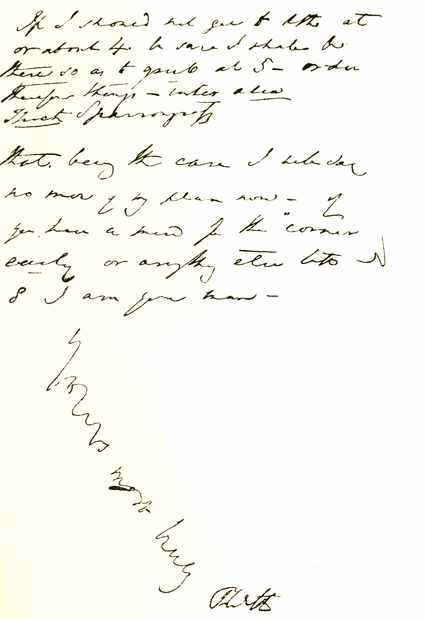
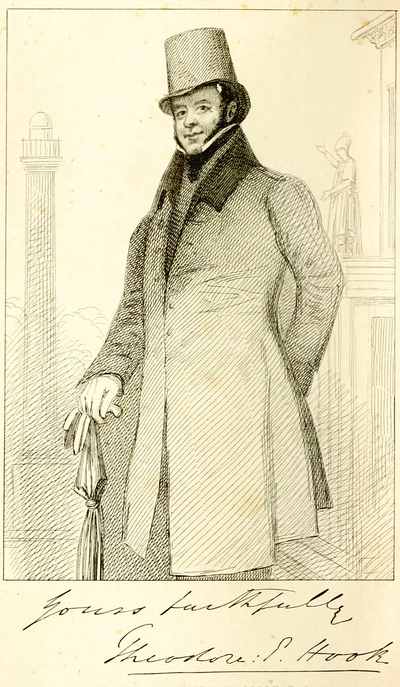
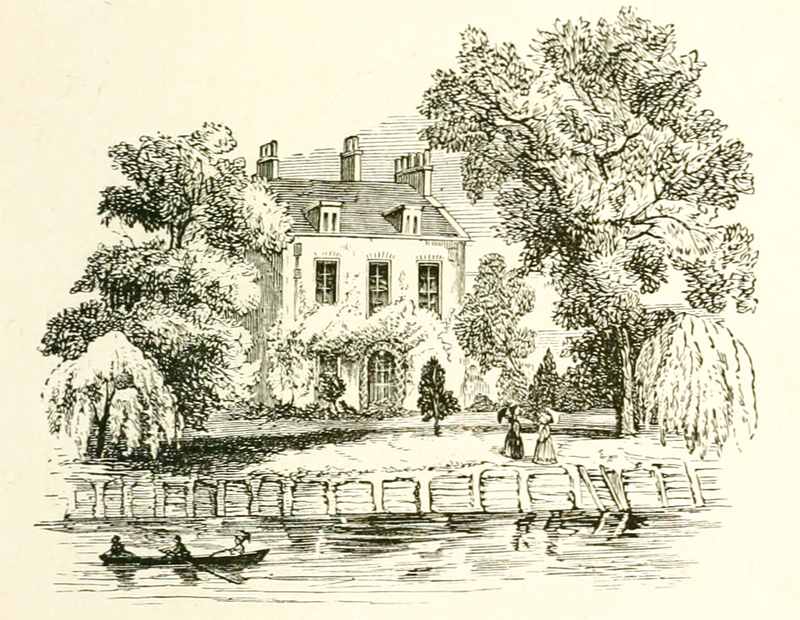
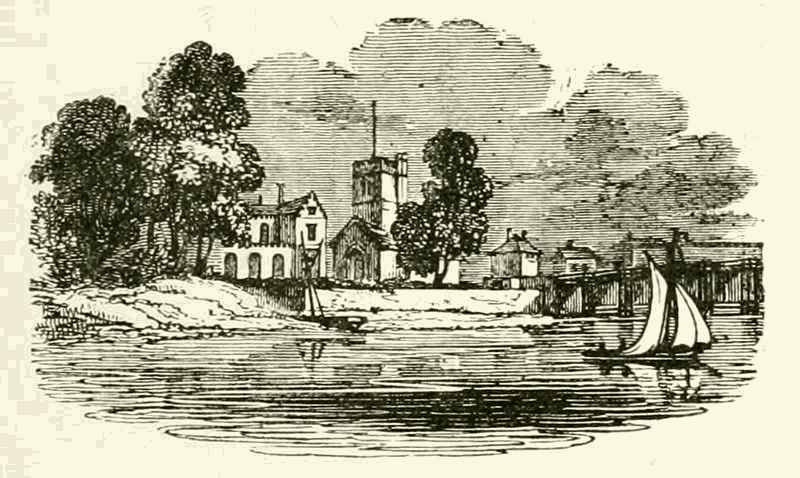
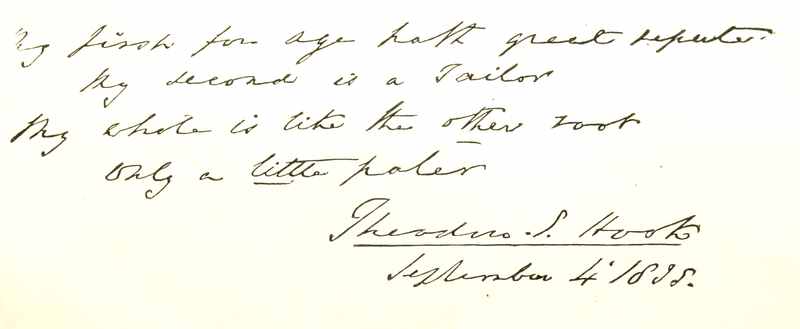
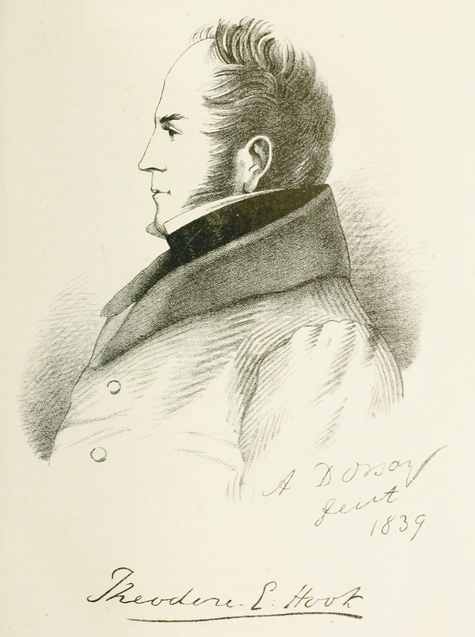


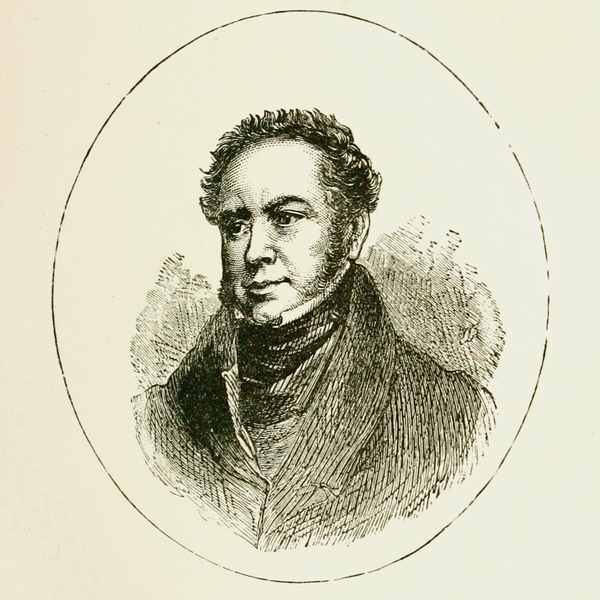
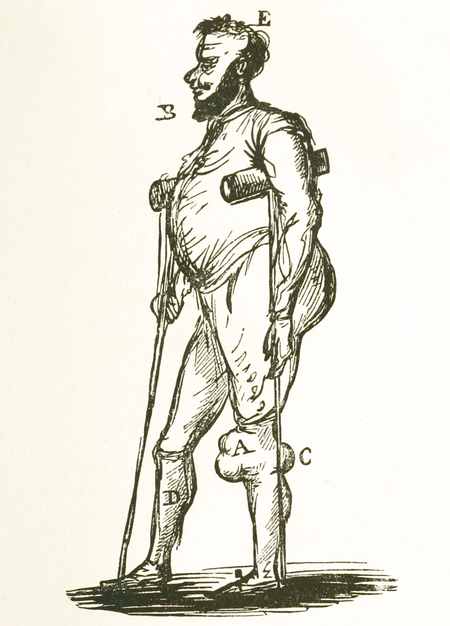
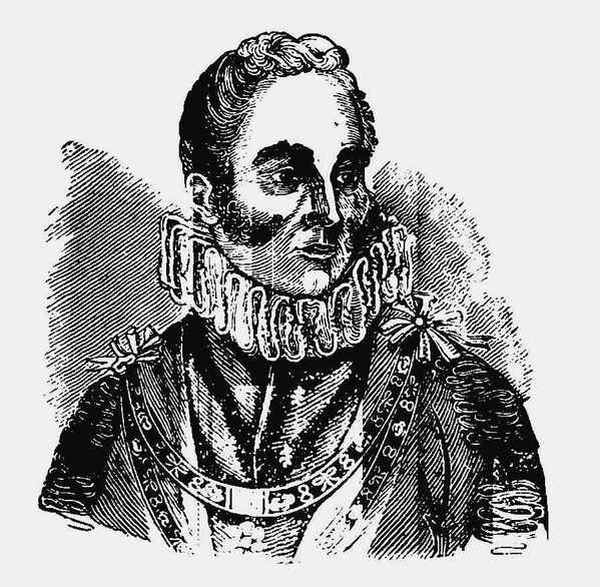

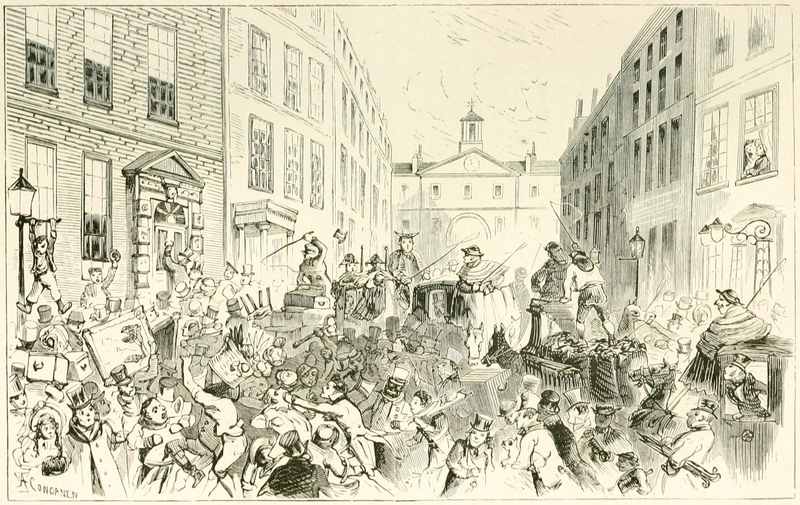
 For NOVELS, see pp. 19-25.