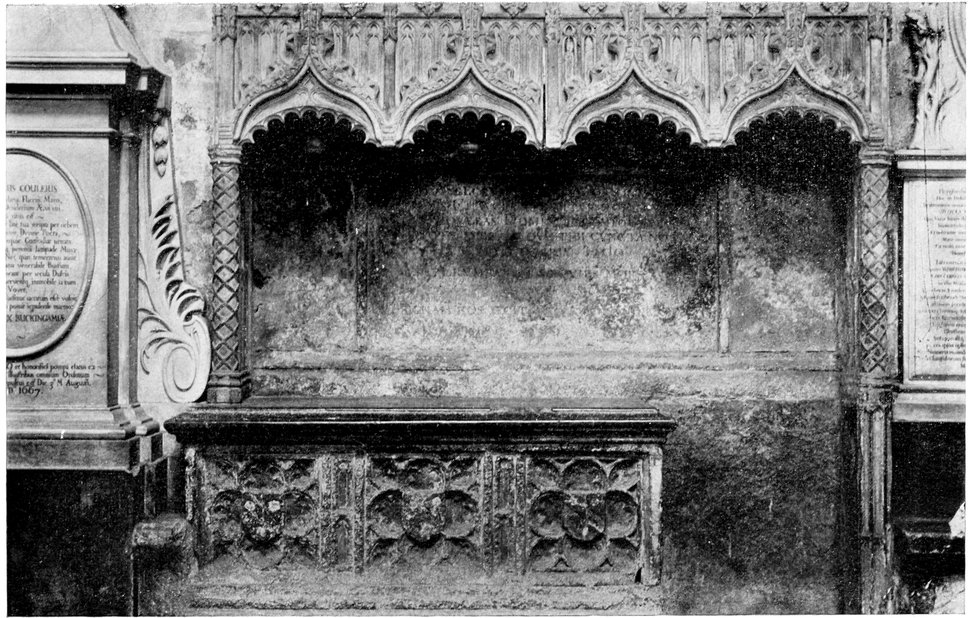
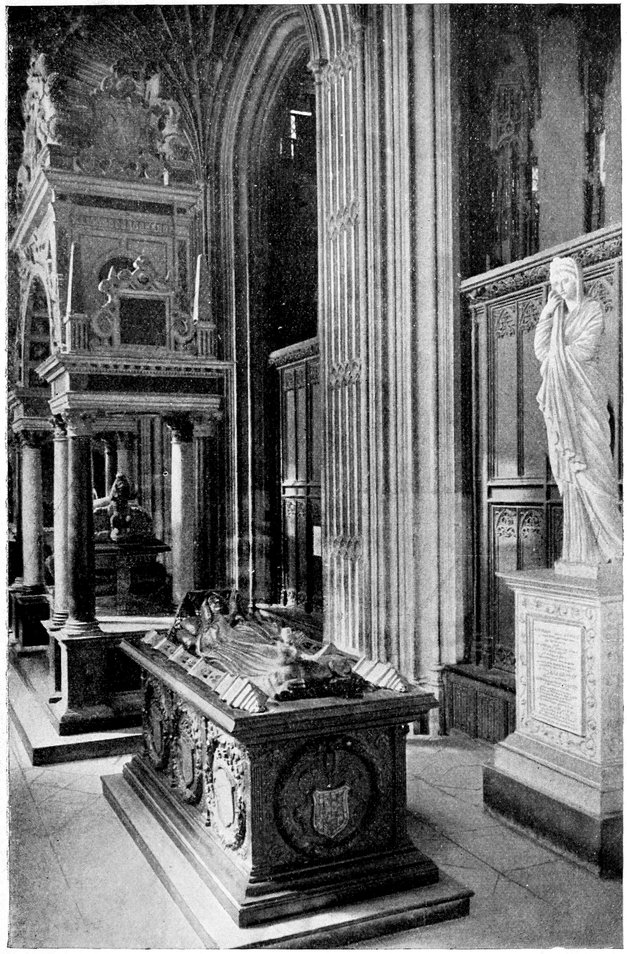
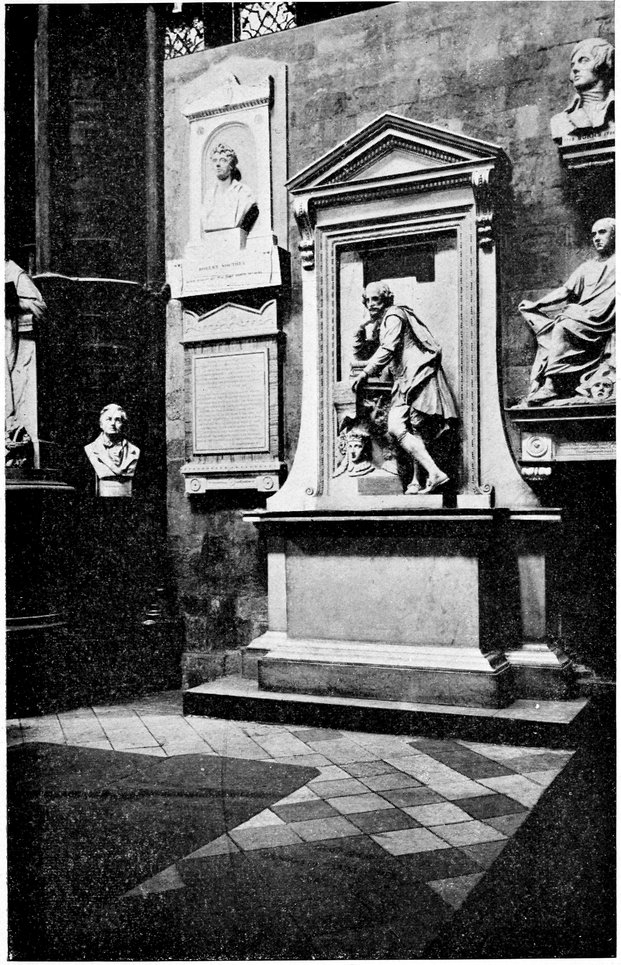
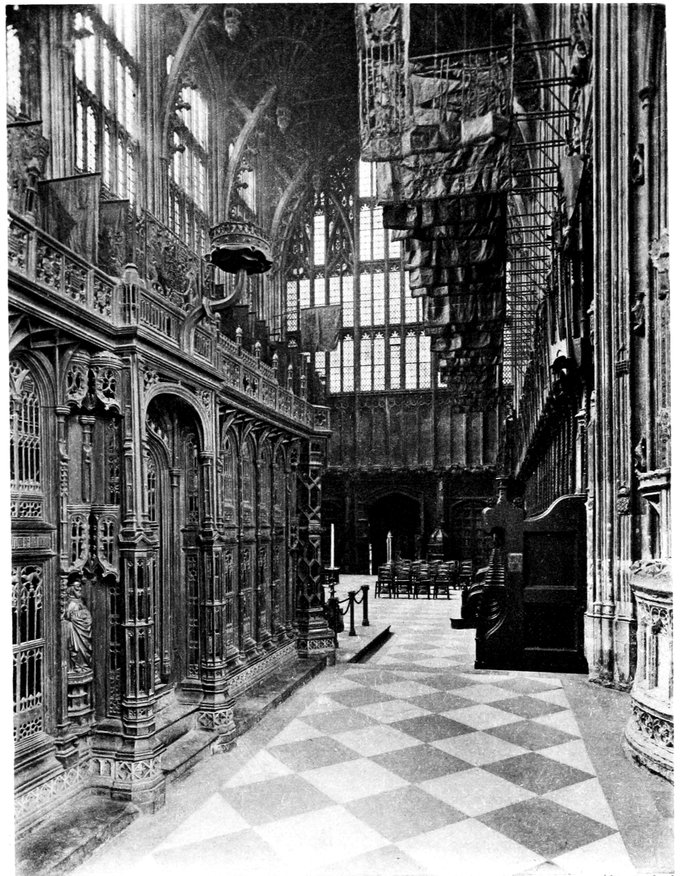
The cover image was created by the transcriber and is placed in the public domain.
THE CHILDREN’S STORY OF
WESTMINSTER ABBEY
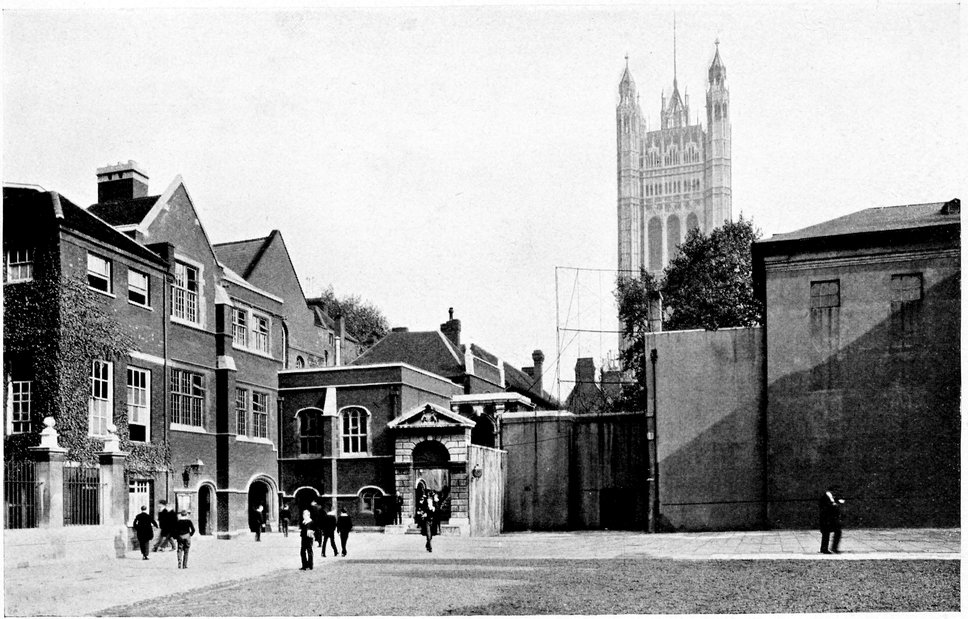
Photo W. Rice, F.R.P.S.Allen & Co (London) Ltd Sc
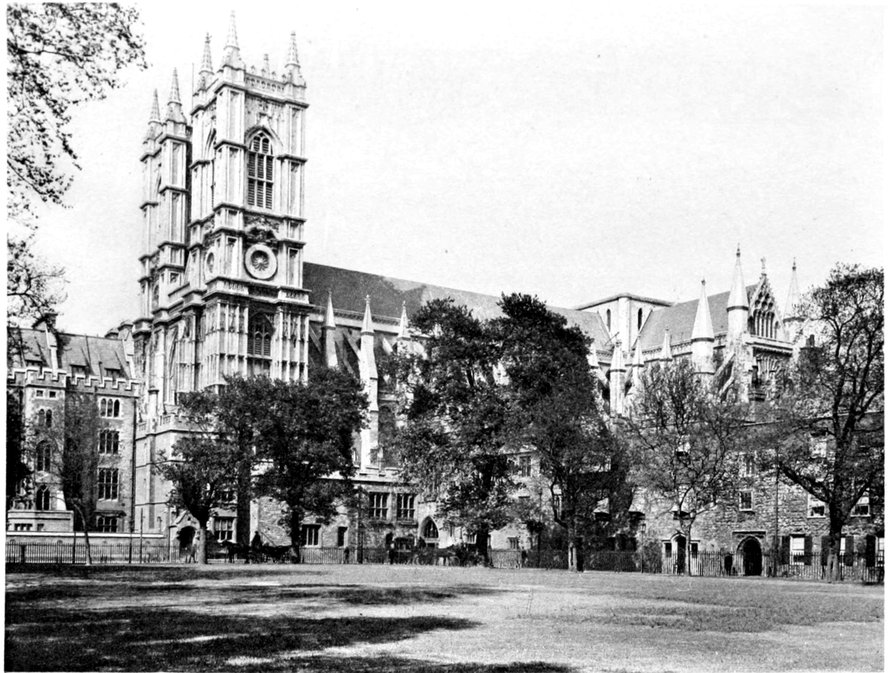
Westminster Abbey from Dean’s Yard.
BY
G. E. TROUTBECK
AUTHOR OF “WESTMINSTER ABBEY” (THE LITTLE GUIDES)
NEW YORK
FREDERICK A. STOKES COMPANY
PUBLISHERS
Published 1909
Printed by
Morrison & Gibb Limited
Edinburgh
TO
LANCELOT, JACK, KATHARINE AND WILFRID
PREFACE
vii
Readers of this little volume must not expect
to find in it a full description of the Abbey
buildings, or a complete list of all the tombs,
monuments, and other beautiful and interesting
things in the Abbey Church. That is not
the aim of this book. Its chief object is to
point out to British children how they may
follow the great outlines of their country’s
history in Westminster Abbey, from the
earliest ages down to our own time,—from
the days of the far-off, legendary King
Lucius to those of King Edward VII.
The words, “citizen of no mean city,”
ought surely to come into our minds as we
look round the Abbey and see there, as we
clearly can see, a kind of outward expression
of all that is best in our national character.
The Abbey speaks to us of the deep religious
viiifeeling behind our shyness and reserve;
of patriotism, and of self-sacrifice for our
country; of love and respect for every form
of good and noble service; of the wise
moderation in our forms of government; of
our wide sympathy with men of every race
and creed.
It is thus that Westminster Abbey can
truly claim to be our great National Church.
CHAPTER I THE FOUNDATION AND BUILDING OF THE ABBEY
1
“It is finished!
The Kingliest Abbey in all Christian lands,
The lordliest, loftiest minster ever built
To Holy Peter in our English Isle!
Let me be buried there, and all our Kings,
And all our just and wise and holy men
That shall be born hereafter. It is finished!”
Tennyson (Harold).
The writer of this little book was once
showing Westminster Abbey to a party of
foreigners—they were Germans,—and after
hearing something about the Abbey and
the people who are either buried or commemorated
there, one of them turned and
said: “I can understand the pride of English
people when I see a place like this.”
Now, it must be remembered that this
2German visitor was not thinking of our
wealth, or of our Empire, or of our commercial
prosperity. He was thinking of the
“great cloud of witnesses,” the people of our
race who have gone before us, and who are
gathered together, resting and remembered
in our chief national church. He was
thinking, too, of the wide and catholic spirit
which would shut out no one who had done
good service to God and man.
If one who was not our own countryman
could feel this so strongly, is it any wonder
that the name of Westminster Abbey is
dear to all British folk, men, women, and
children, whether at home or across the wide
seas? Westminster Abbey is a name that
means “home,” and the story of home, almost
from the very earliest times of our nation.
And if any one asks how and why this
is, it is easy to show him that Westminster
Abbey has been part of English history all
along, and that if you can read what is
written on the old grey stones of Westminster
you will know more about the
3British race and Empire than many books
could teach you.
Around the venerable and stately church,
where all our Kings, from Edward the
Confessor onwards, have been crowned, and
where many of our sovereigns and most of
our famous men are buried, are memories
which speak to us even of the Roman rule
in Britain, taking us back nearly to the
days of brave Queen Boadicea, whose statue
stands on the bridge close by.
Then follow memories of the wild Saxon
days, of the conversion of England by St.
Augustine, of the Danes, the Normans, the
Plantagenets, Tudors, Stuarts, and of many
others.
We are reminded too, of the signing of
Magna Charta, of the Barons’ War, of the
Crusades, of the beginning of the House of
Commons, of the long Hundred Years’ War
with France, of the Wars of the Roses, of
the great Civil War, of the rise of our Indian
and Colonial Empire, and indeed of all the
important things that have happened in our
4country until this very twentieth century,
when the Abbey is still just as much a part
of our history as it ever was.
If we want to see and understand how this
is, we can learn a good deal from the history
of the building itself, that is, of how, when,
and where it was built.
To begin with, what do we mean when we
speak of the “Abbey”?
An abbey was really a place where a
number of monks or nuns lived, under the
rule of an abbot or abbess,—the name
abbot being taken from “abbas,” the Syriac
word for father. The actual church was
only a part of the “Abbey,” to which belonged
many other buildings, besides gardens,
orchards, fields and farms, and often large
estates in various places.
The Abbey of Westminster was for monks
of the Benedictine Order. The Abbot of
Westminster was a very great person, and
many well known places belonged to the
Abbey, such, for instance, as Covent Garden
(the Convent Garden) and Hyde Park,
5besides others which were far away from
London. Windsor at one time belonged to
the Abbey of Westminster, but the Conqueror
wanted it himself, and so made the monks
exchange Windsor for land in other places.
The Church, then, which we now call the
Abbey, was the Abbey Church of St. Peter
in Westminster. Since the days of Queen
Elizabeth, the proper title of the church has
been “The Collegiate Church of St. Peter
in Westminster,” but every one likes to keep
the old name, and to call it Westminster
Abbey. As we shall see later on, a good
deal still remains of the old monastic
buildings besides the church. Such are the
beautiful cloisters, the Chapter-House, and
parts of the library and dormitory.
Now, as to where the Abbey is built. It
stands on what was long ago a desolate
little island in the Thames, an island which
was overgrown with great thorns and
thickets, and in which wild beasts, such as
the wild ox and the huge red deer, used to
roam about. It was perhaps not unlike the
6Isle of Athelney, where King Alfred hid
from his enemies and made his plans.
It is interesting to remember that the
great Cathedral Church of Paris, Notre
Dame, is also built on an island,—a little
island in the river Seine. In those days,
when there were so few roads, it was a great
matter to be near a big river, where boats
and ships could go up and down, and so we
find that most important cities, like Rome,
Paris, Vienna, and London, are built on the
banks of rivers.
The island on which the Abbey stands
was called “Thorney Isle” in those old days,
and it is described in a charter of King Offa
as “the terrible place,” probably because of
its wild forests and fierce beasts. The little
streams which once separated Thorney Isle
from the mainland still run underground, but
in those early days the island was also surrounded
by a great marsh, which stretched
out to Chelsea on the north bank of the
Thames, and to Lambeth and Battersea on
the south bank.
7The early stories of the foundation and
building of the church on Thorney Isle have
been handed down from far-off times, and
although they cannot all be proved to be
quite true, we may be sure that there is a
great deal of truth deep down in them, as
there is in most of the tales that people have
loved and told to their children through all
the ages.
To begin with the oldest story of all. We
are told that in the second century after
Christ, while the Romans were still in
Britain, a certain Lucius, a British King,
became a Christian. His people also became
Christian, and Lucius built a church at
Thorney, where a temple of Apollo had once
stood. Lucius is also said to have built a
church where St. Paul’s now stands, on the
site of a temple of Diana.
Another very interesting story is that of
the rebuilding of the church at Thorney in
the Saxon times. The Venerable Bede tells
us that Sebert, King of the East Saxons,
and nephew of Ethelbert, King of Kent, was
8converted to Christianity by St. Augustine in
A.D. 603 or 604. The Norman monks said
that this King Sebert built a church and
founded a monastery at Thorney Isle, and
a very beautiful story is told about the consecration
of this church of King Sebert’s.
One stormy Sunday night—the very night
before Mellitus, Bishop of London, was to
come and consecrate the church—a fisherman
named Edric was casting his nets into the
Thames. While he was doing this he
heard a voice calling to him from Lambeth,
on the other side of the river, and when he
had crossed over in his boat he found a
venerable looking man in foreign dress, who
asked to be ferried over to Thorney Isle.
Edric took him across the river, and when
they landed at Thorney the stranger went
at once to the church, leaving the fisherman
waiting by the shore. Then, while Edric
watched, a heavenly light seemed to fill
all the air, and angels ascended and descended
on a ladder which reached from
heaven to earth. Edric heard the angels
9singing, and saw how they burned sweet
incense and held flaming tapers. At last the
stranger came back, and said to Edric: “I am
Peter, keeper of the keys of Heaven. When
Mellitus arrives to-morrow, tell him what you
have seen, and show him the token that I,
St. Peter, have consecrated my own Church
of St. Peter, Westminster, and have anticipated
the Bishop of London. For yourself,
go out into the river; you will catch a
plentiful supply of fish, whereof the larger
part shall be salmon. This I have granted
on two conditions—first, that you never fish
again on Sundays; secondly, that you pay
a tithe of them to the Abbey of Westminster.”
When King Sebert and Bishop Mellitus
arrived the next day for the solemn consecration,
Edric met them, bringing a salmon,
which he presented to the Bishop from St.
Peter, at the same time telling him the
wondrous story. It is told that the Bishop
saw on the church the crosses and all the
marks of consecration, and was satisfied that
the fisherman’s tale was true.
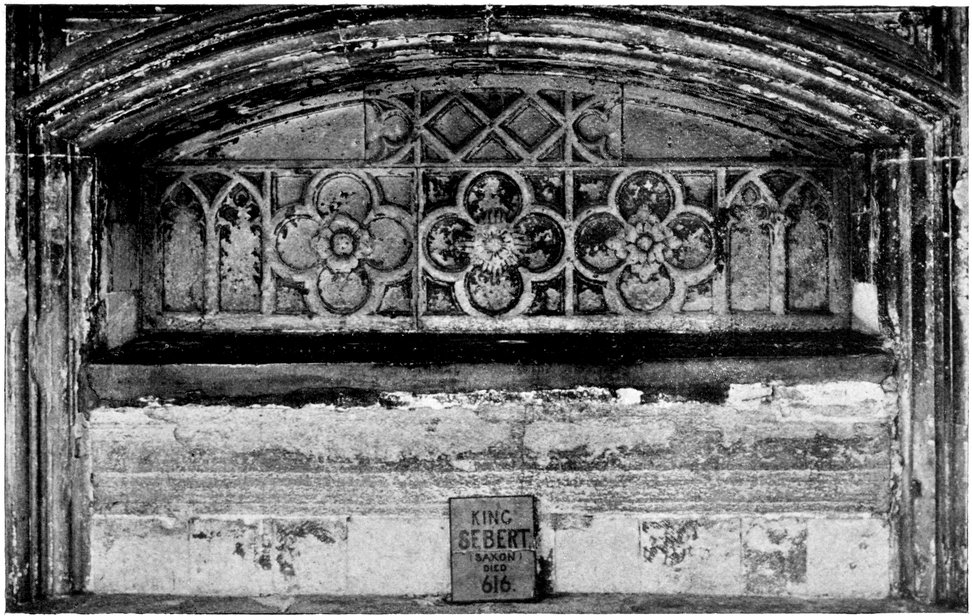
10King Sebert is said to have died about the
year 616, and he and his wife Ethelgoda
were buried in the church at Thorney. His
tomb was replaced in the great church built
on Thorney Isle by Edward the Confessor,
and was finally moved into the present church,
where it still remains.
It is supposed that the church at Thorney
was left neglected until it was restored by
Offa, King of the Mercians. After his day
it was probably overrun and robbed by the
heathen Danes, but it is said to have been
again restored by the great St. Dunstan,
who brought some Benedictine monks from
Glastonbury to the monastery at Thorney.
Harold the Dane, son of Canute, was
buried at Thorney, but his brother, Hardicanute,
ordered the body to be taken out of
its grave and thrown into the Thames. An
old story says: “And he (Hardicanute)
caused to be hurled out the body of Harold,
and to be thrown, beheaded, all out of church;
head and body he throws into the Thames.
The Danes drew it from the water, and caused
it to be buried in the cemetery of the Danes.”
(St. Clement Danes).
[D. Weller
KING SEBERT’S TOMB.
11Now we come to the time of Edward the
Confessor, when we feel we know more about
the real history.
Edward the Confessor had been in exile in
Normandy during the reigns of the Danish
Kings. When Hardicanute died, Edward
came back to England, and was crowned
King at Winchester. After he was once
settled in his kingdom he remembered a
solemn vow he had made while he was in
a foreign land, and when he doubted whether
he would ever get back to England. This
was the vow: “Sire Saint Peter, under whose
aid I put myself and my property, be to me
a shield and protection against the tyrant
Danish plans: Be to me lord and friend
against all my enemies. To thy service I
will entirely give myself up, and well I vow
to you and promise you, when I shall be
of strength and age, to Rome I will make
my pilgrimage, where you and your companion
Saint Paul suffered martyrdom.”
12The English were most unwilling that
their King should leave them, and go away
on such a long and dangerous journey as it
was in those days. So they begged the King
to remain, and he sent to ask the Pope what
he might do instead of going to Rome. The
Pope answered that he might build or restore
some monastery in honour of St. Peter.
There is a beautiful old story which tells that
while the King was thinking over this matter,
and wondering where to build his monastery,
a message was brought to him from a holy
hermit of Worcestershire, one Wulsinus, and
the message was as follows: “I have a
place in the west of London, which I myself
chose, and which I love. This formerly I
consecrated with my own hands, honoured
with my presence, and made it illustrious
by divine miracles. The name of the place
is Thorney, which once, for the sins of the
people, being given to the fury of barbarians,
from being rich is become poor, from being
stately, low, and from honour is become
contemptible. This let the King, by my
13command, repair and make it a house of
monks, adorn it with stately towers, and
endow it with large revenues. There shall
be no less than the House of God and the
Gates of Heaven.”
This, and other reasons, decided the King
to rebuild the church at Thorney Isle, and
this great “Minster of the West” was
probably begun about the year 1055. In
1065 the eastern part of the church, that is
to say, the choir and transepts, was ready, and
it was consecrated by Archbishop Stigand on
Innocents’ Day, 28th December 1065. King
Edward was too ill to be at the service, so his
wife, Queen Editha, had to represent him.
Edward the Confessor died on 5th January
1066, and was buried the next day, the
Feast of the Epiphany, in front of the high
altar of his new church.
That church was very different to look at
from the Abbey we all know at the present
day. It was built in what is called the
Norman style, with massive pillars, round
arches, and round-headed windows. It must
14have been a very large and splendid church,
almost as large as the present one, only that
it was not so high.
The church and the surrounding monastery
buildings were finished during the reigns of
the early Norman kings, and William the
Conqueror confirmed the charters granted to
the Abbey by the Confessor, and bestowed
yet more lands upon it.
We must now pass over nearly two
hundred years, and speak of the time of
King Henry III. In the year 1220, Henry
III began to build a very beautiful chapel,
dedicated to the Virgin Mary, at the eastern
end of the Abbey church. It was just about
this time that some of the grand cathedrals
of France, such as those of Amiens, Reims,
and Chartres, were being built in that lovely
and graceful pointed style which is called
Gothic, but which really comes from France.
Henry III, when visiting his brother-in-law,
St. Louis, King of France, had no doubt
seen some of these glorious new churches,
and was very anxious to build one like them
in honour of King Edward the Confessor, for
whom he had a great reverence.
Photo W. Rice, F.R.P.S.Allen & Co (London) Ltd Sc
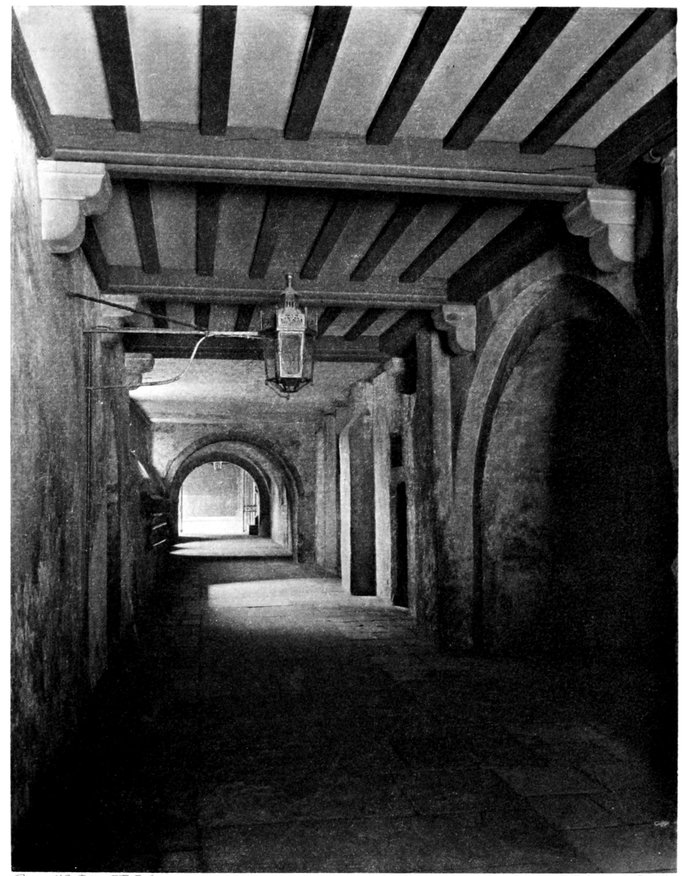
The Norman Cloister.
15Accordingly, in 1245, he began to have the
Confessor’s Norman church pulled down, and
in its stead he built the splendid church
we now see, a church which has been called
“the most lovely and lovable thing in
Christendom.”
The choir and transepts, the Chapter-House,
and some of the cloisters were built
during Henry’s reign. The monks sang
service in the new choir and transepts for
the first time on 13th October 1269, when
the body of Edward the Confessor was
placed in the magnificent new shrine made
for it by Henry III.
Some of the nave was then gone on with,
but it was not built to its present length
until the reign of Henry V. The first time
it was used for a procession was when the
Te Deum was sung in thanksgiving after the
Battle of Agincourt in 1415. The money for
building this part of the Abbey was given
into the care of a man named Dick Whittington,
16whom some people think to have been
the famous Lord Mayor of that name.
This, however, is doubtful.
The church built by Henry III is very
different from a Norman church. Instead of
round arches, it has very pointed ones; the
windows are long and pointed; the pillars
are tall, slender, and graceful. The wonder
seems to be how such a building can have
stood for all these hundreds of years. And
indeed it would not stand, if it were not for
the beautiful flying buttresses which support
it on the outside.
In the reigns of Edward III and Richard
II the cloisters were finished, and Abbot
Litlington built the celebrated rooms known
as the Jerusalem Chamber and the College
Hall. A very fine North Porch, called
“Solomon’s Porch,” was built in Richard II’s
reign, but unhappily none of it now remains.
In the year 1503, King Henry VII began
the chapel which is known by his name, and
which is so famous for its beauty. It stands
on the place where Henry III’s Lady Chapel
17stood, but it is much larger than the older
chapel, and some houses had to be pulled
down to make room for it, among them being
the house where the poet Chaucer is said to
have lived. Henry VII’s chapel is too
elaborate to describe here. The decoration
is so rich and so delicate that it looks almost
like lace-work, and the badges carved on the
walls, the Tudor roses, the Beaufort portcullis,
and the fleur-de-lys are a kind of history lesson
in themselves. The fan-tracery vault
is most wonderful, both in its lovely design
and splendid masonry work.
We have now come almost to an end of
the story of the actual building of the Abbey,—at
any rate of the chief parts of it. The
tracery of the great west window was put up
in the year 1498, in Abbot Esteney’s time,
but the glass in it dates only from the reign of
George II. The western towers, which were
begun long before, were finished in 1739 or
1740, from a design made by a pupil of Sir
Christopher Wren.
In 1540, King Henry VIII made great
18changes in the monasteries all over England.
The monks were sent away from Westminster,
and their place was taken by a Dean
and twelve prebendaries. For just ten years,
from 1540 to 1550, the Abbey was made into
a cathedral, or church where a bishop has
his throne. During these years there was a
Bishop of Westminster, but when the bishop
resigned, in 1550, his diocese was joined
once more to the See of London.
Henry VIII also made new arrangements
for the old School, which had existed in the
monastery from the Confessor’s time.
When Queen Mary Tudor came to the
throne she brought the monks back, with
Abbot Feckenham to rule over them, and the
old services were restored for a time.
Queen Elizabeth changed this again, and
established the Abbey as a Collegiate Church,
with a Dean and Prebendaries. The present
arrangements are not very different from
those of her time, in spite of certain changes
which have had to be made in modern days.
Queen Elizabeth also re-established the
19School, much on the same plan as her father
had done. She settled that there should
be a Head-Master, an Under-Master, and
forty Scholars, who are called either King’s
Scholars or Queen’s Scholars, according as
the Sovereign is a king or a queen.
Westminster School always remembers
what Queen Elizabeth did for it, and her
name is commemorated in the prayers.
Now, having described something of the
foundation and building of the Abbey, it is
time to turn our thoughts to the many
important and interesting things that have
happened there, and to the great people of
our nation who are resting within its walls.
CHAPTER II THE CORONATIONS
20
“Zadok the priest and Nathan the prophet anointed
Solomon king; and all the people rejoiced and said: God
save the king, Long live the king, May the king live for
ever.”—1 Kings i. 39, 40.
The greatest and most important ceremonies
which have taken place in Westminster
Abbey are, of course, the Coronations of
our Kings and Queens, and so we will
speak first of this most interesting part of
the Abbey history.
Such a wonderful succession of coronations
has never been seen in any other building in
the world. Ever since 1066 our sovereigns
have been crowned close to the spot where
Edward the Confessor was first buried, and
where the Saxon Harold and Norman
William stood more than 800 years ago.
[D. Weller.
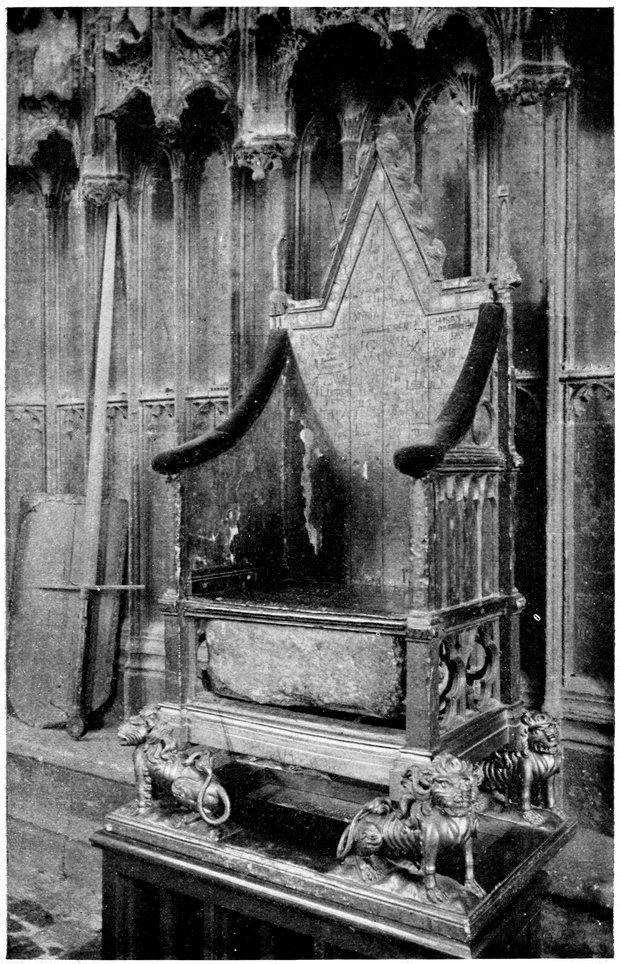
CORONATION CHAIR, WITH SWORD AND SHIELD OF STATE.
21Dean Stanley tells us that the coronation-rite
of the Kings of Britain is the oldest in
Europe, and that the inauguration of Aidan,
King of the Dalriadic Scots, by St. Columba,
in the sixth century, is the oldest ceremony of
the kind in Christendom. It is good for us
to remember these days of old, for it helps
us to understand much better what is going
on now, and teaches us the meaning of many
of the solemn services and ceremonies of
Church and State.
The Coronation Service has been slightly
changed, of course, from time to time, but its
chief parts are much the same as they were
when William the Conqueror was crowned
at Westminster in 1066. From very early
times the coronations had been partly religious
and partly civil ceremonies, and had taken
place in a church, the day chosen being
either a Sunday or some high festival, like
Christmas Day, Whitsunday, or a Saint’s
Day. The Saxon Kings were usually
crowned in Winchester Cathedral. Canute
was crowned at St. Paul’s.
22Before speaking of any of the old Westminster
Coronations, it will be a good plan
to describe, very shortly, what is done at
Coronations in our own day. We will take
the little book of the “Form and Order for
the Coronation of King Edward and Queen
Alexandra,” and see what it says.
To begin with, the Sacred Oil for the
anointing of the King was consecrated in
the Confessor’s Chapel, and then placed on
the altar. The Litany was said, and a
hymn was sung as the clergy, carrying the
Regalia, went down to the west door to
meet the King and Queen.
When the King and Queen came into
church the choir sang an anthem beginning
with the words: “I was glad when they
said unto me, We will go into the house
of the Lord.”
The Westminster scholars have for long
years had the right of acclaiming the King
and Queen at the Coronations, and their
shouts of “Vivat Regina Alexandra,” “Vivat
Rex Edwardus,” were heard in the anthem
23as the sovereigns, first the Queen and then
the King, walked up the Abbey.
At Coronations a great platform, called
the Theatre, is put up, and covers a wide
space in front of the high altar. On this platform
the Coronation Chair (King Edward’s
Chair, as it is called) is placed, and also
the thrones. Here all the principal people
stand, and here the whole great ceremony
is performed.
When the King and Queen reached
this platform the Archbishop of Canterbury
turned to the people, and asked for what
is called the Recognition, that is to say,
he asked whether the people of England
were willing to accept the King, and to do
him homage. They answered by shouting
out: “God save King Edward.”
The Regalia were then placed on the
altar, and the Archbishop began the
Communion Service. After the Creed the
actual Coronation began. The King first
took the solemn Oath to observe the statutes,
laws, and customs of the land, and to cause
24“law and justice, in mercy, to be executed
in all his judgments.” He also promised
to maintain and preserve the Church of
England as by law established. The King
then kissed the Book of the Gospels, and
signed the Oath. The Archbishop then
began the beautiful hymn “Come, Holy
Ghost, our souls inspire,” sung as a prayer
for the blessing of the Holy Spirit on the
King and Queen. After the hymn, the
King, sitting in the Coronation Chair, on
the Stone of Scone, was solemnly anointed
with the Holy Oil. Then the Lord Great
Chamberlain girt the King with the Sword
of State, and after that the Sub-Dean of
Westminster, acting for the Dean, put on
him the Imperial Robe, and the Archbishop
presented him with the Orb. The King
then received the Ring, as a sign of kingly
dignity, and then the two Sceptres,—the
sceptre with the cross and the sceptre
with the dove.
After this came the putting on of the
Crown itself, which was brought by the
25Sub-Dean and placed on the King’s head
by the Archbishop. The people again
shouted “God save the King”; the peers
put on their coronets; the trumpets sounded,
and the great guns at the Tower were
fired off.
The Archbishop then presented the Holy
Bible to the King, saying these beautiful
words: “Our Gracious King, we present
you with this Book, the most valuable thing
that this world affords. Here is wisdom;
this is the royal law; these are the lively
oracles of God.”
After this came the Benediction. The
King was then led to his throne, and
received the homage of all the princes and
peers, the Prince of Wales being the first
to do homage to his father. When that
splendid ceremony was over the Queen
was crowned by the Archbishop of York.
As Queen Alexandra was Queen-Consort,
she did not sit in King Edward’s Chair,
as of course Queen Victoria did, but she
knelt at the altar-step to be crowned. As
26she was led to her throne she made a deep
obeisance to the King, who rose and bowed
to her.
The actual Coronation being finished,
the Archbishop proceeded with the Communion
Service, and the King and Queen
received the Holy Communion, which was
administered to them by the Archbishop of
Canterbury and the Dean of Westminster.
At the end of the service the “Te Deum”
was sung, and the whole assembly cheered
as the King walked down the Abbey, in
his Royal Robe and Crown, and bearing
the Sceptre and Orb.
This is an outline of the Coronation
Service of King Edward VII, and it is
especially interesting because, in spite of
some few small changes, it shows us what
the Coronations of our Kings have been
like ever since the Confessor’s days. It
may be well just to explain what is meant
by the word “Regalia,” because the history
of the Regalia carries us back to times
even before Edward the Confessor, as
27Offa, King of the Mercians, is said to have
placed the Regalia and Coronation Robes in
the church at Thorney Isle. We should
notice that the Regalia, that is, the crowns,
sceptres, and orbs, had Anglo-Saxon names.
The King’s crown was called the crown of
Alfred, or of St. Edward; the Queen’s
crown was called the crown of Editha,
wife of Edward the Confessor. The sceptre
with the dove was a remembrance of the
peaceful days of the Confessor’s reign, after
the Danes were driven out. The Coronation
oath used to be taken on a copy of the
Gospels which was said to have belonged
to Athelstane. The orb appears in the
famous Bayeux tapestry, showing that it
must have been used in Saxon days.
Now let us turn for a little to some of
the Coronations of particular Kings. As we
have seen, the Saxon Kings were usually
crowned at Winchester, as Edward the Confessor
himself was.
The first Coronation to take place in the
great church founded and built by the Confessor
28was that of Harold the Saxon, son of
Earl Godwin, and brother-in-law of the Confessor.
There was much anxiety in the
country about the succession, and Harold
was crowned at Westminster in great haste
and confusion the day after the Confessor
died, and the very day of his funeral,
January 6th, 1066.
The next coronation was indeed different,
for many things had happened in England
meanwhile. As we all know, William Duke
of Normandy, cousin of Edward the Confessor,
had claimed the throne of England by right
of inheritance. He had sailed over to
England, had defeated and slain Harold at
the Battle of Hastings (or Senlac), and was
now King. When we remember that
Charlemagne was crowned Emperor in St.
Peter’s at Rome by Pope Leo III on
Christmas Day, A.D. 800, it makes it all
the more interesting to think that the day
chosen for the Conqueror’s Coronation was
also Christmas Day. He stood there in the
Abbey, close to the grave of the Confessor,
29having on one side of him the Saxon Aldred,
Archbishop of York, and on the other the
Norman Bishop of Coutances. Archbishop
Stigand, of Canterbury, had fled.
In the church were many of the Saxon
people of London, and mixed with them were
a number of Normans. Outside, the Norman
horsemen kept guard. When the people
began to acclaim the King in the usual
English fashion, the Norman soldiers did not
understand what was going on, and thought
it was a riot. Being afraid of what might
happen, they set fire to some of the thatched
buildings near the Abbey. The crowd
rushed out in alarm, leaving William alone
in the church, with the bishops and other
clergy. A terrible tumult followed, and even
the Conqueror trembled. The rest of the
Coronation was hurriedly finished, Archbishop
Aldred making William promise to
defend the Saxons before he would put the
crown on his head.
The Conqueror, like the Saxon Kings
before him and the Norman Kings after
30him, used to appear in church on the great
festivals wearing his crown.
From this time onward the Coronations
always took place in Westminster Abbey.
All the Regalia were kept in the Treasury at
Westminster until the time of Henry VIII,
and some of them until the time of the
Commonwealth. It was part of the duty of
the Abbot of Westminster to instruct and
prepare the King for his Coronation. Further,
it was settled by Lanfranc, the first Norman
Archbishop of Canterbury, that the Archbishop
of Canterbury, and not the Archbishop
of York, was to have the right to crown the
King.
The next Coronation of special interest
is that of Henry III, the King who built
the present Abbey Church. When Henry
succeeded to the throne in 1216, after the
sad and unfortunate reign of his father, King
John, London was in the hands of the
Dauphin of France, Prince Louis. Henry,
therefore, could not be crowned at Westminster,
and was first crowned at Gloucester,
by the Bishop of Winchester, not with the
crown, but with a chaplet or garland. It
will be remembered that King John’s baggage
and treasures, with the Regalia, had been swept
away by the tide as he was crossing the Wash.
[W. Rice, F.R.P.S.
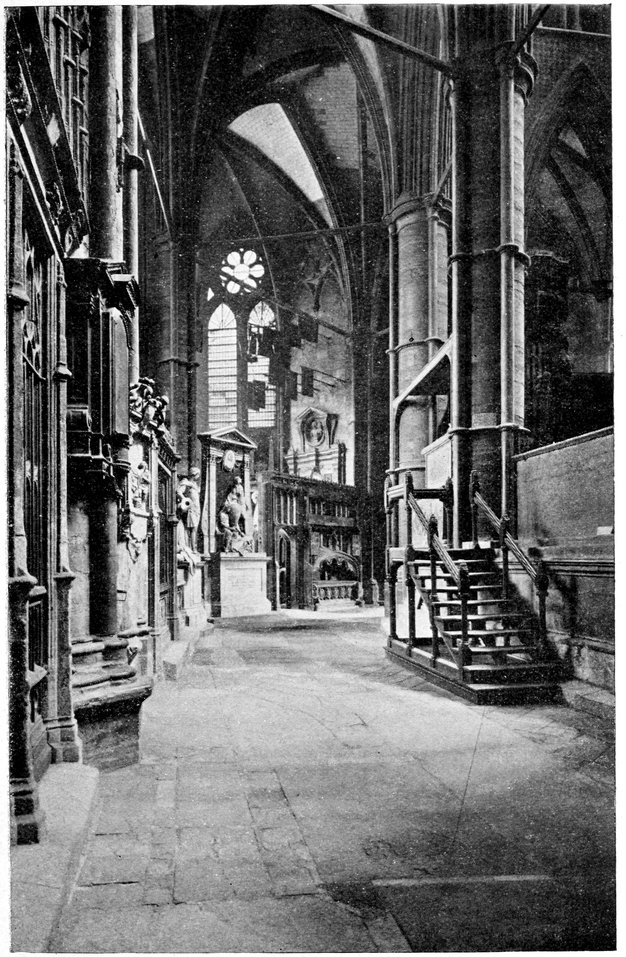
NORTH AMBULATORY, WITH TOMBS OF HENRY III. AND EDWARD I.
31It was not until Whitsunday 1220 that
Henry was solemnly crowned in the Abbey
by Stephen Langton, Archbishop of Canterbury.
He was the last King to be crowned
in the Confessor’s Norman Church. The
day before his Coronation he had laid the
foundation-stone of the Lady Chapel, that
beautiful chapel which once stood where
Henry VII’s Chapel now stands.
Edward I was in the Holy Land when his
father died, and therefore was not crowned
until the year 1274, when he and his beloved
Queen, Eleanor of Castile, were crowned
together,—the first King and Queen who had
been jointly crowned. At this Coronation
five hundred great horses, which had been
ridden by the princes and nobles, were let
loose among the crowd for any one to catch
who could.
32The Coronation of Edward I brings two
very interesting things to our mind. These
two things are, first, that Edward I was the
King who brought the Stone of Scone from
Scotland to England; and secondly, that it
was he who ordered the present Coronation
Chair to be made. This Coronation Chair,
which was made in 1307 to contain the
Stone of Scone, is perhaps the most precious
thing in all the Abbey, excepting the Confessor’s
shrine.
Some beautiful old stories are told about
the Stone of Scone. One of these stories
says that it was the Stone on which Jacob
laid his head in Bethel when he had the
wonderful vision of angels ascending and
descending on the ladder which reached from
earth to heaven. The sons of Jacob are
said to have taken this sacred stone with
them into Egypt, whence it was carried in
after years to Spain, and then to Ireland,
where it was used at the coronations of the
Irish Kings. It was placed on the sacred
hill of Tara, and was called “Lia Fail,” or
33the “Stone of Destiny.” If a true King sat
upon it to be crowned, the stone made a
noise like thunder, but if the King elect was
only a pretender the Stone was silent. One
story tells us that the Stone was carried across
from Ireland to Scotland about 330 B.C., by
Fergus, the founder of the Scottish monarchy,
and that it was placed, first at Dunstaffnage,
and then at Iona. In A.D. 850 it was
brought by Kenneth II to Scone, where it
was enclosed in a wooden chair, as it now
is at Westminster. The Kings of Scotland,
from Malcolm IV to John Baliol, sat on the
Stone to be crowned. Edward I himself is
said to have been crowned King of Scotland
on the Sacred Stone of Scone after he had
defeated John Baliol at the Battle of Dunbar in
1296. Whether this was so or not, Edward I
carried off the Stone and the Scottish Regalia
to Westminster, and placed them near
the Confessor’s shrine.
In the last year of his reign Edward I
ordered a chair to be made in which the Stone
was to be enclosed, and in which the Kings
34of England were to sit to be crowned. In
this very chair every English sovereign has
been crowned, from Edward II to Edward
VII. It has only once been taken out of the
Abbey, and that was when it was taken into
Westminster Hall for the inauguration of
Cromwell as Lord Protector of the Realm on
December 16th, 1653.
In Edward III’s reign the Scots tried very
hard to get the Stone back again, and the
King, who wished to content them, very
nearly allowed them to have it. But the
people of London would not hear of such a
thing, and, as an old writer says, “would
not suffer the Stone to depart from themselves.”
We must now speak of some other Coronations.
Richard II’s Coronation was very
splendid, and the ceremony was so long and
tiring that the King, who was still quite a
boy, fainted from fatigue. Two interesting
ceremonies began at this Coronation. One
was the first appearance of the “Champion,”
as he was called. The Champion was a knight
35who threw down his glove as a challenge
to any one who disputed the King’s claim
to the throne. The last appearance of the
Champion was at the Coronation of George IV,
in 1820, so this curious old custom lasted for
more than four hundred years.
Again, Richard II was the first King to be
accompanied at his Coronation by a body of
Knights, the Knights who were afterwards
called the “Knights of the Bath.” It became
the custom for the King to create a number
of Knights on the eve of his Coronation, and
these Knights accompanied him in his procession.
Part of the solemn ceremony of
receiving Knighthood was the taking of a
bath, as a sign of purity both of body and soul.
The Knights of the Bath once used to be installed
in Henry VII’s Chapel, and the Dean of
Westminster is always the Dean of the Order.
However, no Knights have been installed at
Westminster for a long time past. Many of
the old banners of the Knights of the Bath
still hang over the stalls in Henry VII’s Chapel,
just as the banners of the Knights of the
36Garter hang in St. George’s Chapel at
Windsor. On the backs of the stalls are the
coats-of-arms of the Knights, emblazoned on
gilded metal plates.
But to return for a moment to the Coronation
of Richard II. It has an especial interest
for Westminster, as the Abbey possesses a
most valuable book, called the “Liber
Regalis,” which was drawn up by Abbot
Litlington, and which gives the whole order
of the Coronation service. This has been
followed, more or less, at all the Coronations
since that time.
We must now pass over nearly two
centuries, and pause to think of the Coronation
of Queen Elizabeth, remembering that
it was she who finally founded Westminster
Abbey as a Collegiate Church, and who re-established
the School much on the present
plan. Elizabeth’s accession was a very
happy event for her subjects, and there were
great rejoicings everywhere. Her Coronation
was the last at which the ancient Latin
Coronation Mass was celebrated, and the
37Abbot of Westminster took his part in the
service for the last time. His place is now,
of course, taken by the Dean, or by the Sub-Dean,
should the Dean be ill or unable to
attend. At Queen Elizabeth’s Coronation
the Litany was said in English, instead of in
Latin, and the Epistle and Gospel were read
in both Latin and English, showing that, for
the future, our own English language was
going to be used for our Church services.
At the Coronation of Charles I several
things happened which people considered
unlucky, and as a sign that misfortunes were
coming upon the King. To begin with,
Charles wore white instead of the usual red
or purple, and this was thought to be a bad
omen, as if meaning that the King was to
be a victim, there having been some old
prophecy of trouble for a “White King.”
Then the sceptre with the dove was broken,
and as the dove could not be mended without
the mark being seen, a new dove had to be
made. In the later part of the day a shock
of earthquake was felt. All these things
38were regarded as signs of coming evil, and
were no doubt remembered in the sad days
of the Civil War, and at the time of the
King’s imprisonment and death.
Westminster is a Royal foundation, and
the old Royalist spirit always remained
strong there, especially among the boys of
Westminster School; and this in spite of
the changes made at the Abbey by the
Puritans during the Commonwealth.
The famous Archbishop Laud, the friend of
Charles I, was one of the twelve Prebendaries
of Westminster, and took the Dean’s place
at Charles I’s Coronation.
Charles II and James II were both crowned
on St. George’s Day, the festival of the
Patron Saint of England.
William and Mary were crowned as joint
sovereigns, Mary sitting in a Chair of State
made for the occasion, a chair which is now
to be seen in Henry VII’s Chapel. She
also had the sword and other symbols of
sovereignty given to her, just as her
husband, King William, had.
39The Coronation of George IV is remembered
partly for its magnificence, but
chiefly, perhaps, on account of the sad and
foolish attempt to get into the Abbey made
by poor Queen Caroline, and the manner in
which she was turned away from the doors.
The Coronation of Queen Victoria brings
us nearer to our own time, and the thought
of that day reminds us of the good Queen
whose long life of anxious work and responsibility
began in her early girlhood. She
took upon her the cares of sovereignty
at an age when most girls think mainly of
amusing themselves, and we all know how
well she kept the solemn promises made on
her Coronation Day at the Abbey.
King Edward VII’s Coronation has already
been described. That beautiful and stately
ceremony was all the more touching and
impressive because of the thankfulness of
the people for the King’s recovery from a
dangerous illness, a feeling which made their
gladness and enthusiasm all the greater.
This short account of some of the Coronations
40will help to explain still further how
and why the Abbey has always held such an
important place in our national life. We see
that the Norman, Plantagenet, Tudor, Stuart,
and Hanoverian sovereigns have all come
here to be crowned, close to the shrine of the
last Saxon King, much in the same way
as the French Kings used to go for their
coronations to the great cathedral at Reims,
and as the Tsars of Russia go to the
Kremlin at Moscow.
We must now leave the Coronations, and
turn to think of some of the great people who
are buried and commemorated in the Abbey.
[D. Weller.
SHRINE OF KING EDWARD THE CONFESSOR.
CHAPTER III KING EDWARD THE CONFESSOR
41
“There is
One great society alone on earth:
The noble Living and the noble Dead.”
Wordsworth (Prelude).
King Edward the Confessor is such an important
person in the history of the Abbey
that his Chapel and Shrine must be described
in a chapter by themselves.
As has already been told, the Confessor
died on January 5th, 1066, and was buried
the next day, January 6th, the Feast of the
Epiphany. He was laid in front of the high
altar of his newly built church, and the
Conqueror afterwards presented splendid
hangings to cover the simple tomb which
was erected over the grave.
There is an interesting old story of something
42that happened at this tomb in the reign
of William the Conqueror.
When Lanfranc became Archbishop of
Canterbury, most of the Saxon bishops were
sent away and Normans were put in their
places. Among the Saxon bishops was the
good old St. Wulfstan, Bishop of Worcester.
He was made bishop in 1062, in the Confessor’s
time. The Normans despised him,
and thought him ignorant because he could
not speak French, and they thought he
would not be able to give any good advice
to the King. Wulfstan was told that he
must come to Westminster to meet the other
bishops. They then said to him that he
must give up the pastoral staff, which
belonged to him as a bishop. Wulfstan
showed no anger, but only said quite simply
that he would resign his staff, not to the
archbishop, “but rather to St. Edward, by
whose authority I received it.” He then
went into the Abbey, walked up to the Confessor’s
tomb, and, raising his arm slowly, he
struck the pastoral staff into the stone, saying:
43“Receive, my lord the King; and give it to
whomsoever thou mayst choose.” It is said
that the staff remained firmly fixed in the
stone, so that no one could pull it out. The
King and the Archbishop were amazed, and
acknowledged that they had done wrong in
trying to turn Wulfstan out of his bishopric.
They begged Wulfstan to take his staff once
more. The old man came near, and drew
the staff out quite easily. The King and the
Archbishop went down on their knees and
begged his forgiveness, but, as the old story
says: “He, who had learned from the Lord
to be mild and humble in heart, threw himself
in his turn upon his knees.”
We are told that in 1098 the Confessor’s
tomb was opened, and that his body was
found to be still in perfect preservation.
Bishop Gundulph, of Rochester, alone ventured
to uncover the face. The memory
of Edward’s pure life, and of his goodness
and charity, together with the miracles that
were believed to be worked at his tomb,
caused the people to honour him more and
44more as a saint, and in the year 1161, Pope
Alexander III caused his name to be formally
added to the names of the Saints of the
Christian Church. In our Prayer-Books his
name appears on October 13th, as King
Edward the Confessor. A “confessor”
means some one who has suffered for the
faith of Christ without actual shedding of
blood. In King Edward’s case it alludes to
his exile in the time of the heathen Danes.
The “Translation” of which the Prayer-Book
speaks means the moving of the body into
the shrine. This “Translation” took place
on October 13th, 1163, when the Confessor’s
body was placed in the new and splendid
shrine made for it by King Henry II. This
ceremony took place at midnight, and both
Henry II and Archbishop Becket were
present.
While the Abbey was being rebuilt in the
reign of Henry III, the Confessor’s coffin was
taken for the time to the Palace of Westminster
close by. On October 13th, 1269,
it was brought back with great pomp, and
45placed in another shrine, more gorgeous even
than the former one.
The coffin was carried by the King himself,
his brother, Richard, Earl of Cornwall,
his two sons, Edward and Edmund, together
with many of the nobles of the land. Dean
Stanley says that this great ceremony must
have reminded Henry III of an equally
splendid one which he saw at Canterbury
Cathedral when he was a boy. This was
the “Translation” of the relics of St. Thomas
à Becket in 1220, when Henry III walked in
the procession. Pandulf, the Papal Legate
(who had come to England in King John’s
reign), and Stephen Langton, Archbishop of
Canterbury, were there also, to see Becket’s
body placed in the shrine prepared for it.
The chapel in which the Confessor’s shrine
stands, and in which so many of our Kings
and Queens are buried, is raised above the
rest of the church by a mound of earth
brought from Holy Land. What we now
see of the shrine is only the remains of
its former splendour. It was adorned at
46first with mosaic-work, and with many gold
and jewelled images. The materials for the
decoration were brought from Rome, and the
shrine was made by Italian workmen. In
Henry VIII’s time the beautiful decorations
of the shrine, and the various treasures kept
near it, were taken away. The monks were
afraid that even the Confessor’s body might
be destroyed, so they buried it in another
part of the church. When Queen Mary
Tudor came to the throne the shrine was
set up again, and King Edward’s body was
restored to its place. The Queen presented
images and jewels for the adornment of the
shrine. Under the Commonwealth the
ornaments of the shrine were again removed,
but the Confessor’s body was not removed or
disturbed.
Another interesting story about the Confessor’s
shrine must be told here. When
James II was crowned, in 1685, one of the
“singing men” thought he saw a hole made
in the Confessor’s coffin by the fall of some
bit of the wooden scaffolding. On going to
47see, he found that there was a hole, and he
could see something shining inside the coffin.
He put in his hand, and drew out a gold
cross and chain, which he gave to the Dean.
The Dean, in his turn, gave this precious
cross and chain to the King. James II,
seeing that the coffin was so unsafe, had it
enclosed in another strong and solid one, and
since that time the body has rested in peace.
On the north side of the Confessor lies his
wife, Queen Editha, the daughter of Earl
Godwin. She is usually supposed to have
been a sweet and gentle woman, but opinions
differ a little on this point. At any rate, she
appears to have been very well instructed for
those days, and, we are told, very clever with
her needle,—a valuable accomplishment for
any woman. On the south side of the shrine
lies the “Good Queen Maud,” wife of Henry
I, and great-niece of Edward the Confessor.
As she was a Saxon princess, her marriage
with Henry I made the Saxons and Normans
much better friends than they had been before.
Queen Maud was a very good woman,
48and very kind to the poor. Neither of these
Queens have any monument.
The Confessor’s shrine was always held
to be a most important and sacred place,
and many precious and beautiful things were
placed near it, as if to do it honour. Among
these the Stone of Scone was chief. We
have already heard how and when it came
to Westminster, and why it was so greatly
prized. But the Stone of Scone was not
alone. The coronet of Llewellyn, the last
Welsh Prince of Wales, was taken by Edward
I, and hung up in the Confessor’s Chapel by
Edward’s little son Alfonso. Every one will
remember that Edward II—Edward of
Carnarvon, as he was called—was the first
Prince of Wales who was the son of an
English King.
If we could have visited the Abbey in
those old days we should have seen yet
another very interesting thing in the Confessor’s
Chapel. This was a golden cup
containing the heart of Prince Henry d’Almayne,
son of Richard Earl of Cornwall,
49and nephew of Henry III. The story of this
heart takes us back both to the Barons’ War
and to the Crusades. It also takes us back
to the great Italian poet Dante, who writes
of Prince Henry’s heart in his famous poem,
the Divine Comedy.
The story is as follows. At the Battle of
Evesham, in 1265, when Simon de Montfort
and the other Barons were fighting against
Henry III, Simon de Montfort was slain. It
must be remembered that Simon de Montfort
had married Eleanor, daughter of King
John, and that he was therefore brother-in-law
of King Henry III, and of Richard
Earl of Cornwall. That is rather an important
part of the story.
Some years afterwards, in 1271, there was
a great council held at the town of Viterbo,
in Italy, for the purpose of electing a new
Pope. The King of France, Prince Edward
and Prince Edmund of England, and Prince
Henry d’Almayne, came there also, on their
way home from the Crusade. Guy and
Simon, sons of the great Simon de Montfort,
50were also in Italy, and they, too, went to
Viterbo. One day they were all at service in
the Church of San Silvestro, when suddenly,
just at the most solemn part of the Mass,
Guy de Montfort rushed forward and stabbed
his cousin, Prince Henry, even while the
prince clung to the altar for protection. Not
content with killing Prince Henry, Guy de
Montfort dragged him out by the hair of the
head into the square in front of the church.
This was all done in revenge for the death
of Simon de Montfort at Evesham. Guy
de Montfort escaped, but was afterwards
excommunicated. Prince Henry’s body was
brought home, and buried in the monastery-church
of Hayles in Gloucestershire, where
his father also was buried, as being the founder
of the monastery. Prince Henry’s heart was
put into a golden cup, and brought to the
Abbey, where it was placed close to the
Confessor’s shrine,—some say, in the hand
of a statue.
The shield of Richard Earl of Cornwall is
carved on the Abbey walls, in the spandrels
51of the beautiful arcade which runs round the
interior of the whole Church. It will be
found in the South Aisle.
In the North Aisle, also in the arcade, is
the shield of Simon de Montfort, with its
double-tailed lion. When we look at this
shield, we remember Simon de Montfort’s
great work for his country, and how he helped
to form our English Parliament. But his
name reminds us of something else that
happened in Southern France, and for which
we feel sorry. Simon’s father, Count Simon
de Montfort, had a great deal to do with the
persecution of the Albigenses in 1209–1229,
a cruel war which was called the Albigensian
Crusade. These terrible religious wars are
sad to think of, although, at the same time,
it is interesting to find this link between
the Abbey and the history of other parts of
Europe.
But it is time to come back to Edward
the Confessor himself. If we want to learn
something about his character, and to understand
why the people loved him so much, we
52cannot do better than study the sculptures on
the screen behind the Coronation Chair.
This delicately carved stone screen was made
about the time of Edward IV, and along the
top of it is a row of sculptures representing
scenes from the life of the Confessor.
These scenes—beginning on the left hand
as you face the screen—are as follows:—
1. The nobles swearing to be loyal to
Queen Emma, widow of Ethelred the Unready,
and mother of the Confessor.
2. Edward’s birth at Islip in Oxfordshire.
3. Edward’s Coronation at Winchester.
The Archbishops of Canterbury and York are
represented standing on either side of the
King.
4. The abolition of the Danegelt, or tax
which Ethelred had made the people pay in
order to bribe the Danes to leave England.
The carving represents an old story which
says that the Confessor saw a demon dancing
on the casks which held the money, and so
he at once did away with the tax.
5. This is a very curious story. A scullion,
53thinking that the King was asleep, came
into his room no less than three times to
steal money out of the treasure-chest. The
third time the King startled him very much
by speaking. He did not scold him, however,
but told him to make haste and get away
before Hugolin the Treasurer came. When
Hugolin did come, he was very angry with
the King for letting the thief get off, but
Edward was very merciful, and perhaps remembered
that it is sometimes a great
temptation to be very poor.
6. This picture shows the King kneeling
in the old church at Thorney, where he is
said to have had a vision of our Lord, who
appeared to him as a child.
7. This represents a very curious, almost
funny, story. One Whitsunday, when the
King was at church, his courtiers saw him
laugh, just at a very solemn part of the
service too. They asked him afterwards
why he had behaved in such a strange way.
He answered that he had seen the Danes and
Norwegians preparing to come and attack
54England, but as the Danish King was going
on board his ship he fell into the sea and
was drowned. This was what had made
Edward laugh.
8. This represents a quarrel between
Harold and Tosti, sons of Earl Godwin,
and brothers-in-law of the Confessor.
9. This is a vision, in which the Confessor
saw that the Seven Sleepers of Ephesus had
all turned over from their right side to their
left. This meant that dreadful troubles and
disasters were to come upon the world for
seventy years.
10, 12, and 13. These three pictures tell
the beautiful story of the pilgrim’s ring.
One day the Confessor met a poor pilgrim
who asked an alms, and as the old book tells
it, “the king is in distress because neither
gold nor silver he finds at hand. And he
reflects, remains silent, looks at his hand,
and remembers that on his finder he had a
cherished ring, which was large, royal, and
beautiful. To the poor man he gives it, for
the love of St. John his dear lord: and he
55takes it with joy, and gently gives him thanks;
and when he was possessed of it he departed
and vanished.”
Some time after, two English pilgrims
from Ludlow were travelling in Palestine,
and they met an old man “white and hoary,
brighter than the sun at midday,” who
showed them kindness and entertained them
hospitably. He told them that he was
John the Evangelist, and that he had a
special love for the King of their country.
He then gave them back the ring, and
bade them restore it to King Edward,
who had given it to him when he was disguised
as a poor pilgrim. They were also
to tell the King that in six months’ time
he would be with St. John in Paradise.
The pilgrims returned to England, and the
thirteenth carving shows them bringing
back the ring and delivering the message,
whereupon the King began to prepare himself
for his death.
These stories, together with others told
of Edward’s kindness to the sick and to the
56leper, show us the power of this simple
goodness and piety, and explain why the
Confessor’s memory was so much loved
and revered.
His tomb has been the centre round
which not only many of our Kings and
Queens, but gradually most of our best
and greatest men, have been laid to rest.
At the time of King Edward VII’s
Coronation a covering, or “pall”, in red
velvet and gold was placed over the upper
part of the Confessor’s shrine, where it
still remains. Round the edge of the pall
is embroidered a beautiful Latin inscription,
which runs as follows—
“Deo carus Rex Edwardus non mortuus
est, sed cum XPO viaturus de morte ad vitam
migravit.”
“King Edward, dear to God, has not
died, but has passed from death to life, to
live with Christ.”
[G. A. Dunn.
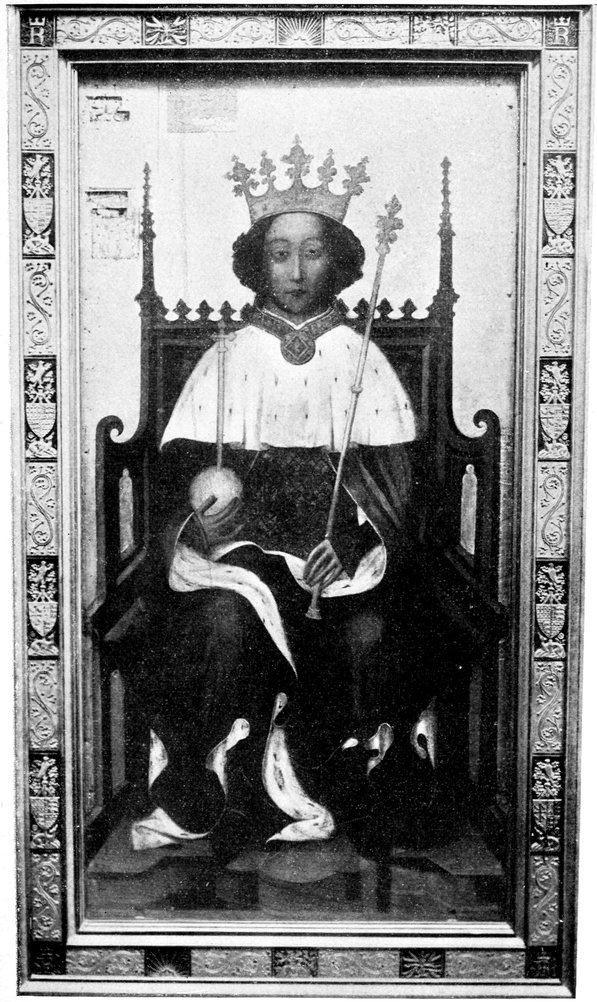
RICHARD II.
CHAPTER IV THE PLANTAGENETS OF THE DIRECT LINE FROM HENRY III TO RICHARD II, 1216–1399
57
“This England never did, nor never shall,
Lie at the proud foot of a conqueror,
But when it first did help to wound itself.
Now these her princes are come home again,
Come the three corners of the world in arms
And we shall shock them. Nought shall make us rue
If England to itself do rest but true.”
Shakspeare (King John).
A little more than two hundred years
passed between the burial of the Confessor
in the Abbey and the burial of the next
English King who rests there, namely,
Henry III. William the Conqueror is
buried in the church which he founded
at Caen, in Normandy, and William Rufus,
the “Red King,” lies at Winchester, close
58to the New Forest, where he was shot by
Walter Tyrrell. Henry I was buried at
Reading, and King Stephen at Faversham.
Henry II, the first King of the Plantagenet
line, was buried in the great Abbey of
Fontevrault in Anjou, the ancestral home
of the Plantagenets. His eldest son, Henry,
“the young King,” who rebelled against him,
is buried at Rouen, where the heart of
Richard Cœur-de-Lion also rests. Richard’s
body is buried at Fontevrault, at his father’s
feet. The heart of King John was taken
to Fontevrault in a golden cup, but his
body lies in Worcester Cathedral, between
two Saxon saints, Wulfstan and Oswald.
And now we come to the Plantagenets
who are buried in the Abbey.
Henry III, as we have already seen, had
a great love and reverence for the memory
of Edward the Confessor, and began the
rebuilding of the Abbey Church in his
honour. It was no wonder, then, that he
wished his tomb to be close to the Confessor’s
shrine.
59Only three of our Kings have been married
in the Abbey, and of these Henry III was
the first. He married Eleanor of Provence,
one of four sisters who all made remarkable
marriages. Eleanor’s sister Margaret
married King Louis IX of France; her
sister Sancha married Richard Earl of
Cornwall, and her sister Beatrice married
Charles of Anjou, brother of Louis IX of
France, and afterwards King of Naples
and Sicily. We are reminded of this close
connection between the royal houses of
France and England when we see on the
Abbey walls the shield of Eleanor’s father,
Raymond Berengar, Count of Provence.
When Henry III died in 1272 he was
buried, not where his tomb now is, but in
front of the high altar, in the grave where
the Confessor’s body had first rested. The
beautiful tomb in the Confessor’s Chapel
was not finished until 1291, Edward I
having brought from France the precious
marbles and porphyry slabs for its decoration.
The tomb, like the Confessor’s, is
60of Italian design, but the fine effigy is
the work of an Englishman, William
Torel.
When Henry’s body was at last placed
there, his heart, according to an old promise,
was given in a golden cup to the Abbess of
Fontevrault, who was present at the ceremony.
Like the heart of his father, King
John, it was to be taken back to the old
Plantagenet home.
Thus began the circle of stately tombs
which stand round the Confessor’s shrine in
that tall, silent, shadowy chapel, now often
called the Chapel of the Kings.
One thing to be remembered about the
tombs of the Plantagenets is that they actually
hold the body of the sovereign, and are not
just monuments over a grave. In later days
it became the fashion to bury in vaults.
Some years before Henry III’s death his
beautiful little dumb daughter, Katherine,
was buried in a small tomb in the South
Ambulatory, close to St. Edmund’s Chapel.
With her are buried two of her brothers who
61died young, and four young children of King
Edward I.
We have already heard about the heart of
another Plantagenet, Prince Henry d’Almayne,
whose body, like that of his father,
Richard Earl of Cornwall, is buried at
Hayles, in Gloucestershire.
On either side of Henry III are buried
Edward I, and his wife, Eleanor of Castile,
daughter of Ferdinand III, King of Castile
and Leon. Every one remembers how Queen
Eleanor went out with her husband to the
Crusades, and how she is said to have saved
his life by sucking the poison from his wound.
Eleanor, the “Queen of good memory,” died
in Lincolnshire in 1290, and of the famous
crosses which were put up at each place where
her body rested, three still remain, at Northampton,
Geddington, and Waltham. Queen
Eleanor’s tomb is very beautiful, and so is
her effigy, which was made by the same
English artist who made the effigy of her
father-in-law, King Henry III. The lower
part of the tomb is decorated with shields,
62and one of them is the shield of Castile and
Leon, with the castle and the lion upon it.
Edward I, the greatest soldier and lawgiver
of all the Plantagenet kings, died in
1307 at the little village of Burgh-on-the-Sands,
on the coast of Cumberland, when he
was on his way to Scotland to try and crush
the rising of the Scots under Robert Bruce.
He is buried in a very plain, rough-looking
tomb, and it is thought that the tomb
may have been left in an almost unfinished
state in order that it might be easily opened,
for, as we know, Edward I wished his bones
to be carried at the head of the English
army until Scotland was quite conquered.
He also desired that his heart should be sent
to Holy Land, where he had fought when he
was young. But Edward II did not keep
any of the promises he made to his father,
and was very unworthy of his great name.
On Edward I’s tomb are some Latin words
which mean, “Hammer of the Scots,” and
“Keep troth.”
[D. Weller
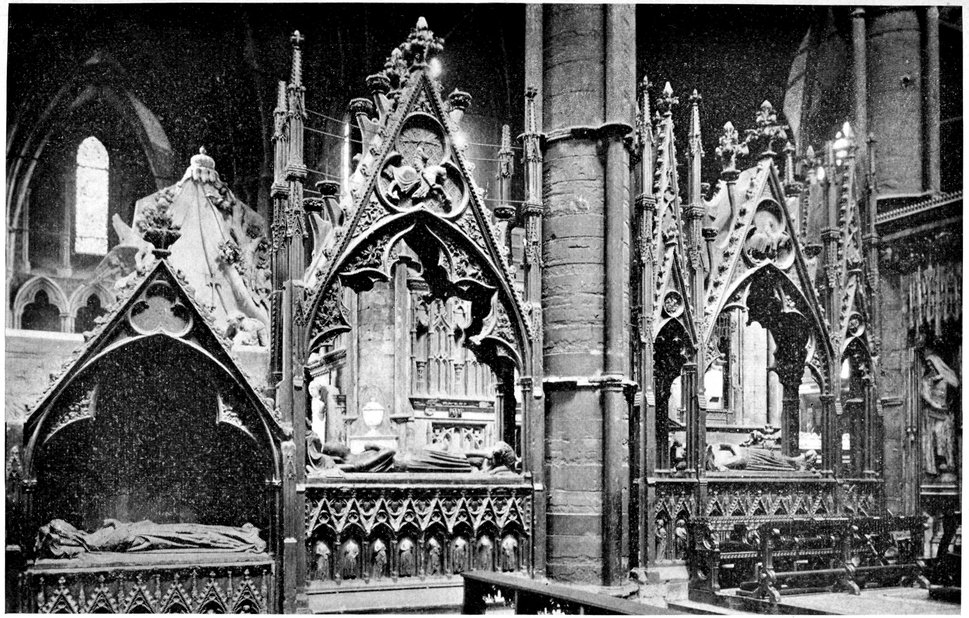
TOMBS OF EDMUND AND AVELINE OF LANCASTER, AND OF AYMER DE VALENCE.
63The tomb was opened in the year 1771,
and an inner coffin of Purbeck marble was
found, in which the King’s body lay. He
must have been a very tall man, as, after all
those centuries, he still measured 6 feet 2
inches. It is thus quite easy to understand
why he was called “Longshanks.” The body
was dressed in a red dalmatic, and over it a
royal mantle of rich crimson satin, fastened
with a splendid fibula or clasp. On the
head was a gilt crown; in the right hand
was the sceptre with the cross; in the left, the
sceptre with the dove.
The coffin was afterwards securely closed,
and has never been disturbed again.
Next to the tomb of Edward I, and just
beyond the screen which separates the
Chapel of the Kings from the Sacrarium, is
the beautiful and highly decorated tomb of
his brother, Edmund Crouchback, first Earl
of Lancaster. He was the fourth son of
Henry III, who named him after the Anglo-Saxon
martyr-King, St. Edmund of East
Anglia. There is a chapel dedicated to St.
Edmund in the Abbey, and it was looked
64upon as coming next in honour after the
Chapel of the Confessor.
Edmund Crouchback was a crusader, like
his brother, King Edward I, and the cross
or “crouch” he wore was probably the origin
of his name, although some people have
thought that he was perhaps hump-backed.
Edmund and his first wife, the beautiful
Aveline of Lancaster, were the first bride and
bridegroom to be married in Henry III’s new
church. They were married in 1269, but
Aveline did not live very long. Her tomb is
quite near her husband’s, and is considered
to be one of the finest in the Abbey. Aveline
was not only a great beauty, but also
a great heiress, and her wealth descended
to the House of Lancaster. After Aveline’s
death, Edmund married Blanche, Queen of
Navarre, a French princess. She was a
widow when Edmund married her, and her
daughter Joan afterwards married King
Philip the Fair of France. Edmund and
his second wife lived for some time at
Provins, in Champagne, and from that town
65they brought to England the famous red
roses which became the badge of the House
of Lancaster. These roses were said to have
been brought from the East by Crusaders.
They still grow at Provins, and have a very
sweet scent.
Edmund Crouchback died at Bayonne in
1296, while he was fighting for the English
possessions in Gascony.
When Edmund was only eight years old,
Pope Innocent II had given him the title
of King of Sicily and Apulia, but this was
only an empty honour, and meant that the
English had to be heavily taxed in order
to support Edmund’s claim and satisfy the
Pope. All these exactions of Henry III’s
helped to make the English more and more
determined not to be taxed without their
consent, and had a great deal to do with
the beginning of the House of Commons in
Simon de Montfort’s time.
Before passing on to the later descendants
of Henry III, we must speak of two very
interesting tombs which recall some important
66things in English history. These are, first,
the tomb of William de Valence, in St.
Edmund’s Chapel; and secondly, the tomb
of his son Aymer, which stands in the
Sacrarium, between the tombs of Edmund
and Aveline of Lancaster.
It will be remembered that Henry III’s
mother, Isabella of Angoulême, married
again after King John’s death. She married
the Count of La Marche and Poitiers, who
belonged to the Lusignan family,—a family
which was very well known in Europe,
some of them being Kings of Cyprus and
Jerusalem. The children of Isabella and the
Count de la Marche came over to England,
and the English people greatly disliked their
insolence and greediness, complaining that
Henry III gave too many titles and too
much money to his French relations.
William de Valence was the fourth son of
the Count de la Marche, and was the most
disliked of all Henry’s half-brothers. He
was created Earl of Pembroke. He took
an active part in the Barons’ War, and was
67finally sent on the expedition into Gascony
with his nephew, Edmund Crouchback.
Like Edmund, he died at Bayonne in 1296.
His tomb is of French workmanship, and
there are still some remains of the famous
Limoges enamel which decorated it.
Aymer de Valence, William’s son,
succeeded his father as Earl of Pembroke.
He fought bravely in the Scottish wars,
and was at the Battle of Bannockburn in
1314. He was much blamed for his cruelty
in having Nigel Bruce hanged at the Castle
of Kentire. Aymer died in France in 1324,
very suddenly, and many people thought it
was a punishment for taking part in the
condemnation and death of Thomas Earl
of Lancaster, son of Edmund Crouchback,
who was revered as a saint. Aymer’s tomb
is celebrated for its beauty. It is very like
Edmund Crouchback’s, with its pinnacled
canopy and niches for statues. Aymer is
represented on the canopy in full armour
and riding his war-horse.
The three tombs of Edmund Crouchback,
68Aymer de Valence, and Aveline of Lancaster
are among the most beautiful in the Abbey,
and are thought by some people to be all
three the work of one artist.
King Edward II, Edward of Carnarvon,
as he was called from his birthplace in Wales,
is not buried in the Abbey, but at Gloucester,
that town being near Berkeley Castle, where
he was murdered.
We are specially reminded of King Edward
III in the Abbey, for not only is he buried there,
but the great sword and shield of state which
were carried before him during his wars with
France are placed in the Confessor’s Chapel,
close to the Coronation Chair. This sword
and shield make us think of those famous
Battles of Crécy and Poitiers, where Edward
III and the Black Prince fought.
Edward III is buried in a beautiful tomb
just opposite to Henry III, and his good
Queen, Philippa of Hainault, is buried next
to him, according to her own wish. Her
tomb was made by a Flemish artist, and
was also a very fine one, but, like many
others in the Abbey, it has been sadly
destroyed. Queen Philippa is, of course,
always remembered for having begged for
the lives of the brave citizens of Calais when
the King had ordered them to be hanged.
Photo W. Rice, F.R.P.S.Allen & Co (London) Ltd Sc
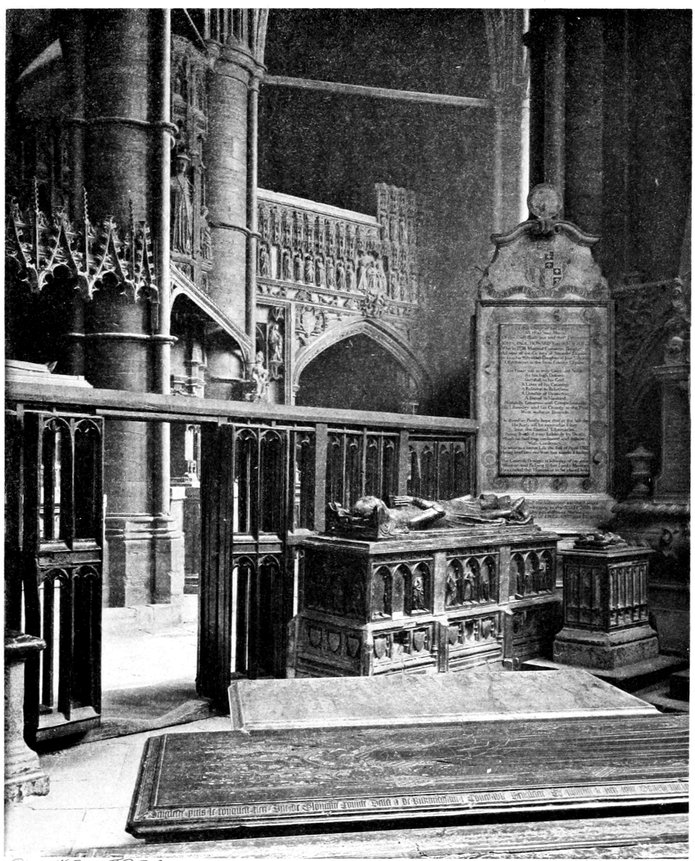
Tomb of Prince John of Eltham. in S. Edmund’s Chapel.
69Close to Philippa lies her son, Thomas of
Woodstock, Duke of Gloucester, murdered,
it is to be feared, by order of his nephew,
Richard II.
Eleanor de Bohun, widow of Thomas
Duke of Gloucester, is buried in St. Edmund’s
Chapel, and the memorial brass on her tomb
is the most beautiful now left in the Abbey.
In St. Edmund’s Chapel is the tomb of
another Plantagenet, Prince John of Eltham,
Earl of Cornwall, brother of Edward III. He
took his name from the old palace at Eltham,
where he was born. Prince John died quite
young, but he had already shown great
promise as a soldier, and was three times
Regent of the kingdom when Edward III was
away in France and Scotland. He bears a
shield with the lions of England and lilies of
France upon it. His mother was a French
70princess, daughter of King Philip the Fair,
and it was through her that Edward III
thought he could claim the throne of France.
Close to the tomb of Prince John of
Eltham is the tiny tomb of two young
children of Edward III, called, from their
birthplaces, William of Windsor and Blanche
of the Tower.
Two grandchildren of Edward I, Hugh
and Mary de Bohun, are buried in the
Chapel of St. Nicholas, another of the circle
of chapels which crowns the eastern end, or
apse, of the Abbey. (St. Nicholas is the
patron saint of children.)
The Black Prince is buried in Canterbury
Cathedral, close to where the shrine of
Thomas à Becket once stood, but his son,
the unhappy Richard II, had a great love
for the Abbey, where he had not only been
crowned, but also married to his beloved
first wife, Anne of Bohemia, who was a
descendant of the “Good King Wenceslas,”
about whom we sing in the carol for St.
Stephen’s Day.
71Richard II is buried in the Abbey, and
the great tomb in which he and Anne rest
was made for her. Anne died in 1394, and
her funeral was a very splendid ceremony,
hundreds of wax candles having been brought
over from Flanders to be lighted at the service.
The tomb itself is very magnificent; the
gilt-bronze decorations and the robes of the
effigies are engraved with the leopards of
England, the broomcods of the Plantagenets,
the ostrich feathers and lions of Bohemia,
and the sun rising through the clouds of
Crécy. The ostrich feathers should remind
us of the crest and motto of the Prince of
Wales.
Richard himself was not placed in this
tomb until fourteen years after his supposed
murder, when his body was brought back
from Friars’ Langley by Henry V, in
obedience to the wish of Henry IV. In
the Sacrarium is a beautiful portrait of
Richard II, painted in his lifetime, and
therefore the oldest painting of any British
sovereign. This portrait was very carefully
72restored some years ago, and represents
Richard in his crown and royal robes, sitting
in the Chair of State, very probably as he
used to appear in the Abbey on high
festivals. Richard’s well-known badge of
the White Hart was painted on more than
one part of the Abbey, and it is interesting
to see that, in old pictures of Richard, he
and his followers wear the badge of the
White Hart. Many inns in England are
still called by this name.
With Richard II the direct Plantagenet
line ends, and his is the last tomb in the
circle round the Confessor’s shrine.
Before speaking of the Plantagenet Houses
of Lancaster and York we must mention
some of the chief men of this time who are
buried in the Abbey. First and foremost
of these is the great poet, Geoffrey Chaucer,
author of the famous Canterbury Tales, and
the father of English poetry.
He was born in 1328, the year after
Edward III came to the throne, and died
in 1400, a year after Richard II. Chaucer
73lived in a house close to the old Lady Chapel
built by Henry III, and his house was one
of those pulled down in later days to make
room for the larger Chapel of Henry VII.
Chaucer is buried in Poet’s Corner, and is
the first of its glorious circle of poets. His
monument, which is quite near his grave,
was not put up until about 150 years after
his death. Just above the monument is a
modern stained-glass window in Chaucer’s
memory, representing scenes from his life,
and from the Canterbury Tales.
The only person not of royal blood who
is buried in the Chapel of the Kings is
Richard’s great friend, John of Waltham,
Bishop of Salisbury, who was Lord Treasurer,
Keeper of the Great Seal, and Master of the
Rolls. He was the first statesman to be
buried in the Abbey. In St. Edmund’s Chapel
are buried Ralph Waldeby, Archbishop of
York, a friend of the Black Prince and
tutor to Richard II, and Sir Bernard Brocas,
who was renowned for his fighting in the
Moorish wars. He died in 1400. His son-in-law,
74Sir John Golofre, another great friend
of Richard II, was buried in the South
Ambulatory in 1396. He was Richard’s
ambassador in France, and was buried in
the Abbey by his master’s express command.
Our next chapter must be about those
younger branches of the Plantagenet family,
the Houses of Lancaster and York, who
also hold a place in the Abbey.
[D. Weller.
CHAUCER’S TOMB.
CHAPTER V THE HOUSES OF LANCASTER AND YORK: 1399 to 1485
75
Plantagenet:
“Let him that is a true-born gentleman,
And stands upon the honour of his birth,
If he suppose that I have pleaded truth,
From off this briar pluck a white rose with me.”
Somerset:
“Let him that is no coward nor no flatterer,
But dare maintain the party of the truth,
Pluck a red rose from off this thorn with me.”
Shakspeare (King Henry VI, part 1, ii, 4).
The name of Henry of Bolingbroke, son of
John of Gaunt, Duke of Lancaster, reminds
us that Richard II had been made to resign
his crown, and that his cousin had been
proclaimed King as King Henry IV. We
think, too, of that sad death, or murder, of
the unhappy Richard at Pontefract Castle.
76All these things, in one way or another, are
connected with the history of the Abbey.
Henry IV is not buried in the Abbey, but
in Canterbury Cathedral, opposite the Black
Prince, and, like him, near the shrine of St.
Thomas. But although Westminster is not
his last resting-place, Henry IV is connected
with the Abbey in a very special way.
The story is familiar to us in the pages of
Shakspeare. The King had intended to set
out for Palestine on a pilgrimage or crusade,
and he had heard a prophecy that he should
die at Jerusalem. Just before he was going
to start he came to the Abbey to pray at the
Confessor’s shrine. While he was in the
Chapel he was seized with mortal illness,
and was carried into the famous “Jerusalem
Chamber,” which was part of the Abbot’s
house. The Jerusalem Chamber had been
built not long before, and was probably the
only room near with a proper fireplace in it.
It was cold March weather, and Henry was
laid in front of the fire. When he came to
himself a little he asked what that room was,
77and being told its name, he said: “Praise be
to the Father of Heaven! for now I know
that I shall die in this chamber, according to
the prophecy made of me beforesaid, that I
should die in Jerusalem.”
Every one will remember how an old
historian tells us that afterwards, when the
young Prince Harry was watching by his
father, he took the crown and put it on his own
head, thinking that his father was dead. The
King, however, was not dead, and, turning
round, he reproached the prince for his
heartless and undutiful hurry in taking the
crown. Prince Harry was very much
grieved, and explained why he had done
such a thing.
After Henry IV’s death, Prince Harry,
now King Henry V, spent all that day at
Westminster, in sorrow and penitence for
his wild life in the past. At night he went
and confessed his sins to a holy hermit who
lived close to the Abbey, and the hermit
assured him that he would be forgiven. As
we all know, Henry V became a religious
78and determined man, and a great soldier,—“Conqueror
of his enemies and of himself.”
Henry V was crowned in the Abbey on
Passion Sunday, 1413, a cold, snowy day.
The wars in France soon began, and in
1415 a “Te Deum” was sung in the Abbey
for Henry’s great victory at Agincourt, and
the King attended this service in person.
Like his father, Henry V had a great wish
to go to Holy Land and conquer the Holy
Sepulchre from the infidels, but while he
was hoping for this crusade, he was stricken
with illness at Vincennes, and died in 1422,
when he was only thirty-four.
It is said that the people of both Rouen and
Paris were most anxious that Henry should
be buried in their town, but the King had
said clearly in his will that he wished to be
buried at Westminster, and he had described
most carefully what he wanted his Chantry
Chapel to be like.
The funeral of Henry V was the most
splendid ever seen in the Abbey. The great
procession began in Paris, and escorted the
79body to Calais. It then came on from
Dover to London. James I, King of Scots,
headed the procession as chief mourner, and
the widowed Queen, Katherine de Valois,
followed it.
The King’s tomb stands at the extreme
eastern end of the Abbey, and over it, between
the tombs of Queen Eleanor and Queen
Philippa, rises the famous Chantry Chapel,
where prayers were to be offered up for ever.
Among the statues that adorn the Chantry
are those of St. George, the patron saint of
England, and St. Denys, the patron saint of
France.
On a bar above the Chantry are hung King
Henry V’s shield, saddle, and helmet, just as
the Black Prince’s armour is hung above his
tomb in Canterbury Cathedral.
The tomb below was once very splendid
with gold and silver, and the figure of King
Henry had a silver head. But in the reign
of Henry VIII these magnificent decorations
were stolen, and the robbers even carried
off the silver head of the effigy. All that
80remains of the effigy is the figure of plain
English oak.
We come next to the pious and gentle
King Henry VI, who was so much loved by
his people, in spite of all the misfortunes of
his reign. It is sad to think how all Henry
V’s conquests in France were lost one by
one, although it was a good thing for
England in the end. But there is one
glorious memory connected with the wars of
Henry VI’s reign, a memory which we all
love and revere, whether we are French or
English. That is the memory of Joan of
Arc, that pure and noble young French girl
whose faith and courage saved her country.
When we stand in the Abbey and remember
the Lancastrian Kings, it is good for us also
to think of her.
Henry VI always intended to be buried in
the Abbey, and one day, when he was there,
some one suggested to him that his father’s
tomb should be moved to one side, and that
his own should be placed beside it. But
Henry answered: “Nay, let him alone: he
81lieth like a noble prince. I would not trouble
him.” At last Henry VI chose a grave for
himself close to the Confessor’s shrine; the
spot was all marked out, and indeed the
tomb itself was ordered. Then came the
Wars of the Roses, the defeat of the
Lancastrian party, and the imprisonment of
Henry VI in the Tower of London in 1461.
After his mysterious death ten years later,
his body was buried at Chertsey Abbey.
Afterwards, in the reign of Richard III, it
was moved to St. George’s Chapel, Windsor,
where it still rests.
The French princess, Katherine de Valois,
wife of Henry V and mother of Henry VI, is
now buried in Henry V’s Chantry. It will
be remembered that her second husband was
Owen Tudor, and that their son, Edmund
Tudor, was the father of King Henry VII.
After Katherine married Owen Tudor she
seemed to be quite forgotten, but when she
died she was buried with all honour in the old
Lady Chapel. While Henry VII’s new Lady
Chapel was being built, the coffin was placed
82beside Henry V’s tomb, and remained there
in a most neglected state for many long
years. Then it was removed to a vault in
the Chapel of St. Nicholas, and finally it was
moved, by permission of Queen Victoria, into
Henry V’s Chantry, where at last poor Queen
Katherine rests in peace.
In 1461, when Henry VI was deposed, a
prince of the House of York, Edward IV,
came to the throne. He died at Westminster,
and had a great funeral service in the Abbey,
but he is buried in St. George’s Chapel,
Windsor, like his cousin, Henry VI.
The earliest monument of the House of
York in the Abbey is the tomb of Philippa,
Duchess of York, in the Chapel of St.
Nicholas. She was the wife of Edward,
second Duke of York, grandson of Edward
III, who was killed at Agincourt. After his
death, Philippa was made Lady of the Isle
of Wight.
King Richard III is buried at Leicester,
and after him came the poor little Edward V,
who, with his brother, Richard Duke of York,
83was murdered in the Tower. Their bones
remained at the Tower until the reign of
Charles II, when they were found under a
staircase. Charles II commanded that they
should be brought to the Abbey, and they
are placed in a tomb in Henry VII’s Chapel.
Strangely enough, both these little princes
are closely connected with Westminster. In
1470, Queen Elizabeth Woodville, wife of
Edward IV, had taken refuge in the Sanctuary
at Westminster. Nobody could dare to hurt
any one who had taken sanctuary, and so
the Queen felt she was safe in that time of
war and trouble. Here Edward V was born.
He was baptized in the Abbey, and the Abbot
of Westminster was one of his godfathers.
Then later on, after Edward IV’s death,
when Richard III was trying to get the
crown for himself, Elizabeth Woodville again
took shelter in the Sanctuary at Westminster,
and brought her five daughters and her
second son, the little Richard Duke of York.
Edward V was already in the Tower.
Richard III sent to Westminster, and insisted
84that his young nephew should be allowed to
join Edward in the Tower. He dared not
take him out of Sanctuary by force, but he
made the Archbishop of Canterbury persuade
the poor Queen to let the boy go. She was
dreadfully grieved, and tried all she could to
keep her son safely with her, but in vain.
They parted with tears, and she never saw
him again.
A little daughter of Edward IV, Margaret
Plantagenet, is buried in a tiny tomb in the
Confessor’s Chapel. In the Islip Chapel is
the grave of Anne Mowbray, daughter of
the Duke of Norfolk. She was betrothed
to Richard Duke of York when they were
both little children of only five years old.
Anne Neville, the unhappy wife of Richard
III, and daughter of Warwick “the Kingmaker,”
lies in a forgotten grave in the South
Ambulatory.
We see, then, how much there is in the
Abbey to remind us of the Houses of Lancaster
and York, and of the Wars of the
Roses, besides the great wars in France.
85But further, we shall now find that it
was becoming more and more the custom for
the famous men of the age to be buried in
the Abbey.
Richard Courtney, Bishop of Norwich, a
great friend of Henry V, is buried there. He
died just before the Battle of Agincourt, and
was nursed by the King in his last illness.
In St. Paul’s Chapel is the fine tomb of
Ludovic Robsert, Lord Bourchier, who
fought at Agincourt and was afterwards
made the King’s Standard Bearer. Sir
Humphrey Bourchier, who died fighting on
the Yorkist side at the Battle of Barnet in
1471, is buried in Edmund’s Chapel. Sir
Thomas Vaughan, Treasurer to Edward IV
and Chamberlain to Edward V, is buried in
the Chapel of St. John the Baptist.
While speaking of this time in English
history, we must not forget one man who
did a very great and important work in the
world, and who was very closely connected
with the Abbey, although he is not actually
buried there. This was William Caxton,
86the first English printer. Caxton belongs
almost entirely to the Lancastrian and
Yorkist times, as he was born in 1410,
during the reign of Henry IV, and died in
1491, in the reign of Henry VII. About the
year 1471 (the year in which Henry VI died)
Caxton came to live in Westminster. He
set up his printing-press in a house quite
close to the Abbey, and there he worked for
the last twenty years of his life. It seems
that the Abbot of Westminster was greatly
interested in Caxton and his work, and one
of his great friends and patrons was the
Lady Margaret, mother of King Henry VII.
Caxton printed several books for her.
Caxton is buried quite near the Abbey, in
St. Margaret’s Churchyard. There is a fine
stained-glass window to his memory in St.
Margaret’s Church. Caxton stood on the
threshhold of the modern world, and, as we
realise the great changes brought about in
human life by the art of printing, we may
think of that window in St. Margaret’s,
where Caxton is represented holding his
87motto: “Fiat Lux” (let there be light), while
below are Tennyson’s beautiful lines:
“Thy prayer was Light, more Light while time shall last,
Thou sawest the glories growing on the night;
But not the shadow which that light would cast
Till shadows vanish in the Light of light.”
With this thought in our minds we will turn
to the next period of English history.
CHAPTER VI THE HOUSE OF TUDOR
88
“Fair is our lot—O goodly is our heritage!
(Humble ye, my people, and be fearful in your mirth!)
For the Lord our God Most High
He hath made the deep as dry,
He hath smote for us a pathway to the ends of all the earth.”
Rudyard Kipling (The Seven Seas).
The famous House of Tudor, in which the
Plantagenet lines of York and Lancaster
were united, is in many ways very closely
connected with the Abbey. All the Tudor
sovereigns, except one, are buried in the
Abbey. But this is not all, for the Abbey
and the School owe their present establishment
to Henry VIII and Queen Elizabeth,
as we shall find later on.
It was in the Tudor times that modern
England really began, and most of the great
89changes that took place in the Church and
the nation at that time are faithfully reflected
in the Abbey history. We can read them
there, just as we can read the story of the
Norman Conquest, of the Conquest of Scotland,
or of the French Wars.
We ought also to look beyond our own
country, and remember what was going on
in other parts of the world. While the
Tudors were reigning in England, Christopher
Columbus discovered America, and
the Portuguese navigator, Vasco de Gama,
sailed round the Cape of Good Hope, thus
finding a new way to the East Indies.
These two discoveries made a great change
in the history of the world, and some of the
monuments in the Abbey will speak to us of
the difference which those discoveries made
to England.
When we speak of the Tudors we naturally
think first of King Henry VII, who
built the beautiful chapel at the eastern end
of the Abbey, directing that it should be the
burial-place of himself and his family.
90The foundation of the Chapel has an
interesting history connected with the
House of Lancaster. Through his mother,
Margaret Beaufort, Henry VII descended
from John of Gaunt, and therefore from
Edward III, and he was very anxious that
people should remember this. Partly for
that reason, he wanted very much to bring
the body of Henry VI from Windsor, and to
bury it in the new, splendid chapel at Westminster.
He also wished the Pope to
declare Henry VI to be a saint; and indeed,
many people at that time thought him to be
so. However, it happened that the body of
Henry VI was never moved from Windsor
after all, but there was at that time an altar
to his memory in Henry VII’s Chapel.
[D. Weller.
MARGARET BEAUFORT, COUNTESS OF RICHMOND, AND MARY QUEEN OF SCOTS.
91The great gates and the sculptured ornament
of the Chapel are in themselves quite
a lesson in English history. On the gates
and on the walls we see the famous Tudor
Roses, which are the red and white roses of
Lancaster and York united. There is also
the Portcullis of the Beaufort Castle in Anjou,
which castle had belonged to Edmund
Crouchback, and descended through him to
John of Gaunt. Again, we see the crown
caught in a bush on Bosworth Field, and
two Yorkist badges, the Rose in the Sun,
and the Falcon on the Fetterlock. On the
gates, too, we find the daisy or “Marguérite,”
the name-flower of Henry VII’s mother, the
Lady Margaret. Last, but not least, we
find the Red Dragon of the last British King,
Cadwallader, from whom Henry VII claimed
to descend, reminding us that the Tudors
boasted of descent from the ancient British
stock,—from King Arthur and Llewellyn.
Round the Chapel, in the graceful little
niches that adorn the walls, are statues of
angels and saints. Among them are the
Apostles, some of the martyrs, and also the
royal saints of Britain, St. Edward, St.
Edmund, St. Oswald, and St. Margaret of
Scotland.
The first person to be buried in Henry VII’s
Chapel was his wife, Elizabeth of York,
daughter of Edward IV. She died in 1503,
92and was first buried in one of the side Chapels,
until her husband’s new Chapel was ready.
In 1509, Henry VII died, and was buried
in the middle of the nave of his Chapel. The
funeral ceremony was very splendid, and over
his grave rises one of the most magnificent
tombs in the whole Abbey. The monument
itself was made by the great Florentine
sculptor, Torrigiano, who was a fellow-student
and rival of Michael Angelo. We are told
that Torrigiano broke Michael Angelo’s nose
in a fight they had at Florence. At any rate,
he knew how to design a beautiful monument.
The bronze screen round the tomb is of
English work and Gothic design, and is in
quite a different style from the Italian Renaissance
tomb within.
Three months afterwards, Henry’s mother,
Margaret Beaufort, Countess of Richmond
and Derby, died, and was buried in the South
Aisle of her son’s Chapel. She died just at
the time of the rejoicings for the Coronation
of her grandson, Henry VIII, and of Catherine
of Aragon. The “Lady Margaret” was
93greatly honoured and beloved. She was a
patroness of learning, and founded two
colleges at Cambridge, and Professorships
of Divinity at both Oxford and Cambridge.
She was also a good friend to William
Caxton the printer, as we have already heard.
Her tomb was made by the same Florentine
artist, Torrigiano, and is most beautiful. The
effigy represents the Lady Margaret in her
widow’s dress, her hands uplifted in prayer.
The epitaph round the edge of the monument
was written by the great Erasmus, who was a
friend of Lady Margaret’s, and who was one
of the earliest Lady Margaret Professors of
Divinity at Cambridge, Bishop John Fisher
being the first.
Another of the family, Owen Tudor, uncle
of Henry VII, took refuge in the Sanctuary
at Westminster during the Civil Wars, and
became a monk. He is buried in the South
Transept. A little daughter of Henry VII,
Elizabeth Tudor, is buried in a tiny tomb in
the Confessor’s Chapel, close to Henry III.
A little son, Edward, is also buried in the
94Abbey. Henry VIII had intended to be buried
at Westminster with his first wife, Catherine
of Aragon, to whom he was married in the
Abbey. Indeed, he had actually ordered
Torrigiano to make the effigies for the tomb.
But, as we know, everything changed, and
Henry VIII is buried in St. George’s, Windsor,
with his third wife, Jane Seymour, mother of
King Edward VI.
Anne of Cleves is the only one of Henry’s
six wives who is buried in the Abbey. Her
grave is in the South Ambulatory, and she
has a large and rather ugly monument in the
Sacrarium, just opposite to the tomb of Aymer
de Valence. Anne of Cleves died at Chelsea
in 1557.
One great name of Tudor times, that of
Cardinal Wolsey, is brought back to us
when we remember that in 1515 his
Cardinal’s hat arrived from Rome, and was
received with great pomp at the Abbey.
A stately service was held; the Archbishop
of Canterbury set the hat on Wolsey’s head,
and a “Te Deum” was sung. Henry VIII95and Catherine of Aragon, and Henry’s
sister Mary, the French Queen, were present
at the ceremony.
The boy King, Edward VI, is buried close
to his grandfather, Henry VII. He was
buried by Archbishop Cranmer, who was
his godfather, and who had baptized and
crowned him. Edward VI has no monument,
but the altar of the chapel stands
over his grave. The original altar was the
work of Torrigiano, and must have been
very beautiful. It was destroyed in the
time of the Commonwealth, but parts of it
have been found and are used in the present
altar. The cross on this altar has a special
interest for us all, because it was given to the
Abbey by Ras Makonnen, the Abyssinian
envoy, at the time of King Edward VII’s
serious illness, when the Coronation had to
be put off. The cross is of a very ancient
pattern, and there is an Ethiopian inscription
upon it.
Not far from the grave of Edward VI
there stood for many years a pulpit—now
96in the Nave—from which it is believed
Archbishop Cranmer preached at the Coronation
and funeral of his royal godson,
Edward VI, in 1553.
In the north aisle of Henry VII’s Chapel the
two Tudor Queens, Mary and Elizabeth, are
buried. Poor Queen Mary had taken much
care for the Abbey. During the reigns of
Henry VIII and Edward VI great changes
had been made there; the monks had been
sent away, and, unfortunately, many of the
precious and beautiful things that belonged
to the church and monastery had been
removed or destroyed. It was even said
that Protector Somerset wanted to pull
down the Abbey itself. Queen Mary brought
the monks back, with Abbot Feckenham to
rule over them; she restored the Confessor’s
shrine, and had the church and the services
arranged again as they had been in the old
days before the Reformation.
After her short, unhappy reign, Mary
Tudor was laid to rest in her grandfather’s
chapel. No monument was erected to her,
97and it is sad to think that very few of her
subjects mourned for her. We are told that
when the various altars in the chapel were
taken down, the stones were piled up over
her grave. Perhaps it was intended to
make them into a monument later on.
Another forty-five years passed, and then,
in 1603, Queen Elizabeth died, to the great
grief of all her people, whose lamentations
followed her to her grave in the Abbey.
She rests there, in the same vault as her
sister Mary, the vault being so narrow that
Queen Elizabeth’s coffin had to be placed
on the top of Queen Mary’s. The monument,
which is a fine one of its kind, is to
Queen Elizabeth alone, and was erected to
her memory by her cousin and successor,
King James I. The epitaph on the western
end of the monument mentions both the
Tudor sister-queens, and runs as follows:
“Consorts both in throne and grave, here
rest we two sisters, Elizabeth and Mary, in
the hope of the resurrection.”
It is now time to speak of some other
98famous people who belonged to the Tudor
times, and who are buried in the Abbey.
Among these are the following:—
Sir Humphrey Stanley, who fought on
Henry VII’s side at Bosworth, and was
knighted by him after the battle. Sir
Humphrey died in 1505, and is buried in
the Chapel at St. Nicholas.
Sir Giles Daubeny and his wife, who are
buried in St Paul’s Chapel. Sir Giles
Daubeny was Lord Lieutenant of Calais in
Henry VII’s time, when Calais still belonged
to England. He died in 1508.
Then come some of the great ladies of the
Tudor Court, namely:
Frances Grey, Duchess of Suffolk, granddaughter
of Henry VII and mother of the
unfortunate Lady Jane Grey, who, as every
one remembers, was Queen of England
for twelve days after the death of Edward
VI. The Duchess is buried in St. Edmund’s
Chapel, close to some of the Plantagenets,
and on the spot where the altar used to stand.
Anne Seymour, the wife of Protector
99Somerset, is buried in the Chapel of St.
Nicholas. She was sister-in-law to Queen
Jane Seymour, mother of Edward VI. From
what is told us about her she seems to
have been both very clever and very fierce-tempered,
and to have made people afraid
of her. She lived on into the days of
Elizabeth, and died in 1587, aged ninety.
In the same chapel is a tablet in memory
of Jane Seymour, daughter of Protector
Somerset. She was cousin to Edward VI,
and it had been intended that he should
marry her.
Another name of interest is that of
Frances Howard, Countess of Hertford,
sister of the Lord Howard of Effingham
who defeated the Spanish Armada. She
is buried in St. Benedict’s Chapel.
In St. Paul’s Chapel are the grave and
monument of Frances Sidney, Countess of
Sussex. She was the aunt of the famous Sir
Philip Sidney, the soldier and poet. This lady
was the foundress of Sidney Sussex College
at Cambridge, which is called after her.
100In the Chapel of St. John the Baptist is
the enormous monument—thirty-six feet
high—of Henry Cary, Lord Hunsdon, who
died in 1596. His mother was a sister of
Queen Anne Boleyn, and thus he was
Queen Elizabeth’s first cousin. He was
Lord Chamberlain to Queen Elizabeth, and
was always a most devoted servant and
friend to her. He had special charge of
the Queen at the time of the Spanish
Armada. It is said that he died partly of
disappointment at having to wait a long
time before Queen Elizabeth would make
him Earl of Wiltshire. When he was
dying the Queen came to see him, and,
having brought the patent for the earldom
and the robes, she had them put down
on his bed. But Lord Hunsdon said to
her: “Madam, seeing you counted me not
worthy of this honour whilst I was living,
I count myself unworthy of it now I am
dying.”
In the Chapel of St. Nicholas are buried
the wife and daughter of the great Lord
101Burleigh, Mildred, Lady Burleigh, and
Anne, Countess of Oxford. Lord Burleigh’s
own funeral service took place in the Abbey,
but he is buried at Stamford. On the
monument to his wife and daughter is a
figure of Lord Burleigh himself, kneeling,
“his eyes dim with tears for the loss of
those who were dear to him beyond the
whole race of womankind.” One of the
figures on the tomb is that of Robert Cecil,
first Earl of Salisbury, and this is especially
interesting when we think of the monument
to the Lord Salisbury of our own day (also
a Robert Cecil) which has just been placed
in the Abbey, close to the Great West Door.
Several other members of the Cecil
family are buried in the Abbey, one of
the chief among them being Thomas Cecil,
first Earl of Exeter.
Two of the famous lawyers of the time
buried in the Abbey are Sir Thomas
Bromley and Sir John Puckering. Sir
Thomas Bromley, who is buried in the
Chapel of St. Paul, succeeded Sir Nicholas
102Bacon as Lord Keeper, and was the chief
judge at the trial of Mary, Queen of Scots.
Sir John Puckering, who is buried in
the same chapel, had also to do with the
trials both of Mary and of her secretary,
Davison.
Some of Queen Elizabeth’s great soldiers
rest in the Abbey. First among these we
will mention Sir Francis Vere, who fought
in the Flemish Wars and commanded the
forces in the Netherlands. His monument,
in the Chapel of St. John the Evangelist,
is celebrated for its beauty. It is said to
be copied from the tomb of Count Engelbrecht
II of Nassau in the church at Breda.
Others of the Vere family are buried
near Sir Francis. Close to this monument
is that of George Holles, who fought in
the same wars. Another young soldier of
the same family, Francis Holles, is buried
in St. Edmund’s Chapel. Both their
monuments are interesting, because the
statue of Sir George Holles is the first
standing figure put up in the Abbey, and
103that of Francis one of the earliest sitting
figures. And besides this, the statue of
Sir George Holles is the first represented
in Roman armour, instead of in the costume
of the time.
The fashion of monuments changed a
good deal in the Elizabethan days. In
older times people were always represented
lying down, with their hands clasped in
prayer, like the figures of the Plantagenets,
for instance. But the statues on the Elizabethan
tombs represent people leaning
upon their elbows, or sitting, or standing.
We shall see that, later on, they are not
content even with that, but wave their arms
aloft, as if talking to a crowd of people.
Another very fine Elizabethan tomb is
that of Lord and Lady Norris, who were
great friends of Queen Elizabeth. This
huge erection is in the Chapel of St.
Andrew, not far from the monument of
Sir Francis Vere. The kneeling figures
round the tomb represent the six sons of
Lord and Lady Norris, who were all fine,
104brave soldiers, and fought in the Netherlands
and elsewhere.
But besides soldiers, lawyers, and great
ladies, there are other Elizabethan names
connected with the Abbey—three of these
names more famous than any we have yet
mentioned. These three are Edmund
Spenser, William Shakspeare and Sir
Walter Raleigh. It is true that the two
last of these great men lived on some time
after the death of Queen Elizabeth, but
as they always seem to belong more to
her reign than to any other, we will speak
of them now, after Spenser. Edmund
Spenser, author of the Faërie Queen, died
in Westminster, and is buried in Poets’
Corner. A very plain monument marks
the spot, but the epitaph is a beautiful one:
“Here lyes, expecting the second comminge
of our Saviour Christ Jesus, the body of
Edmond Spenser, the Prince of Poets in
his tyme, whose divine spirrit needs noe othir
witnesse then the workes he left behinde
him.”
[D. Weller.
SHAKSPEARE’S MONUMENT.
105It is said that when Spenser was buried
the poets who were present threw their
elegies and their pens into the grave.
Probably, then, Shakspeare’s pen is lying
there, on Spenser’s coffin.
Then we come to Shakspeare himself,—the
poet who is the glory of the English
race, and famous throughout the whole of the
civilised world. Shakspeare, as we know, is
not buried in the Abbey, but in the Parish
Church of his native town, Stratford-on-Avon.
The monument in the Abbey was
not put up until long years after his death.
On it are the famous lines from The
Tempest—
“The cloud-capp’d towers, the gorgeous palaces,
The solemn temples, the great globe itself,
Yea, all which it inherits, shall dissolve;
And, like this unsubstantial pageant faded,
Leave not a rack behind.”
The connexion of Sir Walter Raleigh
with the Abbey is not so direct, because he
is not buried there, but in St. Margaret’s,
close by. However, Raleigh was imprisoned
106in the old Gatehouse of the monastery the
night before his execution, and the Dean
of Westminster went to see him, and to
pray with him. During that last night of
his life Sir Walter Raleigh, after the final
parting with his wife, wrote the following
well-known lines on the blank leaf of his
Bible—
“Ev’n such is Time, that takes on trust
Our youth, our joys, our all we have,
And pays us but with age and dust;
Who in the dark and silent grave
When we have wander’d all our ways,
Shuts up the story of our days.
But from this earth, this grave, this dust,
The Lord shall raise me up, I trust.”
As the colony of Virginia was first founded
by Sir Walter Raleigh, his name will always
remind us of the beginning of our great
Colonial Empire. In St. Margaret’s Church
there is a very fine window to Raleigh’s
memory. This was given by some citizens
of America, and the scenes in the window
commemorate the founding of the New
World.
107One of the chief and earliest promoters
of the Virginia Company was the brave
soldier, Sir John Ogle, who fought in the
Netherlands under Sir Francis Vere, and
is buried in the Abbey. No inscription
marks his grave.
Somewhere in the Abbey is buried another
promoter of the South Virginia Company,
Richard Hakluyt, author of a book of
Voyages and Travels. Hakluyt was a Westminster
scholar. He became a clergyman,
and was Prebendary and Archdeacon of
Westminster. In the first volume of his
Voyages and Travels is a description of the
defeat of the Spanish Armada.
Two more Elizabethan monuments may
be mentioned before we leave the Tudor
times altogether. One is the monument to
William Camden, the famous antiquary, who
was Head-Master of Westminster School in
Queen Elizabeth’s time. He is buried in the
South Transept, and his monument stands
against its western wall. Camden, like
Shakspeare, lived on into the Stuart time,
108but he seems to belong more especially to
Elizabethan days.
The other monument is perhaps more
curious than actually interesting. It is that
of Elizabeth Russell, goddaughter of Queen
Elizabeth, and daughter of a Lord Russell
who is buried in the Chapel of St.
Nicholas. Elizabeth Russell was born in
the Abbey precincts, where her mother had
taken refuge from the plague. She had a
very grand christening in the Abbey, and
the Earl of Leicester stood as godfather.
She died young, and was buried in St.
Edmund’s Chapel, where her monument
represents her sitting in an osier chair.
This is the first sitting figure in the Abbey.
A curious old story says that Elizabeth
Russell died from the prick of a needle,
and people added to the story by saying
that she had been working on Sunday!
Most likely the idea arose because her
finger points to a skull at her feet.
We have spoken of Queen Elizabeth’s
having established the Abbey as a Collegiate
109Church, and those who are interested in
Westminster may like to know that the
first Deans of her time are buried in St.
Benedict’s Chapel. These were Dean
William Bill and Dean Gabriel Goodman.
It was under their rule that the Abbey
services were arranged much in their present
form.
We have now recalled the chief memories
of the Tudor days, so far as that great
chapter in English history is recorded in
the Abbey.
CHAPTER VII THE HOUSE OF STUART AND THE COMMONWEALTH — I — II — III
110
“The old order changeth, yielding place to new,
And God fulfils Himself in many ways,
Lest one good custom should corrupt the world.”
Tennyson (The Passing of Arthur).
From the Tudors and the great people of their
reigns we pass on to the House of Stuart, to
the troubles of the great Civil War, and to
the Restoration of the Stuarts in 1661.
The Abbey history at this time helps us
to realise that it was an age of struggle
between liberty and despotism, an age when
the people were determined to become more
and more self-governing. The Tudors had
been clever enough and strong enough to
rule without making their people discontented.
The Stuarts were not wise enough
111to see that the English spirit of independence
would not bear any tyrannical form
of government, and as the Stuarts found
it difficult to understand this, they ended
by losing their kingdom altogether. We
shall see how all these things left their mark
upon the Abbey itself.
As this chapter has to do with a long
and eventful time in English history, it
will be divided into three parts. The first
part will be about the earlier Stuarts; the
second, about the Commonwealth; and the
third, about the Stuart Restoration and the
most famous men of the Stuart and Commonwealth
times.
The first of the Stuart family to be laid
to rest in the Abbey was Margaret, Countess
of Lennox, the mother of Lord Darnley.
Margaret was the daughter of the Earl of
Angus and of Margaret Tudor, daughter
of Henry VII. Her epitaph tells us that
she “had to her great-grandfather, King
112Edward IV; to her grandfather, King
Henry VII; to her uncle, King Henry VIII;
to her cousin-german, King Edward VI; to
her brother, King James V of Scotland; to her
son (Darnley), King Henry I of Scotland;
to her grandchild, King James VI (of Scotland)
and I (of England).” This epitaph
is again an English history lesson in itself,
if we think over it carefully. Margaret’s
mother was first married to King James IV
of Scotland, and on his death she married
the Earl of Angus. Margaret Lennox was
thus half-sister to James V of Scotland, and
she therefore was a link between the English
and Scottish royal houses. She married
Matthew Stuart, Earl of Lennox. Her
eldest son, Lord Darnley, married Mary,
Queen of Scots, and was called King. Her
second son was Charles Stuart, father of the
Lady Arabella, of whom we hear so much
in the reigns of Elizabeth and James I.
Margaret died in 1578, and is buried in the
south aisle of Henry VII’s Chapel, where
she has a very fine tomb. Round the tomb
113are the kneeling figures of her children,
Lord Darnley and Charles Stuart among
them. Lord Darnley is represented wearing
a royal robe, and there are the broken
remains of a crown over his head. Charles
Stuart is buried here with his mother.
The chief and most interesting Stuart
monument in the Abbey is that of Mary,
Queen of Scots. This monument is also in
the south aisle of Henry VII’s Chapel, and
stands above the great Stuart vault, where
so many of the Stuart family rest. After
Mary’s execution at Fotheringay in 1587,
Queen Elizabeth ordered her body to be
solemnly buried in Peterborough Cathedral.
But when James I came to the throne he
commanded that his mother’s remains should
be brought to Westminster, and buried in the
Abbey. He also said that she was to have
a monument equal to that of her cousin,
Queen Elizabeth, and that the same honour
should be paid to her. A copy of the
warrant of James I for the removal of his
mother’s body hangs on the wall near her
114tomb. Queen Mary was buried at Westminster
in 1612, and the splendid monument
we now see was erected to her. It is very
like Queen Elizabeth’s, only larger and more
costly. Her tomb in the Abbey was at one
time almost a place of pilgrimage.
In 1607, two little princesses, Mary and
Sophia, daughters of James I, died, and
were buried near Queen Elizabeth, in the
north aisle of Henry VII’s Chapel. Their
tombs are also close to the spot where
the bones of Edward V and Richard Duke
of York were afterwards placed. Dean
Stanley used to call this corner of Henry
VII’s Chapel “Innocents’ Corner,” because
these four children are buried here. Princess
Mary was the first of James I’s children
born in England, and was therefore the
first “Princess of Great Britain.” She was
only two and a half years old when she died,
and seemed to be wonderfully quick of
understanding. When she was dying she
kept saying: “I go, I go, away I go.”
The baby Princess Sophia, named after
115her grandmother, the Queen of Denmark, is
buried in her pretty cradle-tomb, which is
one of the best known in the Abbey. A
few years later the eldest brother of these
two little girls, Henry Frederick, Prince of
Wales, died, and was buried in the same vault
as his grandmother, Mary, Queen of Scots.
There was great grief in the country at the
death of this promising young prince, who
was especially the hope of the Puritan party.
Arabella Stuart, who had such a troubled
life, and who was always being suspected of
wishing and trying to be made Queen of
England, died in 1615, and was buried in the
great Stuart vault. Her coffin was placed on
the top of the coffin of Mary, Queen of Scots.
Queen Anne of Denmark, wife of James I,
died in 1619, and is buried in the central
aisle of Henry VII’s Chapel, not far from the
tomb of Henry VII himself.
King James the First, who died in 1625,
is not buried with any of his own Stuart
family, but in the great Tudor vault where
Henry VII and Elizabeth of York lie. It is
116supposed that James wished this because the
Stuarts claimed the English throne through
the House of Tudor. When we think of
these two Kings, one really a Welshman and
the other a Scotchman, we remember that it
was at James I’s succession that the Scottish
crown was united to that of England and
Wales. The United Kingdom may be said
to have been begun then, although the
actual formal union did not take place till
long afterwards.
We should also remember that our Colonial
Empire really began in James I’s reign.
Sir Walter Raleigh’s settlement in Virginia
had indeed been given up, but in 1607
and 1610, settlements were again made in
Virginia and also in Newfoundland. And
more important still, it was in James I’s
reign that the celebrated “Pilgrim Fathers”
sailed from Plymouth in the Mayflower and
crossed to America. They landed in Massachusetts
Bay, and called their first settlement
New Plymouth.
In 1629, the infant Prince Charles, eldest
117child of Charles I, was buried in the Stuart
vault, and in 1640, another child of Charles
I, the little Princess Anne, was laid there
also. Soon after her funeral, the troublous
days began, and it was not long before the
Abbey passed into Cromwell’s hands.
We must now turn to think of a very
different state of things and of very different
people, namely, the Parliamentarian Government
and the great men of the Commonwealth.
Between the years 1653 and 1660 the Parliamentarian
Party made great changes in
the government and services of the Abbey,
and the Presbyterian form of worship was
established. Again, as at the time of Henry
VIII, various ornaments and other possessions
of the church were removed and sold.
Archbishop Laud, one of the chief advisors
of Charles I, and a great enemy of the Puritans,
was at one time Prebendary of Westminster,
and had great influence and authority in
118the Abbey while he was one of the
Chapter. In his old age Archbishop Laud
was imprisoned for three years, and, sad
to say, he was finally executed by order of
the Long Parliament.
Many of the famous Parliamentary soldiers
and statesmen were buried in the Abbey, as
they most of them certainly deserved to be.
Whether we like all they did or not, we
grieve to think that the bones of these
great Englishmen were nearly all taken out
of their graves at the time of the Stuart
Restoration, and buried in a large pit outside
the Abbey walls. To us it seems a mean and
unworthy revenge, but perhaps we can hardly
understand how angry the Royalists were.
We see, however, that from this time
onward it was no longer thought necessary
that people must be of royal or noble birth in
order to deserve a grave in the Abbey. Any
man who had done any especial service to his
country and nation, whether in peace or war,
was henceforward thought worthy of a place
there, and this is just what helps to make the
119Abbey one of the most interesting places in
the world.
The chief man of the Parliamentary party
to be buried in the Abbey was, of course,
Oliver Cromwell himself. He died in 1658,
and was buried in Henry VII’s Chapel.
Although he was only called Lord Protector,
his funeral was very stately, like that of a
sovereign. It seems to us a curious thing
that Cromwell should have wished that he
and his family should be buried in this Chapel,
among the royal Tudors and Stuarts, but so
it was.
Henry Ireton, son-in-law of Cromwell, and
deputy for the Protector in Ireland, died in
1651, and was buried in the Cromwell vault
in Henry VII’s Chapel.
John Bradshaw, President of the Council
that condemned Charles I to death, died in
1659, and was also buried in the Cromwell
vault. Bradshaw had lived for some time at
Westminster, the Deanery having been leased
to him. An old story says that his ghost used
to haunt part of the Triforium.
120These three men, Cromwell, Ireton, and
Bradshaw, were always looked upon as the
chief regicides, and at the Restoration their
bodies were not only dug up, but they were
hanged at Tyburn and buried beneath the
gallows. The heads were struck off by the
executioner, and put up on poles outside
Westminster Hall.
Among other well-known names of the
Commonwealth times are John Pym and
William Strode, who are buried close to one
another in the North Ambulatory. Pym was
the famous leader of the popular party in the
Long Parliament. He died in 1643. Strode
was one of the five members whom Charles I
demanded to have given up to him when he
came to the House of Commons with an
armed force in 1641–42.
Another celebrated name is that of Robert
Devereux, Earl of Essex, the great commander
of the Parliamentary army. Essex
was the son of Queen Elizabeth’s favourite,
that Earl of Essex whose death made her
last days so miserable. This younger Essex
121died in 1646, and was buried in the Chapel of
St. John the Baptist. He had a very splendid
funeral, at which his effigy was carried,
dressed in his General’s uniform. After the
funeral some Royalists broke into the Abbey,
stripped the uniform off the effigy, and broke
it in revenge for what they considered to be
Essex’s treachery. At the Restoration his
coffin was not found, so he was fortunately
left undisturbed in his grave.
In the same Chapel is buried another great
soldier of the time, Colonel Popham, who distinguished
himself both on land and sea.
His body was allowed to remain in the Abbey,
but the inscription was effaced. Popham
died in 1651.
Yet another great name is that of Admiral
Robert Blake, the first of our naval heroes to
be buried in the Abbey. It was Blake who
defeated the Dutch Admiral, Van Tromp, off
Dungeness in 1652. Five years later he
destroyed the Spanish West-Indian fleet off
Santa Cruz. Blake died on board his flagship,
the George, just before arriving at
122Plymouth after this last victory. He was
buried with great solemnity in Henry VII’s
Chapel. Blake was re-interred on the north
side of the Abbey in 1661, and a window and
brass tablet have been erected to his memory
in St. Margaret’s Church.
Sir William Constable, once Governor of
Gloucester, and one of the men who had
signed Charles I’s death-warrant, was
buried in the Cromwell vault, as was also
Sir Humphrey Mackworth, who had taken
Ludlow Castle from the Royalists and was
afterwards Governor of Shrewsbury. Colonel
Richard Deane, the companion of Blake and
Popham, is buried here, and General Worsley,
commander of the soldiers who turned out
the Long Parliament, lies in a grave not far
from the Cromwell vault.
Several of Cromwell’s family were buried
in this same Cromwell vault, but the bodies
were all taken out at the time of the Restoration
except that of his favourite daughter,
Elizabeth Claypole, who is buried in a different
place, on the north side of Henry VII’s
tomb, and whose remains were thus left in
peace.
Photo W. Rice, F.R.P.S.Allen & Co (London) Ltd Sc
Henry VII Chapel. Tomb of the Founder.
123
We now come to the time of the Restoration,
and must think of the rest of the Stuart
family who are buried at Westminster.
King Charles I had been buried in St.
George’s Chapel, Windsor, and although
there had been much talk of moving his body
into a splendid tomb in Henry VII’s Chapel,
this was never done, and Charles I, like
Henry VI, still rests at Windsor.
The first Stuart to be buried in the Abbey
after the Restoration was Henry of Oatlands,
Duke of Gloucester, son of Charles I. It
was Henry who, when he was a little boy,
promised his father that he would be torn in
pieces before he would let himself be made
King instead of either of his elder brothers,
Charles or James. He died in 1660, to the
great grief of Charles II, who had a very
special love for him.
Then came a daughter of Charles I, Mary,
124Princess of Orange, mother of King William
III. She also died in 1660. Very soon
afterwards, Elizabeth, Queen of Bohemia,
daughter of James I, died, and was buried in
the great Stuart vault. She is very closely
connected with the later history of England,
because her daughter Sophia, who married
the Elector of Hanover, was the mother of
King George I, and therefore Elizabeth was
direct ancestress of King Edward VII. Prince
Rupert and Prince Maurice, who fought in the
great Civil War, were sons of Elizabeth, and
Prince Rupert is buried here beside his mother.
King James II, who died in France in the
year 1701, was first buried in the Chapel of
the English Benedictines in Paris. It was
hoped that his body would at last be brought
to Westminster to be buried near the graves
of the other Kings of England. But this
never happened, and James II was finally
buried in the Church of St. Germains, near
Paris. His first wife, Anne Hyde, daughter
of Lord Clarendon, and mother of the two
Stuart Queens, Mary and Anne, died in 1671,
125and is buried in the Abbey, in the vault where
Mary, Queen of Scots, rests. Many children
of James II are buried there also. But the
son of his second wife, Mary of Modena, the
Prince James whom many people thought the
rightful successor to the throne, is buried
in another great St. Peter’s—St. Peter’s at
Rome. Not only is James—the Chevalier
de St. George, as he was called—buried in
St. Peter’s, but also his wife and his two sons,
Charles Edward (Prince Charlie) and Henry
Benedict, Cardinal of York. With the
Cardinal of York the male line of James II
ended, and we go back to his two daughters,
Mary and Anne.
William III and Mary II are both buried
in the Abbey, near the other Stuarts. Queen
Mary’s funeral was a very solemn and mournful
one, and she was much lamented by her
subjects.
Queen Anne and her husband, Prince
George of Denmark, are buried close by, and
Queen Anne’s eighteen infant children are
buried in the great Stuart vault under the
126monument of Mary, Queen of Scots. Only
one of Queen Anne’s children lived for any
time, and that was William, Duke of Gloucester,
who died in 1700, aged eleven, “of
a fever occasioned by excessive dancing on
his birthday.”
There are a few other relations of the Stuart
family buried in the Abbey, but with Queen
Anne the Stuart history really ends so far as
the Abbey is concerned. None of the Stuart
Kings have any monuments.
We must now call to mind some of the
chief men of the Stuart times whose graves
are at Westminster. The greatest contemporaries
of James I, Lord Bacon and
Shakspeare, are not buried in the Abbey.
Lord Bacon is buried at Verulam; and
although Shakspeare has a monument in the
Abbey, he is not buried there, but, by his
own desire, at his own native Stratford.
When we think of the reigns of James I
and Charles I, we often recall the name of a
man who was a great friend and favourite
of both these Kings. This man is George
127Villiers, Duke of Buckingham, whom James I
used to call by the silly name of “Steenie.”
While we speak of Buckingham, we remember
that he had a great deal to do with preventing
Charles I’s marriage to a Spanish Infanta,
and with bringing about his marriage with
Henrietta Maria of France. We also think
of Buckingham’s unsuccessful attempts to
relieve La Rochelle, where the Huguenots
were besieged by Cardinal Richelieu, and in
this way the French history of that time
seems to be brought very close to the Abbey.
As everyone knows, the Duke of Buckingham
was murdered at Portsmouth in 1628,
and he was buried in great state in Henry
VII’s Chapel, where a splendid monument
was erected to him. Several of the Duke’s
family are buried in the same vault, and
among them a young son, Francis, who was
killed in the Civil Wars, at the Battle of
Kingston.
Sir George Villiers and his wife, the father
and mother of the Duke of Buckingham, are
buried beneath a large monument in the
128Chapel of St. Nicholas. It is said that the
last meeting between the Duke of Buckingham
and his mother was a very sad and
troubled one, as they had both received a
mysterious warning that some terrible thing
was going to happen to the Duke. When the
Duke was murdered six months afterwards,
his mother appeared quite calm, as if she
had been prepared to hear the dreadful news.
Dudley Carleton and Lord Cottington, two
men who held important offices under the
Stuarts, are buried in St. Paul’s Chapel.
Dudley Carleton was educated at Westminster
School, and became first Secretary of
State and Minister for Foreign Affairs. He
was actually with the Duke of Buckingham
when he was assassinated, and saw the
murder. It was Carleton who saved the
murderer, Felton, from being torn in pieces
by the angry soldiers.
Lord Cottington was an able and accomplished
man. He was ambassador in Spain
under James I, Charles I, and again under
Charles II.
129Another well-known name of that time is
that of Sir Thomas Richardson, who was
Lord Chief Justice in the time of Charles I.
It was Sir Thomas Richardson who had to
tell Charles I that torture was illegal, when
the King wished to use it after the death of
Buckingham. Sir Thomas used to be called
the “jeering Lord Chief Justice,” because of
the sarcastic things he used to say. For
example, when he condemned Prynne, he said
that “he might have the Book of Martyrs to
amuse him in prison.”
We have already spoken about the burials
of the great men of the Commonwealth,
and must speak of some of the famous
people of the later Stuart times after the
Restoration.
The great Lord Clarendon, father of
James II’s first wife, and therefore grandfather
of Queen Mary and Queen Anne, is
buried near the steps of Henry VII’s Chapel.
Every one will remember the name of his
famous book, The History of the Great
Rebellion.
130In Henry VII’s Chapel, not far from the
tomb of Queen Elizabeth, is buried General
Monck, the man who had so much to do
with the Restoration of the Stuart Kings.
He was made Duke of Albemarle by
Charles II. His funeral was very stately, and
a large monument was put up to him close
to the graves of the Stuart sovereigns, whom
he had helped to bring back to England.
There are several graves and monuments
in the Abbey which remind us of the great
sea-fights with the Dutch that were going on
just at this time.
One of these is the monument to Edward
Montague, Earl of Sandwich, who took such
a great part in the victory over De Ruyter
off Sole Bay in 1672. Lord Sandwich’s
ship was somehow set on fire; it blew up,
and he perished with it. He was buried
in General Monck’s vault in Henry VII’s
Chapel. Two young lieutenants, Sir
Charles Harbord and Clement Cottrell,
who died with Lord Sandwich, are commemorated
in the Nave.
131Another distinguished sailor, Sir Freschville
Holles, was also killed in the engagement off
Sole Bay, and is buried in St. Edmund’s
Chapel. Sir Freschville Holles had been
knighted by Charles II after the naval
victory over the Dutch off Lowestoft in
1665. Five other officers, who were all
killed in this battle off Lowestoft, are buried
in the North Ambulatory.
Admiral Sir Edward Spragge and a young
lieutenant called Richard Le Neve, who were
killed in a sea-fight with Van Tromp in the
year 1673, are also buried in the Abbey.
Another name we ought to remember is
that of Sir Palmes Fairborne, Governor of
Tangier, who was killed when defending
Tangier against the Moors in 1680. His
monument is in the Nave, and reminds us
that Tangier once belonged to England,
having been part of the dowry of Catherine
of Braganza, wife of Charles II. Sir Palmes
Fairborne was buried at Tangier.
The Battle of the Boyne in the reign of
William III is brought to our minds when
132we look at the monument of General Philipps
in the North Transept. General Philipps
fought on William III’s side in that battle.
He lived to a great age, and was Governor
of Nova Scotia from 1720 to 1740.
In the Nave there is a monument to
Admiral Sir Thomas Hardy, who distinguished
himself in the naval war of
Queen Anne’s reign, and fought under
Admiral Rooke at Cadiz in 1702. Sir
Thomas Hardy did not die until 1732, but
he really belongs to these later Stuart times.
The taking of Gibraltar in 1704 is recalled
to our minds later on by the memorials to
Richard Kane and Coote Manningham.
Kane held Gibraltar for eight months against
the Spaniards in George I’s reign.
We must now turn to some of the graves
and monuments connected with the great
French war of Queen Anne’s reign—the
War of the Spanish Succession, as it was
called.
The body of the great Duke of Marlborough,
the victorious General at the
133Battles of Blenheim, Ramillies, Oudenarde,
and Malplaquet, was buried in the Abbey
in 1722, and removed to the Chapel at
Blenheim Palace twenty-four years afterwards.
The Duke’s first grave was in Henry VII’s
Chapel, in the vault where Cromwell, Ireton,
Bradshaw, and others had lain.
In the Nave are monuments to General
Killigrew, who was killed at the Battle of
Almanza in 1707, to Colonel Bringfield,
who was killed at Ramillies in 1706, and to
Major Creed, who was killed at Blenheim in
1704.
In the North Ambulatory is a monument
to Earl Ligonier, one of Queen Anne’s
Generals, who fought under Marlborough,
and was at the Battle of Blenheim. Lord
Ligonier belonged to an old Huguenot
family from the south of France, and he,
with some other distinguished Huguenots
who are buried in the Abbey, came over to
England about the time of the Revocation
of the Edict of Nantes in 1685, when the
Protestant worship was forbidden in France,
134and many Huguenots took refuge in England.
Earl Ligonier died in 1770.
Another hero of the Dutch and French
wars rests in the Abbey, and that is Sir
Cloudesley Shovel, one of the greatest naval
commanders of the time. His monument is
rather curious, and represents him wearing
Roman armour and a wig such as was in
fashion in his own day. The story of his
death is a very dreadful one. The Admiral
had helped in the almost entire destruction
of the French Mediterranean squadron in
1707, and was sailing for home when a
violent gale drove his ship on to the rocks
off the Scilly Isles. The ship was wrecked,
and Sir Cloudesley Shovel was washed
ashore, bruised and unconscious, but not
quite dead. Thirty years afterwards a
fisherman’s wife confessed that she had
found the body, and that for the sake of a
valuable emerald ring the Admiral wore
she had actually killed him.
In the Nave is a curious tablet in memory
of Admiral Baker, who was second in command
135to Sir Cloudesley Shovel, and brought
the rest of the ships home after Sir Cloudesley’s
flagship was lost. Admiral Baker was
afterwards Governor of the Island of Minorca,
which at that time belonged to England.
He died in Minorca in 1716, and is buried
there. Minorca had been added to our
possessions by the first Earl Stanhope, who
did distinguished service in the War of the
Spanish Succession. He and three other
of the Earls Stanhope have a monument on
the Choir Screen, opposite to that of Sir
Isaac Newton.
We must now look back through all the
Stuart and Commonwealth time, and say a
few words about the poets and other writers
who belong to those days, and who are buried
in the Abbey.
Ben Jonson, the celebrated poet and play-writer,
and a contemporary of Shakspeare,
is buried in the Nave, and has a monument
in Poets’ Corner. On the monument is
the well-known inscription: “O rare Ben
Jonson!” Ben Jonson was born near
136Westminster; he was educated at Westminster
School, and during his last years
he lived close to the Abbey. He died in
1637, in a little house in St. Margaret’s
Churchyard. There are one or two famous
stories about Ben Jonson asking for a grave
in the Abbey. One story says that he begged
for eighteen inches of square ground in the
Abbey from Charles I. Another says that
in a conversation with the Dean he said
he was too poor to have a full-length grave.
“No sir, six feet long by two feet wide is
too much for me. Two feet by two feet will
do all I want.” “You shall have it,” said
the Dean, and thus the conversation ended.
Whether these curious stories are true or
not, it is the fact that Ben Jonson was buried
standing up. This was discovered when
Sir Robert Wilson’s grave was being made
in 1849.
Looking round Poets’ Corner, we find the
names of the following poets:—
Michael Drayton, author of the Polyolbion,
who died in 1631. The beautiful epitaph
is said to be by either Ben Jonson or
Francis Quarles.
[D. Weller.
POETS’ CORNER.
137Abraham Cowley, who died in 1667. He
had a very grand funeral in the Abbey, which
was attended by many distinguished people.
Cowley was educated at Westminster School,
and he was a devoted Royalist.
Sir William Davenant, the Cavalier, who
succeeded Ben Jonson as Poet-Laureate in
Charles I’s time. He died in 1668.
John Dryden, Poet-Laureate to Charles II
and James II. He was educated at Westminster
School under the famous Headmaster,
Dr. Busby. Dryden began by being
a great admirer of Cromwell, but afterwards
he became a strong Royalist and held several
offices under the crown after the Restoration.
He died in 1700, in great poverty, and is buried
near Chaucer. His best known poems are
perhaps the Ode on “Alexander’s Feast” and
the “Ode for St. Cecilia’s Day.” His political
satires “Absalom and Achitophel” and
“The Hind and the Panther” were the works
which made his fame in his own day.
138On the south wall of Poets’ Corner is a
small monument to Samuel Butler, the author
of a famous satire on the Puritans, called
Hudibras. Samuel Butler lived from the
reign of James I until after the Restoration,
and died in 1680.
Francis Beaumont, who wrote plays with
John Fletcher, is buried close to Poets’
Corner with his brother, Sir John Beaumont,
who was also a poet. He died in 1616.
But, as we all know, far the greatest poet
of those days was John Milton, whose
monument is not far from the grave of
Spenser.
Milton is not buried in the Abbey, but in
St. Giles’ Cripplegate. As the Abbey was
always strongly Royalist, it was a long time
before Milton’s name was allowed even to
appear on its walls, Milton having been so
prominent on the Parliamentarian side. Not
even Paradise Lost could make them
altogether forget his Puritan sympathies.
However, in 1738, the monument we now
see in Poets’ Corner was put up by a certain
139William Benson, who belonged to the Whig
party in politics. Thus one of the greatest
English poets came at last by his own.
When speaking of Milton we are reminded
of one of our best English musicians, Henry
Lawes, who wrote the music to Comus,
and who is buried in the cloisters. His
brother, William Lawes, was a member of
the Abbey choir.
A fine bust of the well-known composer,
Orlando Gibbons, has quite lately been
placed in the Abbey, in that North Aisle of
the Choir which is known as the “Musicians’
Aisle.” Orlando Gibbons was appointed
organist of the Abbey in 1623. His son,
Christopher Gibbons, was the first organist
of the Abbey after the Restoration, and was
a favourite of Charles II. He is buried in
the Cloisters.
Close by is the grave of Henry Purcell,
who is perhaps our greatest English composer.
He belongs entirely to the Stuart
times, and his life was spent at Westminster.
He was organist of the Abbey
140and composed some of our finest English
Church music, besides other things. He
died in 1695, at about the same age as
Mozart, Schubert, and Mendelssohn, that is,
37. Above his grave is a tablet with an
epitaph said to have been written by Dryden.
It runs as follows:—
“Here lies Henry Purcell, Esq., who left
this life, and is gone to that blessed place
where only his Harmony can be exceeded.”
Two other well-known Church musicians
of the Stuart times are buried in this aisle;
these are Dr. John Blow and Dr. William
Croft, who were both organists at the Abbey.
All English children will like to know that
there is very soon to be a window in the
Abbey to John Bunyan, author of the
Pilgrim’s Progress. The window will commemorate
his life and works.
Another remarkable writer of the Stuart
and Commonwealth times, that learned and
holy man, Richard Baxter, author of the
Saint’s Everlasting Rest, has no memorial
in the Abbey, but he is known to have
141preached one of his finest sermons here
in 1654, and this is very interesting to
remember.
The grave of Sir Robert Moray, First
President of the Royal Society, reminds us
of the beginning of that great Society during
the reigns of the later Stuart Kings. Sir
Robert Moray was both a soldier and a man
of science. Burnet calls him “the wisest and
worthiest man of his age.” He died in 1673.
The only painter who has a monument in
the Abbey belongs to Stuart times. This is
Sir Godfrey Kneller, a celebrated portrait
painter in the reigns of Charles II, James II,
William III, and Queen Anne. He was a
Westphalian by birth. He died in 1723, and
was buried in the garden of his house at
Whitton. Kneller did not want to be buried
in the Abbey; for, he said: “they do bury
fools there.”
Another interesting remembrance of these
troubled Stuart days is the monument in the
Cloisters to Sir Edmond Berry Godfrey.
He was the Judge to whom Titus Oates
142professed to reveal the Popish plot of 1678.
Sir Edmund Berry Godfrey’s death was
rather mysterious, and it was supposed,
though not on good foundation, that he had
been murdered by some one connected with
the plot.
We must mention one more grave in the
Abbey itself. This is the grave of the
wonderful old Thomas Parr,—“old Parr” as
he used to be called. He died in 1635, and
always claimed that he had been born in 1483.
He is buried in the South Transept, and his
epitaph says that “He lived in the reignes of
ten princes, namely: King Edward IV, King
Edward V, King Richard III, King Henry
VII, King Henry VIII, King Edward VI,
Queen Mary, Queen Elizabeth, King James,
King Charles; aged 152 years, and was
buried here, 1635.”
We have now mentioned most of the
principal people of the Stuart and Commonwealth
times who are in any way connected
with the Abbey, and must pass on to the
history of the House of Hanover.
[W. Rice, F.R.P.S.
MONUMENT OF GENERAL WOLFE.
CHAPTER VIII THE HOUSE OF HANOVER AND THE EIGHTEENTH CENTURY
143
“We were dreamers, dreaming greatly, in the man-stifled town;
We yearned beyond the sky-line where the strange roads go down.
Came the Whisper, came the Vision, came the Power with the Need,
Till the Soul that is not man’s soul was lent us to lead.”
Rudyard Kipling (The Seven Seas).
At the death of Queen Anne a great
change took place in the reigning family.
The people would not have Queen Anne’s
brother, Prince James, for their King, because
he was a Roman Catholic, but there were
many plans and plots in his favour, as we
have heard. And even here again the Abbey
plays a part in it all, for the famous Dean
of Westminster, Francis Atterbury, was
144concerned in these Jacobite plots. It is
said, indeed, that on Queen Anne’s death
he had been ready to go to Charing Cross
to proclaim James III, but James and his
friends somehow let their opportunity slip,
and instead of James III, George I was
proclaimed. Later on it was discovered
that Jacobite plots still went on at the
Westminster Deanery, and Dean Atterbury
was imprisoned and then exiled in France,
where he died in 1731–32. He is buried in
the Abbey, close to the Deanery entrance in
the Nave, and, as he wished, “as far from
Kings and Cæsars as the space will admit of.”
George I, in spite of his mother’s descent
from the Stuarts, was really a foreigner, and
he is buried in his native town of Hanover,
just as the first Norman King is buried at
Caen, and the first Plantagenet Kings at
Fontevrault.
George II, and his wife, Caroline of
Anspach, are buried in Henry’s VII’s Chapel,
straight in front of Edward VI’s grave. Queen
Caroline died in 1737, and George II in
1451760. They are the last sovereigns buried
at Westminster. Since that time the Kings
and Queens of England have been buried
at Windsor and in the new Mausoleum at
Frogmore, where Queen Victoria and Prince
Albert rest.
At the funeral of Queen Caroline the
choir sang the beautiful anthem which had
just been composed by Handel, “When the
ear heard her, then it blessed her.” It was
King George’s special wish that his ashes
should mingle with his wife’s, and therefore
the two coffins are placed in one large
sarcophagus. There is no monument; only
the names on the stones above.
It is interesting to remember that George II
was the last English sovereign to be present
at a battle. During the years 1740 to 1748
several of the nations of Europe were
fighting in what was called the War of the
Austrian Succession. This war was really
caused by Frederick the Great of Prussia
and other German sovereigns trying to get
various possessions away from the Empress
146Maria Theresa of Austria. England took
the Austrian side, and George II himself
joined the army at the Battle of Dettingen,
in 1743. The English and their allies were
victorious. Handel composed his famous
“Dettingen Te Deum” for the thanksgiving
after the victory.
Several other members of the Hanoverian
Royal House are buried in the central aisle
of Henry VII’s Chapel. Among them are
the following: Frederick Lewis, Prince of
Wales (son of George II), and his wife,
Augusta Princess of Wales, the father and
mother of King George III.
William Augustus, Duke of Cumberland,
third son of George II, is also buried here.
The Duke of Cumberland was a brave
soldier, but his severity to the Scotch Jacobites
after the Battle of Culloden in 1746 earned
him the name of “the Butcher.” The Scotch,
who had been fighting for Prince Charlie,
were mercilessly slaughtered, and this cruelty
has never been quite forgotten.
There are several other monuments in the
147Abbey to remind us of the Jacobite Rising
of 1745. Such, for instance, is the monument
to Marshal Wade, on the south side of the
Nave. Marshal Wade was commander-in-chief
of the army which was sent to quell
the rebellion, and he was the man who made
the great military roads through the Highlands
spoken of in the well-known rhyme—
“If you’d seen these roads before they were made
You would hold up your hands and bless Marshal Wade.”
Two other soldiers who fought at Culloden,
General Guest and Colonel Webb, are buried
in the East Cloister. General Guest, who has
a monument in the North Transept, defended
Edinburgh against the rebels in 1745.
There is a tablet to Colonel Webb in the
East Cloister.
Just at this time France declared war
upon England, and took up the cause of
Prince Charles Edward. In 1745 a battle
was fought at Fontenoy, in Flanders. The
English and their allies were under the
command of the Duke of Cumberland, but
their army was much smaller than the
148French army, and although they made a
gallant attempt, they had to retreat. In
the Westminster Cloisters there is a monument
to two brave soldier-brothers of the
name of Duroure, one of whom was killed
at Fontenoy.
The naval victories over the French won by
Admiral Anson and Admiral Hawke in 1747
are recorded on the Abbey walls by the
monuments of Captain Philip Saumarez and
Sir Charles Saunders, who both fought in the
action off Finisterre. We shall meet with Sir
Charles Saunders’s name again later on.
The monument to Admiral Vernon, at the
end of the North Transept, tells us of the
war with Spain in 1737–40, and of the
English victories at Porto Bello and Cartagena.
In the North Transept aisle is a
monument to Lord Aubrey Beauclerk, who
was killed in 1740, on Admiral Vernon’s
expedition to Cartagena. And again, we
are reminded of the fights with the Spanish
fleet in the West Indies when we look at the
monuments to Admiral Wager and Sir Peter
149Warren, which are also both in the North
Transept. Sir Peter Warren’s monument
is a very fanciful one. It was made by the
French sculptor, Roubiliac, the sculptor of
the well-known Nightingale Monument in the
Chapel of St. Michael. Roubiliac has actually
represented the marks of smallpox on the
face of Sir Peter Warren’s bust!
Sir Peter Warren’s nephew, Admiral
Tyrrell, has a monument in the Nave.
Tyrrell once defeated three French men-of-war
single-handed, while he was commanding
the Buckingham. He died in 1766, and is
buried at sea.
Close to the entrance of the former
Baptistery is the huge monument to Captain
James Cornewall, who was killed in a great
fight with the Spanish-French fleet off Toulon
early in 1744. This monument was the
first which was erected by Parliament in
honour of a distinguished sailor.
In 1756 began the Seven Years’ War,
between Prussia on one side, and Austria,
France, Russia, Poland, Saxony, and Sweden
150on the other. These countries wanted to
break up the kingdom of Prussia, which was
becoming very powerful under Frederick the
Great. Now, England was already at war
with France, and she took the side of Prussia.
The Duke of Cumberland, of whom we have
already heard a good deal, was in command
of the army in Hanover. At first, things seemed
to be going very badly for England, but the
tide turned when William Pitt, “the Great
Commoner,” as he was called, became
War Minister. William Pitt was indeed the
foremost man in England’s history at this
time, for not only did he strengthen our
position in Europe, but it was he who slowly
built up our world-wide Empire. He was
created Earl of Chatham in 1766, and died
in 1778. All this is most interesting and
important to remember when we are in the
Abbey, because this great English statesman
is buried in the North Transept—Statesmen’s
Corner, as it began to be called. Pitt’s
monument is close to the North Transept
door. High up you will see the figure and
keen, eagle face of Lord Chatham, who is
represented as if speaking to a large audience,
his arm outstretched as though to make his
words the more impressive, reminding us that
he was a great orator as well as statesman.
Perhaps he looked like this when he made
his impassioned protests against the unjust
taxation of the American colonies.
[D. Weller.
MONUMENT OF THE EARL OF CHATHAM.
151The Seven Years’ War ended with the
Peace of Paris in 1763, but meanwhile there
had been a great deal of fighting, chiefly at
sea, with the French and Spaniards. Many
of these battles went on in the West Indies,
where England was victorious. One of our
successes, the taking of Havana from Spain
in 1762, is brought back to our minds by the
monuments to Admiral Pocock and Rear-Admiral
Harrison. Admiral Pocock was
commander-in-chief of the expedition, and
conveyed Lord Albemarle and his troops to
Havana.
Another of the great events in our history
during the eighteenth century was the conquest
of Canada from the French, a conquest
152always connected with the name of General
Wolfe, who was killed at the taking of Quebec
in 1759. There is a very large and, sad to
say, very ugly monument to General Wolfe
in the Abbey. It is in the North Ambulatory,
and makes a great contrast to the splendid
and beautiful Plantagenet tombs just opposite
to it. However, the monument is very
interesting, because the whole scene of
Wolfe’s death is represented on it. The
group of figures shows Wolfe mortally
wounded, and hearing, just before his death,
that his soldiers were putting the enemy to
flight. Below this group is a bronze bas-relief
representing the Heights of Abraham,
which had been scaled by the British, and
also the landing of the British troops from
the river St. Lawrence. So important was
Wolfe’s victory that, in the following year,
the English had won all Canada.
Admiral Sir Charles Saunders has already
been mentioned, and his grave in the Islip
Chapel reminds us, not only of his services
in the French war, but also of his share in the
153conquest of Canada, for he was commander-in-chief
of the fleet which carried General
Wolfe and his soldiers to the mouth of the
St. Lawrence. Another Admiral, Charles
Holmes, who served with Saunders at the
taking of Quebec, has a memorial in the Nave.
Viscount Howe and Colonel Townshend,
who both fell at Ticonderoga during this
same Canadian War, have memorials in the
Abbey. Viscount Howe was the elder brother
of the great Admiral, Lord Howe. His
monument was put up by the people of
Massachusetts a short time before the
American colonies separated from the
Mother Country.
General Adrian Hope, one of the first
English Governors of Quebec, has a monument
in the North Transept.
This is perhaps a good place in which to
speak of another man who did a great deal
for our Colonial Empire, namely, George
Montague Dunk, Earl of Halifax, whose
monument is also in the North Transept.
He was a prominent statesman in the reigns
154of George II and George III, and he did so
much for commerce in America that he was
called the “Father of the Colonies.” He
had also a great deal to do with the founding
of the colony of Nova Scotia, and its capital,
Halifax, is named after him. He died in 1771.
But we must now turn to quite another part
of the world, and think of what was going
on in India. Just about this time, or a little
earlier, Clive had made the conquest of
Bengal, and we find much to remind us of
this in the Abbey.
At the end of the North Transept aisle
is the monument—a terribly ugly one—put
up by the East India Company to the
memory of Admiral Watson, who helped
Clive to recapture Calcutta from the cruel
Suraj-ad-Dowlah, the man who shut up the
Europeans in the “Black Hole of Calcutta,”
of which every one has heard. Watson also
helped Clive to take Chandernagore. He
died in 1757, the year of the Battle of
Plassey, and the year after the taking of
Calcutta.
155Major-General Stringer Lawrence, who
defended Trichinopoly against the French in
1753–54, has a monument in the Nave. In
the North Transept, again, is the monument
to Sir Eyre Coote, who drove out the
French from the Coromandel coast, and took
Pondicherry in 1761.
Another monument in the North Transept
reminds us of a famous man who is connected
with the Anglo-Indian history of the time.
This is Warren Hastings. It is true that he
properly belongs to a rather later date, but
as he has so much to do with India we will
speak of him now. Warren Hastings was the
first Governor-General of the British possessions
in India, and was appointed to that post
in 1773. He did a great deal to save the
British Empire in India. It was while
Warren Hastings was Governor-General that
Hyder Ali and son, Tippoo Saib, rose against
the English, and Hastings put down the
rebellion. Unhappily, his enemies accused
him of wrongful exactions of money, and
when Warren Hastings returned to England
156he was impeached before the House of Lords
on charges of cruelty and oppression towards
the natives of India. The trial went on for
years, and Hastings was finally acquitted.
The expenses of the trial left him penniless,
but the East India Company granted him
a pension, and he spent his remaining
years in retirement at his own home at
Daylesford. He is not buried in the
Abbey, but he has a special connection with
Westminster, because he was educated at
Westminster School. Hastings died in 1818.
In the North Transept is a statue of Sir
John Malcolm, another soldier who greatly
distinguished himself in the various wars in
India during Clive’s time. He was sent as
Envoy to Persia in 1799, being the first
English Envoy sent there since the reign of
Queen Elizabeth. He was finally Governor
of Bombay in 1830, and died in 1833.
As we know, the disturbances in India went
on for some long time, in spite of English
victories under General Lake and Sir Arthur
Wellesley (afterwards Duke of Wellington).
157Wellesley’s great victory in this war was at
the Battle of Assaye, in 1803.
Again, all English people, young and old,
know about the war in which we lost our
American colonies during George III’s reign,
and there are several monuments in the Abbey
to bring the story of it back to our minds.
General Burgoyne, whose surrender at
Saratoga lost America to England, is buried
in the North Cloister. Near him is buried
Colonel Enoch Markham, who served
throughout the same war. In the Abbey
itself is the famous monument of Major
André, who was hanged as a spy by the
Americans in 1780. André had gone on
a secret mission to the American General,
Arnold, who betrayed a fortress on the
Hudson River to the British. On his way
back from the meeting André was taken,
and, in spite of every effort to save him from
a traitor’s death, he was hanged by order
of General Washington, and was buried
under the gallows on the banks of the
Hudson. Forty years later his body was
158removed, at the request of the Duke of
York, and was finally buried in the Abbey.
Some locks of his beautiful hair still remained,
and these were sent to his sisters.
The chest in which André’s bones were
sent home is still in the Islip Chantry. His
monument is in the south aisle of the Nave,
and the head of his figure has more than
once been broken off and taken away, either
by people with strong political feelings on
one side or the other, or else by some
mischievous schoolboy. There is a famous
story of Charles Lamb half accusing
Southey of having carried off André’s head.
Southey did not like this, and it was a long
time before he quite forgot it.
The war with the American colonies is
thought to have broken Lord Chatham’s
heart. Every one remembers the last scene
in his public life—a scene represented in a
famous picture—when Lord Chatham came
to the House of Lords to make one last
protest against a policy which meant the
loss of the American colonies. During his
159speech he fell to the ground in a fit, and
died a few weeks afterwards.
The French wars in the later part of
the eighteenth century have a memorial
in the Abbey in the enormous monument
to the three captains, Bayne, Blair, and
Lord Robert Manners, in the North
Transept. These three captains fell in
1782, at Admiral Rodney’s victorious fight
with the French off Guadaloupe in the
West Indies. In St. Michael’s Chapel is
another memorial of the same wars in
the monument which tells of the death
of Admiral Kempenfelt in the shipwreck
of the Royal George at Spithead in 1782.
Again, Lord Howe’s famous victory
over the French off Ushant, on June 1st,
1794, has left its mark on the Abbey in
the monuments of Captains Hardy and
Hutt, and of Captain Montagu, which are
both in the Nave.
In the reign of George I there was a
terrible happening which caused great misery
throughout England, and which has never
160been forgotten. This was what was called
the South Sea Bubble,—that is, the failure
of the South Sea Company. We are
reminded of this disgraceful business even
in the Abbey, because of the grave and
monument of the poet Craggs, who was
mixed up with it. Craggs is buried in
Henry VII’s Chapel, and his monument
is in the Baptistery.
As we are now coming quite close to
the end of the eighteenth century it will
be best to turn back and think of some of
the great writers, men of science, musicians
and others, who belonged to that time and
are either buried or commemorated in the
Abbey.
We will begin with Joseph Addison,
the author of many beautiful essays in the
Spectator and the Tatler. He died in 1719,
and was buried in Henry VII’s Chapel, in
the same aisle as the Tudor Queens. His
statue is in Poets’ Corner. Addison’s beautiful
hymn, “The spacious firmament on
high,” is sometimes sung in the Abbey, and
161ought to be well known to all English
children.
Now we come to the great Sir Isaac
Newton, the famous mathematician and
philosopher, who discovered the law of
gravitation. He died in 1727, and was
buried in the Nave, close to the Screen.
He had a very stately funeral, at which a
great number of distinguished men were
present. The famous French writer, Voltaire,
was there as a spectator. The monument
is quite near the grave, and is meant
to represent Newton’s discoveries. It is
not the sort of monument we care about
now, and the inscription on the gravestone
below is much better: “Here lies
all that was mortal of Isaac Newton.”
James Thomson, who wrote a poem
called The Seasons, has a monument in
Poets’ Corner. He died in George II’s
reign, and is buried in Richmond Parish
Church.
Sir Richard Steele, a famous essay writer
of the time, is brought to our memory by
162the grave of his second wife in Poets’
Corner.
John Gay, author of the Fables, which
were written for the education of the Duke
of Cumberland, was buried in Poets’ Corner
in 1732. His monument is over the door
into St. Faith’s Chapel, and on it are carved
these curious lines—
“Life is a jest, and all things show it;
I thought so once, and now I know it.”
Thomas Gray, who wrote the famous
Elegy in a Country Churchyard, has a
monument in Poets’ Corner, but he is buried
in the beautiful churchyard at Stoke Pogis,
which he loved so well. Gray’s poem is
so celebrated that a learned Italian has
lately made a very beautiful translation of
it into his lovely native tongue. Gray died
in 1771.
Oliver Goldsmith, author of the Vicar
of Wakefield, the Deserted Village, and
She Stoops to Conquer, died in 1774, and
was buried in the Temple Churchyard.
He has a monument in Poets’ Corner, and
163the Latin epitaph on it was written by the
great Dr. Johnson.
Dr. Samuel Johnson, author of the
Lives of the Poets, Rasselas, and the famous
English Dictionary, died in 1784, and is
buried in the Abbey at the foot of
Shakspeare’s monument, close to David
Garrick, the great actor, who had died four
years before. Dr. Johnson’s only monument
is his gravestone. Garrick has a
rather foolish looking monument on the
western wall of the South Transept.
Near Shakspeare’s monument is the
bust of Robert Burns, the Scottish poet,
who died in 1796.
A window in the former Baptistery commemorates
two well known English poets
who were both educated at Westminster
School. These are George Herbert, who
really belongs to the Stuart times, and
William Cowper, who died in 1800. George
Herbert’s poems are all on sacred subjects,
and Cowper wrote some of the hymns
which are very familiar to us all. But
164Cowper also wrote other things, some of
the best known of his poems being the
Task and John Gilpin. This window was
given to the Abbey by Mr. Childs, of
Philadelphia.
One of the greatest names of the
eighteenth century is that of the famous
musician, George Frederick Handel, the
composer of the “Messiah” and many other
splendid works. He died in 1759 and was
buried in Poets’ Corner. His monument is
by Roubiliac, and represents Handel holding
the music of his famous song, “I know that
my Redeemer liveth.” Just below his
monument is a medallion in memory of
the great Swedish singer, Jenny Lind-Goldschmidt,
who died in 1889, and who
used to sing that very song so finely.
The same words are carved on her monument
also.
When Charles Dickens was buried in
1870, the coffin of Handel was seen by those
who were present at the funeral.
While we are speaking of musicians it
165will be interesting to note that Dr. Burney,
author of the well-known History of
Music, has a monument in the Musicians’
aisle.
The monuments to Dr. Isaac Watts, the
well-known hymn-writer, and to John and
Charles Wesley, are in the South Choir aisle,
and bring back the memory of men who
did great work in the eighteenth century,
work that still has much influence in
England.
Several of the eminent doctors of the
eighteenth century are buried in the Abbey.
Such are Richard Mead, physician to
George II, who died in 1754; Dr. John
Freind, a favourite of George II and Queen
Caroline, who died in 1728; and Dr.
Hugh Chamberlen, who also died in
1728.
Another man who was famous in a very
different way was James Watt, the inventor
of the steam-engine. He has a monument
in St. Paul’s Chapel. It is of giant size, and
actually broke down the pavement in the
166Chapel when it was brought in. Watt died
in 1819.
William Horneck, one of the earliest of
our great English engineers, is buried in the
South Transept, and has a memorial tablet
in the North-West Tower. He died in 1746.
We will add to our list of eighteenth
century men the names of two inventors,
who are buried side by side in the Nave.
These are (1) Thomas Tompion, who died
in 1713. He was called the “Father of
English Watch-making,” because of the
many improvements he introduced in the
art of making clocks and watches. (2)
George Graham, who died in 1751, nephew
and pupil of Tompion. He invented a
curious astronomical instrument called the
“Orrery,” so named after Lord Orrery, who
is also buried in the Abbey.
In the North Transept there is a monument
to Jonas Hanway, a philanthropist and
traveller, who died in 1786. Hanway was
so kind, and worked so hard to help those
who were less fortunate than himself, that
167he was called “the friend and father of the
poor.” He is said to have been the first
person in England who ever carried an
umbrella. It seems curious that such a useful
invention was not made until the eighteenth
century.
In the West Cloister is a monument to
Dr. Benjamin Cooke, who died in 1793,
having been organist of the Abbey for thirty
years. In the North Aisle of the Choir are
the grave and monument of Dr. Samuel
Arnold, a well-known Church musician, who
succeeded Dr. Cooke as organist of the
Abbey, and died in 1802.
Two famous engravers, William Woollett,
who died in 1785, and George Vertue, who
died in 1756, have monuments in the West
Cloister. Vertue is buried in the North
Cloister, near one of his family, who was a
monk.
Several well-known actors and actresses
of the eighteenth century are also buried in
the Cloisters.
CHAPTER IX THE NINETEENTH AND TWENTIETH CENTURIES
168
—”our slowly grown
And crown’d Republic.”
Tennyson (To the Queen).
It is very difficult properly to divide the
eighteenth and nineteenth centuries, because,
of course, history does not cut itself up into
lengths of a hundred years. But in telling
the story of a place like the Abbey it is
better to have some division, and as the
French Revolution took place nearly at the
end of the eighteenth century, a kind of
natural division comes at that time, for we
know that the French Revolution made a
great and lasting change all over Europe.
[D. Weller.
STATUE OF WILLIAM WILBERFORCE.
169When we begin to speak of the early
nineteenth century we have again to think of
wars, for the fights with Napoleon were still
going on. Nelson’s great victories have not
left much record in the Abbey, excepting
the wax effigy of the great Admiral himself,
of which we will speak later. One of
Nelson’s Captains, Edward Cooke, has a
monument in the Abbey. Cooke died of a
wound which he received during a victorious
fight with a French frigate in the Bay of
Bengal in 1799.
When we think of these wars with
Napoleon there is one grave in the Abbey
which at once comes to our mind. It is that
of the younger William Pitt, son of the great
Earl of Chatham, of whom we read in the
last chapter. William Pitt became Prime
Minister of England when he was only
twenty-three, and his ministry lasted through
some years of a very troubled and anxious
time. In spite of Nelson’s victories he was
so crushed by Napoleon’s victory over the
Austrians and Russians at Austerlitz in
December 1805, that he died shortly
afterwards, worn out with anxiety and
170disappointment. He was buried in the same
vault with his father, and he had a large
monument put up to him over the great
West Door. He was only forty-six when
he died, and it seems sad to think that he
should not have lived to see his country’s
victories in the Peninsular War and at
Waterloo.
A further memorial of these wars is the
bust of the Corsican patriot, Pasquale de’
Paoli, who fought against Napoleon for the
independence of Corsica, and finally took
refuge in England. His monument brings
back an interesting bit of English history,
namely, that for a short time, from 1794 to
1797, Corsica was under British rule.
The war known as the Peninsular War
began in 1808. England was helping Spain
against Napoleon, who had dethroned the
King of Spain and made his own brother,
Joseph, King instead. The Spaniards rose
in arms, and drove Joseph Buonaparte out
of Madrid. They appealed to England for
help, and Sir Arthur Wellesley went out with
17110,000 men. He defeated the French at
Roliça, a victory which is commemorated in
the Abbey by the tablet to Lieutenant-Colonel
George Lake, who fell in that battle.
The next year, 1809, was famous for the
Battle of Corunna, where Sir John Moore
defeated the French and lost his own life.
One of the officers who fought at the Battle
of Corunna, General Coote Manningham,
has a memorial in the North Transept. The
services of Wellington’s chief engineer,
Lieutenant-Colonel Sir Richard Fletcher,
who died in 1813, are recalled by a tablet
to his memory in the North-West Tower.
Fletcher directed the engineering works
during the sieges of Badajos, and commanded
the assault on the fortress of Ciudad
Rodrigo, when these fortresses were taken
and held against the French by Wellington
in 1812. He was killed in an assault on
the town of St. Sebastian. In the Nave is
buried Sir John Leith, another soldier who
fought in this war and greatly distinguished
himself. He fought at Corunna, Badajos,
172and Salamanca. He died in 1816, in the
West Indies, where he was in command of
the forces.
There are memorial tablets in the Abbey
to three other officers who fell in the
Peninsular War. One is to Captain Bryan,
who fell in the Battle of Talavera in 1809,
when Sir Arthur Wellesley defeated King
Joseph Buonaparte and Marshals Victor
and Jourdan; the second is to a Lieutenant
Beresford, who was killed at Ciudad Rodrigo
in 1812; and the third is to Lieutenant-Colonel
Macleod, who fell at the siege of
Badajos, also in 1812.
In the Nave is buried a famous Admiral,
Thomas Cochrane, Earl of Dundonald, who
served in many of our wars, first against
Spain and then on the Spanish side in the
Peninsular War. Lord Dundonald died in
1860, but he left the navy in 1814 because
of a false accusation which was made against
him. He then went out to Chili, where he
served the cause of Chilian Independence.
Lord Dundonald was afterwards proved
173to have been innocent of the charges made
against him, and his banner as Knight
of the Bath was restored to its place in
Henry VII’s Chapel. At the time of his
disgrace it had been taken away and kicked
down the steps of the Chapel.
In the Nave is another monument connected
with this time in our history. It is
that of Spencer Perceval, who was Prime
Minister during the Peninsular War. He was
shot in the Lobby of the House of Commons
in 1812 by a man whose business had been
ruined by the war, and who was supposed to
be mad.
The bust of Lord John Russell in the
North-West Tower, a part which is often
called “Whigs’ Corner,” reminds us of the
great Parliamentary Reform Bill, which was
one of the most important events in the last
century. The change was much needed, as
the people of the country were not properly
represented. Some large and important
towns had no member at all, while some
very small and insignificant places were
174allowed to return one or more members to
Parliament. The reform was made more
difficult on account of the disturbances and
revolutions in France and elsewhere, which
made people think it was better to have no
changes at all. However, in 1831, Lord
John Russell brought in his Reform Bill,
which passed, after great discussion and
struggle, in 1832. Lord John Russell,
afterwards Earl Russell, was educated at
Westminster School. He is not buried in
the Abbey, although it was proposed to give
him a public funeral there. It was his own
wish to be buried with his family at Chenies,
in Buckinghamshire.
We have just spoken of the changes and
revolutions that went on in France during
the earlier years of the nineteenth century.
We are reminded of these when we find
in the Abbey the beautiful tomb of the
Duc de Montpensier, brother of King Louis
Philippe, who died in 1807, while he and his
brother were living in exile in England.
The Duke is buried in Henry VII’s Chapel,
175quite close to Dean Stanley. The Duc de
Montpensier is the only French prince
buried in the Abbey. His monument is one
of the finest modern ones that we have at
Westminster. Queen Louise of Savoy, wife
of King Louis XVIII of France, was also
buried for a short time in the Abbey, and
there is an interesting account of her funeral
in the Precentor’s book. Her body was
afterwards removed to Sardinia. Queen
Louise died in 1810.
But to return to our own English history.
One of the first acts of the new reformed
Parliament was to abolish negro slavery in
all the English colonies and possessions.
This great work of Christian charity had
been for years in the minds of many good
people who had worked and fought hard for
the cause. The measure passed in 1833.
Like the Reform Bill, the abolition of
the Slave Trade was one of the greatest
events in the nineteenth century, and there
are many memorials of it in the Abbey.
We will begin by mentioning Charles James
176Fox, who was the great political rival of the
younger Pitt, and who died a few months
after him, in 1806. He was buried in the
North Transept, but his monument is in the
Nave, not far from Pitt’s. The kneeling
figure of the negro on the monument is an
allusion to Fox’s last speech in the House
of Commons, when he proposed the abolition
of the Slave Trade.
In the South Transept there is a monument
to Granville Sharp, who did so much in
the cause that he was called the father of
the Anti-Slavery Movement. He was also
one of the founders of the British and
Foreign Bible Society. He died in 1813,
and the African Society put up the monument
to him.
Zachary Macaulay, who had been Governor
of Sierra Leone, was another fighter in the
same cause. He has a monument in “Whigs’
Corner,” under the North-West Tower.
But the name chiefly remembered when
we speak of the Anti-Slavery Movement is
that of William Wilberforce, who died in
1771833, just before the great Emancipation
Day, the day which set the slaves free in
all the British dominions. Wilberforce’s
monument is in the North Choir aisle, and
represents him sitting in a chair with his
legs crossed, and in a very odd posture
altogether. He is buried in the North
Transept.
Near Wilberforce’s monument is that of
Sir Thomas Fowell Buxton, who had also
helped in the fight against the Slave Trade.
Buxton had also done a great work in the
reform of our laws concerning the punishment
of criminals, and his labours were
shared by Sir James Mackintosh, who has
a memorial bust in “Whigs’ Corner.”
Not far off is the monument to Sir
Stamford Raffles, the first Governor of the
colony of Java, which we had conquered
from the Dutch, and which we afterwards
gave back to them, much against Sir
Stamford Raffles’s advice. England owes
her colony at Singapore to the influence
of Sir Stamford Raffles, and she also owes
178him her power in the Eastern Seas. When
he finally came home, Raffles founded the
Zoological Society of London, and was its
first President. He ought to be remembered
among the men who helped to do away
with slavery, as he himself set free all the
negroes who were under his authority. He
died in 1826.
Two other monuments in “Whigs’ Corner”
remind us of men who worked hard for
the abolition of the Slave Trade and for
the change in our penal laws. These are
the monuments of Lord Holland and of the
Marquis of Lansdowne. Lord Holland was
the nephew of Charles James Fox, whose
monument is close by. He died in 1840.
Lord Lansdowne, who died in 1863, had
a long political career, which began in the
days of Pitt.
[W. Rice, F.R.P.S.
CHARLES JAMES FOX.
179Almost in the middle of the Nave lies
the famous African explorer and missionary,
David Livingstone, who, although he belongs
to a rather later date, may well be
remembered with the noble group of men
who fought against the Slave Trade. Livingstone
died in Africa in 1873, and his body
was brought back to England by his faithful
black servant, Jacob Wainwight, who followed
his coffin as it was carried up the Abbey,
and threw a palm branch into the open
grave. On the tombstone are carved the
last words in Livingstone’s diary. They
are as follows: “All I can add in my
solitude is, may Heaven’s rich blessing come
down on every one, American, English, or
Turk, who will help to heal this open
sore of the world” (that is, the Slave
Trade).
Another Parliamentary measure which
was very important for England was the
repeal of the Corn Laws in 1846, and the
introduction of Free Trade a few years
later. Two of the chief leaders of these
movements have memorials in the Abbey.
One of them is Sir Robert Peel, whose
statue stands in a most conspicuous place
just at the corner of the North Transept
and the North Ambulatory. The other is
180Richard Cobden, whose bust is placed in
the North Transept aisle.
We must now turn from home politics
to more wars in various parts of the world,
wars which also have written some of their
story on the Abbey walls.
In 1854 the Crimean War, between Russia
on one side and Turkey with her English
and French allies on the other, broke out.
The real Westminster memorial to the
heroes of the Crimean War stands in Broad
Sanctuary, just outside the Abbey, and
speaks to us of the Westminster scholars
who fell in the Crimea, the most famous
of them being Lord Raglan. But there
are windows in the Abbey in memory of
officers who served in this war, as well as
in the war in India which followed it. Some
years before the Crimean War there had
been wars and disturbances in Afghanistan,
in the Punjaub, and in Burmah; and at
last, in 1857, the terrible Indian Mutiny
broke out. The horrors of this time will
probably never be forgotten while English
181history lasts, and we need only speak of
the massacre of Cawnpore and the siege
of Lucknow in order to bring the story of
the Mutiny back to every one’s mind.
There are many graves and monuments
in the Abbey to tell us of the brave men
who saved our Indian Empire at that
troubled time.
The first Afghan War is commemorated
by the grave of Sir George Pollock, who
fought his way through the Khyber Pass
to Cabul, after the terrible slaughter of the
British in 1842. Sir George Pollock was
thanked by Parliament for his services in
that war. He died in 1872, and is buried
in the Nave.
In the North Transept is the bust of
Sir Herbert Edwardes, who greatly distinguished
himself in the Sikh War, and
quelled the outbreak at Mooltan in 1848.
He also did good service during the Mutiny.
He died in 1868.
In the Nave are the graves of three of
the great heroes of the Indian Mutiny,
182namely, Sir Colin Campbell (afterwards
Lord Clyde), Sir James Outram, and John
Laird Mair, Lord Lawrence.
Sir Colin Campbell joined the army when
he was quite a boy, and fought in the
Peninsular War. He served under Sir John
Moore in the advance to Salamanca, and in
the famous retreat to Corunna. Later on
he fought in the Sikh War, and then in the
Crimean War. He was sent out to India
to help to crush the Mutiny, and the most
celebrated thing he did was the relief of
Lucknow, thus putting an end to that
terrible siege. He died in 1863.
Sir James Outram’s grave is close by,
and all English boys and girls should look
at his monument, where they will see a representation
of the great scene at Lucknow,
when Sir Colin Campbell relieved the town
and met the gallant defenders, Outram and
Havelock. Outram died in 1863.
The name of Sir Henry Lawrence ought
also to be remembered when we speak of
Lucknow, although his body does not rest
183in the Abbey. He did much to save
Lucknow in the time of the siege, and he
was killed on the ramparts only a short time
before Sir Colin Campbell arrived with his
Highlanders.
The grave of his brother, John, Lord
Lawrence, reminds us of a great and good
man who served his country well in India.
Although he was a civilian and not a soldier
by profession, he had great military ability,
and it was he who really saved the Punjaub
at the time of the Mutiny. He succeeded
Lord Elgin as Viceroy of India in 1863,
and died in 1879. On his tombstone are
words which we all might pray to deserve:
“He feared man so little because he feared
God so much.”
There is a fine bust of Lord Lawrence
against the south wall of the Nave, not far
from where he is buried.
In the North Transept are windows in
memory of seven officers who were killed in
the Indian Mutiny. These are Sir Henry
Barnard, K.C.B., Lieutenant-Colonel Woodford,
184Lovick Cooper, a young ensign, Captain
Thynne, Ensign Bankes, Captain Moorsom,
and Lieutenant-Colonel Adrian Hope.
Four of these officers had also fought in
the Crimean War in 1854–56, and had distinguished
themselves by their services at
that time.
Colonel Adrian Hope had also fought in
the Kaffir War, and thus his name brings the
remembrance of South Africa into the Abbey,
long before the memorial was put up to those
who fell in the last Boer War.
There is a window in the North Transept
to the memory of officers who were lost in
the Captain, which foundered off Cape Finisterre
on 7th September 1870, five days after
that great Battle of Sedan which ended the
terrible war between France and Germany.
In St. Andrew’s Chapel there is also a
window to the memory of those that fell in
action and died from the effects of wounds
or climate during the Ashanti War in 1873.
A bronze bust in the North-West Tower
reminds us of another soldier hero of our
185time, Charles George Gordon, remembered
chiefly for his work in China, in Egypt, and
in the Soudan. The story of Gordon’s death
at Khartoum in 1885 will never be forgotten.
His name and noble character are always
kept fresh in our memory by the Gordon
Boys’ Home, which does such excellent work
in training boys for the army.
South Africa has one direct memorial at
Westminster, for in the North Cloister there
is a tablet in memory of the men of the
Queen’s Westminster Volunteer Corps who
fell in the Boer War of 1899–1902. The
tablet was put up in 1901, and was unveiled
by the Secretary of State for War.
We are reminded of an earlier time in the
history of the Volunteers by the monument
of George Herries, the first Colonel of the
London and Westminster Light Horse Volunteers,
of which he was described as the
“father.” George Herries was a well-known
merchant. He died in 1819, and was buried
in the Abbey with military honours. His
monument is in the Nave.
186We must now look back over the nineteenth
century, as we did over the eighteenth, and
call to mind many other great men whose
graves and monuments we find in the
Abbey,—statesmen, writers, and men of
science.
As we have been speaking of the political
history of England, let us begin with some
of the great statesmen.
Lord Chatham, as we have seen, belonged
to the eighteenth century. The younger
William Pitt, and his great political rival,
Charles James Fox, died quite early in the
nineteenth century, and their graves and
monuments have already been described.
As we enter by the great North Door
we see on our left a striking group of
three statues. These represent (1) George
Canning, the great statesman and orator,
who died in 1827; (2) his son, Charles, Earl
Canning, Viceroy of India; and (3) their
cousin, Stratford Canning, Viscount Stratford
de Redcliffe, who was for fifty years our
Ambassador in the East.
[D. Weller.
STATESMEN’S CORNER, EASTERN AISLE.
187Among other things, George Canning
was closely connected with that important
political change of the last century, which
is known as the Roman Catholic Emancipation
Bill. This was the measure which
allowed Roman Catholics to be members of
Parliament, and removed other disabilities
under which they had suffered. The measure
did not actually become law until after
Canning’s death.
Earl Canning was Governor-General of
India during the Mutiny, and became the
first Viceroy. His name is always to be
remembered with those of Clyde, John and
Henry Lawrence, and the other great men
of the Mutiny time. Lord Canning died in
1862. The Cannings are buried in the
North Transept, in a vault near that of the
Pitt family.
Close by is the grave of Henry Grattan,
who died in 1820, the great defender of the
rights of Ireland.
On the opposite side of the Transept
to the Cannings is the statute of George
188Canning’s chief political rival, Lord Castlereagh,
afterwards Marquis of Londonderry,
who died in 1822. Lord Castlereagh was
Foreign Secretary, and attended the Congress
of Aix-la-Chapelle in 1818. He helped greatly
to make peace in Europe after all the fights
with Napoleon. He unfortunately became
very unpopular later, partly because of the
heavy taxes the people had to pay after the
French wars, and partly because he thought
the Press had too much liberty and he tried
to curtail that liberty. There was a terrible
riot at his funeral, and the mourners had to
fight their way through an angry mob.
Close to Castlereagh’s statue is that of
Lord Palmerston, who was twice Prime
Minister in Queen Victoria’s reign, after
being Secretary of State for War for twenty
years. Lord Palmerston was Prime Minister
during the Crimean War and at the time
when the Indian Mutiny began. He was
given a public funeral, and is buried in the
North Transept. His wife is buried with
him.
189On the side opposite to Castlereagh and
Palmerston is the statue of Benjamin Disraeli,
Earl of Beaconsfield. Lord Beaconsfield is
remembered as a famous leader of the Conservative
party in Parliament, and as a man
who did much for the growth of the British
Empire. It was at his suggestion that the
late Queen took the title of Empress of India,
and to him we owe much of our present
position in Egypt. Lord Beaconsfield was
also a well-known writer of novels. His
most famous books are perhaps Lothair,
Sybil, and Coningsby. Lord Beaconsfield
died in 1881, and is buried at Hughenden in
Buckinghamshire.
William Ewart Gladstone, the great
Liberal leader, and Lord Beaconsfield’s chief
political opponent, is buried in the North
Transept, and his statue stands next to that
of Disraeli. Mr. Gladstone was four times
Prime Minister. The Bill for the Disestablishment
of the Irish Church was passed
when he was in power in 1871. Gladstone
was not only eminent in politics, but he
190exercised a considerable literary, social, and
moral influence over many of his fellow-countrymen.
Gladstone died in 1898.
In the year 1870 the Education Bill was
passed, a Bill which has made a great
difference to all English people, as everybody
now has the opportunity of going to school
and of having a good and useful teaching,
not only in reading and writing, but in many
other things as well. The scheme for this
new plan of education was made by William
Edward Forster, who is commemorated in
the Abbey by a medallion which is placed
above the monument of his uncle, Sir
Thomas Fowell Buxton, in the North Choir
aisle.
The grave and monument of Sir Rowland
Hill in St. Paul’s Chapel remind us of
another important change which took place
in 1839, namely, the introduction of the
penny postage and the invention of adhesive
postage stamps.
Another monument, a very beautiful and
interesting one, is that erected to the memory
191of Henry Fawcett, the blind Postmaster-General,
who accomplished so much good
work in spite of the terrible disadvantage of
his blindness, which was the result of an
accident when he was quite young. This
always seems to be a monument to undaunted
courage and perseverance in the
face of great misfortune, and it should teach
us to be brave and patient, however much
things may seem to be against us.
It is now time to speak of the chief
authors of the century, and to turn our
thoughts once more to Poets’ Corner.
Here, next to Dr. Johnson, we find the
grave of the brilliant play-writer and parliamentary
orator, Richard Brinsley Sheridan,
the author of the Rivals and The School for
Scandal. Sheridan died in 1816, the year
after the Battle of Waterloo.
Against the wall, close to the door of St.
Faith’s Chapel, is the bust of the great
novelist, Sir Walter Scott, who died in 1832.
His Waverley Novels are too famous to
need any description. We need only speak
192of Ivanhoe, Quentin Durward, The Antiquary,
and Kenilworth, in order to remind
English people of all ages of many hours of
interest and delight. The particular position
was expressly chosen for the bust of Sir
Walter Scott, because it is close to the
monument of the Duke of Argyll and Greenwich,
the same Duke of Argyll who appears
in Scott’s famous story, The Heart of Midlothian.
The bust was placed in the Abbey
only a few years ago; it is a copy of the
bust by Chantrey at Abbotsford.
Above Shakspeare’s monument are busts
of two celebrated poets of the early part
of the nineteenth century—Samuel Taylor
Coleridge, author of “The Ancient Mariner,”
“Christabel,” and other well-known poems,
and Robert Southey, Poet-Laureate, author
of “Thalaba,” “The Curse of Kehama,”
and the poem on the Waterfall at Lodore.
Coleridge died in 1834, and Southey in 1843,
in the reign of Queen Victoria. Neither
Coleridge nor Southey is buried in the
Abbey. Southey was one of the famous
193group of “Lake poets,” and is buried in the
lake country, at Crosthwaite, near Keswick.
Close by Shakspeare’s monument is the
statue of Thomas Campbell, who wrote “The
Pleasures of Hope,” “The Battle of the
Baltic,” “Ye Mariners of England,” and
other poems.
Under the South-West Tower, in the
former Baptistery, is the monument of the
great poet, William Wordsworth, who lived
through the time of the French Revolution
and the Napoleonic Wars, and died in
1850. He was the chief of the “Lake
poets.” Wordsworth is not buried in the
Abbey, but in Grasmere churchyard, in that
English lake-country where he was born
and which he loved so dearly. Wordsworth’s
chief poems are “The Excursion,” “The
White Doe of Rylstone,” “Tintern Abbey,”
the “Ode on Immortality,” and the “Ode
to Duty.” But there are many others, great
and small, which are part of the heritage he
has left to his fellow-countrymen.
In the Baptistery, just opposite Wordsworth’s
194monument, is a memorial portrait
bust of Charles Kingsley, the great preacher
and writer, author of Alton Locke, Westward
Ho!, Hypatia, and of many well-known
poems. Charles Kingsley is remembered
with especial interest and affection
at the Abbey, as he was Canon of
Westminster for two years. He died in
1875, and is buried at Eversley, in Hampshire,
where he was rector for so long.
Next to Kingsley is a bust of Matthew
Arnold, the poet, essayist, and critic. Next
to him again is a bust of Frederick Denison
Maurice, a great religious teacher of the
nineteenth century. Opposite to these, and
next to Wordsworth, is the monument to
John Keble, author of The Christian
Year. Next to that is the monument of
the famous Dr. Thomas Arnold, who was
headmaster of Rugby, and who did much to
improve the whole life in the public schools
of England. Matthew Arnold, of whom we
have just heard, was his son.
In Poets’ Corner, close to the grave of
195Chaucer, lie two other famous poets of the
Victorian age, Alfred Tennyson and Robert
Browning.
Tennyson will always be remembered as
the poet of In Memoriam and The Idylls
of the King, and also of many splendid
patriotic poems which all English boys and
girls ought to know. He died in 1892, and
when his grave was being dug in Poets’
Corner a skull and leg-bone were found,
which were evidently those of Geoffrey
Chaucer, who had been buried here nearly
five hundred years before. By Tennyson’s
own wish the Union Jack was wrapped
round his coffin and buried with him. A
fine bust of Tennyson has been placed
against a pillar near his grave.
Robert Browning, author of The Ring and
the Book, Pippa Passes, By the Fireside,
and many other famous poems, died at
Venice in 1889. His body was brought
back to be buried in the Abbey. His wife,
Elizabeth Barrett Browning, well known as
a poetess, is buried in Florence.
196Near Chaucer’s monument is a bust of
the American poet, Longfellow, who died
in 1882. Some of his poems are familiar
to most English children.
Charles Dickens, the great novelist, is
buried in Poets’ Corner, just under Handel’s
monument and close to Handel’s grave.
Dickens will always be remembered as the
author of David Copperfield, The Old
Curiosity Shop, Christmas Stories, and many
other books which are dear to the hearts
of all English people.
Against the wall, on either side of Addison’s
statue, are the busts of two other great
writers of the last century,—Lord Macaulay,
the poet and historian, and William Makepeace
Thackeray, the famous novelist. Lord
Macaulay, who died in 1859, was the son
of Zachary Macaulay, of whom we have
already heard in connection with the abolition
of the slave-trade. Among Lord Macaulay’s
best known writings are the Lays of Ancient
Rome. His grave is close by Addison’s
statue. Thackeray, who wrote Esmond, The
197Newcomes, Vanity Fair, and many other
celebrated books, is not buried in the Abbey,
but at Kensal Green. He died in 1863.
Nearer to the Choir aisle are the busts of
the two great historians of Greece, Bishop
Thirlwall and George Grote, who are buried
in the same grave. They both died in the
latter half of the nineteenth century.
Just above the bust of Sir Walter Scott
is a bronze medallion with a portrait head
of John Ruskin, author of The Stones of
Venice, Modern Painters, Sesame and Lilies,
and many other well-known works on art
and life.
In St. Edmund’s Chapel is the grave of
Edward Bulwer Lytton, Lord Lytton, author
of many widely read novels and historical
romances. Among his best known books
are The Last Days of Pompeii, The Caxtons,
Rienzi, and Kenelm Chillingly. He died
in 1873.
Several of the great actors of the nineteenth
century are commemorated in the Abbey.
Such are Mrs. Siddons, and her brother, John
198Philip Kemble, whose statues are in St.
Andrew’s Chapel. Sir Henry Irving, the
well-known actor of Shakspeare’s plays, as
well as of many others, died in 1905, and
is buried at the foot of Shakspeare’s monument,
close to the grave of his great brother-actor,
David Garrick.
In the Musicians’ Aisle is the grave of Sir
William Sterndale Bennett, one of the chief
English composers of his time. He died in
1875. In the same aisle is a medallion in
memory of Michael Balfe, who composed
The Bohemian Girl, and a window to James
Turle, who was organist of the Abbey for
fifty-six years. In St. Andrew’s Chapel is
a window in memory of Vincent Novello,
founder of the famous house of music
publishers of that name.
[D. Weller.
GRAVES OF NEWTON, HERSCHEL, DARWIN, AND KELVIN.
199The great and especial glory of the nineteenth
century was the wonderful development
of almost every kind of scientific
knowledge and work, and the number of
important scientific discoveries that were
made. It is not too much to say that some
of these discoveries, and some of the new
theories about our world and the things in
and around it, have influenced and changed
our lives and our thoughts very much indeed.
We can see this very plainly if we think
of what Darwin has taught us, and if we
think of the invention of the steam-engine,
the introduction of railway travelling, and of
steamships, of land and ocean telegraphy,
telephones, motors, wireless telegraphy, and
now of airships. This extraordinary progress
in scientific research and knowledge is not
without its record in the Abbey, as we shall
see. We shall find that many of the great
men of science who lived in the nineteenth
century are either buried or commemorated
in the Abbey.
Foremost among these is Charles Robert
Darwin, the biologist of world-wide fame,
author of The Origin of Species, The
Descent of Man, and other celebrated
scientific works. Darwin died in 1882, and
is buried in the north aisle of the Nave, quite
near the grave of Sir Isaac Newton.
200Next to Darwin lies the famous astronomer,
Sir John Frederick Herschel, who died in
1871. Another astronomer, John Couch
Adams, discoverer of the planet Neptune,
has a memorial in this same north aisle.
Close by are memorials to James Prescott
Joule, who discovered certain laws connected
with heat and electricity, and to Sir George
Gabriel Stokes.
A little farther down the aisle is the grave
of the great geologist, Sir Charles Lyell, who
died in 1875. His bust is placed near the
tablet in memory of Dr. John Woodward, who
lived in the eighteenth century, and who has
been called the “father of English Geology.”
On the other side of the Nave is a memorial
to William Buckland, Dean of Westminster,
who was twice President of the Geological
Society, and wrote many books about
geology. In the South Transept, near the
monument of Dr. Busby, is the grave of
William Spottiswoode, who was President of
the Royal Society and Printer to Queen
Victoria. He died in 1883.
201One of the most famous men of science of
our own day, William Thomson, Lord Kelvin,
rests close to Newton. He was born in
1824, and died in 1907, and devoted his
long life to the pursuit of science,—to what
is called “applied science” as well as to
speculative science. We owe to Lord Kelvin
many of the wonderful inventions now in
quite common use,—in navigation, in telegraphing
under the ocean, and in other
ways.
One of the most important changes in the
life of the whole nation was brought about in
the nineteenth century by the introduction of
railway travelling. Those of us who are
quite young, and have hardly ever heard of
a time when there were no railways, cannot
realise or understand how great this change
must be.
Even railways have their memorials in the
Abbey, for in the Nave we find the grave
of Robert Stephenson, who died in 1859,
engineer of the Birmingham Railway and of
the Britannia Bridge over the Menai Straits.
202He is buried next to the famous engineer,
Thomas Telford, who died in 1834, and whose
chief works were the Caledonian Canal, the
Menai Bridge, and the plan for the inland
navigation of Sweden. There is a large
statue of Telford in St. Andrew’s Chapel.
Not far from the grave of Robert Stephenson
is a window in his memory. It is not at all
beautiful, as it represents railway bridges
and other things which do not look well in
a stained-glass window,—but it is certainly
interesting.
Near this are windows in memory of the
great engineers (1) Richard Trevithick, who
died in 1833, the inventor of the high-pressure
steam-engine, and of the first real
railway engine; (2) Brunel, who died in
1859, and who built the largest steamships
known in his time, the Great Eastern and
the Great Western; and (3) John Locke,
who died in 1860, and who designed the
“Crewe Engine.”
Close to these a beautiful new window has
been erected to the memory of Sir Benjamin
203Baker, who died in 1907. He was the engineer
of the Forth Bridge, the Assouan Dam,
and other important works. In the window
are full-length figures of Edward III and
of Cardinal Langham, once Abbot of Westminster.
Near the graves of Stephenson and Telford
are buried four distinguished architects
of the nineteenth century. These are:—
(1) Sir Charles Barry, who built the
present Houses of Parliament, and who died
in 1860.
(2) Sir Gilbert Scott, who died in 1878.
He was one of the leaders in the revival
of Gothic architecture in England.
(3) George Edmund Street, who died in
1881. A distinguished architect in the
Gothic style. He designed the present
Law Courts.
(4) John Loughborough Pearson, who
died in 1897.
Sir Gilbert Scott and Mr. Pearson were
both of them “Surveyors of the Fabric” to
the Abbey. This means that they had
204charge of the actual building from the architectural
point of view.
In the Chapel of St. John the Evangelist is
a memorial to the great Arctic explorer, Sir
John Franklin, who was lost in 1847, with
both his crews, while making the discovery
of the North-West Passage. The monument
was put up by Lady Franklin. On it is a
representation of the vessel fast in the Polar
ice, and round the sculptured scene are the
words—
“O ye ice and snow, O ye frost and cold,
bless ye the Lord; Praise him and magnify
Him for ever.”
Below are Tennyson’s beautiful lines—
“Not here: the White North has thy bones; and thou
Heroic sailor soul,
Art passing on thy happier voyage now
Towards no earthly pole.”
Close by is the memorial to another Arctic
explorer, Admiral Sir Leopold M‘Clintock,
who died in 1907. It was he who discovered
the remains of Franklin’s ships, and thus
found out how he had died.
205Before ending this long list of people who
are gathered into remembrance in the Abbey,
we must not forget the names of some of
those who have served their fellow-men by
special works of love and kindness.
Close to the great West Door is a fine
statue of Anthony Ashley Cooper, Earl of
Shaftesbury, who did a great deal to make
the lives of poor children healthier, happier,
and better, and to whom England owes many
improvements in the laws about work in
factories and mines.
Lord Shaftesbury is remembered in Westminster
as President of the Westminster
Window Garden show, a flower show
which was intended to encourage poor people
to grow nice flowers in their windows, and so
to brighten the dulness and ugliness of town
streets, as well as to teach them something
about Nature. Lord Shaftesbury used to
come every year to give the prizes at this
show, which used to be held in Dean’s
Yard.
Lord Shaftesbury also took great interest
206in George Peabody’s scheme for improving
the dwellings of the poor, and tried all he
could to help on this good work. He died
in 1883.
George Peabody, who gave such generous
help towards building better houses for the
poor, was an American. He died in
London in 1869, and his body rested for a
short time in the Abbey, close to the place
where Lord Shaftesbury’s statue now
stands.
Quite near this spot also is the grave of
Baroness Burdett-Coutts, who died in 1907,
and whose name will long be remembered
for her works of charity.
CHAPTER X THE WAX EFFIGIES
207
... “We are such stuff
As dreams are made on, and our little life
Is rounded with a sleep.”
Shakspeare (The Tempest).
Before speaking of the other parts of the
Abbey buildings we must not forget the little
Islip Chantry, or upper part of Abbot Islip’s
beautiful chapel in the North Ambulatory.
In this Chantry are the presses which contain
the celebrated wax effigies of which we so
often hear.
In olden times it used to be the custom to
carry effigies in the funeral processions of
sovereigns and of other important personages,
and to leave these effigies standing beside
the grave for a month or more after the
funeral. This custom succeeded to the yet
older one of carrying the dead body of the
208sovereign with its face exposed, in order to
show that the sovereign was really dead, and
that there had been no foul play. In those
days, unfortunately, foul play was not very
uncommon, as we see in the case of Edward
II and Richard II.
The oldest effigies were not made of wax,
but of wood, and they had heads, hands, and
feet made of plaster. The effigy of Henry V
was made of boiled leather, or, as an old
description says: “boyled hides.” In later
days people learned to make effigies in wax,
and some of them were no doubt very good
portraits. There are eleven of these wax
effigies still shown in the Islip Chantry.
The oldest which now remains is that of
Charles II, which stood for a long time beside
his grave in Henry VII’s Chapel. The face is
just like the pictures we see of Charles II.
He wears the blue and red velvet robes of a
Knight of the Garter, with collar and ruffles
of real, and very beautiful, point lace. The
effigy of Queen Elizabeth is a Restoration,
and no doubt a copy of the original, which
had got quite worn out by 1708. Some
people think the head may really be that of
the first effigy. The face is very sad and
worn, and looks as if Queen Elizabeth had
been very unhappy in her old age. We
recognise the familiar Elizabethan dress, the
ruff, the high-heeled shoes, the pointed bodice
and wide skirts.
[D. Weller.
QUEEN ELIZABETH.
[D. Weller.
CHARLES II.
209Next to Queen Elizabeth stand the effigies
of William III and Mary II, which are placed
together in one large case. The crown is on
a pedestal between the two figures, and both
sovereigns carry the sceptre and the orb, so
as to show that they reigned jointly, Mary
not being Queen-Consort merely. William
was evidently a good deal shorter than his
wife, for he stands on a foot-stool in order to
look equal in height. Mary wears a brocaded
skirt, and a purple velvet robe over it. She
also wears imitation paste and pearl ornaments
and beautiful lace in her sleeves. The last
effigy of a sovereign is that of Queen Anne.
She is represented seated, and is dressed in
robes of brocaded silk. She wears many
210ornaments, and has a crown over her dark,
flowing hair. Her face is rather fat, with a
kindly, good-natured expression.
Close to the case which holds the effigy of
Queen Anne is a figure of General Monck, in
armour. This figure used to look very much
battered and greatly the worse for wear, but
it has lately been rather mended up. The
cap is the famous one mentioned in the
Ingoldsby Legends, in the well-known lines—
“I thought on Naseby, Marston Moor, and Worcester’s crowning fight,
When on my ear a sound there fell, it filled me with affright;
As thus, in low unearthly tones, I heard a voice begin—
‘This here’s the cap of General Monck! Sir, please put summat in.’”
General Monck, afterwards Duke of Albemarle,
is buried in Henry VII’s Chapel, as we
have already said.
The next effigy is that of Frances Theresa
Stuart, Duchess of Richmond and Lennox,
a great beauty in her day. She was maid-of-honour
to Catherine of Braganza, wife of
Charles II. She sat as a model for the figure
211of Britannia on a medal which was struck to
commemorate the Treaty of Breda, when
peace was made between the English and
Dutch after the first Dutch War. This was
in 1667. The figure of Britannia is no doubt
the same that we now see on our pennies and
halfpennies. Frances Stuart is dressed in
the robes she wore at the Coronation of Queen
Anne. Beside her is her parrot, which died
a few days after her. This lady left particular
orders about her effigy, directing that it
should be “as well done in wax as can bee—and
sett up in a presse by itself, ... with
cleare Crowne glasse before it, and dressed in
my Coronation Robes and Coronett.” The
effigy at first stood beside the Duchess’s
grave in Henry VII’s Chapel.
Next to the Duchess of Richmond and
Lennox stand the effigies of Catherine,
Duchess of Buckinghamshire, and her little
son, the Marquis of Normanby, who died
when a child. The Duchess, with her
husband and children, are buried in Henry
VII’s Chapel, and a large monument is erected
212there to the Duke, who was distinguished
as a politician, soldier, and man of letters
in the reigns of Charles II and James II.
The Duchess of Buckinghamshire died in
1743. Her effigy is dressed in the robes that
she wore at the Coronation of George II.
This lady settled all about her own funeral
with the Garter King-at-Arms, and was quite
afraid lest she should die before the grand
canopy came home. “Let them send it,”
she said, “though all the tassels are not
finished.” Buckingham House, where the
Duchess lived, was built by her husband on
the site of the present Buckingham Palace.
In the middle of the Chantry is a glass case
containing the effigy of Edmund Sheffield,
last Duke of Buckinghamshire, and son of
the Duchess whose effigy has just been
described. The young Duke died in Rome
in 1735, aged only nineteen. This effigy,
which is a very fine one, was the last ever
carried at a funeral. The Duchess wanted
to borrow the great Duke of Marlborough’s
funeral car for the funeral of her son. But
213Sarah, the celebrated Duchess of Marlborough,
replied very haughtily that “it
carried my Lord Marlborough, and it shall
never be profaned by any other corpse.”
Whereupon the Duchess of Buckinghamshire
retorted: “I have consulted the
undertaker, and he tells me I may have a
finer for twenty pounds.”
There are two other wax figures in the
Chantry, but they are not, properly speaking,
effigies, because they were not used in the
funeral processions, but were only put up to
attract sightseers. These figures represent
two very eminent Englishmen, namely,
William Pitt the elder, afterwards Lord
Chatham, and Lord Nelson. Both figures
are remarkably good, and must be excellent
likenesses. Lord Chatham wears his peer’s
robes, and a wig, such as was then the fashion.
Lord Nelson’s effigy is dressed in naval
uniform; all the dress, except the coat,
belonged to Nelson himself. The eye-patch
for Nelson’s blind eye was found attached to
the inner lining of the hat when Maclise
214borrowed it to copy for his well-known picture,
“The Death of Nelson.”
These wax effigies, then, are not mere
curiosities, but are interesting, both as showing
us an ancient funeral custom and as
representing people who played a part in the
English history of their day.
[W. Rice, F.R.P.S.
SOUTH CLOISTER.
CHAPTER XI THE MONASTIC BUILDINGS
215
“That Fabric rises high as Heaven,
Whose Basis on Devotion stands.”
Matthew Prior.
With the help of the Abbey we have taken
a long, and perhaps rather hurried, journey
through many centuries of our country’s
history, and have tried to think of the many
links by which the Abbey is bound to all
English hearts. We must now turn back
again across those centuries, and try to remember
something of the old monastery, of
its buildings, of the Abbots who governed it,
and of the sort of lives the monks lived.
The Abbey, as we already know, was
dedicated to St. Peter from the earliest days.
The monks belonged to the great Benedictine
order. That order, which had spread over all
216Europe, “from Poland to Portugal, and from
Cumberland to Calabria,” was founded by
St. Benedict in the sixth century after Christ.
St. Benedict was born in Italy about the
year 480, during a very restless and troubled
time, just after the last Emperor had been
driven out of Rome. Benedict very soon
determined to live the life of a monk, and
when he was quite a boy he went away from
Rome to a place in the mountains near.
From this place he went to a yet more remote
and lonely one, the wild and beautiful Subiaco,
where the Emperor Nero had once had a
“villa” or country house.
There are two famous Benedictine
monasteries at Subiaco, and it is an interesting
thing to remember that the first books
printed in Italy were printed at one of these
monasteries, just as in England many of Caxton’s
books were printed under the shadow
of the Benedictine Abbey of Westminster.
Again, when St. Benedict built his great
monastery at Monte Cassino, he built it on the
site of a Temple of Apollo, just as King
217Lucius is said to have done in those far-off
days at “Thorney,” or Westminster.
St. Benedict directed that the monks of
his order should divide their time between
the services in the church, study, and manual
work of some kind. It should never be forgotten
that it is largely to the monasteries that
we owe the preservation of learning, and our
inheritance of the great writings of the Greek
and Roman world.
The idea of making monasteries places of
study and learning did not begin with St.
Benedict, but Western Europe owes him a
great debt for having insisted that study
should be an important part of a monk’s
work. This was a great service to mankind
and to civilisation in those wild days of
barbarian invasion and almost constant war.
It should be remembered, too, that the
clergy and monks were the chief, if not the
only, teachers during several centuries. If we
want to see and understand this we can find
an example in what our own countryman,
Alcuin of York, did for education under the
218patronage and with the help of Charlemagne.
The Chapel dedicated to St. Benedict in
the Abbey has already been mentioned two
or three times. This Chapel is just at the
entrance of the South Ambulatory.
On the south side of the Abbey Church,
and protected by it from the cold north, lies
the beautiful cloister where the monks and
their pupils spent a great deal of their time.
The Cloister-walks form a quadrangle, with
a large grass plot in the middle. Under
that peaceful grass plot many of the Westminster
monks are resting, and many people
are buried in the Cloister itself.
The present Cloister is of different dates.
Parts of the East and North Walks are of
the time of Henry III and Edward I.
Another part of the East Walk was built in
the reign of Edward III, and the South and
West Walks were built some years later by
Abbot Litlington. It is said that every style
of English architecture can be seen in the
Westminster Cloisters; and this is true, because,
219as we shall see, some of the old Norman
Cloister remains, and in the great Cloister we
can find the Early English, the Decorated,
and the Perpendicular styles.
The Cloister was not a burial-place only.
It was a very important part of the monastery,
as much of the daily life went on there.
In those days the windows had glass in
them; the floor and benches were strewn with
straw and hay in summer, and with rushes
in winter. The walls were decorated with
frescoes, and lamps hung from the vaulting.
The East Cloister was given up to the
Abbot, who was a great personage. Whenever
he passed, every one rose and bowed
and kept silence. The monks themselves
used the North Cloister, where the Prior
also sate. The novices and pupils worked
at their lessons in the West Cloister. The
pupils sate one behind the other; they were
not allowed to make jokes or to make
signals to one another. They had to talk
always in French. They were to take great
care about their writing and illuminations,
220and no doubt many beautiful old illuminated
missals and other books came forth from
those Cloister walks at Westminster.
In the South Cloister is a very large
bluish gravestone, reminding us of the
terrible plague which visited most of Europe
about the middle of the fourteenth century,
and which was called “The Black Death.”
Twenty-six of the Westminster monks, including
the Abbot, died of the Black Death
in 1348–49, and the monks are supposed to
have been buried beneath this huge gravestone,
which used to be called “Long Meg.”
The Abbot, Byrcheston, was buried near
the Chapter-House entrance, in the part of
the Cloister which was built in his time.
Close to “Long Meg” are the graves of
several of the Abbots of Norman and
early Plantagenet times. Three of the figures
still remain close to the wall, but the names
are not carved over the right gravestones.
After 1220 it became the custom to bury
the Abbots in the church itself.
In the East Cloister there is a beautiful
221carved archway, which forms the entrance
to a lovely little passage with very sharply
pointed arches. This passage leads into the
Chapter-House, one of the finest parts of
the Abbey buildings. The “incomparable
Chapter-House,” as an old chronicler calls
it, was begun by Henry III in 1250. It
is eight-sided, and the vault springs from
a tall and graceful central pillar, just as the
branches spring from a palm tree. The
windows are very famous for their beautiful
tracery. The stained glass in them is
modern, and is a memorial to the late
Dean Stanley.
The walls were once covered with paintings,
but these have been sadly destroyed,
and only very few have been preserved. In
the glass cases which are now placed in
the Chapter-House are many most interesting
and valuable things, such as the great
illuminated missal presented to the Abbey
by Abbot Litlington, and charters granted
to the Abbey by various Kings, from the
Saxon times onward.
222There is also a splendidly bound book
of Henry VII’s time, concerning certain
arrangements between the King and the
Abbey of Westminster, and the Liber
Regalis, or Coronation book of Richard II.
In another case will be found an interesting
collection of old seals.
The Westminster Chapter-House has had
a very varied and rather exciting history.
In the old days the Chapter-House was
the meeting-place of the convent. There
the affairs of the monastery used to be
discussed; there complaints might be made;
there the monks might confess their faults;
and there, usually, they were punished.
The Consistory Court of the convent used
to be held in the South-West Tower. The
seats for the judge and his assessors are
still to be seen against the south wall, below
the monument to Henry Fawcett. A Consistory
Court was the place where trials which
had to do with church matters were held.
[G. A. Dunn.
THE CHAPTER-HOUSE.
223About thirty years after the Chapter-House
was first built it began to be used
as the meeting-place of the House of
Commons, at the time when the Commons
were separated from the Lords. The last
time that the Commons sate in the Westminster
Chapter-House was on the last day
of Henry VIII’s reign, and the last act
passed there was the attainder of the Duke
of Norfolk (1546). In 1547 the House
of Commons moved to the Chapel of St.
Stephen in the Palace of Westminster, and
the Chapter-House began to be used as the
Record Office. It is curious, when we look
at the Chapter-House as it is now, to think
that it was once all lined round with galleries
and cupboards, and that the Records of the
kingdom were kept here until 1864. Soon
afterwards the Chapter-House was restored
to its present state, and is no doubt very
like what it was in Henry III’s time.
While it was the Record Office, Domesday
Book and many other most precious
books and documents had their home at
Westminster.
Under the Chapter-House is a crypt,
224of which the walls are eighteen feet thick,
and which, long centuries ago, was used as
the Royal Treasury. The Regalia and
stores of money were kept there. In 1303
a terrible thing happened. There was a
great robbery of the Royal Treasure; the
money which Edward I had collected for
the Scottish wars was stolen, as well as part
of the Regalia. It is sad to think that some
of the Westminster monks had to do with
this disgraceful robbery, but they were found
out and punished.
Below the pavement of the entrance to the
Chapter-House are buried (1) Abbot Edwyn,
the friend and adviser of Edward the
Confessor, and the first Abbot of his new
monastery; (2) Hugolin, who was Chamberlain
and Treasurer to the Confessor; and (3)
Sulcard, a monk, who wrote the first history
of the Abbey. In the vestibule, close to the
Chapter-House, are the modern window and
tablet in memory of James Russell Lowell,
the well-known American poet and prose
writer. Lowell was for many years the
225United States Minister in London, and was
much beloved, both in this country and his
own.
The Chapel of the Pyx, close by the
Chapter-House, was formerly the monastic
Treasury. At one time the Regalia were
kept there. The Chapel is so called from
the “pyx,” or box, which contained the
standard coins of the realm, used for testing
our current coinage. The pyx has now
been moved to the Mint, but the Chapel
still keeps its ancient name. The Chapel of
the Pyx, and the buildings next to it, belong
to the Norman time, and over them the
monks’ Dormitory was built. Part of the
old Dormitory is now used as the Chapter
Library, and part as the Great School.
Most of the treasures in the old monastic
library were destroyed in the time of Edward
VI; and unfortunately, many of the books
collected by the earlier Deans were destroyed
in a fire in 1694.
Another very interesting part of the
monastic buildings was the Refectory, or
226dining-hall of the monks. The first Refectory
was built, probably, in the early Norman
times, and was a stately room. It was
rebuilt in the reign of Edward III, when it
was made still larger, and only the lower part
of the old Norman walls was kept. Some of
this Norman wall can still be seen.
In the book of the “Customs” of the
monastery, or “Consuetudines,” as the long
Latin name goes, are very strict rules about
behaviour at meals. No monk might speak
at all, and even the guests might only
whisper. No one was to sit with his hand
on his chin, or with his hand over his head,
because that might look as if he were in
pain. No one might lean on his elbows, or
stare, or crack nuts with his teeth. All these
old rules seem to be very good ones, and
might be useful to some people in the
twentieth century.
But the Refectory is interesting for many
historical reasons. Here, in 1252, Henry III
swore to observe Magna Charta. Henry,
standing with the Book of the Gospels in
227one hand and a lighted taper in the other,
and surrounded by the Archbishops and
other great clergy, took his solemn oath.
Upon this they all dashed their tapers on the
ground, saying “So go out, with smoke and
stench, the accursed souls of those who break
or pervert the Charter.”
In 1294, Edward I held a great council
of clergy and laity in the Refectory at
Westminster. On this occasion the King
was demanding a subsidy of half their
possessions, to the consternation of the
assembled council. The Dean of St. Paul’s
was trying to persuade the King not to ask
so much, and in his anxiety and excitement
the poor man fell dead at Edward’s feet.
The old history says that Edward took very
little notice,—“passed over this event with
indifferent eyes,” and insisted on having what
he asked.
It was in the Refectory that the Commons
impeached Piers Gaveston, the favourite and
bad adviser of Edward II. And besides this,
the Commons met here several times during
228the reigns of Richard II, Henry IV, and
Henry V, so we see that this great hall
has been very closely connected with the
history of England.
It is supposed that part of the large
quantity of stone granted to Protector
Somerset was taken from the Refectory.
This stone was used by him in the building
of Somerset House.
Another important part of the monastery
was the Infirmary, the place where the old
and infirm monks lived in their old age. It
stood on the site of what is now called the
Little Cloister, but the present Little Cloister
is much more modern, and belongs to what
is called the “Jacobean” time.
The low, barrel-vaulted passages which
lead from the Great Cloister to the site of
the old Infirmary are some of the very
oldest parts of the Abbey buildings, as they
were built, if not actually during the
Confessor’s lifetime, at any rate by the first
Norman Kings. They are therefore more
than 800 years old. In one of the ancient
229Norman rooms, below the former Dormitory
of the monks, the Dean and Chapter have
lately arranged a very interesting kind of
museum, containing various fragments of old
carving and other valuable relics of former
times. There, too, have been placed the
very oldest of the wax effigies, which are too
battered and ragged to be shown with the
others in the Islip Chantry. Here are the
rather ghastly remains of the effigies of
Edward III and Philippa, Henry V and
Katherine de Valois, of Mary Tudor and
some others.
Round to the left, through an even darker
bit of Cloister, was the Infirmary, of which
we were just now speaking. The Infirmary
was almost a monastery in itself, having a
cloister, a garden, and a very beautiful
chapel of its own. This chapel was built
in the twelfth century, and was dedicated
to St. Katherine. Some of its arches still
remain in the garden of one of the modern
houses. Many interesting things took
place in St. Katherine’s Chapel. One
230of these was a famous struggle between
the Archbishops of Canterbury and York
as to which was to sit in the chief place
on the right hand of the Papal Legate. It
was settled that the Archbishop of Canterbury
was to have the precedence, and be
called “Primate of all England.” Another
interesting event connected with St.
Katherine’s Chapel, and a pleasanter one
to think of, is the consecration of St. Hugh
of Lincoln in 1186. St. Hugh was a pupil
and disciple of St. Bruno, and came to his
northern bishopric from the famous monastery
of the Grande Chartreuse in the
south of France. The old garden of the
Infirmary is still the Abbey garden, and
lies just beyond the Little Cloister. Close
to it is the ancient Jewel House, where the
King’s jewels used to be kept. It was
built by Richard II on a piece of ground
which was bought from the Abbey by
Edward III in the last year of his reign.
Other parts of the monastery, such as the
granary, the malt-house, brew-house, and
231bake-house, stood in the square or court
which is now called Dean’s Yard. Parts of
some of these ancient buildings still remain
below the modern houses. We shall hear
of the granary again, in another chapter.
In former days Dean’s Yard used to be
known as “The Elms,” and was enclosed by
the old monastery walls.
The Almonry, or place where the alms of
the monastery used to be given to the poor,
was on the south-west side of Broad
Sanctuary. It was close to the Almonry
that Caxton set up his printing-press.
We can easily see what an important place
a great monastery must have been, when
we think of all its different parts, and of the
work of various kinds that went on in it.
But we must not take leave of the old
monastic buildings and life without saying a
few words about the Sanctuary, which played
an important part in the Abbey history, and
even in the history of England. It has
already been told how Queen Elizabeth
Woodville “took Sanctuary,” as they said
232in those days, and how Edward V was born
while she was at Westminster. The Abbey,
like many other great religious houses, had
the right of Sanctuary. That is to say,
people who took refuge there could not be
carried off to prison, or injured in any way.
It was considered an awful thing to kill
any one who was in Sanctuary. In the
rough and cruel times of the Middle Ages
it was perhaps a good thing for people
to have such a refuge, and no doubt many
helpless and innocent persons were then
saved from violence and injustice. But, as
might be expected, many bad people used
to fly into Sanctuary, and as time went on
this became a great abuse. Queen Elizabeth
took away some of the privileges of
Sanctuary, and in James I’s reign it was
done away with altogether.
The actual Sanctuary Tower, which was a
square Norman fortress, stood very much
where Westminster Hospital now stands.
Close to this tower there was a belfry, where
some famous bells used to hang.
233Near the Sanctuary Tower was the old
Gatehouse, or prison, of the monastery. It
was in this Gatehouse that Sir Walter
Raleigh spent the last night of his life, and
other well-known people were imprisoned
there, such as John Hampden, and Richard
Lovelace, the Cavalier poet.
CHAPTER XII SOME OF THE ABBOTS
234
“It is no small thing to dwell in monasteries, or in a
congregation, and to live there without complaint, and to
persevere faithfully even unto death.”
(The Imitation of Christ.)
The name of Abbot Edwyn, who was the
first Abbot to rule over the Confessor’s
newly founded monastery, leads us on to
think of some few others among the Abbots
who played a part in English history.
We may begin by mentioning the name
of Abbot Gilbert Crispin, a Norman, who
was Abbot during the time of the Norman
Kings, from 1085 to 1117. He had been
a monk at the famous monastery of Bec in
Normandy, and was a pupil of St. Anselm
and of Lanfranc. Crispin was a learned
man, and ruled the Abbey during a stormy
235time in English history. William Rufus
seems to have had a great regard for him,
and for the love he bore him he was kinder
to the Westminster monks than to many
others. It was while Crispin was Abbot
that the Confessor’s tomb was first opened.
In his time, too, Henry I’s marriage with
the Saxon princess, Matilda, took place, and
on the same day, 11th November 1100,
Matilda’s Coronation by Archbishop Anselm.
Two of the Abbots in the early Plantagenet
times obtained from the Pope the
right to wear a mitre and other outward
marks of dignity. In later days the
“mitred Abbot” of Westminster sate in the
House of Lords, next after the Bishops.
In Henry III’s reign the Abbey was made
independent of the Bishop of London, and
it keeps that independent position down to
our own day.
Abbot Berkyng, who was a great friend
and adviser of Henry III, was one of the
people who signed Magna Charta. He
was a Privy Councillor, and finally Lord
236Treasurer. He was also one of the Lords
Justices of the kingdom while Henry III
was away at the Welsh wars in 1245. This
shows us what important men the Abbots
were in those days. Abbot Berkyng died
in 1246, and was first buried in front of
the altar of Henry III’s Lady Chapel. His
body now lies in the South Ambulatory,
close to the steps of Henry VII’s Chapel.
The next Abbot we will mention is
Abbot Ware. His name is interesting
because in 1267, while Henry III was
building his new Abbey Church, Abbot
Ware went on a visit to Rome, and brought
back with him the materials for the wonderful
mosaic pavement in the Sacrarium,
and the materials for the decoration of the
Confessor’s shrine. He also brought with
him the Italian workmen who laid the pavement,
and who made the lovely glass and
gold mosaics for the shrine. It was Abbot
Ware who drew up the “customs” of which
we have just heard, with all kinds of rules
and directions for behaviour.
237We must now pass over nearly a century,
and speak of one very able and energetic
Abbot who did a great deal of building in
the Nave, the cloisters, and elsewhere in the
monastery. This was Nicholas Litlington,
who was made Abbot in 1362, in succession
to Abbot Langham. Abbot Langham, who
was made a Cardinal by the Pope, is buried
in a very fine tomb in St. Benedict’s Chapel.
He left a large sum of money to the Abbey,
and this money was used by Abbot Litlington
for building. Litlington died in 1386,
and is buried in the South Transept.
The fine rooms known as the College
Hall and Jerusalem Chamber were built by
Abbot Litlington somewhere about the end
of Edward III’s reign, when he rebuilt the
Abbot’s house. It is thought that there had
probably been an earlier Jerusalem Chamber
on the same site as the present one. The
name is said to have been given to the room
because the tapestries which hung on the
walls represented scenes from the history of
Jerusalem.
238It has already been told how Henry IV
died in this famous room, and how Shakspeare
describes the scene in his play.
Another interesting bit of English history
to be remembered in the Jerusalem Chamber
is the banquet given to the French Ambassadors
in 1624, by Lord Keeper Williams, then
Dean of Westminster, in honour of Charles
I’s marriage with Henrietta Maria of France.
Dean Williams restored and decorated the
room for this occasion, and on the cedarwood
mantelpiece are small carved heads
representing Charles I and his French bride.
Much important work of various kinds
has been done in the Jerusalem Chamber.
The Assembly of Divines held its meetings
here in 1643, during the time of the Commonwealth,
and drew up the Longer and
Shorter Catechism, and the Confession of
Faith, known as the “Westminster Confession.”
Here, too, the Revisors of the Old and
New Testaments used to meet for their
great work, which began in 1870.
[D. Weller.
THE JERUSALEM CHAMBER.
239The Jerusalem Chamber is now used as
the Chapter-House, because the actual
Chapter-House still belongs to the Government,
and not to the Abbey.
The College Hall, which was built by
Abbot Litlington to be his refectory or
dining-hall, is now used as the dining-hall
for the Westminster scholars. It is a
beautiful room, with long windows in the
Early Perpendicular style, and a minstrels’
gallery at one end. The fireplace, or stove,
is in the middle of the room, and gives it
a very old-world look. The long tables in
the hall are said to be made of chestnut
wood from the wrecked ships of the Spanish
Armada, and to have been given to the
school by Queen Elizabeth.
The College Hall forms one side of the
old courtyard of the “Abbot’s place” (or
palace) as it was called, part of which
house is now the Deanery.
Litlington’s successor, Abbot Colchester,
is said to have joined in a conspiracy against
Henry IV. This story was evidently accepted
240by Shakspeare, for in his play, King
Richard II, he writes—
“The grand Conspirator, Abbot of Westminster,
With clog of conscience and sour melancholy,
Hath yielded up his body to the grave.”
There is, however, no good foundation
for the story of Abbot Colchester’s conspiracy,
and he lived on quietly until
1420.
Two of the Abbots of Henry VII’s reign,
Abbot Esteney and Abbot Islip, did a good
deal of building in the church and precincts.
The great West Window was set up in Abbot
Esteney’s time, and the tracery shows how
entirely different the Perpendicular style of
architecture is from the Early English, in
which the rest of the Abbey is built. The
glass of the West Window was put in much
later, during the reign of George II.
In Abbot Islip’s time Henry VII’s Chapel
was built, the Abbot himself laying the
foundation-stone. The western towers were
carried up as far as the roof, and some
rooms were added to the Abbot’s house.
241One of these is the charming panelled room
known as the Jericho Parlour.
In the Nave, just over the Dean’s entrance,
is a wooden gallery, which is called the
“Abbot’s Pew.” This, too, was put up by
Abbot Islip. Islip also fitted up the beautiful
little Chapel which is named after him, and
in which he is buried. On the frieze of the
Chapel are curious little carvings, representing
the Abbot’s name. One is an eye, with
a hand holding a branch, or slip: I-slip.
Another is a man slipping from the branch
of a tree: “I slip.” A little design like this
is properly called a “rebus,” and there are
many of them to be found on tombs erected
about that time.
In the Chantry above Islip’s Chapel are
the wax effigies, about which we have
already read.
The last Abbot, John Feckenham, who
was appointed in Mary Tudor’s time, had
suffered much for his religion during the
reign of Edward VI. But in spite of having
himself been persecuted he was a kind and
242tolerant man, and was good to the Protestants
who were persecuted in Queen
Mary’s time.
Abbot Feckenham went to visit Lady
Jane Grey in prison, and was with her on
the scaffold, but he could not persuade her
to give up her Protestant form of faith.
It was Abbot Feckenham who restored
the Confessor’s shrine after it had been all
dismantled and partially destroyed in the
reign of Henry VIII.
The funeral of Anne of Cleves took place
in Feckenham’s time. Anne had become
a Roman Catholic. She died at Chelsea
in 1557, and was buried with great state
by Queen Mary’s order.
On 24th December 1558, Abbot Feckenham
must have taken part in the last royal
funeral service held in the Abbey according
to the Roman Catholic rite. This was the
service ordered by Queen Elizabeth on the
death of the Emperor Charles V, who was
Queen Mary’s father-in-law.
Feckenham quite refused to obey Queen
243Elizabeth’s laws concerning Church matters,
although Elizabeth seems to have been very
kindly disposed towards him.
When the monastery was dissolved in
1559 the Abbot and some of the monks
were sent to the Tower, and Feckenham
lived on for twenty-five years in a kind of
captivity, though he did not remain at the
Tower. He was a very good man: kind to
the poor and suffering, and steadfast to what
he believed to be right. Since his day the
Abbey has been governed by a Dean and
Chapter, and the monastic life has ended.
CHAPTER XIII WESTMINSTER SCHOOL
244
“Enflamed with the study of learning, and the admiration
of virtue; stirred up with high hopes of living to be brave
men and worthy patriots, dear to God, and famous to
all ages.”
Milton (Tract on Education).
Before we say farewell to the Abbey and
its story altogether we must speak of one
very important part of it, and one that
ought to be specially interesting to all
English children, namely, the ancient and
famous Westminster School.
The history of the School takes us back
really to Saxon times, as we know that there
was a school belonging to the monastery in
the Confessor’s days, and it may have been
there even earlier than that. There is a
charming little story of that old convent
school in the eleventh century. The Abbot
245of Croyland used to tell of the kindness
he received from the Lady Editha, wife
of the Confessor, when he was a boy at
the monk’s school in the cloisters. When
she met him coming from school, Editha
would question him about his studies, and
then, he says: “She would always present
me with three or four pieces of money,
which were counted out to me by her handmaiden,
and then send me to the royal
larder to refresh myself.”
The School seems to have been what was
called a “Grammar School,” which really
meant that Latin was taught there, for in
those old days they used to speak of Latin
as “grammar.” The school was probably
a place of general education, and not intended
only for boys who were going to
become monks. But, of course, when speaking
of Westminster School it must be
remembered that it owes its present form,
and its wide influence and prosperity, to its
foundation by two of the Tudor sovereigns,
King Henry VIII and Queen Elizabeth.
246In 1540, Henry VIII established the
School with two masters and forty scholars.
There were probably other boys as well.
The School went on and flourished during
the reigns of Edward VI and Mary, and
then, when the monastery was finally dissolved,
it was re-established by Queen
Elizabeth in 1560. Queen Elizabeth kept
very much to her father’s plan, and
arranged for a Headmaster, an undermaster,
and forty scholars, who are called
“King’s scholars” or “Queen’s scholars,”
according to whether the sovereign is a King
or a Queen. It was settled that the School
was to be part of the Collegiate Foundation
of St. Peter in Westminster, and the Dean
was to be head of the school, just as he
was of the rest of the College.
As we already know, the boys dined, as
now, in Abbot Litlington’s Refectory, the
present College Hall. The old granary of
the monastery, which stood in the middle
of what is now Dean’s Yard, was fitted up
as their dormitory, and there also they
247used to do what a modern boy would
call his “home-work.” This arrangement
was made for them by the first Dean of
Queen Elizabeth’s reign, Dr. William Bill.
In those old days there must have been
a good deal of what we should call hardship,
for nearly every one now lives a much more
comfortable life than people did in the
Elizabethan times.
The Great School is part of what used to
be the monks’ dormitory. It is a splendid
room, first built in the Norman days, and then
altered or rebuilt in the fourteenth century.
It stands on a lower storey which is part of
the Norman buildings. The School was
very well restored not many years ago.
Besides the Great School there are, of course,
many class-rooms.
The King’s scholars now live in a fine
building which was begun in Dean Atterbury’s
time, and designed by Sir Christopher
Wren. It is here that the famous “Westminster
Play” is acted every year, about
Christmas time. The performance of this
248Latin play is a very old custom, and
probably began in the time of Queen
Elizabeth. If any member of the Royal
Family has died during the year the play
is not given.
Another curious old custom in the school
is the tossing of the pancake on Shrove
Tuesday. This takes place in the Great
School. In former days, when classes were
held in the Great School, there used to be
a curtain hung right across, to divide the
upper and lower schools. This curtain hung
from an iron rod, which still remains, although
the curtain has gone. Every Shrove
Tuesday the college cook has to bring a
very solid sort of pancake and throw it
over this high bar. No doubt he has to
practise a good deal before he can do it
properly, and he does not always throw it
over the first time. The boys scramble to
catch it, and if any boy gets the whole
pancake the Dean’s Verger leads him to the
Dean, who gives him a guinea.
[W. Rice, F.R.P.S.
LITTLE DEAN’S YARD—ENTRANCE TO GREAT SCHOOL.
249In old days the whole school might join
in the scramble, and rather a dangerous one
it was. Now it has been arranged that only
a certain number of boys may struggle for
the pancake, these boys being chosen from
various forms.
Some of the most celebrated of the
Westminster scholars have graves or monuments
in the Abbey, and thus are doubly
connected with Westminster. A few of
these have already been mentioned, as, for
example, Ben Jonson, the famous poet and
dramatist, and the poets Abraham Cowley,
George Herbert, John Dryden, William
Cowper, and Robert Southey.
Matthew Prior, a poet much admired in
his own day, was also a Westminster scholar.
He died in 1721, and was buried near
Spenser. His monument is near Poets’
Corner door.
Barton Booth, a well-known actor in the
eighteenth century, was at Westminster
school. He died in 1733, and his widow
put up a monument to him in Poets’ Corner
many years afterwards. Two streets in
250Westminster are named in memory of him.
One of these is Barton street, and the other
is Cowley street, called after Booth’s burial-place
at Cowley, in Middlesex. Both these
streets are close to the Abbey precincts.
Most people have heard of the famous
Headmaster of Westminster in the seventeenth
century, Dr. Richard Busby. He was
Headmaster during the troublous times of the
Civil War and the Commonwealth, and was
still headmaster in the reigns of Charles II
and James II. He was a very remarkable
man, and had many distinguished pupils.
He was celebrated both for scholarship and
for severity.
It is told of Dr. Busby that on one occasion,
when Charles II paid an unexpected
visit to the School, he would not take off his
hat in the King’s presence, for fear that if
he did so the boys might think less of his
authority.
Dr. Busby died in 1695, and was buried
in the South Transept. His monument is
very interesting, partly on account of the
251pathetic figure of Busby and the fine expression
of the face.
One of his remarkable pupils is buried
near him, and the monuments are quite close
to one another. This pupil was Dr. Robert
South, a great preacher, and Prebendary
of Westminster. South could remember
seeing Cromwell when he first appeared in
Parliament, and heard Charles I prayed for
in the Abbey on the very day of his death,
“that black and eternally infamous day of the
King’s murder.” Dr. South died in 1716.
There was always a great deal of Royalist
feeling in the School, even all through the
Commonwealth time, and a leading Independent
went so far as to say that it would
never be well with the nation until the
School was suppressed, so strongly did the
boys take the Royalist side.
Dean Atterbury, of whom we have
already heard, was a Westminster scholar,
and a pupil of Dr. Busby. As we know,
he took a great part in the plots to bring
back James II’s son, some of which plots
252went on in a secret chamber in the Deanery
itself.
Richard Hakluyt, author of the Voyages
and Travels; Warren Hastings, of Indian
fame; and the well-known statesman, Lord
John Russell, all formerly Westminster boys,
have already been mentioned. In Statesmen’s
Corner is the large monument of Lord
Mansfield, Lord Chief Justice of England in
1756. He was also a Westminster scholar,
and desired to be buried in the Abbey, “from
the love which he bore to the place of his
early education.” He died in 1793.
Charles Wesley and his elder brother
Samuel were both educated at Westminster
School. The memorial to John and Charles
Wesley in the South Choir aisle has already
been described. It is interesting to remember
that Westminster School was in this
way directly connected with one of the most
important religious movements in England
during the eighteenth century.
Among the great soldiers who were at
Westminster School were Lord Lucan, the
253Marquis of Anglesey, and Lord Raglan.
John Locke, the philosopher, Sir Christopher
Wren, the great architect, and Edward
Gibbon, author of the famous Decline and
Fall of the Roman Empire, were also
Westminster boys.
And now our travels through the centuries
and round the Abbey, with all its memories,
must end. We have seen how that little
Church on Thorney Isle has gradually grown
into this stately Abbey, the home of all the
great Anglo-Saxon race. We have seen too,
at the same time, how the little English
kingdom of the early Saxon days has expanded
into a world-wide empire. It is for
the children of Great Britain to see that
the Abbey shall stand, not only for noble
memories, but also for high hopes,—hopes,
not only of riches and worldly success, but
of the righteousness that exalteth a nation.
Printed byMorrison & Gibb Limited, Edinburgh
TRANSCRIBER’S NOTES
Silently corrected typographical errors and variations in spelling.
Archaic, non-standard, and uncertain spellings retained as printed.