Monday, I wash my dollies' clothes,
And Tuesday, smoothly press them.
Wednesday, I mend their little hose,
And Thursday, neatly dress them.
Friday, I play they're very ill,
Saturday, something or other.
Sunday, I say, "Lie still,
I'm going to church with mother."
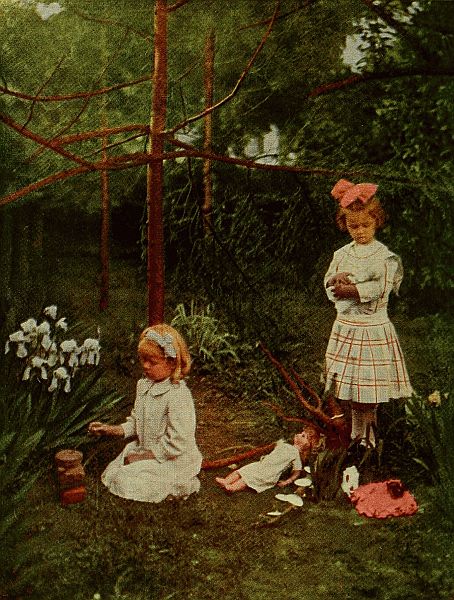
WHEN I was walking in a garden the other
day, I saw a play-house. And what do
you suppose it was? A big tree with
humpy roots which stuck out of the ground, and
low branches which nearly touched the grass at the
ends. You could not stand up straight in the house
if you were more than three feet tall, but as the
people who lived in the house were only about two
feet eleven inches, they did not mind that.
You should have seen the china-closet. It was
under a bent root, and all the dishes were white
with violet markings. One might have thought they
were big and little and middling-sized clam-shells,
if one had not seen them in a china-closet.
There was a bedroom between two big roots. A
doll was taking a nap there, not on a pine-pillow,
but on a whole bed of pleasant-smelling pine needles
which had dropped off a tree in the neighbourhood.
The mistress of the house was in the kitchen cooking,
and the kitchen, of course, was where the sun came
through a break in the branches. One must have a
patch of sun in a kitchen, for how can you bake
without it? When I went into this kitchen, there
was a cake baking, with an ornament on the top that
looked quite like an acorn.
I was invited to stay for lunch, and I will tell you
what we had: First, there were brown-bread cutlets,
and smooth white stone potatoes, and a wonderful
salad made of maple leaves and pepper-grass.
Then for dessert we had the cake I had seen baking,
and milk. The cake had a brown layer made from
the garden beds and a yellow layer made from the
path, and was iced with white sand. You will guess
that the brown bread cutlets and the milk were
what people getting up plays call "practicable,"
which is just a grown-up word for "really and
truly."
A tree is one of the nicest play-houses a person
can have. But suppose it is a rainy day! We will
play it is a rainy day, and we will go and go until
we get to a house with a steep roof. And we will
go in, and go upstairs, and then upstairs again until
we get to a garret, where we can see the rafters
sloping to the ridge over our heads, and the inside
of the shingles. On the floor are trunks and boxes
and barrels, and all sorts of things are hanging from
the rafters. Sometimes we hear the pigeons running
on the outsides of the shingles and cooing under the
eaves. It is a lonely sound. It is rather dark, too,
but we are brave, and we get past two saddles, and a
row of white petticoats, and a dim place where there
are a lot of old books with strange dark pictures in
them, which one likes to be sure are shut in tight.
At last we get round a corner and find a gable with
a pointed window, and there is a play-house where
a little girl and eight dolls live. There are four
rooms in the play-house, though if you are not thinking,
you may very likely walk right through the
walls and not know it. On one side of the window
is a bedroom, and on the other side is the kitchen.
The dining room and the living room are in the
corners nearest the rest of the garret.
The little girl's big sister put up some pictures
on the sloping wooden walls to suit each room.
One of them is very useful when the little girl is
deciding what to play. It is seven little pictures on
a card with verses to explain them. You can read
the verses at the beginning of this chapter; I am
sorry the pictures are not there, too.
This little girl likes especially to play "Monday,
I wash my dollies' clothes"—because she has a tub
and a washboard, and a wringer that will really
let buttons through, and clothespins and a clothes-horse,
and all the garret to put up lines in. Housework,
you know, is so much more fun if you have
the right things to do it with.
"Tuesday, I neatly press them," is a good day,
too, but "Wednesday, I mend their little hose," is
not. One cannot sit still and make believe sew,
for many minutes. When mother was told about
this trouble, she looked at the pictures and said,
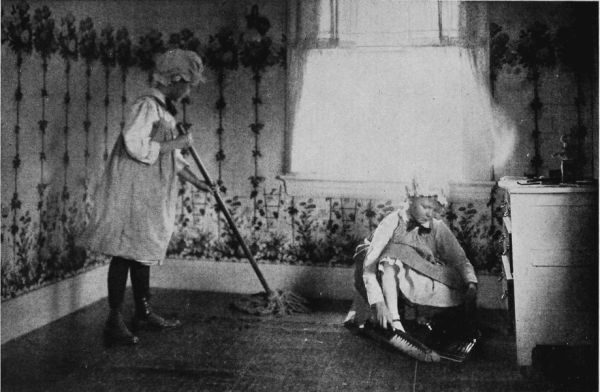
"Why, there's no sweeping day! As soon as the
stockings are mended on Wednesday, you had better
sweep, and tidy things up a little." Mother often
wants things "tidied up" when it isn't in the game.
She says, she does not keep her little girl's hat on
the dining table, nor leave her bed unmade, and she
cannot have the dolls brought up that way either.
The Friday game is one of the best. The two
dolls that have night dresses are most often sick.
Of course, it is a great care to have a doll sick, but
it does make a great many interesting things to do.
She may need cold-water cloths, or a hot-water
bottle, or a poultice, and there is always medicine
to give and meals to serve on a tray. Then the bed
should be made over often. The little girl who lives
in this play-house likes to have her dolls ill when she
has company, because then there is some one to
be the doctor.
"Saturday something or other," usually means
cooking, and that, too, is a favourite game for company.
Sometimes the little girl goes down into the
"really and truly" kitchen to market, or sometimes
mother sends up a little cake baked in a doll's pan.
That makes a very grand occasion. The table must
be laid with all the dishes, and napkins if possible,
when there is a cake from the big kitchen.
A great many things can happen in a garret play-house,
besides housekeeping. Sometimes it is so
still up there, that one knows one must be in a deep
forest, or out on the plains; and, of course, in that
case, the cooking or nursing may be interrupted by
a band of robbers, or an attack from Indians, or one
may have a visit from an escaping prisoner, and
besides, there are always long, dangerous journeys
to take through the garret. In fact, every time one
hears a new story, something unusual is likely to
happen in the play-house.
Have you a play-house? I hope you have. Nowadays,
when rents are so high, and when many
people live in flats and apartments, it is often hard
to get a play-house, but it can usually be managed
in some way. If we have a nursery or a play-room
all our own, then it is easy to have a play-house.
We only have to get mother, or nurse to give us a
corner to fix as we like, and to advise us about sorting
things. Perhaps they will let us make the whole
room into a play-house, but we really can keep house
nicely in a much smaller space than that. The
great point is to get the things together which belong
together. If the bedroom things stand together,
that is all we need to have a bedroom, and if the
kitchen things are together, there is the kitchen. If
we have a dining table, why, there is the dining room,
and our living room can be anywhere where mother
likes us to have most of the chairs.
But even if we have not a play-room we can still
have a house. I know some clever dolls and their
mother who keep house in the cupboard part of
an old-fashioned washstand. The way they manage
is to make the cupboard any room they wish to
use. Monday morning it is a laundry, and every
night it is a bedroom, and if they give a luncheon
it is a dining room, and Saturday it is a kitchen.
They keep the furniture which does not suit the
room they are using in the drawer of the washstand
which is over their heads.
I know another family who live under a dressing
table. The legs of the table show where the
corners of their house are, and they change the
room into anything they need it for, as the other
people do.
One little girl I know, whose name is Esther,
lives in a flat and has only a bureau drawer for her
housekeeping things. This is quite hard, for it
means so much packing and unpacking, and parting
with things she would like to keep when the drawer
gets too full. She has to take her two dolls and a
few things she thinks they will need into the parlour
or the bedroom and play house there. In the bedroom,
she plays it is night, because it is always nearly
dark in there. Her mother lets her play with her
big grown-up beds and chairs and stoves and irons.
If she did not, Esther would have a hard time keeping
house for her dolls.
But it is not always the people who live in flats
who have not room for their things, is it? Sometimes
after Christmas, or a birthday, one just feels
as if one were trying to keep house in a toy shop.
The best cure for this trouble is to give things away.
Because—it is dreadful to think about—there are
people who have no dolls: and there are people who
have not so much as a tin cup to begin housekeeping
with; and there are little girls who have real babies
to look after, and real meals to cook who would just
dearly love to have the games and toys that have to
be packed away in closets and drawers because their
owners have so many other things.
It is easy to say, give things away, but, my stars!
how hard it is to decide which to give. One just
can't give away the new things, and one feels so
fond of the old ones, when one gets them out and
looks at them. The only way to part with them
is to think of Saint Martin cutting his cloak in two
for the beggar, or something inspiring like that.
Even then one feels a little dreary.
Once there was a little girl whose family moved
into a smaller house. There was not room in her
new play-house for the many things she had in her
old one. Some of them had to be given away.
One decision was so hard to make that she remembered
about it after she was a grown-up woman.
There was a little green wagon with yellow wheels,
which she had always had, and which her older
sisters had played with before she was born, and
there was a little orange-coloured cart with four red
wheels, which her father had brought out from town,
a week or two before, filled with soap.
Two wagons were too many for the new play-house,
and mother said keep the green one, because
the other was only an "advertisement"; and the
older sisters said keep the green one, because it was
better and they had played with it; and father just
smiled and said, "You must decide."
When no one was looking, the little girl took the
little orange-coloured wagon with four red wheels,
and the big letters round the outside, which made
it an "advertisement," and put it in the box mother
was packing for some other children, and it hurt so
to do it that she could not quite help crying.
Some of us are troubled more with having too
few things than too many, are we not? We can
make a game of getting out of this trouble. We must
all be discoverers and inventors, and if there is
something needed in the play-house, we must keep
our eyes wide open to see what else will do or what
we can find to make into the thing we want. It
spoils the hunt, and the surprise, if some one else
tells you what to do, but one or two little things will
show what the game is like. For instance, if it is a
bed you need, try a strong pasteboard box, not very
deep. If you mind its having no legs, then you must
go on a journey and have it a berth on a car or a
ship.
A cigar-box makes a good trunk for a small doll,
especially the boxes which have trays in them. A
doll with a cigar-box trunk will never have moths
in her clothes.
Paper napkins are useful for dolls' tablecloths,
and for napkins when they are cut into small squares.
They will even do for sheets, if mother cannot spare
us white "pieces" that are big enough. A bandanna
handkerchief, or a scrap of bright calico,
makes a good bedquilt.
Shells we have brought home from a day at the
beach are convenient for dishes. Radiators are
splendid stoves. And did you ever find out how
much closet room there is under a bed? With the
help of a few pins, one can hang all the dolls' clothes
from the springs, and shut them in with the counterpane,
if it happens to be a long one. But if mother
does not want you to do this, you mustn't.
You will be able to make a great many discoveries
and inventions, if you think what you want, and then
think what to make it out of. But the best and
most wonderful thing about a play-house is, that if
we have to, we can make one anywhere, or out of
anything. Once, two little girls wrote home about
a visit they had paid, "We had two rag dolls and we
played house." Even one little girl, without so
much as a rag doll, can have a play-house. She has
only to imagine, that is, pretend, and there it is—with
rooms, and staircases, and people, and everything
needful. It can be big or little; and in the
country or in the city. She can do the washing, or
give a dinner party; take care of a sick doll, or work
in the garden, just as she pleases. It is easier and
happier to play with the pleasant things people
give us, and to be able to see and touch most of the
things in our play-houses, but we always want some
imagined things, too. And if it should happen
that we are in a place where we "have nothing to
play with," then we can imagine and pretend, and
go and play in the play-house we always have with
us. In a second, we can build it into a wigwam,
or a palace, or a cave, or a great castle, or it can be
just the house we live in when we are at home.
Sometimes, when we have played a good while
in the play-house, we feel tired, and if it isn't a nap
we want, perhaps it is that we would like to go and
play in a play-house somebody else has made. We
need not take a journey to do this, we only need
some one to tell us a story, or a story-book to read
to ourselves. We might choose to read "Cinderella,"
for that is the princess of housekeeping stories,
or it may be that we will find one we like, if we go
on reading this book.
Do you ever have Irish Stew for luncheon? Most
Irish Stews are a good deal alike, but this is the
story of one that was different.
Once upon a time there was an Irishman who
lived in a little two-roomed hut on the edge of a bog.
All day, he cut peats in the bog, for that is the way
he made his living. It was not a very good living;
in fact, he was very poor indeed. At night, when
he came back to the hut, there were often only a
few potatoes for supper, which he boiled in a pot
over the fire. His old father had died a few
years before, and that was the reason he lived
alone.
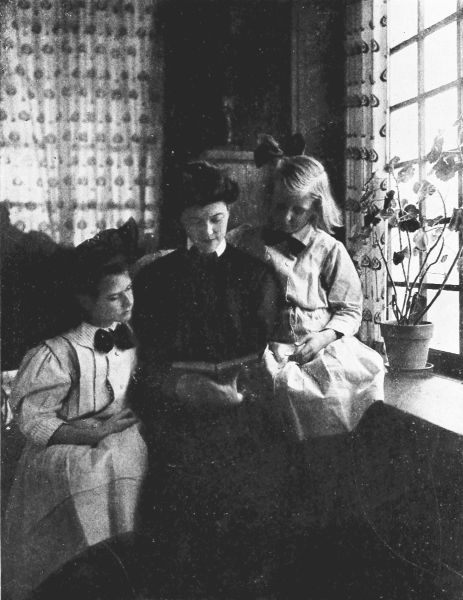
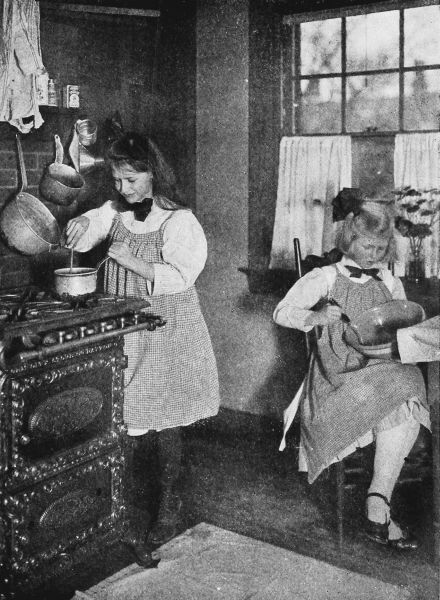
Photograph by Helen W. Cooke
A Play-house Somebody Else Has Made
One chilly, foggy night, the Irishman had come
home late through the wet and the dark, and lighted
his fire. There was very little for supper, and he
had not had a chance to cook that, when Thump!
Thump! came a knock on the door. He was ever
so frightened, but he thought it would be better to
open the door than have it thumped in. When
he did open it—Preserve us! there were five big
robbers with knives, and pistols, and high boots
and fierce, bright eyes. They all crowded into the
little hut, and threw more peat on the fire and
demanded supper. The Irishman apologized, and
said he had only potatoes. The robbers said they
had to have something better than that, and all five
of them laid their five big knives on the table with a
look which meant, "Supper or your life!"
The Irishman went into the other little room and
sat down on a chest to think. There was nothing
in the room but the chest, and nothing in the chest
but a few old clothes, and the more he tried to think,
the less he was able to do it. At last, for no reason
at all, he opened the chest. In it lay an old
cloak, which his father had worn forty years and
more.
No sooner had he seen it, than he went back to
the room where the robbers were, and they saw him
take the pot into the little room, and very soon come
back and put all the potatoes into it and some water,
and hang it over the fire, which was now so hot and
bright that the pot soon began to boil. It simmered,
and bubbled and steamed and soon the robbers
began to sniff their supper. It did not smell like
anything they had ever had before, but was not bad
for a cold, foggy night. Pretty soon the Irishman
set the pot on the table, and the robbers ate heartily.
The Irishman was busy arranging something near
the door. All of a sudden, one robber choked. He
choked, and choked, and two others beat him on
the back. He coughed and coughed, and then,
something flew out of his mouth. It was a button.
The Irishman turned up his eyes to the roof and
said, "Ah me, that is the last of a good old cloak."
Before the robbers could move, he had opened the
door and disappeared into the fog.
A good while ago there was a king of England
named Alfred. He was a great and good king,
but in spite of this, he had many enemies, who tried
to take his kingdom away from him. Once, after
a battle, the country was so overrun with his enemies,
that he had to separate from his followers
and go away in disguise. You would never have
guessed he was a king when he started, and when,
after he had wandered a few days in the forest, he
came to a cowherd's hut, he looked like a hungry,
ragged beggar. The cowherd and his wife gave
him supper, and let him stay all night, and gave
him some breakfast next morning. After breakfast,
he sat for a long time looking into the fire, thinking
of his kingdom, and of the dangers and sorrows of
his people. The cowherd's wife was a hard-working
woman, and it provoked her to see a great big man
dreaming over the fire all the morning. She said
to herself, "If he has no work of his own to attend
to, he shall just help with mine." She put some
meal cakes on a board to bake before the fire, and
told the King to watch them carefully while she went
out to feed the pig.
The King said he would watch them, but he kept
on thinking about his army, and the heavy taxes,
and by and by the woman came back.
There was smoke in the room, but she could see
that the stranger was still sitting beside the fire,
and that her cakes were burned to cinders. My,
my, but she was angry. She boxed her guest's ears
soundly, little dreaming that she was laying hands
on the Sacred Person of the King, and might be
hanged for it. The King, however, took her blows
and her scolding, for he was very sorry he had let
the cakes burn.
Afterward, when he had driven out his enemies
and was at home again in his own castle he told what
a scolding he had got for thinking about his troubles
when he should have been baking the cakes.
Long ago, longer than you can even imagine,
nobody in the world knew how to cook. People
were not as dreadfully hungry on that account
as you might think, because, you see, they ate their
food uncooked. No one had ever cooked, and no
one had ever thought of it; no one had ever eaten
cooked food, and no one knew how pleasant it tasted.
This is the story of the way a little Chinese boy
found out how to roast pig.
His name was Bo-bo and he had been left at home
by his father, Ho-ti, to look after their hut, and their
one big pig, and their nine little pigs. Bo-bo, was
fond of playing with fire, and what did he do but set
fire to some straw, and that set fire to the hut, and
burned it down. A much more serious matter was
that the one big pig and the nine little pigs were
burned along with the hut.
Bo-bo was dreadfully frightened when he saw
what he had done. He knew his father would beat
him, and he began to cry. He also poked round
among the ruins of the hut, though he did not hope
to find anything. As he was turning over the embers,
he found one of the little burnt pigs, and tried to
pull it out. It was very hot, and burnt his hands,
and he did just what you or I would have done—put
his burnt fingers in his mouth.
The instant his hands reached his mouth, Bo-bo
forgot all about being burned. He licked his fingers,
but not because they hurt him. He did not know
why he did lick them, but he kept on. Neither he
nor any one else in the world had ever tasted such
a wonderful taste.
Pretty soon, it came to him that it was the pig
which tasted so delicious, and no sooner had he
thought this, than he sat down in the ruins of the
hut and began to eat great pieces of the little burnt
pig. While he was making the best meal he had
ever had in his life, his father came home, and when
he saw that the hut was burnt down and that his son
was eating some horrible food that no one else had
ever eaten before, he began to beat Bo-bo with the
stick he had in his hand. But Bo-bo did not seem
to feel it. He hunted in the ashes for another pig
and thrust it into his father's hands. Then the
same thing happened which had happened to him.
The pig burned Ho-ti's fingers and he put them in
his mouth, and after that he had no time to think
of beating any one, but sat down with his son in the
ashes and made a good dinner.
From that time on, whenever they had little pigs,
they burned down their hut to roast them. When
the neighbours found it out, they thought it very
wicked of Ho-ti and Bo-bo to eat burnt pig, but as
soon as they were persuaded to taste it, they changed
their minds, and then everybody was burning down
his house in order to roast his pigs. After a
long while, some one found out that one could cook
without burning one's house down, which I am sure
you will agree was a great discovery.
—Some day, when you go to school, you will have
this story given to you to read—for a lesson!
When King Arthur was King of England, a boy
named Gareth, was growing up in a castle far away
from Camelot, the King's city. But he had two
brothers who were at Court, and who were Knights
of the Order of the Round Table, and when they
came home, now and then, Gareth asked them
more questions than you could count about the
King and his knights, and the Court, and tournaments,
and battles. Every day, he rode and practised
with lance and sword, and exercised in all ways
that would make him strong and skilful with arms.
And always he tried to be brave and to be gentle
toward weak things and to tell the truth. And the
reason for all this was that, more than anything
else in the world, he longed to be in the service of
the King, and to be a Knight of the Round Table.
As Gareth grew older, and more and more worthy
to be made a knight, his mother, Bellicent, sorrowed
and grieved. Her husband was very, very old, and
her two elder sons had gone away to the Court, and
she could not bear to have Gareth leave her, for
he was the youngest and last. Though she saw that
his heart's desire was to be with the King, yet she
felt as if her heart would break if he went. She tried
to make him especially happy at home; she tried to
persuade him that he was not skilful or brave enough
to be a knight; she told him of dangers and wounds,
and besought him not to go. Again and again he
asked her permission to go away and earn his knighthood;
again and again she refused.
One day when he had spoken so bravely and truly
that she knew not how to resist him longer, the
thought came to her to test his great desire to be with
the King, and she said to him: "If you desire so
greatly to serve the King, give the proof of it which
I shall ask of you. Go to the King and ask him to
let you serve him in his kitchen for a year and a day,
and tell no one your name and rank until the time
is over."
She thought he would refuse to do it, but he kissed
and thanked her, and quickly made ready to go to
Camelot. For he wanted to serve the King, and this
was a way of doing it, though not the one he had
hoped for.
He journeyed a day and a night, and came to
Camelot, the wonderful big city which he had never
seen before. In the morning, the King sat in the
Great Hall of his palace to hear the requests and
troubles of his people. There Gareth came, and
stood before him. And when he raised his eyes to
the King's quiet face, and met his eyes, he loved
him and longed more than ever to serve him. It
was a little hard, when he was longing to be made
a knight, and to be sent on an adventure, just to
ask to be a kitchen-boy; but he did it, and the King
granted his request.
So joyous and strong was he when he went out
from the presence of the King, that he felt nothing
would ever be hard to do again. But there were
things which were hard. The kitchen was a great
stone room with an earth floor, and a fireplace at
either end as big as a little room. When the great
fires were lit it was mightily hot between, and there
was smoke and hurry, and jostling of servants, and
there were some bad-tempered people and a great
deal of hard work. There were trenchers and
platters to be scoured, and big iron pots to be
lifted about and washed, and roasting meats to
be watched and turned before the fires. The
cooking tanned Gareth's face and hands as riding
in the hot sun had never done. When he could,
he would run out into the courtyard, and play
games with the other kitchen-boys, and when they
were tired, they would sit against the wall and he
would tell long tales he had read, and some that
he made up, about knights and dragons and
enchanted forests and robbers. The stories he loved
best to tell, though, were stories of the King.
Often these play-times were broken in upon by
the Master of the Kitchens, who called them back
to their tasks with no great gentleness. Especially
was he a hard master to Gareth; and, strangely
enough, this was because Gareth was willing and
cheerful, for there are people with such crooked
places in their minds that they cannot see a person
working gladly at a hard task but they want nothing
so much as to see if they cannot break their cheerfulness.
And that was the sort of master Gareth
found in the King's Kitchen. He missed his rides
over the downs in the clear air, and the right to go
and come as he pleased. But when things seemed
hard he cast off the thought and laughed to himself,
saying, "It is for the King." In a little while, too,
he learned to take fault-finding, and, now and again, a
blow, in quietness. And this, too, was for the King.
As the days came and went, Bellicent, alone now
with her old husband, thought of her son day and
night; and the tasks that he must do and the discomforts
he must suffer seemed to her a thousand
times worse than he ever thought them. At last,
when hardly a month of his trial had yet gone by,
she could bear it no longer, but sent a messenger
to the King to tell him the story, and to take to Gareth
a horse and armour and all things that he would need
when it should please the King to make him a
knight.
After the King had seen the messenger he sent
for Gareth, and Gareth left his scouring and went
gaily and eagerly to him. He was glad in his love
for the King, and I think he may have felt that he
had borne rather unusual things for his sake. As
he came near, the King loved him for his youth and
gaiety and faithfulness. But Gareth, looking up
into the quiet, loving eyes that were fixed on him,
knelt down at the King's feet and bowed his head,
and knew that nothing he could do for the King
would ever be too much.
The King ended Gareth's kitchen service and made
him a knight, and some day you will read other
stories about him, for he fought many battles and
loved a beautiful lady.
And it seems likely that the King loved him all
the more because he could cook and scour for his
sake.
Have you heard stories about Saint Francis of
Assisi? There are a great many, and people like
to hear them over and over again. For, though
Saint Francis lived most of his life in a little, faraway,
country town in Italy, called Assisi, and
though he died hundreds of years ago, yet every
year many people go to see the place where he lived,
and the church where he is buried, and many
people in countries far away from Italy love him as
well as they do their friends whom they can see
and talk to.
One of the stories about St. Francis tells of a flock
of birds that came to listen to a sermon he preached
to them, and another is about a wolf whom he persuaded
not to hurt people any more. The reason
he could do these things, and the reason people who
have never seen him love him very dearly is because
he loved everything and everybody in the world, and
God and our Lord Jesus more than all.
No one was so dirty, or so sick, that he did not
want to take care of him; no one was so cross, or
so cruel, that he did not want to be kind to him.
Every day he went about helping poor people,
and sick people, and troubled people; and he taught
them all to be sorry for the wrong things they had
done, and to sing songs of joy because God loved
them.
After a little, a good many men began to help him
do this. They gave everything they had to the poor,
and never after that kept any money. They worked
every day to get a little food, and the rest of the time
they spent in helping and teaching people. St.
Francis called them his "Little Brothers," not
because they were small or young, but because he
taught them to think themselves of no importance,
and to think, if anybody scolded them or hurt them,
that they deserved it and more too.
One of these Little Brothers was named Brother
Juniper. He was always thinking of ways to help
people. One day, all the Brothers went out to work,
and left Brother Juniper to take care of the little
hut where they lived, and to get some food for them.
When he set about this he began to think of the
Brothers who usually did the cooking, and how much
time they had to spend every day getting food ready
for the others to eat. To be sure, they had but one
good meal a day, yet even so the cooking of it took
time the Brothers might otherwise have used for
prayer, or tending the sick, or some other good work.
As Brother Juniper was thinking of this, a plan
popped into his head which made him very glad.
He took two big baskets, and went off happily to
several farmhouses in the neighbourhood, where
the people were fond of the Little Brothers and
liked to give them anything they needed. That
day they gave Brother Juniper chickens and eggs
and meat and salad and all sorts of vegetables,
and they lent him some big iron pots. He took the
baskets home heavy with food, and he came back
and took the pots home. Then he made a big fire,
and all the time he was happy and sang to himself,
because he thought, "I will work hard to-day, and
cook all this food, and then the Brothers won't
have to think about cooking for a week or more."
He hung the pots over the fire, and put into them all
the food he had gathered without so much as taking
the feathers off the chickens or the shells off the eggs,
or stopping to see whether the vegetables were
all just fit to eat or not. Then he filled the pots
with water, and before long they began to boil.
The fire was furiously hot. Brother Juniper could
not get near enough to it to stir the pots. When he
found this out, he took a board and tied it fast to
himself, and, with that for a shield, he leaped to
a pot and stirred it, and then leaped away again
to cool himself; then he dashed at another and
stirred that, and so on.
By and by, the Brothers came back, and the
Brother Guardian with them, and they all sat down
to dinner. Brother Juniper poured out some of the
stew from his pots and brought it to the table. He
was hot and tired, but delighted, and he told the
others what he had done, and that they need not do
any more cooking for a long time. The Brothers
looked at him, and looked at the stew, and looked
at each other, but not a mouthful could they eat.
Brother Juniper urged them to begin, and when they
did not, wondered what could be the matter. He was
not left long in doubt, for the Brother Guardian told
him that the dinner was not fit for a pig to eat, and
scolded him well for wasting so much good food.
Brother Juniper listened and the gladness died
out of him. He went and knelt at the Brother
Guardian's feet and confessed his fault, and begged
to be forgiven for wasting the Brothers' food, and
for getting them a dinner they could not eat. Then
he went away by himself, and the rest of that day
and all the next, he neither ate nor spoke, nor ventured
to come near any of the Brothers, because he was so
sorry for his wastefulness and stupidity.
But the Brothers and the Brother Guardian
thought they would be willing to know as little about
cooking as Brother Juniper if they could be like him
in some other ways.
Long, long ago, there was a famine in a little
town called Sarepta. For months and months
there had been no rain, and nothing could grow in
the fields, and the streams dried up and the sheep
died and many people died, too, because they had
no food.
A widow lived in Sarepta, who had one boy, and
she was poor. When the famine began she had just
one barrel of meal and one cruse of oil, and because
she knew she could get no more, she and her son
ate as little as they could, but even so, in a few months
the meal was far down in the bottom of the barrel,
and the cruse of oil felt very light.
At last one morning, when the woman got up,
she found there was only enough meal and oil to
make one little cake. She looked at it a long time,
thinking they must certainly starve to death when
that was gone; then she went out to get some wood
for the fire, for she said to herself, "I will bake this
one cake and we will eat it, but after that we will
have to die." I expect she looked white and sad
as she went, for it hurts very much to be so hungry
that you die of it.
She found a few sticks, and was picking them up,
when a tall old man stopped beside her and leaned
on his staff. His clothes were made of hairy skins,
and he had a long gray beard, and his face and
arms and legs were brown and rough as if he had
lived out in the sun and the frost. He seemed to
have been making a journey, and he asked for a
drink of water. The widow was glad it was only
water that he wanted, and was hurrying off to get
it, when the old man called after her, and asked her
to bring him a piece of bread.
She thought of the little bit of meal and oil, and
of her hungry boy, and of how hungry she was herself—and
now, here was this tired old man asking for
food! It was really more than she could bear.
She came back toward him and said, "As the Lord
liveth, I have not a cake, but only a handful of meal
in a barrel, and a little oil in a cruse; and behold
I am gathering two sticks that I may go and dress it
for me and my son, that we may eat it and die!"
The old man saw how hungry and desperate she
looked; it may be that he knew beforehand that she
was; nevertheless, he said: "Fear not; but go and
do as thou hast said: but make me thereof a little
cake first, and bring it unto me, and after that make
for thee and thy son. For thus saith the Lord God
of Israel, The barrel of meal shall not waste, neither
shall the cruse of oil fail, until the day that the Lord
sendeth rain upon the earth."
The widow did not altogether understand what
he said, but somehow she felt stronger and more
brave. She went home quickly and baked a little
meal cake, and brought it to the old man, and asked
him to come to her house and rest. He went back
with her, and then she set about baking the rest of
the meal and oil. She thought it would only make
a very little cake, but the more meal she took out of
the barrel, the more there was in it; and the more
oil she poured from the cruse, the heavier it was
to lift. She could hardly believe it, and yet she saw
it was surely so. Then she went, crying with
gladness and relief, and knelt beside the old man
and thanked him, and begged him to stay with them
as long as he could. And he did stay, a good many
months, and all the time of the famine there was meal
in the barrel and oil in the cruse.
By and by, the widow and her son learned that
the old man's name was Elijah, and that he was
a Prophet of the Lord God of Israel.
If we sailed across the Atlantic Ocean, and then
sailed as far east on the Mediterranean Sea as we
could, we should come to Asia. Then if we travelled
into Asia for a little distance, we should come to a
small lake. Long ago, this lake was called the Sea
of Galilee, and one of the little towns on the shore
was named Bethsaida. In this town, almost one
thousand, nine hundred years ago, a boy lived and
played and went to school. His uncles had boats
on the lake, for they were fishermen, and the boy
played in the boats, and sometimes his Uncle Andrew
let him go out with him to the fishing.
Bethsaida was a busy, little town. There was
always something to do. The lake and the boats and
the fishermen and the nets were always there; then
sometimes Roman soldiers marched into the town,
and merchants from far-off countries came to trade
in the market-place. Now and again men came
who gathered crowds round them, and talked loud
and shook their clenched fists and tore their long
robes and kept the town restless for days together.
The boy liked to go with his uncles to listen to
these men. He could not understand what they
were talking about, but the crowd buzzed and
jostled, and sometimes groaned and yelled. It
was very exciting. Uncle Peter was often angry
about what he heard these men say, but Uncle Andrew
just stroked his beard and went back to the boats.
The people called a man who spoke to them in
this way a "Rabbi." This meant in their language,
a master—a man who knew a great deal about
something.
One day, a Rabbi came to Bethsaida, who acted
differently from the others. He did not make
speeches in the market-place, and often when people
were crowding to hear him, he went away on the
lake or into the hills. If they followed him, he
would sometimes stand in a boat by the shore, or
on a hillside, and talk to them; and he could make
sick people well. He liked children; and the boy
had seen him once stop in the road and talk to a
woman. That was a very queer thing for a great
Rabbi to do.
The boy saw very little of his uncles after this
new Rabbi came, for they followed him everywhere
he went and seemed to be his close friends. When they
did come home they spoke of him as if they did
not know just what to say, yet always it seemed as if
they could have said more if they had thought it well.
One day, the Rabbi and his friends had gone up
into the hills, and people from the towns on the lake,
and from the country round it, had gone out to find
him; for those who had seen him wanted nothing
so much as to see him again, and those who had
not seen him could not rest until they had found out
what the others went to see. The boy had been playing
in the boats that morning, which nowadays
were most of the time pulled up on the shore, and
when he saw some of the neighbours setting off for
the hills, he made up his mind to go too. First,
though, he thought, "Uncle Andrew will be hungry,
and so shall I," and he went home and got some
food to take with him.
The way up through the hills was long and steep.
The boy and his neighbours were tired enough
before they came in sight of a great crowd of people
in a green hollow of the hills. It was strange but,
though there were thousands of people all standing
together, they did not make a sound. As the boy
came a little nearer, he heard the Rabbi's voice in
the stillness. He wondered why the people kept
so quiet. He did not realize that he was keeping
very quiet himself.
After a while he no longer heard the Rabbi's
voice, and the people began to move and make a
little murmur of talking. He crept through the
crowd toward the group round the Rabbi where his
Uncle Andrew would be. When he got there he
found they were trying to think of a way to feed all
these hundreds of people who were tired and hungry,
and miles away from any place where they could
get food. That reminded him of the luncheon he
had brought, and he pushed the basket into Uncle
Andrew's hand.
Uncle Andrew looked into the basket and smiled
when he saw what it had in it. Then he said to the
Rabbi, "There is a lad here, which hath five barley
loaves and two small fishes; but what are they among
so many?" All the same, though, he held out the
basket to the Rabbi, as if he really thought it would
be of some use to him.
The boy looked to see if the great Rabbi would be
angry with Uncle Andrew for saying such a useless
thing, when all the others were trying hard to think
what could be done. But no; instead of that, he
looked as if something had made him delightfully
happy, and he said, "Make the men sit down."
And they did. Then the Rabbi blessed the five
little loaves and the two little fishes which he had
taken out of the basket, and began to break them
up and give them to those especial friends of his
who were always with him. And they carried them
to the people sitting on the grass, and came back
for more again and again.
And there always was more.
The boy went with Uncle Andrew, back and forth,
again and again. He wanted, more than anything,
to help in some little way, if it were only to hold
back his uncle's robe as he bent toward the people
on the ground.
When they would walk back for more food, he
scarcely dared go so near to the wonderful Rabbi.
And yet—his heart was in his throat with the joy
and wonder of it—was it not his own barley bread
and fish that the Rabbi had been so glad to have,
and with which he was feeding all these thousands
of hungry people?
Last of all, after every one was fed, the boy sat
down close to his uncle and they had some luncheon,
too; but he could not take his eyes from the Rabbi's
face. He looked and looked until he could not see
it any more, for he had gone to sleep in the warm
grass.
When he waked the crowd was moving away, and
his uncle was helping gather up the food which was
left. The Rabbi had gone away alone into the hills.
It was spring-time, and eventide, in the thirty-third
year of that amazing time when God walked
on the earth, not only everywhere, and in every man
as He does now, but Himself in the form of one
Man.
Five of those men who loved Him best, and had
been with Him most often, stood on the shore of
the Sea of Galilee in the quick-coming darkness.
Only a week or two before, they had seen their dear
Lord nailed on a cross and left to die. And He
had died. And when that happened, they felt they
could not bear to live any longer. But—what do
you think?—first one, and then another, had seen
Him alive again, had talked with Him, touched
Him, and been taught by Him as they used to be.
When He was with them, they wished for nothing else;
and when He was away they watched and longed
for His return.
It had now been several days since He had been
with them, and meanwhile they had been going
about among people who thought of them as men
who had wasted three years wandering round after
another man, who was always about to do something
but never did, and who, at last, had been put to death
by the government. I expect it made these men
feel lonely then, just as it makes us feel lonely now,
to have to be with people who think that Our Lord
is not alive.
They did not know what to do with themselves as
they stood on the shore that evening. So, when one
said, "I go a-fishing," all the rest said they would
go, too. They were glad to be at work again, at
something they had done all their lives.
They started out on the dark water under the stars,
and cast their nets, but when they drew them in,
they had caught nothing. They cast them again,
and rowed here and there, and worked as hard as
they could, but they got no fish for their pains,
and the night was passing. One cannot tell whether
or not they thought it strange, that men who had
made sick people well, and cast out devils, could not
now catch a few fish. Whatever they thought, they
were wet and tired, and hungry, and the cold, gray
early morning had come.
When it began to dawn, they rowed toward the
shore. As they drew near, they saw some one standing
on the beach who called to them and asked if
they had any fish. They had to say no. Then
the Stranger said "Cast the net on the right side of
the ship, and ye shall find." They had cast it,
perhaps, in that very place during the night, but
they did not say so; they just cast the net. When
they began to draw it, it was heavy with fish.
This was a strange thing. One of the men said
very low, "It is the Lord." Then the one who
had suggested that they go fishing, threw himself
into the water and swam to the shore; he just could
not wait. The others came in the boat, dragging
the net full of fishes.
As all through the night everything had seemed
to go wrong, so now, everything was all right. On
the shore was just the thing that tired, hungry, cold
people want—a fire, burned down to glowing coals,
with fish and bread baking on it.
But that was not the best thing they found on the
shore.
The Stranger told them to draw up the net, and
they did, and counted the fish, one hundred and fifty-three.
Then He told them to come and eat, and
He said grace for them and waited on them, and
they knew every word and every gesture, but they
could not speak. They just ate and rested and
looked at Him. It made them so glad, and yet it
almost made them afraid, too, that He should care
about their hard work, and come and cook for them
and wait on them Himself.
Perhaps it often happened in the years which followed,
that when a friend, or a woman, or a slave
came to these men, bringing food and comfort for
their weariness, that with them came also the memory
of the dawn on the beach, and the fire of coals,
and the blessing of a Presence more than theirs.
 , not this
  one.
To be perfectly sure, light the lamp for a moment,
put on the chimney, and if the flame is not the right
shape alter the wick. When this is finished, wipe
the burner inside and out, above and below, as carefully
as possible. An old water-colour brush is
good for cleaning intricate burners.
one.
To be perfectly sure, light the lamp for a moment,
put on the chimney, and if the flame is not the right
shape alter the wick. When this is finished, wipe
the burner inside and out, above and below, as carefully
as possible. An old water-colour brush is
good for cleaning intricate burners.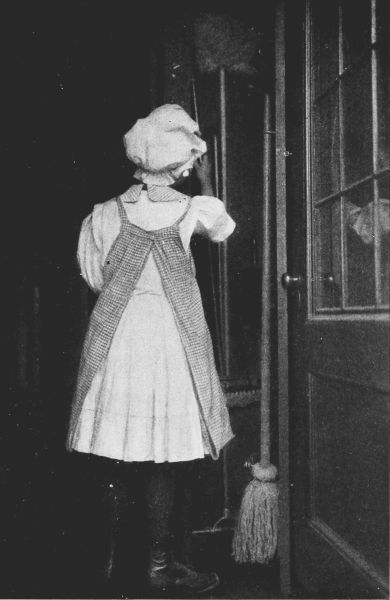
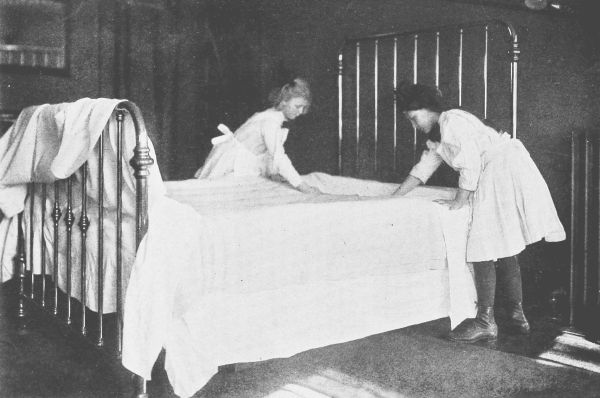
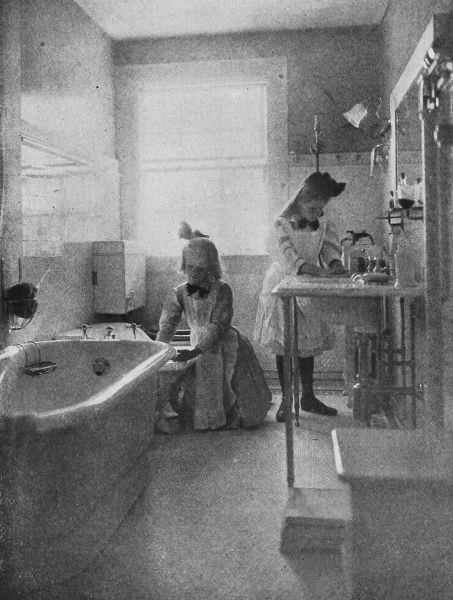
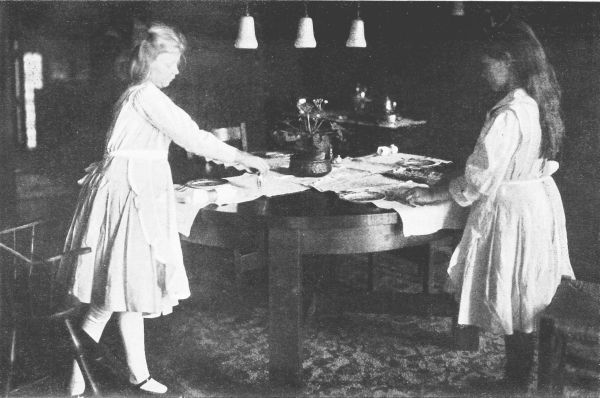

 .
Under the basin in the
bathroom one can see
the waste pipe and can
imagine where the water is inside. It flows out of
the basin into the first loop of the S, rises into and
flows over the other loop until the basin and pipe are
emptied as far as a. The water has then no power to
force itself beyond the loop b, and stays in the first loop,
forming a water seal between the sewer and the outlet
of the basin. Through that loop water gases and
odours cannot come, and across the loop at b, impure
substances and water cannot force their way back
from a lower level.
.
Under the basin in the
bathroom one can see
the waste pipe and can
imagine where the water is inside. It flows out of
the basin into the first loop of the S, rises into and
flows over the other loop until the basin and pipe are
emptied as far as a. The water has then no power to
force itself beyond the loop b, and stays in the first loop,
forming a water seal between the sewer and the outlet
of the basin. Through that loop water gases and
odours cannot come, and across the loop at b, impure
substances and water cannot force their way back
from a lower level.
 keep on doing this, laying
the sticks first in one direction then in the other until
the sty is two or three rails high. Then lay two
larger sticks in an X on the top and the fire is ready
for lighting.
keep on doing this, laying
the sticks first in one direction then in the other until
the sty is two or three rails high. Then lay two
larger sticks in an X on the top and the fire is ready
for lighting.