By Rose Terry Cooke.
A long story about a family of hardy New England pioneers in
Revolutionary days. It will be most enjoyed by the older children.
"Pile in, Hannah. Get right down 'long o' the
clock, so's to kinder shore it up. I'll fix in them
pillers t'other side on't, and you can set back ag'inst
the bed. Good-bye, folks! Gee up! Bright. Gee! I
tell ye, Buck."
"Good-bye!" nodded Hannah, from the depths of
the old calash which granny had given her for a riding-hood,
and her rosy face sparkled under the green shadow
like a blossom under a burdock leaf.
This was their wedding journey. Thirty long miles to
be travelled, at the slow pace of an oxcart, where to-day
a railroad spins by, and a log hut in the dim distance.
But Hannah did not cry about it. There was a
momentary choking, perhaps, in her throat, as she
caught a last view of granny's mob cap and her father's
rough face, with the red head of her small stepbrother
between them, grouped in the doorway. Her mother
had died long ago, and there was another in her place
now, and a swarm of children. Hannah was going to
her own home, to a much easier life, and going with
John. Why should she cry?
Besides, Hannah was the merriest little woman in
the country. She had a laugh always lying ready in a
convenient dimple.
She never knew what "blues" meant, except to dye
stocking yarn. She was sunny as a dandelion and gay
as a bobolink. Her sweet good nature never failed
through the long day's journey, and when night came
she made a pot of tea at the campfire, roasted a row
of apples, and broiled a partridge John shot by the wayside,
with as much enjoyment as if this was the merriest
picnic excursion, and not a solitary camp in the forest,
long miles away from any human dwelling, and by no
means sure of safety from some lingering savage, some
beast of harmful nature, or at least a visit from a shambling
black bear, for bears were plentiful enough in that
region.
But none of these things worried Hannah. She ate
her supper with hearty appetite, said her prayers with
John, and curled down on the featherbed in the cart,
while John heaped on more wood, and, shouldering his
musket, went to lengthen the ropes that tethered his
oxen, and then mounted guard over the camp. Hannah
watched his fine, grave face, as the flickering light
illuminated it, for a few minutes, and then slept tranquilly
till dawn. And by sunset next day the little party
drew up at the door of the log hut they called home.
It looked very pretty to Hannah. She had the
fairy gift, that is so rare among mortals, of seeing beauty
in its faintest expression; and the young grass about the
rough stone doorstep, the crimson cones on the great
larch tree behind it, the sunlit panes of the west window,
the laugh and sparkle of the brook that ran through
the clearing, the blue eyes of the squirrel caps that
blossomed shyly and daintily beside the stumps of new-felled
trees—all these she saw and delighted in. And
when the door was open, the old clock set up, the bed
laid on the standing bedplace, and the three chairs and
table ranged against the wall, she began her housewifery
directly, singing as she went. Before John had
put his oxen in the small barn, sheltered the cart and
the tools in it, and shaken down hay into the manger,
Hannah had made a fire, hung on the kettle, spread up
her bed with homespun sheets and blankets and a wonderful
cover of white-and-red chintz, set the table with
a loaf of bread, a square of yellow butter, a bowl of
maple sugar, and a plate of cheese; and even released
the cock and the hen from their uneasy prison in a
splint basket, and was feeding them in the little woodshed
when John came in.
His face lit up, as he entered, with that joyful sense
of home so instinctive in every true man and woman.
He rubbed his hard hands together, and catching Hannah
as she came in at the shed door, bestowed upon
her a resounding kiss.
"You're the most of a little woman I ever see,
Hannah, I swan to man."
Hannah laughed like a swarm of spring blackbirds.
"I declare, John, you do beat all! Ain't it real
pleasant here? Seems to me I never saw things so
handy."
Oh, Hannah, what if your prophetic soul could have
foreseen the conveniences of this hundred years after!
Yet the shelves, the pegs, the cupboard in the corner,
the broad shelf above the fire, the great pine chest under
the window, and the clumsy settle, all wrought out of
pine board by John's patient and skilful fingers, filled
all her needs; and what can modern conveniences do
more?
So they ate their supper at home for the first time,
happy as new-nested birds, and far more grateful.
John had built a sawmill on the brook a little way
from the house, and already owned a flourishing trade,
for the settlement about the lake from which Nepasset
Brook sprung was quite large, and till John Perkins
went there the lumber had been all drawn fifteen miles
off, to Litchfield, and his mill was only three miles
from Nepash village. Hard work and hard fare lay before
them both, but they were not daunted by the prospect....
By and by a cradle entered the door, and a baby was
laid in it....
One baby is well enough in a log cabin, with one
room for all the purposes of life; but when next year
brought two more, a pair of stout boys, then John began
to saw lumber for his own use. A bedroom was
built on the east side of the house, and a rough
stairway into the loft—more room perhaps than was
needed; but John was called in Nepash "a dre'dful
forecastin' man," and he took warning from the twins.
And timely warning it proved, for as the years slipped
by, one after another, they left their arrows in his quiver
till ten children bloomed about the hearth. The old
cabin had disappeared entirely. A good-sized frame
house of one story, with a high-pitched roof, stood in
its stead, and a slab fence kept roving animals out of
the yard and saved the apple trees from the teeth of
stray cows and horses.
Poor enough they were still. The loom in the garret
always had its web ready, the great wheel by the other
window sung its busy song year in and year out. Dolly
was her mother's right hand now; and the twins, Ralph
and Reuben, could fire the musket and chop wood.
Sylvy, the fourth child, was the odd one. All the rest
were sturdy, rosy, laughing girls and boys; but Sylvy
had been a pining baby, and grew up into a slender,
elegant creature, with clear gray eyes, limpid as water,
but bright as stars, and fringed with long golden lashes
the colour of her beautiful hair—locks that were coiled in
fold on fold at the back of her fine head, like wreaths
of undyed silk, so pale was their yellow lustre. She
bloomed among the crowd of red-cheeked, dark-haired
lads and lasses, stately and incongruous as a June lily in
a bed of tulips. But Sylvy did not stay at home. The
parson's lady at Litchfield came to Nepash one Sunday,
with her husband, and seeing Sylvy in the square corner
pew with the rest, was mightily struck by her lovely
face, and offered to take her home with her the next
week, for the better advantages of schooling. Hannah
could not have spared Dolly; but Sylvia was a dreamy,
unpractical child, and though all the dearer for being
the solitary lamb of the flock by virtue of her essential
difference from the rest, still, for that very reason, it became
easier to let her go. Parson Everett was childless,
and in two years' time both he and his wife adored the
gentle, graceful girl; and she loved them dearly. They
could not part with her, and at last adopted her formally
as their daughter, with the unwilling consent of John
and Hannah. Yet they knew it was greatly "for
Sylvy's betterment," as they phrased it; so at last they
let her go.
But when Dolly was a sturdy young woman of
twenty-five the war-trumpet blew, and John and the
twins heard it effectually. There was a sudden leaving
of the plow in the furrow. The planting was set aside
for the children to finish, the old musket rubbed up, and
with set lips and resolute eyes the three men walked
away one May morning to join the Nepash company.
Hannah kept up her smiling courage through it all. If
her heart gave way, nobody knew it but God and John.
The boys she encouraged and inspired, and the children
were shamed out of their childish tears by mother's
bright face and cheery talk.
Then she set them all to work. There was corn to
plant, wheat to sow, potatoes to set; flax and wool to
spin and weave, for clothes would be needed for all, both
absent and stay-at-homes. There was no father to
superintend the outdoor work; so Hannah took the field,
and marshalled her forces on Nepasset Brook much as
the commander-in-chief was doing on a larger scale elsewhere.
Eben, the biggest boy, and Joey, who came next
him, were to do all the planting; Diana and Sam took on
themselves the care of the potato patch, the fowls, and
the cow; Dolly must spin and weave when mother left
either the wheel or loom to attend to the general
ordering of the forces; while Obed and Betty, the
younglings of the flock, were detailed to weed, pick
vegetables (such few as were raised in the small garden),
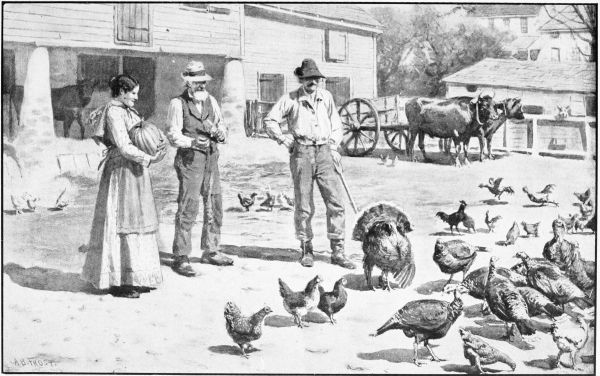
gather berries, herbs, nuts, hunt the straying turkeys'
nests, and make themselves generally useful. At
evening all the girls sewed; the boys mended their shoes,
having learned so much from a travelling cobbler; and
the mother taught them all her small stock of schooling
would allow. At least, they each knew how to read, and
most of them to write, after a very uncertain fashion. As
to spelling, nobody knew how to spell in those days....
But they did know the four simple rules of
arithmetic, and could say the epigrammatic rhymes of
the old New England Primer and the sibyllic formulas
of the Assembly's Catechism as glibly as the child of to-day
repeats "The House That Jack Built."
So the summer went on. The corn tasselled, the
wheat ears filled well, the potatoes hung out rich
clusters of their delicate and graceful blossoms, beans
straggled half over the garden, the hens did their duty
bravely, and the cow produced a heifer calf.
Father and the boys were fighting now, and mother's
merry words were more rare, though her bright face still
wore its smiling courage. They heard rarely from the
army. Now and then a post rider stopped at the Nepash
tavern and brought a few letters or a little news; but
this was at long intervals, and women who watched and
waited at home without constant mail service and
telegraphic flashes, aware that news of disaster, of
wounds, of illness, could only reach them too late to serve
or save, and that to reach the ill or the dying involved
a larger and more disastrous journey than the survey
of half the world demands now—these women endured
pangs beyond our comprehension, and endured them
with a courage and patience that might have furnished
forth an army of heroes, that did go far to make heroes of
that improvised, ill-conditioned, eager multitude who
conquered the trained bands of their oppressors and set
their sons "free and equal," to use their own dubious
phraseology, before the face of humanity at large.
By and by winter came on with all its terrors. By
night wolves howled about the lonely house, and sprung
back over the palings when Eben went to the door with
his musket. Joe hauled wood from the forest on a hand-sled,
and Dolly and Diana took it in through the kitchen
window when the drifts were so high that the woodshed
door could not be opened. Besides, all the hens were
gathered in there, as well for greater warmth as for convenience
in feeding, and the barn was only to be
reached with snowshoes and entered by the window
above the manger.
Hard times these were. The loom in the garret could
not be used, for even fingers would freeze in that atmosphere;
so the thread was wound off, twisted on the great
wheel, and knit into stockings, the boys learning to fashion
their own, while Hannah knit her anxiety and her hidden
heartaches into socks for her soldier boys and their father.
By another spring the aching and anxiousness were a
little dulled, for habit blunts even the keen edge of
mortal pain. They had news that summer that Ralph
had been severely wounded, but had recovered; that
John had gone through a sharp attack of camp-fever;
that Reuben was taken prisoner, but escaped by his own
wit. Hannah was thankful and grateful beyond expression.
Perhaps another woman would have wept
and wailed, to think all this had come to pass without
her knowledge or her aid; but it was Hannah's way to
look at the bright side of things. Sylvia would always
remember how once, when she was looking at Mount
Tahconic, darkened by a brooding tempest, its crags
frowning blackly above the dark forest at its foot and
the lurid cloud above its head torn by fierce lances of
light, she hid her head in her mother's checked apron, in
the helpless terror of an imaginative child; but, instead
of being soothed and pitied, mother had only laughed a
little gay laugh, and said gently, but merrily:
"Why, Sylvy, the sun's right on the other side, only
you don't see it."
After that she always thought her mother saw the sun
when nobody else could. And in a spiritual sense it was
true.
Parson Everett rode over once or twice from Litchfield
that next summer to fetch Sylvia and to administer
comfort to Hannah. He was a quaint, prim little
gentleman, neat as any wren, but mild-mannered as
wrens never are, and in a moderate way kindly and
sympathetic. When the children had haled their lovely
sister away to see their rustic possessions, Parson Everett
would sit down in a high chair, lay aside his cocked hat,
spread his silk pocket handkerchief over his knees, and
prepare to console Hannah.
"Mistress Perkins, these are trying times, trying
times. There is a sound of a going in the tops of the mulberry-trees—h-m!
Sea and waves roaring of a truth—h-m!
h-m! I trust, Mistress Perkins, you submit to the
Divine Will with meekness."
"Well, I don't know," replied Hannah, with a queer
little twinkle in her eye. "I don't believe I be as meek
as Moses, parson. I should like things fixed different,
to speak truth."
"Dear me! Dear me—h-m! h-m! My good woman,
the Lord reigneth. You must submit; you must submit.
You know it is the duty of a vessel of wrath to be broken
to pieces if it glorifieth the Maker."
"Well, mebbe 'tis. I don't know much about that
kind o' vessel. I've got to submit because there ain't
anything else to do, as I see. I can't say it goes easy—not'n'
be honest; but I try to look on the bright side, and
to believe the Lord'll take care of my folks better'n I
could, even if they was here."
"H-m! h-m! Well," stammered the embarrassed
parson, completely at his wit's end with this cheerful
theology, "well, I hope it is grace that sustains you,
Mistress Perkins, and not the vain elation of the natural
man. The Lord is in His holy temple; the earth is His
footstool—h-m!" The parson struggled helplessly with
a tangle of texts here; but the right one seemed to fail
him, till Hannah audaciously put it in:
"Well, you know what it says about takin' care of
sparrers, in the Bible, and how we was more valerable
than they be, a lot. That kind o' text comes home
these times, I tell ye. You fetch a person down to the
bedrock, as Grandsir Penlyn used to say, and then
they know where they be. And ef the Lord is really the
Lord of all, I expect He'll take care of all; 'nd I don't
doubt but what He is and does. So I can fetch up on
that."
Parson Everett heaved a deep sigh, put on his cocked
hat, and blew his nose ceremonially with the silk handkerchief.
Not that he needed to: but as a sort of
shaking off of the dust of responsibility and ending the
conversation, which, if it was not heterodox on Hannah's
part, certainly did not seem orthodox to him....
He did not try to console her any more, but
contented himself with the stiller spirits in his own parish,
who had grown up in and after his own fashion.
Another dreadful winter settled down on Nepasset
township. There was food enough in the house and
firewood in the shed; but neither food nor fire seemed to
assuage the terrible cold, and with decreased vitality
decreased courage came to all. Hygienics were an unforeseen
mystery to people of that day. They did not
know that nourishing food is as good for the brain as for
the muscles. They lived on potatoes, beets, beans,
with now and then a bit of salt pork or beef boiled in the
pot with the rest; and their hearts failed, as their flesh
did, with this sodden and monotonous diet. One
ghastly night Hannah almost despaired. She held
secret council with Dolly and Eben, while they inspected
the potato bin and the pork barrel, as to whether
it would not be best for them to break up and find homes
elsewhere for the winter. Her father was old and
feeble. He would be glad to have her with him and
Betty. The rest were old enough to "do chores" for
their board, and there were many families where help
was needed, both in Nepash and Litchfield, since every
available man had gone to the war by this time. But
while they talked a great scuffling and squawking in the
woodhouse attracted the boys upstairs. Joe seized the
tongs and Diana the broomstick. An intruding weasel
was pursued and slaughtered; but not till two fowls, fat
and fine, had been sacrificed by the invader and the
tongs together. The children were all hungry, with the
exhaustion of the cold weather, and clamoured to have
these victims cooked for supper. Nor was Hannah unmoved
by the appeal. Her own appetite seconded.
The savoury stew came just in time. It aroused them
to new life and spirits. Hannah regained courage,
wondering how she could have lost heart so far, and said
to Dolly, as they washed up the supper dishes:
"I guess we'll keep together, Dolly. It'll be spring
after a while, and we'll stick it out together."
"I guess I would," answered Dolly. "And don't
you believe we should all feel better to kill off them
fowls—all but two or three? They're master hands
to eat corn, and it does seem as though that biled
hen done us all a sight o' good to-night. Just hear them
children."
And it certainly was, as Hannah said, "musical to
hear 'em." Joe had a cornstalk fiddle, and Eben an old
singing book, which Diana read over his shoulder while
she kept on knitting her blue sock; and the three
youngsters—Sam, Obed, and Betty—with wide mouths
and intent eyes, followed Diana's "lining out" of that
quaint hymn "The Old Israelites," dwelling with
special gusto and power on two of the verses:
"We are little, 'tis true,
And our numbers are few,
And the sons of old Anak are tall;
But while I see a track
I will never go back,
But go on at the risk of my all.
"The way is all new,
As it opens to view,
And behind is the foaming Red Sea;
So none need to speak
Of the onions and leeks
Or to talk about garlics to me!"
Hannah's face grew brighter still. "We'll stay right
here!" she said, adding her voice to the singular old
ditty with all her power:
"What though some in the rear
Preach up terror and fear,
And complain of the trials they meet,
Tho' the giants before
With great fury do roar,
I'm resolved I can never retreat."
And in this spirit, sustained, no doubt, by the occasional
chickens, they lived the winter out, till blessed,
beneficent spring came again, and brought news, great
news, with it. Not from the army, though. There had
been a post rider in Nepash during the January thaw,
and he brought short letters only. There was about to
be a battle, and there was no time to write more than
assurances of health and good hopes for the future.
Only once since had news reached them from that
quarter. A disabled man from the Nepash company
was brought home dying with consumption. Hannah
felt almost ashamed to rejoice in the tidings he brought
of John's welfare, when she heard his husky voice, saw
his worn and ghastly countenance, and watched the
suppressed agony in his wife's eyes. The words of
thankfulness she wanted to speak would have been so
many stabs in that woman's breast. It was only when
her eight children rejoiced in the hearing that she dared
to be happy. But the other news was from Sylvia. She
was promised to the schoolmaster in Litchfield. Only
to think of it! Our Sylvy!
Master Loomis had been eager to go to the war; but
his mother was a poor bedrid woman, dependent on him
for support, and all the dignitaries of the town combined
in advising and urging him to stay at home for the sake
of their children, as well as his mother. So at home he
stayed, and fell into peril of heart, instead of life and
limb, under the soft fire of Sylvia's eyes, instead of the
enemy's artillery. Parson Everett could not refuse his
consent, though he and madam were both loth to give up
their sweet daughter. But since she and the youth
seemed to be both of one mind about the matter, and he
being a godly young man, of decent parentage, and in
a good way of earning his living, there was no more to
be said. They would wait a year before thinking of
marriage, both for better acquaintance and on account
of the troubled times.
"Mayhap the times will mend, sir," anxiously suggested
the schoolmaster to Parson Everett.
"I think not, I think not, Master Loomis. There is a
great blackness of darkness in hand, the Philistines be
upon us, and there is moving to and fro. Yea, Behemoth
lifteth himself and shaketh his mane—h-m! ah! h-m! It
is not a time for marrying and giving in marriage, for
playing on sackbuts and dulcimers—h-m!"
A quiet smile flickered around Master Loomis's
mouth as he turned away, solaced by a shy, sweet look
from Sylvia's limpid eyes, as he peeped into the keeping-room,
where she sat with madam, on his way out.
He could afford to wait a year for such a spring blossom
as that, surely. And wait he did, with commendable
patience, comforting his godly soul with the fact
that Sylvia was spared meantime the daily tendance
and care of a fretful old woman like his mother; for,
though Master Loomis was the best of sons, that did
not blind him to the fact that the irritability of age and
illness were fully developed in his mother, and he alone
seemed to have the power of calming her. She liked
Sylvia at first, but became frantically jealous of her as
soon as she suspected her son's attachment. So the
summer rolled away. Hannah and her little flock
tilled their small farm and gathered plenteous harvest.
Mindful of last year's experience, they raised brood
after brood of chickens, and planted extra acres of corn
for their feeding, so that when autumn came, with its
vivid, splendid days, its keen winds and turbulent skies,
the new chicken yard, which the boys had worked at
through the summer, with its wattled fence, its own
tiny spring, and lofty covered roofs, swarmed with
chickens, ducks, and turkeys. Many a dollar was
brought home about Thanksgiving time for the fat
fowls sold in Litchfield and Nepash; but dollars soon
vanished in buying winter clothes for so many children,
or rather, in buying wool to spin and weave for them.
Mahala Green, the village tailoress, came to fashion the
garments, and the girls sewed them. Uncouth enough
was their aspect; but fashion did not yet reign in Nepash,
and if they were warm, who cared for elegance? Not
Hannah's rosy, hearty, happy brood. They sang and
whistled and laughed with a force and freedom that
was kin to the birds and squirrels among whom they
lived; and Hannah's kindly, cheery face lit up as she
heard them, while a half sigh told that her husband and
her soldier boys were still wanting to her perfect contentment.
At last they were all housed snugly for winter. The
woodpile was larger than ever before, and all laid up in
the shed, beyond which a rough shelter of chinked logs
had been put up for the chickens, to which their roosts
and nest boxes, of coarse wicker, boards nailed together,
hollow bark from the hemlock logs, even worn-out
tin pails, had all been transferred. The cellar had
been well banked from the outside, and its darksome
cavern held good store of apples, pork, and potatoes.
There was dried beef in the stairway, squashes in the
cupboard, flour in the pantry, and the great gentle
black cow in the barn was a wonderful milker. In
three weeks Thanksgiving would come, and even Hannah's
brave heart sank as she thought of her absent
husband and boys; and their weary faces rose up before
her as she numbered over to herself her own causes
for thankfulness, as if to say: "Can you keep Thanksgiving
without us?" Poor Hannah! She did her best
to set these thankless thoughts aside, but almost dreaded
the coming festival. One night, as she sat knitting
by the fire, a special messenger from Litchfield rode up
to the door and brought stirring news. Master Loomis's
mother was dead, and the master himself, seeing there
was a new levy of troops, was now going to the war.
But before he went there was to be a wedding, and, in
the good old fashion, it should be on Thanksgiving Day,
and Madam Everett had bidden as many of Sylvy's
people to the feast as would come.
There was great excitement as Hannah read aloud
the madam's note. The tribe of Perkins shouted for
joy, but a sudden chill fell on them when mother spoke:
"Now, children, hush up! I want to speak myself,
ef it's a possible thing to git in a word edgeways. We
can't all go, fust and foremost. 'Tain't noways possible."
"Oh, Mother! Why? Oh, do! Not go to Sylvy's
wedding?" burst in the "infinite deep chorus" of youngsters.
"No, you can't. There ain't no team in the county
big enough to hold ye all, if ye squeeze ever so much.
I've got to go, for Sylvy'd be beat out if mother didn't
come. And Dolly's the oldest. She's got a right to go."
Loud protest was made against the right of primogeniture,
but mother was firm.
"Says so in the Bible. Leastways, Bible folks always
acted so. The first-born, ye know. Dolly's
goin', sure. Eben's got to drive, and I must take Obed.
He'd be the death of somebody, with his everlastin'
mischief, if I left him to home. Mebbe I can squeeze
in Betty, to keep him company. Joe and Sam and
Dianner won't be more'n enough to take care o' the
cows and chickens and fires, and all. Likewise of
each other."
Sam set up a sudden howl at his sentence, and kicked
the mongrel yellow puppy, who leaped on him to console
him, till that long-suffering beast yelped in concert.
Diana sniffed and snuffled, scrubbed her eyes with
her checked apron, and rocked back and forth.
"Now, stop it!" bawled Joe. "For the land's sake,
quit all this noise. We can't all on us go; 'n' for my
part, I don't want to. We'll hev a weddin' of our own
some day!" and here he gave a sly look at Dolly, who
seemed to understand it and blushed like an apple-blossom,
while Joe went on: "Then we'll all stay to 't,
I tell ye, and have a right down old country time."
Mother had to laugh.
"So you shall, Joe, and dance 'Money Musk' all
night, if you want to—same as you did to the corn
huskin'. Now, let's see. Betty, she's got that chintz
gown that was your Sunday best, Dolly—the flowered
one, you know, that Dianner outgrowed. We must fix
them lawn ruffles into 't; and there's a blue ribbin laid
away in my chest o' drawers that'll tie her hair. It's
dreadful lucky we've got new shoes all round; and
Obed's coat and breeches is as good as new, if they be
made out of his pa's weddin' suit. That's the good o'
good cloth. It'll last most forever. Joe hed 'em first,
then Sam wore 'em quite a spell, and they cut over
jest right for Obey. My black paduasoy can be fixed
up, I guess. But, my stars! Dolly, what hev' you
got?"
"Well, Mother, you know I ain't got a real good gown.
There's the black lutestring petticoat Sylvy fetched
me two years ago; but there ain't any gown to it.
We calculated I could wear that linsey jacket to meeting,
under my coat; but 'twouldn't do rightly for a
weddin'."
"That's gospel truth. You can't wear that, anyhow.
You've got to hev somethin'. 'Twon't do to go to
Sylvy's weddin' in linsey woolsy; but I don't believe
there's more'n two hard dollars in the house. There's
a few Continentals; but I don't count on them. Joe,
you go over to the mill fust thing in the morning and
ask Sylvester to lend me his old mare a spell to-morrer,
to ride over to Nepash, to the store."
"Why don't ye send Doll?" asked Joe, with a wicked
glance at the girl that set her blushing again.
"Hold your tongue, Joseph, 'n' mind me. It's bedtime
now, but I'll wake ye up airly," energetically remarked
Hannah. And next day, equipped in cloak
and hood, she climbed the old mare's fat sides and jogged
off on her errand; and by noon-mark was safe and sound
home again, looking a little perplexed, but by no means
cast down.
"Well, Dolly," said she, as soon as cloak and hood
were laid aside, "there's the beautifulest piece of chintz
over to the store you ever see—jest enough for a gown.
It's kind of buff-coloured ground, flowered all over
with roses, deep-red roses, as nateral as life. Squire
Dart wouldn't take no money for 't. He's awful sharp
about them new bills. Sez they ain't no more'n corn
husks. Well, we ain't got a great lot of 'em, so there's
less to lose, and some folks will take 'em; but he'll let
me have the chintz for 'leven yards o' soldier's cloth—blue,
ye know, like what we sent pa and the boys. And
I spent them two silver dollars on a white gauze neckkercher
and a piece of red satin ribbin for ye, for I'm
set on that chintz. Now hurry up 'nd fix the loom
right off. The web's ready, then we'll card the wool.
I'll lay ye a penny we'll have them 'leven yards wove
by Friday. To-day's Tuesday, Thanksgiving comes
a Thursday week, an' ef we have the chintz by sundown
a Saturday there'll be good store of time for
Mahaly Green and you to make it afore Wednesday
night. We'll hev a kind of a Thanksgiving, after all.
But I wisht your pa——" The sentence ended in Hannah's
apron at her eyes, and Dolly looked sober; but
in a minute she dimpled and brightened, for the pretty
chintz gown was more to her than half a dozen costly
French dresses to a girl of to-day. But a little cloud
suddenly put out the dimples.
"But, Mother, if somebody else should buy it?"
"Oh, they won't. I've fixed that. I promised to
fetch the cloth inside of a week, and Squire Dart laid
away the chintz for me till that time. Fetch the wool,
Dolly, before you set up the web, so's I can start."
The wool was carded, spun, washed, and put into
the dye tub, one "run" of yarn that night; and another
spun and washed by next day's noon—for the stuff
was to be checked, and black wool needed no dyeing.
Swiftly hummed the wheel, merrily flew the shuttle,
and the house steamed with inodorous dye; but nobody
cared for that, if the cloth could only be finished.
And finished it was—the full measure and a yard over;
and on Saturday morning Sylvester's horse was borrowed
again, and Hannah came back from the village
beaming with pleasure, and bringing besides the chintz
a yard of real cushion lace, to trim the ruffles for Dolly's
sleeves, for which she had bartered the over yard of
cloth and two dozen fresh eggs. Then even busier
times set in. Mahala Green had already arrived, for
she was dressmaker as well as tailoress, and was sponging
and pressing over the black paduasoy that had once
been dove-coloured and was Hannah's sole piece of
wedding finery, handed down from her grandmother's
wardrobe at that. A dark green grosgrain petticoat
and white lawn ruffles made a sufficiently picturesque
attire for Hannah, whose well-silvered hair set off her
still sparkling eyes and clear healthy skin. She appeared
in this unwonted finery on Thanksgiving morning
to her admiring family, having added a last touch
of adornment by a quaint old jet necklace, that glittered
on the pure lawn neckkerchief with as good effect as a
chain of diamonds and much more fitness. Betty, in
her striped blue-and-white chintz, a clean dimity petticoat,
and a blue ribbon round her short brown curls,
looked like a cabbage rosebud—so sturdy and wholesome
and rosy that no more delicate symbol suits
her.
Obed was dreadful in the old-fashioned costume of
coat and breeches, ill-fitting and shiny with wear, and
his freckled face and round shock head of tan-coloured
hair thrown into full relief by a big, square collar of
coarse tatten lace laid out on his shoulders like a barber's
towel, and illustrating the great red ears that stood
out at right angles above it. But Obed was only a
boy. He was not expected to be more than clean and
speechless; and, to tell the truth, Eben, being in the
hobbledehoy stage of boyhood—gaunt, awkward, and
self-sufficient—rather surpassed his small brother in
unpleasant aspect and manner. But who would look
at the boys when Dolly stood beside them, as she did
now, tall and slender, with the free grace of an untrammelled
figure, her small head erect, her eyes dark and
soft as a deer's, neatly clothed feet (not too small for her
height) peeping from under the black lutestring petticoat,
and her glowing brunette complexion set off by
the picturesque buff-and-garnet chintz gown, while her
round throat and arms were shaded by delicate gauze
and snowy lace, and about her neck lay her mother's
gold beads, now and then tangling in the heavy black
curls that, tied high on her head with a garnet ribbon,
still dropped in rich luxuriance to her trim waist.
The family approved of Dolly, no doubt, though
their phrases of flattery were as homely as heartfelt.
"Orful slick-lookin', ain't she?" confided Joe to Eben;
while sinful Sam shrieked out: "Land o' Goshen! ain't
our Dolly smart? Shan't I fetch Sylvester over?"
For which I regret to state Dolly smartly boxed his
ears.
But the pung was ready, and Sam's howls had to die
out uncomforted. With many parting charges from
Hannah about the fires and fowls, the cow, the hasty
pudding, already put on for its long boil, and the turkey
that hung from a string in front of the fire and must
be watched well, since it was the Thanksgiving dinner,
the "weddingers," as Joe called them, were well packed
in with blankets and hot stones and set off on their
long drive.
The day was fair and bright, the fields of snow purely
dazzling; but the cold was fearful, and in spite of all
their wraps, the keen winds that whistled over those
broad hilltops where the road lay seemed to pierce their
very bones, and they were heartily glad to draw up, by
twelve o'clock, at the door of the parsonage and be set
before a blazing fire, and revived with sundry mugs of
foaming and steaming flip, made potent with a touch
of old peach brandy; for in those ancient days, even in
parsonages, the hot poker knew its office and sideboards
were not in vain.
There was food, also, for the exhausted guests, though
the refection was slight and served informally in the
kitchen corner, for the ceremonial Thanksgiving dinner
was to be deferred till after the wedding. And as soon
as all were warmed and refreshed they were ushered
into the great parlour, where a Turkey carpet, amber
satin curtains, spider-legged chairs and tables, and a
vast carved sofa, cushioned also with amber, made a
regal and luxurious show in the eyes of our rustic observers.
But when Sylvy came in with the parson, who could
look at furniture? Madam Everett had lavished her
taste and her money on the lovely creature as if she
were her own daughter, for she was almost as dear to
that tender, childless soul. The girl's lustrous gold-brown
hair was dressed high upon her head in soft
puffs and glittering curls, and a filmy thread-lace scarf
pinned across it with pearl-headed pins. Her white
satin petticoat showed its rich lustre under a lutestring
gown of palest rose brocaded with silver sprigs and
looped with silver ribbon and pink satin roses. Costly
lace clung about her neck and arms, long kid gloves
covered her little hands and wrists and met the delicate
sleeve ruffles, and about her white throat a great pink
topaz clasped a single string of pearls. Hannah could
scarce believe her eyes. Was this her Sylvy?—she
who even threw Madam Everett, with her velvet dress,
powdered hair, and Mechlin laces, quite into the background!
"I did not like it, Mammy dear," whispered Sylvy,
as she clung round her astonished mother's neck. "I
wanted a muslin gown; but madam had laid this by
long ago, and I could not thwart or grieve her, she is so
very good to me."
"No more you could, Sylvy. The gown is amazing
fine, to be sure; but as long as my Sylvy's inside of it
I won't gainsay the gown. It ain't a speck too pretty
for the wearer, dear." And Hannah gave her another
hug. The rest scarce dared to touch that fair face,
except Dolly, who threw her arms about her beautiful
sister, with little thought of her garments, but a sudden
passion of love and regret sending the quick blood to her
dark brows and wavy hair in a scarlet glow.
Master Loomis looked on with tender eyes. He felt
the usual masculine conviction that nobody loved Sylvy
anywhere near as much as he did; but it pleased him to
see that she was dear to her family. The parson, however,
abruptly put an end to the scene.
"H-m! my dear friends, let us recollect ourselves.
There is a time for all things. Yea, earth yieldeth her
increase—h-m! The Lord ariseth to shake visibly the
earth—ahem! Sylvia, will you stand before the sophy?
Master Lummis on the right side. Let us pray."
But even as he spoke the words a great knocking
pealed through the house: the brass lion's head on the
front door beat a reveille loud and long. The parson
paused, and Sylvia grew whiter than before; while
Decius, the parson's factotum, a highly respectable old
negro (who, with his wife and daughter, sole servants of
the house, had stolen in to see the ceremony), ambled
out to the vestibule in most undignified haste. There
came sounds of dispute, much tramping of boots,
rough voices, and quick words; then a chuckle from
Decius, the parlour door burst open, and three bearded,
ragged, eager men rushed in upon the little ceremony.
There was a moment's pause of wonder and doubt,
then a low cry from Hannah, as she flew into her
husband's arms; and in another second the whole family
had closed around the father and brothers, and for once
the hardy, stern, reticent New England nature, broken
up from its foundations, disclosed its depths of tenderness
and fidelity. There were tears, choking sobs, cries
of joy. The madam held her lace handkerchief to her
eyes with real need of it; Master Loomis choked for
sympathy; and the parson blew his nose on the ceremonial
bandanna like the trumpet of a cavalry charge.
"Let us pray!" said he, in a loud but broken voice;
and holding fast to the back of the chair, he poured out
his soul and theirs before the Lord with all the fervour
and the fluency of real feeling. There was no stumbling
over misapplied texts now, no awkward objections in his
throat, but only glowing Bible words of thankfulness
and praise and joy. And every heart was uplifted and
calm as they joined in the "Amen."
John's story was quickly told. Their decimated regiment
was disbanded, to be reformed of fresh recruits,
and a long furlough given to the faithful but exhausted
remnant. They had left at once for home, and their
shortest route lay through Litchfield. Night was near
when they reached the town, but they must needs stop
to get one glimpse of Sylvy and tidings from home, for
fear lay upon them lest there might be trouble there
which they knew not of. So they burst in upon the
wedding. But Master Loomis began to look uneasy.
Old Dorcas had slipped out, to save the imperilled
dinner, and Pokey, the maid (née Pocahontas!) could be
heard clinking glass and silver and pushing about chairs;
but the happy family were still absorbed in each other.
"Mister Everett!" said the madam, with dignity, and
the little minister trotted rapturously over to her chair
to receive certain low orders.
"Yes, verily, yes—h-m! A—my friends, we are
assembled in this place this evening——"
A sharp look from madam recalled him to the fact
that this was not a prayer-meeting.
"A—that is—yes, of a truth our purpose this afternoon
was to——"
"That's so!" energetically put in Captain John.
"Right about face! Form!" and the three Continentals
sprung to their feet and assumed their position, while
Sylvy and Master Loomis resumed theirs, a flitting
smile in Sylvia's tearful eyes making a very rainbow.
So the ceremony proceeded to the end, and was wound
up with a short prayer, concerning which Captain
Perkins irreverently remarked to his wife some days
after:
"Parson smelt the turkey, sure as shootin', Hannah.
He shortened up so 'mazin' quick on that prayer. I
tell you I was glad on't. I knew how he felt. I could
ha' ate a wolf myself."
Then they all moved in to the dinner table—a strange
group, from Sylvia's satin and pearls to the ragged
fatigue-dress of her father and brothers; but there was
no help for that now, and really it troubled nobody.
The shade of anxiety in madam's eye was caused only by
a doubt as to the sufficiency of her supplies for three unexpected
and ravenous guests; but a look at the mighty
turkey, the crisp roast pig, the cold ham, the chicken
pie, and the piles of smoking vegetables, with a long
vista of various pastries, apples, nuts, and pitchers of
cider on the buffet, and an inner consciousness of a big
Indian pudding, for twenty-four hours simmering in the
pot over the fire, reassured her, and perhaps heartened
up the parson, for after a long grace he still kept his feet
and added, with a kindly smile:
"Brethren and friends, you are heartily welcome.
Eat and be glad, for seldom hath there been such cause
and need to keep a Thanksgiving!"
And they all said Amen!