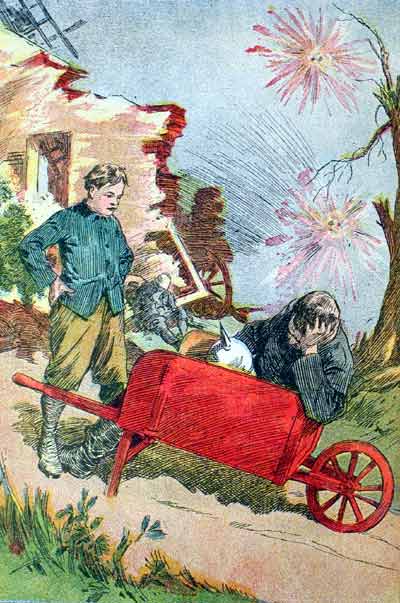
"The Padré
and his little niece, an orphan of twelve, lived on the
outskirts of a French village that had been taken by the Germans,"
began Captain Favor, resuming his story telling for the children.
"Marie, for that was her name, was a patriot if there ever was one.
Every fibre of her being was for France, and one could see the fires
of patriotism flaming in her eyes. That is the sort of patriotism,
Joe, that no fear of death can dim."
Joe Funk nodded approvingly. His own patriotism had been stirred by
these tales of the heroism of the children of France.
"While the French were in possession of the village in the early days
of the war, an officer of that army made his headquarters
with the
Padré and his niece," continued Captain Favor. "He became very fond of
the child. Captain Grivelet was his name and, recognizing in Marie a
true patriot, he had explained many things to her about the war, so
that, for a child so young, Marie was able to form a very clear idea
of the situation of the two armies.
"There were, of course, many army secrets of which Captain Grivelet
never spoke. He, too, was a patriot, you see, as he should be. Having
asked permission to store some of his personal equipment in the
Padré's cellar, they thought nothing of his going down there
frequently. Now and then Marie was certain she heard him talking to
some one down there.
"One day, after the Prussians had pushed the French back close to the
village—this was before the Germans took the village, you
understand—Captain Grivelet had a talk with Marie.
"'Marie, knowing that you are French in your heart and soul, I shall
confide certain
secrets to you. Are you willing to serve your
country?'
"'Yes, monsieur le Capitaine. Always, and with my life, if necessary.'
"'Bravely spoken. You may do as your judgment dictates about repeating
what I shall tell you to the Padré
, your uncle. But for the sake of
his safety I should advise that you keep your own secrets. Such
secrecy will not bring dishonor upon you, for it is in behalf of your
country.'
"'I understand, monsieur. You may trust Marie. She is a loyal French
girl and will continue to be so no matter what comes.'
"The captain nodded approvingly.
"'Whether or not we shall be able to hold our lines here seems
doubtful. At least we fear the Prussians, in large force as they are,
may temporarily drive us back. But it will not be for long. We shall
recover our ground. Even now we are entrenching ourselves to the rear.
When that time comes, Marie, you and the Padré
will be in peril, for
the French probably will have to
shell the village. We hope it may
not come to that. What I would ask you is, do you and your uncle wish
to go to the rear while there is yet time, so you may be safe?'
"'There is reason for believing, monsieur le Capitaine, that Marie may
be of use to her beloved France here?' she questioned.
"'Yes; that is what I would say.'
"'It is not necessary to ask, monsieur.'
"'You will understand that it is better that I do not speak to the
Padré, your uncle. You may do so, and you will the better be able to
judge how to speak to him, though as I already have advised, for the
sake of his safety he should not be involved. You will not be afraid,
Marie?'
"'No, monsieur.'
"'It is well. You have seen me go to the cellar, many times, where I
store my equipment. This equipment I shall remove today, but in the
cellar you will find—'
"At this instant a shell landed in the street and exploded with a
roar. It was followed
by other shells that swept on to the rear and
fell beyond the village. A bugle somewhere down the street blew
insistently. The captain sprang to his feet.
"'Marie, I shall see you later. I am called. You will be prudent and
be careful of your life?'
"'Yes, monsieur.'
"The captain hurried out and that was the last the brave little French
girl heard of him for some time afterward. All day the battle raged
and shells fell in the village, many times the Padré
's house being
showered with bursting shrapnel and shell splinters. It was a stout
little stone house and withstood this storm of steel, save as now and
then a splinter from a shell tore through the blinds and imbedded
itself in the wall.
"In the meantime Marie had gone out, unmindful of the danger, to fetch
her uncle home. The Padré
was in his church, but Marie made him come
home. Reaching there, she said:
"'My uncle, the Germans may come and we shall be in their power. Is it
your wish to remain here or to go to the rear where you will be safe?'
"'I shall remain here, my child. Perhaps it would be well for you to
go to the rear and be under the protection of the French, for the
Prussians are beasts!'
"'With your permission, my uncle, I shall stay here with you. I shall
not leave you.'
"It is well. If the Prussians come I shall speak with them, and
perhaps they will leave the Padré and his niece to themselves. But
they shall not make us Prussians; we shall still be loyal to our
beloved France.'
"'Yes, uncle, but it will be well that you have a care as to what you
say and do. Please heed what Marie says, for she knows whereof she
speaks.'
"All that day the battle raged and the Padré and Marie remained in
their home, except now and then when the child went
out to watch the
progress of the battle, for their house was on high ground commanding
an excellent view of the battlefield. The field, however, was so
covered with smoke that few of the details of what was going on out
there were observable.
"With darkness the battle still continued. Later on there was rifle
fire in the street, and, acting upon the Padré
's suggestion, uncle and
niece took refuge in their cellar, for the bullets were beginning to
spatter on the walls within the house.
"It was near daylight when the firing died down, whereupon the Padré
and Marie came upstairs and went to bed for a few hours' sleep.
"They were rudely awakened by a violent pounding on the door. It was
Marie who sprang up at the sound and who opened the door. Confronting
her was a German soldier, armed with a rifle. The girl did not quail.
"'Is this the Padré's home?' he demanded gruffly.
"'It is.'
"'The Prussians are now in control of this village and the inhabitants
will govern themselves accordingly. We shall search your house. Then,
if you behave yourselves, you will be permitted to remain here and to
go out in the daytime, as usual. All food that is asked for by the
soldiers shall be given to them without question, but any attempt to
communicate with the enemy, the slightest disobedience of the orders
of the commander, will be punished by death.'
"The soldier beckoned to several other soldiers who were in the
background and ordered them to search the house. This they did with
thoroughness. Marie had forgotten about the equipment of Captain
Grivelet in the cellar, but it was brought home to her with a shock
when the searchers came up bearing the stuff the French officer had
left. The soldier in charge eyed the Padré and his niece sternly. He
demanded to know to whom this equipment belonged.
"Marie very frankly told him that an officer had requested permission
to leave the equipment there, and had slept in the house. Beyond that
she knew nothing, nor did she know what his luggage contained.
"'I shall report this to my commander. I know not what he will do, but
giving aid to the enemy is a serious matter,' he warned. Then the
soldiers went away. That day neither the Padré nor Marie left the
house. Late in the afternoon an officer entered and questioned them
sharply, finally leaving, apparently satisfied with their answers. The
two were not disturbed again.
"Next day the Padré went to his church and Marie went out to do her
marketing. She was unmolested, though soldiers frequently spoke to her
jokingly, to all of which she smiled and made some bright reply.
"That night as she sat thinking in her room in the dark, her
conversation with Captain Grivelet suddenly came back to her. He had
been about to tell her something of
importance, something that he
wished her to do for her people.
"'The cellar!' exclaimed the child.
"Snatching up a candle, she hurried below and holding the light above
her head, surveyed the low-ceilinged cellar keenly.
"'I see nothing,' murmured the girl. 'But surely there is something
here. It could not have been in the equipment that the Germans carried
away with them, for they searched the Captain's belongings and found
nothing. That I plainly saw with my own eyes.'
"Marie gave up her quest and, returning to her room, went to bed. The
greater part of the night she lay awake, disturbed now and then by
vollies of rifle shots, which she interpreted with a shudder. Some of
her neighbors were meeting a terrible fate, a fate that yet might be
hers or her uncle's, or both.
"On the following morning, after a soldier had visited their home and
again searched it, Marie, still troubled by her failure
to find that
which the French captain had started to confide in her, locked the
door after the Padré's departure for his church, and once more went to
the cellar.
"This time her search was thorough, but she discovered nothing.
Sitting down in the middle of the cellar, with her candle placed on
the floor at one side, she gazed about her. A shadow cast by the
candlelight on the cellar wall seemed to make it appear that one of
the stones projected outward further than the others.
"Marie got up to examine the stone. Closer examination verified this
surmise. She uttered a little exclamation when, upon taking hold of
the stone, it moved. Marie pulled and the stone came out easily.
"'Oh!' cried the child.
"There, before her eyes, tucked into the opening, was a telephone. The
child stared at it with wide open eyes. This, plainly, was what the
French captain wished to tell her about when he was interrupted by the
bugle summons and called away to a service
from which he did not
return. But what was it that he wished her to do with the telephone?
"'I have it!' she cried exultingly. 'It was that he wished the little
Marie to tell him what the Prussians were doing. At last the way is
opened for her to serve her country. But—' The child, with a wisdom
beyond her years, knew what the penalty would be if she were
discovered. 'I care not. If I shall have served my France I can die
with a brave heart!'
"Taking the telephone in her hands—hands that did not even tremble,
Marie called a soft 'hello!' There was no response. Again and again
she tried, but without result. Finally the child gave it up and went
back upstairs.
"The thought of the telephone drew her again to the cellar. Again she
called her soft 'hello.'
"The answer came back in French with a suddenness that nearly caused
her to drop the telephone.
"'Who is speaking?' she asked in as firm a voice as she could summon.
"'Whom do you wish?'
"'I would speak with Captain Grivelet'
"'He is not here. I cannot reach him.'
"'It is important. Find him and tell him that the little Marie would
speak with him. Tell him to come at ten o'clock this evening and Marie
will be here at the telephone. He will understand.'
"Marie put back the telephone and carefully closed the opening. Now
she had a distinct mission to perform, and, throwing a scarf over her
head, she went out to the street. Marie was very bright of face and
very friendly with the German soldiers. No obstacle was placed in the
way of her going where she liked. That day she used her eyes and ears
to good advantage and they saw and heard many things. What especially
interested her was the massing of German troops in the forest to the
west of the village. She heard of this through a conversation between
two officers. There
also was great activity behind the lines. There
the Germans were building entrenchments, which she could plainly see
from the windows of her home.
"The child knew that what she had observed was important, but just how
important, of course, she could not know.
"Promptly at ten o'clock that night, after the Padré had gone fast
asleep, Marie hastened to the cellar and again called over the
telephone. Captain Grivelet was quickly summoned.
"'It is the little Marie speaking,' she called excitedly.
"'My brave child,' answered the captain. 'I knew you would find the
way. We are defeated, but not for long, for the French are being
reinforced and are angry. Can you safely go out into the street
tomorrow and then let me know what they are doing?'
"'I already have been out, monsieur le Capitaine, and I have seen.'
"'I beg of you to be careful. You are in great peril. If the Boches
discover that you
are in communication with us they will shoot you.'
"'I fear them not. But I must hasten. Listen!' Marie then told the
captain all that she had learned, interrupted frequently by
exclamations of approval from the officer at the other end.
"'Wait!' she called. 'Hold, for I hear movement above.'
"A few minutes later Marie returned to the telephone. 'Down in the
middle of the village are many soldiers. I know not why they are
gathering there, but I think perhaps they may be going to shoot some
of our noble Frenchmen.'
"'Down by the square?' questioned the captain.
"'Yes.'
"'Put away your telephone and go to the floor above. Watch the square
and you shall see what the French gunners can do. The people are in
their houses?'
"'Yes, monsieur, they dare not go out at night. It is forbidden.'
"'Good! Do as I have directed, and go no more to the telephone until
tomorrow night at this time, unless something of importance develops,
then call for me. I shall leave orders to be summoned immediately.'
"Not fully understanding what the captain was about to do, the child
hastened upstairs and, opening the door slightly, peered down the
street.
"It was at this moment that a giant shell from a French battery
exploded fairly in the middle of the square, with a terrific shock and
roar. It was followed by several other heavy explosions. Then silence
settled over the night.
"This silence, however, did not last for long. The forest in which so
many German troops were being massed was bombarded all through the
night, as were the entrenchments to the rear of the village where the
enemy was busily engaged in fortifying themselves.
"The child shuddered. She was troubled.
"'It is for France that I have done this,'
she said to comfort
herself. 'Already the Prussians have killed many here, and for what?
For nothing save that they are French. It is terrible.'
"On the following day Marie picked up further information. She also
learned that the Germans had suffered heavily from the previous
night's bombardment, and that they were amazed at the exact
information possessed by the French.
"Each night the child spoke with the French captain over the
telephone, and each night the French obtained information of great
value to them. Though Marie did not know it, the Germans had by this
time satisfied themselves that some one in the village was
communicating with the French forces, and a careful watch was being
kept on every inhabitant of the place. Marie, all ignorant of this,
continued to keep the French informed of the movements of the enemy.
"One night, after a day of heavy fighting on both sides, during which
the Germans
had been slowly pushed back, Marie was giving Captain
Grivelet her report of the operations on the German side for that day.
She had communicated everything down to the smallest detail and was
just replacing the telephone in its niche when she thought she heard a
sound behind her. Marie turned quickly.
"The child's head grew dizzy; she nearly fainted with fright, for
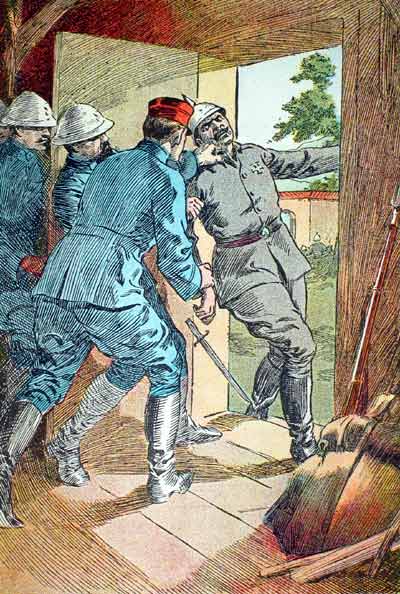
there, gazing sternly at her, stood a Prussian officer.
"'So! This is it?'
"Marie did not answer. She could not.
"'For this you shall be shot. Stand back. Give me that telephone!'
"Snatching it from her hands he got the French headquarters, though he
did not know to whom he was speaking.
"'Speaking to you is a Prussian major,' he said in French. 'He has
just discovered why the French have been so fully informed. The spy
who has thus informed you is the Padré's niece. She dies tonight!'
"With that the major wrenched the telephone
from its wires and ripped
the wires out, leaving the outside wires, that were underground, for
his engineers to destroy. Marie, eyes now flashing, was led from her
home and taken to the office of the general commanding the operations
there. Soon after her arrival her uncle came, in charge of two
soldiers. Then the examination began. Not one bit of information would
the girl give. At last the commanding officer turned to the Padré.
"'It is my belief that you are responsible for this spying. It is not
my wish to shoot a Padré, but you shall be taken out and shot
immediately!'
"'No, no, no!' cried Marie, now thoroughly aroused. 'He knows nothing
of what has been done. I swear it, monsieur! It is Marie who has
informed the French of what the hated Prussians were doing. I—'
"'Ah! You admit it! It is well. Take her away. Take the Padré away
also, but keep them separated.'
"Marie left the commander with head erect and eyes flashing. Her only
concern was for her uncle, whom she feared would be shot. She had no
doubts about herself Of course, they would shoot her and she gloried
in the thought that she was to die for France.
"After her departure the Prussian general devoted several minutes to
deep thought.
"'Of course, Herr General, she will be shot,' said the major who had
made the capture.
"'No!' answered the commander, with emphasis.
"'Not shot?' questioned the officer in amazement.
"'No. She shall be sent to the camp at Metz and imprisoned for the
duration of the war. The Padré also shall be sent to the rear and held
during the rest of the war.'
"'Herr General, may I ask why, when both should be executed without
delay?'
"'Because, major, I dislike to put a
Padré to death, and further, I
am satisfied that the girl told the truth when she said that he knew
nothing of this affair. He is a simple-minded man. But the girl!' The
general shrugged his shoulders like a Frenchman. 'She is keen as a new
saber.'
"'And knowing well what she was doing she should be shot,' insisted
the major.
"'I have a daughter of her age,' replied the general, slowly. 'This
child is so like her that I should feel like murdering my own were I
to order her shot. Major, I cannot do it. See that my orders are
carried out. I shall explain my action in this matter to my superiors
for their approval.'
"That ended it. It was an unusual thing for a Prussian to do and
perhaps the only instance in the war where so much human sympathy was
shown to a spy. Marie was taken to the prison at Metz, where she was
kept from that time on. She suffered great hardships. There was little
food and her treatment was harsh, so that her days were a misery and
her nights a nightmare.
"A long time elapsed ere Captain Grivelet learned, through the Red
Cross, what had become of the child. His sorrow had been keen, for he
believed that she had been executed. The Padré was still in a prison
camp the last I heard of the case. I hope the beautiful little patriot
and her uncle may be reunited some day. But Marie has served her
country nobly and if she ever comes back she will be splendidly
rewarded by her government," said the captain, in conclusion.