The only place where air is absolutely sure to be fresh is out
of doors. There, as we have seen, the sun and the winds keep it so
all the time. But, unluckily, we cannot spend all our time
outdoors, either when we are little or after we have grown up. So
we must try in every way that we can to bring the outdoors
indoors—to get plenty of fresh air and light into the houses
that we live in, especially the bedrooms we sleep in and the
schoolrooms we study in when we are children, and the offices or
shops we work in when we are grown up.
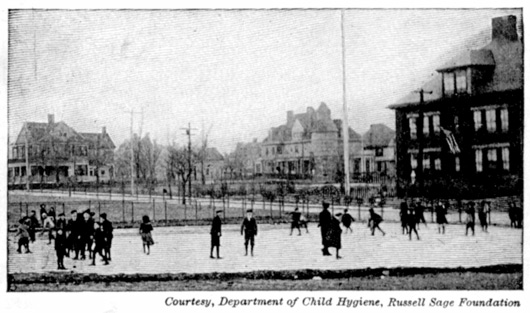
After you have your lungs and your blood well filled with air,
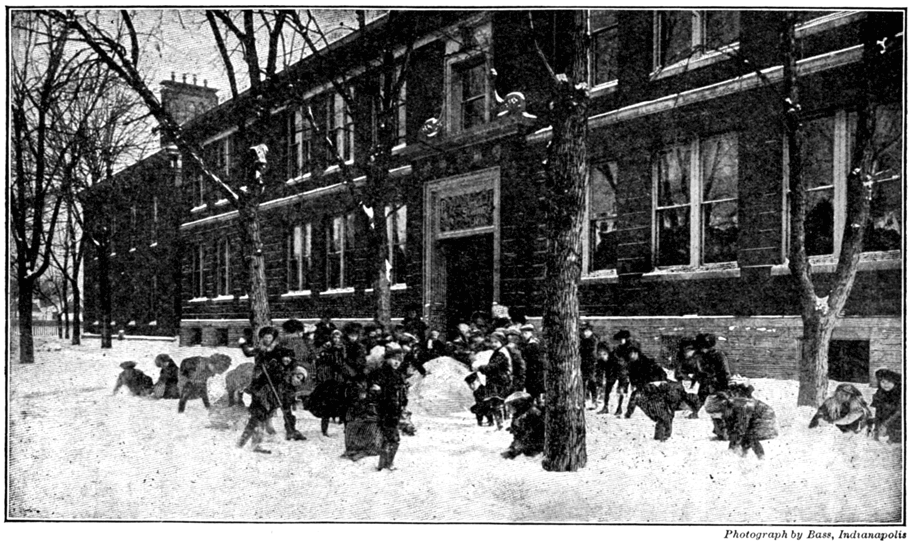
either by walking briskly to school or by chasing one another about
the school playground, you will suddenly hear the bell ring, and
you march indoors and sit down at your desks. Here, of course, the
air cannot blow about freely from every direction, because the
walls and doors and windows are shutting you in on every side. The
room, to be sure, is full of air; but if the doors and windows are
shut, this air has no way of getting outside, nor can the fresh,
pure air out of doors—even though it be moving quite fast, as
a wind or a breeze—get inside.
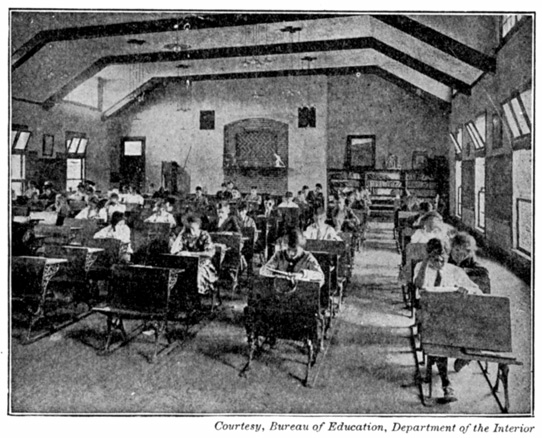
A CLASSROOM ALMOST AS GOOD AS THE OUT-OF-DOORS
Notice the windows open top and bottom, and the high windows
under the roof. Why are these good?
We must let the fresh air come in and the stale air go out. This
is one of the things that windows are for; and this is why they are
hung upon pulleys and made to slide up and down easily. Of course,
even when the windows are not open, they are letting in light,
which, you remember, is a deadly enemy to germs and poisons.
Bright sunlight is best for purifying the air
of a room, but even ordinary daylight has a good deal of
germ-killing power. Therefore, a room that is well lighted is not
only much pleasanter to live in, but much healthier, than one that
is dull and gloomy. You see why we need plenty of windows and
doors: we must let in the breezes and the sunshine, and let out the
poisons and the dirt. Then, too, we must make the air in the
building move about in order to keep it fresh; for if the air is
not fresh, we soon grow tired and sleepy and have headaches. That
is why your teacher keeps the windows open at the top a foot or so.
You can easily see that when there are twenty or thirty of you
breathing out poisons, and each one of you needing about four
bushels of fresh air every minute, the old air ought to be going
out and the fresh air coming in all the time.
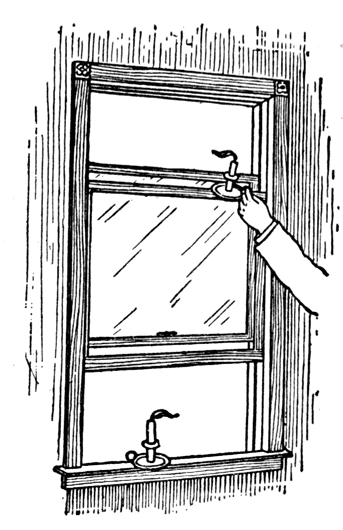
VENTILATION
Watch the candle flames. Which way is the
air moving, and why?
That is also why your teacher gives you a recess, so that you
can run out of doors and get some fresh air. Then she can throw
open all the windows and doors and have the air in the room
clean and fresh when you come back again. So
when recess comes, don’t hang about in the hallways or on the
stairs or in the basement, but run right out of doors into the
playground and shout and throw your arms about and run races to
fill your lungs full of fresh, sweet air and stretch all your
muscles, after the confinement and sitting still. Don’t
saunter about and whisper secrets or tell stories, but get up some
lively game that doesn’t take long to play, such as tag or
steal-sticks or soak-ball, or duck-on-a-rock or skipping or
hopscotch. These will blow all the “smoke” out of your
lungs and send the hot blood flying all over your body and make you
as “fresh as a daisy” for your next lesson.
When you come back into the schoolroom after recess, the air
will seem quite fresh and pure; but unless you keep the windows
open, it will not be long before your head begins to be hot, and
your eyes heavy, and you feel like yawning and stretching, and
begin to wonder why the lessons are so long and tiresome. Then, if
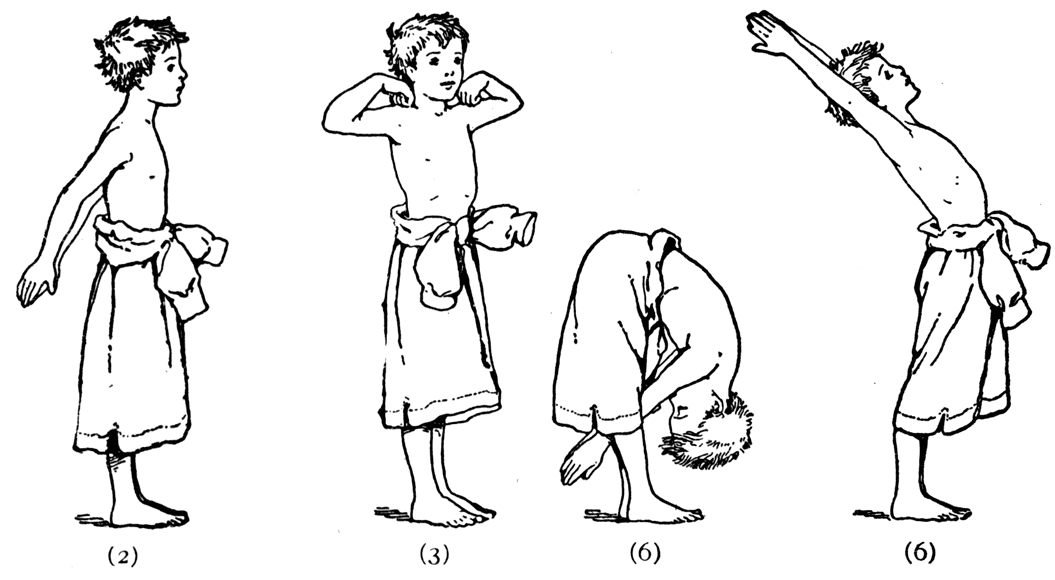
your teacher will throw open all the windows and have you stand up,
or, better still, march around the room singing or go through some
drill or calisthenic exercises, you will soon feel quite fresh and
rested again.
In the mild weather of the spring or early
fall, all you need to do to keep the air fresh in the schoolroom is
to keep the windows well open at the top. But in the winter, the
air outdoors is so cold that it has to be heated before it is
brought in; and this, in any modern and properly built schoolhouse,
is usually arranged for. The fresh air is drawn in through an
opening in the basement and is either heated, so that it rises, or
is blown by fans all over the building. This sort of fresh air,
however, is never quite so good as that which comes directly from
outdoors; so it is generally best to keep at least two or three
windows in each room opened at the top as well, and never to depend
entirely upon the air that comes through the heating system.
Sometimes this may mean a little draft, or current of
uncomfortably cool air, for one or two of you who sit nearest the
windows; but your teacher will always allow you to change your seat
if this proves very unpleasant. If you have plenty of warmth in the
room you sit in, unless the air outside is very cold, this
“breeze” won’t do you any harm at all; on the
contrary, it will be good for you. Instead of catching cold from a
draft like this, it is from foul, stuffy, poisonous air, loaded
with other people’s breaths and the germs contained in them,
that you catch cold.
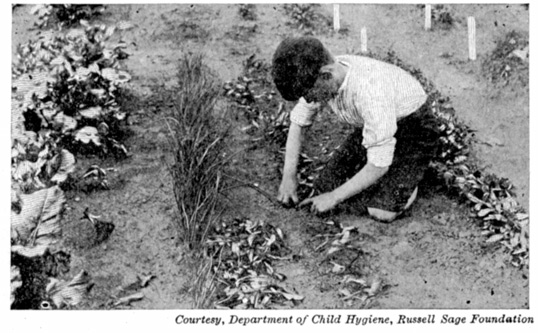
GARDENS TAKE US OUT OF DOORS
In fact, staying indoors is usually the reason why people are
sick. They don’t go out into the clean fresh air for fear
they’ll be too cold! It seems a pity we can’t just live
out of doors all the time. Perhaps we shall some day; for doctors
are finding out that fresh outdoor air and good food are the very
best medicines known, and the only “Sure Cures.” They
are pleasant to take, too. Many cities are providing outdoor
schools for children who have weak lungs or are not strong in other
ways. Perhaps some day all school children will be allowed to study
in the open air at least part of every school day.
Now you are all ready to go to work. What are you going to work
with? Books? pencils? paper? Yes, but you have something better
than those and all ready for use. It is that little kit of tools
that are sometimes called our “Five Senses.” You
remember that we have already talked about one of them, the sense
of touch in the skin. Now which one are you going to use first this
morning? If your teacher talks to you, I hope it will be the one we
call the sense of hearing. Suppose we try to find out something
about this sense of hearing, and begin with a little
experiment.
Take a piece of cork in your hand and lift it up high and then
let it drop into a large basin or tub of water. What happens? The
cork strikes and then goes bob-bob-bobbing up and down on its own
waves. Now watch the little waves all around the cork. Where do
they stop? They don’t stop until they touch the edge of the
pan; and no matter how big the pan is, the waves go on and on until
they reach the edge.
We can see these waves of water, and so we easily believe that
they are there. Now there are, just as truly, waves of air all
around us. We cannot see the waves, because they are too small
and
roll too quickly. But some of these, when they roll against our
ears, make us hear. They make what we call sound. You have
heard about sending messages through the air, without telegraph
wires. Wireless messages are often sent to ships out in the middle
of the ocean. This is done by starting tiny electric waves, which
travel through the air much as the waves of water are traveling
across the ocean beneath. Of course there must be a machine, called
a receiver, to catch the waves and “hear” the
message.
Mother Nature has given each of you two very delicate little
receivers to catch the sound waves and carry them to your brain.
You know what they are—you can name them. But how are these
wonderful little machines made?
You have never seen the whole of your ear. The part on the
outside of the head, of course, you can easily see and feel.
Sometimes you notice a deaf person put his hand behind his ear and
press it forward so as to catch the sound waves better. These waves
roll in at the little hole you can see, and travel along a short
passage till they come to a round drum, a piece of very
thin skin stretched tight like a drumhead.
Have you ever beaten a drum with a stick? You felt the drumhead
quiver under the blow, did you not? Well, when the sound waves beat
against the drum in the ear, it quivers and starts little waves
inside the ear. Each little wave in turn beats against a little
bone called the hammer; the hammer beats against another
called the anvil, and this against a third called the
stirrup; and the quiver of the stirrup is passed on to a
little window, opening into a little room with a spiral key-board;
and from this, the wave travels along a nerve to the brain. As the
waves reach the brain, the brain hears. In this way we hear all
sorts of sounds, from the tick of a watch to the whistle of a
train.
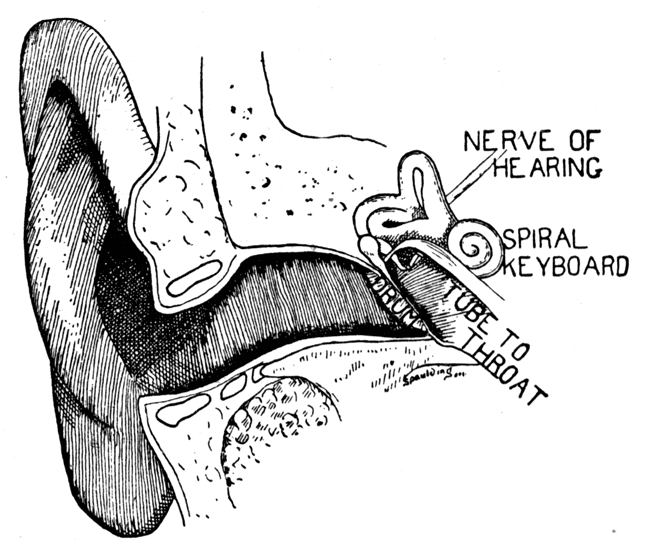
THE WAY BY WHICH SOUND WAVES REACH THE BRAIN
A section through the right ear.
There is a sensible old saying, “Never put anything
smaller than your elbow into the inner part of your ear.”
Now, of course, you can’t put your elbow into such a tiny
hole! So the old saying means, never put anything in. The eardrum
is very thin and can easily be broken. Even a slap on the ear, or a
loud sound too close to it, might crack and spoil the drum and make
one deaf.
The outside ear needs careful washing; there are so many little
creases that gather dirt and dust. The deep crease behind the ear,
too, will become sore if it is not kept clean.
Besides cleaning your ears, you must train them to listen. Some
boys and girls hear just a word or two of what is said, and then
guess at the rest and think they are listening, or else ask to have
it repeated. We should try to hear exactly what is said; and if we
listen carefully, it will soon be much easier to understand at
once.
Of course, if you really cannot hear, the doctor can tell you
what is the matter, and usually can help you very much. Sometimes
people become deaf simply because the throat is swollen. Indeed,
most deafness comes from colds and catarrhs and other inflammations
of the nose and throat. These spread to the ear through a little
tube that runs up to the drum cavity from the back of the throat.
Sometimes, when you are blowing your nose, you may feel your ear go
“pop”; and that means that you have blown air up into
the ear through this little tube. Be sure to see a doctor if you
don’t hear well; and be sure, too, to tell your teacher, so
that she may know why it is you do not hear what she
says, and ask her to give you a seat near her, so that you can
hear.
Then, too, you should learn to notice outdoor sounds—the
songs of the birds, the noises that the animals make, the wind in
the trees, and the patter of the rain. The old Norsemen have a
story that their god Heimdall had such keen ears that he could hear
the grass growing in the meadow and the wool growing on the backs
of the sheep! Your ears can never be so keen as that; but there are
many, many happy outdoor sounds that you should listen for. They
will help to make you happy, too.
Careful listening may sometime save your life. You can hear the
car or the train coming, and you can learn to tell from which
direction a sound comes. You can learn to tell one sound from
another in the midst of many sounds. In more ways than you can
think of now, this habit of listening will protect you from
danger.
The Germans have a proverb, “Hear much and say
little.” What does it mean?
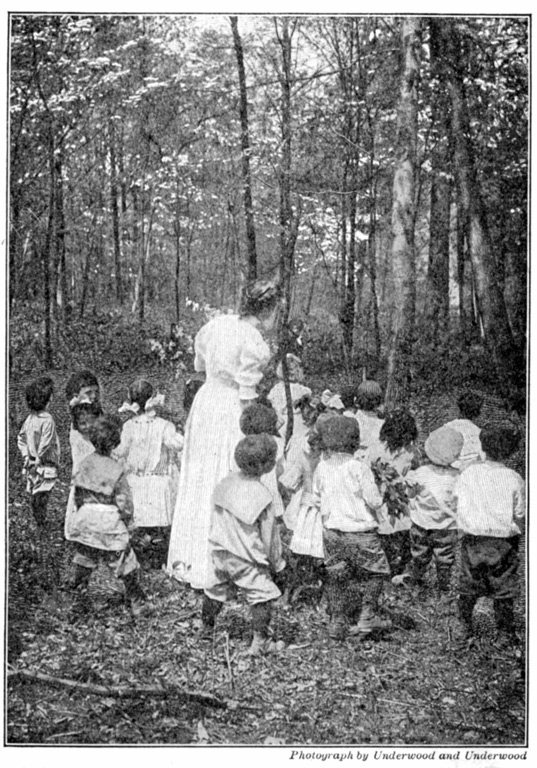
“DO YOU HEAR IT? CAN YOU SEE IT?”
You can learn a great deal through your ears, but think how much
more you can learn through your eyes. Just count over all the
things that you have had to get your eyes to tell you to-day, and
then shut your eyes for a minute and think what it would mean never
to be able to see. Don’t you think you ought to take very
good care of your eyes? You are going to keep them very busy all
your life, and they deserve the very best care you can give
them.
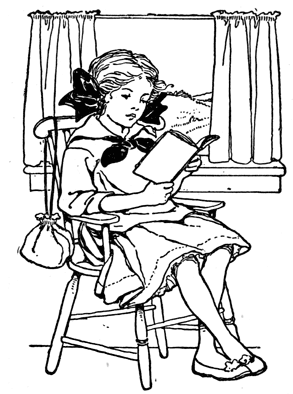
THE LIGHT ON THE PAGE, NOT IN THE EYES
Just as soon as lessons begin, you get out your books; and a
good share of the day in school you have a book before you, reading
it or studying it or copying from it. It makes a great difference
to your eyes how you hold the book and how the light falls. In
reading, you should always hold your book so that the light falls
upon the page from behind you, or from over one of your shoulders.
In this way, the brightest light that comes into your eyes is not
from the window, but from the page of your book.
If the light comes from a window in front of
you, or if you sit in the evening with your face toward the lamp
when you read, the light coming straight from the lamp or the
window, as well as the light coming up from the pages of the book,
pours into your eyes; and this dazzles and confuses your eyes, so
that you can’t see plainly and comfortably and are very
likely after a while to find that your head aches. At home, of
course, you can seat yourself with your back to the light when you
read; and usually at school your seats are so arranged that the
light falls from behind you or from one side. If not, by turning a
little in your seat, you can get the light from over your
shoulder.
Notice how the light falls upon the blackboard. When the light
comes from the windows behind you, or from one side, you can see
what is written there quite plainly. But if the blackboard happens
to be between two windows, and especially if this is the lightest
side of the room, you will find that the light dazzles you so that
you cannot see the writing clearly.
You must have noticed, too, that if, after you have been reading
from the blackboard you look down again suddenly to the page of
your book, for an instant you will not see the letters plainly.
Then, almost before you have time to notice
it, you feel a little change take place inside your eyes, and the
print upon the page of your book becomes quite plain. This is
because your eye has to change the shape of one of the parts inside
it, called the lens, before you can see clearly the things
that are near you. This change, which is called
accommodation, is made by a little muscle of the eye; and
if you keep your eyes working at close work, like reading or
writing or fancy-work, too long at a time, or if your eyes need
glasses to make them see clearly, and you haven’t them on,
this little muscle becomes tired. Then the print of your book, or
your writing, or the stitches you have taken begin to blur before
your eyes. Your eyes begin to feel tired, and your head begins to
ache. This is what we call eye strain.
Sometimes this eye strain upsets your appetite or your digestion
and makes you sleepless and worried. The trouble may be caused by
your own carelessness: you may have been reading too long, or in a
poor light, or with the light shining right in your face instead of
coming over your shoulder. But sometimes it is caused by the fact
that your eyes are not just the right shape; and then the only way
to relieve it is to have proper glasses, or spectacles, fitted,
which will make up for this too flat or too round shape, or too
large or too small size, of your eyes.
If you cannot see clearly what is written on the blackboard when
the light falls upon it from behind you, or above; or if, in a good
light, you cannot read the words in your book quite easily, without
straining at all, when you hold the book either at arm’s
length or a foot from your face; or if your head aches or your eyes
begin to feel tired or uncomfortable, or the letters begin to blur,
after you have read steadily—say, for half an hour,—it
is a pretty sure sign that there is some trouble with your eyes.
Then you had better have them examined at once by your family
doctor or by the school doctor. In many schools now there are
doctors to test the children’s eyes, and ears, too, so that
each child may have a chance to see and hear everything that the
other children can see and hear.
Not very many years ago people thought that glasses were only
for old people, but now we know that many children’s eyes
need glasses, too. I knew a little girl whose sight was so poor
that when she was standing and looked down at the grass, she
couldn’t see the green blades. She thought that the grass
looked like a green blur to everyone, just as it did to her; and so
she never said anything about it. She was twelve or thirteen years
old before she found out that she couldn’t see clearly. Of
course, trying hard to see things gave her a headache and made her
tired and cross. So some one took her to a doctor, and he saw at
once what was the matter and fitted her with glasses. Soon she was
quite well and strong; and how glad she was to see the leaves and a
hundred other things she had not seen before!
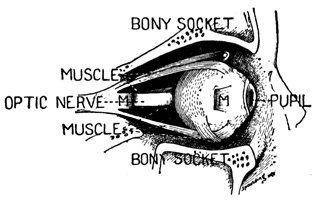
THE EYEBALL IN ITS SOCKET
The muscle from M to M, which helps to turn
the eyeball, has been cut away to show the optic nerve.
Here we have a picture of the eyeball, as we call it.
The little bands fastened to it are the bands of muscle; and as
soon as I say muscle you know what they are for—to
move the eyeball about, up and down and from side to side. There
are muscles outside the eye as well as inside. Coming out from the
back of the eyeball is a pearly white cord quite different from the
muscle bands. This is what we call a nerve. This nerve in
your eye carries to your brain, or thinking
machine, picture-messages of whatever you look at.
The nerve in your eye gets messages of light much as the nerve
deep in your ear gets its messages of sound—from tiny waves
in the air. The light waves are smaller and faster even than the
sound waves, and the eye nerve is the only nerve that can get
pictures of them. You know that, for wireless messages, the
receiving machines are not all alike and cannot all take the same
messages, if the messages are sent with different sorts of electric
waves; and neither can our receiving machines. Some get messages of
sight, and some of sound, and some of touch, or taste, or
smell.
Now shut your eyes as quickly as you can. How long did it take
you? A minute? No, not a quarter of a second. It is about the
quickest thing you can think of—“the twinkling of an
eye.” You shut your eyes “quick as a wink”
whenever anything seems likely to fly or splash into them, and this
is what the eyelids are for. If anything gets into the eye before
the lids can shut, the eye “waters,” and tears
pour out of it. These are made by a gland-sponge up under the upper
lid, so as to wash any dust or sand or other harmful speck out of
the eye before it can hurt the sensitive eyeball.
Now look at some one’s eyeball. It is
like the picture, isn’t it?—bright white around the
edge and then a ring of color, brown or blue or gray; and inside
the color-ring, or iris, a little round black hole that we
call the pupil. Watch the little hole change as you turn
the face toward the window. It becomes ever so much smaller. Now
turn the face away from the window, back again into the shadow. How
did the pupil change this time?
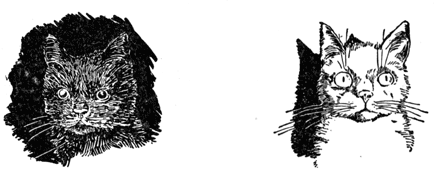
EYES PROTECT THEMSELVES AGAINST THE LIGHT
The iris, or color-ring, acts like a curtain, like the
ring-shutter of a camera, and closes up the hole, or pupil, when
the light is too bright and would dazzle or burn the inside of the
eye; but when the light is dim, the iris opens again, so as to let
in light enough with which to see. Look at the little window in
your kitten’s eyes. It is not the same shape as yours; but
when you carry her to the light, you see how the iris closes in and
leaves just a little black slit or line.
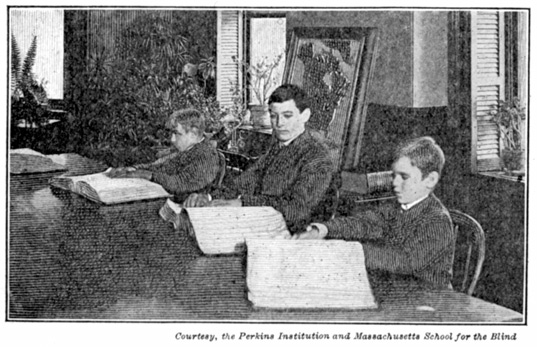
You remember the blind children? Isn’t
it wonderful how they can play games and study, too, even though
they are blind! They have to make their senses of touch and hearing
tell them many things that you learn through your sense of sight.
Many of these children need not have been blind, if the
nurse who first took care of them when they were born had known
enough to wash their eyes properly, not with soap and water, of
course, but with just one or two drops of a kind of
medicine—an antiseptic, as we call it—that
makes the eye perfectly clean.
But you children who have good eyes that can see, do you really
see things when you look at them? You can train your eyes just as
you can train your ears. You can teach them to read quickly down a
page, and to find things in pictures, and, better still, to see
things out of doors, in the garden and the woods and on the
seashore. We hear a great deal about “sharp eyes,” but
most of us see very little of all we might see. Our eyes are on the
lookout, too, to protect us from dangers that may come; with our
skin and nose and ears, they are constantly on the watch; so the
better we see the safer we are.
Even if your eyes are perfect now, you will need to take good
care of them to keep them strong. Don’t let any story, no
matter how interesting it is, tempt you to read in a dim light or a
light that is too strong. And if you can’t see the blackboard
easily, or can’t read big print, like the school calendar,
across the room, tell your mother or your teacher, so that she can
ask the doctor to find out what the matter is.
It is astonishing what thirsty work studying is! Scarcely is the
second recitation over before your throat begins to feel dry, and
up goes your hand—“May I get a drink?”
If anyone even says the word “water,” it makes you
thirsty. It is so good that just the thought of it makes you want
some. I should like you to notice how much water you drink every
day. Perhaps a glass in the morning when you get up, and one at
night before you go to bed, and three or four in between.
Why do we need so much water? Well, how much do you weigh?
Perhaps you will find it hard to believe, but more than half of
that weight is water; and because we are always giving off water
from the skin and from the body, we need plenty more to take its
place.
No living thing can grow without water. Take a bean, for
instance, and put it in an empty glass on the window sill; and even
if the sun shines full upon it, nothing will happen, except that
after a few days it will shrivel and dry up. But fill the glass
with water, and in a few hours the bean will begin to swell; and in
a few days it will burst, and a little shoot will grow out of one
end of it and a tiny root at the other. The water and the warmth
together have made it sprout and grow.
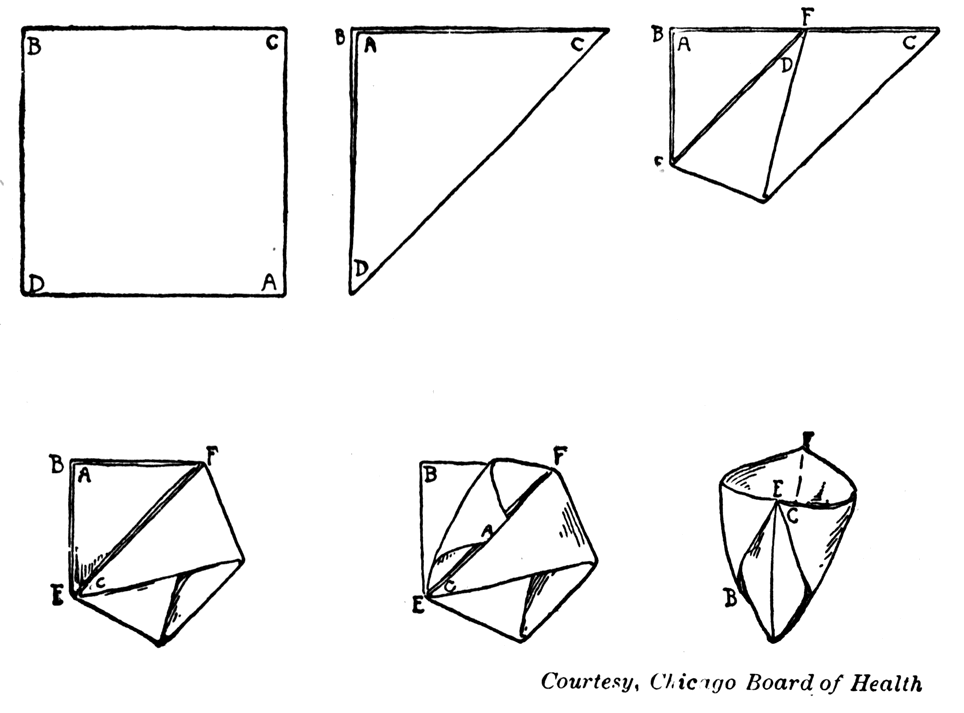
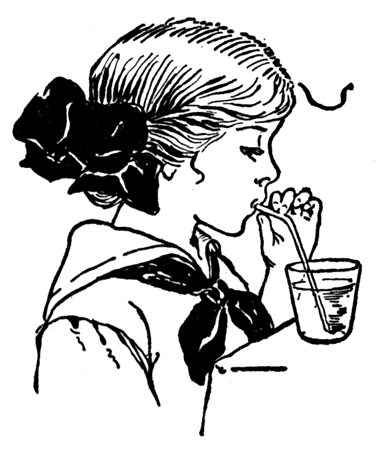
A DRINKING-CUP EASILY MADE
Children at school and people on trains should have their own
private cups, for serious diseases may be caught from the mouths of
other people. You can get a metal pocket folding cup for ten or
fifteen cents, or paper ones for a few cents a dozen. If you
don’t have your own cup, I hope you will get one and carry
it. Here is a pattern for a paper cup that you can easily make for
yourselves. Try it and see. When you have once learned how, you can
make it very quickly and have a fresh cup every time you want one;
but of course you should be sure first that the paper itself is
clean.
If you drink milk, this takes the place of some of the water and
gives you food as well. It is both drink and food; and a very good
food for children it is, too. You know, babies can live on it
because it has everything in it to make them grow.
Do you know why it is that people are so careful nowadays about
having milk and drinking-water very clean? It is because they have
found that the tiny plants, called germs, that make people sick are
often carried about in these drinks. A disease called typhoid
fever is carried in this way.
Fifty years ago, cities and towns used to be very careless about
where they got their water supply, and would often take it out of
streams into which other cities emptied their sewage. Now, however,
they are much more particular; and the health officers, or Boards
of Health, are insisting that public water supply, such as is
brought into our houses in pipes, shall be
taken either from some spring or deep-flowing well, or from a
stream or lake up in the hills, into which no drainage from houses
or farmyards, and no dirty water from factories, empties.

A PIPE FOR THE CITY WATER SUPPLY
This pipe is laid for many miles to bring water from the distant
hills.
We are still, however, far from being as careful as we should be
about this; and I am sorry to say that America has had more deaths
from typhoid fever than any other civilized country. Germany,
which, of all countries in the world, is the most particular about
keeping its water supply pure, has the fewest deaths from this
cause, in proportion to its population—scarcely one fifth as
many as we have.
Therefore, by taking proper care, it would be
quite possible to prevent at least two thirds of our nearly 400,000
cases of typhoid fever and 35,000 deaths from typhoid, every
year.
It is not only cities and towns that ought to be careful of
their water supply. In fact, now, out on the farms and in the
healthy country districts, the death rate from typhoid fever has
actually become higher than it is in our large cities. The main
cause of this is the custom of digging the well in such a place
that the waste water thrown out from the house, or the drainage
from the barnyard or the pigpen or the chicken-house may wash into
it, soaking down through the porous soil. Far more typhoid fever
now is spread by means of infected well water than by any other
means.
Most dangerous of all is the leakage from the privy vault; as,
by this means, the germs of typhoid fever and other diseases that
affect the food tube and digestion may drain through the soil till
they reach the drinking water in the well. These dangers can be
avoided either by having the well dug at some distance from the
house and in higher ground, or by having the drainage from the
house, barns, and out-buildings piped and carried to a safe
distance from the well.
Fortunately, there are only a few kinds of
germs that make us sick. Most germs are helping us all the time; we
could not live without them. Some of them make our butter taste
good, and others make our crops grow, and others eat up the dirt
that would make us sick. But since disease germs are so tiny that
we cannot possibly see them with the naked eye, we must know where
the water and milk that we use come from, and whether or not they
are perfectly clean. Boiling the water will kill these germs and
make the water pure. It is better not to boil milk if it can be had
from a dairy where the stable and the cows and the milkmen and the
pails and bottles are quite clean.
The fruits and fruit juices—lemon and orange and raspberry
and lime and grape—give nice wholesome drinks. Home-made
juices are much better than those you buy; you can be sure that
they are pure and really made from fruit. And just here I want to
caution you against buying “pink lemonade” or soda
water or any other drink of that sort from the penny venders and
open stalls on the street. The drinks they sell are not made from
pure fruit juices, but from different flavoring extracts that are
made to taste like the fruit and are colored with cheap
dyes. Even the sweetening in them is not pure
sugar, and they are often made or handled in a careless, dirty
manner, or exposed to the dust of the street, and to flies.
Not long ago I was at the home of a friend where for supper we
had the nicest grape juice I ever tasted. When I said, “How
good it is!” one of the little girls piped up, “Billy
and I picked the grapes, and sister made it all by herself. She
learned how at cooking school.”
When I was packing my suitcase to leave, this little girl
brought out a big bottle of grape juice and wanted me to take it
with me to remember her by. It was all beautifully sealed with wax,
and even this she had done by herself! Do you think I could have
kept it that way very long? Perhaps not, it was so good; but if I
had wanted it for a keepsake, I could have kept it, sealed as it
was, for years and years, and it would have been just as sweet and
fresh as when it was given to me.
Suppose, instead of keeping it in its bottle, I had poured it
out into a glass. Can you tell me what would have happened to it
then?
In a few days little bubbles would have come, one after another,
up to the top of the juice; and soon it would have been all full of
bubbles. What causes the bubbles? Floating all about in the
air and sunshine are tiny specks called spores. These are
to the tiny yeast plants what seeds are to other plants.
Seeds fall into the ground and grow, but these yeast spores fall
into the grape juice and grow. While they are growing in the grape
juice, they eat what they want from the juice; and, as they eat,
they make bubbles of carbon dioxid,—which, you remember,
forms in our lungs and looks like air,—and of another
substance called alcohol. Of course, when they have
changed the juice in this way, it tastes very different. It is then
what we call fermented.
Fermented drinks are harmful; but some people like
bubbling drinks so much that they leave good fresh grape juice open
on purpose to let the little yeast plants get into it and make it
into what we call wine. They treat apple juice in just the
same way to make cider; and they even take fresh rye and
barley and corn, and mash them up, and put yeast plants into the
mash to ferment them and make them into whiskey and
beer. It does seem a pity, doesn’t it, to take good
foods like wheat and apples and grapes and make them into these
things that really do us harm if we drink them.
A very wise man named Solomon, who lived
thousands of years ago, warned people not to drink wine, not even
to look at it when it sparkled in the cup. He said no really wise
man would drink it. Of course not; the wise man uses the food and
drink that make his body grow strong and his brain work true, and
no fermented drink can do that.
There is no better drink for anyone than clear pure water, and
no better food and drink in one than pure fresh milk.
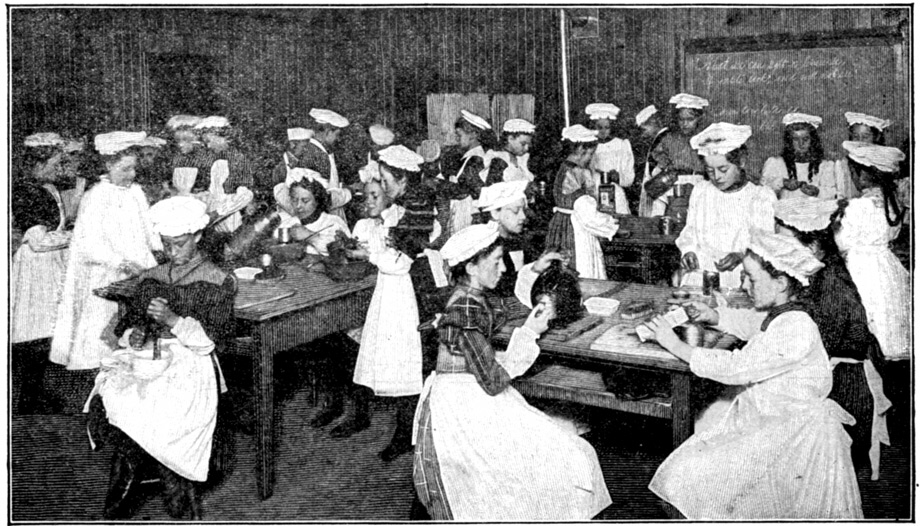
A SCHOOL KITCHEN WHERE BOTH BOYS AND GIRLS LEARN TO COOK
If you have to come so far to school that you cannot go back to
dinner and so must bring a luncheon with you, be sure to take
plenty of time to sit down and eat it slowly and chew every piece
of food thoroughly. Many children who bring luncheons to school
just grab a piece of food in each hand and “bolt” it
down as fast as they can possibly bite it off and swallow it, and
then rush out to play.
Play is good and very important, but you had better spare ten or
fifteen minutes of it in order to chew your lunch thoroughly and
swallow it slowly, and then to sit or move about quietly for a few
minutes before starting to play hard. This will give your stomach a
chance to get all the blood it wants to use in digesting the food;
for, you remember, when you romp and play, your blood moves outward
toward your skin and away from your stomach. Don’t think
that, just because you “picnic” at lunch, it is not as
important as any other meal.
I hope, however, that it will not be long before almost every
school will have a school kitchen and a lunch room; first, so that
every girl at least can learn to cook. It is well worth while being
able to do; indeed, no girl ought to be considered properly
educated until she has learned to cook, and no boy either, for that
matter. Then, if the school has this kitchen, it can be used to
furnish hot luncheons, or dinners, for those children who cannot
conveniently go home in the noon recess. Hot lunches are much more
digestible than cold ones, and they taste much better, and are much
less likely to be eaten in a hurry.
But why should we learn to cook? Why shouldn’t we eat our
food raw instead of taking all this trouble and pains to cook
it?
I know of a boy—a big lazy fellow—who is always
forgetting to do things. He used to go away in the morning without
leaving wood enough for the kitchen fire. So his mother said
to
herself one day, “I’ll teach him to remember.”
The next morning he went off again and left no wood. At noon he
came back “hungry as a hunter.” She called him in to
dinner; and in he came, sat down, picked up the carving
knife—then he stopped! What do you suppose was the matter?
The beef was raw! Then he lifted the cover of the potato dish, and
there lay the potatoes raw! Then he tried another dish and found
nice green peas, but hard as little bullets. They were raw, too!
Not even the bread had been cooked; it was a soft, sticky mass of
dough. His mother, who is a jolly old lady, fairly shook with
laughter when she told me about it. She said she never again had to
tell him to split wood.
Now that boy didn’t need to be told one reason for
cooking. We don’t like our food raw; it doesn’t taste
so good. At first, perhaps, that doesn’t sound like a very
good reason; but it is more important than you think. For it is a
fact that, just as soon as you smell food, your stomach begins to
get ready the juice that is to digest it. If this very first juice,
which is called the appetite juice, is not poured out,
then the food may lie in the stomach some little time before it
begins to be digested at all. So it is quite important that our
food should smell and taste and look good, as well as have plenty of
strength and nourishment in it.
Another reason for cooking is that it either softens or crisps
our food so that we can chew it better and digest it more readily.
You know what a difference there is between trying to eat a raw
potato and a nice, mealy, well-baked one, or trying to eat popcorn
before it is popped and after.
Another good thing, too, cooking does, which is very important.
It kills any disease germs, or germs of decay, that may happen to
have got upon the food from dust or flies, or from careless, dirty
handling.
Of course, some of our food, such as apples and other ripe
fruits, and celery and lettuce and other green vegetables, we can
eat raw and digest quite well; but we should be careful to see that
they have been thoroughly washed with water that we know to be
pure. Grocers often have a careless way of putting fruit and
vegetables out upon open stands in front of the shop, or in open
boxes or baskets inside the store, and leaving them there all day.
This is very dangerous, because dust from the street, which
contains horse manure and all sorts of germs, may blow in upon
them; flies, which have been eating garbage or feeding at
the mouths of sewers, may come in and crawl over them. You ought to
be very sure that anything that you are going to eat raw, or
without thorough cooking, has been well washed. And you ought to
ask your mother to speak to your grocer, if he is careless in this
way, and have him keep his fruit and vegetables, as well as sugar
and crackers and beans and dried fruit, either under glass or well
screened from flies and dust.
More important than almost anything else in good cookery is to
keep the food and the kitchen and the dishes and your hands
perfectly clean all the way through, so that nothing that will
upset your digestion can get into the food. After things are well
cooked, it is very important that they should be nicely served on
clean dishes, on a clean table cloth, with polished knives and
shining spoons and forks. This means not only that everything about
the table and the food will be perfectly clean and wholesome, but
that you will enjoy eating it a great deal more. And when you enjoy
your food, you remember, your stomach can secrete the
juice that is needed to digest it, very much faster and better than
when, as you say, you are just “poking it down.”
If you have a school kitchen and a lunch room, you can
learn the best way of cooking and serving things; and then,
perhaps, you can do these same things at home and be a real help.
Most children are fond of trying to cook, and I am glad that they
are. Everyone, boys and girls both, should know how to cook simple
things. Perhaps some day you will be stranded, like Robinson
Crusoe, on a desert island! Perhaps the rest of the family may be
sick. How nice it would be for you to be able to prepare breakfast
for them. I know a family where the youngest boy often rises early
and gets breakfast for five. He can fry the bacon and boil the eggs
and make the coffee and mush and biscuit just as nicely as his
mother can; and he takes pride in it and enjoys it.
Cooking is what we call an art. Everyone, of course, can learn
to do it; but some people can do it much better than others, just
as some boys and girls can draw better than others. I hope some of
you will be what we might call “artist cooks.” Take
pride in the art and learn all that you can about it. There are so
many things a cook should know.
A great deal of good food is spoiled by bad cookery,
particularly by frying slowly in tepid grease, or fat, so that it
becomes soaked with grease. You should have the frying pan just
as hot as possible before you begin to fry; and then the meat or
potatoes or cakes will be seared, or coated over, on the outside,
so that the fat cannot soak into them, and they will not only taste
better, but will be much more digestible.
In baking you will have to be careful not to let the oven become
too hot, or else the meat or bread will be burned or scorched. Even
if the heat does not do this, it may harden and toughen the outside
of the meat so that it is almost impossible either to chew or
digest.
Sugar is really a very good food if you do not eat too much at
once, and so pure candy is good for you if you do not eat too much.
The very best time to eat it is at the end of a meal. If you learn
to make it at school or at home, you can always have some to eat
after your luncheon without having to buy it. If you do buy candy,
don’t get the bright colored kind; it looks pretty, but it
may hurt you. And be sure to see that it has been kept under a
cover, where the dust and flies could not get at it. Dust is dirty,
and flies don’t wipe their feet. You want clean, pure
candy.
Of course, after cooking, you will always be very careful to
wash up all the pots and pans and dishes that you have used. Food
and scraps that are left sticking to dishes and cooking
utensils very quickly turn sour and decay; and then the next time
the dishes are used, you will perhaps have an attack of
indigestion, and wonder why.
There are two things you should always notice: Whether the bread
you eat is sweet and thoroughly baked; if it is soggy and sour, it
will make trouble in your stomach. Whether all your food is clean
and fresh before it is cooked; this you can tell by your eyes and
nose.
When, at home, you give the baby a ball or a key or a watch to
play with, what does he do with it the very first thing? He is
never quite happy, is he, until he has put it into his mouth? Does
he want to eat it? No, he wants to feel it; and he has not yet
learned to feel very carefully with his hands, as you do.
Can you feel with your mouth? If you have the least little hole
in one of your teeth, you know it as soon as you rub your tongue
against it. How big it feels and how rough the edges seem! If you
take a looking-glass, you find, if you can see the hole at all,
that it is just a tiny, tiny hole.
Your tongue and lips, like the rest of your skin, are always
touching and feeling things for you and sending messages to the
brain. They say whether your milk is hot or cold, and whether the
food you eat is soft enough and quite right in other ways. Your
tongue is a very busy little “waiter”: he passes the
food about in your mouth for the teeth to chew, and he rolls it
about at a great rate. But he does more than this; he tells you
something about how it tastes—not everything, as you may
think, but only whether it is bitter, sweet,
sour, or salty. Queer as it may seem, your nose
tells you the other “tastes,” which are really smells.
It is your nose that says whether you have a strawberry or a piece
of onion in your mouth, whether it is coffee or cocoa that you are
drinking.
Of what other use is your nose?—for only a little patch in
the upper part is for smelling and tasting. The greater part of the
nose is to breathe through. You see, your nose warms and moistens
the outside air that you take in, so that, by the time it reaches
your throat, it is as warm as your body and does not hurt your
throat. Your nose also strains, or filters, out of the air the
dust, lint, and germs that may be floating in it.
You should always keep your lips closed and breathe through your
nose. Whenever you cannot breathe through your nose, there is
something the matter. It may be that your nose is swollen shut with
a “cold”; but that will last only a few days. If,
however, your nose often feels “stuffed up,” there is
probably something in it or behind it, that ought to be taken away.
A throat doctor can easily cure you; and, when he has, you’ll
be surprised how much better you feel and how much faster you
grow.
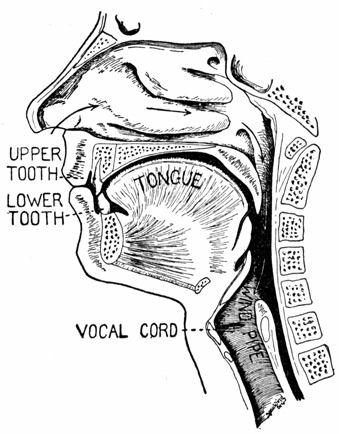
A CLEAR PASSAGE TO THE LUNGS
(Follow the arrows.)
I once knew a little girl whose nose was always blocked up. She
had headache and felt tired most of the time and was behind in her
classes. The doctor told her what was the matter, but her father
and mother were afraid that it might hurt her to have the doctor
take out what was clogging her nose. Well, what did she do? Instead
of
crying and being afraid, one day she walked right into the
doctor’s office and asked him to take out the
adenoids, as we call these growths that block up the nose.
And after the doctor had taken them out, she began to grow well and
fat and strong so fast that she soon “caught up” in her
classes.
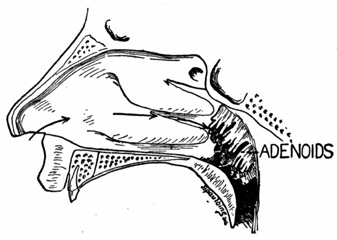
A PASSAGE BLOCKED BY ADENOIDS
When you breathe well through your nose, you can smell and taste
better, too. In fact, when your nose is clogged, you cannot smell
at all.
How does this sense of smell help us? You say we can smell the
flowers and the fresh air after the rain, and cookies baking, and
all the things that we like so well. Yes, and these give us
pleasure; but how about the bad smells? The bad smells are
warnings. If there is a dead mouse or rat about, we smell it; and
that leads us to look for it and take it away. We smell the dirt
and get rid of it, and thus keep away sickness. When we walk into a
room, if the air is bad we smell it at once and open a window or a
door, and so save ourselves from being poisoned.
Some people hurt their noses by smoking tobacco. The inside skin
of the nose is very delicate, and the smoke going back and forth
through the nose and the throat keeps them from doing their work
properly. It is very bad for little children even to smell tobacco
smoke. It seems in some way to keep them from growing as they would
in clear fresh air. What a silly habit smoking is! It does no one
any good. It hurts not only the people who make the smoke, but the
people who have to smell it. Most of the people who smoke tobacco
have to learn to like it. It almost always makes them very sick
when they first begin.
Sir Walter Raleigh, or the men he sent to America, first taught
our great-great-great-grandfathers to smoke. His men bought tobacco
of the Indians here and took it back to England; and Sir Walter
himself learned to smoke and made smoking fashionable. The first
time that Sir Walter’s servant saw him smoking, he thought
his master was on fire; so what did he do but bring a big bucket of
water and throw it all over him! I wish that that bucket of water
had settled the matter, so that Sir Walter had stopped smoking and had
never taught anyone else to smoke. If it had, think how much money
might have been put to better use, for smoking is a very costly
habit. And it is not only wasteful of money, but, worse still, of
health; for it is the cause of a great deal of poor health and
disease.
Remember that you want the air you breathe perfectly fresh and
clean and not spoiled and poisoned by tobacco smoke.
When I was little and playing with my brothers, I did not always
do what they wanted. So they’d sometimes say,
“We’ll put him in Coventry, then he’ll do
it.” They did not really put me anywhere. They
simply would not speak to me or answer anything I said. It was just
as if I were entirely alone. Of course it was a quick way to make
me ready to take my part in the game again.
How do you think you would feel if you never, never could speak
to anyone, and no one could speak to you? What a quiet world
we’d have! Almost every day I meet a boy who can’t hear
and can’t speak. How does he ask for things? He makes letters
and spells words with his fingers, and his friends watch his
fingers and read what he says. Is that the way you do? “No,
indeed,” you say, “I talk.” “What do you
talk with?” “I talk with my mouth.” Yes,
that’s true enough; but if you did not use something besides
your mouth, you’d never make a sound.
Where does the sound come from? Feel gently with your finger and
thumb along the front of your neck. Do you find something harder
than the rest of your throat? That is the large tube called your
windpipe. Do you feel a ridge sticking out from this? Now
sing or talk a little. You can feel the ridge move up and down, and
the sound thrill in it. That is where the sound comes from. That is
your voice-and-music box, or larynx.
You have seen the little red rubber balloons, haven’t you?
You blow into them until they are big and round; and then, when you
take your mouth away, out comes the air, making a squawking or
whistling sound. Now, if you look closely at the mouthpiece, you
see a tiny piece of rubber tied across it. The air rushing past
this rubber is what makes your balloon sing.
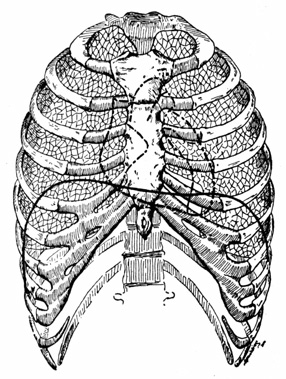
Your own music box is made on the same plan. When you breathe
out, the air is pushed from your lungs up the pipe that we call the
windpipe. In the upper part of this is the little box, a
corner of which you can feel with your thumb
and finger. Across the box, inside, are stretched two folds of skin
and muscle, just as the rubber is stretched across the opening of
the balloon. Whenever you like, you can blow out your breath
between these folds of skin in your voice box. Blow it out in one
way, and what happens? You are singing. Blow it out in another way,
and you are talking; in still another way, and you are just making
a noise—perhaps mewing like a kitten, or neighing like a
horse. If you pull these folds of skin close together, you can
close your windpipe and “hold your breath.” A cough is
made by filling your chest with air, holding the folds close shut,
and then suddenly “letting go.” How many sounds you can
make from one tiny music box! Of course the muscles of the mouth
and throat, and the teeth and the tongue all help the voice box as
much as they can.
One of the best ways to keep your voice clear and strong is to
dash cold water every morning on your throat and chest, then to rub
with a coarse towel till your skin is pink and warm. Gargle your
throat with cold water if your voice is husky. Singing is very good
for you, too; but don’t try to sing too hard. Sing easily and
gently, and see how many words you can sing without taking a
breath. That is good for the lung-bellows as well as the voice box.
Always sing in fresh air, but not in cold air.
When you talk, try to make all the words clear and distinct;
open your mouth and let the sound out. Once I had a big grown boy
in one of my classes who did not open his lips properly when he
spoke. So I asked him to prop his mouth open with a piece of stick
and then talk. I made him do it until he learned to speak much more
clearly. A famous Greek orator, named Demosthenes, who had a habit
of mumbling his words, trained himself to speak clearly by putting
pebbles in his mouth and then reciting in a loud voice.
When you want your voices to sound pleasant,—and that is
always, of course,—you must call on your brain to help. That
is your thinking machine. Always think twice before you let
anything unpleasant or unkind come out of your voice box. How happy
we could make everyone about us if we followed this rule!
Suppose, as you are walking home from school to-day, you are
about to cross the street when you see an automobile coming very
fast. What do you do? You stop, of course; wait for it to go
by,
and then start on again. Why do you stop? “Why,” you
say, “if I didn’t, the automobile might run over
me.” Something of that sort would just flash through your
mind, wouldn’t it, in the very same second that you first saw
the automobile coming. Now, as you know, you think with your brain.
But what was it this time that set your brain to thinking?
“Nothing,” you say, “I just saw the automobile
coming.” And that is true in a way: you didn’t need
anything more than your eyes to tell you.
But how did your eyes get the message to your brain, and how did
your brain tell your legs to stop walking? We must have in our
bodies a kind of telephone system. And that is, in fact, just what
we have. Our brain is our “central office”;
and our nerves are the wires, running from all parts of
our body to the brain, carrying messages back and forth.
An old man and an old woman lived out on the very edge of a
little town. One day their house caught fire and was blazing away
before they noticed it. They rushed to their neighbor’s
telephone and rang up “Central” to tell her to
“phone” for the firemen and hose cart. Kling
a-ling-a-ling! went their bell, but no “Central”
answered; and while a man was running to town to get the
firemen, the fire got such a good start that the house burned
down.
You can see from this why we need a central office in good
working order, when we use the “phone.” All the wires
run into the one building, and there must be some one there to
receive calls and see that they are sent out to their proper
places. In this case, you see, “Central” should have
been at her post to see that the message went on to the engine
house, and then the fire would have been put out
“double-quick.”
The “central office” of our Body Telephone System is
just as important and just as necessary to keep in good working
order. It would be very little use to have even the keenest of eyes
and the sharpest of ears, with the readiest of nerve wires to carry
their messages into the center of the body, unless we had some
organ, or headquarters, there for switching the messages
over to the nerves running to the right muscles to tell them what
to do. If the brain-“Central” should fail in its duty,
or get out of order, then the body would be in serious trouble at
once.
Every day we read in the papers of accidents because somebody
didn’t think, as well as see or hear. People see cars and
automobiles coming, but don’t give them a thought and so are
run
down and hurt. They hear the whistle of the engine at the crossing,
but drive on just the same, without seeming to have heard it at
all. They are absent-minded; the operator in the “central
office” seems to be off duty, or busy about something else.
But if we are going to get on in this world of cars and automobiles
and all sorts of unexpected things, we must always “have our
wits about us,” as the saying goes, ready to send the
messages out to the muscles in our legs and arms and fingers just
as soon as any one of our “Five Senses” “rings
up” the “Central” in our brain.
Our body wires do not look at all like telephone wires; and the
brain, if you could see it, would never suggest to you a central
office.
The nerves are fine white cords, the smallest ones finer than a
hair, and the largest so big and strong that you could lift the
body by it; and their branches run all over the body, to the
muscles and the blood tubes and the skin and all the other parts,
as the picture shows. You have already read how the skin can tell
you when you feel warm and when you feel cold and when something
hurts you.
The brain is a soft wrinkled mass, partly gray and partly white.
It is in the head; and because it is very soft and easily hurt, Mother
Nature has put around it a strong wall, or shell, of bone—the
skull, or brain box. Feel your head and see how very hard
this bone is. Solomon, the Hebrew poet-king, called it the
“golden bowl.” I suppose he called it a
“bowl” because it is round like one, and
“golden” because it is so precious. People do not often
grow well again if the “golden bowl” is broken or even
cracked.
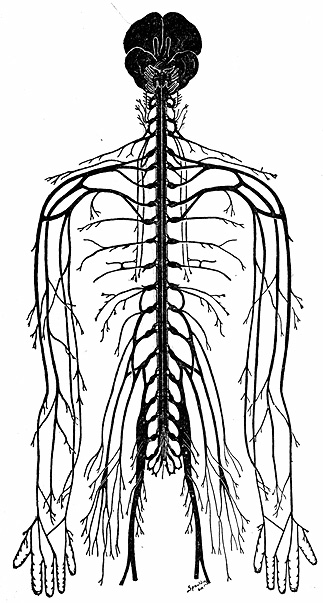
THE NERVOUS SYSTEM—OUR BODY TELEPHONE
The picture shows the brain, or
“Central,” and the thick nerve cord that runs down
through the backbone, and the principal nerves of the back and the
arms.
The big nerve cable, called the spinal cord,
that connects the brain with the rest of the body, and carries all
the messages backward and forward, runs down the back and is
protected by the backbone, or spine, which is hollow, so
that the cord can run down through it. This backbone is jointed
together so beautifully, too, that you can bend your back about and
stoop over, and carry heavy weights on your back, and yet the bony
tube still protects the cord inside. Solomon calls this the
“silver cord,” because it is so white and shiny that it
looks like silver. You see, our bodies are full of beautiful as
well as wonderful things.
Probably sometime when your teacher has asked you to recite a
poem you have all learned, someone in the class has answered,
“I don’t remember it,” or has stood up and
recited the first few lines and then stopped, and thought, and
finally had to say, “I can’t go on.”
Now what is the matter with this boy, or girl? He looks bright
enough, and you will probably remember that he was in the class
when you learned the poem. “Oh,” you say, “the
poem didn’t stay in his head.” No, it didn’t
“stick” in his memory; but why didn’t it?
Some of the messages that the Five Senses carry to the brain are
answered at once, as when we move away from danger, or reach out
our hands and help ourselves to butter, or take off a shoe to shake
out a pebble. But there are other messages that do not call for an
immediate reply, and are just stored away for future
use in the big “central office” of our Body Telephone,
in what we call our memory. And later, when the proper
message is sent in by our eyes or ears, or other sense organs,
which reminds us of this message which they sent before, perhaps
several weeks, months, or even years ago, it wakes up the old
message stored away in the memory, and we say we
“remember” what happened to us, or what we learned at
that time.
So, when your teacher asks you to recite a certain poem, and
your ears hear the title or the first line, you recall the rest of
the verses and the lesson about it. How many things does the word
“Christmas” wake up out of your memory? or the sight of
soldiers marching? or the first taste of strawberries in May?
You think about a great many things that you never do.
Really you are thinking almost all the time you are awake. And
besides the messages that “Central” just stores away
for future use, there are a great many messages being carried back
and forth along the “telephone system” all the time,
that you don’t keep track of at all—the messages that
keep the stomach and the heart and the lungs and everything in your
body working together properly.
How are we to take care of the telephone
lines and “Central” of our nervous system?
Whatever you do to build up and help the other parts of the body
will help your brain to feel and think and
remember; and will help your muscles and nerves to answer
promptly and truly whatever the message may be. Plenty of good
food, plenty of sleep and fresh air, plenty of play, will keep your
nerves and brain healthy and growing.