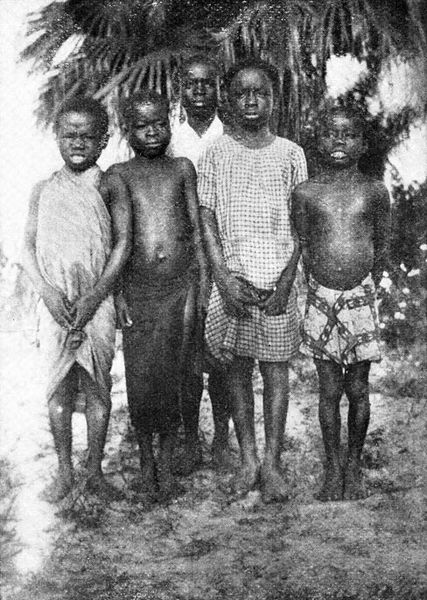
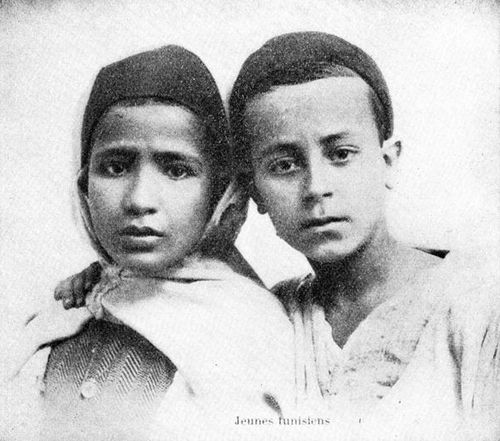
“Come, ye children—I will teach you the fear of
the Lord.”
The call for schools from Mission Lands—Is
missionary educational work still needed in
the awakening East?—Divergent views on education—Reasons
why missionary education should
be continued—Comparative illiteracy—Testimony
from Japan—From China—From India—From
Mohammedan lands—Can we refuse the
united demand?—Kindergarten Union in Japan—The
impressionable years of childhood and the
call for Christian Kindergartens—Inventive and
adaptable missionaries—Primitive education
among backward nations—Lack of power of
concentration—Evils of the memorizing method—Old
methods hard to discard—Education of
girls—Early marriage a barrier—Now is the time
to educate the future mothers—Mission schools
and physical training—Building up a “great
personality”—The need for good literature—Industrial
training in mission schools—Extent of
American missionary education—Where shall
we put the emphasis?—How mission schools
lead children to Christ—Mission school-children
in after life.
The call for
schools from
mission lands.
Four little boys less than ten years of age came
trudging over the muddy Korean road three long
miles to school. In their chilly, little, bare hands
they carried bowls of cold rice for dinner. But
cheerfully they marched along, for the daily
six-mile walk took them to and from the mission
school, and oh! what a wonderful privilege
it was to be able to study,—a privilege not enjoyed
by all the boys of their village.[51]
The closing session of a school for Jewish
children in the heart of Asia was being held,
and many mothers listened with awe and admiration
as child after child took part in the simple
exercises. “See,” the mothers exclaimed to each
other, “see how our daughters are learning to
read, instead of growing up to be like donkeys
as we have done!”
A woman in the capital city of Persia, head of
a Bahaist school, insisted on sending her little
daughter to the American mission school, paying
all tuition charges gladly. “Lady,” she said
to the teacher in charge, “whenever I come into
this school my life is renewed.”
Over the African trail came a young man who
had given his heart to Christ and was now ready
to enter the Bible Training School in order to
fit himself for a life work that no foreign missionary
could hope to accomplish. Earnestly he
pleaded with the missionaries to let him bring his
little eleven-year-old wife to be taught and
trained so that she might some day be a true
help-meet in his work. But there was no boarding
school for girls, no available place for the
child. Think what that future home and work
might have been had the little wife received a
Christian education!
A missionary was returning from an evangelistic
tour over one of the lonely roads of Palestine.
Suddenly he was accosted by several armed men
in disguise, who demanded that he should promise
to grant their request before it was stated to
him. He naturally demurred, but, becoming
convinced that they were not robbers, he finally
consented, realizing that his journey could not
otherwise be continued. Whereupon they demanded
that certain mission schools which had
been closed for lack of funds should be re-opened,
promising to give as much as possible towards
the necessary sum. “It is like depriving our
children of bread and water and air,” they exclaimed,
“to deprive them of the opportunity for
religious teaching and useful education.”[52] A
peaceful missionary held up by a set of masked
bandits in a Mohammedan land, who demanded,
not his money nor his life, but a Christian education
for their children!
Loud and clear and insistent are the voices from
country after country. In many tongues they
call to us Christian women,—“Give us a chance
to learn, let us children have what our parents
never had, put books into our hands, train our
hands and eyes and ears and hearts as well as
our minds, show us how people who love that
Jesus whom you tell about may read of Him and
may make their lives good and happy and
useful!”
Is missionary
educational
work still
needed in the
awakening
East?
It may be the honest conviction of many that
with advancing civilization and the great political,
social, and educational awakening in many lands,
there is no further need for mission schools or for
pushing missionary educational work. Japan
has her public school system with six years of
compulsory school attendance, and higher courses
combining cultural with practical education in a
way that Western nations might well follow.
China has done away with the old educational
regime and is patterning her new system after
those of Christian lands. In India we hear that
“Mr. Gokhale’s bill for universal primary education
has stirred the whole country and will be
a constant issue until it is an accomplished fact.
Already the government has voted to increase
immediately the number of primary schools from
120,000 to 210,000.”[53] The demand for education
of girls as well as of boys in Persia, Turkey,
and Egypt has caused a marvelous overturning
and re-arranging of custom, prejudice, public
opinion, and government action. In view of all
this and much more in the same line, has the time
come when the matter of education can be left
in the hands of the awakening East, and does our
obligation to the little ones of non-Christian
lands cease at the door of the school room?
Divergent
views on
education.
In order to arrive at a fair answer to these questions
it might be well to study and discuss some
divergent views on education and then to learn
how these questions are answered by those who
were born in non-Christian lands or who have
lived and worked there for many years.
Some Views on Education
“To educate a girl is like putting a knife into
the hands of a monkey.” Hindu Proverb.
“The hope of our country is in the education of
our girls, and we shall never have statesmen
till the mothers are educated.” A Persian
Nobleman.
“Men are superior to women on account of the
qualities with which God has gifted the one
above the other.” The Koran, Sura 4.38.
“No scheme of education for primitive races
can succeed that neglects the woman’s influence
in the family and the tribe.” E. W. Coffin.[54]
“When a man does not ask, ‘What shall I
think of this and of that?’ I can do nothing with
him. Learning without thought is labor lost;
thought without learning is perilous.” Confucius
Quoted in “Oriental Religions,” Samuel Johnson.
“Education should lead and guide man to
clearness concerning himself and in himself, to
peace with nature and to unity with God.”
Froebel.
“The aim of female education is perfect submission,
not cultivation and development of the
mind.” Confucius.
“Not knowledge or information, but self-realization
is the goal. To possess all the world
of knowledge and lose one’s own self is as awful
a fate in education as in religion.” John
Dewey.
The Head Master of an English school declared
it to be his ideal of education to create an atmosphere
of loyalty that should teach the pupils
to adapt themselves to the sphere in which their
lives should be cast, at the same time giving them
self-reliance through the knowledge that they are
responsible for doing the things that are worth
while, and arousing their ambition to achieve
that which is highest and best.
As a practical basis for the study of our topic,
“The Child at School,” write out if you will
your own definition of the scope and ideals of
education, drawing up a list of those members
of the human family who would benefit by such
an education.
Reasons why
missionary
education
should be
continued.
Referring again to the question of whether
our missionary obligation ceases when the child’s
education begins, we must first of all realize
clearly how recent has been the awakening in
most of these lands, how appalling is the illiteracy,
how long it will take the most advanced government
to meet the need without assistance, and
how infinitely more a Christian education will
do for the little ones than a merely secular education
can possibly accomplish.
Statistics of
illiteracy.
From the new Cyclopedia of Education[55] the
following latest available statistics are taken:—
| Country |
Illiterate |
Basis |
Year |
|---|
| America |
7.70% |
Pop. over 10 yrs. |
1910 |
| England & Wales |
1.80% |
Marriage |
1901–1910 |
| German Empire |
0.03% |
Army Recruits |
1904 |
| Ceylon (all races) |
78.30% |
All ages |
1901 |
| India |
92.50% |
Over |
10 |
years. |
1901 |
Cape of Good Hope
(Other than
European.) |
86.20% |
„ |
„ |
„ |
1904 |
| Egypt |
92.70% |
„ |
„ |
„ |
1907 |
Quoting further from the Cyclopedia we learn
that “in Turkey, India, and China we find a
high illiteracy among the males, and an almost
complete illiteracy among the females. The
least illiteracy today is to be found among the
people in the countries to the north and west of
Europe, and of Teutonic or mixed Teutonic
stock. It was in these countries that the Protestant
Revolt made its greatest headway and the
ability to read the Word of God and to participate
in the church services were regarded as of great
importance for salvation.”
Sir J. D. Rees
on illiteracy in
Asia.
Sir J. D. Rees, an official of high position and
distinction in India, makes this significant statement
in his volume on “Modern India,” dated
1910—“While it is true that only half the boys of
school-going age were following a course of
primary education when the last census was
taken, it is extremely improbable that in any
other part of Asia anything approaching that
number has been ever attained, or in any Oriental
country under European control.”
Education in
Japan.
Let us go back to Japan as to the one of all non-Christian
lands that has made the greatest advance
along educational lines. After a visit
to Japan with many opportunities for observation
and study of the subject, Miss Kate G.
Lamson says:[56]
Education for the masses has long since justified itself
to the Japanese. That education is universal and compulsory
is abundantly proved by the crowds of school
children seen in every part of the country. This naturally
leads the observer to question the need of outside help,
especially missionary help, along educational lines, and
outside of two or three large centres our Board has applied
itself largely to the development of church organization
and evangelistic work. Yet the experience of years has
revealed an imperative need of the missionary even in
the ranks of education in Japan....
With schools everywhere, under an able and full staff
of instructors, with up-to-date appliances for every branch
that is to be taught, moral and religious training are not
provided for, and the well-polished husk of educated
manhood and womanhood without the inner life is the
result. The dangers attending non-religious education
have not failed to make themselves apparent to the
watchful Japanese....
In every land we believe the hope of the nations lies
largely in the training of little children. Christianity in
Japan has laid hold upon this and has set the pace in the
establishing of kindergartens....
Although education in Japan is compulsory, it is a
fact that it is beyond the reach of the poorest people.
This anomalous situation is caused by the charges for
tuition and books imposed upon all scholars. These
charges are so high as to be prohibitive for the very poor,
and the result shows in the absence of their children from
school. In this lies a direct invitation for missionary
effort.
Opinions of a
leading Japanese.
These words from a Christian observer and
student of missions find an echo in the remark
of a leading Japanese, himself a non-Christian,
to one of the team of workers of the Men and
Religion Movement:—“I am convinced that
Japan must become Christian or she will never
become a great nation.”
Educational
awakening in
China.
So much is being said and published about the
wonderful developments in China and the new
system of education that is taking the place of
the old, time-honored memorizing of the “Four
Books” and the “Five Classics,” that we need
not here go into the subject in detail.
Where shall
the teachers be
trained?
But we
must stop to query:—Where is China to procure
the hundreds and thousands of teachers who are
needed to train not only the children at present
but the teachers of future generations of children?
For many long years she must look largely to
missionary schools to prepare her future educators.
From a report on the Educational Work of the
Presbyterian Board of Foreign Missions we quote
the following:
The wisdom of the West in matters of courses of study,
together with methods of teaching, discipline, etc., are
brought directly from our best institutions and freely
offered upon the altar of Chinese regeneration. The
results of these years have also proven that these best
things are adapted to the young Chinese minds, and that
they appreciate them when they once come to know them.
The products of these years show that our Christian
schools have been getting hold of some excellent material,
and that there is such true worth and high possibility
that all effort to develop these bright minds and sincere
hearts is well worth while, and that in doing so a great
service is rendered to China.... A number of young
women of fine type have been educated in the schools
for girls, who are proving themselves apt to teach and
work for their own people in the conduct of boarding and
day schools and women’s classes.
Indian grants
to mission
schools.
So highly does the Indian government prize
the work of the missionary schools that each
of them which is held to the required standard
of efficiency receives a grant for partial support.
The American Board Bulletin says, “Our tremendous
school system in Ceylon of more than
ten thousand pupils is carried on practically
at government expense.”
In a village in India the parents’ request for a
school was answered by the statement that if
such a school were opened, the Bible would be
taught in it. Quickly the reply came, “Teach
your religion, but educate our boys.”
New demand
for education in
Persia and
Turkey.
When the century opened, Persia and Turkey
were asleep. Suddenly came the awakening, the
reaching out for something new and different,
and, as in the case of China, one of the first
thoughts was,—Our children must be educated.
Instinctively they turned to the missionaries
who for long years had quietly, steadily, sown
the seed, prepared literature, set up printing
presses, trained preachers and teachers. Boys
and girls began to flock into the mission schools.
Messages from
Persian parents.
“Fathers sent pleasant messages,” wrote a
missionary in Teheran in 1911. “One said, ‘Your
girls make better wives and mothers and in every
way better women, than others.’ Another, ‘I
wish my wife had been educated, but I am determined
my daughter shall be.’ An Armenian of
wealth and influence is reported to have answered
to a remonstrance against sending his little
daughter to us instead of to their national
school: ‘Did I ever refuse to give you money?
I will continue to help support our national
schools, but I must send my daughters (he has
five) where they can really obtain an education.
They can learn in one week all you can teach
them about going to theatricals and dances.’
A friend was telling us that her sister would
send her girls to us. ‘Why?’ ‘Because every
Moslem in this city understands that your
school is the only one where girls really learn.
Why should my sister be the only fool?’”[57]
New schools
for girls in
Teheran.
These messages are significant in view of the
fact that in a brief time seventy girls’ schools
were reported to have sprung up suddenly in
Persia’s capital city, with an enrolment of five
thousand pupils.[58] But scarcely half a dozen
of those at the head of the schools had ever
been to school themselves, and the testimony
from all over Persia was the same as that at the
capital,—“The missionary schools are the best.”
Here is the eager call from Turkey:[59]
The call for
teachers in
Turkey.
The gradual awakening of the villages to the need of
better schools increases yearly the calls for teachers. The
Sivas Normal School reports that the work of the past
summer was very hard. “We were obliged to refuse
calls for more than forty teachers, not a few of them
from places to which we had never supplied teachers.
The following quotation from a letter from the Armenian
Bishop of one of our large cities is a fair sample: ‘We wish
to call for the Armenian schools of our city the following
teachers: a principal, a lady principal, teachers for
Armenian, Turkish, and French, and three teachers for
scientific branches. If you have among your experienced
teachers or among the new graduates persons to
recommend, please inform us at once in order that we
may invite them.’”
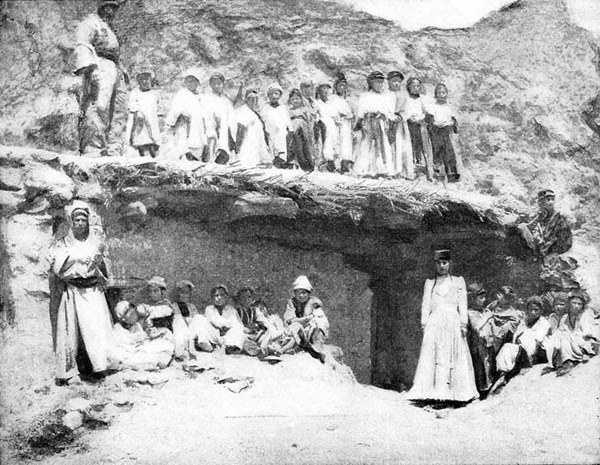
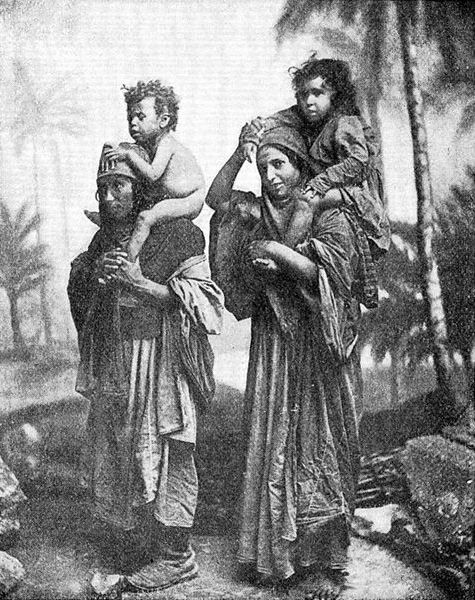
Khatoon
Who walked a month’s journey to get an education, and returned to teach these children
in this Turkish Schoolhouse
A Kurdish
father.
One hardly knows whether to laugh or to
cry over the Kurdish father up in the wild
mountains of Kurdistan who brought his boy to
the little school taught by a native helper, whacking
him with a stick to make the reluctant youth
walk in the paths of learning, while he declared,
“I am not going to let my boy grow up in the
street.”
Can we
refuse the
demand?
When great governments, ecclesiastical authorities,
wealthy noblemen, and fierce warriors
from the mountain fastnesses all clamor for what
the missionary schools can do for their children,
have we a right to refuse their request? Can we
claim freedom from responsibility?
Rather let us glory in the unparalleled opportunity
for giving to the needy children of non-Christian
lands that which has proven to be the
only true source of mental preparation for life-work,—a
Christian education. Hear the testimony
of Dr. F. W. Foerster, author and special
lecturer in Ethics and Psychology in the University
of Zurich, a man who began his educational
work with sympathies strongly socialistic and
entirely aloof from all forms of religion. In the
author’s preface to his book, “Marriage and the
Sex Problem,” he speaks with no uncertain sound
of his own experience and conviction.
Dr. Foerster on
Education and
Christianity.
The author of this book comes from the ranks of those
who dispense with all religion. But as the result of long
experience, theoretical and practical, in the difficult work
of character-training, he has been led to realize for himself
the deep meaning and the profound pedagogical
wisdom of the Christian method of caring for souls, and
to appreciate, through his own experience, the value of
the old truths.... He has absolutely no doubt that modern
education, in discovering the extraordinary practical
difficulties of character-training, will be increasingly
cured of its optimistic illusions and led back to an understanding
and appreciation of Christianity.
How about the children themselves? Do they
enjoy and appreciate school privileges offered
them by the missionaries, and does the work
show results that are worth while?
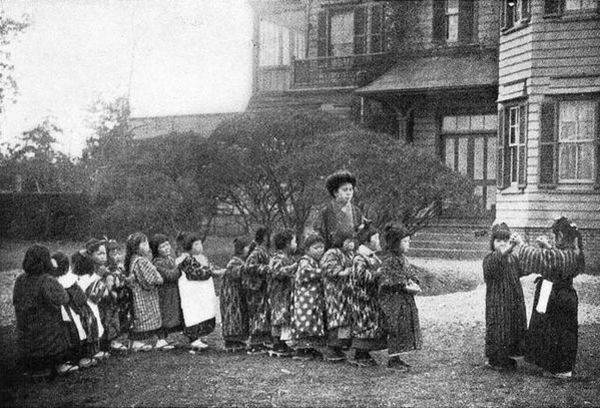
Kindergarten
work in Japan.
If, as Miss Lamson claims, “the hope of the
nations lies in the training of little children,”
there is hope for Japan in the ninety-eight
mission kindergartens that are maintained by
fourteen Protestant Boards and have an enrollment
of four thousand and sixty-eight children.
The report of the Kindergarten Union of Japan
is a most fascinating volume, with its presentation
of opportunity, need, method, and the result
of teaching the tiny children who are to be the
future parents, teachers, and leaders of thought
and action in that Empire. A few extracts will
give a little idea of what is being done for the
children and through them for their homes and
friends.
A Japanese
teacher on
Christian
kindergartens.
The kindergarten in our country today is at its most
critical stage, and therefore needs the best and most
profound thinkers who can put their ideals into practice
most tactfully. This must be accomplished by native
Christian kindergartners. Education without religious
foundations is like an egg without the germ of life in it.
Most of our public and government kindergartens, which
have the purely so-called educational views of today, are
leaving the very springs of child life untouched, and
therefore are not fulfilling the real meaning of education.
They are not disciples of Froebel, because he based his
philosophy on the Christian faith. (Fuji Takamori of
Holy Love Kindergarten, Methodist.)
Results of
sending the
children to
kindergarten.
A teacher writes, “A little girl whose father and mother
were Christians entered our school. At first a little
nursemaid brought her, then her grandmother came with
her. This grandmother was a devoted Buddhist. She
would not even look at the foreign teacher, much less
listen to anything being taught, but at last she began to
listen, and eventually became convinced that she needed
Christ for her Saviour. Today she is a truly converted
woman.”...
The blessing asked at the noon lunch seemed to make a
deep impression on some children, and doing it at home
attracts the parents’ attention, so that a number of them
have been known to come to the church services to hear
more about the meaning of prayer and praise. (Mrs. A. D.
Gordon.)
We are told that the songs, the games, the stories, and
sometimes the prayers, are household exercises in many
homes. On a recent morning, which we spent by invitation
of the wife of the Governor in her garden, the little
son of the family, not yet of kindergarten age, took an
active part with the other children. His mother told me
that the older sister comes home and “plays kindergarten”
with her small brother, and that, when they have guests
to entertain, the children are often called in to give some
kindergarten exercise. I did not tell her how strongly I
disapprove of “showing off” children before company.
I only prayed that “a little child might lead them.” (Mrs.
Genevieve F. Topping, of Morioka Kindergarten, Baptist.)
An amusing incident happened one day when the children
were off on an observation trip. They had to stop
to let a detachment of soldiers pass, and spontaneously
burst out singing “Soldier Boy, Soldier Boy,” to the
great amusement of the soldiers. Then they all saluted
the officer in proper fashion, but he only smiled. “Sensei,
we saluted politely, why didn’t he return the salute?”
Later as the soldiers were drawn up in circular formation
on the parade ground, the children said, “Oh, now
they are going to play just as we do in kindergarten,
let’s watch!” So the expedition which started out to
study insect life changed into a lesson on soldiers and
their absolute obedience to orders. (Alice Fyock of
Sendai Aoba Yochien, American Episcopal.)
The call for
missionary
kindergartners.
A similar Kindergarten Union is being formed
in China, and from all missionary lands comes
the urgent cry for trained kindergartners who can
not only start schools, but, far more than this,
can train native kindergartners to take up the
work. It would be hard to overemphasize the
importance of this particular service which missions
are rendering.
Dr. Balliet on
the early
years
of childhood.
Dr. Thomas M. Balliet of New York University
voices the opinion of modern educators
when he says, “All the more recent studies in
child psychology emphasize the great plasticity
of the early years of childhood. The habits
which the child then forms, and the attitude both
intellectual and emotional which is then given
him, are more lasting and more determining for
his adult life than was even suspected some years
ago.”[60]
Why is the
Christian
kindergarten
needed?
After a hasty mental review of what has been
studied in earlier chapters regarding the home
life and training of little children in non-Christian
lands, it is surely a mild statement to make
that the Christian kindergarten is an absolute
necessity if these little ones, so cunning and
capable and helpless, are to have any chance at
all for proper development. The words “Christian
kindergarten” are used advisedly, and agree
with utterances of experts such as Elizabeth
Harrison, who says,—
“The foundation of the kindergarten is based
upon the psychological revelation that, if man
is the child of God, he must possess infinite
possibilities, and that these possibilities can only
develop as he, man, makes use of them—that in
other words, man is a self-making being, that his
likeness to the Divine Father consists in this
power within him to unfold and develop his
divine nature.”[61]
Children of
backward races
respond to early
training.
Students of primitive and backward races tell
us that the small children show as much promise
and as many signs of undeveloped capability
as do children of civilized lands, but before many
years a cloud seems to overcast their minds,
while selfishness and sin and passion take possession
of their moral natures. Never again is
there the same chance to make them what they
might have been, as there was during those first
early days when the kindergarten should have
opened wide her doors to receive them. This
argument would in itself seem sufficient to urge
missionary Boards to speedy, thorough action
in this matter, but there is another far-reaching
argument to be considered. All through the
East, wherever there are missionary kindergartens,
mothers come to them to learn how to
train their children, and countless homes have
caught and passed on a reflection of the Christ
life because of what the mothers have heard and
observed and what the children have taken
home with them. Make a flying trip to the
Fuchow Kindergarten and watch “the irrepressible
John.”
“This little lad’s father died, after a period of
faithful service in Miss Wiley’s kitchen, and when
the widowed mother came back to Miss Wiley
from her country home to earn a living for herself
and John and baby Joseph, John was already
master of the situation and of his mother, and
enforced his will on that by no means weak-minded
woman by kicking, biting, pulling her
ears, and similar methods. Now Miss Wiley
is a famous trainer of boys, and she soon taught
the young mother that the masculine will is not
necessarily law at the age of two plus; the kindergarten
carried out the same idea, and now John
devotes vast energy and determination to the
shaping of inanimate clay into pigs and other
fascinating things, and treats animate nature as
a well-mannered and kindly little gentleman
should.”[62]
Kindergartners
must be
inventive and
adaptable.
It would be most interesting and instructive
to make a tour of missionary kindergartens for
the purpose of seeing how ingenious our missionary
teachers are, how they adapt Froebel’s
ideas and methods to the most extraordinary
circumstances which would have made that
great educator gasp, how they must not only
translate and adapt songs and tunes and games,
but compose and create and invent,—all in an
acquired language which has perhaps been only recently
reduced to writing by some pioneer missionary.
It might be pertinent to ask if all Women’s
Boards provide the kindergartners and other
teachers whom they send to the foreign field with
a first-class outfit of all needed material, and if
they remember that such an outfit needs to be
replenished at least as often as a similar one
does in the home land. It is not fair to require
a missionary to make bricks without straw.
A West
African
kindergarten.
A visit to a West African Kindergarten will
show an inventive and adaptable missionary in
charge.
We have a new primary Sunday-School room which will
be my kindergarten. It is a low wall covered by a round
thatched roof high enough to leave a good big space for
air. The floor is mudded and marked in squares. It
looks very nice, but I shall take pains to get the cracks
filled up, for they catch too much dirt and jigger seeds.
The benches are not yet made, so the children who were
cleaned up for Sunday went after leaves to sit on. The
classes have to go out under trees to separate, but it is
a great improvement upon the dirty and dangerous saw
pit where they have met for so long. The only advantage
about the saw pit was the roof for shade and pieces of
wood and logs to sit upon. The big folks have been
getting most of the attention and all of the advantages,
but we feel that the children should have most because
they are in the future. They do not show such shining
results at once, but work with them will lay a foundation
which is greatly needed here for really effective work....
I have a box cupboard, a sand table, two long low
tables marked with squares, and strong benches. I have
not much kindergarten material, but I do not need more
at present. My first “gift” is a basin of water. They
march in singing “Good morning, kind teacher” (only
I am thankful to say the Umbundu words leave out the
“kind”). Then we sing another song or two, and the
prayer with bowed heads. I have no music, so I have
to learn the tunes myself before I come to school. The
children are the dearest, cunning things and they do want
to learn.[63]
Primitive education
among
backward nations.
There are lands such as large sections of Africa
and many of the Pacific Islands where no education
whatever existed, where the language was
not even reduced to writing, until Christian
missionaries began their work. Other countries
gave a certain so-called education to their boys
or to the sons of certain privileged classes, leaving
the girls absolutely illiterate. They agreed
in principle if not in expression with that man in
the mountains of Kurdistan who was asked by
a missionary to send his bright little daughter
down to the mission school at the beginning of the
fall term. “Do you want my girl?” questioned
the man in amazement and disgust. “Why don’t
you take my cow?”
Again in other sections girls have a brief
chance to learn, but are not expected to keep
pace with their brothers or to attain to anything
beyond the rudiments of book learning.
Lack of concentration.
A missionary educator from Turkey says that
one of the greatest difficulties in school work
arises from the fact that the children have no
power of concentration, no idea of how to think
and study on one line for any length of time.
It often takes five or six years for a child really
to learn how to study. Obviously, the earlier
these preparatory years occur in a child’s life,
the more benefit may he hope to derive from his
education.
Evils of the
memorizing
method.
Then again, if children learn their first
lessons in the native schools of Turkey, Persia,
Korea, and various other countries, they will
become fixed in the habit of memorizing without
giving any intelligent thought to what they
learn. Dr. S. M. Zwemer says:
“A Moslem lad is not supposed to know what
the words and sentences mean which he must
recite every day; to ask a question regarding the
thought of the Koran would only result in a
rebuke or something more painful. Even grammar,
logic, history, and theology are taught by
rote in the higher Mohammedan schools....
Thousands of Moslem lads, who know the whole
Koran nearly by heart, cannot explain the
meaning of the first chapter in every-day language.
Tens of thousands can ‘read’ the
Koran at random in the Moslem sense of reading,
who cannot read an Arabic newspaper intelligently.”[64]
How utterly this differs from the theory and
practice of Dr. Montessori, who “calls a child
disciplined who is master of himself, and therefore
able to dispose of or control himself whenever
he needs to follow a rule of life. The liberty
of the child must have as its limit only the collective
interest. To interfere with this spontaneity
is, in Dr. Montessori’s view, perhaps to
repress the very essential of life itself.”[65] How
can a child be master of himself who is not even
allowed to inquire into the meaning of what he
reads and studies?
Old methods
hard to discard.
It is not always easy for the missionary suddenly
to introduce changes of method and practice,
and many a missionary school which is infinitely
superior to the native institution might shock
an American school superintendent beyond recovery.
A missionary from China wrote,—“I
found I must still keep many old methods or
the Chinese would not send their children. I
have found it necessary to let them learn portions
of Scripture and classics and shout them at the
tops of their voices, then gradually work in music,
geography, and arithmetic.” Another argument
for beginning as early as possible with the children
who can so easily adapt themselves to ideas of a
quiet, orderly school if they have never enjoyed
exercising their lungs in one of the other kind!
Education of
girls in Persia.
In speaking of primitive education among
backward nations, mention was made of the scant
attention given to girls as compared to boys.
The London Times not long ago stated in commenting
on the women of Persia, “As a matter
of fact, probably not one girl in a thousand
twenty years ago ever received any education.
When the parents were rich enough, tuition of a
sort was given at home, but in the case of poorer
persons it was enough if their sons were taught
to read and write.”
In contrast we learn that in the spring of 1913
about one thousand children from Moslem homes
were in attendance at Protestant missionary
schools in Persia, over two hundred of them
being girls.
Early marriage
a barrier to
education.
In Mohammedan and other lands the custom
of early marriage is an almost insuperable barrier
to an adequate education for a girl. That this
custom must be changed, if men are to have
worthy wives and if children are to be properly
trained, is a truth that is beginning to be realized.
The recent great awakening and desire for education
is creating a marvelous change in age-long
customs.
Lord Cromer on
conditions in
Egypt.
Lord Cromer says: “The position of women in Egypt,
and in Mohammedan countries generally, is a fatal obstacle
to the attainment of that elevation of thought and character
which should accompany the introduction of European
civilization, if that civilization is to produce its full
measure of beneficial effect. The obvious remedy would
appear to be to educate the women.... When the first
efforts to promote female education were made, they met
with little sympathy from the population in general.... Most
of the upper-class Egyptians were not merely indifferent
to female education; they were absolutely opposed to
it....
“All this has now been changed. The reluctance of
parents to send their daughters to school has been largely
overcome.... The younger generation are beginning to
demand that their wives shall possess some qualifications
other than those which can be secured in the seclusion of
the harem.”
In 1912 Lord Kitchener states that “There is probably
nothing more remarkable in the social history of Egypt
during the last dozen years than the growth of public
opinion among all classes of Egyptians in favor of the education
of their daughters. The girls’ schools belonging
to the Ministry of Education are crowded, and to meet
the growing demand sites have been acquired and fresh
schools are to be constructed, one at Alexandria and two
in Cairo. Very many applications have, however, to be
refused.”[66]
Mission
schools in the
lead.
To these quotations Dr. Sailer adds the significant
words,—“The missionary schools for girls
are yet in the lead in their moral atmosphere.
The government officials were prompt in acknowledging
that missionary teachers brought
to their work a spirit which money could not
buy.”
Scant justice can be done in these few pages
to the whole vast subject of the education of
girls in the East, and the rapid changes that are
taking place in regard to it. A careful study of
the subject will well repay the thoughtful woman.
Now is the
time to educate
the future
mothers.
As all roads lead to Rome, so all reading and
observation along this line will lead the candid
student to one conclusion:—Now is the time to
determine the character of the mothers of the next
generation of children in non-Christian lands.
What those little bright-eyed baby girls of
Africa and India, Turkey and Korea are to be
and do, what their homes are to be like, what
start in life their children are to have, will be
largely determined by what we Christian women
do or fail to do for them today. If it is too late
to do much for their mothers before these children
have left their homes, why not gather the children
into kindergartens and primary schools, why not
teach the little ones now while their minds are
plastic and impressionable? Why not do our
share toward bringing Christian civilization into
darkened lands by educating in Christian schools
today the mothers of tomorrow?
Teaching children
to play.
In the preceding chapter great emphasis was
laid on the necessity for teaching the children of
many mission lands how to play, not only for
the benefit of their health and to bring joy and
brightness into their lives, but also in order to
teach them what “fair play” and co-operation
mean. It is the missionary school, from kindergarten
up to university, that gives the golden
opportunity for this teaching, as is shown by the
testimony of a missionary from Tientsin, China:—“We
believe that such games teach them to be
honest in business dealings later, to be truthful,
unselfish, quick-witted, and self-controlled. The
change which I have seen in these little, un-taught,
ill-cared-for children after five years in the mission
school is due in part, I believe, to the lessons
of ‘fair play’ learned in their games.”
But the school must go even further than this
and include in its curriculum physical education
of a very definite kind if it is to meet all the needs
of the children it is serving. Taking as an
example of all mission lands, China, whose system
of education antedates by many centuries all
our western civilization, let us observe through
the eyes of the former physical director of the
Shanghai Y. M. C. A. what the real situation is.
Physical
training.
Physical training should be dignified by giving it an
equal place with the sciences, philosophies, and languages
in the curriculum, and the same careful provision of means
and trained men to direct it. No educational system is
adequate which does not aim at the whole man, which
does not recognize the physical basis of intellectual and
spiritual efficiency. Professor Tyler of Amherst says,
“Brain and muscle are never divorced in the action of
healthy higher animals and in healthy men. They should
not be divorced in the education of the child.”...
It is clear that physical training, in the largest sense,
must play an important part in the making of the “New
China.” The questions involved in her uplift are most
largely physical questions. The personal, domestic, and
public observance of the laws of health and life is a
physical question; the combating of that terrible scourge,
tuberculosis, is a physical question; the checking of the
fearful infant mortality is a physical question; etc....
The progress which has been made in physical training
in China must be viewed in the light of the fact that
physical exercise for its own sake has had no part in the
national life of China for centuries. It has been considered
improper for a Chinese gentleman to indulge in it.
The popular conception of a Chinese scholar has been
that of a man with a great head, emaciated body, and
hollow chest, sitting and contemplating the problem of
life by thinking dissociated from doing. Until ten
years ago athletics were almost unknown. When foreigners
were seen playing football the Chinese were greatly
puzzled, and wanted to know how much these men were
being paid for cutting up such foolish antics, conceiving
it as out of the question that any one would work so hard
without being well paid for it. All that is rapidly being
changed. Physical training is changing China’s conception
of a gentleman. The ideal of all-round manhood,
well-balanced in its physical, mental, and spiritual aspects,
is rapidly gaining ground.[67]
Could all China’s children today be taught
this ideal, the task would be far easier than it
will be when they have reached adult life.
“The athletic
method in
Kashmir.”
The story of the Missionary School for Boys in
Srinagar, Kashmir, is as thrilling as a novel,
and illustrates to a remarkable degree how body,
mind, and soul must be trained and disciplined
and developed in order to realize the ideal of the
Principal, the Rev. C. E. Tyndale-Biscoe, who
says, “We are making citizens, of what sort remains
to be seen. But we hope without wavering
that these citizens will be Christian citizens,
for Christ is our ideal.” Some of the difficulties
are thus described:
“To teach the three R’s in Kashmir is easy work.
The boys are willing to squat over their books and
grind away for as many hours a day as nature
makes possible. To get an education means
sedentary employment cum rupees. And that
to the Kashmiri is living.
“But to educate is a very different matter. To
make men of a thousand or more boys who care
nothing for manliness; among whose ancestors
for hundreds of years, chicanery, deceit, and
cruelty had been the recognized and honored paths
to success, while generosity and honesty had been
the mark of a fool; to try to quicken and develop
the good in such boys,—boys coming from impure
homes, squatting in unclean rows, with bent backs
and open mouths—was flatly pronounced folly
by many a visitor to Kashmir.”[68]
The story tells how boxing, swimming, rowing,
and gymnastics are required of the students as a
most necessary and vital part of their education,
and how they are trained to be proud of using
these accomplishments in helping others. By
the time a Brahmin boy,—they are almost all
Brahmins in this school,—has saved a child from
drowning, rescued a family of despised sweepers
from the roof of their flood-swept house, delivered
a poor woman from being beaten, and helped
clean up the streets and alleys of a city during a
cholera epidemic, he has received an education
such as no books in the world can give him, and
Kashmir is one step nearer to the Kingdom of
Heaven.
Building a
“great personality.”
“Train not thy child,” says Emerson, “so that
at the age of thirty or forty he shall have to say,
‘This great work could I have done but for the
lack of a body.’” Elizabeth Harrison, after
quoting Emerson, adds, “Is not this carelessness
as to health one of the ways in which we are not
conserving the forces that make for righteousness
and truth, one of the ways in which we are neglecting
to build up ‘a great personality’ in our
children?”[69]
Up to this point our study of The Child in non-Christian
lands has shown that the missionary
must touch the home life, the customs and ideals
handed down from remote ancestors, the play and
work and education and physical development
of the child, in order to give him his inalienable
rights, while in the next chapter we shall dwell on
his right to know of Jesus Christ, the children’s
Friend. It may seem to the reader (as it does
to the writer) that the chapters overlap one
another in spite of the heroic effort to treat each
subject by itself. But most of us find,—do we
not?—that it is a bit difficult to attend to the
spiritual culture of our boys when they are
clamoring to go out and play ball, or to get our
little girls to tell what they learned at school,
when they are hungry for their dinner. The
mother must train all parts of her child’s nature
by attending to the need that is uppermost at
the time,—the missionary must do the same for
her foster children, and the woman at home,
behind the missionary, has to recognize the same
inseparable inter-relation of body, mind, and soul
in the little ones of whom she is studying. Our
divisions into “subjects” must be more or less
artificial. However, to this particular subject
of “The Child at School” belong naturally two
more matters which must be touched on briefly.
The need for
good literature.
When the Turkish girl has learned to read, when
six thousand boys have annually been trained
in that great chain of Anglo-Chinese schools
started by the Methodists in Malaysia, when
Korean children have acquired a taste for reading
and study, where are they to find suitable, interesting
books? The Cyclopedia of Education
pays a wonderful tribute to what one Book has
done for Korea, saying that “the translation of
the Bible into Korean and its rapid distribution,
and revivals marked with habitual study of the
Bible, compelled many to learn the alphabet to
master a sacred library so rich, and has constituted
a national school of intelligence and
culture.” But other books than the Bible must
be translated and written in order to give clean,
interesting, wholesome literature to the children
of countless thousands who never had any use for
a literature for themselves. As Miss Lilian
Trotter of Algiers says,—“Those who have been
patiently toiling over the schooling of Moslem
girls and women begin to feel that the powers
of reading gained in school days should be used as
a means to an end, not left to lapse in the first
years that ensue for want of following up. Letters
from the whole reach of the Moslem world give the
same refrain,—the girls drop their reading largely
because there is nothing published that interests
them. The few upper class women who read,
read little but newspapers and French novels.
Could not some one who understands child minds
work out bright beginnings for the use of their
waking powers in stories and pictures with
colored lettering and borders? Easterns must
have color to make them happy!”[70]
Here is a call to missionary work for some one
who never dreamt that her particular literary
and artistic talents are absolutely needed today
by the children of the East.
Industrial
training in
mission
schools.
The second matter mentioned above is the
need for industrial training. Great progress
has been made in this respect in recent years, but
much more progress is needed, and trained teachers
and suitable equipment are required. As a
missionary in Persia says when urging that more
industrial training be given the school girls,—“A
woman may be able to read, but, if unable
to bake or prepare a good meal, her husband
will not care if she reads about the Bread of
Life. She may play the organ, but, if she cannot
wash, mend, make the children’s clothes, and
make a happy home, he will have little interest
in hearing her play or sing ‘The Home over
there.’”
Extent of
American
missionary
education.
There is abundant testimony to prove that
America is already doing great things in the line
of missionary education. Here is the testimony
of a traveler and newspaper man.
The number of mission schools and colleges supported
by Americans with American money is nearly as large as
that of all the schools conducted by the missionaries of
all other countries combined. We have approximately
10,000 schools in lands that are not under our flag and
from which we receive not a cent of revenue.
If a man in quest of material for an American educational
exhibit were to sail out of San Francisco Bay with
a phonograph recorder, he would come up on the other
side of Sandy Hook with a polyglot collection of records
that would give the people of the United States a new conception
of their part in the world’s advance toward light.
His audience might hear a spelling class recite in the
tuneful Hawaiian tongue or listen to Moros, Tagalogs,
and Igorrotes reading from the same “McGuffey’s
Reader.” A change of records might bring the sound of little
Japanese reciting geography, or of Chinese repeating the
multiplication table in a dozen dialects. Another record
would tell in quaint Siamese the difference between a
transitive or an intransitive verb, or conjugate the verb
“to be” in any one of the languages of India. One might
hear a professor from Pennsylvania lecturing on anatomy
to a class of young men in the ancient kingdom of Darius;
or a young woman from Massachusetts explaining the
mysteries of an eclipse to a group of girls in Constantinople;
or a Princeton man telling in Arabic the relation
between a major and a minor premise. And when the
audience had listened to all this and to “My country, ’tis
of thee” in Eskimo and in Spanish, the exhibit of American
teaching would have only begun.[71]
Languages
used.
One American Mission Board alone (the
Presbyterian) uses the following languages and
dialects in its educational institutions:—Arabic,
Armenian, Beng, Bulu, English, Fang, French,
German, Hainanese, Hakka, Hindi, Italian,
Japanese, Korean, Laos, Mandarin (and many
dialects in our eight China missions; the dialects
of China are as diverse as the languages of
Europe), Marathi, Mpongwe, Persian, Portuguese,
Punjabi, Sanscrit, Siamese, Spanish, Syriac,
Tagalog, Turkish, Urdu, Visayan.[72]
Where shall we
put the emphasis?
But in spite of all that is being done, we continue
to make our plea for the little children.
Whatever emphasis may be laid on the need for
boarding schools, colleges, normal, and industrial
training schools, let us remember that those
who are taught while small will make the most
hopeful students in these more advanced schools,
and the best workers in the future.
How missionary
schools lead
children to
Christ.
How quickly and easily and naturally the little
ones learn of Jesus, the children’s Friend, and
their relation to Him, we have already seen
illustrated in the kindergarten work of Japan.
A little six-year-old Greek boy in Syria, who
had attended the missionary kindergarten, spent
the summer in the mountains and became dreadfully
wild and profane. On his return to school
the teacher asked why he had been so naughty.
He replied, “I didn’t pray during the summer.
Now I’m going to pray and be a good boy.”
To Mrs. Pitcher of Amoy we owe the following
incident:—
A scholar in one of our schools, whose relatives were all
idol worshippers and very ignorant, was led to give her
heart to Jesus, and became a most active little Christian;
but one day she was taken very ill with plague, and during
her last hours she was so happy singing hymns she had
learned at school and telling her parents and old grandmother
about the Home beyond, where she would soon
be with the Lord, that all that heathen family were led
by this dying child to believe in a God of love, who could
so comfort His little child, and save her from the terror
and dread of the many evil spirits in whom they had
blindly trusted.[73]
Mission school
children in
after-life.
This chapter cannot end before we follow into
their later life some of the children whose early
and perhaps whose only education was received
in missionary schools.
“The home in Syria whose mother was taught
in a school can always be distinguished at a
glance, whether it belongs to the Protestant
community or to one of the old Christian sects.
Neatness and good taste prevail, the children
are more carefully trained, the members of the
family work for each other’s benefit. One of
our school girls, who was married to an uneducated
man, told us years after: ‘Letter by letter
I taught him to read, figure by figure I taught
him arithmetic, and then I drew him down upon
his knees and word by word I taught him to
pray.’”[74]
Boys of West
Africa.
From the Spirit of Missions we quote the
following about the boys at Cape Mount, West
Africa:—
“These people can be reached by Christianity
best in their childhood, before superstitions, belief
in the Gregre, or the influence of the life of a
Mohammedan has become grafted into their
lives. If allowed to grow up in their native
villages they often become leaders of tribal wars,
and, unknowingly, men of the vilest character.
In one tribe from which several boys are at the
mission, the mother tattoos curious marks on the
forehead of her babe, in order that if during war
he is captured and in after years she becomes able
to redeem him from slavery, she may be able to
recognize her own child. With the influence and
training of a Christian mission, even though
the boys go back to native life, they do not go
back to all of its vileness, and one can soon distinguish
between them and the un-Christianized
heathen.”
It takes faith and hope and love and a vision
far into the future to teach boys like these. But
it pays, and the “bread cast on the waters” is
often found again in most unlikely places, such as
those described in a letter from Mr. W. C.
Johnson of West Africa:—
“Everywhere I find in the village schools sources
of Christian influence. In one village where I
stayed all night, all of the boys and all but two
of the women were Christians. This was entirely
the work of Christian school boys. In another
place a young man told me that there were only
two young men in the community who were not
trying to lead Christian lives. This too was the
work of the Christian school boys.”
A few months
at school and
what they accomplished.
A little Mohammedan girl attended for a very
few months the mission day school in a near-by
city street. Her cruel step-mother persecuted
her bitterly, throwing her school books on the
floor and trampling them under foot to show her
contempt of Christian learning. Some kind
friend at the school gave the child forty cents,—unheard-of
wealth to the little one,—and the
missionary suggested that a teacher should
help the child spend it for something she greatly
needed before the mother could take it away.
“No,” said the little girl, “I don’t want to spend
it in that way. I want to give it all to the Lord
and then I shall have treasure in heaven. I
learned that at school.” She was married,—without
any choice in the matter,—to a man
who had known Christians and was favorable to
them, and the little wife lived a consistent Christian
life and died trusting in Christ as her Saviour.
Only a few months at school for a few hours of
each day, but they made all the difference for
time and for eternity! How many children are
having such an opportunity because of us and
our missionary society? How many are deprived
of the opportunity because it is “not our business”
to help them realize the truth of what was
said in days of old,—“Wisdom is the principal
thing, therefore get wisdom. The fear of the
Lord is the beginning of wisdom.”
American missionaries were the pioneers in true educational
work in Siam. They gave to Siam its first real
school. They aided Siam in establishing the Government
Educational system, and encouraged the Department of
Education to establish normal training schools. They
introduced the printing press into Siam, made the first
Siamese type, and taught Siam the art of printing.
American missionaries gave Siam its first newspaper in
the Siamese language, and gave the first Geography,
Astronomy, Anatomy, and Physiology, Chemistry, Arithmetic,
and Geometry in the Siamese language.
When the King of Siam made the first move for the
establishment of a school system over Siam, he placed an
American missionary at the head of the work. The
present Minister of Education was at one time pupil of
a missionary, later on he became fellow student of one
of the missionaries in Sanscrit, and still consults the
missionaries on educational questions and literary subjects.
In the past twenty-five years the Presbyterian Mission
at Siam has received more money from the Siamese king,
princes, nobles, and common people for the maintenance
of educational work, than it has received from the Presbyterian
Church in America. (Educational Work of the Bd.
For. Miss. of the Pres. Ch.)
An English boy learns to read his own language first,
and does not always go on to a foreign language. A
Persian boy learns to read a foreign language first, and
does not always go on to his own language. When a
little Persian boy goes to school he is given a big Arabic
book, with a great many long words in it, and he is not
taught how the words are spelt, but is told what they are,
and made to repeat them from memory, pointing to each
word in the book as he says it, and gradually he gets some
idea of which word is which.... The Mohammedans
think that reading the Koran, quite apart from understanding
it, is a very good action, so the little Persian
boys work away at it, and they do not think it hard
lines because all men and big boys began in the same way,
so it seems the natural thing to do. And perhaps it is
a little consolation to know that when they reach certain
points they will be given sweets. One little boy who was
asked how far he had got in the Koran, said that he had
just got his first sweets.
Having finished the Koran, our little Persian boy goes
on to Persian books. These, too, he studies in much the
same way as he did the Koran, but it is more useful,
because now he understands what he reads. After plodding
through the Koran it is a pleasant change for little
Ghulam Husain to turn to the “War between the Cats
and Mice” or the “Hundred Fables.” Later on he reads
the poems of Hafiz and Sa’adi, and other great Persian
poets.
The Persians do not apparently think much of their
own system of education, for they are always laughing
at their schoolmasters. They have a story of a charvadar,
or muleteer, one of whose mules strayed one day into a
school. It was quickly driven out, and the muleteer
claimed damages to the extent of half the value of a
mule. The schoolmaster indignantly asked on what he
based his claim. The muleteer turned to the crowd which
had gathered to listen to the argument. “My beast,”
said he, “went into his school a mule and it has come out
a donkey.” You see, a donkey counts half a mule in
caravan traveling, just as child counts half a person in
train traveling.
When a boy is caned in punishment he lies on his back
and holds out his feet instead of his hands. Sometimes
his feet are held in a kind of stocks while he is caned across
the soles. They call it “eating sticks” or “eating wood.”
(Mrs. Napier Malcolm in “Children of Persia.”)
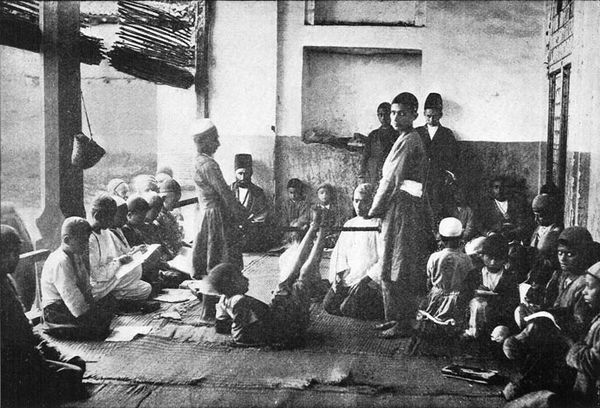
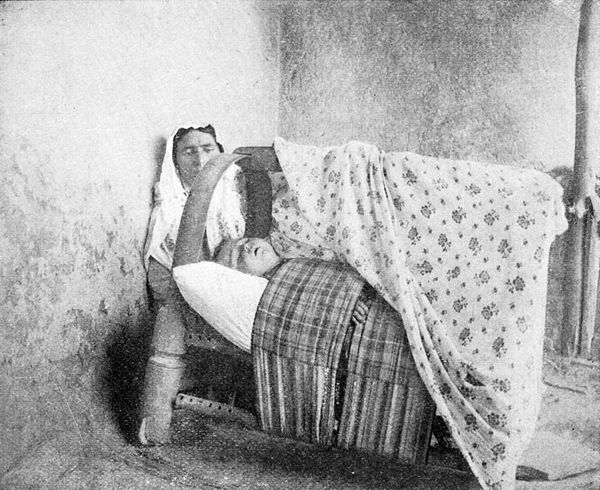
A Persian Boys’ School and the Favorite Mode of Punishment
There is no more extraordinary feature of the work
among the Bulu than the readiness with which this little
forest creature submits himself to the discipline of school.
From a heritage of liberty he comes to knock at the
Mission door and to set his little jiggered feet upon the
new way of order. He who came and went at will keeps
the commandments of the school drum. He who has
been bred to inter-tribal hatred eats out of the pot with
his hereditary enemy. He earns his food in all honor under
the Mission law of labor. He permits himself to be
“tied” with “ten tyings” to a standard of conduct which
is the reverse of his racial standards.
In the rude school house, with his alphabet before him,
or in the open, cutlass in hand, he performs daily acts
of order and discipline, and these little tasks are regenerative.
His little sister is beside him and subjected to
the same process. The presence of the Mission in a
Bulu community is a great blessing to a little girl. It is
a kind of sanctuary and a police patrol. I cannot think
that you would like to know from what perils it saves
her.... Such little girls, following in the paths after their
brothers, have come to own a slate, to own a primer, to
ply a needle, to sleep at night in peace under a Christian
thatch and in innocent company. (“Other Children”
by Jean Mackenzie, Wom. For. Miss. Soc. Pres.)
Ever since coming here I have talked to both men and
women, as occasion offered, about the folly of not allowing
girls to learn anything. When I felt pretty sure of
two little girls, I announced one Sunday to the women
who were gathered in my room that on Thursday I should
begin a girls’ school for any who cared to come. What
was my surprise and delight on Thursday to have one of
the Kashas (Old Church pastors) come bringing, not two
but four little girls who promptly walked up to me and
kissed my hand. The next day another, who had not
heard of the school the first day, came. After three days
one girl disappeared. On Saturday I visited her home
and found they were keeping her to work, and this,
according to my idea of the circumstances, seemed very
unnecessary, for I keep them only two hours a day at
present. When I expostulated with the father, he said,
“Why should I take the trouble to let her go to school,
when after a little time I’ll marry her into some other
family?” Here girls are married very young, at twelve
years, many of them. All I could say was of no avail.
During all this conversation poor Rachel sat between
us, the tears running down her face, and saying repeatedly,
“Father, let me go.” The father was too selfish to be
moved by her pleadings. (Letter from Mrs. E. W.
McDowell.)
Deut. 11:18–21 with 2d Tim. 1:5 and 3:14–17.
The natural, constant teaching of God’s commandments
in the daily life of the home by parents and grandparents
will prepare the children to lead prosperous, successful,
useful lives. What is learned in childhood “furnishes”
the man or woman for life.
“Therefore if to the goodness of nature be joined the
wisdom of the teacher in leading young wits into a right
and plain way of learning, surely children, kept up in
God’s fear, and governed by His grace, may most easily
be brought well to serve God and country both by virtue
and wisdom.” (Roger Ascham in the year 1570.)
O Lord Jesus Christ, Thou Child of Bethlehem, bless,
we beseech Thee, the children gathered in Christian
schools; may they be truthful, pure, obedient, and ever
ready to do their duty in that state of life to which Thou
shalt be pleased to call them, Who livest and reignest with
the Father and Holy Ghost, one God, world without end.
Amen.
1. Give five reasons for multiplying kindergartens and
primary schools in non-Christian lands.
2. In the missionary Forward Movement in China,
should the emphasis in advance educational work be
put on primary or on secondary education?
3. Give the reasons for and against an increase in
Missionary educational work in Japan. What is your
personal opinion on the subject?
4. Should the missionary teacher aim to secure a large
number of scholars, or to give more time and personal
attention to a few? Give your reasons for your answer.
5. If you were facing a school of fifty little children
who had absolutely no idea of education, cleanliness,
manners, morals, or Christianity, what would you try
to teach them during the first week? How would you
go about it? (This takes it for granted that you know
their language.)
The School and the Child, John Dewey.
Stages in Missionary Education, T. H. P. Sailer, Woman’s
Work, Sept., 1912.
Christian Missions and Social Progress, J. S. Dennis.
(Revell) vol. ii.
“On the Education of Backward Races,” E. W. Coffin,
Pedagogical Seminary, March, 1908.
Report on Educational Work of Bd. For. Miss. of Pres. Ch.
Daylight in the Harem, Van Sommer and Zwemer,
(Revell.)
Children of Persia, Mrs. Napier Malcolm, (Oliphant,
Anderson & Ferrier.)
Education of Girls in Persia, Moslem World, Oct., 1912.
The Education of the Women of India, M. G. Gowan,
(Revell.)
Modern India, Sir J. D. Rees, (George Allen and Sons.)
The Athletic Method in Kashmir, Henry Forman, Outlook,
Sept. 24, 1910.
Village Life in China, Arthur H. Smith, (Revell.)
The Education of Chinese Women, Margaret Burton.
Possibilities of the Kindergarten in China, L. Pearl
Boggs, Child Welfare Magazine, Feb., 1913.
“The Opportunity and Need for the Mission School in
China.” F. L. Hawks Pott, D.D., Intern’l Review
of Missions, Oct., 1912.
Report of the Kindergarten Union of Japan.
Fifteen Years among the Top-Knots, Mrs. Underwood,
(Am. Tract Soc.)
The Land of the White Helmet, Edgar Allen Forbes,
(Revell.)
| Into a New Life |
Woman’s Board of Missions of the Congregational Church. |
| Kwuli, a South Sea Maid |
| The Story of Aghavnitza |
| The Children’s Gardens |
| The Story of the Imadegawa Kindergarten |
| The Cesarea Kindergarten |
| Coral Island Brownies |
| Ling Te’s Letter |
Woman’s Foreign Missionary Society of the Presbyterian Church. |
| The New Persia |
Board of Foreign Missions of the Presbyterian Church. |
| Our Investments in India |
Woman’s Board of Foreign Missions of the Reformed Church in America. |
| Schools in the Arcot Mission, India |
| Hindu Girls’ School in Arcot Mission |
| Key to Hindu Homes |
| Educational Work in Japan |
| From Kindergarten to College |
Woman’s Foreign Missionary Society of the Methodist Episcopal Church. |
| A Peep into Yokohama Day Schools |
| A School Day at Aoyama |
| Luchmi |
|
How Orthodox Mohammedans Educate a Child |
Board of Foreign Missions of the Reformed Church in America. |
| Messages to Mass. from Blackmer Home, 1912 |
Woman’s Universalist Missionary Society of Massachusetts. |
| Story of Matsu Koyama |
| Midori Kindergarten |
| Concerning the Blackmer Home |
Woman’s National Missionary Association, Universalist. |