SATURDAY, AUGUST FIFTEENTH, 1812.
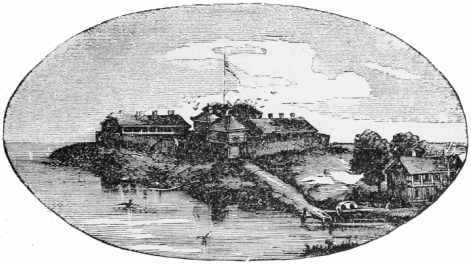
THE morning of Fort Dearborn's
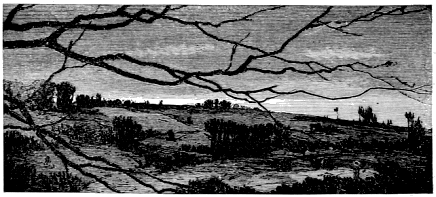
fatal day dawned bright and clear
over Lake Michigan and the
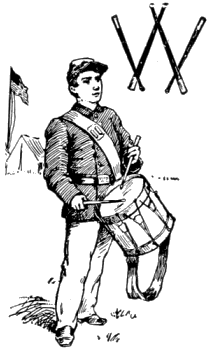
sandy flat. The "reveille" doubtless
was sounded before sun-rise;
and one can imagine the rattle
of the drum and scream of the
fife as they broke the dewy stillness
and floated away, over the sand-spit
and out on the lake; across the
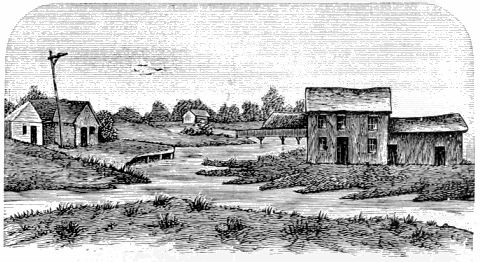
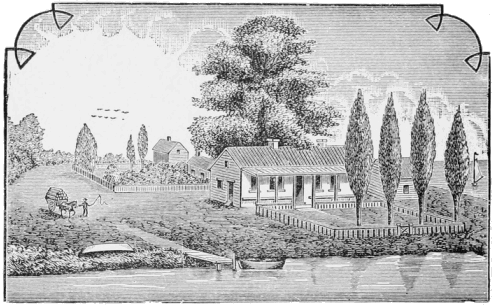
river to the Kinzie house and its
outbuilding, the Ouillemette house;
and up stream to the Indian encampments,
large, dark and lowering.
Quite possibly the tune then
prescribed was the same as that
now used for the drum-fife reveille,
together with the words that have
attached themselves to it of late years:
Wake ye lazy soldiers, rouse up and be killed,
Hard tack and salt horse, get your gizzard filled.
Then go to fighting—fire your forty round—
Fall dead and lay there buried under ground.
If this time-honored (and much hated) tune has come
down to us from so long, the words had on that morning
a significance even more perfect than that ordinarily
belonging to them.
Early the company cooks must have been at work,
boiling whole barrels of salt pork which had been in
soak for days beforehand, and as much fresh beef as
could possibly be used before spoiling. Bread had doubtless
been baked and packed earlier in the week, and now
all imaginable preparations for a march of nearly a month
must be completed and the utensils packed and loaded
into the company wagons. At each of the other, smaller
households outside the fort similar toils and cares were
going on. How were the lately weaned little ones to be
cared for? Perhaps some parents hoped that they could
drive their milch-cows with the caravan, seeing that
grass was plenty and progress would be necessarily slow.
What did the prospective mothers hope and fear? The
wife of Phelim Corbin; how did she arm her soul for the
month of rough travel, with the travail of child birth as
one of its terrors?
Certainly the happiest of the crowd were the unconscious
little ones, sure of love and care, full of hope and
curiosity—a round dozen of them in one wagon, beginning
the first journey of their innocent lives—the first
and last. Fancy the mothers tucking them in! The
eager little faces upturned for good-bye kisses!
All the workers might have spared themselves their
trouble. If they were thinking of their cows, the crack
of the Indian rifles soon ended that care. The food was
enough and to spare; not a morsel of it did they ever
eat. The journey of a month dwindled to a tramp of
an hour; and as to the precious children—
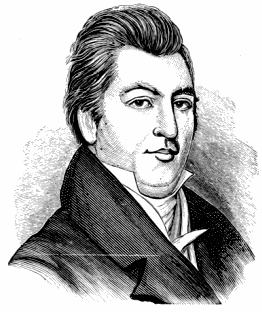
Captain William Wells had come, with thirty friendly
Indians (Miamis) to guard and help them through their
long, lonely tramp to Detroit. He was a white man, the
uncle of the commandant's young wife (Rebekah Wells
Heald), but had been stolen when a boy by the Indians
and brought up by them; had married a chief's daughter
and had fought on their side until, years ago, this same
young niece had gone to him and persuaded him to come
back to his own kith and kin. So any fears the helpless
settlers might have felt at first could now surely be put
aside—Wells was so strong, so brave, so well acquainted
with the Indians! He could doubtless keep them in
order, either by policy or by force.
But if all was well, why had Captain Wells blackened
his face—that is, put on the Indian sign of war and
death—before starting that morning? All accounts
agree that he did so, and usually it is taken as having
been a sign of consciousness of impending death. Mrs.
Helm[A] seems to have regarded it in this light. The
question can never be settled, but to me it seems to have
been an act of policy; an effort to identify himself with
his Miamis and other friendly Indians. Wau-Bun adds
the gruesome and almost incredible story that the start
out was made to the music of the dead march! As Mrs.
Helm was on horseback with the column she must have
known, and we can but take her word for it.
The large herd of beef-cattle was left to the savages.
This was probably the most precious gift of all put in
their hands by the abandonment of the post. The liquor,
if it had been left, would have been their bane, and the
fire-arms the mere instruments of mutual destruction.
The clothes must wear out, the flour be eaten up, the
tools and furniture useless, the paints and gew-gaws a
fleeting joy; but the herd! This would be self-sustaining,
self-perpetuating, a perennial fount of blessing and
mine of wealth. Here were food, clothing, shoes for
this year and all years to come. No tribe or nation of
their race had ever possessed such a treasure. How did
they avail themselves of it? Wau-Bun answers:
The fort had become a scene of plunder to such as remained
after the troops moved out. The cattle had been shot down as they
ran at large and lay dead or dying around. This work of butchery
had commenced just as we were leaving the fort.
No more characteristic bit of Indian painting has ever
been made than that given in these few words. Here was
the native savage (not ignorant of wiser ways, for he had
had the thrifty white man under his eyes for four generations)
still showing himself in sense a child, in strength
a man, and in cruelty a fiend incarnate.
Mrs. Helm continues:
I well remember a remark of Ensign Ronan, as the firing went
on. "Such," turning to me, "is to be our fate—to be shot down
like beasts."
"Well, sir," said the commanding officer, who overheard him,
"are you afraid?"
"No," replied the high-spirited young man, "I can march up to
the enemy where you dare not show your face!" And his subsequent
gallant behavior showed this to be no idle boast.
Unconsciously Mrs. Helm, in this artless tale told to
glorify the younger officer, awakens in our minds a feeling
of dislike for him. That a youth, scarce two years
out of West Point, should add an ill-timed insult to the
heavy cares of his senior officer, a soldier of thirteen years
service, must be shocking to every one. Seeing that
within two hours he was to die in action, bravely doing
his duty (in company with his senior similarly engaged
and sorely wounded) we can readily forgive his error,
but not without a protest against a foolish woman's foolish
effort to make it out a noble and praiseworthy outburst.
Mrs. Heald's narrative[B] (though fortified by Captain
Heald's letter, quoted later) seems less probable than the
foregoing circumstantial account in Wau-Bun. She
says:
The fort was vacated quietly, not a cross word being passed between
soldiers and Indians, and good-byes were exchanged. Not
an officer objected to leaving. Nobody objected but Kinzie, who
did so for personal reasons. Everything left was divided among
the Indians who were there, and a party of them escorted the
whites out of the fort, these Indians being the ones who took no
interest in the fight, although they may have known something
about it. The general impression among the officers (and this was
Captain Heald's idea also) was that the Indians who took their
share when the things were distributed at the fort, had no part in
the massacre.
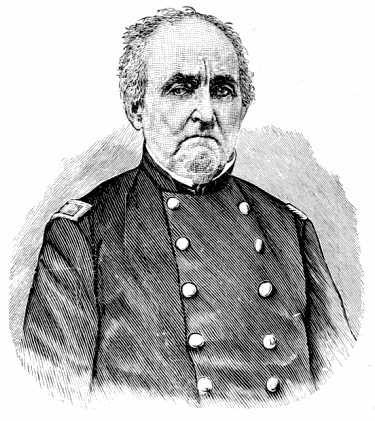
Captain Heald's force consisted of fifty-four regular
soldiers and twelve militia-men, and with them departed
every white inhabitant of the little settlement, men,
women and children—probably about thirty in all—ranging
in social condition from the prosperous Kinzies to the
humble discharged soldiers who had married and started
to make a living by tilling the soil, etc.
The Kinzie family was to go by boat, skirting along
the lake and keeping in touch with the land column as
long as it should hug the shore; later ascending the St.
Joseph's River to "Bertrand," or "Parc-aux-vaches," as
it was called, in memory of its having been the cow-pasture
of the old French-Canadian settlement and fort which
had stood on the bank of that river a century or so ago.
The boat-party consisted of Mrs. John Kinzie, her son,
John H., born at Sandwich, Canada, July 7, 1803, and
her other children—Ellen Marion (later Mrs. Alexander
Wolcott), born in Chicago, December, 1805; Maria Indiana
(later Mrs. General Hunter), born in Chicago, in
1807, and Robert A., born in Chicago in 1810. Her
daughter by a previous marriage, Margaret McKillip,
was, it will be remembered, now the wife of Lieutenant
Helm, and she bravely elected to share the perils of the
land-march with her husband. There was also in the boat
the nurse, Josette (misprinted in Wau-Bun, "Grutte"[C])
Laframboise (afterward Mrs. Jean Baptiste Beaubien), a
clerk of Mr. Kinzie's, two servants, the boatman, and two
Indians as guard. This shows that the boat must have
been neither a bark canoe nor a common "dug-out" or
"pirogue," but a large bateau, capable of carrying these
numerous passengers, with corresponding baggage and
supplies.

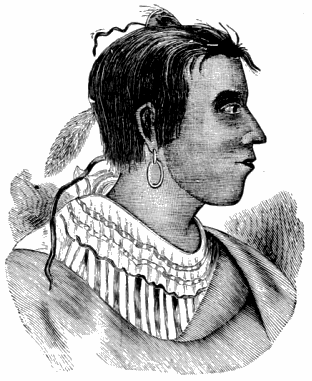
To-pee-nee-be, a friendly Indian, chief of the St. Joseph's
band, early in the morning of the fatal day, had
warned John Kinzie that trouble was to come from the
"escort" which Captain Heald had bargained for with
the Pottowatomies in council, and had urged him to go
in the boat with his family. But the old frontiers-man was
built of too sturdy stuff to take such advice. If there was
to be danger he must share it, and if help would avail he
must give it; so he rode with the column.
First rode out Captain William Wells, hero-martyr,
marching, probably consciously, to a doom self-inflicted
under the impulse of human sympathy and soldierly
honor. Following him were half of his mounted escort
of Miami Indians, followed in their turn by the volunteers
and such of the regulars as were able to bear arms. Next
came the short train of wagons, with stores, supplies,
camp-equippage, women, children, sick, wounded and
disabled. This little caravan contained all there was to
show for eight years of industry and privation. But what
mattered it? Greater savings would only have meant
greater loss, and more men, women and children would
only have meant more suffering and death.
The rear-guard was composed of the remainder of Captain
Wells's wretched Miamis, such reliance as is a broken
reed. The Miamis were mounted, as were Captain Wells,
Mr. Kinzie, Mrs. Heald and Mrs. Helm, but probably no
others of the party.
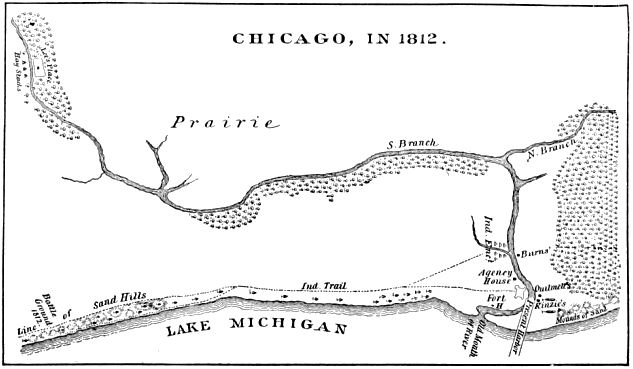
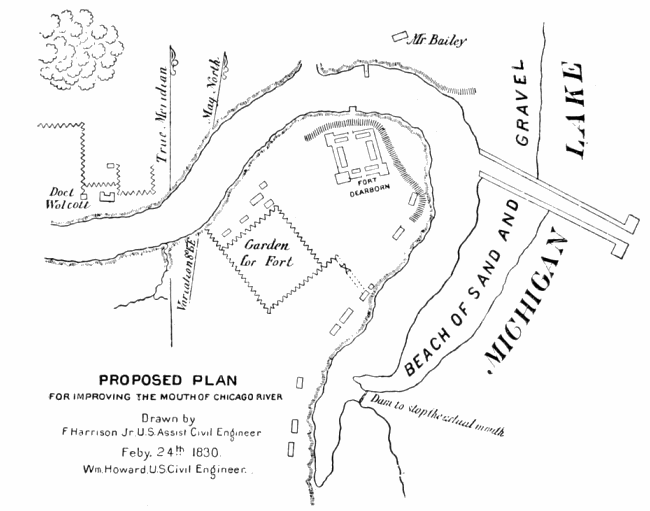
The day continued bright and sunny, and the line
must have stretched from the fort (about the south end of
Rush Street bridge) perhaps to the present Madison
Street, half way to the point where began the sand-dunes
or low hills which, even within the memory of the present
generation, skirted the shores down as far as the beginning
of the oak woods of Hyde Park. The bateau followed
in the rear of the column and had just reached the
mouth of the river (where the foot of Madison street now
is[D]) when a messenger from To-pe-nee-be brought the
Kinzie party to a halt.
The column had marched parallel with the Pottowatomie
"escort" until both bodies reached the sand-hills.
Then the whites kept by the shore-road, while the Indians,
veering slightly to their right, put the sand-hills between
their crowd and the slim, weak line of troops and wagons.
The reports of the fight itself, given by the two witnesses
on whom we must rely, do not differ materially
from each other. Mrs. Helm's narrative naturally treats
more fully of the Kinzie family's experiences; Mrs.
Heald's more fully of her own adventures and the death
of her uncle. Neither woman mentions the other; they
were probably separated early. I will give the stories in
turn, beginning with Mrs. Helm's.
MARGARET HELM'S STORY.
The boat started, but had scarcely reached the mouth of the
river, which, it will be recollected, was here half a mile below the
fort, when another messenger from To-pe-nee-be arrived to detain
them where they were. In breathless expectation sat the wife and
mother. She was a woman of uncommon energy and strength of
character, yet her heart died within her as she folded her arms
around her helpless infants and gazed on the march of her husband
and her eldest child [Mrs. Helm] to certain destruction.
They had marched perhaps a mile and a half [Fourteenth
Street], when Captain Wells, who had kept somewhat in advance
of his Miamis, came riding furiously back. "They are
about to attack us!" he shouted. "Form instantly and charge
upon them." Scarcely were the words uttered when a volley was
showered from among the sand-hills. The troops were hastily
brought into line and charged up the bank. One man, a veteran of
seventy winters, fell as they ascended.
After we had left the bank the firing became general. The
Miamis fled at the outset. Their chief rode up to the Pottowatomies
and said: "You have deceived the Americans and us. You
have done a bad action, and (brandishing his tomahawk) I will be
the first to head a party of Americans to return and punish your
treachery." So saying he galloped after his companions, who were
now scouring across the prairies.
Mrs. Helm does not say that she heard these words
when uttered, nor is it probable that she could have been
within hearing distance of the very head of the column,
or even could have understood the words unless
(what most unlikely) they were uttered in English.
The whole circumstance looks apocryphal—probably
a later Indian fabrication.
The troops behaved most gallantly. They were but a handful,
but they seemed resolved to sell their lives as dearly as possible.
Our horses pranced and bounded and could hardly be restrained as
the balls whistled among them. I drew off a little and gazed upon
my husband and father, who were yet unharmed, I felt that my
hour was come, and endeavored to forget those I loved and prepare
myself for my approaching fate.
This seems to be the moment where her narrative
diverges from that of Mrs. Heald, who evidently followed
the troops, as she was caught between a cross-fire of the
Indians, whom the advance had left on its flanks and
rear, and there received her wounds. Mrs. Helm's subsequent
narrative shows that she was, when rescued, unwounded
and near the Like.
While I was thus engaged, the surgeon, Dr. Van Voorhees, came
up. He was badly wounded. His horse was shot under him and
he had received a ball in his leg. Every muscle of his face was
quivering with the agony of terror. He said to me:
"Do you think they will take our lives? I am badly wounded,
but I think not mortally. Perhaps we might purchase our lives
by promising a large reward. Do you think there is any chance?"
"Dr. VanVoorhees," said I, "do not let us waste the few moments
that yet remain to us in such vain hopes. Our fate is inevitable. In
a few minutes we must appear before the bar of God. Let us make
what preparation is yet in our power."
"O, I cannot die!" exclaimed he. "I am not fit to die—if I had
but a short time to prepare—death is awful!"
I pointed to Ensign Ronan, who, though mortally wounded and
nearly down, was still fighting with desperation on one knee.
"Look at that man," said I; "at least he dies like a soldier."
"Yes," replied the unfortunate man, with a gasp, "but he has no
terrors of the future. He is an unbeliever."
When we read this remarkable dialogue—remarkable
as occurring amid the rattle of musketry on a battle-field
where the narrators' friends were perishing in a hopeless
struggle with an overpowering force of savage foes—we
remember that Mrs. Kinzie's book did not assume to be
history; was not written as a grave and literal record of
things as they were; a statement carefully scrutinized to
see that no unjust slur is cast upon any character, even
so unimportant a one as the poor wounded, dying surgeon.
Mrs. Helm, on the dreadful day, was a mere girl-wife
of seventeen years, and was a woman of thirty-seven
when Mrs. Kinzie transcribed the artless tale into Wau-Bun,
a book which reads like a romance, and was meant
so to be read.
The utterance of these admirable sentiments while still
in sight of Ensign Ronan, mortally wounded, yet fighting
with desperation on one knee, again puts us in doubt as
to Mrs. Helm's location on the field; but the next part of
her story shows that she was not far from the water.
At this moment a young Indian raised his tomahawk at me. By
springing aside I avoided the blow, which was intended for my
skull, but which alighted on my shoulder. I seized him around the
neck, and while exerting my utmost efforts to get possession of his
scalping-knife, which hung in a scabbard over his breast, I was
dragged from his grasp by another and an older Indian. The latter
bore me struggling and resisting toward the lake. Notwithstanding
the rapidity with which I was hurried along, I recognized, as I
passed them, the remains of the unfortunate surgeon. Some murderous
tomahawk had stretched him upon the very spot where I had
last seen him.
I was immediately plunged into the water and held there with a
forcible hand, notwithstanding my resistance. I soon perceived,
however, that the object of my captor was not to drown me, for he
held me firmly in such a position as to place my head above water.
This reassured me, and regarding him attentively I soon recognized,
in spite of the paint with which he was disguised, The Black
Partridge.
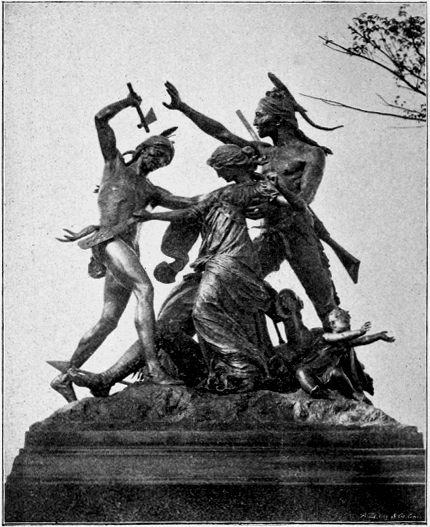
This picturesque narrative of the rescue of a young
bride by a friendly Indian, has been justly regarded as
the one romantic story connected with that dark and
bloody day. It has been the chosen theme of the story-teller,
the painter and the sculptor, and its portrayal in
perennial bronze forms the theme of the magnificent
group which has been designed and modeled by the
sculptor, Carl Rohl-Smith, cast in bronze, and presented
(June, 1893), with appropriate ceremonies, to the
Chicago Historical Society, "in trust for the city and
for posterity" as set forth by an inscription on its
granite base.[E]
Mrs. Helm goes on:
When the firing had nearly subsided my preserver bore me from
the water and conducted me up the sand-banks. It was a burning
August morning, and walking through the sand in my drenched
condition was inexpressibly painful and fatiguing. I stooped and
took off my shoes to free them from the sand with which they were
nearly filled, when a squaw seized and bore them off, and I was
obliged to proceed without them.
When we had gained the prairie [probably at about Twelfth
Street] I was met by my father [her step-father, John Kinzie], who
told me that my husband was safe, but slightly wounded. They
led me gently back toward the Chicago River, along the southern
bank of which was the Pottowatomie encampment. At one time I
was placed on a horse without a saddle, but finding the motion insupportable,
I sprang off. Supported partly by my kind conductor,
Black Partridge, and partly by another Indian, Pee-so-tum, who
held dangling in his hand a scalp which, by the black ribbon
around the queue, I recognized as that of Captain Wells, I dragged
my fainting steps to one of the wigwams. The wife of Wah-bee-nee-mah,
a chief from the Illinois River, was standing near, and seeing
my exhausted condition, she seized a kettle, dipped up some
water from the stream that flowed near [the slough that emptied
into the main river at about the south end of State Street bridge],
threw into it some maple sugar, and stirring it up with her hand,
gave it to me to drink. This act of kindness in the midst of so
many horrors touched me most sensibly, but my attention was
soon diverted to other objects.
The whites had surrendered after the loss of about two-thirds
their number. They had stipulated, through the interpreter,
Peresh Leclerc, for the preservation of their lives and those of
the remaining women and children, and for their delivery at some
of the British posts, unless ransomed by traders in the Indian country.
It appears that the wounded prisoners were not considered as
included in the stipulation, and a horrible scene ensued on their
being brought into camp. An old squaw, infuriated by the loss of
friends, or excited by the sanguinary scenes around her, seemed possessed
by a demoniac ferocity. She seized a stable-fork and assaulted
one miserable victim who lay groaning and writhing in the agony of
his wounds, aggravated by the scorching beams of the sun. With
a delicacy of feeling scarcely to have been expected under such
circumstances, Wah-bee-nee-mah stretched a mat across two poles,
between me and the deadful scene. I was thus spared, in some
degree, a view of its horrors, although I could not entirely close
my ears to the cries of the sufferer.
The disgrace attaching to the British government in
seeking alliance with such savages in a war against civilized
beings of its own race, is elsewhere fully treated.
One can only wish that those cries might have reached
the women of all England, instead of falling fruitlessly on
those of one poor, exhausted, helpless American girl, and
of the red hell-spawn grinning and dancing with delight
at the sound.
Such is the tale as first given to the world by Mrs.
Kinzie in "Wau-Bun." I will now present the narrative
of the same struggle, defeat, surrender and massacre
as often told by Mrs. Captain Heald to her son, the Hon.
Darius Heald, and by him to me. The two are not,
in essentials, contradictory; each completes and rounds
out the other.
After giving the account of the peaceable start from
the fort (inconsistent with Mrs. Helm's story, already
quoted, and less truth-seeming than the latter), she goes
on to say:
REBEKAH HEALD'S STORY.
Captain Wells' escort was mounted on Indian ponies. Captain
Wells himself was mounted on a thoroughbred. Mrs. Heald and
Mrs. Helm were also on horseback, the former on her own beloved
Kentucky horse.
They advanced, Wells and his escort getting about a quarter of
a mile ahead, and were jogging along quietly when all at once
they halted, and he turned back and got down pretty close to
Captain Heald—perhaps half the distance. He pulled off his hat
and swung it around his head once or twice, making a circle. As
soon as he saw Wells coming back, Captain Heald said to his
wife: "Uncle sees something ahead of him there. There is
something wrong." And when he made the circle around his
head, Mrs. Heald understood the sign, "We are surrounded by
Indians." Captain Wells soon got close enough to shout "We
are surrounded by Indians. March up on the sand-ridges. There
are sand-ridges we ought to get in behind where we can stand half
up and not be seen." Then she saw the Indians' heads "sticking
up and down again, here and there, like turtles out of the water."
They marched up on the sand-ridges, the wagons being put back
next to the lake and the men taking position in front of them.
Captain Wells shouted to Captain Heald, "Charge them!" and
then led on and broke the ranks of the Indians, who scattered
right and left. He then whirled round and charged to the left.
This move brought them well out into the country, and they
marched onward and took position about two or three hundred
yards in front of the wagons and a like distance from the Indians.
Captain Heald rather gave way to Captain Wells, knowing his
superior excellence in Indian warfare, Wells having been trained
from childhood by such warriors as Little Turtle, Tecumseh and
Black Hawk; especially by the first two.
Here to the eye of common-sense, whether soldierly or
civilian, the battle is already gone—lost beyond salvation.
The onus of blame appears to rest on poor Wells,
the brave, devoted volunteer. He had learned war in a
school that took no account of the supply-train; in the
school of individual fighters, living on nothing, saving
no wounded or non-combatants; dash, scurry, kill, scalp
and run away, every man for himself—and the devil take
the hindmost—in other words the Indian system. As to
this band of whites, what had it to fight for but its train
of wagons with all the helpless ones, all the stores, all
the ammunition, all the means of progress and of caring
for the wounded? To charge the centre of a brave, unformed
rabble which outflanks you is only heroic suicide
at best, and when the doing so leaves the train at the
mercy of the spreading flanks of the foe, it is fatal madness.
To return to the Heald narrative:
Another charge was made which enabled Captain Wells to get
a little closer to the Indians. He had two pistols and a small gun.
His bullets and powder were kept in shoulder belts, hung at convenient
places, and he generally had an extra bullet in his mouth,
which helped him to load fast when necessary. He could pour in
a little powder, wad it down, "blow in" the bullet, prime and fire
more quickly than one can tell the facts. The Indians broke from
him right and left. The hottest part of the battle lasted but a few
minutes, but Captain Heald's little band was cut down. He gave
the signal for surrender; the chiefs came together and they made
a compromise.
By this time Wells, Ronan and Van Vorhees were
killed, Heald had a bullet in his hip, Mrs. Heald had a
half dozen wounds, half the regulars were killed or
wounded, and so far as we now know for certain, all
twelve militia-men. (A doubt about this last named
unexplained mortality, and suggestion as to the probable
manner of their death, will be noted later.) Darius
Heald could only say:
Afterwards, in talking the matter over, Captain Nathan Heald
said that he had no confidence in the Indians, but that he had
done the best he could do; that in fifteen minutes more the last
man would have been killed, as they had no chance at all; his
men were falling rapidly, and he himself was wounded in the hip
by a one-ounce ball. That ball was never extracted, and caused
his death twenty years afterward.
In any circumstances, one cannot cast blame on a
beaten commander, negotiating with his victorious foes,
while bleeding from a bullet deep-bedded in his hip-joint.
In this case, it is not likely that blame would be due,
even if Captain Heald had been unhurt. But for his
surrender, the Chicago Massacre would have been, on a
small scale, the fore-runner of the great Custer slaughter,
where not a white man lived to tell the tale. Every
man, woman and child of white blood (except perhaps
the Kinzies and Lieutenant Helm), would now be in
oblivion almost as if they had never been born. Even
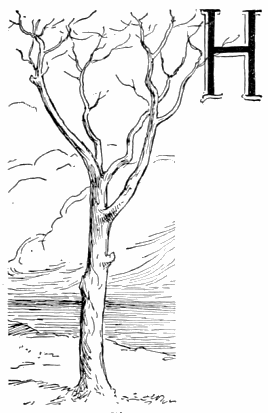
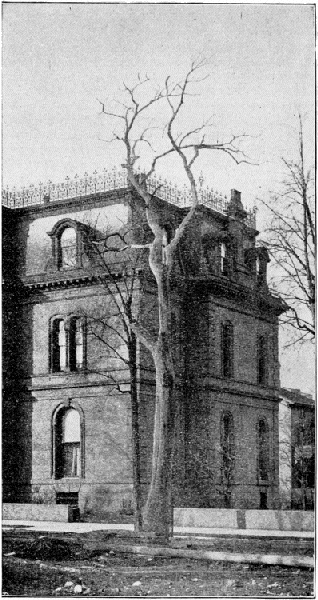
the "massacre tree" that stands to-day (1893) in
Eighteenth street near the lake, in gaunt, leafless old age,
could only have been identified by the bleaching skulls,
great and small, which surrounded it when General Cass
passed the spot a few years afterward.
Here we take up again Mrs. Heald's personal story:
After the fighting commenced, Mrs. Heald turned back and
ascended a little elevation between the army and the wagons. She
saw a young, fine-looking officer fall [probably Lieutenant Ronan]
and thought it was her husband, and was under this impression
until after the fight was over. Just before the surrender, she got
up in range of the bullets coming from Indians on both sides of
her. She did not know whether the Indians aimed at her or not,
but she was wounded in six places, one hand being rendered helpless,
the ball passing between the two bones of her arm. Her son
has seen the scar a thousand times.
I have remarked that Mrs. Heald does not mention
the presence of Mrs. Helm, nor does the latter that of
the former. We judge from this, and from Mrs. Helm's
account of her being saved by being plunged in the lake,
that the latter remained nearer the shore than did the
other.
DEATH OF CAPTAIN WELLS.
Captain Wells, who was shot through the lungs, rode up and
took her hand, saying: "Farewell my child." Mrs. Heald said
to him: "Why uncle, I hope you will get over this." "No my
child," he said, "lean not." He told her he was shot through
the lungs, and she saw the blood oozing through his nose and
mouth. He still held her hand and talked to her, saying that he
could not last five minutes longer. He said: "Tell my wife—if you
live to get there, but I think it doubtful if a single one gets there—tell
her I died at my post doing the best I could. There are seven
red devils over there that I have killed."
His horse, which had been shot just behind the girth, then fell
and caught Captain Wells' leg under him. As he did so, Captain
Wells turned and saw six or seven Indians approaching them. He
took aim and fired, killing one of them. They approached still
closer, and Mrs. Heald said to him: "Uncle, there is an Indian
pointing right at the back of your head." Captain Wells put his
hand back and held up his head that better aim might be taken,
and then cried "Shoot away!" The Indian fired, the shot being
fatal. They then pulled him out from under his horse (Mrs. Heald
still seated on her horse near by) and cut his body open, the gashes
being in the shape of a cross. They took out his heart, placed it
on a gun-stick and whirled it round and round, yelling like fiends.
The noise drew other Indians to the spot and they then commenced
cutting up the heart and eating it. They crowded around and the
bleeding heart was thrust forward at one after another.
Finally an Indian cut off a piece, held it up to Mrs. Heald and
insisted on her eating it. She shook her head. He then daubed
her face with it. She shook her fist at him. Then they called
her "Epeconier! Epeconier!" this being their name for Captain
Wells—thus signifying that she was a Wells—a person full of
pluck and fortitude.
So nobly perished one of the best and bravest frontiers-men,
fighting where he had been summoned by sympathy
and affection, not by the orders of any superior officer.
No knight ever set lance in rest under a more purely
chivalric impulse than did this plain, pretending, half-educated
pioneer. Two hundred and fifty miles away
he had heard the warning note of peril, seen the fair
young face of his brother's daughter (she who long
before had sought him out among his savage captors and
restored him to his kins-folk), and felt the impulse of
manly self-devotion to save her and her friends from
impending doom. He obeyed the noble impulse and—he
died like a man, and somewhere beneath our thoughtless
footsteps his bones lie buried.[F]
In the Calumet Club is preserved the identical hatchet
worn by Captain Wells during the last fight, with
authenticating documents furnished by James Madison
Wolcott, of South Toledo, Ohio, his grandson by his wife
Wa-nan-ga-peth (daughter of Me-che-kan-nah-quah or
Little Turtle) through his daughter Ah-mah-qua-zah-quah
("A sweet breeze"), who married Judge James
Wolcott. It is related that Wa-nan-ga-peth received the
news of her husband's death from a stranger Indian who
entered, told the message, laid down the hatchet in token
of its truth, and departed, unknown as he came.
This narrative of the fight itself, as seen by Mrs.
Heald and related to me by her son, is marked by a style of
severe simplicity and good faith that seems to command
confidence in the mind of the reader. There is no point
in the artless story where one is compelled to pause and
make a mental allowance for the bias of the narrator, for
her excitement and the uncertainty such a state of mind
might throw over her accuracy, or even for the errors
(save those of omission) which the lapse of years might
have caused. All seems natural, unforced and trustworthy.
The story goes on:
In the meantime her horse, which had become excited during
the tumult by the smell of blood, commenced prancing around, and
an Indian took him by the bit and led him down to the corral, or
Indian camp near the fort. [This was on the banks of a slough
which entered the river at about where State Street bridge now
stands.] Approaching them, an Indian squaw caught sight of the
bright-red blanket which was girted on over Mrs. Heald's saddle,
for camping purposes, and immediately attempted to take it for her
own. Mrs. Heald resisted vigorously, and although one hand was
entirely useless and the other badly injured, she took her switch
and with it struck the squaw such hard blows that "white welts
were raised on her red hide." After this exhibition of spirit, the
Indian who had hold of the horse's bit again shouted, "Epeconier!
Epeconier!" and it is probably this display of daring which saved
Mrs. Heald's life, and perhaps her husband's also.
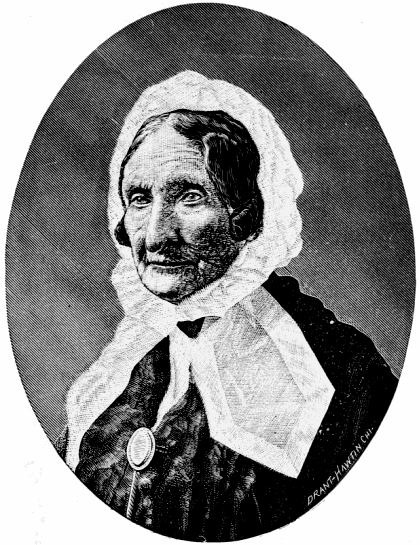
Rebekah Wells Heald was evidently worthy of her
name. Daughter of Captain Samuel Wells, niece of Captain
William Wells, wife of Captain Nathan Heald, she
was a woman whom the sight of blood could not daunt,
the smart of wounds weaken, or the fear of bereavement
subdue. (For many hours after the battle she supposed
herself a widow.) Her son Darius (her mouthpiece in
this narrative) was not born until nine years after that
dreadful day; and now (1893), in his seventy-third year,
he shows the family form and spirit. Tall, stalwart,
erect and dignified, he is a typical southern-westerner, a
mighty hunter in the past and a tower of patriarchal
strength in his old age.
When she was brought in, after being captured and led down
among the Indians, she was stripped of her jewelry—rings, breast-pin,
ear-rings and comb. She was badly wounded, and was cared
for that night (the fifteenth of August) as tenderly as a sister, by two
or three squaws and one French woman, who did everything in
their power to relieve her. She saw nothing of her jewelry till the
next morning, when a brave made his appearance and pranced
around, taking great pains to shew that he was wearing her comb
in his scalp-lock—a performance fraught with difficulties, as he
had hardly enough hair to keep it in, and found it necessary to push
it back from time to time to prevent it from falling to the ground.
Poor black Cicely she never saw again[G]. She had perished with the
rest. Her horse, too, was gone forever.
This horse was a thoroughbred, the same one that Mrs.
Heald, as a bride, had ridden from Kentucky a year before.
The Indians had always looked on it with envious
eyes, and had employed all means, lawful and otherwise,
to get it from the fort. Now it was theirs by conquest,
and no later efforts availed to recover it. Doubtless among
its new owners its fate was hard and its life short. One
winter of starvation, exposure and abuse would "hang its
hide on the fence," even while its wretched Indian-pony
companions were living on in stubborn endurance.
It turned out afterwards that the Indians took their booty down
to Peoria, to sell and "trade" for whisky, and it found its way
quickly to St. Louis, where Colonel O'Fallon recognized a great
deal as belonging to the Healds, and redeemed it and sent it to
Colonel Samuel Wells at the Falls of the Ohio [Louisville] as a
memento of his daughter and her husband, both supposed to be
dead. It reached there before the Healds did, and the articles are
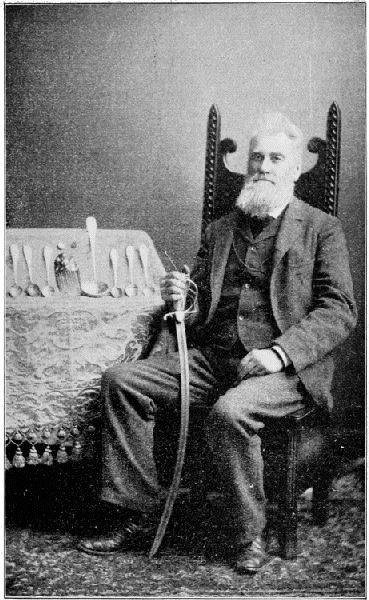
now in possession of the family; most of them were shown by
Hon. Darius Heald in Chicago, in 1892, when the before-mentioned
short-hand transcript of his mother's story was made, and he and
his precious relics were photographed, making a picture hereinafter
presented. (See Appendix E.)
The Indian who led Captain Heald down to the camp and
claimed him as his prisoner, was a half-breed named Chandonnais.
He afterward found that Mrs. Heald was still alive, and, it is supposed,
ransomed her from her captor; for, on the morning of the
sixteenth, he brought the husband and wife together. He seems
to have connived at the escape of both, for they found the matter
wonderfully easy—boat and escort at hand and all oversight withdrawn.
Years afterward, in 1831, Chandonnais visited the Healds
at their home, near O'Fallon, Missouri, and Darius Heald remembers
his father's meeting and greeting the brave who had so nobly
rescued them. It is thought that the Indians went off down the
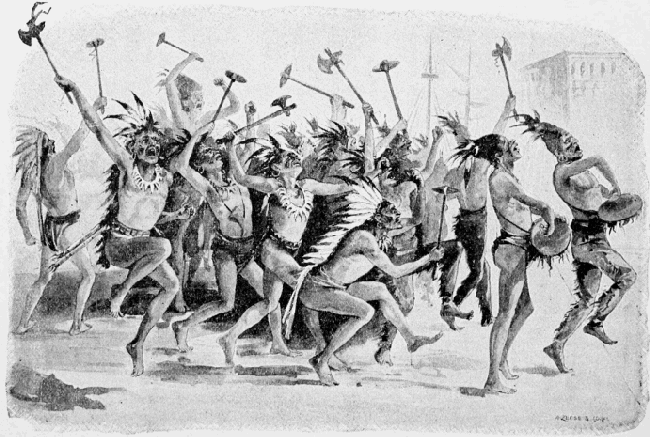
lake to have "a general frolic"—in other words, torture to death
the wounded prisoners.
Here arises before the mind's eye the dim and cloudy
vision of horror, the acme of the tragedy, all the more
appalling for its shrouding mystery. It makes the flesh
creep and the hair stand on end. It sears the heart
against the race whereof it was the inborn nature to
feel in the eyes a love for the sight of mortal agony,
in the ears an eagerness for the shriek of despairing
anguish.
The wounded not included! The helpless picked out
for torture! The inflamed hurts to be deepened with a
pitchfork and perhaps further and mortally inflamed with
a burning brand! Kindly Nature's passing lethargy to
be quickened into conscious death in frantic anguish!
The twelve militia-men are never again mentioned.
They are as if they had never been born, lived and toiled,
never volunteered, never served, fought and fell. How
is this to be accounted for? Why should their mortality
be twice as great as that of the regulars? Darkness hides
the answer; but it seems not unlikely that the same hellish
ingenuity which held that "the wounded were not included,"
may also have held that men not wearing the uniform
were not protected by the capitulation, and so they
perished at the stake, surrounded by the "general frolic"
which occupied the savages, good and bad, friendly and
inimical, during the flight of the Healds and Kinzies.
There was no place on earth for a race which, through
all its history, had found delight in the spectacle of pain,
which inflicted torture, not as a means leading to some
ulterior object, but as itself a source of joy and gladness.
The race is still in existence, but the inhuman part of its
characteristics are being refined away, leaving some of
its best traits in the more advanced of its present representatives.
Later on in this volume mention is made of
its standing and its prospects at this time.
Now to take up again the Wau-Bun narrative. The
torturing incident, already given, evidently ends the story
of Mrs. Helm's personal experiences; all that follows being
what others professed to have seen. Yet (possibly by
typographical error) the quotation marks, which began
with the narration, are continued much further on, including
paragraphs wherein she is spoken of in the third
person. (See later.) Mrs Helm says:
The Americans, after the first attack by the Indians, charged
upon those who had concealed themselves in a sort of ravine intervening
between the sand-banks and the prairie. The latter gathered
themselves into a body, and after some hard fighting, in which the
number of whites had become reduced to twenty-eight, this little
band succeeded in breaking through the enemy and gaining a
rising ground not far from the oak woods.
The contest now seemed hopeless, and Lieutenant Helm sent
Peresh Leclerc, a half-breed boy in the service of Mr. Kinzie, who
had accompanied the detachment and fought manfully on their
side, to propose terms of capitulation. It was stipulated that the
lives of all the survivors should be spared and a ransom permitted
as soon as practicable.
Lieutenant Helm made the terms of capitulation? How
could that be while Captain Heald was present? And
what is to be done with Captain Heald's statement of
October 7, 1812, less than three months after the event?
It reads as follows: "The Indians did not follow me
but assembled in a body on the top of the bank, and,
after some consultation among themselves, made signs
for me to approach them. I advanced toward them
alone and was met by one of the Pottowatomie chief
called Black Bird, with an interpreter."
The reader will of course choose between the two statements
according to his judgement of probabilities and
internal evidence of truthfulness. Captain Heald certainly
cast no slur on Lieutenant Helm, and appears not
even to have entered into the bitterness of feeling against
himself and his unhappy surgeon, which seems to have
gone on rankling through all the twenty years that
elapsed between the direful day and the telling of the
story by Mrs. Helm to Mrs. Kinzie.
Mrs. Helm's expression, "Peresh Leclerc, a half-breed
boy in the service of Mr. Kinzie who had accompanied
the detachment and fought manfully on their side," leaves
a possible ambiguity as to whether it is the boy or his
master who fought manfully on the side of the whites.
Next follows one of the most noteworthy parts of all
Mrs. Helm's narrative, the few words which depict the
act of ferocity by which the occasion has been given
much of its picturesque and terrible individuality:
But in the meantime, a horrible scene had been enacted. One
young savage, climbing into the baggage-wagon containing the
children of the white families, twelve in number, tomahawked the
children of the entire group.[H]
This harrowing tale is strongly confirmed by Captain
Heald's estimate of losses as given in his letter of Oct.
seventh (already quoted), which he states as follows:
"Our strength was about fifty-four regulars and twelve
militia, out of which twenty-six regulars and twelve militia
were killed in action, with two women and twelve children.
Ensign George Ronan and Dr. Isaac V. Van Vorhees, of
my company, with Captain Wells of Fort Wayne, to my
great sorrow are numbered among the dead. Lieutenant
Linai T. Helm, with twenty-five non-commissioned officers
and privates, and eleven women and children, were
prisoners when we separated."
The next part of Mrs. Helm's narrative is remarkably
at variance with the stern, true-seeming and circumstantial
account of Captain Wells' death given by Mrs.
Heald. Mrs Helm says (following the statement of the
slaughter of the innocents):
This was during the engagement near the sand-hills. When
Captain Wells, who was fighting near, beheld it, he exclaimed,
"Is that your game, butchering women and children? Then I
will kill too!" So saying, he turned his horse's head and started
for the Indian camp near the fort, where had been left their squaws
and children. Several Indians pursued him as he galloped along.
He laid himself flat on the neck of his horse, loading and firing in
that position as he would occasionally turn on his pursuers. At
length their balls took effect, killing his horse and severely wounding
himself At this moment he was met by Winnemeg and Wau-ban-see
who endeavored to save him from the savages who had
now overtaken him. As they supported him along, after having
disengaged him from his horse, he received his death blow from
another Indian, Pee-so-tum, who stabbed him in the back.
When we observe the incongruities of this tale (not to
speak of its contradiction by Mrs. Heald's report) such as
the witnessing by Captain Wells of the wagon slaughter
(at a time when we know he was far away inland, fighting
at the head of the troops); of his alleged dastardly
flight from the field toward the Indian camp a mile-and-a-half
away, with the avowed intention of killing the
squaws and pappooses; his being overtaken on horseback
by pursuing enemies on foot; his being held up by
two Indians while a third stabbed him in the back, the
third being the very one who helped Mrs. Helm to reach
the fort; we are only glad to remember that the narrator
did not mean to have us understand that she witnessed
the occurrences she relates. Internal evidence leads us
to suspect that the story came to her from the lips of
lying Indians, eager to magnify to Mr. Kinzie their
deeds of valor and of kindness, and perhaps justify their
treatment of poor Wells, alive and dead. Pee-so-tum
may have killed and scalped Wells, but it surely was
not under such circumstances as those above set forth.
Not even the best friends of the Indian claim for him
any appreciation of the virtue of mere veracity. Personal
faithfulness of the most touching character he often
showed. Even the keeping of promises, often at the cost
of great personal sacrifice, has been known as a striking
and admirable trait. But "truth for truth's sake" is
beyond him—as it is, indeed, beyond the great mass of
mankind.
The Wau-Bun story of the experiences of the Kinzie
family bears evidences of authenticity and reasonable
accuracy, as might be expected from the fact that Mrs.
John H. Kinzie probably got it directly from her husband's
mother, Mrs. John Kinzie, who was alive at the time
when it was first written.
Those of the family of Mr. Kinzie who had remained in the boat
near the mouth of the river were carefully guarded by Kee-po-tah
and another Indian. They had seen the smoke, then the blaze,
and, immediately after, the report of the tremendous discharge
sounded in their ears. Then all was confusion. They realized
nothing until they saw an Indian come towards them from the
battle-ground leading a horse on which sat a lady, apparently
wounded.
"That is Mrs. Heald," cried Mrs. Kinzie. "That Indian will
kill her. Run Chandonnais," to one of Mr. Kinzie's clerks, "Take
the mule that is tied there and offer it to him to release her."
Her captor by this time was in the act of disengaging her bonnet
from her head in order to scalp her. Chandonnais ran up, offered
the mule as a ransom, with the promise of two bottles of whisky
as soon as they should reach his village. The latter was a strong
temptation. "But," said the Indian, "She is badly wounded—she
will die—will you give me the whisky at all events?" Chandonnais
promised he would, and the bargain was concluded. The
savage placed the lady's bonnet on his own head and after an ineffectual
effort on the part of some squaws to rob her of her shoes
and stockings, she was brought on board the boat, where she lay
moaning with pain from the many wounds she had received in
both arms.
In this narrative the Indian bargains that he shall have
his booty whether the prisoners live or die. This stipulation
indicates the savage's view of the value of a prisoner.
If likely to live, and therefore exchangeable for
ransom, then his life might be spared; if not, then he
belonged to his captor and could be used for the keen delight
of torture. This is probably the idea which inspired
the hellish notion of the exclusion of the wounded from
Captain Heald's capitulation. For the unhurt they could
get ransom, therefore they would spare their lives. But
the wounded! Why spare them? They are not merchantable.
Nobody will give anything for a dead man.
The dying are available for only one profit—torture.
When the boat was at length permitted to return to the mansion
of Mr. Kinzie, and Mrs. Heald was removed to the house, it became
necessary to dress her wounds. Mr. K. applied to an old
chief who stood by, and who, like most of his tribe, possessed some
skill in surgery, to extract a ball from the arm of the sufferer. "No,
father," he replied, "I cannot do it; it makes me sick here," laying
his hand on his heart. Mr. Kinzie then performed the operation
himself with his penknife.
The discrepancy observable between this account and
that of Mrs. Heald herself, which says that on that night
she was cared for by squaws in the Indian encampment,
may be explained away by supposing that it was on the
following day, after the Kinzies had got back to their
home on the north bank, that Mrs. Kinzie caught sight
of her friend and sent Chandonnais to her rescue in one
of the boats they always used for passing and repassing
the river, at about where Rush Street bridge now stands.
The fact that no mule could well have been tied where
the boat lay offshore, near the river's mouth, makes this
seem the probable explanation of the incongruity.
At their own mansion the family of Mr. Kinzie were
closely guarded by their Indian friends, whose intention
it was to carry them to Detroit for security. The rest of
the prisoners remained at the wigwams of their captors.
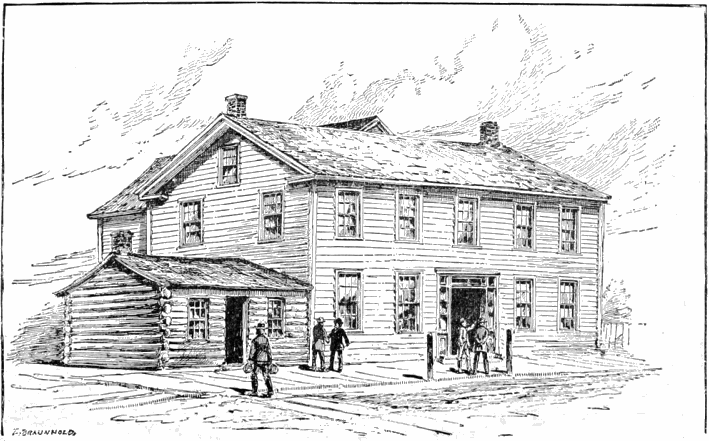
Mrs. Helm, Mr. Kinzie's step-daughter, must have been
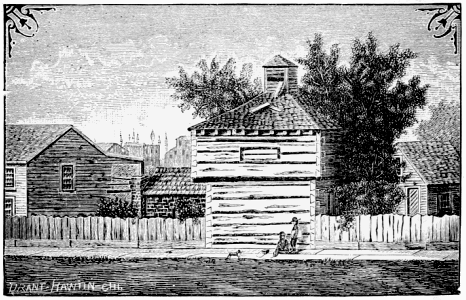
among those once more housed at the historic building of
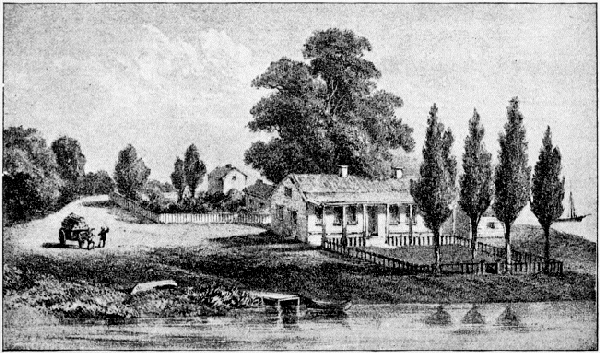
squared logs built about 1776, by Pointe de Saible. This
house was still standing when the village had become, in
name at least, a city, which it did in 1837. Mr. Kinzie
had planted along its front four poplar trees, and they appear
in the early pictures of Chicago. Doubtless, if one
were to dig in the open space on the east side of Pine
Street, at its junction with Kinzie street, the old roots
would be found to this day (1893), and there are probably
a hundred living Chicagoans who remember having
seen the house itself.
The following morning, the work of plunder having been completed,
the Indians set fire to the fort. A very fair, equitable distribution
of the finery appeared to have been made, and shawls,
ribbons and feathers fluttered about in all directions. The ludicrous
appearance of one young fellow, who had arrayed himself in
a muslin gown and the bonnet of one of the ladies, would, under
other circumstances, have afforded matter of amusement.
Black Partridge, Wan-ban-see and Kee-po-tah, with two other
Indians, having established themselves in the porch of the building
as sentinels, to protect the family from any evil the young men
might be excited to commit, all remained tranquil for a short space
after the conflagration. Very soon, however, a party of Indians
from the Wabash made their appearance. These were, decidedly,
the most hostile and implacable of all the tribes of the Pottowatomies.
Being more remote, they had shared less than some of their
brethren in the kindness of Mr. Kinzie and his family, and consequently
their sentiments of regard for them were less powerful.
The Wabash Indians must have been smarting with the
terrible defeat inflicted on them only about one year
before, when General Harrison, whose confidential agent
poor Wells had been, fought them at Tippecanoe, on the
banks of the Wabash River.
Runners had been sent to the villages to apprise them of the
intended evacuation of the post, as well as of the plans of the Indians
assembled to attack the troops. Thirsting to participate in
such a scene, they hurried on, and great was their mortification on
arriving at the Aux Plaines [Des Plaines River] to meet with a
party of their friends bearing with them Nee-scot-nee-meg badly
wounded, and to learn that the battle was over, the spoils divided
and the scalps all taken. On arriving at Chicago they blackened
their faces and proceeded toward the dwelling of Mr. Kinzie.
From his station on the piazza, Black Partridge had watched
their approach, and his fears were particularly awakened for the
safety of Mrs. Helm (Mr. Kinzie's step-daughter), who had recently
come to the post and was personally unknown to the more remote
Indians.[I] By his advice she was made to assume the ordinary dress
of a French woman of the country; namely, a short gown and petticoat,
with a blue cotton handkerchief wrapped around her head. In
this disguise she was conducted by Black Partridge himself to the
house of Ouilmette, a Frenchman with a half-breed wife, who
formed part of the establishment of Mr. Kinzie, and whose dwelling
was close at hand. It so happened that the Indians came first to
this house in their search for prisoners. As they approached, the
inmates, fearful that the fair complexion and general appearance
of Mrs. Helm might betray her for an American, raised a large
featherbed and placed her under the edge of it, upon the bedstead,
with her face to the wall. Mrs. Bisson, the sister of Ouilmette's
wife, then seated herself with her sewing on the edge of the bed. It
was a hot day in August, and the feverish excitement of fear and
agitation, together with her position, which was nearly suffocating,
became so intolerable that at length Mrs. Helm entreated to be released
and given up to the Indians.
"I can but die," said she; "let them put an end to my misery at
once."
Mrs. Bisson replied: "Your death would be the destruction of
us all, for Black Partridge has resolved that if one drop of the blood
of your family is spilled, he will take the lives of all concerned in
it, even his nearest friends; and if once the work of murder commences
there will be no end of it so long as there remains one
white person or half-breed in the country."
This expostulation nerved Mrs. Helm with fresh resolution. The
Indians entered, and she could occasionally see them from her hiding-place,
gliding about, stealthily inspecting every part of the
room, though without making any ostensible search, until, apparently
satisfied that there was no one concealed, they left the house.
All this time Mrs. Bisson had kept her scat upon the side of the
bed, calmly basting and arranging the patchwork of the quilt on
which she was engaged, and preserving the appearance of the utmost
tranquility, although she knew not but that the next moment
she might receive a tomahawk in her brain. Her self command
unquestionably saved the lives of all present.
From Ouilmette's house the party of Indians proceeded to the
dwelling of Mr. Kinzie. They entered the parlor, in which the
family were assembled with their faithful protectors, and seated
themselves upon the floor in silence.
Black Partridge perceived, from their moody and revengeful
looks, what was passing in their minds, but he dared not remonstrate
with them. He only observed, in a low tone, to Wau-ban-see:
"We have endeavored to save our friends, but it is vain; nothing
will save them now."
At this moment a friendly whoop was heard from a party of
new-comers on the opposite bank of the river. Black Partridge
hastened to meet their leader, as the canoe in which they had hastily
embarked touched the bank near the house.
"Who are you?" demanded he.
"A man; who are you?"
"A man like yourself; but tell me who you are"—meaning, "tell
me your disposition, and which side you are for."
"I am the Sau-ga-nash."
"Then make all speed to the house; your friend is in danger and
you alone can save him."
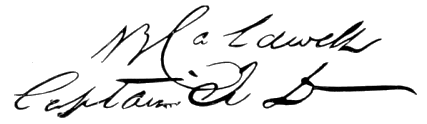
Billy Caldwell, the "Sau-ga-nash," or Englishman,
was son of Colonel Caldwell, a British officer stationed at
Detroit, his mother being a beautiful Pottowatomie girl.
He was educated by his father, though serving his mother's
race as a chief of the Pottowatomies. (There were
always many "chiefs.") He fought under Tecumseh
against the whites under Wayne—"Mad Anthony," as
he was often called, "Old Tempest," as Caldwell himself
calls him[J]—also at the Battle of the Thames, in
1813, when Harrison fought and defeated the combined
forces of British and Indians, and the famous chief,
Tecumseh, was killed. He took part in the treaty of
Greenville, in 1796, and that of Chicago, in 1833; a long
space of historic time, covering a racial struggle of many
thrilling incidents, not a thousandth part of which can
ever see the light. They are buried in blood, smoke,
flame and darkness. At this time, it will be observed,
Caldwell was an ally of the English.
Billy Caldwell, for it was he, entered the parlor with a calm
step, and without a trace of agitation in his manner. He deliberately
took off his accoutrements and planed them, with his rifle,
behind the door, and then saluted the hostile savages.
"How now, my friends? A good day to you! I was told there
were enemies here, but I am glad to find only friends. Why have
you blackened your faces? Is it that you are mourning for those
friends you have lost in battle?" (purposely misunderstanding this
token of evil designs) "or is it that you are fasting? If so, ask our
friend here, and he will give you to eat. He is the Indians' friend,
and never yet refused them what they had need of."
Thus taken by surprise, the savages were ashamed to acknowledge
their bloody purpose. They therefore said modestly that they
came to beg of their friends some white cotton in which to wrap
their dead before interring them. This was given to them, with
some other presents, and they took their departure peaceably from
the premises.
The remainder of both the Wau-Bun and Heald narratives
is devoted to the flight from Chicago and the later
fate of the fugitives. Before closing this part of my story,
I will give the following bit coming from another source.
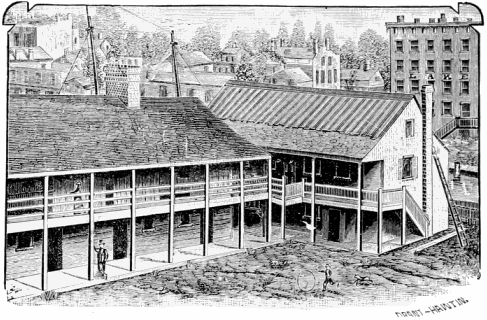
Near the (present) north end of State Street bridge
stood a log house known to history and tradition as
"Cobweb Castle;" a name probably given to it after the
rebuilding of the fort in 1816, and after it had become
superannuated and superseded. Mrs. Callis, daughter of
Mr. Jouett, who came here with him about 1817, says
of it: "The house in which my father lived, was built
before the massacre of 1812; I know this from the fact
that 'White Elk,' an Indian chief, the tallest Indian I
ever saw, was frequently pointed out to me as the savage
who had dashed out the brains of the children of Sukey
Corbin (a camp-follower and washerwoman) against the
side of this very house. Mrs. Jouett told her daughter
of a frantic mother (perhaps the same Mrs. Corbin), a
former acquaintance of hers, who, on that occasion fought
the monster all the while the butchery was going on, and
who, in her turn, fell a victim herself."
This would indicate that some of the citizens (beside
the Kinzies, Healds and Helms) got back to the settlement
after the collision at the sand-hills, and that they
found at their old homes no sanctuary, no rest, no mercy,
no hope.
It is to be observed that, as the Jouetts were not on
the spot at the time of the massacre, this part of the story
has not the degree of authenticity attaching to the reports
of the Healds and Helms. The treaty of 1817 gives,
among the Pottowatomie signers, the Indian name of
"the White Elk" as "Wa-bin-she-way."
Everything connected with the massacre itself, so far
as existing testimony has come to light, has now been
told. There is a possibility that one other document
may be hidden away; an account written by Lieutenant
Helm. But this, if ever found, will necessarily be identical,
in all important particulars with the story told by
his widow and printed in Wan Bun.[K]
The day which dawned so bright has dragged through
its bloody hours and come to its dark and hideous close.
The dead, men, women and children, are at peace. The
wounded are suffering the torments of the pit, the rest
are shuddering in the uncertainties that lie before them.
The Indians are riotously happy; for have they not done
harm? Have they not killed, scalped, destroyed, wasted,
life and property? Have they not annihilated the source
whence they had been getting arms, ammunition and
blankets, and driven off the men who tried to keep
whisky from them? Have they not made a solitude and
called it war? The goods are scattered. The fort is
burned. The cattle are dead or dying. The soldiers
are defeated, slain or held as prisoners, for ransom if unhurt,
for torture if disabled. The babes are brained and
their mothers dead or desolate. What more "happy
hunting ground" is possible to them this side of hades
itself?
In "Wau-Bun," one seems to hear them telling of
their individual good deeds and attributing all evil deeds
to each other. For the Indian's hand was against every
man, even all other Indians. Their bloodiest wars have
been between themselves; wars of absolute extermination
for the beaten party Every tribe held its lands by
conquest and by force. Even if we had taken them by
the sword, without compensation (which we never did),
they would only have lost their holdings by the selfsame
means by which they had gained them.
Well is it for the kindlier folk that the cruel did not
stick together. If they had done so, we should be a
hundred years in time and a thousand miles in space
further back in our territorial progress. But they could
not combine. "You might as well try to boil flints into
a pudding."
It still remains to me to trace, so far as it is not
shrouded in oblivion, the fate of the survivors. But as
this leads some distance into the future, I have thought
best to treat the matter separately; prefacing the story of
what followed the tragedy by a short sketch of what preceded
and led up to it. Why did those brave and hapless
beings come here? How came they here? What
brought their few and scattered footprints to the ground
since then trodden by millions?
The following pages will try to answer these questions,
beginning with the very earliest permanent settlement
of what is now Chicago.